/


Author: Secunda S. Fine S.
Tags: scientific articles judaism early christianity zoroastrianism talmudic science
ISBN: 978-90-04-23545-8
Year: 2012



Text
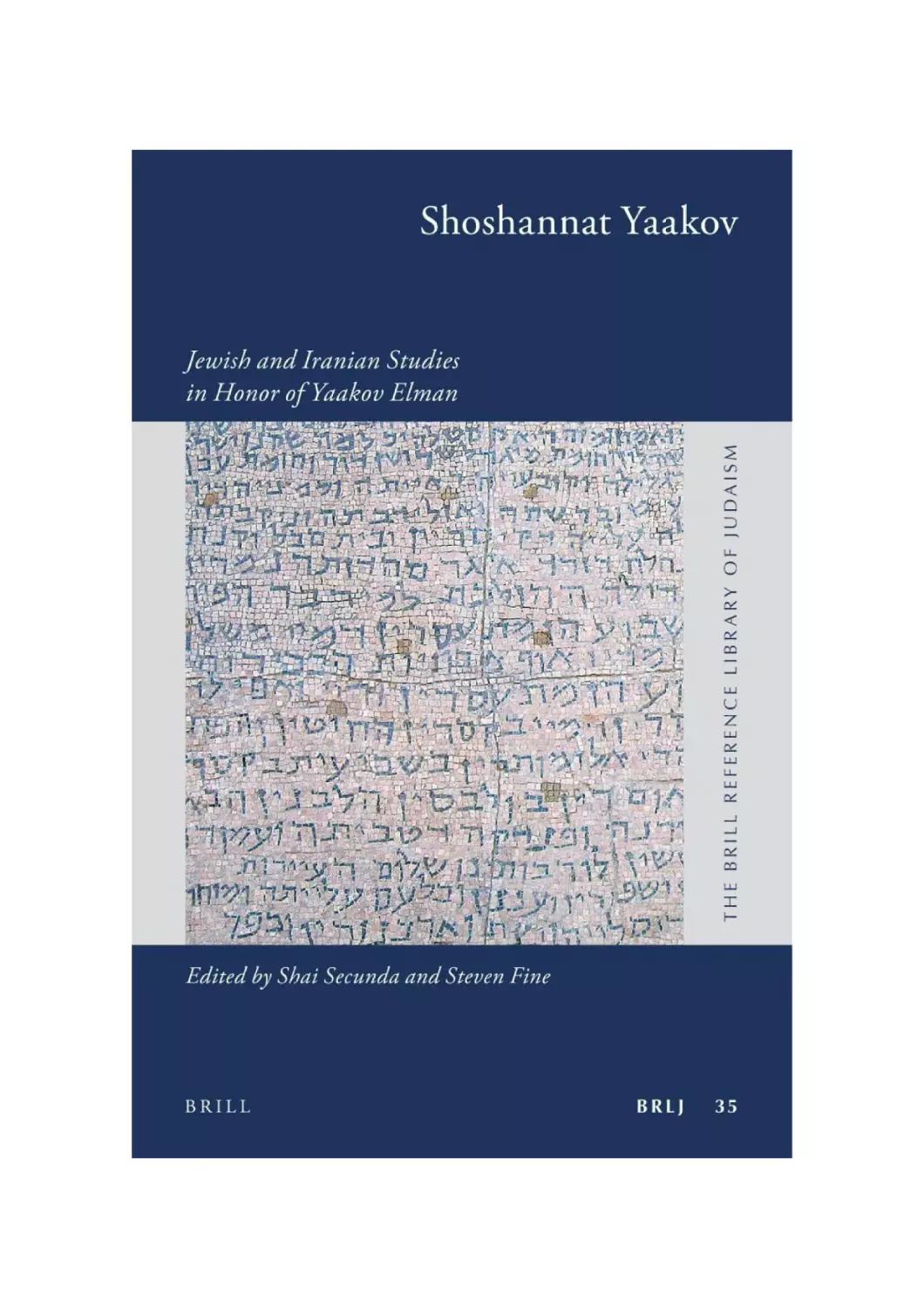
Shoshannat Yaakov
The Brill Reference Library
of Judaism
Editors
Alan J. Avery-Peck (College of the Holy Cross)
William Scott Green (University of Miami)
Editorial Board
David Aaron (Hebrew Union College-Jewish Institute
of Religion, Cincinnati)
Herbert Basser (Queen’s University)
Bruce D. Chilton (Bard College)
José Faur (Netanya College)
Neil Gillman ( Jewish Theological Seminary of America)
Mayer I. Gruber (Ben-Gurion University of the Negev)
Ithamar Gruenwald (Tel Aviv University)
Maurice-Ruben Hayoun (University of Geneva)
Arkady Kovelman (Moscow State University)
David Kraemer ( Jewish Theological Seminary of America)
Baruch A. Levine (New York University)
Alan Nadler (Drew University)
Jacob Neusner (Bard College)
Maren Niehoff (Hebrew University of Jerusalem)
Gary G. Porton (University of Illinois)
Aviezer Ravitzky (Hebrew University of Jerusalem)
Dov Schwartz (Bar Ilan University)
Günter Stemberger (University of Vienna)
Michael E. Stone (Hebrew University of Jerusalem)
Elliot Wolfson (New York University)
Volume 35
The titles published in this series are listed at brill.com/brlj
Yaakov Elman
(Courtesy of the Yeshiva University Archives)
Shoshannat Yaakov
Jewish and Iranian Studies in Honor
of Yaakov Elman
Edited by
Shai Secunda and Steven Fine
Leiden • boston
2012
Cover illustration: Halakhic Inscription from the Rehov Synagogue, 6th–7th century CE.
Photograph by Yair Talmor.
Library of Congress Cataloging-in-Publication Data
Shoshannat Yaakov : Jewish and Iranian studies in honor of Yaakov Elman / edited by Shai
Secunda and Steven Fine.
p. cm. — (The Brill reference library of Judaism, ISSN 1571-5000 ; v. 35)
Includes bibliographical references.
ISBN 978-90-04-23544-1 (hardback : alk. paper) — ISBN 978-90-04-23545-8 (e-book) 1. Judaism—
Influence. 2. Iran—Civilization—Jewish influences—To 640. 3. Iran—Intellectual life—To 640.
4. Talmud—Criticism, interpretation, etc. 5. Bible. O.T.—Criticism, interpretation, etc.
6. Sassanids—Intellectual life. I. Elman, Yaakov. II. Secunda, Shai. III. Fine, Steven.
BM537.S56 2012
296—dc23
2012023430
This publication has been typeset in the multilingual “Brill” typeface. With over 5,100 characters
covering Latin, IPA, Greek, and Cyrillic, this typeface is especially suitable for use in the
humanities. For more information, please see www.brill.com/brill-typeface.
ISSN 1571-5000
ISBN 978-90-04-23544-1 (hardback)
ISBN 978-90-04-23545-8 (e-book)
Copyright 2012 by Koninklijke Brill NV, Leiden, The Netherlands.
Koninklijke Brill NV incorporates the imprints Brill, Global Oriental, Hotei Publishing,
IDC Publishers and Martinus Nijhoff Publishers.
All rights reserved. No part of this publication may be reproduced, translated, stored in
a retrieval system, or transmitted in any form or by any means, electronic, mechanical,
photocopying, recording or otherwise, without prior written permission from the publisher.
Authorization to photocopy items for internal or personal use is granted by Koninklijke Brill NV
provided that the appropriate fees are paid directly to The Copyright Clearance Center,
222 Rosewood Drive, Suite 910, Danvers, MA 01923, USA.
Fees are subject to change.
This book is printed on acid-free paper.
CONTENTS
List of Contributors . .......................................................................................
xi
Yaakov Elman: List of Publications . ..........................................................
xv
Preface . ............................................................................................................... xxiii
The Re-Presentation of ‘Biblical’ Legal Material at Qumran:
. Three Cases from 4Q159 (4QOrdinancesa) .........................................
. Moshe J. Bernstein
1
Medieval and Modern Philology: Notes on the First Sugya of BT
. Nazir . ..............................................................................................................
. Daniel Boyarin
21
What Must the Jew do to Help the Cooking? An Analytic
. Resolution to bAZ 38 . ...............................................................................
. Shalom Carmy
33
Biblical Influence on Virgil ...........................................................................
. Louis H. Feldman
43
“For this Schoolhouse is Beautiful”: A Note on Samaritan ‘Schools’
. in Late Antique Palestine . .......................................................................
. Steven Fine
65
Sorting Out the Wages of Adultery: Execution, Ordeal or
. Divorce ...........................................................................................................
. Shamma Friedman
77
“One Day David Went Out for the Hunt of the Falconers”: Persian
. Themes in the Babylonian Talmud . .....................................................
. Geoffrey Herman
111
The Agonistic Bavli: Greco-Roman Rhetoric in Sasanian Persia ......
. Richard Hidary
137
A Late Antique Babylonian Rabbinic Treatise on Astrology .............
. Richard Kalmin
165
viii
contents
Redesigning Tzitzit in the Babylonian Talmud in Light of Literary
. Depictions of the Zoroastrian kustīg ....................................................
. Yishai Kiel
Irano-Talmudica II: Leviathan, Behemoth and the ‘Domestication’
. of Iranian Mythological Creatures in Eschatological Narratives
. of the Babylonian Talmud .......................................................................
. Reuven Kiperwasser & Dan D.Y. Shapira
Learning from the Tāg: On a Persian Word for ‘Crown’ in Jewish
. Aramaic . ........................................................................................................
. Aaron Koller
The adwadād Offence in Zoroastrian Law ..............................................
. Maria Macuch
Qui coierit cum muliere in fluxu menstruo . . . interficientur ambo
. (Lev. 20:18): The Biblical Prohibition of Sexual Relations with
. a Menstruant in the Eyes of Some Medieval Christian
. Theologians . .................................................................................................
. Evyatar Marienberg
‘Until Tzadok Arose’ in the Damascus Document: Tzadoq and his
Appointment as High Priest in Early Jewish Interpretation .........
. Chaim Milikowsky
Astrology and the Head of the Academy .................................................
. Jeffrey L. Rubenstein
The Curving Shore of Time and Space: Notes on the Prologue to
. Pushkin’s Ruslan and Ludmila ................................................................
. James R. Russell
185
203
237
247
271
285
301
323
The Samaritans in Amoraic Halakhah ......................................................
. Lawrence H. Schiffman
371
Parva—a Magus ...............................................................................................
. Shai Secunda
391
contents
Religious Actions Evaluated by Intention: Zoroastrian Concepts
. Shared with Judaism . ................................................................................
. Shaul Shaked
Hairy Meat? On Nērangestān, Chapter 47.1–20 . ....................................
. Prods Oktor Skjærvø
ix
403
415
Yefet in the House of Shem: The Influence of the Septuagint
. Translation of the Scroll of Esther on Rabbinic Literature ...........
. Joseph Tabory
441
Scripture Versus Contemporary (Interpretive) Needs: Towards a
. Mapping of the Hermeneutic Contours of Zoroastrianism . .........
. Yuhan Sohrab-Dinshaw Vevaina
465
Hebrew Section
א
. ....................
כט
. ....................
בין הלל להגדה:סעודת ליל הסדר
דוד הנשקה
להגדרתם של קרבן יחיד ושל קרבן ציבור
צבי אריה שטיינפלד
LIST OF CONTRIBUTORS
Moshe J. Bernstein
Professor of Bible and Jewish History
Yeshiva University
Daniel Boyarin
Hermann P. and Sophia Taubman Professor of Talmudic Culture
University of California, Berkeley
Shalom Carmy
Assistant Professor of Jewish Philosophy and Bible
Yeshiva University
Louis H. Feldman
Abraham Wouk Family Chair in Classics and Literature
Yeshiva University
Steven Fine
Professor of Jewish History
Director, Center for Israel Studies
Yeshiva University
Shamma Friedman
Benjamin and Minna Reeves Professor of Talmud and Rabbinics
The Jewish Theological Seminary of America
David Henshke
Professor of Talmud
Bar Ilan University
Geoffrey Herman
Fellow, Yeshiva University Center for Israel Studies
Richard Hidary
Assistant Professor of Judaic Studies
Yeshiva University
xii
list of contributors
Richard Kalmin
Theodore R. Racoosin Chair of Rabbinic Literature
The Jewish Theological Seminary of America
Yishai Kiel
Harry Starr Fellow
Harvard University
Reuven Kiperwasser
Scholar in Residence
Paideia—The European Institute for Jewish Studies, Sweden
Aaron Koller
Assistant Professor of Bible
Yeshiva University
Maria Macuch
Professor of Iranian Studies
Freie Universität Berlin
Evyatar Marienberg
Assistant Professor of Religious Studies and the E.J. and Sara Evans Fellow
of Jewish History and Culture
The University of North Carolina at Chapel Hill
Chaim Milikowsky
Professor of Talmud
Bar Ilan University
Jeffrey L. Rubenstein
Skirball Professor of Talmud and Rabbinics
New York University
James R. Russell
Mashtots Professor of Armenian Studies
Harvard University
Lawrence H. Schiffman
Vice Provost and Professor of Judaic Studies
Yeshiva University
list of contributors
Shai Secunda
Mandel Fellow
Scholion Center of Interdisciplinary Jewish Research
The Hebrew University of Jerusalem
Shaul Shaked
Schwarzmann University Professor (emeritus)
The Hebrew University of Jerusalem
Dan D.Y. Shapira
Professor of Middle Eastern Studies
Bar Ilan University
Prods Oktor Skjærvø
Aga Khan Professor of Iranian
Harvard University
Zvi-Arie Steinfeld
Professor of Talmud (emeritus)
Bar Ilan University
Joseph Tabory
Professor of Talmud
Bar-Ilan University
Yuhan Sohrab-Dinshaw Vevaina
Lecturer in Religious Studies
Stanford University
xiii
YAAKOV ELMAN:
LIST OF PUBLICATIONS
Monograph
Authority and Tradition: Toseftan Baraitot in Talmudic Babylonia. New
York: Yeshiva University Press, 1994.
Edited Volumes
Editor, with Jeffrey Gurock, Hazon Nahum: Studies in Jewish Law, Thought
and History Presented to Dr. Norman Lamm in Honor of His Seventieth
Birthday. New York: Yeshiva University Press, 1997.
Editor, with Israel Gershoni, Transmitting Jewish Traditions: Orality, Textuality, and Cultural Diffusion. New Haven: Yale University Press, 2000.
Texts
Living Torah: Early Prophets, Jerusalem: Maznaim, 1994.
Living Torah: Later Prophets, Jerusalem: Maznaim, 1996.
Dream Interpretation From Classical Jewish Sources, by Rabbi Solomon
Almoli; translated and annotated by Yaakov Elman. Hoboken, NJ: Ktav,
1998.
Translation
Why Jews Do What They Do: A History of Jewish Customs Throughout the
Cycle of the Jewish Year, Hoboken, NJ: Ktav, 1999, a translation of Daniel
Sperber, Minhagei Yisrael, vols. 1–2.
Articles
“Babylonian Echoes in a Late Rabbinic Legend.” Journal of the Ancient
Near East Society 4 (1972): 13–19.
xvi
yaakov elman: list of publications
“Authoritative Oral Tradition in Neo‑Assyrian Scribal Circles.” Journal of
the Ancient Near East Society 7 (1975): 19–32.
“An Akkadian Cognate of Hebrew šehin.” Journal of the Ancient Near East
Society 8 (1976): 33–34.
“In the Margins of the Yerushalmi: Hagiga.” Pages 31–57 in In the Margins of
the Yerushalmi: Glosses on the English Translation. Edited by J. Neusner.
Chicago, California: Scholars Press, 1983.
“In the Margins of the Yerushalmi: Moed Qatan.” Pages 59–67 in In the
Margins of the Yerushalmi: Glosses on the English Translation. Edited by
J. Neusner. Chicago, California: Scholars Press, 1983.
“Reb Zadok HaKohen of Lublin on Prophecy in the Halakhic Process.”
Jewish Law Association Studies I (1985): 1–16.
“R. Zadok HaKohen of Lublin on the History of Halakha.” Tradition 21
(1985): 1–26.
“The Order of Arguments in Kalekh‑baraitot in Relation to the Conclusion.” Jewish Quarterly Review 79 (1989): 295–304.
“When Permission is Given: Aspects of Divine Providence.” Tradition 24
(1989): 24–45.
“Ha-mal’akh ha-Mashhit bi-Zeman ha-Ge’ulah.” Rinat Yitzchak 1 (1988–
1989): 109–113.
“The Suffering of the Righteous in Babylonian and Palestinian Sources.”
Jewish Quarterly Review 80 (1990): 315–39.
“From the Pages of Tradition: Rabbi Moses Samuel Glasner: The Oral
Torah.” Tradition 25 (1990): 63–69.
“Babylonian Baraitot in Tosefta and the ‘Dialectology’ of Middle Hebrew.”
Association for Jewish Studies Review 16 (1991): 1–29.
“Righteousness as Its Own Reward: An Inquiry into the Theologies of the
Stam.” Proceedings of the American Academy for Jewish Research 57
(1991): 35–67.
“The History of Gentile Wisdom According to R. Zadok Hakohen of
Lublin.” Journal of Philosophy and Jewish Thought 3 (1993): 153–187.
“A Theological Reflection on Death, Resurrection, and the Age of the Universe: R. Israel Lipschitz’ Derush Or ha-Hayyim.” Pages 66–163 in Aryeh
Kaplan, Immortality, Resurrection and the Age of the Universe. Hoboken,
NJ: Ktav, 1992.
“ ‘It Is No Empty Thing’: Nahmanides and the Search for Omnisignificance.” The Torah U-Madda Journal 4 (1993): 1–83.
“Le-Toledot ha-Ribbuy ba-Talmud ha-Bavli.” Pages 87–94 in Proceedings of
the Eleventh World Congress of Jewish Studies. Edited by D. Assaf. Jerusalem: World Union of Jewish Studies, 1994.
yaakov elman: list of publications
xvii
“Some Remarks on 4QMMT and the Rabbinic Tradition, Or, When Is a
Parallel Not a Parallel?” Pages 99–128 in Reading 4QMMT: New Perspectives on Qumran Law and History. Edited by M.J. Bernstein and
J. Kampen. Symposium 2. Atlanta, GA: Scholars Press, 1996.
“Progressive Derash and Retrospective Peshat: Non-Halakhic Considerations in Talmud Torah.” Pages 189–287 in Modern Scholarship in the
Study of Torah: Contributions and Limitations. Edited by S. Carmy.
Northvale, NJ: J. Aaronson, 1996.
“Moses ben Nahman / Nahmanides (Ramban).” Pages 416–432 in vol. 1/2
Hebrew Bible/Old Testament: History of Its Interpretation. Edited by
M. Sabo. 2 vols. Goettingen: Vandenhoeck & Ruprecht, 1996.
“The Status of Deuteronomy as Revelation: Nahmanides and Abarbanel.”
Pages 229–250 in Hazon Nahum: Studies in Jewish Law, Thought and History Presented to Dr. Norman Lamm in Honor of His Seventieth Birthday.
Edited by Y. Elman and J. Gurock. New York: Yeshiva University Press,
1997.
“The Contribution of Rabbinic Thought Towards a Theology of Suffering.” Pages 155–212 in Jewish Perspectives on the Experience of Suffering.
Edited by S. Carmy. Northvale, NJ: J. Aaronson 1999.
“Orality and the Transmission of Tosefta Pisha in Talmudic Literature.”
Pages 117–174 in Introducing Tosefta: Textual, Intratextual and Intertextual Studies. Edited by H. Fox and T. Meacham. Hoboken, NJ: Ktav,
1999.
“Mishnah and Tosefta.” Pages 569–574 in vol. 1 of Encyclopedia of the
Dead Sea Scrolls. Edited by L.H. Schiffman and J.C. VanderKam. 2 vols.
Oxford: Oxford University Press, 2000.
“Talmudim.” Pages 913–915 in vol. 2 Encyclopedia of the Dead Sea Scrolls.
Edited by L.H. Schiffman and J.C. VanderKam. 2 vols. Oxford: Oxford
University Press, 2000.
“Orality and the Redaction of the Babylonian Talmud.” Oral Tradition 14
(1999) [published in 2000]: 52–99.
“MMT B 3–5 and Its Ritual Context.” Dead Sea Discoveries 6 (1999): 148–
156.
“The Institutionalization of Oral Tradition: From Study Circle to Yeshiva
and Madrassa in Jewish and Islamic Babylonia.” With Daphna Efrat.
Pages 107–137 in Orality, Textuality and the Materiality of Jewish Tradition: Representations and Transformations. Edited by Y. Elman and
I. Gershoni. New Haven: Yale University Press, 2000.
“The Rebirth of Omnisignificant Biblical Exegesis in the Nineteenth and
Twentieth Centuries.” JSIJ 2 (2002): 1–42.
xviii
yaakov elman: list of publications
“The Small Scale of Things: The World Before the Genizah.” Proceedings
of the American Academy of Jewish Research 63 (1997–2001) [published
in 2002]: 49–86.
“Benno Jacob in Historical Context.” Pages 110–122 in Die Exegese hat das
erste Wort. Contributions to the life and work of Benno Jacob. Edited by
W. Jacob and A. Juergensen. Stuttgart: Calwer Verlag, 2001 [published
2002].
“Derekh ha-GRA u-Magamato be-Ferush Midrash Halakhah be-‘Aderet Eliyahu’ al Sefer Vayiqra.” Pages 63–80 in Ha-GR”A u-Veit Midrasho. Edited
by M. Halamish, et al. Ramat Gan: Bar-Ilan University Press, 2003.
“Classic Rabbinic Interpretation.” Pages 1844–1862 in Jewish Study Bible.
Edited by A. Berlin and M.Z. Brettler. New York: Oxford University
Press, 2003.
“Marriage and Marital Property in Rabbinic and Sasanian Law.” Pages
227–276 in Rabbinic Law in Its Roman and Near Eastern Context. Edited
by C. Hezser. Tübingen: Mohr-Siebeck, 2003.
“Rava ve-Darkei ha-Iyyun ha-Eretz Yisraeliyyot be-Midrash ha-Halakhah.”
Pages 217–242 in Merkaz u-Tefutzah: Eretz Yisrael veha-Tefutzot bi-Ymei
Bayit Sheni, ha-Mishnah veha-Talmud. Edited by Y. Gafni. Jerusalem:
Merkaz Shazar, 2004.
“Acculturation to Elite Persian Norms in the Babylonian Jewish Community of Late Antiquity.” Pages 31–56 in Neti’ot David. Edited by
E. Halivni, Z.A. Steinfeld, and Y. Elman. Jerusalem: Orhot, 2004 [appeared
in 2005].
“Order, Sequence, and Selection: The Mishnah’s Anthological Choices.”
Pages 53–80 in The Anthology in Jewish Literature. Edited by D. Stern.
New York: Oxford University Press, 2004.
“Up to the Ears” in Horses’ Necks: On Sasanian Agricultural Policy and
Private ‘Eminent Domain’.” JSIJ 3 (2004), 95–149.
“Midrash Halakhah in Its Classic Formulation.” Pages 3–16 in Recent Developments in Midrashic Resarch. Edited by L.M. Teugels and R. Ulmer.
Piscataway, NJ: Gorgias Press, 2005.
“Cultural Aspects of Post-Redactional Additions to the Bavli.” Pages 383–
416 in Creation and Composition: The Contribution of the Bavli Redactors
(Stammaim) to the Aggadah (TSAJ 114). Edited by Jeffrey Rubenstein.
Tübingen: Mohr-Siebeck, 2005.
“The Babylonian Talmud in Its Historical Context.” Pages 19–28 in Printing the Talmud: From Bomberg to Schottenstein. Edited by S. LeibermanMintz and G.M. Goldstein. New York: Yeshiva University Museum, 2005.
yaakov elman: list of publications
xix
“Torah va-Avodah as Competing Values in Hazal.” Pages 61–124 in Jewish
Spirituality and Divine Law. Edited by A. Mintz and L. Schiffman. New
York: Yeshiva University Press, 2005.
“Scripture Versus Contemporary Needs: A Sasanian/Zoroastrian Example.”
Cardozo Law Review 28 (2006): 153–169.
“Yeshivot Bavliyot ke-Vatei Din.” Pages 31–55 in Yeshivot u-Vatei Midrash.
Edited by E. Etkes. Jerusalem: Merkaz Shazar, 2006.
“R. Yosef be-cIdan Ritha.” Bar Ilan Annual 30–31 Memorial Volume for Prof.
M.S. Feldblum (2006): 93–104.
“Middle Persian Culture and Babylonian Sages: Accommodation and
Resistance in the Shaping of Rabbinic Legal Tradition.” Pages 165–197 in
Cambridge Companion to Rabbinic Literature. Edited by C.E. Fonrobert
and M.S. Jaffe. Cambridge: Cambridge University Press, 2007.
“ ‘He in His Cloak and She in Her Cloak’: Conflicting Images of Sexuality in Sasanian Mesopotamia.” Pages 129–164 in Discussing Cultural
Influences: Text, Context, and Non-Text in Rabbinic Judaism: Proceedings
of a Conference on Rabbinic Judaism at Bucknell University. Edited by
Rivka Ulmer. Lanham, MD: University Press of America, 2007.
“Ma’aseh be-Shtei Ayarot: Mahoza u-Pumbedita Ke-Metzayygot Shtei
Tarbuyot Hilkhatiyyot.” Pages 3–38 in Torah li-Shemah: Mehqarim beMadacei ha-Yahadut li-khvod Prof. Shamma Yehudah Friedman. Edited
by D. Golinkin. Ramat Gan: Bar Ilan University Press, 2007.
“The Socioeconomics of Babylonian Heresy.” Jewish Law Association Studies 17 (2007): 80–126.
“Who Were the Kings of East in West in Ber 7a?: Roman Religion, Syrian
Gods and Zoroastrianism in the Babylonian Talmud.” Pages 43–80 in
Studies in Josephus and the Varieties of Ancient Judaism: Louis H. Feldman
Jubilee Volume. Edited by S.J.D. Cohen and J. Schwartz. Leiden: E.J. Brill,
2007.
“Hercules Within the Halakhic Tradition: A Response to Ronald Dworkin.”
Dinei Yisrael 25 (2008): 7*–42*.
“Tsadok ha-Kohen of Lublin.” Page 1909 in vol. 2 of YIVO Encyclopedia of
Eastern Europe. Edited by G.D. Hundert. 2 vols. New Haven: Yale University Press, 2008.
“Returnable Gifts in Rabbinic and Sasanian Law.” Pages 150–195 in vol. 6
of Irano-Judaica. Edited by S. Shaked. 6 vols. Jerusalem: Yad Izhak Ben
Zvi, 2008.
“The Other in the Mirror: Iranians and Jews View One Another. Questions of Identity, Conversion, and Exogamy in the Fifth-Century Iranian
Empire. Part One.” Bulletin of the Asian Institute 19 (2005; publ. 2009):
15–25.
xx
yaakov elman: list of publications
“Why Study Talmud: Wellsprings of Torah and the Individual Soul.” Pages
135–150 in Why Study Talmud in the Twenty-first Century?: The Relevance
of the Ancient Jewish Text to Our World. Edited by P. Socken. Lanham,
MD: Rowman and Littlefield Publishing Group, 2010.
“The Halakhah Follows Rava . . . Except When It Doesn’t: A Mediation on
Halakhic Decision-making.” Pages 272–307 in Vixens Disturbing Vineyards: Embarrassment and Embracement of Scriptures: Festschrift in
Honor of Harry Fox. Edited by T. Yoreh, et al., Boston: Academic Studies Press, 2010.
“Zekhuyot ha-Ishah bi-Nekahsaha be-Askolat Mahoza,” Sidra 24–25 (2010):
17–48.
“Toward an Intellectual History of Sasanian Law: An Intergenerational
Dispute in Hērbedestān 9 and Its Rabbinic Parallels.” Pages 21–57 in
The Talmud in Its Iranian Context. Edited by C. Bakhos and R. Shayegan.
Tübingen: Mohr-Siebeck, 2010.
“Why Is There No Central Zoroastrian Temple?: A Thought Experiment.”
Pages 151–170 in The Temple of Jerusalem: From Moses to the Messiah:
Studies in Honor of Professor Louis H. Feldman. Edited by Steven Fine.
Leiden: E.J. Brill, 2011.
“Zoroastrianism and Qumran.” Pages 91–98 in The Dead Sea Scrolls at
Sixty, (Studies on the Texts of the Desert of Judah, vol. 89). Edited by
L.H. Schiffman and S. Tzoref. Leiden: E.J. Brill, 2010.
“Resh Pesahim ba-Bavli uvi-Yerushalmi—Inyanei Arikhah ve-Hithavvut.”
Pages 9–25 in Melekhet Mahshevet. Edited by C. Milikowsky. Ramat
Gan: Bar Ilan University Press, 2011.
“Meiri and the Non-Jew: A Comparative Investigation.” Pages 265–296 in
New Perspectives on Jewish-Christian Relationships In Honor of David
Berger. Edited by E. Carlebach and J.J. Schachter. Boston: E.J. Brill,
2012.
Reviews
“The Judaism of the Mishna: What Evidence?” (Review of J. Neusner, Judaism: The Evidence of the Mishna). Judaica Book News 12 (1982): 17–25.
R. Polzin, Moses and the Deuteronomist: A Literary Study of the Deuteronomic History. Judaica Book News 12 (1982): 69–70.
B. Greenberg, On Women and Judaism: A View from Tradition. Judaica Book
News 12 (1982): 72.
yaakov elman: list of publications
xxi
L. Jacobs, Teyku: The Unsolved Problem in the Babylonian Talmud. Judaica
Book News 12 (1982): 82–83.
“Election Without Faith, Judaism Without Mitzvot.” (Review of Michael
Wyschogrod, Body of Faith: Judaism as Corporal Election). Judaica Book
News 15 (1984), 8–10, 56–58.
“Structure, Movement, and Tension.” (Review of Robert Alter, The Art of
Biblical Poetry) Judaica Book News 16 (1986): 20–21.
“A Humanistic Wolf in Covenantal Clothing: Covenant as a Bill of Divorce.”
(review of David Hartman, A Living Covenant.) Judaica Book News 17
(1986–87): 20–25.
“Rejoinder [to David Hartman].” Judaica Book News 18 (1987–88), 6–8,
66–67.
“Poetics of Biblical Narrative: A Review Essay.” (Review of M. Sternberg,
Poetics of Biblical Narrative) Judaica Book News 18 (1987–88): 13–16.
J. Neusner, Tosefta. Jewish Quarterly Review 78 (1987): 130–136.
N. Aminoah, Arikhat Masekhtot Betzah, Rosh Hashanah, Ta`anit Ba-Talmud Ha-Bavli. Journal of Jewish Studies 39 (1988), 124–25.
J. Levenson, Sinai and Zion. Tradition 24, (1988): 99–104.
S. Safrai, ed. The Literature of the Sages, First Part: Oral Tora, Halakha,
Mishna, Tosefta, Talmud, External Tractates. Judaica Book News 18
(1988): 52–53.
“Recreating the Mind of the Genizah: Goitein’s Mediterranean Society.”
Judaica Book News, 19 (1988–89): 16–21.
“American Jewry: Where Are We Going?” (Review of Charles S. Liebman,
Deceptive Images: Toward a Redefinition of American Judaism). Judaica
Book News 19/ (1989): 25–28.
H.C. Schimmel and A. Carmell, Encounter: Essays on Torah and Modern
Life. Jewish Action 50 (1990): 79–82.
A.J. Avery-Peck, New Perspectives on Ancient Judaism, Volume 4: The Literature of Early Rabbinic Judaism: Issues in Talmudic Redaction and Interpretation. Religious Studies Review 17 (1991): 177–178.
D. Kraemer, The Mind of the Talmud: An Intellectual History of the Babylonian Talmud, Religious Studies Review. Jewish Quarterly Review 84
(Oct 1993–Jan 1994): 261–282.
H.L. Strack and G. Stemberger, Introduction to the Talmud and Midrash.
Shofar: An Interdisciplinary Journal 10 (1992): 121–122.
Review of Pseudo-Rabad Commentary to Sifre Deuteronomy, edited and
annotated according to manuscripts and citations by Herbert W. Basser,
Religious Studies Review 21 (1995): 157–158.
xxii
yaakov elman: list of publications
Review of The Babylonian Esther Midrash: A Critical Commentary in Three
Volumes, by Eliezer Segal, Religious Studies Review (in press).
M. Schlueter, Auf Welche Weise Wurde die Mishnah Geschrieben? AJS
Review 20 (1995): 180–185.
D. Boyarin, Intertextuality and the Reading of Midrash. Hebrew Studies
(1997): 191–192.
“Proper Methodology in the Study of Rabbinic Intellectual History: A
Review of David Kraemer’s Responses to Suffering in Classical Rabbinic
Literature.” Jewish Quarterly Review 88 (1999): 361–386.
J.L. Rubenstein, The Culture of the Babylonian Talmud. Journal of Religion
86 (2006): 700–702.
R. Kalmin, Jewish Babylonia: Between Rome and Persia. Shofar (2008): 140–
142.
Preface
Shoshannat Yaakov, literally “rose of Yaakov,” brings together two communities that Yaakov Elman has single handedly set in dialogue—scholars
of late antique Judaism and scholars of late antique Iran. The contributors include colleagues, former mentors, and recent students, though truly
everyone who encounters Elman learns from him as from a pedagogue—
and in his tireless abiding curiosity, Elman views everyone he meets as a
teacher.
Taking its lead from the honoree, this Festschrift is deeply interdisciplinary, bringing together Classics, Dead Sea Scrolls, Talmudic studies, Iranian
Studies, Samaritan Studies and Jewish thought in a tapestry that is truly
enriched by their presence together. In fact, Elman’s unparalleled career
has spanned even more areas of interests than even those represented
here. Having been trained first as a meteorologist, then as an Assyriologist, Elman’s time as manager of the Solomon Rabinowitz Hebrew Bookstore on the Lower East Side of Manhattan is storied. Truth said, Judaica
scholars from around the world went on pilgrimage to this remarkable
bookstore—but the real draw was our honoree. Elman has made important contributions to the field of Assyriology, a result of his MA studies
at Columbia University. Even after working towards his doctorate at New
York University on Rabbinic Literature, under the direction of Lawrence H.
Schiffman, Elman did not limit himself to the world of the late antique
rabbis. He has published on the Dead Sea Scrolls, on Hassidic thought
(particularly, Rabbi Zadok HaKohen of Lublin), on major eighteenth and
nineteenth century European rabbinic figures, on medieval and modern
Jewish biblical interpretation; all the while making significant contributions to Jewish theology. Elman’s contributions to the study of rabbinic
hermeneutics are considerable.
Elman’s work on orality has had lasting significance, both within and
beyond Jewish studies. A still influential article from three decades ago
published in The Journal of the Ancient Near Eastern Society (1975) looked
at the distinct role played by orality in the scribal culture of the NeoAssyrian scribal schools. Elman’s dissertation, Authority and Tradition:
Toseftan Baraitot in Talmudic Babylonia (1986), used advances from the
study of orality to reconsider some of the difficult, nagging questions concerning the relationship between the Tosefta and its talmudic parallels.
xxiv
preface
This inquiry also had much to say about the study of Rabbinic Hebrew, as
he demonstrated in “Babylonian Baraitot in the Tosefta and the ‘Dialectology’ of Middle Hebrew” (1991). His work on the orality of the Bavli published in Oral Tradition (1999) remains without a peer. The background
provided by Elman’s study of orality proved directly relevant for his later
work on the initially oral Middle Persian corpus, and also on the discourse
surrounding orality in Sasanian society—a matter that was treated in a
number of articles, including his “Acculturation to Elite Persian Norms
and Modes of Thought in the Babylonian Jewish Community of Late
Antiquity” (2004).
In the nineteen nineties, Elman published a set of articles on the rabbinic theology of misfortune, two as independent pieces and two that
dialogued with Talmudist David Kraemer. In this work, Elman discovered a major division between the way Babylonian and Palestinian rabbis
dealt with theosophical questions. This interest led him to study Middle
Persian, travelling to Harvard University weekly for many years to study
under the tutelage of his now collaborator, Oktor Skjærvø. It was only
once he gained mastery in Middle Persian literature that he was able to
correlate this insight with parallels in Zoroastrian thought. In addition to
accounting for the ‘geo-theosophical’ fault-line, the realization also lead
to new insights about the rabbinic theology of divine anger, later published in Hebrew as “R. Yosef be-cIdan Ritha” (2006). Elman’s pioneering
work on “omnisignificance” and other aspects of rabbinic hermeneutics
led to a completely novel way of approaching Zoroastrian exegetical literature. Similarly influential for the field were Elman’s first Iranian studies articles that treated aspects of Sasanian law: “Marriage and Marital
Property in Rabbinic and Sasanian law” (2003) and the rather ingeniously
entitled “ ‘Up to the Ears’ in Horses’ Necks (B.M. 108a): On Sasanian Agricultural Policy and Private ‘Eminent Domain’ ” (2004).
It is virtually impossible to encapsulate the content and effect of
Elman’s scholarly output. Perhaps the best entrée into what Elman has
done for the fields of ancient Jewish and Iranian studies is to read the
articles brought together in this volume in his honor. In their own way,
each of them reflects the touch of this brilliant and humane genius.
A Festschrift is, by definition, a moment when a community comes
together to celebrate. Nearly five years ago the editors decided that the
time had come to honor Yaakov Elman. Quickly, a diverse scholarly community congealed around this project and pushed it forward. The response
of the scholarly community was gratifying, and we thank each author
for joining together with us in this celebration. At Yeshiva University, a
preface
xxv
small group of undergraduate students assembled under the auspices of
the YU Center for Israel Studies to help us to edit the essays for publication. The students included Simcha Gross (now of Yale University),
David Danzig (now of Yale University) and most especially Abraham J.
Berkovitz (now of Princeton University). Berkovitz’s contribution is most
significant as he saw the work through publication and prepared the bibliography of Elman’s works. Shoshannat Yaakov is a project of the Yeshiva
University Center for Israel Studies, which incubated this initiative and
provided support for the editing process. We especially thank YU President Richard M. Joel, Academic Vice President Morton Lowengrub and
the Dean of the Bernard Revel School of Jewish Studies, David Berger, for
their encouragement and good wishes.
Shai Secunda, Jerusalem
Steven Fine, New York
THE RE-PRESENTATION OF ‘BIBLICAL’ LEGAL MATERIAL AT QUMRAN:
THREE CASES FROM 4Q159 (4QORDINANCESa)*
Moshe J. Bernstein
The Qumran literary corpus is comprised of texts that encompass a broad
spectrum of literary genres, including many documents that are “legal”
in nature.1 An attempt has been made to categorize and classify the legal
texts, like the rest of the scrolls, in the fijinal volume of the offfijicial publication of the Dead Sea Scrolls, Discoveries in the Judean Desert.2 But
the classifijication of this material is far from simple, and the categories
that are selected to describe them are often unenlightening, or even
misleading. The overall section is characterized as “Texts Concerned
with Religious Law,” what we might call the broad generic rubric, with
* For Yaakov Elman—שכן טוב. For more than two decades, our near-adjacent offfijices
have given us the opportunity to schmooze about Torah and madda, talmud Torah and
jüdische Wissenschaft, Jews and Judaism, halakhah and aggadah, and so much more.
Whether our views converged or diverged, our conversations were never boring, usually
memorable, and almost always productive. In addition to his ground-breaking publications on the Middle Persian context of the Babylonian Talmud, and his research on rabbinic midrash halakhah, the biblical commentaries of Naḥmanides and the thought of
R. Zadok haKohen of Lublin, Yaakov somehow also found time to bring his insights on
Jewish legal material to bear on the Qumran text 4QMMT in two valuable articles: “Some
Remarks on 4QMMT and the Rabbinic Tradition: or, When is a Parallel not a Parallel?”
in Reading 4QMMT: New Perspectives on Qumran Law and History (ed. J. Kampen and M.J.
Bernstein; Symposium 2; Atlanta: Scholars Press, 1996), 99–128 and “MMT B 3–5 and its Ritual
Context,” DSD 6 (1999): 148–156. More recently, he has linked his interests in the Babylonian
world to that of the Dead Sea Scrolls in “Zoroastrianism and Qumran,” in The Dead Sea Scrolls
at 60: Scholarly Contributions by New York University Faculty and Alumni (ed. L.H. Schifffman
and S.L. [Berrin] Tzoref; STDJ 89; Leiden: Brill, 2010), 91–98. I offfer this brief study of some
pre-rabbinic legal material from Eretz Yisrael in tribute to his creative and multifaceted contributions to talmud Torah in so many of its forms. My thanks to Dr. Richard Hidary, Dr. Alex
P. Jassen, and Dr. Shani L. Tzoref for their critical comments on the penultimate version of the
essay. Professor Steven Fraade was kind enough to comment on an earlier version.
1 By “legal,” I mean only that they contain laws, not that the laws contained therein
were necessarily binding or efffective for any particular community at a particular time.
The question of which of the legal documents among the Dead Sea Scrolls were actually
operative for the Qumran or any other community is a signifijicant one that we probably
are still not ready to answer even after more than sixty years of research.
2 A. Lange and U. Mittman-Richert, “Annotated List of Texts from the Judaean Desert
Classifijied by Content and Genre,” in The Texts from the Judaean Desert—Indices and an
Introduction to the Discoveries in the Judaean Desert Series (ed. E. Tov; DJD 39; Oxford:
Clarendon, 2002), 115–64. The legal material is dealt with on 132–33.
2
moshe j. bernstein
subcategories “community rules,” “eschatological rules,” “purity rule,”
“other rules,” “halakhic midrash,” “parabiblical texts concerned with
religious law,” and “unclassifijied texts concerned with religious law.”3
Underneath those specifijic, yet still vague, rubrics we fijind the “named”
texts, such as the Community Rule, Damascus Document and War Rule,
while the text that we shall be discussing in this essay 4Q159 (Ordinancesa),
as well as two texts that may be related to it (4Q513–14 – Ordinancesb,c),
are relegated to the “other rules” heading together with documents called
4QHalakhah A (4Q251) and 4QMiscellaneous Rules (4Q265).
“Religious Law” is a very broad category that might very well include
everything from pentateuchal laws to later interpretation, enhancement,
or expansion of those laws, to sectarian legislation for the present or the
future. And other than the terms “midrash” and “parabiblical,” which, it
must be admitted, are not terribly descriptive, there is no indication in
any of these categories regarding the texts’ relationship to the Pentateuch,
whether exegetical or otherwise. This latter point is of particular signifijicance if we are interested in studying the relationship of the laws in the
Qumran texts to the Hebrew Bible, or the ways in which the composers
of these texts read, interpreted, and used biblical laws in the formation of
their own, or the ways in which their laws and legal interpretation converge with or diverge from later rabbinic legislation.
The text containing the laws I shall discuss in this essay was originally
published by John M. Allegro.4 4Q159 is a fragmentary text of which parts
3 4QMMT has its own subcategory “epistolary treatise concerned with religious law.”
4 Frg. 1 as “An Unpublished Fragment of Essene Halakhah (4QOrdinances),” JSS 6
(1961): 71–73, and then all the fragments in J.M. Allegro, Qumrân Cave 4.I (4Q158–4Q186)
(DJD V; Oxford: Clarendon, 1968), 6–9. Allegro’s work, as is well known, cannot be
employed without constant reference to the review by John Strugnell, “Notes en marge
du volume V des ‘Discoveries in the Judaean Desert of Jordan’,” RevQ 7 (1969–71): 163–
276 (175–179). My work on this manuscript is part of the revision of this volume of DJD
that I am editing together with George J. Brooke of Manchester University, with the
participation of an international group of Qumran scholars. The very name of the text,
“Ordinances” is itself not a particularly satisfactory one, especially in light of the fact
that the entire document is not totally composed of legal material, but it is still being
retained for reasons of convenience. Whether or not it is one of three copies of the same
document as 4Q513–514 remains very much open to question. I have discussed some of
the broader issues involved in editing and interpreting 4Q159 in “4Q159: Nomenclature,
Text, Exegesis, Genre,” in The Mermaid and the Partridge: Essays from the Copenhagen
Conference on Revising Texts from Cave Four (ed. George J. Brooke and Jesper Hogenhaven;
STDJ 96; Leiden: Brill, 2011), 33-55. The space constraints of this article require that
the re-presentation of “biblical” legal material at qumran
3
of two columns can be reconstructed, and most of which consists of laws
that appear to be related to legal material in the Pentateuch, particularly
the book of Deuteronomy. Because of both its fragmentary remains and
somewhat enigmatic nature, however, 4Q159 has not attracted the attention of scholars to the degree that other, more tractable, Qumran legal
texts, such as the Temple Scroll and the Damascus Document, have.5 The
difffijiculties with this text present themselves on two levels: fijirst, on that
of its microstructure, we need to analyze, to the best of our ability, each
of the laws that it contains from a variety of perspectives; and second, on
that of its macrostructure, we have to try to work out what principles of
organization and composition govern the document as a whole.
In this essay, since we shall be discussing only some of the laws, our
concern will be primarily with the level of microstructure. In the ensuing discussion, we shall analyze three consecutive laws from frg. 2–4 of
4Q159, focusing on the very diffferent ways that this single Qumran collection presents “pentateuchal” material. At the conclusion of our study,
after having examined these laws, we shall return briefly, and in a limited
fashion, to the broader question of the overall nature of the document.
The legal material that survives in 4Q159 consists of the following:6
the reader be referred there for a fuller treatment of the diverse issues involved in the
interpretation of 4Q159.
5 The text as a whole has received almost no full treatment, with the only broad
treatments being F.D. Weinert, “4Q159: Legislation for an Essene Community Outside of
Qumran?” JSJ 5 (1974): 179–207 and idem, “A Note on 4Q159 and a New Theory of Essene
Origins,” RevQ 9 (1976–78): 223–230, and C. Hempel, “4QOrda(4Q159) and the Laws of the
Damascus Document,” in The Dead Sea Scrolls Fifty Years After Their Discovery: Proceedings
of the International Congress in Jerusalem (ed. E. Tov, et al.; Jerusalem: Israel Exploration
Society, 2000), 372–376. Most scholarly attention has been focused on the laws of payment
of the half-sheqel: e.g., D. Flusser, “מחצית השקל באוונגליון ואצל כת מדבר יהודה,”
Tarbiz 31 (1962): 150–156 (= “The Half-shekel in the Gospels and the Qumran Community,”
Judaism of the Second Temple Period Vol. I: Qumran and Apocalypticism [Grand Rapids/
Jerusalem: Eerdmans/Magnes, 2007], 327–333); M. Beer, “הכיתות ומחצית השקל,”
Tarbiz 31 (1962): 298–299; J. Liver, “The Half-Shekel Offfering in Biblical and Post-biblical
Literature,” HTR 56 (1963): 173–198; and the accused bride: e.g,. J.H. Tigay, “Examination
of the Accused Bride in 4Q159: Forensic Medicine at Qumran,” Journal of the Ancient
Near Eastern Society 22 (1993): 129–134; A. Shemesh, “4Q271.3: A Key to Sectarian Matrimonial
Law,” JJS 49 (1998): 244–263 (252–261); idem, “Two Principles of the Qumranic Matrimonial Law,” in Fifty Years of Dead Sea Scrolls Research: Studies in Memory of Jacob Licht
(ed. G. Brin and B. Nitzan; Jerusalem: Yad Ben Zvi, 2001), 181–203 (Hebrew).
6 The fragments were originally numbered by size, as was frequently the case in the
early days of Qumran research. The sequence that I am following here is based on the subject matter of the text, following the order of the laws that appear in Deuteronomy. The
sequence has few implications for the analysis of the texts that ensues. Hempel, “4QOrda”
4
moshe j. bernstein
Fragments 2–4:
laws of an Israelite sold to non-Jew (Lev. 25);
the requirement for a court of [ten] Israelites and two priests for capital
cases (apparently related to Deut. 17);
the prohibition of transvestism (Deut. 22:5);
the bride accused of non-virginity (Deut. 22:13–21);
Fragment 1:
laws of leaving for the poor in the granary and fijield (Deut. 23:25–26; 24:19–
21);
money of valuation/half-sheqel (Exod. 30:12–13; 38:25–26).
There does not seem to be any obvious unifying factor operative in these
laws being found together (other than perhaps the sequence of some of
them in Deuteronomy, if my arrangement is accepted). Further complicating any attempt to understand the entire document from a generic perspective is the fact that the last two lines of frg. 1, as well as the whole of
frg. 5, appear to be of a non-legal nature.7
The fijirst two laws to be discussed appear in frgs. 2–4, lines 3–7:8
[וה]יו[ אנשים ]עשרה מישראל
֯
[וכי יהיה
]◦ וכוהנים שנים ונשפטו לפני שנים העשר האלה
[דבר בישראל על נפש על פיהם ישאלו ואשר ימרה ]את פיהם ולוא ישמע אל דבריהם
[גבר אל
]כול
̇ יומת אשר עשה ביד רמה אל יהיו כלי גבר על אשה
vacat יכס בשלמות אשה ואל ילבש כתונ̇ ]ת[ אשה כיא ]ת[ועבה היא
3
4
5
6
7
3.
And there shall be [ten] men [of Israel]
4. and two priests, and they shall be judged before these twelve [ And
should there be]
5. any capital case in Israel, they shall ask their opinion. And whoever rebels
[against their opinion and does not listen to their words]
6. shall be put to death for he has acted high-handedly. Let there not be
male garments upon a woman, any [
nor shall a man]
(above n. 5), 374–5, noted the sequence of Deuteronomy material in frg. 2–4, but did not
draw the same inference regarding the sequence of the fragments that I do.
7 I have discussed frg. 5 (and its possible link to frg. 1 16–17), its restoration, and its
interpretation in “4Q159 Fragment 5 and the ‘Desert Theology’ of the Qumran Sect,” in
Emanuel: Studies in Hebrew Bible, Septuagint and Dead Sea Scrolls in Honor of Emanuel Tov
(ed. S.M. Paul et al.; SVT 94; Leiden: Brill, 2003), 43–56.
8 The text and translation are based on my provisional edition, appearing in E. Tov, ed.,
The Dead Sea Scrolls Electronic Library (rev. ed.; Leiden/Provo, UT: Brill/Brigham Young
University, 2006). Both are the end results of scholarship that began almost a half-century
ago with Allegro and his many critics, including, for this passage, Y. Yadin, “A Note on
4Q159 (Ordinances),” IEJ 18 (1968): 250–252, in addition to those mentioned in n. 5.
the re-presentation of “biblical” legal material at qumran
5
7. cover himself with woman’s outer clothing, nor shall he wear the tuni[c]
of a woman for it is an abomination. vacat
There is neither a break nor vacat between the preceding material dealing
with slave law, which itself unfortunately lacks any real context, and the
fijirst of our laws, nor between these two laws themselves. They follow one
upon the other with about a letter-space separating them. On the other
hand, despite the fragmentary state of the manuscript, the vacat in line 7
between the second law and the law of the accused bride that follows it
is quite clear.
Our fijirst observation regarding these laws is that they relate to the Bible
in very diffferent ways. We shall argue that the fijirst law, in lines 3–6, is
scripturally based, even though it does not seem, prima facie, to employ
language that is modeled on any single biblical passage. As for the second,
in lines 6–7, no sophisticated analysis is demanded for us to see that it is
a rewriting of the Bible with a minimal number of changes. Although we
should not have any a priori assumptions about how biblical law ought
to be rewritten at Qumran, the very fact that two juxtaposed laws in the
same text are formulated so diffferently vis-à-vis their scriptural “originals”
is certainly noteworthy, and raises fundamental questions about the genre
of the text.
The fijirst law requires the establishment of a duodecimal court consisting of two priests and ten non-priests before whom certain proceedings
are to take place.9 As we have just noted, this law might appear to be
extra-scriptural since its language does not resemble closely that of any
legislation in the Pentateuch. It is likely, however, that this regulation that
demands a court on which both priests and Israelites are to be found is
related to Deut. 17:9: ובאת אל הכהנים הלוים ואל השפט אשר יהיה
“ בימים ההםyou shall come to the levitical priests and to the judge who
will be in those days.” In light of the fact that the rabbis in commenting
on this verse also recommend that courts include both priests and Levites,
we should not presume that it is only the priestly atmosphere of Qumran
that demands the presence of priests on the court to which difffijicult issues
were to be presented.10
9 The restoration “ten” is certain because of the number “twelve” in the next line, and
“from Israel” is likewise almost certain, based on the similar material discussed below.
10 Cf. Sifrei Deut. 153 to Deut. 17:9 (ed. Finkelstein, p. 206). I employ the term “recommend” because the full statement of Sifrei concludes, “even though it does not contain
priests and Levites it is valid ()כשר.” Cf. also mSan 1:3 for other instances that require a
priest on an adjudicatory body, and mSan 4:2 for the requirement that judges in capital
6
moshe j. bernstein
We should not discount, on the other hand, the possibility that this
rule is “sectarian” in some sense, since there exist several other texts from
Qumran that insist on the presence of priests on judicial or similar bodies.
Thus CD 10:4–6 reads וזה סרך לשפטי העדה עד עשרה אנשים ברורים
מן העדה לפי העת ארבעה למטה לוי ואהרן ומישראל ששה מבוננים
“( בספר ההגיThis is the rule for the judges of the community: there shall
be ten select men from the community, according to the time; four for
the tribe of Levi and Aaron, and from Israel six, well-versed in the Book
of Meditation”).11 In the Temple Scroll LVII:11–14, the king is to be aided
by a body of 36, 12 priests, 12 Levites, and 12 “from his people,” “who will
sit with him for judgment and law” (אשר יהיו יושבים עמו יחד למשפט
)ולתורה.12
Although the sense of the law is clear, some of the language in which
it is expressed is a bit unusual. Thus the niph‘al of “( שפטengage in dispute”) is employed only once with לפניin the Bible ואשפטה אתכם לפני
‘( ה1 Sam. 12:7), and there is no other parallel usage at Qumran,13 but
it is obvious that the idiom refers to entering into judicial proceedings
before a judge or judges. Although the end of line 4 is unfortunately missing, something like my reconstruction is necessary, leaving only about
18 letter spaces, which probably contained the subject of the verb ונש־
פטוor described something else about the court, unaccounted for.14 The
continuation, ]וכי יהיה[ להם דבר על נפש על פיהם ישאלו, seems to
indicate that one of the functions of this court was the adjudication of
capital offfenses on some level, since דבר על נפשwould appear to be the
cases be priests, Levites, and Israelites of pure lineage. For further discussion, see L.H.
Schifffman, Sectarian Law in the Dead Sea Scrolls: Courts, Testimony and the Penal Code (BJS
33; Chico: Scholars, 1983), 24–25.
11 Parallels (with no signifijicant variants) at 4Q266 8 iii 4–5 and 4Q270 6 iv 15–17.
12 With the Temple Scroll, cf. 1QM 2:1–3. Two other texts have references to bodies of
(at least) 12, including priests: 1QS 8:1 בעצת היחד שנים עשר איש וכוהנים שלושה תמי־
מים בכול הנגלה מכול התורה לעשות אמת וצדקה ומשפט ואהבת חסד והצנע לכת
איש אמ רעהו, where the group consists of 12 or 15 (and note the similarity of the language
to that of our passage), and 4QpIsad 1 3–5 ]ושמתי כדכוד[ כול שמשותיך פשרו על שנים
עשר] [ מאירים במשפט האורים והתומים. The fijirst group, however, is not likely to be
a judicial body according to most interpreters, and the second, in a context that is likely
to be eschatological, may be composed of all priests, rather than priests and non-priests.
Cf. Yadin, “A Note on 4Q159 (Ordinances),” 251–52 n. 4, and for a discussion of these issues
and texts in the context of Qumran judicial practice more broadly, cf. Schifffman, Sectarian
Law in the Dead Sea Scrolls, 23–28.
13 1QH 15:28 ומי יצדק לפניכה בהשפטוcomes closest, but there לפניכהmodifijies יצדק,
not בהשפטו.
14 Based on the almost complete line 8, where the restoration of [ ]נשיםat the end of
the line is almost universally accepted.
the re-presentation of “biblical” legal material at qumran
7
equivalent of the rabbinic דיני נפשות, “capital crimes,” although to the
best of my knowledge it is an idiom unattested elsewhere.15 The phrase
שאל על פהalso does not occur elsewhere, as far as I can tell, and I suggest that in this instance the author has been influenced by the passage in
Num. 27:21——ושאל לו במשפט האורים לפני ה' על פיו יצאו ועל פיו יבאו
that describes the relationship of the future leader Joshua to Elazar the high
priest, and perhaps also by Deut. 21:5——ועל פיהם יהיה כל ריב וכל נגע,
in a verse that describes some of the functions of the priesthood.
In one of the most striking features of this passage, when describing the
responsibility of litigants to adhere to the decisions of the court, 4Q159 does
not employ what might have been the expected language of Deut. 17:10–12:
ושמרת לעשות ככל אשר יורוך על. . . ועשית על פי הדבר אשר יגידו לך
פי התורה אשר יורוך ועל המשפט אשר יאמרו לך תעשה לא תסור מן
ומת האיש. . . הדבר אשר יגידו לך ימין ושמאל והאיש אשר יעשה בזדון
“( ההואyou shall act in accordance with that which they tell you . . . and
be careful to do according to all that they teach you. According to the
law which they teach you and the rule that they say to you, shall you act;
you shall not deviate from the verdict that they give you right or left. But
the individual who acts presumptuously . . . shall die”). The author adopts,
rather, an idiom which in my opinion must be based on Joshua 1:18:
כל איש אשר ימרה את פיך ולא ישמע את דבריך לכל אשר תצונו יומת
(“whoever rebels against your command and does not obey everything
you order him shall die”). I have based my (perhaps too confijident) restoration on that verse for a number of reasons, particularly the fact that
Joshua 1:18 is the only occurrence of ימרהin the Hebrew Bible.16
15 The forensic use of דברis quite common, as noted by Yadin, “A Note on 4Q159
(Ordinances),” 252 n. 5; cf., e.g., Ex. 22:8 (bis), 24:14, and compare with the restoration of
the end of line 4 Ex 18:16: כי יהיה להם דבר בא אלי ושפטתי. Yadin, “A Note on 4Q159
(Ordinances),” 252 n. 6, followed by Schifffman, Sectarian Law in the Dead Sea Scrolls, 26
and 44 n. 49, renders על נפשas “concerning anyone.” Schifffman’s defense of that reading,
“This is more likely than ‘in a capital case,’ as the sect used devar mawet to indicate capital
cases,” is unconvincing, not least because it assumes that a uniform technical halakhic
vocabulary was employed by the writers of the diverse Qumran scrolls.
16 The length of the restoration conforms quite well to the nearly complete line 8.
If hypotheses may be pyramided on one another, might the fact that Num. 27:21, suggested above as a possible source for the idiom על פיהם ישאלו, refers to Joshua indicate that the author is thinking about Moses’ successor while composing this section?
Aharon Shemesh, “Law and Prophecy: False Prophet and Rebellious Elder,” in Renewing
Jewish Commitment: The Work and Thought of David Hartman (Hebrew) (ed. A. Sagi and
Z. Zohar; Jerusalem: Shalom Harṭman Institute and Hakibbutz Hameʼuḥad, 2001), 2.925
n. 6, observes that the rabbinic employment of the term זקן ממראfor the rebellious elder
8
moshe j. bernstein
The failure to adopt the readily available pentateuchal text as the
model for formulating this law about a court would be striking enough
even if the prophetic text were as good a “source” for the law as the pentateuchal one would have been. I think that, other things being equal, the
Pentateuch might be expected to be the source of law rather than later
portions of the Bible.17 The passage from Joshua, however, is not even
as strong a parallel to the Qumran text as the one from Deuteronomy
would have been, since it deals with an individual leader while the text
from Deuteronomy deals with a court as does 4Q159.18 For this somewhat
paradoxical phenomenon I have no ready explanation. And if, furthermore, the employment of the passage in Joshua is not merely stylistic, but
conceptual, with the author actually “deriving” (to use the term that we
would employ in discussing rabbinic literature) the law from this verse,
then it may be quite signifijicant that this Qumran document views rules
that are formulated biblically for an individual leader as being transferred
to the court.19
The reason for the death penalty, אשר עשה ביד רמה, is then furnished
in language borrowed from a pentateuchal text, Num. 15:30: והנפש אשר
“( תעשה ביד רמה את ה' הוא מגדף ונכרתהthe person who acts highhandedly blasphemes against the Lord and shall be cut offf ”). This formulation is noteworthy for two reasons: fijirst, it employs the biblical phrase
in a fashion syntactically diffferent from the way it is used in its original
location. In Numbers, אשרintroduces a relative clause (“who”), whereas
in 4Q159 it appears to be causal (“because”).20 Second, and probably more
may be anticipated by the Qumran usage in 4Q159, but does not note the likely link of both
of those with the verse in Joshua.
17 I believe that the gap in the manuscript cannot be fijilled satisfactorily with language
based on this passage in Deuteronomy, even if the exact restoration that I am proposing
is not accepted.
18 Note that the law of Deut. 17:9aβ-13 is found in the Temple Scroll LVI:1–11 (the parallel
to 17:8–9aα appeared in the now lost upper lines of the column). Its language remains very
close to that of Deuteronomy with only the replacement of Deuteronomy’s ועשית על פי
הדבר אשר יגידו לך מן המקום ההוא אשר יבחר ה' ושמרת לעשות ככל אשר יורוךby
the perhaps tendentious ועשיתה על פי התורה אשר יגידו לכה ועל פי הדבר אשר
יואמרו לכה מספר התורה ויגידו לכה באמת מן המקום אשר אבחר לשכין שמי עליו
ושמרתה לעשות ככול אשר יורוכהbeing particularly noteworthy.
19 For a brief discussion of the employment of non-pentateuchal texts in legal contexts at Qumran, see M.J. Bernstein and S.A. Koyfman, “The Interpretation of Biblical Law
in the Dead Sea Scrolls: Forms and Methods,” in Biblical Interpretation at Qumran (ed.
M. Henze; Grand Rapids: Eerdmans, 2005), 73–74.
20 This, of course, depends on the acceptability of my restoration in line 5. If it is not
accepted, אשרcould begin a relative clause “he who acted high-handedly will be put to
death.”
the re-presentation of “biblical” legal material at qumran
9
signifijicant, the use of the formulation from Numbers once again appears
to reject the obviously available language of Deut. 17:12 והאיש אשר יעשה
ומת האיש ההוא. . . בזדוןin favor of אשר עשה ביד רמה. Here, however,
we may ascribe the choice of the author, at least in part, to the fact that
בזדוןis a term almost never used at Qumran, while the more or less synonymous ביד רמהseems to be a favorite of the Qumran writers.21
If the foregoing analysis is accepted, is it still appropriate to describe
this law as biblical? It seems to articulate ideas which are related to the
law of the court in Deuteronomy 17, but, at the same time, appears almost
consciously to avoid expressing them in language that recalls that passage
even when such language appears to be the most obvious choice. Why
does the author work so hard to avoid the scriptural formulation of the
law? This method of composition becomes even more puzzling when we
examine the next law in the document, which is far more closely modeled
on a biblical original.
That law is a version of Deut. 22:5, the prohibition of cross-dressing,
with very slight expansion. The biblical text reads לא יהיה כלי גבר על
אשה ולא ילבש גבר שמלת אשה כי תועבת ה' אלהיך כל עשה אלה,
“a woman may not put on man’s clothing, nor may a man dress in woman’s
garments, for whoever does these is an abomination of the Lord.”22 Both
halves of the verse are expanded in this rewriting: the enhanced version of
the prohibition for female cross-dressing is broken offf in the manuscript,
but the double prohibition of שלמותand [ כתנו]תfor males is evident
in the text. A new verb, ( יכסprobably jussive pi‘el rather than niph‘al), is
introduced to govern the biblical object שלמות, while the biblical verb
21 The only occurrences of בזדוןat Qumran are 11QT LVI:8 and LXI:4, both of which
paraphrase biblical texts in Deuteronomy (17:12 and 18:22, respectively). According to the
Historical Dictionary of the Hebrew Language (Ma’agarim; http://hebrew-treasures.huji
.ac.il), aside from two occurrences in Ben Sira (9:12, 16:10), these are the only post-biblical
appearances of בזדוןbefore rabbinic literature. ביד רמה, on the other hand, which occurs
only three times in the Bible, appears about a dozen times in Qumran literature in works
as diverse as CD, 1QS, 4QpPsa, 4QCatena B, and 4QapocJer C in addition to 4Q159. After
this essay was completed, Dr. Tzoref drew my attention to Gary A. Anderson, “Intentional
and Unintentional Sin in the Dead Sea Scrolls,” in Pomegranates and Golden Bells: Studies
in Biblical, Jewish, and Near Eastern Ritual, Law, and Literature in Honor of Jacob Milgrom
(ed. D. P. Wright, et al.; Winona Lake: Eisenbrauns, 1995), 49–64, where he anticipates this
point and goes beyond it in drawing attention (51–52 and nn. 6–7) to the shift from בזדון
to ביד רמהin the context of his discussion of the Qumran vocabulary of sinning.
22 The plural verb יהיוin 4Q159 indicates that the following noun was vocalized as
kelei rather than keli; LXX has a plural noun σκευη, as well. The same diffference exists
between singular שמלתin MT and plural שלמותin 4Q159. 4QDeuti reads שלמת, perhaps
singular.
10
moshe j. bernstein
ילבשnow governs the new object [כתנו]ת.23 This is an interesting compositional technique which recalls the kind of expansions of single expressions into double ones employed by certain targumim and midrashim in
their rewriting of the biblical text.24 But why did the composer of this text
see a need for more details in the formulation of this fairly simple biblical
law? Was there a need to specify a prohibition on both inner and outer
garments for some reason? It would also be interesting to know why the
reference to God at the end of the law in the biblical text was omitted in
4Q159, and whether that tells us something about the speaking voice of
the document, but not enough of the text survives to know whether this
is typical in any way. Putting those questions aside, however, the law that
we read is indubitably the biblical law, in both content and formulation,
unlike the ones that precede and follow it.
The fijinal law which survives in this fragment is that regarding the bride
accused of pre-marital sexual activity.25 The biblical verses on which this
text is based read (Deut. 22:13–21):
23 Joseph M. Baumgarten, Qumran Cave 4. XIII: The Damascus Document (DJD XVIII;
Oxford: Clarendon, 1996), 175 restores 4Q271 (4QDf ) 3:3–4 with a version of this law
אל ]י[הי]ו כלי[ ]גבר על איש ואשה[ ֯כאחת כי תועבה ̇היא, noting, 176, that the
restoration is based on the fact that “ כי תועבה היאalso occurs in 4Q159 2–4 7.” Note
that that phrase is the only echo of 4Q159 in the surviving text, and I am therefore not
fully convinced of the reconstruction on this basis of it alone. The use of כאחתto mean
“in common,” furthermore, seems a bit awkward, and the meaning of that Qumran text is
unlikely to be the meaning of the biblical one.
24 For example, Ps 68:19 לקחת מתנות באדםis rendered by the targum of Psalms
;אליפת פתגמי אוריתא יהבתא יתהון מתנן לבני נשאthe fijirst underlined word represents לקחתand is assigned a new direct object, while יהבתא, which has no parallel in the
Hebrew text, governs the underlined object that stands for מתנות באדם. Admittedly this
technique is employed more in the interpretation of poetry than of prose, and especially in
the treatment of particularly intractable verses, but the technique in this passage of 4Q159
appears, nevertheless, to be similar.
25 We fijind another Qumran presentation of this law in 11QT LXV:7-missing top of column LXVI, although, unsurprisingly, it contains virtually no interpretation of the law, and
its language is almost completely dependent on the language of the biblical text. Thus
there are parallel treatments in the Temple Scroll for two of the three passages in 4Q159
that we are examining, and, in each example, we can see just how far diffferent Qumran
representations of the same law can diverge from each other. The most recent treatment of
this passage in its biblical context is Adele Berlin, “Sex and the Single Girl in Deuteronomy
22,” in Mishneh Todah: Studies in Deuteronomy and Its Cultural Environment in Honor of
Jefffrey H. Tigay (ed. Nili Sacher Fox et al.; Winona Lake: Eisenbrauns, 2009), 95–112
(108–112). For recent discussion of early interpretation of Deut 22:13–29, cf. M. Halbertal,
Interpretative Revolutions in the Making: Values as Interpretative Considerations in Midrashei
Halakhah (Hebrew) (2nd edition; Jerusalem: Magnes, 1999), 84–92. He unfortunately did
not include 4Q159 in his analysis.
the re-presentation of “biblical” legal material at qumran
11
Should a man take a woman in marriage and hate her, and set trumped up
charges against her and defame her, saying “I took this woman as a wife, and
when I approached her I discovered she was not a virgin.” Then the father
of the young woman and her mother shall bring forth the virginity of the
woman to the elders of the city at the gate. The young woman’s father shall
say to the elders, “I gave my daughter in marriage to this man, but he hated
her. And he now trumps up charges against her saying ‘I have not found
your daughter to be a virgin,’ but here is the evidence of her virginity.” And
they shall spread out the garment before the elders of the city. The elders of
that city shall take the man and discipline him and fijine him one hundred
silver pieces and give them to the father of the young woman, for he has
defamed an Israelite virgin. She shall remain his wife, and he shall not have
the right to divorce her. But if this charge proves to be true, that the young
woman was not a virgin, then the young woman shall be taken out to the
doorway of her father’s house and the inhabitants of her city shall stone her
to death for she acted shamefully in Israel, fornicating while in her father’s
house, and you shall do away with evil from your midst.
Compare the length and detail of that law with the much briefer version
in 4Q159:
איש שם רע על בתולת ישר]א[ל אם ב]יום[ קחתו אותה26 כי יוצי8
[יואמר ובקרוה] נשים
בש]קר[ ענה בה ונענש שני
֯ נאמנות ואם לוא כחש עליה והומתה ואם9
[מנים] ואת אשתו לוא
ישלח כול ימיו10
8. Should a man malign an Isra[e]lite virgin, if on th[e day] of his taking
her he says (it), then [women] shall examine her who are
9. reliable. If he has not lied regarding her, then she shall be put to death,
but if he has testifijied against her fals[ely], he shall be fijined two minas
[and his wife] he shall [not]
10. divorce all of his days.
However we evaluate the fijirst two laws that we examined above, it is
clear that the author of this one is employing a compositional model or
technique that difffers from both of them. Despite the fact that it contains fewer than two and one half lines compared to Deuteronomy’s nine
verses, it is clear that this passage in 4Q159 is presenting the same law as
the passage in Deuteronomy. The formulation and structure of this very
brief summary of the biblical law is particularly noteworthy, especially in
26 Either a phonetic spelling, or haplography in light of the next word’s beginning with
aleph.
12
moshe j. bernstein
light of the fact that it adds two critical supplements to the otherwise very
abbreviated law.
The opening words כי יוצי איש שם רע על בתולת ישר]א[לare typical
of the formulation of a casuistic law in the Pentateuch (as is the biblical
text’s )כי יקח איש אשה ובא אליה ושנאה, but the following words,
אם ב]יום[ קחתו אותה יואמר, break the syntactic flow and lead one
to wonder whether this text itself has been abbreviated from something
longer.27 The opening two verses of the pentateuchal account, furthermore, have been compressed into the words “should a man slander an
Israelite virgin,” a formulation that is extremely strange unless the reader
is expected to understand the full implication of these words from his
familiarity with the biblical account where the idiom הוציא שם רעoccurs
in Deut. 22:14 and 19. In other words, if the reader did not recognize the
biblical “original,” would he immediately comprehend the meaning of the
passage in 4Q159?
On the other hand, the author then expands the biblical law with the
fijirst of his expansions, the introduction of a time-frame for the accusation,
ב]יום[ קחתו אותה, “on the day he marries her.” This is a signifijicant legal
detail that is independent of the biblical text. The time when the husband
has a right to charge his wife with pre-marital sexual activity is limited
to immediately following the marriage, and the restriction is of course
reminiscent of later rabbinic discussions in mKet 1:1: בתולה נשאת ליום
הרביעי ואלמנה ליום החמישי שפעמים בשבת בתי דינין יושבין בעיירות
ביום השני וביום החמישי שאם היה לו טענת בתולים היה משכים לבית
“( דיןVirgins are married on Wednesday . . . since courts are in session
twice a week . . . and on Thursday, so that if he had a claim of non-virginity, he could proceed immediately to court”) and related texts. The
law’s formulation with a clause beginning [ אם ב]יוםmight have led us
to believe that we will also be told what the rule is ואם לא ביום, but the
text of 4Q159 has no such clause, again leading us to wonder about the
mode of composition of the document. Did a scribe copy one clause from
his Vorlage and accidentally omit another? Or is there some other explanation for the syntactic peculiarity and the apparent omission?
One of the signifijicant divergences of the Qumran version of this law
from the biblical one is the complete removal of the parents of the bride
27 The closest analogue that I can fijind in pentateuchal law is Deut. 24:1: כי יקח איש
אשה ובעלה והיה אם לא תמצא חן בעיניו כי מצא בה ערות דבר וכתב לה ספר כריתת
ונתן בידה ושלחה מביתו. But the presence of והיהmakes a big diffference.
the re-presentation of “biblical” legal material at qumran 13
from the discussion, both in the almost total omission of Deut. 22:15–17
which delineate their actions, and in the shift in language from “they shall
fijine him one hundred silver pieces and give it to the woman’s father” to
“he shall be fijined” later on in the passage. The result (or perhaps the
cause) of that omission is that the parents do not bear the responsibility
for proving their daughter’s virginity as the biblical text demands. Is this
change a meaningful one, consciously reflecting social circumstances that
difffer from those in the Bible? Or is it merely a product of the desire of
the composer of the law to abbreviate the biblical material as much as he
can, leaving out the extraneous details?
In the Qumran law, once the husband has made this accusation within
the proper time-frame, some objective testimony is required to determine
the status of the woman, and this is the second major addition to this
biblical law in 4Q159. The evidence is furnished by thorough examination
( )ובקרוהby ]נשים[ נאמנות, “reliable women,” according to the reading
proposed by Jefffrey Tigay and probably confijirmed by a similar passage in
several of the Cave 4 copies of the Damascus Document (4Q271 3 12–14; cf.
4Q269 9 6–8 and 4Q270 5 20–21): “Let no one marry any woman regarding whom an evil rumor circulated while she was in her unmarried state
in her father’s house, except after examination by trustworthy, reliable and
knowledgeable women at the command of the mebaqqer over the Many.”28
The burden of proof is no longer on the parents of the bride, but on an
objective group of outsiders. It is for this reason that the time-frame for the
husband’s bringing these charges is limited, since the trustworthy women
would be able to determine whether the bride had been virgin at the time
of the marriage only immediately after the wedding. The omission of the
parents from the legal narrative has transformed the nature of the transgression from one that reflects on the woman’s family (“to fornicate while
in her father’s house”) to one that is apparently her responsibility alone.
The summary aspect of the presentation of this law by the author of
this Qumran text is once again manifest in his compression and inversion of the two possible outcomes of the case that the Bible presents. In
4Q159, a single line (9–10) sufffijices for the equivalent of four biblical verses.
In Deuteronomy, the fijirst case presented is that where the husband is
lying, although that fact is never stated explicitly (22:18–19), and the second where he is truthful (22:20–21); the Qumran text inverts the order, but
this may not be particularly signifijicant if its goal is to summarize, rather
28 Tigay, “Examination of the Accused Bride in 4Q159,” 129–134.
14
moshe j. bernstein
than present the details of, the biblical law. The penalties are equivalent
to those in the Bible—death if his claim is correct, and a fijine (note that
it is expressed in the monetary terms of the Second Temple period: two
minas = one hundred silver pieces) if he is lying. And just as the parents
of the bride have been removed by 4Q159, so have the elders of the city
who appear in the biblical text, explicitly or implicitly in every verse from
15 through 19. The woman is “put to death,” and the male “is punished,”
without any allusion to who carries out either of these actions. The concluding segment of the law coincides with the biblical regulation that the
husband may never divorce the bride whom he accused of pre-marital
immoral behavior.29
This fijinal law under discussion demands that we ask of it questions
that the fijirst two did not elicit. First and foremost, we must ask whether
the deviations from the biblical form of the law indicate that we are dealing with a text that was meant to be applied and efffective in a given society. From the standpoint of social history, can we infer, as we do regarding
the parallel passage in 4QD, that this was a society that not only was not
celibate and male only, but even included women who were trained for
or expert at this sort of evaluation? Were the omissions of the parents
and elders from the formulation of the law intended to adjust the law to
a particular social context, or merely to reduce it to its bare essentials? Or
was this “legal interpretation” of the Bible never intended to be applied in
reality, belonging rather to the category that the rabbis would later denote
as דרוש וקבל שכר, “interpret exegetically, and receive reward for it.”30
As we noted earlier, this law would probably make little sense as formulated if the reader was unaware of the passage in Deuteronomy, and
it would be almost an exaggeration to speak of what we are reading as
an interpretation of the law in Deuteronomy. Perhaps we should speak of
it as a stripped-down version of that law. But what then was the point of
abridging this law and recording it in this fashion in this document? Why
deviate to such a great degree from the biblical text? Why would not the
approach of the Temple Scroll that often introduces expansions into its
29 The restoration at the end of line 9 is exempli gratia, but the text must have contained something resembling those words. The following words in frg. 2–4+8 10 seem to
begin a new law about women כול ]א[שה אשר, but the surviving text is insufffijicient to
allow us to speculate further in this context.
30 E.g., tSan 11:6 בן סורר ומורה לא היה ולא עתיד להיות ולמה נכתב לומר דרוש
וקבל שכרand similar passages.
the re-presentation of “biblical” legal material at qumran 15
“rewritten” biblical text have been acceptable to the author of 4Q159 in
this case?
If we stand back and view the contents of this column together, we
observe that the three laws that we have examined difffer radically from
each other in style and in relationship to the Hebrew Bible. The fijirst is
a “non-biblical law,” but one which is modeled on a biblical one, albeit
partly through the employment of a non-pentateuchal text. The second
is a biblical law which has been rewritten minimally, with some variation
from MT and slight expansion as compared with the biblical original. The
third is a biblical law which has been summarized in its presentation,
with details being both added and deleted. Were any or all of these laws
intended for practical observance? If so, for what sort of community? And
to repeat the critical question asked earlier, what brought them together
into this one text?
The most attractive feature of my hypothesis that we are dealing here
with laws based on a section of Deuteronomy is that it furnishes some sort
of principle of selection on the basis of which the laws for this document
were chosen. The weakness in the theory lies, however, in accounting for
the material that did not survive between the laws in frg. 2–4, ending with
something parallel to Deut. 22:13–21, and the law of leaving for the poor in
the fijield in frg. 1 column ii that appears to be based on Deut. 23:25–26.31 If
the pattern that I have suggested was followed, there must have been at
least one column between the two fragments that included some of following: the laws of adultery, the two cases of na‛arah me’orasah (the betrothed
virgin), rape, incest with one’s father’s wife, prohibitions on ‘entry’ into
the congregation of the maimed, the mamzer, the Ammonite, the Moabite
(+reason), the entry of the Edomite and the Egyptian, camp purity, runaway slaves, the qadesh and qedesha, usury, and fulfijillment of vows.
The missing material would have to have concluded with subject matter
leading into the fragmentary opening of column ii that contains the words
“his com[ma]ndments and to atone for all [t]heir rebellious acts.” I have
not yet found a satisfactory solution to that compositional issue. And even
if the argument from the sequence in Deuteronomy is valid to justify the
selection of the laws, it certainly does not help in explaining the radically
diffferent treatments and methods of presentation that they receive.
31 A justifijication of where the Leviticus 25 material at the beginning of frg. 2 came from
would also be necessary, as well as a reason for the author’s jumping from Deuteronomy
17 to Deuteronomy 22.
16
moshe j. bernstein
Although to this point we have discussed the three laws independently
of the work in which they appear, it is now appropriate to turn our attention, if only briefly, to consider the document as a whole. Making the very
reasonable assumption that it is some sort of legal document (or at least a
largely legal one), let us begin by asking what kind of legal document it is.
That is to say, putting aside what we call it, what is it? We can see quite
clearly that it is not “rewritten Bible,” by any defijinition of that currently
nebulous genre whose best legal example is the Temple Scroll. Nor does
it appear to be a law code, or part of a law code, laying out systematically
rules or guidelines for the behavior of some group of Jews in antiquity,
analogous to the legal material in the Damascus Document or the Serekh
texts, although a number of scholars have associated 4Q159 with CD in
earlier discussions.32 Generically, it thus seems to be neither fijish nor fowl,
and belongs to some as yet undiscovered or undefijined genus. The collection of laws in it that we have analyzed in this paper points in the same
direction, since, whether taken together or separately, they do not give the
impression of belonging to any readily identifijiable genre. Francis Weinert
asserts, in one of the few earlier discussions of 4Q159 as a whole, that
these laws were “an afffijirmation of specifijic biblical laws being interpreted
32 Aharon Shemesh and Cana Werman have argued (“Halakhah at Qumran: Genre and
Authority,” DSD 10 [2003]: 104–129) that the Temple Scroll and CD/4QD represent the two
fundamental halakhic genres at Qumran. In the former, the language is thoroughly biblical and the source material is indistinguishable from any exegetical innovation, while in
the latter, distinction is made between the source and its exegesis, the organization is
topical (occasionally with section headings) and the “laws themselves are mainly worded
apodictically, without scriptural proof ” (113). From a very broad perspective, this is a valuable dichotomization, but a binary distinction between Temple Scroll-type and CD-type
is too narrow to be accepted as prescriptive for the study of Qumran halakha. They write
further, 115, “We classify the halakhot in the texts designated Ordinances as belonging to
the same genre as the Damascus Document. This premise relies on, among other features,
the presence of the ‘concerning X’ rubric, characteristic of the Damascus Document, which
prefaces the ordinance related to the half-shekel for the sanctuary.” With the latter verdict,
I cannot concur at all. The “evidence” from a single heading in frg. 1 of 4Q159 is far too
weak an indicator to claim any kind of analogy with the Damascus Document and its relatives, and further suggestions based on the other so-called “Ordinances” manuscripts beg
the question even further in light of the debatable identifijication of all the “Ordinances”
manuscripts with one another. Joseph M. Baumgarten had made the same argument in
appropriately weaker form (“The Laws of the Damascus Document in Current Research,”
in The Damascus Document Reconsidered [ed. M. Broshi; Jerusalem: Israel Exploration
Society, 1992], 56), “Of the models presently available [my emphasis, MJB], 4Q159 appears
to best approximate the method and form of the religious law in CD.” But the generic and
typological study of the legal manuscripts from Qumran has not reached maturity yet, and
all manuscripts should be considered to represent independent genres or types until more
rigorous criteria for generic identifijication and specifijication can be developed.
the re-presentation of “biblical” legal material at qumran 17
in a new way,” continuing, “determination of the genre of 4Q159, then, will
depend on the function that this legislation was meant to perform.”33 I do
not agree with his suggested interpretation of the document as a whole,
but in my opinion he has put his fijinger on a key issue that is too often
ignored.
It is important to note, furthermore, that none of the laws in 4Q159 frg.
2–4 is the subject of controversy between the Qumran group and other
Jews, although the constitution of the court in the fijirst law shows certain
similarity to other Qumran regulations on the same theme.34 4Q159 is thus
also unlike 4QMiqtzat Ma‛ase haTorah, the famous “halakhic letter,” which
presents a list of laws where the authors’ practice difffered from that of
other groups. And this leads us to a further, and perhaps naïve, question—
in what way is this a “Qumran” text? Or to formulate the question a bit
less naively, how are we to evaluate this sort of “legal” text without serious Qumran overtones that we fijind in the Qumran caves? I am not quite
ready to follow Weinert’s too radical (in my view) claim that “what 4Q159
lacks compounds the case against a Qumran origin. For example, none of
the polemic against alternate Jewish religious groupings that emerges at
an early stage in other Qumran literature . . .”35
Charlotte Hempel has noted that various sorts of similarities between
CD and 4Q159 have been pointed out in the past in Qumran scholarship.36
Her contribution to the discussion consists of the observation that “fijive of
the seven stipulations preserved in 4Q159 contain material also dealt with
in the recently published legal material from 4QD.”37 Regarding at least
two of those, the alleged parallels between the prohibition of transvestism in 4Q159 and in the reconstruction of 4Q271 3 3–4 (discussed above
n. 23), and the “cases where a groom challenges his bride’s virginity” (4Q159
2–4 8–10 and 4Q271 3 12–15), I am unconvinced that the parallels actually
exist. In the latter instance, the law in 4Q159 is as Hempel describes it, an
33 Weinert, “Essene Community,” 181.
34 It is only the law of the half-sheqel, which according to fragment 1 is to be given only
once in a lifetime, that we can be sure was the subject of conflict between the Qumran
group and others, notably the Pharisees. The other fairly strong “Qumran” marker in the
text is the employment of the term פשרin frg. 5, albeit in a commentary on a narrative
text, not a prophetic or poetic one.
35 Weinert, “A Note on 4Q159,” 228.
36 Thus, Weinert, “Essene Community,” 206, suggests that both texts point to a nonQumran location for their origin, and Baumgarten, “The Laws of the Damascus Document,”
56, argued for formal similarities between them.
37 Hempel, “4QOrda,” 373.
18
moshe j. bernstein
allegation of pre-marital sexual activity. In 4Q271, however, the law prohibits a man from marrying a woman whose behavior while single has
been called into question unless she is examined by trustworthy women
at the command of the mebaqqer. There are analogies between the two
situations, but they are not the same law despite Hempel’s claim that they
both deal with “the issue of the defamation of a bride’s virginity.”38 It is
thus unlikely that the law in 4Q271 can be related analytically to Deut.
22:13–21, which is clearly the source of the law in 4Q159.
As a result, I doubt that the parallels between 4Q159 and CD/4QD
are striking enough for us to build connections between the two documents upon them, as Hempel herself is careful to note. She suggests that
“redactor/compiler responsible for the Laws of the D[amascus] D[ocument]
in their present form drew upon a collection of traditional legal material
not dissimilar to 4QOrdinancesa.”39 If this is correct, we gain insight into
the conceptual lineage of the 4QD material, but are no further along in
solving the generic and related questions that we have raised regarding
4Q159.
Although we may have succeeded in achieving the limited goals that
we set out for ourselves at the beginning of this paper, the delineation of
the ways that these three laws reflect or relate to the parallel laws in the
Pentateuch, the limitations on our success draw attention to the barriers
to full comprehension of any fragmentary Qumran text, especially those
of this sort. The fundamental questions of genre and function simply cannot be answered satisfactorily on the basis of the limited textual data
available to us. And we should stress that it is not the fact that we did not
treat the entire document that precludes fuller success. In point of fact,
an attempt to analyze all the laws in the manuscript, and its non-legal
contents as well, would only have multiplied the number of unanswered
(and unanswerable) questions that we face.
What then, have we accomplished, beyond the details of our analysis
of these laws against their hypothetical biblical backgrounds? Perhaps
the most important result that should emerge from our study of this part
of 4QOrdinances is an acknowledgment of the variety that the Qumran
library exhibits in legal genres. What we have observed, over and over,
regarding 4Q159 is that it does not behave the way we “expect” legal material from Qumran to behave, that is to say, like the paradigmatic legal texts,
38 C. Hempel, The Laws of the Damascus Document: Sources, Traditions and Redaction
(STDJ 29; Leiden: Brill, 1998), 68.
39 Hempel, “4QOrda,” 376.
the re-presentation of “biblical” legal material at qumran 19
whether the Temple Scroll or the Damascus Document. “Pluriformity” is
a term that is often employed in recent discussions of the biblical text in
antiquity, particularly at Qumran,40 and it appears to us that its application to the Dead Sea manuscripts containing legal material is equally
appropriate. We have been too restrictive in the ways that we talk about
the forms of legal texts from Qumran.
The formal categorization of legal texts in the scrolls to which we
referred in our opening paragraphs is in need of revision, and not only for
the sake of making it more accurate. It is not only an issue of what we call
a legal text or the rubrics under which we (carefully) group them. Each text
containing legal material related (or unrelated) to the Pentateuch must be
studied independently for the list of laws that it presents, the language in
which it formulates them, the way in which it arranges them, and the type
of exegesis it employs to derive them. For the purposes of that analysis,
which, on the whole, has not been carried out, the diffferences among the
manuscripts may be more important than their similarities; we need to be
“splitters” rather than “clumpers.” The dichotomy between the 11QT-type
and the CD/4QD-type, as we observed above, is valuable as long as it does
not create a binary bind that forces us to allocate all Qumran legal texts
to one category or the other.
In this regard, then, the efffort that we have made on these issues in
the context of 4Q159 needs to be repeated for all the “minor” texts from
Qumran that contain legal material. When the texts contain both legal
and non-legal material, as CD/4QD and 4Q159 do, there are further questions that must be asked, particularly as regards the purpose or function
of such texts. Until such an approach is employed, we shall not be able to
describe accurately the mosaic of legal texts that comprise a signifijicant
portion of the corpus of Qumran documents. And the ramifijications of
such accurate description can be very broad. Whether our ultimate goal
is the study of Qumran legal exegesis, the actual observance of one law
code or another at Qumran, the theoretical historical sequence of the
40 Eugene C. Ulrich, “Pluriformity in the Biblical Text, Text Groups, and Questions
of Canon,” in The Madrid Qumran Congress: Proceedings of the International Congress
on the Dead Sea Scrolls, Madrid, 18–21 March 1991 (ed. Julio Trebolle Barrera and Luis
Vegas Montaner; Leiden: E.J. Brill, 1992), 1.23–41; Adam S. van der Woude, “Pluriformity
and Uniformity: Reflections on the Transmission of the Text of the Old Testament,” in
Sacred History and Sacred Texts in Early Judaism: A Symposium in Honour of A.S. van der
Woude (ed. J.N. Bremmer, F. García Martínez; Kampen: Kok Pharos, 1992), 151–169; Magne
Saebø, “From Pluriformity to Uniformity: The Emergence of the Massoretic [sic] Text,” in
On the Way to Canon: Creative Tradition History in the Old Testament (Shefffijield: Shefffijield
Academic Press, 1998), 36–46.
20
moshe j. bernstein
composition of the Qumran legal texts, or the way the texts that combine
legal and non-legal elements may have functioned within Qumran society, if the method we have suggested is applied, our future conclusions
will be based on much fijirmer foundations.
Medieval and Modern Philology: Notes on the
First Sugya of BT Nazir
Daniel Boyarin
Nearly forty years ago, when I was working on my dissertation—a critical
edition of Tractate Nazir of the Babylonian Talmud (BT)—Ya‘akov Elman
נ"יwas a fellow graduate student and became the first reader of my work.
His comments and encouragement were of tremendous significance, and
his Torah has been of even more significance to me over the intervening
decades. I did need a weatherman to see which way the wind blows, so it
is fitting, only just, that I return him what is at least partly his.
Nazir, which is in many ways an atypical Tractate in its literary form
as well as its transmission, since it was not studied during the period of
the Geonim, as is well known, presents particular textual problems. There
are two complete manuscripts and, of course, the first print which counts
as a third. I am preparing now an edition of the first chapter of Nazir for
publication in the series Talmud Ha-Iggud, and present here the first fruits
of that work for the consideration of specialists in Talmud. The following represents a sample presentation in English of what will eventually,
Deo Volente, be published in Hebrew in the book. What I present here is
intended to demonstrate what I take to be the appropriate and necessary
approach to establishing a printing text for the tractate—whether or not
I will choose to actually print such a text remains an open question.
1.
bNaz 2b Venice (1522):
אהא הרי זה נזיר דילמ' אהא בתענית קאמר אמר שמואל כגון שהיה נזיר
עובר לפניו לימא קסבר שמו' ידים שאין מוכיחו' לא הוויין ידים אמרי בזמן
שנזיר עובר לפניו ליכא לספוקא במילתא אחרינא אבל וודאי אין הנזיר
עובר לפניו אמרינ' דילמ' אהא בתענית קאמר
There are five principal readings for this sugya. One, as given above, is
preserved in three of the direct witnesses (the print, the Vatican ms., and
Moscow Guenzburg). The Munich ms and several medieval testimoniae
supply the word לאinstead of the word אמרי, reading:
22
daniel boyarin
ודילמ' אהא בתעני' קא' א' שמו' כגון שהיה נזיר עובר לפניו לימ' קסבר
שמו' ידים שאין מוכיחו' לא הוויין יידים לא בזמן שהנזיר עובר לפניו
'[ליכא] לספוקי במילתא אחריתי אבל וודאי אין הנזיר עובר לפניו אמרי
'דילמ' אהא בתעני' קא
According to the talmudic text following the Munich manuscript, the
argument is that since Shmuel said that if a person says “[ ”אהאI will
be], he is a nazir if and only if another nazir is walking in front of him,
then we can conclude that according to him “ambiguous speech acts”
[ ]ידים שאינן מוכיחותare not speech acts at all. That is to say, if one says
“ ”אהאwithout a disambiguating factor in the pragmatic context, then the
speech act is not a valid one, and he is not a nazir. If a person says “”אהא
without any disambiguating factor, we have an ambiguous speech act.
Had Shmuel allowed that in such circumstance the speech act is effective
and the person is, indeed, a nazir, we would have concluded that according to that authority, ambiguous speech acts are, indeed, speech acts. The
fact that Shmuel requires a disambiguating factor shows, apparently, that
he holds that such ambiguous speech acts are not speech acts at all.
Now the Talmud responds—seemingly denying that reasoning—by saying that if there is no nazir walking in front of him, then we might think
he meant something else entirely, but if there is a nazir walking there,
we know that he meant to be a nazir. The difficulty with this seems obvious: we have previously assumed that the lack of a disambiguating factor
would make it an ambiguous speech act or invalid speech act according
to Shmuel, so how does specifying now that without a nazir walking in
front of him, we might consider the person to be intending something else
refute our conclusion that ambiguous speech acts are invalid ones? This
should be precisely an instance of an ambiguous speech act, and thus support that conclusion! Rabbenu Asher ( )הרא"שresolves this difficulty by
suggesting that, while the original questioner believes that saying “”אהא
without a nazir walking in front of him would be an ambiguous speech
act, the respondent maintains that it constitutes no speech act at all, not
even an ill-formed one. On the other hand, according to the respondent,
even with a nazir walking in front of him, there is still sufficient ambiguity
in the unclear statement such that we still have an ambiguous speech-act
()ידים שאינן מוכיחות. Now since Shmuel asserts the validity of this act,
we could conclude that he avers that such ambiguous acts are valid thus
refuting our original deduction.
While this interpretation is logically or formally acceptable, it does not
seem to conform to the language of the text. The premise of the question was that the saying without a disambiguating factor constitutes an
medieval and modern philology
23
ambiguous speech act ()ידים שאינן מוכיחות, while the refutation implies
that such a saying without a disambiguating factor is no speech act at all,
not even an ambiguous one. The Talmudic text, however, does not indicate in any way that it is shifting the premises or the definitions. Another,
perhaps simpler, way of putting this contradiction is to say that when the
Talmud suggested the conclusion: 'לימא קסבר שמו' ידים שאין מוכיחו,
לא הוויין ידיםit already knew that a nazir is passing in front of him;
therefore, we would have no doubt as to his intention. This was nonetheless considered an ambiguous speech act ()ידים שאינן מוכיחות. How,
then, can the refutation mobilize exactly the same premise, namely, that
a nazir is passing in front of him, but interpret it to mean that in that
case there is no doubt as to his intention and that it is an unambiguous
speech act? Several Spanish authorities, notably the Ramban, the Ritba,
and Rabbenu Todros can also be shown to have had before them the reading of the Munich ms. as their primary (or singular) reading, and struggled
in various ways to make sense of it. The most simple and successful of the
interpretations seems to be that of the Ramban, namely that the point of
the refutation is that without a nazir walking in front of him, the situation
is so ambiguous as not to count as even an ambiguous speech act; it is
simply empty verbiage. On the other hand, with a nazir walking in front
of him, there is no doubt as to what he means and it is not ambiguous
at all. Therefore, we can have no conclusion at all about Shmuel’s view
on the question of ambiguous speech acts. It must be emphasized again,
however, that even this interpretation, logical as it is, encounters the same
difficulty that we found with the interpretation of Rabbenu Asher, namely
that it does not fit well with the language as we have it before us in the
text. In this interpretation, as well, the meaning of the terms have been
shifted between the ostensible question and its answer without that shift
being justified or even hinted at in the language.
Crucial to the investigation is the relationship between the passage in
Nazir and the parallel in bQid 5b:
bQid 5b Venice (1520)
אמ' שמואל בקידושין נתן לה כסף ושוה כסף ואמר לה הרי את מקודשת
הרי את מאורס' הרי את לאנתו הרי זו מקודשת הריני אישך הריני בעליך
הריני ארוסיך אין כאן בית מיחוש וכן בגירושין נתן לה ואמר לה הרי
את משולחת הרי את מגורשת הרי את מותר' לכל אדם הרי זו מגורשת
איני אישיך איני בעליך איני ארוסיך אין כאן בית מיחוש אמר ליה רב
פפא לאביי למימר אדסבר שמואל ידים שאין מוכיחות הוויין ידים והתנן
האומר אהא הרי זה נזיר והוינן בה ודילמא אהא בתענית קאמ' ואמר
שמואל והוא שהיה נזיר עובר לפניו טעמא דנזיר עובר לפניו הא לאו הכי
לא הכא במאי עסקינן דאמ' לי איהכי מאי קא משמע לן לישני בתראי
24
daniel boyarin
קא משמע לן הכא כתי' כי יקח ולא שיקיח את עצמו והכא כתיב ושלחה
ולא שישלח את עצמו
According to this sugya, the initial suggestion is that Shmuel holds that
ידים שאינן מוכיחותare valid speech-acts, since if a man stands in front
of a woman and says: Behold you are betrothed; behold you are wife, he
has performed a well-formed speech act, even though he has left out the
word “to me.” This is referred to here as an ambiguous speech act that is
nonetheless valid according to Shmuel. Now we object, precisely on the
basis of a version of our sugya from Nazir, which argues that since the
speech-act of אהאis ambiguous in that it could also be taken to mean,
“I will be in a fast,” therefore, Shmuel says it only is a well-formed speech
act if a nazir is walking in front of him. Consequently, it would seem that
ידים שאינן מוכיחותare not valid, thus contradicting the conclusion that
we have drawn from his statement about marriages! The answer that the
Talmud gives is that indeed ידים שאינן מוכיחותare invalid according to
Shmuel, and that one does have to say—even according to Shmuel—the
words “to me” in order to effectuate a marriage.
The two sugyot thus directly contradict each other. According to the
sugya in Nazir in the textus receptus as we have just interpreted it according to Rabbenu Asher or the Ramban, even though there is a disambiguating pragmatic factor such as a nazir walking, it is still considered
ידים שאינן מוכיחותand Shmuel considers such ambiguous speech-acts
valid. According to the sugya in bQid 5b, this is considered a definitive
disambiguating factor that renders this a fully formed and unambiguous
speech act and not an ambiguous speech act at all. Ambiguous speech
acts remain invalid according to Shmuel. This is not merely a contradiction between two Talmudic passages, it is a contradiction as to what was
said and thought with respect to the sugya in Nazir that is explicitly being
cited in Qiddushin. In other words, we have two versions of the Nazir
sugya, one in the text of Nazir and one in the citation of Nazir within
Qiddushin. I will emphasize again that this does not necessarily mean
that one is original and the other necessarily secondary. They could be
very early variant traditions of the sugya on Nazir even prior to redaction
of the Talmud.
A second reading that is attested by several witnesses is clearly marked
as an emendation by its transmitters. The Tosafot in Nazir provide the
following very telling remark:
ה"ג אמרינ' אין בזמן שהנזיר וכו' כלומ' אין ודאי שמואל סבירא ליה ידיים
שאין מוכיחות לא הויין ידים ובנזיר עובר לפניו ליכא לספוק דהויין ידיים
medieval and modern philology
25
מוכיחות אבל אין נזיר עובר לפניו דילמא אהא בתענית קאמר כלומר
אלמא מסיק התם (בקידושין) לשמואל מהכא. . . ולא הויין ידיים מוכיחות
'דידים שאינן מוכיחות לא הויין ידים להכי גרסי' אמרי אין וכו
This reading and interpretation completely shifts the meaning of the text.
Instead of refuting the statement: “Shall we say that according to Shmuel
ambiguous speech acts are invalid,” the text according to this reading
affirms that that is, indeed, the case: Shmuel does, indeed, maintain that
ambiguous speech acts are invalid! Indeed, according to Shmuel, they
argue, ambiguous speech acts are invalid. This is well reflected in the
sugya from Qiddushin: If there is a nazir walking in front of him, then
there is no doubt as to his intention and this is an unambiguous speech
act and consequently valid. If there is no such disambiguating factor
within the pragmatic situation, however, then the speech act is invalid.
As the Tosafot explicitly say: This makes the sugya here consistent with
the sugya in Qiddushin, and “therefore we read [emend]: They say yes
etc.” It would seem from their very language that the reading they suggest
is a conjectural emendation.
Another, potentially attractive, alternate reading is, however, to be
found in the Meiri in Qiddushin:
וכן בראשון של נזיר אמר והאומר אהא הרי זה נזיר והקשו ודילמא אהא
ר"ל שאין, ופירשה שמואל בשכבר היה נזיר עובר לפניו,בתענית קאמר
ושאל לימא קסבר שמואל ידים שאינן מוכיחות הויין ידים.עובר עכשיו
ופירשה,שהרי ומכל מקום הואיל ואינו עובר עכשיו יד שאינה מוכיח הוא
שאין לספק בו בדבר אחר,בשנזיר עובר לפניו עכשיו
Meiri is aware of other readings, since he cites this in the name of “the
exact manuscripts” in Nazir, as well as in Qiddushin and Nedarim. The
reading itself and interpretation are unimpeachable. Originally Shmuel
interpreted the situation as being one in which a nazir had passed before
the one now taking the vow at a previous time. In that case, Shmuel said
that the speech act was well formed and valid. The Talmud considered
this, nonetheless, an ambiguous speech act and derived from this that
Shmuel considered such acts valid. The Talmud answers, then, no, what
Shmuel said and meant was that a nazir was passing now, and there is
no ambiguity at all, and therefore no proof that Shmuel would validate
ambiguous speech acts at all. Another Spanish authority, the Rashba also
cites this reading and interpretation as correct. This interpretation has
the great advantage of giving us a clear shift between the original premise and the refutation, solving precisely the difficulty of the Munich text.
Nonetheless, it seems that we can identify the source of this reading and
26
daniel boyarin
interpretation in a medieval emendation as well. Tosfot Rid (Isaiah ben
Mali di Trani) explicitly cites it as an emendation of Rabbenu Barukh,
that, as with the emendation of the Tosafot above, seeks to harmonize the
Qiddushin and the Nazir versions of the text.
According to the Munich ms. and its medieval tradents, Nazir and
Qiddushin arrive at contradictory conclusions ()סוגיות מוחלפות. This
fact is, by itself, unremarkable. It is clear by now that different tractates
were edited separately, and that consistency is neither a virtue between
tractates nor sometimes within a tractate. In this case, however, it comes
up also against the evident logical difficulties of the sugya in Nazir as we
find it there.
It must be emphasized once again that Qiddushin is actually quoting
a fragment of ancient Talmud on the Mishnah in Nazir and all that it
attests is: והוינן בה ודילמא אהא בתענית קאמ' ואמר שמואל והוא
שהיה נזיר עובר לפניו טעמא דנזיר עובר לפניו. The sugya in Qiddushin
sought to apply this original Talmud to a later distinction and terminology, namely the question of deriving from it the principle, unknown
to Shmuel himself, that ambiguous speech acts are not speech acts
()ידים שאין מוכיחות, thus contradicting his apparent statement that they
are in the case of the speech act of contracting a marriage. With a nazir
walking in front of him, the pragmatic situation renders it simply not an
ambiguous speech act, but a fully disambiguated one. This makes perfect sense. It would seem, however, that the sugya in Nazir, building on
the sugya in Qiddushin that had used the Nazir comment of Shmuel to
derive their point that ambiguous speech acts are not valid, cited that as
a tentative conclusion, which normally would be refuted by the Talmud
according to its usual style. The refutation, however, as we have seen is
very confused, primarily because the premise of the conclusion vis-à-vis
Shmuel, namely that ambiguous speech acts are, according to him, invalid,
is a strong one indeed and not easily refuted. The premise, moreover, that
with a pragmatic disambiguating factor, one does not have an ambiguous
speech act is also very strong. Both of the emendations that I have cited
above, that is both the emendation of the Tosafot and the one of Rabbenu
Barukh, as interpreted by the Meiri, solve this problem. But they are both,
as already remarked, explicitly identified as medieval emendations.
The interpretation of the Tosafot, however, may easily be sustained
without emendation, according to the reading that we find in the Print
and in the Vatican and Guenzberg mss. As the Tosafot have already
correctly commented, Nazir manifests here, as it does frequently, nonstandard style, one in which a statement such as =לימאShall we say? can
medieval and modern philology
27
be affirmed and allowed to stand as a conclusion. In the usual style of the
main body of the Talmud, such a question would always be answered negative, not positively. Rather, then, than seeing the language that appears in
the above witnesses: אמרי בזמן שנזיר עובר לפניו ליכא לספוקא במילתא
אחרינא אבל וודאי אין הנזיר עובר לפניו אמרינ' דילמ' אהא בתענית
קאמרas a refutation of the conclusion that Shmuel holds that ambiguous
speech acts are not effective, we could read it as a simple confirmation
and explanation of that conclusion. It was the non-standard style of Nazir,
where such a conclusion apparently does not require a refutation, which
misled the medieval interpreters of the text, and led to the emendation,
according to my conjecture, that we find in the Munich ms, namely the
addition of the word לאafter אמרי. This, in turn, rendered the text very
difficult as I have already shown. It also led to the forced interpretations
and various emendations. The emendation of the Tosafot was the closest
to grasping the meaning of the text, restoring its sense to the original nonstandard meaning.
2.
bNaz 2b Venice (1522):
אהא נאה נזיר ודילמא אינאה לפניו במצות כדתניא זה אילי ואנויהו אינאה
לפניו במצות אעשה לפניו סוכ' נאה לולב נאה ציצית נאה אכתוב לפניו
ספר תורה נאה ואכרכנו בשיראין נאים אמר שמואל שתפוס בשערו ואמר
אינאה הדא מילתא דעבירה ואמרינן ליה נאה אין דאפי' לר' אליעזר הקפר
דאמר נזיר חוטא הני מילי גבי נזיר טמ' דאיידי דבעי מיסתר דאמ' רחמנא
והימים הראשונים יפלו כי טמא נזרו התם הוא דילמא אתי למעבר על
נזירותיה אבל נזיר טהור לא וחוטא קרי ביה
The passage as we have it before us is very difficult. The objection
הוא מילתא דעבירה דאמרינן ליה נאהpresumes that a nazir is a sinner
according to all, and, therefore how could saying “I will beautify myself ”
constitute acceptance of nazirut. The answer to this objection is, then,
incoherent, since it reads: “Yes [we can refer to him as beautifying himself ], since even according to R. El‘azar Haqqappar, namely the authority
and the only one who called a nazir a sinner, that is only in the specific
case of a nazir who became impure during the time of his nazirut.” The
presupposition of the objection and that of the answer thus contradict
each other directly. Since the objection as it is couched in this version
of the text is only, in any case, according to Rabbi El‘azar, and since, in
fact, no one else even suggests that a nazir is a sinner, how could it be
28
daniel boyarin
that we answer the objection by saying: Even according to Rabbi El‘azar?
Several medieval commentators sensed this difficulty and attempted to
solve it, such as the Meiri, who writes: ותירץ אף לדעת האומר כן. But
the solution is no solution since the objection was only לדעת האומר כן,
only according to the one who says that a nazir sins! It should be noted
at the outset that this reading, for all of its difficulty, seems to have been
a product of the emendation of Rabbenu Tam according to the testimony
of both Rabbenu Azriel and the Shitta Mequbbetzet (of course these may
reflect one tradition).
The reading that Rabbenu Tam was emending, however, was almost
equally as difficult, and his emendation only slightly improved it stylistically while leaving the logical fallacy in place. We have this text cited as an
alternate reading in Rabbenu Asher’s commentary ad loc: אית דגרסי הדא
? מילתא דעבידה דאמרי' ליה נאה. And he glosses it: מי הוי ידבר שרגי־
?לים לעשות וראוי לעשות דקרי ליה נאה. Of course, given this interpretation, Rabbenu Tam’s emendation of עבידאto עבירהmakes some sense
linguistically; after all “A done thing” is hardly smooth Aramaic idiom in
this sense, but the emendation only heightened the logical difficulty in
the reading, a difficulty that was present but not quite as sharp in the
apparent original text.
A second reading is attested in the Vatican ms 110, as well as in the
Tosafot in bSot 16a (lemma סברonly according to the first print), namely
bNaz 2b-3a Vatican 110:
וכי נזיר עביד מילתא דאמ' ל' נאה אין ואפילו לר' אלעזר הקפר דאמ' נזיר
'חוטא הוא הני מילי גבי נזיר טמא דאיידי דבעי מיס(פ)[ת]ר דאמ' רחמ
והימים הראשונים יפלו כי טמא נדרו התם הוא דילמא אתי למיעבר על
1'נזירותיה אבל נזיר טהור לאו חוטא קרי לי
This is an excellent reading, which is, as I have already mentioned, backed
up by a completely independent witness and similarly meddled with by
later hands there as well. The simple translation of this reading is “Does
a nazir, indeed, perform an act that we ought to call ‘beautiful’?” And the
answer to this is, “Yes, for even according to Rabbi El‘azar Haqqappar etc.”
Both the question and the answer are unexceptionable according to this
reading.
The Munich ms. presents us with another possibility as well, reading:
1 A second hand has emended the text to read as ours does; I have given the text as
according to the original hand only for clarity’s sake.
medieval and modern philology
29
נזירו' מילת' עביד' ואמרי' ליה נאה.ואי' אי' (כלו' ואיבעת אימא) נאה
.'ואפילו לר' וכו
According to the reading in this form, the sentence is clearly not a question and an answer but itself an answer. Moreover, with the words איבעית
אימאat the beginning it shows that it is an alternative answer to the
original question about why if someone says “I will be beautiful,” he is a
nazir. Shmuel had answered it that he must be holding his hair when he
says that. This speaker, who says, “and if you will, I will say,” opines that
since the nazirut is a commonly done thing, therefore if one says “I will be
beautiful,” then he is a nazir even without holding his hair.
We have established, therefore, that there are two seemingly original
readings which correspond to the readings of the Vatican and the Munich
mss., respectively:
וכינזיר עביד' מילתא דאמ' ל' נאה אין אפילו לר' אלעז' הקפר
'ואי' אי' נאה נזירו' מילת' עביד' אמרי' ליה נאה ואפילו לר' אלע' וכו
According to the first reading, we have indeed an objection: Does the nazir
do something that it makes sense to call beautiful? And the answer is “yes”
and even according to Rabbi El‘azar this is so. According to the second
reading, there is no objection here at all but simply a statement that when
a person says “I will be beautiful” this constitutes a vow of nazirut, since
nazirut is a common practice and, therefore, we may assume that one who
says נאהso intends, even according to Rabbi El‘azar. The troubles arose
when the two were combined, i.e., when the second came to be read as an
objection and answer. At that point Rabbenu Tam intervened further, and
the impossible reading of the textus receptus (print and Guenzberg ms.,
together with several testimoniae) was produced. In my view, however,
the reading of the Vatican ms is preferable to the reading of Munich (and
it is this reading that I would choose to print in a critical edition), although
this, as much in philology, cannot be proven.
3.
bNaz 3a Venice (1522):
הריני כזה נהי נמי דתפוס בשערו הריני כזה לא אמ' שמואל כגון שהיה
נזיר עובר לפניו
There are quite a number of different readings for this short passage,
and in this case, once again, careful application of medieval and modern
30
daniel boyarin
philological methodology will enable us to sort out the textual history and
establish a very probable—if not quite provable—original text. The text
as we have it here seems impossible to construe, for it seems to be saying
that he didn’t say what it says he did say, namely הריני כזה.
First of all, in a rare instance, the second and third printings of the
Talmud Nazir (Venice B and Justinian) have a different reading from that
which is found in the first and later prints:
הריני כזה נהי נמי דתפוס בשערו הריני בזה לא אמ' שמואל כגון שהיה
נזיר עובר לפניו
This reading, with בinstead of כ, presents a smooth text that makes a
great deal of sense, to the effect that the person said, “I am like this.”
And the Talmud objects, “Even if he is holding his hair, he did not say
‘I am in this.’ ” This reading has been supported by most of the early modern authorities who know it via those prints even though it had been
unknown from any older authority until recently. It can now be supported
by the latterly published commentary of Rabbi Avraham of Montpellier
( )ר' אברהם מן ההרwho writes:
דהריני בזה ותפס בשערו משמע הריני בזה השער.הריני בזה לא קאמר
אלא, דלא תפיס ליה, ולא ואשיער קאי. שהיה נזיר. מאי כזה.שאגדלנו
והיכא דאמר בזה ותפיס בשערו הוי נזיר.כזה האיש שעובר קאמר
This, then, certainly seems to be the original reading of the text, preserved
in the tradition according to Rabbenu Avraham, and thus in Provence, but
also apparently—almost certainly—the reading of the anonymous commentator [Pseudo-Rashi] in the printed Talmud, as well. It is also, very
likely to be what Maimonides had before him in his Talmud. Clearly, moreover, in this instance and against the commonly held wisdom, the printer
of the second Venice edition had before him a manuscript source other
than the first print, for otherwise it is difficult to imagine from whence
he drew this reading. The Tosafot and other medieval commentators
had before them an already corrupted reading as we have it both in the
first print and in all prints following the third where the correct text was
re-corrupted.
Once the original בhad become corrupted to כthe text became almost
impossible to understand. The Tosafot and several other commentators
(Shitta Mequbbetzet) interpret the reading that the Tosafot reject as
meaning: Although he his holding his hair, he did not [intend] to say,
I am like my hair. This interpretation may be supported somewhat by a
slight variation in the text as we find it in the mss here, namely instead
medieval and modern philology
31
of הריני כזה לא קאמר, reading הרי כזה לא קאמר, thus supporting the
interpretation that it is his meaning or intention—not his wording—that
is being denied. Other interpreters, seemingly unsatisfied with this rather
baroque interpretation, either have emended texts in front of them or
have silently emended themselves, thus Rabbenu Asher reads and interprets: הריני כזה נהי נמי דתפיס בשערו לא אמר כלום כלומר אפי' אי
מוקמת לה בתפוס בשערו כההיא דאהא נאה לא מהני מידי שמשמע
שיהיה כמו שערו ואין זה כלום. A similar emendation seems to have been
before Rabbenu Azriel as well.
Once having established the correct and original reading in the Bavli,
there is more that can be said about the history of the sugya itself. In the
parallel text in yNaz 51b, we find the following: הריני כזה אמר רבי יוסי
.בר חנינא בתפוס בשערו והוא אמר הריני כזה. The question that this
text raises is obvious, and it is precisely the question of the BT! How can
you, Rabbi Yose, say that if he was holding his hair and said הריני כזה
that he is a nazir, surely such a statement is meaningless, for he does not
mean to say that he is like his hair?! It would seem, therefore, that the correct reading in the Palestinian Talmud follows the readings in two excellent Mishnah mss, Kauffman and Loewe which both read in the Mishnah,
הריני בזה. On this the gloss of Rabbi Yose is perfect, namely, that if he
is holding his hair and says “Behold, I am in this hair [to grow it],” he is
indeed a nazir. I suggest, diffidently but with a certain degree of confidence as well, that the BT had before them a tradition much like that
which we find in the PT and objected to it, because their Mishnah text
had !כזהIt is, then, precisely the mismatch between the Babylonian
text of the Mishnah and a traditional Palestinian interpretation, such as
that of R. Yose’s, which followed the Palestinian text of the Mishnah. It
was this mismatch between text and interpretation that occasioned our
sugya from the beginning.
4.
It is, of course, my hope that these text-critical notes will find favor in the
eyes of the honoree of this Festschrift, and that in the spirit of our mutual
teachers נ"עwill help raise up the study of the medieval commentators
on the Talmud as on the Bible as an absolutely vital, nay necessary, element in modern philological and text-critical work of any kind on our
ancient texts.
WHAT MUST THE JEW DO TO HELP THE COOKING?
AN ANALYTIC RESOLUTION TO bAZ 38
Shalom Carmy
The passage under consideration deals with the definition of cooking
that engenders the prohibition of eating food cooked by a Gentile (bishul
nokhri). Apparent inconsistencies forced several of the great rabbinic
authorities into strained interpretations. Zvi Steinfeld has recently proposed a source-critical reconstruction of the sugya, in line with his general
theory about the evolution of prohibitions regarding Gentile foodstuffs.
Our own reading is conceptual: if it is correct, the laws presented in the
passage are harmonious and exhibit a formal elegance without violating
textual plausibility.
Let us review the discussion, following the standard printed text, highlighting the difficulties:1
When a Jew placed meat on coals and the idolater turned the meat
over, R. Yehuda in the name of Shmuel taught that this does not constitute bishul nokhri. The anonymous discussion (stam) states that this is a
case in which the meat would not have been cooked without the Gentile’s
act. Why, then, if his intervention is necessary, does it not engender prohibition? The Talmud, therefore, qualifies the original answer. The meat
would be cooked in any event, but turning it over expedites the process;
this contribution is not significant enough to cause the prohibition to
apply.
At this point the Talmud introduces the category of ma’akhal ben
Derosai, meaning meat that is palatable to people who tolerate very rare
steak. According to R. Assi citing R. Yohanan, once a Jew has cooked the
meat to this minimal standard of edibility, further involvement by a nonJew does not prohibit it. R. Yehuda’s ruling did not factor in this criterion,
implying that such involvement at the earlier stage would create a prohibition; thus the two statements seem to contradict each other. In response,
the Talmud distinguishes the cases. R. Assi’s ruling is pertinent only when
the Jew had removed the food from the fire and the idolater had returned
1 For variant texts, see Z.A. Steinfeld, ‘Am leVadad: Mehkarim be-Massekhet Avoda Zara
(Ramat Gan: Bar Ilan University Press, 2008), 194–196. (Hebrew).
34
shalom carmy
it to the fire. Here the Gentile is initiating a new process of cooking. If the
Jew had already brought the meat to the ma’akhal ben Derosai stage, it is
edible and therefore cooked; though the Gentile is affecting a gastronomic
transformation of the meat, from rare to well-done, the threshold of cooking has been achieved by the Jew. If the Jew had removed the food prior
to the ma’akhal ben Derosai stage, it is not cooked, and thus the idolater is
responsible for the cooking. This view is corroborated by a baraita teaching that a Jew may place meat on the coals and go off to the Synagogue
or study hall, leaving the non-Jew to turn it, and a Jewish woman may
likewise leave the pot on the stovetop while she goes to Synagogue or
bathhouse, without concern about the non-Jewish woman present.
Next comes a consideration of reverse cases, where the cooking is initiated by the non-Jew and the Jew makes his contribution later. R. Nahman
b. Yitzhak argued that when the Jew completes the cooking that too would
avoid the problem of bishul nokhri. The explicit premise of the argument
is that who performs the last stage of preparation is more important than
who does the first stage; therefore, this case should be no less lenient than
the one previously discussed where the Jew is responsible for getting to
ma’akhal ben Derosai. This is supported by Rabba bar bar Hana (or R. Aha
bar bar Hana) in the name of R. Yohanan, who rules that both the case
where the Jew placed the meat on the coals and the idolater turned it
and the case where the idolater placed the meat on the coals and the
Jew turned it are permissible; the prohibition is only when the Gentile
both commenced and completed the process. Lastly, Ravina applies the
same logic to baking bread: whether the Gentile fired the coals and the
Jew baked or vice versa, or even where the Gentile performed the entire
process and the Jew only stirred the coals, the bread is permitted.
In summary: the attributed amoraic statements introduce various
leniencies. The anonymous discussion restricts the scope of the lenient
positions. Nonetheless, because the final version of the sugya places the
stam sections early in the text, the radically lenient views of the amoraim
appear late in the text. In analyzing some of the classical commentators
on the Shulhan Arukh, Steinfeld remarks that they tend to regard the first
part of the sugya, with its more stringent orientation, as the settled view
of the Talmud, despite the explicit statements in the second half. One of
them, the mid-17th century Ture Zahav, even implies that the concluding
part of the sugya retreated from its initial assumptions: “I believe that
when the Talmud later says that it is only prohibited when both beginning
and end are done by the Gentile it is rejecting this [original] argument
what must the jew do to help the cooking?
35
and maintaining that even though the cooking could not be done without the Gentile, since the Jew helped at the beginning or the end, it is
permissible.”2
One apparent difficulty in the sugya is that the first part, revolving
around the statement of R. Assi in the name of R. Yohanan, in conjunction with R. Yehuda in the name of Shmuel, makes ma’akhal ben Derosai
the criterion in defining the “authorship,” so to speak, of the act of cooking, while the second part, comprising R. Nahman, the second citation of
R. Yohanan and Ravina, gives no consideration to ma’akhal ben Derosai.
To the contrary, R. Nahman appears to hold that whoever completes the
cooking is more determinative than whoever conducts the first stage.
Another is that the second part seems to attach importance to actions
like stirring the coals that are not at all necessary in order to complete the
cooking, while the first part treats such actions as negligible. The outcome,
in effect, is to consider such minor interventions by the Jew as cause for
leniency, while ignoring their performance by the Gentile.
Many of the problems accumulated by Steinfeld3 are variations on these
themes. In addition, he is troubled by the apparent contradiction between
R. Yehuda in the name of Shmuel and R. Yohanan, where the baraita seems
to support Shmuel. Given that evidence, the sugya should not have posed
R. Yohanan as a difficulty for Shmuel to overcome, but rather should have
demanded that R. Yohanan square his position with the baraita. This is
especially so because the statement cited in R. Yohanan’s name in the
second part of the sugya supports the lenient side.4
Offhand, as several medieval commentators observe, if the prohibition
of bishul nokhri is rooted in the desire to restrict socialization and possible intermarriage, the final stage of food preparation should be of greater
concern than the incipient steps, as one gains benefit directly from the
Gentile. They are forced to the conclusion that the amoraim were inclined
2 Steinfeld, idem, 197, n. 24, discussing Yoreh Deah 113:6 as interpreted by Shakh, n. 8,
Ture Zahav, n. 6 and Vilna Gaon, n. 16, inter alia. See also the strenuous resolution of Arukh
ha-Shulhan ad loc.
3 See chapter 14 of his book. Steinfeld, idem, 194–219.
4 On p. 201f Steinfeld suggests that Rabbenu Hananel’s view that R. Yohanan’s first
statement qualifies the second, so that its leniency does not apply where ma’akhal ben
Derosai has not been achieved, testifies to the tension between the two statements, and
that Rabbenu Hananel says this despite the fact that ma’akhal ben Derosai is absent from
the second statement and that the first section relies on the scenario in which the Jew had
removed the food from the fire.
36
shalom carmy
towards leniency in applying this law.5 This, of course, invites a new set
of questions about the reason for this tendency: Were there economic or
social pressures that necessitated greater accommodation? If so, did they
apply more to Gentile cooking than to other areas?
And why did the leniency take the particular form it did, of suspending
the prohibition through some minimal Jewish participation? Let us say
that the rabbis felt that they were unable to abrogate the prohibition completely, either because they considered it ancient in origin, and thus bearing extraordinary weight,6 or because they were reluctant to exercise their
authority.7 We could still contrast the case of cooking with that of baking
bread. Here the Talmud records leniencies grounded in an overt desire to
relax the prohibition: Palestinian traditions disagree about whether the
prohibition was eased on exceptional occasions (“in the fields” as opposed
to the town) or in the absence of a Jewish baker. One can readily develop
parallel scenarios for cooking: situations where permission would apply
only in irregular circumstances or when alternative solutions are unavailable.8 It is not immediately apparent that the lenient amoraic statements
in our sugya are constrained by earlier sources to reach the lenient result
in one particular way. Barring such a textual constraint it is legitimate, not
only on dogmatic-conceptual grounds, but also for reasons of historical
plausibility, to ask why the lenient solution to the bishul nokhri problem
takes the form of Jewish participation, and in some statements approaches
a merely nominal act of participation.
1.
The technical term “two dinim” (two laws) is one of the hallmarks of the
Lithuanian yeshiva approach (lomdut) that arose in the late 19th century and
now holds sway in the yeshiva world, and is often identified with its most
influential school, that developed by R. Hayyim Soloveichik of Brisk.9 The
phrase is commonly invoked to introduce a distinction between different
5 See Ramban s.v. u-ma gemaro; R. Nissim s.v. gemaro; R. Asher 2:32.
6 See Rabbenu Tam’s view in the Tosafot on bAZ 37b, s.v. ha-shelakot.
7 R. Yehuda Nesia’s decision to permit Gentile oil indeed generated debate about the
power and advisability of a court arrogating such powers; see bAZ 36a.
8 See bAZ 35b.
9 See S. Carmy, “Polyphonic Diversity and Military Music” in The Conceptual Approach
to Jewish Learning (ed. Yosef Blau; New York: Yeshiva University Press; Jersey City, NJ: Ktav
Publishing, 2006). See the other articles in the volume as well.
what must the jew do to help the cooking?
37
meanings or uses of the same word in halakhic discourse. Ostensibly the
goal of the distinction is a more satisfactory analysis of the Talmudic
or post-talmudic texts. Often the most visible result is the resolution of
apparent contradictions.10 Within the academic world, this method gets
respect from scholars of a juristic bent, who value the “dogmatic” attempt
to create a coherent legal system. Practitioners of historical and philological approaches, however, dismiss such analysis as pilpul. For these scholars the desire to harmonize contradictions, with little or no regard to the
original context of the statements under discussion, betrays an indifference
to the original meaning and intent of these statements. Even those willing
in principle to entertain such analysis wonder whether it is plausible to
posit multiple meanings, not hinted at in the original documents, which
are discovered and deployed many centuries later. The more ingenious a
piece of analysis, the more suspect it must be to the sober philologist.
The interpretation of our sugya presented here is unabashedly analytic.
Rabbinic legal literature is based on argument: hence the striving for conceptual crispness should not be alien to it. At the same time, an interpretation purporting to explain a text synchronically should not be immune
to questions about its historical and literary plausibility.
I propose that, in our sugya, there are two distinct uses of the word
bishul, designating cooking. One of these, in the classical lingo of Brisk,
pertains to the concept of cooking throughout the Torah (be-khol haTorah kullah); the other is restricted to the particular law of bishul nokhri.
The general definition of cooking is ma’akhal ben Derosai. This definition
determines cooking in other halakhic areas, such as the prohibition of
cooking on the Sabbath. When this stage is reached, the food is cooked: it
cannot be cooked again; if less is done, the food is not cooked. In addition,
our sugya employs a concept of cooking that applies only to the prohibition of food cooked by an idolater. This second concept is affected by
the degree of Jewish participation in the preparation of the food and this
includes various stages in the process, both before and after the stage pertinent to other laws. It is natural to switch from one application of bishul
to another without explicitly distinguishing between them.
Who is responsible for the food being cooked? The agent who transforms it into cooked food; that is, the person who brings it to the stage
10 This impression is misleading and reflects academic prejudice. Analysis often sharpens the point of a dispute rather than removing it. However, the objection that lomdut
tends to be ahistorical pertains regardless.
38
shalom carmy
of ma’akhal ben Derosai. Bishul nokhri must take this definition into
account—otherwise the food has not been cooked; it is still raw. The
point of the various “loopholes” explored by the amoraim is that bishul
nokhri does not take effect if the Jew participates in other aspects of
cooking, even if these are negligible in terms of the universal definition
of cooking.
Here you may object that I have merely restated what was proposed
earlier: the amoraim inherited a universal definition of cooking revolving
around ma’akhal ben Derosai. The inclination to leniency conflicted with
this definition; therefore, some of them ignored the universal principle
and replaced it with ad hoc rules that assured a lenient outcome. What is
gained by reformulating this point in a more recondite manner by inventing two different meanings for the unambiguous word bishul? Why the
unnecessary formalism?
Now let us say that the amoraim we are discussing indeed wished for
leniency regarding bishul nokhri. Wishes alone do not create outcomes.
Rabbis intending, in fear and trembling, to adjudicate the divine will, or
the divinely mandated edicts of their predecessors, must believe that their
interpretation and application does not contravene the law. They need a
conceptual framework compatible with their conclusions. How could this
be accomplished coherently and honestly?
Regardless of the purpose of the particular law concerning bishul nokhri,
the general definition of cooking “throughout the Torah” is relatively
inflexible. The law must designate the point where a raw object becomes
a cooked food, and this is going to be the same for all legal contexts. That
point is ma’akhal ben Derosai. Apart from this invariant definition, the
peculiarities of bishul nokhri leave room for additional conceptualization
depending on the structure and purpose of this particular law.
What is the nature of this additional dimension of cooking, applicable
only to bishul nokhri? I am afraid that our customary mode of discussing
the question is unintentionally misleading. We speak of bishul nokhri, food
cooked by an idolater, and thus are saddled with a paradox. The non-Jew
has cooked the food, based on the criterion of ma’akhal ben Derosai, but
then we turn around and say that it was not cooked by him because of
the Jew’s marginal role. The paradox can be alleviated if we understand
that bishul nokhri, contrary to the literal translation of the phrase, does
not mean that the Gentile cooked the food, but rather that the Jew did not
participate in the process. The prohibition exists only when the Gentile did
everything without exception. This means that even when the Gentile
is responsible for the food being cooked—he presided over the stage
what must the jew do to help the cooking?
39
culminating in ma’akhal ben Derosai—an additional condition of bishul
nokhri is the absence of any Jewish participation in the entire process.
What is the rationale for such a limitation on the prohibition? That
depends on the purpose of the prohibition. Steinfeld follows the view that
the prohibition of bishul nokhri is not independent, but originates in considerations of kashrut.11 If that is so, then the goal of the enactment could
be fulfilled, regardless of the general definition of cooking, through adequate Jewish supervision. Within those parameters, the scope of supervision demanded may vary, and may border on the perfunctory. If, however,
the prohibition is about socialization and the prevention of intermarriage,
then limited Jewish participation does not seem to mitigate the fact that
the food was cooked by the Gentile.12
All this, however, presupposes that prohibitions involving the fear of
socialization are identical in their structure. Thus the criteria for bishul
nokhri should be the same as those applying to Gentile bread. As we have
seen, that is not the case. In both cases the amoraim promulgated lenient
positions, but these are different in nature. Regarding bread, the “staff of
life,” they allowed for exigent circumstances (“where there is no Jewish
baker”) and/or distinguished between different social settings. Regarding
cooking, they insisted on Jewish participation which, in theory, could be
viewed as either more stringent or more lenient than the law of bread. In
practice, participation offered greater flexibility, as it was in the power of
the Jew to arrange.13
Let me suggest that the socialization criterion for cooking is different
from that of baking bread. With respect to cooking, it is not what the
Gentile does that creates undesirable social circumstances, but rather
what the Jew does or fails to do. Easy socialization is not merely a matter
of interaction: it is characterized by a degree of casualness, a lowering of
one’s guard, so to speak, in the presence of the other. The Jew, impelled
to participate warily in some portion of the food preparation, even if his
11 Yaakov Elman has observed that the discussion of Abbaye and Rava at bAZ 12a
implies that kashrut was not a concern for them.
12 Rashi, bAZ 38a, s.v. mi-d’rabbanan implies considerations of kashrut; Rashi 35b s.v.
vehashelakot emphasizes fear of socialization. For fuller sources, see “bishulei goyim,”
Encyclopedia Talmudit, 4:657f. (Hebrew).
13 Talmudic sources do not explicitly discuss whether the laws of bishul nokhri apply
to bread as well, in addition to the laws of bread. This possibility was raised subsequently.
On this question, see “bishulei goyim,” Encyclopedia Talmudit, 4:668f. (Hebrew). Analysis of
this option is not relevant to a study of the Talmudic statements in their original context.
Even if the categories overlap, this would not affect the conceptual analysis.
40
shalom carmy
contribution is not extensive or onerous, is not “at home” with the Gentile.
His attention is occupied; he cannot relax. The various amoraic attenuations of requisite Jewish participation in the cooking make the prohibition
easier to adhere to; they do not put the Jewish participant at ease. Thus
the requirement of minimal participation in the cooking is sufficient to
erect a barrier to easy socialization. Therefore, it cannot be dismissed as
perfunctory or as evading the goal of the prohibition.14
2.
One factor in Yaakov Elman’s remarkable production is his breadth. We
all know that he has made substantial, sometimes revolutionary contributions, to more fields than most scholars are familiar with. Yet he also
stands out for his willingness, and ability, to serve as a sympathetic critic
for work in other areas, advising colleagues and students who employ
methods that are not his. Thus, it should come as no surprise that I wanted
our honoree to comment on the argument of this article before finalizing
it. As one of my goals is to facilitate interchange between lomdut and
academic Talmud study, it is appropriate to conclude by addressing two
of his insightful criticisms.
As to the plausibility of the interpretation proposed, Elman’s primary
difficulty is that the Talmudic text indicates that the prohibition refers to
Gentile cooking, not to the absence of Jewish participation. If my view is
correct, the text should have said this explicitly. One response would run
as follows: to begin with, there is no doubt that the cause of the prohibition
is the Gentile’s activity. It is that activity, so to speak, that announces the
prohibition. It is thus natural to name the prohibition bishul nokhri rather
than bishul she-lo hishtattef bo Yisrael. The analytic problem, however, is
whether the prohibition itself is to be defined in terms of the Gentile
responsibility, or as the absence of Jewish participation that mitigates it.
There is nothing implausible about naming the prohibition after its origin
rather than its conceptual elaboration: by analogy, we often call a malady
14 Yitzchak Blau called my attention to a passage in R. Abraham Borenstein’s 19th century Responsa Avnei Nezer (Yoreh Deah 116:6). According to his view, there is no concern
about socialization when Jews drink wine with Gentiles because the Jew must be on his
guard lest the Gentile touches his wine and thus prohibits it, which hinders comfortable social intercourse. This approach can be seen as an anticipation of my treatment of
cooking.
what must the jew do to help the cooking?
41
by the cause or symptoms that declare its presence rather than insisting
that it be designated strictly by its biochemical nature. The pure scientist,
like the Lithuanian lamdan, is more interested in the deep structure of
the phenomenon than in the external conditions that attend its presence.
This is all the more so since the language used to describe bishul nokhri
would naturally assimilate it to other forbidden foods, and even more so
when the more accurate description (if I am correct) entails an awkward
negative locution like “food in which a Jew did not participate” as opposed
to the more direct locution “food cooked by an idolater.”
One might concede the argument of the last paragraph—namely, that
the nomenclature does not violate linguistic plausibility—yet continue
to insist that the particular logical steps on which I rely are not explicit
in the text. This raises a general question about the enterprise of reconstructing old arguments. If you poke around any classical philosophical
argument, you will locate gaps in the logic, badly formulated steps, and
outright fallacies. Philosophers who find no merit in these arguments may
dismiss them as blunders and wonder how any intelligent thinker could
commit them. More sympathetic philosophers and historians of philosophy attempt to reconstruct the argument in the hope that this will provide
something of philosophical value, or at least explain more clearly what
the failed argument was after and where exactly it falls short. If the only
goal is to construct a serviceable argument for contemporary consumption, it does not matter whether the amended argument corresponds to
the intent of its originator. Nonetheless, historians may argue that one
reconstruction is superior to another not only from the viewpoint of contemporary philosophical cogency, but as a more authentic version of what
the dead philosopher was “trying to say,” what he would have said, had
he been challenged by the probing questions of his successors. The tension between diachronic reconstruction and purely historical-philological
research may provide an instructive model for the interaction of lomdut
and academic Talmud study.
Another approach would contemplate the possibility of conceptual
development within the layers of the sugya. The first coinage of the term
bishul nokhri may have envisioned it in terms of the Gentile’s activity
without considering the conceptual refinements we have discerned. The
amoraim and the anonymous discussion would then have introduced
the practical rulings and modifications that lead to our reconstruction.
Because of the way the stammaic and the attributed statements are intertwined, and in the absence of fuller background information, it is difficult,
in this sugya, to disentangle this hypothetical story.
42
shalom carmy
This point leads, not surprisingly, to Elman’s second reservation. The
analysis I propose does not appeal to the social history of the Jews in
Palestine and Babylonia during the centuries when the Talmudic data and
literature were formulated. Knowledge of these things should be expected
to shed light on laws affecting Jewish social life and interaction of Jews
and non-Jews. It might clarify the conceptual underpinnings of the law
and explain why certain elements in the law appear when they do and
take the form they do. Such knowledge might support the interpretation
here offered, or it might modify or undermine my approach.
From a purely dogmatic viewpoint, one that privileges the rabbinic corpus in its present day shape and strives to systematize it, interaction with
the reconstructions of historical scholarship may be irrelevant. From a narrow historical and philological viewpoint, privileging the original intent of
rabbinic statements without the benefit of reflecting on them within a
broader conceptual framework, the work of conceptual reconstruction
and analysis may be ignored as hypothetical and unimportant. An ideal
discipline is one where each approach is willing to learn and sometimes
to be corrected by others. Though often seemingly out of reach, it is nonetheless the model to which we should aspire.15
15 In addition to his remarkable multi-faceted creativity in several areas of Talmudic
study and the intellectual history of the rabbinic period, Biblical study from ancient Near
East to Jewish exegesis down to the intellectual contribution of Hasidic thought, Yaakov
Elman has found the time to serve as a loyal, energetic and resourceful teacher and colleague at Yeshiva University. It is also my pleasure to thank my friend and student Daniel
Vinik, who was my study partner for Avoda Zara during the summer of 2009 and with
whom I first formulated the ideas in this paper.
Biblical Influence on Virgil
Louis H. Feldman
In reading Virgil’s Aeneid, Book 1, lines 9–10, after the caesura, which is a
break in the middle of a line of poetry, I came across tot volvere casus, followed in the next line by tot adire labores in the same metrical pattern—
the same word, tot followed by synonymous infinitives, volvere and adire,
followed by synonymous nouns, casus and labores. This is what is called
parallelism in the Hebrew Bible. Might Virgil have been connected with
the Hebrew Bible directly or through the Greek translation known as the
Septuagint? A work, dating perhaps a century later, in Greek, PseudoLonginus’ first century CE On the Sublime, dealing with literary criticism,
shows knowledge of the text of the Pentateuch.
Though Aeneas seems to be a combination of the Homeric Achilles
and Odysseus, he is much more like Abraham and Moses. All three were
assured by their respective divinities that they must leave in order to
establish a promised new nation, the details of which they did not know.
Moreover, as one of James Joyce’ s characters remarks in Ulysses, Aeneas
is not so much a warrior as a priest, whose stock epithet is pius and who
is concerned to transfer his household gods, the Penates, to the new home
of his people. Aeneas’ mission is very different from the goal of Odysseus
when he left Troy. Odysseus’ goal was to return to his home and to renew
the life that he had left behind. Where did Virgil get the idea from which
he presented Aeneas’ goal as very different from that of Odysseus?
Apparently, Virgil had a broader conception of prophecy. It is similar to
the conception ascribed to the prophet Calchas (Homer, lliad 1.70), “who
knew the things that are and the things that will be and the things that
were,” precisely the qualities ascribed to biblical prophets. It has been
well stated by Angus Fletcher: “The major prophetic writings of the west
belong to a tradition that is only partially predictive, a tradition that balances anticipation of the future with a concern for the past, and even
more important, for the present . . . History is useful and necessary to the
prophet because it presents him with a theoretical wholeness of the past,
44
louis h. feldman
present, and future.”1 As Arnaldo Momigliano2 has put it, the GraecoRoman world posited two instruments for understanding religion in its
development, namely philosophy and history; but the ancient world used
still another element for perceiving religious changes, namely historical
prophecy. The Sibylline Oracles are such an element in the guise of prophecy after the event. It is these oracles that played a key role in the transition from paganism to monotheism.
Sibylline Oracles were constantly being produced and put together in
collections. The originals in fifteen books, written in Greek hexameters,
have largely been lost and survive only in fragments or reconstructions.
The earliest surviving manuscripts date from the fourteenth century. The
opening words in the famous thirteenth-century Latin hymn, Dies lrae,
which is sung in Roman Catholic funeral services, used in the Mass for
the Dead, quotes the Sibyl side by side with the Bible: “Day of wrath and
doom impending. David’s word with Sibyl blending, Heaven and earth
in ashes ending.”3 There are allusions and references to the Sibyl in
Josephus (Antiquities 1.118), the Shepherd of Hennas, Clement of Rome,
Justin Martyr, Clement of Alexandria (who says that Paul used the Sibyl),
Lactantius (who quotes many lines from them), and Augustine.4 Their
popularity is indicated by the fact that Celsus in the second century, in his
attack on Christianity, complained that the Church invented false oracles.
The second-century satirist Lucian parodied them.5 Scholars have been
able to reconstruct twelve books of oracles. The oldest seem to be Jewish,
but there are disputes as to the extent to which there are pagan elements
and, to a considerable degree, Christian interpolations.
The majority of the earlier books seem to have been redacted by Jews,
but there are widely differing views as to the date of the individual books
and as to where and by whom they were put together, though there is
a prevalent view that the oldest and most likely Jewish portions are to
be found in Book 3. The earliest editor of the collection, Bleek,6 basing
1 Angus Fletcher, The Prophetic Moment: An Essay on Spenser (Chicago: University of
Chicago Press, 1971), 3–5.
2 Arnaldo Momigliano, “From the pagan to the Christian sibyl: prophecy as History of
Religion” in The Uses of Greek and Latin. Historical Essays (eds. A.C. Dionisotto, A. Grafton,
and J. Kraye; London, 1988), 3–18.
3 Cited by John R. Bartlett, Jews in the Hellenistic World (Cambridge: Cambridge
University Press, 1985), 35.
4 Ibid.
5 Ibid.
6 F. Bleek, “Über die Entstehung und Zusammensetzung der uns in 8 Buchern er‑
haltenen Sammlung Sibyllinischer Orakel,” Theologische Zeitschrift 1 (1819) 120–246; 2 (1820)
172–239.
biblical influence on virgil
45
himself on the references in the book to Egyptian kings who were known
to be very favorably disposed toward the Jews in the second century BCE,
and on the fact that Alexandria was the locale of the largest number of
Greek-speaking Jews, assumed that it was a Jew from such a background
who would have had an education based upon the Homeric poems and
who could have composed a work in Greek dactylic hexameters in which
Homer’s epics were written. In a volume dedicated to the pioneer work of
Yaakov Elman in opening our eyes to the relationship of the rabbinic writings to a contemporary non-Jewish source, Iranian thought and writing, it
would seem appropriate to cite the relationship of the greatest poet of the
Latin tradition, Virgil, who mentions the prophetess, the Sibyl, in two of
his works, the Fourth Eclogue and the sixth book of the Aeneid, written in
the meter, dactylic hexameter, of Homer, with a Jewish source, the Bible.
The Mishnah (mYad 4.6) is the only place in rabbinic literature that cites
Homer by name: “Say the Sadducees: We complain against you, Pharisees.
For you say, ‘Holy Scriptures impart uncleanness to hands, but the books
of Homer [which are not precious] do not impart uncleanness to hands.’ ”7
Lieberman8 cites one example (Midrash Koheleth Rabbah 9.11) where the
swiftness of Asahel is described: “he used to run on the ears of corn and
they were not broken.” He cites a similar comparison in Virgil (Aeneid 7
808–809): “ilia vel intactae segetis per summa volaret gramina nec teneras
cursu laesisset aristas” [“she might have flown over the topmost blades of
untouched grass nor in her course damaged the tender ears of corn”]. A
very similar comparison is found in Homer (Iliad 20.27), who speaks of the
semi-divine horses of Erichthonius, who would run over the topmost ears
of corn and would not break them. Macrobius (Saturnalia 5.8.4) notes that
Virgil has borrowed his comparison from Homer. Lieberman concludes:9
“The books of Homer were not probably included in the category of ‘Greek
Wisdom,’ and they were employed as exercises for those children who,
in any case, did not study Torah.” Another example where a rabbinic
description of a popular festival parallels a Greek custom (mBikk 3:2–3;
Homer, Iliad 10.294 and Odyssey 3.384) and which, in turn, is reflected in
Virgil, Aeneid 9.627: “I shall place a young bullock with gilded forehead
7 Saul Lieberman, Hellenism in Jewish Palestine: Studies in the Literary Transmission,
Beliefs and Manners of Palestine in the I Century B.C.E.–IV Century C.E. (New York: JTS,
1950) 105–114. As Lieberman, 110, remarks, “The permission of the Rabbis to read the books
of Homeros shows that those works could not be heretical or Christian but innocuous
writings.”
8 Ibid., 113–114.
9 Ibid., 113.
46
louis h. feldman
before your altars.” Another parallel is pouring wine between the horns
of a consecrated animal (bAZ 54a; Virgil, Aeneid 4.61). In all likelihood,
there were in Palestine some Jews who did not live up to the high religious
standards of the rabbis, and they studied the Greek epics as well as ‘Greek
Wisdom.’
The date of composition of the third book of Sibylline Oracles may well
have been the time of the turmoil in Palestine when Antiochus Epiphanes
and his high priestly supporters were trying to impose a Greek education
and pagan religious practices upon the Jews in Palestine, at a time when
the former high priest and some of those who identified with him took
refuge in Egypt. There are three groups of separate verses, but what connects them all is a reference to the Egyptian king, the seventh Ptolemy
(3.191–193, 316–318, 608–610). The citation of the middle of the first century
BCE of Alexander Polyhistor in his Khaldaika (ap. Eusebius, Chronica, ed.
Schoene 1, p. 23) under the name of the Sibyl provides evidence that in the
middle of the first century BCE this reference to the Sibyl was available
to the author of the third book of the Sibylline Oracles. Finally, the extensive fragments (84 verses) given by the second century Theophilus (Ad
Autolycum 2.36) and the third century Lactantius (Divinae Institutiones
1.6) show that in the second century these verses were available to the
author of the Sibylline Oracles. As to a specific date to be deduced from
the text of Book 3, verses 350–380, they contain a sharp polemic against
Rome and reference a great disaster for the Romans in Asia Minor. This
may refer to the great massacre of the Romans in Asia at the hands of
Mithridates in 88 BCE. However, as to the dating of the book, Goodman
perhaps wisely concludes10 that it is best to assign a different source for
each of the sections of the text.
The first mention of a sibyl11 is in a fragment of Heraclitus (ca. 500 BCE)
(ap. Plutarch, De Pythiae oraculis 397A). She is there described as “uttering words mirthless, unembellished, unperfumed, with frenzied lips”; “the
Sibyl reaches to an age of a thousand years with her voice through the
god [Apollo].” The one historical person who is reported to have seen
the Cumaean sibyl is Trimalchio in the middle of the first century CE
(Petronius’ Satyricon 48.8). She was dried out from age12 and was hanging
10 Martin Goodman, in The History of the Jewish People in the age of Jesus Christ (ed.
Geza Vermes et al.; 3 vols.; Edinburgh: Clark, c1973–c1987) 618.
11 The etymology of the word “sibyl” is unknown.
12 The Sibyl is always represented as an old woman. She recites the origin of the
Olympian gods (3.110 ff.) and the origin of the Egyptian kings (3.158–159).
biblical influence on virgil
47
in a bottle. When asked what she wanted, she replied, “I want to die.”
The Christian Justin Martyr (Apologia 1.44.12) in the middle of the second
century cites a law, enacted by the Romans, one guesses for political reasons, prohibiting the consultation of the Sibylline Oracles.13 The twelve
sibylline books that we have, written over an estimated span of more than
700 years, derive from Jewish and Christian compilers; but it is only in
Christian manuscripts that they have been transmitted; and the earliest
quotations occur only in Christian writings.14
All the sibyls were women prophetesses who depended on divine inspiration. They are known in various places in the ancient world—Persia,
Greece, Babylonia, Asia Minor, Egypt, and Italy. They are associated especially with caves. There are various lists of sibyls, the best known being
that by the first-century BCE polymath, Varro, who mentions ten sibyls (not including a Jewish one), the most famous being the one from
Erythrae in Asia Minor and the one from Cumae in southern Italy. The
earliest fragments date from the fifth and fourth centuries BCE. The most
famous collection was the one in Rome, reputed in legends to go back to
the time of the fifth king of Rome, Tarqinius Priscus (traditionally 616–579
BCE). The oracles were entrusted to special keepers, and consultation had
to be authorized by a decree of the senate. The temple where they were
kept was burnt down in 83 BCE; it was restored in part in 76 BCE; and
finally the oracles were deposited in a new collection, with the omission
of some suspected oracles, in 12 CE, by the Emperor Augustus.
Collins has noted that the oracles “have obvious affinities with Jewish
apocalyptic-pseudonymity, ex eventu prophecy, eschatology, and a review
of a broad sweep of history.”15 We can also see from pagan sibylline texts
that have survived that they often predicted individual events. Thus, as the
example cited by Momigliano indicates, one such oracle, cited by Pausanias
(7.8.8), predicted that Philip would lose the empire, defeated by men from
West and East, that is, by the alliance of Rome and Pergamum.
The first mention of a sibyl in Greek literature (ca. 500 BCE) is to be
found in a fragment preserved by Plutarch (De Pythiae Oraculis 6.397A),
13 Cited by A. Momigliano, “From the Pagan to the Christian Sibyl” in Nono Contributo
alla Storia degli Studi Classici e del Mondo antico (ed. Riccardo DiDonato; Rome: Editioni
di Storia e Letteratura, 1992), 727.
14 The two major editions of the Sibylline Oracles are those by J. Geffcken, Die Oracula
Sibyllina (Leipzig: Hinrichs, 1902) and A. Rzach, Oracula Sibyllina (Leipzig: Freytag, 1891).
15 John J. Collins, “The Development of the Sibylline Tradition,” Aufsteig und Niedergang
der roemischen Welt II.20.1 (1987): 426.
48
louis h. feldman
where she is portrayed as “uttering words, mirthless, unembellished, unperfumed, with frenzied lips.” With her voice she, portrayed as an old woman,
is said to reach a thousand years; in effect she is timeless. The sibyl travels
throughout the world. So sundered from a normal life is the sibyl that,
in the famous question that is put to her, “Sibyl, what do you want?” she
gives the famous answer, “I want to die.”16 The mystery surrounding her
is seen in the Roman law that is mentioned by the second-century Justin
(Apologia 1.44.12) prohibiting the consultation of the Sibylline books.
Erich Gruen has made the perceptive comment that two centuries ago
“Jews were assiduous in exhibiting the superiority of their faith and nation
through usurpation of pagan conventions. The practice took a multitude
of forms. None, however, was more dramatic than commandeering the
voice of the Sibyl.”17 She is depicted as a Jewish prophetess revealing God’s
anger (or revelations) through divine riddles to all mortal men as a kind
of missionary, country, a shameless one, born of Erythrae. Some will say,
“I am Sibylla born of Circe a mother and Gnostos as father, a crazy liar”
(3.813–816). She identifies herself as a Hebrew prophetess with a mission
of preaching to all mankind: “I who am a prophetess of the great God. . . .
God put all the future in my mind so that I prophesy both future and
former things and tell them to mortals” (3.818–823).
To what degree do we see this in the Sibylline Oracles? Is Virgil himself
mentioned in this work? Apparently, some Hellenized Jews used the form
and the Greek language and the dactylic hexameter to promote Jewish
beliefs and traditions, in effect, perhaps, as missionaries or quasi-missionaries.
There is one passage in the Sibylline Oracles, Book 11, lines 163–171,
which, while it does not mention Virgil by name, seems to refer to him:
There will be again a certain elderly wise man, a bard, whom all call the
wisest among men, by whose noble mind the whole world will be educated.
For he will write the chief points with power and intelligence, and at various
times he will write clearly, very wondrous things, having mastered my words
and meters and phrases. For he will be the very first to unfold my books.
Afterwards, he will also conceal them and will no longer show them to men
until the goal of wretched death, the end of life.
16 Petronius, Satyricon, 48.8.
17 Erich Gruen, Heritage and Hellenism: The Reinvention of Jewish Tradition (Berkeley:
University of California Press, 1998) 268–269.
biblical influence on virgil
49
True, the passage does not speak of Virgil by name. It does, however,
speak of a bard, which would indicate a poet, who universally is referred
to as wise. It speaks of the author as a master of language and of meter.
He refers to him as elderly, which might refer to Virgil, who at the time
of his death (19 BCE.) was 51 years old, which for those days was a fairly
long span of life. According to the extant biography of Virgil by Donatus,
he studied philosophy, rhetoric, medicine, and mathematics; hence the
mention of his wisdom. In Plato’s Republic, when there is discussion of
the education for the philosopher-king, Homer, as the outstanding poet,
is the first to be considered for his wisdom. Might the bard be Homer?
There is a parallel passage in the Sibylline Oracles (Book 3, lines 414–432),
which, alluding to the kidnapping of Helen by Paris, does seem to refer
to Homer:
Ilium, I pity you. For a fury will sprout in Sparta, a very beautiful, famous,
most excellent shoot, leaving the widespread wave of Asia and Europe. It
will bring lamentations and labors and groans and inflict them especially on
you, but your fame will be ageless for future generations. There will also be
again a certain false writer, an old man, of falsified fatherland. The light will
go out in his eyes. He will have much intelligence and will have speech well
proportioned to his thoughts, blended under two names. He will call himself
a Chian and write the story of llium, not truthfully but cleverly. For he will
master my words and meters. He will be the first to unfold my books with
his hands, but he will especially embellish the helmeted men of war, Hector,
son of Priam, and Achilles, son of Peleus. (Book 3, lines 414–427)
Clearly, this passage refers to Homer and the Iliad, since it refers to a poet
who was traditionally described as blind; and it refers to Troy (Ilium)
by name, the scene of the Iliad and the two heroic figures, Hector and
Achilles in the poem. Chios was among the cities that claimed to be the
birthplace of Homer.
There is a great deal of dispute surrounding the third Sibylline Oracle:
is the main core due to a Jewish redactor; and is it connected with a particular time, the middle of the second century BCE, associated with the
Maccabean period, or the early first century BCE, prior to the time that
Pompey captured Jerusalem in 63 BCE, or the later first century BCE, at
the time of Cleopatra VII, or was focused on an Egyptian community in
Alexandria or Leontopolis?18
18 J. Geffcken, Komposition und Entstehungzeit der Oracula Sibyllina (Leipzig, 1902),
1–17.
50
louis h. feldman
The third Sibylline Oracle, like many of the Oracles, includes various
scraps of verse from various periods. They are frequently subject to emendations, interpolations, and editing at various times and places. The main
indication that the third Oracle is of Jewish origin is the prominent place
of the temple of Jerusalem in the book (3.328–329, 564–565, 657–668,
702–703, 718, 772–775).19 Can we identify or conjecture which historical
circumstances were the impetus for a particular part of the book? The oracle (3.295 ff.) contains a synopsis of Roman history, especially with reference to the Jews. It mentions conflicts between Rome and the Hellenistic
kingdoms in the second and first centuries BCE. It prophesies: “However
much wealth Rome received from tribute—bearing Asia, Asia will receive
three times as much from Rome.” The book refers to various events that
occurred in the year 146 BCE, namely the fall of Carthage (3.484) and the
destruction of Corinth (3.487–488). It also refers (3.464–469) to the Italian
Social War (91–87 BCE).
Momigliano20 speculates that the original pagan text had been composed
at a time of bitter struggles, such as the Mithridatic wars, which started
in 88 BCE and then, we may speculate, was modified to accommodate
the benefits of the Augustan peace so central to the motifs of Virgil in the
Aeneid. The lines that follow commemorate various catastrophes from the
fall of Troy to the fall of Carthage, clearly redolent of themes in the Aeneid.
This leads to a Jewish motif, proselytism, which, at that time, is becoming
a major theme of the Jews, namely, that the Greeks should recognize the
true God and offer sacrifice to Him; and a second theme, the prophecy of
judgment against those who violate the laws of God. A crucial element in
the sibyl’s appeal to the Greeks is the stress on the importance of sending
holocausts to the Temple of the great God in Jerusalem (3.545–572) and the
observance of the law of the Most High God (3.710–731). Indeed, the Sibyl
predicts that after all the upheavals in the world the people will abandon
their old ways and turn to the great God. In fact, the massive conversion
of the people will take place when the Gentiles will abandon idolatry,
convert to the law of God, and recognize the sanctity of the Temple. It is
not only the Jews who are condemned when they fail to observe the law.
19 Cited by Rieuwerd Buitenwerf, Book III of the Sibylline Oracles and Its Social Setting
(Leiden: Brill, 2003), 126. Moreover, in 3.246–248 it is the Law of Moses that is so highly
praised.
20 A. Momigliano, “From the Pagan to the Christian Sibyl: Prophecy as History of
Religion,” 734.
biblical influence on virgil
51
In the final utopian state, the people will resolve to avoid idolatry and to
observe the law of the Most High God and will be punished if they do not
(3.599–600). The law that they are asked to observe is actually identical
with the laws of nature. In fact, this is a euhemeristic vision of the origins
of religion (3.551–554).21 At this point there is perhaps an allusion to the
invasion of Egypt by Antiochus Epiphanes in the second half of the second
century BCE. Then comes a cosmic judgment whereby the chosen will be
saved by a non-Jewish daughter-in-law of Noah. A Sybil (Sibylline Oracles
3.827; cf. 1.289–290) plays the key role in implementing all of this.
All of this was to be found in an apocalyptic book, Daniel, perhaps
written at the same time as this selection from the Syllabic account in
the second half of the second century BCE. Though there are various
apocalyptic accounts of Orphic, Pythagorean, and Platonic origin, none
of them depict a final conflagration and an intervention of God, such as
we find in the Sibylline Books. The Sibylline Oracles perhaps supply a link
between Daniel and the apocalyptic accounts. The eulogies of the Jews in
Book 3 of the Sibylline Oracles imply that the condition for salvation of the
pagans is a synthesis of Moses, Hermes Trismegistus, and Apollonius of
Tyana brought together, and that they honor the Temple of the true God
by joining the Jewish people.
In the crucial sixth book of Virgil’s Aeneid, in viewing the future of
his descendants of the Lower World, Aeneas, who has arrived in Cumae
in southern Italy, seeks out the citadels of Apollo, who is the source of
inspiration for the Cumaean Sibyl, as she is identified (Aen. 6.98), and
who is a prophetess. Her retreat is said to be into a huge cave (Aen. 6.11),
and Apollo inspires her great mind and soul (6.11). It is she whom Virgil
in the Fourth Eclogue uses to proclaim a forthcoming golden age for the
Emperor Augustus. As Virgil describes her, “her breast was panting, and
her savage heart was swollen with rage” (os rabidum, fera corda domans).
She appeared larger, not uttering mortal sound, since now she was inspired
by the nearer influence of the god. A cold trembling ran through the
hard bones of the Trojans. The Sibyl is described as “outrageously raving”
(immanis bacchatur), her mad countenance subduing her savage heart.
Both Jews and Christians propagated oracles in the name of the Sibyl
because of her reputation in the pagan world. Parke and Potter insist on
21 See John J. Collins, Between Athens and Jerusalem: Jewish Identity Diaspora, 2nd ed.
(Grand Rapids: William B. Eerdmans Publishing co, 2000), 162–163.
52
louis h. feldman
keeping her focus in the classical world;22 but even Potter23 admits that
it is probably incorrect to speak of a sibylline tradition in antiquity. It is
in the Sibylline Oracles, some of which are apparently of Jewish origin,
which are mentioned in various contexts where the classical tradition is
developed. The Jews, so far as we know, were the only eastern people
who produced Sibylline Oracles; and they, it seems, did so over several
hundred years. The fact that the Sibylline books were in the hexameter
metre in which the Homeric poems had been composed indicate to a
certain degree external Hellenization, and apparently played a significant
role in the proselyting efforts of Jews and Christians in the early centuries
of the Christian era.
Book 3, lines 162–196, of the Sibylline Oracles, reflecting the growing
power of Rome, and reminiscent of the biblical Book of Daniel, present
a view of world history as a succession of empires, and show a keen
understanding of the politics of the second century BCE. The book
reflects the golden age that the sibyl apparently thought had been
introduced by the Roman supremacy in the eastern Mediterranean. Lines
732–740 warn the conquerors not to be overly ambitious. On the other
hand, the Jewish author combined his hope for revenge on Rome with
the traditional Jewish expectation of a future civic intervention in world
history. Virgil (Aeneid 6.71–78) similarly depicts the Cumaean Sibyl as
acting under the compulsion of the great god Apollo. Divine compulsion
is a common feature of prophetic commissioning and ultimately ending
in the triumphant quasi-messianic role of Rome. This is similar to Virgil’s
expectation in the Fourth Eclogue.
The Messianic idea is implicit in the passage in Book 3 of the Sibylline
Oracles in a prediction of the time during the reign of the seventh king
when “the people of the great God will again be strong” (3.192), and the
events that lead to the conversion of Egypt will occur (3.608). The Jewish
writer of the Oracles is using a Hellenistic form, Homeric hexameters, as
political propaganda culminating in the triumph of Judaism. The king
would appear to be the king from the sun sent by God (3.652). The thesis
of the author is that those who keep the law of God will ultimately prosper,
22 H.W. Parke, Sibyls and Sibylline Prophecy in Classical Antiquity (ed. B.C. McGing;
London: Routledge, 1988); D.S. Potter, “Sibyls in the Greek and Roman World,” Journal of
Roman Archeology 3 (1990) 47–83.
23 D.S. Potter, Prophecy and History in the Crisis of the Roman Empire: A Historical
Commentary on the Thirteenth Sibylline Oracle (Oxford: Oxford Press, 1990), 102. See also
John J. Collins, Seers, Sibyls, and Sages in Hellenistic-Roman Judaism (Leiden: Brill, 2001),
181.
biblical influence on virgil
53
while those who do not will be destroyed. There are those, to be sure, who
argue that the king cannot be the Messiah because the Messiah must be
of Jewish, rather than of Gentile origin. Gruen cites Isaiah 41:25, which
states that God will bring someone from the rising of the sun. Isaiah is
referring here to King Cyrus of Persia. Cyrus may be a pagan, but he plays
a momentous role in Jewish history as the one responsible for the return
of the Jews from Babylonian captivity. If we view this king as coming from
the east, he is the king who is said to overthrow the kingdom of Egypt
during the reign of the young seventh king, as Antiochus Epiphanes did
during the reign of Ptolemy Philometor.
The earliest date that we find a reference to a Jewish Sibyl, namely in
Pausanias (10.12.9), says that “there grew up among the Hebrews above
Palestine a woman who gave oracles and was named Sabbe. They say that
the father of Sabbe was Berosus, and her mother Erymanthe. But some
call her a Babylonian sibyl, others an Egyptian.” While describing Delphi,
Pausanias digresses to tell of the Libyan Sibyl, and deals in greater detail
with Hierophyle, the Sibyl of Asia Minor, claimed as their own by the
people of Marpessus and those of Erythrae. He then mentions Demo, the
Sibyl of Cumae, and finally the Hebrew Sibyl Sabbe.24 The Jewish Sibyl
mentioned here is somehow merged with a non-Jewish or half Jewish
Chaldean or Egyptian Sibyl called Sabbe. In the Sibylline Oracles 3.827,
the Chaldean Sibyl, Sambethe, is said to be a daughter of Noah; and the
Sibyl declares that she came from Babylon and that the Greeks wrongly
regarded her as an Erythraean. The name Sabbe perhaps connects her with
the Sabbath, which was widely observed in the Mediterranean world.25
Aelian (12.35) mentions four sibyls—the Erythraean, the Samian, the
Egyptian, and the Sardian. He adds: “There are some who count six more.
Thus the total number comes to ten [so also Varro, ap. Lactantius, Divinae
Institutiones 1.6.9], among whom are also the Cumaean and the Jewish.” In
1891 an artificial cave was discovered in Erythrae on the west coast of Lydia
in Asia Minor, which may have served as a cult place. Four inscriptions
were found, three dating from the third century, the fourth perhaps later.
The most interesting inscription begins thus: “I am Sibyl, uttering oracles,
24 See Menahem Stern ed. Greek and Latin Authors on Jews and Judaism (2 vols.;
Jerusalem: Israel Academy of Sciences and Humanities, 1980) 2:198–200; and Martin
Goodman, in Emil Schuerer, The History of the Jewish People in the Age of Jesus Christ
(175 B.C.–A.D. 13), rev. ed. (Edinburgh: Clark, 1986), 622–623.
25 See Menahem Stern, Idem, 198–200; Louis H. Feldman, Jew and Gentile in the Ancient
World (Princeton: Princeton University Press, 1993), 356, 357–357.
54
louis h. feldman
the servant of Phoebus, the first-born daughter of a nymph, a Naiad.
Erythrae is my only home town, and Theodore was my mortal father.”26
There is no indication that the sibyl was Jewish; but the sibyl mentioned
by Pausanias and by Aelian is Jewish. Apparently, there existed a sibylline
tradition in Palestine, parallel to the tradition in Eurythrae and Cumae,
sustained by the establishment of caves. Despite numerous archaeological
diggings in Palestine and the discovery of numerous caves, there is no
evidence that a sibylline cult ever existed in Palestine. But people such as
Erythraeans believed that there were sibyls there and that they produced
Sibylline Oracles. Scholars such as Collins27 argue that the Sibylline Oracles
were used as a vehicle of political propaganda. The main theme was the
expectation of a reversal of fortune and the advent of a new kingdom. He
dates Book 3 by its references to the “seventh king,” whom he identifies
as either Ptolemy VI Philometor or Ptolemy VIII Euergetes (Physcon). He
is particularly impressed with the extraordinary benevolence of Ptolemy
Philometor toward the Jews. He stresses the extraordinary interest of the
Sibyllinist in the Temple in Jerusalem. He notes that the high priest of
Jerusalem, Onias III, had been forced to flee Jerusalem and had been given
refuge by the Egyptian king. This will explain the strong pro-Ptolemaic
attitude of the third Sibylline Oracle. The Sibyl emphasizes the common
ethical ideals shared by the Jews and enlightened gentiles. Onias III’s
son was later to found the rival temple in Leontopolis in Egypt. Hence,
according to Collins, the main body of oracles should be dated in the
second century BCE.
The Jewish community of Egypt, according to Philo (De Vita Mosis
2.41), held a feast and general assembly every year on the island of Pharos,
“whither not only Jews but multitudes of others cross the water, both to
do honor to the place to which the light of that version [of the Pentateuch
into Greek] first shone out.” The pericope ends with a call to the Gentiles
to convert to Judaism (2.44). It is surely significant that the Sibyl is said to
be the daughter who without actually converting to Judaism takes upon
herself in effect, the Noachian commandments.
26 The inscriptions are quoted and commented upon by Rieuwerd Buitenwerf, Book III
of the Sibylline Oracles and Its Social Settings (Leiden: Brill, 2003), 118–121. The inscriptions
confirm the fact, noted by Pausanias (10.12.3, 10.12.7), concerning the competition between
Erythrae and Marpessos as to the hometown of the sibyl.
27 John J. Collins, especially The Sibylline Oracles of Egyptian Judaism (Missoula: Scholars
Press, 1976).
biblical influence on virgil
55
An important theme in Book 3 is the descriptions of suffering, disaster,
or destruction,28 of a series of kingdoms and of various peoples,29 followed
by reversal and relief of some sort for the Jewish people,30 judgment and
disaster for all peoples,31 followed by a description of the exile of the
Jews.32
Another prevalent theme is the deliverance of the Jewish people by
God through a Ptolemaic king or a Persian king or some sort of heavenly
figure or God Himself.33 The prime characteristic of the hero of the
Aeneid is the man who exemplifies suffering—tot volvere casus . . . tot adire
labores—and the ability to rise above it. In contrast to the temporary
deliverance by human rulers, the deliverance provided by God is “for
all ages among human beings.”34 These oracles appear to have been
composed from the second century BCE through the beginning of the
second century CE.35 The Jewish people, according to Collins’ reading of
the third Sibylline Oracle,36 are to be delivered by a king of Egypt, either
Ptolemy VI Philometer (180–164, 163–145 BCE) or his successor, Ptolemy VII
Neos Philopator (145–44 BCE). In later oracles (3.46–62, 76–92) Rome,
to be delivered by a holy prince, is governing Egypt (3.46, 75–92). The
salvation of the Jewish people occurs through the return of the Jews from
Babylonian captivity (3.286, 294) by Cyrus the Mede and by one of the
Egyptian Ptolemies (3.191–395, 3.652–656), or the direct intervention of
God (3.741–795). In contrast to the earlier oracles, where the intervention
was through a human figure, the intervention now is through a heavenly
figure (5.108, 155, 256, 414.) Hengel37 has suggested that the popularity
of Sibylline Oracles, Book 5, among Egyptian Jews was probably one of
the primary causes for the Jewish uprisings in 115–117, which were led by
28 Thomas H. Tobin, “Philo and the Sibyl: Interpreting Philo’s Eschatology,” Studia
Philonica Annual 9 (1997) 88; Sibylline Oracle 3.162–190, 196–217, 265–285.
29 3.162–190, 196–217.
30 3.191–195, 286–294, 652–656, 741–795.
31 3.601–618, 635–651.
32 3.265–285.
33 3. 191–195, 652–656, 286–294, 49–50, 741–795.
34 Tobin, “Philo and the Sybil,” 90.
35 Ibid. 89.
36 John J. Collins, “The Development of the Sibylline Tradition,” Aufstieg und Niedergang
der römischen Welt: Geschichte und Kultur Roms in Spiegel der neueren Forschung, Teil II:
Principat, Band 20.1 (Berlin: de Gruter, 1987) 431–433.
37 Martin Hengel, “Messianische Hoffnung und politischer Radikalismus in der
juedischhellenistischen Diaspora,” in Apocalypticism in the Mediterranean World and the
Near East. Proceedings of the International Colloquium on Apocalypticism, Uppsala, August
12–17, 1979 (ed. D. Hellholm, Tübingen: Mohr, 1983), 653–684.
56
louis h. feldman
Lucuas Andreast, who is to be viewed as a messianic figure. Now Sibylline
Oracles served as political propaganda. The oracles of predictions, such as
Sibylline Oracles 5, might well have contributed to igniting the uprising.
At the end of Book 3 of the Sibylline Oracles (Sibylline Oracles 3.810),
the sibyl says that she left the long Babylonian walls of Assyria. She claims
that she was the daughter-in-law of Noah (3.827), who is assumed to be
a pagan. Pausanias (10. 12.9), author of a second-century Greek tourist
guidebook, concludes his list of sibyls with a reference to a prophetess
named Sabbe (probably connected with Sabbath) who was brought up in
Palestine,38 whose father was the Babylonian historian Berosus (3rd cent.
BCE.). Some, he says, state that she was a Babylonian, while others call
her an Egyptian Sibyl. Alexander Polyhistor (first cent. BCE) attributes the
account of the destruction of the tower of Babel to “the sibyl.”
Sometimes a Sibylline Oracle predicts an individual event; an example
is the prediction of a child who will usher in a golden age. When the
official collection of the Sibylline Oracles, which was kept in Rome and
which was regularly consulted at times of crisis, was destroyed in a fire on
the Capitol in 83 BCE, a new corpus was subsequently gathered in 12 CE
from various sources, including sibylline oracles outside of Italy (Tacitus,
Annals 6.12.4) and was placed by Augustus, after some suspect oracles
were excluded, in the temple of Apollo on the Palatine Hill, where they
lasted until the fifth century.
The Cumaean sibyl is mentioned by Virgil, who describes her ecstasy in
the sixth book of the Aeneid, in lines 77–102. It is she (Eclogue 4, line 4) who
predicts the return of a golden Messianic-like age, which some Christians
such as Augustine,39 identified with the fulfillment of the prophecy of
Isaiah and the birth of Jesus. It is she who is said to have brought nine
books of her prophecies to Tarquinius Priscus, who was the king in Rome
about 600 BCE. About 500 BCE, the philosopher Heraclitus (Plutarch, De
Pythiae Oraculis, 397A) states that the sibyl reaches through thousands of
years by the power of the god Apollo.
Alexander Polyhistor, who was born in Miletus in Asia Minor and who
was taken prisoner by the Romans and was freed by them, was living
in Rome as a citizen until his death ca. 35 BCE. He thus was a direct
38 Martin Goodman, “Jewish Writings under Gentile Pseudonym” in Emil Schuerer The
History of the Jewish People in the Age of Christ rev. 3A (Edinburgh: Clark, 1999), 619 n. 4.
39 J.P. Migne, Patrologia Latina, 35.2089.
biblical influence on virgil
57
contemporary of Virgil, who lived from 70 to 19 BCE.40 He wrote a work
in five volumes on Rome, in which he mentions the remarkable fact that
it was a Hebrew, a Jewess, apparently like a Sybil, who composed “the law
among the Hebrews.” To judge from the fragments, as cited particularly
by the fourth-century Christian Church Father, Eusebius, Alexander
Polyhistor’s name implies that he was a polymath who quotes a number
of Jewish writers whose works are not known to us except through
fragments—Demetrius, Eupolemus, Artapanus, Cleodemus-Malchus,
Aristeas, Philo the poet, and Ezekiel the tragedian. Josephus (Ant. 1.118)
quotes a passage, clearly based on Sibylline Oracles (3.97–104), which is
found in Eusebius, Praeparatio Evangelica 9.17–18: “When all men spoke
the same language, certain ones built a very lofty tower in order thereby
to go up to heaven. But the gods sent winds and overthrew the tower and
gave each one an individual speech. And for this reason it happened that
the city was called Babylon.” Lactantius (Institutiones Divinae 1.6) ascribes
it to the Erythraean Sibyl, who is often identified with the Cumaean Sibyl.
The Scholia on Plato (Phaedrus 244B) ascribe it to the Hebrew Sibyl. The
Sibyl appears here to have combined the story of the building of the Tower
of Babel with the Greek myth of the giants Otus and Ephialtes, who piled
Mount Pelion on Ossa on Olympus in their effort to reach heaven (Homer,
Odyssey 11.307–320). The fact that Josephus here uses the plural “gods”
shows that he has taken the passage not from the Sibylline Oracles (3.97–
104), but rather from a pagan author, presumably Alexander Polyhistor,
who connected the third sibyl with the Tower of Babel, and to whose
work Josephus had access. After leaving Babylonia (3.809–318), she was
adopted by Jews as “a prophetess of the great God.” She went to Greece,
presumably as a missionary, propounding divine riddles, threatening
woe upon Egypt, Ethiopia, Libya, Phoenicia, Crete, Thrace, and Greece
(3.303–520 ff.), and appealing to the Greeks to repent. There she met with
opposition, since, we are told, she was spoken of throughout Greece as
“from another country, the shameless one of Erythrae.” Others said that
she was “the demented, lying Sibyl, whose mother was Circe and whose
father was Gnostos.” She is identified as the daughter-in-law of Noah
(3.824–827) and she thus becomes part of biblical history.
40 On Alexander Polyhistor see the fragments collected by Felix Jacoby, Die Fragmente
der griechischen Historiker (Berlin, 1923), IIIa, pp. 248 ff. On the nature of his works and
on his weakness as a historian see John Strugnell, “General Introduction, with a Note on
Alexander Polyhistor,” The Old Testament Pseudepigrapha (ed. James Charlsworth; 2 vols.;
Garden City: Doubleday, 1985), 2:777–778.
58
louis h. feldman
It is clear that Alexander, as Virgil’s contemporary and fellow Roman,
knew these writers as Jews and found them of great interest. The oracles
that are attributed to a Sibyl in Book 3 were, it would seem, composed
originally under the sibylline pseudonym, similarly to Pseudo-Orpheus
and Pseudo-Phocylides and the epics of Philo and Theodotus. Virgil also,
we may surmise, found them of interest and may have been influenced
by them.
Book 3 of the Sibylline Oracles begins the account of the tower of Babel,
followed by the account of the Titans. The fact that this account is cited by
Alexander Polyhistor (ap. Eusebius, Praeparatio Evangelica 9.17–18) and,
in turn, presented by Josephus (Ant. 1.118) as a verbatim account, would
indicate that this portion of the Sibylline Oracles goes back at least to the
time of Alexander Polyhistor in the first century BCE. The closing words in
this passage in Josephus state, as does the account in the Sibylline Book 3,
that the name of the city of Babylon is derived from the Tower of Babel. It
is explained in the same form in the third book of the Sibylline Oracles and
in Josephus, indicating the likelihood that Josephus derived it from the
Sibylline Oracles. That the Sibylline Oracle is the origin of this account is
indicated by the statement that it adds to the biblical account the remark
that it was a wind that toppled the tower. The fact that Josephus uses
the plural “gods” as sending the winds indicates that his source is from
a pagan author, presumably Alexander Polyhistor, rather than from the
Sibylline Oracles directly, since there God is spoken of in the singular.
The rest of the quotation in Josephus is in agreement verbatim with the
Sibylline Oracles and indicates that they, rather than Berosus, are the origin
of Josephus’ quotation. That the source of this passage in the Sibylline
Oracles is derived from a Jewish account is indicated by the comment
of the Scholiast on Plato’s Phaedrus (244 B) ascribing the passage to the
Hebrew Sibyl. Alexander Polyhistor can in the same breath speak of the
biblical tower of Babel, the Titans, and a female Moses clearly reminiscent
of a sibyl. The Sibyl can in Greek hexameter predict both the fall of Troy
(3.248–256) and the exodus from Egypt (3.414–418).
This account of early history is followed in the Sibylline Oracle by a
list of kingdoms and a further prophecy of world kingdoms, followed by a
passage of miscellaneous woes, followed by a long passage in praise of the
Jews. The latter part of the book contains an exhortation to the Greeks to
bring offerings to the temple of the great God, a eulogy of Jews, a prophecy
of judgment on idolaters, and repeated predictions of an eschatological
judgment interspersed with appeals for conversion. It is this concern with
universal history that gives the oracles of the standard collection their
biblical influence on virgil
59
distinctive shape. The literary device of converting comment on the past
and present into the form of prophecy spread over a vast period was not
an invention of the Greeks. It is found in various forms throughout the
Near East, not least in the Hebrew Bible. By incorporating a Hesiod-like
passage, the Jewish sibyllist strengthened his credentials as a witness from
the Greek world and disguised his Jewish identity. The notion of a final
judgment, or of the definitive intervention of a god on behalf of his people,
was an expression not normally accepted as a concept by the classical
Greeks. The book concludes with an explicit attribution to the Sibyl.
The concept of universal history was by no means unknown to the
Greeks. The question is whether universal history had become a theme
of sibylline prophecy in pagan antiquity before the Jews appropriated the
genre. There is only one piece of positive evidence for such a theme in a
pagan Sibylline Oracle. This is the famous line in Virgil’s Fourth Eclogue:
“ultima Cumaei venit iam carminis aetas.” Virgil goes on to speak of a
new world order, the end of the iron generation and the rise of a gens
aurea. Morton Smith has described the Fourth Eclogue as “a delightful
nonsense poem for a child’s birthday” and derisively declares “to suggest
that he [Virgil] took it seriously would equate him in stupidity with his
interpreters.” But even Smith grants that “some of the nonsense, it is true,
may have come from the prophetic original.” Arnaldo Momigliano, in one
of his last publications, lent his authority to the view that “Virgil provides
some direct evidence for pagan Sibylline Oracles which went beyond the
prophecy of individual events.”41
For centuries many Christian Church Fathers and others believed
that Virgil, in his Fourth Eclogue, was influenced by the Messianic idea
as depicted in Isaiah. This view was supported by Constantine, Jerome,
and Augustine. The likelihood that Virgil was influenced by a pagan Sibyl
from the east is doubted by some. Several scholars, however, have argued
for another eastern influence on the poem, not from a pagan source
but precisely from the Jewish Sibylline Oracles.42 If these were known to
Alexander Polyhistor, they could equally well be known to Virgil. The visit
of Herod to Rome in 40 BCE, and the decree of the senate proclaiming
him king of Judea occurred in the consulship of Asinius Pollio, who is
addressed in the Fourth Eclogue (Josephus, Ant. 14.377–389). An allusion
41 Momigliano, “From the Pagan to the Christian Sibyl,” 729.
42 A. Kurfess, “Vergils vierte Ekloge und die Oracula Sibyllina,” Historisches Jahrbuch der
Goerres Gesellschaft 73 (1956) 120–127.
60
louis h. feldman
to Jewish prophecy, then, might seem both plausible and timely.43 “Two
motifs in particular bring a Jewish source to mind: the birth of a child
which marks the advent of the golden age, and the idyllic promise that
flocks will not fear great lions and that the serpent shall die (lines 22, 24).”
The Jewish source in question is the Book of Isaiah, which speaks of the
birth of a child in chapters 7 and 9 and of idyllic peace between animals in
chapter 11. The correspondences are not so close as to suggest that Virgil
knew the Septuagint, but Nisbet points to a close paraphrase of Isaiah in
Sibylline Oracles 3.788 ff., a passage that begins “Rejoice, maiden . . .” Nisbet
suggests that the kore here might ambiguously refer, or be taken to refer,
to the maiden of Isaiah 7. Hence, as Momigliano44 has suggested, Virgil’s
messianic eclogue is the nearest pagan approximation to a Sibylline Oracle.
The Jews, it would seem, might have used Greek hexameters in Sibylline
style to attract converts or, at least, to the status of “sympathizers.”45 As
Momigliano as remarked, “We must accept the Jewish-Christian Sibylline
literature as a very important and original attempt to present the
apocalyptic interpretation of religious history both to believers (that is,
to Jews and Christians) and to unbelievers (that is, to pagans treated as
potential proselytes and possibly full converts).”46 Gruen47 doubts that
inventive Jews employed the Sibyl as a front for proselytism, since few
Greeks could be expected to read Book 3 of the Sibylline Oracles, especially
since it maligns Homer and ridicules Greek idolatry. Plato, however,
does just that, and he was the most popular and most highly respected
philosopher during the Hellenistic period.48 But the audience included
Hellenized Jews, such as the clients of Jason’s gymnasium in the age of
Antiochus Epiphanes. Still, as Momigliano is careful to add, “those who
write prophecies have first of all to persuade themselves, then to persuade
the persuaded.” And, what is even more remarkable, the Christians were
ready to collect and transmit Jewish texts, often, to be sure, appropriately
modified. Thus, as Momigliano concludes,49 Oracula Sibyllina, initially of
Jewish origin, were transmitted by a Christian tradition, in a manner similar
to the way that the Septuagint, Philo, and Josephus were transmitted,
often as apocalyptic books. The existing manuscripts in the case of all of
43
44
45
46
47
48
49
Ibid., 124.
Momigliano, “From Pagan to Christian,” 729.
See Feldman, Jew and Gentile, 342–382.
Momigliano, “From Pagan to Christian,” 740.
Gruen, Heritage and Hellenism, 288.
Feldman, Jew and Gentile, 218.
Momigliano, “From Pagan to Christian,” 720.
biblical influence on virgil
61
these authors are of Christian origin. Book 3, the most important of the
Sibylline Oracles, contains a mixture of texts of various historical periods.
If Collins is correct, it was evidently written or copied in Egypt at a time
when the Jewish community was large and influential. In three allusions
it refers to a seventh king of Egypt (lines 193, 318, and 608). If Momigliano
is correct in identifying him as Ptolemy VI Philometar, who reigned from
181 to 145 BCE, this was a time when Ptolemy named Onias IV, during
the dispute surrounding the high priesthood at the beginning of the reign
of Antiochus Epipbanes in 175 BCE, the legitimate successor to the high
priesthood who found refuge in Egypt. Most remarkably, Onias, though he
apparently had no previous military experience, was named no less than
commander-in-chief of Ptolemy’s army (Josephus, Against Apion 2.49)
and was permitted to build his own temple at Leontopolis (Josephus, Ant.
13.62–73, War 7.426–432). Indeed, we are told, Ptolemy placed his entire
army under the command of two Jews, Onias and Dositheos (Against
Apion 2.49). One assumes that Ptolemy was not utterly disinterested in
showing such favor to Onias, but rather that he looked upon him as a
key to restoring his influence in Judea and viewed the temple as a means
of anti-Seleucid propaganda among the Jews in Judea. He may also
have considered the economic advantage of having a temple in his own
country so as to prevent the export to Jerusalem of the annual half-shekel
from every adult male Jew. In any case, the Land of Onias, where Onias
settled, was of strategic importance for the defense of Egypt. It is fair to
assume that Onias was not the only refugee from the civil war that was
being waged in Judea and from Antiochus Epiphanes’ persecution, and
that other Jews also were attracted by the welcome that was given them
by Ptolemy. When the Hasmoneans finally defeated the Syrian Seleucids,
the great national enemy of the Ptolemies, the ties, as would be expected,
between the Jews of Judea and the Ptolemies became closer.
This is the backdrop of Sibylline Oracles 3, lines 97–161, 162–195, 196–
294, 545–656; 657–808.50 The authors, aside from a few interpolations, are
Jews. They describe the disaster brought on by sins, especially idolatry,
and increasing opposition to Rome. They predict the destruction of
Rome and its people, and the advent of a heavenly, messianic-like figure
savior who saves the Jewish people as depicted in Book 5 of the Sibylline
Oracles. Above all, the educated people would have understood and
50 See Thomas H. Tobin, “Philo and the Sibyl: Interpreting Philo’s Eschatology,” Philonica
Anunal 9 (1997): 87–94.
62
louis h. feldman
appreciated the dactylic hexameters of the oracles. But the masses of the
Jews, especially when we consider the background of the Jewish uprisings
of 115–117 against the Romans in Egypt, Cyrenaica, and Cyprus, probably
identified with the criticism of Rome. Sibylline Oracles 3 and 5 would seem
to be part of a widespread literature of resistance to Rome, as seen in the
Egyptian Demotic Chronicle and Potter’s Oracle, and the Persian Oracle
of Hystaspes and Bahman Yasht.51 Some scholars52 have suggested, as
a parallel to the Sibylline Oracles, especially the longer passages, a long
allusive poem of 1474 lines of iambic verse by the third century BCE
Alexandrian poet Lycophron, in a tantalizing monstrous and obscure
Greek, filled with hapax legomena, called Alexandra, in a messenger’s
speech reporting to the Trojan king Priam, Cassandra’s predictions on
the day that Paris set out to rape Helen, down to six generations after
Alexander the Great and which has been termed “the chef d’oeuvre of an
erudite madman.”53 Like the Sibylline Oracles, this poem is an allegorical
ex eventu prophecy. The selection of the name Cassandra represents the
poet’s conviction that the prophecy is absolutely true but that no one will
believe it. Like the Sibylline Oracles, it covers a vast expanse of history, in
veiled allegorical allusions, highlighting the sibylline theme of the conflict
of east and west, from the fate of the heroes after the Trojan war down to
the Hellenistic period. But, as Collins54 has suggested, it is possible that the
Alexandra was modeled on the Sibylline Oracles rather than vice versa.
The notion of a final age is found in Isaiah 11 and Sibylline 1 and 2,
which also associates the ages with metals. Here, again, there is a major
difference between the goal of Odysseus and the goal of Aeneas. Odysseus
is not establishing a new home but returning to his former home. But, as
we find it in the Fourth Eclogue (lines 6–7) it is the reestablishment of a
golden age; a new offspring is being sent down from heaven above (iam
nova progenies caelo demittitur alto). Rome is a new beginning, sanctioned
by heaven. This new beginning is foretold and guaranteed by the father
(Anchises), by the son (Aeneas), and by the Sibyl, representing the
heavenly powers (dixerat Anchises, natumque unaque Sibyllam conventus
51 John J. Collins, “Sibylline Oracles,” in The Old Testament Pseudepigrapha (ed. James H.
Charlesworth; 2 vols.; Garden City: Doubleday, 1983), 1:323.
52 See, e.g., J.J. Collins, “The Sibylline Oracles,” in Jewish Writings of the Second Temple
Period: Apocrypha, Pseudepigrapha, Qumran Sectarian Writings, Phil, Josephus (ed. Michael
Stone; Assen: Van Gorcum, 1984), 359–360.
53 Moses Hadas, A History of Greek Literature (New York: Columbia University Press,
1950), 192–193.
54 Collins, “The Sibylline Oracles,” 359–360.
biblical influence on virgil
63
trahit in medios turbamque sonantem). This is the new Triumvirate, and the
climax is portrayed in triumph of triumphs in the new shield of Augustus
(Aen. 8. 714–728), representing Augustus’ triple triumph for victories in
Dalmatia, Actium, and Alexandria. All this is confirmed and blessed by
the Sibyl and represents the advent of a Golden Age (redeunt Saturnia
regna, Virgil, Eclogues, 4.6). The very mention (Eclogues 4:4) of the last
age of the song of Cumae certainly aroused in the reader or listener the
vision of the golden age and the birth of a golden race that would spring
up throughout the world, this coming after the span of approximately
a century of constant and seemingly unceasing civil war that beset the
Roman republic from the Gracchi to Octavian, in effect, the birth pangs
of a messianic figure. The fact that Virgil introduces the Sibyl as a central
participant in this celebration is surely significant. Collins55 has some
doubt that Virgil depended on a Jewish sibyl for the notion of a final age,
but he admits that even if he did not know such oracles, the possibility
that they were Jewish cannot be ruled out, especially since the theme of
universal history is far better attested in the Jewish Sibylline Oracles than
in their pagan counterparts. The flood, as in Genesis, marks the end of the
old order; the survivors are the Noahides, who repopulate the world, as
symbolized by the daughter-in-law of Noah in the Sibylline Oracles. The
new beginning is symbolized by the birth of a child. Nisbett points to
a “close paraphrase of Isaiah” in Sibylline Oracles 3.788ff., a passage that
begins “Rejoice, maiden” and even suggests that the word “maiden” (kore)
may ambiguously refer to the virgin of Isaiah 7.56
But the division of history into saecula is found in Etruscan tradition,
and that may be another source.57 In the Middle Ages, as we have noted,
Virgil was compared with Biblical prophets and found his way into
medieval prayers. In the Rheims Cathedral, he is portrayed as prophet
of the Gentiles. In the eleventh century he appears in Nativity plays in
Limoges; in Spain in the fourteenth century he is shrined among biblical
prophets. This is going too far, but in Josephus (War 6.312) we find the
idea that a Savior is about to come and rid the world of misery;58 rather,
55 John J. Collins, “The Jewish Adaptation of Sibylline Oracles,” Seers, Sibyls and Sages in
Hellenistic-Roman Judaism (Leiden: Brill, 2001), 195–197.
56 R.O.M. Nisbet, “Virgil’s Fourth Eclogue: Easterners and Westerners,” Bulletin of the
Institute for Classical Studies 25 (1978): 66. Cited in Collins, Seers, 194–195, who, however,
concludes that if Virgil knew any Jewish prophecy, he adapted it freely.
57 Nisbet, “Virgil’s Fourth Eclogue,” 59–78.
58 L.H. Feldman, Josephus’s Interpretation of the Bible (Berkeley: University of California
Press, 1998) 151–152.
64
louis h. feldman
he, like Virgil, was influenced by such writers as Alexander Polyhistor and
by Pseudepigraphic writings such as the Sibylline Oracles.
There is reason to believe that some Jews in Palestine were exposed to
Greek wisdom and were influenced by it. In the Talmud (bMen 99b) we
read that the second-century Ben Dama asked Rabbi Ishmael whether a
man like himself who had mastered the whole Torah was permitted to
study Greek wisdom. In reply Rabbi Ishmael quoted Joshua 1:8: “You shall
meditate therein [i.e. the Torah] day and night. Go and find a time when
it is neither day nor night and study Greek wisdom.” Saul Lieberman59
insightfully comments that the prohibition is not a general prohibition, but
only when the study of Greek wisdom leads to the neglect of the study of
the Torah. A similar question (tAZ 1.20.461) as to whether one is permitted
to teach one’s son Greek wisdom receives a similar reply, indicating that
when it comes to education of adults there is no ban. Hence, we may
conclude that when it comes to the study of Homer or composition of
dactylic hexameters in Greek there was no prohibition as such.60
59 Lieberman, Hellenism in Jewish Palestine, 100.
60 I want to express my gratitude to Professor John J. Collins, the Nestor of Sibylline
studies, for reading a first draft of this essay and for a number of excellent suggestions.
“For this Schoolhouse is Beautiful”:
A Note on Samaritan ‘Schools’ in Late Antique Palestine
Steven Fine
For Yaakov Elman
1מה טבים משכניך יעקב
“For this schoolhouse ( )בספרis beautiful, the schoolhouse of creation.”
So writes Nina the son of Marqe, a fourth century Samaritan liturgical
poet, projecting a central institution of late antique Samaritan culture
into the heavens. Both Nina and his famous father, Marqe, made use of
school metaphors.2 Writing in homiletical prose, Marqe describes the
schoolhouse, the ביספרה,3 as the social settings in which Moses addressed
both Pharaoh and the children of Israel. In this note I present the most
significant instances in which the word ביספרהappears in Samaritan
literature from late antiquity. I will then compare the ways that ביספרה
is portrayed by Marqe and Nina with projections of schools into the
biblical past that appear in late antique Rabbinic and Patristic sources
from Palestine. I will suggest that Samaritans and Jews, and to a lesser
extent, Christians, projected their most central institutions into biblical
antiquity in strikingly similar ways. Finally, I will explore the implications
of the Samaritan texts for the history of recently uncovered monumental
buildings that modern scholars have perhaps too quickly identified as
“synagogues.”
1 The Samaritan Targum of the Pentateuch: A Critical Edition (ed. A. Tal; Tel Aviv:
Tel Aviv University, 1980), Num. 24:5. Earlier versions of this paper were presented at a
conference on The Samaritans: Current State of Research, University of Haifa, July, 2004
and then at the Association for Jewish Studies annual meeting, December, 2004. I thank
my colleagues Moshe Florentin, Menachem Mor and Reinhard Pummer for their valuable
comments, and the participants in my Yeshiva University graduate seminar on SamaritanJewish Relations in Late Antiquity (2006) for their poignant critiques. I thank Professor
Jerome Lund and the Comprehensive Aramaic Lexicon at the Hebrew Union CollegeJewish Institute of Religion, Cincinnati (http://cal1.cn.huc.edu), for helping me to collect
all references to the ביספרהin early Samaritan literature.
2 Tibat Marqe: A Collection of Samaritan Midrashim (Hebrew; ed. Z. Ben Hayyim;
Jerusalem: Israel Academy of Sciences and Humanities, 1988).
3 A. Tal, A Dictionary of Samaritan Aramaic (Leiden: E.J. Brill, 2000), 2, 606–7. As in
Hebrew, literally “house of the book.”
66
steven fine
1. ביספרהin Samaritan Literature
Marqe refers to schools on four occasions in the first section of Tibat
Marqe, the “Book of Wonders.” This section has been dated on linguistic
grounds to the fourth century.4 Marqe presents a picture of the Exodus
from Egypt that is riveting in its literary and midrashic constructions of
the Biblical text. These references tell us much about both the Samaritan
school during late antiquity, and Samaritan interpretation of Scripture
during this period. Three of Marqe’s references to schoolhouses appear in
his pericope dealing with Moses’ acceptance by the children of Israel as
presented in Exodus 4 and his continuing encounters with Pharoah. Our
first reference reads:5
…וביתה יומה שמעו ראשי עמה וחוו לקהלה ואימנו כותון תמן התשוו
כהלון הך יומה דמת בה פרעה מלכה אתנחו וצבעו וביתה יומה אימנו
בסימניה דעמו ושמעו דאלה נעיר דלא מנשי כלום ועקדו וסגדו כהלון
מבתר דפרטו עמה מבספרון עלו.ואמרו תשבחון ורבון לאלה אבהתון
. . . .נבייה ליד פרעה מלכה
And on that very day the leaders of the people heard and told the congregation, and like them, believed [that God had sent Moses and Aaron].
Immediately, all of them, as on the day that the king Pharoah died, sighed
and cried aloud. On that day they believed in the signs that they had seen
and heard, for God truly remembers and forgets nothing. “They bowed and
prostrated” (Ex 4:31), all of them, and said praises and prostration to the God
of their fathers. After the people left their schoolhouse, the prophets “went
to Pharaoh” (Ex 5:1) the king. . . .
Our author has inserted the school into the Biblical narrative as a place
where Moses and Aaron proved themselves to the community, and where
the Israelites subsequently gave thanks to God through prayer and prostration for their forthcoming deliverance. The school provides a context
for Ex 4:31, providing a locale where the ancient Samaritans “prayed and
prostrated to God.”
The story continues with Moses and Aaron before Pharaoh, and the
“hardening of Pharaoh’s heart.” At this point schoolhouse imagery is
placed in Pharaoh’s mouth:6
4 A. Tal, “The Hebrew and Aramaic Literature of the Samaritans,” The Samaritans
(Hebrew; eds. E. Stern and H. Eshel; Jerusalem: Yad Ben Zvi, 2002), 52–7.
5 Tibat Marqe, Book 1, 29–30, 19א.
6 Tibat Marqe, Book 1, 31, 20 אand Ben Hayyim’s comment, ad. loc.
“for this schoolhouse is beautiful”
67
כד עמו פרעה מתגבר קמיון נפקו משמעין לגו קהלה כן אסכמו תרי נבייה
ממללה אלא וכרוזין נפקין במצרים כל ספר דלגו ביספרה פעלין לא יתיהב
.לון תבן בעבדת לבניה
When they realized that Pharaoh had become more strident against them,
they went out and made this known to the community. As the two prophets
finished speaking, callers went out in Egypt: “Every teacher in whose schoolhouse they work shall not give them straw for making bricks.”
In this case the “teacher,” the ספר,7 is the taskmaster—a translation
of the biblical שוטרים, a phenomenon that in fact occurs elsewhere in
Marqe’s oeuvre.8 From the standpoint, perhaps, of late antique Samaritan
academic culture, this text stresses the power of the teacher over his
students, a theme to which Marqe and Nina return. Our pericope uses
the school image one more time, in this final case focusing upon God’s
encouragement of Moses:9
חזי יהבתך אלהים לפרעה
.נציח הו קמיך ולית לה סעוד
.ביספרה סדיר ואתה הוא ספרה
.שרי אלף בה דינין לפרעה
.שמע מני אתה ועזר על אהרן כיי <מתרגם> קדם מלך מצרים
“See, I made you as God to Pharaoh” (Ex. 7:1).
He is defeated before you and you have not need of any assistance.
It is set out in the schoolhouse, and you are the teacher.
He began to teach Pharaoh judgments.
You listen to me, and repeat them to Aaron, and he will translate before the
king of Egypt.
Here Moses appears as the teacher. One of the lessons of this tradition
is that Moses was to teach, דינין, laws—just as a teacher ( )ספרmight do
in a school. This text represents a turn about—the original school metaphor, having been used against Israel, rebounds to describe their ultimate
victory over Pharaoh. Aaron’s role is also described. He is to “translate,”
מתרגם.10 It is unclear from the text whether his “translation” is a literal
translation from one language to another, an explanation, or both. In
any case, it seems reasonable to me that this too might be a projection
from the translation of Scripture in late antique Samaritan communities
back to Biblical times. Significantly, this term is used for Aaron’s part as
7
8
9
10
Tal, A Dictionary of Samaritan Aramaic, 2, 606.
Tal, A Dictionary of Samaritan Aramaic, 2, 888.
Tibat Marqe, Book 1, 34, 22א.
A. Tal, A Dictionary of Samaritan Aramaic, 2, 963.
68
steven fine
Moses’ “prophet” in Jewish biblical interpretation as well.11 From a literary
standpoint, schoolhouse imagery quite elegantly frames this entire
pericope, from Moses’ acceptance by the people to Pharaoh’s negative
response to Moses’ ultimate triumph.
Marqe’s text discusses the Pascal sacrifice and its eternal significance
in some detail. The Pascal sacrifice is particularly significant in Samaritan
tradition, it being the only part of the ancient sacrificial regimen to be
carried out in our own times. Marqe concludes with a poem interpreting
Ex 12:28, “Then the people of Israel went and did so.” In it, he compares
the pious response of the Biblical Israelites to the behavior of well disciplined students:12
. טליה עתידין ייתו בשעבוד ליד ביספרון:ואזלו ועבדו בני ישראל
“Then the children of Israel went and served” (Ex 12:18): Youths who in the
future will go obediently to their schoolhouses.
Interestingly, this text shows awareness that schools will appear only in
the future, and projects contemporaneous decorum back to the biblical
reality. How old these “youths,” טליה, are we are not told, though,
suggestively, this term is sometimes used to describe the “children of
Israel.”13 Marqa describes the relationship of student and teacher early
in the “Book of Wonders”: “And it [the Torah] is spread before him on
the peak of Mt. Sinai, and an angel of the Lord reads in it and he listens
like a youth ( )טליwho listens to the words of his teacher ()ספרה.”14 It
seems that, as with the prayers and communal assembly that we have
seen taking place in schools, the ביספרהis a place where more grown up
activities took place.
The projection of schoolhouse metaphors into the Biblical text is
continued by Nina son of Marqe.15 Nina utilized the schoolhouse in his
poem for Gen, chapter 1. The poem begins with praise of the Sabbath,
then turns to discussion of the heavenly Sabbath, continuing with the
11 E.g. Neophyti 1: Targum Palestinense Ms de la Biblioteca Vaticana (ed. A. Díez Macho;
Madrid and Barcelona: Consejo Superior de Investigaciones Cientifícas, 1968), Ex 7:1;
M. Sokokoff, A Dictionary of Jewish Palestinian Aramaic (Ramat Gan: Bar Ilan University
Press; Baltimore: Johns Hopkins University Press, 2002), 591.
12 Tibat Marqe, Book 1, 67, 45ב.
13 Tal, A Dictionary of Samaritan Aramaic, 1, 311.
14 Tibat Marqe, Book 1, line 5a.
15 A. Tal, “Samaritan Literature,” The Samaritans (ed. A.D. Crown; Tübingen: Mohr
Siebeck, 2001), 452–5; idem., “The Hebrew and Aramaic Literature of the Samaritans,”
525.
“for this schoolhouse is beautiful”
69
“schoolhouse of creation,” and the “city [ ]מדינתאof creation.” Of the
“schoolhouse of creation,” Nina b. Marqe writes:16
דאהן בספר יאי...
בספר דבראשית
וטליה דלבגו שומיה וארעה
אורה קרץ כל יום הך טלי משעבד
דאתי לגו בספר צפרה ורמשה
ופתח לה וצנק לה ועורן לא ימעי
אשדה לאהלין דאמרו לבר מנה
For this schoolhouse is beautiful,
The schoolhouse of creation,
And the youths within it are the sun and the moon.
The light arises each morning like an obedient youth,
Who comes to the schoolhouse morning and evening
Opens it and closes it, and no one refuses
Trouble for those who say, anyone but us.
The obedient students of this “schoolhouse” are the sun and the moon,
who, like good students, “open” the school morning and evening—that
is, rise and set, without complaint. This is the second time that we have
seen lack of complaint as a virtue in our Samaritan texts. Like the “city of
creation” the poet assumes that the “schoolhouse of creation” is an architectural construction, one that can be “beautiful.”
Our final example is drawn from the fourth book of Marqe, a book generally of medieval origin, though replete with earlier sources.17 Here again
we hear of the “schoolhouse of truth” with Moses as the teacher:18
בדיל פאניה ארורה כדו יקום משכנה ויבדל. וזבחו לשידים לא אלה.1
כל עובד דיתעבד בה ויהי עלמה בלא משכן ולא מזבח ולא קרבן
ולא עלה ולא שלמים ולא מנחה ולא חטאת ולא אועד ולא צלו ולא
כהן כל הדה בדיל פניה
אה רחמנה דכר אבהתן וא תשתבק מן שיורה דן דאסרו בה דבביה.2
בעם מכלינה כי נפושה מנך קריב אמן לבן על אימנותה בך הנגד יתן
בריחותך דאתא אסידת על גרמך הן לית תנשי קיאם טביה
נשים קנומן קעמין ביספר קשטה ולא נפק מנה ונילף מן ספרה.3
דלגוה קעם ונרבי למקראה דבה כתיבה נביה רבה משה ספרה ואנן
טליה דבחרן מרן לכן הן הוינן טלים טבים אתילפנן מן אהן ואתפנינן
16 Z. Ben-Hayyim, The Literary and Oral Tradition of Hebrew and Aramaic Among the
Samaritans (Jerusalem: Academy of the Hebrew Language, 1967), 3, pt. 2, 270–271.
17 Tal, “The Hebrew and Aramaic Literature of the Samaritans,” 522.
18 Tibat Marqe, Book 4, 39, 199–ב200א.
70
steven fine
מכל מרדה נחיל קנומן במטר פקודין דפקדן מרן ונשמע ממללה
דאוקרן בה מרן וילה ברגשה דשטת בה פנותה עד אזל מדעה לאלהי
.נכר
1. They sacrificed to demons, no-gods (Deut. 32:17)—this concerns the cursed
apostate when he arises and destroys the tabernacle and put a stop to all
that is done in it, thus the world is without [the] tabernacle, and without
[the] altar and without [the] sacrifice and without [the] burnt-offering,
and without [the] peace-offerings, and without [the] cereal-offering, and
without [the] sin offering, and without [the] incense and without [the]
prayer and without [the] priest—all this because of the apostate!
2. O Merciful One, remember our fathers and do not abandon this remnant
that the enemies have imprisoned to destroy it. Indeed, your redemption
is close. Set our hearts to trust in you, and lead us to you, for you have
testified regarding yourself that you would not forget your covenant with
the good.
3. We will make ourselves stand in the schoolhouse of truth and we will
not depart from it, and we will learn from the teacher who stands there,
and we will magnify the Scripture that takes place in it. The great prophet
Moses is the teacher and we are the youths whom our master has chosen.
Thus, if we are good youths, we will learn from this and turn away from
all rebelliousness. We will strengthen ourselves thought the keeping of
commandments that our master has chosen, and we will obey the commands by which our master honors us. Woe to the man who will err
though apostasy, such that his mind goes to foreign gods!
This beautifully constructed pericope is part of a series of consecutive
homilies, following the structure of Deuteronomy 32. The homily is a well
structured, beginning with section 1, which describes the sin of an apparently well-known apostate, and the cataclysmic results of his apostasy. The
pivot point of the homily is section 2, which recalls of the divine covenant
with Israel. Section 3 suggests the mechanism for restoring the covenant,
attendance in the “School of truth” for the purpose of studying scripture
and its observance under the teacher of teachers, Moses himself. The homily concludes with a general warning of apostasy, and thus parallels the
warning against apostasy with which the homily began. While later than
the late antique writings of Marqe and Nina—Moshe Florentin tells me
that it represents an “early strand of [medieval] Samaritan Aramaic,”19 this
text clearly builds upon themes that we have isolated in the late antique
strata of Samaritan literature. The equation between the school and
19 Personal correspondence, April 20, 2010.
“for this schoolhouse is beautiful”
71
scripture came to the point that medieval sources use the term ביספרה
to describe not just the school, but as a term for Scripture itself.20
2. Jewish and Christian Parallels
The type of projected reality that I am suggesting has distinct parallels in
rabbinic literature, particularly in midrashim and Targumim. The school
in rabbinic literature, בית ספרand, בי ספראappears often, usually as an
elementary school.21 Higher level institutions are referred to as בי מדרשא
, בית מדרשand בית וועדin Palestinian sources,22 and as בי אולפנהin
Targum Onkelos to Genesis 25:27.23 Study houses and occasionally synagogues24 are projected into biblical time beginning in amoraic sources.
I discussed this phenomenon in detail in a recent article, unaware then
of the Samaritan parallels.25 Shem and Aver, Isaac, Jacob, Joseph and
Moses himself are all said to have frequented rabbinic study houses where
important biblical figures studied Torah. In rabbinic sources this infusion
of a distinctly rabbinic institution into the biblical past is usually, though
hardly always—occasioned by a biblical “code word,” most often אוהל,
tent. Thus, “How goodly are your tents, O Jacob,” is transformed, for example, in Targum Pseudo-Jonathan’s rendition of Num 24:5–7a:26
How beautiful are your study houses like the tents where Jacob your father,
ministered, and how beautiful is the tent of meeting which is situated
among you, and your tents which are around about it, O house of Israel.
20 A. Tal, A Dictionary of Samaritan Aramaic, 2: 606–7.
21 See Sokoloff, A Dictionary of Jewish Palestinian Aramaic, 94. See C. Hezser, Jewish
Literacy in Roman Palestine (Tübingen: Mohr Siebeck, 2001), 40–69.
22 Sokoloff, A Dictionary of Jewish Palestinian Aramaic, 93–4.
23 The Bible in Aramaic I: The Pentateuch According to Targum Onkelos ed. A. Sperber,
(Leiden: E.J. Brill, 1959).
24 The bibliography on the synagogue is vast. See Steven Fine, ed. Sacred Realm: The
Emergence of the Synagogue in the Ancient World (New York: Oxford UP and Yeshiva
University Museum, 1996); idem., This Holy Place; in Jews, Christians and Polytheists in the
Ancient Synagogue: Cultural Interaction During the Greco-Roman Period, (Steven Fine ed.,
London: Routledge, 1999); Lee I. Levine, The Ancient Synagogue: The First Thousand Years
(New Haven: Yale UP, 2000).
25 See my “ ‘Their Faces Shine with the Brightness of the Firmament:’ Study Houses
and Synagogues in the Targumim to the Pentateuch,” Biblical Translation in Context (ed.
F.W. Knobloch; Bethesda, Md.: University Press of Maryland, 2002), 63–92. This connection
was first noted by A.D. York, “The Targum in the Synagogue and School,” Journal for the
Study of Judaism 10 (1979): 74–86.
26 Targum Pseudo-Jonathan of the Pentateuch: Text and Concordance (ed. E.G. Clarke;
Hoboken: Ktav, 1984).
72
steven fine
As streams of water which grow stronger, so are they, the house for Israel,
dwelling as groups growing stronger by the teaching of Torah. And as gardens planted by the river torrents, so are their disciples as companions in
their study houses. The expressions of their faces shine as the appearance of
the firmaments which the Lord created on the second day of the creation of
the world and extended for the Glory of the Shekhinah. They are exalted and
raised up over all the nations as the cedars of Lebanon which are planted
by the springs of water. Their king will arise from them and their redeemer
from them and among them he will be, and the seed of the sons of Jacob
shall rule over many strong nations. . . .
This is not the case in the work of Marqe and Nina, where the school is
mentioned as a place of prayer, assembly and study, and not as an elite
institution. It is perhaps closer to the Rabbinic ( בית הספרwhere the
teacher is also referred to as a )סופר,27 or even the synagogue, in its seemingly popular orientation.
In short, during late antiquity, both Jews and Samaritans both projected their most basic social institutions into the biblical past. Did the
rabbis influence the Samaritans in this, as the usual Tendenz in scholarship would assume? Alternately, did the Samaritans influence the Jews?
It seems to me that neither was the case. Rather, living in the interpretive “ether” shared by the two Israelite peoples of late antique Palestine.
Christians were aware of Jewish claims for the antiquity of study houses.
Robert Hayward suggests that the Rabbinic creation of the “study house
of Shem” at Genesis 9:27 was known to Jerome, who “probably knew what
the tents of Shem signified in Judaism of his day, a place of scriptural
study and learning, a Beth Ha-Midrash.”28 Jerome writes that:
And as for what Scripture says, May he dwell in the tents of Sem: This is
prophesied about us (i.e., Christians), who are engaged (versamur) in the
learning and knowledge of Scriptures after Israel had been cast forth.29
This text absorbs the notion of Shem’s study house, so well known from
Rabbinic sources, into the Christian polity, and supersedes it. While
Jews (and Samaritans) may study, the prophecy of Genesis 9:27 is thus
27 See Sokoloff, A Dictionary of Jewish Palestinian Aramaic, 94.
28 R. Hayward, “Shem, Melchizedek, and Concern with Christianity in the Pentateuchal
Targumim” in Targumic and Cognate Studies: Essays in Honour of Martin McNamara
(K.J. Cathcart and M. Maher eds.; Sheffield: Sheffield Academic Press, 1996), 72. On Jerome’s
relationship with late antique Palestinian Jews, Judaism, and Jewish Biblical interpretation,
see H.I. Newman, Jerome and the Jews, Ph.D. dissertation (Jerusalem: Hebrew University,
1997). On Jerome’s knowledge of rabbinic lore, see ibid., 192–219.
29 Quaest. Heb. in Gen 9:27, translated by Hayward, “Shem, Melchizedek,” 78.
“for this schoolhouse is beautiful”
73
transferred to the Christians. While Christians did not claim actual antiquity, Jerome asserted spiritual continuity between contemporary Christian
engagement in Scripture, which he himself carried out in a monastery in
Bethlehem, with those of the Biblical predecessors.30 We thus find each
of the major communities of Late Antique Palestine, Samaritans, Jews
and Christians, asserting biblical antiquity as they studied and lived with
Scripture.
3. Samaritan Schools and “Synagogues” in Late Antiquity
Finally, what are the implications of this study for the interpretation of
Samaritan “synagogue” discoveries of the twentieth century? I point out
that no ancient Samaritan inscription refers to the buildings discovered
at Zur Nathan, H. Samara, El-Hirbe, Tel Qastile, Sha‘alavim or Beth Shean
A as a “synagogue”—the term commonly used in modern scholarship.31
At Sha‘alavim the building is referred to as a eukterion, a “prayer place.”32
The church father Epiphanius of Salamis refers to a Samaritan proseuche,
also a “prayer place,” though the usage is based in Acts 16:13.33 Prayer was
certainly a function of the ביספרה, as we have learned explicitly from
Marqe’s Book of Wonders. During his rampage through Palestine in 419–22,
the irascible Syrian monk Bar Sauma is said to have destroyed a Jewish
Sabbath house (beit Shab’) and a Samaritan synagogue, (beit knisha).34 As
with Epiphanius, we cannot know whether this reflects Samaritan usage
30 A.H. Becker, Fear of God and the Beginning of Wisdom: The School of Nisbis and
Christian Scholastic Culture in Late Antique Mesopotamia (Philadelphia: University of
Pennsylvania Press, 2006), 124–5, describes the projection of the earthly Christian academy into the heavens.
31 For preliminary reports, see Y. Magen, The Samaritans and the Good Samaritan
(Jerusalem: Staff Officer of Archaeology, Civil Administration for Judea and Samaria, Israel
Antiquities Authority, 2008); ibid., “Samaritan Synagogues”, in The Samaritans (Hebrew;
E. Stern and H. Eshel eds.), 382–443. The most significant survey of literary evidence and
of archaeological evidence to the date of publication is R. Pummer, “Samaritan Synagogues
and Jewish Synagogues: Similarities and Differences, in Jews,” in Christians and Polytheists
in the Ancient Synagogue: Cultural Interaction During the Greco-Roman Period (S. Fine ed.;
London: Routledge, 1999), 118–60.
32 See Pummer, “Samaritan Synagogues,” 128, and the bibliography cited there.
33 Epiphanius, Haer. 80.1.5–6, in R. Pummer, Early Christian Authors on Samaritans and
Samaritanism: Texts, Translations and Commentary (Tübingen: Mohr Siebeck, 2002), text
73, p. 168; ibid., “Samaritan Synagogues,” 140. On the use of the term proseuche in Delos,
see Pummer, Samaritan Synagogues, 120–1.
34 F. Nau, “Résumé de monographies syriaques,” Revue de l’Orient Chrétien 18 (1913), 382,
cited by Pummer, “Samaritan Synagogues,” 125.
74
steven fine
(in which case it would be the earliest usage of the term “synagogue” in
Samaritan contexts), or as I suspect, is unrelated to Samaritan usage--like
the use of “Sabbath house” to describe late antique Palestinian Jewish
synagogues. Samaritan sources dating to the medieval period, the socalled Chronicles, refer to synagogues, using the Aramaic —כנישהa term
used by Jews from late antiquity on.35 The Samaritan Chronicles describes
the great, if historically shadowy, reformer Baba Rabba building no less
than eight synagogues, apparently in the fourth century where Scripture
was studied.36 The Tulida, the earliest of the Samaritan chronicles, distinguishes the “synagogue” from the “school”: writing that Baba Raba
גלא אימנות קשטה ובנא כנשאתא ואלף מקרת ארהותה ויתב בתי. . .
“—אלפנהShowed faith in Truth [that is, God] and built synagogues and
taught [Torah] reading and established schools . . .”.37 This section of the
Tulida, written in medieval Samaritan Aramaic and apparently redacted in
the fourteenth century, distinguishes synagogues from schools, a situation
not found in the other chronicles nor in the writings of Marqe and Nina.38
We simply do not know what the ancient Samaritans called these places
in Hebrew or Aramaic. What if places of prayer, convocation, study of law
and teaching were called ביספרהby the people who built these structures? As with so much in Samaritan studies, this question truly can’t be
answered. I note, however, that academic overzealousness in describing
every Jewish public building as a “synagogue,” a phenomenon discussed by
Dan Urman,39 may be in play in regard to these Samaritan “synagogues” as
well—where this predisposition goes back as far as Epiphanius’ assertion
that the Samaritans “mimic all the customs of the Jews.”40
To conclude: In this paper I have explored just one aspect of the JewishSamaritan relationship during late antiquity, focusing on Samaritan and
Jewish “schoolhouses.” I have shown ways that insights gained from one
community can both sharpen our interpretation of the other and, more
importantly, show the ways that the two Israelite communities—and
35 Sokoloff, A Dictionary of Jewish Palestinian Aramaic, 263.
36 This literature is discussed by Pummer, “Samaritan Synagogues,” 122–4.
37 The Tulida: A Samaritan Chronicle, ed. M. Florentin ( Jerusalem: Yad Izhak Ben-Zvi,
1999), 1229א, p. 88.
38 Ibid., 39–40, x–ix.
39 D. Urman, “The House of Assembly and the House of Study: Are They One and
the Same?” in Ancient Synagogues: Historical Analysis and Archaeological Discovery, ed.
D. Urman and P.V.M. Flesher (Leiden: E.J. Brill, 1995), 1: 232–55.
40 Epiphanius, Haer. 80.1.5–6, in Pummer, Early Christian Authors on Samaritans and
Samaritanism, text 73, pp. 168, 132–4; ibid., “Samaritan Synagogues,” 124.
“for this schoolhouse is beautiful”
75
Christians as well—lived with scripture and imagined their religious institutions. I have also used this word study to add complexity to our recent
study of Samaritan “synagogues,” arguing that the designation of these
buildings as “synagogues,” while perhaps useful heuristically, belies the
complexities inherent in the extant literary and archaeological sources.
Like Israelites in Marqe and Nina b. Marqe’s ביספרה, Israelites in Jewish
—בתי כנסיות ובתי מדרשותand Christians as well, continued a legacy
that each community believed was as ancient as the Bible—and as recent
as their newest public building.
Sorting Out the Wages of Adultery:
Execution, Ordeal or Divorce*
Shamma Friedman
דרך כוכב מיעקב
סולמו מוצב ארצה
יורה משפטיך יעקב
ברום ת"ק פרסה
The first part of this study centers on two passages from Sifre Bemidbar
which address the adulteress and the range of her possible fates according
to the halakha: execution, ordeal or divorce. The second part integrates
the conclusions within the broader picture, with elucidation of some of
the other basic texts.
Sifre 7 seems to assign an adulteress who should be subject to the death
penalty to mandatory divorce instead. She indeed may be relieved, but
traditional scholars dealing with this passage have been perplexed. Some
solve the crux through emendation, and others through ingenious reinterpretation. Academic scholars have also tried their hand. Here we review
the proposals of Chanoch Albeck, Jacob Neusner, Yehuda Youngster, Ishay
Rosen-Zvi, and that of Vered Noam, whose study on the issue at hand is
the most extensive. Noam postulates that the position under discussion
conforms to the opinion of Bet Shammai versus Bet Hillel, and that this
clause is a remnant of Bet Shammai’s teachings.
The problematic textual issue involves the lack of the negative particle לא.
Even though current talmudic philology rightfully distains emendation,
there are situations where it is justified, such as in a text for which only
one exemplar has survived, and contains a suspected corruption whose
occurrence can be explained through the usual canons of textual criticism,
such as homoioteleuton or others. The very universality of the problematic reading among the surviving texts suggests that all witnesses of Sifre
Bemidbar are descendent from a single exemplar, itself already removed
from the original text. Menahem Kahana, investigator par example of Sifre
* It is a privilege and a pleasure to participate in this festschrift honoring my esteemed
colleague, Professor Yaakov Elman. Aspects of this study are supplemented in my edition
of bGit 9, to appear in the series Talmud Ha-Igud, by the Society for the Interpretation of
the Talmud.
78
shamma friedman
Bemidbar, has determined that this indeed is the nature of all surviving
witnesses to this work, lending much strength to our reconstruction,
which, when taken into consideration, enables us to sort out the wages
of adultery.
We open our study with a short review of the laws from the ancient
Near East regarding adultery, the “great sin.”1
*
*
*
The social reality in the ancient Near East and its reflection in legal tradition present a polygamous society in which the prohibition of a wife’s sexual contact with any male other than her husband was a basic norm. This
situation engenders a wide range of suspicions or accusations that may
befall a married woman’s lot. This can be documented from the ancient
Near Eastern law codes.
If a man’s wife is surprised (in flagrante delicto)2 with another man, both
shall be tied and thrown into the water,3 but the husband may pardon his
wife and the king his slaves. (Hammurabi §129)
If the “finger is pointed” at a man’s wife about another man, but she is not
caught sleeping with the other man, she shall jump into the river for her
husband. (Hammurabi, §132)
If a woman quarrels with her husband, and says: “You are not congenial to
me,” the reasons for her prejudice must be presented. . . . If she is not innocent, but leaves her husband,4 and ruins her house, neglecting her husband,
this woman shall be cast into the water. (Hammurabi, §142–43)
1 Gen. 20:9. For a discussion regarding this phrase in Egyptian marriage contracts see
J.J. Rabinowitz, “The ‘Great Sin’ in Ancient Egyptian Marriage Contracts,” JNES 18 (1959): 73.
2 “The guilty pair are caught in flagranti delicto together, and it appears that in Babylonia
and Assyria as elsewhere in the East adultery can be proved only by ocular testimony of
the commission of the offence” G.R. Driver and J.C. Miles, The Babylonian Laws 1 (Oxford:
Claredon Press, 1952), 281. For the range of the Talmudic requirement of ocular testimony
cf. bMak 7a (“Both Abaye and Raba said that the witnesses are to be asked whether they
had seen the actual penetration as a painting stick is inserted in the tube . . . Samuel said
that being caught in the posture of adulterers is sufficient”).
3 The binding together, “It would have been in keeping with the doctrine of talion
if they were sent to their death in a last compulsory embrace” Driver and Miles, The
Babylonian Laws, 1:281. In a Sumerian document: “To the body of the man on the bed he
tied her (and) carried her to the assembly” S. Greengus, “A Textbook Case of Adultery in
Ancient Mesopotamia”, HUCA 40–41 (1969–70): 35. See also Num. 25:8, Sifre Bemidbar 131
relates that Phinehas hoisted them in flagrante delicto on his lance and thus presented
them to the assembly.
4 “. . . the permansive ‘he’ or ‘she is (given to) going out’ (Bab. waṣi or waṣiat) in §§ 142–3,
which implies that the parties are in the habit of going out from their house for improper
sorting out the wages of adultery
79
If a man bring a charge against one’s wife, but she is not surprised with
another man, she must take an oath and then may return to her house.
(Hammurabi, §131)
If a man’s wife, who lives in his house, sets her face to go out,5 plunges
into debt, tries to ruin her house, neglects her husband, and is judicially
convicted: if her husband offers her release, she may go on her way, and he
gives her nothing as a gift of release.6 If her husband does not wish to release
her, and if he take another wife, she shall remain as servant in her husband’s
house. (Hammurabi, §141)
If a man should seize another man upon his wife and they prove the charges
against him and find him guilty, they shall kill both of them; there is no
liability for him (i.e., the husband). If he should seize him and bring him
either before the king or the judges, and they prove the charges against him
and find him guilty—if the woman’s husband kills his wife, then he shall
also kill the man; if he cuts off his wife’s nose, he shall turn the man into a
eunuch and they shall lacerate his entire face; but if [he wishes to release]
his wife, he shall [release] the man. (Middle Assyrian Laws, A §15)7
If a man should say to another man, “Everyone has sex with your wife,” but
there are no witnesses, they shall draw up a binding agreement, they shall
undergo the divine River Ordeal. (Middle Assyrian Laws, A §17)
Documentary sources, in addition to the law codes, round out the
meaning of adultery in the ancient Near Eastern and add picturesque
rhetoric. “A number of Neo-Babylonian marriage agreements include a
clause which deals with the possibility of the wife committing adultery:
‘Should PN (wife) be discovered with another man, she will die by the iron
dagger’ ”!8 This rhetoric should in no way be taken as simply rhetorical.
Much light can be shed upon biblical and rabbinic law when viewed
against the Near Eastern backdrop, whether by way of comparison or
purposes, e.g. to consort with undesirable persons of the opposite sex” G.R. Driver and
J.C. Miles, The Babylonian Laws, 1:300.
5 “Sets” etc. G.R. Driver and J.C. Miles, The Babylonian Laws, (Oxford: Claredon Press,
1955), 2:55; “used to describe promiscuous behavior” see Greengus, “A Textbook Case of
Adultery in Ancient Mesopotamia,” 38 n. 11, and references there.
6 This phrase refers to divorce, see below.
7 Shalom Paul has already mentioned the category of adultery among Middle Assyrian
Laws widely compared to biblical law see S. Paul, “Biblical Analogues to Middle Assyrian Law”
in Religion and Law: Biblical-Judaic and Islamic Perspectives (ed. Edwin B. Firmage, Bernard
G. Weiss, John W. Welch; Winona Lake: Eisenbrauns, 1990), 333. On this passage see specifically pp. 345–6 (with reference to Ez. 23).
8 My emphasis. See M.T. Roth, “ ‘She will Die by the Iron Dagger’, Adultery and
Neo-Babylonian Marriage,” Journal of the Economic and Social History of the Orient, 31
(1988): 186–7. See the entire article for a study of adultery in the ancient Near East, with
literature.
80
shamma friedman
c ontrast. Furthermore, similarity of categories is often instructive even
when rulings are opposite.9
If found wanting or under suspicion, the (perceived) wayward wife may
meet one of three fates: death penalty (with her paramour), ordeal (“cast
into the water” on a sink or swim basis), or divorce. In sharp contrast
to biblical law and its rabbinic interpretation, Hammurabi allows pardon
of the death penalty (for his wife) by the husband (which automatically
produces a pardon for the paramour by the king).10 Interestingly, there is
no mention here of divorce inflicted upon the wife suspected of adultery,
even though it was used for the relief of other complaints bordering on
adultery (§141). It may quite well have been an option, but the legislator
mirrors popular psychology: if he loves her, he will keep her; if he hates
her, he will have her killed one way or another.
The issue of pardon raises a sharp contrast with biblical/rabbinic law,
where adultery is not a pardonable civil case, but a violation of religious
law not pardonable on High without the death penalty.11 Equally, in rabbinic law the husband is proscribed from continuing to cohabit with his
adulterous wife, even if procedurally the death penalty cannot be inflicted,
and the ordeal cannot be imposed. He may not simply forgive and forget.
She is “prohibited to him”, and he must divorce her.
9 Thus I claim that engaging in legal comparisons should not be limited to cases of
direct influence. The Near Eastern laws on adultery present much conceptual similarity
with biblical-rabbinic law, lending interest both to similar independent developments and
stark contrasts (e.g. non-religious character of ancient Near East law, allowing the husband
to forgive adultery). In Attic law the lack of reported common conceptuality makes this
type of comparison impossible. See D. Cohen, Law, Sexuality, and Society: The Enforcement
of Morals in Classical Athens, (Cambridge: Cambridge University Press, 1991), 98–132. On
comparative studies of Talmudic and ancient Near Eastern law, see S. Friedman, “The
Plotting Witness and Beyond—A Continuum in Ancient Near Eastern, Biblical, and
Talmudic Law” in Birkat Shalom: Studies in the Bible, Ancient Near Eastern Literature and
Post-biblical Judaism presented to Shalom M. Paul on the Occasion of his Seventieth Birthday,
(ed. Chaim Cohen; Winona Lake: Eisenbrauns, 2008), 827.
10 Driver and Miles, The Babylonian Laws, 281.
11 See mYom 8:8; on this contrast, see M. Greenberg, “Some Postulates of Biblical
Criminal Law,” in Yehezkel Kaufmann Jubilee Volume, Studies in Bible and Jewish Religion
Dedicated to Yehezkel Kaufmann on the Occasion of his Seventieth Birthday (ed. by Menahem
Haran; Jerusalem: Magnes Press, 1960), 11–13. See also M. Greenberg, “Some Reflections
on Biblical Criminal Law,” Scipta Hierosolymitana, 31 (1986): 2–4. For various opinions on
this comparison see Greenberg’s response in “Reflections” and R. Westbrook, “Adultery
in Ancient Near Eastern Law,” RB 97 (1990): 542–80, whose mollifications, in course of
his detailed study, do not dull the central point. See also Jacob Milgrom, The JPS Torah
Commentary: Numbers (Philadelphia: The Jewish Publication Society, 1990), 348–50.
sorting out the wages of adultery
81
1. The Three Fates
This title does not refer to the three Morae, but to (something even more
moiredik), the three possible wages of adultery in rabbinic halakha: execution, ordeal or divorce. These three are spelled out precisely, within two
very similar passages in Sifre Bemidbar:
ספרי במדבר פיסקא ז ,עמ' 10
ספרי במדבר פיסקא יט ,עמ' 23
ואם לא נטמאה האשה וטהורה היא,
ר' ישמעאל אומר וכי מי טמאה
שהכתוב מטהרה ומה תלמוד לומר
ואם לא נטמאה האשה וטהורה היא
אלא מגיד הכתוב כיון שיצא עליה שם
רע אסורה לבעלה רשב"י אומר לא
תעלה על דעתך שהזכות תולה במים
המרים אלא
דבר אל בני ישראל ואמרת אליהם
איש איש כי תשטה אשתו,
אם לא נטמאה האשה וטהורה היא
למה נאמרה פרשה זו
למה נאמר
לפי שהוא אומר כי יקח איש אשה
ובעלה וגו' [וְ ָהיָ ה ִאם ל ֹא ִת ְמ ָצא ֵחן
ְּב ֵעינָ יו ִּכי ָמ ָצא ָבּה ֶע ְרוַ ת ָּד ָבר וְ ָכ ַתב
יתת וְ נָ ַתן ְּביָ ָדּה וְ ִׁש ְּל ָחּה
ָלּה ֵס ֶפר ְּכ ִר ֻ
ִמ ֵּביתֹו]
לפי שהוא אומר ואיש אשר ינאף את
אשת איש ֲא ֶׁשר יִ נְ ַאף ֶאת ֵא ֶׁשת ֵר ֵעהּו
יּומת ַהּנ ֵֹאף וְ ַהּנ ֹ ָא ֶפת (ויקרא כ י)
מֹות ַ
לא שמענו אלא בזמן שיש לו עדים
ו<לא> התרו בה שיוצאה ממנו בגט
לא שמענו אלא בזמן שיש לה עדים
והתרו בה שהיא במיתה
אבל
ספק נבעלה ספק לא נבעלה לא
שמענו מה יעשה לה
יש לה עדים ולא התרו בה פטורה
מן המיתה הואיל ופטורה מן המיתה
תהיה מותרת לבעלה?
ת"ל דבר אל בני ישראל ואמרת
אליהם איש איש כי תשטה אשתו
אמרת ספק נבעלה ספק לא נבעלה
אסורה לבעלה ק"ו לשנבעלה ודאי
הרי הכתוב זוקקה שתהא שותה המים
המרים לכך נאמרה הפרשה.
אלא הרי היא בכלל שנאמר כי יקח
איש אשה ובעלה (דברים כד א).
82
shamma friedman
Sifre Bemidbar, 7 (p. 10)
Sifre Bemidbar, 19 (p. 23)
. . . R. Simeon b. Yohai says:
‘Speak unto the children of Israel, and
say unto them: If any man’s wife go
aside. . . .’ (Num. 5:12)
‘and if the woman be not defiled, but be
clean.’ (Num. 5:28)
Why was this passage written in
Scripture?
Why was this written in Scripture?
Since it is said, ‘When a man taketh
a wife and marrieth her [then it
commeth to pass, if she find no favour
in his eyes because he hath found
some unseemly thing in her, that he
writeth her a bill of divorcement, and
giveth in her hand and sendeth her out
of his house]’ (Deut. 24:1)
Since it is said, ‘And the man that
committeth adultery with another
man’s wife both the adulterer and the
adulteress shall surely be put to death.’
(Leviticus 20: 10)
we derive the rule [that divorce is the
required recourse for a husband who
has found his wife to be adulterous]
we hear from this that the wife is to be
put to death
only in a case in which there are
witnesses [who establish the fact of
adultery], but they did <not> give prior
warning [to the wife, as to the ban and
the punishment].
only when there are witnesses who
establish the fact of adultery, who have
given prior warning (to the wife, [as to
the ban and the punishment]).
But if there is a matter of doubt
whether or not the woman has actually
had sexual relations, we do not know
the rule of what the man has to do to
her.
But if there are witnesses who did not
warn her, she is exempt from the death
penalty. Since she is exempt from the
death penalty, is she permitted to resume
sexual relations with her husband?
Accordingly, Scripture states: ‘[And
the Lord spoke unto Moses, saying]
Speak unto the children of Israel, and
say unto them: If any man’s wife go
aside. . . .’ (Num. 5: 11–12)
You must say, when it is in doubt
whether she has had sexual intercourse
with another man she is prohibited to
her husband, a fortiori is the woman
prohibited when it is certain that she
had such intercourse.
sorting out the wages of adultery
83
(cont.)
Sifre Bemidbar, 7 (p. 10)
Here, Scripture obliges her to drink the
bitter water. For this purpose was this
passage written.
Sifre Bemidbar, 19 (p. 23)
Rather she is included in the rule that
states: ‘When a man taketh a wife, and
marrieth her’ [then it commeth to pass, if
she find no favour in his eyes because he
hath found some unseemly thing in her,
that he writeth her a bill of divorcement,
and giveth in her hand and sendeth her
out of his house].’ (Deut. 24:1)
The question dealt with here is “what should he do with her” (מה יעשה
)לה. What are the husband’s options (better: obligations) according to the
laws governing the range of cases of adultery? Three answers are delineated, depending upon circumstances: death penalty, ordeal or divorce.
Full adultery punished by death occurs when the strict procedures are
present: two witnesses and warning ()התראה. The warning consists of a
statement by the witnesses to the woman before the act: “Do you know
that adultery is forbidden, and if you commit this act you will be executed by strangulation?” She can be executed only if she acknowledges the
warning: “Yes I know, and indeed it is upon this condition [that I will be
executed] that I am doing this.” If there is no acknowledgement, execution is impossible. In this way the sages introduced a procedure making
the death penalty virtually impossible in terms of any practicality, even if
one should claim that the institution was not yet terminated in their time.
However, on the theoretical side, in all rabbinic literature and halakhic
writings, the laws of death penalty are still fully maintained and analyzed
rigorously, as indeed were laws of sacrifices, and all other areas which
historical circumstances had removed them from practical reality.
We have seen then that in cases witnessed and with warning administered the death penalty always applies. When the act was witnessed, but
there was no warning, and the adulterous wife cannot be put to death, she
is still forbidden to her husband, and it is incumbent upon him to divorce
her, because the witnesses’ testimony still determines with certainty that
the act was committed. However, when the very occurrence of the act is
in doubt, the ordeal is mandatory (in compliance with the detailed rabbinic definition of the laws of sotah).12
12 And again, the discussion of these laws pervades the rabbinic corpus, despite the
early termination of these procedures recorded in mSot 9:9, tSot 14:2.
84
shamma friedman
Before we proceed to a more detailed analysis, a crucial textual question
must be dealt with. This question regards this part of the above-quoted
passage from Sifre Bemidbar, 7:
he writeth her a bill of divorcement, and giveth in her hand and sendeth
her out of his house]’ (Deut. 24:1), we derive the rule [that divorce is the
required recourse for a husband who has found his wife to be adulterous]
only in a case in which there are witnesses [who establish the fact of adultery], but they did <not> give prior warning [to the wife, as to the ban and
the punishment].
The word “not” is absent from all the textual witness!13 Without the word
“not” the text would be translated:
witnesses who establish the fact of adultery, and have given prior warning.
In this form, the text flies in the face of all rabbinic legal thinking. In such
a case the death penalty would apply, certainly not simply dismissing the
adulterous wife by divorce!14 It also violates the stylistic and substantive
symmetry with the twin passage at Sifre Bemidbar 19. The word “not” has
been supplied by many authorities,15 or at the least they have registered
the extreme difficulty of the present text.16
13
(Gen. Frag)* אלא בזמן שיש לו עדים והתרו בו** שיוצא ממנו בגט
(Lond. 341)
אלא בזמן שיש לו עדי(ן)[ם] והתרה בו** שיוצאה
לא שמענו
אין לי
ממנו בגט
(Vat. 32) אל' בזמן שיש לו עדים והיתרו בה שיוצאה ממנו בגט
לא שמענו
(Oxf. 150) אלא בזמן שיש לו עדים והתרו בה שיוצא ממנו בגט
לא שמענו
(Ed.Prin.) לא שמענו וגו' אלא בזמן שיש לו עדים והתרו בה שיוצאה ממנו בגט
* Sanct Petersburg, Firkovitch II A 268. **Contaminated by attraction to masculine. For
fuller documentation, see my Commentary to Gittin IX, sugya 23.
14 Neither could one make much of a case for divorce and then execution as the meaning of this passage.
15 R. Avraham Gedalia, Berit Avraham on Sefer HaYalkut (Livorno 1650), 367b.
16 R. Eliezer Nahum, Commentary on Sifre ( Jerusalem 1993), 30: “This Tanna follows Bet
Shammai” etc. (cf. below); R. David Pardo to Sifre loc. cit.: “Regarding ‘and they warned
her’, I don’t know what that means”; R. Avraham Gedalia, Berit Avraham on Sefer HaYalkut:
“This is difficult, for if they warned her she is to be executed by strangulation”; R. Avraham
Gumbiner, Zayit Raanan on Yalqut Šimoni (Venice 1743): “Delete והתרו בה, or it refers
to a case where a court to rule execution was not approachable and teaches that she
is prohibited to her husband immediately”; R. Abraham Lichtstein, Zera Avraham: “She
would be deserving death and not divorce”; R. Haim Palagi, Sifre Haim: “Warning ()התראה
applies only to the death penalty”; R. Elijah Gaon of Vilna emended: ( ולא התרו בהbut
they did not warn her); N.Z.Y. Berlin Emeq HaNetziv on Sifre: “The purpose of this warning requires explanation”; M. Friedmann, Meir Ayin on the Sifre: “Perhaps the text read
originally ‘and they did not warn her’ ”; R.Z.H. Volk, Keter Kehuna ( Jerusalem 1954) ad.
loc., p. 35: “This warning is incomprehensible and unexplainable.” Rosen-Zvi equates this
sorting out the wages of adultery
85
Stepping back and taking a broader view of both passages synoptically
is necessary for a full assessment of this textual crux criticorum.
The two passages are similar in structure and use the same terminology, both the technical terms of midrash dialectics, but also the substantive terminology (ספק נבעלה ספק לא נבעלה; בזמן שיש לו עדים והתרו
)בה—ולא התרו בה. The specific aim of these two passages is to clarify
what happens to the adulterous wife over the range suspicion-conviction
()מה יעשה לה, and, concomitantly, at which stages is she permitted or
prohibited to her husband.
Lev. 20:10, which legislates the death penalty,17 is defined in Sifre 19 as
the situation “where she was warned by the witnesses” (שיש לה עדים
)והתרו בה. If she was not warned, and therefore she cannot be put to
death, may her husband continue to cohabit with her, even though it is
known with certainty ( )ודאיthat she committed adultery? The answer
is that he may not, and therefore he is constrained to divorce her! This
is derived a fortiori from the law that even a woman not proven an adulteress but simply suspected of such and already within the process of the
sotah ordeal is prohibited to her husband.
Sifre 7, couched in the same language and nearly a perfect mirror
image, also contrasts the procedure of divorce required for the certain
(= ודאיof Sifre 19) adulterous to the suspected ( )ספקadulterous, who
must undergo the sotah ordeal. It is indeed incomprehensible that the
certain adulteress who must be divorced be labeled in one passage as not
being warned by her witnesses, and therefore not executed but divorced,
and in another, exhibiting the same stylistic terms, as warned, but still,
strangely, not executed, but divorced.
Despite our deep-seated hesitation of emending a text against all witnesses, here we have no choice but to read “not warned” ()ולא התרו בה
in the divorce context in Sifre 7 as we find in Sifre 19. Not only the immediate context, but the inner logic of the extended passage and its parallel
which uses the identical rhetoric stand behind this decision.
Leaving the text the way it has been received exacts, as we have seen,
a price too great to bear, in the form of forced and improbable explanations. However, emendation against all textual witnesses also exacts a
with the ‘warning’ ( )קינויwhich the husband administers to his wife as part of the sotah
procedure (as in mSot 1:1), apparently assuming that the witnesses recite this warning, thus
construing this text as an absolute anomaly, and leaving the passage with serious stylistic
problems 174). See below, note 36.
17 Cf. Deut. 22:22.
86
shamma friedman
most undesirable price. Are there any mitigating circumstances for taking
the route of emendation?
First let us address the unanimity of all textual witnesses as to the
reading of this phrase in this passage. Is it conceivable that the identical
erroneous reading pervades all attestations? This possibility could suggest
itself only if all witnesses to the Sifre Bemidbar derive from a single exemplar. It is therefore interesting to note, that Menahem Kahana’s exhaustive research on the textual traditions of Sifre Bemidbar arrived exactly
at this conclusion regarding the text tradition of Sifre Bemidbar, based
on common errors and the identical appearance of “foreign bodies”: late
glosses, additions based on the Babylonian Talmud, etc. appearing in all
surviving witnesses. Sifre Bemidbar, in all attestations, is indeed derivable
from a single exemplar,18 and a problematic reading common to all witnesses must be treated as if it were occurring in a work which survived
only in a single exemplar.
Now we must address the particular mechanisms that may have led
to this early error. Two of the most common causes of manuscript error
are homoioteleuton and corruption through confusion with a similar
passage.19 The master copy we are positing was most probably executed
by a scribe quite familiar with the text of the entire Sifre Bemidbar, perhaps knowing if in part or in full by heart. The identical phraseology of
Sifre 7 and 19 could mistakenly lead to writing והתרו בהin 7, as this
language appears in 19 along with ולא התרו בה.20
Homoioteleuton will be more speculative to reconstruct, but definitely
possible.
18 M. Kahana, Prolegomena to a New Edition of the Sifre on Numbers, dissertation,
(Jerusalem 1982), 265 (Hebrew): ,מוצאם של כל עדי הנוסח הנ"ל מאב טכסט קדום
!שהגופים הנ"ל שולבו בגליונותיו. Cf. p. 217. P. II: “Some common marginal annotations
and common errors which are found in all the versions lead to the conclusion, that all
the known western witnesses (and perhaps the oriental versions as well) were descended
from one parent Sifre text. A further conclusion alludes to the closeness of Ms. Vatican to
this parent text.”
19 See J.C. Willis, Latin Textual Criticism, (Chicago, 1972), 99–100 (“literary reminiscence”): in Hebrew terminology: ashgara ( ;)אשגרהM.L. West, Traditional Criticism and
Editorial Technique (Stuttgart: Teubner, 1973), 21.
20 For corruption in Sifre Bemidbar due to confusion with similar passages in proximity,
see Kahana, Prolegomena to a New Edition of the Sifre on Numbers, 268–71.
sorting out the wages of adultery
87
ספרי במדבר פיסקא ז ,עמ' 10
ספרי במדבר פיסקא יט ,עמ' 23
ואם לא נטמאה האשה וטהורה היא,
ר' ישמעאל אומר וכי מי טמאה
שהכתוב מטהרה ומה תלמוד לומר
ואם לא נטמאה האשה וטהורה היא
אלא מגיד הכתוב כיון שיצא עליה שם
רע אסורה לבעלה רשב"י אומר לא
תעלה על דעתך שהזכות תולה במים
המרים אלא
דבר אל בני ישראל ואמרת אליהם
איש איש כי תשטה אשתו,
אם לא נטמאה האשה וטהורה היא
למה נאמרה פרשה זו
למה נאמר
לפי שהוא אומר כי יקח איש אשה
ובעלה וגו'
לפי שהוא אומר ואיש אשר ינאף את
אשת איש
לא שמענו אלא בזמן שיש לה עדים
והתרו בה שהיא במיתה
לא שמענו אלא בזמן שיש לה עדים
והתרו בה שהיא במיתה
התרו בה
יש לה עדים ולא התרו בה פטורה מן
המיתה
או בזמן שיש לה עדים ולא
שיוצאה ממנו בגט
אבל
ספק נבעלה ספק לא נבעלה לא
שמענו מה יעשה לה
הואיל ופטורה מן המיתה תהיה מותרת
לבעלה
ת"ל דבר אל בני ישראל ואמרת
אליהם איש איש כי תשטה אשתו
אמרת ספק נבעלה ספק לא נבעלה
אסורה לבעלה ק"ו לשנבעלה ודאי
הרי הכתוב זוקקה שתהא שותה המים
המרים לכך נאמרה הפרשה.
אלא הרי היא בכלל שנאמר כי יקח
איש אשה ובעלה (דברים כד א).
The words in bold type are a repeated text of a size that causes homoioteleuton in manuscripts on an extremely frequent basis. If the copyist’s
eye skipped from the first occurrence of this text to the second, all the
underlined words would be eliminated, yielding exactly the received text
(whose witnesses emanate from the one common source). An advantage
88
shamma friedman
of this conjectural reconstruction21 is that according to this model, both
passages (Sifre 7 and 19) mention all three possible fates of the suspected
adulteress: divorce, ordeal, or death, and correspond to the same line of
legal thinking.22
The rare occasion of an extremely difficult and incomprehensible text,
and the fact that all Sifre Bemidbar witnesses derive from one exemplar,
are not coincidences. This situation indicates that we must treat the problem as if we were dealing with an ancient text of which only one copy
survived. In such a case, it is necessary to surmise that an unexplainable
text is the result of some type of corruption. We have supplied possible
examples of such a corruption, and therefore, on the simplest level, it is
necessary to supply “not” ()לא. Emendation is the best recourse in certain cases when only one exemplar of a given work has survived. Sifre
Bemidbar is a work that belongs to this category regarding corruptions
common to all witness, since they all derive from one exemplar, itself
already quite removed from the original text.
The above mentioned traditional commentators on the Sifre, all ‘latterday’ scholars,23 admirably attempted to make some sense of the existing text, each going his own way and in his own direction in veering
from the simple (and unacceptable) meaning of the given text, through
stilted though often ingenious interpretations. We have indicated their
approaches briefly above. Here we will present the track taken by the
sole surviving commentary by a scholar of the earlier period,24 R. Hillel
b. Elyaqim.
21 Presented here in order to explore various possibilities that may have caused the
textual corruption. For our immediate purpose, the first suggestion is simpler and more
probable.
22 In any case, this is presented here simply as one example of how there error
occurred, and is not intended as a certain reconstruction, which would have to deal with
several issues. Let it be said, however, that some of these must be viewed in light of the
strangely close connection that some tanaitic sources see between the divorce and sotah
Pentateuchal passages. See especially mSot 6:3 and my comments in the above-mentioned
commentary. Compare Malbim, who also felt that the Sifre text requires conceptual expansion in order to complete all possibilities of what may be done to the adulterous wife; this
he does however, without addressing the main problem!
23 אחרונים.
24 ראשונים.
sorting out the wages of adultery
. . . meaning, we have heard that he
expels he with a writ of divorce as it is
written “[he finds an unseemly thing
(=adultery) in her] and he writ her
a writ of divorcement” only in cases
where he had witnesses to her adultery
and they warned her—in this passage
scripture says “he finds an unseemly
thing (=adultery) in her”, and elsewhere
scripture says “the thing will stand on
the testimony of two witnesses”,
But if it is uncertain whether she
committed adultery or not, we have
not heard what should be done to her,
therefore scripture says (Numbers 5, 12)
Speak to the children of Israel etc. (the
sotah ordeal).
89
כלומר לא שמענו שמוציאה בגט
כדכתיב התם וכתב לה ספר כריתות
אלא בזמן שיש לו עדים שזינתה והתרו
בה דכתיב הכא כי מצא בה ערות
דבר וכתיב התם על שנים עדים יקום
דבר מה להלן ע"פ שנים אף כאן ע"פ
,שנים
אבל ספק נבעלה ספק לא נבעלה לא
שמענו מה יעשה לה לכך נאמר דבר
'אל בני ישראל וגו
We will register two points here. R. Hillel expands the original language
of the Sifre לא שמענוby way of explanation into לא שמענו שמוציאה
בגט. Were this the intent of the Sifre the subtle redundancy would be
exceptional to the Sifre’s regular style.
We have heard that he expels her with
a writ of divorce only in cases where
there are witnesses who warned her,
for then she is expelled with a write of
divorce
לא שמענו שמוציאה בגט אלא בזמן
שיש לו עדים והתרו בה שיוצאה ממנו
בגט
The correct explanatory expansion that we have proposed above is לא
שמענו, based upon the language towards the end of
the section. This wording renders the expanded passage clear and not
redundant:
מה יעשה בה
We have heard what he should do
with her only in cases where there are
witnesses who warned her, for then she
is expelled with a writ of divorce
לא שמענו מה יעשה בה אלא בזמן
שיש לו עדים והתרו בה שיוצאה ממנו
בגט
90
shamma friedman
This I feel is more in keeping with the standard style of the R. Yishmael
school of midrashim.
Following on his expansion, R. Hillel explicates the text as meaning: the
only possible grounds for divorce we know of is when the husband has
two witnesses who testify that his wife committed adultery!! (לא שמענו
אלא בזמן שיש לו עדים שזינתה. . . )שמוציאה בגט, a position arguably
held by Bet Shammai,25 but definitely not by this commentator’s more
authoritative namesake, Bet Hillel.26 Indeed R.M.D. Ashkenazi, in his
commentary on the Sifre ad loc states: “. . . a further difficulty is that this
baraita appears to be presenting the opinion of Bet Shammai”!27
This leads us directly to our second point, intimately related to the first,
which (the second point) flows from the long explanatory derivation that
R. Hillel’s interjects within the language of the Sifre:
in this passage scripture says “he finds
an unseemly thing (=adultery) in her”,
and there scripture says “the thing
will stand on the testimony of two
witnesses.”
דכתיב הכא כי מצא בה ערות דבר
וכתיב התם על שנים עדים יקום דבר
מה להלן ע"פ שנים אף כאן ע"פ שנים
There is no doubt about the fact that this comment derives from bGit
90a, where it is associated by the BT to Bet Shammai’s position in mGit
9:10 (this will be explicated in further detail below). It serves R. Hillel’s
contention, then, that this paragraph of the Sifre, which sees the husband
divorcing his wife on the basis of the testimony of two witnesses to her
adultery, as being in accordance with the opinion of Bet Shammai, and
veers from the standard authoritative position of Bet Hillel.
This position is more fully spelled out by R. Eliezer Nahum:28
25 But see below that even Bet Shammai would not take this position according to
tannaitic sources.
26 mGit 9:10.
27 Sifre with Toldot Adam ( Jerusalem 1972), 20.
28 18th century.
sorting out the wages of adultery
91
We have heard only for cases in which
he has witnesses who have warned her.
לא שמענו אלא בזמן שיש לו עדים
.והתרו בה
It would appear that this tanna holds
to the opinion of Bet Shammai, as we
have learned at the end of tractate
Gittin, Bet Shammai say a man should
not divorce his wife unless he finds in
her a matter of unchastity (= adultery),
as it is written, and he found in her a
matter of unchastity.
נר' דהאי תנא אית ליה כב"ש דתנן סוף
מס' גיטין ב"ש אומ' לא יגרש אדם את
'אשתו אא"כ מצא בה דבר ערוה שנא
כי מצא בה דבר ערוה
And the gemara asks, “What do Bet
Shammai do with the word ‘thing’?”
and it answers, It says here ‘thing’, and
it says elsewhere ‘thing’, just as there
two witnesses are required, so here two
witnesses are required.
ואמרינן בגמ' וב"ש האי דבר מאי עבדי
ליה ומשנה נאמר כאן דבר ונאמר להלן
עפ"י שנים עדים יקום דבר מה להלן
.בשני עדים אף כאן בשני עדים
Therefore our Sifre passage says that
we have heard only when there are
witnesses.
ולהכי קאמר ספרין דלא שמענו אלא
.'בזמן שיש לו עדים וכו
Thus the solution of assigning the passage to Bet Shammai is implicit in
R. Hillel’s commentary, alluded to briefly by R.M.D. Ashkenazi, and spelled
out fully by R. Nahum Eliezer.
Academic scholarship has also addressed the difficulty of Sifre 7 where
an adulterous wife, warned by two witnesses, is simply dismissed by
divorce. H. Albeck explains the passage on the basis of a baraita in ySot
1:1 (16b), which broadens Bet Shammai’s permission to divorce to include
not only adultery but also lighter immodest behavior. The PT (Palestinian
Talmud) also knows of a different source which denies such an extension
by Bet Shammai; the contradiction is resolved by R. Mana: the denial of
such an extension of the law refers to a case where there were no witnesses to the immodesty, and the acceptance of immodesty as cause for
divorce refers to a case where two witnesses testified to this impropriety.
Albeck claims that Sifre 7 addresses a women warned by two witnesses
against immodest behavior. The death penalty is not an issue here, but she
may be divorced according to Bet Shammai by cause of her immodesty.29
29 H. Albeck, Shishah Sidre Mishnah: Seder Nashim (Jerusalem and Tel Aviv, 1958), 407.
92
shamma friedman
There are severe problems with this solution. Clearly the Sifre is addressing adultery, in that it applies the sotah ordeal for doubtful situations of
the case under discussion. However, the sotah ordeal applies only to suspected adultery, but not to suspected lighter immodesty. Furthermore,
the source in the PT suggesting that Bet Shammai permit divorce even
for immodesty is certainly a late baraita,30 and its unique opinion cannot
be expected to underlie the Sifre’s general language. R. Mana supplied a
standard talmudic resolution to conflicting sources, by assigning each to
different circumstances, whereas critically they are better arranged on a
chronological continuum.
J. Neusner translates our passage:
Since it is said . . . (Deut. 24:1), we derive the rule that a woman leaves her
husband with a writ of divorce only in a case in which the husband has
witnesses who have given an admonition [as to what is required should he
consummate the marriage and then wish to end it].31
This explanation assumes that warning under discussion is one presented
as a prior admonition at the time of marriage explaining that the marriage could be terminated through divorce, although such an admonition
is unknown elsewhere. This ingenuity of this solution underscores the difficulty of our passage.
A different attempt to reinterpret the “witness” clause in Sifre 7 has
been presented by Y. Youngster:
In light of these difficulties we should conclude that the witnesses mentioned here are not witnesses to adultery, but witnesses to ‘warning’ (עדי
)התראה, witnesses to [the declaration of ] ‘jealousy’ ()עדי קינוי, and thus is
the text to be interpreted: the biblical divorce passage allows the husband to
divorce his wife only if he found ‘something unseemly’ ( )ערות דברin her.
Were ‘something unseemly’ clear testimony regarding fornication, divorce is
out of the question, for the woman is subject to the death penalty. Therefore
the author of this passage assumes that ‘something unseemly’ ()ערות דבר
is a situation close to certain [adultery], even though this virtual certainty
does not rely on direct testimony. This situation can occur if the woman
went into ‘seclusion’ ( )נסתרהafter two witnesses administered a warning
to her, for then a reasonable assumption that she had sex in seclusion is
created.32
30 See my Gittin commentary op. cit.
31 J. Neusner, A Theological Commentary to the Midrash, v. 8, Sifré to Numbers and Sifré
to Deuteronomy, (Lanham, 2001), 30.
32 Y. Youngster, “Halakhic Midrashim to the Sotah Passage: Studies in Editing and
Commentary” (Ph.D. Dissertation, Bar Ilan, 2003), 3.
sorting out the wages of adultery
93
This proposal, equally ingenious, takes the witnesses as the witnesses
mentioned in mSot 1:1: “He must warn her before two witnesses,” a stilted
interpretation of our passage in context. Furthermore, at a certain point,
Youngster makes the witnesses themselves responsible for sounding the
warning instead of the husband, a procedure unknown elsewhere.33 This
then is also a position of desperation, underscoring once more the profound difficulty of our passage when it lacks the word “not”!
I. Rosen-Zvi34 proposes in essence the same solution raised by Youngster,
and it is open to the same objections. Indeed, the fact that this solution
requires reconstruction of basic definitions,35 yielding a system unknown
elsewhere, is openly acknowledged by Rosen-Zvi.36
The most extensive study pertaining to the issue at hand is by Vered
Noam. It offers a valiant attempt to explicate the text as it stands, certainly a great desideratum for academic scholarship, often raised to the
status of a categorical imperative.
Noam’s solution to the crux in this Sifre passage37 corresponds
exactly to the position presented by R. Nahum Eliezer, offered briefly by
In the original: כי העדים האמורים כאן אינם עדי ניאוף,“לאור קשיים אלה יש לומר
פרשת הגירושין מאפשרת לבעל: וכך פירושם של דברים, עדי קינוי,אלא עדי התראה
אילו ‘ערות דבר' היא עדות ברורה אודות.לגרש את אשתו רק אם מצא בה ערות דבר
' ‘ערות דבר, מניח בעל הקטע, לכן. שכן האשה חייבת מיתה, אין מקום לגירושין,זנות
מצב זה מתקבל אם. אף כי אינו נסמך על עדות ישירה,היא מצב הקרוב לוודאות
שכן אז רגלים לדבר כי נבעלה במקום,האשה נסתרה אחר שהיתרו בה שני עדים
.”הסתר
33 Even though the term התראהhas been used to explain the term קינויin bSot 3a
( ;אמר רב נחמן בר יצחק אין קינוי אלא לשון התראהsee Rashi to Numbers 5, 14), in an
operative sense the two are never mixed.
34 Ibid., 174.
35 ”)“קינוי (‘היתרו בה’) וסתירה (יש לו עדים
36 Rosen-Zvi credits Menahem Kahana’s yet unpublished commentary on Sifre
Bemidbar, and part of his language seems to be quoted directly from Kahana’s work,
although the commentary does not appear in Rosen-Zvi’s bibliography. See also
Rosen-Zvi’s reference to Youngster in I. Rosen-Zvi, The Rite that Was Not: Midrash and
Gender in Tractate Sotah (Jerusalem 2008), 38, n. 69 (Hebrew). [At proof-reading: Kahana's
commentary has now appeared. See M.I. Kahana, Sifre on Numbers: An Annotated Edition, II
(Jerusalem: Magnes 2011), 79-82 (Hebrew)].
37 Whose difficulty she acknowledges: “In a most matter-of-fact and nonchalant
manner, they introduce a unique and exceptional ruling, which contradicts everything
we have learned from other sources, eliciting great surprise among commentators and
researchers alike” See V. Noam, “Divorce in Qumran in Light of Early Halakha,” JJS 66
(2005): 212.
94
shamma friedman
R.M.D. Ashkenazi, and implicit in the commentary of R. Hillel, as I have
suggested above.38 Noam writes:39
According to this midrash, in order for a husband to divorce his wife, the
wife must be accused of adultery. There must be witnesses to the act who
issued a prior warning, and there must also be an organized judicial procedure—as is customary in capital offences! The midrash explains that since a
man could not divorce a wife suspected of adultery if these strict conditions
were not met, it was necessary to enact the sotah procedure a—mystical,
extra-judicial, transcendental procedure for determining a woman’s guilt.
This explanation is surprising. It is a reflection of the strict ruling of Bet
Shammai, which demands proof of a woman’s adultery in order to allow the
divorce. The mGit 9:10 states . . .
Noam opens her analysis by stating: “According to this midrash, in order
for a husband to divorce his wife, the wife must be accused of adultery.”
The nub of my criticism challenges this statement. The midrash is not
addressing the question as to what are the legal grounds for divorce, but
what must be done to the adulterous wife according to the various conditions of suspicion or proof ! Contrast our expanded translations:
Noam
Friedman
we derive the rule [that a woman leaves
her husband with a writ of divorce]
we derive the rule [that divorce is the
required recourse for a husband who
has found his wife to be adulterous]
only in a case in which the husband
has witnesses who have given prior
warning [to the wife, as to the ban and
the punishment].
only in a case in which there are
witnesses [who establish the fact of
adultery], but they did <not> give prior
warning [to the wife, as to the ban and
the punishment].
But if there is a matter of doubt whether
or not the woman has actually had
sexual relations, we do not know the
rule of what the man has to do to her.
But if there is a matter of doubt whether
or not the woman has actually had
sexual relations, we do not know the
rule of what the man has to do to her.
38 The close correspondence in not noted in Noam’s study, although two of these are
referred to obliquely. She introduces literature of the commentators by stating: “Various
commentators have attempted to go beyond the plain meaning of these midrashic interpretations” Ibid., 214). In note 31 ad. loc. Nahum’s commentary is listed. She further
remarks: “It should be noted that Rabbenu Hillel appears to adhere to the plain meaning
of the midrash.” I hope I have demonstrated above that the opposite is true.
39 Ibid., 212.
sorting out the wages of adultery
95
We are searching for “the rule of what the man has to do to her,” not for
the rule of under what circumstances “a woman leaves her husband with
a writ of divorce.” She can be dismissed with a writ of divorce for any
reason the husband sees fit, according to standard halakha (Bet Hillel).
However, the only “rule of what the man has to do” with his wife whose
adultery has been established by witnesses, but they did not warn her
of the death penalty, is to divorce her. If, as the Sifre goes on to say, her
adultery was in doubt, “scripture obliges her to drink the bitter water.”
Since Noam takes the question to be under what circumstances a woman
leaves her husband with a writ of divorce, she is led to the conclusion
that “[t]his explanation is surprising. It is a reflection of the strict ruling
of Bet Shammai, which demands proof of a woman’s adultery in order to
allow the divorce.”40
Furthermore, the assigning of this Mishnah to Bet Shammai does not
assuage the basic problem of the missing negative. If the witnesses warned
her, how could Bet Shammai absolve her from the death penalty? If they
did not, why divorce her first, and why make no mention of the death
penalty (which Sifre knows exactly how to do, as in § 19)?41
Succor comes, according to Noam, from bGit 90a. In the midrashic duel
between Bet Shammai and Bet Hillel over the words “unseemly thing”
()ערות דבר, the tannaitic discussion in Sifre Devarim falls short of assigning Bet Shammai an explanation of “thing” ()דבר. Such an explanation
was available to the PT in the form of a baraita not known to the BT. In
order to fill this void (“What do Bet Shammai do with the word ‘thing’?”—
?)ובית שמאי האי “דבר” מאי עבדי ליה, the following answer is given:42
40 My italics.
41 Noam is quite aware of this. “Adultery backed up by witnesses who issued a prior
warning was punishable by death, and a woman who was sentenced to death, does not
need a divorce!” Ibid., 213; this is of course correct for biblical and certainly rabbinic law
despite the prophetic imagery in Hosea 2:4–5, cf. Jeremiah 3:8; on this issue see Westbrook,
“Adultery in Ancient Near Eastern Law,” 577–580. Despite this fact, she hopes to make
her case based upon Sifre 19: “Nevertheless, there is another passage in Sifre (ibid.), which
proves the authenticity of this extraordinary ruling [. . .] The midrash does admit that a
woman found guilty of adultery according to two witnesses who have issued a prior warning to her is subject to capital punishment. On the other hand, the midrash begins its
discussion with the assumption that a woman is forbidden to her husband (and consequently, a candidate for divorce), first of all, precisely in such a case.” See Noam, “Divorce
in Qumran in Light of Early Halakha,” 213–14. This reading, I fear, is not upheld by the
simple meaning of that passage.
42 Brought here in the succinct form found in the manuscripts, versus the expansion
in the printed editions.
96
shamma friedman
It says here ‘thing’, and elsewhere it
says ‘thing’; just as there two witnesses
are required, so here are two witnesses
required.
מה,נאמר כאן דבר ונאמר להלן דבר
. אף כאן בשני עדים,להלן בשני עדים
“The Talmud surmises that Bet Shammai would have dealt with the word
דברby extrapolating from the laws of witnesses to the laws of divorce,
thus requiring witnesses to an adulterous act in order to permit divorce”;
thus Noam’s conclusion, which she wishes to trace to an authentic tannaitic position.43 We will attempt to demonstrate that this passage is not
only unique to the BT, but was composed by the BT through a process
which we can reconstruct, and thus can shed no light on the historical
Bet Shammai.
The process begins with mSot 6:2–3:
If one witness said, ‘I saw her that
she was defiled’, she does not need to
drink . . .
אמ' עד אחד אני ראיתיה שניטמאת לא
. . . היתה שותה
For the inference might be: Since the
first testimony (which does not render
her forbidden for all time) cannot be
sustained by less than two witnesses,
should we not, therefore, infer that
the last testimony (which renders
her forbidden for all time) cannot be
sustained by less than two witnesses!
But Scripture says, And there be no
witness against her [meaning] any
manner of evidence against her.
שהיה בדין מה אם עדות הראשונה
שאינה אוסרתה אסור עולם אינה
עדות,מתקיימת בפחות משנים
האחרונה שהיא אוסרתה אסור עולם
,אינו דין שלא תיתקיים בפחות משנים
. כל שיש בה,”תל' לומ' “ועד אין בה
43 Noam, “Divorce in Qumran in Light of Early Halakha,” 215. See the rest of her discussion there, where she uses mSot 1:1 to support the conjecture that this “anonymous text of
the Talmud” is indeed an ancient tannaitic position of Bet Shammai. See below.
sorting out the wages of adultery
97
(cont.)
From this to the first testimony is an
argument from the less to the greater:
If the last testimony (which renders her
forbidden for all time) can be sustained
by one witness, should we not therefore
infer that the first testimony (which
does not render her forbidden for all
time) can also be sustained by one
witness! But Scripture says, Because
he hath found some unseemly matter in
her (Deut. 24:1), and elsewhere it says,
At the mouth of two witnesses . . . shall
a matter be established (Deut. 19:15).
As the matter there spoken of must
be at the mouth of two witnesses, so,
here, it must be at the mouth of two
witnesses.
.קול וחומר לעדות הראשונה מעתה
מה אם עדות האחרונה שהיא אוסרתה
אסור עולם הרי היא מתקיימת בעד
עדות הראשונה שאינה אוסרתה,אחד
אסור עולם אינו דין שתיתקים בעד
אחד? תלמ' לומ' “כי מצא בה ערות
דבר וכתב לה” (דברים כד א) ולהלן
הוא אומ' “על פי שנים עדים או שלושה
מה.)עדים יקום דבר” (שם יט טו
,“דבר” אמור להלן על פי שנים עדים
אף “דבר” האמור כאן על פי שנים
.עידים
In order to prove that two witnesses are required to establish the fact of
the wife’s “seclusion” with another man in regard to the laws of sotah,
strange recourse is made to the divorce passage of Deut. 24, viewing part
of its language as referring to sotah!44 The Talmud’s anonymous voice
finds this preposterous and impossible. It offers another derivation for the
witnesses of “seclusion” which it reads into the Mishnah, and it reroutes
the Mishna’s derasha to a different halakhic context! The new context is
“an ordinary charge of infidelity”, namely, not in the context of the sotah
ordeal:
Whence however, have we it that one witness is not believed in an ordinary
charge of infidelity where there was neither warning nor seclusion? Here
[in connection with infidelity] the word ‘thing’ occurs and it also occurs [in
the law of evidence]; as with the latter [a charge is established] by two witnesses, so [is the former established] by two witnesses.45
44 ySot 1:1 (16b) (re. R. Eliezer) דבר זה קינוי, !!ערוה זו סתירהDespite the strangeness, this is of course the correct meaning of the Mishnah. See the explanation of this
phenomenon below.
45 bSot 31b (cf. 3b): , דלא מהימן עד אחד,וטומאה בעלמא בלא קינוי ובלא סתירה
אף כאן בשני עדים, מה להלן בשני עדים,מנלן? נאמר כאן דבר ונאמר להלן דבר.
98
shamma friedman
An ordinary [!] charge of infidelity is established only through the testimony of two witnesses! The Talmud is not dealing here with Bet Shammai’s
rulings at all, nor with those of any other ancient sect. This is standard
halakha, and certainly according to Bet Hillel. What is the function then
of the required testimony of two witnesses? This is laid down here not in
regard to execution, but in context (mSot 6:2) it is similar to the function
of one witness to adultery of a woman after jealousy warning and seclusion: the testimony of one witness forbids her to her husband!46 However,
in “ordinary” charges of adultery, outside of the context of the sotah ordeal,
testimony that a woman committed adultery will make her prohibited to
her husband only when it is given by two witnesses. Compare:
R. Hanan said: Witnesses against a betrothed damsel who were proved false
are not executed, since they may plead, We came forward [to testify] only
to render her ineligible for her husband. But they must surely have warned
her!—This treats of a case where they did not warn her. (bSan 41a)47
We see that the legal brunt of testimony by two witnesses of adultery who
did not deliver a warning is to render the adulterous woman prohibited to
her husband, and this is what is meant in bSot 31b.
The language in bGit 90a is identical with that quoted from bSot 31b.
In order to answer the question “What do Bet Shammai do with the word
‘thing’?”, the Talmud transfers a passage from bSot 31b whose essential
content is not at all unique to Bet Shammai. Indeed according to the sugya
of bGit 90a and Rashi ad. loc. it is a ruling held in common by both Bet
Shammai and Bet Hillel which requires “clear” testimony by two witnesses
of the adulterous act in order to make her prohibited to her husband.
“Clear,”48 but without having delivered the warning. This is corroborated
by the use of the exact same language that was originally formulated at
bSot 31a. The law is not unique to Bet Shammai, it just gets them off the
hook as to what they could do with the word “thing,” namely, use it for
one of the two laws which Bet Hillel derive from this word.
Certainly there is no basis to take the explanation of “thing” ascribed
to Bet Shammai in bGit 90a as an ancient tradition, and there is nothing to be found there to support the interpretation that Sifre 7 (without “not”) represents a position of Bet Shammai. Furthermore, the same
46 See Maimonides, Mishne Torah, Sotah 1:15.
47 מתוך שיכולים לומר. עדי נערה המאורסה שהוזמו—אין נהרגין:אמר רב חנן
.—והא אתרו בה!—דלא אתרו בה.לאוסרה על בעלה באנו
48 This concept is dealt with in my commentary to Gittin IX, sugya 21.
sorting out the wages of adultery
99
problems met above the Sifre also plague this interpretation of bGit 90a.
Noam claims on the basis of this passage, combined with even less explicit
passages that “over the course of time, tannaitic halakha interpreted ‘the
clarification of the matter/thing’. [. . .] as a judicial procedure for divorce
involv[ing . . .] witness and prior warning.”49 But here the original question
returns ()הדרה קושיא לדוכתה: such a background surely must require
execution and not divorce, even for Bet Shammai (or: how much more so
for Bet Shammai)!50
Methodologically therefore, we must balance our unwillingness or
reluctance to emend with the canons of textual criticism when warranted;
our devotion to the lectio difficilior with the fact, as Saul Lieberman has
taught us, that a corrupt text is also a lectio difficilior.
2. The Wages of Adultery
We are now in a position to sort out the wages of adultery, and sort out
the relevant texts:
Deut. 24:1
mGit 9:10
mSot 6:3
Sifre Bemidbar 7
Deut. 24:1
This verse presents a general description of what might lead to divorce;
it does not lay down legal cause for divorce.51 The phrase ערות דברcan
signify any negative orientation of the husband towards his wife, from
suspicion of adultery52 to the slightest defect.53 The range of translations
is telling on this point:
49 Noam, “Divorce in Qumran in Light of Early Halakha,” 217.
50 In mGit 9:10 Bet Shammai are referring to unchastity of a lesser degree than proven
adultery with warning by witnesses. See mKet 3:4–5, mss reading, and see Friedman, Gittin
IX, Talmud Ha-Igud, in press, Mishnah 10.
51 Yaron is certainly correct in stating: “The first part of 24:1, up to cerwath dabhar, is
a mere introduction, a graphic description of the situation, and must not be understood
as an operative provision” R. Yaron, “On Divorce in Old Testament Times,” RIDA 4 (1957):
127–8.
52 Certainly not testimonial proof of adultery.
53 A detailed discussion is found in my Gittin IX, to Mishna 10, par. 2. Also, compare Exod. 21:8. Moshe Weinfeld writes: " ערות דברmeans an ‘indecent’ or ‘immodest’
100
shamma friedman
KJV
JPS
When a man hath taken a wife, and
married her, and it come to pass that
she find no favour in his eyes, because
he hath found some uncleanness in
her: then let him write her a bill of
divorcement, and give it in her hand,
and send her out of his house.
A man takes a wife and possesses her.
She fails to please him because he finds
something obnoxious about her, and he
writes her a bill of divorcement, hands
it to her, and sends her away from his
house.54
When the Torah refers to full-fledged adultery, clear-cut language is used
for the act itself and its consequences:
Lev 20:10
Lev 20:10
If a man commits adultery with a married woman, committing adultery with
his neighbor’s wife, the adulterer and
the adulteress shall be put to death.
וְ ִאיׁש ֲא ֶׁשר יִ נְ ַאף ֶאת ֵא ֶׁשת ִאיׁש ֲא ֶׁשר
יּומת ַהּנ ֵֹאף
ַ יִ נְ ַאף ֶאת ֵא ֶׁשת ֵר ֵעהּו מֹות
:וְ ַהּנ ָֹא ֶפת
Deut. 22:22
Deut. 22:22
If a man is found lying with another
man’s wife, both of them—the man
and the woman with whom he lay—
shall die.
ִּכי יִ ָּמ ֵצא ִאיׁש ׁש ֵֹכב ִעם ִא ָּׁשה ְב ֻע ַלת
יהם ָה ִאיׁש ַהּׁש ֵֹכב ִעם
ֶ ֵּומתּו ּגַ ם ְׁשנ
ֵ ַּב ַעל
:ּוב ַע ְר ָּת ָה ָרע ִמּיִ ְׂש ָר ֵאל
ִ ָה ִא ָּׁשה וְ ָה ִא ָּׁשה
The meaning of these statements is precision-honed to perfection. They
are as sharp and pointed as an iron dagger, in contrast to the vague and
general ערות דברthat can be applied to a range of situations, including poor civic sanitary conditions (Deut. 23:15). Similarly, Second Temple
authors, when discussing adultery, use clear and unequivocal language,
eg. Josephus:
or improper act [. . .] and here suggests an act of infidelity or of sexual aberration” etc.
M. Weinfeld, Deuteronomy and the Deuteronomic School, (Oxford; Clarendon Press, 1972)
269, n. 4. In Anan’s Book of Precepts: “He found in her something despicable” A. Harkavy,
Studien und Mitteilungen VIII; (St. Petersburg, 1903) 118–9: והיה אם לא תמצא חן בעיניו כי
מצא בה ערות דבר דאי לא שפרא בעיניה דאשכח בה מילי סניתא ולא ניחא בגוה.
54 New American Standard Bible: “he has found some indecency in her”; New Century
Version: “he has found something bad about her”; Young’s Literal Translation: “he hath
found in her nakedness of anything.”
sorting out the wages of adultery
101
A husband, therefore, is to lie only with his wife whom he hath married; but
to have to do with another man’s wife is a wicked thing, which, if any one
ventures upon, death is inevitably his punishment: no more can he avoid
the same who forces a virgin betrothed to another man, or entices another
man’s wife. (Contra Apion, 2.15)55
New Testament:
And the scribes and Pharisees brought unto him a woman taken in adultery;
and when they had set her in the midst, they say unto him, Master, this
woman was taken in adultery, in the very act. Now Moses in the law commanded us, that such should be stoned. . . . (John 8:1–3)
Philo:
The law has pronounced all acts of adultery, if detected in the fact, or if
proved by undeniable evidence, liable to the punishment of death. (On
Special Laws 3.10.52)
Philo, through the mouth of Joseph, cross-culturally:
I, therefore, having kept myself pure to this day, will not begin now to
transgress the law by adultery which is the greatest of all sins, when I ought
rather, even if in past time I had lived in an irregular manner, and had been
led away by the impulses of youth, and had imitated the licentiousness of
the natives, still not to seek to pollute the marriage of another man, an
offence which who is there would not avenge with blood? For though different nations differ in other points, still all agree in this alone, that all men
think him worthy of ten thousand deaths who does so, and give up the man
who is detected in adultery without trial to the husband who has detected
him. (Of Joseph, 44)56
mGit 9:10
“Bet Shammai say, a man should not divorce his wife unless he has
found unchastity ( )ערוהin her, for it is written, because he hath found
in her indecency in anything ()ערות דבר.”57 This falls far short of a
55 Cf. Book of Susana.
56 Nir, Noah’s brother, considered divorce for his wife whose adultery was not uncovered by witnesses, but discovered through pregnancy, until she was struck down from
heaven (2 Enoch 71: 1–9).
57 Cf. H. Danby’s translation, p. 321, the main difference of mine from his being: may
not/should not.
102
shamma friedman
formal charge of adultery,58 in which case she is subject to execution.59 It
is, however, serious unchastity that is a proper cause for divorce. “Serious
unchastity” is promiscuity equivalent to suspicion of adultery, or adultery
lacking formal testimony; Hebrew: זימה.60 A man who raped a virgin must
marry her, “he can never have the right to divorce her” (Deut. 22:29). But
still, “if she was found unchaste . . . he may not continue [his union] with
her, for it is written ‘And she shall be to him for a wife’ (Deut. 22:29)—a
wife that is fit for him” (mKet 3:5). An “unchaste” wife is fit neither for a
rapist nor for any Israelite. He must divorce her! This is the case for both
Bet Shammai and Bet Hillel. Were this talking about a case of full formal
testimony of adultery, the apodosis of this mishnah would be a terrible
understatement.
The Hebrew of the above-quoted phrase from mKet 3:5 “if she was
found unchaste” is נמצא בה דבר ערוהin the printed editions, but in
the exact manuscripts: נמצא בה דבר זמה.61 Bet Shammai at mGit 9:10
attempt to limit divorce to דבר זימה, in which case divorce is mandatory
(and only mandatory divorce is sanctioned). This is certainly at least a
peg below “the adulterer and the adulteress shall be put to death” (Lev.
20:10). However, instead of using the phrase זימהas in mKet 3:5 they use
the language of their prooftext Deut. 24:1: ערוה.
Many scholars have suggested that Bet Shammai’s ruling on divorce is
similar to the one found in Matthew, containing the famous “exception
clause.”62
The fact that πορνεία here is not automatically equivalent to μοιχεία is
clearly spelled out in this very passage, as they are indeed listed side by
side in Matthew 15:19 = Mark 7:21.63
58 Contra I. Rosen-Zvi, “אפילו מצא אחרת נווה ההנה—מבט נוסף על עילות הגירושין
” בספרות התנאית2, n. 5.
59 Real “cases of execution” ( )נא"ףare mentioned in tSan 7:2 = tNeg 1:11; tShev 3:4.
60 Ez 23:35: “wanton whoring” (JPS).
61 The Babylonian Talmud with Variant Readings: Tractate Kethuboth I, (ed. M. Hershler;
Jerusalem 1977), 287 and n. 68. Cf. Sifre Devarim 245 (p. 270). See Tur, Even Ha-Ezer 177.
62 Which in itself may be a later addition. Regarding the proposed original text see The
Critical Edition of Q, Synopsis including the Gospels of Matthew and Luke, Mark and Thomas
with English, German, and French Translations of Q and Thomas, (eds. James M. Robinson
Paul Hoffmann John S. Kloppenborg; Minneapolis and Leuven, 2000), 470–471.
63 Cf. J.P. Meier, Law and History in Matthew’s Gospel, (Rome: Biblical Institute Press,
1976), 144–5.
sorting out the wages of adultery
103
Matthew 5:32
Matthew 5:32 (King James Version)
ἐγὼ δὲ λέγω ὑμῖν ὅτι πᾶς ὁ ἀπολύων τὴν
γυαῖκα αὐτοῦ παρεκτὸς λόγου πορνείας
ποιεῖ αὐτὴν μοιχευϑῆναι, καὶ ὃς ἐὰν
ἀπολελυμένην γαμήσῃ, μοιχᾶται.
But I say unto you, That whosoever
shall put away his wife, saving for the
cause of fornication, causeth her to
commit adultery: and whosoever shall
marry her that is divorced committeth
adultery.
Matthew 19:9
Matthew 19:9
λέγω δὲ ὑμῖν ὅτι ὃς ἄν ἀπολύσῃ τὴν
γυναῖκα αὐτοῦ μὴ ἐπὶ πορνείᾳ καὶ γαμήσῃ
ἄλλην μοιχᾶται.
And I say unto you, Whosoever shall
put away his wife, except it be for
fornication, and shall marry another,
committeth adultery: and whoso
marrieth her which is put away doth
commit adultery.
Scholars have argued, based upon LXX translations, that πορνεία is equivalent to Hebrew זנות64 (compare זימהin the above-mentioned mishna), or
“means unlawful sexual conduct, or in unlawful conduct general.”65 The
use of the word μοιχᾶται suggests moral equivalency to prosecutable adultery in its full formal legal sense (in flagrante delicto, ocular testimony,
death penalty liability),66 whereas the use of πορνεία here covers the full
range of the husband’s reasonably convincing evidence of “fornication”,
falling short, however, of full-blown μοιχᾶται.67 The Matthew passage itself
64 E. Lövestam, “Divorce and Remarriage in the New Testament”, The Jewish Law Annual,
4 (1981): 55–6; J. Kampen, “The Matthean Divorce Texts Reexamined,” New Qumran Texts
and Studies, Proceedings of the First Meeting of the International Organization for Qumran
Studies in Paris 1992, eds. George L. Brooke with Florentino Garcia Martinez; Leiden: E.J.
Brill, 1994), 152.
65 B. Malina, “Does Porneia Mean Fornication?” NovT 14 (1972): 17 (and more accurately
Jensen).
66 Cf. John 8:7.
67 The fact that πορνεία is not equivalent to μοιχεία took Meier (pp. 147–50) far astray in
equating πορνεία with incest. πορνεία includes the act of adultery, but it does not pinpoint
the exact legal status fo adultery as πορνεία does. Guenther, in his syntactic study of the
exception clauses in these Matthew passages, senses a quantitative difference between
πορνεία and μοιχεία. “Both the exception introducer (παρεκτὸς) and the exclusion introducer (μὴ ἐπὶ) represent the minor portion of the whole. In both our Matthean texts,
the scope of πορνεία must be narrower than that of μοιχεία (adultery)” (p. 96), which
would present no small difficulty from a legal consideration, where adultery must be
more narrowly defined than fornication. In light of our conclusions above, it would be
104
shamma friedman
uses πορνεία as a reflex of ערות דברin Deut., as Bet Shammai’s statement
is also a reflex of that verse.68
With the clarification of meaning on both sides, we can maintain the
equivalence of these two texts.
Unchastity was exactly the background and justified legal cause for
subjecting a married woman to the sotah ordeal, and not demonstrated
adultery which requires the death penalty, and must be associated with an
absolute degree of certainty not commensurate with the gnawing doubt
which leads to the sotah ordeal. Shlomo Naeh, basing himself on a reading in the PT in the edition of the Academy of the Hebrew language, has
recently demonstrated that “ ”דבר של זימהis cause, and the only legal
cause, for the ordeal.69 With the sotah ordeal not operative, the mandatory recourse for such unchastity is divorce.
According to the opinion of Bet Shammai in mGit 9:10, divorce should
not be resorted to other than for unchastity. The PT knows of a broader
opinion ascribed by some tannaitic reciters to Bet Shammai, according to
which a wife may even be divorced for “ugly behavior” ()דברים כאורין,70
explained as immodest dress. The two opinions are contrasted by the PT:
according to one (Mishnah) a wife may be divorced for ערוהonly; according to the other (baraita) even for “ugly behavior.” It has usually been
assumed in the past that ערוהis adultery only, and any lesser unchastity
or promiscuity is “ugly behavior.”71 We have tried to demonstrate that
ערוהin the Mishnah’s report of Bet Shammai does not refer to fully demonstrated adultery, but to unchastity, as cause for divorce; “ugly behavior” is immodesty, not unchastity. According to the way we have defined
these terms, a clear distinction must be made among these three categories: “adultery,” “unchastity” and “immodesty”. For adultery—death; for
i nteresting to know if this syntactic relationship could equally be determined by degree
of stringency.
68 See Meier, Law and History in Matthew’s Gospel, 143; M. Kister, “Sayings of Jesus and
the Midrash”, Jerusalem Studies in Jewish Thought 2 (1982): 12 (Hebrew).
69 S. Naeh, “Talmud Yerushalmi of the Academy of the Hebrew Language”, Tarbiz 71
(2002): 575. See ySot 1:1 (16b) (p. 905; שלא יקנא לה לא מתוך שחוק ולא מתוך שיחה
)ולא מתוך קלות ראש אלא מתוך דבר שלזימהand Naeh’s explanation.
70 ySot 1:1 (16b) = yGit 9:11 (50d).
71 I. Rosen-Zvi, “אפילו מצא אחרת נווה ההנה—מבט נוסף על עילות הגירושין
” בספרות התנאית2, n. 5.
sorting out the wages of adultery
105
unchastity—mandatory divorce; for immodesty—elective divorce72 on
the part of the husband, without the penalty of paying the ketubba.73
mSot 6:3
This text has been a cause of confusion and consternation, in that it
appears to present a strange combination of sotah and divorce terminology. Together with the context in its present setting (that is, following
Mishnah 2a)74 it reads:
If one witness said, ‘I saw her that she was defiled’, she does not need to
drink . . .
For the inference might be: Since the first testimony (which does not render
her forbidden for all time) cannot be sustained by less than two witnesses,
should we not, therefore, infer that the last testimony (which renders her
forbidden for all time) cannot be sustained by less than two witnesses! But
Scripture says, And there be no witness against her [meaning] any manner of
evidence against her.
From this to the first testimony is an argument from the less to the greater:
If the last testimony (which renders her forbidden for all time) can be sustained by one witness, should we not therefore infer that the first testimony
(which does not render her forbidden for all time) can also be sustained
by one witness! But Scripture says, Because he hath found some unseemly
matter in her (Deut. 24:1), and elsewhere it says, At the mouth of two witnesses . . . shall a matter be established (Deut. 19:15). As the matter there spoken of must be at the mouth of two witnesses, so, here, it must be at the
mouth of two witnesses.
A woman who has gone through the two preparatory stages of the sotah
ordeal (“warning” and “seclusion”),75 and then a witness testifies to the
fact that she has been “defiled” by (= had intercourse with) a man other
than her husband does not proceed with the ordeal (“she does not drink
the water”). The process is terminated, and she is permanently prohibited
to her husband, who must divorce her.76
72 There were tannaim who ruled that divorce is mandatory even for immodesty. The
interlocutor objects that were this opinion to be accepted, no daughter of our father
Abraham will remain married to her husband (Sifre Zuta Devarim 24, 1 [p. 346] and parallels; see my Gittin IX at sugya 21).
73 This penalty is regularly associated with elective divorce, but exempted here; see
mKet 7:6.
74 See my Gittin IX, appendix to sugya 23.
75 קינוי וסתירה.
76 See also mSot 1:3; 4:2; 6:2 etc.
106
shamma friedman
In this whole situation there are three possible situations requiring testimony of witnesses (according to the position of R. Yehoshua in mSot 1:1):
“warning” ()קינוי, “seclusion” ()סתירה, and “defilement” ()טומאה. MSot
6:3 refers to the testimony of seclusion as “the first testimony”, and the
testimony of defilement as “the second testimony,”77 since “warning”
is not part of that discussion. The last paragraph of the mishna (in its
entirety certainly an ancient derasha) deals with the following question:
in that the testimony of one witness is sufficient to establish “defilement,”
a situation which prohibits her to her husband forever, should we not
infer that regarding “seclusion”, which prohibits he to her husband only
conditionally,78 the testimony of one witness would also be sufficient?
The Mishnah rebuffs this challenge with a scriptural derivation proving
that “seclusion” requires two witnesses: Scripture says, Because he hath
found some unseemly matter in her (Deut. 24:1), and elsewhere it says, At
the mouth of two witnesses . . . shall a matter be established (Deut. 19:15). As
the matter there spoken of must be at the mouth of two witnesses, so here,
it must be at the mouth of two witnesses. “Here” (“some unseemly matter”
[ ]ערות דברof our divorce passage in Deut. 24:1) is used as a derivation
for the laws of “seclusion” in the sotah passage!79 What does divorce have
to do with sotah? This surely requires sorting out.
We will attempt to prove that “seclusion” applies equally well to both
passages, and this early derasha had no compunction about combining
divorcee with sotah. Let us start with Numbers 5:12–13.
If any man’s wife has gone astray and
broken faith with him in that a man
has had carnal relations with her unbeknown to her husband, and she keeps
secret the fact80 that she has defiled
herself without being forced, and there
is no witness against her—
ּומ ֲע ָלה בֹו
ָ ִאיׁש ִאיׁש ִּכי ִת ְׂש ֶטה ִא ְׁשּתֹו
וְ ָׁש ַכב ִאיׁש א ָֹתּה ִׁש ְכ ַבת זֶ ַרע וְ נֶ ְע ַלם:ָמ ַעל
יׁשּה וְ נִ ְס ְּת ָרה וְ ִהיא נִ ְט ָמ ָאה וְ ֵעד
ָ ֵמ ֵעינֵ י ִא
:ֵאין ָּבּה וְ ִהוא לֹא נִ ְת ָּפ ָׂשה
77 See tSot 1:2 (p. 151).
78 If the ordeal is negative she returns to her husband (Numbers 5:28).
79 “Surprisingly, this law is based on the word davar = ‘thing/matter’ in the verses relating to divorce, and not those relating to the sotah.” See Noam, “Divorce in Qumran in Light
of Early Halakha,” 215.
80 Cf. Ibn Ezra.
sorting out the wages of adultery
107
Milgrom writes: “Heb. ve-nisterah. The Nifal is taken as a reflexive, literally
‘she keeps herself secret’ (Ehrlich).”81 The Septuagint records: καὶ κοιμηθῇ
τις μετ’ αὐτῆς κοίτην σπέρματος καὶ λάθῃ ἐξ ὀϕθαλμῶν τοῦ ἀνρὸς αὐτῆς καὶ
κρύψῃ αὐτὴ δὲ ᾖ μεμιαμμένη καὶ μάρτυς μὴ ἦν μετ’ αὐτῆς καὶ αὐτὴ μὴ ᾖδ
συνειλημμένη = “And if anyone sleeps with her in a union of seed and
escapes the notice of her husband’s eyes and she conceals it—although
she is defiled—and there is no witness with her and she has not been
caught.” In light of Job 28:2182 the meaning could be close to: and the matter was unknown to her husband and hidden [from him].83
The simple meaning of ונסתרהmay be less than opaque to some readers. The Sages built homiletical explanations around these verses which
yielded the developed rabbinic concept of the sotah ordeal, according to
which ונסתרהis not a description of lack of certainty regarding an event
before “warning” ()קינוי, anterior to and independent of the ordeal procedure, as is the simple biblical meaning, but rather “seclusion” ()סתירה84
with another man after the warning.85
“Seclusion” with a man, coming after “warning”, is a preliminary to
the ordeal. It is valid as such when its duration is sufficient for presumed
intercourse (“seclusion long enough for defilement”)86 and is witnessed by
two witnesses (according to R. Yehoshua’s position in mSot 1:1).
Thus “seclusion” and “defilement” are closely related. “Seclusion” with a
man being an unchaste act is suspected defilement, and legally treated as
presumed defilement. If seclusion takes place within the sotah procedure,
denial on the part of the woman87 leads to the full implementation of the
ordeal (“drinking the water”), which will determine if she is defiled and
must be divorced, or exonerated and may return. Admission on the part
81 Jacob Milgrom, The JPS Torah Commentary: Numbers, 302, n. 33.
82 :ּומעֹוף ַה ָּׁש ַמיִ ם נִ ְס ָּת ָרה
ֵ וְ נֶ ֶע ְל ָמה ֵמ ֵעינֵ י ָכל ָחיcf. reading ונעלמהin Numbers 5: 13
in the Samaritan Pentateuch (Ta, p. 137; Kittel, p. 199) in place of ונעלם.
83 M. Halbertal, Interpretative Revolutions in the Making, (Jerusalem: Magnes Press,
1997), 96 (Hebrew), considers the simple meaning, but does not present this form.
84 See mSot 1:2: ;לבית הסתרThe Temple Scroll (ed. Y. Yadin, Jerusalem, 1972), 209, l. 4
()במקום רחוק וסתר.
85 Cf. Albeck, Shishah Sidre Mishnah: Seder Nashim, 227; Halbertal, Interpretative
Revolutions in the Making 96; Rosen-Zvi, The Rite that Was Not: Midrash and Gender in
Tractate Sotahh, 23.
86 Sifre Bemidbar 7, 12 ()סתירה כדי טומאה. See tSot 1:2 (p. 151), where “what is
the duration of defilement” refers to the possible defilement during seclusion (and not
“defilement” of the previous phrase = “testimony of defilement”), the Tosefta deriving from
a text similar to the Sifre passage. Cf. bSot 4a and other parallels.
87 Of defilement before and after warning.
108
shamma friedman
of the woman of defilement88 or testimony to that effect by one witness89
terminates the ordeal and she must be divorced.
If “seclusion” with a man takes place external to, and independent of,
the ordeal procedure, there not having been any “warning” by the husband, it is still an unchaste act raising suspicions of defilement, and when
established through the testimony of two witnesses, obligates the husband to divorce his wife.90 Even though this is not the opinion of most
post-talmudic codified law, it was certainly represented among positions
voiced by the Talmudic sages.91 The standard post-talmudic codification
is exemplified here in the following passage from Maimonides’ Mishne
Torah:
How is a woman to be dismissed on the ground of ill repute? For example,
if witnesses testify that she has done something exceedingly unseemly, indicating that a transgression has been committed, even though there is no
clear evidence of harlotry.
How so? If, for example, she is alone in the courtyard, and people seeing a
spice-peddler come out, immediately at the moment of his exit enter and
find her rising from the couch and putting on her trousers or tying her belt,
or find moist saliva above the canopy; or if both of them come out of a dark
place, or help one another to ascend from a pit, or the like; or if they see
him kiss her at the opening of her chemise, or see them kiss or hug each
other, or if the two of them enter a place one after the other and shut the
doors, or act in a similar manner. In any case such as these, if the husband
wishes to dismiss her, she may be dismissed without her ketubbah, and no
warning is required.
If a man sees his wife play the harlot, or if one of his or her relatives, in
whom he places credence and reliance, tells him that she has played the
harlot-whether the informant is a man or a woman-once his mind is firm
in the belief that the information is true, he is obligated to dismiss her,
and is forbidden to have intercourse with her; he must, however, pay her
ketubbah.
88 mSot 1:5; 4:2.
89 mSot 6:2, or significant rumor, mSot 6:1 (Meiri; Albeck, Shishah Sidre Mishnah: Seder
Nashim, 385; the word ונסתרהin that mishna is also absent in Cod. Kaufmann etc. [cf.
Hershler, 67 and n. 67; J.N. Epstein, Introduction to the Mishnaic Text [ Jerusalem, 2000] 84
[Hebrew] and is clearly a gloss).
90 This suggestion should be compared to the Talmud’s ruling (see above at n. 45)
that two witnesses are required to prohibit the husband to continue cohabitation with
his wife.
91 Some of whom required divorce even for immodesty. See below.
sorting out the wages of adultery
109
If a woman tells her husband that she has, while under him, played the harlot of her own free will, no attention need be paid to her statement, since
she may have cast her eyes upon another man . . .
But if he believes her, and places reliance in her words, he is obligated to
divorce her. The court, however, may not compel a man to divorce his wife for
any of these causes, unless two witnesses come forth to testify that his wife
has indeed played the harlot in their presence, and of her own free will. Only
thereafter may they compel him to divorce her.92
However, as indicated above, there are Talmudic authorities that required
divorce for suspicious seclusion,93 and this opinion, for such seclusion based upon the testimony of two witnesses, was still held by some
geonim.94 It would certainly be reasonable to assume that the ancient
derasha preserved in mSot 6:3 would agree.
Therefore, the tanna of this Mishnah could easily and legitimately make
use of the term “seclusion” ( )סתירהin the context of mandatory divorce,
and transfer an aspect of its legal definition, namely, the requirement of testimony by two witnesses, to the “seclusion” of the sotah ordeal. The shock
or strangeness of this usage has now been removed, and there is no need to
force it into yielding far-reaching and undocumented tannaitic positions.95
According to our analysis, the clear legal distinction between adultery
proceedings and divorce proceedings is maintained. When the witnesses
present full testimony to adultery, including warning of the death penalty,
execution is necessary, in the eyes of both Bet Hillel and Bet Shammai;
lesser testimony, such as lack of warning, is equivalent to suspicious seclusion, and divorce must follow.
Thus our decision to add the negative to the Sifre Bemidbar text
) (ו<לא> התרו בהis justified not only by the canons of textual criticism, but
also by the clear and indisputable requirements of all surviving authentic
tannaitic law. Mandatory divorce for witnessed, certain, adultery is possible according to both Bet Shammai and Bet Hillel only if no warning was
administered. Were warning administered, the death penalty is required.
Consequently we must read: “they did not warn her.”96
92 Ishut 24: 15, 17–18.
93 See yKet 7:6 (31c); bYev 24b. See my IX Gittin at sugya 21.
94 Sheiltot, Balak 134 (Mirsky, Bemidbar, 78).
95 Such as ascribing the Mishnah to Bet Shammai only, and assuming that for divorce
they would require full adultery testimony with warning by the witnesses. See Noam,
“Divorce in Qumran in Light of Early Halakha,” 215.
96 A Hebrew summary of this study with some expansion of its conclusions appears at
https://dl.dropbox.com/u/50708793/adultery%20site%20heb.doc.
“ONE DAY DAVID WENT OUT FOR THE HUNT OF THE FALCONERS”:
PERSIAN THEMES IN THE BABYLONIAN TALMUD1
Geofffrey Herman
Introduction
Lately scholars have devoted attention to exploring the particular characteristics of the stories found in the Babylonian Talmud (henceforth
BT).2 These stories reflect the unique culture of the rabbinic society that
created the BT. The recognition and exploration of the characteristics of
these stories as distinctive creations, as intrinsically diffferent from the
rabbinic aggada that was created in the Graeco-Roman Palestinian milieu
is, of course, welcome. One aspect that often fijinds expression in these
stories, the impact of the Persian literary culture, still, however, waits to
take its rightful place in such studies.3 I have lately suggested examples of
this impact in my discussion of the stable-master motif,4 which is mostly
a case of biblical exegesis; and in my earlier analysis of the Rav Kahana
episode5—a rabbinic drama, to which I shall return below. In both cases
I argued that familiarity with a distinct genre of non-talmudic literature,
1 It is an honor and great pleasure to dedicate this article to Yaakov Elman, whose devotion and scholarly contribution to the fijield of Talmudica-Iranica, matched by his enthusiasm, are an inspiration for all. I would like to acknowledge the helpful feedback I received
on this paper from Zachary Edinger and Shai Secunda.
2 See, for instance, Jefffrey Rubenstein, Talmudic Stories, Narrative Art, Composition,
and Culture (Baltimore and London: The Johns Hopkins University Press, 1999); idem, The
Culture of the Babylonian Talmud (Baltimore and London: The Johns Hopkins University
Press, 2003). For biblical exegesis see the recent study by Eliezer Segal, From Sermon to
Commentary, Expounding the Bible in Talmudic Babylonia (Studies in Christianity and
Judaism 17: Waterloo, Ontario: Wilfred Laurier University Press, 2005), esp. 1–7.
3 The Persian aspect is lacking in recent studies, e.g. Current Trends in the Study of
Midrash (ed. C. Bakhos; Leiden: Brill, 2006); Rubenstein, The Culture of the Babylonian
Talmud. Similarly, the volume, Creation and Composition, The Contribution of the BT
Redactors (Stammaim) to the Aggada (ed. J.L. Rubenstein; Tübingen: Mohr Siebeck, 2005),
has little to say on this topic with the sole exception of Yaakov Elman’s article therein.
4 Geofffrey Herman, “Ahasuerus, the Former Stable-master of Belshazzar and the
Wicked Alexander of Macedon: Two Parallels between the Babylonian Talmud and Persian
Sources,” AJS Review 29 (2005): 283–297.
5 Geofffrey Herman, “The Story of Rav Kahana (BT Baba Qamma 117a–b) in Light of
Armeno-Persian Sources,” Irano-Judaica VI, (ed. S. Shaked; Jerusalem: Ben Zvi Institute,
2008), 53–86.
112
geoffrey herman
broadly reflective of the Iranian cultural world, lay behind these rabbinic
sources. I wish to consider in what follows some further examples. First,
I shall examine a dramatic and elaborate rabbinic exegetical narrative;6
then propose that a specifijic popular story inspired the BT’s reworking of a
Palestinian aggadic source; next, I shall return to the Rav Kahana story to
suggest that a Persian Vorlage lies behind a development in the plot; and
I shall end with a more subtle case of persianized biblical exegesis.
1. “One Day David went out for the hunt of the falconers” 7
According to the biblical narrative in the last eight verses of 2 Sam 21, after
the death of Saul, David and his followers battled with the Philistines in
various encounters. They fought and slew the four giant sons of Harafah.8
In particular, David fought Ishbi beNob, Goliath’s brother, and was saved
by Avishai, the son of Tzeruyah. The biblical text is the basis for a detailed
Talmudic expansion that appears in bSan 95a. A brief Palestinian midrash
mediates between Bible and Talmud, thus providing the BT with the initial stimulus. Below we shall address these sources, but fijirst the talmudic
source is presented below according to MS Munich 95.9
"וישבי בנוב )הרפ( אשר בילידי הרפה ומשקל קינו שלש מאות משקלI
[ ט"ז, כא,נחשת" ]שמואל ב
: א"ל הק"ב לדוד. שבא על עסקי נוב:מאי וישבי בנוב? אמר רב יהודה
עיר הכהנים; על ידך נטרד דואג האדומי; על ידך,על ידך )נהנ'( נהרג נוב
,נהרג שאול ושלשת בניו
6 On the genre see J. Levinson, The Twice Told Tale, A Poetics of the exegetical Narrative
in Rabbinic Midrash (Hebrew; Jerusalem: The Hebrew University Magnes Press, 2005).
7 I have lectured on this story on a few occasions. Firstly, in a more preliminary nature
at Harvard University, at the Center for Jewish Studies, in April, 2006, while I was a Starr
fellow there; then at the conference, Talmud in its Iranian Context, held at UCLA, Los
Angeles, 6–7th May, 2007, organized by Carol Bakhos and Rahim Shayegan, of UCLA.
Subsequently, on June 29th, 2009, I persented my fijindings before the general colloquiem
of the International Consortium for Research in the Humanities, “Dynamics in the History of
Religions between Asia and Europe” at the Ruhr University in Bochum, in a paper entitled
‘Rabbinic Persian Adventures: An ephemeral intercultural genre’.
8 This description of the biblical narrative, and the way it is translated in this paper
follows the rabbinic understanding of this biblical text and does not address the way it is
explained by modern biblical critical scholarship since the latter has no bearing on our
discussion.
9 Textual variants from the other MSS will be referred to where they seem signifijicant
for the concerns of this paper. I shall expand all abbreviations and add punctuation in
order to facilitate readability and correct minor corruptions in this version.
113
persian themes in the babylonian talmud
רצונך תכלה זרעך או תמסר ביד אויב? אמר לפניו :רבונו של עולם ,מוטב
אמסר ביד אויב ולא יכלה זרעי.
IIיומא חד נפק לשבר בזאי את' שטן אידמי ליה כטביא .פתק ביה גירא,
לא אמטיה ,אמשכיה ,עד דאמטיה לארע פלשתים.
כד חזייה ישבי בנוב אמר :היינו האי דקטליה לגולית! ]נקטיה[ קמטיה
שדייה תותיה בי סדיא ,אתרחיש ליה ניסא מכא ליה ארעא תותיה,
שנאמר' :תרחיב צעדי תחתי ולא מעדו קרסולי'.
IIIההוא יומא אפניא דמעלי שבתא הוה .אבישי בן צרויה הוה קחייף
רישיה בארבעין )גרא( גראי דמיא .אתהפיא מיא והוו דמי ]איכא דאמרי:
אתיא פרדא בכת קמיה[ איכא דאמרי :את' יונה אטריף ]קמיה[ א כנסת
ישראל מתיל' כיונה ,שנאמר' :כנפי יונה נחפה בכסף' שמא מינא דוד מלך
ישראל בצערא שרי את' לביתיה ,ולא אשכחיה ]שלח לבי מדרשא ולא
אשכחיה[ אמר להו :תנן אין רוכבין על סוסו ואין יושבין על כסאו ואין
משתמשין בשרביטו .ובשעת הסכנה מאי? על לבי מדרשא ,אמרי ליה:
שפיר דמי .רכביה לפרדיה וקם ואזל בתריה ,קפצ' ליה ארעא.
VIבהדי דקייסגי ליה חזייה לערפה אימיה דהות קא טווי' כד חזיתיה
פסקתיה לפילכא ושדיתיה עילויה סבר' למיקטליה אמר' ליה עולימא!
איתי לי פלך .שקליה פתקיה בריש מוח' וקטלה
Vכדחזייה ישבי בנוב אמר :השתא ניהוו בתרי וקטלי לי! פתקיה לדוד
לעיל' ודץ ליה ניסכא אמר ניפול עליה וליקטול .א' אבישי שם ואוקמי
לדוד בין שמיא לארעא—.ונימא ליה איהו! אין חבוש מתיר עצמו מבית
האיסורין .א"ל :מאי בעי' הכא? א"ל הכי אמר הק"ב והכי אהדרי ליה.
א"ל :איפוך צלותך! בר ברך קיר' ליזבון ואת לא תצטער! והיינו דכתיב:
'ויעזור לו אבישי ויך את הפלשתי וימיתהו' ,אמר רב יהודה )ונ( אמר רב:
שעזרו בתפילה .אמר אבישי שם ואחתיה.
IVהוה קרדיף בתריה .כי מטא קובי אמרי :קובי! כאדם שאומר לחבירו
כשהוא רודפו כי מטא ביטרי תרי ]אמ' לי[ גוריון קטלין ]אריא[ אמרי
ליה :זיל אשכח לערפה אימיך בקבר' .כדאדכרו ליה שמ' דאימיה כחיש
חיל]י[ה וקטלו' .היינו דכתיב’ :אז נשבעו אנשי דוד לו לאמר לא תצא עוד
למלחמה' וגו'
I. ‘And Ishbi beNob, who was of the sons of the giant,10 the weight of whose
spear weighed 300 shekels of brass (he being girded with a new sword,
)thought to have slain David’ (2 Sam 21:16
?”What is “and Ishbi beNob
Rav Yehuda said: a man who came on account of Nob.11
The Holy One, blessed be He said to David:
;Through you Nob, the city of priests was massacred
Through you Doeg the Edomite was banished;12
as Orpah who is understood to be theהרפה 10 The rabbinic author reads the word
mother of Goliath. See now Segal, From Sermon to Commentary, 85–88.
11 The name Ishbi beNob is split into two and interpreted homiletically.
12 Doeg is portrayed as jealous of David.
114
geoffrey herman
Through you Saul and his three sons were slain.13
Would you rather your seed be ended or that you be delivered unto the
enemy’s hand?
He answered: Master of the world, It is better that I be delivered to the
enemy and let not my seed be ended.
II. One day he went out on the hunt of the falconers,14 Satan came and
appeared as a stag. He shot an arrow, it did not hit. It led him on until he
reached the land of the Philistines.
When Ishbi beNob saw him he said: This is the one who killed Goliath.
He seized him, squashed him and sat him under his bed.
A miracle occurred and the earth softened underneath him.
As it is said: “Thou hast enlarged my steps under me, that my feet did not
slip” (2 Sam 22:37).15
III. That day was the eve of the Sabbath. Avishai the son of Tzeruya was
shampooing his hair with 40 grivs16 of water. The water turned to blood.17
– [there are those who say: the mule came and wept before him]
– there are those who say: a dove came and beat (its wings) before him. He
said: the congregation of Israel is likened to a dove, as it is said: “You are
as the wings of a dove covered in silver” (Ps 68:14).
We learn from this that David, the King of Israel is in trouble.
He went to his home but could not fijind him, [He sent to the House of Study
but did not fijind him]. He asked them:
It is taught (mSan 2:5): “One may not sit upon his throne, nor ride upon his
horse, nor use his sceptre” but in the hour of peril what is the law?
He entered the House of Study, they told him it is permitted.
He rode his mule and rose and went after him, and the land contracted
before him.
IV. As he went he saw Orpah, his mother who was spinning.
When she saw him, she broke offf the distafff and threw it at him intending
to kill him.
She said to him:
Young man, give me my distafff. He took it and caste it at the head of her
brain and it killed her.
13 According to Rashi, this was punishment for killing the priests of Nob.
14 The Persian term is employed: škar baza’ah, *škar <Middle Persian, hunting; <Middle
Persian bāz, falconer, nisbe form. See M. Sokolofff, Dictionary of Jewish Babylonian Aramaic
(Baltimore and London: Bar-Ilan University Press and The Johns Hopkins University Press,
2002), 1146.
15 This entire song, “on the day that the Lord delivered [David] out of the hand of all his
enemies” suggests some of the action in our Talmudic story, but the contrast between the
warrior portrait of David there and his impotence here is striking.
16 A measure.
17 On this and the following two signs of danger see Israel Levi, “Signes de danger et de
Malheur,” Revue des études juives 17 (1888): 202–209.
persian themes in the babylonian talmud
115
V. When Ishbi beNob saw him he said: now there will be two and they will
kill me. He cast David high and thrust his spear18 (into the ground) intending that he fall upon it and be killed.
Avishai pronounced the Divine Name and David was suspended between
heaven and earth.
– but why couldn’t he (=David) say it?
– A prisoner cannot free himself from prison.
He said to him: What is this about?
He replied: so said the Holy One, blessed be He to me, and so I replied to
Him.
He said to him: Reverse your prayer. Your descendent should sell wax but
you shouldn’t sufffer.
As it is written: “And Avishai helped him and slew the Philistine and killed
him.” Rav Yehuda said in the name of Rav: this means he helped him
through prayer.
Avishai pronounced the Divine Name and lowered him down.
VI. He pursued them. When they reached Kubei,19 They said: stand up to
him! (as a man says to his friend when he pursues him).
When they reached Bei-Trei,20 they said: Can two whelps kill a lion?
They said to him: Go fijind Orpah your mother in the grave.
And when they mentioned the name of his mother his strength failed him
and they killed him.
As it is written: “And then the men of David swore to him saying: you shall
go out to war no more” (2 Sam 21:17).
1.1
Inspiration and Sources
This account addresses David’s Divine punishment for being implicated in
the death of the priests of Nob21 and for other sins. The primary catalyst
for this midrash is, of course, the biblical account, which we shall provide below, but the distance traversed between Bible to Talmud is evident
and the BT has created something quite diffferent.22 Most notably, the
Talmudic version dwells on the theme of sin and personal penitence, and
focuses on David’s guilt. It associatively links the battle with Ishbi beNob
18 nēzag <Middle Persian, lance, spear.
19 This may be equivalent to בי כובי, a locale close to Pumbedita.
20 This toponym is not attested elsewhere.
21 David confesses to his guilt in 1 Sam 22:22.
22 On the distance between this exposition and the biblical proof-text in this case see
already James Darmesteter, “David et Rama,” REJ 2 (1880): 300–302, 301. On the BT’s tendency to distance its narrative from the scriptural verses in contrast to the closer exegetical style of its Palestinian forebears see the recent study by J. Levinson, “The Cultural
Dignity of Narrative,” (ed. Rubenstein, Creation and Composition), 361–381.
116
geoffrey herman
to the events of Nob.23 An additional link here is the mention of Doeg
the Edomite. He is listed in the fijirst Mishnah to this chapter as one who
has no place in the world-to-come. He is indeed the true culprit for the
chain of events surrounding Nob, as far as the biblical account goes,
and the Mishnah has decreed that his transgressions are irredeemable.
This story, however, is not interested in the forlorn,24 but rather with
David’s indirect role in these events. To help follow the path of the rabbinic sources, it will be useful to fijirst provide the key scriptural verses by
themselves:
2 Sam 21: 15–19
15 And the Philistines had war again with Israel; and David went down,
and his servants with him, and fought against the Philistines; and David
waxed faint. 16 And Ishbi beNob, who was of the sons of the giant, the
weight of whose spear was three hundred shekels of brass in weight, he
being girded with new armor, thought to have slain David. 17 But Avishai
the son of Tzeruya succored him, and smote the Philistine, and killed
him. Then the men of David swore unto him, saying: ‘Thou shalt go no
more out with us to battle, that thou quench not the lamp of Israel.’ . . .19
And there was again war with the Philistines at Gob; and Elhanan the
son of Jaare-oregim the Beth-lehemite slew Goliath the Gittite, the stafff
of whose spear was like a weaver’s beam.
This biblical episode has already been the subject of a much briefer and
somewhat witty midrashic explication in Gen Rabbah as follows:25
קפץ דוד לאחורוי י"ח, אניף במגיניה.'’וישבי בנוב אשר בילידי הרפה' וג
אין לאחורוי: זה נתירא מזה—לומר. זה נתירא מזה וזה נתיירא מזה.אמין
אין במגיניה אניפי כדין: לקומוי מאי! וזה נתיירא מזה—לומר,קפץ כדין
הלואי היה לי חד מן: באותה שעה אמר דוד.איך אנא יכיל למיקמה ביה
לאחורי תרעה הוה.' מיד ’ויעזור לו אבישי בן צרוייה.בני אחתי ויסייעני
אפילו היה בסוף העולם הסיטו הקב"ה והביאו:'קאי אתמהא?! רבנין אמ
.כהרף עין כדי שלא יהא אותו צדיק עומד ומצטער
“And Ishbi beNob was of the sons of Harafah etc.” (2 Sam 21: 16). He waved
with his shield. David jumped back 18 cubits. They were each afraid of the
other. This was afraid of that, saying: If he jumped back like that, how (far)
can he jump forward! And the other was afraid of that one, saying: If he can
wave his shield so, how can I overcome him?! At that hour David said: If
23 The bible itself provides a connecting link since David received Goliath’s sword at
Nob.
24 Doeg the Edomite is the focus of discussion elsewhere in this chapter, on folios 93b
and 106b.
25 Theodor-Albeck ed., 638–9.
persian themes in the babylonian talmud
117
only I had one of the sons of my sister to help me. At once “And Avishai the
son of Tzeruyah helped him” (2 Sam 21: 17). Was he standing there behind
the door?! The rabbis said: Even if he was at the end of the world the Holy
One, blessed be He, flew him in an instant so that this righteous one would
not sufffer . . .
The BT, while ostensibly interpreting and expanding upon a biblical episode, has utilized this midrash, but it has also culled its material from elsewhere. It has created, with great artistry, a mosaic of quotations through
the combination of many other rabbinic sources, a number derived from
the same tractate and even the same chapter in Sanhedrin.26 This activity
can perhaps best be summarized in a table:
David Hunting (bSan)
Other rabbinic sources
David shoots at Satan in guise of a stag David shoots at Satan who is in guise
of bird27 to tempt him with Bath
Sheba (bSan 107a)
Avishai b. Tzeruyah washes hair on
Sabbath eve
Washing hair: Bath Sheba (bSan 107a)
Rava washes hair on festival eve,
when a blemished fijirstborn animal is
brought before him (bBetz 27b)
Israel compared to a dove28
Commonplace
Not riding on royal mount
mSan 2:5
Magical instantaneous arrival
Gen Rabbah / Tanhuma (Buber); bSan
95a (Immediately after this story)
Orpah weaving scene29
bKet 72b
26 On the BT’s tendency to fabricate narratives from “locally” quarried raw material see
Rubenstein, Talmudic Stories, 264; and now Barry Scott Wimpfheimer, Legal Narratives in
the Babylonian Talmud (Ph.D. dissertation, Columbia University, 2005), 110.
27 The bird in this other text may conceivably have contributed to the hunt being a
falconry expedition.
28 This version has the irony of a falconry expedition culminating with David as the
winged prey.
29 The stimulus for this scene is complex. It entails reading הרפהin the scriptural
verse as עורפהand knowledge of the associated rabbinic exegesis that sees Orpah as
the mother of Goliath and the rabbinic traditions that portray Orpah as sufffering from
sexually depravity. Licentiousness is the connecting link to the anecdote in bKet. The act
of spinning wool in public and initiating conversation with male strangers are regarded
there as epitomizing licentious behavior, and a story is told to exemplify such behavior.
Our source is worded identically to that story. The indirect inspiration for this scene, and
118
geoffrey herman
(cont.)
David Hunting (bSan)
Other rabbinic sources
David cast into the air
Midrash Psalms (Buber ed., 159)30
David suspended between heaven and
earth
ySan 6:6. Shimʿeon b. Shatah hangs 80
witches in Ashqelon, and folkloristic
element31
“The imprisoned cannot release
himself from prison”
Dictum from the laws of vows (bNed
7b); bBer 5b—rabbi heals other rabbis,
there also the phrase אוקמיה
Flight from Ishbi beNob—
interpretation of place names
bSan 94a. Sanherib narrative, and
interpretation of exiles’ arrival in Susa
and Shushtar. Midrash Psalms (Buber
ed., 159)32
1.2
A Midrashic ‘sugya’
The mode of creating this story through the integration and adaptation of
multiple other sources tells something about the approach of the author
to his material. Similar to what has been described as the method of
the stammaim, who fabricate a halakhic sugya through the integration
of diverse sources—tannaitic traditions, memras, and curt biblical interpretations of individual words or phrases—often detaching them from
their original contexts, but do little to damage the intrinsic integrity of
the sources themselves, this midrashist has integrated his material into a
compact narrative, relating a dramatic story.33
its placement in this story, evidently derives from the biblical text in 2 Sam 21:19, cited
above, where the spear-shaft of one of the giants is compared to the weavers’ beam. Cf.
Darmesteter, “David et Rama”, 301. This scene also presents the warrior in battle with a
female weaver, a contrast that is recalled elsewhere in Persian or Persian-inspired literature, see Geofffrey Herman, “Iranian Epic Motifs in Josephus’ Antiquities (XVIII, 314–370),”
Journal of Jewish Studies 57 (2006): 245–268, 251.
30 On this theme see R. Kiperwasser, “Midrash haGadol, The Exempla of the Rabbis
(Sefer Maʿasiyot), and Midrashic Works on Ecclesiastes: A Comparative Approach”, Tarbitz
75 (2006): 409–436, 432, n. 77.
31 Cf. Darmesteter, “David et Rama”, 301.
32 The word play may be diffferent in that version: כד הוי רדפין בתרוי אמר ישבי
שנים על אחד. It seems that bei trei—“two, a pair” plays on batrei “after him”. At any rate
bei trei meaning two is Babylonian Aramaic idiom and doesn‘t seem to have this sense in
Palestinian Aramaic.
33 On the aggadic sugyah see L. Jacobs, “The Sugya on Sufffering in B. Berakhot 5a,b”
in Studies in Aggadah, Targum and Jewish Liturgy in Memory of Joseph Heineman (ed.
persian themes in the babylonian talmud
119
1.3 “Persian Vorlage”
The result of this carefully designed combination of diverse sources has
been the production of something reminiscent of Persian literature.
Already in 1888 James Darmesteter suspected that this source was based
on a Persian story.34 Comparing it broadly to the Hindu Rāmayāna tradition, he hypothesized an earlier Persian Vorlage that both the Indian literature and the BT had adapted. He concluded by noting that the Persian
word for falcon hunting, škar bazaei has been used at the beginning of the
account and suggested that this was a leftover from the Persian original.35
1.4
Persianizing
The fact that this story begins with the hero setting offf on a hunt is interesting beyond the use of a Persian term in the key opening sentence.
Not only do Persian stories tend to begin this way, but this is, in fact,
a standard format for the introduction of adventures in Persian texts.
Three separate episodes begin just this way, for instance, in Kārnāmag
ī Ardaxšīr ī Pābagān, alone. In the fijirst of these, for example (II, 13), we
have a hunting episode whereby the precise arrow shot of Ardašīr slaying
a deer and the false claim by Ardawan that it was he who had shot the
arrow foretells Ardašīr’s rise to the kingship and downfall of Ardawān. It
begins thus: “one day, Ardawān went out to hunt together with the horsemen and Ardaxšīr.”36 Tabari also has Sasanian adventures begin in this
J.J. Petuchowski and E. Fleischer; Jerusalem: Magnes Press, 1981): 32–44. And see, more
generally, the recent volume devoted to probing the contribution of the Stammaim to
the BT aggada, Creation and Composition (ed. Rubenstein). See, particularly within this
volume Rubenstein’s introduction and article, “Criteria of Stammaitic Intervention in
Aggada”, 417–440.
34 Darmesteter, “David et Rama”.
35 The story also has another Middle-Persian word: nēzag, attested in the manuscript
versions and in the Midrash Psalms (Buber edition, 159) but replaced by the common
Aramaic רומחאin the printed version of the Talmud. While nēzag is known in other
Aramaic dialects, for instance, it appears in the Job Targum found in Qumran and especially in Syriac (see J.C. Greenfijield and Sh. Shaked, “Three Iranian Words in the Targum
of Job from Qumran, Zeitschrift der Deutschen Morgenländischen Gesellschaft 122 (1972):
40–42; C.A. Ciancaglini, Iranian Loanwords in Syriac (Wiesbaden: Reichert, 2008) 214) this is
one of its only three appearances in the BT. For an attestation in bTan 22b, see B.M. Lewin,
Otzar ha-Geonim (vol. 6; Jerusalem: The Hebrew University Press Association, 1932), Taanit,
30. This would suggest that its use here is deliberate. It is, however, attested in the lexica
of the Jewish magic bowls, see M. Morgenstern, “Linguistic notes on magic bowls in the
Mousaiefff Collection”, Bulletin of the Society of Oriental and African Studies 68 (2005): 362.
36 Rōz-ēw ardawān abāg aswārān ud ardaxšīr ō naxčīr šud ēstād. Cf., too: Kārnāmag,
XV, 3: “one day Ardašīr went hunting” (ardaxšīr rōz-ēw ō naxčīr šud). In this episode the
120
geoffrey herman
way,37 as do Syriac works wishing to contrive a Persian atmosphere.38
This talmudic adventure begins, then, unmistakably in this mode of the
Persian genre.39
The focus on hunting in this story is, likewise, suggestive. Hunting was
a noble sport in Sasanian society40 and falcon-hunting had a special reputation and a most distinguished past. It also had a particularly Persian
association.41 According to medieval Persian legend, it was the mythical Iranian king, Tahmurat, who was the fijirst to tame the falcon.42 The
prevalence of the falcon on Persian iconography, from the earliest times,
particularly on royal iconography, with its symbolism insinuates that the
narrator’s reference to the falcon-hunt here is probably calculated. The
depiction of the Sasanian king in a hunting pose, with his bow drawn, was
widespread.43 Already found in the Achaemenid coins and predominant
in Sasanian court silver from the fourth century,44 and more generally in
the Sasanian material evidence it was an icon. David is portrayed here,
king learns compassion from the deer; XVII, 1: “one day, Šāpuhr, the son of Ardašīr came
to a town, to go hunting” (rōz-ēw šāhpuhr ī ardaxšīrān ō ān šahr āmad ō naxčīr šud). Here
Šāpuhr, the son of Ardašīr meets his future bride, the only surviving daughter of a family that Ardašīr had sought to obliterate. Adventures also occur when returning from the
hunt. Thus, in Kārnāmag, XIV, 9: “one day Ardašīr came back from the hunt to his home”
(rōz-ēw ardaxšīr az naxčīr . . . andar xānag mad).
(“Now Sābūr set out
37 See Tabari 832:
one day hunting etc. . . .”). See too, Tabari, 857: (story of Bahram’s prowess as an archer).
38 Mar Qardagh, in Acta Martyrum et Sanctorum Syriace II (ed. P. Bedjan, photo-reproduction; Hildesheim: Georg Olms Verlagsbuchhandlung, 1968), 444; 456.
39 On Persia and hunting more generally see Ph. Gignoux, “La chasse dans l’Iran
sasanide” in Orientalia Romania: Essays and Lectures 5: Iranian Studies (ed. Gherardo Gnoli;
Rome: Istituto Italiano per il Medio ed Estremo Oriente, 1983), 101–118. W.L. Hanaway, “The
Concept of the Hunt in Persian Literature”, Bulletin of the Metropoltian Museum of Fine
Arts 69 (1971): 21–34.
40 Šāyast ne-šāyast (Šāyest nē-šāyest, A Pahlavi Text on Religious Customs, J.C. Tavadia
(Hamburg, 1930), 8.3, 105) stipulates a minimum property requirement for participation in
the sport. On hunting in ancient rabbinic sources see S. Krauss, Talmudische Archäologie,
II (photographic reproduction) (Hildesheim: Georg Olms Verlagsbuchhandlung, 1966),
143–145.
41 See Hans J. Epstein, “The Origin and Earliest History of Falconry”, ISIS, International
Review of the History of Science 34/6 (1943): 497–509. The linguistic evidence suggests that
the Arabs, for instance, learned the art from the Persians, cf. ibid., 500.
42 Firdowsi, Moscow, I, 36.
43 See Abkaʿi-Khavari, Das Bild des Königs in der Sasanidenzeit (Texte und Studien zur
Orientalistik, Bd. 13; Hildesheim-Zürich-New York, 2001), 87–90; M.P. Canepa, The Two Eyes
of the Earth: Competition and Exchange in the Art and Ritual of Kingship between Rome and
Sasanian Iran (Ph.D. dissertation, University of Chicago, 2004), 291–294.
44 P.O. Harper, The Royal Hunter: Art of the Sasanian Empire (New York: The Asia House
Gallery Publication, 1978), 40.
persian themes in the babylonian talmud
121
then, as a royal hunter.45 This ubiquitous image symbolized the warrior
aura of the king and afffijirmed his prowess and invincibility. Rather than
seeing the use of the Persian word at the very beginning as a relic, it
should more probably be seen is a deliberate choice.46 This is not part
of a translated Persian novel, it is rather a Talmudic author seeking to
simulate the Persian style—to set the tone, and he lends us a clue with a
loanword. When the imagined audience hears a story begin with a king
setting out on a hunt, à la perse, expectations are raised.
A stag comes into sight and King David releases an arrow—but misses.
He is now drawn after the stag to the camp of his arch-enemy where hunt
becomes battle. The literary motif of the hunter whose pursuit of a deer
leads him into interesting and troublesome places is not unheard of, particularly in medieval European literature.47 This notwithstanding, within
the context of this story a missed shot is not, and could not possibly be, a
side detail. Royal archery skill was no minor matter, and the BT reminds
us of this elsewhere (bMQ 16b) where David, himself, is portrayed killing
800 foes with each arrow. Accuracy in archery indeed symbolized power
itself—one thinks of the Pahlavi inscription set up to commemorate
Šāpuhr’s (famous) shot;48 or the boast of the exemplary lad in another
Pahlavi work, Husrau ī Kawādān ud Rēdag-ē (Xusrō and the Boy): “and my
horsemanship and bowmanship are such that it is necessary to consider
as fortunate such an animal who is able to pass across the head of my
horse.”49 A perfect shot might confijirm dynastic legitimacy, and a missed
shot would be ominous, symbolize unworthiness, and actually forestall
45 See Harper, The Royal Hunter.
46 The transition from an initial falcon hunting expedition to what transpires as a deer
hunt appears however unrefijined. Perhaps it is the result of a desire to use a very recognizable Persian word at the beginning. On the horse intended especially for falconry see
bShab 94a.
47 See Carl Pschmadt, Die Sage von der verfolgten Hinde, Ihr Heimat und wanderund,
Bedeutung and Entwicklung mit besonderer Berücksichtigung ihrer Verwendung in der
Literatur des Mittelalters, (Greifswald, 1911). For the Sasanian milieu, see Tabari, 832, where
Šābūr I’s pursuit after prey leads him to the tents where the condemned daughter of King
Mihrak had sought refuge. Cf., too, Procopius’ tale that the Huns fijirst reached the Crimea
when hunters were in pursuit of a doe. Procopius, Wars, VIII, 5. 1–12. Agathias (V. 11.3),
however, is skeptical.
48 See D.N. MacKenzie, “Shapur’s Shooting,” Bulletin of the School of Oriental and
African Studies 41 (1978): 499–511 (reprinted in MacKenzie, Iranica Diversa; ed. C.G. Cereti,
and L. Paul; Rome: Istituto Italiano per l’Africa e l’Oriente, 1999, 1: 73–82); and more generally, J.R. Russell, “Some Iranian Images of Kingship in the Armenian Artaxiad Epic”, Revue
des études arméniennes, NS 20, 1986–1987 (= idem, Armenian and Iranian Studies) (Harvard
Armenian Texts and Studies, 9; Cambridge: Harvard University Press, 2004, 157–174).
49 Xusraw ī Kawādān ud rēdag-ē, para. 11: u-m aswārīh ud kamān-warīh ōwōn kū pad
farrox abāyēd dāštan ān dad kē tar asp sar man andar tuwān widardan.
122
geoffrey herman
a fall from grace. Such is the case in that early scene in the Kārnāmag
where Ardašīr’s brilliant arrow shot in the presence of the royal heir,
Ardawān, anticipates the former’s usurpation of the latter.50 Similarly, it is
king Mōbad in the Parthian epic, Vīs o Rāmīn who misses a shot and dies
shortly thereafter.51 In a similar manner, a seventh century Syriac martyrdom legend starts by depicting the archery skill of its hero, the Persian
warrior, Mar Qardagh, and later has him incapacitated by a monk and
unable to shoot his bow.52 It is through his impotence in archery that this
midrash is depicting the Divine punishment at play.
One further scene with an evocative Persian counterpart deserves note.
The narrator has created a scene thematizing the unique relationship
between the king and his royal mount. The horse is believed to possess a
unique sense that can lead it to its master. Reticence from riding the royal
horse is aptly dramatized by juxtaposing the law (drawn from the same
Mishnaic tractate, Sanhedrin) that prohibits riding on the royal horse,
with the predicament, and awareness that David can only be saved by
his horse. A similar scene occurs in the Sasanian composition Ayādgār-ī
Zarērān.53 In the midst of battle, suspecting that the hero, Zarēr, has been
slain, his young son takes the horse his father had ridden in his youth.
That horse brings him directly to where his slain father lies.54
This story, in sum, deliberately evokes the Persian genre, which is typifijied by Kārnāmag and the later Shah-name literature. This is accomplished
through tenor, evocative language, themes, and the imitation of standard
50 Kārnāmag, I, 14.
51 Russel, “Some Iranian Images”, 263 (idem, Armenian and Iranian Studies, 167).
52 Bedjan, AMS II, 456. This Syriac text also reverberates with Persian images and seems
to deliberately evoke the Kārnāmag tradition, see G. Wiessner, “Christlicher Heiligenkult
im Umkreis eines sassanidischen Grosskönigs” in Festgabe deutscher Iranisten zur 2500
Jahrfeier Irans, (ed. W. Eilers; Stuttgart: Hochwacht Druck, 1971), 141–55; and now J.T.
Walker, The Legend of Mar Qardagh (Berkeley, Los Angeles, and London: University of
California Press, 2006), 121–163. A similar scenario is presented by Tabari (2443) whereby
a Persian warrior highly skilled at hitting a target from a great distance, misses from a
shorter distance when confronted by a Muslim soldier.
53 For details on this work see C.G. Cereti, La Letteratura Pahlavi (Milano: Associazione
Culturale Mimesis, 2001), 200–202.
54 Ayādgār-ī Zarērān, 82–83. Within the context of the battle scenes, additional depictions are in tune with Persian sources. Generally speaking, the massive deployment of
archery in the fijights here is typical of Persian sources. The curious enumeration of places
with symbolic meaning during David’s flight, Kobei, Bei-Trei, appears to have a parallel in
the Kārnāmag, where one also fijinds symbolic stations in Ardašīr’s flight from Ardawān,
and then one might also compare the flight of Rabbah bar Nahmani, according to bBM
86a.
persian themes in the babylonian talmud
123
formulaic structures. In its amalgamation of Talmudic form with Persian
drama it has created a style of its own.55
2. Prison Adventures
The story that I wish to consider next appears in bTan 22a.56 In what
follows I wish to explore the cultural milieu reflected by this BT story
and its relationship with Palestinian and Persian sources. It provides
an apt example of the intermediary position of the BT that draws upon
Palestinian tradition, reworking it under the inspiration of contemporary
Persian literature. I shall commence with the BT and then explore the
various intertexts.
bTan 22a57
, אתא אליהו איתחזי ליה.רב ברוקא חוזאה הוה קאי בשוקא דבי לפט
אדהכי. לא איכא איניש: מאן איכא בהאי שוקא דאתי לעלמ'? א"ל:א"ל
האי בר: א"ל,והכי אתא חד גברא דהוה סאים מסאני אוכמי ולא רמי חוטי
, מאי עובדך? זיל: א"ל, אזל איהו לגביה, קרא ולא אתא.לעלמ' דאתי הוא
58 זנדוקנא: מאי עובדך? א"ל:[ כי אתא למחר ]א"ל. ותא למחר,האידנא
55 As such it might be seen, in a sense, as a rare precursor of the much later JudeoPersian literary tradition.
56 Other recent discussions of this story include: Samuel Israel Secunda, “Dashtana—‘Ki
Derekh Nashim Li’ ” A Study of the Babylonian Rabbinic Laws of Menstruation in Relation
to Corresponding Zoroastrian Texts (PhD dissertation, Yeshiva University, 2007), 20–25;
R. Kalmin, “Holy Men, Rabbis, and Demonic Sages in Late Antiquity,” in Jewish Culture and
Society under the Christian Roman Empire (eds. R. Kalmin and S. Schwartz, Interdisciplinary
Studies in Ancient Culture and Religion 3; Leuven: Peeters, 2003), 230–231. Earlier discussions include B. Heller, “Gott Wünscht das Herz:” Legenden über Einfältige Andacht und
über den Gefährten im Paradies”, HUCA 4 (1927): 365–404; Jacob Obermeyer, Die Landschaft
Babylonien im Zeitalter des Talmuds und des Gaonats, (Frankfurt a. Main: I. Kaufffmann,
1929), 209–211; D. Ben Amos, Narrative Forms in the Haggadah: Structural Analysis (PhD
diss., Indiana University, 1966), 173–175; Yonatan Feintuch, Tales of the Sages and the
Surrounding Sugyot in BT Neziqin (Ph.D diss., Bar Ilan University 2008), 94. I discussed
this story in the course of my lecture, “ ‘The Stable-master of Rabbi was richer than King
Shābūr’—On Persian Literary Influences in the Babylonian Aggada,” that I delivered before
the Departmental Seminar of the Talmud department, Bar-Ilan University, November 15th,
2004, organized and invited by Aaron Amit, and chaired by Chaim Milikowsky. I would
like to acknowledge the helpful comments by the learned audience in attendance.
57 According to MS Vatican, Bibliotheca Apostolica, Ebr. 134, with minor emendations
and the completion of abbreviations on the basis of other MSS. Punctuation added. For
a presentation of most of the variae lectiones see H. Malter, The Treatise Taʿanit of the
Babylonian Talmud (New York: The American Academy for Jewish Research, Philadelphia,
1930), 90–91. I shall provide select variants from MS Yad haRav Herzog (YH) that were not
available to Malter.
58 This orthography is according to the editio princeps.
124
geoffrey herman
ובלילי רמינא פוריי בין גבריא, ואסרנא גברי לחודיהו ונשי לחודיהו,אנא
כי חזינא בת ישראל דיהבי עלה גוים.לנשי כי היכי דלא ליתעביד איסורא
זימנא חדא איתרמי נערה המאורסה.עיניהו מסרנא נפשאי ומצילנא לה
60, שדי לה בשיפולה,[ אתאי דורדאי דחמרא ]סומקא. למינסבא59ובעו
. דישתנא היא:אמינא להו
Rav Beroqa the Hozean was standing in the market at Bei-Lapat. Elijah came
and revealed himself to him. [Rav Beroqa] asked [Elijah]: Is there someone
in this market who shall come to the world [to come]? [Elijah] responded:
There is no-one. In the meantime there came a certain man who wore black
shoes and did not hang threads.61 [Elijah] said to [Rav Beroqa], this one has
a share in the world to come. He called after him but he did not come. He
went himself to him and asked him: What is your [virtuous] deed?62 [He
responded to him]: Go now, and come [back] tomorrow. When he came on
the morrow he asked him: what is your [virtuous] deed? He said to him: I
am a prison guard, and I imprison the men and the women separately. And
at night I make my bed between the men and the women so that no sin
occurs. When I see a Jewish girl upon whom the non-Jews have set their eyes
I risk my life to rescue her. Once there happened to be a betrothed woman
and they sought to take her. I brought lees of [red] wine and I poured them
on her skirt [and] I said to them: she is a menstruant woman! . . .
This story takes place in Bei-Lapat,63 the provincial capital of BeiHozaë—Huzestan, a province close to Babylonia and comparable to it in
importance within the matrix of the Sasanian Empire. Here, Bei-Hozaë
exemplifijies a place devoid of righteous people.64 This source stresses the
righteousness of this Jew whose place of employment, the prison, is associated with impiety. It focuses on his initiatives within the prison to maintain the separation of the sexes65 and in particular to protect Jewish girls,
and culminates with the tale of one particular act of ingenious piety. The
59 Editio princeps adds: נוכרים. YH has here: מארי דיוראי.
60 בשיפולה. YH and some other mss: אמנא/אמאנה.
61 A reference to ritual fringes (tzitzit) mandated by halakhah.
62 Or “occupation.”
63 On this city see A. Oppenheimer, Babylonia Judaica in the Talmudic Period,
(Wiesbaden: Dr. Ludwig Reichert Verlag, 1983), 86–90. Schwaigert, Das Christentum in
Ḫūzistān im Rahmen der frühen Kirchengeschichte Persiens bis zur Synode von SeleukeiaKtesiphon im Jahre 410 (Inaugural Dissertation, Marburg/Lahn, 1989), 27–33.
64 The ambiguous attitude towards Ḥuzestan implied here is also well reflected elsewhere in the BT. Eg. bKet 111a; bNed 22a; bQid 71b. On the competition between Babylonia
and Ḥuzestan in the Christian tradition see W. Schwaigert, “Miles und Papa: Der Kampf
um den Primat, Ein Beitrag zur Diskussion um die Chronik von Arbela”, V. Symposium
Syriacum, 1988, Pontifijicum institutum Studiorum Orientalium Istituto Orientale, 1990,
393–402; idem, Das Christentum.
65 The separation of the sexes repeats the initiative of a professional blood-letter called
Abba Umana, described in a similar story that immediately precedes this one.
persian themes in the babylonian talmud
125
account continues to relate other virtuous deeds by this Jew for the sake
of the Jewish people (which I have not included above).
2.1 The Palestinian Connection
Whilst this above anecdote has clear Babylonian references, it appears
to derive, in essence, from the following Palestinian source in yTan 1:4
(64b):66
.[[ ]]ומיטרא נחית. פנטקקה יצלי ואתי מיטרא.איתחמי לר' אבהו
.שלח ר' אבהו ואייתיתיה
. מה אומנך.אמ' ליה
משפר. מוגר זנייתא: חמש עבירן ההוא גוברא עביד בכל יום.אמ' ליה
]ומקיש[ בבבולייא. מטפח ומרקד קדמיהון. מעיל מניהון לבני.תייטרון
.קדמיהון
. ומה טיבו עבדת.אמ' ליה
אתת חדא איתא וקמת. חד זמן הוה ההוא גברא משפר תייטרון.אמ' ליה
. בכייה.לה חורי עמודא
. מה ליך.ואמרת לה
בעלה דההוא איתתא חביש ואנא בעיא מיחמי מה מעבד.ואמרה לי
.ומפנינה
וזבנית ערסי ופרוס ערסי ויבית לה טימיתיה ואמרית לה הא ליך פניי
בעליך ולא תיחטיי
.אמ' ליה כדיי את מצלייא ומתענייא
It appeared to R. Abahu that Pantokakus67 ought to pray68 so that rain would
come down. [[And rain fell]]
R. Abahu sent and they brought him.
He said to him: What is your occupation?
He said to him: This man69 commits fijive sins every day:
hires out prostitutes,
sweeps the theatre,
carries their garments to the bathhouse,
clapping and dancing before them,
66 I am citing the source according to MS Leiden (Ms. Or. 4720 Scaliger), Academy of
the Hebrew Language edition (Jerusalem, 2001), col. 708.
67 Παντόκακος, meaning a thorough sinner. On this interpretation of the word see
S. Lieberman, Greek in Jewish Palestine (New York: Philipp Feldheim, 19652) 31. He rejects
alternative explanations that see the name as alluding to the fijive sins that the man commits daily. Nevertheless, there must surely be some relationship between the word and the
fact that the homilist appears to make a special efffort to have fijive sins, (e.g., the entertainment before the prostitutes could conceivably be split diffferently).
68 Or alternatively, it became apparent that the rain was on account of the prayer of
this individual. On the possibilities of interpretation here see R. Kalmin, The Sage in Jewish
Society of Late Antiquity, (London and New York: Routledge, 1999), 141, n. 4.
69 Self-referential third person.
126
geoffrey herman
and he beats on the cymbals before them.
What good deed have you done?
He said to him: Once this man70 was sweeping the theatre. A certain woman
came and stood behind the columns, crying.
And I said to her: What‘s wrong?71
And she said to me: That woman’s husband is imprisoned and I must see
what I can do to release him.
And I sold my bed and my bed covering and gave her their value and said
to her: Here, release your husband and do not sin.
And he said to him: You are worthy such that you pray and [your prayers]
are answered.
This story is one of a series in the Yerushalmi that focuses on the worthiness of common people, even ostensibly ‘unworthy’ types, and the redemptive power of good deeds in expediting rainfall with their prayers—the
ultimate barometer of virtue in the Palestinian milieu.72 Evidence that
the BT has reworked this story is in the appearance in both of the basic
structure, key terms and themes, and by the common location of the two
in tractate Taʾanit of their respective Talmuds.73 More precisely, in both
we fijind a situation of powerless desperation; fear of unwanted sex; imprisonment; the bed; a situation whereby apparently disreputable characters
are redeemed through good deeds; and a case whereby one who works
in a place of vice saves innocent women from vice.74 So much for the
similarities, however, the BT has evidently departed some distance from
its Palestinian source.75 It has, to note the main changes, relocated it,76
70 See the previous footnote.
71 Literally: ‘What do you have?’
72 For the more general topic of the relations between rabbis and non-rabbis, see
Kalmin, The Sage.
73 They are not, however, within the same chapter.
74 The entertainers that immediately follow this story in the BT undoubtedly also
derive from this same Palestinian source, embodying a simplifijied expression of the various performing roles of the Pantokakos.
75 This secondary nature of the BT source also has the result of complicating any historical conclusions that one might wish to derive from this source. Historians have generally referred to this source as evidence of the possibility of Jews to be employed as prison
wardens in the Sasanian empire.
76 Another example of the BT’s localization of Palestinian sources, this time, within
Babylonia, in order to denigrate a particular locale is in bGit 14a–b, where a Palestinian
source revealing hostility towards Babylonia in general is deflected, being redirected to
Nehardeʿa. I have discussed this example in The Babylonian Exilarchate in the Sasanian
Period (PhD dissertation, Hebrew University, 2005), (Hebrew with English abstract), 137–
145. A revised English translation, entitled “A Prince without a Kingdom”, is to appear soon.
persian themes in the babylonian talmud
127
replaced a Roman theatre with a Sasanian prison,77 and introduced menstrual pretence as a key element. Some of these changes may be readily
comprehended as components of cultural translation. For instance, the
typically Palestinian issue of rainfall has been phased out, and the concerns associated with the Roman theatre, which would have little resonance in the Sasanian world, have been replaced. But others point to a
more conscious remolding. Such seems to be the case with the signs of
persianization of this story. This Persian atmosphere is indicated through
both topography and choice of language. Bei-Lapat, in Ḥuzestan, is a
region with a greater Persian character. Traditions of any kind that are
set in this geographical region are rare in the BT and suggest motive.78 The
story rings with Persian vocabulary: ;זנדוקנא79 ;דשתאנא80 and דורדייא.81
This Palestinian source has not, I will suggest, been reworked into its new
form by chance; rather, it has been sharply deflected by another tradition—and I shall suggest a candidate.82
2.2
A Persian Connection
The account of Kawād’s prison escape exists in two basic versions—one
from the sixth century Roman historian, Procopius,83 and the other, an
77 This story conveys the prejudice of the Babylonian Jews towards the Jews of
Ḥuzestan, in the search for “anyone” who is destined to have a place in the world-to-come.
The assumption that they are all sinners parallels the Yerushalmi’s assumptions about
employees of the Roman theatre industry.
78 The appearance of Ḥuzestan in the previous page of the Talmud is not, in itself, an
explanation for its central place in our source. Oppenheimer (Babylonia Judaica, 70–75)
lists only 23 talmudic sources that refer to Ḥuzestan.
79 Apparently a corruption of the appropriate Persian word for prison warden, zēndānag.
The Persian word for prison is zēndān, Cf. Sokolofff, DJBA, s.v. זנדנקנא, 417.
80 The Persian word for menstruation, daštān. Sokolofff, DJBA, s.v. דשתנא, 356; and see
now Secunda, Dashtana, 18–32.
81 Durdayā, see Sokolofff, DJBA s.v. דורדיא, 322.
82 It bears noting that a Persian context for this BT source has already been proposed. See S. Funk, Die Juden in Babylonien 200–500 (Berlin: M. Poppelauer, 1908) 2: 123.
This early 20th century scholar had dated this source to the early period in the reign of
Kawād I—between 488–496 C.E., the period of the beginning of the Mazdakite troubles.
He wanted to place our Jewish jail keeper in this period, and to imply that despite the
“religious decrees”—which he believed afffected Jews as well—calling for the mixing of the
sexes, he preserved his morality and the honor of the Jewish maidens. Whilst Funk’s theory
does not warrant further consideration from the perspective of historical accuracy it is a
curious coincidence that the episode of Kawād’s escape, which does fijit in this period, is,
I shall suggest, related in some way to our Talmudic source. Neusner had introduced this
story within the context of the era of Shapur II, but with no explanation. See A History of
the Jews in Babylonia (Leiden: Brill, 1969), 4: 50–51.
83 Proc. Bell, I, 5, 7; I, 6, 1–9. Also Agathias, IV, 28, 1–8.
128
geoffrey herman
Arabic version recorded by Tabari.84 Although Procopius predates Tabari,
it is the latter, who is known to have used older Persian sources, who conveys, in my mind, a more Persian account of the episode. Whilst Persian
sources were available to Tabari, he is also known to have curtailed them
in the interest of maintaining a more historically focused narrative. A
very slightly diffferent version was produced by Balʿamī. Balʿamī’s backtranslation of Tabari’s oeuvre into Persian about 60 years after him often
reintroduces episodes or details on the basis of original primary sources
in his possession. In this case it seems possible that Balʿamī’s version
would indeed appear to reflect a more original rendition of the episode.
At any rate it seems best here to provide translations of both Tabari’s and
Balʿamī’s versions:
Now a sister of Qubādh’s went to the prison where he was incarcerated and
tried to gain entry, but the offfijicial responsible for guarding the prison and its
inmates prevented her from entering. This man became roused by the desire
to ravish her at that opportunity, and told her how much he desired her; she
informed him that she would not resist him in anything he might desire of
her, so he let her in. She entered the prison, and spent a day with Qubādh.
Then at her bidding, Qubādh was rolled up in one of the carpets in the
gaol, and this was borne by one of his male attendants, a strong and hardy
youth, and brought out of the prison. When the lad went past the prison
commander, the later asked him what he was carrying. He was unable to
answer but Qubādh’s sister came up behind the lad and told the prison commander that it was a bed roll she had slept on during her menstrual periods
and that she was only going forth to purify herself and would then return.
The man believed her, and did not touch the carpet or go near it, fearing lest
he become polluted by it, and he allowed the lad who was bearing Qubādh
to pass freely out. So he went along with Qubādh, the sister following after
him. [Tabari]85
Qobâd avait une soeur qui n’avait pas sa pareille, en fait de beauté, dans
tout le royaume de Perse. Qobâd avait eu d’elle un fijils. Cette femme ayant
été informée [des propos de l’armée concernant Qobâd], se rendit dans la
prison pour le voir. Le gardien de la prison devint amoureux d’elle et lui dit:
si tu t’abandonnes à moi et que tu m’accordes tes faveurs, je te ferai voir
Qobâd. La femme promit de lui accorder ses faveurs, et il la fijit pénétrer
auprès de Qobâd qu’elle informa que les hommes se proposaient de le tuer.
Qobâd dit: Que puis-je faire? Sa sœur lui dit: Je suis venue pour t’aider.
Elle passa cette nuit avec Qobâd, envoya quelqu’un chercher des lits et des
couvertures pour la nuit, et demanda au gardien la permission de rester.
84 At-Tabari, ed. M.J. De Goeje (E.J. Brill, photomechanical edition, Leiden, 1964), 887.
85 The History of al-Tabarī (ed. C.E. Bosworth; Albany: SUNY Press, 1999), 5:135.
persian themes in the babylonian talmud
129
Celui-ci, pensant qu’elle voulait rester à cause de la promesse qu’elle lui avait
faite, donna la permission. On apporta les lits, et Qobâd se coucha. Quand
la nuit fut un peu avancée, le gardien envoya une personne pour appeler la
femme. Celle-ci lui dit: Je suis toujours dans les mêmes dispositions, comme
je t’ai dit; mais je suis dans mon état impur; je deviendrai pure cette nuit,
et demain je passerai la nuit avec toi. Les Perses n’avaient pas commerce
avec les femmes quand elles étaient dans cet état. Le gardien ajouta foi à
ses paroles: ils causèrent quelques temps ensemble, puis la femme alla se
coucher avec Qobâd. Quand le jour parut, elle cacha Qobâd au milieu des
lits, les donna à un esclave robuste et lui dit de les emporter à la maison;
elle-même le suivit. Le gardien lui demanda ce que l’esclave portait sur la
tête. Elle lui dit: Ce sont les hardes de nuit, sur lesquelles j’ai dormi cette
nuit. Qobâd m’a dit de les emporter à la maison, parce qu’il ne veut pas que
les efffets d’une femme impure restent dans son habitation. Je les remporte;
je me purifijierai aujourd’hui et je reviendrai la nuit. Le gardien la laissa
partir. Elle emporta donc Qobâd, qui resta caché avec sa sœur, et personne
ne sut ce qu’il était devenu . . . [Balʿamī]86
The main similarity between this story, as recorded by Tabari/Balʻamī,
and the BT is the manipulation of a false claim of menstruation within
a prison setting.87 Procopius‘ version is a little diffferent. The King’s wife,
who befriended the prison-warden, consents to sacrifijice herself and
remains in the prison cell whilst the king flees the prison dressed as his
wife. This would however appear to be a change in the plot undertaken to
accommodate the Greek readership. The menstruation claim is more typical of the Sasanian world than the Roman. Menstrual taboos were highly
meaningful to the Persians as well as to the Jews.88 In fact, as we observe
the transmission of the rabbinic source from Yerushalmi to BT—west to
east; and the Persian counterpart in the opposite direction, it is illustrative
to observe how the Roman Procopius has omitted it from his story, whilst
the BT has added it to its Palestinian source.
Finally, the BT’s choice of location is highly signifijicant. Naturally there
were a number of functioning prisons in the Sasanian Empire. However,
86 Histoire des rois des Perses, M. Hermann Zotenberg (ed. and trans.; Paris: Imprimerie
Impériale, 1869), II, 150–151.
87 A false claim of menstruation is not, of course, an entirely novel idea, cf. Gen 31:35.
In bAZ 18a the daughter of Hananya ben Teradyon attempts such a ruse in the brothel to
discourage potential customers, employing the same Persian word—dashtana. These two
sources are obviously related. On the ʿAvodah Zarah episode see my “Persia in Light of the
Babylonian Talmud: Echoes of Contemporary Society and Politics: hargbed and bidaxš ”
in The Talmud in its Iranian Context (eds. C. Bakhos and R. Shayegan; Tübingen: Mohr
Siebeck, 2010), [61–84], 81.
88 See S. Secunda, Dashtana, passim; idem, “Talmudic Text and Iranian Context: On the
Development of Two Talmudic Narratives,” AJS Review 33:1 (2009): 45–69.
130
geoffrey herman
one of the better known ones, undoubtedly “la prison la plus célèbre de
l’empire sassanide”89 was in Huzestan. This prison is famous from the
well-known contemporary legend (found in Greek and Armenian sources)
that refers to it as the “prison of forgetfulness/amnesia” because it was
forbidden to evoke the memory of anyone who was imprisoned there.90
Kawād was said to have been imprisoned there, and Mani, too, where he
died.91 The Greek historian, Theophylact, who wrote in the beginning of
the seventh century, locates this famous prison more precisely. He states
that it is in Huzestan, not far from Bei-Lapat.92
3. Rav Kahana’s Silence
This example brings together Jewish, Armenian and Greek sources.
Some years ago I discussed the story of Rav Kahana, found in the BT
(bBQ 117a–b).93 That story is a carefully crafted adventure that culminates in a symbolic duel between Rav Kahana, a Babylonian sage, and
Rabbi Yohanan, the leading Palestinian scholar. I examined the story
there within the context of contemporary non-rabbinic literature, generally reflecting an ‘Iranian’ cultural milieu, and pointed to parallels with a
roughly contemporary Armenian work called Epic Histories, attributed to
P’awstos,94 and to certain scenes from Tabari‘s history, which utilized a
89 G. Traina and C.A. Ciancaglini, “La Fortresse de l’Oubli,” La Muséon 115: 3–4 (2002)
[399–422], 399.
90 See A. Christensen, L’Iran sous les Sassanides (Copenhague: Efnar Munksgaard, 1944),
307–8; E. Kettenhofen, “Das Staatgefängnis der Sāsāniden”, Die Welt des Orients 19 (1988):
96–101; and the more recent article, Traina and Ciancaglini, “La Fortresse de l’Oubli”.
91 Andreas and Henning, Mitteliranische Manichaica III, Sitzungsberichte der Preussischen Akademie der Wissenschaften, (1934), 27, 861, 26–27 (Lit. Verz. Nr. 14).
92 Michael Whitby and Mary Whitby, The History of Theophylact Simocatta. An English
Translation with Introduction and Notes (Oxford: Oxford University Press, 1986), 77.
93 “The Story of Rav Kahana”. For additional and more recent scholarship on this story,
see Feintuch, Tales of the Sages, 140–169, which contains a literary and Talmud-contextual
analysis with many new insights; and A. Schremer, “Addendum to ‘He posed Him a
Difffijiculty and Placed Him’ ”, Netuʾim 6 (2000): 73–79 (in Hebrew) that discusses further
the meaning of the phrase אוקמיהas it is used in the Genizah/MS Hamburg version of the
story. The short discussion in D. Boyarin, Socrates and the Fat Rabbis (Chicago: University
of Chicago Press, 2009): 186–190 appeared after this article was already completed.
94 On this work see the survey in The Epic Histories Attributed to Pcawstos Buzand
(Buzandaran Patmutciwnkc), Translation and Commentary by N.G. Garsoïan, Harvard
Armenian Texts and Studies, 8 (Cambridge Massachusetts: Harvard University Press, 1989),
1–55.
persian themes in the babylonian talmud
131
Persian source.95 I believe now it is possible to identify a Persian Vorlage,
at least for one motif, albeit a central one, that has been absorbed in both
the Rav Kahana story and its Armenian parallel.
The central scene in the Rav Kahana story is set in the rabbinic academy. This academy is modeled after a royal palatial audience or banquet
hall, as is clearly indicated by the majestic seating arrangement, for which
royal parallels are known from Sasanian art.96 Such were the typical settings in Persian literary culture where issues of hierarchy, power, subordination and discontent would come to a fore, and it is precisely here,
in a banquet setting, where the Armenian source has located its pivotal
scene.97
One of the intriguing situations found in this story of Rav Kahana is his
silence in the academy. Prior to his arrival at the academy he is bound
by oath not to challenge R. Yohanan. His silence has him demoted in
rank and verbally insulted. He now resolves to regain his honor through
speaking in the academy. His dialectical challenges to the teachings of
R. Yohanan enable him to gradually advance towards the front and ultimately to unseat R. Yohanan. This kind of scene is echoed, mutatis mutandis, in the epic Armenian story. The Persian king has resolved to punish
the Armenian king, who is, unbeknownst to him, suspected of treason,
but ostensibly still a guest of the Persian king. In this scene the Armenian
king is led, not to his usual seat but to a place at the very back of the
banquet hall, visually announcing his demotion. Initially he accepts this
95 An additional source of relevance to the discussion of the Rav Kahana story is a
scene appearing in the Syriac martyrdom account of Gīwargīs. Its importance lies in the
association it makes between oral learning and cushions, and its date. In this account,
which is particularly rich in information on the Persian milieu, the diligent young
Zoroastrian, prior to his conversion to Christianity, is called upon by the king to recite
before him from the Zoroastrian religious literature ( ܬ
ܕ
)ܘ ܗ ܕ.
Having orally recited fervently (
) he is rewarded by receiving a cushion (
),
See P. Bedjan, Histoire de Mar-Jabalaha, de trios autres patriarches, d‘un prêtre et de deux
laïques, Nestoriens (Paris, Leipzig Otto Harrassowitz, 1895), 436; G. Hofffmann, Auszüge
aus syrischen Akten persischer Märtyrer (Leipzig: F.A. Brockhaus, 1880) reprint; Nendeln,
Liechtenstein: Krauss, 1966], 93–4. The date of his martyrdom is 615 CE (926 S.E. /25th year
of Xusrō), and should thus be taken into consideration when assessing the date of composition of the BT’s Rav Kahana story.
96 Herman, “The Story of Rav Kahana”, 60–61, 68–71; Daniel Sperber, “On the Unfortunate
Adventures of Rav Kahana: A Passage of Saboraic Polemic from Sasanian Persia” in IranoJudaica, (ed. Shaul Shaked; Ben Zvi Institute: Jerusalem. 1982), 83–100 (reprinted as “The
Misfortunes of Rav Kahana: A Passage of Post-Talmudic Polemic” in D: Sperber, Magic
and Folklore in Rabbinic Literature (Ramat Gan: Bar-Ilan University Press, 1994) [145–164],
91–93, 99, n. 67.
97 Garsoïan, ibid., 172–3.
132
geoffrey herman
insult in silence, unaware that it presages his present condemnation, but
ultimately, unable to contain himself, he bursts forth in righteous indignation against the Sasanian king.
And yet there remains something not fully comprehensible in both
these scenes. Silence in the Talmudic academy is certainly an oxymoronic
notion, where an oral style of learning was idealized.98 In fact, this story
appears to thematize the contrast between the verbal agonistic culture of
the Babylonian academy and Rav Kahana’s silence. The Talmudic story
has prepared us for Rav Kahana’s silence. The author of this story has
found it necessary to labor an explanation: after Rav Kahana slew a Jewish
tax informer, Rav bid him to flee to Palestine for fear of the authorities,
but commanded him to accept upon himself not to pose challenging
questions before R. Yohanan for seven years. Within the context of the
story one might read this drastic imposition as an expression of Rav’s concern that the impetuous and brilliant Rav Kahana might outdo himself
too soon in his new academic surroundings. Such an explanation is not, I
believe, fully satisfying and a more reasonable background for this phase
of the plot can be suggested. As for the Armenian scene, the king’s silence
remains unexplained, and whilst one might imagine some form of table
etiquette that would prevent one from protesting such indignity at once,
this too, seems a little contrived. It is, I believe, from a third historical
source that the answer can be found for the silence in both the Armenian
and the Talmudic sources.
A brief, but vivid, scene is related by the Greek author, Menander the
Guardsman, in a fragment of his History. It depicts an historical encounter
that is dated to 569 CE. The Turkish ruler, Sizabul is hosting the Roman
ambassador, Zemarchus, and harbors plans to invade Persia. The Persian
ambassador makes a visit and the host dines the two together. The account
continues as follows:
When they arrived Sizabul treated the Romans with greater esteem and
had them recline on the more honorable couch. Moreover, he made many
complaints against the Persians, saying that he had sufffered wrongs at their
hands and on this account was going to war against them. While Sizabul was
vehemently making his accusations, the Persian envoy ignored the custom
98 Cf. Yaakov Elman, “Orality and the Redaction of the Babylonian Talmud” Oral
Tradition 14 (1999): 52–99; Y. Sussman, “‘Torah she-be‘al peh‘ peshutah kemashma‘ah, kokho
shel qoso shel yud” Mehqarei Talmud III, 1, (eds. Y. Sussman and D. Rosenthal; Jerusalem:
Magnes Press, 2005), 209–384; Rubenstein, The Culture of the Babylonian Talmud, 39–48.
persian themes in the babylonian talmud
133
of silence which prevailed amongst them at their feasts99 and began rapidly to argue back, bravely refuting Sizabul’s charges and those present were
astounded at the measure of his rage, since he abandoned custom and used
many intemperate expressions.100
Menander has presented us with a short but dramatic diplomatic incident. The Turkish host provides his Roman guest with a seat visibly more
honorable than the one he provides for his Persian fellow guest. Aware of
the Persian religious custom not to speak during the meal (here dubbed:
ὁ νόμος τής σιωπής) he now deliberately shames him verbally before his
Roman fellow-guest. Ultimately the Persian, however, is moved to disregard his custom and to respond vigorously to the accusations brought
against him.
This story shares signifijicant elements with the BT and Epic Histories.
Here too, a dishonorable seating arrangement is provided with the expectation of silent endurance. As with the Talmudic source verbal insult is
added to physical afffront; and as with the Armenian source, the setting
involves a Persian, and a banquet. In all three the setting involves international conflict and the object of the afffront rises in forceful response.
What is more, this scene provides a logical context for the silence: it is
the banquet silence as prescribed by Zoroastrian religious law, and widely
known in antiquity.101 The offfended Persian guest is expected to bear the
insult in silence, as is his banquet custom. It seems likely, then, that an
account similar to this one, which has been recorded in this somewhat
sympathetic Greek source,102 lies at the foundation. It originates in the
Zoroastrian cultural milieu, and has been adopted and adapted by the
Armenian and Talmudic sources.
Upon comparison with Menander’s scene, the Armenian banquet
scene is now more comprehensible. With its Persian royal setting it has
most naturally borrowed the notion of silence from the Zoroastrian banquet ritual. There is the expectation that the Armenian sovereign endure
99 See below.
100 Fragment 10,3, cf. R.C. Blockley, The History of Menander the Guardsman (Liverpool:
F. Cairns, 1985), 120.
101 Classical references include Ammianus (23, 6, 80) and Theophylact (see M. and
M. Whitby, The History of Theophylact Simocatta (Oxford: Oxford University Press, 1986),
139). In the BT see bBer 46b, on which see G. Herman, “Table Etiquette and Persian Culture
in the Babylonian Talmud”, Zion 77.2 (2012): 149–188, (in Hebrew), and there detailed
references to Arabic and Zoroastrian sources and scholarship.
102 It can be profijitably contrasted to another Greek source that portrays the Persian
custom of mealtime silence, see Whitby, The History of Theophylact Simocatta, 139.
134
geoffrey herman
the insult derived from the seating arrangement in silence. His response
is noteworthy not merely for what he says and for his tone, but also on
account of the very act of opening his mouth at mealtime. This theme
of the silence has, then, been concealed in the Armenian Christianized
version we have before us. It is unarticulated but nevertheless must lie
beneath the surface.
The BT account has transferred the story from a banquet hall to a more
rabbinic setting, the academy. The same elements are most visible in the
seating arrangement, designed to insult Rav Kahana, and in the verbal
offfense. Here, too, Rav Kahana absolves himself from the vow of silence
and launches a determined counterofffensive. In light of the Menander
scene, it is evident that the Talmud’s vow of silence is little more than a
pre-emptive redactional step undertaken by the author to accommodate
the silence he wishes to include in the next scene, a silence, which is so
central to the Persian Vorlage.
One fijinal matter bears notice. The Greek source belongs to the late 6th
century. This corresponds well with the date I had proposed in the previous article for the Talmudic story. The Armenian source, on the other
hand, is generally dated a little earlier, but not all that much. At any rate,
since we are dealing with literary motifs for which a degree of fluidity is
tolerable, this chronological proximity is a welcome bonus.
4. Cushions, Arrows and Spears
The fijinal example I wish to consider is a subtler example of persianized
biblical exegesis. It is based on the following biblical passage from Ezek
21:25–28:
דרך תשים לבוא חרב את רבת בני עמון ואת יהודה בירושלם בצורה כי
עמד מלך בבל אל אם הדרך בראש שני הדרכים לקסם קסם קלקל בחצים
בימינו היה הקסם ירושלם לשום כרים לפתח.שאל בתרפים ראה בכבד
פה ברצח להרים קול בתרועה לשום כרים על שערים לשפוך סללה לבנות
והיה להם כקסום שוא בעיניהם שבועי שבועות להם והוא מזכיר עון,דיק
.להתפש
A way make for the sword to come to Rabbah of the Ammonites and to
Judah in fortifijied Jerusalem. For the king of Babylon halts at the parting of
the ways, at the beginning of the two ways, to perform divination. He shakes
arrows, he consults the teraphim, he examines the liver. In its right (side)
is the divination-omen “Jerusalem”—for placing rams, for opening mouths
with shouting, for raising voices in war cries, for placing rams against gates,
for throwing up ramps, for building a circumvallation. They will regard it as
persian themes in the babylonian talmud
135
idle divining—solemn oaths have they. And that will bring iniquity to mind
(for which) to be seized.103
When interpreting these verses, the BT seems inspired by contemporary
practice. Reading כריםwithin the verses לשום כרים על. . . לשום כרים
“( שעריםfor placing rams . . . for placing rams against gates”) as a reference,
not to battering rams, but to “cushions”, it constructs the following
astonishing depiction of Sanherib’s104 arrival at the gates of Jerusalem:
“When they reached Jerusalem he threw up cushions until it went up
(high) and he sat above the wall until he saw the whole of Jerusalem.
When he saw it, it was small in his eyes” (bSan 95a). In having the evil
Sanherib ascend a mountainous pile of cushions, the exegete is surely
indulging in a gentle parody of the multiple cushion practice that the
Sasanian kings are famous for.105
The mention of divination with arrows in these verses seems to have
provided inspiration for another scene for which there exists a suggestive
Persian parallel. Here, too, there is a Palestinian parallel source, and there
we already fijind mention of “a bow and an arrow.” The Palestinian source
concerns Vespasian who desired them to send him “a bow and an arrow”
to symbolize their submission. This time it is Nero who is approaching Jerusalem. Wishing to determine whether his conquest is mandated
by Divine will, the BT (bGiṭ 56a) depicts Nero as shooting arrows in all
directions, one of the practices that fall under the art of belomancy.106 In
Ardā Wīrāz Nāmag, a Zoroastrian Middle Persian text, a version of the
same is practiced, there with lances (Middle Persian nēzag), in the election of the pious Ardā Wīrāz to undertake a journey up to heaven to
103 Anchor Bible, Moshe Greenberg, transl., (New York: 1997), 416–7.
104 This biblical passage in fact, refers to Nebuchadnezzar.
105 On the royal symbolism of cushions, and especially the use of multiple cushions see,
in particular, Shaul Shaked, “From Iran to Islam: On some symbols of royalty,” Jerusalem
Studies in Arabic and Islam 7 (1986) [75–91], 77–79. For further references see Herman,
“The Story of Rav Kahana”, 60, 68–71.
106 While there seems little particularly Persian in the theory of object divination, I have
encountered only limited examples of this particular practice in the reference literature
(e.g. Stith Thompson’s Motif index). Most scholarly discussion that I have found focuses
on the biblical allusion from Ezekiel without any connection to belomancy or an obscure
Quranic reference. See, for instance, the early article, A.W. Buckland, “Rhabdomancy and
Belomancy, or Divination by the Rod and by the Arrow”, The Journal of the Anthropological
Institute of Great Britain and Ireland (1876), 436–450.
136
geoffrey herman
resolve pressing theological concerns. When cast in various directions
they arrive at him.107
Conclusion
Whether it is a story of King David composed in the Kārnāmag tradition;
a prison anecdote set in Huzestan; Rav Kahana’s subtle adaptation of the
Zoroastrian custom of silence, or allusion to other motifs, the BT can be
seen to employ cultural and linguistic cues to hint at its familiarity with
Persian culture.
Indeed, in view of the two more elaborate and deeply persianized narratives, the Rav Kahana story, and the King David narrative, it is justifijied
to advance beyond the concession that the BT might use the occasional
Persian image towards exploring the possibility that entire narratives
could owe a much deeper structural dependence to the literature of the
surroundings.
107 Ardā Wirāz Nāmag, The Iranian ‘Divina Commedia’ (ed. Fereydun Vahman,
Scandinavian Institute of Asian Studies, Monograph Series, No. 53; London and Malmo:
Curzon Press, 1986), 82–83.
The Agonistic Bavli:
Greco-Roman Rhetoric in Sasanian Persia*
Richard Hidary
Like an athlete he undertook a contest with heresies,
And as if with his finger, he showed their powerlessness.
He resembled a wrestler in his retorts,
And he beat falsehood to the ground before the eyes of the onlookers.
The various ways of fighting were regarded by him as a theatre,
And in his whole life he never allowed himself to be conquered.1
Perhaps the most striking thing about the bavli is its nature as a continual
and unending dialogue, from beginning to end—its agonistic nature.2
In his comprehensive and carefully nuanced article on orality in the
Babylonian Talmud (BT), Yaakov Elman concludes that the BT’s redaction was essentially oral, even if writing may have played a limited role
in the process. In the course of his study, Elman argues that Walter Ong’s
generalization that oral cultures lack the distance from a text required for
objective analysis3 does not apply to the rabbis. Rather, the rabbis honed
their analytic skills in their interpretation of Scripture, which they then
transferred to their oral debates.4 As Ong himself notes, once a person
* Thanks to Joseph Angel, Michal Bar-Asher Siegal, Adam Becker, Steve Fine, Gila
Gletenik, Jeffrey Rubenstein, Barry Wimpfheimer and Shlomo Zuckier for providing helpful feedback on this article. I would like to thank the participants at the 2010 AJS meeting,
especially Professor Elman, for their questions and comments on an earlier version of this
article. Professor Elman first introduced me to academic Talmud as an undergraduate and
has continued to be a source of inspiration for me ever since through his breadth of knowledge, his sincerity and intellectual honesty, the passion he shows for his research and the
attention he provides to his students.
1 A panegyric to Theodore in Narsai’s mēmrā on the Three Nestorian Doctors, published
in F. Martin, “Homélie de Narsès sur les trois docteurs Nestoriens,” Journal Asiatique 14
(1899): 473:22–474:1. English translation from Kathleen McVey, “The Mēmrā on the Three
Nestorian Doctors as an Example of Forensic Rhetoric,” in Symposium Syriacum III, (ed.
R. Lavenant; Rome: Pontificio Istituto Orientale, 1983), 94.
2 Yaakov Elman, “Orality and the Redaction of the Babylonian Talmud,” Oral Tradition
14:1 (1999): 84.
3 See Walter J. Ong, Orality and Literacy: The Technologizing of the World (London:
Routledge, 1982), 45, 102–4.
4 Elman, “Orality,” 59; and Yaakov Elman, “Argument for the Sake of Heaven: The Mind
of the Talmud: A Review Essay,” JQR 84 (1993–1994): 279–82. Elman here disagrees with
David Kraemer, The Mind of the Talmud (Oxford: Oxford University Press, 1990), 115–16.
138
richard hidary
or a culture becomes literate, even their oral communications take on
characteristics of writing, “which is to say that they organize, to varying
degrees, even their oral expression in thought patterns and verbal patterns that they would not know of unless they could write.”5 Because the
rabbis were literate and not purely oral,6 their structures of thought were
already informed by writing.
Elman, cited in the epigraph, does, however, apply to the rabbis another
of Ong’s points that oral cultures tend to sound “extraordinarily agonistic in their verbal performances. . . . When all verbal communication must
be by direct word of mouth, involved in the give-and-take dynamics of
sound, interpersonal relations are kept high—both attractions and, even
more, antagonisms.”7 Jeffrey Rubenstein agrees with this assessment and,
tracing the thematization of hostility and violence in the Talmud as a
metaphor for halakhic argumentation, shows that this agonism is more
prevalent in the BT than in the Palestinian Talmud (PT). For example, the
BT states that unlike the scholars in the Land of Israel who are gracious to
each other in legal debate, the scholars in Babylonia “damage (mehablin)
each other in legal debate.”8 The BT similarly teaches: “Three hate each
other, and these are they: dogs, fowl, and [Zoroastrian] priests. And some
say: prostitutes. And some say, the scholars of Babylonia.”9 Rubenstein
finds that it is particularly the stammaim, the fifth- to seventh-century
redactors of the BT, who portray the rabbinic academy as “a competitive
environment characterized more by struggle than by mutual collaboration. Combine the valorization of argumentation and the competitive
5 Ong, Orality and Literacy, 56. See also pp. 103–04.
6 Yaakov Elman and Israel Gershoni, eds., Transmitting Jewish Traditions: Orality,
Textuality, and Cultural Diffusion (New Haven: Yale University Press, 2000), 5–6.
7 Ong, Orality and Literacy, 44–45. Ong elaborates in idem, “The Agonistic Base
of Scientifically Abstract Thought: Issues in Fighting for Life: Contest, Sexuality, and
Consciousness (1982)” in An Ong Reader: Challenges for Further Inquiry, (eds. Thomas
Farrell and Paul Soukup; Cresskill: Hampton Press, 2002), 480: “We can notice the agonistic
style of thinking in Greek antiquity, when Socrates taught by attacking, relentlessly, like
a bull in a bull ring. But Socrates was only adapting an antique, even archaic, intellectual
style to the new stage of consciousness to which the Greeks were rising. As we now know,
all oral cultures have a deeply agonistic base for their language and thought and, often
enough, for their lifestyle. Oral modes of storing and retrieving knowledge are formulaic
in design and tend to be agonistic in operation.”
8 bSan 24a. See further at Jeffrey Rubenstein, The Culture of the Babylonian Talmud
(Baltimore, MD: Johns Hopkins University Press, 2003), 55–56; and Richard Hidary, Dispute
for the Sake of Heaven: Legal Pluralism in the Talmud (Providence: Brown University,
2010), 25.
9 bPes 113b. Translation from Rubenstein, Culture, 54.
the agonistic bavli
139
spirit with the ‘agonist’ ethos of the oral milieu and you have a hostile
climate.”10
However, considering that the amoraim and stammaim were literate,
the contribution of the BT’s oral setting to its agonistic nature was probably less important than it would be for a pristine oral culture. Therefore,
I would like to argue that the agonistic character of the BT is due not only
to its own oral culture, but results also from the Hellenistic culture in
Persia, and specifically from the agonism inherent in Greco-Roman rhetoric. As Ong reminds us:
Homeric and the pre-Homeric Greeks, like oral peoples generally, practiced
public speaking with great skill long before their skills were reduced to an
‘art’, that is, to a body of sequentially organized, scientific principles which
explained and abetted what verbal persuasion consisted in. . . . Oratory has
deep agonistic roots. The development of the vast rhetorical tradition was
distinctive of the West and was related, whether as cause or effect or both,
to the tendency among the Greeks and their cultural epigoni to maximize
oppositions.11
Rhetorical treatises thus institutionalized the agonism inherited from
the preceding oral culture. The rhetorical tradition expresses this agonism in its emphasis on the ability to argue both sides of an issue (disputare in utramque partem).12 Cicero tells us that “Aristotle trained young
men . . . that they might be able to uphold either side of the question.”13
Quintilian similarly states: “Some think that the Academy is the most
useful [school for developing eloquence], because of its habit of arguing
both sides of the question is closest to the practice of forensic Causes.”14
The rabbis share the same educational goals: “R. Yose from Mamleh,
R. Yehoshua of Sikhnin in the name of R. Levi: Children during the time
of David, even before they tasted sin, knew how to interpret the Torah
10 Ibid., 64.
11 Ong, Orality and Literacy, 108–09.
12 See Thomas Sloane, On the Contrary: The Protocol of Traditional Rhetoric (Washington,
DC: The Catholic University of America Press, 1997), 30 and 45–47; and Ann Vasaly,
Representations: Images of the World in Ciceronian Oratory (Berkeley: University of
California Press, 1993), 187–90.
13 Cicero, Orator, 14.46 [H.M. Hubbell, LCL].
14 Quintilian, Institutes of Oratory, 12.2.25 [Donald Russel, LCL], and cf. 10.1.22–23 and
Cicero, De Oratore, 3.67–68, 80. See further at Adelino Cattani, “Subjectivist and Objectivist
Interpretations of Controversy-based Thought,” in Controversies and Subjectivity (eds.
Pierluigi Barrotta and Marcelo Dascak; Amsterdam: John Benjamins Publishing Co., 2005),
185–87.
140
richard hidary
[by adducing] forty-nine [arguments that something is] impure and fortynine [arguments that the same thing is] pure.”15 The BT also notes the
necessity of this talent in court: “Said Rav Yehudah in the name of Rav:
One only seats in the Sanhedrin one who knows how to purify the reptile
based on Scripture.”16
In a previous article, I have discussed the presence of Greco-Roman
rhetorical reasoning and arrangement in the PT.17 This article will analyze
such examples in the BT as well. However, I would first like to explore
possible conduits by which the classical rhetorical tradition may have
entered the Babylonian rabbinic purview.
A scholarly assumption has long been that there was little Hellenistic
influence in the Babylonian Talmud, except perhaps through communication with Palestinian rabbis. This is symptomatic of the more general
“tendency of many scholars to underestimate the philosophical exchange
between Byzantium and Sasanian Iran.”18 Joel T. Walker instead argues
for a “much broader pattern of cultural exchange.”19 In the Jewish context,
Charlotte Elisheva Fonrobert points to this permeable border to explain
how “neo-Platonism would have made inroads at least into the Sasanian
royal world in Ctesiphon, a city which, in turn, had a strong presence
of rabbinic sages.”20 Similarly, Daniel Boyarin has most recently argued
for “extensive cultural contact and interaction between the Rabbis of
late Babylonia and the Greco-Christian cultural world.”21 Even if Boyarin
15 Pesikta de-Rav Kahana, Parah ‘adumah, pis. 4:2, to Numbers 19:2 (ed. Mandelbaum,
1:56). All translations of rabbinic texts are my own.
16 bSan 17a. See parallel at ySan4:1 (22a).
17 Richard Hidary, “Classical Rhetorical Arrangement and Reasoning in the Talmud:
The Case of Yerushalmi Berakhot 1:1,” AJS Review 34, no. 1 (2010): 33–64. Another example
of rhetorical arrangement in the PT is at yPes 6:1, 33a.
18 Joel T. Walker, “The Limits of Late Antiquity: Philosophy between Rome and Iran,”
Ancient World 33, no. 1 (2002): 46.
19 Ibid. Walker’s argument centers on the flight of Damascius and his colleagues to
the court of Khosrow in 532 CE after Justinian closed the School of Athens. Although
Damascius’ stay in Persia lasted only one year, the story reflects the “the richness of intellectual life at the late Sasanian court, as well as the intensity of its contacts with Greek
and Syrian intellectuals” (ibid., 68).
20 Charlotte Elisheva Fonrobert, “Plato in Rabbi Shimon bar Yohai’s Cave (B. Shabbat
33b–34a): The Talmudic Inversion of Plato’s Politics of Philosophy,” AJS Review 31, no. 2
(2007): 295.
21 Daniel Boyarin, Socrates and the Fat Rabbis (Chicago: University of Chicago Press,
2009), 140. See also idem, “Hellenism in Jewish Babylonia,” in The Cambridge Companion
to the Talmud and Rabbinic Literature, (eds. Charlotte Fonrobert and Martin Jaffee;
Cambridge: Cambridge University Press, 2007), 336–63.
the agonistic bavli
141
stretches the application of this hypothesis beyond the evidence,22 the
basic claim that the Babylonian Talmud reflects a significant degree of
Hellenism, whether through a common Hellenistic culture in Persia or
through direct contact between the Syriac Christians and late Babylonian
rabbis, can hardly be denied.
Shaye Cohen shows significant parallels between the Babylonian
Talmud’s portrayal of the patriarch and the description of the scholarch
in Greek sources, which relate to further similarities between the BT’s
depiction of the rabbinic academy and the Greek evidence of the workings of the philosophical schools. Cohen, however, provides no mechanism for such “Hellenization of Babylonian Jewry in the fourth and fifth
centuries.”23
One possible conduit for the entrance of Greco-Roman literature into
Sasanian Persia is the relocation of the School of the Persians in Edessa,
forcibly closed by the Emperor Zeno in 489 CE because of Christological
disputes, to Nisibis, several hundred miles eastward.24 The School of
Nisibis was founded by Narsai (died c. 503), one of the most important
writers and theologians of the Eastern Church, and continued until the
seventh century.25 In addition to this most famous school, the School
of Seleucia was founded in the mid-sixth century in Seleucia-Ctesiphon,
the capital of the Sasanian Empire and an important center of rabbinic
learning known in the BT as Mehoza.26 Besides these schools, many other
monastic and independent schools, as well as smaller village schools, were
founded throughout Mesopotamia in the sixth century CE.27
22 See Adam Becker, “The Comparative Study of ‘Scholasticism’ in Late Antique
Mesopotamia: Rabbis and East Syrians,” AJS Review 34, no. 1 (2010), 107 n. 84; and idem,
“Positing a ‘Cultural Relationship’ between Plato and the Babylonian Talmud,” JQR 101,
no. 2 (2011), 255–69 (forthcoming).
23 Shaye Cohen, “Patriarchs and Scholarchs,” Proceedings of the American Academy for
Jewish Research 48 (1981): 85.
24 Adam Becker, Fear of God and the Beginning of Wisdom: The School of Nisibis and the
Development of Scholastic Culture in Late Antique Mesopotamia (Philadelphia: University of
Pennsylvania, 2006), 2 and 77–78.
25 See Sebastian Brock, “A Guide to Narsai’s Homilies,” Journal of Syriac Studies 12, no. 1
(2009): 21–40.
26 Becker, Fear of God, 157–158; and idem, “Comparative Study,” 4. See also Pinchas
Hayman, “From Tiberias to Mehoza: Redactional and Editorial Processes in Amoraic
Babylonia,” JQR 93, no. 1–2 (2002): 117–48, who locates Mehoza as a primary location for
the editing of some BT material during the fourth century CE.
27 Becker, Fear of God, 159–68.
142
richard hidary
Already three decades ago, Isaiah Gafni noted the similarities between
these Eastern Christian schools and the Babylonian Yeshivot.28 Syriac
Christians and Aramaic Rabbis shared terminology such as rav, metivta,
siyyuma, and qam be-resh. Both schools had a two semester schedule
such that students could go earn a living by working the field during the
summer and winter harvest seasons.29 Both communities maintained
public lectures, called the pirka by the rabbis and ‘elltha by the Eastern
Christians,30 and the office of the resh galuta had its parallel in the East
Syrian Catholicos.31 Many stories, interpretations, and ideas made their
way from Christian sources into the Babylonian Talmud.32
Most significantly, Adam Becker argues that both communities followed
a scholastic program of study and systematic textual interpretation and
held such study to be a transformative act of piety and devotion.33 Using
José Ignacio Cabezón’s model of activities representative of scholasticism,34
Michael Swartz shows that the rabbis, especially in the BT, display many
characteristics of scholasticism, including upholding the authority of tradition, contributing to that tradition through commentary, participation
in dialectic, and reconciliation of disparate sources.35 Swartz elaborates:
[T]he Gemara often takes the form of an ongoing conversation among sages,
many of whom lived centuries apart from each other. This conversation is
28 Isaiah Gafni, “Nestorian Literature as a Source for the History of the Babylonian
Yeshivot,” Tarbiz 51 (1982) (Hebrew), 567–76. See also, Rubenstein, Culture, 35–38; and
Becker, “Comparative Study,” 101–2 and 105 n. 77. Scholars now recognize that these
descriptions apply only to the Babylonian Yeshivot during post-amoraic times when the
Talmud was redacted, but that is in any case the period that is most relevant to the subject
of this article. See Jeffrey Rubenstein, “The Rise of the Babylonian Rabbinic Academy: A
Reexamination of the Talmudic Evidence,” Jewish Studies, an Internet Journal 1 (2002).
29 Rubenstein, Culture, 36–37; Becker, Fear of God, 106; and idem, “Comparative Study,”
101–2.
30 Becker, “Comparative Study,” 102.
31 Geoffrey Herman, “The Exilarchate in the Sasanian Era,” (Ph.D. diss., Hebrew
University, 2005) (Hebrew), 281–319.
32 See Michal Bar-Asher Siegal, “Literary Analogies in Rabbinic and Christian Monastic
Sources,” (Ph.D. diss., Yale University, 2010).
33 Becker, “Comparative Study,” 104–6. See also Rubenstein, Culture, 37.
34 José Ignacio Cabezón, “Scholasticism,” in Scholasticism: Cross-Cultural and
Comparative Perspectives (ed. José Ignacio Cabezón; Albany: State University of New York
Press, 1998), 4–6.
35 Michael D. Swartz, “Scholasticism as a Comparative Category and the Study of
Judaism,” in Scholasticism: Cross-Cultural and Comparative Perspectives, 91–114. Swartz,
ibid., 101–02, has difficulty locating the use of a process of abstraction by the rabbis,
which is one of the characteristics of scholasticism according to Cabezón. However, Leib
Moscovitz, Talmudic Reasoning: From Casuistics to Conceptualization (Tübingen: Mohr
Siebeck, 2002), demonstrates that the stammaim do engage in abstraction.
the agonistic bavli
143
moderated, as it were, by an anonymous Aramaic text (called the “stam”)
that can take the role of a skeptical observer—asking questions regarding
opinions presented, pointing out contradictions and logical inconsistencies,
and arranging source materials for comparison. This method of presentation can be considered a kind of dialectical argumentation about traditional
sources for exegetical purposes. It is thus in the Talmud that many of the
characteristics we can identify with scholasticism are best expressed in
Judaism.36
In fact, most of the methodologies identified by Cabezón and Swartz are
most prominently practiced by the BT’s stammaim.
The connection between Syriac schools and the rabbis may also help
explain how many features of Greco-Roman rhetoric got into the BT. The
influence of Greco-Roman rhetoric on Syriac writers is well established.
John W. Watt writes: “There is every reason to suppose that Greek literature and rhetoric were studied by philhellenes of Syria and Mesopotamia
just as much as Greek grammar, philosophy, and medicine.”37 Although
no rhetorical treatises in Syriac are extant before that of Anton of Tigrit
(9th cent. CE), there are indications that rhetoric was being studied and
used in Persia since the fifth century.38 As an example of use of Greek
rhetoric, Eva Riad points to the inclusion of prefaces by Syriac writers,
a genre that emerged from classical forensic speech.39 Examples of such
prefaces are found already in the fourth century and became increasingly
customary in the fifth and sixth centuries.40
Of course, Greek traditions could have entered the BT by means of many
other possible conduits, such as itinerant sophists visiting Babylonia, traveling rabbis importing what they learned in the West (from Palestinian
colleagues or from the general milieu), or Jews with some Greco-Roman
education conversing with rabbis. In fact, this pursuit of “influence” is
hardly necessary. As Riad writes, “Even the most genuine Syriac writers,
considered most free from Greek influence, like Afrem and Afrahat, lived
36 Swartz, “Scholasticism,” 94.
37 John W. Watt, “Eastward and Westward Transmission of Classical Rhetoric,” in
Centers of Learning: Learning and Location in Pre-Modern Europe and the Near East (eds.
J.W. Drivers and A.A. MacDonald; Leiden: Brill 1995), 3.
38 See Robert Murray, “Some Rhetorical Patterns in Early Syriac Literature,” in A Tribute
to Arthur Vööbus: Studies in Early Christian Literature and Its Environment, Primarily in the
Syrian East, (ed. Robert Fischer; Chicago: The Lutheran School of Theology at Chicago,
1977), 109–31.
39 Eva Riad, Studies in the Syriac Preface (Uppsala: Uppsala University, 1988), 13–14.
40 Ibid., 19–23.
144
richard hidary
in a milieu imbued with Hellenistic thought patterns.”41 The Babylonian
amoraim similarly lived in a Hellenized environment and rabbinic
Judaism, in all its forms, is in many ways a manifestation of Hellenism.42
These latter possibilities can account for Hellenism in the amoraic layer of
the BT dating from the third to fifth centuries. Nevertheless, a connection
between the Syriac Christian schools and their contemporary stammaitic academies can be most useful in explaining the extraordinary leap in
dialectics and specific rhetorical methods that we find in the redactional
layers of the BT.43
In the rest of this article, I will focus on one aspect of classical rhetoric found in both early Syriac writings and in the BT: the arrangement
of sections in an oration. Cicero lists five stages in the study of rhetoric:
invention, arrangement, expression, memory, and delivery.44 Within the
second, he identifies six sections found in a typical oration: “exordium,
narrative, partition (divisionem), confirmation, refutation (confutationem),
[and] peroration (conclusionem).”45 The anonymous Ad Herennium lists
the same stages and concisely explains the purpose of each:
The Introduction (exordium) is the beginning of the discourse, and by it
the hearer’s mind is prepared for attention. The Narration (narrationem) or
Statement of Facts sets forth the events that have occurred or might have
occurred. By means of the Division (divisionem) we make clear what matters are agreed upon and what are contested, and announce what points we
41 Riad, Studies, 40.
42 See Boyarin, Socrates and the Fat Rabbis, 29; and Lee Levine, Judaism and Hellenism
in Antiquity: Conflict or Confluence? (Peabody: Hendrickson Publishers, 1999), 96–138.
43 The growing Hellenization of Syriac culture, especially from the fourth century to
the fifth and sixth centuries, is documented by Sebastian Brock, “From Antagonism to
Assimilation: Syriac Attitudes to Greek Learning,” in East of Byzantium: Syria and Armenia
in the Formative Period (eds. Nina Garsoian et al.; Washington D.C.: Dumbarton Oaks,
Center for Byzantine Studies, 1982), 17–34.
44 Cicero, On Invention, 1.9 [H.M. Hubbell, LCL].
45 Ibid., 1.19. Aristotle, On Rhetoric: A Theory of Civil Discourse, (trans. George A.
Kennedy; New York: Oxford University Press, 2007), 3.13–19, discusses these parts in more
or less the same way. On Invention, attributed to Hermogenes, discusses the following parts
of the oration: prooemion (equivalent to Cicero’s exordium), prokatastasis (introduces the
narration), diēgēsis (narration), prokataskeuē (partition), kataskeuē (proof), and epilogos
(peroration); see George A. Kennedy, Invention and Method: Two Rhetorical Treatises from
the Hermogenic Corpus (Atlanta: Society of Biblical Literature, 2005).
Although these treatises are written centuries earlier than the amoraic and Syriac writers discussed below and hundreds of miles apart, the fundamentals of rhetorical theory
remain relatively static over time with only minor variations from one writer to the next.
Since no Syriac rhetorical handbook is extant from late antiquity, the earlier Latin and
Greek handbooks must serve as the best approximation to the instruction taught at Syriac
schools. See further at Hidary, “Classical,” 37 n. 17.
the agonistic bavli
145
intend to take up. Proof (confirmationem) is the presentation of our arguments, together with their corroboration. Refutation (confutationem) is the
destruction of our adversaries’ arguments. The Conclusion (conclusionem)
is the end of the discourse, formed in accordance with the principles of
the art.46
Many Syriac writers seem to have been aware of this system, whether they
read rhetorical handbooks or only learned it by imitation, and utilized it
in their own compositions. Balai of Qenneshrin, who may have been chorbishop in Qenneshrin and in nearby villages, was active in the late-fourth
and early-fifth centuries and wrote, among other things, a work entitled
Sermons on Joseph. Robert Phenix has analyzed this work and found many
techniques used by Balai in common with the Greco-Roman rhetorical
tradition. Significantly, Phenix has shown that at least two of Balai’s prefaces to his sermons follow precisely the order of sections recommended in
Ad Herennium,47 thus demonstrating “the plausibility of the influence of
classical rhetoric on the arrangement of some of the speeches” in Sermons
on Joseph.48
Alexander Böhlig has analyzed the anonymous Syriac treatise Liber
Graduum, also written in the late-fourth or early-fifth centuries. He classifies this work as deliberative rhetoric and has similarly found that many
of the sermons in this work follow the more basic four parts of arrangement: exordium, narrative, argument, and peroration—though the structure varies depending on the subject matter.49 Jost Blum shows that the
sermons of Jacob of Sarug also follow the same arrangement.50
To return to Narsai, Kathleen McVey has analyzed one of his mēmrē,
probably dating to 489 CE when Zeno closed the School at Edessa. She
has discovered that it is “a piece of forensic rhetoric in the Greco-Roman
style” and that it “conforms to the definition of the forensic speech as
given by Quintilian,”51 following the very same arrangement into six parts
listed above. McVey concludes: “The influx of Greek learning into Syriac
theological education in the fifth century AD and the context of the fifth
46 Ad Herennium, 1.4 [Harry Caplan, LCL].
47 Robert Phenix, The Sermons on Joseph of Balai of Qenneshrin: Rhetoric and
Interpretation in Fifth Century Syriac Literature (Tübingen: Mohr Siebeck, 2008), 192–97.
48 Ibid., 198.
49 Alexander Böhlig, “Zur Rhetorik im Liber Graduum,” in IV Symposium Syriacum,
(eds. H.J.W. Drijvers et al.; Rome: Pontificium Institutum Studiorum Orientalium, 1987),
297–305.
50 Jost G. Blum, “Zum Bau von Abschnitten in Memre von Jacob von Sarug” in
Symposium Syriacum III (ed. R. Lavenant; Rome: 1983), 307–21.
51 McVey, “Mēmrā of Narsai,” 87.
146
richard hidary
century Christological controversies provide a plausible setting for the
introduction of this rhetorical form into Syrian literature.”52
In the rest of this article, I will present a set of BT sugyot whose structure follows the arrangement advocated by classical rhetoric. Significant
aspects of classical rhetoric, including arrangement, arguing both sides
of an issue, and creation of suspense, are evident in bKet 49a, which
comments on mKet 4:6. The Mishnah teaches:53
'האב אינו חייב במזונות בתו זה מדרש דרש ר' לעזר בן עזריה לפני חכמ
בכרם ביבנה הבנים ירשו והבנות ייזונו מה הבנים אינן יורשין אלא לאחר
מיתת אביהם אף הבנות לא ייזונו אלא לאחר מיתת אביהם
A father is not obligated to feed his daughter. This is the interpretation that
R. Eleazar ben Azariah presented before the sages in the vineyard of Yavneh:
[The ketubah reads:] “The sons will inherit and the daughters will be fed.”
Just as the sons do not inherit until after the death of their father, so the
daughters are fed only after the death of their father.
The Gemara comments:54
[Narration]
מתניתין האב אינו חייב במזונות בתו
במזונות בנו חייב55במזונות בתו הוא דאינו חייב הא
הא מצוה איכא56בתו נמי חובה הוא דליכא
[Partition]
?מני מתניתין
] לא ר' מאירA[
] ולא ר' יהודהB[
] ולא ר' יוחנן בן ברוקאC[
[Proof]
דברי ר' מאיר57] דתניא מצוה לזון את הבנות כל שכן בנים דעסקי בתורהA[
מצוה לזון את הבנים קל וחומר לבנות משום58] ר' יהודה אמרB[
זילותא
52 McVey, “Mēmrā of Narsai,” 87.
53 Text follows ms. Kaufman.
54 Text follows ms. Vatican 487, unless otherwise noted. I have accepted the corrections
within the manuscript to the base text without indication. See further Moshe Hershler,
ed., Tractate Ketubot: The Babylonian Talmud with Variant Readings (Jerusalem: Mekhon
haTalmud haYisre’eli haShalem, 1972), 1:361–65. See chart of all ms. variants at http://
rabbinics.org/charts. Significant variants are indicated in notes below.
55 Ms. Vatican 487 reads היאbut is likely a mistake. I have emended to הא.
56 Ms. Vatican 487 reads instead: היא דחובה ליכא. I have emended based on all
other mss.
57 Rashbam to bBB 141a comments that the words “because they study Torah” are not
part of the baraita but rather explanatory glosses by the Talmud.
58 All other mss. read אומר.
the agonistic bavli
147
] ר' יוחנן בן ברוקא אומר חובה לזון את הבנות לאחר מיתת אביהןC[
אבל בחיי אביהן אילו ואילו אין ניזונין
[Peroration]
?מתניתין
אי ר' מאיר הא אמר בנים מצוה
אי ר' יהודה הא אמר בנים מצוה
אי ר' יוחנן הא אמר אפילו מצוה נמי ליכא
מני
]A[
]B[
]C[
[Narration]
“A father is not obligated in feeding his daughter.” He is not obligated in
feeding his daughter but he is obligated in feeding his son. Even for his
daughter, there is no obligation but there is a mitzvah.59
[Partition]
Who is the author of our Mishnah?
[A] It is not R. Meir.
[B] It is not R. Yehudah.
[C] It is not R. Yohanan ben Beroqa.
[Proof]
[A] A
s it was taught: There is a mitzvah to feed the daughters, all the more
so sons who study Torah, the words of R. Meir.
[B] R. Yehudah says, There is a mitzvah to feed the sons, all the more so
daughters because of their disgrace.
[C] R. Yohanan ben Beroqa says, There is an obligation to feed the daughters after the death of their father, but during the lifetime of the father,
he need not feed either these [the sons] or those [the daughters].
[Peroration]
Who is the author of our Mishnah?
[A] If it is R. Meir, but he said one ought to feed sons.
[B] If it is R. Yehudah, but he said one ought to feed sons.
[C] If it is R. Yohanan ben Beroqa, he said there is not even a mitzvah.
The sugya includes four of the six recommended parts of arrangement.
Cicero writes that the exordium, whose purpose is to “commend the
speaker to his audience,”60 can be skipped if the case is likely to be easily
accepted by the audience.61 We cannot know if this sugya was ever performed in front of an audience, but it is likely that the projected audience
would be a group of students and colleagues who would already have
accepted the authority of the speaker. Another possibility is that in a live
59 The word mitzvah cannot be translated literally as “commandment” because in this
context it is distinguished from obligation. Rather, it means a praiseworthy deed that the
father ought to do but is not legally obligated to do.
60 Cicero, On Invention, 1.25.
61 Ibid., 1.21.
148
richard hidary
delivery, the rabbi would have begun his lecture with an exordium; however, this section was not recorded in the sugya since it has no rhetorical
or legal value beyond its performative setting. Each performance required
a different exordium to fit the speaker, audience, and occasion.62
The sugya, therefore, begins with the narration, which is made up of the
Mishnah under discussion as well as two laws deduced from it. Since the
Mishnah says only that daughters need not be fed,63 the Talmud derives
that the law must be different for sons, whom the father is obligated to
feed. Furthermore, even for daughters, the Mishnah says only that there is
no obligation but the Talmud infers that there is a mitzvah for the father
to feed his daughters; otherwise the Mishnah should have said that he
does not even have that lower level of responsibility. The Mishnah, along
with these two starting interpretive assumptions, comprises the case that
will be under discussion.
Cicero advises that in the partition, “the matters which we intend to
discuss are briefly set forth in a methodical way. This leads the auditor
to hold definite points in his mind.”64 The partition in this sugya outlines
the three-part structure of the upcoming argument. This section sets forth
that the Mishnah cannot be authored by any of the three tannaim who
rule on this issue. The use of three proofs is typical of classical oratory.65
62 There is some evidence of rabbinic use of exordiums in the report that Rava regularly
began his lectures with words of humor (bShab 30b = bPes 117a), even though the Talmud
did not feel his jokes worthy of preservation. See further on the rhetorical value of humor
in Quintilian, Institutes of Oratory, 6.3. Other sages would begin their lectures with homilies in honor of their hosts (bBer 63b).
63 In fact, this entire chapter of Mishnah only speaks of the rights and obligations of
daughters and does not relate at all to sons, for whom the law may very well be the same.
Nevertheless, the Talmud interprets the Mishnah midrashically in a manner similar to the
way in which it interprets Scripture.
64 Cicero, On Invention, 1.31. Here is a sample partition from Cicero, The Speeches,
(trans. John Henry Freese; Loeb Classical Library; Cambridge: Harvard University Press,
1945), 153; Pro Sexto Roscio Amerino §35:
As far as I can judge, there are three obstacles by which Sextus Roscius is faced today: the accusation brought by his adversaries, their audacity, and their power. The
accuser Erucius has undertaken the fabrication of the charge; the Roscii have claimed
the role of the audacious villains; but Chrysogonus, who has the greatest influence,
uses the weapon of power against us. I feel that it is my duty to discuss each of these
three points.
Cicero continues to take up each of these three points in turn. See further at Friedrich
Solmsen, “Cicero’s First Speeches: A Rhetorical Analysis,” Transactions and Proceedings of
the American Philological Association 69 (1938): 542–56; and Hidary, “Classical,” 53–54.
65 Tripartite sugyot are common in the BT; see Shamma Friedman, “Some Structural
Patterns of Talmudic Sugyot,” Proceedings of the Sixth World Congress of Jewish Studies 3
(1977): 391–96 (Hebrew). The context of classical rhetoric explains why tripartite structures
may have been so prevalent.
the agonistic bavli
149
Next comes the body of the proof from a baraita. Both R. Meir and
R. Yehudah agree with the second derived assumption made above that
fathers ought to feed their daughters. However, they both disagree with
the assumption that there is an absolute obligation to feed sons, stating
instead that it is only a mitzvah. Therefore, they cannot be the authors of
the Mishnah. R. Yohanan ben Beroqa opines that there is no responsibility whatsoever for the father to feed his children during his lifetime, so he
certainly cannot be the author of the Mishnah.
The next section revisits each opinion in turn and makes explicit why
each tanna cannot be the author of the Mishnah. To the extent that this
was clear from the baraita itself, this review can be considered the peroration, whose purpose in general is to “speak in recapitulation of what has
been shown.”66 This completes the first half of the sugya, which presents
the challenge that apparently no tanna can be the author of the Mishnah.
There is no refutation section here, perhaps because the second half of the
sugya will in fact refute the arguments presented so far. The second half
of the sugya resolves the challenge of authorship:
] איבעית אימא ר' מאירA[
ר' יהודה67] ואיבעית אימאB[
] ואי בעית אימא ר' יוחנן בן ברוקאC[
] אבעית אימא ר' מאיר הכי קא אמר האב אינו חייב במזונות בתו והואA[
הדין לבנו הא מצוה בבתו איכא קל וחומר לבנים והאי דקתני בתו דאע"ג
דחובה ליכא מצוה איכא
קא אמר האב אינו חייב למזונות בתו68] ואיבעית אימא ר' יהודה הכיB[
והוא הדין לבנו הא מצוה בבנו איכא קל וחומר לבנות והא דקתני בתו
דאפילו בתו חובה ליכא
] איבעית אימא ר' יוחנן בן ברוקא הכי קא אמר האב אינו חייב במזונותC[
בתו והוא הדין לבנו והוא הדין דאפילו מצוה נמי ליכא ואיידי דתנא בנות
לאחר מיתת אביהן חובה תנא נמי אינו חייב
[A] If you want I can say it is R. Meir.
[B] If you want I can say it is R. Yehudah.
[C] If you want I can say it is R. Yohanan ben Beroqa.
[A] If you want I can say it is R. Meir. This is what [the Mishnah] says: The
father is not obligated to feed his daughter and the same is true for his
son. But there is a mitzvah for his daughter and all the more so for his
66 Aristotle, On Rhetoric, III.19.4.
67 The word אימאis missing in ms. Vatican 487, but I have restored it based on all
other mss.
68 Ms. Vatican 487 reads וכיbut is likely a mistake. I have emended to הכיas in all
other mss.
150
richard hidary
sons. The reason [the Mishnah] includes only the daughter is that even
though there is no obligation there is still a mitzvah.
[B] If you want I can say it is R. Yehudah. This is what [the Mishnah] says:
The father is not obligated to feed his daughter and the same is true for
his son. But there is a mitzvah for his son and all the more so for his
daughters. The reason [the Mishnah] includes only the daughter is that
there is no obligation even for the daughter.
[C] If you want I can say it is R. Yohanan ben Beroqa. This is what [the
Mishnah] says: The father is not obligated to feed his daughter and the
same is true for his son and the same is true that there is not even
a mitzvah. [The reason the Mishnah specifies only non-obligation for
daughters is that] since it already teaches the obligation to daughters
after their fathers’ death, [the Mishnah] also teaches that he is not obligated [before death].
While the first half of the sugya proved that no tanna could possibly be
the author of the Mishnah, the second half shows that all three tannaim
mentioned in the baraita could potentially be the authors of the Mishnah.
This is a wonderful example of arguing both sides of an issue, which, as
we noted above, was a central feature of both rhetorical and rabbinic discourse. The speaker would show great dialectical skill in first creating a
problem by proving no possible authorship and then rebutting every one
of his own arguments to open a full range of possible authors. By rejecting all possibilities, the BT sugya creates a sense of suspense—another
technique of classical rhetoric.69 The suspense is fully resolved when all
possible authors are resurrected. Quintilian describes a technique similar
to that used in this sugya: “The orator often prepares his way, dissembles,
lays traps, and says things in the first part of the speech which will prove
their value at the end.”70
The first half of the sugya is highly structured and follows the general
pattern of arrangement recommended by classical rhetoric, thus defining
itself as a unit. The response in the second half is also highly structured
and shares the feature of the partition, which announces the outline of the
argument that will be made. These three features, following a structured
outline, arguing on both sides of the issue, and creating suspense, together
reveal the Hellenistic imprint on this sugya.
To be sure, the usage of rhetorical arrangement differs in some respects
from the typical usage by Roman writers. The use of rhetorical form by the
redactors likely derives from loose imitation rather than formal rhetorical
69 Quintilian, Institutes of Oratory, 9.2.22, provides an example and names this technique sustentatio.
70 Ibid., 10.1.21.
the agonistic bavli
151
study. Greco-Roman speeches fit into categories of forensic, deliberative
and epideictic; this sugya can be categorized only tenuously as forensic:
“who is responsible for authoring the Mishnah?” Cicero’s orations, at
least in their written form, typically fill dozens of pages and are much
more complex than the minimal outline that he recommends in his own
handbook; this sugya is quite simple and weighs in at under 400 words.
On the other hand, this sugya may be only an outline of what would
have been a more elaborate presentation.71 The sugya does still display
significant Hellenistic impact, even if the rabbis did adapt the form to fit
their needs.
Besides being aesthetically and intellectually pleasing, however, what
is the persuasive goal of these rhetorical techniques? At face value, the
BT’s goal is to reconcile the Mishnah with the baraita by identifying which
of the three opinions in the baraita can match the law of the Mishnah.
However, had this been the only goal, the answer could have been
simple and straightforward. The Mishnah fits perfectly with the opinion
of R. Yohanan ben Beroqa, who says that there is no obligation on the
father to feed his daughters during his lifetime. R. Yohanan ben Beroqa’s
distinction between the father’s obligation during his lifetime and the
obligation afterwards is also found in R. Eleazar ben Azariah’s exegesis of
the language of the ketubah, itself a proof for the anonymous opinion in the
Mishnah. In fact, this is the third possibility [C] in the sugya’s resolution.
Most BT sugyot that introduce the question מני מתניתיןsimply provide
one answer.72 That this sugya problematizes what could have been a
simple solution suggests that the redactors had an additional motivation.
The redactors may have been bothered by the morality of the law of the
Mishnah, which seems overly lenient on the responsibility that common
sense places on a father to feed his young children, and did not want such
a view to be stamped with the authority of the Mishnah.73 This moral
71 See above, n. 62. On the relationship between literary versions of rabbinic texts and
their performance, see Joseph Heinemann, “The Proem in the Aggadic Midrashim: A Form
Critical Study,” in Scripta Hierosolymitana (1971): 100–22. In the case of the proem the literary versions seem to be longer and more complex than their performative versions.
72 See bShab 150a, bPes 79a, 86a, bRH 33a, bYoma 78b, 81b, bSukk 23a, 54a, bMeg 7b,
bHag 19b, bYeb 64b, bKet 97b, bNed16a, 87a, bBQ 33a, bSan 67a, 75a, 105a, bMakk13a, bHor
3a, 7a, bMen 93a, bTem 13a, bMe‘ilah 8a and 19b. While most of these sugyot are stammaitic, bErub 71a, bGit 71b and bShab 150b cite this type of sugya in the name of R. Yohanan,
Rav Hisda and Abaye, respectively. This simple structure may be the earlier amoraic form
of what the stammaim develop later into the form of classical arrangement.
73 See Rashbam to bBB 141a, who finds a source for this sentiment in Isaiah 58:7. The
same verse is similarly used in Genesis Rabbah 17 (ed. Theodor-Albeck, p. 154), Leviticus
Rabbah 34 (ed. Margulies, p. 882), and bKet 52b.
152
richard hidary
consideration is made explicit in the continuation of the Talmud, quoted
below. The responsibility of a father to feed his daughters even during his
lifetime is required by the plain sense of the language of the ketubah (see
mKet 4:11) and it is only R. Eleazar ben Azariah’s midrash that rereads this
line. In fact, the version of this baraita found in tKet 4:8 quotes R. Yohanan
ben Beroqa as ruling that a father does have an obligation to feed his
daughters:74
מצוה לזון את הבנות ואין צריך לומר את הבנים ר' יוחנן בן ברוקה אומר
חובה לזון את הבנות
There a mitzvah to feed one’s daughters and all the more so one’s sons.
R. Yohanan ben Beroqa says there is an obligation to feed one’s daughters.
The PT cites this version of the Tosefta and makes no attempt to reconcile it with the Mishnah, thus recognizing that the Mishnah’s ruling
differs from and is more lenient on the father than both of the opinions
in the Tosefta. The BT’s version of the baraita, on the other hand, places
R. Yohanan ben Beroqa’s view at the opposite extreme of leniency on the
father, thus presenting the BT’s redactors with a ready identification of
the Mishnah.75 The BT’s redactors, however, do not take this easy path.
Rather, the BT introduces the category of mitzvah into the Mishnah, which
it borrows from the first two opinions in the baraita, apparently in order
to distance the Mishnah from the extreme view of R. Yohanan ben Beroqa
in favor of the first two more morally palatable views.
The rejection of all possibilities in the first half of the sugya serves
to wipe the slate clean so that an alternate interpretation can be introduced. Had the sugya stated upfront that the Mishnah follows R. Meir
and R. Yehudah without having first rejected R. Yohanan ben Beroqa as
the author, then its conclusion would not have been as persuasive. By
74 The Tosefta seems to be more original since R. Yohanan ben Beroqa did not generally apply midrashic methods of interpretation to human language. See Saul Lieberman,
Tosefta ki-fshutah (New York: The Jewish Theological Seminary of America, 1955–1988),
Ketubot, p. 245, citing Tosafot to bKet 53b. The same conclusion is reached by David Weiss
Halivni, Meqorot u-mesorot, (6 vols.; Tel Aviv: Dvir, and Jerusalem: Jewish Theological
Seminary of America and Magnes, 1968–2003), Nashim, 192. The obligation of the father
to feed his daughters is also assumed in Mekhilta d’R. Shimon bar Yohai 21:3, cited by
Ramban to Exodus 21:3.
75 If the baraita is not simply the result of a transmission error of the original Tosefta
(see previous note), then perhaps it is an emendation by a tradent who wanted to reconcile the Mishnah with the Tosefta. The BT redactors, receiving this emended text, then had
the task of further reconciling, or perhaps unreconciling, the two sources.
the agonistic bavli
153
pushing off the arrival at the most obvious answer and creating a sense
of suspense, the sugya opens up the space necessary to consider various
other possibilities as well.
The continuation of the Talmud brings to the fore the frustration of
the amoraim with how leniently this law treats the responsibility of the
father:
אמר ר' אילא אמר ר' שמעו' בן לקיש משום ר' יהודה בר חנינא באושא
זן את בניו ובנותיו הקטנים76התקינו שיהא אדם
הילכתא כוותיה או אין הילכתא כוותיה
] תא שמע כי הוו אתו לקמיה דרב יהודה אמר להו יארוד ילדה אבני1[
מתא שדיא
] כי הוו אתו לקמיה דרב חסדא אמר להו כפו ליה אסיתא בציבורא2[
. . . וליקום איניש ולימא עורבא בעי בניה וההוא גברא לא בעי בניה
] כי הוו אתי לקמיה דרבא אמר ליה ניחא לך דמתזני בניך מצדקה3[
ולא אמרן אלא דלא אמיד אבל אמיד אכפינן ליה בעל כורחיה כי הא
דרבא אכפייה לרב נתן בר אמי ואפיק מיניה ארבע מאה זוזי לצדקה
R. Ila said in the name of R. Shimon ben Laqish in the name of R. Yehudah
bar Hanina: It was decreed at Usha that a father must feed his young sons
and daughters.
Does the law follow him [R. Ila] or does the law not follow him?
[1] Come and hear: When they [people with a case against a father] came
to Rav Yehudah, he told them, “A jackal gave birth and [the child] is
thrown upon the people of the town.”
[2] When they would come before Rav Hisda, he told them, “Turn over
a mortar in public and let someone stand up and announce, ‘a raven
wants its child but this man does not want his child . . .’ ”
[3] W
hen they came before Rava, he told him [the father], “Are you satisfied that your children should be fed from charity?”
We only apply [this law] to someone not wealthy but a wealthy person, we
force him [to pay] against his will. As the case of Rava who forced Rav Natan
bar Ami [to pay] and expropriated from him four hundred zuz for charity.
Although there is a tradition of a decree at Usha to rectify the original
ethically problematic law, this tradition is not followed because, as the
PT says, we do not know who voted at that session.77 That tradition is
more wishful thinking than real. Instead, various amoraim must use extralegal means of coaxing, pressuring, and shaming stingy fathers to fulfill
76 Ms. Vatican 487 is missing the words שיהא אדם. I have added them based on all
other mss.
77 yKet 4:8, 28d.
154
richard hidary
their moral obligations to feed their children.78 The PT cites another
similar case:79
עוקבא אתא לגבי רבי יוחנן אמר ליה עוקבא זון בניך אמר ליה מנן מרי
אמר ליה עוקבא רשיעא זון בניך
Uqba came before R. Yohanan. [R. Yohanan] told him, “Uqba, feed your children.” He replied, “From where does the master [derive this law]?” He said,
“Uqba you wicked person, feed your children.”
The BT attempts to solve the problem of having no legal source for forcing, or at least encouraging, recalcitrant fathers to feed their daughters.
The BT therefore reads the opinions of R. Meir and R. Yehudah, who at
least legislate that there is a mitzvah for the father to feed his daughters,
back into the law of the Mishnah. The exploration of all possible interpretations here not only serves as a scholastic exercise but also has a practical benefit. The sugya achieves its goal by temporarily removing the most
likely candidate, R. Yohanan ben Beroqa, from being a possible author
of the Mishnah and raising our curiosity so that we are more willing to
accept all of the answers proposed in the resolution.
The same technique and structure are utilized in bMeg 6b commenting
on mMeg 1:4:80
[Narration]
משנה
קראו את המגילה באדר הראשון ונתעברה השנה קורים אותה באדר
השני
אין בין אדר הראשון לאדר השיני אלא קריאת מגילה ומתנות לאביונים
גמרא
הא לענין סדר פרשיות זה וזה שוין
[Partition]
?מתניתין
לא תנא קמא
ולא ר' אלעזר בר' יוסי
ולא רבן שמעון בן גמליאל
מני
]A[
]B[
]C[
78 The combination here of law and narrative creates what Barry Wimpfheimer,
Narrating the Law: A Poetics of Talmudic Legal Stories (Philadelphia: University of
Pennsylvania, 2011), 16, calls a “thick” sugya wherein the various competing cultural forces
at play within rabbinic society are all represented. This creates a truly dialogical text that
defies simple codification. Only the combination of marriage law, ethics, shame punishment, and charity law can comprehensively portray the rabbis’ thought about this issue.
79 yKet 4:8, 28d.
80 Text of Mishnah follows ms. Kaufmann; Gemara follows ms. Göttingen 3. See chart
of all ms. variants at http://rabbinics.org/charts/.
155
the agonistic bavli
][Proof
[ ]Aדתניא 81קראו את המגלה באדר הראשון נתעברה שנה קורין אותה
באדר השני שכל מצות שנוהגות בשני נוהגות בראשון חוץ ממקרא
מגלה82
[ ]Bר' אלעזר בר' יוסי אומר משום ר' זכריה בן הקצב אין קורין אותה
באדר השני שכל מצות הנוהגות בשני נוהגות בראשון
[ ]Cרבן שמעון בן גמליאל אומר משום ר' יוסי אף קורין אותה באדר השני
שכל מצות הנוהגות בשני אין נוהגות בראשון
ושוין בהספד ובתענית שאסורין בזה ובזה
83ואמר רב פפא בין רבן שמעון בן גמליאל 84ותנא קמא סדר פרשיות
איכא ביניהו דתנא קמא סבר לכתחלה בשני ואי עביד בראשון עביד לבר
ממקרא מגלה דאע"ג דקרו בראשון קרו בשני ר' אלעזר בר' יוסי סבר
אפלו מקרא מגלה לכתחלה בראשון ורבן שמעון בן גמליאל סבר אפלו
סדר פרשיות אע"ג דקרו בראשון קרו בשני
][Peroration
מתניתין מני?
[ ]Aאי תנא קמא קשיא מתנות לאביונים
[ ]Bאי ר' אלעזר בר' יוסי קשיא מקרא מגלה
[ ]Cאי רבן שמעון בן גמליאל [קשיא] סדר פרשיות
][Resolution
[85 ]Aלעולם תנא קמא ותנא מקרא מגלה והוא הדין למתנות לאביונים
דהא בהא תליא
[ ]Cואיבעית אימא לעולם רבן שמעון בן גמליאל היא וחסורי מחסרא86
והכי קתני אין בין ארבעה עשר דאדר הראשון לארבעה עשר דאדר השני
אלא מקרא מגלה ומתנות לאביונים הא לענין הספד ותענית זה וזה שוין
ואלו סדר פרשיות לא קא מיירי
אמר רב חייא בר אשי אמר רב 87הלכה כרבן שמעון בן גמליאל שאמר
משום ר' יוסי
81 See parallel at tMeg 1:6.
is present in mss. Göttingen 3, Columbiaמגלה untilשכל 82 The sentence from
) and printed editions but absent fromאין X893-T141, Vatican 134 (with an insertion of
mss. London 400, Munich 95, Munich 140 and Oxford 366. See also Lieberman, Tosefta
ki-fshutah, Megillah, 1132.
83 Mss. London, Munich 95, Columbia, Vatican 134, and printed editions introduce Rav
”.היינו תנא קמא“ ” (London) orמאי ביניהו“ Papa’s statement with a question:
רבן שמעון בן גמליאל .” I have emended toרבן גמליאל“ 84 Ms. Göttingen reads here
according to all other mss.
” but I have omitted it based on all other mss.לא“ 85 Ms. Göttingen inserts here
.” Mss.וחסורי מחסרא“ 86 Mss. Göttingen and Columbia and printed editions read
London, Munich 95, Munich 140, Oxford, Vatican 134, and T-S AS 78.49 from the Geniza
”.ומתניתין“ do not have these words but instead read simply
,” against all mss.ר' יוחנן“ 87 Printed editions read
156
richard hidary
[Narration]
Mishnah
If they read the Scroll [of Esther] in the first Adar and the year was intercalated, they read it in the second Adar. There is no difference between the
first Adar and the second Adar except for reading the Scroll and gifts to the
poor.
Gemara
Therefore, regarding reading the series of [four Pentateuchal] portions, this
[first Adar] and the other [second Adar] are the same.
[Partition]
Who is the author of our Mishnah?
[A] It is not the first Tanna
[B] It is not R. Eleazar the son of R. Yose
[C] It is not Rabban Shimon ben Gamaliel
[Proof]
[A] A
s it was taught: If they read the Scroll in the first Adar and the year was
intercalated, they read it in the second Adar, for all commandments
that can be practiced in the second can be practiced in the first except
for reading the Megillah.
[B] R. Eleazar the son of R. Yose says in the name of R. Zekhariah the son
of the butcher, we do not read it in the second Adar, for all the commandments that can be practiced in the second can also be practiced
in the first.
[C] Rabban Shimon ben Gamaliel says in the name of R. Yose, we read it
again in second Adar, for all commandments that can be performed in
the second cannot be performed in the first.
But they are agreed regarding eulogizing and fasting, which are prohibited
in this [first Adar] and the other [second Adar].
Rav Papa said, the series of portions differentiates between Rabban Shimon
ben Gamaliel and the first Tanna. For the first Tanna opines that [the portions] should be read ideally in the second [Adar] but if they already did
[read them] in the first [Adar], they did so [legitimately]. This excludes
reading the Scroll, for even if they read [the Scroll] in the first [Adar] they
must read in the second [Adar]. R. Elazar the son of R. Yose opines that even
reading the Scroll should ideally be in the first [Adar]. And Rabban Shimon
ben Gamaliel opines that even regarding the series of portions, even if they
read [them] in the first [Adar] they must read in the second [Adar].
[Peroration]
[A] If it is the first Tanna, there is a question from gifts to the poor.
[B] If it is R. Eleazar the son of R. Yose, there is a question from reading
the Scroll.
[C] If it is Rabban Shimon ben Gamaliel, there is a question from the series
of portions.
the agonistic bavli
157
[Resolution]
[A] It is actually the first Tanna who taught reading the Scroll but the same
law applies to gifts to the poor, for one is dependent on the other.
[C] Or if you want I can say, it is actually Rabban Shimon ben Gamaliel and
[the Mishnah] is lacking and this is how it should be taught: There is no
difference between the fourteenth of the first Adar and the fourteenth
of the second Adar except for reading the Scroll and gifts to the poor.
Therefore, regarding eulogies and fasting, this one and that one are the
same. But it does not deal with the series of portions.
Rav Hiyya bar Ashi said in the name of Rav, the halakha follows Rabban
Shimon ben Gamaliel who spoke in the name of R. Yose.
This sugya follows a similar structure as that in bKet 49. bMeg 6b includes
an amoraic elaboration in the proof section and only two possibilities in
the resolution section, but otherwise, both follow the outline of classical rhetorical arrangement. The two sugyot utilize this rhetorical style for
similar goals as well: to reinterpret the Mishnah in accordance with what
the redactors believe should be the halakha. mMeg 1:4 states that only
the recitation of Esther and gifts to the poor need to be performed in the
second Adar, implying that everything else—including reading of the
four portions88—can be performed in the first Adar. The final sentence
of the sugya, however, decides the halakha in accordance with R. Shimon
ben Gamaliel in the baraita that the four portions must be recited in the
second Adar. The Talmud must therefore reinterpret the Mishnah to be
compatible with R. Shimon ben Gamaliel.
As David Weiss Halivni argues, the Mishnah corresponds best with
the first Tanna.89 The explanation given in the first resolution [A] that
the requirement to provide gifts to the poor depends on the reading of the
Scroll is already established by Rav Yosef at bMeg 4b, “because the eyes
of the poor look towards the reading of the Scroll.” The language of the
first phrase of the Mishnah matches that of the first Tanna almost word
for word, and the exclusion formula in the second half of the Mishnah
suggests that the two months are similar in most respects, likely including
the series of portions. This being the case, had the Talmud simply stated
88 Four portions are recited on various Sabbaths during and just before Adar: sheqalim
(Ex. 30:11–16), zakhor (Deut. 25:17–19), parah (Num. 19:1–22), and hahodesh (Ex. 12:1–20).
89 Halivni, Meqorot u-mesorot, Megillah, 473–74. Halivni also points to the Scholium to
Megilat Ta‘anit, which cites the second half of mMeg 1:6 followed by Rabban Shimon ben
Gamaliel, suggesting that they are in opposition.
158
richard hidary
upfront that the Mishnah follows R. Shimon ben Gamaliel and that the
Mishnah must be interpreted to refer only to the fourteenth of the month,
the listeners would not have been convinced. They would have objected,
rightly, that there is a better option—that the Mishnah follows the first
Tanna. The sugya, therefore, first rejects all possible attributions so that
the listener will be more receptive to accepting any and all possible
solutions.
Yet another example of using rhetorical arrangement for the goal of
reconciling the Mishnah with the halakha can be found at bPes 28a–29a,
commenting on mPes 2:2:90
[Narration]
משנה
ושל ישראל אסור בהנאה,חמץ של נכרי שעבר עליו הפסח מותר בהנאה
ז) לא יראה לך:שנאמר (שמות יג
[Partition]
גמרא
?מני מתניתין
] לא רבי יהודהA[
] ולא ר' שמעוןB[
] ולא ר' יוסי הגליליC[
[Proof]
91מאי היא דתניא
] חמץ בין לפני זמנו בין לאחר זמנו עובר עליו בלאו תוך זמנו עובר עליוA[
בלאו וכרת דברי ר' יהודה
] ר' שמעון אומ' חמץ בין לפני זמנו בין לאחר זמנו אינו עובר עליו בלאB[
כלום תוך זמנו עובר עליו בלאו וכרת
[. . .]
] ור' יוסי הגלילי אומר ותמה על עצמך היאך חמץ אסור בהנאה כלC[
שבעה
[. . .]
[Peroration]
מתניתין מני
] אי ר' יהודה חמץ סתמא קאמר ואפילו דנכריA[
] ואי ר' שמעון אפילו דישראל מישרא קא שריB[
] ואי ר' יוסי הגלילי אפילו בתוך זמנו מישרא שרי בהנאהC[
[Resolution]
90 Text of the Mishnah follows ms. Vatican 109. Text of the Gemara follows ms. Oxford
366, unless otherwise noted. See complete ms. chart at http://rabbinics.org/charts/. I have
skipped a number of lines in the middle of the sugya that are not relevant to my argument. Besides, Halivni, Meqorot u-mesorot, Pesahim, 350–51, argues that these lines are
stammatic additions to the original Amoraic sugya.
91 See tPes 1:8.
the agonistic bavli
159
] אמר רב אחא בר יעקב לעולם ר' יהודה ויליף שאר דאכילה משאורA[
דראיה מה שאור דראיה שלך אי אתה רואה אבל אתה רואה של אחרים
אתה אוכל של92ושל גבוה אף שאור דאכילה שלך אי אתה אוכל אבל
דאפילו באכילה נמי שרי93אחרים ושל גבוה ובדין הוא דאיבעי למתני דגוי
ואידי דתנא דישראל אסור בהנאה תנא נמי דנכרי מותר בהנאה ובדין
ואידי דתנא דישראל94הוא דאיבעי ליה למיתני אפילו תוך זמנו נמי מותר
לאחר זמנו תנא נמי דנכרי לאחר זמנו
] רבא אמר לעולם ר' שמעון היא ור' שמעון קניס קנסא הואיל ועברB[
בבל יראה95עליה
[Narration]
Mishnah
Leaven belonging to Gentiles that was owned during Passover is permitted for use [after Passover]. [Leaven] belonging to Jews is prohibited, as
Scripture says, “No [leaven] shall be found with you” (Ex. 13:7).
[Partition]
Gemara
Who is the author of our Mishnah?
[A] It is not R. Yehudah.
[B] It is not R. Shimon.
[C] It is not R. Yose the Galilean.
[Proof]
What is it? For it was taught:
[A] Leaven, both before its time [from noon on the 14th of Nisan] and after
its time [after Passover], one transgresses a negative prohibition. During
its time [during Passover], one transgresses a negative prohibition and
is liable to karet. These are the words of R. Yehudah.
[B] R. Shimon says, leaven, both before its time and after its time, one does
not transgress anything. During its time, one transgresses a negative
prohibition and is liable to karet [. . .].
[C] R. Yose the Galilean says, you should be astonished at yourself! How
can leaven be prohibited for use all seven days?96
[. . .]
92 Ms. Oxford 366 reads an additional אבלhere, which I have deleted. The second אבל,
a result of dittography, is not found in any other mss.
93 The word דגויappears in no other ms. but is an obvious gloss.
94 Mss. Munich 95, Sassoon 594, and printed editions add here בהנאה. This gloss is
absent in Munich 6, JTS Enelow 271, Columbia X893-T14a, Oxford 366, Vatican 109, Vatican
125, and Vatican 134, but without any interpretive consequence.
95 JTS Enelow 271 and Columbia X893-T14a, the two Yemenite mss., read here, דלא ליתי
למיקש עלויהand דלא ניתי למיקם עילוייה. That is, the rabbinic decree is not presented
as a penalty for past action, as in other mss., but as a safeguard to prevent violation.
96 Halivni, ibid., argues that the three opinions here are not all part of one baraita,
but rather the redactor concatenated one baraita, which included the first two opinions,
with another that expresses R. Yose the Galilean’s opinion. Indeed, R. Yose the Galilean’s
opinion is hardly required for the logic of this sugya. As noted below, n. 106, many sugyot
that follow classical rhetorical arrangement include only two possibilities. Adding R. Yose
160
richard hidary
[Peroration]
Who is the author of our Mishnah?
[A] If it is R. Yehudah, he said leaven without qualification, [implying] even
that of a Gentile [would be prohibited].
[B] If it is R. Shimon, even [leaven] of a Jew is permitted.
[C] If it is R. Yose the Galilean, even during its time, use is permitted.
[Resolution]
[A] Rav Aha bar Ya‘aqov said, it is actually R. Yehudah and he derives [the
law of] eating leaven from [the law of] seeing leaven. Just as with seeing leaven, you may not see your own but you can see that belonging to others and that dedicated upon High [to the Temple], so too
eating leaven, you may not eat your own but that belonging to others
[on Passover] you may eat [after Passover]. Technically, the Mishnah
should have taught that [leaven] owned by a Gentile is also permitted
for eating but since it taught that [leaven] of a Jew is prohibited for
use, it also taught that [leaven] of a Gentile is permitted for use. And
technically, it should have taught that [leaven of a Gentile] is permitted
[for use] even within its time, but since it taught about [leaven] of a Jew
after its time, it also taught about [leaven] of a Gentile after its time.
[B] Rava said, it is actually R. Shimon. R. Shimon imposes a [rabbinically
enacted] penalty since he violated the prohibition against seeing.
The Mishnah teaches that leaven that was owned by a Jew on Passover
may not be eaten, sold, or used for any purpose forever, even after
Passover. The Mishnah cites Exodus 13:7 in support: since one may not
have leaven in one’s possession, violation of this ban causes such leaven
to be prohibited from use for all time. This opinion accords best with the
view of R. Yehudah of the baraita that leaven owned on Passover is prohibited forever, a view not shared by R. Shimon. That the Mishnah cites a
verse and R. Yehudah imposes a biblically authorized punishment shows
that both view the law as biblical. In fact, the PT equates these two views:
“Who taught, ‘Do not see . . .’? It is R. Yehudah.”97
Rava, however, states, “The halakha is that leaven . . .after its time,
whether mixed with its kind or not with its kind, is permitted, in accordance with R. Shimon.”98 This ruling by Rava may have a more ancient
source, since tPes 1:8 transmits R. Shimon’s opinion as that of the Sages,
whose opinion would be preferred over the minority opinion of R. Yehudah.
Since Rava, as well as the redactors of this sugya, decided that halakha
the Galilean allows the sugya to have three elements in its proof, which is more common
in classical rhetoric; see above n. 65.
97 yPes 2:2, 28d.
98 bPes 30a.
the agonistic bavli
161
should follow R. Shimon, it was necessary to reconcile R. Shimon with
the Mishnah by interpreting the prohibition in the Mishnah to be of only
rabbinic authority. As in the previous two examples, this reinterpretation
is accomplished by first rejecting all possible attributions of the Mishnah
so that the most obvious attribution to R. Yehudah would not dominate
the field. Once the field is cleared, then two possibilities can be presented
as equally persuasive,99 and the one preferred by halakha easily accepted.
Methods of classical rhetoric such as arrangement, suspense, and arguing
both sides of an issue, are again utilized by the redactors100 of this sugya
for the persuasive goal of showing the Mishnah to be in line with the final
halakha.
Many other BT sugyot are structured, in whole or in part, according to
classical rhetorical arrangement, and often for goals similar to those in the
examples above.101 bRH 16a, for instance, includes a partition that rejects
four possibilities, all of which remain rejected, and only a fifth possible
attribution is accepted. The context there is not legal but rather deals with
the question of how often God judges the world. The goal of that sugya
is to move away from the Mishnah’s view that the world is judged once a
year, to a more philosophically acceptable view that the world is judged
every day. Both the PT and the BT challenge the Mishnah with questions
such as: why does God wait until the end of the year to kill some people
who deserve capital punishment if their sentences were already decided
at the beginning of the year; and why should we pray for poor and sick
people if they have already been judged for the year?102 However, only
99 In fact, the sugya gives the impression that Rava’s interpretation fits the Mishnah
even more smoothly. For resolution [A], the Talmud inserts a lengthy line of reasoning to
justify why the language of the Mishnah is restricted to permitting only the use of leaven
owned by a Gentile and only after Passover. No such justification is provided for Rava,
even though he would have to interpret the Mishnah the same way. In fact, the continuation of the sugya, not cited here, says that the verse included in the Mishnah is easily
explained according to Rava’s reading but explained only with difficult according to Rav
Aha bar Ya‘aqov’s reading. The Talmud says this despite the fact that the prohibition is
only rabbinic for Rava but biblical for Rav Aha bar Ya‘aqov. These two glosses suggest that
the redactors of the sugya want to show that Rava’s explanation of the Mishnah is preferable, even on purely exegetical grounds, to that of Rav Aha bar Ya‘aqov.
100 While Halivni, ibid., argues that the original sugya is amoraic, due to the amoraic
attributions in the resolution, it is still possible, and I think likely, that the rhetorical structure of the overall sugya is stammaitic.
101 Other variations to מני מתניתיןare: מתניתין דלא כר' פלוני, מאן תנא, הא מני,
and כמאן. See Ezra Zion Melamed, Pirqe mavo le-sifrut ha-Talmud (Jerusalem, 1973), 72,
120 and 378–83. The use of these various terms requires a separate study.
102 See yRH 1:3, 57a, and bRH 16a.
162
richard hidary
the BT uses classical rhetorical arrangement to force the Mishnah into the
position of a minority view, thus allowing for the promotion of other views.
Sherira Gaon already notes the tendency of the Talmud to assign names
to anonymous views in the Mishnah in order to reject them:
פרשוהי דלא למיסמך,היכא דחזא רבי מדעם ולא חזיוהי רבנן בתראי
כגון דסתם דברי יחיד משום דאיסתברו ליה ולא איסתבר לרבנן,עלה
. לא עבדינן כואתה, דאמר לך רבי או תנינא ליה ביחידאה. . . בתראיי
When Rabbi saw [to prefer] one view and the later rabbis did not see [to
prefer] it, they explained it [in such a way] that they would not have to rely
on it. For example, if [Rabbi] taught a minority view anonymously because
it made sense to him [that halakha should follow that view], but it did not
make sense to the later rabbis . . . they would tell you it follows Rabbi or they
would teach it as a minority view and we do not practice according to it.103
Thus, we find that two different interpretive approaches were available
to amoraim and stammaim who needed to disagree with the anonymous
view of the Mishnah: to label the anonymous view as a minority opinion
(bRH 16a and the sugyot cited by Sherira Gaon), or to expand the Mishnah
to allow for multiple possible authors, including the one preferred by
the redactors (the three sugyot analyzed above). The first form assigns the
anonymous view to a minority and thus rejects the Mishnah, while the
latter form allows the Mishnah to follow multiple views thus reconciling
the halakha with the Mishnah, even though it does so at the expense of
reinterpreting the Mishnah. The latter form is therefore the only option in
bMeg 6b, analyzed above, where the plain Mishnah fits with the anonymous view of the baraita, which would represent the majority view. The
latter form also fits the tendency in the BT to explore all interpretive possibilities and keep open as many options as possible.104 In other cases,
however, the language of the Mishnah may simply not allow for such reinterpretations to be accomplished convincingly, thus permitting only the
first form.105
In the three examples analyzed at length above, the latter form of argument
is accomplished through the use of classical rhetorical arrangement. bRH 16a,
however, follows the structure of classical rhetorical arrangement even
103 Benjamin Lewin, ed., Iggeret Rav Sherira Gaon (Jerusalem: Makor, 1972), 53–54,
French recension. A clear example of this phenomenon is at bBetz 31a.
104 See Hidary, Legal Pluralism, 22–26.
105 Cicero, On Invention, 2.142, writes that the orator should find any ambiguity present
in a document in order to interpret that source towards his side of the argument. However,
such ambiguity may not always be present.
the agonistic bavli
163
though it uses the first form. That sugya could have simply assigned the
Mishnah to the fifth view right away without having begun by rejecting
the first four possibilities. In that case, however, the rhetorical arrangement does serve to introduce the alternative opinions so that they can be
discussed and given more prominence later on.
Several other sugyot include all sections of classical arrangement but
only two possibilities are entertained rather than the usual three.106 bTan
28a, however, settles on only one of three possibilities. The same is true
in bBQ 86a (middle of page) where the final answer is already indicated
in the partition.107 bMeg 23a settles on only one of two possibilities.108 In
yet other sugyot we find no separate sections for proof and peroration.109
Further research is required to analyze the use and function of classical
rhetorical arrangement across these variations.110 One lesson that does
emerge already from this paper is the extent to which many BT sugyot
should be read rhetorically, that is, as persuasive compositions meant
to lead the listener towards a particular legal, homiletical, or exegetical
goal, rather than simply loose anthologies of sources and theoretical discussions. While this article has analyzed only a very small subset of the
rhetorical techniques found in the BT, further research may help us to
reconstruct what the rabbis’ textbook on the art of rhetoric might have
looked like, had they written such a work.
In sum, the strikingly agonistic nature of the BT derives not only from
its oral setting, but also from the agonistic roots of Greco-Roman rhetoric
as transmitted through the scholastic and rhetorical culture of the Syriac
Christians. Narsai’s agonistic panegyric111 cited in the epigraph could easily
describe many Babylonian amoraim. The BT’s use of classical rhetorical
106 bBetz 18a, bKet 64b, and bBQ 86a (bottom of page). bShab 37a, bBQ36a, bBM 51a
and bShev 3a also include two possibilities but no separate sections for proof and peroration.
107 See similarly at bBetz 12b.
108 See similarly at bHul 26a. bBM 111b offers two possibilities but then concludes on a
third, that the Mishnah follows the school of R. Ishmael. The same strategy is used in bRH
28b, discussed above.
109 See above n. 106.
110 Another form that includes a partition is found at bBer 4b: “If you want I can say
from Scripture, if you want I can say from reason . . .,” as well as dozens of similar formulations.
111 On the close relationship between agonism and panegyric, see Ong, Orality and
Literacy, 45. Fulsome praise is but the flip side of antagonistic argumentation in the “highly
polarized, agonistic, oral world of good and evil, virtue and vice, villains and heroes”
(ibid.). Narsai beautifully combines the two by employing over-the-top praise to describe
Theodore’s ability to conquer his opponents in debate.
164
richard hidary
arrangement in its highly structured sugyot parallels similar usage by
Narsai, Balai, and the anonymous author of Liber Graduum. The practice
of arguing both sides of a dispute and creation of suspense are also wellestablished rhetorical techniques. The rabbis had a good sense for the art
of public speaking. We cannot know whether the Babylonian amoraim
inherited concepts of rhetoric from their Palestinian counterparts,
how often the stammaim overheard Christian sermons, or to what
extent Syriac writing style was itself a symptom of a larger Hellenistic
atmosphere. Nevertheless, no matter how we reconstruct these lines of
communication and cultural trends, it remains clear that the BT’s agonism
and rhetorical style owes much of its character and form to Greco-Roman
rhetorical oratory.
A Late Antique Babylonian Rabbinic Treatise
on Astrology
Richard Kalmin
This study supports my claim in earlier research that the fourth century CE
is an important turning point in Babylonian Jewish history, a time when
texts, attitudes, literary motifs, and modes of behavior deriving from the
west, particularly the eastern Roman provinces, achieved literary expression in the Babylonian Talmud (BT), often for the first time.1 Also, this
study supports my claim that (a) Babylonia increasingly became part of
the Mediterranean world in late antiquity and/or that (b) Syria, Palestine,
and Mesopotamia increasingly became a cultural unity during this period,
particularly beginning in the fourth century.
I am certainly not suggesting that there was no exchange between
Mesopotamia and the Roman Empire, or between Syria and Palestine on
the one hand and Mesopotamia on the other, prior to the fourth century.
Rather, my claim, articulated in much greater detail in earlier research,
is that events of the mid-third century led to a period of vigorous westernization of Mesopotamia, which first achieves literary expression in
Jewish and Christian sources of the fourth century, and that the exchange
between the regions was largely one way, from west to east, during most
of this period.2
Many modern scholars have discussed ancient rabbinic attitudes
toward astrology. Scholarly discussions have been hampered, however,
by a lack of familiarity with the latest tools of modern critical scholarship
on rabbinic literature,3 and at times an inability to understand rabbinic
1 Richard Kalmin, Jewish Babylonia Between Persia and Roman Palestine (New York:
Oxford University Press, 2006); and idem, “The Miracle of the Septuagint,” in The Lee Levine
Jubilee Volume (ed. Zeev Weiss et al.; Eisenbrauns: Winona Lakes, IN: 2010), 239–51.
2 See Fergus Millar, The Roman Near East, 31 BC–AD 337 (Cambridge, Mass.: Harvard
University Press, 1993), 510. See also pages 516–17 and Kalmin, Jewish Babylonia, 186.
3 To give just one example, see Kocku von Stuckrad, Das Ringen um die Astrologie:
Jüdische und Christliche Beiträge zum Antiken Zeitverständnis (Berlin: Walter de Gruyter,
2000), 496–97, who quotes bSuk 29a incompletely without the crucial statement that when
Israel does the will of God it has no need to worry about the power of the luminaries.
Von Stuckrad maintains incorrectly that the text supports the idea that astrology works
for everyone, Jew and non-Jew alike. See also pages 476–77, where he fails to distinguish
166
richard kalmin
texts on their most basic level.4 A fresh look at the evidence is therefore
a desideratum. I confine the discussion to cases in which it is clear that
the rabbis (a) divine God’s will or the future based on the movements or
appearance of heavenly bodies or (b) acknowledge that heavenly bodies
influence the course of events on earth.
The Hebrew and Aramaic words mazal and mazlaʾ are conventionally
translated as “planet,” “constellation,” “heavenly body,” “fortune,” and even
“guardian angel.”5 Since it is impossible to capture all of these nuances
with a single English word, I generally leave these words untranslated,
relying on context to convey the meaning or accompanying them with
an explanation.
1. bShabbat 156a–b: An Astrological Miscellany
My mode of entry into these issues will be a close reading of a lengthy
discussion in bShab 156a–b6 that features mid-fourth century and later
Babylonian rabbis responding to western, primarily (although not exclusively) Palestinian traditions about astrology. This discussion begins with
two crucially important astrological statements attributed to Palestinian
amoraim.7 Their Palestinian provenance is corroborated by the fact that
between the Hebrew statement attributed to Rav in bShab 156a (paralleled in Gen Rabbah
44:12 [ J. Theodor and Ch. Albeck, eds., Midrasch Bereschit Rabba mit kritischem Apparat
und Kommentar {Berlin, 1903–1929; 2d ed.; Jerusalem: Wahrmann Books, 1965}], 432) and
the anonymous editorial give and take (in Aramaic) based on Rav’s statement, without
parallel in any Palestinian compilation.
4 Von Stuckrad, Das Ringen, 460. In addition, von Stuckrad, ibid., 452, uses ancient and
medieval rabbinic compilations indiscriminately, leading to distortions in his accounts of
the late antique rabbinic views.
5 See Michael Sokoloff, A Dictionary of Babylonian Jewish Aramaic (Ramat-Gan, Israel:
Bar-Ilan University Press, 2002), 653–54. Compare idem, A Dictionary of Palestinian Jewish
Aramaic (Ramat-Gan, Israel: Bar-Ilan University Press, 1992), 298.
6 Compare Solomon Gandz, “The Origin of the Planetary Week or the Planetary Week
in Hebrew Literature,” Proceedings of the American Academy of Jewish Research 18 (1948–
49): 213–67 (repr. Studies in Hebrew Astronomy and Mathematics [New York: Ktav, 1970],
169–210); Von Stuckrad, Das Ringen, 460–80; and Gregg Gardner, “Astrology in the Talmud:
An Analysis of Bavli Shabbat 156,” in Heresy and Identity in Late Antiquity, (ed. Holger
Zellentin and Eduard Iricinschi; Tübingen: Mohr Siebeck, 2008), 314–38. My thanks to
Professor Zellentin for making the page proofs available to me prior to publication. Jeffrey
L. Rubenstein, “Talmudic Astrology: Bavli Šabbat 156a–b,” Hebrew Union College Annual 78
(2007): 109–48, reached me too late to incorporate into this article.
7 bShab 156a (R. Yehoshua ben Levi and R. Hanina).
a late antique babylonian rabbinic treatise on astrology 167
they preserve striking features of Jewish Palestinian Aramaic, the language
of post-tannaitic Palestinian compilations (see also below).8
The ensuing discussion argues that the BT responds to these Palestinian
amoraic astrological traditions in a manner without parallel in Palesti
nian compilations. To be specific, the BT creates room for astrology
within Judaism rather than belittling it or erecting a firm barrier around
it to keep it out, as is generally the case in post-tannaitic Palestinian
compilations.9
The discussion is as follows:
(1) It was written on the writing tablet10 of R. Yehoshua ben Levi, “A man
who was born on the first day of the week will be a man without one
thing in him.”11
(1A) What (is the meaning of ) “a man without one thing in him?” If you say,
“without one thing in him that is good,” behold
(1B) Said Rav Ashi,12 “I was born on the first day of the week.”
(1C) Rather, (it means) “without one thing in him that is bad.” But behold,
(1D) Said Rav Ashi, “I and Dimi bar Qaqozita13 were born on the first of the
week. I (became) a king and he became the head of thieves.”
8 See Jonas C. Greenfield and Michael Sokoloff, “Astrological and Related Omen Texts
in Jewish Palestinian Aramaic,” JNES 48 (1989): 211.
9 See Richard Kalmin, “Problems in the Use of the Bavli for the History of Late Roman
Palestine,” in Rabbinic Texts and the History of Late-Roman Palestine (ed. Martin Goodman
and Philip Alexander; London: Oxford University Press, 2010), 165–83.
10 Sokoloff, Dictionary of Jewish Babylonian Aramaic, 901.
1 1 The claim of Gardener, “Astrology in the Talmud,” 324–25, that this form of astrology, i.e., “horoscopic,” or “genethlialogic,” based on the day or time of an individual’s birth,
is of sixth or seventh century CE Babylonian (supposedly “stammaitic”) provenance is
unlikely given the Galilean Aramaic formulation of these traditions. Regarding the question of ancient Babylonian and/or Greek derivation of astrological beliefs involving horoscopes and the effect of the stars and planets on the destiny of private individuals, see
Greenfield and Sokoloff, “Astrological and Related Omen Texts,” 211–14. See also A. Leo
Oppenheim, Ancient Mesopotamia: Portrait of a Dead Civilization (Chicago: University
of Chicago Press, 1964), 225, 368–69, n. 70; J. Sachs, “A Classification of the Babylonian
Horoscopes,” Journal of Cuneiform Studies 2 (1998): 271–90; idem, “Babylonian Horoscopes,”
Journal of Cuneiform Studies 6 (1952): 49–75; and Martin Hengel, Judaism and Hellenism
(Philadelphia: Fortress Press, 1974), vol. 1, 236–37; vol. 2, 159, n. 822; Otto Neugebauer, The
Exact Sciences in Antiquity (Princeton, NJ: Princeton University Press, 1952; repr., New York:
Harper Torchbooks, 1962), 170; idem, History of Ancient Mathematical Astronomy, pt. 2,
613; Fransesca Rothberg, The Heavenly Writing: Divination, Horoscopy, and Astronomy in
Mesopotamian Culture (Cambridge: Cambridge University Press, 2004), 9–10, 98–208; and
idem, Babylonian Horoscopes (Philadelphia: American Philosophical Society, 1998), 1–16.
12 Ms. Oxford reads Rav Asi instead of Rav Ashi here. In §1D, however, even this manuscript reads Rav Ashi. Manuscript variation between the names Asi and Ashi is extremely
common in the Talmud.
13 Regarding the possible significance of this name, see Gardner, “Astrology in the
Talmud,” 321, and n. 30 there.
168
richard kalmin
(1E) Rather, (it means) either completely good or completely bad.14
(1) “A man who was born on the second day of the week will be a quarrelsome man.”15
(1F) What is the reason? Because the waters were separated on (the second
day of creation).
(1) “A man who was born on the third day of the week will be a rich and
fornicating man.”16
(1G) What is the reason? Because grasses were created on (the third day of
creation).
(1) “A man who was born on the fourth day of the week will be a wise and
intelligent man.”17
(1H) What is the reason? Because the luminaries were suspended on (the
fourth day of creation).
(1) “A man who was born on the fifth day of the week will be a man who
does deeds of lovingkindness.”
(1I) What is the reason? Because fish and birds were created on (the fifth
day of creation).
(1) “A man who was born on the day before the Sabbath will be a busy
man.”18
(1J) Said Rav Nahman bar Yitzhaq,19 “Busy fulfilling commandments.”20
(1) “A man who was born on the Sabbath will die on the Sabbath because
they desecrated for him the great day of the Sabbath.”21
(1K) Said Rabbah bar Rav Shila, “He will be called ‘The great holy one.’ ”
(2) R. Hanina said to them,22 “Go out and say to Bar Livai: ‘The mazal of the
day does not decide, but rather the mazal of the hour decides.’ A man
who was born under the sun will be a proud man.23 He will eat from
what is his, and drink from what is his, and his secrets will be revealed.24
If he robs, he will not succeed. A man who was born under Venus will
be a rich and fornicating man.”
14 In the printed edition, a phrase follows in parentheses linking the discussion up until
this point to the creation story in Genesis. This phrase is missing in mss. Munich 95 and
Oxford-Bodl. heb. d. 21 (2676)5 and the Soncino printed edition, and is most likely a later
addition to the text to conform day one to all of the other days of the week.
15 This is apparently the continuation of R. Yehoshua ben Levi’s statement, which I
indicate by numbering it (1).
16 Sokoloff, Dictionary of Jewish Babylonian Aramaic, 417.
17 Ibid., 733.
18 Ibid., 448.
19 Mss. Munich 95 and Vatican 108 read Rav Nahman instead of Rav Nahman bar Yizhaq.
Manuscript variation between these two names is extremely common in the Talmud.
20 Ms. Oxford-Bodl. heb. d. 21 (2676)5 reads, “Busy going from one entrance to Torah
to another.”
21 Evidently up until this point is the continuation of R. Yehoshua ben Levi’s statement (see above), with the exception of the anonymous editorial commentary (§1A–1K),
although certainty is not possible.
22 It is unclear whom he is speaking to.
23 Sokoloff, Dictionary of Jewish Babylonian Aramaic, 407.
24 Ibid., 1067.
a late antique babylonian rabbinic treatise on astrology 169
(2A) What is the reason? Because fire is suspended in it (or: was dependent
upon it).25
(2) “A man who was born under Mercury will be an intelligent and wise
man because (Mercury) is the scribe of the sun. A man who was born
under the moon will be a man who suffers from illnesses.26 He builds
and tears down, tears down and builds. He eats what is not his, and
drinks what is not his, and his secrets are concealed. If he steals he will
succeed. A man who was born under Saturn will be a man whose plans
will come to naught.27 And some say that all that people plan against
him will come to naught. A man who is born under Jupiter (Tzedeq)
will be a charitable man (tzadqan).”
(2B) Said Rav Nahman bar Yitzhaq,28 “He will be charitable (tzadqan) in
commandments.”
(2) “A man who is born under Mars will be a man who sheds blood.”29
(2C) Said Rav Ashi, “Either a bloodletter or a thief or a butcher or a circumciser.”
(2D) Said Rabbah, “I was born under Mars.”
(2E) Said Abaye, “The Master (i.e., Rabbah) also punishes and kills.”30
(3) It was said, “R. Hanina says, ‘Mazal makes wise; mazal makes rich; and
Israel has mazal.”
Pace Charlesworth,31 R. Hanina’s statement (“Go out and say to Bar Livai:
‘The mazal of the day does not decide, but rather the mazal of the hour
decides’ ”) shows that R. Yehoshua ben Levi’s statement is astrological.
The fact, furthermore, that R. Yehoshua ben Levi’s statement is described
as having been written on a writing tablet (pinqas, derived from the Greek
pinax) increases the likelihood that the statement concerns astrology,
since pinax was a technical term for an astrological table.32 This bit of
25 See R. Rabbinovicz, ed., Diqduqe sofrim (Munich, 1868–97), n. tsadi, who records several versions reading “ʾtle” instead of the printed edition’s “ʾityeled.”
26 Sokoloff, Dictionary of Jewish Babylonian Aramaic, 710.
27 Ibid., 486.
28 See above, n. 19.
29 Evidently this is the continuation of R. Hanina’s statement (see above), although
certainty is not possible.
30 Ms. Munich 95 reads Rav instead of Rabbah in §2D, and no name instead of Abaye
in §2E. Rabbah’s students, however, routinely refer to him as “the Master” throughout the
Talmud.
31 J. Charlesworth, “Jewish Astrology in the Talmud, Pseudepigrapha, the Dead Sea
Scrolls and Early Palestinian Synagogues,” Harvard Theological Review 70 (1977): 186; and
idem, “Jewish Interest in Astrology during the Hellenistic and Roman Period,” in Aufstieg
und Niedergang der römischen Welt, pt. 2, Principitat, 20.2 (eds. H. Temporini and W. Hasse;
Berlin: de Gruyter, 1987), 926–950.
32 See Friedrich Preisigke, Wörterbuch der griechischen Papyrusurkunden (Berlin:
Selbstverlag der Erben, 1925), 305–6; and Liddel, Scott, Jones, eds., A Greek-English
Lexicon, 2 vols. (Oxford: Clarendon Press, 1968), 1405. See also Jacco Dieleman, “Stars and
the Egyptian Priesthood in the Greco-Roman Period,” in Prayer, Magic and the Stars in
170
richard kalmin
Graeco-Roman realia is an additional detail indicating that R. Yehoshua
ben Levi’s statement originated in Palestine.
The ensuing discussion attempts to support my claim that Babylonian
amoraim attempted to rabbinize the astrological statements that reached
them in the names of Palestinian rabbis.
It is clear that according to the second version of Rav Ashi’s statement
(§1D) (which the anonymous editors understand as the “complete” version
of his statement) and according to the conclusion of the anonymous editorial commentary on his statement (§1E), R. Yehoshua ben Levi’s prediction has more flexibility than would appear to be the case at first glance.
Certainly it would have been possible to interpret R. Yehoshua ben Levi as
asserting something much more rigid, as admitting of much less variation,
than turns out to be the case according to the conclusion. The implication
of Rav Ashi’s second statement and that of the anonymous editors is that
being born on Sunday has influence on the individual, but is not totally
determinative. The person will be a leader, but it is not determined in
advance whether he will be good or bad. Rav Ashi and the anonymous
editors therefore neutralize the deterministic implication of the prediction, thereby conforming it to rabbinic values.
The clause linking R. Yehoshua ben Levi’s statement about birth on
Sunday to day one of creation is clearly a post-talmudic addition, missing in all the manuscripts.33 Interestingly, only days two through five are
linked to scripture by the anonymous editors, but days one, six, and seven
are not. My guess is that the editors did not link these days to the creation
narrative because amoraim had already succeeded in “normalizing” the
statements from a rabbinic point of view (see below). Rav Nahman bar
Yitzhaq, commenting on day six (§1J), takes what could be construed as a
neutral prediction and unambiguously makes it conform to rabbinic belief
(“Said Rav Nahman bar Yitzhaq, ‘Busy fulfilling commandments’ ”). The
anonymous editors do the same with days two through five (§1F–1I) by saying that the “reason” why particular days of the week give rise to particular
personality traits is not because of the independent power of the planets,
but because God hard-wired this connection into the cosmos at creation.
Rabbah bar Shila’s statement (§1K) softens the force of R. Yehoshua ben
Levi’s statement and makes it conform to rabbinic values. In contrast to
R. Yehoshua ben Levi, Rabbah bar Rav Shila maintains that even though
the Ancient and Late Antique World (eds. Scott B. Noegel, Joel Walker and Brannon M.
Wheeler; University Park, PA: Pennsylvania State University Press, 2003), 148.
33 See above, n. 14.
a late antique babylonian rabbinic treatise on astrology
171
one was born on the Sabbath (thereby causing the holy Sabbath to be
profaned), one is not for that reason deserving of punishment. The opposite is true, claims Rabbah bar Shila, and one who is born and dies on the
Sabbath will be called “the great holy one.” R. Yehoshua ben Levi’s statement is difficult to square with rabbinic law, since one who is born on
the Sabbath is not considered blameworthy for causing the Sabbath to be
profaned, since the child’s and/or the mother’s life is potentially at stake.
Rabbah bar Rav Shila’s comment brings R. Yehoshua ben Levi’s statement
in line with rabbinic values.
The Babylonian amoraic and anonymous commentary based on
R. Hanina’s statement contains some of the same tendencies, but not as
consistently. Rav Nahman bar Yitzhaq’s comment about a person born
under the influence of Jupiter provides R. Hanina’s assertion with a positive, rabbinically approved interpretation (“Said Rav Nahman bar Yitzhaq,
‘He will be charitable in commandments’ ”).34 R. Hanina’s prediction
about Mars appears to be negative, especially from a rabbinic perspective
(“a man who sheds blood”), and the Babylonian amoraic comments based
on it render the statement rabbinically approved, since it is possible to be
someone who is a responsible member of society, and even someone who
engages in the fulfillment of commandments despite being a shedder of
blood, and it is even possible to be a great rabbi.
By way of generalization, therefore, the Babylonian rabbis tend (a) to
limit the determinism35 implicit in the statements attributed to the early
Palestinian amoraim and (b) to conform these statements to rabbinic
beliefs and values. Also significant for my purposes is the fact that all but
one of these Babylonian rabbinic statements are either (a) attributed to
mid-fourth century or later amoraim or (b) are unattributed and therefore
in all likelihood also relatively late. The one amora who precedes the midfourth century is Rabbah, who is late third, early fourth century and thus
does not disrupt the basic chronological picture of Palestinian material
made available to Babylonians in the middle to later amoraic period. As
34 One could perhaps claim that R. Hanina’s statement itself (“A man born under
Jupiter [Tzedeq] will be a tzadqan”) must be positive, but given the fact that the Hebrew
word for Jupiter is Tzedeq, the term tzadqan could perhaps mean “Jupiter-like,” and it is
not clear at all what that would mean. The amora’s (or the editor’s) interpretation therefore does add important information.
35 More precisely, they tend to limit the “negative determinism,” i.e., the guarantees
that a person will have negative character traits. Some of the comments make no attempt
to limit the “positive determinism,” i.e., the guarantees that a person will have positive
character traits.
172
richard kalmin
noted, however, not all of R. Hanina’s predictions are rabbinized, nor is
their determinism consistently negated, although we see definite steps in
that direction.
Turning now to the second half of the lengthy discussion in bShab
156a–b, the first half of which was translated and explained above, we
find a series of statements by and stories involving rabbis, all of whom
ostensibly hold or express the view that “Israel has no mazal.” The ensuing
discussion argues that this expression and/or this idea reached Babylonia
from the west, further supporting my claims that the mid-fourth century
was a turning point in the history of Jewish Babylonia and, as we argued, of
Mesopotamia as a whole. Since it was a time of intense “Palestinianization”
or “Syrianization” of Mesopotamia, it is especially inappropriate to draw
strict boundaries between Babylonia and the eastern provinces of the
Roman Empire (or between Babylonia and the rest of Mesopotamia) in
terms of their culture and ideas. In the case of concern to us here, we find
that the Palestinian rabbinic preoccupation with astrology as an identity
marker separating Jews from non-Jews36 achieves literary expression in
the BT, attributed to Babylonian rabbis and expressed as fact by the anonymous editors, generally thought by scholars to derive from a relatively
late, if not the latest, layer of talmudic discourse. The distinction between
Babylonian and Palestinian rabbinic attitudes toward astrology, therefore,
begins to break down in the fourth century, in conformity with my conclusions in earlier research.37
A story involving Shmu’el and Avlat in bShab 156b38 will help illustrate
these points:
(1) Also from the incident involving Shmu’el (we learn) that Israel has no
mazal, for39
(2) Shmu’el and Avlat40 were sitting, and some people were going to the
marsh.41
36 See Kalmin, “Problems in the Use of the Bavli,” 173–74 and 180.
37 See, for example, Kalmin, Jewish Babylonia, 3–10, 173–86, 188–94, 249–54.
38 Compare Jeffrey Rubenstein, The Culture of the Babylonian Talmud (Baltimore: Johns
Hopkins University Press, 2003), 67–69.
39 §1 is an introduction to the story (§2–2G) supplied by the anonymous editors rather
than part of the story itself. See the discussion below.
40 See Sokoloff and Greenfield, “Astrological and Related Omen Texts,” 213, who think
that this name is derived from the ancient Akkadian name Uballit. See also Marc Geller,
“The Last Wedge,” Zeitschrift fur Assyriologie und Vorderasiatische Archäologie 87 (1997):
57, n. 55.
41 Ms. Oxford-Bodl. heb. d. (2676)5 reads “They saw children going (to look) for wood.”
Menorat hamma’or (ed. Hyman Gerson Enelow; 4 vols.; New York: Bloch, 1929), sec. 194,
409, reads: “They saw children going to the marsh.” See the discussion below.
a late antique babylonian rabbinic treatise on astrology 173
(2A) Avlat said to Shmu’el, “This man is going but he will not return.”
(2B) Shmu’el said to (Avlat), “If he is an Israelite he will go and return.”
(2C) As they sat, (the man) went and returned. Avlat stood up and removed
(the man’s) burden. He found in it a snake that was cut and thrown in
two pieces.
(2D) Shmu’el said to (the man), “What have you done?” (i.e., what good
deed have you done to merit your life being spared?)
(2E) (The man) said to (Shmu’el), “Every day we used to throw the loaves
together (for a common meal) and eat.42 Today there was one with us
who did not have bread with him, and he was ashamed. I said to my
fellows, ‘I shall get up and throw the bread for him.’ When I came to
his place, I pretended to take (it) from him so that he would not be
ashamed.”43
(2F) (Shmu’el) said to (the man), “You have done a mitzvah.”
(2G) Shmu’el went out and expounded scripture: “ ‘Charity saves from
death’ (Prov 11:4), and not (merely) from an unusual death but from
death itself.”
The first part of the story, up to and including §2C, appears to illustrate the
point that “Israel has no mazal,” as the anonymous editors say explicitly in
a brief introduction to the story (§1). The second part of the story, however
(§2D–2G), undercuts this point, since the explicit message of the second
part is that the man who went to the marsh averted his fate not because he
was Jewish, but because he was righteous and performed a mitzvah.
However, several manuscripts record Shmu’el responding simply, “He
will go and return.”44 At first glance this reading appears to be simply
wrong, since if Shmu’el does not know at the outset that the man is Jewish,
and also does not know at the outset what good deeds he has done (as is
indicated by his question later on in the story: “What have you done?”),
why is he sure the man will return and how does the story prove Israel has
no mazal? As Shamma Friedman has shown, the presence of manuscript
variants45 is a sign of late composition, particularly when accompanied by
other indications of lateness.46
Another indication that Shmu’el’s response (§2B) is a late, probably
post-talmudic addition to the story is the fact that the Shmu’el/Avlat
42 Ms. Bodl. d. 21 (2676)5 reads: “There were children with us who had no bread. Every
day we took a piece and fed them.”
43 Sokoloff, Dictionary of Jewish Babylonian Aramaic, 1087–88.
44 See Rabbinovicz, ed., Diqduqe sofrim, n. het.
45 It also bears mentioning that ms. Oxford-Bodl. heb. d. 21 (2676)5 reads, “If he is a Jew,
the matter does not depend on mazal but on merit.” This reading is clearly an attempt to
square the two halves of the story and to turn it into a coherent, flowing narrative.
46 Shamma Friedman, “Al derekh heker hassugya,” in Mehqarim umeqorot (ed.
H. Dimitrovsky; New York: Jewish Theological Seminary, 1977), 30.
174
richard kalmin
story is closely paralleled by a narrative in yShab 6:9 (8d), and the version
of the narrative in the Palestinian Talmud (PT) has no response to the
astrologer’s prediction. The response was added to the BT’s version of the
story in an attempt to show how the story demonstrates the principle that
“Israel has no mazal.” Whoever added Shmu’el’s response to the story was
unmindful, or unconcerned, about the fact that the story was rendered
problematic thereby.
The parallel in the PT reads as follows:
Two of R. Hanina’s students went out to chop wood.
An astrologer saw them. (He said), “These two are going but they will not
return.”47
When they went out, an elder encountered them. He said to them, “Obtain
merit through me (by giving me charity), for it has been three days since
I have eaten anything.”
They had with them one loaf. They cut it in half and gave it to him.48 He ate
it and prayed for them. He said to them, “May your lives be preserved this
day as you have preserved my life this day.”
They went out in peace and returned in peace. And there were people there
who heard his voice (i.e., they heard the astrologer’s prediction).
They said to him, “Didn’t you say, ‘These two are going but they will not
return?’ ”
He said, “Either I49 am a liar or my50 astrology is false.”51
Even so, they went and checked and found a snake, half in one’s load and
half in the other’s load.
They said to him, “What good deed did you do52 this day?”
He told him the story.
He said, “What can I53 do when the God of the Jews is appeased with half
a loaf?”
Christians in the Graeco-Roman world utilized the same strategy in trying to distance themselves from astrology. Epiphanius, for example, tells
the story of Aquila, who he claims had been a Christian but his refusal to
renounce astrology led to his exclusion from the Church. As a result, he
47
48
49
50
51
52
53
See Lieberman, Hayyerushalmi Kifshuto ( Jerusalem: Darom, 1934), 114.
Ibid.
Literally, “that man.” The text employs the third person as a circumlocution.
See the previous note.
Ibid.
Ibid.
Literally, “he.” See the notes above.
a late antique babylonian rabbinic treatise on astrology 175
converted to Judaism and produced his Greek translation of the Bible to
rival the Septuagint, which Christians favored.54
Despite the fact that the story in the BT is about Shmu’el, a Babylonian
rabbi, it is likely that it originated in the PT and that Babylonian tradents
changed it to a story about Shmu’el, who was well known for his astrological/astronomical expertise.55 Avlat was chosen as his interlocutor
not because the BT knew that he was an astrologer, despite the claims
of several modern scholars who wished to draw biographical conclusions
about Avlat’s identity as a Babylonian astrologer, but because the BT
knows of several other dialogues between Shmu’el and Avlat, a non-Jew.
According to this understanding, the anonymous Babylonian editors took
the statement that “Israel has no mazal,” which sounds like a general rule
that admits of no exceptions, and made it the introduction to the story,
thereby changing the statement’s meaning. The message of the story and
the statement combined is not that the stars have no power over Jews, but
only that the stars have no power over a Jew who does righteous deeds.
The conclusion that the story originated in the PT explains other anomalous features of the narrative as well.56 The second half of the narrative,
§2D–2G, depicts Shmu’el casually conversing with the Jew who performed
the good deed, and this Jew is apparently not a rabbi. In addition, the
second half of the narrative also attributes a great deal of importance
to mitzvot other than Torah study (the exclusive domain of rabbis), and
values a mitzvah that can be performed by non-scholars as well, namely
giving charity to the poor and preserving one’s fellow from embarrassment. As I have argued elsewhere, both of these motifs are characteristic
of statements by and stories involving Palestinian amoraim,57 but virtually
non-existent in statements by and stories about Babylonian rabbis prior
54 On Measurements and Weights 15 (PG 43), 261C–D. See also Tertullian, On Idolatry
(ed. J.H. Waszink and J.C.M. Van Winden; Vigiliae Christianae, Suppl. 1; Leiden: Brill, 1987),
9.8, 38.39–41, 39.
55 See, for example, bBer 58b and the parallel in yShab 9:2 (13c). The ancient world had
no clear equivalent to the modern distinction between astrology and astronomy.
56 It is undeniable that several minor differences between the versions in the PT and
BT are not obviously explicable as due to editorial revision in accordance with Babylonian
culture. Perhaps the Babylonian and Palestinian talmudic versions represent distinct oral
performances of basically the same story, with shared motifs and didactic messages. It is
also possible that the PT’s version continued to evolve after an early version was transmitted to Babylonia, and it was this early version that was subjected to Babylonian editorial
revision in bShab 156b. It is not necessary to decide between these two explanations since
they are not mutually exclusive.
57 And Babylonian amoraim of the mid-fourth century and later. See Kalmin, Jewish
Babylonia, 173–86, 249–54.
176
richard kalmin
to the mid-fourth century. It is unexpected, therefore, to encounter a story
depicting Shmu’el, an early Babylonian amora, (1) casually conversing
with a non-rabbi and (2) depicted as the protagonist of a story that values mitzvot other than Torah study. According to our conclusions above, a
later Babylonian editor has taken a story deriving from Palestine and has
transformed it into a story about Shmu’el, an early Babylonian rabbi.
In evaluating the connection of the second part of the Shmu’el/Avlat
story to the narrative in the PT, it is important to note that a version of
the BT’s story preserved in a genizah fragment has two children going out
for wood. According to this version, the parallel to the PT’s story is even
closer.58
A story involving R. Akiva immediately follows the Shmu’el/Avlat
story:
(1) Also from the incident involving R. Akiva (we learn) that Israel has no
mazal, for R. Akiva had a daughter.
(2A) Astrologers said to him, “The day she enters the wedding chamber, a
snake will bite her and she will die.”
(2B) (R. Akiva) was very worried about this.
(2C) The day (she entered the bridal chamber) she took a twisted pin (?)59
and stuck it into a crack (in the wall) and it happened that (the pin
[?]) penetrated the snake’s eye.60 In the morning (when he removed
it) the snake was adhering and following it.61
(2D) Her father said to her, “What have you done?” (i.e., what good deed
have you done to merit your life being spared?)
(2E) She said to him, “A poor man came in the evening (and) called at the
door. Everyone was busy with the meal so no one heard him. I took a
portion of food62 and gave it to him.”
(2F) He said to her, “You have done a mitzvah.”
(2G) R. Akiva went out and expounded scripture: “ ‘Charity saves from
death’ (Prov 11:4), and not (merely) from an unusual death but from
death itself.”
The anonymous editors introduce this story with the same expression they
used to introduce Shmu’el’s statement (§1). Once again the phrase “Israel
58 See n. 41, above.
59 See Sokoloff, Dictionary of Jewish Babylonian Aramaic, 675.
60 Ibid., 1068.
61 Ibid., 832. Here Sokoloff seems to interpret “makbantaʾ ” as a kind of garment. See
also ibid., 345. Compare the previous two notes.
62 Ibid., 345.
a late antique babylonian rabbinic treatise on astrology 177
has no mazal,” which sounds like it means Israel is exempt from astrological influences, actually turns out to mean “Astrology does have power over
Israel, but this power will be neutralized if Jews perform mitzvot.” Despite
the differences in detail, the stories about R. Akiva and Shmu’el are alternative versions of a single story.
A story involving Rav Nahman bar Yitzhaq, analyzed preliminarily
above, concludes this collection:
(1) Also from the incident involving Rav Nahman bar Yitzhaq (we learn)
that Israel has no mazal, for
(2) The mother of Rav Nahman bar Yitzhaq, astrologers said to her, “Your
son will be a thief.”
(2A) She said to (Rav Nahman bar Yitzhaq), “Cover your head so that the
fear of heaven will be upon you, and ask for mercy (i.e., pray).”
(2B) He did not know why she said this to him. One day he was sitting and
studying under a palm tree. The garment fell from his head. He lifted
up his eyes and saw the palm tree. His inclination overpowered him, he
ascended (the tree) and cut off the cluster (of dates) with his teeth.
It is likely that Rav Nahman bar Yitzhaq’s actions at the conclusion of the
story (§2B: “His inclination overpowered him, he ascended [the tree] and
cut off the cluster [of dates] with his teeth”) demonstrates the truth of
the astrologers’ prediction. The Rav Nahman bar Yitzhaq story, therefore,
like the other stories in this collection, is in tension with the context supplied for it by the anonymous editors. Without the context supplied by
the anonymous editors, the point of the story is that astrology has much
power over Jews, such that when the safeguards provided by mitzvot and
proper piety toward God are removed, even momentarily, even a great
rabbi performs an aggressive act. The story emphasizes the need for constant vigilance if one is to counteract the forces of astrology. The previous
two stories focused on the power of charity; this story focuses on study,
prayer, and fear of heaven. In the Rav Nahman bar Yitzhaq story, we get
no specification of Israel, although he overcomes the astrological prediction as long as he performs the rabbinically approved commandments
of Torah study and prayer, and maintains an attitude toward God that
likewise conforms to rabbinic standards of proper piety.
We have in this collection of stories, therefore, two versions of a story
that originated in Palestine, the first told about Shmu’el and the second
told about R. Akiva, and a third story about Rav Nahman bar Yitzhaq, a
mid-fourth century Babylonian rabbi. As noted, it is likely that the anonymous editors of this collection inherited the expression “Israel has no
mazal” from Palestine.
178
richard kalmin
Having concluded that the concept “Israel has no mazal” was superimposed onto this collection of stories at a relatively late date, we can return
to an earlier section of this discussion in bShab 156a-b, and suggest that
another statement in this lengthy treatise may have received the same
treatment at the hands of the anonymous Babylonian editors. I am referring to a statement attributed to Rav immediately preceding the collection of stories analyzed above:
(1) And Rav also thinks that Israel has no mazal, for
(2) Said Rav Yehudah said Rav, “What is the scriptural source (for the
principle) that Israel has no mazal? As it is said, ‘(God) took (Abram)
outside’ (Gen 15:5). Said Abraham before the Holy One, blessed be He:
‘Master of the world, “My steward will be my heir”’ (Gen 15:3). (God)
said to him, ‘No. “None but your very issue (shall be your heir)”’ (Gen
15:4). (Abram) said before Him, ‘Master of the world. I looked in my
horoscope and I am not fit to father a son.’ (God) said to him, ‘Leave
your horoscope, for Israel has no mazal.’ ”
(2A) What is your opinion, (Abram)? That Jupiter stands in the west? I will
make ( Jupiter) travel a circuit and place it in the east.63 And this is
(the meaning of ) what is written, “Who has roused Jupiter to the East,
summoned it to His service?” (Isa 41:2).64
This discussion attributes to Rav the statement “Israel has no mazal” (§2)
but as noted, in this case as well the phrase is suspicious. In Gen Rabbah
44:10, we find the following traditions:
(A) “And Abram said, ‘You have given me no offspring’ ” (Gen 15:3).
(B) R. Shmu’el bar Yitzhaq said, “Mazal compels me and says, ‘Abraham will
not father a child.’ ”65
Gen Rabbah 44:12 continues:
(C) “(God) took (Abram) outside” (Gen 15:5). R. Yehoshua in the name of
R. Levi, “Did he remove him from the world? [. . . .] The rabbis said, (God
said to Abram), “You are a prophet and not an astrologer, as it is said,
‘Therefore, restore the man’s wife, since he is a prophet’ ” (Gen 20:7).
(D) In the days of Jeremiah, Israel wanted to engage in this activity and the
Holy One, blessed be He, did not allow them. This is as it is written,
“Thus said the Lord: ‘Do not learn to go the way of the nations, and do
63 Sokoloff, Dictionary of Jewish Babylonian Aramaic, 366.
64 I have translated according to the midrashic meaning. NJPS translates, “Who has
roused a victor from the East, summoned him to His service?”
65 Ed. Theodor and Albeck, 432.
a late antique babylonian rabbinic treatise on astrology 179
not be dismayed by the portents of the sky. Let the nations be dismayed
by them’ ” ( Jer 10:2).66
Most of the elements of Rav’s statement in the BT are here in Gen Rabbah,
with the notable exception of the phrase “Israel has no mazal.”67 The discussion is Gen Rabbah informs us that Abraham and the Israelites should
not resort to astrology because they have more powerful tools at their disposal. This discussion does not imply that the planets have no power over
Israel, but rather that the tools at the disposal of astrologers yield false
or obscure information. Rav’s statement in the BT is constructed out of
Palestinian components, perhaps reformulated according to the abstract
principle, “Israel has no mazal.”
Supporting this contention is the fact that the anonymous Aramaic
commentary based on Rav’s statement implies that the stars have power
over Israel, but that God has more power (§2A). This idea is in tension
with the idea that “Israel has no mazal,” as were the stories in bShab 156b
analyzed above. The anonymous commentary blunts the force of the
statement attributed to Rav, making us understand it instead to mean that
Israel is subject to astrological forces but God, should He so choose, has
the power to overcome these forces. It is possible that the word Tzedeq,
which means both “Jupiter” and “righteousness,” indicates that God’s decision to overturn the laws of astrology depends on the person’s righteous
behavior. If this is true, then the anonymous editors treat Rav’s statement
exactly as they treat the stories in the remainder of the collection (see
above).
In any event, while certainty on this subject is not possible, it is likely
that Rav’s statement originally did not contain explicit mention of the
concept “Israel has no mazal,” and that the BT’s anonymous editors added
this concept to his statement. As noted, it is likely that the anonymous
Babylonian editors inherited this concept from Palestine and built the
present treatise around it, superimposing it onto a pre-existing series
of amoraic and anonymous statements and stories, thereby making it
the prism through which later generations were to understand these
traditions.
66 Ed. Theodor and Albeck, 432–33.
67 The printed text of bShab 156a has this phrase, incidentally, both at the beginning
and end of Rav’s statement. The second time, however, the phrase is missing in all manuscripts, and it is almost certainly a post-talmudic addition there.
180
richard kalmin
What is the basis for our contention that the concept “Israel has no
mazal” derives from the west? First, bShab 156a twice credits R. Yohanan
with the abstract declaration that “Israel has no mazal.”68 In addition,
we find a purportedly tannaitic tradition preserved in Midrash Tannaim
18:14,69 which states that Jews should not engage in astrology because the
planets have no power over them, “ʾen lahen leyisraʾel mazal”:
Another interpretation: “(Those nations that you are about to dispossess do
indeed resort to soothsayers and augurs); to you, however, the Lord your
God has not assigned the like” (Deut 18:14). For Israel does not have mazal
(sheʾen lahen leyisraʾel mazal).
Mekhilta Derabbi Yishma’el, a tannaitic compilation, expresses the same
idea,70 which is significant due to the uncertain provenance of many traditions in Midrash Tannaim.71 The Mekhilta’s tradition begins with a dispute
68 See the Appendix, below. R. Yohanan’s statements may have been the basis upon
which the BT modified the pre-existing Babylonian discussion, but based on the dating of
Rav Nahman bar Yitzhaq, the latest amora mentioned in this discussion, it is likely that
R. Yohanan’s statements arrived in Babylonia some time after the mid-fourth century.
69 David Z. Hoffmann, Midrash Tannaim zu Deuteronomium (Berlin, 1908–9), 111.
70 HS Horovitz and IA Rabin, eds., Mekhilta derabbi yishma’el (Breslau, 1930; repr.
Jerusalem: Bamberger & Wahrmann, 1960), Bo 1:1, 7.
71 While much of the material in Midrash Tannaim is of Palestinian tannaitic provenance, at least some of it is suspect as the product of later invention or tampering of earlier
traditions based on the BT, since it is a work restored by David Zvi Hoffman in the 19th
century based on texts found in Midrash Haggadol, a late medieval compilation. Hoffman
argues convincingly that material in Midrash Haggadol that has no clear antecedents in
prior midrash collections or other rabbinic works is likely to be Palestinian and tannaitic,
but obviously Midrash Tannaim has to be used with caution. Material in it that departs
considerably from material of undoubted Palestinian, tannaitic provenance and which conforms to the BT may have been emended based on the BT or on post-talmudic texts. See
most recently Michal Bar-Asher Segal, “Parashat ma’aserot (Devarim 14, 22–29) bammekhilta lidvarim derabbi Yishma’el: Be’ur Teqstu’ali uferush” (M.A. Thesis, Hebrew University,
2006). I thank Ms. Segal for showing me her thesis in advance of its publication. In a private communication of October 8, 2008, Segal wrote, “Midrash Hagadol uses authentically
Tannaitic traditions from Mekhilta li-Devarim, but also reworks post-Tannaitic traditions,
especially the Rambam, but the Bavli and Yerushalmi too, to appear Tannaitic.” She labels
Midrash Tannaim 18:14 “uncertain.” She writes, “The Rambam, a usual suspect source in
‘tannaitic-looking’ paragraphs, has (in Hilkhot Avodat Kokhavim 11:15) Deuteronomy 18:14
with regards to the prohibition of following diviners, but does not specifically mention
the phrase Ein Mazal le-Yisrael. In the BT (Shab 156a–b), where the phrase Ein Mazal leYisrael is mentioned, the Deuteronomy verse is not mentioned. One can easily see how
the very short midrash in Midrash Tannaim could be created from a combination of the
two. However, arguing in favor of a tannaitic origin of Midrash Tannaim 18:14 is the fact
that (1) the combination of Ein Mazal le-Yisrael and the Deuteronomy verse is unique and
not found anywhere else; and (2) the precise grammatical construction of she-Ein la-hem
le-Yisrael Mazal in Midrash Tannaim is also unprecedented. It comes down to the question
of how much the author of Midrash Haggadol took the liberty to edit his sources. This has
a late antique babylonian rabbinic treatise on astrology 181
about whether astrological signs are applicable only to gentiles or to Israel
as well. It concludes with the following statement by R. Yonatan:
R. Yonatan says, “All of these (literally, “these and these”) were given to the
nations, as it is said, “Thus said the Lord: ‘Do not learn to go the way of the
nations, and do not be dismayed by the portents in the sky. (Let the nations
be dismayed by them).’ ” ( Jer 10:2)
R. Yonatan states that astrological phenomena are applicable only to gentiles but not to Jews, and that Israel is automatically exempt from the
influence of astrological forces, whether Israel does the will of God or not.
R. Yonatan’s view corresponds to that of Midrash Tannaim 18:14, although
he does not use the same phraseology to express this idea.
The same idea but not the same language is also expressed by the
second century Edessan (i.e. Roman, Mesopotamian) Christian author,
Bardaisan, who writes, “And the Jews [. . .] the star that rules the climate
they are in has no compulsive power over them.”72 Bardaisan, however,
does not think that the Jews are unique, asserting that the stars do not
rule over any country.73 In addition, the second century Syrian Christian
apologist, Tatian, asserts that Christians were not subject “to the laws of
astral fatalism, although these laws still bound their polytheist contemporaries [. . . .] Jesus Christ had abrogated destiny for all those to whom he
had granted a new genesis through [. . .] baptism.”74 The second century
been debated in research, but I tend to be on the conservative side since I did not see any
strong proof in my work that Midrash Haggadol made significant changes to his sources. It
is debatable how significant would be the change in this particular case, and the fact that
the midrash is very short and does not contain many unique terminologies or independent
statements makes it harder to determine its origin.”
72 See H.J.W. Drijvers, ed. and trans., The Book of the Laws of Countries: Dialogue of
Fate of Bardaisan of Edessa (2d ed.; Piscataway, NJ: Van Gorcum, 2006), 58–59. See also
Ephraim Urbach, The Sages: Their Concepts and Beliefs (trans. Israel Abrahams; Jerusalem:
Magnes Press, 1979), 809, n. 66; and Saul Lieberman, Greek in Jewish Palestine (New York:
Jewish Theological Seminary, 1942), 99–100. For a nuanced discussion of Bardaisan’s views
on astrology, see Tim Hegedus, Early Christianity and Ancient Astrology (New York: Peter
Lang, 2007), 261–77.
73 See Hegedus, Early Christianity and Ancient Astrology, 91–107.
74 See Tatian, Oratio ad Graecos 8.1 (trans. Molly Whittaker; Oxford: Clarendon Press,
1982), 15. See also Nicola Denzey, “A New Star on the Horizon: Astral Christologies and
Stellar Debates in Early Christian Discourse,” in Prayer, Magic, and the Stars in the Ancient
and Late Antique World” (ed. Scott Noegel et al.; University Park, PA: Pennsylvania State
University, 2003), 210. Hellenistic mystery cults attest a similar notion. See, for example,
Apuleius, Metamorphosis 11.15, 11.25.2; and J.R. Bram, “Fate and Freedom: Astrology vs.
Mystery Religions,” in Society of Biblical Literature Seminar Papers, 1976 (ed. George McRae;
Missoula, Mont.: Scholars Press, 1976), 329–30. In addition, Firmicus Meternus, Mathesis
2.30.5 (ed. and trans. Kroll, Skutsch, & Ziegler; Leipzig, 1913; vol. 1, 86.12–15) asserts that
182
richard kalmin
Valentinian author, Theodotus, writes that with the coming of Christ,
those who believed in him were transferred from the domain of fate to the
domain of Providence: “Until baptism, fate is real, but after it the astrologers are no longer right.”75 It is possible that the idea reached the BT
from Christian sources, and that the BT took an idea that the Christians
claimed applied to Christians after the coming of Jesus, and applied it
specifically to Jews.
2. Summary and Conclusions
To summarize, two crucially important astrological texts76 as well as the
notion that “Israel has no mazal” reached Babylonia from Palestine. This
study thus further supports my conclusions in earlier research regarding
Babylonia’s place within the Mediterranean world of late antiquity and/
or the increasing cultural unity of Mesopotamia, Syria, Asia Minor, and
Palestine, particularly beginning in the mid-fourth century and continuing for centuries thereafter until the advent of Islam drastically altered the
cultural landscape.
We also found that the later amoraic and anonymous editorial reception of several stories in the BT, with the help of the phrase “Israel has no
mazal,” exhibit the Palestinian tendency to use astrology as an identity
marker distinguishing Jews from non-Jews.77 According to these stories,
as interpreted by the later editors, it is likely that Israel and only Israel, by
means of its special relationship with God, has available to it a way out of
the deterministic fate decreed by the stars, namely via the performance
of mitzvot.
There is also reason to believe that post-tannaitic Palestinian compilations suppressed rabbinic traditions that were (1) favorable to astrology
and (2) that depicted rabbis acting as astrologers, or at least reporting
Caeser is immune from astral determinism. See Tamsyn Barton, Ancient Astrology (London:
Routledge, 1994), 65–66.
75 See Excerpta ex Theodoto 74, 78 (ed. Robert Peirce Casey; London: Christophers,
1934; 86, 88) and notes on 156, 158. See also Ephraim Urbach, The Sages: Their Concepts
and Beliefs ( Jerusalem: Hebrew University, 1987), 809–10, n. 68; and Denzey, “A New Star,”
211–13. Christian polemicists in the third and fourth centuries, however, began to assert
that with the coming of Christ the power of the stars and planets was suspended altogether, and not just suspended only for Israel as in rabbinic polemics or for Christians as
in pre-third century Christian thought. See ibid., 218–19.
76 bShab 156a (R. Yehoshua ben Levi and R. Hanina). See the discussion above.
77 Kalmin, “Problems in the Use of the Bavli,” 173–74 and 180.
a late antique babylonian rabbinic treatise on astrology 183
astrological predictions. Greenfield and Sokoloff translated and analyzed
an astrological omen text in Jewish Palestinian Aramaic, and documented
a significant number of similar texts found outside the canonical corpus
of classical rabbinic compilations.78 Also, as noted, two crucially important and lengthy astrological traditions were authored, or reported, in the
names of Palestinian amoraim, but only in the BT. In addition, a lengthy
tannaitic tradition recorded in tSuk 2:5 with a brief parallel in Mekhilta
Derabbi Yishma’el,79 both tannaitic compilations, has a lengthy parallel in
bSuk 29a–b but is not recorded in post-tannaitic Palestinian compilations.
Similarly, the only Palestinian tradition that portrays Abraham favorably
as an astrologer is found in a tannaitic compilation at tQidd 5:17; it is paralleled in bBB 16b80 but once again is without parallel in a post-tannaitic
Palestinian compilation.81 While one should be wary of placing too much
weight on an argument from silence, it is difficult to believe that in all
of these instances post-tannaitic Palestinian compilations were ignorant
of or innocently chose not to transmit all of these tannaitic traditions,
especially traditions that the BT was aware of. It is likely, although by no
means certain, that the Palestinian compilations were aware of at least
some of this material but suppressed it.
Finally, a close reading of bShab 156a–b revealed that later Babylonian
amoraim and anonymous editors inherited traditions that took the efficacy of astrology for granted and acknowledged astrology’s power over
Jews as well as non-Jews, and adopted a variety of strategies to blunt their
force. The later amoraim and the anonymous editors asserted, with less
than perfect consistency, that (1) the stars had power only because God
had granted it to them; (2) traditions that appeared to express belief in
determinism actually left substantial room for free will; and (3) that God
had the power to overcome the power of the stars, either by virtue of His
own free choice, or by virtue of His decision to reward Jews who performed good deeds. My earlier research demonstrated that the tendencies
observable in the later layers of bShab 156a-b are not typical of the BT as
a whole,82 and hopefully future research will help us account for the lack
78 Greenfield and Sokoloff, “Astrological and Related Omen Texts,” 202–14.
79 Mekhilta Bo 1:1, ed. Horowitz, 7.
80 See also bYom 28b.
81 See also Von Stuckrad, Das Ringen, 494; and Yuval Harari, “The Sages and the Occult,”
in The Literature of the Sages (ed. Shmu’el Safrai et al.; Assen: Van Gorcum, 2006), Pt. 2, Sec.
3, III, 562–63 and 163, n. 184. Compare Saul Lieberman, Tosefta kifshutah, vol. 8 ( Jerusalem:
Jewish Theological Seminary, 1973), 985–86.
82 See Kalmin, “Problems in the Use of the Bavli,” 175–78.
184
richard kalmin
of congruity between the attitudes of the later authors and editors examined here and those found frequently in many other sources scattered
throughout the BT.
Appendix
The second statement attributed to R. Yohanan in bShab 156a has a close
parallel in Gen Rabbah 44:12,83 and there the abstract declaration is absent.
The statement attributed to R. Yohanan in the BT is as follows:
R. Yohanan said, “What is the scriptural source (for the principle) that Israel
has no mazal? As it is said, ‘Thus said the Lord, “Do not learn to go the
way of the nations, and do not be dismayed by portents in the sky. Let the
nations be dismayed by them’ ” ( Jer 10:2). They will be dismayed but not
Israel.”
In Genesis Rabbah, the relevant statement also featured in our discussion
of Rav’s statement above, is as follows:
In the days of Jeremiah, Israel wanted to engage in (astrology) and the Holy
One, blessed be He did not allow them. This is as it is written, “Thus said the
Lord: ‘Do not learn to go the way of the nations, and do not be dismayed by
the portents in the sky; (Let the nations be dismayed by them)’ ( Jer 10:2).
Abraham your father already wanted to engage in (astrology) but I did not
allow him.”
Clearly this tradition is not an abstract statement about Israel’s immunity
to astrological forces. Instead, it asserts that God prohibited the Israelites
of biblical times from engaging in astrology because biblical Israel has
prophets, such as Abraham and Jeremiah, who are more effective than
astrologers. Alternatively, Israel should not engage in astrology because it
is beneath them, or simply inappropriate for them because it is a characteristically Gentile practice..
It is possible, therefore, given its absence from the close Palestinian
parallel, that the phrase “Israel has no mazal” was added to the midrashic
statement, either by R. Yohanan himself or by later editors who wanted
to combine his two statements. According to this second alternative, later
editors also added the concept “Israel has no mazal” to R. Yohanan’s second statement.
83 Ed. Theodor and Albeck, 433.
Redesigning Tzitzit in the Babylonian Talmud in Light
of Literary Depictions of the Zoroastrian kustīg*
Yishai Kiel
Introduction
It is a great privilege to present a contribution to this volume in honor of
Professor Yaakov Elman, to whom I am indebted for introducing me to
the fascinating field of Irano-Talmudic studies. Fitting into the broader
project outlined by Elman, the present study will be devoted to one particular aspect of the intersection of the rabbinic and Iranian cultures, concerning the religious function of ritual dress-items.
The Jewish tzitzit and the Zoroastrian kustīg are considered to be mandatory ritual dress-items in their respective religious traditions. The tzitzit
are essentially ritual fringes that are attached to the four corners of certain garments, while the kustīg is a ritual girdle which must be wrapped
around the waist on top of a ritual undershirt and beneath a ritual shirt.1
The tzitzit and the kustīg stem from completely distinct cultural traditions,
thus excluding the likelihood of any genealogical connections between
these two dress-items. The precept of tzitzit stems from the Bible—that is,
from the priestly and deuteronomistic strata of the Pentateuch2—while
the precept of the kustīg (Av. aiβiyāŋhana) stems from the younger layers
of the Zoroastrian Avesta.3 And yet, despite the different cultural milieus,
* I would like to thank Prods Oktor Skjaervo, Shai Secunda, Samuel Thrope, and Yaakov
Meir, for reading earlier versions of this paper and providing invaluable and illuminating
comments.
1 On the kustīg see especially: S. Shaked, “‘No Talking During a Meal’: Zoroastrian Themes
in the Babylonian Talmud,” in The Talmud in its Iranian Context (eds. C. Bakhos and M.R.
Shayegan; Tübingen: Mohr Siebeck, 2010), 161–177; G. Widengren, “Le symbolism de la ceinture”, Iranica Antiqua 8 (1968): 133–155; M. Stausberg, “The Significance of the kusti: A history of its Zoroastrian interpretations,” East and West 54 (2004): 9–29; E.H. Peck, “Belts, ii.
In the Parthian and Sassanian Period,” Encyclopedia Iranica 4 (1990); J. de Menasce, “Early
Evidence for the Symbolic Meaning of the Kustīk”, in Sir JJ Zarthoshti Madressa Centenary
Volume, (Bombay: Trustees of the Parsi Punchayet Funds and Properties, 1967), 17–18.
2 Num. 15:37–41; Deut. 22:12.
3 Yt 8:13–14; Nr 19.6; V 18:57–58. For the possibility of Indo-Iranian origins of the
Zoroastrian girdle and possible Vedic parallels, see: Stausberg, “The Significance of the
kusti,” 9–12; de Menasce, “Early Evidence for the Symbolic Meaning of the Kustīk,” 17–18.
186
yishai kiel
fascinating similarities appear to exist between the qualities and function
of these ritual dress-items within their respective traditions.
In what follows, I will present my analysis of several rabbinic passages
concerning the precept of tzitzit in light of prevailing Iranian conventions
regarding the significance of ritual dress-items, and particularly in light
of Zoroastrian ideas pertaining to the kustīg. The contextualized analysis
that will be carried out in this context will include two necessary stages
of comparison.
In the first stage—situated in the broader realm of comparative culture—I will merely point out the existence of certain similarities between
the rabbinic portrayal of the tzitzit and the Zoroastrian depiction of the
kustīg. This level of comparison will go beyond the Babylonian Talmud
(henceforth: the BT), a unique product of the Sasanian culture, and will
undertake comparisons with Palestinian rabbinic literature as well. In
this respect, it will be suggested that although the rabbis and dastwars
adhered to completely different ritual systems, they nevertheless tended
to view their respective ritual dress-item in a strikingly similar manner.
After establishing a general typology of resemblance between the tzitzit
and the kustīg, I will further engage in a much more specific attempt to
reveal cultural connections between the rabbinic and Zoroastrian discussions, which are likely to have taken place during the Sasanian period.
These cultural connections will be drawn by investigating particularly the
legal details that are contained in the BT and the Pahlavi literature, which
were after all the literary productions of adjacent cultures that coexisted
within the confines of the Sasanian Empire.
My conclusions need not suggest that the rabbis were “influenced” by
Zoroastrian legal practice or that they culturally “borrowed” from their
Iranian surrounding. It appears that the Babylonian rabbis and Zoroastrian
dastwars simultaneously developed their ideas about ritual dress-items
and their religious and theological significance, while sharing at the same
time deeper structures of meaning and reflecting similar assumptions
concerning ritual dress-items.4
My argument is further strengthened by the conclusion of recent studies, according to which the BT displays undeniable awareness of the
4 For a similar comparative orientation, see of late: M. Satlow, “Beyond Influence:
Toward a New Historiographic Paradigm,” in Jewish Literatures and Cultures: Context and
Intertext (eds. A. Norich and Y.Z. Eliav; Providence: Brown University Press, 2008) 37–54.
redesigning tzitzit in the babylonian talmud
187
Zoroastrian custom of girdling.5 Unlike Greco-Roman authors who show
no awareness whatsoever of this Persian custom,6 as well as Palestinian
rabbinic sources that generally ignore the practice of girdling, we find several references in the BT attesting to a widespread practice of girdling.
Some of these sources attach religious significance to the custom of girdling without mentioning its Persian context, while others explicitly point
to the Persian milieu.7
One may argue perhaps that the girdle that was worn by the Exilarch
Huna bar Nathan in his encounter with King Yazdegird according to
bZev 19a has nothing to do with the religious injunction of the kustīg.8
Be that as it may, the conversation between Amemar and the Zoroastrian
sage according to bSan 39a—although most likely a literary reconstruction—strongly suggests that at least certain Babylonian authorities were
aware of the Zoroastrian practice and its theological significance. As was
recently demonstrated by Shai Secunda, the alleged discussion between
Amemar and the Zoroastrian sage is paralleled in a Zoroastrian polemical
treaty known as the Gizistag Abāliš, and reveals awareness on the part of
the Babylonian redactors of Zoroastrian theological nuances concerning
the kustīg.9
5 Shaked, “No Talking During a Meal”, 165–171; idem, “Items of Dress and Other Objects
in Common Use: Iranian Loanwords in Jewish Babylonian Aramaic,” Irano-Judaica 3 (eds.
Shaul Shaked and Amnon Netzer, Jerusalem: Ben Tzvi Institute, 1994), 109–110; de Menasce,
“Early Evidence for the Symbolic Meaning of the Kustīk,” 17–18; Yaakov Elman, “Middle
Persian Culture and Babylonian Sages: Accommodation and Resistance in the Shaping
of Rabbinic Legal Tradition,” in The Cambridge Companion to the Talmud and Rabbinic
Literature (eds. Charlotte E. Fonrobert and Martin S. Jaffee, Cambridge: Cambridge
University Press, 2007), 181–2; Joshua Heshel Schorr, He-haluz 5 (1869): 88; E. Ahdut, “JewishZoroastrian Polemics in the Babylonian Talmud”, Irano-Judaica 4 (eds. Shaul Shaked and
Amnon Netzer, Jerusalem: Ben Tzvi Institute, 1999), 27–28; S. Secunda, “Reading the Bavli
in Iran,” JQR, 100/2, (2010): 318–331; G. Herman, “‘Like a Slave before his master’ A Persian
gesture of deference in Sasanian Jewish and Christian Sources,” Proceedings of the Aram
Twenty Eighth International Conference on “Zoroastrianism in the Levant”, which was
held at The Oriental Institute, the University of Oxford, 5–7 July 2010, Aram 24, 2011 (forthcoming), 3–4.
6 Stausberg, “The Significance of the kusti,” 9.
7 See especially: bBer 60b; bZev 19a; bSan 39a; bBer 24b.
8 For the different opinions, see: Shaked, “No Talking During a Meal,” 168–169; I. Gafni,
The Jews of Babylonia in the Talmudic Era: A Social and Cultural History, (Jerusalem: Zalman
Shazar Center, 1990), 165 (Hebrew); Elman, “Middle Persian Culture,” 181–182; Herman,
“Like a Slave before his master,” 4, n. 16.
9 Secunda “Reading the Bavli in Iran,” 310–342; Ahdut, “Jewish-Zoroastrian Polemics in
the Babylonian Talmud,” 27–28; de Menasce, “Early Evidence for the Symbolic Meaning of
the Kustīk,” 17–18; Shaked, “No Talking During a Meal,” 167–168.
188
yishai kiel
Considering the rabbinic awareness of the Zoroastrian girdling custom
and its religious and theological significance, it will be further suggested
in this context that the Babylonian rabbis shared with their Zoroastrian
contemporaries broader cultural assumptions regarding the significance
of ritual dress-items. The resemblance that will be demonstrated below
between the portrayal of the tzitzit in the BT and the depiction of the
kustīg in Pahlavi literature reflects, in my mind, broader cultural assumptions regarding the role and significance of ritual garments.
Recently, Geoffrey Herman suggested that certain ritual instructions
pertaining to the condition of one’s shoes, belt and garments during
prayer, are common to the BT, Pahlavi literature, and eastern-Christian
sources. In his conclusion he contends that:
In the Sasanian Empire religions as different as Judaism, Christianity and
Zoroastrianism shared certain modes of deeply religious behavior . . . They
prayed with their belts fastened, their shoes on, arms crossed, and they
regarded such behavior as divinely mandated. We might envision a process
of influence, but for the contemporaries there was no such awareness. This
was just the way things were done . . .10
While I agree with Herman’s overall impression that “this was just the way
things were done,” I am inclined to believe that in the case of the kustīg,
the Babylonian rabbis were not only aware of the cultural and religious
significance that was attached by their Zoroastrian contemporaries to this
ritual dress-item, but in fact shared many of these assumptions, which
they enthusiastically applied to the rabbinic precept of tzitzit.
1. Defining the Legal Nature of the Tzitzit
In the course of a Talmudic discussion regarding the religious obligation
to attach tzitzit to one’s garments, the following story is presented:
,דמלאכא אשכחיה לרב קטינא דמכסי סדינא בקייטא וסרבלא בסיתוא
מה תהא11 ציצית, סדינא בקייטא וסרבלא בסיתוא, קטינא, קטינא:א"ל
אי אמרת. בזמן דאיכ' ריתחא ענשינן: ענשיתו אעשה? א"ל:עליה? א"ל
אלא אי אמרת, היינו דקמחייבו דלא קא רמי,בשלמ' חובת גברא היא
ואלא מאי חובת גברא היא? נהי דחייביה. הא לא מיחייב,חובת טלית היא
10 Herman, “Like a Slave before his master,” 9.
11 Printed editions add: של תכלת.
redesigning tzitzit in the babylonian talmud
189
? מי חייביה רחמנא12 לאיכסוייה,רחמ' כי מיכסי טלית דבת חיובא היא
15!? למיפטר נפשך מציצית14 טצרקי:'הכי קאמ' ל13
For an angel once found R. Kattina (who was accustomed to) wearing a
(linen) wrap in the summer and a cloak16 in the winter. He (the angel)
exclaimed: ‘Kattina, Kattina, a (linen) wrap in the summer and a cloak in the
winter, but what will happen with the tzitzit?’ (R. Kattina) replied: ‘do you
punish a person for (omitting to perform) a positive precept?’ He (the angel)
said: ‘In a time of wrath we do’. Now, if you hold that the law of tzitzit is an
obligation relating to the person—then that is why one would incur guilt for
not wearing a garment with fringes; but if you hold that it is an obligation
relating to the garment, then why (is any guilt incurred) given that these
garments are exempt? What then might you hold? That it is an obligation
incumbent upon the person? Although the Torah holds a person accountable when he wears (without fringes) a garment that is subject to fringes,
but did the Torah also oblige him to cover himself (with a fringed garment)?
This is what (the angel) replied: ‘(whatever) means to excuse yourself from
the law of tzitzit?!’
This remarkable anecdote is incorporated into a broader discussion that
deals with the legal classification of the injunction of tzitzit. The Talmudic
investigation attempts to clarify whether the obligation of tzitzit relates
to the garment (hovat talit) or to the person (hovat gavra). According to
the first possibility, the obligation of tzitzit applies to garments that meet
certain legal criteria, regardless of the question of whether or not they are
actually worn. Consequently, one is not required to perform the mitzvah
by actively wearing a garment with fringes, but is rather encouraged to
attach the tzitzit to each and every garment in his possession that meets
the legal criteria.
According to the second possibility, one is not required to attach tzitzit
to each and every garment in his possession that meets the legal criteria.
Only garments that are actually worn are required to be ritually fringed
at the time that they cover one’s body. At one point in the discussion,
the sugya assumes that according to this understanding, one is required
to positively pursue the mitzvah by making sure to wear a garment that
meets the legal criteria. Later on it is concluded, however, that even if
12 Printed editions: כי מיכסי טלית דלאו בת חיובא היא.
13 R. Shlomo Yitzhaqi (Rashi) adds here: ;אלאbut cf. Tosafot, ad loc.
14 Manuscripts Paris, Munich and Vatican 120 have: ;טצדקיVatican 118 has: ;תצדקיbut
see, however, the discussion below.
15 bMen 41a, according to manuscript Paris AIU H 147 A.
16 It is unclear what sort of garment is meant by סרבלא, see: M. Sokoloff, A Dictionary
of Jewish Babylonian Aramaic (Ramat-Gan: Bar-Ilan University Press, 2002), 829.
190
yishai kiel
tzitzit is an obligation that relates to the person and not to the garment,
one is not necessarily obligated to positively acquire a garment that meets
the legal criteria in order to perform the mitzvah. Rather, if one wishes
to wear a garment that happens to meet these criteria, only then is he
obligated to attach tzitzit to this garment.17
It is noteworthy that this legal inquiry concerning the nature of the
injunction of tzitzit is distinctively Babylonian. The legal concepts of hovat
gavra and hovat talit—at least as regarding the precept of tzitzit—are
introduced for the first time in rabbinic literature in the context of our
sugya. The discussion on this matter is limited, moreover, to statements
made by Babylonian sages and stammaitic material. The Talmud quotes
in the name of the third century amora Shmu’el that “garments that are
put away in a chest are subject to tzitzit.”18 Two generations later we find
Rabbah bar Rav Huna and Rava bar Rav Nahman19 discussing this very
same legal matter, using the distinct terminology of hovat gavra and hovat
talit. The discussion regarding the legal status of the tzitzit persists well
into the stammaitic stratum that interweaves the available amoraic statements into the Talmudic discussion. The Babylonian origin of this discussion is hardly surprising, though, given the well-attested tendency of
the BT to conceptualize earlier rabbinic decisions that are generally more
casuistic in nature, using distinct and abstract terminology.20
2. The Iranian Loanword čārag
The unusual term טצרקיthat appears at the end of the passage quoted
above occurs only once more in the BT, in bBQ 56a.21 There it is used with
17 For a general orientation of this legal inquiry, see: Talmudic Encyclopedia: A Digest
of Halakhic Literature and Jewish Law from the Tannaitic Period to the Present Time,
Alphabetically Arranged (eds. M. Berlin and S.J. Zevin; Yad Harav Herzog: Jerusalem),
12:647–648.
18 bMen 41a.
19 bMen 41a. The name “Rava ) (רבאbar Rav Nahman” occurs in manuscripts Vatican
118 and Vatican 120, while manuscript Paris and the Shita Mekubetzet have: “Rabbah )(רבה
bar Rav Nahman”. For the confusion of these two names in the manuscript tradition,
see: S. Friedman, “Orthography of the Names Rabbah and Rava,” Sinai 110 (1992): 140–164
(Hebrew). Munich 95 omits this name entirely and has simply: “Rav Nahman.”
20 See especially: L. Moscovitz, Talmudic reasoning: From Casuistics to conceptualization (Texte und Studien zum antiken Judentum 89, Tübingen: Mohr Siebeck, 2002);
S. Friedman, Talmudic Studies: Investigating the Sugya, Variant Readings and Aggada, (The
Jewish Theological Seminary: New York and Jerusalem, 2010), 57–135.
21 The word also occurs in: The Gaonic Commentary on the Order of Teharot, Attributed
to Rav Hay Gaon, (ed. J.N. Epstein, Jerusalem: Magness and Tel Aviv: Devir, 1982), 150.
redesigning tzitzit in the babylonian talmud
191
regard to penal liability in the case of reckless negligence, describing the
inevitable behavior of an animal that was recklessly left in the sun:
דאית [ל]ה למעבד22]מידע ידעת דכיון דשבקת' בחמה כל טצרק[י
23.עבד(ה)[א] ונפקא
You should surely have realized that since you left it in a sunny place, it will
use every possible means for the purpose of getting out.
Most traditional commentators interpreted the term ( טצרקיwhich they
read as )טצדקי\טצדקאas denoting a stratagem or machination used
by the animal. Just as the animal in bBQ 56a would utilize any available stratagem that is within her reach to escape the burning sun, so too
R. Kattina is accused in our passage of looking for “loopholes” in the law to
exempt himself from the obligation of tzitzit. The following interpretation
is offered, for instance, by R. Shlomo Itzhaqi (Rashi):
וחבירו בבבא, טצדקי—תחבולות.תבקש תחבולות לפטור עצמך מציצית
.קמא בפרק הכונס (נ"ו ע"א) כל טצדקי דאית לה למיעבד עבדה
You seek stratagems to exempt yourself from the obligation of tzitzit.
tatzdeke—stratagems. Another occurrence of this term is in bBQ 56a “she
will use any possible stratagem.”24
In modern scholarship, it has already been acknowledged by A. Kohut,25
J.N. Epstein,26 and others, that the term טצרקיis derived from the Middle
Persian (Pahlavi) word čārag (NP čāre).27 M. Sokoloff suggested the
translation “means, remedy,” based on the usages of čārag in McKenzie’s
Pahlavi Dictionary.28 P.O. Skjaervo tells me, however, that Pahlavi čārag
more precisely means “a way out, a way to do” often with “seek, know.”29
22 Escorial: ;טיצדקהFlorence: ;טצדקיMunich, Vatican 116: טצדקא.
23 bBQ 56a, according to manuscript Hamburg.
24 R. Shlomo Yitzhaqi (Rashi) in his commentary on bMen 41a, ad loc.; similar interpretations are offered by R. Gershom ben Yehudah in his commentary on bMen 41a, ad loc.,
and R. Nathan of Rome in his Sefer Ha-arukh (see: A. Kohut, Aruch Completum, [reprinted:
Jerusalem: Maqor, 1969–1970], 4:70).
25 Kohut, Aruch Completum, 4:70.
26 Epstein, The Gaonic Commentary on the Order of Teharot, 150, n. 2.
27 See also: S. Krauss et al., Additamenta ad Librum Aruch Completum, (Vienna: Kohut
Memorial Press, 1937), 206.
28 D.N. McKenzie, A Concise Pahlavi Dictionary (London: Oxford University Press, 1971),
21; Sokoloff, Dictionary, 514–515.
29 The following examples will serve to illustrate the usage of this term in Pahlavi litertaure: čār/čārag nēst “there is no way to”; čārag nē dānam “I know no way to”; čār nē ayāft
“he found no way to”; čārag nē šāyēd xwāstan “it is not possible to seek a way to” (private
communication with P.O. Skjaervo).
192
yishai kiel
This indeed appears to be the meaning of טצרקיin both Talmudic
occurrences.
It ought to be stressed that the best textual witness we posses for
tractate Nezikin, namely manuscript Hamburg, reads ]טצרק[י. In other
words, the original text seems to have had the form טצרק, while the extra
יwas secondarily inserted. I would like to suggest, then, that the Talmud
originally included the exact Pahlavi term čārag transliterated as טצרקin
both Talmudic occurrences. The additional יthat appears in most textual
witnesses that have טצרקי, and the corrupted form טצדקי, represents an
attempt to conjugate the noun in the plural form, by using the Aramaic
suffix for the plural.
3. Angelic Halakha
It is not altogether clear why R. Kattina is criticized by the angel for not
attaching tzitzit to his garments. As we have seen, the Talmudic classification of tzitzit as hovat talit or hovat gavra indicates that in either case one
is not obligated to positively obtain a garment which meets the legal criteria in order to perform the mitzvah. Given this legal assumption, therefore, it is somewhat surprising that R. Kattina is criticized by the angel
for seeking “a way out” when he is not obligated to pursue the mitzvah
in the first place.
It seems that contrary to the legal conclusions that stem from the sugya’s dialectical categorization of tzitzit as hovat gavra or hovat talit, the
angel’s position according to the story is that one must positively acquire
a garment that meets the legal criteria in order to perform the mitzvah
at all times.30 This legal novelty, suggesting that one must constantly
pursue the mitzvah of tzitzit, is attributed by the BT to no other than a
celestial angel.
The attribution of legal positions to divine or celestial figures is a wellattested phenomenon in rabbinic literature and has been long addressed
in scholarship.31 Recently, Daniel Boyarin has convincingly demonstrated
that the literary appearance of angelic figures in the BT in the course
30 It is not entirely clear, in terms of literary structure, how the concluding statement
of the angel relates to the sugya’s classification of hovat gavra and hovat talit. This matter
is debated in fact by Rashi and Tosafot, ad loc.
31 See for instance: M. Goldstein, “The Assistance of Celestial Bodies in Halakhic
Decisions,” (Ph.D. Dissertation, Bar-Ilan University, 2004).
redesigning tzitzit in the babylonian talmud
193
of a legal discussion represents some sort of illegitimate, non-rabbinic,
or otherwise unusual source of law.32 One might consider, perhaps, the
possibility that the angel in our passage is likewise introduced for literary purposes as to emphasize the non-rabbinic—and perhaps even nonJewish—origin of this legal innovation.
Be that as it may, it is clear that the passage in question reflects some
level of tension between dialectical Talmudic reasoning and the angel’s
innovative stance. The dialectical reasoning that is used throughout most
of the discussion insists that if tzitzit is defined as an obligation pertaining to the garment—as held indeed by several amoraic authorities and
perhaps by the anonymous redactors—a person is not required to pursue
the mitzvah of tzitzit. In fact, the sugya further claims that even if tzitzit
is an obligation that rests upon the person, this does not necessarily mean
that one is obligated to positively obtain a garment that meets the legal
criteria, in order to perform the mitzvah. The angel, on the other hand, is
completely uninterested in—or perhaps “unaware” of—this line of dialectical reasoning, and criticizes R. Kattina for refraining from the practice of
tzitzit by using legal loopholes.
4. Contextualizing the Tzitzit and the Kustīg
The existence of an Iranian loan-word in our passage should urge us to
go beyond the linguistic connection and seek perhaps a broader cultural
context that can illuminate the Talmudic passage. I believe that the use
of an Iranian loan-word in this respect is by no means accidental. As I
shall demonstrate below, there are broader structures of meaning in our
passage that seem to have been derived from the Iranian cultural milieu.
In fact, the manner by which the tzitzit is portrayed in the BT in general
reveals fascinating similarities to Iranian ideas regarding ritual dress-items
and particularly to the laws governing the kustīg in Pahlavi literature.
To be sure, there are several similarities in the religious function of the
tzitzit and the kustīg that are reflected already in early rabbinic literature,
and even in the Pentateuch. This cultural affinity, however, is significantly
heightened in the BT above and beyond what is found in earlier Jewish
sources. It can be demonstrated, furthermore, that the basic features of
the precept of tzitzit underwent significant developments and adjustments
32 D. Boyarin, Socrates and the Fat Rabbis, (Chicago: Chicago University Press, 2009),
155–161; and see especially bNed 20b.
194
yishai kiel
in the BT through the incorporation of various elements that are characteristic of the Zoroastrian discourse pertaining to ritual dress-items and
the kustīg in particular.
4.1
“He is Considered as if he Has Fulfilled all the Commandments”
Rabbinic literature contains several passages that discuss the merit of
adhering to the commandment of tzitzit on the one hand, and the severe
punishment that will be inflicted upon a person who does not fulfill the
commandment on the other. Many of these passages appear to have originated in Palestine and thus do not reflect the Babylonian milieu in particular. Interestingly, however, even prior to the supposed encounter of
Babylonian rabbis with the Persian culture during the Sassanian period,
one can detect a significant affinity between the basic features of the
tzitzit and the kustīg. One such idea is that both the tzitzit and the kustīg
can be compared against the entire religious tradition.
The tzitzit is indeed so meritorious that it is compared against all the
commandments of the Torah.
ועשיתם אתו'—מגיד הכת' שכל המקיים מצות ציצית מעלין עליו,‘וראיתם
33.כילו קיים את כל המצוות
“When you see it (you shall remember all the commandments of the Lord)
and do them”—Scripture teaches that whosoever fulfills the commandment
of tzitzit is considers as if he has fulfilled all the commandments (of the
Torah).
Similarly, in Pahlavi literature we find a fascinating comparison between
the brightness of the kustīg and that of the entire religious tradition (dēn),
and all good deeds (kirbagān).34 This comparison is of a somewhat different nature when compared against the rabbinic one, but it serves
33 Sifre Numbers 115, according to Vatican 32 (M.I. Kahana, Sifre on Numbers: An
Annotated Edition [Jerusalem: Magnes Press, 2011], 1:18); cf. bMen 43b; bNed 25a; bShev
29a.
34 Some Pahlavi passages on the kustīg can be found in: ŠnŠ 4, in: J.C. Tavadia, Šāyast
nē Šāyast: A Pahlavi Text on Religious Customs (Hamburg: Walter de Gruyter, 1930), 85–90;
PRDD 11, in: A.V. Williams, Pahlavi Rivāyat Accompanying the Dādestān ī Dēnīg, Part 1:
Transliteration, Transcription and Glossary, 72–75, and Part 2: Translation and Commentary,
23–24 (Copenhagen: Det Kongelige Danske Videnskabernes Selskab 1990); DD 38–39, in:
M. Jaafari-Dehaghi, Dādestān ī Dēnīg, Part 1: Transcription, Translation and Commentary,
(Paris: Association pour l’avancement des études iraniennes, 1998), 153–169.
redesigning tzitzit in the babylonian talmud
195
evertheless to emphasize the significance of the kustīg within the relin
gious tradition:
When the adversary attacked the creation, most of the demons and witches
rushed to the earth, to the atmosphere and up to (the space) below the star
station. And they saw a multitude of luminaries and the splendor of the
religion (dēn), which is the girdle, and fortification and enclosure of all the
desires and good deeds which shine like a bright kustīg. . . .35
4.2
Viewing the Presence of God
The Rabbis emphasize that fulfilling the mitzvah of tzitzit entails a direct
encounter with God, since the light-blue color of the designated blue
fringe is meant to resemble the color of the divine throne.
מגיד הכת' שכל.ר' מאיר או' וראיתם לא נא' כאן אלא וראיתם אותו
שהתכלת דומה לים.המקיים מצות ציצת מעלין כאילו הקביל פני שכינה
כעניין שנ' וממעל לרקיע אשר על,וים דומה לרקיע ורקיע דומה לכסא
36.ראשם
R. Meir says: It does not say “when you see (the tzitzit)” but rather “when
you see him.” Scripture teaches that whosoever fulfills the commandment
of tzitzit is considered as if he encountered the face of the divine presence.
Since the light-blue (fringe of the tzitzit) resembles the sea, and the sea
resembles the heavens, and the heavens resemble the (divine) throne. As it
is written “And above the dome over their heads (there was something like
a throne, in appearance like sapphire).”
A similar notion is reflected in Pahlavi literature, where it is stated that
the glory of the kustīg resembles, and is joined together with, the glory of
the gods:
And tying the kustīg in the manner of the (other) followers of the religion is
similar to a splendor among the (other) splendors of the gods (yazdān) . . . He,
who shares the same mark as the gods ( yazdān), and wears a girdle, is without doubt as to his duty. For, since the girdle, which is called kustīg, is kept
in the center of the body, thanks to the gods ( yazdān) who bestow splendor
to the splendor-possessing people, it is joined to that splendor which . . . in
a similitude and in a measured (form), it indeed seemed to all the creatures
in a natural way so beautiful and endurable. . . .37
35 DD 38.13–14; Shaked, “No Talking During a Meal,” 172–173.
36 Sifre Numbers 115, according to Vatican 32 (Kahana, Sifre on Numbers, 1:17) cf. bMen
43b; yBer 1:2 3a; Sheiltot deRav Aha 145.
37 DD 38.29–31; Shaked, “No Talking During a Meal,” 174–175.
196
4.3
yishai kiel
Remembering the Law and Refraining from Sin
The tzitzit is perceived as a constant reminder of God’s commandments
and thus serves to prevent people from transgressing. This idea is first
articulated in Num. 15:39–40, in the following verses:
. . . when you see it, you will remember all the commandments of the Lord
and do them, and not follow the lust of your own hearts and your own eyes.
So you shall remember and do all my commandments, and you shall be holy
to your God.38
This concept is further developed in several rabbinic sources that emphasize the role of the tzitzit in remembering God’s commandments and preventing one from sinning. In an oft-quoted rabbinic story, we read about a
person who refrained from forbidden sexual relations because he glanced
at his tzitzit.39
Similarly, we find the following description of the kustīg in Pahlavi
literature:
One (reason) is this: It is commanded in the religion to keep one’s thoughts,
speech and action restrained from sin by a girdle. Just like a girdle (that is
tied) in order to stop sinfulness from the purity of thought, the abode of
which is the heart, (so) one should wear this girdle, the sign of servitude,
in the middle of one’s body, in front of one’s heart. The sign and mark of
stopping sinfulness is always a reminder to one’s mind when one sees (it)
present. That is (how it is) appropriate to restrain one’s thought, speech and
action from sin. It is indeed manifest by experience that great protection is
held by this girdle. The purpose and the reason (for wearing the girdle) is
(to provide) a great reminder of many sins against which it (affords) protection in this way.40
I have thus far attempted to demonstrate that rabbinic and Zoroastrian
literatures contain similar ideas about the nature and significance of the
tzitzit and the kustīg, respectively. To be sure, the affinity that appears to
exist between tannaitic and Zoroastrian literature—although fascinating
in and of itself—does not seem to reflect a shared discourse or any other
sort of interaction. Rather, this affinity simply suggests that similar ideas
about ritual clothing developed independently in two ritually-oriented
cultures.
38 Num. 15:39–40. The translation follows the New Revised Standard Version.
39 Sifre Numbers 115 (Kahana, Sifre on Numbers 1:19–20). Compare: bMen 44a.
40 DD 38.12; Shaked, “No Talking During a Meal,” 172.
redesigning tzitzit in the babylonian talmud
197
In what follows, I hope to demonstrate that the sense of similarity that
exists between rabbinic and Zoroastrian conceptions of ritual clothing is
heightened in the interplay of the BT and the Pahlavi literature, above
and beyond the general affinity that exists in tannaitic and Zoroastrian
sources. The shared elements we have explored so far seem to have provided a foundation upon which the BT further incorporated Iranian modes
of discourse pertaining to ritual garments.
5. Constant Servitude of God
The notion found in Num. 15:39–40, according to which the tzitzit functions as a constant reminder of God’s commandments, may serve perhaps
as the scriptural source for the BT’s insistence that one ought to pursue
the mitzvah of tzitzit at all times. In contrast to the “simple” legal conclusion, the angel in bMen 41a criticizes R. Kattina for following the letter
of the law, asserting that one may not exempt himself from the mitzvah
of tzitzit by wearing garments that do not meet the legal criteria. Rather,
he exclaims, one must strive to fulfill the mitzvah by all possible means.
While this innovative stance contradicts the legal reasoning, then, it is
nevertheless provided celestial authority.
A notion similar to the angel’s proclamation in our passage is reflected
in another Talmudic passage in bShab 118b:
אמ' ליה רב יוסף לרב. תיתי לי דקימי מצות ציצית:אמ' רב נחמן בר יצחק
יומא חד הוה. בציצית, אבוך במאי זהיר טפי? אמ' ליה:יוסף בריה דרבא
א'ר.קא סליק בדרגא ואיפסיק ליה חוטא ולא נחית ואתא כמה דארמייה
41. תיתי לי דלא מסגינא ארבע אמות בלא כסוי הראש:יוסי
R. Nahman bar Yitzhaq said: May I be rewarded for fulfilling the precept
of tzitzit. Rav Yosef asked Rav Yosef the son of Rava: Of what is your father
most observant? Of tzitzit, he replied. One day he was ascending a ladder when a thread (of his fringes) broke, and he would not descend until
(another) was inserted. R. Yose said: May I be rewarded for never walking
four cubits bareheaded.
Although this passage appears to address practices that are not mandated
by halakha—as they relate to unique individuals who follow pious measures beyond the general requirements of the law—it can nevertheless
serve to illustrate the BT’s perception of the ideal manner by which the
41 bShab 118b according to Oxford 366.
198
yishai kiel
commandment of tzitzit ought to be fulfilled. Indeed, the notion that
scrupulous fulfillment of the mitzvah of tzitzit (even when one is not
strictly obliged to do so) falls beyond the “usual” halakhic requirements is
extremely reminiscent of the story in bMen 41a. In the latter case, it is likewise recognized by the redactors that the angel’s criticism of R. Kattina
contradicts the “ordinary” Talmudic reasoning that normally mandates
normative rabbinic practice.
As for the passage in bShab 118b, it appears that Rav Nahman bar
Yitzhaq did not simply practice the law of tzitzit as dictated by normative
halakha, but instead strived to fulfill the mitzvah even when he was not
legally obliged to do so. This is likewise emphasized in the subsequent
story that Rav Yosef the son of Rava tells about his father. According to
this tradition, Rava was unwilling to descend from the ladder until his
tzitzit were correctly fixed and applied.
In his commentary on this passage, Rabbi Shlomo Yitzhaqi (Rashi)
explains that Rav Nahman bar Yitzhaq is credited for never walking about
more than four cubits without tzitzit. This interpretation—although not
explicit in the BT—is quite plausible since Rav Nahman bar Yitzhaq
would definitely not have been credited for wearing his tzitzit when he
was legally obliged to do so, as this is required of all Jewish males. The
subsequent virtue that is mentioned in the BT, moreover, articulates the
similar notion of not walking about four cubits bareheaded. It is conceivable, then, that the merit of Rav Nahman bar Yitzhaq concerns the custom
of not walking about four cubits without the tzitzit.
Elsewhere in the BT we learn that one is enjoined not to walk about
four cubits in a state of upright stature or bareheaded, since “the whole
earth is full of his glory”, or “the divine presence is above one’s head”.
Both assertions are essentially saying the same thing: one should physically demonstrate the notion of his constant servitude of God:
שנ' 'מלא כל, אסור לו לאדם שיהלך בקומה זקופה:א'ר יהושע בן לוי
רב הונא. רב יהודה לא אזיל ארבע אמות בקומה זקופה.'הארץ כבודו
אמ' שכינה,בריה דרב יהושע לא הוה מסגי ארבע אמות בגילוי הראש
42.למעלה מראשי
R. Yehoshua ben Levi said: One may not walk about with upright stature
(designating haughty mien), for it is written: “the whole earth is full of his
glory.” Rav Yehudah did not walk about four cubits with upright stature. Rav
42 bKid 31a, according to Vatican 111; Compare: bBer 43b; bSuk 28a.
redesigning tzitzit in the babylonian talmud
199
Huna son of Rav Yehoshua would not walk about four cubits bareheaded,
saying: “the divine presence is above my head.”
The adjacency of the two virtues in bShab 118b—namely, that of not walking about without tzitzit and that of not walking about bareheaded—
suggests that the notion of constantly wearing the tzitzit derives from
a broader religious conception according to which one must physically
demonstrate his constant servitude of God. This is done by wearing the
tzitzit even when one is not strictly obliged to do so, as well as by covering
one’s head or not walking about with an upright stature.
The notion of physically demonstrating one’s servitude of God by
means of wearing a designated ritual garment at all times and avoiding
haughty stature is strikingly reminiscent of Zoroastrian instructions that
are found in Pahlavi literature. The following passages explicitly instruct
Zoroastrians to wear their kustīg at all times and lower their heads, so as
to emphasize constant servitude of God:
And just as it is not proper, even a short time, to hold on to a “masterless”
situation and to depart from servitude, (so) it is also not fitting to walk about
not girdled, without a sign of servitude to the Lord:43
But particularly to lower one’s head is a sign of practicing humility, hence
when one lowers one’s head, which is highest in the body and in the topmost
(place), even to a low position in the body, the lowest in thought, and places
it on the ground, in worship and homage (addressed) to the name, (this) is
an indication for oneself (that one has achieved) the lowest servitude.44
The Pahlavi texts reveal much concern over the matter of the exact
distance that one must not walk without a girdle or while missing some
other ritual item of dress. Strikingly, the Zoroastrian authorities even
specify the distance of four steps as bearing particular religious and punitive significance:
If men have untied the kustīg and have put on (only) the shirt of one piece,
the first step they take is one framān sin, the fourth step is for them one
tanābuhl sin, and then until he stops, it is not more than one tanābuhl sin.45
The sin of running about uncovered (=without a ritual undershirt), up
to three steps, entails a framān each step; at the fourth step it entails a
tanābuhl.46
43
44
45
46
DD 38.11; Shaked, “No Talking During a Meal,” 172.
DD 38.5; Shaked, “No Talking During a Meal,” 171–172.
PRDD 11:1; Williams, Pahlavi Rivāyat Accompanying the Dādestān ī Dēnīg, 60.
ŠnŠ 4:10; Tavadia, Šāyast nē Šāyast: A Pahlavi Text on Religious Customs, 89.
200
yishai kiel
framān and tanābuhl are legal terms that designate differing levels of sin
and their respective punitive consequences. Although the punitive terminology generally stems from the Avesta,47 the systematic and comprehensive articulation of a punitive classification list is found only in the ninth
century texts, ŠnŠ 1.1–2, the Supplements to ŠnŠ 11:1–2 and 16:1–4, and RAF
72. These texts enumerate in total eight, nine or ten levels of sin—namely
āgrift, ōyrišt, framān, arduš, xwar, bāzāy, yāt, and tanābuhl.48 The crimes
are converted at this stage to monetary compensations, ranging from
1 drahm worth for lesser sins to 1200 drahms for a tanābuhl sin.49 In the
quoted passage it is stipulated that taking one step without a kustīg is
considered a relatively minor sin in the level of one framān, while taking
four steps without a kustīg is considered to be a severe transgression in
the level of one tanābuhl.
The prohibition against walking about without a designated ritual garment and the instruction to lower one’s head are given similar explanations in the BT and the Pahlavi sources, while shared religious principles
seem to underlie the respective discussions. To be sure, in both corpora
one is enjoined to express his servitude of God at all times, both in his
physical posture and in his dress code. The BT’s instructions—or better,
“recommendations”—not to walk about without tzitzit, bareheaded, or
with an upright stature, appear to derive from the very same cultural and
religious principles that govern the equivalent Zoroastrian instructions.
The expressions that are used in the BT to articulate this idea—namely
“the divine presence is above my head” or “the whole earth is full of his
47 The Avesta prescribes sequences of lashes for various sins that fall under the same
category or for sins that were committed several times. The Vīdēvdād, for instance, requires
300 lashes for the breach of a word-contract, 600 for a hand-contract, reaching 1000 lashes
for the breach of a field-contract (V 4.19). Similar sequences of lashes are prescribed for
striking different kinds of dogs (V 13.12–16), for having sexual relations with a menstruating woman several times (V 16.14–17), and so forth. M. Macuch suggested that the original
corporal penalty of lashes was gradually replaced by monetary fines, as evident in the
ninth century texts. See M. Macuch, “On the Treatment of Animals in Zoroastrian Law,”
in Iranica Selecta: Studies in Honour of Professor Wojciech Skalmowski on the Occasion of
His Seventieth Birthday (ed. A. van Tongerloo, Turnhout: Belgium: Brepols, 2003), 109–129;
J. Jany called attention to the possibility that the exaggerated number of strikes is merely
a symbolic expression of the relative grade of the crime. See J. Jany, “Criminal Justice in
Sasanian Persia”, Iranica Antiqua 42 (2007): 347–361.
48 ŠnŠ Suppl. 11.1–2 and RAF 72 include the category of srōščarnām, which alters the
original Avestan meaning that refers to a whip. See Macuch, “On the Treatment of Animals
in Zoroastrian Law,” 109–129. The different lists do not agree on several other details of
classification; see for instance V 13.12.
49 ŠnŠ 1.2.
redesigning tzitzit in the babylonian talmud
201
glory”—seem to beautifully capture the very same notion of divine servitude that is reflected in the Pahlavi corpus.
6. Ritual Garments and Danger
Another element that appears in the story about the angel and R. Kattina
and is likewise reminiscent of Zoroastrian depictions of the kustīg is the
emergence of danger in the case of walking about without proper ritual
clothing. In the course of their exchange, R. Kattina and the angel argue
as follows: “R. Kattina replied: and do you punish a person (who omits to
perform) a positive precept!?’ He (the angel) then said: in a time of wrath
we indeed punish.” In other words, avoiding the mitzvah of tzitzit—however legally justified—results in a state of vulnerability, in which a person
remains unprotected in the face of danger.
A similar reference to danger that threatens a person who walks about
without his kustīg is described in the following Pahlavi source:
As the decision of having no sacred cord is so severe (i.e. in its consequences), it is observed that danger is strengthened and awaked by not
wearing this girdle. Since the command of Jam about wearing it is the first
sign of its destructive danger. To talk and act on this decision, in both cases
the distress is revealed as being severe.50
In a similar manner, one is enjoined to wear the kustīg even while he is
asleep as a means for protection from danger:
At night when people lie down, the šabīg (ritual undershirt) and kustīg
should be worn, because they are very protective for the body and very good
for the soul.51
Conclusions
In this article, an attempt was made to delineate certain legal and theological developments that occur in the BT with regard to the precept of
tzitzit. It was further contended in this respect that these developments
should not be studied in isolation merely as products of internal rabbinic
discourse, but rather be viewed in a broader cultural context and in light of
prevailing religious conceptions that are reflected in Pahlavi literature.
50 DD 38.25; Shaked, “No Talking During a Meal,” 174.
51 ŠnŠ 4.13.
202
yishai kiel
More specifically, I have argued that the affinity that exists between
the religious function of the tzitzit and the kustīg—which can already
be detected in earlier strata of Jewish and Zoroastrian writings—is significantly heightened in the interplay of the BT and Pahlavi literature. In
contrast to earlier Jewish and Zoroastrian traditions, in both the BT and
Pahlavi literature it is similarly emphasized that a designated ritual dressitem must be worn at all times as to emphasize one’s constant servitude of
God. Both corpora assign, moreover, particular severity to walking about
without one’s ritual item of dress, explicating the distance of four cubits or
four paces. Additionally, it is similarly stressed in the BT and the Pahlavi
corpus that spiritual danger befalls a person who fails to fulfill his obligation to wear the tzitzit or the kustīg at all times.
The affinity that exists between the BT and the Pahlavi literature in
this regard suggests that while they were striving to define their uniqueness within this cultural framework, the Babylonian rabbis shared inherent structures of meaning and ritual symbolism with their surroundings.
They were not so much “influenced” by Zoroastrianism as much as they
were part and parcel of the Sasanian culture and its inherent religious
symbolism.52 Perhaps “fuzziness” of religious boundaries can serve as a
valid description for a cultural situation, in which the tzitzit and the kustīg
share so much in common. Rather than speaking, then, of external “influences” on practices and beliefs that were held by the Babylonian rabbis,
one ought to acknowledge the existence of a common cultural milieu and
perhaps even a shared discourse, in which both rabbis and dastwars—the
creators of the BT and the Pahlavi corpus—were intrinsically engaged.
52 See for instance: Satlow, “Beyond Influence: Toward a New Historiographic Paradigm,”
37–54.
Irano-Talmudica II:
Leviathan, Behemoth and the ‘Domestication’
of Iranian Mythological Creatures in Eschatological
Narratives of the Babylonian Talmud
Reuven Kiperwasser & Dan D.Y. Shapira1
It is a great privilege to present to the doyen of Irano-Talmudic studies our reading of a few narrative traditions from one of the tractates
of the Babylonian Talmud (BT). In this article we propose to study the
metamorphosis of an ancient tradition regarding the eschatological feast
and the role of Leviathan and Behemoth at the End of Days. We wish
to demonstrate how, in the process of transmission, this tradition split
into two: one branch reflecting the tradition of the Land of Israel and the
other, Babylonia. Both versions of the tradition were modeled after the
patterns of the dominant culture; in the Land of Israel the eschatological
scenario reflects the theatrical Hellenistic-Greco-Roman culture, whereas
in Babylonia the tradition reflects Iranian myth.
*
*
*
It is sometimes related in jest that the essence of every Jewish festival
may be summed up by the following statement: “They wanted to kill us,
we won, so let’s eat.” Life is a battle between good and evil, and we are all
soldiers who must choose which side to take. Indeed all revealed religions
declare that the fallen soldiers of the Good Cause rise up to a new life of
celebration. After a razm, “a battle”, Iranians have a bazm, “a feast”, and
this couplet, razm-o bazm, “fighting and feasting”, is deeply ingrained in
Iranian consciousness.
1 A version of this paper, written originally for the Festschrift of Professor Elman,
was presented on December 15, 2008, at the Orality and Textuality in the Iranian World
International Workshop, Jerusalem, 14–17 December 2008.
Words of thanks go to Geoffrey Herman, Matthew Morgenstern, Ronit Nikolsky, Michael
Rand, Julia Rubanovitch, James Russell, Michael Shenkar and Michael Tuval for their comments, help and ideas they shared with us.
204
reuven kiperwasser & dan d.y. shapira
In a Hassidic Yiddish folk song, called “A Siden’yu”,2 one finds a detailed
description of the Feast of the Righteous in Messianic times.3 This is the
last stage in the development of an ancient tradition:
Zog že, reben’yu!
Tell us, dear Rabbi!
Vos vet zayn, az Mošiakh vet kumen? What will happen when the Messiah
comes?
Az Mošiakh vet kumen
When the Messiah comes,
veln mir makhn a siden’yu.
we will have a feast.
...
...
Miryem hanevie vet undz tantsn, Miriam the Prophetess will dance for us,
Šloyme hamelekh vet undz khokhme King Solomon will say words of wisdom,
zogn,
Dovid hameylekh vet undz špiln,
King David will play for us,
Moyše rabeynu vet undz Toyre zogn, Moses our Teacher will explicate the
Torah for us,
Dem yayin hamšumer veln mir
We will drink the preserved wine,
trinken,
Dem Šor-haBor mitn Levyosn veln
We will eat the Wild Ox and the
mir esn af der siden’yu!
Leviathan at the feast!
In a recent study we have demonstrated how an Iranian mythological
creature known from Zoroastrian sources as the Three-Legged Ass made
its way into the Babylonian Talmud (bTan 25b). It appears in the guise of
Ridyā—a bovine creature which has a role in regulating the hydrologic
cycle.4
In the present study, we shall examine several aggadic traditions from
bBB similarly contextualizing them within the surrounding Iranian milieu.
Reading the BT through Iranian eyes can not only lead to a better understanding of the Talmudic text, but occasionally, a close reading of the BT
can tell us something new about the evolution of the corpus of Zoroastrian
texts—compositions which were transmitted orally for generations before
being recorded in their written form.
The redaction of the BT occurred between the fifth and seventh centuries at the earliest.5 We must keep in mind when discussing texts from
2 From Hebrew sə‘ūdāh, “a feast, a [ritual] meal”, with a Slavic diminutive suffix.
3 Cf. E.G. Mlotek, Pearls of Yiddish Song, Workmen’s Circle NYC 1988, 170.
4 See Reuven Kiperwasser & Dan D.Y. Shapira, “Irano-Talmudica I: The Three-Legged Ass
and Ridyā in BT Ta‘anith: Some Observations About Mythic Hydrology in the Babylonian
Talmud and in Ancient Iran”, AJS Review 32:1 (2008): 101–116.
5 The date of the redaction of the BT is the focus of considerable scholarly debate.
The scholarly consensus, following David Weiss Halivni, prefers a late date. See D. Weiss
irano-talmudica ii
205
the BT not only that the majority of its literary traditions were orally
transmitted,6 but that the analytical and dialectical redactional layer,
which represents a sizable part of the BT, was also orally composed.7 In
fact, the entire corpus of classical rabbinic literature, from Palestine and
Babylonia, was infused with an ideology of orality. This long period of
oral composition and transmission took place against the background
of what Yaakov Elman has described as “pervasive orality” in Babylonia,
in contrast with the greater prevalence of written transmission in the
Greco-Roman cultural sphere.8 As compared with the Talmud of the Land
of Israel (Talmud Yerushalmi), the BT is characterized, inter alia, by its
unique receptivity towards assimilated Iranian material, including Iranian
mythological perceptions. The intercultural interaction in Sasanian Iraq /
Babylonia was mostly oral and mostly indirect (as is implied in the example of Rabbah bar Bar Hanah, about whom see below). Written material,
such as the magical texts (see further), would play only a secondary role
in the mutual transfer of the occasionally blurred religious perceptions of
the Other.
Halivni, Mevo’ot le mekorot ve-mesorot, (Jerusalem, 2009), 48–79, and in the following
works: Judith Hauptman, Development of the Talmudic Sugya: Relationship between
Tannaitic and Amoraic sources (Lanham, 1988), 213–218, Jeffrey Lawrence Rubenstein,
The Culture of the Babylonian Talmud (Baltimore, 2003), 1–5, David C. Kraemer, The Mind
of the Talmud: An Intellectual History of the Bavli (New York, 1990). For another methodological approach see Richard Lee Kalmin, The Redaction of the Babylonian Talmud:
Amoraic or Saboraic? (Cincinnati, 1989). For a critique of the common tendency, see
R. Brody, “The Anonymous Talmud and the Words of the Amoraim”, IGGUD: Selected
Essays in Jewish Studies (vol. 1; ed. B.J. Schwartz. A. Melamed, and A. Shemesh; Jerusalem,
2008), 213–233 (Hebrew).
6 Regarding the oral nature of the versions of Talmud see J.N. Epstein, Mevo’ot le Sifrut
ha-Amoraim: Bavli wi-Yerushalmi (Jerusalem and Tell-Aviv, 1957), 140–141, A. Rosental,
Lishna Aharina, Second World Congress of Jewish Studies: Summeries of Papers ( Jerusalem,
1957), 14–5, 18–19 (Hebrew). Even during the gaonic period the BT was transmitted orally;
see R. Brody, “Sifrut ha-Geonim weha-Text ha-Talmudi”, Mehqerei Talmud-Talmudic
Studies I (ed. Y. Sussmann and D. Rosenthal; Jerusalem, 1990), 290–291 (Hebrew).
7 The earliest clear evidence for the existence of such texts takes us back approximately
to the middle of the eighth century, see Brody, ibid., 29–291.
8 Yaakov Elman, “Orality and the Redaction of Babylonian Talmud”, Oral Tradition, 14:1
(1999): 52–99. See also Idem, “Middle Persian Culture and Babylonian Sages: Accommodation
and Resistance in the Shaping of Rabbinic Legal Tradition”, The Cambridge Companion to
the Talmud and Rabbinic Literature (Cambridge, 2007), 176–180; Robert Brody, The Geonim
of Babylonia and the Shaping of Medieval Jewish Culture (New Haven, 1998), 156–161;
Rubenstein, The Culture of the Babylonian Talmud, 62–63.
206
reuven kiperwasser & dan d.y. shapira
1. Text and Context
bBB 73–75 contains a large aggadic block characterized by a unity of language and style. According to Abraham Weiss, the extensive collection
of stories in the chapter “One who sells a ship”, which follows a short
halachic discussion, represents an independent block of narrative. Weiss
called this section “the tractate of wonders and visions”.9 We follow him
in dividing it into five or six textual units or sections, each of which has
its own topic and function:10
1. Two stories about the force of sea waves (73a–b)
2. Rabba bar Bar Hanah’s journeys (73b)
3. Sea voyages of the sages (74a(
4. Stories about Behemoth and Leviathan at the eschatological feast
(74b)
5. Preparation for the Eschatological feast (74b–75a)
6. Epilogue constructed from eschatological stories (75b).
These textual units, formed from separate stories, should be seen as
one source, incorporated by the editor of the BT. This block contains
Babylonian aggadic material, as well as traditions from the Land of Israel
that have been transformed by Babylonian redactors. This block, in fact,
constitutes a detailed interpretation of Psalms 104 and 107.11
In the first two units (which can also be analyzed as one thematic unit)
we meet Rabbah bar Bar Hanah (henceforth: RBBH), who is generally
regarded as a third generation Amora. Though Babylonian, he spent some
time in the Land of Israel,12 and in the BT he appears typically as a teller of
fantastic stories about his travels.13 He claimed to have traveled to places
9 See Abraham Weiss, ‘Al hayetzira ha-sifrutit shel ha’amoraim (New York, 1962–63), 273.
For a summary of Weiss’ method which he developed in nine books devoted to talmudic source criticism, see M.S. Feldblum, “Professor Abraham Weiss—His Approach and
Contribution to Talmudic Scholarship”, in The Abraham Weiss Jubilee Volume (New York,
1964), 7–80. For a similar approach see also G. Stemberger, Introduction to the Talmud and
Midrash (trans. and ed. M. Bockmuehl; Edinburgh, 1996), 61–83.
10 Cf. Reuven Kiperwasser, “Masa’ot shel Rabba Bar Bar Hanah”, Jerusalem Studies in
Hebrew Folklore 20 (2008): 215–241.
1 1 We shall elaborate on the implications of this intertextual level elsewhere. See note
16 below.
12 In Palestinian Rabbinic sources he is named “R. Abba bar Bar Hanah”. See Ch. Albeck,
Mavo la-Talmudim (Tel Aviv, 1987), 305; G. Stemberger, Introduction, p. 92.
13 For a more detailed discussion of the RBBH stories, see Kiperwasser, above note 10,
224–225. For a full bibliography of the RBBH tales, see Kiperwasser, idem, note 2, with a
irano-talmudica ii
207
connected to biblical antiquities and to have seen mythological or magical
places or entities. He is also known for his acquaintance with the Iranian
mythological bestiary; in fact, he was one of the most important transmitters of Iranian lore into the corpus which now constitutes the BT.14
Eschatological themata are the Leitmotif of the RBBH stories, and are
the focus of the last sections of the “tractate of wonders and visions”.
In the third section, in the stories not attributed to RBBH, a number of
Iranian mythological figures (most of them beasts) appear. Therefore, the
stories of the “tractate of wonders and visions” are of two kinds—sailors’
tall tales and eschatological stories. Sailors, of course, do tell stories everywhere and in Babylonia, such stories continued for millennia.15 A possible
partial bibliography here; D. Ben Amos, “Talmudic Tall-Tales”, in Folklore Today: A
Festschrift for Richard M. Dorson (eds. L. Degh, H. Glassie, and F.J. Oinas; Bloomington,
1976), 25–43; E. Yassif, The Hebrew Folktale: History, Genre, Meaning (Bloomington, 1999),
206–221; G. Stemberger, “Münchhausen und die Apokalyptik: Baba Batra 73a–75b als
Literarische Einheit”, Journal for the Study of Judaism 20 (1989): 61–83; D.E. Gershenson,
“Understanding Puškansa”, Acta Orientalia 55 (1994): 23–36. See D. Stein’s approach:
“Devarim shero’im misham lo ro’im mipo”, Jerusalem Studies in Hebrew Literature 17
(1999): 9–27; S. Thrope, “The Alarming Lunch: Judaism, Zoroastrianism and Colonialism
in Sasanian Iran”, Journal of Associated Graduates in Near Eastern Studies 12 (2006):
23–44.
14 Ten of his stories are in bBB 73a–74b, and seven in other Talmudic treatises. See
bShab 21a; bEruv 55b; bYom 75b; bGit 4a; bYev 120b; bZev 113b = bBB 73a.
15 Sindbād the Sailor, or the Seaman (al-Baḥrī), was a literary figure based on many
generations of adventurous merchants who travelled the Indian Ocean from ancient times.
Regarding such voyages, see François de Blois, Burzoy’s Voyage to India and the Origin of
the Book of Kalīlah wa Dimna (London: The Royal Asiatic Society, 1990). Sindbād’s name
probably means, in Indianized Persian, “Indian sail / wind”. Other etymologies include
Siddhapati, “lord of the sages” in Sanskrit; Sindh, “Indus River” + bād, “wind” or “lord” in
Persian”. He was said, in the Thousand and One Nights, to have lived in Bağdād and Baṣra
in the days of Hārūn al-Rašīd (b.763/r.786–809), and to have undertaken seven journeys
to fabulous places where he met fabulous creatures. The Seven Voyages of Sindbād were
not an original part of the Thousand and One Nights, one of the sources of which was
the lost Sasanian work, Hazār Afsān, mentioned by Abū-Manṣūr Qaṭrān-i Tabrīzī, 1009–
1072. Currently the Seven Voyages are catalogued as tale number 133 in Sir Richard F.
Burton’s translation A Plain and Literal Translation of the Arabian Nights’ Entertainments,
Now Entitled The Book of The Thousand Nights and a Night. With Introduction Explanatory
Notes on the Manners and Customs of Moslem Men and a Terminal Essay upon the History
of the Nights (Benares: Burtun Club, 1885), vol. 6. A Syriac version, whose structure is different, was translated: H. Gollancz, “The History of Sindban and the Seven Wise Masters”,
Folklore 8.2 (1987): 99–130[131]. Especially interesting are the first and the second voyages
of Sindbād. During the first journey Sindbād found himself on an island which appeared
to be a gigantic fish. After the sailors kindled a fire on the “island”, the enormous fish dives
into the depths, and the ship departs without a number of the seamen, including Sindbād.
During his second journey Sindbād finds himself strolling through a wild diamond valley
full of giant snakes and gigantic birds, the Rokhs, which prey upon the snakes (possibly,
from simurgh, L.F. Casartelli, “Giant Birds”, Journal of the Royal Asiatic Society 28 (1891):
345–346; see also R. Wittkower “‘Roc’: An Eastern Prodigy in a Dutch Engraving”, Journal
of the Warburg Institute 1.3 (1938): 255–257, 256 note 2.
208
reuven kiperwasser & dan d.y. shapira
connection between these groups of stories is that the creatures and entities who play a role in the eschaton and resurrection are both hiding in
the depths of the sea, as the Psalms imply.16
Another trait common to both kinds of stories is the pervasive presence of Iranian eschatological motifs and mythological beasts, although
sometimes their names have become aramaicized.17
The order of appearance of the creatures in this mini-“tractate” following the story of HWRMYZ bar Liliatha,18 is as follows:
a) ‘Urzila )(אורזילא, as big as Mt. Tabor;
b) a frog as large as HGRWNY’ fortress; (אקרוקתא דהויא כי אקרא
)דהגרוניא
c) the fish Kwwr’ )(כוורא
d) Tnyn’ and his adversary, the giant bird pyšqnṣ’ )(פישקנצא
e) Leviathan and other tnyn[y]m, Leviathans and sea-gazelles (ארזילי
לויתן נחש בריח ולויתן נחש עקלתון,;)דימא
f) Leviathan and Behemoth.
This last unit on Leviathan and Behemoth is the focus of this article.
However, before introducing the text of our BT passages we shall provide
their Iranian context.
2. Iranian Background
Chapter 24 of the Middle Persian Zoroastrian composition, the Bundahišn19
(henceforth: Bnd), which draws on sources from the late Sasanian period,
contains a short list of fabulous creatures, all of which have exact parallels
16 See Ps 104:14–18, 25–30 and Ps 107.2 23–30, 36.
17 See Sh. Rubin, Paras v-Ihudah (Cracow, 1909–1910) 45–54; Kiperwasser & Shapira,
“Irano-Talmudica”, 101–116.
18 This demonic figure, whose name is derived from *Hurmazd (Ōhrmazd) takes the
same place at the beginning of the narrative as Ōhrmazd and Ahriman do in Bnd 24, see
Kiperwasser (above n. 10), 229–230.
19 F. Justi, Der Bundahesh (Leipzig, 1868); and the Iranian one, which is more complete:
T.D. Anklesaria, The Bûndahishn. Being a Fascimile of the TD Manuscript No. 2 Brought from
Persia by Dastur Tîrandâz and Now Preserved in the Late Ervad Tahmuras’ Library (Bombay,
1908); B.T. Anklesaria, Zand-Ākāsīh, Iranian or Greater Bundahišn. Transliteration and
Translation in English (Bombay 1956); P.K. Anklesaria, The Bondahesh, Being a Facsimile
of the Manuscript TD 1 (Tehran 1970); idem, The Codex DH, Being a Facsimile Edition of
Bondahesh, Zand-e Vohuman Yasht, and Parts of Denkard (Tehran, 1970).
irano-talmudica ii
209
in the RBBH stories in bBB.20 The order of appearance of the creatures in
Bnd 24, after references to Ōhrmazd and Ahriman, is as follows: a devilish
Ahriman-shaped giant frog that might damage the Haoma; two giant Kara
fishes created by Ōhrmazd who circle the frog to prevent it from harming
the Haoma; a Tree of many seeds that grows in the middle of the sea of
Fraxvkard and contains all the seeds of all the plants; the Three-Legged
Ass, whom we have discussed in our previous paper;21 the Ox (Gāw ī
Hadayōš), who is also called Srisōg; the two birds, Čamrūš—who picks
people from all the non-Iranian lands as a bird picks grain-, and Karšift
/ Karšiptar—who recites the Avesta in the language of birds; the aquatic
Bull, who, upon raising its voice causes all the fish to become pregnant,
and all the pregnant noxious creatures to cast away their young; the
mythic birds Simurgh (Sēnmurw), probably, also Baškuč (see further), and
Ašōzušt / Ašō.zušta, whom they called Zōrbarag, and others.22
Bnd 24.1–28, TD2 149.8ff. = TD1 61v.6ff. = DH 201v.9ff. For the text, see
APPENDIX I.
3. Translation
About various things, in what manner they have been created, and about
what opposition came upon them.
1. [ Ōhrmazd / the Text] says in the Avesta / Religion: ‘The White Hōma /
Hauma (Hōm ī spēd) which they call the Tree of Gōkarn-Draxt, is growing in the deep lake in the middle of the Sea of Fraxvkard. It is requisite
20 See Kiperwasser & Shapira (above n. 4), 109.
21 See the previous note.
22 On these creatures, cf. M. Boyce & F. Grenet, A History of Zoroastrianism (vol. 3;
Leiden 1991), 89–90; Hadayōš / Srisōg is only known from the Pahlavi sources and unknown
in Avestan.
In the new introduction to the second edition of H.W. Bailey’s classic, Zoroastrian
Problems in the Ninth-Century Books (Oxford and London, 1971), xxxiii, Bailey writes about
the Aramaeogram TNYNA, that this is “Aramaic word for ‘monster of the sea’ ”, occurring
in PRDD 22.10: “TNNA occurs with baškuč ‘griffin’ and suggests that Aramaic TNYNA could
also have meant a winged monster. See W.B. Henning, BSOAS 12. 1947, 42.” We could not
verify this statement, for Williams’ edition of PRDD does not contain anything similar to
what Bailey stated. See A.V. Williams, The Pahlavi Rivayat Accompanying the Dadestan i
Denig Copenhagen, 1990).
210
reuven kiperwasser & dan d.y. shapira
for bringing about the Restoration (Frašgird), for from it (the
White Haoma) they will restore / prepare Immortality’.23
2. The Stinking Ghost, to oppose it (the Haoma), has molded in this
deep water a Frog, so that it may damage the Haoma.
I 3. In order to hold back this Frog Ōhrmazd created two Kar fishes
there, which are constantly going around that Frog; and these fishes
are also eaters of mēnōg, which means that they need no food, and
they remain fighting until the Restoration; in one place those fishes
are written of as the “aquatic Ari/az”.
4. As He / It (Ōhrmazd / the Text) says: ‘the greatest of the creatures
of Ōhrmazd are these fishes, and the greatest of the creatures of the
Stinking Ghost, in body and strength, is that Frog; whoever comes
between them, as long as it is of the two creations, they cleave unto
two, except that one fish which is the Vāsi pancāsadwarām’.24
5. And He / It says this, too: ‘these (Kar) fishes are so sensitive that they
perceive in the deep[est] water of the rubbing of a needle [on the
surface] whereby the water increases or decreases’.
6. About Vāsi pancāsadwarām this is revealed: ‘he goes about in the
sea of Fraxvkard and his length is so great that when he races at full
speed (“as quick as a sword”), having set off at dawn and until the sun
sets down, he could not have gone as much as his own length’.25
23 See also The Persian Rivayats of Hormazyar Framarz . . . (tr. E.B.N. Dhabhar; Bombay
1932), 98 (the original text in note 2): “Shapur Bharuchi:—The Omniscient Ōhrmazd has
created the tree Hōm for this reason that at the time of resurrection He may give, to all
men, the Water of Life with the leaves of Hōm, so that all men may become immortal by
eating it. It is for this reason that the Water of Life and the Tree of Hōm are created.”
24 This creature with an Avestan names originates in Yasna 42:4 (“we worship the Good
Mind (in the living) and the spirits of the saints. And we sacrifice to the fish of fifty-fins,
and to that sacred beast the Unicorn which stands in Vouru-kasha, and we sacrifice to
that sea of Vouru-kasha where he stands, and to the Haoma, golden-flowered, growing on
the heights; yea, to the Haoma that restores us, and aids this world’s advance. We sacrifice to Haoma that driveth death afar, and to the flood-streams of the waters, and to the
great flights of the birds, and to the approaches of the Fire-priests, as they approach us
from afar, and seek to gain the provinces, and spread the ritual lore”); this Yasna is a secondary addition to Yasna Haptanghaiti; it is evident that our Bnd chapter is a kind of commentary on this Yasna. On the name of the creature, see Chr. Bartholamae, Altiranisches
Wörterbuch (Strassburg, 1904), 846b & 1413a (the Pahlavi translation of this Avestan passage is: māhīg kē hast Vās ī panjāh, “a fish who is V. of the fifteen”); “this appears to be a
kind of leviathan”, according to Boyce & Grenet, 89.
25 In passing, note the parallel in the Talmudic story under scrutiny:
ואמר רבה בר בר חנה זימנא חדא הוא אזלינן בספינתא וסגאי ספינתא בין שיצי
לשיצא דכוארא תלתא יומי ותלתא לילוותא איהו בזקיפא ואנן בשיפולא וכי תימא
כי אתא רב דימי אמר כמיחם קומקומא דמיא מסגיא,לא מסגיא ספינתא טובא
irano-talmudica ii
211
7. Of that great well-formed body He / It says, too: ‘mostly the aquatic
creatures live under his authority’.
II 8. The Tree of many seeds grows in the middle of the sea of Fraxvkard
and has in it all the seeds of all the plants. There are some who
call it “Righteous Healer”, and there are some who call it “Diligent
Healer”, and there are some who call it “All-healer”.
9. In its trunk nine mountains have been formed; these mountains
are holed by 9,999 myriad streams; in these mountains the reservoir of waters has been created, so that the water goes forth from
there by the passage of those streams to all seven climes of the
earth, as the sources of all the waters of the lakes of the whole
world are from there.
III 10. About the Three-legged Ass, He / It says: ‘He stands in the midst of
the Sea of Fraxvkard and has three legs and six eyes and nine testicles and two ears and one horn and his head is bluish-greenish,
and his body is white-shining, and his food is “spiritual” and he is
righteous.
11. And of his six eyes, two are in the eye-sockets and two on the top
of his head and two on his hump, and with these six eyes he overcomes and smites the worst dangers and troublesome harm.26
12. And of those nine testicles three are in his head, and three are
in his hump, and three are on the middle / inside of his ribs, and
each testicle is as big as a house, and he (himself) is as big as
Mt. Xvanwand.
13. And of those three legs each one, when set down takes as much
ground as a thousand sheep when they all settle down together
in a circle;27 the pastern of his leg is as such that a thousand men
with horses and a thousand chariots could pass through it.
14. Those two ears turn over the provinces of Māzandarān.
15. As this one horn is golden and holed, and a thousand other horns
have grown from it, some the size of camels, some the size of
horses, some the size of bulls, some the size of asses, some of them
greater and some smaller; with this horn he strikes and overcomes
all the worst troubles.
שתין פרסי ושאדי פרשא גירא וקדמה ליה ואמר רב אשי ההוא גילדנא דימא
הואי שאית ליה תרי שייצי
We shall deal with this parallel elsewhere.
26 D.N. MacKenzie, an unpublished translation: “the worst + visible danger”.
27 MacKenzie: “huddle”.
212
reuven kiperwasser & dan d.y. shapira
16. When that Ass holds his neck in the sea and bends his ears down,
all the water of the sea of Fraxvkard quakes and splits the coast of
Vanāwad[?].28
17. And when he brays, all the aquatic female creatures of Ōhrmazd
become pregnant, and all the aquatic [female] noxious creatures,
which are pregnant, when they here this sound, they cast out their
young.
18. And when he urinates into the sea all the water of the seas becomes
purified—[all the water] which is in the seven climes of the earth.
And for this reason all asses when they see water urinate into it.
19. As one / He / Avesta says: ‘if the three-legged Ass had not given
purification to the water, all the waters would have been destroyed
and the defilement of the Stinking Ghost would have been brought
upon the water, to the death of all the creation of Ōhrmazd’.
20. And Tištr / Sirius takes the water from the seas (of *Fraxvkard)
mostly through the assistance of the Three-Legged Ass.
21. And it is revealed about ambergris that it is the dung of the threeLegged Ass, for even though it is mostly a spiritually-eating (creature), still, the moisture and nutrition of the water enters its body
through pores and it casts them away as urine and dung.
IV 22. Of the Ox Hadayōš whom they call also Srisōg, He / It says: ‘at the
primal creation he transported men from continent to continent,
and at the Renovation they will prepare from it (the beverage)
of immortality’.
23. And He / It says in the Avesta / Religion: ‘Gōpadšāh son of
Ağrerath is in charge of him in a third of the earth, and a fortress
has been made around him until the Restoration when he will be
needed’.
V 24. About the bird Camrōš He / It says: ‘it (sits) on the peak of
Mt. Harburz, and every three years many people from the nonĒrānian lands assemble to go to the Ērānian lands and to smite
and rob and ruin the world; then Burz Yazēd comes up from the
deep lake Arwand and sends the bird Camrōš to the peaks of all
the high mountains; and it picks (the people from) all those nonIranian lands as a bird (picks) grain.
28 Mackenzie: “is hurled to the sides”; Anklesaria 1956 (see note 19 above): “trickles
(*šiwēd) in the direction of Vanāwat”.
irano-talmudica ii
213
VI
25. And He / It says about the bird Karšift: ‘it can speak with words /
knows how to speak, and it was it who carried the Avesta /
Religion to the Yima-built protective Vara-, and propagated it
(the Avesta / Religion); and there they recite the Avesta in the
language of birds’.
VII 26. And about the aquatic Bull He / It says: ‘it is found in all seas and
when he makes sounds, all the fishes become pregnant, and all
the pregnant noxious creatures cast out their young’.
VIII 27. Simurgh (Sēnmurw) and bat? / baškuč? are detailed in another
chapter.
IX 28. And about the bird Ašōzušt, whom they called Zōrbarag, the bird
of Wahman, the bird Ašo[k]č,29 He / It says: ‘an Avesta has been
given to it in its own language, and when it recites it (the Avesta),
the demons flee from it and do not have their camps there; for
this reason it (the bird) camps in the desert and dwells in the nonIranian lands, in order that the demons should not camp there’.
Early on, scholars of Jewish studies perceived that the setting and the
content of the eschatological banquet in bBB is indebted to Iranian
Zoroastrian traditions. It was noted, for instance, that the Bull Srisōg
(Gāw ī Hadayōš), who carried the Fires across the sea,30 was originally
created with his mate and that he now actually serves as the throne of
the Fire.31 The Hebrew name of Šōr haBbār / Behemoth (see further), was
identified as the Jewish incarnation of the Zoroastrian Bull Srisōg (note
the alliteration, Šōr / Sris-), was alternatively explained as a), not kosher =
wild; b), of dry land = not aquatic; c), and pure. All three explanations
are quite appropriate in Hebrew. Of course, Zoroastrians still consider the
oxen to be pure animals and their sanctified urine is still used in purification rituals as gōmēz.32
The Kara-Fish was identified with Leviathan, especially on account of
its circular movement around the World-Tree since “Leviathan” in Hebrew
is derived from the root LWY indicating ringelnde, kreisende Bewegung.33
29 MacKenzie: “the . . . ++owl”.
30 See Appendix II.
31 His name, Srisōg (unattested Avestan *θri-saoka-), means “of three blazes” or “three
fires”; we would add that the throne of the Fire is an expression in Persian.
32 See Boyce and Grenet (above n. 22), 311–312.
33 F.H.H. Windischman, Zoroastrische Studien (Munich, 1863), 91–93; A. Kohut, “Was
hat die talmudische Eschatologie aus dem Parsismus aufgenommen”, ZDMG 21 (1867):
552–591 (esp. 588ff.).
214
reuven kiperwasser & dan d.y. shapira
Scholars, moreover, sought to identify the monsters served at the
Messianic feast with the different mythical fishes, animals and birds
appearing in Bnd.34 They identified the sources of these Iranian traditions
in Indian Bnd 18–19,35 since in the 19th century only the abridged Indian
version of the work was available.36 This corresponds to Iranian Bnd 24,
which has a better text.
However, while Bnd 24 is relevant for a better understanding of BT
Baba Batra 74a–75a as a textual unit, the fishes, animals and birds of Bnd
24 cannot be direct “sources” of the Jewish-Babylonian Messianic meal.
The significance of the Iranian evidence lies rather in the structural similarities between the two texts, particularly in the order of the stories.
Some version of the Iranian traditions was apparently transmitted orally
and influenced the structure of the Talmudic narrative in the “tractate of
wonders and visions”, despite the fact—previously unattested—that the
tractate itself is structured loosely around Psalms 104 and 107.
The idea that the righteous will eat food and drink at the Messianic
feast is derived from Iranian religion[s],37 but in Zoroastrian Iran the
“feast” consists of the White Haoma of immortality and the Bull Hadayōš,
which both serve as a guarantee for resurrection. The Iranian version is
therefore not a festive meal consumed after the resurrection, as in the
case of Babylonian Judaism.38
Bd 34.1–3, 23:
1. gōwēd pad Dēn ku: ‘az hān ciyōn, Mašyēh ud Mašyānēh ka39 az zamīg
abar40 rust hēnd, nazdist āb, pas urwar ud pas šīr ud pas gōšt xvard
34 In this study we restrict ourselves to a comparison of passages from Baba Batra in
the light of Iranian sources. Another important Talmudic text for a comparative study of
Rabbinic bestiary is Hullin 59b which deserves a detailed analysis of both the textual and
contentual points. See for the time being, Emil G. Hirsch, Kaufmann Kohler, Solomon
Schechter, Isaac Broydé, “Leviathan and Behemoth”, Jewish Encyclopedia 39; to the
approach of these authors, we will offer some corrections below.
35 Translated in E.W. West, Pahlavi Texts (Max Müller, Sacred Books of the East), Part I
1880, Vol. V, 65–71.
36 F. Justi, Der Bundahesh (Leipzig, 1868); cf. note 19.
37 An early observation was made by Y.L. Schor, “Ma’amarei razal she-nabe‘u mi-meqor
ha-parsim”, Hehaluz 7 (1865): 1–88, 32–33.
38 The “Dew of Lights / Dawn Dew” (טל אורות, after Isaiah 26:19 [הקיצו ורננו שכני
עפר כי טל אורות טלך וארץ רפאים תפיל, “Awake and sing, you who dwell in the dust!
For you will be covered with the morning dew and the earth will bring forth the departed
spirits”]) is what causes the Resurrection on the Jewish side. See bSan 90b.
39 TD2: MNW.
40 TD2 omits.
irano-talmudica ii
215
hēnd, mardom-iz ka-šān zamān41 ī murdan mad,42 nazdist gōšt, ud
pas43 šīr, ud pas az nān xvardan-iz44 bē estēnd, ud tā45 anīz bē murdan āb hamē46 xvarēnd’.
2. ēdōn-iz pad hazārag ī Hušēdarmāh, nērōg ī āz ēdōn bē kahēd ku mardom pad ēwag pih-xvarišnīh sē šab-rōz pad sagrīh ēstēnd.
3. pas az hān az gōšt-xvarišnīh47 bē ēstēnd ud urwar ud pēm ī gōspandān48
xvarēnd, ud pas az hān pēm xvarišnīh-iz abāz49 ēstēnd ud pas az urwar
xvarišnīh-iz abāz50 ēstēnd ud āb xvarišn bawēnd ud pēš pad deh sāl
ka Sōšyans āyēd ō a-xvarišnīh ēstēnd ud nē mīrēnd ud pas Sošyans rist
ul hangēzīnēd.
23. u
d yazišn ī pad rist-wirāyišnīh, Sōšyans51 abāg ayārān kunēd, ud gāw
ī Hadayōš pad hān yazišn kušēnd, az pih ī hān gāw ud hōm ī spēd,
anōš wirāyend ud ō harwisp mardom dahēnd, ud harwisp mardom
ahōš bawēnd, tā52 hamē rawišnīh.
1. It says in the Avesta that ‘because Mašyēh and Mašyānēh, when they
grew up from the earth, first drank water and then ate vegetables, and
then consumed milk, and then ate meat, so men, when the time of
their death approaches, first abstain from eating meat and then milk
and then bread, until they drink water up to death’.
2. So too in the millennium of Hušēdarmāh the strength of Lust (Āz) will
so diminish, that people will be satiated with eating one meal in three
days and nights.
3. And then they will abstain from eating meat and (will consume) vegetables and milk, and then they will abstain even from drinking milk,
and then they will abstain even from vegetables and their food will be
water, and ten years before the coming of Sōšyans they will arrive at
the stage of eating nothing at all, but will not die, and then Sōšyans
will raise the dead. . . .
41
42
43
44
45
46
47
48
49
50
51
52
With IndBnd.
With IndBnd; originally, perhaps, *mīrēnd.
TD2 omits.
With TD1.
TD1: tā tā.
With IndBnd.
TD1 & DH: gōšt-xvarišnīg.
TD1 omits.
With IndBnd.
With IndBnd.
TD2 omits.
TD2: OL.
216
reuven kiperwasser & dan d.y. shapira
23. Having performed the worship for the raising of the dead, Sōšyans
with his helpers will kill in that worship the bull Hadayōš and from
the fat of that bull and from the White Haoma they will produce the
beverage of immortality53 and they will give it to all men, and all men
will become immortal for all eternity.54
There is no partaking of fish at the Iranian Resurrection, and this is quite
understandable, considering the fact that ancient Iranians were a landbound people and could have absorbed maritime elements only from the
cultures they encountered on the shores of the Persian Gulf. One such
integrated element is the Kara fish itself. The name of this beast ((כוורא
is non-Iranian and is related to the Babylonian Aramaic name used in our
BT text.55
53 Cf. D. Shapira, “Anuš and ‘Uθrâ Revised: Notes on Aramaic-Iranian Linguistic
Interaction and Mystical Traditions”, Kabbala: International Journal for the Study of Jewish
Mystical Texts, 6 (2001): 151–182 (160–168).
54 Cf. Bnd 24:22; Dādestān ī dēnīg, 36.100 (47.16): . . . *a-kanārīhā xwārīh ud purr xwārīh
u-šān nam az ān āb ī yōjdahrēnīd Ardwisur ī a-winast, u-š kē ān ī weh pādār *paywandēd
az-iz ān [ī] Hadayōš gāw zōr ī hamēšag sagrīh ud ahōšīh ud abāz dahīhēd zīndagīh ō
tan dārēnd gyān ī anōšag bawēnd a-sōyišn a-pōyišn a-armān a-marg ud a-bēš a-yask ud
hamē-zindag ud hamē-sūd,” . . . boundless ease and fullness of comfort, and their moisture is from the water consecrated by the immaculate Ardwisur. And he, who is the best
protector . . . will continuously provide (the creature) from the Hadayōš cow, the power of
perpetual satisfaction and immortality, they will become incorruptible and devoid of wear,
old age, death, suffering, and sickness, and will become ever-alive and of eternal benefit”,
Dādestān ī Dēnīg Part I, ed. and tr. Mahmoud Jaafari-Dehaghi, Studia Iranica Cahier 20
(Paris 1998), 146–9;
Wizīdagīhā ī Zādspram (henceforth: WZ) 35.15: pad gōhrīg hōm ān zīndakkar ī ast Hōm
ī spēd ī andar zrēhān kē-š murdagān pad-iš zīndag ud zīndagān pad-iš a-marg bawēnd
gōhrīg šīr<ān> ī gāw ī Hadayōš ī andar drubuštīh-ē ī ayōxšust pad sālārīh ī Gōbēdšāh . . .,
“Il est révélé qu’au lieu du hōm (ordinaire), (il y aura) le hōm blanc vivificateur, qui est
dans les mers, par lequel les morts deviendront vivans et les vivants immortels; au lieu du
lait, (il y aura) le lait du bœuf Hadayōš qui est conservé dans une fortresse en métal sous
l’autorité de Gōbēdšāh . . . ”, Anthologie de Zādspram (ed. and tr. Philippe Gignoux and
Ahmad Tafazzoli; Studia Iranica Cahier 13 Paris 1993), 130–131.
55 Babylonian Judeo-Aramaic: k[a]w[a]r-ā < Akkadian kamāru- < Sumerian kimara;
cf. M. Sokoloff, A Dictionary of Jewish Babylonian Aramaic of the Talmudic and Geonic
Periods (Ramat Gan: Bar Ilan University Press, 2002 [henceforth: Sokoloff], 556a. The KaraFish, being originally an ancient Mesopotamian creature, could have made its way into
Zoroastrian lore, for it appears in the Late (or, Young) Avestan text, Wahrām Yašt, or Yašt
11:29, where we read: “Verethraghna, made by Ahura, gave him the fountains of manliness,
the strength of the arms, the health of the whole body, the sturdiness of the whole body,
and the eye-sight of the Kara-fish, that lives beneath the waters and can measure a rippling of the water, not thicker than a hair, in the Rangha whose ends lie afar, whose depth
is a thousand times the height of a man” (translation: James Darmesteter, in F.M. Müller
(ed.), Sacred Books of the East (vol. 23; New York: Oxford University Press 1898), 238–239.
The Young Avestan reads: ahmāi daθat vereθraxnō ahuraθātō erezōiš xå bāzvå aojō tanvō
irano-talmudica ii
217
4. Behemoth and Leviathan between Babylonia and the Land of Israel
In the fourth and fifth units of the “tractate of wonders and visions” (bBB
74b–75a; MS Hamburg 165) we read:56
Rab Judah said in the name of Rab:
All that the Holy One, blessed be He,
created in his world He created male
and female;57 <Leviathan the slant
serpent and Leviathan the tortuous
serpent He created male and female;>
and had they mated with one another
they would have destroyed the whole
world. What [then] did the Holy One,
blessed be He, do? He castrated the
male and killed the female preserving
it in salt for the righteous in the
world to come; for it is written: And
He will slay the dragon that is in the
sea (Isa 27:3)
<Should He not have> preserved
the male in salt? It teaches us that the
female is preferable. Alternatively,
say: Because it is written: There is
Leviathan whom Thou hast formed
to sport with (Ps 104:26), and with a
female this is not proper for the Holy
One, blessed be He.58
And also Behemoth on a thousand
hills (Ps 50:10) were created male and
female, and had they mated with one
another they would have destroyed
the whole world. What did the Holy
One, blessed be He, do? He castrated
אמ' רב יהודה אמ' רב כל מה שברא
הקב'ה בעולם זכר ונקבה בראם ואף
לויתן זכר ונקבה בראם >את לויתן
נחש בריח ולויתן נחש עקלתון זכר
ונקיב' בראם< ואלמלא נזקקין זה לזה
מה עשה.מחריבין את כל העולם
הקב'ה? סרס את הזכר והרג את
הנקבה ומלחה לעתיד לבא שנ' והרג
.את התנין אשר בים
ונמלחיה לזכר הא קמ"ל דנקבה
מליחא טפי מעלי איבעיתימא כיון
דכתי' לויתן זה יצרת לשח' בו לאו
אורח ארעא לאחוכי קב"ה בהדי
>נקבה
זכר ונקבה-''ואף בהמות בהררי אלף
בראם ואלמלא נזקקין זה לזה מחריבין
vīspaiiå drvatātem tanvō vīspaiiå vazdvare aomca sūkem yim baraiti karō masiiō upāpō yō
raŋhaiiå dūraēpāraiiå jafrayå hazangrō-vīraiiå varesō-stavaŋhem āpō urvaēsem māraiieite);
this passage is quoted in an even younger Avestan text, possibly from the first Christian
centuries, Vendidad 19.42: “I invoke the Kara-fish, who lives beneath waters in the bottom
of the deep lakes.”
56 This translation is based on the translation of the Soncino Press edition (1935, pp.
296–299), with some minor changes according to the manuscript version.
57 The emendation is according to bBB 74b Vatican 115 and the editio princeps, but it is
probably taken by the copyist from the previous fragment.
58 Emended according to MS Paris 1337.
218
reuven kiperwasser & dan d.y. shapira
the male and cooled the female
<and preserved it for the righteous for
the world to come>;59 for it is written:
Lo now his strength is in his loins
(Job 40:16)—this refers to the male;
and his force is in the stays of his body
(Job 40:16)—this refers to the female.
There also [in the case of
Leviathan], He should have castrated
the male and cooled the female?
Fishes are dissolute. Why did He not
reverse the process?—If you wish,
say: [It is because a] female [fish]
preserved in salt is tastier.60 If you
prefer, say: Because it is written: There
is Leviathan whom Thou hast formed
to sport with (Ps 104:26), and with a
female this is not proper.
Then here also [in the case of
Behemoth] He should have preserved
the female in salt?—Salted fish is
excellent, salted flesh is not.61
...
When R. Dimi came [from the Land
of Israel], He said in the name of
R. Yohanan: Gabriel is to arrange in
the future a chase of Leviathan; for it
is said: ‘Canst thou draw out Leviathan
with a fish hook? Or press down his
tongue with a cord?’ (Job 40:25). And if
the Holy One, blessed be He, will
? מה עשה הקב'ה.את העולם כולו
סרס את הזכר וצנן את הנקבה
'<ושמרה לצדיקים לעתיד לבוא > שנ
הנה נא כחו במתניו ואונו בשרירי
בטנו הנה נא כחו במתניו זה זכר ואונו
בשרירי בטנו זו הנקבה
התם נמי ליסרסיה לזכר וליצננה
?לנקבה
'דגים פריצי ולעביד איפכא איבע' אימ
מלחא דשניתא עדיף ואיבע' אימ' כיון
דכת' לויתן זה יצרת לשחק בו לאו
[אורח] ארעא לטלולי בהדי נקבה
הכא נמי לימלחה לנקבה? כוורא
מליחא מעלי בשרא מליחא לא מעלי
...
כי אתא רב דימי א'ר יוחנן עתיד
'גבריאל לעשות קנוגיא עם לויתן שנ
תמשוך לויתן בחכה ואלמלא הקב'ה
עוזרו אין יכול לו שנ' העושו יגש חרבו
כי >ואילמלא הקב"ה עוזרו אין יכול לו
<שנ' (העושה) העושו יגש חרבו
59 Only in Pesaro (1511).
60 This word here seems to be a result of contamination between Hebrew DŠN (“fat,
fat food”) and Iranian dāšn (“a present, food as a present”), cf. M. Jastrow, A Dictionary of
the Targumim, the Talmud Bavli and Yerushalmi, and the Midrashic Literature (New York
1903, p. 326b, and Sokoloff, p. 355b. See also Sokoloff, 1139b (“uncertain”). The MSS provide
the following variants: Oxford Opp. 249 (369)— ;'מליח' דנקיבתHamburg 165—מלחא
;דשניתא עדיףVatican 115— ;מילחא דכוורא עדיףEscorial G-I-3—;מלחא דנקנבתא עדיף
Paris 1337— ;מילחא דשיצניתא עדיףMunich 95—מילח' דשצנית' עדיף.
61 The Oxford MS version (תעביר הני כי הנך מילחא דכוורא עדיף ונעביד הנך כי הני
)פריצותא דכוורי טפי נפישאis problematic.
irano-talmudica ii
not help him, he will be unable to
prevail over him; for it is said: He only
that made him can make His sword to
approach unto him (Job 40:19).62
Rabbah Bar Bar Hanah said in the
name of R. Yohanan: The Holy One,
blessed be He, will in time to come
make a banquet for the righteous
from the flesh of Leviathan; for it is
said: ‘Companions will make a banquet
(kērah) of it’ (2Kings 6:23). Kērah must
mean a banquet; for it is said: ‘And He
prepared for them a great banquet
and they ate and drank’ (2Kings 6:23).
Companions must mean scholars; for
it is said: ‘Thou that dwellest in the
gardens, the companions hearken for
thy voice; cause me to hear it’ (Song
8:13). . . .
219
אמ' רבה בר בר חנה א'ר יוחנן עתיד
הקב'ה לעשות סעודה לצדיקים
מבשרו של לויתן שנ' יכרו עליו חברים
ואין כירה אלא סעודה שנ' ויכרה להם
כירה גדולה
'ואין חברים אלא תלמ' חכמ' שנ
היושבת בגנים חברים מקשיבים
. . . לקולך
Leviathan, being a giant fish, is represented as male and female.63 The
female Leviathan is preserved in salt while the sterilized male Leviathan
is kept alive for the Eschaton. As for Behemoth, after the female is slaughtered, the male is kept alive and sterilized for the feast of the righteous.
This tradition is quite different from the Palestinian one, where Leviathan
is male and has no mate:
Gen Rabbah 7:464
And God created the great sea monsters
(Tanninim, Gen 1:21)
R. Pinchas in the name of R. Idi: Tanninim
is written (without a second waw indicating
the plural); this then refers to Behemoth
and Leviathan, which have no mates. Said
R. Šim‘on b. Laqiš: Behemoth has a mate, but
does not lust, as it is written: “The sinews of
his thighs are knit together” (Job 40:17).
'ויברא אלהים את התנינים וגו
'ר' פנחס משם ר' אידי תנינם כת
זה בהמות ולויתן שאין להם בן
זוגות
אמר ריש לקיש בהמות יש לו
זוג ואין לו תאוה שנ' גידי פחדיו
יסורגו
62 The emendation according to Escorial G-I-3.
63 According to the first Talmudic tradition, it seems that the female Leviathan would
be eaten, but then the question “what should be done with the male Leviathan?” remains
unanswered. It is likely that the intention of the Babylonian editor is that in the End of
the Days, God will kill him and then there will be available at the feast both salted and
freshly-slaughtered Leviathan flesh.
64 Gen. Rabbah 7:4, ed. Theodor-Albeck, p. 52.
220
reuven kiperwasser & dan d.y. shapira
Here the word tannin in Gen. 1:21 is interpreted in light of Job 40:17.
Behemoth is described in Job 40:15ff as a terrestrial beast similar to an ox;
the exegetical imagination harmonizes the aquatic and terrestrial creatures.65 In Gen. Rabbah, the sage R. Pinchas, in the name of R. Idi, suggests that since tanninim lacks a yod in its plural ending the beast lacks
something which R. Pinchas identified as a mate. Since the tanninim are
aquatic creatures and since Leviathan of Job 41 is also an aquatic creature, the tanninim is identified as Leviathan in Gen. Rabbah. Due to the
proximity of the Leviathan and Behemoth in the book of Job, the tannin is
also identified with the Behemoth, described in Job 40:15ff. as a terrestrial
monster bearing some similarities to an ox. In this manner, the exegetical imagination of the Gen Rabbah midrashist harmonized the aquatic
and dry-land beasts. It seems that R. Šim‘on b. Laqiš agrees concerning
Leviathan, but disagrees concerning Behemoth (though this word stands
also in a [pseudo-]plural form)—why should we look for the dry land
monster Behemoth in the word tanninim?66 Rabbi Pinchas believes that
these monsters have no mates—they are alone.
He also believes that they were both of an aquatic nature initially. This
is because they were created on the fifth day of creation when other sea
animals were created and they are reptilian in nature (tanninim). He probably also believes that the monsters cannot live in couples—each monster
is one of a kind.
Unlike Rabbi Pinchas, R. Šim‘on b. Laqiš believes that the latter is true
only regarding Leviathan, who is essentially a large fish without a mate.
Regarding Behemoth, he apparently believes that he could have offspring,
but he has no desire to reproduce.
65 Leviathan and Behemoth are described at length in Job 40:15–24 and 41:1–8, 12–34,
but without any reference to their final battle. Behemoth is a land animal which “eats grass
like an ox” (40:15); it lives along the marshy banks of a river. The strength of Behemoth is
emphasized with reference to the iron of his limbs and that his tail is “stiff like a cedar”
(40:16–18). The description of Leviathan emphasizes his impenetrable scaly skin (41:13,
15–17), terrible teeth (41:14), and the fire which issues from his mouth (41:19–21); Leviathan
is unconquerable by the weapons of man (41:25–29); only God can contemplate the capture of Leviathan (41:1–2).
66 It is quite telling that the Christian Syriac tradition interpreted the plural Behemoth
as kinds of locusts (Hebrew ארבה, which may be interpreted as “plurality”), see F. Nau,
“‘Béhémoth’ ou ‘la sauterelle’ dans la tradition syriaque”, Revue sémitique d’épigraphie et
d’histoire ancienne, 11 (1903): 72–75; idem, “Traduction des lettres XII et XIII de Jacques
d’Édesse (exégèse biblique)”, Revue de l’Orient chrétien 10 (1905): 197–208, 258–282. In Early
New Persian, nihang meant both “whale” and “crocodile” and, sometimes, “dragon”.
irano-talmudica ii
221
During the intertestamental period this pair of primordial monsters,
Leviathan and Behemoth, which was originally part of the Canaanite
heritage of Judaism, assumed a new symbolic meaning.67 For example,
II Baruch 29:4 states:
And Behemoth shall be revealed from his place68 and Leviathan shall ascend
from the sea, those two great monsters which I created on the fifth day of
creation, and which I shall have kept until that time; and then shall be for
food for all that are left.69
Here we can see a degree of continuity between the apocrypha and late
rabbinic literature: these mythical beasts are destined—for the first time—
for the meal of the righteous in the world to come. Moreover, the motif
of the barrenness of these giant creatures appears in the Ethiopic Enoch:
“two monsters will be separated, a female monster named Leviathan, to
dwell in the abysses of the sea over the sources of the waters; and the
male is named Behemoth.”70 In Enoch, Leviathan and Behemoth are two
separate monsters, the former female, and the latter male (each one thus
67 Scholars have noted the mythic dimension of the sources of these aggadic stories; cf.
C.H. Gordon, “Leviathan: Symbol of Evil”, Biblical Motifs: Origins and Transformations (ed.
Alexander Altmann; Cambridge, Mass. 1966) 1–9; Jefim Schirmann, “The Battle between
Behemoth and Leviathan, according to an Ancient Hebrew piyyūt”, ha-Aqademya ha-leummit ha-yisre’elit lemaddaim, Proceedings of the Israel Academy of Sciences and Humanities
(Jerusalem: The Academy, 1970, vol. 3, 327–355; J. Yahalom and B. Laffer, “‘Mi lo Yirekha
Melekh’: A Lost Siluk by Kalir for Rosh Hashanah”, Studies in Hebrew Poetry and Jewish
Heritage: In Memory of Aharon Mirsky (eds. E. Hazan and J. Yahalom; Ramat Gan, 2006),
127–158 (esp. 127–130) (Hebrew); M.A. Fishbane, The Exegetical Imagination: On Jewish
Thought and Theology (Cambridge, Mass.: Harvard University Press 1998), 41–55; M. Idel,
“Leviathan and its Consort: From Talmudic to Kabbalistic Myth”, Myths in Judaism: History,
Thought, Literature (eds. I. Gruenwald & M. Idel; Jerusalem, 2004), 145–186 (esp. 151–159)
(Hebrew); K.W. Whitney, Jr., Two Strange Beasts: Leviathan and Behemoth in Second Temple
and Early Rabbinic Judaism (Winona Lake, 2006).
68 An allusion to Ps 50:10.
69 See The Apocrypha and Pseudepigrapha of the Old Testament (ed. R.H. Charles; Oxford,
1913), Vol. 2, 497; The Old Testament Pseudoepigrapha, Volume I. Apocalyptic Literature and
Testaments (ed. J.H. Charlesworth; New York, 1983), 630.
70 I Enoch (60:7–8): “On that day two monsters will be separated, a female monster
named Leviathan, to dwell in the abysses of the sea over the sources of the waters; and
the male is named Behemoth, who occupied with his breast a waste wilderness named
Deb/ndayn/Dundayin/Dunudayen, on the east of the garden where the elect and righteous dwell“ (The Old Testament Pseudoepigrapha, ed. J.H. Charlesworth, 40; The Ethiopic
Book of Enoch, ed. and trans. M.A. Knibb in cooperation with E. Ullendorf, Oxford, 1974)
[dendayn etc. mentioned earlier is έν γη Ναίδ of the LXX to Gen 4:16 = ;]בארץ נודon a
reflection in Mani’s version of the Enochic literature, cf. also J.C. Reeves, “An Enochic Motif
in Manichaean Tradition”, in Manichaica Selecta: Studies Presented to Professor Julien Ries
on the Occasion of His Seventieth Birthday (Manichaean Studies 1; International Association
of Manichaean Studies) (eds. A. van Tongerloo and S. Giversen; Louvain, 1991), 295–298.
222
reuven kiperwasser & dan d.y. shapira
having no mate).71 As shown above in the literature of the Land of Israel,
Behemoth is an inherently barren creature, but in the BT he is a castrate.
Moreover, the tradition about killing the female Leviathan and keeping
her salted is specifically Babylonian, as is the tradition about the wine
preserved from the six days of Creation (yáyin hamməšummār).72 The
creatures are well preserved in a remote location until the eschatological period, when, according to Shir ha-Shirim Rabbah 1:4 (2), “Elihu the
son of Barachel the Buzite will come and show Israel the chambers of
Behemoth and Leviathan” (יבא אליהוא בן ברכאל הבוזי ויגלה לישראל
)חדרי בהמות ולויתן.73
71 Cf. IV Ezra 6:49–52: “Then you kept in existence two living creatures; the name of one
you called Behemoth and the name of the other Leviathan. And you separated one from
the other, for the seventh part where the water had been gathered together could not hold
them both. And you gave Behemoth one of the parts which had been dried up on the third
day, to live in it, where there are a thousand mountains ( ;)בהררי אלףbut to Leviathan
you have the seventh part, the watery part; and you have kept them to be eaten by whom
you wish, and when you wish” (The Old Testament Pseudoepigrapha, ed. Charlesworth, 1, p.
536); see Whithey, 31–91, and A. Kulik, Baruch: Greek-Slavonic Apocalypse of Baruch (Berlin,
2010), 163, 179–184: III Baruch 4:3–5 (Greek version): “And he showed me a plain and a serpent, which looked like a rock. And he showed me Hades, and its appearance was dark and
impure. And I said, “Who is this dragon, and who is this monster around him?” And the
angel said, “The dragon is he who eats the bodies of those who pass through life wickedly,
and he is nourished by them”; “. . . two basic features of Leviathan-Behemoth traditions—
Eschatological or Primordial Battle (Chaoskampf) and Messianic Banquet—are present in
all other pseudoepigrapha where these two creatures are mentioned together (1 Enoch, 2
Baruch, 4 Ezra and later Rabbinic sources) yet are absent in 3 Baruch. Here the Beasts are
neither fighters, nor food. Their main function is just the opposite: they are themselves
eaters and drinkers, not food. They eat sinners and earth, and drink sea waters. If this
document preserves an old tradition, it may shed light on the origin of the Banquet idea:
cosmic eaters will be eaten by men, their potential food, i.e., the Death mechanism will
be destroyed by men released from it. In this case, the later Jewish tradition would have
proposed an ironic and optimistic reversal of an archaic myth.”
72 bBer 34b: זה יין המשומר בענביו:מאי עין לא ראתה? אמר רבי יהושע בן לוי
;מששת ימי בראשיתcf. the parallel bSan 99a. The notion that God shall provide the
participants of the eschatological feast with wine preserved in its own grapes from the
six days of Creation is specific to the Babylonian Talmud (albeit ascribed to a sage from
the Land of Israel) and appears in some midrashim of later dates. In the sources from the
Land of Israel there is no yáyin hamməšummār at the eschatological feast, though it is
stated that in this world, wine is a stumbling block (taqqālāh) for men, but in the world
to come, the wine shall make the man’s heart merry (Ps 104:15, )יין ישמח לבב אנוש, see
Lev Rabbah 12:5 267–268. Both traditions go back to Isaiah 25:6–9 and to Joel 4:18 (“and
it shall come to pass in that day, that the mountains shall drop down new wine, and the
hills shall flow with milk”, ;)והיה ביום ההוא יטפו ההרים עסיס והגבעות תלכנה חלב
however, the tradition of the Land of Israel does not involve God in granting the righteous
ones any portion at the eschatological feast, while the Babylonian tradition does.
73 Fishbane (above n. 61), 278, probably following the Soncino translation (“secrets of the
Behemoth and Leviathan”) translated חדריas “domains”, but it seems that he understood
it as “domains (of esoteric knowledge)”, being parts of Ma’aseh Bereshith by analogy to
irano-talmudica ii
223
The biblical tradition seems to have originally had no eschatological
feast with dishes such as Leviathan and Behemoth.74 The ancient tradition of the Land of Israel had instead inherited a story of a battle against
the primordial creatures of Canaanite mythology—Yam, Behemoth and
Leviathan. This battle was transformed in the two rabbinic cultures in different ways. In fact, we have here a clear case of the transformation of a
motif that originated in Canaanite mythology into a), a razm in the Persian
sense and an epic battle in Roman Palestine or a ludus bestiaris in Imperial
Roman terms, and b), a bazm, a feast in Persian Babylonia. R. Dimi, one of
the nahotey Bavla, who brought the traditions of R. Yohanan (3rd century
CE) from the Land of Israel to Babylonia,75 stated that Leviathan’s fate
was to be hunted by Gabriel76 the way beasts were chased in the Roman
circus of Caesarea ()עתיד גבריאל לעשות קנוגיא עם לויתן. We observe,
once again, the echo of the Biblical expression לויתן זה יצרת לשחק בו
(Ps 104:26), with both its military and sensual / theatrical overtones. This
tradition obviously stems from the Greco-Roman world, with its ludus
bestiaris, κυνήγιον,77 and it is evident from this usage that it stems from
Palestina Romana.78 However, the use of the Greek word for “hunting” in
BT is especially telling, if we remember that Hebrew and Jewish Aramaic
knew the Iranian word for hunting. The Iranian word, naxšīr appears even
in Qumran, as נחשיר גדול, the Last Days’ Hunt / Chase of the Wicked,
in which God Himself hunts down Evil, as a Parthian or Sasanian King of
Ma’aseh Merkavah, for it is mentioned together with “Ezekiel . . . will reveal to them the
domains ( )חדריof the Chariot (merkabah).” In our view, this text could be understood
in its plain meaning: the locations of the mythological beasts and the astral places of the
Chariot will be shown to Israel. There is no place for feasting here.
74 Isaiah 25:6 does not refer to the mythological monsters. See Gillian Feeley-Harnik,
The Lord’s Table: the Meaning of Food in Early Judaism and Christianity (Washington, 1994),
88–89.
75 R. Dimi cites R. Yohanan frequently (see Ch. Albeck, Mavo, 358–359 [Hebrew]).
76 The archangel of Dynamis, גבורה. Compare Book of Revelation, 12:7–9 and 20:3,
where it is Michael who fights “the dragon, that old serpent, called the Devil, and Satan”.
77 See Jastrow, 1392 (and 1363b); M. Sokoloff, A Dictionary of Jewish Palestinian Aramaic
of the Byzantine Period (Ramat Gan, 1990).
78 According to Whitney (above n. 67), 174, the connection of hunting motifs with the
eschatological battle appears also in the use of the Greek word kunegia in Sibylline Oracles 3
and continues with various modifications into the rabbinic period, where it is described
either by the word kunegia or kunegesia. According to Whitney, the motif of the consumption of Leviathan and Behemoth at the eschatological feast arose in the Jewish tradition of
this period under the influence of the Greek idea of “the hunt”. However, this view cannot
be accepted; see our discussion below. For the Oracles, cf. also R. Buitenwerf, Book III of
the Sibylline Oracles and Its Social Setting (Leiden-Boston, 2003).
224
reuven kiperwasser & dan d.y. shapira
Kings might do in his park-enclosure, para-daēza (whence “Paradise”).79
The similar concept of the eschatological hunt was translated by the
Greek word kunegia in Sibylline Oracles 3.80 Consequently, in the Land of
Israel of the 6th century CE, the eschatological battle between Leviathan
and Behemoth was perceived as taking place in a circus arena, where the
two fight one another in a κυνήγιον/ קיניגיןbefore the righteous spectators. These spectators are the ones who had abstained from the pleasure
of the Gentile circus while still alive:
Lev Rabbah 13:381
R. Judan b. R. Šim‘on said:
Behemoth and the Leviathan are to
engage in a wild-beast contest before
the righteous in the time to come, and
whoever has not been a spectator at the
wild-beast contests of the nations of the
world in this world will be afforded the
boon of seeing one in the world to come.
How will they be slaughtered?
Behemoth will, with its horns, pull
Leviathan down and rend it
אמ' ר' יודן בר' שמעון
בהמות וליויתן הן קניגין שלצדיקים
לעתיד לבוא
וכל מי שלא ראה קיניגין שלאומות
העולם בעולם הזה זוכה לראותן
לעולם הבא
?כיצד הן נשחטין
בהמות נותן לליויתן בקרניו ונוחרו
וליויתן נותן לבהמות בסנפיריו וקורעו
79 Middle Persian naxčīr, “hunt”; Armenian naxčir, “massacre”; Modern Persian načīr,
“hunt”. There are many representations of the royal hunt in arts, remnants of Arsacid literary fragments in Armenian and Sogdian, on Sasanian silver plates, at the Royal Hunt
relief at Tāq-e Bostān, etc. For Aramaic-from-Persian naxšīrākān, “hunter”, see Jastrow,
897a; Sokoloff, A Dictionary of Jewish Palestinian Aramaic of the Byzantine Period, 346b;
E. Qimron, The Hebrew of the Dead Sea Scrolls (Harvard Semitic Series 29; Scholars Press;
Atlanta, Georgia 1986), 116. The Babylonian sages should have had at least some idea about
ritual hunting, so prominent in the Iranian noble feudal culture. On the possibility of
Iranian influence at Qumran, see Sh. Shaked, “Qumran and Iran: further considerations”,
Israel Oriental Studies 2 (1972): 433–446. See also Sh. Shaked, “Judaeo-Persian notes”, Israel
Oriental Studies 1 (1971): 178–182; J.Ch. Greenfield & Sh. Shaked, “Three Iranian words in the
Targum of Job from Qumran”, Zeitschrift der Deutschen Morgenländischen Gesellschaft 122
(1972): 37–45. On the word “paradise”, see D. Shapira, “An Aramaic-Irano-Armenian Note”,
Iran & Caucasus II, Research Papers from the Caucasian Centre for Iranian Studies, Yerevan,
edited by Garnik Asatrian (Teheran, 1998): 92–101.
80 See M. Kister, “Legends of the Destruction of the Second Temple in Avot de-Rabbi
Natan”, Tarbiz 67 (1998): 523 n. 225 (Hebrew).
81 Lev Rabbah 13. 3 (ed. M. Margulies; New York and Jerusalem, 1993), 277. The translation is according to the Soncino edition, 167, with slight changes.
irano-talmudica ii
and Leviathan will, with its fins, pull
Behemoth down and pierce it through.
And the righteous ones say: Is this a
valid ritual slaughtering?
Have we not learnt the following in
the Mishna: All may slaughter, and one
may slaughter at all times, and with any
instrument except with a scythe, or with
saw, or with teeth, or with nails, because
they choke!
R. Abba b. Kahana said: The Holy one,
blessed be He, said: Torah shall go forth
from me (Is 51:4)—an innovation of
Torah will go forth from Me!
225
?והצדיקין או' זו שחיטה כשרה היא
ולא כך תנינן הכל שוחטין ובכל
שוחטין ולעולם שוחטין חוץ ממגל
קציר והמגירה והשינים והצפורן מפני
שהן חונקין
אמ' ר' אבה בר כהנא אמ' הקב"ה
תורה מאתי תצא חידוש תורה מאיתי
!תצא
Thus, according to R. Judan bar Šim‘on whoever has not taken part in pagan
entertainment will be allowed to participate in the hunt of Leviathan and
Behemoth as spectators. The description of the visual pleasure of the killing of the beasts is very similar to theatrical Greco-Roman culture.82 The
visual pleasure will be followed by bodily nourishment. It is very surprising that one beast, killed by another beast and thus strictly speaking, a
82 For other references to theatre in Jewish texts of the period, compare “The Throne
of Solomon” ()כסא דשלמה, where some motifs of theatrical performance, alongside with
the Byzantine ones, are found; see also Yahalom, above n. 67, 130; the heroes and athletes
of the Jews and Christians were, nevertheless, those who abstain from the pagan pleasures,
those who overcome their desires, and those hunted down like beasts in the circus; cf. Y.
Levinson, “Athlet ha’emunah: ‘aliloth damim wa‘aliloth medummoth”, Tarbiz 68:1 (1989):
61–86 (Hebrew); in Syriac, “athlete” was used for martyr, comparable to Jewish gibbōr, cf.
D. Shapira, “Anuš and ‘Uθrâ Revised: Notes on Aramaic-Iranian Linguistic Interaction and
Mystical Traditions”, Kabbala: International Journal for the Study of Jewish Mystical Texts,
Vol. 6 (2001): 151–182 (175 and note 98).
Another tradition in Lev Rabbah 22:10 mentions the eschatological banquet for the righteous at which Leviathan, Ziz Śāday and Behemoth will be the main courses: “Instead
of that which I have forbidden you, I have permitted you . . . instead of a certain fish,
Leviathan . . . instead of certain birds, Ziz . . . instead of certain animals, Behemoth on a
thousand hills”; it appears in the context of abolition of the commandments in the World
to Come. On this notion with regards the eschaton, see Judah Rosenthal, “Ra‘ayon bittul
hamisvoth ba-eschatologia hayehudith”, Meyer Waxman Jubilee Volume (Jerusalem and
Chicago, 1966), 217–233; Hananel Mack, “The Source and Development of the Shabbatean
Exposition on the Rescission of the Mitzvot”, Sidra 11 (1995): 55–72 (Hebrew). The question
“Is this a valid ritual slaughtering?” in Lev Rabbah 13:3 refers exactly to the uncertainty
about the kashruth and the consumption of the beasts.
On the Iranian side, compare Maria Macuch, “On the Treatment of Animals in Zoroastrian
Law”, Iranica Selecta. Studies in honour of Professor Wojciech Skalmowski on the occasion of
his seventieth birthday (ed. A. von Tongerloo; Turnhout, Belgium, 2003), 167–190.
226
reuven kiperwasser & dan d.y. shapira
treyfa (an animal forbidden for consumption), will be declared as permitted for consumption by God Himself, who appears in front of the astonished sages as Deus ex machina.83
Returning to our passage in bBB, we find two different approaches:
1) Leviathan’s flesh is ready for the feast, preserved from primordial time;
2) the flesh will be supplied from the hunt, in which Gabriel will be
charged with the killing of the monster, albeit being unable to accomplish his task without the help of God. In Persian Babylonia, however,
the question is raised whether the method of slaughtering Leviathan—for
food—is kosher.84
Thus, as early as the Second Temple period, sages in the Land of Israel
developed elements of an eschatological scenario, according to which
there will be a fight—in the eschaton—with the forces of evil in the form
of a nahšīr haggadol, which is also kunegion. Mythological animals will be
given a role in that they will become food for the winners or an instrument of punishment of the vanquished. The fact that this eschatological
hunting scene was formed under the impact of certain Iranian concepts
can only be assumed, relying on the Iranian origin of the word nahšīr. In
late antiquity in the Land of Israel, this scenario was transformed into a
kind of theatrical performance. In Babylonia, the Palestinian model of the
feast and the battle have been preserved and even strengthened apparently not only due to the conservatism of the Babylonian sages, but also
because the composite concept of both the feast and the battle was firmly
established in Iranian culture.
The syncretistic nature of the Weltanschauung of Late Antiquity has
found its expression in two developments of the eschatological narrative
concerning Leviathan and Behemoth. The ancient tradition about what
shall be done with Leviathan at the End of the Days was split in two in
the process of transmission, namely into the traditions of the Land of
Israel and of Babylonia. Both methamorphoses (gilgulim)85 of the tradition came to be modeled on the patterns of the dominant civilization:
83 Regarding the kashruth of the Leviathan’s flesh, see tHul 3:27 (ed. Zuckermandel
506): “Leviathan is a pure fish.” It is interesting that despite Leviathan’s being a sea-beast,
his flesh, according to tanaitic halachah is permitted.
84 Behemoth’s transformation into an ox may be partly explained by the same concern
about kashruth.
85 Compare Gilgul: Essays on Transformation, Revolution and Permanence in the History
of Religions, Dedicated to R.J. Zwi Werblowsky (ed. by Sh. Shaked, D. Shulman, and G.G.
Stroumsa; Leiden, 1987).
irano-talmudica ii
227
in the Land of Israel the pattern of the eschatological scenario became
that of Hellenistic-Greco-Roman theatrical culture, while in Babylonia, the
pattern of the Iranian royal hunt—and of the accompanying feast, bazm,
has prevailed.
We suggest that the appearance of the Kara fish in the (oral) textual unit
of which a version is now preserved in Bnd 24, triggered the BT discussion
about fish. The latter, in turn, triggered the reference to the Biblical verse
about a feast, in which a similarly sounding word is found, kērah, כרה,
“a special feast, a bazm”. It is worth noting that the only person who speaks
unequivocally (albeit as if reporting a tradition of R. Yohanan) about the
banquet for the righteous ones is Rabbah Bar Bar Hanah, known for both
his interest in things Iranian and in edible creatures. As we have noted
above, he was one of the most important transmitters of Iranian lore into
the corpus that now constitutes the “tractate of wonders and visions”.
From the Canaanite chthonic rivals of the Lord of Hosts, both Behemoth
and Leviathan became transformed already in Job into toys of the Lord,
and then into food for the righteous. This pattern of “domestication”
owes a great deal to the impact of Iranian ideas, according to which
the Ox is a requirement of resurrection. The impact of the Iranian Ox
Hadayōš-Srisōg, whose death provides immortality to men, was presumably direct and immediate in Sasanian Mesopotamia, where Zoroastrian
shrines called Gates to Mithra the Bull-Slayer, once stood.86 Oxen horns,
86 The Zoroastrian term for a Zoroastrian fire temple is dar-e Mehr, “Mithra’s gate”.
It is unknown how old the term is, for Aramaic has beyth nūrā, Arabic has beyt alnār
and Gujarati has agiary, all meaning “house of fire”, and the term is first recorded in
the Persian Rivāyats and in Parsi Gujarati writings; in Iran the term is dar be-mehr, “a
gate to Mithra”, and in the USA—dar be-mehr / darb-e mehr. However, the ArmenianZoroastrian term for “temple” is mehean < *maithryāna, “place of Mithra” (A. Meillet, “Sur
les termes religioux iraniens en arménien”, Revue des études arméniennes I (1921): 233–236
(234) or < *mithradāna (I. Gershevitch, “Second Plenary Discussion”, Mithraic Studies II
ed. J.R. Hinnells; Manchester, 1975, 357), and in Greek, the term mithraion occurs once
in a 3rd-century BCE Egyptian papyrus, apparently for an endowed Zoroastrian temple
(U. Wilcken, “Papyrus-Urkunden”, Archiv für Papyrusforschung 7 (1924): 71–72; M. Boyce,
“On Mithra’s part in Zoroastrianism”, BSOAS 32 (1969): 10–34; idem, “Mithra, Lord of
Fire”, Monumentum H.S. Nyberg I, Acta Iranica 4 (Leiden 1975), 69–76; M.J. Vermaseren,
Mithras, the Secret God. London (1963). On Fires and Fire-temples in Zoroastrianism,
see A.V. Williams Jackson, “The Location of the Farnbag Fire, the Most Ancient of the
Zoroastrian Fires”, Journal of the American Oriental Society 41 (1921): 81–106; F.M. Kotwal,
“Some Observations on the History of the Parsi Dar-i Mihrs”, BSOAS 37:3 (1974): 664–
669; idem, “An Ancient Irani Ritual for Tending the Fire”, Acta Iranica 25 (dèxième
serie, Hommages et Opera Minora XI. Paper in Honour of Professor Mary Boyce; Leiden
1985), 365–370; M. Boyce, “On the Zoroastrian Temple Cult of Fire”, JAOS 95 (1975):
454–65; idem, “Ādur Burzēn-Mihr”, EIr 1 (1985), 472–3; idem, “Ādur Farnbāg”, EIr 1 (1985),
473–5; idem, “Ādur Gušnasp”, EIr 1 (1985), 475–6; idem, “Ātaškada”, EIr 2 (1987), 9–10;
228
reuven kiperwasser & dan d.y. shapira
apparently, decorated these shrines in Babylonia as they did in Eastern
Iran. The Zoroastrian fire temple at Karkūy[e], near Lake Hāmūn and
Kūh-e Khwājah in Sīstān,87 which is probably the most ancient among
the Late Sasanian fires, is described as having two domes with each dome
surmounted by a bull’s horn. Together they constitute the two horns of a
bull, with the pyre under the two domes.88 We won, let’s eat.
idem, “Dar-e Mehr”, EIr 6 (1993), 669–670; James R. Russell, “Atrušan”, EIr 3 (1989), 18;
M. Shenkar, “Temple Architecture in the Iranian World before the Macedonian Conquest”,
Iran and the Caucasus 11(2) (2007): 169–194.
87 The section devoted to this fire in the Tārīx-e Sīstān derived from Bū-l-Mu’ayyad
Balxī’s Ketāb-e Geršāsp. See C. Маrqwart, Catalogue of the Provincial Capitals of Eranšahr
(ed. G. Messina; Rome, 1931), 18, 89, 90 (further: ŠahrĒrān); G. Hoffmann, Auszüge aus
Syrischen Akten persischen Martyrer (Leipzig, 1880), 289ff.; W. Tomaschek, Zur historische
Topographie von Persien, III (Wien, 1883), 211ff., depicts, among the circumstances that led
to the establishing of this fire, the well-known motif of flames blazing in the darkness
between the ears of Gušnāsp’s horse (the name of Gušnāsp means “horse’s ear[s]”). This
story is a variant of the story about Srisōg carrying the fire on this back and lighting the
darkness.
A short poem ascribed to the Zoroastrians of Sīstān praises the Fire of Karkūy ( foroxta bādā rōš . . .) is found in this section; for interpretations of the poem, see C. Rempis,
“Die ältesten Dichtungen im Neupersischen”, ZDMG 101 (1951): 220–40 (233, 234); cf. G.
Lazard, Les premiers poetes persans (IXe–Xe siecles) (Tehran & Paris, 1964), Vol. I, 11; C.E.
Bosworth, Sistan under the Arabs: from the Islamic Conquest to the Rise of the Saffarids
(30–250/651–864) (Istituto italiano per il Medio ed Estremo Oriente. Centro studi e scavi
archeologici in Asia; Reports and memoirs, v. 11, Rome, 1968), 4–5 & note 1 (cf. now
C.E. Bosworth, “Sistan and Its Local Histories”, Iranian Studies 33:1–2 (2000): 31–44
(36)); M. Gold (transl.), Tarikh-i Sistan, Istituto italiano per il Medio ed Estremo Oriente
(Serie orientale Roma 48; Literary and historical texts from Iran 2; Persian heritage series
no. 20; (Roma 1976), 24–26; on Middle Persian / Early New Persian poetry, see D. Ṣafā,
Tārix-e adabiyāt dar Irān I (Tehran, 1335/1956) 144–45; G. Lazard, “Ahu-ye kuhi: le chamois
d’Abu Hafs de Sogdiane et les origines du robâi”, W.B Henning Memorial Volume, Timur
(London, 1970), 238–44.
On the Babylonian character of Hanukkah, as transformed under Zoroastrian impact,
see now G. Herman, “Religious Transformation between East and West: Hanukkah in
the Babylonian Talmud and Zoroastrianism”, in P. Wick and V. Rabens (eds.), “Trading
Religions”: Religious Formation, Transformation and Cross-Cultural Exchange between East
and West (Leiden, 2012) (forthcoming).
88 See Yāqūt (Mu‘djam al-buldān Jacut’s Geographisches Wörterbuch, ed. F. Wüstenfeld,
Leipzig 1866–73, Vol. IV, 263); Mas’ūdī, Murūj (Mas’udi, Les Prairies d’or, ed. and tr.
C. Barbier de Meynard and Pavet de Courteille, Paris, 1861–77, Vol. IV, 73); Guy Le Strange,
The Lands of the Eastern Caliphate: Mesopotamia, Persia, and Central Asia from the Moslem
Conquest to the Time of Timur (Cambridge, 1905), 341–342 & n. 1 (quoting mainly Qazvini).
The shrine of Topraq-Qal‘ah in Xvārazm was embellished with horns with gilt copper fetterings. Some shrines in the area are marked by accumulations of the horns of the argali
(Ovis ammon, Russian: arxar), see B.A. Litvinskij & I.R. Pičikjan, Ėllinističeskij xram Oksa
(Moscow, 2000), Vol. I, 364. We owe this observation to Michael Shenkar. Possibly, these
horns represent the flames of fire. These two horns on the top of a cult building may have
inspired the Muslim architecture of the mosques, with their crescents.
irano-talmudica ii
229
Appendix I
Bnd 24. abar ciš ciš ku pad cē-šān dād ēstēd, u-šān hamēstārīh ī cē mad.
1. gōwēd pad Dēn ku Hōm ī spēd kē Gōkarn-Draxt xvānēnd andar zrēh
ī Fraxvkard pad hān ī zofr war rust ēstēd pad Frašgird kirdārīh andar
abāyēd cē-š [MH-š] anōšīh az-iš wirāyēnd.
2. Gannāg Mēnōg pad hān ī awē hamēstārīh andar hān ī zofr āb wazağ ē
kirrēnīd ēstēd ku hān Hōm bē wināhēd.
3. ud abāz-dārišnīh ī hān wazağ ē rāy Ōhrmazd dō māhīgān ī Kar ānōh
dād kē pērāmōn ī Hōm hamwār hamē gardēnd, hamē ēwag ē az hān
māhīgān sar ō hān wazağ, ud ham awēšān māhīgān mēnōg-xvarišn
hēnd ku-šān xvarišn nē abāyēd; tā Frašgird pad kō[x]šišn ēstēnd; ud
hast gyāg ē ī hān māhīg Araz89 ī māhīg niwišt ēstēd.
4. ciyōn gōwēd ku mahist hān ī az Ōhrmazd-dāmān hān māhīg ud mahist
hān ī Gannāg Mēnōg-dāmān hān ī wazağ, pad tan ud zūr, kē miyān ī
awēšān kē har dō win dāmān pad dō bē wēzēnd, jud az90 hān ī ēwag
māhīg kē hast Vāsi pancāsadwarām.
5. ēn-iz gōwēd ku “hān māhīg ōwōn mārāg ku andar hān ī zofr āb *sūzantēğ mālišn, ī āb pad-iš bē afzāyēd ayāb bē kāhēd, dānēd.”
6. Vāsi pancāsadwarām rāy paydāg ku ‘andar zrēh ī Fraxvkard rawēd,91
u-š92 drahnāy and cand hast tā ka pad tag ī tēz93 bē tazēd, bāmdād
bē rawēd, tā ka rōz frōd šawēd, and cand ku-š drahnāy ī xvēš nē raft
ēstēd’.
7. az hān meh kirb94 ī hurust ēn-iz gōwēd ku: ‘az hān sar-dārīh dāmān ī
ābīgān frāyast-iz zī[w]ēnd’.
8. Van ī was-tōhmag ī miyān ī zrēh ī Fraxvkard rust ēstēd u-š tōhm ī
harwispēn urwar pad-iš, hast kē frārōn bizešk, ud hast kē tuxšag bizešk,
ud hast kē hamāg-bizešk gōwēd.
9. andar hāwan ī awē 9 gar brihēnīd ēstēd, hān gar ī sōlāxōmand 9,999
bēwar jōy, andar hān gar warm95 ī ābān96 dād ēstēd ku āb ī az ānōh
89
90
91
92
93
94
95
96
*Arzōgā[h], a mythical fish, 113:15.
TD1.
In TS2, the NP form (lwyt), glossed in Arabic script; in TD2: SGYTWNyt.
TS2.
Anklesraia’s emendation accepted.
TD2: tan.
PRG < *peleg [-mayyā].
TD2: ābānīg.
230
reuven kiperwasser & dan d.y. shapira
pad hān jōy widarag frāz rawēd ō 7 kišwar ī zamīg ciyōn āb ī zrēh ī 7
kišwar ī zamīg cašm az ānōh.
10.97 xar ī 3 pāy rāy gōwēd ku: ‘miyān ī zrēh ī Fraxvkard ēstēd u-š pāy 3,
ud cašm 6, ud gund 9, ud gōš 2, ud srū ēwag, ud sar xašēn, ud tan spēd,
ud mēnōg-xvarišn ī ahlaw.
11. u-š hān ī 6 cašm 2 pad cašm-gāh ud 2 pad bālist ī sar ud 2 pad
kōf-gāh; ud pad hān ī 6 cašm sēj ud sējišnōmand*īh ī wadtar tarwīnēd
ud zaned.
12. ud hān ī 9 gund ī 3 pad sar, 3 pad kōf, 3 pad andarōn nēmag ī pahlūg,
ud har gund ē cand kadag mahā u-š and cand kōh ī Xvanuuąnd.
13. ud hān ī 3 pāy har ēwag ka nihād ēstēd and zamīg dārēd cand 1,000
mēš ka pad ham-nisēnišnīh gird frōd nišēnēd, xvardag ī pāy and cand
1,000 mard abāg asp ud 1,000 wardyūn padiš andar widīrēd.
14. ud hān ī 2 gōš Māzandarān deh bē wardēnēd.
15. ud hān ī ēwag srū zarrēn-humānāg ud sōrāxōmand, u-š 1,000 srū ī
abārīg az-iš rust ēstēd, ī hast uštor zahā ī hast ī asp zahā, ī hast ī gāw
zahā, ī hast ī xar zahā, ī hast ī ud meh-iz ud keh-iz, pad hān ī srū
harwisp hān ī kō[x]šišnōmand xrafstar ī wadtar sēj bē zanēd ud bē
tarwēnēd.
16. ka hān ī xar andar zrēh gardōn bē dārēd ud gōš bē xamēd, hamāg
āb ī zrēh ī Fraxvkard pad candišn candēd ud bē *škāfēd98 kust ī /
Vanāwad.
17. ka wāng kunēd, hamāg dām ī ābīg ī mādag ī Ōhrmazdīg ābūs bawēd ud
hamē xrafstr ī ābīg ī ābūs ka hān wāng ašnawēnd rēdag bē abganēnd.
18. ud ka andar zrēh mizēd, hamē āb ī zrēh yōždahr bē bawēd, kē pad
haft kišwar ī zamīg, ud pad-iz hān cim hamāg xar ka āb wēnēd, andar
mizēnd.
19. ciyōn gōwēd ku: ‘agar xar ī 3 pāy yōždahrīh ō99 āb nē dehēd hē, harwisp ābān100 bē abesihīd hē *pad101 āhōgēnišnīh ī Gannāg-Mēnōg abar
ō āb burd ēstēd, pad margīh ī dām ī Ōhrmazd’.
97 Bd 24.10–21 (Ind Bd 19.1–12), cf. A. Panaino Tištrya I–II, Serie Orientale Roma Vol.
LXVIII,1 (1990) & LXVIII,2 (1995), Roma 1995 (I), 100; DD XCIII, 11; DMX LXII, 26–27;
cf. Ph. Gignoux, “Le mécanisme de la pluie entre le mythe et l’experimentation (Dādestān
ī Dēnīg 92)”, Iranica Antiqua 23 (1988): 358–390.
98 Cf. H.W. Bailey, Zoroastrian Problems 153 n. 1. O.M. Čunakova, Kniga Dejanij Ardašira
Syna Papaka, “Nauka” (Moskva 1987), 333 n. 269: +šēbēd, “drožit”.
99 Anklesaria read: bē ō.
100 Anklesaria added: ī pad zrēh.
101 With Anklesaria.
irano-talmudica ii
231
20. ud Tištr āb az zrēh *ī *Fraxvkard pad ayārīh xar ī 3-pāy rāy abēr-tar
stānēd.
21. ud ambar-iz paydāg ku sargēn ī xar ī 3 pāy hast, cē agar was-iz mēnōg
xvarišn hast pas-iz hān nam ud parwāl ī āb pad sūlāxīhā ō tan šawēd
pad gōmēz ud sargēn abāz abganēd.
22. Gāw ī Hadayōš kē Srisōg-iz xvānēnd rāy gōwēnd ku “pad bun-dahišn
mardom az kišwar ō kišwar widārd paā Frašgird anōšagīh az-iš
wirāyēnd.”
23. gōwēd pad Dēn ku: ‘*Gōpadšāh ī hān Ağrerath pad srišwadag ī ēn
zamīg u-š drubuštīh ē pērāmōn kard ēstēd tā Frašgird ka andar
ābāyēd’.
24. Camrōš murw rāy gōwēd ku ‘pad sar ī kōh ī Harburz, har 3 sāl, was az
an-Ērān-dehān ō gird āyēnd pad šudan ī ō Ērān dehān, ziyān āwurišn
ud wināhišn ī gēhān kardan, ēg Burz Yazēd az hān ī zōfr ī War ī
Arwand abar āyēd, hān Camrōš murw ul frēstīd, pad bālist ī hamāg
hān ī buland kōh, cīnēd hān hamāg an-Ērān-dehān ēdōn ciyōn murw
dānag’.
25. ud wāy ī Karšift rāy gōwēd ku ‘saxvan dānast guftan ud Dēn pad War
ī Jamkard awē burd ud rawāgēnīd, ud ānōh Abistāg pad huzwān ī
murwān gōwēnd’.
26. ud gāw ī ābīg rāy gōwēd ku ‘andar hamāg zrēh bawēd ud ka wāng
kunēd hamāg māhīgān ābus bawēnd hamāg xrafstrān ī ābīg rēdag
*abganēnd’.
27. Sēn murw102 ud šawag baškuc darag ē gōkān kard bawēd.
28. ud murw ī Ašōzušt kē murw ī Zōrbarag Wahman murw ī Ašo[k]c
xvānēnd rāy gōwēd ku ‘-š Abistāg ē andar huzwān dād ēstēd, ka gōwēd
dēwān az-iš wirēzēnd, ud ānōh bunag nē dārēnd, ēd rāy bunag pad
wiyābān kunēd ud andar an-Ērānistān bawēd, tā dēwān ānōh bunag
nē girēnd’.
102 Cf. J.R. Russell, “Two Notes on Biblical Tradition and Native Epic in the ‘Book of
Lamentation’ of St. Gregor Narekac’i”, REArm 22 (1990–91): 135–145, 143: sē angurāg, “treefingered”, an epithet of Sēnmurw in Bundahišn, and it is the manner in which the creature
is depicted in an Armenian bas-relief.
232
reuven kiperwasser & dan d.y. shapira
Appendix II
Bnd 18 (TD1 Fol. 50r. l. 70–Fol. 52 r. l. 15 = TD2 122.15–128.11)
8.103 Ēn se āta[x]š hast Ādur ī Farrbay104 ud Gušnasp ud Burzēn-Mihr.
az bun-dahišn Ōhrmazd ciyōn se xvarrah ī awēšān pad pāsbānīh ud
panāhīh ī gēhān frāz brēhēnīd. pad hān karb xvarrahōmandīhā andar
gēhān hamē waxšīd hēnd.105
9. ud andar xvadāyīh ī Taxmuruf106 ka mardom pad pušt ī Gāw ī Srisōg
az xvanīrah ō abārīg kišwar hamē widārd hēnd,107 šab ēw miyān ī zrēh
pad wād ī staft,108 ādurgāh109 kē-š āta[x]š andar būd [ciyōn pad pušt ī
Gāw pad 3 gyāg kard ēstād110] [abāg āta[x]š bē ō zrēh] ōbast. awēšān
har se āta[x]š ciyōn se xvarrah, pad gyāg-gāh111 ī ādurgāh112 pad pušt ī
Gāw. Hamē waxšīd hēnd tā rōšn bē būd ud hān mardomān pad zrēh
abāz widārd hēnd.113
103 Some of the following §§ are paraphrased in the Pahlavi Rivāyats accompanying
the Dādestān ī Dēnīg 46.31ff. (see A.V. Williams, The Pahlavi Rivayat Accompanying the
Dadestan i Denig). This late version is of little interest. On the contrary, the parallel text
of WZ 3.82ff. is important.
104 Or, Frenbag, Farrōbāg, etc.
105 Cf. WZs 3.84.: u-š pad bun dām hamāg zamīg pad pāsbānīh bē ō *warzāwand ādur ī
Farrbay ud *tagīg ādur ī Gušnasp ud purr-sūd ādur ī Burzēn-Mihr ciyōn āsrōn ud artēštār
ud wāstaryōš hēnd, abespārd.
106 WZs 3.86: pad xvadāyīh ī Hōšang.
107 WZs 3.86: šūd hēnd.
108 WZs 3.86: pad wād ī škeft.
109 WZs 3.86: ādurpāyag.
110 WZs 3.86: abar pušt ī gāw pad se gyāg *dēsīdag.
111 WZs 3.86: gōhrīg.
112 WZs 3.86: ādurpāyag.
113 Partly transcribed and translated in Bailey, Zoroastrian Problems in the Ninth-Century
Books, 45; our understanding differs on three crucial points: 1), it was the fire set on the
Bull’s back that fell into the sea, not the three Fires (cf. M. Boyce, “Ādur Burzēn-Mihr”, EIr
1 (1985), 472–3, 472a); 2), I take gyāg-gāh in the sense parallel to one used in WZs, not as
Bailey’s gyāg-gāh ī ādur-gāh, “fire places”; 3), read tā rōšn bē bud, not ud ham-rōšn bē bud,
“and became wholly bright”, as Bailey did.
irano-talmudica ii
233
8.114 These three Fires are the Fires Farrbay,115 Gušnasp116 and BurzēnMihr.117 Ōhrmazd created them from the original creation, like their
three xvarrahs (glories), for guarding and protecting the world(s). They
ever blaze in this form,118 gloriously, in the world(s).119
9. And during the rule / epoch of Taxmuruf, when people were passing
on the back of the Srisōg Bull from xvanīrah to other continents, one
night, by strong wind in the middle of the sea, a fire-alter, in which
there was fire, fell [as it was made in three places on the Bull’s back]
[into the sea with the fire]. These three Fires, like three xvarrahs (glories), were blazing instead of the fire-alter, on the Bull’s back, to that
extent that there was light and these people passed over the sea.
12. Ādur ī Gušnasp tā xvadāyīh ī Kay Xusraw pad hān ēwēnag panāhīh
ī gēhān hamē kard, ka Kay Xusraw uzdēszār ī war ī Cēcast120 hamē
kand121 abar ō bušn ī asp nišast ud tār ud tom bē zad ud rōšn bē kard tā
114 §§ 8–14 were edited, translated and annotated in G. Gropp, “Die Derbent-Inschriften
und das Adur Gušnasp”, Acta Iranica 4 (1975): 317–311.
115 In the Sasanian era, the first major Fire, that of priests and nobles; named presumably after the Fire’s founder (“having a lot through Glory/Fortune”). It was kept in Persis,
at Kārīān, then at Fasā, Turkābād / Šarifābād; cf. M. Boyce, “Ādur Gušnasp”, EIr 1 (1985),
475–6. On social aspects of the three Fires, cf. Kārnāmag ī Ardašīr ī Pābagān 1.13 (the last
edition is the Russian, by O.M. Čunakova, Kniga Dejanij Ardašira Syna Papaka, “Nauka”,
Moskva 1987).
116 In the Sasanian era, the second major Fire, that of warriors. Originally, the Median
Fire, placed at what is known now as Taxt-e Sulaymān; according to one tradition (New
Persian Zand ī Wahman Yašt), it was removed to Padašxvārgar (for translation, cf. E.B.N.
Dhabhar, The Persian Rivayats of Hormazyar Framarz and Others. Their Version with
Introduction and Notes, Bombay 1932, 467, 469). Actually, it was probably extinguished in
10th–11th century, cf. M. Boyce, “Ādur Farnbāg”, EIr 1 (1985), 473–5.
117 In the Sasanian era, the third major Fire, that of peasants, in Rēwand near Nīšāpūr.
It was originally the highest Parthian Fire, named presumably after the Fire’s founder
(“Mihr is lofty”); cf. M. Boyce M. Boyce, “On the Zoroastrian Temple Cult of Fire”, JAOS 95
(1975): 454–465; J.R. Russell, “Armeno-Iranica”, Acta Iranica 25 (dèxième serie, Hommages
et Opera Minora XI. Paper in Honour of Professor Mary Boyce) (Leiden, 1985), 447–458;
M. Boyce, “Ādur Burzēn-Mihr”, EIr 1 (1985), 472–3.
118 So TD1. Or, “body”, according to the variant reading (tn) of TD2. Compare Bnd
18.15.
119 WZs 3.84: And on the basic creation, (Ōhrmazd) entrusted the whole earth to the
guardianship to the powerful Fire Farrbay, to the valiant Fire Gušnasp, to the wholly-profitable Fire Burzēn-Mihr, as they are the priest, the warrior and the husbandsman.
120 Lake Urmia, cf. Bnd 12.3; cf. also ZWY 6.10.: hād būd kē Ādur ī Gušnasp pad war ī
Cēcast ī zafr, garmōg-āb ī jud-dēwīh guft. hād ānōh-iz Dēn paydāg, “Know that there is
someone who said that it was Ādur Gušnāsp at the deep lake Cēcast of warm water which
is opposed to the dēws; know that even there the Religion became manifest.”
121 Cf. DkM 598–9, DkD 357.14–6: ud pas was gēhān marnjēnīdar ī wadtar ud āyōxt ō hān
uzdēszār ī abar bār ī war ī Cēcašt zad, škast any skeft drūzīh, “then he (Kay Xusraw) smote
234
reuven kiperwasser & dan d.y. shapira
uzdēszār kand, pad ham ānōh pad Asnawand kōf122 frāz āta[x]š-gāhīhā
nišāst [pad hān cim Gušnasp xvānēnd cē abar bušn ī asp nišāst].
12. The Fire Gušnasp was protecting, in this manner, the world(s) until
the rule / epoch of Kay Xusraw, when Kay Xusraw was razing the idoltemples of Lake Cēcast, (the Fire) sat on (his) horse’ mane and smote
the darkness and gloom, and she (the Fire) was alight, until he (Kay
Xusraw) razed the idol-temples, he (Kay Xusraw) established it (the
Fire) in exactly the same place (of the horse’ mane) on Mt. Asnawand
[they call it Gušnasp for that reason, because he established it on the
horse’ mane.123
21. Ādur ī Karkōy124 ciyōn ēw āta[x]š pad Sagestān Frāsiyāb nišāst ka-š
pādixšāyīh ī Ērān-šahr kard.125
21. The Fire Karkōy was established as the one (only) fire in Sagestān by
Frāsiyāb, while he was wielding sovereignty in the Iranian Empire.
many worse destroyers of the world(s) and *chariots which were *near that idol-temple on
the bank of Lk. Cēcašt, and he broke up other monstrous demonry.”
122 WZs 3.85: ādur ī Gušnasp pad Asnawand kōf ī abar Ādurbādagān. For the localization in Ādurbādagān, cf. also Bnd 9.29.
123 There is g/w/b oscillation in many Iranian languages and dialects: buš[n], “mane”,
was equated with the first element of Gušnasp, understood, in its turn, as “horse’ (asp)
mane (guš[n]=buš[n])”, though gušn means “male”, thus Gušnasp=“stallion”. Compare the
Armenian name of the Fire Gušnasp: Všnasp. It is tempting to see in this passage, which
mentions “idol-temples” and a “horse’s mane”, a reflection of another meaning of the word
bšn: in ŠahrĒrān (see note 104) § 7 we read that pas gizistag Frāsyāb ī Tūr har ēwag nišēmag
dēwān uzdēszār ud bašn pad-iš kard, “then the accursed Frāsyāb ī Tūr made therein every
abode into idol-temples of demons and places of (demons’) worship.” Other readings:
Markwart & Messina (see note 103), 10 (har ēwag nišēmag ī *ba’ān dēwān uzdēstzār pad-iš
kard); Bo Utas, “Non-Religiuos Book Pahlavi Literature as a Source to the History of Central
Asia”, AAASH 24 (1976): 115–124 (116 n. 9: *šaman for *bagān); A. Tafazzoli, “Pahlavica III”,
Acta Orientalia 51 (1990): 47–60 (p. 48). It was Tafazzoli who made the important suggestion to see here bašn<bažn<bagina. This word for “place of worship” occurs in Sogdian,
Armenian, and Georgian.
124 Later confused with Burzēn-Mihr, cf. Dhabhar (see note 134), 60.
125 ŠahrĒrān § 38: šahrestān ī Zrang noxost gizistag Frāsiyāb ī Tūr kard. u-š warzāwand
āta[x]š ī Karkōy ānōh nišāst u-š Manušcihr andar ō Padišxvārgar kard uš Spandarmet pad
zanīh xvāst u-š Spandarmet andar ō zamīg gumēxt. (Frasiyāb) šahristān awērān kard u-š
āta[x]š afsārd ud pas Kay Xusraw ī Siyāwu[x]šān šahrestān abāz kard u-š āta[x]š ī Karkōy
abāz nišāst ud Arda[x]šēr ī Pābagān šahrestān bē frazāmēnīd, “the city of Zrang was first
build by the accursed Frāsiyāb ī Tūr. He installed there the mighty Fire of Karkōy, and he
forced Manušcihr into Padišxvārgar, and he (Frāsiyāb) asked Spandarmet to marry him,
and Spandarmet mingled herself with the earth. (Frasiyāb) destroyed the city and extinguished the Fire, then Kay Xusraw, the son of Siyāwu[x]š restored the city and reinstalled
the Fire of Karkōy, and Arda[x]šēr, the son of Pābag completed the city.”
irano-talmudica ii
235
WZ 3.86, cf. Gignoux & Tafazzoli,126 pp. 54–57:
86. u-š gētīg paydāgīh ī andar gēhān abērtar būd pad xvadāyīh ī Hōšang ka
mardom pad gāw ī *Srisōg az Xvanīrah bē ō abārīg kišwar hamē šūd
hēnd pad nēmag ī rāh šab ēw pad wād ī škeft ādurpāyag ī abar pušt ī
gāw pad se gyāg *dēsīdag kē-š āta[x]š padiš būd ō zrēh ōbast ud gōhrīg
hān ēwag āta[x]š ī wuzurg paydāg būd ō se *baxšīhist pad se ādurpāyag
bē nišast hēnd ud hān xvad būd se xvarrah kē-šān mehmānīh abar ādur
ī Farrbay ādur ī Gušnasp ud ādur i Burzēn-Mihr.
86. And its (the xvarrah’s) gētīg-“material” manifestation in the world was
the uppermost during the rule / epoch of Hōšang, when the people,
by means of the Srisōg Bull, were going from Xvanīrah to other continents. In the middle of the way, one night, because of a violent wind,
the fire-basin which was fixed in three places on the Bull’s back, and
in which there was the fire, fell into the sea, and instead of this (fire)
there became this unique great Fire, divided into three; they installed
(them) in three fire-basins, and they (the three fires) became three
xvarrahs (glories), that (the xvarrahs / glories) inhabit the Farrbay Fire,
the Gušnasp Fire and the Burzēn-Mihr Fire.
126 See note 54.
Learning from the Tāg:
On a Persian word for ‘crown’ in Jewish Aramaic*
Aaron Koller
1. Introduction
In a characteristically incisive study, Professor Elman once discussed the
program of omnisignificance propounded in some rabbinic texts and
exemplified in the Babylonian Talmud’s (BT) story of Moses in the bet
midrash of R. Akiva (bMen 29b). According to that story, God told Moses
that he had to attach little crowns to the tops of many of the letters in the
Torah scroll because a man, Akiva b. Joseph, would one day derive “piles
and piles of laws from them.” Prof. Elman commented:
We may ask, in the spirit of that story, where are those piles of piles of
halakhot expounded from the crowns of the letters? The very locus classicus
of omnisignificance points up either its loss, or its lack.1
These crowns, known in later sources as the ‘tāgîn,’ are beautifying but
problematic, for it would appear that they have little to teach. In the spirit
of the Talmudic story, this is deeply troubling. Outside of the spirit of the
story, however, it may be suggested that there is much to be learned from
the tāgîn; more particularly, there is much to learn from the use of the
word tāg in Jewish Aramaic.
It has long been known that the word tāg in Aramaic was borrowed
from Persian.2 Interestingly, tāg is unattested in actual Middle Persian
(MP) texts—a not uncommon state of affairs, given the sparse premedieval literary remains in Persian.3 Its MP heritage, however, is assured.
* This paper benefited from critical comments by Elitzur Bar-Asher Siegal and Shira
Hecht-Koller. Remaining deficiencies are my own responsibility.
1 Yaakov Elman, “‘It is No Empty Thing’: Nahmanides and the Search for Omnisignificance,” Torah U-Madda Journal 3 (1992): 3.
2 A number of years ago, Prof. Elman himself assisted me in clarifying some of the issues
involved here, and consulted Prof. Oktor Skjærvø on my behalf, as well; I am indebted to
these two scholars for their help.
3 For the Neo-Persian and Armenian evidence for the existence of the Middle Persian
word, cf. J. Tavernier, Iranica in the Achaemenid Period (ca. 550–330 B.C.): Lexicon of Old
Iranian Proper Names and Loanwords, Attested in Non-Iranian Texts (OLA 158; Leuven:
Uitgeverij Peeters and the Departement Oosterse Studies, 2007), 565.
238
aaron koller
Shaked writes: “Although the Persian term tāg [. . .] does not occur in the
surviving Middle Persian or Parthian literature, it must have been a fairly
common term in Iranian, to judge by its ramified descendants.”4 These
“ramified descendants” include Aramaic tāg (and thence-derived Arabic
)تاج,5 which provides the earliest attestation of the lexeme, as well as
Armenian tāj.
The fact that the word was borrowed into Aramaic in the Arsacid
period6 (= Parthian period, c. 238 BCE–224 CE) is interesting. What kind
of a loanword is this? Researchers of ‘contact linguistics’ (or languages in
contact) typically distinguish between cultural borrowings and core borrowings.7 Cultural borrowings are typically words borrowed along with an
item imported into the culture, and fill a need in the target language. When
CD technology spread around the world, a word was needed for these
shiny round things that contained music, so it is unsurprising that many
languages borrowed the word ‘CD.’ Core borrowings, on the other hand,
are words borrowed for items or concepts for which a word already exists
in the borrowing language. While for cultural borrowings little psychological probing is necessary to establish the motivation for the loan, for core
borrowings the question of motivation is of great importance. The crucial
issue is inevitably ‘prestige,’ but prestige comes in many varieties.8
4 Shaul Shaked, “From Iran to Islam: On Some Symbols of Royalty,” Jerusalem Studies
in Arabic and Islam 7 (1986): 75–76.
5 Siegmund Fränkel, Die aramäischen Fremdwörter im Arabischen (Leiden: Brill, 1886),
62; and Shaked, “From Iran to Islam,” 76. The tāj in the name of the Taj Mahal is apparently
a Persianizing folk etymology of the tomb’s original name.
6 For full discussion of the Arsacids, see Encyclopaedia of Islam2 (Leiden: Brill, 1954–
2004), 525–542. The single usage of the lexeme discussed in this paper is sufficient to prove
that the loan took place no later than the Arsacids, no matter how pseudonymous the
statement is thought to be.
7 Carol Myers-Scotton, Contact Linguistics: Bilingual Encounters and Grammatical
Outcomes (Oxford: Oxford University Press, 2002), 234–245; eadem., Multiple Voices: An
Introduction to Bilingualism (Malden, MA: Blackwell, 2006), 210–218. Compare the distinction drawn by Hans Henrich Hock and Brian D. Joseph between borrowings for “need” and
borrowings for “prestige” in Language History, Language Change, and Language Relationship:
An Introduction to Historical and Comparative Linguistics (Trends in Linguistics Studies
and Monographs 93; Berlin: Walter de Gruyter, 1996), 271–272. See also the sophisticated
discussion in Martin Haspelmath, “Loanword Typology: Steps Toward a Systematic CrossLinguistic Study of Lexical Borrowability,” in Aspects of Language Contact: New Theoretical,
Methodological and Empirical Findings with Special Focus on Romancisation Processes (ed.
Thomas Stolz, Dik Bakker & Rosa Salas Palomo; Berlin: Mouton de Gruyter, 2008), 43–62.
8 Cf., for example, April M. S. McMahon, Understanding Language Change (Cambridge:
Cambridge University Press, 1994), 202 (and, more generally, her discussion of loanwords
on 200–209).
learning from the tāg
239
What kind of a loan was tāg into Arsacid-era Aramaic? By then, Aramaic
had a common word for ‘crown,’ kālîl,9 so this was apparently a ‘core borrowing.’ Once borrowed, it is difficult to say whether speakers would have
perceived it as foreign. Borrowed words can either be true loanwords or
remain foreign words within the borrowing language. This is the difference between the statuses of ‘angst’ and ‘Weltanschauung’ within English,
for example: the former has been nativized (note the lower-case initial
letter and the pronunciation with the American /æ/) whereas the latter
remains a perceptibly German word within English (note the capital letter and the pronunciation of <w> as /v/).10 Phonologically speaking, there
is nothing particularly “un-Aramaic” about the word tāg (compare dār
and ṭāb, for example), so there is no reason to think that within Aramaic
it remained a perceptibly foreign word rather than a true loanword.11 It
probably would have been perceived as a good Aramaic word by people
other than Persian speakers.
This brings us to the text that is of particular interest here, from mAvot
1:13, “<wĕdî> yištammaš bĕtāgâ ḥālap,” or “anyone who uses the crown
dies.”12 This is said to have been a saying of Hillel the Elder, who according to rabbinic sources lived in the first century BCE and was Babylonian
9 It is not clear that kālîl is a native Aramaic word. For a positive verdict on this question, see Stephen A. Kaufman, The Akkadian Influences on Aramaic (Oriental Institute
Assyriological Studies 19; Chicago: University of Chicago, 1974), 63–64; for a negative verdict, and the view that kālîl was borrowed from Akkadian, cf. Hayim Tadmor and Mordecai
Cogan, II Kings (Anchor Bible 10; Garden City, NY: Doubleday, 1988), 128. I hope to return
to this question elsewhere in the context of an investigation into the functions of crowns
in the West Semitic world.
10 The psychological truth of these claims have been experimentally demonstrated; cf.
A.J. Meier, “The Status of ‘Foreign Words’ in English: The Case of Eight German Words,”
American Speech 75 (2000): 169–183.
11 For the medial vowel and the traditions within Aramaic of how to vocalize the word,
see Moshe Bar-Asher, “Millim vetsurotehen: Le’or himmishqa ha’ivri ba’aravit hayyehudit
ha-hadashah ule’or mesorot hallashon,” in Sefer Shivti’el: Mehqarim belashon ha’ivrit uvimesorot ha’edot (ed. Yitshaq Gluska and Tsemah Qesar; Ramat Gan: Ha’aguddah leṭippuah
hevrah vetarbut, Afikim, and the Shivtiel Family, 1992), 28. The scribe (or reading tradition) of MS Paris of Avot appears to have transformed the word into a qal form; there we
read tag.
12 There are a number of philological complications and problems in just this brief line,
but full discussions will have to await another opportunity; in the meantime, I assume the
standard translation and interpretation. The text is quoted from MS Kaufmann, whose
Hebrew tradition has been shown to be most reliable. No comparable work has been done
on the Aramaic in the Mishnah as of yet. In MS Kaufmann this line is part of the extraordinarily long Mishnah 1:9, and the numeration differs from MS to MS.
240
aaron koller
by birth. He is quoted in Avot a number of times in Aramaic, including
three other lines in close proximity to this one.13
This phrase now deserves a closer look. The noun in the center is originally Persian, but since it was observed above that the word appears like
Aramaic, it is not clear that the listener would have noticed its foreign
etymology.14 This is similar to the use of words like ‘ballet’ or ‘concierge,’
which although transparently of French origin, are true loanwords within
English, and not similar to the use of perceptibly French words within English
(e.g., “She has the savoir-faire to travel alone”).
We are now in position to learn two things from the use of the word tāg
here. The first relates to the motivation for the borrowing, and the second
to the presence of this Persian word in a statement attributed to Hillel.
2. Persian Crowns
Why was this Persian word borrowed into Aramaic? An understanding
of the role of the Persian crowns themselves goes far towards explaining
this. Both morphologically and functionally, the Persian crowns were distinctive. The royal crown was an emblem of the rarified existence of the
Persian monarch, and served as a marker of such as early as Achaemenid
times and as late as Sasanian times. In terms of appearance, the jagged
crown “served as the main attribute of the Achaemenid ruler on coinage within the Persian Empire [. . .] from the early years of the reign of
Darius I on.”15
13 The question of why he is quoted in Aramaic is one that attracted the attention of
medieval scholars already, and an explanation that is both historically and sociolinguistically conscious is possible, but is beyond the scope of the present article.
14 That is, it is not clear that this would have been perceived as code-switching. See,
for example, Carol Myers-Scotton, “Differentiating Borrowing and Codeswitching,” in
Linguistic Change and Contact: Proceedings of the Sixteenth Annual Conference on New Ways
of Analyzing Variation (ed. Kathleen Ferrara et al.; Austin: University of Texas Department
of Linguistics, 1988), 318–325.
15 Leo Mildenberg, “A Note on the Persian Great King Wearing the Jagged Crown,”
Israel Numismatic Journal 13 (1994–1999): 21. In Darius’ depiction in his Persepolis reliefs
there is an “enigmatic feature of his crown, [that it] lacks the characteristic crenelations
of [his] crown” (Dalia Levit-Tawil, “The Enthroned King Ahasuerus at Dura in Light of the
Iconography of Kingship in Iran,” Bulletin of the American Society for Oriental Research
250 [1983]: 72). Edith Porada, “Some Thoughts on the Audience Reliefs of Persepolis,” in
Studies in Classical Art and Archaeology: A Tribute to Peter Heinrich von Blanckenhagen (ed.
Günter Kopcke and Mary B. Moore; Locust Valley, N.Y.: Augustin, 1979), 41–42, argues that
the reliefs appear not to have been completed; alternatively, kings may have worn different crowns for different occasions; alternatively, the crowns may have been left smooth
learning from the tāg
241
We also find that in Persian culture—as opposed to West Semitic
culture16—being crowned was the marker of the monarchy: classical and
Armenian sources tell that the Parthian king was crowned by the family
of Surena, and the local kings were crowned by the king of kings, who
gave permission for the local kings to wear the tiara upright.17 When other
rulers wanted to claim power, they would emulate the Persian monarch’s
headgear; thus Antiochus of Commagene (69–34 BCE) was distinguished
by a crenelated tiara.18 Even in early Islam, the tāj was specifically the low,
crenelated crown still worn by rulers.19
to better hold on the paint. Levit-Tawil (72) suggests that the difference may be due to
the presentation of Darius here as lawgiver and the chief judge of the state. Von Gall’s
theory (“Die Kopfbedeckung des persischen Ornats bei den Achämeniden,” Archäologische
Mitteilungen aus Iran 7 [1974]: 145–161) that each of the Achaemenid kings possessed a
distinctive crown was always problematic (see the doubts expressed by Margaret Cool
Root, The King and Kingship in Achaemenid Art: Essays on the Creation of an Iconography
of Empire [Acta Iranica 19; Leiden: Brill, 1979], 92–93 and 171, and Porada, “Some Thoughts
on the Audience Reliefs of Persepolis,” 41–42), and has been thoroughly rejected by
Wouter Henkelmann, “The Achaemenid Crown,” Archäologische Mitteilungen aus Iran 28
(1995–1996): 275–293.
16 This deserves a full treatment, which space restrictions preclude here but which I hope
to provide elsewhere. For the time being, see Bar Rakib 1 4–7 (.הושבני.קי/ובצד.אבי.בצדק
אבי.כרסא/ על.תגלתפליסר.ומראי/רכבאל. )בראיand Panammu 19–20 (.ברכב.ואנכי
/. משב.על.אשור.מלכ.תגלתפלסר.מרא[י.]הושבני.[ובצדקי.אבי.בצ]דק.פנמ[ו.בר
ברצר.בר.פנמו. ;)אביHadad 8–9 (.חטר.]בי[ד]י.[[ה]דד.ונתנ.אבי.משב.על.]ישבת.[גם
)חל[בבהwith Jonas C. Greenfield, “Aspects of Aramaean Religion,” in Ancient Israelite
Religion: Essays in Honor of Frank Moore Cross (Philadelphia: Fortress, 1987), 69. From
the Arsacid period, see the expression “nʾsyb kwrsyʾ ” in Tang e-Sarvak 1 (Holger Gzella,
“Aramaic in the Parthian Period: The Arsacid Inscriptions,” in Aramaic in its Historical and
Linguistic Setting [ed. Holger Gzella and Margaretha L. Folmer; Veröffentlichungen der
Orientalischen Kommission 50; Wiesbaden: Harrassowitz, 2008], 113). For the biblical data,
see Alison Salvesen, “The Trappings of Royalty in Ancient Hebrew,” in King and Messiah in
Israel and the Ancient Near East: Proceedings of the Oxford Old Testament Seminar (ed. John
Day; JSOT Sup 270; Sheffield: Sheffield Academic Press, 1998), 119–141, though there is much
more to be said regarding the culture of crowns in the Bible and in Aramaic.
17 Josephus, Ant., 20:68; Vesta Sarkhosh-Curtis, “Investiture During the Parthian
Dynasty” (available at http://www.cais-soas.com/CAIS/History/ashkanian/investiture_
parthian.htm).
18 Cf. John H. Young, “Commagenian Tiaras: Royal and Divine,” AJA 68 (1964): 29–34
and Plates 11–12, esp. Pl. 11.
19 Bernard Lewis, The Political Language of Islam (Chicago: University of Chicago Press,
1988), 22 and 126, n. 50 with reference to the Iranian background of this usage; Yedida Kalfon
Stillman, Arab Dress: A Short History from the Dawn of Islam to Modern Times (Leiden: Brill,
2003), 36–37. Besides the real crowns worn by the rulers, Stillman (37) notes the following
very important symbolic use of the Sasanian crown: “The decorative motif of the Sasanian
royal crown did, however, figure into Umayyad art and can be seen worked into the vase
and floral decorations of the mosaics adorning the Dome of the Rock in Jerusalem where
it was used as a declaration of Islam’s universal dominion.” For the caliph’s own elaborate
headgear, called al-tāj al-šarīf, see Stillman, 54–55.
242
aaron koller
The form of the royal crown differed in various times and places, but
the distinctively Persian crown never lost its evocative power. When
Mithradates I is first shown as a Seleucid king on his coins, he appears
wearing a Greek diadem.20 The great achievement of the Parthians, however, was to “re-introduce Iranian elements into post-Hellenistic Iran,”21
and Mithradates II wore the Iranian tiara rather than the Greek diadem
(a practice continued by the Sasanians).22 The Persian royal crown, then,
was an emblem of the Persian monarch at least from Achaemenid times
through the Sasanians.23
It is unfortunately still true, as pointed out by Sugiyama decades ago,
that the detailed information we possess regarding Achaemenid and
Sasanian crowns, derived from detailed study of coins, carvings, and silverware, “cannot be copied in the study of Parthian crowns.”24 But regarding the Sasanian court, at least, we have indications that the crown was
explicitly put to symbolic use, specifically highlighting the motifs of inaccessibility and supremacy. Note the tradition reported by Shaked regarding the tāg:
It is related that the royal crown of the Sasanians was so heavy that the king
could not carry it on his head. It was therefore attached to a chain hanging
from the ceiling, which was made invisible to the visitors in the audience
hall [. . . .] When a visitor first approached the king, he was awestruck by
the sight.25
20 Vesta Sarkosh Curtis, “Parthian Culture and Costume,” in Mesopotamia and Iran in
the Parthian and Sasanian Periods: Rejection and Survival, c. 238 bc–ad 642 (ed. John Curtis;
London: British Museum Press, 2000), 24.
21 Ibid., 34.
22 Ibid.
23 It is plausible that the symbolic use of the crown was shared by, or inherited
from, the Neo-Assyrians (for some suggestive thoughts along these lines, see Cool Root,
Crowning Glories, 36), but there are other important differences, as well. It is no wonder that according to a medieval Persian epic, after defeating Darius’ armies, “Alexander
arrived at Istakhr [Persepolis] and in this city he placed on his head the imperial crown”
(from the epic Shah Nameh by Firdūsī [born c. 950 CE], quoted from Margaret Cool Root,
Crowning Glories: Persian Kingship and the Power of Creative Continuity [Ann Arbor, MI:
University of Michigan Kelsey Museum of Archaeology, 1990], 19). Given the date of the
text in which this story is found, this is likely better evidence for what the Persians thought
Alexander ought to have done than what he really did, but this just makes it more valuable
for reconstructing the Persian perspective on the crown.
24 Jiro Sugiyama, “Some Problems of Parthian Kings’ Crowns,” Orient 9 (1973): 31–32.
For the detailed study of Sasanian crowns which provoked this lament, see Kurt Erdmann,
“Die Entwicklung der sāsānidischen Krone,” Ars Islamica 15–16 (1951): 87–123; see also Josef
Wiesehöfer, Ancient Persia (London: I. B. Taurus, 2001), 163, the silver bowl and crown on
Plate XXVIIa–b, and the coins on Plate XXIX.
25 Shaked, “From Iran to Islam,” 76.
learning from the tāg
243
The crown instilled awe in those who beheld it, and symbolized all that
was grandly remote about the Persian monarchy.
All this explains well what the ‘prestige’ was in borrowing the Persian
word tāg in order to name the crown (for which Aramaic already had
a word). It is not surprising that the Jews, like the rest of the Persian
subjects,26 saw the crown as a symbol of the elitism and restrictiveness of
the monarchy. This makes the Persian word for crown perfect for Hillel’s
aphorism, whose point is that the crown is off-limits: one who uses it
dies!27 Use of the Persian word for the exclusive and inaccessible Persian
crown for the rabbinic ‘crown of Torah’ makes an important point about
the Babylonian rabbinic culture’s view of what was truly to be valued.28
3. Eastern Aramaic in the Mouth of Hillel
A final point will deal with the presence of this Aramaic word in a line
attributed to Hillel the Elder. As mentioned, the lexeme has not properly
been nativized within Aramaic, but more importantly, it never did become
a common Aramaic word. It is entirely unattested elsewhere in Western
sources,29 and is found only in the eastern dialects of Jewish Babylonian
26 Erich Gruen has recently mounted a sophisticated, and partially unconventional
argument that the Jews under the Achaemenids (or at least those who wrote books) consistently viewed the king as dim-witted and foolish, easily manipulable and functionally
powerless. See his “Persia Through the Jewish Looking-Glass,” in Cultural Borrowings and
Ethnic Appropriations in Antiquity (ed. Erich S. Gruen; Oriens et Occidens 8; Stuttgart:
Franz Steiner, 2005), 90–104, and “Persian Through the Jewish Looking-Glass,” in Jewish
Perspectives on Hellenistic Rulers (ed. Tessa Rajak, Sarah Pearce, James Aitken, and Jennifer
Dines; Berkeley: University of California Press, 2007), 53–75. This is possible, but would not
change the fact that the trappings of the monarchy exuded power and exclusivity.
27 Others have already noted that the imagery is borrowed from rules protecting the
royal accoutrements from illicit use (Yonah Fränkel, Darke ha’aggadah vehammidrash
[Masada: Yad Lattalmud, 1991], 400; Günter Stemberger, “Los dichos arameos de Hillel en
el tratado Avot,” Miscelánea de Estudios Árabes y Hebraicos 53 [2004]: 401), either arguing that Hillel re-applied what was originally a secular aphorism or that he formulated a
religious statement utilizing secular language. We can add that there certainly are other
cases in which Babylonian rabbis borrowed imagery and terminology from the restrictions on trespassing on Persian royal territory and applied them to the religious sphere;
cf. the excellent study by Maria Eva Subtelny, “The Tale of the Four Sages who Entered
the ‘Pardes’: A Talmudic Enigma from a Persian Perspective,” Jewish Studies Quarterly 11
(2004): 3–58.
28 As Elitzur Bar-Asher Siegal pointed out, this Judaized usage of tāg continued to
develop; if in Hillel’s speech it refers to the metaphorical crown of Torah, in later usage it
refers to the physical crowns on the letters in the Torah.
29 Although this does not explain its absence from Sokoloff’s dictionary of Judean
Aramaic.
244
aaron koller
Aramaic and Mandaic.30 This seems to be a clear Babylonianism quoted
in the mouth of Hillel.
What does this mean with regard to the attributions? There are two
possibilities. The first is that, contrary to many recent assertions, the attributions and quotations may be reliable, at least some of the time and
at least in early texts such as the Mishnah, even with regard to ancient
characters such as Hillel.31 The other possibility is that this is a sophisticated example of literary code-switching, in which the editors of the
Mishnah put a Persianism into a line they were attributing to Hillel the
Elder, whom they believed to have been a Babylonian.32
30 Cf. E.S. Drower and R. Macuch, A Mandaic Dictionary (Oxford: Clarendon, 1963), 478.
Stemberger, “Los dichos arameos de Hillel,” 388, reviews some of the dialectological data
regarding this lexeme, as well, pointing out, following Beyer, that this lexeme does not
belong to the Aramaic “das in den Jahrhunderten um Christi Geburt in Palästina gesprochen
wurde,” which I think is quite true, but I do not understand why Stemberger then thinks
that the use of tāgâ is an argument against a Tannaitic dating for the text. I believe this
example is not disturbed by the prudent warning of Edward M. Cook, “Qumran Aramaic and
Aramaic Dialectology,” in Studies in Qumran Aramaic (ed. Takamitsu Muraoka; Abr-Nahrain
Sup. 3; Leuven: Peeters, 1992), 6, against dialectological studies based on terms for realia on
the grounds that “we are very far from approaching the ‘flapjack-fritter’ level of knowledge
even for those texts.” There are clear examples of dialectical differences in lexicon, as is to
be expected when dealing with dialects separated by such great geographical and cultural
distances. David M. Goldenberg, “Retroversion to Jesus’ ipsissima verba and the Vocabulary
of Jewish Palestinian Aramaic: The Case of mata’ and qarta’,” Biblia 77 (1996): 64–83, is a
good example, and the Babylonian rabbis, at least, were well aware of these differences; cf.
bEruv 53, discussed by Kutscher, Studies in Galilean Aramaic (trans. M. Sokoloff; Ramat Gan:
Bar Ilan University Press, 1976), 69, and for a striking example, S. David Sperling, “Aramaic
Spousal Misunderstandings,” Journal of the American Oriental Society 115 (1995): 205–209. See
also the comments of idem., “Talmud: East and West,” in Ben historiyah lesifrut: Sefer hayyovel leYitshak Barzilai (ed. Stanley Nash; Tel Aviv: Haqqibbuts Hamme’uhad, 1997), 152,
and Eljakim Wajsberg, “Hallashon ha’aramit shel hayyetsirah ha’erets-yisre’elit battalmud
habbavli, 3,” Leshonenu 68 (2006): 48–52, esp. §4.4.3. A comparably sophisticated study
regarding the Babylonian and Assyrian dialects of Akkadian in the Neo-Assyrian period
has yielded productive and interesting results; cf. Martin Worthington, “Dialect Admixture
of Babylonian and Assyrian in SAA VIII, X, XII, XVII and XVIII,” Iraq 68 (2006): 59–84.
31 The relevance of linguistic argumentation to the textual history of rabbinic literature has recently been stressed by Wajsberg, especially in the conclusion of “Hallashon
ha’aramit.” Note that to some extent this parallels the linguistic argument against a (late
and) homogenous Hebrew Bible; cf. Avi Hurvitz, “The Historical Quest for ‘Ancient Israel’
and the Linguistic Evidence of the Hebrew Bible: Some Methodological Observations,”
Vetus Testamentum 47 (1997): 301–315; idem., “The Relevance of Biblical Hebrew Linguistics
for the Historical Study of Ancient Israel,” in Proceedings of the Twelfth World Congress
of Jewish Studies, A (Jerusalem: World Union of Jewish Studies, 1999), 21–33; idem., “Can
Biblical Texts be Dated Linguistically? Chronological Perspectives in the Historical Study
of Biblical Hebrew,” in Congress Volume: Oslo 1998 (ed. André Lemaire and Magne Sæbø;
Vetus Testamentum Supplements 80; Leiden: Brill, 2000), 143–160.
32 Based on both the morphology and the semantics of the verb yištammaš, I believe it
can be shown that this line in mAvot 1:13 is likely to be an authentic citation of Babylonian
learning from the tāg
245
4. Conclusion
In sum, much can be learned from the tāg that lives not on top of the letters in the Torah scroll, but in the wisdom attributed to Hillel the Elder.
It can be said that the word is a Persianism, and that this fits the persona
of Hillel as a Babylonian immigrant within Palestinian rabbinic society.
It can be said that the Persian tāg was overlaid with an aura of remoteness, and that this may well explain why the Persian word for ‘crown’ was
borrowed into Aramaic despite the presence of ostensibly synonymous
words in the target language. And it may provide another example of the
conversion of a secular aphorism to the religious realm in the hands of
the rabbis.
Aramaic rather than code-switching by a speaker of Palestinian Aramaic, but this will have
to await a different opportunity.
The adwadād Offence in Zoroastrian Law
Maria Macuch
In the past decade Iranian legal and religious sources1 from the pre-Islamic
period have been increasingly called upon to explain various cultural and
juridical features of the Babylonian Talmud.2 The examination of Iranian
legal material as a relevant source of information is fairly new in this
context, although it is well known that the Talmud was produced during
1 The abbreviations used for these sources are as follows:
DkM = Dēnkard, cited according to D.M. Madan, The Complete Text of the Pahlavi
Dinkard, vols. I–II, Bombay 1911.
FīŌ = Frahang ī Ōīm
Hēr = Hērbedestān
H/E = H. Humbach and J. Elfenbein, Ērbedestān: An Avesta-Pahlavi Text (München:
Münchner Studien zur Sprachwissenschaft, Beiheft 15 n.F., 1990).
HJ = D.P. Sanjana, Nirangistan: A Photozincographed Facsimile (Bombay: Trustees of the
Parsee Punchayet, 1894).
K/K = F.M. Kotwal, Ph.G. Kreyenbroek, The Hērbedestān and Nērangestān, (4 vols;
Studia Iranica 10, 16, 30, 38; Paris, Association pour l’avancement des études iraniennes,
1992–2009).
MHD = (Mādayān ī) Hazār Dādestān, cited according to the facsimile of J.J. Modi,
Mâdigân-i-Hazâr (Poona: Trustees of the Parsee Punchayet, 1901).
MHDA = (Mādayān ī) Hazār Dādestān, cited according to the facsimile of T.D.
Anklesaria, The Social Code of the Parsis in Sassanian Times or Mādigān i Hazār Dādistān
(Pert II; Bombay: Fort Print. Press, 1912).
RivDd = Pahlavi Rivāyat accompanying the Dādestān ī Dēnīg.
TD = F.M. Kotwal, and J.W. Boyd, Ērbadistān ud Nīrangistān. Facsimile Edition of
the Manuscript TD. (Harvard Iranian Series III; Cambridge, Mass. and London: Harvard
University Press, 1980).
V = Vidēwdād
ZXA = Zand ī xwardag abestāg, cited according to B.N. Dhabhar, Zand-i Khūrtak Avistāk
(Bombay: Fort Printing Press, 1927).
2 See especially Yaakov Elman’s recent contributions in the bibliography of his work in
the present volume; see also Maria Macuch, “Iranian Legal Terminology in the Babylonian
Talmud in the Light of Sasanian Jurisprudence,” Irano-Judaica IV (ed. S. Shaked and
A. Netzer; Jerusalem, 1999), 91–101; eadem., “The Talmudic Expression ‘Servant of the Fire’
in the Light of Pahlavi Legal Sources,” in Jerusalem Studies in Arabic and Islam (Studies
in Honour of Shaul Shaked) 26 (2002): 109–129; eadem, “An Iranian Legal Term in the
Babylonian Talmud and in Sasanian Jurisprudence: dastwarīh,” in Irano-Judaica VI (ed.
S. Shaked; Jerusalem, 2008), 126–138; eadem., “Allusions to Sasanian Law in the Babylonian
Talmud”, in The Talmud in its Iranian Context (eds. Carol Bakhos and M. Rahim Shayegan;
Tübingen: Mohr Siebeck, 2010), 100–111; and eadem, “Substance and Fruit in the Sasanian
Law of Property and the Babylonian Talmud”, in Proceedings of the Conference “Talmudic
Archeology”, UCL London, June 22–24, 2009 (forthcoming).
248
maria macuch
Parthian and Sasanian rule in Mesopotamia in a cultural environment
in which Jews lived in close proximity with Zoroastrians for over a millenium. Yaakov Elman has recognized not only the importance of the
Iranian legal sources for understanding the Bavli, but has, moreover,
himself shown in a large number of valuable comparative studies, that
Iranian culture and law played a far more prominent part in the development of Talmudic law and rabbinic culture than most experts were willing
to concede in the past. He has demonstrated beyond doubt that Iranian
jurisprudence and theology, purity laws and religious doctrine show many
striking parallels to rabbinic concepts and that these cannot be explained
away by mere coincidence. The idea for the present investigation, a close
examination of a Zoroastrian legal technical term that occurs in both Old
Iranian (Avestan) and Middle Persian (Pahlavi) sources, came from one
of his recent comparative studies involving the Hērbedestān,3 “Religious
Studies”,4 an important, but in large parts enigmatic, religious text in
the Avestan language with a Pahlavi translation and commentary (called
zand).5 It is therefore with pleasure that I dedicate this short contribution
to Yaakov, whom I have come to know not only as an enthusiastic and
enlightened scholar, willing to seek new ways, but also as a dear friend.
One of the reasons for neglecting the Iranian legal material for so
long lies in the immense difficulties of deciphering and understanding
these ancient texts. Only a small section of a presumably large number
3 Yaakov Elman, “Toward an Intellectual History of Sasanian Law: An Intergenerational
Dispute in Hērbedestān 9 and its Rabbinic Parallels,” in The Talmud in its Iranian Context,
21–57 (my thanks to Yaakov for generously sending me the article before publication).
4 On the title of this work see H. Humbach and J. Elfenbein, Ērbedestān: An AvestaPahlavi Text (München: Münchner Studien zur Sprachwissenschaft, Beiheft 15 n.F.,
1990), 7, and F.M. Kotwal, Ph.G. Kreyenbroek, The Hērbedestān and Nērangestān, (vol. 1:
Hērbedestān; Studia Iranica 10; Paris, Association pour l’avancement des études iraniennes,
1992), 15.
5 Although the Hērbedestān has been edited fairly recently in two versions by Humbach
and Elfenbein (H/E) as well as Kotwal and Kreyenbroek 1992 (K/K), the text is still full
of unsolved problems. See also Elman, “Toward an Intellectual History” and idem, “The
Hērbedestān in the Hērbedestān: Priestly Teaching from the Avesta to the Zand”, in IranoJudaica VII (Proceedings of the Sixth Irano-Judaica Conference held in Hamburg, Sept.
10–12, 2006); and Maria Macuch, Review of “Kotwal, F.M. and Kreyenbroek, Ph.G. The
Hērbedestān and Nērangestān. Vol. I: Hērbedestān, Paris 1992” in Bulletin of the School
of Oriental and Asian Studies 58 (1995): 372–375; eadem, “The Hērbedestān as a Legal
Source: A Section on the Inheritance of a Convert to Zoroastrianism,” in Bulletin of
the Asia Institute 19 (= Iranian and Zoroastrian Studies in Honor of Prods Oktor Skjærvø;
ed. by C.A. Bromberg, N. Sims-Williams, U. Sims-Williams; 2005, publ. 2009): 91–102; and
eadem, “Disseminating the Mazdayasnian Religion. An Edition of the Pahlavi Hērbedestān
Chapter 5”, in Exegisti monumenta. Festschrift in Honour of Nicholas Sims-Williams (Iranica
17; eds. W. Sundermann, A. Hintze, F. de Blois; Wiesbaden: Harrassowitz 2009), 251–277.
the adwadād offence in zoroastrian law
249
of theological and legal commentaries from the Sasanian period has
survived to this day. Moreover, there is a huge time-gap of several centuries between the composition of the Avestan texts and their translation
into Pahlavi.6 The content of the former had to be explained in commentaries, by which the Sasanian exegetes linked the ancient texts to the completely changed conditions of their own period. Far from elucidating the
Avestan material for us, these Pahlavi commentaries are often even more
enigmatic than the original texts, since they make use of a theological
and legal technical vocabulary which is not explained. In a few cases—as
the example to be discussed below—the legal term was derived from an
Avestan expression, but the technical meaning was enlarged to suit the
altered conditions of the Sasanian period and its legal system.
1.
In his article mentioned above,7 Yaakov discusses at length a difficult passage of Hērbedestān 9.8.8 This text is the most extensive surviving source
on the religious education of Zoroastrians in the pre-Islamic age, covering the Avestan and Middle Iranian periods. The first eleven chapters
deal with the circumstances under which family members (men, women
or children) should leave home in order to pursue an activity called
aϑauruna- in the Avestan text, āsrōīh and hērbedestān kardan “pursuing
priesthood/religious studies”9 in the Pahlavi version. Chapter 9 treats this
question with respect to an underage child who has to be accompanied
by an escort, exercising guardianship over the minor for the duration of
6 For an overview of zand-literature see the general introductions to Avestan and
Pahlavi literature by Almut Hintze, “Avestan Literature,” The Literature of Pre-Islamic
Iran. Companion Volume I to A History of Persian Literature (eds. R.E. Emmerick and
M. Macuch; London, 2009), 1–71, and Maria Macuch, “Pahlavi Literature” in ibid., 116–190
with further references. A survey of Sasanian law is to be found in M. Macuch, “Judicial
and Legal Systems. Iia. Legal Systems, Sasanian Period”, in Encyclopaedia Iranica XV (New
York, 2009), 181–196. For an extensive survey of the problems and peculiarities of the zand
see the important study of Alberto Cantera, Studien zur Pahlavi-Übersetzung des Avesta.
(Iranica 7; Wiesbaden: Harrassowitz, 2004).
7 Elman, “Toward an Intellectual History”.
8 The numbering follows K/K (corresponding to H/E 9.15–16).
9 On these expressions see Almut Hintze, “Disseminating the Mazdayasnian Religion:
An Edition of the Avestan Hērbedestān Chapter 5,” in Exegisti monumenta: Festschrift in
Honour of Nicholas Sims-Williams (eds. W. Sundermann, A. Hintze, F. de Blois; Iranica 17;
Wiesbaden: Harrassowitz, 2009), 171–190 (175–179); and M. Macuch, “Disseminating,” 264–266,
with further references.
250
maria macuch
the journey.10 In the course of discussing the offences which could occur
to the child under the custody of the escort during this period, Hēr. 9.8
uses the Avestan expression aδβadāitī- “act of placing on the way, leaving
on the road”11 (<aδβan- “way, road” and dā- “to set, place”)12 to designate
“abandonment”, the offence of a parent or guardian leaving a child (or
another person under custody) to its fate. The word is rendered in Pahlavi
by adwadād, which was either derived from aδβadāitī- or from a possible
variant *aδβadāta-, “placed in the road, left on the way”:13
Hēr. 9.8 (K/K; H/E 9.15; TD 10r.12–15; HJ 12r.13–12v.5)
(Av.) nabānazdištəm hē para p̽ ascaēta14 raēšaca15 a
̽ δβadāitiiaca16
̽āstāraii ̊ṇti17
They shall hold its (=the child’s) next of kin, (both) before and after (escorting/returning the child?), guilty of injury and of the act of leaving (the
child) on the road.
(MP) ay nabānazdišt pas ōy pad rēš a̽ dwadād18 āstārēnēnd19 kū-š az-iš be ē
gīrēnd.
10 Interestingly, in the Pahlavi version it is the rad or “spiritual master” of the child,
who bestows guardianship of the child to another person. On the important function
of the rad ī xwēš “one’s own spiritual master” in Zoroastrianism see Alberto Cantera,
“Phl. xwaddōšagīh und die Unterwerfung unter die Autorität im (nach)sasanidischen
Zoroastrismus,“ in Religious Themes and Texts of Pre-Islamic Iran and Central Asia. Studies
in honour of Professor Gherardo Gnoli (eds. C. Cereti, M. Maggi, E. Provasi; Wiesbaden:
Reichert, 2003), 17–30 (28).
11 Chr. Bartholomae, Altiranisches Wörterbuch (Straßburg: Trübner, 1904), 61.
12 Bartholomae, ibid. 62; J. Kellens, Liste du verbe avestique (Wiesbaden: Reichert, 1995), 29.
13 In the following quotations from Avestan and Pahlavi works, additions to the text
are given in round brackets ( ) and exclusions in angle brackets <>. Pahlavi glosses and
commentaries are placed in square brackets [ ]. The transliteration of Pahlavi follows
the system of O. Hansen with a few modifications; see M. Macuch, Rechtskasuistik und
Gerichtspraxis zu Beginn des siebenten Jahrhunderts in Iran: Die Rechtssammlung des
Farroḫmard i Wahrāmān (Iranica 1; Wiesbaden: Harrassowitz, 1993), 7, n. 32.
14 TD 10r.12f.: pasaiti; HJ 12r.13f.: pascaita.
15 TD 10r.13: raēšaca; HJ 12r.14: raēšca.
16 Both TD 10r.13 and HJ 12r.14f.: aδβadāitiiasca; the emendment to ̽aδβadāitiiaca (instr.
sg.) follows Bartholomae Altiranisches Worterbuch, 61 and 1598; see also K/K, p. 52. H/E, p.
68, emend to ̽aδβadāitišca (nom. sg.), after also correcting raēšaca to ̽raēšasca.
17 Both TD 10r.13f. and HJ 12r.15: āstrāiṇti. The emendation to 3. pl. subj. follows Skjærvø
apud Elman “Toward an Intellectual History” p. 31, although the corresponding MP translation seems to be in the ind. On ͦstāraiia- see Kellens Le verbe avestique. Wiesbaden: Reichert
1984, p. 119. Despite the arguments of K/K, p. 53, no. 112, the Av. caus. ā-stāraiia- “cause to
sin” seems to be more plausible since it corresponds to the MP caus. āstārēn- “cause to
sin” in the Pahlavi translation.
18 Both TD 10r.14 and HJ 12v.4: ʾppdʾt’.
19 Both TD 10r.15 and HJ 12v.4: ʾstrynnd.
the adwadād offence in zoroastrian law
251
That is, the (child’s) next of kin will afterwards be held guilty for the injury
(and) adwadād [that is, they should take it (=the penalty/ the child?) from
him].20
The passage is full of philological problems which we cannot discuss at
length here.21 But even without going into details, it seems clear that
both terms raēša- (MP rēš), “injury”, and aδβadāitī- (MP adwadād) denote
offences for which the escort or guardian, accompanying a child, is held
responsible. The literal meaning of the Avestan aδβadāitī- elucidates the
original sin, which probably expressed the act of abandoning someone in
the actual sense of “placing (him) on the road”, i.e. leaving behind and
forsaking minors or other persons under guardianship for whom one has
moral and legal responsibility. Interestingly, in the Pahlavi commentary to
this passage the exegete Abarag associates the term adwadād with another
legal expression, adādīhā sālārīh “unlawful” or “illegal guardianship” (discussed extensively in Elman, “Toward an Intellectual History of Sasanian
Law: An Intergenerational Dispute in Hērbedestān 9 and its Rabbinic
Parallels,” in The Talmud in its Iranian Context, eds. C. Bakhos and M.R.
Shayegan; Tübingen: Mohr Siebeck, 2010, 21–57; we will come back to this
explanation later). Given that the whole chapter deals with the duties of
a child’s escort on the way, the literal sense of the term as “placing/placed
on the road” fits perfectly into the context. It is, however, as will be seen
below, not the only meaning of its Pahlavi derivative, adwadād.
2.
Unfortunately Hēr.9.8 is the only reliable attestation of the Avestan term
(in contrast to the Pahlavi word which is amply attested), but there is
another (extremely corrupt) passage in Hēr. 17.4, in which aδβadāitīcould have stood in the original text. Chapter 17 of the Hērbedestān discusses possible hindrances to studying properly. One of these obstacles,
which may lead a student to fail in his studies, is designated in Hēr.17.4 as
suffering from “shortage of food” (Av. tarō.piϑβa-), translated into MP by
20 Different translations in both K/K, 53, and H/E, 69; the most plausible version is that
of Skjærvø (apud Elman, “Toward an Intellectual History”, 31) which I follow with a few
minor changes.
21 One of them is that there is no correspondance to Av. para “before” in the MP
version, if this interpretation is correct. The following Pahlavi commentary is of no help
and is itself full of problems. See the lengthy discussion of this commentary in Elman,
“Toward an Intellectual History”, 32ff.
252
maria macuch
the corresponding expression ̽tar pih (both mss. have erroneously the
ideogram TLTʾ se, “three”, instead of tar) and in turn explained in the
Pahlavi gloss by adwadād:
Hēr. 17.4 (both K/K and H/E; TD 17v.10–13; HJ 24r.5–9)
̊ ahmāt ̰ paiti a̽ δβa(dāitiš?)24
(Av.) aŋuha(?)22 vāca t̽ arō.piϑβā23
(Or because of?) . . . (his) voice (or) s̽ hortage of food (he is) in (the position
of) a̽ bandonment(?)
(MP) ayāb-iš hē abar25 ̽tar26 pih (TLTʾ pyhw’27) ī pad h̽ ām(īn)28 abar [kū-š]
adwadād [se (TLTʾ) p̽ adīsār29 būd ēstēd].
Or he may have suffered s̽ hortage of food in the s̽ ummer [that he has been
affected by three] adwadāds [ i̽ n unbroken succession].30
Since I have commented extensively on the problems and proposed
emendations to this text elsewhere,31 the following discussion will focus
on the conclusions to be drawn from this passage and other attestations
of the term. The text we have cited has parallels in another Avestan
source with a Pahlavi translation and commentary, in Chapter 13 of the
Vīdēwdād (“Law keeping the demons away”, V. 13.20 and 24),32 in a context discussing offences against the sheepdog, an animal highly esteemed
22 H/E, 112f., emend to ̽(auruuāxš.)aŋuha vāca “(Or because of a *hoarse) voice”; K/K,
76f., have ̽ahuuaca “because his voice is not good”. There is no corresponding Pahlavi
translation to this part of the sentence.
23 TD 17v.10 and HJ 24r.6 both taŋrō.piϑβā̊.
24 Both H/E, 112f., and K/K, 76f. emend to a̽ δβa<dāitiš> and aδβā(*dāitiš) respectively
with otherwise different readings and translations.
25 TD 17v.11: MDM; HJ 24r.7: dmdy.
26 Both TD 17v.11 and HJ 24r.7 have TLTʾ, the ideogram for se “three”, in accordance with
the following commentary, but the original must have been tr tar with the following pyhw’
pih, compare especially V. 13.20,24, where tar (with following pihīh) has survived since it
was written ideographically LṢDṟ tar.
27 Written TD 17v.12 and HJ 24r.8 as ycšn’ (with initial yc instead of p).
28 TD 17v.12 and HJ 24r.8: hm.
29 TD 17v.12 and HJ 24r.9: ptystʾn. Emended in accordance with FīŌ XXVb and DkM
769.11 (see below).
30 Both H/E, 112f., and K/K, 76f. emend aδβā to a̽ δβā(dāitiš), but have otherwise different readings and translations.
31 M. Macuch, “Editing Pahlavi Legal Texts: Difficulties and Future Tasks,” in The
Transmission of the Avesta (Iranica 21, ed. A. Cantera, Wiesbaden: Harrassowitz 2012).
32 See Cantera’s website on the Vīdewdād project: www.videvdad.com; on the title see
Alberto Cantera, “Was ist av. dāta- vīdāeuua-?”, in Proceedings of the 5th Conference of the
Societas Iranologica Europaea held in Ravenna, 6–11 October 2003. Vol. I: Ancient & Middle
Iranian Studies, Milano, pp. 53–64. On the quoted passages see also Macuch, “Editing
Pahlavi Legal Texts”.
the adwadād offence in zoroastrian law
253
in Zoroastrianism.33 The same terminology is used: Av. tarō.piϑβa- “shortage/lack of food” is translated by the corresponding Pahlavi tar pihīh and
explained in the gloss by the term adwadād. The content of V. 13.20 compares the measure of sin involved in not giving a sheepdog food (letting it
suffer “shortage of food”) with the same offence when it is directed against
a person of high ranking, a “master of the foremost house”. In V. 13.24
the punishment for the sin of letting a sheepdog suffer “lack of food” is
given which, according to the Pahlavi gloss, is a very grave offence of the
tanāpuhr-grade.34 In both cases the term adwadād appears neither in the
Avestan text nor in its Pahlavi translation, but only in a short gloss relating to MP tar pihīh with no further explanation. From these passages and
Hēr. 17.4 quoted above we may only deduce that adwadād designates an
offence connected in some manner to the “shortage”or “lack of food”.
Fortunately the term is defined exactly in other texts of a later period. In
the Avestan-Pahlavi glossary, known by the title Frahang ī Ōīm (“Glossary
beginning with [the word] one”) it is explained as follows: “Adwadād is
(the following): when one withholds food and drink from the one who has
hunger and thirst . . .” (adwadād ān bawēd ka xwarišn ud xwārišn kē suy
ud tišn padiš abāz dārēd . . . FīŌ XXVb).35 The text continues to state the
exact amount of food needed to nourish “righteous men” (mard ī ahlaw)36
and fuel for a sacred fire (ātaxš ī Ohrmazd, lit. “the fire of Ohrmazd”):
three meals in the summer and two meals in the winter. A person who
has missed four meals, who has been affected by “four adwadāds in unbroken succession” (4 adwadād kē padīsār būd ēstēd) can no longer be considered as consciously responsible for his actions (he is to be regarded
as abōy “not conscious, unconscious”), a concept which is also presented
in the synopsis of the legal material in the Avestan divisions (nasks) in
33 See Maria Macuch, “On the Treatment of Animals in Zoroastrian Law”, in Iranica
Selecta. Studies in honour of Professor Wojciech Skalmowski on the occasion of his seventieth
birthday (ed. A. von Tongerloo; Silk Road Studies VIII; Turnhout, Belgium: Brepols, 2003),
pp. 167–190.
34 On the various grades of offences see Macuch, “Judicial and Legal Systems”, 192.
35 H. Reichelt, “Der Frahang i oīm. Teil I”, in Wiener Zeitschrift für die Kunde des
Morgenlandes 14 (1901): 177–213 (209; 1–7); G. Klingenschmitt, Farhang-i ōīm. Edition
und Kommentar (Inaugural-Diss. Erlangen 1968), no. 711. The whole passage is given in
M. Macuch, “Editing Pahlavi Legal Texts”.
36 On this expression see Götz König, “Zur Figur des ‘Wahrhaftigen Menschen’ (mard
ī ahlaw) in der zoroastrischen Literatur,” Zeitschrift der Deutschen Morgenländischen
Gesellschaft 155 (2005): 161–188.
254
maria macuch
Book 8 of the Dēnkard (“Acts of the Religion”; DkM 756.13–15).37 That
adwadād designated an offence or tort to be punished is also confirmed
by DkM 769.8–15: “On the penalty for the first adwadād (-offence) and
the increase of its penalty for the second and third (offence) up to the
tenth” (abar tāwān ī fradom adwadād ud waxš ī-š tāwān ān ī dudīgar ud
sidīgar tā dahom).
To these attestations already discussed in the article mentioned above,
we may add other passages. Keeping back the food of a sheepdog is also
denoted as an adwadād in the synopsis of the Avestan nasks. After the
fourth offence the dog is “allowed” to kill a sheep for food:
DkM 727.10–13: abar fšah ka rōzīg ī pasuš-horw abāz gīrēd <ud> ā-š rawišnīh
ī padiš pas az tasum adwadād pādixšāy kuštan ī pasuš-horw gōspand
pih rāy.
On the shepherd, when he keeps back the daily ration of the sheepdog, then
(how) to proceed in (this case, that) after the fourth adwadād (“withdrawal
of maintenance”) the sheepdog is allowed to kill a sheep for food.
The reference to sacred fires in FīO XXVb is especially important since it
shows beyond doubt that the Pahlavi term adwadād comprised far more
than the original offence of abandonment in the literal sense of leaving a
person on the road. See also the following passage of a late Pahlavi text:
RivDd38: har bār-ē be abrōzišn ka nē abrōzēd adwadād rāy har bār ī
framān-ē.
Each time it (= the fire) should be made to blaze up. If it does not blaze up,
(then) because of the adwadād (“failure to sustain”) it is every time (a sin
of) one framān.39
37 On the legal material see M. Macuch, “On the Legal Nasks of the Dēnkard,” in
Religious Texts in Iranian Languages: Symposium held in Copenhagen May 2002 (eds.
F. Vahman and C. Pedersen; Copenhagen: The Royal Danish Academy of Sciences and
Letters, 2007), 151–164.
38 B.N. Dhabhar, The Pahlavi Rivāyat accompanying the Dādestān ī dīnīk (Bombay:
Trustees of the Parsee Panchayat Funds and Properties, 1913), 116.10–11, n. 8; A.V. Williams, The
Pahlavi Rivāyat Accompanying the Dādestān ī Dēnīg. (Part I: Transliteration, Transcription
and Glossary; Part II: Translation, Commentary and Pahlavi Text; Copenhagen: The Royal
Danish Academy of Sciences and Letters, 1990), 37a8.
39 Williams, Pahlavi Rivāyat, no. 37a8, part II, 65. The framān lit. “order, instruction,
command”, designates the lowest degree of minor torts, see J.C. Tavadia, Šāyast-nē-šāyast:
A Pahlavi Text on Religious Customs. (Hamburg: Friederichsen, De Gruyter & Co., 1930), 13.
For a survey of offences see M. Macuch, “Judicial and Legal Systems,” 192.
the adwadād offence in zoroastrian law
255
That the adwadād-offence even belonged to the category of sins or crimes
originally classified as “worthy of death” (margarzān) is stated in another
passage of Dēnkard 8:
DkM 715.7–8: abar wināh ī adwadād kardan ī ast az margarzānān.
On the sin of practising adwadād (“withholding maintenance”) which
belongs to the margarzān (“worthy of death”) (sins).
Besides these rather short entries, a more detailed account of matters
concerning the offence of “withholding sustenance” may be found in the
following passage of the same text:
DkM 750.12–19: abar frēzwānīg dahišn ī ō arzānīgān adwadād wizārišnīh
̽niyuruzdān40 ōy ī dādīhā ud ōy-iz ī frōd az dādīhā ānāstag andar niyuruzd
ānāstārān adwadād ān ī pēš wizārišnīh ud kē kē pad r̽ ōyišn41 zāyišn kē
kē pad-iz a-zīstārīh pad ōz ud xrad a̽ dwadādīh42 tuwānīg mard padiš
̽āstār(ēn)ēd43 xwarišn ī pad a̽ dwadād44 wizārišnīh šāyēd ān ī nē šāyēd.
On the obligatory transfer (of the daily ration) to the worthy (arzānīgān);
(on) compensation for the (offence of) adwadād (“withholding maintenance”); (on) inferior (persons, ̽niyuruzdān), (on) the one, who (is entitled
to maintenance) according to the law (dādīhā) and also the one, who (is)
beneath (being entitled) according to the law ( frōd az dādīhā); (on) the spoilt
(?) (person, ānāstag) among inferior, spoilt persons (niyuruzd ānāstārān)
(regarding the question) which one has priority of recompense (ān ī pēš
wizārišnīh) for (the offence of) adwadād (“withholding maintenance”) and
(listing them) one by one (kē kē) with respect to (their) growth ( r̽ ōyišn)
(and) fertility (zāyišn), and also one by one with respect to (their) not living
(a-zīstārīh) in strength and wisdom; (on) adwadādīh (“withholding maintenance”) by which an able (/solvent) man (tuwānīg mard) is caused to sin;
(on) the victuals which are allowed as compensation for the (offence of)
adwadād (and) that which is not allowed.
The sentence is a short synopsis in the typically concise style of Dēnkard 8.
It gives a somewhat bewildering summary of various questions discussed in
the (lost) Avestan original regarding the proper amount of food to be given
to different individuals. These are distinguished according to their rank
and position in the Zoroastrian community as: (1) “worthy” (arzānīgān)
40 DkM 750.13f.: nʾwrwzdʾn. On the emendation to n̽ ywrwzdʾn see next line (DkM
750.15) where the word is written correctly and V. 3.19–20 on niyuruzdān.
41 DkM 750.16: ršn’.
42 DkM 750.17: ʾtpkdʾtyh.
43 DkM 750.17: ʾstyryt’.
44 DkM 750.18: ʾtpkdʾt.
256
maria macuch
and (2) “inferior” persons ( n̽ iyuruzdān; a description of these is given in
V. 3.19–20). The next division refers to these two groups in terms of their
legal rights and distinguishes between (1) persons entitled to maintenance
“by the law” (dādīhā), (2) those who have no right of maintenance, who are
lit. “beneath entitlement by the law” ( frōd az dādīhā) and maybe a third,
enigmatic category involving a lower stratum of society designated as
ānāstag (or anāstag/arāstag?) lit. “spoilt, destroyed” or “worthless” among
“inferior, spoilt” persons (niyuruzd ānāstārān). The text then discusses the
question, in which sequence these persons have the right to compensation in the case of an offence of “withholding maintenance” (adwadād),
which one has lit. “priority of restitution” (ān ī pēš wizārišnīh). We are
informed that the individuals liable to compensation were all enlisted one
by one (ke ke) in the Avestan original (and Pahlavi zand) according to certain criteria exemplified as “growth” ( r̽ ōyišn) and “fertility” (zāyišn) (one
of the important obligations of the Zoroastrian was to procreate children,
a rule which led to several complex institutions in the Sasanian period).
Then the text enlists one by one (ke ke) individuals “not living in strength
and wisdom” (a-zīstārīh pad ōz ud xrad). “Compensation” (wizārišnīh)
is provided for the offence of “withholding maintenance” (adwadādīh,
here the abstract form of the word), by which “an able man is caused
to sin” (tuwānīg mard padiš ̽ āstārēnēd). The verb wizārdan (from which
the abstract noun wizārišnīh is constructed), “to fulfil, redeem, atone”, has
the concrete meaning of “to recompense” or “pay (a fine)” (as penalty for a
damage) in legal vocabulary.45 In our sentence wizārišnīh refers explicitly
to the type of restitution to be given for an adwadād-offence and expressly
mentions “food, victuals” (xwarišn), of which certain items are admissible
and others not permitted as compensation. Our passage does not impart
concrete examples, but the “victuals” to be given as restitution for an
adwadād-offence are mentioned in another sentence of Dēnkard 8: these
are a certain amount of “meat” (gōšt) and “bread” (nān):
DkM 761.17–18: abar paymānag ī gōšt abāg nān pad adwadād wizārišnīh.
On the measure of meat (together) with bread as compensation for (the
offence of) adwadād.
In assessing the value of these attestations of the term we should bear in
mind that the concise survey of the Avestan Nasks in Dēnkard 8 contains
material from several historical periods, reaching from the very beginnings
45 It is well attested in this sense, for references see Macuch, Rechtskasuistik, 738.
the adwadād offence in zoroastrian law
257
of Zoroastrian law to the date of the compilation of this source in the
9th century.46 One of the numerous difficulties of understanding this text
results from the mixture of the different strata. The regulations indicated
here, being based on an originally Avestan text, could well reflect an early
period of Zoroastrian law and represent a stage of jurisprudence no longer
prevalent in the Sasanian period. On the other hand, since the synopsis of the nasks was based on the Pahlavi translation and commentary to
the Avesta, many of these sections could date from the legal commentaries of jurisconsults of the Sasanian age. But no matter how we choose to
date the material, there is clear evidence that the term adwadād was also
employed in Sasanian law in the sense of an offence corresponding to the
one we were able to discern from the quoted texts. It is, interestingly, used
with reference to women in the following:
MHDA 35.7–9:47 zan kē šōy pad adwadād <ud> daštānmāh wizārdan
wināhgār ka duz kunēd duz nē zan bē šōy bawēd.
If a woman, whose husband (is) guilty of (the offence of) adwadād (“withholding maintenance”) (during) the observance of (her) monthly (menstrual) cycle, commits a theft, (then) not the woman, but the husband is
(regarded as) thief.
The decision presented here is remarkable because of two main reasons.
First of all, it occurs in the unique extant compilation of legal judgements
and court cases from the Sasanian period,48 the book of “One-thousand
Decisions” (Hazār dādestān),49 and shows that adwadād was not only used
in theological jargon, but was adapted as a legal term into the vocabulary
of Sasanian jurisprudence (further examples from the Lawbook are discussed under 3 below). Secondly, the offence of “withholding sustenance”
obviously had far-reaching implications: a man who failed to maintain his
wife during her menstruation was treated as a thief if the wife stole food.
During menstruation women were regarded as impure and were obliged
to observe the strict Zoroastrian rules of seclusion. Since a woman was not
allowed to provide herself with food during this period, failure to maintain her properly would cause a state of emergency, forcing her to steal
food in order to survive. The theft would have legal consequences not for
46 On the different strata in Dēnkard 8 see Macuch, “On the Legal Nasks”.
47 M. Macuch, Das sasanidische Rechtsbuch Mātakdān i hazār Dātistān (Teil II). (Wies
baden: Steiner 1980; Abhandlungen fur die Kunde des Morgenlandes, Bd. XLV, 1), p. 61
(transliteration); p. 218 (translation).
48 See Macuch Das sasanidische Rechtsbuch and Rechtskasuistik.
49 On the title see Macuch Rechtskasuistik, p. 10f.
258
maria macuch
the woman herself, but for the person responsible for sustaining her, in
this case the husband who, as her guardian was legally obliged to maintain his wife.
To sum up, so far we could deduce from the sources that in its second
use, adwadād refers to a specific type of “abandonment”: the offence of not
providing a man, a woman, a sheepdog or a sacred fire with the necessary
provisions. The amount of sustenance to be given to “worthy” (arzānīg)50
or “righteous” (ahlaw)51 men and to “inferior” (niyuruzd)52 persons, as
well as to “inferior, spoilt” persons (niyuruzd ānāstārān) was established
“legally” (dādīhā).53 It consisted, in the case of an adult man and a sacred
fire, of three daily meals (or fuel) in the summer and two in the winter. A
man who missed four meals in unbroken succession was no longer held
responsible for his actions, he was regarded as abōy “not conscious”. A
woman who was not sustained by her legal guardian, the husband, during
menstruation was not held responsible if she stole food. A sheepdog missing four meals could kill a sheep with no further consequences. Failing
to support persons (men, women and minors), dogs or a sacred fire was
an offence called adwadād, a tort of the tanāpuhr54 or margarzān grade
with far-reaching implications for the responsible person. These include
punishment for theft (in the case of the husband not maintaining his wife
during menstruation), corporal punishment55 and compensation for the
offence in form of victuals.
3.
The two connotations of adwadād discussed above, i.e. “leaving on the
road” and “withholding maintenance”, were by no means the only uses of
the word. In other passages the expression is employed in a far more general sense than the meaning imparted in the sentences discussed above.
The following examples in the Sasanian Lawbook leave no doubt that
adwadād not only designated an offence liable to punishment, but also a
state of emergency caused by a shortage of supplies, for which no specific
individual could possibly be held responsible:
50
51
52
53
54
55
DkM 750.12–19.
FīŌ XXVb.
DkM 750.12–19.
DkM 769.8–15; 750.12–19.
V. 13.20,24; see Macuch “Editing Pahlavi Legal Texts”.
Ibid.
the adwadād offence in zoroastrian law
259
MHD 33. 6–9:56 zan aburnāyag pusagānīh duxtagānīh stūrīh zanīh ud
tarsagāhīh sālārīh bē pad adwadād ēg-iš nē ( frōxt pādixšāy)57 pad-iz
adwadād pid pad ān ī xwēš pad-iz ān ī abārīg awēšān ud mād andar abāyēd
ud pad ān ī x̽ wad58 pad ān ī ōy kē abar (mad)59 ēstēd frōxt pādixšāy.
One is not authorized—except in the case of an adwadād (“inability to
maintain”)—to sell one’s wife (and) underage child(ren), (who are) in
(adopted) sonship and daughtership (pusagānīh duxtagānīh), (in) stūrīhmarriage and obedient guardianship. Even in the case of an adwadād
(“inability to maintain”) the father is (only) authorized to sell (them) for
the sake of that, which is necessary for his (=the father’s) own (needs) and
for the other (children) and (their) mother, for (the maintenance of) himself
(and) for him, who has been affected (by the adwadād).
This sentence is taken from a chapter of the Lawbook dealing with questions of maintenance and reveals the conditions under which the head of
a household was allowed to sell persons under his guardianship. It states
that, as a rule, he is not authorized to sell (nē . . . frōxt pādixšāy) into bondage his wives, underage children, adopted sons and daughters or women
he has married serving as stūr60 for another man. There is, however, one
exception: a state of affairs called adwadād, which, in this context, can
only denote a situation caused by an emergency, a “shortage of supplies,
lack of food” leading to an inability to maintain, which would force the
paterfamilias to sell one of the persons under his guardianship in order to
be able to sustain the others. This specific case is also described in another
passage of the same chapter:
MHD 33.13–17:61 frazand pad anšahrīgīh ēwāz pid pādixšāy frōxt ud pad
margīh ud rēštagīh pādixšāy frōxt ēwāz pad ān ī ōy <ī> pādixšāy frōxt pad
56 Macuch Rechtskasuistik, 241 (transliteration), 244 (translation), 247f. (commentary).
57 The verb at the end of the sentence ( frōxt pādixšāy) is added here to clarify the
structure of the sentence: the whole phrase is nē . . . frōxt pādixšāy, “he is not . . . authorized
to sell”.
58 Ms.: NPŠH̱ , xwēš. The emendation is based on the parallel passage MHD 33.15.
59 Left out by mistake by the copyist, since the technical term used in this context is
abar mad ēstēd, as in the parallel passage MHD 33.13–17 and in the examples from RivDd.
quoted below.
60 The technical term stūrīh denoted an institution designated to produce children
for a man who had died without leaving a son who could inherit the property and the
name of the deceased. See Macuch, “Zoroastrian Principles and the Structure of Kinship in
Sasanian Iran”, in Religious Themes and Texts of pre-Islamic Iran and Central Asia. Studies
in honour of Professor Gherardo Gnoli on the occasion of his 65th birthday on 6 December
2002, (eds. C. Cereti, M. Maggi, E. Provasi, Wiesbaden: Reichert 2003), 231–246 and “The
Hērbedestān as a Legal Source” with further references.
61 Macuch Rechtskasuistik, 241f. (transliteration; on 242 mt’ in MDM mt’ YKʿYMWNyt has
been left out by mistake in the transliteration), 244f. (translation), 250f. (commentary).
260
maria macuch
adwadād pid pad ān ī xwēš pad-iz ān ī ōy ud mād pad ān (ī) xwad ud pad
ān ī <xwad>62 ōy kē abar mad ēstēd ud abārīg sālār pad ān ī xwad (ud) ōy kē
abar mad ēstēd frōxt pādixšāy.
Only the father is authorized to sell the child into slavery. And he is authorized to sell (the child) in the case of (impending) death and injury (margīh
ud rēštagīh), (but) he (=the father) is only authorized to sell it (= the child)
for its (own) sake (pad ān ī ōy). In the case of an adwadād (“inability to
maintain”) the father is authorized to sell it (= the child) for the sake of his
(= the father’s) own (needs) (pad ān ī xwēš) and for its (= the child’s) sake
(pad-iz ān ī ōy) and that of the mother (ud mād), for himself (pad ān ī xwad)
and for the sake of him, who has been affected (by the adwadād) (pad ān
ī ōy kē abar mad ēstēd). And the other guardians are authorized to sell it
(= the child) for the sake of themselves (pad ān ī xwad) (and) of him, who
has been affected (by the adwadād) (pad ān ī . . . ōy kē abar mad ēstēd).
The text confirms the content of the preceding sentence: a father is only
allowed to sell his child into slavery in two cases: (1) in the case of an
emergency that could cause the child to suffer significant harm, denoted
by the technical term margīh ud rēštagīh “death and injury”, and (2) in
the occurrence of an adwadād “shortage of supplies, lack of food, inability
to maintain”. The legal terminology used here is precise, distinguishing
between a situation in which (1) only the minor might be injured or killed,
and (2) a crisis which could also cause harm to other members of the
family. In the former case of impending “death and injury” the father is
only allowed to sell his child for the sake of the child itself (pad ān ī ōy),
i.e. in order to save the minor from being harmed seriously or losing its
life (not in order to gain from the bargain or to save himself or another
member of the lineage from some kind of loss, as we may conclude). In
the second case of an emergency caused by a shortage of food (adwadād),
on the other hand, the father is authorized to sell the child both for “his
own (= the father’s) sake” (pad ān ī xwēš) and the child’s sake (pad ān ī
ōy), as well as for the mother (ud mād) and other persons affected by the
food shortage (pad ān ī ōy kē abar mad ēstēd), i.e. the father may sell the
minor into bondage not only in order to save the child, but also himself
and the rest of the family from starvation. Other guardians (abārīg sālār)
of the family apart from the father have the same right.
Interestingly, the phraseology is exact and similar to the one in a late
Pahlavi text, also employing adwadād in the neutral sense of “lack of food,
shortage of supplies, inability to maintain”: adwadād . . . ōy kē abar mad
62 This emendation follows the wording in the parallel passage MHD 33.6–9.
the adwadād offence in zoroastrian law
261
ēstēd “he who has been affected by the lack of food; whom lack of food
has befallen” (MHD 33.16f.; corrected accordingly in 33.9) corresponds
to adwadād mad ēstēd, “(they) have been affected by lack of food” and
adwadād nē mad ēstēd “(they) have not been affected by lack of food” in
the following passage (compare also kē adwadād . . . frāz mad, “whom lack
of food . . . has befallen”, DkM 756.13–15):
RivDd 42.5:63 ka-iz-iš xwāstag abēr was ast ēg-iz šāyēd ēn pad ān <ī> zamān
ka andar dānišn ī ōy k̽ as mardōmān pad dānišn ī ōy adwadād nē mad ēstēd
tā ka mardōmān adwadād mad ēstēd ā-š pad bun ud bar hangārišn be
abāyēd kardan.
Even if his property is more, then it is allowed (to give a righteous gift).
This (is allowed) at the time, when to his knowledge his relations have not
been affected by “lack of food” (adwadād nē mad ēstēd) until (his) people
(= relations) have been affected by “lack of food” (adwadād mad ēstēd).
Then it must be taken into account with respect to the substance and profit
(of the property).
The sentence reveals the obligation of a Zoroastrian to provide sustenance
for the needy outside his own family as long as his own relations do not
suffer from a shortage of food themselves. The moral duty to give to the
poor is exemplified in the following passage, which also refers to the two
kinds of emergency (margīh ud rēštagīh “death and injury” and adwadād
“shortage of food”) already mentioned above:
RivDd 39b3:64 ō driyōšān pad ēn čim wēš dahišn čē ka-š nē dahēd u-š adwadād
bawēd <u> ayāb-iš margīh ud rēštagīh abar rasēd ōy kē-š hast nē dahēd ā
margarzān ō bun bawēd ān-iz ī ō zan ud frazand ī xwēš ayāb ō ōy kas kē-š
andar65 abāyēd kirbag bawēd.
More should be given to the poor for this reason, since if one does not give
to him (= the poor person) and “lack of food” affects him (u-š adwadād
bawēd) or death and injury (margīh ud rēštagīh) overtake him, then for
the one who has (wealth) and does not give, it is a sin “worthy of death”
(margarzān) (accounted) to the substance; that which he gives to his own
wife and children or to the person who is in need, is (regarded as) a merit.
63 Dhabhar The Pahlavi Rivāyat, 124.3–7, no. 5; Williams, The Pahlavi Rivāyat, 42.5 (with
a slightly different translation); Macuch Rechtskasuistik, 248.
64 Dhabhar, The Pahlavi Rivāyat, 121, 9–14, no. 3; Williams, The Pahlavi Rivāyat, 39b3
(differently); Macuch Rechtskasuistik, 248.
65 Dhabhar, The Pahlavi Rivāyat, 121, l. 14, has wrongly inserted Lʾ nē, but the mss. MR1
and J have rightly omitted it.
262
maria macuch
The exact amount of sustenance the Zoroastrian was obliged to give to the
poor (driyōšān) after having met the needs of his own family is calculated
in the following passage, showing that this moral duty did not remain an
abstract religious demand, but was regulated precisely:
RivDd 42.6:66 az har čē-š ast and kū-š xwēš ud mardōmān ī andar sālārīh
ēw-sālag andar abāyēd az ān ī-š andar abāyēd ka ē kardag kam ayāb wēšag ī
gōšt ē kardag čiyōn pad-iz and ē drahm kam ā-š adwadād ī mard-ē ōh abāyēd
kard.
From everything that he has, the amount which is his own and is needed for
(the maintenance of) the people under his guardianship for one year: if it
is (only) one portion less than that which is needed or the surplus of meat
(being) one portion corresponds to less than the amount of one drachm,
then he must carry (the cost) of one man (who is affected by) the “lack of
food” (adwadād).
The daily ration of an individual was calculated on the basis of pieces
(kardag) of meat (gōšt). We are informed in several Pahlavi texts that the
monthly ration of an adult man consisted of 30 portions of meat of “the
size of a forefoot and size of a buttock” (srēnag masāy ud bāzā masāy, <Av.
sraoni.masah- “the size of a buttock”; *bāzu.masah- “the size of a forefoot”), 15 pieces from the front part of the animal and 15 from the hind
(interestingly the same number of meat portions, namely 15, is also mentioned as a monthly ration in two Pahlavi documents from the seventh
century).67 This corresponds to a daily ration of two pieces of meat of the
given size or its equivalent in other victuals (according to FīŌ XXVb).68 In
the light of these explanations the content of the quoted passage (RivDd
42.6) becomes somewhat clearer: even if a household has a small deficit
or only very little surplus in the course of one year, the paterfamilias is
66 Dhabhar The Pahlavi Rivāyat, 124.7–11, no. 6; Williams, The Pahlavi Rivāyat, 42.6 (differently).
67 For attestations see M. Macuch “Eine alte Bemessungsgrundlage für die ‚Tagesration’
in den Pahlavi-Schriften,” in Salaires, prix, poids et mesures (R. Gyselen ed.; Res Orientales
II; Paris: Groupe pour l’Etude de la Civilisation du Moyen-Orient, 1990), 139–142; and
eadem, “Zur juristischen Terminologie der Berliner Pahlavi-Dokumente”, in: Dieter Weber,
Berliner Pahlavi-Dokumente. Zeugnisse spatsassanidischer Brief- und Rechtskultur aus fruhislamischer Zeit (Iranica 15; Wiesbaden: Harrassowitz 2008), 249–266. (Pahlavi documents in
cursive script).
68 har rōz-ē 2 kardag ayāb hāwand xwārišn-iz ī 2 kardag arzēd rōzag ī mard ī purnāy
ī bōxtag rāy gōwēd “It says (that) daily two portions (of meat) or also the equivalent of
victuals worth two portions is the daily ration of an adult, unblemished man”, see Macuch,
“Eine alte Bemessungsgrundlage,” 140, and eadem, “Zur juristischen Terminologie”, 263.
the adwadād offence in zoroastrian law
263
obliged to maintain (at least) one other fellow Zoroastrian who is in need.
The text gives exact details as to when this obligation is in force: (1) if the
yearly meat ration of a household consists of (only) one portion less than
the amount required to maintain the family for a whole year; and (2) if
there is a very small surplus, consisting of one portion of meat, which
is the equivalent of less than one drachm. In both cases, the head of a
household is obliged to care for a poor person suffering from a “lack of
food” (adwadād) despite the fact that his own family has very little or no
profit or even a small deficit.
To conclude, in these attestations adwadād does not designate an
offence, but a state of emergency resulting from a shortage of food. Two
legal aspects are discussed from different perspectives: (1) the measures
a paterfamilias is allowed to undertake in the case of a food shortage in
his family, and (2) the responsibilities of other Zoroastrians towards individuals or families suffering famine. In the former instance, the head of
a household is permitted to sell persons under his guardianship (women
and minors) in order to save himself as well as other children and women
from starvation. The father or legal guardian of a child is authorized to
sell it into slavery in only two cases: (a) if the child would otherwise suffer “death and injury” (margīh ud rēšagīh); or (b) if there is a “shortage of
food” (adwadād). The second perspective illuminates the responsibilities
of Zoroastrians towards the needy in their community. A Zoroastrian who
is able to support the poor (driyōšān) is obliged to do so in order to avert
starvation (adwadād). Even if a family has very little or no profit in a certain year they still have the duty to support at least one person in need.
This is a moral responsibility as well as a legal obligation in complete
accordance with Zoroastrian law.
4.
The examples so far show that adwadād designated, besides its original
meaning of “leaving on the road; abandonment”, both an offence resulting from the deliberate act of withholding maintenance as well as a state
of emergency arising from a shortage of food. The word is, however, also
used in another remarkable context, which opens a new dimension altogether. Chapter 15.1 of the Hērbedestān discusses the interesting case of a
priestly teacher who refuses to teach a pupil, since the latter has requested
instruction by challenging the former in some inappropriate manner:
264
maria macuch
Hēr. 15.1 (K/K; H/E 15.4; TD 16r.2–10; HJ 21v.6–22r.1)
ẏō hē pərənəmnāi69 nōit ̰ vīsaite70 framrūitē.71
(Av.) He who does not accept to recite to one who challenges him.
(MP translation:) kē ō ōy ī pahikārēd [gōwēd hād wāzag am72 čāš] u-š nē
padīrēd frāz-gōwišnīh [kū nē čāšt].
(MP commentary:) hād pad wāzag ī čāšt az ēn gyāg paydāg kū bē ka be
pahikārēd tā pādixšāy ka-š ayyārōmandīh ǰuttar nē kunēnd. Kay-Ādurbōzēd73
pad abārīg ayyārōmandīh ǰuttar nē guft. Sōšāns guft hād pad-iš zaxm
pahīkārdan74 nē abāyēd75 adwadād-iz. ka dānēd kū šarm rāy nē zāyēd nē
pādixšāy bē ka-š dahēd.76
(MP translation:) (The teacher) who to him who challenges him [who says:
teach me the recitations!] does not accept to recite [that is, he has not
taught (him)].
(MP commentary:) That is, regarding recitations which have been taught,
from this passage it is revealed that except (in the case) that he (=the pupil)
challenges (the teacher) as long as he (=the teacher) is authorized, when he
(=the pupil) is under his (=the teacher’s) tutelage, (then) it (=the tutelage)
is not changed. Kay-Ādurbōzēd did not state a different (opinion) regarding
the tutelage in the other (case). Sōšāns said: that is, he (=the pupil) should
not challenge him (=the teacher) by (causing) bodily harm (pad-iš zaxm
pahikārdan nē abāyēd), even (if it is) an adwadād. If he (=the teacher)
knows that he (=the pupil) does not ask (instruction) out of modesty, (then)
he (=the teacher) is obliged to give it to him (=the pupil).
Since I have already commented on this difficult passage extensively
elsewhere,77 I will only present here the most important conclusions. Our
technical term adwadād occurs here neither in the Avestan original, nor
in the Pahlavi translation, but in the context of a discussion between different Sasanian sages regarding the measures to be undertaken if a teacher
refuses to instruct his pupil. It is attested in the commentary ascribed to
the famous theologian and jurisconsult Sōšāns in a context which does
not correspond to the use of the term in any of the examples cited above.
The crucial question in this discussion is: Is the tutelage (ayyārōmadīh)
69
70
71
72
73
74
75
76
77
TD 16r.2f. and HJ 21v.6 apərəmnāi.
TD 16r.3 and HJ 21v.7 vīsaiti.
TD 16r.3 and HJ 21v.7 frāmrūiti.
TD 16r.4 ʾm cʾš; HJ 21v.8 ʾmc cʾš.
TD 16r.8 kyʾtwṟbwcyt’; HJ 21v.13 kwyʾtwṟbwcyt’.
HJ 21v.15 ptkʾrtn’; TD 16r.9 ptkʾryt’.
HJ 22r.1 Lʾ ʾpʾyt’; TD 16r.10 om.
HJ 22r.3 YDBWNyt’; TD 16r.11 YHBWNyt.
Macuch, “Editing Pahlavi Legal Texts.”
the adwadād offence in zoroastrian law
265
of an authorized priestly teacher taken away from him, if he refuses to
teach his student the sacred texts? According to the commentator KayĀdurbōzēd the instructor remains the tutor of the student, even if he
does not teach the latter and is challenged by the pupil in some inappropriate manner. Sōšāns qualifies this statement: “Sōšāns said: that is, he
(=the pupil) should not challenge him (=the teacher) by (causing) bodily
harm, even (if it is) an adwadād” (Sōšāns guft hād pad-iš zaxm pahīkārdan
nē abāyēd adwadād-iz). In other words: even if a teacher commits (the
offence) of adwadād, the student is not allowed to challenge him by causing the former bodily harm (zaxm). If we take the original meaning of
“abandonment” as a starting point, the expression in this context can only
refer to the act of forsaking a person in a metaphorical sense, i.e. withdrawing religious sustenance, not giving a student spiritual maintenance:
a pupil is not allowed to inflict an injury (zaxm) on his instructor, even if
the latter has committed an offence, namely that of “withdrawing (spiritual) sustenance” (adwadād), by not teaching the pupil.
This interpretation is in fact confirmed indirectly by a description of
torts in the Sasanian Lawbook:
MHDA 15.1:78 . . . miϑōsāst tā nē drō rāh nimūd hangard ud adwadād
bawēd.
. . . “false teaching” (miϑōsāst)—so that the lie will not prevail—is taken into
consideration and is (regarded as) an adwadād.
According to definitions in the FīŌ and the ZXA miϑōsāst denotes the
offence of “false teaching”, which could refer both to the dissemination of
unorthodox ideas, on the one hand, as well as to instructing students with
the “correct” doctrine, but with the wrong attitude (having “doubt in one’s
heart”) on the other. In our attestation of the term the sin of miϑōsāst is
connected with that of adwadād: that is, it is categorized as an offence of
‘withdrawing sustenance’. In this context this can only mean that the term
was also used in the metaphorical sense of “withdrawing spiritual nourishment”, not giving a person religious guidance.
To sum up, the information in the cited texts leaves no doubt that the
use of adwadād as a technical term was not restricted to offences dealing
with “abandonment” in the sense of “placing on the road” or “withholding
of food” or “lack of food” in the material and concrete sense of the word,
78 Macuch Das sasanidische Rechtsbuch, 37 (transliteration), 144 (translation).
266
maria macuch
but included the failure to give spiritual nourishment to a disciple in the
prescribed manner.79
Conclusions
The technical term under inspection reflects a period in which hunger
and starvation due to a shortage of food must have been one of the threatening calamities which could befall individuals, families and society as a
whole. Zoroastrian law, bent on giving exact directives to the adherents
of the faith, prescribed the appropriate amount of food needed to nourish a “righteous man” (and fuel for a sacred fire) as three meals in the
summer and two meals in the winter. A distinction was made between
“worthy” persons (arzānīgān) and “inferior” ones (niyuruzdān), the former
being entitled to maintenance according to the legally ordained (dādīhā)
amount of daily sustenance mentioned above, the latter being “beneath
legal entitlement” ( frōd az dādīhā), a phrase which is not explained, but
probably means that the number of meals could be reduced according to
a person’s worth and position in society (the extent of a person’s “growth”,
r̽ ōyišn, and “fertility”, zāyišn, being two important criteria in full accordance with Zoroastrian principles). The daily ration of a mature man
was originally allocated in meat portions given as “the size of a forefoot
and size of a buttock” (srēnag masāy ud bāzā masāy). An adult man who
missed four meals in succession could no longer be held responsible for
his actions, since he was regarded as abōy “unconscious”. Similarly, sheepdogs were to be fed on a regular basis and had the “right” to kill a sheep for
food if they had missed four meals in succession due to the neglect of the
shepherd. Keeping food from a beneficent animal or a person under one’s
guardianship was punished as an offence. The Avestan material gives a
corporal punishment for the sin of withholding sustenance, which had
obviously turned into a penalty (tāwān) or compensation (wizārišnīh) by
the time of the Pahlavi texts. On the other hand, in the case of an emergency resulting from a lack of supplies a father (or guardian) was entitled
to sell one of his children in order to save the child itself or other members
79 Another passage places adwadād between the sins of “false teaching” and other
grave offences involving speech: DkM 696.4–6: ud abar 6 ēwēnag ardīg tazišnīh pad zaxm
xwēhišn miϑōsāst adwadād gōwišn ī ǰādūg gōwišnīh ud gōwišn ī sahm nimāyišnīhā.
And on the six forms of engaging in conflict through (1) injury (zaxm), (2) persecution
(xwēhišn), (3) false teaching (miϑōsāst), (4) adwadād, (5) speaking in the manner of sorcerers ( ǰādūg gōwišnīhā) and (6) speaking in a threatening manner (sahm nimāyišnīhā).
the adwadād offence in zoroastrian law
267
of the family from starvation. Every Zoroastrian was, moreover, obliged to
support at least one other needy member of the community as long as his
own family did not suffer itself from a lack of supplies. This duty remained
in force even if the property of a family had no surplus or even a small
deficit. The offence of “withholding nourishment” could also apply in a
metaphorical sense to an instructor who refused to teach a pupil properly
according to the acknowledged doctrines of the Zoroastrian faith.
In this context adwadād, derived from Av. aδβadāitī- or *aδβadāta-,
“placing/placed in the road, left on the way”, is attested with a variety of
connotations which we may distinguish as follows:
1. “abandonment”, in its lit. sense of “placed on the way”, i.e. desertion;
forsaking or leaving someone on the road, in the street in a helpless
situation (Hēr. 9.8);
2. “withholding maintenance”; depriving a person, a sheepdog or a fire
of nourishment; withdrawal of sustenance; not supplying a person or
dog with food or a sacred fire with fuel; failure to maintain (designating an act with far-reaching implications treated as a grave offence of
the tanāpuhr or margarzān type) (Hēr. 17.4; V. 13.20, 24; MHDA 35.7–9;
RivDd 37a8; FīŌ XXVb; DkM 696.4–6; 715.7–8; 727.10–13; 750.12–19;
756.13–15; 761.17–18; 769.8–15);
3. a state of emergency resulting from a shortage of supplies; not being
able to provide sustenance; “lack of food; inability to maintain” (MHD
33.6–9; 33.13–17; RivDd 39b3, 42.5, 42.6);
4. “withdrawing spiritual nourishment”, not giving a pupil religious knowledge; not teaching a disciple willing to learn. The sin of “false teaching”
(miϑōsāst) is categorized as an adwadād offence (MHDA 14.15–15.1; Hēr.
15.1).
One of the interesting aspects of the technical term lies in the fact that
it designated not only a tort liable to punishment (that of “withholding
nourishment”, be it material or spiritual), but also a state of emergency
caused by a shortage of supplies, for which no specific individual could
possibly be held responsible. As we have seen above, a father or guardian was even authorized to sell one of his children into bondage in order
to save himself and his family from an adwadād situation. On the other
hand, a Zoroastrian could be held accountable for not helping a fellowbeliever in the case of food shortage. This did not only apply if he was
personally responsible for the plight of the affected person (as the husband who fails to supply his wife with food during her menstruation). It
268
maria macuch
was also in effect, if he had not committed any offence of this kind, but
failed to support another needy Zoroastrian, although he had the necessary means to do so. This ambiguity of meaning seems to reflect an early
stage of law in which legal and moral obligations were inseparably intertwined and the intention of an individual was not yet regarded as one of
the main elements in deciding his responsibility for the resulting harm.
It corresponds to a view of tort law discussed by Yaakov in his study of
Hēr. 9.8 quoted above,80 that of “strict” or “absolute liability”, i.e. liability
without proof of fault, meaning that even if the circumstances of a case
are beyond a person’s control, he may nevertheless be held liable for the
ensuing damage. The idea of strict liability is in fact inherent in the term
adwadād, as we would expect it to be in the context of religious law from
which it was taken. It is in this context that the exegete Abarag, striving
to explain the Pahlavi translation of Hēr. 9.8 in his commentary, associates adwadād with adādīhā sālārīh “unlawful guardianship”. Yaakov
has rightly concluded in his assessment of this passage that Abarag has
defined the nature of the offence of adwadād with this commentary.81
One of the main duties of a legal guardian (sālār) was to support persons, animals and sacred fires under his guardianship, and to supply them
with sufficient food and fuel according to the legal guidelines mentioned
above. By combining adwadād with “unlawful guardianship” Abarag refers
to the failure of a guardian to comply with these rules. In other words,
he interprets adwadād in this context as an offence based on (some kind
of) fault to be sought in the conduct of the guardian. Yaakov has hence
rightly assumed that by interpreting adwadād as adādīhā sālārīh Abarag
has added a new element to this equation: “unlawful guardianship” as a
factor in assessing liability.
In the light of the material discussed above, we may now also add to
this brilliant observation that Abarag’s comment was necessary in order to
define the ambiguous adwadād, which—in its Pahlavi usage—could have
one of the four meanings noted above. The only difference between the
second and third meanings of the term, i.e. between the offence of “withholding maintenance” and the state of emergency designating “shortage of
food”, lies in the use of the verb. If in a legal context the verb is abar madan
“to appear, to affect, to befall” (as in adwadād . . . abar mad ēstēd “lack of
food . . . has affected/befallen [him/them]”, MHD 33.6–9; 33.13–17; RivDd
80 Elman “Toward an Intellectual History,” 28ff.
81 Ibid., 31ff.
the adwadād offence in zoroastrian law
269
42.5, 42.6) or frāz madan with the same meaning (kē adwadād . . . frāz mad
“whom lack of food has befallen, DkM 756.13–15) or būdan (with a preceding personal pronoun in the sense of “to have”: u-š . . . adwadād bawēd “he
has lack of food; lack of food affects him”; RivDd 39b3), the term designates unmistakably a state of emergency. In the concise context of Hēr.
9.8 the ancient term had to be defined according to later legal norms.
According to Abarag (who contradicts Sōšāns in this question, as Yaakov
has shown)82 a child’s custodian should only be liable for a damage if he
has personally neglected his duties, not if harm to the child is caused by
circumstances which were unavoidable or in any case beyond his control. In his view the expression refers to the offence of a guardian who
(either deliberately or carelessly) acts unlawfully towards his ward (by
abandoning the child or withholding material or spiritual nourishment),
as opposed to adwadād in the neutral sense of “shortage of food” which
would only designate a state of emergency for which no specific person
could be held responsible.
82 Ibid., 32.
Qui coierit cum muliere in fluxu menstruo . . .
interficientur ambo (Lev 20:18): The Biblical Prohibition of
Sexual Relations with a Menstruant in the Eyes
of Some Medieval Christian Theologians
Evyatar Marienberg
What attitudes did medieval Christian theologians have towards the prohibition in Leviticus of sexual relations with a menstruating woman? This
article will try to answer this question.1 The medieval texts presented
here are but a selection. Nevertheless, to some degree it seems that this
selection represents the common opinion which one finds in medieval
literature. It will be suggested that the prohibition posed a challenge to
many medieval Christian authors, probably because it was a case in which
various aesthetic, medical, and theological concepts were not necessarily
in harmony and, if followed separately, might lead to different practical
conclusions. This study can also help illuminate medieval Christian attitudes towards other biblical rules and prohibitions as well, even though,
or maybe particularly because, many of them were considered by medieval Christian authors to be significantly less complex.
1. The Source: The Prohibition in the Bible
The act of having sexual relations with a woman while she is menstruating is mentioned three times in Leviticus. In chapter fifteen, although the
act is not said to be forbidden, it is nevertheless said to be defiling, and
one that might lead to death, if the impure person “defiles” the tabernacle,
apparently by approaching it:
When a woman has a discharge, [if ] her discharge in her body is blood,
she shall continue in her menstrual impurity for seven days; and whoever
touches her shall be impure until evening. Everything also on which she lies
1 As we all know, Professor Elman, to whom this volume is dedicated, is one of those
scholars who is interested in and publishes on a wide variety of topics—biblical exegesis and cultures with which Jews had significant exchanges, are among his favorites. This
small article, dealing with medieval Christian biblical exegesis, is a small token of appreciation to not only a great scholar, but also to one of the kindest people I know.
272
evyatar marienberg
during her menstrual impurity shall be impure, and everything on which she
sits shall be impure. Anyone who touches her bed shall wash his clothes and
bathe in water and be impure until evening. Whoever touches any thing on
which she sits shall wash his clothes and bathe in water and be impure until
evening. Whether it be on the bed or on the thing on which she is sitting,
when he touches it, he shall be impure until evening. If a man actually lies
with her so that her menstrual impurity is on him, he shall be impure seven
days, and every bed on which he lies shall be impure. [. . .] Thus you shall
keep the children of Israel separated from their impurities, so that they will
not die in their impurities by their defiling My tabernacle that is among
them. (Lev 15:19–24, 31)2
Three chapters later, another verse explicitly prohibits such relations: “You
shall not approach a woman to uncover her nakedness during her menstrual impurity” (Lev 18:19). Two chapters later the subject is mentioned
again. This time the text defines the sanction reserved for the transgressors: “And if a man lies with a menstruating woman and uncovers her
nakedness, he has laid bare her flow, and she has exposed the flow of
her blood; thus both of them shall be cut off from among their people”
(Lev 20:18).
Another biblical text, not from the Pentateuch but from Ezekiel, mentions this prohibition, which is almost hidden in a text of a very different
style:
But if a man is righteous and practices justice and righteousness, and does
not eat at the mountain shrines or lift up his eyes to the idols of the house
of Israel, does not defile his neighbor’s wife and does not approach a woman
during her menstrual period, does not oppress anyone, [but] restores to the
debtor his pledge, does not commit robbery, [but] gives his bread to the
hungry and covers the naked with clothing, if he does not lend money on
interest or take increase, if he keeps his hand from iniquity and executes
true justice between man and man, if he walks in My statutes and My ordinances so as to deal faithfully—he is righteous and will surely live, declares
the Lord God. (Ezek 18:5–9)
2. The Question: The Validity of the Prohibition for Christians
Should the menstrual prohibition be kept literally by Christians? Medieval
Christian authors often argued that only Old Testament prohibitions
related to morality are binding for Christians, for example the prohibitions
2 All biblical quotations are according to the New American Standard Bible (Anaheim,
Cal.: Foundation Publications, 1997) with some modifications.
the biblical prohibition of sexual relations
273
of killing or stealing, but not those which do not have an apparent moral
value, for example the biblical dietary laws. After the coming of Christ and
the establishment of the New Law, the prohibitions of the Old Testament
are no longer necessary, at least not literally. Is the menstrual prohibition
still binding? Is it related to morality? If the texts in Leviticus are at least
ambiguous regarding this last question, the text in Ezekiel is much more
explicit. It places the question of relations with a menstruant together with
several unquestionably morality-related behaviors. No Christian author
could have said that a man who does not have relations with his neighbor’s wife, does not oppress anyone, or does not lend money on interest is
not to be praised. Could they single out the avoidance of relations with a
menstruating woman as different from everything else that is mentioned
in the same list? In the following pages we will explore these questions in
some Christian writings from the third to the thirteenth century.
3. Third to Fourth Centuries: The Prohibition in the Didascalia, in a
Decretal Attributed to Clement of Rome, and in the
Apostolic Constitutions
The Didascalia, a work from third century Syria, is probably the most radical Christian attempt to catalog the menstrual prohibition as outdated.
This work had been written by an author knowledgeable in Jewish sources,
addressing, among others, Jews who had recently adopted the Christian
faith and practices, but who still continued to observe some Jewish rituals.
This is what the author has to say regarding our subject:
Do not load yourselves again with something that our Lord and Savior has
taken away from you. And do not observe these things, nor think that it is
uncleanness; and do not restrain yourselves because of them, and do not
seek sprinklings, or baptisms, or purifications for these things. [. . .] also you
shall not separate those (women) who are in the habit. For she also who had
the flow of blood when she touched the border of our Savior’s cloak, was
not censured but was esteemed worthy for the forgiveness of all her sins.3
And when (your wives have) those issues which are according to nature,
take care that, as is right, you cleave to them, for you know that they are
your members, and love them as your soul—as it is written in the twelve
prophets, (in) Malachi who was called the Angel: “The Lord has been a witness between you and the wife of your youth, against whom you have dealt
treacherously, though she is your companion and your wife by covenant
3 The text refers to the story in Matt 9:20, Mark 5:27, Luke 8:44.
274
evyatar marienberg
[. . .] do not deal treacherously against the wife of your youth.”4 On this
account, a woman when she is in the way of women, and a man when an
issue comes forth from him, and a man and his wife when they have conjugal intercourse and rise up one from another—let them assemble without
restraint, without bathing, for they are clean.5
The text unambiguously declares that at least some kind of physical contact is permitted between man and woman during menstruation. It is hard
to know exactly what the author means by “as is right, you (men) cleave
to them (women),” but it might very well mean full sexual relations. After
the Christian baptism there is no more impurity, and menstruation, a normal issue of blood, should not be considered as an obstacle to a union
between spouses, a union praised, according to the author of this text, by
the prophet Malachi.
This work is sui generis. I am not aware of any other Christian text
with such a permissive attitude. It is exceptional even when compared
to other texts from approximately the same time and area. In a decree
attributed to Clement of Rome,6 but which is probably also from Syria
and composed in the third century,7 one finds a clear prohibition of such
relations, based on the “Law of God”:
I speak about the care of the chastity, the sorts of which are numerous.
First of all, as each observes it, it is forbidden to unite to the menstruating
woman. God’s Law, indeed, made it detestable. If the Law had not warned
4 See Mal 2:14–15. The name “Malachi” means “my angel” in Hebrew.
5 Didascalia, chap. 26. Translation from Arthur Vööbus, The Didascalia Apostolorum
in Syriac, (Corpus Scriptorum Christianorum Orientalum 401–2; Louvain: Secrétariat du
Corpus, 1979), 2:243–244. On this text see also Charlotte Fonrobert, “The Woman with
a Blood-Flow (Mark 5.25–34) Revisited: Menstrual Laws and Jewish Culture in Christian
Feminist Hermeneutics,” in Early Christian Interpretation of the Scriptures of Israel:
Investigations and Proposals (eds. Craig A. Evans and James A. Sanders; Journal for the
Study of the New Testament Supplement Series 148; Studies in Scripture in Early Judaism
and Christianity 5; Sheffield: Sheffield Academic Press, 1997), 121–140; idem, “When Women
Walk in the Way of Their Fathers: On Gendering the Rabbinic Claim for Authority,” Journal
of the History of Sexuality 10:3–4 (2001): 413–415.
6 The title “Fourth Pope” which is sometimes given to Clement of Rome is simplistic. At
best, he was one of the first leaders of the Church of Rome in the last two decades of the
first century. See Michel-Yves Perrin, “La papauté héritière de saint Pierre et de la romanité 30–604 ap. J.-C.,” in Histoire de la Papauté (ed. Yves-Marie Hilaire; Paris: Tallandier,
1996), 30–32. For a lengthier (although dated) discussion on Clement see J.B. Lightfoot, The
Apostolic Fathers, Part I: S. Clement of Rome (London: Macmillan, 1890), 1–103.
7 See Peter Brown, The Body and Society: Men, Women, and Sexual Renunciation in Early
Christianity (New York: Columbia University Press, 1998), 196.
the biblical prohibition of sexual relations
275
us of these things, we would have wallowed in the excrement like dogs (or:
cantharides).8
A few decades after the composition of the Didascalia, it was already
used by the Apostolic Constitutions.9 Like the Didascalia, the Apostolic
Constitutions declares that women while menstruating should not be considered impure and should not refrain from the liturgy.10 Nevertheless,
regarding our initial question, the text adopts a more ‘biblical’ stance, saying that the couple should not have sexual relations at that moment:
When the natural purgations do appear in the wives, let not their husbands
approach them, out of regard to the children to be begotten; for the law has
forbidden it, for it says: “You shall not approach a woman to uncover her
nakedness during her menstrual impurity” (Lev 18:19). Nor, indeed, let them
frequent their wives’ company when they are with child. For they do this
not for the begetting of children, but for the sake of pleasure. Now a lover
of God ought not to be a lover of pleasure.11
This last text offers two reasons for the prohibition: out of concern for the
“children to be begotten”; and because of the biblical text. Relations with
pregnant women are forbidden because their aim is not procreative.
4. Fourth to Sixth Centuries:
Discussions by Jerome, Caesarius of Arles, and Gregory the Great
We will now move on to works of identifiable authors, starting in the
fourth century. Among the Church Fathers, Jerome’s12 approach to this
prohibition remained an influential source for centuries. His comments
refer to the text in Ezekiel we have mentioned earlier. For Jerome, the
8 A Latin translation appears in Clement of Rome, Epistola IV (PG 1:505): “[. . .] de
castimoniae dico cautela, cujus species multae sunt. Sed primo, ut observet unusquisque, ne
menstruatae mulieri misceatur ; hoc enim exsecrabile ducit lex Dei. Quod si lex de his non
admonuisset nos, ut catuli [/cantharides] libenter volveremur in stercore.” See also JeanLouis Flandrin, Un temps pour embrasser, Aux origines de la morale sexuelle occidentale
(VIe–XIe siècle) (Paris: Le Seuil, 1983), 75.
9 On this work see David A. Fiensy, Prayers Alleged to be Jewish: An Examination of the
Constitutiones Apostolorum (Chico, Cal.: Scholars Press, 1985).
10 Apostolic Constitutions 4.27.
11 Apostolic Constitutions 4.28. Text from Ante-Nicene Fathers: Translations of The
Writings of the Fathers Down to A.D. 325, vol. 7 (eds. Alexander Roberts and James
Donaldson; Edinburgh: T. & T. Clark 1868–73, repr., Grand Rapids, Mich.: Eerdmans 1965–
70), 463. See also Marcel Metzger, Les Constitutions Apostoliques (Sources Chrétiennes 329),
Tome II, Livres III–VI (Paris: Les éditions du Cerf, 1986), 387.
12 345–c. 419.
276
evyatar marienberg
main reason for the abstinence during menstruation is not because the
Bible prohibits such relations, but because of the medical risk they entail.
Relations at this time might create deformed children:
At this time, if a man has intercourse with a woman, it is said that the fetuses
conceived from this union are leprous and hydrocephalic. The corrupted
blood causes the bodies of both sexes to be either too small or too large.13
About a century and a half after Jerome, a strong condemnation of
such relations appeared in the Sermons to the People written by Caesarius
of Arles:14
Above all, no one should know his wife when Sunday or other feasts come
around. Similar precautions should be taken as often as women menstruate, for the Prophet says: ‘Do not approach a woman during her menstrual
period.’15 If a man is aware that his wife is in this condition but refuses to
control himself on a Sunday or feast, the children who are then conceived
will be born as lepers, or epileptics, or perhaps even demoniacs. Lepers are
all born, not of wise men who observe chastity on feasts and other days, but
especially of farmers who do not know how to control themselves.16
13 St. Jerome, Commentary on Ezekiel 18:6 (PL 25:173 / CCSL 75:235): “Quo tempore si
vir coierit cum muliere, dicuntur concepti foetus vitium seminis trahere : ita ut leprosi et
elephantiaci ex hac conceptione nascantur, et foeda in utroque sexu corpora, parvitate vel
enormitate membrorum, sanies corrupta degeneret.” See also Jean-Louis Flandrin, Un temps
pour embrasser, 74; James A. Brundage, Law, Sex, and Christian Society in Medieval Europe
(Chicago: University of Chicago, 1987), 92, n. 59. On the possibility that Jerome learned
from Jews that relations during menstruation might cause leprosy to the fetus, see Evyatar
Marienberg, Niddah: Lorsque les juifs conceptualisent la menstruation (Paris: Les Belles
Lettres, 2003), 113–120.
14 470–543.
15 Caesarius refers apparently to Ezekiel 18:6. It is worth noting that in the massoretic
text of Ezekiel, as well as in some editions of Jerome’s Vulgate, the verb “approach” in this
verse is in the third person: “The Righteous [. . . does not] approach” (accesseris). In others,
it is in the second person subjunctive functioning as imperative (accesserit).
16 “Ante omnia, quotiens dies dominicus aut aliae festivitates veniunt, uxorem suam nullus agnoscat. Et quotiens fluxum sanguinis mulieres patiuntur, similiter observandum est,
propter ilud quod ait propheta : ‘Ad mulierem menstruatam ne accesseris.’ Nam qui uxorem
suam in profluvio positam agnoverit, aut in die dominico aut in alia qualibet sollemnitate se
continere noluerit, qui tunc concepti fuerint, aut leprosi aut epileptici aut forte etiam daemoniosi nascuntur. Denique quicumque leprosi sunt, non de sapientibus hominibus, qui et in
aliis diebus et in festivitatibus castitatem custodiunt, sed maxime de rusticis, qui se continere
non sapiunt, nasci solent.” The Latin text appears in CCSL 103:199. The translation above
is from Saint Caesarius of Arles, Sermons, Vol. I (trans. Sister Mary Magdeleine Mueller;
Washington D.C.: Catholic University of America, 1956), 44.7:225. Although Mueller translates “quicumque” as “commonly,” I have rendered it by the word “all.” See also Césaire
d’Arles, Sermons au peuple (sources Chrétiennes 243; trans. and ed. Marie-José Delage;
Paris: Les Editions du Cerf, 1978), 44.3–8:338–341.
the biblical prohibition of sexual relations
277
Like Jerome, Caesarius uses both biblical proofs as well as medical ones.
Unlike Jerome, Caesarius seemed to be very certain in his assertion, and
affirms that all (“quicumque”) malformed children are the result of a lack
of abstinence during prescribed times. It seems that for both authors, the
main reason why Christians should keep this law is medical. The fact that
it appears in the Bible seems merely to serve as support.
By the turn of the sixth century, around the year 597, Augustine of
Canterbury,17 the “Apostle of the English,” sent nine questions to Pope
Gregory.18 The Pope, who had a close relationship with Augustine, sent
back his answers.19 The eighth answer is directly related to our subject.
Augustine asked if a menstruant is allowed to enter the church or take
communion.20 He did not ask whether a couple may have sexual relations
during this time. Perhaps a negative answer seemed evident to him. In his
answer, Gregory explicitly referred also to this unasked question:
[. . .] women are forbidden from intercourse with their husbands during
their ordinary periods: so much so that the sacred law condemned to death
anyone who approached a menstruous woman.21
17 Died c. 606.
18 Gregory the Great, c. 540–604.
19 The authenticity of these answers was already questioned in the eighth century by
Boniface, who remarked that there is no registry of these answers in Rome. Nevertheless,
as far as I know most scholars today no longer suspect their authenticity. On this question see Margaret Deanesly and Paul Grosjean, “The Canterbury Edition of the Answers of
Pope Gregory I to St. Augustine,” Journal of Ecclesiastical History 10 (1959): 1–49; Margaret
Deanesly, “The Capitular Text of the Responsiones of Pope Gregory I to St. Augustine,”
Journal of Ecclesiastical History 12 (1961): 231–234. More recently, see the two excellent articles of Rob Meens, “Ritual Purity and the Influence of Gregory the Great in the
Early Middle Ages,” in Unity and Diversity in the Church (ed. Robert N. Swanson; Oxford:
Blackwell, 1996), 31–43, and idem, “Questioning Ritual Purity: The Influence of Gregory the
Great’s Answers to Augustine’s Queries about Childbirth, Menstruation and Sexuality,” in
St Augustine and the Conversion of England (ed. Richard Gameson; Stroud: Sutton, 1999),
174–186. Dyan Elliott hesitates about the authenticity of the questions, but does not provide
any new elements. See Dyan Elliott, Fallen Bodies: Pollution, Sexuality, and Demonology in
the Middle Ages (Philadelphia: University of Pennsylvania, 1999), 167, n. 14. For our discussion, the authenticity question is of a small importance, but since most scholarly works I
consulted consider these answers as Gregory’s, I do the same.
20 On Jewish attitudes regarding the permissibility of a menstruant to enter synagogues or see/touch the Torah scrolls see Evyatar Marienberg, “Menstruation in Sacred
Spaces: Medieval and Early-Modern Jewish Women in the Synagogue,” Nordisk Judaistik
25:1 (2004): 7–16.
21 “[. . .] cum in suetis menstruis detinentur, uiris suis misceri prohibentur, ita ut morte
lex sacra feriat, siquis uir ad menstruatam mulierem accedat.” Latin text and English translation from Bede’s Ecclesiastical History of the English People (trans. and eds. Bertram
Colgrave and R.A.B. Mynors; Oxford: Oxford University, 1969), 1.27:91–93.
278
evyatar marienberg
Except for stating that such an act is severely punishable according to the
Bible, Gregory does not provide an additional reason to explain why this
Old Testament law should be observed. It is interesting to note that just a
few lines later, while affirming that a woman should not be excluded from
the church during her period, he justifies it by, among other reasons, the
following statement:
For as in the Old Testament it is the outward deeds that are observed, so in
the New Testament careful heed is paid not so much to what is done outwardly as to what is thought inwardly, so that the punishment may be rendered on subtler grounds. For as the law forbids the eating of many things as
unclean, nevertheless in the gospel the Lord said: “It is not what enters into
the mouth that defiles the man, but what proceeds out of the mouth, this
defiles the man” (Matt 15:11). [. . .] So the Apostle Paul also says: “To the pure,
all things are pure; but to those who are defiled and unbelieving, nothing
is pure” (Tit 1:15). [. . .] Therefore if no food is impure to him whose mind is
pure, why should that which a pure-minded woman endures from natural
causes be imputed to her as uncleanness?22
Let us think again about Gregory’s first declaration. Does the Hebrew
Bible specify that the transgressor of this law should be put to death, ut
morte in Gregory’s words? In fact, not necessarily. The Bible uses a verb
of the root ‘k-r-t,’ often justly translated as ‘to cut off.’ As we have shown
elsewhere,23 Jews generally interpreted this term as referring to a death
punishment ‘by the hands of Heaven’ and not by a terrestrial court (unlike
the one prescribed in many other types of transgressions). Did Christian
authors make the same distinction? If the case of Gregory is representative, as it may seem to be, the answer might be negative. Like Gregory,
many Christian authors speak of the sanction for this transgression as a
death punishment, presumably carried out by the community. It seems
this reading is influenced by the Vulgate:24
22 “Sicut enim in Testamento ueteri exteriora opera obseruantur, ita in Testamento nouo
non tam quod exterius agitur quam id quod interius cogitatur sollicita intentione adtenditur,
ut subtili sententia puniatur. Nam cum multa lex uelut inmunda manducare prohibeat, in
euangelio tamen / Dominus dicit: ‘Non quod intrat in os coinquinat hominem, sed quae exeunt de ore, illa sunt quae coinquinant hominem’ [. . .] Vnde Paulus quoque apostolus dicit:
‘Omnia munda mundis, coinquinatis autem et infidelibus nihil est mundum’ [. . .] Si ergo
ei cibus inmundus non est, cui mens inmunda non fuerit, cur, quod munda mente mulier
ex natura patitur, ei in inmunditiam reputetur?” Latin text and English translation from
Colgrave ed., Bede’s Ecclesiastical History, 1.27:94.
23 See Marienberg, Niddah, 81–85.
24 The verb used in the Septuagint is also “to cut off”: “εξολεθρευθήσονται αμφότεροι.”
See Septuaginta id est Vetus Testamentum graece iuxta LXX interpretes (ed. Alfred Rahlfs;
Stuttgart: Deutsche Bibelgesellschaft, 1935).
the biblical prohibition of sexual relations
279
Qui coierit cum muliere in fluxu menstruo et revelaverit turpitudinem eius
ipsaque aperuerit fontem sanguinis sui interficientur ambo de medio populi
sui. (Lev 20:18)25
This version is less ambiguous than the Hebrew version. The verb “interficiere” is clear: the sinners should be put to death. Often, even modern
scholars ignore the ambiguity of the verse and the various possibilities of
interpreting it. Payer, for example, says: “Another regulation directs that
both [=man and woman who had relations during menses] be removed
from the population and killed (Lev 20:18).”26
One should be careful with such clear-cut (literally!) declarations. If for
Christian readers the Bible condemns to death those who break the menstrual prohibition, for Jewish readers the punishment is severe, maybe
even more so than a ‘simple’ death sentence, but it is not an execution.
Having said that, Gregory the Great and other Christian authors, who have
used the Vulgate, could justly say and believe that the Bible condemns
the transgressors to death. For Gregory, due to his own conviction that a
menstruating woman is not to be considered impure, it is impossible to
justify a prohibition of sexual relations with her on the base of impurity
considerations. Nevertheless, the severity of the punishment prescribed
in the Bible is a reason by itself for Christians to observe this biblical
prohibition.
More than two centuries after Gregory, Jonas of Orleans27 provided a
different, but not necessarily more conclusive, justification for the prohibition. Although his discussion is centered around the question of the
entry of the menstruant to the church and not on the prohibition of sexual relations, it seems that he would have the same opinion regarding our
subject. Having made it clear that the Christians were not bound by the
rules of the Hebrews, Jonas notes that:
There are certain things that, the mystical sense withstanding, the Christian
usage is to continue to observe according to the letter of the law, for the
honesty and the purity of the body [. . . .] And although these things, as
the blessed pope Gregory teaches, are to be understood spiritually, it is
not improper or contrary to the spiritual understanding, to observe them
25 Text from Biblia sacra iuxta Vulgatam versionem (ed. Robertus Weber; Stuttgart:
Deutsche Bibelgesellschaft, 1969).
26 Pierre J. Payer, The Bridling of Desire: Views of Sex in the Later Middle Ages (Toronto:
University of Toronto, 1993), 106.
27 Died c. 843.
280
evyatar marienberg
literally, according to the usage of the ancient Christians, and because of
what has just been said.28
For Jonas, even if the ‘true’ meaning of these laws is the mystical one, in
certain cases keeping these laws is not only not prohibited, but may even
be praiseworthy. This may be the case especially if this is the tradition of
the Christians, and if this observance goes along with the idea of keeping
the body pure. But if the local tradition does not prescribe chastity during menstruation, can Christians lawfully have relations during menstruation? Jonas does not refer to this eventuality in his statement.
5. Eleventh to Thirteenth Centuries: Gratian and Thomas Aquinas
In the eleventh and twelfth centuries, one can find in various works statements that maintain that sexual relations with a menstruant are forbidden
to Christians because the Bible prohibits them.29 In the twelfth century,
in one of the most important works of Canon Law, Gratian’s Decretum,
composed probably around 1140, a similar position can be found.30 Is this
justification sufficient? Again, why are some biblical laws like this one
considered binding while so many others are not?
Thomas Aquinas31 was well aware of this theological question. He
devoted a considerable section of his Summa Theologica to the analysis
of this issue, beginning with a division of the precepts of the Old Law to
three separate categories:
We must therefore distinguish three kinds of precept in the Old Law; viz.
‘moral’ precepts (moralia), which are dictated by the natural law; ‘ceremonial’ precepts (ceremonialia), which are determinations of the Divine
worship;32 and ‘judicial’ precepts (iudicialia), which are determinations of
the justice to be maintained among men.33
28 PL 106:187–188: “[. . .] quoniam spiritualis est, et spiritualiter legem intelligit et dijudicat, sunt tamen quaedam quae mos Christianus salvo mystico intellectu, ob honestatem munditiamque corporis, juxta legem hactenus servat [. . .] Et licet haec, ut beatus papa Gregorius
docet, spiritaliter sint intelligenda, non est tamen indecens, nec inhonestum, nec spirituali
intellectui contrarium, si juxta priseorum Christianorum usum ad litteram, propter id quod
praemissum est, observentur.”
29 See for example Yves of Chartres (c. 1040–1116), Decretum 9.119 (PL 161:688).
30 Gratianus, Decretum, I, d. 5, c. 4 et palea, col. 8.
31 1225–1274.
32 Thomas uses this definition and does not define the ceremonial precepts as “those
for which there is no evident reason” in a direct opposition to Maimonides’ (1135–1204)
opinion, which he explicitly mentions (q. 101, a. 1, objection 4).
33 Thomas Aquinas, Summa Theologica, Ia–IIae, q. 99, a. 4, response. See another
explanation, at greater length in q. 104, a. 1: “Et secundum hoc, oportet tria praecepta legis
the biblical prohibition of sexual relations
281
Having defined these different categories, Thomas asks himself if these
percepts of the Old Law are binding. With regard to the moralia, his
answer is positive. Despite the fact that not all the moralia seem to be,
on the surface, reasonable and related to natural law, in fact, they are.
Moreover, in some way or another, all moral precepts of the Old Law
are included, according to Thomas, in the Decalogue.34 Being prescribed
directly by God, “The precepts of the Decalogue admit of no dispensation
whatever.”35
After explaining the status of the precepts from the first category,
Thomas moves now to the second group, the ceremonialia. Did these laws
cease at the coming of Christ? Yes, Thomas answers:
The ceremonies of the first-mentioned state (under the Old Law, before
Christ), which foreshadowed the second (state, under the New Law, at the
present time), and third (state, of the Blessed), had need to cease at the
advent of the second state.36
Can one observe these laws, at the present time, without committing a
grave sin? No, answers Thomas. These precepts were for the Fathers, in
their waiting for Christ to be born. Today, “just as it would be a mortal
sin now for anyone, in making a profession of faith, to say that Christ is
yet to be born [. . .] so too it would be a mortal sin now to observe those
ceremonies which the fathers of old fulfilled with devotion and fidelity.”37
Moral laws are therefore binding, and the ceremonial laws related to
the divine worship but not dictated by the natural law, are abrogated.
What about the third category, of the iudicialia? Are they still binding?
No, answers Thomas, but their abrogation is not similar to the abrogation
of the ceremonialia:
veteris ponere; scilicet moralia, quae sunt de dictamine legis naturae; caeremonialia, quae
sunt determinationes cultus divini; et judicialia, quae sunt determinationes justitiae inter
homines observandae.” This and the following Latin quotations of Thomas are taken from
St Thomas Aquinas, Summa Theologiae, vol. 29 (trans. and eds. David Bourke and Arthur
Littledale; London: Blackfriars, 1963). The Latin text in this edition relies on the ’Leonine’
edition from the 19th century. For the English translation I used a different edition: St
Thomas Aquinas, Summa Theologica, First Complete American Edition in Three Volumes,
vol. 3 (trans. Fathers of the English Dominican Province; New York: Benziger Brothers,
1948).
34 Idem, q. 100, a. 3, response.
35 Idem, q. 100, a. 8, response: “Et ideo praecepta decalogi sunt omnino indispensabilia.”
36 Idem, q. 103, a. 3, response: “Pari igitur ratione, caeremoniae primi status, per quas
figurabatur et secundus et tertius, veniente secundo statu, cessare debuerunt.”
37 Idem, q. 103, a. 4, response: “Sicut igitur peccaret mortaliter qui nunc, suam fidem
protestando, diceret Christum nasciturum, quod antiqui pie et veraciter dicebant; ita
etiam peccaret mortaliter, si quis nunc caeremonias observaret, quas antiqui pie et fideliter
observabant.”
282
evyatar marienberg
The judicial precepts did not bind forever, but were annulled by the coming of Christ: yet not in the same way as the ceremonial precepts. For the
ceremonial precepts were annulled so far as to be not only ‘dead,’ but also
deadly to those who observe them since the coming of Christ, especially
since the promulgation of the Gospel. On the other hand, the judicial precepts are dead indeed, because they have no binding force: but they are
not deadly. For if a sovereign were to order these judicial precepts to be
observed in his kingdom, he would not sin: unless perchance they were
observed, or ordered to be observed, as though they derived their binding
force through being institutions of the Old Law: for it would be a deadly sin
to intend to observe them thus.38
Where should one place the law that we are interested in, the prohibition
of relations with a menstruant? According to Thomas’ system, three options
are to be considered: (1) that this law is a part of the moralia, and therefore is still binding; (2) that this law is a part of the ceremonialia, and
therefore abolished; and (3) that this law is a part of the iudicialia, and
therefore not binding because of its inclusion in the Old Law, but maybe
binding because of its being prescribed again by a sovereign.
In his Summa Theologica, Thomas did not go into details defining the
status of each law. Nevertheless, he refers to the law that interests us in
his previously definitive work, the Scriptum super libros Sententiarum Petri
Lombardi, published circa 1256.39 In his commentary on the fourth book
of the Sentences of Peter Lombard,40 we find the following:
To the second question it ought to be said that according to the (old) law
it was forbidden to approach a menstruant for a twofold reason; both on
account of uncleanness and on account of the harm which frequently follows in the offspring of this kind of comingling. And from which (i.e., based
on this knowledge), (we address) the first (point): the rule was ceremonial;
38 Idem, q. 104, a. 3, response: “Dicendum quod judicialia praecepta non habuerunt perpetuam obligationem, sed sunt evacuata per adventum Christi: aliter tamen quam caeremonialia. Nam caeremonialia adeo sunt evacuata ut non solum sint mortua, sed etiam mortifera
observantibus post Christum, maxime post Evangelium divulgatum. Praecepta autem judicialia sunt quidem mortua, quia non habent vim obligandi: non tamen sunt mortifera. Quia
si quis princeps ordinaret in regno suo illa judicialia observari, non peccaret : nisi forte hoc
modo observarentur, vel observari mandarentur, tamquam habentia vim obligandi ex veteris
legis institutione. Talis enim intentio observandi esset mortifera.”
39 For a translation of some sections of this work see Thomas Aquinas, On Love and
Charity: Readings from the ‘Commentary on the Sentences of Peter Lombard’ (eds. Peter
A. Kwasniewski et al.; Washington D.C.: Catholic University of America, 2008). See an
extended introduction to this book on the web at http://cuapress.cua.edu/res/docs/thom
asaquinas-suppmaterials.pdf, especially 4–12. For a bibliography of other scholarly introductions to this work by the young Thomas see the first footnote in this introduction.
40 c. 1100–c. 1160.
the biblical prohibition of sexual relations
283
yet with respect to the second (point) it was moral: because when there is
a marriage, it is principally established for the good of the offspring. Every
use of marriage, upon which the good of the offspring depends, is ordered.
And therefore this rule is binding also under the new law due to the second reason, although not on account of the first. Notwithstanding, the menstrual flow can be natural or unnatural. Indeed, it is natural when, of course,
women suffer at fixed times, when they are healthy. But it is unnatural when
the flow of blood is suffered inordinately, as though continuous, from some
disorder. Therefore, according to the new law it is not forbidden to approach
a menstruating woman during an unnatural menstrual flow: both due to her
infirmity, since a woman in such a state cannot conceive, and also because
such a flow is continual and of long duration; whence it would be fitting
that a man abstain constantly (thus not a legitimate option). But when a
woman naturally suffers the flow of her menses, she can become pregnant;
and again such a flow does not endure except for a short while, whence it
is forbidden to approach such a woman, and likewise it is forbidden for a
woman in such flow to seek the marriage debt.41
Thomas’ solution is nothing short of brilliant. Combining medical concepts with moral ones, he succeeds in giving a convincing explanation
(of course, if one accepts the medical concepts of that time) why relations with a menstruant are immoral, and therefore should be avoided. At
the same time, this prohibition is not related to any ‘esthetic’ repulsion.
And if the bleeding is continuous, relations are permitted; a decision that
41 Aquinas, Super Sententiarum, lib. 4, d. 32, q. 1, a. 2, s. 2: “Solutio II: Ad secundam quaestionem dicendum, quod accedere ad menstruatam in lege prohibitum erat duplici ratione;
tum propter immunditiam; tum propter nocumentum quod in prole ex huiusmodi commixtione frequenter sequebatur. Et quo ad primum, praeceptum erat caeremoniale, sed quantum
ad secundum erat morale: quia cum matrimonium sit ad bonum prolis principaliter ordinatum, ordinatus est omnis matrimonii usus quo bonum prolis impenditur; et ideo hoc praeceptum obligat etiam in nova lege propter secundam rationem, etsi non propter primam. Fluxus
tamen menstruorum potest esse naturalis et innaturalis. Naturalis quidem, quando scilicet
mulieres patiuntur temporibus determinatis, quando sunt sanae. Innaturalis autem quando
inordinate et quasi continue ex aliqua infirmitate fluxum sanguinis patiuntur. In fluxu ergo
menstruorum innaturali non est prohibitum ad mulierem menstruatam accedere in lege
nova: tum propter infirmitatem, quia mulier in tali statu concipere non potest; tum quia talis
fluxus est perpetuus et diuturnus; unde oporteret quod vir perpetuo abstineret. Sed quando
naturaliter mulier patitur fluxus menstruorum, potest concipere; et iterum talis fluxus non
durat nisi ad modicum tempus. Unde prohibitum est ad talem accedere; et similiter prohibitum est mulieri in tali fluxu debitum petere.” This text was used after Thomas’ death, probably by Reginald of Piperno (c. 1230–c. 1290), a companion of Thomas, for the composition
of the Supplement of the Summa, q. 64, a. 3. I would like to thank Michel Perrin (University
of Rouen) for providing me with a useful Latin-Italian edition of this text. Sharon Wright’s
(St. Thomas More College, Saskatoon) assistance with the translation of this text and her
thorough insights were extremely useful. I would like to thank her for her great help.
284
evyatar marienberg
enables couples who deal with such problems to continue with a more or
less normal marital life.
6. Instead of a Conclusion
While discussing practices of hand purification before liturgical celebrations mentioned by some Church Fathers, Peter Tomson writes the
following:
In the context of their liturgy, the ancient Christian Fathers both kept reading the Scriptures of Israel and acknowledged the observance of certain
purity rules in the Church, especially washing (hands) for prayer. But in their
exegesis, they declared that Jesus had abolished the purity laws as practiced
by the Jews. If this is not hypocritical, at the very least it is contradictory.42
We have just explored a similar issue, and found a similar contradiction.
Were the theologians hypocrites? I would not say that. I believe many of
them realized that their logic is lacking, but they could not find a better explanation to reconcile their feeling that this specific prohibition
should be kept with the general theological concept that after the coming
of Christ purity rituals of the Old Testament are not binding. They also
did not want to justify this prohibition with purely medical or esthetic
arguments, perhaps because they realized that such arguments are more
subjective than a ‘classical’ scholastic argument. Thomas Aquinas did
manage to find a scholastic way by which he could justify the prohibition.
The ‘Angelic Doctor’ succeeded in explaining why this Old Testament law
should be kept, without any need to base this obligation on the questionable authority of the Old Testament in such matters or on subjective
esthetical concepts. As for whether this encouraged more Christians to
keep the prohibition—this will have to await future investigation.
42 Peter J. Tomson, “Jewish Purity Laws as Viewed by the Church Fathers and by the
Early Followers of Jesus,” in Purity and Holiness—The Heritage of Leviticus (eds. M.J.H.M.
Poorthuis & J. Schwartz; Leiden: Brill, 2000), 77–78.
‘Until Tzadoq Arose’ in the Damascus Document:
Tzadoq and his Appointment as High Priest
in Early Jewish Interpretation
Chaim Milikowsky
A substantial section of the Damascus Document (CD) delineates the
three great sins committed by the People of Israel in the days of the document’s author, or perhaps in the days close to his day.1 The first of these
is zenut, which for lack of a better word, we shall translate as ‘licentiousness.’ Included with the prohibition of licentiousness, according to the
author of the CD, is marriage to two (or more) women. To this end the
author of the CD quotes the biblical prohibition that the king “shall not
have many wives” (Deuteronomy 17:17). Immediately after this follows a
paragraph about King David:
ודויד לא קרא בספר התורה החתום אשר היה בארון כי לא נפתח בישראל
והזקנים אשר עבדו את העשתרת ויטמון2מיום מות אלעזר ויהושע ויושוע
נגלה עד עמוד צדוק ויעלו מעשי דויד מלבד דם אוריה ויעזבם לו אל
And David did not read the sealed scroll of the Torah which was in the
ark—for it had not been opened in Israel since the day of the death of
Elazar and Yehoshua and Yoshua and the elders when they worshipped the
Ashtarot, and the revealed (Torah) had been hidden—until Tzadoq arose.
And David’s actions were accepted, aside from the (shedding of the) blood
of Uriah, and God forgave him for those. (CD V.2–6)
This is apparently the end of a unit, for immediately after these sentences
the author turns to another of the three great sins, temple impurity.3
From the accusations made by the scroll, it is clear that for its author
a prima facie case can be made against King David that he also violated
1 It is a pleasure and an honor to offer this small piece in a volume honoring Ya‘akov,
a friend and a partner in פלפולא דחברייאsince the early 1970s.
The three sins are explicitly mentioned in CD IV.15–18. These sins take place during
“( ”כל השנים האלהCD IV.12; see also IV.9,10), which seem to be contemporaneous with
the days of the author, though this is not certain.
2 Regarding this word, see M.D. Herr, “Continuum in the Chain of Torah Transmission”
(Hebrew), Zion 44 (1979): 15, n. 25.
3 It should however be noted that CD returns quickly enough to the subject of the
rampant licentiousness prevalent in Israel.
286
chaim milikowsky
the prohibition against marrying more than one wife and the rhetoricaljuridical function of the discussion of David’s actions is to exculpate him
of these actions.4
The scholarly discourse on this passage has been in general agreement
regarding the justification offered by the scroll for this exculpation. When
David married his multiple wives, he did not know of the prohibition
against marrying two or more wives. He had not read the Scroll of the
Torah, for it had been hidden away in the ark since the days of Elazar,
Yehoshua, and the elders.
Several aspects of the passage are not, however, immediately clear,
including the meaning of the words “ויטמון נגלה עד עמוד צדוק.” Many
years ago, Lawrence Schiffman showed that the word ‘ ’נגלהappears in
several Qumran scrolls with the connotation of ‘Torah,’ more specifically,
the lucid and revealed Torah knowable to all, as opposed to the hidden
( )נסתרתTorah known only to a closed circle of acolytes. This usage of
the word ‘nigla’ fits excellently into the present context.5 This sentence,
then, continues the idea expressed in the previous sentence: the Torah
was sealed and hidden in the ark from the days when the generation that
succeeded Moses died until Tzadoq arose. From the entire context of the
passage it is evident that, according to its author, the Torah was uncovered and again revealed at the time when Tzadoq arose. So, who is this
Tzadoq?
4 I thus firmly reject B.Z. Wacholder’s assertion that the portrayal of David in this
passage is negative; see B.Z. Wacholder, The Dawn of Qumran: The Sectarian Torah and
the Teacher of Righteousness (Hebrew Union College Monographs 8; Cincinnati: Hebrew
Union College Press, 1983), 112–119; idem, “The ‘Sealed’ Torah Versus the ‘Revealed’ Torah:
An Exegesis of Damascus Covenant V, 1–6 and Jeremiah 32, 10–14,” Revue de Qumran 12
(1985): 351–368. According to Wacholder, the author of the CD is of the opinion that the
people of Israel have deserted God from the days of Moses until the days of the founder
of the group (see below), and he thus emphasizes that even David did not follow God’s
commandments. This passage is not a defense of David but an attack upon him. Aside
from the fact that it is exceedingly difficult to glean this interpretation from the words
of the passage, the implication of Wacholder’s claim that specifically David is mentioned
in a passage telling us that Israel sinned from the days of Moses until a generation or
so ago is either that David was the greatest sinner during those days, a patently absurd
conclusion, or that David was the only person the author of the passage thought his readers might imagine was not a sinner, also an implausible conclusion. In short, there is no
way to understand the passage other than as a defense of David: the author is telling the
reader that although on the surface it appeared that David also sinned in these matters,
in reality he did not.
5 See Lawrence Schiffman, The Halakhah at Qumran (Studies in Judaism in Late
Antiquity 16; Leiden: Brill, 1975), 22–32; see also A. Shemesh and C. Werman, “Hidden
Things and Their Revelation,” Revue de Qumran 18 (1998): 245–255.
‘until tzadoq arose’ in the damascus document
287
Three answers have been offered to this question: (1) some have pointed
out that since the passage refers to David, this Tzadoq is obviously the
Tzadoq who served as priest in David’s days;6 (2) others have argued that
since the passage refers to the uncovering of the Scroll of the Law, the
reference must be to Hilqiyahu the High Priest in Yoshiyahu’s days, who
found the Scroll of the Torah in the House of the Lord (2 Kings 22:8);7
(3) and others identify him with the founder of the group in which the
CD was composed,8 in accordance with how they understand the term
‘Sons of Tzadoq’ in Qumran literature, that is as a code word for (some)
members of that group.9
6 A. Dupont-Sommer, The Essene Writings from Qumran, (trans. G. Vermes; Cleveland:
Meridian Books, World Publishing Company, 1967), 129, n. 5; J.C. VanderKam, “Zadok
and the SPR HTWRH HḤTWM in Dam. Doc. V, 2–5,” Revue de Qumran 11 (1984): 561–570;
M. Knibb, The Qumran Community (Cambridge Commentaries on Writings of the Jewish
and Christian World 200 BC to AD 200 2; Cambridge: Cambridge University Press, 1987), 43;
H. Stegemann, “The Origins of the Temple Scroll,” in Congress Volume, Jerusalem 1986
(Vetus Testamentum Supplements 40; ed. J. A. Emerton; Leiden: Brill, 1988), 243–245;
P.R. Davies, Behind the Essenes: History and Ideology in the Dead Sea Scrolls (Brown Judaic
Studies 94; Atlanta: Scholars Press, 1987), 55–56.
7 The first to suggest this solution was Louis Ginzberg, An Unknown Jewish Sect (New
York: Jewish Theological Seminary of America, 1976), 21, 168, 211, and in his wake followed
many scholars: T.H. Gaster, The Dead Sea Scriptures in English Translation (Garden City,
N.Y.: Anchor Press, 1956), 66; C. Rabin, The Zadokite Documents (2d ed.; Oxford: Clarendon
Press, 1958), 18; Schiffman, The Halakhah at Qumran, 30–31; J.M. Baumgarten, Studies
in Qumran Law (Studies in Judaism in Late Antiquity 24; Leiden: Brill, 1977), 31; Herr,
“Continuum,” 55.
8 I use this roundabout grammatical construction to remain relatively detached from
the various debates concerning the social and geographical contexts within which the
CD was composed and transmitted. My own position is that there is cogent evidence in
favor of the conclusion that (at least some of) the clearly sectarian documents found in
the area around the Dead Sea do stem from the Essenes, a community of whom lived at
Qumran, but since all of this is basically irrelevant to the subject of this paper, I prefer to
circumlocute. Regarding the term ‘Sons of Tzadoq,’ a classic exemplum is CD 4:3–4, “And
the ‘Sons of Tzadoq’ are the chosen ones of Israel, those called by name, who stand in the
end of days.” Much has been written on questions relating to the name Tzadoq and its
meaning in the documents found at Qumran; copious bibliography can be found in any
introduction to the Dead Sea Scrolls and in encyclopedia articles.
9 See Wernberg-Møller, “, צדק,צדיק, and צדוקin the Zadokite Fragments (CDC), the
Manual of Discipline (DSD) and the Habakkuk-Commentary (DSH),” Vetus Testamentum
3 (1953): 310–315; J. Liver, “The Sons of ‘Zadok, the Priests’ in the Dead Sea Sect,” Revue de
Qumran 6 (1967): 3–30; J. M. Baumgarten, “The Heavenly Tribunal and the Personification
of Sedek in Jewish Apocalyptic,” Aufstieg und Niedergang der römischen Welt, pt. 2,
Principitat, 19.1 (eds. H. Temporini and W. Hasse; Berlin: de Gruyter, 1979), 235–237; see
also Wacholder, Dawn and idem., “‘Sealed’ Book.” This suggestion presupposes that there
was one specific person who was perceived by the group’s members as its founder; obviously, any scholar who suggests that the Tzadoq mentioned in CD V.2–6 was the founder
of the group accepts this presupposition. My discussion of this suggestion does not mean
288
chaim milikowsky
For many years, the dominant interpretation was that the referent of
Tzadoq is Hilqiyahu, the High Priest in Yoshiyahu’s days. Indeed, in 1977
Yigael Yadin went so far as to write that scholars are just about unanimous
in support of this position.10 But the problem with this interpretation is
palpable: why should Hilqiyahu be termed Tzadoq by the author of the
CD? Ginzberg’s suggestion that the word ‘ ’בןwas accidentally omitted by
a scribe—the original text allegedly read “until the son of Tzadoq arose”
and made use of the genealogical tradition found in 2 Chr 5:39, presenting
Hilqiyahu as a descendent of Tzadoq—is unsatisfactory and too flimsy to
carry the weight placed upon it.
Perhaps, then, as Yadin suggests, Tzadoq refers to the founder of the
group. This explanation seems to conform excellently with the wellattested position found in the CD and related compositions that only
the members of this group possess the true interpretation of the Torah.11
But this suggestion must deal immediately with a crucial question: since
it is improbable that the group’s members believed that the Torah was
physically hidden away and not seen by anyone from the days of Elazar,
Yehoshua, and the elders until the days when the group’s founder arose,
how else can we explain the expressions “ספר התורה החתום,” “ארון כי
לא נפתח,” “ ?”ויטמון נגלהFor this and other reasons, Yadin and Wacholder
propose that the referent of “ ”ספר התורהis not the Five Books of Moses,
as had been commonly assumed by all previous readers of the CD, but a
different book, the Temple Scroll, concerning which the members of this
group were indeed convinced that it had been hidden away. Against the
counterclaim that the verse cited in the CD forbidding the king to have
many wives is found in Deuteronomy, they respond that the referent is to
the Deuteronomic verse according to its true exegesis, forbidding a king
from marrying two or more wives in their lifetime, which is found only in
the Temple Scroll (57:15–18), not in Deuteronomy itself.
Alternatively, Baumgarten suggests that “ ”החתוםand “ ”כי לא נפתחare
to be understood metaphorically: David did not correctly understand the
Torah, i.e., the Five Books of Moses, despite the fact that it was open before
to imply that I necessarily agree with it, only that I am convinced that it cannot be disproven.
10 Y. Yadin, Megillat hammiqdash, (3 vols.; Jerusalem: Israel Exploration Society, 1977),
2:302.
11 See CD III.13–14, IV.9, VI.14–15; Community Rule V.8–10, VIII.1–2. This subject has
been discussed extensively; a very worthwhile article is that of S. D. Fraade, “Interpretative
Authority in the Studying Community at Qumran,” Journal of Jewish Studies 44 (1993):
50–63; see also the references cited above, n. 5.
‘until tzadoq arose’ in the damascus document
289
him.12 Baumgarten’s suggestion is difficult to accept. Among the writings
found in the Dead Sea area are many passages that speak of people not
understanding or not knowing the Torah, but the types of metaphorical
language and imagery found here do not appear.13 There is no choice but
to conclude that the reference is to an actual book that is physically hidden away. This renders Yadin’s suggestion more plausible: perhaps the
group within which the CD was composed believed that the Temple Scroll
had been physically hidden away for many years.
I think, though, that there are good reasons to reject this interpretation
too. It is after all clear that the ark remained closed, not because it was
hidden away by Moses or by God’s command so that it would be revealed
only towards the end of days, as would be the case if the hidden book
was the Temple Scroll, but because they “worshipped the Ashtarot.”14 The
language of the CD indicates that if David had lived in the days of Elazar,
Yehoshua, Yoshua, and the elders before the worship of the Ashtarot
began, his having many wives would have been considered a sin. This
leads to the conclusion that the central theme in this passage is not the
motif occasionally found in the CD and in related writings that the correct understanding of the Torah is lacking, but simply the idea that the
people of Israel have sinned and abandoned God’s Torah, a claim found in
abundance in many parts of the Bible. A classic expression of the notion
that sin and abandonment of the Torah was prevalent throughout most of
Israel’s history in the biblical period can be found in Sir 49:4, “Except for
David and Hezekiah and Josiah, they all sinned greatly and they forsook
the Torah of the Most High.”15
A still stronger reason to reject the proposal that Tzadoq in this passage
refers to the group’s founder and the hidden book refers to the Temple
Scroll comes to the fore with a close reading of the context of this passage.
Immediately prior to this passage the CD quotes three biblical verses as
proof for the proposition that it is forbidden to take more than one wife,
12 Baumgarten, private communication, 1989.
13 The most similar of which I am aware is CD III.16, which simply contains a metaphoric use of “open.”
14 It is worth noting, as indeed many have, that those who “worshipped the Ashtarot”
are not the elders, mentioned immediately prior to the worshipping, but Israel. Jud 2:7–13
reports that the people worshipped God during the days of Joshua and the elders and only
after their death did they worship the Ashtarot.
15 Indeed a positive attitude to the “early ones” can be found in the CD; see, for example, III.12–14 and IV.7–10. However, ascertaining who these “early ones” were and when
they lived seems to me to be an unattainable goal.
290
chaim milikowsky
including Deut 17:17. Though it is possible to interpret this verse differently,
and the author of the CD may have known that others disagreed with his
interpretation, he had no doubt that “ ”ירבהmeans “more than one,” and
thus the verse explicitly forbids the king from marrying two wives.16 Since
the author of the CD cites Deut 17:17 immediately after two other biblical verses, it is apparent that the three biblical verses themselves are the
proof-texts. Thus the rhetorical analysis of this preceding passage leaves
no room for the suggestion that a different book, the Temple Scroll, is
intended.
Furthermore, it is quite inexplicable why the group’s founder should be
called Tzadoq in this passage. Wacholder assumes that this was indeed his
name, and other scholars suggest this hesitantly.17 Still other scholars have
offered a radically different hypothesis: Tzadoq is not a personal name but
an epithet describing the group’s founder, an alternative to the expression מורה צדק.18 Since neither of these suggestions has support from any
other text found near the Dead Sea, they have little appeal. Consequently,
inasmuch as there are other good arguments against the proposition that
Tzadoq refers to the group’s founder and, even more importantly, alternative ways of understanding the name Tzadoq which do not rely upon
forced explanations, I think we can safely put aside this interpretation.
In contrast to all the above suggestions, the simple and splendidly logical proposition of VanderKam is immensely appealing: since the CD speaks
of King David, the self-evident conclusion should be that the Tzadoq mentioned in that same passage is none other than the Tzadoq who was King
David’s contemporary. Were the referent some other Tzadoq, surely some
words of explanation would have been added.19
Unfortunately, matters are not that simple. The phrase “”עד עמוד צדוק
reports that the Torah was not read until Tzadoq arose,20 but Tzadoq the
priest in David’s day was already with David at the beginning of his reign
at Hebron (1 Chr 12:28) and among those in charge of bringing the ark
16 This leads to the question of how the author of CD transferred this prohibition from
the king to all citizens of the nation, but this is not our present concern.
17 Many cite the Karaite texts discussed by S. Schechter, Documents of Jewish Sectaries,
Vol. 1: Fragments of a Zadokite Work (Cambridge: University Press, 1910; repr., New York:
Ktav, 1970), xviii–xix.
18 See Wernberg-Møller, Liver, and Baumgarten, all cited above, n. 9.
19 See VanderKam, “Zadok and the SPR,” 564–565.
20 According to my understanding of the passage, the phrase “ ”עד עמוד צדוקbelongs
to the same syntactic unit as “;”ודויד לא קרא בספר התורה החתום אשר היה בארון
for our purposes here, however, it makes no difference if “ ”ויטמון נגלה עד עמוד צדוקis
seen as a single sentence syntactically.
‘until tzadoq arose’ in the damascus document
291
to Jerusalem (1 Chr 15:11). If the reading of the Torah is dependent upon
Tzadoq’s arising, David should have been able to read it from near the
beginning of his reign.
VanderKam deals with this problem at great length. He notes that until
the ark was brought to Jerusalem (2 Sam 6:1–16, 1 Chr 13:6–14, 15:25–29), it
was located at Qiryat Ye‘arim (1 Sam 7:2), and therefore not available to
David.21 The ark was taken to Jerusalem soon after Tzadoq is mentioned
for the first time, and this is what is meant by the phrase “until Tzadoq
arose.” VanderKam adds that David’s marriages (1 Sam 18:20–27, 25:42–43,
2 Sam 3:2–5, 5:13, 1 Chr 14:3) are almost all mentioned before the narration of the bringing of the ark to Jerusalem, which is precisely the point
in time, he claims, that the author of the CD sees as Tzadoq’s arising and
David’s subsequent reading of the Torah. Only David’s marriage to Bat
Sheva appears afterwards (2 Sam 11:27), and according to VanderKam, the
CD does indeed condemn David’s action in this matter.
Nonetheless, in spite of some seemingly attractive elements, VanderKam’s proposal that the CD’s reference to Tzadoq’s arising alludes to
the journey of the ark from Qiryat Ye‘arim to the house of Oved Edom
the Gittite and, three months later, to Jerusalem, cannot be accepted for
reasons as follows.
First, as VanderKam himself mentions, Tzadoq was not with the ark
after its arrival in Jerusalem: 1 Chr 16:39–40 reports that Tzadoq was “at
the shrine which was in Givon; to sacrifice burnt offerings to the Lord
on the altar of the burnt offering regularly, morning and evening.” The
expression “until Tzadoq arose” must refer to a role Tzadoq had in relation to the ark, and, at least during the period immediately after the ark’s
arrival in Jerusalem, Tzadoq was in Givon and not near the ark.22
Second, it is true that all of King David’s marriages other than to Bat
Sheva are mentioned in the Bible prior to the recounting of the ark’s journey to Jerusalem, but, emphatically, this does not mean that we should
conclude that all these marriages took place before this journey. Indeed,
it seems obvious that the biblical author is saying the opposite:
21 VanderKam’s assumption that David could not read the Torah until after it arrived
with the ark in Jerusalem (idem, “Zadok and the SPR,” 568) seems forced. After all, David
could have gone to Qiryat Ye‘arim and read the Torah there. In truth, it is not the physical
absence of the Torah, which the author of CD has in mind; see below.
22 Indeed, I suspect that the phrase “ ”עד עמוד צדוקhas been influenced by Ez 2:63
(=Neh 7:65), “ויאמר התרשתא להם אשר לא יאכלו מקדש הקדשים עד עמד כהן
לאורים ולתמים.”
292
chaim milikowsky
After he left Hebron, David took more concubines and wives in Jerusalem,
and more sons and daughters were born to David. These are the names
of the children born to him in Jerusalem: Shammua, Shovav, Natan, and
Shlomo; Yivhar, Elishua, Nefeg, and Yafia; Elishama, Elyada, and Elifelet.
(2 Sam 5:13–16)23
To claim that all these concubines and wives were taken and all these
sons and daughters born within a very short time after the arrival of David
and the ark in Jerusalem seems to me to be a flagrant misreading. Note
especially that Solomon is mentioned among those born to these wives
and concubines and he is not even the last in the list.
Third, VanderKam is not correct in claiming that the CD condemns
David’s marriage to Bat Sheva. It is clear from the language of the CD that
it is the shedding of Uriah’s blood that is condemned. Were VanderKam
correct that the author of the CD thought that David’s marriage to Bat
Sheva was itself a sin, for at the time of this marriage David already knew
that it was forbidden to take more than one wife, surely he would have
mentioned this, especially given that David’s marriages are the preoccupation of this entire passage!24
Lastly, to present the CD as saying that David did not read the Torah
because the ark was not with him, but was located elsewhere “until Tzadoq
arose,” at which point David did indeed read the Torah, is to ignore the
passage’s rhetorical thrust. The passage directly indicates that the Torah
was not read because the people of Israel “worshipped the Ashtarot,” and
not because it was physically unavailable. As the rhetorical opposite of
worshipping the Ashtarot, surely the rising of Tzadoq refers to a spiritual
renewal and not simply to the mundane relocation of the ark from one
place to another.
We must therefore firmly draw the conclusion that the author of the
CD is referring to a different event. Perhaps then we should accept the
conjecture that the stated event is Solomon’s removal of Evyatar from his
position (1 Kings 2:26–27) because of Evyatar’s support of Adoniyahu and
his installment of Tzadoq in his place (1 Kings 2:35).25 The changing of the
guard among the priests and the appointment of Tzadoq as chief priest
23 See also 1 Chr 14:3–4.
24 Davies, Behind the Essenes, 56, already raised this point against VanderKam, but
nonetheless concluded that VanderKam’s interpretation of “until Tzadoq arose” is the best
of those that had been offered.
25 This suggestion was advanced and rejected by Wacholder, Dawn, 114; according to
J. Maier it is a possible interpretation, see his “Von Eleazar bis Zadok: CD V, 2–5,” Revue
de Qumran 15 (1991–1992): 239.
‘until tzadoq arose’ in the damascus document
293
can be easily envisioned as leading to the opening of the ark and a spiritual renewal.26
It is, however, exceedingly difficult to accept that for the author of this
passage David did not once read the Torah during his entire life, and that
only at the beginning of Solomon’s reign was the ark opened and the
Torah’s laws accepted as the norm. The CD does not mention Solomon
and his many wives and the reason is clear: the Bible already reports that
Solomon turned away from God and worshipped ʾAshtoret and other gods
(1 Kings 11:4–10). For the author of the CD it is obvious that the verse, “And
Solomon did what was evil in the eyes of the Lord” (1 Kings 11:6), refers
also to his sin in marrying many wives. Is it at all plausible then to suggest
that, according to the historical reconstruction of the CD, David never
read the Torah while Solomon did?
Furthermore, as noted above,27 it makes a great deal of sense to say
that “ עד עמוד. . . ודויד לא קרא בספר התורה החתום אשר היה בארון
”צדוקare syntactically the beginning and the end of one sentence: “David
did not read the sealed scroll of the Torah, which was in the ark, [. . .]
until Tzadoq arose.” David did not read the Torah until a certain point
in time, and from then on he did read it. Had the author of this passage
intended to say that David never knew of the Torah, the use of the verb
‘read,’ especially in this syntactic formulation, would be strange.28 Note
also that the use of ‘read’ may well allude to the biblical commandment,
“And [the Torah] shall remain with him and he shall read it all the days
of his life” (Deut 17:19), and the point is that at least towards the end of
his days, as reconstructed by the author of the CD, David did fulfill this
commandment.
Another problem with this interpretation relates to the time when
Tzadoq became high priest.29 It is true that the Bible tells us that Solomon
removed Evyatar from his position and installed Tzadoq in his place, but
26 Let us emphasize that we are not dealing directly with reconstructions of historical
events, but with reconstructions of CD’s reconstructions of historical events.
27 See note 20.
28 Thus, if one sees a sentence “Richard did not read the Constitution,” one would not
think that the intention of the composer of this sentence is to say that Richard did not
know of the Constitution or that he did not read it even once during his lifetime. To make
either of these two relatively similar assertions he would say either “Richard did not know
of the Constitution” or “Richard never read the Constitution.” The sentence “Richard did
not read the Constitution” would generally imply that he did not read it at a specific time
or until a specific time.
29 See n. 26. That there was a figure called high priest in Second Temple times is abundantly clear.
294
chaim milikowsky
a close reading of the relevant sections of the Bible would not lead to the
conclusion that only then was Tzadoq raised to the highest position. For
when Solomon was anointed as king it was Tzadoq who did the anointing
(1 Kings 1:39), and when the priests were divided into divisions of service,
it was King David, Tzadoq, and Ahimelekh the son of Evyatar who organized the divisions (1 Chr 24:3, 6, 31). If then we accept the proposition
that there was one high priest at any given time, the Bible points to the
conclusion that towards the end of King David’s reign, it was Tzadoq who
was the high priest.
Again accepting the proposition that there was one high priest at any
given time and the further proposition that only the high priest can wear
the Ephod and the Hoshen with the Urim and Tummim,30 we can deduce
from the Bible that at the beginning of King David’s reign Evyatar was the
high priest, since he wore the Ephod with the Urim and Tummim and
seems to have been in Jerusalem with the ark.31 We are faced therefore
with one crucial question: if at the beginning of David’s reign and even
after the arrival of the ark in Jerusalem, Evyatar was the high priest, and
yet at the end of his reign Tzadoq was the high priest, when did the substitution take place?
The Bible itself does not seem to touch upon this question at all, but
the rabbinic chronography, Seder Olam, does.32 In chapter 14 it states,
כה) ויביאו את ארון האלה(ים) ויכל:ויהי דויד וזיקני יש(ראל) (דה"א טו
ד) ביום (דה"א: ויתן לפני ארון (דה"א טז.)ב-א:דויד מהעלות (דה"א טז
ח) עד אל תיגעו:ז) בשחר היו אומ(רים) הודו לה' קראו בשמו (דה"א טז:טז
כג) ויאמרו:כב) ובערב היו אומ(רים) שירו לה' (דה"א טז:במשיחי (דה"א טז
וכך היו או(מרים) כל ארבעים ושלוש.)לו:כל העם א(מן) והלל לה' (דה"א טז
.)שנ(ים) בציון עד שהביאו שלמה לבית העול(מים
בברחו מפני אבשלום בנו היה עימו עד שעלו במעלה הזיתים ונישאל
באורים ותומים וניסתלק אביתר מן הכהונה הגדולה וניכנס צדוק הכהן
.תחתיו והחזירו את הארון למקומו
“And David and the elders of Israel [. . . went to bring up the ark of the covenant of the Lord from the house of Oved Edom]” (1 Chr 15:25). “And they
brought in the ark of God [. . .]” “And David finished offering [the burnt
30 See Ex 28:6–30.
31 For the Ephod see 1 Sam 23:6–12, 30:7; for being with the ark see 1 Chr 16:39–40, which
reports that Tzadoq was at Givon, in which case it must have been Evyatar in Jerusalem.
32 See my short article “Seder Olam,” The Literature of the Sages, pt. 2 (ed. S. Safrai
et al.; Compendia Rerum Iudaicarum ad Novum Testamentum 2.3b; Assen: Van Gorcum,
2006), 231–237.
‘until tzadoq arose’ in the damascus document
295
offerings and the peace offerings . . .]” (1 Chr 16:1–2). “And he appointed
(certain of the Levites as ministers) before the ark of the Lord [. . .]” (1 Chr
16:4). “On that day [David first appointed that thanksgiving be sung to the
Lord]” (1 Chr 16:7). In the morning they would say, “Praise the Lord, call out
in His name [. . .]” (1 Chr 16:8) until “[. . .] do not touch my anointed ones”
(1 Chr 16:22). And in the evening they would say, “Sing to the Lord, [all the
Earth . . .]” (1 Chr 16:23) until “And all the people said ‘Amen’ and ‘Praise
the Lord’” (1 Chr 16:36). And so they would say the entire forty-three years
in Zion until Solomon brought it (=the ark) into the Eternal House (i.e.,
the temple). When he (=David) fled from Avshalom, his son, it (=the ark)
was with him until they went up the ascent of the (Mount of) Olives and
he inquired of the Urim and Tummim. Evyatar was removed from the high
priesthood, Tzadoq the priest entered in his stead, and the ark was returned
to its place.33
For our present discussion only the second paragraph is of consequence,
and I cite the first simply to clarify the context of the second.34 The ark
was in Zion the entire forty-three years, claims Seder Olam at the end of
the first paragraph, and then continues that only once did it leave, when
David fled from Avshalom his son. Seder Olam recounts here two incidents
that occurred at the time of David’s flight from Avshalom, neither mentioned in the Bible: David consults the Urim and Tummim and Evyatar
is removed from the high priesthood. Seder Olam does not connect these
two incidents, nor does it report how they were derived.
With regard to the Urim and Tummim, Seder Olam reasoned that
David could only have taken the ark with him and then ordered its return
(2 Sam 15:25) immediately after it was set up (2 Sam 15:24; “ויצקו את
)”ארון האלהים35 because he needed the presence of the ark in order to
33 The text is taken from the critical edition of Seder Olam, which is presently in press,
together with an introduction and commentary, at the Yad Ben Zvi Publishing House.
34 The first sentence of the second paragraph is quite terse: it contains two pronouns
and though the antecedent of the first is obvious, that of the second is not. Only by looking back to the previous paragraph and seeing that the antecedent of “it” in “עד שהביאו
( ”שלמהuntil Solomon brought it) is the ark, can one conclude that the antecedent of “it”
in “( ”היה עימוit was with him) is also the ark. Indeed, several manuscripts of Seder Olam
have the reading “Evyatar was with him”; clearly, the scribes of these manuscripts changed
the reading because the original text of Seder Olam seemed to them to be defective. Note
that this erroneously corrected text of Seder Olam underlies the text found in all the vulgate editions, with the further “correction” of “ ”עמוto “עומד.”
35 The translation of “ ”ויצקוas “set up” is my own; all English translations that I have
seen have “set down,” which is clearly based upon the assumption that if the previous
phrase says that the Levites were carrying the ark, then the next phrase should tell us it
was set down. This of course is what troubled the author of Seder Olam: it is inconceivable
that David had the Levites take the ark out of Jerusalem, had them set it down, and then
296
chaim milikowsky
inquire of God, by means of the Urim and Tummim, what he should do.
A connection between the ark and inquiring of God can be inferred from
1 Sam 14:18–37: first Saul commands “Bring the ark here” (14:18), a battle
breaks out, and then Saul inquires of God (14:37). Note especially that the
words “ ”אסף ידךin v. 19 are translated by Targum Jonathan as “bring the
Ephod.”36 See also Jud 20:27, “The Israelites inquired of the Lord; the Ark
of God’s Covenant was there in those days.”37
The assertion in Seder Olam that Evyatar was removed from the high
priesthood at that time seems to be based on a number of interpretive
steps. As noted above, the supposition in Seder Olam that Evyatar was
the high priest is dependent upon the biblical narratives which report
that Evyatar wore the Ephod and through him David inquired of God,
and upon Ex 28:6–30, which reports that only the high priest can wear the
Ephod and the Hoshen with the Urim and Tummim. Concerning Tzadoq,
the Bible reports that in the first year of David’s reign over Judah and Israel
he was among those who brought the ark to Jerusalem (1 Chr 15:11–12), but
he did not remain with the ark in Jerusalem; rather he was charged with
taking responsibility for the sacrificial offerings at the High Place in Givon
(1 Chr 16:39–40). It must therefore have been Evyatar who was with the
ark in Jerusalem: he wore the Ephod and he was the high priest.
However, after Avshalom’s rebellion Tzadoq invariably appears in
Jerusalem, and whenever he is paired with Evyatar, which in 2 Sam
only happens after the rebellion, Tzadoq is always mentioned first.38
Furthermore, as noted above, David, Tzadoq, and Ahimelekh the son of
Evyatar organized the divisions of the priests (1 Chr 24:3, 6, 31), and Tzadoq
anointed Solomon as king (1 Kings 1:39). When all these verses were taken
told Tzadoq to take it back to Jerusalem, without the ark performing some function. My
translation “set up” follows that of Targum Jonathan (“' )”ואקימו ית ארונא דהand that of
the Septuagint (“καὶ ἔστησαν τὴν κιβωτὸν τοῦ Θεοῦ”), which seem to agree with presumptions in Seder Olam. (The Greek word ἔστησαν can only with difficulty be taken to denote
a setting down and putting at rest; its general semantic range is to denote standing or
setting something up.)
36 It should be noted that in contrast to the double mention of the ark in the Masoretic
text of 1 Sam 14:18, the Septuagint refers twice to the Ephod.
37 See also 1 Kings 2:26.
38 See 2 Sam 15:29, 15:35, 15:36, 17:15, 19:12, 20:25, 1 Kings 4:4. The only biblical pairing of
Tzadoq and Evyatar prior to the rebellion occurs in 1 Chr 15:11, where they are appointed
by David to bring the ark to Jerusalem. This entire section, 1 Chr 15:1–24, has no parallel in
2 Sam; compare the terse statement at the beginning of 2 Sam 6:12 to 1 Chr 15:1–24.
‘until tzadoq arose’ in the damascus document
297
together the obvious conclusion was drawn by Seder Olam: during the last
years of David’s reign Tzadoq, not Evyatar, was the high priest.
The Bible does not refer to a transfer of the high priesthood from
Evyatar to Tzadoq. Seder Olam (or its source) apparently concluded that
the import of David’s words to Tzadoq, “Take the ark of God back to the
city” (2 Sam 15:25), was the removal of Evyatar from the position of high
priest, a position whose job description entails proximity to the ark, and
the appointment of Tzadoq.39
Note the obscure phrase “ ”ויעל אביתרin 2 Sam 15:24. The new JPS
translation, for example, has “Abiathar also came up,” and notes that the
meaning of the Hebrew is uncertain.40 Targum Jonathan translates “”ויעל
as “וסליק,” and though it is true that this is the normal Aramaic equivalent to Hebrew “עלה,” nonetheless the similarity of the Targum’s “וסליק
”אביתרto Seder Olam’s “ ”וניסתלק אביתרmay be worthy of note.41
To our dismay, Seder Olam offers nothing to satisfy our curiosity about
why Evyatar was discharged from the high priesthood. In the Babylonian
Talmud we find “that Tzadoq inquired (of the Urim and Tummim) and
succeeded, while Evyatar inquired and failed, as it is said: And Evyatar
went up” (שהרי שאל צדוק ועלתה לו שאל אביתר ולא עלתה לו שנאמר
)ויעל אביתר.42 Though no mention is made there of the substitution of
one high priest by another, it is tempting to connect the two texts and
read them as one seamless whole: Evyatar was high priest, he inquired of
the Urim and Tummim and received no response, Tzadoq was thereupon
appointed high priest, he inquired of the Urim and Tummim and received
a response, and so Tzadoq took the ark back to the city.43
However, I am unconvinced that the author of Seder Olam intended
this reconstruction, or even that he knew of the talmudic tradition.
Why would he not state explicitly that Evyatar inquired of the Urim and
39 We do not know how Seder Olam would interpret 1 Kings 2:35, which reports that
Solomon “appointed the priest Tzadoq in place of Evyatar.” For a response to this problem
see Qimhi’s commentary to 2 Sam 15:24, 20:25.
40 Similarly, “this verse is problematic both textually and exegetically” (A.A. Anderson,
Word Bible Commentary, Volume 11: 2 Samuel [ed. John D. Watts; Dallas: Word Books, 1989],
204).
41 For a translation-interpretation similar to the one I am suggesting here see Ps 102:25;
the biblical text “ ”אל תעלני בחצי ימיis translated in the Targum as “לא תסלקנני מן
עלמא בפלגות יומי.”
42 bYom 73b and bSot 48b.
43 See Rashi’s commentary to the two passages in the Babylonian Talmud. Exactly what
is the force of the proof-text “ויעל אביתר,” I have not been able to discern.
298
chaim milikowsky
Tummim and received no response and so was removed from the high
priesthood?44 Note also that Seder Olam asserts that it was David who
inquired of the Urim and Tummim; Evyatar is not mentioned until after
the inquiry.
Be this as it may, it is clear that this passage from SO has dramatically
solved our problem with the phrase “until Tzadoq arose” in the CD: we
needed to find a context for our reconstruction of the CD’s implicit assertion that Tzadoq’s high priesthood began at a point that fell after David’s
marriage to Bat Sheva (2 Sam 11:27) but before the last year of his reign.
Seder Olam supplies that context: it seems to me to be eminently plausible
that the author of the CD believed that Tzadoq became high priest at the
time of Avshalom’s rebellion. Only then did David read the Torah, and
for that reason all his transgressions prior to Tzadoq’s appointment were
forgiven.
It remains to be determined why the author of the CD believed that the
Torah was hidden away and not read during the days of all the high priests
prior to Tzadoq’s ascension to this office. Though it is not necessarily presumed that the people of Israel worshipped the Ashtarot throughout this
entire period, it is at least presumed that the worship of Ashtarot back in
the days after the deaths of Elazar and Yehoshua caused the Torah to be
ignored and hidden away, and that this situation remained in force until
Tzadoq arose. It is plausible that an analogy is being drawn here between
the period before Tzadoq, when the Torah itself was not known, and the
period before the foundation of the group, whence the CD was generated
and the true meaning of the Torah was not yet known.
The image of Tzadoq presented by the CD is that of a radical reformer:
upon his appointment as high priest he opened the ark and made knowledge of the Torah public again. Tzadoq in this passage has thus become
a central figure in the religious history of pre-exilic Israel. This must
surely be understood as a reflection of a strong sense of identification
between one of several clashing priestly groups in Second Temple times
and their putative ancestor. Similarly, we can ascertain among many
strands of Second Temple Judaism a deep attachment to and interest in
the history and genealogy of the priesthood, and specifically in the rise
and fall of the various high priestly families. Delineating these matters,
44 This is not to say that the Babylonian Talmud passage, which appears to be a fragment of a larger (non-extant) source, did not originate in a context whose function was to
explain the tradition found in Seder Olam.
‘until tzadoq arose’ in the damascus document
299
however, will take us too far afield. There can however be no doubt
that this short by-the-way mention of Tzadoq’s ascension in the CD,
which we have attempted to elucidate in this paper, is but a tiny fragment of a vast mosaic of traditions about priestly history circulating in
Second Temple times.
Astrology and the Head of the Academy
Jeffrey L. Rubenstein
Prior to the geonic era little is known about the history of the Babylonian
academies. On the basis of uncritical readings of talmudic traditions and
anachronistic geonic sources, earlier scholars believed academies were
founded in amoraic times and (re)constructed aspects of their history,
including the succession of Heads of the Academy. In 1975 David Goodblatt
reviewed all the Talmudic sources and concluded that there was no evidence that academies, in the sense of permanent institutions, existed in
the amoraic era.1 The amoraim, rather, congregated in loose disciple circles
that dissolved with the death of the master. Recently I wrote in support of
Goodblatt’s claim by reexamining the evidence in light of (1) the theories
of David Weiss Halivni and Shamma Friedman regarding the post-amoraic
provenance of the anonymous stratum of the Babylonian Talmud (BT),
and (2) the consensus of contemporary scholars that narrative traditions
are best approached as didactic fiction, not reliable history, and provide
information about the storytellers, not the characters.2 I argued that both
the halakhic and aggadic sources in the BT that refer to the academy date
from the stammaitic stratum. The rise of Babylonian academies should
therefore be placed in the post-amoraic era, c. 450–650 CE.
Stories that can be attributed to the stammaim portray the structure
of the academy in similar ways to geonic sources. The academy was organized hierarchically, with its members seated in rows according to their
ability, the best students toward the front and inferior students toward
the rear. The Head of the Academy apparently sat in front of the assembly
of students, perhaps on cushions or rugs, as was the custom in Sasanian
1 David Goodblatt, Rabbinic Instruction in Sasanian Babylonia (Leiden: Brill, 1975).
Goodblatt describes an institution as that “which transcends its principles. It has a staff,
a curriculum, and, most important, a life of its own, a corporate identity. Students come
and go, teachers leave and are replaced, the head of the school dies and a new one is
appointed—the institution goes on” (267).
2 “The Rise of the Babylonian Talmudic Academy: A Reexamination of the Talmudic
Evidence,” Jewish Studies, an Internet Journal (http://www.biu.ac.il/JS/JSIJ/jsij1.html;
2002). And see Goodblatt’s latest statement on the issue, “The History of the Babylonian
Academies,” in The Cambridge History of Judaism, Volume 4: The Late Roman-Rabbinic
Period (ed. S.T. Katz; Cambridge: Cambridge University Press, 2006), 821–39.
302
jeffrey l. rubenstein
times.3 There appears to be some evidence that during the ‘kallah’ months
of Adar and Elul numerous students traveled to the academies for study,
and then departed back to their hometowns for the remainder of the
year.4 Let me emphasize that all of these suggestions are speculative,
based on inferences from stories and aggadic traditions that are difficult
to date.5 But because of the lack of sources concerning the workings of the
academy in pre-geonic times, the only alternative to tentative conjecture
is to say nothing at all.6
1. Talmudic Passages Displaying Astrological Influence
on Rabbinic Appointments
What do we know of the process by which the Head of the Academy was
selected? Here too the picture seems to resemble the geonic situation in
that some combination of merit (i.e., knowledge of Torah) and lineage
was involved. Two late narratives imply that noble lineage, knowledge
of Torah (especially dialectical ability), and wealth (probably connected
to noble lineage) were ‘prerequisites’ for the office.7 Here I would like
to suggest that another factor, unnoticed by scholars to the best of my
knowledge, was also involved: astrology. Four Talmudic sources hint that
astrology played some sort of role in a sage’s rise to the position of Head
of the Academy or at least the discourse concerning his position: bBer 64a
3 See too Jeffrey L. Rubenstein, The Culture of the Babylonian Talmud (Baltimore: Johns
Hopkins University Press, 2003), 16–38.
4 Rubenstein, Culture, 16–18; Goodblatt, Rabbinic Instruction, 56–57. See also Rubenstein,
“Social and Institutional Settings of Rabbinic Literature,” in Cambridge Companion to the
Talmud and Rabbinic Literature (eds. C.E. Fonrobert and M.S. Jaffee; Cambridge: Cambridge
University Press, 2007), 58–74.
5 In fact the talmudic sources about the academy may even derive from late saboraic or
early geonic ages, from the seventh–ninth centuries, given some recent studies suggesting
that the text of the BT continued to be glossed and reworked until this time. See David
Weiss Halivni’s introduction to Meqorot uMesorot: Bava Batra (Jerusalem: Magnes, 2007),
9–14. For an abbreviated English translation, see idem., “The Formation of the Babylonian
Talmud,” in Creation and Composition: The Contribution of the Bavli Redactors (Stammaim)
to the Aggada (ed. Jeffrey L. Rubenstein; Tuebingen: Mohr-Siebeck, 2005), 339–49. And
see Professor Elman’s contribution to that same volume, “The World of the ‘Sabboraim’:
Cultural Aspects of Post-Redactional Additions to the Bavli,” 384–416, where our honoree
identifies passages that seem to postdate the Islamic conquest.
6 We do well to remember Professor Elman’s words, ibid., 383: “The following ruminations [. . .] may seem unduly speculative, but it is my conviction that no progress is possible
without such speculation.”
7 See Rubenstein, Culture, 87–99.
astrology and the head of the academy
303
(parallel at bHor 14a); bTan 21a, bBB 12b, bShab 156b. Let me present the
sources in turn:
(1) bTan 21a:8
(א) אילפא ור' יוחנן הוה דחיקא להו מילתא טובא אמרי ניקום וניזיל
ונעביד עיסקא ונקיים בנפשין אפס כי לא יהיה בך אביון אזלו ואותיבו
תותיה היא אשיתא רעיעא והוו קא כרכי ריפתא שמעיה ר' יוחנן למלאך
דקא א"ל לחבריה תא נשדייה עליהו וניקטלינהו שמניחין חיי עולם ועוסקין
בחיי שעה א"ל אידך שבקינהו דחד מיניהו קימא ליה שעתא
(ב) א"ל ר' יוחנן לאילפא שמע מר מידי א"ל לאו אמ’ ש"מ אנא הוא
דקימ' לי שעתא
איהדר ואזיל אנא איקיים בנפשאי כי לא יחדל אביון מקרב הארץ
(ג) עד דאתא אילפא מלך ר' יוחנן כי אתא אילפא אמרו ליה אי הוה יתיב
מר וגריס לאו מר הוה מליך
(A) Ilfa and R. Yohanan were in extreme need.9 They said, “Let us rise, go
and busy ourselves with commerce, and let us fulfill of ourselves (the verse),
‘There shall be no needy among you’ (Deut 15:4).” They went. They sat down
under a certain unsound wall. While they were eating a meal, R. Yohanan
heard one angel say to his fellow, “Come, let us cast it down upon them and
kill them, for they abandon eternal life and busy themselves with temporal
life.” The other (angel) said to him, “Leave them be. One of them—the hour
stands for him (dehad minihu qayma leh shaʿata).”
(B) R. Yohanan said to Ilfa, “Did you hear anything?” He said to him, “No.”
He said (to himself ), “This means that I am the one for whom the hour
stands (ʾana hu deqayma li shaʿata). I will return and go and fulfill of myself
the verse, ‘For there will never cease to be needy ones in your land’ (Deut
15:11).”
(C) By the time Ilfa came (back), R. Yohanan was leading (the academy)
(melak). When Ilfa came, they (the students) said to him, “Had you sat and
studied, would you not be leading (the academy)?”10
The story concludes with Ilfa making a desperate challenge to anyone to
stump him with a certain type of question, and successfully answering
the query posed.
The story is not without its ambiguities and internal tensions, though
the basic plot is clear. One angel suggests killing the sages because they
abandoned study of Torah in order to make a living. The other angel counters that “the hour stands” for one of them, apparently meaning that the
sage is destined for greatness or has a great future (see below). Because
8 The text here follows ms. Oxford 366; variants are not significant for my purposes.
9 Literally, “were very hard pressed (by poverty).”
10 This line can also be translated, “Had you sat and studied, he (R. Yohanan) would not
be leading (the academy, but you would).” See Tosafot, ad loc., s.v. ʾamaru. Pseudo-Rashi,
s.v. ʾi, explains that Ilfa was more learned than R. Yohanan.
304
jeffrey l. rubenstein
R. Yohanan alone heard the angels he concludes that he is the sage “for
whom the hour stands” and returns to the academy (§B). Ilfa engages in
commerce and returns many years later to find R. Yohanan “ruling” the
academy, a technical term for being the “Head of the Academy” (§C). The
students inform Ilfa that had he remained, as did R. Yohanan, he would
have been the Head of the Academy rather than his colleague. How they
know this is not clear: Pseudo-Rashi suggests Ilfa had superior abilities. At
all events, Ilfa invites, and successfully meets, a challenge, demonstrating
that despite engaging in commerce he managed to study a great deal of
Torah.
Of interest is the expression, “the hour stands for him” (qayma leh
shaʿata).11 Sokoloff translates “favorable or propitious moment” in one
entry, and “to have a propitious moment/time” in a second location;12
Malter provides “one of them has a great future before them.”13 Both of
these translations seem to be based on the context and on Pseudo-Rashi’s
explanation “he will become great in the future” (ʿatid lehitgaddel). None
of the standard dictionaries—the Arukh, Jastrow, and Levy—discuss the
expression. Rashi, however, provides something interesting in his comment on the same phrase in bBB 12a, offering one word: mazal, “planet.” If
that is the case here too then the angel tells his fellow that R. Yohanan has
an auspicious horoscope. He has a “great future” or “propitious moment”
based on the configuration of the planets.
Pseudo-Rashi draws on several other contexts where the term “hour”
(shaʿa) has an astrological meaning.14 Most prominent of these is bShab
156a–b, the ‘locus classicus’ for Talmudic views of astrology, which will
be discussed below. There we find: “It was written in the notebook of
R. Yehoshua b. Levi: He who (was born) on the first of the week (=Sunday)
will be strong [. . .]” followed by horoscopes for the other days. At this point
R. Hanina comments: “Go and tell the Son of Levi that it is not the planet
(mazal ) (ruling over) the day (of birth) that determines (one’s fate) but
the planet (ruling over) the hour (of birth) (mazal shaʿa) that determines
(one’s fate).” Ancient astrologers associated each hour of the day with
11 There are no significant manuscript variants for the expression. See Henry Malter’s
critical edition, Masekhet ta’anit min talmud bavli (New York: American Academy for
Jewish Research, 1930), 83–84.
12 Michael Sokoloff, Dictionary of Jewish Babylonian Aramaic (Ramat Gan: Bar Ilan
University Press, 2002), 996, 1169.
13 Henry Malter, The Treatise Ta’anit of the Babylonian Talmud (repr., Philadelphia:
Jewish Publication Society, 1978), 298.
14 The same meaning of shaʿa is attested in Syriac; see A Compendious Syriac Dictionary
(ed. J. Payne Smith; Eugene, Oregon: Wipf & Stock, 1999), 588.
astrology and the head of the academy
305
one of the seven planets, cycling in the order Saturn, Jupiter, Mars, Sun,
Venus, Mercury and Moon, such that each planet ruled over several hours
on each day.15 Thus R. Hanina accepts R. Yehoshua b. Levi’s astrological worldview but disagrees as to the particular system. He sees the relevant horoscope as that determined by the “planet” that “rules” the hour
of birth, not the planet that rules the day of birth. Accordingly, the word
“hour” (shaʿa) in the story seems to be shorthand for “planetary hour” and
pertains to astrology.
If this is correct, then the story in bTan 21a relates that one angel instructs
the other to leave R. Yohanan alone because the sage has a favorable horoscope or some other astrological sign indicating future greatness. And the
continuation of the story implies that the favorable horoscope—the great
destiny awaiting him—involves becoming Head of the Academy. Indeed,
upon overhearing the angelic conversation and realizing that “I am the
one for whom the hour stands,” R. Yohanan returns to his studies, apparently confidant that he will rise to greatness within the academy.
(2) bBer 64a:16
וכל, כל הדוחק את השעה—שעה דוחקתו:(א) אמר רבי אבין הלוי
. מדרב' ורב יוסף,הנדחה מפני השעה—שעה נדחת מפניו
:' שלחו להת, אצטריכא להו שעתא. ורבה עוקר הרים,(ב) דרב יוסף סיני
שהכל צריכין, סיני קודם:סיני ועוקר הרים איזה מהם קודם? שלחו להו
.למרי חטיא
. מלכת תרתין שנין: דאמרי ליה כלדאי,(ג) אעפ"כ לא קבל עליו רב יוסף
מלך רב יוסף תרתין שני' ופלגא,מלך רב' עשרין ותרתין שנין
(A) Rabbi Avin the Levite says: He who forces the hour (shaʿa), the hour will
force him. And he who is deferred by the hour, the hour will be deferred for
him, (as we learn from the case) of Rabbah and Rav Yosef.
(B) For Rav Yosef was a ‘Sinai’; Rabbah was an ‘Uprooter of Mountains.’ They
were needed by the hour. They sent to there (Palestine): ‘A Sinai and an
Uprooter of Mountains: which takes precedence?’ They (Palestinian sages)
sent back to them: ‘A Sinai takes precedence, as all depend on the “owner
of wheat.” ’
(C) Nevertheless, Rav Yosef did not accept (the position of Head of the
Academy). For the astrologers said to him. You will rule (the academy)
15 See Solomon Gandz, “The Origins of the Planetary Week or The Planetary Week in
Hebrew Literature,” Proceedings of the American Academy for Jewish Research 19 (1948–
49), 218–20. For other possible interpretations of R. Hanina’s statement, see Kocku von
Stuckrad, Das Ringen um die Astrologie: Jüdische und christliche Beiträge zum antiken
Zeitverständnis (Berlin: de Gruyter, 2000), 473–74.
16 There are numerous and significant textual variants, presented synoptically in the
appendix to this article. This translation follows the first printing (Soncino, 1484).
306
jeffrey l. rubenstein
(melakt) for two years. Rabbah ruled (the academy) twenty-two years, (and
then) Rav Yosef ruled for two and one half years.
The basic sense of this passage, following Rashi, is as follows: R. Avin the
Levite asserts that one should not attempt to rise to a position of leadership or greatness before the appropriate time.17 The Oxford and Paris
manuscripts provide an example by adding here “(as we learn) from
Absalom,” who unsuccessfully tried to depose King David and become
king before his rightful time. On the other hand, whoever does not take
power when it is his “hour” to do so, will nevertheless enjoy that position
at some later point. This is exemplified by the story of Rabbah and Rav
Yosef in §A. They were “needed by the hour”—a vague and unclear phrase
that in this context evidently means that they were needed to lead the
other sages.18 The Babylonians asked their Palestinian colleagues which
of the two should take “precedence” in being selected leader: Rav Yosef,
the “Sinai,” a sage who had precise recall and knowledge of traditions,
as clear as when they were given on Sinai, or Rabbah, the “Uprooter of
Mountains,” who excelled in dialectical ability. The Palestinians replied
that the “Sinai” should take precedence, as all ultimately depend on such
a sage who knows traditions, just as all people ultimately depend on the
“owner of wheat” for food (§B). Therefore Rav Yosef should have become
the leader of the sages. However, he refused because the astrologers had
told him that he would “rule” (m-l-k), i.e., lead the academy, for (only)
two years, and apparently, he would then die. He therefore let Rabbah
rule first, and after the twenty-two year reign of his colleague, took over
for the two (and one half ) years the astrologers had predicted (§C). This
conclusion to the story equates the expression “needed by the hour” and
“precedence” with becoming Head of the Academy by using the technical
term “rule.”
The text of ms. Munich clarifies this reading of the story by adding a
brief interchange between Rav Yosef and the astrologers: “He (Rav Yosef )
said to them, ‘If I rule first, will I die?’ They (the astrologers) said to him,
‘Yes.’ ” Thus by deferring his time to rule Rav Yosef lived over twenty years
longer than he would have lived had he taken over the academy immediately. He thus exemplifies how one who was “deferred by the hour,” who
did not take power at the appropriate time, later rose to that office.
17 The initial saying, “He who forces the hour, the hour will force him. And he who is
deferred by the hour, the hour will be deferred for him,” also appears in bEruv 13b.
18 Sokoloff, Dictionary, 1169, refers to the same locution at bBek 31a, which he translates
“needed (to clarify halakhic matters).”
astrology and the head of the academy
307
Moreover, the Munich, Paris and Oxford manuscripts read “the hour
stood for them” (qayma lehu shaʿata) in place of “they were needed by
the hour” (ʾitzterika lehu shaʿata).19 This is the same expression found in
the story of R. Yohanan and Ilfa, and its juxtaposition with the account
of the astrologers supports the explanation given above. Here too the
sense of the expression seems to be that the planetary hour “stood for”
Rabbah and Rav Yosef, i.e., a favorable astrological sign indicated that
they should become Heads of the Academy. Indeed, perhaps we should
understand the word “hour” in the opening line in like manner as the
“planetary hour.” He “who forces the (planetary) hour” is one who tries to
take power before the appropriate time as determined by the stars, and is
therefore doomed to failure. On the other hand, R. Avin assures anyone
who “is deferred by the (planetary) hour,” who does not rise to greatness
at the time indicated by his horoscope, that he will eventually enjoy his
destined position. This is indeed how the Maharsha explains the passage:
“Because the mazal of the hour controls, and it is impossible for a man to
force the mazal by his own power and strength.”20
This interpretation may find support in the version attested by mss.
Paris and Oxford which read for R. Avin the Levite’s second dictum,
“he who is deferred by the hour, the hour stands (ʿomedet) for him,” as
opposed to “the hour will be deferred” (nidhet) in the printed editions
and “the hour preserves” (shomeret) in ms. Munich. The Hebrew phrase
“the hour stands for him” (hashaʿa ʿomedet lo) is a literal translation of
the Aramaic “the hour stands for him/them” (qayma lehu shaʿata) and
would seem to have the same meaning.21 If this is the case, then the
19 See the appendix, lines 3 and 4.
20 Maharsha on bBer 64a, s.v. kol. See too Mahzor Vitri, (repr., ed. S. Horowitz; Jerusalem,
1978), 522, #427 (commenting on mAvot 4:2, “There is no man who does not have his
hour.”): “The hour stands for him (shaʿa ʿomedet lo): the hour of the mazal.”
21 The Hebrew phrase appears one other time in the BT, bNed 32a:
(A) Rav Yehuda said Rav said: “When the Holy One, blessed be He, said to Abraham
our Father, ‘Walk in my ways and be blameless,’ (Gen 17:1) fear seized him (Abraham).
He said, ‘Perhaps He has seen something blameworthy in me.’ When He (God) said
to him, ‘I will establish my covenant between Me and you,’ (Gen 17:2) he (Abraham)
calmed down.
(B) He (God) took him (hotziʾ ) (Abraham) outside (and said: ‘Look toward the
heaven and count the stars, if you are able to count them.’ [Gen 15:5]) Abraham said
before him, ‘Master of the Universe! I have seen my mazal and I am not fit to have
a son?’ He (God) said to him, ‘Go out (tzeʾ ) from your astrology (ʾitztagninut), Israel
has no mazal.’ ”
(C) R. Yitzhaq said: “Whoever makes himself blameless, the hours stands for him
(shaʿa ʿomedet lo), as it says, ‘Walk in my ways and be blameless’ ” (Gen 17:1).
Here we have two brief exegetical narratives attributed to Rav (§A–B), followed by a tradition ascribed to R. Yitzhaq that expounds the same verse, Gen 17:1, as in the first exegetical
308
jeffrey l. rubenstein
sugya becomes even more cohesive in its references to astrology—note
that these two manuscripts, like ms. Munich, also read “Rabbah and Rav
Yosef—the hour stood for them” (in place of the printed editions’: “were
needed by the hour”). R. Avin the Levite’s dictum, the claim that the “hour
stood” for Rabbah and Rav Yosef, and the dialogue with the astrologers, all
have to do with astrology.
Now it should be noted that mss. Paris and Oxford of bBer 64a, as well
as all witnesses of the partial parallel of this sugya in bHor 14a, lack the
dialogue between Rav Yosef and the astrologers. Rabbinowicz observed
that this omission makes it difficult to understand why Rav Yosef declined
to become Head of the Academy, and therefore preferred the version of
ms. Munich and the printings. He also cited a reading attributed to Sherira
Gaon: “The astrologers said to his mother: Rav Yosef will rule [. . .].”22
At all events, even with the reading of mss. Munich and Paris we still
have an association between astrology and academic leadership based on
the expression “the hour stood for them,” as in bTan 21a, per the analysis above. The reading of the printings and ms. Munich directly connect
astrological prognostications with becoming Head of the Academy.
(3) bBB 12b:23
(א) א'ר יוחנן מיום שחרב בית המקדש נטלה נבואה מן הנביאים ונתנה
לשוטים ולתינוקות
(ב) שוטים מאי היא כי הא דמר בר רב אשי הוה קאי ברסתקא דמחוזא
שמעיה לההוא גברא שוטה דקאמ' ריש מתיבתא דמליך במתא מחסיא
טביומי חתים אמ' מאן חתים בכולהו רבנן טביומי אנא שמע מינה לדידי
קימא לי שעתא
narrative (§C). The second exegetical narrative portrays Abraham as engaging in astrology (“count the stars”), and therefore questioning God’s promise that he will have a son
(or another son; see the manuscript variants), apparently due to his horoscope. God tells
Abraham to desist from astrology because “Israel has no planet.” This version of the tradition is an abbreviated form of the fuller version found in bShab 156a, which concludes: “He
(God) said to him: Go out from your astrology! What is your concern? That Jupiter (tzedeq)
is standing in the East? I will move it and make it stand in the West. Thus it is written, ‘Who has roused Jupiter from the East; (Summoned him to His service)?’ (Isa 41:2).”
Thus astrology correctly predicts Abraham’s future, but God will change the planetary
configuration to alter that destiny. We are dealing with a moderate rejection of astrology
in which astrology is true but can be superseded by God’s intervention (see below). That
R. Yitzhaq’s tradition with the phrase “the hour stands for him” follows immediately suggests the phrase also relates to astrology.
22 Raphaelo Rabbinovicz, Diqduqe Sofrim: Variae Lectiones in Mischnam et in Talmud
Babylonicum (repr., New York, 1960), 1:373–74, n. yod. Astrologers also speak to the mother
of Rav Nahman Bar Yitshaq at bShab 156b.
23 According to ms. Hamburg 165. Textual variants are not significant for our interests
here. Some manuscripts read “at the head,” not “seat him at the head,” and some omit
“rules” from “The Head of the Academy (resh metibta) who rules (malik).”
astrology and the head of the academy
309
(ג) קם אתא אימנו רבנן לאותובי לרב אחא מדפתי ברישא כדשמעו
דאתא מר בר רב אשי שדור זוגא דרבנן לגביה לאמלוכי ביה עכבינהו
גביה הדור שדור זוגא אחרינא עכבינהו כדמלו בי עשרה מלך פתח ותני
(ד) אמ' רב אחא מדפתי כל המריעין לו לא במהרה מטיבין לו
(A) R. Yohanan said: “Since the day when the temple was destroyed, prophecy was taken from the prophets and given to lunatics and to children.”
(B) ‘To lunatics’—to what does this refer? Such as the (case of ) Mar bar Rav
Ashi, who was located in the district of Mahoza. He heard a certain lunatic saying: “The Head of the Academy (resh metibta) who rules (malik) in
Mata Mahasia signs his name Tavyomi.” He thought: “Who among all of
the rabbis signs his name Tavyomi? I do! This implies that ‘the hour stands
for me.’ ”
(C) He arose and went (there). (Before he arrived) the rabbis voted to seat
Rav Aha of Difti at the Head. When they (the rabbis) heard that he (Mar
bar Rav Ashi) was coming, they sent a pair of rabbis to consult with him.
He detained them with him. Subsequently they sent another pair of rabbis.
He detained them. (And so it continued.) When they completed the quorum
of ten (rabbis with him), he (began) to rule (melak), opened his discourse
and taught.24
(D) Rav Aha of Difti said (of himself ): “Whoever receives poor fortune (from
heaven), does not easily come into good favor.”
This passage too depicts a sage’s rise to the position of Head of the
Academy. The account begins with an assertion of R. Yohanan that the age
of prophecy proper has ended, but there are still methods of determining
hints of the divine will akin to prophecy, namely by the utterances of children and lunatics (§A). In other sources the sages ask a child to recite his
study-verse, or overhear a child reciting a verse, and take that verse as an
omen relating to their present concern.25 Here the statement of a lunatic
is also assumed to reveal something of the future or of the divine will.
The lunatic’s pronouncement seems to state that Mar bar Rav Ashi, a.k.a.
Tavyomi, should be the next Head of the Academy in Mata Mahasia (§B).
Mar bar Rav Ashi concludes “the hour stands for me (qayma li shaʿata),”
the same phrase used in the sources above. Here too it designates the
destiny to become Head of the Academy, as Mar bar Rav Ashi sets about
attaining that position. The rabbis of the academy, however, not privy to
the lunatic’s prophecy, appoint someone else, Rav Aha of Difti (§C). But
when they hear that Mar bar Rav Ashi approaches, they send emissaries to
24 Printed editions and some mss. add, “since one does not open the kallah with fewer
than ten.” On the kallah, see I. Gafni, Yehude bavel bitqufat hattalmud ( Jerusalem: Shazar
Center, 1990), 198–200; Rubenstein, “Social and Institutional Settings,” 72–73.
25 See, however, the subsequent illustration of a child’s utterance in this passage, which
does not entail a verse.
310
jeffrey l. rubenstein
consult with him. Mar bar Rav Ashi seizes the opportunity, detaining the
pairs of rabbis who arrive, and performs the inauguration ceremony that
apparently initiates or ‘coronates’ a new Head of the Academy. Amazingly,
Rav Aha of Difta accepts this ‘usurpation’ as a fait accompli, and does not
contest Mar bar Rav Ashi’s (self-)appointment.
The details of the inauguration ceremony are obscure and not relevant
for our purposes. We see again the association of the expression “the hour
stands for me/him” with becoming Head of the Academy, as Mar bar Rav
Ashi equates the two: he translates the prophecy of becoming Head of
the Academy into “the hour stands for me.” One minor textual variant
found in ms. Paris 1337 strengthens this association: “This implies that
I will rule (malikna) and the hour stands for me.” Here, as in the first
source (bTan 21a), there is no explicit marker of astrology other than the
expression itself. Mar bar Rav Ashi’s future is revealed not by astrologers,
as in bBer 64a, but through the utterance of the lunatic. Nevertheless,
to the extent we are correct in understanding “the hour stands for me”
in astrological terms, we have another instantiation of the link between
astrology and becoming Head of the Academy. Indeed, there is nothing
incompatible between astrology and the lunatic’s prophecy, both of which
simply reveal something of the future. Mar bar Rav Ashi takes the lunatic’s
statement to divulge his destiny, which is also indicated by his horoscope,
namely that the “hour stands” for him to rule the academy.26
(4) bShab 156a (ms. Oxford 366).
(א) כתי' אפינקסיה דר' יהושע בן לוי האי מאן דבחד בשבתא יהא גיברא
ולא חדא ביה
>(ב) מאי ולא חדא ביה אילימא ולא חדא ביה לט[י]בו והא אמ' רב <אשי
אנא בחד בשבא הואי אלא לא חדא לבישו והאמ' רב אשי אנא ודימי
בר קקוזיתא הוינ' בחד בשבא אנא מלכי ואיהו ריש גנבי אלא או כוליה
לטיבו או כוליה לבישו
(A) It was written in the notebook of R. Yehoshua b. Levi: He who (was
born) on the first of the week (=Sunday) will be strong, and not have ‘one
thing’ in him.
(B) What is the meaning of “not have one thing in him.” If I say “not have
one good thing in him,”—but behold Rav ‘Ashi’27 said “I was born on the
first of the week” (and clearly Rav Ashi had good qualities). Rather it means
“not have one bad thing in him.” But behold, Rav Ashi said, “I and Dimi b.
26 Rav Aha of Difti’s rueful concession may also have an astrological sense. Perhaps it
is the planets, which bestow the poor fortune and grant good favor.
27 Ms. Oxford reads “Assi” here but continues with “Ashi,” and all other mss. read
“Ashi.”
astrology and the head of the academy
311
Qaqozita were born on the first of the week. I rule (the academy) and he is
a chief of thieves” (and clearly has bad qualities). Rather, (it means) completely good or completely bad.28
This is the opening of the passage I mentioned above, the ‘locus classicus’
of the BT’s perspective on astrology, an extended theological sugya that
collects and juxtaposes a number of disparate traditions. Here R. Yehoshua
b. Levi asserts that those born on Sunday, a day that ancient astrologers
(as the English name still suggests) deemed to be under the influence of
the sun,29 will be strong and “not have one thing” in them. This phrase is
obscure, and the BT attempts to clarify it by introducing a comment of
Rav Ashi, first citing part of his statement and then the complete form,
as is typical of talmudic dialectic. The phrase means that one born on
Sunday has a one-sided character: he does not have “one good thing,” and
is therefore completely evil, like Dimi b. Qaqozita, or does not have “one
bad thing” and is consequently completely good, like Rav Ashi.30
Now the force of Rav Ashi’s comment taken in and of itself, is ambiguous, and could be a comment, query, or even objection.31 But in context
the comment functions to help clarify the meaning of the difficult phrase
“not one thing in him,” and thereby supports the astrological claim: the
predicted ‘one-sidedness’ of those born on Sunday is attested in the
fortunes of the glorious Rav Ashi and the dastardly Bar Qaqozita. Thus
horoscopes not only prove true about ordinary folk, but even of the rabbis themselves! (Note, incidentally, that we have here a clear dialectical
framework analyzing and explicating Rav Ashi’s statement. The analysis
clearly post-dates the late amora Rav Ashi, and must date to post-amoraic,
i.e., stammaitic times.)
The contextualization of Rav Ashi’s comment thus portrays his fortune,
that he became Head of the Academy, as a result of the horoscope of a
28 That is, one born on Sunday either does not have “one good thing,” and is therefore
completely evil, like Dimi b. Qaqozita, or does not have “one bad thing” and is consequently completely good, like Rav Ashi.
29 Typical ancient astrological schemes linked Sunday with the Sun, Monday with the
Moon, Tuesday with Mars, Wednesday with Mercury, Thursday with Jupiter, Friday with
Venus, and Saturday with Saturn. See Gandz, “Origins of the Planetary Week,” 215–16.
30 “Qaqozita” may be a symbolic name (qaqos = evil).
31 See Jacob Neusner, A History of the Jews in Babylonia (Leiden: Brill, 1965–70), 4:191.
There may even be a distant echo of the standard argument against nativities that astrology must be false because sometimes two people born at the same moment experience
different fates. How can a great sage like Rav Ashi and a bandit chief share the same
horoscope? For discussion of this argument among Christians, see Tim Hegedus, Early
Christianity and Ancient Astrology (New York: Peter Lang, 2007), 43–89, who calls it “The
Argument of Different Destinies.”
312
jeffrey l. rubenstein
man born on Sunday under the favorable influence of the sun. Horoscopes
predicting positions of leadership, rule, and authority are common in the
standard astrological literature of Late Antiquity, as we shall see below.
Perhaps this is an example of the rabbinic version of such horoscopes and
application to the office of Head of the Academy.
2. Comparison with Persian and Roman Materials
What are we to make of these traditions, and in what context should they
be evaluated? I believe both a narrow interpretation, which would not tell
us much, and a broader interpretation, with more significant implications,
are possible.
According to a narrow interpretation, the association of astrology with
the position of Head of the Academy is not surprising. It has long been
recognized that the rabbis in general and the BT in particular accept
the fundamental veracity of astrology.32 In antiquity there was no difference between (what we would call) astrology and astronomy. Lieberman
explains that a “learned and cultured man of those times could not reject
the science of Astrology, a science recognized and acknowledged by all
the civilized ancient world.”33 (And the rabbis, of course, were learned and
cultured men!) Even the oft-quoted phrase “Israel has no mazal,” despite
the ostensible literal meaning, does not reject astrology outright. The
instantiations of this expression point to the notion that the fate of Jews
is not determined solely by celestial bodies, though they certainly have
some influence. Joseph Trachtenberg paraphrases the worldview summarized by this shorthand formula: “The issue was hardly at all whether the
32 The literature on astrology and rabbinic Judaism is vast. See Stuckrad, Das Ringen;
James Charlesworth, “Jewish Interest in Astrology During the Hellenistic and Roman
Periods,” in Aufstieg und Niedergang der römischen Welt, pt. 2, Principitat, 20.2 (eds.
H. Temporini and W. Hasse; Berlin: de Gruyter, 1987), 933–50; Jonas C. Greenfield and
Moshe Sokoloff, “Astrological and Related Omen Texts in Jewish Palestinian Aramaic,”
JNES 48 (1989): 201–14; Ephraim Urbach, The Sages: Their Concepts and Beliefs, (trans.
I. Abrahams; Jerusalem: Magnes 1979 [1969]), 275–78; L. Wachter, “Astrologie und
Schicksalsglaube im rabbinischen Judentum,” Kairos 11 (1969): 181–200; Joel C. Dobin, To
Rule Both Day and Night: Astrology in the Bible, Midrash and Talmud (New York: Inner
Traditions International, 1977); Meir Bar-Ilan, “Astrology in Ancient Judaism/Astronomy
in Ancient Judaism,” in The Encyclopedia of Judaism, vol. 5., suppl. 2 (eds. J. Neusner et al.;
Leiden: Brill, 2004): 2031–2044; Yuval Harari, “The Sages and the Occult,” in The Literature of
the Sages, Section 2, 3b, Second Part: Midrash and Targum (ed. S. Safrai et al.; Amsterdam:
Royal Van Gorcum, 2006), 558–64.
33 Saul Lieberman, Greek in Jewish Palestine (New York: Jewish Theological Seminary,
1942), 98.
astrology and the head of the academy
313
stars influence men but rather just how vital and irremediable their influence is.”34 Nor did all rabbis share even this moderate suspicion of astrology, as some subscribed to the opposing view, “Israel has a mazal,” that
celestial bodies determine the fate of Jews. Rava, for example, reportedly
stated: “(Length of ) life, children and sustenance depend not on merit but
(rather) on mazal” (bMQ 28a), and other such traditions are commonly
found in the BT.
That the planets would influence which sage becomes Head of the
Academy and that astrologers would be able to foresee that eventuality
should therefore be expected. This belief is simply an aspect of the general
view that astrology influences all aspects of life. Indeed, another tradition
found in the sugya cited above (bShab 156a–b) states:
He who is born under Mars (maʾadim = the red one) will be a man who
sheds blood. Rav Ashi said, “Either a thief or a bloodletter or a slaughterer
or a circumciser.” But behold, Rava said, “I was born under Mars.” Abaye said
to him, “You too punish and kill.”
If the planets determine occupations, such as the circumciser, slaughterer,
and bloodletter, why should they not determine the Head of the Academy
too? Abaye explains that Rava’s profession as a sage, who metaphorically
“punishes and kills” through his deadly answers in the course of dialectical
debate, thus humiliating his opponents (or, alternatively, in his capacity
as judge, punishing the litigants), was a product of his horoscope. That
the position of Head of the Academy would also be determined by astral
bodies should be expected. In other words, once we recognize that the
worldview of the BT includes astral influence, we should not expect any
particular occupation or position to be excluded. Kings, nobles, governors, and commoners; rich and poor; circumcisers, bloodletters, thieves,
and slaughterers; tinkers, tailors, soldiers, and spies—all would be due to
astral influence, as would Heads of the Academy.
Yet a broader interpretation may also be ventured. In order to do so,
we must briefly examine the association between astrology and power
34 Joseph Trachtenberg, Jewish Magic and Superstition: A Study of Folk Religion (New
York: Behrman, 1939), 250. For example, in the continuation of the sugya discussed above
(bShab 156b) the Talmud adduces the well-known story of R. Akiba’s daughter as proof
that “Israel has no mazal.” The astrologers predict that the daughter will be bitten by a
snake and die on her wedding night, but she inadvertently kills the snake by sticking her
hairpin in the wall (to keep it safe). R. Akiba attributes her salvation to an act of kindness
and charity she performed that evening and concludes “Israel has no mazal.” Nevertheless,
the astrologers correctly read her horoscope, and but for her charitable act, she would have
died as predicted.
314
jeffrey l. rubenstein
in antiquity. Astrology was not only one science among many in ancient
times, but was a comprehensive system of belief. It exerted enormous
influence on all aspects of life, including politics. Let us briefly survey
some aspects of astrological influence in Sasanian and Roman politics.
In the Sasanian world astrology played a significant role in imperial
ideology and political life.35 Astrologers were always found among the
Sasanian royal court and they determined the day and time for the coronation of the new king.36 The horoscope of each king was then cast at
his coronation and recorded.37 The accession horoscope of Khosrau I
(531–79) is even preserved in later Muslim sources,38 as are 21 horoscopes
of Sasanian kings cast at the vernal equinoxes of the years they assumed
power.39 This practice clearly advertised that the moment they selected
was favorable to the fortune of the king and the people. Khosrau II Abarwiz
(590–628) was said to have surrounded himself with astrologers and to
have practiced the art himself.40 He reportedly wrote down the astrologers’ forecast of the length of his successor’s reign and had it deposited
in the archives.41 Astrological/astronomical symbols adorned the King’s
palace. According to Antonio Panaino:
The astral character of the Sasanian throne is consistently confirmed by
Arabic and Persian sources . . . According to these descriptions of the royal
chamber in Nisabuhr, the domed roof was like a kind of planetarium, where
the Luminaries, the planets and the twelve zodiacal constellations turned
35 On Sasanian astrology in general, see the many studies of David Pingree, “Astrology
and Astronomy in Iran,” in Encyclopaedia Iranica (London: Routledge & Kegan Paul, 1987),
2:858–870; idem, “Classical and Byzantive Astrology in Sassanian Persia,” Dumbarton Oaks
Papers 43 (1989): 227–39; idem, “The Recovery of Sasanian Astrology,” in From Astral
Omens to Astrology, from Babylon to Bikaner (Rome: Insituto per l’Africa e l’Oriente, 1997),
39–50; idem, “Sasanian Astrology in Byzantium,” in La Persia e Bisanzio (Rome: Academia
Nazionale dei Lincei, 2004), 539–53; S.H. Taqizadeh, “Some Chronological Data Relating to
the Sasanian Period,” Bulletin of the School of Oriental Studies 9 (1937): 136–27.
36 R.N. Frye, “The Political History of Iran Under the Sasanians,” in The Cambridge
History of Iran, vol. 3, pt. 1, The Seleucid, Parthian and Sasanian Periods (ed. Ehsan
Yarshater; Cambridge: Cambridge University Press, 1983), 3:134.
37 Taqizadeh, “Chronological Data,” 128.
38 Ibid., 129.
39 David Pingree, The Thousands of Abu Ma’shar (London: Warburg Institute, 1968),
82–93. See too Antonio Panaino, “The Two Astrological Reports of the Karnamag i Ardasir
i Pabagan (III, 4–7; IV, 6–7),” Die Sprache 36 (1994): 195–96.
40 J. Duchesne-Guillemin, “Zoroastrian Religion,” in The Cambridge History of Iran,
vol. 3, pt. 1, The Seleucid, Parthian and Sasanian Periods (ed. Ehsan Yarshater; Cambridge:
Cambridge University Press, 1983), 3:896.
41 Pingree, “Astrology and Astronomy,” 863.
astrology and the head of the academy
315
around so that it was possible to cast horoscopes and deduce the moment
of the day as it were (sic) a sort of astronomical clock.42
The Sasanian kings presumably made copious use of astrology to guide
their actions and advance their policies.
Moreover, the foundational narrative of the Sasanian dynasty, The Book
of the Deeds of Ardashir son of Babag, portrays astrology as a critical factor
in precipitating Ardashir’s rise to power and causing the fall of the dynasty
of Ardavan and the Arsacids. The story relates that Sasan, a descendant of
the old Persian kings, was the shepherd of a nobleman named Babag. Due
to some auspicious dreams, Babag gave Sasan his daughter in marriage,
and she gave birth to Ardashir. When he grew up, Ardashir was sent to
join the retinue at the court of King Ardavan. The tale continues:
(4) One day, Ardavan invited to his presence the sages and astrologers, who
belonged to his court, and put them the following question: “What do you
observe regarding the seven planets and the twelve signs of the zodiac, the
position and the motion of the stars, the condition of the contemporary
sovereigns of different kingdoms, the condition of the peoples of the world,
and regarding myself, children and our family?”
(5) The chief of the astrologers said in reply as follows: “The constellation of
Capricorn (Nahâzîg) is sunk below; the star Jupiter (Ohrmazd) has returned
to its culminating point and stands away from Mars (Warharan) and Venus
(Pers. Nahid, Av. Anahita), while the Great Bear (Haptoring) and the constellation of Leo descend to the verge and give help to Jupiter; whereupon it
seems clear that a new lord or king will appear, (who will) kill many potentates, and bring the world again under the sway of one sovereign.”
(6) A second leader of the astrologers, too, came in the presence of the king
and spoke to the following effect: “It is so manifest that any one of the male
servants who flies away from his king within three days (from today), will
attain to greatness and kingship, obtain his wish, and be victorious, over
his king.”43
After learning of this portent from a maidservant, Ardashir flees from
the court, raises an army, defeats and kills Ardavan in battle, marries his
daughter and becomes king. This ended the Arsacid dynasty and began
42 Antonio Panaino, “Astral Characters of Kingship in the Sasanian and Byzantine
Worlds,” La Persia e Bisanzio (Rome: Accademia Nazionale dei Lincei, 2004), 565–66.
43 The Kârnâmag î Ardashîr î Babagân, (trans. Darab Dastur Peshotan Sanjana; B.A.,
1896) http://www.avesta.org/mp/karname.htm. For a slightly different translation and
some notes, see Raham Asha, The Book of the Acts of Ardasir son of Pabag (France: Ermin,
1999), 19–20. Panaino, “Two Astrological Reports,” 181–98, offers detailed discussion of
the astrological data as well as textual issues. I will address the parallel between this text
and the beginning of the Herod story of bBB 3b in “King Herod in Ardashir’s Court: The
Rabbinic Story of Herod (Bava Batra 3b–4a) in Light of Persian Sources” (forthcoming).
316
jeffrey l. rubenstein
the Sasanian line. In a version of the story found in Tabari, a group of
astrologers inform Ardashir in his youth “that he had been born under
an auspicious star and that he would rule the lands (sc., the whole of
Iran).”44
Therefore the demise of the Arsacid dynasty and rise of a “new lord
or king” was fated by the stars and accurately interpreted by the court
astrologers. The propitious time designated for rebellion, the three days
during which a servant would attain greatness and kingship, is an example of catarchic astrology, which determines the success or failures of
endeavors begun at a given time due to the configuration of the stars at
that moment. The legitimation of the Sasanian dynasty, in other words,
was based in part on astral determinism. Morony even suggests that there
“was certainly a connection” between the astral fatalism characteristic of
Zurvanism “and royal absolutism at the end of the Sasanian period.”45
The problems with using Tabari’s history for evidence of Sasanian times
are well-known, though most scholars believe that it can provide valuable
information about the pre-Islamic era when used judiciously. In Tabari’s
account of the Sasanian kings, astrological considerations regularly play a
part in stories of ascent to the throne and conflicts between contenders.
For example, Yazdagird I (399–420) ordered his court astrologers to cast a
horoscope at the birth of his son Bahram V (420–438), and they informed
him that Bahram would be heir to the throne.46 Tabari relates that Khosrau
II Abarwiz survived a battle with Bahram as follows:
When Bahram was sure that he had Abarwiz in his power, something that
could not be comprehended (i.e., some supernatural power) took the latter
up to the top of the mountain. It is mentioned that the astrologers agreed
that Abarwiz would reign for forty-eight years.47
44 See Theodore Nöldecke, Geschichte der Perser und Araber zur Zeit der Sasaniden
aus der arabischen Chronik des Tabari (repr., Leiden: Brill, 1973 [1879]), 5; The History
of al-Tabari, Volume 5. The Sasanids, the Byzantines, the Lakhmids, and Yemen (trans.,
C.E. Bosworth; Albany: SUNY Press, 1999), 7. The convoluted version of the story reported
by the Byzantine historian Agathias recounts that Pabak (=Babag) was “very learned in
astrology” and discerned in this way that the offspring of “Sasanus” would become great,
and therefore allowed Sasanus to sleep with his own wife (Agathias, History, 123B). See
Averil Cameron, “Agathias on the Sassanians” Dumbarton Oaks Papers 23 (1969–70):
86–87.
45 M.B. Morony, Iraq after the Muslim Conquest (Princeton: Princeton University Press,
1984), 424.
46 Bosworth, History, 82.
47 Ibid., 314.
astrology and the head of the academy
317
Abarwiz then turned the tables and defeated Bahram. Thus the astrologers
had determined the length of Abarwiz’s reign, and this fact explained his
unlikely victory. Murder of rivals was also routinely justified on astrological grounds. Astrologers told Ardashir that a person of a certain Mihrak’s
stock would become emperor, so Ardashir killed all of Mihrak’s descendants. Of course he was not successful, and a courtier hid one boy who
ultimately grew up to be Shapur I!48 This courtier “had determined the
astral conjunctions at the moment of the boy’s birth and had worked out
for him his horoscope; he realized from this that the child would eventually become a ruler.”49 Granted that we are frustrated in part by the nature
and limitations (and late dating) of our sources. But it seems reasonable to
conclude that astrology played a role in legitimating claims to the throne
and justifying usurpations.
A comparable situation prevailed in Rome in the first two centuries
of the Empire. Horoscopes, astrology and astrologers exerted enormous
influence in imperial politics and ideology, as has been documented by
Frederick Cramer’s Astrology in Roman Law and Politics50 and more recently
by Tamsyn Barton’s Power and Knowledge: Astrology, Physiognomics, and
Medicine under the Roman Empire.51 Suetonius reports that at the time
of Augustus’s birth a famous astrologer predicted that he would become
emperor.52 The same is said of his successors such that “there are stories of correct astrological predictions of future greatness for almost every
emperor” of the first century.53 After taking power Augustus publicized
his horoscope—he was born in Capricorn—and rested his claims to the
throne upon it.54 His successors throughout the first century adopted
48 Ibid., 40–41. Similarly, Abarwiz tried to appease his rival Bahram (before the battle
mentioned above) by appointing him to a lesser position, remarking “We have seen fit to
choose some day auspicious for you in order to appoint you to the office of Isbahbadh of
the whole land of Persia” (308–9).
49 Ibid., 25.
50 Philadelphia: The American Philosophical Society, 1954.
51 Ann Arbor: University of Michigan Press, 1994. See e.g., Cramer, Astrology, 82: From
the last decade of Augustus’s reign “until the death of Domitian in 96 the faith in astrology
acquired a strong hold over every ruler, a hold so firm that during his era the influence of
court astrologers rose to an unprecedented peak.”
52 Cramer, Astrology, 90–96; Suetonius, Augustus, 94.5 (trans. J. Rolfe; New York:
MacMillan, 1914, 267): “The day he was born the conspiracy of Catiline was before the
House, and Octavius came late because of his wife’s confinement; then Publius Nigidius,
as everyone knows, learning the reason for his tardiness and being informed also of the
hour of the birth, declared that the ruler of the world had been born.”
53 Barton, Power, 56. See too Cramer, Astrology, 90–146.
54 “While in retirement at Apollonia, Augustus mounted with Agrippa to the studio of
the astrologer Theogenes. Agrippa was the first to try his fortune, and when a great and
almost incredible career was predicted for him, Augustus persisted in concealing the time
318
jeffrey l. rubenstein
similar tactics. Court astrologers wielded tremendous power and were
involved in countless palace intrigues. That astrologers were exiled from
Rome periodically only testifies to the resilience of their influence.
Roman Emperors were naturally concerned about their successors, and
tried to derive information from astrologers as to the potential of various
candidates.55 Domitian killed important men whose horoscopes seemed
to foretell future greatness.56 An aspiring usurper naturally let it be known
that astrologers had predicted he would rise to power.57 Emperors also
greatly feared astrologers predicting the day of their own deaths, for obvious reasons. While Christian emperors outlawed astrology, it still influenced imperial politics well into the fifth century.58
By attending to the situation at Rome I do not mean to claim any
historical influence on the Babylonian rabbis. Rather, this relatively
well-documented case of the imbrication of astrology with politics and
questions of leadership is instructive. It demonstrates how institutions of
government, claims to authority and questions of succession are impacted
in a society harboring deep beliefs in astrology. And perhaps it can shed
some light on Sasanian politics and court life, where we have little contemporaneous information due to the limitations of our sources.
Granted, once again, that we can only speculate, this background may
suggest that the rabbinic sources point to a similar role of astrology within
the domain of the Babylonian rabbinic academy. A few narrative sources
imply that a combination of lineage and merit, i.e., knowledge of Torah,
were the criteria by which Heads of the Academy were chosen.59 Perhaps
we should add astrology as a contributing factor. The story of Mar bar Rav
of his birth and in refusing to disclose it, through diffidence and fear that he might be
found to be less eminent. When he at last gave it unwillingly and hesitatingly, and only
after many requests, Theogenes sprang up and threw himself at his feet. From that time
on Augustus had such faith in his destiny, that he made his horoscope public and issued
a silver coin stamped with the sign of the constellation Capricornus, under which he was
born” (Suetonius, Augustus, 94.12; trans. Rolfe, 273).
55 Cramer, Astrology, 94–131.
56 Dio Cassius, Roman History, 67.15.6: “Domitian, of course, had not failed to take
careful note of the days and the hours when the foremost men had been born, and in
consequence was destroying in advance not a few of those who were not even hoping for
the attainment of power; and he would have slain Nerva, had not one of the astrologers
who was friendly to the latter declared that the man would die within a few days. And
so Domitian, believing that this would really come to pass, did not wish to be guilty of
this additional murder, since Nerva was to die so soon in any case” (trans. E. Cary; Loeb
Classical Library; Cambridge: Harvard University Press, 1914–27, 8:355).
57 Barton, Power, 59–61.
58 Ibid., 60–61.
59 See Rubenstein, Culture, 91–101.
astrology and the head of the academy
319
Ashi can be interpreted in this way, namely that this sage was galvanized
to make a play for the position by some astrological data. Similarly, the
background to the story of R. Yohanan and Ilfa perhaps points to certain
sages touting their horoscopes as grounds for their selection as Heads of
the Academy. Astrology was never equated with fatalism in antiquity, so
a favorable horoscope still required action, such as that of Mar bar Rav
Ashi, to bring it to fruition. Alternatively, we might see the sources as
post facto legitimation strategies for those who attained the position due
to their birth or ability. To shore up their claims as the rightful holder of
the office, the incumbents may have made known (or invented) propitious horoscopes, and perhaps the record of Rav Ashi’s horoscope should
be seen in that light. To determine the order of succession, or again as
retrospective justifications for that order, astrology also may have exerted
some influence, as it did in Roman politics. The odd tradition of Rav Yosef
deferring to Rabbah before taking his turn as Head of the Academy may
have some such background.
In trying to reconstruct cultural aspects of the post-amoraic Babylonian
academies (and, to a certain extent, almost all aspects of amoraic and postamoraic life), we are always grasping at straws and making the precarious
jump from literary motifs to social reality. Nonetheless, if scholarship is
to advance, I believe some such attempts should be made, with all due
caution as to the tentative nature of the enterprise. These texts, especially
when read against the Roman and Sasanian backgrounds, suggest that
astrology played some role in the politics connected to the office of Head
of the Academy. The precise contours of its role are of course difficult
to determine. Horoscopes or other astrological data may have been one
factor in determining who should be selected Head of the Academy or of
retrospectively justifying the rise to power of a given individual. Certainly
a favorable horoscope would not have been sufficient—knowledge, yihus,
wealth, connections and other factors were undoubtedly more important.
But, astrology may have had an impact on the inner workings of the office.
And if so, we can add another element to our appreciation of the culture
of the stammaim.
320
jeffrey l. rubenstein
7
6
5
4
3
2
1
Soncino
Munich
Oxford
Paris
Soncino
Munich
Oxford
Paris
Soncino
Munich
Oxford
Paris
Soncino
Munich
Oxford
Paris
Soncino
Munich
Oxford
Paris
Soncino
Munich
Oxford
Paris
Soncino
סיני
סיני
סיני
סיני
קודם,
קודם
קודם
קודם
מנין
מניין
מפניו,
לו
לו
לו
יוסף
אמר
א"ר
א'ר
א"ר
ועוקר
ועוקר
ועוקר
ועוקר
שהכל
שהכל
שהכל
שהכל
רב
כי
כי
כי
סינ
הרים
הרים
הרים
הרים
צריכין
צריכין
צריכין
צריכין
יוסף,
הא
הא
הא
ורבה
מאבשלום ד'א
מאבשלום ד"א
רבי
אבין
אבין
אבין
אבין
איזה
איזה
אי
איזה
למרי
למרי
למרי
למרי
דאמרי
מנבות
מנבות
מדרב'
דרבה
דרבה
דרבה
עוקר
הלוי
הלוי
הלוי:
חטיא.
חטיא
חוטייא
חיטייא
ליה
זה
כל
כל
כל
כל
וכל
וכל
וכל
וכל
ורב
ורב
ורב
ורב
הרים.
מהם
מהם
מהם
מהם
כ"אעפ
ן"אעפיכ
אפי'
אפי'
כלדאי:
הדוחק
הדוחק
הדוחק
הדוחק
הנדחה
הנדחה
הנדחה
הנדחה
יוסף
יוסף
יוסף
יוסף
אצטריכא
Appendix: Ms variants of bBer 64
שלחו
שלחו
שלחו
שלחו
לא
לא
לא
לא
הכי
הכי
קודם?
קודם
קודם
קודם
דקיימא
קיימ'
קיימא
להו
להו
להו
להו
שעתא,
שעתא
שעתא
שעתא
שלחו
שלחו
שלחו
שלחו
להו:
להו
להו
לו
קבל
קביל
קבל
קביל
מלכת
את
את
את
את
מפני
מפני
מפני
מפני
השעה
השעה
השעה
השעה
השעה
שעה
השעה
השעה
שעה
שעה
שעה
שעה
שעה
שעה
שעה
השעה
להת':
להתם
להתם
מיתם
סיני
סיני
סיני
סיני
עליו
עליה
עליה
עליה
תרתין
דוחקתו,
דוחקתו
דוחקתו
דוחקתו
נדחת
שומרת
עומדת
עומדת
דרב
321
astrology and the head of the academy
12
11
10
9
8
Soncino
Munich
Oxford
Paris
Soncino
Munich
Oxford
Paris
Munich
Oxford
Paris
Soncino
Munich
Oxford
Paris
Soncino
Munich
Oxford
Paris
Soncino
Munich
Oxford
Paris
לביתו
לביתיה
לביתיה
ופלגא
ופלגא
שני
שנין
שני
שנין
אין
שנין.
שנין
מלכותא
דרב
מלך
דמלך
ומלך
ומלך
דמלך
דמלך
דמלך
דמלך
יוסף
קביל
אם
רב
רב
רב
רב
רבה,
רבה
רבה
רבה
לא
אמ'
רב)(
רב
יוסף
יוסף
ורב
יוסף
יוסף
יוסף
יוסף
עליה
יוסף
עשרים
מלך
מלכותא
מלך
מלך
אימליך תחילה
דאמרו
ליה
רב'
דרב
רבה
רבה
תרתין
ותרתין
תרתין
תרתין
אפי'
אפי'
אפי'
אפי'
א?ימו?ת
כלדאי
עשרין
עשרין
עשרין
עשרין
ופלגא.
ופלגא
תרתין
שנין
שנין
אומנא לביתיה
ומנא><..
אומנא
אומנא
שני'
יוסף
לסוף
לרב
יוסף
שנין,
א"ל
קרא
קרא
קדם
קרב
שנין
שנין
הנך
הנך
ותרתין
ותלת
ותרתין
ותרתין
כל
כל
כל
וכל
לא
לא
לא
לא
שנין
מלכת
תרתין
)(cont.
The Curving Shore of Time and Space:
Notes on the Prologue to Pushkin’s Ruslan and Ludmila
James R. Russell
Золотое руно, где же ты, золотое руно?
Всю дорогу шумели морские тяжёлые волны,
И, покинув корабль, натрудивший в морях полотно,
Одиссей возвратился, пространством и временем
полный!
(“Golden fleece, where are you now, golden fleece?
All the journey long roared the heavy sea waves,
And, leaving the ship that had worked a canvas of
the seas,
Odysseus returned, replete with time and space!”)
—Osip Mandelstam (1891–1938)1
As lucid as you like or as deep as you choose to dive.
—Adam Gopnik, on the Alice books of Lewis Carroll2
Preface
On a muddy winter morning in 1967, a ninth-grader was standing in a
noisy, crowded line at the cafeteria of the Bronx High School of Science,
memorizing Mikhail Yur’evich Lermontov’s poem “The Sail” («Парус»)
from a mimeograph handed out in Ms. Meisel’s first-year Russian class.
An older boy ahead of him—a fearsome upperclassman—noticed, and,
with a gentleness he never forgot, carefully wrote out for him in Russian
script an enchanting poem about an oak by a curving shore, a learned cat,
and a forest whose unknown paths bore the footprints of unseen beasts.
1 Concluding lines of the poem «Золотистого мёда струя из бутылки текла . . . » (“Golden
honey from the bottle streamed . . . ”), 1917, in Осип Мандельштам, Стихотворения,
Проза, Библиотека Поэта, Москва, 2001, 66 (Osip Mandelstam, Poems and Prose, Poet’s
Library, Moscow, 2001, 66). Mandelstam wrote the poem at the dacha of S. Sudeikin in
Alushta, on the Black Sea coast of the Crimea, where he had gone for a respite from the
chaos in revolutionary Petersburg.
2 Martin Gardner, ed., Lewis Carroll, The Hunting of the Snark: The Definitive Edition,
with an Introduction by Adam Gopnik (New York: W.W. Norton, 2006), xvii.
324
james r. russell
The magic and beauty of Pushkin’s poem, like first love, never left the
boy as he grew into a man: beneath the playful verses he felt there was a
great and powerful mystery. Most all Russians know every image in the
Prologue to Ruslan and Ludmila; and I imagine many a reader has wondered what profundity of meaning lies beneath the limpid beauty of the
light surface. (Pushkin’s friend Küchelbecker thought Ruslan and Ludmila
a lovely creation, but one without any substantial meaning.)
This essay approaches that question, albeit with respect to the Prologue
rather than the larger poem: Is there the possibility of a profound, symbolic, spiritually fulfilling meaning? One starts with a cursory survey of
the history of the text, its literary context, and its reception; this is followed by a close reading. One then employs an illustration of the poem
after Pushkin’s death by the rather obscure artist Ramazanov to establish
a visual structure, as though the poem were ekphrastic, travelling from
left to right and up and down, onto the temporally sequential scene established by Pushkin: curving seashore at the beginning, i.e., on the left; oak,
Cat, and Poet at center foreground, with an undine in the branches above;
and mysterious forest on the right. Supernatural beings from Russian folklore and myth emerge from the sea and fly through the air, creating a
vertical pattern to the Otherworld vision.
One then maps Ramazanov’s illustration of 1843 in turn upon William
Blake’s painting of 1821, “The Sea of Time and Space”. Neither Pushkin nor
his illustrator is likely to have seen it, though Pushkin and Blake shared
some interests and common traits: they liked Ossian and were interested
in the epic and mythological heritage of their respective nations, they saw
themselves as prophetic voices in the cast of Isaiah, and they were both
irreverent, transgressive figures in their societies trying to invent a fundamentally new aesthetic. So far, though we deal with parallels rather than
filiation, we are still securely situated in the contiguous environments of
19th-century Europe. But then, for the interpretation of Blake’s painting,
we must resort to material that, though very much more remote, is—one
would plead—not at all irrelevant. This is where the New York high school
boy deploys the weapons of the mature Orientalist.
Blake’s sources for his painting, unlike Pushkin’s for his poem, can be
traced to various Neoplatonic texts of Late Antiquity, notably to Porphyry’s
De Antro Nympharum (“On the Cave of the Nymphs”), an esoteric interpretation of a mysterious image in the Odyssey of Homer; and from these
it can be established that the English poet has evoked a vision of a place
outside the normal continuum of time and space, a point of transit where
some souls enter physical incarnation and others depart from this world
the curving shore of time and space
325
on the journey to heaven. There is a Gnostic religion, Mandaeanism, most
of whose adherents now live in southern Iraq and Iran whose founders,
rebelling against the established Temple cult of Israel, settled to the
immediate south and southeast of Armenia. In the third century a man
named Patteg, a proto-Mandaean, and his wife Maryam Kamsarakan,
whose name suggests Christian and Armenian connections, had a son
they named Mani who went on to found the great Manichaean faith:
apparently he had close Armenian associates and actively propagated his
new religion in Armenia.
The layout and architecture of the Mandaean temple complex, the
manda, explicitly embody the structure, symmetry, and symbolism—for
concrete ritual purposes—of the painting by Blake. Such parallels, from
the two antipodes of the Classical world, are striking, but not, ultimately,
surprising: the ideological sources and casts of mind and imagination of
Blake and his Gnostic precursors are in many respects kindred. Varied as
the sources of Pushkin’s mythological learning are, in folk tale, European
poetry, and Old Russian epic, they are not Gnostic. The cosmic structure
of the Prologue to Ruslan and Ludmila is his very own: he has come up
with a Slavonic Cave of the Nymphs by the power of his own vision. There
is his profundity; there, the mystery of his beautiful poem.
The second part of the essay explores the work of several visionary
Russian writers after Pushkin: Vladimir Nabokov, Velimir Khlebnikov,
and Daniil Kharms—who have been inspired by elements of the Prologue.
They employ in their encounters with the poem new insights into the
imagining of an Otherworld: “trans-rational” (Rus. zaum’) and absurdist lexicons and thematic structures (inspired in part by the inventions,
known to the Russians this time, of another Englishman, Lewis Carroll),
non-Euclidian mathematics, intentionally supernatural connections, the
mystical teaching known as Kabbala, and graphic experimentation (personal ciphers, and the enigmatic Voynich manuscript).
1. The Prologue to Ruslan and Ludmila
Pushkin’s first great poema,3 Ruslan and Ludmila (RL), was approved by
the censor Timkovsky on 15 May 1820 and published in late July or early
3 The useful Russian word поэма has no exact English equivalent. It can be characterized as a composition in verse, verging on the scale of an epic in length, whose theme,
however, is more that of a novel or romance.
326
james r. russell
August 1820: he had begun it in 1817, while still a student at the Lycée of
Tsarskoe Selo; and he read the completed text to friends at the end of
March 1820. But before it appeared in print at St. Petersburg, the poet himself was exiled to south Russia and Moldavia; in July 1820, in the Caucasus,
Pushkin composed a sad Epilogue in which he mourns the departure of
poetic inspiration. RL is the second-longest poetical work in the corpus
of Pushkin’s writings, after the “novel in verse” Evgenii Onegin: it consists
of six Cantos of 2,822 lines in all, in iambic tetrameter. The sources from
which Pushkin drew inspiration and background material are numerous: Ariosto’s Orlando Furioso and Voltaire pervade the tone and spirit of
the work; and Pushkin borrowed happily from the texts of Russian epic
(the controversial Old Slavonic Slovo o polku Igoreve, “The Lay of Igor’s
Campaign”, or, simply, the Igor’ Tale), of folk tales (skazki), and of heroic
ballads (called now byliny, a conscious neologism of Pushkin’s day). He
drew also from contemporary artistic treatments of these old and folk
sources: Karamzin’s Il’ya Muromets and Zhukovsky’s ballads—especially
“Rusalka of the Dnepr”. Like many other Russian and European poets of
his time, he was fascinated and moved by Macpherson’s Ossian. The modern Irish novelist Colm Tóibín, in his foreword to the first full, book-length
English edition and translation of RL, offers a vivid evocation of the contrary energies that find harmony in the poema, as in so much of Pushkin’s
oeuvre: “Pushkin thus came to the story of Ruslan and Lyudmila with all
the ironies and sense of crafty distance which his education had offered
him. He had the energy of a natural storyteller and the resources to usurp
that energy . . . He managed what is almost unmanageable: to offer parody
and enchantment at the same time. He offered the mock heroic without
losing the heroic.”4 This evaluation shares the Russian critical insight into
Pushkin’s “lightness” (лёгкость), by which is meant poetry whose playful
gracefulness of style seems effortlessly to convey an extraordinary depth
of meaning and feeling. Yuri Lotman has observed that RL prepares the
reader of Eugene Onegin for the irony and contrast of Pushkin’s style.5
Zhukovsky’s acclamation, “To a victorious pupil from a defeated master,” has come to epitomize the immediate popularity and success of
the poem amongst the Russian reading public. The first edition sold out
at once, with some paying 25 rubles for a copy. Critical acclaim was to
4 Roger Clarke, Ruslan and Lyudmila (trans. Alexander Pushkin; London: Hesperus,
2005), viii.
5 Ю.М. Лотман, Пушкин (СПб: Искусство–СПб, 1997), 194: Yuri M. Lotman, Pushkin
(St. Petersburg: Art-St. Petersburg, 1997), 194.
the curving shore of time and space
327
come somewhat later: some critics found RL indecent, and I. Dmitriev,
for example, wrote “A mother orders her daughter to spit upon this tale”
(«Мать дочери велит на сказку эту плюнуть»). Pushkin took all such
insults to heart; so years later he replied, in Eugene Onegin, “Of course
the mother would have ordered/ Her daughter to read his [works]” («Его
[труды] конечно мать/ Велела б дочери читать»). Though the criticism
was trivial in this case—the censor had approved RL for publication, as
noted above, and had done so without requiring any revisions or excisions—one has to notice the dark clouds gathering. Pushkin is the author
of the Gavriiliada, an obscene parody of the Annunciation; his own “Exegi
monumentum” is a blague, a practical joke, about Derzhavin’s earlier ode;
he called Falconet’s equestrian statue of Peter I an idol (Rus. kumir) and
aroused the ire of the Emperor. There must inhere in Pushkin’s lightness
and playfulness a tendency to intentional transgression that characterizes
much artistic innovation but necessarily leads to confrontation with the
established order and its canons of propriety and taste. Pushkin suffered
ostracism, persecution, and death at the hand of d’Anthès, partly because
of his own transgressive character, and that of his work.6
Pushkin composed the Prologue (text 1.1: «У лукоморья . . . », “By the bowcurve of the seashore . . . ”) to the poem late in 1824, during his sojourn at
his estate at Mikhailovskoe in 1824–1826. On 12 October 1826 Pushkin read
the Prologue and other compositions to a gathering of friends in Moscow
at the home of D. Venevitinov; and in a memoir written forty years later
M. Pogodin professed still to feel the excitement of that occasion. It was
published in the second edition of RL at Petersburg, 1828. The reviews of
the new edition stressed the novelty, individuality, and originality of the
Prologue, which sketched out, enthused the Moscow Telegraph, “a whole
6 Anthony Julius, a British lawyer, literary scholar, and art critic, offers a forensic exploration of the legal ambiguities of the frequent conflicts between artistic creativity and conventional morality in Transgressions: The Offences of Art (Chicago: University of Chicago
Press, 2002). The aspect of sexual misconduct, in the artist’s work or his life, seems to
be a particularly frequent component of the confrontation. An artist’s defiant response
makes clear that the transgression is not an all-too-human peccadillo but an ideological stance and protest, and thereby makes the rift radical, sometimes tragic. The painter
Thomas Eakins, whose use of nudity and whose possible homosexual leanings scandalized
the prim academic establishment of the arts in Philadelphia, declared in 1894, “My honors
are misunderstanding, persecution, and neglect, enhanced because unsought” ( Julius, 44).
That is, Eakins considered everything he did natural and right. Two generations later, the
Armenian poet Charents, a Pushkin scholar to be discussed in a note below in connection
with the poem “The Prophet”, was to be persecuted, then murdered by the puritanical
Stalinist régime, whose disapproval he incurred not only by his work, but by his defiantly
trangressive sexual behavior. Plus ça change . . .
328
james r. russell
world of Russian tales presented by the hand of a great master of Russian
realities and fantasies.”7 The Epilogue, which, as noted above Pushkin
had in fact written in 1820, when he completed the body of RL, was also
included with the text only in the second edition, though in 1820 it had
been published separately. John Bayley wrote that RL leaves the “feeling . . . of a society apprehending itself . . . in a sort of microcosmic idyll.”8
The Prologue evokes a microcosm of its own; and it is on it that this study
focuses. Pushkin based the first part of the Prologue on one of his nursemaid Arina Rodionovna’s tales, which he jotted down in his notes (text 1.2);
and Bayley observed that in reworking the passage for his poem, Pushkin
strove for the greatest conciseness, stripping the first line, for example, of
the unnecessary verb stoit, “stands”:9 the microcosm was to be as micro as
possible. Pushkin pared his own draft down further, excising the adverb
tam “ there” (which will play a major, and contrastive, role in lines 7–29)
and a whole extraneous line (I den’ i noch’ tam kot uchenyi/ Ne skhozhii
ni s odnim kotom “And day and night there a learned cat/ Unlike any
other cat there is”).10 The Prologue to RL is not unique as an addition to
a large work: Pushkin was to write one to Eugene Onegin11—but “By the
bow-curve of the seashore” is an extraordinary, independent poem that
merits discussion on its own. It is a powerfully compact work of visionary, mythological lyricism, and nothing decisively links it to the poem it
introduces. Indeed it is at variance with the latter: Pushkin heard the tale
from a “monastic chronicler” (RL V.225–228), not the Learned Cat of the
Prologue. Lotman, noting the contrast between the Prologue and the rest
of RL, seeks to explain how the poet might have justified to himself its
7 Московский телеграф, 1828, ч. 20, № 5, с. 78: «целый мир русских сказок, в эскизе
представленный рукою великого мастера русских былей и небылиц.»
8 John Bayley, Pushkin: A Comparative Commentary (Cambridge: Cambridge University
Press, 1971), 49.
9 Ibid., 51.
10 See А.С. Пушкин, Полное собрание сочинений, т. 4, (Москва: Изд. АН СССР, 1937),
276 (“Черновой отрывок пролога”): A.S. Pushkin, Complete Works (vol. 4; Moscow:
Publishing House of the Academy of Sciences of the USSR, 1937), 276 (“Draft excerpt of
the Prologue”).
11 “Разговор книгопродавца с поэтом”, “The bookseller’s conversation with the poet”:
it should remind one of another series of prologues situated in ironic detachment outside the action of the work underscoring the artificiality of the latter. This is the prologue
in Heaven (cf. the setting of the Biblical book of Job) and the prologue in the theater
(cf. the play Shakuntala of Kalidasa) preceding the first part of Goethe’s Faust. The
Prologue to RL is characterized, in contrast, not by an attitude of detachment, but by its
opposite: an immersion in the mythological material that is, if anything, deeper than in
the poema itself.
the curving shore of time and space
329
inclusion in the second edition: “When working on RL, Pushkin was not
yet able to penetrate the genuine world of Russian folklore as deeply as he
could after his stay in Mikhailovskoe. However, in preparing the new edition the poet did not go about redoing his earlier poema. He introduced
into it the excerpt ‘By the bow-curve of the seashore . . . ’ and this illuminated the text in a new way, without changing it.”12
The Prologue can be divided into three parts: the introductory lines 1–6
that set the scene; the main narrative and list, lines 7–29; and a coda partially recapitulating 1–6 but with an intrusive element. To the third part
belongs a concluding couplet that serves in part as a transition to the body
of the poem. The lexicon of the Prologue stands out, both from the rest
of the work and from Pushkin’s corpus in general: the characters come
from Russian folklore, and some of them—Tsar’ Kashchei, the witch Baba
Yaga, a Learned Cat—appear only here.13 The Prologue is exceptionally,
densely populous:14 between lines 1 and 29 we meet the Cat, the Forest
Sprite, a Mermaid (Rusalka), beasts, a hut on chicken feet, thirty Knights,
their Seaborn Sire, a Prince, a fearsome King, a Wizard, a Hero, a Princess,
a Brown Wolf, the witch Baba Yaga, a walking mortar, and king Kashchei
gloating over his gold. That makes fourteen named, more or less animate
12 Lotman, 758: Работая над «Русланом и Людмилой», Пушкин ещё не обладал той
мерой проникновения в подлинный мир русского фольклора, которая стала доступна
ему после пребывания в Михайловском. Однако, готовя новое издание, поэт не стал
переделывать свою раннюю поэму—он ввёл в неё синтезирующий фольклорные
мотивы отрывок «У лукоморья дуб зелёный . . . », и это по–новому осветило текст,
не меняя его.
13 The leshii, a forest sprite or hamadryad, appears once more in Pushkin’s oeuvre—
but in an autobiographical sketch that is more explanatory background to RL than it is a
different work: Не смотря на то, что всем окружающим нас строго было запрещено
пугать нас ведьмами, лешими, домовыми, няньки все–таки иногда говорили о них
между собою, “Even though it was strictly forbidden to those around us to frighten us
with witches, forest sprites, and house spirits, the nannies still sometimes talked among
themselves about them”: see АН СССР, Ин–т языкознания, Словарь языка Пушкина
(Москва: Госиздат иностранных и национальных словарей, 1957), 2:479 s.v. (Academy
of Sciences of the USSR, Institute of Linguistics, Dictionary of the Language of Pushkin,
Moscow: State Publishing House of Foreign and National Languages, 1957, 2:479 s.v.). On
Pushkin’s word for the bow-curve of the seashore, lukomor’e, see 2:512 s.v. In his works,
Pushkin used the word koldun “sorcerer” 17 times (including RL, I.280, where it is a koldun
who has kidnapped the heroine); nevedomyi “unknown”, 35 times but nevidannyi “unseen”
only twice; rusalka “mermaid”, 10 times and rusalochka (diminutive), three.
14 See В.А. Кошелев, Первая книга Пушкина (Томск: Водолей, 1997), 199 (V.A. Koshelev,
Pushkin’s First Book, Tomsk: Aquarius, 1997, 199): “The condensed [Rus. sgushchënnoe]
beginning anticipates as it were the world of Pushkin’s tales, that were not yet created.”
The author also points out in support of his suggestion that in the Prologue Pushkin uses
thrice the word skazka, “tale”, which is found nowhere else in the poema.
330
james r. russell
individual characters, plus the Knights, the unseen “people” (narod ), and
an unspecified number of unseen beasts whose tracks appear on unknown
paths. The other verbal material of the passage is rich; but the word tam,
“there”, stands out for repetition: it is met fourteen times (corresponding, indeed, to the number of particular characters introduced), sure evidence that Pushkin intended his reader to regard the Prologue in part as
a mythological list, reminiscent of the mnemonic tour de force of ancient
epic—Homer’s catalogue of ships in the Iliad, for example. The provision
of such a list establishes bardic mastery and authority.
It also creates an Otherworld strongly defined by the repeated adverb
tam as separate from this world; and the dense foregrounding of mythological realia—Nabokov called it the “it-ness” of a story—is also a salient
feature of the literature of fantasy.15 If one considers the Prologue as
ekphrasis—a literary description of a picture—the hypothetical painting
from which Pushkin worked would be a canvas full of characters on land,
in the sea, and in the sky, with exemplifications of diverse opposites: faithful virtue (Princess and Brown Wolf ) and degrading vice (the evil Kashchei
with his golden hoard), or sorcery (Baba Yaga) and its overthrow (the Hero
riding the vanquished Wizard). This is a magical world, so creatures that
should be in one realm can appear in its reverse: Knights come out of the
depths of the sea; but the aquatic Mermaid is seated high in a tree. This is
not a forced effect: there are submarine knights, and the rusalki of Russian
folk belief haunt the branches during the week of Rusalia, after the feast
of the Trinity, to lure their victims to be tickled to death or drown in a
watery grave. It enables one to see into places normally invisible, as one
should expect of a cosmogram. (Pushkin plays on the roots ved- “know”
and vid- “see”, with their derivatives, as we shall see presently, to stress
this perception of the marvelous.) And the whole should be anchored by
the central image of the oak, the world tree where the Learned Cat reproduces the diurnal revolution of the heavenly spheres (i dnyom i noch’yu:
“by day and by night”) on his literal catena aurea, literally spinning the
tales and songs Pushkin is there to transcribe.16 This World Tree is the
15 Adam Gopnik apud Gardner, xviii.
16 In one Russian folktale, «ходит по тому столбу учёный кот . . . вниз идёт—песни
поёт, а вверх поднимается—сказки сказывает; голос его за три версты слышен»
(“A Learned Cat walks at that pole . . . he goes down and sings songs; upwards he ascends,
and recounts tales—his voice can be heard three versts away”). See А.Н. Афанасьев,
Народные русские сказки (т. 1; Москва, 1984). 287 (A.N. Afanas’ev, Russian Folk Tales,
vol. 1; Moscow, 1984, 287). In Derzhavin’s Царь–Девица (Tsar’-Devitsa, 1812), «И по веткам
птички райски/ Скакивал заморской кот» (“And along the branches, paradisiacal
the curving shore of time and space
331
central point where the poet brings everything invisible into plain view
through the Logos of his imagination.17 A painting cannot reproduce one
effect, indeed: everything except Pushkin himself is in motion. The poet
alone sits immobile at the very center of the composition.
After line 30, Pushkin enters this magic cosmos, his own fictional landscape: between lines 30 and 35, the personal pronoun “I”, used five times
( ya, 4x; mne [dat. sg.] 1x), is the only animate inhabitant of the coda,
save for the Learned Cat, who belongs to the opening scene that is being
recapitulated. In the coda, all the verbs are 1st pers. sg. past (byl “[I] was”,
pil “drank”, videl “saw”, sidel “sat”) until the Cat’s sole govoril (“he told me
his tales”), after which the verbs are 1st pers. again, but now, strikingly, in
the present tense (pomnyu “I remember”, povedayu “I shall relate”). The
density of the usage of the pronoun serves, again, to stress the sudden
and visible entry of the author. And the distribution of verbs symmetrically from past to present, to either side of the Cat’s narration, suggests
that Pushkin, the Cat’s interpreter, forms a bridge between the mythological world in illo tempore and the present time of the literary public. The
unity of time of the Prologue is difficulty to define and contrastive, which
suggests an Otherworld quality of a great deal of time telescoped into a
few sidereal moments. Pushkin recorded in his notebook that the “thirty
splendid knights” («тридцать витязей прекрасных», who are to appear
again in his Tale of Tsar Saltan) “are the same down to a hair in the timbre
of their voices, their height, and their appearance; and they emerge from
the sea for only one hour” («точь–в–точь ровны и голосом и волосом, а
выходят они из моря только на один час»); in the poem this happens at
dawn («о заре»). But the poet also avers that the Learned Cat recounted
or spoke (Rus. govoril, in the habitual mode of the verb, as is pil, “drank”,
of the mead Pushkin there imbibed) its tales («сказки»), of which the
narrator apparently remembers but one («одну я помню»); so there were
more, and it all took much longer, then, than an hour. If the Learned Cat is
birds—/ Loped the Cat from Beyond the Seas”). Pushkin seems to have opted for a cat
who like a planet circumambulates the oak to stress the tree’s centrality, rather than go up
and down or run through the branches—where, in any case, the undine is seated.
17 Koshelev, 200, notes that in 1820 Pushkin traveled in the company of General
N.N. Raevsky through the Pridneprovsko-Azovskaya steppe: in those parts there still stands
the Zaporozhskii dub, “Zaporozh’e oak”, which received sacrifices in ancient times. It was a
place where Cossacks gathered for councils, and is still sacred in Ukrainian tradition (see
В.Д. Михайлов, «К локализации пушкинского лукоморья,» Временник Пушкинской
Комиссии, вып. 26, СПб, 1995, 192–196 (V.D. Mikhailov, “Towards a localization of Pushkin’s
lukomor’e,” Bulletin of the Pushkin Commission, no. 26, St. Petersburg, 1995, 192–196).
332
james r. russell
standing in for Arina Rodionovna, then it is in fact all his early childhood
that the poet telescopes into a single magic, radiant hour of dawn.
In the earlier section of the Prologue there is an incantatory, mantra-like
couplet: tam na nevedomykh dorozhkakh/ sledy nevidannykh zverei “there
on unknown paths/ are the tracks of unseen beasts” with the assonant,
Indo-European etymological figure ved-/vid-: in the coda, Pushkin annuls
both negatives with videl “I saw”and povedayu “I shall relate”: these link
knowing to seeing. Both vid- “see”and ved- “know” come in Slavic from
proto-Indo-European roots whose assonance goes back to the primordial
figures of the poetics of that giant language family. The poet has become
seer and teller of what was unknowable and unseen, bringing it to the
outer, present world (Rus. svet), and to light (also svet). The poet’s seeing and knowing of the invisible and the unknowable is underscored also
in line 13, tam les i dol videnii polny. The forest (les) looms darkly to the
viewer’s right in the composition of the scene; but no dale (dol ) has yet
been mentioned, though the two form a nice, traditional figure. They are
full of what Roger Clarke translates as “wraiths”; but viden’e/videnie, on
the evidence of Pushkin’s own usage, might be more precisely translated
simply as “vision”. The reference seems to be as much to phantasms one
beholds in the dream state as to the prophetic or theophanic vision.18
18 In the Словарь языка Пушкина (Dictionary of the Language of Pushkin), s.v., are
these citations: Германн . . . записал свое видение (Hermann . . . wrote down his vision);
Тут он видит чудное виденье: на помосте валяются трупы (Now he saw a weird
vision: corpses lay strewn on the platform); Однажды утром Чарский чувствовал то
благодатное расположение духа, когда мечтания явственно рисуются перед вами, и
вы обретаете живые, неожиданные слова для воплощения видений наших . . . (Once
in the morning Charsky experienced that blissful disposition when one sees one’s dreams
sketched plainly before one, and acquires vivid, unexpected words with which to embody
our visions . . . ); . . . в неясных видениях первосония ( . . . in those unclear visions one
has when dropping off to sleep); На рассвете она задремала, но тонкий сон её был
встревожен печальными видениями (She finally fell asleep at dawn, but her light slumber was disturbed by gloomy visions). Pushkin refers here to the conscious, waking dream,
Rus. мечта, the dream in sleep, Rus. сон, and the intermediate state. A salient feature of
Homer’s strange, supernatural cave of the nymphs at Ithaka, to be discussed presently, is
that it has two entrances—one for gods and one for mortals—and shortly after Odysseus
arrives there, is entertained by Eumaios, and finds his way to Penelope, the latter explains
to him that dreams have two gates: prophetic ones (i.e., divine ones) come through gates
of horn, while false (i.e. personal, circumscribed, mortal) ones emerge through gates of
ivory (Odyssey 19.562–565). There is a correlation here, structural and thematic, that is too
obvious to ignore, of the point of entry of dreams and that of gods or souls. One scene is
that of the meeting of the two worlds; the other, of the consciousness of the two. So with
his use of videnie Pushkin intimates an oneiric state in which his mythopoetic landscape
is perceived. On Pushkin’s use of themes and images of dreams, and of their subsequent
employment in Russian literature, notably in Gogol’s absurdist writing foreshadowing
the curving shore of time and space
333
Either way, the poet sees and describes alertly, where others cannot;
and this is precisely the quality of the prophet. In his poem of 1826 “The
Prophet” (Пророк), Pushkin uses images drawn directly from the Biblical
book of Isaiah to describe his painful transformation into a seer: his eyes
and ears are changed, and he is able to perceive the tingle of heaven, the
flight of angels, the tread of monsters beneath the sea, and the growth of
the vine in the dale («дольней лозы прозябанье»).19 That is, Pushkin sees
and hears things in heaven, on earth, and below the sea that are invisible
and inaudible to mere mortals—just as in the Prologue. The link between
the situation of the poet as seer in this poem and his self-identification
with Isaiah in “The Prophet” is of interest because, as we shall see presently, it is precisely Isaiah who occupies the same compositional place as
Pushkin, in a painting whose general structure and wealth of mythological
detail closely parallel the Prologue: William Blake’s “The Sea of Time and
Space”.
Another collocation to the figure neved-/nevid- in the Prologue can be
cited from Pushkin’s most powerful work of Russian social and historical mythopoesis,20 that archetypal poema of St. Petersburg, The Bronze
Kharms, see Michael R. Katz, Dreams and the Unconscious in Nineteenth-Century Russian
Fiction (Hanover, NH: University Press of New England, 1984).
19 The Soviet Armenian poet Ełišē Č‘arenc‘ (Yeghishe Charents), 1897–1937, loved
Pushkin; and an unpublished translation of the poem, entitled in Armenian Margarē,
“(The) Prophet”, together with a kind of fugue based upon it, are found in his MSS. See
J.R. Russell, “Ch‘arents’ the Prophet,” Journal of the Society for Armenian Studies 11 (2000):
11–38, repr. in J.R. Russell, Armenian and Iranian Studies (Harvard Armenian Texts and
Studies 9, Cambridge, MA, 2004), 1073–1099. It is worth noting, in connection with the
collocation of William Blake’s painting “The Sea of Time and Space” and the Prologue
to RL in this essay, that Bayley in his monograph on Pushkin (op. cit., p. 145), compares
«Пророк» (“The Prophet”) to Blake’s “Hear the Voice of the Bard”, the first poem of Songs
of Experience.
20 The scene of the poema is the disastrous flood of 7 November 1824: Pushkin in the
text speaks of Peter’s having founded a city under the sea, and thereby connects Petropolis
to Atlantis as a place of hubris, divine wrath, doom, death, and enduring mystery. Since
Petersburg itself survived both this inundation and another exactly a century later, the
Neva becomes in the work of later poets the locus of mystery and dark kingdom of
Persephone. That did not stop Mikhail Dmitriev from imagining in his poem «Подводный
город» (“The City Under the Sea”), 1847, a descendant of the fisherman Peter saw mooring his boat to all that is left of Petersburg: the point of the Admiralty spire protruding
from the waters (see В.В. Яковлев, Петербург в русской поэзии XVIII-первой четверти
ХХ века, СПб: Филфак СПбГУ, 2002, с. 185–186: V.V. Yakovlev, ed., Petersburg in Russian
Poetry, from the 18th Century to the First Quarter of the 20th Century, St. Petersburg: Faculty
of Philology of St. Petersburg State University, 2002, 185–186). Evgenii, a poor young clerk
of noble ancestry ruined by the flood, curses Falconet’s equestrian statue of Peter and the
idol (кумир, kumir: Nicholas I disliked the implication and struck the word from Pushkin’s
MS.), detaching itself from its pedestal, pursues the crazed wretch to his death. In one
334
james r. russell
Horseman (Медный всадник), 1833. Peter the Great (d. 1725), founder of
Russia’s “window on Europe” (he did not think to pound a door through the
wall), stands on the shore of the “barren waves” («на берегу пустынных
волн») of the Neva, where a sad Finnish fisherman casts his nets. Here
and there behind the monarch, wooden huts loom black here and there
(«чернели избы здесь и там»)—“and the wood, unknown to the rays/ of
the sun hidden in fog/ soughed roundabout” («и лес, неведомый лучам/
в тумане спрятанного солнца/ кругом шумел»). The tripartite spatial
and thematic composition of this opening scene of the work: river or sea
(the emperor stands at the place where the great river flows into the Gulf
of Finland), central motionless figure in a space with marginal structures,
mysterious forest—corresponds grosso modo to that of the Prologue to RL.
Here instead of nevid- “unseen” Pushkin has employed the verb spryat“hide”, preserving the long, sonorous form, though, of a passive participial
form in four leisurely syllables: spryátannogo. The poet perhaps intends by
having the sun’s visage hidden rather than merely unseen to introduce the
sinister note of Divine disfavor that will swell as the city founded by the
demonic autocrator is whelmed in dark floodwaters. The dark coloration
distinguishes this poem sharply from the sunlit dawn of the Prologue to RL.
The negative feeling of alienation and unease is intensified in other ways,
too: one observes that the inhabitants of the gloomy landscape in this prologue to The Bronze Horseman are all non-Russians (финский рыболов,
убог(ий) чухон(е)ц: “Finnish fisherman”, “impoverished Finn”), in sharp
contrast to the happy profusion of Slavonic creatures in the Prologue to
RL: Peter, the Westernizing king, is building his new capital in an alien
place!
The meaning of the word svet in the line povedayu teper’ ya svetu should
perhaps be limited here in the strict sense to high society—members of the
Arzamas club, the customers of Smirdin’s Petersburg bookshop, Pushkin’s
friends. He does not seem to expect for this light work, at this early stage of
his life, the cosmic reading public of Exegi monumentum, “all Great Russia,
and every tongue there spoken”. But that was the public he actually did
get—and svet still has also the broader meanings “world” and “light”. In a
prophetic poem about the fate of the world composed between 1910 and
stroke, Pushkin created the two dominating myths of the city: that of supernatural malevolence and that of the alienated man or “man from underground” (разночинец, человек
из подполья, и т.п.)—that animate the uneasy visions of Gogol, Dostoyevsky, and their
successors down to the present day.
the curving shore of time and space
335
1914, Golos iz khora, “A Voice from the Chorus”, Alexander Blok speaks of
the kholod i mrak gryadushchikh dnei, “the cold and murk [thanks for this
elegant correspondence to V.V. Nabokov] of the days to come” and the
insane whirling of the planets. The poem has the famous line Vsyo budet
chernee strashnyi svet, “All blacker will shine the awful light.” Though light
cannot be dark save in the poetic imagination, and the image of the world
and of planets pervades Blok’s poem, the contrary image is still achieved
in part because the primary meaning of svet is “light”.21 One presses this
observation because Pushkin is making the unseen visible, bringing it to
light. The material of lines 1–29 of the Prologue to RL is unseen, not only
because it belongs to a mythic Otherworld, but also because it belongs to
the heroic age of the past, cf. the couplet from Ossian that was the original
prologue and in the second edition precedes the first Canto: Dela davno
minuvshikh dnei,/ Predan’ya stariny glubokoi, “Deeds of days long gone,/
Traditions of deep antiquity.”
This invocation of Slavonic antiquity by a bard setting out to recount a
heroic poem should remind one of a particular monument of the Russian
heroic era, the Slovo o polku Igoreve: Pushkin begins the Prologue with
the memorable words u lukomor’ya “by the bow-curve of the seashore”,
a phrase he uses nowhere else;22 but the Igor’ Tale does contains a similar phrase, iz luku morya, which Nabokov identifies with a bend of the
Sea of Azov (called Surozh in the epic) at the mouth of the river Don.23
21 The English translation of this line in Mochulsky’s Blok renders svet as “world”, one of
its two meanings, but this is definitely wrong. I doubted my intuitive understanding of the
meaning of the word as “light” (cf. the Hermetic nyktelios, “nocturnal Sun”, used notably
by the Romantic poet Gérard de Nerval in his “El Desdichado”) and polled a number of
Russian friends at random. They all read the word as “light”, not “world”. However there
may still be an implicit contrast with the standard Russian expression for the whole wide
world, belyi svet, lit. “the white world”. Yet note Mandelstam’s phrase «ночного солнца
не заметишь ты», “you will not notice the nocturnal sun”, and, a bit farther afield but still
illustrative of the poetic capacity to enflesh impossible contradictions, these lines from the
song “Gates of Eden”: “Of war and peace the truth just twists/ Its curfew gull just glides/
Upon four-legged forest clouds/ The cowboy angel rides/ With his candle lit into the sun/
Though its glow is waxed in black/ All except when ’neath the trees of Eden” (Bob Dylan,
Lyrics, 1962–1985, New York: Knopf, 1985, p. 174). One recalls also George Seferis’ verse,
Angeliko kai mauro, phôs “Angelic and black, light”.
22 См. Словарь языка Пушкина, т. 2, с. 479 (Dictionary of the Language of Pushkin,
vol. 2, p. 479) s.v.; this also places the action firmly in ancient Russian epic time, and indeed
in RL, I.57 (p. 7) he mentions the bard Bayan. It is worth noting in passing that the hermit
Ruslan encounters who has failed in love as shepherd, hero, and wizard (pastukh, geroi,
koldun), recapitulates the Indo-European social triad of herdsman, warrior, and priest.
23 Vladimir Nabokov, The Song of Igor’s Campaign: An Epic of the Twelfth Century (New
York: McGraw Hill, 1960), 113, n. on line 366. In the “Lament of the Women of Rus’ ” in the
336
james r. russell
The poet’s plunge into glubokaya starina takes him to the first pamyatnik,
the first monumentum, of Russian literature itself: it is an assertion of his
comparable stature. So Pushkin has not only crossed between worlds—
from one svet to the high Svet of St. Petersburg24—he has also conquered
Time.
The coda contains one element that is not in the initial stanza of green
oak and Learned Cat, and it is so casually introduced as to induce the
reader to suppose the poet is concealing its novelty—a device that serves
to focus one’s attention more keenly. I tam ya byl, i myod ya pil, “And there
I was, and the mead I drank.” What mead? We have been told nothing of
it hitherto, though the heroes will drink it in I.96. Russian folktales often
end with a requisite draught of mead; so the “and . . . and” could mean
merely that Pushkin did that too, did everything that is expected in the
conclusion of a tale. Who gives the cup to Pushkin, the Cat? The Rusalka?
Baba Yaga, as she tilts past in her mortar? Or is this some divine potation, the very stuff of prophetic and poetic intoxication, gushing out of a
dimension beyond even that of the sprites and witches? It is not the grape
wine of Biblical climes, either, this drink—nor, indeed, the Bordeaux of
Eugene Onegin’s soirées—but honey-based, northern Indo-European stuff:
the madhu- of Vedic India and Iran, that with which the earliest Greek was
methysmenos, “intoxicated”. The stressed appearance of the author’s persona with potation, at least, is an intrusive element in the coda: Pushkin
wants one to notice he has been there. He is an Isaiah-like prophet, a new
voice in Russian poetry and life, the fulcrum and demiurge of his mythic
cosmos, an Odysseus who has mastered space and time.
text of the Slovo: « . . . взмути рѣки и озеры; иссуши потоки и болота, а поганого Кобяка
изъ луку моря от желѣзныхъ великыхъ плъковъ половецкыхъ яко вихръ, выторже»
cit. by Edward L. Keenan, Josef Dobrovský and the Origins of the Igor’ Tale (Cambridge,
MA: Harvard Ukrainian Research Institute/ Davis Center for Russian and Eurasian Studies,
2003), 279 f. Keenan, whose monograph is intended to prove that the ancient Russian epic
is in fact an inspired forgery based by a late-18th-century Moravian Slavicist on other epic
poems, notes that the phrase luka morya appears thrice in the Zadonshchina and in the
Slavonic text of the Wisdom of Ahiqar (Povest’ ob Akire premudrom) with which the MS.
of the Slovo was bound. Dahl, s.v., explains the lukomorskie polovtsy as steppe-dwellers
(Pechenegs, Polovetsians) of the Azov littoral.
24 Pushkin finished RL on 26 March 1820. In mid-April the government learned of his
political verses (“Freedom”, “To Chaadayev”, etc.); and rumor had it he was to be exiled
to the far northern monastery of Solovki. But on 6 May of that year the poet was ordered
from the capital to the South of Russia instead. He was not to enjoy the high society of
Petersburg again for seven years.
the curving shore of time and space
337
Plate 1
2. Ut pictura poesis
In 1843, the year after the completion of Mikhail Glinka’s opera RL, N.A.
Ramazanov illustrated the Prologue (plate 1).25 The oak, elevated on a
hillock at the center of the composition, its branches spreading to either
edge, balances and knits together a very intricate, busy picture and draws
the viewer’s attention to Pushkin and the Learned Cat. The Rusalka on
her branch, the captive Princess and Brown Wolf on the left in the foreground, and king Kashchei on the right, form a light triangle pointing
upwards, of immortal, mythopoetic hyper-realities, superimposed symmetrically against the dark, funnel-like, downward-pointing triangle of the
oak, which has its roots in the black earth, the Slavonic mat’ syra zemlya,
source of the living-and-dying generations of leaves (and, metaphorically,
25 See Министерство культуры РСФСР, Всесоюзный музей А.С. Пушкин: Каталог,
Москва–Ленинград: Госиздат «Искусство», 1957, с. 45, 271 (Ministry of Culture of the
RSFSR, All-Union Museum of A.S. Pushkin: Catalogue, Moscow-Leningrad: “Art” State
Publishing House, 1957, 45, 271).
338
james r. russell
of men). The purpose of this arrangement is, again, to center poet and
cat. On the viewer’s left is the curving seashore, with the knights emerging from the waters and the prince in the air above them. On the shore,
to the right of the tree and just before the forest begins, are Baba Yaga’s
mortar, the wooden hut on chicken legs, and so on. The hut is originally in
folk belief the witch’s; and it stands “as though on the invisible boundary
between Home and Forest and was a special ‘liminal’ point for entry into
the otherworld of folktale.”26 Thus, a horizontal tripartite analysis yields
sea to the left, land with a world-tree and the center and liminal space to
the right, and the dark forest to the far right.
If one approaches the picture using the vertical schema of reversed and
superimposed triangular patterns, Ramazanov’s own poetics of composition has, subtly and most certainly unwittingly, also reproduced the schema
of a common and very important Hindu yantra. The latter, a Sanskrit
term meaning something like “mechanism”, is the graphic counterpart of
the mantra—the latter means hieros logos, a word or sound of not only
semantic value but intrinsic power. Some yantras are made for protective,
thaumaturgic, or healing purposes; when they are cosmic maps, or mandalas (lit. “circle”), they are intended for meditation (dhyana). A mandala
always has a central point (bindu) representing primordial consciousness
(chitta); and if mantras are written on a yantra, then the seed syllable
(bija-akshara) is placed on the bindu. Ramazanov’s yantra is the sixpointed star consisting of two intersecting figures: a light upward-pointing
triangle (trikona), generally symbolic of the male lingam principle, against
the dark downward-pointing triangle that represents the female principle,
the yoni. The yantra expresses the balance and harmony of the multifarious powers in the universe of male and female, life and death, good
and evil, light and darkness. Pushkin, the Russian kavi (“poet-seer”) and
his guru (“teacher”) Cat are bindu and bija-akshara: the center, capable of
poetic perception and creative consciousness, that generates the whole
through the logos—poet as poietes, “maker”, in the literal sense.27 When
Andrei Sinyavsky noted Pushkin’s lightness, or when Bayley characterized
RL as a balanced mixture of the heroic and the profane, they perceived,
this very cosmic clarity and symmetry, the serene and playful profundity
26 В.Л. Пропп, Исторические корни волшебной сказки, Ленинград, 1986, с. 58–64
(V.L. Propp, Historical Roots of the Magical Folktale, Leningrad, 1986, 58–64), cit. by Koshelev,
op. cit.: «как бы на невидимой грани между Домом и Лесом и было особенным
‘пограничным’ пунктом для входа в сказочный, потусторонний мир».
27 See S.K. Ramachandra Rao, Yantras (Delhi: Sri Satguru Publications, 1988), 12–16.
I am grateful to Dennis Е. Cordell for a copy of this book.
the curving shore of time and space
339
Plate 2
of Pushkin’s lyric. The mythic geography of the Prologue invites comparison with two parallel, graphic schemata. Both have a serious religious
and philosophical character, which sets them apart in intention from the
Russian work; but the boundaries between secular and profane may be
violated when discussing mythopoesis, even when it is as self conscious
and even parodic as Pushkin’s.
3. William Blake’s Painting
One may compare to Ramazanov’s ink-and-watercolor illustration, with
its horizontal and vertical patterns, a painting dated 1821 by the English
visionary poet and artist William Blake, The Sea of Time and Space
(plate 2). The picture is strikingly similar in both general composition
and particular details. There is a populous seascape to the left; a tree in
the foreground center with a human figure nearby whose singularity and
importance is indicated by the unique use of red color in his vestments;
and more figures and an obscure cave on the right. It is also extremely and
340
james r. russell
intricately busy, a cosmically huge vista of land and sea full of humans,
animals, mythological beings, and magical objects. It even has a watery
sprite entangling a man. The painting is a microcosmic allegory, but of
what? Kathleen Raine suggested that Blake was trying to represent the
cosmic process of apogenesis and genesis: the descent of the soul into the
material world, its fate here, and its ascent at death into spiritual rebirth.
She argued that Blake’s source was the treatise De antro nympharum by
the Neoplatonic philosopher Porphyry: “On the Cave of the Nymphs” is
an allusion to the grotto at Ithaka where Odysseus stored his treasures at
his homecoming, in the Odyssey of Homer. Following several mysterious
allusions in the epic itself, the ancient interpreters, regarding the Homeric
text as a kind of sacred scripture, suggested that the grotto was an allegory
of this world, a place where fate was spun, whose two entrances represented the points where souls entered the material world (genesis) and
departed from it (apogenesis).28 Raine’s suggestion did not at first gain general scholarly acceptance; but recently Christopher Heppner has averred
that Raine, even if she overstressed a particular text whose details did
not correspond with satisfactory exactitude to those of the painting, was
at least on the right track. The Sea of Time and Space, in his view, treats a
Neoplatonic theme and portrays the human life cycle, but draws its inspiration from multiple sources, including Thomas Taylor’s translations and
commentaries on Plato and Ovid’s Metamorphoses. He also argues that
the man painted boldly in red is the Biblical prophet Isaiah: Blake has
combined the characters and symbolism of different cosmologies, with a
view to exalt Scripture and condemn paganism.29 But Blake also refers in
his poema, Milton, to the sea of time and space after which the painting
is named (text 2.3): the English epic poet tragically descends thither, and
sees the noble giant Albion, who personifies the sacred essence of England,
stretched out there in death. Blake was, like Pushkin, very fond of Ossian,
the native British epic. The cosmology of the painting may, thus, combine not only Classical and Biblical material, but Blake’s own mythopoetic
28 See Odyssey 13.96–112 for a description of the grotto, which is by an olive tree (cf. the
дуб зелёный) on the shore of the semi-circular bay (лукоморье!) of Phorkys, the Old Man
of the Sea (дядя морской!) at Ithaka. Thomas Taylor’s (1758–1835) translation of Porphyry,
On the Cave of the Nymphs, was reprinted with an introduction by Kathleen Raine, by
Phanes Press, Grand Rapids, MI, 1991.
29 The painting “The Sea of Time and Space”, 1821, was made with pen and ink, watercolor and gouache on gesso ground on paper. It is reproduced, with discussion of Heppner’s
analysis, in Robin Hamlyn and Michael Phillips, eds., William Blake (NY: Abrams, 2000),
192–193 and pl. 240.
the curving shore of time and space
341
Albion as well. A few remarks on the aspects of Neoplatonism that might
have attracted Blake most strongly are in order here.
It may fairly be said that although Plato regarded the world as a legitimate entity, a part of the great chain of being, physicality is nevertheless
an inferior state to that of pure spirit. Consequently the sojourn of the
human soul during the term of the physical life of the body is the result
of a descent from a true and happier home. The meaning of our existence,
so replete with suffering, is to be understood as a hard schooling and purification preparatory to re-ascent to the realms of our origin. The world is
a kind of penitentiary (Gk. phylakē); and death is liberation if it follows
a virtuous life. The Neoplatonist school emerged in the early Christian
centuries, reflecting both a trend towards religiosity and spirituality in
philosophical speculation itself, and a pagan encounter with the Christian
faith. Another, related set of movements of religious thought in the period
comes under the rubric of Gnosticism. Arthur Darby Nock saw the various
trends of Late Antique religious speculation conveniently (and, by orthodox Christians, disparagingly) termed Gnosticism as an extreme, even
deranged, form of Platonism, in which the sleep and forgetting of this life
is not so much a trial to be endured as a deception to be overcome. Where
Platonism situates the world low on a chain of being but still regards it as
valid, the Gnostics tend to a radical dualism: the world is bad and was created by a devil who has deceived his unlucky prisoners into thinking he is
a god. The world is not a hard but just penitentiary: it is a concentration
camp run by a deranged cosmic sadist.
Gnostic thinking is revolutionary kat’ exokhēn, since of necessity it
must reformulate the world-affirming cosmology of the canonical religion
that serves as its substrate in such a way as to demonize and overturn the
creator-god of that previous creed. Though the third-century Neoplatonist
philosopher Plotinus famously disparaged the Gnostics as rejecting the
very universe to which they belonged, the Neoplatonists nonetheless did
regard physical genesis as a tragedy; and apogenesis, as the true soul-birth.
Blake’s contemporary William Wordsworth, and other Romantic poets
who had access to the same translations of the Neoplatonists as Blake,
seem to have rediscovered the Gnostic ideology and the revolutionary
sentiment that was inseparable from it, and so relevant to the spirit of
their own age. A salient feature of Gnostic mythology is the introduction
of a dense crowd of divine and demonic beings whose names derive from
heterogeneous sources, and who inhabit a spiritual world whose imaginal
geography is superimposed upon the template of an intimately familiar
earthly one. We have already seen how Blake could combine Neoplatonic,
342
james r. russell
Biblical, and sui generis local, British imagery. He took an engraving of the
Classical sculpture of Laocoön and his sons being smothered by serpents,
and re-interpreted it as Jehovah flanked by Adam and Seth, surrounding
the picture with dense graffiti proclaiming the truth of Hebrew art and
decrying its Greco-Roman usurpation. Such inversion and co-optation
of pre-existing material is typical of any new religion, but it is especially
common in Gnostic writings.
William Blake’s propensity to make up his own supernatural beings had as
its proximate inspiration, as E.P. Thompson argued, the tradition of revolutionary, dissident personal visions cultivated by Protestant sectarians, particularly the Muggletonians of the 17th century. The same sectarians are the
ancestors of a more structured and socialized new religion, Mormonism,
that came into being in northern New York state in Blake’s (and Pushkin’s)
lifetime. Blake’s spiritual places and beings fuse Biblical, British, and imagined, glossolalic names. At this juncture, let us note some coincidences:
Pushkin creates a similarly dense landscape to Blake’s; and he populates
it with his own, local Slavic mythical beings, much as Blake uses Albionic
material: both were interested in their national mythologies and were
inspired by Ossian. Though Pushkin identifies himself as the central figure in his composition, he regards himself, as Blake does, as a prophet in
the mold of Isaiah (who seems to be the man in red in Blake’s painting).
As one has seen in the epigraph to this essay, Osip Mandelstam, the most
uncannily Pushkinian of modern Russian poets, who wrote also a poem
on Ossian, makes Odysseus himself the Sea of Time and Space, returning
after his otherworldly wanderings to the Cave of the Nymphs!
4. The Mandaean Connection
One has likened Blake’s religious and artistic creativity to the activities of
the ancient Gnostics; and in adducing for closer comparison as a test case
a discrete Gnostic system—a defined religion based on Gnostic ideology—
we shall see a striking and illuminating parallel to Pushkin’s Prologue.
Although it might be thought that Gnosticism, a fundamentally transgressive rebellion against the world-affirming stance of a pre-existing
religion, should be opposed to any establishment or institution as part
of the problem or deception it seeks to remedy, in fact there were in
Late Antiquity at least two established Gnostic religious institutions:
the Mandaean religion, and Manichaeism, which originated from it. The
third-century religious reformer Mānī (the name seems to mean “vessel”,
the curving shore of time and space
343
to which was appended Aramaic dǝ ḥayyē, “of life”, hence “Manichaeus”)
was born in Arsacid Mesopotamia to a man named Pattēg, who followed
the cult of the Mughtaṣila (Arabic, “those who baptize themselves”, i.e., the
Mandaeans, as we shall see presently), and a woman Maryam (i.e., Mary)
of the noble Parthian clan of the Kāmsārakān, which was well established
in Armenia. Christianity in Armenia boasts of origins in the mission of
the Apostles Thaddeus and Bartholomew. Though the Apostolic legend is
strongly mythologized, it is at least indisputable that the practice of the
faith in Armenia long predates the conversion in the early fourth century by St. Gregory the Illuminator of king Tiridates the Great. Given her
Christian name, it is thus at least possible Mānī was the son of an Armenian
mother. A list of his writings mentions two Epistles to the Armenians;
a Manichaean Apostolic narrative may be a recasting of an Armenian
Christian Apostolic legend; and one of Mānī’s companions at the time
of his martyrdom was a man bearing a name, Bāt, that is best attested in
Armenian. Manichaeism certainly existed in Armenia thereafter, though
it became a catch-all term for heresy in Christian polemic. Even so, the
Paulician, T‘ondrakite, and later heresies that flourished on the Armenian
plateau have a distinctly Manichaean/Gnostic flavor to them.
Mānī created a complex, multi-tiered Gnostic cosmogony and cosmology, in which he created some beings and borrowed many others from
Christianity, Zoroastrianism, and Buddhism, averring that the followers of
these religions had misunderstood and corrupted the original revelations of
their prophetic founders. It was probably this strategy of re-interpretation
of pre-existing teachings that earned the Manichaeans the designation
zandīg, “explicator” in Middle Persian, which was maintained into the
mediaeval period in the Near East, cf. the Arabic loan zandīq, pl. zanādiqa.
Of course the seventh-century Arab religious reformer, Muḥammad, was
to do much the same thing, presenting his new Scripture-in-verse, the
Qurʾān (“Call”), not as an innovation, but as a clear (mubīn) exposition of
the truths of the Old and New Testaments that the Jews and Christians
had muddied over time. The Manichaean strategy was parasitical: in the
West, the translators of its scriptures gave their work a pseudo-Christian
cast; in China, the same teachings were phrased in such a manner as to
make the Buddhist element predominant. Cultural variation may account
for some of this; but, given the malignant effect of Manichaeism on the
earlier faith communities it infiltrated, one might better liken the process to the adaptation of a virus to a host it is invading. It is noteworthy
that the one prominent, revealed religion of antiquity that Mānī made no
attempt to co-opt was Judaism. Though Gershom Scholem perceived a
344
james r. russell
Gnostic aspect in Kabbala, an internal mystical trend in Judaism of uncertain beginnings, the Manichaeans hated rootedly the pro-cosmic Creator
God, the teleological history of the nation of Israel, and the Temple cult
of Jerusalem. Part of the reason for this seems to be that the cult of the
abovementioned Mughtaṣila came into being precisely through a radical
rejection of and rebellion against Second Temple Judaism.
Though Manichaeism is long dead, the sect to which Pattēg adhered
still survives, as the religion of the small Mandaean community of southern Iraq and Iran. The Aramaic designation manda‘ (dǝ ḥayyē), “knowledge
(of life)” (Mandaic Aramaic manda ḏ hiia), is an obvious equivalent of
Gk. gnōsis itself, with the mention of life familiar from the second element of the name of Manichaeism, though it has been suggested that
the Mandaic word manda is a loan from Persian meaning “dwelling”.30
According to native tradition, the early members of the community fled to
a mountain in Media—northwestern Iran—they named Harran gawaitha
(“the Inner”),31 in the days of king Ardban, i.e., in the Arsacid period. The
foundation of their faith is the belief that the creative and sustaining force
of the universe is the Great Life, which comes to us through the waters of
the Yardna, i.e., Jordan—this and other Biblical references in Mandaean
cosmology suggest their ancestors were native to the Land of Israel. But,
as one may expect of the precursors of Mānī, Mandaean Gnosticism radically inverts the religion of the Chosen People: a Hebrew name of God,
Adonai, in Mandaean designates the melka, “king”, of darkness; and, scandalously, Mandaeans commemorate in mourning the wicked host of the
pursuing Egyptians whom God drowned in the Red Sea in the Exodus!32
The Mandaeans employ a form of Aramaic script peculiar to themselves:
it is employed talismanically, and each letter possesses a symbolic value.
A salient feature of Mandaean manuscripts is the employment of vividly
angular line drawings of sacred beings, objects, and scenes. It is a tradition that cherishes, as the Manichaeans did, long poetical texts, mysterious spells, calligraphic writing, and the production of graphic art. William
30 See E.S. Drower, The Mandaeans of Iraq and Iran (Leiden: Brill, 1962), 10.
31 The “outer” Harran would be the ancient city of Abraham’s sojourn, which lies a few
miles south of the ancient Syro-Armenian stronghold of Christianity, Edessa (modern Urfa,
in Turkey). For centuries Harran was the center of the Neoplatonizing, Gnostic Sabian
religion, whose connections to the Mandaean faith are numerous and obvious. So many of
the early Mandaeans lived in regions contiguous to, or overlapping, Armenia and territories inhabited by Armenians, on the south and southeast: Maryam’s Kamsarakan kinsmen
would thus have been likely to encounter them.
32 Drower, The Mandaeans 76, 89.
the curving shore of time and space
345
Blake would have found it most congenial. The complex of Mandaean
cosmology and mythology presents a richly heterogeneous plethora of
beings, from the gods and heroes of ancient Iran (e.g., Bahrām, the yazata
Vǝrǝθraγna of the Avesta; and the Saka hero Rostam familiar from the Šāhnāme of Ferdōsī) to the Egyptian creator-god with Hebrew divine suffix,
Ptaḫil. That is, where William Blake lodges an individual creative protest
against the Creator God of the establishment of the Age of Enlightenment,
whom he calls Urizen (i.e., “your Reason”) and shapes a cosmology within
his aesthetic craft, drawing from diverse sources, the Mandaeans do all this
as an established religious system. So when Blake paints a cosmic painting
of the sea of time and space, with tree and prophet and cave, expressing
Neoplatonic and other values, one might hope to find a Mandaean parallel. And it is found, indeed, as a concrete object, as no less that the central
locus of the principal rituals of Mandaean life and faith.
The name of the Mandaean temple complex in the literary language is
mashkhana, lit. “dwelling place”.33 This is, of course, none other than the
Aramaic equivalent of Hebrew mishkan, a designation of the holy Temple
at Jerusalem. In common Mandaic the place is called simply the manda
(plate 3), as though it embodied everything essential to the Mandaean
system. (It is noteworthy that the manda ḏ hiia is often represented as
a great tree: cf. the tree at the center foreground of Blake’s painting, and
Pushkin’s green oak.) The manda is a hut enclosed by a fence within a
sacred precinct. Only priests may enter the building itself. It must be constructed near a source of “living” water, i.e., a yardna. Two channels—one
flowing in; the other, out—from the latter are dug, forming a bow-curve in
front of the cult building. The manda is, correspondingly, the place where
the rites of the soul’s earthly genesis and apogenesis are consecrated: the
former being the baptism whose prominence is indicated by the early
Arabic designation of the sect; the latter, the liturgy of masiqta (“ascension”) performed at death. The enfranchised soul travels North over the
great white mountain Sur, up past the guard-houses (maṭaratha) of the
imprisoning planetary demons to Ptaḫil: it boards a ship of light and travels across a kind of celestial Styx to the shores of the worlds of light and
bliss from which it originally came before the descent into matter.34
Since William Blake and the Mandaeans worked from kindred sources
of inspiration—the Neoplatonism of his De antro nympharum is not
33 Ibid., 10.
34 Ibid., 123–125, 197–199.
346
james r. russell
Plate 3
remote in time or ideological and religious orientation from the Gnostic
movements of the Second Temple period in Israel and the Arsacid period
in Armenia and Parthian Mesopotamia—it is not surprising that their
visions of the geographic particulars of the meeting-point of the spiritual
and material worlds should, mutatis mutandis, coincide. There is no documentation to suggest that Pushkin saw Blake’s painting; and it is equally
certain he was innocent of the intricacies of Mandaean orthopraxy. Yet
his Prologue has its curving seashore, sacred tree, a kind of precinct, and
all sorts of beings coming in and out of the Otherworld. In the middle
is the human figure observing or controlling it all: Blake’s Prophet, the
Mandaeans’ Priest, Pushkin himself.
In considering the Russian poem, one must concede that we deal with
coincidence. C.G. Jung might have preferred the term synchronicity—his
acausal connecting principle—to coincidence; and perhaps he would have
adduced the Pushkinian correspondence as an example of the operation
of an archetypal pattern of the collective unconscious. Pace the critics of
Jung’s methodologies: though scholarship is defined by methods depending upon argument from material evidence and must exclude therefore
the inherently supernatural categories of synchronicity and archetype, it
is also, on the same grounds, not possible for a scholar to reject outright
the curving shore of time and space
347
the possibility that synchronicity, archetypes, and the supernatural may
in fact exist, even if they cannot be adduced in a study of this kind.35 It
is, however, reasonable to propose that Pushkin, in a manner parallel to
Blake and the Gnostics, employed a “poetics of composition” (the term
belongs to the Russian Structuralist Boris Uspensky) in which the various
symmetries of the scene: curve of sea, space of shore, dark line of forest; central tree and author, drawing in the viewer; the sense of entrance
and exit at the meeting point of the mythological and the quotidian—
have a pleasing harmony that observant human inhabitants of the same
world (with seas, trees, forests) are likely to represent in much the same
way, whether for ritual (Mandaeans), a painting (Blake, Ramazanov), or
a poem (Pushkin).
It is time now to consider the effect the Prologue, or elements of it,
exerted upon some visionary Russian writers after Pushkin; and how they
developed these themes. The image of the Polaris-bound Mandaean soul,
freed from the body and rocketing over a great white mountain, reminds
one of the memorable confusion of white fountain and mountain, the punning misprint not nonsense but a web of sense, in the near-death experiences recounted in the novel Pale Fire of Nabokov.
5. After Pushkin 1: Nabokoviana
Vladimir Nabokov completed another work by Pushkin, the unfinished
drama Rusalka (1832). The Rusalka-Mermaid is the mythological creature mentioned in the Prologue; so the striking appearance of Pushkin in
the poem is the element that surely inspired Nabokov’s final line in his
completion of Rusalka, where the poet is made abruptly, even absurdly,
to appear with mildly comic alliteration: «Пушкин пожимает плечами»
Pushkin pozhimaet plechami, “Pushkin shrugs his shoulders.”36 In his first
35 However one must stress that if an artist reads Jung’s books, for instance, it is merely
perverse not to acquaint oneself with Jung’s ideas when studying and interpreting the
artist’s work. It is worth quoting in this connection the important observation of James
Elkins, On the Strange Place of Religion in Contemporary Art (NY: Routledge, 2004), 52: “The
difference between the art studied in universities and the wider world of art practices can
almost be defined by the acceptance, or rejection, of Jung. Inside academia scholars make
use of Lacan and other post-Freudians; outside it, and in studio practice, people read Jung
and Joseph Campbell.”
36 One should note, in addition to the obvious alliteration with the initial p-, the subtler
employment in all three words of an affricate series: š-ž-č. Cf. Nabokov’s cunning alliteration of the cluster gn- in the following note. Nabokov published his addition under his
nom de plume Sirin in Новый Журнал (The New Journal), NY, 1942.2, 181–184: see discussion
348
james r. russell
novel in English written in America, Bend Sinister, Nabokov enters the narrative at the end and allows the hero, Adam Krug, to see him. This intervention reaches farther in thematic effect than Pushkin’s, since Nabokov’s
authorial entrance allows his character to discern a transcendent reality
beyond the firing squad within the fiction.37 But it is reasonable to suppose
that the Prologue inspired it. As Jane Grayson has noted, Nabokov in his
completion of the drama drew upon mermaid tales going back to Classical
myth and prehistory. The myth of the mermaid, who avenges love betrayed
by luring victims down to her watery realm, evokes themes important to
Nabokov: lost treasures, kingdoms, people. It is a tale also of metamorphosis, of communication between two worlds.38 The topos of submersion,
like that of ascension, can be used to evoke transit from this world to the
next, which Nabokov believed conceals a meaningful symmetry we are to
discover. So he uses the image to describe a point of literary criticism, in
Pale Fire (Library of America ed., p. 444): “Actually, it turns to be beautifully
by J.R. Russell, “A Scholium on Coleridge and an Armenian Demon,” J. of the Soc. for
Armenian Sts. 10 (1998, 1999 [2000]), 70 n. 24, repr. in J.R. Russell, Armenian and Iranian
Studies (Harvard Armenian Texts and Studies 9; Cambridge, MA, 2004), 996. From their
correspondence we know that Edmund Wilson expected that Nabokov would provide
an unorthodox ending to Rusalka; but Nabokov responded, in a slightly condescending,
didactic way, that Pushkin would not have done so. An ineluctable quality of Pushkin is
lightness and richness without innovation or, sometimes, even sublime content. But what
Nabokov leaves unsaid in the exchange is that he considers “Pushkin shrugs his shoulders”
to be within the bounds of Russian classical conventionality. So the basis for this conviction has to be its precedent, this Prologue.
37 Nabokov adumbrated this effect in an earlier novel written in Russian, Приглашение
на казнь (Invitation to a Beheading), where the hero Cincinnatus simply walks away from
the scene of his execution and through the flimsy fabric of the fictional reality, towards
a world inhabited by people like him. Since he has been accused by a ludicrous totalitarian tyranny of gnoseologicheskaya gnusnost’ (“gnostical turpitude”) for being insufficiently
transparent, one must conclude that he is headed for what is to him the Otherworld—and
for the reader, this sublunar world—in which his libertarian, individualistic creator dwells.
Nabokov would have noticed that in RL the Rusalka provides a wonderful Otherworld
for a knight whom Ruslan hurls into the Dnieper: « . . . И слышно было, что Рогдая/ Тех
вод русалка молодая/ На хладны перси приняла/ И, жадно витязя лобзая,/На дно со
смехом увлекла,/ И долго после, ночью темной/ Бродя близ тихих берегов,/ Богатыря
призрак огромный/ Пугал пустынных рыбаков» (A.C. Пушкин, Полн. собр. соч., т. 4,
с. 36= РЛ 2.496–504: A.S. Pushkin, Complete Works, vol. 4, 36= RL 2.496–504) “And it was
heard that Rogdai/ A young mermaid of those waters took/ To her cold bosom/ And, covering the hero with greedy kisses/ Conducted him away in laughter to the bottom,/ And
long after of a dark night/ The knight’s gigantic shade/ Wandering near the quiet banks/
Did frighten lonesome fishermen.”
38 See Jane Grayson, “Rusalka and the Person from Porlock,” in Symbolism and After:
Essays on Russian Poetry in Honour of Georgette Donchin (ed. Arnold McMillin; London:
Bristol Classical Press, 1992), 171.
the curving shore of time and space
349
accurate when you once make the plunge and compel yourself to open
your eyes in the limpid depths under its confused surface.”
In the seventh chapter of the novel Bend Sinister, which Nabokov had
originally intended to call The Man from Porlock, with a nod to the locus
classicus of a vision interrupted, Coleridge’s “Kubla Khan”, there is a
scholarly fantasia in which Ophelia, the Russalka letheana, or Mermaid
of Lethe, floats in the waters of a Coleridgean river god Alpheus; and her
lover Hamlet’s mirror-double is Telmah, i.e., Telemachus: another prince
in search of a lost father. (This is an early example of the use of meaningful looking-glass words to multiply realities and evoke potustoronnost’,
“Otherworldliness”, that Nabokov was later to employ in Pale Fire.) It is
plain that Nabokov had Pushkinian rusalki in mind for many reasons; but
one can also prove that the mermaid of the Prologue to RL in particular
was of importance to him. The center of Pnin is the Joycean “Pninsday”
chapter, in which through the citation in a Russian class of Pushkin’s
poem of 1829, Brozhu li ya vdol’ ulits shumnykh (“Whether I wander down
noisy streets . . .”), and other machinations, the author links the chronology of Pnin’s own life to the fateful dates of Pushkin’s. This is preceded
by the visit of Pnin’s estranged wife, Liza, a cruel and shallow woman
whose poems are obscene (and hilarious) parodies of Anna Akhmatova’s
lyrics—the verses enraged Akhmatova when she learnt of them.39 Pnin is
the opposite of Liza in every way: his love and telepathic empathy with
their son Victor (this is a reprise of the Hamlet/Telemachus theme) is in
contrast to her neglect; his loyalty and kindness are brighter against the
background of her callousness. Liza is a cheap imitator of Akhmatova; Pnin
shares an occult connection to Pushkin himself. After Liza leaves, the distraught, despairing, lost Pnin sits crying in his American landlady’s kitchen:
Joan tries to distract him with ads in a magazine, one of which shows a
sailor, cat, and mermaid on a desert island. The sailor’s thought-balloon
converts the semi-human, semi-ichthyic rusalka into a full woman; the
cat’s, into a whole fish. But the marooned sailor is perhaps an intrusion of
Pnin, who is called the “water-father” at various points in the book. Is the
shipwrecked feline a certain Learned Cat? If so, then Pushkin, communicating astrally across the poshlost’ (“vulgarity”) of American consumer
culture, is telling Pnin that it’s all right. You are not lost. I’m here in the
39 She should not have taken umbrage. The Russian equivalent of Lewis Carroll’s parody, “How doth the little crocodile . . . ” in Nabokov’s translation of Alice in Wonderland is a
parody, too—but of “God’s little bird no labor knows, no care . . . ” in Pushkin’s The Gypsies!
On the influence of Carroll’s “Jabberwocky” on Daniil Kharms, see text 5, below.
350
james r. russell
poem, and so are you—as me. As noted above, the fates of the two will
become similarly merged in the next chapter of Pnin, through Nabokov’s
manipulation of dates.
It seems to me that Nabokov perceived in Pushkin’s lightness the liberating, luminous hope of his potustoronnost’. In one stanza of RL, the kidnapped Ludmila decides to commit suicide by drowning—in the original
plan, Nabokov’s “My Poor Pnin”, the water-father, was to kill himself—but
doesn’t. Early on Pninsday, the hero teaches the poem in which Pushkin
wonders where death will find him: v boyu li, v stranstvii, v volnakh “in
battle, wandering, or waves”—and this strophe is repeated in a reverie
towards the end. The triplet: V volnakh reshilas’ utonut’,/ Odnako v vody
ne prygnula/ I dale prodolzhala put’ (II.351–353, p. 32) “She decided to
drown in the waves/ But did not jump into the waters/ And continued
on her way.” And the following stanza ends with and even more playful, resumptive triplet, to stress the cheerful lightness of the heroine’s
essential nature: Ne stanu est’, ne budu slushat’,/ Umru sredi tvoikh sadov!/
Podumala—i stala kushat’ (II.375–377, p. 32) “I shall not dine, I shall not
heed:/ I’ll die here in your gardens!/ She thought, and thereupon began
to eat.” Nabokov, who noticed that volshebnik, “sorcerer”, was a partial
anagram of his name and encoded it into his ars poetica, the poem “Fame”
(“Слава”), must have delighted in the wittily Voltairean and quite disingenuous avowal by Pushkin, the greater magician, in RL: Ya kazhdyi den’,
vosstav ot sna,/ Blagodaryu serdechno Boga/ za to, chto v nashi vremena/
Volshebnikov ne tak uzh mnogo (IV.1–4, p. 50) “Every day, arising from
sleep/ I give heartfelt thanks to God/ That in our times/ There aren’t very
many sorcerers.”
Another of Nabokov’s concerns, allied to the problems of the
Otherworld, of memory and loss, and of preternatural affinity, was that
of time. Speak, Memory begins with a disquisition on it;40 and towards
40 Nabokov mentions a friend who had a particular horror of films made before his
own birth, for they depicted a world going about its business utterly without his existence. (After our death, we are not so entirely absent, since some remember us, and our
deeds leave their traces and effects.) It is certain that Nabokov knew the writer and poet
Delmore Schwartz: the latter wrote about the former’s work in correspondence with the
editor of the publishing house New Directions; and Mrs. Mary Kennedy of Cambridge,
Mass., who was then married to the Faulkner scholar Prof. Calvert Collins, recalled to me
that Schwartz and Nabokov were often in the same company as evening guests at her
home near the Harvard campus during World War II. So one wonders whether Nabokov
ever read Schwartz’s short story, “In Dreams Begin Responsibilities”, in which the narrator
dreams he is seated in a cinema watching a film of his parents’ courtship. He jumps up
from his seat to shout: his horror does not come, though, from a perception of his previous
the curving shore of time and space
351
the end of his earthly life the writer had Van Veen append an essay on it
to Ada. Pushkin, as one has suggested above, managed to transcend time
in his Prologue. The rusalka, by appearing seated in a tree, is a markedly
Russian mermaid, different from the undines of other European folkloric
traditions. But she also serves as an emblem of the poet’s unique ability imaginatively to command the two worlds, to transform both, and to
effect their intercommunication. The seated rusalka prefigures the seated
Pushkin. His introduction of her is homage to Zhukovsky, whose ballad
inspired Pushkin’s; and Nabokov in his time further refracted with characteristic cunning the sorcery of his predecessors.
6. After Pushkin 2: Into the Fifth Dimension with Khlebnikov and Kharms
The aspect of glossolalia that one finds in the poetry of William Blake: the
invention of names or words that are phonetically impressive but often
nonsensical or only para-semantic, like mantras—is of particular importance when one considers how poets of the 20th century were to encounter Pushkin’s mythopoesis and craft their own. The creative manipulation
of sound and speech, whether to express the personal apperception of a
religious reality that normal language is inadequate to represent, or to
shape a new and mythopoetic literary vision, is common to early Christians
and Gnostics, and to Russian Futurians and absurdists, including two
whose work is particularly indebted to Pushkin’s Prologue to RL, Velimir
Khlebnikov and Daniil Kharms. The latter in particular acknowledges a
debt to Lewis Carroll, the author of the poem “Jabberwocky”—which has
been invoked, in turn, to describe the operations of ancient religion! One
can, in other words, reasonably adduce ancient Near Eastern religious data
in the attempt to understand ostensibly secular poetry of recent times.41
We shall discuss a Russian Futurian transmutation of the landscape of the
Prologue to RL, one in which time is made into a concrete object. So it is
apposite to mention that one of Blake’s likely sources, the 18th-century
English Neoplatonist Thomas Taylor, has a rather tactile evocation of time
that could have informed the image of water in Blake’s painting: “Even
nonexistence, but from a desire never to have been born. It is no new sentiment. Areion
mē einai, the Greeks averred; and W.S. Burroughs used latterly to quote with approval the
Mexican adage, “The worst mistake is to have been born.”
41 See the citations of Patricia Cox Miller, Morton Smith, and Hart Crane in the discussion of “Jabberwocky”, texts 5.1, 5.2.
352
james r. russell
time, with restlesse motion, slides away/ Like living streames.”42 If one
juxtaposes the pictures by Ramazanov and Blake, the curvature of the
shore of Pushkin’s lyric may be not only Arina Rodionovna’s traditional
incipit to a skazka, but also a concrete evocation of time, in which the
circle of repetition and the linearity of change merge as a curve, a bow.
But it is Velimir Khlebnikov who first reflects in subsequent Russian
poetry on this possible facet of Pushkin’s work: the reduction of the temporal to a mere dimension like those of space—the creation of a landscape
of which the space-time continuum is but a component. The creatures and
setting of the Prologue to RL are diffused through several poems and prose
pieces (texts 2.1–6) written around 1907 by the budetnik “Futurian”, who
evokes concisely a higher-dimensional, poetically envisioned universe
through neologisms in which such abstractions as time and feeling are
made into concrete objects: beings fly on grustyl’ya, “sorrow-wings” (2.6);
a vidyaz’ “seer-knight” (2.3) accomplishes his quests; and the landscape is
dominated by vremysh “time-grass” (2.1). The mead is that vechnosti vino,
“wine of eternity”, particular to Russia (2.4); and the Rusalka (2.2) expands
from a mythical creature into a being who incorporates also the homonymic seasonal festival Rosalia. Pushkin’s izbushka receives a neologistic
epithet, vremataya, “made of time, chronish”; the forest itself is vremovoi,
“timeful”. As for the “Russian spirit” Pushkin extols in the Prologue (though
playfully undermining Baba Yaga’s sinister taste for Russians to eat),
Khlebnikov underscores and celebrates the etymological link between the
Slavs, slava “glory”, and slovo “word, epic, lay” (2.5). Strangely, and coincidentally, the present-day British writer Scarlett Thomas within her novel
The End of Mr. Y has composed a sonnet as Prologue to an imaginary work
on an Otherworld. This Prologue begins with the evocation of a “timewrought” seashore; and its structure parallels in important ways that of
Pushkin’s poem, through Khlebnikov’s lens (see text 6.1). Thomas does
share some interests, at least, with another Russian poet who revisited
Pushkin’s curving seashore: the absurdist Daniil Kharms.
Kharms (text 4.1) wrote two versions of a poem beginning with the
line “Надо кикать лукоморье” (“The curving shore [lukomor’e] deserves
a coo”). The shorter and earlier version is in his fourth notebook, dated
18 August–30 September 1925, in 34 lines on two pages. The incipit is pure
42 Thomas Taylor, Works of Plato, II, 672, cit. by Christopher Heppner, Reading Blake’s
designs (Cambridge: Cambridge University Press, 1995), 250.
the curving shore of time and space
353
Pushkinian mythopoesis: the use of the word лукоморье in the very first
line is sufficient to show this—but with the simultaneous introduction of
a rare but venerable verb from the Slavonic epic antiquity of the Igor’ Tale
that so interested Pushkin: кикать (kíkat’). It is to be employed twice as
an infinitive (l. 1,13), once in a form of the 3rd pers. pres. (кикает, l. 22),
and once as a perf. ppart. reflexive (накикавшись, l.14). It is onomatopoeic, used of the call of a bird (e.g., «кичет лебедь белая», “the white
swan cries”; in the Igor’ Tale, Yaroslavna «зегзицею кычет» “coos like
a cuckoo”);43 and it appears in the standard Russian dictionary of Dahl
(II, p. 107) immediately before the entry on кикимора, kikímora. This is
a juxtaposition Kharms is unlikely to have failed to notice. For this is the
name of a Russian mythical house spirit who lives invisibly behind the
stove by day and emerges at night to make mischief with looms and spindles. One who sees her spinning will die, so it is likely these instruments
retain their ancient significance as symbols of fate. Variants of the name
of this creature include кика and кыка, so a derivation from кикать is at
least possible (the element mora/mara means by itself an illusory vision
or sprite). If the kikimora is the “mara who cries (kikaet/kichet/kychet)”,
though, then the derivation would have to do with a sound rather than
the bird-like appearance of other mythical, siren-like beings such as the
Sirin or Gamayun. For the kikimora appears as a woman with long, flowing hair: she is sometimes thought to be the wife of the male house spirit,
the domovoi. The kikimora likes not only settled habitations, but empty
houses as well; and she can be introduced into a new dwelling under construction by vengeful carpenters—who put a sort of little voodoo doll in
the foundations—if the builder is stingy with the vodka!44
The mythical creature kikimora makes a brief appearance, in fact, in a
play based upon the Prologue to RL. Yulii Kim, whose bardic songs were
popular among the Soviet generation of the 1960’s and later, published
43 Edward Keenan, Josef Dobrovský, 243, 258, provides a list of ten birds in the epic, for
whose song nine different verbs are used. The zegzitsa, “cuckoo” (modern Rus. kukushka)
uses kykati (modern kikat’).
44 See Русский демонологический словарь, сост. Т.А. Новичкова, СПб: Петербургский
писатель, 1995, с. 210–218 (T.A. Novichkova, ed., Russian demonological dictionary,
St. Petersburg: Petersburg Writer, 1995, 210–218), s.v.; W.F. Ryan, The Bathouse at Midnight:
An Historical Survey of Magic and Divination in Russia (University Park, PA: Pennsylvania
State University Press, 1999), 43, 227; Linda J. Ivanits, Russian Folk Belief (Armonk, NY:
M.E. Sharpe, 1989), 57.
354
james r. russell
recently a play, “Rusalka on the Branches: A Pushkinian Tale”,45 in
which Zhora, a New Russian thug who owns a holding company called
Lukomor’e and plans to open a sort of Russian Disneyland, accompanies
Sasha (i.e., Alexander Pushkin) to the real otherworld Lukomor’e in search
of a mermaid for a sideshow. To underscore the role in Russian culture
of the new kleptocracy, the author makes Zhora the latter-day catamite
d’Anthès, who murders Sasha but ends up as the transgendered fake of his
own freak show. Kim takes careful note of all the points where Pushkin
has departed from the formulae of the folktale: of the unexpectedly
brown wolf, for instance, this colloquy: “Sashka: He isn’t gray. He’s brown.
Zhora: Brown means it’s a bear, Sanya.” (P. 378: «Сашка: Он не серый–
он бурый. Жора: Бурый– это медведь, Саня.») Where Pushkin has the
innocent, exultant “There is the Russian spirit—there is Russia’s scent!”
and Baba Yaga perambulates on the land in her mortar, Kim restores the
Slavonic equivalent of a real witch’s threatening, cannibalistic “Fee, fie,
foe, fum! I smell the blood of an Englishman!” (p. 416: «Фу, фу . . . здесь
русский дух . . . здесь Русью пахнет», “Foo, foo . . . there’s a Russian spirit/
scent . . . it smells here of Rus’.”). In a nod to the masterpiece of 20thcentury Russian mythopoesis, Mikhail Sergeyevich Bulgakov’s novel The
Master and Margarita, the Learned Cat introduces himself by the name of
Woland’s feline assistant, Behemoth (p. 374). So, on p. 379, the Wolf calls
the noxious Zhora a “swamp demon” (kikimora bolotnaya). Kim writes in
a literature permanently suffused in Pushkin’s charm, where Kharms has
joined the stream of poetry loved and recited; so the appearance in this
intricately self-conscious play of the kikimora may be the imprint of the
echo of a Kharmsian bird whose kikat’ at the curving shore itself echoes
both Pushkin and the archaic monument of the Igor’ Tale.
The mixture of magical and folkloric resonances in a word reaching back
to the beginnings of Russian poetry, together with the power and symbolism of its onomatopoeic sound, would have multiply appealed to Kharms:
the word kikat’ would have lain on a boundary between the actual and the
unseen, between the semantic and zaum’, rather like the obscure English
words Lewis Carroll, whose work Kharms read and liked, resurrected as
neologisms in his compactly mythopoetic crypto-epic “Jabberwocky”. Did
Kharms realize the layered powers of his terminology? Since he uses kikat’
45 Юлий Ким, «Русалка на ветвях: Пушкинская сказка», Моя матушка Россия,
Москва: Время, 2003, с. 362–440: Yulii Kim, “Rusalka on the Branches”, My Mother Russia
(Moscow: Time, 2003), 362–440.
the curving shore of time and space
355
so often in so many forms, it means at least that he concentrated on the
word—so perhaps he did. But as Lewis Carroll remarked in a letter of 1896
to young readers, “Words mean more than we mean to express when we
use them.”46
The rhythm of Kharms’ poem, the phrase «из за острова» (“out from
the isle”), and the reference to Pechenegs, summon other old themes of
Russian folk and epic culture: the ballad of Sten’ka Razin, and the Polovtsy/
Pechenegs of the Igor’ Tale. The mention of Alyonka (Аленю, l. 15) refers
to the genre of the Russian folk tale, or skazka; and Alexander, “half Asia”,
the Minotaur, Phoenicia, and an Isle of Darkness, belong to the fantasia
of the Alexander Romance, with its panoply of mythical monsters, miraculous locomotion, and adventures in remote, fabulous climes. Ammon may
refer to the Egyptian god reputed to be the divine father of Alexander of
Macedon, who was depicted on coins with the ram’s horns of the Nilotic
divinity curling out of his leonine tresses (hence Alexander’s appellation
in Qurʾānic literature as dhū’l qarnain, “he of the horns twain”).
Kharms mentions also the word kabala (l. 6). The poet was fascinated
by magic and the occult, by Egyptian symbols (especially the ankh),
and by the Hebrew alphabet and the Jewish Kabbala.47 In notebook 8
(18 October 1926–13 May 1927, I.139) he provides a careful diagram of the
Kabbalistic Tree of Life, with the names of the sefirot transcribed into
Cyrillic and translated into Russian; and in notebook 22, from the early
1930’s, he lists the letters of the Hebrew alphabet, with their symbolism
noted both in Cyrillic and in a private cipher (I, 400; III.147). In the latter notebook (I.416) he has a shorter list of the Hebrew letters, alongside
which is the Tetragrammaton, an apparent experimental mutation of it,
and the phrase ГАМ ЗУ ЛИТЕЙВО, gam zu liteyvo, which is a transcription of an Ashkenazic pronunciation of the old Talmudic maxim Gam zû
lǝ-tôvā, “This, too, is for the best.” So Kharms has taken the template of
the mythical geography of the Prologue to RL and has widened its reach to
include the Asiatic climes of mediaeval romance and the mysteries of the
Kabbalah, whilst in his usage of kikat’ deftly fusing the poetico-magicolinguistic practice of zaum’ with the same springs of Russian folklore and
46 Lewis Carroll, The Hunting of the Snark: The Definitive Edition with an Introduction
by Adam Gopnik (ed. Martin Gardner; New York: W.W. Norton, 2006), xxxii; see text 5.2.
47 Pushkin was aware of his own Ethiopian ancestry; and one of his prized possessions
was a seal ring with a Hebrew inscription. He had some interest in the occult themes so
popular among the Gothic writers of the late 18th century; cf. his Queen of Spades, for
instance.
356
james r. russell
mythology from which Pushkin had drawn. And how might Kharms have
seen his own place within his fantastic landscape? Kharms and his fellow Чинари, “Chinars” (this neologism, used as a designation of their literary circle, may refer to the angelic ranks, Rus. chiny, in the mystical
writings of Ps.-Dionysius the Areopagite on the structure of the Divine
world) were convinced that entities from a world or worlds that abut on
or overlap ours can appear as emissaries.48 So the idea of the lukomor’e as
a transit-point of the Otherworld would not have seemed at all bizarre to
him: Alexander’s (?) island of Ammon, ships, perhaps a Kabbala in ruins
like a sort of three-dimensional text (unless he means the homonym, old
Rus. кабала, a form of slavery or indebtedness), storms “on order”, golden
domes, the black earth, and Alyonya and the Pechenegs present the diffracted geography of a mythical realm beyond space and time into and
out of which the mind travels; and one imagines Kharms at home in it.
Conclusion
Pushkin’s Prologue, immortally famous in every way a poem can be, and
perfect as the Russian bard’s every line was, has of course literally and figuratively echoed down the nearly two centuries since he wrote it. It is not
surprising that later visionary geniuses of the Russian poetic art, perceiving the rich and strange intricacy beneath its bright and simple surface,
have refracted its multiple meditations upon myth and story, poet and tradition, space and time and the joyful surprise that lies ever glimmeringly
beyond. It can be, indeed, as lucid as you like or as deep as you choose to
dive—a lively South Russian seashore where delightful creatures disport
themselves around the Zaporozhian oak, or a sea of space and time lapping against a mystic shore where a poet seated by the World Tree draws
his readers into a timely, multi-dimensional otherworld of transformation.
One can enjoy the shimmering Voltairean surface or submerge oneself in
Neoplatonist, Gnostic, Armeno-Irano-Aramaic Mandaean depths, or do
both: Pushkin’s art admits the dualities of aesthetic and intellectual, even
spiritual, pleasure.
There is a final duality adumbrated in the poem. The Russian literature that all the world cherishes began with Pushkin, though it emerges
from a written tradition, also, that is a thousand years old. The epic and
48 See Eugene Ostashevsky, tr., OBERIU: An Anthology of Russian Absurdism, Evanston,
IL: Northwestern University Press, 2006, p. xxvii.
the curving shore of time and space
357
ythology in the poem are fresh and new, the stuff of a highly self-conm
scious Romantic “discovery” of European antiquities. And Russia itself was
the newest of the European state-empires: the sacrifice of Moscow and
the victory over Napoleon in 1812, in a way, marked its entry into the politics of the continent’s great powers far more decisively than the reign of
Peter the Great. The Slavonic languages are excluded from some surveys
of ancient tongues, on the arbitrary and misleading grounds that their
written monuments do not predate the fifth century AD. Yet the IndoEuropean poetic arts were pre-eminently characterized by their orality:
the Russians are equally an ancient people, kin to the Venedi of Tacitus;
and their undeniably ancient language is steeped in the deep poetic
structures of millennia. (In this essay one has touched upon the play of
ved- and vid-, for example.) Pushkin’s lightness and depth, his playfulness
and seriousness together, reflect a duality of Russia as venerable sage and
strong and cheerful youth, the nation’s antiquity and modernity. Taken
together these are the wholeness of life, the integrity of vision, the balance
of time at whose center sit, talking, Pushkin and his Cat.
Texts
1. Alexander Sergeyevich Pushkin (1799–1837).
1.1. P rologue to Ruslan and Ludmila (А.С. Пушкин, Полное собрание
сочинений, т. 4, Москва: Изд. АН СССР, 1937, с. 5–6: A.S. Pushkin,
Complete Works, vol. 4, Moscow: Academy of Sciences of the USSR,
1937, 5–6):
У лукоморья дуб зеленый;/ Златая цепь на дубе том:/ И днем и
ночью кот ученый/Все ходит по цепи кругом;/ Идет направо—
песнь заводит,/ Налево—сказку говорит.// Там чудеса: там леший
бродит,/ Русалка на ветвях сидит;/ Там на неведомых дорожках/
(10) Следы невиданных зверей;/ Избушка там на курьих ножках/
Стоит без окон, без дверей;/ Там лес и дол видений полны;/ Там о
заре прихлынут волны/ На брег песчаный и пустой,/ И тридцать
витязей прекрасных/ Чредой из вод выходят ясных,/ И с ними
дядька их морской;/ Там королевич мимоходом/ (20) Пленяет
грозного царя;/ Там в облаках перед народом/ Через леса, через
моря/ Колдун несет богатыря;/ В темнице там царевна тужит,/
А бурый волк ей верно служит;/ Там ступа с Бабою Ягой/ Идет
бредет сама собой;/ Там царь Кащей над златом чахнет;/ Там
358
james r. russell
русский дух . . . там Русью пахнет!/ (30) И там я был, и мед я пил;/
У моря видел дуб зеленый;/ Под ним сидел, и кот ученый/ Свои
мне сказки говорил./ Одну я помню: сказку эту/ Поведаю теперь
я свету . . . //
Дела давно минувших дней,/ Преданья старины глубокой.49
By the bow-curve of the seashore there is a green oak;/ A golden chain
on that oak:/ And by day and night a Learned Cat/ Goes round constantly on the chain;/ He goes to the right—chants a lay;/ To the left—
recites a tale.// Wonders are there: there a Forest Sprite wanders,/ A
Mermaid sits upon the branches./ There on unknown paths/ Are the
tracks of unseen beasts;/ A hut there on chicken feet/ Stands without
windows, without doors;/ There wood and dale are full of visions;/
There at dawn roll in the waves/ Onto the empty, sandy shore,/ And
thirty splendid Knights/ File out of the waters, bright,/ And with them
their Seaborn Sire;/ There the Prince in passing/ (20) Takes prisoner
the fearsome King;/ There in the clouds before the people/ Across
forests, across seas/ The Wizard bears the Hero;/ There in a dungeon
pines a Princess,/ But a Brown Wolf serves her loyally;/ There a mortar
with the Witch/ Wanders going by itself;/ There king Kashchei withers over his wealth;/ The Russian spirit is there . . . there is the aroma
of Rus’!/ (30) And there was I—and the mead I drank;/ By the sea I
saw the green oak;/ Sat beneath it, and the Learned Cat/ Told me his
tales./ One I remember: this tale/ I shall recount now to society . . . //
Deeds of days long gone,/ Traditions of deep antiquity.
1.2. У моря лукоморья стоит дуб, а на том дубу золотые цепи, и по
тем цепям ходит кот: вверх идет—сказки сказывает, вниз идет—
песни поет.
By the sea, the curving seashore, an oak stands, and on that oak
are golden chains, and by those chains walks a cat: he goes up and
recounts tales; he goes down and sings songs.
2. William Blake (1757–1827). Text from Milton (composed 1804–1811),
in The Complete Poetry and Prose of William Blake, edited by David V.
49 I have included this couplet, a translation from “Carthon” in the Ossian of James
Macpherson, partly because in the first edition of RL it was both Prologue and Epilogue:
true to the ancient form of ring composition, it concludes Canto VI. But the separate concluding couplet also allows one at least the fleeting feeling of the Prologue as a sonnet; cf.
Scarlett Thomas’ sonnet, a parallel in some respects to the Prologue, text 6.1.
the curving shore of time and space
359
Erdman, commentary by Harold Bloom (Garden City, NY: Anchor, 1982).
Robin Hamlyn and Michael Phillips, William Blake (NY: Abrams, 2000),
discuss the painting “The Sea of Time and Space” (pp. 192–193 and pl. 240)
and agree with the interpretation advanced by Heppner, discussed above.
The text from Milton in which Blake mentions the Sea of Time and Space,
though, is not cited.
2.1. And all the Spectres of the Dead calling themselves Sons of God,/ In
his Synagogue worship Satan under the Unutterable Name (p. 104,
plate 11[12], lines 13–14).
2.2. The nature of Infinity is this: that every thing has its/ Own Vortex;
and when once a traveller thro’ Eternity/ Has passed that Vortex, he
perceives it not roll backward behind/ His path, into a Globe itself
enfolding, Like a Sun (p. 109, plate 15[17], lines 21–24).
2.3. First Milton saw Albion upon the Rock of Ages,/ Deadly pale,
outstretch’d, and snowy-cold, storm-cover’d—/ A Giant form of
perfect beauty, outstretch’d on the Rock/ In solemn Death: the Sea
of Time and Space thunder’d aloud/ Against the Rock, which was
enwrapped with the weeds of Death./ Hovering over the cold bosom
in its vortex, Milton bent down/ To the bosom of Death: what was
underneath soon seemed above,/ A cloudy heaven mingled with
stormy seas in loudest ruin,/ But as a wintry globe descends precipitant, thro’ Beulah bursting,/ With thunders loud and terrible, so
Milton’s Shadow fell/ Precipitant, loud thund’ring, into the Sea of
Time and Space (p. 109, plate 15[17], lines 36–46).
3. Velimir Khlebnikov (1885–1921). Texts from the ed. Велимир
Хлебников, Собрание сочинений в трех томах, СПб: Академический
проект, 2001 (Velimir Khlebnikov, Collected Works in Three Volumes,
St. Petersburg: Academic Project, 2001), cited by vol. and page no. In an autobigraphical sketch of 1914, the poet notes that he was born 28 Oct. 1885 in
the Astrakhan’ steppe, and “in my veins there flows the Armenian blood of
the Alabov [clan]” («в моих жилах есть армянская кровь (Алабовы)»).
3.1. ( I, 61): Времыши—камыши/ На озере береге,/ Где каменья
временем,/ Где время каменьем./ На берега озере/ Времыши,
камыши,/ На озера береге/ Священно шумящие.
(1907, 1908)
Reeds of time, blades of grass/ On the shore of the lake,/ Where the
stones are time’s means;/ And time, a thing of stone./ On the lake
360
james r. russell
belonging to the shore,/ Reeds of time, blades of grass/ On the shore
of the lake,/ Sacred sussurus.
(In my translation I have rendered Khlebnikov’s invented vremyshi,
a compound, pl., of vremya “time” and kamysh’ “tall grass” as literally
as possible, and have tried to retain the assonance of the final strophe. To convey the cultural markedness of tall grasses to Americans,
Walt Whitman provides the echo. Khlebnikov himself was probably inspired to use these grasses as the incipit of his evocation of
the mythical world by K.D. Bal’mont’s Symbolist landscapes of the
1890’s: the poem Kamyshi, with its echoes of Poe, and the famous
Bezglagol’nost’ (“Speechlessness”), with its strophe “Недвижный
камыш. Не трепещет осока.” (“The grasses are motionless; the
reeds do not stir.”) Here is the looser, though more tuneful, rendering by Velimir Khlebnikov, The King of Time: Selected Writings of the
Russian Futurian (tr. Paul Schmidt, ed. Charlotte Douglas; Cambridge,
MA: Harvard Univ. Press, 1985), 16: “The streams of time/ On stone
dreams,/ The rush of streams/ On time’s stones./ Rustling sedge/ At
the lake’s edge—/ Reverent hush,/ Reverberant rush.”)
3.2. (I, 46–47): Русалка телом голубым/ Немоб осенних красоту/
Воспеть хотела./ Туда, о, к ней! Туда, о, к ним!/ И вмиг к реке! И
вмиг в волну!/ Туда, где рень! Туда, где пена!/ Но где же цель? Но
где же тело?/ Но где же плен? Но где полон?/ Она, она, о ужас
слышу,—зеленая жена!/ И вопль ее, толпа испугом—/ О ужас,
ужас, о сором!..// На простыне к высокому небу/ Русалочьего
заманника подбрасывают.
(1907)
A mermaid with sky-blue body/ The beauty of autumnal mutenesses/
Wanted to extol in song./ There, to her; there, to them!/ Instantly into
the river and the wave!/ There, where the shoal is; there, where the
foam!/ But where is object; body, where?/ Where is captivity; the captive, where?/ She, she, I hear the fear—wife all green!/ And a frightened mob is her howling,/ O horror, horror and shame!/ They toss the
mermaid’s prey/ On a blanket high into the sky.
3.3. (I, 63): Видязь видений безликих/ Вероши в яви/ Есть узывностынь
редкой мечты,/ В русалиях яви голубоши,/ Безмерной, бесценной,
беспленной,/ Бестешной Мокоши/ Есть русалие хлябей мечты,/
Есть Русь хлябей домирного,/ Хлябей довещной черты/
Домирного мира.
the curving shore of time and space
361
(1907)
The visioknight50 of visions faceless/ Of a thing of faith awake/ Is the
hearkenfreezing of a rare dream,/ In the Rusaliences51 of skyblueness
waking,/ Of boundless, priceless, uncaptured/ Mokosh’52 light and
unconsoled./ There is a Rusalience of the gulfs of dream,/ A Rus’53 of
abysses before the world,/ Of gulfs of the shape before form/ Of the
world before it was made.
3.4. (I, 58): Россия забыла напитки,/ В них вечности было вино,/ И в
первом разобранном свитке/ Восчла роковое письмо./ Ты свитку
внимала немливо,/ Как взрослым внимает дитя,/ И подлая тайная
сила/ Тебя наблюдала нехотя.
(1907)
Russia forgot her potations:/ In them was the wine of eternity,/ And
in the first scroll unrolled/ Fateful script she read./ You listened to
the reading laxly mute/ As a child hears an adult out,/ And a stealthy
secret power/ Regarded you against its own will.
3.5. (I, 63): Кто в славобе чародей,—/ Славодейное искусство/
Почитает, славянина/ Называя: соловей.
(1907)
Who is wizard in matters of glory:/ His praise-crafter’s art/ Naming
the nightingale/ Declares: Slav.54
50 Khlebnikov’s neologism, vidyaz’, with vid- “see”, patterned on vityaz’, “knight”,
cf. Pushkin’s Prologue, line 16. On Khlebnikov’s invented vocabulary, see Наталья
Перцова, Словарь неологизмов Велимира Хлебникова [Natal’ya Pertsova, Dictionary of
the Neologisms of Velimir Khlebnikov] (Wiener Slawistischer Almanach, Sonderband 40,
Москва, 1995).
51 Rosalie combines Latin Rosalia, a festival of roses and waters (cf. Gk. Anthesterion,
and the Armenian Vardavaṙ, or Feast of the Transfiguration, to which Vyacheslav Ivanov
devoted a dreamily lyric poem, to which in turn Vahan Teryan testily replied in verses on
the Armenian massacres that were going on at that very moment), with rusalka. Nabokov’s
Pnin thinks of Ophelia, the drowned maiden, the rusalka, in connection with Russian summer festivals when garlands of flowers were cast upon the river waters.
52 A Slavonic god of the waters, cf. mok(r)-, “wet”; Khlebnikov connects the being to his
other neologisms ending here in -osh’.
53 Though many invoke Russia’s archaic name, note in particular Pushkin’s use of it in
the Prologue: Tam russkii dukh,/ tam Rus’yu pakhnet!
54 On the issue of Slav-slovo-solovei, see J.R. Russell, “Solov’i, solov’i,” St. Nersess
Theological Review 10 (2005): 77–139; Rus. tr. in Россия ХХI век, Москва, 2006.4, с. 156–197
(Russia in the 21st Century, Moscow, 2006, no. 4, 156–197). In his “star language” Khlebnikov
asserted the connective identity Славянство–восход–звук: Слава слова и слава солнца.
Сияние слов. Солнечная природа слов. “Slavonicity-ascent-sound: The glory of the word
362
james r. russell
3.6. ( III, 32):
ИСКУШЕНИЕ ГРЕШНИКА
. . . И были многие и многия: и были враны с голосом: «смерть!»
и крыльями ночей, и правдоцветиковый папоротник, и врематая
избушка, и лицо старушонки в кичке вечности, и злой пес на цепи
дней, с языком мысли, и тропа, по которой бегают сутки и на
которой отпечатлелись следы дня, вечера и утра, и небокорое древо,
больное жуками–пилильщиками, и юневое озеро и глазасторогие
козлы, и мордастоногие дива, и девоорлы с грустильями вместо
крылий и на любови вместо босови, и мальчик, пускающий с
соломинки один мир за другим и хохочущий беззаботно, и было
младенцекаменное ложе, по которому струились злые и буйные
воды и пролетало низко над землей сомнениекрылая ласточка и
пел влагокликий соловей на колковзором шиповнике, и стояла
ограда из времового тесу, и скорбеветвенный страдняк ник над
водой, и было озеро, где вместо камня было время, а вместо
камышей шумели времыши. И зыбились грустняки над озером.
И плавал правдохвостый сом, и давала круги равенствозубая
щука, и толчками быстрыми и незаметными пятился назад—
справедливость—клешенный рак. И шествовала времяклювая
цапля и глотала лягушей с мировой икрой на приятноватых ногах,
и был старец, возделывавший лжаное поле, и молодежеперый кур
застыл перед проведенной чертой . . .
(1907)
(Paul Schmidt, tr., Ronald Vroon, ed., Collected Works of Velimir
Khlebnikov, vol. II, Cambridge, MA: Harvard Univ. Press, 1989, 10: “A
Sinner’s Seduction. There were many of them, many of them blackbirds with nightwings saying ‘Death!’ and truthflower ferns and a time
thatch cottage and the face of an oldwomer in eternity’s tripes and a
snapping hound on a chain of days whose tongue was thought and
there was a path, and on the path one day followed another and left
behind prints of daytime and evening and morning, and a skybarked
tree eaten up by fiddle beetles and a youngering lake and horneyed
goats and astonishing centipusses and girleens with whinings where
they might have had wings and love instead of lore, and a boy setting
and the glory of the sun. The scintillation of words. The solar nature of words.” See Barbara
Lönnkvist, Universe in word: Poetics of Velimir Khlebnikov, Rus. tr. СПб: Академический
Проект [St. Petersburg: Academic Project], 1999, 70–71.
the curving shore of time and space
363
one world after another loose from a straw and laughing for he cared
about nothing and was a stretch of youngstones too and over it the
swift and snapping water ran . . . ”)55
4. Daniil Kharms (born Даниил Иванович Ювачёв, Daniil Ivanovich
Yuvachev, 1905–1942). Kharms a friend of Khlebnikov’s and a member
of the Орден заумников, “Order of Transrationalists”—practitioners
of zaum’. Texts from (I) Даниил Хармс, Полное собрание сочинений:
Записные книжки, дневник, книга 1, СПб: Академический проект, 2002
(Daniil Kharms, Complete Collected Works: Notebooks, Diary, vol. 1, St.
Petersburg: Academic Project, 2002); (II) Поэты группы “ОБЭРИУ”, под
ред. М.Б. Мейлаха, Библиотека поэта, большая серия, 3–ье изд., СПб:
Советский писатель, 1994 (M.B. Meilakh, ed., Poets of the Group “OBERIU”,
Poet’s Library, Major Series, 3rd ed., St. Petersburg: Sovetskii Pisatel’, 1994).
For Kharms’ cipher, Kabbalistic diagram, list of Hebrew letters, Osirissymbol, etc., see I and Рисунки Хармса, сост. Ю.С. Александров, СПб:
Изд–во Ивана Лимбаха, 2006 (Kharms’ Drawings, compiled by Yu. S.
Alexandrov, St. Petersburg: Ivan Limbakh, 2006).
4.1. (I.45):
(Лист 11 об./ Fol. 11b) Надо кикать лукоморье/ для конюшенной
езды/ из за острова Амонья/ винограда и узды/ и рукой её
вертели/ и руина кабала/ и заказаны метели/ золотые копола/
и чего–то разбедянит/ (10) кацавейкою в дали / а на небе
кораблями/ пробегали корабли/ надо кикать чернозёмом/ а
накикавшись в трубу/ кумачевую Аленю/ и руину кабалу/ не
смотри на печенегу/ не увидиш(ь) (кабалу) коче (2 нрзб./ two
lines illegible) (Лист 12/Fol. 12a) а в зазёрах другими азарными/
(20) телеграммою на верстах/ александру так и кажется/ кто–то
кикает за кусты/ (от ура до) целый день до заката вечера/ от
парчи до (закат) малевок князевых/ встанут (нелюди?) изувечено/
томами синими Полуазии/ Александра козят араби (sic!)/ целый
остров ему бовекой/ Александр козит корабль/ (30) минотавра и
55 Vasilii Kamensky gave Khlebnikov an advance for this piece, recognizing in it a
completely new and exciting poetics. The poet promptly spent the money at a Caucasian
restaurant, hiring musicians and dining on shashlik (see София Старкина, Велимир
Хлебников, король времени: Биография, СПб: Вита Нова, 2005, с. 75: Sofia Starkina,
Velimir Khlebnikov, the King of Time: A Biography, St. Petersburg: Vita Nova, 2005, 75).
364
james r. russell
человека/ И апостола зыда мокром/ через шею опракинул (sic!)/
в море остров в море Потемье/ в море шарка финикии
“The curving shore deserves a coo/ For riding from the stable/
Out from the isle of Ammon/ Where there are grapevine growing,
reins./ She was spinning with her hands,/ And there the ruins of
Kabbala are.56/ Snowstorms meanwhile have been hired/ To go with
golden onion domes./ And someone far away/ (10) In a fur-fringed
vest was crying woe,/ While in the sky passed/ Ships in the shapes
of ships./ One has to crow like chernozem,57/ And having crowed
into the trumpet one’s fill,/ red-bunting-decked Alyonka/ And the
Kabbalistic ruins, too,/ Stop looking at that Pecheneg:/ You won’t
see Kabbala,/ Nomadic . . . 58/ While in the sudden lakes (?)59 other
unexpected/ (20) Telegrams on the line,/ It seems to Alexander/ That
someone behind the bushes crows/ (From hurrah) at break of day to
evening—when the sunshine goes—/ From embroideries in silk to
princes’ (sunset) canvasses in oil,/ Blue tomes of half of Asia/ Full of
monsters60 will arise deformed./ in blue tomes of half of Asia/ Arabs
torture Alexander,/ and he’s got half an isle;/ Alexander leaps to his
ship/ (30) Dragging man and minotaur on board./ But the Apostle
itches, damp,/ Throws the isle over his shoulder into the sea, the sea
of Darkness,/ Where date palms scrape . . . ”
4.2. Kharms published a longer and revised version of the poem (4.1),
completed in August or September 1925: it is reprinted in II, No. 257,
pp. 484–487. On its relation to the foregoing it may be apposite to
quote the general observation of М.О. Чудакова, Рукопись и книга,
Москва: Просвещение, 1986, с. 113 (M.O. Chudakova, The Manuscript
and the Book, Moscow: Enlightenment, 1986, 113): “The printed work
in a new edition is not infrequently subjected to the author’s revision. From another point of view, that which had seemed to the
56 The Rus. kabala has two meanings: either Jewish Kabbala, or, with the very same
spelling, an old Muscovite term for indentured slavery. Given Kharms’ interest in Judaica
and esoterica, I have opted for the former meaning.
57 The rich Russian “black earth” of the nation’s breadbasket.
58 Two lines in the manuscript are illegible: I’ve taken a stab at “nomadic” for Rus.
*koche . . . because the Pechenegs were nomads.
59 Rus. v zazyorakh: preverb za- + loc. pl. of ozero?
60 Rus. *nelyudi (restored), “unhumans”, which I understand as exotic monsters, rather
than a derogation, as in Marina Tsvetaeva’s designation in 1938 of the German fascist
invaders of Czechoslovakia as unhumans (Rus. нелюдей, gen. pl.) in the sense of reprobate subhumans.
the curving shore of time and space
365
author a preliminary variant of a poem now at a certain moment
takes its place alongside the later variant. They seem to share equal
rights. (Mandelstam’s mature period, as is well known, is notable for
such a relationship: to those who valued his earlier verses, the new
ones seemed incomplete and not perfected.) The tendency to see in
the poet’s ‘creative workshop’ a necessarily progressive movement
from the less successful to the improved played its role here, as it
seems.” The longer poem Kharms published is not necessarily the
better or the more polished; I would argue that it stands in relation
to the tighter, earlier poem much as the concisely epic Drachenkampf
“Jabberwocky” (text 5.1) of Lewis Carroll, whose work Kharms loved—
and whose absurdist experiments with language and theme must be
considered a major inspiration of Kharms’ work—does to the longer
Hunting of the Snark (discussed in 5.2), which borrows transrational
neologisms from the former.61
5. Lewis Carroll (Rev. Charles Lutwidge Dodgson, 1832–1898). After
listening to “Jabberwocky” in Through the Looking Glass, Alice exclaims to
Humpty Dumpty “It seems very pretty, but it’s rather hard to understand!”
And in fact Carroll uses 28 neologisms (four of which are actually revivals of obscure words) in the poem of 24 lines, by the expert count of the
English lexicographer Eric Partridge.62 This density of odd new word-creatures—some of which describe, indeed, fictional animals—recalls that of
Pushkin’s folkloric beings in the Prologue to RL; and it lends Jabberwocky
the same pleasing compactness as a self-enclosed magic world. Carroll
called the inventions that pack two meanings into a single word, portmanteaux. These occur in natural languages (e.g., blot, from black and spot or
dot); and another feature of the binary quality of the neologisms is echoic
reduplication. Thus, a sword goes snicker-snack (“snicker” means a knife
blade). Partridge gamely attempts to explain the words Humpty Dumpty
does not: manxome, for instance, is a rather overstuffed overnight bag
with a maniac, a Manx (odd tailless cat, presumably), and the adjective
61 “Вот мои любимые писатели: Гоголь, Прутков, Метринк, Гамсун, Едвард Лир,
Люис Кэрроль” (Хармс, Зап. Книжки, ІІ, с. 196, 14 ноября 1937): “Here are my favorite writers: Gogol, Prutkov, Maeterlink, Hamsun, Edward Lear, Louis Carroll” (Kharms,
Notebooks, II, p. 196, 14 November 1937).
62 See his essay “The Nonsense Words of Edward Lear and Lewis Carroll,” Here, There,
and Everywhere: Essays Upon Language (London: Hamish Hamilton, 1950), 162–188.
366
james r. russell
fearsome. The Jabberwock itself is to be understood as an echoic dialectal
compound of “jatter” (shatter) and “whacker” (something enormous).
Why do this? Aside from the sheer delight of creative expression and the
pleasure of vision communicated to the reader, it would seem that words
combining the usual and the strange, or terms that seem half-known but
just outside the perimeter of everyday sight, are meant to expand one’s
capacity to perceive, to enable one to accept the impossible as real. This
is what makes a fantasy successful. So, in the third-dimensional world we
cannot see grasses made of time, or wings whose motive power is the
emotion of sorrow; but the Khlebnikovian portmanteaux vremysh’ and
grustil’ya transport one into a fifth dimension through the skillful manipulation of the conventions of language. In comparing the setting of the
Prologue to RL to the mysterious landscape of William Blake’s painting
and, more remotely, to the sacred geography of the Mandaean ritual space,
I have deliberately violated the distinctions generally drawn between profane and sacred modes of representation and expression, since a strict
division of these categories impede the study of mythopoesis, an activity
related to both. And indeed the use of invented or nonsense language in
ancient religion was believed to enable the mind to grasp the ungraspable
paradoxes of the supernatural. In the Gnostic text Thunder, Perfect Mind,
for instance, the Goddess declares, “I am the hearing which is attainable to
everyone and the speech which cannot be grasped. I am a mute who does
not speak, and great is my multitude of words.” If that deity is one’s reality,
muses a modern scholar of the text, then how do you show you’ve learnt
her speech?63 The answer is, you alter your own language, introducing
voces mysticae, glossolalia, and neologism. But perhaps the strongest vindication of one’s method allowing application of religious material to the
study of a secular text may be found in the converse evocation of Lewis
Carroll by a historian of early Christianity in a study of proto-Pentecostal
speech: “ . . . denial of the relation between Christian and magical prayer
overlooks the main problem—to explain, not why the spirit spoke to the
churches, but why it spoke to them in jabberwocky” [emphasis mine].64
63 See Patricia Cox Miller, “In Praise of Nonsense,” in Classical Mediterranean Spirituality:
Egyptian, Greek, Roman (ed. A.H. Armstrong; NY: Crossroads, 1986), 482.
64 Morton Smith, Clement of Alexandria and a Secret Gospel of Mark (Cambridge, MA:
Harvard University Press, 1973), 232, who points out that recorded Christian glossolalic
lexical items are similar to pagan ones, and that correspondingly in the ostensibly pagan
corpus of the Greek magical papyri, the divinity IAŌ (a Greek rendering of the Hebrew
Tetragrammaton) is the most common, followed by Adōnaï, a transcription of the Hebrew
for “the Lord”.
the curving shore of time and space
367
It is significant that Kharms had an abiding interest in various kinds of
magic and mysticism, all of which employed the manipulation of letters
and sounds and the use of obscure and barbarous words. His matrix of
interests overlapped considerably with those of the early Christians, magicians, and Gnostics.
But were Carroll or Kharms to require an advocate of their own literary jabberwocky, they could not have found a more eloquent one than
their brother poet Hart Crane: when in 1926 Harriet Monroe, the Editor of
Poetry, expressed bafflement at his poem “At Melville’s Tomb”, he wrote
back, “ . . . as a poet I may very possibly be more interested in the so-called
illogical impingements of words on the consciousness (and their combinations and interplay in metaphor on this basis) than I am interested in
the preservation of their logically rigid significations at the cost of limiting
my subject matter and perceptions involved in the poem.”65
5.1. “Jabberwocky”, from Through the Looking Glass.
’Twas brillig,/ and the slithy toves/ Did gyre and gimble/ in the
wabe;/ All mimsy were/ the borogoves,/ And the mome/ raths outgrabe./ “Beware the Jabberwock, my son!/ The jaws that bite,/ the
claws that catch!/ Beware the Jubjub bird,/ and shun/ The frumious
Bandersnatch!”/ / He took his vorpal sword/ in hand:/ Long time the
manxome/ foe he sought—/ so rested he by/ the Tumtum tree/ and
stood awhile/ in thought.// And as in uffish thought he stood,/ The
Jabberwock,/ with eyes of flame,/ Came whiffling through/ the tulgey
wood,/ And burbled/ as it came!// One, two! One, two!/ And through
and through/ The vorpal blade/ went snicker-snack!/ He left it dead,/
and with its head/ He went/ galumphing back.// “And hast thou slain/
the Jabberwock?/ Come to my arms,/ my beamish boy!/ O frabjous
day!/ Callooh! Callay!”/ He chortled in his joy.// ’Twas brillig,/ and the
slithy toves/ Did gyre and gimble/ in the wabe;/ All mimsy were/ the
borogoves,/ And the mome/ raths outgrabe.”
5.2. The Hunting of the Snark, 1876. (Page references to: Lewis Carroll, The
Hunting of the Snark: The Definitive Edition, with an Introduction by
Adam Gopnik (ed. Martin Gardner; New York: W.W. Norton, 2006.)
Carroll in his Preface to his Agony in Eight Fits explains, “ . . . this
poem is to some extent connected with the lay of the Jabberwock”
65 Langdon Hammer, ed., Hart Crane: Complete Poems and Selected Letters (NY: Library
of America, 2006), pp. 165 and 803 n.
368
james r. russell
(p. 10). Thematically it is also a quest for a monster; but the hunters do not catch the Snark, nor is it clearly described or describable.
It is also likely to become a Boojum and catch them instead; and a
number of commentators have suggested that the poem deals with
the insanity of quotidian concerns and the horror of the approach of
oblivion, of the senseless end of one’s life. But Snark is just as likely an
absurd and surreal work whose only logic is that of the shifting forms,
dimensions, and rules of a dream. This much longer poem is largely
in standard English, with the only neologisms snark and boojum; but
Carroll reuses a number of invented words from Jabberwocky: in his
Preface the author notes the proper pronunciation of slithy toves and
borogoves; and in the body of the text we find beamish (p. 36), uffish (p. 41), galumphing and Jubjub (p. 45), outgrabe (p. 49), bandersnatch (p. 63), frumious (p. 65), and mimsiest, the superlative of the
adj. mimsy (p. 65).
A reader who enjoys the clean thematic lines and consistent
invented speech of Jabberwocky, from Carroll’s earlier period, may
like less this longer, darker, less manageable product of a later stage
of the writer’s career. Jabberwocky has the geographical and temporal
integrity of a quest narrative: it starts in a sort of crepuscular (brillig) bower (wabe); after the father’s instructions, the youth goes forth
into the dense, dark forest (tulgey wood). He rests against a Tumtum
tree at almost the exact center of the poem, too: compare Pushkin’s
Yggdrasil!—and when, having slain the Jabberwock, he rides swiftly
(galumphs) back, all is now bathed in morning light. The boy himself
is aglow (beamish), and the day is splendid (frabjous). By contrast,
the hunters of the Snark set out with a blank map and at the end
the Baker vanishes: all is deliberately anti-logical, so when the Pig is
charged with desertion, for instance, it pleads an alibi in mitigation
(p. 107)!
6. Scarlett Thomas (1972–). Text from The End of Mr. Y (Orlando, FL:
Harcourt, 2006), 26–27. The novel deals with a young university lecturer
of English at a provincial university in Britain: her name, Ariel, recalls that
of Prospero’s angelic sprite in The Tempest of Shakespeare. Ariel is writing
a thesis on an obscure 19th-century novelist, T.E. Lumas, whose forgotten
book, The End of Mr. Y, contains a recipe for a potion compounded of holy
water and a homeopathic drug that takes the hapless hero Mr. Y—and can
transport the reader—in a drugged trance called “telemancy” into a sort
of fifth-dimensional noösphere called the “Troposphere”, where one has
the curving shore of time and space
369
telepathic connections to other people. Thomas includes large portions
of the fictive novel in her text, including the Prologue (text 6.1), a sonnet in iambic pentameter whose geography and mythic otherworldliness
reminded me strongly of the Prologue to RL. It is as markedly and eerily
depopulated as Pushkin’s landscape is crowded with strange beings. At
the end of both Troposphere and novel is a Garden of Eden with its Tree,
to which the heroine and her appropriately named lover Adam repair.
Spatially, the poem can be plotted as seashore on the left, then forest with,
among other things, a cave (cf. Blake’s “Sea of Time and Space” and De
Antro Nympharum) and an oak (Pushkin, also the twin-trunked tree at the
center of Blake’s painting). There is a cabin (though not on chicken’s feet)
and a key. The scene is time-wrought: this recalls Khlebnikov’s Futurian
refraction of Pushkin’s mythic landscape, and Kharms’ subsequent homage to it. The implication is that place=time=thought, the last being the
determinant of duration: we are in the world, that is, that includes sea of
time and space but is not submerged within the latter itself.
From a previous novel by Thomas, one learns she has been interested
in higher mathematics, cryptography, and the Voynich manuscript with
its unknown script, fanciful drawings, and associations with the magical and the occult. (John Dee, court astrologer to queen Elizabeth I,
and Athanasius Kircher after him, owned the book; and its authorship
is attributed, probably wrongly, to Roger Bacon.) One might compare to
this matrix of interests the obsession of Daniil Kharms with Kabbala and
the Hebrew language, his monograms and symbols based on Egyptian
hieroglyphs, his cosmological drawings, and his frequent use of ciphers.
(The one he used most often is a substitution script of his own invention
whose characters are drawn from a variety of sources, including Chinese
and Japanese, the Samaritan form of Hebrew, and an alphabet based on
alchemical and astrological signs that has been employed by occultists for
centuries, most recently in the “Cipher MS.” of the Golden Dawn group to
which W.B. Yeats belonged.) Thomas and Kharms also share an interest in
non-Euclidean mathematics and the fifth dimension: Kharms’ notebooks
are full of mathematical formulae and speculation.
The structural and thematic parallels to Pushkin’s Prologue to RL
seemed striking to me, all the more so because text 6.1 is the sole passage
in verse in Thomas’ novel. I think sea, empty space, and dense forest is
a symmetrically pleasing triadic composition, one often encountered in
nature, whose multiple possible symbolisms make it attractive as a setting for an imaginative, mythopoetic writer, particularly one like Thomas
whose set of interests matches so closely that of Kharms—the Russian
370
james r. russell
who responded so creatively to Pushkin’s poem, his imagination fertilized
by the linguistic experiments of his own countryman, Velimir Khlebnikov,
and of Thomas’, Lewis Carroll. Rather than speculate as to whether the
kinship I perceived was a case of filiation or of parallel creative vision,
I wrote to ask Prof. Thomas whether she knew the Russian writers, and
received a gracious reply by electronic mail on Friday, 3 November 2006,
2:31 PM, which I cite in part herewith: “To answer your questions . . . No,
I am ashamed to say that I have never read Pushkin, and so the echo is
accidental. I’ve never been entirely sure why I decided to have Lumas
introduce his novel in verse. I remember at the time thinking I’d cut it
if anyone pointed it out; but I was rather fond of it and since no one
said anything, I left it in . . . I was reading Thomas Hardy and Edgar Allan
Poe at the time; I remember that. I have always been very interested in
Blake. You’re more than welcome to quote me if I say/have said anything
interesting enough. All I can think of now is that something of Pushkin
has leaked into my part of the Troposphere, and I’ve picked it up unconsciously. But then I’d be believing in my own novel, and that would never
do . . . !” This leaves at least the possibility of inspiration by Blake’s painting; but more likely we deal with an independent vision conditioned in
part by the multiple factors mentioned above.
6.1. “ PROLOGUE. I see ahead a time-wrought shore;/ A fishing boat lifts
on a wave;/ No footprints on the sandy floor,/ Beyond—an unfamiliar cave.// Or—forest tree’d with oak and yew/ A dark mare waits
to carry me,/ Where nothing stirs yet all is true,/ A cabin door, and
here—the key!// Perhaps I’ll wander in a field,/ With poppy-flush on
carpet green:/ However thought has been concealed/ No sleeper’s
eye can now undream.// In any place that I take flight/ The dark will
mutate into light.”
The Samaritans in Amoraic Halakhah
Lawrence H. Schiffman
In a previous study I investigated the halakhic rulings of the tannaim with
regard to the Samaritans, known in rabbinic texts as the ‘kutim.’1 That
study traced the tannaitic attitude to the Samaritans over time and showed
a gradual separation of the two communities as reflected in halakhic rulings. By the time of the Bar Kokhba Revolt (132–135 CE) the notion that
the Samaritans were to be regarded as non-Jews was widespread and the
schism was on the way to becoming more or less complete.2
The present paper is intended to examine the evidence for Samaritan
status in amoraic halakhic rulings. We will see that early amoraim continued to reflect some ambivalence and even disagreement regarding the
Samaritans. Later amoraic tradition usually classified the Samaritans with
non-Jews. The process of separation of the two communities was completed
in Masekhet Kutim and in other “post-talmudic” texts,3 but this material
must remain beyond the chronological limits of this investigation.
1. The Status of the Samaritans in Marriage Law
Tannaitic opinion was divided on the question of whether the Samaritans
were to be considered like non-Jews or Jews.4 Nonetheless, the tannaim
were unanimous in prohibiting marriage with Samaritans, at least from
the mid-second century CE.5 However, the reason given was the possibility that because they did not properly observe the laws of personal status,
1 Lawrence H. Schiffman, “The Samaritans in Tannaitic Halakhah,” Jewish Quarterly
Review 75 (1985): 323–50. That article was written without the benefit of I. Gafni, Hayyahasim
ben hayyehudim vehashomronim bitqufat hammishnah vehattalmud (M.A. Thesis, Hebrew
University, 1969). This important study was available to me for the present research.
2 For a discussion of the history of Samaritans, see Gafni, Hayyahasim, 96–115, and
Y. Magen, “Hashomronim bitqufah haromit-habbizantit,” Sefer hashomronim (eds. E. Stern
and H. Eshel; Jerusalem: Yad Yitzhak Ben-Zvi, Israel Antiquities Authority, 2002), 213–227;
M. Mor, Mishomron Lishkhem ( Jerusalem: Merkaz Zalman Shazar, 2003), 163–207.
3 Cf. Gafni, Hayyahasim, 42–5.
4 tTer 4:12, 14; cf. Gafni, Hayyahasim, 18–19; Schiffman, “Samaritans,” 326–8.
5 mQidd 4:3, tQidd 5:1, mKet 3:1; cf. Schiffman, “Samaritans,” 328–34.
372
lawrence h. schiffman
they might be mamzerim, those born of a relationship that was either
adulterous or incestuous.
Both the Palestinian (PT) and Babylonian (BT) Talmudim dealt with
this issue. yGit 1:4 (1:5, 43c), discussing the statement of mGit 1:5 that the
Samaritans are not fit to witness divorce documents,6 states:
(A) As to the Samaritans, why are they considered unfit?
(B) Said R. Yohanan: Because (they are) lion converts.7 But there is
a question: what about one who converted but not for the sake of
Heaven and then converted again for the sake of Heaven, do we not
accept him? (If so, should we not consider the Samaritans full-fledged
Jews?)
(C) R. Yohanan said in the name of R. Elazar: Because of (the baraita
that states), “If a non-Jew or slave had sexual relations with a Jewish
woman, the child is a mamzer.”8 (Hence, they may not marry fullfledged Israelites who are prohibited from marriage with illegitimate classes.) But did not R. Akiva say: They are righteous converts?
(Hence, their children would not be mamzerim.)
(D) Because they require betrothed women (in the event of the death
of their betrothed) to enter levirate marriages and exempt married women. (Since according to R. Akiva violation of any marriage
restriction results in the status of mamzer, the Samaritans are unfit.)
But do not the Rabbis say: There is no (problem of) mamzer in a case
of a levirate wife (who marries without either levirate marriage or
halitzah)?9 (Hence, the Samaritans are fit to marry Israelites.)
(E) Because they are not expert in the exact regulations of divorce documents. (Since they allow marriages in cases where the divorce is of
doubtful validity, the children of the second marriages are mamzerim.)
6 Cf. Gafni, Hayyahasim, 63. This anonymous view in the Mishnah is disputed by a
ma’aseh according to which Rabban Gamliel (II, of Yavneh) accepted such a divorce
document.
7 They are described in 2 Kings 17:24–41 as having converted out of fear of a lion
plague.
8 See the parallel in tQidd 4:16 that adds “veholidah ben.” Note there the opposing view
of Rabbi Shimon who must be the Rabbi Shimon the Temanite of mYev 4:13. Cf. Lawrence
H. Schiffman, Who Was a Jew? Rabbinic and Halakhic Perspectives on the Jewish Christian
Schism (Hoboken: Ktav, 1985), 10–12. R. Yohanan follows the view of R. Akiva in mYev 4:13
that such offspring are mamzerim, although others saw them as legitimate Jews. Cf. also
bYev 44b–45a.
9 In accord with mYev 4:13 and tQidd 4:16.
the samaritans in amoraic halakhah
373
But Rabban Gamliel declares their divorce documents to be valid. (So
apparently they are competent in regard to divorce documents.)
(F) R. Ya’aqov bar Idi (said) in the name of R. Yohanan: Since they were
mixed among them the priests of high places, (as it says,) “They made
priests of some of (miqtzat) the people” (approximately 2 Kings 17:32,
MT miqtzotam); said Rabbi Ila: (They made priests) from the thorns
(min haqqotsim) that were among the people and from the unfit that
were among the people.
Despite the fact that the PT presents this discussion in the context of its
analysis of mGit 1:5 that deals with the legality of divorce documents with
Samaritan witnesses, it is clear, both from the context and from comparison with the placement of the parallel in the BT, that the original context
of this discussion is rather that of whether it is permissible for Israelites to
marry Samaritans, an issue taken up in mQidd 4:3.10 Further, the text as it
now stands is a composite that results from redactional activity.
§A has been introduced by the redactor as an opening statement for
the passage as a whole. It asks why the Samaritans are disqualified from
marriage with Israelites. Beginning with §B the text presents a series of
answers to the question set forth in §A that originally existed as separate statements. They have been brought together here and put into
order. Further, each has been equipped with a rebuttal that is designed
to explain why the next explanation is needed. Yet clearly, these reasons
all existed separately before their redaction here. As the text stands, it
continues to §F, where the final reason, accepted by the redactor of the
passage, is given: that there are mixed with the Samaritans priests of the
high places.11
Let us now look individually at each reason given here. In §B R. Yohanan,
the second generation Palestinian amora, argues that the Samaritans are
not valid converts, since their conversion was undertaken out of fear of
the wild lions that plagued the Cutheans after they were settled (according to 2 Kings 17:25–26) in Northern Israel by the Assyrians. Since the
Cutheans are not legitimate converts, it is forbidden to marry them. The
redactor finds this reason objectionable since the subsequent Jewish
behavior of the Cutheans indicates that they are no worse than a convert
10 So M. Margaliot, Pene Mosheh, in Palestinian Talmud (Zhitomir ed.; Jerusalem: Bene
Ma‘arav, 1979/80), ad loc. On this Mishnah, see Schiffman, “Samaritans,” 328–30.
11 See the historical analysis of this claim in Gafni, Hayyahasim, 21–23.
374
lawrence h. schiffman
who repeated the process because he converted improperly; hence, they
should be considered valid converts.
In §C R. Yohanan transmits the view of R. Elazar that the Samaritans
are mamzerim. This argument follows from that of R. Yohanan in §B. Since
their conversions are not valid, it is not simply a matter of their being
non-Jews. They are actually mamzerim since these non-Jewish males have
been, over generations, having children with Jewish females.12 Whereas
R. Yohanan himself assumed that the Samaritans were only Cutheans, the
explanation he cites in the name of R. Elazar takes for granted that the
Cutheans intermarried with native Jewish women, no doubt remnants of
the northern Israelites who remained in the land. The products of these
intermarriages, in the view of R. Elazar, are mamzerim. Hence, they may
not marry with Israelites. To this the redactor raises the objection that
R. Akiva saw the Samaritans as legitimate proselytes. If so, one cannot
argue that their children are mamzerim. Here the redactor clearly indicates his preference for the view that their original conversion was valid,
as opposed to R. Yohanan’s view in §B that it was not.
In §D the redactor puts forward another reason that is unattributed. In
reality it is the continuation of the argument in §C. This approach claims
that the Samaritans did not correctly follow the laws of levirate marriage
and this resulted in their children being mamzerim. If accepted, this argument would answer the objection in the name of R. Akiva given in §C and
allow the claim that the Samaritans are mamzerim. Yet the redactor also
provides us with a reason to dispute this view. The rabbis hold that the
child of a woman who neglected to marry the levir is not a mamzer. This
is in accord with one view in mYev 4:13 and tQidd 4:16 that is clearly the
accepted majority view by this time. So again, we seek to understand why
the Samaritans are unfit.
In §E another anonymous argument is put forward. We are told that
the Samaritans do not follow the correct views regarding divorce documents, and this might lead to the creation of mamzerim. Yet again this
view is refuted by the opinion of Rabban Gamliel who accepted such
divorce documents as valid.
Finally, in §F, we encounter the view of R. Yohanan, transmitted by the
third generation Palestinian amora R. Ya‘aqov bar Idi,13 to the effect that
12 So Pene Mosheh, ad loc.
13 H. Strack, Introduction to the Talmud and Midrash (Philadelphia: Jewish Publication
Society, 1931), 126, notes that R. Ya‘aqov bar Idi was a student of R. Yohanan.
the samaritans in amoraic halakhah
375
there were mixed with the Samaritans the priests of the high places. This
assertion is illustrated by means of aggadic exegesis.
As is, this reason is difficult to understand. It seems to assume that
the Samaritans were legitimate converts and that among them were some
priests of the high places who worshipped syncretistically. This claim is
clearly a reflex of the biblical account in 2 Kings 17:33–34 that states that
even after the conversion of the Samaritans they continued their idolatrous worship “up to the present day.”
A parallel in bQidd 75b–76a reads:
(1) When Rabin came14 (he said that) R. Hiyya bar Abba said that R. Yohanan
said; but some transmit it: R. Abba bar Zavda said that R. Hanina said;
but some transmit it: R. Ya‘aqov bar Idi said that R. Yehoshua ben Levi
said: There are three different opinions in this matter.
(2) R. Yishma’el holds the view that Samaritans are lion converts, and
that the priests who were dissolved among them were unfit, as it
says, “they made for themselves some of them (miqtzotam) priests
for the high places” (2 Kings 17:32). And Rabba bar bar Hana said that
R. Yohanan said: (They made themselves priests) from the thorns
(min haqqotsim) who were among the people. And because of this
they declared them (the Samaritans) unfit.
(3) But R. Akiva holds the view that the Samaritans are true converts
and that the priests who are dissolved among them are true priests,
as it is said, “they made for themselves some of them priests for the
high places” (2 Kings 17:32). And Rabba bar bar Hana said (that)
R. Yohanan said: (They made for themselves priests) from the chosen
ones15 among the people.
(4) But (if so) why did they (the Rabbis) forbid them (in marriage)?
Because they require betrothed women to enter into levirate marriage and exempt married women. How do they interpret (the Torah)?
“The wife of the dead man shall not be (sent) outside to an unrelated
man” (Deut. 25:5). A (woman) who remains (lit., sits) outside (i.e., a
betrothed woman), she shall not marry this man. But a (woman) who
did not remain outside (i.e., a married woman) may marry an unrelated man.16
14 From Palestine to Babylonia.
15 A variant has: “from the officers” (min haqqetsinim).
16 In other words, the Samaritans are said to have interpreted this verse to mean that
levirate marriage only applied to betrothed women, not to full-fledged wives (Gafni,
376
lawrence h. schiffman
(5) But R. Akiva goes according to his (own) reasoning, for he said that17
(the status of) mamzer can result from (relations) with those with
whom one would be obligated for violation of a negative commandment. (Hence, the children of women who were incorrectly exempted
from levirate marriage are mamzerim.)
(6) But some say: (It is forbidden to marry Samaritans) since they are
not expert in the specifics of the commandments. Who is this “some
say”? R. Idi bar Abin18 said that it is R. Eliezer19 (who disqualifies their
matzah since they are not expert in the laws) [. . . .]20
(7) But here (in the case of marriage), what is the meaning of (the statement) “they are not expert”? That they are not expert in the law of
marriage and divorce.
This text attempts to reconstruct the views of the tannaim on the subject of the qualification of Samaritans for marriage to Jews. But actually
the context is a discussion of a Mishnah that deals with whether they, as
doubtful cases, may marry one another. In any case, the general issue of
why they are disqualified is taken up, and an attempt is made to reconstruct the views of tannaim, never explicitly expressed, on this topic.
Here we have an amoraic tradition that the BT tells us in §1 was
brought from Palestine. It states in the name of one of three amoraim,
R. Yohanan, R. Hanina, or R. Yehoshua ben Levi, that there are three views
among the tannaim. All three are early Palestinian sages: R. Yohanan is a
second generation amora; R. Hanina is as first generation amora;21 and
R. Yehoshua ben Levi is a first generation amora.22 The confused attribution in §1 indicates that the redactors actually inherited three versions of
this passage, each attributed to a different sage, and combined them into
one. Therefore, the statement must have been widespread in Babylonia.
In §2 we encounter the view of R. Yishmael that the Samaritans are
forced converts and that there are among them unfit priests. In §3 we
Hayyahasim, 23). The amoraim in yYev 1:6 (3a) attribute a similar view to the House of
Shammai (cf. Gafni, Hayyahasim, 24).
17 This is not intended as a quotation but rather as a secondary paraphrase of what was
considered to be the view of R. Akiva.
18 A third-fourth generation Babylonian amora (H. Albeck, Mavo’ Lattalmudim [Tel
Aviv: Dvir, 1969], 357).
19 R. Eli’ezer ben Hyrcanus, the second generation tanna (Strack, Introduction, 111).
20 A parallel baraita is found in tPes 2:3; see Schiffman, “Samaritans,” 347f.
21 Albeck, Mavo’ Lattalmudim, 155.
22 Strack, Introduction, 120.
the samaritans in amoraic halakhah
377
learn of the opinion of R. Akiva that they are legitimate converts and that
their priests were legitimate. According to this view, in §4, the Samaritans
are forbidden in marriage to Jews by the rabbis since they violated the
laws of levirate marriage that according to R. Akiva, as we learn in §5,
results in their children being mamzerim.
But this claim creates a problem in that according to all others (other
than R. Akiva), violation of negative commandments regarding prohibited marriages would not create mamzerim, except in the cases of offenses
punishable by extirpation (karet). So the gemara introduces the view of
the “some say” in §6–7 to the effect that it is only because the Samaritans
are not expert in marriage and divorce law. It is expected that these errors
will indeed lead to the remarriage of women not legally divorced, the offspring of whom will be mamzerim. For this reason, the Samaritans are
disqualified.
Let us now consider together the Palestinian and Babylonian traditions
that we have studied here. Essentially, the very same reasons are gone
over in both versions,23 except that in the Babylonian version, there is an
attempt, no doubt secondary, to make the views expressed in the PT by
R. Yohanan, in his own name and in the name of R. Elazar, correspond
with those of tannaim. In §B in the PT R. Yohanan said that the Samaritans
were not legitimate converts since they did not convert for proper reasons. In §1 this same view is attributed by the BT to the tanna R. Yishmael.
In §C in the PT R. Yohanan quotes R. Elazar to the effect that they are
actually mamzerim. The BT in §5 has adapted this view to the one that it
wishes to attribute to R. Akiva since, in his view, they are also mamzerim,
although there is some difference in their historical assumptions and
reasons. In this view, the Samaritans are legitimate Jews in origin who
became mamzerim.
In §D the PT suggests that the Samaritans are mamzerim as a result of
following incorrect halakhot regarding levirate marriage. This is the same
as the view in §4 in the BT. In §E the PT concludes that the real problem
is that the Samaritans are not exact in observing laws of marriage and
divorce. This is the view in §6 of the BT of the “some say” (R. Eliezer).
What has happened here is easy to explain. A Palestinian tradition that
set out amoraic data on the differing explanations for the exclusion of
the Samaritans has been interpreted in a Babylonian setting to claim that
the views held are actually those of tannaim. In actuality, the tannaitic
23 Contrast Gafni, Hayyahasim, 21.
378
lawrence h. schiffman
disputes are based on other considerations. We can, therefore, say that
the kernel of the amoraic tradition, in the name of R. Yohanan, reached
Babylonia where it was repeated in the name of various amoraim. There
it was expanded in an attempt to identify the views of these amoraim that
a proto-redactor had put together in the land of Israel with the tannaitic
views that the Babylonian sages reconstructed.
What emerges from this examination is that the claim of tannaitic dating for these various opinions must not be used for historical research.
From the PT we see that the process of separation was proceeding in the
early amoraic period, the beginnings of which are observable after the Bar
Kokhba Revolt.
2. Samaritans as Witnesses
mGit 1:5 preserves a halakhah regarding the validity of documents signed
by a Samaritan witness. There it is said in the anonymous first clause that
a Samaritan is disqualified from witnessing all documents except divorce
and manumission writs. This law is illustrated with the story of how
Rabban Gamli’el accepted such a document with two Samaritans as witnesses. From tGit 1:4 it is clear that the story relates to a divorce document
(get). R. Judah (bar Ilai)24 there states that this ruling applies even when
both witnesses are Samaritans.25
The ruling of mGit 1:5 occasions a discussion in yGit 1:4 (1:5, 43c):
(A) They (the Samaritans) were suspected regarding money matters and
they were declared unfit regarding money matters. They were not
suspected regarding laws of forbidden sexual relations, and witnesses
to capital matters are of the same status as witnesses in regard to forbidden sexual relations. (Accordingly, Samaritans are valid witnesses
in capital matters.)
(B) If so, even if both of them (the witnesses) were Samaritans (the contract should be valid). This case is different, since they are not expert
in the specific regulations of divorce documents. (Hence, the contract is not valid.)
24 A third generation tanna who flourished c. 130–160 C.E. (Strack, Introduction, 115).
25 See Shishah Sidre Mishnah, Seder Nashim (ed. H. Albeck; Jerusalem: Bialik Institute,
Tel Aviv: Dvir, 1974/5), 395–6. Cf. Saul Lieberman, Tosefta Kifshutah VIII (New York: Jewish
Theological Seminary of America, 1973), 785, who understands the Tosefta as proving that
Rabban Gamliel disagrees with the anonymous first clause of the Mishnah.
the samaritans in amoraic halakhah
379
(C) If so, even one Samaritan should be unfit (as a witness to a divorce
document). Said R. Abin: This may be explained as applying to a case
where a Jewish (witness) signed last.
This passage is an anonymous amoraic exegesis of the Mishnah, part of
the anonymous layer of the Palestinian gemara, that has been constructed
to lead up to the statement of the amora R. Abin. This fourth generation
(c. 300–350) Palestinian amora later came to Babylonia and is known in
the BT as Rabin.26
As it stands, the argument runs as follows: In §A we learn that
Samaritans were considered unreliable witnesses in money matters, but
reliable in capital matters including forbidden sexual unions. §B explains
why only one Samaritan may witness the divorce and manumission writs
if knowledge of the law is at issue. It is not because of the problem of reliability, but rather because of the question of his competence in the law. In
§C the question is raised as to why one Samaritan may witness a divorce
document if this is the case. After all, both witnesses must guarantee that
the get was written for the specific woman involved. At this point the view
of R. Abin is introduced: Since a Jewish witness signs last we are assured
that he supervised the signature of the Samaritan witness and instructed
him to be certain that he was witnessing a divorce document written for
the specific woman involved.
In fact, the statement of R. Abin would make perfect sense without the
anonymous material that precedes it. One can understand him as explaining the ruling of the Mishnah that allows the signature of one Samaritan,
otherwise not a competent witness, in divorce and manumission writs.
To the obvious question of how this is permitted, he responds that the
Mishnah is referring to a case in which the Jewish witness signed afterwards, thus guaranteeing the reliability of the testimony of the Samaritan.
The anonymous material is, therefore, later than the statement of
R. Abin. In this statement, after the mid-fourth century, we learn that
Samaritans in the view of the PT are considered fundamentally dishonest in money matters (or perhaps not expert in the law) and that only in
regard to capital matters can they still be considered reliable. This view
may result from the separation of the Samaritans.27 As the communities
grew further apart, they were increasingly distrustful of each other.
26 Strack, Introduction, 128.
27 Gafni, Hayyahasim, 63–4.
380
lawrence h. schiffman
3. The Wine of Samaritans
The laws forbidding Jews to drink wine with which non-Jews had come
in contact have their origin in the use of wine in the ancient world for
idolatrous libations. Yet Jewish law forbids all wine of non-Jews. These
laws are often a barometer of Jewish/non-Jewish relations, and in our case
serve as a gauge of whether the Samaritans were to be considered as Jews
or as non-Jews. Both Talmuds record a tannaitic tradition (yAZ 5:4 [44d],
bAZ 31a–b, cf. Kutim 2:9) regarding wine of certain Samaritan areas that
are near non-Jewish towns. These traditions indicate that the wine of the
Samaritans was forbidden because of their proximity to and contact with
non-Jews. A later ruling accepted Samaritan wine provided that it was in
sealed containers.28
With the expansion of the Samaritan population into areas also inhabited by non-Jews, this prescription had to be widened to take in all such
areas. Yet the discussion makes clear that in tannaitic halakhah the
Samaritans were still fundamentally considered Jews for this purpose in
the mid-second century CE. The wine of Samaritans, after all, is only forbidden if there is suspicion of contact with non-Jews. One baraita does
require that the seal of the Samaritan be recognized by the Jew before the
wine can be drunk (bAZ 31b), but the basic assumptions here are the same
regarding their Jewish status.
In amoraic times, however, this situation began to change. Several amoraic traditions preserving versions of a story regarding tannaim testify to this
situation. It seems that the earliest form of the story is the one appearing in
yAZ 5:4 (44d). Indeed, this tradition occurs directly after the material on the
tannaitic controversy, so that this is the primary source for this tradition.
Also, it relates to the Mishnah here, as the gemara is trying to explain the
view expressed there that wine handled by non-Jews is forbidden.
The PT relates:
For it is like the case of (the tanna) R. Shimon ben Elazar who came to
a town in Samaria. A (Samaritan) scribe29 came to him. He (R. Shimon
ben Elazar) said to him (the scribe), “Bring me a sealed jug (of wine).” He
(the scribe) said to him, “Here, there is a well in front of you, drink!” He
(R. Shimon ben Elazar) begged him. (Again) he (the scribe) said to him,
“Here, there is a well in front of you, drink!” When he saw that he (the Rabbi)
28 Cf. Gafni, Hayyahasim, 45–49, for a full survey of the sources relating to the wine of
Samaritans.
29 Or, “Bible teacher.”
the samaritans in amoraic halakhah
381
was begging him, he said to him, “If you are master of your appetite, here,
there is a well before you, drink! But if your appetite is master over you, then
‘you shall place a knife to your throat if you are master of (your) appetite’
(Prov 23:2). The Samaritans have already become corrupted.”
In this story we find the tanna arriving at a Samaritan town and wanting a
drink of wine. Worried about the nearby gentiles, and following tannaitic
halakhah, he requests a sealed jug. But the Samaritan knows the truth:
that their wine is not reliably kosher due to their laxity in keeping it from
coming into contact with non-Jews. So he keeps trying to get the Rabbi to
drink water from the well. After all else fails, he finally tells him the truth.
Unless he is unable to control his temptations, he must abstain from this
wine, since the Samaritans have become corrupted.
Such Aramaic stories about tannaim that appear in amoraic contexts
do not represent tannaitic material, but rather accounts about tannaim
that circulated in amoraic times. Even if there are earlier kernels in some
such traditions, as a rule the amoraic version we have presents the views
of the amoraim and their historical context rather than those of the tannaim they purport to describe.
The reason given here for abstaining from this wine is that the
Samaritans have become corrupted. This refers to the change in Samaritan
religious practice as well as the continuing separation of the Samaritans
from the Jewish community that occurred in the aftermath of the Bar
Kokhba Revolt.30 Further, it also resulted to some extent from the expansion of the Samaritan population and the increased influence of pagans
on it,31 at a time when the Jews were purposely distancing themselves
from their erstwhile brothers. This change of affairs is seen as the reason
why the old tannaitic halakhah permitting sealed Samaritan wine could
no longer be relied upon.
Interesting is the placing of the accusation in the mouth of the Samaritan
scribe. The intention here is to highlight the decline of the Samaritans.
Even the pious Samaritan laments the changes that have taken place but,
alas, the decline has happened and the Rabbis must act accordingly and
rule Samaritan wine non-kosher.
bHul 6a also has a version of this story:
And why did the rabbis decree against them (i.e., that Samaritan slaughter
was forbidden?): Because of (the case of) the (tanna) R. Shimon ben Elazar.
30 Schiffman, “Samaritans,” 348f.
31 Cf. Gafni, Hayyahasim, 5–14; Magen, “Hashomronim,” 245–71.
382
lawrence h. schiffman
R. Meir sent him to bring wine from the place of32 the Samaritans. A certain
old man found him (R. Shimon ben Elazar, and) said to him, “ ‘You shall
place a knife to your throat if you are master of (your) appetite’ (Prov 23:2).”
R. Shimon ben Elazar went and related the(se) words before R. Meir, and he
decreed against them.33 What is the reason? Said R. Nahman bar Yitzhaq:
They found that they had the image of a dove on Mt. Gerizim that they were
worshiping.
In this version of the story there are several details that differ from those
of the version in the PT. First, the story appears here explaining the disqualification of Samaritans from slaughter, rather than as directly relating
to wine. Indeed, it is in this context that it occurs in the discussion of
mHul 1:1 that deals with those qualified for and those disqualified from
ritual slaughter. Second, it is not a Samaritan who indicates the unfitness of their wine, but an unknown “elder,” a motif that often occurs
in Talmudic literature.34 Finally, the tradition here includes the role of
R. Meir, the third generation tanna, that occurs otherwise only in the parallel in tractate Kutim.
More difficult to determine is the relation of the statement of the fourth
generation Babylonian amora R. Nahman bar Yitzhaq35 to the story it follows. He proposes a reason that in its present position is presented as if it
were an explanation for why R. Meir took such strong action and decreed
the Samaritans unfit. Yet actually, it seems that this impression is a result
of the redactor’s placing this statement in its present position. More likely,
this statement was originally an answer to the fundamental question of
why the Samaritans were prohibited from slaughter. The answer he gave
was that they were found to be conducting idolatrous worship and, therefore, were disqualified.
The Babylonian version of the story is secondary, and was certainly formulated later. It portrays the information as coming from some unidentified elder. It assumes, in its present context, that Samaritan slaughter is
also to be disqualified, and adds the claim that the Samaritans are idolaters.
32 Literally, “the house of.”
33 The passage goes on to explain R. Meir’s prohibition as consistent with his overall
tendency to be concerned about minor possibilities.
34 The unnamed elder appears numerous times in Talmudic literature. In our passage,
the PT version, it refers to a scribe or Bible teacher while the Babylonian parallel refers to
an elder. The same phenomenon occurs with the story of Rabban Shimon bar Yochai in
bShab 33b-34a that refers to an unnamed old man that is paralleled in yShev 9:1 (38d). See
the comments of J. Rubenstein, Talmudic Stories: Narrative Art, Composition, and Culture
(Baltimore: Johns Hopkins University Press, 1999), 124, 339, n. 52.
35 Died 356 (Strack, Introduction, 130).
the samaritans in amoraic halakhah
383
Certainly, the statement of R. Nahman bar Yitzhaq represents a later stage
that sees the Samaritans in a much more negative light. Indeed, in the PT
this motif appears separately in a story about Neapolis36 (Shechem) that
is identified as the place where Jacob buried the pagan images (yAZ 5:4
[44d], and cf. Gen. Rabbah 81:4).37
The prohibition of the wine of Samaritans is documented at length in
yAZ 5:4 (44d):
(A) R. Abbahu forbade their (the Samaritans’) wine according to the testimony of R. Hiyya, R. Asi, and R. Ami38 who were going up to har
hammelek39 and saw a Samaritan40 who was suspect regarding their
wine (the wine of non-Jews). They came and they related it before
him (R. Abbahu). He said to them, “Can we not (forbid Samaritan
wine) for this reason (alone)?”
(B) But there are some who wish to say: One Sabbath eve (Friday afternoon) no wine was found in all of Samaria. At the end of the Sabbath
(Saturday night), it was found to be full (of wine) that the non-Jews
had brought and that the Samaritans had accepted from them.
(C) But there are some who wish to say: When Diocletian the king
came here (to the Land of Israel) he decreed and said that all the
nations must pour out libations (to the emperor), except for the Jews.
Accordingly, the Samaritans poured out libations and their wine was
(therefore) considered forbidden (since they were involved in idolatrous worship).
(D) But there are some who wish to say: They have a kind of dove and
they pour out libations to it.
(E) The Samaritans of Caesarea asked R. Abbahu: “Your forefathers used
to make use of our (wine). Why do you not make use of our (wine)?”
He said to them, “Your forefathers did not corrupt their deeds; you
have corrupted your deeds.”
36 Present day Nablus.
37 Midrash Bereshit Rabbah, ed. T. Albeck, (Jerusalem: Wahrmann, 1965) 2.974. Cf. esp.
Gen. Rab. 32:19 (296–7) and the note to line 5. See also Deut. Rab. 3:6 (Vilna ed., 106a).
38 All third generation Palestinian amoraim (Strack, 125).
39 A hilly district in Judah on which see M. Avi-Yonah, “Har Ha-Melekh,” Encyclopedia
Judaica 7: 1337–8.
40 Following the emendation of Pene Mosheh, ad loc., whose text had “nokri.” MS
Leiden: “goy.” Alternately, they saw a non-Jew and realized that Samaritans lived among
them and that their wine was suspect.
384
lawrence h. schiffman
In §A R. Abbahu admits openly to using the observation that one
Samaritan was not careful in regard to the wine of non-Jews as a pretense
to declare all Samaritan wine unfit for Jews. R. Abbahu, a third generation Palestinian amora,41 obviously was reacting to the general situation
of the Samaritans in making this ruling, as is evident from examination
of §E that originally stood immediately after §A, before some redactor or
tradent added the other explanations given in §B–D. Apparently R. Abbahu
was aware of the decline in the observance of the Samaritans that resulted
from increased contact with pagans due to population movements that
took place in this period.42
The collector of this material has placed the additional reasons, §B–E,
into the text. Let us examine these sections that seem to be post-R. Abbahu
amoraic explanations. In §B we are told that Samaritans were basically
not careful with regard to the wine of non-Jews, an explanation perfectly
consistent with the views of R. Abbahu. This story, however, seems to be
a substitute for the story in §A. It is as if the author of §B had §A before
him and wished to replace its weak pretense with a stronger rationale.
In §C we find a historical explanation. Diocletian came to Palestine in
286 CE and again in 297–8.43 He is said here to have required emperor
worship. According to this explanation, the Samaritans who worshipped
him were actually idolaters. We have here a much stronger indictment
than that of §A or §B. According to §A or §B the Samaritans are guilty of
being unconcerned about the law, but still Jews. Here we are told that the
Samaritans actually acceded to the requirement of emperor worship and,
therefore, became idolatrous, so that their wine was now forbidden.
According to §D, the Samaritans were even worse. They took on idolatrous worship on their own and had a dove as a cult object, presumably
in their Mt. Gerizim temple. This false claim is testimony to the final stage
where anti-Samaritan statements of such force could easily be made since
the Samaritans had been totally separated from the Jewish people.
In bHul 6a, the BT preserves another version of this material that seems
to be a secondary adaptation of some earlier version that came from
Palestine to Babylonia. It is essentially a doublet of the story of R. Shimon
ben Elazar that we discussed above. In other words, there circulated in
Babylonia two versions of the same story, as we shall see:
41 Strack, Introduction, 125.
42 For the Samaritans in R. Abbahu’s native Caesarea, see L.I. Levine, Caesarea under
Roman Rule (Leiden: Brill, 1975), 107–112.
43 “Diocletian, Caius Valerianus,” Encyclopedia Judaica 6: 60.
the samaritans in amoraic halakhah
385
R. Abbahu sent R. Yitzhaq bar Yosef to bring wine from the place of 44 the
Samaritans. A certain old man found him (Rabbi Yitzhaq, and) said to him,
“There are no observers of 45 the Torah here. Rabbi Yitzhaq bar Yosef went
and related the(se) words before R. Abbahu. Then R. Abbahu went and
related the(se) words before R. Ami and R. Asi. And they did not move from
there until they declared them full-fledged idolaters.
This story is certainly dependent on that of R. Shimon ben Elazar. Most
important, it is dependent on the Babylonian recension of this story
as it features the anonymous elder. This relationship indicates that in
Babylonia, this story about a tanna was taken over and adapted into the
R. Yitzhaq bar Yosef story.46 But the essential raw materials for this adaptation come from the Palestinian version we studied above. From this
tradition, or some version of it, it was known that R. Abbahu had been the
one involved in the declaration of the Samaritans to be idolaters. From
the Palestinian version, the participation of R. Ami and R. Asi was known.
There they were the ones who reported to R. Abbahu, and, in this secondary version the roles are reversed.
What this comparison shows is that from a historical point of view the
evidence of the BT here is all secondary to that in yAZ. What emerges in
this case, therefore, is that for our historical research we must be guided
by the evidence of the PT. There we find that there was an amoraic story
about a tanna that already called into question the status of the wine of
the Samaritans. In the time of R. Abbahu, Samaritan wine was declared
unfit. In later anonymous material the Samaritans already were considered to be practicing idolaters and not part of the Jewish people. In
R. Abbahu’s decree it was only their wine; in the later anonymous material,
it is they as individuals who are regarded as outside the Jewish people.
4. Meat Slaughtered by Samaritans
tHul 1:1 classed the Samaritans among those Jews whose slaughtering was
permitted to be eaten by Jews despite the presumption that for various
reasons they might have been disqualified.47 Indeed, the fourth generation
44 Literally, “the house of.”
45 “shomre,” a pun on “shomron,” Samaria.
46 Similarly, note the difference in names when comparing yAZ 5:4 (44d)/Gen. Rab. 81:4
with the story in Gen. Rab. 32:19.
47 Cf. Gafni, Hayyahasim, 49–50.
386
lawrence h. schiffman
Babylonian amora Rava,48 in an exegesis of the original intent of mHul 1:1,
explained (bHul 17a):49
Said Rava: “All may perform ritual slaughter (. . . and all of those [who are
disqualified] who perform ritual slaughter . . .)” (mHul 1:1). The first (instance
of “all” in the Mishnah) is to include (i.e., to permit the meat slaughtered by)
a Samaritan; the second (instance of “all” in the Mishnah) is to include (i.e.,
to permit the meat slaughtered by) an apostate (Jew).
Here Rava seeks to explain the reason for the peculiar formulation of the
Mishnah at the beginning of tractate Hullin. He suggests that it is to indicate that slaughter by a Samaritan, like that of a Jew who was an apostate, that is, one who openly flaunted the regulations of Jewish law,50 was
permitted according to the Mishnah.51 But we shall see that this ruling,
admitted to be the correct interpretation of the Mishnah by Rava, was
not the only view.
bHul 3b–4a includes a baraita that clearly reacts to a version of the ruling preserved in tHul 1:1 that permits slaughter by Samaritans. This baraita
states that their slaughter is only permitted if a Jew supervises it. This
ruling is a combination of tHul 1:1 with mHul 1:1, and this combination
produced a third legal opinion. In the Mishnah it is stated that if those
disqualified perform ritual slaughter, then it is permitted (after the fact,
bedi‘avad) to eat the meat if an Israelite who was permitted to slaughter
saw the process and attested to its legitimacy. The baraita adds that if the
Samaritan is willing to eat of the meat, then the Israelite may partake.52
Clearly, the baraita has understood the Samaritans as disqualified and,
therefore, modified the ruling of the Tosefta by adding this condition.
Effectively, this means that this baraita disqualified the Samaritans from
slaughter, reversing the ruling of the Tosefta. The stated reason for this
ruling was that although the Samaritan was a legitimate Israelite, he could
not be relied on not to mislead Jews in such matters. It is probable that
this state of affairs is further evidence of the process of separation that we
know to have been going on in the tannaitic period.53
48 Lived 299–352 (Strack, Introduction, 130).
49 Cf. bArak 3a.
50 See Schiffman, Who Was a Jew?, 46–9.
51 This understanding of the Mishnah was apparently accepted by the anonymous final
layer of Talmudic argumentation (stam) in the BT. Cf. also bHul 3a–b.
52 Cf. Kutim 2.
53 Cf. Gafni, Hayyahasim, 50.
the samaritans in amoraic halakhah
387
It is this trend that we see continued by the Palestinian amoraim
according to a tradition preserved in the BT. bHul 5b records:
R. Hanan54 said (that) R. Ya‘aqov bar Idi55 said (that) R. Yehoshua ben Levi
said in the name of Bar Kappara:56 Rabban Gamliel (son of R. Yehuda the
Patriarch)57 and his (Patriarchal) court voted regarding the slaughtering of
a Samaritan and forbade it.
According to this tradition, at some point in the early third century,
Palestinian rabbis made a formal decision that the meat slaughtered
by a Samaritan was to be considered unfit in any case, even if he was
seen slaughtering it or if he would eat it. In other words, the Samaritans
were to be considered, for the purpose of this law, to be tantamount to
non-Jews.
What remains unclear in this tradition as it stands is whether it was
originally formulated in relation to slaughter, so that it means that only
in this respect were the Samaritans forbidden by this ruling, or does it
have wider application? The context in the BT shows that the redactors
and even the later amoraim saw it as referring only to slaughtering. In
any event, the prohibition of the meat of Samaritans constitutes further
evidence for the separation of the two communities.
5. The Corruption of the Samaritans
tPes 2:3 contains the statement of Rabban Shimon ben Gamliel, who
accepted the Jewish status of the Samaritans, to the effect that regarding
those commandments that they observe, they are to be considered to be
stricter than the Jews.58 This statement, part of a series of views in tPes,
appears separately in yPes 1:1 (27b). There the Palestinian gemara quotes
a baraita that states that if the Samaritans celebrate Passover at the same
time as the Jews, then they are reliable regarding certifying something to
be free of leaven. If not, they may not be considered reliable that year.
54 A fourth generation Palestinian amora (Strack, Introduction, 129).
55 A third generation Palestinian amora (Strack, Introduction, 126).
56 A fifth generation tanna who taught Rabbi Yehoshua ben Levi (Strack, Introduction,
119).
57 So Rashi followed by Gafni, Hayyahasim, 50, following I. Halevy, Dorot Harishonim
(Frankfurt A/M, 1901) and Adolph Buechler, “The Conspiracy of R. Nathan and R. Meir
against the Patriarch Simon ben Gamliel,” Revue des Etudes Juives 28 (1984): 60–74. Cf. the
arguments of Tosafot, s.v. “R. G.,” in favor of Rabban Gamliel II (of Yavneh).
58 Cf. Schiffman, “Samaritans,” 347–9.
388
lawrence h. schiffman
This baraita has almost parallel words in tPes 2:2. After a brief discussion of this matter, the second baraita, the words of Rabban Shimon ben
Gamliel, is quoted by the Palestinian gemara. Here its import is that since
the Samaritans abstain from leaven on Passover, and since it is timed to be
the same as that of the Jews, they can be trusted fully, since they are more
meticulous than the Jews in regard to the commandments they observe.
At this point there occurs an amoraic statement (yPes 1:1 [27b]):
Said R. Shimon: That which you say (i.e., the view of Rabban Shimon ben
Gamliel in the baraita) was the case originally when they were settled in their
villages. But now that they do not have even a single commandment nor the
remnant of a commandment, they are suspect and they are corrupted.
This passage is certainly amoraic, despite some attempts to date it to
the tannaitic period. The amora R. Shimon attributed the decline of the
Samaritans to historical factors that led them to abandon the commandments. In his view it is the result of the fact that they left the area of
Samaria proper and expanded outward so that the increasing Samaritan
population could be accommodated. This brought them into contact with
the pagans and as a result they abandoned their observance of the commandments completely.
We should note the strength of his assertion. He says that they have
abandoned Jewish practice and that they are totally unreliable as a result
of this process of corruption. This is certainly the same pattern that we
have already observed. After the Bar Kokhba revolt the Samaritans gradually grew further from Judaism, and this is reflected in rabbinic halakhic
rulings. But it is important to note that here the reason for this development is said to be objective, not political. It is they who have abandoned
their observance, rendering their own reliability in Jewish matters to be
tantamount to that of a non-Jew.
Conclusion
The examination of a selection of amoraic materials regarding the
Samaritans shows that at the time of R. Yohanan (180–279) and his student R. Abbahu (c. 300) there was a continuing process of separation
of the Samaritans from the Jewish people. Indeed, this was a period of
amoraic opposition to Christianity as well, against which both these sages
are known to have polemicized. In the separation of the Samaritans, we
see the completion of a process quite advanced already in the years after
the Bar Kokhba Revolt. In the early amoraic period this process not only
the samaritans in amoraic halakhah
389
continued, but was intensified by specific legislation that forbade marriage with Samaritans, the eating of their meat and drinking of their wine,
and numerous other forms of social contact. Several times we hear of the
decline (qilqul ) of the Samaritans in our sources. In the Byzantine period,
the level of distrust and suspicion of the Samaritans among the rabbis
had risen to the point that could easily be considered to be unreliable
and dishonest, and even idolatrous. By this time, there could be no question that the Samaritans and the Jews would experience separate and different futures in the years to come. Indeed, their political vicissitudes in
the Byzantine Empire diverged radically.59 Yet the forces of history would
again bring them together in the modern State of Israel where the two
peoples again exist side by side.
59 See M. Avi-Yonah, “ ‘Al meridot hashomronim bebizantion,” Eretz-Israel 4 (1955/6):
127–32; L. Di Segni, “Meridot hashomronim be’erets yisra’el habbizantit,” Sefer hashomronim (ed. E. Stern and H. Eshel; Jerusalem: Yad Yitshaq Ben Zvi, 2002), 454–480; Mor,
Mishomron Lishkhem, 208–38.
Parva—a Magus1
Shai Secunda
Anonymous Zoroastrian priests are encountered infrequently in the
Babylonian Talmud (BT),2 and there is apparently only one instance
where a magus, at least according to a medieval interpretation, is named.
The source appears in the BT as a comment on mYom 3:3. The Mishnah
states that all but the first of the High Priest’s immersions on the Day of
Atonement must take place in a chamber call the בית הפרווה.3 Regarding
this chamber, the BT includes the following comment:4
אמגושא7 פרוה:? אמר רב יוסף6 פרוה5מאי
What is (the) Parva (chamber)? Rav Yosef said: Parva—a magus.
The meaning of this line is unclear. What does a chamber in the Second
Temple have to do with a Zoroastrian priest?8 Medieval commentators
1 Anyone working on the Bavli today owes a debt of gratitude to Yaakov Elman. Aside
from the yields of his groundbreaking research on the relationship between the Bavli and
its Iranian context, Yaakov has singlehandedly created a field by forging contacts with
Iranists, arranging for instruction in Pahlavi, explaining to academics and administrators
why the work is so vital, and raising a new generation of students. My debt is compounded,
since Dr. Elman trained me in this field as a father raises a son. As with the relationship
between children and parents, repayment is impossible. Instead, one can only point to
the debt, acknowledge it, and hope to return on the investment. This paper is offered as a
small contribution in honor of Yaakov’s matchless legacy.
2 bBB 58a, bSan 39a, bGit 17a.
3 ]הפרווהThus, MS Kaufman which vocalizes the word as ַה ַּפ ְרוָ וה. All other manuscripts record the word with a single wuw. For variants, see Yehoshua Rosenberg, “Mishnah
Kipurim: Mahadurah Biqortit ba-Tziruf Mavo” (Ph.d. dissertation, Hebrew University of
Jerusalem, 1995).
4 bYom 35a.
5 ]מאיJTS 218 (270), Oxford Opp. Add. Fol. 23, Munich 6, Munich 95 London BL. Harl.
5508 (400), St. Petersburg RNL Yevr. II A 293/1. | ובמאי: JTS Rab. 1623/2 (EMC 271).
6 ]פרוהJTS Rab. 1623/2 (EMC 271), JTS 218 (270), Oxford Opp. Add. Fol. 23, St. Petersburg
RNL Yevr. II A 293/1, Munich 6, Munich 95| פרווה: London BL. Harl. 5508 (400).
7 ]פרוהJTS Rab. 1623/2 (EMC 271), JTS 218 (270), Munich 6, Munich 95| פרווה: Oxford
Opp. Add. Fol. 23, London BL. Harl. 5508 (400) | St. Petersburg RNL Yevr. II A 293/1:
(omits).
8 “Zoroastrian priest” is the standard meaning of אמגושאin Babylonian Jewish
Aramaic. See Michael Sokoloff, Dictionary of Jewish Babylonian Aramaic (=DJBA; Baltimore
and London: Bar-Ilan University Press and The Johns Hopkins University Press, 2002), 138
s.v. ;אמגושאand Claudia A. Ciancaglini, Iranian loanwords in Syriac (Beiträge zur Iranistik
392
shai secunda
suggested creative but ultimately unsatisfactory ways to connect a magus
(or to their mind, sorcerer) to the chamber. Rashi suggests that the structure was named after a sorcerer (mekhashef) named Parva, who built it.
R. Hananel records a more imaginative tradition, which recounts that a
magus named Parva tunneled his way into the sacred precincts of the
Temple in order to watch the High Priest perform the ritual proscribed
for the Day of Atonement.9 The chamber in which he was caught was
named after him.
There is of course no historical link between a magus and the Parva
chamber. It is also apparent that Rashi’s and R. Hananel’s suggestions do
not reflect independent traditions regarding the meaning of Rav Yosef ’s
statement, rather exegetical attempts to explain it.10 As a matter of fact,
we do not know the origin of the name of the Parva chamber,11 though it
is possible that it derives from Latin “parua—small.”12 In order to properly
appreciate Rav Yosef’s comment, it should be compared to a similar
vol. 28; Wiesbaden: Dr. Ludwig Reichert Verlag, 2008), 201–2, s.v. mgwš’. For the development of the term and an historical description of the activities of the magi, see Albert de
Jong, “The Contribution of the Magi,” in Birth of the Persian Empire (eds. Vesta Sarkhosh
Curtis and Sarah Stewart, The Idea of Iran vol. 1; London: I. B. Tauris, 2005), 85–99.
9 bYom 35a, s.v. “parva”.
10 To be sure, there is evidence that R. Hananel’s explanation stems from a Gaonic
source. See Simha Assaf, Mi-sifrut ha-geonim: Teshuvot ha-geonim u-seridim mi-sifre hahalakhah (Toratan shel Geonim ṿe-Rishonim 1; Jerusalem: Darom, 1933), 225 and idem.,
Teshuvot ha-geonim mi-tokh ha-genizah (Jerusalem: Darom, 1928), 100. See also B.M. Lewin,
Otzar ha-Geonim (vol. 6; Jerusalem, 1934), 18. Regardless, even the Geonic texts themselves
reflect an ad hoc attempt to account for the connection between the Parva chamber and
a magus.
11 The names of the Temple’s chambers have survived only in tannaitic sources—in
other words, more than a hundred years after the Temple’s destruction. The relevant tannaitic sources for the Parva chamber are: (a) mYom 3:3 and 3:6, where the chamber is
described as part of the sanctified area of the Temple, and also the place in which the High
Priest immersed on the Day of Atonement. [Cf. tKip 1:2 and Sifra Aharei Mot 4:3 (82c).]
(b) mMid 5:3, where it is apparent that the High Priest immersed himself on the roof of
the Parva. The Mishna also describes the Parva as one of the Temple’s three northern
chambers, and as the place where the skins of the sacrifices were treated with salt.
[However, cf. bYom 19a which places these chambers in the South]. (c) tMid 13:18 and
tZev 11:16 where we learn that originally the skins were distributed to the priests in the
Parva chamber. The tradition preserved in the external tractate Mezuza 1:8 (based on tKip
1.2) which maintains that the High Priest was secluded for a week in the Parva chamber
apparently confuses Parva with Parhedrin.
12 In other words, the nominative, feminine form of Latin “paruus.” See The Oxford
Latin Dictionary (Oxford: Clarendon Press, 1968), 1304, s.v. “paruus.” Also, cf. the traditional
sources cited in Elhanan Eibschitz, Ha-bayit ha-sheni ba-tifarto (Jerusalem: Mosad Harav
Kook, 1996), 210–211. Although one would have expected a Greek loanword—as we find
with the Parhedrin chamber—Latin loanwords were not unheard of in Roman Palestine.
parva—a magus
393
observation made earlier in the tractate. Mishnah Yoma opens with a discussion of another Temple chamber with a foreign name—the Parhedrin13
chamber.
1. The Form of Rav Yosef’s Statement: The Parva and the Parhedrin
The name Parhedrin apparently derives from the term for the city counselors (πρόεδροι), as does an alternative designation for the chamber preserved in the Tosefta ( בלווטיןfrom βονλή—the municipal authorities).14
Like the Parva chamber, the name Parhedrin also attracted speculation
on the part of the rabbis. A parallel baraita and an amoraic tradition15
attempted to harmonize the two names by appealing to an historical
development: According to the Palestinian Talmud (PT), when the office
of the High Priest was degraded the name of this chamber was changed
from “ ”בלווטיןto “ ”פרהדריןsince the room was now occupied by substitute, discharged priests, or “( ”פראירתיןapparently from Greek προϊερατεύω
or προϊεράομαι). The BT’s understanding of the word Parhedrin similarly
reflects the tradition that in the final years of the Second Temple, High
Priests served no more than twelve months.16 The BT’s also records the
following, unattributed line:
17מאי פרהדרין? פורסי
What is the Parhedrin? פורסי.
In any case, the suggestion that the name of the chamber refers to its small size seems
plausible.
13 mYom 1:1. This is the form of the word as it appears in MSS Kaufman, Parma, and
most witnesses of the parallel Tosefta.
14 tYom 1:1.
15 yYom 1:1 (38c) and bYom 8b–9a.
16 For the above reconstruction, see Saul Lieberman, Tosefta kifshuta (vol. 4; New York
and Jerusalem: Jewish Theological Seminary, 2002), 718. Lieberman’s comments are based
primarily on Gedalyahu Alon, Mehqarim ba-toldot yisrael (Tel Aviv: Hakibbutz Hameyuhad,
1967), 48–76.
17 ]פורסיLondon, St. Petersburg| פירסי: Munich 6, JTS Rab 1623\2 (EMC 271), JTS Rab
218 (EMC 270), Vatican 134 | פילסי: Oxford | פירש: Munich 95.
394
shai secunda
It is possible to deduce from bYev 45b that the word פורסי18 was used to
refer to Jewish leaders in Babylonia.19 Like the baraita, this comment associates the name of the chamber with an official position of leadership—
now one held in Sasanian Babylonia—in order to concretize a (negative)
aspect of the waning years of the Temple priesthood.
As we will argue below, it seems that a similar trend is at work in Rav
Yosef’s association of the Parva chamber with the word “magus.” He
too links a Second Temple chamber to a Sasanian administrative office,
namely, the office the magi.20
It is presently unclear why Rav Yosef considered the office of the magi
analogous to the priesthood of the Jewish Temple. This is exacerbated
by the fact that in the case of the Parhedrin chamber, the PT explicates
the (Greek) exegetical basis for seeing in this name a reference to the
transient, substitute official that bears a similar designation. On the other
hand, Rav Yosef’s analogy does not explicate the association between
the Parva chamber and the office of the magus. Is it possible to deduce the
exegetical basis of Rav Yosef’s comment?
2. Parsing the Connection between “Parva” and “Magus”
There are two intertexts that allow us to begin to answer this question,
though it should be conceded from the outset that a complete solution
is currently beyond reach.21 The first occurrence, which deserves more
extended treatment that we cannot provide here, appears in a fairly
18 ]פורסיVatican 111, Moscow Guenzberg 1017, Munich 95| פרסי: Moscow Guenzberg
594, Cambridge Add. 3207 | פרסיה: Oxford Opp. 248 (367).
19 The title does not appear in Iranian or Syriac sources. The actual meaning of the title
remains unexplained, but perhaps it is related to Babylonian Jewish Aramaic —פורסאor
“designated time (b. Shab. 129b)”—and connotes a “ruler for a designated time.” Indeed,
this is essentially how the BT understands the פרהדרין. See Sokoloff, DJBA, 892; s.v.
פורסא, mng. 1.
20 Two observations strengthen this point. According to MS St. Petersburg, the second
occurrence of the word “Parva” is omitted. Thus, Rav Yosef’s gloss at bYom 35b is structurally identical to the anonymous gloss at bYom 8b—“What is X (a foreign-named chamber
in the Mishnah)? Y (a Sasanian administrative position).” Second, in the case of Parhedrin
which appears to an Aramaic speaker as a plural form, the BT equates it with the plural
( פורסיthough cf. MS Munich 95). On the other hand, since the name Parva appears to
be in the singular, Rav Yosef uses the single form in Babylonian Jewish Aramaic, אמגושא,
in his gloss.
21 For a related but ultimately quite different approach, see J.N. Epstein, Studies in
Talmudic Literature and Semitic Languages II.2 (ed. E.Z. Melamed; Jerusalem: The Magnes
Press, 1988), 834–5 (Hebrew). I am grateful to Menahem Kister for this reference.
parva—a magus
395
long list of kosher and non-kosher birds collected at bHul 62b. There the
Talmud records the following:
אמגושא25 אסיר וסימניך פרווא24 פרווא23 כוניא22א' רב כהנא
Rav Kahana said: The parva khunya-bird is forbidden. And your “sign” is:
Parva—a magus.
The meaning of the term “ve-simanekh (and your ‘sign’ is)” can be interpreted in at least two ways. Sometimes, this word is used to introduce
a mnemonic to help scholars memorize blocks of Talmudic material. If
this is the case, then it may be a sign of the clause’s derivative, “late” status.26 Another possibility is that the word approximates the phrase “siman
la-davar (a ‘sign’ for the matter)” which is used in rabbinic literature to
link various phenomena from the everyday world with certain “canonical”
texts—biblical or rabbinic.27 Regardless, as with Rav Yosef ’s comment,
the passage assumes that its audience is aware of a commonly held association between the words “parva” and “magus.”
One possible approach to conceiving of this linkage is by recalling
the originally oral nature of the BT. More and more, scholars have been
thinking about the oral texture of classical rabbinic literature, and particularly the BT. For one, attention to the BT’s orality has helped explain
the frequency of parallels and textual echoes that appear throughout its
pages. These include the frequent application of entire sugyot to new
settings, the appropriation of various textual building-blocks in order to
craft new sugyot and narratives, and the possibility of more distant textual
echoes as well. The following source28 is an example of a distant echo
of the parva-magus connection. This passage includes three statements
attributed to the first generation amora, Rav by a certain barber ()ספרא
named Avital. The somewhat unusual attribution to a barber29 is actually
22 ]כהנאHamburg 169, Vatican 122| הונא: Vatican 121, Munich 95.
23 ]כוניאHamburg 169, Vatican 121| ביוניא שרי: Vatican 122 |ניניא: Munich 95.
24 ]פרוואHamburg 169, Munich 95| פרוא: Vatican 121 | ופרווה: Vatican 122.
25 ]פרוואMunich 95| פרוא: Hamburg 169, Vatican 121 | פרווה: Vatican 122.
26 It is also worth noting that the ve-simanekh passage immediately prior to this one
contrasts the Sasanian kings Shapur II (309–379) and Peroz (459–484)—the latter of which
lived over a century after Rav Yosef.
27 See Wilheim Bacher, ‘Erkhe midrash (Jerusalem: Karmiel, 1970), 244. I am grateful to
Reuven Kiperwasser for this suggestion.
28 bMQ 28a.
29 To be clear, the word “ ”ספראcan refer either to a scribe or a barber. Indeed, the
statement attributed to R. El‘azar Safra at bHul 65b probably refers to R. El‘azar’s profession as a scribe. The barber interpretation in this context is strengthened by the fact that
396
shai secunda
no coincidence, as the statement concerns the laws of trimming facial hair
during the intermediate days of the festivals of Passover and Sukkot. The
second statement—a bizarre description of Pharaoh as a midget with a
member slightly longer than himself—is tangentially related to the first
statement, since Pharaoh is described as wearing a cubit-long beard:
ואמר אביטול ספרא משמיה דרב פרעה שהיה בימי משה הוא אמה וזקנו
.אמה ופרמשתקו אמה וזרת לקיים מה שנאמר ושפל אנשים יקים עליה
And Avital the barber said in the name of Rav: Pharaoh, the contemporary
of Moses, was a cubit (tall), his beard was a cubit (long), and his penis was
a cubit and a fingerbreadth (long). To fulfill that which it says: And He set
up over it the lowest of men. (Dan 4:14)
The exegetical basis of this statement is not entirely clear. The prooftext is
taken from Nebuchadnezzar’s second dream wherein a holy watcher commands: “Cut down the tree, and chop off its branches, strip off its foliage
and scatter its fruit . . . But leave its stump and roots in the ground, with
a band of iron and bronze” (Dan 4:14 according to the NRSV). While the
interpretation of the vision in Daniel relates to the fall of Nebuchadnezzar
from power (a tall tree), to “the lowest of men,” the rabbis further
expounded that Nebuchadnezzar was physically a midget (again, “the
lowest of men”).30 Interestingly, Rav applies the verse to Pharaoh and
describes him as a midget (an axed tree) with a cubit-long(!) beard (perhaps a reference to hacked foliage), but whose member had not been cut
(“leave its stump and roots”) and which remained slightly longer than a
cubit (“with a band”).
The third and final statement continues the discussion about Pharaoh
but does not have anything to do with facial hair:
, פרעה שהיה בימי משה אמגושי היה:ואמר אביטול ספרא משמיה דרב
.'שנאמר הנה יצא המימה וגו
And Avital the barber said in the name of Rav: Pharaoh, the contemporary
of Moses, was a magus. As it says: “Behold! He goes out to the water . . .”
(Exod 7:15)
the title is appended to the name of an uncommon figure whose statements refer mainly
to the cutting of hair. While it is possible that in reality, Rav Avital was a scribe, the fact
that the two out of three of the statements attributed to him refer primarily to the cutting of hair suggests that at the very least, a later compiler interpreted the appellative as a
reference to his profession as a barber.
30 See Genesis Rabbah 16 (ed. Theodor-Albeck, 147) and parallels.
parva—a magus
397
The basis of the final claim that Pharaoh was a magus is perhaps even
more difficult to fathom. From a midrashic perspective, the verse contains
the apparently “extraneous” detail of where Moses was to meet Pharaoh.
Ancient Jewish interpreters offered explanations ranging from the banal
(for example, Pharaoh went to the water to cool off )31 to the satirical
(Pharaoh claimed divinity for himself and therefore had to relieve himself in the river so he would not be “found out” as a human).32 Targum
Pseudo-Jonathan, perhaps based on this passage in the BT, suggests that
Pharaoh went “to expel sorceries onto the water.” Yet, our source, probably
the primary articulation of this passage, uses the term —אמגושיa form of
אמגושא, which in the BT refers exclusively to Zoroastrian priests and not
to sorcerers.33 While it is possible that the statement in the BT refers to
Zoroastrian water rituals34 and this is the basis for the claim that Pharaoh
was a magus, such an explanation would seem a bit far-fetched.35
There are more compelling factors that explain the claim that Pharaoh
was a magus. First, the preceding depiction of Pharaoh in cubits (a cubit
tall, a cubit long beard, etc.), may have triggered an association with
Zoroastrian priests. Specifically, Geoffrey Herman has recently discussed
the historical development of a story preserved in the PT36 that was initially told about two rabbis who visited Babylonia and were threatened
by powerful, violent Jews. As Herman points out, in the BT,37 the story
was reworked and refers to a group of sages who traveled to Nehardea
and were instead attacked by non-Jews bearing Iranian names like “Arda,
Arta, and Pili Baresh.” While the PT paints a frightening image of violent
Babylonian Jews wearing cubit-tall hats and speaking with deep voices,
31 Targum Neofiti ad loc.
32 Exodus Rabbah 9:8 (ed. Shinan, 215).
33 Admittedly, in some parts of the ancient world, especially in the West, the terms
“magus” and magician/sorcerer are not easily disentangled. However, in Babylonian Jewish
Aramaic, as in Syriac, the term does seem to refer specifically to “magi,” that is Zoroastrian
priests. For further discussion, see my “Studying with a Magus / Like Giving a Tongue to
the Wolf,” Bulletin of the Asia Institute 19 (2005): 151–157.
34 Probably, the āb-zōhr. On this ritual, see Mary Boyce, “Āb-Zōhr”, Encyclopaedia
Iranica, vol. 1 (1985), 48–50. For an analysis of Western descriptions of Zoroastrian water
rituals, see Albert de Jong, Traditions of the Magi (Leiden: Brill, 1997), 355–357.
35 Incidentally, Shahrastānī’s claim that Pharaoh was a Sabian does not seem germane.
The Sabians had a completely different (and complicated) valence in the Islamic conquest. In any case, Sharastānī kept the Magi and the Sabians separate in his heresiography.
See his Kitāb al-milal wa’l-nihal, Book of Religions and Philosophical Sects (ed. W. Cureton;
Leipzig: Otto Harrassowitz, 1923), 125.
36 yGit 1:5 (43d) = yQid 3:4 (64a).
37 bGit 14a–b.
398
shai secunda
in the BT the description is altered. The threatening non-Jews, apparently
Persians, are themselves a cubit tall, which when paired with a towering
hat sounds cartoonish rather than menacing. Herman suggests that the
BT’s strange addition can be attributed to textual influence from the two
statements in the bMQ passage, which claim that Pharaoh was a magus
who was only a cubit-tall midget and had a cubit-long beard.38 Pharaoh’s
long beard may likewise have been taken as a feature of his Magianism.
To be more specific, the vast majority of magian seals and seal impression
have bearded portraits.39 Notably, a Talmudic anecdote about a magus
exhuming bodies pokes fun at his long beard, which is grabbed by the
deceased.40
Since the teaching about Pharaoh appears at the end of three statements and is allegedly attributed to Avital the barber yet contains no reference to facial hair, it is possible that the attribution, and perhaps also
the biblical prooftext, is secondary. In any case, it seems possible that
the claim that Pharaoh was a magus is probably related to the similarsounding association between the words “Parva” and “magus” in the bYom
and bHul sources. Indeed, in Mandaic Pharaoh’s name is spelled פרוא,
or פרוה.41 This allows for the interesting possibility that the term which
first triggered the association with “magus” might be related to Iranian
“farrah.”42
38 Geoffrey Herman, “The Sasanian Exilarchate” (Hebrew; Ph.d. dissertation, Hebrew
University of Jerusalem, 2005), 137–145.
39 The “portrait” of the famous third century Zoroastrian high priest, Kirdēr, in a number
of Iranian rock reliefs has him clean-shaven, but this may have been the exception rather
than the rule. There have been suggestions that Kirdēr was castrated, which accounts for
the scissors symbol on his hat.
40 bBB 58a. On this story, see Geoffrey Herman, “Bury my Coffin Deep: Zoroastrian
Exhumation in Jewish and Christian Sources,” in Tiferet leYisrael: Jubilee Volume in Honor
of Israel Francus (ed. Joel Roth, Menahem Schmelzer, and Yaakov Francus; New York:
Jewish Theological Seminary, 2010), 31–59.
41 Epstein, Studies, p. 835, suggests that the association between Pharaoh (written /
pronounced, פרוה-parō), and “magus” was original to the rabbinic reading of the verse
from Exodus, which in turn triggered the “mnemonic” in bHul and Rav Yosef’s comment
at bYom. But again, the biblical prooftext is to begin with rather convoluted and would not
have served well as a “mnemonic” or explanation of a mishnah in Yoma.
42 Notwithstanding the evidence of MS Kaufman, which vocalizes the word parva, and
other Mishnah and Bavli manuscripts which spell parva with two vuvs, it is possible that
in Babylonia the name of this chamber was pronounced as something closer to Pharaoh—
perhaps Parroh / Farroh. Unfortunately, no Babylonian vocalized versions of this Mishnah
survive.
parva—a magus
399
The liturgically and theologically significant Iranian term, “farr(ah)”
has attracted a good deal of scholarly attention.43 The earliest epigraphic
attestations of the word appear in 8th century BCE Median texts, and the
Avestan form, xwarənah, appears many hundreds of times in the Yashts
(Avestan hymns). The development of the word in its geographic and
historical varieties is contested and exceedingly complex and need not
detain us here. What is presently important is considering where the rabbis might have encountered the word. Babylonian Amoraim would have
been regularly exposed to the word “farrox” as a common personal name44
and/or as a formula on Sasanian seals that meant something like “prosperous” or “blessed.”45
While it seems possible that Rav Yosef’s linkage between Parva and
magus is related to Iranian farrox, we can do no more than speculate as to
why he drew this connection. Here are a couple of possibilities: It is likely
that rabbis encountered Persians, and perhaps even Zoroastrian priests,
who bore the name Farrox as either a single element or as part of a “name
compound.”46 While it is possible that Rav Yosef knew of a prominent
magus named Farrox, which triggered the association between Parva and
magus,47 it seems more likely that the association was between formulaic
“farrox” of the seals and the magi. As with stamp seals from other regions
and time periods, Sasanian seals were pressed into clay and attached to
documents where they functioned as signatures and official recognition
43 For a summary, see Gherardo Gnoli, “Farr(ah),” Encyclopedia Iranica 9 (1999),
314–5.
44 For the name in epigraphic Middle Persian sources, see Philippe Gignoux, Iranisches
Personennamenbuch (vol. 2, facs. 2; Wien: Verlag der Österreichischen Akademie der
Wissenschaften, 1986), II/82–II/83; ibid. (facs. 3; 2003), 35.
45 For a brief discussion and references, see Rika Gyselen, Sasanian Seals and Sealings
in the A. Saeedi Collection (Acta Iranica 44; Leuven: Peeters, 2007), 77–80. The conventional
spelling of the name is usually plxw, while the Aramaic heterogram GDE is generally used
when the word appears in sylographic formulas.
46 Persian names in late antiquity generally included between one and three separate
components. So for example, aside from the name Farrox, there are numerous attestations of combinations like Ādur-Farrox and Farrox-Bay-Ādur. A Zoroastrian authority
named Farrox appears, for example, in the Middle Persian legal texts, Hērbedestān 19.9
and Nērangestān 50.8. Although Syriac literature knows of no dastwars named Farrox,
an Ādur-Farrah is remembered. See Philippe Gignoux, “Éléments de Prosopographie de
Quelques Mōbads Sasanides,” Journal Asiatique 270 (1982): 257–269 [259].
47 Muhammad Ibn-Garir Tabari, The History of al-Tabari: The Sasanids, the Byzantines,
the Lakhmids, and Yemen, (Vol. 5; ed. C.E. Bosworth; Albany: State University of New York
Press, 1999), 5:9; cf. idem., Geschichte der Perser und Araber zur Zeit der Sasaniden (ed.
Theodor Noldeke, Leiden: Brill, 1973), 9 n. 3. The passage refers to an early high priest
named Fāh.r appointed by King Ardashir I. Even if this tradition is historically accurate it
relates only to the first half of the third century CE.
400
shai secunda
that validated documents. Babylonian amoraim would have been familiar with official Sasanian seals and documents:48 there is a report that
the fifth generation Babylonian amora, Rav Pappa, would ask non-Jews
to read Persian documents that came before him;49 Rav Pappa’s teacher,
Rava, deemed Persian documents handed over in the presence of Jewish
witnesses as legally binding; and a talmudic reference to a shift in Persian
legal policy refers to the fact that “now that the Persians write . . .,” where
the term “write” seems to refer to the legal language used in Sasanian
contracts.50
As we argued above, the attempt to link the Parva chamber to the word
“magus” was related to the BT’s interpretation of temple chambers along
Sasanian administrative lines. Like the connection between the Parhedrin
chamber and the פורסיofficers of Babylonia, Rav Yosef apparently associated the Parva with the office of the magi. Many of the seals which contain
the formula “farrox” are indeed administrative seals—and magian ones at
that.51 Since the rabbis had access to Persian contracts it is likely that for
verification purposes, the administrative clay sealings appended to them
would also have been examined. Perhaps it was in this context that Rav
Yosef learned to associate the word “magus”52 with the formulaic farrox,
as the two words frequently appear adjacent to one another in Sasanian
seals, though again, this is merely speculation.
3. The Meaning of Rav Yosef ’s Association
Let us now return to an earlier question. Regardless of the trigger of the
Parva-Magus association, what did Rav Yosef intend to convey by relating
the priests of the Second Temple to the Sasanian Zoroastrian administrative priesthood? An answer to this question requires that we consider the
48 The rabbis’ own seals employed an interesting variety of motifs. See bBB 161b (parallel to bGit 36a; ibid. 87b): “Rav would sign a fish, R. Hanina a palm, Rav Hisda a samekh,
R. Hosh‘aya an ‘ayin, Rabba b. Rav Huna a small boat.” For a collection of Sasanian Jewish
(with perhaps some “rabbinic”) seals, see Shaul Shaked, “Jewish Sasanian Sigillography,” in
Au carrefour des religions: Mélanges offerts à Philippe Gignoux (ed. Rika Gyselen; Bures-surYvette: Groupe pour l’etude de la civilisation du Moyen-Orient, 1995), 239–256.
49 bGit 19b.
50 bBM 108a. See Yaakov Elman, “Up the Ears’ in Horses’ Necks,” Jewish Studies—Internet
Journal 3 (2004): 95–149.
51 For a list of seals and bullae belonging to Zoroastrian priests, see Rika Gyselene, “Les
sceaux des mages de l’Iran sassanide,” in Au carrefour, 121–150.
52 Or to be more precise, the different forms of this word as they appeared in the
seals.
parva—a magus
401
way Zoroastrianism and the Zoroastrian priesthood would have appeared
to Babylonian amoraim. As Yaakov Elman has reminded us time and
again, Babylonian amoraim did not live in isolation from non-Jews or nonrabbinic Jews.53 In any case, the Zoroastrian priesthood would have been
recognizable to anyone living in late antique Mesopotamia, as it was the
economic bread-basket of the Sasanian Empire and, more to the point,
the address of much bureaucratic machinery—civil and religious alike.
Again, seal impressions containing the names, titles and even portraits
of Zoroastrian priests appeared on legal documents, and Babylonian rabbis presumably encountered them.54 Other administrative features of
Zoroastrian priests are reflected in Syriac, Persian and Arabic literature,
and presumably, many of these features were familiar to the rabbis as well.55
As to the ritual functions of priests, the BT seems to have been aware
of the centrality of Avestan recitation, and perhaps Zoroastrian study as
well.56 Given the scattered talmudic references to the confiscation of candelabras, the closing of bathhouses, the exhumation of corpses from the
earth, and the possible ban against halakhic slaughtering,57 Babylonian
rabbis were also probably aware of Zoroastrian purity regulations, and of
the sanctity attributed to fire, water, cattle, and the earth.
Rav Yosef’s equation of Parva and the office of the magus is noteworthy
in the way that it demonstrates an ability to see within the Jewish priesthood a Zoroastrian counterpart. The association might have functioned
purely as a critique, just as the link between the Parhedrin chamber and
the פורסיcriticized the “revolving-door” reality of the Jewish high priesthood. Surely, the rabbis had plenty to censure when it came to the priests
53 Elman has also pointed to a few sources that evince Rav Yosef’s entanglement with
Persian non-Jews, though not necessarily Zoroastrian priests. See his “Middle Persian
Culture and Babylonian Sages: Accommodation and Resistance in the Shaping of Rabbinic
Legal Tradition,” in The Cambridge Companion to the Talmud and Rabbinic Literature (eds.
Charlotte Elisheva Fonrobert and Martin S. Jaffee; Cambridge: Cambridge University Press,
2007), 165–197 [192–193].
54 Again, see Rika Gyslene, “Les sceaux des mages.”
55 See for example Shaul Shaked, “Administrative Functions of Priests,” in Proceedings
of the First European Conference of Iranian Studies, part 1 (eds. Gherardo Gnoli and Antonio
Panaino; Rome: Instituto Italiano per il Medio ed Estremo Oriente, 1990), 261–273.
56 See Secunda, “Studying with a Magus.” It is still notable that the BT does not employ
special terminology to distinguish between different types of priests. See Mouli Vidas,
“Tradition and Formation of the Talmud” (Ph.D. dissertation, Princeton University, 2009),
174.
57 For a convenient discussion of these “decrees” see Richard Kalmin, Jewish Babylonia:
Between Persia and Roman Palestine (Oxford and New York: Oxford University Press, 2006),
121–148.
402
shai secunda
who served in the Second Temple, including priestly conspiracies and
intrigue,58 as well as dangerous, cutthroat competitiveness.59 If we permit ourselves a final speculation, it is possible that Rav Yosef ’s equation
of the priesthood to the office of the magi had to do with the competition
endemic to the priestly bureaucracy of the Second Temple. The following
source is instructive in this regard:60
Our rabbis taught: Three hate each other, and these are they: dogs, fowl, and
Zoroastrian priests (habarin). And some say prostitutes. And some say: the
scholars of Babylonia.61
Indeed, Middle Persian literature preserves much evidence of the competition between Zoroastrian priests. While the majority of these passages
stem from the ninth century, there are indications that the rivalry between
different priests and different types of priests went back to late antiquity.62
One aspect of the competition—namely that between learned priests
and priestly reciters, has recently been profitably compared to the rivalry
between amoraim and the “tannaim,” or rabbinic reciters.63 If we are correct in suggesting that Rav Yosef equates the Jewish and Zoroastrian priesthood in order to criticize the danger of vicious competition, then perhaps
he intends to take things one step further; namely, in the direction of a
comparison between rabbinic and Zoroastrian competiveness. The BT is
well were aware of a similar self-critique of rabbis. Again, an anonymous
tradent adds to the bPes, “And some say: the scholars of Babylonia (hate
each other as well).”64 Either way, within Rav Yosef ’s brief comment that
brings together “Parva” and “Magus” we see an encapsulation of the intimate knowledge he had of challenges in Zoroastrian society, and of the
willingness to compare those challenges with their Jewish counterpart.
58 See for example bYev 61a. For a recent treatment of the BT’s reworking of Second
Temple sources about priests, see Kalmin, Jewish Babylonia, 37–43.
59 See for example bPes 57a // tMen 13:21.
60 bPes 113b.
61 Although this passage begins with a marker that would normally identify it as
Palestinian and tannaitic (“our rabbis taught”), the fact that it does not show up in
Palestinian sources and that it is placed in an extensive sequence of tangentially related
numerical sources may account for an “unjustified” tannaitic marker. Even though the
passage is in Rabbinic Hebrew, in this context the Babylonian sense of the word habar as
Zoroastrian priest (and not sorcerer) might still be assumed.
62 See Vidas, “Tradition and Formation,” 182–3.
63 Ibid., 134–192.
64 On rabbinic competition, see Jeffrey Rubenstein, The Culture of the Babylonian
Talmud (Baltmore: Johns Hopkins University Press, 2003), 54–66.
Religious Actions Evaluated by Intention:
Zoroastrian Concepts Shared with Judaism
Shaul Shaked
It is the merit of Yaakov Elman to have sought to demonstrate that the
connection between the religious world of the Babylonian Talmud (BT)
and that of Sasanian Zoroastrianism goes deeper than a certain number
of loan words and phrases, or some odd customs, such as those relating to
nail-paring, and that the two religious cultures are close to each other in
some important aspects of legal practice and theory. He has managed to
show that there are striking affinities between the two religious traditions,
and has encouraged others to look for further parallels.
The following notes aim at pointing at another area of possible connection, or at any rate of affinity, between rabbinical legal thinking and
Zoroastrian religious practice.1 Other shared concepts which have not yet
been fully explored exist, among them the distinction made by both the
Jewish and the Zoroastrian legal systems between duties to be performed
1 This article is based on materials accumulated and analyzed within the Middle Persian
Dictionary Project (MPDP), supported by the Israel Science Foundation, grant No. 670/10.
The passages quoted here are borrowed from the database accumulated for the dictionary
project. They are usually based on previous editions and translation of the texts, which
are gratefully acknowledged, but deviate from them occasionally. The symbols used in
the present paper follow the conventions established for the dictionary project. Thus, a
vertical stroke (|) indicates that the following word was supplemented by the editor; a
tilde (~), that the following word was suppressed by the editor; a plus sign (+), that the following word was modified by the editor. I am most grateful to my friend Professor Yaakov
Sussmann for help with the Talmudic problems.
Abbreviations:
AW = Ayādgār ī Wuzurgmihr
AWn = Ardā Wirāz nāmag;
Dd = Dādestān ī dēnīg;
Dk 6 = Dēnkard Book Six.
MX = Mēnōg ī xrad.
PhlT = Pahlavi Texts.
PRDd = The Pahlavi Rivāyat accompanying the Dādestān ī dēnīg.
RAF = Rivāyat of Āturfarnbag and Farnbag-Srōš
ŠnŠ = Šāyast nē Šāyast.
ŠnŠ Suppl. = The supplementary texts to the Šāyast nē-Šāyast
WZ = Wizīdagīhā ī Zādspram
404
shaul shaked
towards the deity and those that are between members of the community.
In Judaism this is expressed by the contrast between עברות שבין אדם
למקוםas against ;עברות שבין אדם לחברוin Zoroastrianism the terms
employed are wināh ī ruwānīg, sins pertaining to the soul, and wināh ī
hamēmārān, sins pertaining to (one’s) associates.2
The theme to be explored in the present paper is that of the importance of inward concentration, of mental intention, to do a good deed (or,
in the case of a sin, that of having a mental desire or intention to commit a sin, and of awareness of the sin committed). In the Jewish rabbinical discussions, this is expressed by the term kavvana “intention”. In the
post-Talmudic period this term became a key concept in certain trends
of Judaism for expressing the power of inward concentration, in prayer
as well as in other domains of the religious life. In the Talmud, the issue
comes up under the heading of the question: “Is it necessary to have kavvana for the mitzvot (to take effect)?” This question of principle is a theme
that comes up explicitly in the BT, but the idea of intention as a religious
category is mentioned also in the Talmud Yerushalmi (PT).3
This question is never raised or discussed to my knowledge in the extant
Zoroastrian writings, but there is clear awareness of the idea behind it, as
will be seen further on. The Zoroastrian writings often refer with emphasis to the presence or absence of mental intention, and it is quite certain
that this notion is important for the evaluation of the merit of good deeds
or of the weight of blame accrued by the sins committed.
In the Pahlavi Zoroastrian literature, the two terms that express this
idea most clearly are forms of nouns derived from the verbs nigerīdan,
literally “to look, observe”, and mēnīdan “to think”.
In one of the prominent passages where the distinction between deliberate and accidental sin is made, the speaker declares:
2 A brief allusion to this can be found in Shaul Shaked, Dualism in Transformation:
Varieties of Religion in Sasanian Iran (Jordan Lectures in Comparative Religion, XVI;
London: School of Oriental and African Studies, 1994), 109, n. 53, where further references
are given.
3 Some representative examples for this theme are: bBer 13a–b; yBer 1:2, 2:1, with prominent Palestinian sages, such as Bar Qappara and R. Yose, quoted. A discussion of this topic
appears in Ephraim E. Urbach, The Sages. Their Concepts and Beliefs (trans. I. Abrahams;
Jerusalem: Magnes Press, 1979), 395–399.
religious actions evaluated by intention
405
[1] AW §404
az wināh ī nigerišnīg pad kām cand-am
dānišn pahrixt ēstēm
I have abstained from committing a
deliberate sin willingly, to the extent of
my knowledge
In this passage the term nigerišnīg, literally “related to observation”,
signifies no doubt “deliberate, intentional”. The speaker, Wuzurgmihr ī
Bukhtagān, is renowned for his wisdom and piety. If he modestly claims
to have abstained from committing “deliberate” sins “willingly” and “to the
extent of (his) knowledge”, he implies his conviction that accidental sins,
done under constraint or without full knowledge, would not be added to
the weight of his guilt, and he might be exempt from blame for them.
The emphasis on intention and awareness for a sin to be regarded
as carrying full weight seems somewhat at odds with the widespread
Zoroastrian notion that there are certain situations in which one is under
guilt even without being aware of it. An example of this is the idea that
sins committed by minor children go to the account of the father. This
affects the posthumous account of the father, even if he does not know
that the sins have been committed. 5 A wide area in which a person may
incur guilt without knowledge is that of impurity, which may be transmitted unwittingly, and which is regarded, in Zoroastrianism, as akin to
moral blemish. This is reminiscent of the modern notion of contagious
disease, which may be transmitted without knowledge or intention.6 In
4 Ayādgār ī Wuzurgmihr; See D.M. Jamasp-Asana and Behramgore Tehmurasp
Anklesaria, eds., Pahlavi Texts (Bombay: Fort Printing Press, 1897/1913), 85–101. The text is
fully edited in my forthcoming article, “The sayings of Wuzurgmihr the Sage. A piece of
Sasanian wisdom transmitted into Arabic”, in Exchange and Transmission Across Cultural
Boundaries (eds. H. Ben-Shammai, S. Shaked and S. Stroumsa; Jerusalem: The Israel
Academy of Sciences and Humanities, forthcoming).
5 See, as an example for such a parental responsibility, ŠnŠ 5.1–2. For Šāyast nē Šāyast,
edition and translation used: J.C. Tavadia, Šāyast-nē-šāyast. A Pahlavi Text on Religious
Customs (Hamburg: Friederichsen, de Gruyter and Co., 1930). In the Jewish tradition,
the blessing recited by a father whose son has reached puberty, “Blessed be He who has
relieved me of the punishment (for the sins) of this (son of mine)”, also implies that the
father is responsible for the sins committed by his minor son. R. Eliezer son of R. Shim‘on
is quoted as the authority for this; cf. Genesis Rabbah 63, under the heading ויגדלו הנערים.
A discussion of the history of the age of puberty in Jewish Halakha is in Y.D. Gilat, “Age
Thirteen for the Commandments?” (Hebrew), in Mehqerei Talmud 1 (eds. David Rosenthal
and Yaakov Sussman; Jerusalem: Magnes Press, 1990), 39–53.
6 Thus, in PRDd 18e [The Pahlavi Rivāyat accompanying the Dādestān ī dēnīg; Editions
used: The Pahlavi Rivâyat accompanying the Dâdistân-î Dînîk (ed. Ervad Bamanji Nasarvanji
Dhabhar; Pahlavi Text Series, 2, Bombay 1913); and A.V. Williams, The Pahlavi Rivāyat
Accompanying the Dādestān ī Dēnīg (2 vols; Det Kongelige Danske Videnskabernes Selskab,
406
shaul shaked
the case of various pollutions, they are certainly transmitted even without
the knowledge of the people involved.7
Our understanding of the term nigerišnīg is corroborated by another
passage in the same text:
[2] AW §84
xwēškārīh ī āsn-xrad tan az bīm
kunišnīh wināh ī nigerišnīg ud ranz
ī abē-barīh pādan ud frasāwandīh ī
xīr ī gētīg frazām ī tan pad daxšag
dāštan ud az xīr ī fraškerdīgīh ī xwēš
ne kāhistan ud pad ān widīrīh ī xwēš
ne abzūdan
The function of innate wisdom is to
preserve the body from doing things
that induce fear,8 from deliberate
sin, and from fruitless effort, to hold
in mind the transience of the things
of this world and the finality of the
body, not to diminish from the things
related to one’s future existence,9 and
not to increase those that are related
to one’s passing away.
The main concern of innate wisdom (the opposite of which is “acquired
wisdom”, gōšosrūd xrad) is to make one ready to face the trial that awaits
each one in the afterlife. For the meaning of nigerišnīg or its equivalent
adverbial phrase pad nigerišn, we should also consider the following texts.
In texts Nos. 3–5 the use of the phrase pad nigerišn is instructive:
[3] AWn 37.410
gōwēd srōš-ahlaw ud ādur-yazad ku
ēn ruwān ī awēšān mardōmān hēnd
ke-šān pad gētīg āb ud ātaxš ne pahrēxt
ud rēmanīh ō āb ud ātaxš burd ud pad
nigerišn ātaxš ōzad
Srōš the pious and the deity Ādur say:
These are the souls of the people who
in the material world were not careful
about fire and water.
They brought impurity to water and
fire, and deliberately killed11 fire.
Historisk-filosofiske Meddelelser 60:1; Copenhagen: Munksgaard.Williams 1990)] quoted
below, a man can become “worthy of death” (marg-arzān) even by causing the fire to die
through negligence (it may however be argued that a blame can be assigned to persons
for neglecting their duty).
7 This is the sense of the discussion of various modes of transmission of pollution, e.g.
in ŠnŠ 2.
8 This means things that induce fear for one’s afterlife, for the outcome of the judgment after death, or for one’s ability to withstand the onslaught of the demons.
9 I.e. in the world to come.
10 Ardā Wirāz nāmag; editions used: Philippe Gignoux, Le livre d’Ardā Vīrāz (Institut
Français d’Iranologie de Téhéran, Bibliothèque iranienne No. 30; Editions Recherche sur
les Civilisations, Cahier No. 14; Paris, 1984); Fereydun Vahman, Ardā Wirāz Nāmag. The
Iranian ‘Divina Commedia’ (Scandinavian Institute of Asian Studies, Monograph Series, No.
53; London and Malmö: Curzon Press, 1986).
11 I.e., extinguished.
religious actions evaluated by intention
407
[4] RAF 57A.112
pad hēc rāh nasā pad nigerišn jūdan ne
dastwarīhā
In no way is one authorized to eat13
dead matter deliberately.
[5] ŠnŠ 10.37
ka pad nigerišn ciš-ēw pēš ī ātaxš nihēd
ud tan |ī brāh ne wēnēd tava āθrō ne
gōwišn
If one puts a thing deliberately in
front of the fire, and (thus) does not
see the body of the blaze, one should
not recite (the formula) tava āθro.
The opposite of pad nigerišn is pad sūdagīh “through negligence”:
[6] PRDd 18e
ātaxš ī wahrām ēd ka pad sūdagīh ud ēd
ka pad nigerišn ud harw ceōn be ōzanēd
+ēwarīhā marg-arzān bawēd
[7] ŠnŠ 10.6
ēk ēn ku
gāhān abar widardagān guftan pad
sūdag ne dārišn
ceōn ēn 3 hād ī bun ī uštowad gāh ka-z
pad rāh gōwēd ne šāyēd
ka-z mard-ēw andar xānag abar gōwēd
bēšaz
Whether one extinguishes the
Victorious Fire through negligence,
or deliberately, or (in) whatever way,
(the perpetrator) is assuredly worthy
of death.14
One (matter) is this:
One should not engage in reciting the
Gāthās over the departed negligently,
since it is not proper to recite these
three chapters, which are the
beginning of the Uštavaiti Gāθā,
“on the way”.15
If one recites them over a (sick) man
in the house, it is healing.
12 Rivāyat of Āturfarnbag and Farnbag-Srōš, edition used: Behramgore Tehmurasp
Anklesaria, The Pahlavi Rivāyat of Āturfarnbag and Farnbag-Srōš (2 vols; K.L. Bhargava
and Co.; Bombay, 1969).
13 jūdan, the verb used here is reserved for “daevic” eating.
14 marg-arzān is a technical term for a severe form of sin.
15 This is the literal translation of pad rāh, but the context suggests that it is the semantic equivalent of the Aramaic expression agav orḥeh. The Aramaic phrase means literally
“along his way”, and is used in the sense of “in an incidental manner.” See Michael Sokoloff,
A Dictionary of Jewish Babylonian Aramaic of the Talmudic and Geonic periods (Ramat-Gan:
Bar Ilan University and Baltimore: Johns Hopkins University, 2002), 95a; cf. e.g. bBer 2a.
The meaning of this expression is apparently “without concentration”. The English expression “by the way” is quite close to this sense.
408
shaul shaked
It may be worth looking at some further examples for the use of pad
nigerišn in a positive sense:
[8] Dk 6,9116
rāstīh ēd bawēd
ke harw ī gōwēd ān gōwēd ī abāyēd
guftan ud aōn pad nigerišn gōwēd ceōn
ka-š yazad ud amahraspand wēnāftāg
pēš abāz ēstēnd
Truthfulness is this:
One who only says that which is
proper, and who speaks with such
deliberation as if the gods and the
amahraspands visibly stand back in
his presence.
In example 9, a deliberate supervision has taken place, but a component
of the ritual has nevertheless become impure:
[9] PRDd 58.6517
ka-š drōn sar kard barsom pad nigerišn
a-pādyāb be bawēd +ā šāyēd
ud gōgušnasp guft
ay ka-š drōn sar kard barsom nē āmār
ud ke cāšnīg grift pad barsom gōwēd pas
guft bawēd ku nē šāyēd
When he has ended the drōn
(ceremony), (and) the barsom18
becomes ritually impure with19 (due)
supervision,20 it is proper.
And Gōgušnasp said:
But21 when he has ended the drōn
(ceremony), the barsom is of no
account;
and22 whoever says: tasting is taken
with the barsom,23 it has been said:
(this) is not proper.
16 Dēnkard Book Six; Edition used: Shaul Shaked, The Wisdom of the Sasanian Sages
(Persian Heritage Series, 34; Boulder, Col.: Westview Press, 1979).
17 Cf. M.K. Jamasp-Asa “On the drōn in Zoroastrianism,” Acta Iranica 24: Papers in
Honour of Professor Mary Boyce (vol. 1; Leiden: Brill, 1985), 353; Williams, The Pahlavi
Rivāyat accompanying the Dādestān ī Dēnīg.
18 Sacred twigs used in the ritual.
19 I.e. despite.
20 I am not sure what Jamasp-Asa, “on the drōn in Zoroastrianism,” p. 353 means when
he translates here “observingly”, or what A.V. Williams, Pahlavi Rivāyat, vol. 2:102 intends
by translating “with (due) observation”.
21 The particle ay seems often to have an adversative effect; I hope to come back to
this usage shortly.
22 This is presumably a continuation of the words attributed to Gōgušnasp.
23 That is to say, the tasting still requires the barsom, and so it should not be allowed
to become impure.
religious actions evaluated by intention
409
[10] MX 31.4–824
āsrōnān xwēškārīh dēn xūb dāštan
ud ēzišn ud azbāyišn ī yazdān xūb ud
pad nigerišn kardan
ud wizīr ud dādestān ud ēwēn ud band
čeōn az abēzag weh-dēn ī māzdēsnān
paydāg rāst dāštan
ud mardōmān az kirbag ud wehīh
āgāhēnīdan
ud rāh |ī ō wahišt ud bīm ud pahrēz |ī
az dušox nimūdan
The duty of priests is to keep the
religion well,
to do the worship and invocation
of the gods well and with (full)
observance,25
to keep properly the decrees, the
judgments, the customs and the bonds
as they are manifest from the pure
Good Religion of the Mazdaeans,
to make people cognizant of good
deeds and goodness,
and to show (them) the way to
Paradise and the fear and caution
from Hell.
Here, in a concise manner, we learn of the duties of priests, both as
regards the manner of their own religious observance and as it concerns
their duty to instruct other people. Their duty of performing worship is
expressed by the words xūb ud pad nigerišn, which may be rendered “in
due form and with deliberation”.
[11] WZ 29.726
ud spāhbed ruwān ī xwadāy ud
rāyēnīdār ī tan
ke-š xwēš rad ud buništ pad-eš
homānāg ō ātaxš-waxšēnīdār
ke gumbad pāk drust ud pad nigerišn
dāštan ud ātaxš abrōxtan andar
xwēškārīh
And the soul, the commander, which
is the lord and administrator of the
body,
in which is its own chief and
foundation, is similar to a fire-tender,
who has among his functions
(the duty) to keep the dome clean,
proper and under supervision, and to
kindle the fire.
24 Mēnōg ī xrad; Editions used: Tehmuras Dinshaw Anklesaria, Dânâk-u Mainyô-î Khard,
(Bombay: Fort Print. Press, 1913), 97 (pursišn 30); Cf. Olga M. Chunakova, Zoroastrijskie
teksty. Suždenija duxa razuma (Dadestan-i menog-i xrad), Sotvorenie osnovy (Bundaxišn)
i drugie teksty, Izdanie podgotovleno O.M. Chunakovoj (Pamjatniki pis’mennosti vostoka,
114), Moscow: Vostočnaja literatura RAN, 1997).
25 Or simply, “with due intention”.
26 Wizīdagīhā ī Zādspram; Edition and translation used: Philippe Gignoux and Ahmad
Tafazzoli, Anthologie de Zādspram (Studia Iranica, Cahier 13; Paris: Association pour
l’Avancement des Études Iraniennes, 1993).
410
shaul shaked
The following passage gives the circumstances or the manner in which
one ought to consider one’s action, and, as a result, to improve one’s
behavior:
[12] Dk 6,122
u-šān ēn-ez aōn dāšt ku
harw kas ēwēnag 2 ī be kunišn andar
nigerišn
u-š andar ēk-ēw āhōg ī xwēš nigerišn
ud cand tuwān pad wirāyišn abar
tuxšišn
u-š ān ī didīgar wehīh ī kārān nigerišn
ud pad xwēš dārišn pad-eš pad rāmišn
bawišn azeš abar āmōxtišn
They held this too:
Every person has two manners by
which he ought to consider his action.
In the one, he ought to consider his
fault and to strive to correct it as much
as is in his power.
In the other, he ought to consider the
goodness of other people, to hold it
as his own, be at peace with it and to
learn from it.
In this passage the verbal form nigerišn is used in the sense of “one ought
to look intently at (something), to study it thoroughly.”
Another term which is often used to indicate deep or genuine engagement in religious duties is mēnišnīg “thoughtful, attentive”. Here are some
examples for its use:
[13] ŠnŠ 8.21
ka marg-arzān-ēw kard ēstēd ud
mēnišnīg pad petīt bawēd ud rad
dāned ku ka-š tan bē abāyēd dādan ā
bē dahēd pādixšāy
ka-š bē ōzaned hād ce pad sūd ī
ohrmazd ēstēd
If (someone) has committed a margarzān27 sin and is repentant (of it) in
thought, and the spiritual leader knows
that he will give up (his) person28 if it
is necessary to do so, this is proper,
(and) if he29 kills him, let it be so, for it
is for the benefit of Ohrmazd.
“Being repentant in thought” signifies in this context being deeply repentant, being inwardly repentant.
Example 14 deals with the case of illicit sexual intercourse:
[14] Herbedestān 9.3
any bawēd ka-š pad gādan mēnišnīg
nayēd u-š jāmag abar nē dārēd
27 A sin “worthy of death”; see above.
28 I.e. abandon his life.
29 The spiritual leader.
It is different if he leads her away with
the intention of having intercourse, but
does not take off her clothes,
religious actions evaluated by intention
u-š andar hāsar nē gāyēd
ka pad hāsar ka āškārag apparag
ud ka nihān duz
411
and does not have intercourse (with
her) within a hāsar.30
If (he does it) within a hāsar, (and)
if he does it openly, he is a robber; if
secretly, a thief.
[15] Dd 7.131
ēk abēzag mard gayōmart ke-š fradom
mēnišnīg stāyēnīdār būd ān ī yazdān
One is the pure man Gayōmard, who
was the first one to praise the deities
thoughtfully.32
[16] Dd 40.5
bē agar-eš andar zīndagīh az ān
nakkīrāy petīt bawēd
awēšān ke-š ō ān ī duš-dādīh frēbēnīd ō
weh-dādīh hāzēnēd
But if during his lifetime he repents
from that repudiation,
(and) urges those whom he (formerly)
deceived (by calling upon them to
turn) to the evil religion, (urging
them now to turn) towards the Good
Religion,
ān ī-š abārōnīhā pad dād nihād az
(and) he withdraws from propagating
rawāgīh kanēd
that which he (formerly) laid down
sinfully as law,
ud rawāg-wināhīh abāz bandēd
and impedes the propagation of sins,
ce raft abāz wirāyēd
repairs that which has been done
(wrong),
ud nōg pad dēn māzdēsnān mēnišnīg
and becomes once again firm and
abar-ēstišnīg āstawān bawēd
persistent in professing the Mazdean
religion inwardly,
wināh ī-š rawāgēnīd bandēnēd
obstructs the sins which he promoted,
ud pad xīr ud ranj ud tuwān ī kārand atones (for what he did) by
framān tōzēd
(offering) property, effort, and the
power of a commander,
ēd-ez pad tan pad sedōš pādifrāh
(and if) in the sedōš33 he undergoes
widārēd
punishment in his person for that,
ēg āmurzišn windēd u-š ruwān bōzīhēd he will then be forgiven and his soul
will be saved.
30 A measure of time which equals one twelfth of a day-time (but which may vary by
the length of daytime).
31 Dādestān ī dēnīg; edition used: M. Jaafari-Dehaghi, Dādestān ī dēnīg (Part I; Studia
Iranica, Cahier 20; Paris: Association pour l’avancement des études iraniennes, 1998).
32 I.e. inwardly.
33 The judgment after death.
412
shaul shaked
[17] ŠnŠ Suppl. 1434
ka drōn yazēnd ka dēw-ēzagīh bawēd When a drōn is consecrated, if it
kadām ud cand ne šāyēd.
becomes the worship of demons: what
and how much is not proper?
wizīr ēn ke dānišnīgīhā pad barsom
The decision (is) this: whoever wittingly
ī a-bādyāb ayāb pad barsom ke tāg
consecrates a drōn with an unpurified
marag wēš ayāb kam ud abārīg
barsom, or with a barsom which has
urwar ī pad barsom ne šāyēd drōn
more twigs or less (than) the number
yazēd ayāb barsom sar ō abāxtar
(required), and (with) other plants which
dārēd nigerišnīg ud abestāg gōwēd
are not proper for barsom; or keeps the
ayāb ke pad sūdagīh ud an-āgāhīhā top of the barsom deliberately towards
the north and recites the Avesta; or
yazēd ā-š ne pad guft dārišn.
whoever consecrates it negligently
and without knowledge, it35 should be
regarded as not having been recited.
The first part of this phrase imputes sin to people who deviate from the
prescriptions deliberately and with knowledge. The second part annuls
the recitation of the holy text if it is done without knowledge or negligently. One gets in this way a meaning of the balance that is required, and
the difference between deliberate infraction and negligence in fulfilling
the requirements.
One field in which intention is extremely important is that of repentance with regard to sins committed, as was seen above in example No.
13. The force of inner concentration, expressed by the term mēnišn, is once
again evident in another passag of ŠnŠ:
[18] ŠnŠ 8.4
yazišn ī marg-arzānān ī ne pad-petīt
rāy kunēnd ān yazišn dēw-ēzagīh
ud ka hērbed ne dāned kirbag ī
yazišn ō ganj ī yazdān šawēd
ud rāmišn ī az ān kirbag pad mēnōg
ō ruwān ī ōy kas dahēnd ke pad
mēnišn ēwāz ahlaw būd.
The yazišn (ceremony) of marg-arzān
sinners, which is not performed by way
of repentance, is demon-worship
and when the priest is not aware (of it),
the merit of the yazišn ceremony goes to
the store of the yazads
and the pleasure which arises from that
good work is only given (by the yazads)
in the spiritual world to the soul of a
person who was righteous in thought.
34 Šāyast nē šāyast—supplementary texts; Edition used: Firoze M. Kotwal, The
Supplementary Texts to the Šāyast nē-Šāyast (Det Kongelige Danske Videnskabernes
Selskab, Historisk-filosofiske Meddelelser 44.2; København, 1969).
35 I.e. the Avesta recited.
religious actions evaluated by intention
413
The texts quoted leave little room for doubt that the Zoroastrian doctors
regarded intention, either in the virtue of performing good deeds or in
the sin which consists of desisting from such a performance, a meaningful factor, perhaps an essential one, in evaluating the religious merit of a
person’s ritual conduct. Although the theme comes up again and again in
the Zoroastrian writings in Pahlavi, I have not been able to find an explicit
discussion of this point in the texts studied. Nor do we have a discussion
of the possible difference that exists between saying certain formulae with
full intention and doing certain actions with full intention:36 one might
wish to see this point discussed, if merely in order to understand to what
extent the notion of intention was theoretically analyzed, and the limits
to it laid clearly down.
It is striking that similar importance is accorded in the Jewish and
Zoroastrian treatises of the Sasanian period to the problem of the performer’s intention while carrying out a ritual. The further development
of this theme in the mystical movements of medieval and early modern
Judaism do not seem to find a parallel in the Zoroastrian writings. It does
not seem possible to claim that the affinity between the two cultures over
this particular point is due to influence of one over the other. But the
encounter of these two traditions with a similar point of view may have
played a part in underlining the common religious language that they
were using.
We have a somewhat similar situation in the Islamic discussions of the
performance of religious duties. There is a general hadith statement that
says innamā al-aʿmāl bi-l-niyyāt we-li-kulli mriʾn mā nawāhu “Works are
according to the intentions. Each man possesses what he intended (to
do).”37 This became a central notion in Islamic law. It may be regarded
as a continuation of similar notions in Judaism and possibly also in
Zoroastrianism.
36 Example 17 states that a recitation of the Avesta is considered null when the actions
which it accompanies are not performed with full concentration; but this is not yet a full
discussion of the issue.
37 Cf., e.g., A.J. Wensick’s “Niyya,” 66–67 in Jos Van Lent and Hakeem-Uddeen Qureshi
eds., Encyclopaedia of Islam (Leiden: Brill, 1995).
Hairy Meat? On Nērangestān, chapter 47.1–20
Prods Oktor Skjærvø
When Yaakov Elman one day showed up in my office wanting to read
the Middle Persian Mādayān ī hazār dādestān “Book of a thousand legal
decisions,” I had no idea where our work would take me. We were soon
joined by Yaakov’s student Samuel (Shai) Secunda (PhD 2007), and, over
the years, we read a number of texts I had despaired of ever coming to
terms with, such as the Pahlavi commentaries in the Avestan Videvdad
and the to me quite opaque Hērbedestān and Nērangestān,1 as well as the
Šāyest nē šāyest, a guide to what could or could not be done in Zoroastrian
practice. By and by, these texts, which were so totally different from what
I had read before, began to make sense to me. Since then, I have become
captivated by them, goaded on by Yaakov’s boundless enthusiasm for
every new translation and interpretation I may have come up with, which,
although seeming trivial to me, seen through the eyes of the inexhaustible
riches stored in his mind, have taken on immense importance.
Here, I would like to present to my amazing friend and colleague a text
from the Nērangestān that I came across as I was looking for evidence
for the Pahlavi verb *āwās-ēn- “dry” which I had noticed in several texts
I had read with him and Shai Secunda. This, however, turned into something much more comprehensive and more interesting than I had first
anticipated, which is something I have experienced again and again in my
forays into this part of the Pahlavi literature that had been opened up to
me by my two talmudist friends. A discussion of the verb was planned for
1 The Avesta, the sacred book of the Zoroastrians, is a collection of orally transmitted
texts originally composed in Avestan language throughout the 2nd half of the 2nd millennium and the 1st half of the 1st millennium BCE, but written down only from the early
7th century CE on. The Videvdad (V.) “rules for how to keep the demons away,” contains
rules for how to deal with pollution [see Hoshang Jamasp, Vendidad. Avesta Text with
Pahlavi Translation and Commentary. Vol. I—The Texts (Bombay: Government Central
Book Depôt, 1907)]; the Hērbedestān deals with questions regarding the education of priests
(hērbed) and the Nērangestān (N.; also Nīrangistān, etc.) with questions regarding ritual
instructions (nērang). Other Avestan texts include the Yasna (Y.), which accompanied the
morning ritual, and the yašts (Yt.), hymns addressed to individual deities. In the manuscripts, most of these Avestan texts are accompanied by Pahlavi (Sasanian Middle Persian)
versions, which also included glosses and, in the case of the Videvdad and Nērangestān, in
particular, long digressions.
416
prods oktor skjærvø
this article, but as it grew, the verb had to be relegated to another time
and place.2
1. The Nērangestān
The Avestan and Pahlavi texts of the Nērangestān have been edited several
times, separately and together. The Avestan text was first edited by James
Darmesteter, with numerous quotations from the Pahlavi versions, and
the vocabulary was included in the glossary prepared by Edgard Blochet;3
numerous corrections and emendations were proposed by Christian
Bartholomae in his Avestan dictionary.4 Subsequent editions include an
early one by Sohrab Jamshedjee Bulsara, which gives the Avestan text with
translation, but the Pahlavi text only in translation. An edition of both the
Avestan and Pahlavi texts, but without the commentaries, was produced
by Anatol Waag, who, however, emended the texts quite heavily. The
most recent and complete edition is by Firoze M. Kotwal and Philip G.
Kreyenbroek, which represents a major step forward in our understanding of this difficult text and provides an invaluable tool for further work.5
Unfortunately, this edition contains little if any realia commentary on the
ātaš zōhr ritual, for which Mary Boyces’s studies are indispensable.6
2 “ ‘If Water had not been made to Dry up, this Earth would have been Drowned’:
Pahlavi *āwās- “to dry,” in Language and Nature. Papers Presented to John Huehnergard
on the Occasion of his 60th Birthday (eds. Rebecca Hasselbach and Na‘ama Pat-El; Studies
in Ancient Oriental Civilization 67, Chicago: The Oriental Institute of the University of
Chicago, 2012), 347–358.
3 James Darmesteter, Le Zend-Avesta (3 vols.; Annales du Musé Guimet 21, 22, 24; Paris:
Musé Guimet, 1892–93), 3:78–148; E. Blochet, Lexique des fragments de l’Avesta publiés par
James Darmesteter (Alençon: Alb. Manier, 1901).
4 Christian Bartholomae, Altiranisches Wörterbuch (Strassburg: Trübner, 1904) (= Air.
Wb.). Except in the lemmata, Bartholomae’s transcriptions have been updated here, as have
those of Bulsara (also his sometimes excentric translations), Waag, Bailey, and others.
5 Sohrab Jamshedjee Bulsara, Aêrpatastân and Nîrangastân or The code of the holy doctorship and the code of the divine service, being portions of the great Husparam nask on
the order, the ministry, the officiation, and the equipment of the holy divines of the noble
Zarathushtrian church, translated for the first time completely, with numerous illuminative
notes (Bombay: British India press, 1915), 305–9 (N.47.1–18), 323–24 (N.47.19–20); Anatol
Waag, Nirangistan: der Awestatraktat über die rituellen Vorschriften (Leipzig: Hinrichs, 1941),
70–71, commentary 123–24; Firoze M. Kotwal, and Philip G. Kreyenbroek, The Hērbedestān
and Nērangestān (vols. 1–4; Studia Iranica. Cahier 10, 16, 30, 38; Paris: Association pour
l’avancement des études iraniennes, 1992 [H.], 1995 [N. 1–22], 2003 [N. 23–66], 2009
[N.67–91]).
6 Mary Boyce, “Ātaš-zōhr and Āb-zōhr,” JRAS (1966): 100–18; see also her “Haoma, Priest
of the Sacrifice,” in W. B. Henning Memorial Volume (eds. Mary Boyce and Ilya Gershevitch;
London: Lund Humphries, 1970), [62–80], 67–70; “Mihragān Among the Irani Zoroastrians,”
hairy meat? on nērangestān, chapter 47.1–20
417
The text itself is known from two old manuscripts (and copies of these)
that go back to a common ancestor of uncertain date: HJ (1727, copied
from a MS from 1470) and TD (before 1700).7
Here, I shall discuss Nērangestān chapter 47.1–20, presenting an edition
of the Avestan and Pahlavi text that differs somewhat from those of previous editors.8 I shall also be rehabilitating older opinions overlooked or not
mentioned in the most recent edition. The texts I shall discuss will, I hope,
provide our colleagues in talmudic studies with further illustrations of the
exegetical practices of the Sasanian priests and the relevance of Pahlavi
and Pahlavi literature for their own field.
2. Meat Offerings to the Fire, ātaš-zōhr
Chapter 47 of the Nērangestān (Darmesteter, etc.: chap. 65), contains a
discussion of meat offerings to the fire,9 including the number and kinds
of offerings that can be cut from one sheep and from what part of the sheep;
how the priests should behave during the ritual; how actions correlate with
in Mithraic Studies: Proceedings of the First International Congress of Mithraic Studies (ed.
John R. Hinnells; Manchester: Manchester University Press, 1975), [106–18], 111–13; and
the brief summaries Āb-zōhr” and “Ātaš-zōhr,” in Encyclopædia Iranica I (1982), 48–49,
III (1987), 11–12.
7 Darab Dastur Peshotan Sanjana, Nirangistan: A Photozincographed Facsimile of a MS.
Belonging to Shams-ul-Ulama Dastur Dr. Hoshangjee Jamaspjee of Poona. Edited with an
introduction and collation with an older Iranian MS. in the possession of Ervad Tahmuras D.
Anklesaria (Bombay: for the trustees of the Parsee Punchayet, 1894); Firoze M. Kotwal and
James W. Boyd, Ērbadistān ud Nīrangistān: Facsimile Edition of the Manuscript TD (Harvard
Iranian Series, vol. 3; Cambridge, Mass.: Distributed by Harvard University Press, 1980). On
the manuscripts, see the introductions to the editions.
8 The Avestan text is in roman, the Pahlavi in italics. The Pahlavi translations of the
Avestan texts are in single quotes ‘. . .’. Parentheses indicate additions to the text or translation, square brackets words to be left out. An * in the text means that the reading has been
(more or less) emended from those of the manuscripts; if not accompanied by a note, the
emendation is trivial. An * in the translation indicates conjectural meaning. The Avestan
text has been standardized with ao for aō and similar. Pointed brackets are used to indicate spelling. The ambiguous Pahlavi alphabet can make these spellings a bit incomprehensible to the uninitiated; for instance, <’alef = h>, <y = d = g = j>, <w = n = ‘ayn>, etc.
9 Avestan zaoθra (neut.) or zaoθrā (fem., usually plural) “libation,” Pahlavi zōhr
can be two kinds: to the waters (Pahlavi āb zōhr) or to the fire (Pahlavi ātaš zōhr); see
Jehangir C. Tavadia, ed., Šāyast-nē-šāyast. A Pahlavi Text on Religious Customs (Hamburg:
Friederichsen, De Gruyter, 1930), 102–3 (with reference to Johannes Hertel). Originally, the
meat could be from goats, sheep, cows/bulls, horses, camels (e.g., V.22.3–4, below), asses,
pigs, etc. [Pahlavi Rivayat 59; see Alan V. Williams, The Pahlavi Rivāyat Accompanying
the Dādestān ī Dēnīg (2 parts; Det Kongelig Danske Videnskabernes Selskab, Historiskfilosofiske Meddelelser 60.1–2; Copenhagen: Munksgaard, 1990), 1:218–19; 2:104–5, 253–55;
Boyce, “Ātaš-zōhr,” 102–5].
418
prods oktor skjærvø
the recital of Avestan texts; how the sheep should be tied up and killed;
and so on.
N.47.1 (HJ, p. 251; TD, fol. 85v)
caiti10 nā aēuuahe pasuuō *zaoθrå11 barāt ̰ cataŋrō
“How many meat offerings from one sheep shall/may a man bring (to the
fire)? Four.”
mard čand az ēk pah zōhr bē barād
*gaonwad pāzwad astwad
“ ‘How many meat offerings shall a man bring from one sheep?’
(Meat) with *gaona, with (parts of ) the chest, and with bones.”
Here, Waag and Kotwal and Kreyenbroek assumed “4” had dropped out
of the Pahlavi. More likely, perhaps, it was omitted when the list of three
kinds was added, after which “four” made no sense. What the Avestan “4”
referred to we do not know, but see N.47.10, below.
The readings of the three terms *gaonwad pāzwad astwad, which, in
this passage, are spelled <šwpt' p’zwpt' ’stwpt'>, have been the subject of
some discussion.
Bulsara, followed by Waag, regarded all three terms as Pahlavized
Avestan words in -uuat, spelled <‑wpt'>,12 a spelling seen, for instance, in
the well-known <cynwpt’>, the Cinuuat̰ bridge.
Waag read the first term WTPWwÍ < šwwpt' = šwnpt'>13 as gaonauuat by
emending to WTPWWwaD <y’wnwpt'>, assuming that Í <š-> was a misreading
of aD <y’->, a fairly common error, especially in the case of rare words.14
The corruption of the initial letter <y’-> to <š-> must go back to the common ancestor of our two manuscripts, that is, before 1470. The spelling
of the Avestan diphthong -ao- with <-’w-> is found also elsewhere, e.g.,
10 Waag (as the first?), followed by Kotwal and Kreyenbroek, emended to *cuuaitiš,
but caiti is common (as pointed out by Bulsara) and corresponds to Old Indic káti, see
Air. Wb., col. 577.
11 For *zaoθrå, the manuscripts have TD zaoθrāt̰, HJ zaoθrat̰, apparently in anticipation
of barāt̰.
12 Bulsara, 305 n. 9. Thus also H. W. Bailey, Dictionary of Khotanese Saka (Cambridge:
Cambridge University Press, 1979), 229b s.v. pāysa- (without references).
13 Mss.: in 47.1 WTPwÍ <šwpt'>, from N.47.4 on: WTPWwÍ <šwwpt'>, as also in TD (N.47.9,
12, etc.), which also has WTPwÍW <wšwpt'> (N.47.4).
14 Cf. N.10.26, where HJ has <ŠAKWN-šyt’>, but TD <ŠYKWN-yhyt’>, with WtdÍ- <-šyt'>
and WtdaD- <‑yhyt'> for -īhēd. Another is in N.47.42, where the manuscripts have tDthL
<lštyt> probably for tDtådL <lyhtyt> rēxtēd “it is poured” (not “he pours” as Kotwal and
Kreyenbroek).
hairy meat? on nērangestān, chapter 47.1–20
419
in <’p’wš> Avestan Apaoša, <g’wšd’k'> (beside <gwšwd’k'>) Avestan gāuš
hudå, Pahlavi gōšudāg, and matches the spelling <-’y-> for Avestan -aii-,
-aē-, e.g., <g’ywmlt'> Avestan Gaiiō Marəta, Pahlavi Gayōmard, <p’ym>
beside <pym> pēm ‘milk’, Avestan paēma. Waag’s emendation is thus
philologically sound.
Kotwal and Kreyenbroek, doubting Waag’s emendation, interpreted
< šwwpt'> as <Š‘Rpt'>, for which they assumed an arameogram <Š‘R> for
gōn “hair”15 and a suffix -bed meaning “with” (both of which otherwise
unknown) and translated *gōnbed as “with hair,” i.e., a piece of meat with
hair still on it. The related arameogram for “hair,” however, is <ŠALE>
(also from š‘r) to be read as wars, while the arameogram for mōy is said
to be AbSvS <SBSBA>(?).16
Waag read the term <p’zwpt'> as pāzōvat,17 which he identified with
Avestan pāzaŋvhaṇt18 and rendered as “a piece of belly fat,” rejecting
Bartholomae’s comparison with Old Indic pā́ jas- and instead compared
Old Indic pājasyà “abdomen (of animals).”19 Later, Emil Sieg refined the
meaning of Old Indic pā́ jas- and Bailey that of Iranian *pāzah- as “surface,”
whence also “face, breast.”20 Thus, Avestan pāzaŋᵛhaṇt, which is said to
be an epithet of the shepherd dog, is presumably “(broad-)chested,”21 and
15 Cf. note 67 below on Waag’s interpretation of susu in N.47.7.
16 Henrik S. Nyberg, Frahang i Pahlavīk (eds. Bo Utas and Christopher Toll; Wiesbaden:
Harrassowitz, 1988), 8, 75.
17 The mss. have <p’zwpt'> everywhere, while Kotwal and Kreyenbroek, who read
the term as pāzbed, recorded the spelling <p’zwpt'> in N.47.1 and none in N.47.31, 35, but
(wrongly) <p’zpt'> in the glossary (310).
18 Waag, 123. Bulsara read pāzanwat with a different etymology. The Avestan word is
found only once, in an Avestan-Pahlavi word list, the Frahang ī oīm, as pazaŋuhaṇtəm; cf.
Air. Wb., col. 891 s.v. pāzahvant-: “perhaps to Old Indic pā́ jas-,” but no translation. The Old
Indic word was earlier thought to mean “light, appearance, etc.,” which may be why Waag
discarded it as comparandum.
19 Kotwal and Kreyenbroek (201, n. 786), cited Waag’s interpretation, commenting “So
Waag 1941: 40, without explanation,” but Waag’s full explanation is on 123. They, too, then
cite pājasya, which they (wrongly) render as “abdominal,” with reference to Air. Wb.
20 Emil Sieg, “Der Nachtweg der Sonne nach der vedischen Anschauung,” in Nachrichten
von der Königlichen Gesellschaft der Wissenschaften zu Göttingen (Phil.-hist. Kl., 1923),
[1–23], 5–6. Harold W. Bailey, “Irano-Indica,” BSOAS 12 (1948): 319–32, 323–26, comparing
forms in Khotanese, Sogdian, Ossetic, etc.; Khotanese pāysu [= pāzu] vīri haraysde “he
stretched out on the face” (before the Buddha) and Christian Sogdian par pāz ampast “he
fell on his face,” Buddhist Sogdian frapāz wāpatand “they fell on their faces” (page 324)
[rather: “on their breasts”], as well as Old Indic pā́ jas and pājasyà; see also his “Irano-Indica
II,” BSOAS 12 (1949): 121–39, 136, and Dictionary of Khotan Saka (London, etc.: Cambridge
University Press, 1979), 229–30 s.v. pāysa- “surface.”
21 See also P. Oktor Skjærvø, “The State of Old-Avestan Scholarship,” Journal of the
American Oriental Society 117 (1997): [103–114], 111.
420
prods oktor skjærvø
our term pāzwad is therefore likely to to mean “containing chest (meat),
from the chest,” referring to meat cut from the chest.
Bulsara had read the third term as astōwad, comparing Avestan ast
“bone,” while Waag suggested that it be read as (Avestan) haδānaēpat, the
pomegranate plant, but this plant is clearly out of place here, as pointed
out by Boyce,22 as well as by Kotwal and Kreyenbroek, who, following
Bulsara, read *astbed “with bone.”
Thus, although the required spelling *WTWWwÍ < šwwwpt'> for < y’wnwpt'
= g’wnwpt'> is not found, it seems preferable to assume with Bulsara, followed by Waag, that the words are Pahlavized Avestan forms with the
Avestan suffix (-uuant-/)-uuat- “with,” spelled <-wpt'>: gaona-uuat- “with
(a piece of meat from) the *gaona,” pāzah-uuat- “with (a piece from the)
chest,” and ast-uuat-23 “with (a piece with) bone.”24
All three terms also admit of readings with -(ō)bid, which could be from
pid “meat,” and the three terms could be interpreted as *gaonō.pitu. *pāzō.
pitu, and *astō.pitu “gaona-meat, chest-meat, bone-meat.” Along these
lines, for a while, I suspected šōn-pid might be “rump-meat,” with šōn a
byform of *srōn, Avestan sraoni “buttocks,” but the only comparandum
I know is the family of Persian šenidan ‘hear’, Old Persian surunao-, the
relationship between which is also quite problematic. The dialect forms
(especially East-Iranian) from *šōn, as well as Persian ašk “tear” from
*asruka, also do not help in view of the Persian words in which initial
sr- has been preserved. For the same and other reasons, a reading *šūwad
“with nails” (from srū-) is excluded. Avestan fšaoni- of unknown meaning,
but used together with vąθβa “herd,” is also not a likely contender.
As for *pāzah, this appears to be the only place where it is mentioned,
but it may have had its own section in the Sasanian Avesta, judging from
the other place (other than the Nērangestān) slaughter of sheep is discussed, the resume of which is in the Dēnkard:25
22 Boyce, “Ātaš-zōhr,” 104 with n. 3.
23 Note that the common Pahlavi rendering of Avestan astuua(ṇ)t “with bones” is
astōmand (cf. Bulsara, 305 n. 9), but the older form is preserved in Manichean Middle
Persian astwend.
24 See Bailey, Dictionary, 229b: “p’zwpt *pāzavat, the name of the second sacrificial
flesh between gaunavat ‘with flesh (Av. gaona)’ and astavat (’stwpt) ‘flesh with bones’.”
Unfortunately, Boyce (“Ātaš-zōhr,” 104) here follows Waag, apparently unaware of Bailey’s
articles, so that we do not have her comment on the pāzwad meat. As far as I can see, she
does not revisit this passage later.
25 Mark J. Dresden, ed., Dēnkart: A Pahlavi text. Facsimile edition of the manuscript B of
the K. R. Cama Oriental Institute, Bombay (Wiesbaden: Harrassowitz, 1966), 530; cf. Boyce,
“Ātaš-zōhr,” 101.
hairy meat? on nērangestān, chapter 47.1–20
421
Dk.8.6.1
abar gōspand dādīhā pad ēzišn ī ātaxšān ud ābān zōhr ī gāhānbār mazdēsnān
hayārīh rāy kuštan
“About how to kill a sheep according to the rules to help the Mazdayasnians
in the sacrifice to the fires and waters (as) zōhr of (= for) the gāhānbārs.”
The name of the nask “chapter” in which this description was given was,
precisely, the Pāzag (commonly read Pājag), presumably the pahlavized
form of Avestan pāzah.
3. gaona
The meaning of gaona now remains to be considered. Avestan gaona is
firmly attested in the meaning of “color,”26 but less so in the meaning
of “hair.”27 In the Nērangestān it is found alone in N.47.4 and in N.47.9
(see below): *pouru gaonahe ūθaheca “much gaona and fat,” where gaona
could, conceivably mean “hair,” a combination that may sound slightly
incongruous to us. Boyce, however, reports from Šarifābād in Iran that, at
the funeral rites of the čārom “fourth (day after death),” a mixture of the
čārom sheep’s fat, a paring from its horn, a scrap of the wool, and garlic
and rue were offered to the fire.28 In N.47.33, it is implied that a single hair
is the maximum amount that does not pollute the pot used to cook the
meat. On the meaning of ūθa, see below.
In V.22.3–4, Ahura Mazdā promises various deities sacrifices of a thousand each of stallions, male camels, bulls, and rams, in order to heal the
world of the 99,999 illnesses the Villain (Angra Mainiiu) had brought upon
it. The rams are said to be vīspō.gaona “of all gaonas,” which most likely
means “of all colors,” although the Pahlavi has anumay ī hamāg-mōy kū az
ēd mōy “ ‘sheep that are all hair’(?), i.e., the hair from these.”
In V.22.20, however, we are then told that Airiiaman, for the same purpose, performed an exorcism, at which he brought (barat̰) (to the fire)
the gaonas of nine stallions, nine male camels, nine bulls, and nine rams.
Here the Pahlavi renders gaona by mōy “hair,” but the fact that it make no
sense disqualifies this tradition.
26 E.g., zairi.gaona “tawny-colored” (Y.9.16 Haoma), hamagaona “of the same color”
(Yt.5.13 horses).
27 There is also Avestan gaona “profit” or similar (V.3.25).
28 Boyce, “Ātaš-zōhr,” 107.
422
prods oktor skjærvø
The only other place gaona could easily mean “hair, fur” is in Yt.5.129, in
which Arduuī Sūrā’s beaver fur coat is described in a difficult passage that
features the term gaonō.təma. This could, conceivably, mean “most hairy,”
when the fur is thickest, although it could also refer to when its color is
richest. Thus, the evidence that gaona in our text is “hair” is quite weak.
The meaning “meat” advocated by Tavadia with reference to N.47.9
and accepted by Waag29 is only based on the passages we are discussing
here.
Let us review some further evidence of Iranian *gauna.
In the hymn to the fravashis, Ahura Mazdā explains how the fravashis
aided him when he assembled the innards of human fetuses:
Yt.13.11
åŋhąm raiia xvarənaŋhaca vīδāraēm zaraθuštra
azəm barəθrišuua puθrə̄ paiti.vərətə̄ apara.iriθiṇtō
ā dātāt̰ vīδātaot̰ viiāhuua uruuat̰ caēm
astica gaonaca drəβδaca *uruθβąnca paiδiiåsca frauuāxšasca
“By their wealth and munificence I held out, Zarathustra,
in the wombs, the sons, enclosed and not dying beforehand,
(and,) until the destined delivery, I assembled in the coverings *in the right
order
bones, gaonas, *muscles,30 guts, sinews/tendons, and limbs.”
Similar lists are found in the Pahlavi Bundahišn:31
Bundahišn 34.5
ka-iz-im andar burdār mād pus dād srāyēnīd
ǰud ǰud mōy ud pōst ud nāxun ud xōn ud pay
ud čašm ud gōš abārīg pēšag bē dād
“and, when I placed in the mother’s womb sons and protected (them),
I placed (there) individually hair, skin, nails, blood, sinews/tendons,
eyes, ears, and the other limbs.”
29 Tavadia, Šāyast-nē-šāyast, 102–3; Waag, 124, suggested it might be from gao- “cattle”
+ -na-, an unparalleled derivative. Bulsara, 305 n. 9 proposed “sinewy meat” based on
an impossible derivation of šno- [rather than šōn-] from Avestan “snā” “sinew” (correct
snāuuar).
30 Cf. Old Indic dr̥ bdha “something bundled or strung together.”
31 See Fazlollah Pakzad, Bundahišn: Zoroastrische Kosmogonie und Kosmologie (Tehran:
Centre for the Great Islamic Encyclopaedia, 1384/2005), 376–77, 335–36.
hairy meat? on nērangestān, chapter 47.1–20
423
Bundahišn 28.18
ǰigar ud sušīg ud zahrag ud dil ī *girdag ud rōdīg ud spihl ud gurdag
“liver, lungs, gall bladder, the *round *heart,32 guts, spleen, and kidneys.”
A more detailed list is found in the Khotanese Book of Zambasta:33
Z 20.53–55
āste yandri spavina haṃdrrīye piye
ggūśte jsa därṣṭä tcārmaṃna bo’tä samu
nāhune ggūne tcāra pī hūnä mäjsā
māstai āṣke hvī aśśucä bīysma bile
ṣpuljei rrūva svī’ jatärrä bilga ysärä
“The bones are a mechanism, (with) the tendons held together by the
spine.
It is held (firmly) by the flesh (and) just enveloped by the skin.
Nails, ggūnas, grease, fat, blood, marrow,
brain, tears, sweat, feces, urine, *entrails
spleen, guts, lungs, liver, kidneys, heart.”
We note here that ggūne is followed by two words for “fat.” The following
passage, is a description of a cemetery:
Z 2.44–45
ggūne pharu śśāre tcabrīye diśe vīri brīnthe jsa kṣautte . . .
huṣka vara banhya ku rrūva auṅgyo jsa ā’re pacaṣṭa
“Many ggūnas lie scattered, thrown (about) by the wind . . .
There, there are dry trees, where guts sit attached to the branches.”
Here, “hair” would appear to make good sense, but in another such
description we read:
Z 20.35–36
kye ttrāma śśāre samu kho häysä daundä putä
kye ūri birṣṭä suvä’ gyagarrä rrūva nätca.
cä bile tcabrīye . . .
“Some lie like a skin blown, puffed up,
others with belly burst, their lungs, liver, guts outside.
some have their *entrails scattered about . . .”
32 Cf. Bundahišn 28.4 dil ī gird. Several West-Iranian dialects have del “stomach, intestines,” in some tel, differentiated from del “heart.”
33 See Ronald E. Emmerick, ed., The Book of Zambasta. A Khotanese Poem on Buddhism
(London: Oxford University Press, 1968).
424
prods oktor skjærvø
We see here that the fact that the ggūne lie “scattered” in the Khotanese
text is no objection to the word denoting some internal organ, as other
innards are also “scattered.”
On the other hand, there are some passages where Khotanese ggūne
clearly means “hair,” as in descriptions of old age and “white hair” (Z 18.4,
24.250), and several modern dialects have words for “hair” descended from
forms of *gauna.34
4. The omentum
But, what was the zōhr offered to the fire?
Zoroastrian offerings to the fire are mentioned in two Classical texts.
Catullus, in carmen 90, berates a certain Gellius for following Magian practices by having a child with his mother, delivering the following parting
shot: omentum in flamma pingue liquefaciens “(let him) melt fatty omentum
in the flame!”; and Strabo (15.3.13) tells us: “when the Magus, who directs the
sacrifice, has divided the meat the people go away with their shares, without setting apart a portion for the gods, for they say that the god requires
only the soul of the victim and nothing else; but still, according to some
writers, they place a small portion of the caul (epíploun) upon the fire.”35
We know from Indic descriptions of animal sacrifices that the main
part of the animal used was the (greater) omentum (vapā),36 and, for Iran,
Mary Boyce describes as follows the preparation of the andom (presumably from Persian andām “limb(s)”), which contains “a long piece of the
gut, and six small pieces from the heart, lungs, liver, kidneys, stomach, and
caul (omentum). A slit is made in each of these six with a knife-point, and
they are threaded one by one on the gut.”37
As the evidence for Avestan gaona “hair” is weak, omentum may therefore be a better candidate. Lach describes it as a yellowish “thin fat-filled
membrane that forms a sack which contains the stomachs and intestines,”38
which would suit the Khotanese texts just quoted.39
34 See Bailey, Dictionary, 86b.
35 Cf. Darmesteter, Le Zend-Avesta, vol. 2, 254 n. 69; Boyce, “Ātaš-zōhr,” 108 with n. 5.
36 Hermann Oldenberg, Die Religion des Veda (Stuttgart: Cotta, 1917), 358–60.
37 Boyce, “Mihragān,” 111–13; “Ātaš-zōhr,” 107–8.
38 Yaakov Dovid Lach, טמוני ספך חול: Chullin Illuminated: A Full-Color Guide to Animal
Anatomy for Masechta Chullin of the Talmudim (Brooklyn, N.Y.: Hamesivta Publications,
etc., 2003), 172.
39 There is a remarkable parallel in Arabic literature; Edward Lane quotes a passage that
he renders as “The sun [upon the ground] became like the integuments above-mentioned
hairy meat? on nērangestān, chapter 47.1–20
425
The description of the omentum as a sack also gives us a possible etymology to suit our needs. Our gaona can be linked with words for “sack,”
New Persian gūnī, etc., Sanskrit goṇi.40 It is true that, elsewhere, the word
is an i-stem, and gaonauuaṇt could easily be an error for *gaoniuuaṇt, but
gaonahe for *gaonōiš less so.
An alternative interpretation would therefore be to assume the word
is simply the word for “color” that was applied to an internal organ that
distinguished itself from other organs by its color, which would again fit
the yellowish omentum.41
There is, however, another Avestan word that fits the requirements of
the omentum better.
The Avesta contains a few other passages describing the offerings,
among them one describing the sacrifice required to atone for releasing
one’s semen in a menstruating woman (see also V.16.17, below):
V.18.70
hazaŋrəm anumaiianąm frāuuinuiiāt̰
vīspanąmca aētaēšąm pasuuąm *asmanuuå42 zaoθra
āθre aṣ̌aiia vaŋhuiia frabarōit̰
bāzauua aiβiiō vaŋvhibiiō frabarōit̰
“He shall kill a thousand rams!
And of all these sheep he shall (bring) offerings of meat with asman
to the Fire in good orderly fashion!
He shall offer the forelegs to the Good Water.”
hazār anumay frāz ē kušēd
harwisp-iz awēšān pahān ud ān ī gauuārāz43 nrāz zōhr
abāg yat̰ aṇtarə vərəδka asmarəja44
ō ātaxš pad ahlāyīh ī weh frāz ē bard
bāzāy ō āb ī weh frāz ē bard45
[i.e., omentum]: i.e., scattered” [or, perhaps, spread out?] [Edward William Lane, ArabicEnglish Lexicon (8 parts; Cambridge: Islamic Texts Society, 1984), 1: 384b s.v. θarb].
40 Bailey, Dictionary, 86a s.v. gūñä.
41 See pictures in Lach, Chullin Illuminated, e.g., 68–73, 123, 126.
42 Mss. with Pahlavi version: L4 (1323) asmaniuuå, K1 (1324) asmane.vå; mss. without:
Persian Videvdad sade (17th–18th cents.) afsmanuuå; Indian Videvdad Sade (vulgate)
afsmaniuuå and similar.
43 Thus the old MS IM (1575); MS L4 only rāz. Corrupt Avestan.
44 Thus the old MS L4; the modern MSS E10, G25 have asmana.rəja.
45 MSS <bld>. The phonetic spelling <blyt> barēd is also found (e.g., N.47.42).
426
prods oktor skjærvø
“‘Let him kill a thousand rams!
And a meat offering of all those sheep, as well as from the . . . of kine’,
together with ‘what is between the kidneys and the . . . (?)’
‘let him offer to the Fire in orderly fashion!
Let him offer the forelegs to the Good Water.’ ”
The Avestan term a( f )smaniuuå is a hapax, while the term afsman elsewhere appears to refer to sections of text.
Here, the Pahlavi version may provide a clue to where we should be
looking for the asman: between the kidneys and the asmarəja, which,
like asmanuuå, is a hapax. Below the kidneys, there lies the upper surface
of the greater omentum, which continues down and below the innards,
enveloping them like a sack (see above).
Darmesteter had already suggested that the term afsman-iuuå might
be etymologically related to omentum (citing Catullus), while Mary Boyce
(discarding the older variant reading), in view of the use of the term afsman to refer to parts of texts, suggested it might refer to the andom, which
contains parts of meat and fat.46
Since the older reading has asman- rather than afsman-, a lectio facilior,47
this would be a perfect etymological equivalent of ōmen.48 The form
asmarəja, moreover, shows that, in Avestan, the word was an r/n-stem
asmar-g/asman, similar to Old Indic forms such as ásr̥ -g/ásan “blood,”
hence quite archaic.
5. gaona again
If asmar/n- is the omentum, then what lies between the kidneys and
the omentum? The text does not specify, which does not mean they did
not know. Since the phrase is a quotation in the Pahlavi text, it is quite
likely that they are talking about something they have already mentioned,
46 Boyce, “Ātaš-zōhr,” 108. See also N.5–6, Kotwal and Kreyenbroek, The Hērbedestān
and Nērangestān, 2:46–51 with n. 83.
47 Since afsman- is a word known from elsewhere, it may have been substituted for
what the scribes read as an inappropriate “containing asman ‘heaven’.” The form *asmanuuå would have been somehow substituted for the expected form *asman-uuąn zaoθra
(neuter plural), *asman-uuaiṇtīš zaoθrå (feminine plural), or some other combination.
48 Latin ōmen and ōmentum have no obvious etymologies. Varro (Lingua Latina 6.76)
said ōmen was older osmen and might be right. The ōmen may originally have denoted the
offering par excellence and so come to refer to omens in general, after which the original
word was preserved in the expanded form. On both words see Thesaurus Linguae Latinae
(Leipzig: Teubner), vol. IX.2, 573–78, 578–79.
hairy meat? on nērangestān, chapter 47.1–20
427
which is gaona and ūθa. From the illustrations in Lach (Chullin, ibid.), it
would seem that the only part of the innards that could be intended is the
duodenum, that is, the first section of the small intestine, which appears
to lie below the kidneys on top of the omentum. We already saw that a
piece of the small intestine is used in the andom offering to the fire, so it
is a likely candidate.
Let us continue our reading of the Nērangestān to see whether there
is anything in the texts that confirms or contradicts the interpretation of
gaona as the duodenum.
N.47.2–4 contains a discussion of the number of animals, after which
we return to the question of how much gaona to bring to the fire:
N.47.4 (TD, fol. 86r)
cuuat̰ gaonahe auua.barāt̰
“How much of the gaona shall he bring (to the fire)?”49
čiyōn50 *gaonwad bē barād pad wēšistīh51
“ ‘How shall he bring the (meat) with gaona’, (i.e.) at most?”
N.47.5 (HJ, pp. 251–52)
yā duuaēibiiā ərəzubiia haṇgərəfat̰52
čand pad 2 angust ō ham ąm
pad bālist abar *buland53 pad sar kōf.
Both the Avestan and the Pahlavi are probably corrupt. Instead of yā, after
cuuat̰ “how much,” we expect a correlative “as much as,” that is, yāt̰ or
yaθa.54
49 Cf. Yt.9.10, Yt.10.23 auua.bara- “bring, give” with the antonym apa.bara- “take away”;
V.8.81 (etc.) yō . . . daitīm gātūm auui auua.baraiti “who brings . . . to the prescribed seat/
place.”
50 Perhaps a mistake for čand “how much,” the usual rendering of cuuat̰.
51 Kotwal and Kreyenbroek have *wēšistagīh, but wēšistīh (= MSS) in the glossary.
52 Thus HJ [end of line, t̰ superscript]; TD haṇgərəftāt̰. The ending may have been influenced by barāt̰.
53 Mss. <blnd>, perhaps a rationalization: pad bālist abar *barand pad sar kōf “they
carry it up on the highest spot, the top of a mountain.” Thus Bulsara, who restored
“baršnūm paiti upa.barən.”
54 Cf. Hērbedestān 4.1 cuuat̰ nā āθrauua aθaurunǝm haca gaēθābiš paraiiāt̰ yāt̰ hīš θriš
yå hamā *aiβišaiti “How much (= for how long) shall the priest go away from the lifestock
to (do) priestly studies? As long as he looks after them three times in a season (or: year)
throughout the summer.”
428
prods oktor skjærvø
With haṇgərəfat̰, compare N.49.1–2 (HJ, p. 269, TD, fol. 91r; Darmesteter,
etc.: 67) cuuat̰ nā . . . paiiaŋhąm paiti.barāt̰55 yaθa . . . auui/auua.gərəftəm
*paiti.gərəbiiāt̰56 “how much milk shall a man bring there? So that he
would receive (be able to hold?) what has been brought.” Here, the
archaic-looking gərəbiiāt̰ (with -b-, not -β-) is either an optative of the (Old
Avestan) aorist stem garb-/gərəb- (present stem gəuruuaiia-, gərəβnā-) or
a subjunctive of the passive stem gərəbiia-.57 In N.47.5, we may therefore
reconstruct: either an aorist form, probably *gərəβat̰ (or *gərəβāt̰ with
Bulsara and Waag), which some scribe did not understand and corrected
to *gərəfat̰ (with -f- as in the more common participle), but by the scribe of
TD into a familiar form of the participle, gərəfta; or a passive *gərəβiiāt̰.58
Thus, we should perhaps read either *yāt̰ duuaēibiiā ərəzubiia
*haṇgərəβat̰ “as much as one can grasp with two fingers” or yā duuaēibiiā
ərəzubiia *haṇgərəβiiāt̰ “(the pieces) that can be grasped with two fingers.”59
I think it is obvious that “as much hair as one can seize between two
fingers” does not make particularly good sense, whereas “as much of the
smaller intestine (duodenum) as one can seize (lengthwise) between two
fingers” makes eminent sense and probably fits Boyce’s description of the
amount of gut used for the andom.
We can now also adduce etymological evidence for this interpretation.
Avestan gaona can be simply derived from *gau-, common in the meaning “increase,” but the omentum is not particularly “increasing” or bulging,
typical of other innards. It can also be derived from *gaudna, however,
since -dn- gives Avestan -n- as in buna “bottom,” Old Indic budhna. This
leads us to several comparanda:
OInd. gudá “intestine” is specifically used in animal sacrifices;
according to Hesych, γόδα meant ἔντερα “entrails” in Macedonian;
and from Germanic *kut- various words are derived meaning some part of
intestine (or the female organ).
Finally, English gut from Old English guttas, strictly speaking from older
*guda-, can still belong here if we assume the kind of special phonetic
55 Kotwal and Kreyenbroek have baraiti (lapsus).
56 The MSS have paitim (gərəbiiāt̰), for which Blochet, Lexique, 104, followed by
Bartholomae (Air. Wb., col. 527), etc., conjectured *pitum after the Pahlavi pid “meat,
food.”
57 Jean Kellens, Le verbe avestique (Wiesbaden: Reichert, 1984), 163–64, 178, does not
consider these forms under either the aorist or the passive.
58 Bartholomae (Air. Wb., cols. 528–29 with n. 16) suggested haṇgərəβnāt̰.
59 Less likely, the form is for *haṇgərəfšat̰, s-aorist of the same verb; see Kellens, Le
verbe, 367.
hairy meat? on nērangestān, chapter 47.1–20
429
variation typical of words in the semantic sphere of body parts (kutta- ~
gutta-).
6. Micro-/macrocosmic correspondences
In the Pahlavi, there is nothing corresponding to gərəfat̰, and the Avestan
syllable ąm is inexplicable by itself.60 The Pahlavi, however, recalls a passage in the Yasna Haptaŋhāiti: whose Pahlavi rendering is not identical
with, but corresponds precisely to the Pahlavi of N.47.5:
Yasna 36.6
imå raocå barəzištəm barəzimanąm
“these lights [i.e., the fire], the highest of heights [i.e., where the sun is]”
ēn ruwān ō ān ī rōšnīh ī bālist bālēnān
kū-m ruwān bē ō xwarxšēd pāyag rasād
“ ‘this’ soul to that ‘light the highest I make high’,
i.e., so that my soul may arrive on the sun station.”
I therefore think that the text can be restored as follows:
N.47.5
*yāt̰ duuaēibiiā ərəzubiia *haṇgərəβat̰
“to the extents one can grasp (it) with two fingers.”
čand pad 2 angust ō ham [gīrād]
“ ‘As much as one may take together using two fingers.’”61
[barəzištəm barəziman]ąm
“[The highest] of [height]s.”
pad bālist abar *buland pad sar kōf.
“ ‘On the highest high’, on the hump of the head (or: on the top of a
mountain?).”62
60 As pointed out by Bulsara, 306 nn. 15–16. Kotwal and Kreyenbroek simply disregarded ąm.
61 Cf. V.6.29 yauuat̰ cuuat̰ca hē zastaēibiia haṇgəuruuaiiąn “however much of it they
can seize with two hands,” Pahl. čand ān ī pad dō dast ō ham gīrād “as much as what he
can take together with two hands.”
62 For “the hump of the head,” cf. N.47.7. Cf. also Y.57.19 bərəzište paiti barəzahi “on the
highest height,” Pahlavi pad bālist abar buland.
430
prods oktor skjærvø
Thus, we need only assume the scribe of the original had, for instance,
skipped one line.
But why this quotation from the Yasna Haptaŋhāiti? In fact, when we
read on, it becomes clear that the Yasna Haptaŋhāiti is recited during this
ritual, see on N.47.10, below.
The text then goes on:
N.47.6
*dašinəm ā vā gaonauuatō
az dašn abar *gaštag63 az pēšag ī sidīgar.
“Either to the right of the (part) with gaona—
‘on the right, on the . . .’,64 from the third limb—”65
N.47.7
*barəšnuuō66 vā paiti vaγδanahe
“or on the highest part of the skull”
az bālist abar waγdān *andarg67 susu68 pēšag ī sar.
“ ‘from the highest (point) on the skull’, between the susu, the member(s)
of the skull.”
I suspect we have here a macrocosmic-ritual correspondence: the highest
part of the victim is identified with the highest element in the cosmos and
63 MSS <gštk(')> with the diacritic points for <g->.
64 Kotwal and Kreyenbroek, following Bartholomae (col. 483 s.v. gaonavant- n. 1) and
the manuscripts for the reading, read gaštag, but took it to be a later form of waštag “ill”
(n. 789; translating it as “unhealthy”), against Bartholomae, who connected it with waštan
“turn” and thought it meant “spinal column” (thus also Waag); Bartholomae also read
pixag “knot” [see Tavadia, Šāyast-nē-šāyast, 9–10] instead of pēšag and thought it meant
“vertebra” (from latin verto “turn”).
65 In Bundahišn 28.22 (Pakzad, ed., 337) several “limbs” (pēšag) are enumerated as
belonging to individual divine beings, among them: “meat” (gōšt) belongs to Wahman (in
charge of animals), veins and sinews (rag ud pay) to Ardwahišt (in charge of the fire), bones
(astag) to Šahrewar (metals), brain (mazg) to Spandarmad (earth), blood (xōn) to Hordad
(water), hair (mōy) to Amurdad (plants). Waag thought pēšag perhaps meant “wound.”
66 TD barəšnšō, HJ barəṣ̌nšō; also possible: *barəšnušuuō for *barəšnušuua “on the
heights”; cf. Yt.13.42 barəšnuuō auuaŊ� he ašnō “on the top of yonder sky,” V.5.1 haca/auui
barəšnuuō gairinąm “from/to the top of the mountains.”
67 Mss. <’ndlng> with marked <d> and <g>.
68 Waag read this as “θvθv,” which he took to be a misreading of “θbθb” (the meaning
of which escapes me), which he equated with “Š‘R’” and read as mōy “hair.” Kotwal and
Kreyenbroek, apparently, adapted this (without reference to Waag) to their reading of
<šwnpt'> as <Š‘Rpt'>, see above.
hairy meat? on nērangestān, chapter 47.1–20
431
the act of cutting a piece from it is accompanied by the appropriate sacred
text. This correspondence is similar to that seen in the Bundahišn in the
chapter on the human body as an analogy of the world:69
Bundahišn 28.4
ud bālist ī sar ud mazg čiyōn asar rōšnīh ud sar čiyōn garōdmān
“And the highest of the head and brain is like the Endless Lights and the
head like Garōdmān (Paradise).”
There is, apparently, a similar identification in N.64.2, in which the fourth
of the seven assistant priests, the ābərət, whose role is to bring the water,70
is called the *dānuzuuāza,71 that is, the one who brings up the Dānu, one
of the world(?) rivers.
N.64.2 (HJ, p. 318; TD, fol. 107v)
tūirīm *dānuzuuāzəm
“The fourth, the one who brings up the river Dānu.”
tasom pad rōd-wazēnīdārīh72 pad āberdīh
“ ‘the fourth to serve as the one who makes the river(s) flow’, (i.e.), as āberd.”
The length of the Dānu, however, like the height of the sun, is unsurpassable and the greatest in the cosmos: zəm.fraθaŋha dānu.drājaŋha huuarə.
barəzaŋha “the width of the earth, the length of the Dānu, the height of
the sun” (Y.60.4, Yt.13.32).
69 Pakzad, ed., 330.
70 N.59.1 (HJ, 312; TD, fol. 105r–v) āpəm ābərəs ā.barāt̰ “The ābərət shall bring the water”;
Pahlavi āb ān ī āberd ē barēd “(as for the) the water, the one who is the ābərət, let him bring
(it)!” [Kotwal and Kreyenbroek’s ābərəš is a typo].
71 HJ dānazuuāzəm, TD dānazuuānəm. Bartholomae (Air. Wb., col. 734) read
dānazuuāza, followed by Kotwal and Kreyenbroek. For my reading *dānuzuuāza < dānuuz-uuāza-, see Air. Wb., col. 1388 (us + vaz-). The current ātaš-zōhr also anticipates the final
ātaš-zōhr to be performed at the end of time, see Boyce, “Haoma, Priest,” 69; “Ātaš-zōhr,”
109–10. See also on the drōn, the sacrificial cake, compared to the earth in the Pahlavi
Rivayat 56.1 (Williams, The Pahlavi Rivāyat, 1: 196–97; 2:92).
72 HJ <lwt’ cynytlyh>, TD <lwt’cynytlyh = lwt-wcynytlyh>. Darmesteter (Le Zend-Avesta,
vol. 3, 133 n. 2) read the Pahlavi as rōt-vajînîtârîh, i.e., rōd-wazēnīdārīh, as a direct rendering
of the Avestan *dānu-vāza, which Bartholomae objected to because it was not the river
that was brought; instead, he read the Pahlavi as pad rōd wizīnīdārīh “for the function of
the one who seeks out the river (from which the water is to be fetched),” followed (in part)
by Kotwal and Kreyenbroek, who rendered it as “discriminator of streams.”
432
prods oktor skjærvø
We see that the Pahlavi tradition still remembered the meaning of
these texts, identifying the meat offering from the top of the skull and the
water libations with mountains and rivers, respectively.
The Avestan word susu in N.47.7 is enigmatic. If it is a “limb,” is located
on the top of the head, and allows something to be “between” it, it can, in
my opinion, only be the horns, Avestan sruui. The paleographic difference
is not so large that a scribal error can be ruled out, especially if the original
was damaged: usus susu, iuuls sruui. It would be simpler to emend usus
susu to u∫us suši “lungs,” but they are not on top of the head.
Note also the following list of body parts in the Frahang ī oīm (3b–c),
which contains several of our terms: gaona, vaγδana, and suri ilus, which
again looks like our mystery word.
7. ūθa
In the Nērangestān, there now follows a short discussion of how much
fat (ūθa) is allowed. This term may have been more precise than modern translations suggest and have denoted some other fatty part of the
innards:
N.47.8 (HJ, p. 252; TD, fol. 86r)
pourucit̰ ūθahe
“also (when there is) much fat”
ka-iz was ūθ
“ ‘also when (there is) much ūθ’ ”
N.47.9
yat̰ aētaδa haṇjasåṇte pouru gaonahe ūθaheca
“If there come together here (pieces? with) much gaona and fat”
ka ēdōn ō ham rasēd was *gaonwad ud ūθ
“ ‘If there comes together in this way much with gaona and ūθ ‘fat’.”
hairy meat? on nērangestān, chapter 47.1–20
433
N.47.10
vīspaēšąm73 *ātrəm paiti *barōit̰74
“He should carry (some) of all of them to the fire!”
harwisp *ō ātaxš abar ē barēd
*gaonwad pad ān ī paymānag ī-m guft *čahār
tarō yasnəm haptaŋhāitim yeziṇtəm75
“ ‘Let him carry it all to the fire!’,
(i.e.) the (meat) with gaona in what is the (correct) proportion that I said:
*Four,
‘while the Yasna Haptaŋhāiti is being performed’.”76
For *čahār “four,” the manuscripts have HJ ÄbR <LBAy>, TD AbR <LBA>,
which Kotwal and Kreyenbroek emended to the Arameogram AbRT <TLBA>
pīh “fat” (assuming haplography of the preceding <-t> in <gwpt>?), but the
author has not said pīh recently (ī-m guft “that I said”).77 I therefore amend
to AbrA <ALBA> čahār “four” and assume this refers to N.47.1, where he did
say “four.” There is another reference to both the four and three kinds of
meat at the end of this chapter (N.47.45).
The term ūθa is also found in V.6.10–25 in a passage in which Ahura
Mazdā specifies the punishment for not searching a ground for polluting
agents, including bones and hair (varəsa!) before it is cultivated and for
leaving bones of dogs or people on it:
V.6.10
yō astəm upaŋharəzaiti sūnō vā para.iristahe maṣ̌iiehe vā
auuauuat̰ aipi yaθa kasištahe ərəzuuō fratəməm t̰bišiš
yezi ahmiia iriθiieiti ūθəm vā ūθō.tās vā
kā hē asti ciθa
73 TD; HJ vīspəm: “he should carry it all to the fire.” The plural reminds me of the
andom, which, precisely, contains pieces of several parts of the innards of the victim (see
above).
74 Both mss. aṇtarə paiti narōit̰; narōit̰ for barōit̰ may have been caused by a defect in
a manuscript where the <b> b had lost its lower extremity and looked like <n> n ; ātārə for
aṇtarə was suggested by Darmesteter.
75 MSS yezəṇtəm; on the active participle of the passive stem yaziia-, see Kellens, Le
verbe, 130; Prods Oktor Skjærvø, “Methodological Questions in Old Persian and Parthian
Epigraphy,” Bulletin of the Asia Institute 13 (1999 [pub. 2002]): [157–67] 187a. Bulsara
emended to yazəmnəm, Waag (Kotwal and Kreyenbroek) to yazəmnō.
76 yasnəm yaza-, literally “sacrifice a sacrifice.”
77 Bulsara (307 §9) rendered the word as “above” and assumed it referred to N.47.5.
434
prods oktor skjærvø
“He who leaves a bone on it of a departed dog or person
even (only) as much as the first joint of the smallest finger,
if in this (bone) there dies ūθa or (something else?) called ūθa,
what is the penance for it?”
The text goes on increasing the amount to an arm or a buttock (sraoni), a
man’s head (vaγδana), and the whole body.
Finally, ūθa is found in a passage describing someone who releases his
semen in a menstruant woman:
V.16.17
nōit̰ vaŊ�hō ahmāt̰ ši� iaoθnəm vərəziieiti
yaδōit̰ puθrahe huuāzātahe frā naēzəm nasūm pacāt̰
paiti āθre ūθəm barāt̰
“He performs a deed no better
than if he were to cook the dead body of his own well-born son on a spit
(and) bring the ūθa to the fire.”
The meaning is obviously that he would bring to the fire an in every way
forbidden zaoθra.
The Pahlavi does not translate ūθa, but uses ūθ in Avestan script except
in V.6.10 etc., where it has “ūθ, (i.e.) a fatty substance (čarbišn) ‘ūθ-ness’,
(i.e.), brain/marrow (mazg).”
Since the ūθa and the gaona appear to be closely related, they are perhaps also from the same part of the victim. If gaona, therefore, is the duodenum, the ūθa could be the fat that usually covers it, the intestines being
typically covered by fat, or, alternatively, the kidney fat, which stretches
from the kidneys down toward the lesser omentum.
This section concludes with a not so clear passage dealing with ritual
faults, but which includes one of Yaakov’s favorite terms—bōdyōzedīh:
N.47.11 (HJ, pp. 252–53; TD, fol. 86r–v)
nōit̰ āθrō frauuatim *caiiat̰78
nōit̰ gǝ� uš vīmitim79
“one neither atones (need not atone) for extinguishing the fire
nor for *dismembering the animal.”
78 HJ frauuatimca yat̰ (thus Waag, Kotwal and Kreyenbroek), TD frauuatmca yat̰ (cf.
Air. Wb., col. 996 s.v. fravātay-). On caiia- see Air. Wb., col. 464; cf. Pursišnīhā 56 nōit̰ hē
*dahmō anauuahīm caiiat̰ “a qualified person does not atone for not helping him,” see
Kaikhusroo M. JamaspAsa and Helmut Humbach, Pursišnīhā: A Zoroastrian Catechism
(2 vols.; Wiesbaden: Harrassowitz, 1971), 1: 78–79, 2: 52.
79 MSS vīmatim; see Air. Wb., col. 1450: read vīmitim or vīmaitim.
hairy meat? on nērangestān, chapter 47.1–20
435
nē ān ī ātaxš *frōwišn tōzāg kū bē nē ōzanēd
nē gōšt pad wināhišnīh kū-š bōdyōzedīh (ī) gōšt ō *bun *nēst80
“ ‘he is not atoning for extinguishing81 the fire’, i.e., he does not kill it,
‘nor for soiling the meat’, i.e., he incurs no sin of bōdyōzed against the
meat.”82
8. Words and Actions
The rest of this text contains an interesting discussion about the correspondence between actions and words.
All the editors have taken tarō yasnəm haptaŋhāitim yeziṇtəm in N.47.10
(above) as part of the original Avestan text, and Kotwal and Kreyenbroek
reconstructed a Pahlavi rendering for it, which they assumed had been
lost. If, however, we follow the Pahlavi, the Avestan phrase is a gloss and
contains an instruction that this action is to be performed while a certain part of the accompanying text, here the Yasna Haptaŋhāiti, is being
recited, as happens frequently throughout chapter 47.83 The instructions
continue in what follows:
N.47.12
hād gušnān pad bun ī yašt gōspand bē paydāgēnišn.
“Yes, and the males should exhibit the sheep at the beginning of the Yasna
(passage being recited).”
abarg guft ay84 hād pad gāhān. yat̰ franata bun85
“Abarg said: The meaning is: yes, at the Gāθās: ‘When they have been
brought forth’.”
80 HJ WtDwlY WWB <bwn ylwyt’>, TD WtDwlY AWB <BRA ylwyt’> perhaps for WtDwL YWWB <bwny
LOYT’> with YWWB <bwny> for WWB <bwn> as also elsewhere in this text? Kotwal and
Kreyenbroek read drūnēd “he reaps,” but I am not sure the expression “reap” a sin is used.
81 Bulsara read HJ WwÍWKwLP <plwkwšn'>, TD WwÍWWKwLP <plwkwwšn> as “farū” kunišn with
Persian foru for frōd, which Kotwal and Kreyenbroek kept, with a more severe emendation,
as frōd kunišn, but a common verb for quenching the fire is frōw-, often spelled <plwk->,
Avestan frāuuaiia-. It is also found in V.5.37, 8.75, Dk.9.12.12 (spelled <plwb->). See Air. Wb.,
col. 996 s.v. fravātay-, cols. 1406–7 s.v. ²vā; Kellens, Le verbe, 138, 308, differently.
82 Approximately “deliberate murder.”
83 See Boyce, “Haoma, Priest,” 68–69; “Ātaš-zōhr,” 109.
84 Not TD.
85 TD; HJ franāta. Here, bun is in Avestan letters, but the editors have taken it as
Pahlavi bun “beginning,” etc. Kotwal and Kreyenbroek emended to *ō bun “goes to one’s
account.”
436
prods oktor skjærvø
mēdyōmāh guft ay hād pad86 nigerišn
pad čāštag [ī] *gušnān *harkēn ātaxš ōh šōyišn
pad kardag ān ī ēk šōyēnd kē *gaonwad frāz burd
pad ān ī 3 yaθā ahū vairiiō *gaonwad ēdōn čiyōn abestāg gōwēd
u-š bē brīnišn pad ši� iaoθananąm
“Mēdyōmāh said: The meaning is: yes, (and/but) it should be inspected.
According to the teaching, the *males87 should *all (of them)88 wash the
fire in the usual way.
At the section (of the Avestan text?), they should wash the one who has
brought forth the (meat) with gaona.
At the three Yaθā ahū vairiiōs, the (meat) with gaona (should be offered?)
just like the Avesta says.
And it should be cut at š́iiaoθnanąm ‘of the works’.”89
There follow further instructions for how to cut the meat, which support
our interpretation of gaona, and then how to cut the barsom, that is, presumably, the grass on which the meat is laid out:
N.47.1590 (HJ, pp. 254–55; TD, fols. 86v–87r)
*gaonwad az war bē brīnišn
“The (meat) with gaona should be cut out from the chest. “
barsom abāz ō war91 brīnišn
ka bē brīnišn ā-š *band92 bē brīnišn
u-š pādyāb andak-ēw abar frōd hilišn
u-š bē-*āwāsišnīh93 pad esm ēw-tāg
86 TD <BRA> bē; HJ <PWN> pad.
87 Here spelled WwAwaDwY <ywy’n’n'>. (This could, in principle, also be the name of an
authority.)
88 Cf. Manichean Middle Persian and Parthian <hrwkyn, hrwqyn> *harwkēn “*all,” e.g.,
ud harwkēn pad drīstīh ī tan ud bōxtagīh ī gyān ǰāyēdān zīwām “and we shall *all (of us) live
forever with healthy bodies and saved souls” (M11/V/21–3), harwkēn ašmāh hayār hēm “we
are *all (of us) your helpers” (M733/V/16). Thus, Bulsara read the word correctly as harkîn
“in each case”; Kotwal and Kreyenbroek emended to ālagān “(all) sides.” The word is also
in Pahlavi Videvdad 4.10: tā az ēn sē ēk bē šawēd ayāb kas-ēw bē wizārēd harkēn bīm dārišn
“until one of these three goes away or somebody redeems it, all of them must be afraid.”
89 Said halfway through the Yaθā ahū vairiiō. There are other possible ways of parsing
this passage.
90 Discussed in part by Tavadia, Šāyast-nē-šāyast, 76.
91 HJ LW ØW <OL wl>, TD ØW ØW <OL OL>.
92 MSS ^WWB <bwny> for ^WB <bnd>? Tavadia read bun and rendered it as “root end.”
Unfortunately, he did not comment on the preceding text. Bulsara (310 n. 5): “the thicker end
of the branch,” commenting that cutting the meat is likely to be more messy than the barsom.
93 Both MSS <’wp’sšnyh>, next both <’w’s->, which Kotwal and Kreyenbroek emended
to *xūb *hōšēnišn “let it dry well” here and the next to *xūb bē *hōšēnišn On this verb, see
Tavadia, Šāyast-nē-šāyast, 75–76 and Skjærvø, “If Water”.
hairy meat? on nērangestān, chapter 47.1–20
437
pādyāb abāg94 kunišn.
az kust ī dašn bē nihišn
ast kē ēdōn gōwēd az ān ī hōy bē-hilišnīh [ī] xōb95
bē-*āwāsišnīh pad yåŋhąmcā
“The barsom should be cut back to(ward) the chest.
If it must be cut, then the string should be cut (first).
And a little ritual water96 should be let down upon it.
And its drying (or: wiping) should be done with a single piece of firewood.
The ablution should be done together with (it).
It should be left on the right side.
There is one who says thus: Leaving it on the left is (also) fine.97
The drying should be done at yåŋhąmcā.”98
Kotwal and Kreyenbroek took pad yåŋhąmcā with the following, but did
not explain its function. The Avestan word is from the Yeŋ� hē hātąm formula, which is frequently recited at the end of a text section. It recurs
in N.47.39, where Kotwal and Kreyenbroek explain99 that it refers to the
Yeŋ� hē hātąm at the end of Vispered 20 preceding the Yasna Haptaŋhāiti.100
The Yeŋ� hē hātąm is mentioned explicitly in N.47.41.
N.47.16
*az101 aētåsə te ātarə102 zaoθrå ōy ī pēš estēd ān gōwišn
kē ātaxšgāh šōyēd frāz ō ātaxš barēd
ka apādyāb bē bawēd frāz barišn
ātaxš ī warahrān103 ǰuttar nēst
“From ‘These, o fire, are your offerings’,104 the one that stands in front should
speak.
He who washes the fire-holder, carries it forth to the fire.
If it becomes ritually impure, he should (still) carry it forth.
It is not different in the case of a Warahrām fire.”
94 Kotwal and Kreyenbroek omit.
95 In HJ, ēdōn gōwēd follows hōy; in TD it is omitted.
96 See Mary Boyce, “‘Pādyāb’ and ‘Nērang’. Two Pahlavi Terms Further Considered,”
BSOAS 54 (1991): 281–91.
97 This is a common usage of xōb “good, well,” for instance in the Šāyest nē šāyest.
98 In N.47.12–13, it is described how the cutting correlates with the recital of the Ahuna
vairiia formula.
99 With reference to (T.D.) Anklesaria.
100 That is, in the videvdad sade ritual, see Prods Oktor Skjærvø, “The Videvdad: Its
Ritual-Mythical Significance,” in The Age of the Parthians (eds. Vesta Sarkhosh Curtis and
Sarah Stewart, The Idea of Iran 2; London and New York: Tauris, 2006), 105–41.
101 <MN> for MSS <MNW> kē “(he) who,” which appears to make less sense.
102 Mss. aētåsete ātərə. The quotation is not in the extant Avesta.
103 Mss. <wlhl’nm>.
104 Cf. the similar formula in Y.10.18 imåsə tē haoma gāθå “these, o Haoma, are your songs.”
438
prods oktor skjærvø
N.47.17
ka *gaonwad barēd gōspand kušt
ka *gaonwad nē dād zōhr ōh dahēd
ka nē brīnišn ka nē kušt ā nē kušisn105
ka kušt ēn kū zōhr dahišn ayāb nē ā-m nē rōšnag
“When what he brings (is meat) with gaona, (it means) the animal is
(already) killed.
If he has not given (any meat) with gaona, he (still) gives the meat offering
in the usual way.
If one does not need to cut it (and) if (it is) not (already?) killed, then one
should not kill (it).
If it was killed (previously?), then, whether the offering should be given is
not clear to me.”
N.47.18 (HJ, pp. 255–56)
rōšn guft106 hād hamē ka nē brīnēd ka nē kušt ā nē kušišn107
ka kušt zōhr ōh dahišn
ka *gaonwad ast ī (ast) ast ī nēst ān ī pēš
ka pad kār šud estēd ā šāyēd
ka ēk ast kē nē pad kār šud estēd ā nē šāyēd
ka ēk-ēk-iz ī nēst ka *hamāg pad kār šud estēd ā nē šāyēd
“Rōšn said: Yes, and as long as one does not cut it, if it is not (alredy) killed,
it should not be killed.
If it has been killed, the offering should be given in the usual way.
If there is some (meat) with gaona (and there is some) that is not, the one
before (as before?)
If it has (already) been used,108 it is permissible (to use one already killed).
If there is one that has not (yet) been used, then it is not permissible.
If there is not a single one(?), if it has all been used, then it is not
permissible.”
105 The scribe of the original manuscript, trying to write WwSKW <NKSWN-> kuš- “kill”
(thus the first time; in the following line, phonetically <kwš->), kept being influenced
by WW˝J P <PSKWN-> brīn- “cut”; HJ: WWTWWKWJW <NSWKWNtn'> and WwÍW˝JW <NSKWšn'>, TD:
WWTWKWJW <NSWKWtn' (= <nsw-krtn'>) and WwÍWW˝JW <NSKWNšn'>.
106 TD ā-m nē [new line] rōšnag guft.
107 For ka nē kušt ā nē kušišn, Kotwal and Kreyenbroek have only “<ka> nē kuštan”
(< > = delete).
108 Thus Bulsara. Cf. New Persian be kār bordan “to use,” be kār raftan “to be used.”
hairy meat? on nērangestān, chapter 47.1–20
439
N.47.19 (HJ, p. 256; TD, fol. 87r–v)
pad pasuuāzaŋhəm109 āstāiia110 gušn gōspand bē abganišn
az kust ī dašn gōspand abganišn
az ān gyāg paydāg dašina paiti arəδaŋha
az kust ī dašn zōd abganišn
“At ‘I install the sheep-leader’, a male should throw the sheep aside.
The sheep should be thrown to the right side,
(as) is clear from the following passage: ‘on the right side’.
It should be thrown to the right side (of; or: by?) the (chief) priest.”
N.47.20
ka abāz gīrišn (or: kunišn) sar kūn ō zōd war ō ātaxš
maγ kand bālišn nihādan
nē nērang bē ka maγ nē kand bālišn rēš bawēd
u-š ōh *bawand 111
“When the head is to be *pulled back, the rump (is turned?) to the priest,112
the chest to the fire,
(there is) a hole to be dug, a pillow to be placed (there).
(There is) no nērang (to be performed), unless no hole has been dug and
the pillow is torn,
(in which case?) they *are (to be . . .?) by him in the usual way.”
We do not have the exact Avestan text accompanying this ritual, but there
are enough indications in the Nērangestān and elsewhere to reconstruct it
at least in part. For instance, according to Boyce, the victim is led in at the
beginning of Yasna 8, and, according to Bulsara, the washing in N.47.16
coincided with Y.9.1, where Zarathustra is said to be purifying the fire:113
ātrəm pairi yaoždaθəṇtəm, Pahlavi pad ātaxš-gāh pērāmōn yōǰdahrēnišnīh
ka-š ātaxš-gāh kāmist šustan “ ‘at the purification around the fire-place’,
i.e., when he wished to wash the fire-place.” Abarg’s remark “at the Gāθās,”
may then refer to the same text, which continues: gāθåsca srāuuaiiaṇtəm
“chanting the Gāθās.” The first yaθā ahū vairiiō after this, however, in
109 MSS pasuuā.zaŋhəm. This priest is not among the seven assistant priests listed in
V.5.57–58, N.54–59, 60–64, Vispered 3.1, Gāh 3.5. Whether one analyzes the word as pasuazah or pasu-wazah/-wāzah, the h-stem second term is unusual, see Jacob Wackernagel,
Altindische Grammatik. II, 1: Einleitung zur Wortlehre. Nominalkomposition (Göttingen,
Vandenhoeck & Rupricht, 1905), 95–96.
110 This and the next quotation are not in the extant Avesta.
111 HJ <KN bwny>, TD <KN bwnd>; Kotwal and Kreyenbroek again emended to *ō bun
<OL bwn'> “(go) to his account (of faults).”
112 Thus Boyce, “Haoma, Priest,” 68.
113 They do not say where they have this information from.
440
prods oktor skjærvø
which ši� iaoθnanąm is uttered, does not seem to come until after Y.12 in
the Videvdad sade, but in Y.11.12 in the Yasna. Before Y.11.12 in the Videvdad
sade, however, we have Vr.3.1 with the installation of the priests, which
corresponds to N.47.19.
Conclusion
All in all, I hope to have presented evidence that the parts of the innards
specified in this section of the Nīrangestān are the following:
asman-, asmar-g- “omentum,” supported by the etymological identity with
Latin ōmen, whence omentum;
gaona- “duodenum,” the uppermost part of the small intestine, between the
kidneys and the omentum, supported by Old Indic and Germanic possible cognates;
ūθa, the fat on the duodenum or the kidney fat.
To strengthen these conclusions, further research is needed, notably anatomical. Additional information about the sacrifice itself, however, is not
likely to be forthcoming. Perhaps our talmudist friends will be able to
contribute comparative material from the ancient Jewish practices.
I am a bit disappointed that my šōn-bid “rump meat” did not stand
up to scrutiny, especially since the rump of the sheep plays an important role. In the conclusion of the description of the sheep sacrifice, we
saw that the rump should be turned to the priest. This is not a gesture of
disrespect, however; rather it harkens back to the ritual myth, in which
the parts of the victim are assigned to individual deities, as explained
in the Pahlavi texts: the neck (gardan) goes to Ašwahišt; the heart (dil) to
the fires; the stomach (aškomb) to Spandarmad, the earth; the liver (ǰagar)
to Šahrewar; the fat on the guts (čarb ī rōdīg) to the fravashis, the preexisting souls of all beings, presumably to ensure a healthy fetus; but the
fravashi of Zarathustra, who was first (and last) priest in the world of the
living, got the tail (dumbīzag) of the sheep.114 After all, the tails of Persian
sheep is where most of their fat is and an important resource for Persian
sheep keepers.
114 Pahlavi Rivayat 59.3, Šāyest nē šāyest, the supplementary texts 11.4. See Williams,
The Pahlavi Rivāyat, part 1:218–19, part 2: 105; Firoze M. Kotwal, The Supplementary Texts
to the Šāyest nē-šāyest (Det Kongelig Danske Videnskabernes Selskab, Historisk-filosofiske
Meddelelser 44.2; Copenhagen: Munksgaard, 1969), 22–23. Cf. also Oldenberg, Die Religion,
358: after the god has been offered the pieces due to him, the remaining pieces go to the
priest, etc.
Yefet in the House of Shem:
The Influence of the Septuagint Translation
of the Scroll of Esther on Rabbinic Literature
Joseph Tabory*
1. The Septuagint Translation of the Scroll of Esther
Biblical scholars have debated about the time that elapsed between the
composition of the Scroll of Esther and its acceptance as a biblical book.
Support for the late acceptance of the book is found in the statement of
the rabbis that Esther asked them to “write her down for eternity” and
that they debated whether to accede to her request. Late acceptance finds
further support in the fact that no trace of Esther’s scroll has been found
in Qumran, although all other biblical books have been found there, some
of them very fragmentary. The earliest evidence for the acceptance of
the book as part of the biblical canon is found in the Septuagint, which
includes a translation of the Esther scroll. This translation concludes
with a colophon which testifies that this translation was made about
200 BCE, based on a Hebrew version found in Jerusalem.
However, the Greek version is significantly different from the Hebrew
version found in the canonical Bible. These differences have raised the
question as to whether the Greek version is actually a revised version of
the extant Hebrew version or does it reflect a different Hebrew version.1
The Greek version itself is not only different from the Hebrew version; the
various mss. of this version offer variant recensions of the Greek version.
This, in turn raises the question of whether there was one original Greek
version or were there originally several independent versions.2
* The research for this article is based on material collected with the help of a grant by
the Israel Academy of Science. My thanks to my colleague, Dr. Arnon Atzmon, who helped
me in this research. It is a great pleasure to offer this article to my dear friend, Yaakov
Elman, who has done so much in the field of cross-cultural research, especially in the area
of Jewish and Persian culture. An earlier version of this article has appeared in Hebrew.
1 See J. Tabory, Jewish Festivals in the Time of the Mishnah and Talmud, ( Jerusalem:
Magnes, 2000), 326–330 (Hebrew).
2 For a comprehensive discussion see D. Clines, The Esther Scroll: The Story of the Story,
(Sheffield: JSOT), 1984.
442
joseph tabory
The most significant difference between the Hebrew version and the Greek
versions is that the Greek versions are religious works. It is well known that
the Esther Scroll contains no reference to God and the story is presented
as a political event taking place in the natural world. The only item which
presents a reference to any religious act is the fact that Mordechai, dressed
in sackcloth and ash, raised a great cry (Esther 4:1). Adele Berlin points out
that it is difficult to declare a fast and cry out without assuming that God is
the address of this cry.3 However, the author of the Scroll manages to hide
the hand of God in the deeds of the Scroll, as if “”הסתר אסתיר. This is not
true of the Greek version, which includes direct references to the acts of
God and to His relationship with the people of Israel.
References to God in the Scroll are of two types. One type consists of
minor variants in the text of the story. I will point out several of these
variants, some of which are not found in all of the Greek manuscripts, but
they help us understand the way in which the Greek version differs from
the Hebrew version.4
One variant is connected to the issue mentioned above, the fasting
and crying of Mordechai and Esther. The Hebrew version mentions that
Mordechai commanded Esther to fast but does not tell us the meaning of
this nor that Esther was required to do anything but fast. The Greek version tells us that Mordechai commanded Esther to “call to God and speak
to the king.” The plan is two-pronged: the essence is the human action
of speaking to the king but the hope of success is based on an appeal to
God. In another passage, when Zeresh foresees that Haman will fall before
Mordechai, the Greek text adds a reason for this: because the living God
is with him. This phrase reminds us of a similar phrase used to describe
Joseph: that God was with him (Genesis 39:3). This detail might be considered an additional example of parallels between the Joseph story and
the Esther story,5 but the Greek Esther uses a different term for God (θεὸς
ζῶν) than the Greek Genesis κύριος (Gen 39:3).
3 A. Berlin, Esther: Introduction and Commentary, (Tel Aviv: ‘Am Oved; Jerusalem:
Magnes, 2001), 103 (Hebrew).
4 I use the Greek text of Rahlf ’s edition. The other Greek tradition, known today as the
A-Text, contains all the additions, except for the colophon at the end. Scholars disagree
as to how such a similarity between the two main textual traditions has been created. See
K.H. Jobes, The Alpha Text of Esther: Its Character and Relationship to the Masoretic Text,
(SBL Dissertation Series; Atlanta, Ga.: Scholars Press, 1996), especially 162–194. There are
some textual variants but they have no significance for our study.
5 See, for example, M. Gan, “Megillat Esther in light of the Joseph Narrative,” Tarbitz
31(1961): 144–149 (Hebrew).
yefet in the house of shem
443
The most outstanding expression of the action of God in the Greek
Esther is in the verse: That night, sleep deserted the king (6:1), which
was rendered by the Greek: “That night, God removed/disturbed the
king’s sleep.” It has been suggested that this was based on a reading of
the Hebrew text nddh as ndd h with the h being understood as a symbol of the Tetragrammaton.6 However, it is not sure that this symbol was
used at the time of the creation of the Greek text. In other words, it was
not a mistranslation that introduced this reading, but rather the desire
of the translator to emphasize God’s activity in the events of the Scroll.
Comparison with rabbinic midrash in this case is edifying. This verse has
been expounded in several ways but most expositions do not refer to God
as disturbing the king’s sleep. Besides the attempts to give natural causes
to the king’s insomnia, we find two supernatural explanations of this
verse. One states that the sleep that was disturbed was that of the King of
the world (either His alone or in addition to the sleep of Ahasueros) while
another states that Ahasueros’ sleep was disturbed miraculously, but by
angels and not by God.7
The differences that we have noted until now are small ones, but significant. It is difficult to find any relationship between them and rabbinic
literature, other than general parallelism of ideas. We have already noted
that there is a second type of difference, large expansions of the story
which have no parallel in the Hebrew version. Scholars debate whether
these expansions were added to the Greek translation at some later period
or whether they were part of the original Greek version, perhaps being
based on an alternate Hebrew version. Here we shall limit ourselves to a
discussion of the way these expansions entered rabbinic literature, using
the term “rabbinic” in its broadest sense.
But first we must define these expansions or additions. They appear in
six places in the Scroll, and scholars are accustomed to refer to them as
six additions. They are noted in scholarly literature by the letters A to F.
But this number is an optical illusion, as we shall see later on. In order to
get a better picture of the way these additions are included in the Scroll,
6 For a discussion of this see Emanuel Tov, The Text-Critical Use of the Septuagint in
Biblical Research, Tel-Aviv: Simor, Ltd; 1981, pp. 235–236.
7 At the end of the midrash, in a very late addition, we find the following idea: “At that
time, the Holy One Blessed be He, took the letters which had been sealed in clay, tore
them up and frightened Ahasueros on that night as it says ‘on that night etc.’ ” (Esther
Rabbah, 9:4).
444
joseph tabory
Table 1
Esther (Hebrew/Greek) Additions (Greek)
A 1 Mordechai’s dream
2
the first assassination plot
1:1–3:13
B 3
the letter of Haman
3:14–4:17
C 4
the prayer of Mordechai
5
the prayer of Esther
5:1
D 6
the meeting of Esther and Ahasueros
5:3–8:12
E 7
the letter of Mordechai
8:13–10:3
F 8
the solution of the dream
9
the colophon
we present here a table, showing how the Greek additions mesh with the
Masoretic Hebrew text.
The first addition, A, actually includes two discrete units. The first one
tells us of a dream dreamt by Mordechai in the second year of Ahasueros,
one year before the party with which the Hebrew version begins, in the
third year of Ahasueros. In his dream, Mordechai had a vision of noise,
thunder, quaking of the earth and he saw that the noise was coming from
two dragons who were struggling with each other. The struggle of the
dragons ended when a small spring broke forth which became a large
river and the sun shone and it became light.8 Within this metaphor there
was a historical vision. At the sound of the dragons, the nations of the
world gathered to attack a righteous nation. The righteous nation cried
out to God and then the small spring broke forth. Mordechai did not
understand the significance of the dream and kept the dream to himself and his memory.9 The solution of the dream is presented only at the
end of the Scroll, as part of Addition F. The two dragons are, of course,
Mordechai and Haman. The solution of the small spring which turns into
a large river is problematic. It is explained as a reference to Esther and
the growth of the spring is explained as her rise in status to queen of
Persia. There is neither an attempt to explain how the spring affected the
8 The Apocrypha: King James Version, (Bellingham WA: Logos Research Systems, Inc.,
1995).
9 Lest the reader might think that this is another connection to the story of Joseph
because Jacob kept the dream in his mind (Genesis 37:11), we should point out that the
Greek text is different. In Genesis the text reads that Joseph’s father διετήρησεν τὸ ῥῆμα
(Gen 37:11) while the text in Esther reads that Mordechai εἶχεν αὐτὸ ἐν τῇ καρδίᾳ (Est 1:1).
yefet in the house of shem
445
struggle of the dragons nor how it served to save the righteous nation.
The dream might be better explained as a metaphor of a storm in which
clouds (=dragons) clash, emitting thunder and lightning, until the storm
ends with the appearance of the sun and new springs which come forth
after the storm. This is similar to the metaphor of a storm which appears
in Psalms 29 (as explained by Ibn Ezra). The editor of the Greek addition
used the clash of the dragons as a symbol of the clash between Mordechai
and Haman even though the metaphor was not complete.
The second unit within addition A is a description of an attempt by
two of the king’s eunuchs, known either as Gabatha and Thara or Astaos
and Thedeutos, to assassinate king Ahasueros. The Greek Scroll portrays
two attempts to assassinate Ahasueros. The first one appears here as the
beginning of the story (after the dream) and the second one appears in its
parallel place to the Hebrew story, before the elevation of Haman. In this
context, the plot is really connected to the dream for, to a certain extent,
it explains the dream. Since Haman stood behind the plot and Mordechai
foiled it, this is the beginning of the struggle of the two dragons foretold
in the dream. The only significant difference between the second Greek
story and its parallel Hebrew version is that the assassins, Bigthan and
Teresh, are anonymous in the Greek version, being described merely as
the eunuchs of the king and the guardians of the gate. There are significant differences between the two Greek stories. Besides the fact that the
assassins of the first story are identified by name (Bigtha and Thara of
the standard Greek text being, apparently, a form of Bigthan and Teresh
of the Hebrew version), in this story Mordechai receives a considerable
reward for discovering the plot: he is appointed to the king’s court and he
receives a home. But the most important difference is that the first story
reports that Haman was behind the plot to assassinate Ahasueros and his
hate of Mordechai begins here. Haman’s hate is based on his anger at his
plot being foiled by Mordechai.
The second addition, B, consists of the first letter written by Ahasueros
that orders the destruction of the Jews, a letter actually written by Haman.
A parallel to this addition is the addition known as E, which presents the
second letter of Ahasueros, this one written by Mordechai, in favor of the
Jews. The central addition, C, consists of two units. It presents the content
of two prayers, that of Mordechai and that of Esther. These prayers are
very different but they appear in a continuum and so they are counted
as one addition.
Addition D follows immediately on C, telling us how Esther, after completing her prayer, appeared before Ahasueros. This addition gives us
446
joseph tabory
great detail about her preparations for her meeting with Ahasueros and
describes, in what might be called romantic terms, the meeting itself. This
story appears immediately after C and the same reasoning which considered the two prayers of C as one addition might consider this story as part
of C. However, the nature of this story is so different from the prayers
that it has never been considered as a continuation of the prayers. The
prayers are the heart of the Scroll as a religious document while the story
of Esther’s preparations and meeting has been described as a Hellenistic
novel. An analysis of the way the text is woven into the Scroll also shows
us that this addition is different from all the other additions. All the other
additions are inserted at specific points in the text of the Scroll and they
may be removed without affecting the basic story. D, however, is more
specifically of the genre of the retold Bible. It cannot be removed without
missing part of the story. It is a replacement for two verses of the Hebrew
text which we present here:
On the third day, Esther put on royal apparel and stood in the inner court
of the king’s palace, facing the king’s palace, while the king was sitting on
his royal throne in the throne room facing the entrance of the palace. 2 As
soon as the king saw Queen Esther standing in the court, she won his favor.
The king extended to Esther the golden scepter which he had in his hand,
and Esther approached and touched the tip of the scepter. “What troubles
you, Queen Esther?” the king asked her. (Esther 5:1–3)
If we remove the Greek story from the Scroll we will be left with the following: “On the third day, after she had finished praying, Esther put on
royal apparel. ‘What troubles you, Queen Esther?’ the king asked her”
(Esther 5:1–3).
This text is obviously missing something and we thus see that this addition is of a different literary type than all the other additions.
Additions E and F are, as noted above, mirror images of A and B, in
chiastic order. E is the letter of Ahasueros written by Mordechai while B
is the letter of Ahasueros written by Haman. F closes the cycle because it
presents the solution of the dream that appeared as A at the beginning of
the Scroll. The presentation of the solution at this point gives us a point
of resemblance between Joseph’s dream and Mordechai’s dream. Unlike
Pharaoh’s dream, which is meant as a call to action, the dreams of Joseph
and Mordechai are just foreknowledge of what is to be and are not understood until they have been fulfilled.
There is another point of resemblance between A and F. Both of them
consist of two separate units that have no connection between them other
yefet in the house of shem
447
than the fact that they appear consecutively. A has the story of the first
assassination attempt while included in F is a colophon that tells us the
time of the writing of the Greek version of the Scroll, about one hundred
years before the destruction of the Second Temple. Even though there is
definitely no connection between the solution of the dream and the colophon, they are lumped together as addition F.
2. From the Septuagint to Jerome and from Jerome to Josippon
We may now turn to the wanderings of these additions in later generations.
The first person to directly address the issue of the additions was Jerome, in
his Latin translation of the Bible known as the Vulgate. Jerome acted here
in consistence with his general attitude towards material which is found in
the Septuagint but is not found in the Hebrew bible. Although he accepted
the Hebrew bible as presenting the correct text, he did not forego on those
expansions of the Greek bible that had been accepted in the Christian
world, but he translated them, marking them as additions to the Hebrew
bible and placing them at the end of the text, as appendices. He treated
these texts, for some reason, in a different way than he treated the addition
to Daniel, which gives us the prayer of the three youths in the fiery oven. He
placed this prayer in its appropriate place, after Daniel 3:23, but he added a
note: “I did not find the following in the Hebrew books.” At the end of the
addition he noted: “this is not found in the Hebrew and what I have presented is according to Theodotion.” The other additions to Daniel, the story
of Susanna and the story of Bel and the Dragon, are found in the Vulgate at
the end of Daniel, but this is their place in the Greek version.
As we have noted, the translations of the additions to Esther were
placed, as a group, after the book of Esther. However, Jerome followed a
strange system. Logic would seem to decree that the additions should be
place in order, A to F. But Jerome did not follow this pattern. The translation of F, the solution of the dream and the colophon which concluded
the book in the Greek version, follows immediately the end of the translation of the Hebrew Scroll. He prefaced it with a note “until here I found in
the Hebrew version.” One gets the impression that Jerome used a copy of
the Bible which was similar to the Hexapla of Origines, with the Hebrew
and Greek in parallel columns. Thus, when he finished the translation of
the Hebrew text, he had before him the continuation of the Greek text
which he immediately translated. He then returned to the beginning of
the book and translated those additions, A–E, which he had skipped, in
448
joseph tabory
their proper order. Thus was created the strange fact that the reader of the
Vulgate read the solution of the dream before he read the dream itself.
The next stage in the vagaries of these additions is their return to Jewish
literature, in Hebrew retroverted from the Latin Vulgate. The author of
Josippon, who lived in Italy in the ninth century, included the stories of
Mordechai and Esther in his history of the Jews in the Persian period. His
concept of this period was similar to that of the sages.10 He also mentions
only three Persian kings: Cyrus, Ahasueros, and Darius II who was felled by
Alexander, but he implies that there were more kings about whom he has
nothing to say.11 Of the reign of king Ahasueros, Josippon tells us only the
story of Mordechai and Esther. He begins the story saying: “But in the time
of Ahasueros all memory of Judah was almost erased through the hate of
one Amalekite named Haman.” He concludes the days of Ahasueros saying: “And Mordechai was exalted from that day on in the house of King
Ahasueros. And our ancestry served the kings of Persia in peace and quiet
until Darius II was crowned.” He introduces the story of Mordechai and
Esther with an historical-theological introduction in which he explains that
Haman’s hate stems from the massacre of Amalek by King Saul and his men.
The connection between these two events is already remarked by Josephus
(Antiquities, 11:6:5, 210) who uses this connection to explain why Haman was
not satisfied with getting Mordechai but he wanted to destroy the Jewish
people. But Josippon adds details which are unknown from other sources,
such as that over half a million of the Amalekites were killed by Saul.12
Other than these details, Josippon’s story is based solely on the additions to Esther found in the Vulgate. What is most amazing is that all
of the major events of the biblical history are missing from Josippon’s
description. Among those details missing are the whole story of the banquet (including the deposition of Vashti), the story of how Esther became
queen, the lottery of Haman, Ahasueros’ insomnia and Haman’s leading
Mordechai through the city. Mordechai’s refusal to rise(!) before Haman
is mentioned in the introduction to the story, and there is also mentioned
that Haman paid ten thousand shekels for the destruction of the Jews.
10 For the rabbinic view see J. Tabory, “The Persian Period According to the Sages,”
Milet, 2 (1984): 65–77 (Hebrew). The quotations from Josippon are taken from D. Flusser
(ed.), The Josippon [ Josephus Gorionides], ( Jerusalem: Bialik Institute, 1978).
11 Josippon might have thought that there were more Persian kings because he writes
that, after Ahasueros, the Jews served all the kings of Persia until Darius the Second was
crowned (Flusser, Josippon, 54).
12 As Flusser has noted, op. cit., 48, note to line 7.
yefet in the house of shem
449
However, this payment is lacking in some of the manuscripts of Josippon.
The main story of Josippon is made up solely from the elements of the
story found in the additions to Esther. This alone would be sufficient to
show Josippon’s reliance on the Vulgate. But there is another interesting
phenomenon which clinches this point. We have noted that the Vulgate
presents the solution of the dream before it presents the dream itself.
Josippon attempts to present this material in a more sensible way, but
his method shows the difficulty he was dealing with. He skipped the
dream (and the colophon) and began his story with the plot of Bigthan
and Teresh which was foiled by Mordechai. He then reports that after
they were hung, Haman became angry at Mordechai for foiling the plot
because Haman had been behind it. At this point, Josippon introduces
the dream and its solution in one package. Mordechai remembered the
dream and understood that the dream was referring to this. The literary
technique used by Josippon is a flashback. The details of the dream are
now given. Mordechai now turns to Esther and reminds her that he had
told her the dream some time ago and now its time had come. According
to the dream, salvation would come through Esther (the small spring), so
now she should go to Ahasueros in fulfillment of the dream. By restructuring the story, Josippon has changed the dream from an independent item,
which frames the story, into an essential part of the plot. The dream is no
longer similar to that of Joseph, a vision of what is to be, but to that of
Pharaoh, a vision which is meant to instruct on how to act.
Josippon continues his story with the prayers of Mordechai and Esther,
followed by his portrayal of the meeting of Esther with Ahasueros. He
tells us only of the part of the meeting which is an addition in the Greek
text, omitting Esther’s request of Ahasueros to come to a party and all the
details which follow. He does not even tell us how the Jews were saved,
but just that, after Esther met with the king, “God worked a great salvation
through Queen Esther and Mordechai of the tribe of Benjamin, and they
hanged Haman and his ten sons and they put to the sword all those who
sought evil for Israel.”
Thus we find that Josippon built a whole story using just the additions taken from the Vulgate, almost totally ignoring details found in the
Hebrew version. He merely added a few words linking the pieces together.
In order to make this a little clearer, I present a table showing the relationship between the Vulgate and Josephus.
450
joseph tabory
Table 2
Vulgate
5. solution of the dream (colophon)
1. Mordechai’s dream
The plot of Bigthan and Teresh
2. The letter of Ahasueros by Haman
3a. the prayer of Mordechai
3b. the prayer of Esther (the meeting
of Esther and Ahasueros)
4. The letter of Ahasueros by Mordechai
Josippon
Introduction
1, 5. The plot of Bigthan and Teresh,
Mordechai’s dream and its solution
2. –––––––––––––––––––
3a. the prayer of Mordechai
3b. the prayer of Esther (the
meeting of Esther and Ahasueros)
4. –––––––––––––––––––
Short conclusion
Besides the changes in the order of the elements and the textual changes
required by this, Josippon made several other changes in the text itself.
These changes are many and should be the subject of a separate study.
Here we will mention only changes whose significance for our study
will become apparent only later. One change is in the description of the
dream. The Vulgate tells us that “as they cried out, a great river from a
small spring, much water.”13 This description does not explain how the
river resolved the problem. But Josippon explains that the river flowed
between the dragons, separating them and preventing them from fighting.
The second example relates to the appellations of God used in the prayers
of Mordechai and Esther. On the one hand, he shortened the opening
of Mordechai’s prayer; on the other hand, he lengthened the opening of
Esther’s prayer. According to the Vulgate, Mordechai begins his prayer:
Domine Domine rex omnipotens in dicione enim tua cuncta sunt posita
et non est qui possit tuae resistere voluntati si decreveris salvare Israhel 10
Tu fecisti caelum et terram et quicquid caeli ambitu continetur 11 Dominus
omnium es nec est qui resistat maiestati tuae 12 Cuncta nosti et scis . . .
Lord, Lord, omnipotent king, all is in your rule and no one can resist you
if you decide to save Israel, You have created heaven and earth and all the
wondrous things under the heaven. 11 Thou art Lord of all things, and and
there is no man that can resist thee, which art the Lord. 12 Thou knowest all
things, and thou knowest . . . 14
13 The Apocrypha: King James Version.
14 Ibid.
yefet in the house of shem
451
Josippon shortened the opening of Mordechai’s prayer and began with
“Lord God, all is known before the throne of Your Honor,” Esther’s prayer
in the Vulgate began simply with “Lord, my God, you alone are our king”
and continued immediately with her request. But Josippon lengthens this:
“Lord, God of Israel, who has ruled from day of yore, Who creates and
makes the entire world and rules over it.” These changes may reflect patterns of prayer in the time of Josippon but we have no evidence for this
and no other explanation of these changes.15
3. From Josippon to Rabbinic Literature
The additions to the Greek adopted by Josippon were transmitted and
adapted to a number of other sources. The most notable of these sources is
the midrash known as Esther Rabbah. The use of Josippon by this midrash
has already been noted by Zunz, and a detailed study of the way that
Esther Rabbah used this material has been conducted by Arnon Atzmon.16
Josippon served as a source for a medieval anthology, the memory book of
Elazar ben Asher Halevy.17 This collection includes all of Josippon, including the historic introduction and most of the conclusion, omitting only
the final sentence, which serves as a transition to the history of the Jews
in the following periods. The compiler continued his collection of materials about the story of Mordechai and Esther from various midrashim and
he concluded them with his own transitory sentence to return the reader
to the historic framework.18 It seems that the copying of Josippon belongs
to one of the earlier strata of the memory book, the strata compiled by
15 Shulamit Sela has devoted a number of articles to the fashion in which early sources
are used in Josippon using, to a great extent, Arabic versions of Josippon for reconstructing
the text. However, she deals mostly with the history of the Second Temple period. See
S. Sela, “A Literary-Numerical Comparison between the Hebrew Josippon and its Arabic
Version” [Hebrew], Heritage and Innovation in Medieval Judaeo-Arabic Culture (ed. J. Blau
and D. Doron), Jerusalem 2000, pp. 179–190; idem, “Memories of the Hasmonean Period
in Medieval Judaeo-Arabic Literature” [Hebrew], Michael, 14 (1997), pp. 9–25; idem, “From
Joseph Son of Matthias to Joseph Son of Gorion (On the Origin and Development of the
Josippon Narrative)” [Hebrew], Tarbiz, 64 (1995), pp. 51–63; idem, “Two Parallel Stories in
the Hebrew Josippon and its Arabic Versions” [Hebrew], Pe’amim, 45 (1991), pp. 58–70.
16 Arnon Atzmon, “Esther Rabbah II—Prolegomena to a critical edition,” (Ph.D diss.,
Bar Ilan University, 2006), 90–91. About the dream in particular see http://www.biu.ac.il/
JS/JSIJ/6–2007/Atzmon.pdf.
17 Eli Yassif (ed.) The Book of Memory that is the Chronicles of Jerahmeel, (Tel Aviv: Tel
Aviv University, 2001), 268–271.
18 See Yassif, The Book of Memory, 502.
452
joseph tabory
Yerahme’el, a poet and bibliophile who lived in Italy at the end of the
eleventh century.19
The prayers of Mordechai and Esther appeared by themselves in a
collection of derashot in ms. Oxford 2343, a Spanish/Provençal manuscript of the fourteenth century. The items in this collection are numbered in Hebrew letters and number 321 opens “and this is the prayer of
Mordechai.” This is immediately followed by the prayers of Mordechai
and Esther taken from Josippon. The transitory sentence between the
prayer of Mordechai and that of Esther has been greatly shortened. The
prayers themselves are sandwiched between a passage that has a parallel
in Midrash Tehillim (22:3), expounding the verse “My God, I cry by day—
You answer not; by night, and have no respite,” and a passage that has a
parallel in Midrash Tehillim (22:4). Both verses of Tehillim are explained
as referring to Esther’s plight. It thus seems that the prayers in Josippon
have been used to expand Midrash Tehillim, in much the way that passages from Josippon were used to expand the midrash on Esther.
Passages from Josippon were also disseminated as an independent composition called “Mordechai’s dream.” The most important testimony to this
is found in ms. Zurich 1322, under the title “Mordechai’s dream.”20 This
composition is somewhat shorter than that of the memory book because
the copyist omitted, besides the closing sentence, also the opening introduction, which served to place the story in the framework of Jewish history in the Persian era. The short ending of Josippon, which tells us that
Israel was saved and Mordechai was exalted, is found here but, as in the
memory book, the final sentence, which is meant to return the reader to
the history of the Jews in the Persian era, is lacking here. Instead of this,
we find the following sentence: “מי שעשה נסים לאבותינו בימים ההם
ובזמן הזה הוא יעשה עמנו ויקבץ אותנו מהרה מארבע כנפות הארץ
( ”ונאמר אמןHe who performed miracles for our ancestors in those days
at this time, May He perform for us and gather us from the four corners of
earth and we say amen). This sentence is very significant in understanding
the use of the material from Josippon. The first part of the sentence, “Who
19 See Yassif, The Book of Memory, 23.
20 Manuscript of the Central Library of Zurich, Or. Z. 157/2 (F 10402). The passage was
published by A.M. Haberman, “Mordechai’s Dream,” Hadoshim gam yeshanim, ( Jerusalem:
Mas, 1976), 22–25 (Hebrew). Haberman mentioned that the passage is connected to the
expansions of the Septuagint but he did not mention the connection to Josippon. There
are several variants in the text but these are no greater than those listed by Flusser in the
apparatus to Josippon (vol. 2, 254). Indeed, the Zurich ms. does offer several improved
readings in Josippon.
yefet in the house of shem
453
performed miracles for our ancestors in those days at this time,” is the
appellation of God used in blessing Him in the blessing formula recited
before reading the Scroll of Esther. If we omit the words “in those days at
this time,” we are left with “He Who performed miracles for our ancestors,
May He perform for us and gather us from the four corners of earth and
we say amen,” which is the prayer recited, according to the Ashkenazic
tradition, when announcing the beginning of the coming month. The sentence, in its entirety, directs us to think that the passage from Josippon
was used as a liturgical passage on Purim, recited either in a community
or by an individual, much as the Antiochus scroll, also based on apocryphal material, was read on Hannukkah. However, only one manuscript
with this passage has been discovered and we have no way of knowing
whether how widespread this practice was.21
The question that should be asked here is why did one use this passage
in a liturgical context? The reason for reading the Scroll of Antiochus on
Hannukkah is clear. Hannukkah is the only festival during the year that
has no public reading of a biblical text which is directly associated with
it. The similarities between Hannukkah and Purim called for some reading on Hannukkah which would be parallel to that of reading the Scroll
of Esther. There does not seem to be an adequate reason for reading
Josippon liturgically on Purim. Perhaps this was done to fill an ideological
vacuum left by the Scroll of Esther. As has often been remarked, the Scroll
of Esther does not mention God as an actor in the plot. In Josippon, He
is strongly emphasized. The storyline is directed by a dream, which is a
communication from God. The story focuses on the prayers of Mordechai
and Esther as the source of salvation. The story concludes “God worked
a great salvation through Queen Esther and Mordechai of the tribe of
Benjamin.”22
21 Gaster reported that he had found a Hebrew version of the dream, vocalized(!), in the
Cairo Genizah (M. Gaster, The Chronicles of Jerahmeel, [New York: Ktav Publishing House,
1971], cviii). He surmises that it was taken from Josippon or something similar. I have not
been able to locate the ms. that he was referring to.
22 The influence of Josippon on synagogue liturgy is connected, mainly, to Hanukkah.
Early liturgical poets used his material for their Hanukkah poetry. See D Flusser, The Book
of Josippon, (vol. 2; Jerusalem: Mossad Bialik, 1981) 2:63–66. Flusser remarked that rabbis
recommended that the appropriate passages from Josippon should be read on the ninth of
Av (D. Flusser, “Josippon, a Medieval Hebrew Version of Josephus,” in Josephus, Judaism,
and Christianity [eds. Louis H. Feldman and Gohei Hata, Detroit: Wayne State University
Press, 1987], 396, n. 3.) Josippon is mentioned in halakhic literature mainly in connection
with the prohibition of reading secular literature on Shabbat. Many decisors have ruled
that Josippon is not considered secular literature in this context. It is permitted to read
454
joseph tabory
Another appearance of this story is in ms. 710 of the Bibliotheque
National in Paris. This manuscript, in a Spanish hand of the fourteenth—
fifteenth century, is a collection of compositions that do not seem to have
anything in common. Among them appears our text without any title but
with the note “by the hand of Yosef ben Yehoshua Parisio(?) OBM in the
mellah of Fez.” The story begins with “he saw in a dream” without any
proper context. Just before this appear the words “and Mordechai knew.”
These words are a lemma of the biblical verse (Esther 4:1) “and Mordechai
knew all that had happened.” The use of these words here show us that
the dream derived from Josippon was used as an explanation of this verse,
explaining that Mordechai really knew “all that had happened” and what
was the source of his knowledge.
4. From Hebrew to Aramaic
This last source brings directly to another appearance of the Josippon passage, this time in Aramaic. In a number of targums to the Scroll of Esther
we find an Aramaic appendix that includes three elements: Mordechai’s
dream and the prayers of Mordechai and Esther. One of the most outstanding examples of this is ms. Sasoon 282. This ms., written in 1189, is
a comprehensive ms. of the five scrolls with Aramaic translations. The
translation of the Scroll of Esther, which is the one known as the Second
Targum, is intersticed with the biblical text. After each biblical verse
Josippon, even in translation (Shulhan Arukh, Orah Hayyim, 302:16 and Mishnah Berurah,
loc. cit., 58. R. Yaakov Emden said that every Jew should be familiar with this lovely book
[Mor Ukeziah, Altoona, 1771, 307, 18a]). He mentioned a special obligation to read the sixth
book of Josippon, which tells of the destruction of the Second Temple, but he did not
mention the ninth of Av specifically. Indeed, he did not repeat this in his siddur nor did
he mention Josippon among the works which it is permitted to read on the ninth of Av. A
specific reference to Josippon on the ninth of Av is found in the Rothschild Miscellany, a
North Italian ms. of the fifteenth century. We also find Josippon copied around liturgical
poetry for the ninth of Av (Steven Barrie Bowman, “Yosippon’ and Jewish nationalism,” in
Proceedings of American Academy for Jewish Research, 61 [1995]: 29), Clear testimony to a
popular custom of reading Josippon on the ninth of Av is found in Levush ha-hur (554:2)
who states that it is permissible. The implication of his words is that people used to read
Josippon on that day and the Levush permitted it although he did not encourage it. For
the possibility that Josippon was a source of inspiration for martyrdom see A. Grossman,
“The Roots of Martyrdom in Early Ashkenaz,” in Sanctity of Life and Martyrdom: Studies
in Memory of Amir Yekutiel (eds. I. Gafni and A Ravitzky; Jerusalem: Merkaz Shazar, 1992),
116–118 (Hebrew).
yefet in the house of shem
455
appears its Aramaic translation.23 After the Scroll and its targum, we find
an Aramaic composition that includes Mordechai’s dream and the prayers
of Mordechai and Esther that were adapted from Josippon (as we shall
demonstrate below). This composition, although not part of the targum,
was considered a continuation of the targum and so it was completely
marked with the vowel signs, just like the targum. The composition had
a semi-canonic status for we find in it a sort of Masoretic note. In the
middle of the book, between the Mordechai’s prayer and the report of
the prayer of the people, we find the note “the middle of the book” (חצי
)הספרand at the end of the book we find a note that says that there are 51
verses in this book. The end is also marked by a Masoretic type note: סליק
( ספר חלום מרדכיthe end of the book of Mordechai’s dream). This work
appears in a considerable number of biblical manuscripts with targum.
Among the earliest of them, we may note ms. Wroclaw,24 which was written in 1238, less than fifty years after the Sasoon ms., and ms. Urbaniti in
the Vatican (Urbinati ebr. 1), which was written in 1294. In the fourteenth
and fifteenth century we find this composition after the Second Targum in
the following mss: Hamburg (Ms. Levy 19; written in 1309); Moscow (Ms.
Guenzburg 119); Paris (Bibliotheque Nationale 17); three mss. in Parma
(Parma – Biblioteca Palatina Cod. Parm. 3187–3189, 3235, 3218 [the last
is dated to 1475]); and two mss. in Berlin (Staatsbibliothek [Preussischer
Kulturbesitz] Or. Fol. 1–4; Or. Qu. 001). The latest of these ms. is one found
in Washington (Library of Congress Or. Hebr. 5) dated to 1512.
The status of the composition changes from ms. to ms. In the Sasoon
ms., it looks like a direct continuation of the targum. However, between
the targum and this composition we find a note “the Scroll of the targum is finished” ()סליק מגילת תרגום, and there appears a note about the
number of verses in targum that shows that the scribe thought our composition to be a separate work. Our composition has no separate title but,
as we have noted, its title appears at the end and its middle is marked.25
In the Urbinati ms., our composition is copied in square letters but they
are slightly smaller than the letters of the biblical scroll and its targum and
23 For the publication of the ms. and its description see B. Grossfeld, The Targum Sheni
to the Book of Esther: A Critical Edition Based on MS. Sassoon 282 with Critical Apparatus,
(New York: Sepher-Hermon Press, 1994). The ms. has passed to the possession of the
Valmadonna Trust.
24 Wroclaw—Biblioteka M 1106 (F 16587). This ms. is mentioned by Isaac Ben Yaakov,
Otzar Haseforim, (Wilna: Rom, 1877–1880), 191, no. 641 s.v. halom mordechai.
25 The number of verses in Merx’ edition (below, n. 28) is 46. The note about the middle
is found before verse 25.
456
joseph tabory
they have no vowels, unlike the Scroll and its targum. This composition is
separated from the main work by a decoration which takes up the width
of the page but there is no other indication of the end of the biblical text
or the beginning of this composition. The note, “the middle of the book,”
is found here but it appears in the margin rather than in the text itself.
The composition itself has an unusually long space at the point of the
middle of the book. Since there does not seem to be any reason for such
a space, it would seem that scribe marked the middle of the book in this
fashion, without any verbal notation to this effect.
In the Wroclaw ms., slightly earlier than the Urbaniti ms. just discussed,
our composition has an entirely different status. It is written around
the biblical-targumic text and it is written in a cursive script, unlike the
biblical-targumic text which is written in square characters. But, at the
end of the biblical-targumic text we find a note which says “in the second
year” ()בשנת תרתין, a lemma of the beginning of our composition. The
scribe is telling us that our composition, which is found in the surrounding text, is to be considered a continuation of the targum. The beginning
of the composition is marked as ( חלמיה דמרדכיMordechai’s dream)
and the ending is labeled סליק ספר חלמיה דמרדכי יהודא וצלותיה עם
צלותא דאסתר מלכתא וסליק ספר תרגום של כתובים דתרגם רב יוסף
(“end of the book of the dream of Mordechai the Jew and his prayer and
the prayer of Queen Esther and the end of the book of the translation of
the Writings which was translated by R. Joseph”). The note of the middle
of the book appears in the margin but the verses before this point are
written in shortening lines, showing that the scribe was aware of this division within the book.
In the Ginzburg ms., the composition is written in cursive script, just
as the Second Targum itself. Between the two we find, in large letters
which take up the width of the page, נשלם תרגום אחשורוש סכום פסוקי
דסיפרא בקמ"ה, although no name is given here for the following composition. At the end we find the number of verses and in the middle, in
large letters, פלגות חילמא. In ms. Paris 17 we find a different name for the
composition. The prayers become more important and the composition
begins with אתחיל לכתוב תפלתו של מרדכי ואסתרand concludes with
סליק תפלתו של מרדכי ותפלת של אסתר וחלומותיו.
The testimonies gathered above show that there was a solid tradition
about copying the dream and the prayers as a continuation of the second targum. The differences between the various manuscripts seem to
show that there are no direct connections between them but they reflect
a vaster reality than that which has survived. It is not surprising that some
yefet in the house of shem
457
traditions have actually incorporated this composition within the second
targum, in its appropriate place. We have two manuscripts which show
this arrangement. The earliest is a Vatican ms.26 dated to 1296–1297. In
this ms., the composition has been worked into the targum itself, after
being divided into two parts. The first part, which includes the dream
and Mordechai’s prayer, was inserted following the biblical verse beginning “and Mordechai knew” (Esther 4:1), immediately before the regular
translation of this verse. We may assume that the scribe who inserted
this here thought of this text as being an explanation of both parts of the
verse. The dream explains how Mordechai knew and Mordechai’s prayer
fills in the details of the second part of this verse which just says “that
Mordecai . . . went through the city, crying out loudly and bitterly.” The
second part of our composition, the prayers of the people and of Esther,
were inserted in their appropriate place, between the literal translation
of the verse “So Mordecai went about the city and did just as Esther had
commanded him” (Esther 4:17) and the following biblical verse “On the
third day, Esther put on royal apparel and stood in the inner court of the
king’s palace” (Esther 5:1). Despite the fact that this composition had been
included in the targum, the scribe still considered it an independent work.
The colophon to the Scroll states סליק מגילת אסתר והחלום והתפילה
וסכומי דפסוקי קמז.
Another example of the insertion of the composition into the second
targum is found in ms. Paris 110, written in Tlemcen in 1457.27 This ms.
presents us with an anthology of targums. After copying the First Targum,
the scribe begins the Second Targum, stating “I will begin copying another
targum, Jerusalemite, of the Scroll of Esther, with the help of God.” The
scribe did not split the composition into two parts, as did the scribe of
the above mentioned Vatican ms. He inserted the complete composition,
the dream and the prayers, after the translation of the verse “So Mordecai
went about the city and did just as Esther had commanded him” (Esther
4:17). He realized that the it would have been just as valid to insert the dream
after the verse “and Mordechai knew” (Esther 4:1), and so he added a note,
in Hebrew, explaining his choice: “I also found the dream of Mordechai
OBM written in the language of the targum and I wrote it here because it
is appropriate here because of his prayer and Esther’s prayer.” The scribe
26 Vatican—Biblioteca Apostolica Barb. Orient. 161–164 (F 74206).
27 The manuscript includes targums only, without the biblical text. It includes both the
first targum and the second targum. Grossfeld used it for publication of the first targum
(B. Grossfeld, The First Targum to Esther).
458
joseph tabory
emphasized the independence of this composition by prefacing it with
the words “a dream that Mordechai dreamt” in large letters. He also wrote
the following word, “in the year,” which is the first word of the text, in the
same large letters. At the end of the composition he wrote “finished, until
here.” The transition between the dream, which is not really relevant at
this point, and the prayer is also emphasized for he wrote the words “and
Mordechai prayed” in large letters. Although he did not mark the middle
of the text, he used large letters to write the words ( כל ישראלall Israel),
which are the last words of the first half of the text.
After the spread of printing, our composition is almost totally lost. Its
fate is similar to that of other Pseudepigrapha and Apocrypha—they were
lost to the Jews and preserved by the Christians. The Aramaic composition was first published in 1782, by the celebrated Christian Hebraist,
Giovanno De-Rossi. He published it, from manuscript,28 in a chrestomathy of Aramaic texts. The composition was returned to the Jewish book
case only in 1853 by Aaron Jellinek, who apparently copied it from a later
publication of De-Rossi’s book.29 Jellinek did not know that the Aramaic
work had been taken from a manuscript of targum. He discusses Langen’s
theory that this book had been considered canonical, based on the fact
that it was copied with vowels. If Jellinek had known that it had been copied from a targumic manuscript, which was also supplied with vowels, he
would have remarked that it could not be more canonic than the targum.
However, he satisfied himself with the argument that the Antiochus scroll
was also copied with vowels, and no one would argue for its canonicity.30
The connection of the Aramaic composition to Josippon is clear. In the
instances in which Josippon varies from the Septuagint, the Aramaic follows Josippon.31 Jellinek noticed this similarity and he published the text
of Josippon, from a ms., in a parallel column to the Aramaic composition.
Although it is possible that Josippon and the Aramaic composition are
based on a common parent which is lost, there is no real reason to assume
28 See A. Merx, Chrestomathia targumica: quam collatis libris manu scriptis antiquissimis Tiberiensibus editionibusque impressis celeberrimis ad codices vocalibus Babylonicis
insructos (Berlin: Reuther, 1888), 154–164. Merx published the text based on ms. Kissingen
and three other ms. From his description it is clear that ms. Kissingen is the Sasoon ms.
29 A. Jellinek, Bet ha-Midrasch Sammlung, fünfter theile (Leipzig-Vienna 1853–1878), 1–3
(photographic reprint: Jerusalem 1967).
30 Jellinek, Bet ha-Midrasch, ix.
31 Above, n. 29.
yefet in the house of shem
459
that such a source existed.32 There are really only two possibilities: either
the Aramaic was based on Josippon or Josippon was based on the Aramaic.
The chronology of the sources points to Josippon as the source because
Josippon is about two centuries earlier than the earliest manuscript of
the Aramaic version. However, this argument is somewhat problematic
because the Aramaic manuscript is clearly relying on an earlier tradition and there is no way of knowing how much earlier this tradition is.
However, the general framework of the text in Josippon points to Josippon
as the source. If Josippon relied on the Aramaic, we would nevertheless
be forced to admit that Josippon used the Septuagint (via the Vulgate) for
its version of the assassination plot. There is no reason to assume that
the other Septuagintal material found in Josippon was taken from another
source.
If Josippon did not use the Aramaic, it would seem that the Aramaic is
based on Josippon. There is even one instance in which the Aramaic seems
to be a mistranslation of the Hebrew source. In the description of the
dream Josippon states גדולים זה לקראת זה למלחמה33ויריעו שני תנינים
(“and two great dragons shouted at each other for war”).34 The Aramaic
has here באדין איתחזיו תרין תניניא רברביא ואתו דין לקבל דין לקרבא
(“then the two great dragons appeared and set at each other in battle”).
At first glance, the Aramaic version seems to make better sense and this
would be an argument for its priority. But the Greek has here καὶ ἰδοὺ δύο
δράκοντες μεγάλοι ἕτοιμοι προῆλθον ἀμφότεροι παλαίειν καὶ ἐγένετο αὐτῶν
φωνὴ μεγάλη (Est 1:1) which, translated literally, is “behold, two great dragons came forth, both of them ready to fight, and their cry was great.”35
It is clear that the shouting at each other of Josippon is based on the
great noise of the Greek text.36 The Aramaic version, in which they are
32 Wertheimer published the Aramaic text and he noted, in his introduction, that the
Aramaic is translated from the Hebrew (p. 317). However, he thought that the Aramaic
was translated from an earlier Hebrew version and the Hebrew version that we have is
a translation from Aramaic. See S.A. Wertheimer, Batei Midrashot (2nd rev; ed. Abraham
Joseph Wertheimer; Jerusalem: Ktav Wasefer, 1968), 317.
33 In Greek: δράκοντες. This is the Greek word used for taninim in the Bible (Exodus 7:12,
Psalms 74:13, 145:7, Threnorum 4:3[!]).
34 Some mss. read here ( ויסעוsee Flusser, Josippon, 271) and this is the reading of the
Zurich ms. also (Haberman, “Mordechai’s Dream”).
35 Apocrypha of the Old Testament (ed. R.H. Charles; Bellingham, WA: Logos Research
Systems Inc., 2004), 1:672.
36 One might argue that the text of Josippon found in some mss,, “”ויסעו בקול גדול, is
a better translation of the Greek. But I think that a better translation of the Greek would
be “and the two dragons came”. ויסעוmay very well be just a corruption of ויריעו. We
should note that these words are not found in the Latin version which we have, which
460
joseph tabory
described as “appearing” rather than “shouting,” may be a mistranslation
of the Hebrew, reading ויראוinstead of ויריעו.
We may now turn to an examination of the editorial considerations of
the Aramaic editor. The main difference between his version and Josippon
is the elimination of two elements: the assassination plot and the description of Esther’s meeting with Ahasueros. Eliminating the plot restores
the dream to its place at the beginning of the text and thus the dream
is portrayed as taking place and not as a flashback. The text then tells us
that when Haman plotted against Mordechai, Mordechai remembered his
dream and understood that salvation would be achieved through prayer.
The text then gives us the prayers of Mordechai and Esther and concludes
with this, without mentioning the result of the prayers.
We may offer several conjectures for the elimination of those two
elements. One is that the editor translated the elements of Josippon in
the context of the Aramaic targum. Therefore, he translated only those
elements which expanded on the existent targum. There was no reason
to translate the plot because a plot already exists within the Scroll. This
reason does not sufficiently explain why the editor did not translate the
details of Esther’s meeting with Ahasueros, which certainly enhance the
story, as did the editor of the rabbinic midrash. Perhaps a better reason
is that the editor wished to transmit only those elements which had religious significance, the dream and the prayers.
5. From the Vulgate to R. Jacob b. Machir
The next stop on our itinerary portraying the influence of the Vulgate on
Hebrew literature is in Provence in the thirteenth century. Jellinek published a passage, which consists of translations from the Vulgate, from a
manuscript which belonged to Marco Mortara (1815–1894), the Rabbi of
Mantova. Mortara’s manuscript collection has been scattered throughout
the world37 and I have not been able to locate the original ms. The passage
reads et ecce duo dracones magni paratique contra se in proelium and the words καὶ ἐγένετο
αὐτῶν φωνὴ μεγάλη (Est 1:1) have not been translated at all (see Biblia Sacra iuxta Latinam
Vulgatam Versionem, Libri Hester et Iob, [Rome 1951], 51). Josippon may have had a Latin
text which was more faithful to the Greek original than we have for this Latin edition lists
no variants here. It does not seem possible that Josippon used the Greek source for it is
thought that the author of Josippon knew no Greek.
37 See Benjamin Richler, Guide to Hebrew Manuscript Collections ( Jerusalem: The Israel
Academy of Science and Humanities, 1994), 125–126.
yefet in the house of shem
461
ends with “I have translated this from the tongue of the gentiles, and perhaps it was [an original Hebrew work.] And it was lost like the book of
Ido and the book of Baruch. I, the writer, Jacob b. R. Machir.” A Provencal
scholar of this name (1240–1308),38 a member of the Ibn Tibbon family,
was well known as a doctor and as a translator from Arabic to Hebrew.39
However, he also translated into Latin and his main fame in the general
scholarly world is due to his original works, one on the astrolabe and the
other a permanent almanac, which were both written in Latin.40
R. Jacob presented the passage which is the subject of our discussion as a translation from the Vulgate. But he introduced some changes
so that his translation may be considered as “translated and improved.”
Jerome added some transitional statements between the passages from
the Septuagint and these were also translated by R. Jacob. R. Jacob writes,
at the beginning of the passage: “Said the translator, Hieronymus is his
name, I have translated this scroll as I found it in Hebrew verily and what
is written below are things that I found in the hands of the Greeks in their
writing and in their tongue.” The first seven words are clearly an addition
of R. Jacob, in an attempt to convince us of the accuracy and reliability of
his translation. But R. Jacob omitted Jerome’s statement that these passages are found in the popular editions (editione vulgate), just as he omitted Jerome’s statement that he would mark these passages with an obelisk
to show that they were not part of the Hebrew bible. On the other hand,
R. Jacob added material to the translation that might be thought to increase
its veracity. He added formal signatures to the letters of Ahasueros, “written and signed in the month of . . . of the king Artachshasta in Shushan the
capitol.” He added to this formula precise dates: the first letter was written
in the month of Nissan in the twelfth year and the second was written on
the twenty third of Sivan in the twelfth year. These dates are given in the
Scroll (Esther 3:12; 7:9) which gives a more precise date for the first letter,
the 13th of Nissan. It is possible that the lack of a precise date for the first
letter is a scribal error.
But what is more interesting and more important is the way R. Jacob
revised the biblical material taken from Jerome. One of the reasons that
38 See Henri Gross, Gallia Judaica (Amsterdam: Philo Press, 1969), 332.
39 Moritz Steinschnieder, Die hebraischen Ubersetzungen des Mittelalters und die Juden
als Dolmetscher (Graz: Akademische Druck- u. Verlagsanstalt, 1956) (photo. repr. of Berlin
1893), 976.
40 See Richard I. Harper, “Prophatius Judaeus and the Medieval Astronomical Tables,”
Isis 62 (1971): 61–68.
462
joseph tabory
the order of the passages in Jerome is not reasonable, as we have remarked,
is because the colophon appears close to the beginning of the text, as an
appendix to the solution of the dream. R. Jacob fixed this by putting the
colophon at the very beginning, so that it serves as an introduction to the
text. This, incidentally, is the same way Zekyl Frankel solved this problem in his Hebrew version of the Apocrypha and the Pseudepigrapha.41
R. Jacob corrected another “defect” in Jerome’s exposition, a defect that
became even more emphasized after relocating the colophon: the solution of the dream appears before the dream itself. R. Jacob remedied this
simply by changing the order. This created a chronological continuum:
first we read of the dream and then we read of its solution. Now, the transitory statement of Jerome between the solution and the dream became
superfluous and R. Jacob omitted it. To make his changes clearer, I present
a table of the two texts:
Table 3
Vulgate
Jacob b. Machir
5. Solution of the dream and the
colophon
1. Mordechai’s dream the plot of
Bigthan an Teresh
2. The letter of Haman in the name
of Ahasueros
3a. Mordechai’s prayer
3b. Esther’s prayer
Esther’s meeting with the king
4. The letter of Mordechai in the
name of Ahasueros
5. Colophon
1. Mordechai’s dream and 5. solution
the plot of Bigthan an Teresh
2. The letter of Haman in the name of
Ahasueros
3a. Mordechai’s prayer
3b. Esther’s prayer
Esther’s meeting with the king
4. The letter of Mordechai in the
name of Ahasueros
Another change, which is not evident from the table, is a different understanding of the assassination plot. In the Septuagint, as we mentioned,
there are two plots. The first appears after the dream and the second
appears in the same place as the Hebrew plot—just before the elevation
of Haman. Jerome gave us no hint that the Greeks knew of two plots.
R. Jacob thought that the Vulgate version of the plot was actually a version
parallel to the Hebrew version of the plot. So he wrote, just before it, “this
also I found in Greek at [or: in place of. JT] the verse ‘In those days, when
41 S.I. Fränkel, Hagiographa posteriora . . . e textu Graeco in linguam Hebraicam convertit
&c., (Leipzig, 1830), 140–141.
yefet in the house of shem
463
Mordecai was sitting . . . Bigthan . . . became angry’ ” (Esther 2:21). This sentence, which is presented as a statement of Jerome (“I found in Greek”),
was not made by Jerome and has no place in the Vulgate.
6. Again from the Vulgate to Hebrew
Another instance of the introduction or reintroduction of the Septuagint
version into the synagogue, if not into rabbinic literature, may be found
in a document published in India in 1806. Claudius Buchanan brought to
England a copy of the Megillah of Ahasueros which he discovered in a
ms. in Cochin.42 At the opening of the Megillah it says (in Hebrew) that
it was “Translated from the Biblia, written in the Greek Tongue by the
Seventy Elders in the days of King Ptolemy.” The items in this translation
do not follow the order in which they appear anywhere else, although
they adhere closely, but not completely, to the order of the Septuagint.
The Megillah opens with the letter of Ahasueros, which was written by
Haman and it is perhaps for this reason that it is called the Megillah of
Ahasueros.43 This is followed by the prayers of Mordechai and Esther and
the description of Esther’s meeting with Ahasueros. At this point the colophon is introduced; with the interesting statement that Lysimachus, in
Jerusalem, had translated this work from Arabic into Hebrew. This seems
to be an internal Hebrew corruption although it might be understood to
42 Claudius Buchanan, Collation of an Indian Copy of the Hebrew Pentateuch with
Preliminary Remarks . . . also a Collation and Description of a Ms. Roll of the Book of Esther
and the Megillah of Ahasuerus . . . , (Cambridge: J. Smith, 1812). The title page maintains
that the Indian manuscript had been copied from bronze tablets found in Goa. This is
doubtful. There were copper(!) plates in Goa on which were inscribed the documents that
gave the Jews specific rights. Some date these to the tenth century (M.G.S. Narayanan,
“Further Studies in the Jewish Copper Plates of Cochin,” Journal of Indo-Judaic Studies, 6
(2003): 19–28. for an English translation of these rights see Commemoration Volume: Cochin
Synagogue Quatercentenary Celebrations, (Cochin: The Kerala History Association and the
Cochin Synagogue, 1971), facing page 192. This was a customary convention to inscribe
rights on copper plates. But there would have been no reason to write Megillat Ahasueros
on such plates. J. Palmer, a professor of Arabic literature, surmises that the ms. of Megillat
Ahasueros was copied about 150 years ago (i.e. c. 1650) from an ancient scroll (quoted by
Buchanan, p. 49). It is of interest to note that this text is found in a nineteenth century ms.
which is found today in Frankfurt a. M. (Universitaetsbibliothek, Oct 91). This ms. had formerly been in the possession of Abraham Merzbacher and, in the catalog of his collection,
it is marked as a new manuscript (R.N.N. Rabinovitz, Ohel Avraham, [Munich, 1885], 5,
number 52). It is likely that this manuscript was copied from the Cambridge publication.
43 Megillat Ahasueros is one of the names by which the Scroll of Esther is known
(A.S. Hartum, “Esther, Scroll” (Hebrew), Encyclopedia Biblica, [ Jerusalem: Bialik Institute,
1964] 1:456). The midrash to the Scroll is also known as Midrash Ahasueros.
464
joseph tabory
mean that they did not have the Greek original, but rather used an Arabic
translation that is otherwise unknown to us.
The colophon is followed by the second letter of Ahasueros and this
is in turn followed by the dream and its solution. The changes in order
from the Septuagint are two: the dream does not appear in the beginning
but in the end, immediately before the solution of the dream; the colophon does not appear at the end but immediately after the description of
Esther’s meeting with the king.44 The connection between this text and
the biblical scroll is not obvious, but it has been argued that this text was
created to be read in the synagogue. If so, this completes a full circle for
it has been argued that the original Septuagint text was meant for the
synagogue.
In summary, we have seen how a section of Jewish Hellenistic culture,
seemingly lost to Judaism, has returned to the synagogue, in Aramaic and
in Hebrew. Jerome served as a preserver of the tradition for Latin speaking Jewry, primarily Josippon. Through Josippon, these passages became
part of the synagogue targums and they were independently translated
from Greek into Hebrew. Recent translations into Hebrew, such as those
of Frankel, Cahana and Hartum, are thought of as cultural restorations
and have nothing to do with synagogue life or rabbinic culture.45
44 It has been suggested that this text is a response to the political situation of the Jews
in India. See Richard Treloar, “Making a Difference: Translating the Scroll of Ahasuerus”,
Australian Biblical Review, 48 (2000): 17–30.
45 A copy of the apocryphal books in Hebrew is also found in MS. Bologna 4100 from
the eighteenth century. The order of the sections show that it was translated from the
Vulgate.
Scripture Versus Contemporary (Interpretive) Needs:
Towards a Mapping of the Hermeneutic Contours
of Zoroastrianism*
Yuhan Sohrab-Dinshaw Vevaina
They say: Ādurfarnbag and Ādurbōzēd asked Wehdād,
as they were associates of Wehdād in the office of
high priest: ‘We too have memorized the Avesta and
Zand, and are high priests, why is it that you are more
renowned in priesthood than us?’ Wehdād said in
reply: ‘Perhaps due to this, once I grow warm regarding Righteousness then I never cool off.’
—Dēnkard Book 6.D101
This paper is a tribute to the boundless enthusiasm and intellectual openmindedness of Yaakov Elman who, in his latest incarnation, has become
an avatar of the new cross-disciplinary movement of Irano-Talmudica. In
a series of characteristically erudite articles over the last few years, he
has consistently and conclusively demonstrated the legal, cultural, and
historical linkages between Jews and Zoroastrians in Sasanian Babylonia.
Elman, as a legalist, has suggested that a “common universe of discourse”
existed between the Rabbis and their Iranian counterparts, the Zoroastrian
priestly scholars, with regard to legal decisions, schools of jurisprudence,
and related ethical and social issues.2 As an Iranist working on the nonlegal Zoroastrian Middle Persian (Pahlavi) hermeneutic tradition, I have
been asking myself: what would a “common universe of discourse” really
* I would like to thank Shai Secunda and Prods Oktor Skjærvø for their suggestions and
improvements to my paper.
1 gōwēnd kū ādur-farnbag ud ādur-bōzēd čiyōn abāg wehdād pad mōbedān mōbedīh
ham-kār būd hēnd ō wehdād pursīd kū ka amā-z abastāg ud zand warm ud mōbedān mōbed
hēm tō čē rāy pad hērbedīh nām wēš barēnd kū amā. wehdād pad passox guft kū ma agar
az ēn hēd kū agar ē(w)bār ō ahlāyīh taft hēm hagriz bē nē absard hēm. After Shaul Shaked,
The Wisdom of the Sasanian Sages (Dēnkard VI) (Boulder, CO: Westview Press, 1979), 184–
185. All Pahlavi translations are mine unless otherwise stated. All Avestan translations are
modified from an unpublished Avesta translation of Prods Oktor Skjærvø.
2 Yaakov Elman, “Middle Persian Culture and Babylonian Sages: Accommodation and
Resistance in the Shaping of Rabbinic Legal Culture,” in The Cambridge Companion to the
Talmud and Rabbinic Literature (eds. Charlotte Elisheva Fonrobert and Martin S. Jaffee,
Cambridge: Cambridge University Press, 2007), 188.
466
yuhan sohrab-dinshaw vevaina
entail? A related disciplinary question I ponder is: just how do we Iranists
go about demonstrating it for our colleagues in Jewish Studies?
It seems to me that in terms of hermeneutic practice and textual reasoning some approximate level of interpretive sophistication for both parties is implied by Elman’s phrase. The most challenging epistemological
issue that we face in our joint endeavor is not merely the vastly different
circumstances of the two traditions with regard to scriptural transmission and the disproportionate sizes of our respective corpora. Rather, we
have one field—Jewish Studies—populated almost exclusively by scholars raised within the tradition who, therefore, view the intellectual and
hermeneutical output of the rabbis as being not just worthy of study
but also worthy of veneration and respect. On the other hand, the other
field—Zoroastrian Studies—is almost exclusively populated by AngloAmerican and European philologists who have, with a few notable exceptions, not been particularly interested in the hermeneutic traditions of the
Zoroastrian scholar-priests of late antiquity and the early Islamic period.
In Zoroastrian Studies the Pahlavi corpus (third—twelfth century C.E.)
has typically been used as an aid for the “objective” study of the “original”
and “authentic” meaning of the ancient Avestan corpus (second to midfirst millennium B.C.E.). Our contemporary scholarly—philological and
interpretive—needs and interests have thus resulted in us often ignoring
the truth claims made by the Pahlavi hermeneutes. Put simply, it would
be akin to reading Midrash—in the early 21st century—almost exclusively
in order to reconstruct the “authentic” meaning of the Hebrew Bible. Such
an approach essentially abrogates our ability to understand these texts as
part of a rich and meaningful textual “tradition” that continues to today,
and it essentially relegates these texts to being merely repositories for
linguistic archaisms and cultural retentions of a halcyon era of perfect
interpretability.3
My admittedly superficial and highly over-generalized attempt at a
comparative sociology of knowledge is, nonetheless, important for situating our present attempts. When we wish to present Zoroastrian scriptural exegesis to others, we Iranists face several daunting challenges. One
is that of the languages and their complex transmission histories, are
3 Two important works in the last decade, which take translation as a starting
point, have begun the process of reversing this trend. See Judith Josephson, The Pahlavi
Translation Technique as Illustrated by Hōm Yašt (Studia Iranica Upsaliensia, 2; Uppsala:
Acta Universitatis Upsaliensis, 1997) and Alberto Cantera, Studien zur Pahlavi-Übersetzung
des Avesta (Wiesbaden: Harrasowitz, 2004).
scripture versus contemporary (interpretive) needs
467
opaque for the initiated and virtually unknown to those outside our field.
In addition, we have the related problem of a dearth of reliable critical
editions and translations that help to contextualize these highly dense
and hyper-allusive texts for the non-initiated. Another, just as important,
difficulty is the fact that the Pahlavi interpretive texts have never been
read as dynamic literary programs like their Jewish counterparts, not even
by us Iranists. As a result we have, in my opinion, “under-read” the texts
and ascribed a rather superficial and, dare I say it, banal textual reasoning
to the traditional interpreters working in Pahlavi.4 And, finally, as a consequence, there are virtually no articles or monographs that specifically
explore Zoroastrian exegetical techniques and hermeneutical modes,
leaving us with few rubrics and heuristic models with which to identify, catalogue, and evaluate the remarkable literary complexity found in
Zoroastrian commentarial literature in Pahlavi.5 This whole area of scholarship so central to the study of other scriptural traditions is largely still
missing in a philologically dominated field such as Zoroastrian Studies.6
The recent collaborative efforts of Yaakov Elman and Prods Oktor Skjærvø
and their students, Shai Secunda and myself, have allowed us to highlight
this lacuna in our burgeoning shared discipline. All four of us have argued,
in one venue or the other, that there is a large unexplored field out there,
promising rich rewards for those who are willing to enter it.
4 With regard to the Pahlavi legal texts, Maria Macuch has been a pioneer in attempting
to reconstruct the legal structures and juridical discourses of the Sasanian legal practitioners and theorists. For a first attempt at doing the same for the theological commentaries, see my article, “Relentless Allusion: Intertextuality and the Reading of Zoroastrian
Interpretive Literature,” in The Talmud in Its Iranian Context (eds. Carol Bakhos and
M. Rahim Shayegan; Texts and Studies in Ancient Judaism, 135; Tübingen: Mohr Siebeck,
2010), 206–232. In the same volume, see also Prods Oktor Skjærvø, “On the Terminology
and Style of the Pahlavi Scholastic Literature,” 178–205.
5 For one such attempt, see the wide-ranging work of Dan Shapira, “Studies in
Zoroastrian Exegesis: Zand” (Ph.D. dissertation, The Hebrew University of Jerusalem, 1998).
See also the work of Shaul Shaked in this regard. In particular, “Scripture and Exegesis
in Zoroastrianism,” in Homer, the Bible, and Beyond: Literary and Religious Canons in the
Ancient World, (ed. Margalit Finkelberg and Guy G. Stroumsa; Leiden: Brill, 2003), 63–74.
6 For a brief history of the dominant approaches to the study of the Avesta, see Anders
Hultgård, “The Study of the Avesta and its Religion Around the Year 1900 and Today,” in
Man, Meaning, and Mystery: 100 Years of History of Religions in Norway: The Heritage of
W. Brede Kristensen (ed. S. Hjelde; Leiden: Brill, 2000), 73–99. For different approaches to
Zoroastrian history, see Albert de Jong, Traditions of the Magi: Zoroastrianism in Greek and
Latin Literature (Religions in the Graeco-Roman World 133; Leiden: Brill, 1997), 39–75. See
most recently, Jean Kellens, La quatrième naissance de Zarathushtra (Paris: Seuil, 2006).
468
yuhan sohrab-dinshaw vevaina
1. The Pahlavi Texts in Question
The vast majority of the Pahlavi texts I will analyze are from the Dēnkard
(traditionally rendered as, “Acts of the Religion”), a 9th-century C.E. compendium enshrining earlier orally transmitted material.7 The Dēnkard, I
might add, is the largest surviving text in Pahlavi literature,8 yet at a mere
169,000 words, Elman has calculated that it is little less than ten percent
of the Babylonian Talmud at approximately 1,836,000 words!9 My doctoral
research was primarily focused on Dēnkard Book 9 whose interpretive
modes bear, in my opinion, a striking resemblance to Midrash with its
propensity for multiple interpretations of its base-text, its hyper-focused
interest on the nuances of scripture, and its harmonizing of seemingly
unrelated verses of scripture.10 The scripture in this case is the collection of five highly archaic poems, the Gāθās, ascribed by contemporary
Zoroastrian communities and most scholars to the prophet Zarathustra
himself. These five poems, in different meters, are composed in what we
call “Old Avestan,” a language spoken sometime in the mid-2nd millennium B.C.E. somewhere in Central Asia and/or Afghanistan.11
7 The Dēnkard comprised nine books of which only books 3–9 are extant. Books 3–5
focus on apologetics and also include etiological narratives about the transmission of the
Zoroastrian scriptures; Book 6 is devoted to moral wisdom and advice literature (andarz);
Book 7 to the life and legend of Zarathustra; Book 8 is the “Table of Contents” of the
Sasanian-era Avesta with its Pahlavi translations; and Book 9 contains three commentaries (nasks) on the Old Avesta (see below). The compilation was begun by Ādurfarrōbag ī
Farroxzādān, a leading high priest who had a religious debate with Abāliš, a heretic, in the
presence of the ‘Abbāsid Caliph ‘Abd-Allāh al-Maʼmūn (A.H. 198–218 / 813–833 C.E.). The
work was completed by another priest, Ādurbād Ēmēdān, who reconstructed the partially
destroyed work compiled by Ādurfarrōbag, and then transmitted it to his son, Zardušt.
See Jean de Menasce, Une encyclopédie mazdéenne: Le Dēnkart. Quatre conférences données à l’Université de Paris sous les auspices de la Fondation Ratanbai Katrak (Bibliothèque
de l’École des hautes études: Séction des sciences religieuses, vol. 69; Paris: Presses universitaires de France, 1958); also Philippe Gignoux, “Dēnkard,” in Ehsan Yarshater, ed.,
Encyclopædia Iranica, vol. VII/3 (Costa Mesa, CA, 1994), 284–289; also see Carlo G. Cereti,
La Letteratura Pahlavi (Milan: Mimesis, 2001), 41–78.
8 The only complete editions are those of Dhanjishah Meherjibhai Madan, ed., The
Complete Text of the Pahlavi Dinkard (Bombay: Fort Printing Press, 1911) and Behramjee
Sanjana and Peshotan Sanjana, eds., The Dînkard: The Original Pahlavi Text, 19 vols.
(Bombay: Duftur Ashkara Press, 1874–1928). The only complete translation is Sanjana and
Sanjana, which is highly conjectural in places.
9 Elman, “Middle Persian Culture,” 178.
10 See Yuhan Sohrab-Dinshaw Vevaina, “Studies in Zoroastrian Exegesis and Herme
neutics with a Critical Edition of the Sūdgar Nask of Dēnkard Book 9,” (Ph.D. dissertation,
Harvard University, 2007).
11 For the Avesta, see most recently Almut Hintze, “Avestan Literature,” in The
Literature of Pre-Islamic Iran. Companion Volume I to A History of Persian Literature (eds.
scripture versus contemporary (interpretive) needs
469
Dēnkard Book 9 contains three commentaries—Sūdgar Nask, Waršt
mānsr Nask, and Bag Nask—on the Old Avesta,12 which provide us with
the unique opportunity, not found elsewhere in the Zoroastrian corpus, to
study three radically different interpretive approaches to the old Avestan
base-text.13 It should be noted that these commentaries appear to primarily be commenting on the Pahlavi translations and glosses (zand) of
the Avestan originals. According to Dēnkard Book 8, these three Pahlavi
commentaries (nasks) found in the ninth book are résumés of lost Pahlavi
translations of “lost” Young Avestan commentaries on the Old Avesta. This
means that we are dealing with approximately two millennia of primarily
oral transmission with two interpretive strata now missing, and hence,
interpretive literature of the fourth degree!14
Let me emphasize that in suggesting parallels between the Jewish and
Zoroastrian hermeneutic traditions I am not arguing for mutual influences at this stage of our research. Rather, I wish to showcase certain
striking hermeneutic similarities between the classical Midrashim, mostly
produced in Roman Palestine, and the Dēnkard, which had its final redaction in Baghdad in the middle of the ‘Abbāsid period (the earliest colophon dates to 1020 C.E.). Yet, from internal evidence we can confidently
state that at least some of the sections in these three commentaries were
composed between the 3rd and 6th centuries C.E. while at least one
Ronald E. Emmerick and Maria Macuch; London: I.B. Tauris, 2009), 1–71. See also, Prods
Oktor Skjærvø, “Hymnic Composition in the Avesta.” Die Sprache 36/2 (1994): 199–243; and
Skjærvø, “The Avesta as Source for the Early History of the Iranians,” in The Indo-Aryans
of Ancient South Asia: Language, Material Culture and Ethnicity (ed. George Erdosy; Berlin:
Walter de Gruyter, 1995), 155–176.
12 The Avesta falls into two chronological layers, “Old Avestan” and “Young(er) Avestan.”
The Old Avesta, occupying a ritually central position in the Yasna liturgy (“Sacrifice,” cognate with Sanskrit yajña-), comprises three sacred prayers: the Yaθā Ahū Vairiiō or Ahuna
Vairiia (Yasna 27.13), the Aṣ̌əm Vohū (Yasna 27.14), and the Yeŋ�hē Hātąm (Yasna 27.15); the
five Gāθās (Yasna 28–34, 43–46, 47–50, 51, and 53); the Yasna Haptaŋhāiti (Yasna 35–41),
composed in an archaic Indo-European poetic style; and a fourth sacred prayer at the end
of the fifth Gāθā, the Ā Airiiǝ� mā Išiiō or Airiiaman (Yasna 54.1). For a description of the
Avestan corpus, see Jean Kellens, “Avesta,” in Ehsan Yarshater, ed., Encyclopædia Iranica,
vol. III/1 (London, 1988), 35–54; for the Old Avesta, see Prods Oktor Skjærvø, “The Antiquity
of Old Avestan,” Nāme-ye Irān-e Bāstān: The International Journal of Ancient Iranian Studies
3/2 (2003–2004): 15–41. See also Almut Hintze, “On the Literary Structure of the Old Avesta,”
Bulletin of the School of Oriental and African Studies 65/1 (2002): 31–51.
13 For the first two nasks, see my entry, “Sūdgar nask and Warštmānsr nask,” in Ehsan
Yarshater, ed., Encyclopædia Iranica, (London-New York-Costa Mesa, in press). http://
www.iranicaonline.org. For the third nask, see Prods Oktor Skjærvø, “Bag Nask,” in Ehsan
Yarshater, ed., Encyclopædia Iranica, vol. III/4 (London, 1988), 400–401.
14 See Appendix A for a very tentative timeline of the commentaries in Dēnkard
Book 9.
470
yuhan sohrab-dinshaw vevaina
section has a Young Avestan original.15 Whether these literary-interpretive
similarities between Midrash and Dēnkard Book 9 are due to “facts on
the ground” or rather are to be understood as products of parallel processes related to the transmission and reception of ancient scriptural
legacies of Late Antiquity is still very much an open question and worthy
of careful analysis and further exploration. By doing so, we would work
toward a comparative hermeneutics that would, in the spirit of Elman’s
work, begin to break down the disciplinary isolationism of both Jewish
and Zoroastrian Studies.16 I believe such a project would not only provide
scholars in both fields with useful rubrics and heuristic models that would
allow for a more nuanced appreciation of the theological underpinnings
of their respective legal systems but it would, perhaps, also deflate a great
deal of the triumphalist and exceptionalist discourse that, in my opinion,
still plagues both fields.
The basic thrust of my paper is to showcase certain general hermeneutical assumptions that seem to be shared by the interpreters of the Bible
and the Avesta. With regard to the rabbis, James Kugel has suggested:
For the basic assumption underlying all of rabbinic exegesis is that the slightest details of the biblical text have a meaning that is both comprehensible
and significant. Nothing in the Bible, in other words, ought to be explained
as the product of chance, or, for that matter, as an emphatic or rhetorical
form, or anything similar, nor ought its reasons to be assigned to the realm
of Divine unknowables. Every detail is put there to teach something new
and important, and it is capable of being discovered by careful analysis.17
Kugel’s definition of “Omnisignificance” is a well-known interpretive principle in Talmudics.18 In contrast, the rather uncontroversial working principle
that all exegesis is somehow motivated by some aspect or feature of the
base-text is still rather nascent in Zoroastrian Studies. With regard to
the Jewish texts, Kugel has also famously suggested that four basic assumptions are shared by all ancient Biblical interpretation:
15 See my article, “Resurrecting the Resurrection: Eschatology and Exegesis in Late
Antique Zoroastrianism,” Bulletin of the Asia Institute 19 (2005, publ. 2009): 219–227.
16 David Stern advocated for a comparative hermeneutics in his Midrash and Theory:
Ancient Jewish Exegesis and Contemporary Literary Studies (Evanston, Il: Northwestern
University Press, 1996), 15–17.
17 James Kugel, The Idea of Biblical Poetry (New Haven: Yale University Press, 1981),
104.
18 Richard C. Steiner adds: “Everything in Scripture is significant and everything significant is in Scripture.” See his, “Meaninglessness, Meaningfulness, and Super-Meaningfulness
in Scripture: An Analysis of the Controversy Surrounding Dan 2:12 in the Middle Ages,” The
Jewish Quarterly Review 82 (1992): 431–449.
scripture versus contemporary (interpretive) needs
471
The first assumption that all ancient interpreters seem to share is that the
Bible is a fundamentally cryptic document . . . The second assumption shared
by all ancient interpreters was that Scripture constitutes one great Book of
Instruction, and as such is a fundamentally relevant text . . . The third basic
assumption is that Scripture is perfect and perfectly harmonious . . . The
fourth assumption is that all of Scripture is somehow divinely sanctioned,
of divine provenance, or divinely inspired.19
As I will attempt to demonstrate, these four hermeneutic assumptions,
which appear to me to feed the omnisignificant impulse, are, broadly
speaking, shared by the late antique Zoroastrian interpreters of the
Avesta. As heirs to a two-millennia-old hermeneutic tradition still largely
occluded for us moderns, the Pahlavi interpretive texts contain complex
modes of thought and a great diversity of exegetical techniques that await
stylistic, hermeneutic, and theological analyses.
2. “A Fundamentally Cryptic Text”: Social Memory and the
Defense of Tradition
The first of Kugel’s assumptions, the notion of a “cryptic text” is intimately
tied to the question of esoteric and/or allegorical readings of the Avesta
on the parts of the Pahlavi interpreters. As Shaul Shaked elegantly demonstrated in an article from the late 1960s, there are a number of passages in
the Dēnkard in particular and Pahlavi literature in general which reference
esoteric reading practices.20 Shaked surveyed examples of strictures specifically regarding access to study of the Avesta and Zand—accompanying
Targum-like glosses and interpretations in Pahlavi—and he suggested
that hierarchies of religious truth were correlated with social hierarchies
of the believers.
My first example is from the Škand-Gumānīg Wizār (ŠGW; “DoubtBreaking Explanation”) an apologetic work composed in the ninth century C.E. by Mardānfarrox, son of Ohrmazddād.21 It was written with the
19 James Kugel, The Bible as it was (Cambridge, MA: Harvard University Press, 1997),
17–22.
20 Shaul Shaked, “Esoteric Trends in Zoroastrianism,” Proceedings of the Israel Academy
of Sciences and Humanities 3 (1969): 175–222. See also, James R. Russell, “On Mysticism and
Esotericism among the Zoroastrians,” Iranian Studies 26/1–2 (1993): 73–94.
21 See Jean de Menasce, Une apologétique mazdéene du IXe siècle: Škand-gumānīk-Vičār.
La solution décisive des doutes (Fribourg: Librairie de l’Université, 1945). The work only survives in Pāzand, a transcription of the Pahlavi text in the far more precise Avestan alphabet, for which, see Maria Macuch, “Pahlavi Literature,” 116–196, in particular 149–150. See
472
yuhan sohrab-dinshaw vevaina
express purpose to refute other religions and to oppose “atheistic” aspects
(nēst-yazd-gōwān “those saying there is no God”) in the neighboring religious traditions, including Judaism, Christianity, Manicheism, and Islam.
Shaked surveyed a number of examples related to the concept of rāz
“secret, mystery” and we find in ŠGW 13.14 an interesting reference to the
Jews: pa ã ham rāž nunca zuhūdã rōž i šunbat̴ aspīmand. “Regarding this
same secret even now the Jews rest on the day of Sabbath.”22 As Shaked
pointed out forty years ago: “The ‘secret’ here is the reason that God rested
on the seventh day after He had created the world.”23
We find another highly illuminating example of the cryptic ways in
which the Zoroastrian exegetes thought of their sacred tradition and corpus. There is a striking reference to the deleterious effects of the Islamic
conquest of Iran in the Greater [Iranian] Bundahišn 0.2 and 0.4:
. . . From the coming of the Tāzīgs (i.e. the Arabs) to the land of Iran, their
propagation of their evil religion and evil conquests; which went away from
the good dēn of the kays and from the love of the promoters of the dēn. And
a discussion of the mysteries about what was and what shall be concerning
the profound and wonderful, victorious abode of the gods, the how’s and
why’s of things, the nature of truthful thought and action, which went out
of the memory and knowledge of the common people . . . Whoever wished
to be educated in this learning and mystery, which it is possible to obtain
from various places, on account of the trouble and these days of folly, he
could not do it.24
In these passages we find mention of the difficulties that befell Zoroastrian
communities in the early Islamic period. This period of great socioreligious instability, much like what Jewish communities experienced
after the destruction of the Second Temple, is most clearly reflected in the
reconstitutive nature of Pahlavi literature as a whole. Many of our Pahlavi
most recently, Mihaela Timuş, “Škand Gumānīg Wizār. Trancher les interprétations douteuses. Transcription, translittération, traduction et annotations” (Ph.D. dissertation, Uni
versity of Bucharest, 2009).
22 After Shaked, “Esoteric Trends,” 212.
23 Ibid.
24 az madan ī tāzīgān ō ērān-šahr ud rawāgēnīdan ī-šān duš-dēnīh ud duš-xwāhīh <ī> az
kayān hu-dēnīh ud az dēn-burdārān *āzarmīgīšn anāft ud rāzān ī būd <ud> bawēd az yazdān
ǰāgāh ī zofr ud abd wān čim[ī]gīh ī čišān menišnīh kunišn ī rāst čim saxwan az ayādagīh
ud dānišn ī pāyram uzīd . . . ōy-iz kē-š pad ēn frahang ud rāz hammōxtan kāmag būd az
gyāg gyāg pad harg ud ranǰ ud *rōz-šab ī halagīh ō xwēš kardan šāyēd nē tuwān būd. Text
and translation after Skjærvø, unpublished. Cf. Shaked, “Esoteric Trends,” 206–207 and
Fazlollah Pakzad, Bundahišn: Zoroastrische Kosmogonie und Kosmologie, Band I, Kritische
Edition (Tehran: Centre for the Great Islamic Encyclopaedia, 2005), 2–3.
scripture versus contemporary (interpretive) needs
473
texts appear to be or explicitly state that they are just extant sections or
small fragments from larger, more comprehensive works that existed prior
to the traumas of the Islamic conquests.25
In our third example in Dēnkard 5.23.12 and 5.24.13, a Christian named
Bōxt-Mārē asks his Zoroastrian interlocutor:
Christian: “Why did God proclaim this Religion (dēn) in an unknown concealed language called Avestan? Why is it not considered perfect in (its)
written form, but ordered to be memorized in speech?”
Zoroastrian: “. . . But to memorize is a great profit. Its *profitableness is in
giving knowledge to people of ritual (activity) and praise, but one thing is
more (profitable), namely, that one gets to know things from it. Also, that, in
this way, it is possible to transmit words profoundly and customs truly and
without changing their color. The law in spoken form is vastly superior to
the written form; and for many other reasons also it makes better sense to
consider living speech as being more important than the written.”26
The answer provides a defense of orality and the privileging of the living
spoken word over the written which might very well reflect contemporary
anxieties of the Zoroastrian priesthood who feared the loss and perversion
of their sacred wisdom if their scriptures fell into the hands of heretics,
apostates, and non-believers.27 In addition, the recognition of both oral
and written forms of scripture is a striking analogue to the more familiar dichotomy between the Oral and Written Torah. The importance of
oral modes of transmission, reception, and interpretation and the greater
appreciation of the interplay between orality and literacy are questions
which both Iranists and Talmudists are finally grappling with, largely
25 I address this issue in my article, “Miscegenation, ‘Mixture,’ and ‘Mixed Iron’: The
Hermeneutics, Historiography, and Cultural Poesis of the ‘Four Ages’ in Zoroastrianism,”
in Revelation, Literature, and Community in Antiquity (eds. Philippa Townsend and Moulie
Vidas; Texts and Studies in Ancient Judaism 146; Tübingen: Mohr Siebeck, 2011), 237–269.
26 yazd ēn dēn čim rāy pad ēwāz-ēw ī an-āšnāg ī nihuftag ī abestāg nām guft. čē rāy pad
nibištag nē bowandag hangārd be pad gōwišn warm kardan framūd . . . (13) bē warm kardan
sūd was u-š +sūdagīh pad ēzišn ud stāyišn āgāhēnišn ī ō ramān ēk wēš dānist<an> ī čišān
aziš ōh-iz ān ōwōn zofrīhā saxwan ud ēwēn rāstīhā ud a-wašt-rangīhā abespārdan šāyistan
dādestān ī wāz-gōwišnīg frāy az ān ī nibēsīšnīg wasīhā ud pad-iz abārīg was čim zīndag
gōwišnīg saxwan az ān ī pad nibišt mādagwartar hangārdan čimīg. Cf. Harold W. Bailey,
Zoroastrian Problems in the Ninth-Century Books (Oxford: Clarendon Press, 19712), 163.
27 For questions of orthodoxy in the earlier Sasanian period, see Touraj Daryaee,
Sasanian Persia: The Rise and Fall of an Empire (London: I. B. Tauris, 2009), 81–97. For the
early Islamic periods in the Pahlavi and Zoroastrian Persian corpora, see Sven Hartman,
“Secrets for Muslims in Parsi Scriptures,” in Islam and its Cultural Divergence. Studies in
Honor of Gustave E. von Grunebaum (ed. Girdhari L. Tikku; Urbana: University of Illinois
Press, 1971), 63–75.
474
yuhan sohrab-dinshaw vevaina
due to the pioneering work of P. Oktor Skjærvø28 on the Iranian side and
Elman, Martin Jaffee, and others on the Jewish side.29
3. “A Fundamentally Relevant Text”: Zurvanites and Manicheans
in the Gāθās
Let me turn to the second of Kugel’s four assumptions—relevance. We
find two rather celebrated cases of “orthodox” Zoroastrian polemics in the
interpretations of the Gāθās in Dēnkard Book 9. The first is the so-called
“Zurvanite Heresy,” that is, the idea and/or myth that Zurwān, the deity
of Time, is the father of both the supreme deity Ohrmazd and his evil
counterpart Ahrimen.30 The other polemic we find is the reading into the
Gāθās the death of the prophet Mani in 274 or 277 C.E. at the hands of
the Sasanian monarch Wahrām I or II.31 While a great deal of ink has been
28 See his “Hymnic Composition in the Avesta,” Die Sprache 36 (1994): 199–243 and “The
Importance of Orality for the Study of Old Iranian Literature and Myth,” Nāme-ye Irān-e
Bāstān. The International Journal of Ancient Iranian Studies 5 (2005–6 [2007]): 1–23. The
importance of orality in understanding the Pahlavi corpus was stressed as early as 1931 by
Henrik S. Nyberg in a series of lectures in Uppsala (only published in 1958 in Bombay),
“Sassanid Mazdaism According to Moslem Sources,” Journal of the K. R. Cama Oriental
Institute 39 (1958): 1–63.
29 See Yaakov Elman, “Orality and the Redaction of the Babylonian Talmud,” Oral
Tradition 14 (1999): 52–99; Martin S. Jaffee, “Oral Tradition in the Writings of Rabbinic
Oral Torah: On Theorizing Rabbinic Orality,” Oral Tradition 14 (1999): 3–32; Martin S.
Jaffee, Torah in the Mouth: Writing and Oral Tradition in Palestinian Judaism, 200 BCE–400
CE (Oxford: Clarendon Press, 2001). Elizabeth Shanks Alexander, “The Orality of Rabbinic
Writing,” in The Cambridge Companion to the Talmud and Rabbinic Culture (eds. Charlotte
Elisheva Fonrobert and Martin S. Jaffee; Cambridge: Cambridge University Press, 2007),
38–57.
30 For “Zurvanism” see the classic work of R.C. Zaehner, Zurvan: A Zoroastrian Dilemma
(London, 1955; repr. New York: Biblo-Moser, 1972). See also Marijan Molé, “Le problème
zurvanite,” Journal asiatique 247 (1959): 431–469; Geo Widengren, Die Religionen Irans
(Stuttgart, 1965); Gherardo Gnoli, “L’évolution du dualisme iranien et le problème zurvanite,” Revue de l’Histoire des Religions 201 (1984): 115–138; Shaul Shaked, Dualism in
Transformation: Varieties of Religion in Sasanian Iran (London: Taylor and Francis, 1994);
and Jamsheed Choksy, “Zurvanism,” Encyclopedia of Religion, (2nd edition; ed. Lindsay
Jones; Detroit: Macmillian, 2005), 10011–10015. See most recently, Kianoosh Rezania, “Die
zoroastrische Zeitvorstellung eine Untersuchung über Zeit- und Ewigkeitskonzepte und
die Frage des Zurvanismus,” (Ph.D. diss, Georg-August-Universität Göttingen, 2008); and
also Kimberley C. Patton’s chapter in her recent book, “Zoroastrian Heresy: Zurvān’s
Thousand-Year Sacrifice,” in Religion of the Gods: Ritual, Paradox, and Reflexivity (Oxford:
Claredon, 2009), 189–212.
31 For a discussion of the dates of Mani, see Werner Sundermann, “Mani,” in Ehsan
Yarshater, ed., Encyclopædia Iranica (London-New York-Costa Mesa). http://www.iranica
online.org.
scripture versus contemporary (interpretive) needs
475
spilled with regard to the first example and its implications for questions
of theism and orthodoxy in Zoroastrianism, no one has asked the basic
questions of why these figures are found in Gathic commentaries in the
first place? Nor have we examined the exegetical techniques at play here,
besides the obvious historicizing interpretations.
The Avestan base-passage of Yasna 30.3 is one of the most famous and
disputed in the Gāθās and has featured prominently in every controversy
on the so-called “essence of Zarathustra’s message”: dualism or monotheism? This passage, translated differently in virtually every edition, is rendered by Skjærvø as follows:
Thus, those two spirits in the beginning, which have been renowned as ‘the
twin sleeps,’ the twin thoughts and speeches—they are twin actions: a good
and a bad one. And between those two those who give good gifts have discriminated rightly (Av. ərəš), not those who give bad gifts.32
The Pahlavi interpreters of the Warštmānsr Nask in Dēnkard 9.30.4–5
render this passage in a rather surprising way:
And from the sayings of Zarathustra, about how the demon Arš howled
to mankind: ‘Ohrmazd and Ahrimen were brothers from one womb!’ . . .”
(5) And about how the demon Arš lied about the separate origin of light
and darkness, about the goodness of him who is most (full of) light (who is
apparent) through (his good) choice and actions, and about the badness of
him who is (full of) darkness.33
What should interest us is not just the fact that the Gāθās are read as
having something to say about a major social and theological controversy,
rather, it is the exegetical technique here which is particularly fascinating. The interpreters of Dēnkard Book 9 read the Avestan adverb ərəš
“rightly” as the name of an otherwise unattested demon, Arš, and they
then ascribe the Zurvanite claim to him.34 The text then immediately
32 at̴ tā mainiiū pauruiiē # yā yǝ� mā xvafənā asruuātəm
manahicā vacahicā # š�iiaoθanōi hī vahiiō akəmcā
åscā hudåŋhō # ərəš vīš�iiātā nōit̴ duždåŋhō.
33 ud az gōwišn ī zardušt abar drāyīdan ī arš dēw ō mardōmān ohrmazd ud ahrimen brād
ī pad ēk aškom būd hēnd . . . ud abar drōzanīh ī arš dēw ud ǰud-bunīh ī rōšn ud tom ud wehīh
ī ān ī rōšnist ī pad wizīn ud waršt ud wadīh ī ān ī tom.
34 A similar phenomenon can be observed with the demon Mahmī (also associated
with “Time”) who appears to have been read out of the first hemistich of the second line
of another Gathic strophe (Yasna 32.1):
ax�iiācā xᵛaētuš yāsat̴ # ahiiā vərəzǝ� nəm mat̴ airiiamnā
ahiiā daēuuā mahmī manōi # ahurahiiā uruuāzəmā mazdå
θβōi dūtåŋhō åŋhāmā # tǝ� ṇg dāraiiō yōi vå daibišəṇtī
476
yuhan sohrab-dinshaw vevaina
proceeds to refute this heterodox view with a classic statement on the
separate origins of light and darkness. In a nutshell, orthodox Zoroastrian
dualism defended!
In our second example, about Mani, we find it stated in Dēnkard
9.39.13: “And about the signs of the fiend (druz), the crippled Mani (and)
the wicked Hearers (niyōšāg) of his, and the violence which came upon
him from the Lord of the Land [= Wahrām I or II who had Mani put to
death].”35 Mani, the founder of Manicheism and the archetype of heresy
in Zoroastrianism, Christianity, and Islam alike, is found here, incorporated into an ideological interpretation of the two-millennia-older Gāθās
which are viewed as being transhistorical texts. The base-text that triggers
this interpretation appears to be Yasna 46.8:
Or he who is taking those herds that are mine to give over to sin,
may *misfortune not reach me through his actions,
*in response, may it come with that same hostility to him
upon his body by which *misfortune(?) one may keep him from good living,
but not from evil living, O Mazdā, by any hostility whatever.36
We find in the Pahlavi translation37 of this passage:
He who gives my living beings (lit. ‘herds’) to the malicious one, [i.e. he
gives (his) possessions on the authority of the heretics, then they take
retribution on him].
And for his *bliss the family implores him and the household together with the community implores him for his bliss.
The old gods, to my (mahmī) resentment, implore him for that bliss of his, Ahura
Mazdā’s.
Let us be your messengers, but you keep a firm hold on them, because they are the
ones who are being hostile to you all.
First suggested by Hans Heinrich Schaeder, “Der iranische Zeitgott und sein Mythos,”
Zeitschrift der Deutschen Morgenländischen Gesellschaft Band 95 (Neue Folge Band 20)
(1941): 268–299. See also, James R. Russell, “Mahmi Reconsidered,” Journal of the K. R. Cama
Oriental Institute 54 (1987): 74–80.
35 ud abar nišān ī druz xastag mānī ud druwandān ī-š niyōšāg zanišn ī-š az ōy ī dahībed
mad.
36 yǝ� vā mōi yå # gaēθå dazdē aēnaŋ�hē
nōit̴ ahiiā mā # āθriš š�iiaoθanāiš frōsiiāt̴
paitiiaogət̴ tā # ahmāi jasōit̴ duuaēšaŋhā
tanuuǝ� m ā # yā īm hujiiātōiš pāiiāt̴
nōit̴ dužjiiātōiš # kācīt̴ mazdā duuaēšaŋhā.
37 The square brackets indicate the Pahlavi glosses to the Old Avestan originals.
scripture versus contemporary (interpretive) needs
477
Not by his actions, will I be someone who drives him away, he who makes
an *āθri38 wound [i.e. he inflicts injury upon body and soul] he cannot
punish me totally,
by coming toward him in both [i.e. when he does nothing good in the Divine
Realm and in the Human Realm], it (punishment) comes [to him who is
the heretic] with harm.
To the bodies [the man who is the ruler] it (punishment) comes [i.e. he shall
punish them] he (the ruler) who (provides) protection for these (ones)
through good living [i.e. this judgment is thus, namely, he protects the
creatures of the world through (his) moral goodness].
Not through evil living, at anytime whatsoever, O Ohrmazd, is he a tormenter of the evil ones.39
Here, the Pahlavi interpreters appear to have found a scriptural justification (prooftext?) for Mani’s rise and ultimate demise at the hands of the
Sasanian monarch. Wahrām’s persecution of Mani is understood as being
scripturally justified and hence, not arbitrary or unjust in any way. This
reading of an anti-Manichean polemic into the Gāθās exemplifies how all
that was, is, and will be, can be found within the ancient sacred poetry
of the Gāθās and their Zand. I find this strikingly similar to what Susan
Handelman has suggested for the Bible: “. . . the Biblical narrative claims
that it is the structure into which all of history fits, and everything that is
known about the world becomes part of its sequence of events. Moreover,
by interpretive extension, all new facts become fitted into its account.”40
I believe this is precisely what we are seeing in this latter example where
the Avesta cum Zand is understood to contain a timeless truth regarding
38 Dhabhar has ʾshl or ʾsʾl, rendering Av. āθriš “misfortune”(?) (Bamanji Nasarvanji
Dhabhar, ed., Pahlavi Yasna and Visperad [Bombay, 1949], 202.). Bartholomae suggested
the following meanings: “Verdereben, Unheil, Leid” (Christian Bartholomae, Altiranisches
Wörterbuch [Strassburg], 1904; repr. Berlin: De Gruyter, 1979), 3231.
39 kē ān ī man gēhān dahēd ō ōy kēnīg [kū xwāstag pad dastwar ī ahlomōγān dahēd ā-š
pādifrāh kunēnd]
nē pad ān ī ōy kunišn an ōy a-sār rēš [kē pad tan ud ruwān rēš kunēd] frāz rānēnīdār hēm
[kū-m pādifrāh bowandag bē kard nē tuwān]
pad padīrag-rasišnīh pad ān ī har dō [ka čiš ī mēnōy ud gētīy nē xōb kunēd] rasēd [ō ōy
ī ahlomōγ] pad bēš
ō tanān [mard xwadāy] rasēd [kū-šān pādifrāh kunēd] kē ēn pad huzīšnīh pānagīh [kū-š
ēn dādestān ēdōn kū pānagīh ī dāmān pad frārōnīh kunēd]
nē pad duš-zīšnīh pad kadār-iz-ēw zamān ohrmazd bēšīdār ī wattarān.
40 Susan Handelman, The Slayers of Moses: The Emergence of Rabbinic Interpretation in
Modern Literary Theory (Albany: SUNY Press, 1982), 30.
478
yuhan sohrab-dinshaw vevaina
the battle between good and evil. In this case between the good ruler,
Wahrām and the heretic par excellence, Mani.41
4. “A Perfect and Perfectly Harmonious Text”:
The Hermeneutics of Gathic Titles
Kugel’s third category in particular: “a perfect and perfectly harmonious
text” provides the hermeneutical rationale for the omnisignificant impulse
in both Midrash and Dēnkard Book 9. The Sūdgar Nask, the first of the
three commentaries in Dēnkard Book 9, employs a relentlessly intertextual reading strategy in its interpretation of the Gāθās. It does so by reading a number of mythic passages, characters, and contexts found in the
Yašts—the Young Avestan hymnic literature to various deities—into the
Gāθās. Like the retasking of innocuous (to us) Gathic words as names of
demons, certain Gathic words are reinterpreted so as to allude to mythic
contexts from other areas of the Avestan and Pahlavi corpora. It seems
to me that one of the major challenges of working with a hermeneutically powerful meta-theory such as “Omnisignificance” is its boundless
potential. As Kugel, Elman and others have discussed in greater depth,
Omnisignificance in its locus classicus—parallelism—reflects a view of
scripture that was never fully realized. As Elman himself has noted:
[Omnisignificance] also presents a challenge. Having claimed such profundity for all of Scripture, the rabbinic program may be expected to deliver
on its promise. . . . Historically, omnisignificance reflects a rabbinic view of
Scripture rather than a complete exegetical program. It describes an ideal
which was never actually realized . . . The rabbinic program or programs do
not even attempt to provide a complete commentary, in whatever mode, to
any biblical book, chapter, or passage . . .42
This is analogous to what I find in certain passages from Dēnkard Book 9.
The first of the three commentaries in Dēnkard Book 9, the Sūdgar Nask,
employs a particularly striking hermeneutic mode to interpret Gathic
41 For Mani as the archetype of the Persian heretic, see Kathryn Babayan, Mystics,
Monarchs, and Messiahs: Cultural Landscapes of Early Modern Iran (Cambridge: Harvard
University Press, 2002), 47–56.
42 Yaakov Elman, “Midrash Halakhah in Its Classical Formulation,” in Recent Deve
lopments in Midrash Research (eds. Lieve M. Teugels and Rivka Ulmer; Piscataway; Ktav,
2005), 8–9. For omnisignificance in later Jewish literature, see Yaakov Elman, “‘It Is No
Empty Thing’: Nahmanides and the Search for Omnisignificance,” The Torah U-Madda
Journal 4 (1993): 1–83 and Richard C. Steiner, “Meaninglessness.”
scripture versus contemporary (interpretive) needs
479
passages. Many of its interpretations appear to be specific interpretations
of the titles/incipits of the traditional divisions of the Old Avesta, which
are then dilated upon using highly allusive, intertextual narratives that,
in some cases, appear to never return to the base-text.43 The passages I
will discuss are the Vohū.xšaθrā Gāθā (Yasna 51.1) and its commentary in
Dēnkard 9.21.1 and the Vahištōištī Gāθā (Yasna 53.1) and its commentary
in Dēnkard 9.22.1. Yasna 51.1 is as follows:
The ‘good command’ is what is the best bringer of the worthy share to him
who wishes to distinguish it clearly. The milk libation itself is at this very
moment walking between heaven and earth through (the sunlit spaces of
the cosmic) Order by our actions, O Mazdā. That best (action/command) of
ours I am just now about to produce.44
We find something altogether different in the commentary on this particular Gāθā in Dēnkard 9.21.1:
The twentieth section, the Vohū.xšaθrā, is about how oppressively Dahāg
ruled over the earth of seven (regions) and how his command went forth
from the hands of *change. (2) And about Dahāg’s question in the assembly
about the reason why all people were filled with poison after J̌am had been
split in two and (about) the rule of Dahāg. And how the people answered
Dahāg: ‘J̌am had kept away from the earth want and destitution and hunger
and thirst and decrepitude and death and sorrow and weeping and immoderate cold and heat and the mixing of the demons with the people.’45
This Dēnkard commentary provides us with mythic content not found
elsewhere in Avestan or Pahlavi literature as we are told about the good
rule of J̌am,46 the first king and about the subsequent misrule of Dahāg,47
the dragon king.
43 This appears analogous to what we find in Leviticus Rabbah, for which, see Joseph
Heinemann, “Profile of a Midrash: The Art of Composition in Leviticus Rabba,” Journal of
the American Academy of Religion 39 (1971): 141–150.
44 vohū xšaθrəm vairīm # bāgəm aibībairištəm
vīdīšəmnāi īžacīt̴ # aṣ̌ā aṇtarə caraitī
š�iiaoθanāiš mazdā vahištəm # tat̴ nǝ� nūcīt̴ varəšānē.
45 wīstom fragard wohū-xšahr abar stahmbagīhā kard ī dahāg xwadāyīh abar būm ī haft
ud pēš-rawāgīh ī-š framān az dastān *wardišn. (2) ud abar hanǰamanīg pursišn ī dahāg abar
čim ī wēšōmandīh ī hambāstag mardōm pas az kirrēnīdan ī ǰam ud <abar> xwadāyīh ī dahāg
ud mardōm ō dahāg passox guftan kū ǰam abāz dāšt ēstād az gēhān niyāz ud škōhīh ud
suy ud tišn ud zarmān ud margīh ud šēwan ud mōy ud sarmāg ud garmāg ī a-paymān ud
āmēzišn ī dēw abāg mardōm.
46 See Prods Oktor Skjærvø, “Myth of Jamšid,” Encyclopædia Iranica (ed. Ehsan Yarshater;
London-New York-Costa Mesa, in press). http://www.iranicaonline.org.
47 See Prods Oktor Skjærvø, “Aždahā. i. In Old and Middle Iranian,” Encyclopædia Iranica,
(ed. Ehsan Yarshater; London-New York-Costa Mesa, in press). http://www.iranicaonline.org.
480
yuhan sohrab-dinshaw vevaina
In our second example, the first strophe of Yasna 53.1 has:
The ‘best seeking/ritual/sending off’ [there are 3 possible roots] is thus
renowned as that of Zarathustra Spitama. For when Ahura Mazdā shall give
to him as prizes in accordance with (its?) Order the possession of a good
Existence for an entire lifespan, but also that of those who *imitate and
*master the utterances and actions of his good vision-soul.48
In its commentary in Dk. 9.22.1 we find an equivalently divergent analysis:
The twenty-first section, the Vahištōištī, is about where the ‘best seekings’ of
the good dēn (are to be found). And (it is) about Xešm [the demon “Wrath”]
coming to the whole world once every night, and Bušāsp [the demonness
“Procrastination”49 who lulls people to sleep] (coming) twice in order to
ruin and diminish (the world); and Srōš comes three times and Dahmān
Āfrīn (comes) four times for the sake of producing abundance and growth.
And the greatest deliverer among the divine beings was Dahmān Āfrīn.50
Both commentaries in the Sūdgar Nask of Dēnkard Book 9 begin by interpreting their respective Gathic lemmata, which are the incipits of the traditional divisions of the Old Avesta. What is so remarkable about these
two passages is the fact that they begin by interpreting their titles and
never return to the 22 and 9 strophes respectively of their base-texts. In
the first example, the interpretation of the fourth Gāθā, the Vohuxšaθrā,
“the song about the good rule,” begins with a famous counter-example: the
bad rule of the dragon king Dahāg. In the second example, from the fifth
Gāθā, the Vahištōištī, “the song of the best seeking,” we begin with an
enumeration of the best- and worst-seeking of certain deities and demons
who come to earth at night, the period of time when people are the most
vulnerable to the forces of Evil. What then follows is a mytho-epic narrative about Kay Us, the mythical king made famous in the Šāhnāmeh of
Ferdowsi, who is seduced by the demons and seeks the throne of heaven,
only to fail in his ascent and fall back to earth.51 Suffice it to say, none of
48 vahištā īštiš srāuui # zaraθuštrahe
spitāmahiiā yezī # hōi dāt̴ āiiaptā
aṣ̌āt̴ hacā ahurō # mazdå yauuōi vīspāi.ā # huuaŋhəiiīm
yaēcā hōi dabən +saš�əṇcā # daēnaiiå vaŋhuiiå # uxδā š�iiaoθanācā.
49 Commonly translated as “Sloth.”
50 wīst ud ēkom fragard wahištōišt—abar kū xwāhišnān pahlom dēn ī weh ud abar
madan ī <ō> hamāg-gēhān xešm har šab ēk bušāsp dō ǰār pad wināhēnīdan ud kāhīdan
šrōš-ahlīy sē ud dahmān āfrīn čahār pad frāy-dahišnīh ud wālišn-dahišnīh ud bōxtārtom az
yazdān dahmān āfrīn būd.
51 See my article, “Hubris and Himmelsfahrt: The Narrative Logic of Kay Us’ Ascent
to Heaven in Pahlavi Interpretive Literature,” in Proceedings of the 6th Conference of the
scripture versus contemporary (interpretive) needs
481
these figures or their actions are remotely to be found in the Gathic basetext. I would therefore argue that the fundamental perfection of the Gāθās
is the motivating factor for these omnisignificant interpretations, consisting in isolating the Avestan titles and then interpreting them intertextually, thus, maximally exploiting their traditional significations. Because
the Gāθās are understood as having something to say about everything,
everything can be read into them. This expansive hermeneutical stance is
nevertheless significantly constrained and focused by the careful analysis
of individual words, phrases, and strophes, which intriguingly enough, are
almost always found at the beginning of the Gathic section being analyzed. While these are not strictly speaking examples of parallelism, they
do, in my opinion, appear to share the omnisignificant impulse where
every word is meaningful and hence in need of explication. In these cases,
the very first words—the incipits—are provided with detailed analyses in
the form of these highly intertextual narratives.
5. “Of Divine Provenance”: The Ahunwar as a Summa of the Religion (dēn)
Let me turn to the last of Kugel’s four assumptions: namely, “scripture
having a divine provenance.” While this is a common feature in many
religions, in Zoroastrianism we find the Pahlavi term dēn spanning a
wide semantic range that includes: “Scripture,” “Canon,” “Religion” and
“Tradition.”52 The Sasanian-era dēn is divided into twenty-one nasks or
“bundles”53 which, in Dēnkard Book 8, are correlated with the twenty-one
words of the Ahuna Vairiia (Pahl. Ahunwar) formula, which is the opening
strophe of the Gāθās:
In as much as (a new Life is) a worthy one (by the example of the first)
new Life, thus (its) Model (is) in accordance with Order. (The Model) of
Societas Iranologica Europaea, Vienna, September 18–22, 2007 (eds. Maria Macuch, Desmond
Durkin-Meisterernst and Dieter Weber; Wiesbaden: Harrassowitz, 2010), 231–243.
52 See my “Enumerating the Dēn”: Textual Taxonomies, Cosmological Deixis, and
Numerological Speculations in Zoroastrianism,” History of Religions 50/2 (2010): 111–143.
In which I discuss the 21 nasks and their use as textual taxonomies to schematize the
texts, society, and the cosmos.
53 The most convincing etymology suggested for the Avestan form naska- from which
we get Pahl. nask is from a pre-form *nad-ska- from a root *nad- “to tie, to bind, to connect.” It perhaps meant a “bundle” or “sheaf,” and would provide an Iranian cognate of
Latin nōdus “a knot” and, perhaps, nexus the past participle of the verb nectere “to bind,
connect.” See Manfred Mayrhofer, Etymologisches Wörterbuch des Altindoarischen (3 vols.
Heidelberg: C. Winter, 1996–2000), 2:32.
482
yuhan sohrab-dinshaw vevaina
good thought (and) of actions of the (first) new Life is (always) established
(for) Mazdā, and the (royal) command (is always assigned) to (him who is)
Ahura, whom one shall (thereby) establish (as) pastor for the poor.54
This syntactically complex, conceptually rich, and multi-referential formula has been and still is the most sacred prayer for Zoroastrians. It is
recited daily by both priests in ritual performances and by the faithful in
everyday life. Every recitation is essentially a strengthening of its first recitation when Ohrmazd recited the Ahunwar in the beginning, prior to the
creation of the world, in order to incapacitate the Foul Spirit. For example, we find in the first chapter of the Pahlavi encyclopedia, Bundahišn
“Creation” (1.29.31):
Then Ohrmazd recited the Ahunwar, i.e. he said forth the twenty-one words
of the Yaθā Ahū Vairiiō, and he showed the Foul Spirit his own final victory: the undoing of the Foul Spirit, the annihilation of the demons, the
Resurrection of the Final Body, and the freedom of opposition for the
Creation for ever and ever. When the Foul Spirit saw his own undoing
together with the annihilation of the demons, he was stunned and lost consciousness. He fell back to the darkness. As it is said in the dēn: ‘When onethird [i.e. the first verse line] was spoken, the Foul Spirit passed out due to
bodily fear, when two-thirds were spoken the Foul Spirit fell to his knees,
when it was all spoken, the Foul Spirit became undone.’55
In this famous passage we see that the Ahunwar is understood as preexisting Creation. Ohrmazd recites it as his first thought-poem or mąθra,
which serves as a cosmogonic formula prior to his creating the world. In
its three verse lines we have the unfolding of the cosmos from cosmogony
to eschatology. With its recitation, the Foul Spirit experiences a foretaste
of things to come including his own ultimate demise and the destruction
of his minions. The Foul Spirit is also shown the Resurrection of humanity
and the victory of the forces of good for eternity. The text then provides us
with a passage from the “Tradition” which equates the Foul Spirit’s undoing with the recitation of the three verse lines of the Ahunwar with each
54 yaθā ahū vairiiō # aθā ratuš aṣ̌at-cit
̴ ̴ hacā
vaŋhǝ� uš dazdā manaŋhō # š�iiaoθənanąm aŋhǝ� uš mazdāi
xšaθrəm-ca ahurāi.ā # yim drigubiio dadat̴ vāstārəm.
55 pas ohrmazd ahunwar frāz srūd kū-š yatā ahū wairyō wīst-ēk mārīg bē guft u-š
frazām-pērōzīh ī xwēš agārīh ī ganāg mēnōy ud abesīhišn ī dēwān ud ristāxēz ī tan ī pasēn
ud apetyāragīh ī dām tā hamē hamē-rawišnīh bē ō ganāg mēnōy nimūd. (30) ganāg mēnōy
ka-š agāragīh ī xwēš abesīhišn ī dēwān hammist dīd sturd ud abōy būd abāz ō tam ōbast.
(31) ōwōn čiyōn pad dēn gōwēd kū-š ka ēk-ē guft būd ganāg mēnōy az bīm tan andar uzīd
ka-š dō bahr guft būd ganāg mēnōy pad šnūg andar ōbast ka-š bowandag guft būd agār būd
ganāg mēnōy.
scripture versus contemporary (interpretive) needs
483
verse line symbolizing the three stages of his initial stupor, which lasted
for three thousand years, the time in which Ohrmazd created the world.
The Ahunwar is also understood as being isomorphic with the dēn,
“Tradition, Religion.” The twenty-one words of the formula are understood
as representing the twenty-one nasks or divisions of the dēn. In essence, it
is seen as a summa or encapsulation (hangirdīgīh) of the entire religious
tradition. The short description of the third nask of Dēnkard Book 9—the
Bag Nask—found in Dēnkard Book 8 (8.4.1–2) is highly illuminating in
this regard:
The Bag is particularly about the first utterance: the enumeration of the
division of the Religion (dēn = Ahunwar), the first ‘name’ of that utterance
(= ahu), its first coming (to this world), the construction of that name (by
mankind), and the *propagation of that utterance from him (ahu, ‘lord,’ i.e.
Ohrmazd), (and about) how the two ‘names’ (ahu and vairiia) from it came
to be blended together (into Ahu(na) Vaiiriia). The most complete encapsulation of knowledge, which is about everything: each (word) individually (is)
its offspring (i.e. the twenty-one words of the Ahunwar = twenty-one nasks
of the dēn). And just as two lineages are linked to it, in the same way it is
said regarding the Bag: ‘the Bag is sung by the initiated ones,’ that is, when
it is spoken to the initiated ones, then, whoever does this good work (i.e.
recites the Ahunwar), they will have done this good work also (i.e. recited
the entire dēn).56
The dominant exegetical technique in the Bag Nask is to concatenate various texts from the Pahlavi Zand and thus homologize various dimensions
of Zoroastrian life, culture, and religion. Marijan Molé referred to this nask
as: “Le Bak, le plus détaille des trois, s’applique à dégager le sens spirituel
du texte sacré et à fonder sur lui une règle de conduite.”57 Jean de Menasce
in turn, described the Bag Nask as follows: “. . . the Bag, which is a spiritual
commentary on the Gāthās, interprets each verse by recourse to analogy.
Great emphasis is placed on the relation between disciple and teacher, so
as to link the former across generations with Zoroaster himself.”58
56 bag mādayān abar fradom saxwan ōšmurišn ī dēn *bazišn ud fradom nām ī ān saxwan ud fradom mad ī ān nām passāzišn ud *rawāgīh <ī> ān saxwan aziš [kē] ka nām az-iš
nāmčišt *mad ō gumēzišnīh. hangirdīgtar dānišn ī abar har čiš ǰud ǰud xwēš zahag ud čand
paywand 2 awiš ōwōn *paywast čiyōn ān ī bag rāy guft ēstēd kū bag ī dahmān-srūd kū ō
dahmān guft ēstēd kū kē ēn kirbag kunēd ā-š ēn kirbag kard bawēd.
57 Marijan Molé, Culte, mythe et cosmologie dans l’iran ancien: Le problème zoroastrien
et la tradition mazdéenne (Paris: Presses universitaires de France, 1963), 143.
58 Jean de Menasce, “Zoroastrian Pahlavī Writings,” in The Cambridge History of Iran.
Volume 3(2)—The Seleucid, Parthian and Sasanian Periods (ed. Ehsan Yarshater; Cambridge:
Cambridge University Press, 1983), 1175.
484
yuhan sohrab-dinshaw vevaina
In the passage above we see a number of important points: (1) the
homologizing of the Ahunwar with the dēn “Tradition” by enumerating its
twenty-one words which are understood to symbolize the sacred corpus of
twenty-one nasks; (2) the process by which the Ahuna Vairiia (Ahunwar)
first came to this world; (3) its association with Ahura Mazdā who is its
first reciter and who embodies the first element of the formula—ahu
meaning “lord”—in his own name, ahu- with a -ra- suffix; (4) it is understood as being the “most complete encapsulation of knowledge” and is
“about everything”; (5) the passage ends by suggesting that whoever of the
initiated recites the Ahunwar they are, by extension, reciting the entire
“Sacred Tradition.”
As one can see from these examples, the Pahlavi texts are relentlessly
allusive, unremittingly homologizing, and frustratingly elliptical. These
literary traits have, in the past, been viewed, in the best cases, as impediments to a “serious” study of the Avesta and, in the worst, as being totally
worthless. I would suggest that they are worthy of study on their own
terms, for only if we understand the Pahlavi corpus as a literary and
hermeneutic treasure house can we hope to contextualize both earlier
and later Zoroastrian literatures and thus work towards a true literary and
hermeneutic history of Zoroastrianism.
I hope my all-too-brief survey of Zoroastrian Aggadah, if I may be
permitted, will ultimately help us to better map the broad contours of
Zoroastrian exegesis and hermeneutics. The slow and arduous process of
studying, contextualizing, and showcasing the Zoroastrian legal texts for
Talmudists is as much a labor of love for Yaakov as the non-legal material I have just surveyed is for me. Ultimately, a principled study of crossgeneric themes and exegetical techniques in the Zoroastrian hermeneutic
texts of Late Antiquity will provide us with the raw materials to plumb the
depths of this rich literary culture in order to truly showcase the “common universe of discourse” that existed then and exists now between the
Jewish and Zoroastrian religious and intellectual traditions.
scripture versus contemporary (interpretive) needs
485
Appendix: A (Very Tentative) Timeline of the Three Nasks of
Dēnkard Book 959
Old Avesta composed (orally) Mid-2nd millennium B.C.E.
Young Avesta transmitted
Early 1st millennium B.C.E.
(orally)
onwards?
(“lost” Avestan nasks,
Wīdēwdād, Hērbedestān,
etc . . .)
Pahlavi (orally transmitted) Late Parthian period?
versions of the “lost” Avestan (ca. 100 CE–224 C.E.)
nasks
≈ Tannaitic Period
(ca. 70–220 C.E.)
Pahlavi résumés of the three Early Sasanian period?
nasks of Dēnkard Book 9 first (ca. 224–500 C.E.)
composed
≈ Amoraic Period
(ca. 220–500 C.E.)
Pahlavi résumés in Dēnkard
Book 9 transmitted (orally?)
Late Sasanian period?
(ca. 500–651 C.E.)
≈ Stammaitic Period
(ca. 550–620 C.E.)
Pahlavi résumés in Dēnkard
Book 9 finally redacted and
written down
Early Islamic period in
Iran
(ca. 651–800 C.E.)
≈ Early Geonic
Period
(ca. 620–800 C.E.)
Earliest colophon of the
Dēnkard
1020 C.E., Baghdad
59 See also the approximate timeline in Prods Oktor Skjærvø, “On the Terminology and
Style”.
HEBREW SECTION
צבי אריה שטיינפלד
נד
סיכום
על כלליו של התנא קמא במשנה תמורה ב ,א ,שהוא ר' יהודה
כבמקבילות" ,שקרבנות הצבור דוחין את השבת ואת הטומאה וקרבנות
היחיד אינן דוחים לא את השבת ולא את הטומאה" ,מקשים ר' מאיר
ור' יעקב :הרי פר יום הכפורים ,חביתי כהן גדול ופסח שהם קרבנות
יחיד ודוחים את השבת ואת הטומאה ,ופר העלם דבר ושעירי עבודה
זרה וחגיגה שהם קרבנות צבור ואינם דוחים את השבת ואת הטומאה.
לדעתם הגורם לדחיתם או לאי דחיתם של שבת וטומאה אינו סוג הקרבן,
קרבן צבור או קרבן יחיד ,אלא "כל שזמנו קבוע — דוחה את השבת
ואת הטומאה אפילו ביחיד ,וכל שאין זמנו קבוע — אינו דוחה לא את
השבת ולא את הטומאה ואפילו בצבור".
על פי סוגית הבבלי ביומא נ ע"א מתקבלת דעתם של ר' מאיר ור'
יעקב ונדחית שיטת ר' יהודה .אולם בניגוד למסקנתה של סוגיא סתמית
זו מתברר ,שמקורות תנאיים ,אמוראים וסתמאים ,עומדים בשיטת ר'
יהודה ,שסוג הקרבן ,קרבן צבור או קרבן יחיד ,הוא הגורם לדחיתם או
לאי דחיתם של שבת וטומאה .לשיטה זו ,פר יום הכפורים ,חביתי כהן
גדול ופסח דוחים את השבת ואת הטומאה לא משום שזמן הקרבתם
קבוע ,אלא משום היותם קרבנות צבור .אכן ,שלא כמסקנת הסוגיא
ביומא" ,איכא למאן דאמר" שפר יום הכפורים ,ופסח קרבנות צבור
הם ,ולדעת ראשונים יש הסובר שאף חביתי כהן גדול קרבן צבור
הם .לעומת זאת ,פר העלם דבר של צבור ,שעירי עבודה זרה וחגיגה
אינם דוחים את השבת ואת הטומאה לא משום שזמן הקרבתם אינו
קבוע ,אלא משום שחגיגה קרבן יחיד הוא ו"איכא למאן דאמר" כי
חגיגה אינו אלא קרבן יחיד ,ופר העלם דבר של צבור ושעירי עבודה זרה
גם אם הם קרבנות צבור ,הם אינם קרבנות צבור כתמידים או מוספים
אלא חטאות שחובת הבאתם באה רק אם חטאו .וכלליו של ר' יהודה
לא עוסקים בהם.
במקדש ,אך בלא עבודת קרבנות ,נראית מוקשה ומלאכותית") .וראה שם ,עמ'
19–16).אולם דוקא באפשרות זו דן הכתוב לכאורה לדעת רב פפא .וכן העיר דוד הלבני
על שאלת רב פפא ,מקורות ומסורות ,מיומא עד חגיגה ,עמ' תקצ"א הע' " :4א"כ
"חגיגות" היינו לא רק פרטי דיני חגיגה אלא עצם הדין שצריכים להביא שלמי חגיגה
ביו"ט לא נזכר בתורה .וצ"ע" .ואף על שאלתו של רב פפא אין תשובה הולמת בסוגיא,
ומן הסתמא דגמרא הוא כל הדיון בסוגיא והמסקנה הדחוקה" :אלא :אתיא מדבר
מדבר .כתיב הכא ויחגו לי במדבר ,וכתיב התם הזבחים ומנחה הגשתם לי במדבר ,מה
להלן זבחים — אף כאן זבחים ,ומאי כהררין התלויין בשערה — דברי תורה מדברי
קבלה לא ילפינן" .וכדברי הלבני שם" :אגב ,כאן הכרח לומר שלגמרא היתה ידועה
רק השאלה של רב פפא לאביי ולא התשובה . . .התשובה אינה מן האמורא שממנו
נשאלה השאלה אלא מסתמא דגמרא".
נג
להגדרתם של קרבן יחיד ושל קרבן ציבור
אי משום דאתי בכנופיא — 67פסח נמי אתי בכנופיא! —68
איכא פסח שני ,דלא אתי בכנופיא— .
אמר ליה :אם כן ,יהא דוחה את השבת ואת הטומאה! —
אמר ליה :אין ,כמאן דאמר דחי69. . . .
למרות הניסוח "מאי שנא . . .מאי שנא" מסתבר שתמיהתו של רב הונא
על התנא אינה על פסח "דקרי ליה קרבן יחיד" אלא על כך שה"חגיגה
קרי לה קרבן ציבור".
אולם דחוק ביותר הוא הנסיון ליישב תמיהה זו .ראשית ,גם אם החגיגה
"אתי בכנופיא" דהיינו כדברי הר"ח" :כלומר בבוא כל ישראל לחוג",
הרי אין בכך כדי להחשיב את הקרבן הבא על ידי יחידים וקרב על
ידי יחידים כקרבן צבור ,שכפשוטו משמעו קרבן שהצבור חייב להביאו
כתמידים ומוספים 70.ועוד ,קשה ביותר מסקנת הסוגיא שלדעת התנא
אף פסח קרבן צבור הוא ,משום "דאתי בכנופיא" דהיינו ,ש"כל ישראל
חייבין לעשות הפסח" כדברי ר"ח; ופסח שהתנא דן בו ומגדירו כקרבן
יחיד אינו פסח ראשון כמשמעו הפשוטה והרוחת של "פסח" ,אלא פסח
שני.
על כן נראה שהתשובה לתמיהת רב הונא אינה משל רבא אלא משל
הסתמא דגמרא .ואמנם לפי הנוסח שלפנינו נאמר "אמר ליה :אם כן,
יהא דוחה את השבת ואת הטומאה! — אמר ליה :אין ,כמאן דאמר
דחי ," . . .אולם בחלק מכתבי היד מצוי רק ה"אמר ליה" השני ובאחרים
לא נאמר "אמר ליה" בכלל 71.העולה מכאן — מאחר שהישוב שלפנינו
בסוגיא דחוק וקשה ביותר — שאין בידינו תשובה הולמת לתמיהת רב
הונא :הכיצד מגדיר התנא את קרבן חגיגה כקרבן צבור? 72וצ"ע.
67ר"ח" :כלומר בבוא כל ישראל לחוג" .וכן ברש"י ד"ה בכנופיא " :ברגלים" .ראה
שיח יצחק ד"ה בכנופיא.
68ר"ח" :דהא כל ישראל חייבין לעשות הפסח" .ראה שיח יצחק בהע' הקודמת.
69על מיקומו של הקטע ראה מ"ש ר"ד הלבני מקורות ומסורות ליומא עמ' צב.
70פירוש המשנה לרמב"ם בהקדמתו למסכת זבחים" :ואף על פי שהתלמוד קרא
את החגיגה קרבן צבור מפני שכל הצבור מקריב אותה ,אלא שאני קבעתיה בחלקי
קרבן יחיד כיון שכל יחיד מקריבה בפני עצמו ,ואינה דוחה לא את השבת ולא את
הטומאה" .וכן המאירי ,יומא נ ע"א )מהדורת קליין עמ' קכד( סד"ה כל קרבן" :וזה
שאנו קורין לחגיגה קרבן יחיד ובסוגיא זו קראוה קרבן צבור ומפני שבאה ביום טוב
ובכנופיא מ"מ לשון הסוגיא אינו מדוקדק לענין פסק שהרי אף הפסח כן וקורהו קרבן
יחיד ומפני שסובר שאף פסח שני דוחה שבת וטומאה ואנו כבר פסקנו שאינו דוחה
את הטומאה אלא השבת".
71בדפוס מצוי "אמר ליה" פעמיים ,אבל בכת"י אוקספורד ,לונדון ,מינכן 95ובדפוס
הספרדי רק ה"אמר ליה" השני ובשני כת"י של בית המדרש לרבנים ובמינכן 6אין
"אמר ליה" לא בראשון ולא בשני.
72יתירה מזו ,עצם החובה להקריב קרבן חגיגה אינו עולה בהכרח מן הכתוב בויקרא
כג ,מא" :וחגתם אתו חג לה' שבעת ימים" שהרי כבר שאל רב פפא לאביי בסוגית
הבבלי חגיגה י ע"ב" :ממאי דהאי וחגתם אתו חג לה' זביחה? דלמא חוגו חגא קאמר
רחמנא!" דהיינו כפירושו של רש"י ד"ה חוגו חגא" :להרבות שמחה" .ואמנם לדעת
הנשקה שם )לעיל הע' ,(63עמ' " 17האפשרות שיתקיים 'חג' ,היינו התקהלות שמחה
צבי אריה שטיינפלד
נב
לפי הצעה זו ,בשיטת ר' יהודה שחגיגה קרבן יחיד הוא עומדים הלל
וכל אלו מן הזוגות ,שסוברים שיש "לסמוך" 64.ובשיטת ר' יעקב הסובר
שחגיגה קרבן צבור עומדים שמאי וכל אלו מן הזוגות האומרים ש"אינו
צריך" לסמוך.
אלא שגם אם "מבחינת הסמיכה הרי זה ככל שאר קרבנות הציבור"
עדיין צריכה עיון שיטתו של ר' יעקב .הרי ר' יעקב מתיחס לפי נוסח
הבבלי ,לשלושה קרבנות )פר העלם דבר ,שעירי עבודה זרה וחגיגה(
ולפי נוסח התוספתא לשלושה קרבנות נוספים )פר יום הכפורים ,חביתי
כהן גדול ופסח( ,ולפי ההסבר האמור שונה משמעו של חגיגה מיתר
הקרבנות .בחמישה קרבנות ההגדרות קרבן יחיד או קרבן צבור משמעם
כפשוטם .דהיינו ,מובנו של קרבן יחיד שהיחיד מקריב בעצמו ומשל
עצמו ושל קרבן צבור שהצבור מקריב משל עצמו .אבל לגבי החגיגה
גם אם "היחיד אינו מקריב עבור עצמו ,ואין הוא אלא תורם את חלקו
לחגיגת הציבור" עדיין קרבנו הוא משל עצמו .וכדברי הנשקה" :ברי
שאין כאן קרבנות ציבור במובנם הרווח ,שהרי כל יחיד ויחיד מקריב
בעצמו ומשל עצמו".
ואכן בהגדרתו של ר' יעקב את החגיגה כקרבן צבור מתקשה רב הונא
בריה דרב יהושע בבבלי יומא נא ע"א:
אמר ליה רב הונא בריה דרב יהושע לרבא:
ותנא 65,מאי שנא פסח דקרי ליה קרבן יחיד ,ומאי שנא חגיגה דקרי לה
קרבן ציבור?66
64חגיגה ב ,ב" :יוסי בן יועזר אומר שלא לסמוך יוסי בן יוחנן אומר לסמוך יהושע
בן פרחיה אומר שלא לסמוך ניתאי הארבלי אומר לסמוך יהודה בן טבאי אומר שלא
לסמוך שמעון בן שטח אומר לסמוך שמעיה אומר לסמוך אבטליון אומר שלא לסמוך
הלל ומנחם לא נחלקו יצא מנחם נכנס שמאי שמאי אומר שלא לסמוך הלל אומר
לסמוך הראשונים היו נשיאים ושניים להם אב בית דין".
65בכ"י אוקספורד" :ולר' יעקב" .ובשני כת"י של בית המדרש לרבנים הנוסח הוא
"האיי תנא" וכן במינכן " 6האי תנא" ,אבל במינכן ,95בכ"י הספריה הבריטית ובדפוס
וניציאה רפ"א כבר "ותנא" בלבד ובדפוס ספרדי ללא הזכרת "ותנא" כלל ,וראה בהע'
הבאה.
66רש"י ,ד"ה ותנא מאי שנא חגיגה וכו' ,מפרש" :ההוא תנא דתמורה ,דגבי ר'
מאיר ור' יעקב דאייתי לעיל" .דהיינו רב הונא בריה דרב יהושע מתיחס לשני המקורות
שהובאו בסוגיא דלעיל :האחד "דתנו אמר לו רבי מאיר . . .והלא . . .ופסח דקרבן יחיד
הוא" ,והשני "אמר לו רבי יעקב והלא . . .וחגיגה דקרבן צבור" .וכבר הקשה בעל שיח
יצחק ,ד"ה א"ל רב הונא ,מאחר שרב הונא מתיחס לשני תנאים אין כל מקום לשאלתו.
הרי אפשר ,שלר' מאיר לא רק פסח הוא קרבן יחיד אלא גם חגיגה ,וכן אפשר שלר'
יעקב לא רק חגיגה הוא קרבן צבור אלא גם פסח .ולכן הוא מניח שקושית רב הונא
בנויה לא על נוסח הבבלי אלא על נוסח התוספתא שלפיו שתי השאלות על ר' יהודה
נשאלו על ידי ר' יעקב או על ידי ר' מאיר לגירסת 'מאיר' שבערכי תנאים ואמוראים.
ראה לעיל הע' .4לפי הצעה זו מובנים שינויי הנוסח שבהערה הקודמת .רב הונא בריה
דרב יהושע באמרו "האי תנא" התיחס לתנא הסובר שפסח הוא קרבן יחיד ושחגיגה
הוא קרבן צבור כמצוי בתוספתא .אולם משום שבבבלי דעה זו לא נזכרה כלל על ידי
אחד התנאים ,השמיטו בתחילה את "האי" מ"האי תנא" ואחר כך השמיטו גם את
"ותנא".
נא
להגדרתם של קרבן יחיד ושל קרבן ציבור
ורבנן ,מאי טעמא לא דחי שבת? 60הא ודאי קרבן ציבור הוא!—61
אמר רבי אילעא משום רבי יהודה בן ספרא:
אמר קרא וחגתם אתו חג לה' שבעת ימים בשנה.
שבעה? שמונה הוו! אלא מכאן לחגיגה שאינה דוחה את השבת.
ולא רק הסוגיות הסתמיות דלעיל נחלקו בהגדרתו של קרבן חגיגה ,אלא —
כפי שהעלה לאחרונה דוד הנשקה — אפשר שנחלקו בכך כבר בית
שמאי ובית הלל .על יסוד קביעתו של רבי יוסי ברבי יהודה בבבלי
ביצה כ ע"א" :לא נחלקו בית שמאי ובית הלל על תכף לסמיכה שחיטה
שצריך ,על מה נחלקו — על הסמיכה עצמה ,שבית שמאי אומרים :אינו
צריך ,ובית הלל אומרים :צריך" 62,הנשקה מציע:
מסתבר שהמחלוקת הקדומה אם סומכים על קרבנות הרגל מבטאת
שאלת יסוד . . .אף בטיבם של קרבנות אלה .מחד גיסא ,ברי שאין כאן
קרבנות ציבור במובנם הרווח ,שהרי כל יחיד ויחיד מקריב בעצמו ומשל
עצמו .אך מאידך גיסא . . .מושג החגיגה ,לפי עצם מהותו ,איננו אלא
מושג ציבורי :יחיד אינו חוגג ,אלא דוקא 'המון חוגג' .זהו אפוא הרקע
למחלוקת הסמיכה :האומרים שיש סמיכה בקרבנות הרגל קובעים את
אופיים כקרבנות יחיד :החגיגה אמנם תיווצר מתוך צירופם של כל
היחידים הרבים ,אך כל יחיד מקריב את קרבנותיו שלו עבור עצמו —
'וסמך ידו על ראש קרבנו' .אבל הקובעים שאין סמיכה בקרבנות הרגל
מעמידים על אופייה הציבורי של החגיגה :היחיד אינו מקריב עבור
עצמו ,ואין הוא אלא תורם את חלקו לחגיגת הציבור; אין כאן 'קרבנו',
ומבחינת הסמיכה הרי זה ככל שאר קרבנות הציבור63.
60אמנם הסוגיא דנה בקרבן חגיגה שבאה עם הפסח ולא בחגיגת חמישה עשר ,אבל
שאלת הסוגיא יכולה להתיחס גם לחגיגת ט"ו ,וכדברי רש"י שם ד"ה אמאי לא דחיא
שבת" :ואפילו חגיגת חמשה עשר ,הא ודאי קרבן ציבור הוא — דהא אתי בכינופיא
כי פסח ,וזמן קבוע לה" .אבל הר"י חולק על רש"י וסובר "דהכא איירי בחגיגת ט"ו
כדמוכח דמייתי קרא דוחגותם אותו" ,ראה תוספות שם ד"ה מאי טעמא דבן דור־
תאי.
61לדעת התוספות פסחים ע ע"ב ד"ה הא ודאי קרבן ציבור הוא" :נקט קרבן ציבור
משום דאיכא תנא דתלי בהכי בפ' יש קרבנות )תמורה יד (.דתנן יש בקרבנות ציבור
שאין ביחיד שקרבנות ציבור דוחין את השבת ואת הטומאה" .וקשה שהרי ר' יהודה
הוא "התנא דתלי בהכי ". . .ואין לשאול על שיטתו "ורבנן מאי טעמא לא דחי שבת
הא ודאי קרבן ציבור הוא" ,משום שלדעתו חגיגה קרבן יחיד הוא".
62בניגוד לקביעה שבתוספתא יומא )ליברמן עמ' (384ב ,י" :אי זו היא סמיכה
שנחלקו עליה בית שמיי או' אין סומכין ביום טוב ושלמים החוגג בהן סומך עליהן מערב
יום טוב בית הלל או' מביאין שלמים ועולות וסומכין עליהן" ,ולדברי ר' יוחנן בחגיגה
טז ע"ב :אמר רב שמן בר אבא אמר רבי יוחנן :לעולם אל תהא שבות קלה בעיניך,
שהרי סמיכה אינה אלא משום שבות ,ונחלקו בה גדולי הדור .ובירושלמי שם ב ,ב
)עז ע"ד(" :ר' חייה בשם ר' יוחנן לא תהא שבות קלה בעיניך שהרי סמיכה אינה אלא
רשות ונחלקו עליה אבות העולם".
63שמחת הרגל בתלמודם של תנאים ,ירושלים תשס"ז ,עמ' .146
צבי אריה שטיינפלד
נ
הרי פשוטה ומובנת היטב שיטתו שחגיגה קרבן יחיד הוא 57.ואכן כדעה
זו סוברת סוגית הבבלי בחגיגה ו ע"א .בברייתא שם שנינו:
תנו רבנן ,בית שמאי אומרים :הראייה שתי כסף ,והחגיגה מעה כסף.
שהראייה עולה כולה לגבוה ,מה שאין כן בחגיגה.
ועוד :מצינו בעצרת ,שריבה בהן הכתוב בעולות יותר מבשלמים.
ובית הלל אומרים :הראייה מעה כסף וחגיגה שתי כסף.
שחגיגה ישנה לפני הדיבור ,מה שאין כן בראייה.
ועוד :מצינו בנשיאים שריבה בהן הכתוב בשלמים יותר מבעולות.
ובסוגיא שאלו:
ובית הלל ,מאי טעמא לא אמרי כבית שמאי? —
דקא אמרת ראייה עדיפא ,דעולה כולה לגבוה —
אדרבה ,חגיגה עדיפא ,דאית בה שתי אכילות.
ודקא אמרת נילף מעצרת — דנין קרבן יחיד מקרבן יחיד
ואין דנין קרבן יחיד 58מקרבן צבור.
הרי שסוגיא זו קובעת בפשטות שחגיגה קרבן יחיד הוא כדעתו של ר'
יהודה.
בניגוד לסוגיא זו ישנן סוגיות הסוברות שחגיגה קרבן צבור הוא.
על המשנה בפסחים ז ,ד" :חמשה דברים באין בטומאה ואינן נאכלין
בטומאה " . . .נאמר בסוגיא שם עו ע"ב:
חמשה למעוטי מאי?
למעוטי חגיגת חמשה עשר.
דסלקא דעתך אמינא :כיון דקרבן ציבור הוא ,וקביעא ליה מועד—59
תדחי טומאה.
קא משמע לן :כיון דאית ליה תשלומין כל שבעה — לא דחיא שבת.
ומדשבת לא דחיא — לא דחיא טומאה".
סוגיא נוספת הסוברת שחגיגה קרבן צבור הוא מצויה בפסחים ע ע"ב:
57וכחסדי דוד שהובא לעיל" :וס"ל לריה"ו דלא מיקרי ק"צ אלא היכא שכל יש'
מתכפרין בקרבן א' לשם כל יש' דומיא דתמידין ומוספין ,משא"כ הכא .וחגיגה נמי
פשוט דהוי בכה"ג".
58תוספות שם ד"ה קרבן יחיד" :כגון חגיגה ובפ"ה דיומא )דף נא .ושם( דקרי ליה
קרבן צבור היינו גבי פסח שני כדקאמר התם חגיגה מ"ט מקריא קרבן צבור דאתיא
בכנופיא פסח נמי אתיא בכנופיא איכא פסח שני דלא אתיא בכנופיא".
59לא מובן מדוע הודגש "דקרבן ציבור הוא ,וקביעא ליה מועד" שהרי לר' יעקב
הסובר שחגיגה קרבן צבור העיקר הוא ש"וקביעא ליה מועד" .יתירה מזו ,בעוד שחגיגה
קרבן צבור מצוי בכל כת"י שבמאגר עדי נוסח של המכון ע"ש שאול ליברמן גירסה
,5הרי לעומת זאת רק בארבעה מתוך תשעה איתא ענין שקבוע לו "מועד" או "זמן"
ובכ"י חמישי הוא נוסף שלא במקום המתאים .וראה הע' הבאה.
מט
להגדרתם של קרבן יחיד ושל קרבן ציבור
עבודה זרה אינם דוחים שבת וטומאה ,עולה לפי כלליו של ר' יהודה
שהם אינם קרבן צבור ,שלא כמפורש במשנה במנחות ובמקבילותיה
שקרבנות אלה קרבנות צבור הם .ומכאן גם נדחה ישובו של בעל אור
שמח על קושית הכסף משנה.
והנה המאירי מציע הסבר אחר בדרך 'שמא' לשיטת הרמב"ם .בבית
הבחירה ליומא נ ע"א ,ד"ה כל קרבן שזמנו קבוע ,הוא כותב" :וגדולי
המחברים כתבו שכל קרבנות הצבור זמנן קבוע ,ואף גדולי המגיהים
שתקו להם ,ואיני יודע מהיכן .ושמא אין דעתם אלא קרבנות הבאים
שלא בעבירה" 56.דהיינו ,קביעת הרמב"ם "שכל קרבנות הצבור זמנן
קבוע" מתיחסת רק לקרבנות צבור שחובה להביאם כחלק מעבודת ה'
במקדש ,אך לא לפר העלם דבר ושעירי עבודה זרה הבאים לכפר על
חטא שחטא הצבור בשגגה.
על יסוד הסברו של המאירי ניתן לפרש גם את כלליו של ר' יהודה
ש"קרבנות צבור דוחה את השבת ואת הטומאה קרבנות יחיד אינם
דוחים לא השבת ולא הטומאה" .בכללים אלה דן ר' יהודה בקרבנות
הצבור כתמידים ומוספים שחובה להביאם כחלק מעבודת ה' במקדש.
לעומת זאת ,ר' יהודה לא התיחס כלל לפר העלם דבר ושעירי עבודה
זרה שאין כל חובה להביאם .חובה זו נוצרת רק לאחר שחטא הצבור
בשגגה כדי לכפר על שגגתם .לפי הסבר זה אין צורך לומר שלדעת
ר' יהודה על פי כלליו פר העלם ושעירי עבודה זרה קרבנות יחיד הם.
גם לדעתו קרבנות צבור הם כמפורש במשנה במנחות ובמקבילותיה
אבל בהיותם מסוג שונה מקרבנות הצבור הרגילים הוא לא התיחס לשני
קרבנות אלה בכלליו.
חגיגה
גם בקרבן חגיגה נחלקו ר' יהודה ור' יעקב .מן הכללים של ר' יהודה
במשנת תמורה ובמקבילותיה" :קרבנות הצבור דוחין את השבת ואת
הטומאה וקרבנות היחיד אינן דוחים לא את השבת ולא את הטומאה"
עולה ,שלדעתו חגיגה קרבן יחיד הוא .ואם מתבקש הצורך להסביר את
שיטת ר' יהודה ,לגבי פר יום הכפורים ,חביתי כהן גדול ופסח ,שקרבנות
אלו קרבנות צבור הם למרות שיחיד מקריב אותם בעצמו ומשל עצמו,
56חיים בצלאל רביץ המהדיר לבית הבחירה ליומא ,בני ברק תשכ"ו עמ' ,147הע'
111מעיר שהכסף משנה שהובא לעיל ליד הע' " :52הקשה קושית רבנו וכוון לתרוצו".
וחזר על כך גם יוסף הכהן קליין ,במהדורתו ,ירושלים תשל"ה ,עמ' קכה ,הע' .112אולם
שני התרוצים שונים זה מזה.
צבי אריה שטיינפלד
מח
א"ל רבה זוטי לרב אשי:
ת"ש ,דתניא :את קרבני לחמי לאשי ריח ניחוחי תשמרו להקריב לי
במועדו —
לרבות פר העלם דבר של ציבור ושעירי עבודה זרה שבאין מתרומת
הלשכה ,דברי ר"ש.
רבה זוטי מכריע ש'קמייתא אחריתי' על פי הברייתא שבה מסיק ר'
שמעון על פי דרשת הכתוב שקרבנות אלו באים מתרומת הלשכה,
ולפיה סובר ר' יהודה ש"פר העלם דבר של ציבור ושעירי עבודה זרה
בתחילה מגבין להן".
ניתן היה לכאורה להכריע ש'קמייתא אחריתי' בנוסף לדברי רבה זוטי
על פי ההנחה שקרבנות אלה קרבנות יחיד הם לשיטת ר' יהודה ,וזאת
משום שלדעתו 'בתחילה מגבין להן' ,וכהסברו של האור שמח לקביעתו
של הרמב"ם .אלא שיש לפקפק בעצם ההנחה שהגורם לקביעת סוגו
של הקרבן כקרבן יחיד או כקרבן צבור תלוי וקשור בשאלה מי משלם
עבור הקרבן או באיזו דרך נגבה הכסף עבור קנית הקרבן .שהרי ראינו
שלדעת ר' יהודה פר יום הכפורים ,חביתי כהן גדול ופסח הבאים מכספו
של בעל הקרבן בכל זאת הוא מחשיבם כקרבנות צבור ,ור' יעקב סובר
שחגיגה קרבן צבור היא למרות שהיא באה מכספו של המקריב.
זאת ועוד ,במשנה ,מנחות ט ,ז שנינו:
כל קרבנות הצבור אין בהם סמיכה חוץ מן הפר הבא על כל המצות
ושעיר המשתלח,
רבי שמעון אומר אף שעירי ע"ז.
התנא קמא במשנה הוא ר' יהודה כמפורש בכל המקבילות וכגון במנחות
צב ע"א55:
ת"ר :כל קרבנות הצבור אין בהן סמיכה ,חוץ מפר הבא על כל המצות
ושעירי עבודת כוכבים ,דברי רבי שמעון;
רבי יהודה אומר :שעירי עבודת כוכבים אין בהן סמיכה,
ואת מי אביא תחתיהם? שעיר המשתלח.
לא סגיא דלא מעייל?
אמר רבינא :גמירי שתי סמיכות בצבור.
הרי מפורש שלדעת ר' יהודה פר הבא על כל המצות קרבן צבור הוא .וכן
עולה מדברי רבינא" :גמירי שתי סמיכות בצבור" שלדעת ר' יהודה שתי
הסמיכות בצבור הם על פר הבא על כל המצות ועל שעיר המשתלח.
הדרא איפוא קושיין לדוכתיה :הרי אם פר הבא על כל המצות ושעירי
55במקבילה בתוספתא מנחות י ,ט יש להגיה שם כהגהת ר"ש ליברמן ,תוספת
ראשונים ב עמ' 259לשורה ,30ד"ה דברי ר' יהודה ר' שמעון אומר וכו'" :צ"ל להיפך:
דברי ר' שמעון ר' יהודה אומר וכו' ,כפי שיוצא מתו"כ חובה ריש פרק ו' ,ירוש' הוריות
פ"א ה"ח ,מ"ו ע"ב ,בבלי כאן צ"ב א' ,וכן יוצא מהמשך דברי התוספתא כאן".
מז
להגדרתם של קרבן יחיד ושל קרבן ציבור
בתחילה גובין להן ,דברי רבי יהודה,
ר"ש אומר :מתרומת הלשכה הן באין.
בסוגיא זו אין הכרעה אם סובר ר' יהודה שמתרומת הלשכה הן באין
או שבתחילה גובין להן .וגם אין הכרח בהנחתה של הסוגיא הסתמית
באיבעית אימא השלישי ,שלדעת רב סובר ר' יהודה "בתחילה גובין
להן".
הברייתא הראשונה בבבלי מובאת גם בירושלמי הוריות א ,ח )מו
ע"ב(:
דתני מטילין היו עליהן ובאין דרבי מאיר )צ"ל :דברי ר' שמעון,(54
רבי יודה או' מתרומת הלשכה היו באין.
שלא כבירושלמי מצויה בתוספתא שקלים ב ,ו הברייתא השניה
שבבבלי:
פר הבא על כל המצות ושעירי ע"ז-
כתחלה היו מגבין להן דברי ר' יהודה,
ר' שמעון או' מתרומת הלשכה היו קריבין
ברם ,המיוחס לר"ח בהוריות )ד ע"ב בדפוס וילנה( מצטט את הברייתא
בתוספתא בנוסח הברייתא הראשונה כבירושלמי:
ואותיבנא מהא דתניא בתוספתא שקלים פר העלם דבר של צבור
ושעירי עזים )צ"ל :ע"ז( ,בתחלה מגבין להן דברי ר"ש,
ר' יהודה אומר מתרומת הלשכה הן באין.
לעומת זאת במנחות נב ע"ב מובאות שתי הברייתות ותוך הכרעה
ת"ר :פר העלם דבר של ציבור ושעירי עבודה זרה בתחילה מגבין להן,
דברי ר' יהודה;
ר"ש אומר :מתרומת הלשכה הן באין.
והתניא איפכא!
הי מינייהו אחריתא?
אמרוה רבנן קמיה דרב אשי :לימא קמייתא אחריתא ,דשמעינן ליה
לר"ש דחייש לפשיעה;
אמר להו רב אשי :אפי' תימא בתרייתא אחריתא,
כי קא חייש ר"ש לפשיעה — במילתא דלית בהו כפרה בגווה,
במילתא דאית להו כפרה בגווה ,לא חייש ר"ש לפשיעה.
מאי הוי עלה?
54כך מגיה לנכון ר"ש ליברמן ,תוספתא כפשוטה לסוכה ,עמ' 683לשורות .34–32
אבל הפני משה ד"ה דברי ר"מ גם אם קובע ש"דרבי מאיר" טעות היא ,הוא מגיה את
הברייתא ומתאימה לנוסח הברייתא בתוספתא דלהלן.
צבי אריה שטיינפלד
מו
שהוא 'כל העדה' שהוא בבחינת כל ישראל .אין אפוא כל הכרח להניח
שמשום שכל קהל מביא את קרבנו יחשב הקרבן לקרבן יחיד כדעתו של
בעל חסדי דוד.
לכאורה ניתן להסביר את שיטת ר' יהודה על יסוד אחר שהעלו האחרונים
בשיטת הרמב"ם .בהלכות ביאת המקדש ד ,י הוא קובע" :כל קרבנות
הציבור קבוע זמנם ,לפיכך כולן דוחין את השבת ואת טומאת המת".
וכבר התקשה בדבריו בכסף משנה שם" :יש לתמוה על זה שכתב כאן
כל קרבנות הצבור קבוע להם זמן ,שהרי פר העלם דבר של צבור ושעירי
ע"ז אין זמנן קבוע" .ונדחק מאד לתרץ" :ואפשר דה"ק כל קרבנות
הצבור הקבועים"52.
בדרך אחרת מסביר את דברי הרמב"ם ר' מאיר שמחה באור שמח
שם" :פירוש דרבינו פסק כר' יהודה ,דאמר במנחות )דף נ"ב ע"א( דפר
העלם דבר של ציבור ושעירי ע"ז בתחלה מגבין להם ,ואינן באין מתרומת
הלישכה ,וא"כ הוי כקרבנות יחיד ,דכל אחד נותן חלקו ,ולכן אמר כל
קרבנות הציבור הבאין מתרומת הלישכה קבוע זמנם ,וזה פשוט"53.
בהתאם לכך ההנחה כי דעתו של ר' יהודה ,שפר העלם דבר של ציבור
ושעירי ע"ז קרבנות יחיד הם ,מתפרשת יפה על פי שיטתו שלקרבנות
אלה "בתחלה מגבין להם" ואינם באים מתרומת הלשכה.
אולם יש להסתפק אם אכן סובר ר' יהודה ש"בתחלה מגבין להם"
משום שמצויות לפנינו שתי ברייתות סותרות לגבי דעתו של ר' יהודה.
על משנת הוריות א ,ב" :הורו בית דין וידעו שטעו וחזרו בהן ,בין שהביאו
כפרתן ובין שלא הביאו כפרתן ,והלך ועשה על פיהן ,רבי שמעון פוטר
ורבי אליעזר אומר ספק" נאמר בסוגית הבבלי שם ג ע"ב:
אמר רב יהודה אמר רב :מ"ט דר"ש?
הואיל וברשות ב"ד הוא עושה.
איכא דאמרי :אמר רב יהודה אמר רב ,אומר היה ר"ש:
כל הוראה שיצאה ברוב צבור — יחיד העושה אותה פטור,
לפי שלא ניתנה הוראה אלא להבחין בין שוגג למזיד.
מיתיבי :פר העלם דבר של צבור ושעירי עבודה זרה —
בתחלה גובין עליהן ,דברי ר"ש,
ר' יהודה אומר :מתרומת הלשכה הן באין;
אמאי? כיון דגבי להו הוי ליה הודע!
איבעית אימא :כגון שגבו סתם.
ואב"א :כגון דלא הוה ליה במתא.
ואיבעית אימא :רב כאידך תנא סבר ,דתניא איפכא:
52ראה להלן ,הערה .56
53וכן קושר ר' ראובן כ"ץ ,שו"ת דגל ראובן ,ירושלים תרצ"ט ,סימן יג עמ' ,78את
שיטתו של ר' יהודה שפר העלם דבר של ציבור ושעירי ע"ז בתחלה מגבין להם ,עם
דעתו שקרבנות אלה קרבנות יחיד הם.
מה
להגדרתם של קרבן יחיד ושל קרבן ציבור
כעולה מלשונות הכתובים המחייבים את הבאת החטאת" :והקריבו
הקהל פר בן בקר לחטאת" )ויקרא ד יד(; "ועשו כל העדה פר בן בקר
אחד לעולה . . .ושעיר עזים אחד לחטאת" )במדבר טו כד( .ואם כן ,יש
להניח שגם לדעת ר' מאיר פר העלם דבר קרבן ציבור הוא.
ובאמת ר' דוד פרדו בספרו חסדי דוד על תוספתא תמורה א ,יז,
מפרש את דעתו של ר' יעקב ,שפר העלם דבר ושעירי עבודה זרה הם
קרבנות צבור ,דוקא על פי שיטתו של ר' מאיר .באמרו בהסברו השניה:
"א"נ דס"ל לר' יעקב כר"מ דהתם בהוריות ,שאין מביאין שבטים כלל
אלא ב"ד בלבד הן מביאין פר א' לכפרת כולם ,וכן בע"ז ,הלכך חשיב
שפיר ק"צ ,דומיא דתמיד וחגיגה משום דאתיא בכנופיא ,משא"כ בפסח
דהאיכא פסח ב' שאינו בא בכנופיא ,וכדאיתא בסוגיא הנז' " .דהיינו,
משום שהקרבן הוא רק פר אחד המובא על ידי בית דין לכפרת כולם
נחשב הקרבן לדעת ר' מאיר כקרבן צבור.
ועל יסוד ההבחנה בין קרבן אחד או יותר הוא גם מפרש שם את
דעתו של התנא קמא ,שהוא ר' יהודה" 50:וה"ט דפר העלם ,ריה"ו
)= ר' יהודה( לטעמיה ,דס"ל בהוריות די"ב שבטים חייבים להביא י"ב
פרים 51,וה"נ בע"ז ג"כ י"ב שעירים ,וס"ל לריה"ו דלא מיקרי ק"צ אלא
היכא שכל יש' מתכפרין בקרבן א' לשם כל יש' דומיא דתמידין ומוספין,
משא"כ הכא .וחגיגה נמי פשוט דהוי בכה"ג".
ודומה שאין הכרח בסברתו שקרבן צבור יחשב לדעת ר' יהודה רק
קרבן שמתכפרים בו כל ישראל .שהרי חביתי כהן גדול הם קרבנות
צבור לשיטת ר' יהודה למרות שאין כל ישראל מתכפרים בו .זאת ועוד,
החובה להביא קרבנות אלה נלמדת מן האמור" :והקריבו הקהל פר בן
בקר לחטאת" )ויקרא ד יד(; "ועשו כל העדה פר בן בקר אחד לעולה . . .
ושעיר עזים אחד לחטאת" )במדבר טו כד( .את הכתוב בויקרא דורש
ר' יהודה בברייתא בבבלי הוריות ה ע"א" :ת"ל :הקהל ,הקהל חייב ,וכל
קהל וקהל חייב ,כיצד? חטאו שני שבטים מביאין שני פרים ,חטאו ז'
מביאין ז' ,ושאר שבטים שלא חטאו מביאין על ידיהן פר פר ,שאפילו
אלו שלא חטאו מביאין ע"י החוטאין ,לכך נאמר קהל — לחייב על כל
קהל וקהל ,דברי רבי יהודה" .מאחר שלגבי קרבן פר העלם דבר קבע
הכתוב לדעת ר' יהודה שכל שבט הוא בבחינת 'הקהל' ו'כל העדה' הרי
שכל אחד מן הפרים שהשבט מקריב מתכפרים בו כל 'קהל' השבט
50שעל פי כלליו "קרבנות הצבור דוחין את השבת ואת הטומאה וקרבנות היחיד
אינן דוחים לא את השבת ולא את הטומאה" עולה לכאורה ,שפר העלם דבר ושעירי
עבודה זרה אינם קרבנות צבור מאחר שהקרבתם של אלו אינה דוחה שבת וטומאה.
וכדברי בעל חסדי דוד שם" :ובהנך תלת דהיינו פר העלם ושעירי ע"ז וחגיגה דצ"ל
דחשיב להו ריה"ו )= ר' יהודה( קרבן יחיד דהא לדידיה הכל תלוי בקרבן צבור דכל
שהוא ק"צ דחי אע"ג דאין קבוע לו זמן והנך לא דחי א"כ מוכרח דחשיב להו קרבן
יחיד".
51ראה לעיל ,הע' .48
צבי אריה שטיינפלד
מד
נתן ,מוכיח שקרבן זה קרבן צבור הוא 46.ומכאן שיטתו של ר' יהודה
שכידוע "מהלך כרגיל בשיטת ר' אליעזר"47.
פר העלם דבר ושעירי עבודה זרה
כאמור ,בסוגיא הסתמית דלעיל מסייעים לרב עמרם ,הסובר שפר יום
הכפורים קרבן צבור הוא ,מ"דתנן אמר לו רבי מאיר :והלא פר יום
הכפורים ,וחביתי כהן גדול ,ופסח ,דקרבן יחיד הוא ,ודוחה את השבת
ואת הטומאה! לאו מכלל דאיכא למאן דאמר דצבור?" אלא שהסיוע
נדחה" :ולטעמיך דקתני ,אמר לו רבי יעקב :והלא פר העלם דבר של
צבור ,ושעירי עבודה זרה ,וחגיגה דקרבן צבור ,ואין דוחין לא את השבת
ולא את הטומאה ,מכלל דאיכא למאן דאמר דיחיד?" הרי אפוא שלדעת
הסוגיא אין מי שסובר שפר העלם דבר של צבור ושעירי עבודה זרה
אינם קרבנות צבור.
אמנם ר' דוד הכהן רפפורט בספרו מקדש דוד ,פיעטרקוב תרפ"ח,
עמ' ,138ד"ה ובההיא ,העיר" :ובההיא דיומא )נ' ע"א( דליכא למ"ד דפר
העלם דבר לאו ק"צ הוא יש לעיין ,הא לר"מ דס"ל דב"ד מייתי 48ולא
ציבור ,א"כ ודאי אינו ק"צ דבין המביאין ובין המתכפרים הם הב"ד .וכן
אמרינן להדיא בהוריות )ו ע"א( דלר"מ הוא קרבן שותפין ולא ק"צ49
וצ"ע" .אולם אין הכרח בדבריו שכן גם אם ר' מאיר סובר שבית הדין
מביאים את החטאת על העלם דבר ,אין ספק שחטאת זו מכפרת לא רק
על בית דין ששגגו בהעלם דבר ,אלא גם על ציבור שחטאו בשגגת מעשה,
46ראה )לעיל ,הע' (39את מה שהעיר ר"ש ליברמן על התוספ' רי"ד שבהתיחסו
לירושלמי פסחים ה ,ה )לב ע"ג(" :תני תמיד שיש לו נסכים תוקעין לנסכים פסח שאין
לו נסכים תוקעין לשחיטתו" כתב" :שגם הפסח קרבן ציבור הוא ,וטעון תקיעה" .אולם
כבר עמדנו על הקושי בהנחה שמשום "דאתא בכנופיא" נחשב הפסח כקרבן צבור.
וראה משנה למלך ,הל' קרבן פסח א ,ג שציין לו הנשקה שם )להלן הע' ,(63עמ' 145
הע' .203ורמ"מ כשר ,תורה שלמה ,בא ,כרך יא ,עמ' פז ,אות קנג העיר" :והמפרשים
לא ביארו . . .איך הדין בקרבן פסח כזה ,מי נמנה עליו ומי אוכלו ,ואולי סובר שבכה"ג
שאין להם אלא פסח א' שיש לו דין קרבן צבור גמור שנקנה מתרומת הלשכה".
47גילת שם )לעיל ,הע' ,(40עמ' .35
48בשאלה על מי מוטלת החובה להבאת הקרבן נחלקו תנאים בהוריות א ,ה" :הורו
בית דין ועשו כל הקהל או רובן על פיהם מביאין פר ובעבודה זרה מביאין פר ושעיר
דברי רבי מאיר רבי יהודה אומר שנים עשר שבטים מביאין שנים עשר פרים ובעבודה
זרה מביאין שנים עשר פרים ושנים עשר שעירים רבי שמעון אומר שלשה עשר פרים
ובעבודה זרה שלשה עשר פרים ושלשה עשר שעירים פר ושעיר לכל שבט ושבט
פר ושעיר לבית דין" .ובירושלמי שם א ,ח )מו ע"ב( בניסוח כללי" :רבי מאיר אומר
חובת בית דין היא רבי יודה או' חובת ציבורא אמר רבי שמעון חובת בית דין וחובת
ציבורא היא".
49הסוגיא אכן סוברת שפר העלם דבר לר' מאיר הוא קרבן שותפין ,אלא שהנחה
זו היא משל הסתמא דגמרא .ראה מאמרי 'להבדל שבין הציבור לבין בית הדין בהעלם
דבר' ,נטיעות לדוד ,ספר היובל לדוד הלבני ,ירושלים תשס"ה ,עמ' שה-שיג.
מג
להגדרתם של קרבן יחיד ושל קרבן ציבור
בדומה לשיטת ר' אליעזר סובר ר' נתן שכל ישראל יוצאים בפסח אחד,
ומפרש רש"י בד"ה בפסח אחד" :אע"פ שאין בו כזית לכל אחד דקסבר
אכילת פסחים לא מעכבא אלא זריקת דם לחודא" ,אבל בשונה מדברי
ר' אליעזר ר' נתן אינו דן במקרה ש"אין להם לישראל אלא פסח אחד"43.
ומסתבר שלדעתו אף כשיש להם יותר מ"פסח אחד" יוצאים ידי חובתם
על ידי שחיטת פסח אחד.
מן הברייתא במכילתא מסיק ר' יצחק אליהו לנדא בפירושו ברורי
המדות על המכילתא ,ו ע"א ,אות לד" :דדוקא באין להם אלא פסח אחד
יוצאין בו בלא אכילה דהוי כקרבנות של צבור הבאים בטומאה שאין
נאכלין כמ"ש התוספות בזבחים אבל היכא דאפשר אכילה מעכבא".
על יסוד דברי ברורי מדות מפרש ר' מנחם זעמבא הי"ד ,שו"ת זרע
אברהם ,ברוקלין תשמ"ה ,סימן ד בשולי המכתב ,עמ' :51
"והי' נראה מתוך לשונו דכמו דיש חובת צבור כתמידין ומוספין והיינו
שכל הצבור ביחד מביאין קרבן א' כן יש חובת צבור בפסח שכל
הצבור יביאו פסח ועוד יש בפסח יתר על זה חובת כל יחיד כדי שיקיים
האכילה ומ"מ לא מצינו שיהי' חייב להביא הפסח א' לכל הצבור ביחד
לבד הפסחים שמביאין כל א' וא' משום דכיון דפסח אתי' בכנופי' והוי
כמו ק"צ כיומא )נ"א (.יוצאין הצבור בזה .ובפסח צבור לחודי' לא
יצאו שהרי יש חיוב מיוחד לקיים מצות אכילה דבחיוב היחיד האכילה
מעכבא וזו כוונת המכילתא לפ"ד דאם אין להם רק פסח אח' 44אזי
יש חיוב מצד חובת הצבור וחובת הצבור מתקיים אף בלי אכילה ככל
קרבנות הצבור דאין אכילה מעכבא והנה זה חדש למאוד שיהי' חובת
צבור בפסח . . .אך יען כי גוף הדבר חדש ולא מחוור אצלי אשמע מה
כ"ת אומר בזה45
אולם הצעתו קשה .כבר עמדנו על הקשיים שבהסבר הסתמא דגמרא
שפסח הוא קרבן צבור משום ד"אתי בכנופיא" .ואין ממילא לבסס על
פיו את ההנחה שמצד אחד יש חובת צבור בפסח כתמידים ומוספים,
ומצד שני "לא מצינו שיהי' חייב להביא הפסח א' לכל הצבור ביחד לבד
הפסחים שמביאין כל א' וא' משום דכיון דפסח אתי' בכנופי' והוי כמו
ק"צ".
נראה יותר שעצם הדבר שבפסח אחד יוצאים ידי חובה ,כשאין להם
אלא פסח אחד לפי ר' אליעזר או שהקריבו רק פסח אחד אליבא דר'
43ובדרך זו מתפרשים גם דבריו בירושלמי פסחים ז ,ה )לד ע"ב( "אע"פ שאין שם
אלא פסח אחד" בניגוד לדברי ר' אליעזר "שאם אין להם לישראל אלא פסח אחד".
44הוא מציין שם שדבריו מבוססים על הברייתא במכילתא אבל נמצאת "בקידושין
בלשון אחר" ,כדלעיל.
45ראה מ"ש ר' אברהם לופטביר שם סימן ו עמ' .54ור מנחם זעמבא בהוספה לסימן
ו' עמ' 55הביא ראיה לשיטתו מתוספתא פסחים )ליברמן( פרק ד ,יד" :ועוד מקובלני
מרבותי שפסח דוחה את השבת ולא פסח ראשון אלא פסח שני ולא פסח צבור אלא
פסח יחיד" .אולם ר"ש ליברמן ,תוספתא כפשוטה לפסחים עמ' ,567לשורה ,90–89
דחה את דבריו.
צבי אריה שטיינפלד
מב
חייבין לעשות הפסח" .ובדרך זו הציע הר"ש ליברמן לפרש בדרך
אפשר את מובנו של "פסח קרבן צבור" שבדברי הלל בנוסח התוספתא
והירושלמי39.
אולם קשה לקבל את הסברו של הבבלי לדעה שפסח קרבן צבור הוא.
שהרי העובדה ש"כל ישראל חייבין לעשות הפסח" אין בכך כדי להחשיב
את הקרבן הבא על ידי יחידים וקרב על ידי יחידים כקרבן צבור ,שכפשוטו
משמעו קרבן שהצבור כצבור חייב להביאו כתמידים ומוספים .ועוד,
הקביעה ש"פסח הוא קרבן צבור משום דאתי בכנופיא" נאמרה בסוגיא
לדעתו של התנא הסובר שחגיגה קרבן צבור הוא .אבל לדעת ר' יהודה
הסובר שחגיגה קרבן יחיד ,אין כל יסוד לקביעה זו.
הסבר אחר לשיטה שפסח קרבן צבור הוא הוצע על יסוד השנוי במכילתא
דרבי ישמעאל פסחא פרשה ה )הורוביץ-רבין ,עמ' :(17
ושחטו אותו כל קהל עדת ישראל
ר' אליעזר אומר
מנין אתה אומר שאם אין להם לישראל אלא פסח אחד שכולן יוצאין בו
ידי חובתן
ת"ל ושחטו אותו וגו'40
שונה נוסח הברייתא בפסחים עח ע"ב:
דתניא ,רבי נתן 41אומר:
מניין שכל ישראל יוצאין בפסח אחד
תלמוד לומר ושחטו אתו כל קהל עדת ישראל בין הערבים,
וכי כל הקהל שוחטין? והלא אין שוחט אלא אחד!
אלא מלמד שכל ישראל יוצאין בפסח אחד42.
39תוספתא כפשוטה ,פסחא פ"ד עמ' ,165שורה " :84–83אמ' להם תמיד קרבן
צבור ופסח קרבן צבור מה תמיד קרבן צבור וכו' .וכע"ז בירושלמי הנ"ל .ובבבלי ליתא.
ובתוספ' רי"ד ס"ד א' סד"ה ננעלו :שגם הפסח קרבן ציבור הוא ,וטעון תקיעה .ומלשון
התוספתא אין ראיה ,ואפשר שקורא לו קרבן ציבור ,משום דאתא בכנופיא ,עיין בבלי
יומא נ"א א' ,פסחים ע' ב' ובתוספות שם ד"ה הא ודאי )א' וב'(".
40על שיטת ר אליעזר מעיר יצחק ד .גילת ,משנתו של ר' אליעזר בן הורקנוס ,תל
אביב ,1968עמ' " :158עיקרו של פסח — לדעתו — איננו באכילת הבעלים והטכס
הקשור בזה אלא בחלקו של הקרבן העולה על המזבח" .והוא מוסיף שם" :ברם ,הלכה
זאת חשיבותה תיאורטית גרידא ,ואיננה משנה את אופיו המשפחתי-החברתי של ליל
הסדר כפי שהיה רווח בימי ר' אליעזר וכפי ששהוא עולה מדבריו במקומות אחרים".
וכן י .תבורי ,פסח דורות ,תל אביב ,1996עמ' " :92אם כי קשה לומר שר' אליעזר היה
פוטר את המוני בית ישראל מן החובה האישית של הקרבת פסח בירושלים ,ייתכן
שההמונים אימצו לעצמם תפיסה כזאת ולא הרגישו צורך לעשות תחליף לקרבן מחוץ
למקדש".
41בקידושין מא ע"ב-מב ע"א "רבי יונתן".
42ראה את שיטת ר' נתן גם במקבילות :תוספתא פסחים ז ,ה ,ירושלמי פסחים ז,
ה )לד ע"ב( ,שם ,ח ,ב )לה ע"ד(.
מא
להגדרתם של קרבן יחיד ושל קרבן ציבור
אמרו לו :מנין לך?
אמר להם :נאמר מועדו בפסח ונאמר מועדו בתמיד.
מה מועדו האמור בתמיד — דוחה את השבת
אף מועדו האמור בפסח — דוחה את השבת.
ועוד ,קל וחומר הוא :ומה תמיד שאין ענוש כרת דוחה את השבת,
פסח שענוש כרת — אינו דין שדוחה את השבת
הרי שבנוסח הברייתא בתוספתא ובירושלמי הלל הגדיר את הפסח
כקרבן צבור ,וממילא יכול היה להשתמש בהיקש ולומר" :תמיד קרבן
צבור ופסח קרבן צבור מה תמיד קרבן צבור ודוחה את השבת אף פסח
קרבן צבור דוחה את השבת" .לעומת זאת בבבלי ,מאחר שהוא לא
הגדיר את הפסח כקרבן צבור לא היה יכול ללמוד את דינו של קרבן
פסח מהיקש ,אלא מגזירה שוה" :נאמר מועדו בפסח ונאמר מועדו
בתמיד מה מועדו האמור בתמיד — דוחה את השבת אף מועדו האמור
בפסח — דוחה את השבת".
נראה כי ההבדל בין התוספתא והירושלמי מצד אחד והבבלי מצד
שני ,משקף את המחלוקת בין התנאים .נוסח התוספתא והירושלמי,
שמגדיר את הפסח כקרבן צבור הוא על פי שיטת ר' יהודה .לעומת זאת
נוסח הבבלי הוא על פי שיטת ר' מאיר ור' יעקב ,שרואים את הפסח
כקרבן יחיד38.
אנו מוצאים לא פעם מחלוקת תנאים בפירושה של משנה קדומה.
המקרה שלפנינו מיוחד הוא בכך שאנו מוצאים מחלוקת תנאים בפירושה
של משנה קדומה שאנו יכולים לזהות את התנא ששנה אותה ,והוא הלל
הזקן.
אלא שיש להבין את השיטה שפסח הוא קרבן צבור .במתכונת שאלתו
של רב הונא בריה דרב יהושע לרבא ביומא נא ע"א שנדון בה להלן:
"ותנא ,מאי שנא פסח דקרי ליה קרבן יחיד ,ומאי שנא חגיגה דקרי
לה קרבן ציבור?" ניתן לשאול על ר' יהודה :מאי שנא חגיגה דקרי ליה
קרבן יחיד ,ומאי שנא פסח דקרי לה קרבן ציבור? הרי פסח כל יחיד
מקריב בעצמו ומשל עצמו ,ואם כן הכיצד ניתן להגדיר את קרבנו כקרבן
צבור?
לדעת הבבלי ביומא נא ע"א ,שנדון בה להלן ,פסח הוא קרבן צבור
משום ד"אתי בכנופיא" ,שמשמעו כדברי הר"ח שם" :דהא כל ישראל
38וכדעתם מכריע הרמב"ם הלכות ביאת המקדש פ"ד ,ה"ט" :כל קרבן שאין קבוע
לו זמן אינו דוחה לא את השבת ולא את הטומאה ,שאם לא יקריב היום יקרב למחר
ולמחרת מחר ,וכל קרבן שקבוע לו זמן בין קרבן ציבור בין קרבן יחיד דוחה את השבת
ודוחה את הטומאה" .ואת קביעתו בהקדמתו לסדר קודשים שפסח הוא "קרבן יחיד
כעין קרבן צבור" הוא מבהיר שם בהמשך דבריו" :אבל דמיון סוג זה לקרבן צבור לפי
שהוא דוחה את השבת ואת הטומאה כמו קרבן צבור ,לפי שהכלל אצלנו כל קרבן
שקבוע לו זמן דוחה את השבת ואת הטומאה ,וכל שאין קבוע לו זמן אינו דוחה לא
את השבת ולא את הטומאה".
צבי אריה שטיינפלד
מ
וכל הקשור בו עסקו רק שמונה כהנים משעת הולכת האברים ,בכל זאת
משנה ה הדנה בהקרבת התמיד של בין הערבים קובעת" :תמיד קרב
בתשעה . . .עצמו בתשעה" דהיינו ,המשנה אינה מבחינה בין השמונה
שעסקו בתמיד לכהן האחד שעסק בחביתין אלא קובעת "עצמו בתשעה"
תוך הכללת הכהן שעסק בחביתין במסגרת "תמיד קרב"37.
פסח
בנוסף לעולה מן המשנה בתמורה שלדעת התנא קמא ,שהוא ר' יהודה,
קרבן פסח הוא קרבן צבור ,מצאנו מפורש בברייתא בבבלי פסחים פ ע"א:
"רבי יהודה אומר :אפילו שבט אחד טמא ושאר כל השבטים טהורין —
יעשו בטומאה ,שאין קרבן ציבור חלוק" .הרי שלדעת ר' יהודה הפסח
קרבן צבור הוא שלא כדעתם של ר' מאיר ור' יעקב.
על פי מחלוקת זו בטיבו של קרבן פסח ,אם קרבן צבור או קרבן יחיד
הוא ,מתבאר יפה ההבדל שבין המקורות המוסרים על הדיון שבין בני
בתירא והלל הזקן .דיון זה מצוי לפנינו בתוספתא ,בירושלמי ובבבלי.
נדון כאן באחד ההבדלים שבין מקורות אלו .בתוספתא פסחים ד ,יג
)ליברמן עמ' (165שנינו:
פעם אחת חל ארבעה עשר להיות בשבת
שאלו את הלל הזקן פסח :מהו שידחה את השבת?
אמ' להם :וכי פסח אחד יש לנו בשנה שדוחה את השבת?
הרבה משלש מאות פסחים יש לנו בשנה ודוחין את השבת.
חברו עליו כל העזרה.
אמ' להם :תמיד קרבן צבור ופסח קרבן צבור,
מה תמיד קרבן צבור ודוחה את השבת ,אף פסח קרבן צבור דוחה את
השבת.
הגדרת הפסח כקרבן צבור מצויה גם בנוסח הברייתא בירושלמי פסחים
ו ,א )לג ע"א(:
. . .התחיל דורש להן מהיקש ומקל וחומר ומגזירה שוה,
מהיקש :הואיל ותמיד קרבן ציבור ופסח קרבן צבור,
מה תמיד קרבן ציבו' דוח' שבת אף פסח קרבן ציבור דוח' את השבת.
לעומת זאת בברייתא בבבלי פסחים אנו שונים:
. . .אמרו לו :כלום אתה יודע אם הפסח דוחה את השבת אם לאו?
אמר להם :וכי פסח אחד יש לנו בשנה שדוחה את השבת?
והלא הרבה יותר ממאתים פסחים יש לנו בשנה שדוחין את השבת.
37ולכן מובן ומדויק את ששנינו בתוספתא יומא א ,י"ג )ליברמן עמ' :(225–226
"כבשי צבור בשמנה שאין עמהם חביתים" שלא כבכבש התמיד ש'עצמו בתשעה'.
לט
להגדרתם של קרבן יחיד ושל קרבן ציבור
חביתי כהן גדול
על הסיוע לרב עמרם מ"דתנן אמר לו רבי מאיר :והלא פר יום הכפורים,
וחביתי כהן גדול ,ופסח ,דקרבן יחיד הוא ,ודוחה את השבת ואת הטומאה!
לאו מכלל דאיכא למאן דאמר דצבור?" מקשה הריטב"א ,ד"ה לאו מכלל
דאיכא מאן דאמר דציבור הוי" :וא"ת והיאך יכול לומר כן בחביתי כהן
גדול דהא משלו הן באין ואין בהם שום כפרה לאחיו הכהנים והרי
הן כאלו )הן( של אהרן דהוי קרבן יחיד לכולי עלמא כדאיתא לקמן".
ומתרץ" :וי"ל דכיון שקריבין בתוך התמיד כדאיתא בפירקין דלעיל33
חשיב קרבן ציבור ,ועוד דאמרינן בפרק התכלת 34כהן גדול שמת ולא
מינו אחר תחתיו מביאין חביתין משל ציבור 35,כך תירצו בתוספות"36.
אולם התירוץ השני קשה .שכן מגמת התוספות להראות שחביתי
כהן גדול קרבן צבור הוא לדעת התנא קמא שבמשנה תמורה ,שהוא
ר' יהודה ,אינה מתישבת עם המשנה המפורשת במנחות ד ,ה" :לא
מינו כהן אחר משל מי היתה קריבה רבי שמעון אומר משל צבור רבי
יהודה אומר משל יורשים ושלימה היתה קריבה" .הרי לפי משנה זו ניתן
לומר כהצעת התוספות שחביתי כהן גדול קרבן צבור הוא רק לדעת
ר' שמעון ,אבל לדעת ר' יהודה שסובר שהיתה קריבה "משל יורשים"
אפשר שחביתי כהן גדול קרבן יחיד הוא.
לעומת זאת יש מקום לסייע לדברי התוספות בתירוצם הראשון:
"דכיון שקריבין בתוך התמיד . . .חשיב קרבן ציבור" .המשנה ביומא ב,
ג מפרטת את העבודות שנקבעו בפייס השני:
הפייס השני מי שוחט מי זורק מי מדשן מזבח הפנימי ומי מדשן את
המנורה ומי מעלה אברים לכבש הראש והרגל ושתי הידים העוקץ
והרגל החזה והגרה ושתי הדפנות והקרבים והסלת והחביתין והיין
שלשה עשר כהנים זכו בו
מתוך שלשה עשר כהנים שזכו ,שמונה נקבעו להעלות את אברי התמיד
לכבש ואת הסלת למנחתו והיין לנסכו ואחת לחביתין .ולמרות שבתמיד
33לעיל לג ע"א" :אביי מסדר מערכה משמיה דגמרא ,ואליבא דאבא שאול . . . :ואברים
למנחה ,ומנחה לחביתין ,וחביתין לנסכין ,ונסכין למוספין ." . . .דהיינו החביתין באו בין
מנחת התמיד לנסכי התמיד.
34מנחות נא ע"ב.
35אבל הסתמא דגמרא בירושלמי יומא ב ,א )לט ע"ד -מ ע"א( עומדת בשיטת ר'
יעקב שחביתין קרבן יחיד הוא .בכך היא מפרשת את הסדר "והסלת והחביתין" —
"סלת קודמת לחביתין אע"פ שזה לאישים וזה לאישים זה קרבן יחיד וזה קרבן
ציבור".
36כך בתוס' ישנים ,ד"ה ולטעמיך ,בשם "ה"ר יוסף" .אך בעוד שהריטב"א מקשה
על הראיה מ"דתנן" התוס' מקשים על דחית הראיה" :ולטעמיך ." . . .גם בתוס'
הרא"ש כבתוס' ישנים .שלא כראשונים אלה ,שמתרצים את קושיתם ,התוס' רי"ד
אינו מישבה ,וז"ל בד"ה ולטעמיך דקתני אמר לו ר' יעקב כו'" :פי' ה"נ דיכול לו להוכיח
מחביתי כ"ג דליכא למימר דפליג בהו ת"ק ולימא דציבור נינהו".
צבי אריה שטיינפלד
לח
שיטת ר' יהודה שפר יום הכפורים קרבן צבור הוא עולה גם מן הברייתא
בסנהדרין יב ע"ב )=יומא ז ע"ב ,פסחים עז ע"א(:
והא תניא :ציץ ,בין שישנו על מצחו ובין שאינו על מצחו — מרצה,
דברי רבי שמעון.
רבי יהודה אומר:
עודו על מצחו — מרצה ,אין עודו על מצחו — אינו מרצה.
אמר לו רבי שמעון :כהן גדול ביום הכיפורים יוכיח ,שאינו על מצחו
ומרצה!
אמר לו רבי יהודה :הנח ליום הכיפורים 29שטומאה הותרה בציבור!30
גם ר' אלעזר ור' שמעון סוברים שפר יום הכפורים קרבן צבור הוא
כמפורש בברייתא שמובאת שם על ידי אביי כדי להקשות על מסקנת
הסוגיא" :איתיביה אביי :פר ושעיר של יום הכפורים שאבדו והפריש
אחרים תחתיהן — כולם ימותו ,וכן שעירי עבודה זרה שאבדו והפריש
אחרים תחתיהן כולם ימותו .דברי רבי יהודה .רבי אליעזר 31ורבי שמעון
אומרים :ירעו עד שיסתאבו ,וימכרו ,ויפלו דמיהן לנדבה ,שאין חטאת
צבור מתה" .התרוץ על הקושיא" :לא תימא :שאין חטאת צבור מתה,
אלא אימא :שאין חטאת השותפין מתה" — תמוה הוא ביותר .שכן הוא
מגיה את דברי התנאים כדי להתאימם להנחתה של הסוגיא שפר יום
הכפורים אינו קרבן צבור .והוא הדין בהמשך הסוגיא שם" :תא שמע,
דבעי רבי אליעזר 32לדברי האומר" :פר יום הכפורים קרבן יחיד ,עושה
תמורה או אינו עושה תמורה? לאו מכלל דאיכא למאן דאמר דצבור"?
אף לגבי מקור זה נדחקת הסוגיא באמרה "לא ,מכלל דאיכא למאן
דאמר דשותפין" .אך לפי פשוטן של דברי ר' אלעזר עולה בודאי כהבנת
המקשן "מכלל דאיכא למאן דאמר דצבור" .בשיטה זו עומד גם רבא,
שהרי את קושית אביי ביומא סה ע"א-ע"ב מדינו של פר ושעיר של
יום הכפורים ושעירי עבודה זרה דוחה רבא באמרו" :קרבנות צבור קא
אמרת שאני קרבנות צבור ." . . .מכאן שלדעת רבא פר יום הכפורים
קרבן צבור הוא.
29רש"י ,ד"ה אמר לו — הנח ליום הכיפורים שכולו עבודת ציבור הוא ,וטומאה
הותרה בקרבן ציבור כטהרה גמורה ,ואין צריך ציץ לרצות ,אלמא היתר גמור הוא.
30אמנם התוספות שם ד"ה שטומאה הותרה בציבור ,מנסים להשוות את הברייתא
למסקנת הסוגיא הסתמית ביומא בכתבם" :אין הדבר תלוי בציבור כדאמרינן בפ'
הוציאו לו )יומא דף נ ," . . . (.אולם דברי ר' יהודה בברייתא מתפרשים כפשוטם על
פי שיטתו במשנת תמורה ובמקבילותיה.
31במסורת הש"ס מגיה ל"אלעזר" וכך בחמישה מתוך ששה כת"י שבמאגר
ליברמן.
32במסורת הש"ס] :צ"ל אלעזר[ ,וכך בכל כתבי היד שלפנינו פרט לכי"מ שהוא
כמו בדפוס .אבל בע"ב גם בכי"מ" :גופא בעי ר' אלעזר" ולהיפך בכ"י 271של בית
המדרש לרבנים.
לז
להגדרתם של קרבן יחיד ושל קרבן ציבור
פר יום הכפורים
כאמור ,מסקנת הסוגיא ביומא שפרט לרב עמרם אין מי שסובר שפר יום
הכפורים קרבן צבור .אולם בסוגיא זו עצמה מצויים לפי פשוטם מספר
מקורות הסוברים שפר יום הכפורים קרבן צבור הוא .ראשית ,מן הכללים
של ר' יהודה במשנה תמורה ובמקבילותיה" :קרבנות הצבור דוחין את
השבת ואת הטומאה וקרבנות היחיד אינן דוחים לא את השבת ולא את
הטומאה" עולה שלדעתו פר יום הכפורים חטאת צבור הוא 26.כך הבין
את דברי ר' יהודה גם המסייע 27לרב עמרם מ"דתנן"28.
26כהסבר לדעתו של רב עמרם שפר יום הכפורים קרבן צבור הוא כתב רש"י ,ד"ה
חטאת צבור היא" :הואיל ועליו ועל אחיו הכהנים בא )ועל כל קהל ישראל( דכתיב
וכפר בעדו ובעד ביתו )ובעד כל קהל ישראל(" )שלא כבספרים ישנים חלק מדברי
רש"י מוסגרים כבר לפנינו .ראה שיח יצחק ד"ה חטאת צבור הדן בנוסח שב'ספרים
ישנים'( .ואמנם לדעת רש"י להלן נא ע"ב ,ד"ה ותיפוק לי ,הסוגיא שם מתיחסת
ל"בעיא דר' אלעזר דלעיל" ,דהיינו "לדברי האומר :פר יום הכפורים קרבן יחיד ,עושה
תמורה או אינו עושה תמורה" שהוא ר' מאיר ,למרות זאת סובר רש"י כנראה שהסבר
זה כוחו יפה אף לר' יהודה .ואכן לדעת בעל חסדי דוד כל הסוגיא שם נאמרת כהסבר
לשיטתו של ר' יהודה ,כעולה מדבריו" :ומסיק שם בגמ' )נב ע"ב( דלת"ק דהיינו ריה"ו
)= ר' יהודה( דהכא אע"ג דפר יו"כ משלו הוא בא מ"מ הואיל ואחיו הכהנים ג"כ
מתכפרין בו חשיב ליה קרבן צבור משום דבי גזא דאהרן אפקריה רחמנא לגבי אחיו
הכהנים" .ויש שפירשו את הסוגיא שם בדרך שאינה קשורה כלל למחלוקת שבין ר'
יהודה ור' מאיר לגבי פר יום הכפורים אם קרבן יחיד או קרבן צבור הוא ,וכגון השפת
אמת שם ד"ה בגמ'" :ותיפוק לי' דאשר לו כו' פי' רש"י דקאי אהא דבעי ר"א ,וקשה
להבין מה בכך דמשלו הוא מ"מ הכפרה שפיר י"ל דהוי מקיבעא ,ולולי פירש"י הי'
נלע"ד דקאי אפלוגתא דאמוראי לעיל דפר ולא בדמו של פר וע"ז מקשה דאשר לו
אמר רחמנא וא"כ איך יקריב השני דם הפר של ראשון הא אינו שלו ומשני דרחמנא
אפקרי' ,איברא דלשון הגמ' גבי תמורה הכריח לרש"י לפרש כן אבל משמע שהי'
גירסא בגמ' בסתם דהכא שאני דאפקרי' רחמנא ,וגירסא שלפנינו גבי תמורה גי'
חדשה היא" .וכך פירש את הדיון בסוגיא הרש"ש ,ד"ה גמרא .לדעתם של אלה ניתן
לומר ,שגם אם הכהן הגדול משלו הוא מביא את הפר ולא משל צבור ,בכל זאת קרבן
צבור הוא ,מאחר שאין לקיים את סדר יום העבודה ביום הכפורים ללא הקרבת פר
יום הכפורים ,שהרי הקרבת הפר היא חלק מהותי בסדר העבודה של יום הכפורים,
שהיא עבודת צבור של כלל ישראל .וזו כנראה כונתו של המאירי בפירושו ליומא ו
ע"ב ד"ה בגמרא שאלו" :ואפי' היה הוא עצמו טמא מת כל לעניין קרבן צבור כטהור
הוא ואע"פ שיש ביוה"כ קרבן שלו הואיל וכל קרבנות היום תלויים בו קרבן צבור הוא
קרוי" .וכן שם ד"ה אחר שטומאת " :אע"פ שפר ואיל שלו מיהא קרבנות יחיד הם
והיה לנו להחמיר בהם יותר מ"מ הואיל וקרבנות היום תלויים בה דינם כקרבנות היום
לענין זה כמו שהתבאר".
27על פי האמור שם" :אמר ליה רבין בר רב אדא לרבא ,אמרי תלמידיך ,אמר רב
עמרם :חטאת צבור היא ,ולא למיתה אזלא .דתנן אמר לו רבי מאיר :והלא פר יום
הכפורים ,וחביתי כהן גדול ,ופסח ,דקרבן יחיד הוא ,ודוחה את השבת ואת הטומאה!
לאו מכלל דאיכא למאן דאמר דצבור?" לא ברור מיהו שהביא את הסיוע .אפשר שהוא
משל רב עמרם עצמו או משל רבין בר רב אדא או מן הסתמא דגמרא.
28מסתבר שהסיוע ממשנת תמורה הובא מלכתחילה מעצם שיטת ר' יהודה ולא על
פי הדיוק המצוי לפנינו" :לאו מכלל דאיכא למאן דאמר דצבור" ,אלא שדיוקו של הסתמא
דגמרא בדברי ר' אלעזר ,כמובא בהמשך הסוגיא" :לדברי האומר פר יום הכפורים
קרבן יחיד . . .לאו מכלל דאיכא למאן דאמר דצבור" ,שהוא מובן ומתאים לגבי דברי
ר' אלעזר ,הועבר ללא כל צורך גם לסיוע שהובא לרב עמרם מ"דתנן ." . . .
צבי אריה שטיינפלד
לו
רבא ,בבואו להבחין לגבי אונן בין קרבן יחיד לבין קרבן צבור ,לומד זאת
בקל וחומר מטומאה שנדחית בקרבן צבור ואפילו להדיוט ואינה נדחית
בקרבן יחיד אף לא לכהן גדול .הרי שלגבי דחית טומאה הוא נוקט את
ההבדל בין קרבן יחיד לבין קרבן צבור ,כדעת ר' יהודה ,ולא את ההבדל
בין קרבן שקבוע לו זמן להקרבתו לבין זה שאין קבוע לו זמן להקרבתו,
כדעתם של ר' מאיר ור' יעקב25.
ההבחנה בין קרבן יחיד לבין קרבן צבור לגבי דחית שבת ויום טוב
מפורשת גם בבבלי מועד קטן ט ע"א:
אמר רבי פרנך אמר רבי יוחנן :אותה שנה לא עשו ישראל את יום
הכפורים,
והיו דואגים ואומרים :שמא נתחייבו שונאיהן של ישראל כלייה,
יצתה בת קול ואמרה להם :כולכם מזומנין לחיי העולם הבא.
מאי דרוש?
אמרו :קל וחומר;
ומה משכן שאין קדושתו קדושת עולם ,וקרבן יחיד
— דוחה שבת ,דאיסור סקילה,
מקדש ,דקדושתו קדושת עולם ,וקרבן צבור,
ויום הכפורים דענוש כרת — לא כל שכן?
הרי שביססו את הקל וחומר על היחס שבין קרבן יחיד וקרבן צבור .אם
קרבן יחיד של הנשיא שהקריב בשעת חנוכת המשכן דחה שבת ,הרי כל
שכן שקרבן צבור שהקריבו בשעת חנוכת הבית דחה יום הכפורים.
ראינו ,אפוא ,כי שלא כמסקנת הסוגיא בבבלי יומא ששיטת ר' יהודה
הופרכה ,סוברים מספר רב של מקורות תנאיים ואמוראיים שסוג הקרבן,
קרבן יחיד או קרבן צבור ,הוא שקובע אם הקרבתו דוחה שבת וטומאה,
ולא אם קבוע זמן להקרבתו של הקרבן.
יתירה מזו ,לא רק לגבי עצם העקרון הקובע לגבי דחית שבת וטומאה
מצאנו סיוע לשיטת ר' יהודה ,אלא גם לגבי הקרבנות שהוזכרו על ידי
ר' מאיר ור' יעקב כדי להפריך את דעתו של ר' יהודה .דהיינו בעוד
שלדעת החולקים על ר' יהודה פר יום הכפורים ,חביתי כהן גדול ופסח
הם קרבנות יחיד ופר העלם דבר ,שעירי עבודה זרה וחגיגה הם קרבנות
ציבור ,ולפי מסקנת הסוגיא ביומא אין חולק על כך — מתברר לאחר
העיון שמקורות שונים עומדים בשיטת ר' יהודה כעולה מכללא מדבריו
במשנה ובברייתא וכהצעתה הראשונה של הסוגיא .דהיינו ,שפר יום
הכפורים ,חביתי כהן גדול ופסח הם קרבנות צבור ומכללא שפר העלם
דבר ,שעירי עבודה זרה וחגיגה קרבנות יחיד הם .ונעבור לדון בכל אחד
מן הקרבנות האלה.
25והוא הדין לגבי רבא בר אהילאי שמפריך את הקל וחומר של רבא ,עיין שם.
לה
להגדרתם של קרבן יחיד ושל קרבן ציבור
ואת הטומאה ואין קרבן יחיד דוחה את השבת ואת הטומאה" .קביעה זו
היא אפוא כדעתו של ר יהודה ,ולא כדעתם של ר' מאיר ור' יעקב שרק
קרבן שזמן הקרבתו אינו קבוע אינו דוחה שבת וטומאה.
גם דבי רבי ינאי סוברים שהקובע לגבי דחית שבת הוא סוגו של
הקרבן כפי ששנינו בפסחים עב ע"א-ע"ב:
אמרי דבי רבי ינאי:
רישא כגון שקדם ומל של שבת בערב שבת ,שלא נתנה שבת לדחות.
]וסיפא נתנה שבת לדחות אצלו[ .הכא — הרי נתנה שבת לדחות אצל
קרבן ציבור.
אמר ליה רב אשי לרב כהנא :הכא נמי הרי נתנה שבת לדחות אצל
תינוקות דעלמא! —
אמר ליה :לגבי דהאי גברא מיהת לא איתיהיב.
מסתבר שגם רב אשי ורב כהנא שדנו בדבריהם של דבי ינאי לא העירו
על עצם הקביעה " הרי נתנה שבת לדחות אצל קרבן ציבור" ,ולא אצל
קרבן שקבוע זמן הקרבתו ,היא כדעתו של ר' יהודה.
מקור נוסף העומד בשיטת ר' יהודה הוא האמור בסנהדרין לה ע"ב:
אמר אביי :השתא דאמרת אין רציחה דוחה את השבת —
אין רציחה דוחה את העבודה מקל וחומר;
ומה שבת שנידחית מפני העבודה — אין רציחה דוחה אותה,
עבודה שהיא דוחה את השבת — אינו דין שלא תהא רציחה דוחה
אותה? —
אלא הא דכתיב מעם מזבחי תקחנו למות — ההוא לקרבן יחיד ,דלא
דחי שבת— .
אמר רבא )אי הכי( לא תהא רציחה דוחה קרבן יחיד מקל וחומר 23. . .
הרי שגם אביי עומד בשיטת ר' יהודה שהגורם לאי דחית שבת הוא
בהיות הקרבן קרבן יחיד.
ועוד ,על המשנה בזבחים ב ,א" :כל הזבחים שקבל דמן . . .אונן . . .
פסל" נאמר שם טז ע"ב:
אונן פסול.
אמר רבא :לא שנו אלא בקרבן יחיד ,אבל בקרבן צבור מרצה,
קל וחומר מטומאה,
מה טומאה שלא הותרה מכללה אצל כהן גדול בקרבן יחיד,
הותרה אצל הדיוט בקרבן צבור,
אנינות שהותרה מכללה אצל כהן גדול בקרבן יחיד,
אינו דין שהותרה אצל כהן הדיוט בקרבן ציבור.
מתקיף לה רבא בר אהילאי 24 . . .
23וגם אם רבא חולק על הקל וחומר של אביי אין הוא חולק עליו על עצם ההבחנה
בין קרבן יחיד וקרבן צבור לגבי דחית שבת.
24ראה את ההערה הבאה.
צבי אריה שטיינפלד
לד
ושנינו בברייתא בפסחים עז ע"א ובמקבילות19
דתנו רבנן :וידבר משה את מעדי ה' ,מה תלמוד לומר?
לפי שלא למדנו אלא לתמיד ופסח שנאמר בהו במועדו,
במועדו — ואפילו בשבת ,במועדו—ואפילו בטומאה.
שאר קרבנות ציבור מניין —
שנאמר אלה תעשו לה' במועדיכם.
מניין לרבות עומר והקרב עמו ,שתי הלחם והקרב עמם —
תלמוד לומר וידבר משה את מעדי ה' אל בני ישראל
הכתוב קבעו 20מועד אחד לכולן.
משאלת התנא ,שהוא רבי כבמקבילות" 21:שאר קרבנות ציבור מניין",
ולא קרבנות שזמן הבאתם קבוע ,עולה ברורות שהוא עומד בשיטת ר'
יהודה ,שהגורם לדחיית שבת וטומאה הוא היותו של הקרבן קרבן יחיד
או קרבן צבור ,ולא זמן הקרבתו של הקרבן אם קבוע הוא או לא.
וכן בסוגית הבבלי בפסחים שם:
"וכל הני למה לי? —
צריכי . . .ואי כתב רחמנא הני תרתי —
הוה אמינא :הני הוא יש בהן צד חמור:
תמיד תדיר וכליל ,פסח שהוא ענוש כרת,
אבל שאר קרבנות ציבור — אימא לא,
כתב רחמנא אלה תעשו לה' במועדיכם".
ואי כתב רחמנא אלה תעשו לה' במועדיכם,
הוה אמינא :שאר קרבנות ציבור הבאין לכפר
אבל עומר ושתי הלחם דאין באין לכפר,
אלא להתיר בעלמא נינהו — לא,
קא משמע לן.
וכך גם עולה מן הספרי במדבר ,נשא ,פיסקא נא:
זה קרבן נחשון בן עמינדב ,משלו הביא ולא שגבה משבטו והביא,
זה קרבן ,זה מביא קטורת נדבה ואין היחיד מביא קטורת נדבה,
זה קרבן נחשון ,זה מביא חטאת שלא על חטא
ואין היחיד מביא חטאת שלא על חטא.
זה קרבן נחשון ,זה דוחה את השבת ואת הטומאה
ואין קרבן יחיד דוחה את השבת ואת הטומאה22
סתמא דספרי ור' שמעון בן יוסינא בדברם על קרבנות הנשיאים ,קובעים
בין יתר החריגות שהקרבתם חרגה מן הכללים ,ש"זה דוחה את השבת
19מנחות עב ע"ב ,ספרא אמור פרק יז הי"ג ,ירושלמי פסחים ז ,ד )לד ב( .וכן שאלו
בירושלמי שם על המשנה" :וכל קרבנות ציבור אינן באין בטומאה".
20בירושלמי שם" :קבען" אבל במנחות ובספרא שם" :קבע" .וכן הגיה כאן
הרש"ש.
21ראה לעיל הע' .19
22ובדומה לכך אומר ר' שמעון בן יוסינא אמורא ארץ ישראלי מן הדור השני-השלישי
בשיר השירים רבה ,פרשה ה ,א )באתי לגני( .במקבילה בבמרבר רבה ,פרשה יג סוף
ב בשינויים וראה גם שם פרשה יד ,א בסופו.
לג
להגדרתם של קרבן יחיד ושל קרבן ציבור
של צבור ושעירי עבודה זרה גם אם הם קרבנות צבור ,הם אינם קרבנות
צבור כתמידים או מוספים אלא חטאות שחובת הבאתם באה רק אם
חטאו ,וכלליו של ר' יהודה לא עוסקים בהם .אכן ,כפי שנראה להלן,
שלא כמסקנת הסוגיא ביומא" ,איכא למאן דאמר" שפר יום הכפורים,
ופסח קרבנות צבור הם ,ולדעת ראשונים יש הסובר שאף חביתי כהן
גדול קרבן צבור הם .ו"איכא למאן דאמר" כי חגיגה אינו אלא קרבן
יחיד.
מקורות העומדים בשיטת ר' יהודה
במשנה כריתות א ,ו שנינו18:
המפלת אור לשמנים ואחד :בית שמאי פוטרין מן הקרבן
בית הלל מחייבים.
אמרו בית הלל לבית שמאי:
מאי שנא אור לשמנים ואחד מיום שמנים ואחד . . .
אמרו להם בית שמאי:
לא אם אמרתם במפלת יום שמנים ואחד שכן יצאה בשעה שהיא ראויה
להביא בה קרבן,
תאמרו במפלת אור לשמנים ואחד שלא יצאה בשעה שהיא ראויה
להביא בה קרבן!
אמרו להן בית הלל:
והרי המפלת יום שמנים ואחד שחל להיות בשבת תוכיח,
שלא יצאה בשעה שהיא ראויה להביא בה קרבן וחייבת בקרבן!
אמרו להם בית שמאי:
לא אם אמרתם במפלת יום שמנים ואחד שחל להיות בשבת,
שאף על פי שאינו ראוי לקרבן יחיד ראוי לקרבן צבור,
תאמרו במפלת אור לשמנים ואחד
שאין הלילה ראוי לא לקרבן יחיד ולא לקרבן צבור . . .
בית שמאי פוטרים מן הקרבן את המפלת אור לשמונים ואחד משום
שהלילה אינו זמן שניתן להקריב בו קרבן ,ולכן נחשבת היא כמפלת
בתוך 'ימי טהרה' )ויקרא יב ו( .ועל שאלת בית הלל "והרי המפלת יום
שמנים ואחד שחל להיות בשבת תוכיח שלא יצאה בשעה שהיא ראויה
להביא בה קרבן וחייבת בקרבן" ,משיבים בית שמאי שיש להבחין בין
שבת לבין לילה .שהרי "אין הלילה ראוי לא לקרבן יחיד ולא לקרבן
צבור" ,משאין כן "בשבת שאף על פי שאינו ראוי לקרבן יחיד ראוי
לקרבן צבור" .הרי מדברי בית שמאי עולה ברורות הבחנתו של ר' יהודה
שקרבן יחיד אינו דוחה שבת אבל קרבן צבור דוחה אותה .ובענין זה אין
בית הלל חולקים על בית שמאי.
18וכן בתוספתא שם א ,ט ובספרא תזריע פרק ג א.
צבי אריה שטיינפלד
לב
אלא נקוט האי כללא בידך:
כל שזמנו קבוע — דוחה את השבת ואת הטומאה אפילו ביחיד,
וכל שאין זמנו קבוע — אינו דוחה לא את השבת ולא את הטומאה
ואפילו בצבור13.
הרי שהסוגיא בבואה להסיק מקושיתו של ר' מאיר על התנא קמא,
שהוא ר' יהודה" ,מכלל דאיכא למאן דאמר דצבור" ,דהיינו שפר יום
הכפורים ,חביתי כהן גדול ופסח ,קרבנות צבור הם ,ולסייע בכך לשיטת
רב עמרם ,שפר יום הכפורים קרבן צבור הוא ,היא דוחה אפשרות זו.
הדחיה מבוססת על קושיתו של ר' יעקב על התנא קמא "והלא פר
העלם דבר של צבור ,ושעירי עבודה זרה ,וחגיגה דקרבן צבור ואין דוחין
לא את השבת ולא את הטומאה ,מכלל דאיכא למאן דאמר דיחיד?!,
דהיינו ,כשם שאין מי שסובר כי פר העלם דבר של צבור ושעירי עבודה
זרה וחגיגה קרבנות יחיד הם ,כך גם אין מי שסובר כי פר יום הכפורים,
וחביתי כהן גדול ,ופסח ,קרבנות צבור הם 14.ממילא מתקבלת דעתם של
ר' מאיר ור' יעקב ש"כל שזמנו קבוע — דוחה את השבת ואת הטומאה
אפילו ביחיד ,וכל שאין זמנו קבוע — אינו דוחה לא את השבת ולא את
הטומאה ואפילו בצבור ,ונדחית שיטת ר' יהודה שסוג הקרבן ,קרבן צבור
או קרבן יחיד ,הוא הגורם לדחיתם או לאי דחיתם של שבת וטומאה15.
אולם בניגוד למסקנתה של סוגיא סתמית זו 16מתברר ,שמקורות
שונים :תנאיים ,אמוראים וסתמאים 17,עומדים בשיטת ר' יהודה ,שסוג
הקרבן ,קרבן צבור או קרבן יחיד ,הוא הגורם לדחיתם או לאי דחיתם
של שבת וטומאה .לשיטה זו ,פר יום הכפורים ,חביתי כהן גדול ופסח
דוחים את השבת ואת הטומאה לא משום שזמן הקרבתם קבוע ,אלא
משום היותם קרבנות צבור .לעומת זאת ,פר העלם דבר של צבור ,שעירי
עבודה זרה וחגיגה אינם דוחים את השבת ואת הטומאה לא משום שזמן
הקרבתם אינו קבוע ,אלא משום שחגיגה קרבן יחיד הוא ופר העלם דבר
13י"צ דינר בחידושיו ליומא נ ע"א ד"ה אמר לו ר' יעקב ,מעיר כי "משא ומתן דת"ק
עם החולקים עליו בא אלינו בשלשה לשונות" ,ולדעתו הנוסח שבבבלי "מלא ושלם"
וזה שבמשנה ובתוספתא לקוי בחסר ,וכגון במשנה בדברי ר' מאיר חסר פסח וישנה
בתוספתא .אולם אפשר ששני תנאים הם אליבא דר' מאיר לגבי פסח.
14בתוספות ישנים )נב ע"ב בדפוס וילנה( ד"ה לדברי האומר פר יוהכ כו'" :דפליגי
לעיל אי קרבן צבור הוא אם לא ,ודלא כרבא דאמר לעיל דליכא פלוגתא בהא" .וכן
בתוספות הרא"ש ,נ ע"ב ד"ה לדברי האומר.
15תוספות יום טוב למשנה תמורה ב ,א ד"ה אמר ר"מ והלא חביתי כ"ג ופר יוה"כ:
"ומ"ש הר"ב והלכה כר"מ ,והרמב"ם כתב והטעם שנתן ר"מ הוא טעם אמיתי ושגור.
ואין חולק ע"ז .ע"כ .נראה מדבריו דת"ק נמי ס"ל הכי בחביתי כ"ג ופר יוה"כ .אלא
דלא נחית לטעמא כדנחית ר"מ .וא"כ בעיקרא דדינא .אין בין ר"מ לת"ק .ולא כלום.
ולפיכך לא דק הר"ב .במ"ש הלכה כר"מ כיון דלענין הדין תרווייהו שוים .ומה שייך
לפסוק הלכה לענין הטעם .ראה לעיל ,הע' .3
16ראה מאמרי 'סוגיות מוחלפות בפירושה של ברייתא' ,תורה לשמה — מחקרים
במדעי היהדות לכבוד פרופסור שמא יהודה פרידמן ,עמ' .380–358
17ראה להלן הע' .61
לא
להגדרתם של קרבן יחיד ושל קרבן ציבור
יחיד ,מוגדרים על ידי ר' יהודה כקרבנות ציבור ,וקרבנות ציבור לדעתם
של ר' מאיר ור' יעקב מוגדרים על ידי ר' יהודה כקרבנות יחיד8.
הנחתנו זו הוא בניגוד למסקנה של סוגית הבבלי ,יומא נ ע"א:
ותיפוק ליה דחטאת שמתו בעליה היא,
וחטאת שמתו בעליה למיתה אזלא! —
אמר ליה רבין בר רב אדא לרבא,
אמרי תלמידיך ,אמר רב עמרם :חטאת צבור היא ,ולא למיתה אזלא.
דתנן 9אמר לו רבי מאיר :והלא פר יום הכפורים ,וחביתי כהן גדול,
ופסח 10,דקרבן יחיד הוא ודוחה את השבת ואת הטומאה!
לאו מכלל דאיכא למאן דאמר דצבור? —
ולטעמיך דקתני ,אמר לו 11רבי יעקב12:
והלא פר העלם דבר של צבור ,ושעירי עבודה זרה ,וחגיגה דקרבן צבור,
ואין דוחין לא את השבת ולא את הטומאה,
מכלל דאיכא למאן דאמר דיחיד?
אלא ,לתנא קמא קא מהדר ליה.
דשמעיה דקאמר :קרבן צבור דוחה את השבת ואת הטומאה,
וקרבן יחיד אינו דוחה לא את השבת ולא את הטומאה.
אמר לו רבי מאיר:
קרבן יחיד כללא הוא? והלא פר יום הכפורים וחביתי כהן גדול ופסח,
דקרבן יחיד הוא ,ודוחין את השבת ואת הטומאה.
ואמר לו רבי יעקב:
קרבן צבור כללא הוא?
והלא פר העלם דבר של צבור ,ושעירי עבודה זרה ,וחגיגה,
דקרבן צבור הוא ואין דוחין לא את השבת ולא את הטומאה!
8אכן ר' דוד פרדו ,בפרושו לתוספתא תמורה הנ"ל ,ד"ה קרבנות צבור ,מפרש
בדרך זו את שיטת ר' יהודה ,בניגוד למסקנת הסוגיא ביומא ,שתובא להלן.
9בריטב"א ,ד"ה ה"ג דתניא אמר לו רבי מאיר" :דמתניתא היא" .וכן בגליון הש"ס:
"במשנה ליתא ופסח לכך צ"ל דתניא משום דברייתא היא" .וראה מצפה איתן נ ע"א
ונה ע"ב שסובר שאין להגיה בהתבססו על דברי "בח"ר בסוכה" ,דהיינו על חידושי
הרשב"א בסוכה .אך כידוע חידושים אלה אינם של הרשב"א אלא של הריטב"א,
שבחידושיו לסוכה כג ע"ב ד"ה ומי אמר אביי )מהדורת ליכטנשטיין ,עמ' ריז( כותב:
"שכל ברייתא שיש לה עיקר במשנה בקצת אמרינן עלה בתלמודא דתנן" .לדעת שיח
יצחק ,ד"ה דתנן אמר לו ר"מ ,על אף שבמשנה לא נזכר פסח "ומ"מ אפשר לקיים גי'
שלפנינו וממתניתין הוא דפריך אלא דתלמודא הוסיף בה פסח דקתני בברייתא וע"כ
צ"ל כן לדברי רש"י ז"ל שכתב ד"ה א"ל ר"מ במסכת תמורה היא" .רי"ן אפשטיין,
מבואות לספרות תנאים ,עמ' 193כותב "ובבבלי יומא ג ]צ"ל :נ[ ע"א מובאה המשנה
)"אלא דתנן"( והלא פר יוה"כ וחביתי כה"ג ופסח )כמו בתוס'( . . .וודאי שמשנה זו
נשנית ע"פ ר' יעקב תלמידו ,ה"תנא" בבית-הוועד של רשב"ג" .לעומת זאת ,במבוא
לנוסח המשנה ,עמ' ,777סובר שלפנינו ברייתא ")דתנן=דתניא( . . .והיה יכול להביא
משנת תמורה . . .אלא מפני תשובתו :ולטעמיך . . .והתשובה פשוטה וברורה יותר מתוך
התוס' . . .הביא את הברייתא" .בכל עדי נוסח שבמאגר ליברמן גירסה ,5הגירסה היא
"דתנן" פרט לכ"י מינכן 6שבו הנוסח "דתניא" .ראה גם לעיל הע' .2
10ראה לעיל בהע' .9
" 11לו" ליתא בכת"י מינכן ,6ענלאו ,270ו.271 -
12בכ"י לונדון " :400ר' עקיבה".
צבי אריה שטיינפלד
ל
ואינם דוחים לא את השבת ולא את הטומאה.
כלל אמר ר' יעקב5:
כל שיש לו זמן קבוע מן התורה ואין יכול ליעשות מערב שבת —
דוחה את השבת
וכל שאין לו זמן קבוע מן התורה ויכול ליעשות מערב שבת
— אין דוחה את השבת
מן התוספתא אנו לומדים ראשית ,כי התנא קמא במשנה הוא ר יהודה.
שנית ,שר' יעקב 6מקשה על שני חלקי הכלל של ר' יהודה ,הן מדינם
של שלושה קרבנות שלדעתו הם קרבן יחיד :חביתי כהן גדול ,פר יום
הכיפורים והפסח ,והן מדינם של שלושה קרבנות שלדעתו הם קרבנות
ציבור :פר הבא על כל המצוות ,שעירי עבודה זרה וחגיגה.
מקורות אלו אינם מוסרים לנו את תשובתו של ר' יהודה לקושיות
חבריו .אך גם אם אין לפנינו תשובתו של ר' יהודה ,נראה שהוא לא חזר
בו משיטתו .שכן אין להניח שר' יהודה לא עמד על הקשיים ,שמעוררים
חבריו על שיטתו :שיש ,לכאורה ,קרבנות יחיד הדוחים שבת וטומאה,
וקרבנות ציבור ,שאינם דוחים שבת וטומאה.
מסתבר יותר ,שלפנינו מחלוקת בהגדרתם של קרבן יחיד ושל קרבן
ציבור 7.דהיינו ,קרבנות שלדעתם של ר' מאיר ושל ר' יעקב הם קרבנות
5על כללו של ר' יעקב מעיר ר"ש ליברמן שם שבמשנה שבת יט א ובתוספתא
פסחים ה ,א "נשנה כלל זה בשם ר' עקיבה .אבל גם ביחוסי תנו"א הנ"ל כלפנינו,
ועיין גם ביומא נ' א' ,ולפיכך נראה שר' יעקב אמר את הכלל המקובל ,ועיין גם לעיל"
)=תוספתא מנחות יא ה( .אולם אפשר שלפנינו שני כללים מקוריים .האחד הוא כללו
של ר' עקיבא" :כלל אמר רבי עקיבא כל מלאכה שאפשר לעשותה מערב שבת אינה
דוחה את השבת ושאי אפשר לעשותה מערב שבת דוחה את השבת" כלל זה נאמר
במחלקתו עם ר' אליעזר לגבי מלאכות בשבת שהם מכשירי מצוה ,ולכן יסודו של
הכלל הוא בהבחנה בין מלאכות שאפשר או שאי אפשר לעשותם מערב שבת .והכלל
השני הוא משל ר' יעקב" :כל שיש לו זמן קבוע מן התורה ואין יכול ליעשות מערב
שבת דוחה את השבת וכל שאין לו זמן קבוע מן התורה ויכול ליעשות מערב שבת אין
דוחה את השבת" בכלל זה מתיחס ר' יעקב לדיון שבינו לבין ר' יהודה לגבי קרבנות
הדוחים שבת וטומאה .הוא אמנם משתמש בכללו של ר' עקיבא אבל הוא מוסיף את
העיקר לנידון ,את ההבחנה היסודית שבין קרבן שזמנו קבוע לבין קרבן שאין זמנו
קבוע .ובנוסח הבבלי של הכלל הדגישו גם את 'אפילו ביחיד' 'ואפילו בצבור' .וכללו של
ר' יעקב הוא שהובא בסתם בתוספתא מנחות הנ"ל" :כל המנחות אין דוחות לא את
השבת ולא את הטומאה חוץ מחביתי כהן משיח מפני שיש לו זמן קבוע זה הכלל כל
שיש לו זמן קבוע מן התורה ואין יכול לעשות מערב שבת דוחה את השבת וכל שאין
לו זמן קבוע מן התורה ויכול לעשות מערב שבת אין דוחה את השבת".
6ראה לעיל הערה .4
7ואכן מצאנו ששאלו על טיבו של קרבן .בירושלמי יומא א ,א )לח ע"ב(" :מילואים
מה היו קרבן יחיד או קרבן ציבור מן מה דכתי' ויסמכו אהרן ובניו את ידיהם על ראש
האיל הדא אמרה קרבן יחיד והתני קרבן ציבור אמר רבי אידי נתנדבו ציבור ומסרום
להם" .ובספרא ,מכילתא דמילואים פרשה א הי"ב" :אין אנו יודעים אם חטאת אהרן
ובניו היה אם חטאת הצבור היה כשהוא אומר קח את אהרן ואת בניו אתו הוי אומר
חטאת אהרן ובניו ,ולא חטאת צבור היה".
להגדרתם של קרבן יחיד ושל קרבן ציבור*
צבי אריה שטיינפלד
שנינו בתמורה ב ,א:
יש בקרבנות הצבור מה שאין בקרבנות היחיד,
שקרבנות הצבור דוחין את השבת ואת הטומאה,
וקרבנות היחיד אינן דוחים לא את השבת ולא את הטומאה.
אמר 1רבי מאיר:
והלא חביתי כהן גדול ופר יום הכפורים 2קרבן יחיד ודוחין את השבת
ואת הטומאה?
אלא שזמנן קבוע3
על דעת התנא קמא 'שקרבנות הצבור דוחין את השבת ואת הטומאה
וקרבנות היחיד אינן דוחים לא את השבת ולא את הטומאה' מקשה ר'
מאיר מדינם של שני קרבנות ,חביתי כהן גדול ופר יום הכיפורים .אולם
בברייתא מקבילה למשנתנו מקשים על התנא קמא מקרבנות נוספים.
וכך אנו שונים בתוספתא תמורה א ,יז )וביומא נ ע"א(:
קרבנות צבור דוחה את השבת ואת הטומאה,
קרבנות יחיד אינם דוחים לא השבת ולא הטומאה,
דברי ר' יהודה.
אמר לו ר' יעקב4:
מצינו בחביתי כהן משיח ופר יום הכפורים והפסח שהן קרבנות יחיד,
ודוחין את השבת ואת הטומאה,
מצינו בפר הבא על כל המצות ושעירי עבודה זרה וחגיגה שקרבנות צבור,
* עיקרי הדברים הושמעו בכ"א באדר תשס"ד ) (14.3.2004בכינוס שהוקדש לנושא:
'עיונים בתלמוד הבבלי' שערך החוג לתלמוד באוניברסיטת תל-אביב.
1בערכי תנאים ואמוראים ,ערך יהודה בן ספרא ,מהדורת בלוי ,ניו יורק ,תשנ"ד,
עמ' קכט ,נוסף" :לו".
2בערכי תנאים ואמוראים שם ,נוסף" :ופסח" ,וראה להלן הע' .9
3הרמב"ם בפירושו למשנה א" :וכך כל דבר שקבוע לו זמן . . .דוחה את השבת
ואת הטומאה ,כגון אם היו רוב הכהנים טמאים הרי אלו מקריבין את הקרבנות בטו־
מאה . . .והטעם שאמר ר' מאיר טעם נכון כללי ואין חולק בכך" .הרמב"ם מתעלם מן
העולה מפשוטה של המשנה שהתנא קמא ,שהוא ר' יהודה כמפורש בתוספתא דלהלן,
חולק על ר' מאיר .דבריו שאין חולק על ר' מאיר יסודם בסוגיא הסתמית בבבלי יומא
נ ע"א שנדון בה להלן .ראה להלן ,הע' .15
4גם בדפוס ראשון" :יעק' " .אבל הר"ש ליברמן ,תוספת ראשונים ,ב ,עמ' 285
מציין שביחוסי תנאים ואמוראים כת"י )= ערכי תנאים ואמוראים הנ"ל( ,הגירסא היא:
"מאיר" .מאחר שגם במשנה ר' מאיר אינה מקשה על התנא קמא מפר העלם ,שעירי
עבודה זרה וחגיגה וכך גם בבבלי נראה שגירסת 'מאיר' אינה מקורית ואינה אלא
אשגרה מן המשנה.
דוד הנשקה
כח
ְכּידוע ,הרי הדברים נשענים על "וכאן הבן שואל" — ונמצא שלשון זה
היה כלול בהכרח במשנה ִמתחילה.
נראה אפוא שאף כי לשון "וכאן" איננו סימן של תוספת ללשון
המשנה ,הרי הוא מורה על תוספת לסדר הלילה :בעל משנתנו מטעים
הוספה שניתוספה לאחר החורבן לסדר המקורי של ימי הבית .שהרי
"כאן" ,לאחר הבאת מאכלי הפסח ומזיגת כוס שני ,היה נפתח בימי
הבית ההלל ,הנאמר על הפסח ועל הכוס )כדלעיל(; אך לאחר החורבן
נשתלבה כאן חוליה חדשה ,הלא היא ההגדה" :כאן" אפוא ,במקום
שהיינו אמורים לפתוח בהלל ,תיפתח עתה ההגדה בשאלות הבן ,לקיים
"כי ישאלך בנך"; ובעקבות זאת תבוא אף תשובת האב112.
נמצא כי חידוש שנתחדש לאחר החורבן בשילוב ההגדה בליל הסדר,
הוטעם במכוּון בידי בעל המשנה.
* * * * *
כך הוא אפוא כללם שלדברים :מאז ומתמיד נתקיימה סעודת הפסח
בין שני חלקי ההלל ,ולא סמוך לאחר טיבול ראשון .זאת לפי שהפסח
טעון הלל באכילתו ,אך הואיל ואין דרך לאכול את הפסח ממש יחד עם
אמירת ההלל ,הרי זיקת ההלל לאכילה מתקיימת ע"י חלוקת ההלל לשני
חלקים :הללו 'עוטפים' את האכילה שבתווך מלפניה ומאחריה .זיקה זו
היא אף הטעם לקביעת המשנָ ה שמאכלי הפסח יובאו אל השולחן מיד
לאחר טיבול ראשון ,וכן הכוס השני יימזג בשלב זה ,אף שאכילה ושתייה
תתקיימנה רק לאחר חלקו הראשון של ההלל .כי בימי הבית ,כשעוד לא
נהגה ההגדה ,היו עוברים בשלב זה אל חלקו הראשון של ההלל; וכדי
שהלל זה ייאמר על הפסח ועל הכוס ,היה עליהם להיות נוכחים .לאחר
החורבן הצטרפה ההגדה אל ההלל בראשו ,אך הבאת המאכלים ומזיגת
הכוס כבר לא זזו ממקומם; כך הפכה ההגדה אף היא לדבר הטעון לא
רק נוכחות של מאכלי הפסח אלא אף של כוס הברכה.
112אפשר אמנם על דרך זו לטעון שההוספה אינה מתייחסת לכלל ההגדה ,אלא
רק לשאלות הבן :תחילה הייתה ההגדה עניינו של האב גרידא ,ואזי ניתוספה הדרישה
לשאלות הבן" ,וכאן" עליהן להיאמר .אך הואיל וכבר ראינו שהבאת המאכלים ומזיגת
הכוס בשלב זה מתייחסות להלל ,הרי השילוב "כאן" אמור להתייחס לכל החוצץ בין
הבאת המאכלים ומזיגת הכוס להלל — היינו ההגדה בכללה.
כז
סעודת ליל הסדר :בין הלל להגדה
במהלכה נחשף למושאי שאלותיו 110.המשנה באה אפוא להטעים שאין
מדובר בשאלות ספונטניות ,שיעלו מאליהן כשייוודע לילד אופן הסעודה;
אלא מדובר בשאלות טקסיות ,שבהן נפתחת ההגדה בידי הבן.
ברם ,אילו הטעמת "וכאן" מכוּונת לשלול שלב אחר לצורך אמירת
השאלות )בין מוקדם ובין מאוחר( ,יש לתמוה שאלות אלה מאן דכר
שמן? הרי עד כה לא נזכר כלל עצם הצורך בשאלות ,ומה אפוא מקום
להטעים שלא בשלב אחר הן באות — קודם שידוע עצם קיומן?
כיווּן שונה לפתרון בעייתנו הציע י' בנעט בפירושו למשנתנו 111.לשון
"וכאן" מלמד לדעתו על אינטרפולציה ,וכך יש לדעתו לשחזר את הדברים:
משנה ראשונה לא שנתה אלא "מזגו לו כוס שני ,מתחיל בגנות ומסיים
בשבח" ,ולשיטתה שאלות הבן לא היו חלק קבוע במסגרת הלילה; ואילו
משנה אחרונה קבעה ש"כאן" ,קודם ההגדה ,יש לשאלות הבן להיאמר.
הצעה זו עדיפה על קודמתה ,באשר לשון "וכאן" אינו בא למעט מקום
אחר ,אלא להדגיש את עצם החידוש שבקביעת השאלות .ברם ,קשה
לקבל כמשנה ראשונה את המשפט "מזגו לו כוס שני ,מתחיל בגנות"
וכו' ,שהרי "מתחיל" זה אינו מובן כלל בניסוח זה :הרי עצם אמירת
ההגדה לא נקבעה ולא נזכרה עד כאן כל עיקר ,ועדיין אין מקום לתיאור
אופן ההגדה )"מתחיל בגנות" וכו'( .נראה אפוא ש"מתחיל בגנות" מובן
כל צורכו דווקא כהמשך למשפט שלפניו" :לפי דעתו של בן אביו מלמדו,
נאמר תחילה שהאב מלמד ,ומתוך כך אף
מתחיל בגנות" וכו' .כאן ֱ
מובנת קביעת אופן הלימוד" ,מתחיל בגנות" וכו' .והואיל והבן נזכר כאן
110פתרון כזה למשמע "וכאן" הציעה האופטמן )לעיל הע' ,(21עמ' ,58–57אלא
שהאפשרות שהילד ישאל לאחר הסעודה )שאותה שוללת המשנה בתיבת "וכאן"(
לא נתלתה אצלה בטבע הדברים )כיצד ישאל מעצמו אם עוד לא ראה( ,אלא בשיטה
שהיא מייחסת לתוספתא ,שההגדה נערכה לאחר הסעודה :כנגד זאת הטעימה המשנה
ש"כאן" נאמרת ההגדה ,קודם הסעודה .ברם ,מחד גיסא אין כאמור צורך בהסבר זה,
ומאידך גיסא אין דרך להסיק מן התוספתא על עריכת ההגדה לאחר הסעודה — אלא
לשיטה הרואה בתוספתא חיבור עצמאי ושלם מתוכו ,שאינו מניח ביסודו את קיומה
שלמשנה :לשיטה זו ,העובדה שאין בתוספתא אזכור של ההגדה קודם הסעודה מלמדת
שאין התוספתא מכירה בה .ברם ,כבר נתבאר לעיל הע' ,21שגישה זו לתוספתא אינה
מתיישבת עם העובדות; ואם לא באנו לדון ממה שאין בתוספתא אלא ממה שיש בה,
הרי אין היא אלא מוסיפה על משנתנו את החיוב שמעבר להגדה" :חייב אדם לעסוק
בהלכות הפסח כל הלילה" וכו' )פסחא י יא ,עמ' ,(198וזאת בהסתמך על מעשה רבן
גמליאל וחבריו )שם( .תדע שכן הוא ,שהרי רבן גמליאל עצמו הוא האומר במשנה
שאם לא פירש טעמיהם של פסח מצה ומרור לא יצא ידי חובתו — וטעמי המצוות הללו
אין בהם עיסוק בהלכות הפסח כל עיקר ,אלא דווקא סיפור ביציאת מצרים; נמצא כי
שני עניינים הם :הגדה לבן ,שנקבעה במשנה קודם סעודה ,ועיסוק של בני הכי בהלכות
פסח כל הלילה )או עד חצות ,כשיטת ר' אליעזר במכילתא ,סוף פסחא ,עמ' .(74
המשנה פקדה את הראשון ,שחובתו בכל אדם ,והתוספתא הוסיפה את השני .שאלת
היחס בין העיסוק בהלכות הפסח לעיסוק ביציאת מצרים תידון בחיבורי.
111י' בנעט ,סדר מועד מתורגם ומפורש ,ברלין ,1927עמ' 242הע' .21תבורי ,עמ'
,73הסכים עמו.
דוד הנשקה
כו
מצה ומרור הנאכלים עמו .אבל שלא במקדש ,מצה ומרור הם התחליף
לפסח שעליהם נאמר ההלל ,ולכך יש להביאם כבר כעת104.
ואמנם ,דומה שבמשנה עצמה מצויה הטעמה על החידוש שבשילוב
ההגדה לאחר הבאת מאכלי הפסח ומזיגת כוס שני .כמובא לעיל ,המשנה
קבעה" :מזגו לו כוס שני וכאן הבן שואל" .וכבר ראשונים חשו בבעיית
לשון ההטעמה הבולט "וכאן הבן שואל" :מה באה הדגשה זו ללמדנו?
וכי מה היינו חסרים אילו נאמר :מזגו לו כוס שני ,והבן שואל אביו? והרי
בשאר שלבי הסדר ,הערוכים במשנה זה אחר זה ,לא מצינו הדגשות
מעין זו? ראשונים ביארו שתיבת "כאן" מורה על עילת השאלות :כאן,
משראה הבן להפתעתו שנמזג כוס שני )ונעקר השולחן( קודם שאכלו
כלל ,הרי הוא שואל 105.אך פתרון זה אפשרי דווקא לשיטה הסבורה
ששאלות הבן אינן שאלות "מה נשתנה" המנוסחות במשנה — אלה
מיועדות לאב ,כשאין דעת בבן לשאול; אבל כשהילד הוא השואל ,אין
הוא שואל אלא על הדברים המתמיהים שראו עיניו ,כגון עקירת השולחן
ומזיגת כוס שני בשלב בלתי מתאים 106.ברם ,לשון המשנה ובירור נוסחהּ
מכריעים כשיטה המנוגדת :שאלות הבן שאליהן מכוּונת המשנה הן
שאלות "מה נשתנה" 107.והואיל ובשאלות אלה אין כל ביטוי לעקירת
השולחן ומזיגת הכוס ,כבר אין לומר שלשון "כאן" מכוּון למעשים אלה:
הרי עליהם אינו שואל כלל .מהו אפוא פשר לשון ההטעמה "כאן"?
ר' מאיר איש שלום ביקש ליישב שאלה זו באמצעות התפיסה שנזכרה
לעיל ,שסעודת הסדר נתקיימה מיד עם הבאת המאכלים :הבן כבר ראה
אפוא ואף טעם ממושאי שאלותיו ,וכבר היה לו לשאול בשעת מעשה.
הוא שהוצרך התנא להטעים "וכאן הבן שואל" — ולא קודם לכן ,בשעת
אכילה :אין מסיחים בסעודה 108,ואם בא הבן לשאול במהלכה ,דוחים
אותו עד לאחר הסעודה 109.אך הואיל וכבר נתברר שהסעודה לא הייתה
יכולה להתקיים לפני חלקו הראשון של ההלל ,נמצא שיש להפוך את
כיווּן הדברים" :וכאן הבן שואל" — ולא לאחר מכן ,לאחר הסעודה שרק
104דומה ששני תבשילים ,זכר לפסח ולחגיגה ,הנזכרים בברייתת הירושלמי ,וכך
פירשם רב יוסף בבבלי )לעיל הע' ,(5נתחדשו במאוחר למשנתנו :משנתנו רואה במצה
ומרור את מאכלי הפסח ,המייצגים אף את הקרבן בהיעדרו ,שהרי הפסח נאכל עמהם,
"על מצות ומרורים יאכלוהו"; אבל במשך הזמן נעמדו מצה ומרור כמאכלי מצווה
עצמאיים ,ונוצר צורך לייצג את הפסח )וחגיגה שעמו( באותם שני תבשילין .הדבר כרוך
בתולדות משמעיהם של מצה ומרור ,והדבר יידון בחיבורי.
105רש"י ורשב"ם על אתר פירשו שהשאלה על מזיגת הכוס ,ואילו ר"מ המאירי
ומהר"ם חלאוה שם פירשוה על עקירת השולחן.
106ראה אוצר מפרשי התלמוד על אתר ,בנסמך להע' ;5–4מקור שיטה זו בתלמוד
ורקעה יתבררו בחיבורי.
107ראה לעיל הע' .13
108תענית ה ע"ב ,בשם ר' יוחנן )וראה ר"ח שם( .וראה ירושלמי ברכות ו ,ו ,י
ע"ד.
109איש שלום ,עמ' .42
כה
סעודת ליל הסדר :בין הלל להגדה
נאמר ההלל; אבל משחרב הבית ובטל הקרבן ,מצה
השולחן 98,שהרי עליו ֱ
ומרור הם התחליף ,ואלה זקוקים להסברים ,שייתנו להם עמידה כמאכלי
הפסח אף בלא הקרבן 99.שאלות הבן והסברי המאכלים שבתשובות
האב ,שהן הן עיקרה של ההגדה בראשיתה 100,ממלאות אפוא תפקיד
זה ,ובכך הן משלימות את הבאת המאכלים ,הנדרשת כאמור לשירת
הסדר ומזיגת הכוס נותרו במקומן
ההלל עליהם .לפיכך ,הבאת מאכלי ֵ
המקורי ,כאילו עומדים אנו לפתוח בהלל — אלא ש"כאן הבן שואל" על
מאכלי הפסח והאב משיב; בכך נשלמת הבאת המאכלים ,ואפשר לומר
את ההלל שעליהם.
אמת שההגדה נתרחבה עם הזמן ,וכבר אינה מתמצה בהסברים
למאכלי הפסח; אך אף שהרחבות אלה )במרכזן — מדרש "ארמי א ֹבד
אבי"( נתרבו על גרעינה הראשוני של ההגדה ,מכל מקום הבאת המאכלים
ומזיגת הכוס כבר לא זזו ממקומן שנקבע להן תחילה .כך נעשו ההגדה
וההלל כחטיבה אחת ,הנאמרת כולה על הכוס ועל תבשילי הפסח101.
מעתה יפה קבעה המשנה "הביאו לפניו מצה וחזרת וחרוסת" — בלא
שנאמר מה ייעשה בהם; 102שהרי לפי שעה באמת לא נעשה עמם דבר:
ֱ
אין להם אלא להיות נוכחים בשעת אמירת חלקו הראשון של ההלל
וההגדה .אף הלשון שבהמשך מתיישב מעתה יפה" :הביאו לפניו מצה
וחזרת וחרוסת וכו' ובמקדש מביאין לפניו גופו שלפסח" .הרי לכאורה
היה לו לומר 'ובמקדש מביאין לפניו אף גופו שלפסח' — לא כתחליף
למצה ומרור ,אלא בנוסף להם; 103שהרי הפסח נאכל על מצה ומרור.
אך לדרכנו הדבר מוסבר :הרי לא מביאים את המאכלים כדי לאוכלם
כעת ,אלא כדי לומר עליהם את ההלל .לפיכך ,במקדש די להביא כעת
את הפסח ,שהוא הטעון הלל באכילתו; וכשיגיעו לשעת אכילה יביאו אף
98ראה להלן ליד הע' .103
99על כך שזו עיקר מגמתם של הסברי רבן גמליאל על מאכלי הפסח כבר העמיד
אלון )לעיל הע' ,(54עמ' ,166–164ובעקבותיו א"א אורבך ,ההלכה — מקורותיה
והתפתחותה ,גבעתיים ,1984עמ' ;181בוקסר )לעיל הע' ,(44עמ' ;42ספראי ,עמ' .156
אישושם שלדברים מתוך ניתוח תוכן ההסברים יבוא בחיבורי ,ושם גם יידונו הסברים
אחרים שניתנו למגמת רבן גמליאל בביאוריו.
100במאמרי "על רובדי הגדת הפסח במשנה" ,תרביץ )בדפוס( ,נתברר שראשיתה
של ההגדה אינה אלא השאלות והתשובות על משמעות מאכלי הפסח ,ואילו מדרש
"ארמי א ֹבד אבי" ניתוסף בסיום ימי התנאים .הדברים יורחבו בחיבורי.
101ומכאן שיטתו של בעל שבלי הלקט ,סי' ריח )מהד' י"ש שפיגל ,הגדה של פסח
שבלי הלקט ,לוד תשנ"ח ,עמ' טז(" :וכשקוראין את ההגדה נוטל כל אחד כוסו בידו"
וכו' .וראה דיוני אחרונים בדבר זה שצוינו בידי המהדיר שם ,ולעיל הע' .11
102ראה פרידמן ,עמ' .433 ,421
103וראה ר"מ המאירי בפירושו למשנה על אתר" :ובמקדש היו מביאים — עם המצה
והחזרת — גופו של פסח" .והוא ,כדרכו ,בעקבי ר"י מלוניל שם .וראה גם תפארת
ישראל למשנה על אתר ,אות כג .פרשנות זו מבקשת להשלים את חסרונה של תיבת
"אף" במשנה.
דוד הנשקה
כד
במשנה ,בתוספתא ובתלמודים; לפיכך ,עד ימי הראשונים היו שלא ראו
בה מצוַ ת עשה מן התורה ,ואף בנוסח ההגדה המקורי ניבטת כאמור
תפיסה זו .ברם הרמב"ם ,כדרכו להישען על מדרשי ההלכה 95,הכריע
שהסיפור ביציאת מצרים היא מצווה מן התורה )שאף נמנית בכלל
התרי"ג( 96,ואצל האחרונים נתקבל הדבר כמושכל ראשון .ומעתה —
לא קודם לאחרונים — החל טיפול יסודי בגדריה הבסיסיים שלמצווה,
וביחסה למצוַ ת זכירת יציאת מצרים שבכל יום97.
הסדר וביטויה הספרותי
ו .שילובה של ההגדה במסגרת ֵ
מעתה דומה שבידינו לשוב לבעיה שהועמדה לעיל )סוף סעיף ב( :מדוע
מובאים מאכלי הפסח ונמזג הכוס השני קודם ההגדה? נתברר שם כי
ראוי להם להבאת מאכלי הפסח ולמזיגת הכוס השני להיעשות קודם
ההלל )ולא רק עובר לאכילה ולשתייה(; אילו דילגנו על ההגדה ,סדר
המשנה היה מסתבר אפוא מעצמו :מביאים את מאכלי הפסח ,מוזגים
לחלקו הראשון של הלל להיאמר ,כאשר
כוס שני — ודווקא כעת אפשר ֶ
כוס הברכה לפני אומרי ההלל כראוי ,ואף מאכלי הפסח ,שהם המצריכים
את ההלל ,ערוכים לפניהם .לאחר חלקו הראשון של ההלל וברכת
הגאולה שותים את כוס הברכה ,ואזי מגיעה שעת האכילה שבין שני
חלקי ההלל.
ואמנם ,סדר זה ממש אכן נתקיים — בימי הבית; שהרי נתברר )בסעיפים
הקודמים( כי ההגדה לא נתחדשה אלא לאחר החורבן .הבאת מאכלי
הפסח ומזיגת הכוס נקבעו אפוא לשלב זה ִמתחילה — לצורך ההלל שהיה
נאמר כעת .משנתנו באה אפוא ללמד שאף משנתחדשה ההגדה ,הבאת
ֱ
המאכלים ומזיגת הכוס לא זזו ממקומם; כי ההגדה — לשיטת משנתנו —
אינה חטיבה בפני עצמה ,אלא יש לראותה כהשלמה להבאת המאכלים:
לשעבר היה די לצורך אמירת ההלל בהבאת בשרו של הקרבן אל
95ראה ,למשל ,במאמרי "לאופייה של פרשנות הרמב"ם לפרשיות הלכה שבתורה",
,(2008) 5 ,Maimonidean Studiesחלק עברי ,עמ' כא הע' .68גולדשמידט ,עמ' 17הע'
,13לא דק בקבעו שהרמב"ם סמך על ההגדה :הרמב"ם סמך גם על ההגדה ,אך לעניין
זה ציטט תחילה את מדרשי ההלכה ,ראה לעיל הע' .73
96ריי"פ פרלא )לעיל הע' (93ציין לעובדה המעניינת כי מוני המצוות שקודם הרמב"ם
)כגון רב סעדיה גאון ,בעל הלכות גדולות ,בעל ספר יראים ,ועוד( לא כללו את מצוַ ת
הסיפור ביציאת מצרים במניין המצוות; לאמתו של דבר ,רק מן הרמב"ם ואילך נקבעו
מסמרות בהכללת הסיפור ביציאת מצרים במניין התרי"ג .אך התפיסה שהסיפור בליל
הסדר הוא מצווה של תורה מעוגנת כאמור יפה כבר במדרשי ההלכה — אף שהללו
לא עסקו במניין תרי"ג; ראה מאמרי "כלום נתנו התנאים מניין למצוות?" ,סיני ,קטז
)תשנ"ה( ,עמ' מז-נח.
97ראה ,למשל ,ערך 'הגדה' ,אנציקלופדיה תלמודית ,בנסמך להע' ,25–18והשווה
שם בנסמך להע' .33–31
כג
סעודת ליל הסדר :בין הלל להגדה
התנאי 'יציאת מצרים' — ביטוי
אשר התעללתי במצרים" ,ומצרפו לביטוי ַ
זה אינו מופיע כלל בספרות חז"ל שבידינו; מקורו הראשון בפסקה זו
שבהגדה .וזו ,לפי תיעודה שנזכר לעיל ,ברי שאינה אלא מימיהם של
גאוני בבל.
ואמנם תפיסה זו ,שאין חובה בעצם הסיפור ,עודה מקוּימת בידי אחד
מגדולי הראשונים אף להלכה .כך כתב הרא"ש בתשובותיו )סי' כד סעיף
ב( ,במענה לשאלה "למה אין מברכין על סיפור ההגדה":
הרבה דברים צוה הקב"ה לעשות זכר ליציאת מצרים ואין אנו מברכין
עליהן ,כגון הפרשת בכורות וכל המועדים ,שאין צריך להזכיר בהפרשת
בכורות שאנו עושין אותו זכר ליציאת מצרים ,אלא שצוה הקב"ה לעשות
המעשה ומתוך כך אנו זוכרים יציאת מצרים .ולאו דווקא הגדה בפה ,אלא
אם ישאל מפרשין לו.
הרא"ש סבור אפוא שמצוות ליל הסדר עניינן בעשייה )היינו אכילת
הפסח והכרוך בו( ,והמעשה הוא המבטא את זכרון יציאת מצרים; ואילו
ההגדה בפה אינה מחויבת כלל )ולכך אין מברכים עליה כשלעצמה(,
אלא שאם ישאל הבן על פשר מעשינו ,ודאי שיש להשיב לו .תפיסה זו,
לא סוף דבר שמתיישבת רק בדוחק גדול עם המכילתות ,אלא שקשה
ליישבה גם עם המשנה והתלמוד ,שסוף סוף מחייבים — ולוּ מדרבנן —
שאלה וסיפור; וכבר עמדו אחרונים על הדבר 93.אבל הדברים תואמים
יפה למציאות ששררה לדרכנו בימי הבית.
נמצינו למדים :במקורות מימי הבית לא מצינו הגדה ,וזאת לפי שבימים
ההם עוד לא ראו את הסיפור ביציאת מצרים בליל הסדר כמצוַ ת עשה מן
נאמר "והגדת לבנך" ,אך הואיל והמועד לקיום הדבר,
התורה .כי אמנם ֱ
"ביום ההוא" ,נתפרש כפשוטו )=תקופה ,ולא יום מסוים( ,נמצא שהגדה
זו לא נכרכה בזמן מוגדר כלשהו ,ואין בה אפוא חובה קצובה כלל,
כמוה כשאר כתובים שבעניין זה .ברם ,בעקבות החורבן יסדו חכמים
את מצוַ ת ההגדה בליל הפסח )שתכליתה תתבהר מתוך קביעת תוכנה
הראשוני( 94,ובמדרשי ההלכה הדברים הוסמכו לכתובים ,מתוך פירוש
"ביום ההוא" = בליל הפסח .חובת הגדה בליל הסדר נתקבלה מכאן
ואילך על הכול ,אך עיגונה בכתוב כמצווה מן התורה לא בא לידי ביטוי
93ראה ר' ישמעאל הכהן ,שבח פסח ,ליוורנו תק"ן ,א ע"א" :ואמינא דלאו הרא"ש
חתים עלה"!; הרב חיד"א ,שו"ת טוב עין ,סי' יח )הוסיאטין תרס"ד ,מט ע"ב( .ריי"פ
פרלא )לעיל הע' ,(10קפז ע"ב ,כתב שלדעת הרא"ש כל מקורות חז"ל המחייבים סיפור
לבּן אע"פ שלא שאל ,ואף למדים זאת מן הכתובים ,יתפרשו על כורחנו כמכוּונים
ֵ
לחובה מדרבנן הנתלית בכתובים רק בדרך אסמכתא .ברם ,בכך לא נתיישבה השאלה
שהשיב עליה הרא"ש :הרי גם חובה מדרבנן מחייבת ברכה .וכבר העיר כן ר' יצחק
יהושע ב"ר ישראל ,פתיחה להגדה 'בית ישראל' ,מינסק תקצ"ו ,וסיים אל נכון" :דברי
תשובות הרא"ש צריכים אצלי תלמוד".
94ראה על כך לפי שעה להלן ליד הע' ,100–99והעניין יידון בחיבורי.
דוד הנשקה
כב
המספר ביציאת מצרים הרי זה משובח" .לשון אחרון זה מתועד הרבה
אצל גאונים וראשונים 88,וכן בשוּרה ארוכה של עדי ההגדה ,החל מקטעי
גניזה מזרחיים ,דרך כתבי יד אירופיים ועד דפוסי הגדה ,כגון פראג רפ"ז
וההגדה האיטלקית; 89ובעל של"ה עדיין מעיד שגרסה זו היא המצויה
ב"רוב הנוסחאות" 90.ברם ,ר' דוד אבודרהם העיר בפירושו על אתר:
הכי גרסינן" :וכל המרבה לספר ביציאת מצרים הרי זה משובח" ,ולא
גרסינן" :וכל המספר ביציאת מצרים"; דכיון שהיא "מצוה עלינו" לא
אמרינן בה "הרי זה משובח" ,אלא מחויב הוא לעשות מה שנצטווה! אבל
להא דגרסינן "וכל המרבה לספר" ניחא91.
קשה להניח שהנוסח הארוך )באחת משתי צורותיו( הוא המקורי ,שאילו
כן מה טעם היה לתקנו לנוסח הקצר? מסתבר אפוא שהנוסח הקצר
והמתועד יפה" ,כל המספר וכו' הרי זה משובח" ,הוא המקורי; אך הואיל
ונשתרשה התפיסה שחובה של ממש יש בדבר ,ולא שבח בעלמא ,הורחב
הנוסח באחת משתי הדרכים דלעיל 92.מעתה עולה בבירור ש"מצוה" זו
אכן אינה חובה ,אלא רצוי הוא הדבר וראוי; ולפיכך "כל המספר ביציאת
מצרים — אפילו חכמים ,נבונים ויודעים את התורה — הרי זה משובח",
אך סמי מהכא חובה של תורה.
וכאן ראוי להטעים כי עצם הביטוי 'לספר ביציאת מצרים' וכיו"ב —
השולף את פועל הסיפור מן הכתוב "למען תספר באזני בנך ובן בנך את
מספרו 'המספיק לעובדי ד" ,הובא בידי בעל מעשה רקח על הרמב"ם ,ונציה תק"ב,
ִ
רנא ע"ד( .נוסח "המאריך" מצוי גם בשני קטעי גניזה שצוינו בידי ספראי ,חילופי
הנוסח בעמ' ,207וכן בהגדת תימן ,ראה למשל תכלאל ,ירושלם תשכ"ד ,לב סע"ב.
88ראה למשל :סדר רב עמרם גאון ,מהד' גולדשמידט עמ' קיד ,ומובא במחזור
ויטרי ,סדר פסח ,מהד' גולדשמידט עמ' תנז; גנזי שכטר שם )לעיל הע' ;(84סידור ר'
שלמה ב"ר נתן שם )לעיל שם(; פירוש ההגדה המיוחס לראב"ן ,בתוך :רמ"ל קצנלנבוגן
)עורך( ,הגדה של פסח 'תורת חיים' ,על אתר; 'פירוש קדמון' שם ,עמ' לז הע' ;65
פירוש ההגדה לאחד מחכמי פרובאנס ,מהד' רח"ד שעוועל ,הדרום ,לה )תשל"ב( ,עמ'
;25ר"י עראמה ,עקדת יצחק ,שער סז פרק ג )קד ע"א(; פירוש ההגדה לרשב"ץ )לעיל
הע' ,(11לט ע"א; ר"א סבע ,צרור המור לפ' בוא ,ירושלם תשמ"ה ,עמ' שו; תרגום
ן' תבון לספר המצוות של הרמב"ם ,עשה קנז )מהד' ר"ח העליר( ,וזו הוספה מתוך
שטפא דגרסא על גבי הנוסח המקורי שלא כלל משפט זה ,כעולה מכתבי היד הערביים
ומתרגום ן' איוב שציין ר"ח העליר שם )וגרסת הרמב"ם עצמו במשפט זה הרי שונה,
כדלעיל הערה קודמת; גולדשמידט ,עמ' 17הע' ,13לא דק(.
89ראה חילופי הנוסח והערות שבהגדה שלמה על אתר )והוסף את המצוין ב'השמטות
תיקונים ומילואים' לשם(.
90שני לוחות הברית ,פסחים ,מצה עשירה ,דרוש ה )חיפה תשנ"ב ,רכג ע"ב(.
91אבודרהם השלם ,ירושלם תשכ"ג ,עמ' רכג; וראה גם פירוש ההגדה 'זבח פסח'
לר"י אברבנאל ,על אתר .וראה ראב"ן ורשב"ץ שם ,שלא הגיהו את הנוסח ,אך קושי
זה הוא מניע פירושיהם.
92להתרווחות גרסתנו מסתבר שתרם גם הצירוף "כל המרבה . . .הרי זה משובח",
הרווח במקורות שונים; ראה משנה סנהדרין ה ,ב )ברוב עדי המשנה" :משתבח"(;
תוספתא נדה ב ,ח ,מהד' צוקרמנדל עמ' ;643ירושלמי מו"ק ג ,ח ,פג ע"ד; שמחות
ט ,ט ,מהד' היגר עמ' .171
כא
סעודת ליל הסדר :בין הלל להגדה
וכו' 84.אך יהא מקור הדברים אשר יהא ,דומה שאין להסיק ממשפט זה
כי הסיפור ביציאת מצרים נתפס כאן כמצווה של תורה .שהרי הקביעה
לספר אינה נסמכת לכתוב ,אלא היא נמשכת ישירות מן
על ה"מצוה" ַ
הקביעה ש"אילו לא הוציא הקב"ה את אבותינו ממצרים ,הרי אנו ובנינו
ובני בנינו משועבדים היינו לפרעה במצרים"; בעל ההגדה רוצה אפוא
לומר :יציאת מצרים אינה שייכת רק לעבר רחוק ,אלא היא נוגעת לנו
עולה — מעצמנו — חובת ההודאה לספר ביציאת
עצמנו ,ומתוך כך ָ
מצרים85.
ואמנם ,בשוּרה ארוכה של מקורות תנאיים ואמוראיים קיימת הבחנה
ברורה בין 'מצוה' ל'חובה' :אחרונה מציינת חיוב ממש ,אך ראשונה —
דבר רצוי ומשובח ,אף שחובה אין בו 86.נמצא כך הוא שיעור הדברים:
"מצוה עלינו" — היינו :ראוי לנו — "לספר ביציאת מצרים"; ואע"פ
שחובה של תורה אין בדבר" ,כל המרבה" בכך "הרי זה משובח".
יתרה מזאת :בדיקת עדי הנוסח מלמדת כי שלוש גרסאות לפנינו בסיום
הפּסקה .בצד הגרסה הרווחת" ,כל המרבה לספר" וכו' ,עולה גרסה
ִ
מעבר לאלה מצוי לשון שלישי" :כל
ֶ
מקבילה" :כל המאריך לספר" 87,אך
84כך אמנם מתוקן הדבר בנוסח הגדה מתקופת הגאונים שבגנזי שכטר ,ב ,עמ'
,259וכעין זה בהגדה שהוסיף סופר כ"י אוקספורד ) 896שנת (1203בשולי סידור ר'
שלמה ב"ר נתן ,מהד' חגי עמ' רמט ,וכן במחזור רומניה .וראה איש שלום ,עמ' ;82
מספר
הפּסקה מורה כי לקוחה ֵ
גולדשמידט ,עמ' .17גולדשמידט שם סבור שסגנון ִ
מצוות כלשהו ,אך הלשון המשולש )"כולנו ,כולנו ,כולנו"( דומה שמוֹרה על מקור
פיוטי-דרשני.
להלל" :בכל דור ודור חייב אדם לראות
85רעיון מקביל מצוי בסיום ההגדה ,באשר ַ
את עצמו כאילו הוא יצא ממצרים וכו' לפיכך אנחנו חייבים להודות להלל לשבח" וכו'.
אף כאן ,תחילה נקבע שהגאולה נוגעת לנו עצמנו ,ומתוך כך "אנחנו חייבים"; חובה
זו אינה אפוא חובה של מצווה ,אלא חובה הבּאה מעצמנו ,מתוך שרואים אנו את
עצמנו כנגאלים .מקורו שלדבר בפסחים קטז ע"א" :אמר ליה רב נחמן לדרו עבדיה:
עבדא דמפיק ליה מריה לחירות ,ויהיב ליה כספא ודהבא ,מאי בעי למימר ליה? אמר
ליה :בעי לאודויי ולשבוחי" .דרו העבד לא דן כמובן בחובה של תורה ,אלא בחיוב
עצמי וטבעי.
86כלשון רב שרירא גאון בתשובה" :ד'מצות' תרין אנפי הויאן ,מנהון חובה ,דמאן
דלא עביד לה קאים בעוון ,ומנהון רשות ,דמאן דעביד לה אית ליה שכר" )תשובות
גאוני מזרח ומערב ,סי' קמא; בספר המנהיג ,דיני תפילה ,מהד' רפאל עמ' קכ ,מיוחסת
התשובה לרב האיי ,וראה גם חידושי הרשב"א לברכות כז ע"ב והערות אלבק לספר
האשכול במהדורתו ,א ,עמ' 94אות א( .הגאון עצמו מביא דוגמאות אחדות לסוג השני
של 'מצוה' ,ויש להוסיף למשל את המקורות השונים שבהם מוטעם הניגוד בין 'מצוה'
ל'חובה'; מתוכם ראה ,לדוגמה בעלמא ,יבמות סה ע"ב" :אמר רבי אילעא משום ר'
אלעזר בר' שמעון :כשם שמצוה על אדם לומר דבר הנשמע ,כך מצוה על אדם שלא
לומר דבר שאינו נשמע .רבי אבא אומר :חובה" .והרבה כיו"ב .וראה גם ד' הלבני,
מקורות ומסורות ,פסחים ,ירושלם תשמ"ב ,עמ' תקעה )בלא מקורות אלה(.
87כך בנוסח ההגדה של הרמב"ם וסיעתו ,וכך ציטט גם בספר המצוות ,עשה קנז;
כך גם בהגדה שפרסם מ"ר ליהמן" ,סדר והגדה של פסח לרב נטרונאי גאון ע"פ כת"י
קדמון" ,ר"ש ישראלי ואחרים )עורכים( ,ספר יובל לרי"ד סולוביצ'יק ,ירושלם תדש"ם,
עמ' תתקפו; דומה שאין יסוד לייחוס נוסח ההגדה לרב נטרונאי ,ונראה שהוא עשוי
עפ"י הרמב"ם .ר' אברהם בן הרמב"ם צירף את שני הנוסחים" :ועל כיו"ב נאמר כל
המרבה וכל המאריך ביציאת מצרים הרי זה משובח" )"כ"י קדמון" של ראב"ם ,כנראה
דוד הנשקה
כ
"טעון הלל באכילתו" 77,ובהלל עצמו כבר נכלל אזכור יציאת מצרים;78
מﬠבר לכך לא נתקיימה מצווה מוגדרת לליל הסדר לספר ביציאת
אך ֵ
מצרים.
ואע"פ שמן המכילתות דלעיל ברור למדי כי מצוַ ת הסיפור ביציאת
מצרים נלמדה מן הכתובים ונתפסה כחובה של ממש ,הרי המשנה,
התוספתא והתלמודים אינם מביאים מדרשים אלה 79.מצוַ ת האב ללמד
את בנו או לעסוק בהלכות הפסח שנויה במשנתנו ובתוספתא ,וחובת
שאלה בליל הסדר מצויה גם בברייתת הבבלי )פסחים קטז ע"א( — אך
בכל אלה לא הוסמכו הדברים לכתובים 80,ולא היה אפוא ללומדים
הכרח להבינם כמצווה של תורה.
על רקע זה יש לעיין באחת הפסקאות הידועות שבתחילת ההגדה
שלנו .לאחר פתיחת "עבדים היינו" וכו' ,נאמר:
ואילו לא הוציא הקב"ה את אבותינו ממצרים ,הרי אנו ובנינו ובני בנינו
משועבדים היינו לפרעה במצרים .ואפילו כולנו חכמים ,כולנו נבונים וכו'81,
מצוה עלינו לספר ביציאת מצרים ,וכל המרבה לספר ביציאת מצרים הרי
זה משובח.
הפּסקה
בהגדות ארץ ישראל ,שאינן כוללות את "עבדים היינו" ,כל ִ
איננה; 82אך גם בהגדות בבל ,המשפט "ואפילו וכו' מצוה עלינו" וכו' )עד
"משובח"( אינו מופיע כלל בנוסחי ההגדה של רב סעדיה גאון וסיעתו83.
אכן ,כבר עמדו על כך שמשפט זה אינו מתחבר לשלפניו ,וצריך היה
לפתוח "לפיכך מצוה עלינו לספר ביציאת מצרים ,ואפילו כולנו חכמים"
77ראה לעיל הע' .25
78על כך שאין דעה המוותרת על מזמור "בצאת ישראל ממצרים" במסגרת ההלל
ספרי ,עמ' 255והע' .71
ִ
של ליל הסדר ראה
79מדרש ארבעה בנים )במכילתא ,בירושלמי ובהגדתנו; לעיל הע' ,(37הלומד מן
הכתובים את טיפוסי הבנים השונים שהאב אמור להשיב לשאלותיהם ,אינו מלמד על
זמן מוגדר שבו יש לאב לעשות כן ,ואינו מוסיף אפוא על הכתובים עצמם לעניין זמנה
של מצוַ ת הסיפור ביציאת מצרים.
80בעל שכל טוב לשמות יב )מהד' בובר עמ' (128הביא הלכות אלה כנדרשות
מן הכתוב" :אם אין דעת בבן לשאול ,אביו מלמדו ,שנאמר 'והגדת לבנך ביום ההוא
לאמור בעבור זה עשה ה' לי בצאתי ממצרים' .תנו רבנן :אם חכם בנו ,בנו שואלו ,ואם
לאו הוא בעצמו שואל ,שנאמר 'זכור את היום הזה אשר יצאת ממצרים‘ " — והוא פרי
שילובו שלו בין המשנה והתלמוד לבין המכילתות; וראה שם הע' נא ,נג.
81בנוסחי ההגדה שלנו נאמר כאן "כולנו חכמים ,כולנו נבונים ,כולנו זקנים ,כולנו
יודעים את התורה" ,והוא צירוף שתי נוסחאות שהיו בכאן) :א( "כולנו חכמים ,כולנו
נבונים ,כולנו יודעים את התורה"; )ב( "כולנו זקנים ,כולנו ישישים ,כולנו יודעים את
התורה" .ראה הגדה שלמה על אתר ,בחילופי הנוסח ובהערות.
82וראה ספראי ,עמ' .116–115
83ומתוך כך ,הגדות אלו אינן כוללות אף את מעשה חמשת החכמים שסיפרו
ביציאת מצרים כל הלילה ,שכן מעשה זה בא להדגים ש"אפילו כולנו חכמים וכו' מצוה
עלינו לספר" ,וכן ש"כל המרבה לספר וכו' הרי זה משובח" .ואף הנמשך מזה ,היינו
דברי ר' אלעזר בן עזריה על מחלוקת בן זומא וחכמים ,אינו כלול בהגדות אלה; ראה
ספראי ,עמ' .116
יט
סעודת ליל הסדר :בין הלל להגדה
"ויאמר משה אל העם זכור את היום הזה" — מכלל שנאמר "והיה כי
ישאלך בנך מחר לאמר" ,יכול אם ]י[שאלך אתה מגיד לו ואם לאו אי
אתה מגיד לו?
ת"ל "והגדת לבנך" — אע"פ שאינו שואלך;
אין לי אלא בזמן שיש לו בן ,בינו לבין עצמו בינו לבין אחרים מנין?
ת"ל "ויאמר משה אל העם זכור את היום הזה".
כמצוי במקומות נוספים ,המדרש בנוי על החלפת קל בהפעיל" ,זכור" =
תזכיר ,היינו להוציא דבר מן הפה 74,ומכאן שיש לעסוק ביציאת מצרים
אף בינו לבין עצמו .ברם ,לא סוף דבר שאין להוכיח מדרש זה מפשוטו
שלמקרא 75,אלא שאף ַתנאים כבר דרשוהו לעניין מצוַ ת זכירת יציאת
מצרים שבכל יום — ולא לליל הסדר76.
ה .מצוַ ת הסיפור — מתנאים ועד ראשונים
בכתובים כשלעצמם אין למצוא אפוא מצוַ ת הגדה או סיפור המיוחדת
למועד מוגדר ,ולדבר זה חשיבות של עיקר בבואנו לשרטט את תולדותיה
של ההגדה .שכן מעתה בידינו תשובה פשוטה לשאלת היעדרה של
ההגדה בימי הבית :תפיסת "ביום ההוא" כמכוּון דווקא לליל הסדר היא
חידוש מדרשי של התנאים ,ואין יסוד להקדימו לימי הבית .בימים ההם
לא ראו אפוא חובה מוגדרת לליל הסדר לעסוק בסיפורה של יציאת
מצרים ,ומצוותיו של הלילה נתמקדו באכילת הפסח וכל הכרוך בו.
אך יש להטעים כי יסוד מילולי לא נעדר אף בסדר זה ,שהרי הפסח
הגניזה שלמכילתא דרשב"י ,אך הואיל ואין לדברים מקור אחר בחז"ל ,ברי מהבאת
הרמב"ם שהמקור אכן במכילתא דרשב"י .וראה גם י"נ אפשטיין ,מחקרים בספרות
התלמוד ובלשונות שמיות ,ב ,ירושלם תשמ"ח ,עמ' .201
74ראה ברגגרין )לעיל הע' ,(54עמ' ;202–197י' בלאו ,עיונים בבלשנות עברית,
ירושלם תשנ"ו ,עמ' ;86–85מ' מורשת" ,ההפעיל בלא הבדל מן הקל בלשון חז"ל" ,בר
אילן ,יג )תשל"ו( ,עמ' .281–249לביבליוגראפיה נוספת ראה במאמרי "לתולדות קידושא
רבה" ,תעודה ,י )תשנ"ו( ,עמ' 196הע' .35
75שהרי אפשר וסביר כי משמעו של "זכור" זה מתמצה בהמשך הישיר" :זכור את
היום הזה אשר יצאתם ממצרים כי בחזק יד הוציא ד' אתכם מזה ולא יֵאכל חמץ" —
עניינה שלזכירה הוא בהימנעות מן החמץ .וכבר ציין ראב"ע )הארוך( שם למקבילה
שם יב ,יד" :והיה היום הזה לכם לזכרון וחג ֹתם א ֹתו חג לד'" — עניינו שלזיכרון הוא
בעשיית החג.
76ראה מכילתא ,מסכתא דפסחא פרשה טז ,עמ' " :60ויאמר משה אל העם זכור
את היום הזה אשר יצאתם ממצרים וגו' — אין לי אלא שמזכירים יציאת מצרים בימים,
בלילות מנין? שנאמר למען תזכר את יום צאתך מארץ מצרים כל ימי חייך" וכו'.
ובעקבות זאת כתב גם רש"י על אתר" :למד שמזכירין יציאת מצרים בכל יום" .מקורו
של רש"י כבר צוין בידי בעל נחלת יעקב על אתר ,אך הדבר נעלם מבעל מנחת חינוך
)מצוה כא ס"ק א( ,ומתוך כך הקשה על רש"י מן ה'מכילתא' המובאת ברמב"ם; אך
בעל מנחת חינוך לא יכול היה לידע כי זו אינה אלא מכילתא דרשב"י — ורש"י לא
ידעהּ )ולא כאפשטיין ]לעיל הע' ,[73עמ' ,189–188ראה רמ"מ כשר ,הרמב"ם ומכילתא
דרשב"י ,2ירושלם תש"ם ,עמ' יא הע' ,4ואכמ"ל(.
דוד הנשקה
יח
ממצרים 68.ויש שקבעו ש"זה" מוסב למעשה יציאת מצרים ,לפי ש"זה"
מתפרש כאן — כדרכו במקומות נוספים — בתוספת 'אשר'" :בעבור זה
]אשר[ עשה ד' לי בצאתי ממצרים" מקיים אני את מצוותיו; 69ונמצא
ש"זה" אינו עניין למצוות הפסח .המדרש דלעיל נוקט גישה ראשונה,
אך הוא מוסיף עליה רובד מדרשי :לא סוף דבר ש"זה" עניינו מצוות
הפסח ,אלא כוונתו להצביע על המצוות המונחות כעת לפני הדובר;
וזאת כשיטה מדרשית רווחת אצל חז"ל בהוראת "זה" 70.וכבר קבעו
ראשונים ,בין בעלי גישה ראשונה ובין בעלי גישה שנייה ,שפרשנות
זו ל"בעבור זה" עולה דווקא כמדרש לכתוב; אך לפי פשוטו אין כאן
הצבעה על הנוכח כעת 71.נמצא שמלשון "זה" אין יסוד לצמצם את
כתובנו לליל החג דווקא72.
נמצינו למדים כי הכתוב "והגדת לבנך" וגו' לפי פשוטו אינו מצמיד את
ה'הגדה' למועד מוגדר כלשהו ,ולכך אין דרך להפיק הימנו מצווה קצובה
התנאים אשר השעינו עליו
ומחייבת .כיו"ב באשר למקור נוסף ,שיש מן ַ
את חובת הסיפור ביציאת מצרים בליל ט"ו .שכן מן הכתוב "והגדת
לבּן ,אך ַתנאים הרחיבו חובתה של
לבנך" עולה חובת הגדה דווקא ֵ
מצווה זו אף למי שאין בנו עמו .וכך שנינו במכילתא דרשב"י73:
68ראה ,למשל ,רש"י וראב"ע על אתר ,ובפרשנות החדשה ראה ,למשל ,בנו יעקב
וקאסוטו ,בפירושיהם על אתר.
69ראה ,למשל ,רס"ג )מ' צוקר ,על תרגום רס"ג לתורה ,ניו יורק תשי"ט ,עמ' ,(329
רשב"ם ורמב"ן שם ,ובפרשנות החדשה ראה ,למשל ,שד"ל על אתר ,ולאחרונה פרופ
)לעיל הע' ,(42עמ' .423
70על שיטה חז"לית זו לפירוש הציין "זה" ,ראה למשל י' רוזנסון" ,בעבור זה —
משהו על דרכם של חכמים במילית 'זה‘ " ,בלשנות עברית) 55 ,תשס"ה( ,עמ' ;81–67ד'
רוזנטל" ,על הקיצור והשלמתו" ,מחקרי תלמוד ,ג )תשס"ה( ,עמ' 794והע' .20
71ראה רמב"ן על אתר ,מבעלי הגישה השנייה" :בעבור זה שעשה ד' לי בצאתי
ממצרים אני עובד את העבודה הזאת . . .ואמר 'זה' כלומר תגיד לו :זה שאתה רואה
בעיניך שעשה ד' לך בצאתך ממצרים .ורבותינו דרשו כי על מצה ומרור שמונחים
לפניו ירמוז" .וראה רבנו מיוחס שם ,מנוקטי הגישה הראשונה" :בעבור זה — בשביל
הדם של פסח עשה ד' לי . . .והצילני מן הנגף ,זהו פשוטו; ומדרשו :בשעה שמצה ומרור
מונחים לפניך" וכו' )בודפשט תרפ"ט ,עמ' .(31
72במכילתא דרשב"י שם )לעיל הע' (66שנינו’" :עשה ד' לי‘—יכול עד שנצטרפה
זכות כולן ,אילו כן לא היו כדיי בדבר? ת"ל 'בעבור זה' — מלמד שכל אחד מישראל
היה כדי שיעשו נסין על ידיו" .רד"צ הופמן במהדורתו שם פירש כי הראיה לכך שכל
אחד מישראל היה כדאי היא מן הלשון "לי" )אפשטיין-מלמד במהדורתם ,וכן רמ"מ
כשר ,תורה שלמה שם ,אות צא* ,ומרגליות בהערותיו למדרש הגדול שם ,עמ' רלא,
העתיקו את דבריו( .אך לפי זה ,לשונות הכתובים שבהווא אמינא ובמסקנה צריכים
להתחלף זה בזה" :בעבור זה" הוא הכתוב שבהווא אמינא ,ואילו "עשה ד' לי" הוא
הראיה למסקנה .לפי הגרסה שבידינו אפשר אפוא שהמסקנה נלמדה דווקא מלשון
"זה" :בעבור "זה" ,היינו בעבור זכותו של אחד מישראל בלבד ,שדי היה בה לשם יציאת
מצרים .ואילו "לי" איננו בעל הזכות שהביאה ליציאה ,אלא מי שיצא ממצרים .אם
כך הדבר ,הרי אפילו לשיטה התנאית ש"זה" מצביע על הנוכח ,נוכח זה איננו דווקא
מצוות הלילה ,ושוב אין כל הכרח להסיק שמצוַ ת ההגדה שייכת ללילה זה דווקא.
73מכילתא דרשב"י לשמות יג ,ג ,עמ' ,38ממדרש הגדול שם ,עמ' רכז ,ומן
הרמב"ם ,ספר המצוות ,עשה קנז" :ולשון המכילתא" .דרשה זו לא עלתה בין קטעי
יז
סעודת ליל הסדר :בין הלל להגדה
"והגדת לבנך" —62שומע אני 63מראש חודש? תל' לו' "ביום ההוא".
או "ביום ההוא" ,שומע אני 64מבעוד יום? תל' לו' "בעבור זה" —
בשעה שהמצה 65ומרור מונחים לפניך על שלחן66.
הואיל ו"בעבור זה" נתפרש בידי בעל המדרש כהצבעה מוחשית שהאב
מצביע לפני בנו על מצוות ליל הסדר המונחות לפניהם ,נמצא "ביום
ההוא" מוסב בהכרח על יום החג ,שבו מצוות אלה אכן מונחות על
לבּן בליל
השולחן .מכאן אפוא הקביעה התנאית על חובת ההגדה ֵ
הסדר.
ברם ,הכתוב "בעבור זה עשה ד' לי בצאתי ממצרים" הוא מקרא קצר
וסתום ,וכבר נחלקו על משמעו התחבירי והענייני דורות של פרשנים67.
באשר לענייננו ,יש המסבים תיבת "זה" לעבודת הפסח )או המצוות
בכללן( ,ושיעור הכתוב :בשל קיום המצוות ,או למענו ,הוציאני ד'
62בעדי נוסח רבים של ההגדה הדיבור המתחיל שבכתוב חסר ,והדרשה נסמכת
על ציטוטו קודם לכן ,בדרשת שאינו יודע לשאול; ראה הגדה שלמה ,עמ' כו ,וראה
ספראי שם.
63כך לנכון בכל עדי הנוסח ,למעט כ"י מדרש חכמים שבהשפעת ההגדה גרס
"יכול"; והשווה להלן הערה הבאה .כידוע' ,שומע אני' אופייני לבית מדרשו של ר'
ישמעאל ,ו'יכול' — לזה של ר' עקיבא .דומה שאין צורך להניח כי לעורכי ההגדה היה
מקור דבי ר' עקיבא לדרשה זו ,שאיננו בידינו ,שכן מסתבר שמדרשנו נוסח בידי בעל
ההגדה — אף מבלי משים — לפי המקובל בבית המדרש הדומיננטי ,בית מדרשו של
ר' עקיבא .על ניסוח דרשות דבי ר' עקיבא בידי עורכי המכילתא במטבעות לשון של
דבי ר' ישמעאל ,ראה ,לדוגמה ,במאמרי "על גישת חז"ל לסתירות במקרא" ,סידרא,
י )תשנ"ד( ,עמ' .50
64כך לנכון בכתבי היד שלמכילתא ,וכן בילקוט שמעוני ,רמז רכג ,מהד' היימן-שילוני
עמ' ;231הדפוס ומדרש חכמים גורסים "יכול" ,וראה לעיל הערה קודמת.
65זו ה"א המשמשת כניקוד סגולֶ :שה-מצה; על תופעה זו בלשון חכמים )תיעודה
הראשון כבר במקרא( העמיד תחילה אפשטיין ,מבוא ,עמ' .1252רשימה יותר מלאה
של היקרויותיה מצויה אצל ש' פסברג" ,הכתיב 'שה '-לכינוי הזיקה" ,מחקרים בלשון,
ז )תשנ"ו( ,עמ' ,111–110ודוגמאות נוספות רשם מ"י כהנא ,ספרי במדבר :מהדורה
מבוארת ,ב ,ירושלם תשע"א ,עמ' 71הע' .21על אלה יש להוסיף את קטעי הגניזה
שלמשנה שציין ג' בירנבאום ,לשון המשנה בגניזת קהיר ,ירושלם תשס"ח ,עמ' ,122
,208ומעתה יש להוסיף אף את קטע המכילתא דידן .בשאר העדים" :שמצה" ,או
"שיש מצה".
66ספראי ,עמ' ,214כותבים" :דהיינו בשעה שצלי הפסח עדיין אינו מונח על השולחן,
ורק המצה והמרור מונחים לפני האב והבן" .אך נוסף לכך שלפי תיאורה שלמשנה
אין המצה והמרור מובאים לשולחן קודם לפסח ,אף לא בא הדרשן למעט שלב אחר
בסעודת הלילה ,אלא למעט את יום י"ד )"ביום ההוא"( .ואכן ,במקבילה שבמכילתא
דרשב"י שם )מהד' אפשטיין-מלמד עמ' (40שנינו’" :בעבור זה עשה ד‘ לי' — כל זמן
שגופו של פסח קיים" .ואין בין דרשה זו לדרשת המכילתא אלא שאחרונה נאמרה לזמן
הזה ,שבשר הפסח איננו כלל ,ורעותה נאמרה לזמן הבית ,והיא משליכה ממצוַ ת הגדה
הקיימת בימי הדרשן לימי הבית )כפי שכבר ציין תבורי ,עמ' 69הע' .(143
67וראה ,למשל ,סקירותיהם של נ' ליבוביץ ,עיונים חדשים בספר שמות ,ירושלם
תש"ל ,עמ' ;156–152ד' גולדשמידט ,מחקרי תפילה ופיוט ,ירושלם תש"ם ,עמ'
.389–386
דוד הנשקה
טז
הימים שבהם "יביאך ד' אל ארץ הכנעני"; או אז ,בתקופה ההיא ]="ביום
ההוא"[ ,תגיד לבנך — אך יום אמירה מסוים לא נקבע כל עיקר58.
אכן ,כך נראה גם מהשוואת כתובנו למקבילותיו" :והיה כי תב ֹאו אל
הארץ אשר יתן ד' לכם כאשר דבר ושמרתם את העב ֹדה הזאת .והיה כי
יאמרו אליכם בניכם מה העב ֹדה הזאת לכם .ואמרתם זבח פסח הוא לד'
יבאך
אשר פסח על בתי בני ישראל" וגו' )שמות יב ,כה-כז(; "והיה כי ִ
ד' אל ארץ הכנעני וגו' והעברת כל פטר רחם לד' וגו' והיה כי ישאלך
בנך מחר לאמר מה זאת ואמרת אליו בח ֹזק יד הוציאנו ד'" וגו' )שם
והחקים והמשפטים
ֻ
יג ,יא-יד(; "כי ישאלך בנך מחר לאמר מה העד ֹת
אשר צוה ד' אלקינו אתכם .ואמרת לבנך עבדים היינו" וגו' )דברים ו,
כ-כא( .בכל המקראות הללו לא נקבע מועד מסוים לסיפור ַל ֵבּן :הסיפור
מופיע בתגובה לשאלות הבן המתעוררות בעקבי קיום מצוות ,בין מצוות
הפסח ומצוות הבכור ובין מצוות בכללן; אין אפוא כל מועד מוגדר
ָלעניין 59.בדומה לכך קבעה המכילתא על הכתוב השני" :והיה כי ישאלך
בנך מחר — יש 'מחר' עכשיו ,ויש 'מחר' לאחר זמן" ,מחר לאמר מה
זאת" — הרי 'מחר' לאחר זמן; "מחר יהיה האות הזה" — הרי 'מחר'
עכשיו" )מסכתא דפסחא פרשה יח ,מהד' הורוביץ-רבין עמ' .(73כפל
משמעות זה מקביל לכפל המשמעות שהזכרנו בביטוי "ביום ההוא" —
יום מדויק ,או תקופה וזמן בכלל .ואכן ,כדרך שכתובנו דן בתקופת בואנו
אל הארץ כך גם שניים מן הכתובים שנזכרו ,וקרוב אפוא לומר שאף
בכתובנו מוסב הלשון "ביום ההוא" על תקופה זו בכללה ,וסמי מהכא
יום מסוים.
התנאים היו מודעים לכך שאם הביטוי "ביום ההוא" מכוּון ליום
אף ַ
מסוים — הרי לא נזכר קודם אלא "ח ֹדש"; ומתוך כך עלתה אצלם
האפשרות שאין מדובר ביום אחד ,אלא בזמן הנפתח מראש חודש ניסן.
כך למדנו במכילתא ,מסכתא דפסחא פרשה יז ,עמ' 60,66המובאת
כידוע בהגדה של פסח61:
58וראה מ"צ קדרי ,מילון העברית המקראית ,רמת-גן תשס"ו ,עמ' .414–413
59כל שכן שכך הוא בכתוב הראשון שבעניין זה ,שהובא לעיל ליד הע' :36הסיפור
לבנים מופיע שם בלא כל עילה וממילא בלא מועד.
60מועתק כאן מקטע אנטונין ,מהד' מ"י כהנא ,קטעי מדרשי הלכה מן הגניזה,
ירושלם תשס"ה ,עמ' ,22בציון שינויי הנוסחאות הנדרשים; בקטע זה ההלכות ממו־
ספרות ,וזוהי הל' יט.
61הכוונה להגדות שלנו ,המביאות דרשה זו בסיום מדרש ארבעת הבנים; בהגדות
ארץ ישראליות ,שחסר בהן מדרש הבנים ,חסרה אף דרשתנו; וראה ספראי ,עמ'
.124
טו
סעודת ליל הסדר :בין הלל להגדה
הסדר הקדומים פטורים מן המצווה המפורשת בתורה "והגדת לבנך
ביום ההוא"?54
ד .מניין להגדה מן התורה?
משמעו של הכתוב "והגדת לבנך ביום ההוא" תלוי בשאלה מהו "ביום
ההוא" .הפרשנות הרווֹחת סבורה כי לשון זה מכוּון ליום החג 55,ונמצא
שנקבע כאן זמן מוגדר למצוַ ת הסיפור ביציאת מצרים .אילו כך הדבר,
קשה היה לכלכל את היעדרה של הגדה בימי הבית .ברם ,בהקשרים
אחרים כבר ציינו ראשונים כי הביטוי "ביום ההוא" מופיע במקרא בשני
מובנים :יום מסוים ומוגדר שכבר נזכר ,והדברים מוסבים עליו 56,ו"יום"
במובן זמן ותקופה כלליים 57.בכתובים דלעיל החג כלל לא נקבע ליום
מסוים ,אלא "בחדש הזה" ,וספק אפוא אם "ביום הזה" מוסב על החג:
סביר שהוא משמש כאן בהוראתו השנייה ,הכללית ,והוא מוסב על
54וזהו אכן יסודה של טענת תבורי ,עמ' ,350על קדמות ההגדה" :חובה זאת ]=של
אמירת הגדה[ אמנם מסתמכת על ציווי מפורש בתורה" )וראה גם ספרו מועדי ישראל
בתקופת המשנה והתלמוד ,3ירושלם תש"ס ,עמ' ,120וכן פירושו האנגלי להגדה JPS
.(Commentary on the Haggadah, Philadelphia 2008, p. 4השווה גם בוקסר )לעיל הע'
,(44עמ' .72 ,41–40מכאן מן הסתם אף דברי ג' אלון ,תולדות היהודים בארץ-ישראל
בתקופת המשנה והתלמוד ,א ,תל-אביב תשי"ד ,עמ' ,164שאף כי "אין לנו ראיות
מוכיחות" שההגדה נהגה בימי הבית ,הרי "הדעת נותנת" כן .קביעוֹת על קדמותה
של ההגדה רווחות בספרות המחקר ,אך לרוב בלא ראיות; ראה ,לדוגמה בעלמא,
איש שלום ,עמ' ;6גולדשמידט ,עמ' ;69נ' ברגגרין ,עיונים בלשון העברית ,ירושלם
תשנ"ה ,עמ' ;73שמש )לעיל הע' ,(43עמ' יא ,ועוד .האופטמן )לעיל הע' ,(21עמ' ,55
שכנראה אינה מודעת לדברי ספראי ,ואף היא העלתה שההגדה חידוש הוא מלאחר
החורבן ,קובעת שאין בכתוב "והגדת לבנך ביום ההוא" חובה שנתית של הגדה בליל
הסדר — אך אינה מסבירה כיצד .אשר לטיעונו של תבורי שם כי הדעת נותנת שליל
הסדר נוצל כהזדמנות נאותה להעברת המסורת מאב לבנו ,כבר ציינה האופטמן שם,
עמ' ,56שאין ענייננו אלא בשאלת קיומה של תבנית קבע להגדה ,ולא בשיחות בלתי
מחייבות שסביר כי אמנם נתקיימו ,לפחות במקצת הבתים ,באופן זה או אחר.
55לשיטת התנאים ראה להלן .מן הפרשנות הקלאסית ראה ,לדוגמה ,ר"י אברבנאל,
על אתר" :בבוא החג" )מהד' שוטלנד עמ' ;(191ובפרשנות המודרנית ראה ,לדוגמה,
קאסוטו )לעיל הע' ,(43עמ' " :104ביום חג החירות".
56ראה ,לדוגמה בעלמא ,ויקרא כב ,ל" :ביום ההוא יֵ אכל לא תותירו ממנו עד
בקר" .ועוד כיו"ב.
57ראה ,לדוגמה בעלמא ,ברצף של שלוש פעמים" :ויאמר ד' אל משה הנך ש ֹכב
עם אב ֹתיך וקם העם הזה וזנה אחרי אלהי נכר הארץ אשר הוא בא שמה בקרבו
ועזבני והפר את בריתי אשר כרתי אתו .וחרה אפי בו ביום ההוא ועזבתים והסתרתי
ומצאהו רעות רבות וצרות ואמר ביום ההוא הלא על כי אין אֹלהי
ֻ
פני מהם והיה לאכ ֹל
בקרבי מצאוני הרעות האלה .ואנכי הסתר אסתיר פני ביום ההוא על כל הרעה אשר
עשה" וגו' )דברים לא ,טז-יח( .וראה רבנו מיוחס על אתר" :ביום ההוא — בזמן ההוא,
כמו שהודעתיך במקומות רבים" )ירושלם תשכ"ח ,עמ' קפ( .וראה גם רד"צ הופמן על
אתר .על משמע זה של "ביום ההוא" העמידו ראשונים במספר מקומות ,וראה לדוגמה
ראב"ע )הארוך( לשמות טז ,כה ,וכן שם )הקצר( לה ,ג; רד"ק לישעיהו כב ,כ ,וראה
עוד שם ל ,כה" :ביום — כמו בעת ,כמו 'ביום הכותי כל בכור'' ,יום צעקתי בלילה
נגדך' ,וכן כל 'ביום ההוא' שאומר על העתידה" .וכן רבים כיו"ב.
דוד הנשקה
יד
אלה המכוּון לפרשת "ארמי א ֹבד אבי" ,המצויה במרכז ההגדה שלנו,
שנתפסה כתפילת הודיה 46.ברם ,פשוטן של "תפילות" הוא ודאי הברכות
השונות הנאמרות במסגרת הלילה — קידוש ,ברכות המזון השונות וברכת
השיר שעל ההלל ,שאליו מכוּונת כמסתבר תיבת "במזמורים" 47.לכל
אלה בידינו אכן עדיות ברורות מימי הבית — 48ולא כן באשר להגדה.
אעפ"כ ,במחקר הייתה מקובלת הדעה כי יסודה של ההגדה עוד בימי
הבית ,ולעניין זה נשתלבו שני תחומים :תולדות המשנה ,המעלות את
שאלת קדמותו של פסחים פרק י' )הכולל את גרעין ההגדה( ,ותולדות
ההלכה ,המעלות את שאלת קדמות ההגדה .מבחינת תולדות המשנה,
השפעתו של י"נ אפשטיין גרמה להתרווחות דעתו של רד"צ הופמן כי
עיקרו של פרק זה בפסחים קדום לחורבן; 49ובאשר לתולדות ההגדה,
כבר נזכר שמקובל היה לראות את תחילתה עוד בימי המקרא ,קל וחומר
בימי הבית 50.ברם ,בשנת תשל"ב העלה שמואל ספראי כי הואיל ו"כל
המקורות מימי הבית ...אינם יודעים את מצוַ ת ההגדה" ,הרי "נראה
שכל עניין 'ההגדה' ...נתחדש רק לאחר חורבן הבית" 51.על יסוד הכרה
זו בנוי מחקרם המקיף של שמואל וזאב ספראי על ההגדה 52,ומסקנה זו
הולכת ומתקבלת כיום במחקר 53.ברם ,בדברי ספראי ,וכן אצל ההולכים
בעקביהם ,לא הוצעה תשובה לשאלה הבסיסית :כיצד ראו עצמם מקיימי
46אורבך שם )לעיל הע' " :(38ואולי".
47ראה כבר שטיין )לעיל הע' ,(44עמ' 21והע' ,30והובא בידי אורבך שם ,הע' .8
48אשר לקידוש ,ראה מחלוקת בית שמאי ובית הלל במשנת ברכות ח ,א
ובמקבילות )וראה תבורי ,עמ' .(149אף בברכת המזון מצינו מחלוקת הבתים ,ראה
שם ה ,ז-ח; ולריכוז מקורות מימי הבית הדנים בברכות שלפני המזון ראה מ' בנוביץ,
"ברכות לפני הסעודה בימי הבית השני ובהלכה התנאית" ,מגילות ,ח-ט )תש"ע( ,עמ'
ספרי ,עמ' 246ואילך ,וראה
ִ
.84–82אשר לקדמותו של ההלל וברכת השיר ,ראה
להלן .וזאת שלא כספראי )לעיל הע' ,(33עמ' ,614שפירש 'תפילות' אלה של פילון
כברכות המצוות על פסח ,חגיגה והלל :אין בידינו עדיות על ברכת המצוות במובנה
השגור מימי הבית; ראה מאמרי "ברכת המצוות :הלכה ותולדותיה" ,סידרא ,כז-כח
)תשע"ב-תשע"ג( ,בדפוס.
49ראה רד"צ הופמן ,המשנה הראשונה ופלוגתא דתנאי )תרגם ש' גרינברג( ,ברלין
תרע"ד ,עמ' ,18–17 ,8ואחריו י"נ אפשטיין ,מבואות לספרות התנאים ,ירושלם תשי"ז,
עמ' " :57אלה הם שרידי משניות ,שאפשר לומר עליהן בוודאות גמורה ,שהן מזמן
הבית"; וראה גם שם ,עמ' .334–333וראה סקירתו של פרידמן ,עמ' ] 92–88ארד )לעיל
הסדר העתיק לא ָכּלל הגדה של פסח;
הע' ,(24עמ' ,132טען שאפשטיין הוא שקבע כי ֵ
ההפך[.
אך בדברי אפשטיין מפורש כאמור ֵ
50ראה לעיל הע' ,46 ,38ולהלן הע' .54אף שטיין ,שהטעים כי הגדה מעוצבת לא
נתקיימה לפני השליש השני של המאה השנייה ,סבר כי הסברים קצרים על יציאת
מצרים ועניינה אכן נדרשים בליל הסדר לפי מצוַ ת התורה ,וכי שאלות 'מה נשתנה'
נתקיימו כבר בימי הבית; ראה מאמרו )לעיל הע' ,(44עמ' .15–14
51ספראי )לעיל הע' ,(33עמ' ;614נדפס תחילה במאמרו "הערות היסטוריות למשנת
פסחים פרק י'" ,ב' אופנהיימר )עורך( ,המקרא ותולדות ישראל — מחקרים לזכרו של
יעקב ליוור ,תל-אביב תשל"ב ,עמ' .301
"ﬠם הספר" ,עמוד ראשון ,וראה שם עמ' .18
52ספראיִ ,
53ראה למשל סקירתו של J. Kulp, “The Origins of the Seder and Haggadah”,
Currents in Biblical Research, 4 (2005), p. 109 fff.
יג
סעודת ליל הסדר :בין הלל להגדה
מצטרף לשאר לשונות 'שמר' בפרשתנו ,לפי שיחד הם כוללים תבנית
של שבע היקרויות43.
ואמנם ,עובדה מכרעת היא שכל תיאורי ליל הפסח הקדומים ,מן
המקרא ועד סוף ימי בית שני ,אינם פוקדים כל עיקר את הסיפור ביציאת
מצרים; 44ואף שבדרך כלל היסק מן השתיקה לאו שמיה היסק ,הרי
כשמדובר בעניין כה מרכזי — לפי מתכונת הלילה המוּכרת לנו — קשה
להתעלם משתיקה כה רועמת .אמנם פילון הטעים שמשתתפי ליל הסדר
אינם באים "במטרה להיטיב עם כרסם ביין ובמטעמים ,אלא כדי לקיים
מנהג אבותיהם בתפילות ובמזמורים" 45,ואורבך שיער כי ב"תפילות"
43מ"ד קאסוטו ,פירוש לספר שמות ,ירושלם תשכ"ה ,עמ' .102במכילתא ,פסחא,
סוף פרשה יד ,עמ' ,52שנינו" :שמורים לכל בני ישראל לדורותם — מגיד שכל ישראל
צריכין להשתמר בו" .מפני הקושי מה עניינו של שימור זה' ,תוקן' הנוסח בכ"י מדרש
חכמים" :עתידין להשתמר בו" )וכן הגיה ר"ס אוחנה בהגהותיו על אתר ,והסכים
שלילה זה משומר
עמו ר"א נחום בפירושו על אתר(; והכוונה אפוא לדברי רב נחמןַ ,
מן המזיקים )פסחים קט ע"ב( .אך זו ודאי גרסה מעובדת ,כדרכו של בעל מדרש
חכמים ,וכמוכח מגרסת שאר כל העדים .איש שלום והורוביץ בהערותיהם על אתר
אימצו אפוא את גישת ר"י סלניק ,נחלת יעקב על רש"י לתורה שם )קראקא ת"ב(,
והפך שיטת רב נחמן(; ועל יסוד זה נבנו
שהכוונה לסכנה הקיימת לדורות בלילה זה ) ֵ
דבריו של א' שמש" ,פסח זה על שום מה?" ,(1996) 21 ,AJS Review ,עמ' ד ואילך.
ואפשר שפרשנות זו מצויה כבר ביסוד העיבוד שעוּבּדה המכילתא בתנחומא )בא ,ט(:
"שמורים — צריכין ישראל להשתמר בו בלילה" .אבל בלשון המכילתא )"שכל ישראל
צריכין להשתמר בו"( מוקד הדרשה איננו בעצם צורך השימור ,אלא בעניינו לכל
"שמרים לכל בני ישראל"( .אכן ,ח' לשם ,שבת ומועדי
ֻ
ישראל )על יסוד לשון הכתוב
ישראל ,ב ,תל-אביב תשכ"ט ,עמ' ,381ביקש לפרש את הדרשה לשיטת דרנבורג ,ואין
"להשתמר" אלא העיסוק בסיפור והגדה ,שהכול חייבים בו .אך הואיל ולא מצינו בלשון
חכמים 'שמר' במובן זה ,אף פתרון זה איננו קביל .ברם ,כבר הציעו בעלי התוספות
לפרש את עניין השימור אף בדרשת המכילתא כפשוטו ,כשאר לשונות שמירה
בפרשה ,שעניינם במצוות הלילה )מושב זקנים לתורה שם ,לונדון תשי"ט ,עמ' קלז,
וראה עוד ר"י גליס ,תוספות השלם ,לשמות שם ,סעיף יא ,ירושלם תשמ"ח ,עמ' קלד(;
כוונת הדרשה אפוא שחובותיו השונים של הלילה נוגעים לכל ישראל ,והכול צריכים
להשתמר מביטולם.
44לסקירת תכניו של ליל הסדר במקרא ובספרות בית שני ראה
B.M. Bokser, The Origins of the Seder, Berkeley 1984, pp. 14–28.השערותיו המופלגות
של פינקלשטיין ,המקדים את גרעין ההגדה שלנו לימי החשמונאים )L. Finkelstein,
“The Oldest Midrash”, HTR, 31 [1938], pp. 291–317; idem, “Pre-Maccabean Documents
,(in the Passover Haggadah”, HTR, 35 [1942], pp. 291–352; 36 [1943], pp. 1–38כבר נדחו
לנכון בידי גולדשמידט ,עמ' ,47–30וזאת בעקבי S. Stein, “The Influence of Symposia
Literature on the Literary Form of the Pesah Haggadah”, JJS, 8 (1957), p. 15.יצוין כאן
אזכור "שמורים" בקטע הקומראני M. Baillet et al. [eds.], DJD, VII, Oxford) 4Q505 125
:(1982, p. 169פלק ביקש להשלים "]תפלה לליל[ שמורים" )D.K. Falk, Daily, Shabbath,
,(and Festival Prayers in the Dead Sea Scrolls, Leiden 1998, pp. 175–176אך גם לכשנאמץ
מספרות
השלמה זו ברי שאין בכך רמז להגדה .עיקר העדיות הקדומות להגדה הן ִ
התנאים ,אך הראיות מהן כבר נדחו; ראה להלן הע' .51
45על החוקים לפרטיהם ,ב ,148 ,מהד' דניאל-נטף ,כתבי פילון האלכסנדרוני ,ג,
ירושלם תש"ס ,עמ' .51וראה הערת המהדירה שם" :כאן התעודה הראשונה על טקס
ליל הסדר בחיק המשפחה" .כנגד מסקנותיה המפליגות של — N. Cohen, Philo Judaeus
His Universe of Discourse, Frankfurt am Main 1995, pp. 305–313,ראה האופטמן )לעיל
הע' ,(21עמ' 58והע' .30
דוד הנשקה
יב
וכבר הועמד כתובנו בידי המכילתא בבן שאינו יודע לשאול ,שאעפ"כ
"את פתח לו"37.
מצווה על הסיפור ביציאת מצרים בליל החג
ַ
ההנחה שהתורה
מושרשת כדי כך ,שבחקר המקרא עלתה ההשערה כי פרקי מקרא
שונים המספרים ביציאת מצרים שימשו בשעתם כטקסטים ליטורגיים
בחג ,כ'הגדה' של תקופת המקרא 38.אך נוסף לכך שאין בהשערה זו כדי
לסיים זמנה ומסגרתה של ליטורגיה זו ,הרי מעצם טבעם אין דברים הללו
אלא השערה בעלמא :בכתובים אין זֵ כר לשימושם הליטורגי המשוער.
"שמרים" ,בכתוב "הוא הלילה הזה
ֻ
עוד הציעו מקצת ראשונים ,שהלשון
שמרים לכל בני ישראל לד ֹר ֹתם" )שמות יב ,מב( ,עניינו "שלא יישנו,
לד' ֻ
רק יודו ויספרו גבורת השם בצאתם ממצרים"; 39ודרנבורג אף ביקש
למצוא בערבית יסוד לשימוש זה בלשון 'שמר' 40.אך כפשוטו לשון זה
אינו מכוּון אלא ללשונות 'שמירה' החוזרים ונשנים בפרק זה ,שעניינם
והמצות 41,כמות שכבר פירשו ראשונים 42.וכבר
בשמירת עבודת הפסח ַ
'שמרים' שנכפל בכתובנו אכן
ֻ
ציין קאסוטו )בפירושו על אתר( כי לשון
37מכילתא ,פסחא ,פרשה יח ,מהד' הורוביץ-רבין עמ' ,74והובאה בירושלמי פסחים
י ,ד ,לז ע"ד )אך שם הלימוד מן הכתוב על בן שאינו יודע לשאול ליתא( ,ובהגדה של
פסח שלנו )בהגדות ארץ ישראל כל מדרש ארבעת הבנים איננו; ראה ספראי ,עמ' .(120
38ראה ,למשל ,מ"ד קאסוטו ,ספרות מקראית וספרות כנענית ,ירושלם תשל"ב,
עמ' ,15היודע לשער כי "לתקופת השנה מיום צאת בני ישראל ממצרים ,העלו באהלי
ישראל שבמדבר את זכרון המאורעות הגדולים ...וזו הייתה ההגדה של פסח הראשונה
בעולם"; על יסודה ,הוא משער להלן ,נוסדו פרשיות יציאת מצרים שבספר שמות" ,שהן
מעין הגדה של פסח" )שם עמ' 14ואילך( .וראה י"א זליגמן ,מחקרים בספרות המקרא,
ירושלם תשנ"ב ,עמ' 86והע' ,15שהביא מחלוקת בעניין זה בין פדרסן למובינקל
)ולא כניסוחו של תבורי ,עמ' 351והע' .(6וראה עוד הצעת פפייפר שהביא תבורי
שם ,ליד הע' ) 8וכן ראה ע' חכם ,פירוש 'דעת מקרא' לתהלים ,ב ,ירושלם תשמ"א,
עמ' סב הע' .(60ראה גם א"א אורבך ,מחקרים במדעי היהדות ,ירושלם תשנ"ח ,עמ'
,760שהפליג לשער כי פרשת "ארמי א ֹבד אבי" הייתה נקראת בליל הסדר כבר בימי
יאשיהו — ואין צריך לומר שאין בידו בדל ראיה להשערה זו.
39ראב"ע )הארוך( על אתר ,בשם "יש מפרשים" ,וראה גם בפירושו הקצר שם.
וראה עוד רלב"ג על אתר )מהד' ברנר-כהן עמ' ,(156–155וכן דרשת הפסח לר' חסדאי
קרשקש ,מהד' רביצקי עמ' 129והערות לשו' .9
.J. Derenbourg, “Haggada et Légende”, REJ, 9 [1884], p. 303 40וכן כתב אהרליך,
מקרא כפשוטו ,על אתר ,וראה גם גולדשמידט ,עמ' .14
המצות" )פס' יז(; "ושמרתם את
" 41והיה לכם למשמרת" )פס' ו(; "ושמרתם את ַ
היום הזה" )שם(; "ושמרתם את הדבר הזה לחק לך" )פס' כד(; "ושמרתם את העב ֹדה
הזאת" )פס' כה(.
42ראה חזקוני על אתר בפירושו השני" :ליל שמורים — שישמרו לאכול בו את
פסחיהם ,דוגמא 'תשמרו להקריב לי במועדו'" .וראה גם אברבנאל על אתר" :שישמרו
והמצות והחגיגה וקריאת ההלל" )מהד' שוטלנד
ַ
אותו לעבוד לפניו במצוות הפסח
עמ' ,(184והשווה רמב"ן שם .ובפרשנות החדשה ראה סיכומו של W.H.C. Propp,
.Exodus 1–18 (The Anchor Bible), New York 1999, p. 416
יא
סעודת ליל הסדר :בין הלל להגדה
הקושי שנותר הוא אפוא מה טעם מובאים מאכלי הפסח ונמזג הכוס
השני לא רק קודם ההלל ,אלא אף קודם ההגדה? ליישובה של שאלה
זו עלינו לעיין בתולדות ייסודה של ההגדה.
ג .כלום נהגה ההגדה בימי הבית?
מצוַ ת הסיפור ביציאת מצרים עולה ,לכאורה בפירוש ,מן האמור בשמות
יג ,ה-ח:
והיה כי יביאך ד' אל ארץ הכנעני וגו' ועבדת את העבֹדה הזאת בחֹדש
הזה...
והגדת לבנך ביום ההוא לאמֹר :בעבור זה עשה ד' לי בצאתי ממצרים.
העברת עניינה של יציאת מצרים לדורות הבאים עולה בארבעה כתובים
נאמר" :ולמען תספר באזני בנך ובן בנך את אשר
נוספים .בראשון שבהם ֱ
התעללתי במצרים" )שמות י ,ב(; אך בכתוב זה אין לשון ציווי ,והוא לא
לבּן במועד כלשהו 36.ואילו שלושת הכתובים הנוספים
קושר את הסיפור ֵ
)שיובאו להלן ,ד( מזכירים את ההגדה ַלבּנים רק במענה לשאלותיהם.
כתובנו" ,והגדת לבנך" ,הוא אפוא לבדו המעלה ,לכאורה באורח ברור,
לבּן — דווקא "ביום ההוא" ,ואף בלא ששאל.
מצווה מחייבת של הגדה ֵ
ספרי ,עמ' 194הע' .120מכל מקום ,כבר בעל
ִ
המקורי של מימרת ר' יונתן .וראה
השאילתות נתן מימרה זו עניין לקידוש של שבת הטעון יין )מהד' מירסקי סי' ס,
וראה בחילופי הנוסחאות שם ,שהתיבות "ומאי היא? היא שירה דנסכים" אינן בכתבי
וראה בזיקת היין להלל
היד( ,וכבר רב נטרונאי גאון נְ תנה עניין להלל של ליל הסדרָ ,
דבר המעכב בדיעבד )כדלעיל הע' .(11אפשר שמכאן גם הבחנתו של רב האיי גאון
בין שאר הלל להלל של ליל הסדר )לעניין ברכה(" :אין אנו אומרים אותו ]=הלל של
ליל הסדר[ בתורת קוראין ,אלא בתורת אומרין שירה" )ראה אוצר הגאונים לפסחים,
שנאמר רק בתורת קריאה; אבל הלל של
ֱ
עמ' .(125כי סתם הלל אינו טעון יין ,ומכאן
נאמר בתורת שירה ,ולפיכך טעון יין] .ר"י שירליאון והרא"ש בתוספותיהם
ליל הסדר ֱ
לברכות לה ע"א כתבו שמצינו שירה בלא יין בלילי פסחים; כלום נתכוונו להלל של
בית הכנסת?[.
ומחבריו "שצריך אדם ליתן
ֵ
36בשם ר' חונא נלמד במדרש הגדול על אתר מכתוב זה
שבח והודיה לשם על מעשה נס" )מהד' מרגליות עמ' קמה(; ועדיין לא נתגלה מקורו.
במהד' ברלינר לרש"י על התורה שם נדפס עפ"י מקצת העדים" :ולמען תספר —
בתורה ,להודיע לדורות" .לפי פירוש זה ,כתוב זה אינו מענייננו ,לפי שאין הדברים
אמורים בסיפורו של אדם מישראל לבנו ,אלא בסיפורה שלתורה .הדברים לקוחים
מלקח טוב על אתר ,ויש להוסיף דוגמה זו לאלה שרשם א' טויטו" ,עקבות של לקח
טוב בנוסח פירוש רש"י לתורה" ,עלי ספר ,טו )תשמ"ט( ,עמ' ] .44–39לדעת תא-שמע
אפשר שרש"י עצמו הוא שהוסיף בסוף ימיו קטעי לקח טוב לפירושיו; ראה י"מ תא־
שמע ,כנסת מחקרים :עיונים בספרות הרבנית בימי הביניים ,ג ,ירושלם תשס"ו ,עמ'
266הע' ;25אך ראה י' יעקבס" ,לבירור היקף היכרותו של רשב"ם עם מדרש לקח
טוב" ,א' ריינר ואחרים )עורכים( ,תא שמע :מחקרים במדעי היהדות לזכרו של י"מ
תא-שמע ,אלון שבות תשע"ב ,עמ' 498והע' .[72
דוד הנשקה
י
דרך נוספת הציע רד"צ הופמן ,המבקש לתאם בין המשנה לתוספתא
באמצעות פיצול הסעודה לשניים :לדעתו ,מזיגת כוס שני שבמשנה אכן
מבטאת את סיום הסעודה )וההגדה באה אחריה( ,אבל סעודה זו לא כללה
את מאכלי החובה )פסח במקדש ,מצה ,מרור וחרוסת לאחר החורבן(;
נאכלו רק לאחר חלקו הראשון של ההלל 32.משנת "הביאו לפניו
הללו ֱ
מצה וחזרת" וכו' ,המכוּונת למאכלי החובה ,עומדת אפוא לדעתו
שלא במקומה ,מתוך צירופה ללשון "הביאו לפניו" שבמשנה הקודמת,
ו"צריך לומר אין מוקדם ומאוחר" 33.אך ברי שהצעה זו — הן באשר
לפיצול הסעודה והן באשר למיקום הסעיף "הביאו לפניו מצה" וכו' —
אינה עולה כלל מן המשנה עצמה ,אלא מן הניסיון ליצור הרמוניזציה בינה
לתוספתא.
שבים אנו אפוא לקביעה כי חלוקת ההלל ,הנהוגה עוד בימי הבית,
מלמדת שהסעודה נתקיימה מאז ומעולם בין שני חלקי ההלל ,ולא קודם
לכן .מעתה נמצא הקושי היסודי במשנה במקומו עומד :מה טעם קבעה
המשנה שמאכלי הפסח מובאים ,והכוס השני נמזג ,עוד קודם שנפתחה
ההגדה? הואיל וכל אלה ייאכלו ויישתו רק לאחר ברכת הגאולה שבסוף
חלקו הראשון של ההלל ,וכל זאת רק לאחר סיום ההגדה ,מהו עניין
ההבאה והמזיגה בלא צורך בשלב כה מוקדם?
אף על פי כן ,מן הדברים שנתבארו עולה שעלינו להבחין בין שתי
שאלות :א( מה טעם מובאים מאכלי הפסח ונמזג הכוס השני קודם
ההגדה? ב( מה טעם נעשה הדבר קודם ההלל? שהרי לשאלה השנייה
הפתרון כבר מקופל בדברים שנתבארו עד כה .כי הואיל ונתברר שעל
ההלל להיאמר 'על' הפסח ,בזיקה הדוקה ביניהם ,הרי אי אפשר שחלקו
הראשון של ההלל ייאמר כשהפסח איננו על השולחן ,ולא נוצר כלל קשר
בין ההלל למאכלים שעליהם יש לו להיאמר .ברי אפוא שיש להביא את
המאכלים קודם תחילת ההלל ,ולא רק עובר לאכילתם .וכך גם באשר
למזיגת הכוס .כי הצורך בכוס אינו רק עם שתייתו ,אלא כבר באמירת
ההלל עליו לנכוח :כך מפורש בהלל עצמו" ,כוס ישועות אשא ובשם ד'
אקרא" 34,וכך אמנם קיימא לן" :אין אומרים שירה אלא על היין"35.
32רד"צ הופמן" ,מאמר בקורת ע"ד איזה משניות בפ"י דפסחים" ,בית ועד לחכמים,
א ,ב )תרס"ב( ,עמ' יז-יט.
33שם ,עמ' יח .ש' ספראי ,בימי הבית ובימי המשנה ,ירושלם תשנ"ד ,עמ' ,619–618
שכנראה לא ראה את דברי רד"צ הופמן ,הציע כעין דבריו :לשון המשנה "הביאו לפניו
מצה" וכו' אינו מכוּון לדבריו לקבוע שזהו שלב ההבאה של התבשילים )שהרי אין טעם
להביאם אלא סמוך לאכילתם( ,אלא כוונתו רק לומר שגם באכילת תבשילי הפסח,
לכשייאכלו בהמשך ,מטבלים בחזרת ,אף שכבר טיבול שני הוא .וראה גם ספראי ,עמ'
.25אף זה ודאי דוחק שאין לשון המשנה סובלו.
34לאחיזת הכוס ביד בזמן אמירת ההלל ראה לעיל הע' .11
35ר' יונתן ,ערכין יא ע"א וש"נ .בסוגיית הבבלי שם הדברים נתפרשו לעניין שירת
הלויים על הקרבן ,אך הואיל ור' יוחנן ָחלק על הצורך ביין לשירה זו )ירושלמי תענית
ד ,ח ,סח ע"ד ,וראה בבלי ערכין יב ע"א בשם ריש לקיש( ,קשה להכריע בהקשרה
ט
סעודת ליל הסדר :בין הלל להגדה
מתבלטת זיקת ההלל לאכילת הקרבן ,שהרי אכילה זו 'עטופה' בהלל
לפניה ולאחריה ,וההלל אכן נאמר 'על' הפסח29.
נמצינו למדים כי חלוקת ההלל משמשת עדות גלויה לעין ,כבר מימי
הבית ,על מיקומה של סעודת הלילה — בין שני חלקי ההלל ,ולא קודם
לכן .ואמנם ,רי"צ דינר ,שאף הוא סבר שחל שינוי של ממש במיקום
לדבר :סדרה שלתוספתא ,שבו הסעודה
ָ
הסעודה ,הציע כיווּן הפוך
הסדר הקדום ,ואילו זה של
ממוקמת כאמור בין שני חלקי ההלל ,הוא ֵ
משנתנו הוא המאוחר 30.ברם לדעתו ,ההגדה שפותחת בשאלת הבן
צריכה בכל אופן להתקיים לאחר הסעודה ,שהרי רק אז נוכח הבן בכל
שהסדר הקדום נפתח בסעודה
ֵ
העניינים שעליהם הוא שואל .נמצא
שבין שני חלקי ההלל ,ולאחר מכן באה ההגדה .אך אמירת ההגדה רק
לאחר ההלל הביאה לכך שהילדים כבר נרדמו ,ולכך הועתקו במשך
הזמן הסעודה וההגדה שאחריה לתחילת הלילה ,קודם ההלל — והוא
הסדר המשתקף במשנה31.
ֵ
ברם ,אף הצעה זו קשה ביותר לאמץ .תחילה ,עצם התיזה אינה מסתברת:
הקדמת ההגדה לסעודה )לפי ההשערה הראשונה( היא אכן משמעותית
לצורך ערנות הילדים; אבל אם נותרת ההגדה לאחר הסעודה ,הדילוג על
שני פרקי הלל אינו מעלה או מוריד דבר של ממש מבחינה זו .אף לא
ברור לפי זה כיצד נולד מנהגנו ,שההגדה קודמת לסעודה )שכן לדברי
רי"צ דינר הדבר מנוגד למשנה ולתוספתא גם יחד( .ואף זו :המשפט
"ובמקדש מביאין לפניו גופו שלפסח" איננו לפי זה במקומו ,שהרי
ונאכל רק בתוך ההלל ,ולא בשלב זה.
במקדש הובא הפסח ֱ
29בלא ההשוואה לנטילת לולב ולשחיטת הפסח ,כבר עמד על כך מהר"ל מפראג,
ספרי ,עמ' 254–253והע' .69וראה ההסברים המאולצים
ִ
גבורות ד' ,פרק סב .וראה
לחלוקת ההלל שנאספו בידי רמ"מ כשר ,הגדה שלמה ,ירושלם תשכ"ז ,עמ' .141–140
ויש להוסיף את דברי ר' משה ן' מכיר ,סדר היום ,סדר ההגדה וכוונתה" :ומה שראוי
לחלק את ההלל ...הוא מפני שישאלו התינוקות ,כי כמה שינויים נעשים הלילה הזה
מפני כך ,וזה גם כן עמהם"! )ירושלם תשל"ח ,עמ' קנו( .וראה לעיל ליד הע' .17
30רי"צ דינר ,לעיל הע' .17ולגישתו הכללית של דינר באשר ליחסי משנה ותוספתא,
ראה פרידמן ,עמ' .51–50האופטמן )לעיל הע' ,(21עמ' 52ואילך ,שאינה מודעת לדברי
דינר ,סבורה אף היא שהתוספתא משקפת סדר קדום לסדרה שלמשנה; אלא שלדעתה
המשנה מקיימת אף היא את הסעודה בין שני חלקי ההלל ,ואת הבאת המצה וכו'
בשלב המוקדם היא רואה כחלק מהטיבולים שלפני הסעודה )שם עמ' .(53אך דבר זה
איננו אפשרי ,שהרי המשנה קובעת שבמקדש מובא בשלב זה הפסח ,והוא ודאי איננו
בגדר טיבול קודם לסעודה; והרי הפסח צריך להיאכל דווקא על השובע ,ויחד עם מצה
ומרור ,ונמצא שאף מצה ומרור הנזכרים כאן אינם אלא גופה שלסעודה.
31דינר לא הסביר מהו אפוא שחוצץ מעתה ,לאחר העתקת הסעודה לתחילה ,בין
שני חלקי ההלל; לדעתו יהיה עלינו לומר שאף כי חלוקת ההלל נועדה בתחילה לצורך
סעודה שבתוכו ,הרי לפי משנה אחרונה )העולה במשנתנו( ,אין בין שני חלקי ההלל
אלא ברכת המזון וכוס שלישי שעמה ,הבאים במשנה לאחר חלקו הראשון של ההלל:
בסדר המקורי היו אלה צמודים לסיום הסעודה שבאה לאחר חלקו הראשון של ההלל;
אך לאחר שהסעודה וההגדה הוקדמו להלל ,נשתמרה חלוקת ההלל באופן מלאכותי
על ידי דחיית ברכת המזון וכוס שלישי לאחר חלקו הראשון של ההלל.
דוד הנשקה
ח
עד איכן הוא אומר? בית שמי אומרים :עד "אם הבנים שמחה" )תה'
קיג ,ט(,
ובית הלל אומרים 23:עד "חלמיש למעינו מים" )שם קיד ,ח(
הלל של ליל הסדר נחלק אפוא לשניים ,ומנהג זה נהג כבר בימי הבית;
שהרי בית שמאי ובית הלל כבר נחלקו על היקף החלק הראשון 24.ומהו
הדבר החוצץ בין שני חלקי ההלל? הווה אומר :הסעודה .שהרי עצם
תכליתה של חלוקת ההלל — שלא כשאר כל אמירות ההלל ,שנעשות
ברצף — אינה אלא הצבת הסעודה בין שני חלקיו; וכך הוא ביאורם
שלדברים .הלכה קדומה היא שהפסח "טעון הלל באכילתו" 25.אכן זיקה זו,
בין ההלל למצווה המקדשית המתקיימת עמו ,מוּכּרת יפה אף מנטילת לולב
במקדש כל שבעה ,שנעשתה — ועד היום היא נעשית ,זכר למקדש —
עם אמירת ההלל; 26וכך גם שחיטת הפסח ,שנעשתה במקדש יחד עם
אמירת ההלל 27.ברם ,בעוד שאין כל קושי לשיר את ההלל בפה תוך
כדי אחיזת הלולב ביד ,או לשחוט את הקרבן תוך כדי שירת ההלל
)בידי הלויים או ישראל( 28,הרי אי אפשר לו לפה לאכול את הקרבן —
בשעה שהוא משורר את ההלל .כיצד אפוא תתבטא זיקת ההלל לאכילת
הפסח באופן שהלל ייאמר "באכילתו" שלפסח? הפתרון לכך נמצא בחלוקתו
של ההלל לשניים ,מקצתו קודם אכילה ומקצתו לאחריה .בדרך זו
23תיבה זו ליתא בכ"י קויפמן שלמשנה ,אבל איתא בכל שאר העדים.
24וזאת שלא כשיטת ביכלר וסיעתו ,כאילו חלוקת ההלל מלמדת שתחילה לא
נאמר בליל הסדר אלא חלקו הראשון :על שיטה זו ,ועל כך שמן התוספתא )שם י ,ט,
עמ' (198–197ומן הירושלמי )שם ו ,לז ע"ד( מוכח שאין דרך לאמצה ,כי שני הבתים
בספרי ,עמ' 255–254ובהערות.
ִ
נאמר חלק נוסף שלהלל ,ראה
הסכימו שלאחר הסעודה ֱ
לאחרונה טען מ' ארד’" ,הלל הגדול‘ — ההלל המקורי של ליל הסדר" ,י' רוט ואחרים
)עורכים( ,תפארת לישראל :ספר היובל לי' פרנצוס ,ניו יורק תש"ע ,עמ' 115ואילך,
שההלל הקדום בליל הסדר לא הורכב מן המזמורים קיג-קיח )"הלל המצרי"( ,אלא
מזמור קלו )"הלל הגדול"( הוא ששימש הלל של ליל הסדר .אך לדברים אלה אין יסוד.
המחבר בונה על "מסורת קדומה שנשתמרה בבית רש"י" )עמ' (133שהלל הגדול לפי
ר' טרפון נאמר על כוס רביעי )ומכאן שהלל זה אינו תוספת להלל המצרי ,אלא תמו־
רתו(; אבל מסורת קדומה זו אינה בנמצא ,לפי שגרסת "רביעי" אינה אלא הגהת רש"י
וממשיכיו ,כהבאת המחבר עצמו בהע' .65גרסת "חמישי" ,המתועדת במיטב העדים
ובידי גאונים וראשונים ,היא המקורית )כפי שמודה אף המחבר( ,ונמצא שמעולם לא
החליף ר' טרפון את הלל המצרי )שנאמר על כוס רביעי( בהלל הגדול ,אלא הוסיף על
מעבר
ֶ
כוס רביעי והלל המצרי אף כוס חמישי והלל הגדול )העניין כולו יידון בחיבורי(.
לכך אין בכל דברי המחבר ולוּ בדל של עדות לאמירת הלל הגדול במקום הלל המצרי.
שימושו הליטורגי המשוער של הלל הגדול בימי הבית )בלא זיקה מיוחדת לליל הסדר(,
שהמחבר מבקש לטעון לקיומו ,אין בו כדי להזיז את הלל המצרי ממקומו המתועד
בבירור בליל הסדר כבר בימי בית שמאי ובית הלל.
25פסחים ט ,ג .ואמנם ,העדיות מלמדות מן ברור על אמירת ההלל עם אכילת קרבן
ספרי ,עמ' .246
ִ
הפסח בליל הסדר של ימי הבית; ראה
ספרי שם.
ִ
26ראה
ספרי ,עמ' .247
ִ
27ראה
ספרי ,עמ' 253והע' .68
ִ
28ראה
ז
סעודת ליל הסדר :בין הלל להגדה
מעשה ואמר להם ר' לעזר בר' ]צדוק[ 20לתגרי לוד :בואו וטלו לכם תבלי
מצוה.
כבר קבע ר"ש ליברמן ,שלפנינו פסקה קטועה ממשנתנו 21:בעל התוספתא
הביא פסקה זו כדי להוסיף לדברי ר' אלעזר בר' צדוק את המעשה המלמד
על שיטתו .ברם ,התוספתא מיקמה הלכה זו לאחר דיונה המפורט בהלל
)שם הל' ו-ט( — ֵהפך משנתנו ,שערכה את הדברים קודם ההגדה והלל
שאחריה .וכך מפורש בתוספתא שם כבר קודם לכן )ח ,עמ' :(197
בני העיר שאין להן מי שיקרא את ההלל ,הולכין לבית הכנסת וקורין פרק
ראשון,
והולכין ואוכלין ושותין ,וחוזרין ובאין וגומרין את כולו.
ואם אי אפשר להן גומרין את כולו.
הרי שהסעודה אינה באה קודם ההלל ,אלא לאחר חלקו הראשון 22.נמצאת
המשנה מתארת את הסדר הקדום )סעודה לפני הגדה( ,והתוספתא —
את המאוחר )סעודה בעיצומו של ההלל(.
ברם ,חלוקת ההלל לשניים אינה כלל חידושה שלתוספתא; הרי זו
הלכה קדומה המקוימת בפירוש במשנתנו .כך שנינו להלן )משנה ו(:
20כך בכ"י ארפורט ולונדון ,אבל בדפוס ובכ"י וינה תיבה זו ליתא .ליברמן ,מועד,
עמ' ,654רואה בזה השמטה גרידא ,אך אפשר שהואיל ותחילה כבר נזכר ֵשם אביו
של ר' אלעזר ,כאן נסתפקו בכינוי "ברבי" .על כינוי זה ראה לפי שעה ציוניי במאמרי
"היאך קיבל ר' יהושע את סמכותו של רבן גמליאל? על שני סיפורים למעשה אחד",
תרביץ ,עו )תשס"ז( ,עמ' 88הע' .47ולפי זה ,כ"י ארפורט ולונדון הם שהוסיפו על
הנוסח המקורי.
21ליברמן שם .פרידמן ,עמ' ,433–432המבקש להציג את התוספתא כקובץ מקורות
קדומים ,שמהם שאב בעל המשנה ,חולק על קביעה זו של ליברמן ,וכותב" :ואפשר
שנקטעה תחילת הלשון שברישא .ברם כל זמן שאנו מחזיקים בשיטה שיש בתוספתא
מקבילות קדומות למשנה ,אין צורך לשחזר את הנוסח המקורי של הרישא של התוספתא
כבמשנתנו דווקא . . .אין צורך להניח שבצורה המקורית של הלכה זו קיים היה
הלשון 'הביאו לפניו' כבמשנתנו ,המלמד על הגשה בידי משרתים") .וראה גם
(J. Hauptman, Rereading the Mishnah, Tübingen 2005, p. 59 n. 33אך אשר לנקודה
האחרונה ,הרי תוספתא זו גופה מקיימת את הסגנון של הבאה לפניו" :במקדש מביאין
לפניו גופו של פסח" ,כלשון משנתנו אות באות .ולעצם הגישה ,ברי שמבחינה מתודית
עדיף להסתמך על הקיים לפנינו ,היינו המשנה שמופיעה בתוספתא כלשונה ובמקוטע,
תחת להשעין את התוספתא על מקור משוער מן הלב ,שאין לנו הימנו זכר; וכדברי
פרידמן עצמו" :אינו רצוי להרבות בהנחות של טקסטים סמויים ,ומוטב לנסות לברר
יחסיהם של הטקסטים על-פי מה ששרד בפנינו" )הנ"ל" ,מקבילות המשנה והתוספתא",
דברי הקונגרס העולמי הי"א למדעי היהדות ,ג ,א ,ירושלם תשנ"ד ,עמ' .(22ויש
להטעים כי הקביעה הנכונה ,שיש בתוספתא מקבילות קדומות למשנה ,אין בה כלל
כדי לשלול את העובדה שהתוספתא כספר ערוך מאוחרת למשנה ,והמשנה מונחת
ברקעה ,כדברי פרידמן עצמו" :ספר התוספתא שבידינו . . .בעריכתו הסופית הוא
מאוחר למשנה שלנו ומוסב עליה ,וזהו דבר של פשיטא" )דברי הקונגרס שם ,עמ'
ולהדיה בספרות
.(16וראה במאמרי "כיווּן התפילה אל הקודש :לביאורה של משנה ֵ
התלמוד" ,תרביץ ,פ )תשע"ב( ,עמ' 20הע' .64
22ראה ח' אלבק ,השלמות לפירושו למשנה שם ,עמ' .456וראה ספראי ,עמ' .24
דוד הנשקה
ו
ב .אימתי נאכלת סעודת הלילה?
כבר ראשונים ,ואחריהם חוקרים הרבה ,הגיעו אפוא לידי מסקנה מהפכנית:
המשנה אינה מכוּונת לסדר שלנו ,שבו מגיעה הסעודה רק לאחר שתיית
הכוס השני שלאחר הגדה והלל; כי ַבּסדר שהמשנה בנויה כנגדו אכלו
את מאכלי הפסח מיד לאחר שהביאום" :הביאו לפניו מצה" וכו' — מן
הסיבה הפשוטה ביותר ,כדי לאוכלם כעת 18.מעתה ,אף מזיגת כוס שני
נעשית לצורך שתייה מיידית ,שכן מדובר בכוס שלאחר הסעודה ,כדרך
בני אדם לשתות לאחר הסעודה .ומכאן ואילך נמשך הסדר לשאלות
הבן ,ההגדה וההלל .רוב חכמים הללו הניחו שסדרה שלמשנה היה
הסדר הקדום שבימי הבית ,ובשלב כלשהו לאחר מכן נשתנה הסדר
ונדחתה הסעודה לאחר ההגדה19.
הסדר הקדום המשוער ,כך
וכדרך שבמשנה נמצא לחכמים הללו ֵ
הסדר המאוחר .שהרי כך שנינו בתוספתא שם )י,
בתוספתא מצאו את ֵ
ט-י ,מהד' ליברמן עמ' :(198
המצה והחזרת והחרוסת ,אף על פי שאין חרוסת מצוה.
ר' לעזר בי ר' צדוק אומר :מצוה .במקדש מביאין לפניו גופו של פסח.
18עיין תוספות רבנו פרץ לפסחים קיד ע"א ,ירושלם תשנ"ב ,עמ' קיא" :בימיהם
שהיו עושין הסדר אחר סעודתן" )תוספות אלה כלולות במרדכי לפסחים' ,תוספות
ערבי פסחים' ,דפוס וילנא לח ע"א ,ובמהד' 'מרדכי השלם' ,ירושלם תשס"ח ,עמ'
מפתח רבנו פרץ רעיון מצומצם בהרבה שכבר
קפה ,וראה בהקדמות המהדירים( .בכך ַ
הועלה בידי רבנו שמעיה ,תלמיד רש"י ,בשם "רבינו" ,ראה דק"ס לסוף פסחים )וכן
מרדכי שם ,לג ע"ד; ולגרסת "רבנו מאיר" שם ,ראה תבורי ,עמ' 33הע' ;(9ראה
תבורי ,עמ' .70 ,33תפיסה זו העלה בסוף המאה הי"ט איש שלום ,עמ' ,41ומכאן
ואילך נתרווחה; ראה ד' גולדשמידט ,הגדה של פסח ותולדותיה ,ירושלם תשכ"ט
]להלן :גולדשמידט[ ,עמ' 10הע' ;1תבורי ,עמ' 70הע' ) 146תאריך פרסום חיבורו של
איש שלום המופיע שם שגוי ,וצ"ל :תרנ"ה( .לציוניהם שם יש להוסיף ,בין השאר:
רי"צ דינר ,לעיל הערה קודמת )וראה להלן ליד הע' ;(30ליברמן ,מועד ,עמ' ;654
D. Daube, The New Testament and Rabbinic Judaism, London 1956, pp. 192–195.לשיטת
רד"צ הופמן ראה להלן ליד הע' .32עד כמה נתאזרחה דעה זו במחקר יש ללמוד
מביקורתו של היינימן על גולדשמידט ,שבניגוד לחיבורו המוקדם )סדר הגדה של פסח,
ירושלם תש"ח( ,שם היה ברי לו שהסעודה קדמה להגדה ,בחיבורו המאוחר הנ"ל נמנע
מהבעת דעה" :למה אם כן כעת זהירות יתירה זו?" )י' היינימן ,עיוני תפילה ,ירושלם
תשמ"א ,עמ' .(185
19הסבר אפשרי לשינוי הוא שבימי הבית הקפידו להקדים את האכילה להגדה ,כדי
לוודא שאכילת הקרבן — חובתו החמורה של הלילה — תושלם בזמנה; אבל לאחר
החורבן ,כשאין קרבן ,חובתו העיקרית של הלילה היא הסיפור ביציאת מצרים ,והוא
ִהצריך את הקדמתו לאכילה ,כדי שישמעוהו הילדים בעודם ערניים .כן אפשר לתלות
שהצריך לבאר את משמעות מאכלי הפסח :הביאורים
את השינוי בדינו של רבן גמליאלִ ,
נעשו לנוכח המאכלים )"מצה זו"( ,ולפיכך קודם אכילתם ,ולכך נצטרפה ההגדה כולה.
ראה :רי"צ דינר שם; ד' גולדשמידט ,סדר הגדה של פסח ,עמ' 11הע' ;2תבורי ,עמ'
.366רי"צ דינר תולה את השינוי בדור שני-שלישי של התנאים ,ואילו לדעת תבורי שם
מאחר את השינוי לבבל
ֵ
אפשר לייחסו כבר לשלהי ימי הבית; גולדשמידט ,לאידך גיסא,
של המאה השלישית .דאובה שם סבור שהשינוי בא לצורך התגוננות מפני משמעות
נוצרית של הלילה )ואחריו י"י יובל ,שני גויים בבטנך ,תל-אביב תש"ס ,עמ' .(92
ה
סעודת ליל הסדר :בין הלל להגדה
ואמנם ,עשיית מעשים של זרות בליל הסדר ,שכל תכליתם בהתמהת
התינוקות ,איננה עולה כל עיקר במקורות התנאים :הללו אמנם מעמידים
את השאלות כחוליה ראשונה ובסיסית בהגדה ,שיש לאב לדאוג לכך
שאכן תתקיים; 16אך לא מצינו במקורות אלה מעשים חסרי פשר הנעשים
לשם כך 17.שבים אנו אפוא ותמהים מה מקום ראתה המשנה להבאת
מאכלי הפסח ומזיגת הכוס בשלב זה של הסדר — כשעדיין אין באלה
כל צורך?
הע' ,(17ביקש מהרי"ל ,סדר ההגדה ,אות כג )מהד' שפיצר עמ' קד( ליתן בידי האב
תשובה לשאלת הבן" :אומר להן ,אין לנו לאכול עד שנודה להקב"ה" )הובא בשינוי
במגן אברהם ,אורח חיים סי' תעג ס"ק כו( .אך הדברים תמוהים ,כי מלבד שעדיין קשה
"ולמה הביאום לפנינו בתחילה?!" )ר"י מלוניל לפסחים קטו ע"ב( ,הרי עצם התשובה
אינה יכולה להתקבל :דווקא לצורך ההגדה מחזירים את השלחן או את הקערה ,כדי
לקיים מצוַ ת "והגדת" בשעה "שמצה ומרור מונחים לפניך על שולחן" )להלן ליד הע'
,(66והמצה היא הרי "לחם שעונין עליו דברים" )לעיל הע' .(10
16ראה משנתנו" :וכאן הבן שואל ,ואם אין דעת בבן אביו מלמדו :מה נשתנה" וכו'.
גרסתה ופירושה של פסקה זו יידונו בחיבורי .וראה עוד ברייתת הבבלי דלהלן הערה
הבאה.
17בברייתת הבבלי פסחים קט ע"א נזכרה בשם ר' יהודה חלוקת קליות ואגוזים
לתינוקות "כדי שישאלו" )במיעוט העדים" :כדי שלא ישנו וישאלו"( ,והרמב"ם )הל'
חמץ ומצה ז ,ג( הביא זאת במסגרת מעשים משונים המביאים לתמהון התינוקות .ברם,
חלוקת ממתקים לילדים אינה כשלעצמה מעשה מתמיה כלל ,אלא שהרמב"ם העמיד
זאת בחלוקה קודם הסעודה ,שלא כדרכה ,כדברי רבנו מנוח על אתר .אך הואיל
ואוקימתא זו אינה אמורה בברייתא כלל ,נראה שהדבר לא נועד לעורר תמיהה על
המעשה ,אלא להביא לעירנות הילדים ולשיתוף פעולה מצדם ,שייענו לתרום את חלקם
להגדה באמירת השאלות ובהאזנה) .לעניין זה אין אפוא צורך בהצעת פרידמן ,עמ'
,443על ברייתא זו ,וזו תידון בחיבורי( .אף את חטיפת המצות )פסחים קט ע"א( פירש
שם הרמב"ם כמעשה המביא לידי תמיהה; אבל רק בכ"י מינכן וּוטיקן 125נאמר שם
"שישאלו" )ובכ"י וטיקן נמחק בנקודות( ,ואילו בשאר כל העדים" :שלא ישנו" גרידא,
וכן בתוספתא שם י ,ט ,מהד' ליברמן עמ' .197וכבר ציין הראב"ד בהשגותיו לרמב"ם
שם לפירוש אחר בחטיפה זו ,שלפיו אין כאן מעשה מתמיה ,אלא מעשה המיועד
להותיר את התינוקות ערים .כך עולה גם מפירושו המסתבר של רי"צ דינר )בהגהותיו
לפסחים קטז ע"א ,ירושלם תשמ"א( לאותה חטיפה )המיוסד על גרסת התוספתא
שם" :חוטפין מצה לתינוקות"; וכיוון לו מדעתו פרידמן ,עמ' .(425אשר לטיבול ראשון,
שבבבלי פסחים קיד ע"ב נומק ב"היכרא לתינוקות" ,הרי בעיקר עדי הנוסח דבר זה
ליתא )כפי שציין פרידמן ,עמ' 435הע' ,53ולציוניו יש להוסיף עדות של עיקר :אף קטע
קיימברידג' T-S F2[1], 95אינו גורס זאת(; ופירוש הסוגיא והשתלשלות גרסותיה נידונים
בחיבורי .המקור שנותר אפוא לרעיון המעשים המתמיהים הוא בבבלי פסחים קטו ע"ב:
"למה עוקרין את השולחן? אמרי דבי ר' ינאי :כדי שיכירו תינוקות וישאלו" .אף שאין
זה אפוא "טעם בבלי מובהק" כדברי פרידמן ,עמ' ,444שהרי מקורו בבית מדרשו של
ר' ינאי בארץ ישראל )פרידמן ,עמ' 445הע' ,24ציין להשמטת השם בכ"י מינכן ,אך
הואיל ובכל שאר העדים מופיע השם ,הרי השמטתו בכ"י מינכן אינה מלמדת אלא על
אופיו שלזה; ראה ש"י פרידמן ,תלמוד ערוך :השוכר את האומנין — הנוסח ,ירושלם
תשנ"ז ,עמ' ,(147מכל מקום נמצא שלא מצינו טעם זה בתורת התנאים .עצם עקירת
והסבר פשוט הציע
השולחן לא נזכרה כלל בספרות התנאים )אף לא בירושלמי(ֶ ,
לה איש שלום ,עמ' :29עקירת השולחן באה בשל סיום מנה ראשונה של טיבולים,
שהובאה על גבי שולחן זה .השווה כינויה הלטיני של המנה האחרונה שלאחר מנה
עיקרית )כינוי שנוצר קודם שנהגו במנה ראשונה(') secunda mensa :שולחן שני'(; על
כך ראה תבורי ,עמ' 62והע' .103
דוד הנשקה
ד
ההסבר הדומיננטי שהוצע למזיגת הכוס בשלב זה מודה שמזיגה זו
אכן אינה במקומה ,אלא שנקבעה כאן כדי להתמיה את התינוקות :כדי
לקיים את האמור בתורה "כי ישאלך בנך מחר לאמר" וגו' )שמות יג ,יג;
דברים ו ,כ( ,עלינו לדאוג לכך שהבן אכן ישאל; ולצורך כך יש לעשות
בליל הסדר מעשים מתמיהים שיביאוהו לידי שאלה .לפיכך מוזגים את
הכוס שלא במקום ,כדי שיבחין הבן שכבר נמזג כוס שני אף שעוד לא
התחילו לאכול ,שלא כדרך שאר סעודות ,ומתוך כך ישאל12.
ברם ,נוסף לכך שעניין מזיגת הכוס אינו עולה כלל בשאלות שהציעה
המשנה 13,הרי עצם הגישה המוצעת כאן בעייתית מיסודה :שיטה זו מניחה
כי לטקסים שונים בליל הסדר אין כשלעצמם כל טעם ,ולא באו אלא כדי
להתמיה את התינוקות .אך ברי שתמוה להניח כי מקורו של טקס הוא
אך ורק במוזרותו ,כי על שום מה נקבעה דווקא מוזרות זו מכל שאר
אפשרויות? 14אך יתר על כן :הרי לפי זה נמצא שהצורך הפדגוגי-חינוכי
בתמיהת הבן יביא דווקא לתוצאה חינוכית שלילית בתכלית .כי אם אמנם
לא נוסדו הטקסים המתמיהים אלא כדי שיתמהו עליהם ,נמצא שאין
לאב כל תשובה להשיב — לכשיישאל ,כמתוכנן ,על טעם הדבר!15
ההלל ,באמירת "לפיכך אנחנו חייבים להודות" וכו'; ראה ,למשל' ,סדר פסח ארוך
מרש"י' שבמחזור ויטרי ,הלכות ליל פסח ,מהד' גולדשמידט עמ' תיט" :ונוטלין כל
אחד ואחד איש כוסו בידו מפני שהן באים לפתוח בהלל ושיר ...ואומרים 'לפיכך'"
וכו' .וראה סיכומו של הטור ,אורח חיים ,סי' תעג" :ונוהגין באשכנז ,כשמגיעין עד
'לפיכך' מגביה כל אחד כוסו ואוחזו בידו עד סיום ברכת 'אשר גאלנו'" .הטור ,בעקבי
קודמיו ,מסתמך על מדרש שוחר טוב ,אך הדבר איננו שם ,ומקור השיבוש כבר נתבאר
בידי א' אפטוביצר בהערותיו לראבי"ה ,סי' תקכה ,עמ' 163הע' .21יש אמנם שנהגו
ליטול את הכוס גם באמירת "והיא שעמדה" ,ואף ב"כמה מעלות טובות"; אך ראה ר'
אלעזר מוורמייזא ,דרשה לפסח" :ראיתי אבא מרי הרב ר' יהודה ב"ר קלונימוס שהיה
מגביה הכוס כשהיה אומר 'והיא שעמדה' . . .וכן כשהיה אומר 'כמה מעלות טובות '. . .
ונראה לי אלעזר הקטן אע"פ שאינו חייב ,שלא מצינו סעד לא במקרא לא במשנה לא
בתלמוד ,מנהג יפה הוא . . .וכן עשו אבותינו הרבנים" וכו' )מהד' עמנואל ,עמ' ,100–99
וראה בהערותיו([.
12ראה טור ושולחן ערוך ,אורח חיים ,סי' תעג סע' ז" :ומוזגין מיד כוס שני ,כדי
שישאל התינוק :למה שותין כוס שני קודם סעודה?" והוא בעקבות הרא"ש ,הלכות
פסח בקצרה )דפוס וילנא קלה ע"ב( .השווה רש"י ורשב"ם למשנתנו ,וראה אוצר
מפרשי התלמוד ,על אתר.
13וראה על כך אוצר מפרשי התלמוד על אתר ,בנסמך להע' .6–4בחיבורי יתברר,
מתוך בירור גרסאות המשנה ולשונה ,ש"מה נשתנה" הוא אכן המטבע שקבעה המשנה
לשאלות הבן.
14וראה ,לדוגמה ,ניסוחו של י' היינימן" ,היכרא לתינוקות" ,הצופה לחכמת ישראל,
י )תרפ"ו( ,עמ' " :130וכי אין דבר זר ותמוה בכל העולם כולו חוץ מאכילת ירקות?!"
דבריו מוסבים על הטיבול הראשון ,שאף טעמו הוסבר בצורך להתמיה את התינוקות;
אך ראה להלן הע' 17שהסבר זה אינו מעיקר התלמוד.
15וראה ,לדוגמה ,היינימן שם" :בודאי ישאלו! אבל מה נשיב להם? הנאמר להם
'המנהג הזה רק דברי ערמה ותחבולה הוא כדי שתתמהו אתם עליו ותשאלו'? ...אם
נאמר לנער על איזה מנהג שאינו מיוסד על המצוה עצמה ,וכל עיקרו לא בא רק כדי
לעורר תמהון בלב הצעירים ,הרי בזה נשולל מן המנהג כל תפקיד רציני ,ונבטל על
ידי כך בטחונו התמים של הנער המחכה לאיזה דבר נשגב וראוי להתלהבותו" .באשר
לעקירת השולחן ,שכבר בתלמוד נתבארה בצורך להתמיה את התינוקות )ראה להלן
ג
סעודת ליל הסדר :בין הלל להגדה
בעוד שהבאה ראשונה תכליתה עמה ,שהרי "מטבל בחזרת" 9,הרי טעם
המעשים הבאים איננו מובן :לשם מה מובאים תבשילי הפסח ונמזג כוס
שני בשלב זה ,הרבה קודם לאכילה ולשתייה? כי לאחר הבאת המאכלים
ומזיגת הכוס קבעה המשנה את שאלות הבן ,שלאחריהן ההגדה )משניות
ד-ה שם(; לאחריה חלקו הראשון של ההלל ,המסתיים בברכת הגאולה
)משנה ו( ,ורק כאן שותים את הכוס השני .ולאחר כל זאת מגיעה
סעודת מאכלי הפסח .מה צורך אפוא בהבאת המאכלים ומזיגת הכוס
בשלב שאיננו זקוקים להם כלל? אמנם אפשר שנוכחות תבשילי הפסח
נצרכת — לא לשם אכילתם — אלא לשם שאלות הבן המוסבות עליהם,
שחייב רבןגמליאל
וכן לשם ההסברים ִ
)במשנה להלן( לומר עליהם 10.אך בכך עדיין אין טעם למזיגת הכוס
השני בשלב זה :לכוס לא נִ זָ קק כאמור אלא בסיום כל התהליך11.
רז"ל כן" ,היינו צורת "כאן" בכתיב "כן" )הובא במלאכת שלמה ,על אתר; וראה
י"נ אפשטיין ,מבוא לנוסח המשנה ,ירושלם תש"ח ]להלן :אפשטיין[ ,עמ' ,(1289וזו
אכן רווחת מאד בכתבי היד הטובים של ספרות חז"ל; ראה ,למשל ,אפשטיין ,עמ'
,1237–1236וראה תבורי ,עמ' 73הע' .155ואמנם ,בקטעי קיימברידג' T-S E (1), 54, 57
"וכן" )הקטע האחרון מוטעם בטעמי המקרא; וראה י' ייבין" ,הטעמת
מנוקד כאן לנכון ָ
תורה שבעל-פה בטעמים" ,לשוננו ,כד ]תש"ך[ ,עמ' 47ואילך( .מקצת עדי המשנה
ומשנת הבבלי ,וכן כ"י ליידן שלמשנת הירושלמי ,אכן גורסים" :וכאן".
9עניינו של טיבול זה ,ושאלת צורכו בחזרת דווקא ,יידונו בחיבורי.
10וכדרשת שמואל" :לחם ע ֹני — לחם שעונין עליו דברים" )פסחים לו ע"א; קטו
ע"ב( .במקום השני הדבר מובא אף כ"תניא נמי הכי" ,אלא שכמצוי בכגון דא )ראה
ספרי[ ,עמ' 35הע'
ִ
ספרי שמחת הרגל בתלמודם של תנאים ,ירושלם תשס"ז ]להלן:
ִ
,(51מקצת העדים דילגוה מפני הדומות ]הלשון "דברים הרבה" ,במימרת שמואל או
בברייתא ,אינו מקוּים אלא במקצת העדים[ .זיקת ההגדה למאכלי הפסח מבוארת כבר
בדרשת המכילתא" :בשעה שמצה ומרור מונחים לפניך על שלחן" )להלן ליד הע' .(66
לשאלה אם דרשה זו קובעת רק זיקה של זמן ,או אף זיקה מוחשית של נוכחות ,ראה
למשל פירוש ריי"פ פרלא לספר המצוות של רס"ג ,עשה לג ,ורשא תרע"ד ,קפז ע"א
ואילך ,ומן המקורות שעוד לא נדפסו בימיו ראה למשל חידושי רבנו דוד לפסחים קיד
ע"א ,עמ' שפה והע' .32וראה להלן.
11מאחרוני זמננו יש שהציעו כי מיקום מזיגת הכוס מסתבר עפ"י ההנחה ,שההגדה
היא מן הדברים הנאמרים על הכוס; והואיל וההגדה נפתחת בשאלות הבן ,הרי צריך
הכוס להימזג בשלב זה .ראה ,למשל ,רד"צ קרלנשטיין ,מעגלי צדק — פסח ,ירושלם
תשנ"ו ,עמ' רנד ואילך ,שדבריו בנויים על שיטת המיעוט דלהלן הע' .101ובלא זיקה
למיקומה של מזיגת הכוס ,ראה כבר רשב"ץ ,מאמר חמץ ,בתוך :יבין שמועה ,ליוורנו
תק"ד ,לג ע"ד" :ותקנו שתהיה ]=ההגדה[ על הכוס" )וראה עוד אור שמח להל' חמץ
ומצה ז ,א( .ברם ,אף הסבר זה בעייתי ,שהרי בדברים הטעונים אמירה על הכוס ,כגון
קידוש והבדלה וכל כיו"ב ,האמירה 'על‘ הכוס מתבטאת באחיזת הכוס ביד )ראה ר'
יוחנן בשם "ראשונים" בירושלמי ברכות ז ,ה ,יא ע"ג ,ובבלי שם נא ע"ב( ,ואילו בשעת
שאלותיו של הבן ובאמירת ההגדה אין נוטלים את הכוס .אכן ,כבר ראשונים הבחינו
לעניין זה בין הלל להגדה :הלל הוא בגדר שירה ,ושירה נאמרת על היין )ראה להלן
הע' ;(35אבל הגדה אינה אלא מדרש ו"סיפור דברים בעלמא" ,ואלה אינם טעונים
כוס .ראה סדר ליל פסח לרבנו שמעיה תלמיד רש"י ,דק"ס סוף פסחים )ומכאן שאב
ראב"ן הירחי ,ספר המנהיג ,הל' פסח ,מהד' רפאל עמ' תקא ,וראה עוד שם עמ' תפז(.
יתר על כן עולה מדברי רב נטרונאי על מי שאין לו יין בליל הסדר :הוא מבחין כנראה
בין חלקו הראשון של ההלל ,הנחשב כחלק מן ההגדה ולכך אינו טעון כוס ,לבין חלקו
השני הנחשב שירה ,שאינה נאמרת אלא על היין; ראה תשובות רב נטרונאי גאון,
מהד' ברודי ,עמ' 262והע' ] .4לפי מנהג אשכנזי קדום ,ניטל הכוס ביד כבר לקראת
דוד הנשקה
ב
הביאו לפניו 3,מטבל בחזרת עד שהוא 4מגיע לפרפרת הפת.
הביאו לפניו מצה וחזרת וחרוסת5,
אף על פי שאין חרוסת מצוה .ר' לעזר בר' צדוק אומר :מצוה.
ובמקדש 6מביאין לפניו 7גופו שלפסח.
וכן 8הבן שואל.
מזגו לו כוס שיניָ ,
3כך ברוב מניין ובניין של העדים; בדפוס ונציה שלמשנת הבבלי נוסף כאן" :ירקות
וחזרת" ,וכן נוסף בגיליון משנת כ"י ליידן שלירושלמי ,ומשם הוכנס לפנים משנת
הירושלמי שבדפוסים" .ירקות" גרידא נוסף גם בכ"י מינכן ואוקספורד .366בכ"י ענלאו
270נוסף" :שולחן" .וכבר קבע בעל תוספות יום טוב על אתר שהגרסה הקצרה שלפנינו
היא המקורית; ההוספות באו מפירושי הראשונים על אתר ,שהשלימו בדרכים שונות
את החסר הניכר בלשון המשנה .ראה :ה' היימן ,הלכות הרי"ף על מסכת פסח ראשון,
ירושלם תש"ן ]להלן :היימן[ ,עמ' 446שו' ;296אוצר מפרשי התלמוד ,על אתר .פתרונו
של חסר זה יידון בחיבורי.
4כך ברוב העדים; בדפוסים ובמקצת העדים תיבה זו ליתא ,וגרסתם" :עד
שמגיע".
5במקצת עדיה של משנת הבבלי )כ"י מינכן ,אוקספורד ,366אדלר ,850וטיקן ,134
ששון 594וקטע לונדון שלבבלי ,הספרייה הבריטית (Or. 5330,7 ,399ובדפוסיו נוסף כאן:
"ושני תבשילין" ,אך ליתא בכל עדי המשנה ובשאר עדי הבבלי ,וכן מחקה ר"י אשכנזי
)מובא במלאכת שלמה על אתר( ,והיא תוספת על-פי ברייתת הבבלי קיד ע"ב) .בגיליון
כ"י פרמה שלמשנה נוספה עוד הרחבה ,בטיב החרוסת ,עפ"י הבבלי( .לגרסת הראשונים
ראה היימן ,עמ' 447לשו' .297וראה גם ברייתת הירושלמי" :תני ובגבולין ]המגיה
הוסיף :צריכין[ שני תבשילין ,אחד זיכר לפסח ואחד זיכר לחגיגה" )פסחים י ,ג ,לז
ע"ד( .כבר ציין ש"י פרידמן ,תוספתא עתיקתא ,רמת -גן תשס"ג ]להלן :פרידמן[ ,עמ'
437הע' ,61כי לשון "זֵ כר" לפסח ולחגיגה מורה שלאחר החורבן קיימינן ,למרות הלשון
"בגבולין" .לשון זה יש לומר שבא מפני שהדברים מוסבים על המשנה דידן" :ובמקדש
מביאין לפניו גופו שלפסח" ,ולכך נקטה הברייתא את לשון הניגוד ל"במקדש" ,היינו
"בגבולין" )השווה פני משה שם( .תליית שני התבשילין בזכרון פסח וחגיגה נקוטה אף
בידי רב יוסף בבבלי שם ,אך רב יוסף לא חזר על דברי הברייתא בלבד )ראה ר"מ איש
שלום ,מאיר עין על סדר והגדה של לילי פסח ,וינה תרנ"ה ]להלן :איש שלום[ ,עמ'
,(37אלא אף הסיק מהם שעל שני התבשילין להיות דווקא של בשר ,כדי שיהא בכך
זכר הולם לבשר הקרבנות; וזאת שלא כשיטות שאר אמוראים שם ,שאינם מקפידים
על בשר דווקא .מעתה מתבהרת תשובה תמיוחסת לרב שרירא ,שפירש את טעם כפל
התבשילים באופן שונה לגמרי )מעשה רוקח ,סי' נט ,סאניק תער"ב ,עמ' יז( :המשיב
לא אימץ את שיטת רב יוסף ,שהרי הזכיר שם תבשילים שאינם מבשר דווקא; על כך
אפוא נשאל כנראה ,מה זֵ כר יש באלה ,ולכך השיב את שהשיב )השווה חידושי רבנו
דוד ,תלמיד הרמב"ן ,לפסחים שם ,ירושלם תשד"ם ,עמ' שפח( .אין להסיק אפוא
את מסקנתו המופלגת של י' תבורי ,פסח דורות ,תל-אביב ] 1996להלן :תבורי[ ,עמ'
,113–112כאילו הסברו של רב יוסף לא היה בתלמודו של הגאון )לשאלת ייחוסו של
קובץ תשובות זה לרש"ג ראה ציוני ש' עמנואל במבואו לדרשת הפסח של ר' אלעזר
מוורמייזא ,ירושלם תשס"ו ,עמ' 40הע' .(155על היעדרם של שני התבשילים ממשנתנו
ראה להלן הע' .104
6בכ"י פריס ) 329–328עם פירוש הרמב"ם( ,ניו יורק ,הסמינר התיאולוגי Rab. 30/31
)תימני( ובדפוס נפולי שלמשנה נוסף" :היו" ,וכן הוא במיעוט עדי הבבלי :כ"י מינכן,
אוקספורד 366וּוטיקן .134אבל בשאר כל עדי המשנה וברוב מכריע של עדי הבבלי
ליתא .הוספת תיבת "היו" גורמת לפרש "ובמקדש" = בימי המקדש; אך גם בלעדיה
יש לפרש כך )ראה ש' וז' ספראי ,הגדת חז"ל ,ירושלם תשנ"ח ]להלן :ספראי[ ,עמ' ;25
פרידמן ,עמ' .(432–431כמו כן אפשר לפרש "ובמקדש" — במקום המקדש ,בירושלם
)ראה ש' ליברמן ,תוספתא כפשוטה ,מועד ]להלן :ליברמן ,מועד[ ,עמ' ;654תבורי,
עמ' 74הע' .(161
7תיבה זו נוספה בכ"י קויפמן בגיליון ,ואיתא בכל שאר העדים.
"וכן" ,וכך גם בכ"י פריס ) 329–328וכך פירש ר' יעקב ב"ר יקר,
8הנקדן ניקד ֵ
רבו של רש"י; ראה רשב"ם על אתר(; אך כבר ציין ר"מ די לונזאנו ש"רבים בדברי
סעודת ליל הסדר :בין הלל להגדה*
דוד הנשקה
לר' יעקב אלמן נר"ו
בתפילת ברכה:
"צוֵּ ה ישועות יעקב"
ַ
בידוע ,אין סעודת ליל הפסח כסעודת לילי שאר החגים :סעודה זו
במקורה היא סעודת קרבן 1,וגם לאחר החורבן ,משבטל הקרבן ,נותרה
סעודה זו ייחודית — הן בסדרי המאכל והשתייה והן בשילוב שנשתלבו
בה החטיבות המילוליות של הלל והגדה .מאמר זה מכוּון להציע פתרון
לבעיה העולה במשנה המתארת את תבשילי הסעודה ,אלא שפתרון זה
יתברר ככרוך בבירור סוגיית יסוד בעניינו של הלילה ,הלא היא מצוַ ת
ההגדה.
א" .הביאו לפניו מצה וחזרת וחרוסת" ו"מזגו לו כוס שני" — לשם מה?
לאחר תיאורו של כוס ראשון וקידוש שנעשה עליו בתחילת הלילה
)פסחים י ,ב( — והיא חוליה הנוהגת אף בלילות שאר חגים — עוברת
המשנה לשלבים הבאים ַבּסדר; וכך שנינו )שם ,ג-ד(2:
* מיוסד על סעיפים מתוך חיבור הנכתב והולך' :מהלל להגדה :ליל הסדר בתלמודם
של חכמים' )להלן :חיבורי(.
1אלא שסעודה זו אינה זקוקה למקדש ונהגה בכל העיר ירושלם ,שהרי הפסח הוא
מן ה"נאכלים בכל העיר" )זבחים ה ,ח( .על כך שבמסורת חז"ל אין חולק על הלכה
זו ,ועל המחלוקת הכיתתית בעניינה ,ראה מאמרי "קדושת ירושלם :בין חז"ל להלכה
הכיתתית" ,תרביץ ,סז )תשנ"ח( ,עמ' ) 28–5וראה במאמרי "מעשר בהמה :לשורשי
המחלוקת ההלכתית בימי בית שני" ,מגילות ,ד ]תשס"ו[ ,עמ' 76הע' .(82
2מועתק מכ"י קויפמן ,בציון שינויי הנוסחאות הנדרשים .ייזכר לברכה הרב י' הוטנר
ע"ה ,מנהל מכון התלמוד הישראלי השלם שליד הרב הרצוג בירושלם ת"ו; להלן ייעשה
שימוש בחילופי הנוסח המסודרים במכון לכל התלמוד.