/





Text
Updated 31/07/2023
Page 1
Philippe Bernard (Order #33351234)
TtS! Ancient Army Lists July 2023
Return to Contents
Contents
Urartu ................................................................................ 78
Contents ................................................................... 2
Cimmerians, Scythians and Hu ..................................... 82
Introduction.............................................................. 5
Neo-Babylonian Empire ................................................ 84
Version Control ........................................................ 6
Later Neo-Assyrian ......................................................... 86
I Third Millennium .................................................. 7
Lydian ............................................................................... 89
Dynastic Sumerian............................................................. 7
Saite Egyptian .................................................................. 91
Old Elam ............................................................................ 9
Early Achaemenid Persian............................................. 93
Early Eblan ....................................................................... 11
III Frogs Around a Pond ........................................ 95
Amorite Nomads ............................................................. 13
Early Carthaginian .......................................................... 95
Hattian Kingdoms ........................................................... 15
Sicel ................................................................................... 97
Harappan or Indus Valley .............................................. 17
Early Macedonian ........................................................... 98
Zagros Mountain ............................................................. 19
Early Thracian ............................................................... 100
Akkadian Empire............................................................. 21
Illyrian ............................................................................. 101
Magan, Dilmun ................................................................ 23
Early Hoplite Greek ..................................................... 102
Neo-Sumerian .................................................................. 25
Cyrenean Greek............................................................. 104
II Cradle of Civilisation .......................................... 27
Lycian .............................................................................. 106
Early Nomad .................................................................... 27
Paeonian ......................................................................... 108
Libyan ................................................................................ 29
Tarantine ........................................................................ 109
Old and Middle Kingdom Egyptian............................. 31
Syracusan ........................................................................ 112
Old Babylonian and Old Assyrian ................................ 33
Athenian ......................................................................... 114
Hyksos............................................................................... 35
Spartan ............................................................................ 116
Kassite and Successor Babylonian Dynasties ............. 37
Theban ............................................................................ 120
Canaanite and Syrian City States ................................... 39
Thessalian ....................................................................... 122
Old and Middle Kingdom Hittite ................................. 41
Other Greek City States ............................................... 124
Mitanni .............................................................................. 43
Mercenary Greek........................................................... 125
Minoan and Early Mycenaean ....................................... 45
IV Kingdoms of the East ...................................... 127
Western Anatolian ........................................................... 47
Later Achaemenid Persian ........................................... 127
New Kingdom Egyptian ................................................ 50
Bithynian ........................................................................ 130
Later Elamite .................................................................... 52
Alexandrian Macedonian ............................................. 132
Hittite Empire .................................................................. 54
Bosporan ........................................................................ 135
Middle Assyrian and Early Neo-Assyrian.................... 56
Lysimachid Successor ................................................... 137
Sea Peoples ....................................................................... 59
Alexandrian Imperial .................................................... 139
Tribal Hebrew .................................................................. 61
Later Thracian ............................................................... 142
Later Mycenaean and Trojan Wars ............................... 63
Cappadocian .................................................................. 143
Philistine............................................................................ 65
Seleucid Successor ........................................................ 145
Neo-Hittite and Aramaean City States......................... 66
Ptolemaic Successor ..................................................... 147
Phrygian ............................................................................ 68
Eumenid Successor....................................................... 149
United Monarchy Hebrew ............................................. 70
Antigonid Successor ..................................................... 151
Mannaian .......................................................................... 72
Macedonian Successor ................................................. 153
Libyan Egyptian ............................................................... 73
Nabataean Arab............................................................. 155
Medes ................................................................................ 80
Regnal Hebrew ................................................................ 75
Page 2
Philippe Bernard (Order #33351234)
TtS! Ancient Army Lists July 2023
Return to Contents
Later Pre-Islamic Arab .................................................157
Caledonian...................................................................... 250
Early Armenian ..............................................................159
Scots Irish ....................................................................... 251
Imperial Seleucid ...........................................................160
Alan ................................................................................. 253
Later Ptolemaic ..............................................................163
Jewish Revolts................................................................ 255
Galatian ...........................................................................165
Middle Imperial Roman ............................................... 257
Parthian ...........................................................................167
Sasanian .......................................................................... 259
Maccabean Judaean .......................................................170
Daylamite ....................................................................... 261
Commagene....................................................................172
Palmyran ......................................................................... 263
Later Seleucid .................................................................174
VII Late Antiquity ................................................ 265
Hasmonean Judean .......................................................176
Early Vandal................................................................... 265
V Rise of Rome ..................................................... 178
Ostrogoth (Sciri, Taifali and Heruls) ......................... 266
Early Etruscan................................................................178
Early Visigoth ................................................................ 267
Etruscan League ............................................................180
Raiders and Invaders .................................................... 268
Tullian Roman ...............................................................182
Early Frank..................................................................... 269
Gallic ...............................................................................184
Gepid .............................................................................. 270
Southern Italian Tribes .................................................187
Burgundian ..................................................................... 272
Camillan Roman ............................................................189
Picts ................................................................................. 274
Samnite ............................................................................191
Late Roman .................................................................... 276
Spanish ............................................................................192
Saxon (or Bavarian/Frisian/Thuringian) .................. 279
Pyrrhic .............................................................................194
Hun ................................................................................. 280
Later Macedonian ..........................................................196
Early Welsh .................................................................... 282
Middle Carthaginian ......................................................198
Decline and Fall of the West Roman......................... 284
Later Syracusan ..............................................................201
Later East Roman ......................................................... 286
Hellenistic Greek ...........................................................203
Romano-British ............................................................. 288
Polybian Roman ............................................................205
Later Visigoth ................................................................ 289
Numidian and Early Moorish......................................210
Later Vandal................................................................... 290
Pergamene ......................................................................213
VIII Across the Indus ........................................... 291
Carthaginian Mercenary Revolt ...................................216
Vedic Indian................................................................... 291
Later Carthaginian .........................................................219
Classical Indian .............................................................. 292
Early German .................................................................222
Mountain Indian............................................................ 294
Mithridatic Pontic..........................................................226
Tamil Indian................................................................... 295
Marian Roman ...............................................................228
Graeco-Bactrian ............................................................ 296
Sarmatian ........................................................................231
Indian Kingdoms .......................................................... 298
Italian Confederacy .......................................................232
Graeco-Indian................................................................ 299
Dacian .............................................................................235
Kushan............................................................................ 301
Third Servile War ..........................................................236
Indo-Scythian................................................................. 303
VI Rome’s Empire................................................ 238
Gupta Empire................................................................ 304
Ancient British ...............................................................238
Hephthalite (White Hun) ............................................. 305
Herodian Judean ............................................................241
IX The Ancient Orient ......................................... 306
Principate (or Early Imperial) Roman ........................243
Warring States and Ch'in (Qin) Chinese ................... 306
Later Moorish ................................................................248
Yayoi Japanese ............................................................... 308
Page 3
Philippe Bernard (Order #33351234)
TtS! Ancient Army Lists July 2023
Return to Contents
Xiongnu ..........................................................................309
Western Han Chinese ...................................................311
Eastern Han Chinese ....................................................313
Three Kingdoms Chinese ............................................315
Three Kingdoms and Unified Silla Korean...............317
Kofun Japanese..............................................................319
Southern Dynasties Chinese ........................................321
X Beyond the First Cataract ................................. 323
Nubian.............................................................................323
Napatan Kushite ............................................................324
Meroitic Kushite ............................................................325
Blemmye/Beja ...............................................................327
Axumite...........................................................................328
Nobatae ...........................................................................330
Page 4
Philippe Bernard (Order #33351234)
TtS! Ancient Army Lists July 2023
Return to Contents
Introduction
This book of army lists has been written for use with the To the Strongest! ancient and medieval wargames rules, which are
available from www.bigredbatshop.co.uk. It is large and has useful hyperlinks for navigation, so is best viewed electronically.
If you click on the name of any list in the Table of Contents, it will take you straight to the relevant army list. There is a link
back to the Table of Contents at the bottom of each page.
Permission is granted to print any, or all of it, for personal use. That said, the book is a work in progress, and I expect to
update it every three months or so, adding new content and new lists when available, so it is best to save trees by not printing
the whole thing out. Whenever a revised version of the book is ready, you will receive a copy or download link.
The army lists are designed to produce armies in the 100-to-160-point range, for use on a table 12 boxes by 8 or 9 boxes
deep. If you are using a larger or smaller table, then you may wish to increase or decrease the points, accordingly.
Some lists do not yet include a list of allies and others may have incomplete lists of allies or refer to ally army lists that have
not yet been written, or just state TBC (“To Be Confirmed”). I am slowly licking these into shape. I am in the process of
adding a historical background section to every army list. If you could help by writing a list or background, please contact
me at simonmiller60@gmail.com.
Many thanks to Bevan Marchand who suggested this new format, to Michael “Millsy” Mills who refined it, Max and Harry
Miller who formatted and edited the document and to everyone who has contributed to the lists. Thanks to all those who
helped check, particularly Tim Thompson who checks the new lists Sid Bennett who had a host of useful edits.
© Simon Miller, 2023
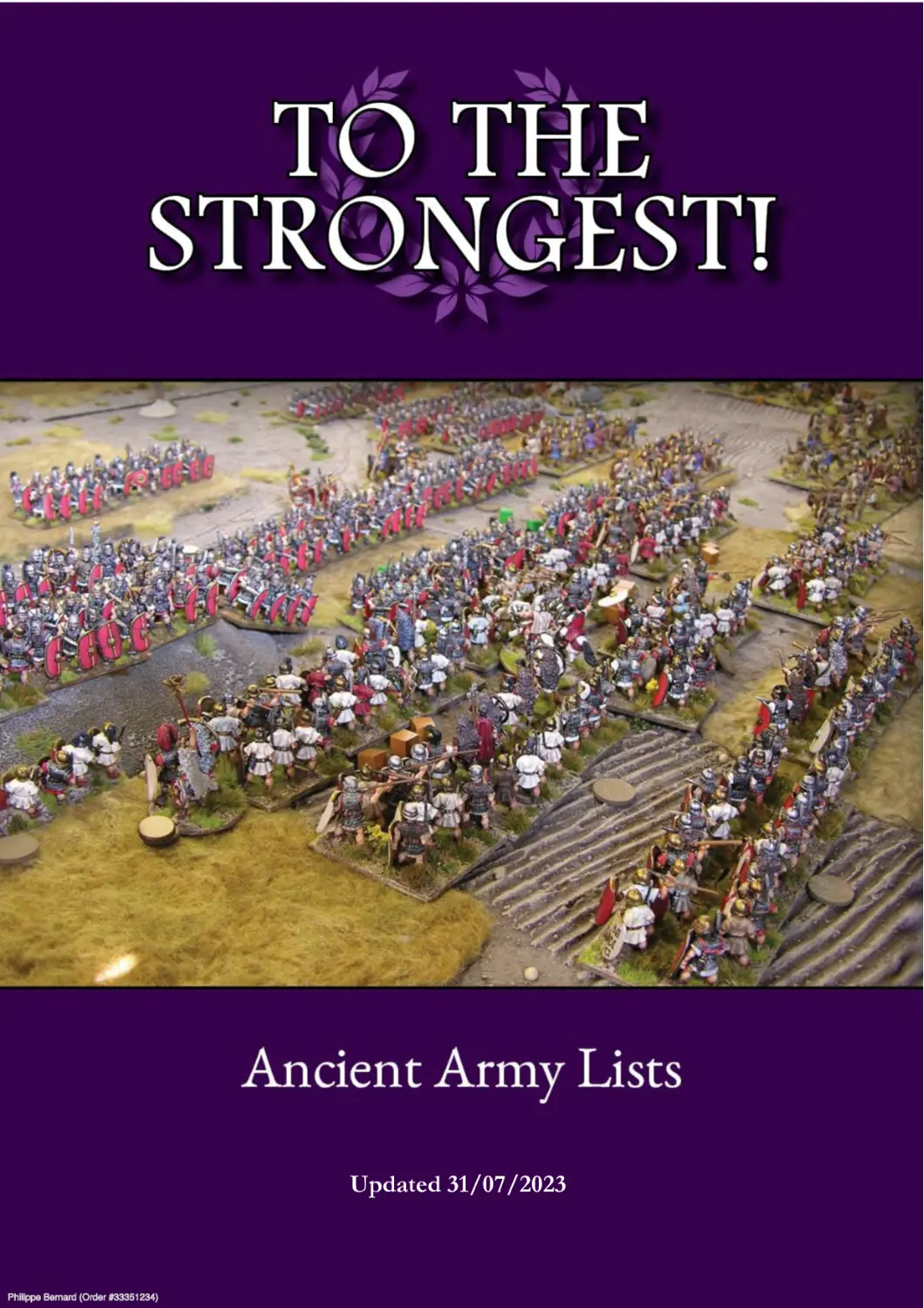
Cover Illustration
The photo on the cover depicts the battle of Ruspina 46 BCE. This was one of the first games of TtS! played, back in 2014,
before the rules were even published.
Page 5
Philippe Bernard (Order #33351234)
TtS! Ancient Army Lists July 2023
Return to Contents
Version Control
Date
Changes
Added new Daylamite and Xiongnu lists. Moved the Bulgar and Early Byzantine to the Medieval list book.
Significant edits to the Germanic (now Early German) and Spartan lists. Edits to the Later Achaemenid
Persian, Alan, Cimmerian/Scythian/Hu, Sarmatian, Galatian, Hun, Ostrogoth, Gepid, Three Kingdoms
31/07/2023 Chinese and Paeonian lists. Corrections to various other lists, particularly those including Daylamites,
Alans, Sarmatians, Huns or artillery. Added historical backgrounds to the Spartan, Warring States and Ch'in
Chinese, Western and Eastern Han Chinese, Southern Dynasties Chinese and Three Kingdoms Chinese
lists. Reduced the cost of longbowmen from 9 to 8 points, per the recent Even Stronger.
30/04/2023
Added new Tarantine and Italian Confederacy lists. Minor edits to various lists including Nubians. Added
army notes to the Principate (or Early Imperial) Roman list.
Added new Sicel and Nabataean Arab lists. Significant edits to the Spartan list and added army notes, and
the Palmyran list. Minor edits to the Galatian, Libyan, Minoan and early Mycenean, Warring States and
31/01/2023 Ch’in Chinese and Western Han Chinese lists. Added backgrounds to the Libyan, Theban, Lydian,
Armenian, Early Nomad (formerly Early Arab), Later Pre-Islamic Arab (formerly Later Arab) and
Palmyran lists. Edited the cost of extra deep units in the Theban and Imperial Seleucid lists.
Added new Early Macedonian and Paeonian lists. Moved the Burmese, Sui Chines and Turkish Tribes and
31/10/2022 Kingdoms to the Medieval eBook. Edits the Sasanian, Later Achaemenid, Pictish, Parthian and Theban
lists and Illyrians and Thracians across multiple lists. Added backgrounds to the Illyrians, Huns and Gepids.
28/7/2022
Added Yayoi Japanese, Kofun Japanese, Three Kingdoms Korean & Unified Silla and Later Moorish lists.
Rewrote the Numidian (now Numidian and Early Moorish) list. Edited most of the Third Millennium liststhanks to Happy Wanderer and Neil Grant. Moved eight African lists to the Medieval Army List eBook.
30/4/2022
Added new East African, Waqwaq and Zanj City States lists. Heavily edited the Dynastic Sumerian,
Akkadian Empire and Neo Sumerian lists. Moved the Early Lombards and Avars to the Medieval list
eBook. Edited battle cars, chariot runners and light infantry supporting mounted in multiple lists.
31/1/2022
Added new Cappadocian, Hasmonean Judean, West African Forest Kingdoms and Mossi lists. Moved
Later Hindu Indian to the Medieval book. Significant edits to the Parthian, Jewish Revolt and Early Welsh
lists, minor edits to others. Added background material to the Parthians and Early Imperial Romans.
30/10/2021
Added new West Sudanese and Tuareg lists. Edits to Classical Indian list, Later Carthaginian list, Thebans,
Samnites, Later Achaemenid Persians, Avar. Edits to Thracians across numerous lists.
30/6/2021
Added new Middle Carthaginian, Carthaginian Mercenary Revolt, Early Etruscan, Axumite,
Blemmye/Beja, Nobatae and Christian Nubian lists. Changed Ligurians to javelinmen in several lists. Edits
to the Achaemenid Persian, Neo-Babylonian and Pyrrhic lists.
30/3/2021
Added new Kassite and Successor Babylonian Dynasties, Saite Egyptian, Old Babylonian and Old Assyrian,
Urartu, Phrygian, Medes, United Monarchy Hebrew, Mannaian, Regnal Hebrew, Neo-Hittite, Aramaean
City States and Lycian lists. Edited the Later Achaemenids. Removed the upgrade cost for heroic generals.
30/11/2020 Added new Later Syracusan and a Herodian Judean lists. Moved the Picts into the Late Antiquity chapter.
29/9/2020
Added five new lists – Bithynian, Bosporan, Commagene, Illyrian and Tribal Hebrew. Edits to the
Carthaginian, Etruscan League, Italian Tribes and Early and Later Thracian lists.
26/7/2020
Edits to the Camillan and Polybian Roman lists, Ancient British, Huns, Later Achaemenid lists.
Page 6
Philippe Bernard (Order #33351234)
TtS! Ancient Army Lists July 2023
Return to Contents
I Third Millennium
This chapter includes army lists of the third millennium BCE.
Dynastic Sumerian
This list covers the city states of Sumer from around 2700 BCE until the accession of Sargon to the throne of Akkad in 2334
BCE and for the Great Revolt of 2250 BCE.
Unit
Generals
Description
Attached general on foot
Upgrade to mounted
Upgrade to heroic
Upgrade to senior
Upgrade a heroic senior general to great leader**** as
Gilgamesh**, Eannatum*** or Lugalzaggesi***
Heroes
Standard of the god of the city
1 VP standard
3 VP standard
Battle car*, javelin
Gish gigir 4–wheeled battle cars
2–wheeled straddle cars
Shub-Lugal (royal retainers)
Aga–Ush (full time soldiers)
Erin (militia)
Gutians, Lullubi or Amorites
Nim ("flies") skirmishers
Upgrade battle car, javelin to battle car, javelin,
veteran
Light chariot, javelin, raw
Spearmen, veteran
Billmen, veteran
Upgrade spearmen, veteran with extra pavise
Spearmen
Upgrade spearmen with extra pavise
Spearmen, raw
Upgrade spearmen, raw with extra pavise
Downgrade spearmen, raw to mobs, deep
Javelinmen, special^
Light infantry, javelin
Light infantry, javelin, raw
Light infantry, javelin, raw
Light infantry other, bow or sling, raw
Camp
Camp
* Battle cars are described in the Even Stronger supplement.
** Up to 2500.
*** After 2500.
Number
2–4
1–4
0–4
0–1
Save
2+
2+
3+
–
Cost
4
5
–
+1
0–1
–
+4
2–4
–
–
–
1
2
4
2–5**, 1–
4***
7+
7
1–3
6+
9
0–1**, 1–
2***
8+
4
1–3
1–3
6+
6+
–
7+
–
8+
–
8+
7+
7+
7+
8+
9+
9
9
+1`
7
+1
5
+1
7
7
4
3
3
3
1–3
–
1
0–1
1
0–1***
2–3
Any***
4–8
Any***
0–2
0–2
**** Great Leaders are described in the Even Stronger supplement. Gilgamesh is the legendary hero. Eannatum was a
King of Lagash ca. 2500-2400 BCE who conquered Sumer and who is depicted on the Stele of the Vultures.
Lugalzaggesi of Umma united Sumer and ruled between 2358-2334.
^ Gutians or Lullubi javelinmen replace one of their javelins with a shock missile.
Allies
Amorite, Guti or Lullubi.
Notes
Page 7
Philippe Bernard (Order #33351234)
TtS! Ancient Army Lists July 2023
Return to Contents
Mounted generals should be depicted in battle cars. Nim skirmishing javelinmen may support battle cars using the supported
mounted rule.
Historical Background
This army list represents any of the thirty or so city state dynastic forces from the First Dynasty of Kish and the epic of
Gilgamesh to the rise of Akkadian influence under Sargon the Great. In addition, it is used to form independent forces of
the Great Revolt of 2250 BCE such as those of the city of Kish or a combined rebel alliance made up of many city states
like the one led by Amar-Girid.
This was the era of the great Sumerian city states such as Ur, Lagash, Uruk, Umma, Nippur, Eridu, Larsa and many others.
Our period of interest starts with the first recorded struggle by Enmebaragesi, who waged war upon Elam. Following his
reign, Agga of Kish fought Gilgamesh of Uruk. Then began a period of several dynastic rulers before the rise of Lagash
under the great king Eannatum, who continued his father’s war against Umma. He engaged in multiple campaigns against
Elam, the Persian Gulf and north toward Mari as well as subduing numerous open revolts in Sumer itself. His brother
Eannatum I, and son Entemena, continued Eannatum’s wars with Umma and after Entemena’s death a series of weak and
corrupt priests ruled until the last, Urakagina, was overthrown by the coming of Umma’s revenge, Lugalzagesi.
In his subsequent campaigns, Lugalzagesi took Ur as his capital and subdued many other city states, extending his influence
from the Persian Gulf to the upper reaches of the Tigris and Euphrates all the way to the Mediterranean. Lugalzagesi lost
his vast territories when he and a confederation of dynastic city states were defeated in battle by Sargon the Akkadian.
Sumerians from Happy Wanderer’s collection
Many thanks to the Happy Wanderer of sumer2sargon.blogspot.com for his many useful suggestions regarding this list, and to Neil Grant for his
help with revision (April 2022).
Page 8
Philippe Bernard (Order #33351234)
TtS! Ancient Army Lists July 2023
Return to Contents
Old Elam
This list represents Old Elam from 2700–1400 BCE.
Unit
Generals
Description
Number
Save
Cost
2–4
1–3
0–4
0–1
2+
–
3+
–
4
+1
–
+1
2–4
–
1
Battle car*, javelin
Upgrade battle car, javelin to battle car, javelin,
veteran
Light chariot, javelin, raw
1–3
7+
7
0–1
6+
9
0–1
8+
4
Billmen, veteran
1–2
6+
9
0–2***
1–4
0–2
Any**
2–8***
6–12
7+
8+
8+
8+
8+
8+
7+
9
5
7
+1
7
4
7
8+
3
–
1
Attached general on foot
Upgrade to mounted
Upgrade to heroic
Upgrade to senior
Heroes
4–wheeled battle cars
2–wheeled straddle cars
Royal household
Shushan spearmen
Shushan archers
Anshan highlanders with throw
sticks
Bowmen, veteran
Spearmen, raw
Downgrade spearmen, raw to mobs, deep
Upgrade spearmen, raw with extra pavise
Bowmen
Light infantry other, bow
Javelinmen, special^
Light infantry, javelin, raw
Camp
Camp
* Battle cars are described in the Even Stronger supplement.
** Only after 2500.
*** No more than two bowmen or bowmen, veteran may be taken before 2154.
^ Anshan javelinmen replace one of their javelins with a shock missile.
0–2
1–3
Allies
Dynastic Sumerian, Akkadian, Zagros Mountain, Neo-Sumerian, Old Elam, Harrapan.
Notes
Mounted generals should be depicted in battle cars.
Historical Background
This army list represents the forces of Elam. More than any other peoples, the Elamites were the traditional foes of the
Sumerians. A rich culture, ethnically different to the Sumerians, they were nevertheless heavily influenced by their proximity
to Sumer. On more than one occasion they were both a threat and a source of plunder by Sumerian and Akkadian kings.
Elam has a history going back at least a thousand years before it emerged as a contemporary of Sumer. The time designated
as the Old Elamite period (2700–1600 BCE) is the one that concerns us here as 2700 BCE signals the first recorded military
contact with Sumer. The two great cities of Elam, Anshan and Susa, were sometimes considered to be their own kingdoms
in the early stages of the Old Elamite period but there does appear to be a level of unity in a broad coalition of independent
city states not too different from those of Sumer.
From Sumerian records we know Enmebaragesi the Sumerian king of Kish “smote the Land of Elam” around 2700 BCE…
and so began the centuries long struggle between these two cultures.
Three dynasties ruled at the time with the Awan dynasty being at the forefront of conflict with Sumer and Akkad. Awan was
one of Elam’s four major cities, located to the immediate north-west of Susa. For a short period, Elam exercised a degree
of control over the southern parts of Sumer following what seems likely to have been a significant military incursion around
2550 BCE when Ur was defeated. A reprisal attack was made from Sumer and then the Lagashian warrior-king Eannatum
attacked (ca. 2450 BCE), defeating the Elamites so comprehensively that they were forced to form a coalition of the kings
of Elam, Subartu and Urua at the battle of the Asuhur canal in a failed bid for success. Succeeding rulers of Lagash continually
engaged in clashes against Elam for the next century or so in constant tit-for-tat engagements.
Page 9
Philippe Bernard (Order #33351234)
TtS! Ancient Army Lists July 2023
Return to Contents
In time, Lagashian control diminished, and Elam began to assert independence once again (ca. 2360 BCE). Not until Sargon’s
campaigns, do we once again hear of the Elamites, as Sumerian kings vied for control of their own lands in constant
hegemonic wars.
The coming of the Akkadians brought a series of campaigns for the Elamites with which to contend. Sargon defeated thirteen
cities or regions, capturing governors, generals and even the king of Elam himself. At the same time, a kingdom or
confederation known as Marhashi was emerging to the east on the Iranian Plateau. During Sargon’s reign he held suzerainty
over Greater Elam but after death his son Rimush was forced to make war once again on the Elamites, winning a great
victory at the battle of the Middle River (ca. 2273 BCE).
After Rimush’s brief interlude as king, the Elamites faced more Akkadian attacks by his successor Manishtusu (ca. 2265
BCE). He campaigned into eastern Elam, solidifying and even expanding the conquests of his brother in that region. These
attacks would have been against Elam’s emerging eastern region state of Marhashi, which had now formed into a cohesive
entity, bordering Anshan and becoming militarily threatening. It could also be that the Marhashi declaration of independence
from Akkad brought about this Akkadian response.
Further attacks by the Akkadian kings came from Naram Sin, which though poorly documented, do show that he
campaigned in Elam and Parahshum in south-western Iran. Doubtless, given the extent of his other conquests, he would
have brought as much force to bear against the Elamites as he did elsewhere during his reign. With the decline of Akkadian
power, Marhashi overran Elam for a time and united efforts in fighting against the Akkadian Empire, resulting in a climactic
battle being fought near Akshak (ca.2210 BCE), at the confluence of the Diyala and Tigris rivers between the two states.
This battle, brought on by an Elamite incursion, gives us a sign of the decaying power base of the Akkadian Empire as their
enemies marched on Akkadian lands. Nevertheless, the Elamite attack against the Akkadian king Shar-kalli–shari, according
to Akkadian records, was a battle lost. Regardless, Akkadian hegemony was waning, and the Elamites began to reassert their
independence.
So it was that after centuries of conflict with Sumer and Akkad, and just as the Elamite resurgence was taking hold, a new
threat descended upon them. In 2193 BCE Elam was overthrown by the Gutians as they swept through southern
Mesopotamia from the Zagros Highlands and into Elam itself, also destroying the Akkadian Empire. The new Simash
dynasty eventually came to power during this period of instability. The Simash leadership had to deal with sporadic periods
of diplomacy and attacks by the Gutian chieftains until finally they lost control and were expelled.
After the expulsion of the Gutians, the Neo Sumerians of the Third Dynasty of Ur, led by Shulgi, invaded Elam and
conquered Susa (ca. 2050 BCE). This incursion was not to last long, however. Kindattu, the Elamite king, together with the
people of Susa, rose and sacked Ur (ca. 2004 BCE) leading its king into captivity and bringing the dynasty to an end. With
this threat removed, Elam became a powerful kingdom once again, although it was shortly thereafter pushed out of southern
Mesopotamia six years later by the Amorite city state of Isin, ending Elamite influence in Mesopotamia at the close of the
third millennium.
As can be seen, for the wargamer the struggles between Elam and Sumer are akin to those waged between England and
France from Agincourt to Waterloo. There are endless scenarios between these two foes who engaged in countless
campaigns against one another. Even internal Elamite city state clashes offer plenty of gaming potential.
Many thanks to the Happy Wanderer (Sumer2sargon blog) who wrote this list.
Page 10
Philippe Bernard (Order #33351234)
TtS! Ancient Army Lists July 2023
Return to Contents
Early Eblan
This list represents Early Eblan from 2700–2000 BCE.
Unit
Number
Save
Cost
2–4
0–4
0–1
2+
3+
–
5
–
+1
2–4
–
1
Battle car*, javelin
2–4
7+
7
4–wheeled battle cars
Upgrade battle car, javelin to battle car, javelin,
veteran
0–2
6+
9
2–wheeled straddle cars
Light chariot, javelin, raw
0–1
8+
4
Bodyguard
Billmen, veteran
Spearmen, veteran
1–2
6+
9
1–2
0–1
0–2
0–2
6+
7+
8+
7+
–
8+
7+
8+
8+
9+
7+
9
9
5
7
+1
7
10
4
7
3
7
1–3
–
1
Generals
Description
Attached, mounted general
Upgrade to heroic
Upgrade to senior
Heroes
Bodyguard archers
Spearmen
Iranian wild tribesmen
Settled or nomadic archers
Settled or nomadic slingers
Hattian spearmen
Bowmen, veteran
Spearmen, raw (militia)
Upgrade spearmen, raw to spearmen
Extra pavise
Warriors, deep, raw
Warriors, deep
Light infantry other, bow
Upgrade light infantry other, bow to bowmen
Light infantry other, sling, raw
Spearmen
Camp
Camp
* Battle cars are described in the Even Stronger supplement.
** After 2500.
0–2
6–12
Up to 1/2
Any**
0–1
Allies
Dynastic Sumerian, Akkadian, Early Eblan, Neo-Sumerian.
Notes
Mounted generals should be depicted in battle cars.
Historical Background
This army list represents the forces to the north-west of Mesopotamia in modern day Syria, principally the cities of Ebla and
Mari, though many other city states existed very much like those in Sumer. Ebla was a powerful and well-established city
state in the third millennium. It had rich lands and was a major commercial centre, a rivalry shared with Mari with whom it
often fought. Rich in textiles and timber, Ebla is well known in Sumerian texts from an early time.
Such was the closeness between Sumeria and Ebla that they shared many common features of each other’s society, including
the armaments and methods of war. At its peak Ebla ruled over two dozen or so large cities and received large tribute sums,
making it an enormously wealthy and powerful hegemonic city state. This almost feudal arrangement meant an Eblan army
at full strength would include contingents from several other cities.
Mari, as Ebla’s chief rival, had influences from both Sumer and the Amorites. Its proximity to Sumer led to clashes with the
Sumerian city state of Lagash under its expansionist warrior king Eannatum. Mari, however, mostly looked west. It vied for
control of the lesser city states lying between itself and Ebla to extract tribute and wealth from these settlements on the
upper Euphrates, just as Ebla had. This fierce rivalry between the two cities resulted in numerous clashes over a period of a
century, such as the clash between the Sumerian city states of Umma and Lagash. Early on (ca. 2400 BCE) Mari took control
of Ebla, but Ebla threw off Mariote control and once again established its own rule.
Page 11
Philippe Bernard (Order #33351234)
TtS! Ancient Army Lists July 2023
Return to Contents
Battle cars from Happy Wanderer’s collection.
Towards the end of these wars, the scale of operations was such that in Ebla’s final campaign against Mari in 2340 reports
of 3,600 dead at a battle at Darashum and another 3,200 dead at Badanu and Masanu. Nevertheless, just like Umma and
Lagash, it was the Akkadian Sargon who made war on Ebla (and Mari), absorbing them into his empire, not long after the
Eblaite general Enna-Dagan captured Mari in the aforementioned campaign.
After Sargon’s death, being distant from Akkadian influence, Sargon’s successors became occupied with troubles in the
south of their empire, allowing Ebla (and Mari) to reassert a degree of independence. Once again, they made war on each
other and suffered incursions from Hattian Kingdom barbarians around 2200. Naram Sin, however, upon his succession
reconquered and destroyed Ebla ending its third millennium golden age.
Not long after his death, the Akkadian Empire fell to the Gutian invasion and Ebla rebuilt. Whilst never as strong as it once
was, it tried to reassert its independence once again. With the rise of the Neo-Sumerian Third Dynasty of Ur, for whom it
remained a reliable ally, the city eventually fell to the dynasty of generals and finally the sack of the Amorites who made the
city their own.
Many thanks to the Happy Wanderer (Sumer2sargon blog) who wrote this list.
Page 12
Philippe Bernard (Order #33351234)
TtS! Ancient Army Lists July 2023
Return to Contents
Amorite Nomads
This list represents the Amorite Nomads from 2700–1595 BCE.
Unit
Generals
Description
Attached general on foot
Upgrade to heroic
Upgrade to senior
Heroes
Henku bodyguard axemen
Desert warrior tribesmen
Nomadic archers
Skirmishers
Camp
Warriors, deep
Javelinmen
Upgrade javelinmen to javelinmen, extra bow
Light infantry other, bow
Upgrade light infantry other, bow to bowmen
Light infantry, javelin, raw
Light infantry other, bow
Light infantry other, sling
Camp
Number
Save
Cost
2–4
0–4
0–1
2+
3+
–
4
–
+1
2–4
–
1
2–3
4–15
0–4
0–4
Up to 1/2*
2–7
2–7
0–2
7+
7+
7+
8+
8+
8+
8+
8+
10
7
9
4
7
3
4
4
1–3
–
1
* Only after 2500.
Allies
Dynastic Sumerian, Akkadian, Early Eblan, Neo-Sumerian, Amorite nomads.
Historical Background
This list covers the nomadic tribes known as the Martu (westerners) by the Sumerians (Amurru by the Akkadians), and
includes the Yahmadu, Tidnum (Didnum), Yahmutum, Hana and Benu-yamin tribes. They are usually known now by their
biblical title of ‘Amorite.’ These nomads of the Syrian Desert presented a constant threat to the settled peoples of the Near
East, particularly in the later stages of the third millennium. Towards the end of our era, the constant encroachment by the
Amorite tribes consumed the Mesopotamian landscape, ending the Third Dynasty of Ur and bringing Sumerian hegemony
to a close.
The Amorites are commonly thought to be a disparate people when Mesopotamian civilisation was developing to a high
level. It is also generally agreed that the Akkadians were the first Semitic peoples that descended upon the Sumerian lands.
In fact, the Amorite people long before Sargon’s time were culturally unified Semitic Bedouins. They lived in western Syria,
bordering the Euphrates towards Kish and even as far east as the Diyala river region of the Tigris. As such, the Amorites
played an important part in the early developments in the Near East and were known for many centuries before their time
to rule finally came.
The earliest cuneiform tablet reference we have of the Amorites is around 2550 BCE, but there are early references ascribed
to the king of Uruk (before the time of Gilgamesh) building walls to protect his people from the Martu. These Amorites
were known to the Sumerians as “people who know not grain and do not live in houses.”
Third millennium Amorite peoples were fundamentally nomadic clans ruled by fierce tribal chiefs, known as the abum or
‘father,’ who forced themselves into the surrounding fertile lands where they needed to graze their herds. They would pasture
their flocks of sheep and goats to graze on the stubble and be watered from the river and irrigation canals. For this privilege,
they would have to pay a tax in wool, meat, milk, and cheese to the temples, who would distribute these products to the
bureaucracy and priesthood. In good years, all would go well, but in bad years, wild winter pastures would be in short supply,
nomads would seek to pasture their flocks in the grain fields, and conflicts with farmers would result.
For the Akkadian kings, Martu was one of the “Four Quarters” surrounding Akkad, along with Subartu, Sumer, and Elam.
The Amorites were described as fierce warriors, ‘‘as powerful as the southern wind,” who frequently created fear among the
Sumerians. The Akkadian king Naram-Sin recorded successful campaigns against the Amorites in northern Syria ca. 2240
BCE. His successor Sharkilasharri (2218–2193) continued with his own campaigns, mentioning a battle with the ‘Martu’
whom he defeated at Bashar, a low mountain range lying to the west of the Euphrates. Gudea of Lagash (2123) also ‘sort
stone’ from this region to build temples and from this time the term Amorite seems more commonly used. Whilst there
were periods of time when the Sumerians and Akkadians fought the Amorites, they also employed the war tribesmen as
mercenaries as well, such were the shifting allegiances with localised tribal chiefs and the military demands of the day.
Page 13
Philippe Bernard (Order #33351234)
TtS! Ancient Army Lists July 2023
Return to Contents
By the time of the last days of the Neo-Sumerian Ur III Empire, migrating Amorites had become such a force that the Ur
III king Shu-Sin was obliged to construct a 170 miles (270 km) long wall from the Tigris to the Euphrates to hold them off
– a Sumerian “Hadrian’s Wall”, of sorts.
The Neo-Sumerians fiercely resisted the coming of the Amorites. The kings of Ur III knew full well the threat they faced
and undertook expeditions and forged alliances to counter the growing power of the Amorite tribes. However, this Amorite
‘invasion’ was not like that of the Guti of previous times but was rather an encroachment into Mesopotamia in an inexorable
‘march by settlement’, isolating the domination of the Ur III dynastic cities, with each one eventually breaking away as the
inability of the Ur III kings to protect them became more apparent. This eventually strangled the power base of the ruling
Neo-Sumerians, being replaced by Amorite leaders taking positions of power in these cities, until finally the Elamites sacked
Ur in 2004 BCE and subsequently the Amorites six years later took control for themselves. This led to the rise of the great
Amorite Hammurabi in the Second Millennium.
After having taken control, the Amorites adopted many Sumerian cultural ways, just as the Akkadians had done before them,
and were assimilated into the existing culture rather than replacing that which had been so firmly entrenched for a thousand
years or more.
Many thanks to the Happy Wanderer (Sumer2sargon blog) who wrote this list.
Page 14
Philippe Bernard (Order #33351234)
TtS! Ancient Army Lists July 2023
Return to Contents
Hattian Kingdoms
This list represents the Hattian Kingdoms from 2700–1700 BCE.
Unit
Generals
Description
Number
Save
Cost
2–4
0–4
0–1
2+
3+
–
5
–
+1
2–4
–
1
2–4
7+
7
0–2
6+
9
0–1
8+
4
0–2
6–12
Up to 1/4
Any**
2–4
Up to 1/2
6+
8+
7+
–
8+
7+
9
5
7
+1
5
7
Javelinmen
0–4
7+
7
Light infantry other, bow or sling, raw
Light infantry, javelin, raw
Light infantry other, bow
Light infantry other, sling, raw
0–2
9+
0–2
8+
0–5
9+
3
3
4
3
1–3
–
1
Attached, mounted general
Upgrade to heroic
Upgrade to senior
Heroes
4–wheeled battle cars
2–wheeled straddle cars
Bodyguard axemen
City militia spearmen
City militia axemen
Warbartum or other wild
tribesmen
Mercenary skirmishers
Warbartum skirmishers
Slingers
Battle car*, javelin
Upgrade battle car, javelin to battle car, javelin,
veteran
Light chariot, javelin, raw
Billmen, veteran
Spearmen, raw
Upgrade spearmen, raw to spearmen
Upgrade spearmen with extra pavise
Billmen, raw
Upgrade billmen, raw to billmen
Camp
Camp
* Battle cars are described in the Even Stronger supplement.
** Only after 2500.
Allies
Akkadian, Early Eblan, Hattian Kingdoms, Neo-Sumerian.
Notes
Mounted generals should be depicted in battle cars.
Historical Background
This army list represents the mineral rich feudal states to the north-west of Mesopotamia in Anatolia, those that eventually
went on to form the basis of the Hittite Empire in the second millennium BCE.
Anatolia’s coherent zones of habitation and settlements actively traded with one another, developing and founding the basis
for advancement in their societies. Small settlements grew into political and religious centres, wielding their influence over
larger dominions and becoming a group of city states united in a trade network. The discovery and development of the
mineral sources in northern Anatolia is believed to have been one of the stimulating factors leading to this geo-political
landscape.
The city states that we know off include Hattusa, Hassum, Kanesh, Zalwar and Purushanda, along with others in south
central Anatolia. A typical Early Bronze fortress city would have a wall of mud bricks with a stone foundation, defensive
ditch, fortified gates, and projecting round towers. Overall, Hattian urbanisation would be characterized by wealthy warlike
dynasties ruling strongly fortified citadels, indicating quite a degree of military activity.
Exact dates for contact with the Hattians’ southern neighbours are not known but we have references indicating that by
2700 BCE Sumerian trade routes had been established. The adjoining ‘state’ of Ebla and its highly organised and trade-based
society also made it probable that the Hattians would have been in contact with them also. From this it seems reasonable to
assume that the Hattians emerge on scene with a scattered but interrelated number of regional hegemonic independent city
states by the time of the mid third millennium.
Page 15
Philippe Bernard (Order #33351234)
TtS! Ancient Army Lists July 2023
Return to Contents
Militarily, we have no firm records of engagements until the time of Sargon, where the ‘King of Battle’ epic gives us details.
Given the nature of the societies and their long history, it seems probable that with the abundance of natural resources the
city states would have clashed with each other and possibly also with their nearby southern neighbours. Whilst conjectural,
it seems reasonable to assume the patterns of inter-urbanised conflict of the other regions of this time also apply to Hattian
city states as well.
Sargon’s invasion (ca. 2300 BCE) was directed at the carrying out of an expedition against Purushanda’s ruler, Nur-Dagan.
Purushanda was at the end of two important trade routes, abundant in merchandise such as silver, copper, tin, textiles and
wool. In the ‘King of Battle’ epic, telling of Sargon’s expedition, we hear of Sargon’s generals advising him against his own
desire for action but a message from forlorn Akkadian merchants in Purushanda pleading for help decided the issue. He
mobilised his army and marched off through difficult terrain, launching a surprise attack and capturing Purushanda. NurDagan was taken prisoner, submitting to Sargon, and (possibly) swearing allegiance as a vassal. After three years the
Akkadians leave, taking with them the spoils of war.
The next incursion that we hear of by the Akkadians comes from Naram Sin. He is said to have marched against a coalition
of seventeen kings, including Pamba of Hattusa and Zipani. The previous reigns of Akkadian kings spent most of their
energies undertaking expeditions in the east and south as well as suppressing internal rebellion. By the time of Naram Sin,
some 80 years or so after Sargon’s expedition, the Hattian kingdoms had grown wealthier and more independent, forming a
broad Anatolian coalition that had resolved to throw of Akkadian authority. This cooperation between city states indicates
a degree of cooperation which in this case was to expel Akkadian influence. Interestingly, there have been findings of royal
seals with the name of Ibbi–Sin of Ur, suggesting that there may have been a Sumerian presence as late as 2025 BCE.
Between.2000 and 1700 BCE, the Indo-European Hittites gradually absorbed the Hattians.
(Note – it must be acknowledged that information on third millennium Hattian societies, weapon and military activities is
very scarce. I have tried to pull together enough information to give a general understanding of what forces were at play
from which can built reasonable assumptions as to likely interactions between neighbouring peoples.
Many thanks to the Happy Wanderer (Sumer2sargon blog) who wrote this list.
Page 16
Philippe Bernard (Order #33351234)
TtS! Ancient Army Lists July 2023
Return to Contents
Harappan or Indus Valley
This list models the Harappan or Indus Valley civilizations from 2600–1300 BCE.
Unit
Generals
Description
Number
Save
Cost
2–4
0–2
2–4
0–1
2+
–
3+
–
4
+1
–
+1
3–5
–
1
0–2
3–6
Up to 1/2
2–4
2–4
7+
8+
7+
7+
9+
7
5
7
7
5
Light infantry other, bow or sling
5–10
8+
4
Light infantry other, javelin, raw
Light infantry, javelin, raw
Light infantry other, bow
0–3
9+
8+
8+
3
3
4
–
1
Attached general on foot
Upgrade general to mounted
Upgrade to heroic
Upgrade to senior
Heroes
Ox-drawn battle car
Harrapan city–dwelling
spearmen
Kulli wild tribesmen
Harrapan massed archers
Skirmishing archers or
slingers
Javelin skirmishers
Baluchi or Sind auxiliaries
Battle car*, javelin
Spearmen, raw
Upgrade spearmen, raw to spearmen
Javelinmen
Bowmen, raw
Camp
Camp
* Battle cars are described in the Even Stronger supplement.
0–2
1–3
Allies
Old Elam, Neo-Sumerian, Magan, Harrapan.
Notes
A mounted generals should be depicted in a battle car.
Historical Background
This army list represents the forces of the well-established Indus Valley Harrapan culture, located in modern day Pakistan,
western India and eastern Afghanistan. A major trading partner with Mesopotamia, their goods extended as far as Ebla and
Syrian cities. They provided troops for the Great Revolt against Akkad and the Third Dynasty of Ur.
Their culture is something of an enigma, as the voluminous ancient texts available are yet to be deciphered, leaving us with
information based largely on archaeological interpretation. Militarily, we are well informed of Indian warfare in the Vedic
age of the second millennium, but not as much with the lesser-known large civilisations of the third millennium which lack
obvious images of warfare.
The importance of Harrapan civilisation to conflict in Mesopotamia is based largely on trade. The Indus Valley is located
far from Mesopotamia and there are no direct records of major military operations conducted between these peoples. The
Indus Valley civilisation was at least as advanced as contemporary civilisations in Mesopotamia. The large cities were similar
in organisation and layout. They were surrounded by walls in highly organised societies. Inhabitants of the ancient Indus
River valley developed new techniques in handicraft and metallurgy (copper, bronze, lead, and tin). The civilization is noted
for its cities built of brick, roadside drainage system and multi–storeyed houses, many techniques in advance of
Mesopotamian culture. According to some archaeologists, more than 500 Harappan sites have been discovered.
Trade networks linked this culture with related regional cultures and distant sources of raw materials, including lapis lazuli
and other materials for bead-making. Villagers had, by this time, domesticated numerous crops as well as various animals,
including the water buffalo. Early Harappan communities turned to large urban centres by 2600 BCE, from where the
mature Harappan phase started ending shortly after the close of the third millennium. There are many archaeological finds
of ‘standardised’ systems being used by Harappan peoples and it seems that for the most part there were important central
city states of authority governing an area leading to this uniformity.
Even though there seems to be a lack of evidence of direct military conflict, such a huge number of interrelated trading city
states surely must have experienced similar conflict creating pressures to those in Mesopotamia. Several burial sites of this
time indicate victims of large-scale massacres, which is likely to have occurred in organised conflict of some sort. The
evidence at this stage is still inconclusive.
Page 17
Philippe Bernard (Order #33351234)
TtS! Ancient Army Lists July 2023
Return to Contents
We have evidence of military weapons including arrow heads and bronze and copper weapons, doubtless using the trade
relations of copper rich Magan/Dilmun for the raw materials for these implements. Knives, sickles, axes and spears all form
the arsenal of Harrapan forces. We also have representation of two and four wheeled vehicles drawn by oxen depicted as
being of a ‘quicker variety’ that could have had a military function.
The first recorded instance of military interactions with Mesopotamian culture was when Rimush of Akkad launched a
campaign against Parahshum in Elam, winning a great victory at the battle of the Middle River (ca. 2273) which involved a
contingent of troops from Meluhha – the Indus Valley – serving in the anti–Akkadian coalition. Manishtusu’s (2269 – 2255)
campaign against the Persian Gulf could quite possibly have included operations against the Indus Delta given the previous
Meluhha force who fought Rimush, but again, details are scarce.
With the increasing military emphasis in the south of the Akkadian Empire and the influence and rise of the Third Dynasty
of Ur in the Persian Gulf, it is not without reason that this would have given rise to the possibility of clashes between Indus
Valley and Mesopotamian forces.
Many thanks to the Happy Wanderer (Sumer2sargon blog) who wrote this list.
Page 18
Philippe Bernard (Order #33351234)
TtS! Ancient Army Lists July 2023
Return to Contents
Zagros Mountain
The warlike tribal clans of the Zagros Mountains to the north-east of Mesopotamia, including the Guti, Lullibi & Hurri from
2350 BCE onwards.
Unit
Generals
Description
Attached general on foot
Upgrade to heroic
Upgrade to mounted
Upgrade to senior
Heroes
Akkadian–Sumerian battle cars
Household warriors
Battle car***, javelin
Billmen, veteran
Warriors, deep
Number
Save
Cost
2–4
2–4
0–1*
0–1
2+
3+
–
4
–
+1
+1
3–5
–
1
0–1*
7+
7
6+
9
7+
10
0–1
Highlander tribesmen with
throw sticks
Javelinmen, special**
6–12
7+
7
Archers
Skirmishing archers or slingers
Skirmishers with throw sticks
Akkadian–Sumerian city militia
Bowmen
Light infantry other, bow or sling, raw
Light infantry javelin, raw
Spearmen, raw
0–3
3–9
2–6
0–3*
8+
9+
9+
8+
7
3
3
5
1–3
–
1
Camp
Camp
* Akkadian-Sumerian are only available to Guti armies between 2200 and 2100.
** Highlander tribesmen replace one of their javelins with a shock missile.
*** Battle cars are described in the Even Stronger supplement.
Allies
Dynastic Sumerian, Akkadian*, Early Eblan*, Old Elam*, Zagros Mountain, Neo-Sumerian, Harrapan* [*Guti only]
Gutian warriors from the collection of Colin Knight
Notes
Page 19
Philippe Bernard (Order #33351234)
TtS! Ancient Army Lists July 2023
Return to Contents
Any mounted general should be depicted in a battle car.
Historical Background
The Guti were the most notable of the three tribal groupings and their king list extends from 2230 BCE to 2109 BCE.
Gutium, a mountainous area in south-west Iran, was a troublesome part of the Akkadian Empire and the year names of the
kings of Akkad record campaigns against the region. Around 2200 BCE, Gutian raiders descended to the Mesopotamian
plain conquering the weakened Akkadians. Having established power, most likely on a tribal basis and under no central rule,
the Guti adopted Akkadian ways and settled as lowlanders, throwing off their tribal ways for the trappings of civilisation.
The Guti ruled for around a century, but they were ineffective at governing the civilised states of Mesopotamia. This led to
a decline in the canal system and the general prosperity of the region, bringing about something of a ‘Gutian Dark Age.’
This inability to rule enabled several southern Sumerian states to survive autonomously by paying tribute to their Gutian
overlords. This arrangement gradually led to dissent and an end to Gutian rule came when king Uthegal of Uruk defeated
the Gutian king Tirigan at the battle of Ennigi, thus signalling the rise of the Third Dynasty of Ur.
The Lullubi were settled to the north-west of the Gutians, on the Sherizor plain in the Zagros Mountains of western Iran.
Said to be conquered by Sargon the Great, they fought both with and against their larger neighbour Guti. Under their king
Anubanini, they were most famously defeated by Naram Sin, who raised a victory stele marking his success. As the
Akkadian’s grip on power became less effective, the Lullubi became more troublesome. They resisted rule by the Guti, and
the Neo-Sumerian king Shulgi was forced to send up to nine expeditions into Lullubian lands to quell the unrest.
The Hurri were a people located to the east of the Tigris, north of the Lullubi. Not very much is known about them in the
third millennium. It is believed they became allied to the Akkadians after the conquests of Sargon the Great. Their presence
is most notable by the time of Ur III, but recent studies show that they may have existed much earlier than first thought and
possibly even in urban centres, such as Urkesh. For now, they remain an enigma and can be considered one of the
surrounding tribal peoples that existed alongside the Mesopotamian plain.
Many thanks to the Happy Wanderer (Sumer2sargon blog) who wrote this list.
Page 20
Philippe Bernard (Order #33351234)
TtS! Ancient Army Lists July 2023
Return to Contents
Akkadian Empire
This list models the Akkadian Empire from 2334 to 2154 BCE.
Unit
Generals
Description
General on foot
Upgrade to mounted
Upgrade to heroic
Upgrade to senior
Upgrade a heroic senior general to great leader* as
Sargon I*** or Naram–Sin****
Heroes
Standard of the god of the city
Gish gigir 4–wheeled battle cars
2–wheeled straddle cars
Shub-Lugal (royal retainers)
Aga–Ush (full time soldiers)
Erin militia
Gutian, Lullubi, Subartian or
Makkanite mercenaries
Amorite levies or mercenaries
Elamite or other archers
Amorites
Nim ("flies") skirmishers
1 VP standard
3 VP standard
Battle car*, javelin
Upgrade battle car, javelin to battle car, javelin,
veteran
Light chariot, javelin, raw
Spearmen, veteran, extra bow
Billmen, veteran
Spearmen
Upgrade spearmen with extra pavise
Spearmen, raw
Upgrade spearmen, raw with extra pavise
Light infantry, javelin
Light infantry other, bow
Javelinmen, special**
Javelinmen
Light infantry other, bow
Upgrade light infantry other, bow to bowmen
Light infantry, bow
Light infantry, javelin, raw
Light infantry, javelin
Light infantry other sling, raw
Light infantry other, sling
Camp
Camp
* Battle cars and great leaders are described in the Even Stronger supplement.
** Gutians or Lullubi replace one of their javelins with a shock missile.
*** Sargon the Great 2334–2279 BCE
**** Naram-Sin 2254–2218 BCE
Number
1–4
1–4
0–4
0–1
Save
2+
2+
3+
–
Cost
4
5
–
+1
0–1
–
+4
2–4
0–4
–
–
–
7+
1
2
4
7
0–3
6+
9
0–2
8+
6+
6+
7+
–
8+
–
7+
8+
7+
7+
8
8
8+
8+
7+
9+
8+
4
11
9
7
+1
5
+1
4
4
7
7
4
7
4
3
4
3
4
–
1
0–1
2
4–8
Any
0–8
Any
0–3
0–1
2–6
0–2
0–1
1–3
1–3
1–3
Allies
Dynastic Sumerian, Early Eblan, Old Elam, Zagros Mountain, Hattian Kingdoms, Amorite Nomads
Page 21
Philippe Bernard (Order #33351234)
TtS! Ancient Army Lists July 2023
Return to Contents
Akkadian spearmen from the collection of Colin Knight
Notes
Light infantry with javelins may support battle cars using the supported mounted rule. There are no compulsory battle cars,
because these were sometimes left behind, when campaigning in rough terrain. Any mounted general should be depicted in
a battle car.
The shock missile available to the Gutians represents a hail of throw sticks as they charge into contact and also helps to
model the aggression of their warriors.
Historical Background
This army list represents Akkadian forces led by Sargon the Great and his successors up to the Gutian invasion. There was
near constant campaigning throughout the reign of the Akkadian kings.
Sargon’s defeat of the Sumerian coalition of Lugalzagesi was followed by a lifetime of wars. He campaigned against Magan
where he ‘washed his weapons in the lower sea’ of the Persian Gulf. Then west to Amorite Kazalla, and north to the ancient
cities of Mari and Ebla, all the way to the Mediterranean. Finally, he campaigned to the east and defeated the four leaders of
Elam, led by Awan, conquering Susa and was made master of the ‘four quarters of the world.’ His last campaigns were
fought against rebellious subjects amid famine and war.
Revolt spread again after Sargon’s death and his ruthless son Rimush immediately moved to secure control of his empire,
engaging in six campaigns suppressing rebellions before turning against Elam. His rule was unpopular, however, and he fell
foul to assassins in his own court, possibly in a palace coup. Rimush’s successor was another of Sargon’s sons, Manishtushu,
who further extended his interests to the south by campaigning against Magan in the Persian Gulf, possibly as far as Melukka
of the Harrapan civilisation.
Next to succeed was the other great Akkadian, the god-king Naram Sin, securing his power in the year of nine battles. He
engaged in campaigns of reconquest in the north against Ebla and Greater Syria. He marched on Subartu and even as far as
Anatolia. He campaigned to the east against the troublesome Zagros hill tribes of Guti and Lullubi, commemorating his
victory against the later with his famous Victory Stele, thereby becoming master of the four quarters of the world just as his
grandfather had been. He also subdued Magan in the Persian Gulf and established greater trade links with Harrapa. From
these conquests, Naram Sin took the Akkadian Empire to its zenith.
The Akkadian hegemony began to fall apart after Naram Sin’s death. Shar-Kali–Sharri ruled for a short period before the
Zagros Mountain highlanders, most notably the Guti, descended into the Mesopotamian plains and conquered the once
great Akkadian Empire.
Many thanks to the Happy Wanderer (Sumer2sargon blog) who wrote this list, and to Neil Grant for his help with revision (April 2022).
Page 22
Philippe Bernard (Order #33351234)
TtS! Ancient Army Lists July 2023
Return to Contents
Magan, Dilmun
This list models the Persian Gulf civilizations of Magan and Dilmun from 2200–1500 BCE.
Unit
Number
Save
Cost
2–4
0–4
0–1
2+
3+
–
4
–
+1
2–4
–
1
Billmen, veteran
Javelinmen
Upgrade javelinmen to javelinmen, 2HCCW
Light infantry other, bow
0–2
6–18
0–4
3–12
6+
7+
7+
8+
9
7
8
4
Skirmishing archers
Downgrade light infantry other, bow to light infantry
other, bow, raw
0–4
9+
3
Skirmishing slingers
Light infantry other, sling
1–4
8+
4
Camp
Camp
1–3
–
1
Generals
Description
Attached general on foot
Upgrade to heroic
Upgrade to senior
Heroes
Retainers
Wild tribesmen
Allies
Akkadian, Old Elam, Neo-Sumerian. Magan, Harrapan.
Historical Background
This army list covers the seafaring Magan (or Makkan) civilisation probably located in present-day UAE and Oman, including
the region of Dilmun (current day Bahrain). The Magan realm was situated across a major trade route to the Indus Valley.
Their lands lay to the south of Sumer and Dilmun, surrounded by high mountains from which diorite or gabbro for black
statues could be quarried.
Zagros mountain allied wild tribesmen from Happy Wanderer’s collection.
Page 23
Philippe Bernard (Order #33351234)
TtS! Ancient Army Lists July 2023
Return to Contents
A prominent social elite emerged in this region as early as the late third millennium, ca. 2200 BCE. The Dilmun polity was
best characterised as a decentralised system of small kinship-based units organised through relative mutual autonomy. The
existence of moderately developed social hierarchies and latent institutional complexity in late third-millennium Dilmun
found support because of its substantial copper industry, which flourished and proved so important to rulers in this region.
The position of Magan and Dilmun between Mesopotamia and the Indus valley civilisations made it a natural place of
interaction between peoples. There is a great deal of evidence showing strong relations with the Harappan area encompassing
the Indus Valley and this was of vital importance to the socio-economic development of Dilmun.
One of the earliest inscriptions mentioning Dilmun is that of king Ur-Nanshe of Lagash “The ships of Dilmun brought him
wood as tribute from foreign lands.” Mesopotamian trade documents list goods along with official inscriptions
supplementing Harappan seals and archaeological finds to support ideas of cultural exchange. Literary references to trade
date from the Akkadian, the Ur III Dynasty, and the second millennium Isin-Larsa Period (ca. 2350–1800 BCE), but trade
probably started in the Early Dynastic Period (ca. 2600 BCE).
Militarily, we first hear of this region by the time of Sargon when he “destroyed the [city] walls [of his enemies] as far as the
shore of [both] the seas. He moored the ships of Meluhha [Indus Valley], Magan [Oman], and Dilmun [Bahrain] at the quay
of Akkad.” Manishtusu campaigned in the south, launching a major maritime campaign ‘‘across the Lower Sea’’ (or the
Persian Gulf). He fought and defeated a coalition army of thirty-two kings drawn up for battle, seizing the rich silver mines
and transporting quantities of stone back to Sumer and Akkad. Naram-Sin ‘‘crossed the [Lower] Sea and conquered Magan
[Oman], in the midst of the sea’’, capturing its ruler, Manium. Later rulers such as Shar-kalli–shari undertook punitive
operations as well. All these expeditions point to the enormous importance of the copper supplies of the region and
interaction with Indus trade that occupied the minds of many Akkadian rulers.
With the fall of the Sargonic dynasty of the Akkadian Empire and the relatively lawless times of the Guti interregnum,
Persian Gulf trade dropped off as pirates preyed upon shipping in the unprotected waters. The Third Dynasty of Ur leader
Ur-Nammu is credited with the achievement of ‘‘put[ting] the road in order from the south to the north’’. In the dying days
of the Third Dynasty, Shu-shin undertook a naval campaign against ‘‘Magan, along with its provinces… [and] the other side
of the sea…’’. Clearly Magan and Dilmun were hot spots of military activity whenever Sumerian leaders were not squabbling
amongst themselves.
Many thanks to the Happy Wanderer (Sumer2sargon blog) who wrote this list.
Page 24
Philippe Bernard (Order #33351234)
TtS! Ancient Army Lists July 2023
Return to Contents
Neo-Sumerian
This list models the Neo-Sumerian or Third Dynasty of Ur, from 2112–2004 BCE.
Unit
Generals
Description
Number
Save
Cost
2–4
0–2
2–4
0–1
2+
2+
3+
–
4
5
–
+1
2–4
–
1
0–2
7+
7
0–1
6+
9
0–1
8+
4
6+
9
3–6
2–6
Up to 1/2
1–4
0–1
7+
7+
8+
7+
7+
7+
9
7
5
7
10
7
Attached general on foot
Upgrade to mounted
Upgrade to heroic
Upgrade to senior
Heroes
4-wheeled battle cars
2-wheeled straddle cars
Elite aga-us Royal Guard
Battle car*, javelin
Upgrade battle car, javelin to battle car, javelin,
veteran
Light chariot, javelin, raw
Billmen, veteran
0–1
Martu Mercenaries
Lullubi or Guti Mercenaries
Bowmen, veteran
Billmen
Spearmen, raw
Upgrade spearmen, raw to spearmen
Warriors, deep
Javelinmen
Aga-us archers
Skirmishing javelinmen
Levy slingers
Martu or Guti levy javelinmen
Bowmen
Light infantry, javelin, raw
Light infantry other, sling, raw
Light infantry, javelin, raw
3–6
0–2
0–2
0–2
8+
8+
9+
8+
7
3
3
3
Martu or Guti archers
Light infantry other, bow
Light infantry other, bow
0–3
0–3
8+
8+
4
4
Upgrade light infantry other, bow to bowmen
0–1
8+
7
1–3
–
1
Aga-us (close combat warriors)
Erin spearmen
Elamite archers
Camp
Camp
* Battle cars are described in the Even Stronger supplement.
Allies
Early Eblan, Old Elam, Hattian Kingdom, Neo-Sumerian, Amorite nomads, Magan, Harrapan.
Notes
Skirmishing javelinmen may support battle cars using the supported mounted rule. Any mounted generals should be depicted
in battle cars.
Historical Background
This army list represents the resurgent forces of the so-called ‘Sumerian Renaissance’ up to the end of the third millennium.
With the collapse of the Akkadian Empire following the death of the Shar-kali–sharri, the Guti descended onto the
Mesopotamian plain. A tribal, uncivilised people, their rule ushered in a period of declining fortunes resulting in a
deteriorating social order and inflationary grain prices.
Left largely unmolested by the fractured Gutian leadership, southern Mesopotamian cities such as Ur, Uruk, Umma, and
Lagash ruled relatively autonomously, being able to simply pay tribute to their ‘barbarian’ overlords and thereby govern
themselves.
This eventually led to a Sumerian discontent with the status quo, leading to the rise of Gudea of Lagash, who raised an army
and briefly campaigned against the Elamites, bringing booty back to finance his rapacious building projects. Other centres
of dissent arose with the end of Gutian domination when the warlike Uruk king Utuhegal won a victory over the Gutian
king Tirigan at the battle of Kamuruki (ca. 2115 BCE). Utuhegal died shortly afterwards, and Sumerian power passed to the
Ur king, Ur-Nammu.
Page 25
Philippe Bernard (Order #33351234)
TtS! Ancient Army Lists July 2023
Return to Contents
Much of the Sumerian culture that is passed down to us today stems from the Ur III period, so-called because it is the third
time that Ur is listed in the Sumerian king list. Ur-Nammu defeated the state of Lagash and with the death of Utuhegal he
declared himself an independent king of Ur and went about immediately strengthening his city’s fortifications. He then
campaigned against his former masters of Uruk and restored order which had broken down during the time of the Gutians,
by conducting both land and naval campaigns whereby he ‘‘put the road in order from the south to the north’’. This opened
the trade route through Dilmun, Magan, and Meluhha which brought great wealth into Ur. As evidenced by a new royal title,
he was the first to be called “King of Sumer and Akkad” and his efforts resulted in a state that comprised at least the southern
part of Mesopotamia.
Politically, Ur-Nammu established an alliance with Mari to combat the growing threat of Amorite incursions. Militarily, he
mounted operations against the traditional enemy, Elam, which had seized several Sumerian city states during the time of
Gutian rule. His defeat of a coalition of Elamite Kings restored those cities back into the Sumerian fold. Looking north-east,
Ur-Nammu conducted punitive attacks against the Guti, who conducted numerous raids as they had not yet been expelled
completely from the Mesopotamian landscape. It was during one of these operations that Ur-Nammu was killed in 2095
BCE. Ur-Nammu’s reign had established Ur as the dominant military power in the region and regained much that had been
lost to Guti and Elamite invaders over the past one hundred years or so.
Following the death of his father, his vengeful son, Shulgi, carried out an immediate punitive attack against the Guti. This
resulted in reprisal attacks by the Guti, triggering a series of tit-for-tat raids. Continued campaigning led to further conquests.
Shulgi repeatedly attacked the Hurrians in the north and other adversaries including Elam. He built a wall to keep out the
encroaching Tidnum Amorite tribes. The final five years of his reign were spent campaigning against coalitions of Hurrian
city states in northern Mesopotamia. During his lifetime, Shulgi was able to add to his original title ‘‘Mighty Man, King of
Ur’’ the additional titles ‘‘King of the Lands of Sumer and Akkad’’ and ‘‘King of the Four Quarters’’.
After Shulgi died, his son Shu-Sin (2037 BCE) became king. More wars were fought with the Amorites. Shu-Sin lost Assyria
and erected a huge wall between the Tigris and Euphrates rivers, just north of Babilla, to help keep out the Amorites. The
wall was 170 miles long and breached the banks of both rivers. He also campaigned in the Zagros Mountains and defeated
a coalition of local tribes. He had extensive trade relations with the Indus Valley and elsewhere. Later, he had to build
additional walls around the cities of Ur and Nippur to protect against the Amorites.
It was during the reign of Ibbi–Sin, the fifth ruler of Ur III, that raiders from the Martu tribe (Amorites), finally broke
through the walls. This resulted in widespread panic and a general breakdown in communications throughout the Empire.
Even before that, Ibbi–Sin’s situation was insecure throughout much of his reign. With Ibbi–Sin ruling ineffectually from
Ur, the Amorite attack began to tear the kingdom apart. The Elamite city of Eshnunna broke away in 2028 BCE and the
rest of Elam the next year. The Ensis of most of his cities deserted him and fended for themselves against the Amorites,
who were ravaging Sumer. Seeing this, one of Ibbi-Sin’s generals, Ishbi-Erra, rebelled and was given rule over the city of
Isin to placate him.
These calamities prompted Elam, which had earlier been invaded by Ibbi–Sin, to resume hostilities. Ur came under attack
from both Elam and the Martu (Amorites). Ur was besieged, taken, and destroyed by the invading Elamites and their allies
among the Iranian tribes. It is not known what part the Martu in the northwest played in the final battles. King Ibbi–Sin was
led away captive and no more was ever heard of him. Sumerian songs and hymns record in moving fashion the unhappy
end of Ur.
Many thanks to the Happy Wanderer (Sumer2sargon blog) who wrote this list, and to Neil Grant for his help with revision (April 2022).
Page 26
Philippe Bernard (Order #33351234)
TtS! Ancient Army Lists July 2023
Return to Contents
II Cradle of Civilisation
This chapter contains those Biblical-era armies of the Near East after the third millennium.
Early Nomad
This list covers the nomadic and semi-nomadic of the desert and steppe areas of the Middle East from pre-history until the
widespread introduction of the ridden horse (ca. 312 BCE). It includes, amongst others, the Biblical Midianites and
Amalekites, the Ahlamu semi-nomads and the early Arabs. It does not include the Amorite Nomads and the Tribal Hebrews,
who are covered by separate lists.
Unit
Generals
Number
Save
Cost
2–4
2+
4
0–4**
–
+1
Upgrade to heroic
0–2
3+
–
Upgrade to senior
0–1
–
+1
2–4
–
1
0–6**
9+
7
Up to 1/2
0–2**
8+
9+
9
4
12–24
8+
Up to 1/4*,
up to 1/2**
7+
Description
Attached general (on foot)
Upgrade to mounted
Heroes
Camelry
Scouts
Camelry, bow, raw
Upgrade camelry, bow, raw to camelry, bow
Light camelry, bow, raw
Javelinmen, raw
Light infantry, javelin, raw
Upgrade javelinmen, raw to javelinmen
Javelinmen
Upgrade light infantry, javelin, raw to light infantry,
javelin
Mount on camels as mounted infantry
Replace javelinmen, raw with camelry, bow, raw
Replace javelinmen with camelry, bow
Bowmen, raw
Light infantry other, bow, raw
Upgrade bowmen, raw to bowmen
Bowmen
Old men, women and youths
Slingers
Camp
Tethered camels
* Before 1000 BCE.
** After 1000 BCE.
*** Only 1500–1000 BCE.
4
At least
1/4***
–
9+
8+
2–4
9+
Upgrade light infantry other, bow, raw to light
infantry other, bow
Up to 1/2
8+
Mount any on camels as mounted infantry
Replace bowmen, raw with camelry, bow, raw
Replace bowmen with camelry, bow
Mobs, deep, raw
Any**
0–1
–
9+
8+
9+
+1
7
9
4
0–3
8+
3
1–3
0–5**
–
–
1
1
Light infantry other, sling, raw
Camp
Fortifications
Any**
5
3
7
Any***
+1
7
9
5
3
7
4
Allies
Neo-Assyrian, Neo-Hittite and Aramean States
Page 27
Philippe Bernard (Order #33351234)
TtS! Ancient Army Lists July 2023
Return to Contents
Historical Background
The only references to the Midianites and Amalekites are to be found in the Bible and the Quran. Biblical Midian was likely
situated in the northwest Arabian Peninsula, on the east shore of the Gulf of Aqaba on the Red Sea coast. The Amalekites
would have been found in the Negev Desert.
The Ahlamu were a confederation or designation of Semitic semi-nomadic pastoralists who existed to the west of the
Euphrates between roughly the thirteenth and twelfth centuries BCE. The Aramaeans, a sub-group of the Ahlamu, displaced
the Amorites in Syria and founded city states from ca. 1150 CE (see the Neo Hittite and Aramaean States list).
The Arabs are first mentioned in Biblical and Assyrian texts of the ninth to fifth centuries BCE where they appear
inhabiting parts of the present-day Syrian Desert, Saudi Arabia, Jordan and Iraq. Tradition holds that Arabs descend from
Ishmael, the son of Abraham.
Army Notes
Nomad tribesmen initially fought on foot, largely unshielded. Later, as domesticated camels with saddles became available
from ca. 1200 BCE, some nomads began to ride to the battlefield or fight as camel archers. The Midianites and Amalekites,
who fought the Hebrews under Gideon in the Bible (ca. 1191–1144 BCE), are described as having “camels without number,
as the sand which is upon the seashore for multitude” (Judges 7:12). Assyrian reliefs depict Arabs riding two archers mounted
on each camel. It is unclear whether the men would fight mounted or dismount to fight on foot; perhaps this depended on
the current tactical situation. King Gindibu of the Qedarite Arabs brought a contingent of 1,000 camelry to the Battle of
Qarqar in 853 BCE (see the Neo-Hittite and Aramaean States list).
Page 28
Philippe Bernard (Order #33351234)
TtS! Ancient Army Lists July 2023
Return to Contents
Libyan
This list covers the armies of the Libyan tribesmen of the Western Desert and the western edge of the Nile Valley from prehistory until the Romans took over control of Cyrenaica in 96 BCE.
Unit
Generals
Number
Save
Cost
2–4
2+
4
Upgrade to mounted
0–2
–
+1
Upgrade to heroic
2–4*
3+
–
Upgrade to senior
0–1
–
+1
2–4
–
1
2–4*
8+
5
Upgrade light chariots, bow to light chariots, bow,
veteran
0–2****
7+
6
Upgrade light chariots, bow to heavy chariots, lance
Any**
6+
11
All*****
7+
5
Light infantry, javelin, raw
15–24†, 12–
16*
8+
3
Upgrade light infantry, javelin, raw to light infantry,
javelin
Up to
1/2†,††, all***
7+
4
Upgrade light infantry, javelin to warriors, deep
Upgrade light infantry, javelin or warriors, deep to
light infantry, javelin, veteran or warriors, deep,
veteran
Up to 1**
7+
10
0–2*****
7+
+1/+3
5–8†, 3–8††,
0–8***
8+
4
8+
7
–
1
Description
Attached general on foot
Heroes
Light chariots, bow
Libyan chariots
Replace all chariots with light cavalry, javelin
Libyan warriors
Light infantry other, bow
Libyan archers
Upgrade light infantry other, bow to bowmen
Camp
Camp
* After 1250.
** After 660.
*** After 475.
**** Only two units in total may be upgraded to veteran.
***** After 215.
† Only up to 1250.
†† Only between 1250 and 475.
Up to
1/2***
1–3
Allies
Sea Peoples (1230–1178 BCE only)
Historical Background
Ancient Libya was the country immediately to the west of Egypt. It included Marmarica (Libya Inferior), which bordered
Egypt and Cyrenaica (Libya Superior), which was further away. The former region lacked major population centres, whereas
the latter would eventually grow to include numerous towns and cities.
The ancient Libyans were nomadic hunter-gatherers who lived in leather tents and herded cattle and goats. At first there
were only two tribes; the Tjehenu were ethnically akin to the Egyptians, and the Tjemehu who were light skinned and fairhaired. In the later Egyptian New Kingdom era, however, other tribes emerged including the Kehek, Meshwesh, Seped,
Mahasun and Libu. Desire for loot and the gradual desertification of their lands forced the Libyan tribes into conflict with
Egypt.
Later, during the reigns of Merenptah (1213–1203) and Ramesses III (1186–1155), coalitions of Libyan tribes, in the former
reign assisted by the Sea Peoples, mounted massive assaults on Egypt. They were unsuccessful, but in the aftermath many
Libyan tribesmen were recruited into the Egyptian army, where the Meshwesh formed a military caste. Eventually in 943
Page 29
Philippe Bernard (Order #33351234)
TtS! Ancient Army Lists July 2023
Return to Contents
Shoshenq I, a chieftain of the Meshwesh and general for Psusennes II, the final Pharaoh of the 21st Dynasty, peacefully
took over the kingdom on his death, stablishing a Libyan Dynasty (see the Libyan Egyptian list, below).
In 640, Greek colonists defeated the local population in a series of wars known as the Greco-Libyan Wars. They founded
the five cities of the Cyrenaican Pentapolis, including Cyrene, which are covered in a separate Cyrenean Greek list (below,
in the “Frogs” chapter), whilst this list continues to represent the tribesmen of the interior. In the following centuries
Cyrenaica and Marmarica became part of the Persian Empire, and later that of Alexander the Great and his Ptolemaic
Successors. In 96, the childless Pharoah Ptolemy Apion bequeathed Cyrenaica to Rome.
Army Notes
The ancient Libyan tribes were a thorn in the side of Ancient Egypt. Initially composed entirely of shieldless (hence their
TtS! classification as raw) near-naked skirmishers, the Libyans later employed limited numbers of Egyptian-style chariots
and armed some of their warriors with copper and bronze swords. Early Libyans appear to have lacked shields but gained
some limited protection from animal skin cloaks – later, they adopted round shields. Herodotus suggests that some Libyans
rode four horse chariots. After suitable riding horses became available, it seems likely that chariots were supplanted by light
cavalry on the Numidian model.
Many thanks to Marco Cardano, who wrote the first draft of this list. Including so very many light infantrymen, the Libyan army is, in TtS!
terms, most unusual and Libyan chieftains might make good use of the massed lights rule in "Even Stronger".
Page 30
Philippe Bernard (Order #33351234)
TtS! Ancient Army Lists July 2023
Return to Contents
Old and Middle Kingdom Egyptian
This list covers the Old and Middle Kingdoms Egyptian army from 2686–1650 BCE.
Unit
Number
Save
Cost
2–4
2–4
0–1
2+
3+
–
4
–
+1
2–4
–
1
Shieldwall, deep, veteran, extra 2HCCW
0–1
6+
14
Shieldwall, deep
1–4
7+
10
Ahautyu (professionals)
Upgrade shieldwall, deep to shieldwall, deep, extra
2HCCW, veteran as menfat (shock-troops)
0–2
6+
14
Nome nefru (militia)
Shieldwall, raw, deep
Bowmen
Upgrade bowmen to bowmen, veteran
Bowmen, raw
Light infantry, javelin, raw
2–6
3–6
0–2
3–8
1–4
8+
8+
7+
9+
8+
7
7
9
5
3
Upgrade light infantry, javelin, raw to light infantry,
javelin as Nubians
0–1
7+
4
Light infantry other, bow
1–4
8+
4
Upgrade light infantry other, bow to bowmen
0–1
8+
7
Camp
Fortifications
1–3
0–5
–
–
1
1
Generals
Description
Attached general
Upgrade to heroic
Upgrade to senior
Heroes
Shemsu (personal retainers of the
King or Nomarch)
Ahautyu (professionals)
Nome nefru (militia)
Bedouin, Libyan or Nubian
scouts
Nubian archers
Camp
Canp defences
Allies
Nubian, Libyan, Early Nomad, Hyksos (1725–1650), Syrian and Canaanite (2040–1725).
Historical Background
Before 3000 BCE, tribes along the Nile coalesced into the Kingdoms of Upper (southern) and Lower (northern) Egypt. The
original tribes likely formed the basis of “nomes” (provinces) governed by a nomarch on behalf of the king and responsible
for raising and equipping the militia. Perhaps as early as 3125, the two kingdoms were united by Menes or Narmer, founding
the 1st dynasty, and ruling as King (the title Pharaoh is commonly used but seems to have been applied to the ruler of Egypt
only from the 19th dynasty).
The first six dynasties (3125–2181) cover the archaic and Old Kingdom Period, with the capital usually at Memphis in Lower
Egypt. This period saw the building of the pyramids, and establishment of trading links with Minoan Crete, Syria and Sumer.
It is unclear whether the Egyptians expansion into the Levant occurred during this period.
A collapse of central rule during led to a Dark Age from 2181–2040 and covers the 7th to 10th dynasties. Egypt split into
several rival kingdoms, with particular rivalry between warlords based in Thebes in Upper Egypt and others based around
Memphis or Herakleopolis.
Mentuhotep II, the King of Thebes, defeated Lower Egypt and reunited the Kingdom around 2040, founding the 11th
dynasty and initiating the Middle Kingdom period. Egyptian influence was re-established in the Canaan and Syria, backed
up by garrisons and by military action, when necessary. Mentuhotep and his successors also pursued an aggressive policy
towards the Nubians, pushing the boundary of Egypt far to the south of Assuan. Increasing aridity in the Sahara region may
also have seen increased conflict with the Libyans to the west.
Following the death of Sobekhotep IV (1725), Egypt again fell into chaos. Several smaller kingdoms rivalled each other.
From around 1800, migrants from the Levant had arrived in the Delta, perhaps as soldiers and skilled artisans, and the horse
was introduced. Some of the small states created at this time were ruled by these “foreign lords” – the Hyksos, exploiting
their knowledge of chariot warfare. By 1674, the Hyksos had appointed a single leader, taken Memphis and reduced Upper
Egypt to vassalage. For a while, a confusing array of dynasties claimed control of part or all of Egypt in parallel, 13th
(Egyptian), 14th (may include some Hyksos rulers), 15th (Hyksos), 16th (Egyptian, probably based in the Sinai) and 17th
(Egyptian – based at Thebes in Upper Egypt).
Page 31
Philippe Bernard (Order #33351234)
TtS! Ancient Army Lists July 2023
Return to Contents
The Middle Kingdom list should be used for the Hyksos’ Egyptian opponents until the Egyptians mastered the use of the
chariot – somewhere before the 1540’s, when Kamose and Ahmose overthrew the Hyksos and established the New
Kingdom.
As with all accounts of this era, there is inevitably a fair amount of speculation and conjecture about what happened and
why. Ascribing responsibility and dating events can be challenging, with competing dating sequences, which may differ by a
generation or more.
Army Notes
The Old and Middle Kingdom Egyptian army was based around a small standing royal army reinforced by militia raised by
the Nomarchs of Upper and Lower Egypt. The commander-in-chief of the entire armed forces was the Pharaoh, who had
a guard named the shemsu and a small inner retinue called "the sole-companions." Reporting to him was the Vizier, in his
role as Minister of War.
Egyptian troops were drawn from the whole of Upper and Lower Egypt. The Nomarchs levied the nefru militia for the
royal army.
The Libyans were from the Tjemehu tribe. Of the Nubians who served the Egyptians, the most favoured were the Medjay.
They were employed as scouts and skirmishers from the Old Kingdom. Others came from the Irjet, Yam, Wawat and Kaau
tribes. We assume that the camps were fortified on campaign as they were in the New Kingdom.
Many thanks to Robert Tison, who wrote the first draft of this list and to Nicholas Stock who wrote the historical background.
Page 32
Philippe Bernard (Order #33351234)
TtS! Ancient Army Lists July 2023
Return to Contents
Old Babylonian and Old Assyrian
This list covers to so called “Old” dynasty Babylonian and Assyrian armies from around 2000 to the fall of Babylon in 1595
BCE and related Mesopotamian Kingdoms such as Larsa, Eshnunna, Mari and the breakaway Sealand Dynasty, which was
finally conquered by the Kassites around 1460 BCE.
Unit
Generals
Description
Number
Save
Cost
Attached general, on foot
2–4
2+
4
Upgrade to mounted (in chariot)
1–4
–
+1
Upgrade to heroic
0–4
3+
–
Upgrade to senior
0–1
–
+1
Upgrade a mounted, attached, heroic senior general
to great leader as Hammurabi*
0–1
–
10
2–4
–
1
Chariot, bow
2–4
8+
9
Upgrade chariot, bow to chariot, bow, veteran as kisir
shari or representing leather barding
0–1
7+
11
Light chariot, bow
Light cavalry, javelin, raw
0–1
0–1
8+
8+
5
4
Javelinmen, extra 2HCCW
4–8
7+
8
Upgrade javelinmen, extra 2HCCW to javelinmen,
extra 2HCCW, veteran as sabum emuqatum
("veterans") or sabum damqam ("elites")
0–2
6+
10
Replace javelinmen, extra 2HCCW with spearmen
representing older-style infantry armed with
shukurgallum ("big needles!")
0–3*
7+
7
Auxiliaries, extra 2HCCW
Bowmen, raw
Upgrade bowmen, raw to bowmen
Light infantry, javelin, raw
Light infantry other, bow, raw
Javelinmen, raw
Javelinmen
Light infantry, javelin
0–1
2–6
0–2
6+
9+
8+
8+
9+
8+
7+
7+
9
5
7
3
3
5
7
4
Javelinmen, deep, raw with hero
0–2
8+
8
Camps
1–3
–
1
Flooded ditch or other fortifications, per 1 box–side
length
0–5
–
1
Heroes
Battle chariots with archer and
driver
2-wheeled "fast" chariots
Mounted scouts or Elamites
Sabum kibitum ("heavy armed
troops") armed with sickle
swords or axes and javelins
Sabum bairum (axemen)
Sabum Qallatum ("light armed")
Takhkhashu ("reserves")
Desert nomads
Guti, Lullubi and other
mountain tribesmen
Other
2–4
1–6
0–4
* Only Hammurabi 1792–1750. Great leaders are described in the Even Stronger supplement.
** Only before 1700
Allies
Zagros Mountain, Old Elamite, Amorite Nomads, Kassite (1730–1600), Canaanite and Syrian City States (not Sealand, 1700–
1595), Dilmun and Magan (only Sealand, 1730–1460).
Historical Background
From around 2000, Amorite settlement redrew the political map of Mesopotamia. In many places, Amorite tribes integrated
successfully into the established populations or established their own ruling dynasty, and new cities rose to prominence,
including Larsa, Eshnunna, Babylon and Ashur.
Page 33
Philippe Bernard (Order #33351234)
TtS! Ancient Army Lists July 2023
Return to Contents
Following the collapse of the third dynasty of Ur, multiple cities vied for supremacy, particularly Isin, Larsa and Eshnunna,
which seems to have had close relations with Elam.
Archaeological remains show thriving cities in Assyria, or Subartu, from at least 2500. Assyrian trading colonies were
established in eastern Anatolia, suggesting a widespread commercial network. After a period of subjugation by Eshnunna,
the Assyrians dominated northern Mesopotamia, and launched attacks on Isin and Babylon, initially under native Assyrian
rulers (circa 1950–1900) and then Amorite leaders, most notably Shamshi-Adad I (1809–1776).
Babylon had grown from a small town during the 19th century. Hammurabi came to power in or around 1792, creating a
league with Mari and Larsa. He conquered most of Sumeria by 1761, defeating an alliance of Assyria, Eshnunna, Elam and
the Guti in the process, and then extended Babylonian control to the north, receiving submission from Assyria and much
of Syria by his death.
Hammurabi’s death in 1750 encouraged rebellion against Babylonia, and his successors campaigned to recover the lost
territories with some success. Around 1730, several cities in southern Sumeria set up an independent kingdom, Sealand,
repelling both Babylonian attempts to regain control and a Kassite invasion. By 1650, though, Ammi-Ditana, probably
Hammurabi’s great grandson, had re-established Babylonian control over the major cities of Uruk, Isin, Lagash and Larsa.
By 1650, Babylonian power was in decline. Rivalry with the Hittites in Syria and northern Mesopotamia ended with a
devastating invasion in 1595, the sack of Babylon and the end of Hammurabi’s dynasty. The Hittites did not attempt to exert
direct control of lower Mesopotamia and returned north after extracting promises of vassalage from the Kassites, Assyria
and Mitanni. Shortly after the Hittite withdrawal, the Kassites moved from their base around Mari to Babylon and established
their own line of kings.
Army Notes
With improvements in chariot design including the appearance of spoked wheels, the increasing use of two wheeled chariots
and the first recorded use of horses (alongside donkeys and mules) to pull them, armies seem to have become more mobile.
A small household retinue, the kisir shari or kisrum, accompanied the monarch. Some horses were also ridden, although a
letter from Mari reminds the King that riding was not considered seemly for a monarch! However, infantry continued to
provide the bulk of the armed forces. The massed spearmen of the earlier dynasties gradually fell out of use, replaced by
warriors armed with javelins, axes and sickle swords. Infantry included heavily armed sabum kibitum and lighter sabum
qallatum and the takhkhashu, a part time reserve.
Many thanks to Nicholas Stock who wrote this list and the accompanying historical background. Spearmen painted by Colin Knight.
Page 34
Philippe Bernard (Order #33351234)
TtS! Ancient Army Lists July 2023
Return to Contents
Hyksos
This list covers the invaders who controlled the north of Egypt from ca. 1650 BCE until their defeat by the Upper Egyptian
Kingdom in 1535 BCE.
Unit
Generals
Number
Save
Cost
2–4
2+
5
Upgrade to heroic
0–2
3+
–
Upgrade to senior
0–1
–
+1
2–4
–
1
4–10
8+
5
Up to 1/2
7+
6
Javelinmen, raw or spearmen, raw
5–10
8+
5
Upgrade javelinmen, raw to javelinmen or spearmen,
raw to spearmen
0–1
7+
7
2–4
Up to 1/2
1–3
0–2*
0–2
0–3
9+
8+
9+
8+
8+
9+
5
7
4
3
3
3
1–3
–
1
Description
Attached, mounted general
Heroes
Light chariots, bow
Hyksos chariotry
Hyksos or Egyptian warriors
Upgrade light chariots, bow to light chariots, bow,
veteran
Habiru followers
Libyan mercenaries
Canaanites or Egyptians
Skirmishing Aamu
Bowmen, raw
Upgrade bowmen, raw to bowmen
Mobs, deep, raw
Light infantry, javelin, raw
Light infantry, javelin, raw
Light infantry other, bow or sling, raw
Camp
Camp
Amorites, Canaanite archers
* Only after 1600.
Allies
Canaanite and Syrian City States, Early Nomad, Egyptian Middle Kingdom (before 1650), Nubian (Kingdom of Kush).
Historical Background
The name Hyksos is derived from the Egyptian term Heka-Kheswet, or “foreign rulers,” and refers to a dynasty of Near
Eastern, probably Canaanite, Pharaohs that ruled northern or Lower Egypt from around 1700 to the 1530’s BCE.
After 1800, Canaanites and other incomers from Asia settled in the eastern part of the Nile Delta. They were probably in
demand as soldiers, artisans and ship builders, and possibly brought experience with chariot warfare – which was then
starting to spread through the Near East.
After the death of the Pharaoh Sobekhotep in1725, Egypt split into several competing kingdoms, creating opportunities for
Hyksos aggrandizement. The Hyksos carved out a kingdom with a capital at Avaris in the eastern Delta. Initial Hyksos
campaigns seem to have been directed at other states within Lower Egypt and it is possible there was more than one Hyksos
ruled state during that turbulent time. The short-lived Fourteenth Dynasty may have included some Canaanite rulers but
seems to have disappeared, after Avaris was burnt in the early 17th century.
By 1674, Salatis was appointed as the “Great Hyksos.” Salatis took Memphis, bringing the Egyptian Thirteenth Dynasty to
an end, and extended Hyksos control across most of Lower Egypt. There may have been campaigns against Upper Egypt,
which is described in some sources as becoming a vassal of the Hyksos. It is likely the Hyksos controlled the Egyptian trade
routes across the Sinai Peninsula and may have maintained garrisons in Canaan. After Salatis, Hyksos rulers increasingly
styled themselves as Pharaohs, adopted Egyptian names, claimed to rule the whole of Egypt and are styled the Fifteenth
Dynasty.
Conflict and rivalry with the Thebes-based realm of Upper Egypt continued throughout the period covered by this list.
Around 1550 the Upper Egyptian Pharaoh Seqenenre was killed in battle, perhaps by Hyksos forces led by the Hyksos
Pharaoh Apophis. Seqenenre’s son Kamose mounted a counterattack and may have reached Avaris, but fearing an attack
from Kush, which may have been cooperating with Apophis, returned to Thebes. After Kamose’s death, his brother,
Ahmose, continued the assault on Lower Egypt. Between 1542 and 1535 Ahmose recovered Memphis, Avaris and the Delta,
reuniting Egypt and bringing the period of Hyksos rule to an end.
Notes
Page 35
Philippe Bernard (Order #33351234)
TtS! Ancient Army Lists July 2023
Return to Contents
The Hyksos introduced chariot warfare to Egypt and their armies naturally focused on a core of elite chariot archers,
following contemporary near eastern models. It is possible there was ongoing migration into Hyksos Egypt through the
period, and probable that armies would have included both Egyptian and Canaanite troops.
As with all accounts of this era, there is inevitably a fair amount of speculation and conjecture about what happened and
why. Ascribing responsibility and dating events can be challenging, with competing dating sequences, which may differ by a
generation or more.
Many thanks to Marco Cardano who wrote the first draft of this list and TO Nicholas Stock who wrote the historical background.
Page 36
Philippe Bernard (Order #33351234)
TtS! Ancient Army Lists July 2023
Return to Contents
Kassite and Successor Babylonian Dynasties
This list covers early Kassite states after the adoption of chariots, Kassite Babylonia after 1595, and subsequent Babylonian
dynasties through to the adoption of a later Assyrian style military covered by the Neo–Babylonian list.
Generals
Unit type
Attached general, mounted in chariot
Upgrade to heroic
Upgrade to senior
Number
2–4
2–4
0–1
Save
2+
3+
–
Cost
5
–
+1
2–4
3–8*, 1–4**
–
7+
1
6
Any**
6+
11
Light chariots, bow
Upgrade light chariots, bow to chariots, bow
Cavalry, javelin
Light cavalry, javelin or light camelry, javelin
Spearmen, deep, extra bow, raw
2–4
Any**
0–1**
0–1
2–4*, 2–8**
8+
7+
7+
7+
8+
5
9
9
5
9
Upgrade spearmen, deep, extra bow, raw to
spearmen, deep, extra bow
0–2
7+
12
2–4
0–2
9+
8+
8+
9+
8+
8+
–
–
5
7
5
3
7
3
1
1
Heroes
Light chariots, bow, veteran
Kassite chariotry
Babylonian and vassal chariots
Babylonian or Elamite cavalry
Scouts, Aramaeans or Medes
Militia spearmen with rear
ranks of archers
Militia archers or Elamites
Aramaean, Sutu or Chaldean
tribesmen
Revolutionary mob and city
levies
Other
Upgrade light chariots, bow, veteran to chariots, bow,
veteran
Bowmen, raw
Upgrade bowmen, raw to bowmen
Javelinmen, raw
Light infantry other, bow or sling, raw
Mobs, deep
Light infantry, javelin, raw
Camps
Fortifications, per 1 box–side length
0–4
0–3*, 2–6**
0–2
1–3
0–5
* Before 1100 BCE
** After 1100 BCE
Allies
Middle and early Neo-Assyrian, Mitanni, Elamite, Zagros Mountain, Early Nomad, Neo Hittite, Magan and Dilmun
Notes
Armies before 1595 cover the small Kassite states established in Mesopotamia after about 1715 (e.g., at Mari), from 1595–
1150 cover Kassite Babylonia, and after 1150 the Babylonian, Kassite and Chaldean successor states that ruled Babylonia
and Sumeria, alternating as vassals of Assyria and Elam, and rebels against both.
Historical Background
The Kassites were early and enthusiastic adopters of the chariot. They arrived in Mesopotamia from northern Iran during
the 18th century, and may have settled peacefully, or their initial invasion was repelled. A Kassite state was set up around
Mari around 1715 BCE. Following the Hittite sack of Babylon in 1595, the Kassite King, Agum II, occupied the city,
establishing the Babylonian III Dynasty. By 1460, Ulamburiash conquered the independent Kingdom of Sealand in southern
Mesopotamia, and extended Kassite control into the Persian Gulf, perhaps as far as Bahrain.
The Kassites referred to their Kingdom as Karduniash, and likely formed a noble class providing military service in return
for land, similar to the maryannu in Mitanni and Syria. Indeed, Kassite horses, chariots and expertise were much sought after
and exported as far as Egypt.
Karduniash maintained diplomatic relations with neighbouring Assyria and Mitanni, as well as more remote states, such as
the Hittites and Egypt. Intermittent conflicts occurred with both Assyria and Mitanni, particularly over the border state of
Arrapha. As Mitanni weakened, the Kassites sought marriage alliances with Assyria, driving increasing involvement in each
other’s internal affairs. In 1345, King Karahardash was overthrown after wedding the daughter of Ashur-Uballit I, triggering
an Assyrian invasion. During the 1240s, Kashtiliash IV invaded Assyria, possibly coordinating with Mitanni rebels and
northern tribesmen. His campaign badly misfired. By 1235, he had been defeated and taken in chains to Assyria. The
Page 37
Philippe Bernard (Order #33351234)
TtS! Ancient Army Lists July 2023
Return to Contents
Assyrians controlled Babylon until a rebellion in 1217 re-established Kassite rule. Although rivals, Karduniash and Assyria
could cooperate, for example, against Aramaean and intruders from the western desert.
Endemic raiding and warfare were features of relations with the dangerous and predatory Elamites. Both sides claimed
successes, often measured by carrying off the idols of the other. From the start of the 12th century increasing infiltration
from Aramaean and Chaldean tribesmen combined with Elamite raids to destabilize Babylonia, and, in 1155, the Kassites
were toppled by an Elamite invasion.
From 1155 to around 750, multiple dynasties (IV to VIII) successively held power and jostled for support from Assyria or
Elam or to eject these foreign powers from Babylonia. These rivals included the rulers of Isin, Kassites, Elamite pretenders,
and Chaldean and Aramaean tribal leaders.
After 853, Babylonia became increasingly under the influence of the neo-Assyrian empire, either as a vassal or directly ruled
by Assyrian governors. However, Babylon was a troublesome vassal for the Assyrians, frequently in revolt or intervening in
Assyrian civil strife.
This list concludes with the emergence of the Chaldean IX dynasty in the mid eighth century, after which the neo-Babylonian
list should be used.
As with all accounts of this era, there is inevitably a fair amount of conjecture about what happened and why. Dating events
can be challenging, with competing dating sequences, which may differ by a generation or more.
With many thanks to Nicholas Stock who wrote this list and the historical background.
Page 38
Philippe Bernard (Order #33351234)
TtS! Ancient Army Lists July 2023
Return to Contents
Canaanite and Syrian City States
This list covers the city states of Canaan and Syria, including Ugarit, from 1700 to 1100 BCE.
Unit
Number
Save
Cost
2–4
2+
5
Upgrade to heroic
2–4
3+
–
Upgrade to senior
0–1
–
+1
2–4
–
1
5–12
7+
5
Upgrade light chariots, javelin to light chariots,
javelin, veteran
Up to 1/3
6+
6
Upgrade light chariots, javelin or light chariots,
javelin, veteran with extra bow
Any
–
+1
Chariots, lance
0–2*
7+
9
Up to ½
6+
11
Sea Peoples mercenaries
Skirmishing javelinmen
Skirmishing archers or slingers
Javelinmen, raw
Upgrade javelinmen, raw to javelinmen
Bowmen, raw
Upgrade bowmen, raw to bowmen
Warriors, deep
Light infantry, javelin, raw
Light infantry other, bow or sling, raw
4–10
0–1
2–4
0–1
0–1*
0–2
0–3
8+
7+
9+
8+
7+
8+
9+
5
7
5
7
10
3
3
Camp
Camp
1–3
–
1
Generals
Description
Attached, mounted general
Heroes
Light chariots, javelin
Canaanite/Syrian Chariotry
Ugaritic Chariotry
Syrian, Ugaritic or Canaanite
infantry
Syrian, Ugaritic or Canaanite
archers
Upgrade chariots, lance to chariots, lance, veteran
* Only after 1350.
Allies
Canaanite and Syrian City States, Early Nomad (as Sutu, Shaasu, Aramaean or Habiru), Hittite Old Kingdom (before 1480),
Egyptian New Kingdom (after 1500), Mitanni (1500-1360), Hittite Empire (after 1400), Tribal Hebrew (after 1273), Middle
Assyrian (after 1200).
Notes
Syrian and Canaanite chariots were primarily intended for skirmishing but were slightly heavier than their Egyptian
equivalents, which has been modelled by arming them with javelins rather than bows. They can be upgraded with extra
bows.
Historical Background
Syria and Canaan are both located in the Levant- the wide belt of land running along the Mediterranean coast from Anatolia
to the borders of Egypt. Around 2000 BCE, previously nomadic Amorites urbanized across the region, likely mixing with
existing settled populations. Luwian and Hurrian settlers also arrived from the north, possibly bringing the tradition of
chariot warfare. Several wealthy and sophisticated small to mid-sized states developed before 1700. Usually rivals, they might
sometimes band together to face an external threat, as when the Canaanite league opposed by the Egyptians at Megiddo.
More frequently, states allied with the great powers – Egypt, Mitanni or the Hittites. Treaties typically left the local kings in
control and required mutual support in the event of war, though occasionally governors or garrisons were installed.
Significant Syrian and Canaanite states included Yamkhad and successors around Aleppo, Carchemish, Alalakh, Amurru,
Qatna, Upi (Damascus), Ugarit, Kinza (Kadesh), Megiddo, Hebron, Jerusalem, Hazor, Tyre and Sidon.
Around the start of the period covered by this list, the maryannu system became established. Under this system, landed
gentry provided well-armed and equipped charioteers – the mobile core of the army. Infantry were mostly lightly armed,
conscripted peasantry (hupshu) and played a supporting role. City states on the coast, such as Ugarit and Byblos, were also
naval powers.
Yamkhad rivalled the Hittite Old Kingdom and intervened in Mesopotamia from 1700 to 1600 but was destroyed by the
Hittites with help from Qatna and Carchemish, probably in 1595 or 1565.
Page 39
Philippe Bernard (Order #33351234)
TtS! Ancient Army Lists July 2023
Return to Contents
By 1550, the Egyptian New Kingdom had ejected the Canaanite Hyksos and later started to re-establish its dominance over
Canaan. Thutmose I was reputed to have reached Carchemish in northern Syria around 1500, while in the 1450’s Thutmose
III pushed into Mitanni and set up Egyptian governors in Canaan, Upi, and Amurru. Egyptian garrisons were also stationed
in a few cities, such as Gaza.
Mitanni exerted control over most of northern Syria between 1500 and 1360, although this area switched allegiance to the
resurgent Hittites after 1400. The Hittites and their Syrian allies faced the Egyptians at Kadesh around 1280. The Egyptian
victory at Kadesh is disputed. Certainly, after the battle, the Hittites raided into Canaan, and it seems they were left in control
of most of Syria.
The states of Syria and Canaan were constantly threatened by nomadic peoples on the desert frontier, notably Sutu and
Shaasu Bedouin, and bands of habiru – freebooters, outcasts and fugitives. It is possible the Hebrews were one of the habiru
bands – although this is disputed. Habiru and Sutu were used as mercenaries by more settled states, and bands could be
substantial, even including a few chariots and hired en masse which may justify their treatment as allies.
Following the collapse of the Hittite Empire after 1200, Sea Peoples ravaged much of Syria and Canaan, destroying cities
such as Ugarit, Alalakh, Hazor and even Emar on the Euphrates. Although Egypt survived the onslaught, its garrisons and
influence in Canaan did not. Following this destruction, new states were formed, both by Sea Peoples along the coast, and
by waves of semi-nomadic Aramaeans from the interior, while the Assyrians pushed into north-eastern Syria.
Page 40
Philippe Bernard (Order #33351234)
TtS! Ancient Army Lists July 2023
Return to Contents
Old and Middle Kingdom Hittite
This list covers the Hittite Kingdom from its foundation by the semi legendary Labarnas possibly circa 1680 BCE until the
accession of Suppiluliumas about 1380 BCE and includes the Old and Middle Kingdom periods. The Hittite New Kingdom
is covered by the Hittite Empire list.
Unit
Generals
Number
Save
Cost
2–4
2+
5
Upgrade to heroic
2–4
+1
–
Upgrade to senior
0–1
–
+1
2–4
–
1
4–10
7+
Description
Attached, mounted general
Heroes
Chariots, bow
Light chariots, bow
Hittite chariotry
Upgrade chariots, bow to chariots, bow, veteran
Upgrade light chariots, bow to light chariots, bow,
veteran
Sickle-sword men
Hittite or Anatolian infantry
Anatolian mountain tribesmen
Anatolian archers
Hupshu conscripts
Hittite skirmishers
Camp
Up to 1/2
9
5
6+
11
6+
6
Auxiliaries
Spearmen
Upgrade spearmen to spearmen, veteran
Javelinmen
Downgrade javelinmen to javelinmen, raw
Bowmen, raw
Mobs, deep
Upgrade mobs, deep to javelinmen, raw
Light infantry, javelin, raw
1–3
3–8
0–1
0–2
Any
1–3
0–2
Any
1–6
6+
7+
7+
7+
8+
9+
8+
8+
8+
8
7
9
7
5
5
7
5
3
Upgrade light infantry, javelin, raw to light infantry,
javelin as chariot runners
Any
7+
4
Upgrade light infantry, javelin, raw to light infantry,
javelin, veteran as chariot runners
Any
6+
5
Light infantry other, bow or sling, raw
0–2
9+
3
Camp
1–3
–
1
Allies
Hattian Kingdoms, Canaanite and Syrian City States, Western Anatolian, Mitanni (1480–1430)
Notes
There is some uncertainty about whether Hittite chariots had three crew or two crew, in which case they might be light
chariots in TtS! Term. It has been suggested that Egyptian art depicted a chariot runner as on board the chariot. I have given
players both options; all chariots must be of the same type. If the latter (more modern theory) is chosen, Hittite light infantry
with javelin may act as chariot runners supporting Hittite light chariots using the "supported mounted" rule in the Even
Stronger supplement.
Historical Background
Around 2000 BCE the Hittites, a population of nomadic shepherds originating, perhaps, from the Ukraine, migrated to the
Anatolian plateau in present-day Turkey. Over several generations, the Hittites appear to have overrun and absorbed the
earlier Hatti population. They also gained control of the “karum,” a network of trading cities originally established by Akkad
and Assyria.
The Hittites regarded Pithana and his son, Annitta, Kings of Kussara, as the first rulers of a united Hittite State, probably
around 1750. Their enemies appear to have been included the Hatti and Kaskans. However, Labarnas is usually credited as
the founder of the Hittite Empire proper around 1680.
Labarnas expanded Hittite rule in Anatolia, reaching the Mediterranean. Between 1650 and 1620, his son or grandson,
Hattusilis I, founded a new capital at Hattusas, defeated Arzawa, and pushed into Amorite Syria, reaching the Euphrates.
Page 41
Philippe Bernard (Order #33351234)
TtS! Ancient Army Lists July 2023
Return to Contents
Hattusilis took control of the wealthy city of Carchemish but fell in battle against Yamkhad (Aleppo). In 1595, Hattusilis’s
son Mursilis overran Yamkhad, then marched against and sacked Babylon, toppling the last descendent of Hammurabi.
Mursilis was murdered in a palace intrigue around 1590, and succeeding Kings adopted a more defensive stance, perhaps
due to an increase in internal dissent. The Hittite “Old Kingdom” was replaced by the “Middle Kingdom” around 1500, and
likely became a vassal of Mitanni for part of the 15th century. Although Syria and much of Anatolia were gradually lost
during this period, the core state remained intact, until a resurgence of Hittite power after 1430, covered by the Hittite
Empire list.
The Hittites consolidated control in Anatolia and Syria through a network of governors, vassals and allies. Campaigns further
afield may have been raids aiming to plunder and overawe, with little attempt to retain control. The power vacuum thus
created allowed the rise of Mitanni and Kassite Babylon.
As with all accounts of this era, there is inevitably a fair amount of speculation and conjecture about what happened, who
did it, and why. Dating events can be particularly challenging, and there are competing dating sequences, which may differ
by a generation or more.
Hittite and Syrian chariotry cross the Orontes. Minis from the collection of Robert Tison.
Many thanks to Marco Cardano who wrote the first draft of this list, and to Nicholas Stock who wrote the historical background.
Page 42
Philippe Bernard (Order #33351234)
TtS! Ancient Army Lists July 2023
Return to Contents
Mitanni
This list covers the Hurrite-speaking Mitannian Empire of northern Syria and southeast Anatolia from 1600 to 1274 BCE.
Unit
Generals
Number
Save
Cost
2–4
2+
5
Upgrade to heroic
0–2
3+
–
Upgrade to senior
0–1
–
+1
2–4
–
1
Description
Attached, mounted general
Heroes
Maryannu chariotry
Vassal or provincial chariotry
Maar Shipri scouts
Light chariots, bow, veteran
Light chariots, javelin
Light cavalry camelry, javelin or light cavalry, javelin
3–6
3–6
0–1*
7+
7+
7+
6
5
5
Alik Ilki warriors
Javelinmen
Bowmen, raw
Upgrade bowmen, raw to bowmen
Mobs, deep
Javelinmen
2–4
1–3
0–1
0–3
0–1
7+
9+
8+
8+
7+
7
5
7
7
7
Light infantry, javelin, raw
1–3
9+
3
Light infantry other, bow or sling, raw
1–3
9+
3
Camp
1–3
–
1
Alik Ilki and Hurrite archers
Ashshabu levy
Nomad mercenaries
Skirmishing Habiru or
Akhalamu
Skirmishing Habiru or Naharin
Camp
* Only after 1400.
Allies
Canaanite and Syrian City States (before 1350), Middle Assyrian (before 1390), Hittite Middle Kingdom (1480–1430), West
Anatolian (Tribal confederation 1380–1360), Egyptian New Kingdom (after 1400), Hittite Empire (after 1350).
Historical Background
Hurrian tribes settled in northern Syria, eastern Anatolia and the Jazira – the region of northern Mesopotamia between the
Euphrates and Tigris around 2000 BCE. Most likely after 1595, several smaller states coalesced into the kingdom of Mitanni
perhaps in response to the power vacuum left by the Hittite destruction of Yamkhad (Aleppo) and Babylon. Mitanni was
known to the Assyrians as Hanigalbat, and to the Egyptians as Naharin.
By 1560, aided by the contraction of the Hittite Old Kingdom, Mitanni controlled northern Mesopotamia and most of Syria.
Ishuwa, north of Mitanni, and Kizzuwatna to the west, became vassals. The Mitanni also intervened in Hittite royal
succession, and the Hittite Middle Kingdom probably became a vassal for part of the 15th century.
To the east, Mitanni expanded across the Tigris, directly controlling Arapha on the border with Kassite Babylon, and placing
a vassal on the throne of Assyria. Despite this arrangement, intermittent warfare continued between the Assyrians and
Mitanni, with occasional punitive expeditions to keep the Assyrians in check.
In 1478, concerned by Mitanni expansion, the Egyptians attacked Syria, seizing Ugarit on the Mediterranean, and plundering
along the Euphrates. Mitanni may have sponsored the Canaanite alliance Thutmose III faced at the Battle at Megiddo in
1457 and ten years later Thutmose led Egyptian armies across the Euphrates against the Mitanni. By the reign of Artatama
I (around 1400), Egypt and Mitanni seem to have agreed clear lines of demarcation and relations were largely peaceful
thereafter.
Resurgent Hittites overran Kizzuwatna around 1400, and the Assyrians switched their allegiance to Hattusas by 1390. The
Mitanni King, Tusratta, may have encouraged his Ishuwan vassals to join a Kaskan and Lukka attack on the Hittites during
famines in the 1370s. This prompted a devastating response from the Hittites who, with Assyrian help, crushed Mitanni
around 1360, and began to partition the empire. It is possible the Egyptians might have intervened to prop up their Mitanni
allies, or at least limit Hittite gains in Syria. The rump of Mitanni became a vassal first of the Hittites and then the Assyrians.
Rebellions against Assyria continued through the 13th century, resulting in typically fierce reprisals, deportations and direct
rule from around 1270.
As with all accounts of this era, there is inevitably a fair amount of speculation and conjecture about what happened, who
did it, and why. Dating events can be particularly challenging, and there are competing dating sequences, which may differ
by a generation or more.
Page 43
Philippe Bernard (Order #33351234)
TtS! Ancient Army Lists July 2023
Return to Contents
Army Notes
Mitanni most fully developed the maryannu system, under which a landowning aristocracy, not unlike feudal knights, was
responsible for providing and equipping the elite of the army, in this case, well armoured, mobile chariot archers. Mitanni
arms, armour and tactics had a significant impact across the Middle East.
Many thanks to Marco Cardano who wrote the first draft of this list, and to Nicholas Stock who wrote the historical background.
Page 44
Philippe Bernard (Order #33351234)
TtS! Ancient Army Lists July 2023
Return to Contents
Minoan and Early Mycenaean
This list covers armies of the palace state period from the adoption of the chariot around 1600 BCE until the shift to a more
"heroic" style of warfare around 1250 BCE.
Unit
Number
Save
Cost
2–4
Any
Any
0–1
2+
–
3+
–
4
+1
–
+1
Heroes
3–5
–
1
Chariot, lance
Upgrade chariots, lance to chariots, lance, veteran to
reflect experience, enthusiasm and/or Dendra
armour
Light chariots, javelin
1–8
7+
9
Up to 1/2
6+
11
7+
5
8+
5
4–10
7+
11
Up to 1/2
8+
8
Up to 1/2
–
+2
Javelinmen (special), veteran, small unit
0–3*
6+
4.5
Javelinmen
Bowmen
Light infantry, javelin
Light infantry other, bow or sling
0–2
0–1
1–3
1–3
7+
8+
7+
8+
7
7
4
4
Downgrade light infantry, javelin or light infantry
other, bow or sling to raw
Any
8+/9+
3
Greek, Thracian or Anatolian
"barbarians"***
Warriors, deep
0–1
7+
10
Downgrade warriors, deep to warriors, deep, raw
Any
8+
7
Camp
Fortifications
Camp
Fortifications
1–3
0–6
–
–
1
1
Generals
Heroes
Box and dual chariots with
driver and warrior with long
spear
Skirmishing and quadrilateral
chariots
Spearmen with enkhos (spear)
and sakos (tower or figure-ofeight shield)
Promachoi champions with
pakana (sword)
Pylians, Nubians/Libyans**,
Anatolians and others
Description
Attached general on foot
Upgrade to mounted
Upgrade to heroic
Upgrade to senior
Light chariots, bow
Spearmen, deep, pavise
Downgrade inexperienced or less well drilled
spearmen, deep, pavise to spearmen, deep, pavise,
raw
Add rear ranks of archers to spear units as extra
bow/missile weapons
0–2
* Promachoi appear to have enjoyed an elite status and may have acted as a sort of forlorn hope, launching fast and fierce
attacks to disorganize or break up enemy spearmen. They replace their javelins with a single shock missile. They may
exchange places with a spear unit in the same box as a simple rather than a difficult activation.
** Based on the fresco "The Captain of the Blacks" from Knossos which appears to show black African javelinmen in
Mycenaean or Minoan employment around 1400 BCE.
*** Barbarians are based on another fresco, from Pylos, which shows men in animal skin clothing duelling with Pylian
Light Infantry. Stillman and Tallis speculate these could be from north-west Greece and might be the "shaggy people of
the wilds" referred to in the Iliad. Similar warbands might equally have come from Thrace or Anatolia.
Allies
Minoan or Mycenaean states, New Kingdom Egypt, Hittite Empire, Western Anatolia kingdoms.
Historical Background
Minoan Crete was the dominant culture in the Aegean from around 2000 to 1400 BCE when it was eclipsed and overrun by
Mycenaean invaders, possibly following the Santorini disaster.
There seem to have been several Minoan states, organized around large palaces, which later coalesced into a confederacy
centred around Knossos. Palaces were largely unfortified, implying internal peace during the earlier half of the period covered
Page 45
Philippe Bernard (Order #33351234)
TtS! Ancient Army Lists July 2023
Return to Contents
by the list. Frescoes suggest the Minoans both possessed a strong navy and could launch amphibious operations when
needed. Minoan culture, trade and likely settlements spread throughout the Aegean, mainland Greece and Anatolia.
The centre of Early Mycenaean power was the Peloponnese. The Mycenaeans were strongly influenced by the then dominant
Minoan culture, although retaining their own language – an early form of Greek. Palaces formed the basis of power in a
patchwork of independent states, and archaeological evidence suggests frequent warfare between city states. Mycenaean
colonies spread through Greece, across the Aegean to Anatolia and dominated Crete after 1400. It is possible that the
“Ahhiyawa” (Achaeans?) who appear as both enemies and allies in Hittite records, may have been a Mycenaean power based
in Western Anatolia.
Notes
This list starts with the adoption of the chariot by the Mycenaeans about 1600 BCE. Minoan Crete then adopted chariots.
Armies appear to have been well organized, with centralized armouries and possibly issue of armour, weapons and
equipment. Eqeta (elite nobles) fought as chariotry, though there may have been some non-noble charioteers. Some wore
the all-encompassing and rather impressive Dendra armour, although it is likely most were more lightly equipped. Compared
with Near Eastern models, chariots were more strongly built – which has been linked to the rougher terrain of Greece, Crete
and Anatolia. Palaces also maintained lighter chariots – perhaps for scouting, skirmishing, hunting and messengers.
Most of the army probably fought on foot in close order with a long spear (“enkhos”) and huge “tower” or “figure of eight”
shield (“sakos”). Parties of champions (“promachoi”) may have supported the spearmen; swordsmen trained to disrupt close
order shield walls – perhaps a little like renaissance sword and buckler men. These troops were well supported by lighter
infantry – archers, slingers and javelinmen, including auxiliaries from as far away as Africa, and no doubt other similar
warriors from nearer to home.
From around 1250 BCE Mycenaean armies began to shift to a more flexible, lighter “heroic” style, covered by the later
Mycenaean and Trojan Wars list.
Sources
As with all armies of this era, there is a fair amount of speculation and conjecture about how they would have fought. The
main sources for this list are “Armies of the Ancient Near East” (Stillman and Tallis), and “The Mycenaeans” (Grguric).
Many thanks to Nicholas Stock who wrote this list and the associated notes.
Page 46
Philippe Bernard (Order #33351234)
TtS! Ancient Army Lists July 2023
Return to Contents
Western Anatolian
This list covers the various city and tribal territories in Western Anatolia from the adoption of chariots around 1600 BCE
to the fall of the Hittite Empire around 1180 BCE.
Unit
Generals
Number
Save
Cost
2–4
2+
4
Upgrade to heroic
Any
3+
–
Upgrade to mounted
Any
–
+1
Upgrade to senior
0–1
–
+1
2–4
–
1
0–6
Any
7+
–
9
+2
Up to
1/2***
6+
+2
0–4
7+
5
0–1***
6+
6
7–10**
Any
0–1***
5*–10
Up to 1/2
7+
8+
6+
7+
8+
7
5
9
10
7
0–1***
6+
13
0–3
–
+1
4–8
0–4
8+
8+
3
4
Any
9+
3
7+
7
7+
11
–
–
1
1
Description
Attached general on foot
Heroes
Confederacy charioteers
Chariots, javelin or (Hittite style) lance
Upgrade chariots, javelin or lance with extra bow
Upgrade chariots, javelin to chariots, javelin, veteran
or chariots, lance to chariots, lance, veteran
Light chariots, javelin
Tribal charioteers
Confederacy spearman
Tribal warriors
Skirmishers and mountaineers
Upgrade light chariots, javelin to light chariots,
javelin, veteran
Javelinmen
Downgrade javelinmen to javelinmen, raw
Upgrade javelinmen to javelinmen, veteran
Warriors, deep
Downgrade warriors, deep to warriors, deep, raw
Upgrade warriors, deep to warriors, deep, veteran as
nobles
Upgrade warriors, deep (such as Lukka) with
2HCCW
Light infantry, javelin, raw
Light infantry other, bow or sling
Downgrade light infantry other, bow or sling to light
infantry other, bow or sling, raw
Hittite advisors
Spearmen
Mycenean advisors
Spearmen, deep, pavise
Camp
Camp
Fortifications
Fortifications
* Minimum applies only if any tribal charioteers are taken.
0–1
1–3
0–5
** Minimum applies only if any confederacy charioteers are taken.
*** No more than three veteran units may be fielded.
Allies
Early or Late Mycenaean, Hittite Empire, Sea Peoples.
The Arzawa, Assuwa, Lukka, Wilusiya, Pala and Kaska, and others, were neighbours, allies and enemies of each other and
of the contemporary Hittites and Mycenaeans. The Hittites occasionally overran and made turbulent vassals of part of this
area, whilst the Mycenaeans established cities along the western seaboard. Some states even maintained diplomatic relations
with Egypt.
Notes
Using this list, Anatolian armies may be based on a league or confederacy of more settled states (C), or a tribal grouping (T),
or a combination of both. "Confederacy" forces represent relatively wealthy agrarian, royal or city states, such as Arzawa or
Assuya, whereas "tribal" forces represent groups such as the Kaskans and Lukka, or an informal combination of both,
operating together. The location of these territories is not entirely clear, however starting in the north of Anatolia, between
Page 47
Philippe Bernard (Order #33351234)
TtS! Ancient Army Lists July 2023
Return to Contents
the Black Sea and the Hittite Empire, and moving anti-clockwise, major groupings included the Kaskans (T), Pala (T),
Zippasla (C), Dardany (C), Wilusiya (C), Arzawa (C), Ahhiyawa (C), Karkisa (T), Lukka (T), and Tarhuntassa (C).
You must use the minimums for your selected force even if you take no charioteers for that force. There is no minimum for
the other force unless you take charioteers for it. For example, if you choose confederacy, you must have a minimum of
seven javelinmen, but there is no minimum for the tribal warriors unless you take tribal charioteers.
Wealthier states fielded well-equipped chariotry and could mount naval expeditions. However, it is likely that many armies
relied primarily on infantry, would have fielded numerous light troops and made maximum use of rough terrain.
Historical Background
This list covers the patchwork of monarchical, city and tribal territories in Western Anatolia from the adoption of chariots
in roughly 1600 BCE to the emergence of the Sea Peoples and the fall of the Hittite empire around 1180 BCE. The intent
of the list is to provide contemporary opponents and allies for the Hittites, Minoans and Mycenaeans – and there were a
potentially bewildering and not well recorded list of peoples, tribes, cities and nations in this area. Many, though not all, of
these peoples traced their origins back to Luwian migrations into Anatolia around 2000 BCE.
Much of Anatolia is mountainous, interspersed with areas of fertile farmland and considerable mineral wealth, encouraging
the growth of wealthy cities and agrarian societies interspersed with less developed tribal areas. The wealthier states had
sophisticated local elites and maintained chariots, probably following the “maryannu” model prevalent at the time. Some
possessed a navy and had diplomatic relations stretching as far as Egypt.
Anatolian states formed leagues or confederacies for mutual protection, probably against each other and to fend off the
attentions of Hittite and Mycenaean interlopers. For example, around 1400 BCE, the Assuwa League included twenty-two
states when it was attacked by the Hittite King, Tudhaliya I. As a side note, Assuwa may have been the origin of the name
“Asia.”
During periods of strength the Hittites overran parts of this area. Typically, the local elite retained control and treaties obliged
these new vassals to provide military support to the Hittites and be nice to Hittite garrisons! For example, contingents from
Arzawa, Dardany and Lukka appear as allies in the Hittite army at the battle of Kadesh. However, Hittite records refer to
frequent expeditions to the same locations – so it appears than control was at best temporary!
Arzawa controlled much of central western Anatolia before the 1650s and fought the Hittite Old Kingdom in the 1640s.
Arzawa exploited the decline of the Hittite state after about 1500 to push its borders eastward. After on and off conflict with
the Hittites over three hundred years, Arzawa formed a defensive league around 1330, to face Mursilis II. The Hittite King
was also supported by Anatolian allies, such as the Prince of Mira. Arzawa called on the Ahhiyawa and Lukka for support,
but the Hittites were victorious by the mid–1320s and broke Arzawa up into three smaller provinces, though trouble
continued!
The Mycenaeans settled parts of the Aegean seaboard west of Arzawa. Hittite records refer to Ahhiyawa, which may have
been a Mycenaean entity, though this is debated, and possibly included Mycenaean settlements in Rhodes, the Aegean islands
and Thrace as well as Anatolia. Relations between Ahhiyawa and the Hittites were initially friendly, and they may have
cooperated against Arzawa. However, as Hittite power grew, Ahhiyawa supported both the Assuwa League and Arzawa,
sheltered fugitives and sponsored rebellion. If you see Ahhiyawa as Mycenaean – use the Mycenaean army list, with West
Anatolian Allies.
There is much speculation about the Trojans. Most likely an Anatolian Kingdom, there could also have been a Mycenaean
settlement there, or a hybrid. There was a succession of different cities on the site of Troy and the city has been associated
with Anatolian Wilusiya. Use the confederation version of this list for earlier Trojan armies, or the Mycenaean list if you feel
the Trojans were a Mycenaean settlement. For the period covered by Homer’s Iliad, around 1200, the specific Trojan War
list can be used for both Achaean and Trojan armies.
Tarhuntassa was a Luwian speaking area south of the Hittite core territory. The Hittites seized the area from Arzawa around
1350, and temporarily relocated their capital there following the Kaskan sacking of Hattusas close to 1300. Tarhuntassa
became independent in the 1240s and invaded the weakened Hittite Kingdom in 1215.
Other areas remained stubbornly tribal, such as the Kaskans and the Lukka.
The Kaskans occupied rough and mountainous ground to the north of the Hittite empire along the Black Sea cost. The
Hittites found diplomacy with the Kaskans was difficult and never fully conquered them. Campaigns focused on mutual
raiding, seizure of prominent ground, and garrison duty. During the 1320s Mursilis II campaigned both against the Kaskans
and their neighbours in Pala. The Kaskans were strong enough to raid into Hittite lands, sacked Hattusas around 1300 and
participated in the final destruction of the Hittite empire shortly after 1200.
The Lukka joined the Assuwa and Arzawa leagues against the Hittites, although also sent forces to the Hittites at Kadesh.
They were independent before 1207 when the last Hittite King, Suppiluliuma II, was defeated by the Lukka.
Page 48
Philippe Bernard (Order #33351234)
TtS! Ancient Army Lists July 2023
Return to Contents
During the general period of chaos after 1200 the Anatolians participated in the destruction of the Hittite empire. Their own
cities and societies were largely destroyed at this time, many possibly falling to civil unrest or waves of invaders from the
north and west. Anatolian peoples contributed substantially to the Sea Peoples migrations – the Teresh, Lukka, Denyen and
Peleset have all been ascribed Anatolian origins.
Sources
This list is primarily based on Armies of the Ancient Near East (Stillman and Tallis), Sea Peoples of the Bronze Age
Mediterranean (D'Amato and Salimbeti), while "The History Files" website is helpful in giving a bit of an impression of the
history of the area in the Bronze Age. http://www.historyfiles.co.uk/MainFeaturesMiddEast.htm
Many thanks to Nicholas Stock who wrote this list.
Page 49
Philippe Bernard (Order #33351234)
TtS! Ancient Army Lists July 2023
Return to Contents
New Kingdom Egyptian
This list covers the New Kingdom Egyptian armies from 1570 to 1069 BCE.
Unit
Generals
Number
Save
Cost
2–4
2+
5
Upgrade to heroic
2–4
3+
–
Upgrade to senior
0–1
–
+1
Upgrade a senior, heroic, attached, mounted general
to great leader as Ramesses II (1279 –1213 BCE)
0–1
3+
10
2–4
–
1
4–10
8+
5
Up to 1/2
7+
6
Auxiliaries
0–1*
6+
8
Spearmen
Replace spearmen with billmen (carrying khopeshes)
Replace spearmen with shieldwall
Upgrade shieldwall to shieldwall, veteran as guards
3–6
0–2
All*
0–1
7+
7+
7+
6+
7
7
7
9
Downgrade shieldwall or spearmen to shieldwall, raw
or spearmen, raw
Up to 1/3
8+
5
Javelinmen
Bowmen
Downgrade bowmen to bowmen, raw
Spearmen, raw
Warriors, deep
Light infantry, javelin, raw
0–1
2–6
Up to 1/3
0–2
0–1*
0–4
7+
8+
9+
8+
7+
8+
7
7
5
5
10
3
Any
7+
4
0–3
8+
4
Up to 1/3
9+
3
1–3
0–5
–
–
1
1
Description
Attached, mounted general
Heroes
Light chariots, bow
Egyptian chariots
Egyptian Shardana Royal
Guard
Egyptian line infantry
Egyptian marines
Egyptian, Nubian or Libyan
archers
Syrian or Canaanite allies
Sea Peoples mercenaries
Egyptian, Libyan, Canaanite or
similar skirmishers
Egyptian, Libyan, Nubian,
Syrian or Canaanite archers
Camp
Canp defences
* Only after 1278.
Upgrade light chariots, bow to light chariots, bow,
veteran
Upgrade light infantry, javelin, raw to light infantry,
javelin as chariot runners
Light infantry other, bow
Downgrade light infantry other, bow to light infantry
other, bow, raw
Camp
Fortifications
Allies
Nubian, Libyan, Early Nomad, Syrian and Canaanite, Mitanni (after 1400), Hittite Empire (after 1250)
Notes
Egyptian chariots appear to have emphasised speed and missile power over protection, and I have, therefore, classed them
as light chariots and suggest grouping them using the massed lights rule in the Even Stronger supplement. Egyptian chariot
runners may support Egyptian chariots using the “supported mounted” rule described in the "Even Stronger" supplement.
I have included the option to field Ramesses II as a great leader (at least until his old age). Although it is not clear that he
won the battle of Kadesh, he is generally regarded as the greatest, most celebrated and most powerful of the pharaohs.
Historical Background
New Kingdom Egypt was established when Ahmose, the King of Thebes, overthrew the Hyksos and reunited Lower and
Upper Egypt shortly before 1540 BCE. The New Kingdom list can also be used for the last of the wars against the Hyksos
from the mid-16th century – Egyptian armies having learned the use of chariotry from their opponents.
Page 50
Philippe Bernard (Order #33351234)
TtS! Ancient Army Lists July 2023
Return to Contents
The New Kingdom runs from Ahmose’s 18th dynasty, through to the end of the 20th dynasty in 1069 BCE. A series of
strong rulers initially extended Egyptian power into the Sinai, Canaan and Syria, and far to the south into Nubia before Egypt
was pushed onto the defensive in the mid-13th century.
Ahmose ruled until 1525 and captured several cities in Canaan. Tutmose I (1504–1492) may have pushed further into Syria
and conquered much of Nubia. Hatshepsut (1479–1458), ruled as Pharaoh in her own right during the infancy of Tutmose
III. Tutmose (1458–1425) extended Egyptian conquests further into Syria, defeating the Canaanites and Mitanni at Megiddo,
plundering along the Euphrates and added additional gains in Nubia.
Rivalry with Mitanni continued until the 1370s, when, perhaps concerned with the rising power of the Hittites, Egypt and
Mitanni formed an alliance cemented by marriage ties. The Egyptians also constructed extensive fortifications in the Sinai
and Canaan, which may reflect increasing trouble from semi-nomadic Sutu Arabs and troublesome “Habiru” – bands of
roving outcasts and fugitives.
During the early years of the 19th dynasty, Ramses II ‘The Great’ (1279–1213) claimed victory in the battle of Kadesh against
the Hittites, probably in 1275. However, the battle was followed by a withdrawal of Egypt from most of Syria with firmer
control established in Canaan. A definite border and alliance were agreed with the Hittites by the 1250s. Ramses’ son,
Merneptah (1225–1215) faced new threats. Habiru, Aramaean invaders and the Sea Peoples, a collection of Aegean and
Anatolian tribes, took control of swathes of Canaan. The Sea Peoples also attacked Egypt from the west allied with Libyan
tribes. Merneptah stabilized the situation and regained part of Canaan, however Egyptian power was waning.
Ramses III (1183–1152), the second Pharaoh of the 20th dynasty, defeated a rebellion by Sea Peoples settled in the Delta
and further invasions from Libya and by sea. Ramses repulsed all these attacks and may even have temporarily re-established
a presence in Canaan. Egypt, though much weakened, had avoided the general collapse across the Near East at this time.
Ramses was murdered in 1152, and a series of weak rulers followed. After the 1150s, Assyrian control extended to the
Levant. Nubia was lost around 1100. In 1069 Egypt was partitioned between the High Priests of Amun and a short-lived
21st Dynasty in lower Egypt, which would shortly fall to Libyan invaders.
In this era there is inevitably a fair amount of conjecture about what happened, when and why. Ascribing responsibility and
dating events can be challenging, with competing dating sequences, which may differ by a generation or more.
Army Notes
The New Kingdom Egyptians adopted chariots from their Hyksos foes, adding them to the infantry of the Middle Kingdom.
From the beginning of the reign of Ramesses II, the Egyptian infantry adopted larger shields and closer formation and are,
therefore, treated as shieldwall instead of javelinmen. Sherden prisoners were incorporated into the army as Royal Guards.
Miniatures from the collection of Peter Ryding. Kevin Dallimore painted the Pharoah.
Page 51
Philippe Bernard (Order #33351234)
TtS! Ancient Army Lists July 2023
Return to Contents
Later Elamite
This list covers the armies of the Elamites from 1400 to 639 BCE.
Unit
Generals
Number
Save
Cost
2–4
2+
4
Upgrade to mounted
Any
–
+1
Upgrade to heroic
2–4
3+
–
Upgrade to senior
0–1
–
+1
2–4
–
1
Description
Attached general on foot
Heroes
Elamite 4 mule or horse, 3–4
crew chariots
Heavy chariots, lance, extra bow
0–2
6+
13
Elamite kallipani carts
Elamite cavalry
Arab allies
Chariots, bow
Light cavalry, javelin with extra bow
Light camelry, bow, raw
2–5
1–3
0–1
8+
7+
9+
9
6
4
Bowmen
5–10
8+
7
Up to 1/2
–
8
Upgrade bowmen to bowmen, veteran as heavily
armed archers
0–3
7+
9
Shieldwall, extra bow
0–1
7+
9
Upgrade shieldwall, extra bow to shieldwall, extra
bow, mounted infantry in kallapani carts
0–1
–
10
Aramean or Babylonian allies
Elamite camp followers
Skirmishing Elamite archers
Bowmen
Mobs, deep, raw
Light infantry other, bow, raw
0–1
0–1
0–2
8+
9+
8+
7
4
3
Camp
Canp defences
Camp
Fortifications
1–3
0–5
–
–
1
1
Elamite archers
Elamite "men of the bow and
the shield"
Upgrade bowmen to bowmen, mounted infantry in
kallapani carts
Allies
Zagros Mountain (before 1000 BCE), Kassite and Babylonian Successors (before 750 BCE), Neo-Babylonian Empire,
Middle and Early Neo-Assyrian (before 1200), Mede or Persian (after 900), Ellipi (Mannaian), Early Nomad
Historical Background – Later Elamite
This list covers the armies of the Elamite from around 1400 BCE until the destruction of Susa by the Assyrians around 639
BCE, and the subsequent absorption of Elam by the Persians.
Elam means “High Country” in Akkadian and was located due east of Mesopotamia in mountainous Anshan north of the
Persian Gulf and the plains around Susa. Elam appears to have been a loose confederation of smaller states, sometimes ruled
by a single King. The Elamites appear in Babylonian and Assyrian records as a perennial threat, though Elam was also a
target for Mesopotamian intervention.
The Middle Elamite period from 1400 to about 1100 is not well recorded and broadly corresponds with the rise of Kassite
Babylonia and the Assyrian Middle Kingdom. During this period, three dynasties of Kings from Anshan ruled a strong and
largely united Elam, the Kidinuids (until around 1350), the Igehalkids (1350–1210) and the Shutrukids (1200–ca. 970) These
dynasties fought Kassite Babylonia with mixed success, enriching Susa when strong and suffering Babylonian overlordship
when weak. As Kassite strength waned in the late 13th century the Elamites ejected the Babylonians with Assyrian support
and expanded into Mesopotamia. Nippur and Isin fell shortly after 1230.
Between 1158 and 1155, the Elamite King Shutruk Nakhunte overran Babylon, toppled the Kassites and ruled Babylonia
directly. Confusion and conflict followed the Elamite invasion. Elam vied with Assyria, as well as various Babylonian,
Kassites, Aramaean and Chaldean factions for control of lower Mesopotamia. Elamite armies marched as far as Ashur in
Assyria and much plunder was transported to Susa. However, the Babylonian Isin dynasty conclusively defeated the
Shutrukids. Nebuchadnezzar sacked the Elamite capital in 1120 and Shutrukid Elam splintered into competing clans shortly
thereafter.
Page 52
Philippe Bernard (Order #33351234)
TtS! Ancient Army Lists July 2023
Return to Contents
A period of obscurity followed the loss of Susa. At this time, Iranian tribes were migrating from the east, while Babylonian
and Assyrian influence remained strong. The Persians seem to have established themselves in Anshan during the mid c. 9th,
perhaps initially as vassals of an Elamite King.
After 760, a re-united “neo-Elamite” kingdom emerged, frequently allied with anti-Assyrian factions in Babylon. In 720 an
Elamite army under Khumbanigash defeated the Assyrians at the battle of Der, and an Assyrian attack in 713 was also
repulsed. By 691 the Elamite King, Khumma-Menanu is recorded as leading a joint invasion of Assyria with Babylonian,
Ellipi and Persian allies. The Elamites fought the Assyrians under Sennacherib at the battle of Halule with both sides claiming
victory.
King Teumman faced a major Assyrian invasion led by Ashurbanipal in 653. Moving to defend Susa along the Ulai river,
the Elamite army suffered a decisive defeat. Teumman was killed when his chariot overturned; an event preserved in a
marvelous relief in the British Museum. Ashurbanipal partitioned Elam, but ongoing Elamite assistance to Babylonian rebels
prompted a further Assyrian invasion in 639, resulting in the destruction of Susa and the return of a huge amount of plunder
seized over the years.
After the Assyrians destroyed Susa, Elam seems to have fallen under the domination of the Medes and was later absorbed
into the growing Persian Empire.
Sources
This list is based on the "Armies of the Ancient Near East” by Nigel Stillman and Nigel Tallis.
Many thanks to Nicholas Stock who added the historical background to this list.
Page 53
Philippe Bernard (Order #33351234)
TtS! Ancient Army Lists July 2023
Return to Contents
Hittite Empire
This list covers the later Hittite Empire from 1400 to 1180 BCE. including the army of Muwatalli II who famously fought
Ramesses II at Kadesh.
Unit
Number
Save
Cost
2–4
2+
5
Upgrade to heroic
2–4
3+
–
Upgrade to senior
0–1
–
+1
2–4
–
1
4–8
Up to 1/2
1–4
7+
6+
7+
9
11
5
Upgrade light chariots, javelin to light chariots,
javelin, veteran
0–1
6+
6
Upgrade light chariots, javelin or light chariots,
javelin, veteran with extra bow
Any
–
+1
Spearmen
Upgrade spearmen to spearmen, veteran
Javelinmen, raw
Bowmen, raw
Light infantry, javelin, raw
2–6
0–1
0–2
0–1
0–2
7+
6+
8+
9+
8+
7
9
5
5
3
Skirmishing javelinmen
Upgrade light infantry, javelin, raw to light infantry,
javelin as chariot runners
Any
7+
4
Skirmishing archers or slingers
Light infantry other, bow or sling, raw
0–2
9+
3
Camp
Camp
1–3
–
1
Generals
Description
Attached, mounted general
Heroes
Hittite chariotry
Syrian, Canaanite or Anatolian
allied chariotry
Hittite or Anatolian infantry
Syrian and Canaanite infantry
Syrian and Canaanite archers
Chariots, lance
Upgrade chariots, lance to chariots, lance, veteran
Light chariots, javelin
Allies
Canaanite and Syrian City States, Western Anatolian, Mitanni (after 1350), New Kingdom Egyptians (after 1258), Middle
Assyrian, Early Mycenaean, Later Mycenaean.
Notes
Chariot runners may support Hittite or allied chariotry using the supported mounted rule in the Even Stronger supplement.
Historical Background
Following a period of domination by the Mitanni, from around 1430 BCE, there was a resurgence of Hittite power. Strong
rulers pushed the Kaskans back from the northern borders, stabilized relations with Arzawa and Lukka to the west by
diplomatic and military means, and took Kizzuwatna from Mitanni, though they were less successful against Mitanni in
eastern Anatolia.
Suppiluliumas I seized power in a coup around 1380 and defeated a joint invasion by Kaskan, Lukka, and Mitanni vassals,
though not before Hattusas was sacked. He struck against the Mitanni, achieving a decisive victory around 1360, after which
the Hittites and their Assyrian allies began to dismember the Mitanni Empire. Hittite gains were largely in northern
Mesopotamia and Syria, where the Hittites encountered Egypt, which may have intervened to prop up Mitanni power.
Suppiluliamas’s successor Mursilis II extended Hittite power in Anatolia, partitioning Arzawa, and possibly coming into
conflict with Mycenaean colonies along the Aegean.
In the aftermath of the Mitanni collapse, Egypt and the Hittites continued to clash over control of Syria. Muwatallis II
(Mursilis’s son) fought the famous battle of Kadesh against Ramses II around 1290. Although victory was disputed, the
Hittites seem to have consolidated their control of northern Syria. A durable peace with Egypt was concluded in 1258,
possibly in response to the growing power of Assyria and ongoing power struggles within the Hittite Empire.
Mutawallis’ son was deposed by his uncle Hattusilis around 1275, ushering in a period of political instability, warlordism and
increasing independence by erstwhile vassals. The Empire was now largely on the defensive, occupied with punitive
campaigns in Anatolia and Syria, facing civil unrest, growing threats from Assyria in Mesopotamia and new waves of invaders
from the North.
Page 54
Philippe Bernard (Order #33351234)
TtS! Ancient Army Lists July 2023
Return to Contents
Suppiluliumas II was the last known Hittite King (1215–1200). While he was campaigning against the Lukka and attempting
to suppress a revolt in Alashiya (Cyprus) the Kaskans destroyed Hattusas. Sea Peoples, Anatolian invaders and rebels swept
over the Hittite core territory after 1200. Most of its major cities were destroyed over the next fifty years.
The Hittites were accomplished at both diplomacy and war. Defeated enemies were encouraged to enter into an alliance
with the Hittite King, promising mutual support in warfare and allowing for the maintenance of Hittite garrisons. Local
elites often remained in power, though Hittite governors might also be appointed.
As with all accounts of this era, there is inevitably a fair amount of speculation and conjecture about what happened, who
did it, and why. Dating events can be particularly challenging, and there are competing dating sequences, which may differ
by a generation or more.
Army Notes
As with other contemporary armies, chariotry formed the elite of the army, and seems to have been maintained by a
landowning aristocracy similar to the maryannu model developed in Mitanni and Syria. The Hittites generally used a relatively
heavy chariot with three crew, of whom one was armed with a long spear. They also used lighter chariots with two crewmen,
one of whom was either a javelin man or bowman.
The Hittites also fielded substantial numbers of infantry well able to take on campaigns in the more rugged parts of Anatolia.
Allies contributed their own chariots and infantry, and these could fight far from home. At Kadesh, for example, the Hittite
army included contingents from Arzawa, Dardany and Kaska – all located in western and northern Anatolia. Equally, Syrian
contingents were present in campaigns against Arzawa in the 1320s.
Many thanks to Nicholas Stock who wrote the excellent historical background and notes for this list.
Page 55
Philippe Bernard (Order #33351234)
TtS! Ancient Army Lists July 2023
Return to Contents
Middle Assyrian and Early Neo-Assyrian
This list covers the Assyrians from their independence from Mitanni, circa 1392 BCE, through to the deposition and death
of King Ashur-nirari V at the hands of the usurper Tiglath-Pileser III in 745 BCE.
Unit
Generals
Number
Save
Cost
2–4
2+
5
Upgrade to heroic
2–4
3+
–
Upgrade to senior
0–1
–
+1
Up to 1*
–
10
3–5
6–8**, 4–
6***
–
1
8+
5
4–6
7+
6
Upgrade light chariots, bow, veteran to chariots, bow,
veteran
Up to
1/2***
7+
11
Cavalry, bow, raw
1–2***
7
Spearmen, veteran
Bowmen, veteran
2–3
1–2
7+
6+
Upgrade bowmen, veteran with extra pavise
Any
Mount any Asharittu on kallipani carts as mounted
infantry
0–1
–
+1
All or none
6+
12
1–4
0–2
8+
8+
5
3
All or none
8+
7
0–4
0–2
0–2
0–1
0–1
9+
9+
7+
8+
8+
3
3
7
4
4
Description
Attached, mounted general
Upgrade a senior, mounted, heroic general to great
leader* as Adad–nirari I
Heroes
Light chariots, bow
Assyrian chariotry
Assyrian pethalle cavalry
Asharittu
Upgrade light chariots, bow to light chariots, bow,
veteran
Replace all spearmen, veteran and bowmen, veteran
with spearmen, extra bow, veteran, pavise
Javelinmen, raw
Light infantry, javelin, raw
Hupshu (levied conscripts)
Arameans or other auxiliaries
Upgrade javelinmen, raw and light infantry other,
bow, raw to javelinmen, raw, extra bow
Light infantry other, bow, raw
Light infantry other, sling, raw
Javelinmen
Light infantry other, bow
Light infantry other, sling
7+
Camp
Camp
1–3
–
Camp defences
Fortifications
0–5
–
* From 1305 to 1274 only. Great Leaders are described in the Even Stronger supplement. Imperious and ruthless,
Adad–nirari I is regarded as the true founder of the Neo–Assyrian Empire.
9
9
10
1
1
** Before 911.
*** From 911 onwards.
Allies
Hittite Empire (before 1258), Kassite Babylonia (before 1217), Later Elamite, Canaanite and Syrian City States, Neo Hittite
City States, Zagros Mountain.
Historical Background - Middle Kingdom Assyria (1392- ca. 935 BCE)
Kings of the Middle Assyrian Empire:
•
•
Eriba-Adad I ca. 1392–1365 BCE
Ashur-uballit I 1365–1328 BCE
Page 56
Philippe Bernard (Order #33351234)
TtS! Ancient Army Lists July 2023
Return to Contents
•
•
•
•
•
•
Enlil-nirari 1327–1317 BCE
Arik-den-ili 1317–1305 BCE
Adad–nirari I 1305–1274 BCE
Shalmaneser I 1274–1245 BCE
Tukulti–Ninurta I 1244–1208 BCE
Tiglath-Pileser 1115–1077 BCE
The territories of three northern Mesopotamian cities, Nineveh, Ashur and Arbel, are thought to have consolidated around
1900 BCE to form Assyria. Dominated by Babylon and then Mitanni, the Assyrians were troublesome vassals, necessitating
frequent punitive expeditions. In 1392 Assyria formed an alliance with the Hittites to overthrow Mitanni rule. A short-lived
status as Hittite vassals may have ended by 1365.
The Assyrians faced Kassite Babylonia to the south, Elam to the east, rapidly declining Mitanni (replaced after 1300 by the
Hittites) to the west, tribal states to the north and nomadic Aramaeans to the southwest. Assyria would prove to be an
aggressive and predatory neighbour, relying on a fearsome reputation, strong military, heavy tributes and a network of vassals
to maintain its position.
Under Kings from Eriba-Adad I (ca. 1392–1365) to Tukulti-Ninurta I (1244–1207) the Assyrians conquered the eastern half
of the Mitanni empire and dealt with a series of Mitanni revolts. Assyrian relationships with the Hittites were initially cordial,
though conflict occurred later as the Assyrians pushed west, and probably encouraged the Hittite-Egyptian alliance of 1258.
Ashur Dan I (1180–1132) and Tiglath Pileser I (1115–1077) took advantage of the collapse of Hittite and Egyptian power
to extend Assyrian control into Syria, reaching the Mediterranean, although control was soon lost to Aramaean invaders.
Maintaining influence along the mountainous northern and eastern borders was always problematic, with endless expeditions
recorded against the small kingdoms of the Zagros mountains and eastern Anatolia. These frequent punitive actions may
have contributed to the rise of Urartu around 900 and brought the Assyrians into conflict with the Medes and others.
Kassite Babylonia was the major rival in southern Mesopotamia. Marriage ties between Babylonia and Assyria did not
eliminate border conflicts and more serious campaigns occurred sporadically from the 1340s to the 1220s as the Assyrians
placed puppet rulers in Babylonia and the Kassites resisted. The Kassites coordinated joint attacks on Assyria with kingdoms
in the Zagros, while the Assyrians cooperated with the Elamites, who eventually overthrew Kassite Babylonia in 1157.
After the 1230s, frequent expeditions were launched against various Aramaean and Bedouin tribes migrating into the settled
areas of Mesopotamia and Syria. Though the Assyrians were successful for many years, after 1076 the Aramaeans overran
much of Syria and western Mesopotamia. Assyria was reduced to its original core territory along the Tigris.
Historical Background - Early Neo-Assyrian Kingdom (ca. 935–745 BCE)
Kings of the Early Neo-Assyrian Empire
•
•
•
•
•
•
•
•
•
•
Ashur-Dan II ca. 935-912 BCE
Adad-nirari I 911–891 BCE
Tukulti–ninurta II 891–884 BCE
Ashurnarsipal II 883–859 BCE
Shalmaneser II 858–824 BCE
Shamsi–Adad V 823–811 BCE
Adad-nirari III 811–783 BCE
Shalmaneser IV 783–773 BCE
Ashur-dan III 772–755 BCE
Ashur-nirari V 755–745 BCE
From 935, Ashur-Dan II rebuilt the Assyrian Kingdom. His son, Adad-Nirari II (911–889) switched to the offensive,
defeating the Aramaeans and receiving submission of cities throughout Mesopotamia and Syria. By the reigns of
Ashurnarsipal II (884–859) and Shalmaneser III (859–824), Assyrian armies had again reached the Mediterranean and were
campaigning throughout Syria and Canaan. Despite successes, a coalition of Neo-Hittite and Aramean states, led by
Damascus and Hamath appear to have defeated the Assyrians at the battle of Qarqar (853).
The Persians and the Medes also feature in Assyrian records from this time. The Medes may have sacked Nineveh during
the 880s, and Shalmaneser campaigned against both Medes and the Persians in the 840s and 830s. Assyria also interfered in
the then chaotic affairs of Babylon, primarily to establish a suitable puppet ruler.
A more serious threat appeared from the north. The Kingdom of Urartu coalesced around Lake Van in eastern Anatolia by
900. Urartu formed alliances with the Medes and Neo-Hittite states in Anatolia and Syria. and established fortresses along
Assyria’s mountainous northern border. Assyrian invasions in 856 and again from 832–827 were recorded as successes, but
do not seem to have substantially impacted Urartian expansion, whilst a campaign in 820 met with disaster.
Page 57
Philippe Bernard (Order #33351234)
TtS! Ancient Army Lists July 2023
Return to Contents
After 827, Assyria entered a period of civil war and discord. Warlords controlled independent parts of the kingdom,
ostensibly as regents for the royal family. Some successes were achieved, for example, the defeat of Damascus in 796, but
overall Assyrian authority declined. This chaotic situation was resolved by the rise of Tiglath Pileser III in 745, covered by
the Later Neo Assyrian list.
As with all accounts of this era, there is inevitably a fair amount of speculation and conjecture about what happened and
why. Ascribing responsibility and dating events can be challenging, with competing dating sequences, which may differ by a
generation or more.
Army Notes
The Assyrian standing royal army consisted of the chariotry, cavalry and the Asharittu infantry. Later, the Asharittu were
renamed qurubuti sha shepe for the cavalry and chariots and sha shepe or kisir sharruti for the infantry.
The chariotry became somewhat heavier in the 9th century. The new pethalle cavalry complemented the chariots, being
more useful in broken ground.
The king often made war with only those standing troops and the auxiliaries and led the army himself, sometimes aided by
his turtanu. The hupshu, a conscripted levy, were only used in time of emergency. The Arameans and other auxiliaries were
mercenaries drawn from vassal nations of the empire and could be quite numerous.
Many thanks to Robert Tison who wrote the first draft of this list, and to Nicholas Stock who wrote the historical background.
Page 58
Philippe Bernard (Order #33351234)
TtS! Ancient Army Lists July 2023
Return to Contents
Sea Peoples
The Sea Peoples represent a coalition of tribes including the Sherden, the Sheklesh, Lukka, Tursha and Akawasha. Appearing
in 1276 BCE, they overwhelmed the Hittite Empire and many of the smaller kingdoms in the area and they very nearly
conquered Egypt but dispersed after a defeat in 1178 BCE.
Unit
Generals
Number
Save
Cost
Attached general
2–4
2+
4
Upgrade to mounted
0–1
–
+1
Upgrade to heroic
2–4
3+
–
Upgrade to senior
0–1
–
+1
3–5
–
1
Light chariots, javelin
0–2
7+
5
Upgrade light chariots, javelin to chariots, lance
0–2*
7+
9
6–12
0–3
Up to 1/3
0–1
0–1
0–3
0–2
0–2*
0–2
7+
6+
7+
9+
7+
8+
9+
7+
8+
10
13
7
4
3
4
5
5
3
1–3
0–5
–
–
1
1
Description
Heroes
Sea Peoples chariots
Sea Peoples warriors
Sea Peoples camp followers
Sea Peoples skirmishers
Sea Peoples chariot runners
Libyans
Warriors, deep
Upgrade warriors, deep to warriors, deep, veteran
Downgrade warriors, deep to javelinmen (as Tjekker)
Mobs, deep, raw
Light infantry, javelin, raw
Light infantry other, bow
Upgrade light infantry other, bow to bowmen, raw
Light infantry, javelin
Light infantry, javelin, raw
Camp
Camp
Wagon laager for camp
Fortifications
* If chariot runners are chosen, then light chariots may not be upgraded to chariots, lance.
Allies
Libyans.
Notes
Upgrading warriors represents the fact that some Sea Peoples wore bronze helmets and were equipped with bronze, leather
or linen armour. I have assumed that the tribes might use the large trains of ox–drawn carts in which their families travelled
to form wagon laagers to defend their camps.
The option for javelinmen is on the basis that the Tjekker, alone, are depicted with two javelins whereas the other tribes
always have a single spear or sword. Moreover, grave goods from Cyprus, which is one of the areas the Tjekker may have
come from, include javelins.
The Medinet Habu temple reliefs, celebrating Ramesses’ victory over the great invasion of the Sea Peoples, show three-man
chariots, hence the option for a 3–man chariot like the Hittite style chariot or a more Egyptian with runners. The chariot on
the reliefs looks like the body of an Egyptian chariot but with Hittite-style heavier wheels. Chariot runners may support Sea
Peoples chariotry using the supported mounted rule in the Even Stronger supplement.
Page 59
Philippe Bernard (Order #33351234)
TtS! Ancient Army Lists July 2023
Return to Contents
Historical Background
“They came from the sea in their warships, and none could stand against them."
The Sea Peoples were a confederacy of tribes who harried the coastal towns and cities of the Eastern Mediterranean between
ca. 1276 and 1178 BCE. The nationality of the Sea Peoples remains a mystery and can only be theorised. Ancient reports
claim that these tribes came "from the sea" or from "the islands" but they never say which sea or which islands and so the
Sea Peoples' origin remains unknown, although they probably originated from Anatolia and Southern Europe.
The names of the tribes which comprised the Sea Peoples have been given in Egyptian records as the Sherden, the Sheklesh,
Lukka, Tursha and Akawasha. Outside Egypt, they also assaulted the regions of the Hittite Empire and other areas around
the Mediterranean coast.
The three great pharaohs who record their conflicts and victories over the Sea Peoples were:
•
•
•
Ramesses II, the Great. During his reign, the Sea Peoples are mentioned as allies of the Hittites but also as serving
in his own army as mercenaries. Ramesses also relates how, in the second year of his reign, he defeated these people
in a naval battle off the coast of Egypt. This battle seems to have involved only the Sherdan Sea Peoples or at least
they are the only ones mentioned because, after the battle, many were pressed into Ramesses’ army, and some served
as his elite bodyguard.
Pharaoh Merenptah continued to be troubled by the Sea Peoples, who allied themselves with the Libyans to invade
the Nile Delta. Merenptah writes how, in the fifth year of his reign (1209 BCE) Mereye, the chief of the Libyans,
allied with the Sea Peoples to invade Egypt. He refers to the Libyan allies as coming "from the seas to the north"
and names the territories as Ekwesh, Teresh, Lukka, Sherden, and Shekelesh. At this point in their history, it seems
the Sea Peoples were seeking to establish permanent settlements in Egypt as the invading force brought with them
scores of household goods and building tools. Merenptah met the Sea Peoples on the field at Pi–yer where the
combined Egyptian force of infantry, cavalry and archers slew over 6,000 of their opponents and took captive
members of the Libyan Royal family.
Ramesses III. During his reign, the Sea Peoples attacked again. They began their activities with quick raids along
the coast (as they had done in the time of Ramesses II) before driving for the Delta. Ramesses defeated them in
1180 BCE, but they later returned in force. Ramesses employed the same tactics as before and the Sea Peoples were
finally defeated off near the city of Xois in 1178 BCE. Egyptian records, again, detail a glorious victory in which
many of the Sea Peoples were slain and others taken captive and pressed into service within the Egyptian army and
navy or sold as slaves. “They desolated its people, and its land was like that which has never existed” wrote Ramesses,
describing the Sea Peoples’ raid on Amurru. The Egyptian army drove the invaders back to the sea and destroyed
their fleet from the banks of the Nile during the Battle of the Delta. Ramesses triumphantly recorded that “their
hearts and their souls are finished unto all eternity” and, indeed, the Sea Peoples appear to have thereafter vanished
from history.
Many thanks to Sid Bennett who edited and subsequently enhanced this list with the history and notes! Thanks also to Robert Tison for the image
of his Sea Peoples’ army.
Page 60
Philippe Bernard (Order #33351234)
TtS! Ancient Army Lists July 2023
Return to Contents
Tribal Hebrew
This list covers the Tribal or Early Hebrew army from Joshua’s crossing of the Jordan (c. 1273 BCE) until David became
king in 1010 BCE.
Unit
Number
2–4
2–4
Save
2+
3+
Cost
4
–
Upgrade an attached, senior, heroic general on foot
to great leader, as Joshua*
0-1
-
9
Heroes
Heroes
3–5
–
1
The Ark of the Covenant
3VP standard
Javelinmen, special****, small unit, veteran
Light infantry, javelin, special****, veteran
Javelinmen, veteran
Javelinmen, fanatics, deep, veteran
Javelinmen, deep, extra bow
Javelinmen, deep
Upgrade javelinmen, deep to javelinmen, deep,
veteran as men from the tribes of Simeon or
Ephraim
0–1**
0–2***
0–1**
0–2
4–12
–
6+
6+
6+
7+
7+
7+
4
4.5
5
9
13
12
10
0–4
6+
13
Downgrade javelinmen, deep to javelinmen deep, raw
as men from the tribe of Reuben or other reluctant
contingents
0–6
8+
7
Mobs, deep, raw
Light infantry, javelin, raw
0–4
3–6
9+
8+
4
3
Upgrade light infantry, javelin, raw to light infantry,
javelin as men from the tribes of Issachar or Naphtali
0–4
7+
4
Tribal skirmishers
Upgrade light infantry, javelin to light infantry,
javelin, veteran as men from the tribe of Gad
0–2
6+
5
2–4
8+
4
0–2
7+
5
Camp
Light infantry other, bow or sling
Upgrade light infantry other, sling to light infantry
other, sling, veteran as men from the tribe of
Benjamin
Camp
1–3
–
1
Generals
Gibborim
Ish bahur ("chosen men")
Tribe of Levi
Tribe of Zebulun
Other tribes of Israel
Elderly, young or herdsmen
Description
Attached general on foot
Upgrade to heroic
0–1
* Only Joshua 1273–1245.
** The tribe of Levi may only be fielded if the Ark is fielded, and if so, the Ark must be attached to them.
*** Ish bahur may only be used with the Kings Saul and Ish Bosheth 1037 –1010.
**** Gibborim replace on of their javelins with a shock missile, representing the shock effect of the torches and jars
described in the Bible. They can either be fielded as a small unit or as skirmishers.
Allies
Ammonites, Midianites, Philistines
Notes
The Gibborim were a small elite group used by many Hebrew leaders as shock troops; the most famous being Gideon’s 300
men with trumpets (shofar) and clay jars with torches hidden inside, who raided the Midianite camp (Judges 7:17–22).
Tribal levy units have been classified as deep javelinmen to give them staying power and limited shooting ability. This does
cause difficulties in rough terrain, but the accounts show most of the tribes launching direct attacks along passes. The
flanking manoeuvres and complex actions were carried out by small elite forces. Hebrew generals might like to use massed
light infantry units of veterans from the tribe of Gad who “lives there like a Lion tearing at arm or head". The option to
downgrade tribal units is to reflect mistrust between the tribes or in the case of Reuben being disaffected as they failed to
receive a message to contest river crossings in time.
Page 61
Philippe Bernard (Order #33351234)
TtS! Ancient Army Lists July 2023
Return to Contents
The Ark of the Covenant was carried by priests into battle and would be escorted by the men of the tribe of Levi from
which all priests were drawn. I have elected to make these veterans, since they would be somewhat enthusiastic in defending
the Ark of the Lord. The Ark was captured by the Philistines at Eben-Ezer, but was returned, seven months later, after it
had afflicted them with plagues of haemorrhoids and mice.
Although Saul was appointed King to help co-ordinate the resistance to the Philistines, the tribes did not fully support him
even having to threaten to kill all the oxen of any tribe which failed to appear at the tribal levy. Therefore, only Joshua has
the status of senior general.
Historical Background
This list covers the Tribes of Israel from their conquest (or infiltration) of the Cis-Jordan Uplands until the reign of David
and the establishment of an effective monarchy. Historians differ from on the one hand a literal interpretation of the Bible
to those who believe there was no Israelite conquest of the Judean Uplands but a Canaanite group who spread their religious
beliefs to other Canaanite tribes. Either way, by the time of the chaos caused by the arrival of the Sea Peoples, the Hebrews
were an established tribal society in the highlands of Judea.
Dating will be contentious until around 1209 BCE when the first non-Biblical reference to Israel is made on the Merneptah
Stele. Some commentators say the Hebrews crossed the Jordan in 1406 BCE, but to avoid controversy I have followed
traditional Jewish views. Almost all modern scholars agree that the events of the book of Joshua hold little historical value
and the events in that book most likely reference a later period. However, the Bible does help in giving a description of the
tribal host of Israel. When there is a great deal of controversy, I have taken the Bible as my source document only because
it gives a more characterful army.
The first mention of Israel is on the Merneptah Stele, and it refers to a people whom Merneptah had victoriously smitten.
I.si.ri.ar the use of the word people meaning nomads rather than settled folk. Perhaps the Hebrews were taking over the
Canaanite lands or alternatively the Yahweh-worshipping nomadic Canaanites were influencing the other Canaanites. As the
villages on the Judean uplands increase in number, archaeologists notice that the proportion of those villages without pig
bones also increases.
The tribes were a confederation ruled over by ad hoc charismatic leaders called judges. The nature of this confederation
hampered a unified response to external threats. They fought against the settled tribes and towns in the lowlands, the
Midianite raiders to the south-east and the Amorite tribes to the east of the river Jordan. The withdrawal of Egyptian
influence in the land bridge from Egypt to Syria gave the Hebrews freedom to raid the lowlands. There are even appeals
from the towns of Canaan to help them from the raids of the Habiru. Habiru would appear to be a generic term for the
bandits and raiders from the mountainous hinterland so although all Hebrews were Habiru maybe not all Habiru were
Hebrews. The Hebrews specialised in raids and swift attacks using night to manoeuvre into position and use multiple
approaches; being capable of coordinating three separate attack routes in difficult country such as at the conquest of Ai and
the Michmash campaign. The Hebrews were still careful to avoid the plains as they had no chariots nor any answer to them
in the open.
After the Hebrews settled the Hills of Canaan and became fully established as the people of Israel, the Philistines had settled
the five cities of Gaza, Ashkelon, Ashdod, Ekron and Gath. The Philistines were far more aggressive and co-ordinated than
the Canaanites had been, defeating the Israelites in battle and pushing their own forts up into the hills. The Philistines also
restricted the Hebrews’ access to metalworking thus maintaining their military supremacy. The Israelite response was to
create a kingship to co-ordinate all the twelve tribes, with Saul being the first king. The tribes did not fully support Saul, and
he killed himself rather than be captured by the Philistines, who had surrounded him with chariots which prevented his
escape. His son Ish Bosheth lasted only a very brief time before being assassinated by two of his own captains when David
took over the kingdom, completely transforming the army from a tribal levy to a standing army.
Sources
A good book to get a feel for this army is Chaim Herzog and Mordecai Gichons’ "Battles of the Bible", albeit with the caveat
that both are ex-members of the Israeli military so understandably have a slight bias.
Many thanks to Sid Bennett for writing this colourful list!
Page 62
Philippe Bernard (Order #33351234)
TtS! Ancient Army Lists July 2023
Return to Contents
Later Mycenaean and Trojan Wars
This list covers Mycenaean armies after the adoption of lighter, more mobile "heroic" warfare sometime after 1250 BCE,
following the late Bronze Age collapse. It includes the Trojan Wars and ends in 1100 BCE.
Unit
Generals
Number
Save
Cost
2–4
Any
Any
0–1
2+
–
3+
–
4
+1
–
+1
3–5
–
1
2–6
7+
9
Up to 1/2
6+
11
0–1
7+
7+
5
5
8+
5
7+
7
6+
9
Up to 1/2
8+
5
Light infantry, javelin
Light infantry other, bow or sling
1–3
1–3
7+
8+
4
4
Downgrade light infantry, bow or sling to light
infantry, bow or sling, raw
Any
8+/9
+
3
Warriors, deep
0–2
7+
10
Downgrade warriors, deep to warriors, deep, raw
Any
8+
7
Camp
1–3
–
1
Fortifications
0–5
–
1
Description
Attached general on foot
Upgrade to mounted
Upgrade to heroic
Upgrade to senior
Heroes
Rail chariots with driver and
warrior
Mounted warriors
Skirmishing and quadrilateral
chariots
Chariots, javelin
Upgrade chariots, javelin to chariots, javelin,
veteran
Light cavalry, javelin
Light chariots, javelin
Light chariots, bow
Spearmen or javelinmen
Foot with inverted pelta or
round aspis shield and spears
Skirmishing infantry
Barbarians, Northerners, Lukka,
Thracians etc.
Other
Upgrade spearmen or javelinmen to spearmen,
veteran or javelinmen, veteran
Replace one of a javelinmen, veteran’s javelins
with a single shock missile, representing Achilles'
Myrmidons.
Downgrade spearmen/javelinmen to
spearmen/javelinmen, raw
0–3
5–10
Up to 1/3
0–1
Allies
Hittite Empire, Sea Peoples, Western Anatolian kingdoms.
Notes
This list may be used for both Achaean and Trojan sides of the Trojan War, which, at least according to the Iliad, saw both
sides closely matched. Alternatively, the West Anatolian Confederacy list may be used for the Trojans.
Historical Background
By 1250 BCE, the Mycenaeans had established settlements across southern and central Greece, the Aegean, the coast of
Anatolia and Crete. States were based on major cities, or palaces, the ruins of which were sufficiently impressive to convince
later Greeks they were the work of the giant Cyclops!
Warfare was mainly directed against other Mycenaean states and interference in the affairs of Anatolia, such as the famous
Trojan War, and at different times as allies of and opponents to Hittite power. The Trojan War may have been a historic
event (there is evidence for the destruction of Troy VII shortly after 1200, which closely aligns with Eratosthenes dating of
the war as 1194–1184) but could also be a poetic fusion of different expeditions, sieges and warfare from the late bronze
age, or completely fictitious!
Periodic campaigns were required against the “barbarians” of Northern Greece, and there seems to have been increased
pressure from invaders and seaborne raiders during this period. Archaeological evidence shows increasing fortification of
Mycenaean cities from around 1250.
Page 63
Philippe Bernard (Order #33351234)
TtS! Ancient Army Lists July 2023
Return to Contents
Troy was not alone in its destruction. By 1100, all the Mycenaean centres had been destroyed or abandoned and Mycenaean
civilization would fade into a memory as Greece, and much of the near east, entered the Dark Ages. Whether this catastrophe
was caused by barbarian invasion, internal warfare or rebellion, famine, overpopulation, natural disaster, or a combination
of many factors is unclear. However, it is likely that Mycenaeans contributed to the Sea People movement that spread chaos
further east, south and west, destroying the Hittite Empire and attacking Egypt.
Army Notes
During the period covered by this list, Mycenaean armies began to shift to a more flexible, lighter style of fighting perhaps
better able to respond to external threats, or equally to launch fast raids or seaborne attacks. The old phalanxes with tower
shields were gradually replaced by warriors with shorter spears, improved personal protection, and smaller shields. It is
unclear whether spears were primarily used as javelins or for thrusting, or both, and this army list allows for either
interpretation. Personal protection includes bronze cuirasses, greaves, and various forms of studded and padded armour.
Chariots switched to an open “rail” construction, which may imply they were used more for transport to battle than for
fighting in. It is likely that these forces fought in a looser, more fluid manner than earlier armies, possibly with heroes and
leaders forming the front ranks and is sometimes referred to as “heroic”.
The mass of light infantry used in earlier times was already well-adapted for this new style of warfare, and likely continued
to be employed. The Iliad contains several references to archers on both sides, both skirmishing and fighting from behind
the spearmen formations. Cavalry may also have started to appear, most likely as scouts and skirmishers.
Sources
The main sources for this list are "Armies of the Ancient Near East" by Nigel Stillman and Nigel Tallis and "The
Mycenaeans" by Nicolas Grguric.
Many thanks to Nicholas Stock who wrote this list.
Page 64
Philippe Bernard (Order #33351234)
TtS! Ancient Army Lists July 2023
Return to Contents
Philistine
This list covers the Philistines from their arrival in the south coast of Canaan c. 1278 BCE until their destruction by King
Nebuchadnezzar II of Babylonia in 604 BCE.
Unit
Generals
Number
Save
Cost
2–4
2+
4
Upgrade to mounted
Any
–
+1
Upgrade to heroic
2–4
3+
–
Upgrade to senior
0–1
–
+1
2–4
–
1
Light chariots, bow
3–6
8+
5
Upgrade light chariots, bow to light chariots, bow,
veteran
Any
7+
6
Upgrade light chariots, bow to chariots, bow
Any
8+
7
Upgrade chariots, bow to chariots, bow, veteran
Any
7+
9
Spearmen
4–8
7+
7
Downgrade spearmen to spearmen, raw
2 or more
8+
5
Upgrade spearmen to spearmen, veteran
Javelinmen, raw
Mobs, deep, raw
Light infantry, javelin
Light infantry other, bow or sling
0–2
4–8
0–1
0–2
0–2
6+
8+
9+
7+
8+
9
5
4
4
4
Camp
1–3
–
1
Description
Attached general on foot
Heroes
Philistine chariots
Philistine spearmen
Philistine javelinmen
Camp followers
Philistine skirmishers
Camp
Allies
Canaanite and Syrian City State, Phoenician, Libyan Egyptian, Kushite
Notes
The light chariots were perhaps used earlier in the period and the chariots later, but in the absence of firm evidence, I have
left players the choice of whether to field them or their heavier equivalents. One hero should, of course, be Goliath of Gath.
Historical Background
The Philistines are likely to be the descendants of a branch of the Sea Peoples, the Peleset, who may have been migrants
from the Aegean. After being defeated in Egypt, the Peleset either conquered Palestine, or were, perhaps, settled in the area
by Ramesses III, and adopted elements of Canaanite culture.
The five great cities of the Philistines were Ashdod, Ashkelon, Ekron, Gath and Gaza, each independent and ruled by its
own prince but capable of acting in concert, militarily.
In the Bible, the Philistines, prior to the rise of the Neo-Assyrian Empire, were the archenemies of the Israelites, who they
defeated on several occasions, capturing the Ark of the Covenant in one battle. The Philistine cities were subjugated by
Assyria, and eventually absorbed into the Neo-Babylonian Empire.
Page 65
Philippe Bernard (Order #33351234)
TtS! Ancient Army Lists July 2023
Return to Contents
Neo-Hittite and Aramaean City States
This list covers city states and small kingdoms in Syria and eastern Anatolia which arose, around 1150 BCE, from the
wreckage of the Hittite Empire through to their last rebellions against the Assyrian Empire in 670 BCE.
Unit
Generals
Description
Attached, mounted general in chariot or on
horseback
Upgrade to heroic
Upgrade to senior
Heroes
Light chariot, bow
Chariot, bow
Chariot, bow
Chariots
Upgrade chariot, bow to heavy chariot, javelin, extra
bow
Number
Save
Cost
2–4
2+
5
2–4
0–1
3+
–
–
+1
2–4
–
1
3–6**
8+
8+
8+
5
9
9
1–4***
6+
13
7+
6
7+
11
5+
15
1–4**, 2–
4***
8+
7
5–10*
Upgrade light chariot, bow to light chariot, bow,
veteran
Upgrade chariot, bow to chariot, bow, veteran
1–4
Upgrade heavy chariot, javelin, extra bow to heavy
chariot, javelin, extra bow, veteran
Cavalry
Replace chariot, bow with cavalry, bow, raw
Mounted Aramaean or Arab
nomads
Light camelry, bow, raw
0–1
7+
4
Javelinmen, raw
5–10
8+
5
City militia
Upgrade javelinmen, raw to spearmen as wellequipped regulars
0–4
7+
7
0-1
Aramaean infantry
Upgrade spearman to spearman, veteran as guards
Javelinmen
Light infantry, javelin
Bowmen, raw
6+
7+
7+
9+
9
7
4
5
9+
3
Archers and slingers
Other
Light infantry other, bow or sling, raw
2–6
2–8
Camps
1–3
–
1
Fortifications, per 1 box–side length
0–5
–
1
* Before 900 BCE.
** From 900 BCE, onwards.
*** From 745 BCE, onwards.
Allies
Middle and Early Neo Assyrian, Urartu, Phrygian, Early Kushite (727–671 BCE), Later Neo Assyrian, Tribal Hebrew,
Philistine, Early Nomad
Historical Background
After the fall of the Hittite Empire, a mosaic of city states and small kingdoms emerged in Syria and eastern Anatolia. Major
states included Kammanu, Que, Tabal, Carchemish, Kummuhu, and, to the south with mainly Aramaean leadership, Aram
(Damascus), Hamath, Bit Agushi, and Bit Adini (the Aramaeans were an ancient Semitic-speaking people in the Near East,
first recorded in historical sources from the late c. 12th BCE).
The Neo-Hittites spent much of their time fighting each other and maintained diplomatic relations with the major powers,
particularly Assyria, Egypt, Phrygia (Mushki) and Urartu, as well as regional players such as the Phoenicians, Cyprus and
Israel. Contingents from allies could sometimes be found fighting alongside Neo-Hittite armies.
Page 66
Philippe Bernard (Order #33351234)
TtS! Ancient Army Lists July 2023
Return to Contents
From the start of the c. 9th, increasing Assyrian pressure saw several Neo-Hittite states accept Assyrian overlordship, although
control tended to be temporary, ending with the death of the reigning Assyrian King. Ashurnarsipal II carved a path to the
Mediterranean around 870. His successor, Shalmaneser III was opposed (according to the Kurkh Monoliths) by a coalition
of eleven kings led by King Hadadezer of Aram-Damascus and King Irhuleni of Hamath. The campaign culminated in a
coalition victory at the Battle of Qarqar in 853. Shalmaneser attacked again in 841, achieving victory at Mount Senir but
failing to take Damascus.
Aram-Damascus reached its height in the second half of the c. 9th during the reign of King Hazael. A distinctive Aramaic
alphabet was developed and used to write the Old Aramaic language. During the c. 8th, the Aramaean kingdoms were
gradually conquered by the Neo-Assyrian Empire, who themselves adopted Aramaic as a prestige language. The Assyrians
resettled Aramaeans throughout the Near East, which led to the Aramaic language becoming a lingua franca in that regions
through to the end of the Achaemenid era.
From 785, the Kingdom of Urartu set up a network of allies and vassals to rival Assyria. However, after 743, the Assyrians
counterattacked, defeating the Neo Hittites and Urartu in campaigns around Kummuhu and Carchemish. Phrygia was also
as a balance to Assyrian influence in the northwest. Assyria campaigned extensively against Que, Tabal and Phrygia from
the 730s to the 710s, temporarily conquering Tabal only to lose it for good in 711. The Libyan and Kushite rulers of Egypt
also intrigued against Assyrian influence, sometimes providing military support, although they seem to have been unreliable.
Despite these efforts, Assyria gradually gained control over almost all of Syria and Palestine.
Army Notes
Larger Neo-Hittite and Aramaean states were wealthy and fielded substantial armies. The coalition army at Qarqar reportedly
consisted of 4,000 chariots, 2,000 cavalry, 1,000 camelry and more than 60,000 infantry, including Israelite and Arab allies.
Chariots provided the main striking force, increasingly supplemented with cavalry as time went on. Following similar trends
in Assyria and Egypt chariots became heavier as cavalry took over roles such as scouts and messengers. The Neo-Hittites
migrated at least partially from two-horse, two-crew to four-horse, four-crew models. Cavalry included both horse archers
and spearmen and may have cooperated tactically with the chariots. The strong Aramaean presence could be reflected with
sizeable numbers of camels. Infantry appear to have mostly been lightly armed, with smaller shields than contemporary
Assyrian shield walls, so are treated as javelinmen. Artistic representations of well-equipped spearmen suggest there was a
core of heavy infantry.
Many thanks to Nicholas Stock who wrote this list and the background material.
Page 67
Philippe Bernard (Order #33351234)
TtS! Ancient Army Lists July 2023
Return to Contents
Phrygian
This list covers the Phrygians from their arrival in Anatolia around 1115 BCE through to the conquest of Phrygia by the
Lydians and Medes by 590 BCE.
Unit
Generals
Description
Number
Save
Cost
2–4
1–3
2–4
0–1
2+
2+
3+
–
4
5
–
+1
3–5
–
1
1–3*, 0–1**
0–1*
0–1*, 1–3**
0–1**
0–1
0–1***
7+
6+
8+
8+
7+
8+
9
11
7
9
5
5
Javelinmen
8–16
7+
7
Upgrade javelinmen to javelinmen, veteran
0–2
6+
9
Downgrade javelinmen to javelinmen, raw
Bowmen
Light infantry other, bow
Light infantry, javelin
Light infantry other, sling
0–4
8+
8+
8+
7+
8+
5
7
4
4
4
Camps
1–3
–
1
Fortifications, per 1 box-side length
0–5
–
1
General, attached, on foot
Upgrade to mounted
Upgrade to heroic
Upgrade to senior
Heroes
Phrygian chariots
Phrygian cavalry
Phrygian light cavalry
Cimmerian mercenaries
Phrygian warriors
Phrygian archers
Phrygian skirmishers
Other
Chariot, javelin
Upgrade chariot, javelin to chariot, javelin, veteran
Cavalry, javelin
Upgrade cavalry, javelin to cavalry, javelin, veteran
Light cavalry, javelin
Light cavalry, bow
1–3
1–4
* Before 745 BCE.
** After 745 BCE.
*** Only after 710 BCE.
Allies
Neo Hittite and Aramaean, Mannaian (before 1000 BCE), Cimmerian (after 690), Urartu.
Historical Background
Herodotus speculated the Phrygians migrated to Anatolia via the Bosporus. The Phrygians may have participated in the
destruction of the Hittite Empire after 1200 BCE, and may have been related to the Kaska, the Hittites’ troublesome
northern neighbors, and the Mushki who fought the Assyrians in the Taurus around 1115. Many of their rulers had Luwian
names, which could suggest a Luwian ruling class, adoption of elements of Luwian culture, or integration with the existing
population.
In the 730s, Midas III occupied the Neo-Hittite Kingdom of Que, which was ostensibly an Assyrian vassal. In retaliation,
Sargon II, led a foray into Phrygia in 715, but this does not seem to have achieved much. Midas continued to intrigue in
Syria, formed an alliance with Urartu and the neo-Hittite state of Tabal and mounted further campaigns against Sargon.
Despite initial Assyrian successes and a massive program of fortifications, Sargon II was killed in a fruitless attempt to
recover Tabal around 705. Peace seems to have been concluded shortly thereafter.
In 695, the Lydians seized Pergamum from Phrygia. A worse disaster was to follow in 690. After many years of raiding, the
Cimmerians launched a full-scale invasion. This caused huge destruction across Phrygia, including the plunder of the capital
at Gordium (ca. 675). The Phrygians prudently became Cimmerian vassals, and the Cimmerian horde moved on to attack
Lydia. By 645, the Phrygians were again sponsoring anti-Assyrian sentiment in Syria. However, the Cimmerian invasion had
fatally weakened the kingdom, which became increasingly overshadowed by Lydia. Between 626 and 590 the Lydians seized
control of most of the kingdom, with the Medes occupying the remainder.
Army Notes
Page 68
Philippe Bernard (Order #33351234)
TtS! Ancient Army Lists July 2023
Return to Contents
Relatively little is known about how the Phrygians fought, but their armies seem to have been primarily armed with a relatively
short spear and a smallish shield, which we have classed as javelinmen. These were supported by unarmoured archers. In
the Iliad, Phrygia was a source of "brave and expert" horsemen.
Many thanks to Nicholas Stock who wrote this list and the background material.
Page 69
Philippe Bernard (Order #33351234)
TtS! Ancient Army Lists July 2023
Return to Contents
United Monarchy Hebrew
This list covers the Kingdom of Israel, referred to here as the United Monarchy to distinguish it from the later Northern
Kingdom of Israel, from the start of the reign of David in 1010 BCE until it split into the Kingdoms of Judah and Israel in
931 BCE.
Unit
Generals
Description
Attached general on foot
Upgrade to heroic
Upgrade to mounted (in chariot)
Upgrade to senior
Upgrade a senior, heroic, attached, mounted general
to great leader as Solomon
Number
Save
Cost
2–4
2–4
0–2*, 2–4**
0–1
2+
3+
–
–
4
–
+1
+1
0–1**
3+
10
0–1
-
2
Royal standard
1VP standard
Heroes
Heroes
3–5*, 2–4**
–
1
Light chariots, bow
0–4*, 4–8***
8+
5
Up to 1/2
7+
6
0–1
9+
4
Chariots
Upgrade light chariots, bow to light chariots, bow,
veteran
Arab camelry
Light camelry, bow, raw
Gibborim hayil ("mighty men
of valour")
Javelinmen, veteran
1–3*, 0–2**
6+
9
Javelinmen
Javelinmen, fanatics
Javelinmen, deep
Spearmen
Bowmen
Light infantry, javelin
2–4**
0–1*
4–10*, 2–8**
0–2
0–2
1–4
7+
8+
7+
7+
8+
7+
7
7
10
7
7
4
Light infantry other, bow or sling
1–3
8+
4
Camp
Fortifications, per 1 box-side length
1–3
0–5
–
–
1
1
Garrison troops
Levites
Tribal infantry
Philistine mercenaries
Tribal archers
Tribal skirmishers
Other
* Only David 1010–970 BCE.
** Only Solomon 970–931 BCE and Rehoboam in 931 BCE.
Allies
United Monarchy: Philistine, Libyan Egyptian, Early Nomad (Ammonites and Midianites)
Notes
Light infantry javelinmen may act as chariot runners and support light chariots using the supported mounted rule in the
Even Stronger supplement. This is based on 1 Samuel 8:11 “and some shall run before his chariots.”
Historical Background
After the death of King Saul (see the Tribal Hebrew list) David defeated his son and successor Ish-Bosheth to seize the
throne. King David transformed the state of Israel by defeating the Philistines and creating a standing army. He conquered
Jerusalem, making it the capital of his new kingdom.
David’s son and successor Solomon cemented this position by marrying a daughter of Pharaoh (although many scholars
dispute this – and those that do not, cannot agree which Pharaoh!). He stabilised the region and made an alliance with the
Phoenicians acting as a link for trade between the red sea and Mediterranean Sea by controlling the land bridge between
Syria and Egypt and the Negev under the Edomites and the key port of Eilat.
At its height, the United Monarchy directly controlled much of modern Lebanon, Israel and Jordan. It had as vassals the
five cities of the Philistines (approximately modern Gaza), the Edomites, Ammonites, Moabites and much of the Aramaean
lands which in modern terms is the Sinai, Western Iraq and Southern Syria.
Page 70
Philippe Bernard (Order #33351234)
TtS! Ancient Army Lists July 2023
Return to Contents
During the power vacuum left when Egypt fragmented into Upper and Lower dynasties under the 21st dynasty, the United
Monarchy became a regional superpower. Under Solomon, the kingdom was wealthy enough to support a force of 1,200
chariots. Solomon even built and expanded twelve cities to act as support for the new chariot force and regional headquarters
for his new expanded network of fortresses and watch towers to hold the kingdom together and guard against the desert
nomads raiding from the east.
Unfortunately, the heavy tax burden imposed to finance this military infrastructure and new army contributed to the breakup of the United Monarchy under Solomon’s successor Rehoboam, when his brother Jeroboam and ten tribes rebelled in
931. This was exacerbated by Egyptian scheming against the Kingdom of Israel - Egypt had sheltered Jeroboam from his
brother before he returned to lead the revolt of the ten tribes.
List Notes
The Hebrew Kingdoms tended to be more conservative than the other kingdoms in the region. The original chariot force
used cars and horses captured from their opponents. In fact, David was unable to provide the logistic support for many of
the captured chariots and after defeating the Aramean King Hadadezer 1 Chronicles 18:4 “David captured a thousand of
his chariots, seven thousand charioteers and twenty-thousand-foot soldiers. He hamstrung all but a hundred of the chariot
horses.”
David has the option for more Gibborim as his elite followers were on foot rather than mounted in the new chariot force,
like Solomon’s followers. These men would have included the six hundred close followers who had fled with him to the
wilderness of Ziph during his civil war with Saul.
Later, Solomon expanded the chariot force by building an infrastructure of twelve towns to support this new arm. The
original chariots would have been the light, skirmishing chariots used by the Philistines, Egyptians and Syrian city states.
Philistine mercenaries were used as permanent garrisons and in the standing army. Despite their religious practices, they
were reliable. These seem to always have been equipped with spear and shield.
The Gibborim continue to be seen throughout the period or their equivalent as a Royal Guard. These may be seen to form
a similar role to Alexanders Hetairoi or Companions, forming a cadre of leaders as well as fighting with the king.
David used the Levites as fanatical garrisons in areas of strategic importance or in newly conquered areas where there were
large groups of non-Jews.
The massive expansion of fortifications in Judah and, to a lesser extent, in Israel, required the creation of a semi-regular
force of infantry as garrisons and capable of mobilising far quicker than a tribal levy. This was important in combating fast
moving raiders from the Jordanian and Negev wildernesses to the south and east.
Sources
Armies of the Ancient Near East 3,000 BC to 539 BC. Nigel Stillman and Nigel Tallis.
A good book to get a feel for this army is Chaim Herzog and Mordechai Gichon’s "Battles of the Bible", with the caveat
that both are ex members of the Israeli military so understandably it might have a slight bias.
With thanks to Sid Bennett who wrote this list and the associate notes!
Page 71
Philippe Bernard (Order #33351234)
TtS! Ancient Army Lists July 2023
Return to Contents
Mannaian
This list covers the non-Iranian states in the Zagros Mountains, to the east of Assyria, from 1000 BCE until the Medes
absorbed them around 585 BCE. It may also be used for the other non-Iranian peoples in the Zagros during this period,
such as the Nairi.
Unit
Generals
Description
Number
Save
Cost
2–4
1–2
2–4
0–1
2+
–
3+
–
4
+1
–
+1
2–4
–
1
1–2
8+
5
7+
6
6+
11
2–4
0–4*
0–2*
8+
7+
8+
7
9
5
Javelinmen
Bowmen, raw
Light infantry other, bow
Light infantry, javelin
5–10
0–2
7+
9+
8+
7+
7
5
4
4
Light infantry other, sling, raw
0–2
9+
3
Camps
1–3
–
1
Fortifications, per 1 box-side length
0–5
–
1
General, attached, on foot
Upgrade to mounted (in chariot or on horseback)
Upgrade to heroic
Upgrade to senior
Heroes
Mannaian chariotry
Mannaian cavalry
Scythians or Cimmerians
Mannaian tribal warriors
Mannaian archers
Mannaian skirmishers
Other
Light chariots, bow
Upgrade light chariot, bow to light chariot, bow,
veteran
Replace light chariot, bow with javelinmen, extra
bow, veteran
Cavalry, javelin, raw
Upgrade cavalry, javelin, raw to cavalry, javelin
Light cavalry, bow
1–2
3–6
* After 750 BCE.
Allies
Urartu, Mede or Early Iranian, Middle and Early Neo-Assyrian, Later Neo-Assyrian (post 710 BCE), Scythian (post 710
BCE).
Historical Background
The Zagros Mountains were rich in minerals, cattle and, of increasing importance in this period, horses. The Mannaians (or
Manneans) were one of several non-Iranian tribes occupying the mountainous land directly east of Nineveh. They appear to
have been a tribal confederacy, with a strong pastoral economy, small, walled cities and mountain top strongholds. They
may have spoken a Hurrian language and been distantly related to the Urartu.
Mannaia was the target of multiple incursions from Assyria from the c. 9th and became an eastern battleground of the conflict
between Urartu and Assyria during the c. 8th. Campaigning between 716-714 BCE, Sargon II of Assyria captured the
Mannaian capital at Izirtu, possibly with Cimmerian assistance, and overwhelmed the Urartu. The Cimmerians, and later the
Scythians, also posed a perennial threat, launching damaging raids from the north and east, although they could also be
found as mercenaries in Mannaian armies.
After Sargon’s expedition, the Mannaians seem to have remained on and off vassals of Assyria, rebelling against Esarhaddon
in 676, and in the 650s, but paying tribute at other times. The Assyrians relied on the Mannaians to raise superior quality
horses and guard communications. However, a crushing Assyrian punitive expedition in 650 resulted in the death of the
Mannaian King and a subsequent civil war. Thereafter the Mannaians seem to have remained loyal to Assyria and opposed
Mede expansion in the Zagros until the fall of Nineveh in 612. Following the collapse of Assyria, the Mannaians were
absorbed by the Medes.
Army Notes
Armies combined tribal infantry with a capable mounted arm, including both chariots and cavalry. Infantry would have been
the numerically strongest part of the army. The mountainous Zagros terrain seems to have encouraged two-horse, two-crew
chariots. It is likely that cavalry gradually increased in numbers, importance and capabilities throughout the period, in line
with developments in neighboring forces.
Page 72
Philippe Bernard (Order #33351234)
TtS! Ancient Army Lists July 2023
Return to Contents
Libyan Egyptian
This list covers the 22nd, 23rd and 24th Dynasties of Egypt founded by the Libyan Shoshenq in 943 BCE though to the death
of Bakenranef in 716 BCE.
Unit
Generals
Number
Save
Cost
2–4
2+
4
Upgrade to heroic
2–4
3+
–
Upgrade to mounted
2–4
–
+1
Upgrade to senior
0–1
–
+1
Upgrade a senior attached mounted general to great
leader as Shoshenq I (943–922 BCE)
0–1
3+
10
3–5
–
1
2–8*
8+
5
Description
Attached general on foot
Heroes
Early-period Egyptian chariots
Later-period Egyptian chariots
Egyptian cavalry
Shardana Royal Guard
Meshwesh
Egyptian line infantry
Egyptian archers
Libyan tribesmen or Canaanite
auxiliaries
Nubian tribesmen
Camp
Canp defences
* Only before 745 BCE.
Light chariots, bow
Upgrade light chariots, bow to light chariots, bow,
veteran
Upgrade light chariots, bow to chariots, bow
Up to 1/2
7+
6
All or none
8+
9
Upgrade chariots, bow to chariots, bow, veteran
Heavy chariots, lance, extra bow
Cavalry, javelin, raw
Up to 1/2
0–4**
1–2*, 2–4**
7+
6+
8+
10
13
7
Auxiliaries
Warriors, deep
Shieldwall, raw
Bowmen, raw
Light infantry, javelin, raw
Upgrade light infantry, javelin, raw to light infantry,
javelin as chariot runners
Upgrade light infantry, javelin, raw to javelinmen, raw
Light infantry other, bow
0–1
2–6*, 3–6**
2–4*, 1–2**
1–2*, 0–2**
4–10
6+
7+
8+
9+
8+
8
10
5
5
3
0–2*
7+
4
0–6
0–2
8+
8+
5
4
1–3
0–5
–
–
1
1
Camp
Fortifications
** Only after 745 BCE, when we assume that there was an increase in ridden horses, as Scythian influences filtered
through the region, and an increased reliance on Meshwesh.
Allies
Regnal Hebrew, Philistine, Libyan, Nubian
Notes
This list covers both Upper and Lower Egypt. An Upper Egyptian army should include more Nubians and fewer Libyans,
and vice versa. Chariot runners can support chariotry using the supported mounted rule in the Even Stronger supplement.
Historical background:
This list dates from the accession of Shoshenq I (Shishak in the Bible), the first Pharaoh of the 22nd Dynasty. It also covers
the 23rd Dynasty which ruled in Upper Egypt and the short-lived 24th Dynasty which ended when Bakenranef was burned at
the stake by the Nubian Dynasty from Upper Egypt (Southern Egypt).
After Rameses III, the Pharaohs lost much of their power in Upper Egypt to the priests of Amun and the gods were seen
to speak through the temples rather than Pharaoh. Shoshenq I was a great Chieftain of the Ma (or Meshwesh, a Libyan tribe)
and general for Psusennes II the final Pharaoh of the 21st Dynasty and peacefully took over the kingdom on his death. He
is strongly believed to have been the biblical Pharaoh Shishak. The Meshwesh had allied with the Sea Peoples centuries
before and, after being defeated by Rameses III, had been settled in colonies in the Delta to provide troops for Egypt. Much
like the Roman Foederati, the Meshwesh eventually took over the leadership of the army.
Page 73
Philippe Bernard (Order #33351234)
TtS! Ancient Army Lists July 2023
Return to Contents
In 943 BCE, Egypt was in trouble. It was suffering famines, corruption and civil unrest. The priests of Amun had more
wealth than Pharaoh and the United monarchy of Israel had taken over Canaan and controlled the lucrative Red Sea trade
routes. The state was effectively divided into Upper and Lower Egypt. Shoshenq I managed to impose his authority on the
priests of Amun making Iuput, his son, High Priest and ending the hereditary nature of the post, thereby reducing the power
of the priests of Amun, since the Pharaoh could now replace the High Priest.
Shoshenq I campaigned in Nubia and, in 931, supported Jeroboam, the brother of King Rehoboam of Israel in a civil war
which led to the United Monarchy splitting into Judah and an Israel led by Jeroboam. He then invaded both kingdoms in
924, intending not to conquer but rather to weaken them. He raided into the Negev and disrupted the links of Israel to Elath
and the Red Sea. He then led a major invasion into Judah, taking many lightly defended towns, whose garrisons had been
denuded by the war with Israel. He may have captured Jerusalem; in any case he extorted a massive tribute. He also launched
a razzia into Israel, burning and destroying farms and towns in the Succoth region. He was the first Pharaoh since Rameses
III, over two centuries earlier, to campaign outside Egypt. The campaign is recorded on the Bubastite Portal at Karnak and
also appears in the Bible, 2 Chronicles Chapter 12:
“And it came to pass that in the fifth year of King Rehoboam, Shishak King of Egypt came up against Jerusalem, because
they had transgressed against the Lord. With twelve hundred Chariots and threescore thousand horsemen: and the people
were without number that came with him out of Egypt; the Lubims, the Sukkims and the Ethiopians. And he took the
fenced cities which pertained to Judah and came to Jerusalem.” (Lubims, Sukkims and Ethiopians are respectively Libyans,
the Sea Peoples and Nubians).
After the death of Shoshenq I, Egypt continued its decline with Upper and Lower Egypt constantly squabbling. Lower
Egypt eventually fragmented into a series of city states making it more vulnerable to outside influence.
Egypt continued with the 22nd Dynasty ruling in Lower Egypt with the Priests of Amun in Upper Egypt. Since both Upper
and Lower Egypt were divided and squabbling, it was easily overthrown by the Kushites who, under Piye launched a holy
crusade around 730 into Lower Egypt. By using their fleet to clear the Nile they were able to defeat in detail all the city states
and small kingdoms that now comprised the Delta region. Osorkon IV, the last Pharaoh of the 22nd Dynasty who by now
only commanded the city of Tanis, submitted. Tefnakht rallied the independent states to resist Piye and founded the 24 th
Dynasty in the western Delta, however he was easily beaten and forced to give homage to Piye. The victory stela of Piye
describes the campaign in great detail. It describes the best troops of Tefnakht as “Libyans and favourite soldiers.”
On the stela is written: “When the land brightened early in the morning, the army of his majesty crossed over against them.
Army mingled with army; they slew a multitude of people amongst them; horses of unknown number; a rout ensured among
the remnants. They fled to the Northland, from the blow, great and evil beyond everything.”
Piye launched his attack as a crusade in the name of Amun and his troops received anointing before battle. To him the
northerners were unclean, and he would not allow them to enter the Royal enclosure as they were uncircumcised and ate
fish, both abominations in the eyes of the Nubians. After Piye died Bakenranef, son of Tefnakht, rose up and was
subsequently burnt alive at the stake for his rebellion and blasphemy by Shabaka, Piye’s brother.
Army Notes
The New Kingdom started to decline after Rameses III and after the Libyan Pharaohs took over Lower Egypt. The former
regimental recruits from the Nomes became secondary in importance to the more militaristic Meshwesh settlements,
therefore the infantry are downgraded in quality. However, Egyptian chariots maintained their quality.
Normally Libyans were poorly equipped light infantry, lacking even a shield until the fifth century BCE, using throw sticks
or fire-hardened sticks as javelins. However, the Libyans in Egyptian service are known to have purchased bronze swords
from the Sea Peoples, so these warrior-caste troops, with access to the Egyptian armouries, would have been better equipped
than the mass of tribal Libyan infantry.
The settled Libyans in the Delta and western fringes of Egypt formed a warrior caste named after the main belligerent Libyan
tribe, the Meshwesh, or the Ma, as the Egyptians knew them. These military colonies also incorporated the descendants of
the Sea Peoples. Due to their aggressive reputation the Meshwesh are classed as warriors, which seems a better fit for them
than javelinmen.
From the 22nd Dynasty onwards, Egyptian chariots featured a heavier box-like cab and eight spoked wheels rather than the
six spokes of the New Kingdom era. It is not known when the change occurred, and it cannot be confirmed whether the
heavier cab would have led to a change in tactics, so the choice whether to field these as light chariots or chariots is left to
the player. By the end of the period, big four-horse chariots came into use and cavalry became more prominent. The
Assyrians were impressed with the quality of Egyptian horses and Osorkon IV gave them as tribute to Shalmaneser V.
Many thanks to Sid Bennett who wrote this list and the background/notes.
Page 74
Philippe Bernard (Order #33351234)
TtS! Ancient Army Lists July 2023
Return to Contents
Regnal Hebrew
This list covers the Late Hebrew army from the division of the United Kingdom into Israel and Judah until the fall of Israel
to Shalmaneser V of Assyria in 722 BCE and the fall of Judah to Nebuchadnezzar II of Babylon in 587 BCE.
Unit
Generals
Description
Number
Save
Cost
Attached general on foot
2–4
2+
4
Upgrade to heroic
2–4
3+
–
Upgrade to mounted in chariot
2–4
–
+1
Upgrade to senior
0–1
–
+1
0–1^^^
3+
10
0–1
-
2
Upgrade a senior, heroic, attached, mounted general
to great leader as Ahab
Royal standard
1VP standard
Heroes
Heroes
3–5*, 2–4^
–
1
Light chariots, bow
1–4*, 3–10^
8+
5
Any*, 2–
10^, All$
8+
9
7+
6
7+
11
Replace light chariots, bow with chariots, bow
Chariots
Upgrade light chariot, bow to light chariot, bow,
veteran
Up to half
Upgrade chariot, bow to chariot, bow, veteran
Replace chariots, bow with heavy chariots, lance,
extra bow, veteran
0–2$
5+
15
Cavalry
Replace chariots, bow with cavalry, javelin
0–2$
7+
9
Philistine mercenaries
Spearmen
0–4*, 0–2^
7+
7
Gibborim hayil ("mighty men
of valour")
Javelinmen, veteran
0–2
6+
9
2–6*, 2–4^
2–10*, 1–8^
1–6*, 0–2^
1–4
7+
7+
8+
7+
7
10
7
4
Light infantry other, bow or sling
1–3
8+
4
Camp
1–3
–
1
Fortifications, per 1 box-side length
0–5
–
1
Garrison troops
Tribal infantry
Tribal archers or Benjaminites
Tribal skirmishers
Other
Javelinmen
Javelinmen, deep
Bowmen
Light infantry, javelin
* Judah from 930 BCE onwards.
^ Israel from 930 BCE onwards.
^^ Only for Ahab 871–852 BCE, in which case the army must be Israel.
$ Israel or Judah from 745 BCE onwards.
Allies
Kingdom of Israel: Early Kushite Egyptian, Neo-Hittite, Kingdom of Judah, Early Nomad.
Kingdom of Judah: Philistine, Kingdom of Israel, Early Kushite Egyptian, Early Nomad.
Notes
Light infantry javelinmen may act as chariot runners and support light and chariots using the supported mounted rule in the
Even Stronger supplement. This is based on 1 Samuel 8:11 “and some shall run before his chariots.”
Historical Background
King Solomon created a regional superpower when he inherited the United Monarchy of the Kingdom of Israel (hereafter
simply called the United Monarchy to avoid confusion), the heavy tax burden imposed to finance this large force, a perceived
bias to the tribe of Judah in the new capital of Jerusalem and Egyptian machinations led to the break-up of the United
Page 75
Philippe Bernard (Order #33351234)
TtS! Ancient Army Lists July 2023
Return to Contents
Monarchy under Solomon’s successor Rehoboam, when his brother Jeroboam and ten tribes rebelled in 930 BCE. The
rebels formed the kingdom of Israel.
This left only the two tribes of Judah and Benjamin in the southern Kingdom of Judah. Abijah son of Rehoboam marched
north and defeated Jeroboam at the Battle of Mount Zemaraim, causing massive casualties and capturing some towns, but
failed to reunite the kingdom.
After sixty years of conflict both kingdoms were more-or-less at peace with each other. Judah had become the poor cousin
but did, at times, control the Philistine cities and the territory of Edom, gaining revenue from the trade routes from the Red
Sea to the Mediterranean. It had a smaller army with fewer chariots, but, in any case, infantry was more useful in the
mountainous uplands of Judea.
Israel was more outlooking and cosmopolitan than its fellow Jewish state in the mountains to the south. The first two
temples built after achieving independence even had golden calves in them to reflect their tolerance of other religions. They
did, however, experience occasional civil unrest from conservative religious elements, the prophet Elijah being a prime
example.
Israel maintained close links with the Phoenician cities, protecting their land borders and benefitting from their trade routes.
Ahab, one of the greatest kings of Israel, was married to Jezebel, daughter of the king of Tyre and Sidon. That trade
connection with the Phoenicians was a source of much of the wealth of Israel together with more fertile agricultural land
than Judah. As a result, the kingdom could afford to field large armies. At the battle of Qarqar, Israel provided 2,000 chariots
and 10,000 infantrymen, the largest contingent of chariots amongst the allies who repulsed the Assyrians. King Ahab of
Israel was at war with the king of Damascus but quickly allied with him to fight the Assyrians. After the Assyrians drew
back, the Aramean king did not keep his agreements, so Ahab fought him again! Unfortunately, Ahab died in battle leading
to a decline in the kingdom.
The new capital of Israel was initially Tirzah but replaced from around 884 by Samaria, which is why the area was also
referred to a Samaria. The city was besieged on numerous occasions by the Aramaeans until it finally fell to the Neo-Assyrian
army in 722 after a siege of three years. A powerless rump state remained until 720, when the Assyrians decided to crush it
and deport the population creating the famous ten lost tribes.
Judah survived longer than Israel. It was helped by its distance from Assyria and protected by the surrounding deserts and
mountains. During the war between Rehoboam and Jeroboam, the Egyptian Pharaoh Shoshenq I, known in the Bible as
Shishak, had invaded Judah in support of Israel. This encouraged Rehoboam to improve the fortresses and defence lines
protecting Judah from incursions from the Canaanite lowlands. Unlike Solomon, he built these ‘fenced cities’ in the Judean
uplands only to break up an invasion of the heartland. These defences channelled the invasion of Kushites in the reign of
King Asa (913- 873) absorbing troops in screening these ‘fenced cities’ so Asa was able to strike at Zerah the Ethiopian and
defeat him thoroughly. Similarly, during the 701 Assyrian invasion, the invading army was tied up in numerous sieges,
including that of Lachish (of which a relief is preserved in the British Museum). Sennacherib took forty-six fortified places
but was still mired in sieges when the Egyptians attacked his army from the rear, forcing the Assyrians to retreat from Judah
completely.
Judah was always the more religiously conservative and fanatical of the two kingdoms and its strong fortifications and
mountains helped it to remain independent. Even the Assyrians rarely ventured into the highlands. But when Judah
acknowledged itself as a vassal of Babylon but subsequently rebelled, the end was nigh. The fall of Jerusalem in 587 at the
hands of Babylon, after a siege of over two years, led to the end of the kingdom.
List Notes
The Israeli archaeologist Yigael Yadin speculated that the winged beetle and other similar discs on long poles that are
depicted on Assyrian dishes in the British Museum, came from Judah as tribute, and thus represent the royal standards of
Judah.
The Hebrew Kingdoms tended to be more militarily conservative than the other kingdoms in the region. The original
chariots would have been the light, skirmishing chariots used by the Canaanites, Egyptians and Syrian city states. Later, it
would be logical that these became heavier, although 3-man crews are not seen. Eventually, the Israelites adopted heavy four
horse chariots, supported by some cavalry. At the battle of Qarqar in 853, Israel was the only major allied force without
cavalry, although Ahab did field 2,000 chariots, over half of all the chariots fielded by the allies, even though he only brought
a sixth of the infantry. This implies that Israel was behind the rest of the region in adopting cavalry. There are accounts of
Israelite kings fleeing on horseback accompanied by mounted men, but none relate to battles. However, I have included a
small number of cavalry units, to accompany the large chariots seen at the end of the period. Four horse chariots were
available; they are depicted in Assyrian reliefs depicting booty captured from Lachish in 701.
Philistine mercenaries featured in both armies but more so in the south, where Judah had intermittent control over the five
Philistine cities. These were used as permanent garrisons together with a regular troop contingent to act as a standing army.
These seem to always have been equipped with spear and shield.
Page 76
Philippe Bernard (Order #33351234)
TtS! Ancient Army Lists July 2023
Return to Contents
The Gibborim, or their equivalent, continue to be seen throughout the period acting as a Royal Guard. These may be seen
to perform a similar role to Alexanders Hetairoi or Companions, forming a cadre of leaders as well as fighting with the king.
The Kingdom of Judah was comprised of the tribes of Judah and Benjamin and an army list from the time of Jehoshaphat
(870 –849) lists 780,000 men of the tribe of Judah and 380,000 archers from the tribe of Benjamin and contain a much
higher ratio of archers than the chariot and spear armed armies of Israel who fought on the flat. In the Bible, which we must
remember was written centuries after the event so relied on oral tradition, we have 2 Chronicles 14:8 “And Asa had an army
of men that bare (= bore) targets and spears, out of Judah three hundred thousand; and out of Benjamin that bare shields
and drew bows two hundred and four score thousand: all these were mighty men of valour.” The numbers can be questioned
but the proportions are probably about right. The army of Asa having no references to chariots is also interesting. These
numbers suggest a higher proportion of bowmen used than in Israel. This does not mean Judah did not use chariots and
they are specifically mentioned in the campaign of Jehoram against Edom in the Negev.
The massive expansion of fortifications in Judah and, to a lesser extent, in Israel, led to the creation of a semi-regular force
of infantry in garrisons which could be mobilized far quicker than a tribal levy. At Qarqar, the Israelite contingent had a
higher proportion of chariots to infantry than any of the other allies, this is possibly because Ahab took only his regular
troops as he had to travel further than the other allies, so bringing a levy of farmers would not be practical, whereas bringing
chariots and garrison troops would be logical. For this reason, Israel has less obligatory tribal Infantry.
The perceived religious conservatism of Judah, unlike Baal-tolerant Israel, is the reason they have the option for more heroes.
Sources
Armies of the Ancient Near East 3,000 BC to 539 BC. Nigel Stillman and Nigel Tallis.
A good book to get a feel for this army is Chaim Herzog and Mordechai Gichon’s "Battles of the Bible", with the caveat
that both are ex members of the Israeli military so understandably it might have a slight bias.
With thanks to Sid Bennett who wrote this list and the associate notes!
Page 77
Philippe Bernard (Order #33351234)
TtS! Ancient Army Lists July 2023
Return to Contents
Urartu
This list covers the armies of Urartu from the emergence of a kingdom around Lake Van in the Armenian Highlands around
860 BCE until its conquest by the Medes in 585.
Unit
Generals
Description
General, attached, in chariot or on horseback
Upgrade to heroic
Upgrade to senior
Number
2–4
2–4
0–1
Save
2+
3+
–
Cost
5
–
+1
2–4
–
1
1–2*, 0–1**
0–1
8+
7+
9
11
Upgrade chariot, bow to heavy chariot, javelin, extra
bow
0–1***
6+
13
Upgrade heavy chariots, javelin, extra bow to heavy
chariots, javelin, extra bow, veteran
0–1
5+
15
Heroes
Chariots, bow
Upgrade chariots, bow to chariots, bow, veteran
Chariots
Provincial cavalry
Royal Army cavalry
Cavalry, javelin, extra bow
Cavalry, javelin, extra bow, veteran
1–3
1–2**
7+
6+
11
13
Scythian or Cimmerian
mercenaries
Light cavalry, bow
0–1***
8+
5
0–1**
6+
6+
9
11
–
7+
7+
8+
8+
7+
9+
8+
–
–
+1
7
9
5
7
9
4
7
1
1
Qurubuti ("guard") infantry
Better-quality provincial
infantry or Royal Army infantry
Poorer-quality provincial
infantry
Assyrian deserters
Skirmishers
City levy
Other
Spearmen, veteran
Spearmen, veteran with extra bow
Mount in kallipani (carts) as mounted infantry
Javelinmen
Javelinmen, extra bow
Javelinmen, raw
Javelinmen, extra bow, raw
Shieldwall, extra bow
Light infantry other, bow
Mob, deep
Camps
Fortifications, per one box-side length
5–8
2–4
0–1**
1–4
0–2
1–3
0–5
* Before 745 BCE, only.
** From 745 BCE, only.
*** After 780 BCE.
Allies
Neo-Hittite and Aramaean (before 714), Phrygian, Mannaian, Mede or early Iranian (before 714 or after 650 BCE),
Cimmerian or Scythian (after 780 BCE), Later Neo-Assyrian (after 714 BCE).
Historical Background – Urartu, 860–585 BCE
Arame I (860–844) was possibly the first King of Urartu, and almost immediately faced an invasion from Assyria. Urartu
was an area rich in minerals, timber and horses, making it a frequent target for Assyrian aggression, which may have prompted
the creation of a united Urartu. In 856, Shalmaneser III defeated the Urartian army and destroyed Arame’s capital at
Arzashkun.
Arame’s son or grandson, Sarduri I, came to the throne in 834, set up a new capital at Tushpa and greatly consolidated
Urartian strength, acquiring the important border territory of Nairi and repelling annual Assyrian raids between 832 and 827.
Sarduri’s successors continued to expand, conquering the Mannaians, defeating the Assyrian King Shamshi Adad V, and
replacing the Assyrians as overlords of most of northern Syria under Argishti I (785–763). The Zagros frontier was
strengthened with fortresses. By the reign of Sarduri II (763–734) Urartian armies were campaigning against Kolkis on the
Black Sea and had pushed into Scythian territory in the north Caucasus.
Page 78
Philippe Bernard (Order #33351234)
TtS! Ancient Army Lists July 2023
Return to Contents
The Assyrian usurper, Tiglath-Pileser III, sought to redress affairs in Syria and defeated Urartu and its neo-Hittite allies in a
series of campaigns in Kummuhu (743–740) and Hamath (740–737). Sarduri’s son, Rusa I (734–714) faced a new and
existential threat from the north. A horde of Cimmerians and Scythians attacked Urartu at some point around 720. Their
raids were immensely damaging, and over several decades did much to weaken the kingdom. The Cimmerians eventually
moved west, attacking Phrygia and Lydia in the 690s, while the Scythians moved east. However, in 714 the Assyrian King,
Sargon II, taking advantage of the Cimmerian invasion, conducted a punitive sweep through the Zagros and into Urartu. A
combined Urartian/Zikirtuan army was defeated at Mt. Simirra, and subsequently many Urartian cities were destroyed, and
Rusa committed suicide.
Subsequent Urartian Kings maintained an alliance with Assyria, perhaps with an eye on the ongoing Cimmerian and Scythian
threat, though there are some hints that Urartu and Phrygia may have fomented anti-Assyrian rebellions in Syria during the
640s. Cyaxares, King of the Medes, overran Urartu between 590 and 585.
Army Notes
With access to plentiful resources, Urartian armies were well equipped. A standing Royal Army was maintained on the
Assyrian model, at times consisting of more than five thousand men. This was supported by provincial forces raised by
governors. Infantry would have constituted the bulk of most armies. Urartian armies were, however, renowned for their
excellent cavalry, which were, perhaps more useful than chariots in the challenging, often mountainous terrain of the
Armenian Highlands. They wore lamellar armour and carried a spear, shield and some, quite likely, a bow.
Chariots were mostly small and sturdy two-wheel, two-crew models, equipped with bow and spear. Larger heavy chariots
on the Assyrian model may possibly have been used in more open terrain, such as that encountered in Syria.
Sources
Armies of the Ancient Near East 3,000 BC to 539 BC. Nigel Stillman and Nigel Tallis.
Many thanks to Nickolas Stock who wrote the list and background, and Sid Bennett who suggested revisions.
Page 79
Philippe Bernard (Order #33351234)
TtS! Ancient Army Lists July 2023
Return to Contents
Medes
This list covers the Iranian states of the Zagros Mountains and Iran, east of Assyria and south of Urartu, from around 835
BCE until the fall of the Medes to Cyrus of Persia in 500 BCE.
Unit
Generals
Description
General attached, mounted in chariot or on
horseback
Upgrade to heroic
Upgrade to senior
Number
Save
Cost
2–4
2+
5
2–4
0–1
3+
–
–
+1
2–4
–
1
Cavalry, bow, raw
Upgrade cavalry, bow, raw to cavalry, bow
Upgrade cavalry, bow to cavalry, javelin, extra bow
3–6*
All**
Any****
9+
8+
7+
7
9
11
Upgrade cavalry, bow to cavalry, bow, veteran or
cavalry, javelin, extra bow to cavalry, javelin, extra
bow, veteran
0–1**
7+
+2
8+
5
7+
6
4–10***
8+
7
1/3 to 2/3
7+
9
3–6****
2–4****
Any
7+
9+
–
7
7
+1
0–2
7+
7
0–2**
8+
9+
8+
3
3
7
Camps
1–3
–
1
Fortifications, per one box-side length
0–5
–
1
Heroes
Median or Iranian cavalry
Scythian mercenaries
Light cavalry, bow
Light cavalry, javelin, extra bow
Spearmen, raw, extra bow
Median or Iranian infantry
Mannaians, Armenians or
similar mountain tribesmen
Median or Iranian skirmishers
Ecbatana levy
Other
Upgrade spearmen, raw, extra bow to spearmen,
extra bow
Spearmen
Bowmen
Upgrade bowmen, raw with extra pavise
Javelinmen
Light infantry, javelin, raw
Light infantry other, bow or sling, raw
Mobs, deep
0–2**
1–4
* Before 750 BCE.
** After 750 BCE.
*** Before 620 BCE.
**** After 620 BCE, reflecting the reforms of Cyaxares according to Herodotus.
Allies
Urartu (Other Iranian, before 710 BCE), Mannaian, Scythian (Medes only), Neo-Babylonian (Medes only), Later Elamite
(before 700 BCE), Middle and Early Neo-Assyrian (835–745 BCE), Later Neo-Assyrian (before 670 BCE).
Notes
An army selected from this list may be Median or may represent one of the other Early Iranian peoples, such as the Zikirtu
or Parsua.
Historical Background
The Medes are thought to have migrated into the Zagros Mountains which were rich in minerals, cattle and horses, around
the start of the first millennium. Organized into several tribes or clans, they were subject to punitive expeditions and demands
for tribute from both the Assyrians and Urartu. Shalmaneser III mounted campaigns against the Medes during the 830s,
while from the 740s Tiglath Pileser III and Sargon II built fortifications into the Zagros in a partly successful attempt to
establish direct rule. External pressure may have encouraged political unity; around 728, the Medes appointed a single king
and founded a capital at Ecbatana. After 670, the Medes ceased to pay tribute to Assyria and embarked on an ambitious
Page 80
Philippe Bernard (Order #33351234)
TtS! Ancient Army Lists July 2023
Return to Contents
series of attacks, although this seems to have ended in disaster with the defeat and death of King Phraortes near Nineveh in
653.
Cimmerian and Scythian tribes had been raiding Media since the c. 8th, and a substantial Scythian invasion, possibly with
Assyrian encouragement, occurred during the 650s. The Medes were reduced to vassals in an extensive but short lived,
Scythian domain. Around 620, however, the Median King, Cyaxares, reformed the Median army, overthrew the Scythians
and became overlord of the Persians. In 615, allied with Babylonia, Cyaxares invaded Assyria, destroying Nineveh in 612.
The Medes overran the northern part of the Assyrian Empire, along with Urartu, Mannaia and much of Phrygia bringing
them into conflict with the Lydians. Peace, though, was occasioned in 585 when both sides agreed that an eclipse that
occurred during a battle was an omen, and a firm frontier was established along the River Halys in central Anatolia.
Several related Iranian peoples settled in and east of the Zagros, including the Zikirtu, Parsua and Andia. The Zikirtu were
allies of Urartu at the Battle of Mount Simirra in 714. Parsua are recorded in the north, and near the Persian Gulf, where
they expanded into the power vacuum left after the Assyrian destruction of Elam, becoming known as the Persians. This
may reflect separate tribes with similar names, or a migration. Most of the Iranian were allies of Cyaxares against Assyria or
became vassals of his son, Astyages, after 585.
Astyages, extended Median influence north and
east into Armenia, Iran, and the steppes east of
the Caspian. According to Herodotus, at its zenith
the Empire of the Medes stretched from the Black
Sea to the borders of India. However, Astyages’
centralizing rule was unpopular with the nobility,
and his grandson or son-in law Cyrus, King of the
Persians, rebelled in 553. In 550, after several
battles and a final effort to rally the Ecbatana
levies, Astyages was defeated, and both his person
and his empire were handed over to Cyrus.
Army Notes
Median armies primarily relied on an excellent
mounted arm. Experience of warfare against the
Scythians and training by Scythian renegades, may
have improved the quality of Median mounted
archery. According to Herodotus “A horde of the
nomad Scythians at feud with the rest, withdrew
and sought refuge in the land of the Medes: and at
this time the ruler of the Medes was Cyaxares the
son of Phraortes, the son of Deïokes, who at first
dealt well with these Scythians, being suppliants
for his protection; and esteeming them very highly
he delivered boys to them to learn their speech
and the art of shooting with the bow.”
Again, according to Herodotus, Mede and Iranian
infantry originally fought in combined formations
of archers and spearmen. Circa 620, Cyaxares
“first organized the Asiatic armies by dividing
them into separate units - spearmen, archers, and
cavalry. Previously the different arms had all been
mixed up in a mob.” The new distinct units of
bowmen may have been the origin of the later
Persian of sparabara units.
Medes and Assyrians from the collection of Nicholas Stock
Page 81
Philippe Bernard (Order #33351234)
TtS! Ancient Army Lists July 2023
Return to Contents
Cimmerians, Scythians and Hu
This list covers the Scythians, Cimmerians and Hu from their eruption from the Eurasian steppe around 800 BCE. The
Cimmerians were crushed by the Scythians around 630 BCE. The Scythians themselves were crushed by the Sarmatians
around 200 BCE and their eastern Hu branch by the Xiongnu around the same time.
Unit
Generals
Description
Attached, mounted general
Upgrade to heroic
Upgrade to senior
Heroes
Cavalry, bow, veteran
Nobles
Cavalry, javelin, extra bow, veteran
Save
Cost
2–4
1–4
0–1
2+
3+
–
5
–
+1
2–4
–
1
7+
11
6+
13
1–3
Replace cavalry, bow, veteran or cavalry, javelin, extra
bow, veteran with cavalry, lance, extra bow, veteran
Any**
6+
13
Light cavalry, bow
10–20
8+
5
Up to 1/4
7+
6
1–3*
0–1
7+
9+
8+
7
4
7
8+
4
–
–
1
1
Followers
Upgrade light cavalry, bow to light cavalry, bow,
veteran
Tribal foot
Old men, women and youths
Javelinmen
Mobs, deep, raw
Bowmen
Foot archers and slingers
Number
Light infantry other, bow or sling
4–8*
Camp
Camp
1–3
Wagon laager
Fortifications
0–5
* Minima apply only if any infantry other than "Old men, women and youths" mobs are taken.
** After 300 BCE.
Allies
Hu only
Historical Background
The Scythians (including the Dahae, Saka, Chorasmians and Massagetae) were an ancient Eastern Iranian nomadic people
who migrated from Central Asia to the Pontic Steppe during the c. 9th to 8th BCE. The Cimmerians, although culturally
Scythian, were a different ethnic group and remained distinct from the Scythians proper. Finally, the Hu (Chinese “Eastern
Barbarians”) were a tribal confederation of nomadic people that was first recorded from the c. 7th BCE who lived in northern
China and southeastern Inner Mongolia.
The Cimmerians originated in the Caspian steppe but were driven from there in the c. 8th and migrated into Western Asia,
where they helped Assyria to break the power of Urartu, crushed Phrygia and defeated the Lydians. They sometimes allied
with the Assyrian and at other times fought against them, being defeated by Esarhaddon and Ashurbanipal. They raided as
far to the west as the Ionian coast.
The Scythians displaced the Cimmerians from the Pontic Steppe in the early c. 8th BCE, spreading out across the entire
steppe zone from the Carpathian Mountains in the west to Manchuria in the east. In the following century, they crossed the
Caucasus and frequently raided the Middle East and briefly dominated the Medes of the western Iranian Plateau, stretching
their power to the borders of Egypt. They crushed the Cimmerians in Western Asia around 630 BCE and played a leading
role in the destruction of the Assyrian Empire, participating in the sack of Nineveh in 612.
In the c. 6th BCE, the Scythians came into conflict with the Achaemenid Persian Empire, led by Cyrus the Great, who sought
to subjugate them. However, the Scythians employed hit-and-run tactics, leading to a series of inconclusive skirmishes
between the two powers. In the c. 5th BCE, Darius the Great also launched a military campaign to conquer them. Again, the
Scythians avoided a direct confrontation with the Persian army, instead using their vast and unfamiliar territory to wear the
enemy down. Darius was eventually forced to make a humiliating retreat from the steppe.
The Scythians had a mixed experiences with the Macedonians. Philip II defeated and killed King Atheas in 399 BCE, but
nine years later the Scythians destroyed a 30,000 strong Macedonian army led by a general called Zopyrion. When Alexander
Page 82
Philippe Bernard (Order #33351234)
TtS! Ancient Army Lists July 2023
Return to Contents
the Great campaigned in the east in 329, he encountered a Saka army led by one Satraces, who were in a strong position,
defending the banks of the Jaxartes River. In the ensuing battle, Alexander used his artillery to support a river crossing. He
then encourage the Saka to surround his vanguard and, in turn, encircled them with the rest of his army, killing over 1,200
of them.
Diodorus Siculus describes the activities of the Scythians at the Battle of the Thatis River in 310 or 309 BCE, pitting the
King of Bosporus and his Scythians allies against a rebel army led by the King’s brother. The Scythians broke the enemy
centre and , rallying, returned to break their left, winning the battle. The Scythians employed a fortified wagon laager in this
battle.
In the c. 3rd, the Getae, Celts, Germans and Sarmatians encroached upon their territories, and by 200 BCE the latter had
replaced them as the dominant power in the Pontic Steppe. The Scythian remnants were either assimilated by the Sarmatians
or fled to the Crimea and nearby regions, abandoning their nomadic existence for settled lives in fortified enclaves.
The Hu or Dong-hu were troublesome nomadic tribes to the north of the Chinese states. By 200 BCE, the Hu were absorbed
by the Xiongnu.
Army Notes
The nobles of this warrior aristocracy were richly equipped and well armoured and rode armoured horses. In addition to
their expertise in mounted archery, these Scythians were also skilled in close-quarters combat. They wielded short swords,
spears and battle axes, which they used effectively in hand-to-hand combat. Their weapons were often adorned with
elaborate designs and intricate engravings, reflecting their artistic sensibilities and their status as warrior elites. It is likely that
the Scythians adopted the lance after contact with the Sarmatians.
The nobles’ followers were amongst the first horse archers. The Scythians' weapon of choice was the composite bow, a
powerful and versatile weapon that allowed them to rain arrows upon their foes from a distance. Their archery skills were
legendary, and they could shoot accurately even while riding at full gallop. They would ride alongside their enemies, firing a
barrage of arrows, inflicting heavy casualties, and sowing confusion and panic among their ranks. Their horses were specially
trained for warfare, capable of sudden stops, swift turns, and incredible speed. This mobility and flexibility on the battlefield
gave the Scythians a significant advantage over their more sedentary adversaries.
The Scythians' mastery of both ranged and melee combat made them a formidable force on any battlefield.
The first of the great nomad races, the Scythians fought the Chinese, Medes, Achaemenid Persians, Macedonians and Successor states, Pontics,
Bactrian Greeks and Indians, and often served as mercenaries. Because of this, they are a highly desirable army for a wargamer to collect! Thanks
to Roger Calderbank for his input on this list.
Page 83
Philippe Bernard (Order #33351234)
TtS! Ancient Army Lists July 2023
Return to Contents
Neo-Babylonian Empire
This list covers Babylonian armies from 747 BCE until the conquest by the Persians in 539 BCE and the subsequent revolts
in 521/20 and 482 BCE.
Unit
Generals
Number
Save
Cost
2–4
2+
5
Upgrade to heroic
2–4
3+
–
Upgrade to senior
0–1
–
+1
2–4
–
1
Heavy chariots, lance, extra bow, veteran
Cavalry, javelin
Upgrade cavalry, javelin to cavalry, javelin, veteran
0–2
1–2
Any
5+
7+
6+
15
9
11
Upgrade cavalry, javelin to cavalry, javelin, veteran
with extra bow
Any
–
+2
Cavalry, javelin
Upgrade cavalry, javelin to cavalry, javelin, veteran
Cavalry, javelin, extra bow
Camelry, bow
Light cavalry, bow
1–2
Any
0–1
0–1
0–1
7+
–
7+
8+
8+
9
+2
11
9
5
Shieldwall, veteran
Bowmen
Upgrade bowmen to spearmen, extra bow
Upgrade bowmen to shieldwall, extra bow
Bowmen, raw
Upgrade bowmen, raw to spearmen, extra bow, raw
Upgrade bowmen, raw to shieldwall, extra bow, raw
Downgrade bowmen, raw to light infantry other, bow
Hoplites, deep
Mobs, deep
Light infantry, javelin, raw
0–1
3–4
Any
Any
3–4
0–2
0–2
Any
0–1*
0–4
0–2
6+
8+
7+
7+
9+
8+
8+
8+
6+
8+
8+
9
7
9
9
5
7
7
4
12
7
3
Light infantry other, bow, raw
0–2
9+
3
Camp
1–3
–
1
Description
Attached, mounted general
Heroes
Babylonian qurbuti chariots
Babylonian qurbuti cavalry
Aramaean, Chaldean or
Babylonian line cavalry
Mede allies
Arab allies
Scythian mercenaries
Babylonian guard infantry
Babylonian archers
Aramaean or Chaldean archers
Greek mercenary hoplites
Babylonian emergency levies
Camp
* Only after 612 BCE.
Allies
Early Nomad, Later Elamite (before 639 BCE), Mede, Middle and early Neo-Assyrian (before 626 BCE), Scythian.
Page 84
Philippe Bernard (Order #33351234)
TtS! Ancient Army Lists July 2023
Return to Contents
Historical Background – Neo-Babylonian Empire
This list covers Babylonian armies during the period from the foundation of the Chaldean IX dynasty through to the final
overthrow of the Assyrians and the foundation of the Neo-Babylonian Empire in the late seventh century. It ends with the
conquest of Babylonia by the Persians in 539 BCE and the subsequent revolts against the Persians in the 520’s and 480’s.
The Chaldeans were a tribal people who migrated into southern Mesopotamia probably during the 10th century. Much of
Chaldea was marshy and crisscrossed with waterways, a perfect refuge during times of invasion. Around 747, a Chaldean
chieftain, Nabonassar, was strong enough to establish himself as King of Babylonia. However, de facto control of Babylonia
alternated between the Chaldeans and the Assyrians, either ruling directly or through a native puppet.
Babylonian rebellions against Assyrian rule were frequent. In 722 Merodach-Baladan threw out the Assyrians and ruled on
and off for 22 years. A second period of independence followed from 694 when Mushezib-Marduk took control of Babylon
with Elamite support. The frustrated Assyrians sacked Babylon after an epic siege in 688, but rebuilt it the 670’s. From 669,
the Assyrian Shamash-shumi-ukin, ruled Babylonia as a semi-independent kingdom within the Assyrian Empire. However,
conflict with his brother, Ashurbanipal, boiled into open warfare between 652 and 649. Despite Arab support, Shamashshumi-ukin was defeated and the Assyrians re-established direct rule.
Ashurbanipal died ca. 631, and his empire passed to his two sons who rapidly turned on each other. Assyrian weakness
encouraged Nabopolassar, another Chaldean prince, to revolt in 626. He rapidly overcame both local rivals and the
disorganized Assyrians. Allied with the Medes and Scythians, the Babylonians invaded Assyria in 616 which completely
collapsed after 612.
Nabopolassar acquired Mesopotamia and Syria from the old Assyrian Empire. His son, Necho, campaigned in southern
Anatolia, and, Nebuchadnezzar, his grandson, defeated the Saite Egyptians at Carchemish in Syria in 605. However, several
Babylonian attempts to invade Egypt itself were defeated, and they contented themselves with subjugating Palestine, Judah
and Phoenicia. The enormous and diverse neo-Babylonian empire proved as prone to internal dissent and rebellion as the
preceding Assyrian one was.
Linked by marriage, contact with the Medes to the north was mostly friendly. However, after 549, the Achaemenid Persians
replaced the Medes and relations deteriorated. Babylonian territory in Anatolia was lost to the Persians during the 540’s. In
539, the Persian ruler, Cyrus the Great, advanced directly against Babylonia, defeating the Babylonian army east of the city.
The Babylonian King, Nabonidus, was unpopular, and Babylon seems to have risen against him, or fell by treachery. Cyrus
entered the city peacefully in October 539, bringing the Neo-Babylonian Empire to an end.
Despite Cyrus’ relatively easy victory, Babylon remained a periodically turbulent part of the Achaemenid empire, with
substantial rebellions in 522, 484 and 482.
Army Notes
The Neo-Babylonians were closely in Assyria’s orbit for much of this period, and their army list reflects this influence, with
an increasing reliance on cavalry and heavier chariots, backed up by a substantial infantry force.
Babylonian cavalrymen were armed with javelins and sometimes bows. The option to upgrade Babylonian cavalry to veteran
takes account of their discipline and the felt trappings of their horses.
Engravings suggest infantry units could include a combination of archers and spearmen, like their Assyrian and Median
peers. The spearmen could carry either relatively small epsilon-shaped shields or large tower shields.
With many thanks to Nicholas Stock who added the historical background to this list.
Page 85
Philippe Bernard (Order #33351234)
TtS! Ancient Army Lists July 2023
Return to Contents
Later Neo-Assyrian
This list covers the pre-Sargonid and Sargonid dynasties of Neo-Assyria, from the beginning of the reign of Tiglath-Pilesar
III in 745 BCE through to final defeat at the hands of the Babylonians and Medes in 609 BCE.
Unit
Number
Save
Cost
2–4
2+
5
Upgrade to heroic
2–4
3+
–
Upgrade to senior
0–1
–
+1
Up to 1*
–
10
3–5
–
1
Heavy chariots, lance, extra bow, veteran
Cavalry, javelin
Upgrade cavalry, javelin to cavalry, javelin, veteran
1–3
2–5
Up to 1/2
5+
7+
6+
15
9
11
Upgrade cavalry, javelin or cavalry, javelin, veteran
with extra bow
Any
–
+2
Late Egyptian subjects in 4–
horse chariots
Heavy chariots, lance, extra bow, veteran
0–1
5+
15
Arab allies or subjects
Mede allies or subjects
Scythian allies or subjects
Light camelry, bow, raw
Cavalry, javelin, extra bow
Light cavalry, bow
0–1
0–1
0–1
9+
7+
8+
4
11
5
Shieldwall, veteran
0–1
6+
9
Upgrade shieldwall, veteran to shieldwall, veteran
extra bow
0–1
6+
11
Mount in kallapani carts as mounted infantry
Shieldwall, extra bow
0–1
2–4
–
7+
+1
9
Upgrade shieldwall, extra bow to shieldwall, extra
bow, veteran
0–1
6+
11
At least
1/2**
8+
7
0–1
1–4
0–1
–
7+
6+
+1
7
9
At least
1/2**
8+
5
1–4**
8+
7
Generals
Description
Attached, mounted general
Upgrade a mounted, senior, heroic general to great
leader representing Ashurbanipal
Heroes
Assyrian four–horse chariotry
Assyrian sha pitalli cavalry
Assyrian qurubuti guards
Assyrian kisir sharruti large
shield line infantry
Assyrian kisir sharruti small
shield line infantry
Downgrade shieldwall, extra bow to shieldwall, extra
bow, raw as sab sharri
Mount in kallapani carts as mounted infantry
Javelinmen
Upgrade javelinmen to javelinmen, veteran
Downgrade javelinmen to javelinmen, raw as sab
sharri
Assyrian dikut mati levies
Mobs, deep
Elamite or Egyptian allies or
subjects
Bowmen
0–1
8+
7
Light infantry other, bow
1–2
8+
4
At least
1/2**
9+
3
0–4**
9+
3
0–1
7+
4
1–3
0–5
–
–
1
1
Assyrian archers
Downgrade light infantry other, bow to light infantry
other, bow, raw
Tribal levy archers or slingers
Light infantry other, bow or sling, raw
Tribal levy javelinmen
Light infantry, javelin
Camp
Camp
Canp defences
Fortifications
* From 669 to 631. Great leaders are described in the Even Stronger supplement.
** After the death of Ashurbanipal in 631.
Page 86
Philippe Bernard (Order #33351234)
TtS! Ancient Army Lists July 2023
Return to Contents
Allies
Neo Hittite City States, Scythian or Cimmerian, Saitic Egyptian.
Historical Background
Kings of the Later Neo-Assyrian Empire:
•
•
•
•
•
•
•
•
•
Tiglath-Pileser III 745–727 BCE
Shalmaneser V 726–722 BCE
Sargon II 721–705 BCE
Senacherib 704–681 BCE
Esarhaddon 680 to 669 BCE
Ashurbanipal 669–631 BCE
Ashur-etil-ilani 631–627 BCE
Sinsharishkun 627–612 BCE
Ashur-uballit II 612–609 BCE
Tiglath-Pileser III seized Assyria, re-establishing central control of the Kingdom and ending a period of warlordism.
Separatist magnates were removed, provinces reorganized and integrated more closely into the kingdom, whilst Assyrian
overseers were sent to “monitor” vassal states too remote to be directly governed. Harsh rule, massacre and deportations of
defeated peoples were features of Assyrian policy during this period. Though their armies proved nearly irresistible, the
ongoing state of permanent war and rebellion seems to have exhausted the Kingdom.
Tiglath-Pileser and his son, Shalmaneser V, re-established Assyrian power in Syria, the Zagros mountains and Babylonia.
Urartu and its Neo Hittite allies were defeated in Syria, and the Medes subjugated. Samaria, Judah, Damascus and Moab
were conquered. As Assyrian influence extended into Anatolia, Midas, the King of Mushki (Phrygia) emerged as a significant
regional opponent for the Assyrians and was subject to several rather unsuccessful punitive expeditions. Shalmaneser was
assassinated on campaign in 722, possibly at the instigation of the usurper, Sargon II.
Sargon continued the subjugation of the Levant. Sargon’s son, Sennacherib, invaded Samaria and attacked the Philistines.
Sargon himself seems to have been defeated by an alliance of Elamites and Babylonians in 720 but returned to Babylon in
713, replacing the Babylonian King with an Assyrian governor. From 715 to 710 a series of campaigns were waged against
a coalition of Neo Hittite States, Urartu and Mushki. The Assyrians may have cooperated with Scythian and Cimmerian
invaders that overran Urartu around 713. An Assyrian army also subjugated Cyprus.
Following Sargon’s death in 705, Sennacherib spent 15 years dealing with a series of significant rebellions. A major threat
came from an alliance between Elam, Persia and rebellious Babylonia which was eventually defeated in 689. Sennacherib
seems to have been an excessive despot even by Assyrian standards and was murdered by his sons in 681.
Esarhaddon (681–669) extended Assyrian rule to its greatest extent, defeating and occupying Kushite Egypt, reoccupying
Phoenicia and temporarily suppressing the Cimmerians. His son, Ashurbanipal (669–626) faced rebellion in Egypt and
sacked Thebes but found it increasingly difficult to hold onto such a remote province. Ashurbanipal installed the first of the
Saitic Egyptian rulers. Although Assyrian garrisons were ejected in 654, trade continued, and relations remained largely
cordial. From 641 onwards, the Assyrians mounted a series of campaigns which eventually destroyed Elam. The Cimmerians
and Scythians remained a substantial threat, destroying Mushki and raiding and plundering into Anatolia.
Ashurbanipal’s win sons went to war over the succession from 631–627. This proved fatal for Assyria. Much of the Levant
was abandoned by 630, while Babylon became independent in 626. From 616 to 614 the resurgent Babylonians, allied with
the Medes and the Scythians dismembered the Assyrian empire. Ashur was destroyed by the Medes in 614, and Nineveh by
Babylon in 612. A smaller Assyrian realm based on Harran in Syria lasted until 609, when it surrendered to Babylonia.
As with all accounts of this era, there is inevitably a fair amount of speculation and conjecture about what happened and
why. Ascribing responsibility and dating events can be challenging, with competing dating sequences, which may differ by a
generation or more.
Page 87
Philippe Bernard (Order #33351234)
TtS! Ancient Army Lists July 2023
Return to Contents
Assyrian qurubuti guards from the author’s collection.
Army Notes
Around the time of this list, Assyrian chariots became heavier still, with four horses and four riders, and were used for shock
action.
Assyrian cavalry was armed with javelins and sometimes bows. Sha pitalli cavalrymen replaced most of the chariots and the
earlier pethalle cavalrymen. The option to upgrade Assyrian cavalry to veteran takes account of their discipline and the felt
trappings of their horses.
Qurubuti are the King's personal bodyguard. Kisir Sharruti are the full-time troops of the King's standing army. Sab sharri
were the equivalent of territorial army, and dikut-mati were a general levy, raised in emergencies. Troops carried in the small
kallapani carts are treated as mounted infantry.
Page 88
Philippe Bernard (Order #33351234)
TtS! Ancient Army Lists July 2023
Return to Contents
Lydian
This list covers the Lydian Kingdom in Asia Minor from the overthrow of the Phrygian Maeonian dynasty by the native
Lydian Gyges in a palace coup in 688 BCE until the defeat and death of his descendant ("rich as") Croesus at the hands of
the Persians and subsequent incorporation of Lydia into their empire in 547 BCE.
Unit
Generals
Description
Attached general on foot
Upgrade to mounted
Upgrade to heroic
Upgrade to senior
Heroes
Lydian chariots
Lydian cavalry
Phrygian or Paphlagonian light
cavalry
Lydian, Ionian or Karian
hoplitai
Other Lydian, Phrygian or
Thracian foot
Lydian, Phrygian, Thracian or
Mysian skirmishers
Camp
Number
Save
Cost
2–4
Any
2–4
0–1
2+
–
3+
–
4
+1
–
+1
2–4
–
1
7+
9
7+
6+
7+
9
11
5
5
Chariots, javelin
Upgrade chariots, javelin to cavalry, lance
Cavalry, lance
Upgrade cavalry, lance to cavalry, lance, veteran
Light cavalry, javelin
0–2*
All**
2–3
0–3
1–3
Replace light cavalry, javelin with light cavalry, bow
as Scythians
0–1
8+
0–3
7+
0–1
6+
4–8
7+
6
9
8
12
7
Upgrade spearmen or javelinmen to spearmen,
veteran or javelinmen, veteran
1–3
6+
9
Light infantry, javelin, raw
2–4
8+
3
Upgrade light infantry javelin, raw to light infantry,
javelin
0–2
7+
4
Light infantry other, bow or sling
0–2
8+
4
Camp
1–3
–
1
Hoplites, raw
Hoplites, deep, raw
Upgrade hoplites, raw to hoplites
Upgrade hoplites, deep, raw to hoplites, deep
Spearmen or javelinmen
* Only before 600.
** After 600.
Allies
Early Asiatic Greek city states (to be written)
Notes
The Lydians were reputed to use war dogs. The best way of representing these is as heroes.
Historical Background
Ancient Lydia was an ancient kingdom located in western Asia Minor, near the modern city of Bergama. It existed from the
c. 13th to the c. 7th BCE.
Lydia was ruled from its capital at Sardis by three dynasties of kings, of which the first two dynasties (the Maeonians and
Heraclids) are legendary. The third or Mermnad dynasty, however, is historical and was founded by Gyges who is thought
to have ruled from around 680–644 BCE. He rose to power during a period of turmoil caused by the 675 CE invasion of
Asia Minor by Cimmerian nomads from the Pontic Steppe, who destroyed the kingdom of Phrygia, the previous major
power in the area. Gyges was an able administrator and warrior, expanding his kingdom to the Aegean Sea. However, in 644
BCE Lydia was attacked by the Cimmerians, led by their king Lygdamis. The Lydians were defeated, Sardis was sacked, and
Gyges was killed.
Page 89
Philippe Bernard (Order #33351234)
TtS! Ancient Army Lists July 2023
Return to Contents
Gyges’ son Ardys reigned from around 645– 637. The Cimmerians defeated the Lydians again and for a second time sacked
the Lydian capital of Sardis, except for its citadel. Ardys was briefly succeeded by his son, Sadyattes, who died in 635 BCE.
It is likely that, like his grandfather Gyges and perhaps his father Ardys, too, he died fighting the Cimmerians.
Early in the reign of his son and successor Alyattes (635–585), the Scythians entered Asia Minor and, with Lydian assistance,
crushed the Cimmerians who had been responsible for the deaths of so many of his ancestors. Alyattes extended the borders
of Lydia eastwards, conquering the kingdom of Phrygia and most of Asia Minor to the west of the Halys River, and thus
transforming Lydia into a powerful empire. The world’s first ever coins were struck in Lydia, early in Alyattes’ long reign.
However, in 590 the eastward expansion of Lydia led to a war with the Median Empire. This war lasted five years, until a
solar eclipse occurred in 585 BCE during the “Battle of the Eclipse,” which both sides interpreted as an omen to end the
war.
Alyattes died shortly after the battle and was succeeded by his son, Croesus, the last and most famous of the Mermnad kings,
who ruled from 585–546. He is best known for his wealth and opulence, but he also undertook military campaigns against
the Greeks of Ionia. Herodotus writes that Croesus ruled over the Lydians, Phrygians, Mysians, Mariandyni, Chalybes,
Paphlagonians, Thyni and Bithyni Thracians, Carians, Ionians, Dorians, Aeolians, and Pamphylians.
In 550, Croesus's brother-in-law Astyages, the king of neighbouring Media, was overthrown by his own grandson, the Persian
king Cyrus the Great. In 547 Croesus responded by attacking Pteria, the capital of a Phrygian state that was vassal to the
Lydians but which might have attempted to join the new Persian Empire. Cyrus retaliated by intervening in Cappadocia. He
defeated the Lydians in a battle at Pteria, and again at Thymbra before besieging and capturing the Lydian capital of Sardis
in 546, thus bringing an end to the Mermnad dynasty and the Lydian Empire. Lydia would never regain its independence.
Many thanks to Marco Cardano who wrote this list.
Page 90
Philippe Bernard (Order #33351234)
TtS! Ancient Army Lists July 2023
Return to Contents
Saite Egyptian
This list covers the Saite Egyptian (26th) Dynasty from its establishment to the conflicts with Babylon and Persia, and the
Persian conquest of Egypt from 525–521 BCE. The list also covers the subsequent revolutions against Persian rule and the
period of independence from Persia from 405–343 under the 28th, 29th and 30th Dynasties.
Unit
Generals
Description
General, attached, on foot
Upgrade to mounted (in chariot* or on horse)
Upgrade to heroic
Upgrade to senior
Number
2–4
1–4
1–4
0–1
Save
2+
2+
3+
–
Cost
4
+1
–
+1
Heavy chariots, javelin, extra bow
2–4
2–4*, 0**
–
6+
1
13
0–1*
5+
15
Heroes
Egyptian chariotry
Upgrade heavy chariots, javelin, extra bow to heavy
chariots, javelin, extra bow, veteran
Egyptian or Assyrian^ cavalry
Scouts
Cavalry, javelin
Light cavalry, javelin
Spearmen, deep, raw
0–1*, 3–6**
1–4
2–6
7+
7+
8+
9
5
7
Replace spearmen, deep, raw with javelinmen, deep,
raw
All or none*
8+
7
Upgrade spearmen, deep, raw to spearmen, deep or
javelinmen, deep, raw to javelinmen, deep
0–2
7+
10
2–6
0–2
0–2
9+
8+
8+
7+
8+
5
7
5
4
4
8+
3
9+
3
7+
6+
6+
–
–
9
8
12
+1
1
1
Egyptian close-fighting
spearmen
Egyptian archers
Egyptian, Nubian or Libyan
auxiliaries
Bowmen, raw
Upgrade bowmen, raw to bowmen (as guards)
Javelinmen, raw
Light infantry, javelin
Light infantry other, bow
Downgrade light infantry, javelin to light infantry,
javelin, raw
Downgrade light infantry other, bow to light infantry
other, bow, raw
Remnant Assyrians
"Haw-Nebu" – Greek, Karian,
and Lydian mercenaries
Other
Shieldwall, extra bow
Hoplites
Hoplites, deep
Upgrade any hoplites with a single extra javelin
Camps
Fortifications, per 1 box–side length
2–4
Any
0–2^
0 or 2–6
Any
1–3
0–5
^ Before 610 BCE
* Before 521 BCE
** After 521 BCE
Allies
Lydian, Later Neo Assyrian, Libyan, Early Hoplite Greek, Mercenary Greek, Later Achaemenid Persian (after 404 –
representing rebel satraps).
Notes
It is unclear whether Saite Egyptian infantry reverted to an earlier style of close order spear formation (represented here by
spearmen) or continued with the lighter Kushite style (represented by javelinmen). Either one type or the other may be used,
but not both. If any Greek, Karian and Lydian infantry are taken, then at least two units must be taken, and they must be
commanded by a general on foot.
Page 91
Philippe Bernard (Order #33351234)
TtS! Ancient Army Lists July 2023
Return to Contents
Historical Background
In the early c. 7th, Assyrian invasions toppled the Kushite rulers of Egypt. Necho, an Egyptian nobleman from Sais, in the
Delta region, was appointed by Ashurbanipal as a vassal ruler, and founded the Saite, or 26th, Dynasty.
His son, Psamtik I, ejected Assyrian garrisons around 655 BCE, possibly with help from Lydia. Saite rule saw a renaissance
of Egyptian culture. Egyptian troops were mainly recruited from two hereditary military castes, the Hermotybies and
Calasiries, who received small holdings in return for service. Garrisons monitored the Sinai, Libya and Nubia frontiers,
though service in these was deemed onerous and resulted in numerous mutinies and mass desertions. Military developments
mirrored those in the Middle East, with heavier chariots now in use and increasing reliance on cavalry.
Psamtik’s relations with Assyria seem to have been cordial. With the Assyrians under assault from the Babylonians and
Medes, Psamtik, and his son, Necho II, extended Egyptian influence into Canaan and even Syria, initially as allies of the
Assyrians. Necho campaigned along the Euphrates from 609 to 605 but was defeated at the battle of Carchemish by
Nebuchadnezzar in 605, and his army seems to have been largely destroyed in a subsequent battle at Homs. By 601,
Babylonian armies had overrun most of Canaan and attacked Egypt, where they were halted in a bloody battle on the border.
Psamtik II, campaigned against the Kushites from 593–588, apparently with success, forcing the Kushites to relocate their
capital to Meroe, far to the south.
Relations with Lydia, Caria and Greece were usually friendly. Foreign mercenaries or haw-nebu were engaged in large
numbers and based in their own towns in the delta. However, integration was limited and the haw-nebu were regarded with
some suspicion by Egyptians.
In 570, Pharaoh Apries sent an Egyptian army, without the haw-nebu, to aid Libyan tribes against Cyrene. The Egyptians
were seriously defeated, and subsequently mutinied. Apries found himself dependent entirely on his Greek mercenaries, who
were overwhelmed by the rebels at Mo-Memphis. Perhaps hoping to profit from civil war, the Babylonians again attacked
Egypt. However, the leader of the rebels and new Pharaoh, Ahmose, seems to have patched up his relationship with the
Greeks, and the re-combined army met and drove off the Babylonians by 568.
Ahmose’s son, Psamtik III, faced a new threat. In 525, Cambyses, the Persian King, launched an invasion by land and sea.
Psamtik’s army was defeated at Pelusium and seems to have retreated into the Libyan desert while the Persians overran the
lower Nile. According to Herodotus, a sandstorm then destroyed Cambyses’ army without trace, although it is perhaps more
likely that the Persians suffered a defeat. Campaigning continued for the next 4 years until the arrival of Cambyses successor,
Darius, who reconquered Egypt by 521.
Taking advantage of disorder within the Achaemenid Empire, the Egyptians threw off Persian control in 404. The next sixty
years were marked by frequent civil wars and three short lived dynasties (the 28th, 29th and 30th). There were ongoing attempts
by the Persians to re-establish control. Alliances with various Greek states and rebel satraps together with military expeditions
into the Levant suggest a pro-active defence. In retaliation, Artaxerxes III launched an expensive invasion of Egypt which
briefly re-established Persian control of at least lower Egypt by 343, ending the rule of the Saite Pharaohs.
Army Notes
The Saite period saw a renaissance in Egyptian culture and military fortunes. Xenophon suggests that Egyptian infantry
fought in dense blocks. Large numbers of Greek, Karian and Lydian infantry were hired, often serving under their own
generals.
With many thanks to Nicholas Stock who wrote this list and the historical background.
Page 92
Philippe Bernard (Order #33351234)
TtS! Ancient Army Lists July 2023
Return to Contents
Early Achaemenid Persian
This list represents the Persian army from Cyrus the Great's defeat of the Medes in 550 BCE until just before Cyrus the
Younger's Cunaxa campaign in 401 BCE.
Unit
Generals
Description
Attached general
Upgrade to mounted
Upgrade to heroic
Upgrade to senior
Heroes
Number
Save
Cost
2–4
2–4
2–4
0–1
2+
–
3+
–
4
+1
–
+1
3–5
–
1
Royal standard
1VP standard
0–1
–
2
Persian guard cavalry
Persian or Median cavalry
Thessalian cavalry
Indian chariots
Ionian or medizing Greek cav.
Bactrian light cavalry
Indian cavalry
Scythian or similar horse
archers
Bedouin camelry
Scythed chariots
Cavalry, javelin, extra bow, veteran
Cavalry, javelin, extra bow
Light cavalry, javelin
Heavy chariots, lance, extra longbow
Cavalry, javelin, raw
Light cavalry, javelin, extra bow
Cavalry, javelin, raw
1*
2–4
0–2
0–1
0–1
0–1
0–1
6+
7+
7+
6+
8+
7+
8+
13
11
5
13
7
6
7
Light cavalry, bow
0–3
8+
5
Light camelry, bow, raw
Scythed chariot
0–1
0–1
9+
7+
4
5
Persian Immortals
Persian sparabara foot
Parthian, Bactrian or similar
Assyrian or Chaldean archers
Sparabara**, veteran
Sparabara**
Bowmen
Bowmen, raw
Hoplites, deep, raw
Upgrade hoplites, deep, raw to hoplites, deep
1–2*
2–5
1–2
0–2
0–2
0–1
7+
8+
8+
9+
7+
6+
15
12
7
5
9
12
Javelinmen
0–3
7+
7
Longbowmen
Javelinmen, extra longbow
0–2
8+
7+
8
9
Upgrade longbowmen or javelinmen, extra longbow
with extra 2HCCW
Any
–
+1
Persian levies
Egyptian or Phoenician
marines
Lycian marines
Scythian or Caspian archers
Syrian or Persian slingers
Lycian or Pisidian javelinmen
Libyan or similar javelimen
Mob, deep
0–4
8+
7
Javelinmen
0–1
7+
7
Javelinmen, extra bow
Light infantry other, bow
Light infantry other, sling
Light infantry, javelin
Light infantry, javelin, raw
0–1
0–2
0–2
0–2
0–2
7+
8+
8+
7+
8+
9
4
4
4
3
Camp
Fortifications
Camp
Fortifications
1–3
0–5
–
–
1
1
Lydian, Ionian or medizing
Greek hoplites
Thracian, Armenian or
Paphlagonian infantry
Indians
* Minima only applies if any Immortals are taken, in which case the senior general and any standard must be attached to
one of these units or to the guard cavalry.
** Sparabara are described in the Even Stronger supplement.
Page 93
Philippe Bernard (Order #33351234)
TtS! Ancient Army Lists July 2023
Return to Contents
Allies
Thebans.
Notes
For the Battle of Cunaxa in 401BCE, on the cusp of this list and the Later Achaemenid list, use this list for Artaxerxes II’s
army and the Later Achaemenid list (western variant) for Cyrus’ army.
Historical Background
The Achaemenid Persian Empire originated from a group of nomadic tribes roaming the southern regions of Iran. They
created a base of operations at the future site of their capitol Persepolis, which commanded trade routes through the Zagros
Mountain range. After being under the yoke of the neighbouring Medes, the founding Persian King Cyrus the Great’s armies
of cavalry, chariots, and infantry archers were able to conquer their overlords and established the Achaemenid regime (553550 BCE).
Cyrus defeated Croesus’ Kingdom of Lydia at the decisive battle of Thymbra in 547 and captured central Anatolia. In
October 539, Persian armies routed the Babylonians at Opis. This pushed their empire to the Levant and the edges of Egypt.
Cyrus was killed whilst battling the Massagetae Scythians in Bactria in 530 but left behind him an empire which stretched
from the borders of India to Asia Minor. His successor, Cambyses II, extended it into Egypt. Nothing slowed Persian
conquests until they became over-extended during an aborted Scythian campaign against an enemy with neither cities nor
the desire to be overwhelmed in pitched battles. Moreover, the empire’s expansion in the west was halted by the mainland
Greeks after a failed revolt of the Ionian Greek cities led to the famous Persian Wars.
Darius I sent an amphibious force to punish the Greek cities that had supported the Ionians, which landed at Marathon in
490. Here the heavy Athenian and allied hoplites ran through the arrow storm and routed the Persians. Darius’ son Xerxes
continued his father’s plan to subjugate Greece, deploying a huge army composed of contingents drawn from all parts of
the empire, supported by massive fleets. The dramatic battle of Thermopylae in 480 resulted in a Pyrrhic victory for the
Persians as the much-vaunted Immortals proved unable to defeat much smaller numbers of Spartan hoplites in melee.
However, the Persians outflanked the pass, the Spartans heroically perished in a rear-guard action, and the remaining Greeks
fell back, abandoning Athens, until their combined fleets could crush the Persian fleet at Salamis. The next year saw a huge
Greek army assemble at Plataea where they defeated the Persians, and their medized Greek allies in decisive fashion. This
propelled the Greeks to launch their own counterattack in the Aegean and Asia Minor.
For the next 80 years the Persian Empire was on the defensive. Egypt and the frontiers continued to try to break away.
Corruption set in to degrade power from within. The Persian reaction was to bribe their enemies to fight among themselves,
which was a mostly successful policy waged with their fleets and famous gold “Persian archers” coinage, which proved much
more effective than had their soldiery.
Army Notes
The Persians developed a combined arms approach that kept their mostly unarmoured infantry archers protected by
seasoned spear men behind large wicker shields. The archers could deliver massed volleys of arrows, whilst scythed and
heavy chariots broke up enemy formations and swarming light cavalry attacked the flanks. Once the enemy were worn down,
the Immortals and the Median elite infantry were ready to charge out from behind their wicker walls and rout them.
The key strength of the Persian Empire was its ability to muster specialist troops from all over the realm and create large
armies to overwhelm opposition. Their efficient taxation systems created vast wealth. An efficient logistic system allowed
them to mobilise and deploy huge armies and fleets, to besiege cities and overcome natural barriers with great feats of military
engineering. The Persian army organization based on units of ten and the creation of standing regiments of troops, such as
the Immortals are amongst their innovations. The massed levies accompanied the army were an effective labour pool for
the dirty work of sieges and guarding lines of communications.
Sources
•
•
•
•
•
•
Duncan Head, Armies of the Macedonian and Punic Wars, (Revised edition) 2016
Duncan Head, The Achaemenid Persian Army, Montvert 1992
Nicholas Sekunda, The Persian Army 560–330 BC, Osprey Elite 1992
Lamb, Harold. Cyrus the Great. Hale, 1961
Herodotus. The Histories. Translated by Aubrey de Selincourt. Penguin, 2003
Xenophon. Cyropaedia. Translated by Maurice Ashley. 1728
Many thanks to Jeff Jonas for adding the historical background and notes to this list!
Page 94
Philippe Bernard (Order #33351234)
TtS! Ancient Army Lists July 2023
Return to Contents
III Frogs Around a Pond
This booklet includes the various states, predominately Greek, that were clustered around the Mediterranean Sea ‘like frogs
around a pond’ (Plato Phaedo 109b) during the first Peloponnesian War.
Early Carthaginian
This list covers Carthage from the founding of their city in 813 BCE until the end of the campaign against Pyrrhus of Epirus
in 275 BCE.
Unit
Generals
Description
Attached general on foot
Upgrade to mounted
Upgrade to heroic
Upgrade to senior
Heroes
Number
Save
Cost
2–4
0–1
0–4
0–1
2+
–
3+
–
4
+1
–
+1
2–4
–
1
2–4*, 0–4**
1–2
6+
8+
11
7
Punic four–horse chariots
Heavy chariots, lance
Cavalry, javelin, raw
Punic or Greek cavalry
Upgrade cavalry, javelin, raw to cavalry, javelin as
Campanian mercenaries
0–1
7+
9
Numidian cavalry
Light cavalry, javelin
0–2
7+
5
Hoplites deep, raw
3–8
7+
9
Punic or Libyan spearmen
Upgrade hoplites, deep, raw to hoplites, veteran, deep
as Sacred Band
0–1
5+
15
Greek or Campanian hoplitai
Sicanians, Ligurians or Italians
Spanish mercenaries
Gallic mercenaries
Hoplites, deep
Javelinmen
Javelinmen, special
Warriors, deep
Light infantry, javelin, raw
0–4*, 2–4**
0–3
0–4***
0–3
2–4
6+
7+
7+
7+
8+
12
7
7
10
3
Upgrade light infantry, javelin, raw to light infantry,
javelin
0–4
7+
4
Light infantry other, bow
Light infantry other, sling, veteran
0–2
1–2
8+
7+
4
5
1–3
–
1
Spanish or African light
infantry
Sardinian or African archers
Balaeric slingers
Camp
Camp
* Only before 340.
** After 340.
*** Spanish mercenaries replace one of their javelins with a shock missile.
Allies
Early Libyans, Numidians, Sicanians, Sicels, Syracusans, Other Greek city states.
Historical Background
The city of Carthage started as a colony settled by the Phoenicians on the North African coast in modern Tunisia. The city
grew with an influx of Phoenician refugees, probably escaping Assyrian aggression. It came to dominate the other Phoenician
cites of the western Mediterranean and conquered Sardinia. From the late sixth century, their main enemies were the Greek
cities of the region. In 480, the Carthaginians launched a major invasion of Sicily but were decisively defeated at the Battle
of Himera. For the next seven decades, they appear to have devoted themselves to conquering the fertile areas surrounding
Carthage, subjugating the Libyan tribes and Phoenician cities. In 410 they again invaded Sicily and began a vicious indecisive
conflict with the Greeks cities led by Syracuse.
Army Notes
The tactics of early Carthaginian armies relied mainly on their close order spearmen. Early armies appear to have largely
been largely composed of citizens, but these were increasingly supplemented by large numbers of mercenaries. After their
Page 95
Philippe Bernard (Order #33351234)
TtS! Ancient Army Lists July 2023
Return to Contents
defeat at Crimissus in 341 BCE, the Carthaginians decided not to risk their citizens overseas, instead preferring to hire Greek
mercenaries.
There is, alas, relatively little evidence regarding the equipment of Punic and Libyan spearmen. The general scholastic view
is that they were slightly less heavily equipped than hoplites, aside from the Sacred Band who wore iron armour. According
to Diodorus, after Crimissus, the Carthaginians accepted that Greek infantry were superior and always attempted to hire as
many as possible.
Many thanks to Jeff Champion for writing this list!
Page 96
Philippe Bernard (Order #33351234)
TtS! Ancient Army Lists July 2023
Return to Contents
Sicel
This list covers the Siciliot hill tribes from the arrival of the Greeks in Sicily in 724 BCE, until the greater part of Sicily was
subdued by Agathocles of Syracuse in 317 BCE.
Unit type
Generals
Number
Save
Cost
Attached general on foot
2–4
2+
4
Upgrade to mounted
0–2
–
5
Upgrade to heroic
2–4
3+
–
0–1**
–
+1
3–5
–
1
Cavalry, javelin, raw
0–2
7+
7
Javelinmen
5–12
7+
7
Upgrade javelinmen to javelinmen, veteran
Replace javelinmen with hoplites, deep, raw
0–2
6+
9
7+
9
7+
7
Upgrade to senior, as Ducetius
Heroes
Sicel cavalry
Sicel warriors
Replace javelinmen with spearmen
Runaway slaves
Sicel skirmishers
Camp
* Only after 479.
** Only between 459 and 451.
Allies
2–4*
Upgrade hoplites, deep, raw to hoplites, deep
Mobs, deep
Light infantry, javelin
0–1
0–2**
6–16
6+
8+
7+
12
7
4
Upgrade light infantry, javelin to light infantry,
javelin, veteran
0–2
6+
5
Camp
1–3
–
1
Early Carthaginian, Syracusan, Athenian.
Historical Background
Prior to the arrival of the Greeks and Carthaginians, the three pre-existing cultures in Sicily were the Sicanians, the Elymians
and the Sicels. The Sicanians were people of Iberian origin who settled in central and western Sicily who can best be described
as the original inhabitants of the island. The Elymians were traditionally believed to be of Phocian (Trojan) origin, who, after
escaping the Achaeans in the great conflict recorded in the Iliad, settled in the north-west, displacing the local Sicanians. The
Sicels were the last to arrive. Refugees escaping from the Opicans (Oscans) they fought and defeated the Sicanians in the
eastern part of the island driving them to the south and west. The island was renamed Sicily, after their own tribe.
When the Ionian Greeks arrived in Naxos (Sicily) they either absorbed or drove off the Sicels, who moved inland into the
hill country, where they developed fortified settlements and a style of fighting akin to that of the Italian hill tribes. The
Dorian Greek settlers in Syracuse enslaved the remanent Sicel coastal populations in the manner of helots. The inland Sicel
tribes continued to variously fight or ally with Greek poleis, Syracuse and/or Carthaginians as and when both parties
considered such alliances useful and could often be found serving as mercenaries.
The only significant Sicel warlord to emerge was named Ducetius. In 459 BCE he set up his own polis of Menae and
subsequently campaigned against the Greek city of Morgantina. He united the Sicel tribes of central Sicily and established a
new capital at Palice. In 451 BCE he launched a bold campaign, capturing Aetna, attacking Akragantine territory and laying
siege to Motyum. However, in the following year, he was defeated by a strong Syracuse force at the Battle of Nomae. His
army deserted and the warlord was captured. In exchange for his life, he ordered the Sicel towns to surrender to the
Syracusans.
The Sicels continued to supply troops to the main combatants of Carthage, the Athenian Greeks (415 BCE) and the (Tyrant)
Greeks through the c. 5th and c. 4th until Agathocles of Syracuse subdued the greater part of Sicily in 317 BCE, which seems
an appropriate end date of this list.
Army Notes
The close interplay between the Sicels and the Greeks in the Sicel cities produced a hoplite class, or at least something akin
to hoplites; we have included two options for this. Many runaway slaves participated in Ducetius’ revolt.
Many thanks to Happy Wanderer, who suggested and wrote this list.
Page 97
Philippe Bernard (Order #33351234)
TtS! Ancient Army Lists July 2023
Return to Contents
Early Macedonian
This list covers the Macedonian armies from 700 BCE, the approximate date of the accession of Perdiccas I until the military
reforms of Philip II in 359 BCE.
Unit
Generals
Description
Number
Save
Cost
2–4
1–2
2–4
0–1
2+
–
3+
–
4
+1
–
+1
2–4
–
1
1–2
6+
11
All**,^
6+
11
0–1
7+
5
1–3^, 0–1$
7–12
6+
7+
12
7
8+
5
8+
5
6+
9
0–2^,***
6+
9
Spearmen, single extra javelin
0–2
7+
8
Light infantry, javelin
Light infantry, javelin, veteran
Light infantry, javelin, raw
0–2
0–1***
0–4
7+
6+
8+
4
5
3
0–1
8+
4
1–3
0–5
–
–
1
1
Attached foot general
Upgrade to mounted
Upgrade to heroic
Upgrade to senior
Heroes
Noble cavalry or hetairoi
("companions")
Prodromoi ("scouts") or
Paeonian mercenaries
Macedonian hoplitai (hoplites)
Cavalry, javelin, veteran
Upgrade cavalry, javelin, veteran to cavalry, lance,
veteran
Light cavalry, javelin
Hoplites, deep
Javelinmen
Downgrade javelinmen to javelinmen, raw
Macedonian levies
Downgrade javelinmen to javelinmen, raw
Upgrade javelinmen to javelinmen, veteran
Upgrade javelinmen to javelinmen, veteran as
pezhetairoi ("foot companions")
Illyrian or Thracian
mercenaries
Greek mercenary peltasts
Paeonian mercenary peltasts
Macedonian akontistai (javelins)
Macedonian toxotai or
sphendonetai (archers or slingers)
Light infantry other, bow or sling
Camp
Camp
Camp defences
Fortifications
* Before or during 412 BCE.
** From 413 BCE.
*** After 370 BCE.
^ Only in a predominantly lowland Macedonian army.
$ Only in a predominantly upper Macedonian army.
1/2 or
more^*
1/4 or
more^** or
$
0–1$
Allies
Athenian (437–425 BCE or after 367 BCE), Spartan (424–422 BCE or 382–381 BCE), Thessalian (392 BCE or 369–368
BCE), Greek Mercenary (only in 368 BCE), Illyrian^.
Notes
Armies must be picked as either predominantly lower or upper Macedonian.
Historical Background
During the period covered by this list, Macedonia was a smallish Greek kingdom situated in the north-eastern part of
mainland Greece, to the north of Thessaly and some distance away from the great city-states of Athens, Sparta and Thebes.
To the north of Macedonia lived the Paeonian, Thracian and Illyrian tribes.
Page 98
Philippe Bernard (Order #33351234)
TtS! Ancient Army Lists July 2023
Return to Contents
The Macedonians were ruled by kings of the Argead dynasty, which was likely founded by Perdiccas I around 700 BCE.
Early Macedonia was divided into “lower” or coastal Macedonia, directly ruled by the Argead kings, and the inland highland
tribal kingdoms of “upper” Macedonia. These latter kingdoms were sometimes subject to the Argeads, but at other times
were semi-independent or hostile to them.
During the late 6th and early 5th centuries BCE, Macedonia was briefly a vassal state of Achaemenid Persia. Later, Perdiccas
II (r. 454–413 BC) led the Macedonians to war in four separate conflicts against Athens and resisted incursions by the
Thracian ruler of the Odrysian kingdom, Sitalces.
Macedonian Civil Wars were frequent and the relative weaknesses of both the Macedonian state and army led to invasions
by Thracians and Illyrians, and interventions by the Greeks. This would all change during the reign of Phillip II (see the
Alexandrian Macedonian list), who reformed the army and successfully imposed his authority over the highlanders and the
Greek states to the south.
Army Notes
The Macedonian nobility provided their cavalry. These had an excellent reputation but were never particularly numerous.
Early in the period covered by this list, they are depicted on coinage as protected by a breastplate and armed with long
spears, but they adopted lances early in the c.5th BCE.
There is no surviving evidence for the use of lighter prodromoi cavalry, but they were present by Philip II’s time and it is
likely that they existed earlier. The Macedonians might also have been able to hire Paeonian light cavalry as mercenaries.
Hoplitai were available to the Macedonians, particularly within the coastal areas of lower Macedonia but also to a lesser
extent inland. Mercenary hoplites were also used, on occasion. However, the most numerous troops in a Macedonian army
were the levy javelinmen. These were often somewhat poorly protected by wicker shields. It is likely that highland levies,
consisting predominantly of herdsmen exposed to Illyrian raids, may have been fiercer than the lowland peasant levies. From
413 onwards, some of the lowland levies were likely reequipped with the same round bronze-faced rimless shields later
utilised by Macedonian pikemen. Later, some of the better levy were trained and equipped as pezhetairoi (“foot
companions”) guards. This name was later (after the period covered by this list) rolled out to the (new) phalanx as a whole.
The Macedonians would have had access to local mercenaries and would almost certainly have included a variety of Greek
light infantry types, as did the army of Phillip II that followed it.
Sources
Armies of the Macedonian and Punic Wars Duncan Head A Wargames Research Group Publication
This list is informed by some excellent notes by Luke Ueda-Sarson at http://lukeuedasarson.com/EarlyMacDBM.html
Page 99
Philippe Bernard (Order #33351234)
TtS! Ancient Army Lists July 2023
Return to Contents
Early Thracian
This list covers Thrace from c. 700 BCE until the beginning of the adoption of the rhomphaia around 300 BCE.
Unit
Number
Save
Cost
Attached general on foot
Upgrade to mounted
Upgrade to heroic
Upgrade to senior
2–4
0–2
2–4
0–1
2+
–
3+
–
4
+1
–
+1
Cavalry, javelin
Upgrade cavalry, javelin to cavalry, javelin, veteran
Light cavalry, javelin
3–5
0–2
0–1
3–6
–
7+
6+
7+
1
9
11
5
Replace light cavalry, javelin with light cavalry, bow
Any
8+
5
Spearmen, single extra javelin
6–12
7+
8
Upgrade spearmen, single extra javelin to spearmen,
single extra javelin, veteran
0–2
6+
10
Replace spearmen, single extra javelin with light
infantry, javelin
Up to 1/2
7+
4
Upgrade light infantry, javelin to light infantry,
javelin, veteran
0–2
6+
5
Mercenary Greek hoplitai
Thracian skirmishers
Hoplites, deep
Light infantry other, bow or sling
0–1
1–3
6+
8+
12
4
Camp
Wagon laager
Camp
Fortifications
1–3
0–5
–
–
1
1
Generals
Description
Heroes
Thracian cavalry
Thracian light cavalry
Thracian warriors
Allies
Athenian, Other Greek city states, Illyrian, Paeonian.
Notes
During the period covered by this list, the Thracians typically carried a long spear, javelins and a small crescent-shaped shield.
Thracian players might like to experiment with grouping their light infantry in pairs using the massed lights rule. Because of
the Thracian reputation for fierceness, I have permitted upgrades of multiple units to veteran and a generous allocation of
heroes. The option for horse archers represents the Getae tribe.
Thracian light infantry with javelins may support Thracian cavalry using the supported mounted rule in Even Stronger.
Page 100
Philippe Bernard (Order #33351234)
TtS! Ancient Army Lists July 2023
Return to Contents
Illyrian
This list covers the Illyrians from c.700 BCE until their subjugation by the Roman in 148 BCE, and thereafter for revolts,
including the Great Illyrian Uprising of 6–9 CE.
Unit
Generals
Description
Attached general on foot
Upgrade to mounted
Upgrade to heroic
Upgrade to senior
Number
2–4
0–1
2–4
0–1
Save
2+
–
3+
–
Cost
4
+1
–
+1
3–5
1–2
–
7+
1
5
Upgrade light cavalry, javelin to light cavalry, javelin,
veteran
0–1
6+
6
Spearmen, single extra javelin
7–14
7+
8
Upgrade spearmen, single extra javelin to spearmen,
single extra javelin, veteran
0–2
6+
10
Replace spearmen, single extra javelin with hoplites,
raw, deep
0–1*
7+
9
Replace spearmen, single extra javelin with auxilia
0–3**
6+
8
7+
4
8+
–
4
1
Heroes
Light cavalry, javelin
Illyrian light cavalry
Illyrian warriors and their
slaves
Replace spearmen, single extra javelin with light
Up to 1/2
infantry, javelin
Illyrian skirmishers
Light infantry other, bow or sling
0–2
Camp
Camp
1–3
* Only in 385 BCE, when Dionysius sent reinforcements and 500 hoplite panoplies to the Illyrians.
** Only in 6–9 CE. The Great Uprising began with the mutiny of a number of Roman auxiliary cohorts.
Allies
Syracuse*, Paeonian, Thracian.
Historical Background
The Illyrians were an Indo-European people occupying an area to the east of the Adriatic Sea, roughly corresponding to
modern Croatia, Bosnia and Herzegovina, Montenegro and Albania. Their tribes included the Dardanoi, the Autariates and
the Taulantoi. Their immediate neighbours were the Celts, to the north, the Dacians, Thracians and Paeonians to the east
and the Macedonians to the south. The Illyrians were regarded by the Greeks and Romans as bloodthirsty, unpredictable,
turbulent, and warlike. They were famous raiders, both by land and by sea, and brought numerous slaves back from their
expeditions.
Sometimes the Illyrian tribes would coalesce into kingdoms. The earliest recorded Illyrian kingdom was that of the Enchele
in the c. 8th–6th BCE. The main period for Illyrian kingdoms was ca. 400–167 BCE. The most notable kingdoms and dynasties
were those of Bardyllis of the Dardanoi and of Agron of the Ardiaei. Agron, who created the last and best-known Illyrian
kingdom, ruled over the Ardiaei and had extended his rule to other tribes as well.
The Romans defeated and captured Gentius, the last king of Illyria, at Scodra (in present-day Albania) in 168, and subjugated
the remaining tribes by 148. Four client-republics were set up, which were in fact ruled by Rome. Later, the region was
directly governed by Rome and organized as the province of Illyricum, with Scodra as its capital. A major revolt against
Rome, known as the Great Uprising or the Batonian War, occurred in 6–9 CE.
Army Notes
Illyrian light cavalry were provided by the noble classes. There were never a great many of them, in proportion to their
infantry, but they were valued as mercenaries and, later, as high-quality light cavalry during the Roman Empire.
Thracian infantry fought in smallish units described as speirai, of perhaps 250 or so men. The poet Ennius described the
Illyrians as using a long, heavy spear, like a boar spear, called a sibyna. Appian also refers to long spears being used during
the Great Uprising. Unusually, the Illyrians’ slaves fought alongside them; some chieftains could bring several hundred to
the battlefield.
Page 101
Philippe Bernard (Order #33351234)
TtS! Ancient Army Lists July 2023
Return to Contents
Early Hoplite Greek
This list covers the armies of various Greek City states from the introduction of the hoplite around 680 BCE until the
increase in tensions between Spartan and Athens from 462 BCE.
Unit
Generals
Heroes
Theban cavalry
Thessalian noble cavalry
Greek mercenary cavalry
Thessalian light cavalry
Description
Number
Save
Cost
Attached general on foot
2–4
2+
4
Upgrade to heroic
2–4
3+
–
Upgrade to senior
0–1
Sparta
3–6
–
1
All other Greek cities and situations
2–4
–
1
0–1*
0–1**
0–1***
1–3**
8+
7+
8+
8+
7
9
7
4
Up to 2**
7+
5
0–1****
8+
4
5–10*****
6+
0–1 or 1–2^
5+
†, ††
7+
Cavalry, javelin, raw
Cavalry, javelin
Cavalry, javelin, raw
Light cavalry, javelin, raw
Upgrade light cavalry, javelin, raw to light cavalry,
javelin
Light cavalry, javelin, raw
Hoplites
Hoplites, deep
Upgrade hoplites to hoplites, veteran
Upgrade hoplites, deep to hoplites, deep, veteran
Hoplitai
Downgrade remaining hoplites, deep to hoplites,
deep, raw
+1
Downgrade remaining hoplites to hoplites, raw
Psiloi
9
6
up to
3/4†††, up
to 1/3††††
0–1^
0–1^^
0–1****
0–2^
1–2, 4–8^^^
–
+1
5+
6+
7+
8+
8+
5.5
4.5
7
3
3
Up to 1/2
7+
4
Light infantry other, bow or sling
0–2
8+
4
Upgrade light infantry other, bow to light infantry
other, bow, veteran as Cretans
0–1
7+
5
Upgrade any hoplites with a single extra javelin
The Hippeis
Dismounted hoplitai
Thracian warriors
Helots
8
12
10
15
Hoplites, veteran, small unit, mounted infantry
Hoplites, small unit, mounted infantry
Spearmen or javelinmen
Light infantry, javelin, raw
Light infantry, javelin, raw
Upgrade light infantry, javelin, raw to light infantry,
javelin
Camp
Camp
1–3
–
1
* Thebes only.
** Thessaly only. Minima apply only if any such units are taken.
*** Except for Sparta, which is not permitted any cavalry.
**** Athens only. Thracian warriors after 541 only; Thessalian cavalry after 511 only.
***** The maximum number of hoplitai available for Thessaly is seven. The maximum number of hoplitai available
for the Phokians, Aitolians or Akarnanians is three.
† Before 600, downgrade one hoplitai unit from the first five (except for Spartan, Phokian, Aitolian and Akamanian)
units and at least half of any remaining units to raw. Downgrade all Phokian, Aitolian and Akarnanian hoplitai to raw.
†† From 600 onwards, downgrade at least half of the hoplitai (except for Phokian, Aitolian and Akamanian) units,
after the first five, to raw.
Page 102
Philippe Bernard (Order #33351234)
TtS! Ancient Army Lists July 2023
Return to Contents
††† Between 680 and 550, a single ammo marker is given to each unit, regardless of whether it is raw or veteran.
†††† After 550, a single ammo marker is given to each unit, regardless of whether it is raw or veteran. Spartans may
not upgrade during this period.
^ Sparta only. The famous Spartiates were the professional warrior class of Sparta. Due to their exceptional drill,
veteran Spartan hoplites, although deep units, do not count as deep units for manoeuvre purposes. The Hippeis was
the Spartan royal bodyguard of three hundred elite warriors, who we have assumed (from their name) were likely
mounted infantry. They are a small unit and can consequently share a box as another unit of hoplitai.
^^ Within any phalanx there might be hoplites wealthy enough to afford horses. Those hoplites would ride to battle,
and dismount to fight on foot. These use the mounted infantry rule, enabling them to deploy further in.
^^^ Additional peltastai and psiloi for the Spartans, Phokians, Aitolians or Akarnanians only.
Allies
An army is drawn from one state (e.g., Athens, Sparta, Thessaly or Aitolia) but an allied contingent may be drawn from any
other state.
Notes
The decrease in the proportion of raw hoplitai units after 600 BCE, reflects an increase in the availability of armour.
Army Notes
Hoplite warfare developed in Greece during the late eighth century to early seventh century BCE. This type of warfare
utilized compact formations of heavily armoured citizen soldiers armed with spears and carrying concave shields measuring
roughly 1 metre in diameter. Initially, most hoplite soldiers were not professional fighters. Later, some city states employed
trained, elite hoplite units, as well as professional standing armies. Hoplite warfare spread from localized border wars between
city states to the world's stage when the Greek hoplites defeated the mighty Achaemenid Empire of Persia after a series of
notable conflicts.
The use of javelins by hoplitai gradually decreased during the period covered by this list. A Proto-Corinthian olpe from
Corinth, ca. 625–640 BCE, known as the Chigi vase, depicts hoplitai armed with a pair of spears, with one spear shorter
than the other, and with a throwing loop or ankyle attached to the spears. In the mid-sixth century Spartan poet Tyrtaeus
described Spartan hoplites as lacking a javelin at a time when other nations' hoplites still used them.
Sources
This list was based primarily upon “Hoplites at War, A Comprehensive Analysis of Heavy Infantry Combat in the Greek
World, 750–100 BCE” by Paul M. Bardunias and Fred Eugene Ray, Jr.; “Greece and Rome at War” by Peter Connolly; and
various internet resources, as well has many past and current army lists to keep uniformity with figure manufacturers and
players' armies created under other miniatures rules.
Many thanks to Ken Takacs Jr., who wrote this interesting and useful list!
Page 103
Philippe Bernard (Order #33351234)
TtS! Ancient Army Lists July 2023
Return to Contents
Cyrenean Greek
The Cyreneans were the inhabitants of the oldest and largest colony of the five ancient Greek colonies, the Western
Pentapolis, in present-day Libya. This list covers the armies of all the colonies from the point when they became militarily
significant, around 575 BCE, through to the region's occupation by Rome in 96 BCE.
Unit
Generals
Description
Attached general on foot
Upgrade to mounted
Upgrade to heroic
Upgrade to senior
Heroes
Heavy chariots, lance
Cyrenean four horse chariots
and/or cavalry
Cavalry, javelin, raw
Upgrade cavalry, javelin, raw to cavalry, lance
Replace cavalry, javelin, raw with Libyan light cavalry,
javelin
Better–quality Cyrenean
hoplitai, phalangitai,
thureophoroi and thorakitai
Lesser Cyrenean hoplitai,
phalangitai and thureophoroi
Spartans
Macedonian phalangitai
Athenian and Greek volunteers
Hoplites, deep
Upgrade hoplites, deep to hoplites, deep, veteran
Downgrade hoplites, deep to spearmen
Upgrade spearmen to spearmen, veteran
Upgrade hoplites, deep to pike, deep
Upgrade pike, deep to pike, deep, veteran
Mount hoplites in carts as mounted infantry
Hoplites, deep, raw
Downgrade hoplites, deep, raw to spearmen, raw
Upgrade hoplites, deep, raw to pike, deep, raw
Mount hoplites in carts as mounted infantry
Hoplites, deep
Hoplites, deep, raw
Pike, deep
Spearmen
Light infantry, javelin, raw
Psiloi
Upgrade light infantry, javelin, raw to light infantry,
javelin
Slingers or archers
Cretan archers
Light infantry other, sling or bow
Light infantry other, bow, veteran
Camp
Fortifications
Camp
Fortifications
Number
Save
Cost
2–4
0–1
0–4
0–1
2+
–
3+
–
4
+1
–
+1
2–4
–
1
6+
11
8+
7
0–1**
7+
9
Any****
7+
5
4–6
0–1^^
All****
0–1
Any***
0–1^^
Any
2–4
Any**,
all****
Any***
Any
6+
5+
7+
6+
7+
6+
–
7+
12
15
7
9
13
16
+1
9
8+
5
8+
–
6+
7+
7+
7+
8+
10
+1
12
8
13
7
3
Up to 1/2,
all****
7+
4
0–1
0–1**
8+
7+
4
5
1–3
0–5
–
–
1
1
0–2*
0–1*****
0–1**
0–2^
2–5
* Downgrade any chariots to cavalry before 308, and all chariots to cavalry, thereafter.
** After 321.
*** After 284.
**** After 200.
***** 414 to 413 only.
^ 312 to 308 only
^^ Only a single unit may be upgraded to veteran.
Allies
Page 104
Philippe Bernard (Order #33351234)
TtS! Ancient Army Lists July 2023
Return to Contents
Libyan, Early Carthaginian in 321 BCE, only.
Notes
Cyrenean allies represent forces drawn from one of the other four cities of the Pentapolis.
The Cyreneans used a four-horse chariot, which I have classed as heavy, since it appears it had three crewmen. The last
record of chariots was in Ophelas' army of 308 BCE.
The downgrading of hoplitai to thureophoroi represents the shrinking of the hoplite class, due to wealth inequalities, and
shift towards lighter gear. However, some thureophoroi may be upgraded to thorakitai in metal cuirasses.
The Spartans were a mixture of helots and ex-helots, so I have not graded them as veteran; indeed, raw might be a better
grading.
Macedonians represent a Ptolemaic Egyptian garrison.
It is likely that the "Libyan" phalanx at Raphia in 217 BCE was, in fact, Cyrenean. The position of this phalanx at Raphia,
immediately to the right of the Agema, suggests that it was particularly well trained, so I have included an opportunity to
upgrade it to veteran.
Historical Background
The Greek kingdom of Cyrene was founded in 631 BC when Greeks who had been driven from Thera by famine, colonized
the North African coast. The settlement, located on a plateau overlooking what is now Benghazi, quickly became an
important trading centre and a major cultural hub for both Greeks and Libyans alike.
Cyrene became the most important city of the eponymous province of Cyrenaica. The eastern portion of Cyrenaica, with no
major population centres, was called Marmarica. The more important western portion was known as the Pentapolis, since it
comprised five cities: Cyrene with its port of Apollonia, Arsinoe, Euesperides, Balagrae and Barce. To the south, the
Pentapolis faded into the Saharan tribal areas, including the pharaonic oracle of Ammonium.
Cyrenaica grew to become one of the most powerful states in Africa during its time, by 500 BCE dominating much of the
region. It had strong links with Egypt, trading grain, wine and horses for gold, silver and luxuries such as ivory and ostrich
feathers. It was also the sole source of Silphium, an unidentified plant that was much sought after in classical antiquity as a
seasoning, perfume, aphrodisiac, and medicine.
In 525, when the Achaemenid (Persian) army of Cambyses II conquered neighbouring Egypt, the Greeks of Cyrene and
Barca willingly acknowledged the authority of Cambyses. Cyrenaica became a satrapy of the Persian Empire for the next two
centuries, initially ruled under Persian suzerainty by Greek kings of the Battiad dynasty, and later, after 440, as a republic.
In 331 Alexander the Great conquered Cyrene without bloodshed. Under his rule Cyrene flourished due to its strategic
location on a crossroads between Egypt and Greece and important naval bases.. After the death of Alexander, Cyrene was
conquered by Ophelas, a veteran of Alexander's conquests, in the name of Ptolemy I. Ophelas ruled the city almost
independently of Egypt until his death in 308, at the hands of his treacherous "ally", Agathocles of Syracuse.
Following the death of Ophelas, Ptolemy's son-in-law Magas became Governor of Cyrenea. In 276 he crowned himself king
and declared independence, forming an alliance with the Seleucid king to invading Egypt. The invasion was unsuccessful,
but Magas managed to maintain Cyrene's independence until his death in 250, when the kingdom was reabsorbed into
Ptolemaic Egypt. In 96, Ptolemy Apion bequeathed Cyrenea to Rome, and later, in 74, it was formally transformed into a
Roman province.
Sources
I was inspired to write this list by an excellent list that I came across, written by Luke Ueda-Sarson:
http://lukeuedasarson.com/CyreneanGreekDBM.html
Page 105
Philippe Bernard (Order #33351234)
TtS! Ancient Army Lists July 2023
Return to Contents
Lycian
This list covers the peoples of Lycia from their initial conflicts with the Achaemenids (ca. 550 BCE) through to conquest of
the kingdom by Alexander in 331. It resumes in 169, when Lycia was freed from Rhodian control, and concludes when Lycia
became a Roman province in 43 CE.
Unit
Generals
Heroes
Lycian chariots
Lycian cavalry
Lycian light cavalry
Lycian, mercenary
or Athenian hoplites
Description
Attached general on foot
Upgrade from foot to mounted
Upgrade to heroic
Upgrade to senior
Number
2–4
0–2
2–4
0–1
Save
2+
2+
3+
–
Cost
4
5
–
+1
Heroes
3–5
–
1
Chariots, javelin
0–2^
7+
9
7+
6+
7+
9
11
5
Upgrade chariots, javelin to chariots, lance
Cavalry, javelin
Upgrade cavalry, javelin to cavalry, javelin, veteran
Light cavalry, javelin
Hoplites, deep, raw
2–4*
7+
9
Upgrade hoplites, deep, raw to hoplites, deep
Javelinmen
0–2
4–10
6+
7+
12
7
Up to 1/2*,
1/2 to all**
7+
4
0–2*
7+
9
Up to 1/2*
3–6**
Any
7+
7+
7+
8
7
10
Upgrade spearmen or spearmen, deep with a single
extra javelin
Any
7+
+1
Upgrade spearmen to spearmen, veteran
Light infantry other, bow
0–1
1–2
6+
8+
9
4
1–3
–
1
Downgrade javelinmen to light infantry, javelin
Lycian warriors
Upgrade javelinmen to javelinmen, extra bow (as
Herodotus' Lycian marines)
Upgrade javelinmen to javelinmen, 2HCCW
Spearmen
Upgrade spearmen to spearmen, deep
Lycian thureophoroi-types
Lycian archers
All or none
1–2^, 1–3^^
0–1*
0–2
Camp
^ Before 500 BCE
^^ From 500 BCE
* Before 331 BCE
** After 169 BCE
Allies
Athens, Early Achaemenid Persian, Later Achaemenid Persian, Polybian Roman, Marian Roman
Notes
Herodotus, who likely would have encountered Lycians in his lifetime given the period and geography of his early life,
described the Lycians who accompanied Xerxes in a way that is sometimes considered fanciful or attributed all Lycian traits
into a single troop type.
For those who consider Herodotus a reliable source in this manner (as he has proven to be in other cases where he used
similar terminology), I have provided an option to field "Lycian Marines" as represented in the initial line-up of Xerxes for
whom the “Lycians furnished fifty ships; they wore cuirasses and greaves and carried cornel-wood bows and un-feathered
arrows and javelins; goat-skins hung from their shoulders, and they wore on their heads caps crowned with feathers; they
also had daggers and scimitars.”
Page 106
Philippe Bernard (Order #33351234)
TtS! Ancient Army Lists July 2023
Return to Contents
Lycians are commonly associated with sickle swords, though the size and effectiveness are subject to nuance in translation
and what limited artifacts exist. I have presented the option here to equip some with 2HCCW, representing the theory that
the drepanon or the dorydrepanon was a large and effective weapon similar to the falx or other long-bladed spears.
Historical Background
"Of all the states of the Hellenistic world, Lycia is perhaps one of the most interesting, but also one of the most neglected."
Keen, Antony G., Dynastic Lycia
The coast of Lycia lies at a strategic boundary between the Persian Mediterranean and the Greek Aegean seas. As can be
expected, Lycia carries cultural and military traits associated with both peoples while retaining aspects that are uniquely
Lycian.
Lycian history is largely assembled through short references in the writings of Greeks and Romans along with the
monumental record left behind by the Lycians themselves. Lycians are often mentioned with reference to their military
service under a greater power. Documented coverage of the Lycians increases, disappointingly, only as they begin to lose
their unique identity.
Homer covers Lycian monarchs as allies of Troy and as named heroes in the Iliad. It is speculated that the Lycians, or Lukka,
were amongst the "Sea People" raiders of the Bronze Age collapse.
Lycia re-emerges, again tied to its people’s military reputation, in both Thucydides and Herodotus, working with and against
the Athenians or Persians respectively. The Lycians were brought into the Persian Empire in the 540's BCE, and participated
in multiple revolts thereafter, occasionally in league with Athens and other Greek powers. Persian rule was re-established
until Alexander's campaign to "liberate" the Greeks of Anatolia. Lycia, unlike Caria, immediately ceded to Alexander and as
a result was probably not subjected to siege, sacking, or loss of life, though the sources do not universally agree on this topic.
Lycia officially became part of Alexander's empire at this time.
During the wars of the Successors, Lycia changed hands frequently, and consequently we find Lycian infantry referenced
among the armies of Eumenes, the Antigonids, and the Lysimachids (see the appropriate army lists). Lycia underwent
massive Hellenization during this period.
At some point in the c. 2nd, the League of Lycian cities signed a treaty of alliance with Rome, presumably either as a counter
to Seleucid or Pontic expansion. Lycia became a Roman client state and, in 43 CE, was incorporated into the Roman Empire
as a province.
Sources
Herodotus, Thucydides, Keen, Farrokh, Sekunda, Head
Many thanks to Matthew Cassidy who wrote this list and the associated notes, and to Sid Bennett who helped with editing.
Page 107
Philippe Bernard (Order #33351234)
TtS! Ancient Army Lists July 2023
Return to Contents
Paeonian
This list covers the Paeonians from their contact with and subjugation by the Persians in 513 BCE, until Philip V of Macedon
incorporated them into his empire in 217 BCE.
Unit
Generals
Description
Attached general on foot
Upgrade to mounted
Upgrade to heroic
Upgrade to senior
Heroes
Light cavalry, javelin
Paeonian light cavalry
Upgrade light cavalry, javelin to light cavalry, javelin,
veteran
Javelinmen
Light infantry, javelin
Downgrade javelinmen to javelinmen, raw
Paeonian warriors
Downgrade light infantry javelin to light infantry,
javelin, raw
Number
2–4
0–3
2–4
0–1
Save
2+
–
3+
–
Cost
4
+1
–
+1
2–4
1–3
–
7+
1
5
0–1
6+
6
7+
7+
8+
7
4
5
8+
3
6+
9
6+
5
8+
–
4
1
8–14
At least 1/3
Upgrade javelinmen to javelinmen, veteran
Paeonian skirmishers
Camp
Upgrade light infantry, javelin to light infantry,
javelin, veteran
Light infantry other, bow or sling
Camp
0–2
0–3
1–3
Allies
Illyrian, Thracian, Macedonian Successor
Notes
The Paeonians were famous for their war dogs, which might make appropriate hero models for this army.
Historical Background
The Paeonian (or Paionians) were a collection of independent tribes situated to the north of Macedonia, to the west of the
Thracians and to the east of the Illyrians. They may have been of Thracian or of mixed Thraco-Illyrian origins. However,
they had Greek names, placenames and used coinage so could perhaps have been of Greek origin. They comprised eight
independent tribes: the Agrianes; Almopians; Laeaeans; Derrones; Odomantes; Paeoplae; Doberes and Siropaiones.
The Paeonians were subjugated by the Persians under Darius in 513 BCE, during his campaigns in Thrace. Later, during
the Graeco-Persian Wars, the Paeonian tribes coalesced into a kingdom, ruled by King Agis, centred in the central and upper
reaches of the Axios and Strymon rivers (corresponding with today's northern part of North Macedonia and western
Bulgaria). They joined with the Illyrians to raid the neighbouring kingdom of Macedonia. In 355–354, Philip II of Macedon
took advantage of the death of King Agis to annex the southern part of their kingdom.
In 280 BCE, the Galatians under Brennus invaded their land. The Paeonians allied with the Macedonians but were
nonetheless defeated, and their lands ravaged. Philip V absorbed the remainder of Paeonia into his empire in 217 BCE.
Army Notes
Paeonian cavalry fought as light horsemen, later providing a squadron in Alexander the Great’s army. Similarly, peltasts
raised from the Agrianes became the elite light infantry of Alexander’s Macedonian army. They were often used to cover the
right flank of the army in battle, being posted to the right of the Companion cavalry, a position of considerable honour.
They were almost invariably formed part of any force on detached duty, especially missions requiring speed of movement.
Page 108
Philippe Bernard (Order #33351234)
TtS! Ancient Army Lists July 2023
Return to Contents
Tarantine
This list covers Taras from their first recorded battles utilising quality cavalry ca. 490 BCE (prior to this date use the Early
Hoplite list) until the fall of Taras to Rome in 272 BCE, except for 282–278 and 275 BCE when Pyrrhus was in Italy.
Unit
Description
Attached general on foot
Upgrade to mounted
Generals
Upgrade to heroic
Upgrade to senior
Heroes
Number
Save
Cost
2–4
2+
4
1–2
2–4**, 0–
2***
0–1
–
1
3+
–
–
1
2–4
–
1
Cavalry
Cavalry, javelin
Light cavalry, javelin
0–2
1–2
8+
7+
9
5
Tarantine light cavalry
Upgrade light, cavalry, javelin to light cavalry, javelin,
veteran
Any*
6+
6
2–5
0–1**
At least
1/2**
All***
1–4
1–5
At least 1/2
1–3
0–2
Any
0–1^
1–4
0–2
0–1
6+
5+
12
15
7+
9
8+
6+
6+
7+
7+
7+
7+
7+
8+
8+
7+
10
12
12
9
7
7
4
8
3
4
5
1–3
0–5
–
–
1
1
Hoplites, deep
Upgrade hoplites, deep to hoplites, deep, veteran
Tarantine hoplitai
Mercenary hoplitai
Allied hoplitai
Italian allies
Mercenary peltastai
Psiloi
Downgrade hoplites, deep to hoplites, deep, raw
Upgrade hoplites, deep to pike, deep, raw
Hoplites, deep
Hoplites, deep
Downgrade hoplites, deep to hoplites, deep, raw
Javelinmen
Javelinmen
Replace javelinmen with light infantry, javelin
Upgrade javelinmen to spearmen, single extra javelin
Light infantry, javelin, raw
Light infantry other, bow or sling
Light infantry other, bow, veteran (as Cretans)
Camp
Camp
Fortifications
Fortifications
* From 360 BCE (the first mention of Tarantine mercenary cavalry)
** Before 280 BCE only.
*** From 280 BCE, onwards (following the arrival of the Epirote training mission).
^ After 379 BCE, as Iphicratean peltasts.
Allies
Other Greek Hoplite States (Magna Graecia) in 472 BCE, Sparta (under King Archidamus III) in 342 BCE, Mercenary
Greek (Cleonymus) in 303 BCE, Alexandrian Macedonian (the expedition of Alexander I of Epirus) in 333 BCE, Southern
Italian Tribes in 302 BCE.
Pyrrhus is not considered an ally since he incorporated the Tarantines into his own army (see the Pyrrhic list). For the years
when Pyrrhus is in Italy, use the Pyrrhic list.
Historical Background
The city of Taras was founded by Sparta in 706 BCE, their only official colony outside of Greece (although some cities in
Asia Minor tried to claim Doric links). Most Greek cities founded colonies to obtain extra farming land and to deal with
expanding populations. The Spartans didn’t need this, as they conquered neighbouring Messenia to gain extra land. However,
when the Spartans soldiers returned home at the end of the First Messenian War, after a long campaign, they found the
Spartan women had turned to helots and perioikoi for affection and that consequently there was a generation of illegitimate
children awaiting them. These were called Partheniai (“the sons of unwed women”) and were denied citizenship. To avoid
Page 109
Philippe Bernard (Order #33351234)
TtS! Ancient Army Lists July 2023
Return to Contents
civic unrest, they were later, at the suggestion of the Pythia at the Delphic Oracle, sent abroad to establish a colony. The
expedition was led by a Spartan named Phalanthus. It is said that before Phalanthus reached Italy, he suffered a shipwreck
in the Crisaean Sea, and was brought safely ashore by a dolphin. The city he founded was named Taras after the son of
Poseidon and a local nymph.
The local Lucanian tribe were the Messapians, a tribe of the Iapygians people. They were aggressive and resisted Tarantine
expansion into the hinterland. As a result, Taras became an industrial rather than an agricultural city, famous for its dyed
woollen cloth (wool being provided by the local tribes) and pottery.
In 490 BCE, the Messapians moved against Taras with 8,000 men including skirmishers and their much-vaunted cavalry.
The Tarantines fielded 4,000 hoplites and 1,000 lighter infantry together with light and heavier cavalry. The Tarantine cavalry
was good enough to match the Messapian cavalry and the Tarantines won decisively enough to keep the hill tribes quiet for
a generation. In 472 BCE, however, the Messapians joined with another Iapygian tribe, the Peucetians, and the Oscan
speaking Lucanians. Their combined army had 16,000 infantry and 4,000 cavalry. Taras matched this with 5,000 hoplites
together with cavalry and psiloi, supported by an unspecified number of allies from Rhegion. Diodoros says the battle of
Kaylia was long but eventually the Tarantine force broke. Taras suffered a devastating blow, which according to Herodotus
“ The result was that no one has ever heard of so great a slaughter of Greeks as that of the Tarentines and Rhegions; three thousand townsmen of
the latter men … were killed, and no count was kept of the Tarentine slain.” According to Aristotle, this slaughter of the aristocracy
led to a revolution in Taras which became a democracy. Although both Taras and Rhegion continued to thrive. The
dominance of the hill tribes was reinforced by another Iapygian victory in 466.
In 460 BCE at the battle of Hyria, the Tarentines, confident enough in their own numbers to match up against an Iapygian
force alone, were opposed by a much smaller enemy than the massive army brought against Taras thirteen years earlier. Opis,
the king of the Messapians, had come to aid the Peucetians in the battle but this time the Tarantine hoplites, backed again
by a formidable cavalry arm, proved superior to the Iapygians and Opis was killed in battle.
In 440 BCE the Messapian city-state of Brindisi entered into an alliance with Thurii. The Brindisi-Thurii army had a
leadership advantage in the form of Cleandridas, an exiled Spartan general who had been banished for accepting an Athenian
bribe from Pericles. The combined force of Thurians and Messapians met the Tarantines. The composite force was smaller
in hoplite numbers than the Tarentines, but likely had more cavalry and light troops than their opponents. The Messapians
and Thurii armies failed to break the Tarentine hoplites and were defeated.
In 342, the Spartan king Archidamus III arrived in Italy with a fleet and a mercenary army to help Taras against the Lucanians
and Messapians, but in 338 he was defeated and killed beneath the walls of the city of Manduria.
In 333 BCE, Tarentum called upon Alexander I of Epirus https://en.wikipedia.org/wiki/Alexander_I_of_Epirusfor aid,
Alexander defeated the Messapii. He fell in battle against the Lucani at the Battle of Pandosia in 330. Alexander had
encamped his army on three hills which stood a small distance apart from each other. After continuous rainfall the fields
were flooded, and the three hills became isolated. The Lucanians and Bruttians attacked, surprised, and destroyed the two
parts of the army which were separated from the king. They proceeded to blockade the remaining hill where Alexander was
encamped. Alexander managed to break out of the siege with a small group, killing the Lucanian general but was himself
killed whilst trying to cross a river.
After 330 BCE, the Messapians joined forces with the Tarentines against an even greater threat, that of Rome. The alliances
with Taras and with Cleonymus of Sparta in 303 was initially against the Lucanians. Then in 302 BCE they raided Roman
territory. In 282 BCE Rome breached their treaty with Taras and sailed ships into Tarantine waters which were sunk or
captured. The Romans suspended their war against the Samnites and pillaged Tarantine territory the following year.
When the Tarantines called on Pyrrhus of Epirus for help, they didn’t realise that they were jumping from the frying pan
into the fire. Pyrrhus saw the Tarantines as wanting him to do the fighting for them “while they remained at home in the enjoyment
of their baths and social festivals”. When Pyrrhus closed the gymnasia, taverns and theatres and drilled the citizens as pikemen in
the Macedonian style, many shocked citizens decided to leave the city. Pyrrhus defeated the Romans at Heraclea in 280 and
Asculum in 279 BCE. In 278, however, he abandoned Taras to pursue better opportunities in Sicily. The Romans only briefly
skirmished with Taras, preferring to raid the Samnites whilst Pyrrhus was away. Pyrrhus briefly returned in 275 but was
defeated at the Battle of Beneventum and once again abandoned Taras. The Tarantines fought a rear-guard action but in
272 BCE Taras, the last Greek colony on the Italian mainland, fell to the Romans.
Army Notes
As early as the mid-fifth century BCE, Taras could field a body of 1,000 aristocratic horsemen. Tarantine cavalry were highly
regarded and could stand up as equals against other Apulian cavalry. Tarantine light cavalry became sought-after mercenaries.
They first appear as mercenaries in 317 BCE in a group of 2,300 described as “coming up from the sea”, so presumably
shipped in from abroad, probably Italy. It is debateable whether the later Tarantine cavalry used by many Successor states
were all from Taras or if others copied that style and used the name Tarantine to denote the style.
Some Tarentines were armed with two javelins which they threw at range, whilst others carried a single javelin and a sword
for close quarters work. They wore a pilos or helmet of Attic, Chalcidian or Thracian style, and carried a round shield, roughly
Page 110
Philippe Bernard (Order #33351234)
TtS! Ancient Army Lists July 2023
Return to Contents
60cm in diameter. It has been suggested that the Tarentine cavalry were responsible for the spread of the shield to other
Hellenistic horsemen.
Tarantine light cavalry were used to screen flanks and skirmish. At Gaza in 312 BCE the Tarantines formed a forlorn hope
on left wing of Demetrios’ army. At Gabiene they were able to detach from the right flank of Antigonos’ army and capture
Eumenes’ baggage, which led to the Silver Shields betraying him. There are even descriptions of them fighting in difficult
terrain when Philopoemen led a unit of Tarantines to seize a cliff overlooking a stream in difficult terrain where they were
engaged by an enemy unit of Tarentines.
Although Taras was a Spartan colony, it was founded before the Spartan social reforms, so their hoplites are the same as any
other Magna Graecia citizens. The Spartan connection remained, and Sparta sent aid on several occasions. Spartans who
were exiled were frequently sent to Taras. The city used an image of Phalanthus riding a dolphin on its coinage, providing a
potentially useful symbol for Tarantine shield designs. When Pyrrhus arrived, the citizens of Taras who had, by then, lost
their interest in war, were forced to drill as pike phalangites in the Macedonian style. It is likely they used white shields.
Further Reading
Tarentine Horseman of Magna Graecia Nic Fields Osprey Publications
Many thanks to Sid Bennett for writing this list and the background material. Although a hoplite army, the Tarantines have surprisingly large
quantities of good quality cavalry and access to javelinmen through their allied contingents.
Page 111
Philippe Bernard (Order #33351234)
TtS! Ancient Army Lists July 2023
Return to Contents
Syracusan
This list covers Syracuse from the seizing of power by the tyrant Gelon in 485 BCE until Heiro II’s assumption of power in
275 BCE. Between 278 and 275, the Syracusans were subjects of Pyrrhus – during this period use the Pyrrhic list, selecting
the Syracusans as allies.
Unit
Generals
Description
Number
Save
Cost
Attached general on foot
Upgrade to mounted
Upgrade to heroic
Upgrade to senior
2–4
0–1
2–4
0–1
2+
–
3+
–
4
+1
–
+1
Upgrade a senior, attached, heroic general on foot to
great leader* as Timoleon
0–1
3+
9
2–4
–
1
0–2
8+
7
Heroes
Syracusan cavalry
Cavalry, javelin, raw
Campanian or other mercenary
cavalry
Cavalry, javelin
0–1**
7+
9
Hoplites, deep
4–9
6+
12
Upgrade hoplites, deep to hoplites, deep, veteran as
bodyguard
0–1***
5+
15
Downgrade hoplites, deep to hoplites, deep, raw as
inexperienced, disaffected or unpaid mercenaries
Any
7+
9
Warriors, deep
Upgrade warriors, deep to warriors, deep, veteran
Javelinmen
Upgrade javelinmen to javelinmen, veteran
Javelinmen, special
0–1**
0–1*****
0–1**
0–1*****
0–2^^
7+
6+
7+
6+
7+
10
13
7
9
7
Spanish mercenaries
Upgrade javelinmen, special to javelinmen, special,
veteran
Any*****
6+
9
Samnites
Javelinmen
Light infantry, javelin, raw
0–1**
1–4
7+
8+
7
3
0–4****
8+
3
Up to 1/2^
7+
4
0–2
8+
4
0–1**
7+
5
Syracusan, mercenary or allied
hoplitai
Gallic mercenaries
Ligurian mercenaries
Light infantry, javelin, raw (Sicels)
Psiloi
Upgrade light infantry, javelin, raw to light infantry,
javelin
Light infantry other, bow or sling
Upgrade light infantry other, bow to light infantry
other, bow, veteran as Cretans
Camp
Camp
1–3
–
1
Fortifications
Fortifications
0–5
–
1
* From 344 to 340 only. Great leaders are described in the Even Stronger supplement.
** Only if the army is commanded by a tyrant.
*** Only if the army is commanded by a tyrant, Dion or Timoleon.
**** Only if the army does not have a senior general.
***** For each mercenary unit so upgraded, a unit of hoplites must be downgraded to raw, representing the disaffection
of the Syracusan populace.
^ May act as hamippoi to support Syracusan cavalry, as described in the Even Stronger supplement.
^^ Spanish mercenaries replace one of their javelins with a shock missile.
Page 112
Philippe Bernard (Order #33351234)
TtS! Ancient Army Lists July 2023
Return to Contents
Allies
Early Carthaginian, Other Greek City States, Pyrrhic, Polybian Roman
Notes
This list includes the armies of Syracuse, both tyrannies and the democratic governments.
The Syracusan democracy elected fifteen generals annually who were generally political rivals and rarely co-operated, so
cannot have a senior general. Although there were a couple of democratic leaders who might be argued to have qualified as
a senior general, these were short-lived, and the armies were fractious. Democratic governments were extremely wary of
employing mercenaries, especially non-Greeks, as they considered them to be politically unreliable and potential supporters
of would-be tyrants. Timoleon and Dion both led expeditions to free Syracuse from tyrannies and, initially at least, introduced
democracies. Both employed experienced mercenaries who appear to have been particularly hard cases. Otherwise, they
cannot use mercenaries.
Sicels were a pre-Greek population subjugated by the Syracusans who occasionally fought for the democracies as allies or
subjects.
Many thanks to Jeff Champion for his helpful revisions to this list.
Page 113
Philippe Bernard (Order #33351234)
TtS! Ancient Army Lists July 2023
Return to Contents
Athenian
This list covers Athens from the increase in tensions with Sparta from 462 BCE until hoplites were replaced by thureophoroi
and pikemen ca. 275 BCE.
Unit
Generals
Description
Number
Save
Cost
2–4
0–1
2–4
0–1
2+
2+
3+
–
4
5
–
+1
2–4
–
1
Cavalry, javelin, raw
Light cavalry, bow
0–2
0–1
8+
8+
7
5
Hoplites, deep
3–5
6+
12
Upgrade hoplites, deep to hoplites, deep, veteran as
epilektoi ("distinguished")
0–1
5+
15
2–6
1/2 or more
0–2
Any
6+
7+
7+
7+
12
9
7
4
Upgrade javelinmen to spearmen with a single extra
javelin
Any*
7+
8
Light infantry, javelin, raw
1–4
8+
3
Up to 1/2**
7+
4
Light infantry other, bow or sling
0–3
8+
4
Upgrade light infantry other, bow to light infantry
other, bow, veteran as Cretans
0–1
7+
5
Attached general on foot
Upgrade to mounted
Upgrade to heroic
Upgrade to senior
Heroes
Athenian cavalry
Scythian horse archers
Athenian hoplitai
Allied and reserve hoplitai
Mercenary peltastai
Psiloi
Hoplites, deep
Downgrade hoplites, deep to hoplites, deep, raw
Javelinmen
Downgrade javelinmen to light infantry, javelin
Upgrade light infantry, javelin, raw to light infantry,
javelin
Camp
Camp
1–3
–
1
Fortifications
Fortifications
0–5
–
1
* After 379, as Iphicratean peltasts.
** After 360, one may be used as hamippoi to support Athenian cavalry, as described in the Even Stronger supplement.
Allies
Sparta, Thebes, Other Greek City States.
Historical Background
In 479 BCE, the Athenians, along with the Spartans, conclusively defeated the Persian army and its Medizing Greek allies at
the Battle of Plataea, where the Greek hoplites vanquished their more lightly equipped foes. This allowed Athens to expand
the war to Asia Minor. With the intention of continuing the war with Persia, Athens brought most of the coastal Aegean
and other Greek states together into the Delian League, an Athenian-dominated alliance named after the island of Delos
where the congress was held and where the league’s treasury was established.
In 465, the establishment of an Athenian colony at Amphipolis led to the secession of Thasos, a member of the League.
Thasos was besieged, forced to surrender, fined and required to re-join the League. From then onwards the League had
transformed from an alliance into, in the words of Thucydides, a hegemony. The Delian League had effectively become a
“protection racket.” Athens began to use the League’s funds for its own purposes.
In 458, war with the Peloponnesians broke out, pitting the League against Sparta, Corinth, Thebes and other states. The war
lasted until the Athenians were defeated at the First Battle of Coronea in 447. The Delian and Peloponnesian Leagues signed
a peace treaty, which was intended to endure for thirty years but which only lasted until 431, when war, again, broke out.
The Peloponnesian War pitted Athens and its increasingly rebellious overseas empire against a coalition of land-based states
led by Sparta. The conflict ended with a decisive victory for Sparta in 404. Athens lost its command of the sea, and the
Page 114
Philippe Bernard (Order #33351234)
TtS! Ancient Army Lists July 2023
Return to Contents
League was dissolved by the orders of Lysander, the Spartan commander. The Athenian Empire was effectively taken over
by the Spartans.
In Athens, since the loss of the war was largely blamed on democratic politicians, there was a brief uprising against democracy
by Critias, aided by the Spartan army (the rule of the Thirty Tyrants) however democracy was later restored, and an amnesty
declared.
Sparta's former allies soon turned against her, due to her imperialist policy, and Athens' former enemies Thebes and Corinth
became her allies. They fought with Athens and Argos against Sparta in the indecisive Corinthian War (395–387). Opposition
to Sparta enabled Athens to establish a Second Athenian League. In 390 the Athenian leader Iphicrates famously used
peltasts to defeat a force of Spartan hoplites at Lechaeum near Corinth.
Thebes defeated Sparta in 371 in the Battle of Leuctra. However, the Greek cities (including Athens and Sparta) turned
against Thebes, whose dominance was ended when Thebes’ military-genius leader Epaminondas fell at the Battle of Mantinea
in 362.
By the mid c. 4th, however, the northern Greek kingdom of Macedon was becoming the dominant power in the region and
was increasingly involving itself in Athenian affairs. At the Battle of Chaeronea in 338, Philip II's armies defeated an alliance
of Greek city-states led by Athens and Thebes, forcing them into a confederation which limited Athenian independence.
The subsequent vast eastern conquests of Alexander the Great made the Greek city states seem insignificant. Athens
remained a wealthy city with a vibrant cultural life but ceased to be a leading power.
Many thanks to Dave Soutar who wrote the historical background for this list.
Wargames Foundry Hoplitai from the author’s collection.
Page 115
Philippe Bernard (Order #33351234)
TtS! Ancient Army Lists July 2023
Return to Contents
Spartan
This list covers Sparta from the increase in tensions between Sparta and Athens from 462 BCE until hoplites were replaced
by thureophoroi and pikemen ca. 275 BCE.
Unit
Generals
Description
Attached, heroic general on foot
Upgrade to senior
Upgrade a senior, heroic general to great leader as
Leonidas I* or Agesilaus II**
Heroes
Spartan cavalry
Greek mercenary cavalry
Cavalry, javelin, raw
Cavalry, javelin
The Hippeis ("cavalry")
Hoplites, veteran, small unit
Hoplites, deep, veteran (Spartiates)
Hoplites, deep (Neodamodeis)
Hoplites, deep
Downgrade hoplites, deep to hoplites, deep, raw
Spearmen, veteran
Light infantry, javelin (special)^
Javelinmen
Light infantry, javelin
Upgrade javelinmen to spearmen, single extra javelin
Light infantry, javelin, raw
Light infantry other, bow or sling
Light infantry other, bow, veteran
Spartiatae (Spartan citizens) or
Neodamodes ("new citizens")
Perioikoi “those dwelling
about") and allied hoplitai
Skiritai ("the men of Skiritis")
Ekdromoi ("runners-out")
Mercenary peltastai
Helots
Cretan archers
Number
Save
Cost
2–4
0–1
3+
–
4
+1
0–1*,**
–
9
3–5
–
1
0–1
0–1, 1–2***
8+
7+
7
9
0–1
5+
5+
6+
6+
7+
6+
7+
7+
7+
7+
8+
8+
7+
5
15
12
12
9
9
4
7
4
8
3
4
5
1–3
4–8
At least 1/2
0–1*****
0–2
0–2
0–1****
1–4
0–2
0–1
Camp
Camp
1–3
–
1
Fortifications
Fortifications
0–5
–
1
* Only between 494 and 480. Great leaders are a sort of special senior attached general described in Even Stronger.
** Only between 398 and 360. Great leaders are a sort of special senior attached general described in Even Stronger.
*** In 395/4 only, representing cavalry raised by Agesilaus in Asia Minor. In this case no Spartan cavalry or Hippeis are
permitted, and only a single unit of Spartiatae.
**** After 379 BC, as Iphicratean peltasts.
***** Before 338 BCE.
^ Ekdromoi replace one of their javelins with a hero. When using the massed lights rule in Even Stronger, such a unit
would have two javelins and two heroes.
Allies
Athens, Other Greek City States, Mercenary Greek, Thracian (Brasidas’ campaign), Later Achaemenid Persians (
Notes
Due to their exceptional drill, Spartiatae, although a deep unit, do not count as a deep unit for manoeuvre purposes.
Historical Background
The major conflict for Sparta during this period was the Peloponnesian War. There were two parts to the war, with an
intervening truce.
The First Peloponnesian War (460–455 BCE) was fought against Athens as the leader of the Delian League, later named the
Athenian Empire. The Peloponnesian League could field three times as many hoplites as the Athenians, but the Athenians
could field three times as many triremes as the Peloponnesian League. The first war ended with a thirty-year truce (“The
Peace of Nicias”) and the return of Megara to the Peloponnesian League. It also led to a thirty-year truce between Sparta
and its main rival Argos in 451 BCE.
Page 116
Philippe Bernard (Order #33351234)
TtS! Ancient Army Lists July 2023
Return to Contents
The Peloponnesian War proper (431–404 BCE) started when Corinth manipulated Sparta into war over a Corinthian dispute
with Corcyra. The pattern of war was a Spartan invasion of Attica to devastate the countryside with Athenian raids on the
Peloponnesian coast. Athens was losing due to a plague in the city due to the mass of refugees from the countryside in the
city caused by the Spartan annual invasions and Athens was running out of money to support its fleets. Sparta didn’t have
financial issues as their fleet was small and hoplites simply marched as part of its citizen duty, but Spartan armies didn’t stay
in the field for long because of the risk of a Helot uprising. After the disaster at Sphacteria when 120 Spartiatae were captured,
Sparta ceased invading Attica as they were afraid to lose more Spartiatae. At this point Sparta would have come to terms, but
the Athenians under Cimon made unreasonable demands.
However, the Boeotians defeated the Athenians, taking many captives. Moreover the Spartan general Brasidas, using a small
group of Spartiate advisors to lead a force of emancipated Helots and local allies, defeated the Athenians in Thrace
endangering their corn shipments from the Black Sea. This led to the “fifty years” truce in 421 BCE, which, in fact, only
lasted six years. There was, however, warfare throughout this short “peace” including in 418 BCE, when some Athenians
joined with Argos at the First Battle of Mantinea. In this battle the Spartans defeated the Argives and their allies, restoring
the reputation of Sparta which had been tarnished by the surrender of its citizens at Sphacteria. The battle of Mantinea was
in part created by the machinations of Corinth who offered Argos the lure of a new Peloponnesian League to be led by
them. They did this because they were unhappy with the Peace of Nicias.
Sparta could not challenge Athens at sea but sent assistance to besieged Syracuse and used its army to devastate Attica,
leaving Athens dependent on supply by sea. When its Syracusan expedition was destroyed in 413 BCE, Athens struggled on
with its remaining fleet. The war only ended when the Persians intervened with money to support a Spartan fleet in return
for giving the Persians a free hand in Ionia. The Athenians lost control of the sea, giving Sparta victory and total domination
over Greece. The Spartans used this freedom to replace democracies with oligarchies under Spartan supervision. Sparta’s
reputation was tarnished by these acts and by its betrayal of the Ionian Greeks in exchange for Persian support.
In 401 BCE Sparta supported Cyrus in his attempt to seize the throne, which led to a falling out. Agesilaus led a small force
of Spartiatae to Asia Minor along with two thousand Neodamodeis and six thousand allies to liberate the Ionians from
Artaxerxes II, who could be seen as a usurper against Cyrus (so the treaty with Persia had not been broken). It was intended
to be a Panhellenic expedition, but Corinth, Athens and Thebes didn’t co-operate as they had all been upset by Sparta’s
behaviour following the Peloponnesian War. Upon landing in Asia, Agesilaus recruited the survivors of the Ten Thousand
into his army. After struggling to resist the Persian cavalry, Agesilaus recruited his own local cavalry. Agesilaus’ campaign
was successful and gave Phillip and Alexander the idea that Persia was ripe for the taking if a Panhellenic campaign could
be organised.
The Persians financed the opponents of Sparta in Greece to campaign on the mainland to draw the Spartan king home.
Sparta faced a coalition of their ancient enemy Argos along with Athens, Thebes and their old ally Corinth in what became
known as the Corinthian War. The Corinthians and Thebans joined because they were dissatisfied as Athens was left intact
after the previous war which meant that the Thebans could not encroach on Attica and the Corinthians couldn’t dominate
maritime trade.
The war started well for the Spartans who defeated the allies at the Nemea and Coronea in 394 BCE despite being
outnumbered in hoplites by about a third in each battles. These successes were counterbalanced by the loss of the Spartan
fleet to the Persians at Cnidus, which destroyed Spartan ambitions in the Aegean and allowing Athens to regain her position
as the lead maritime power in Greece. This allowed Persia to regain control of the Ionian cities until the campaigns of
Alexander. However, when the Athenians started to encroach in the Aegean, the Persians began to support Sparta and a
peace was made in 387 BCE that allowed Sparta to retain control of its allies in Greece and the Persians in the Aegean.
Sparta exploited the peace. It seized Mantinea and then ejected the democrats from Thebes in 378 BCE, installing an
oligarchic regime with a Spartan garrison in the Theban citadel, the Cadmea. Democratic Athens initially supported the
Theban democratic exiles helping them seize back the Cadmea. However both Thebes and Sparta sued for peace when a
Spartan army moved against them, the Thebans even offering to join the Peloponnesian League. The Spartans rejected these
offers and failed to seize the Piraeus by surprise. The war dragged on without a decisive battle.
In 375 BCE there was disagreement between Athens who wanted peace and Thebes so the war continued until 371, when
an outnumbered Theban army under Epaminondas defeated the Spartans at Leuctra. This success shocked the Greek world;
Sparta never recovered its status. After Leuctra, Messenia revolted and was supported by the Thebans. The formation of the
Arcadian League cost the Spartans a third of their territory and half of their Helots. Armies thereafter were predominantly
based on the Spartans, themselves, and mercenaries. Any allies were now equals, not subjects as under the previous
Peloponnesian League.
Sparta fielded a substantial number of its citizens at Mantinea in 362 BCE, the largest ever hoplite battle. Many Spartans
were slain, crippling Sparta as a force in Greece, thereafter. Sparta’s enemies and allies signed a peace treaty, but Sparta
refused to sign because it recognised the new Messenian state.
When Thebes and Athens fought the Macedonians at Chaeronea in 338, Sparta could not take part because she was too
concerned about the threat of Argos and Arcadia who were allies of Phillip. After Chaeronea, when Philip created the League
Page 117
Philippe Bernard (Order #33351234)
TtS! Ancient Army Lists July 2023
Return to Contents
of Corinth, Sparta refused to join and was punished by the removal of her border territories of Arcadia and Messenia which
were given to Argos.
When Alexander began his campaigns in Asia, Agis III approached the Persians for money, offering to campaign against the
Macedonians in Greece. However, after the battle of Issus in 333 BCE the coastal satraps were not able to supply funds, so
the Spartans instead seized Crete. In 331 BCE Agis, accompanied by allies, marched on Megalopolis in Arcadia. The Spartans
gained an initial success against a Macedonian army under Coragus. An appeal for Athenians assistance was rejected.
Antipater gathered an army and marched against Agis. At the Battle of Megalopolis, referred to by Alexander the Great as
“The Battle of the Mice”, the heavily outnumbered Spartans managed to break the Macedonian lines before being
overwhelmed by force of numbers and losing over five thousand men including Agis, who perished whilst covering the
Spartan retreat.
After Alexander conquered Persia he sent offerings to Athens inscribed with “"Alexander, son of Philip, and all the Greeks except
the Spartans, give these offerings taken from the foreigners who live in Asia”. When the Greeks under Athens rebelled again in 321
BCE, after the death of Alexander, the Spartans were unable to join them because their earlier defeat at Megalopolis had
been so complete.
When the Macedonians invaded the Peloponnese in 294 BCE, the Spartans maintained their stubborn independence. The
Spartans were defeated twice and retreated to Sparta where they built walls, but the Macedonians withdrew because
Lysimachus had invaded Macedon. Sparta remained one of the Peloponnesian powers until its eventual loss of independence
in 192 BCE.
Spartan hoplitai from the author’s collection, painted by Nick Speller.
Army Notes
Sparta was different to the other Greek states in several ways. The Spartans were primarily a military-based society, even
down to the women. Secondly they had conquered and occupied a major land area (Messenia) and employed the Messenians
as Helots to farm the land and free themselves for miliary training. However, because of the risk of an uprising by their Helot
underclass, the Spartan kings were always cautious and often reluctant to take any action. During the various wars this
caution lost them many opportunities. There were always exceptions such as Brasidas, whose dynamic campaign near
Amphipolis helped changed the course of the Peloponnesian War.
Sparta was, by nature, very conservative and tended to support Oligarchic regimes and was always suspicious of democracies.
The Spartans would decide on a course of action themselves then seek consent by a vote on that decision by the League
cities for their support. The League would not decide policy, although League members could influence the cautious Spartans
into acting, especially the Corinthians.
The Spartiatae were the citizen class and professional warrior class of Sparta. Supported by the labour of the Helots and the
other social classes of Spartan society, and banned from working themselves, they spent their entire lives training for battle.
This professionalism led to Sparta becoming the dominant military state in Greece throughout much of the Classical period.
When the Spartan system was first devised, nine thousand plots of land were created to support as many Spartiatae. By the
c. 4th BCE, however, plots of land could be assigned by their owners without the control of the state and by the time of
Aristotle (384–322 BCE) a declining number of plots could support only one thousand full Spartiatae. The number of warriors
Page 118
Philippe Bernard (Order #33351234)
TtS! Ancient Army Lists July 2023
Return to Contents
also declined due to deaths in warfare, earthquakes and the Spartan culture of marrying late. In 425, when 120 Spartiatae were
captured by the Athenians at Sphacteria, the Spartans were desperate to recover them, since they represented a significant
proportion of their army.
For the above reasons the Spartans themselves were usually a small minority within a League army. At Tanagra in 457 BCE,
for example, a Peloponnesian League army of 11,500 included only 1,500 Spartiatae. Later, at Mantinea in 418 BCE, the nine
thousand hoplites included only 3,500 Spartans (Neodamodeis and Perioikoi) and 600 Sciritae. By 371 BCE only 700 full Spartiatae
could be fielded at the Battle of Leuctra (where 400 were killed).
The Perioikoi (“those dwelling around/nearby") were free but non-citizen Spartans from cities within Spartan territories. Like
the Spartiatae, the Perioikoi owned Helots and fought in the army, but they lacked the political rights of the former class. They
had a central role in the Spartan economy, controlling commerce and business, as well as being responsible for crafts and
manufacturing, including producing the weapons and armour of the Spartan army, since the higher-ranking Spartan citizens
considered all commercial and money-making activities to be unworthy of them. They were the only people allowed to travel
freely beyond the borders of the Spartan state.
The Sciritae came from villages in the mountains of northern Laconia, bordering Arcadia. The status of the Sciritae was similar
to that of the Perioikoi but, according to Xenophon, they were trusted to provide the outlying pickets to guard the camp at
night and provided the Spartan army’s advance and rear guards. In battle the Sciritae lochos (battalion) of about 600 men
was, according to Thucydides, deployed on the vulnerable extreme-left wing of the Spartan battleline: "In this battle the left
wing was composed of the Sciritae, who in a Lacedaemonian army have always that post to themselves alone." This was a
place of honour and they were clearly elite troops, but possibly less well armoured, better to perform their various functions.
In TtS!, by representing them as standard-depth spearmen, rather than hoplites, their mobility is increased relative to that of
the phalanx. Skiritis was detached from Sparta by Philip II of Macedon in 338.
A huge part of the Spartan population was composed of the Helot underclass, who were slaves forced into the service of
their Spartan captors. The possibility of a Helot uprising was a continuing cause of concern to the Spartans.
Neodamodeis (“lately made one of the people'”) were Helots freed and granted non-citizen status after serving as hoplites in
the Spartan army. The term may have originated with the Brasidioi, who were Helots freed after taking part in the expedition
of Brasidas in 424 BCE. Hesychius of Alexandria explains that the Neodamodeis, while freed from the Helot status, never
acquired full citizenship. Later, 2,000 Neodamodeis are recorded as taking part in Agesilaus II's 396–394 campaign in Ionia.
Sometimes, Neodamodeis units such as the Brasidioi would be given the place of honour on the left of the battle line. Over
time, as the number of Spartiatae declined, the number of Neodamodeis increased.
Ekdromoi (“runners-out”) were hoplites trained to leave the phalanx and fight in open order when the situation demand it.
Often younger men, they were typically lightly armoured or unarmoured, with an aspis shield and bronze helmet, and armed
with spear and short sword. Within the phalanx, they functioned as ordinary hoplites, but when circumstances required it,
they would leave the ranks and attack the enemy in open order. They might be used to secure a terrain feature, to drive away
enemy skirmishers or pursue a broken enemy. Enemy psiloi or peltastai would generally avoid Ekdromoi, since the latter were
better equipped for close combat (this advantage is modelled in TtS! by replacing one of their javelins with a hero).
In 424 BC, a regular body of Spartan cavalry was formed, remedying long-standing neglect when compared with the infantry.
The rich provided horses, equipment, and armour. The horses were ridden by those deemed unfit for service as hoplites,
which made for poor quality cavalrymen. Later, by enlisting mercenaries and introducing allies into their forces, the Spartans
developed better cavalry.
The Hippeis (“cavalry”) was the Spartan royal bodyguard of three hundred elite warriors. Despite its name, it was a purely
infantry force.
Many thanks to Sid Bennett who wrote the historical background.
Page 119
Philippe Bernard (Order #33351234)
TtS! Ancient Army Lists July 2023
Return to Contents
Theban
This list covers the Theban state from the rise in tensions between Sparta and Athens from 462 BCE until the city was razed
to the ground by Alexander in 335 BCE, after which it is covered by the Hellenistic Greek list.
Unit
Generals
Description
Number
Save
Cost
Attached general on foot
2–4
2+
4
Upgrade to heroic
2–4
3+
–
Upgrade to senior
0–1
–
+1
Upgrade to mounted
0–2
–
+1
0–1**
–
9
2–4
–
1
1–3
0–1
7+
7+
9
5
0–1****
2–5
0–1
5+
6+
6+
5
12
16
Upgrade hoplites, deep to hoplites, deep, veteran as
epilektai or Sacred Band
0–1***,****
5+
15
Upgrade hoplites, extra deep to hoplites, extra deep,
veteran
0–1****
5+
20
2–5
At least 1/2
Any****
1–3
6+
7+
7+
7+
7+
8+
12
9
7
4
8
3
0–2*****
7+
4
Light infantry other, bow or sling
0–2
8+
4
Upgrade light infantry other, bow to light infantry
other, bow, veteran as Cretans
0–1
7+
5
1–3
0–5
–
–
1
1
Upgrade a senior, heroic, attached general on foot to
great leader*
Heroes
Theban cavalry
Thracian cavalry
Cavalry, javelin
Light cavalry, javelin
The Sacred Band
Hoplites, small unit, veteran
Hoplites, deep
Upgrade hoplites, deep to hoplites, extra deep
Theban and Boeotian hoplitai
Allied hoplitai
Thracian or mercenary peltastai
Psiloi
Hoplites, deep
Downgrade hoplites, deep to hoplites, deep, raw
Javelinmen
Light infantry, javelin
Upgrade javelinmen to spearmen, single extra javelin
Light infantry, javelin, raw
Upgrade light infantry, javelin, raw to light infantry,
javelin
Camp
Camp
Fortifications
Fortifications
* Great leaders are described in the Even Stronger supplement.
** Only between 371 and 362, representing Epaminondas.
*** Only before 379, as epilektai
0–2
**** Only during or after 379. The Theban Sacred Band can either be fielded as a small unit or alternatively provide a
front rank for a single unit of hoplitai, or extra deep hoplitai, enabling it to be upgraded to veteran. Also, after 379, peltastai
can become Iphicratean, armed with a long spear in addition to their javelins.
***** May act as hamippoi to support Theban cavalry, as described in the Even Stronger supplement.
Allies
Thessaly, Early Achaemenid Persian, Other Greek City States, Athens.
Historical Background
Thebes is a city with a long and rich history. It has been home to civilisations from the Bronze Age, through to the Archaic
period and the Hellenistic period. At times, it was an important city-state of some 30,000 citizens ruled by an oligarchy made
up of aristocratic families called "the Seven Sages." and one of the main powers of Ancient Greece. Theban heroes such as
Page 120
Philippe Bernard (Order #33351234)
TtS! Ancient Army Lists July 2023
Return to Contents
Heracles, Amphitryon, Oedipus and Cadmus were unusually well represented in mythology as well, lending it a special place
in the Greek cultural canon.
In the late c. 6th BCE, the Thebans were brought for the first time into hostile contact with the Athenians, who helped the
small village of Plataea to maintain its independence against them, and in 506 BC repelled an inroad into Attica. The aversion
to Athens best serves to explain the apparently unpatriotic attitude which Thebes displayed during the Persian invasion of
Greece (480–479). Although a contingent of 400 fought alongside Leonidas at Thermopylae (although not to the death, like
the Spartans), the governing aristocracy soon after joined King Xerxes I of Persia and fought zealously on his behalf at the
Battle of Plataea in 479. The victorious Greeks subsequently punished Thebes by depriving it of the presidency of the
Boeotian League and an attempt by the Spartans to expel it from the Delphic amphictyony was only frustrated by the
intercession of Athens.
In 457 Sparta, needing an ally against Athens in central Greece, reversed her policy and reinstated Thebes as the dominant
power in Boeotia. The great Theban citadel of Cadmea served this purpose well by holding out as a base of resistance when
the Athenians overran and occupied the rest of the country (457–447 BC). During the Peloponnesian War, the Thebans,
embittered by the support that Athens gave to the smaller Boeotian towns, and especially to Plataea, which they vainly
attempted to reduce in 431, were firm allies of Sparta, which in turn helped them to besiege Plataea and allowed them to
destroy the town after its capture in 427. In 424, at the head of the Boeotian levy, they inflicted a severe defeat on an invading
force of Athenians at the Battle of Delium, and for the first time displayed the effects of that firm military organization that
eventually led to them becoming the predominant military power in Greece.
After the downfall of Athens at the end of the Peloponnesian War, the Thebans, having learned that Sparta intended to
protect the states that Thebes wished to annex, broke off the alliance. In 404, they had urged the complete destruction of
Athens; yet, in 403, they secretly supported the restoration of its democracy as a balance against Sparta. A few years later,
influenced perhaps in part by Persian gold, they formed the nucleus of the league against Sparta. At the Battle of Haliartus
(395) and the Battle of Coronea (394), they again demonstrated their increasing military competence by standing their ground
against the Spartans. The result of the war was disadvantageous to Thebes, as the general settlement of 387 stipulated the
complete autonomy of all Greek towns and so withdrew the other Boeotians from its political control. Its power was further
curtailed in 382, when a Spartan force seized the Cadmea citadel by a treacherous coup de main. Three years later, the Spartan
garrison was expelled and a democratic constitution replaced the traditional Theban oligarchy. In the subsequent wars with
Sparta, the Theban army, trained and led by Epaminondas and Pelopidas, proved itself formidable. Years of desultory
fighting, in which Thebes established its control over all Boeotia, culminated in 371 in a remarkable victory over the Spartans
at Leuctra. The winners were hailed throughout Greece as champions of the oppressed. At the head of a large coalition, they
invaded the Peloponnesus and crippled the Spartan economy by freeing many of their helot slaves. Similar expeditions were
sent to Thessaly and Macedon to regulate the affairs of those regions.
The hegemony of Thebes was short-lived, as the states that it protected refused to subject themselves permanently to its
control. Renewed rivalry with Athens prevented the formation of a Theban empire. With the death of Epaminondas at the
Battle of Mantinea (362), the city declined to become, once again, a secondary power.
The Third Sacred War (356–346) with its neighbour Phocis saw Thebes lose its predominant position in central Greece.
When Philip II of Macedon crushed the Phocians, this placed him in dangerous proximity to the Theban border. In 338, the
orator Demosthenes persuaded the Thebans to join Athens in a final attempt to bar Philip's advance on Attica. However,
their combined army was defeated by the Macedonians at the decisive battle of Chaeronea. Philip was content to deprive
Thebes of its dominion over Boeotia. However, an unsuccessful Theban revolt in 335 against his son Alexander the Great,
while he was campaigning in the north, was punished with the destruction of the city. Thebes’ territory was divided between
the other Boeotian cities and the Thebans themselves were sold into slavery.
Army Notes
Epilektai were full-time warriors maintained by the state. The Theban Sacred Band famously consisted of 150 pairs of
companions who spent their days drilling for war. They would often fight in the front ranks of a hoplite formation. The
Thebans famously fielded exceptionally deep units, as many as 50 ranks deep, sometimes led by the Sacred Band.
Page 121
Philippe Bernard (Order #33351234)
TtS! Ancient Army Lists July 2023
Return to Contents
Thessalian
This list covers the Thessalian cities from the rise in tensions between Sparta and Athens after 462 BCE until Phillip II of
Macedon made himself Archon of Thessaly in 353 BCE.
Unit
Number
Save
Cost
2–4
0–2
2–4
0–1
2+
–
3+
–
4
+1
–
+1
2–5
–
1
Cavalry, javelin
Upgrade cavalry, javelin to cavalry, javelin, veteran
Light cavalry, javelin
1–3
0–1
1–2
7+
6+
7+
9
11
5
Hoplites, veteran, small unit
0–1
5+
5
1–3*
1–3
All**
1–3*
1/2 or more
All**
6+
6+
5+
6+
7+
7+
7+
6+
12
12
15
12
9
7
4
9
0–1***
7+
8
2–4
8+
3
Up to
1/2****
7+
4
Light infantry other, bow or sling
1–2
8+
4
Psiloi
Upgrade light infantry other, bow to veteran as
Cretans
0–1
7+
5
Camp
Fortifications
Camp
Fortifications
1–3
0–5
–
–
1
1
Generals
Description
Attached general on foot
Upgrade to mounted
Upgrade to heroic
Upgrade to senior
Heroes
Thessalian cavalry
Thessalian light cavalry
Thessalian epilektoi
("distinguished") hoplitai
Thessalian hoplitai
Mercenary hoplitai
Allied hoplitai
Mercenary peltastai
Hoplites, deep
Hoplites, deep
Upgrade hoplites, deep to hoplites, deep, veteran
Hoplites, deep
Downgrade hoplites, deep to hoplites, deep, raw
Javelinmen
Light infantry, javelin
Upgrade javelinmen to javelinmen, veteran
Upgrade javelinmen to spearmen with a single extra
javelin
Light infantry, javelin, raw
Penestai
Upgrade light infantry, javelin, raw to light infantry,
javelin
0–3
* The minima can be disregarded between 375 and 370.
** Only under Jason of Pherae, between 375 and 370.
*** After 379 BC, as Iphicratean peltasts.
**** After 360. One may act as hamippoi to support Thessalian cavalry, as described in the Even Stronger supplement.
Allies
Athenians, Thebans, Spartans, Thracians, Macedonians. Only one ally at a time is permitted.
Notes
Thessalian cavalry can fight in rhomboid.
Historical Background
Located in east-central Greece between the Pindos Mountains and the Aegean Sea, Thessaly is one of the few regions in
Greece bestowed with broad and fertile plains. Regular summer rains and Greece’s broadest stream – the Pineiós River –
and its tributaries made Thessaly’s landscape ideal for the cultivation of surplus grain and the breeding of cows and horses
on a grand scale.
Page 122
Philippe Bernard (Order #33351234)
TtS! Ancient Army Lists July 2023
Return to Contents
Therefore, ever since early antiquity, Thessaly was dominated by landowning aristocrats who also controlled the few small
cities that developed relatively late in the fifth century. Horses gradually became a status symbol, and it did not take long
before Thessaly came to produce the finest horses and horsemen in Greece. Thessaly was rarely unified, as it was led by
groups of nobles rather than democratic cities. However, when unified by a Tagus (military leader of the Thessalian League)
such as Jason of Pherae, or Alexander ("The Tyrant") of Pherae, Thessaly could be a strong state. In fact, under Alexander
the Tyrant in 368 BCE the Thessalians, with Athenian allies, were able to repel an attack by the Thebans which included
Epaminondas and Pelopidas. The following year Alexander again drove away a Theban army under Epaminondas. In 364
BCE, Pelopidas was killed in battle against Alexander.
Jason of Pherae managed to unite the squabbling Thessalian cities and aristocratic lords. He took the title of Tagus. His
contemporary, Xenophon, held him in high regard, writing that "his generalship is of the highest quality – he is one who
whether his methods are those of plain force, or working in the dark, or of seizing an unexpected advantage, very seldom
fails to achieve his objects. He can use the night-time as well as the daytime, and when he wants to move fast, he will put
breakfast and dinner into one meal, so as not to interrupt his work. He will not think it right to rest until he has reached the
point for which he set out and done all that had to be done". Jason gathered a force of six thousand mercenaries, driving
and training them extremely hard. He accepted only the best and would reject any or failed to meet his high standards. He
used this group, together with his personal elite cavalry, to conduct forced marches on campaigns so that his enemies could
either not muster troops in time to block him, as with the Phokians, or that he could attack defensive positions or towns
and seize them before his opponents knew he was coming, as at Heraclea. After the battle of Leuctra, Jason's reputation was
so well regarded that he was able to dictate terms for the post-battle truce to both Sparta and Thebes, even though he did
not fight on either side, and managed to maintain his alliance with both warring city states.
Army Notes
Epilektoi hoplitai represents a small elite unit of 3-400 men permanently maintained in arms by a state or tyrant.
Thessalian cavalry and horses were considered the finest in all Greece. Alexander the Great’s famous steed Bucephalus was
a Thessalian. The typical formation used by Thessalian cavalry in battle was the rhomboid, a lozenge-shaped wedge
formation, which is thought to have been developed in the seventh century BCE. Asklepiodotos (Tactics 7.2) states that
“the Thessalians were the first to use the rhomboid for their ilai in cavalry encounters, and that they did so with great success
both in retreat as in attack”, being able to rapidly change its direction by alternating leaders posted at its four points.
Penestai were Aeolian Boeotians who did not emigrate when their country Thessaly was conquered by the Thessalians,
fulfilling a similar role to the better-known Spartan Helots.
Many thanks to Sid Bennett who edited this list and added the interesting notes and historical background!
Page 123
Philippe Bernard (Order #33351234)
TtS! Ancient Army Lists July 2023
Return to Contents
Other Greek City States
This list covers Greek city states including Aitolia, Akarnania, Epirus (to 334 BCE), Phokia and Magna Graecia (the Greek
city states of Southern Italy) from the rise in tensions between Athens and Sparta from 462 BCE until hoplites were replaced
by thureophoroi and pike ca. 275 BCE.
Unit
Generals
Description
Number
Save
Cost
2–4
0–2**
2–4
0–1
2+
–
3+
–
4
+1
–
+1
2–4
–
1
0–1
0–1*
1–2*, 0–1**
8+
7+
7+
7
9
5
0–1
5+
5
Hoplites, deep
Upgrade hoplites, deep to hoplites, deep, veteran
Downgrade hoplites, deep to hoplites, deep, raw
Hoplites, deep
Hoplites, deep
Downgrade hoplites, deep to hoplites, deep, raw
Javelinmen
Javelinmen
Replace javelinmen with light infantry, javelin
Upgrade javelinmen to spearmen, single extra javelin
2–5†, 1–5***
0–1
At least 1/2*
1–2††, 2–4^
1–5
At least 1/2
1–2*
0–2
Any
0–1^^
6+
5+
7+
6+
6+
7+
7+
7+
7+
7+
12
15
9
12
12
9
7
7
4
8
Light infantry, javelin, raw
2–3††, 1–3^,
6–8***
8+
3
Up to 1/2
7+
4
0–2
0–1
0–2^
8+
7+
7+
4
5
7
1–3
0–5
–
–
1
1
Attached general on foot
Upgrade to mounted
Upgrade to heroic
Upgrade to senior
Heroes
Cavalry
Tarantine light cavalry
Epilektoi ("distinguished")
hoplitai
Hoplitai
Mercenary hoplitai
Allied hoplitai
Italian allies
Mercenary peltastai
Psiloi
Artillery (catapult)
Cavalry, javelin, raw
Cavalry, javelin
Light cavalry, javelin
Hoplites, veteran, small unit
Upgrade light infantry, javelin, raw to light infantry,
javelin
Light infantry other, bow or sling
Light infantry other, bow, veteran (Cretans)
Artillery (catapult)
Camp
Camp
Fortifications
Fortifications
* Magna Grecia after 360.
** Any state other than Magna Grecia after 317.
*** Aitolia, Akarnania and Epirus (to 334) only.
^ Phokia only.
^^ After 379, as Iphicratean peltasts.
† Excluding Aitolia and Akarnania.
†† Excluding Phokia.
Allies
Athens, Sparta, Thebes, Thessaly, Early Carthaginian, Southern Italian Tribes.
Notes
Epilektoi hoplitai represent a small elite unit of 3-400 men permanently maintained in arms by a state or tyrant. A single unit
of light infantry, javelin may act as hamippoi to support the state's cavalry using the supported mounted rule in Even Stronger.
Page 124
Philippe Bernard (Order #33351234)
TtS! Ancient Army Lists July 2023
Return to Contents
Mercenary Greek
This list covers the large mercenary Greek armies that did not serve a state between 401 and 298 BCE. They include the Ten
Thousand, of Xenophon fame, revolting Bactrian Greeks and mercenary forces raised by various Spartan and other generals.
Unit
Generals
Description
Attached general on foot
Upgrade to mounted
Upgrade to heroic
Upgrade to senior
Heroes
Number
Save
Cost
2–4
0–1
2–4
0–1
2+
–
3+
–
4
+1
–
+1
3–6
–
1
Xenophon's improvised cavalry
Greek cavalry
Cavalry, javelin, small unit
Cavalry, javelin
Cavalry, javelin or lance, extra bow
0–1*
0–1
0–1***
7+
7+
7+
4.5
9
11
Bactrian cavalry
Light cavalry, javelin
0–1***
7+
5
Light cavalry, bow
0–1***
8+
5
Hoplites, deep
Upgrade hoplites, deep to hoplites, deep, veteran
3–9
1–3
6+
5+
12
15
Downgrade hoplites, deep to hoplites, deep, raw
Javelinmen
Javelinmen
Javelinmen
Spearmen or javelinmen
Javelinmen
Light infantry, javelin
0–2
0–1*
1–2***
1–3†††
0–1
7+
7+
7+
7+
7+
7+
7+
9
7
7
7
7
7
4
Any**
7+
8
2–4
0–1, 1–2†
0–1
8+
7+
8+
3
5
4
1–3
0–5
–
–
1
1
Mercenary hoplitai
Rebel Mossynoeki infantry
Bactrian infantry
Italian infantry
Thracian peltastai
Mercenary peltastai
Psiloi
Cretan archers
Slingers
Upgrade javelinmen to spearmen with a single extra
javelin
Light infantry, javelin, raw
Light infantry other, bow, veteran
Light infantry other, sling
Camp
Camp
Fortifications
Fortifications
* The Ten Thousand only (401–399). This army may not include Greek cavalry.
** After 373.
*** The Bactrian Revolt (325–323) only.
† Only Thimbron (322–321).
†† Only Aristodemos (315–314).
††† Only Kleonymos (303–298).
2–4
Allies
Spartan, Egyptian (30th dynasty), Late Achaemenid Persian, Cyreneans†, Later Hellenistic Greek (Aetolians)††
Notes
Mercenary forces were maintained in the field for long periods so there are more veteran upgrades than in most of the Greek
lists. I have tried to bring a local flavour to specific armies.
Historical Background
Large armies of Greek mercenaries were funded by Greek states, by Persia and by Successor generals, throughout the period
covered by this list.
Page 125
Philippe Bernard (Order #33351234)
TtS! Ancient Army Lists July 2023
Return to Contents
The Ten Thousand were Greek mercenaries recruited by Cyrus the Younger to support his attempted seizure of the Persian
throne (see also the Later Achaemenid Persian list). After his death they famously conducted an epic retreat to the Black
Sea. Thalassa!
The Bactrian Revolt occurred after the death of Alexander when 23,000 Greeks settled in Bactria decided to march home.
This large army is likely to have included Bactrian locals, particularly cavalry. They were defeated by a Macedonian force led
by Pithon and subsequently massacred.
Thimbron was a Spartan general and adventurer who attempted to conquer Cyrenaica with the assistance of Cyrenean exiles.
It did not end well.
Aristodemus of Miletus was a friend of Antigonus and raised a large army of Peloponnesian mercenaries for him, to fight
Cassander. In 315/4, Aristodemus hired a great many Aetolian mercenaries. He can recruit Hellenistic allies.
Kleonymos was a Spartan mercenary leader who travelled to southern Italy to raise mercenaries to help Taranto against the
Lucani. These are likely to have included Italians.
It strikes the author that most of the ventures for which such armies were employed were either unsuccessful or went
disastrously wrong; one can draw ones’ own conclusions regarding the employment of mercenaries.
Sources
This list is inspired by a list written by Luke Ueda Sarson at: http://lukeuedasarson.com/GreekMercDBM.html
Page 126
Philippe Bernard (Order #33351234)
TtS! Ancient Army Lists July 2023
Return to Contents
IV Kingdoms of the East
Here are the army lists of the Persians, of Alexander and his Successors and of various other eastern despots.
Later Achaemenid Persian
This list represents the Persian army from the battle of Cunaxa in 401 BCE through to the end of the Empire in 330 BCE.
Unit
Generals
Description
Number
Save
Cost
Attached general
2–4
2+
4
Upgrade to mounted
2–4
–
+1
Upgrade to heroic
2–4
3+
–
0–1, 1***
–
+1
2–4
–
1
1***
–
2
6+
11
6+
16
–
7+
7+
8+
8+
6+
6+
6+
6+
7+
7+
8+
7+
–
9
13
7
10
13
18
11
16
6
5
5
5
1–3*, 0–1**
0–1
0–6*
0–6
0–4*
0–4
0–2
2–8
0–1**
6+
6+
6+
5+
7+
8+
7+
8+
7+
8+
7+
9
11
12
15
9
7
7
7
4
4
5
1–3
–
1
Upgrade an attached, mounted general to senior
Heroes
Royal standard
Persian Royal Guard or
Satrapal Guard cavalry
Persian or Median cavalry
Colonist or Indian cavalry
Bactrian or Saka cavalry
Armenian or Cappadocian
cavalry
Bactrian or Saka light cavalry
Archosians, Paphlagonians etc.
Parthian or Saka light cavalry
Scythed chariots
1VP standard
Cavalry, javelin, veteran
Cavalry, javelin, deep, veteran
Replace javelin with lance
Cavalry, javelin
Cavalry, javelin deep
Cavalry, javelin, raw
Cavalry, javelin, deep, raw
Cavalry, javelin, extra bow, veteran
Cavalry, javelin, extra bow, deep, veteran
Cavalry, javelin, veteran
Cavalry, javelin, deep, veteran
Light cavalry, javelin, extra bow
Light cavalry, javelin
Light cavalry, bow
Scythed chariots
Elephants
Spearmen, veteran
Spearmen, extra bow, veteran
Hoplites, deep
Upgrade hoplites, deep to hoplites, deep, veteran
Hoplites, deep, raw
Javelinmen
Javelinmen
Mobs, deep
Light infantry, javelin
Light infantry other, bow or sling
Indian elephants, deep, raw
Camp
Camp
Persian "Apple–Bearers"
Mercenary hoplites
Cardaces or Asiatic hoplites
Cardaces, Takabara or hillmen
Thracian or Greek peltastai
Persian levies
Persian skirmishers
1–2*, 1**
0–1***/****
1–3
2–4
1–2**
0–1
0–1*, 0–4**
0–2
0–2
0–2
1***
* Only in a "western" Achaemenid army.
** Only in an "eastern" Achaemenid army.
*** Minima apply only if any units so marked are taken, in which case the senior general represents the King of Kings.
**** Only in 331 BCE, in which case the senior general is Darius III, King of Kings, and attached to this unit.
Page 127
Philippe Bernard (Order #33351234)
TtS! Ancient Army Lists July 2023
Return to Contents
Allies
Lycians.
Notes
For the Battle of Cunaxa in 401 BCE, on the cusp of this list and the Later Achaemenid list, use this list for Artaxerxes II’s
army and the Later Achaemenid list (western variant) for Cyrus’ army.
Persians from the author’s collection, painted by Shaun Watson (Redzed)
Historical Background
This army list represents the Achaemenid Persian Empire as it began its decline and ultimate fall. The battle of Cunaxa in
401 BCE saw a satrap (governor) from Asia Minor named Cyrus the Younger wage a civil war against his brother Artaxerxes
II, the Persian King. Cyrus had recruited a large contingent of Greek mercenaries. In the battle, Cyrus’ Greeks defeated King
Artaxerxes’ Persian infantry, but Cyrus himself was killed in the fight, which ended his revolt and forced the Greeks to
conduct the famous anabasis (“expedition up from”) retreat march, whilst harassed by Persians and natives.
In 351 Artaxerxes III invaded Egypt, which had broken away from the Persian Empire in the early fourth century.
Unfortunately for the Persians the Egyptian Pharaoh, Nectanebo II, with the support of Greek mercenaries, inflicted a
crushing defeat upon them. In the aftermath, there were rebellions in Phoenicia, Asia Minor and Cyprus, supported by
Nectanebo. Artaxerxes was eventually able to defeat these. In 340 or 339 BCE, following years of extensive and meticulous
preparations, Artaxerxes invaded Egypt for a second time. After initial setbacks, a massive Persian army built around a core
of Theban and other Greek mercenaries succeeded in conquering the country.
In 336 BCE the League of Corinth authorised Philip II of Macedon to initiate a sacred war of vengeance against the Persians
for the desecrating and burning of the Athenian temples during the Second Persian War, over a century earlier. An advanced
Macedonian force entered Asia Minor and captured the Greek cities of Asia from Troy to the Maiandros river. However,
Philip was assassinated and his campaign was suspended while his heir, Alexander (later “The Great”) consolidated his
control of Macedonia and the rest of Greece.
Page 128
Philippe Bernard (Order #33351234)
TtS! Ancient Army Lists July 2023
Return to Contents
When the Macedonians invaded Asia Minor in 334 BCE, the Persian Empire was in turmoil. A new King, Darius III, had
recently gained control after much palace intrigue. Alexander’s veteran combined arms army overran a hasty coalition of
bickering satraps with their local troops, and Greeks, at the River Granicus.
The following year, Darius prepared an exceptionally large and balanced army to contest Alexander in Syria. After
outmanoeuvring Alexander, Darius deployed his army near Issus on cramped ground which hemmed in his best troops.
After a hard fight the Macedonians broke the line and Darius fled the field as his army was massacred. Alexander pressed
the advantage and knocked out the cities of the Levant in major sieges, then poured unopposed into Egypt.
Darius was now cut off from his fleet and rebuilt a new army based around Eastern heavy cavalry, scythed chariots, and
even a few elephants. He tried to re-arm his cavalry with lances and swords like those of the Macedonians. The Persian
numbers and tricks did not work at Gaugamela in 331 BCE, and Darius found himself deserted by his forces and had to flee
to the east. Alexander’s victorious army mopped up Persian resistance and burned the Persian palaces in revenge. Eventually
Darius was murdered by his retinue as they fled north to the far-flung Bactrian frontiers.
Both the Persian Empire and the Greek city state armies proved incapable of standing up to the professional and seasoned
army of Philip II and Alexander. The Achaemenid Persian Empire’s reign as the largest empire in the world ended as they
were absorbed into Alexander’s, then his Successor’s kingdoms.
Army Notes
During the period covered by this list, the Ten Thousand Immortals seemed to have been replaced by an emphasis on shock
cavalry willing to close in for hand-to-hand combat. Some Persian cavalry became heavier armoured and most replaced bows
with pairs of stout javelins. Frontier cavalry began adding horse armour. According to Asclepiodotus’ tactical manual, Persian
cavalry formed up in unusually deep square formations with as many ranks as files.
To meet their Persians made considerable use of Greek hoplites, either hired as mercenaries or from the Ionian or Carian
Greek cities in Asia Minor. Artaxerxes III’s Egyptian invasion force included 14,000 mixed Thebans, Argives, Æolians,
Ionians, and Dorians. Later, there may have been 4–5000 Greek mercenaries present in the Persian army at the Granicus.
The equipment of the later Persian infantry, in general and especially that of the “apple bearers” guards is speculative and
based on sparse references. They can be reconstructed as a mixed unit, some being armed with spear and bows, and some
armed with spear and shields, possibly acting in shield man and bowman pairs. Alternatively, they might have been simply
spearmen, with golden apples on the butts of their spears.
Cardaces may have been Persian youths, mercenaries or Kurds. Duncan Head writes in the that they may have been equipped
as hoplites or as peltasts. The Persian army had become heavily dependent upon Greek mercenaries and it may have been
intended that the Persian cardaces would provide a heavy infantry that would support the mercenaries, or perhaps supply an
alternative to them. At Issus, they formed on the flanks of the hoplites.
Takabara were garrison troops from modern day Iraq and Iran. They fought in open order with their own native weapons
which might have included a light crescent-shaped wickerwork shield and a light-axe called the sagaris.
There is scant evidence that spara-wall troops were still being used by Darius III’s time, they appear to have been replaced
earlier by archers with a crescent shield.
In some battles the Persian army included large formations of levies.
The Egyptians who fought at Cunaxa are described as being hoplites, but probably only in the sense that hoplite means
armed men. They probably carried a rather large shield, a long spear, and perhaps wore helmets and quilted jerkins.
At Gaugamela, the elephants may have been left in camp, perhaps because they were poorly trained or purely ceremonial. I
have, therefore, made them both optional and raw.
The Persian Royal standard is likely to have featured a golden eagle (or falcon) on a red ground, as depicted on the Alexander
mosaic.
Sources
•
•
•
•
Duncan Head, Armies of the Macedonian and Punic Wars, (Revised edition) 2016
Duncan Head, The Achaemenid Persian Army, Montvert 1992
Nicholas Sekunda, The Persian Army 560–330 BC, Osprey Elite 1992
Arrian Anabasis Alexandri, Chinnock, E. J. 1893
Many thanks to Jeff Jonas for revising this list and adding the historical background and army notes! List edited June 2023 to include an option
for deep cavalry units and additional background material.
Page 129
Philippe Bernard (Order #33351234)
TtS! Ancient Army Lists July 2023
Return to Contents
Bithynian
This list represents the army of the small state of Bithynia from when it gained independence from the Persian Empire,
around 400 BCE, until the kingdom was bequeathed to the Roman Republic by its last king, in 74 BCE.
Unit
Generals
Description
Attached general on foot
Upgrade to mounted
Upgrade to heroic
Upgrade to senior
Heroes
Bithynian cavalry
Mercenary Greek cavalry
Bithynian light cavalry
Bithynian infantry
Galatian mercenaries
Greek mercenaries
Thracian javelinmen
Bithynian skirmishers
Cavalry, javelin
Upgrade cavalry, javelin to cavalry, javelin, veteran
Cavalry, lance or javelin
Light cavalry, javelin
Javelinmen
Downgrade javelinmen to javelinmen, raw
Upgrade javelinmen to javelinmen, veteran
Replace javelinmen with spearmen, single extra
javelin
Replace javelinmen with pike, raw
Warriors, deep, veteran
Warriors, deep
Spearmen, single extra javelin
Light infantry, javelin
Light infantry, javelin
Javelinmen, extra 2HCCW
Light infantry, javelin
Light infantry other, bow or sling
Light infantry other, bow, veteran
Camp
Fortifications
Cretan archers
Camp
Fortifications
* From 278 onwards.
** From 219–301. Thracians may not be picked if veteran Galatians are chosen.
*** From 301 onwards. Thracians may not be picked if veteran Galatians are chosen.
**** Light infantry, javelin may support Bithynian cavalry.
Number
2–4
0–2
2–4
0–1
Save
2+
–
3+
–
Cost
4
+1
–
+1
2–4
0–1*
1–2
7–14
2 or more
0–1
–
7+
6+
7+
7+
7+
8+
6+
1
9
11
9
5
7
5
9
0–2*
7+
8
0–2*
8+
6+
7+
7+
7+
7+
7+
7+
8+
6+
–
–
10
13
10
8
4
4
8
4
4
5
1
1
0–1
0–1*
0–2*
0–2**
0–1***
2–6****
0–2
0–1*
1–3
0–5
Allies
Persians only in 399, Galatians after 278, Paphlagonians after 179.
Historical Background
The Bithynians were a people of Thracian extraction who lived in the northwest of Asia Minor, adjoining the Sea of Marmara,
the Bosporus and the Black Sea. Bithynia bordered Mysia to the southwest, Paphlagonia to the northeast, and Phrygia to the
southeast. The Bithyni tribe, from which the kingdom took its name, were of Thracian extraction, and lived in in the forests
and mountains of the interior, whilst the Greeks established several cities along the coastal plain.
Bithynia was part of King Croesus’ Lydian monarchy, and later became part of the Persian satrapy of Phrygia. However, the
Bithynians appear to have maintained a substantial degree of independence under the rule of native princes. In 400, when
the 10,000 marched through Bithynia, the Persian satrap Pharnabazus sent cavalry to assist the locals.
King Nicomedes I (ruled c. 278 –255 BCE), established his capital at capital, Nicomedia, which grew to become one of the
most important cities in north-eastern Asia Minor. For the next two centuries the kingdom of Bithynia had a considerable
standing and influence among the minor monarchies of Anatolia. However, the last king, Nicomedes IV Philopator*
(“Benefactor”), was unable to cope with his irrepressible neighbour, Mithridates VI of Pontus. In 89, the Pontics routed the
Page 130
Philippe Bernard (Order #33351234)
TtS! Ancient Army Lists July 2023
Return to Contents
Bithynian army at the battle of the River Amnias and subsequently defeated their Roman allies at Protopachium and
conquered the kingdom. Although restored to his throne by the Romans, Nicomedes bequeathed his kingdom through his
will to the Roman republic in 74.
*Caesar’s legionaries sang, scurrilously, during his Gallic triumph: "Gallias Caesar subegit, Caesarem Nicomedes," (Caesar laid the
Gauls low, Nicomedes laid Caesar low), suggesting that Caesar was the junior partner in a somewhat intimate relationship.
Army Notes
The original Bithynians must have fought in a similar manner to their Thracian peers. It is highly likely that they were later
influenced by Greek military practices, through the Greek cities along their coast. I have included optional to upgrade some
units to thureophoroi or even pike. Moreover, because of its wealth and location, it is highly likely that Bithynia might have
recruited Greek mercenaries. I have, therefore, included a selection, even though they are not specifically mentioned in the
all-to-brief descriptions of the battles.
The Galatians were invited into Asia Minor by Nicomedes I, who used them to reconquer a splinter kingdom ruled by his
brother, and thus reunite Bithynia.
The veteran Thracian mercenaries represent Prusias II’s bodyguard of five hundred Thracians ca. 150.
Page 131
Philippe Bernard (Order #33351234)
TtS! Ancient Army Lists July 2023
Return to Contents
Alexandrian Macedonian
This list covers the Macedonian army of Philip II from his military reforms (ca. 359 BCE) down to his assassination (336),
Alexander the Great from his accession (336) down to his dismissal of the Greek allied forces at Ecbatana (330) and Antipater
from his appointment as regent of Macedon (334) down to his death (319).
Unit
Generals
Description
Number
Save
Cost
Attached foot general
2–4
2+
4
Upgrade to mounted
0–4
–
+1
Upgrade to heroic
2–4
3+
–
Upgrade to senior
0–1
–
+1
Upgrade a senior, mounted, heroic general to great
leader†, representing Alexander the Great, between
336 and 330.
0–1
3+
+4
3–6
–
1
1–2^
0–2^/^^
0–1^^^
0–1
6+
6+
8+
7+
0–1^
7+
1–2^
7+
11
11
7
9
5
4.5
5
5+
15
6+
16
6+
7+
6+
7+
6+
7+
6+
9
13
16
7
9
9
12
7+
7+
7+
6+
7+
8+
8+
7+
4
8
4
5
5
4
4
7
Heroes
Hetairoi ("companions")
Thessalian cavalry
Greek allied cavalry
Greek mercenary cavalry
Prodromoi ("scouts")
Thracian or Paeonian cavalry
Cavalry, lance, veteran
Cavalry, javelin, veteran
Cavalry, javelin, raw
Cavalry, javelin
Light cavalry, lance
Cavalry, lance, small unit
Light cavalry, javelin
Hoplites, deep, veteran
Hypaspistai ("shield–bearers")
Pezhetairoi ("foot companions")
Greek allied infantry
Greek mercenary infantry
Thracian or Illyrian infantry
Agrianian javelinmen
Cretan archers
Macedonian archers
Macedonian slingers
Catapults
Pike, deep, veteran
Javelinmen, veteran
Pike, deep
Upgrade pike, deep to pike, deep, veteran
Javelinmen
Upgrade javelinmen to javelinmen, veteran
Hoplites, deep, raw
Hoplites, deep
Light infantry, javelin
Spearmen, single extra javelin
Light infantry, javelin
Light infantry, javelin, veteran
Light infantry other, bow, veteran
Light infantry other, bow
Light infantry other, sling
Artillery (catapult)
1*
3–6**
0–4***
0–4****
0–4
1–2
1–2
0–2
0–1
0–1
Camp
Camp
1–3
–
Camp defences
Fortifications
0–5
–
† Great leaders are described in the "Even Stronger" supplement.
^ Hetairoi, Prodromoi, Thracian cavalry, and Paeonian cavalry may form wedge; Thessalian cavalry may form
rhomboid.
^^ Thessalian cavalry may be taken from 352, but only if Thessalian allies are not used.
^^^ Greek allied cavalry may be taken only between 334 and 330.
* Hypaspistai may be fielded as hoplites, pikemen or javelinmen. They are compulsory only if Philip or Alexander is
commanding the army; otherwise, treat the minimum as zero.
Page 132
Philippe Bernard (Order #33351234)
TtS! Ancient Army Lists July 2023
1
1
Return to Contents
** Pezhetairoi may be fielded as pikemen or javelinmen, but not a mix of the two. Before Granicus (334), up to half may
be upgraded to veteran; after Granicus, all may be upgraded.
*** Greek allied infantry may be taken only between 334 and 330.
**** Greek mercenary infantry may be fielded as hoplites, light infantry, or a mix of the two.
‡ Thessalian allies may be taken only if Philip commands the army between 358–352, or Antipater between 334–323.
Allies
Thessalian (may be taken only if Philip commands the army between 358– 352 BCE, or Antipater between 334– 323 BCE).
Notes
Agrianian javelinmen may support hetairoi (“companions”) using the support mounted rule.
Historical Background
In 359 BCE, Philip II, the third son of Amyntas III, came to the Macedonian throne. At Philip's accession, Macedon stood
on the brink of ruin. With his brother and predecessor Perdiccas III having lost his life and army in battle against the Illyrians
earlier that year, Philip found himself confronted by a series of crises, including foreign invasions and domestic struggles for
the throne. Yet, within a few short years, Philip had not only secured his position as king of Macedon but had begun to
expand into parts of Greece and the Balkans. Key to this expansion was Philip's reformed Macedonian army, a professional
fighting force that combined Macedonia's famous heavy cavalry, the Hetairoi (“companions”), a new-style phalanx armed
with sarissai (pikes), light troops, and even a sophisticated siege corp. With this army, Philip eventually became master of
the Greek world, decisively defeating the Greek city states at the battle of Chaeronea (338 BCE) and subsequently
establishing the League of Corinth, a Macedonian-led federation of Greek city states in whose name Philip hoped to carry
out an invasion of Persia, Greece's age-old enemy. Ultimately, however, Philip's hope came to naught. In 336 BCE, while
celebrating his daughter's wedding, the Macedonian king was assassinated by Pausanias, a disgruntled bodyguard.
Following Philip's assassination, his son Alexander III (the Great) was proclaimed king of Macedon. Facing dissension at
home and revolts abroad, Alexander moved swiftly to solidify his position, executing those deemed responsible for his
father's murder and campaigning in Greece and the Balkans to guarantee both the Greek city states' and the Balkan tribes'
continued loyalty to Macedon. With his home base thus secured, Alexander launched his famous invasion of the Persian
Empire, leaving Antipater, a veteran Macedonian general, as regent of Macedon in his absence. At the battle of the Granicus
(334 BCE), Alexander defeated a Persian army led by Memnon, a Greek mercenary general, and a group of Persian satraps,
subsequently capturing the major cities of Asia Minor. The next year, having made his way through Asia Minor, Alexander
met Darius III, the Persian King of Kings, at the battle of Issus (333 BCE), where the Macedonians prevailed against the
Persians for a second time. Following this victory, Alexander marched south into Phoenicia, capturing Tyre after a gruelling
seven-month siege, and then on into Egypt, where he founded Alexandria and consulted the oracle of Ammon at Siwah.
From Egypt, Alexander continued his march into Mesopotamia, seeking out Darius for a final confrontation. At the battle
of Gaugamela (331 BCE), the Macedonian king defeated his Persian counterpart for the second time, thereby opening the
way to the Persian Empire's capital cities, Babylon, Susa, and Persepolis. At Persepolis, Alexander set fire to the royal palace
– an act that, symbolically, marked the end of the Macedonian king's Panhellenic crusade against Persia – and shortly
thereafter dismissed the Greek allied forces at Ecbatana.
Army Notes
Hetairoi (Companions): The Macedonian army’s famed heavy cavalry. Recruited from the Macedonian aristocracy, the
Hetairoi, armed with xysta (lances) and kopides (sabres), played a decisive role in all the major battles of the period, typically
breaking through on the right wing and then turning to take the enemy centre in flank. Within Alexander's army, the Hetairoi
numbered 1,800 at the start of the Persian campaign and were divided into eight ilai (squadrons), including the royal ila (ilē
basilikē), which Alexander invariably led in person.
Thessalian cavalry: The Thessalian cavalry, which became available to Macedon following Philip’s election as archōn (leader)
of the Thessalian League (352 BCE), was the most valuable of the Macedonian army’s allied contingents. In Alexander’s
three major battles against the Persians, the Thessalians, probably armed with javelins or spears, served as the defensive
counterpart to the Hetairoi, consistently holding the left wing while the Hetairoi broke through on the right. Within
Alexander's army, the Thessalians, like the Hetairoi, numbered 1,800 at the outset of the Persian campaign and were divided
into eight squadrons (ilai), with the Pharsalian squadron, the best and most distinguished of the eight, serving as Parmenion’s
bodyguard.
Greek allied cavalry: Greek cavalry provided to Alexander by the League of Corinth for the campaign against Persia, but of
negligible worth and uncertain reliability. There were six hundred Greek allied cavalrymen within Alexander's army at the
start of the Persian campaign.
Greek mercenary cavalry: The Macedonian army's Greek mercenary cavalry played a relatively minor role in Alexander's
pitched battles but an important role as garrison troops throughout the empire. The historical sources are silent about the
Page 133
Philippe Bernard (Order #33351234)
TtS! Ancient Army Lists July 2023
Return to Contents
number of Greek mercenary cavalry present at the outset of the Persian campaign, but we can safely assume that they
numbered at least several hundred.
Prodromoi (Scouts): A Macedonian (or possibly Thracian) light cavalry unit armed with sarissa (pike) – hence its other name,
Sarissophoroi (Pike-Bearers) – that played a key scouting role within the army. Within Alexander's army, the Prodromoi,
together with the Thracian and Paeonian light cavalry, numbered nine hundred at the start of the Persian campaign.
Thracian or Paeonian cavalry: Light cavalry recruited from the Thracian and Paeonian territories subject to Macedon. Within
Alexander's army, the Thracian and Paeonian light cavalry, together with the Prodromoi, numbered nine hundred at the
outset of the Persian campaign.
Hypaspistai (Shield Bearers): The Macedonian army’s elite heavy infantry. Throughout the period covered by this list, the
armament of the Hypaspistai is uncertain. According to one theory, the Hypaspistai were armed identically to the Pezhetairoi,
namely with sarissai (pikes) and small circular shields; according to another, however, they were armed more like hoplites,
with spears and large circular shields. Whatever their armament, the Hypaspistai consistently fought on the extreme right of
the phalanx in pitched battles, and frequently took part in minor actions and forced marches, possibly replacing their pikes
or spears with javelins on such occasions. Within Alexander's army, the Hypaspistai numbered 3,000 at the start of the
Persian campaign and were divided into three chiliarchies (units of 1,000).
Pezhetairoi (Foot Companions): The Macedonian army’s heavy infantry core. Following Philip II’s military reforms, the
Pezhetairoi were equipped with sarissai (pikes) and small circular shields and drilled into a professional fighting force. In
pitched battle, the Pezhetairoi made up the centre of the Macedonian line, playing the anvil to the Hetairoi's hammer; in
other circumstances, however, they may have discarded their pikes in favour of javelins. Within Alexander's army, the
Pezhetairoi numbered 9,000 at the outset of the Persian campaign and were divided into six territorially based battalions
(taxeis).
Greek allied infantry: Greek hoplites provided to Alexander by the League of Corinth for the campaign against Persia, but,
like the Greek allied cavalry, of greater political than military value. Within Alexander's army, the Greek allied infantry
numbered 7,000 at the start of the Persian campaign.
Greek mercenary infantry: Like its Greek mercenary cavalry, the Macedonian army’s Greek mercenary infantry, probably a
mix of hoplites and peltasts, served primarily as garrison troops throughout Alexander's empire. The Greek mercenary
infantry numbered at least 5,000 at the outset of the Persian campaign.
Thracian and Illyrian infantry: Peltasts recruited from the Thracian and Illyrian territories subject to Macedon. Within
Alexander's army, the Thracian and Illyrian infantry numbered 7,000 at the start of the Persian campaign.
Agrianians: The Agrianians, a Paeonian tribe living to the north of Macedonia, provided the crack light infantry unit of
Alexander’s army. The Agrianians, together with the archers, numbered 1,000 at the outset of the Persian campaign.
Cretan archers: The Cretans, famed for their archery skills in antiquity, provided Alexander with another elite light infantry
unit. Within Alexander's army, the archers, together with the Agrianians, numbered 1,000, at the start of the Persian
campaign.
Macedonian archers: The Macedonian archers are a poorly documented unit of the Macedonian army, being mentioned
explicitly only at the battle of Gaugamela.
Macedonian slingers: Slingers are another poorly documented unit of the Macedonian army, being mentioned occasionally
in the context of pre-battle skirmishing and siege operations.
Catapults: Following in the footsteps of Dionysius I of Syracuse, Philip II developed a first-rate Macedonian siege corps,
including catapults, over the course of his reign. While Macedonian catapults were used primarily in sieges, Alexander twice
employed them in the field as a way of covering river crossings, the first time at Pelion (335 BCE) and the second at the
Jaxartes (329 BCE).
Many thanks to Justin Vorhis for his substantial revisions and provision of excellent notes and background to this list!
Page 134
Philippe Bernard (Order #33351234)
TtS! Ancient Army Lists July 2023
Return to Contents
Bosporan
This list covers armies of the Bosporan Kingdom and related city-states from the accession of Parysadas I in 348 BCE until
the kingdom was overrun by the Huns in 375 CE.
Unit
Generals
Description
Number
Save
Cost
2–4
2–4
2–4
0–1
2+
–
3+
–
4
+1
–
+1
2–4
–
1
Cavalry, lance, extra bow
1–2
7+
11
Upgrade cavalry, lance, extra bow to cavalry, lance,
extra bow, veteran
Any
6+
13
Light cavalry, bow
4–8
8+
5
1/2 or
more****
7+
11
0–2^
0–1^^
8+
7+
7+
7+
7+
7+
7+
7+
7+
5
7
8
7
4
8
4
4
8
0–1***
7+
10
2–4*, 1–2**
9+
9+
5
3
Up to 1/2
8+
7/4
1–2*, 0–1**
0–1
8+
9+
4
4
1–3
0–5
–
–
1
1
Attached general on foot
Upgrade to mounted
Upgrade to heroic
Upgrade to senior
Heroes
Bosporan nobles
Other Bosporan cavalry
City militia
Maeotian or similar javelinmen
Greek mercenaries
Thracian or similar mercenary
javelinmen
Maeotian or similar archers
Slingers
Wagon defenders
Upgrade light cavalry, bow to cavalry, lance, extra
bow
Javelinmen, raw
Upgrade javelinmen, raw to javelinmen
Replace javelinmen with legionaries, raw
Javelinmen
Light infantry, javelin
Spearmen, single extra javelin
Light infantry, javelin
Light infantry, javelin
Javelinmen, extra 2HCCW
Upgrade javelinmen, extra 2HCCW to warriors, deep
(as Celts)
Bowmen, raw
Light infantry other, bow, raw
Upgrade bowmen, raw to bowmen or light infantry
other, bow, raw to light infantry other, bow
Light infantry other, sling
Mobs, deep, raw
Camp
Camp
Wagon laager
Fortifications
* Before 109 BCE. Minima applies if any such troops are taken.
** From 109 BCE onwards. Minima applies if any such troops are taken.
*** Between 180 BCE and 10 CE.
**** After 41 CE.
^ Before 301 BCE.
^^ From 301 BCE onwards.
1–2^
Any
Any**
2–4*, 1–2**
0–2
Allies
Scythians, Cimmerians and Hu (before 11 CE), Sarmatians**, Early Imperial Roman (41–193 CE), Middle Imperial Roman
(193–312 CE)
Historical Background
The Bosporan Kingdom was a Greco-Scythian state located in eastern Crimea and the Taman Peninsula on the shores of
the Cimmerian Bosporus, the present-day Strait of Kerch, between the Euxine Sea (Black Sea) and Lake Maeotis (the Sea of
Azov).
Page 135
Philippe Bernard (Order #33351234)
TtS! Ancient Army Lists July 2023
Return to Contents
Bosporus was a Hellenistic state, with a Greek elite ruling over a largely Scythian population. The competent tyrants of the
Spartocid dynasty ruled Bosporus for almost three centuries, from 438–110 BCE, gradually expanding the kingdom
westward into the Crimea and north and eastwards along the coast of Lake Maeotis to Tanais at the mouth of the Don, a
great market for trade with the interior. The state thereafter controlled the export of wheat, fish and slaves from southern
Russia – Athens, in particular, depended upon Bosporus for its grain supply.
In 107 BCE, beset by encroaching Scythian tribes, Bosporus was absorbed into the Pontic Kingdom. King Mithridates the
Great of Pontus fled to Bosporus after his defeat by the Romans in 63 BCE. He planned to raise a new army in the kingdom
but, instead, was forced to commit suicide by his youngest son Pharnaces. This latter was crowned Pharnaces II of Pontus
and, during the Roman Civil War, attempted to restore his father’s kingdom but was killed following his defeat by Caesar at
Zela in 47 BCE. Thereafter, Bosporus became a Roman client state, protected by Roman garrisons and briefly, between 63
to 68 CE, a Roman province. Throughout the Roman period there was perpetual war with the native tribes of Scythians and
Sarmatians, and later, during the migrations of the 3rd and 4th centuries, the Goths and Borani. The Huns defeated the
nearby Alans in 375/376 and overran the Bosporan kingdom as they moved westwards towards the Roman Empire.
Army Notes
The Bosporan Kingdom was a relatively small one, and, to field a large army, would have needed to call upon mercenaries,
alliances or subjects.
Bosporan cavalry consisted of a core of well-equipped nobles supported by Scythian-style horse archers and, later, Sarmatianstyle lancers, with bows.
Before the start of the period covered by this list, the Bosporan cities supplied hoplite infantry, but by the time of this list
these had been replaced by a javelin-equipped city militia. Later, Tacitus describes Bosporan infantry as being equipped in
the Roman manner. The city militia infantry can be supplemented by numerous Maeotian subjects, including bowmen, and
Greek or Thracian mercenaries.
Sources
This list is informed by some excellent notes by Luke Ueda-Sarson at http://lukeuedasarson.com/Bosporan.html
Page 136
Philippe Bernard (Order #33351234)
TtS! Ancient Army Lists July 2023
Return to Contents
Lysimachid Successor
This list covers the armies of Alexander's governors of Thrace and those of the Successor general Lysimachus from his
appointment as regent of Thrace in 334 BCE until his death at the battle of Corupedium in 281 BCE.
Unit
Generals
Description
Number
Save
Cost
2–4
0–4
2–4
0–1
2+
–
3+
–
4
+1
–
+1
2–4
–
1
Cavalry, lance
Upgrade cavalry, lance to cavalry, lance, veteran
Cavalry, javelin or lance
1–2
Any
0–2
7+
6+
7+
9
11
9
Upgrade cavalry, javelin or lance to cavalry, javelin or
lance, veteran
0–1
6+
11
Light cavalry, javelin
1–4
7+
5
1–2*, 2–6**
7+
13
Upgrade pike, deep to pike, deep, veteran
Up to 1/2
6+
16
Hoplites, deep, raw
1–4***, 0–
4****
7+
Attached general on foot
Upgrade to mounted
Upgrade to heroic
Upgrade to senior
Heroes
Xystophoroi
Greek cavalry
Thracian, Greek or Paeonian
cavalry
Phalangitai
Greek mercenary foot
Pike, deep
Replace hoplites, deep, raw with spearmen, deep
Light infantry, javelin
Illyrians
Lycian javelinmen
Ex–Antigonid elephants
Ex–Macedonian elephants
Paeonian javelinmen
Mercenary archers or slingers
Artillery
Camp
Camp defences
* Up to 288.
** After 288.
*** Up to 301.
**** After 301.
10
7+
4
Up to 1/2
6+
5
Replace light infantry, javelin with javelinmen, extra
2HCCW
At least
3/4****
7+
8
Upgrade javelinmen, extra 2HCCW to javelinmen,
extra 2HCCW, veteran
0–1
6+
10
1–3****
0–2
0–1****
0–1**
1–2
1–2
0–1
7+
7+
7+
7+
6+
6+
7+
8+
7+
8
4
7
10
6
6
4
4
7
1–3
0–5
–
–
1
1
Upgrade light infantry, javelin to light infantry,
javelin, veteran
Thracian javelinmen
At least 1/2
4–12*, 0–
12**
9
Spearmen, single extra javelin
Light infantry, javelin
Spearmen or javelinmen
Upgrade spearmen to spearmen, deep
Elephant screen (described in "Even Stronger")
Elephant screen (described in "Even Stronger")
Light infantry, javelin
Light infantry other, bow or sling
Artillery
Camp
Fortifications
0–2
Allies
Later Thracians, Macedonian Successors, Eastern Asiatic Successors.
Page 137
Philippe Bernard (Order #33351234)
TtS! Ancient Army Lists July 2023
Return to Contents
Notes
Xystophoroi may form wedge.
Historical Background
Lysimachus was a member both of Alexander the Great’s bodyguard and companion cavalry. A Macedonian citizen
(although his father was Thessalian) he had a reputation for being fearless, even reckless at times. Upon Alexander’s death
in 323 BCE, at the settlement of his empire in Babylon, when Perdiccas was appointed regent, Lysimachus was made
governor of Thrace, one of the empire’s most troublesome provinces.
In 320, when Perdiccas was overthrown and Antipater became the new regent, Lysimachus was confirmed as governor of
Thrace and from then until 315, he was actively involved in subduing local tribes, crushing revolts and consolidating his rule
in the area. His main test was against Seuthes, ruler of the huge and powerful Odrysian tribe, whom he opposed in two
bloody battles before agreeing to a peace treaty that lasted for ten years. As Thrace was on the periphery of the empire and
far from its centre in Babylon, Lysimachus initially avoided the intrigues of the rivals to Alexander’s empire (the Diadochi,
meaning “successors”) and concentrated on consolidating his control over Thrace and the Black Sea coastal Greek cities.
In 314, during the Third War of the Diadochi, Lysimachus supported Cassander and Ptolemy I Soter against Antigonus and
his son Demetrius, resulting in a peace that once again confirmed Lysimachus as the ruler of Thrace. Like the other Diadochi,
Lysimachus assumed the title of King of Thrace in 305.
In 302, when the second alliance between Cassander, Ptolemy and Seleucus was made, Lysimachus, reinforced by troops
from Cassander, entered Asia Minor, where he met with little resistance. In 301, he allied with Seleucus and Cassander against
the elderly Antigonus at the Battle of Ipsus that resulted in the defeat and death of Antigonus. In the subsequent division of
spoils, Lysimachus was rewarded with additional lands in Asia Minor, Seleucus received Syria, and Cassander’s position was
established securely in Macedon and Greece.
After the death in 297 of Cassander, King of Macedon, Lysimachus set his sights on that region and, with the assistance of
King Pyrrhus of Epirus, forced out Demetrius who had taken control of the area. Lysimachus’ hopes for expansion were
temporarily halted when he was captured in 292 by Dromichaites, the King of Getae, an ancient people of Thracian origin
who inhabited the banks of the lower River Danube region. He was forced to not only buy his freedom but also surrender
a portion of his northern territory.
In 282, his one-time ally Seleucus set his sights on Lysimachus’ territory in Asia Minor and in 281, the two armies fought at
Corupedium in Lydia, where Lysimachus was killed. This was the last time that two former officers of Alexander were to
meet on the battlefield. The outcome was that Thrace and Macedonia were added to Seleucus’ burgeoning empire.
Army Notes
Lysimachus' army combines a core of Macedonians with almost unlimited numbers of savage Thracians.
Many thanks to Roger Calderbank who collaborated on these lists, which are loosely based upon Luke Ueda-Sarson's excellent lists at
http://lukeuedasarson.com/AlternativeDBMLists.html. The notes on his site are fascinating and informative. Thanks also to Dave Soutar who
wrote the historical background.
Page 138
Philippe Bernard (Order #33351234)
TtS! Ancient Army Lists July 2023
Return to Contents
Alexandrian Imperial
This list covers the Macedonian army of Alexander the Great from his dismissal of the Greek allied forces at Ecbatana (330
BCE) down to his death in Babylon (323), and Perdiccas from his assumption of the regency (323) down to his murder in
Egypt (320).
Unit
Generals
Heroes
Hetairoi ("companions")
Greek mercenary cavalry
Prodromoi ("scouts")
Thracian or Paeonian cavalry
Number
2–4
Save
2+
Cost
4
Upgrade to mounted
0–4
–
+1
Upgrade to heroic
2–4
3+
–
Upgrade to senior
0–1
–
+1
Upgrade a senior, mounted, heroic general to great
leader†, representing Alexander the Great, between
330 and 323 BCE
0–1
3+
+4
3–6
1–3^
0–1
0–1^/^^
0–1^
–
6+
7+
7+
7+
1
11
9
5
5
1–2
7+
5
0–1^^^
1–2^^^
7+
8+
6
5
5+
6+
6+
6+
6+
7+
7+
8+
6+
7+
7+
7+
6+
7+
8+
8+
9+
6+
7+
–
–
15
16
9
16
9
13
13
10
12
4
8
4
5
5
4
4
3
6
7
1
1
Description
Attached general on foot
Cavalry, lance, veteran
Cavalry, javelin
Light cavalry, lance
Light cavalry, javelin
Arachosian or Paropamisian
cavalry
Light cavalry, javelin
Bactrian cavalry
Scythian or Sogdian cavalry
Light cavalry, javelin, extra bow
Light cavalry, bow
Hypaspistai ("shield–bearers")
Pezhetairoi ("foot companions")
Epigonoi ("successors")
Pantodapoi ("multinationals")
Greek mercenary infantry
Thracian or Illyrian infantry
Agrianian javelinmen
Cretan archers
Macedonian archers
Macedonian slingers
Persian archers or slingers
Elephants
Catapults
Camp
Camp defences
Hoplites, deep, veteran
Pike, deep, veteran
Javelinmen, veteran
Pike, deep, veteran
Javelinmen, veteran
Pike (special), deep, extra bow
Pike, deep
Pike, deep, raw
Hoplites, deep
Light infantry, javelin
Spearmen, single extra javelin
Light infantry, javelin
Light infantry, javelin, veteran
Light infantry other, bow, veteran
Light infantry other, bow
Light infantry other, sling
Light infantry other, bow or sling, raw
Elephant screen†
Artillery (catapult)
Camp
Fortifications
1*
2–4**
0–2***
1–2****
0–4*****
0–4******
1–2
1–2
0–2
0–1
0–2****
0–2*******
0–1
1–3
0–5
† Described in the Even Stronger supplement.
^ Hetairoi, Prodromoi, Thracian cavalry, and Paeonian cavalry may form wedge.
^^ Prodromoi may be taken only between 330 and 329 BCE.
^^^ Bactrian cavalry, Sogdian cavalry, and Scythian cavalry may be taken from 328 onwards.
Page 139
Philippe Bernard (Order #33351234)
TtS! Ancient Army Lists July 2023
Return to Contents
* Hypaspistai may be fielded as hoplites (only between 330 and 326), pike, or javelinmen, but not a mix of the three.
They are compulsory only if Alexander commands the army between 330 and 323 or Perdiccas between 321 and 320;
otherwise, treat the minimum as zero.
** Pezhetairoi may be fielded as pike or javelinmen, but not a mix of the two. They may also be fielded as pike (special)
to represent Alexander's experimental phalanx between 324 and 323. Pikemen (special) behave like normal pike in all
respects, except that they lose the usual pike ability that prevents an enemy unit from striking back under certain
circumstances, but instead receive free extra bow. After 323, reduce the minima–maxima to 1–2.
*** Epigonoi may be taken only between 324 and 323.
**** Pantodapoi and Persian archers and slingers may be taken only after 323.
***** Greek mercenary infantry may be fielded as hoplites, light infantry, or a mix of the two.
****** Thracian and Illyrian infantry are best represented as massed lights as described in the Even Stronger
supplement.
******* Elephants may be taken from 326 onwards.
‡ Classical Indian allies may be taken only if Alexander commands the army between 326 and 325.
Allies
Classical Indian allies may be taken between 326 and 325 BCE but only if Alexander himself commands the army.
Historical Background
Following the destruction of Persepolis and the subsequent dismissal of the Greek allied forces at Ecbatana (330 BCE),
Alexander set off in pursuit of Darius, the Persian king whom he had twice defeated in battle. When, in short order, Darius
was betrayed and murdered by his own generals, Alexander, in his newfound capacity as Persian king, resolved not only to
bring his predecessor’s murderers to justice, but to secure his rule over the eastern provinces of the Persian Empire.
In 329, Alexander invaded Bactria and Sogdiana by crossing the Hindu Kush. Whilst Alexander quickly captured and
executed Bessus, the satrap of Bactria and a chief conspirator against Darius, the Bactrian and Sogdian people waged an
effective, guerrilla-style resistance against the Macedonian invaders for nearly two years. By 327, however, Alexander had
subjugated Bactria and Sogdiana, marrying Roxane, the daughter of a local chieftain, as a means of further securing his hold
on the region.
From Bactria and Sogdiana, Alexander pressed on to India – an exotic, almost mythical, land as far as the king and his army
were concerned. In 326, at the Hydaspes river, Alexander defeated the Indian rajah Porus, who commanded an army
comprised, in part, of fearsome war elephants, in his fourth and final set-piece battle. Shortly thereafter, the Macedonian
army, exhausted by more than eight years of foreign campaigning, mutinied, thereby forcing the king to turn back. Yet rather
than returning by the route he had come, Alexander led his army down the Indus River, subduing the various Indian tribes
encountered along the way. Upon reaching the Indian Ocean, Alexander marched west through the Gedrosian desert,
suffering heavy casualties in the process. Once back in the Persian heartland, the king carried out a series of administrative
and military reforms, including a satrapal purge, a mass-marriage ceremony of Macedonians and Persians, and the discharge
of large numbers of Macedonian veterans and their replacement by even larger numbers of Persian recruits. Finally, in 323,
while preparing for an Arabian campaign, Alexander fell ill and died in Babylon, aged only thirty-two.
After Alexander’s death, Perdiccas, the leading Macedonian marshal present in Babylon, took command of the royal army.
Following the Babylonian Settlement, the preliminary partitioning of Alexander’s empire, Perdiccas led the royal army first
into Cappadocia, which he annexed after twice defeating the Cappadocian king Ariarathes in battle, and then into Pisidia,
where he re-established Macedonian control in the wake of a local revolt. By 321, however, Perdiccas’ fortunes were in
decline, as a coalition of prominent Macedonian marshals, including Antipater, Craterus, and Ptolemy, made common cause
against him considering his formidable power and plainly royal ambitions. Leaving his subordinate Eumenes to deal with
Antipater and Craterus in Asia Minor, Perdiccas himself marched against Ptolemy in Egypt. Although Eumenes unexpectedly
prevailed against Craterus, Perdiccas suffered a humiliating defeat at Ptolemy’s hands while trying to cross the Nile,
prompting Perdiccas’ leading subordinates, Seleucus, Peithon, and Antigenes, to murder him shortly thereafter. With
Perdiccas’ death, Alexander’s army ceased, finally, to be a unified fighting force.
Army Notes
Hetairoi: The Macedonian army’s famed heavy cavalry. Recruited from the Macedonian aristocracy, the Hetairoi, armed with
xysta (lances) and kopides (sabres), played a decisive role in all the major battles of the period, typically breaking through on
the right wing and then turning to take the enemy centre in flank. During the period covered by this list, Alexander
reorganized the Hetairoi, making the hipparchia (cavalry command), rather than the ilē (squadron), the primary
organizational unit. These hipparchia, which now comprised at least two ilai, may have numbered eight in total, with the
specific strength of a hipparchia being a matter of debate. Complementing the eight regular hipparchia was Alexander’s
Page 140
Philippe Bernard (Order #33351234)
TtS! Ancient Army Lists July 2023
Return to Contents
Agema (guard) unit, the old Royal ilē by a new name. In 324, Alexander began incorporating Persians into the Hetairoi and
even formed a new hipparchia composed entirely of Persians.
Greek mercenary cavalry: The Macedonian army’s Greek mercenary cavalry played a relatively minor role in Alexander's
pitched battles, but an important role as garrison troops throughout the empire.
Prodromoi (“scouts”): A Macedonian (or possibly Thracian) light cavalry unit armed with sarissa (pike) – hence its other
name, Sarissophoroi (“pike-bearers”) – that played a key scouting role within the army. In 329 BCE, the Prodromoi disappear
from the historical record, a fact that has led some scholars to suggest that the unit may have been incorporated into the
Hetairoi around this time.
Thracian or Paeonian cavalry: Light cavalry recruited from the Thracian and Paeonian territories subject to Macedon.
Arachosian, Paropamisian, Bactrian, Sogdian, and Scythian cavalry: Asiatic light cavalry that came to replace Alexander’s
European light cavalry during his campaigns in the eastern provinces of the Persian Empire and beyond.
Hypaspistai: The Macedonian army’s elite heavy infantry. At some point during the period covered by this list, the
Hypaspistai became, if they had not already been, primarily pike-armed troops. The Hypaspistai consistently fought on the
extreme right of the phalanx in pitched battles, and frequently took part in minor actions and forced marches, possibly
replacing their pikes or spears with javelins on such occasions. At the start of the Indian campaign, the Hypaspistai were
given new silver equipment, thereby earning the title of Argyraspides (Silver Shields). In 324, having raised a new unit of
Persian Hypaspistai, Alexander dismissed their more famous Macedonian counterparts along with other Macedonian
veterans at Opis. After Alexander’s death, the Hypaspistai, following a period of mysterious inactivity in Cilicia, took part in
Perdiccas’ ill-fated Egyptian campaign, with their commander, Antigenes, ultimately playing a key role in the regent's
assassination.
Pezhetairoi: The Macedonian army’s heavy infantry core. Following Philip II’s military reforms, the Pezhetairoi were
equipped with sarissai (pikes) and small circular shields and drilled into a professional fighting force. In pitched battle, the
Pezhetairoi made up the centre of the Macedonian line, playing the anvil to the Hetairoi's hammer; in other circumstances,
however, they may have discarded their pikes in favour of javelins. In 324, Alexander, with copious Asiatic infantry at his
disposal, dismissed a considerable number of the Pezhetairoi at Opis, intending to replace them with an experimental phalanx
comprised of both Macedonian pikemen and Persian archers and javelinmen.
Epigonoi: The 30,000 Persian youths whom Alexander ordered to be trained in the Macedonian art of war as he departed
from Bactria in 327 and who were presented to the king upon his return to Susa in 324.
Pantodapoi: Asiatic pikemen recruited to make up for the lack of Macedonian pikemen after Alexander’s death.
Greek mercenary infantry: The Macedonian army's Greek mercenary infantry, probably a mix of hoplites and peltasts, served
primarily as garrison troops throughout Alexander's empire.
Thracian or Illyrian infantry: Peltasts recruited from the Thracian and Illyrian territories subject to Macedon.
Agrianians: The Agrianians, a Paeonian tribe living to the north of Macedonia, provided the crack light infantry unit of
Alexander’s army.
Cretan archers: The Cretans, famed in antiquity for their archery skills, provided Alexander with a second elite light infantry
unit.
Macedonian archers: The Macedonian archers are a poorly documented unit of the Macedonian army, being mentioned
explicitly only at the battle of Gaugamela.
Macedonian slingers: Slingers are another poorly documented unit of the Macedonian army, being mentioned occasionally
in the context of pre-battle skirmishing and siege operations.
Persian archers or slingers: Persian light infantry probably recruited to supplement the Royal Army's European light infantry
after Alexander’s death.
Elephants: During the Indian campaign, Alexander began to assemble an elephant corps of his own. While Alexander himself
never employed elephants in battle, his successors did so with such frequency that the beasts became a mainstay of Hellenistic
warfare.
Catapults: Following in the footsteps of Dionysius I of Syracuse, Philip II developed a first-rate Macedonian siege corps,
including catapults, over the course of his reign. While Macedonian catapults were used primarily in sieges, Alexander twice
employed them in the field as a way of covering river crossings, the first time at Pelion (335) and the second at the Jaxartes
(329).
With many thanks to Justin Vorhis for his substantial rewrites of this list!
Page 141
Philippe Bernard (Order #33351234)
TtS! Ancient Army Lists July 2023
Return to Contents
Later Thracian
This list covers Thrace from 300 BCE until it became a Roman province in 46 CE.
Unit
Generals
Description
Attached general on foot
Upgrade to mounted
Upgrade to heroic
Upgrade to senior
Heroes
Thracian cavalry
Thracian light cavalry
Thracian javelinmen
Cavalry, javelin
Upgrade cavalry, javelin to cavalry, javelin, veteran
Light cavalry, javelin
Replace light cavalry, javelin with light cavalry, bow
Javelinmen, extra 2HCCW (rhomphaia)
Upgrade javelinmen, extra 2HCCW to javelinmen,
extra 2HCCW, veteran
Downgrade javelinmen, extra 2HCCW to light
infantry, javelin
Thracian skirmishers
Camp
Wagon laager
Light infantry other, bow or sling
Camp
Fortifications
Number
2–4
0–4
2–4
0–1
Save
2+
–
3+
–
Cost
4
+1
–
+1
3–5
0–2
0–1
3–6
Any
6–12
–
7+
6+
7+
8+
7+
1
9
11
5
5
8
0–2
6+
10
Up to 1/3
7+
4
1–3
1–3
0–5
8+
–
–
4
1
1
Allies
Lysimachid Successor.
Army Notes
By 300 BCE, Thracian warriors had moved away from using longer spears to javelins, in conjunction with the thureos shield
and, later, the rhomphaia. This latter was a long-bladed iron cutting weapon, wielded two handed. In his book 'The Gods of
Battle – The Thracians at War 1500 BC to AD 150', Chris Webber writes that the earliest dated rhomphaia is from a grave
that is no later than 350 BCE. There are also rhomphaia depicted in the paintings in the Kazanlak Tomb which must be
before 275 BCE since the nearby city of Seuthopolis was destroyed in 279 BCE and is probably the end of the 4th Century
BCE. I have elected to go with 300 BCE as the date from which they become common.
Formed Thracian cavalry were fierce but not particularly numerous. The Getae tribe used horse archers instead of javelinarmed lights. Thracian light infantry, javelin may support cavalry, javelin or cavalry, javelin, veteran. Thracian cavalry, javelin
or cavalry, javelin, veteran may fight in wedge – they may have introduced this practise to the Macedonians.
Page 142
Philippe Bernard (Order #33351234)
TtS! Ancient Army Lists July 2023
Return to Contents
Cappadocian
This list covers the Kingdom of Cappadocia from its 330 BCE independence from the Persians under King Ariarathes I
until his death in 322, and from the accension of King Ariarathes II in 300 until the kingdom’s assimilation by the Romans
in 17 CE.
Unit
Description
Number
Save
Cost
2–4
2+
4
At least 1/2
–
5
Upgrade to heroic
2–4
3+
–
Upgrade a mounted general to senior
0–1
–
+1
Heroes
2–4
–
1
Cavalry, javelin
Upgrade cavalry, javelin to cavalry, javelin, veteran
1–4
0–2
7+
9
Replace cavalry, javelin, veteran with cavalry, lance,
veteran
0–1***
6+
11
2–4
7+
5
5–15
Up to 1/2
Up to 1/2
7+
8+
7+
6+
7+
6+
6+
7+
9+
7
5
4
12
8
10
13
5
5
8+
4
–
1
Attached general on foot
Generals
Heroes
Cappadocian cavalry
Cappadocian light cavalry
Cappadocian foot
Mercenary hoplites
Mercenary peltasts
Thracian mercenaries
Galatian mercenaries
Mercenary slingers
Cappadocian archers
Upgrade to mounted
Light cavalry, javelin
Javelinmen
Downgrade javelinmen to javelinmen, raw
Replace javelinmen with light infantry, javelin
Hoplites, deep
Spearmen with a single extra javelin
Spearmen with a single extra javelin, veteran
Warriors, deep, veteran
Light infantry other, sling, veteran
Bowmen, raw
Light infantry other, bow
Camp
* 330–322 BCE, only
** After 255 BCE, only
0–1*
0–1*/**
0–1**
0–1*
2–4
1–3
*** From 300 BCE only
Allies
Armenian (300–255 BCE), Attalid Pergamene (from 180–129 BCE)
Historical Background
Cappadocia was located in east-central Anatolia, situated on a rugged plateau to the north of the Taurus Mountains. The
first mention of the name Cappadocia is in two Persian inscriptions of a district within the Achaemenid Empire in the late
c. 6th BCE. The region was controlled by a feudal aristocracy, who dwelt in strong castles and ruled over a large servile class
as tributaries to the Great King.
Alexander the Great’s conquest of the Persian Empire bypassed Cappadocia, where in 332 BCE, a former Persian satrap,
Ariarathes, declared himself king. Ruling as Ariarathes I, he extended his territories from the Cappadocian heartland to the
Black Sea and, rallying Persians to his cause, resisted the Macedonians. However, after Alexander died in 323 his general
Perdiccas, as part of his consolidation of Alexander’s conquests, invaded the country and defeated Ariarathes, who was
crucified in 322. Perdiccas installed Eumenes of Cardia, one of Alexander’s generals, as satrap.
In 301 BCE the northern area of Cappadocia, along the Black Sea coast, was detached and thereafter became known as
Pontus. The adopted son of Ariarathes, regained the throne as Ariarathes II ruling as prince over part of the rump of the
kingdom, under Seleucid suzerainty.
Under Ariarathes IV, Cappadocia came into contact with Rome, first as a foe as an ally of Antiochus the Great, then as an
ally of Rome against Perseus of Macedon. The Cappadocian kings threw in their lot with the Republic against the Seleucids,
their former overlords. Ariarathes V was killed in 130, whilst supporting the Romans against Aristonicus of Pergamon.
However, in recognition of his support, the Romans added Lycaonia and Cilicia to his kingdom.
Page 143
Philippe Bernard (Order #33351234)
TtS! Ancient Army Lists July 2023
Return to Contents
Unfortunately for Cappadocia, the neighbouring kingdom of Pontus, to the north, was both powerful and hostile.
Mithridates the Great of Pontus had both Ariarathes VI and his son Ariarathes VII killed, and Ariarathes VIII died of natural
causes whilst in exile, ending the dynasty. Mithridates placed his own son on the throne, who ruled as Ariarathes IX until
replaced by Ariobarzanes I, a Cappadocian noble elected to the throne by the people. Even he, although supported by the
Romans, was removed three separate times by King Mithridates before not only securing but actually increasing his lands
under Pompey the Great and establishing a new dynasty.
During the Roman civil wars Cappadocia firstly supported Pompey, then Caesar, Mark Antony, and finally Octavian. The
last king of Cappadocia was Archelaus who ruled from 36 BCE until 17 CE, when Tiberius reduced Cappadocia to a Roman
province.
Army Notes
Duncan Head writes that Ariarathes I’s army comprised 30,000 foot and 15,000 horse, a mixture of Cappadocians and
mercenaries. Relatively little is known of the equipment/tactics of the Cappadocian army. However, Cappadocian cavalry
spearheaded the Persian attack at Gaugamela in 331 BCE and later likely formed Eumenes’ bodyguard, so appear to have
been well regarded. They were well protected, some of them possibly wearing parapleuridia leg-armour, and may have ridden
armoured horses. Some of Eumenes’ Cappadocian horse may have been armed with a xyston lance, and it is possible that
this mode of armament continued after his death.
Before this period covered by this list, Cappadocians peasants were ruled by a castle-dwelling aristocracy, so I have included
an option to downgrade some of the Cappadocian foot to raw. Cappadocian kings often made use of foreign mercenaries.
Sources
“Armies of the Macedonian and Punic Wars” by Duncan Head
With thanks to Derek Pearson who wrote the first draft of this list and of the historical background, which I edited.
Page 144
Philippe Bernard (Order #33351234)
TtS! Ancient Army Lists July 2023
Return to Contents
Seleucid Successor
This list covers Seleukos, founder of the eponymous Empire, in 323 BCE and sundry other Eastern Successors satrapal
generals, including Peucestas and Peithon, up to the battle of Ipsos in 301 BCE.
Unit
Generals
Number
Save
Cost
2–4
0–4
2–4
0–1
2+
–
3+
–
4
+1
–
+1
0–1*
–
10
2–4
–
1
Cavalry, lance, veteran
Cavalry, javelin
0–1
1–3
6+
7+
11
9
Upgrade cavalry, javelin to cavalry, javelin, veteran or
to cavalry, lance, veteran, as xystophoroi.
0–1
6+
11
2–5***/††,
1–5****
7+
5
0–3
0–1****
8+
7+
5
5
1–2**
7+
13
0–1
6+
16
0–2**
1–2
1–2
1–2
0–2
0–1
0–2
1–2*****
1–2*****
0–4***
2–8******
0–1/3
0–2
0–2
7+
8+
8+
9+
8+
7+
8+
6+
6+
5+
7+
8+
4
10
9
10
5
5
7
7
5
6
6
7
4
4
9+
3
8+
7+
7+
3
5
7
–
–
1
1
Description
Attached general on foot
Upgrade to mounted
Upgrade to heroic
Upgrade to senior
Upgrade a general to attached, mounted, senior,
heroic, great leader* representing Seleukos
Heroes
Xystophoroi
Satrapal or colonist heavy
cavalry
Median lonchophoroi and other
satrapal light cavalry
Light cavalry, javelin
Satrapal or other horse archers
Scythed chariots
Light cavalry, bow
Scythed chariots
Macedonian phalangitai
Thracian javelinmen
Pantodapoi phalangitai
Greek mercenary foot
Other satrapal foot
Satrapal levy archers
Babylonian levies
Cossaean allies
Eudamos' elephants
Seleukos' elephants
Elephants
Psiloi
Persian archers and slingers
Pike, deep
Upgrade pike, deep to pike, deep, veteran as
hypaspistai
Light infantry, javelin
Pike, deep, raw
Hoplites, deep, raw
Replace hoplites, deep, raw with spearmen, deep
Spearmen or javelinmen, raw
Bowmen, raw
Mobs, deep
Javelinmen
Bowmen, raw
Elephant screen (described in "Even Stronger")
Elephant screen (described in "Even Stronger")
Upgrade elephant screen to elephant screen, veteran
Light infantry, javelin
Light infantry other, bow or sling
Light infantry other, bow or sling, raw
7–18***, 2–
18††, 0–18
****/*****,
4–18†
Greek akontistai
Light infantry, javelin, raw
0–4******
Cretan archers
Light infantry other, bow, veteran
0–1
Stone throwers or bolt
Artillery (catapult)
0–2
shooters
Camp
Camp
1–3
Camp defences
Fortifications
0–5
* Great leaders are a sort of special senior attached general described in the Even Stronger supplement.
Page 145
Philippe Bernard (Order #33351234)
TtS! Ancient Army Lists July 2023
7+
Return to Contents
** Only Peithon or Seleukos.
*** Only Peukestas before 316.
**** Only Seleukos from 312.
***** Only between 312–308; the minima apply only applies during this period. Cossaeans must be led by a Cossaean
general, who may not lead other troops.
****** Only Seleukos from 303.
† Only Seleukos between 308 and 303.
†† Only Peithon.
Allies
Ptolemaic, Lysimachus, Macedonian Successors
Notes
Xystophoroi may form wedge.
Historical Background
After Alexander’s death in 323 BCE, Seleucus was appointed Satrap (governor) of Babylonia. Unfortunately for him, this
territory was quickly seized by Antigonus, Alexander’s successor to the Macedonian throne and the major power in Asia
Minor. In the prolonged power struggle that ensued between the former generals of Alexander for control of the
disintegrating empire, Seleucus sided with Ptolemy of Egypt. With Egyptian support, Seleucus defeated Antigonus’s son
Demetrius at Gaza in 312. Then, with a smaller force, he launched a lightning attack into Babylonia where he proclaimed
himself Seleucus I Nicator (“Victor”), founding the Seleucid Empire.
By 305, having consolidated his power over the kingdom, he began gradually to extend his domain eastward to the Indus
River and, after a two-year war against the Indian king Chandragupta Maurya, who had seized back some of the lands that
Alexander had claimed, made a treaty with the Indian king whereby Seleucus gave up his claim to the contested regions in
exchange for trade agreements, respect for his borders, and a vast herd of 500 elephants.
He expanded westward to Syria and Anatolia, taking whatever regions he could from his former comrades-in-arms, especially
Antigonus, until the latter’s defeat and death at the Battle of Ipsus in 301, a victory won using Seleucus’ recently obtained
war elephants.
Army Notes
Seleucus and the other Eastern Successors had but limited access to Macedonian manpower but were able draw upon the
manpower reserves of the former Persian Empire and occasionally access vast numbers of Indian elephants.
Many thanks to Roger Calderbank who collaborated on these lists, which are loosely based upon Luke Ueda-Sarson's excellent lists at
http://lukeuedasarson.com/AlternativeDBMLists.html. The notes on Luke's site are fascinating and informative. Dave Soutar kindly
contributed the historical background.
Page 146
Philippe Bernard (Order #33351234)
TtS! Ancient Army Lists July 2023
Return to Contents
Ptolemaic Successor
This list takes the army of Ptolemaic Egypt from the foundation of the dynasty by Ptolemy I.in 323 BCE until the
introduction of African elephants in 250 BCE.
Unit
Number
Save
Cost
2–4
0–4
2–4
0–1
2+
–
3+
–
4
+1
–
+1
2–4
–
1
Cavalry, lance
2–3
7+
9
Upgrade cavalry, lance to cavalry, lance, veteran as
agema (guards)
0–1
6+
11
Greek or Thessalian mercenary
cavalry
Cavalry, javelin
Upgrade cavalry, javelin to cavalry, javelin, veteran
Light cavalry, javelin
0–1
0–1
0–2
7+
6+
7+
9
11
5
Tarentines
Upgrade light cavalry, javelin to light cavalry, javelin,
veteran
0–1
6+
6
Bedouin
Light camelry, javelin
0–1
7+
5
Agema
Pike, deep, veteran
Pike, deep
Upgrade pike, deep to pike, deep, veteran
Pike, deep
Downgrade pike, deep to pike, deep, raw
Hoplites, deep, raw
Replace hoplites, deep, raw with spearmen, deep
Spearmen, deep
Upgrade spearmen, deep with a single extra javelin
0–1
1–3**
Up to 2
2–6***
At least 1/3
2–4**
At least 1/2
1–2***
Any
6+
7+
6+
7+
8+
16
13
16
13
10
9
10
10
+1
Generals
Description
Attached general on foot
Upgrade to mounted
Upgrade to heroic
Upgrade to senior
Heroes
Kleruch (military settler)
xystophoroi (lancers)
Macedonian pezhetairoi
Kleruchoi (military settlers) and
mercenary phalangites
Mercenary hoplitai
Mercenary thureophoroi
7+
7+
Egyptian or Jewish border
guards
Spearmen, deep, raw
0–1
8+
7
Elephants
Elephant screen (described in "Even Stronger")
0–1*
6+
6
Cilician, Egyptian, Bedouin,
Jewish or Thracian peltastai
Light infantry, javelin
1–2
7+
4
Egyptian archers
Cretan archers
Rhodian slingers
Stone throwers
Light infantry other, bow, raw
Light infantry other, bow, veteran
Light infantry other, sling, veteran
Artillery (catapult)
0–4
1–2
0–1
0–1
9+
7+
7+
7+
3
5
5
7
Camp
Camp defences
Camp
Fortifications
1–3
0–5
–
–
1
1
* Only after 312; representing elephants possibly captured in that year at the battle of Gaza.
** Before 275.
*** From 275.
Allies
Seleucid, Lysimachus, Macedonian Successors
Notes
Page 147
Philippe Bernard (Order #33351234)
TtS! Ancient Army Lists July 2023
Return to Contents
The number of available phalangites increased after the military settler system was introduced, but I have assumed that the
overall quality deteriorated, particularly over time. The optional upgrade to pike represents the better of the Macedonian,
settler and mercenary pikemen. Thessalian cavalry fight in rhomboid.
Historical Background
Ptolemy Lagides had served as one of Alexander’s seven somatophylakes (bodyguards) from the beginning, acting as a
general in several campaigns, including those in Afghanistan and India. In the settlement after the death of Alexander, he
was appointed Satrap (governor) of Egypt and almost immediately asserted himself against Perdiccas, who had been
appointed Imperial Regent, by intercepting the body of Alexander the Great which Perdiccas had intended to inter in the
Royal tombs at Pella in Macedonia. In 321 BCE, Perdiccas, who probably considered Ptolemy to be his greatest potential
rival, invaded Egypt. Ptolemy successfully defended the Nile crossings and Perdiccas was subsequently overthrown and
killed by a cabal of his subordinates.
During the long wars between the Diadochi, as the rivals were called, that followed, Ptolemy's primary objective was to hold
Egypt, and his second was to control the adjacent provinces of Cyrenaica, Cyprus and Syria (including Judea). Ptolemy’s first
occupation of Syria was in 318 and, at the same time, he established a protectorate over Cyprus. When Antigonus began to
show expansionist ambitions, Ptolemy joined the coalition against him. On the outbreak of war, he had to evacuate Syria
when Antigonus invaded and besieged Tyre. In 312, Ptolemy defeated Antigonus’s son Demetrius at the Battle of Gaza and
again occupied Syria.
In 309, Ptolemy personally commanded a fleet which freed the coastal towns of Lycia and Caria from Antigonid control,
then crossed into Greece, where, in the following year, he took possession of Corinth, Sicyon and Megara. In 306, a great
fleet under Demetrius attacked Cyprus, and Ptolemy's brother Menelaus was defeated and captured in the Second Battle of
Salamis, in the aftermath of which Cyprus fell to the Antigonids.
As soon as the satraps Antigonus and Demetrius assumed the title of king, Ptolemy as well as Cassander, Lysimachus and
Seleucus responded did the same. Ptolemy became Ptolemy I Soter (“Saviour”) and founded the Ptolemaic Empire.
Antigonus was eventually defeated and killed by the combined forces of Seleucus and Lysimachus at Ipsus in 301 and
consequently Ptolemy regained control of Coele-Syria.
Ptolemy I died in 282 and was succeeded by Ptolemy II. A decade into his rule, the latter faced Antiochus I who was trying
to expand the Seleucid Empire's holdings in Syria and Anatolia. In his initial offensive, Antiochus seized the Ptolemaic
controlled areas in coastal Syria and southern Anatolia, but Ptolemy had reconquered these territories by 271, and
subsequently extended Ptolemaic rule as far as Caria and into most of Cilicia.
Antiochus II succeeded his father in 261 and launched an attack on the Ptolemaic outposts in Asia. His fleet defeated
Ptolemy's at the Battle of Cos in 261, diminishing Ptolemaic naval power. Ptolemy appears to have lost ground in Cilicia,
Pamphylia, and Ionia, while Antiochus regained Miletus and Ephesus. A temporary peace was concluded around 253 with
the marriage of Antiochus to Ptolemy's daughter, Berenice Syria. Both Antiochus II and Ptolemy II died in 246.
Army Notes
With only limited access to Macedonian manpower, Ptolemy I recruited the best mercenaries that the substantial treasury of
Egypt could buy.
Many thanks to Roger Calderbank who collaborated on these lists, which are loosely based upon Luke Ueda-Sarson's excellent lists at
http://lukeuedasarson.com/AlternativeDBMLists.html. The notes on his site are fascinating and informative.
Page 148
Philippe Bernard (Order #33351234)
TtS! Ancient Army Lists July 2023
Return to Contents
Eumenid Successor
This list covers the army of Eumenes, Alexander's Greek military secretary, from his appointment by Perdikkas to hold the
Hellespont in 322 BCE though to his execution after the battle of Gabiene in 316 BCE. It also covers all other Successor
generals in Western Asia during the same period, including Craterus.
Unit
Generals
Description
Attached general on foot
Upgrade to mounted
Upgrade to heroic
Upgrade to senior
Upgrade an attached mounted, senior, heroic general
to great leader* representing Eumenes
Heroes
Xystophoroi
Grooms
Cappadocian, satrapal or other
Persian-style cavalry.
Cavalry, lance
Upgrade cavalry, lance to cavalry, lance, veteran
Cavalry, lance, small unit
Cavalry, javelin
Upgrade cavalry, javelin to cavalry, lance, veteran
Pisidian, Paropamisadae or
other light cavalry
Light cavalry, javelin
Hippotoxotai
Light cavalry, bow
Hypaspistai
Argyraspides "Silver Shields"
Pike, deep, veteran
Pike, deep, veteran
Pike, deep
Upgrade pikemen, deep to pikemen, deep, veteran
Pike, deep, raw
Hoplites, deep, raw
Spearmen, deep
Elephant screen (described in "Even Stronger")
Macedonian phalangitai
Pantodapoi phalangitai
Greek mercenary foot
Elephants
Number
Save
Cost
2–4
Any
2–4
0–1
2+
–
3+
–
4
+1
–
+1
0–1
3+
10
3–6
–
1
1, 0–1***
0–1
0–1
1–3
0–1
7+
6+
7+
7+
6+
9
11
4.5
9
11
1–2
7+
5
0–1***
8+
5
0–1***
0–1*****
1–2**
0–1
1–2
0–1
1–2
1–3****
6+
6+
7+
6+
8+
6+
16
16
13
16
10
9
10
6
7+
Pisidian, Kilikian or other
javelinmen
Light infantry, javelin
1–4**,
0–4***
7+
4
Psiloi
Persian archers and slingers
Cretan archers
Light infantry other, bow or sling
Light infantry other, bow or sling, raw
Light infantry other, bow, veteran
0–2
4–10***
0–1
8+
9+
7+
4
3
5
Camp
Camp defences
Camp
Fortifications
1–3
0–5
–
–
1
1
* Great leaders are described in the Even Stronger supplement.
** Only before 319.
*** Only after 319.
**** Only after 318.
***** The Argyraspidai must led by Antigenes, an attached, heroic foot general. Antigenes may only command this single
unit and will be lost if it is lost.
Allies
Macedonian Successors.
Notes
Much of Eumenes' army was drawn from the Eastern satrapies and so includes numerous Persian-style cavalry and missile
men. The small unit of "grooms" represents the forlorn hope of lancers (possibly retainers, scouts or volunteers) that was
Page 149
Philippe Bernard (Order #33351234)
TtS! Ancient Army Lists July 2023
Return to Contents
positioned in advance of the wings at Paraitakene. They may fight in wedge, as may the xystophoroi. The Cappadocian
cavalry upgrade gives them extra armour and a lance as described in “Armies and Enemies.”
Historical Background
Eumenes of Cardia was a Greek from the Thracian coast who served both Philip II of Macedonia and his son Alexander
the Great as private secretary.
After Alexander’s death in 323 BCE, at the settlement of the empire at Babylon, Perdiccas was appointed Regent of the
Empire, since Alexander's son was too young, and his brother was deemed unfit to reign. Eumenes was placed in charge of
Macedonian and Greek troops to support the legitimate claim of Alexander’s son, also named Alexander, against Regent
Perdiccas’ rival Antipater. Eumenes, now appointed as satrap of Cappadocia and Paphlagonia, defeated Antipater’s generals
Craterus and Neoptolemus at the Battle of the Hellespont in 321, during which Eumenes killed Neoptolemus in single
combat.
After Perdiccas’ disastrous invasion of Egypt in 320, and subsequent murder, the Macedonian generals appointed his rival
Antipater as Regent. Eumenes was sentenced to death in absentia because he had supported Perdiccas. In 319, Antigonus
forced Eumenes east and attacked and defeated him at the Battle of Orkynia in Cappadocia. The campaign became a war of
manoeuvre with Eumenes avoiding battle until he eventually was blockaded in the fortified city of Nora. The death of
Antipater in 319, however, threw his opponents into disarray, and the siege was abandoned.
Late in the summer of 316, Antigonus advanced in the hope of bringing Eumenes to battle and ending the war. Eumenes
had, in the meantime, persuaded the famous Macedonian Silver Shields to join him, recruited mercenaries and gained the
support of several eastern satraps, including Eudamos of India with his 120 elephants. The two armies met in southern
Media and fought the indecisive Battle of Paraetacene. Antigonus, whose casualties were more numerous, retired his army
to safety during the night.
During the winter of 316–315, Antigonus attempted to surprise Eumenes in Persis by marching his army across a desert but
was spotted by locals who reported it to Eumenes. The subsequent Battle of Gabiene was almost as indecisive as had been
Paraetacene. However, a surprise attack by Antigonus’ Tarantine cavalry had captured Eumenes’ camp which contained the
wives, children and goods and chattels of the veteran Silver Shields, which they desperately wanted returned. Antigonus
demanded that they surrender Eumenes in exchange, who was duly arrested and handed over. Antigonus was initially
reluctant to pass the sentence of execution on his old adversary but was persuaded by his military council and Eumenes was
put to death.
Eumenes was an extremely able leader who did his utmost to maintain the unity of Alexander's Empire and to champion
the causes of his heirs. Unfortunately for him, he never commanded the full allegiance of the Macedonian officers – he was
hated and despised for his successes, for his non-Macedonian ethnicity and for his prior office as Royal Secretary – and so
disloyal subordinates often frustrated his efforts. Even so, he twice came close to defeating Antigonus – if the cards had
fallen a little differently, he might easily have been “the Strongest!.”
Many thanks to Roger Calderbank who collaborated on these lists, which are loosely based upon Luke Ueda-Sarson's excellent lists at
http://lukeuedasarson.com/AlternativeDBMLists.html. The notes on his site are fascinating and informative. Also, thanks to Dave Soutar
who wrote the historical background.
Page 150
Philippe Bernard (Order #33351234)
TtS! Ancient Army Lists July 2023
Return to Contents
Antigonid Successor
This list covers the armies of Antigonos and his son Demetrios from the former's appointment as the Asiatic royal
commander in 320 BCE until his death at the battle of Ipsos in 301 and Demetrios, thereafter, until his capture by Seleukos
in 285.
Unit
Generals
Number
Save
Cost
2–4
0–4
2–4
0–1
2+
–
3+
–
4
+1
–
+1
0–1**
–
10
3–6
–
1
Cavalry, lance
Upgrade cavalry, lance to cavalry, lance, veteran
Cavalry, lance, small unit
Cavalry, javelin
Light cavalry, javelin
Light cavalry, javelin, veteran
Light cavalry, bow
1–2
0–1
0–1
1–3
1–2
0–1
0–1
7+
6+
7+
7+
7+
6+
8+
9
11
4.5
9
5
6
5
Pike, deep
Upgrade pike, deep to pike, deep, veteran
Pike, deep, raw
Hoplites, deep, raw
Pike, raw, deep
Upgrade pike raw, deep to pike, deep as hypaspistai
Hoplites, deep, raw
Upgrade hoplites, deep, raw to hoplites, deep
Spearmen or javelinmen
Elephant screen (described in "Even Stronger")
Light infantry, javelin
Light infantry other, bow or sling
Light infantry other, bow or sling, raw
Light infantry, javelin, raw
Light infantry other, bow, veteran
Artillery (catapult)
1–4
0–2
7+
6+
8+
7+
8+
7+
7+
6+
7+
6+
7+
8+
9+
8+
7+
7+
13
16
10
9
10
13
9
12
7
6
4
4
3
3
5
7
Description
Attached general on foot
Upgrade to mounted
Upgrade to heroic
Upgrade to senior
Upgrade an attached foot or mounted, senior, heroic
general to great leader* representing Antigonos.
Heroes
Xystophoroi
Grooms
Satrapal heavy cavalry
Satrapal light cavalry
Tarentines
Hippotoxotai
Macedonian phalangitai
Local levies
Pantodapoi phalangitai
Greek mercenary foot
0–4***
0–3***
0–1
2–6
Up to 1/2
0–2
0–2
1–2
0–2
0–4****
0–4*****
0–1
0–2
Lycians, Pamphylians or similar
Elephants
Javelinmen
Psiloi
Persian archers and slingers
Greek akontistai
Cretan archers
Stone throwers and bolt
shooters
Camp
Camp
1–3
–
Camp defences
Fortifications
0–5
–
* Great leaders are described in the Even Stronger supplement.
** From 320–301. In 301 he was injured and must fight on foot.
*** Only Antigonus before or during 301.
**** Only after 316.
***** Only Demetrios after 307, after which time his army may not include any Persian archers or slingers.
1
1
Allies
Thracians, Macedonian Successors, Eastern Asiatic Successors.
Notes
Page 151
Philippe Bernard (Order #33351234)
TtS! Ancient Army Lists July 2023
Return to Contents
The small unit of "grooms" represents the forlorn hope of lancers (possibly retainers, scouts or volunteers) that was
positioned in advance of the wings at Paraitakene. They may fight in wedge, as may the xystophoroi.
Historical Background
Antigonus Monopthalmos (“The One-eyed”) after whom this list is named, was one of Alexander the Great’s leading
generals and, perhaps, the most able of his successors.
During the settlement of the empire at Babylon, following Alexander’s death in 323 BCE, since Alexander's son was too
young and his brother deemed unfit to reign, Perdiccas was appointed Regent. Antigonus retained his existing position as
Satrap of Phrygia. It was not long, however, before the Wars of the Diadochi (“Successors,” as the rivals were called) began.
In 321, after the death of Perdiccas during his failed invasion of Ptolemaic Egypt, Antigonus was given command of the
Royal Army in Asia and ordered to defeat Eumenes of Cardia, Alexander’s former military secretary and a supporter of the
deceased Perdiccas. In 318, Antigonus defeated Eumenes’ fleet at the Bosporus and, over the next two years, forced him
back eastwards through Asia Minor into Persia. Eumenes won a tactical victory over Antigonus at the Battle of Paraetacene
in 317 and fought him to a standstill at the Battle of Gabiene in 316. However, during the latter battle, an astute flank attack
ordered by Antigonus captured Eumenes’ camp and, in the aftermath, the veteran Silver Shields betrayed Eumenes in
exchange for the return of their families and possessions. Eumenes was executed.
Antigonus now controlled most of the Asian portion of Alexander’s former empire. In 316–5 he seized the treasuries of
Persia at Ecbatana, Persepolis and Susa, gaining 25,000 talents to fund his armies. He then turned on Seleucus, the satrap of
Babylon, who fled to Ptolemy in Egypt, where he alerted Antigonus’s rivals about his ambitions. Antigonus was now
confronted by a coalition of all his rivals. A delegation from Ptolemy, Lysimachus and Cassander demanded that he surrender
Syria to Ptolemy, Phrygia to Lysimachus, Lycia and Cappadocia to Cassander and restore Babylonia to Seleucus.
Unsurprisingly, Antigonus refused, preferring to fight, instead.
The war began well for Antigonus when he captured Joppa and Gaza, occupying Coele-Syria. Antigonus concentrated on
the northern front against Lysimachus and Cassander, leaving his son Demetrius in command in Syria. In 312 Ptolemy
attacked and defeated Demetrius at Gaza, and, in the aftermath, Seleucus liberated his former satrapy of Babylonia from
Antigonid control and established what would become the Seleucid Empire. To free himself to address the deteriorating
situation in Syria, Antigonus opened negotiations with Lysimachus and Cassander. A peace treaty was signed in 311 which
recognised Cassander’s control of Europe, Lysimachus control of Thrace, Ptolemy’s rule in Egypt and Antigonus’ supremacy
in Asia.
In 309 Antigonus launched a campaign against Seleucus but was defeated in battle near Babylon. In 306 he ordered his son
Demetrius to conquer the island of Cyprus and, in the aftermath of his triumph at Salamis, Antigonus took the title of king
which he jointly shared with Demetrius. During the following year, Antigonus’s main rivals also declared themselves kings.
The next five years did not go well for Antigonus and Demetrius. First, a major attack on Egypt failed. In 305 Demetrius
besieged Rhodes where he earned his nickname of Poliocretes (“The Besieger”). However, Ptolemy was able to keep the
city supplied by sea, and Demetrius raised the siege in 304 to return to the mainland to deal with an increased threat posed
by Cassander in Greece. In 302 he came close to defeating Cassander, who sued for peace. Antigonus, now determined to
conquer Macedonia, rejected the peace offer and began a war against a powerful alliance of Cassander, Lysimachus, Ptolemy
and Seleucus.
The new allies adopted a risky strategy. Abandoning Macedonia, Lysimachus and Cassander crossed into Asia Minor where
they held Antigonus in place and waited for Seleucus to bring his army from the east. Antigonus summoned Demetrius back
to Asia. The Antigonids faced the alliance at the Battle of Ipsus in 301, one of the greatest battles of the age. Demetrius
launched a successful cavalry charge but became cut off from Antigonus’s phalanx which was surrounded; the veteran
general fell under a hail of missiles.
Demetrius narrowly managed to escape the wreck and returned to consolidate his position in Greece, conquering Athens.
His powerful fleet controlled the Aegean. After Cassander died in 297, he was able to take the throne of Macedonia. In 288,
though, the combined forces of Pyrrhus and Lysimachus attacked, and Demetrius was forced out of mainland Europe. He
subsequently invaded Asia with 11,000 mercenaries in 285 but was captured and imprisoned by Seleucus. Three years later
he drank himself to death, and the short-lived Antigonid dynasty ended.
Many thanks to Roger Calderbank who collaborated on these lists, which draw upon Luke Ueda-Sarson's excellent lists at
http://lukeuedasarson.com/AlternativeDBMLists.html. The notes on his site are fascinating and informative. Also, many thanks to Dave
Soutar who wrote the historical background.
Page 152
Philippe Bernard (Order #33351234)
TtS! Ancient Army Lists July 2023
Return to Contents
Macedonian Successor
This list covers all the armies of Macedon from the death of Alexander's regent Antipatros in 319 BCE until the beginning
of the reign of Antigonus II in 277 BCE. These include the armies of Polyperchon, Cassander, Queen Olympias and
Eurydike and any subordinates. Demetrius is covered in the Antigonid list.
Unit
Generals
Number
Save
Cost
2–4
0–4
2–4
0–1
2+
–
3+
–
4
+1
–
+1
3–6
–
1
Cavalry, lance
Upgrade cavalry, lance to cavalry, lance, veteran
Cavalry, javelin, veteran or cavalry lance, veteran
Light cavalry, javelin
Cavalry, javelin
1–2
Any
0–1
7+
6+
6+
7+
7+
9
11
11
5
9
Pike, deep
2–8
7+
13
Up to 1/3
6+
16
2–5
At least 1/2
0–2
0–1
0–1***
1–6
7+
7+
6+
5+
7+
7+
7+
7+
9
10
6
7
8
4
8
4
Up to 1/2
6+
5
1–3
8+
4
Up to 1/2
7+
5
0–1
7+
7
1–3
0–5
–
–
1
1
Description
Attached general on foot
Upgrade to mounted
Upgrade to heroic
Upgrade to senior
Heroes
Xystophoroi
Thessalians, etc
Greek cavalry
Phalangitai
Upgrade pike, deep to pike, deep, veteran as
agema/peltastai/argyraspides
Greek hoplites and mercenary
foot
Hoplites, deep, raw
Replace hoplites, deep, raw with spearmen, deep
Elephant screen (described in "Even Stronger")
Upgrade elephant screen to elephant screen, veteran
Spearmen, single extra javelin
Light infantry, javelin
Javelinmen, extra 2HCCW
Light infantry, javelin
Elephants
Thracian infantry
Other javelinmen
Upgrade light infantry, javelin to light infantry, javelin
veteran
Light infantry other, bow or sling
Archers and slingers
Upgrade light infantry other, bow to light infantry
other, bow, veteran (as Cretans)
Artillery
Artillery (catapult)
Camp
Camp
Camp defences
Fortifications
* Before 260, when the last of the elephants would have reached old age.
** Before 301 BCE.
*** From 301 BCE onwards.
0–1
0–2**
Allies
Epeirots, Athenians, Eretrians or Thebans.
Notes
Xystophoroi may fight in wedge, and Thessalian cavalry in rhomboid.
Historical Background
Upon Alexander’s death in 323 BCE, Antipater, a statesman and loyal lieutenant to both Alexander and his father Philip,
continued to govern Macedon and command the army (see Alexandrian Imperial list) while Perdiccas was appointed regent
of the empire due to Alexander's son being too young to rule and his half-brother Phillip Arrhidaeus being deemed unfit.
Page 153
Philippe Bernard (Order #33351234)
TtS! Ancient Army Lists July 2023
Return to Contents
In 321, Perdiccas was overthrown, and Antipater appointed as the new regent, but within a year he had been assassinated
and the unity of the army and the empire was thrown into turmoil. Before he died, Antipater had named Polyperchon as his
successor, but this was rejected by Antipater’s son, Cassander, and by Eurydice, the wife of Phillip Arrhidaeus, who formed
an alliance. Waging war on Polyperchon, Cassander destroyed his fleet, took control of Athens and, in 317, declared himself
regent along with Eurydice, as she gave him the legitimacy of being married to a son of Alexander.
In 315, Queen Olympias, the mother of Alexander, invaded Macedon at the head of an army with Polyperchon and her
nephew Aeacides, King of Epirus. They were met in battle by Eurydice while Cassander was occupied in Greece. Eurydice’s
army refused to fight against Alexander’s mother and changed sides, resulting in Eurydice and her husband Philip being
captured and killed. Olympias’ success did not last long as Polyperchon proved to be a bad general and Cassander, on his
return, proved to be an excellent one. His victories eroded public support for Olympias and her son Alexander IV and, as a
result, Cassander captured and executed her. The Argead dynasty, for practical purposes, ended with her death, although
Cassander waited a few years longer before he murdered Alexander IV.
From 315 to 311, Cassander fought against Antigonus Monopthalmus, finally reaching a tenuous peace agreement and, in
305, became the self-proclaimed King of Macedon. In 301, Cassander allied himself with Lysimachus and Seleucus against
Antigonus and his son Demetrius. After the former’s death at the Battle of Ipsus in 301, Cassander was left in undisputed
control of Macedon until his own death in 297.
In 294, Demetrius I Poliocretes (see the Antigonid Successor list) established himself on the throne of Macedon by
murdering Alexander V, the son of Cassander. Then, in 297, Lysimachus (see Lysimachid Successor list), with the assistance
of King Pyrrhus of Epirus, invaded Macedon and forced Demetrius out.
In 281, Seleucus I Nicator (see the Imperial Seleucid list) invaded Lysimachus’ realm and after defeating him at the Battle of
Corupedium near Sardis in Asia Minor, took possession of Macedonia and Thrace. However, on his way to Macedonia,
Seleucus was murdered by Ptolemy Ceraunus (“Thunderbolt,” referring to his impatient, impetuous, and destructive
character), who immediately crowned himself King of Macedonia. Ptolemy Ceraunus’ reign did not last long, though, as he
was killed by the invading Galatians who swept through Macedon and Greece, even capturing Delphi in 279.
Army Notes
This list is for the diadochos who loves the pike, as are more pike than in any of the other Successor armies.
Many thanks to Roger Calderbank who collaborated on these lists, which are loosely based upon Luke Ueda-Sarson's excellent lists at
http://lukeuedasarson.com/AlternativeDBMLists.html. The notes on his site are fascinating and informative. Many thanks, too to Dave Soutar
who wrote the historical background.
Page 154
Philippe Bernard (Order #33351234)
TtS! Ancient Army Lists July 2023
Return to Contents
Nabataean Arab
This list represents the Nabataeans of Northern Arabia and the southern Levant from the introduction of the ridden horse
(ca. 312 BCE) until the kingdom was assimilated into the Roman Empire in 106 CE.
Unit
Generals
Number
Save
Cost
2–4
2–4
0–2
0–1
2+
2+
+1
–
4
5
–
+1
2–4
–
1
1–2
0–1
2–4
0–2
0–2
7+
6+
8+
8+
8+
9
11
5
5
4
Javelinmen
Downgrade javelinmen to javelinmen, raw
Replace javelinmen with light infantry, javelin
Mount any on camels as mounted infantry
Bowmen
1–4
At least 1/2*
Any
1/2 to all
5–10
7+
7+
7+
–
8+
7
5
4
+1
7
Upgrade bowmen to bowmen, veteran
Replace bowmen with light infantry other, bow
Mount on camels as mounted infantry
Camp
Up to 1/3**
Up to 1/3
1/2 to all
1–3
7+
8+
–
–
9
4
+1
1
Description
Attached general on foot
Upgrade to mounted
Upgrade to heroic
Upgrade to senior
Heroes
Noble cavalry
Horse archers
Caravan guards
Stampeding herd of camels
Javelinmen
Archers
Camp
* Before 62 CE.
** From 62 CE onwards.
Cavalry, lance
Upgrade cavalry, javelin to cavalry, lance, veteran
Light cavalry, bow
Light camelry, bow
Scythed chariots, raw
Allies
Later Ptolemaic
Historical Background
The Nabataeans inhabited northern Arabia and the southern Levant between the c. 4th and c. 2nd BCE. Their wealthy
kingdom had as its capital the rock-hewn rose-pink city of Petra (in present-day Jordan). Nabataean caravans carried
frankincense, myrrh and spices from Arabia Felix (modern Yemen) and bitumen from the Dead Sea.
The Nabataeans remained independent during the Macedonian conquest of the Achaemenid Empire by Alexander III of
Macedon and the subsequent period of the Hellenistic states established by the Diadochi. In the Third War of the Diadochi
they were unsuccessfully attacked by Antigonus I's general Athenaeus.
At first, the Nabataeans were allies of the Hasmonean Judeans in their struggles against the Seleucid monarchs. Later, they
became rivals of the Judaean dynasty. Around 86 BCE, the Seleucid ruler, Antiochus XII Dionysus, invaded Nabataea. At
the Battle of Cana, Antiochus was slain and his demoralized army perished in the desert. After the battle, the Nabataean
king Aretas III became lord of Damascus and Coele-Syria.
In 62 BCE, the Roman general Marcus Aemilius Scaurus accepted a bribe of 300 talents to lift the siege of Petra, partly
because of the difficult terrain and the fact that he had run out of supplies. King Aretas retained all his possessions, including
Damascus, but became a Roman vassal.
In 32 BCE, during King Malichus II's reign, Herod the Great, with the support of Cleopatra, started a war against Nabataea.
The war began with Herod plundering Nabataea with a large cavalry force and occupying Dium. After this defeat, the
Nabataean forces regrouped near Canatha in Syria, but were attacked and routed. Cleopatra's general, Athenion, came to the
aid of the Nabataeans, and this combined force crushed Herod's army, which then fled to Ormiza. A year later, though,
Herod's army returned and overran Nabataea.
Nabataea was eventually assimilated into the Empire by Trajan in 106 CE, becoming the Roman province of Arabia Petraea.
Page 155
Philippe Bernard (Order #33351234)
TtS! Ancient Army Lists July 2023
Return to Contents
Army Notes
The Nabateans Arabs were influenced at first by their Hellenistic and later by their Parthian and Roman neighbours. The
bulk of the cavalry probably operated as horse archers supporting a core of heavily equipped nobles. However the Nabataean
infantry, predominately archers, considerably outnumbered their cavalry. These infantry used camels with improved rigid
saddles to give them great strategic mobility. On one occasion, this enabled the Nabataeans to surprise and defeat a raiding
Seleucid army that was confident it had retired a safe distance from Petra.
At the Battle of Gadara (93 BCE), the Nabataeans ambushed the Hasmonean king Alexander Jannaeus and his forces in a
hilly area. They used herds of stampeding camels to drive the Hasmonean forces into a deep ravine from which the king was
lucky to escape with his life.
By the end of the c. 1st BCE, the Nabataean army had adopted a regular structure with Greek and Roman military ranks
including the qintryn (centurion). One Nabataean army of this period included 1,000 cavalry and 5,000 infantry. Their trade
routes were guarded by numerous forts, which suggests the existence of a reliable, professional military. As allies, the
Nabataeans contributed contingents to Roman armies including those campaigning against the Jews. Later, when the
Romans annexed Palmyra in 106 CE, they seem to have incorporated the Nabataean units their army, intact. The Romans
particularly valued the highly skilled Nabataean archers.
Sources
Antiquities of the Jews and The Jewish War, Flavius Josephus
“Rome’s Enemies 5 The Desert Frontier” by David Nicolle, Angus McBride, Osprey Military
Wikipedia- the Nabataean Kingdom https://en.wikipedia.org/wiki/Nabataean_Kingdom
Page 156
Philippe Bernard (Order #33351234)
TtS! Ancient Army Lists July 2023
Return to Contents
Later Pre-Islamic Arab
This list covers the Arabs of the Arabian Peninsula and the Levant from the introduction of the ridden horse (ca. 312 BCE)
until the spread of Islam (ca. 633 CE), except for the Palmyrans and the Nabataeans, who have their own individual lists.
Unit
Generals
Description
Attached, mounted general
Upgrade to heroic
Upgrade to senior
Heroes
Settled cavalry
Cavalry, javelin
Downgrade cavalry, javelin to cavalry, javelin, raw
Upgrade cavalry, javelin to cavalry, javelin, veteran
Upgrade any cavalry with extra bow
Light cavalry, javelin
Nomad cavalry
Downgrade light cavalry, javelin to light cavalry,
javelin, raw
Nomad camelry
Light camelry, bow, raw
Spearmen
Settled infantry
Downgrade spearmen to spearmen, raw
Nomad infantry
Upgrade spearmen or spearmen, raw with extra bow
Warriors, deep
Downgrade warriors, deep to warriors, deep, raw
Equip warriors or warriors, raw with extra bow
Mount any warriors on camels as mounted infantry
Mobs, deep, raw
Old men, women and youths
Light infantry, javelin
Skirmishers
Camp
Light infantry other, bow or sling
Downgrade light infantry other, bow or sling to light
infantry other, bow or sling, raw
Camp
Number
Save
Cost
2–4
0–2
0–1
2+
3+
–
5
–
+1
1–3
–
1
1–2*
Any
0–1***
Any***
2–6**
7+
8+
6+
–
7+
9
7
11
+2
5
At least 1/2
8+
4
0–2
9+
4
2–10*
7+
7
Up to 1/2
8+
5
Up to 5****
3–8**
At least 1/2
Up to 5****
Any
0–1
–
7+
8+
–
–
9+
+2
10
7
+2
+1
4
0–2
7+
4
0–5****
8+
4
At least 1/2
9+
3
1–3
–
1
* Minima apply only if any city-dwellers are taken.
** Minima apply only if any nomads other that up to two light cavalry or camelry are taken.
*** Only if Lakhmids (240–602 CE), or Yemen (575–602 CE), or Oman (530–633 CE).
**** Total number of upgrades and light infantry other may not exceed five.
Allies
Sasanian after 224 CE, Early Byzantine after 577 CE.
Historical Background
Arabs are first recorded at Palmyra in the late first millennium BCE. The soldiers of the sheikh Zabdibel, who aided the
Seleucids in the battle of Raphia (217 BCE), were most likely Palmyran Arabs. Its inhabitants were a mixture of Amorites,
Arameans, and Arabs, who spoke a version of Aramaic and worshiped local Semitic, Mesopotamian, and Arab deities.
Palmyra grew wealthy from trade caravans, and its inhabitants became renowned as merchants, establishing colonies along
the Silk Road and operating throughout the Roman Empire. Palmyra changed hands between different empires on several
occasions before becoming a subject of the Roman Empire in the c. 1st CE. The brief period of Palmyran leadership in the
East between 260 and 272, ending in the city’s destruction, is covered in the separate Palmyran army list. Palmyran was later
rebuilt, albeit on a smaller scale.
The Tanukhid Arabs were a federation of tribes from the western banks of the Euphrates who rose to prominence in
northern Arabia and southern Syria in the c. 2nd and who later made their way into central and northern Syria. Here, they
assisted Aurelian against their Palmyran enemies. Later, they became zealous Christians and in the c. 4th, became the first
Arab tribe to serve as foederati (allies) in the Roman East. Their territory stretched from Syria in the north all the way to the
Page 157
Philippe Bernard (Order #33351234)
TtS! Ancient Army Lists July 2023
Return to Contents
Gulf of Aqaba in the south. In 378 the Tanukhids, led by their queen, Mavia, rebelled against Roman authority and raided
Palestine, Arabia and even the edges of Egypt.
The Osroeni Arabs occupied and ruled the city of Edessa between the c. 2nd BCE, and the c. 3rd CE. The Kingdom of
Hatra had similarly been ruled by an Arab dynasty since the c. 2nd CE. Other Arab groups or communities in upper
Mesopotamia included the Praetavi of Singara and the Arabs of Adiabene. The Sasanians called this region Arbayistan,
meaning "The land of the Arabs".
Various Arab groups also flourished in the Levant during the classical period. To the south of the Taurus range and in the
region of Antioch in Coele-Syria, there was an Arab group ruled by a certain Aziz, who played an important role in the affairs
of the last Seleucid king Antiochus XIII Asiaticus. To the east of Antioch, another Arab tribe in Chalcidice fought both with
and against the Romans in their wars against Tigranes and against Caesar. Southward in the Orontes river valley, the Emesene
Arabs dominated Emesa and Aresutha until the c. 2nd. Under their chief Sempsigeramus, they were involved in the affairs
of the late Seleucid monarchs.
The Iturean Kingdom of Chalcis were another group, probably Arabs, who inhabited the Bekaa valley, Southern Lebanon
and the Anti-Lebanon mountains, and later the Phoenician coast. In southern Palestine, the Idumaeans inhabited to the west
of the Dead Sea, and after the fall of the Hasmoneans became politically dominant in Palestine and southern Syria with
Rome's support for more than a century under Herod the Great. Arabs also lived in Egypt in the Ptolemaic Nome of Arabia,
across the Nile in Arsinoites and in the Thebaid.
During middle and late Antiquity, several Arab kingdoms and confederations of tribes dominated large swaths of land in the
Arabian Peninsula, Levant and Mesopotamia. In central Arabia and Iraq, the Lakhmids assumed leadership from the
Tanukhids and by 300 CE had established themselves as clients for the Sasanians, acting as a buffer between them, the
Romans and other nomadic Arab tribes to the south. The Ghassanids, who also originated in Yemen, served a similar
purpose for the Byzantines after their settlement in Syria likely between 250 and 300 CE. Finally, the Kingdom of Kinda
was an Arab entity in central Arabia, established in 450 CE, which contested Central Arabia with the Lakhmids until the
latter prevailed in 540. In 602 the Sasanians killed the last Lakhmid king and annexed their kingdom, but within a few years
were, themselves, defeated by the Arabs and lost control over Central Arabia.
Army Notes
Settled troops are those drawn from the Arabs living in or farming around cities; nomads represent Bedouin and the tribal
dynasties from the heart of the Arabian Peninsula. Settled infantry is assumed to be equipped as thureophoroi, whilst nomad
infantry fighting in a more individualistic style. I have given the option (and in some cases the obligation) to downgrade
many units to raw to reflect the unreliable reputation of Arab armies.
Sources
“Rome’s Enemies 5 The Desert Frontier” by David Nicolle, Angus McBride, Osprey Military
Arabs fighting for the Seleucids at the battle of Raphia. It is not going to end well. Miniatures painted by Craig Davey from the author’s collection.
Page 158
Philippe Bernard (Order #33351234)
TtS! Ancient Army Lists July 2023
Return to Contents
Early Armenian
This list covers Armenia from its foundation as an independent kingdom in 310 BCE until it fell under the control of the
Byzantines in 627 CE.
Unit
Generals
Description
Attached, mounted general
Upgrade to heroic
Upgrade to senior
Upgrade a mounted, attached, heroic, senior general
to great leader as Tigranes the Great
Heroes
Armenian cataphracts
Cataphracts, lance
Upgrade cataphracts, lance to cavalry, lance, extra
bow
Upgrade cavalry, lance, extra bow to cavalry, lance,
extra bow, veteran
Armenian horse archers
Iberian cavalry
Light cavalry, bow
Cavalry, lance, veteran
Armenian or Iberian infantry
Imitation legionaries
Ex-Seleucid phalangites
Camp servants
Armenian or Iberian
skirmishers
Javelinmen or spearmen
Legionaries, raw
Pike, deep, raw
Mobs, deep, raw
Armenian archers or slingers
Light infantry, javelin
Light infantry other, bow or sling
Upgrade light infantry other, bow to bowmen
Camp
Camp
* 83–69 BCE only Great leaders are described in the Even Stronger supplement.
** After 244 CE, when Armenia fell under Sasanian influence.
*** After 275 BCE, at least half must be spearmen.
Number
Save
Cost
2–4
2–4
0–1
2+
3+
–
5
–
+1
0–1*
3+
10
2–4
–
1
1–4
6+
All**
7+
Up to 1/2
6+
13
3–8
0–1
8+
6+
5
11
2–8***
0–2*
0–1*
0–1
7+
7+
8+
9+
7
8
10
4
0–2
7+
4
1–6
Up to 1/2
8+
4
7
1–3
–
1
11
Allies
Marian Roman, Commagene, Parthian, Sasanian
Historical Background
Armenia was a province of the Late Achaemenid Persian Empire which passed, as spoils of war, to Alexander's Successors.
Armenia was generally a client state to one or other of its powerful Seleucid, Roman, Parthian or Sasanian neighbours. There
were, however, intervals of independence, the longest being from 190–65 BCE. Late in this period, during the reign of
Tigranes the Great, Armenia controlled an empire stretching from the Pontic Alps (in modern north-eastern Turkey) to
Mesopotamia, and from the Caspian Sea to the Mediterranean.
The Sassanid Persians occupied Armenia in 252 and held it until the Romans returned in 287. In 301, Armenia became the
first nation in world history to adopt Christianity as its official religion. In 384 Armenia was divided between the Byzantine
Empire and the Persians. Western Armenia quickly became a province of the Roman Empire whereas Eastern Armenia
remained a kingdom within Persia until 428.
In the mid c. 5th, the Sassanid Shah Yazdegerd II tried to tie his Christian Armenian subjects more closely to the Sassanid
Empire by imposing the Zoroastrian religion on them. The Armenians greatly resented this, and rebelled. Yazdegerd massed
his army and sent it to Armenia, where the Battle of Avarayr took place in 451 near Lake Van in modern-day Turkey. The
Armenian rebels, mostly peasants, were substantially outnumbered by a vast Persian army which included war elephants and
broke when their leader, Vartan Mamikonian, was killed. Despite being a military defeat, the battle and the subsequent
guerrilla war eventually resulted in the Treaty of Nvarsak (484), which guaranteed religious freedom to the Armenians.
In 591, the Byzantine Emperor Maurice defeated the Persians and reintegrated much of Persian Armenia into his empire.
Further territorial conquests by the Emperor Heraclius in 627, bringing the period of this list to an end.
Page 159
Philippe Bernard (Order #33351234)
TtS! Ancient Army Lists July 2023
Return to Contents
Imperial Seleucid
This list covers the Seleucid armies from after the battle of Ipsos in 301 BCE until the Roman-ordered slaughter of their
elephant herd in 162 BCE.
Unit
Generals
Description
Number
Save
Cost
Attached general on foot
2–4
2+
4
Upgrade to mounted
0–4
–
+1
Upgrade to heroic
2–4
3+
–
Upgrade to senior
0–1
–
+1
0–1*****
3+
10
2–4
–
1
0–1
2–6
–
7+
2
9
1
6+
11
Any***
6+
11
0–1***
6+/5
+
11/1
3
Any****
8+
7
0–1*
7+
9
0–2**
0–1
0–1****
0–2
0–1
0–2
7+
7+
8+
8+
9+
7+
9
5
4
5
4
5
Pike, deep, veteran
1–2
6+
16
Replace pike, deep, veteran with spearmen, deep,
veteran as thorakitai
0–1
6+
13
0–1****
1–4
Any^
6+
7+
8+
0–2
7+
0–1
6+
6+
10
13
13
7
10
9
13
+1
5
8
10
8
7
6
11
Upgrade an attached mounted, senior, heroic general
to great leader, representing Antiochus Megas
Heroes
Royal standard
1 VP standard
Cavalry, lance
Upgrade cavalry, lance to cavalry, lance, veteran as
hetairoi (companions)
Xystophoroi (lancers)
Upgrade cavalry, lance to cataphracts, lance
Upgrade cavalry, lance or cataphracts, lance to
cavalry lance, veteran or cataphracts, lance, veteran
as agema
Downgrade cavalry, lance to cavalry, javelin, raw as
politikoi
Median longchophoroi (spear–
bearers)
Cavalry, javelin
Galatian cavalry
Tarentines
Politikoi (civic militia) cavalry
Hippotoxotai (horse archers)
Bedouin
Scythed chariots
Cavalry, javelin
Light cavalry, javelin
Light cavalry, javelin, raw
Light cavalry, bow
Light camelry, bow, raw
Scythed chariots
Argyraspides ("Silver Shields")
Phalangitai (phalangites)
Greek or other mercenaries
equipped as thureophoroi or
thorakitae (long–shielded
spearmen)
Hillmen
Thracian mercenaries
Galatian or Cappadocian
mercenaries
Levies
Elephants
Page 160
Philippe Bernard (Order #33351234)
Replace pike, deep, veteran with legionaries
Pike, deep
Replace pike, deep with pike, extra deep, raw
Spearmen
Spearmen, deep
Upgrade spearmen to spearmen, veteran
Upgrade spearmen, deep to spearmen, deep, veteran
Upgrade any spearmen with a single extra javelin
Javelinmen, raw
Javelinmen, extra 2HCCW (rhomphaia)
Warriors, deep
Replace warriors, deep with auxilia
Spearmen, deep, raw
Elephant screen (as described in "Even Stronger")
Upgrade elephant screen to elephant, veteran
TtS! Ancient Army Lists July 2023
Any
0–3
0–1
0–2**
All***
0–1
1–3
0–2
–
8+
7+
7+
6+
8+
6+
5+
Return to Contents
Upgrade elephant screen to elephant, escorted,
veteran
Light infantry, javelin, raw
5+
15
1–4
8+
3
Upgrade light infantry, javelin, raw to light infantry,
javelin as skirmishing thureophoroi
0–1
7+
4
Light infantry other, bow or sling, raw
1–8
Archers and slingers
Upgrade light infantry other, bow or sling, raw to
bowmen, raw
0–3
0–2
7+
5
Artillery
Upgrade light infantry other, bow or sling, raw to
light infantry other, bow, veteran as Cretans
Artillery (catapult)
0–1
7+
7
Camp
Camp defences
Camp
Fortifications
1–3
0–5
–
–
1
1
Skirmishing javelinmen
3
9+
5
* Only before 275.
** Only after 228.
*** Only after 206.
**** After 167.
***** Only between 227 and 187.
^ Only in 190-189, in which case the Army must be commanded by Antiochus Megas as a great leader.
Allies
Galatians (245 BCE to 228 BCE only), Hellenistic Greek (Aitolian) allies (192 BCE to 190 BCE only), Early Bedouin.
Notes
I have included an option for the Argyraspides to be equipped as thorakitai as an alternative to them being imitation
legionaries. The Greek mercenaries at Raphia are likely to have been equipped as thorakitai or thureophoroi which are best
represented as spearmen or spearmen, veteran respectively. I have included an option to deploy them as skirmishers with
javelin. Xystophoroi cavalry (but not cataphracts) may fight in wedge. The option to upgrade elephant screen to escorted is
to permit an Antiochus Megas to use elephants in his phalanx; it will not end well! ;–)
Historical Background
By 300 BCE, Seleucus controlled Syria, Mesopotamia, Cappadocia, and Armenia. He founded the city of Antioch on the
Orontes River, as the administrative centre of the western part of his realm. The city of Seleucia, on the Tigris River, fulfilled
a similar function in the east. Seleucus ruled from Antioch and made his son, Antiochus co-ruler in Seleucia.
In 281 he invaded Anatolia, taking it from Lysimachus, King of Thrace, who was killed at the Battle of Corupedium. Seleucus,
now the last remaining of the Diadochi, consolidated his hold on Anatolia. Next, he prepared to invade Greece, but during
these preparations, he was assassinated by Ptolemy Ceraunos (“Thunderbolt”), son of Ptolemy I of Egypt. The murderer
claimed Anatolia as his own before fleeing to Greece and proclaiming himself King of Macedon. His reign was short-lived,
however, as he fell in battle in 279.
Seleucus was succeeded by his eldest son, Antiochus I Soter (“Saviour”), who reigned until 261. During his reign he defeated
a Celtic invasion at the so-called Battle of the Elephants (275) in which he released his sizeable contingent of war elephants
against his enemy, routing them. The Celts quickly sought peace and were, thereafter, usefully employed as mercenaries
against Ptolemy II and rebel states. Antiochus followed his father’s example in elevating his son, Antiochus II Theos (“God”)
(261–246), to co-rule try to hold the empire together.
The next kings in succession were Seleucus II (246–225), Seleucus III (225–223) and Antiochus III Megas (“The Great)
(223–187), whose reign was marked by sweeping administrative reforms in which many of the features of the ancient Persian
imperial administration, adopted initially by Alexander, were modernized to eliminate the rivalry between the military and
politicians.
In 217, the vast Battle of Raphia was a battle fought between the forces of Antiochus III and Ptolemy IV Philopator (“Fatherloving”), king and pharaoh of Ptolemaic Egypt. It was one of the largest battles of the ancient world. Ptolemy's victory
secured the province of Coele-Syria for Egypt, but it was only a respite; at the Battle of Panium in 200, Antiochus III the
Great defeated the army of Ptolemy V Epiphanes (“Glorious” or “Illustrious”) and recovered Coele Syria for the Seleucids.
The Seleucid War (192–188), also known as the War of Antiochos or the Syrian War, was a military conflict between two
coalitions led by the Roman Republic and the Seleucid Empire. The fighting took place in modern day southern Greece, the
Page 161
Philippe Bernard (Order #33351234)
TtS! Ancient Army Lists July 2023
Return to Contents
Aegean Sea and Asia Minor, and ended with the decisive defeat of the Seleucids at the Battle of Magnesia in 189 or 190.
After the Treaty of Apamea in 188, Antiochus was forced to abandon Europe altogether and all of their possessions in Asia
west of the Taurus Mountains, surrender hostages, pay tribute in silver and grain to Rome and accepts limits to its army and
navy. The Seleucids had very clearly become a second-rate power.
Seleucid elephants from the author’s collection, painted by Shaun McTague and the author.
With thanks to Luke Ueda-Sarson whose excellent list at http://lukeuedasarson.com/ImpSelDBM.html provided much inspiration for this list,
and to Steve Metheringham for edits. Dave Soutar kindly contributed the historical background.
Page 162
Philippe Bernard (Order #33351234)
TtS! Ancient Army Lists July 2023
Return to Contents
Later Ptolemaic
This list takes the army of Ptolemaic Egypt from the Great Elephant Hunt of 250 BCE until the intervention of the Romans
in 55 BCE.
Unit
Number
Save
Cost
2–4
0–4
2–4
0–1
2+
–
3+
–
4
+1
–
+1
1–3
–
1
Cavalry, lance
Upgrade cavalry, lance to cavalry, lance, veteran
Cavalry, javelin or lance
2–3
0–1
1–2
7+
6+
7+
9
11
9
Upgrade cavalry, javelin or lance to cavalry, javelin or
lance, veteran
0–1
6+
11
Light cavalry, javelin
0–1
7+
5
Mysians or Tarantines
Upgrade light cavalry, javelin to light cavalry, javelin,
veteran
0–1
6+
6
Bedouin
Kleruchoi (military settlers),
mercenary and Libyan
phalangites
Light camelry, javelin
0–1
7+
5
2–4*, 0–2**
7+
13
0–1
6+
16
Machimoi (native Egyptian
soldiers)
Pike, raw
Upgrade pike, deep, raw to pike, extra deep, raw
Warriors, deep
Replace warriors, deep with auxilia
Javelinmen, extra 2HCCW (rhomphaia)
Spearmen, raw
Spearmen, deep, raw
Upgrade spearmen, deep, raw to spearmen, deep
0–2*, 0–1**
Any
0–1*/**
Any****
0–1
8+
8+
7+
6+
7+
1–4*, 6–8***
8+
Up to 1/2
7+
10
13
10
8
8
5
7
10
Upgrade spearmen, deep to spearmen, deep, veteran
as thorakitai
0–1
6+
13
Upgrade any spearmen with a single extra javelin
Elephant screen (described in "Even Stronger"), raw
Light infantry, javelin, raw
Any
0–2
0–4
–
7+
8+
+1
5
3
Upgrade light infantry, javelin, raw to light infantry,
javelin
Up to 1/2
7+
4
Generals
Description
Attached general on foot
Upgrade to mounted
Upgrade to heroic
Upgrade to senior
Heroes
Agema and Kleruchs
Greek, Galatian or Thessalian
mercenary cavalry
Galatian mercenaries
Thracian javelinmen
Egyptian and mercenary
thureophoroi (long shielded
javelinmen) including Lycians,
Syrians, Pisidians, Cilicians and
Judaeans
African elephants
Cilician, Egyptian, Bedouin,
Jewish or Nubian javelinmen
or thureophoroi fighting as euzanoi
Pike, deep
Upgrade pike, deep to pike, veteran as agema (guards)
Egyptian or Syrian archers
Cretan, Egyptian or Syrians
Rhodian slingers
Stone throwers
Light infantry other, bow, raw
Light infantry other, bow, veteran
Light infantry other, sling, veteran
Artillery (catapult)
1–4
0–2
0–1
0–1
9+
7+
7+
7+
3
5
5
7
Camp
Camp defences
Camp
Fortifications
1–3
0–5
–
–
1
1
* Only up to 190.
** Only after 190.
*** Only after 217.
**** Only after 206.
Page 163
Philippe Bernard (Order #33351234)
TtS! Ancient Army Lists July 2023
Return to Contents
Allies
Hellenistic Greek (Aitolians).
Notes
Lance-armed cavalry may fight in wedge. One unit of javelin-armed cavalry (representing Thessalians) may fight in rhomboid.
Historical Background
The Third Syrian War (246–241) began with one of the many succession crises involving the murder of Ptolemy II's daughter
Berenice Syra and her son, who was married to Antiochus to put a rival on the throne. The new Egyptian emperor Ptolemy
III, who was the brother of Berenice Syra, declared war on the newly crowned Seleucus II and in 246 campaigned and won
major victories over the Seleucids in Syria and Anatolia, briefly occupied Antioch and even reached Babylon. In the Aegean,
Ptolemy III suffered a major setback when the Antigonids at the Battle of Andros defeated his fleet around 245. In exchange
for a peace in 241, Ptolemy III was awarded new territories on the northern coast of Syria, including Seleucia Pieria, the port
of Antioch. The Ptolemaic kingdom was at the height of its power.
Ptolemy III was succeeded by his eldest son, Ptolemy IV Philopator (“Loving his father”) but Egypt had been significantly
weakened by court intrigue and public unrest. After the murder of his mother, the new young king Ptolemy IV fell under
the influence of imperial courtiers. Upon taking the Seleucid throne in 223 BC, Antiochus III the Great set about recovering
the lost imperial possessions of Seleucus I Nicator, which included Syria. He recaptured Seleucia Pieria as well as cities in
Phoenicia, including Tyre. In the summer of 217, Ptolemy IV engaged and defeated Antiochus at the Battle of Raphia, the
largest battle since Ipsus, over eighty years earlier. Ptolemy's victory preserved his control over Coele-Syria, but the weak
king declined to advance further into Antiochus' empire. The death of Ptolemy IV in 204 was followed by a bloody conflict
over the regency as his heir, Ptolemy V, was still a child. The regency was passed from one adviser to another, and the
kingdom was in a state of near anarchy. Taking advantage of this turmoil, Antiochus again quickly swept through the region.
After a brief setback at Gaza, he delivered a crushing blow to the Ptolemies at the Battle of Panium in 200 near the head of
the River Jordan. This earned him the important port of Sidon and re-established Seleucid control of Coele-Syria.
Ptolemy VI Philometor (“Loving his mother”) (180–145), became king in infancy, with his mother, Cleopatra, appointed
regent. After her death, Antiochus IV of Syria invaded Egypt, and Ptolemy VI was captured (170) at Pelusium on the eastern
most mouth of the river Nile. He was then forced by his uncle Antiochus to share the rule with his wife (and sister!)
Cleopatra, and his brother, Ptolemy Physcon (“The Fat”). In 164, Ptolemy Physcon drove out his brother and became sole
king of the Ptolemaic Empire, ruling as Ptolemy VIII until he was expelled, in turn, in 163. As a result of Roman intervention,
Ptolemy VIII was awarded control of Cyrenaica in eastern Libya. From there he repeatedly tried to capture Cyprus, which
had also been promised to him by the Romans, from his brother.
In 152, Alexander Balas became a rival to and killed Demetrius I Soter (“Saviour”), ruler of the Seleucid Empire. Ptolemy
VI helped Demetrius’s son Demetrius II to regain the Seleucid throne at the Battle of Antioch (145) by defeating Alexander
Balas however, Ptolemy VI was mortally wounded. His death allowed his brother Ptolemy VIII Physcon to become master
of Egypt and the Ptolemaic tradition of ‘keeping it the family’ continued with a succession of incestuous marriages and
family infighting. For over a century, brothers married and then fought sisters and mothers fought against sons. Ptolemy X,
for example, was lynched by an Alexandrian mob after murdering his stepmother who was also his cousin, aunt and wife!
In 51, the seventeen-year-old Cleopatra VII Philopator ascended the Egyptian throne. By her time, Rome’s influence over
Egyptian politics and finances had become so profound that the Roman senate had been declared the guardian of the
Ptolemaic Dynasty by Cleopatra's father, Ptolemy XII, who had also paid vast sums to the Romans to secure his throne. In
48, Julius Caesar arrived in Egypt to quell a civil war that was affecting the supply of Egyptian grain to Rome. He defeated
Ptolemy XII and established Cleopatra and her brother Ptolemy XIII on the throne. In 47, Cleopatra gave birth to Caesar’s
son Caesarion in Rome but in 44, Caesar was murdered, and she returned to Alexandria. She then had an eleven-year affair
with Mark Antony and temporarily restored Egypt as the major power in the Eastern Mediterranean. However, after their
defeat by Octavian at the battle of Actium in 31 BCE, both she and Mark Antony committed suicide and subsequently
Caesarion was killed by Octavian, bringing Ptolemy’s dynasty in Egypt to an end.
Army Notes
This list represents the army present at Raphia, Panion and other battles. It seems probable that the Ptolemies would have
at least reduced the size of the phalanx after the Roman defeat of the Seleucids at Magnesia in 190 BCE reduced the credibility
of pike tactics and relied instead on numerous thureophoroi and thorakitai. Caesar writes that by the Civil War, the Ptolemaic
army largely comprised brigands and ex-pirates from Cilicia and Syria, exiles and runaway slaves. It still managed to put up
a surprisingly good fight against him at Alexandria, though!
Euzonoi (“well-girt ones”) are light infantry.
Many thanks to Dave Soutar who wrote the historical background material for this list.
Page 164
Philippe Bernard (Order #33351234)
TtS! Ancient Army Lists July 2023
Return to Contents
Galatian
This list covers the Galatians from their invasion of Macedonia in 280 BCE until the kingdom they established in Phrygia
was assimilated into the Roman Empire in 25 BCE.
Unit
Number
Save
Cost
2–4
0–2
2–4
0–1
2+
–
3+
–
4
+1
–
+1
3–5**/2–4^
–
1
Cavalry or chariots, javelin
1–4*
7+
9
Galatian chariots and cavalry
Upgrade cavalry or chariot, javelin to cavalry or
chariot, javelin, veteran
0–1
6+
11
Pisidian allied cavalry
Scythed chariots
Light cavalry, javelin
Scythed chariots
0–1^^^
0–2^^
7+
7+
5
5
Warriors, deep
6–16**
7+
At least
1/2***, 0–
2^^^
8+
Generals
Description
Attached general on foot
Upgrade to mounted
Upgrade to heroic
Upgrade to senior
Heroes
Galatian warriors
Upgrade warriors, deep to warriors, fanatics, deep
Elderly, women and children
Pisidian allied infantry
Galatian skirmishers
Replace warriors, deep with warriors, veteran, deep
Legionaries, raw
Upgrade legionaries, raw to legionaries
Javelinmen
Light infantry, javelin
Mobs, deep, raw
Light infantry, javelin
Light infantry, javelin
Camp
Camp
Galatian imitation legionaries
Paphlagonian subjects
1–2****
7–16^
Up to 1/2
10
0–1
0–4^^^
0–2
6+
7+
6+
7+
7+
9+
7+
7+
13
8
10
7
4
4
4
4
1–3
–
1
0–1^^^
* Cavalry throughout and chariots only up to 275.
** Before 73.
*** Between 280 and 275.
**** Between 275 and 73.
^ From 73 onwards.
^^ Between 277 and 275.
^^^ After 275.
Allies
Thessalians (in 279 BCE only; use the Other City States list), Paeonians (278–274 BCE, only), Imperial Seleucid (241–227
BCE, only).
Notes
I have assumed that the Galatians lost some of their fanaticism after their defeat in the Elephant Victory of 275 BCE but
that, thereafter, a proportion were sufficiently disciplined and well armoured through mercenary service to warrant veteran
status, becoming the heavily armoured swordsmen that served as mercenaries in the Seleucid and other Successor armies.
Galatian skirmishers may support Galatian cavalry using the supported mounted rule in the Even Stronger supplement.
Any Pisidians must form a command of their own.
Page 165
Philippe Bernard (Order #33351234)
TtS! Ancient Army Lists July 2023
Return to Contents
Extrovert Galatians painted by the author.
Historical Background
The Galatians were a warlike horde of Gauls who invaded Greece and Asia Minor in the early third century BCE. They were
composed of three tribes: the Trocmi, Tolistobogii and Tectosages. Invading Macedonia from Pannonia, they split in three
divisions, one of which, under Brennus, raided deep into central Greece and attempted to seize the sacred treasure at Delphi
before being driven off and eventually slaughtered. The survivors and the other divisions settled around Byzantium, where
they founded the Kingdom of Tylis and around Ancyra (present day Ankara) where they founded the Kingdom of Galatia.
The Galatian's lack of effective skirmishers was exposed by the Romans at the Battles of Mount Olympus and Ancyra in
189 BCE, where they were badly shot up by the more numerous and superior Roman skirmishers. Galatia was henceforth
dominated by Rome through regional ruler, eventually becoming a Roman client kingdom.
Army Notes
Many Galatians served (sometimes naked!) as mercenaries in the Ptolemaic and other Successor armies. Later, after joining
the Roman sphere of influence, Galatia produced competent legionaries, some of whom were subsequently incorporated
into the Roman army as Legion XXII Deiotariana.
Galatian cavalry practised a tactic called trimarcisia ("the feat of the three horsemen"). "When the Gallic horsemen were
engaged, the slaves remained behind the ranks and proved useful in the following way. Should a horseman or his horse fall,
the slave brought him a horse to mount; if the rider was killed, the slave mounted the horse in his master's place; if both
rider and horse were killed, there was a mounted man ready. When a rider was wounded, one slave brought back to camp
the wounded man, while the other took his vacant place in the ranks."
Thanks to Sid Bennett and Tim Thompson for their suggestions regarding this list. List revised July 2023.
Page 166
Philippe Bernard (Order #33351234)
TtS! Ancient Army Lists July 2023
Return to Contents
Parthian
This list covers the Parthians from the beginning of the reign of Arsaces in 238 BCE through to their final defeat by the
Sasanians at the battle of Hormozdgān in 224 CE. It also covers the Indo-Parthian kingdom.
Unit
Number
Save
Cost
Attached, mounted general
2–4
2+
5
Upgrade to heroic
2–4
3+
–
Upgrade to senior
0–1
–
+1
Upgrade a senior attached heroic mounted general to
great leader as Surena.
0–1*
–
10
2–4
–
1
1 VP standard
0–1
–
2
Cataphracts, lance
3–9
6+
11
Upgrade cataphracts, lance to cataphracts, lance,
veteran
0–1
5+
13
Parthian or subject horse
archers
Light cavalry, bow
5–18
8+
5
Armoured horse archers
Replace cataphracts, lance with cavalry, lance, extra
bow, veteran (as armoured horse archers)
Up to 1/2**
6+
13
Parthian cataphract camelry
Arabs
Camelry, lance, veteran
Light cavalry, javelin, raw
0–1****
0–1
6+
7+
11
5
Javelinmen
Upgrade javelinmen to javelinmen, veteran
Spearmen
Downgrade spearmen to spearmen, raw
1–2
0–1
0–2
1–2
7+
6+
7+
8+
7
9
7
5
Upgrade spearmen or spearmen, raw with a single
extra javelin
Any
–
+1
Light infantry, javelin
0–2
7+
4
Downgrade light infantry, javelin to light infantry,
javelin, raw
Any
8+
3
Light infantry other, bow or sling
0–4
8+
4
At least 1/2
9+
3
0–1***
8+
10
Generals
Description
Heroes
Royal standard
Parthian cataphracts
Daylamite or similar hillmen
Greek city militia
Light infantry skirmishers
Downgrade light infantry other, bow or sling to light
infantry other, bow or sling, raw
Seleucid prisoners–of–war
Pike, deep, raw
Camp
Camp
1–3
–
1
* In 54–53 BCE only, in which case no more than 2 cataphracts may be taken and the Royal Standard may not be taken.
** After 208 CE. In later Parthian (and early Sasanian) art, there are depictions of armoured lancers equipped with bows
and riding armoured horses. It is possible that some Parthian cavalry were equipped in this manner, so we have included
an option to represent this.
*** Before 120 BCE, only.
**** Only in 217 BCE.
Allies
Later Pre-Islamic Arab, Early Armenian, Commagene, Marian Roman (40–39 BCE only), Sarmatian, Seleucid.
Historical Background
Arsaces, the leader of the Parni (or Aparni), one of the three tribes of the Dahae confederacy based around modern
Turkmenistan, attacked Bactria whilst the Seleucid Kings were occupied in the west. The Satrap Diodotos I drove him off.
Arsaces rallied and attacked the smaller and weaker satrapy of Parthia under Andragoras, who had probably recently rebelled
and was therefore unsupported by the empire. Dating is controversial but this probably took place around 247 BCE. The
Page 167
Philippe Bernard (Order #33351234)
TtS! Ancient Army Lists July 2023
Return to Contents
creation of Parthia established a buffer state between the Seleucid Empire and Bactria, which rebelled under Diodotos II
after the death of Diodotos I.
Seleucus II marched east but, following defeat in Asia Minor and troubles in Babylon, did not have his full army with him.
The death of Diodotos I meant the expected aid from Bactria did not appear, so Seleucus retreated from Parthia and
concentrated on Babylon. It is not known whether any battles were fought. Thus, around 238 BCE, Arsaces declared himself
King of Parthia.
Parthian territory expanded to include the city of Hecatompylos, cutting the Royal Road to Bactria and gaining revenues
from the trade route plus isolating Bactria from the Seleucids. The new Parthian Empire was a mix of nomads, Iranians and
Greek cities, all under the rule of the Parni, although the ruling class did not interfere with the Greek cities. It was initially
primarily a nomad society but developed into a cavalry aristocracy that included both nomads and farmers. The first royal
city, Dara, was founded by Arsaces and he started a new calendrical era beginning at 247 BCE.
Antiochos the Great tried to recover Parthia and Bactria in 209 BCE, marching along the Royal Road. The Parthians tried
to fill in the wells and qanats (covered water courses) but were driven off by Seleucid cavalry. The Seleucids took
Hecatompylos after a march of 500km, but the Parthians simply withdrew and avoided the Seleucid army. The armies finally
met in the mountains where the superior Seleucid light infantry, led by the Cretans, forced the mountain pass and Arsaces
II surrendered and became a Seleucid vassal. Interestingly, this campaign probably led to the creation of the Seleucids’ own
cataphract force, since they had probably encountered cataphracts for the first time. The Seleucids are first recorded as using
their own cataphracts in 200 BCE at the Battle of Panion.
In the 160’s, the Parthians took advantage of civil wars in Bactria to seize parcels of land from that kingdom.
In 148 BCE, civil war meant the Seleucids were unable to focus on the east and Mithridates I, assisted by local revolts, the
Seleucid preoccupation with their war with the Maccabees and the civil war in Syria, invaded and seized Iran. The Parthians
continued to cross the Zagros Mountains, seizing Seleucia and Babylon by 141 BCE, and were astute enough to appoint
Graeco-Macedonians as governors of the cities they captured. They defeated Demetrios II but when the Seleucid Empire
stabilised under Antiochus VII, he was able to march east and defeat Mithridates in three battles, recapturing Babylon and
Media. His successor, Phraates II, asked for terms but rejected the ones offered as too harsh.
The victorious army of Antiochus VII went into winter quarters, allowing Phraates to replace his losses and hire Saka
mercenaries. Antiochus VII was defeated and killed when isolated with a small number of troops in 129 BCE by Phraates
II, who then enlisted many captured Seleucid soldiers in his army. This was the last Seleucid major army to campaign in the
east and they never bothered the Parthians again. When the captured Seleucid soldiers were used in battle in 127 BCE,
against Saka unpaid mercenaries and their Yuezhi (Kushan) allies, the captives defected and Phraates was killed. The Parthian
empire now included all the Seleucid Eastern provinces. However, the Yuezhi also killed Phraates’ successor Artabanus I,
and at the same time as this, Babylon revolted.
Then Mithridates II ascended the throne, defeating the nomads and recovering Babylon. He was the first to use the title
King of Kings (Shahanshah) and on coins is seen with a Persian tiara, rather than a Hellenistic diadem. He was able to
expand to the Euphrates and incorporate many small kingdoms that the Parthians only controlled loosely. He ruled as king
over many kings and took the Parthian Empire to its greatest extent. However, this loose form of rule would haunt the
Parthians in the future.
About 96 BCE, the Roman general Sulla met Mithridates’ envoy Orobazos and agreed the Euphrates as the boundary
between their spheres of influence. Thus began the great rivalry with Rome which lasted for the next three centuries.
The first clash was in 53 BCE. A Roman army led by Crassus, who harboured a desire to enrich himself and to match the
glory of Caesar and Pompey, invaded Parthia. The Parthians, led by a noble named Surena, used a false guide to lure the
incompetent Crassus into a waterless wasteland. Here the Roman legions were constantly harassed by horse archers
supported by camels carrying supplies of extra arrows. Despite being outnumbered four to one, the Parthians won because
the Romans had never faced such tactics before. King Orontes II of Parthia, feeling that this success made him too great a
threat, had Surena killed shortly afterwards. Parthian attempts to follow up this success with an invasion of Syria in 51 BCE
resulted in the destruction of the Parthian army and the death of Osaces, its commander, when he fell for a feigned retreat
and walked the army into an ambush.
Parthia supported Brutus and Cassius in the civil wars, even sending troops. Whilst Rome was distracted, they were able to
overrun most of Syria, seizing many coastal towns on the Mediterranean and putting a puppet ruler on the throne of Judaea.
The Parthians sent an army to join Labienus, which was heavily defeated when attacking a Roman army defending high
ground at Gindarus in 38 BCE. The Parthians lost control of Armenia and the Caucasus but moved in again after Rome
withdrew.
In 19 BCE Gondophares, the Parthian governor of Drangiana, declared independence. He also conquered territory from
the Indo-Scythians and Indo-Greeks. This Indo-Parthian Kingdom spread across Eastern Iran and into modern Afghanistan
but was severely reduced by Kushan invasions. They held onto Drangiana until it was eventually conquered by the Sasanians
in 224/5 CE.
Page 168
Philippe Bernard (Order #33351234)
TtS! Ancient Army Lists July 2023
Return to Contents
Augustus and Phraates V of Parthia made a treaty in 1 CE, increasing Roman influence within Armenia; however, control
over this country would remain a contentious issue between the two states. The peace lasted until 58 CE when Armenia was
again the scene of inconclusive campaigning.
In 115 CE, Parthia was invaded by Emperor Trajan who sought to finally end the eastern threat. The Parthians struggled to
cope with a Roman army which had, by now, learned how to cope with the combination of cataphracts and horse archers.
The Romans captured northern Mesopotamia and the Parthian capital at Ctesiphon. Fortunately for Parthia, Hatra held out
and several captured cities, with the help of the Parthian army, were able to evict their Roman garrisons. Moreover, there
were major revolts in the eastern part of the Roman Empire, including a large Jewish rebellion known as the Kitos War.
Upon the death of Trajan in 117, Hadrian withdrew, enabling Parthia to recover.
In 161, Vologases IV invaded Armenia to put his own candidate on the throne. The Parthian general Chosroes trapped a
relieving army, and a second Roman army was defeated further south. In 163, the Romans sent two legions into Armenia
who ejected the Parthians from the mountains. However, Parthia was not idle and invaded Osroene, a Roman client kingdom
in upper Mesopotamia. Through 164 there was little action but in 165 the Romans invaded, defeating Chosroes and burning
Seleucia and Ctesiphon. Luckily for the Parthians, plague broke out among the Roman army, and they were forced to
withdraw, leaving the borders relatively unchanged.
In 197, Septimus Severus invaded and again captured and burned Ctesiphon. He was able to annex northern Mesopotamia
from the Parthians, although Hatra again held out in a lengthy siege, preventing a complete disaster.
In 208, with the death of Vologases V, there was a civil war between Vologases VI and Artabanus IV, allowing the Romans
to seize the kingdoms of Armenia and Osroene in the chaos. Caracalla then invaded in 217, ravaging Medea and seizing
fortresses. Fortunately for Parthia he was assassinated, and they were able to regroup under Artabanus, facing the Romans
in their final three-day long battle at Nisibis in 217. This is the battle where the Parthians famously deployed armoured
camels, which the Romans countered with caltrops. Both sides suffered massive casualties and a peace was agreed whereby
the Romans paid an indemnity to end the war. Vologases VI still held part of the empire, so the civil war continued.
Taking advantage of this chaos, Ardashir I declared himself ruler of Pars. Artabanus was unable to intervene due to the
Roman attack, thus enabling Ardashir to seize more land. In 224 Ardashir was able to defeat first Artabanus and then
Vologases. The combination of civil war and Roman intervention had enabled Ardashir I to overthrow the Parthians and
create the Sasanian dynasty.
Many thanks to Sid Bennett who added the historical background to this list.
Page 169
Philippe Bernard (Order #33351234)
TtS! Ancient Army Lists July 2023
Return to Contents
Maccabean Judaean
This list represents the Kingdom of Judea from the original revolt against the Seleucids in 167 BCE until the death of Simon
Maccabeus in 135 BCE.
Unit
Generals
Description
Number
Save
Cost
2–4
1–2*
2–4
0–1
2+
–
3+
–
4
+1
–
+1
2–4
–
1
2VP standard
1*/***
–
3
Cavalry, lance
1–2*
7+
9
0–1
1–2*
1–2*
1–2****,
0–2*
1–3*
6+
7+
8+
11
5
5
8+
4
6+
9
8+
5
3–6*
0–6*,
2–6****
7+
4
8+
3
1–2*
8+
4
1–6*, 3–6***
0–1*
9+
7+
3
7
1–3
0–5
–
–
1
1
Attached general on foot
Upgrade to mounted
Upgrade to heroic
Upgrade to senior
Heroes
Grand army standard
“Heavy cavalry of the rule”
“Light cavalry of the rule”
Upgrade cavalry, lance to cavalry, lance, veteran
Light cavalry, javelin
Light cavalry, bow
Irregular light cavalry
Light cavalry, javelin, raw
“Men of the rule”
Spearmen, veteran
Irregular foot
Spearmen, raw
“Javelinmen of the rule”
Light infantry, javelin
Irregular javelinmen
Light infantry, javelin, raw
“Archers and slingers of the
rule”
Irregular archers and slingers
Artillery
Camp
Camp defences
Light infantry other, bow or sling
Light infantry other, bow or sling, raw
Artillery (catapult)
Camp
Fortifications
2–12*,
8–12****
* Only from 164 to 135.
** Minima apply if any such units are taken.
*** With the "men of the rule". Inscribed with "people of God," the names "Israel", "Aaron" and of the twelve tribes.
**** Only before 164.
Allies
None.
Historical Background
In 167 BCE, many of the Jews in Seleucid-controlled Judea revolted in response to the imposition of Greek religious
practices. A guerrilla war against the Seleucids and Hellenized urban Jews expanded into a full-scale conflict. In 164 BCE,
the revolutionaries were able to seize Jerusalem. Although the Maccabees suffered some defeats, they were able to become
effectively independent and, later, the descendants of Simon Maccabeus established the Hasmonean dynasty.
By the second century BCE, Judea was a somewhat-Hellenized kingdom, ruled from Syria by the Seleucids. The Jewish elite
had built a gymnasium in Jerusalem, and Jews were competing in international Greek games, and turning away from the
practise of circumcision. A struggle arose between these Hellenized Jews, who were mostly based in the cities, and the more
traditionalist Jews in the countryside. This led to riots and, in turn, repression by the Seleucid King. In 168 BCE, Antiochus
IV Epiphanes marched on and sacked Jerusalem, looting the temple treasury and killing thousands of its residents, and
installed a Seleucid garrison in a fortress called the Acra. He also issued decrees forbidding Jewish religious practices.
According to The First Book of Maccabees, a rural Jewish priest from Modiin, Mattathias the Hasmonean, sparked the revolt
against the Seleucid Empire by refusing to worship the Greek gods in 167 BCE. He murdered a Hellenistic Jew who had
stepped forward to offer a sacrifice to an idol and fled to the wilderness of Judah with his five sons. In the following year,
his son, Judah (“the hammer”) Maccabee led an army of Jewish rebels first against the Hellenizing Jews and later against the
Page 170
Philippe Bernard (Order #33351234)
TtS! Ancient Army Lists July 2023
Return to Contents
Seleucid army. Adopting guerrilla tactics, they destroyed pagan altars, circumcised boys and forced other Jews to join the
revolt.
In 164 BCE, Judah Maccabee crushed a numerically superior Seleucid army under Lysias at the Battle of Beth Zur. The
Maccabees entered Jerusalem in triumph and ritually cleansed the Temple. His brother Jonathan Apphus (“the diplomat”)
Maccabee was installed as high priest and traditional Jewish worship was re-established there. This event is remembered in
the Jewish festival of Hanukkah.
In 162 the Battle of Beth Zechariah resulted in a Seleucid victory, and the latter besieged Jerusalem. However, upon receiving
news of Antiochus IV’s death, Lysias, who wanted to end the war so that he could contend for the Seleucid throne, lifted
the siege and agreed to a political compromise that restored religious freedom to the Jews.
In the following year a Seleucid army under Nicanor was destroyed at the Battle of Adasa, but a fresh Seleucid army defeated
the Jews at the Battle of Elasa in 160 BCE, at which Judah Maccabee was killed.
He was succeeded as army commander by his younger brother, Jonathan, who further extended the area of Jewish control
before his assassination in 142. He was succeeded by Simon Thassi (“the wise”), the last remaining son of Mattathias. Simon
conquered the port of Joppa on the Mediterranean coast and finally managed to expel the Seleucid garrison from their longheld Acra stronghold in Jerusalem. In 140, he was recognised as high priest, military commander and ruler of Israel by an
assembly of the priests, leaders and elders. Their decree became the basis of the Hasmonean kingdom. Shortly after, the
Roman senate renewed its alliance with the Hasmonean kingdom and commanded its allies in the eastern Mediterranean to
do so also. Although the Maccabees had won autonomy, the region remained a province of the Seleucid Empire and Simon
was required to provide troops to the Seleucids.
Simon Maccabee was murdered in 135 BCE. After his death, Antiochus re- Judea, but refrained from attacking the Temple
or interfering with the Jewish religion.
Army Notes
The revolt must have begun with a largely irregular force. Luke Ueda-Sarson suggests that this was later supplemented by a
more regular force as described in the "War of the Sons of Light Against the Sons of Darkness" Dead Sea scroll, which work
is likely, to some extent, to reflect Jewish military practice during the Maccabean revolt.
Jewish infantry "of the rule" fought in three lines, with slingers to the fore, supported by skirmishing javelinmen and, in
reserve, armoured infantry with swords and spears. On the flanks, lighter, skirmishing horse supported heavy cavalry lancers.
The scroll emphasises the importance of blowing trumpets and religious leadership. I have chosen not to include the towers
described in the scrolls because I cannot see them being effective on the battlefield and because they are not mentioned in
the accounts of battles.
This would be a visually stunning army, and I would love to see one of the better figure manufacturers produce it!
This list was inspired by Luke Ueda-Sarson's excellent DBM list at http://lukeuedasarson.com/MaccabeanDBMlist.html
Page 171
Philippe Bernard (Order #33351234)
TtS! Ancient Army Lists July 2023
Return to Contents
Commagene
This list covers Commagenian armies from the foundation of the kingdom in 163 BCE until its final annexation by the
Roman Empire in 72 CE.
Unit
Number
Save
Cost
2–4
0-1
0-1
0–1
2+
–
3+
–
4
+1
–
+1
2–4
–
1
Cavalry, lance or javelin
Upgrade cavalry, lance or javelin to cataphracts, lance
1–3
All or none
7+
6+
9
11
Upgrade cavalry, lance or javelin to cavalry, lance or
javelin, veteran
0–1
6+
11
Commagene horse archers
Mercenary Tarentines
Light cavalry, bow
Light cavalry, javelin
2–4
0–1
8+
7+
5
5
Commagene "Macedonian"
bodyguard
Pike, deep
Spearmen, veteran, single extra javelin
Spearmen, raw
Upgrade spearmen, raw to spearmen
Upgrade any spearmen with a single extra javelin
Upgrade spearmen to pike, deep, raw
2–4
Up to half
Any
Up to half*
7+
6+
8+
7+
–
7+
13
10
5
7
+1
10
Generals
Description
Attached general on foot
Upgrade to mounted
Upgrade to heroic
Upgrade to senior
Heroes
Commagene cavalry
Commagene militia
1
Mercenary thureophoroi
Spearmen, single extra javelin
0–1
7+
8
Galatian mercenaries
Auxilia
0–1
6+
8
Bowmen, raw
3–6
9+
5
Up to half
8+
7
Commagene archers
Upgrade bowmen, raw to bowmen
Light infantry javelin
Light infantry other, sling
Light infantry, javelin
Light infantry other, sling
0–1
0–1
7+
8+
4
4
Camp
Camp
1–3
–
1
* Before 80 BCE
Allies
None,
Historical Background
In 163 BCE, following the death of the Seleucid king, Antiochus IV Epiphanes, the local Seleucid satrap, Ptolemaeus,
established the independent kingdom of Commagene. This was a Graeco-Iranian kingdom, bounded by Cilicia on the west
and Cappadocia on the north. In the ancient era it was one of several such buffer states in the area between Roman-occupied
Syria, Armenia and Parthia.
Ptolemaeus’ dynasty was Parthian but his descendant Mithridates I Callinicus (109–70 BCE) married the Syrian Greek
Princess Laodice VII Thea, a descendant of both Alexander the Great and the Persian kings, and, thereafter, the kingdom
embraced Hellenistic culture.
Often a Roman but occasionally an Armenian client kingdom, Commagene maintained its independence until 17 CE, when
it was made a Roman province by Emperor Tiberius. In 38 CE Antiochus IV of Commagene was reinstated to the throne
by Caligula, and it remained a Roman client kingdom until 72 CE, when Emperor Vespasian annexed it for good.
Army Notes
Relatively little is known about the army of the Kingdom of Commagene. In the earlier period the Commagenian hoplitai
might have been hoplites or thureophoroi types common in the late Successor period, or pike.
Page 172
Philippe Bernard (Order #33351234)
TtS! Ancient Army Lists July 2023
Return to Contents
The Commagene detachment who supported the Romans in 70 CE included “2,000 horse and 3,000 foot, all bowmen.” It
is not clear whether the horse were bowmen, as well as the foot, but clearly the bow was an important Commagenian weapon.
The horse might have been xystophoroi lancers, or, by this time, shielded with javelins, more along Roman lines.
Alternatively, the cavalry might have been cataphracts in the Parthian mould, supported by horse archers. Certainly, the
dismounted cavalry at the siege of Jotapa in 67 CE, were described by Josephus as “armoured on all sides” and carrying
“poles”; they might well have been cataphracts, and Commagene was close enough to Parthia to be militarily influenced by
them. I have provided for both options.
Famously, during the siege of Jerusalem in 70 CE, Antiochus Epiphanes led a “large force of heavy infantry and a bodyguard
of so-called Macedonians, all just out of their teens, tall and trained and equipped in the Macedonian manner” against the
walls. These are usually reconstructed as pike. I am somewhat sceptical about this, since it was almost 120 years since pike
was previously seen on a battlefield (at Zela in 47 BCE), and because Antiochus is described as shooting arrows (or darts)
during the attack. Personally, I suspect that, despite their name, they might have been thorakitai. But I have included the
option for them to be pike.
Although a small state with little reported history, the Commagenians bravely resisted the final Roman invasion by the VI
legion, with supporting auxiliary cohorts and cavalry, in a battle that lasted a full day. Their forces were intact at dusk, before
their King fled and their morale broke. They were clearly no pushover!
Page 173
Philippe Bernard (Order #33351234)
TtS! Ancient Army Lists July 2023
Return to Contents
Later Seleucid
This list covers the Seleucid armies from the start of the period of instability and civil wars in 161 BCE until Pompey turned
the last remnant of the kingdom into a Roman province in 63 BCE.
Unit
Number
2–4
0–4
2–4
0–1
Save
2+
–
3+
–
Cost
4
+1
–
+1
2–4
–
1
0–1
1–2
0–1
0–1**
0–1
–
7+
6+
6+
7+
1–2
8+
0–1***
7+
0–1
0–1
0–1
8+
9+
7+
2
9
11
11
9
7
4
11
6
5
4
5
0–1**
6+
3–8
At least 1/2
Any
Any
0–1
Any
0–1
0–1
7+
8+
8+
7+
7+
7+
6+
–
7+
6+
16
10
13
10
5
8
7
10
13
+1
8
8
0–1*
7+
5
0–1**
6+
6
0–1
0–1
1–2
1–2
0–1
–1
9+
9+
8+
7+
+1
5
3
4
4
Upgrade light infantry other, bow to light infantry
other, bow, veteran
0–1
7+
5
Artillery
Artillery (catapult)
0–1
7+
7
Camp
Camp defences
Camp
Fortifications
1–3
0–5
–
–
1
1
Generals
Description
Attached general on foot
Upgrade to mounted
Upgrade to heroic
Upgrade to senior
Heroes
Royal standard
Xystophoroi (lancers)
Median kataphraktoi
Thracian or Galatian cavalry
Politikoi (civic militia cavalry)
Bactrian cavalry
Hippotoxotai (horse archers)
Bedouin
Scythed chariots
Argyraspides
Phalangitai
Greek or other mercenaries
equipped as thureophoroi or
thorakitai (long–shielded
spearmen)
Thracian mercenaries
Galatian mercenaries
Elephants
Asiatic levy archers
Asiatic light infantry
Psiloi
Page 174
Philippe Bernard (Order #33351234)
1 VP standard
Cavalry, lance
Upgrade cavalry, lance to cavalry, lance, veteran
Cataphracts, lance
Cavalry, javelin
Cavalry, javelin, raw
Light cavalry, javelin, raw
Cavalry, javelin, extra bow
Light cavalry, javelin, extra bow
Light cavalry, bow
Light camelry, bow, raw
Scythed chariots
Pike, deep, veteran
Legionaries
Pike, deep
Downgrade pike, deep to pike, deep, raw
Downgrade pike, deep to javelinmen, raw
Downgrade pike, deep to legionaries, raw
Spearmen
Spearmen, deep
Upgrade spearmen, deep to spearmen, deep, veteran
Upgrade any spearmen with a single extra javelin
Javelinmen, extra 2HCCW (rhomphaia)
Auxilia
African elephant screen (described in "Even
Stronger")
Indian elephant screen (described in "Even
Stronger")
Upgrade elephant screen to elephant screen, veteran
Bowmen, raw
Light infantry other, bow or sling, raw
Light infantry other, bow or sling
Light infantry, javelin
TtS! Ancient Army Lists July 2023
1–2
Return to Contents
* Only from 145 to 125.
** Only before 140.
*** Only after 141.
Allies
Parthians***, Later Ptolemaic (124–102 BCE only), Later Pre-Islamic Arab, Jewish.
Historical Background
By the period covered by this list, all the Seleucid lands to the east of the Euphrates had been lost. Between 163 and 145
BCE three kings ruled, all of whom were more concerned with defending their position than actual governance. While civil
wars were destroying the empire from within, it was threatened from without by the Parthians. In 141, Seleucia was captured
by the Parthians, and by 139, they had also taken control of the Iranian plateau.
Antiochus V (reigned 164–161), was only nine when he became king and was weak in the face of growing Roman power. It
was at that point that Demetrius, the son of former King Seleucus IV (reigned 187–175), left Rome, where he was being
held as a hostage, to claim the Seleucid throne. The throne went into a freefall after Demetrius became king. Although he
ruled for more than ten years, he had set the precedent for violent usurpation that would mark the remainder of the Seleucid
Dynasty’s history.
A pretender to the throne named Alexander Ballas (reigned 150–145) overthrew Demetrius, mainly due to his political
connections. Although Demetrius claimed to have been a long-lost son of Antiochus IV, his claim was dubious, and it
appears he derived most of his real power from the Ptolemies of Egypt. He married Ptolemy II’s daughter, Cleopatra Thea,
which gave the Ptolemies indirect control of the Seleucid Empire. The tangled web of power did not end well for Alexander,
as his former father-in-law Ptolemy VI turned against him and Alexander was defeated by a force led by Ptolemy VI and
Demetrius II at the Battle of Antioch in 145, further sending the Seleucid Empire into chaos.
The Seleucid Dynasty was briefly stabilized under the rule of Antiochus VII (reigned 139–129), but it was well on its way to
its death knell by then. Antiochus marched against the Parthians in 130, taking back most of Mesopotamia and freeing
Demetrius II who had been held in captivity, but died in battle, leaving the throne vulnerable to more intrigue.
After Antiochus VII died, the throne passed to Cleopatra Thea, who killed her husband, Demetrius II, to place their son
Antiochus VIII (reigned 125–96) on the throne. The Seleucid Empire descended into full-scale civil war and was a shadow
of its former self, being reduced in area to just Syria. In 63, the Roman general Pompey saw the quarrelsome Seleucids as
too troublesome to continue. Doing away with both claimants to the throne, he made Syria into a Roman province.
During this later period there were no less than 21 rulers of the Seleucid empire – see the full Wikipedia list at:
https://en.wikipedia.org/wiki/List_of_Seleucid_rulers#Seleucid_rulers
This list was influenced by Luke Ueda-Sarson’s excellent list at http://lukeuedasarson.com/LateSeleucidDBM.html. Dave Soutar kindly
contributed the historical background.
Page 175
Philippe Bernard (Order #33351234)
TtS! Ancient Army Lists July 2023
Return to Contents
Hasmonean Judean
This list covers the Hasmonean dynasty of Judea from 135 BCE when the kingdom became semi-autonomous (and later,
from 110, independent) from the Seleucids, through to King Herod's conquest of the kingdom in 37 BCE.
Unit
Generals
Description
Number
Save
Cost
Attached general on foot
2–4
2+
4
Upgrade to mounted
0–2
–
+1
Upgrade to heroic
2–4
3+
–
Upgrade to senior
0–1
–
+1
2–4
–
1
1VP army standard
0–1
–
2
Cavalry, lance
Upgrade cavalry, lance to cavalry, lance, veteran
Replace cavalry, lance with cavalry, javelin
Light cavalry, javelin
Light cavalry, bow
Light cavalry, javelin, raw
1–2
0–1
Any*
0–1**
7+
6+
7+
7+
8+
8+
9
11
9
5
5
4
Spearmen
Downgrade spearmen to spearmen, raw
Upgrade any spearmen with a single extra javelin
Upgrade spearmen to legionaries, raw
Spearmen, single extra javelin
4–8
1–4***
Any
0–4
1–4***
7+
8+
–
7+
7+
7
5
+1
8
8
Up to 1/2
6+
10
0–2*
0–2*
0–2
0–2
6+
6+
7+
8+
8+
8+
8+
9+
–
–
8
10
7
7
7
4
3
3
1
1
Heroes
Army standard
Cavalry of the army
Cavalry of the phalanx
Arab cavalry
Judean thureophoroi
Mercenary thureophoroi or
thorakitai
Bandits or hillmen
Levies or rioters
Iturean or Idumean archers
Irregular javelinmen
Irregular slingers
Camp
Camp defences
Upgrade spearmen, single extra javelin to spearmen,
single extra javelin, veteran
1–2
Replace spearmen, single extra javelin with auxilia
Replace spearmen, single extra javelin with legionaries
Javelinmen
Mobs, deep
Bowmen
Light infantry other, bow
Light infantry javelin, raw
Light infantry other, sling, raw
Camp
Fortifications
1–3
2–6
1–2
1–3
0–5
* Only from 63 BCE onwards.
** Only in 48/47 BCE.
*** For each mercenary thureophoroi or thorakitai unit taken, one Judean thureophoroi unit must be downgraded to raw.
Allies
Nabataean (66–64 BCE only), Marian Roman (63 BCE onwards), Parthians (40–38 BCE only)
Historical Background
Around 135 BCE, John, the third son of Simon Maccabee, assumed the leadership and ruled as high priest taking the Greek
"regnal name" Hyrcanus. For the next fifteen years, Hyrcanus ruled semi-autonomously from the Seleucids, but after 110
BCE, with the fall of the Seleucid Empire, Hasmonean Judea became fully independent. The kingdom reached its greatest
extent by expanding into neighbouring regions including Transjordan, Samaria, Galilee and Idumea. The Hasmonean
kingdom reached its greatest extent during the reign of Alexander Jannaeus 103–76 BCE and Queen Salome Alexandra 76–
67 BCE who succeeded him.
After the death of Queen Salome, the kingdom descended into civil war between her sons Hyrcanus II and Aristobulus II,
during which the latter, younger son got the upper hand militarily. However, in 63 BCE Pompey the Great arrived on the
scene. He preferred to deal with Hyrcanus, who was much more malleable than his militaristic younger brother. He invaded
Page 176
Philippe Bernard (Order #33351234)
TtS! Ancient Army Lists July 2023
Return to Contents
the kingdom and defeated Aristobulus’ armies. Judea became a Roman client state, ruled by Hyrcanus II as high priest and
Ethnarch. Effective power, though, was wielded by Hyrcanus’ adviser Antipater the Idumaean.
Caesar initially favoured Aristobulus against Hyrcanus and Antipater, who were Pompeian appointees. However, when
Caesar became trapped in Alexandria in 47 BCE, Antipater led a large Judean army into Egypt to his relief. A grateful Caesar
restored Hyrcanus as Ethnarch and appointed Antipater as the first Roman Procurator.
After Caesar was assassinated in 44 BCE, unrest spread throughout the Roman world, including Judaea. was assassinated in
43 BCE but his sons managed to maintain control, ruling through Hyrcanus, as had their father. However, in 40 BCE, taking
advantage of Roman distraction during their Civil War, the Parthians under Pacorus invaded Syria and, defeating Hyrcanus,
conquered Judea. They placed Antigonus, son of Aristobulus II, on the throne. This latter only ruled for three years, however,
because Herod, son of Antipater the Idumaean, seized the kingdom and ended the long period of Hasmonean rule over
Judea.
Army Notes
Unfortunately details of the composition of the Hasmonean army are much scarcer than during the reign of Herod that
follows. This list therefore derives in part from projection forward from the earlier “Dead Sea Scroll” influenced list, partly
projection back from Herod, and partly extension from the lists of other Hellenistic-era monarchs.
The Hasmonean monarchs made extensive use of foreign mercenaries. These, paid directly by the monarch, were more
reliable than Judean troops in the event of a civil war and more effective than some of the troops employed by their
neighbours. In the earlier part of the period these were typically of Hellenistic origin, thureophoroi and thorakitai, but after 63
BCE, it is likely that the character of the army became more Roman, and some of the units may have been equipped in
Roman style as “imitation legionaries”. Certainly, in Herod’s time the elite infantry units were led by Italian officers. Locally
recruited Jewish infantry were probably similarly equipped to the mercenaries but of a lesser quality, particularly when a
monarch relied heavily on gentile foreign mercenaries (who must have been greatly resented).
It is likely that the heavy cavalrymen initially fought with lances but later adopted shields. These later heavy cavalry units are
likely to have included the Thracians that later served in Herod’s army and, later still, as Roman auxiliaries.
Excellent archers were recruited from the Itureans of Syria and Galilee and possibly also from Idumea so the south of
Jerusalem.
Page 177
Philippe Bernard (Order #33351234)
TtS! Ancient Army Lists July 2023
Return to Contents
V Rise of Rome
This chapter addresses the rise of the Roman Republic including the early wars in Italy, the epic struggle with
Carthage, the destruction of the kingdoms founded by Alexander's successors, Caesar's conquest of Gaul and the
great Roman Civil War.
Early Etruscan
This list covers the Etruscans of the Villanovan and Orientalising eras from ca. 900 BCE until Greek influence became
significant, around 600 BCE.
Unit
Description
Generals
Attached general
Upgrade to mounted
Upgrade to heroic
Upgrade to senior
Heroes
Heroes
Chariot, javelin
Chariots or cavalry
Cavalry, javelin, raw
Upgrade chariot, javelin to chariot, javelin, veteran or
cavalry, javelin, raw to cavalry, javelin
Spearmen, veteran
Spearmen
Spearmen
Downgrade spearmen to spearmen, raw
Upgrade spearmen veteran, spearmen or spearmen,
raw with a single extra javelin
Axemen
Javelinmen
Skirmishers
Javelinmen, special****
Javelinmen, raw
Light infantry other, bow or sling, raw
Number
2–4*
0–2
2–4
0–1
Save
2+
2+
3+
–
Cost
4
+1
–
+1
3–5
–
1
7+
9
8+
7
0–2
6+/7+
+2
2–4
5–10
1/3 to
1/2***
6+
7+
9
7
8+
5
Up to 1/3**
–
+1
0–2***
2–6***
1–2***
7+
8+
9+
7
5
3
1–4
Camp
1–3
–
1
* Generals must be attached to a unit of chariots or cavalry, if mounted, or to a unit of spearmen, veteran, if on foot.
** Only 800 BCE and earlier.
*** Only after 800 BCE.
**** These replace both their javelins which a 2HCCW.
Allies
None
Historical Background
This list covers the lowland tribes of Italy until the gradual change to Etruscan culture. The title was taken from the small
town of Villanova, where remains were first found in the 19th century. Most, but not all of our knowledge of these peoples
is from depictions found on the burial urns used after cremation.
Apart from inter-tribal conflict, it is thought that these lowland tribes would have come into conflict with the Italian hill
tribes. These tribes likely included the Sabines, Hernici and Aequi amongst others. Greek colonists and early migrating Celts
would also have been likely aggressors.
Army Notes
Early in the period covered by this list, Villanovan armies were composed of noble spearmen who basically skirmished and
raided each other. They fought as individuals rather than in an organised phalanx. Metal working was a skill that was acquired
early by these tribes, and the higher-class warriors would have been well-equipped. Their gear would have included spear,
sword, helmet, pectoral and scutum. Armies may only have been several hundred strong, so the battles would have been
relatively modest affairs.
Page 178
Philippe Bernard (Order #33351234)
TtS! Ancient Army Lists July 2023
Return to Contents
After 800 BCE the shields used by the spearmen became larger, similar in size to those used by the Greeks. Armies also
began to employ younger spearmen and skirmishers. A lower class of warrior used javelins, but these were often made only
of fire hardened wood and lacked metal heads.
Also pictured in Etruscan art are cavalry, both with and without shields, and warriors carrying shields on their back whilst
using axes two-handed. Finally, leaders sometimes rode in chariots, as they were items of great prestige.
Many thanks to Derek Pearson who wrote the first draft of this list, and to Ken Takacs who edited it and added additional material.
Page 179
Philippe Bernard (Order #33351234)
TtS! Ancient Army Lists July 2023
Return to Contents
Etruscan League
This list covers the Etruscans from when Etruscan cities began adopting Greek ways of fighting ca. 600 BCE, until Rome
conquered Tarquinia, Volsinii, and Vulci around 280 BCE.
Unit
Generals
Description
Number
Save
Cost
Attached general on foot
2–4
2+
4
Upgrade to mounted
Any
–
+1
Upgrade to heroic
2–4
3+
–
Upgrade to senior
0–1
–
+1
2–4
–
1
0–1
–
2
1–3***
0–1
7+
8+
9
4
6+
6+
7+
12
10
10
Heroes
Fanatic priests waving snakes
and burning torches
1VP standard
Etruscan cavalry
Raiding cavalry
Cavalry, javelin
Light cavalry, javelin, raw
Class I hoplites/spearmen
Hoplites, deep
Replace hoplites, deep with legionaries
Replace hoplites, deep with spearmen, deep
2–6*
Up to 1/2*
All*
Upgrade hoplites, deep or spearmen, deep to
hoplites, deep or spearmen, deep, veteran
0–1
5+/6+ 13/15
Spearmen or spearmen, deep
3–6**
7+
7/10
Downgrade spearmen or spearmen, deep to
spearmen or spearmen, deep, raw
0–2**
8+
5/7
2–6, 1**
0–2
8+
9+
3
3
Upgrade light infantry, javelin, raw to light infantry,
javelin
0–2
7+
4
Axemen
Devoted
Peasant militia
Javelinmen, replacing javelins with 2HCCW, veteran
Hoplites, veteran
Mobs, deep, raw
0–2****
0 to 1*****
0–2
6+
5+
9+
9
10
4
Camp
Fortifications
Camp
Fortifications
1–3
0–5
–
–
1
1
Class II or III spearmen
Class IV or V skirmishers
Light infantry, javelin, raw
Light infantry other, bow or sling, raw
* After 387 only, up to one–half of the Class I hoplites can be re–armed with pila at the option of the player. After 330,
all Class I hoplite, deep units must be replaced with Class I spearmen, deep units as a reflection of the decrease in troop
quality, or perhaps, for fighting in a looser formation. Class I hoplites ignore the hoplite drift rule.
** After 330, to reflect the decrease in Etruscan troop quality, there must be one raw Class II/III unit for every three
Class II/III units and there is an extra Class IV or V skirmisher.
Livy provides an account of the organization of an Etruscan/Roman army during the mid–sixth century. It is unknown
how closely the armies followed that organization, particularly many decades later. To replicate such an organization, an
Etruscan army might be built with one Class I deep unit for each Class II/III regular unit and each Class IV/V unit (a
1–1–1 ratio). Alternatively, army lists written for some other rules specify that the Class II/III units should be deep and
should outnumber the Class I units by at least two to one. The choice is yours!
*** Etruscan cavalry often dismounted to fight on foot. Up until 330, they dismount as hoplites (which may ignore the
hoplite drift rule); after that date, they dismount as spearmen.
**** Before 405 only. Axemen were armoured warriors who used their axes to disorganize or break up enemy
spearmen.
***** After 405 only. These units swore an oath to die rather than retreat, and often served as bodyguards to a general. I
have assumed that they were not numerous enough to constitute a deep unit. They ignore the hoplite drift rule.
Page 180
Philippe Bernard (Order #33351234)
TtS! Ancient Army Lists July 2023
Return to Contents
Allies
Samnites from 396 BCE; Gallic from 396 BCE; Campanians; Italian hill tribes; Umbrians.
Historical Background
This army list starts after the end of the Villanovan and Orientalising periods in Italy. Commercial expansion and trade by
the Etruscans, particularly with the Greek world, led to increased wealth and the development of noble families in Etruria.
At its height, the Etruscans' influence stretched from the Po Valley in northern Italy to an area south of modern-day Naples.
That expansion was halted by the Samnites in the south and the Gauls in the north. However, it was the Romans who
became the real threat to the Etruscan city-states.
The Etruscans were involved in the affairs of Rome, indeed several of Rome's seven traditional kings were Etruscan in
origin. However, the precise relationship between Rome and the Etruscans during the regal period in Rome is unclear.
According to tradition, Rome expelled the Etruscan king, Lucius Tarquinius Superbus near the end of the sixth century
BCE. He was one of the seven traditional kings of early Rome.
After Rome expelled Tarquinius Superbus, Rome and the Etruscan cities fought numerous wars. The Romans methodically
conquered each of the Etruscan cities. The Etruscans' last gasp attempts to stop Roman expansion met with defeat at
Sentium in 295 and at Lake Vadimon in 283. After that, the last of the Etruscan cities fell under Roman control.
The Etruscans created the first great civilization in Italy. Despite the Romans' attempts to erase the Etruscans from history,
the Etruscans live on, as the tutors and predecessors of early Rome, and in the wonderful art they left behind.
Army Notes
The early Etruscan cities adopted the Greek method of fighting, but their armies were not carbon copies of the Greek model.
The basic formation of the Etruscans was the phalanx. An Etruscan phalanx, though, could be complex and diverse, utilizing
more-or-less armoured infantry, skirmishing units, and cavalry. This gave the army considerable fighting power.
To protect their cities and their growing economic and strategic interests, the Etruscans developed an improved military
structure. The lower classes were incorporated into the military, and some cities began dividing their armies into the five
classes described in the army list.
One problem that plagued the Etruscans was the relatively small populations of the city-states, the inconsistency in the
number and quality of troops available at any given time, and the consequent difficulty in fielding a large army. Although a
league of Etruscan cities was established, it was difficult for them to operate efficiently under a unified command.
Sources
This list was based primarily upon Livy; “Armies of the Macedonian and Punic Wars” by Duncan Head; “Greece and Rome
at War” by Peter Connolly; “Etruscan Warfare: Army Organization, Tactics and other Military Features” by Periklis
Deligiannis; and various internet resources, as well has many past and current army lists so as to maintain uniformity with
figure manufacturers and players' armies created under other miniatures rules.
Many thanks to Kenneth Takacs Jr., who wrote this interesting list and background.
Page 181
Philippe Bernard (Order #33351234)
TtS! Ancient Army Lists July 2023
Return to Contents
Tullian Roman
This list covers the armies of Rome from the reforms of Servius Tullius from shortly after his accession in around 578 BCE
until the later reforms of Camillus around 387 BCE.
Unit
Generals
Description
Number
Save
Cost
2–4
Any
2–4
0–1
2+
–
3+
–
4
+1
–
+1
2–4
–
1
Cavalry, javelin
Cavalry, javelin
1–2*
1–4**
7+
7+
9
9
Hoplites, deep
Replace hoplites, deep with spearmen, deep
2–6***
All***
6+
7+
12
10
Upgrade hoplites, deep or spearmen, deep to
hoplites, deep, veteran or spearmen, deep, veteran
0–1***
Spearmen or spearmen, deep
2–6***
7+
7/10
Downgrade spearmen or spearmen, deep to
spearmen, raw or spearmen deep, raw
0–2***
8+
5/7
Light infantry, javelin, raw
Light infantry other, bow or sling, raw
2–6
0–2
8+
9+
3
3
Upgrade light infantry, javelin, raw to light infantry,
javelin
0–2
7+
4
Hoplites, small unit, mounted infantry or spearmen,
small unit, mounted infantry.
0–2*
6+/7+
4.5/4
4–10**
8+
5/7
Up to 1/2
7+
7/10
0–2
7+
7
0–1****
6+
9
0–2
8+
3
Any or all
7+
4
1–3
0–5
–
–
1
1
Attached general on foot
Upgrade to mounted
Upgrade to heroic
Upgrade to senior
Heroes
Equites ("knights")
Latin allied cavalry
Class I hoplites/spearmen
Class II or III spearmen
Class IV or V skirmishers
Dismounted cavalry
Spearmen, raw or spearmen, deep, raw
Latin allied infantry
Upgrade spearmen, raw or spearmen, deep, raw to
spearmen or spearmen, deep
Javelinmen
Allied hill tribe infantry
Upgrade javelinmen to javelinmen, veteran as
Hernnici picked infantry
Light infantry, javelin, raw
Allied hill tribe skirmishers
Upgrade light infantry, javelin, raw to light infantry,
javelin
Camp
Fortifications
Camp
Fortifications
5+/6+ 13/15
* Equites cavalry sometimes dismounted to fight on foot. They dismount as hoplites, small unit, mounted infantry
(which may ignore the hoplite drift rule). The total number of equites cavalry units and dismounted cavalry units cannot
exceed two. Dismounted cavalry use the mounted infantry rule, enabling them to deploy further in.
** Only in 493 and thereafter. In 493, after the conclusion of the war between Rome and the Latin League, Rome and
the Latin tribes entered into the foedus Cassianum (“Treaty of Cassius”). Minimum applies only if any Latin allies are
used. The total number of Equites and Latin allied cavalry units combined cannot exceed one–third of the total Class I,
II, III, IV, V and Latin allied infantry units combined. Since the Latin allies may not have been entirely enthusiastic
fighting for Rome, their infantry has been somewhat downgraded.
Page 182
Philippe Bernard (Order #33351234)
TtS! Ancient Army Lists July 2023
Return to Contents
*** Class I hoplites ignore the hoplite drift rule. Around 509, the Romans drove the Etruscans out of Rome. This
resulted in the departure of the Etruscan ruling class, and with it, most assuredly, some of the better–equipped and more
capable troops. To reflect this, for the period after 509 and until 405: (1) replace all Class I hoplites with spearmen; (2)
Class I units cannot be upgraded to veteran; and (3) there must be one raw Class II/III unit for every three Class II/III
units. Around 405, the Roman infantry began receiving regular pay. Therefore, after 405, the post–509 prohibitions
against upgrading one Class I unit to veteran, and the requirement to reduce some of the Class II/III units to raw, no
longer apply. However, the reduction of Class I units to spearmen still applies after 405.
Livy provides an account of the organization of an Etruscan/Roman army during the mid–sixth century. It is unknown
how closely the armies followed that organization, particularly many decades later. To replicate such an organization, the
Roman army should have one Class I deep unit for each Class II/III regular unit and each Class IV/V unit (a 1–1–1
ratio). Alternatively, some army lists written for other miniatures rules specify that the Class II/III units should be deep
and should outnumber the Class I units by at least 2–1, and sometimes as much as 6–1. The choice is yours!
**** Only during and after 486. Rome and the Hernnici entered into an alliance in 486.
Allies
Latins and Italian hill tribes as designated above.
Historical Background
This list begins with the legendary sixth king of Rome, Servius Tullius. According to Livy, the popular king ruled for 44
years, and has been called Rome's "second founder." He realized that the days of individual combat were ending, and that
the city-state itself had to be organized exclusively for war. Tullius was credited with a number of reforms, including the
division of the populace into six military classes based upon their wealth.
The next and last king of Rome was Lucius Tarquinius Superbus. According to tradition, the Romans expelled him around
509 BCE. During the next century, the young Roman republic fought many wars in its effort to survive and grow. In addition
to fighting the Etruscans, the Romans also battled the hill tribes of central Italy. Of note was a 10-year struggle against the
Etruscan city of Veii, in which the Romans ultimately prevailed.
In approximately 390 BCE, the Roman republic faced its first serious setback at the hands of the Gauls. These were groups
of Celtic tribes that inhabited vast areas of Europe, including northern Italy. A Gallic warband defeated the Roman army at
the Battle of the Allia and then sacked Rome. To ensure the latter's peaceful withdrawal, the Romans were forced to pay a
heavy ransom of gold. It was an event that led to improvements in the defences of the city of Rome, and a reformed military
system.
Army Notes
As reflected in the army list, the Tullian Class I was the wealthiest class, and were armed as hoplites. Each succeeding class
was less well armed than the last. The sixth class, the very poorest citizens, were exempt from military service. In the field,
the first class formed the phalanx, and the second, third, and fourth classes either fought on the wings, or formed the second,
third and fourth lines in the battle line. The former theory appears more likely.
Many thanks to Ken Takacs Jr., who wrote this interesting list and the associated historical background.
Page 183
Philippe Bernard (Order #33351234)
TtS! Ancient Army Lists July 2023
Return to Contents
Gallic
This list covers the Gauls from the spread of the La Tène culture from 450 BCE through Caesar's conquest until the defeat
of Vindex' revolt in 69 CE.
Unit
Corionos and uellauni (senior
general and sub-generals)
Description
Number
Save
Cost
2–4
Any
2–4
0–1
2+
–
3+
–
4
+1
–
+1
2–4
–
1
1–2*
0–1
1–6*, 2–4**
7+
6+
7+
9
11
9
Upgrade cavalry, javelin to cavalry, javelin, veteran
Up to 1/2
6+
11
Downgrade cavalry, javelin to cavalry, javelin, raw
All***
8+
7
Warriors, fanatics, deep
Warriors, deep
Upgrade warriors, deep to warriors, deep, veteran
Downgrade warriors, deep to warriors, deep, raw
Auxilia
Downgrade auxilia to auxilia, raw
0–2*
4–10
0–2
All***
2–4***
At least half
8+
7+
6+
8+
6+
7+
10
10
13
7
8
6
Attached general on foot
Upgrade to mounted
Upgrade to heroic
Upgrade to senior
Cauari (heroes)
Eporeti (chariots)
Eporedia (cavalry)
Solduri or Gaisati (warriors)
Cingetes (warriors)
Slougos (tribal militia)
Chariots, javelin
Upgrade chariots, javelin to chariots, javelin, veteran
Cavalry, javelin
Senoi, iouantoues, benas (the
elderly, youths and women)
Mobs, raw, deep
0–3
9+
4
Iouantoues (youths)
Tougauiri (bowmen)
Light infantry, javelin
Light infantry other, bow
1–2
0–1
7+
8+
4
4
Campa
Camp
1–3
–
1
Carrcagion (wagon laager) or
oppidum (fortified settlement)
Fortifications
0–5
–
1
* Up to and including 192 BCE. The number of mounted units must not exceed that of foot units.
** From 191 BCE onwards.
*** After 40 CE.
Allies
Principate Romans (69 CE only).
Historical Background
The Gauls were part of part of the Celtic La Tène culture which flourished during the late Iron Age across vast areas of
northern Europe. Gaul (Latin: Gallia) covered an area that included present day France, Belgium, Luxembourg, most of
Switzerland and northern Italy, along with portions of the Netherlands and Germany. The Gauls lived in an agricultural
society comprised of several tribes, each ruled by an elite landowning class. The Romans referred to the Gallic territory in
Italy as Gallia Cisalpina (“Gaul this side of the Alps”), and the rest of Gaul as Gallia Transalpina (“Gaul on the other side
of the Alps”). The southward migrations of the Gauls, over the Alps, eventually brought them into conflict with the rapidly
expanding Roman republic.
Around 400 BCE, migrating Gallic tribes invaded northern Italy, settling along the Adriatic coast near what is now the city
of Rimini. They subsequently threatened the Etruscan city of Clusium, whose leaders appealed to the Romans for assistance.
Following a series of diplomatic incidents, in either 390 or 387 BCE (depending on the ancient dating system being used), a
large Gallic army led by Brennos (Latin: Brennus) of the Senones tribe moved to attack Rome. In response, the Romans
sent a small force of legionaries, which was defeated and fled, some to the neighbouring Etruscan city of Veii and the rest
back to Rome. The Gauls sacked Rome and besieged the Capitoline Hill, leaving only after being paid a hefty ransom.
A little over one hundred years later, a coalition of Gallic tribes besieged the northern Italian city of Arretium (modern
Arezzo) in 284 BCE. A Roman army marched to relieve the city and were defeated by the Gallic forces. The Romans then
Page 184
Philippe Bernard (Order #33351234)
TtS! Ancient Army Lists July 2023
Return to Contents
sent a second army, which defeated the Senones and drove them out of the territory they had occupied one hundred years
earlier. Following that, in 283 BCE, the Gallic Boii and their Etruscan allies marched on Rome but were defeated by the
Romans at the Battle of Lake Vadimo.
In 225 BCE, the Boii, Insubres and Taurisci tribes hired the Gaisati (Latin: Gaesatae), a band of mercenary Gauls from the
Alps, to join them in a march against Rome. Led by Aneroestos (Latin: Aneroestus) and Concolitanos (Latin: Concolitanus),
the Gallic force defeated a Roman army at the Battle of Faesulae, only to be beaten in turn by a much larger Roman force
at the Battle of Telamon. This led to a concerted Roman policy to conquer Gallia Cisalpina. A Roman army defeated the
Insubres and killed their leader Viridomanos (Latin: Viridomanus) at the Battle of Clastidium in 222 BCE.
Around 200 BCE, western Germanic tribes invaded the lands east of the River Rhine, defeating and driving out the Gallic
peoples who had been living there and establishing the Rhine as the border between the Gallic and Germanic territories.
Following the Second Punic War, the Romans invaded the territory of the Boii, defeating the tribe and their leader Boiorix
at the battles of Placentia in 194 BCE and Mutina in 193 BCE. The last remaining independent Gallic kingdom in Italy was
conquered by the Romans in 192 BCE.
Celts from the author’s collection, many painted by Nick Speller.
According to the Roman Gaius Julius Caesar, unconquered Gaul was divided into three regions, inhabited respectively by
the Belgae, the Aquitani and the Celtae, whom the Romans called the Galli. At the Battle of Magetobriga in 63 BCE., the
Gallic Aedui were overcome by a coalition comprised of the Gallic Arverni and Sequani, along with the Germanic Sweboz
(Suebi). As a result, the Aedui appealed to the Roman senate for aid, which ultimately provided the pretext for Caesar to
lead an army into Gaul in 58 BCE. Caesar’s legions spent the next four years subduing the Alpine Helvetii in 58 BCE, the
Belgae in 57 BCE, and the Veneti and Aquitani in 56 BCE. After major uprisings by the Belgae under Ambiorix of the
Eburones in 54 BCE and the Celtic tribes under Vercingetorix of the Arverni in 52 BCE had been put down, all of Gaul
had finally been conquered by the Romans.
In 68 CE, Gaius Julius Vindex, a Roman senator and governor of the Roman imperial province of Gallia Lugdunensis and
descendent of the former king of the Aquitani, led a revolt of Gallic tribes in his province to replace the emperor Nero with
Galba, the governor of Hispania Tarraconensis. In response, Lucius Verginius Rufus, the governor of Germania Superior,
led four legions against Vindex. The two armies met in battle near the city of Vesontio (modern Besançon), with Vindex
losing the battle and then taking his own life.
Other Celtic peoples and related cultures include the Galatians, Celtiberian Spanish, Ancient British, Caledonians, Picts,
Scots Irish and Early Welsh, who each have their own army lists.
Page 185
Philippe Bernard (Order #33351234)
TtS! Ancient Army Lists July 2023
Return to Contents
Army Notes
Generals: The commander-in-chief of a Gallic corios (army) was known as a corionos and was either the elected vergobretos
(“magistrate”) or hereditary rix (“king”) of the largest and most powerful tribe. Subordinate chieftains were called uellauni,
with each uellaunos leading his own band or tribe of cingetes (warriors).
Heroes: Gallic cauari (heroes) were the bravest and fiercest warriors of their tribes, fighting in the front line. Other warriors
would cluster around these champions, drawing strength and courage from their example.
Ensedi were the Gallic two-horse chariots that were ridden into battle by the kings, nobles and elite warriors of the early to
middle La Tène period. Fast and highly manoeuvrable, they were crewed by an unarmed driver and a warrior armed with a
spear, a long sword, javelins and a large shield. Over time, chariots were at first supplemented then replaced by cavalry. The
last recorded use of chariots in Gaul is at the Battle of Telamon in 225 BCE.
Eporedia were Gallic cavalry typically armed with a spear, a long sword, javelins and a shield. A small number of nobles and
wealthier horsemen might also possess a helmet and/or mail body armour. These cavalrymen typically served to scout, to
screen the main body of warriors during deployment, to protect the army’s flanks and threaten the flanks of the enemy battle
line.
Solduri formed the elite bodyguard of a Gallic king or noble sworn to defend their lord to the death. Armed with a spear, a
long sword, javelins and a large shield, many of them also may have had helmets and/or mail body armour. Gaisati were
mercenary warriors from the Alps who fought in the front lines at the Battle of Telamon in 225 BCE. These fanatic warriors
reportedly fought naked, trusting to nature and the gods for protection.
Cingetes were the Gallic infantry warriors armed with a spear, often a long sword, several javelins, and a large shield. They
usually formed the main body of a Gallic army.
A slougos was a tribal militia raised in times of crisis to defend the home territory or supplement the main body of warriors.
Not nearly as well trained as the cingetes, the farmers, craftsmen and fishermen of the militia would carry whatever weapons
they could find. Tribal militias were called up by Vindex during his brief revolt and fought in the 69–70 CE Civil War.
Senoi, iouantoues, benas were the elderly, youths, and women, who accompanied the warriors during their migrations. In
battle, these civilians would provide moral support by cheering the warriors on and guarding the camp.
Skirmishers: Gallic armies typically included several iouantoues (youths) serving as light infantry javelinmen, who would
harass the enemy and serve as a screen for their own warbands. Larger armies might also include some tougauiri (“bowmen")
performing a similar skirmishing role.
Huge thanks to Scott Karakas who wrote the excellent background and notes for this list.
Page 186
Philippe Bernard (Order #33351234)
TtS! Ancient Army Lists July 2023
Return to Contents
Southern Italian Tribes
This list covers the Apulians, Lucanians, Bruttians and Campanians from the conquest of Greek Italy by the Oscans around
420 BCE until Hannibal returned to Africa in 203 BCE, towards the end of the second Punic War.
Unit
Generals
Heroes
Eagle or other standards
Lucanian, Bruttian, Campanian
and Apulian cavalry
Description
Attached general on foot
Upgrade to mounted
Upgrade to heroic
Upgrade to senior
Number
2–4
0–4
2–4
0–1
2–4
1–2
Save
2+
–
3+
–
–
–
Cost
4
+1
–
+1
1
2
Cavalry, javelin
1–2 Lc or
Br, 2–3 Cm,
2–4 Ap
7+
9
Upgrade cavalry, javelin to cavalry, javelin, veteran
0–2 Cm, Ap
6+
11
Downgrade cavalry, javelin to cavalry, javelin, raw
1–2 Ap
8+
7
7+
7
7+
4
8+
5
6+
9
8+
6+
7
12
7+
9
5+
7+
7+
15
7
4
1VP army standard
Javelinmen
Replace javelinmen with light infantry, javelin
Lucanian, Bruttian and Apulian
javelinmen
Downgrade javelinmen to javelinmen, raw
Upgrade javelinmen to javelinmen, veteran
Bruttian peasants
Mobs, deep
Hoplites, deep
Campanian hoplites
Downgrade hoplites, deep to hoplites, deep, raw
Upgrade hoplites, deep to hoplites, deep, veteran
Javelinmen
Replace javelinmen with light infantry, javelin
Campanian javelinmen
Campanian quincunx****
Campanian skirmishers
Italian allied skirmishers
Camp
Fortifications
Downgrade javelinmen to javelinmen, raw
Upgrade javelinmen to javelinmen, veteran
Quincunx****, deep
Downgrade quincunx, deep to quincunx, deep, raw
Light infantry, javelin, raw
Upgrade light infantry, javelin, raw to light infantry,
javelin
Light infantry, javelin
Light infantry, javelin, raw
Camp
Fortifications
8–16 Lc or
Br or Ap
Up to 1/4
Lc or Br or
Ap
At least 1/4
Lc or Br, at
least 1/2 Ap
Up to 1/8
Lc
0–2 Br
2–6 Cm*
1–2**, at
least 1/2***
0–1**
4–8 Cm*
0–2
At least
1/4**, at
least 1/2***
0–2**
3–8 Cm***
At least 1/2
3–8 Cm***
8+
5
6+
7+/6+
8+/7+
8+
9
15
12
3
Any
7+
4
7+
4
8+
–
–
3
1
1
0–2
1–3
0–5
Key: "Ap" means available in an Apulian army; "Br" means available in a Bruttian army; "Cm" means available in a
Campanian army; "Lc" means available in a Lucanian army.
* Before 275 only. Minima only apply prior to 340.
** From 420 to 341 only.
Page 187
Philippe Bernard (Order #33351234)
TtS! Ancient Army Lists July 2023
Return to Contents
*** From 340–276 and 216–211, only.
**** Up to 276, the quincunx is as described in the Camillan Roman list. For the short period 216–211 when Capua allied
with Hannibal, is as described in the Polybian list.
Allies
•
•
•
•
Apulians [Ap]: Romans; Samnites; Pyrrhic from 281–272 BCE (Messapii only).
Bruttians [Br]: Lucanians from 334–326; Pyrrhic from 281–272.
Campanians [Cm]: Romans in 343, and from 337–216; Latin Allies from 342–338; Samnites.
Lucanians [Lc]: Bruttians from 334–326; Romans from 298–290; Pyrrhic from 281–272.
Historical Background
The Lucanians were an Oscan-speaking people that emerged in the late c. 5th. They were probably a southern offshoot of
the Samnites. The Lucanians gradually conquered territory that extended from Samnium and Campania in the north to the
southern extremity of Italy (except for the Greek towns on the coast), corresponding to much of the modern-day regions
of Basilicata and Calabria. The Lucanians allied with Rome briefly between 298 and 290. The Bruttians were another Oscanspeaking people who, in the middle of the c. 4th, broke away from the Lucanians. They took over land in the toe of Italy,
modern day Calabria. In 331, the Lucanians and Bruttians defeated Alexander I of Epirus (an uncle of both Alexander the
Great and Pyrrhus of Epirus) at the Battle of Pandosia. This battle marked the end of Greek colonization in Italy and showed
the vulnerability of the Greco-Macedonian phalanx. The Lucanians and Bruttians chose to ally with Pyrrhus of Epirus in
281 and this led to their subjugation by the Romans around 272. After Rome’s disastrous defeat at the battle of Cannae in
216, both the Lucanians and Bruttians joined Hannibal against Rome. The Second Punic War, and its aftermath, devastated
the lands of the Lucanians and Bruttians. Rome’s retribution for their insolence was severe, and they never recovered.
The Apulians were Italic tribes that inhabited the south-eastern extremity of the Italian peninsula (the heel of Italy). They
were known as the Iapygians and were comprised of three tribes: the Peucetia, the Messapii and the Dauni. The Iapygians
may have originated from the Balkans, and they spoke an Indo-European language that was distinct from Latin or Oscan,
and which had Balkan and central European analogies. They established several cities which preserved their independence
from the Greeks. Most of the Apulian cities sided with the Samnites during the Second Samnite War (327–304). During the
Pyrrhic Wars (280–275), the Messapii sided with Tarentum and Pyrrhus the king of Epirus, in Greece. The Romans
conquered the Apulian region around 266. When Hannibal invaded Italy during the Second Punic War (218–201), the
Apulians remained loyal to the Romans and provided Socii troops for Rome's armies in the wars against Carthage.
The Campanians were an Italic tribe that spoke an Oscan language, settled in present-day Campania. From the c. 7th to the
mid c. 5th, the Campanians were either conquered or expelled by Greek and Etruscan colonists. However, after the mid c.
5th, they reconquered many cities. Around that time, the Samnites began major incursions into Campania, and they captured
the important Campanian city of Capua. In 343, Capua promised to surrender its independence to the Romans if they would
help expel the Samnites and Rome obliged. The Second Samnite War broke out in 326, when the Samnites occupied another
Campanian city Neapolis, and its citizens appealed to Rome for help. After Rome’s victory, Campania fell under Roman
rule. When Hannibal invaded Italy, the cities of Campania stayed loyal to Rome until Rome’s defeat at the Battle of Cannae.
Capua opened its gates to Hannibal and Hannibal used the city as a base of operations. After the war, much of Campania
was confiscated as Roman state land and then bought up by wealthy Roman aristocrats who established large plantations.
Army Notes
Livy noted that in 345, the Campanian army was not as good as it had been in the past and the Campanian army list attempts
to reflect this declining troop quality. In addition, the Campanian army transitioned from one based on hoplites and
javelinmen to one modelled on the Roman army. The year when this change took place is unknown and it was probably an
evolutionary change. Although there is some overlap with the older hoplite army, the Campanian army from 340–276
essentially reflects the Camillan Roman army and the Campanian army from 216–211 reflects the Polybian Roman army.
The main differences between the Campanian infantry and the Roman infantry are that the Campanian troop quality is
generally not as good. The thinking is that the Campanians, as a separate force, did not quite reach the typical level of a fullfledged Roman army.
Sources
This list was based primarily upon Livy; “Armies of the Macedonian and Punic Wars” by Duncan Head; “Early Roman
Warrior 753–321 BC” by Nic Fields; and various internet resources, as well as many past and current army lists so as to
maintain uniformity with figure manufacturers and players' armies created under other miniatures rules.
With many thanks to Ken Takacs Jr. who wrote this list!
Page 188
Philippe Bernard (Order #33351234)
TtS! Ancient Army Lists July 2023
Return to Contents
Camillan Roman
This list commences with the supposed reforms after the defeat of the Roman army by the Senones at the Allia c. 387 BCE
and ends with the departure of Pyrrhus from Italy in 275 BCE.
Unit
Number
Save
Cost
Attached general on foot
Upgrade to mounted
Upgrade to detached
Upgrade to heroic
Upgrade to senior
2–4
0–2
0–3
0–2
0–1
2+
–
–
3+
–
4
+1
+1
–
+1
1VP army standard
2–4
0–1
–
–
1
2
Equites Romani
Cavalry, javelin
Cavalry, javelin
1–2
1–4
7+
7+
9
9
Equites Latini
Upgrade cavalry, javelin to cavalry, javelin, veteran, as
equites extraordinarii (chosen cavalry)
0–1**
6+
11
Leves
Light infantry, javelin, raw
Quincunx, deep
3–8
3–8
8+
7+/6+
3
15
Downgrade quincunx, deep of an entire legio to
quincunx, deep, raw
0–4
8+/7+
12
Upgrade quincunx, deep of an entire legio to quincunx,
deep, veteran
0–4
6+/5+
18
0–2
8+
9+
7+
3
3
7
0–1
6+
9
0–2
8+
8+
8+
4
3
10
1–3
0–5
–
–
1
1
Generals
Heroes
Eagle or other standards
Roman or Latin quincunx
Rorarii or accensi
Italian allied infantrymen
Description
Light infantry, javelin, raw
Light infantry other, sling, raw
Javelinmen
Upgrade javelinmen to javelinmen, veteran as
extraordinarii
Anti–elephant wagons
Light infantry other, bow or sling
Light infantry, javelin
War wagon special*, raw
Camp
Castrum
Camp
Fortifications
Allied skirmishers
0–4
0–2
* Anti–elephant wagons shoot as if armed with javelin. They start the battle with six ammunition chits.
** From 278 BCE onwards. It is possible that the Romans may have reformed their forces after the defeat at Asculum,
re–arming the principes with pila to improve their performance against the enemy phalangites. Moreover, the quality of
the light troops and cavalry may have improved during the long war.
Allies
Samnites.
Notes
Flaming pigs are best represented using the "Cry havoc and release the pigs of war!" stratagem.
The Quincunx
The quincunx (“chequer”) is a new unit that models the famous formation that the Romans used in the fighting against
Pyrrhus, the Punic Wars and the destruction of the Successors. Small, flexible maniples (“handfuls”) facilitated the
replacement of exhausted soldiery by fresh reserves. Its small maniples were able to move around, or through rough terrain
with relative ease.
Page 189
Philippe Bernard (Order #33351234)
TtS! Ancient Army Lists July 2023
Return to Contents
In TtS! the quincunx is represented on the table by a base of hastati, placed in front of a base of principes which is, itself, in
front of a base of triarii. In a large battle, a single quincunx unit and associated leves might represent a legio; in a smaller battle
two quincunx and two leves might represent a legio.
The TtS! quincunx incorporates the hastati, principes and triarii into a single deep unit of foot, with special rallying properties,
described below. It is treated as a standard unit, rather than a deep unit, for move/charge purposes. It has an initial save of
7+ (and always saves at 7+ if charged in the flank or rear), three hits and a shock missile, and costs 15 points. N.b. none of
the elements of the quincunx are legionaries, which are a later development.
In any friendly activation phase, the Roman player may conduct a first special rally activation to replace the unit’s hastati with
its principes, or, later, a second to replace its principes with its triarii. Unlike all other rallies, this special rally activation may take
place within an enemy zone of control. If the first special rally activation, and the subsequent rally save, are successful, then
the principes replace the hastati (whose base is moved to the rear), the unit’s save increases to 6+, a single disorder is removed
and the unit is, thereafter, considered to be armed with spears.
A second special rally activation may, later, be used to replace the principes with the triarii. If the activation and rally save are
successful, the principes are moved to the rear, behind the hastati. The unit’s save remains at 6+, a single disorder is removed,
and the unit is considered to be armed with spears.
Should the special rally activation be unsuccessful, the unit may attempt it again, later, as many times as desired; however,
each of the two special rally activations may only succeed once. As well as the special rallies, a quincunx may rally in the usual
manner, but not within an enemy zone of control.
In later Polybian Roman battles, the triarii were detached from the quincunx and used to extend the front line or perform a
separate mission, and I have decided to permit this in the Camillan period, too. So long as the quincunx is not disordered,
and the hastati are still in front, the triarii may detach by making a difficult move activation. If the quincunx has already
moved in that turn, then, to detach, the triarii must exceed the value of the quincunx’s activation card. The triarii must move
to either side, or to the rear, by playing an activation card, as described in the movement rules. The triarii become a small
spear–armed formed unit with a save of 6+. The remainder of the quincunx becomes a two-hit standard unit of hastati and
principes. The triarii may not, later, re–join the quincunx.
Historical Background
This list begins after the sacking of Rome by the Gauls in 390 BCE. That devastating event provided the impetus to reform
the city's defences and improve the military structure. Marcus Furius Camillus, a man credited with saving the city from the
Gauls, was allegedly responsible for the military reforms. It is, however, unknown what role Camillus played in those reforms
(if any), and at what point those reforms occurred.
During this period, Rome fought several major wars that would decide who would control the Italian peninsula. Those wars
included wars with the Latin League, which was completely defeated by Rome by 338. Rome also fought three difficult wars
with the Samnites over the course of about 50 years. During the second of those wars, the Roman army suffered one of its
most humiliating defeats at the battle of Caudine Forks in 321. The Samnite wars offered an interesting contrast between
the Roman infantry which excelled on the plains, and the rugged Samnite highlanders which had an advantage in the hills.
The Samnites' last-ditch attempt to defeat the Romans ended at the battle of Sentium in 295. Rome was now undisputed
leader of most of the Italian peninsula… except for the Greek cities in the south.
Conflict with the Greek cities led to the last major war of this period—the war with Pyrrhus, king of Epirus. In 280, Pyrrhus
landed in southern Italy with 25,000 crack troops and twenty elephants. The colourful wars with Pyrrhus offer a wargamer
several interesting, evenly matched battles between two of the world's best military systems. Amongst the battles between
the two powers was the Battle of Asculum in 279, which Pyrrhus won, albeit with devastating losses. After the battle, Pyrrhus
allegedly replied to another that one other such victory would utterly undo him. Surviving the war with Pyrrhus was a key
point in Roman history, and clearly demonstrated the Romans' indomitable will to succeed.
Army Notes
As part of the military reforms, Rome abandoned the phalanx, and now deployed the army in three lines, drawn up in a
quincunx formation. Classes I, II, and III of the previous Tullian army were now grouped together and divided by age, not
wealth. The youngest soldiers formed the hastati, those in the prime of their life, the principes, and the oldest the triarii. The
rorarii were probably the former Class IV, and the accensi, the former Class V. The primary offensive weapon of the new
army was the pilum, a heavy javelin; however, the triarii still retained a spear, as in the older army. The infantry now employed
an oval shield instead of a round one. As the Quincunx rules above indicate, the Roman army of this period was able to
exchange its lines during battle, although scholars continue to dispute the precise manner in which that was accomplished.
Many thanks to Ken Takacs Jr., who kindly wrote the historical background.
Page 190
Philippe Bernard (Order #33351234)
TtS! Ancient Army Lists July 2023
Return to Contents
Samnite
This list covers the Samnites during their three wars with Rome. These were the First Samnite War (343–341 BCE), the
Second Samnite War (326–304 BCE) and the Third Samnite War (298–290 BCE).
Unit
Generals
Description
Number
Save
Cost
2–4
0–4
2–4
0–1
2+
–
3+
–
4
+1
–
+1
3–5
–
1
1VP army standard
0–1
–
2
Cavalry, javelin
0–2
7+
9
Upgrade cavalry, javelin to cavalry, javelin, veteran
0–1
6+
11
8–16
Up to 1/4**
At least 1/4
2–4*
0–2
0–1
0–2
7+
7+
8+
6+
7+
6+
8+
7
4
5
9
7
9
3
Any or all
7+
4
Attached general on foot
Upgrade to mounted
Upgrade to heroic
Upgrade to senior
Heroes
Standard
Samnite cavalry
Samnite javelinmen
Legio Linteata ("Linen legion")
Italian allied infantry, e.g.,
Marsi, Paeligni, Hernici
Italian allied skirmishers, e.g.,
Marsi, Paeligni, Hernici
Javelinmen
Replace javelinmen with light infantry, javelin
Downgrade javelinmen to javelinmen, raw
Javelinmen, special, veteran
Javelinmen
Upgrade javelinmen to javelinmen, veteran
Light infantry, javelin, raw
Upgrade light infantry, javelin, raw to light infantry,
javelin
Camp
Camp
1–3
–
1
Fortifications
Fortifications
0–5
–
1
* Minima applies only should any Legio Linteata be taken. Legio Linteata replace one of their javelins with a shock missile.
** Although it does not appear that the Samnites themselves made much use of skirmishers, it seems appropriate, given
their fondness for fighting in rough terrain and setting ambushes, to permit some of them to fight as light infantry.
Allies
Camillan Romans (only in 340 BCE and may not be used with any other allies); Campanians (from 326–304 BCE); Apulians;
Etruscans (from 311–295 BCE); Umbrians (from 296–295 BCE); Gallic (from 296–295 BCE).
Historical Background
The Samnites were an Oscan-speaking people who inhabited the mountainous areas east of Rome down to the area east of
Campania. These rugged highlanders were Rome's most persistent and formidable Italian foe. Rome fought three tough
wars against them, during the second of which the Roman army suffered one of its most humiliating defeats at the battle of
Caudine Forks in 321 BCE. The Samnites later aided Pyrrhus and Hannibal in their wars (280 to 275 BCE and 218–201
BCE) against Rome. It was not until the Social War (91–88 BCE) that the Samnites' resistance was finally crushed for good.
Army Notes
A tactic favoured by the Samnites was to pepper enemies with javelins thrown from an elevated position, followed up by a
ferocious charge. The fierce initial charge of the Samnites often presented problems for opposing armies.
The Legio Linteata (“linen legion”) is mentioned in Livy, Book X, 38–39 as having fought at the battle of Aquilonia in 293.
Those soldiers were allegedly hand–picked for their skill and swore an oath to follow their commanders wherever they led
them, and to kill any fellow soldiers who took flight. Livy mentions a pilum being thrown in that battle, presumably by a
member of the Legio Linteata; and there is archaeological evidence supporting the Samnites' use of pila, so these soldiers
are equipped with a shock missile and a single javelin.
Sources
•
•
•
Livy
“Armies of the Macedonian and Punic Wars” by Duncan Head,
“Greece and Rome at War” by Peter Connolly
Many thanks to Ken Takacs Jr., who wrote this interesting list.
Page 191
Philippe Bernard (Order #33351234)
TtS! Ancient Army Lists July 2023
Return to Contents
Spanish
This list covers the Spanish armies that fought against the Carthaginians and later the Romans. It includes the Iberians,
Celtiberians and Lusitanians from around 300 BCE until the suppression by the Romans of the final Cantabrian revolts in
16 BCE. It also covers the Romano-Lusitanian army of Sertorius between 80 and 72 BCE.
Unit
Number
Save
Cost
2–4
Any
2–4
0–1
2+
–
3+
–
4
+1
–
+1
Upgrade a senior, heroic, mounted general to great
leader as Viriatus
0–1****
–
10
Replace an Iberian, Celtiberian or Lusitanian general
with a Roman detached general on foot
1–2**
–
5
Upgrade to senior, mounted
0–1**
–
+2
Upgrade a senior, detached, mounted general to
brilliant as Sertorius
0–1**
–
+4
2–4*
–
1
Cavalry, javelin
1–2*
7+
9
Upgrade cavalry, javelin to cavalry, javelin veteran
Light cavalry, javelin
0–1
2–4*
6+
7+
11
5
Up to 1/3
6+
6
2–6*
7+
5
Upgrade light cavalry, javelin to light cavalry, javelin,
veteran
Up to 1/3
6+
6
Javelinmen, shock missile***
Upgrade to javelinmen, veteran, shock missile***
Javelinmen
Upgrade to javelinmen, veteran
Replace one javelin with a shock missile
Warriors, deep, extra shock missile
4–12*
0–1
3–10*
0–1
All or none
3–10*
7+
6+
7+
6+
–
7+
7
9
7
9
–
11
0–1
6+
14
Elderly, youth, women
Iberian or Celtiberian caetrati
Legionaries
Upgrade legionaries to legionaries, veteran
Mobs, deep, raw
Light infantry, javelin
1–5**
0–3
0–1
2–6*
6+
5+
9+
7+
10
12
4
4
Lusitanian caetrati
Skirmishers
Light infantry, javelin
Light infantry other, sling
4–8*
0–3
7+
8+
4
4
Camp
Castrum
Camp
Fortifications
1–3
0–5
–
–
1
1
Iberian, Celtiberian or
Lusitanian generals
Roman generals
Description
Attached general on foot
Upgrade to mounted
Upgrade to heroic
Upgrade to senior
Heroes
Iberian, Celtiberian or
Lusitanian heavy cavalry
Iberian or Celtiberian light
cavalry
Upgrade light cavalry, javelin to light cavalry, javelin,
veteran
Light cavalry, javelin
Lusitanian light cavalry
Iberian scutarii
Lusitanian scutarii/caetrati
Celtiberians
Sertorius' legionarii
Upgrade warriors, deep, extra shock missile to
warriors, deep, veteran, extra shock missile
* An army must be either Iberian, Lusitanian or Celtiberian – minima apply to that nation only. It cannot include units
drawn from the other two nations except that up to two units of Celtiberian warriors may be used (as mercenaries) in an
Iberian or Lusitanian army. They must form a command of their own.
Page 192
Philippe Bernard (Order #33351234)
TtS! Ancient Army Lists July 2023
Return to Contents
** These represent the army of Sertorius from 82 to 73. If a Sertorian legionary unit is taken, then at least one Roman
general must also be taken, and the rest of the army must be Lusitanian (except that up to two units Celtiberian warriors
can be used alongside the Lusitanians). The Roman general may be upgraded to brilliant, representing Sertorius.
*** Spanish scutarii replace one of their javelins with a shock missile.
*** Only between 147 and 139. Great leaders are described in the Even Stronger supplement.
Allies
Later Carthaginians, Polybian Romans, Marian Romans, Spanish
Notes
Celtiberians were sometimes served as mercenaries in Iberian and Lusitanian armies. Lusitanian infantrymen appear to have
used round shields and may not have been as willing to close as the Iberians. They may optionally use javelins instead of the
soliferrum shock missile of the Iberians and Celtiberians, and more light troops.
Sources
These lists draw upon the writings of Dr Fernando Quesada Sanz. His research suggests that the Iberians generally fought
in close order formations of a formal nature in a manner not dissimilar to the Romans.
Thanks to Roger Calderbank for proposing the inclusion of Sertorius and his legionarii.
Page 193
Philippe Bernard (Order #33351234)
TtS! Ancient Army Lists July 2023
Return to Contents
Pyrrhic
This list covers the army of Pyrrhus from the restoration of his Epirot kingdom in 297 BCE to his death in the streets of
Argos in 272.
Unit
Generals
Description
Attached general on foot
Upgrade to mounted
Upgrade to heroic
Pyrrhus; attached, mounted, senior, heroic great
leader
Heroes
Number
Save
Cost
1–3
0–3
1–3
2+
–
3+
4
+1
–
1
3+
10
3–5
–
1
Epirote Agema
Other Epirote cavalry
Greek, Italiote or Samnite cav.
Thessalian cavalry
Greek light cavalry
Tarantine light cavalry
Cavalry, lance or javelin, veteran
Cavalry, lance or javelin
Cavalry, javelin
Cavalry, javelin, veteran
Light cavalry, javelin
Light cavalry, javelin, veteran
1
0–1*/**
0–2
0–1*/**
0–1
0–1*
6+
7+
7+
6+
7+
6+
11
9
9
11
5
6
Macedonian phalangitai
Pike, deep, veteran
Pike, deep
1–2*/**
1–4
6+
7+
16
13
0–1
6+
16
1–2*
0–2*, 1–2**
1–4*
0–1
2–6***
Any
0–2**
1–2
0–2
0–2
0–1
8+
7+
7+
7+
6+
7+
8+
6+
7+
8+
7+
10
9
7
4
12
9
10
8
4
4
5
–
–
1
1
Epirote, Aitolian, Athamanian
or Acarnanian phalangitai
Tarantine phalangitai
Greek or Italiote hoplitoi
Samnites, Lucani, Brutii,
Ambraciots or Tarentines
Sicilian and mercenary hoplitoi
Galatians
Elephants
Italiote or Greek psiloi
Rhodian slingers
Upgrade pike, deep to pike, deep, veteran (as
Chaeonian logades- "picked troops")
Pike, deep, raw
Hoplites, deep, raw
Javelinmen
Replace javelinmen with light infantry, javelin
Hoplites, deep
Downgrade hoplites, deep to hoplites, deep, raw
Warriors, deep, fanatics
Indian elephants, deep
Light infantry, javelin
Light infantry other, bow or sling
Light infantry other, sling, veteran
Camp
Camp
Camp defences
Fortifications
* Pyrrhus in Italy.
** Pyrrhus in Greece, Epirus or Macedon. Galatians may only be used in 273 and 272 BCE.
*** Pyrrhus in Sicily.
1–3
0–5
Allies
None (since all troops were directly under Pyrrhus' command).
Notes
Players must choose one from the above three *, ** or *** options.
Pyrrhus is, I think, a unique in the TtS! lists because he always commands this army and is a mandatory great leader.
Epirote cavalry may form wedge and Thessalian cavalry may form rhomboid. Elephants are not available "escorted", because
they represent rather smaller numbers of elephants than in most other Successor lists and appear to have been used as
reserve forces rather than as a screen. We have included an option for some Tarentines to fight as javelinmen, since Nick
Secunda argues that the Tarentine leukaspides (“white shields”) fought in the manner of thureophoroi.
Page 194
Philippe Bernard (Order #33351234)
TtS! Ancient Army Lists July 2023
Return to Contents
Pyrrhus and bodyguard, from the author’s collection
Historical Background
Pyrrhus, King of Epirus, was born in 319 and would die in battle in 272. He fought and defeated Illyrians, Macedonians,
Greeks, Romans, Carthaginians and Mamertines. Hannibal is supposed to have said that Pyrrhus was one of the three greatest
generals of antiquity, alongside himself and Alexander. Polybius claimed that he was never defeated in battle, yet some of
his victories were so costly they led to the phrase "a Pyrrhic victory."
Pyrrhus spent many of his early years in exile reliant on the patronage of foreign kings before Ptolemy I restored him to the
throne of Epirus. During his life, Epirus would rise from what was considered a barbarous backwater to become a major
power. At times during his reign, although never all at once, he ruled Macedonia, Thessaly, much of central and southern
Greece, Sicily and southern Italy almost up to the gates of Rome. After his death, Epirus would return to obscurity.
Army Notes
The core of Pyrrhus’ army was his Epirot infantry and cavalry, armed in the Macedonian manner. To this base was added a
variety of mercenaries and local subject troops. During the fighting in Italy, Pyrrhus interleaved Italian javelinmen as flexible
joints between his pike phalanxes.
Many thanks to Jeff Jonas and Jeff Champion for giving this list a once-over! Also, thanks to Sid and Matthew Cassidy for helping with a revision
in May 2021, based on the Nik Secunda “Army of Pyrrhus of Epirus” Osprey.
Page 195
Philippe Bernard (Order #33351234)
TtS! Ancient Army Lists July 2023
Return to Contents
Later Macedonian
This list covers all the armies of Macedon from the beginning of the reign (277 BCE) of Antigonus II Gonatas, who reestablished the Antigonid dynasty in Macedonia, until the decisive Roman victory at Pydna in 168 BCE led to the
dismembering of the kingdom, which became a Roman province in 146 BCE.
Unit
Generals
Number
2–4
0–4
2–4
0–1
Save
2+
–
3+
–
Cost
4
+1
–
+1
2–4
1–3
Any
0–1
0–1
3–8
–
7+
6+
7+
7+
7+
1
9
11
9
5
13
Upgrade pike, deep to pike, deep, veteran as
agema/peltastai
Up to 1/3
6+
16
Downgrade pike, deep to pike, deep, raw as
leukaspides (white shields)
Up to 1/2
8+
10
Downgrade pike, deep, raw to spearmen, deep as
leukaspides (white shields)
Up to 1/2
7+
10
Spearmen, deep
Upgrade spearmen, deep with a single extra javelin
0–2
Any
7+
–
10
+1
Upgrade spearmen, deep to spearmen, deep, veteran
as thorakitai
0–1
6+
13
Spearmen, single extra javelin
Light infantry, javelin
0–2
7+
0–2
0–1*
0–1**
2–4
7+
7+
6+
7+
7
4
8
10
8
4
Up to 1/2
6+
5
1–4
8+
4
Up to 1/2
7+
5
0–1
1–3
0–5
7+
–
–
7
1
1
Description
Attached general on foot
Upgrade to mounted
Upgrade to heroic
Upgrade to senior
Heroes
Macedonian, Thessalian or
Greek cavalry
Galatian or Thracian cavalry
Illyrian or Greek light cavalry
Phalangitai
Thureophoroi
Illyrian peltastai
Thracians
Galatian mercenaries
Agrianian, Thracian or similar
peltastai
Cavalry, javelin
Upgrade cavalry, javelin to cavalry, javelin, veteran
Cavalry, javelin
Light cavalry, javelin
Pike, deep
Javelinmen, extra 2HCCW (rhomphaia)
Warriors, deep
Replace warriors, deep with auxilia
Light infantry, javelin
Upgrade light infantry, javelin to light infantry,
javelin, veteran
Light infantry other, bow or sling
Archers and slingers
Upgrade light infantry other, bow to light infantry
other, bow, veteran (as Cretans)
Artillery
Camp
Camp defences
* Before 206.
** From 206 onwards.
Artillery (catapult)
Camp
Fortifications
Notes
I have given the option of fielding the white-shielded portion of the phalanx as thureophoroi, instead of phalangites, as
suggested by Nick Secunda.
Page 196
Philippe Bernard (Order #33351234)
TtS! Ancient Army Lists July 2023
Return to Contents
Historical Background
In 277 BCE, Antigonus II Gonatas (the origin of this nickname is uncertain, but it might refer to his birthplace of Gonnoi
in Thessaly) attacked and defeated the Galatians (who had conquered Macedonia and Greece) at the battle of Lysimachia,
thus claiming the crown of Macedon.
In 272, Pyrrhus of Epirus, fresh from his ‘Pyrrhic’ Italian adventures, returned home with a large army and, supposedly in
order to pay them, invaded and conquered Macedonia. He continued south into Greece but was killed by a thrown roof tile
while entering the city of Argos.
In 263, Antigonus II established a strong garrison in Corinth, captured Athens and then, around 261, defeated Ptolemy II’s
fleet under his admiral Patroclus, near the island of Kos.
In 245, during the Third Syrian War, the Macedonians attacked Ptolemaic possessions in the Aegean Sea, making large
territorial gains. In 243, Antigonus made his son Demetrius II co-ruler, however four years later he was dead, leaving
Demetrius II as sole ruler. Demetrius II then invaded and occupied southern Epirus.
Demetrius II suddenly died in 229 and his wife Phila married Antigonus III Doson, a half cousin of Demetrius II, who acted
as regent for Demetrius' son Philip V. In 222, Antigonus III defeated Cleomenes of Sparta and occupied that territory. He
then returned to put down a revolt in the north, whereupon he was killed in action.
The First Macedonian War with Rome lasted ten years from 215 to 205 and took place at the same time as the Second Punic
War, while Rome was preoccupied with fighting Carthage. The ambitious Macedonian king Philip V set out to attack Rome’s
client states in neighbouring Illyria and confirmed his purpose in 215 by making an alliance with Hannibal of Carthage
against Rome. The Romans fought the ensuing war ineffectively, and in 205 the war ended on terms favourable for Philip,
allowing him to retain his conquests in Illyria.
The Second Macedonian War from 200 was launched by the Roman Senate after Philip V refused to guarantee that he would
not make hostile moves against Roman client states. In 197, Philip’s forces were badly defeated by the Romans under Titus
Quinctius Flamininus and their Greek allies in the close-fought Battle of Cynoscephalae, which was won by the tactical
flexibility of the Roman legions. The terms of peace included the loss of most of the navy, payment of a large indemnity to
Rome, and the loss of territories outside of Macedonia.
Philip’s son and successor, Perseus, who reigned from 179, began to make ambitious alliances with various Greek city-states
and thus aroused the displeasure of Rome. This started the Third Macedonian War in 171 that ended when the Roman army
of Lucius Aemilius Paullus utterly defeated Perseus’ forces at the Battle of Pydna in 168. Perseus was taken back to Rome
in chains and Macedonia was broken up into four formally autonomous republics that were required to pay annual tribute
to Rome.
This arrangement produced a state of chronic disorder in Macedonia, causing minor revolts in 152 and 147 led by pretenders
to Perseus’ crown (Andriscus and Alexander) both claiming to be his son, and both being put down by Roman force. In
146, Macedon was made a Roman province.
Many thanks to Justin Vorhis for editing this list, and to Dave Soutar for writing the historical background.
Page 197
Philippe Bernard (Order #33351234)
TtS! Ancient Army Lists July 2023
Return to Contents
Middle Carthaginian
This list covers the Carthaginian army beginning from their first adoption of elephants shortly after the end of the war with
Pyrrhus of Epirus in 275 BCE. It includes the First Punic War, the Truceless War and the Carthaginian expansion into Spain
and North Africa. It ends with the beginning of the Second Punic War in 218 BCE.
Unit
Generals
Description
Number
Save
Cost
Attached general on foot
2–4
2+
4
Upgrade to heroic
2–4
3+
–
Upgrade to mounted
1–4
–
5
Upgrade to senior
0–1
–
+1
Upgrade a senior, attached, mounted general to
senior, attached, mounted great leader as Xanthippus
(255 BCE) or Hamilcar (247–228 BCE)
0–1
2+
10
2–4
–
1
Cavalry, javelin
Upgrade cavalry, javelin to cavalry, javelin, veteran
Cavalry, javelin, raw
Light cavalry, javelin
2–4
0–2
0–1*
1–4
7+
6+
8+
7+
9
11
7
5
Spearmen, raw
3–8
8+
5
0–4*,**
6+
7
Upgrade spearmen, raw to spearmen, deep, raw
All or none
8+
7
Upgrade spearmen to spearmen, deep
Warriors, deep
Javelinmen
Upgrade javelinmen to javelinmen, veteran
All or none
0–4***
0–2***
Any
0–4**, 0–
2***
7+
7+
7+
6+
10
10
7
9
7+
7
6+
7+
7+
12
7
10
Heroes
Greek, Gallic, Spanish or
Campanian cavalry
Sicilian cavalry
Numidian cavalry
African spearmen
Gauls
Ligurians
Upgrade spearmen, raw to spearmen
Iberian scutarii
Javelinmen, special^
Greek mercenaries
Hoplites, deep
Spearmen
Upgrade spearmen to spearmen deep
0–4***
Upgrade spearmen or spearmen, deep with a single
extra javelin
Sicilian hoplites
Italian mercenaries
African elephants
Spanish, Sicel or African light
infantry
+1
Hoplites, deep, raw
Javelinmen^^
African elephants, deep
African elephants, deep, raw
Light infantry, javelin, raw
0–2*
0–2
2–6
4^^^
2–4
7+
7+
7+
8+
8+
9
7
6
3
3
Upgrade light infantry, javelin, raw to light infantry,
javelin
0–4
7+
4
0–2***
0–2***
8+
7+
4
5
1–3
0–5
–
–
1
1
Sardinian or African archers
Balearic slingers
Light infantry other, bow
Light infantry other, sling, veteran
Camp
Camp defences
Camp
Fortifications
* Only in Sicily
** Only in Spain 236–219 BCE.
*** When fighting in Africa 241–237 BCE, only 0–1 of each troop type representing the mercenaries who had been
paid in Sicily and taken to Africa by Hamilcar Barca. Otherwise in any theatre and date with the original number.
^ Scutarii replace one of their javelins with a shock missile.
Page 198
Philippe Bernard (Order #33351234)
TtS! Ancient Army Lists July 2023
Return to Contents
^^ Only when fighting in Africa 241–237, the Romans gave permission for the Carthaginians to recruit troops in Italy.
^^^ Only at the 262 BCE at Akragas in Sicily, reflecting their poor performance, which suggests that they were
deployed before they were fully trained. If these are taken, no non-raw elephants may be taken.
Allies
Numidian (in Africa), Late Syracusan (in Sicily in 264 BCE only), Other Greek States (in Sicily only, to cover the Sicilian
cities other than Syracuse, up to 241 BCE. Although the Other Greek States list only runs to 275 BCE the Sicilian cities
seem not to have replaced hoplites with thureophoroi or pike so can be used as allies for this list only), Spanish in Spain only,
236–219 BCE.
Historical Background
The First Punic War started almost by accident but also because of opportunism and the self-interest of a handful of Roman
politicians. In 278, Rome and Carthage had a treaty because of the attacks against them both by Pyrrhus and Rome agreed
not to enter Sicily. Yet the chance for glory and enrichment was too tempting for some Romans and when the Mamertine
mercenaries in Messana asked for Roman aid against Carthage and Syracuse they intervened, defeating a Syracusan and
Carthaginian army. The unfortunate Carthaginian commander Hanno was crucified for his failure; he was the first but by no
means the only Carthaginian general to receive this punishment during the war.
After helping the Mamertines to hold Messana and driving off the Carthaginian and Syracusan armies, the Romans, with
some difficulty, took the city of Akragas (Agrigentum) after a battle in 262 BCE. They were enabled in this victory by the
logistical support of Hiero II, Tyrant of Syracuse, who had flipped sides to join Rome. This was the first of only four major
land battles during the war, which lasted 23 years. It is also the first recorded use of elephants by the Carthaginians. They
fielded 50 or 60 elephants (depending on the source) and appear to have copied the tactics used by Pyrrhus, placing them in
reserve behind the main line. Unfortunately, they were swept away when the main line broke. It is also notable that just
before the battle, the Numidian cavalry were used to draw the Roman cavalry away from the main army and ambush them
– a tactic later frequently used by Hannibal.
The war in Sicily ground on with only small changes, as Sicily has rugged terrain with numerous walled cities, which does
not favour the movements of large armies. The Roman army at this time did not have the siege and engineering techniques
it was later became famous for, so could not easily take cities. However, in several massive fleet actions, Rome did manage
win control of the seas. This allowed them to supply their armies in Sicily.
In 256, the Romans decided to invade Africa to break the stalemate, perhaps inspired by the invasion by Agathocles 54 years
earlier. The Roman army was an under strength consular army of 15,000 infantrymen and 500 cavalrymen. The Romans
seized Aspis, and their fleet returned to Sicily. The Roman commander, Marcus Atilius Regulus, pushed on and defeated the
Carthaginian army at the Battle of Adys in 255 in hilly terrain which minimised the Carthaginian cavalry advantage. He then
took Tunis, only ten miles from Carthage. This panicked the Carthaginian senate enough to seek peace, but the Roman
demands were so harsh that they fought on. Xanthippus, a Spartan mercenary commander who had been critical of
Carthaginian strategy, was invited to take command of the army. He met Regulus on the flat plains at Bagradas where he
could make full use of his superior cavalry and 100 elephants. The elephants were placed in front of the army, for the first
time, to break the Roman legions. This was combined with a double envelopment by the Carthaginian cavalry, foreshadowing
the similar tactic used by Hannibal at Cannae (216). Xanthippus completely crushed the Romans.
After this, the Romans acquired a phobia of elephants and avoided formal battles until 250, at Panormus, they used light
infantry to lure the Carthaginian elephants forward towards a ditch under the city walls. By throwing missiles from the ditch
and the walls above, they routed the elephants and drove them back into their own army.
After this, the land war in Sicily slowed down. In 247, Hamilcar Barca was given a small army to hold Sicily, which he did
by avoiding battles and using raids to wear the Romans down. He even raided the coast of mainland Italy and re-captured a
couple of cities that had been lost. Since the Carthaginian Empire was nearly bankrupt, the fleet was withdrawn, which halted
the raiding. Rome, too, was also nearly bankrupt but private citizens funded a final fleet which defeated the Carthaginians at
the Aegates Islands in 241, cutting off Sicily from Africa and finally forcing Carthage to come to terms after 23 years of war.
Carthage ceded Sicily to Rome and paid a large indemnity in silver.
The list also covers the Carthaginian expansion into the hinterland. Carthage was fighting a war on two fronts, not only
fighting in Sicily but also in North Africa, where Hanno II led forces against the Libyans and Numidians and earned his
sobriquet, "the Great". This stellar politician decided to demobilise the navy in 244 and was said to block reinforcements to
Hannibal after Cannae, possibly for financial reasons or due to the dislike he had for the entire Barcid clan, especially
Hannibal’s father, Hamilcar. He also was behind the decision not to fully pay the returning mercenaries in 241 and the failure
of the subsequent negotiations, which led to the Truceless War of 241–237 (see the Carthaginian Mercenaries list).
After the Truceless War ended, Hamilcar Barca took an army of 20,000 and 100 elephants to Spain. By the time of his death
in 228, he had managed to subdue much of the country and seize the silver mines which became the basis of Carthage’s
economic recovery from the loss of Sicily, Sardinia, Corsica and the war indemnities imposed by Rome.
Page 199
Philippe Bernard (Order #33351234)
TtS! Ancient Army Lists July 2023
Return to Contents
Army Notes
The Carthaginians seem to have been deeply affected by the encounter with the elephants of Pyrrhus. They completely
ceased using chariots and replaced them with a corps of elephants. Over period of 15 years, they obtained, trained and put
in place the infrastructure required to support a large number of war elephants. They used local African forest elephants
rather than imported Asian elephants. The city of Carthage was said to have stabling for 300 elephants within the city walls.
They fielded exceptionally large numbers of trained elephants in battle; it was common for them to field 100 at a time. At
Panormus, they had 140 elephants, which they had somehow managed to ship across the sea to Sicily. This is more than any
other classical army outside of India, with the single exception of the four hundred elephants fielded by Seleucus at Ipsus.
Greeks figure heavily in the accounts of the First Punic War and are mentioned in the Truceless War. The Carthaginians
considered Greeks to be superior to their own African troops. They are represented as hoplites but the option for thureophoroi
is also included, since these troops were popular mercenaries in the Hellenistic armies of the time.
The option for upgrading African spear from raw is only for long established troops such as in Sicily or under the Barcids
in Spain. African infantry became increasingly professionalised by the Second Punic War, as the Carthaginians became less
reliant on Greek mercenaries.
Sources
Primary: Polybius, Diodorus Siculus, Dio Cassius and Frontinus.
Secondary: The First Punic War by JF Lazenby, The Fall of Carthage by Adrian Goldsworthy, The Punic Wars by Brian
Caven. Armies of the Macedonian and Punic Wars by Duncan Head
With thanks to Sid Bennett who wrote this list and the background.
Page 200
Philippe Bernard (Order #33351234)
TtS! Ancient Army Lists July 2023
Return to Contents
Later Syracusan
This list covers the kingdom of Syracuse from Pyrrhus’ departure from Sicily in 275 BCE until the fall of the city to the
Romans in 212.
Unit
Generals
Description
Number
Save
Cost
2–4
0–1
2–4
0–1
2+
–
3+
–
4
+1
–
+1
2–4
–
1
Cavalry, javelin or lance, raw
0–2
8+
7
Upgrade cavalry, javelin or lance, raw to cavalry,
javelin or lance
0–1
7+
9
Cavalry, javelin
0–1
7+
9
6+
12
Any
Any
Any
0–1
0–1^^^^
0–1
0–1^^^^
0–2^^
7+
7+
8+
7+
6+
7+
6+
7+
10
9
7
+1
10
13
7
9
7
Any^^^^
6+
9
0–1^^^
0–1
1–4
6+
7+
8+
10
7
3
0–4
8+
3
Up to 1/2^
7+
4
Light infantry other, bow or sling
0–2
8+
4
Upgrade light infantry other, bow to light infantry
other, bow, veteran as Cretans
0–1
7+
5
Attached general on foot
Upgrade to mounted
Upgrade to heroic
Upgrade to senior
Heroes
Syracusan cavalry
Campanian or mercenary
cavalry
Hoplites, deep
Syracusan or mercenary hoplitai
or thureophoroi
Gallic mercenaries
Ligurian mercenaries
Spearmen, deep
Downgrade hoplites, deep to hoplites, deep, raw
Downgrade spearmen, deep to spearmen, deep, raw
Upgrade spearmen with a single extra javelin
Warriors, deep
Upgrade warriors, deep to warriors, deep, veteran
Javelinmen
Upgrade javelinmen to javelinmen, veteran
Javelinmen, special
Spanish mercenaries
Upgrade javelinmen, special to javelinmen, special,
veteran
Roman or Italian deserters
Samnite mercenaries
Legionaries
Javelinmen
Light infantry, javelin, raw
Light infantry, javelin, raw (Sicels)
Psiloi
Upgrade light infantry, javelin, raw to light infantry,
javelin
5–9
Camp
Camp
1–3
–
1
Fortifications
Fortifications
0–5
–
1
^ May act as hamippoi to support Syracusan cavalry, as described in the Even Stronger supplement.
^^ Spanish mercenaries replace one of their javelins with a shock missile.
^^^ 215–212 BCE only.
^^^^ For every mercenary unit so upgraded, at least one unit of hoplites must be downgraded to raw, representing the
disaffection of the Syracusan populace.
Allies
Carthaginians 264–263 and 215–212 BCE, only.
Page 201
Philippe Bernard (Order #33351234)
TtS! Ancient Army Lists July 2023
Return to Contents
Historical Background
Upon the departure of Pyrrhus of Epirus from Sicily in 275 BCE, Heiro II seized power. He led the Syracusan army against
the Mamertines, a body of Campanian mercenaries who had seized the strategic city of Messina and used it as a base to
harass the Syracusans. Heiro defeated them in a pitched battle near Myla, and his grateful countrymen then made him king
in 270.
In 264 he again returned to the attack against the piratical Mamertines. These latter called for aid from Rome, who sent an
army led by the consul Appius Claudius Caudex. Heiro was joined by the Punic general Hanno and formed an alliance with
Carthage. The situation quickly escalated and Appius Claudius Caudex, as chief magistrate of Rome, sent an envoy to the
allies, demanding that they would go away. When they refused, he declared war, beginning the First Punic War.
After fighting an inconclusive battle with the Romans, Heiro withdrew to Syracuse. Pressed by the Roman forces, in 263 he
concluded a treaty with Rome, under which he was to rule over the south-east of Sicily and the eastern coast as far as
Tauromenium. Struggles over Messina aside, Hiero’s 50-year reign was peaceful and prosperous, and, in the shadow of their
alliance with Rome, Syracuse became one of the most renowned capitals of Antiquity.
Heiro died in 215 and his successor, the young Hieronymus, influenced by a Punic faction, broke the alliance with the
Romans after their defeat at the Battle of Cannae. Allying with Carthage he was, however, quickly assassinated in 214. Despite
his murder and the removal of the pro-Carthaginian leaders, the new republican leaders of Syracuse found themselves at war
with Rome, whose armies besieged the city. The city held out for three years, but fell in 212, marking the end of Syracuse as
an independent kingdom.
Army Notes
Sicilian Greek coins show lance-armed cavalry, and it is possible they adopted the lance after contact with Pyrrhus.
Coins from Sicily still show soldiers equipped as hoplites until the fall of Syracuse, but these may have reflected tradition or
even have been mythical images. Quite possibly, though, the Syracusans may have converted to thureophoroi, like most of
the other Greek states. We have included both options.
During the Second Punic War, Roman and Italian deserters served in the Syracusan army.
Page 202
Philippe Bernard (Order #33351234)
TtS! Ancient Army Lists July 2023
Return to Contents
Hellenistic Greek
This list covers all the Greek city states from the introduction of thureophoroi and pikemen, around 275 BCE, until Greece
became a Roman province in 146 BCE. It includes the Aetolian and Achaean leagues.
Unit
Number
2–4
0–2**
2–4
0–1
Save
2+
–
3+
–
Cost
4
+1
–
+1
0–1^
–
10
2–4
1–2
–
7+
1
9
Upgrade cavalry, javelin or lance to cavalry, javelin or
lance, veteran
0–1
6+
11
Light cavalry, javelin
1–2
7+
5
Tarantine cavalry
Upgrade light cavalry, javelin to light cavalry, javelin,
veteran
0–1
6+
6
Thracian cavalry
Aetolian cavalry
Light cavalry, javelin
Light cavalry, javelin
0–2 Ach
0–1 Ai
7+
7+
5
5
3–6, 2–6
[Ach, Bo] *
7+
10
–
+2
7+
13
Up to 1/4
6+
13
0–4
All [Ach,
Bo]
All Sp***
Up to 1/2
Any Sp
7+
9
7+
10
7+
6+
6+
13
12
12
0–1 Sp
5+
15
0–2 Ach****
0–2 Ach
8+
7+
10
8
2–8*****
7+
4
2–5 Ai*****
2–4
7+
8+
4
4
Generals
Description
Attached general on foot
Upgrade to mounted
Upgrade to heroic
Upgrade to senior
Upgrade a senior, heroic mounted general to great
leader as Philopoemen
Heroes
Cavalry, javelin or lance
Cavalry
Spearmen, deep
Upgrade spearmen, deep with extra javelins
Thureophoroi with long spears
Upgrade spearmen, deep to pike, deep
Upgrade spearmen, deep to spearmen, deep, veteran
as Thorakitai
Hoplites, deep, raw
Upgrade hoplites, deep, raw to spearmen, deep
Unreformed citizen hoplitai
(hoplites)
Upgrade hoplites, deep, raw to pike, deep
Upgrade hoplites, deep, raw, to hoplites, deep
Upgrade hoplites, deep, raw to hoplites, deep
Upgrade hoplites, deep to hoplites, deep, veteran as
Spartiates
Freed slave phalangitai
Illyrians
Pike, deep, raw
Spearmen, single extra javelin
Peltastai, or thureophoroi fighting
as euzonoi (in open order)
Light infantry, javelin
Any
All [Ach,
Bo]*
Aetolian peltastai
Light infantry, javelin
Light infantry other, bow or sling
Psiloi
Upgrade light infantry other, bow to light infantry
other, bow, veteran as Cretans
0–1
7+
5
Artillery (catapult)
Artillery (catapult)
0–1
7+
7
Camp
Camp
1–3
–
1
Key: Ach means available in armies with an Achaean C in C, Ai an Aetolian C in C, Bo a Boeotian C in C, El an Eleian
and Sp a Spartan C in C.
^ Only between 223 and 183. Great leaders are a special sort of senior attached general described in the Even Stronger
supplement.
Page 203
Philippe Bernard (Order #33351234)
TtS! Ancient Army Lists July 2023
Return to Contents
* After 246 if Boeotian or after 208 if Achaean.
** Only if Achaean or if Boeotian.
*** Sparta after 225.
**** Achaea in 136 only.
***** Peltastai may be grouped before the battle into pairs of combined light units, as described in Even Stronger.
Allies
Eleian, Spartan and Boeotian armies may include an Aetolian command, which may only contain Aetolians and
thureophoroi.
The ubiquitous thureophoros
Army Notes
During the Hellenistic period, the Greek city states moved from a reliance on the traditional citizen hoplites to adopt the
pike phalanx. In the case of Sparta, they moved directly from hoplites to the pike; other states moved through an intermediate
phase, in which they used the long but light thureos shield which had been adopted from the Celts. Cities grouped together
into leagues for protection, including the Boeotian, Achaean and Aetolian leagues.
With thanks to Justin Vorhis who reviewed this list.
Page 204
Philippe Bernard (Order #33351234)
TtS! Ancient Army Lists July 2023
Return to Contents
Polybian Roman
This list covers the earlier part of the great wars of Roman expansion: against Carthage, Macedon and the Seleucids, amongst
others. It begins in 275 BCE and concludes in 107 BCE, when Gaius Marius reformed the army for his African campaign.
Unit
Consul/proconsul and legati
(senior general and sub–
generals)
Heroic centuriones
Aquilae (eagle or similar)
Equites Romani (Roman cavalry)
Equites Latini (Latin allied
cavalry)
Description
Number
Save
Cost
Attached general on foot
2–4
2+
4
Upgrade to mounted
0–4
–
+1
Upgrade to detached
0–4
–
+1
Upgrade to heroic
0–2
3+
–
Upgrade to senior
0–1
–
+1
Upgrade a mounted, detached, heroic, senior general
to brilliant, as Scipio.
0–1
–
+4
1VP standard
3–5
0–1
–
–
1
2
Cavalry, javelin
Cavalry, javelin
1–2
1–4
7+
7+
9
9
Upgrade cavalry, javelin to cavalry, javelin, veteran, as
equites extraordinarii (picked horsemen)
0–1
6+
11
Numidian light cavalry
Light cavalry, javelin
0–1***
7+
5
Roman or Latin leves
Light infantry, javelin, raw
Light infantry, javelin
2–12*
2–12**
8+
7+
3
4
Downgrade light infantry, javelin to light infantry,
javelin, raw
0–4
8+
3
Upgrade light infantry, javelin to light infantry,
javelin, veteran
0–4
6+
5
2–8
0–4
0–4
0–1
0–2
0–2
0–1
0–2
0–4
0–1
7+/6+
8+/7+
6+/5+
7+
7+
8+
7+
8+
7+
7+
7+
15
12
18
10
7
5
7
4
4
5
6
6+
9
8+
7+
3
7
Roman or Latin velites
Roman or Latin quincunx^
Gallic allies
Italian or Ligurian allies
Macedonians or Thracians
Spanish scutarii (shield–bearers)
Allied light infantry
Cretans
Elephanti (elephants)
Servi castrensi (camp servants)
Ballistae
Quincunx, deep
Downgrade quincunx, deep to quincunx, deep, raw
Upgrade quincunx, deep to quincunx, deep, veteran
Warriors, deep
Javelinmen
Javelinmen, raw
Javelinmen, shock missile****
Light infantry other, bow or sling
Light infantry, javelin
Light infantry other, bow, veteran
African elephants, deep
Upgrade African elephants, deep to African
elephants, deep, veteran
Light infantry, javelin, raw
Artillery
0–1*****
0–3
0–2
Castrum
Camp
1–3
–
Vallum
Fortifications
0–5
–
* Only before 211.
** From 211 BCE, onwards. Velites are first recorded in 211 BCE at Capua and replaced the shieldless leves.
*** From 203 (after Scipio's landings in Africa).
**** Scutarii replace one of their javelins with a shock missile.
***** From 202 to 168 only.
Page 205
Philippe Bernard (Order #33351234)
TtS! Ancient Army Lists July 2023
1
1
Return to Contents
Allies
Spanish, Numidians (from 205 BCE onwards), Pergamenes and/or Hellenistic Greek (Aitolians) (from 210 BCE onwards).
Notes
Velites may support Equites using the supported mounted rule. The optional upgrade of elephants to veteran reflects the
battle-winning performance of the pachyderms at Cynoscephalae and Pydna. The elephants deployed at Magnesia may be
taken as Numidian allies.
The Quincunx
The Polybian quincunx (“chequer”) is a new unit that models the famous formation that the Romans used in the fighting
against Pyrrhus, the Punic Wars and the destruction of the Successors. Small, flexible maniples (“handfuls”) facilitated the
replacement of exhausted soldiery by fresh reserves. Its small maniples were able to move around, or through rough terrain
with relative ease.
In TtS! the quincunx is represented on the table by a base of hastati, placed in front of a base of principes which is, itself, in
front of a base of triarii. In a large battle, a single quincunx unit and associated velites might represent a legio; in a smaller battle
two quincunx and two velites might represent a legio. The TtS! quincunx incorporates the hastati, principes and triarii into a single
deep unit of foot, with special rallying properties, described below. It is treated as a standard unit, rather than a deep unit,
for move/charge purposes. It has an initial save of 7+ (and always saves at 7+ if charged in the flank or rear), three hits and
a shock missile, and costs 15 points.
In any friendly activation phase, the Roman player may conduct a first special rally activation to replace the unit’s hastati with
its principes, or, later, a second to replace its principes with its triarii. Unlike all other rallies, this special rally activation may take
place within an enemy zone of control. If the first special rally activation, and the subsequent rally save, are successful, then
the principes replace the hastati (whose base is moved to the rear), the unit’s save increases to 6+, a single disorder is removed
and the shock missile, if expended, is replaced.
A second special rally activation may, later, be used to replace the principes with the triarii. If the activation and rally save are
successful, the principes are moved to the rear, behind the hastati. The unit’s save remains at 6+, a single disorder is removed,
and the unit is, thereafter, considered to be armed with spears.
Should the special rally activation be unsuccessful, the unit may attempt it again, later, as many times as desired; however,
each of the two special rally activations may only succeed, once. As well as the special rallies, a quincunx may rally in the usual
manner, but not within an enemy zone of control.
Aventine allied legionaries- formerly in the author’s collection.
In several Roman battles, the triarii were detached from the quincunx and used to extend the front line or perform a separate
mission. So long as the quincunx is not disordered, and the hastati are still in front, the triarii may detach by making a difficult
move activation. If the quincunx has already moved in that turn, then, to detach, the triarii must exceed the value of the
quincunx’s activation card. The triarii must move to either side, or to the rear, by playing an activation card, as described in
Page 206
Philippe Bernard (Order #33351234)
TtS! Ancient Army Lists July 2023
Return to Contents
the movement rules. The triarii become a small, spear–armed formed unit with a save of 6+. The remainder of the quincunx
becomes a two-hit standard unit of hastati and principes. The triarii may not, later, re-join the quincunx.
Historical Background
The Middle Roman Republic was a 200-year period of tremendous expansion and nearly constant warfare on both land and
sea. Rather than attempting a comprehensive military history, this list focuses on the key land battles and campaigns of the
era.
In 225 BCE, the Gallic Boii, Insubres and Taurisci tribes hired the Gaesatae, a band of mercenary Gauls from the Alps, to
join them in an attack against Rome. The Gallic force defeated a Roman consular army at the Battle of Faesulae only to be
beaten in turn at the Battle of Telamon by a much larger combined Roman force led by consuls Gaius Atilius Regulus and
Lucius Aemilius Papus. This led to a concerted Roman policy to conquer Gallia Cisalpina and in 222 BCE a Roman army
led by Marcus Claudius Marcellus defeated the Insubres and killed their leader Viridomanus at the Battle of Clastidium.
Rome fought three major wars with Carthage, a Phoenician city located in what is modern day Tunisia in North Africa, and
the centre of a Mediterranean trading empire. The First Punic War took place from 264–241 BCE, focused largely on the
island of Sicily, and ended with Rome replacing Carthage as the major sea power of the Mediterranean. The Second Punic
War began in 219 BCE, with the pro-Roman Iberian city of Saguntum’s conquest by a Carthaginian army under the general
Hannibal Barca. The Romans declared war on Carthage, but Hannibal surprised them by marching his army over the Alps
and into Italy, adding to his army along the way a host of Gallic and Celtiberian warriors. In northern Italy, Hannibal defeated
one Roman army led by Tiberius Sempronius Longus at the Battle of the Trebia in 218 BCE, and another, led by Gaius
Flaminius, at the Battle of Lake Trasimene in 217 BCE. Hannibal moved into southern Italy and, in 216 BCE, annihilated
an enormous Roman army led by consuls Gaius Terentius Varro and Lucius Aemilius Paullus at the Battle of Cannae.
Following their defeat at Cannae, the Romans adopted the "Fabian strategy", avoiding battle with Hannibal but instead
engaging with other Carthaginian generals and allies. Gradually, Roman armies recaptured the cities that had joined with
Carthage, and a Roman consular army led by Marcus Livius and Gaius Claudius Nero defeated a Carthaginian reinforcement
army led by Hasdrubal at the Battle of the Metaurus in 207 CE. Another Roman army, under proconsul Publius Cornelius
Scipio, destroyed a Carthaginian army led by Hasdrubal Gisco and Mago Barca at the Battle of Ilipa in 206 BCE, permanently
ending Carthaginian rule in the Iberian Peninsula. In 204 BCE, Scipio invaded Africa, defeating Carthaginian armies at the
battles of Utica and the Great Plains in 203 BCE. This caused the Carthaginian senate to recall Hannibal and his army from
Italy. Scipio’s Roman army defeated Hannibal and the Carthaginians at the Battle of Zama in 202 BCE.
During the Second Punic War, King Philip V of Macedon allied himself with Carthage and, in 214 BCE, invaded the Roman
province of Illyria. In response, Rome sent a military force, and eventually allied with the Aetolian League and Pergamon
against Philip. After years of skirmishing and indecisive conflict, the First Macedonian War ended with a treaty between
Rome and Macedon in 205 BCE.
Following the death of Ptolemy IV of Egypt and the ascension of his six-year-old son Ptolemy V in 204 BCE, Philip V of
Macedon and Antiochus III of the Seleucid Empire signed a pact in which they agreed to invade and divide Ptolemaic
territory amongst themselves. Philip invaded the western coast of Asia Minor, which alarmed the cities of Pergamum and
Rhodes, and they appealed to Rome for assistance. The Roman senate sent Philip an ultimatum to cease and desist, which
he ignored. After two years of indecisive conflict, Rome sent a new general, Titus Quinctius Flamininus, whose army
decisively defeated Philip at the Battle of Cynoscephalae in 197 BCE. After Philip’s surrender, the Romans withdrew from
Greece and Asia Minor.
After Rome’s withdrawal from Greece, the Seleucid Empire expanded to fill the vacuum. With Hannibal as his advisor,
Antiochus III allied Macedon with the Aetolian League and invaded Greece in 192 BCE. The Romans sent a large army to
oppose him, led by consul Manius Acilius Glabrio, who defeated Philip at the Battle of Thermopylae in 191 BCE. Philip
withdrew to Asia Minor and the Romans sent an army in pursuit. Following a series of naval victories over Hannibal, an
allied Roman and Pergamene army led by Lucius Cornelius Scipio (younger brother of the victor of Zama) and Eumenes II
of Pergamum defeated Antiochus at the Battle of Magnesia in 190 BCE. Antiochus sued for peace, and after the Seleucids
withdrew from their recently conquered territories, the Romans also withdrew.
Philip V died in 179 BCE and was succeeded by his son Perseus, who began stirring up anti–Roman sentiment throughout
Greece. In response, Rome sent a large army led by consul Publius Licinius Crassus. The two forces met at the Battle of
Callinicus in Macedonia. Perseus withdrew from the battle before it was completed but the Romans suffered much heavier
casualties. After several more years of campaigning, in 168 BCE, the Romans, under new consul Lucius Aemilius Paullus,
conclusively defeated Perseus at the Battle of Pydna, ending the Antigonid dynasty. After their victory, the Romans divided
the once-mighty Kingdom of Macedon into four client republics.
In 150 BCE a pretender to the Macedonian throne named Andriscus sought to re-establish Macedon as an independent
kingdom, once again destabilizing Greece in the process. After two years of relative success, Andriscus and his army were
beaten by a Roman force led by Quintus Caecilius Mettellus at the Second Battle of Pydna in 148 BCE, ending the uprising.
Macedonia became a Roman province. In response, the Achaean League rebelled in 146 BCE, their army led by Diaeus of
Page 207
Philippe Bernard (Order #33351234)
TtS! Ancient Army Lists July 2023
Return to Contents
Megalopolis. The Achaean force was defeated later that year, at the Battle of Corinth, by a Roman army led by consul Lucius
Mummius. The Romans looted and annihilated the city of Corinth and Greece was divided into two Roman provinces,
Achaea and Epirus.
Although the first and second Punic wars effectively ended Carthage’s political power, the city’s commercial empire
continued to expand rapidly. This led to Rome declaring the Third Punic War, which lasted from 149–146 BCE. Rome
besieged Carthage and eventually destroyed the city. The surviving citizens were sold into slavery, and the territory was
annexed as the Roman province of Africa.
The migrating Germanic Cimbri and Teutones crossed into Roman Noricum in 113 BCE. There they annihilated a Roman
army led by consul Gnaeus Papirius Carbo at the Battle of Noreia in 112 BCE. From there the Cimbri and Teutones, joined
by their allies the Tigurini, invaded Gallia Narbonensis, where they won victories over several more Roman armies over the
next seven years until the reformed Roman army of Gaius Marius finally destroyed them.
The quincunx; 18mm minis from Ian Notter’s collection
Army Notes
By the time of Polybius, who wrote in the later 3rd Century BCE, the Roman army was composed of legiones (legions) and
alae ("wings"), the latter being a force of allies broadly equivalent in size to a legio. A Roman Consul would command a
consular army which would usually consist of two legiones and two alae. A smaller force, consisting of a single legio and ala,
would be commanded by a praetor. Each legio/ala was composed of manipuli (literally “a handful”) consisting of two
centuriae (centuries) each of 60–80 men, arranged in a loose chequerboard formation which could fight effectively, even in
broken ground, and which had more resilience than the traditional hoplite phalanx.
There were five different types of soldiers in a legio. The first class, the velites, consisted of younger and poorer men
equipped with a round parma shield, a simple helmet, a handful of hastae velitares javelins and a gladius short sword. The
light infantry role of the velites was to screen the legio and harass the enemy with their missile weapons and, when pressed,
to fall back through gaps in the line of hastati to their rear, rally, and fight again. They wore individually distinctive gear such
as wolf pelts or other animal skins so that their deeds of valour could be recognised and rewarded by their officers.
The second class and the main strength of the legio, the hastati, also consisted of younger men in their teens and twenties.
Their name derived from the Roman hasta spear with which they had been equipped in earlier times, however in this period
they were equipped with the pilum – a heavy throwing spear designed to penetrate shields and wound the bearer, or, failing
that, to lodge in the shield and render it useless. Most hastati would wear light armour consisting of a circular or square
bronze pectoral. Every hastatus would wear a small, practical Montefortino or similar bronze helmet with three tall feathers
dyed purple or black, as would the principes and triarii who will be described shortly. Every man would carry the
characteristic Roman scutum (shield), a long, stout leather-faced wooden shield with a metal boss. In close fighting, the
legionary depended upon a short stabbing sword, most likely the famous gladius hispanienis (Spanish sword).
Page 208
Philippe Bernard (Order #33351234)
TtS! Ancient Army Lists July 2023
Return to Contents
The third class were the principes, men in the prime of life and likely to be similarly but perhaps more generously equipped
than the hastati, with some wearing bronze pectorals and others mail cuirasses. They also carried the pilum. Behind them,
in reserve, were the men of the last class of infantry – the triarii. A triarius would likely be wealthier than the other infantry
and would probably own a mail cuirass, greaves on one or both legs and quite possibly a retro-chic Etrusco-Corinthian
helmet. Instead of a pilum he would carry an eight’ long hasta spear. The role of the triarii was to remain in reserve, often
kneeling on one knee, behind the principes. They would intervene at a critical point in a battle or to cover the retreat if things
were going badly, hence the Latin phrase res ad triarios venit – “it comes down to the triarii.”
Whilst the infantry was the most numerous and important element of the Polybian Roman army, no army could survive for
long without sufficient cavalry to secure its flanks. Equites (knights) were recruited from the wealthiest class of commoners
who could afford to maintain the required horses and armour. Most of the equites were supplied by the Latin allies; their
contingents could outnumber those of the Romans by three to one, or more.
Extraordinarii (picked men) were the fittest and bravest men selected from amongst the socii (allied contingents). Mounted
equites extraordinarii might act as a cavalry bodyguard to the Consul or Praetor. Pedites extraordinarii (picked infantrymen)
are in addition to the infantry in the allied alae. Extraordinarii might lead the column of march and, on the battlefield, might
be deployed as a final reserve.
In addition to the Roman and allied Latin forces, other Italian, Greek, Spanish, Ligurian, Numidian or Pergamene allied
contingents that might accompany the army on campaign, depending upon requirement and availability. As well as their
iconic light cavalry, a Numidian force might include the African elephants that caused the Macedonians so much difficulty.
Romans took their camps very seriously – each marching camp would be well fortified with a ditch, bank and palisade. Every
Roman army included many military slaves, perhaps 1,200 or so for each legio. In extremis, these servi castrensi (camp
servants) would defend the camp with javelins.
Sources
Livy Rome and the Mediterranean and The War with Hannibal
Republican Roman Army 200–104 BCE (Osprey Men-at-Arms) by Nick Secunda
Soldiers and Ghosts J. E. Lendon Yale University Press New Haven and London 2005
The Complete Roman Army by Adrian Goldsworthy, Thames and Hudson Ltd, London 2003
If you are going to read one book, read Polybius; a great Historian who personally knew Lucius Aemilius Paullus
Macedonicus, the conqueror of Macedon.
Polybius Histories: http://www.perseus.tufts.edu/hopper/text?doc=Perseus:abo:tlg,0543,001:18:32
Polybius wrote “Why is it then that the Romans conquer? And what is it that brings disaster on those who employ the
phalanx?” Polybius later answers his own question by writing that a Roman consul or praetor should never engage a phalanx
on the flat ground that the enemy required for success. A To the Strongest! Roman consul should choose as much broken
ground as he can – this greatly disadvantages phalanx and warrior units, whose movement and manoeuvre are impeded, and
provides advantageous ground for the numerous Roman velites, who should shower the phalanx with javelins!
Many thanks to Scott Karakas, who contributed the excellent Historical Background section to this list.
Page 209
Philippe Bernard (Order #33351234)
TtS! Ancient Army Lists July 2023
Return to Contents
Numidian and Early Moorish
This list covers the Numidian Kingdom from the beginning of the First Punic War (264 BCE) until its annexation by Rome
in 40 BCE, and the Kingdom of Mauritania from its first mention in 225 BCE until its annexation in 42 CE.
Unit
Generals
Description
Number
Save
Cost
Attached general on foot
2–4
2+
4
Upgrade to mounted
2–4
–
+1
Upgrade to heroic
0–2
3+
–
Upgrade to senior
0–1
–
+1
Upgrade a senior, attached, mounted, heroic general
to great leader^^ as Masinissa (215-148 BCE)
0–2
3+
+4
1–3
–
1
6–12
7+
6+
7+
9
11
5
Upgrade light cavalry, javelin to light cavalry, javelin,
veteran
Up to 1/3
6+
6
Downgrade light cavalry, javelin to light cavalry,
javelin, raw
Up to 1/3
8+
4
0–1**
7+
5
2–6 (4–12**)
Up to 1/2
8–16
8+
7+
8+
5
7
3
Up to 1/2
7+
4
0–3
8+
4
Downgrade light infantry other, archers or slingers to
light infantry other, archers or slingers, raw
Up to 1/2
9+
3
Spearmen or javelinmen
Replace spearmen or javelinmen with legionaries, raw
Javelinmen
Legionaries, raw
Javelinmen, special^
Auxiliaries
African elephants, deep
0–3
All*,***,****,$
0–1**
0–1**
0–1****
0–2$
0–2$$, 1–3***
7+
7+
7+
7+
7+
6+
7+
7
8
7
8
7
8
6
Heroes
Gallic, Spanish or similar
bodyguard cavalry
Berber light cavalry
Cavalry, javelin
Cavalry, javelin, veteran
Light cavalry, javelin
Thracian deserters
Light cavalry, javelin
Berber infantry
Javelinmen, raw
Upgrade javelinmen, raw to javelinmen
Light infantry, javelin, raw
Upgrade light infantry, javelin, raw to light infantry,
javelin
Light infantry other, archers or slingers
Berber archers/slingers
Citizens from cities
Ligurian deserters
Roman legionary deserters
Spanish infantry
Roman auxiliary deserters
0–1
Elephants
Upgrade African elephants, deep to African
elephants, deep, escorted
Any
–
+4
Camp
Fortifications
Camp
Fortifications
1–3
0–5
–
–
1
1
* Only Syphax from 215–203 BCE, in which case no elephants may be taken.
** Only Jugurtha, 118–105 BCE.
*** Only Juba, 60–46 BCE.
**** Only Bogud, 49–38 BCE, in which case no elephants may be taken.
$ Only Tacfarinas from 15–24 CE, in which case no elephants may be taken.
$$ Only after 202 BCE.
^ Spanish scutarii replace one of their javelins with a shock missile.
^^ Great leaders are described in the Even Stronger supplement
Page 210
Philippe Bernard (Order #33351234)
TtS! Ancient Army Lists July 2023
Return to Contents
Allies
None.
Numidians from the author’s collection. Juba and his Spanish bodyguard are on the ridgeline.
Notes
Berber light infantry can support Berber light cavalry using the supported mounted rule described in the Even Stronger
supplement.
Historical Background
The Mauretanian and Numidian kingdoms were situated on the north coast of Africa. Mauretania stretched from presentday Algeria westwards to the Atlantic, covering northern Morocco, and southward to the Atlas Mountains. Numidia
stretched eastwards from present-day Algeria, and at times included much of modern Tunisia, Libya. Both kingdoms were
largely populated by seminomadic Berber pastoralists, but numerous rich and cosmopolitan cities grew up along the coastal
strips.
Mauretania
Baga was an Amazigh king of Mauretania about 225 BCE, likely a member of an existing but unknown dynasty. He appears
in the historical record during the events of the Second Punic War, when he provided an escort of 4,000 Moorish cavalry to
Masinissa who needed to pass through Mauretania.
The native inhabitants of Mauretania became known to the Romans as the Mauri and the Masaesyli. In 25 BCE the kings of
Mauretania became Roman vassals and remained so until around 44 CE, when the area was annexed by Rome and divided
into two provinces called Mauretania Tingitana and Mauretania Caesariensis. Christianity spread there from the c. 3rd onwards.
After the Muslim Arabs subdued the region in the c. 7th, Islam became the dominant religion.
Numidia
The Masaesyli tribe were also present in Numidia, which was divided between their kingdom in the west and the Massylii in
the east. During the first part of the Second Punic War (218–201 BCE), the eastern Massylii, under their king Gala, were
allied with Carthage, while the western Masaesyli, under King Syphax, were allied with Rome.
King Gaia of the Massylii had a son called Masinissa who, in his youth, fought for Carthage against Syphax of the Masaesyli,
and later in Spain against the Romans. When Gaia died in 206 BCE, Masinissa became the new king of the eastern Massylii.
By this time the Romans had driven the Carthaginians from Spain, and, seeing which way the wind was blowing, he decided
to switch his allegiance to Rome, which pitched him against Syphax who had recently switched his own allegiance to
Page 211
Philippe Bernard (Order #33351234)
TtS! Ancient Army Lists July 2023
Return to Contents
Carthage. Taking advantage of a civil war between Masinissa and his brother Oezalces, Syphax was able to conquer much
of the lands of the Massylii.
At the Battle of the Great Plains (203 BCE) Masinissa helped Scipio defeat the Carthaginians and, in the aftermath, captured
Syphax and was given Syphax's kingdom. Fighting again as a Roman ally at the Battle of Zama (202 BCE), he defeated the
enemy wing opposite him and charged the Carthaginians in the rear, helping Scipio Africanus to achieve a decisive victory
over Hannibal. After Zama, Masinissa, as a friend of Rome, ruled over a greatly enlarged Kingdom of Numidia. He
encroached on the small territory remaining to Carthage and was instrumental in provoking the Third Punic War which led
to the latter’s destruction. He was still personally leading the armies of his kingdom right up to his death in his nineties.
Eastern Numidia was annexed by the Romans in 46 BCE to create a new Roman province, Africa Nova, and Western
Numidia was annexed in 40 BCE. Subsequently, Numidia (under various names) remained a province of the Roman Empire
until the c.7th CE.
Army Notes
The famous Numidian light cavalry achieved their greatest successes serving under Hannibal against the Romans, who
initially struggled to cope with their superb abilities as skirmishers and their use of ambushes. Later, fighting against Caesar,
they were often countered by far smaller numbers of bridled Gallic horse.
Berber infantry fought as javelinmen, armed only with a pair of javelins and a flimsy hide shield. I have included the option
for some to fight in closer order. Their raw rating reflects the poverty of their gear.
I have also catered for the possibility that some of the citizens from the more civilized coastal cities, or hired mercenaries,
fought either as javelinmen (similar to illustration 108 in Armies and Enemies of the Macedonian and Punic Wars) or as
spearmen. They are likely to have been better equipped than the Berber tribesmen, with helmets, rigid thureos-style shields
and swords. Later, troops were trained to fight in the Roman manner.
A Numidian general can either pick a large army of average-quality troops, or an even larger army with hordes of troops of
indifferent quality!
Further Reading
Armies and Enemies of the Macedonian and Punic Wars 359 BC to 146 BC, Duncan Head, A Wargames Research Group
Publication
Rome’s Enemies 5: The Desert Frontier (Men-at-Arms 243), David Nicolle and Angus Mc Bride, Osprey Publishing,
London
Page 212
Philippe Bernard (Order #33351234)
TtS! Ancient Army Lists July 2023
Return to Contents
Pergamene
This list covers the Attalid Kingdom of Pergamon from its foundation in 262 BCE until 129 BCE, when the kingdom was
divided between Rome, Pontus and Kappadokia.
Unit
Number
Save
Cost
2–4
0–2
2–4
0–1
2+
–
3+
–
4
+1
–
+1
2–4
–
1
1–3
0–1
0–1
0–1***
0–2
7+
6+
7+
7+
7+
9
11
9
9
5
Upgrade light cavalry, javelin to Light cavalry, javelin,
veteran
0–1
6+
6
Spearmen
Upgrade spearmen to spearmen, veteran as thorakitai
Upgrade spearmen to spearmen, deep
3–4
0–1
0–3
7+
6+
7+
7
+2
10
Upgrade spearmen, deep to spearmen, deep, veteran
as thorakitai
0–1
6+
+3
Upgrade spearmen or spearmen, deep with a single
extra javelin
Any
–
+1
All or none
0–3
0–1
Any
7+
8+
7+
8+
4
5
7
7
Any
–
+1
All or none
8+
3
0–2*
0–2**
0–1***
0–1***
7+
6+
8+
6+
10
8
10
6
Light infantry, javelin
4–8
7+
4
Light infantry other, sling
Light infantry other, bow
2–3
2–4
8+
8+
4
4
Mysian or Cretan archers
Upgrade light infantry other, bow to light infantry
other, bow, veteran as Cretans
0–2
7+
5
Artillery (catapult)
Artillery (catapult)
0–1
7+
7
1–3
0–5
–
–
1
1
Generals
Description
Attached general on foot
Upgrade to mounted
Upgrade to heroic
Upgrade to senior
Heroes
Pergamene xystophoroi (lancers)
Galatian mercenary cavalry
Ex–Seleucid kataphraktoi
Pergamene or Tarentine light
cavalry
Thureophoroi or peltastai
Pergamene citizen infantry
Galatian mercenary infantry
Ex–Seleucid phalangitai
Ex–Seleucid elephants
Peltastai, thureophoroi fighting
euzonoi or Mysian javelinmen
Trallian slingers
Cavalry, lance
Upgrade cavalry, lance to cavalry, lance, veteran
Cavalry, javelin
Cataphracts, lance, raw
Light cavalry, javelin
Replace spearmen with light infantry, javelin
Spearmen, raw
Upgrade spearmen, raw to spearmen
Upgrade spearmen, raw to spearmen, deep, raw
Upgrade spearmen, raw or spearmen, deep, raw with
a single extra javelin
Replace spearmen, raw with light infantry, javelin,
raw
Warriors, deep
Replace warriors, deep with auxilia
Pike, deep, raw
Elephant screen (as described in "Even Stronger")
Camp
Camp
Camp defences
Fortifications
* Before 206.
** From 206 onwards.
*** Only from 189 to 160, representing ex–Seleucid military settlers.
Page 213
Philippe Bernard (Order #33351234)
TtS! Ancient Army Lists July 2023
Return to Contents
Allies
Achaean in 190 BCE only, Cappadocian, Polybian Roman.
Notes
I have included the option for Pergamene thureophoroi to fight as euzonoi (“well-girt ones” - in open order) as peltastai, as
suggested by Duncan Head in Armies of the Macedonian and Punic Wars. The option to equip thureophoroi with extra javelins
represents the screening of formed units, armed with long spears, by such lights.
Historical Background
The Kingdom of Pergamon was a Hellenistic state ruled by the Attalid dynasty. Centered on the city of Pergamon, the
kingdom encompassed, at its height, most of western Asia Minor. While never among the first tier of Hellenistic states, the
kingdom nonetheless played a significant role in the political and military history of the period, both as an ally of Rome and
as an antagonist of Antigonid Macedon and Seleucid Syria.
The founder of the Attalid dynasty was Philetairos, a man of mixed Greco-Macedonian and Paphlagonian ancestry. During
the early Hellenistic period, Philetairos ruled Pergamon as a subordinate of, successively, Lysimachos, Seleukos I, and
Antiochos I, never achieving full independence for his city.
Eumenes I (r. 263–241 BCE), the nephew and adopted son of Philetairos, founded the Kingdom of Pergamon after a
successful revolt from the Seleucid king Antiochus I (263-262 BCE). Despite this initial success, Eumenes spent much of
his reign on the defensive, losing territory to the Seleucids and repeatedly being forced to buy immunity from the Galatians
of Asia Minor.
Attalos I (r. 241–197 BCE), the cousin of Eumenes I, was arguably the greatest of the Attalid rulers of Pergamon. In 241
BCE, he defeated the Galatians at the Caecus River, subsequently taking the title of “Soter” (“Savior”) and commissioning
a magnificent victory monument on the Pergamene acropolis (the celebrated “Dying Gaul” statue being a Roman copy of a
statue from this monument). Attalos’ most significant legacy, however, was his steering of Pergamon into alliance with Rome
to counter the Antigonid king Philip V’s territorial ambitions in Asia Minor. This Pergamene-Roman alliance would last until
the kingdom’s dissolution some seventy years later.
Eumenes II (r. 197–159 BCE), the eldest son of Attalos I, continued his father’s policy of cooperation with Rome. During
Rome’s war against the Seleucid king Antiochus III, he provided naval support to Rome and even commanded the Roman
right wing at the climactic battle of Magnesia (190/189 BCE). Per the ensuing Peace of Apamea (188 BCE), Eumenes
acquired the Thracian Chersonese and most of Seleucid Asia Minor as a reward for his loyal service to Rome.
Attalos II (r. 159–138 BCE), the second son of Attalus I and brother of Eumenes II, carried on the family tradition of
alliance with Rome. With Roman support, he not only warded off a Bithynian invasion of Pergamon (156–154 BCE), but
also helped the pretender Alexander Balias to seize the Seleucid throne from Demetrios I (152 BCE). His epithet,
“Philadelphos” (“brother-loving”), was a reference to his conspicuous loyalty to his brother Eumenes II throughout the
latter’s reign.
The final Attalid, Attalos III (r. 138–133 BCE), the nephew of Attalos II, had a short reign noteworthy only for its surprising
conclusion: the bequeathing, per the king’s will (the Testament of Attalos), of the entire Kingdom of Pergamon to Rome
upon his death.
Following the bequest of Pergamon to Rome, a certain Aristonikos, possibly an illegitimate son of Eumenes II, assumed the
regal name of Eumenes III and spearheaded a revolt against his new Roman masters. Despite a series of early successes,
Aristonikos was eventually defeated by the Roman consul Marcus Perperna (129 BCE) and taken to Rome for execution
(128 BCE). With the collapse of Aristonikos’ revolt, the Kingdom of Pergamon ceased to exist and her territory was divided
between Rome, Pontos, and Kappadokia.
Army Notes
Pergamene xystophoroi: As in most Hellenistic armies, the Pergamene xystophoroi, heavy cavalry armed with lances, served
as the main striking force of the Pergamene army.
Pergamene/Tarentine light cavalry: Pergamene light cavalry, probably javelin armed, fulfilled the typical roles of light
cavalry in this period: scouting and skirmishing. “Tarentine” was most likely a generic term for light cavalry armed with
javelins and shields rather than actual cavalry from Tarentum, a Greek city in southern Italy.
Pergamene citizen infantry/mercenary infantry: The nature of both Pergamon’s citizen and mercenary infantry is
unclear. While some believe that they fought as thureophoroi, heavy infantry armed with spears and oval shields, others
maintain that they fought as light-armed peltastai.
Mysian javelinmen/bowmen: Mysians were the people living in the vicinity of Pergamon itself and were armed, variously,
with javelins and bows.
Page 214
Philippe Bernard (Order #33351234)
TtS! Ancient Army Lists July 2023
Return to Contents
Trallian slingers: Trallians seem to have fought as slingers and hailed either from the Balkans or, more likely, the town of
Tralles on the border between Lydia and Karia.
Cretan archers: Cretans, regarded as among the best archers in the ancient world, were frequently employed as mercenaries
by Pergamon.
Galatian mercenary cavalry/mercenary infantry: While the Galatians were frequent foes of Pergamon, the Attalids were
not averse to hiring Galatians as both mercenary cavalry and infantry.
Ex-Seleucid kataphraktoi/phalangitai/elephants: Following the battle of Magnesia (189 B.C.), Rome’s decisive victory
over the Seleucid king Antiochus III (“the Great”), the Kingdom of Pergamon acquired the Seleucid military settlements of
Lydia and Phrygia and, with them, a crop of former Seleucid troops, including cataphracts, pikemen, and elephants, all of
which became a standard part of Pergamene armies thereafter.
With thanks to Justin Vorhis who reviewed this list. Justin comments that this army potentially has more light infantry units than any other that
he has come across in TtS!
Page 215
Philippe Bernard (Order #33351234)
TtS! Ancient Army Lists July 2023
Return to Contents
Carthaginian Mercenary Revolt
This list represents the forces of the Carthaginian mercenaries who revolted after the end of the First Punic War. This revolt
became known as the Truceless War because of the extreme brutality that was perpetrated in its later stages.
Unit
Generals
Description
Number
Save
Cost
Attached general on foot
2–4
2+
4
Upgrade to heroic
2–4
3+
Upgrade to mounted
0–4
–
5
3–5
–
1
Heroes
Greek, Gallic, Spanish or
Campanian cavalry
Numidian cavalry
African spearmen
Gauls
Ligurians
Iberian scutarii
Greek mercenaries
Cavalry, javelin
Upgrade cavalry, javelin to cavalry javelin, veteran
Light cavalry, javelin
1–2
7+
9
0–1
1–4*
6+
7+
11
5
Spearmen, raw
2–8
8+
5
6+
7
Upgrade spearmen, raw to spearmen, deep, raw
0–4
All or none
8+
7
Upgrade spearmen to spearmen deep
Warriors, deep
Upgrade warriors, deep to warriors, deep, fanatic
Javelinmen
Upgrade javelinmen to javelinmen, veteran
Upgrade javelinmen or javelinmen, veteran to fanatic
Javelinmen, special^
All or none
2–4
Any**
1–2
Any
Any**
1–3
7+
7+
8+
7+
6+
+1
7+
10
10
10
7
9
-
Upgrade javelinmen, special^ to javelinmen, special^,
veteran
0–1
6+
9
Upgrade javelinmen, special^ or javelinmen, special^,
veteran to fanatic
Any**
+1
-
0–2
6+
7+
7+
12
7
10
–
+1
Upgrade spearmen, raw to spearmen
Hoplites, deep
Spearmen
Upgrade spearmen to spearmen, deep
Upgrade spearmen or spearmen, deep with a single
extra javelin
Spanish or African light
infantry
Sardinian or African archers
Balearic slingers
Libyan subject farmers &
rebels
Camp
Camp defences
7
Light infantry, javelin, raw
2–6
8+
3
Upgrade light infantry, javelin, raw to light infantry,
javelin
0–3
7+
4
Light infantry other, bow
Light infantry other, sling, veteran
0–2
0–2
8+
7+
4
Mobs, deep
1–4
8+
Camp
Fortifications
1–3
–
0–5
–
5
7
1
1
* Only before 239 BCE.
** After 240 BCE.
^ Scutarii replace one of their javelins with a shock missile.
Allies
None
Notes
Page 216
Philippe Bernard (Order #33351234)
TtS! Ancient Army Lists July 2023
Return to Contents
The revolting mercenaries were usually led by several different leaders working together but without an overall leader, and
so lack a senior general. The Carthaginian mercenaries included many veterans, hence the generous veteran upgrade options.
After the defection of Naravas, Autaritus committed atrocities which led to savage Carthaginian reprisals and surrender
became unthinkable. Therefore, the mercenaries have the option to be fanatics to reflect their desperation in this phase of
the war. The advantages the Carthaginians had over the rebels were their elephants and their cavalry. The elephants were
used to lead most attacks and the Carthaginians used at least seventy and often one hundred in the battles against the rebels.
Historical Background
At the end of the First Punic War, the Carthaginian Empire was nearly bankrupt and struggled to honour the years of back
pay owed to their mercenaries. Most were in Sicily, although there were substantial numbers in Sardinia. Hamilcar in Sicily
arranged to transport the unpaid troops back to Carthage in small numbers, so they could be dealt with in small groups, and
the Carthaginian businessmen were hoping to pay them only part of the money owed, hoping they would be glad to get
something rather than nothing. However, the Carthaginians allowed the 20,000 well equipped mercenaries to gather in
Carthage, thinking to negotiate a lower payment collectively. In fact, the only mercenaries who were paid were a small group
left in Sicily with Hamilcar Barca.
On their own, the disparate group of mercenaries should not have posed much of a threat to Carthage, but their numbers
were swelled by large numbers of the Carthaginians’ Libyan subjects. Possibly 70,000 Libyans joined the 20,000 mercenaries,
leading Polybius to name it the Libyan War.
Attempts by Hanno the Great to negotiate with the mercenaries failed. They may have suspected, with good reason, that
Hanno was trying to cheat them.
In 240 BCE, Hanno gathered the paid troops from Sicily, the Libyan troops he had used against the Libyan tribes, fresh
mercenaries and some Carthaginian levies for an army of around 10,000 men, plus a hundred elephants. He marched against
the rebels who were blockading Utica with a similarly sized force.
Only Hippo and Utica had stayed in Carthaginian control in the whole of Libya. Hanno stormed the rebel camp, routing
them, but then paused to loot the camp, viewing the rebels as little better than the Libyan tribes he previously fought when
he gained his sobriquet ‘The Great.’ However, the experienced rebels rallied and launched a counterattack, routing Hanno’s
forces and seizing his baggage train.
In 240 BCE, Carthage recalled Hamilcar from Sicily. He had some success in forcing rebel Libyan towns to return to the
Carthaginian alliance. He fought the rebels under the Campanian, Spendius, at the Bagradas River. Hamilcar’s forces,
numbered 10,000 men and seventy elephants, defeated an army more than twice its size under the rebel leader, the
Campanian, Spendius.
Hanno and Hamilcar campaigned separately against the rebels and did not co-operate. At one point in 239 BCE, Hamilcar
and his army were trapped in a valley by the rebels and would have run out of supplies but for a Numidian prince called
Naravas, who switched to Hamilcar’s side with 2,000 light cavalry and allowed him to escape. This act probably saved
Carthage from destruction. In a subsequent battle the Carthaginians, with Naravas’ help, again defeated the rebels, killing
10,000 and taking 4,000 prisoners. Naravas was later rewarded with the hand of one of Hamilcar’s daughters in marriage.
Spendius, one of the rebel leaders, perceived Hamilcar’s generous treatment of prisoners and deserters as the motivation
behind Naravas' defection and feared the disintegration of his army. Moreover, he was aware that such generous terms would
not be extended to the rebel leaders. Encouraged by his senior subordinates, notably the Gaul, Autaritus, to remove the
possibility of any goodwill between the sides, he had seven hundred Carthaginian prisoners tortured to death: they had their
hands cut off, their legs broken, were castrated, and were thrown into a pit and buried alive. Hamilcar, in retaliation, killed
his own prisoners by having his elephants trample them, thus ending any chance of further desertions from the rebel army.
The Truceless War had begun in earnest.
In 238, Spendius led 40,000 men against Hamilcar, harassing the Carthaginian army from high ground that negated their
superior cavalry, whilst Mathos blockaded Tunis. After a period of campaigning, the details of which are unclear, Hamilcar
trapped the rebels in a pass or mountain range known as the Saw. The trapped rebels first ate their supplies, then their
horses, their prisoners and finally their slaves, hoping that Mathos would sortie from Tunis to rescue them. Eventually, the
surrounded troops forced their leaders to parley with Hamilcar who, on a thin pretext, seized and crucified Spendius and his
lieutenants. The rebels then attempted to fight their way out in the Battle of the Saw but were massacred to a man.
The rebels still had some success and the Carthaginians a hard campaign ahead. Mathos managed to lift the Carthaginian
siege of Tunis by a night attack on the Carthaginian camp. The captured Carthaginian general called Hannibal was crucified
on the same cross that had earlier been used to crucify Spendius.
In 238 BCE, every Carthaginian of military age was conscripted into the army. At the final battle against Mathos at Leptis
Parva, the Carthaginian army simply charged the rebels, who now consisted mostly of Libyans, since most of the mercenaries
had perished. The rebels were defeated, and any survivors were crucified. All the towns that had rebelled, except for Hippo
Page 217
Philippe Bernard (Order #33351234)
TtS! Ancient Army Lists July 2023
Return to Contents
and Utica, who had massacred their garrisons, surrendered. By 237 BCE, even Hippo and Utica surrendered, ending the
war.
During the war in 240 BCE, the mercenaries in Sardinia rebelled and offered the island to Rome, who declined and even
allowed the Carthaginians to recruit mercenaries from Italy. However, the locals in Sardinia rose up, massacred the
mercenaries and asked Rome to take control of the island. This time they accepted and prepared to take control of Sardinia
in 237 BCE, despite it being against the treaty from the end of the First Punic War. Carthage prepared to take back the
island, but Rome said that constituted an act of war and demanded an extra 1200 talents of silver, plus Sardinia and Corsica,
which Carthage was in no position to refuse. So, although the revolt of the mercenaries was put down, Carthage still lost
territory to an opportunistic Rome. This was simply yet another casus belli for Carthage in 218 BCE, once she had recovered
her strength.
Sources
Primary: Polybius
Secondary: The First Punic War by JF Lazenby, The Fall of Carthage by Adrian Goldsworthy, Armies of the Macedonian
and Punic Wars by Duncan Head, Carthage by Alfred Church.
With thanks to Sid Bennett who wrote this list and the historical background.
Page 218
Philippe Bernard (Order #33351234)
TtS! Ancient Army Lists July 2023
Return to Contents
Later Carthaginian
This list covers the Carthaginian army from the start of the Second Punic War in 218 BCE to the fall of Carthage in 146 BC,
including the armies of Hannibal and the Barcids.
Unit
Generals
Description
Number
Save
Cost
Attached general on foot
2–4
2+
4
Upgrade to mounted
0–4
–
+1
Upgrade to detached
0–2
–
+1
Upgrade to heroic
0–4
3+
–
Upgrade to senior
0–1
–
+1
Upgrade a senior, mounted, detached general to
brilliant, as Hannibal
0–1*
–
+4
3–5
–
1
3–6
0–1, 0–3*
1–4
7+
6+
7+
9
11
5
0-2*
6+
6
2–4**
8+
4
Spearmen
Upgrade spearmen to spearmen, veteran
Upgrade spearmen to spearmen, deep
Upgrade spearmen, deep to spearmen, deep, veteran
Upgrade any spearmen with a single extra javelin
2–4, 3–6**
0–2, any*
All or none
0–2, any*
Any
7+
6+
7+
6+
–
7
9
10
13
+1
Upgrade spearmen, deep, veteran to hoplites, deep,
veteran
All or none
5+
15
Replace spearmen, veteran with legionaries, veteran
Warriors, deep
Upgrade warriors, deep to warriors, deep, veteran
Javelinmen, special^^
All or none^
0–6
Up to 1/3
0–2, 0–4***
5+
7+
6+
7+
12
10
13
7
0–2
6+
9
0–4
Up to 1/3
0–2
Any
0–2, 0–4**
7+
6+
6+
7+
7+
7
9
12
9
6
All or
none**
8+
3
Light infantry other, bow or sling
Light infantry, javelin
0–2
2–4
8+
7+
4
4
Upgrade light infantry, javelin to light infantry,
javelin, veteran
0–2
6+
5
2–4**
0–2
0–1
8+
7+
7+
3
5
7
1–3
–
1
Heroes
Punic, Spanish, Italian or Gallic
cavalry
Numidian or Spanish light
cavalry
African spearmen
Gauls
Iberian scutarii
Italian allies
Italian allied hoplites
African elephants
Libyan or other skirmishers
Cavalry, javelin
Upgrade cavalry, javelin to cavalry, javelin, veteran
Light cavalry, javelin
Upgrade light cavalry to light cavalry, veteran
Light cavalry, javelin, raw
Upgrade javelinmen, special^^ to javelinmen,
special^^, veteran
Javelinmen
Upgrade javelinmen to javelinmen, veteran
Hoplites, deep
Downgrade hoplites, deep to hoplites, deep, raw
African elephants, deep
Downgrade African elephants, deep to African
elephants, deep, raw
African skirmishers
Balaeric slingers
Artillery
Light infantry, javelin, raw
Light infantry, sling, veteran
Artillery
Camp
Camp
Page 219
Philippe Bernard (Order #33351234)
TtS! Ancient Army Lists July 2023
Return to Contents
Fortifications
Fortifications
* Only between 218 and 202.
** Only when fighting in Africa.
*** Only when fighting in Spain.
^ Only after 216.
^^ Scutarii replace one of their javelins with a shock missile.
0–5
–
1
Allies
Numidians**, Spanish***, Southern Italian Tribes (216–203 only).
Notes
I have defined the African spearmen as spearmen, rather than hoplites, because Duncan Head and Fernando Quesada Sanz
both suggest that they carried thureos shields rather than aspis. Spearmen must either be all standard depth or all deep.
Standard depth spearmen may be upgraded to legionaries after Cannae in 216 BCE (when they equipped themselves with
Roman gear and may possibly have adopted Roman tactics). Deep spearmen may be upgraded to hoplites (for those who
believe that the African spearmen fought as hoplites in this period).
Historical Background
In 218 BCE, Rome declared war on Carthage because Hannibal had taken the city of Saguntum. They did this in spite of
the fact that under the Ebro treaty, Saguntum fell within the Carthaginian sphere of influence. Rome was, however,
concerned with the progress of Carthage in Spain replacing the territories and revenues lost in the First Punic War.
Hannibal’s father Hasdrubal, one of the few Carthaginian generals who had been successful against the Romans in the First
Punic War, is said to have a personal hatred of Rome, which he instilled in his son. Carthage also resented the naked
opportunism displayed by Rome in seizing Sardinia and Corsica when Carthage was preoccupied fighting the Mercenary
War. As always, Roman greed for glory and gold played a part in their foreign policy.
Hannibal surprised the Romans by marching his army across the Alps and fighting for the next 16 years across the length
and breadth of Italy, initially winning three large battles at the Trebia, Lake Trasimene and Cannae, inflicting 120,000
casualties upon the Romans in those three battles alone. He seized the major cities of Tarentum and Capua. Neither the
Romans nor their allies would come to terms, however, although the Oscan tribes in the south did join him and provided
some of his best troops, such as the Bruttians. During the long war in Italy, the Romans recovered some cities and contained
Hannibal whilst they campaigned mostly in Spain against his brothers.
In Spain, despite initial wins at Castulo and Ilorca, the Carthaginians lost the support of many of the Spanish tribes and
although the Numidian cavalry under Masinissa had given the Romans problems, the numbers of cavalry the Carthaginians
had were never overwhelming, plus the terrain in Spain did not favour mounted action. This nullified their usual advantage
over the under the expert leadership of Publius Cornelius Scipio were able to defeat them at Ilipa and drive them out of
Spain.
In Sicily in 215 BCE, Syracuse turned against Rome and joined Carthage, who promised the city the entire island of Sicily.
The city was besieged by Rome and a Carthaginian relief force led by Himilico was defeated. After Syracuse fell in 212 BCE,
the fighting continued mostly through raids led by Mottones and the Numidian cavalry sent by Hannibal. Mottones inflicted
heavy casualties on the Romans until the Punic stronghold of Agrigentum finally fell in 210 BCE, allowing the resumption
of the flow of grain to Rome.
There was also a minor campaign in Sardinia, where 15,000 infantrymen and 1,500 cavalrymen were sent by the Carthaginians
to support a revolt of the Sardinians led by Hampsicora. The province was finally lost after a final battle against Manlius
Torquatus. This would make a nice self-contained mini campaign.
After Scipio subdued Spain, he invaded Africa, forcing the recall of Hannibal and the final battle at Zama in 202 BCE. At
Zama, the Carthaginians did not have their normal cavalry superiority as the Numidian prince, Masinissa, defected to the
Romans with 6,000 cavalrymen. Masinissa together with 3,000 Roman cavalrymen swept away the wing opposite him and
returned to hit the Carthaginian centre in the flank and rear.
The Romans inflicted a severe treaty upon Carthage in 201 BCE, often called the Treaty of Hannibal. This included a heavy
indemnity of silver to be paid over the next 50 years, limited their navy, banned them from having elephants, banned them
from campaigning outside of Africa and only allowing them to fight in Africa with the consent of Rome. Within 20 years of
the treaty, Carthaginian commerce had recovered sufficiently that they could offer to pay the full war indemnity. Rome
rejected this offer in order that it could maintain its hold over the city.
Marcus Porcius Cato, known as Cato the Elder, had served in the Second Punic War and had a deep hatred of Carthage. He
added at the end of every one of his speeches in the Senate, regardless of the topic, Ceterum censeo Carthaginem esse delendam
Page 220
Philippe Bernard (Order #33351234)
TtS! Ancient Army Lists July 2023
Return to Contents
“furthermore, I consider that Carthage must be destroyed” (often shortened to Carthago delenda est; “Carthage must be
destroyed”).
For 50 years, Masinissa, now king of Numidia, had been nibbling away at Carthaginian territory, protected by the treaty
forbidding Carthage to make war without Rome’s consent. In 151 BCE, Carthage had enough and fought back. Hasdrubal
went to relieve a town besieged by Masinissa and two of the King’s chieftains deserted to Carthage with 6,000 cavalrymen.
Hasdrubal was successful in the initial battles, but the 88-year-old Masinissa drew him into the hinterlands where starvation
and disease diminished the Carthaginian numbers, forcing them to sue for peace under harsh terms.
The Carthaginians sentenced to death the ‘war party’ that had started the war. Despite this, Rome, encouraged by Cato,
demanded harsh terms, and dispatched a large army to Africa with secret instructions to destroy the city. The Carthaginian
agreed to the demands for hostages and surrendering the weapons in the city. The Romans then demanded that the city be
evacuated so they could destroy it. This infuriated the people of Carthage, who murdered the Roman envoys and all the
Italians they could find. The city prepared to defend itself, even releasing and arming its slaves.
The city held out for three years, winning several sallies against the besiegers. Even Numidians in the Roman army deserted
to Carthage as the siege was going so badly. The city fell, however, in 146 BCE and the survivors were sold into slavery,
ending seven centuries of Punic history. Despite a popular Victorian myth, the fields were not sown with salt.
Army Notes
The Carthaginian army of this period differs from the earlier armies when elephants were first used, as the African infantry
were now thoroughly professional and could stand in the line of battle against any other troops. Previously, they had been
considered to be inferior in quality and Greek mercenaries were preferred. Extensive campaigning in the Mercenary War
and the conquest of Spain had created a core of battle-hardened troops. The mercenaries seemed to be employed over a
longer period and integrated more fully in the army. There is no record of the use of the Sacred Band during the Second
Punic War.
During the period covered by this list, elephants were still used but in lesser numbers. In Spain, the number of elephants
was around thirty, with thirty-two being used at Ilipa. As Hasdrubal had taken a hundred with him in 236 BCE in the
conquest of Spain, the number of animals left in Spain and taken to Italy would seem to be about right when natural wastage
is considered. Hannibal fielded thirty-seven at the Trebia, but they mostly died during the following winter. At the Trebia,
Hannibal used his elephants in two tight blocks to punch through specific points and was able to move them to different
parts of the field. Hannibal may have consciously adopted this tactic in emulation of Pyrrhus, whom he rated very highly.
Livy mentions forty elephants being despatched as reinforcements to Italy in 214 BCE.
The additional elephants available in Africa represent those present at Zama. It is possible that some of the elephants
deployed that day were less well trained than usual, which might explain their inferior performance. Chum Sid Bennett
observes that there is also an account of the Carthaginians in 203 BCE sending Gisgo into the interior to hunt and find
elephants. Looking at the timeline between this and the use of the elephants his view is that these new ‘recruits’ were the
pachyderms that performed so poorly at Zama. He feels they were not used in any of the African battles leading up to Zama,
implying they were not available because still being trained. On the other hand, it may just be that they were well enough
trained, but effectively countered by Scipio’s tactics. I have provided for both alternatives.
Many thanks to Sid Bennett who contributed to the list and added the historical background.
African spearmen, from the author’s collection.
Page 221
Philippe Bernard (Order #33351234)
TtS! Ancient Army Lists July 2023
Return to Contents
Early German
This list covers the Germans from their first contact with the Celts around 200 BCE until they began to gain access to better
weaponry in the mid c. 3rd (250 CE).
Unit
Harjanaz and druhtinoz (senior
general and sub–generals)
Description
Number
Save
Cost
2–4
0–2
2–4
0–1
2+
–
3+
–
4
+1
–
+1
0–1*/**
–
10
3–5
–
1
1VP army standard
0–1
–
2
Cavalry, javelin
0–3
7+
9
0–1 (G)
6+
11
Cavalry, javelin, veteran
1**
6+
11
Cavalry, lance, extra bow
Warriors, deep, raw
0–1***
8–16
7+
8+
11
7
Upgrade warriors, deep, raw to warriors, deep
All (B or
Ca), 0–4(G$)
7+
10
Replace warriors, deep, raw with shieldwall, single
extra javelin, deep, raw
All (Ce)****
7+
8
Upgrade shieldwall, single extra javelin, deep, raw to
shieldwall, extra javelin, deep
Up to 1/2
(Ce)****
7+
12
Replace warriors, deep, raw with warriors, fanatics,
deep
0–6 (H)
8+
10
0–1
8+
10
Attached general on foot
Upgrade to mounted
Upgrade to heroic
Upgrade to senior
Upgrade a senior, heroic, mounted general to great
leader as Arminius or Julius Civilis.
Hardingoz (heroes)
Images from sacred groves
Ehwaraido (cavalry)
Equites Batavi (revolting
Batavian auxiliary cavalry)
Sarmatian cavalry
Druhtiz ("host" or " warband")
Upgrade cavalry, javelin to cavalry, javelin, veteran
Berniwiz (“bears”) or wulfoz
(“wolves”)
Warriors, fanatics, deep
Cohortes Batavi (revolting
Batavian auxiliary infantry)
Auxiliaries, veteran
1–2**
5+
10
Legionarii inviti (reluctant
Roman legionaries)
Legionaries, raw
0–4**
7+
8
Karrhago Kwenoniz (women and
other wagon laager defenders)
Mobs, deep, raw
0–2
9+
4
Juwunthijiz (youths)
Skutonoz (archers)
Kampa
Light infantry, javelin
Light infantry other, bow
Camp
1–4
0–1
1–3
7+
8+
–
4
4
1
Karrhago (wagon laager) or ditch
and bank
Fortifications
0–5
–
1
* Only from 9 to 21 CE.
** Only during the Batavian revolt of 69 CE. Minima apply if any such units are taken.
*** Only after 25 CE.
**** Only 100 BCE – 88 CE.
$ A maximum of one unit per command
Key: B = Batavian command only, Ce = Cherusci command only, Ca = Chatti command only, G = Generic German
command only, H = Harii command only.
Page 222
Philippe Bernard (Order #33351234)
TtS! Ancient Army Lists July 2023
Return to Contents
Allies
Gallic (before 51 BCE).
Notes
Each command in a Germanic army must represent a generic German (G), Batavian (B), Chatti (Ca), Cherusci (Ce) or Harii
(H) tribe. It is possible that several commands may come from the same tribe, but no more than two commands in total
may be Batavian or Chatti or Harii. Sarmatians or Harii may not be used with Tencteri, Batavians, Cherusci or Chatti.
•
•
•
•
•
In a generic German command, any druhtiz must be warriors, deep, raw except that a single unit may be upgraded
to warriors, deep (representing the better equipped warriors around a chief). The general must be attached to a
warriors, deep unit, if one is present. A single ehwaraido cavalry, javelin unit in an army may be upgraded to cavalry,
javelin, veteran (as Tencteri).
In a Batavian command, all druhtiz warriors must be upgraded from warriors, deep, raw to warriors, deep. Any
revolting auxiliaries or reluctant legionaries must be in a Batavian command.
In a Chatti command, any druhtiz must be upgraded from warriors, deep, raw to warriors, deep. A Chatti
command may not include ehwaraido (cavalry).
In a Cherusci command, any druhtiz warriors must be replaced with shieldwall, single extra javelin, deep, raw or
shieldwall, extra javelin, deep (up to half). The general must be attached to a shieldwall, deep unit, if one is
present.
In a Harii command, any druhtiz warriors must be replaced with warriors, fanatic, deep. The command may not
include any ehwaraido (cavalry).
German cavalry may be supported by light infantry, javelin as described in the "Even Stronger" supplement.
Historical Background
The Germanic tribes had their roots in the Iron Age Jastorf culture, originating in what is now northern Lower Saxony.
From there they rapidly expanded southward throughout north-western Europe, inhabiting an area from the Danube in the
south to the Baltic Sea and from the Rhine in the west to the River Vistula. Their migrations brought the Germans into
contact with the Celts of the La Tène culture, with whom they engaged in both trade and warfare. Around 200 BCE, western
Germanic tribes invaded the lands to the east of the River Rhine, defeating and driving out the Celtic peoples who had
previously dwelled there, and establishing the Rhine as the border between the Gallic and Germanic territories. Eventually
the Germans crossed the Alps and encountered the growing Roman Republic.
In 113 BCE, a migrating coalition of Germanic tribes, including the Kimbroz (Latin: Cimbri), Teutones and Ambrones,
defeated a Roman army led by consul Papirius Carbo at the Battle of Noreia. From there, they proceeded into the Roman
province of Gallia Transalpina and overcame another Roman army led by Marcus Junius Silanus at Arausio in 109 BCE.
The Kimbroz then invaded Hispania, where they were beaten by a coalition of Celtiberian tribes before re-joining with the
Teutones in Gaul. The Germanic coalition army next moved to invade Italy but were defeated, piecemeal, by a Roman force
led by Gaius Marius at the Battles of Aquae Sextiae in 102 BCE and Vercellae in 101 BCE.
At the Battle of Magetobriga in 63 BCE, the Gallic Aedui were overcome by a coalition army comprised of the Gallic Arverni
and Sequani and the Germanic Sweboz (Suebi) led by Harjawissas (Ariovistus). As a result, the Aedui appealed to the Roman
senate for aid, which ultimately provided the pretext for Julius Caesar’s invasion of Gaul. In 58 BCE, Caesar’s legions
defeated Harjawissas and the Sweboz coalition army at the Battle of the Vosges, causing the Germans to retreat across the
Rhine.
In 12 BCE, the Roman general Drusus pushed eastwards across the Rhine, defeating several Germanic tribes in the process.
The emperor Augustus appointed Quinctilius Varus as governor of the newly created Roman province of Germania in 7
CE. However, in 9 CE, Varus and his three legions were ambushed and destroyed by a coalition of Germanic tribes led by
Ermanaz (Arminius) of the Haruskoz (Cherusci) at the Battle of the Teutoburg Forest. The last battle of the conflict occurred
in 15 CE, when the Emperor Tiberius’ adopted son and heir Germanicus was victorious over Ermanaz and his Germanic
coalition at the Battle of Idistaviso. Tiberius then ordered Germanicus to retreat across the Rhine, establishing the Rhine as
the border of the empire.
The Romans established two new provinces east of the Rhine, Germania Superior in the south and Germania Inferior in the
north. The Germanic tribes occupying those areas were subjugated and made foederati, allies who protected the borders from
invasion. Among the foederati was the tribe of the Badwawihon (Batavi), who settled in a strip of land in the delta between
the Rhine and Waal. Many Batavian warriors served in the Roman army as auxilia, along with their Romanized commander
Gaius Julius Civilis, during the invasion and subjugation of Britain from 43–66. After returning from Britain, he was
imprisoned on false charges of treason along with severe mistreatment of his people, Civilis led his Batavian in rebellion,
outmanoeuvring the Romans while recruiting more disaffected Germanic tribes to his revolt. Following the ascension of the
Emperor Vespasian in 70 CE, the Romans raised a large army against Civilis, who was forced to negotiate a surrender.
Page 223
Philippe Bernard (Order #33351234)
TtS! Ancient Army Lists July 2023
Return to Contents
Following a defeat by the Chatti around AD 88, the Cherusci disappear from accounts of the German tribes and it is assumed
that they were subsumed into other tribes.
The Bellum Germanicum et Sarmaticum ("German and Sarmatian War" or Marcomannic Wars) were a series of wars between
166–180 CE in which the Roman Empire, led by Marcus Aurelius, fought against the Germanic Marcomanni and Quadi
and the Sarmatian Iazyges. There were related conflicts with other Germanic, Sarmatian and Gothic peoples along the length
of the River Danube.
German warriors from the author’s collection, painted by Nick Speller.
Army Notes
Generals: The commander-in-chief of a Germanic harjaz (army) was known as a harjanaz and was elected by his fellow tribal
chieftains. Subordinate chieftains were called druhtinoz, with each druhtinaz leading his own druhtiz (warband).
Heroes: Germanic hardingoz (“heroes”) were individual warriors renowned for their bravery and ferocity in battle. Other
warriors would cluster around these champions, drawing strength and courage from their proximity.
Ehwaraido: Germanic cavalry, typically armed with a short spear called a framjo (Latin: framea) and a shield. These hundaradoz
(“hundreds”) were specially chosen from amongst the warriors for their skill and bravery in battle. Indifferently mounted,
early Germanic cavalrymen often dismounted to fight and were often supported by light infantry, which may explain why
they often prevailed over their Gallic foes.
Equites Batavi: Batavian auxiliary cavalry, dressed and armed in Roman fashion with short spears and swords, helmets, body
armour and large oval shields. One ala of equites Batavi joined Civilis in his revolt of 69 CE.
Druhtiz: a “host” or “warband” of infantrymen. These warbands, often relatively poorly equipped, usually formed the main
body of a Germanic army. “The Germans… wore neither body-plate nor helmet, and rather than shields strengthened with metal and hide
carried pieces of wickerwork or thin painted board. Only the front-rank wielded spears of a kind, the rest only shorter darts with hardened points.”
(Tacitus Annals). Very few Germans carried swords or wore metal armour or helmets, especially early in the period covered
by this list (which is why half or more must be classed as raw).
Deuzaberhtingoz were fanatical “animal warriors” who wore the pelts of bears or wolves in the belief that they would receive
the strength and ferocity of these powerful wild beasts. Otherwise, they were outfitted similarly to the infantry warbands of
the main battle line.
Cohortes Batavi: Batavian auxiliary infantry was dressed and armed in Roman fashion with short spears and swords, helmets,
body armour and large oval shields. Eight Cohortes Batavi joined Civilis in his revolt of 69 CE. They were the toughest
auxiliary soldiers in the Roman army and would give even the best legionaries a tough fight.
Legionarii inviti: are reluctant Roman legionaries from the legions I Germanica and XVI Gallica. Their commander Julius
Sabinus, an aristocratic Gaul of the Lingones tribe who had been made a Roman officer, ordered them to assist Civilis’
Batavian revolt in establishing an independent state in northern Gaul.
Karrhago Kwenoniz were the women wagon laager defenders who accompanied the warriors during their migrations. In battle,
these women would provide moral support by cheering the warriors on and guarding the camp.
Skirmishers: Germanic armies typically included juwunthijiz (“youths”) who carried a small shield and a few javelins, harassing
the enemy and serving as a screen for their own warbands. Armies might also include skutonoz (“archers)” equipped with a
performing a similar skirmishing role.
From Tacitus, we can perhaps detect some differences between the tribes:
Page 224
Philippe Bernard (Order #33351234)
TtS! Ancient Army Lists July 2023
Return to Contents
•
•
•
•
•
The Chatti “show a substantial degree of method and expertise, for Germans: they appoint men of their own choice, listen to those
appointed, observe rank, perceive opportunities, delay their attacks, organise during daylight hours, retrench at night, distrust luck and
depend on courage, and rarest thing of all, except where Roman discipline pertains, rely more on the commander than on his men.” (The
Germania). They were better equipped and organised than the other tribes and built marching camps. Their main
strength was in infantry.
Apparently uniquely, the front ranks of the Cherusci were equipped with “huge shields and unwieldy lances” (The Annals).
It appears that the extremely large wicker shields offered protection from missiles to the unarmoured Germans,
whilst the long spears kept foes at a distance and the less well-equipped warriors threw framea javelins overhead. As
such they best fit the TtS! model for shieldwall with extra javelins.
“The Harii not only exceed those mentioned in strength but are innately fierce, enhancing their ferocity with art and timing: blackening
their shields and dyeing their bodies, they choose dark nights for battle, and awful in the shadows, a deathly army, they bring terror, a
novel and hellish vision no enemy dare face, for in every battle defeat first enters through the eyes.” (The Germania). The Harii will
certainly stand out on the battlefield!
“The bravest of all these tribes are the Batavi, scarce along the Rhine, but occupying an island fork in its stream. Once part of the Chatti,
they crossed the river, due to domestic conflict, to a region that brought them into the Roman Empire. That distinction and the mark of
ancient alliance persists; since they are not insulted by having to pay tribute and are not oppressed by taxes. Exempted from the burden
of contribution, singled out only for battle, they are reserved for war, like weapons and armour.” (The Germania)
The Tencteri, besides the customary fitness for war excel in the skilled disciplines of horsemanship; the fame of the Chatti’s foot-soldiers
not exceeding that of the Tencteri’s cavalry.” (The Germania)
By the 250 CE end date of this list, the Germans were becoming rather better equipped with metal weapons from contact
with the Romans.
Further Reading
Rome’s Enemies: Germanics and Dacians Peter Wilcox Osprey Publishing
Armies of the Germanic Peoples Gabriele Esposito Pen and Sword Military
Tacitus - The Germania
Tacitus - The Annals
Long Spears and Tactics of the Western Germans in the 1st Century A.D
The original version of this list was written by Scott Karakas, who also kindly wrote the historical background and army notes accompanying this
list. I’ve revised it (July 2023) because I’m no longer convinced that most Germans are best represented as shieldwall during the period covered by
this list.
Page 225
Philippe Bernard (Order #33351234)
TtS! Ancient Army Lists July 2023
Return to Contents
Mithridatic Pontic
This list models the armies of Mithridates VI (Megas (“the Great”) and Eupator (“Good Father”) from 116 BCE and those
of his son, Pharnaces, who was defeated at the famous "veni vidi vici" battle of Zela in 47 BCE.
Unit
Number
Save
Cost
2–4
0–1***
0–4
2–4
0–1
2+
–
–
3+
–
4
+1
+1
–
+1
2–4
–
1
Cavalry, lance or javelin
0–2
7+
9
Pontic cavalry
Upgrade cavalry, lance or javelin to cavalry, lance or
javelin, veteran
0–1
6+
11
Armenian cataphracts
Bosporan or Sarmatian nobles
Pontic light cavalry
Scythians or Armenians
Scythed chariots
Cataphracts
Cavalry, lance, extra bow, veteran
Light cavalry, javelin
Light cavalry, bow
Scythed chariots
0–1
0–2
0–2
0–2
0–2
6+
6+
7+
8+
7+
11
13
5
5
5
Chalkaspides
Ex–slave phalanx
Pike, deep, veteran
Pike, deep, raw
Legionaries, raw
Upgrade legionaries, raw to legionaries
Spearmen
Downgrade spearmen to spearmen, raw
Upgrade spearmen to spearmen, veteran as thorakitae
Upgrade any spearmen with a single extra javelin
Javelinmen
Downgrade javelinmen to javelinmen, raw
1–2*
1–2*
3–6**
Up to 1/2
1–4
Any
0–1
Any
2–6
Any
6+
8+
7+
6+
7+
8+
6+
–
7+
8+
16
10
8
10
7
5
9
+1
7
5
0–1
7+
8
8+
9+
7+
4
3
4
8+
3
–
–
1
1
Generals
Description
Attached general on foot
Upgrade a foot general to detached
Upgrade to mounted
Upgrade to heroic
Upgrade to senior
Heroes
Imitation legionaries including
Roman exiles
Thureophoroi
Javelinmen
Skirmishers
Upgrade javelinmen with 2HCCW (as
Thracians/Bastarnae)
Light infantry other, bow or sling
Light infantry other, bow or sling, raw
Light infantry, javelin
Light infantry, javelin, raw
Camp
Camp
Fortifications
Fortifications
* Only before 84. Each slave phalanx must each have one hero attached.
** Only after 83.
*** A detached general's command may only include Imitation legionaries.
1–3
1–3
1–3
0–5
Allies
Early Armenian.
Notes
I have provided the option to field the Pontic cavalry as Hellenistic Xystophoroi types with lance. Any Galatians present are
assumed to be grouped with the imitation legionaries. The option for a detached general represents a Roman exile.
Page 226
Philippe Bernard (Order #33351234)
TtS! Ancient Army Lists July 2023
Return to Contents
Historical Background
Over thirty years and during three wars, Mithridates remained a foe of Rome. Charismatic, ruthless and cunning, he bounced
back from defeats to threaten the Republic’s expansion. Unluckily he came up against the best generals of the time – Sulla,
Lucullus and Pompey the Great.
After becoming King of Pontus in around 120 BCE, Mithridates expanded his kingdom right around the shores of the Black
Sea. From 91 BCE onwards, attempts at westward expansion in Asia Minor raised Roman eyebrows.
The 1st Mithridatic War (89–85) began when Bithynia, encouraged by an avaricious Roman, Manius Aquillius, raided Pontus.
Mithridates defeated the Bithynians (scythed chariots won the day) and various Roman forces. Aquillius was paid off by
having molten gold poured down his throat.
Mithridates’ success at ridding Asia of Romans in the “Asiatic Vespers,” in which 80,000 tax agents and others were killed,
prompted democratic elements in Athens to ask his aid to do the same in Greece. The Pontic General Archelaus invaded
Greece and took Athens. Rome’s response was swift; Sulla and five veteran legions arrived in 87 and comprehensively sacked
the city. Pontic armies were annihilated at Chaeronea (86) and Orchomenus (85) – perhaps 200,000 Pontic troops died. To
achieve peace, Pontus had to pay a large indemnity and return to pre-war borders.
In 83, Licinius Murena, the Roman Commander in Asia, invaded Pontus with two legions, beginning the 2nd Mithridatic
War. Defeated by Mithridates, the overall result was indecisive.
Mithridates re-organised his army along Roman lines. After Bithynia’s king died in 75, Mithridates invaded, initiating the 3rd
Mithridatic War. Consul Lucius Lucullus with five legions forced Pontic forces to withdraw and invaded in turn. After
Mithridates was brought to bay and his army destroyed at Cabeira in 70, he sought sanctuary with his father-in-law Tigranes
the Great in Armenia. Lucullus pursued, defeating Armenian cataphracts at Tigranocerta (69). Mithridates regained Pontus,
defeating the Romans at Zela (67), but nemesis was approaching.
Gnaeus Pompey and his veterans invaded Pontus. Mithridates fought a delaying campaign in lesser Armenia (in 66), but his
army was defeated after being surprised at night. Mithridates fled to Colchis and later to the Crimea, where he formed a plan
to invade Italy overland. This was a war too far for his son Pharnaces, who led the army in revolt. Mithridates took poison
to little effect and so his faithful Celtic bodyguard Bituitis ended his life in a more traditional way. Pompey gave him a full
royal funeral.
Many thanks to Garry Grant for writing the historical background!
Page 227
Philippe Bernard (Order #33351234)
TtS! Ancient Army Lists July 2023
Return to Contents
Marian Roman
This list covers the Roman armies of Marius, Sulla, Pompey, Caesar, Octavian and others from the supposed date of Marius’
reform of the army (107 BCE) until the foundation of the Empire in 27 BCE. Such an army!
Unit
Number
Save
Cost
Attached general on foot
2–4
2+
4
Upgrade to mounted
0–4
–
+1
Upgrade to detached
0–4
–
+1
Upgrade to heroic
0–3
3+
–
Upgrade to senior
0–1
–
+1
Upgrade a mounted, detached, senior general to
brilliant as Sulla, Pompey Magnus or Julius Caesar
0–1*
–
11
Heroic centuriones
Aquilae (eagle standards)
Hero
1VP army standard
3–5
1–2
–
–
1
2
Equites Romani (Roman cavalry)
Cavalry, javelin
Cavalry, javelin
0–1
1–4****
7+
7+
9
9
0–2
6+
11
0–2****
7+
5
0–2
6+
6
0–1****
8+
5
Legionaries
Upgrade legionaries to legionaries, veteran
5–14
0–3, 3–4**
6+
5+
10
12
Downgrade legionaries, veteran to legionaries,
veteran, small unit
Up to 2**
5+
6
0–4, 4–5***
0–5
7+
8+
8
5
Javelinmen
0–5****
7+
7
Javelinmen, special
0–5****/
*****
7+
7
Light infantry, javelin
1–5***/****
7+
4
Light infantry other, archers or slingers
1–4***/****
8+
4
Upgrade light infantry other, archers or slingers to
light infantry other, archers or slingers, veteran
0–2
7+
5
Servi castrensi (camp servants)
Ballistae
Elephanti
Light infantry, javelin, raw
Artillery
African elephants, deep
0–3
0–2
0–1
8+
7+
7+
3
7
6
Castrum
Vallum
Camp
Fortifications
1–3
0–5
–
–
1
1
Consul/proconsul and legati
(senior general and subgenerals)
Equites Galli, Germani, Hispani,
Graeci, Macedonici, et alia (Gallic,
German, Spanish, Greek etc.)
Equites Numidae, Hispani,
Illyriciani, Thracii, et alia
(Numidian, Spanish, Illyrians
etc.)
Equites sagittarii (horse archers)
Legionarii (legionaries)
Description
Upgrade cavalry, javelin to cavalry, javelin, veteran
Light cavalry, javelin
Upgrade light cavalry, javelin to light cavalry, javelin,
veteran
Light cavalry, bow
Downgrade legionaries to legionaries, raw
Downgrade legionaries to javelinmen, raw
Iaculatores Numidae, Galli,
Illyriciani, Graeci, et alia
(Numidian, Thracian, Illyrians,
Greeks, etc.)
Iaculatores Hispani (Spanish
javelinmen)
Leves armaturae Numidae,
Germani, Hispani, et alia
(Numidian, German, Spanish,
etc.)
Sagittarii/Funditores
(archers/slingers)
* Representing Sulla 107–82, Pompey Magnus 87–48 or Julius Caesar 58–44.
** Minimum applies only in a Caesarian or Sullan army.
Page 228
Philippe Bernard (Order #33351234)
TtS! Ancient Army Lists July 2023
Return to Contents
*** Minimum applies only in a Pompeian army.
**** Maximum of four such units in a Caesarian or Sullan army.
***** Iaculatores Hispani replace a single javelin with a shock missile.
Allies
Numidians, Spanish.
Historical Background
The late Roman Republic was a time of expansion but also of social and political turmoil, as a system of government originally
developed to run a small city state struggled to cope with the management of a vast empire. Since the Punic Wars, Roman
soldiers had often returned home to find that their farms had been bought up by wealthy aristocrats, who combined these
small holdings into vast estates worked by legions of slaves taken in successful foreign wars. The returning soldiers, finding
themselves deprived of their former means of earning a livelihood, flocked to Rome in search of work but often ended up
subsisting on government handouts. The growing inequity between rich and poor led to a political division in Rome between
the optimates (“best ones”), who backed the senate and the aristocracy, and the populares (“of the people”), who supported
the plebeian tribunes and the common citizens.
In 107 BCE, Gaius Marius was elected consul for the first of seven times. A staunch supporter of the populares, Marius
greatly expanded the Roman army by removing the requirement for recruits to own land and opening the legions to all
citizens regardless of social class. For poorer citizens, legionary service came with the promise of settlement in conquered
lands. Marius is sometimes also credited with the reorganization of the Roman army from the old Polybian manipular system
to one based on larger, more self-contained cohortes (cohorts) and for gradually eliminating the units of citizen Roman
cavalry and light infantry. Marius led his reorganized armies to victory in the Jugurthine War in Numidia in 112–106 BCE
and over the Germanic Ambrones, Teutones and Cimbri in 102–101 BCE.
Between 90 and 89 BCE, Rome was engaged in the Social War with its Italian socii (allies), after the Roman senate refused
to grant them land in exchange for military service. The war finally ended when Rome offered full citizenship to all Italians
who surrendered. Afterwards, optimate Lucius Cornelius Sulla marched on Rome with his legions, initially with the support
of Marius. After the two fell out, Sulla defeated Marius in battle and revived the office of dictator, an emergency title that
had not been used since the Second Punic War. Sulla then led a Roman force that defeated Mithridates VI of Pontus in a
series of battles between 89–86 BCE. In Rome, Marius was elected to his seventh consulship in 86 BCE but died shortly
thereafter. Upon returning to Rome, Sulla assumed power, pushing through a series of reforms designed to restore the
primacy of the senate and the optimates. He then retired to private life, dying in 81 BCE.
The First Triumvirate was formed in 59 BCE by Gnaeus Pompeius
Magnus (Pompey the Great), Gaius Julius Caesar and Marcus
Licinius Crassus to fulfil their individual political goals. Pompey
was considered the greatest military commander of the time,
having waged successful campaigns in the Third Servile War from
73–71 BCE and the Third Mithridatic War from 67–63 BCE.
Caesar was a prominent member of the populares faction who
famously conquered Gaul from 58–50 BCE. Crassus was the
richest landowner in Rome and had bankrolled Caesar’s Gallic
campaign but was eventually killed during an unsuccessful invasion
of Parthia in 53 BCE. After Crassus’ death, Pompey and Caesar
fell out, leading to the Civil War of 49–45 BCE, from which Caesar
emerged triumphant. Pompey died in Egypt in 48 BCE. Caesar had
himself declared dictator but then was assassinated by members of
the senate in 44 BCE.
The Second Triumvirate was formed in 43 BCE between Caesar’s
nephew and heir Gaius Octavius, Caesar's second-in-command
Marcus Antonius (Mark Antony) and Marcus Aemilius Lepidus.
They waged a civil war against the senators who had conspired to
kill Caesar led by Gaius Cassius Longinus and Marcus Junius
Brutus the Younger. After defeating Cassius and Brutus at the
Battle of Philippi in 42 BCE, the triumvirs quarrelled, eventually
leading to another civil war between the forces of Octavian in the
west and Antony in the east which was won by Octavian in 33
Gaius Julius Caesar, from the author’s collection
BCE at the naval Battle of Actium. In 27 BCE the senate gave
Octavian the title of “Augustus” and granted him sweeping
powers, establishing him as the first emperor of the Roman Principate.
Page 229
Philippe Bernard (Order #33351234)
TtS! Ancient Army Lists July 2023
Return to Contents
Army Notes
Generals: The commander-in-chief of a Roman exercitus (“army”) was either a consul of Rome or a proconsul of one or
more provinces. Subordinate commanders were known as legati (legates), with each legatus in command of one or more
legions at the discretion of the commander-in-chief.
Heroes: During the Late Republic, Roman heroes were usually centuriones (centurions) who performed outstanding feats
of courage in battle.
Equites Romani: Roman cavalry, originally comprised of upper-class citizens and Italian allies and typically armed with short
spears and swords, helmets, mail body armour and round shields. The last attested appearance of Roman cavalry on the
battlefield was during the Jugurthine War of 112–106 BCE. After that, the equites served primarily as an officer class, while
Marius and other Late Republican Roman commanders utilised non-citizen auxiliary cavalry either recruited from the subject
provinces or provided by allied kings.
Equites Galli, Germani, Hispani, Graeci, Macedonici, et alia: Cavalry fighting under their own leaders and in their own native
styles. They were typically armed with spears, shields, sometimes swords and occasionally helmets and/or body armour.
These useful cavalrymen were employed as scouts, screened the legions during deployment, in battle protected the army’s
flanks and threatened those of the enemy and, in victory, cut down the fleeing enemy.
Equites Numidae, Hispani, Illyriciani, Thracii, et alia: Light cavalry fighting under their own leaders and in their own native
fashion. They were usually armed with javelins and small shields and fought in more open formations than their heavier
counterparts.
Equites sagittarii: Roman commanders in the East occasionally had access to horse archers from allied kingdoms in Asia or
Syria. When available, these horsemen were used mainly in scouting and skirmishing roles.
Legionarii: The legions formed the heavy infantry core of the Roman army. The reforms of Gaius Marius replaced the old
legionary property class divisions of velites, hastati, principes and triarii with recruits taken from all classes, including the
property-less poor known as the capite censi (head count). Legionaries were now provided with a regular salary and all their
equipment. This, together with the promise of land to farm from conquered territories, swelled the ranks of the legions with
poor citizens who became more loyal to their commander than to the Republic. These legionaries were uniformly armed
with pila, gladii, scutae, helmets and mail body armour. Marius is also credited with replacing the earlier five different
legionary standards with a single silver aquila (eagle). During this period, the legions were also reorganized, with the old the
thirty maniples being consolidated into ten larger and more independent cohorts. These cohorts were extensively trained
and drilled, forming Rome’s first professional fighting force.
Iaculatores Numidae, Galli, Illyriciani, Graeci, et alia: Javelin-armed infantry, sometimes used to supplement the legions or
to reinforce their flanks.
Iaculatores Hispani: Spanish javelinmen (scutarii), bearing large shields and heavy iron javelins (soliferrea). They were
occasionally used to supplement the legions or to reinforce their flanks.
Leves armaturae Numidae, Germani, Hispani, et alia: Light infantry javelinmen, utilised as skirmishers and to screen the
legions from enemy skirmishers.
Sagittarii/Funditores: Skirmishing archers/slingers from Spain, Numidia, Illyria, Greece or Crete. Amongst these, the most
famous were the elite archers from Crete and slingers from the Balearic Islands.
Servi castrensi: The role of defending a Roman camp was sometime performed by the legion's numerous (up to 1,200)
military slaves. At the Battle of Thapsus in 46 BCE, members of the garrison who attempted to flee the town were prevented
from doing so by stones and pila thrown by slaves and attendants in Caesar’s camp.
Ballistae: Roman ballistae were developed from earlier Hellenistic types of torsion artillery. Although used mainly for sieges,
they were also occasionally employed as cover for the legions during difficult operations, such as Caesar’s initial landing for
his first invasion of Britain in 55 BCE.
Elephanti: War elephants were occasionally supplied by allied kingdoms in Numidia, most notably at Thapsus in 46 BCE.
They can only be used with Numidian allies.
The excellent historical background and army notes accompanying this list were written by Scott Karakas, many thanks!
Page 230
Philippe Bernard (Order #33351234)
TtS! Ancient Army Lists July 2023
Return to Contents
Sarmatian
This list covers the Sarmatians from the time of their first contact with Rome, around 100 BCE, through to their defeat by
the Huns in 454 CE.
Unit
Number
Save
Cost
2–4
2–4
0–1
2+
3+
–
5
–
+1
3–5
–
1
4–8
7+
11
Up to 1/2
6+
13
Light cavalry, bow
3–6
8+
5
Sarmatian light cavalry
Upgrade light cavalry, bow to light cavalry, lance,
extra bow
Any
7+
6
Subject warriors
Wagon laager/fort defenders
Javelinmen, raw
Mobs, deep, raw
0–3*
0–1
8+
9+
5
4
Camp
Wagon laager
* Only after 323 CE.
Camp
Fortifications
1–3
0–5
–
–
1
1
Generals
Description
Attached, mounted general
Upgrade to heroic
Upgrade to senior
Heroes
Cavalry, lance, extra bow
Sarmatian cavalry
Upgrade cavalry, lance, extra bow to cavalry, lance,
extra bow, veteran
Allies
Alan.
Historical Background
The tribes of Iranian origin that merged into the Sarmatians settled on the central part of the Eurasian steppe. By 200 CE,
they had absorbed most of the territories of their Scythian neighbours, to the north of the Black Sea. At their greatest
reported extent, during the first century CE, their tribes ranged from the Vistula River to the mouth of the Danube and
eastward to the Volga, bordering the shores of the Black and Caspian seas as well as the Caucasus to the south.
In the first century CE, the Sarmatians, in alliance with Germanic tribes, began encroaching upon the Roman Empire. In
the third century CE, the Germanic Goths broke their dominance of the Pontic Steppe. Invading in the c. 4th from bases in
modern-day Hungary, the Huns conquered the entire former Sarmatian territory. Some Sarmatians were settled within the
Western Roman Empire as foederati, notably in Brittany and Scotland. Other Sarmatians fought as subjects of the Huns.
In the Early Middle Ages, the remnants of the Sarmatians were assimilated and absorbed by the Proto-Slavic population of
Eastern Europe.
Army Notes
Sarmatian cavalry charged fiercely with a heavy lance, wielded two-handed. Sarmatian cavalry often rode horses protected
by full (horn-scale) horse armour. Because the Roman Governor Arrian wrote of Roman cavalry that “Some carry conti and
charge in the Alan and Sarmatian fashion”, I have included the option to upgrade some or all of their horse archers to
lancers.
Many thanks to Dave Watson who encouraged me to add Sarmatian light cavalry to this list.
Page 231
Philippe Bernard (Order #33351234)
TtS! Ancient Army Lists July 2023
Return to Contents
Italian Confederacy
This list represents the Army of the Italian Confederacy which fought Rome during the Social War from 91–87 BCE and
in Sulla’s Civil War of 83–81 BCE.
Unit
Generals
Description
Attached general on foot
Upgrade to mounted
Upgrade to heroic
Upgrade to senior
Heroes
Number
Save
Cost
2–4
0–4
2–4
0–1
2+
–
3+
–
4
+1
–
1
2–4
–
1
Marsian snake–worshipping
priests
1 VP army standard
0–1*
–
2
Italian "legionary" standards
1 VP army standard
0–1
–
2
Marsian, Samnite, or other
Italian cavalry
Cavalry, javelin
1–2
7+
9
Upgrade cavalry, javelin to cavalry, javelin, veteran
Cavalry, javelin
Cavalry, javelin, raw
Light cavalry, javelin
0–1
6+
7+
8+
7+
8+
11
9
7
5
7
0–2***
0–1**
6+
7+
5+
8+
8+
7+
7+
8+
8+
7+
6+
7+
8+
7+
8+
8+
7+
10
8
12
5
3
8
7
5
3
7
9
10
4
4
3
7
5
1–3
0–5
–
–
1
1
Campanian cavalry
Numidian deserters
Freed slave cavalry
Italian confederate cohortes –
Marsians, Samnites etc
Marsian, Paeligni or Marrucini
levies
Apulian, Lucanian or
Campanian cohortes
Apulian, Lucanian or
Campanian levies
‘Samnite’ Ligurians
Gallic mercenaries
Hill shepherds
Bandits
Freed slave infantry
Cretan archers
Camp
Ditch and palisade
Cavalry, javelin, raw
Legionaries
Downgrade legionaries to legionaries, raw
Upgrade legionaries to legionaries, veteran
Javelinmen, raw
Light infantry, javelin, raw
Legionaries, raw
Javelinmen
Javelinmen, raw
Light infantry, javelin, raw
Javelinmen
Javelinmen, veteran
Warriors, deep
Light infantry other, sling
Light infantry, javelin
Light Infantry, javelin, raw
Mob, deep
Light infantry other, bow, veteran
Camp
Fortifications
0–1**
0–1**
0–1***
5-8*, 4–8**
0–3
0–2
0–2*
1–2**
0–2**
0–2**
0–2**
0–2
0–1
* Only in the north from 91–88 BCE.
** Only in Campania or the south from 90–88 BCE and in 82 BCE.
*** Only in in the south in 88 BCE.
Allies
Roman Populares (use the Marian Roman list) only in 83–82 BCE.
Historical Background
The Italian Confederation was formed in 91-90 BCE when Rome’s Socii (Italian allies) finally tired of seeking equality with
the Romans in Italy. The Italian Confederates, who fought the ‘Social War’ or ‘Marsic War’ with Rome, had made extensive
secret preparations, raising and equipping troops, raising considerable money to finance the war effort, and storing large
Page 232
Philippe Bernard (Order #33351234)
TtS! Ancient Army Lists July 2023
Return to Contents
quantities of food. They chose a capital – ‘Italia’, formerly the Paelignian city of Corfinium – two Consuls namely Quintus
Poppaedius Silo of the Marsi., who commanded the 'northern' group, while Gaius Papius Mutilus, the Samnite, commanded
the 'southern' group – twelve Praetors and a Senate of five hundred. In 90 BCE they raised 100,000 men, aside from the
garrisons of their many towns.
The original Confederates were the Marsi and the Paeligni in the central Apennines, the Vestini, the Picentes south of the
Flosis River, the Marrucini and Frentani along the Adriatic coast, and the Samnites and Lucanians in the southern highlands.
Early successes saw numerous other Italian peoples desert Rome to join the Italian Confederacy. Southern Campania joined
the Confederacy, in particular the cities of Pompeii and Nola. Several Apulian towns also joined as did Rome’s Latin allies
of Beneventum and Venusia after those two isolated colonies were taken by the Confederates. There were isolated revolts
in Etruria and Umbria but they sent no troops to aid the Confederacy before being supressed. The Romans themselves
raised at least 150,000 men and considerable numbers of auxiliaries. For instance 10,000 Gallic foot, together with Numidian
and Mauretanian horse and foot, served with Lucius Julius Caesar, Consul in 90 BCE.
Nevertheless substantial parts of Italy remained committed to Rome, including northern Picenum, northern Campania,
Latium and the Sabine country. Despite some revolts, Etruria and Umbria also largely remained loyal during 90 BCE and,
once Roman citizenship was awarded to them by the Senate during the winter of 90–89 BCE, they remained loyal thereafter.
Indeed Rome’s offer of citizenship to her still loyal allies and to those individuals among the Confederates who changed
sides at the end of the first year of the war in 90 BCE undermined the Confederate cause and, though much fighting
remained, it prevented the defection of further Italian allies and allowed Rome to defeat the Confederacy.
In 91 BCE Gnaeus Pompeius Strabo, who recruited troops (3–4 legions which, from slingstone finds, were certainly the
later IIII, VIIII, X and XV legiones) in his native Picenum, marched south and was suddenly attacked by a large force of
Picentes, Vestini and Marsi led by the Marsi general Vettius Scato. Although indecisive, Pompeius Strabo was heavily
outnumbered and withdrew.
The Romans elected Lucius Julius Caesar and Publius Rutilius Lupus as the consuls for 90 BCE. Caesar was to command
the southern front against the Samnites and their allies, whilst Lupus was to command the northern front against the Marsi.
Caesar was allocated Lucius Cornelius Sulla as his senior legate while Lupus was allocated Gaius Marius. Marius and Sulla
were then Rome's best military commanders.
In central Italy, Gaius Perpenna, a legate of consul Lupus, was defeated by the Paelignian general Publius Presentius losing
4,000 men. The remnant of Perpenna's force was transferred to the army of Marius.
In Lucania, Publius Licinus Crassus, a legate of Lucius Caesar, lost 800 men near Grumentum when the Lucanians under
Marcus Lamponius set fire to his camp. Meanwhile, Sextus Caesar attempted to head off Italian reinforcements marching
towards the siege of Aesernia but was repulsed with the loss of 2,000 men. Aesernia then fell.
Mutilus and the Samnite army invaded Campania and took the city of Nola. Mutilus then attacked Lucius Caesar's camp,
but Caesar fought off the assault and killed 6,000 rebels.
In the north the consul Lupus was ambushed by the Marsi led by Vettius Scato while crossing the River Tolenus. The rebels
killed Lupus and 8,000 of his men. Marius and his division, operating separately from Lupus, crossed the river downstream
of the battle, captured the Marsic camp, and then attacked the Marsi, routing them with heavy losses.
Meanwhile Quintus Servilius Caepio defeated the Paeligni, whereupon the Senate gave joint command to Marius and Caepio.
Marius did not get along with Caepio. After having dealt with a raiding party of Marsi at Varnia, Caepio gave Marius
instructions, which he ignored. Caepio was obliged to move back towards Caeoli but on reaching the Anio at Sublaqueum,
was attacked by the Marsi under Silo and Caepio's column was massacred and Caepio killed.
The Marsi and Marruncini were defeated in battle by Marius working in tandem with Sulla from the south, with the Italians
losing 6,000 men and the Marrucini general Herius Asinius.
At the Melfa Gorge in the Volturnus valley, Samnites led by Marius Egnatius ambushed Lucius Caesar who fought his way
through to Teanum but lost 5,000 cavalry and 8,000 of his 30,000 infantry in the ambush.
Further north, Pompeius Strabo succeeded in breaking out of Picenum and drove the rebels all the way back to Asculum.
He then commenced a siege of that city.
Consul Lucius Caesar returned to Rome and pushed through the Lex Julia de civitate Latinis et sociis danda which granted
Roman citizenship to any Italian with Latin rights and made any Italian who had not taken up arms against Rome eligible
for citizenship. This marked the turning point of the war. Many Italians flocked to the Roman standards, depriving the rebels
of manpower.
Pompeius Strabo, already elected as consul for the next year, attacked and defeated a rebel column trying to march into
Etruria, killing 5,000 rebels. Another 5,000 died retreating across the Apennines.
In 89 BCE the junior consul Lucius Porcius Cato took over the southern command from Lucius Caesar. He engaged the
Marsi at the Battle of the Fucine Lake but died attempting to storm the enemy camp. Sulla then took command of the
Page 233
Philippe Bernard (Order #33351234)
TtS! Ancient Army Lists July 2023
Return to Contents
southern front, besieging Pompeii and Herculanium. When the rebel general Lucius Cluentius tried to reinforce the city,
Sulla routed the rebel army, chased them to Nola, and there slew 20,000 rebels in a second battle fought before the city walls.
After this victory, Sulla turned on the Hirpini to the north, quickly forcing them to surrender, and then marched on Samnium,
invading by a circuitous route, surprising and routing Mutilus and his Samnite army and then marching on Bovianum, the
Samnite capital, storming it in a three-hour assault.
The praetor Gaius Cosconius attacked the Italian general Trebatius and a Samnite army while it was crossing the Aufidus
near Cannae, killing 15,000 Italians. Quintus Caecilius Metellus Pius then captured Venusia.
While Sulla returned to his sieges in Campania, Silo recaptured Bovianum and then tried to eject Metellus from Apulia, but
failed, dying in the attempt. Herculaneum, Pompeii and several rebel cities in Campania then surrendered to Sulla and only
Nola and Aesernia remained to the Italians.
Gaius Vidacilius, the leader of the rebels in southern Picenum, with 8 cohortes (c. 4,000 men) fought their way through
Pompeius’ siege lines to reinforce Asculum. However, upon seeing the hopelessness of their cause he and his followers
committed suicide.
Sextus Caesar, now a lieutenant of the Consul Pompeius Strabo, caught the rebels moving camp outside Asculum, falling
upon them, killing 8,000 and scattering the rest. In a final huge battle near Asculum, Pompeius Strabo, with 75,000 men,
defeated a 60,000-strong Italian relief army whereupon Asculum capitulated. By the end of 89 BCE, most of the rebel leaders
were dead. In the north, the last pockets of resistance were mopped up by Pompeius Strabo and in the south only the
Samnites remained a threat. The Samnites and Lucanians held out at Nola and Bruttium until 87 BCE, when the conflict
subsumed into the Bellum Octavianum ('War of Octavius'), the Roman civil war that broke out that year.
Soldiers of the Italian Confederacy also fought during Sulla’s Civil War of 83–81 BCE. At the decisive Battle of the Colline
Gate, fought on 1 November 82 BCE, a large part of the Marians' forces were Italians, particularly Samnites. Sulla was
victorious and a great many Samnites were slaughtered in the aftermath of the battle.
Army Notes
Unfortunately, little if any evidence survives regarding the arms and equipment of the Italian allies, their organization, and
fighting styles. There is, however, evidence that they were organized into cohortes and little reason to doubt that these
formed up in legions with (the by now usual) standards.. A number would have been veterans of many campaigns in Rome’s
wars. Additional troops, raised during the Social War, might have fought in more traditional “lighter” styles (as TtS!
javelinmen).
There are also some ‘exotic’ troops to add to the Italian Confederates. Some Numidian auxiliaries in Roman service were
induced to change sides by Oxyntas, a son of Jugurtha, who had been held captive at Venusia after Marius’ triumph.
The Samnite Ligurians are the descendants of the numerous Ligurian Apuani, transplanted to Samnium by Rome in 180
BCE.
The 10,000 foot and 1,000 horse that were raised around Nuceria probably included prisoners and slaves.
Lucius Cluentius was joined by Gallic reinforcements in his battles with Sulla outside Pompeii and Nola; they may well also
be deserters from Roman service.
Agamemnon, a Cilician experienced in banditry, led a band of soldiers or simply pirates. A Cretan serving with the Italians
who came to Lucius Julius Caesar with an offer of betrayal may have led a contingent of Cretan archers.
Pompaedius Silo, the Marsian, raised 20,000 foot and 1,000 horse from freed slaves in 88 BCE, in a last gasp effort to
continue the war.
Archaeological finds suggest a goodly number of slingers were employed. These may have been conscripted hill shepherds,
from transhumance farming in upland Italy.
The Roman Populares allies in 83–82 BCE represent the perhaps 30,000 legionaries from Carbo’s army raised to contest
Sulla’s return after fighting Mithridates of Pontus.
Sources
•
Appian, Civil Wars, 1.8.39¬– 1.8.53)
•
Diodorus, XXXVII, 2
•
Livy, LXXII–LXXIV
•
Orosius, v.18.13
•
Plutarch, Marius, 33
•
Velleius Paterculus, II.21–27
Many thanks to Michael Lane who wrote this list.
Page 234
Philippe Bernard (Order #33351234)
TtS! Ancient Army Lists July 2023
Return to Contents
Dacian
This list represents the Dacians from the reign of King Burebista in 82 BCE through to the fall of Sarmizegetusa to the
Romans in 106 CE.
Unit
Number
2–4
0–1
2–4
0–1
Save
2+
–
3+
–
Cost
4
+1
–
+1
3–5
–
1
Cavalry, javelin, veteran
Light cavalry, javelin
0–1*
1–2
7+
7+
11
5
Warriors, deep
5–8
7+
10
Upgrade warriors, deep with falces (2HCCW)
0–5
–
+1
Upgrade warriors, deep with falces (2HCCW) to
warriors, deep, veteran with falces (2HCCW)
0–1
6+
14
Zalmoxis–worshippers
Warriors, fanatics, deep with falces (2HCCW)
Warriors, deep with falces (2HCCW)
0–1
0–3*
8+
7+
11
11
Bastarnae allies with falces
Upgrade warriors, deep to warriors, deep, veteran
with falces (2HCCW)
0–1
6+
14
Archers
Skirmishers
Wagon laager/fort defenders
Light infantry other, bow
Light infantry, javelin
Mobs, deep, raw
1–4
1–3
0–2
8+
7+
9+
4
4
4
Captured artillery, manned by
Roman deserters
Artillery (catapult), raw
0–1
8+
6
1–3
0–5
–
–
1
1
Generals
Description
Attached general on foot
Upgrade to mounted
Upgrade to heroic
Upgrade to senior
Heroes
Bastarnae allied cavalry
Dacian cavalry
Dacian warriors
Camp
Camp
Wagon laager or hill fort
Fortifications
* Any Sarmatians or Bastarnae must be in separate commands of their own nation.
Allies
Sarmatians*.
Historical Background
The Dacians (or Getae) were a people largely of Thracian origin who lived in the area north of the Danube and west of the
Black Sea, around the Carpathian Mountains. Dacia was often divided into tribal areas, but sometimes a strong king was able
to unite the region under his rule. Burebista was one such; Dacia, under his rule (82–44 BCE), extended to the south of the
Danube and included many of the Greek cities along the Black Sea coast. He established a new, fortified mountain-top
capital at Sarmizegetusa. King Decebalus (87–106 CE) raided Roman territories south of the Danube. He defeated Roman
invasions in 86 and 88 CE but was eventually defeated by invasions under Trajan in 101–102 and 105–106 CE. In the final
invasion, commemorated by the Romans on Trajan's column, Sarmizegetusa was razed to the ground, Decebalus committed
suicide and much of Dacia became a Roman province.
The Dacian chief priest held a prominent position as representative of their supreme deity, Zalmoxis. A tomb painting of a
naked man wielding a two-headed axe is believed to depict the deity. An early Christian author wrote that worshippers of
Zalmoxis believed that "in their hearts they do not die, but change their location and, due to this, they go to their deaths
happier than on any other journey."
Army Notes
Dacian armies were often supported by Sarmatian allies who provided valuable heavy cavalry support.
Many thanks to Dave Watson for suggesting changes to this list.
Page 235
Philippe Bernard (Order #33351234)
TtS! Ancient Army Lists July 2023
Return to Contents
Third Servile War
This list covers Spartacus' slave rebellion, also known as the Third Servile War, from 73–71 BCE.
Unit
Number
2–4
Any
2–4
0–1
Save
2+
–
3+
Cost
4
+1
–
+1
0–1
–
10
3–5
–
1
Light cavalry, javelin, raw
2–4
8+
4
Servile cavalry
Upgrade light cavalry, javelin, raw to light cavalry,
javelin, veteran
0–2
6+
6
Ex-gladiators and slaves from
military backgrounds
Warriors, deep
Upgrade warriors, deep to warriors, deep, veteran
Mobs, deep
Upgrade mobs, deep to warriors, deep
3-6
Up to 1/2
4–8
Up to 1/2
7+
6+
8+
7+
10
13
7
10
Mobs, deep, raw
0–2
9+
4
Light infantry, javelin, raw
0–6
8+
3
Up to 1/3
7+
4
Light infantry other, sling or bow, raw
0–4
9+
3
Camp
1–3
–
1
Generals
Description
Attached general on foot
Upgrade to mounted
Upgrade to heroic
Upgrade to senior
Upgrade a senior, heroic, mounted general to great
leader* as Spartacus
Heroes
Bulk of the slaves
Rump of the slaves – old men,
women, youths
Skirmishers
Camp
Upgrade light infantry, javelin, raw to light infantry,
javelin
* Great leaders are described in the Even Stronger supplement.
Allies
None
Notes
Warriors represent units built around a core of freed gladiators and slaves from military backgrounds. These were highly
motivated, with access to captured Roman gear, and so some may be upgraded to veteran. Later they were joined by "many
herdsmen and shepherds" who presumably constituted the bulk of the light infantry and light cavalry. I agonised about
making Spartacus a great leader; his short military career militates against it, yet on the other hand his early successes and
presumed personal prowess as a fighting man argued in his favour. I have included an option to upgrade mobs to warriors,
reflecting experience and equipment gained in so many victories over Roman arms.
I have erred on the side of generosity, since an army with so many mobs needs all the help it can get! I am Spartacus!
Historical Background
The Roman conquests of the second and early first centuries BCE had generated vast numbers of slaves, many of whom
worked on vast agricultural estates or toiled in the mines of Southern Italy and Sicily. Others were trained as gladiators and
forced to fight to the death in Roman arenas.
The extremely poor treatment of these slaves left them with little to lose. In 73 CE a breakout of seventy gladiators from a
ludus (gladiatorial training school) in Capua provided the spark that ignited what was to become a conflagration that would
consume much of Italy. The gladiators seized several wagonloads of gladiatorial weapons and plundered the countryside.
More slaves joined their bandit camp on Mount Vesuvius.
A Roman praetor was sent with a force of 3,000 militia to besiege them on the mountain, but the slaves used vines to escape
down the back of the mountain, out of sight of the Romans, and routed the latter with a surprise flank attack. They also
defeated two other Roman forces. With each victory the escaped slaves became better armed, and more numerous, as their
prestige encouraged not only additional slaves to join them, but also the rural poor- shepherds and herdsmen. The slave
army swelled to 70,000 strong and was able to seize several Roman towns.
Page 236
Philippe Bernard (Order #33351234)
TtS! Ancient Army Lists July 2023
Return to Contents
The leaders of the revolt were Crixus, a Gaul, and the more famous Spartacus, a Thracian. In the spring of 72, the slaves
marched northwards, with the possible objective of marching the length of Italy and escaping to their former homes in Gaul
and the Balkans. They appear to have been in several columns, and a Roman consular army destroyed one such, killing
Crixus. Spartacus, however, defeated this same army, and another sent after him, and then defeated the combined survivors
of both armies, near Picenum. The slave army may have advanced as far north as Modena, in the Po Valley, but reasons we
do not understand did not attempt to break out of Italy, but instead withdrew to southern Italy.
In 71 the Roman Senate appointed Marcus Licinius Crassus to the task of destroying the revolt and assigned him a huge
force of no fewer than eight legions. Crassus applied harsh discipline to his legions, reviving the ancient punishment of
decimation for units that broke in the face of the enemy. However, this new seriousness seems to have been repaid with
success, as Roman victories first broke the momentum of Spartacus’ revolt, and then drove the slaves steadily southwards,
towards Rhegium in the toe of Italy, where Crassus pinned them behind a wall of fortifications.
Running short on supplies and with discipline breaking down, Spartacus turned his forces around to fight one desperate last
battle with the Romans. At the Silarius River, Spartacus' forces were finally broken. Most of the slaves were killed on the
battlefield, although 6,000 survivors were crucified all along the Appian Way from Rome to Capua. Spartacus almost certainly
died on the battlefield, although his body was never found.
Above, Peter Ryding’s Spartacus army, complete with flaming rollers. I’m Spartacus!
Page 237
Philippe Bernard (Order #33351234)
TtS! Ancient Army Lists July 2023
Return to Contents
VI Rome’s Empire
This chapter includes the armies and enemies of the Roman Empire at its zenith.
Ancient British
This list covers the armies of the Ancient Britons from Caesar's first landing in Kent in 55 BCE through to the end of
Roman rule in Britain in 410 CE.
Unit type
Generals
Heroes
Druids and screaming women
Description
Number
Save
Cost
Attached general on foot
Upgrade to mounted
Upgrade to heroic
Upgrade to senior
2–4
Any
2–4
0–1
2+
–
3+
–
4
+1
–
+1
1VP standard
3–5
0–1*
–
–
1
2
4–10****
7+
0–3**
6+
11/6
4–10
0–3**
0–2*
7+
6+
8+
10
13
10
At least 1/2
8+
7
0–1
9+
7+
4
Chariots, javelin
Light cavalry or chariots
Warriors
Light cavalry, javelin
Upgrade chariot, javelin or light cavalry, javelin to
chariot, javelin, veteran or light cavalry, javelin,
veteran.
Warriors, deep
Upgrade warriors, deep to warriors, deep, veteran
Upgrade warriors, deep to warriors, deep, fanatics
Downgrade remaining warriors, deep to warriors,
deep, raw
Elderly, youth, women
Skirmishers
Camp
Wagon laager or hill fort
Mobs, deep, raw
Light infantry, javelin
Light infantry other, bow or sling
Camp
Fortifications
0–3***
1–3
0–5
9
5
8+
–
–
4
1
1
* Only up to and including 61 CE. Units cannot be both veteran and fanatical.
** The total of upgraded light cavalry/chariots and warriors may not exceed three. In the case of the veteran warriors,
this represents noblemen and their bodyguards dismounting to stiffen the foot.
*** A maximum of three units of light infantry may be selected.
**** Before 211 CE, the number of chariots units must exceed the number of light cavalry units. From 211 onwards,
only light cavalry may be taken, no chariots.
Allies
Principate Roman.
Historical Background
The geographer Ptolemy and Roman writers such as Tacitus name and locate many of the thirty-or-so tribes of pre-Roman
Britain. Well-known tribes included the Trinovantes from around modern Colchester, the Atrebates from Hampshire, the
Iceni from East Anglia and the Brigantes from further north in the Pennines. The names often refer to a characteristic of
the tribe- the Durotriges (“fort-dwellers”) of Dorset appear to be named after the numerous hill forts of their region. They
spoke Brittonic languages but some of the tribes, such as the Belgae of Hampshire, appear to have migrated to (or invaded)
Britain from the continent. There were extensive trade links with the continent. Strabo, writing in the early c.1st CE, lists
ivory chains and necklaces, amber gems, glass vessels, and other petty wares, as articles imported to Britain, whilst he
recorded the island's exports as grain, cattle, gold, silver, iron, hides, slaves and hunting dogs. Great Britain appears to have
been the seat of the Druidic religion.
In 55 and again in 54 BCE, Julius Caesar invaded Britain in two reconnaissance expeditions in strength, designed to enhance
his prestige in Rome. Much later, in 43 CE, the Emperor Claudius ordered a new campaign with four legions. The Romans
Page 238
Philippe Bernard (Order #33351234)
TtS! Ancient Army Lists July 2023
Return to Contents
enjoyed a rapid military success in the southeast, establishing their new provincial capital in the former Catuvellaunian seat
of Camulodunum (Colchester). British resistance seems to have been led by Caractacus, a son of the former Catuvellaunian
king Cunobelinus. By 47 CE, the Romans controlled Britain south of a line from the Bristol Channel to the Humber. During
the next thirteen years there was heavy fighting in Wales. In 60 CE, whilst the bulk of the Roman army was away campaigning
against the druids at their stronghold in Anglesey, an unexpected rebellion took place amongst the Iceni of East Anglia, led
by their queen Boudica (or Boadicea). The Britons were ultimately defeated at the Battle of Watling Street and the revolt
was crushed, but not before three recently founded Roman cities, Camulodunum (Colchester), Verulamium (St Albans) and
Londinium (London), had been burned to the ground.
The Roman advance resumed in the year 70 with the conquest of Wales and the north. In the year 84, the Roman general
Gnaeus Julius Agricola defeated the Scottish tribes at the Battle of Mons Graupius. But the far north could not be held, and
Emperor Hadrian, visiting Britain in 122, ordered the building of his famous wall. Emperor Antoninus Pius reoccupied
southern Scotland and built the short-lived Antonine Wall (140–160) but the conquests were abandoned, and Hadrian’s Wall
was readopted as the northern frontier of the province.
Within the pacified parts of the province, cities were founded as capitals for each of the tribal areas (the civitates) into which
the Britons had been organised. The network of military roads was extended, and landowners in the south began to build
Roman-style villas. Life for most ordinary Britons, who were farmers in the countryside, was slow to change but they
gradually encountered villas, towns and markets where they could exchange their produce for Roman-style goods and see
people dressing and behaving in Roman ways.
After Constantine’s conversion in 312, Christianity was adopted more widely across the empire, including in Britain. In the
fourth century Britain was reorganised into four provinces each with a military force. The next 50 years were a golden age
of agricultural prosperity and villa building, especially in the south-west. In 367–368, however, in the great barbarica conspiratio
(barbarian conspiracy) ‘barbarians’ from Scotland, Ireland and Germany simultaneously raided Roman Britain. Many towns
and cities throughout the province were plundered and Britain fell into a state of anarchy. Two years later a large force from
Rome, led by Flavius Theodosius, arrived and restored order.
In 401 many troops were withdrawn from Britain to assist with the war again Alaric and his Visigoths, who was threatening
to sack Rome. Then, in 407, the remaining Roman garrisons in Britain proclaimed one of their generals, Constantine III,
Emperor of the Western Roman Empire. He invaded Gaul, leaving only a skeleton force behind to protect Britain. By 410,
allegiance to Constantine had ended and, in the face of increased incursions by Saxons, Scots, Picts and Angles, the populace
was forced to look to their own defence. Administration and justice fell to municipal authorities, and local warlords emerged,
who established native post-Roman kingdoms.
A British warband, from the author’s collection
Army Notes
The elite element of British armies were the chariots. These could be very numerous, Caesar reporting 4,000 being deployed
against him in 54 BCE. These vehicles were of light but sophisticated construction, and may have incorporated a suspended
strapwork floor, to give a comfortable ride, even on a hillside. They were noisy (presumably the squeaking of the axles) and
Page 239
Philippe Bernard (Order #33351234)
TtS! Ancient Army Lists July 2023
Return to Contents
manoeuvrable, drawn by two ponies and crewed by a driver and a javelin-armed warrior. They often fought on the wings,
facing the Roman cavalry, although sometimes their warriors would dismount to fight on foot. The chariots might be
supported by light cavalrymen, riding ponies smaller than those used by their continental equivalents and skirmishing with
javelins.
Infantry formed the largest element of British armies, sometimes numbering in the tens of thousands. They were prepared
to face their Roman equivalents in the field, but do not seem to have met with a great of success, since they lacked their
protection and discipline. Their charge might be preceded by a hail of javelins, and some of them fought with long swords,
that the Romans considered unwieldy in melee. The Romans considered that the smaller British shields offered little
protection against missiles.
Behind the British battle lines might be found their families, watching the battle from a wagon laager that could potentially
hamper their retreat, as at Mancetter.
British tribes often had a hill fort as their capital. These incorporated multiple concentric ramparts and were designed to be
defended by slingers. Unfortunately for the Britons, they proved all-to-vulnerable in the face of Rome’s long-range artillery
and testudos.
Sources
Cornelius Tacitus, The Life of Cnæus Julius Agricola
http://www.perseus.tufts.edu/hopper/text?doc=Perseus%3Atext%3A1999.02.0081
http://www.mikeloades.com/wp-content/uploads/British_Chariot.pdf (an excellent piece of experimental archaeology by
Mike Loades)
The Armies and Enemies of Imperial Rome by Phil Barker. A Wargames Research Group Publication.
Rome’s Enemies 2 Gallic and British Celts. Osprey
With thanks to Dave Soutar who wrote the first draft of the historical background.
Page 240
Philippe Bernard (Order #33351234)
TtS! Ancient Army Lists July 2023
Return to Contents
Herodian Judean
This list represents the Hasmonean Kingdom of Judea under King Herod from 37–4 BCE and the brief period, thereafter
under the rule of his son Archelaus, before Augustus annexed the kingdom in 6 CE.
Unit type
Generals
Attached general on foot
Upgrade to mounted
Upgrade to heroic
Upgrade to senior
Heroes
Army standard
1VP army standard
Number
Save
Cost
2–4
0–2
2–4
0–1
2+
–
3+
–
4
+1
–
+1
2–4
–
1
0–1
–
2
Germanic bodyguards
Doryphoroi ("spear carriers")
Cavalry, javelin, veteran
0–1*
6+
11
Cavalry, lance, veteran
0–1*,**
6+
11
Cavalry, javelin
7+
9
Sebastenoi horse
0–1*
Cavalry, javelin, veteran
6+
11
Cavalry, javelin
7+
9
Thracian horse
1–2*
Light cavalry, javelin
7+
5
Jewish cavalry
Light cavalry, javelin
0–1
7+
5
Zamaris' Babylonians
Light cavalry, bow
0–1
8+
5
Iturean cavalry
Light cavalry, bow
0–1*
8+
5
Galatian mercenaries
Auxilia
0–1*
6+
8
Doryphoroi ("spear carriers")
Spearmen, veteran
1–2**
6+
9
Auxilia
1–3*
6+
8
Sebastenoi (Samaritans)
Upgrade auxilia to auxilia, veteran
0–1
5+
10
Thracian mercenaries
Auxilia
0–2*
8+
8
Spearmen
4–8
7+
7
Judaean, Idumaean or Iturean
Downgrade spearmen to spearmen, raw
Any
8+
5
cohortes
Upgrade any spearmen with a single extra javelin
Any
–
+1
Revolting Judeans
Mobs, deep
4–8***
8+
7
Bowmen
8+
7
Iturean archers
1–3*
Light infantry other, bow
8+
4
Idumaean archers
Light infantry other, bow
0–1
8+
4
Irregular javelinmen
Light infantry javelin, raw
0–2
8+
3
Irregular slingers
Light infantry other, sling, raw
1–2
9+
3
Artillery
Artillery (catapult)
0–1
7+
7
Camp
Camp
1–3
–
1
Camp defences
Fortifications
0–5
–
1
* Gentile units. Minima apply only if any such units are taken. All units without a * are Jewish.
** The total number of Doryphoroi units may not exceed 2.
*** Minima applies if any such troops are taken, in which case neither gentile units (*) nor Doryphoroi may be taken. This
option represents the Jewish revolt after Herod's death.
Allies
Marian Roman up to 27 BCE, Principate Roman, thereafter.
Historical Background
Herod (later “the Great”) was the elder son of Antipater, chief minister (and power behind the throne) to Hyrcanus II, the
High Priest and Ethnarch of Judea. After Caesar’s death, and the murder of his father, Herod became a client of Mark
Antony.
Page 241
Philippe Bernard (Order #33351234)
TtS! Ancient Army Lists July 2023
Return to Contents
In 40 BCE the Parthians invaded Judea and placed a puppet king on the throne. The Romans chose Herod, who had fled
to Rome, and declared him King. Landing in Caesarea in 39, Herod recruited an army and, over the next two years, with
Roman assistance, reconquered Judea.
In 32 Herod fought the First Nabatean War on behalf of Antony and Cleopatra, inflicting two defeats on the Nabateans. In
the aftermath, Cleopatra’s army attacked and inflicted a defeat on Herod’s. But news arrived of the defeat at Actium and the
Egyptian army withdrew, after which Herod crushed the Nabateans with his rallied army. In 25, light cavalry from Herod’s
army participated in Aelius Gallus’ Arabian expedition. In 9, Herod fought the Second Nabataean War. Militarily, this was a
rather more limited affair than the first, settled diplomatically in Herod’s favour, in Rome.
Herod had ten wives and at least fourteen children. He executed one wife (Mariamne I) and two of his eldest three sons for
suspected treachery. He had a reputation as a brutal tyrant; but, in his defence, he lived in brutal times, having seen his father
and one brother murdered, and a second brother forced to commit suicide. During his rule, Judea was relatively peacefulwhich cannot be said for the periods before or after his reign. He built on a lavish scale, including extending the massive
Second Temple in Jerusalem, the walls of which survive to this day. He also built the fortresses of Herodium and nearimpregnable Masada and a vast port at Caesarea Maritima.
Herod died in 4 BCE, and his son heir, Archelaus, took the throne. Unfortunately, the latter was hated by most of the
population who revolted against him. They were quickly joined by most of the non-gentile elements in the army. The revolt
was put down by the Romans, supported by the loyal elements of Archelaus’ army. After the revolt most of the non-gentile
elements of the army were disbanded. After nine years, Augustus became dissatisfied with Archelaus’ unpopular rule and
annexed the kingdom, which became the Roman Province of Judea.
Army Notes
Although the Herodian army was primarily Jewish, it was built around a core of mercenaries with direct loyalty to the King,
bolstered with contingents from reliable (= not Jewish) gentile elements within the kingdom. After Herod’s death, most of
the Jewish elements quickly revolted against his successor. The sizeable army many have been as large as 25,000 strong,
supported by additional reserves in the form of former soldiers settled as military colonist around the country. It was an
experienced army that had fought in numerous wars and was also versed in suppressing banditry and civil disorder.
The components of the army included:
• Germans. Herod had a personal bodyguard of Germans, modelled on the Roman Emperor’s germani corporis custodes.
• Doryphoroi “Spear-bearers.” Other than the fact they were part of Herod’s bodyguard and carried spears, little is
known about this formation. They may have been young men from good families, or veterans, or a mixture of the
two. I have provided the option to field some of them mounted, as xystophoroi lancers.
• The Galatian mercenaries were Gauls, probably originating from southern France, who had formerly served as
Cleopatra’s bodyguard. They were gifted to Herod by Augustus after Actium.
• The Sebastenoi were gentiles from around Sebaste in Samaria in the northern part of the kingdom. Sebaste is Greek
for Augustus, and the city had been renamed as such by Herod in honour of his patron. Heavy infantry with a
cavalry element, and commanded by Roman officers, the Sebastenoi were, perhaps, the most reliable element of the
army. After Rome annexed Judea, they were inducted into the Roman army as auxilia.
• There were numerous Thracian mercenaries in the Herodian army. These were also, later, incorporated into the
Roman army as auxiliary cohorts.
• The Iturians were gentile mercenaries from the area of the modern Lebanon and Syria border. They had an excellent
reputation for archery. Later, when they served as Roman auxiliaries, only some of the cohorts were designated as
archers so I have assumed this may have also been the case in Herod’s time, and that some Iturians were organised
as formed infantry.
• Most of the soldiers in Herod’s army were Judeans or Idumeans (former Edomites from the south of the kingdom,
who had been forcibly converted to Judaism a century earlier). It is not certain how these were equipped, but it is
possible that they may have been thureophoroi, armed with a long spear and javelins.
• Zamaris' Babylonians were Jewish horse archers who, having fled Parthia, were settled by Herod in a military colony
near the Parthian border.
The option to equip some spearmen with extra javelins represents the possible screening of formed units with skirmishers
equipped with javelins.
Sources
The Army of Herod the Great Osprey Men at Arms 443 by Samuel Rocca. This is a particularly well-written Osprey.
Flavius Josephus–The Jewish War. We are extremely lucky that this interesting account by one of history’s great survivors
has come down to us. It is an excellent read!
Page 242
Philippe Bernard (Order #33351234)
TtS! Ancient Army Lists July 2023
Return to Contents
Principate (or Early Imperial) Roman
This list covers the Roman army from Augustus' reforms in 27 BCE until the accession of Septimius Severus in 193 CE.
Unit
Generals
Heroes
Aquila (eagle)
Equites Singulares (picked
cavalry)
Equites Alares
Equites Contariorum
Equites Cohortales
Eastern client–state cavalry
Equites Numidarum/Maurorum
Equites Sagittarii
Dromedarii
Lanciarii
Description
Number
Save
Cost
Attached general on foot
2–4
2+
4
Upgrade to mounted
0–3
–
+1
Upgrade to detached
0–4
–
+1
Upgrade to heroic
0–3
3+
–
Upgrade to senior
0–1
–
+1
Upgrade to brilliant
0–1^
–
+4
1VP army standard
2-4****
0–1
–
–
1
2
Cavalry, javelin, veteran
0–1
6+
11
Cavalry, javelin, veteran
Cavalry, lance, veteran
Cavalry, javelin
Cavalry, lance or javelin
Light cavalry, javelin
Light cavalry, bow
Light camelry, javelin
1–3
0–1*
0–2
0–1**
0–2
0–1**
0–1*/**
6+
6+
7+
7+
7+
8+
7+
11
11
9
9
5
5
5
6+
9
6+
6+
5+
6+
5+
7+
8+
6+
5+
7+
7+
7+
8+
7+
7+
7+
8+
7+
7+
8+
5
10
12
10
12
8
5
8
10
6
5
9
7
7
10
4
4
7
4
7
8+
7+
3
7
7+
8
–
1
Javelinmen, veteran
Imbellis populus (rioters)
Light infantry, javelin, veteran
Legionaries
Upgrade legionaries to legionaries, veteran
Legionaries
Upgrade legionaries to legionaries, veteran
Downgrade legionaries to legionaries, raw
Downgrade legionaries to javelinmen, raw
Auxiliaries
Upgrade auxiliaries to auxiliaries, veteran
Downgrade auxiliaries to auxiliaries, raw
Light infantry other, bow, veteran
Bowmen, veteran
Bowmen
Javelinmen
Warriors, deep
Light infantry, javelin
Light infantry other, bow or sling
Javelinmen
Light infantry, javelin
Mobs, deep
Servus castrensis (military slaves)
Ballistarii
Light infantry, javelin, raw
Artillery (catapult)
Carroballistae
Artillery (catapult) carroballistae
Camp
Camp
Praetorianii
Legionarii
Auxiliarii
Auxiliarii sagittarii (auxiliary
archers)
Eastern client–states sagittarii
Symmachiarii
Gladiatorii (gladiators)
Page 243
Philippe Bernard (Order #33351234)
0–1
0–2
All or none
4–10
Up to 1/2
Up to 1/2
0–2
1–6
Up to 1/2
Up to 1/2
0–2
0–2**
0–2**
0–1***
0–2**
0–2
0–2***
0–2***
0–4***
0–2
0–2
1–3
TtS! Ancient Army Lists July 2023
Return to Contents
Castrum
Fortifications
0–5
* Only after 113 CE.
** Only in Eastern armies.
*** Only in Western armies.
****At least half of the heroes must be allocated to either Auxiliarii or Equites Alares/Singulares units.
^ As Gnaeus Domitius Corbulo 47-66 CE or Gnaeus Julius Agricola 73-85 CE.
–
1
Allies
Early Armenian**, Eastern client states**, Commagene**, Sarmatians***.
Notes
An aquila army standard, if chosen, must be assigned to a unit of legionarii.
Wargames Foundry miniatures formerly in the author’s collection
Historical Background
In 27 BCE, the Roman Senate conferred the title of Caesar Augustus on Julius Caesar’s adopted son, Octavian, who over
the next three years directed the final subjugation of Spain and the administrative reorganisation of both Spain and Gaul. In
23 BCE, the Senate granted Augustus the title and imperial power for life, thereby turning over complete control of the state
to him and ending the Roman Republic. Here follows a summary of the larger Roman military campaigns during the reign
of Augustus and his successors, which may help to suggest some potential opponents for a Principate army.
After 15 BCE, the territory of the Raeti and Celtic Vincelici (Tyrol, Bavaria and Switzerland) was subdued. From 13 BCE,
the Romans campaigned in Pannonia, an area corresponding to present-day western Hungary and parts of eastern Austria.
Pannonia, along with Illyricum and Dalmatia, revolted between 6 and 9 CE, in the Bellum Batonianum (“War of the Batos').
In the year 9 CE, a Roman army of three legions under Quinctilius Varus was annihilated whilst on campaign against the
Cherusci in the Teutoburg Forest in Germany. Five years later, Germanicus Julius Caesar, nephew and adopted heir of
Tiberius Caesar Augustus, led another campaign in Germany, the result of which was that the Germans were pushed back
across the Rhine.
In 43 CE, the Emperor Claudius ordered his general Aulus Plautius to invade Britain. By the year 47, the Romans controlled
all the lands southeast of the Fosse Way. The Romans expanded steadily northward and by the time of Nero's accession,
Roman Britain extended as far north as Lindum (Lincoln). In 60 or 61, the current Roman governor, Gaius Suetonius
Paulinus, led the field army against the druidical stronghold in Mona (Anglesey), massacred the druids and burnt their sacred
groves. Whilst he was away campaigning, however, Boudica of the Iceni tribe led a revolt, and much of the province was
burned before he was able to defeat her army at the Battle of Watling Street, after which order was restored.
In 66 CE, unrest began in the Roman province of Judea which led to a full-scale rebellion known as the Great Jewish Revolt.
The Jewish rebels gained a shocking victory over Rome at the Battle of Beth Horon in 66 CE, when the rebels were able to
ambush and massacre the Syrian Legion. In 67 CE, Emperor Nero dispatched the capable and experienced Vespasian with
four legions along with many auxiliaries and allies. Vespasian and his son, Titus, retook lost territory, besieged and eventually
Page 244
Philippe Bernard (Order #33351234)
TtS! Ancient Army Lists July 2023
Return to Contents
captured Jerusalem in 70 CE. Mopping-up operations followed, and it was only in 73 CE that the last major Jewish
stronghold, Masada, fell.
In 68 CE, there were revolts in Gaul, Spain, and Africa as well as within the Praetorian Guard in Rome. After Emperor
Nero committed suicide, a power struggle and civil war began. The following year was known as the Year of the Four
Emperors as first Servius Sulpicius Galba, then Marcus Salvius Otho and Aulus Vitellius took the throne, each for a short
period. There were two bloody major battles near Cremona. Finally, in 69, the general Titus Flavius Vespasian emerged as
victor. He stabilised the empire and secured a peaceful succession for his two sons, Titus and Domitian.
In the summer of 83, the Roman Governor Gnaeus Julius Agricola led a major campaign from Roman Britain into Scotland
where he defeated the massed armies of the Caledonians, led by Calgacus, at the Battle of Mons Graupius. However, the
Romans could not hold the territory as the field army was needed on the borders of northern Europe and therefore withdrew
to a defensible border along the Forth-Clyde isthmus.
Rome fought several wars with Dacia, a state which covered areas broadly corresponding to modern Romania and Moldova.
In 85 CE, the Dacians crossed the Danube, pillaged Roman Moesia and got the better of several armies sent against them
by Domitian, who had to pay a subsidy to the Dacian King Decebalus. In 101 Emperor Trajan (Marcus Ulpius Traianus)
invaded Dacia and defeated the Dacians at the Second Battle of Tapae in 101. Decebalus sued for peace the following year.
However, within a few years his continued raids required a second Roman invasion which this time captured the Dacian
capital, Sarmizegetusa. Decebalus took his own life, and the Romans seized a vast quantity of Dacian gold and silver; Dacia
became a Roman province.
The Parthian War was fought between 114 and 117 CE. Roman victory briefly gained them control of Armenia,
Mesopotamia and Assyria, but the Empire became overextended and, after Trajan died in 117, his successor Hadrian
withdrew to the more defensible line of the Euphrates. The major military adventure of Hadrian’s reign was the Second
Roman-Jewish War (or Bar-Kochva Revolt) of 132–136 CE. Roman losses were heavy, but the destruction within Judea was
catastrophic.
Antoninus Pius, regarded as a good emperor, ruled from 138 to 161 and pursued a policy of domestic reform, though there
was unrest in the provinces with a gradual rise of barbarian incursions along the imperial borders. In northern Britain, he
ordered the construction of the Antonine Wall between the rivers Clyde and Forth, but within a few years the Romans were
forced to retire to Hadrian's Wall.
The First Marcomannic War was a series of wars lasting from about 166 to 180, pitting the Roman Empire against the
Germanic Marcomanni (from the area of modern Bohemia), Quadi (from Moravia) and the Sarmatians. Between 169 and
179, Emperor Marcus Aurelius campaigned in Pannonia and another war took place against the Germans around the Danube
from 175 to 180.
In 177, Emperor Marcus Aurelius made his son Commodus co-emperor and, in 180, when Marcus Aurelius died, Commodus
was left as the sole emperor. He made peace with the Sarmatians, returned to Rome, where he died in 192, which led to
another round of civil wars.
Army Notes
The Legiones
According to Vegetius, a typical Legion of the Early Principate consisted of ten cohortes each comprising six 80-strong centuriae
totalling 480 soldiers excluding centurions, standard bearers etc. The first cohort, composed of picked men, guarded the
Legion’s eagle standard and the Emperor’s standard or imago (image of the Emperor). Under the Flavian emperors, the first
cohort appears to have been increased to “double” strength as a milliaria cohort, with five double-strength centuriae each of
160 men. Certainly archaeological excavations at the Neronian Fortress at Glevum (Gloucester) reveal that the First Cohort
occupied six barrack blocks whilst at Inchtuthill - built under the Flavians - the First Cohort occupied five pairs of barrack
blocks. The “De Metatione Castrorum”, attributed to Hyginus, gives a strength of 80 men to the century - presumably its
fighting strength. In addition to the ten cohortes a legion included a force of 120 horsemen, giving a total fighting strength of
4,920 men.
To the above can be added the legatus legionis, six tribunes, the praefectus castrorum, 60 centuriones (to the Romans, the most
important component of the Legion), an aquilifer (eagle-bearer), an imaginifer (carrying the imago), 60 optiones, 100 signiferi
(standard bearers for the 10 cohortes, 30 manipuli, and 60 centuriae), 4 vexillarii (standard bearers for the Legion’s 4 turmae of
cavalry), 60 cornicen, 60 tesserarii, and the 8 decuriones and other subordinate officers commanding the four 30 strong cavalry
turmae - at least a further 360 men. The Legion also possessed various other specialist services, such as clerks , orderlies ,
engineers, surveyors and other tradesmen. These were generally known as immunes, being exempt from doing heavy fatigues.
It is unlikely that such non-combatant support arms were carried on the “roll” of each centuria and they are therefore probably
supernumerary to the fighting strength of the Legion. Finally, each cohors maintained a stone thrower and each centuria had
Page 245
Philippe Bernard (Order #33351234)
TtS! Ancient Army Lists July 2023
Return to Contents
charge of a bolt thrower. The Legion therefore held a substantial force of artillery totalling 10 onagers and 60 ballistae, which
it used both in the field, as at Cremona, or in sieges, as at Jerusalem.
The legionarius himself was a heavily armoured helmeted infantryman as adept with his dolabra, or entrenching tool, as with
his pila (heavy throwing spear), gladius (sword) and scutum (shield). He was recruited only from amongst Roman citizens and
served for twenty-five years before receiving a grant of land or cash in lieu on discharge. During the Julio-Claudian period
most legionary recruits came from Italy. However, from the Flavian period onwards, the majority began to come from the
provinces particularly from Gallia, Hispania and Africa.
The Legion was commanded by the legatus legionis who was usually of senatorial rank, commanding a legion in his thirties
following the cursus honorum to an eventual consulship and/or government of a province. In Egypt the two Legiones were
each commanded by a praefectus legionis of equestrian rank.
The legate was supported by a tribunus laticlavius who was the second in command of the Legion. He was also of senatorial
rank but under 25 years old. There were also five tribuni angusticlavii drawn from the Equestrian Order and a praefectus castrorum,
who was a former senior centurion of great experience and third in command of the Legion. In addition there were 60
centuriones of whom the most senior was known as the primus pilus holding such rank for one year before moving on to another
appointment elsewhere.
The Auxilia
Originally formed into organised permanent units by the Emperor Augustus, auxiliaries were recruited from non-Roman
Citizens. At first they served for varying periods, often for thirty years or more, but from the reign of the Emperor Tiberius,
the men received a grant of Roman citizenship on their discharge. Claudius reduced their length of service to twenty-five
years.
There were three types of units in the Auxilia during the Principate.
The ala (cavalry regiment) was organised into sixteen turmae each of 32 men, including a decurio, an optio as his subordinate
and a vexillarius (standard bearer) giving an effective strength of 512 men. Arrian’s confirms the total strength of the ala while
Hyginus states that there were 16 turmae. An ala was commanded by a praefectus alae - the senior equestrian rank in the auxilia
- and presumably had a unit standard and an imago of the Emperor, as did all auxiliary units.
Next, there were the infantry cohortes peditatae, organised on the same lines as cohortes in the Legiones, i.e. as six 80-strong
centuriae. A cohort was commanded by a praefectus cohortis who was inferior in rank to his counterpart in the alae.
Thirdly, there were cohortes equitatae possessing, according to Hyginus, six centuriae - probably 80 strong again - and in addition
128 light cavalry organised into four 32 strong turmae. These cavalrymen or equites cohortales were paid more than their infantry
counterparts but less than their counterparts in the alae - the equites alares. This probably reflects their role as garrison troops,
as opposed to the shock cavalry role of the alae. Again a praefectus cohortis commanded a cohors equitata.
Most auxiliary cohortes were equipped as infantry, though likely to be more flexible and mobile than the legiones, armed
with javelins and a lighter spear - the lancea. There were also several specialist units armed with the bow and distinguished
with the additional title sagittariorum. The alae, cohortes peditatae and cohortes equitatae known to us all contain examples of bow
armed units stationed all over the Empire though often raised in the eastern provinces. All auxiliaries, regardless of unit or
role, appear to have worn mail or scale armour and helmets and, excepting the archers, carried an oval shield. Equites alares
and equites cohortales were equipped in similar fashion.
The Praetorians
The Cohortes Praetoriae developed from the bodyguards of the leading Generals during the late Republic and were gathered
together by Augustus. They were recruited amongst Roman citizens in Italy, under Tiberius particularly from Etruria,
Umbria, and Latium. At first, only three of the original nine cohortes were stationed in Rome. However Tiberius’ Praefectus
Praetoriae, Lucius Aelius Sejanus, concentrated all nine cohortes at the Castra Praetoria near Rome’s Porta Viminalis. Either
Caligula or Claudius increased the number of Praetorian cohortes to 12.
Rankov’s reconstruction of the Praetorian cohortes, based on the legionary and auxiliary cohortes, suggests that each was
organised as six 80 strong centuriae - 480 infantry - with surviving inscriptions indicating that there was one cavalry turma
for each two infantry centuriae, so three 32 strong turmae - 96 cavalry - in each cohors praetoriae. There was also a cavalry
bodyguard - the speculatores Augusti - of unknown but probably modest strength, as they were commanded by a centurio
speculatorum - perhaps an extra 3 turmae or 96 men. The Praetorian cavalry was likely formed into one milliary ala or two
quingenary alae of Equites Singulares.
Praetorians were paid three times as much as legionaries and only served 16 years with the standards. Each cohort was
commanded by a tribunus supported by a senior centurion (a trecenarius) while the Guard itself was usually commanded by
two Praefectis Praetoriae (sometimes only one) who were usually of the Equestrian Order. Vespasian departed from this
arrangement when he appointed his son, Titus, as his Praetorian Prefect. Evidence dating to the Emperor Trajan indicates
Page 246
Philippe Bernard (Order #33351234)
TtS! Ancient Army Lists July 2023
Return to Contents
that the Cohortes Praetoriae also carried an Aquila or Eagle. There would also, no doubt, have been an Imaginifer bearing the
Emperor’s own standard.
According to Tacitus, Vitellius briefly replaced the original cohortes with sixteen 1,000 strong cohortes recruited, at least in part,
from the Rhine legiones (Histories, II, 93).
Many thanks to Michael Lane who wrote these Army Notes and to Dave Soutar who wrote this historical background, which I edited.
Page 247
Philippe Bernard (Order #33351234)
TtS! Ancient Army Lists July 2023
Return to Contents
Later Moorish
This list covers both the Moors of the Mediterranean coast and the tribes of the interior from the establishment of the
provinces of Mauretania Tingitana and Mauretania Caesariensis in 42 CE, until the fall of the last Romano-Berber kingdom to
the Umayyad Arabs in 708 CE.
Unit
Generals
Description
Number
Save
Cost
Attached general on foot
2–4
2+
4
Upgrade to mounted
2–4
–
+1
Upgrade to heroic
0–2
3+
+1
Upgrade to senior
0–1
–
+1
1–3
–
1
0–1^
0–1*
0–1**
5–10
7+
6+
7+
7+
9
11
11
5
Upgrade light cavalry, javelin to light cavalry, javelin,
veteran
Up to 1/3
6+
6
Replace light cavalry, javelin with light cavalry lance,
single extra javelin (as Austuriani)
0–4***
7+
6
Upgrade light cavalry, lance, single extra javelin to
light cavalry, lance, single extra javelin, veteran
Up to 1/3
6+
7
Javelinmen, raw
Upgrade javelinmen, raw to javelinmen
Light infantry, javelin, raw
3–6
Up to 1/2
6–12
8+
7+
8+
5
7
3
Upgrade light infantry, javelin, raw to light infantry,
javelin
Upgrade javelinmen or javelinmen, raw to mounted
infantry (on camels)
Up to 1/2
7+
4
Up to
1/3***
–
+1
Any
–
+1
0–2^
0–2
0–1
1–3
0–5
7+
8+
9+
–
–
6
4
4
1
1
Heroes
Bodyguard cavalry
Vandal refugees
Byzantine deserters
Moorish horsemen
Moorish infantry
Cavalry, lance or javelin
Cavalry, javelin, veteran
Cavalry, lance, extra bow
Light cavalry, javelin
Upgrade javelinmen or javelinmen, raw who are
mounted on camels, with stakes (representing
tethered camel barricades)
Former Limitanei
Moorish archers/slingers
Women, children and elderly
Camp
Palisade or camel laager
Auxiliaries, raw
Light infantry other, archers or slingers
Mobs, raw
Camp
Fortifications
* Only from 533 to 548 CE.
** Only from 546 to 548 CE.
*** Only after 350 CE, as Austuriani.
^ Only 439–459 CE.
Allies
Byzantine allies in 681 CE, only.
Historical Background
The Kingdom of Mauretania was annexed by the Romans ca. 42 CE and divided into the two provinces of Mauretania
Tingitana (“Tangerine Mauritania”, named after Tingit, modern-day Tangiers) and Mauretania Caesariensis (“Caesarean
Mauretania”, named after the city of Caesarea).
Page 248
Philippe Bernard (Order #33351234)
TtS! Ancient Army Lists July 2023
Return to Contents
Roman control extended as far south as the Atlas and Tell Atlas Mountains, with a border defended by a network of ditches,
forts and watchtowers. To the south of the Roman provinces were semi-autonomous Berber foederati kingdoms. By the time
of the publication of the Notitia Dignitatum (ca. 420) Mauretania (and neighbouring Tunisia) was, at least on paper, very
generously defended by a field army which included 19 cavalry units and 16 infantry garrison units. The frontier was relatively
peaceful, at least by comparison with other Roman frontiers.
However, in 423, there was a powerful uprising of the Berbers of Mauretania and Numidia, which was suppressed in 427
with great difficulty by a Roman army led by Count Boniface. In 429, however, Vandals and Alans led by Gaiseric invaded
a weakened Mauretania from Hispania. Many of the Berbers supported them and, by 439, Roman rule of the provinces had
ended. As Roman control waned, the local Berber leaders and tribes, who had long been integrated into the imperial system
as allies and foederati, established their own kingdoms within the region.
After the death of the powerful Vandal king Gaiseric in 477 CE, these states became more assertive, winning several victories
against the neighbouring Vandal kingdom. They seized the former Roman provinces of Mauretania, establishing the Regnum
Maurorum et Romanorum (the Kingdom of the Moors and Romans). This was ruled by a succession of Romano-Berber kings
from which its capital at Altava (in present-day Algeria).
When the Eastern Roman Empire invaded the Vandal kingdom in the 530’s, in their second and successful attempt at
reconquering Northern Africa, the Romano-Berber kingdoms allied with them against the Vandals. In the 560’s, the
Romano-Berbers launched several major and apparently successful raids against the neighbouring Eastern Roman Empire’s
Province of Africa. The Romans responded, eventually, with a major invasion that crushed the kingdom, and re-incorporated
its coastal corridor within their empire. However, eight smaller Romano-Berber rump kingdoms survived inland: Altava,
Ouarsenis, Hodna, Aures, Nemenchas, Capsa, Dorsale and Cabaon. The Umayyad Arabs conquered these around 708 CE.
Army Notes
The Moorish tribes of the mountains were settled and consisted largely of infantrymen and those of the steppes to the north
of the Sahara, largely of nomadic cavalry. The importance of the latter increased, from the c. 4th onwards, as they gained
access to camels.
After the expulsion of the Romans in 439, it seems likely to the author that some remnants of the previous Roman Field
Army units may have been incorporated into the retinues of the Romano-Berber kings, so I have included some optional
bodyguard cavalry and some infantry representing limitanei infantry from the former border garrisons.
According to Corripus’ poem, Moorish infantry in the c.6th were unarmoured, carried two spears or javelins and a shield
made of reeds. They seem to have been more numerous than effective. The Aurastians allegedly employed cavalry armed
with a two-handed lance, with a shield slung from the back or saddle. The Austuriani made use of camels for mobility and
as defences on the battlefield.
Sources
One of the main sources for this list is the Iohannis (“Tale of John” by Flavius Corripus, an epic poem written in the later
c. 6th.
https://archive.org/stream/CorippusTheIohannis1/Corippus%2C%20%27The%20Iohannis%27%281%29_djvu.txt
Armies and Enemies of the Macedonian and Punic Wars 359 BC to 146 BC, Duncan Head, A Wargames Research Group
Publication
Rome’s Enemies 5: The Desert Frontier (Men-at-Arms 243), David Nicolle and Angus Mc Bride, Osprey Publishing,
London
Page 249
Philippe Bernard (Order #33351234)
TtS! Ancient Army Lists July 2023
Return to Contents
Caledonian
This list takes the Caledonians from the Roman invasion of Britain in 43 CE until the first mention of the Picts in 297 CE.
Unit
Generals
Number
2–4
Any
2–4
0–1
Save
2+
–
3+
–
Cost
4
+1
–
+1
3–5
–
1
Chariots, javelin
3–10
7+
9
Upgrade chariots, javelin to chariots, javelin, veteran
0–3*
6+
6
Warriors, deep
Upgrade warriors, deep to warriors, deep, veteran
Mobs, deep, raw
Light infantry, javelin
Light infantry other, bow or sling
4–10
0–3*
0–1
0–2
0–2
7+
6+
9+
7+
8+
10
13
4
4
4
Description
Attached general on foot
Upgrade to mounted
Upgrade to heroic
Upgrade to senior
Heroes
Chariots
Warriors
Elderly, youth, women
Skirmishers
Camp
Camp
1–3
–
1
Hill fort
Fortifications
0–5
–
1
* The total number of upgraded light cavalry/chariots and warriors may not exceed three. In the case of the veteran
warriors, this represents noblemen and their bodyguards dismounting to stiffen the foot.
Allies
Ancient British, Principate Romans.
Historical Background
The Caledonii or Caledonian Confederacy is the name given to a group of indigenous Celtic-speaking peoples in the north
of Scotland during the Iron Age and Roman eras. The Caledonians were the greatest of the northern tribes who fought
against the Roman invasion – the main other tribe being the Maeatae, who held land to their south.
In 80CE, after sending a fleet to survey and map Scotland’s coast, the Romans, led by Agricola, marched north into Scotland
to subdue it just as they had conquered the south. His biggest difficulty was that the country was covered with forests, bogs
and great stretches of water. The northern tribes, of which there were at least seventeen, and used to fighting amongst
themselves, failed to combine against this new threat and within two years the Romans managed to conquer the area south
of the Forth and Clyde rivers. Agricola then headed north to conquer the Caledonians. The latter, led by their war leader,
Calgacus, faced and were defeated by the Romans at the battle of Mons Graupius, possibly fought between Elgin and
Inverurie, in the north of Scotland. Fortunately for the Caledonians, Agricola was recalled to Rome to help resolve more
pressing military matters and the Romans retired southwards. Hadrian’s Wall was built in 122 between the Solway and the
Tyne estuaries. Hadrian’s successor, Antoninus Pius, reconquered the area south of the Forth & Clyde rivers and built the
Antonine Wall to defend it. Upon his death, however, the wall was abandoned leaving Hadrian’s Wall, once again, as the
northernmost frontier of the empire.
In 208 the Emperor Septimus Severus led a military expedition north of Hadrian's Wall with 50,000 men and 7,000 sailors
– the largest campaigning force ever to fight in Britain. By cutting down forests and bridging the River Forth with five
hundred boats he managed to reach Stonehaven, in the north of Scotland. The Caledonians avoided pitched battles but
followed and harried the Romans, killing any stragglers. The Romans retreated south and the northern border of the northwest of the Roman Empire was once again re-established on Hadrian’s Wall.
From the end of the third century onwards, after 80 years of comparative peace, the Romans frequently campaigned in
Scotland up until the end of their occupation of Britain in the early fifth century, but they never mounted an attempt to
conquer the northern territory again. For further information on these tribes see the Picts army list.
Army Notes
The Caledonian style of fighting was to throw darts, ideally from a hill, and then rush in with swords and spears to try to
break the enemy ranks aided by chariots on the wings which were, unfortunately, no match for the opposing Roman cavalry.
Many thanks to Dave Soutar who added the historical background to this list.
Page 250
Philippe Bernard (Order #33351234)
TtS! Ancient Army Lists July 2023
Return to Contents
Scots Irish
This list covers the Scots Irish from the time of the Roman invasion of Britain in 43 CE until their unification with the Picts
under King Kenneth McAlpine in 843.
Unit
Generals
Description
Attached general on foot
Upgrade to mounted
Upgrade to heroic
Upgrade to senior
Number
2–4
Any
2–4
0–1
Save
2+
–
3+
–
Cost
4
+1
–
+1
3–5
–
1
2–6*
2–4**
7+
7+
9
5
0–3***
6+
11/6
4–10
7+
10
0–1***
6+
13
0–2
8+
10
At least 1/2
8+
7
Mobs, deep, raw
Light infantry, javelin
0–1
0–4
9+
7+
4
4
Downgrade light infantry, javelin to light infantry,
javelin, raw
Any
8+
3
Light infantry other, sling
0–2
8+
4
Downgrade light infantry other, sling to light infantry
other, sling, raw
Any
9+
3
Camp
Fortifications
1–3
0–5
–
–
1
1
Heroes
Chariots
Chariots, javelin
Light cavalry, javelin
Upgrade chariot, javelin or light cavalry, javelin to
chariot, javelin, veteran or light cavalry, javelin,
veteran
Warriors, deep
Upgrade warriors, deep to warriors, deep, veteran
Warriors
Upgrade warriors, deep to warriors, deep, fanatics as
Atecotti
Downgrade remaining warriors, deep to warriors,
deep, raw
Elderly, youth, women
Skirmishers
Camp
Hill fort
* Before 300.
** From 300.
*** The total of upgraded light cavalry/chariots and warriors may not exceed three. In the case of the veteran warriors,
this represents noblemen and their bodyguards dismounting to stiffen the foot.
Allies
Ancient British, Principate Romans.
Notes
I have assumed that chariot use died out around the same time as it may have in Scotland. It seems likely that at least some
warriors rode to battle, so I have given the option of some inferior light cavalry to replace them. Heroes can be represented
by miniatures of praying saints.
Historical Background
It is thought that the first settlers came to Ireland around 6,500 BCE during the period known as the Mesolithic Age. The
archaeological evidence suggests that they probably came from the Galloway region of Scotland and Cumbria in northern
England to the east coast of Ulster, although recent DNA evidence in County Antrim suggests origins from the
Mediterranean and further east that predate Celtic immigration.
Ireland at the time of the Roman invasion was made up of many petty kingdoms, typically having less than 1,000 warriors.
One of these kingdoms was called Dal Riata (possibly meaning “Riata's Land”), which occupied a corner of Antrim, the
island's most north easterly region. Since Scotland and Ireland are only twelve miles apart, people from Dal Riata began to
Page 251
Philippe Bernard (Order #33351234)
TtS! Ancient Army Lists July 2023
Return to Contents
raid and then to settle across the Irish Sea, along the coast and islands around Argyll, as the Picts only lightly occupied these
rugged coastal regions.
The migrants from Dal Riata were known to the Romans as "Scotti" and they would eventually give their Gaelic language
and name to the land. Around this period the only people already living in the northern lands were the Picts, first mentioned
by Roman writers in 297 in connection with an attack along Hadrian's Wall, in which Irish (Scotti) allies assisted the Picts.
By 490 CE, the population of Dal Riata in Scotland was large enough that the kingdom’s family seat moved across from
Antrim to Dunnad, north of Lochgilphead in Argyll, where a hill fort remains. Expansion was assisted by growing numbers
of Irish settlers, the establishment of a monastery on Iona by Saint Columba and the subsequent spread of Christianity.
The kingdom reached its height of power under King Aidan, a contemporary of Saint Columba, who ruled around 600.
During his reign, Dal Riata carried out naval expeditions to the Isle of Man and Orkney and assaulted the Brittonic kingdom
of Strathclyde and the Anglo-Saxon kingdom of Bernicia, which had a royal castle at Bamburgh in Northumbria and
stretched up to the River Forth near Edinburgh. However, in 603, King Aethelfrith of Bernicia checked Aidan’s expansion
at the Battle of Degsastan in the Scottish borders. Serious defeats in Ireland and Scotland during the reign of Domnall Brecc
(Donald the Freckled) around 630 ended Dal Riata's "golden age", and they were, for a time, under the domination of the
Northumbrian Anglo-Saxons.
From 730, the Picts campaigned against Dal Riata and over the next century there was a pattern of conflict and then cooperation between the two nations. From 795 onwards there were also sporadic Viking raids into Dal Riatan territory. In
839, when Kenneth MacAlpin succeeded his father as King of Dal Riata (popularly called Dalriada) its territory roughly
corresponded to that of modern-day Argyll. At the same time the Picts, who until then had controlled all of Scotland north
of the Rivers Clyde and Forth, suffered a heavy defeat at the hands of the Vikings. Most of the Pictish nobility was wiped
out. Kenneth MacAlpin had a claim to the Pictish crown via his mother and, at a meeting between the heads of the rival
kingdoms, the Pictish delegation were all killed. Kenneth MacAlpin was then crowned as the King of Scots and Picts with a
capital at Forteviot near present day Perth. By 843, his unified kingdom became known as Alba - the name for the country
prior to it being renamed Scotland.
The story of the Scots continues in the pre-feudal Scots list in the Medieval book.
Many thanks to Dave Soutar who wrote the historical background for this list.
Page 252
Philippe Bernard (Order #33351234)
TtS! Ancient Army Lists July 2023
Return to Contents
Alan
This list covers the Alans from their early reported battles against the Parthians around 62 CE until the destruction of their
Georgian kingdom by the Mongols in 1239.
Unit
Number
Save
Cost
Attached, mounted general
2–4
2+
5
Upgrade to heroic
2–4
3+
–
Upgrade to senior
0–1
–
+1
3–5
–
1
3–8
7+
11
Up to 1/2
6+
13
Light cavalry, bow
5–12
8+
5
Alan riders
Upgrade light cavalry, bow to light cavalry, lance,
extra bow
Any
7+
6
Camp followers
Alan skirmishers
Mobs, deep, raw
Light infantry, bow
0–1
0–3
9+
8+
4
4
Camp
Wagon Laager
Camp
Fortifications
1–3
0–5
–
–
1
1
Generals
Description
Heroes
Cavalry, lance, extra bow
Alan nobles
Upgrade cavalry, lance, extra bow to cavalry,
lance, extra bow, veteran
Allies
None.
Historical Background
The ancient Alan tribe, also known as the Alans or Alani, were a nomadic Iranian tribe of the northern group, which included
the Scythians, Saka, Sarmatians and Massagetae and were also related to the Persians and Medes. They maintained a seminomadic lifestyle, engaging in pastoralism and horse-breeding. They were famous for their exceptional equestrian skills and
the quality of their horses, which made them valuable allies and formidable opponents on the battlefield.
During the late c. 1st CE, the Alans emerged in the historical record in the region between the Black Sea and the Caspian
Sea, invading Parthia in 62 CE. Fierce and formidable professional warriors, they participated in Mithridates’ wars with
Rome. Later, as allies, they participated in Roman campaigns in Armenia, Media, and Parthia in the c. 1st and 2nd CE. In 135
CE, they raided Asia Minor, ravaging Media and Armenia, before being repulsed by the Roman Governor of Cappadocia,
Arrian, who wrote an account “War against the Alans.”
The Gothic invasions around 215 and 250 broke the Alanic dominance of the Pontic Steppe. The Alans' political influence
declined further with the rise of the Huns in the second half of the c. 4th CE. The Huns, under Attila, subjugated the Alans
and incorporated them into their confederation. This marked a significant turning point for the Alans, as they gradually
assimilated into the Hunnic culture and lost their distinct identity.
In the late c. 4th CE, some western Alans formed a confederation with other nomadic groups, including the Goths and
Vandals, and in 406 participated in the major invasion into Roman territories known as the Crossing of the Rhine. This
pivotal event seriously weakened the Western Roman Empire. After ravaging Gaul, some Alans moved into Spain where
they were destroyed by the Visigoths around 417, and others even migrated as far as North Africa as allies of the Vandal
King Gunderic.
In 451 the Alans fought on the side of the Romans in the Battle of the Catalaunian Fields where Flavius Aetius defeated
Attila’s Huns. In 452, the Alans supported the unsuccessful Hunnic invasion of Northern Italy. At the Battle of Nedao in
Pannonia in 454 the Gepids and their allies defeated the Huns and Alans, bringing an end to Hunnic dominance. The
remnants of the Alans dispersed across different regions. Some migrated westward and settled around the Loire in Gaul
(modern-day France), where they became one of the various barbarian kingdoms that emerged after the fall of the Western
Roman Empire. The French proper name “Alain” and English “Alan” are an inheritance from them. Alans also settled in
the Spanish province of Catalonia, the name of which is a corruption of Goth-Alania, the “province of the Goths and
Alans.” Other Alans migrated eastward and integrated with the Slavic and Turkic peoples of the Eurasian steppes. Some
became vassals of the Byzantine Empire with many Alans serving in high positions within the Byzantine military.
Page 253
Philippe Bernard (Order #33351234)
TtS! Ancient Army Lists July 2023
Return to Contents
Those Alans who remained in their original area of settlement to the north of the Caucasus Mountains (and for a time east
of the Caspian Sea as well), came into contact and conflict with the Bulgars, the Gökturks, and the Khazars, who drove most
of them from the plains up into the mountains. Here, though, they established the powerful kingdom of Alania in the region
of modern-day Georgia. This thrived for several centuries, with its capital city being Maghas. Over time, the Alans adopted
elements of Persian, Roman, and Byzantine culture, as well as different religious beliefs, including Zoroastrianism and
Christianity. Alania was conquered by the Mongol Empire in 1238–1239.
Army Notes
Arrian assumes that all Alans will charge, so they are likely to have been similar to the Sarmatians in this respect. Moreover,
he writes of Roman cavalry that “Some carry conti and charge in the Alan and Sarmatian fashion.” For this reason, I include
the option to upgrade the Alan horse archers to lancers.
I’ve not granted the Alans allies, but they will often crop up as allies in other lists.
Many thanks to Dave Soutar who wrote the first draft of the historical background for this list.
Page 254
Philippe Bernard (Order #33351234)
TtS! Ancient Army Lists July 2023
Return to Contents
Jewish Revolts
This list covers the Great Revolt of the Jews of 66–70 CE, the "Kitos War" of 115–117 and the Bar Kochba Revolt of 132–
136.
Unit
Generals
Description
Attached general on foot
Upgrade to heroic
Heroes
Number
Save
Cost
2–4
2–4
2+
3+
4
–
3–5
–
1
Standard
1VP standard
0–1
–
2
Josephus' Jewish cavalry
Light cavalry, javelin, raw
0–1
8+
4
Better–equipped Jewish
revolutionaries
3–6
Up to 1/2
3–9
0–3
Captured Roman artillery
Warriors, deep
Replace warriors, deep with warriors, deep, fanatics
Mobs, deep
Mobs, deep, raw
Light infantry other, sling or bow
Light infantry, javelin
Artillery (catapult), raw
0–1
7+
8+
8+
9+
8+
7+
8+
Camp
Camp
1–3
–
Poorly equipped Jewish masses
Rump of the Jewish masses
Jewish skirmishers
2–6
10
7
4
4
4
6
1
Allies
None.
Notes
Warriors represent the better equipped and motivated revolutionaries, including the Zealots. Up to half may be upgraded to
fanatics using the fanatic rule. Unusually there is no senior general; Jewish armies generally being composed of different
factions without an overall commander. Jewish armies are not of high quality but are extremely numerous!
This list can be used for any of the three Jewish-Roman wars. Jewish armies often consisted of poorly armed multitudes,
usually without a cavalry component. The typical pattern of the revolts was of an initial period of success in which Roman
garrisons were slaughtered and field forces defeated, followed by a massed build-up of Roman reinforcements, invasion and
reconquest, with the Jews subsequently massacred, enslaved and deported.
Historical Background
The Great Revolt
The Great Revolt (or First Jewish-Roman War) began in the year 66 CE, originating in the Greek and Jewish religious
tensions, and later escalated due to anti-taxation protests and attacks upon Roman citizens. A full-scale rebellion erupted
when the Roman governor plundered the Second Temple in Jerusalem and ordered the crucifixion of leading Jews. Rebels
quickly overran the relatively small Roman military garrison of Judaea.
Cestius Gallus, the legate of Syria, mustered the Roman army in Syrian (Legio XII Fulminata and auxiliary troops) and
marched on Jerusalem, to quell the revolt. With these limited forces, he was unable to take Jerusalem, and, as it retired, his
army was ambushed and largely destroyed by Jewish rebels at the Battle of Beth Horon. This major defeat to Roman arms
both energised the rebellion and, at the same time, required a massive Roman effort to restore the Empire’s wounded
prestige.
The highly experienced general Vespasian, who had previously led the Roman conquest of Britannia, was tasked with
crushing the rebellion. He was assigned an overwhelming force of four legions, supported by auxiliaries and large contingents
of allies, from local Roman client states. His son Titus was appointed second-in-command.
Vespasian invaded Galilee in 67. Over a period of several months Vespasian and Titus reduced the major Jewish strongholds
of Galilee and, after a 47-day siege, overran Jotapata, a city commanded by Yosef ben Matitiyahu (AKA Flavius Josephus,
the Jewish historian who wrote the principal account of the war).
Tens of thousands of refugees and rebels from Galilee swelled the population of Jerusalem. This city was riven by faction
fighting. An attempt by a Sicarii leader named Menahem to take control of the city failed. Next, a peasant leader Simon BarGiora was ousted from the city by a new, more moderate Judean government by Ananus ben Ananus. Zealot rebels, led by
John of Giscala and Eleazar ben Simon, who had occupied the massive Temple compound, became locked in confrontation
with the mainly Sadducee Jerusalemites. The Sadducee leader Ananus ben Ananus was killed, and his forces suffered heavy
Page 255
Philippe Bernard (Order #33351234)
TtS! Ancient Army Lists July 2023
Return to Contents
casualties. The Sadducees then invited the exiled Simon bar Giora to return to the city with his 15,000 troops, to fight the
Zealots, and he quickly took control over much of the city. Bitter infighting between the factions of Bar Giora, John and
Elazar continued throughout 69 CE.
The assault on Jerusalem was delayed by the Roman Civil War of 67 CE. Vespasian, the hero of the wars in Britannia and
Judea, and commanding a strong field army, was well positioned for this struggle and became the new Roman Emperor in
69. His son Titus besieged the final major centre of rebel resistance, Jerusalem, in early 70, enclosing it within lines of
circumvallation. Although the first two of Jerusalem’s walls were breached within weeks, a stubborn stand prevented the
Roman Army from breaking the third, strongest wall. Following a brutal seven-month siege, in which Zealot infighting
resulted in the burning of the entire food supply of the city to enhance "fighting to the end", the Romans finally succeeded
in breaking the spirit of the defenders by capturing (and burning) the vast Second Temple complex in the summer of 70 CE.
Josephus claims that 1.1 million people were killed in the siege, alone, and almost 100,000 taken as slaves.
Following the fall of Jerusalem, Titus left for Rome, leaving Legion X Fretensis to mop-up the remaining Jewish strongholds.
This campaign culminated in the destruction of the apparently invincible mountain-top fortress of Masada, and the suicide
of its Sicarii garrison.
The Kitos War
The Kitos War (115–117 CE) also known as the Rebellion of the Exiles, is the name given to the second of the JewishRoman wars.
In 115, Emperor Trajan was absent, along with much of the Roman army, leading a huge eastern campaign against the
Parthian Empire. Many of the communities of Jews exiled abroad after the Great Revolt, picked this moment to revoltthere had long been tensions between the Greek and Jewish populations of the eastern cities. In Cyrene, Cyprus,
Mesopotamia and Egypt the Jewish rebels killed the weakened Roman garrisons and murdered vast numbers of Greek and
Roman citizens. According to Cassius Dio 200,000 were killed in Cyrene and 240,000 in Cyprus. They also destroyed pagan
temples and symbols of Roman authority.
The revolt later spread to Judea, threatening to cut off supplies to the Parthian war. The rebellions were finally crushed, not
without difficulty, by Roman legionary forces, many led by a Roman general Lusius Quietus, whose surname later gave the
conflict its title, "Kitos" being a corruption of “Quietus.” Trajan’s health failed and he died in 117. Hadrian, his successor,
abandoned the conquests of the Parthian War to concentrate upon stabilising the Eastern frontier, including Judea.
The Bar Kochba Revolt
The Bar Kochba revolt (132–136 CE) was the third and final major rebellion by the Jews against the Roman Empire. The
flashpoint that started it seems to have been the construction of a new pagan city, Aelia Capitolina, over the ruins of
Jerusalem and the erection of a temple to Jupiter on the Temple Mount.
Simon bar Kochba, the leader of the revolt, was acclaimed as a Messiah, a heroic figure who could restore Israel. The wellorganised revolt established an independent state of Israel over parts of Judea for more than two years. It took a Roman
army made up of six full legions with auxilia and elements from up to six additional legions to finally crush it.
The Bar Kochba revolt resulted in the extensive depopulation of Judean communities. According to Cassius Dio, 580,000
Jews were killed in the overall operations, with many more exiled or sold into slavery. Thereafter, Jews were forbidden access
to Jerusalem.
Sources
Flavius Josephus–The Jewish War. We are extremely lucky that this interesting account by one of history’s great survivors
has come down to us. He was a first-hand witness to much of the war and was nearly killed by both the Romans and the
Jews.
Cassius Dio for the Bar Kochba revolt. https://www.livius.org/sources/content/cassius-dio/cassius-dio-on-bar-kochba/
Page 256
Philippe Bernard (Order #33351234)
TtS! Ancient Army Lists July 2023
Return to Contents
Middle Imperial Roman
This list covers the Roman Empire from the accession of Septimius Severus in 193 CE until the defeat of Maxentius at the
Milvian Bridge 312 CE.
Unit
Number
2–4
Save
2+
Cost
4
Upgrade to mounted
0–3
–
+1
Upgrade to detached
2–4
–
+1
Upgrade to heroic
0–3
3+
–
Upgrade to senior
0–1
–
+1
Upgrade to brilliant
0–1
–
+4
2–4****
–
1
1VP standard
0–1
–
2
Cavalry, javelin
2–4
7+
9
Upgrade cavalry, javelin to cavalry, javelin, veteran
Cavalry, lance, veteran
Upgrade cavalry, lance, veteran to cataphracts, lance
Cataphracts, lance
Cavalry, lance or javelin
Light cavalry, javelin
Up to 1/2
0–1
0–1
0–1**
0–1**
0–1
6+
6+
6+
6+
7+
7+
11
11
11
11
9
5
Equites Illyricani, Dalmatae or
Scutarii
Light cavalry, javelin
0–1*/***
7+
5
Equites Sagittarii
Dromedarii
Arab or similar allies
Light cavalry, bow
Light camelry, javelin
Light camelry, javelin, raw
0–1**
0–1**
0–1**
8+
7+
8+
5
5
4
6+
9
6+
6+
5+
5
10
12
6+
10
5+
7+
8+
6+
5+
7+
7+
7+
8+
7+
8+
7+
12
8
5
8
10
6
5
9
7
7
3
7
Generals
Description
Attached general on foot
Heroes
Aquila (eagle) standard
Equites Alares
Equites Contarii
Equites Clibanarii
Eastern client–state cavalry
Equites Maurorum
Lanciarii
Praetorianii
Javelinmen, veteran
Light infantry, javelin, veteran
Legionaries
Upgrade legionaries to legionaries, veterans
Legionaries
0–1
1–2***
All or none
2–8**, 3–
8***
Up to 1/2
Up to 1/2
0–2
2–6
Up to 1/2
Up to 1/2
0–2
0–1
0–2**
0–2
0–3
0–2
Eastern client–states sagittarii
Goth foederati
Servus castrensis
Ballistarii
Upgrade legionaries to legionaries, veteran
Downgrade legionaries to legionaries, raw
Downgrade legionaries to javelinmen, raw
Auxiliaries
Upgrade auxiliaries to auxiliaries, veteran
Downgrade auxiliaries to auxiliaries, raw
Light infantry other, bow, veteran
Bowmen, veteran
Bowmen
Javelinmen
Light infantry, javelin, raw
Artillery (catapult)
Carroballistae
Artillery (catapult) carroballistae
0–1
7+
8
Camp
Castrum
Camp
Fortifications
1–3
0–5
–
–
1
1
Legionarii
Auxiliarii
Auxiliarii sagittarii
*After 260.
Page 257
Philippe Bernard (Order #33351234)
TtS! Ancient Army Lists July 2023
Return to Contents
**Only in Eastern armies.
***Only in Western armies.
****At least half of the heroes must be allocated to either Auxiliarii or Equites Alares/Singulares units.
Allies
Early Armenian**, Arabs**, Palmyran**, Early Visigoths
Notes
This list covers the army of Maxentius and therefore slightly overlaps the Late Imperial list which begins with the army of
Constantine. Aquila army standards, if chosen, must be assigned to a unit of legionarii.
Middle Imperial Romans painted by the excessively talented Mr. David Imrie.
Page 258
Philippe Bernard (Order #33351234)
TtS! Ancient Army Lists July 2023
Return to Contents
Sasanian
This list covers the Sasanians from their first conflicts with the Parthian Empire in 224 CE until their Empire's destruction
by the rising forces of Islam in the mid-seventh century, their last King, Yazdegerd III perishing in 651.
Unit
Generals
Description
Number
Save
Cost
Attached, mounted general
2–4
2+
5
Upgrade to heroic
2–4
3+
–
Upgrade to senior
0–1
–
+1
Upgrade a senior, heroic mounted general to great
leader as Shapur I "the Great"
0–1*
3+
10
3–5
3+
1
–
2
–
3
Heroes
Standard
Pushtigaban
1VP standard
2VP standard "Derafsh Kaviani"
Cataphracts, lance
1–4
6+
11
Upgrade cataphracts, lance to cataphracts, lance,
veteran as zhayedan
0–1
5+
13
Cavalry, lance, extra bow
4–8
7+
11
Up to 1/2
6+
13
0–6
8+
7+
5
5
8+
4
6+
7
Savaran
Upgrade cavalry, lance, extra bow to cavalry, lance,
extra bow, veteran
Horse archers
Light cavalry, bow
Light cavalry, javelin
Arabs
Huns
Paighan
Daylamites
Kamandaran
Light infantry javelins
Light infantry other
0–1
Light cavalry, javelin, raw
0–2
Light cavalry, javelin, extra bow, veteran
0–2
Shieldwall, deep, raw
Upgrade shieldwall, deep, raw with extra bow
Javelinmen, mounted infantry, veteran
Bowmen
Bowmen with pavise
Light infantry, javelin
0–4
Any
0–2
Light infantry other, bow or sling
Light infantry other, bow or sling, raw
0–2
0–1
0–2
Indian elephants, deep
War elephants
Indian elephants, deep, escorted
0–2
Indian elephants, deep, escorted, veteran
Camp
Camp
* Only between 242 and 272. Great leaders are described in the Even Stronger supplement.
1–3
6+
8+
8+
7+
7
9
10
7
8
4
8+
9+
4
3
6+
8
6+
12
5+
15
–
1
8+
Allies
Jewish revolts (614–630 CE)
Notes
Since recent publications have emphasised the importance of Sasanian foot archery, I have given the Persians the option of
fielding additional foot archers.
There was a Sasanian tradition of fighting in single combat to decide the outcome of battles, as depicted on several rock
reliefs. For this reason, I have provided a generous allocation of heroes.
Historical Background
The Sasanian dynasty was founded when shah (king) Ardashir I, ruler of the Persian province of Pars, defeated and killed
the Parthian King Artabanus V at the battle of Hormozgan in 224 CE. He went on to invade and conquer the western
Page 259
Philippe Bernard (Order #33351234)
TtS! Ancient Army Lists July 2023
Return to Contents
provinces of the Parthian Empire, and was crowned shahanshah, "King of Kings" of Persian at Ctesiphon in 224. Later he
conquered the remainder of Persia, and his successors expanded the Empire to the borders of India in the east and Arabia
in the south. At the height of its power, the empire included Iran, Iraq, Armenia & Afghanistan, Eastern Turkey and parts
of Syria, Pakistan, Central Asia, Caucasia and Arabia.
Throughout its history, many campaigns were fought against the Romans and against nomadic foes. Shapur I defeated the
Romans at the battle of Edessa in 260 and captured the Roman emperor, Valerian. He allegedly used him as a human stool
for mounting his horse, and, according to one account, after his decease exhibited his stuffed body in a Persian temple.
The Sasanian Empire fell in the 630s when Yazdegerd III, the last shahanshah of a Sasanian Empire terminally weakened by
a long, gruelling war with the Byzantines (602–628), was defeated by a blitzkrieg-like Islamic invasion.
Army Notes
The Derafsh Kaviani emerged as the royal standard of the Sasanian dynasty. The name Drafš-e Kāvīān means "the standard
of the kay(s)" (i.e., "kings", kias) or "of Kāva," a mythological Persian blacksmith-turned-hero. The banner consisted of a
star-shaped lotus flower, the achtar, on a purple field, and was encrusted with jewels and had trailing red, gold and purple
streamers on its edges. The star represented "fortune", and the capture and destruction of the banner on a field of battle
implied the loss of the battle (and hence the loss of fortune). The flag became a symbol of Iranian nationalism and resistance
against foreign tyranny. Following the defeat of the Sasanians at the Battle of al-Qādisiyyah in 636, the Sasanian standard
was recovered by one Zerar bin Kattab, who was paid 30,000 dinars for it by Caliph Umar. After removing the jewels, the
Caliph is said to have burned the standard.
The main strength of the Sasanian army was in its heavy cavalry, which was composed of cataphracts and clibanarii.
Noblemen and “men of rank” were trained from boyhood for service in the military. Armed with lance, sword, mace and
bow, clad in mail and with many riding armoured horses, their attack aimed to exploit weaknesses created in the enemy lines
caused by their supporting light cavalry, infantry, elephants and bowmen.
Khosrau II employed an elite detachment of 4,000 Daylamites as part of his guard. According to Arab tradition, these
defected to the Muslims during the Battle of Qadisiyya in 637. The Sassanid general Wahriz, who was sent by Khosrau I in
570 to capture Yemen, was also probably of Daylamite descent, and his troops included Daylamites, who would later play a
significant role in the Islamic conversion of Yemen.
Many thanks to Simon Purchon who helped with the background to this list.
Page 260
Philippe Bernard (Order #33351234)
TtS! Ancient Army Lists July 2023
Return to Contents
Daylamite
This list represents the Daylamite people at home (rather than as mercenary contingents in other lists) from the fall of the
Parthian Empire in 224 CE until the end of the c. 9th.
Unit
Generals
Description
Number
Save
Cost
2–4
2–4
0–1
2+
3+
–
4
–
+1
3–5
–
1
Javelinmen
Upgrade javelinmen to javelinmen, veteran
8–15
2–5
7+
6+
7
9
Upgrade javelinmen or javelinmen, veteran with extra
bow
0–2*
–
+2
Light infantry, javelin
1–4
7+
4
Upgrade light infantry, javelin to light infantry,
javelin, veteran
0–2
6+
5
Light infantry other, bow or sling
Mounted infantry
0–2*
Any
8+
–
4
+1
1–3
–
1
Attached general on foot
Upgrade to heroic
Upgrade to senior
Heroes
Daylamite infantry
Daylami skirmishers
Mount on horses or camels
Camp
Camp
* The total number of light infantry bow/sling or extra bow taken may not exceed 2.
Allies
None
Historical Background
The Daylamites were an Iranian mountain people who lived in the thickly wooded highlands of Daylam, in the Alborz
mountain range to the south of the Caspian Sea. Perhaps because of the harsh terrain and poor fertility of their homeland,
the Daylamites were warlike, strikingly tough and capable of enduring terrible privations.
They fought for the Parthians, whose last ruler Artabanus V (r. 208–224) summoned all the troops from Ray, Damavand,
Daylam, and Padishkhwargar to resist the Sasanian invaders. After Artabanus was defeated, the Daylamite king Gushnasp
submitted to the first Sasanian Emperor Ardashir I and the Daylamites supported them, thereafter. Although surrounded
by Persian territory, Daylam remained an independent kingdom.
From the c. 6th onwards, the Daylamites became much sought-after as mercenaries and providing a guard to the Sasanian
kings. After the fall of the Sasanians in the mid c. 7th, the Daylamites, under their own local rulers, managed to resist
numerous Arab invasions of their own mountainous homeland. According to the Muslim historian al-Tabari, the Daylamites,
along with the Turks, were considered the worst enemies of the Muslims.
Army Notes
Writing in around 555 CE the Byzantine poet Agathias in his “Histories” describes the Daylamites as being "… among the
largest of the nations on the far side of the Tigris whose territory borders on Persia. They are warlike in the extreme and,
unlike most of the Persians, do not fight principally with the bow and the sling. They carry spears and pikes and wear a
sword slung across one shoulder. To the left arm they tie a very small dirk and they hold out shields and bucklers to protect
themselves with. One could hardly describe them simply as light armed troops, nor for that matter as the type of heavy
infantry that fight exclusively at close quarters. For they both discharge missiles at a distance when the occasion arises and
engage in hand-to-hand fighting and are expert at charging an enemy phalanx and breaking its close-knit ranks with the
weight of their charge. They can reform their own ranks with ease and adapt themselves to any contingency. Even steep hills
they run up without difficulty thus seizing in advance all points of vantage, and when they are put to flight they escape with
lightning rapidity whereas when they are the attackers they press the pursuit with perfect timing and co-ordination. Wellversed as they are in practically every type of warfare they inflict considerable harm to their enemies. They are accustomed
for the most part to fight alongside the Persians, though not as the conscript contingents of a subject people since they are
in fact free and independent and it is not in their nature to submit to any form of compulsion."
Page 261
Philippe Bernard (Order #33351234)
TtS! Ancient Army Lists July 2023
Return to Contents
Writing at roughly the same time, the Byzantine historian Procopius describes the Daylamite mercenaries in Persian service
in 551 CE as being "all foot-soldiers, each man carrying a sword and a shield and three javelins in his hand" and as being
exceptionally nimble in mountain country (8.14.6–9). We feel that in this period the Daylamites are best represented as
javelinmen. It is possible that some were archers, although the references to archery in the period covered by this list are
rare.
Page 262
Philippe Bernard (Order #33351234)
TtS! Ancient Army Lists July 2023
Return to Contents
Palmyran
This list covers Palmyra from the elevation of Ras (lord) Odaenathus to king in 260 CE until the fall of Palmyra and capture
of Queen Zenobia in 272.
Unit
Generals
Description
Number
Save
Cost
Attached, mounted general
2–4
2+
5
Replace an attached, mounted general with a
detached general on foot
0–1*
–
–
Upgrade to heroic
2–4
3+
–
Upgrade to senior
0–1
–
+1
2–4
–
1
Heroes
Palmyran cataphracts
Cataphracts, lance
Light cavalry, bow
2–4
2–4
6+
8+
11
5
Palmyran horse archers
Upgrade light cavalry, bow to light cavalry, javelin,
extra bow
0–1
7+
6
Palmyran caravan guards
Roman Equites Alares
Arab or similar allies
Light camelry, bow
Cavalry, javelin, veteran
Light camelry, javelin, raw
0–1
1*
0–1
8+
6+
8+
5
11
4
Roman Legionarii
Roman Auxiliarii
Palmyrene infantry
Legionaries
Auxiliaries
Auxiliaries, raw
Bowmen
Light infantry other, bow
Upgrade bowmen to bowmen, veteran
1–2*
1–2*
0–2
0–1
6+
6+
7+
8+
8+
7+
10
8
6
7
4
9
1–3
0–5*
–
–
1
1
Palmyran archers
Camp
Castrum
Camp
Fortifications
4–10
* Minima applies only if any such units are picked. Can only be picked between 260–267, when King Odenathus
commanded the Roman forces in the East.
Allies
Arabs, Beja, Middle Imperial Romans, Early Armenian.
Notes
Palmyrene soldiers represent the armoured infantry with mail coifs in the Dura Europos frescoes – there is no other evidence
for them as far as the author is aware, but it is a pity not to model at least one unit using the lovely A&A miniatures. They
might represent native Palmyrans, or foot drawn from other areas conquered by the kingdom. For similar aesthetic reasons,
one unit of archers can be upgraded with armour to veterans and a unit of caravan guards can also be fielded.
Historical Background
Palmyra was an ancient city situated in present-day Homs Governorate, Syria. Prior and post the period covered by this list
it is represented by the Later Pre-Islamic Arab list.
By the mid third century, Palmyra had become a prosperous regional centre ruled by Odaenathus, a Palmyrene aristocrat
who had been appointed Ras (lord) to lead a strengthened Palmyran army against the Sasanians. After the Battle of Edessa
in 260 CE, in which the Roman emperor Valerian was captured by the Sasanians, Odaenathus styled himself King of Palmyra.
He gathered the Palmyrene army and fell upon the Persians before they could cross the Euphrates to the eastern bank,
inflicting a defeat upon them. In the Roman Civil War that followed Valerian’s capture, he took the side of Emperor
Gallienus, the son and successor of Valerian, who was facing the attempted usurpation of Fulvius Macrianus. The rebel
declared his sons emperors, leaving one in Syria and taking the other with him to Europe. Odaenathus attacked the remaining
usurper and quelled the rebellion. He was rewarded with many exceptional titles by the Emperor, who formalized his selfestablished position in the East. The Emperor, however, may have had little choice other than to accept the declared nominal
loyalty of Odaenathus.
Page 263
Philippe Bernard (Order #33351234)
TtS! Ancient Army Lists July 2023
Return to Contents
In a series of rapid and successful campaigns starting in 262, Odaenathus crossed the Euphrates and recovered Carrhae and
Nisibis. He then led an offensive into the heartland of Persia, arriving before the walls of its capital, Ctesiphon, which he
was unable to capture. However Odaenathus managed to reclaim all the Roman lands occupied by the Persians since the
beginning of their invasions in 252 and declared himself "King of Kings", crowning his son Herodianus as co-king. By 263,
Odaenathus was in effective control of the Levant, Roman Mesopotamia and Anatolia's eastern region. In 266, he launched
a second invasion of Persia but had to abandon the campaign and head north to Bithynia to repel the attacks of Germanic
raiders besieging the city of Heraclea Pontica. Here both he and Herodianus. were assassinated in 267 by persons now
unknown.
He was succeeded by his son Vaballathus under the regency of his widow Zenobia, who, in 270, launched an invasion that
brought most of the Roman East under her sway and culminated with the annexation of Egypt. By mid-271 her realm
extended from Ancyra, central Anatolia, to southern Egypt, although she remained nominally subordinate to Rome.
When the Emperor Aurelian launched a campaign against her in 272, Zenobia declared her son emperor and assumed the
title of empress, thus declaring Palmyra's secession from Rome. Galatia fell easily to the Romans, and all the cities in Asia
Minor subsequently opened their doors to the Roman emperor. This cleared the path for Aurelian to invade Syria, the
Palmyrene heartland. Simultaneously a Roman expedition reached Egypt in May 272; by early June Alexandria fell, followed
shortly by the rest of Egypt. In May 272, Aurelian marched on Antioch near which he defeated a Palmyrene army at the
Battle of Immae. As a result, Zenobia retreated with her army to Emesa. Aurelian continued his march to meet Zenobia
there. In subsequent Battle of Emesa the 70,000-strong Palmyrene army nearly broke the Romans but were defeated by a
flank charge. The defeated Zenobia fell back on her capital where she prepared for a siege. Aurelian blockaded Palmyra’s
food-supply routes and, when the situation worsened, the queen famously fled the city for Persia on a camel. Captured by
the Romans, she was displayed in Aurelian’s triumph and lived the rest of her life as an exile in Rome.
Sources
“Rome’s Enemies 5 The Desert Frontier” by David Nicolle, Angus McBride, Osprey Military
Page 264
Philippe Bernard (Order #33351234)
TtS! Ancient Army Lists July 2023
Return to Contents
VII Late Antiquity
This chapter covers the Roman Crisis of the Third Century and the transition to the Medieval period.
Early Vandal
This list covers the Vandals from their first contact with the Romans around 200 CE through to their capture of Carthage
in 439.
Unit
Generals
Description
Attached general on foot
Upgrade to mounted
Upgrade to heroic
Upgrade to senior
Heroes
Number
Save
Cost
2–4
Any
2–4
0–1
2+
–
3+
–
4
+1
–
+1
3–5
–
1
0–2*, 0–4**
Up to 1/2
0–2
7+
6+
8+
9
11
5
Vandal nobles and mounted
followers
Cavalry, javelin
Upgrade cavalry, javelin to cavalry, javelin, veteran
Light cavalry, bow
Alans
Upgrade light cavalry, bow to light cavalry, bow,
veteran
0–1
7+
6
Warriors, deep
6–10
7+
10
Up to 1/3*,
up to 1/2**
6+
13
0–1
0–3
1–3
0–5
9+
8+
–
–
4
4
1
1
Vandal warband
Elderly, women, youths
Skirmishers
Camp
Wagon laager
Upgrade warriors, deep to warriors, deep, veteran
Mobs, deep, raw
Light infantry, javelin
Camp
Fortifications
* Before 406.
** From 407.
Allies
Alan, Ostrogoth
Notes
I have assumed that the proportion of mounted Vandals and armoured infantry increased after they penetrated the Roman
Empire.
Page 265
Philippe Bernard (Order #33351234)
TtS! Ancient Army Lists July 2023
Return to Contents
Ostrogoth (Sciri, Taifali and Heruls)
This list covers the Ostrogoths and related tribes from the foundation of their kingdom to the north of the Black Sea, circa
200 CE, right through to the destruction of their Italian kingdom by the Byzantines in 562.
Unit
Generals
Description
Number
8+
Cost
2–4
0–4
2–4
0–1
2+
–
3+
–
4
+1
–
+1
3–5
–
1
4–8
Up to 1/2
0–1*
7+
6+
6+
9
11
7
Warriors, deep, raw
Bowmen
Light infantry other, bow
Mobs, deep, raw
Mobs, deep
Light infantry other, bow
0–2
0–1
0–2
1–2
8+
8+
8+
9+
8+
8+
7
7
4
4
7
4
Camp
Fortifications
1–3
0–5
–
–
1
1
Attached general on foot
Upgrade to mounted
Upgrade to heroic
Upgrade to senior
Heroes
Ostrogoth nobles and retainers
Hun mercenaries
Ostrogoth or Rugian warriors
Ostrogoth archers
Elderly, women & youths
Italian peasants
Skirmishers
Camp
Wagon laager
* Only 377–378.
Cavalry, javelin
Upgrade cavalry, javelin to cavalry, javelin, veteran
Light cavalry, javelin, extra bow, veteran
4–8
Allies
Alan, Burgundian, Frank, Visigoth.
Page 266
Philippe Bernard (Order #33351234)
TtS! Ancient Army Lists July 2023
Return to Contents
Early Visigoth
This list covers the Visigoths from their first contact with the Romans around 200 CE until Alaric I’s sack of Rome in 410.
Unit
Generals
Description
Number
Save
Cost
2–4
Any
2–4
0–1
2+
–
3+
–
4
+1
–
+1
0–1****
–
10
3–5
–
1
0–1
6+
11
Cavalry, javelin
Upgrade cavalry, javelin to veteran
Light cavalry, bow
0–2
0–1**
0–1
7+
6+
8+
9
11
5
Warriors, deep
5–10
7+
10
Up to 1/4*,
up to 1/3**
6+
13
0–1***
0–1
0–1
0–1
3–4
6+
6+
9+
7+
8+
13
8
4
4
4
1–3
0–5
–
–
1
1
Attached general on foot
Upgrade to mounted
Upgrade to heroic
Upgrade to senior
Upgrade a mounted, heroic, senior general to great
leader as Alaric
Heroes
Visigoth bucellarii ("hard-tack
eaters")
Visigoth gardingi (retainers)
Alans
Visigoth warbands
Dismounted bucellarii
Roman deserters
Elderly, women, youths
Visigoth skirmishers
Camp
Wagon laager
Cavalry, javelin, veteran
Upgrade warriors, deep to warriors, deep, veteran
Warriors, deep, veteran
Auxiliaries
Mobs, deep, raw
Light infantry, javelin
Light infantry other, bow
Camp
Fortifications
* Up to and including 378.
** 379 and after.
*** May only be taken if no Visigoth bucellarii are taken.
**** Between 391 and 410. Great leaders are described in the Even Stronger supplement.
Allies
Decline Roman, Ostrogoth.
Page 267
Philippe Bernard (Order #33351234)
TtS! Ancient Army Lists July 2023
Return to Contents
Raiders and Invaders
This list covers the Saxons, Jutes and Angles in Britain from the time of the construction of the earlier Saxon Shore forts
around 230 CE until the approximate 600 CE date of the introduction of larger shields by the Saxons.
Unit
Generals
Description
Number
Save
Cost
2–4
0–1
0–1
3+
–
–
4
+1
+1
3–5
–
1
0–2*
0–1*
6–12
Up to 1/3
7+
6+
7+
6+
9
11
10
13
Upgrade any warriors with extra shock missile as
Saxons
Any
–
+1
Upgrade Saxon warriors, deep to mounted infantry
Mobs, deep, raw
Light infantry, javelin
Light infantry other, sling or bow
0–2*
0–1
0–2
0–2
–
9+
7+
8+
+1
4
4
4
Downgrade light infantry other, sling or bow to light
infantry other, sling or bow, raw
Any
8+/9+
3
1–3
–
1
Attached, heroic general on foot
Upgrade to mounted
Upgrade to senior
Heroes
Cavalry
Foot
Elderly, youth, women
Skirmishers
Cavalry, javelin
Upgrade cavalry, javelin to cavalry, javelin, veteran
Warriors, deep
Upgrade warriors, deep to warriors, deep, veteran
Camp
Camp
* Only after the arrival of Hengist in 428.
Allies
Romano Britons, Saxons, Angles, Jutes, Welsh, Irish, Picts.
Notes
The option to upgrade the foot to veteran reflects in part the relative aggression of the invaders and the fact that some of
their warriors were armoured.
Sources
The presence of cavalry is inferred from Daniel Mersey's excellent essay on the subject.
Page 268
Philippe Bernard (Order #33351234)
TtS! Ancient Army Lists July 2023
Return to Contents
Early Frank
This list covers the Franks from the emergence of their confederacy in the mid-third century up to the adoption of shieldwall
tactics around 600 CE.
Unit
Generals
Description
Number
Save
Cost
2–4
1–2
2–4
0–1
2+
–
–
3+
4
+1
–
+1
3–5
–
1
Cavalry, javelin, veteran
Cavalry, javelin
0–1
0–1*
6+
7+
11
9
Warriors, deep, extra shock missile
6–10
7+
11
Up to 1/3
6+
14
0–1**
6+
15
Attached general on foot
Upgrade to mounted
Upgrade to heroic
Upgrade to senior
Heroes
Frankish nobles
Gallo-Roman nobles
Frankish tribal infantry
Upgrade warriors, deep, extra shock missile to
warriors, deep, extra shock missile, veteran
Dismounted Frankish nobles
Warriors, deep, extra shock missile, veteran, mounted
infantry
Burgundians, Saxons or
Thuringians
Warriors, deep
0–4
7+
10
Auxilia, raw
Mobs, deep, raw
Light infantry other, bow
Light infantry, javelin
0–4*
0–1
0–1
0–1
7+
9+
8+
7+
6
4
4
4
Camp
1–3
–
1
Gallo-Roman militia
Camp defenders
Skirmishers
Camp
* Only 496 to 600.
** May only be taken if no Frankish mounted nobles are taken.
Allies
Burgundians, Decline Romans, Visigoths, Alemanni.
Notes
This list was researched by Paul Caspall- many thanks Paul!
Page 269
Philippe Bernard (Order #33351234)
TtS! Ancient Army Lists July 2023
Return to Contents
Gepid
This list covers the Gepids from their first mention by the Romans (260 CE) though to 630 CE, by which time they were
subjects of the Avars, and after which they vanish from history.
Unit
Generals
Description
Attached general on foot
Upgrade to mounted
Upgrade to heroic
Upgrade to senior
Heroes
Gepid nobles and mounted
retainers
Cavalry, javelin
Upgrade cavalry, javelin to cavalry, javelin, veteran
Warriors, deep, extra shock missile
Gepid warriors
Upgrade warriors, deep, extra shock missile to
warriors, deep, extra shock missile, veteran
Elderly, women, youths
Skirmishers
Bowmen
Light infantry other, bow
Mobs, deep, raw
Light infantry other, bow
Camp
Wagon laager
Camp
Fortifications
Gepid archers
Number
Save
Cost
2–4
0–4
2–4
0–1
2+
–
3+
–
4
+1
–
+1
2–4
–
1
2–6
7+
9
Up to 1/2
6+
11
2–6
7+
11
Up to 1/3
6+
14
0–1
1–2
8+
9+
9+
8+
7
4
4
4
1–3
0–5
–
–
1
1
3–6
Allies
Ostrogoths, Heruls, Thuringian or Rugians.
Historical Background
The Gepids were an East Germanic tribe. Unlike most other Germanic tribes, the Gepids were not included in the index of
barbarians written by Tacticus or Ptolemy in the c. 1st or 2nd CE. It wasn’t until the c. 3rd that the Gepids are first
mentioned, likely because the Gepid lands did not border on Roman territory. Jordanes reports that the Gepids' name
derived from gepanta, an insult meaning sluggish or stolid.
It is probable that in 405 or 406, the Gepids participated in the large barbarian invasion of the Roman Empire, along with
the Huns, Alans, and Sueves. However, there is a counter argument that the Gepids were initially fleeing the Huns and
moved into Roman territory for sanctuary.
For the next fifty years, the Gepids were subjects of the Huns. Attila treated the Gepid King, Ardaric, as a close advisor. He
and Valamir, the King of the Ostrogoths, were valued above all of his other subject kings. This relationship brought much
loot into the coffers of the Gepids.
In 451 CE, the Gepids and the Franks met in battle on the eve of the Battle of Catalaunian Plains. The Franks were fighting
for the Romans and the Gepids for the Huns. They fought without yielding until approximately 15,000 people had been
killed. The next day, a "countless host" of Gepids under the command of Ardaric formed the right wing of Attila’s army.
When Attila died, his sons' squabbling became a civil war, involving many tribes being used as slaves on all sides of the
conflict. King Ardaric was angered by this situation and led an army of Attila’s previous allies, who scattered the Hunnic
army at the Battle of Nedao River in 454 or 455. For a short time after this, the Gepids became the most powerful kingdom
in the region.
In 469, the Gepids led an alliance against the Ostrogoths who had moved into Pannonia, but the alliance was defeated at
the Battle of Bolia. In 489 and again in 526 (or 530), the Ostrogoths repeated their victory over the Gepids. Despite these
defeats, the Gepids continued to increase in power and wealth. However, their continued expansion provoked the East
Roman Emperor, Justinian the Great, to ally with the Lombards, leading to the Gepids' disastrous defeat at the Battle of
Asfeld in 552.
In 567, the Gepids were overrun by the Avars during the Lombard-Gepid Wars, and the Gepid kingdom disintegrated. Some
elements joined the Avars, while the rest remained in their previous lands but no longer had any political power.
Army Notes
Page 270
Philippe Bernard (Order #33351234)
TtS! Ancient Army Lists July 2023
Return to Contents
Archaeological investigations of graves attributed to Gepid burial sites have found swords, lances, and iron shield bosses,
showing it was likely that the Gepids fought in a similar manner to other Germanic tribes, but perhaps with Hunnic
influences.
With thanks to Derek Pearson who wrote the first draft of this background.
Page 271
Philippe Bernard (Order #33351234)
TtS! Ancient Army Lists July 2023
Return to Contents
Burgundian
This list covers the Burgundians from their first contact with the Romans on the Rhine (278 CE) until their absorption by
the Franks in 534 CE.
Unit
Generals
Description
Number
Save
Cost
2–4
1–2
2–4
0–1
2+
–
3+
–
4
+1
–
+1
2–4
–
1
Cavalry, javelin
0–1
7+
9
Upgrade cavalry, javelin to cavalry, javelin, veteran
0–1*
6+
11
Warriors, deep
6–12
7+
10
Up to 1/4*,
up to 1/3**
6+
13
Mobs, deep, raw
Light infantry other, bow
Light infantry, javelin
0–1
0–1
0–2
9+
8+
7+
4
4
4
Camp
Field fortifications
1–3
0–5*
–
–
1
1
Attached general on foot
Upgrade to mounted
Upgrade to heroic
Upgrade to senior
Heroes
Burgundian nobles
Burgundian tribal infantry
Elderly, women, youths
Skirmishers
Camp
Wagon laager
Upgrade warriors, deep to warriors, deep, veteran
* Before 408.
** From 408 onwards.
Allies
Alan, Decline Roman, Ostrogoth, Vandal.
Historical Background
The Burgundians were of Germanic origin. It is unclear whether the title refers to one tribe or a confederation of tribes. The
first mention of the Burgundians (along with another group of tribes named the Alamanni) was in a text created in 291 CE
praising the Roman Emperor Maximian Herculius, referring to events occurring between 248 and 291. It is possible that
they originated in mainland Scandinavia and emigrated to the Baltic Island of Bornholm, and from there to the Vistula basin
area of modern Poland.
In early 367, the Roman Western Emperor Valentinian I was halted from launching a major expedition against the Alamanni
due to crises both in Britain and in northern Gaul. The Alamanni promptly re-crossed the Rhine to plunder. Valentinian was
determined to bring the Alamanni under Roman control, so he tried to persuade the Burgundians, who were bitter enemies
of the Alamanni, to attack them and when the Alamanni fled, Valentinian planned be waiting for them with his army.
Negotiations with the Burgundians broke down when Valentinian, in a high-handed manner, refused to meet with the
Burgundian envoys and personally assure them of Roman support. Rumours of a Roman alliance with the Burgundians did
however have the effect of causing the Alamanni to flee for fear of an imminent Burgundian attack.
The Burgundians crossed the Rhine in 406/407, alongside other Germanic tribes. The Burgundian King Gundahar (or
Gunther) is the first named Burgundian king. In all, there would be eight Burgundian kings of Gundahar’s line. He cooperated with the king of the Alans to proclaim the usurper Jovinus Roman emperor in Germania Inferior, in 411, and was
subsequently being involved in Jovinus' campaigns in southern Gaul. In 413 the Roman magister militum Constantius settled
the tribe on the Roman left bank of the Rhine, holding the cities of Worms, Strasbourg and Speyer, with the status of
foederati.
In 435, Burgundian raids into Roman territory became intolerable and they were ruthlessly ended in 436 when the Roman
Patrician Flavius Aetius brought in Hunnic mercenaries to overwhelm them. Gundahar, and a great part of his tribe settled
around his capital of Worms, were killed, an event commemorated in the Middle High German epic poem, The
Nibelungenlied, and later in Richard Wagner’s Ring Cycle.
In 443, the surviving Burgundians were resettled within the Roman Empire in the Western Alps, again as foederati. Vienne
became the capital of this new Kingdom of Burgundy. Later, the region would be divided into the Duchy of Burgundy (to
the west) and the Free County of Burgundy (to the east). The better-known Duchy of Burgundy would later become the
Page 272
Philippe Bernard (Order #33351234)
TtS! Ancient Army Lists July 2023
Return to Contents
French province of Burgundy, while the County of Burgundy would become the French province of Franche-Comte, literally
meaning “free county”.
The Burgundians fought alongside the Romans and the Visigoths at the Battle of the Catalaunian Fields (or Chalons) in 451,
against Attila the Hun. The victory gained there was the beginning of the eventual destruction of the Hunnic Empire. A
portion of the Burgundian army travelled to Spain with the Visigoths to fight the Suebi in 455.
During the period 455–474 the Burgundians seem to have been a major player in Roman power politics. There are close
links between the Burgundians and the Romanised Germanic leader, Ricimer. Through various plots, the German was
partially responsible for the deaths of at least two Roman emperors and one of King Gundioc’s sons, Gundobad, personally
beheaded Emperor Anthemius.
Following King Gundioc’s death ca. 474, the Burgundian Kingdom was split between the four sons. Gundobad killed his
brother, Chilperic II and, after an initial set back, defeated his brother Godegisel at Vienne in around 500, after which he
became the sole Burgundian king. The fate of the fourth brother Godegisel is not known.
During the late c.5th, the Burgundians extended their power over south-eastern Gaul. In the early c. 6th, although they had
been allies to Clovis, King of the Franks, the Burgundians were defeated by his sons at the Battle of Vezeronce in 532 and
were absorbed into the Merovingian Frankish Kingdom, after which their separate language and identity declined.
With thanks to Derek Pearson and Dave Soutar who wrote this historical background.
Army Notes
The Burgundians seem to have preferred to fight on foot until late in the period covered by this list, when there are accounts
of an enemy digging trenches to stop a Burgundian cavalry change. Despite this, the choice of riding to battle seemed to
become dependent on the enemy, but the preference to enter battle on foot as their ancestors had done, remained strong.
They appear to have preferred to use light javelins rather than the heavier throwing weapons used by some other Germans.
Page 273
Philippe Bernard (Order #33351234)
TtS! Ancient Army Lists July 2023
Return to Contents
Picts
This list covers the Picts from their first mention in Roman sources in 297 to 843 CE, when the Picts and Scots merged
under Keneth McAlpin.
Unit
Generals
Description
Attached general on foot
Upgrade to mounted
Upgrade to heroic
Upgrade to senior
Heroes
Pictish nobles
Pictish horse
Pictish spearmen
Roman deserters
Number
Save
Cost
2–4
1–2
2–4
0–1
2+
–
3+
–
4
+1
–
+1
3–5
–
1
0–2*
9
11
11
5
Chariots, javelin or cavalry, javelin
Upgrade chariot, javelin to chariot, javelin, veteran
Upgrade cavalry, javelin to cavalry, javelin, veteran
Light cavalry, javelin
0–2**
3–6
7+
6+
6+
7+
Upgrade light cavalry, javelin to light cavalry, javelin,
veteran
0–2**
6+
6
0–1***
7+
7+
6+
6+
6+
7
10
9
13
8
0–1*****
9+
4
0–3
1–2
8+
7+
4
4
1–3
–
1
Spearmen
Spearmen, deep
Upgrade spearmen to spearmen, veteran
Upgrade spearmen, deep to spearmen, deep, veteran
Auxilia
Pictish monks, women and
youths
Mobs, deep, raw
Pictish skirmishers
Light infantry other, bow
Light infantry, javelin
Camp
Camp
* Chariots before 500 CE, cavalry after 500 CE.
6–10****
0–2**
** Up to two such mounted or foot units in total may be upgraded to veteran, representing noblemen and their
bodyguards dismounting to stiffen the warriors.
*** Only in 367/368 CE.
**** Spearmen must either be all standard depth, or all deep.
***** Before 697 CE.
Allies
Romano Britons, Saxons, Welsh, Scots, Irish, Raiders and Invaders.
Historical Background
Information on the Picts is scant as they left no written records and occupied a misty and remote corner of Europe. Ancient
writers claimed that they had a Scythian origin, but they are now believed to be related to other Celtics peoples. The first
mention of Pictii (“painted ones” in Latin, a reference to their tattoos) was by the Roman Eumenius in 297 CE. The Romans
adopted the name Pictii as a generic name for those living north of the Antonine Wall (between the rivers Forth and Clyde)
who raided the Roman Empire.
The main Pictish tribes were the Caledonians, whose territory ran from Perthshire to the Beauly Firth at Inverness; the
Vacomagi whose territory ran up the East coast from the River Tay to the River Dee; the Taezali who were based on the
River Don in Aberdeenshire and the Venicones who occupied Fife. Another large tribe called the Maeatae, possibly of
Scandinavian origin, were based in Stirlingshire. There were also other smaller tribes as well as subdivisions, particularly in
the north.
By 306, the Emperor Constantius Chlorus was forced to protect his northern frontier against attacks by the Picts on
Hadrian’s Wall. On several fronts throughout Europe the tide was slowly turning against the mighty Roman Empire, and as
Rome weakened, the Picts became bolder until, in 360, together with the Gaels from Ireland, they launched a coordinated
Page 274
Philippe Bernard (Order #33351234)
TtS! Ancient Army Lists July 2023
Return to Contents
invasion across Hadrian’s Wall. Emperor Julian dispatched legions to deal with them but to little lasting effect. Pictish raids
by land and sea cut deeply into the Roman-controlled territories.
In the Great Conspiracy of 367, the Picts, along with the Scotti (who had expanded from their Northern Ireland territories
into the west of Scotland) and the Saxons, launched a massive attack on the Roman territories. They appear to have been
assisted by a mutiny of the Romans troops guarding Hadrian’s Wall. The invaders managed to overwhelm nearly all the loyal
Roman outposts and settlements. The entire western and northern areas of Britannia were overwhelmed, the cities sacked
and the civilian Romano-British murdered, raped, or enslaved.
In the spring of the following year the Roman Count Theodosius landed with a relief force and restored order.
By the early 400’s, the Roman system of law and order had broken down and Hadrian's Wall, itself, was eventually
abandoned. The Roman legions left British shores to deal with the barbarian crisis at the heart of the empire. The RomanoBritons that remained hired other barbarians, the Angles and Saxons, to help defend their lands against the Picts.
In the early 500’s, there was a fresh influx of Scotti from Northern Ireland and around the same time, the Picts were expelled
from the south of Scotland. During the next two hundred years the Picts fought many battles and skirmishes with the
Northumbrians, including the Battle of Carron in 672 where the Picts were heavily defeated. In 685 the Picts got their
revenge at the Battle of Dunnichen. Twenty-six years later the Northumbrians routed a Pictish army on the Plain of Manaw
between the Rivers Avon and Carron. A truce was finally called just two years later followed by a peace treaty.
In the 720’s there were many civil wars between the various Pictish tribes, culminating in the victory of Oengus who managed
to reunite the northern and southern Picts. He then invaded Dalriada (on the west coast of Scotland) in the 740s and defeated
and subjugated the Scotii. The Picts then turned their attention to the Britons of Strathclyde (their capitol was at the ancient
fortress on Dumbarton rock) but was defeated in 750 at the Ballet of Mocetauc (modern Mugdock, north of Glasgow).
In 780, King Constantin united the Picts and the Scots and was the first Scottish ruler to be known as Ard Righ–'High
King'–of the Scots. In the 790s, the Vikings captured Orkney and started to dominate the northern territories of Scotland
and the isles followed, in 795, by raids on Iona and the monastery of St Columba.
When Constantin died in 820, his brother Angus took the throne. He is best known as the ruler who saw the vision of St
Andrew's cross in the sky, white clouds forming a 'X' against the blue background, which would later come to be known as
the Saltire, Scotland's flag.
In 839 the Picts, who controlled all of Scotland north of the Rivers Forth and Clyde (except for Argyll), suffered a heavy
defeat at the hands of the Vikings. Most of the Pictish nobility were wiped out in the defeat including their king. In 843,
Keneth MacAlpin became king of the Scots of Dalriada and King of the Picts unifying the main groups in Scotland for the
first time within the Kingdom of Alba–see the Pre-Feudal Scots list.
Army Notes
The Pictish Aberlemno picture stone appears to depict a formation of shielded long spear and sword-armed infantry, with
cavalry on their flanks.
It is unclear how many skirmishers the Picts employed; I have erred on the side of generosity. There is some archaeological
and pictorial evidence for the presence of hunting crossbows in Scotland, which are assumed to have the same effect as
regular bows.
Abbot Adomnán of Iona promulgated a Law of Innocents in 697, which guaranteed the safety and immunity of various
types of non-combatants (including monks, women and children) in warfare. The corollary of this is that these may have
been engaged in warfare, before, hence the raw mob included in the list.
Many thanks to Dave Soutar who added the historical background to this list.
Author’s note It’s not clear how deep the Picts formed up – I’m inclined to think standard, rather than deep – but I’ve left the deep option in, at
least for the time being. I’ve removed the extra bow option as we lack evidence for it. 26/10/22
Page 275
Philippe Bernard (Order #33351234)
TtS! Ancient Army Lists July 2023
Return to Contents
Late Roman
This list covers the Roman army from the beginning of the fourth century (300 CE) to the breaching of the Rhine frontier
by the Vandals, Alans and Suebi when the Rhine froze on 31st December 406 CE.
Unit
Generals
Description
Number
Save
Cost
Attached general on foot
2–4
2+
4
Upgrade to mounted
Any
–
+1
Upgrade to detached
Any
–
+1
Upgrade to heroic
0–2
3+
–
Upgrade to senior
0–1
–
+1
Upgrade a heroic, attached, mounted, senior general
to great leader as Julian the Apostate 355 to 363 CE
0–1
–
10
Upgrade a mounted, detached, senior general to
brilliant as Constantine the Great from 306 to 337
0–1
–
11
3–5
–
1
0–1
0–1****
–
–
2
3
0–1
0–1**
6+
6+
11
11
Upgrade cataphracts, lance to cataphracts, lance,
veteran
0–1
5+
13
Downgrade cataphracts, lance to cataphracts, lance,
raw
0–1
7+
9
Cavalry, javelin
Upgrade cavalry, javelin to cavalry, javelin, veteran
Downgrade cavalry, javelin to cavalry, javelin, raw
Cavalry, lance, extra bow
2–4
Up to 2
0–1
0–1*
7+
6+
8+
7+
9
11
7
11
Light cavalry, javelin
1–3
7+
5
Light cavalry, bow
0–2
8+
5
Up to 2
7+
6
0–1
9+
4
Heroes
Standard
Labarum of Constantine
1VP standard
2VP standard
Cataphractarii (cataphracts)
Cataphracts, lance
Cataphracts, lance
Clibanarii
Equites (cavalry)
Equites Sarmaturum (Sarmatians)
Equites Illyricani (Illyrian-style
cavalry)
Equites Sagittarii (horse archers)
Upgrade light cavalry, bow to light cavalry bow,
veteran
Downgrade light cavalry, bow to light cavalry bow,
raw
Hunni (Huns)
Light cavalry, bow, veteran
0–1**
7+
6
Dromedarii (camelry)
Arabum (Arabs)
Armenii (Armenians)
Armenii sagittarii (horse archers)
Gothi (Goths)
Light camelry, javelin
Light cavalry, javelin, raw
Cataphracts, lance
Light cavalry, bow
Cavalry, javelin
0–1**
0–3**
0–1**
0–2**
0–2**
7+
8+
6+
8+
7+
5
4
11
5
9
2–5
6+
10
0–2
Any
Any
Any
Any***
2–7
5+
7+
6+
7+
–
6+
12
8
8
6
+2
8
Legionaries
Legionarii
Auxiliarii
Page 276
Philippe Bernard (Order #33351234)
Upgrade legionaries to legionaries, veteran
Downgrade legionaries to legionaries, raw
Replace legionaries, raw with auxiliaries
Downgrade auxiliaries to auxiliaries, raw
Upgrade legionarii with extra archers
Auxiliaries
TtS! Ancient Army Lists July 2023
Return to Contents
0–3
0–3
Any***
0–2
0–1
5+
7+
–
7+
8+
10
6
+2
4
4
1–2*/***, 1–
4**/***
8+
4
Upgrade light infantry other, bow to bowmen
Upgrade any light infantry to veteran
Downgrade any light infantry to raw
Warriors, deep, extra shock missile
0–1
Up to 2
Up to 2
0–2*
8+
–1
+1
7+
7
+1
–1
11
Upgrade warriors, deep, extra shock missile to
warriors, deep, extra shock missile, veteran
Any*
6+
14
Ballistarii
Artillery (catapult)
Artillery (catapult, carroballistae)
0–1
0–1
7+
7+
7
8
Camp
Camp
1–3
–
1
Castrum
* Western armies only.
** Eastern armies only.
Fortifications
0–5
–
1
Lanciarii
Funditores (slingers)
Sagittarii (archers)
Lanciarii, funditores or sagittarii
Franci
Upgrade auxiliaries to auxiliaries, veteran
Downgrade auxiliaries to auxiliaries, raw
Upgrade auxiliarii with extra archers
Light infantry, javelin
Light infantry other, sling
Light infantry other, bow
*** "Extra archers" represents both the portion of recruits described by Vegetius as being trained to use bows, slings
and staff slings, and, from 350, those legionaries and auxiliaries in the Western Empire armed with plumbatae (darts). The
total number of sagittarii units and extra archer upgrades may not exceed eight.
**** Only when the army's commanding general is Constantine I, between 312 and 337.
Allies
Burgundians.
Notes
The Legionarii and Auxiliarii represent the Comitatenses forces within the field armies. An option is present to upgrade some
of these to Palatini veterans, and downgrade others to Pseudocomitatenses or the better of the Limitani/Ripenses border troops.
The best way of representing a full legione in these in the rules is as a command with a general and two units of legionaries,
supported by one or two units of light infantry. Similarly, pairs of auxilia might be brigaded together as a command.
Various options have been included to give Eastern and Western armies distinct flavours. In general, the East has access to
rather more cavalry, particularly from Arab, Goth, Armenian and Hunnic allies. The West has access to the Frankish and
Sarmatian allies from their military settlements in Gaul (the lance-armed equites on the list). The author has included a
generous allocation of different sorts of light infantry. Light infantry archer units may include a few manubalistarii
crossbowmen figures if you can find them! For the purposes of the rules, though, they shoot the same as bows.
Army Notes
We are incredibly lucky to have the Notitia Dignitatum (or 'Register of Offices"), which, amongst other things, provides a list
of many of the units of the Roman army in the early 5th Century AD, together with their shield designs. Luke Ueda-Sarson
has designed an excellent site that lists all the units and discusses the sources (http://www.ne.jp/asahi/luke/uedasarson/NotitiaPatterns.html).
During the period covered by this list, the Late Roman army was divided between a high-status field army, and lower status
border garrisons. The Auxilia had become became more highly regarded than the former Legiones, who were now more likely
to be performing less glamorous defensive roles on the frontier. Most of the recruits into the army were now Germans.
The most senior cavalry units of the Field armies were the Scholae (or 'school') units. Beneath these were Vexillationes Palatini
(or Palace troops). The Vexillationes Comitatenses ('companions') were lower status but presumably still reliable troops. There
were also Pseudocomitatenses, who were ex-border troops attached to the field army. Most cavalry were armoured and equipped
with javelins, in much the same manner as their ancestors. However, following contact with the Persians, fully armoured
Cataphracti and Clibanarii units had been introduced, and lighter Illyrian cavalry had also become common. In the East and
in Africa, horse archers patrolled the long, dusty frontiers.
Page 277
Philippe Bernard (Order #33351234)
TtS! Ancient Army Lists July 2023
Return to Contents
The Equites quarti clibanarii Parthi, miniatured from the author’s collection, painted by Redzed.
The most senior infantry formations in the field army were Palatini. There were initially five Legiones Palatinae and ten Auxilia
Palatina, although additional Palatini formations were added over time. As with the cavalry, these were supported by Legiones
and Auxilia Comitatenses and Pseudocomitatenses. Aside from the field army, there were also Limitanei and Ripenses, troops from
the former legiones and auxilia now responsible for garrisoning the frontier and river defences, respectively.
The Herculani Seniores, a Legiones Palatina unit
The infantry formations of the Late Roman army were much smaller than those of the old legiones. The new legiones seem to
have been around 1200 strong, and the auxilia perhaps 500 strong. Auxilia tended to be grouped together in pairs of units;
the Celtae and Petulantes for example.
The infantry, especially the higher status units, were generously equipped by the numerous Roman fabricae (arms factories).
The difference between the tactics and equipment of the legionarii and auxiliarii may not have been great at the start of the
period, and by the end would have been negligible, so the option to downgrade legionaries to auxiliaries has been provided.
It seems likely that pila had fallen out of use by the end of the period.
Many units may have included a proportion of archers. The Roman writer Vegetius recommends that around 25% of the
total number of infantry recruits be so trained, although this may never have been reflected in reality. When the Eastern
sources of archer recruits were lost to the West, the Romans compensated by introducing mass-produced flighted darts
called plumbatae, up to five of which were carried by each soldier behind his shield. These had a much longer range than
javelins, and plunged downwards, behind their enemies’ shields, to strike their upper bodies.
Page 278
Philippe Bernard (Order #33351234)
TtS! Ancient Army Lists July 2023
Return to Contents
Saxon (or Bavarian/Frisian/Thuringian)
This list covers the continental Saxons from their first mention in a speech by Julian in 356 CE through to their conquest
by the Franks in 804. This list can also be used for the Bavarians, Frisians and Thuringians.
Unit
Generals
Description
Number
Save
Cost
2–4
Any
2–4
0–1
2+
–
3+
–
4
+1
–
+1
3–5
–
1
0–1
6+
11
Warriors, deep, extra shock missile
6–10*
7+
11
Upgrade warriors, deep, extra shock missile to
shieldwall, deep
All**
7+
10
Upgrade warriors, deep, extra shock missile to
warriors, deep, shock missile, veteran
Up to 1/3
6+
+3
Warriors, deep
Upgrade warriors, deep to shieldwall, deep
Upgrade warriors, deep or shieldwall, deep to veteran
6–10*
All**
Up to 1/3
7+
7+
6+
10
10
13
Warriors, extra shock missile, deep, veteran, mounted
infantry
0–1****/*
6+
14
Shieldwall, deep, veteran
Mobs, deep, raw
Light infantry other, bow
Light infantry, javelin
0–1****/**
0–1
0–1
0–2
6+
9+
8+
7+
13
4
4
4
1–3
0–5
–
–
1
1
Attached general on foot
Upgrade to mounted
Upgrade to heroic
Upgrade to senior
Heroes
Nobles
Saxon tribal infantry ***
Bavarian, Thuringian or Frisian
tribal infantry ***
Dismounted nobles
Elderly, women, youths
Skirmishers
Cavalry, javelin, veteran
Camp
Camp
Wagon laager
Fortifications
* Before 600.
** 600 and after.
*** Choose either Saxons or Bavarians, Thuringians and Frisians.
****May only be taken if no Frankish mounted nobles are taken.
Notes
Only one tribe may be selected, i.e., Saxons, Bavarians, Frisians or Thuringians. The Saxons (but not the other tribes) can
be equipped with angons and throwing axes.
Page 279
Philippe Bernard (Order #33351234)
TtS! Ancient Army Lists July 2023
Return to Contents
Hun
This list covers the Huns from their arrival in Europe around 370 CE until their defeat by their former subjects in 454.
Unit
Generals
Description
Number
Save
Cost
Attached, mounted general
2–4
2+
5
Upgrade to heroic
2–4
3+
–
Upgrade to senior
0–1
–
+1
Upgrade a senior detached, mounted general to
brilliant as Attila from 434–453.
0–1
–
11
2–4
–
1
Heroes
Cavalry, lance, veteran
1–3
Hun nobles
Upgrade cavalry, lance, veteran to cavalry, lance, extra
bow, veteran
Any
Hun horse archers
Subject horse archers
Light cavalry, javelin, extra bow, veteran
Light cavalry, bow
Cavalry, javelin
Upgrade to cavalry, javelin to cavalry, javelin, veteran
Warriors, deep
Upgrade to warriors, deep to warriors, deep, veteran
4–8
4–8
0–3
0–1
0–4
0–1
6+
8+
7+
6+
7+
6+
7
5
9
11
10
13
Upgrade warriors with an extra shock missile as
Franks or Gepids
0–2
–
+1
0–1
9+
8+
4
7
8+
5
–
–
1
1
Ostrogoth, Sciri, Gepid or
Herul subjects
Burgundian, Frank, Gepid
Rugian, and Thuringian
subjects
Elderly, women, youths
Ostrogoth or Gepid subjects
Camp
Wagon laager
Mobs, deep, raw
Bowmen
Light infantry other, bow
Camp
Field fortifications
0–3
1–3
0–5
11
6+
13
Allies
Alan, Burgundian, Frank, Gepid, Herul, Ostrogoth, Sciri.
Historical Background
The origins of the Huns are unclear, but it is suggested they originated from the Xiongnu nomads who fought the Qin and
Han Chinese dynasties. The Great Wall of China is thought to have been built to protect China from Xiongnu nomads, such
was their ferocity and martial skill. Other origins proposed include Kazakhstan.
The Huns are first mentioned in 370CE when they crossed the Volga river and subjugated the Alans. By 376, the Huns had
attacked the Visigoths and conscripted large numbers of Gothic infantry into their army. They came to dominate a vast
territory to the north of the Danube, populated by ethnically diverse peoples, some of which were assimilated by the Huns,
whilst others, as subjects of the Huns, retained their own identities and rulers.
In 395 the Huns began their first large-scale attack on the Eastern Roman Empire. Huns attacked in Thrace, overran
Armenia, and pillaged Cappadocia and parts of Syria. The Huns simultaneously invaded the Sasanian Empire. Here, although
initially successful and penetrating close to the Persian capital at Ctesiphon, they were repelled by a Persian counterattack.
Even when not at war with the Romans, the Huns were the indirect source of many of their problems. On December 31,
406, large numbers of Vandals, Alans, Suebi, and Burgundians, fleeing the Huns, crossed the frozen Rhine and invaded
Roman Gaul, precipitating a series of events that would eventually lead to the fall of the Western Empire.
In 430, the Hun tribes had amalgamated and were led by King Rugila and his brother, Octar. However, by 432, Rugila ruled
on his own and it is assumed that Octar had died. King Rugila died in 434, and his two nephews, Attila and Bleda, succeeded
him. In 435, Attila arranged a peace treaty with the Eastern Roman Empire, which involved the Romans paying gold for
peace. However, in 441, the Romans reneged on the payment and in response, Attila marched his army through the Balkans
to the Danube. One year later, another peace treaty was agreed but quickly fell apart, causing the Huns to pillage all the way
to the walls of Constantinople. It was during this time that Atilla gained the nickname “the Scourge of God.” Attila’s army
could not breach the walls of Constantinople, but Attila was paid the huge sum of 2100 pounds of gold, yearly, to agree to
Page 280
Philippe Bernard (Order #33351234)
TtS! Ancient Army Lists July 2023
Return to Contents
peace. Bleda died (possibly murdered) in 445 and Attila became the sole ruler of the Huns. He launched a further campaign
against the Eastern Romans, once again ransacking cities much of the Balkans.
The Huns had enjoyed a generally positive relationship with the Western Roman Empire, who employed them as mercenaries
against the Germans and even in their civil wars. The Patrician Aëtius had close connections with the Huns, having lived
with them as a hostage for several years. The Western Romans and Huns exchanged ambassadors and hostages, the alliance
lasting from 401 to 450 and permitting the Romans numerous military victories. The Huns considered the Romans to be
paying them tribute, whereas the Romans preferred to consider this a payment for services rendered.
This relationship ended in 451 Attila invaded Gaul, hoping to conquer the Empire or assume a senior role within it. An
alliance of Romans and Visigoths, under the command of Aëtius, inflicted a rare reverse upon his army at the Battle of the
Catalaunian Plains (or Battle of Châlons) in Gaul. In 452 Attila returned, this time invading northern Italy. This was initially
successful, but, after meeting Pope Leo I, he withdrew before reaching Rome. Although there are myths that the spirits of
Christian saints had persuaded Attila to withdraw, it is more likely that Attila realised that there was a lack of provisions and
that plague was present, and that Rome’s walls were unassailable.
Early in 453, Attila died on the night of his wedding to a new bride, possibly from internal bleeding due to alcoholism, or
perhaps from choking. It had previously been arranged that his son Ellac would succeed him, but Atilla’s sons came into
conflict with each other. A civil war ensued which, together with revolts from its German vassals, caused the Hun empire
to fragment. By 459 it had collapsed, with many Huns being absorbed into other nations.
Army Notes
Whilst a small minority of Hun nobles were equipped armoured lancers, most Huns were horse archers who moved quickly
on the battlefield in loose wedge-shaped masses and fought in what seemed to their opponents to be a chaotic manner,
confusing their foes. They were expert archers who used reflex bows as their main weapons, but who were quite prepared
to fight at close quarters with light spears, lassos, swords or clubs.
Simon’s one modest contribution to the field of historical scholarship was to challenge the impression that the Huns wore
tunics of sewn together mouse-skins, with a suggestion that these “field-mouse skins” were, more likely, luxurious marmot
skins. It seems likely that the Huns, enriched by loot and by many years of generous Roman subsidies, may have been very
richly equipped.
Sources
The Armies and Enemies of Imperial Rome by Phil Barker. A Wargames Research Group Publication.
With thanks to Derek Pearson who wrote the first draft of this background.
Page 281
Philippe Bernard (Order #33351234)
TtS! Ancient Army Lists July 2023
Return to Contents
Early Welsh
This list covers the inhabitants of Gwynedd, Powys, Dyfed and Gwent from the weakening of Romano-British rule in 383
CE until their adoption of longer spears around 1100. It also covers the West Welsh of Devon and Cornwall until their
subjugation by the West Saxons in the mid c. 9th, and the Northern Britons until the fall of Strathclyde to the Picts sometime
before 1054.
Unit
Generals
Standard
Description
Number
Save
Cost
Attached general on foot
2–4
2+
4
Upgrade to mounted
0–4
–
+1
Upgrade to heroic
0–2
3+
–
Upgrade to senior
0–1
–
+1
Upgrade an attached, mounted, heroic, senior general
to great leader as Arthur
0–1*
–
10
1 VP standard
0–1*
–
2
3–5
–
1
Light cavalry, javelin
2–4**, 6–
12***
7+
5
Upgrade light cavalry, javelin to light cavalry, javelin,
veteran as Teulu (royal warband).
0–3****
6+
6
0–2
6+
11
4–10**, 2–
5***
7+
10
0–3****
6+
13
Light infantry, javelin
Light infantry other, sling or bow
1–2
1–2
7+
8+
4
4
Downgrade light infantry other, sling or bow to light
infantry other, sling or bow, raw
Any
8+/9+
3
Mobs, deep
Warriors, deep, veteran
0–1
0–1*
9+
7+
7
13
Heroes
Mounted Combrogi ("fellow
countrymen")
Upgrade light cavalry, javelin, veteran to cavalry,
javelin, veteran
Warriors, deep
Combrogi on foot
Pagenses (peasants)
Attecotti mercenaries
Upgrade warriors, deep to warriors, deep, veteran as
Teulu
Camp
Camp
1–3
–
1
* Only before 542. Great leaders are described in the Even Stronger supplement.
** Welsh armies only.
*** Cornish (before 850) or Northern British armies (before 1054) only, in which case the minima for Combrogi only
applies if any infantry other than lights are taken.
**** The maximum number of such upgrades may not exceed three.
Allies
Romano Britons, English Kingdoms, Scots Irish, Vikings.
Historical Background
Wales
In the years following the departure of most of the Roman field army in 383, Wales split into several competing Christian
kingdoms: Gwynedd (north Wales); Demetia (subsequently Dyfed, south Wales) and Powys (east Wales). These were under
pressure from Irish raiders and settlers. Around 450 CE it appears that Cunedda Wledig, who is likely to have been a Romano
British chieftain from the Kingdom of Gododdin, north of Hadrian’s Wall, arrived to drive out the Irish settlers.
The legendary King Arthur, of Welsh parentage and crowned at Caerleon, is referred to by early writers such as Nennius,
Geoffrey of Monmouth and many others, but the historical evidence for him is thin, to say the least.
Page 282
Philippe Bernard (Order #33351234)
TtS! Ancient Army Lists July 2023
Return to Contents
In 615/616 the Welsh suffered a major defeat at the hands of the Northumbrians at the Battle of Chester, but in 630 the
Battle of Cefn Digoll, near Welshpool in modern-day Wales, ended the Northumbrian domination of Gwynedd. In the first
half of the c. 8th, the kingdom of Mercia expanded westwards to the Dee, Wye, and Severn rivers, at the expense of the
Welsh kingdom of Powys, which lost its rich lowland farms. In the second half of the century, Offa of Mercia and Cynewulf
of Wessex campaigned vigorously against the Welsh, establishing the eastern borders of Wales that exist today.
During the c. 10th and early c. 11th, Wales was dominated by English kings and ravaged by the Vikings. In 1067, shortly after
their conquest of England, the Normans invaded Wales and began to dominate most of the country, securing their gains
with castles. Norman “Marcher Barons” were created, with complete authority over their Welsh subjects, without recourse
to the king of England. The lengthy process of conquering Wales had begun.
Cornwall and Devon
This list can also be used for the West Welsh of Devon and Cornwall. Much of what is now Devon was lost to the Saxons
in the mid c. 7th, but the Cornish Britons fought on and defeated the West Saxons at the Battle of Hehill in 722. In 838 a
combined army of Cornish and Vikings was defeated by the West Saxons at The Battle of Hingston Down, and by the
middle of the ninth century, Wessex had subjugated the kingdom.
The Northern Britons
Yr Hen Ogledd (“the Old North”) comprised the British kingdoms of Elmet, Gododdin, Rheged and Strathclyde. Like the
Welsh of Wales and Devon/Cornwall, they spoke the Brythonic Celtic language (locally called Cumbric). These were more
“Welsh” in nature than Romano-British; Romanisation had never taken complete hold and was slipping away long before
the evacuation of the Roman military.
The Anglo-Saxons and Picts by had conquered all the kingdoms of the Hen Ogledd, except for Strathclyde, by about 800. The
Kingdom of Strathclyde, centred on Dumbarton, survived longer and even extended its control over southern Cumbria in
the early c.10th. However, it was conquered by the Irish-speaking Kingdom of Scotland at some point during the first half
of the eleventh century.
Army Notes
David Nicolle in his 'Arthur and the Anglo-Saxon Wars' writes that "armies were now very small and continued to be largely
of cavalry, except in Wales itself. where infantry predominated."
Arthur, glutter of Ravens. Painted for the author by Nick Speller
Page 283
Philippe Bernard (Order #33351234)
TtS! Ancient Army Lists July 2023
Return to Contents
Decline and Fall of the West Roman
This list covers the Western Empire from the breaching of the Rhine defences on 31st December 406 CE to the death in
Dalmatia of Julius Nepos, the last Emperor of the West, in 480.
Unit
Number
Save
Cost
2–4
2+
4
Upgrade to mounted
Any
–
+1
Upgrade to detached
Any
–
+1
Upgrade to heroic
0–2
3+
–
Upgrade to senior
0–1
–
+1
Upgrade a senior, mounted, detached general to
brilliant as Flavius Aetius
0–1*
–
11
2–4
–
1
Cavalry, javelin
Upgrade cavalry, javelin to cavalry, javelin, veteran
2–3
0–1
7+
6+
9
11
Upgrade cavalry, javelin, veteran to cavalry, javelin,
veteran, extra bow
0–1*
6+
13
Downgrade cavalry, javelin to cavalry, javelin raw
Cavalry, lance, raw
Light cavalry, javelin
Light cavalry, bow
0–2
0–1
0–1
1–2
8+
8+
7+
8+
7
7
5
5
Equites Sagittarii
Downgrade light cavalry, bow to light cavalry, bow,
raw
0–1
9+
4
Hun Foederati
Hun Foederati
Alan Foederati
Alan Foederati
Cavalry, lance, extra bow, veteran
Light cavalry, javelin, extra bow, veteran
Cavalry, lance
Light cavalry, lance, extra bow
Cavalry, javelin
0–1
0–3
0–1
0–3
0–2
6+
6+
7+
7+
7+
13
7
9
6
9
Upgrade cavalry, javelin to cavalry, javelin, veteran
0–1
6+
11
5–9
0–3
1–4
Any**
0–2
6+
5+
7+
–
7+
8
10
6
+2
4
Upgrade light infantry, javelin to light infantry,
javelin, veteran
0–1
6+
5
Downgrade light infantry, javelin to light infantry,
javelin, raw
Any
8+
3
1–4**
8+
4
Upgrade light infantry other, sling or bow to light
infantry other, sling or bow, veteran
0–1
7+
5
Downgrade light infantry other, sling or bow to light
infantry other, sling or bow, raw
1–3
9+
3
Warriors, deep
Upgrade warriors, deep to warriors, deep, veteran
0–3
0–1
7+
6+
10
13
Upgrade warriors with an extra shock missile as
Franks or Saxons
All
–
+1
Generals
Description
Attached general on foot
Heroes
Equites
Equites Sarmatarum
Equites Illyricani
Visigoth Foederati
Legionarii and auxiliarii
Lanciarii
Auxiliaries
Upgrade auxiliaries to auxiliaries, veteran
Downgrade auxiliaries to auxiliaries, raw
Upgrade auxiliarii with extra archers
Light infantry, javelin
Light infantry other, sling or bow
Funditores or Sagittarii
Frank, Saxon, Burgundian or
Visigoth Foederati
Page 284
Philippe Bernard (Order #33351234)
TtS! Ancient Army Lists July 2023
Return to Contents
Foederati skirmishers
Ballistarii
Camp
Castrum
Light infantry other, bow
Artillery (catapult)
Artillery (catapult, carroballistae)
0–1
0–1
0–1
8+
7+
7+
4
7
8
Camp
Fortifications
1–3
0–5
–
–
1
1
* 426–454.
** The total number of sagittarii units and extra archer upgrades may not exceed six.
Allies
Alan, Burgundian, Early Frank, East Roman, Hun, Visigoth
Notes
The option to upgrade one unit of equites with extra bow is to represent Aetius' bodyguard which included Huns.
Page 285
Philippe Bernard (Order #33351234)
TtS! Ancient Army Lists July 2023
Return to Contents
Later East Roman
This list runs parallel to the Western Empire Decline list and covers the Eastern Roman Empire between 407 and 480 CE.
Unit
Generals
Description
Number
Save
Cost
Attached general on foot
2–4
2+
4
Upgrade to mounted
Any
–
+1
Upgrade to detached
Any
–
+1
Upgrade to heroic
0–2
3+
–
Upgrade to senior
0–1
–
+1
Upgrade to brilliant
0–1
–
+4
2–4
–
1
1VP standard
0–1
–
2
Cavalry, javelin
Upgrade cavalry, javelin to cavalry, javelin, veteran
Downgrade cavalry, javelin to cavalry, javelin, raw
Light cavalry, javelin
Light cavalry, bow
2–4
0–2
0–2
0–1
0–2
7+
–1
+1
7+
8+
9
11
7
5
5
Upgrade light cavalry, bow to light cavalry, bow,
veteran
0–1
7+
6
Downgrade light cavalry, bow to light cavalry, bow,
raw
0–1
9+
4
Cavalry, lance, extra bow, veteran
Light cavalry, lance, extra bow, veteran
Light cavalry, lance, extra bow
Cavalry, javelin
0–1
0–3
0–1
0–3
6+
6+
7+
7+
13
7
6
9
Upgrade cavalry, javelin to cavalry, javelin, veteran
0–1
6+
11
Auxiliaries
Upgrade auxiliaries to auxiliaries, veteran
Downgrade auxiliaries to auxiliaries, raw
Upgrade with extra archers
Light infantry, javelin
4–9
0–3
1–4
Any
0–2
6+
5+
7+
–
7+
8
10
6
+2
4
Upgrade light infantry, javelin to light infantry,
javelin, veteran
0–1
6+
5
Downgrade light infantry, javelin to light infantry,
javelin, raw
0–2
8+
3
Light infantry other, sling or bow
2–6*
8+
4
Upgrade light infantry other, sling or bow to light
infantry other, sling or bow, veteran
0–2
7+
5
Downgrade light infantry other, sling or bow to light
infantry other, sling or bow, raw
1–3
9+
3
Bowmen, raw
Downgrade bowmen, raw to light infantry other, bow
Artillery (catapult)
1–2
Any
0–1
8+
8+
5
4
7
Artillery (catapult, carroballistae)
0–1
Camp
Fortifications
1–3
0–5
Heroes
Standard
Equites
Equites Illyricani
Equites Sagittarii
Hun Foederati
Alan Foederati
Ostrogoth Foederati
Legionarii and auxiliarii
Lanciarii
Funditores (slingers) or sagittarii
(archers)
Ostrogoth Foederati
Ballistarii
Camp
Castrum
Page 286
Philippe Bernard (Order #33351234)
TtS! Ancient Army Lists July 2023
7+
–
–
8
1
1
Return to Contents
* The total number of sagittarii units and extra archer upgrades may not exceed six.
Allies
Later Pre-Islamic Arab, Hun, Ostrogoth.
Page 287
Philippe Bernard (Order #33351234)
TtS! Ancient Army Lists July 2023
Return to Contents
Romano-British
This list models the armies of the Romano-British magnates after the departure of the last elements of the field army to
mainland Europe in 407 CE through to the destruction of the last lowland kingdoms around 580 CE. The Devon/Cornish
Welsh and Northern Britons are covered by the Early Welsh list from 383.
Unit
Number
Save
Cost
2–4
0–4
0–3
0–1
2+
–
3+
–
4
+1
–
+1
2–4
–
1
Cavalry, javelin
2–3
7+
9
Equites (cavalry)
Upgrade cavalry, javelin to cavalry, javelin, veteran
0–1
6+
11
0–2
Equites Sarmatarum
(Sarmatians)
Downgrade cavalry, javelin to cavalry, javelin, raw
Cavalry, lance, extra bow
Cavalry, lance, extra bow, veteran
Light cavalry, javelin
1–3
8+
7+
6+
7+
7
11
13
5
Upgrade light cavalry, javelin to light cavalry, javelin,
veteran
0–1
6+
6
Auxiliaries
1–4*
6+
8
Upgrade auxiliaries to auxiliaries, veteran
0–1*
5+
10
Downgrade auxiliaries to auxiliaries, raw
Any*
7+
6
Up to 1/2
4–8*, 6–
12***
–
7+
8+
+2
7
5
Upgrade javelinmen or spearmen to javelinmen,
veteran or spearmen, veteran
0–1
6+
9
Upgrade javelinmen or spearmen with extra bow
Light infantry, javelin
Light infantry other, sling or bow
Any
0–1
1–4
–
7+
8+
+2
4
4
Downgrade light infantry other, sling or bow to light
infantry other, sling or bow, raw
Any
8+/9+
3
0–2**
0–1
7+
7+
14
7
1–3
0–5
–
–
1
1
Generals
Description
Attached general on foot
Upgrade to mounted
Upgrade to heroic
Upgrade to senior
Heroes
Light cavalry
Auxiliarii
Upgrade auxiliarii with extra archers
Javelinmen or spearmen
Javelinmen, raw or spearmen, raw
Pedites (foot)
Lights
Saxon mercenaries
Ballistarii
Warriors, deep, extra shock missile, veteran
Artillery (catapult)
Camp
Camp
Hill fort
Fortifications
*Only before 450.
**Only after 420 and must form a separate command under a Saxon general.
*** Only after 450.
0–1
Allies
Saxons
Notes
The semi-historical Arthur is covered in the Early Welsh list.
Page 288
Philippe Bernard (Order #33351234)
TtS! Ancient Army Lists July 2023
Return to Contents
Later Visigoth
This list covers the Visigoths in Gaul and Spain from just after the sack of Rome in 411 CE until the Islamic conquest of
Spain in 711.
Unit
Number
Save
Cost
2–4
Any
2–4
0–1
2+
–
3+
–
4
+1
–
+1
3–5
–
1
Cavalry, javelin, veteran
Cavalry, javelin
Upgrade cavalry, javelin to cavalry, javelin, veteran
Light cavalry, lance, extra bow
1–2*****
1–4
Up to 1/2
0–1
6+
7+
6+
7+
11
9
11
6
Roman skirmishers
Visigoth skirmishers
Warriors, deep
Upgrade warriors, deep to warriors, deep, veteran
Shieldwall, deep
Downgrade shieldwall, deep to raw
Upgrade shieldwall, deep with extra archers
Warriors, veteran, mounted infantry
Auxiliaries, raw
Upgrade auxiliaries, raw to auxiliaries
Light infantry other, bow, raw
Light infantry other, bow
3–8**
Up to 1/4
4–6***
At least 1/2
Any
0–2**/*****
0–2*
0–1
0–1*
2–4
7+
6+
7+
8+
–
6+
7+
6+
9+
8+
10
13
10
7
+2
14
6
8
3
4
Camp
Camp
1–3
–
1
Generals
Description
Attached general on foot
Upgrade to mounted
Upgrade to heroic
Upgrade to senior
Heroes
Visigoth mounted bucellarii
Visigoth gardingi retainers
Alan allies
Visigoth retainers on foot
Dismounted bucellarii
Roman subjects
* Up to 546. After this date it is assumed that Romans fought in Visigoth-style units.
** Up to 600.
*** After 600.
**** Minimum only applies if no dismounted bucellarii are taken.
***** May only be taken if no Visigoth mounted bucellarii are taken.
Allies
Burgundians, Early Byzantines, Decline Romans, Ostrogoths, Suevi
Page 289
Philippe Bernard (Order #33351234)
TtS! Ancient Army Lists July 2023
Return to Contents
Later Vandal
This list covers the Vandals from just after their capture of Carthage in 439 CE until the Byzantines destroyed their kingdom
in 535.
Unit
Generals
Description
Number
Save
Cost
2–4
Any
2–4
0–1
2+
–
3+
–
4
+1
–
+1
2–4
–
1
Cavalry, javelin
Upgrade cavalry, javelin to cavalry, javelin, veteran
Light cavalry, bow
Light cavalry, javelin
6–10
Up to 1/2
0–1
0–2
7+
6+
8+
7+
9
11
5
5
Warriors, deep
Downgrade warriors, deep to warriors, deep, raw
Light infantry, javelin
Light infantry other, bow
0–5
At least 1/2
0–2
1–2
7+
8+
7+
8+
10
7
4
4
1–3
–
1
Attached general on foot
Upgrade to mounted
Upgrade to heroic
Upgrade to senior
Heroes
Vandal nobles
Alans
Moors
Vandal warband
Skirmishers
Camp
Camp
Notes
In the later period, a high proportion of the Vandals seem to have fought mounted. I have included the option for the
Vandals to field some foot but with at least some downgraded raw due to the enervating lifestyle of luxury in Vandal Africa.
Vandal nobles, mostly painted by David Imrie, from the author’s collection.
Page 290
Philippe Bernard (Order #33351234)
TtS! Ancient Army Lists July 2023
Return to Contents
VIII Across the Indus
This chapter includes the armies of ancient India and the Hindu Kush.
Vedic Indian
The list covers the Indian kingdoms of the Indus and Ganges basins from the Aryan invasion (ca. 1500 BCE) down to the
end of the Vedic period (ca. 500 BCE).
Unit
Generals
Description
Attached, mounted general
Downgrade to general on foot
Upgrade to heroic
Upgrade to senior
Heroes
Heavy chariots, lance
Number
Save
Cost
2–4
Any*
0–2
0–1
2+
–
3+
–
5
4
–
+1
2–4
–
1
0–2
6+
11
Chariots
Upgrade heavy chariots, lance to heavy chariots,
lance, veteran
Up to 1/2
5+
13
Cavalry
Chariots, bow
Upgrade chariots, bow to chariots, bow, veteran
Cavalry, javelin, raw
4–8
Up to 1/2
0–2
8+
7+
8+
9
11
7
Elephants
Infantry
Camp
Elephants (Indian), deep
0–1*
8
Upgrade elephants (Indian), deep to elephants
(Indian), deep, escorted
0–1
Bowmen, raw
Mobs, deep
6–18
0–4
9+
8+
5
7
Light infantry, sling, raw
0–2
9+
3
Camp
1–3
–
1
6+
+4
* Elephants and generals depicted on elephants may be taken only after 900.
Allies
None
Notes
Heavy chariots are equipped with a lance to represent their shock action.
Historical Background
The Vedic period takes its name from the Vedas, a large body of Indian religious texts written between ca. 1500–500 BCE.
Following the collapse of the Indus Valley civilization (ca. 1900 BCE), the Indo-Aryans migrated into north-western India
and established a new Indo-Aryan civilization in the Indus and Ganges basins. During the Early Vedic period (1500-1200
BCE), the Indo-Aryans were a tribal people whose existence was based primarily on pastoralism. Beginning in the Late Vedic
period (1200–500 BCE), however, the Indo-Aryans began to settle in towns and cities and establish janapadas, realms,
republics and kingdoms, chief among which were Kuru, Panchala, Kosala, and Videha.
The Vedic period also witnessed the development of the four varnas, or social classes, into which ancient Indian society was
divided: Brahmins, teachers or priests; Kshatriyas, rulers, warriors, and administrators; Vaishyas, famers and traders; and
Shudras, laborers.
Based on the Vedas and the Mahabharata, the famous Indian epic poem, Indian warfare of this period seems to have had a
distinctly heroic bent and to have favoured chariotry above all other arms.
Many thanks to Justin Vorhis, for writing this list!
Page 291
Philippe Bernard (Order #33351234)
TtS! Ancient Army Lists July 2023
Return to Contents
Classical Indian
This list covers the Indian states of the Indus and Ganges basins from the beginning of the historical period (ca. 500 BCE)
down to the fall of the Mauryan Empire (185 BCE), including the armies of Poros and Chandragupta.
Unit
Generals
Number
Save
Cost
2–4
2+
4
Upgrade to mounted
0–4
–
+1
Upgrade to heroic
2–4
3+
–
Upgrade to senior
0–1
–
+1
Upgrade a senior, attached, heroic general to great
leader**** as Chandragupta Maurya 324–297 BCE
0–1
–
9
2–4
–
1
0–1
–
2
1–4*, 0–4**
6+
7+
13
9
0–1
5+/6+
+2
Cavalry, javelin, raw
1–4*, 2–6**
8+
7
Elephants (Indian), deep
2–8*, 0–2**
Description
Attached general on foot
Heroes
Standard carried on elephants
1VP standard
Heavy chariots, lance, extra longbow
Chariots, javelin
Chariots
Cavalry
Elephants
Upgrade heavy chariots, lance, extra longbow to
heavy chariots, lance, extra longbow, veteran or
chariots, javelin to chariots, javelin, veteran
Upgrade elephants (Indian), deep to elephants
(Indian), deep, escorted
Any
Upgrade elephants (Indian), deep or elephants
(Indian), deep, escorted to veteran
Up to 1/2
Longbowmen***
Javelinmen with extra longbow***
Infantry
8
6+
3–8*, 5–12**
+4
5+
+3
8+
8
7+
9
Javelinmen
1–4
7+
7
Upgrade longbowmen/javelinmen/javelinmen with
extra longbow to veteran
0–2
7+/6+
+2
Downgrade longbowmen/javelinmen/javelinmen
with extra longbow to raw
1/3 to 1/2
9+/8+
–2
Upgrade longbowmen/javelinmen/javelinmen with
extra longbow with extra 2HCCW
All or none
–
+1
8+
4
Light infantry other, longbow
0–3
Light infantry, javelin
7+
4
Camp
Camp
1–3
–
1
Palisade
Fortifications
0–5
–
1
* Minima–maxima apply to monarchical Indian states (e.g., Poros' kingdom, Taxiles' kingdom, the Mauryan Empire).
** Minima–maxima apply to republican Indian states (e.g., Malloi, Oxydrakai, Kathaioi).
*** These must be taken entirely as longbowmen or as javelinmen with extra longbow, not a mix of the two types.
**** Great leaders are described in the Even Stronger supplement.
Allies
Mountain Indian
Notes
Generals on foot can be depicted on elephants.
Page 292
Philippe Bernard (Order #33351234)
TtS! Ancient Army Lists July 2023
Return to Contents
Historical Background
Around the beginning of this period, the Indus and Ganges basins witnessed the rise of sixteen mahajanapadas (great
kingdoms) out of the smaller janapadas of the Vedic period. Throughout the fifth century BCE, these sixteen mahajanapadas
gradually coalesced into four main ones: Avanti, Kosala, Magadha, and Vatsa.
Shortly before this period (late sixth century BCE), the Persian kings Cyrus the Great and Darius the Great conquered the
north-western part of the Indian subcontinent, forming, over time, three Persian satrapies. The Persians continued to rule
this part of India for nearly two centuries until the Macedonian conquest.
Between 327 and 325 BCE, Alexander the Great campaigned in north-western India. In 326, Alexander defeated the Indian
rajah Poros at the battle of the Hydaspes (modern Jhelum), his fourth and final set-piece battle. However, shortly after this
victory, Alexander's army mutinied at the Hyphasis (modern Beas) river, forcing the conqueror to begin the long journey
back to the west.
Following Alexander's death, in ca. 322, Chandragupta Maurya founded the Mauryan Empire, with its capital at Pataliputra
(modern Patna) after overthrowing the Nanda Empire. Throughout his reign (ca. 324–297 BCE), Chandragupta steadily
expanded his empire. By 317, Chandragupta had conquered the Punjab and by 303 he had defeated Seleukos Nikator in the
Seleucid-Mauryan war, resulting in the acquisition of territory west of the Indus.
Chandragupta's son and successor, Bindusara (r. 297–ca. 272 BCE), continued in his father's conquering footsteps, extending
Mauryan rule deep into southern India. Under Bindusara, the Mauryan Empire came to control nearly the entire Indian
subcontinent.
The third Mauryan ruler, Ashoka, succeeded to the Mauryan throne following his father Bindusara's death (ca. 272 BCE).
Like his father and grandfather, Ashoka began his reign by expanding the Mauryan Empire, conquering the region of Kalinga.
However, the conquest of Kalinga-an event marked by heavy casualties on both sides-scarred Ashoka, leading him to
embrace Buddhism and renounce war and violence.
After Ashoka's death (232 BCE), the Mauryan Empire was ruled by a series of relatively weak kings, the last of whom,
Brihadratha, was assassinated by the commander of the royal guards at a military parade (185 BCE). With Brihadratha's
assassination, the Mauryan Empire ended.
Army Notes
Arrian wrote of the Indians that
their "infantry have a bow, of
the height of the owner; this
they poise on the ground, and
set their left foot against it, and
shoot thus; drawing the
bowstring a very long way back;
for their arrows are little short
of three cubits, and nothing can
stand against an arrow shot by
an Indian archer, neither shield
nor breastplate nor any strong
armour." Personally, I am
inclined to think that Indian
armies included longbowmen
rather than being formed largely
of longbowmen, but I have
permitted both approaches.
Many thanks to Justin Vorhis, for
editing this list!
Vendel Indian elephant and escorts from
the author’s collection
Page 293
Philippe Bernard (Order #33351234)
TtS! Ancient Army Lists July 2023
Return to Contents
Mountain Indian
This list covers the Indian tribes dwelling in the vicinity of the Hindu Kush mountains from the beginning of the historical
period (ca. 500 BCE) down to their incorporation into the Graeco-Bactrian Kingdom (170 BCE).
Unit
Generals
Number
Save
Cost
2–4
2+
4
Upgrade to mounted
Any
–
+1
Upgrade to heroic
2–4
3+
–
Upgrade to senior
0–1
–
+1
2–4
–
1
Cavalry, javelin
Light cavalry, javelin
0–2
2–5
7+
7+
9
5
Elephants (Indian), deep
0–1
6+
8
Upgrade elephants (Indian), deep to elephants
(Indian), deep, escorted
0–1
–
+4
Upgrade elephants (Indian), deep or elephants
(Indian), deep, escorted to veteran
0–1
5+
+3
5–12
1/3 to 1/2
6–12
7+
8+
8+
8+
7+
7+
7
5
4
8
7
9
All or none
–
+1
1–3
–
1
Description
Attached general on foot
Heroes
Cavalry
Light cavalry
Elephants
Mountain Indian infantry
Classical Indian infantry
Javelinmen
Downgrade javelinmen to javelinmen, raw
Light infantry other, bow
Longbowmen
Javelinmen
Javelinmen with extra longbow
Upgrade longbowmen/javelinmen/javelinmen with
extra longbow with extra 2HCCW
Camp
Camp
0–4*
* Only between 500 and 185.
Allies
None.
Notes
Generals on foot can be depicted on elephants.
Historical Background
Prior to the period covered by this list, the Indian tribes of the Hindu Kush were part of the mahajanapada (great kingdom)
of Kamboja.
During the late sixth century BCE, these Indian tribes came under the rule of the Persian Empire, with their territory
becoming the Persian satrapy of Parupraesanna.
In 327, the Indians of the Hindu Kush came into conflict with Alexander the Great as the Macedonian conqueror marched
into India. During the wars of the Successors, Seleucus I briefly had control of the region but ultimately ceded it to
Chandragupta in 305.
From the late fourth century to the early second century BCE, the Indians of the Hindu Kush were subjects of the Mauryan
Empire. Following the collapse of the Mauryan Empire, Demetrius I annexed the territory to the Greco-Bactrian kingdom
in 170.
Army Notes
The tribes of north-western India were more dependent on their cavalry than those of the plains and the very name of the
Assakenoi tribe derived from the Sanskrit asva ("horse"). Similarly, the cavalry of the Paropamisadai were held in high regard
by both Alexander and Darius. The mountain tribes also made use of Indian mercenaries from the plains.
Many thanks to Justin Vorhis, for writing this interesting list!
Page 294
Philippe Bernard (Order #33351234)
TtS! Ancient Army Lists July 2023
Return to Contents
Tamil Indian
This list covers the Indian states of southern India from the rise of the three main Tamil dynasties (ca. 300 BCE) down to
the invasion of the Kalabhras (ca. 300 CE).
Unit
Generals
Number
Save
Cost
2–4
2+
4
Upgrade to heroic
2–4
3+
–
Upgrade to senior
0–1
–
+1
2–4
–
1
0–1
7+
8+
9
7
9+
7
Description
Attached general on foot
Heroes
Chariots
Cavalry
Elephants
Indian infantry
Greek infantry
Camp
Wagon Laager
Chariots, javelin
Cavalry, javelin, raw
Cavalry, bow, raw
0–2
Elephants (Indian), deep
3–8
6+
8
Upgrade elephants (Indian), deep to elephants
(Indian), deep, escorted
Any
6+
12
Upgrade elephants (Indian), deep or elephants
(Indian), deep, escorted to veteran
Up to 1/3
5+
+3
Javelinmen
Bowmen
Light infantry other, bow
Light infantry, javelin
Spearmen
Upgrade spearmen to spearmen, single extra javelin
4–12
2–4
0–1*
0–1
7+
8+
8+
7+
7+
7+
7
7
4
4
7
+1
Camp
Fortifications
1–3
0–5
–
–
1
1
0–6
*Greek mercenary infantry may be taken only between 140 BCE and 300 CE.
Allies
None
Notes
A few maiden guards would form a colourful addition to a senior general's command base!
Historical Background
Between the third and second centuries BCE, three main Tamil dynasties came to dominate the southern part of India: the
Cheras, Cholas, and Pandyas. Together, the rulers of these dynasties were known as the Three Crowned Rulers or the Three
Glorified by Heaven.
Throughout the period covered by this list, the Cheras, Cholas, and Pandyas, as well as a few minor Tamil dynasties were in
a state of near-constant warfare with one another. However, given their remote geographical position, the Tamils were
generally at peace with external powers such as the Mauryan Empire.
Around the third century CE, the three main Tamil dynasties were overthrown by the Kalabhras, an Indian people of obscure
origin, an event that marked the end of the Classical period of Tamil history.
Many thanks to Justin Vorhis, for writing this interesting list!
Page 295
Philippe Bernard (Order #33351234)
TtS! Ancient Army Lists July 2023
Return to Contents
Graeco-Bactrian
This list covers the Bactrian Greek Kingdom from its founding around in 250 BCE by Diodotos, the Seleucid governor of
Bactria, until the kingdom was overrun by the nomadic Yue-chi around 130 BCE.
Unit
Generals
Description
Attached general on foot
Upgrade to mounted
Upgrade to heroic
Upgrade to senior
Heroes
Greek bodyguard cavalry
Iranian and colonist lancers
Cavalry, javelin or lance, extra bow, veteran
Cavalry, javelin or lance, extra bow
Upgrade cavalry, javelin or lance to cavalry, javelin or
lance, veteran
Replace cavalry, javelin or lance, extra bow with
cataphracts, lance
Light cavalry, javelin
Arachosian, Bactrian, Mountain
Upgrade light cavalry, javelin to light cavalry, javelin,
Indian or similar light cavalry
extra bow (as Bactrians)
Saka horse archers
Phalanx
Elephants
Mountain Indian infantry
Cretan archers
Skirmishing archers and
slingers
Skirmishing javelinmen
Camp
Camp defences
Light cavalry, bow
Pike, deep
Downgrade pike, deep to pike, deep, raw
Downgrade pike, deep to spearmen (as thureophoroi)
Upgrade spearmen with a single extra javelin
Elephant screen (described in "Even Stronger")
Javelinmen
Downgrade javelinmen to javelinmen, raw
Light infantry other, bow, veteran
Light infantry other, bow or sling, raw
Number
Save
Cost
2–4
0–4
2–4
0–1
2+
–
3+
–
4
+1
–
+1
2–4
–
1
0–1
1–4
6+
7+
13
11
13
Up to 1/2*
11
2–8
5
At least 1/2
7+
6
0–1
8+
5
1–3**
Any
Any
Any
0–2**
2–4**/***
0–2
1–2
7+
8+
13
10
7
+1
6
7
5
5
1–3
Light infantry, javelin, raw
Camp
Fortifications
6+
7+
6+
7+
8+
7+
9+
3
8+
1–3
0–5
–
–
1
1
* Up to half of the cavalry may be either upgraded to veteran or, after 206, replaced with cataphracts.
** In response to a Seleucid invasion in 208, the Bactrians fielded a cavalry-only army. Such minima apply only when
there are any infantry or elephants in the army.
*** Minima applied if any such troops are taken.
Allies
Scythian, Classical Indian (between 250 and 185 BCE), Greco-Indian (between 180 and 130 BCE)
Notes
Bactria was a transit route for elephants recruited by the Successors, and it seems likely that a herd was based there. Little is
known of the Bactrian infantry – I have included an option for them to be thureophoroi, instead of the usual pike.
Historical Background
The Graeco-Bactrian Kingdom ruled the Central Asian regions of Bactria and Sogdiana from 250 to 125 BCE. The GrecoBactrian Kingdom was founded when Diodotus I, the Seleucid satrap of Bactria, seceded from the Seleucid Empire around
250 BCE. It was wealthy due to the fertility of its lands and the trade routes that passed through it.
Page 296
Philippe Bernard (Order #33351234)
TtS! Ancient Army Lists July 2023
Return to Contents
The rise of Parthia led to the kingdom being cut off from the rest of the Greek world, but it thrived in isolation and expanded
into the Punjab around 180 BCE, leading to the foundation of the Graeco-Indian Kingdom.
From the mid-second century BCE, the Scythians, themselves being driven forward by the Yuezhi who had migrated from
the border of China, started to invade Bactria from the north. Heliocles, the last Greco-Bactrian king, was killed ca. 130
BCE and, shortly thereafter, the kingdom proper ceased to exist. It was survived by the Graeco-Indian Kingdom to its
south-east.
With thanks to Steve Metheringham who produced the first draft of this list, later edited by Justin Vorhis and me.
Page 297
Philippe Bernard (Order #33351234)
TtS! Ancient Army Lists July 2023
Return to Contents
Indian Kingdoms
This list covers the Indian kingdoms of the Indus and Ganges basins that emerged following the collapse of the Mauryan
Empire (185 BCE) and retained their independence from the Gupta Empire. It ends in 550 CE.
Unit
Generals
Number
Save
Cost
2–4
2+
4
Upgrade to mounted
0–4
–
+1
Upgrade to heroic
2–4
3+
–
Upgrade to senior
0–1
–
+1
2–4
–
1
Cavalry, javelin, raw
Upgrade cavalry, javelin, raw to cavalry, javelin
Light cavalry, bow
2–6
0–2
0–2*
8+
7+
8+
7
+2
5
Elephants (Indian), deep
2–8
Upgrade elephants (Indian), deep to elephants
(Indian), deep, escorted
Any
Upgrade elephants (Indian), deep or elephants
(Indian), deep, escorted to veteran
Up to 1/3
Description
Attached general on foot
Heroes
Indian cavalry
Saka cavalry
Elephants
6+
+4
5+
+3
2–4
8+
7+
7+
7
9
7
0–1
7+/6+
+2
Downgrade bowmen or javelinmen/javelinmen with
extra bow to raw
1/3 to 1/2
9+/8+
–2
Upgrade bowmen or javelinmen/javelinmen with
extra bow with extra 2HCCW
All or none
–
+1
Bowmen
Javelinmen with extra bow
Javelinmen
Upgrade bowmen or javelinmen/javelinmen with
extra bow to veteran
Indian infantry
8
4–8**
Light infantry other, bow
8+
0–3
Light infantry, javelin
7+
Spearmen
0–1*
7+
Bactrian-Greek infantry
Upgrade spearmen with extra javelin
0–1
–
Camp
Camp
1–3
Palisade
Fortifications
0–5
* These may be taken from 185 to 320 BCE.
** These must be taken entirely as bowmen or as javelinmen with extra bow, not as a mix of the two types.
4
4
7
+2
1
1
Allies
None
Historical Background
The Mauryan Empire (of the Classical Indian list) was succeeded by a dynasty established by Pushyamitra Shunga. The
Shunga Empire, an ancient Indian dynasty from Magadha, controlled areas of the central and eastern Indian subcontinent
from around 187–78 BCE. There were ten Shunga rulers. However, much of northern and central India consisted of small
kingdoms and city states that were independent of any Shunga hegemony.
The Kanva dynasty, or Kanvayana dynasty, replaced the Shunga in parts of eastern and central India from 75–30 BCE. The
Kanvas were, in turn, succeeded by the Satavahana dynasty, which established peace in the Deccan region and resisted the
onslaught of foreign invaders. This kingdom, itself, fragmented into smaller states by the early c. 3rd CE.
Many thanks to Justin Vorhis, for writing this interesting list!
Page 298
Philippe Bernard (Order #33351234)
TtS! Ancient Army Lists July 2023
Return to Contents
Graeco-Indian
This list covers the numerous Graeco-Indian kingdoms in the areas of modern Pakistan and Afghanistan from their
foundation by the Graeco-Bactrians in around 180 BCE until the final overthrow of the remnants by the Indo-Scythians
around 10 CE.
Unit
Number
Save
Cost
Attached general on foot
2–4
2+
4
Upgrade to mounted
Any
–
+1
Upgrade to heroic
2–4
3+
–
Upgrade to senior
0–1
–
+1
2–4
–
1
Cavalry, javelin or lance, extra bow
1–2
7+
11
Upgrade cavalry, javelin or lance, extra bow, to
cavalry, javelin or lance, extra bow, veteran
0–1
6+
13
Indian cavalry
Cavalry, javelin
Downgrade cavalry, javelin to cavalry, javelin, raw
1–2
7+
8+
9
7
Arachosian, mountain Indian
or similar light cavalry
Light cavalry, javelin
1–4
7+
5
Saka cavalry
Light cavalry, bow
0–2
8+
5
Pike, deep
1–3
7+
13
Downgrade pike, deep to pike, deep, raw or to
spearmen (as thureophoroi)
All*
8+/7+
10/7
Any
1–3
–
8+
7+
7+
+1
7
9
7
Upgrade bowmen, javelinmen or javelinmen, extra
bow with extra 2HCCW
All or none
–
+1
Downgrade bowmen or javelinmen to bowmen, raw
or javelinmen, raw
1/3 to 1/2
+1
–2
Generals
Description
Heroes
Graeco-Indian cavalry
Colonist phalanx
Upgrade spearmen with a single extra javelin
Bowmen
Javelinmen, extra bow
Javelinmen
Indians
War elephants
Mountain Indian 'spearmen'
Mountain Indian skirmishers
2–6**
Elephants (Indian), deep
1–2
Upgrade elephants (Indian), deep to elephants
(Indian), deep, escorted
Any
Upgrade elephants (Indian), deep or elephants
(Indian), deep, escorted to elephants (Indian), deep or
elephants (Indian), deep, escorted, veteran
0–1
5+
+3
0–2***, 1–2*
0–2
0–2
7+
8+
7+
7
4
4
Up to 1/2
–
3
Javelinmen
Light infantry other, bow
Light infantry, javelin
Downgrade light infantry, javelin to light infantry,
javelin, raw
8
6+
+4
Cretan archers
Light infantry other, bow, veteran
0–1
7+
5
Camp
Camp defences
Camp
Fortifications
1–3
0–5
–
–
1
1
* After 168 BCE (the use of pike declined after the last Macedonian pike-army was defeated by the Romans).
** These must be taken entirely as bowmen or entirely as javelinmen with extra bow, not a mix of the two.
*** Only before 168 BCE.
Page 299
Philippe Bernard (Order #33351234)
TtS! Ancient Army Lists July 2023
Return to Contents
Allies
Graeco-Bactrian (between 180 BCE and 130 BCE), Kushan (between 135 BCE and 10 CE)
Historical Background
The Graeco-Indian (or Indo-Greek) Kingdom was the easternmost kingdom of the Hellenistic world and flourished during
the last two centuries BCE. It was formed when the Greco-Bactrian Kingdom expanded into present-day eastern
Afghanistan and Pakistan around 180 BCE. The Indo-Greek kings combined the Greek and Indian languages and elements
of both cultures.
The most famous Indo-Greek ruler was Menander (known in Buddhist literature as Milinda), who ruled from the Punjab
and warred with the Mauryans. After his death, the kingdom fragmented into smaller states which were conquered,
piecemeal, by the Indo-Scythians, with the last Eastern Punjab state falling in around 10 CE.
Army Notes
During the period covered by this list, the surviving Hellenistic kingdoms replaced their pikemen with other troop types. It
is just possible that the last pike phalanx of the ancient world might have formed up in the Punjab…
Many thanks to Steve Metheringham who produced the first draft of this list, later edited by Justin Vorhis and me.
Page 300
Philippe Bernard (Order #33351234)
TtS! Ancient Army Lists July 2023
Return to Contents
Kushan
This list covers the Kushans from their conquest of the Greco-Bactrian Kingdom (135 BCE) and establishment of an empire
that included much of modern India, Pakistan, and Afghanistan all the way through to their empire's ultimate overthrow at
the hands of the Hephthalite Huns (ca. 477 CE).
Unit
Number
Save
Cost
2–4
2+
5
Upgrade to heroic
2–4
3+
–
Upgrade to senior
0–1
–
+1
2–4
–
1
Cataphracts, lance
3–5
6+
11
Kushan cataphracts
Upgrade cataphracts, lance to cataphracts, lance,
veteran
0–1
5+
13
Kushan horse archers
Light cavalry, bow
7–12
8+
5
Mountain cavalry
Light cavalry, bow
0–1*
8+
5
Indian cavalry
Cavalry, javelin, raw
0–2**
8+
7
Kushan infantry
Javelinmen
0–2
7+
7
Greco-Bactrian infantry
Pike, raw
0–1***
8+
10
Javelinmen
0–1*
7+
7
Light infantry other, bow
0–1*
8+
4
7+
7
7+
9
–
+1
Generals
Description
Attached, mounted general
Heroes
Mountain infantry
Javelinmen
Indian infantry
Javelinmen with extra bow
Upgrade javelinmen/javelinmen with extra bow with
2HCCW
Elephants (Indian), deep
2–4**
All or none
0–2**
Elephants
Upgrade elephants (Indian), deep to elephants
(Indian), deep, escorted
Any
Kushan skirmishers
Camp
Light infantry other, bow
0–2
8
6+
8+
+4
4
Camp
1–3
–
1
* Mountain cavalry and infantry may be taken only after 100 BCE.
** Indian cavalry and infantry may be taken from 50 BCE to 410 CE. The minima apply only if any Indians are taken.
*** Greco-Bactrian infantry may be taken from 130 BCE to 100 CE.
Allies
Scythian (135 BCE to 300 CE), Parthian (40 to 100 CE), Hun (356 CE to 358 CE and 370 to 390 CE)
Notes
Kushan armies were built around a core of cataphracts supported by numerous horse archers. Although in many ways like
the nearby Parthians, a Kushan army can, however, include a lot of Indian colour!
Historical Background
The Kushan Kingdom was formed when the Kushan branch of the Yuezhi confederation, a possibly Iranian or Tocharian
Indo-European nomadic people, conquered the Graeco-Bactrian Kingdom around 135 BCE.
Kujula Kadphises founded the Guishuang [Kushan] dynasty around the middle of the first century BCE. The kingdom was
expanded by his successors. His grandson Kanishka I “The Great” inherited a huge empire covering much of modern
Afghanistan, north-west Pakistan and virtually all northern India. Kanishka sent his armies north of the Karakoram
mountains, capturing territories as far as Kashgar, Khotan and Yarkant, in the Tarim Basin of modern-day Xinjiang, China.
At its height, the Kushan Empire controlled the silk road and had diplomatic contacts with the Roman Empire, Sasanian
Persia, the Aksumite Empire and the Han dynasty of China.
Page 301
Philippe Bernard (Order #33351234)
TtS! Ancient Army Lists July 2023
Return to Contents
During the third century CE, the Kushan Empire fragmented into semi–independent kingdoms. These successively fell to
the Sasanians invading from the west, establishing the Kushano-Sasanian Kingdom in the areas of Sogdiana, Bactria and
Gandhara. In the fourth century the Guptas, an Indian dynasty, also pressed from the east. The last of the Kushan and
Kushano-Sasanian kingdoms were eventually overwhelmed by Hunnic invaders from the north in the late c. 5th CE.
Many thanks to Justin Vorhis, for writing this interesting list!
Page 302
Philippe Bernard (Order #33351234)
TtS! Ancient Army Lists July 2023
Return to Contents
Indo-Scythian
This list covers the Indo-Scythians from the establishment of their empire in north-western India (ca. 110 BCE) down to
their conquest by the Kushans around ca. 100 CE.
Unit
Description
Number
2–4
Save
2+
Cost
5
Upgrade to heroic
2–4
3+
–
Upgrade to senior
0–1
–
+1
2–4
–
1
Cataphracts, lance
2–3
6+
11
Indo-Scythian cataphracts
Upgrade cataphracts, lance to cataphracts, lance,
veteran
0–1
5+
13
Indo-Scythian horse archers
Mountain cavalry
Light cavalry, bow
Light cavalry, bow
8–12
0–2
8+
8+
5
5
Javelinmen
Light infantry other, bow
Elephants (Indian), deep
1–2
0–2
0–2
7+
8+
7
4
8
Elephants
Upgrade elephants (Indian), deep to elephants
(Indian), deep, escorted
Any
Camp
Camp
1–3
Attached, mounted general
Generals
Heroes
Mountain infantry
6+
–
+4
1
Allies
Greco-Indian (between 90 BCE and 5 CE)
Historical Background
The Indo-Scythians (also known as the Indo-Sakas) were a group of nomadic Iranian peoples of Scythian origin from Central
Asia.
The first Saka king of India was Maues/Moga who, migrating southwards around 10 CE, established Saka control over
Gandhara, Pakistan and the Indus Valley. The Indo-Scythians later extended their supremacy over north-western India,
conquering the Indo-Greeks and other local kingdoms, and establishing an empire corresponding in areas to modern-day
north-western India and Pakistan.
The Indo-Scythians were apparently subjugated by the Kushan Empire, by either Kujula Kadphises or Kanishka. Yet the
Saka continued to govern as satrapies, forming the Northern Satraps and Western Satraps.
The power of the Saka rulers started to decline in the second century BCE, after the Indo-Scythians were defeated by the
Satavahana emperor Gautamiputra Satakarni. Indo-Scythian rule in the north-western Indian subcontinent ceased when the
last Western Satrap Rudrasimha III was defeated by Chandragupta II Gupta in 395 CE.
Army Notes
Like the Kushans, the Indo-Scythians fielded armies built around two primary troop types: cataphracts and horse archers.
Yet, and further like the Kushans, they were also able to field a variety of Indian troops as well, most notably elephants.
Page 303
Philippe Bernard (Order #33351234)
TtS! Ancient Army Lists July 2023
Return to Contents
Gupta Empire
This list covers the Gupta Empire from its foundation (320 CE) to its fall at the hands of the Huns (550 CE). At its zenith,
the empire ruled much of the Indian subcontinent.
Unit
Generals
Number
Save
Cost
2–4
2+
4
Upgrade to mounted
Any
–
+1
Upgrade to heroic
2–4
+1
–
Upgrade to senior
0–1
–
+1
2–4
–
1
Cavalry, lance
Upgrade cavalry, lance to cavalry, lance, veteran
Cavalry, javelin, raw
Light cavalry, bow
2–4
0–1
0–2
1–2
7+
6+
8+
8+
9
11
7
5
Elephants (Indian), deep
1–8
Upgrade elephants (Indian), deep to elephants
(Indian), deep, escorted
Any
Description
Attached general on foot
Heroes
Cavalry
Light cavalry
Elephants
Infantry
Upgrade elephants (Indian), deep or elephants
(Indian), deep, escorted to elephants (Indian), deep,
veteran or elephants (Indian), deep, escorted, veteran
6+
+4
Up to 1/3
5+
+3
Javelinmen
6–12
7+
7
Upgrade javelinmen to javelinmen, veteran
0–2
6+
9
Downgrade javelinmen to javelinmen, raw
1/3 to 1/2
8+
5
Any
–
+1
8+
4
7+
4
Upgrade any javelinmen with extra 2HCCW
Light infantry other, bow
Light infantry, javelin
Camp
Palisade
8
Camp
Fortifications
0–3
1–3
0–5
1
1
Allies
Kushan (350–477 CE).
Historical Background
Some historians refer to the Gupta period as the Golden Age of India. The Gupta Empire is named after the eponymous
first Maharaja (“great king”) of the dynasty, who ruled in the late c. 3rd CE. By the mid-fourth century, the size and political
power of the kingdom had increased, and Chandragupta I was able to adopt the title Maharajadhiraja ("King of Great
Kings"). Subsequent rulers including Samudragupta (ca. 335–375), Ramagupta (late c. 4th) and Chandragupta II (380–415)
expanded the empire which controlled much of modern northern India, Pakistan and Bangladesh from its core along the
Ganges River.
Skandagupta is generally considered to be the last of the great Gupta rulers. He repelled an initial invasion by the Huna
(Huns) around 455 CE, but the empire was weakened in the process and, by 500 CE, much of north-western India was
controlled by the Hunas. By 550 CE, the empire was reduced to a small kingdom around Pataliputra.
Army Notes
The Guptas fought the predominately mounted Huns and Persians with an army built around a core of sword and bowarmed heavy cavalry supported by the traditional Indian elements of elephants and light infantry.
Many thanks to Justin Vorhis, for writing this interesting list!
Page 304
Philippe Bernard (Order #33351234)
TtS! Ancient Army Lists July 2023
Return to Contents
Hephthalite (White Hun)
This list covers the Hephthalites, or "White Huns," from their arrival (or emergence) in Bactria (ca. 442 CE) through their
invasion and expulsion from India (early c. 6th CE) and eventual defeat by the Persians (ca. 607 CE).
Unit
Generals
Description
Attached mounted general
Upgrade to heroic
Upgrade to senior
Heroes
Number
Save
Cost
2–4
0–2
0–1
2+
3+
–
5
–
+1
2–4
–
1
Cavalry, lance, veteran
2–4
Upgrade cavalry, lance, veteran to cavalry, lance, extra
bow, veteran
Any
Light cavalry, bow
6–12
8+
5
Up to 1/3
6+
7
Cavalry, lance, extra bow
0–3*
7+
11
Sogdian cavalry
Upgrade cavalry, lance, extra bow to cavalry, lance,
extra bow, veteran
0–1*
6+
13
Sogdian horse archers
Indian cavalry
Light cavalry, bow
Cavalry, javelin, raw
3–6*
0–2**
8+
8+
5
7
Spearmen
Upgrade spearmen to spearmen, veteran
Light infantry other, bow
Javelinmen
Javelinmen, extra bow
Bowmen
0–2*
0–1*
0–2*
7+
6+
8+
8+
7
9
4
7
9
7
–
+1
Hephthalite nobles
Hephthalite horse archers
Sogdian infantry
Indian infantry
Upgrade light cavalry, bow to light cavalry, javelin,
extra bow, veteran
Upgrade bowmen/javelinmen/javelinmen with extra
bow, with extra 2HCCW
Elephants (Indian), deep
2–4**
Any
11
6+
7+
0–2**
Elephants
Upgrade elephants (Indian), deep to elephants
(Indian), deep, escorted
Any
Camp
Camp
1–3
13
8
6+
–
+4
1
* Sogdians may not be used if any Indians are used.
** 470 –530. Minima apply if any Indians are taken, in which case no Sogdians may be used.
Allies
Indian Kingdoms (but no Bactrian-Greek infantry or Saka cavalry allowed).
Historical Background
The Hephthalites were, most likely, an eastern Iranian people who appear to have been unrelated to Attila's Huns in all but
name. Their "white" nickname may derive from their light skin colour. From their original base in Bactria, the Hephthalites
expanded east into the Tarim Basin, west into Sogdia and south through Afghanistan to conquer much of northern India
from the Guptas. From the very establishment of the kingdom, they were foes of the Sasanids, raiding, killing at least one
Emperor (Peroz I), participating in multiple civil wars, and extracting tribute. Finally, in 607 CE, the Sasanids drove them
from Persia, and it appears that their kingdom then split into smaller states which paid tribute to their neighbours.
Many thanks to Ken Bell (AKA Antiochus), who wrote this list. This is an unusual army; there are not many horse nomad armies with optional
elephants! I have assumed that they combined armoured heavy cavalry with lights; perhaps along similar lines to the Sasanids.
Page 305
Philippe Bernard (Order #33351234)
TtS! Ancient Army Lists July 2023
Return to Contents
IX The Ancient Orient
This chapter contains the army lists of the ancient Far East.
Warring States and Ch'in (Qin) Chinese
This list covers the 480–BCE period when China was divided into at least eight competing powers and the time of the Ch'in
(or Qin) who established China's first empire. The Terracotta Army of Xi'an is a Ch'in army.
Unit
Generals
Description
Attached general on foot
Upgrade to mounted
Upgrade to detached
Upgrade to heroic
Upgrade to senior
Heroes
Cavalry
Cavalry, bow
Replace cavalry, bow with cavalry, lance
Upgrade cavalry, bow or lance to cavalry, bow or
lance, veteran
Chariots
Heavy chariots, lance, extra bow or crossbow
Light cavalry
Light cavalry, bow
Dagger–axemen/halberdiers/
swordsmen
Dagger–axemen/swordsmen
Regular spearmen
Conscript spearmen
Tribal foot
Bowmen
Crossbowmen
Skirmishers
Peasants
Artillery
Billmen
Upgrade billmen to billmen, veteran
Downgrade billmen to billmen, raw
Billmen
Downgrade billmen to billmen, raw
Spearmen
Upgrade spearmen to spearmen, deep
Number
2–4
Any
Any
0–2
0–1
Save
2+
–
–
3+
–
Cost
4
+1
+1
–
+1
2–4
1–3**
0–1
–
8+
7+
1
9
9
0–1
–1
+2
6+
13
8+
5
1–5**
7+
7
0–1
6+
9
Any
0–2***
Any
1–5
Any
8+
7+
8+
5
7
5
7
10
1–3**, 2–
6***
1–6**
Upgrade spearmen or spearmen, deep with extra bow
or crossbow
Any*
Spearmen, raw
Upgrade spearmen, raw to spearmen, raw, deep
Warriors, deep
Bowmen
Downgrade bowmen to bowmen, raw as tribals
Crossbowmen
Upgrade crossbowmen to crossbowmen, veteran
0–5
Any
0–3
0–4
0–3
2–5*
0–1
Downgrade crossbowmen to crossbowmen, raw as
tribals
Light infantry other, bow or crossbow
Mobs, deep
Artillery (catapult)
7+
+2
7+
8+
9+
8+
7+
5
7
10
7
5
7
9
0–2
9+
5
1–4
0–4
0–1
8+
8+
7+
4
7
7
8+
Camp
Camp
1–3
–
1
Fortifications
Fortifications, per one box–side length
0–6
–
1
* The total number of bowmen, crossbowmen and upgraded spearmen may not exceed eight.
** After 300. The number of spearmen may not exceed the total number of dagger-axemen/halberdiers/swordsmen.
*** Before 300.
Page 306
Philippe Bernard (Order #33351234)
TtS! Ancient Army Lists July 2023
Return to Contents
Notes
Special Ch'in (Qin) rule: For Ch'in (Qin) armies from 350 to 221 BCE, the first time that a 10 is drawn when activating a
single billman or spearman unit (including a raw billman or spearman unit, or a billmen/spearman unit with added
bow/crossbow) the unit becomes 'fanatic' as defined in the rules. The 10 activation must be used to charge the nearest
enemy if possible; otherwise, it must move towards the nearest enemy to its front. It remains fanatic for the rest of the battle.
Only a single unit in each battle may become fanatic in this way.
Historical Background
The ‘Warring States’ is the name of a time in Chinese history from about 480 BCE (authorities differ on the exact date) and
the end of the ‘Springs and Autumns’ period. It saw conflict and alliances between seven ‘warring’ territories (Han, Wei,
Zhao, Qi, Chu, Yan and Qin) and the residual territory of the king of Zhou around the capital Luoyang. The shifts in territory
between the states are complex and probably not understandable without a series of maps.
The Qin originally ruled a relatively small area in Western China, but between 356 and 338 BCE, underwent centralising and
military reforms that turned it into a powerful state. Slowly, the Qin were able to expand. Then, in about 247, King Zhang
began his rule of Qin, and his armies rapidly conquered the other territories, thereby uniting China by 221 BCE, and
establishing the Qin Dynasty.
Once the Qin had unified China, they started a series of wars of expansion, southwards to Guangzhou and reaching Hanoi,
and westward against the Xiongnu. However, they probably spread their forces too thinly over their extensive territories and
were unable to put down a series of revolts, starting in 209 BCE, which soon resulted in the end of the Qin Dynasty and the
start of a period of anarchy. The Qin Dynasty, although it only lasted a short time, set a pattern for a strongly centralised
and bureaucratic rule that was common in many subsequent Chinese states.
Army Notes
Militarily, the Warring States period saw major changes in Chinese armies, which established a pattern for such armies that
endured for a long time. The increased efficiency of agriculture permitted larger and larger infantry armies, which could
sometimes well over 100,000 men strong. Whilst the sword and spear were the common infantry weapons, the period also
saw increased use of the dagger-axe, a weapon something like a halberd, with both a blade and a spearpoint.
At the start of the Warring States period, the chariot was still the principal shock weapon, usually with a crew of 3 (driver,
bowman or crossbowman and a spearman or dagger-axe man). Horse riding had been known in China for well before this
time, with horses coming from the Steppes, but it was only part-way through the period that cavalry started to take over
from the chariot. As the horses were small, the cavalry was mostly light, armed with bows, but armoured cavalry began to
appear towards the end of the period. Even then, chariots were still used, possibly only as ‘prestige’ weapons by army leaders,
The crossbow was the main missile weapon, because it could be produced in large numbers and men rapidly trained in its
use. In general, spear and crossbow armed troops were fielded in mixed units, although larger units of crossbowmen were
sometimes used.
Roger Calderbank wrote this list – thanks Roger!
Page 307
Philippe Bernard (Order #33351234)
TtS! Ancient Army Lists July 2023
Return to Contents
Yayoi Japanese
This list covers the armies of Japan from the beginning of the Yayoi period in 300 BCE and ends with the beginning of the
Kofun period around 300CE.
Unit
Number
Save
Cost
Attached general on foot
2–4
2+
4
Upgrade to heroic
2-4
3+
-
Upgrade to senior
0–1
–
+1
2–4
–
1
Bowmen, raw
Light infantry other, bow
6-12
9+
8+
5
4
Upgrade bowmen, raw to bowmen (as clan leaders
and retainers)
0-3
8+
7
Upgrade with pavise
Auxiliaries, raw, extra 2HCCW
Any
2-4
7+
+1
7
Upgrade auxiliaries, raw, extra 2HCCW to auxiliaries,
extra 2HCCW (as clan leaders and retainers)
0-2
6+
9
Spearmen, raw
3-6
8+
5
Spearmen
Upgrade spearmen, raw to spearmen (as clan leaders
and retainers)
0-1
7+
7
Camp
Camp fortifications
Camp
Fortifications
1–3
0–5
–
–
1
1
Generals
Description
Heroes
Archers
Dagger-axe men and
swordsmen
Allies
None.
Historical Background
With the decline of the hunter-gatherer Jomon culture in the Japanese peninsula in the second half of the first millennium
BCE, a new culture began to emerge on the Japanese islands. Migrants from continental Asia (especially from the Korean
peninsula) established settlements on the western margins of Japan. They introduced the use of bronze and iron as well as
the cultivation of rice- first via dry cultivation and later wet/paddy cultivation.
The name given to this new civilization was the Yayoi culture and it is traditionally said to have begun around 300 BCE.
During this period Japan was divided into scores (if not hundreds) of small statelets (or “Wa”) based on fortified moat-andpalisade villages. These frequently allied with and fought against each other.
Army Notes
Yayoi-era warfare seems to have been relatively small-scale and fought between scores of small alliances of statelets based
on moat-and-palisade settlements. The most common weapons (according to Chinese sources) seem to have been the bow
(which may have been the most important weapon), the spear, and the dagger-axe. Defensive equipment appears to have
been limited to shields and occasionally wooden armor. Some tribes favored the use of the sling over the bow.
Sources
https://www.massey.ac.nz/~bjmoyle/dbm/b3/p07.htm
Duncan Head wrote some excellent early Japanese lists, above, which inspired out list.
With thanks to Marc Lauterbach who wrote this list.
Page 308
Philippe Bernard (Order #33351234)
TtS! Ancient Army Lists July 2023
Return to Contents
Xiongnu
This list represents the tribal confederation of the Xiongnu from ca. 250 BCE when (according to ancient Chinese sources)
they first appeared in the eastern Eurasian Steppe until 155 CE, when they were crushed and subjugated by the Xianbei.
Unit
Generals
Description
Attached, mounted general
Upgrade to heroic
Upgrade to senior
Heroes
Nobles
Cavalry, bow, veteran
Cavalry, javelin, extra bow, veteran
Light cavalry, bow
Followers and subjects
Upgrade light cavalry, bow to light cavalry, bow,
veteran
Subject foot
Old men, women and youths
Javelinmen
Mobs, deep, raw
Bowmen
Foot archers and slingers
Light infantry other, bow or sling
Number
Save
Cost
2–4
1–4
0–1
2+
3+
–
5
–
+1
2–4
–
1
10–20
7+
6+
8+
11
13
5
Up to 1/4
7+
6
1–3*
0–1
7+
9+
8+
7
4
7
8+
4
–
–
1
1
1–3
0–2*
Camp
Camp
1–3
Wagon laager
Fortifications
0–5
* Minima apply only if any infantry other than "Old men, women and youths" mobs are taken.
Allies
Chinese rebels (Warring States Chinese (207–200 BCE), Western Han Chinese (202–150 BCE), Quiang and Di (200 BCE
– 155 CE; not yet written).
Historical Background
The Xiongnu were one of the forces of warriors that arose on the Asian Steppe and impacted on the history of other peoples.
They post-date the Scythians and Sakas, and pre-date the rise of the Turkish Khaganates. They are also considered to be
related to the Huns.
Most of our information about the Xiongnu comes from Chinese sources; they did not have written records of their own,
and do not seem to have expanded far enough westwards to be mentioned in Persian, Greek or Roman records. As a result,
most of what we know about the Xiongnu relates to their interaction with Han China and was written for a Chinese audience.
Like most ‘steppe’ forces, the Xiongnu were a confederation of nomadic tribes, held together by a strong leader. There were
clashes between the Xiongnu and Chinese forces during the Warring States period of Chinese history, but the Xiongnu were
too weak to resist Chinese expansion. Similarly, in 215 BCE the Qin clashed with, and defeated the Xiongnu, driving them
north. This impelled the Xiongnu to form a larger confederation with a stronger army. In 207 BCE the fall of the Qin
permitted the Xiongnu to expand, to a point where they offered a real threat to the newly established Han dynasty.
The result was an initial short period of conflict from 209 BCE in which the Xiongnu defeated the Han forces, resulting in
a peace treaty of 198 BCE that established the Xiongnu as a powerful state on China’s northern frontier. However, by 133
BCE, the Han emperors decided the threat from the Xiongnu had to be removed, resulting in a war that lasted to 89 CE. In
general, the Chinese were the aggressors, repeatedly invading Xiongnu territory, and defeating the Xiongnu (although we
only have Chinese records of this, and it is clear the Xiongnu remained a threat despite the defeats). Indeed, from 109 BCE,
the strength of the Xiongnu increased, limiting Chinese expansion to the north-west.
From 60 to 53 BCE the Xiongnu were involved in a civil war, which weakened them to the point extent that they were
forced to submit to Han dominance until the fall of the Western Han dynasty. The period of upheaval in China before the
rise of the Eastern Han dynasty allowed the Xiongnu to recover briefly before another internal conflict resulted in the
Xiongnu becoming divided in 48 CE into the Northern Xiongnu and the Southern Xiongnu.
The Northern Xiongnu moved north and west, so becoming less of a threat to China. A final Han campaign against them
in 89 CE inflicted a defeat which so weakened them that they moved even further north, where, in around 155 CE, they
were eventually crushed and subjugated by the Xianbei.
Page 309
Philippe Bernard (Order #33351234)
TtS! Ancient Army Lists July 2023
Return to Contents
The Southern Xiongnu submitted to the Han and became just another tribe under Chinese dominance. However, they later
established several kingdoms in Northern China, notably the Han Zhao dynasty (304–329) and Hu Xia dynasty (260–431),
which will be covered in a separate list.
Many thanks to Roger Calderbank who wrote this historical background.
Page 310
Philippe Bernard (Order #33351234)
TtS! Ancient Army Lists July 2023
Return to Contents
Western Han Chinese
This list covers the empire established by Liu Pang after the Ch'in (Qin) Empire fell into anarchy in 202 BCE until 9 CE.
Unit
Generals
Description
Attached general on foot
Upgrade to mounted
Upgrade to detached
Upgrade to heroic
Upgrade to senior
Heroes
Cavalry
Chariots
Light cavalry
Cavalry, bow or crossbow
Replace cavalry, bow or crossbow with cavalry, lance
Upgrade cavalry, bow or crossbow or lance to
veteran
Heavy chariots, lance, extra bow or crossbow
Light cavalry, bow
Upgrade light cavalry, bow to light cavalry, bow,
veteran
Billmen
Halberdiers/swordsmen
Spearmen
Tribal foot
Bowmen
Conscript bowmen
Crossbowmen
Conscript crossbowmen
Skirmishers
Peasants
Artillery
Number
2–4
0–4
0–4
0–2
0–1
Save
2+
–
–
3+
–
Cost
4
+1
+1
–
+1
2–4
1–3
0–1
–
8+
7+
1
9
9
0–1
–1
11
0–2
1–4
6+
8+
13
5
Up to 1/2
7+
6
Upgrade billmen to billmen, veteran
Downgrade billmen to billmen, raw
Spearmen
2–4
Up to
1/2***
0–1
Any*
3–6
Upgrade spearmen to spearmen, extra bow or
crossbow
Up to
1/2***
7+
Upgrade spearmen to spearmen, veteran
Upgrade spearmen to spearmen, deep
Downgrade spearmen, deep to spearmen, deep, raw
Warriors, deep
Bowmen
Bowmen, raw
Crossbowmen
Upgrade crossbowmen to crossbowmen, veteran
Crossbowmen, raw
Light infantry other, bow or crossbow
Mobs, deep
Artillery (catapult)
0–1
Any**
Any*
0–3
0–2***
0–3
2–4***
0–1
0–5
0–4
6+
7+
8+
7+
8+
9+
8+
7+
9+
8+
8+
7+
9
10
7
10
7
5
7
9
5
4
7
7
–
–
1
1
Upgrade billmen to billmen, extra bow or crossbow
7
7+
9
6+
8+
0–4
0–1
Camp
Camp
1–3
Fortifications
Fortifications
0–6
* Raw halberdiers/swordsmen and raw spearmen may not be upgraded with extra bows or crossbows.
** Spearmen upgraded to veteran may not also be upgraded to deep.
9
5
7
9
*** The total number of bowmen and spearmen or halberdiers/swordsmen upgraded with bows may not exceed the
number of crossbowmen and spearmen and halberdiers/swordsmen upgraded with crossbows. Conscript
bowmen/crossbowmen are not included in this calculation.
Historical Background
Page 311
Philippe Bernard (Order #33351234)
TtS! Ancient Army Lists July 2023
Return to Contents
After the collapse of the Qin Dynasty, the empire split into multiple kingdoms, before Lui Pang defeated the other main
contender for dominance, Xiang Yu, at the battle of Gaixia and established a new empire in 202 BCE with its capital at
Chang’an (now Xi’an).
At first, the Han Empire ruled directly only the western part of its territory, with the east remaining divided into ten subject
kingdoms. Although there were several insurrections, the rulers of these kingdoms were gradually replaced by relatives of
the emperor, and by 145 BCE the Han Dynasty was in complete control, although the kingdoms were never fully abolished.
In the north and west of China, a confederation of nomadic tribes had established the Xiongnu Empire, and there were
repeated clashes along the border throughout the rule Han dynasty. At first, the Xiongnu had the advantage, as the Han
armies were poorly equipped to defeat the highly mobile Xiongnu forces. However, 133 BCE saw the start of major Han
invasions of Xiongnu territory, bringing the Hexi corridor and the Tarim Basin under Han control and dividing the Xiongnu
into two separate confederations.
After 92 BCE, power struggles and rebellions weakened the empire, and eventually in 9 CE Wang Mang, who was acting as
regent to the Han emperor, declared himself emperor. This is considered the end of the Western Han as a dynasty, as Wang
Mang’s rule rapidly collapsed into anarchy.
Army Notes
Han armies were primarily of infantry, but included a small proportion of cavalry and chariots, with light cavalry largely
recruited from the nomadic tribes themselves. The use of chariots declined during this period, and they became mainly used
as transport rather than as a battle force. Conscription was the main source of troops, although volunteers and convicts were
also used. As with the Qin, the crossbow became the main missile weapon, although spear-armed troops were also common.
Whilst there were mixed units, separate deployment was more common than under the Qin.
Roger Calderbank wrote this list – thanks Roger!
Page 312
Philippe Bernard (Order #33351234)
TtS! Ancient Army Lists July 2023
Return to Contents
Eastern Han Chinese
This list covers the later Han Empire after the relocation of its capital from Chang-an to Lo-yang in 23 CE until 220 CE.
Unit
Number
Save
Cost
Generals
Attached general on foot
Upgrade to mounted
Upgrade to detached
Upgrade to heroic
Upgrade to senior
2–4
Any
Any
0–2
0–1
2+
–
–
3+
–
4
+1
+1
–
+1
Heroes
Heroes
2–4
–
1
Cavalry, bow or crossbow
1–4
8+
9
Upgrade cavalry, bow or crossbow to cavalry, bow or
crossbow, veteran
0–1
7+
11
Downgrade cavalry, bow or crossbow to cavalry, bow
or crossbow, raw
Any
9+
7
0–2
0–1
1–4
7+
6+
8+
9
11
5
Up to 1/2
7+
6
1–4
7+
7
Downgrade billmen to billmen, raw
Spearmen
Upgrade spearmen to spearmen, deep
Downgrade spearmen, deep to spearmen, deep, raw
Warriors, deep
Bowmen
Bowmen, raw
Crossbowmen
Any
4–8
Any
Any
0–3
0–2
0–3
1–4
8+
8+
7+
8+
9+
8+
5
7
10
7
10
7
5
7
Crossbowmen, raw
1–6
9+
5
Light infantry other, bow or crossbow
Mobs, deep
Artillery (catapult)
0–4
0–4
0–1
8+
8+
7+
4
7
7
Camp
Fortifications
1–3
0–6
–
–
1
1
Cavalry
Light cavalry
Halberdiers/swordsmen
Spearmen
Tribal foot
Bowmen
Conscript or tribal bowmen
Crossbowmen
Conscript or tribal
crossbowmen
Skirmishers
Peasants
Artillery
Camp
Fortifications
Description
Replace cavalry, bow or crossbow with cavalry, lance
Upgrade cavalry, lance to cavalry, lance, veteran
Light cavalry, bow
Upgrade light cavalry, bow to light cavalry, bow,
veteran
Billmen
7+
Historical Background
A victory at the Battle of Kunyang in 23 CE enabled Liu Xiu to re-establish Han rule. He was a distant relative of one of the
earlier Han emperors and governed as Emperor Gwangwu. His rule, and that of the subsequent Han emperors, is known as
the Eastern (or Later) Han, covering the period 25–220 CE.
As with the Western Han dynasty, the main conflicts of the Eastern Han were with the nomadic tribes of the Xiongnu.
During the period of anarchy between 9 and 23 CE, China lost control of the Tarim Basin to the Xiongnu, but in 73 CE,
Chinese forces defeated the Xiongnu and recovered the lost territory.
The other main conflict was with the Xianbei, another nomadic confederation from Mongolia and Manchuria. Initially, the
Xianbei attacks were repulsed, but in 177 CE, under Tangshihuai, the Xianbei won a major victory to occupy Shaanxi and
Gansu. The Xianbei confederation, however, collapsed after the death of Tangshihuai, and the Han recovered their territory,
although Xianbei raids continued for many years.
From 184 CE onwards, a series of rebellions occurred, that weakened the power of the Han Emperors. Armies of militia
established to put down individual rebellions weren’t disbanded, creating armed forces for later rebellions. Eventually, China
Page 313
Philippe Bernard (Order #33351234)
TtS! Ancient Army Lists July 2023
Return to Contents
became divided into three, with Cao Cao dominating the north, Sun Quan the south and Liu Bei the west. Cao Cao’s son
forced the Han emperor to relinquish the throne in 220 CE, bringing the Han dynasty to an end.
Army Notes
The Eastern Han army was similar to that of the Western Han, although greater use was made of militia to supplement the
standing armies. By the time of the Eastern Han, chariots seem no longer to have been used, even as senior officers’
transport. Cavalry began to adopt spears and halberds.
Roger Calderbank wrote this list – thanks Roger!
Page 314
Philippe Bernard (Order #33351234)
TtS! Ancient Army Lists July 2023
Return to Contents
Three Kingdoms Chinese
This list represents the armies of the Wei, Wu and Shu after the collapse of the Han Empire between 221 and 285 CE.
Unit
Number
Save
Cost
2–4
0–4
0–4
0–2
0–1
2+
–
–
3+
–
4
+1
+1
–
+1
2–4
–
1
Cavalry, bow
Upgrade cavalry, bow to cavalry, bow, veteran
Replace cavalry, bow with cavalry, lance
Upgrade cavalry, lance to cavalry, lance, veteran
Light cavalry, bow
1–4
0–1***
0–3
0–1***
2–8**
8+
7+
7+
7+
8+
9
11
9
11
5
Light cavalry
Upgrade light cavalry, bow to light cavalry, bow,
veteran
Up to 1/2
7+
6
Light cavalry
Light cavalry, bow
0–2***
8+
5
0–3
Any
0–1****
2–8
Any
Any
2–6**, 3–
6***
0–6*
1–6
0–3*
0–3
0–4
7+
8+
8+
8+
7
5
2.5
7
10
7
7+
10
8+
9+
8+
9+
8+
8+
7+
7
5
7
5
4
7
7
Generals
Description
Attached general on foot
Upgrade to mounted
Upgrade to detached
Upgrade to heroic
Upgrade to senior
Heroes
Cavalry
Halberdiers/swordsmen
"Dare to die"
Spearmen
Billmen
Downgrade billmen to billmen, raw
Billmen, small unit, raw
Spearmen
Upgrade spearmen to spearmen, deep
Downgrade spearmen, deep to spearmen, deep, raw
Tribal foot
Warriors, deep
Bowmen
Tribal bowmen
Crossbowmen
Tribal crossbowmen
Skirmishers
Peasants
Artillery
Bowmen
Bowmen, raw
Crossbowmen
Crossbowmen, raw
Light infantry other, bow or crossbow
Mobs, deep
Artillery (catapults)
0–4
0–1
7+
Camp
Camp
1–3
–
1
Fortifications
Fortifications
0–6
–
1
* The number of crossbowmen may not exceed half the number of bowmen. Tribal bowmen/crossbowmen are not
included in this total.
** Wei (220–266) and Shu Han (221–263).
*** Wu (229–280).
**** The "dare to die" unit does not add victory points to the army, but neither is a victory medal surrendered when the
unit is lost. It gets no saving bonuses of any sort.
Historical Background
The collapse of the Han dynasty in the years before 220 CE resulted in China being divided into three states, Cao Wei in the
North, Shu Han in the West and Eastern Wu in the east and south. Each claimed to rule the whole of China, and the period
is one of the most turbulent in Chinese history, as each state fought with the others for domination.
The Shu claimed to be a continuation of the Eastern Han (hence Shu Han) and had been established by a distant relative of
the Han emperors. They were the weakest of the three states, but between 228 and 234 CE, they launched a series of
campaigns against the Wei. Limitations of manpower meant that none of these campaigns resulted in any significant
Page 315
Philippe Bernard (Order #33351234)
TtS! Ancient Army Lists July 2023
Return to Contents
territorial gains. A counterattack from Wei in 244 CE was equally unsuccessful, as were subsequent Shu attacks. However,
these campaigns so weakened Shu that in 263 CE the Wei were able to invade and overthrow Shu without difficulty.
The Wei was established by Cao Pi who forced the Han emperor to abdicate and took over the throne. The state is known
as Cao Wei, to distinguish it from other Wei states in Chinese history. Wei fought both with both the Shu and Wu states,
without any major territorial changes. The Korean Goguryeo kingdom also attacked Wei in 242 CE, but Wei counterattacked and invaded Korea, taking the capital and destroying the Goguryeo economy. Wei fell due to internal rebellions,
starting in 249CE, which weakened the Wei state. Even though the Wei were able to conquer the Shu, the last ruler of Wei
was forced to surrender to the Jin in 266CE.
The Wu were, for a long time, the most stable of the three kingdoms, with the wars against the Wei maintaining the border
between the states along the Yangtze river. The Wu expanded southwards, defeating the indigenous tribesmen, some of
whom were incorporated into the Wu army. However, from 252 CE, the Wu state started to decline, and in 264 CE a new
ruler of Wu was appointed who ruled in such a tyrannical manner that no effective preparations were made to resist the rise
of the Jin. In 279 CE, the Jin invaded and although they were numerically weaker, the poor state of the Wei army saw it
defeated in a series of engagements, and the last ruler of Wu surrendered to the Jin in 280 CE ending the Three Kingdoms
period.
Army Notes
The time of the Three Kingdoms was one of almost continuous conflict. The armies themselves were like those of the Han,
although more use was made of tribal forces, particularly in Wu armies, which also did not have access to mounted nomad
troops from the north.
Roger Calderbank wrote this list – thanks Roger!
Page 316
Philippe Bernard (Order #33351234)
TtS! Ancient Army Lists July 2023
Return to Contents
Three Kingdoms and Unified Silla Korean
This list models the armies of Goguryeo, Baekje, and Silla from the aftermath of the Han invasion of Korea (300 CE) until
the defeat of United Silla by Goguryeo in 935 CE.
Unit
General
Description
Attached general on foot
Upgrade to mounted
Upgrade to heroic
Upgrade to senior
Number
2–4
0–4
2–4
0–1
Save
2+
–
3+
–
Cost
4
+1
–
+1
2–4
–
1
1 VP standard
0–1
–
2
Cataphracts, lance
0–2
6+
11
0–1*/**
5+
13
3–4
1–2
7+
6+
6+
6+
7+
8+
7+
6+
6+
7+
7+
8+
9
11
11
11
6
5
6
9
16
7
13
7
Heroes
Standard
Cataphracts
Noble and retainer cavalry
Hwarang (Sillan "flower boys")
Light horse
Mohe horse archers
Sŏdang (guard or Sillan Red
Banner spearmen)
Chŏng (provincial infantry)
Simingun (militia)
Mohe auxiliaries
Skirmishing archers and
crossbowmen
Camp
Upgrade cataphracts, lance to cataphracts, lance,
veteran (as susa or sŏnbae, respectively)
Cavalry, lance
Upgrade cavalry, lance to cavalry, lance, veteran
Cataphracts, lance
Cavalry, lance, veteran
Light cavalry, other, bow, veteran
Light cavalry, bow
Light cavalry, bow, veteran
Spearmen, veteran
Replace spearmen, veteran with pike, deep, veteran
Spearmen
Replace spearmen with pike, deep
Bowmen or crossbowmen
0–2
0–1**
0–2*/***
All***/†
1–3
All***/†
1–3
Replace spearmen, bowmen or crossbowmen with
spearmen, extra bow or extra crossbow
All or
none††
7+
9
Spearmen, raw
Replace spearmen, raw with pike, deep, raw
Bowmen, raw or crossbowmen, raw
2–5
All***/†
2–5
8+
8+
9+
5
10
5
Replace spearmen, raw or bowmen, raw or
crossbowmen, raw with spearmen, extra bow, raw or
spearmen, extra crossbow, raw
All or
none††
9+
7
8+
8+
8+
7
4
4
8+
–
–
4
1
1
Bowmen
Light infantry other, bow
Light infantry other, bow
Light infantry other, crossbow
Camp
Fortifications
0–1***
0–2**
0–3
1–3
0–5
* Baekje only
** Goguryeo only
*** Silla only
† After 520 CE only
†† This option may not be taken if any pike are taken.
Allies
Sui Chinese, Tang Chinese, Kofun and Classical Japanese
Notes
Page 317
Philippe Bernard (Order #33351234)
TtS! Ancient Army Lists July 2023
Return to Contents
The number of crossbow-armed infantry units may not exceed the number of bow-armed infantry units.
Historical Background
In the aftermath of the collapse of the Gojoseon kingdom in the late second century BCE and the subsequent short-lived
conquest of the Korean peninsula by the Chinese Han Dynasty, Korea was a patchwork of city states. These statelets waxed
and waned over the centuries but, by the time the last Han outpost had been reconquered in the early fourth century CE,
they had consolidated into three main kingdoms: Goguryeo, Baekje, and Silla, sharing a common language and culture.
Goguryeo was a large, warlike kingdom which occupied the northern half of the Korean peninsula and stretched across the
Yalu River to incorporate portions of Manchuria. Given their suzerainty over lands north of the Yalu it was common for
Goguryeo armies to include Mohe auxiliaries, recruited from the sedentary tribes of that area, and featured veteran Sonbae
heavy cavalry cataphracts.
The southern half of the Peninsula featured Baekje to the west and Silla to the east. Baekje was a highly centralized state
with a significant navy and a well-organized military. Silla was the smallest and, in many ways, the weakest of the three
kingdoms. Nevertheless, it engaged in very shrewd and active diplomacy which allowed it to avoid being conquered by its
neighbours. Sillan armies, like the other Korean armies of the period, were made up of large numbers of militia infantry.
However, Sillan armies included elite units such as the young Hwarang nobles (colloquially known as "flower boys" because
of their youth and dress), Chong cataphracts, and professional formations such as the Red Banner infantry. Sillan infantry
were most likely armed with extra-long spears or pikes.
For the next several centuries the three kingdoms allied with and fought against each other, sometimes allying with friendly
Manchus, Chinese, and Japanese whilst attempting to dominate the peninsula. By the early c. 6th, Silla had expanded to the
point that Goguryeo and Baekje allied with each other to thwart further expansion. Silla in turn allied with the T'ang Dynasty
in China and by the middle of the seventh century had conquered both Baekje and Goguryeo and then turned on its erstwhile
ally, ejecting the Chinese from the peninsula entirely (although a rump state of Balhae in the northernmost part of the
peninsula and Manchuria survived until its incorporation by the Later Goguryeo in the tenth century).
The next two centuries saw relative peace in the now-unified Silla kingdom, although by the ninth century intrigue and
conflict between an entrenched aristocracy resulted in a weakening of the kingdom, which was unable to stop the reemergence of a Goguryeo kingdom in the north in 918. The period closes with the defeat and conquest of the United Silla
in 935 by Goguryeo, which would go on to rule the entirety of the peninsula for the next four hundred years.
Sources
For general information on Three Kingdoms era Korean military organization, the best overview is Jinwung Kim's "A History of
Korea: From 'Land of the Morning Calm' to States in Conflict”.
For information on Korean armoured cavalryKim, Hyung-eun. “Korea’s Iron Man.” Archaeology 62, no. 6 (2009): 26–29.
http://www.jstor.org/stable/41780544.
For a general overview of the militaries of the Three Kingdoms and Unified Sillahttp://encykorea.aks.ac.kr/Contents/Item/E0006714
For the establishment of "Banner" or regiments in the armies of Silla
http://encykorea.aks.ac.kr/Contents/Item/E0005839
For the military equipment and organization of Koguryeohttps://www.donga.com/news/List/Series_70040100000145/article/all/20140401/62155239/1
Thanks to Marc Lauterbach for writing this list and the historical Background.
Page 318
Philippe Bernard (Order #33351234)
TtS! Ancient Army Lists July 2023
Return to Contents
Kofun Japanese
This list covers the armies of Japan through the centralization and emergence of the Japanese imperial house in Yamato
known as the Kofun period. It ends with the great Taika Reform of 646 CE at the beginning of the Asuka period, during
which Japanese armies were reformed along Chinese lines.
Unit
Description
Number
Save
Cost
2–4
2+
4
2–4**
–
+1
Upgrade to heroic
0–2
3+
Upgrade to senior
0–1
–
+1
3–5
–
1
0–1**, 1–3^
8+
9
0–2^
7+
11
5–10*, 4–8^
8+
8
Upgrade bowmen, pavise to bowmen, pavise, veteran
(as uji nobles and their toneri retainers)
1–3*
8+
10
Upgrade bowmen, pavise to bowmen, pavise, veteran
(as yugei “quiver-bearer” bodyguards for the C-in-C)
0–1***
7+
10
Attached general on foot
Generals
Upgrade to mounted
Heroes
Cavalry, bow
Armoured horse archers
Upgrade cavalry, bow to cavalry, bow, veteran (as
Korean style cataphracts)
Bowmen, pavise
Archers with standing shields
Be levied archers
Bowmen, raw, pavise
Spearmen
1–3
1–3
9+
7+
6
7
Spearmen
Upgrade spearmen, raw to spearmen, veteran (as uji
nobles and their toneri retainers)
0–1*
6+
9
Other levies
Pacified Emishi subjects
Heavy crossbows
Camp
Camp fortifications
Mobs, deep
Light infantry other, bow
Artillery (catapult)
0–2
0–1***
0–1
1–3
0–5
8+
8+
7+
–
–
7
4
7
1
1
Camp
Fortifications
* Between 300–500 CE
** After 400 CE
*** After 475 CE
^ After 500 CE
Allies
Three Kingdoms Korean and United Silla.
Historical Background
Gradually the Wa of the previous Yayoi period began to consolidate into larger and more centralized groupings and took on
the appearance of organized political states. This coincided with the construction of elaborate keyhole-shaped burial mounds
(“Kofun”) around 250 CE, from which the period draws its name. This period was characterized by ongoing cultural
exchanges between the Kofun culture and contemporary Korea and China. Buddhism was introduced to Japan around 538
CE and the ongoing influence of Confucian ideas from China resulted in a continued evolution of Japanese society from
the Kofun period to the Asuka period. The establishment and consolidation of an imperial dynasty in Yamato (legendarily
established in 660 BCE but documented to 538 CE), a hereditary nobility, and an aristocratic military resulted in the increased
formalization of warfare and professionalization of the military.
The list ends with the defeat of the Buddhist Soga clan in 645 CE and the great Taika Reform of 646 CE which reorganized
Japanese society (along with the military) along Chinese-influenced Confucian lines. Note that the Asuka period marking the
emergence of “Classical Japan” began as early as 538 CE, but since a major change in Japanese military organization occurred
in 646 CE, this list straddles the end of the Early Japan period and the beginning of Classical Japan.
The period saw consistent conflict between the Japanese states domestically, as well as ongoing conflict between the various
states of the Korean peninsula and contemporary Chinese dynasties. Wars with the Korean kingdom of Silla, Sui China and
Page 319
Philippe Bernard (Order #33351234)
TtS! Ancient Army Lists July 2023
Return to Contents
Tang China are documented, as well as hypothetical conflicts with the other contemporary Korean kingdoms and Chinese
dynasties, providing a wealth of plausible opponents.
Army Notes
Japanese armies of the Kofun period still conformed to the general outlines of earlier Yayoi military organization, with the
backbone of the army provided by archers fighting from behind tower shields, and spearmen. Now, though, the nobles and
retainers of the uji aristocratic clans provided the most important troops, initially fighting as archers with iron armour from
behind large leather shields, but later as cavalry. Around 500 CE yugei or “quiver bearer” foot archer guard units emerged.
The first Japanese cavalry units are recorded in c. 5th. Heavy cavalry armed with bows became common during the c. 6th and
Korean-style horse armor was introduced. Chieftains and their retainers increasingly fought from horseback.
The first reference to the use of subject Emishi (a less-advanced tribal people from the northeast of Honshu) being used as
archers appears in 479 CE.
Artillery is fist recorded in 618 CE, when ten captured Chinese stone and bolt throwers were presented by the Koreans to
the Japanese. Although there is no evidence for its use in the field during the period covered by this list, heavy (possibly
repeating) crossbows were used in such a manner in the following period, so we have given them the benefit of the doubt.
Sources
https://www.massey.ac.nz/~bjmoyle/dbm/b3/p07.htm
Duncan Head wrote some excellent early Japanese lists, above, which partially inspired this list.
With thanks to Marc Lauterbach who wrote this list.
Page 320
Philippe Bernard (Order #33351234)
TtS! Ancient Army Lists July 2023
Return to Contents
Southern Dynasties Chinese
This list gives the Chinese armies of a series of regimes in southern China between 316–581 CE at a time when northern
China was ruled by a succession of invaders from the north.
Unit
Generals
Description
Number
Save
Cost
2–4
Any
Any
0–2
0–1
2+
–
–
3+
–
4
+1
+1
–
+1
2–4
–
1
1–2
1–2
0–6
6+
8+
8+
11
9
5
Up to 1/2
7+
6
Billmen
0–3
7+
7
Upgrade billmen to billmen, extra bow
Any*
7+
9
Any**
0–1***
3–8
0–1
Any
Any
Any*
1–4
0–4*
1–6
0–4*
0–4
1–4
0–4
0–2
0–1
8+
8+
7+
6+
7+
8+
7+
7+
8+
9+
8+
9+
8+
8+
7+
7+
5
2.5
7
9
10
7
+2
10
7
5
7
5
4
7
13
7
1–3
0–6
–
–
1
1
Attached general on foot
Upgrade to mounted
Upgrade to detached
Upgrade to heroic
Upgrade to senior
Heroes
Cataphracts
Cavalry
Cataphracts, lance
Cavalry, bow
Light cavalry, bow
Light cavalry
Upgrade light cavalry, bow to light cavalry, bow,
veteran
Halberdiers/swordsmen
Tribal foot
Bowmen
Tribal bowmen
Crossbowmen
Tribal crossbowmen
Skirmishers
Peasants
War Wagons
Artillery
Downgrade billmen to billmen, raw
Billmen, small unit, raw
Spearmen
Upgrade spearmen to spearmen, veteran
Upgrade spearmen to spearmen, deep
Downgrade spearmen, deep to spearmen, deep, raw
Upgrade any spearmen with extra bow
Warriors, hero
Bowmen
Bowmen, raw
Crossbowmen
Crossbowmen, raw
Light infantry other, bow
Mobs, deep
War wagons
Artillery (catapult)
Camp
Fortifications
Camp
Fortifications
"Dare to die"
Spearmen
* The total number of bowmen, crossbowmen and upgrades halberdiers/spearmen upgraded with extra bows may not
exceed eight. The number of crossbowmen cannot exceed the number of bowmen. Tribal bowmen/crossbowmen are
not included in this total.
** Raw halberdiers/swordsmen and raw spearmen cannot be upgraded with extra bows.
*** The "dare to die" unit does not add victory points to the army, but a victory medal is not surrendered if the unit is
lost. It gets no saving bonuses of any sort.
Historical Background
The Jin had reunified China, at the end of the Three Kingdoms period, but were themselves weakened by uprisings and
mutinies, eventually having their capital Luoyang sacked in 316.
One of the ruling family fled southwards and re-established the Jin state with Jiankang (now Nanjing) as capital. This first
Southern Dynasty is usually referred to as the Eastern Jin. Although they claimed rulership of the whole of China, in practice
Page 321
Philippe Bernard (Order #33351234)
TtS! Ancient Army Lists July 2023
Return to Contents
their territory was bounded to the north by the Yangtze river and was defended by river fleets. To the north of the Yangtze,
were a succession of states, known as the Northern Dynasties.
The subsequent history of the Southern Dynasties is one of one strong leader overthrowing the previous dynasty, but the
descendants of that leader failing to maintain their power, and another strong leader taking over. Thus, the Eastern Jin fell
to the Liu Song in 420, the Liu Song fell to the Southern Qi in 479, the Southern Qi to the Liang in 502, the Liang to the
Chen in 557. The end of the Southern Dynasties came when the Chen fell to the Sui (see the Medieval lists) from the North
in 589.
Militarily, the time of the Southern Dynasties saw a change from hereditary military families to volunteers. The terms of
service of the hereditary military families of the Eastern Jin were harsh, requiring one in three men of the family to serve
effectively for life, and any wounded man to be replaced by another family member. The hereditary families often sought to
be relieved of the requirement for service and by the time of the collapse of the Eastern Jin, the system had completely
broken down, hence the subsequent increased reliance on volunteers, although many came from the same families as had
provided the hereditary troops.
Army Notes
Cavalry horses were often fully armoured (hence the classification of some as cataphracts). This period also saw the use of
‘cord and plaque’ armour by infantrymen, with an oval or rectangular shield, a style more associated with the later Sui and
Tang.
Roger Calderbank wrote this list and the historical background– thanks Roger!
Page 322
Philippe Bernard (Order #33351234)
TtS! Ancient Army Lists July 2023
Return to Contents
X Beyond the First Cataract
This chapter incudes the armies of those African kingdoms located to the south of Egypt and the Sahara Desert.
Nubian
This list covers the Nubians from ca. 2300 BCE until the beginning of the Kushite period, around 760 BCE.
Unit
Generals
Number
Save
Cost
2–4
2+
4
Upgrade to heroic
2–4
3+
–
Upgrade to senior
0–1
–
+1
2–4
–
1
12–28
Up to 1/3
1–4
7+
8+
8+
8+
8+
10
10
4
7
3
1–3
–
1
Description
Attached general on foot
Heroes
Skirmishers
Warriors, deep
Warriors, deep, fanatics
Light infantry other, bow
Replace light infantry other, bow with bowmen
Light infantry, javelin, raw
Camp
Camp
Warriors
Archers
1–3
Allies
None.
Historical Background
“Where the south declines towards the setting sun lies the country called Ethiopia, the last inhabited land in that direction. There gold is obtained
in great plenty, huge elephants abound, with wild trees of all sorts, and ebony; and the men are taller, handsomer, and longer lived than anywhere
else.” Herodotus
Nubia is a region along the river Nile encompassing the area between the first cataract of the Nile (just south of Aswan in
southern Egypt) and the confluence of the Blue and White Niles. Lower Nubia lay between the First and the Second
Cataracts within the current borders of Egypt, Middle Nubia lay between the Second and the Third Cataracts, and Upper
Nubia lay south of the Third Cataract.
Nubia was the seat of one of the earliest civilizations of ancient Africa, the Kerma culture, which began around 2500 BCE
and survived for around a thousand years, until conquered by Pharaoh Thutmose I of the New Kingdom of Egypt ca. 1500.
Thutmose’ heirs ruled most of Nubia for the next four hundred years, until the fragmentation of power in Egypt allowed
the Kushites to regain autonomy, in the Napatan Kushite era.
Army Notes
“The Ethiopians were clothed in the skins of leopards and lions, and had long bows made of the stem of the palm-leaf, not less than four cubits in
length. On these they laid short arrows made of reed, and armed at the tip, not with iron, but with a piece of stone, sharpened to a point, of the
kind used in engraving seals. They carried likewise spears, the head of which was the sharpened horn of an antelope; and in addition, they had
knotted clubs. When they went into battle they painted their bodies, half with chalk, and half with vermilion." Herodotus
The militaristic nature of Kerma culture is attested by the numerous burials including bows, bronze daggers and swords.
The Nubians were, nonetheless, often less well equipped than the Egyptians. They are likely to have fought in masses
attacking in a relatively open order. The threat posed by the Nubians is shown by Egypt's need to construct numerous vast
fortresses to defend their southern border.
Bow-armed Nubians wearing leopard skins are frequently depicted in Egyptian art. The Egyptians referred to Nubia as TaSeti ("The Land of the Bow) since the Nubians were known to be expert archers and often served as such within Egypt's
military. Some of the world’s first model soldiers, found in a tomb in Asyut, are Nubian archers- they look very much like
well-drilled close order infantry.
Sources
Herodotus
Armies of the Ancient Near East, 3000 BC to 539 BC by Nigel Stillman and Nigel Tallis.
Page 323
Philippe Bernard (Order #33351234)
TtS! Ancient Army Lists July 2023
Return to Contents
Napatan Kushite
This list covers the Kushite pharaohs of the XXV dynasty and their successors from 760 BCE onwards, including the period
from 727–671 BCE when they ruled Egypt from their capital, Napata. It ends in 591 BCE when the Kushite capital relocated
to Meroë.
Unit
Generals
Description
Number
Save
Cost
Attached general on foot
2–4
2+
4
Upgrade to mounted
0–4
–
+1
Upgrade to heroic
2–4
+1
–
Upgrade to senior
0–1
–
+1
2–4
–
1
2–3
0–2
1–2**
Any
2–4*, 1–4**
1–2**
8+
6+
8+
6+
8+
8+
5
13
5
13
7
7
7+
10
1–2**
1–3**
6–12*, 4–6**
Up to 1/2
0–2
8+
8+
9+
8+
8+
8+
10
5
5
4
7
3
1–3
–
1
Heroes
Kushite chariots
Egyptian chariots
Kushite cavalry
Egyptian cavalry
Kushite warriors
Egyptian line infantry
Egyptian archers
Kushite archers
Kushite skirmishers
Camp
* Only before 727 or after 656.
** Only from 727 to 656.
Light chariots, bow
Upgrade to heavy chariots, lance, extra bow
Light chariots, bow
Upgrade to heavy chariots, lance, extra bow
Cavalry, javelin, raw
Cavalry, javelin, raw
Warriors, deep
Warriors, fanatics, deep
Javelinmen, raw
Bowmen, raw
Light infantry other, bow
Upgrade light infantry other, bow to bowmen
Light infantry, javelin, raw
Camp
1–2
Allies
None.
Notes
The option to upgrade some warriors to fanatics reflects the ferocious reputation of the Nubian warrior. Egyptian troops
were of lower status and less well motivated. Egyptian units may not be in the same command as Kushite units.
Historical Background
The first Kushite king to rule from Napata, Alara founded the Napatan, or 25th, Kushite dynasty. His successor Kashta
extended Kushite control northwards to Elephantine and Thebes in Upper Egypt. Using this as a base, in 728, Kashta’s own
successor King Piye invaded an Egypt which was fragmented into four kingdoms, in what he viewed as a Holy War (see also
the notes on the Libyan Egyptian list). In a series of campaigns ending in 716 Piye defeated the kingdoms of lower Egypt
an event celebrated on his 'Victory Stela' which was found in the Amun temple at Jebel Barkal.
“Hear what I have done in exceeding the ancestors. I am the king, the representation of god, the living image of Atum, who issued from the womb
marked as ruler, who is feared by those greater than he, [whose father] knew and whose mother perceived even in the egg that he would be ruler,
the good god, beloved of the gods, the Son of Re, who acts with his two arms, Piye, beloved of Amon” Victory Stele of Piye.
The stela mentions Kushite archers, slingers, spearmen, chariotry and, probably, cavalry.
Between 711 and 710 Piye's successor, Shabataka, completed the defeat of the Saite kings of northern Egypt by capturing
Sais and burning alive Bakenranef, the last pharaoh of the 24th dynasty. Ruling from Napata, the Kushite pharaohs remained
in control of Egypt for almost 40 years, until the Assyrian King Esarhaddon started the Assyrian conquest of Egypt in 671,
took Memphis, and the Kushite Pharaoh Taharqo retreated southwards. Kushite control over Upper Egypt endured until
ca. 656, but eventually they were driven beyond the first cataract, back into Nubia. The last remaining links between Kush
and Upper Egypt were severed after further hostilities with the Saite kings in the 590’s.
Page 324
Philippe Bernard (Order #33351234)
TtS! Ancient Army Lists July 2023
Return to Contents
Meroitic Kushite
This list covers the African Kingdom of Kush from the relocation of its capital from Napata to Meroë in 591 BCE until its
dissolution in the mid c. 4th CE.
Unit
Number
Save
Cost
Attached general on foot (can be depicted as riding
an elephant)
2–4
2+
4
Upgrade to mounted
0–1
–
+1
Upgrade to heroic
2–4
3+
–
Upgrade to senior
0–1
–
+1
3–6
–
1
Cavalry, javelin, raw
1–2
8+
7
Upgrade cavalry, javelin, raw with extra bow
0–1
–
+2
Spearmen, raw
Bowmen
6–12
3–8
8+
8+
5
7
Up to 1/2
8+
4
Kushite skirmishers
Elephants
Upgrade bowmen to spearmen, extra bow
Light infantry, javelin, raw
Elephants, African, deep, raw
0–4
1–2
0–1
7+
7+
8+
9
3
3
Camp
Camp
1–3
–
1
Generals
Description
Heroes
Kushite cavalry
Kushite spearmen
Kushite archers
Replace bowmen with light infantry other, bow or
sling
Allies
Blemmye.
Historical Background
In 591 BCE the capital of Kush moved south from Napata, near the fourth cataract of the Nile, to a new location between
the fifth and sixth. “Their (the Kushites) largest royal seat is the city of Meroë, [on the east bank of the Nile, about two hundred kilometres
north-east of Khartoum in present-day Sudan] of the same name as the island. The shape of the island is said to be that of a shield. Its size is
perhaps exaggerated. Its length is about three thousand stadia, and its breadth 1000 stadia. It is very mountainous and contains great forests. The
inhabitants are nomads, who are partly hunters and partly farmers. There are also mines of copper, iron, gold, and various kinds of precious stones.
It is surrounded on the side of Libya by great hills of sand, and on that of Arabia by continuous precipices. In the higher parts on the south, it is
bounded by the confluence of the rivers Astaboras [modern Atbara], Astapa [the White Nile], and Astasobas [the Blue Nile]. On the north is
the continuous course of the Nile to Egypt, with its windings, of which we have spoken before.” Strabo, writing in 22 CE. The area around
Meroë was not only rich in natural resources but also afforded access to trade routes to the Red Sea.
In 525, an invading Achaemenid Persian army led by Cambyses conquered Egypt, and later occupied sites in northern Kush.
Achaemenid inscriptions from both Egypt and Iran include Kush as part of the Achaemenid Empire; presumably, it was, as
so often during its history, a client state.
By 300, BCE, the move to Meroë was made more complete when the monarchs began to be buried there, instead of at
Napata. At this time Kushite authority may have extended some 1,500 km along the Nile River valley, from the Egyptian
frontier in the north to areas far south of modern Khartoum and probably also to the east and west. The Kushites seem to
have enjoyed a generally peaceful relationship with the Egyptian pharaohs to the north.
When the Romans succeeded the pharaohs as rulers of Egypt, they set the border at Aswan and Meroë became a tributepaying client kingdom. There was a single serious war between Rome and Meroë in 23–21 BCE in which, after initial reverses,
Roman arms prevailed, and the Kushite capital was sacked. The peace treaty following the war held for some three hundred
years and Rome’s southernmost frontier was generally secure and quiet.
In the early to mid-fourth century, for reasons now unknown, Kush attacked Axum. Axum responded with a large force,
sacking Meroë and leading to the collapse of the civilization.
Army Notes
Meroitic Kushite infantry were numerous but relatively poorly equipped. Strabo writes of the 23-21 CE war that "they soon
fled, being badly commanded, and badly armed; for they carried large shields made of raw hides, and hatchets for defensive weapons; some, however,
had pikes, and others, swords." Meroe’s archers, though, had a formidable reputation. Strabo writes that the Ethiopians used
Page 325
Philippe Bernard (Order #33351234)
TtS! Ancient Army Lists July 2023
Return to Contents
“bows of wood four cubits long and hardened in the fire.” During the period covered by this list a reflex composite bow around 1m
long was introduced; this may have been used from horseback. Meroitic archers were reputed to use poisoned arrows. In
Meroitic art, some of the archers were equipped for close combat with spears, axes and swords.
It is possible that the Kushites may have used war elephants in small numbers.
Sources
“Rome’s Enemies 5 The Desert Frontier” by David Nicolle, Angus McBride, Osprey Military
Kushite warriors from the collection of Nicholas Stock.
Page 326
Philippe Bernard (Order #33351234)
TtS! Ancient Army Lists July 2023
Return to Contents
Blemmye/Beja
This list covers the Blemmye from their contact with the Romans in Egypt in 30 BCE, and later the Beja, until 1500 CE.
Unit
Generals
Description
Number
Save
Cost
Attached general on foot
2–4
2+
4
Upgrade to mounted
1–4
–
5
Upgrade to heroic
2–4
+1
–
Upgrade to senior
0–1
–
+1
–
1
7+
9
Upgrade cavalry, lance to cavalry, lance, veteran
Camelry, lance, raw
Upgrade camelry, lance, raw to camelry, lance
Light camelry, lance
2–4
0–1**, 1–
3***
0–1***
1–4
Up to 1/2
0–1*
6+
8+
7+
8+
11
7
9
5
Javelinmen
Upgrade javelinmen to mounted infantry (on camels)
Bowmen, raw
Upgrade bowmen, raw to bowmen
Replace bowmen, raw with light infantry other, bow
2–4
Any*
6–12
Up to 1/2
Up to 1/2
7+
–
9+
8+
8+
7
+1
5
7
4
Upgrade bowmen, raw or bowmen or light infantry
other, bow to mounted infantry (on camels)
Any*
–
+1
Camp
Fortifications, per one box-side length
1–3
0-5
–
-
1
1
Heroes
Cavalry
Camelry
Scouts
Spearmen
Archers
Camp
Thorny acacia boma
Cavalry, lance
* After 200 CE
** Before 297 and after 550 CE.
*** 297–550 CE only.
Allies
Bedouin, Nobatae, Christian Nubian (after 550)
Historical Background
The Blemmye originated in the Eastern Desert, between the Nile and the Red Sea, and correspond to today’s Beja, a pastoral
nomadic people who live in Sudan, Egypt, and Eritrea. In the c.19th, the Beja were Rudyard Kipling’s “Fuzzy-Wuzzies.”
The arrival of the camel in the c. 2nd CE conferred a considerable military advantage upon the Blemmye, who controlled
the best camel-breeding areas and used their increased mobility to raid far afield, including Roman southern Egypt. The
Romans responded by setting up chains of garrisons, some of which included camel-mounted patrols. The Blemmye assisted
Queen Zenobia of Palmyra in her invasion of Egypt in 270 CE and, when the Romans pulled out of the Egypt South of the
First Cataract in 298 CE, moved in to fill the vacuum. From here they were able to raid and occasionally occupy Upper
Egypt. Once settled in Egypt they came into conflict with the Nobatae, a west Sudanese tribe who the Romans seem to have
favoured (even though they themselves also sometimes invaded Egypt, sometimes in alliance with the Blemmye). Eventually,
Nobatian and, later, Byzantine pressure drove the Blemmye from the Nile Valley back into the Eastern Desert around 550
CE. Later, in the c. 9th, Bedouin migrated into the Eastern Desert and many of the Blemmye/Beja converted to Islam.
Army Notes
Blemmye mounted warriors fought from horse or camel-back with mail or scale shorts and spear and shield; some are likely
depicted in a Roman woodcarving found in Egypt. Beja camel riders were described by the Romans as being poorly
armoured, naked and fighting with spears. The mounted Blemmye would have been supported by spearmen with ox-hide
shields and archers wearing only a loincloth, with arrows pushed into their fuzzy hair, as depicted on Constantine’s column.
Sources
“Rome’s Enemies 5 The Desert Frontier” by David Nicolle, Angus McBride, Osprey Military.
Page 327
Philippe Bernard (Order #33351234)
TtS! Ancient Army Lists July 2023
Return to Contents
Axumite
This list covers the kingdom of Axum from its foundation ca. 100 CE to its collapse around 960 CE.
Unit
Generals
Description
Number
Save
Cost
Attached general on foot (can be depicted mounted
on an elephant)
2–4
2+
4
Upgrade to mounted
0–1
–
5
Upgrade to heroic
2–4
+1
–
Upgrade to senior as Negus ("king")
0–1
–
+1
2–4
–
1
Cavalry, javelin
Light cavalry, javelin
0–1*/**, 0–
2***
7+
7+
9
5
Camelry, lance, raw
0–2*, 1–2**,
1–4***,
8+
7
Up to 1/2
7+
9
7–14
7+
7
Up to 1/2
8+
5
0–2
6+
9
0–3
–
+1
0–2*/**,
any***
–
+1
9+
5
1–2
1–2*, 0–1**
7+
7+
7+
4
4
6
1–3
0–5
–
–
1
1
Heroes
Cavalry
Camelry
Upgrade camelry, lance, raw to camelry, lance
Javelinmen (sarawat)
Warriors
Downgrade javelinmen to javelinmen, raw (as izhab)
Upgrade javelinmen to javelinmen, veteran (as
guards)
Upgrade javelinmen or javelinmen, veteran with
2HCCW (as swordsmen or dembus-wielders)
Upgrade javelinmen or javelinmen, veteran as
mounted infantry (on camels)
Archers
Skirmishers
Elephants
Camp
Thorny acacia boma
* Before 500 CE
** From 500–600 CE
*** From 601 CE onwards
Bowmen, raw
Light infantry other, bow
Light infantry, javelin
Elephants, African, deep
Camp
Fortifications, per one box-side length
0–3
Allies
Blemmye, Early Byzantine, Later Pre-Islamic Arab, Meriotic Kushite.
Historical Background
The Kingdom of Axum (or Aksum) was in modern-day Eritrea and Northern Ethiopia, inhabited by a Semitic South Arabian
people. At its height it grew to dominate the Horn of Africa region and a strip of the coast of Arabia, across the Red Sea.
At that time, it was, perhaps, the fourth most important world power of its time, after the Sasanian Empire, Roman Empire,
and "Three Kingdoms" China. Trade between the Roman Empire and Ancient India, and ivory from the interior passed
through areas dominated by Axum, which brought it great wealth.
In the early to mid-fourth century, Ezana, King of Axum responded to an attack from Mero by ravaging their kingdom and
bringing an end to their civilization. In the late sixth century, Axumite kings fought (and lost) a war with the Sasanian Empire
over the control of Yemen. This defeat marked a turning point for the Axumites, whose kingdom thereafter declined. The
kingdom lost control of the coastal cities and abandoned Axum as its capital, although it conquered other lands to the south.
When the Rashidun Caliphate took control of the Red Sea and Egypt by 646, it became economically isolated.
The Axumites were initially polytheistic pagans but adopted Christianity in the fourth century CE. This may have later
contributed to its decline as Islam became dominant throughout the surrounding regions.
Page 328
Philippe Bernard (Order #33351234)
TtS! Ancient Army Lists July 2023
Return to Contents
Local legend says that around 960, a Jewish Queen named Yodit (Judith) defeated the empire and burned its churches and
literature. The Axumite Empire was succeeded by the Ethiopian Agaw Zagwe dynasty in the 11th or 12th century.
Army Notes
Unfortunately, relatively little information has survived about the Axumite army. It was largely of infantry but probably
included some cavalry and camelry, the proportion of the latter increasing over time. Much of the army would have been of
levies, but there was a small sarawit (“divisions”) standing army supported by izhad (“supporters”) contingents from allies
and vassals.
It is likely that the Axumites fought principally with short spears and javelins. A shortage of iron in the area was addressed
by imports of metal swords and axes. Some of the swords were long enough to be wielded two-handed; they also likely used
a two-handed club mace known as the Dembus. They do not appear to have used much in the way of protective gear, other
than helmets and dome-shaped hide shields. There are no references to the Axumites using the bow in warfare, although it
is likely that some of their subjects did.
There are occasional references to Axumite generals riding elephants (which, in a kingdom dependent upon ivory, was
important for regal display), and fourteen elephants were used in an attack on Mecca. These might have been Forest
elephants or even African Bush elephants, which can be trained, to some extent, if the process begins when they are
sufficiently young. “Rome’s Enemies” states that “Elephants… were still abundant in what is now Eritrea and formed the
front ranks of various Ethiopian armies, the leather towers on their backs holding six men.” But unfortunately, it does not
mention the source for this. It also says that the use of elephants ceased during the c. 6th, although one was used as late as
570.
It strikes the author that the core of this colourful army could be put together relatively cheaply using the Perry Mahdiist
set.
Sources
•
•
Slingshot 131 and 132 May/July 1997 “The Axumites of Ethiopia” by Michael Sweet.
“Rome’s Enemies 5 The Desert Frontier” by David Nicolle, Angus McBride, Osprey Military
Page 329
Philippe Bernard (Order #33351234)
TtS! Ancient Army Lists July 2023
Return to Contents
Nobatae
This list covers the Nobatae from their introduction as foederati into the Nile area by Diocletian in 297 until the conversion
to Christianity around 550 CE, after which the kingdom is included in the Christian Nubian list.
Unit
Generals
Description
Number
Save
Cost
Attached general on foot
2–4
2+
4
Upgrade to mounted
1–4
–
5
Upgrade to heroic
2–4
+1
–
Upgrade to senior
0–1
–
+1
2–4
–
1
Cavalry, lance
Upgrade cavalry, lance to cavalry, lance, veteran
1–4
0–1*, 0–2**
7+
6+
9
11
Upgrade cavalry, lance, veteran to cavalry, lance,
veteran, extra bow
0–1**
6+
13
0–2
1–4
Any
2–6
6–12
Up to 1/2
Up to 1/2
8+
7+
–
8+
9+
8+
8+
7
7
+1
5
5
7
4
Upgrade bowmen or light infantry other, bow to
mounted infantry (on camels)
Any
–
+1
Camp
Fortifications, per one box-side length
1–3
0–5
–
–
1
1
Heroes
Nobatian cavalry
Nobatian camelry
Nobatian spearmen
Kushite subject spearmen
Nobatian archers
Camp
Thorny acacia boma
Camelry, javelin, raw
Spearmen
Upgrade spearmen to mounted infantry (on camels)
Spearmen, raw
Bowmen, raw
Upgrade bowmen, raw to bowmen
Replace bowmen, raw with light infantry other, bow
* Before 500 CE
** From 500 CE
Allies
Blemmye, Later East Roman, Early Byzantine.
Historical Background
By the middle of the c. 3rd CE Meroë was in decline and Blemmye raiders raiding Nubia and southern Egypt. In response in
298 Rome withdrew from the Dodekaschoinos region of Nubia, the area of the Nile Valley immediately to the south of the
first cataract. The Romans encouraged the Nobatae, the ancestors of today’s Nubians who probably originated in the deserts
of western Sudan, to settle the region.
“From the city of Auxumis to the Egyptian boundaries of the Roman domain, where the city called Elephantine is situated, is a journey of thirty
days for an unencumbered traveller. Within that space many nations are settled, and among them the Blemmye and the Nobatae, who are very
large nations. But the Blemmye dwell in the central portion of the country, while the Nobatae possess the territory about the River Nile. Formerly
this was not the limit of the Roman Empire, but it lay beyond there as far as one would advance in a seven days' journey; but the Roman Emperor
Diocletian came there, and observed that the tribute from these places was of the smallest possible account, since the land is at that point extremely
narrow (for rocks rise to an exceedingly great height at no great distance from the Nile and spread over the rest of the country), while a very large
body of soldiers had been stationed there from of old, the maintenance of which was an excessive burden upon the public; and at the same time the
Nobatae who formerly dwelt about the city of Premnis used to plunder the whole region; so he persuaded these barbarians to move from their own
habitations, and to settle along the River Nile, promising to bestow upon them great cities and land both extensive and incomparably better than
that which they had previously occupied. For in this way he thought that they would no longer harass the country about Pselchis at least, and that
they would possess themselves of the land given them, as being their own, and would probably beat off the Blemmye and the other barbarians. And
since this pleased the Nobatae, they made the migration immediately, just as Diocletian directed them, and took possession of all the Roman cities
and the land on both sides of the river beyond the city of Elephantine.”
The Nobatae, assisted by the Romans, gradually put an end to Blemmyan control of the Dodekaschoinos. The Nobatian
King Silko comprehensively defeated the Blemmye, probably in the mid c.5th (the dates are uncertain). Silko’s victory is
Page 330
Philippe Bernard (Order #33351234)
TtS! Ancient Army Lists July 2023
Return to Contents
commemorated by a Greek inscription at the Temple of Kalabsha. Nobatia officially converted to Coptic Orthodox
Christianity during Silko’s reign, and the Nobatae are covered by the Christian Nubian list from 550 onwards.
Army Notes
King Silko of the Nobades is depicted alongside his inscription in a graffito which shows him armoured and equipped in
Roman style, riding an unbarded horse and carrying a lance. It seems likely that at least some of his wealthier followers would
have been similarly equipped, possibly with Roman military aid. It is also possible that some cavalry were armed with the
bow, as the archaeology suggests that some Nobatae used a reflex composite bow like those used earlier by the Meriotic
Kushites. As well as riding horses, the Nobatae also rode and fought from camel-back.
Nobatian infantry made use of shields and body armour, manufactured from ox hide or sometimes crocodile skin. Infantry
archery was also important to the Nobatae.
Sources
•
•
•
•
Slingshot 174 July 1994 “The ‘Chest-Eye Tribe’- a Short History of the Blemmyes by Michael Nursey”
Dodekaschoinos in Late Antiquity Ethnic Blemmyes vs. Political Blemmyes and the Arrival of Nobades by Artur
Obłuski.
The International Position of Sudan in Roman and Medieval Times - L. P. Kirwan
“Rome’s Enemies 5 The Desert Frontier” by David Nicolle, Angus McBride, Osprey Military
Page 331
Philippe Bernard (Order #33351234)
TtS! Ancient Army Lists July 2023
Return to Contents
I very much hope that you
enjoyed these lists.
If you have spotted any errors,
have a suggestion, or would like
to help with adding historical
background material to a list or
even writing a new list, please
email me at
simonmiller60@gmail.com.
Other lists, scenarios and the To
the Strongest! rules, themselves,
can be found in the
BigRedBatShop.
Page 332
Philippe Bernard (Order #33351234)
TtS! Ancient Army Lists July 2023
Return to Contents