/
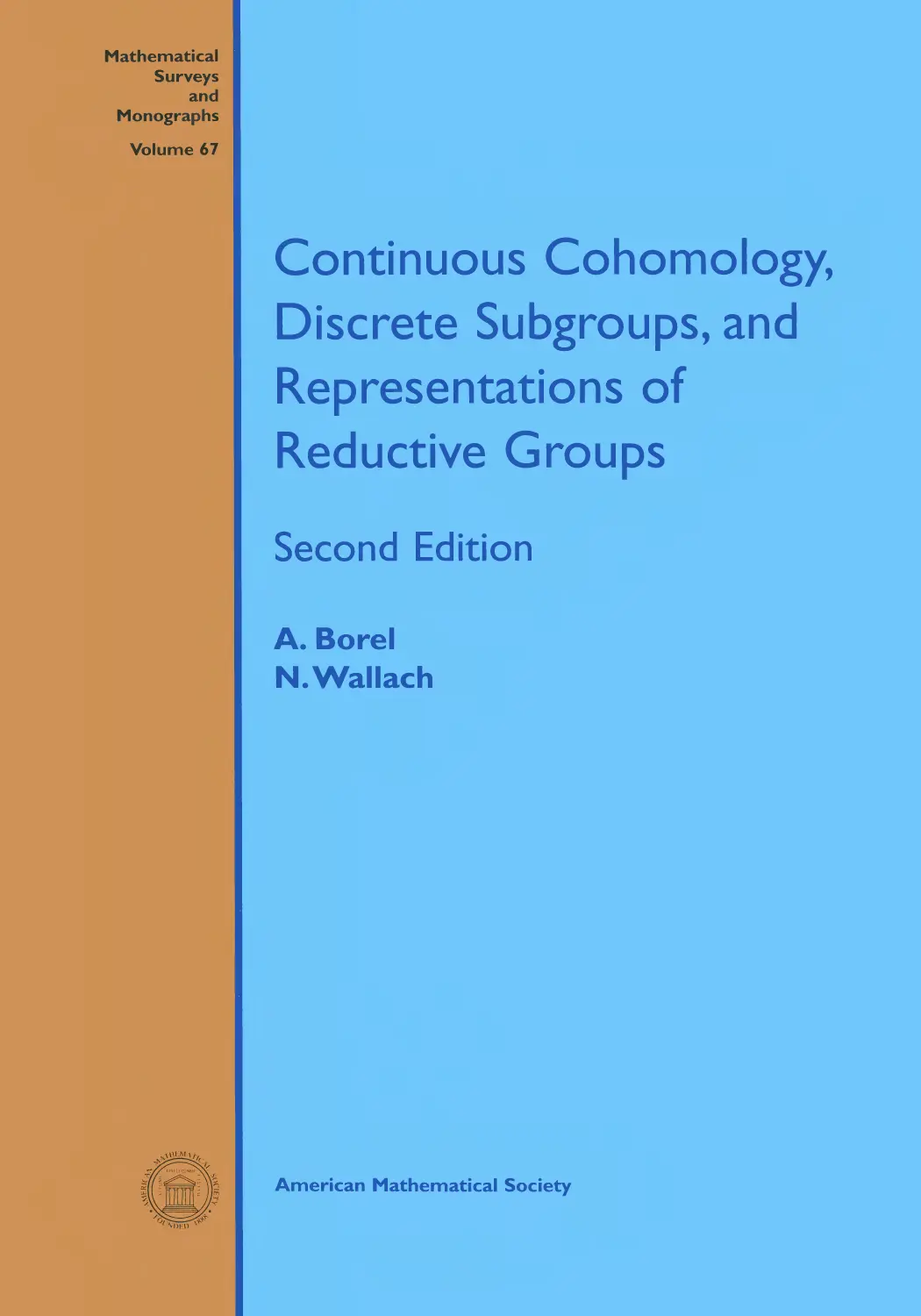


Author: Borel A. Wallach N.
Tags: mathematics algebra discrete mathematics natural sciences reductive groups
ISBN: 0-8218-0851-6
Year: 1980


Text
                    Mathematical
Surveys
and
Monographs
Volume 67
N<^MjA/f,
w
Continuous Cohomology,
Discrete Subgroups, and
Representations of
Reductive Groups
Second Edition
A. Borel
N.Wallach
American Mathematical Society

Selected Titles in This Series
67 A. Borel and N. Wallach, Continuous cohomology, discrete subgroups, and
representations of reductive groups, Second Edition, 2000
66 Yu. Ilyashenko and Weigu Li, Nonlocal bifurcations, 1999
65 Carl Faith, Rings and things and a fine array of twentieth century associative algebra,
1999
64 Rene A. Carmona and Boris Rozovskii, Editors, Stochastic partial differential
equations: Six perspectives, 1999
63 Mark Hovey, Model categories, 1999
62 Vladimir I. Bogachev, Gaussian measures, 1998
61 W. Norrie Everitt and Lawrence Markus, Boundary value problems and symplectic
algebra for ordinary differential and quasi-differential operators, 1999
60 Iain Raeburn and Dana P. Williams, Morita equivalence and continuous-trace
C*-algebras, 1998
59 Paul Howard and Jean E. Rubin, Consequences of the axiom of choice, 1998
58 Pavel I. Etingof, Igor B. Prenkel, and Alexander A. Kirillov, Jr., Lectures on
representation theory and Knizhnik-Zamolodchikov equations, 1998
57 Marc Levine, Mixed motives, 1998
56 Leonid I. Korogodski and Yan S. Soibelman, Algebras of functions on quantum
groups: Part I, 1998
55 J. Scott Carter and Masahico Saito, Knotted surfaces and their diagrams, 1998
54 Casper Goffman, Togo Nishiura, and Daniel Waterman, Homeomorphisms in
analysis, 1997
53 Andreas Kriegl and Peter W. Michor, The convenient setting of global analysis, 1997
52 V. A. Kozlov, V. G. Maz'ya, and J. Rossmann, Elliptic boundary value problems in
domains with point singularities, 1997
51 Jan Maly and William P. Ziemer, Fine regularity of solutions of elliptic partial
differential equations, 1997
50 Jon Aaronson, An introduction to infinite ergodic theory, 1997
49 R. E. Showalter, Monotone operators in Banach space and nonlinear partial differential
equations, 1997
48 Paul-Jean Cahen and Jean-Luc Chabert, Integer-valued polynomials, 1997
47 A. D. Elmendorf, I. Kriz, M. A. Mandell, and J. P. May (with an appendix by
M. Cole), Rings, modules, and algebras in stable homotopy theory, 1997
46 Stephen Lipscomb, Symmetric inverse semigroups, 1996
45 George M. Bergman and Adam O. Hausknecht, Cogroups and co-rings in
categories of associative rings, 1996
44 J. Amoros, M. Burger, K. Corlette, D. Kotschick, and D. Toledo, Fundamental
groups of compact Kahler manifolds, 1996
43 James E. Humphreys, Conjugacy classes in semisimple algebraic groups, 1995
42 Ralph Preese, Jaroslav Jezek, and J. B. Nation, Free lattices, 1995
41 Hal L. Smith, Monotone dynamical systems: an introduction to the theory of
competitive and cooperative systems, 1995
40.3 Daniel Gorenstein, Richard Lyons, and Ronald Solomon, The classification of the
finite simple groups, number 3, 1998
40.2 Daniel Gorenstein, Richard Lyons, and Ronald Solomon, The classification of the
finite simple groups, number 2, 1995
40.1 Daniel Gorenstein, Richard Lyons, and Ronald Solomon, The classification of the
finite simple groups, number 1, 1994
39 Sigurdur Helgason, Geometric analysis on symmetric spaces, 1994
(Continued in the back of this publication)

This page intentionally left blank

Continuous Cohomology,
Discrete Subgroups, and
Representations of
Reductive Groups
Second Edition

This page intentionally left blank

Mathematical
Surveys
and
Monographs
Volume 67
AHEM4>,
Continuous Cohomology,
Discrete Subgroups, and
Representations of
Reductive Groups
Second Edition
A. Borel
N.Wallach
American Mathematical Society

Editorial Board
Georgia Benkart Tudor Stefan Ratiu, Chair
Peter Landweber Michael Renardy
1991 Mathematics Subject Classification. Primary 22E41;
Secondary 22E40, 22E45, 57T15.
Abstract. This is a revised and enlarged edition of the book with the same title published by the
Princeton University Press in 1980 which was concerned with various types of cohomology theories
pertaining to Lie groups (real or p-adic), Lie algebras, infinite dimensional representations, and
to cocompact discrete subgroups of reductive groups. Apart from corrections and minor changes
or amplifications, the text of the original edition has been kept. It has been augmented notably
by various additions on the Zuckerman functors, the Vogan-Zuckerman theorem describing the
relative Lie algebra cohomology with coefficients in an irreducible unitary representation, and
sharp vanishing theorems. Furthermore, an additional chapter outlines (without proofs) how the
main results on the cohomology of discrete cocompact subgroups extend to general 5-arithmetic
subgroups of semisimple groups over number fields. This edition can be used as a reference for
research mathematicians and advanced graduate students in such diverse fields as representation
theory, arithmetic groups, automorphic forms, and algebraic number theory.
Library of Congress Cataloging-in-Publication Data
Borel, Armand.
Continuous cohomology, discrete subgroups, and representations of reductive groups / by
A. Borel and N. Wallach. — 2nd ed.
p. cm. — (Mathematical surveys and monographs, ISSN 0076-5376 ; v. 67)
Includes bibliographical references and index.
ISBN 0-8218-0851-6 (alk paper)
1. Lie groups. 2. Representations of groups. 3. Homology theory. I. Wallach, Nolan R.
II. Title. III. Series: Mathematical surveys and monographs; no. 67.
QA387.B64 1999
512/.55—dc21 98-44527
CIP
Copying and reprinting. Individual readers of this publication, and nonprofit libraries
acting for them, are permitted to make fair use of the material, such as to copy a chapter for use
in teaching or research. Permission is granted to quote brief passages from this publication in
reviews, provided the customary acknowledgment of the source is given.
Republication, systematic copying, or multiple reproduction of any material in this publication
is permitted only under license from the American Mathematical Society. Requests for such
permission should be addressed to the Assistant to the Publisher, American Mathematical Society,
P. O. Box 6248, Providence, Rhode Island 02940-6248. Requests can also be made by e-mail to
reprint-permission@ams.org.
Original Edition © 1980 by the authors.
Second Edition © 2000 by the American Mathematical Society. All rights reserved.
The American Mathematical Society retains all rights
except those granted to the United States Government.
Printed in the United States of America.
@ The paper used in this book is acid-free and falls within the guidelines
established to ensure permanence and durability.
Visit the AMS home page at URL: http://www.ams.org/
10 9 8 7 6 5 4 3 2 1 05 04 03 02 01 00

Contents
Introduction to the First Edition xi
Introduction to the Second Edition xvii
Chapter 0. Notation and Preliminaries 1
1. Notation 1
2. Representations of Lie groups 2
3. Linear algebraic and reductive groups 4
Chapter I. Relative Lie Algebra Cohomology 7
1. Lie algebra cohomology 7
2. The Ext functors for (g,6)-modules 9
3. Long exact sequences and Ext 13
4. A vanishing theorem 15
5. Extension to (g, X)-modules 16
6. (g,£,L)-modules.
A Hochschild-Serre spectral sequence in the relative case 19
7. Poincare duality 22
8. The Zuckerman functors 25
Chapter II. Scalar Product, Laplacian and Casimir Element 31
1. Notation and general remarks 31
2. Scalar product 33
3. Special cases 36
4. The bigrading in the bounded symmetric domain case 37
5. Cohomology with respect to square integrable representations 40
6. Spinors and the spin Laplacian 43
7. Vanishing theorems using spinors 47
8. Matsushima's vanishing theorem 50
9. Direct products 54
10. Sharp vanishing theorems 55
Chapter III. Cohomology with Respect to an Induced Representation 59
1. Notation and conventions 59
2. Induced representations and their if-finite vectors 61
3. Cohomology with respect to principal series representations 64
4. Fundamental parabolic subgroups 66
5. Tempered representations 69
6. Representations induced from tempered ones 70
7. Appendix: C°° vectors in certain induced representations 70

viii CONTENTS
Chapter IV. The Langlands Classification and Uniformly Bounded
Representations 75
1. Some results of Harish-Chandra 75
2. Some ideas of Casselman 78
3. The Langlands classification (first step) 81
4. The Langlands classification (second step) 84
5. A necessary condition for uniform boundedness 87
6. Appendix: Langlands' geometric lemmas 91
7. Appendix: A lemma on exponential polynomial series 94
Chapter V. Cohomology with Coefficients in 11^ (G) 97
1. Preliminaries 97
2. The class Uoc(G) 100
3. A vanishing theorem for the class 11^ (G) 100
4. Cohomology with coefficients in the Steinberg representation 103
5. H1 and the topology of £{G) 107
6. A more detailed examination of first cohomology 110
Chapter VI. The Computation of Certain Cohomology Groups 115
0. Translation functors 115
1. Cohomology with respect to minimal
non-tempered representations. I 117
2. Cohomology with respect to minimal
non-tempered representations. II 120
3. Semi-simple Lie groups with R-rank 1 122
4. The groups SO(n, 1) and SU(n, 1) 127
5. The Vogan-Zuckerman theorem 134
Chapter VII. Cohomology of Discrete Subgroups and Lie Algebra
Cohomology 137
1. Manifolds 137
2. Discrete subgroups 139
3. r cocompact, E a unitary T-module 142
4. G semi-simple, Y cocompact, E a unitary T-module 145
5. T cocompact, E a G-module 147
6. G semi-simple, Y cocompact, E a G-module 149
Chapter VIII. The Construction of Certain Unitary Representations and
the Computation of the Corresponding Cohomology Groups 151
1. The oscillator representation 151
2. The decomposition of the restriction of the
oscillator representation to certain subgroups 155
3. The theta distributions 161
4. The reciprocity formula 164
5. The imbedding of Vt into L2(r\G) 165
Chapter IX. Continuous Cohomology and Different iable Cohomology 169
Introduction 169
1. Continuous cohomology for locally compact groups 170
2. Shapiro's lemma 175

CONTENTS ix
3. Hausdorff cohomology 177
4. Spectral sequences 178
5. Differentiable cohomology
and continuous cohomology for Lie groups 180
6. Further results on different iable cohomology 184
Chapter X. Continuous and Differentiate Cohomology
for Locally Compact Totally Disconnected Groups 191
1. Continuous and smooth cohomology 191
2. Cohomology of reductive groups and buildings 196
3. Representations of reductive groups 199
4. Cohomology with respect to
irreducible admissible representations 200
5. Forgetting the topology 205
6. Cohomology of products 207
Chapter XL Cohomology with Coefficients in 1100(G): The p-adic Case 211
1. Some results of Harish-Chandra 211
2. The Langlands classification (p-adic case) 215
3. Uniformly bounded representations and II^G) 218
4. Another proof of the non-unitarizability of the Vj's 221
Chapter XII. Different iable Cohomology for
Products of Real Lie Groups and T.D. Groups 225
0. Homological algebra over idempotented algebras 225
1. Different iable cohomology 226
2. Modules of K-finite vectors 228
3. Cohomology of products 230
Chapter XIII. Cohomology of Discrete Cocompact Subgroups 233
1. Subgroups of products of Lie groups and t.d. groups 233
2. Products of reductive groups 236
3. Irreducible subgroups of semi-simple groups 239
4. The T-module E is the restriction of a rational G-module 243
Chapter XIV. Non-cocompact 5-arithmetic Subgroups 247
1. General properties 247
2. Stable cohomology 247
3. The use of L2 cohomology 249
4. S-arithmetic subgroups 251
Bibliography 253
Index
259

This page intentionally left blank

Introduction to the First Edition
1. This monograph is mainly concerned with two types of cohomology spaces
pertaining to a reductive Lie group G (real, p-adic, or product of such groups) and
a discrete cocompact subgroup Y of G. The first one is the Eilenberg-MacLane
cohomology space H*(Y; E) of Y with coefficients in a finite dimensional unitary Y-
module (or a finite dimensional G-module if G is real). The second one is attached
to G, or its Lie algebra g and a maximal compact subgroup K if G is real, and a
representation V of G, usually infinite dimensional, and appears in various guises:
continuous, smooth, or also (for G real) relative Lie algebra cohomology. Our
initial interest was in the former one. However, its study may be reduced in part
to the latter one (see Chapters VII and XIII), where G is the ambient group and
V runs through the irreducible subspaces of L2(Y\G). The determination of this
cohomology is then a first step towards the determination of H*(Y; E). But, as this
work developed, we were led to emphasize it more and more, and to treat it as our
main topic rather than as an auxiliary one. In fact, ten out of thirteen chapters are
devoted to it, or directly motivated by it.
The material presented here divides naturally into two parts, one devoted
mainly to real Lie groups (Chapters I to IX), the other to locally compact
totally disconnected groups (for short, t.d. groups), in particular reductive p-adic
groups, or products of real Lie groups and t.d. groups (Chapters X to XIII). Each
part in turn contains roughly three main items: general results on the cohomology
used, specific ones for cohomology and representations of reductive groups, and
applications to discrete cocompact subgroups.
We now give some indications on the contents of the various chapters.
2. In Chapters I to VIII, G is a real Lie group with finitely many connected
components, and the underlying cohomology is the relative Lie algebra cohomology
H*{g,t;V) or rather, to allow for non-connected G°s, a slight modification of it
denoted H*($,K; V). Chapter I is devoted to foundational material on that
cohomology. In §§1 to 4, g is a finite dimensional Lie algebra over a field of characteristic
zero and t a subalgebra. §1 recalls the direct definition of H*(Q,t; V), §2 discusses
more generally the derived functors of Hom0 in the category CQ^ of (g,£)-modules,
i.e., g-modules which are locally finite and semi-simple with respect to t. This
approach differs only in minor details from that of G. Hochschild, in the framework
of relative homological algebra. The translation in the formalism of Yoneda's long
extensions is briefly recalled in §3. In §4, we give two proofs of a useful vanishing
theorem of D. Wigner. From §5 on, F = R, g is the Lie algebra of G and t that
of a maximal compact subgroup K of G. In §5, we transpose the previous
considerations to the category of (g, X)-modules. In §6 we introduce a slightly different
category Cg^L? solely as a tool to prove the existence of a Hochschild-Serre
spectral sequence for (g,K)-modules. Also included are two results of Casselman (5.5)
xi

xii INTRODUCTION TO THE FIRST EDITION
and of D. Vogan (2.8) on finitely generated or admissible modules, and a Poincare
duality theorem of D. Vogan when G is semi-simple and V irreducible admissible
(§7).
Chapter II is devoted to the case where g is semi-simple (or reductive) and
the coefficient module is the tensor product of a finite dimensional G-module E
by a unitary G-module V. The cochain complex for relative Lie algebra coho-
mology admits then a natural scalar product. Various constructions and results
of Matsushima, Matsushima-Murakami, Kuga, originating in differential geometry
and Hodge theory and discussed by them in the context of discrete cocompact
subgroups, are adapted to our setting in §§1 to 4, and §8; in a similar vein, §§6, 7
prove some vanishing theorems by use of spinors, suggested by results of Hotta and
Parthasarathy on discrete subgroups. In §5, we consider the case where V belongs
to the discrete series and show, using the characterization of the minimal if-type
in V, that Hq(g,K;E ® V) vanishes unless 2q = dimG/K and V has the same
infinitesimal character as the contragredient representation E* to E.
The main topic of Chapter III is the cohomology with respect to a
principal series representation. The computation uses an analogue of Shapiro's lemma
(2.5), a description of K-finite vectors in induced representations (2.4), results of
B. Kostant on the cohomology of nilpotent radicals of parabolic subalgebras and
the Hochschild-Serre spectral sequence (§3). The results are applied in §4 to the
determination of the cohomology with respect to tempered representations: in
particular, it can be non-zero only in a small interval around the middle dimension and
if the underlying parabolic subgroup is fundamental. These results have also been
proved independently by G. Zuckerman, and those of §3 for complex semi-simple
Lie algebras by P. Delorme. The last paragraph of III contains some general
remarks on C°°-vectors of induced representations, proving in particular that these
are smooth functions in the cases of interest to us.
The next step is the investigation of the cohomology with respect to non-
tempered representations. It is based on the Langlands classification of irreducible
admissible (g, K)-modules and on two complements to it: some information on the
Langlands parameters of the constituents of the kernel of the intertwining operators
used by Langlands, and a necessary condition for unitarizability (in fact, for uniform
boundedness) in terms of the Langlands parameters. The latter sharpens a result
of R. Howe stating that the coefficients of a unitary representation with compact
kernel vanish at infinity. These results are proved in Chapter IV (see 4.13, 5.2),
which also contains a proof of the Langlands classification (4.11).
The uniform boundedness condition singles out a subset denoted Uoc(G) of
the set 11(G) of infinitesimal equivalence classes of irreducible admissible (g,K)-
modules (V, §2). It contains the unitary representations with compact kernel.
Chapters V and VI are devoted to the cohomology with coefficients in Iioc(G), or
also in V(8>i£, where V represents an element of noo(G?) and E is finite dimensional,
irreducible. We prove first that Hq($, K;V ® E) vanishes for q < rkftG (3.3), a
result also obtained independently by G. Zuckerman. For E trivial, this bound is
sharp in noo(G?) (but not always in the unitary dual G of G, see (II, 8.7)): in §4, it
is shown that the constituents of (an analogue of) the Steinberg representation are
all in noo(G), and that Hq($, K; V) ^ 0 if q = rkR G for at least one of them. §5
reproves some results of P. Delorme on the relation between Hl and the topology
of G.

INTRODUCTION TO THE FIRST EDITION xiii
Chapter VI gives some further information on the cohomology with respect
to a Langlands quotient Jp^,v We need only consider the Jp,<j,v with the same
infinitesimal character as the trivial representation. The criterion IV, 5.2 gives an
upper bound for v. The general pattern which emerges is that, roughly, the bigger v
(in a suitable order relation), the lower the first non-vanishing cohomology group.
Since the cohomology with respect to tempered representations is non-zero only
close to the middle dimension, this suggests proceeding by increasing induction
on v. Without attempting to do this in general, we illustrate this relationship in
Chapter VI by some general results when v is minimal (§§1, 2) or rkRG = 1 (§3),
and by a complete determination of the cohomology when G = SO(n, 1), SU(n, 1)
in §4.
Chapter VII is devoted to the cohomology of discrete subgroups. First if T is
a discrete subgroup of the Lie group G, and E is a G-module, then we have the
(well-known) formula
(1) H* (T; E) = H* (g, K- C°°{T\G) <8> E)
(2.7). If now r is cocompact, then L2(T\G) admits a Hilbert discrete sum
decomposition with finite multiplicities
(2) L2(T\G) = @m(*,T)Hv,
and (1) transforms to
(3) H*(T; E) = 0 m(7r, T)H*(q, K; Hn ® E)
(5.2). There is also a counterpart to that formula when E is a unitary T-module,
involving the decomposition of the unitarily induced representation I^2{E) (3-2).
Various consequences of the results of the previous chapters are drawn in §§4, 6.
Chapter VIII is concerned with cohomology at the R-rank q when G = SU(p, q)
{v > q)- Let Ft be the irreducible G-module whose highest weight is £ times the
highest weight of the standard representation of SU(p, q) in Cp+q. For each £ > q
there is a unitary irreducible representation Hi of G such that Hq(Q, K; H^Ft-q) ^
0 (2.13). It is then shown that certain cocompact arithmetically defined subgroups
of G have subgroups of finite index V such that Hi occurs in L2(T\G), whence
in particular Hq(T';F£-q) ^ 0. This extends a result of Kazhdan concerning the
case where q = 1, which gave the first examples of discrete cocompact subgroups of
SU(n, 1) with non-vanishing first Betti number for arbitrary n. The proof uses the
metaplectic representation and the duality theorem, and is quite similar to that of
Kazhdan, although the context is a bit different, since Kazhdan worked with adelic
groups.
3. Chapters IX to XII are devoted to continuous and smooth cohomology.
§§1 to 4 of Chapter IX contain some basic material concerning derived functors
in the category Cq of continuous G-modules (always assumed to be locally convex
Hausdorff topological vector spaces over C), when G is a locally compact group
(countable at infinity). The approach is the one of Hochschild-Mostow, based on

XIV
INTRODUCTION TO THE FIRST EDITION
the use of injective modules relative to G-morphisms which are strong (i.e. split for
the underlying structure of topological vector spaces). After that, we are concerned
with real groups (IX, §§5, 6), t.d. (totally disconnected) groups, in particular p-adic
groups (X, XI), and products of such groups (XII). The formal analogies between
these three cases are emphasized. In each, besides Cq-, we consider the categories Cq
of smooth topological G-modules and CG of non-degenerate modules over a suitable
Hecke algebra. The last one (introduced in substance by Jacquet-Langlands) is
abelian and the modules in it are just complex vector spaces. The Hecke algebras
occurring here have no unit in general, a situation not considered in standard texts
on homological algebra. However they are idempotented, and this allows one to
extend some standard constructions to our case (XII, §0). In particular, Cq has
enough injectives. There are natural functors
where a (resp. (3) is the passage to smooth (resp. K-fmite vectors) and 7 is the
inclusion. 7 preserves derived functors and /3 cohomology for quasi-complete spaces,
a preserves derived functors for quasi-complete spaces in the t.d. case, and
cohomology for Frechet spaces in the other two cases.
In the real case, Cq' consists of the usual differentiable modules, with the C°°-
topology, while, up to Chapter IX, Cq is just the category of (g, X)-modules. But,
as is known, it may also be viewed as the category of non-degenerate modules over
the Hecke algebras H(g,K) of bi-X-finite distributions on G with support in K.
This point of view is more convenient to treat the mixed case, and is introduced
later (XII, §2). The above conservation theorems for derived functors in the real
case (due to Hochschild-Mostow, W. v. Est, P. Blanc) are proved in IX, §§5, 6.
If G is a t.d. group (X, §1), then a topological G-module V is smooth if every
vGVis fixed under an open subgroup and V is, topologically, the inductive limit of
the subspaces VL of fixed points under compact open subgroups LofG. The Hecke
algebra underlying the definition of Cq is the convolution algebra of locally constant
compactly supported functions. The main case of interest is when G = G{k), where
k is a non-archimedean local field and Q a connected reductive /c-group. If V G Cq-,
then the ^/-valued cochains of the Bruhat-Tits building of G provide an s-injective
resolution of V (X, §2). In §4 of X we prove the results of W. Casselman which
give a complete description of the cohomology of G with respect to an irreducible
admissible G-module. §5 is devoted to Cq, and the passage to Cq is used in §6 to
prove some Kunneth rules.
Chapter XI is a p-adic counterpart of IV. It discusses the analogue of the
Langlands classification, and of the uniform boundedness condition. The latter
is used to show that the only irreducible admissible representations with compact
kernel, with respect to which G has non-vanishing cohomology in some dimension
q 7^ 0, rkfc G, are non-unitarizable (a result due to W. Casselman).
Let now G = G\ x G2 be the product of a real Lie group G\ and a t.d. group
G2- A topological continuous G-module V is said to be smooth if it is smooth with
respect to Gi and G2 and if it is the topological inductive limit of the subspaces
VL, where L runs through the compact open subgroups of G^-
There are also intermediate categories of continuous G-modules smooth with
respect to one of the factors. The relations between the corresponding derived

INTRODUCTION TO THE FIRST EDITION xv
functors are discussed in §1. In §2, we fix a maximal compact subgroup K\ of G\
and pass to the {K\ x L)-finite vectors, where L is a compact open subgroup of
G2, which brings us to the non-degenerate modules over the Hecke algebra 7i{G) =
H(gi,Ki) (g) H(G2). §3 is devoted to some Kunneth rules and to applications to
the cohomology of products of reductive groups or of adelic groups.
In Chapter XIII, we consider the cohomology space H*(T;E), where T is a
discrete cocompact subgroup of G and E a finite dimensional unitary T-module,
first in general (§1), then when G is a product of reductive groups Gs (s G 5).
In the latter case, we have a formula quite similar to (3), except that L2(T\G) is
replaced by the unitarily induced representation from E. Furthermore, since the
Gs's are of type I, each it G G is a Hilbert tensor product it = ®stts (tts G Gs),
and the Kunneth rule gives
(4) H*ct(G;Hir) = <g)Hct(Gs;Hirs).
This allows us to apply the earlier results on continuous cohomology of real or p-
adic groups. We then pass to some applications. We prove the Casselman vanishing
theorem (2.6) and extend it to the case where T is irreducible (3.1) in a product
of semi-simple groups over non-archimedean fields (3.6). Following a suggestion
of G. Prasad, we also show it to be valid when E is a finite dimensional vector
space over an arbitrary field of characteristic zero, and G has rank > 2, using a
theorem of Margulis (3.7). Finally, we prove that if G = G(A) is the adele group of
a semi-simple anisotropic group Q over a global field, then H*(Q(k);H) reduces to
the continuous cohomology of the archimedean factor of G(A) (3.9).
A survey of some of the main results on vanishing and non-vanishing
cohomology is given at the end of the book.
4. This monograph is an outgrowth of a seminar on the "Cohomology of discrete
subgroups of semi-simple Lie groups" held at The Institute for Advanced Study in
1976-77. A first set of notes was written and distributed at that time. Most of
the material of these notes is incorporated in Chapters I to IX, except for some
results which were rendered somewhat obsolete by others found in the course of the
seminar. There was also some discussion of the p-adic case in the seminar, but it was
not written up then. In the first version, we kept track of who did what and each
chapter was accordingly authored or coauthored. It would have been quite awkward
to do so in the present version, which represents a considerable reorganization and
expansion of the first one. Rather, we prefer to take joint responsibility for the
results and mistakes in this book, except however that the first (resp. second)
named author wishes to leave credit for Chapters IV, VIII, XI (resp. VII, IX, XII,
XIII) to the second (resp. first) named author.
The transition from the first to the final version was a rather painful process,
involving a long series of changes, additions, amplifications, corrections upon
corrections, reshuffling and renumbering. We are very grateful to the secretaries of
the School of Mathematics, and in particular to Peggy Murray, who had by far
the greatest load, for having taken care so skillfully and so speedily of this endless
series of changes upon changes, which required expertise not only in typing but in
cutting, pasting and collage as well.

xvi INTRODUCTION TO THE FIRST EDITION
A reference such as 3.4 (resp. 3.4(1)) refers to section 3.4 (resp. relation 3.4(1))
of the same chapter; if preceeded by a capitalized Roman numeral it refers to the
corresponding section or relation of the chapter denoted by that numeral.
A. BOREL, N. WALLACH*
July 1978
THE INSTITUTE FOR ADVANCED STUDY, Princeton, N.J. 08540
RUTGERS UNIVERSITY, New Brunswick, N.J. 08903
*The second named author did part of this work while enjoying the hospitality of Brandeis
University. He also wishes to acknowledge partial support from NSF grant number MCS 77-04278
AOL

Introduction to the Second Edition
This second edition includes a number of corrections, minor changes or
amplifications to the original text, as well as some further material that reports on later
relevant developments.
The numbering in the first edition has been maintained. The new additions
have been inserted either at the beginning or the end of a paragraph, or a chapter.
This explains some numbering that is a bit unusual: In section 3 of Chapter 0, in
particular, there is a subsection 3.0 (which has subsections). The main new topics
are:
I, §8, which gives a construction, in the framework of this book, of the Zucker-
man functors and describes their main properties.
II, §10 provides sharp bounds, case by case, for the vanishing theorems, due to
Enright, Kumaresan, Parthasarathy, Vogan-Zuckerman, which in many cases are
improvements of the ones given originally.
VI, §0 introduces the translation functors and their relationship with relative
Lie algebra cohomology.
VI, §5 is devoted to the Vogan-Zuckerman theorem, which describes
Ext*K(F, 1/), where V runs through the irreducible unitary (g, K)-modules and
F through the finite dimensional irreducible (g, X)-modules.
XIII, §4 studies the cohomology of an 5-arithmetic subgroup of G with
coefficients in a rational G-module.
Moreover, a new Chapter XIV has been added. It outlines how the main results
proved in Chapters VII, VIII and XIII for the cohomology of discrete cocompact
subgroups extend to general 5-arithmetic subgroups of semisimple algebraic groups
over number fields.
It has been almost 20 years since the publication of the original version of
this book. During that time the methods of homological algebra have become
increasingly important in the construction of admissible representations and in the
study of arithmetic groups. Although some of the original material in this book has
been superseded, it is still a useful reference. We thank the American Mathematical
Society, in particular S. Gelfand, for having encouraged us to publish this second
edition. The authors would also like to thank the editorial staff for an extremely
helpful and thorough reading of the manuscript.
A. BOREL, N. WALLACH
1999
THE INSTITUTE FOR ADVANCED STUDY, Princeton, NJ 08540
UNIVERSITY OF CALIFORNIA, San Diego, La Jolla, CA 92014
xvii

This page intentionally left blank

CHAPTER 0
Notation and Preliminaries
§1 contains some general notation, §2 some definitions and facts on
representations of Lie groups, and §3 fixes a number of conventions on reductive groups. The
notation introduced here will often be used without reference.
1. Notation
1.1. As usual, Z is the ring of integers, N = {z G Z | z > 0} the set of
natural integers, Q (resp. R, resp. C) the field of rational (resp. real, resp. complex)
numbers, R+ the multiplicative group of strictly positive real numbers.
If A is an algebra with identity, then A* is the group of units of A.
1.1.1. If V = 0iGZ V% is a vector space graded by Z and if m G Z, then V[m]
denotes the graded vector space defined by
V[m}1 = V1+rn (i G Z).
1.1.2. Let V be a complex vector space. If V has the structure of a module
over a group or a Lie algebra and if m G N, then we have consistently written mV
for the direct sum of m copies of V', with the corresponding diagonal action, thus
committing an abuse of notation. To adopt a correct one would entail an amount
of changes that we found too daunting. We thereby, regretfully, announce that we
shall maintain our original convention.
1.2. If G is a group, and M a subset of G, then ZG(M) or Z(M) is the
centralizer of M and Afc(M) or Af(M) the normalizer of M:
ZG{M) = {geG\g-m = m.g{me M)},
tfG(M) = {geG\g-M.g-1cM}.
Int g is the inner automorphism x \-^ g • x • g~l. We also write gx for Int g(x),
and gM = Intg(M). The center of G is denoted Z{G) or C(G), and VG is the
derived group of G.
1.3. If g G G, then £g (resp. rg) denotes the left (resp. right) translation by
^ on G, or on functions / on G. In particular
(1) £gf(x) = fig'1 • x), rgf(x) = f(x. g) (x G G).
Thus £g.h = £g • 4, rgh =rg-rh (g, h G G).
1.4. If G is a topological group, then G° is the connected component of the
identity in G.
l

2
0. NOTATION AND PRELIMINARIES
1.5
1.5. The Lie algebra of a real Lie group G,H,-— will be denoted by the
corresponding German lower case letter g, (),•••, and the exponential map g —> G
is denoted exp. We also write ex for expx(x Eg). If m is a subspace of g, then mc
stands for the complexification m ®r C of m.
The universal enveloping algebra over C of g is denoted U(g). Its center is
denoted Z(g).
The centralizer (resp. normalizer) of m in g is denoted ^(m) or 30(m), resp. n(m)
orn0(m):
30(m) = {x e g/[m,x] = 0}, nfl(m) = {x G g/[x,ra] G m (m G 5BT)}.
As usual the differential of Intx (x G G) at 1 is denoted Adx, and, for x G g,
adx: g h^ g is defined by adx(y) = [x,?/]. For m C g, we let
ZG(m) = {x G G | Adx(ra) = m (m e m)},
A/*G(m) = {x G G | Adx(m) = m}.
1.6. If G is a Lie group, then X(G) is the group of continuous homomorphisms
of G into R* and
°G= p| ker|X|.
xex(G)
It is a normal subgroup which contains the derived group and all compact
subgroups of G.
1.7. Unless otherwise stated, topological vector spaces are assumed to be over
R or C, Hausdorff locally convex and quasi-complete, and manifolds to be C°° and
countable at infinity. If M is a manifold and V a topological vector space, then
C°°(M; V) is the space of G°°-functions of M, with values in V', endowed with the
C°°-topology. The space of V-valued smooth differential p-forms (p G N) on M is
denoted AP(M; V), and A*(M; V) is the direct sum of the spaces AP{M; V). Thus
A°(M; V) = C°°(M- V). If V is a Frechet space, then so is Ap(M; V) {p G N).
If M, iV are manifolds, then C°°(A,B) is the space of smooth maps A —> B,
endowed with the G°°-topology.
2. Representations of Lie groups
2.1. Let G be a Lie group with finite component group. By a topological
G-module (or simply a G-module) V, where V is assumed to be a locally convex
and locally complete Hausdorff topological vector space over C, we mean a ho-
momorphism G —> Aut V defined by a continuous map G x V —> V. It will be
denoted (tt, V), or V or tt. The action of g on v is often denoted g.v or gi; rather
than Tx{g)v. We shall denote by Cq the category of topological G-modules and
equivariant continuous linear maps.
V is said to be finitely generated if there is a finite subset S of V such that the
span of the vectors g.c (g G G,c G S) is dense in V.
2.2. Let (tt, V) G Cq- For v G V we let cv: G —> "1/ denote the orbit map
c^(#) = K(g)v. It is continuous. If i; is a continuous functional on V', then the
function cv ^ on G defined by
(1) cv,v(g) = {n{g)v,v) = {cv{g),v) (g G G)
is called a coefficient of 7r.

2.5
2. REPRESENTATIONS OF LIE GROUPS
3
An elementary calculation shows that we have
If V is a Hilbert space, then the coefficients may also be defined to be the functions
Cv,w '• 9 ^ M^O^? w), where v, w G V and ( , ) is the scalar product on V.
2.3. Let (7r, V) G Cg- The vector v G V is said to be differentiable (resp.
analytic) if cv is C°° (resp. analytic). The space of different iable (resp. analytic)
vectors is denoted V°° (resp. V"). It is stable under G. The representation it
defines a representation of g or U(g) on V°° (resp. Fw) which is denoted it^ (resp.
iiu) or simply 7r.
A continuous representation (it, V) is different iable if V = V°° and if the map
v ^ {g h^ g • v} is a topological isomorphism of 1/ onto its image in C°°(G; V),
endowed with the topology induced from that of C°°(G; V), to be called the C°°-
topology. We let Cq be the category of different iable G-modules and continuous
G-morphisms.
Let (tt,V) be a continuous G-module. Then V°°, endowed with the C°°-
topology and the given action of G, is a different iable G-module. We denote it
(tToo, V°°). If V is a Frechet space, then so is V°°. The map (tt, V) ^ (tt^, V°°) is
a functor. If V is a Hilbert space, then, by the principle of uniform boundedness,
the topology on V°° is defined by the semi-norms v ^ \\Xv\\ (X G U(g)).
2.4. A vector v G V is G-finite if it is contained in a finite dimensional
subspace stable under G. A G-module is locally finite if every element is G-finite.
Let K be a compact subgroup of G. We let V^k) denote the space of if-finite
vectors. It is the union of the images V(w) of the maps
RomK(W,V)®W ^V
defined by
T0«;^ t(w) (r G Hom^W7, V), w G W),
where W runs through all finite dimensional X-modules. If W is irreducible, then
V(y/) is the isotypic subspace of type W. We say that V is admissible if all
isotypic subspaces are finite dimensional (or equivalently all of the V(y/) are finite
dimensional for all finite dimensional W).
Assume a maximal compact subgroup K of G has been fixed. Then we set
Vb = V°° fl V(k)- This space is stable under g. Note that if an isotypic subspace of
K in V is finite dimensional, then it is contained in V°°. We say that tt is admissible
if the isotypic subspaces in V are all finite dimensional. In this case Vb = V(k)-
2.5. A (g, X)-module is a real or complex vector space which is a g-module,
a locally finite and semi-simple X-module and such that the operations of g and K
satisfy the following compatibility conditions:
1) 7r(k) • (tt(X)) • v = 7r(Ad k(X)) • ir(k) • v (k G K; X G U(g); v G V);
2) if F is a K-stable finite dimensional subspace of V', then the representation
of K on F is different iable, and has 7r|^ as its differential.
A (g, K)-module is admissible if it is admissible as X-module.
Let V be a vector space on which g and K operate so as to satisfy 1) and 2)
and in which every X-stable finite dimensional subspace is if-semi-simple. Then
the subspace V^k) of if-finite vectors in V is if-semi-simple and stable under g,
hence is a (g, if )-module.

4
0. NOTATION AND PRELIMINARIES
2.5
If (7r, V) is a (g, X)-module, then g and X operate as usual on the dual space
V of V. The above conditions are met. The space of K-finite vectors in V' is
then a (g, K)-module, to be called the contragredient (g, K)-module to V, and to be
denoted (7F, V). It is admissible if and only if V is. In that case, V is contragredient
to V.
A (g, l/)-module (n, V) is unitary if 1/ is endowed with a positive non-degenerate
scalar product ( , ) which is invariant under K and (infinitesimally) invariant under
9-
(7r(/c) • v, ix{k) • w) = (v, w),
(tt(x)v, w) -h (v, tt(x) • w) = 0 (v, w G V, /c G K, x G g).
We let C05k be the category of (g, K)-modules and (g, K)-morphisms, and 11(G)
the set of isomorphisms classes of irreducible admissible (g, X)-modules.
A (g, K)-module (71-, V) (or a differentiate G-module) is said to have an
infinitesimal character \ if there is a homomorphism Z(g) —> C such that ir(z) = x(z)-Id
for all z G Z(g). This is in particular the case if (n, V) is irreducible and admissible.
2.6. Let (7r, V) G Cq. Then Vb is a (g, X)-module. We denote it sometimes
(tto? Vb). It is admissible (resp. unitary) if (n, V) is so, and it is finitely generated
as a g-module if (71-, V) is finitely generated as a G-module.
It is known that every irreducible admissible (g, K)-module can be realized as
the space of X-finite vectors in an irreducible admissible differentiable G-module
[77]. In fact, this statement is true more generally for finitely generated admissible
(g, K)-modules, but we shall not need this fact.
Two smooth representations are infinitesimally equivalent if the two associated
(g, X)-modules of K-finite vectors are isomorphic.
2.7. We let Z(g,K) denote the subgroup of elements of the center of K which
act trivially on g. If G is connected, with compact center, then Z(g, K) is just the
center of G. We say that a (g, X)-module (71", V) has a central character cjn if there
exists a character un : Z(g, K) —> C* such that ir(z) = LOn(z)-Id for all z G Z(g, K).
If (71-, V) is admissible and irreducible, then it has both an infinitesimal character
and a central character.
2.8. The set of equivalence classes of irreducible unitary representations of G
is denoted £(G) or G.
Let (71", V) be unitary, irreducible. There exists then a unitary character L0n
of C(G) such that ir(z) = LOn(z) Id for z G C(G). Therefore \cu,v\ (u,v G V) is a
function on G/C(G). The representation it is said to be in the discrete series if it is
unitary, irreducible and if its coefficients are square integrable modulo the center,
i.e. on G/C(G). We let Ed{G) be the set of equivalence classes of discrete series
representations of G.
If G is compact, then £(G) = £d(G).
3. Linear algebraic and reductive groups
3.0. In this book, up to Chapter XII, we are mainly concerned with real or
complex Lie groups. The point of view of algebraic groups becomes more prominent
in XIII, XIV. Our general reference for linear algebraic groups is [124]. We review
some basic concepts in characteristic 0.

3.3
3. LINEAR ALGEBRAIC AND REDUCTIVE GROUPS
5
k is a field of characteristic 0, and K an algebraically closed extension of k.
3.0.1. A subgroup Q C GLin(K) is linear algebraic if there exist polynomials
Pa G K[Xu,Xi2,..., Xnn], ael, such that
G = {g = fa) e GLn(K) | pa(giu...,gnn) = 0{ae I)}.
It is defined over k if the ideal of polynomials vanishing on Q is generated by
elements of k[Xn,Xi2,... ,Xnn]. Then we set Q(k) = Q H GLn(/c).
The group Q is connected (in the Zariski topology) if and only if it is irreducible
as an algebraic variety. If K = C, Q is also a complex Lie group, and it is connected
if and only if it is connected as a manifold. Moreover, if it is defined over R, then
5(R) is a Lie group which may have several (but at most finitely many) connected
components in the ordinary topology.
3.0.2. The group GLi may be identified with the group K*. The linear
algebraic group Q is an (algebraic) torus if it is isomorphic to a product of a finite
number of GLi's. This is equivalent with the requirement that it is diagonalizable.
If Q is moreover defined over k and the isomorphism can be defined over /c, then it is
said to be split over k or k-split. (This condition is equivalent with the requirement
that there exist g G GLn(/c) such that gQg~l is diagonal.)
3.0.3. Let Q be a linear algebraic group defined over k. The maximal /c-split
tori of Q are all conjugate under Q(k). Their common dimension is the k-rank,
vkk{g) of 0 [18] (see also [124], 2.0.9, 19.2).
3.0.4. The group Q is reductive if its Lie algebra is reductive.
Assume that Q is connected. Then a closed subgroup V of Q is parabolic if
Q/V is a projective variety.
3.1. In this book, a real Lie group G is said to be reductive if there exists a
linear algebraic group Q defined over R, whose identity component (in the Zariski
topology) is reductive and a morphism v\ G —> £(R) with finite kernel, whose
image is an open subgroup of finite index of Q(R). Unless otherwise stated, we also
assume that G is of "connected type", i.e. that K&G is contained in Ad(gc).
This implies in particular that the identity component Z(G°)° of the center of
G° is also central in G.
3.2. The usual terminology of algebraic groups will be extended to such
groups. In particular, a subgroup T of G is a torus (resp. R-split torus) if it is
the inverse image of the group of real points «S(R) of an R-torus (resp. R-split
torus) S of G. The split component of a torus T is the identity component of
its greatest R-split subtorus. The maximal R-split tori of G are conjugate under
G°. Their common dimension is the R-rank or split rank rkR(G) of G. The split
component of G is the identity component of the greatest split torus in the center
of G (or, equivalently, of G°, cf. 3.1). The group G is the direct product of its split
component by °G.
3.3. A Cartan involution 0 of G is an involutive automorphism of G whose
fixed point set is a maximal compact subgroup and which is the inversion on the
split component of G. Given X, there is exactly one Cartan involution with fixed
point set K. If 5 is the ( —l)-eigenspace of d0, then (/c, x) ^ k • expx (k G X, x G s)
is an isomorphism of analytic manifolds of K x s onto G. In particular S = exps is
a closed subspace isomorphic to s under the exponential mapping, on which 0 acts
by inversion. The Cartan involutions are conjugate under automorphisms of G.

6
0. NOTATION AND PRELIMINARIES
3.4
3.4. A parabolic subgroup P is the normalizer of a parabolic subalgebra p of g.
It is the inverse image of the group of real points V(R) of a parabolic subgroup V
defined over R of Q. The unipotent radical N or Np of P is the analytic subgroup
generated by the nilradical of p. A Levi subgroup M of P is the inverse image of a
Levi R-subgroup M of V. A split component A of P is the split component of a
maximal torus in the radical of P. If Ap or A is one, then it is a split component
of Zq{A), and Zq{A) is a Levi subgroup of P. We have
(1) P = M k JV, M = Ax°M, hence P = MN = A-°M-N.
In particular, P D 0(P) is the unique ^-stable Levi subgroup of P. Its split
component is P H S. We always have G = P ■ K, and K D P is a maximal compact
subgroup of P fl 0(P). The dimension of A is the parabolic rank prk(P) of P.
A p-pair is a pair (P, A) consisting of a parabolic subgroup and a split
component A of P. The standard Levi decomposition of P is P = M-N with M = ZG(A).
A p-pair (P', A') dominates (P, A) (written (P', A') y (P, A)) if P' D P, A' C A.
The minimal p-pairs are conjugate under inner automorphisms of G°, or even K°.
If a minimal parabolic subgroup Po (resp. a minimal p-pair (Po, Ao)) is chosen, the
standard parabolic subgroups (resp. p-pairs) are the parabolic subgroups
containing Po (resp. the p-pairs dominating (Po, Ao)). A p-pair (P, A) is semi-standard if
A C A0. _
The p-pair (P, A) opposite to (P, A) consists of A and of the parabolic subgroup
P opposite to P and containing M = ZG{A). Thus P = M • iV, iV = TVp. If M is
<9-stable, then ~P = 0(P).
3.5. Let (P, A) be a p-pair. Then $(P, A) is the set of roots of P with respect
to A and A(P, A) the set of simple roots in 4>(P, A). We shall indifferently view it
also as the set <I>(p, a) of roots of p with respect to a, i.e. we make no distinction
between a character a of A and its differential. The value of a character a on a G A
is denoted a (a) or aa. Moreover we let
(1) pP{a) = (detAda|J1/2 (a G A);
more generally
(2) pp(m) = | (det Adm| J |1/2 {m e M),
where P = M • N is the standard Levi decomposition of P. Thus, in the Lie
algebra language, pp is half the sum of the elements of <I>(p, a), each counted with
its multiplicity. Every element of $(P,A) is a linear combination with coefficients
in N of elements in A(P, A). The latter are linearly independent, and their number
is equal to dim A n VG. We have $(P, A) = -$(P, A).
3.6. If f) is a Cartan subalgebra of g, then $ = $(g0 fyc) is the set of roots
of gc with respect to \)c. If ao is the Lie algebra of a maximal R-split torus, then
r<I> = R^(g,ao) is the set of R-roots, i.e. of roots of g with respect to ao- The
algebras ao are the Lie algebras of the split components of the minimal parabolic
subgroups of G. If (P0, Ao) is a minimal p-pair, then
R*(fl, a) = $(P0, A0) U (-*(P0, 4))) = W, A0) U $(P0,4)),
and $(Po> ^o) is the set of positive elements in r${q, a) for some ordering.

CHAPTER I
Relative Lie Algebra Cohomology
In this chapter, F is a commutative field, g a finite dimensional Lie algebra
over jF, t a subalgebra of g, U(g) (resp. U(t)) the universal enveloping algebra of
g (resp. t). We let R = U(g) and 5 = U(t), except in §3, where 5 denotes Yoneda
extensions. Prom 2.4 on, F is of characteristic zero and t is reductive in g.
1. Lie algebra cohomology
1.1. We review here the standard definitions in the cohomology of Lie algebras
(see [31, 74]). A g-module is a vector space V over F on which g acts via a
homomorphism it: g —> Ql(V). It will be denoted by V, or by the pair (tt,V). It
will often be infinite dimensional. If V is a g-module, and q G N, then
(1) C9 = C(S; V) = HomF(A«fl, V),
and d: Cq -► C9+1 is defined by
df(x0,...,xq) = ^2(-iyxi ■ f(x0,...,Xi,...,xq)
(2) l
~r / VV~V /u^i? ^JJ' ^0? • • • j #z> • • • j ^j? • • • > ^gj?
where, as usual, ^ over an argument means that the argument should be omitted.
Then d2 = 0 and #*(g; V) is the cohomology of the complex {Cq}.
To x e g there is associated an endomorphism 0X of C9 and a linear map
ix: Cq —> C9_1 (the interior product) defined by
(3) (Oxf)(xu • • •, xq) = ^ /(xi,..., [x», x],..., xq) + x • /(xi,..., Xg),
i
(4) (W)(xi,..., Xg_i) = /(x,xi,... ,x9_i).
The maps rf, i^, #x are related by
(5) 0X = d-ix+ix-d.
Write C9(g; V) as A9g* 0 V. Let {x*} be a basis of g and {x1} the dual basis of
g*. Denote by e(x) the left exterior product by x in Ag* and by do the differential
of C*(g). Then (2) translates to
(6) d = d0 <8> 1 + ^ e(x*) (8) 7r(xi),
(7) 2.do = Se(xi)'^«
i
(cf. [74, 3.4] for (7), and [44, 5.26] for the general case).

8
I. RELATIVE LIE ALGEBRA COHOMOLOGY
1.2
1.2. Let Cq(g,t,V) be the subspace of Cq(g,V) consisting of the elements
annihilated by the maps ix and 0X for all xGf. Then Cq($,t; V) is stable under
d and its cohomology groups are the relative cohomology groups Hq($,t;V) of
g mod £, with coefficients in V. Note that we have
(1) C«(9,t;V) = Romi(Ai(g/t),V),
where the action of t on Aq($/t) is induced by the adjoint representation, i.e.,
Cq{g,t,V) may be identified with the subspace of elements / G Homjp(A9(g/^), V)
which satisfy the relation
(2) ^/(xi,...,[x,^],...,xq) = x- f(xu...,xq) {x G t;xi eg/t,i = l,...,g).
We have in particular
(3) H°(q, V) = H°(q, t; V) = VQ = {v G V \ x • v = 0 for all x G g}.
Since A*g/{? is finite dimensional, it is clear that
(4) The functor V h^ H*(q, £; V) commutes with inductive limits.
1.3. These cohomology groups obey the Kunneth rule. To simplify notation,
we just consider the case of two factors. Assume then
g = sieg2, ^!ie!2, v = v1®v2
{ti C fli, Vi a &-module, i = 1, 2).
Then, for all g's,
(2) H«(fl)t;r)= 0 ff0(fli,ei;^i)®/f6(82)«2;V2).
a+b=q
To see this, note that we can write
C{S, t; V) = (A«(fl/t)* ® V)\ A(fl/t)* = A^i/eO* ® A(02/e2)*.
However, if A^, J/^ are ^-modules (i = 1,2) and Ai 0 ^2, f^i 0 U2 are viewed as
^-modules in the obvious way, then
(3) (Ax ®A2®Ul® U2f = {Ax ® C/i)*1 0 (A2 ® J72)*2.
Therefore
(4) C*(fl,e;V) = C*(fli,ei;V)(8)C*(fl2,e2;V)
(graded tensor product), whence our assertion.
1.4. In this subsection and the next one, F is of characteristic zero, g uni-
modular, t reductive in g and n = dimg, m = dimg/6. The algebra t is then also
unimodular, hence acts trivially on Am(g/£).
It is known that #*(g,£;F) satisfies Poincare duality ([74, §12], [44, 10.27,
10.28]). In particular, Hq($,t;F) is canonically isomorphic to the dual of
Hrn~q{%,l\F) for all q G Z. This implies in particular (since Cm(g,£;F) is one-
dimensional)
(1) Crn(^t;F) = Hrn(^t;F) = F, dCm~ 1(g,^;F)=0.
1.5. Proposition. Assume V and W are two Q-modules in perfect duality
with respect to a ^-invariant pairing ( , ), and that H*(g,t;V) and iJ*(g,6; W)
are finite dimensional. Then Hq($,t;V) is canonically isomorphic to the dual of
Hrn-q{^t-W)forallqeZ.

2.1
2. THE Ext FUNCTORS FOR (0, ^-MODULES
9
We can view Cq(V) = G9(g, t; V) as the space (A(g/t)* 0 Vf of ^-invariants in
A(g/6)* 0 V, and similarly for W. Then the map
Cq(V) x Cm-9(W) -> Am(g/*)*,
defined by
(?/ ®v,y'®w) = (v, w)y A y'
(i;GV; weW; yeAq(Q/ty, ^A^(b/!)*)
defines a perfect pairing between Cq{V) and Crn~q{W), once a basis element of
Am(g/£)* is chosen. It is easily checked, using 1.1(6) and 1.4(1), that we have
(1) (da,b) = (-l)q+1(a,db) {a G Cq{V), b G Cm-q-1{W)).
From this 1.5 follows immediately.
1.6. The real case. Let F = R and let Gbea Lie group with Lie algebra g,
K a closed connected subgroup of G with Lie algebra t.
If V is a smooth G-module, then we let G operate on the space A(G/K; V) of
V-valued differential forms on G/K by the rule
(1) (gooj)(x,Y) = g(cu(g-1-x,g-1-Y))
where g G G, x G G/K, and 7 is a g-vector at x. It is then readily seen that
the evaluation map at the origin, which assigns to u G A(G/K; V) its value at e,
defines an isomorphism of the space A(G/K; V)G of G-invariant differential forms
onto C(g, £; V), which carries the exterior differential to the differential of 1.1. Thus,
H*(&i £; V) is the cohomology of the space of G-invariant V-forms on G/K.
Assume G to be compact connected, V to be finite dimensional and acted upon
trivially by G. Then a standard averaging argument shows that H*(A(G/K; V)G) =
H*(A(G/K; V)); hence, by the de Rham theorem
(2) H*(&l',V) = H*(G/K;V).
This is a result of E. Cart an which is in fact at the origin of the notion of Lie
algebra cohomology. A bit more precisely, E. Cart an conjectured two theorems,
which were proved later by de Rham, and stated that, modulo those results, the
cohomology of G/K could be computed using invariant differential forms. In fact,
he was mainly concerned with compact symmetric spaces, for which all invariant
forms are closed and even harmonic (see II, 3.2).
2. The Ext functors for (g, ^-modules
2.1. It is well known that the groups Hq{g; V) may be viewed as the derived
functors of V 1—> Vs in the category of .R-modules. More generally, one may define
the derived functors Ext^(J/, V) of (U, V) \-^ Hom0(J/, V), and we have
(1) ExtqR(F,V) = Hq(&V), ExtqR(U,V) = Hq(^RomF(U,V)) (qeZ),
where F is viewed as the trivial g-module (see XIII and IX, 4.3 in [31]).
We shall need similar facts in the relative case. A general theory was developed
by G. Hochschild [59] in the context of relative homological algebra with respect
to the pair (R, S). However, in order to prove the equality
(2) Extls(F,V) = H"(Q,t;V),
he had to assume F to be of characteristic zero and t to be reductive in g. This is
at any rate the only case of interest in this book (with in fact F either R or C). In

10
I. RELATIVE LIE ALGEBRA COHOMOLOGY
2.1
the relative theory, one accepts only exact sequences of .R-modules which split over
S. We shall adopt here a slightly different point of view, using the usual absolute
theory, but in a more restricted category, that of (g, £)-modules, defined below. In
principle, this is a bit less general than Hochschild's approach, but sufficient for our
purposes.
2.2. Let V be a ^-module. An element v G V is t-finite if U(t) -visa finite
dimensional subspace. The ^-module V is locally t-finite if every element is ^-finite.
Thus V is locally ^-finite if and only if every finite dimensional subspace is contained
in a finite dimensional subspace stable under t.
A vector space V over F is a (g,£)-module if it is a g-module which is locally
^-finite and is semi-simple as a ^-module. In particular, every ^-simple submodule
is finite dimensional. It suffices to require that V be locally ^-finite and that every
finite dimensional ^-stable subspace be semi-simple [21, §3, n° 3].
A (g, £)-module V is admissible if the isotypic subspaces for t are all finite
dimensional. If V is admissible, it is clearly a direct sum of simple ^-modules.
Let C or C0>* be the category of (g, £)-modules. It is closed under direct sums.
If V G C, then every g-submodule of V and every g-module quotient of V belong
toC.
Since g-modules are canonically .R-modules and vice versa, we get equivalent
notions if we replace above g and t by R and S. We shall use both interchangeably.
Since all our modules are semi-simple for S, it is clear that all exact sequences in
C split over S. If F is of characteristic zero, then the tensor product over F of two
elements of C also belongs to C. This follows from the fact that in characteristic
zero, the tensor product of two finite dimensional semi-simple modules for a Lie
algebra m is also semi-simple [25, §6, n° 5, Cor. 1].
Let (7r, V) be a g-module. Then the subspace V^ spanned by the finite
dimensional ^-stable subspaces of V is stable under g. Therefore, if these subspaces are
semi-simple ^-modules, the space V^ is a (g, ^-module. We note that the image of
Home(A(g/£), V) is necessarily contained in V^y Therefore the inclusion V^) C V
induces isomorphisms
(1) C*(g,t;Vm)^C*(S,t;V), H*(S,t; V(t)) ^ H*(g,t; V),
i.e., in computing cohomology, we can always replace a g-module V by the subspace
of ^-finite vectors in V.
If the Mypes occurring in A(g/{?) have finite multiplicities in V^ (in particular,
if V is admissible), then C*(g,£;y) is finite dimensional, and hence H*(g,t;V) is
finite dimensional.
Now let (7r, V) be a (g, £)-module. By analogy with 0, 2.5, the contragredient
module (5r, V) is by definition the space V/^ spanned by the ^-stable finite
dimensional subspaces in the dual space V to V', acted upon by the usual contragredient
representation, i.e., ty(x) = tix{—x) (x G g), where tix is the transpose of it. If U is a
finite dimensional ^-stable subspace of V', then U is the dual space to the quotient
of V by the annihilator of U in V', hence is a semi-simple ^-module. Therefore
(n, V)eC.
As usual, the center of the universal enveloping algebra of a Lie algebra m over
F will be denoted Z(m).
A g-module (n, V) is said to have an infinitesimal character if there exists a
character of Z(g), i.e., a unital F-algebra homomorphism: Z(g) —> F, to be denoted

2.5
2. THE Ext FUNCTORS FOR (0, ^-MODULES
11
X or x-k or xv-> such that
*(*) = *„(*)• Id (zeZ(fl)).
This is the case in particular if (tt, 1/) is an absolutely irreducible and admissible
(g,£)-module.
2.3. Example. Let F = R. Let Gbea connected Lie group, g its Lie algebra,
and t the Lie algebra of a compact subgroup of G. Then t is reductive in g, and
every (g, K)-module is a (g, £)-module.
This example is the one which has motivated the above definition, and in fact,
later, besides finite dimensional modules, we shall mainly consider (g,£)-modules
associated in this way to unitary representations.
2.4. Projective modules. We recall that from now on F is of characteristic
zero and t is reductive in g, i.e., g is a semi-simple ^-module with respect to the
adjoint representation. The algebra t operates on g by the adjoint representation,
whence a representation on the tensor algebra T($) of g and on U(g). Under this
representation, both T($) and U(g) are locally ^-finite and semi-simple (see [25, §6,
n° 5, Cor. 2]).
Lemma. Let U be a locally t-finite semi-simple t-module. Then the induced
module I(U) = Is,r{U) = R ®s U is a projective (g, t)-module.
Although not stated in this way, this is in effect proved in [59]. We sketch
the argument. First, by standard "Frobenius reciprocity" we have for every (g, £)-
module V a canonical isomorphism
(1) m: KomR(I{U), V) ^ Hom5(*7, V),
defined by the restriction to 1 0 U. Now let A, B G C, /: B —> A a surjective
morphism, and s: I(U) —> A a morphism. We have to show the existence of
t: I(U) —> B such that / o t = s. Since A is a direct 5-summand of £?, we can
find an 5-module homomorphism t': U —> B such that 771(5) = / ot'. We then put
t = m~l(t'). It remains to see that I(U) belongs to C.
The .R-module structure on I(U) understood here comes from left translations
on R. It gives by restriction an action of S; call it the ordinary action. On the other
hand, S acts on R via the adjoint representation on g. With respect to this action,
R is locally 5-finite and semi-simple, as remarked above. Then R 0^ U, with the
tensor product of these actions of S, is also 5-semi-simple and locally finite. The
operation of s G S is given by
(2) so(r®u) = (s-r — r-s)®u + r®s-u (s G £; r G R, u G U).
It is readily seen to leave stable the kernel M of the canonical map R®f U —> I(U),
and thereby induces an action on I(U), with respect to which I(U) is locally finite
and semi-simple. However, the sum of the last two terms on the right hand side
of (2) belongs to M. Hence this new 5-action coincides with the ordinary one on
I(U), which proves our contention.
2.5. The functors Ext. The map (r, u) \-^ r -u induces a surjective morphism
I{U) —> U. Thus every element of C is a quotient of a projective one, and we can
construct projective resolutions in the usual way. If
(1) > Xq ^^ Xq_! ^^ • • • > X0 ^-^ U > 0

12
I. RELATIVE LIE ALGEBRA COHOMOLOGY
2.5
is one for U, and V G C, then the groups Ext9(£7,1/) are by definition the cohomol-
ogy groups of the complex
(2)
Hom*(A0, V) —^2— Homfl(Xi, V) —^— • • • -^- HomH(Ag, V) > ■■■ .
As usual, they do not depend on the choice of the projective resolution. Moreover,
it follows from [31, IX, 4.3] that
(3) Ext«(F, HomF(£/, V)) = Extq(U, V).
We should check that 2.1(2) is satisfied. Let Xq = R®s A9(fl/e). Define dq: Xq ->
AVi by
(4)
dq(r 0 x\ A • • • A xq) = Y^(-l)2-1^ • r ® Xi A • • • AXi A- • • Axq
+ y^-l)24"-^ 0 [xi, Xj] A x\ A • • • A Xi A • • • A Xj A • • • A xq
i<j
and let e: Xq = R —> F be the augmentation. Then the Xi are projective (2.4)
and
(5) > Xq ^^ ■ ■ • ^^ A0 ^-^ F ► 0
is easily seen to be exact [59]. Hence (5) is a projective resolution of F. In view
of 2.4(1), we have HomjR(Xq, V) = Homs(A9(g/{?), V), and it follows immediately
from (4) that the complex {HomjR(Xq, V)} may be identified with the one used in
1.2 to define relative Lie algebra cohomology, whence 2.1(2).
2.6. Injective modules. We have used projective resolutions in C, which
will suffice for our purposes. But our category also contains enough injectives. We
briefly outline their construction.
Let V be a locally finite semi-simple ^-module and
P°(V) = P%tS(V) = Uoms(R,V)
the usual coinduced or "produced" module from S to R. Let
P(V) = Pr,s(V) = Roms(R,V)(s)
be the subspace of P°(V) spanned by the 5-finite elements. We claim that P(V)
is an injective module in C.
We view P°(V) as a subspace of Homjp(-R, V). On the latter, S acts first by left
translations on R, the "ordinary action", and second, as above, it acts via the given
action on V and the operation on R stemming from the adjoint representation of
t on g. As in 2.4, it is first checked that these two actions coincide on P(V). Let
us prove now that every finite dimensional subspace M of P°(V) stable under S
is a semi-simple 5-module. Let {Rj}j=o,i,— be the usual increasing filtration of R
[25]. There exists j such that the restriction map Homjp(-R, V) —> Homjp(-Rj,^/)
is injective on M; hence it identifies M to a subspace of Homjp(-Rj, V). Since Rj
is finite dimensional, Hom^(Rj,V) = R* 0f V is ^-semi-simple, hence so is M.
It follows that P{V) can also be defined as the subspace of P°(V) generated by
the 5-invariant finite dimensional subspaces of P°(V). It is then clearly an R-
module, and then an (/?, 5)-module. Furthermore, if N is an (R, 5)-module and
N -> P°(V) an .R-morphism, then ImN C P(V). Since P°(V) is injective with

3.1
3. LONG EXACT SEQUENCES AND Ext
13
respect to (R, 5)-modules (the argument is the dual to that of 2.4, see [59]), it
follows that P(V) is injective in C. Now let V be a (g, £)-module. As usual, the
map which associates to v G V the homomorphism r h^ r • v of R into V yields an
injective morphism of V into P(V). Hence every element of C is contained in an
injective module in C, and we can construct injective resolutions in the usual way.
Let Xq be as in 2.5(5). Since it is projective, Aq = Homs(Xq, V)(s) is injective;
therefore {Aq} provides an injective resolution such that
(6) A™=C{a,l;V) (qeN).
In particular, if V is admissible, then V admits an injective resolution 0 —> V —> A*
such that A*0 is finite dimensional.
2.7. Finitely generated (g, ^-modules. Let U be a finitely generated (g, t)-
module. Then there exists a ^-stable finite dimensional subspace E of U such that
U = R.E. Then U is a quotient of the (g, ^-module R ®s E, which is projective
and finitely generated. It follows that U admits a projective resolution by finitely
generated (g, ^-modules. Therefore, if U and V are finitely generated, Ext*^(£7, V)
can be computed within the category of finitely generated (g, ^-modules.
The following proposition was communicated to one of us by D. Vogan in the
case where U and V are admissible and irreducible. The proof is a mild
simplification of his.
2.8. Proposition (D. Vogan). Let U be a finitely generated and V an
admissible (g,t)-module. Then Ext* %(U, V) may be computed as the cohomology of a
finite-dimensional complex. In particular, Ext*^(J/, V) is finite-dimensional.
We note first that if A is a finitely generated and B an admissible (g, £)-module,
then Homg(A, B) is finite dimensional. In fact, there exists a ^-stable finite
dimensional subspace E of A such that A = R.E; hence Homg(A, B) C Hom^E", B). But
this last space is finite dimensional if B is admissible.
Ext* j(U, V) is the cohomology of the complex
{C" = Hom8(Xg,^)},
where Xq is any projective resolution of U in CQ^. By 2.7, we may assume the Xq's
to be finitely generated. Then Cq is finite dimensional for every q by our initial
remark. Since moreover Ext^ t = 0 for q > m = dim(g,£), we may replace Crn+l
by dC171 for m = dimg/£, and Cq by 0 for q > m + 1, whence the proposition.
2.9. Proposition. Let U and V be admissible, and assume one of them to be
finite dimensional. Let m = dim(g/£). Then Ext9 (£7, V) is canonically isomorphic
to the dual o/Extm~9(^, V).
Via 2.5(3), this follows from 1.5 and 2.8.
3. Long exact sequences and Ext
3.1. Long exact sequences. We recall here the interpretation of Ext9(£7, V)
in terms of long exact sequences. For more details, see [78, Chap. III]. Given q > 1
and U, V G C05e, let Sq(U, V) be the set of exact sequences in C of the form
S: 0 -> V -> Eq-! -> >EQ^U^0.

14
I. RELATIVE LIE ALGEBRA COHOMOLOGY
3.1
If U',V G C and 5' G Sq{U',V), then a homomorphism 7: 5 -> 5' is given
by morphisms £^ —> £^, 7^: £/ —> U', ^y: 1/ —> V, which yield a commutative
diagram
0 > V > Eq_x > ••• > E0 > U > 0
(!) [^ 1 1 l7"
0 > V > E'q_x > ■ • • > E'0 > U' > 0.
In Sq(U, V) we consider the smallest equivalence relation = such that 5 = 5' if
there exists either a morphism 5 —> S' or a morphism S' —> 5 which is the identity
at both ends. Let Ext'9 (£7, V) be the set of such equivalence classes. Then it is
well-known that:
(i) There is an addition on Ext,q(U, V), defined by the Baer sum (cf. 3.2.13),
with respect to which Ext,q(U, V) is a commutative group, whose zero element is
represented by split exact sequences (at each stage, the kernel is a direct R-summand).
(ii) The group Ext'9 (£7, V) is canonically isomorphic to Ext9 (£7, V).
This is all proved in [78, III]. We just recall some of the relevant constructions
and facts in the next subsection.
3.2. (1) Given 5 G Sq(U,V) and 7: V —> V, there is associated an element
75 G Sq(U, V): 0 -> V -> E'q_x -> >E'o^U^0
endowed with a morphism a: 5 —> S' such that ol\j = id, ay = 7, called the
push-out of 5. The module E,q_1 is by definition the quotient of Eq-\ 0 V by the
subgroup generated by the elements (fiv, —~/v) (v G V, where fi: V —> Eq_i is given
by 5). The other modules E[ are constructed similarly by induction.
(2) Given 5 G Sq{U,V), [/; € C and 5: [/' -> U, there exists SS = 5' G
Sq(U',V), the pull-back of 5, endowed with a morphism j3: S' —> 5 such that
j3y = id, /?[// = S. The module E'Q is the pull-back of U1', and E0 and the E[ are
constructed similarly by induction.
(3) Let 5, S' G Sq{U, V). Then S®S' G Sq{U®U, VW). Let 5i G Sq{U, V®V)
be the pull-back of 5 0 5' via the diagonal map £/ —> U ©{/. Then the Baer sum
S + £' G 5q(£7, y) is the push-out of Si by the map V 0 F -> F defined by the
addition in 1/.
(4) It is elementary, and follows from [78, III, 5.3], that we have
(1) 1.5 = 5, 5.0 = 0.
Furthermore, if U',V G C, 5' G 5q(£/',y/) and 7: 5 -> 5' is a morphism, then
jy.S = S.^u [78, III, 5.1]. As a consequence, we see that if 5 G Sq(U,V) admits
an endomorphism 7 such that ~/y = 1, 7^7 = 0, then 5 = 0. Indeed, we have then
0 = 5.0 = 1.5 = 5.
(5) We now define the maps which yield the isomorphisms of 3.1(h). Fix a
projective resolution (Xi) of U. Let 5 G Sq(U,V). The resolution (Xi), being
projective, can be mapped into 5; then we get a commutative diagram:
+ Xq_i > ••• ► X0 ► J7 > 0
aq-l «0
+ Eg_J ► ••• ► £0 > U > 0.
X,
9+1
xa
V

4.4
4. A VANISHING THEOREM
15
Then aq G Hom£/(g)(Xq, V) is zero on dXq+i, hence is a cocycle. The assignment
S ^ aq then yields a map from Sq{U, V) to the space of g-cocycles, which can be
proved to induce an isomorphism jj, of Ext'9 onto Ext9 [78, III, 6.4].
Conversely, a g-cocycle zq can be viewed as a £/(g)-morphism 5 of dXq into V.
To zq we associate the push-out 8S' of
£': 0 -> <9Xq -> Xq_i -> > X0 -> U -> 0.
This yields the inverse isomorphism to fi (cf. [78, III, 6.4]).
4. A vanishing theorem
4.1. Theorem. Le£ J/, V 6e £wo ($,t)-modules with infinitesimal characters
Xu, Xv- IfXu i^Xv, thenExtq(U,V) = 0 for allq's.
To prove this theorem, we use the interpretation of Ext9 in terms of long exact
sequences. If \u ^ Xv ■> then we can find z G Z(g) such that Xv{z) = 1? Xu{z) = 0.
Let S G Sq(U, V). Then z operates on each term of S and defines an endomorphism
j(z) of S. By construction j(z)v = 1, 7(2) c/ = 0? hence # = 0 by 3.2(4).
Remark. This theorem is an analogue of a result of D. Wigner about the
continuous cohomology of real Lie groups (see [12, 2.4]). The proof is exactly the
same.
4.2. Corollary. LetU be finite dimensional. Ifxjj ¥" Xv, then Hq($,t;U ®
V) = 0 for all q 's.
We have U®FV = HomF(t//, V). Since
Hq(g, t; RomF(U\ V)) = Ext9(F, RomF(U\ V)) = Extq(U\ V),
we are reduced to 4.1.
4.3. The proof of 4.1 was based on the use of Yoneda extensions. It was
pointed out recently by T. A. Springer to the first named author that it could in
fact be proved directly in the context of section 2. We sketch his argument.
We note first that Ext9(£7, V) is a functor in each variable, contravariant in the
first one, covariant in the second one. In particular, if /: V —> V (resp. g: U —> U')
is a morphism in C0>*, there is associated to it canonically a homomorphism
/2: Ext9(t/,y)->Ext9(t/,y/)
(resp. 0i: Ext9(^, V) -> Ext9(?7, V)) {q G N).
For instance, if C* (resp. C"*) defines an injective resolution of V (resp. V'), then
/ extends, uniquely up to homotopy, to a morphism of C* into C"*, and hence it
extends to a morphism of the complexes defining Ext* (£7, V) and Ext*(£7, V'), and
g extends obviously to a homomorphism of Hom0(J/', C*) into Hom0(£7, C*).
Consider in particular the case where U = U'', V = V', f(v) = z • v (resp.
g(u) = z • u) for some fixed z G Z(g).
4.4. Lemma. Let z G Z(g), U, V G CQ^, and q G N. T/ien the homomorphisms
zuz2: Ext9(£7, V) -> Ext9(£7, F) associated to z\ U -> f/ and z\ V -> F de/med 6y
xhm are identical.

16
I. RELATIVE LIE ALGEBRA COHOMOLOGY
4.4
First let q = 0. If / G Homfl({7, V), then z1f(u) - z-f(u) and 22-/(u) = f(z-u)
(u G £/); hence zi = 2:2 in this case. Let g > 1 and assume our assertion proved up
to q — 1. Let
(1) o-^y-^c-^y'-^o
be a short exact sequence in C0>*, where C is injective (2.6). Since Extf (U,C) = 0
for j > 1, the exact cohomology sequence associated to the exact sequence
(2) 0 -> KomF{U, V) -> HomF(?7, C) -> HomF(?7, V7) -> 0
gives rise to a homomorphism
(3) Ext^Ct/^O-Ext^V) (j = 1,2, ■••),
which is surjective for j = 1, an isomorphism for j > 2. Since this homomorphism
commutes with z\ and 2:2, the passage from q — \toq follows.
4.5. Second proof of 4.1. Let z be as in the above proof of 4.1. Then
z: £/ —> £/ is the zero map; hence z\ • Extq(U,V) = 0, while z: V —> V is the
identity, hence Z2 is the identity of Ext9 (£7,1/) (g G N). Since z\ = 2:2, this implies
Ext9(?y,y) = o.
5. Extension to (g, K)-modules
In this section F = R, G is a Lie group with finite component group, and K a
maximal compact subgroup of G.
5.1. Cohomology. Let K° be the identity component of K. Let (71", V) be a
(g,K)-module (0, 2.5). We put
(1) Cq(^K;V) = RomK(Aq(z/t),V),
where K acts on g/t via the adjoint representation. Clearly
(2) C(S, K; V) C C(0, K°; V) = C(g, t, V).
Moreover, K/K° acts naturally on Cq(g, t; V) and we have
(3) C^S,K-V)=C^0,t;V)K^°.
Obviously, the Cq(g,K;V) form a subcomplex of C(g,t;V). The resulting
cohomology groups are denoted Hp(g, K;V). It follows immediately from (3) that we
have
(4) H"(S,K;V)=H"(S,t;V)^K°.
5.2. The functors Extq(U, V). The group G also acts on the tensor algebra
of g and on R = U(g) by extension of the adjoint representation. As in 2.4, it is
seen that R thus becomes a (g, K)-module. It follows then that if U is a locally
finite semi-simple K-module, then I(U) = R®s U (S = U(t)), endowed with the
X-action stemming from the tensor product of its actions on R and U, and with the
g-action given by left translations on R, is a (g, X)-module, which is projective in C.
If U and V are (g, K)-modules, then Ext9 (£7, V) is defined as the g-th cohomology
group of the complex {Honig^^,^)}, where (Xi) is a projective resolution of
U. There is a natural action of K/K° on HomQKo(U^V) and on the complex
Hom0)xo(Xi, V), and we have
(1) Uom^K(XuV) = (Uom^Ko(XuV))K^K\

5.4
5. EXTENSION TO (0, K)-MODULES
17
Hence
(2) Ext^([/, V) = (ExtlK0(U, V))K'K\
In particular,
ExtlK(U,V) = 0 (q*0),
ExtlK(U,V) = HomK(U,V) if B = C.
Moreover, it follows from the definitions that we also have
(4) ExtqRS(U, V) = ExtqsK0(U, V) (q € N; U, V € Cfl>Ko).
The identification with classes of long exact sequences proceeds as in §3.
Remark. If (tt,V) is a smooth G-module, then the evaluation map of 1.4
induces an isomorphism
A(G/K; V) ^ C*(Q, K; V) * C*(q, K; V(k));
hence
H*(A(G/K; V)) = H*(Q, K; V) = H*(q, K; V{k)).
5.3. Theorem. Let U, V be ($,K)-modules. Assume that they have
infinitesimal characters \u, Xv (resp. central characters uj\j, ujy).
(i) IfXu ¥" Xv (resp. ujv ^ ujv), then ExtqgK(U, V) = 0 for all q's.
(ii) Let U be finite dimensional. IfXfjy^Xv (resp. uj^j ^ wy), then Hq($, K; U®
V) = 0 for all q's.
The reduction of (ii) to (i) is as in 4.2. The assertion (i) for the infinitesimal
characters can be proved as in 4.1, or reduced to 4.1 using 5.2(2),(4).
Given a (g, K)-module M, any element z G Z defines an automorphism of M
commuting with g and K; hence the group algebra H[Z] of Z operates on M as an
algebra of endomorphisms of (g, K)-module. Now if ujjj ^ ujy, there exists z G R[Z]
such that uju(z) = 0, 0Jy(z) = 1. The vanishing of Extq(U,V) then follows as in
4.1. More directly, one can let Z operate on resolutions, using the fact that every
(g, X)-module is a direct sum of eigenspaces for Z.
5.4. Corollary. Assume G to be connected, reductive (0, §3). Let H be the
derived group of G and S the connected center of G. Let Go = S x H0, where
Hq is the analytic subgroup with Lie algebra \) in the simply connected complex Lie
group Hc with Lie algebra \)c, and Kq the maximal compact subgroup of Go with
Lie algebra t. Assume U to be finite dimensional and Ext^ K(U,V) ^ 0 for some
q G N. Then V is also a (q,Kq)-module, and
(1) ErtlK(U,V)=ExtiKo{U,V) forallieN.
The groups H and Hq have a common finite covering H; hence G = S x H is a
common finite covering of G and Go- Let K be the inverse image of K in G. It is
the maximal compact subgroup of G with Lie algebra t. Let Z be the centralizer
of g in K and a: G —> Go, (3: G —> G be the canonical projections. U and V can
be viewed as (g, K)-modules, with central characters ujjj oa and ujy op. Since U is
finite dimensional, it is also a Go-module; therefore ujjj o /3 factors through a, and
we have ker(aU) C kev(uju o /?). But ujy = ujjj by 5.3; hence this inclusion is also
true with ujy instead of ujjj , and the X-module structure of V goes down to one of

18
I. RELATIVE LIE ALGEBRA COHOMOLOGY
5.4
AVmodule. This proves our first assertion. Then (1) follows from the fact that the
Ext2 in question are both equal to Ext* t.
5.5. Proposition (W. Casselman). Let g be reductive and U, V be finitely
generated admissible (q,K)-modules. Then Extq K(U, V) can be computed using
long exact sequences in the category of finitely generated admissible modules.
(a) It follows from 2.7 that we may compute Ext0>K(J/, V) using long exact
sequences of finitely generated (g, K)-modules.
(b) Let i G C0)k be finitely generated, and J an ideal of finite codimension of
Z(q). Then A/ J • A is admissible.
By 2.7, A is a quotient of a finite sum of .R-modules of the form R/R- /, where
/ is an ideal of finite codimension of S such that S/I is a simple ^-module. It
suffices to prove (b) for A of this form, but in this case it follows from a theorem of
Harish-Chandra asserting that each isotypic subspace of A is a finite Z(g)-module
(cf. [113, 2.2.1.1]).
(c) Now let A be finitely generated and admissible. Then it is of finite length.
This follows from the fact, proved by Harish-Chandra, that there are, up to
infinitesimal equivalence, only finitely many admissible irreducible (g, K)-modules with
a given infinitesimal character (cf. [151, 8.4.1]). It follows in particular that A
contains a finite dimensional subspace C, sum of isotypic subspaces for X, such
that if B is a g-submodule of A and 5nC = {0}, then B = {0}.
(d) Let 0 —> V -^> A be exact, with A, V finitely generated, and V admissible.
Let W be a subspace of V playing for V the same role as C for A in (c). Let J be
an ideal of Z(g) which annihilates j(W). By the Artin-Rees lemma, there exists r
such that
rA n j{W) c J{Jn~rA n j(w)) = o,
for n big enough. It follows that, for such an n, the mapping V —> A/JnA is
injective. Moreover, by (b), A/JnA is admissible. Thus V maps injectively into an
admissible quotient of A.
The proposition now follows by standard homological algebra. We sketch the
argument. Let
0 > V —^—> Ax —^—> A2 > •-. > An > U > 0
be an exact sequence of (g,X)-modules, where the A^s are finitely generated. We
want to see that it is equivalent to a sequence in which all the terms are admissible.
If n = 1, then A\ is already admissible. Assume our assertion proved for n — 1. By
(d) there exists an ideal J C 3 of finite codimension such that V D J • A\ =0. Then
(1) is equivalent to
(2) 0 -> V -> A1/JA1 -> A2/u{JA1) -> A2 -> > An -> U -> 0,
where now A\jJA\ is admissible; then we can pass to an equivalent sequence of
admissible modules using the induction assumption.
The following result was pointed out to us by the referee.
5.6. Corollary. Let V, W be finitely generated admissible (g,K)-modules.
Let V, W denote (as usual) the K-finite duals of V and W respectively. Then
Ext^ K(V, W) is isomorphic with Extq K(W, V).

6.2 6. (0,£,L)-MODULES. A HOCHSCHILD-SERRE SPECTRAL SEQUENCE 19
It is a result of Harish-Chandra that V', W are admissible and finitely generated.
If
E: 0 > W —^—> Eq —^L_> ••• > Ex —^—> V > 0
represents £ G Ext^ K{V, W), define
E: 0 > V —^-> Ex > • • • —^-> Eq —^ W > 0
to be the X-finite dual sequence (a* and z* are the transpose mappings). If E —> E'
or E' -t E is a morphism in Sq(y,W0 (see 3.1), then E' ^ £ or E ^ £' is a
morphism in ^(W, F). This implies that if we set £ equal to the class of £ relative
to = (see 3.1), then £ h^ £ is well defined. It is clear (see 3.2) that £ h^ £ defines
a linear map of Ext^ K(V, W) into Ext;? ^(W", V). It is also clear by construction
that (£)~ = £. Hence £ h^ £ is bijective.
6. (g, £, L)-modules.
A Hochschild-Serre spectral sequence in the relative case
In this section we prove the existence of a Hochschild-Serre spectral sequence
in relative Lie algebra cohomology. We shall limit ourselves to our main case of
interest, that of (g, K)-modules over C, but there is an obvious variation for (g, t)-
modules (see 6.7).
6.1. The category of (g, £, L)-modules. Let L be a compact Lie group,
whose Lie algebra [ contains an ideal isomorphic to t (also to be denoted 6), a: L —>
Autg a continuous representation of L in Autg by automorphisms which leave t
stable. Let K be the analytic subgroup of L with Lie algebra t.
A real vector space V is a (g, {?, L)-module if the following conditions are fulfilled:
(i) g, hence U(g), and L operate on V. With respect to L, the space V is locally
finite and semi-simple. The representation of L on any finite dimensional L-stable
subspace is differentiable.
(ii) L is a group of operators for the £7(g)-module structure, i.e.,
x(u • v) = x(u) ■ x(v) (x G L; u G U(g); v G V).
(iii) Any finite dimensional K-stable subspace M of V is stable under {?, and
the differential of the representation of K in M is the representation of t obtained
by restriction of the representation of g.
Thus, V is a (g,K)-module with an additional group of operators L. We let
C0,e,L be the category of (g, {?, L)-modules, the morphisms being the linear maps
commuting with both g and L. It is a subcategory of C0,k-
6.2. Cohomology spaces. The complex C*(g,6; F) = Home(A(g/£), V) has
a natural L-module structure, stemming from the actions on g/t and V, which
commutes with the differentials. Hence there is an L-module structure on H*($,t; V),
with respect to which this space is locally finite and semi-simple. Furthermore, we
define Hq($, L; V) to be the q-th cohomology space of the complex Homz,(A(g/{?), V)
(q = 0,1, 2, • • •). Since the L action is semi-simple, taking fixed points is an exact
functor. Hence
(i)
H*{a,L;V) = H*{a,l;V)LlK.

20
I. RELATIVE LIE ALGEBRA COHOMOLOGY
6.2
The case considered in §5 is the one where K is open in L. However, our main
reason for introducing this greater generality is to be able to consider also the case
where t = (0).
6.3. Ext functors. In Cq^,l we may consider projective and injective modules,
and derived functors of Hom0^ and of Hom0L- The actions of L on g and t
extend to representations of L in R and S, with respect to which these are locally
finite and semi-simple L-modules. The argument of 2.4 shows that if V G C0,e,L,
then I{V) = R(&s V, endowed with the L-module structure given by the tensor
product of the actions on the two factors, is a projective (g, {?, L)-module. It follows
that there is at least one projective resolution of V in Cq^,l which is at the same
time a projective resolution in CQ^. In fact, the projective resolution {Xq} of the
groundfield given in 2.5 is one in Cq^,l- Consequently, the derived functors of Hom0
in Cq^,l are the same as in C0>t; but they are endowed moreover with a canonical
structure of locally finite and semi-simple L-module, which may be defined from
the action of L on any projective resolution in Cq^,l] standard arguments show it
to be independent of the resolution.
As in 2.6, let P°(V) = Roms{R,V), where V G CfljtjL. It is an L-module in
the obvious way. Let P(V) = Homs{R,V)^ be the space of L-finite vectors. By
an argument similar to the one of 2.6, one sees that the representation of L on any
finite dimensional L-stable subspace is differentiable, and therefore semi-simple.
Thus P(V) G Cq^,l and is again injective. Hence there are injective resolutions of
V in Cq^,l which are injective resolutions in C0^.
We denote again by Ext0^ the derived functors of Hom0 in Cq^,l, and moreover
let Ext05L be the derived functors of Hom05L in that category. If U, V G C0,e,L> and
if 0 —> V —> C° —> • - - is an injective resolution of V in C0,e,L, then Ext0^(Lr, V)
is the q-th cohomology of Hom0(Lr, Cg), while Ext^ L(Lr, V) is the q-th cohomology
space of the complex {Hom0^(Lr, C1)}.
6.4. Lemma. Let n be an ideal of g which is stable under L, and H a closed
subgroup of L. Let V be an injective (g,t,L)-module. Then V is also injective as
an (n, !nn, H)-module.
Since [n, t] C n, the algebra t is the direct sum of two ideals !i = !fln and £2-
Let St = U(ti) (i = 1,2).
There are L-invariant subspaces m, m' of g such that g = n0m and m = m'0^2-
Using the Poincare-Birkhoff-Witt theorem [25], we see that we can write
(1) R = U(n) ® M, M = M' ® U(h) = M' 0 52,
with M and M' stable under L. Also, M is invariant under right translations by
S2. By the so-called adjoint associativity between Horn and 0 (see e.g. [78, VI,
(8.7)]), we have
(2) Homs{R,U) = Hom5l(t/(n),Hom52(M, U)),
where Si acts on U(n) by left translations, $2 acts on M by right translations, and
Si acts on Homs2 {M, U) by the given action on U (this is compatible with the
^-action, since Si and $2 commute). Moreover, this isomorphism is compatible
with the natural operations of L, whence an isomorphism
(3) Homs (i?, CO (H) =HomSl(C/(n),HomS2(M, £/))(//).

6.5 6. (0,£,L)-MODULES. A HOCHSCHILD-SERRE SPECTRAL SEQUENCE 21
Thus Homs(-R, £/)(#) can be written in Cn^1,H hi the form P{U'), for some U' G
Cn,ti,if • Hence it is injective in that category.
6.5. Theorem. Le£ n fre an zdea/ m g stable under L, t\ = tC\n, Ki a closed
normal subgroup of L with Lie algebra t\, and V G C0,e,L- Then there exist a spectral
sequence which abuts to H*(g,t;V), in which E™ = Hp($/n, tjt\\ Hq(n, 61; V)),
and a spectral sequence which abuts to H*(g, L;V) and in which E^q =
HP(0/n,L/KuH"(n,Ki;V)) (p,geZ).
The argument is the standard one. Start from an injective resolution
(1) 0-► V-► C°-► C1 ->•••
of V in Cq^,l and consider the subcomplex D* = {Chn,Kl} of elements in C* fixed
under n and Xi. By 6.4, (1) is also an injective resolution of V in Cn,£i,Ki ; therefore,
(2) Hq(D*) = Hq(n,K1;V) («€ N).
The complex D* is a complex of ($/n, 6/61, L/Ki)-modules, whence a natural
structure of (fl/n, 6/61, L/Ki)-modu\e on the right hand side of (2). It follows
immediately from the definitions that if M is injective in Cq^,l, then Mn,Kl is injective in
C0/n,e/£i,L/Ki- Thus the D*'s are injective in the latter category. In particular they
are acyclic.
Let F** be the direct sum of the complexes
(3) F*« = C*(g/n,V*i;£*9) (q e N).
It is a "first quadrant" double complex in the usual way. We consider the two
spectral sequences (fEr) and ("Er) associated to the two filtrations of F** defined
by the partial degrees. If the degree in D*n is used, giving rise to the "second
filtration", then
(4) »E*o<q = C*(0/n,t/tl;Dq),
and the differential d^ is that of §1, hence
(5) "£™=i/P(fl/M/ei;D»).
Since the Dq are injective, hence acyclic, in the category of (fl/n, t/ti)-modules, we
have
"£[•« = 0 if p ^0,
"E^q = (D«)fl/n = C'B'Kl (g € N).
Then the differential d'{ is induced by that of C*, and hence
"£°'p = Hq(C*>s>Kl) = "E°J> = Hq(g,t;V)K\
(7) "E%«="E™ = 0 ifp^O,
Hq(F**) = Hq(0,t;V)Kl (</€N).
We now consider the spectral sequence (''Er) associated to the "first filtration"
(by the degree in C*). We have then
(8) '^•*=C(fl/n,e/t1;D*) (p e N),

22
I. RELATIVE LIE ALGEBRA COHOMOLOGY
6.5
the differential d'Q being induced by the differential of D*. It is clear from the
definition that the formation of the relative Lie algebra cochain complex is an
exact functor, therefore
(9) '£?•« = C«(8/n)t/«1;ff«(D*)) (MeN).
It follows then from (2) and (7) that, if K\ is connected, ('Er) gives the first
spectral sequence of the theorem. Furthermore, it is clear that L acts as a group
of operators on the whole situation, and that the Er's are locally finite semi-simple
L-modules. The second spectral sequence is then obtained by taking L-invariants
in the first one.
6.6. Corollary. Let V be a (g,K)-module. Let H be a closed normal
subgroup of K whose Lie algebra \) is normal in g. Then
H*(Q,K;V)=H*(Q/t),K/H;VH).
In fact, we have (see 5.2(3))
(1) H«(t),H;V)=0 (q^O), H°(t>,H;V) = VH.
We then consider the second spectral sequence of 6.5 in the case where L = K,
n = \). The equalities (1) show that E2 = i?oo> E^9 = 0 for q ^ 0, whence the
result.
6.7. Remark. There is also a Hochschild-Serre spectral sequence for (g,£)~
modules, which can be discussed in the framework of §2. The proof of its existence
is analogous to the one above, but simpler. Let [ be a Lie algebra of derivations of
g leaving t stable, under which g is fully reducible. Let us define a (g,£, [)-module
V to be a (g, ^-module and a [-module, which is locally finite and semi-simple with
respect to [, such that
x(y-v) = (x-y)-z + y-(x-z) (x G t, y G g, v G V).
Again the derived functors of Hom0 in the category of (g, £, [)-modules are the same
as in C0>t, but are [-modules in a natural way. Of course, CQ^ may be identified with
CQit,t- Using this, one deduces, exactly as in 6.5, the existence of a Hochschild-Serre
spectral sequence in C0^.
7. Poincare duality
The main results of this section, (7.3) to (7.6), are due to D. Vogan
(unpublished) .
7.1. Let Gbea connected reductive group (0, §3). We recall that a Cartan
subalgebra of g is fundamental if it contains a Cartan subalgebra of a maximal
compact subgroup of G. The fundamental Cartan subalgebras form one conjugacy
class under inner automorphisms [113, 1.3.3.3], and the corresponding Cartan
subgroups (also said to be fundamental) are connected [113, 1.4.1.4]. If H is a normal
connected subgroup of G, and c (resp. C) a fundamental Cartan subalgebra (resp.
subgroup) of g (resp. G), then c H \) is a fundamental Cartan subalgebra (resp.
subgroup) of \) (resp. H).
7.2. Lemma. Let c be a fundamental Cartan subalgebra of g, C = Zg(c), and
H an automorphism of g which fixes c pointwise. Then fi = Adc, for some c G G.
In particular, jj, is inner.

7.3
7. POINCARE DUALITY
23
By the remark at the end of 7.1, we may replace G by its derived group, hence
take G to be semi-simple. Also, since C is connected, we may replace G by an
isogeneous group, and assume it is linear.
We may assume c to be stable under the Cartan involution 0 associated to a
given maximal compact subgroup K of G. Then t = t H c is a Cartan subalgebra of
{?, contains elements which are regular in g, and C = Zc(t)°- The automorphism \i
extends to an automorphism of gc which is the identity on the Cartan subalgebra
cc, hence of the form b = expx, with x E cc.
It is known that any two maximal compact subgroups of G are conjugate by an
element which centralizes their intersection. Hence, after having composed \i with
an automorphism Ada (a e C), we may assume that \i stabilizes K. Its restriction
to K is then of the form Ad£-1, with t G T = 2>k($) — expt. Replacing /x by
Adt o jj,, we are reduced to the case where fi fixes both t and c pointwise. Then
H commutes with 0 and the complex conjugation r of gc with respect to g. The
automorphisms 0 and r commute and generate a finite group of automorphisms of
gc (viewed as a real Lie algebra) leaving cc stable. Replacing x by its average y
over that group, we see that b = exp?/, with y G cc fixed by 0 and r; hence y G t.
But then b G T C C.
7.3. Proposition. Let g be a real semi-simple Lie algebra. There exists one
and only one connected component of Autg with the following property: given a
Cartan subalgebra c of g, there exists fi G Q which is equal to —Id on c.
We let G = Adg. The uniqueness of Q follows from 7.2. It remains to prove
its existence. We fix a Cartan involution 0 of g and let t be its fixed point set.
a) Let q = 5[2(R). Then Autg has two connected components. We claim
that the component Q ^ Adg satisfies our conditions. In fact, up to inner
automorphisms, g has two Cartan subalgebras, the Lie algebras Ci of skew symmetric
matrices and c2 of diagonal matrices with trace zero. Then Ado^, where
Xl = (o -°i)' ^ = (1 0)'
induces — Id on d (i = 1, 2) and belongs to Q.
b) Assume now c to be a fundamental Cartan subalgebra of g. The existence
of an automorphism fi of g which induces — Id on c follows from 3.5 in [6] (which
in turn is based on results of F. Gantmacher). We explain briefly how to reduce
the proof to that lemma, using the notation introduced there. We take \)c = cc,
and fix a compact form gu of g and a Chevalley basis of gc as in loc. cit. Let 0 be
a Cartan involution of g leaving c stable. Then, since c is fundamental, it contains
an element fixed under 0 and regular in g. Then we may take this 0 for the 0 of [6,
3.5]. It follows then from line 3 on p. 115 of [6] that
fi:h\-^-h (hecc), yb^y-b {be$),
is an automorphism of gc leaving gu stable and commuting with 0. But, then, it
also leaves g stable, and induces — Id on c. [To be complete, we should remark that
in the equality 0(yb) = ±2/6 of [6, p. 115], for b = 0(b), the signs for b and —b have
to be the same; this follows from the fact that 0 must fix h^.]
c) By 7.2 and b) there exists a unique connected component Q of Autg which
satisfies our condition for fundamental Cartan subalgebras. We now prove that it
satisfies it for all Cartan subalgebras c, by induction on the dimension of the split

24
I. RELATIVE LIE ALGEBRA COHOMOLOGY
7.3
part of c. Let c be non-fundamental. Then it has a real root [113, 1.3.3.4], call
it a. Let u be the kernel of a. Then 3(11) = u 0 m, with m isomorphic to 5[2(R).
We have c = u0[), where V) = m H c is a split Cartan subalgebra of m. Let t be a
compact Cartan subalgebra of m. Then u 0 t is a Cartan subalgebra of g, whose
split part has strictly smaller dimension than the split part of c. By our induction
assumption, there exists fi G Q which is equal to — Id on u 0 t. Then fi leaves u
and therefore m stable. By (a) and 7.2, there exists an inner automorphism v of m
such that v o /x| is — Id on f). But Adm imbeds into Adg, and so v o fi may be
viewed as an automorphism of g. Then, clearly, v o \i is in Q and is equal to — Id
on c.
7.4. Corollary. Let G be a connected linear semi-simple group whose com-
plexification Gc is simply connected. Then there exists a connected component Q
of Aut G with the following property: given a Cartan subgroup C of G, there exists
/iGQ which induces the inversion x \-^ x~l on C.
The group Gc may be viewed as an algebraic group, Q, defined over R, whose
group of real points is G, and Aut g may be identified with the group of
automorphisms of Gc which are defined over R, or also with the group Aut G of Lie group
automorphisms of G. Therefore, if C is a Cartan subgroup of G, any \i G Autg
which leaves c stable and induces — Id on c, viewed as an automorphism of G,
automatically leaves C stable and induces x \-^ x~x on C. Thus 7.4 is just a translation
of 7.3.
7.5. Corollary. Let G and Q be as in 7.4, K a maximal compact subgroup
of G, and \i an element of Q which leaves K stable. Let (tt, V) be an irreducible
admissible (g,K)-module. Then (M7r, V) is isomorphic to the contragredient (g,K)-
module (tt, V) to (tt,V).
[Here ^tt is defined as usual by ^tt(x) = tt(/jj~1(x)) (for x G g U K).]
Let ((T,E) be a differentiate irreducible admissible G-module such that (tt,V) =
((To, E0) is the space of K-finite vectors of E [77], and let r = ^a. Let 0a and 0T be
the characters of a and r. They are locally summable functions which are analytic
on the set of regular elements. To prove that r is isomorphic to the contragredient
representation a of a, it suffices to prove that if C is a Cartan subgroup, then
Ocr(h) = 0T{h~l) for every h G C which is regular in G. By 7.4, there exists
v G Q which induces the inversion on C. Since [i and v are in the same connected
component of Aut G, the representations r and va are equivalent, hence have the
same character. Therefore
6T{h) = 6a{v-\h)) = 6a{h-1),
for all h G C which are regular in G. The corollary follows.
7.6. Proposition. Let G be a connected reductive group, K a maximal
compact subgroup of G and m = dimG/K. Let (<r, E) be a finite dimensional
representation of G and (tt, V) an irreducible admissible (g, K)-module. Then Hq($, K;E®
V) is canonically isomorphic to the dual of Hrn~q(Q,K;E 0 V) for all q G Z.
We may assume a to be irreducible. Moreover, by 5.4, it suffices to consider
the case where G = S x H, with S commutative and H linear and semi-simple with
simply connected complexification. The representations a and tt are then tensor
products of representations of S and H of the same type, so that, by the Kunneth

8.1
8. THE ZUCKERMAN FUNCTORS
25
rule (1.3), we are reduced to the cases where G is commutative, or is linear and
semi-simple with simply connected complexification.
If G is commutative, then E 0 V is one-dimensional. If it is a non-trivial
module, then #*(g, K\ E 0 V) = 0, say by 5.3; otherwise
r(^;^^) = r(0,l;C) = r(g/!;C) = A(S/ir,
whence our assertion follows in this case. In the other case, the automorphism fi
of 7.5 transforms a and ix into the contragredient representations 5, 7?; therefore it
induces isomorphisms
Hq{g, K;E®V)^ Hq{& K;E®V) (q e N).
Our assertion then follows from 2.9.
8. The Zuckerman functors
Let g be a Lie algebra over C and let K be a compact Lie group with Lie
algebra t that is a subalgebra of g. We assume that there is a representation, Ad,
of K on g such that relative to that action g is a ({?, X)-module. Let M be a closed
subgroup of K. G. Zuckerman has assigned to a (g, M)-module V a finite sequence
of (g, K)-modules R'T^V (0 < i < dim K/M). Our purpose here is to provide
an equivalent construction in the framework of this chapter which makes the so-
called "duality theorem" (8.11) more transparent (this method is also described in
[152].) The results of this section will be applied in VI to the discussion of the
Vogan-Zuckerman theorem [149].
8.1. We look upon C°°(K) as a right and left K-module under right and left
translations. Let H(K) denote the space of all right (hence left) K-finite functions
on K. Since it is an invariant subspace under both structures, it is endowed with
two commuting ({?, X)-module structures.
Let M C K be a closed subgroup and let V be a (g, M)-module with action it.
We view V 0 H{K) as a (6, M)-module under it 0 / and as a ({?, K) module under
/ 0 r. We now define an action of g that commutes with the first action. For this
we need a bit of notation. If A G g* and if X G g, k G X, then we set
cx,x(k) = X(Ad(k)X).
Then c\tx € H(K). Let X\,..., Xn be a basis of g and let Ai,..., \n be the dual
basis of 0*. If X € g, then we define
li{X): V <g> H(K) -> V <g> H(K)
by
n(X){v ®f) = Y,XrV® cXl,xf (v€V,fe H(K)).
i
The following result is proved by doing the obvious calculations.
Lemma. 1) IfX,Yeg, then n{[X,Y]) = /x(X)/x(y) - /x(Y>(X).
2) If Yet and X eg, then n(X) o (tt 0 1){Y) = (tt 0 1){Y) o /x(X).
3) J/ra G M and leg, £/ien /x(X)(7r(m) 0 l{m)) = (ix(m) 0 l(m))n(X).
We will use the notation
(1) (T^y(V) = Hi(t,M-V®H(K))

26
I. RELATIVE LIE ALGEBRA COHOMOLOGY
8.1
for the relative Lie algebra cohomology with coefficients in V 0 W(X) viewed as
a ({?, M)-module under ix 0 I. If M and X are understood, then we will use the
notation Tl(V). Then the lemma implies that \i induces a g-module structure on
(TmY(V) and> moreover, / 0 r defines a (t, K)-module structure on (T^)2(V).
8.2. Proposition. Under the two actions described above, (^m)1{V) is a
(g, K)-module.
The proof of this result is in subsection 8.4. We will first study the special case
i = 0, which is simpler and contains the basic idea (to which we will refer) of the
proof of the full result.
8.3. Clearly {T^)°(V) = {V 0 H{K))K relative to the action tt 0 Z. The
assertion that
H{X)(I 0 r(fc)) = (J 0 r(A:))/x(Ad(A:)-1X) for X G g, k e K
follows from the following calculation
Ijl{X){I 0 r(k))(v 0 /) = J2 X*v ® cA,,xr(A:)/
^^^rWtrtr1^,!)/) (vGV, f eH(K)).
i
We note that
(r(k)-1(cXt,x)f)(x)=cXt,x(Ad(x)Ad(k)-1X)f(x)=cXuAd{k)-Kxf.
In light of the first part of the computation the assertion now follows. We also
must see that if 7 G !, then the action fi(Y) on {T^)°(V) coincides with the
action induced by / 0 r(Y). We choose our basis so that Xi,..., X^ give a basis
of t and Xfc+i,...,Xn give a basis for an Ad (/c)-invariant complement to t. If
Ej v, ® fi € (r^)°(V) (^ € V, /_,• € H(K)), then
j i=l j i=l
We now note that, since K is compact, tr(ad(F)i ) = 0 for Y G t. Also if x G K,
then
£ KXiXc^yfjKx) = -J2 H^(Xi) Ad(x)Y)fj(x)
2=1 i
-J2H^(x)Y)l(Xi)f(x).
i
The above observation implies that the first term in the expression is 0, and a little
thought tells us that the second is r(Y)f. The 0-th case is now completely proved.
In the literature the (g, K)-module with this structure is denoted (r^M)(V).
8.4. We will now prove 8.2 by downward induction on i. If i > p = dim K/M,
then TlV = 0 for all V. We consider i = p. Since tr(ad(F)i ) = 0 for Y G £, we see
that
Tp{V) = ((V 0 H(K))/((tt 0 l)(l)(V 0 H)))M
(the M-invariants with respect to the action ix 0 I) with the action of K induced
by / 0 r and the action of g induced by \i. The same argument as in 8.3 proves the

8.5
8. THE ZUCKERMAN FUNCTORS
27
assertion for i = p. Assume the result for all V and all p > j > i. To establish it
for i we consider I(V) = U(g) ®u(m) V (as in 2.6). This module is projective in the
category C(g,M). Let <I>: I(V) —> V be given by $(g ® v) = pv. Set W = ker<I>.
Note that $ is surjective, so we have the short exact sequence
(1) 0-> w-►/(V)-► V-► 0.
We now claim
i) ,4s a (t,M)-module, I(V) = U(t)®u(m){Z®V) with Z anad(£),M invariant
subspace ofU(g) such that U(g) is isomorphic with U(t) <S> Z as a ({?, M)-module.
This is deduced from the following observation of Lepowsky, which can be found
in [137] (which we will also use later in this proof).
ii) Let $ be a Lie algebra and let m be a Lie subalgebra. If W is an m-module
and if V is a $ module, then
U(s) ®t/(m) (W ® V) * (U(&) ®u(m) W)®V
under the map g <S> {w <S> v) h^ g • ((1 0 w) 0 v).
(For a proof, cf. [151, Lemma 6.A.1.2].)
Now
I(V) ^(M U(l)) ®u{m) V^Z® (U(t) ®u{m) V)
= (U(l) ®u{m) V)®Z^ U(t) ®u{rn) (Z 0 V).
Here the = indicates either the obvious natural isomorphism or the one indicated
in ii.
Thus, I(V) is projective in C(t,M). We now apply Lepowsky's observation
again and see that since
(Ufa) ®u{m) V) 0 H(K) * U(l) ®u{m) (Z 0 V) 0 H(K)
= U(l) ®u(m) {Z ®V ®H{K))
(the action on H(K) is via /), I(V) 0 W(X) is projective in C(6, M). If we tensor
(1) with H(K), then we have the short exact sequence
(2) 0 -> W 0 H{K) -> I{V) 0 H{K) -> V 0 H{K) -> 0
with the maps given by the given maps tensored with the identity mapping. This
exact sequence is also compatible with the action / 0 r of K and \i of g.
The long exact sequence of cohomology now yields the shorter sequences
-> F{i{v)) -> r(v) -i r+\w) -> r+\i(v)).
Since r*(/(y)) = W{1, M; I(V) 0 H{K)), i < p, and 1) implies that I(V) 0 H{K)
is projective in C(t,M), we see that Tl(I(V)) = 0. Thus S is injective. Since S is
constructed by chasing diagrams, we see that S intertwines the actions of K induced
by / 0 r and the actions of g given by \i. Since the compatibility is true for i + 1
and S is injective, the compatibility is true for i. This completes the proof.
8.5. We now note two facts about this construction. The first is that
l)r(V)^Lp^TP(V).
Here Li indicates the z-th left derived functor from the category C(g, M) to C(g, K).
The functor YW is denoted by Tl^V in [140]. This follows directly from 8.4.
The second, which will be established in 8.6, is

28 I. RELATIVE LIE ALGEBRA COHOMOLOGY 8.5
2) r(V) * R'viiUv).
Here Rl stands for the right derived functor of V ^ rJj'MV from the category
C(q,M) to the category C(g,K).
8.6. The basic difference in the proof of 2) is that if U G C(m, M), then as a
({?, M)-module the injective module
P(U) = Komuim)(U(Q),U)iM)
in C(q,M) is not obviously injective in C(t,M). To prove this we will need some
additional notation.
For V G C(m, M), we look upon 1/* as an m (resp. M)-module via X • X(v) =
-X(Xv) (resp. m • X(v) = A(m_1v)) for A G 1/*, v G V, X G m (resp. m G M).
Homc7(m)(J/(6), F*) is a {?- and an M-module under X-f(k) = f(kX) and ra-/(/c) =
m^Ad^m)-1/;)) for / G Homt/(m)(t/(t), V% k G 17(6), X G 6 and m G M.
Lemma. Komu{m)(U{t),V*)(M) = Komu^){U(t),V{M))(M)-
For / G Hom[/(m)(J/(6), y*)(M)j we denote by Wf the complex linear span
of M • /. Then W^ is an (m, M) submodule. Let T: W/ -> ^* be defined by
T(u) = ix(l). Then T(m • u) = mT(u). Thus T(Wf) C V(*M). This implies
that if / G Homt/(m)(t/(e),y*)(M), then /(l) G Vf^. If fc G if, then fc • / G
Homc7(m)(?/(«), y*)(M), and thus /(fc) = (fc • /)(1) G V(*M). Consequently
Komuim){U(l),V*)iM) C Homt/(m)(^),y(*M))(M).
Since the reverse inclusion is obvious, the lemma follows.
We will now use the lemma to show that, if U G C(m, M), then P(U) is injective
as an element of C(6, M). Clearly, we may assume that £/ is finite dimensional. Let
Z be as in 8.4. Then, as an element of C(6, M),
P(tf) = Komu(m)(U(l) 0 Z, t/)(M) = Uomu{m)(U(l), Z* 0 J7)(M).
If we set V = Z <g> U*, then the lemma implies that P(U) is isomorphic with
Hom[/(m)(J/(6), (Z* 0 f/)(M))(M)? which is injective in the category C(6, M). This
implies that r2P(£7) = 0 for i > 0. We can now argue as in 8.4 to prove the
assertion 2) in 8.5 above.
8.7. For the record, we mention that the same arguments as in 8.4 imply
Theorem. IfV e C(g, K) and W G C(g, M), then P(W 0 V) = r*(W) 0 V
inC{Q,K).
8.8. We note the following consequence of the definitions.
Theorem. Let V G C(g,M), and let W G C(t,K) be irreducible. Then
dimHom^K{WXV) = dimiT(t,M; V 0 W*).
Indeed, W(X) = 0 Gjf V^* 0 V"7 as a (K,K) bi-module (the left factor
corresponds to the left regular representation). Thus we have the equivalence
TiV= 0ff*(e,M;V(8)V7*)(8)V7
as ({?, K)-modules. The theorem now follows.

8.11
8. THE ZUCKERMAN FUNCTORS
29
8.9. The functors r£* and 11*;^ have more direct definitions. If K is
connected and if V G C(g,K), then rJj'MV is the space of all v G V such that the
^-module action U(t)v is the differential of a finite dimensional representation of K
(see below). In the general case we note that g acts by its action on V:
T^V = H°(l, M; V <8> H{K)) = ((V ® H(K)f)M,
all relative to the left regular action of K on H(K). That is,
Here M acts on Hornet/, 1/) by (m • T)(u) = mT(m~lu).
Thus if K is connected we have the desired interpretation. If not, then set
M\ = K° fl M (K° is, as usual, the identity component of K). Then we have
0 Home(Kp V)M ® V7 = Incite (r^V).
Here M acts on T^'M 1/ via the action of M on V (K° being connected, we are
allowed to use the above interpretation). Since K/(MK°) is finite, the induced
representation is defined as the set of all functions /: K —> ^'MlV such that
f(uk) = uf{k) for u G MK° and /c G K. If X G g, then (X/)(w) = (Ad(w)X) -f{u)
and (kf)(u) = f(uk) for k,u e K.
We will only be dealing with the functors T^'M in this book. For a more direct
definition of the functors n^'M we refer the reader to [140].
8.10. In this subsection we give a proof of the duality theorem of [135] since
it is the basis of all of the proofs of unitarizability of Zuckerman functors and since it
is a simple calculation in the context of this section. As usual, if V G C(g, M), then
V will denote the contragredient (g, M)-module and V will denote the conjugate
dual (g,M)-module. Let dk denote the normalized Haar measure on K. On H(K)
we define a symmetric form ( , ) and a sesquilinear form ( , ) by
(f,9)= [ f{k)g{k)dk (f,geH(K))
Jk
and
(f,9)= [ f(k)W)dk (f,geH(K)).
Jk
If V G C(t, M), then we use the symmetric (resp. sesquilinear) pairing of V 0 H(K)
with V 0 *H{K) (resp. V 0 H(K)) given by the natural pairing between V and V
(resp. V) tensored with ( , ) (resp. ( , )). In light of section 2.9, Poincare duality for
(6, M)-cohomology implies that if d = dim K/M, then we have a non-degenerate
bilinear (resp. sesquilinear) pairing between Tl(V) and Td~l(V) (resp. Td~l(V)).
Here we use the obvious sesquilinear pairing of A2(£/m)£, with Ad~1(t/m)^. We
take 9 to be a Lie algebra over R and the action of K to be real.
8.11. Theorem. Let V G C(g,M). For each 0 < i < d the natural bilinear
(resp. sesquilinear) pairing between Tl(V) andTd~l(V) (resp. Td~l(V)) is (g,K)-
invariant.

30
I. RELATIVE LIE ALGEBRA COHOMOLOGY
8.11
We will prove the result in the sesquilinear case and leave the other (slightly
simpler) case to the reader. We take Xi,..., Xn to be a basis of g over R. The
functions c\^x are real valued for all i and all X G g. We show that if v G V,
u eV and f,g G H(K), then
</x(X)(v <8> /), u <8> $) = -<v 0 /, /x(X)(w 0 <?))
by doing the obvious calculation:
(ijl(X)(v ®f),u®g)= ^(XiV 0 cAi,x/, u 0 #)
i
= ^(XiV,u)(c\uXf,9) = ^(-(v,Xitx»(/,cAi,xP>
i i
= -(v®f,ii(X){u(g)g)).
Since the natural sesquilinear pairing between the z-th and d — z-th cohomology
spaces is K-invariant, this proves that it is (g, K) invariant.

CHAPTER II
Scalar Product, Laplacian and Casimir Element
1. Notation and general remarks
1.1. In this chapter G is a connected reductive Lie group (0, §3), Xa maximal
compact subgroup of G, and 0 the Cart an involution associated to K. Our general
reference for properties of maximal compact subgroups and Cart an involutions is
[125]. We have the Cartan decomposition
(3) g = t 0 p, where p = {x G g \ 9{x) = -x}.
We let B be a G- and ^-invariant non-degenerate symmetric bilinear form on g,
whose restriction to t (resp. p) is negative (resp. positive) non-degenerate. If g is
semi-simple, B will be the Killing form of g. We have
(4) B{t,p)=0, [M]Ct, [«,P]CP, [t»,p]Ct.
It is also well known that if t does not contain any non-zero ideal of g, then [p, p] = t.
In the sequel m = dimp, n = dimg, (a^)i<^<m is an orthonormal basis of p
and (xa)rn<a<n a pseudo-orthonormal basis of t with respect to B, i.e.,
B(xi,Xj) = Sij (1 <i,j < m),
(5)
B(xa,xb) = -Sab (m < a,b < n).
In general, we make the convention that indices z, j, k, I run from 1 torn, and
indices a, 6, c, d from ra + 1 to n. In view of (2), we have, with this convention
(b) [Xi,Xj\ = / J ci^xai \%ai%i\ = /_^ a,iXT
a j
As usual, the structure constants are antisymmetric in the two lower indices.
Moreover,
1.2. Lemma. We have c^j = c\- (1 < i,j < m; m < a < n).
In fact, since B is invariant, we have
(1) B([Xi,Xj],Xa) + B(Xi, [Xa, Xj]) = 0.
By construction, the first term is equal to — c^ and the second one to cla-.
1.3. We recall that if (ys) is a basis of g and (y's) the dual basis of g with
respect to £?, then
(i) c= J2 ys-y's
l<s<n
31

32 II. SCALAR PRODUCT, LAPLACIAN AND CASIMIR ELEMENT 1.3
represents an element in the center of the universal enveloping algebra U($) of g,
which is independent of the choice of the basis, and is called the Casimir element
of U($). With the notation of 1.1, we have in particular
(2) C=X>,2-£*2a.
1.4. Relative Lie algebra cohomology. Let (-zr, V) be a (g,£)-module. We
may write
(1) Cq{V) = C9(g, t; V) = Homt(A9p, V) = (A9p* <8> Vf.
Moreover, in view of the relation [p, p] C £, there are no bracket terms in the formula
for the coboundary operator (I, 1.1(2)); therefore
(2) dr,{yQ,...,yq) = Yt{-l)iyi-r,{yQ,...,yi,...,yq) {r, € C(V)).
i
Let
(3) D«(V) = HomR(A«p,V).
Evidently, Dq(V) contains Cq(V). We note that (2) also makes sense on D9, hence
defines a linear operator Dq(V) —> Dq+l{V), also to be denoted d. The space Dq(V)
may be identified with the subspace of C9(g, V) whose elements are annihilated by
the interior products ix (x G t). Let do be the coboundary operator in Cq(g-,V).
Then, of course, d0f = df if / G C^(g, fc; V). However, if / G D*(V), then df is the
restriction of dof to A9+1p, but is not equal to df in general. In particular, we do
not necessarily have d2 = 0 on Dq{V). Since do commutes with the 0X {x G q) and
Dq(V) is stable under 0X for x G £, we have
(4) doOx=Oxod on D9(y) for all xGt.
1.5. Notation for cochains. If A is a finite set, then \A\ denotes its
cardinality. For a positive integer s, let Is = {1, 2,..., s}.
We shall denote by (uja,uj'L) the basis of g* dual to (xa,Xi). The elements ul
will also be viewed as forming a basis of p* dual to (xi). For I c Im with |/| = q,
we put
(1) oo1 = (J* A-A>, if / = {ji,.. ., jj.
If 77 GL^(y), let
(2) Vi = r]jl,...jq.= ri{xjl,...,xjq) feGp, l<i<g).
Then 77 can be written
(3) r? = ]T Vi-u1,
IClm,\I\ = q
or also
(4) ._ V = W)~1 J2 %. ^J1A'-A^.
ji,...,jqeiq
If / = (ji,..., jq) and u e Iq, then /(it) denotes / with the u-th entry removed.
The equality 1-4(2) can then also be written
(5) (d»7)/= £ (-1)u_1t(^u) • »7/(u) {veiy>(V);IClm,\I\=q+l).
l<u<q+l

2.3
2. SCALAR PRODUCT
33
Note also that we have, for 1 < u < q,
(6) m = Vn,..jq = (-l)""1^,^,... Ju,...j, = (-W-'vuuHu).
2. Scalar product
2.1. We shall be interested in the case V = H 0 E, where (p, £") is a finite
dimensional complex continuous representation of G and (a, H) is a unitary (g, £)-
module. The latter condition means that H is a complex vector space endowed with
a positive non-degenerate scalar product ( , )#, such that (Xn, v)# + (n, Xv)h — 0
for all it, v G if and X G g. It is not required that H be complete. We let
r = p 0 <r. For x G g we shall often write r(x) = a(x) + p(x) as a shorthand for
r(x) = a(x) 0 1 + 10 p(x).
2.2. On E there is always a so-called admissible scalar product, i.e. one which
is invariant under {?, and such that p(x) is self-adjoint for x G p. We assume that
E" is endowed with one, to be denoted ( , )#, and then introduce on
(1) Dq(V) = Aqp* ®H®E
the scalar product which is the tensor product of ( , )v = (, )h <8> ( > )e with the
scalar product on Agp* defined by the form B (1.1). In particular, if
(2) \i = ]T /x7 • cc/, 7? = ]T i/7 • a/
(notation of 1.5), then
(3) (/x,i/) = ^(/x/,r7/)v.
Since these scalar products are invariant under {?, we have
(4) (0*/z, i/) + (/x, 0*i/) = 0 (/x, v G D9(y), x G I).
For x G g, we let r(x)* be the adjoint of r(x) with respect to ( , )y. Thus
t(x)*= —t(x) if x G £,
(5)
r(x)* = p(x) - cr(x) if x G p.
Note that we may replace p by its complexification pc. In this case, the scalar
production A9pc is the positive Hermitian product which extends the scalar product
defined by the invariant form B on A9p, i.e. (x,y) = B(x,y), (x,y G pc) where
is the complex conjugation with respect to p.
2.3. Proposition. Let d: Dq(V) -> Dq~l{V) be defined by
(1) (dvh= E r(^)*^}uJ (JClm,\J\=q-l).
l<j<m
Then d commutes with the 0X (x G !), maps Cq(V) into Cq~1{V) and is adjoint to
d, i.e.
(2) (dr,,n) = (r,,dv) (VeD«{V),neD'>-1(V)).

34
II. SCALAR PRODUCT, LAPLACIAN AND CASIMIR ELEMENT
2.3
Using 1.5(5) and 2.2(3), we have
\I\ = q I \ u J
where / = {ji,..., jq}. Hence
(t,,dn) = ^((-^"-^(^J^/.M/Cu)).
U,I
This combined with 1.5(6) proves (2). (2) together with 1.4(4) and 2.2(4) implies
that d commutes with 0X (x G !). Since Cq{V) is the subspace of Dq(V) annihilated
by the 0X (xet), it follows that dCq(V) C Cq~l{y).
2.4. We let A = dd + dd be the Laplacian. For each q, A is an endomorphism
of Dq(V) which leaves Cq(V) stable. For r? e Dq(V), we have by 2.3
(1) (Ar1,r1) = (dr1,dr1) + (dr1,dr1).
Since the scalar product is positive non-degenerate, this implies
(2) Ar? = 0 o dr] = drj = 0 <^> (Ar?, r?) = 0.
The element r? is harmonic if it satisfies the conditions of (2). The space of harmonic
forms in Cq(V) will be denoted Hq(V). As usual, r? is said to be closed if drj = 0,
coclosed if <9r? = 0.
2.5. Theorem. Let it = a, p or r = a <g> p, and view V as a (%,t)-module
under ix. Let A^ be the corresponding Laplacian. Then
(i)
(A,, • r?)/ = J2 ir(xj) ■ irixj)* ■ ru
l<j<m
+ Yl (-1)""1[T(^«)»T(a;i)*]'?ju/(u)
l<j<m
l<u<q
(V€D"(V), I Clm, \I\=q)-
(ii) We have Ar = ACT + Ap on D"{V).
(iii) (Kuga) IfrjG Cq(V), then
(Art,)! = (p(C) - a(C)) -VI (/ C Im, \I\ = q),
where C is the Casimir element (1.3).
(i) We view V as a (g, £)-module under 7r, but still denote by d the coboundary
operator and by d its adjoint. In this proof, / C Im, \I\ = q, the index a (resp. j,
resp. it) runs from m -f 1 to n (resp. 1 to m, resp. 1 to g). Then
(<9dr?)7 = ^7r(a;j)*(dr/)ju/
= ^tt(xj)* [7r(x^-r7/ + 5^(-l)u7r(^u)^u/(u) J ,
(1) (<9dr?)7 = ^Tr^)*^)/?/ + ^{-l)un{xj)*'ir{xjJrijunu).
j,"

2.5 2. SCALAR PRODUCT 35
On the other hand,
(ddv)j = J2 (-i)""1^*;.) • (9v)i(uh
l<u<q
(ddv)i = ^(-l)u_1^(a:ju)^j)*^u/(u),
u,j
and hence
(2) (Ar7)/ = ^7r(x,)%(xj)r7/ + ^(-ir-1[7r(x,J,7r(xj)*]%u/(u).
J u,3
This proves (i).
(ii) Now let ix = r. Since <r ® 1 and 1 0 p commute, we have
[n{xJu),Tx{XjY} = [(T{XJU) + p{xjv),(j{Xjy +p(Xj)%
(3)
[tt^-J,^^)*] = WixjJ^ixj)*] + [p(^J,p(^j)*].
Moreover, the equalities ct(xj)* = — cr(xj) and p(#j) = p{xj)* yield
(4) ttO^X^-)* = p^-)2 - crixj)2 = p{xj)*p{xj) + aixjWxj)*.
The assertion (ii) follows from (i), (3), (4).
(iii) The first sum on the right hand side of (i) is equal to
3
To prove (iii), it remains to show that
(5) 5>(xn)2 - P{xa)2)m = ^(-lr-^TixjjMxjnvjunu).
a
Call the right hand side Q. By (3) and 2.2(5),
[t(xJu),t{xj)*] = [(t{xj),(t{xJu)] - [p(xj),p{xju)],
[T(xju),T(Xjy] = J2ClJuHXa)-p{xa))-
Therefore
(6) Q = 5>(a:0) - p(xa)) ^-l)""^^/^
3,u
But c?„- =cj , by 1.2. Hence
La = 2^(~1)U CJ,Ju^'U/(u) = Z^Caj^iXjn • • • j^jj • • • >^jj>
where Xj is at the u-th place; this can be written
La = y ^ V^jl 1 ' • • ? Fa? XjuJ' * * ' ■> Xjq)'
u
Since 77 G C9(l/), it is annihilated by the 0X (x G !). Hence
(7) La = r{xa) •rj{xjl,...,xjq) = r{xa) • r//,
and (5) follows from (6) and (7).

36 II. SCALAR PRODUCT, LAPLACIAN AND CASIMIR ELEMENT 2.6
2.6. Corollary. Let r\ e Dq(V). Then ATr] = 0 if and only if Apr] = Aar] =
0.
This follows from 2.4(2) and 2.5(ii).
2.7. The results of this section (and the next one) have been known for some
time, but do not seem to have been formulated in this way in the literature. They
have their origin in the work of Matsushima and Murakami [82, 83] on the co-
homology of discrete cocompact subgroups of G, where they are proved when H
is the space of X-finite smooth functions on the quotient T\G on G by one such
subgroup. More precisely, it is shown in [83] that
(1) H*(T;E) = H*(S,t;H®E)
(see also Chapter VII). This being granted, the computations made here are
substantially those of [82]. In particular, see [82, §6] for 2.3 and 2.5(iii). In that special
case, 2.5(i),(ii) are also implicit in [82, §7] and are made explicit in [93, §1].
3. Special cases
3.1. Proposition. Assume that a(C) = s • Id, p(C) = r • Id.
(a) Ifr^s, thenHq(Q,t;H®E) = 0forallq's.
(b) If r = s, then all cochains are closed, harmonic, and we have
Hq(Q, t;H®E) = Cq(& l;H®E) = Home(A9p, H <8> E) for all q's.
By 2.5(iii), A = (r - s) • Id on Cq(H <g> E) for all q's.
Assume that r ^ s. Let 77 be a g-cocycle. Then A77 = ddr); hence
rj = (r — s)~1Ar] = (r — s)_1 • ddr]
is a coboundary, whence (a).
Now let r = s. Then A = 0, and all cochains are harmonic, hence closed and
coclosed by 2.4. This yields (b).
3.2. Corollary. Let (p,E) be irreducible. If p is non-trivial, then Hq(Q,t;E)=
0 for all q's. If p is the trivial representation, then Hq($,t;E) = Cq($,t;E) =
(A^p*)* for all q's.
If p is irreducible, then p(C) = r • Id, and it is well known that r = 0 if and
only if p is the trivial representation. 3.2 then follows from 3.1 applied to the case
where (a, H) is the trivial representation.
Remark. If we identify (A9p*)e with the G-invariant differential forms on G/K
(cf. I, 1.6), the corollary in the case of the trivial representation asserts that on G/K
all invariant forms are harmonic, closed and coclosed. This is a well-known result
of E. Cartan.
3.3. Corollary. Let H be the space of K-finite vectors in the space of an
irreducible unitary representation ofG. Ifa(C) = 0, then Hq($, t; H) = Home(A9p, H),
and ifa(C) ^ 0, then Hq(&t;H) = 0, for all q's.
Under our assumption, cr(C) is a multiple of the identity. 3.3 then follows from
3.1, applied to the case where p is the trivial representation.

4.1 4. THE BIGRADING IN THE BOUNDED SYMMETRIC DOMAIN CASE 37
3.4. Now assume H to be an admissible (g, £)-module. Since Cq{V) may be
written as
(1) Cq{V) = Home(A9p 0 E*, H),
it is finite dimensional. Our complex C*(V) is then finite dimensional and the
elementary "Hodge theory" in finite dimensional vector spaces obtains: we have an
orthogonal decomposition
(2) cq(V) = Hq(v) e dcq~\v) e dcq+\v),
and A is an invertible operator on dCq~l(V) 0 dCq+1(V). As usual, this implies
(3) H«(g,t;V)^H0(V),
i.e. every cohomology class is represented by a unique harmonic form.
Let Aq be the sum of the isotypic subspaces of H corresponding to the £-types
occurring in A9p 0 E*. It is finite dimensional. Let Bq = E 0 Aq, and Cq the
subspace of Bq annihilated by p{C) — cr(C). Then
(4) Hq{V)*Komt(Aqp,Cq).
Note that A9p and Am_9p are isomorphic ^-modules. Therefore Cq and Cm_q are
isomorphic ^-modules, and we have
(5) H*(S,t;V)=H«(V) = Hm-«(S,t;V) («/€ N).
Remark. As in 2.7, let T be a cocompact discrete subgroup of G and H the
space of K-finite smooth functions on T\G. Then (5) is also valid, although H is
not admissible. Modulo 2.7(1), this is proved in [82, 6.2] using the Hodge theory of
harmonic forms on T\X. (For this [82] assumes T to be torsion free so that T\X is
a smooth manifold, but the reduction to that case is easy; one could also use Hodge
theory on V-manifolds.) Another proof of (5) in this case will be given in Chapter
VII.
4. The bigrading in the bounded symmetric domain case
4.1. In this section, we assume that G has compact center and X = G/K
carries an invariant complex structure. As is known, X is then equivalent to a
bounded symmetric domain. The complexification pc of p decomposes into the sum
p = p+ 0 p~ of two commutative subalgebras of gc, normalized by 6C, consisting
of nilpotent elements, and there is an element zq in the center of t such that ad zq
is the multiplication by =bz on p±. Conversely, if there is such an zq in {?, then
ad zq I = J defines a complex structure on p which is invariant under {?, and hence
an invariant almost complex structure on X. It is well known to be integrable,
hence to give rise to an invariant complex structure on X.
The cochain complex C*(g,6; V) is then bigraded. In the situation of §2, this
bigrading induces one in cohomology (cf. 4.5). This was shown in [82, II, §§2, 3];
at any rate in the context of that paper (cf. 2.7), but the proofs are the same, and
we shall omit some details. This reflects the fact that G/K carries an invariant
Kaehler metric. Similarly, the familiar results on primitive cohomology of Kaehler
manifolds extend to our situation (4.8).

38
II. SCALAR PRODUCT, LAPLACIAN AND CASIMIR ELEMENT
4.2
4.2. We fix notation so that the projection p —► p+ is a C-isomorphism. We
let ~ denote complex conjugation of gc with respect to g. Then p~ and p+ are
complex conjugates of each other. In the present case, the dimension m of p is
even. Let m' = ra/2. Let {#i}i<i<m' be a basis of p+. Then {x{} is a basis of p~.
The invariant form B is non-degenerate on p and identically zero on p+ and p~.
Furthermore, we may assume that
(1) B(xi,Xj)=Sij (1 <ij <m').
We let {u/jUJ-7'} be the corresponding dual basis in p*, and
uj1 = ujix A • • • A uiq, u1 = uJh A • • • A uiq
(2)
(I = {zi,...,zq} C Jm/).
On the relative Lie algebra cochains, we now consider the bigrading defined by
(3) C™ = CM(g, t; V) = Home(App+ (8) A9p", V) (p, qeN).
In the isomorphism of /, 1.6 with the space A(X;V)G of G-invariant differential
forms on X, they correspond to the forms of type p, q. An element 77 G Cp,q can
be written in the form
(4) v = J2rii,juI^"J {i,Jcim>i \i\=p, \J\ = q)-
1,j
The operator d is now a sum d = d! + d", with d! (resp. d") of bidegree (1,0), (resp.
(0,1)). It follows readily from 1.5(5) that we have
(5) i<«<p+i
(|J|=p+l, \J\ = q),
(d"v)i,j= E {-^)P+U~l^u)ni,j(u)
(6) l<u<g+l
(\I\=p, \J\=q+l).
4.3. We now revert to the assumptions of §2. The representation r is extended
to gc in the obvious way. We have then
(1) t{x)* = -t(x), {x e Ic),t{x)* = p{x) - a(x) {x G pc).
The boundary operator d adjoint to d decomposes into d = & + d", with d' (resp.
d") of bidegree (-1,0), (resp. (0,-1)) adjoint to d! (resp. d"). It follows from (1)
and 2.3 that we have, for 77 G CM,
(2) (d,v)i,J = Yl r(^7)*^{u}u/,j,
l<u<m'
where J,Jc Imr, \I\ = p — 1, \J\ = q, and
(3) (d"v)i,J = (-l)p E T(*>r)Vi,{u}uj,
l<u<m'
where I,J C Jm/, |/| = P, \J\ = q - 1.

4.7 4. THE BIGRADING IN THE BOUNDED SYMMETRIC DOMAIN CASE 39
4.4. Proposition. Let A' = d!& + d'd!, A" = d"d" + d"d". Then A =
A' + A".
By definition
a = (d' + d")(5' + &') + (^ + d")(d' + d"),
A = A' + A" + (d'd" + d"d') + (d"d' + d'd").
It suffices to show that the two last sums vanish. This computation is made in [82,
p. 404]. As in [82], this implies
4.5. Corollary. The Laplacian preserves the bidegree. If rj € C*(g,t;V) is
harmonic, then its bihomogeneous components are also harmonic. We have
H*(S,t;V) = ®H*«{S,t;V),
p,q
where Hp,q is the space of cohomology classes represented by harmonic forms of
bidegree {p,q).
4.6. With J the complex structure on p defined in 4.1, let
(j(x,y) = B(x,Jy),h(x,y) = B(x,y) + i-uj(x,y) (x,y G p).
Then uj is alternating, non-degenerate of type (1,1), invariant under AdK, and h
is a positive non-degenerate K-invariant Hermitian scalar product, h allows one to
define a G-invariant Hermitian metric on G/K, which is Kaehlerian, because the
2-form on G/K defined by uj is G-invariant, hence closed. We now transcribe in
our framework some results of Kaehlerian geometry [115].
Let L: Ap* —► Ap* be the left multiplication by uj. It is a linear transformation
of bidegree (1,1) which preserves Ap and commutes with K. By [115, Cor. p. 28],
an element x G Appc is primitive if and only if p < ml', and Lm ~p+1x = 0. We shall
take this as the definition of a primitive element. Let Prp be the space of primitive
elements of degree p < m'. If p > m', we let Prp = 0 by definition. Then La is
injective on Prp for 0 < a < m' — p, and we have a direct sum decomposition
(1) App* = 0Ls-Prp"2s
s>0
[115, p. 28]. Here, s need only run through the s's in [0,p — m']. Note that, since
L is bihomogeneous, Prp is the direct sum of its intersections Pra' with the spaces
Aap+ 0 A6p~ (a + b = p), and (1) is also compatible with the bidegree.
4.7. Now let (7r, V) be a (g, ^-module. We extend the definition of L to
Cp(g,t;V) = (App* 0 V)1 by making it operate on the first factor as above. This
defines an endomorphism of C*(g, £; V) of bidegree (1,1), which commutes with d
since duo = 0. Therefore it goes over to cohomology. Let
H^b = H^b(g, 6; V) (a, b G N, a + b < m')
be the space of primitive elements in Ha'h', i.e. of elements annihilated by Ls for
s > m' — a -b, and put H^b = 0 if a + b > m!.

40 II. SCALAR PRODUCT, LAPLACIAN AND CASIMIR ELEMENT 4.8
4.8. Theorem. Let V = H®E as in §2, and assume that the Casimir operator
operates by scalars on H and E. Then Ls is infective on H^b for s < m' — a — b,
and we have a direct sura decomposition
Ha'b(0, t;H®E) = ®Ls- ffpV2s'6-2s (a, b e Im>).
S
There is something to prove only if the eigenvalues of C on H and E are equal
(3.1). In that case, all cochains are closed, the cohomology identifies to the cochain
complex, and we are immediately reduced to 4.6.
5. Cohomology with respect to square integrable representations
5.1. In this section, G is semi-simple. Let T be a maximal torus of K. By a
well-known theorem of Harish-Chandra [52], G has a discrete series if and only if T
is a Cart an subgroup of G. We assume the latter condition in this section. We are
interested in Ext* t(F, H) when F is a finite dimensional g-module and H = Vk
is the space of X-finite vectors in the space of a square integrable representation
(7r, V) of G. By I 5.4, if this group is non-zero, then V is also a representation
space for the real form Go with Lie algebra g of the simply connected group with
Lie algebra gc. Therefore we may (and do) assume G to be equal to Go-
Let <I> (resp. 4>fc) be the root system of gc (resp. tc) with respect to the com-
plexification tc of the Lie algebra t of T, W (resp. Wk) the Weyl group and P($)
(resp. P($fc)) the set of weights of $ (resp. $&). In particular, P(4>) is a lattice
in i •1*. The equivalence classes of irreducible square integrable representations of
G correspond canonically and bijectively to the orbits of Wk in the set of regular
elements in P(4>). We let uj\ be the class of representations associated to a regular
element A G P(3>). Its elements have the infinitesimal character xa, m the usual
parametrization. More precisely, let
(1) P+ = P($)+ = {a e P($) I (A, a) > 0},
(2) p+ = p($fc)nP+, $+ = $nP+, $+ = $fcnP+,
where ( , ) is a iy-invariant scalar product on i • t*, say the one defined via the
Killing form. Let
(3) 2p = J2 ". 2' Pk = J2 a'
Then xa is the infinitesimal character of the finite dimensional irreducible
representation with highest weight A — p.
If \i G P($fc), we let PM be a representation space of an irreducible
representation of t with extremal weight \i.
5.2. Proposition. Let A G P($) be regular and (tt, V) G c^a. Then
1) dimRomK(FA+p-2pkiV) = 1,
2) if Hom(PM, V) 7^ 0 with \i G P^ , then \i = A + p — 2pk + Q, where Q is a
sum of elements in <I>+.
This proposition states that A + p — 2pk is the lowest K-weight of uj\, and that
it has multiplicity-one. It can be viewed as a consequence of the truth of Blattner's
conjecture [57]. However, it admits a simpler proof, and was in fact proved before
Blattner's conjecture [97, 109].

5.4 5. COHOMOLOGY WITH RESPECT TO SQUARE INTEGRABLE REPRESENTATIONS 41
5.3. Theorem. Let A, $+, <!>£ be as in 5.1. Let {tt,V) G cja- Let H be the
(g, K)-module of K-finite vectors in V. Let (cr,F) be an irreducible finite
dimensional representation of G.
a) If the highest weight of (a, F) relative to <I>+ is not A — p, then Ext^(F, H) =
0 for all i.
b) If the highest weight of (<r, F) is A — p, then dim Ext* e(F, H) = 8^q} where
q = (dimG/K)/2.
PROOF, a) follows from (I, 4.2) and 5.1.
b) By 3.1, we have
(1) Ext* >e(F, H) = iT (g, t; F* ® H) = Home(A*p 0 F, H) (i G N).
Thus we must compute HomK(A*pc <g> F,H).
Let <I>n = $ - $k and $+ = <I>n n $+. Then the weights of T on A*pc are of the
form ol\ + h o^ with c*i,..., c^ distinct elements of 4>n. Set pn = p — pk. Then
the weights of A*pc are of the form a\-\ \-ctj — (ctj+i H V&i), where (a\ • • - ctj)
(resp. otj+i - - • oti) are distinct elements of <!>+. Now a\-\ \-ctj = 2pn—71 7^,
with {71,..., 7^} U {ai,..., ctj} C &n and 7i> • • • >7t distinct. Hence the weights in
A*pc are of the form 2pn — Q with Q a sum of elements of $+. Furthermore, if 2pn
is a weight in A*pc, then i = q and 2pn is a weight in A9pc of multiplicity 1. The
weights of (a, F) relative to T are of the form A — p — Q with Q a sum of elements
of <I>+, and A — p is a weight of multiplicity 1 (this is the theorem of the highest
weight). This implies:
(i) The weights of T on A*pc 0 F are of the form 2pn + A — p — Q, with Q a
sum of elements of <I>+. If 2pn + A — p + Q' is a weight in Alpc 0 F, then Q' = 0,
i = q and the weight 2pn + A — p = A + p — 2pk has multiplicity 1 in A9pc 0 F.
This implies in turn
(ii) // A is ^-dominant integral and Hom^Fx, A*pc 0 F) ^ 0, then A =
A + p — 2pk — Q with Q a sum of elements of <I>+. If \ = A + p — 2pk + Q with Q
a sum of elements of <fr+, then Hom^Fx, A*pc 0F)/O implies Q — 0 and i = q.
Furthermore, dimHomK(i7A+p-2pfc, A9pc 0 F) = 1.
The assertion b) now follows from (1), (ii) and 5.2.
5.4. Theorem. Le£ M be a reductive group (see 0, §3) whose identity
component has a compact center. Let {tt,V) be a discrete series representation of M and
(a, F) a finite dimensional irreducible representation of M. Let q = (dimM/K)/2.
Then Ext^K(F, V) = 0 for i ^ q.
The restriction of (71", V) to M° is the direct sum of finitely many irreducible
representations (see below), which are then clearly square integrable. In view of I,
5.1(4), this reduces us to the case where M is connected. We have then M = M'' -5,
where M' is semi-simple and S is a central torus. We may view V and F as M' x S
modules. V is then the tensor product of a one-dimensional representation of S
by an irreducible representation of M1', which is then also square integrable. Since
F is finite dimensional, it is a direct sum of irreducible representations, each of
which is a tensor product of a one-dimensional representation of S by an irreducible
representation of M'. Using the Kunneth rule (I, 1.3), and the fact that q is also
equal to (dim M' j{M' D K))/2, we see that we may assume M' semi-simple and F
irreducible. This reduces us to 5.3.
In this proof, we have used the following fact.

42 II. SCALAR PRODUCT, LAPLACIAN AND CASIMIR ELEMENT 5.5
5.5. Lemma. Let L be a reductive group, L' an open normal subgroup of L
and (7r, V) an irreducible admissible L-module. Then V is the direct sum of finitely
many irreducible admissible L'-modules.
This is well known. Not knowing a good reference for it, we include a proof
for the sake of completeness. Let Q be a maximal compact subgroup of L and
Q' = Q(~)L. Then Q' is a maximal compact subgroup of L' and is a normal subgroup
of finite index of Q. It follows from Frobenius reciprocity that if a G L', then there
exist only finitely many r G L whose restriction to L' contains a. Therefore V is an
admissible L'-module. It suffices then to show the existence of one irreducible V-
submodule U C V, because then V is the sum of the transforms x(U) (x G L/L'),
hence the direct sum of finitely many of them. To prove the existence of U, one
may use the fact (proved by Harish-Chandra) that, up to infinitesimal equivalence,
there are only finitely many representations with a given infinitesimal character.
A simpler argument, suggested by H. Jacquet, is the following: Let (tt,V) be the
contragredient representation to (7r, V). It is a simple L-module, hence a finitely
generated L'-module. Consequently, it has a proper simple quotient. But, since
we deal with admissible representations, (-zr, V) is infinitesimally equivalent to the
contragredient of (7F, V"). As a consequence, it has a proper simple L'-submodule.
5.6. Lemma. Let L, L' be as in 5.5, K a maximal compact subgroup of L and
K' = K n L'. Let (tt,E) be an irreducible admissible (i,K)-module. Then E is the
direct sum of finitely many irreducible admissible (i,K')-modules.
By [77], E may be viewed as the module of K-finite vectors of an irreducible
admissible smooth L-module E. The lemma then follows from 5.5 and from the fact
that the module of X-finite vectors of an irreducible admissible smooth L-module
is algebraically irreducible.
5.7. Proposition. We keep the assumptions of 5.4 and assume moreover that
F is irreducible with respect to M°. Then
(1) dimHq{m,K;V®F) < 1, forq = q{G).
Let Vb be an irreducible (m, K°)-submodule of V (see 5.6). Let U be the (m, K)-
module induced from the (m, K°)-module Vq. As a vector space, U = I^0(Vq).
Then U®F may be viewed as the (m, K)-module induced from Vo®F. By Frobenius
reciprocity, we have an exact sequence of (m, K)-modules
(2) O->]/0F->[/®F->y^F->O,
and moreover
(3) HomK(A(m/£), U ® F) = HomKo(A(m/£), V0®F);
hence
(4) iT(m,K;U®F)= iT(m,K°; V0 0 F) (t G Z).
Let W = V,V. We have
iT(m, K; W 0 F) = (iT(m, K°; W 0 F))K/K° (i G Z).
Since W is a direct sum of finitely many discrete series representations of M°, 5.4
shows that
iT(m, K; W 0 F) = 0, for i ^ q{G).

6.4
6. SPINORS AND THE SPIN LAPLACIAN
43
Hence, by the cohomology sequence associated to (2), we have an embedding
0 -> Hq{m, K\ V <8> F) -> Hq(m, K;U®F), forq = q(G).
This reduces us to the case where V = U. But then, (4) brings us back to the case
where M is connected. As in the proof of 5.4, write M = M' • 5, where M' is semi-
simple connected and 5 is compact commutative. Then Vb and F are the tensor
products of one-dimensional representations of 5 by irreducible representations of
M', and our assertion follows from 5.3 and the Kiinneth rule.
6. Spinors and the spin Laplacian
6.1. Let (V, ( , )) be a pair consisting of a finite dimensional vector space V
over R and an inner product (strictly positive) on V. Let n = diml/. A space of
spinors for (1/, ( , )) is a pair (7,5), where 5 is a finite dimensional vector space
over C and 7: V —> End(5) an R linear map satisfying:
1) 7(v)2 = -(v,v)l, v e V,
2) If W C 5 is a subspace such that j(v)W C W for all v eV, then W = (0)
or W = 5.
If (7,5) and (7', S') are spaces of spinors for (V, ( , )), we say that they are
equivalent if there exists a linear bijection A: 5 —> S' such that Ao^yfv) = ^'{v) o A
for all v G V.
6.2. Lemma. Set n = dimV. If n is even, then up to automorphism there
exists exactly one space of spinors for (V, ( , )). If n is odd, there are exactly 2.
Fix a space of spinors for (V, ( , )). Then there exists a unitary structure ( , ) on
S(V) such that (j(v)u,w) = —(u,j(v)w) forv eV,u,we S(V).
This lemma is due to C. Chevalley [133]. A proof can also be found in [151,
Lemma 9.2.1, p. 359].
6.3. Let (7, 5(F)) be a space of spinors for V. Let so{V) = {X e End(^) |
(Xv,w) = —(v,Xw)}. Let vi,...,vn be an orthonormal basis of V. Let Eij G
End(l/) be defined by EijVk = SjkVi- Hi ^ j set
a{E%j - Eji) = -h(»07(fj) e End(S(V)).
Then it is an easy exercise to show that (<r, S(V)) is a representation of so(V) on
S(V) which up to equivalence is independent of the choice of space of spinors.
Set
hj = E2j-1,2j ~ E2j,2j-i^ j = 1,..., [n/2] = r,
Let {Xj} be the basis of fy* dual to {hj}. Then \) is a maximal abelian subalgebra
of so(V), the weights of a on f) are precisely the linear forms
i (|(Ai + • • • + Ar) - X31 Xjk) ,
with 1 < ji < • • • < jk < r, and each occurs with multiplicity 1.
6.4. Lemma. Let 1 < i,j,k,l < n, and let Rijki G C satisfy
J-J J^ijkl = ttklij j
^) ■K'ijkl = -ftjikh

44
II. SCALAR PRODUCT, LAPLACIAN AND CASIMIR ELEMENT
6.4
3) Rijki + Rkiji + Rjku — 0- Then
Y2RiJki7{vih{vjh{vk)7{vi) = 2 I Y^Rijji J /•
ijkl \ ij )
This lemma is proved by the obvious computation.
6.5. Lemma. Let \i be the natural representation of SO(V) on AVC.
1) If n is even, then \i is equivalent with a <g> a.
2) If n is odd, then \i is equivalent with a 0 a 0 a ® a.
This lemma is an easy consequence of the results in 6.3.
6.6. We now specialize to the case where g is a semi-simple Lie algebra over
R> 9 — £ ® P is a Cartan decomposition and V = p, ( , ) = B\ . We let Ck be
the Casimir operator of t associated with B\v Let tq(Y) = adF| for Y G t. Then
ro: t —> 5o(p) is a Lie algebra homomorphism. Set s(Y) = a o To(F), Fg!. Then
(5, 5(p)) is a unitary representation of t.
Let fy+ C £ be a maximal abelian subalgebra of t. Let f) be the centralizer in
g of f)+. Then \) is a Cartan subalgebra of £. Let $ be the root system of (gc, f)c)
and let <£& be the root system of (6C, f)+). Fix a set <£^" of positive roots for <£&. A
set of positive roots <I>+ of <I> will be said to be compatible with $£ if the following
two conditions are satisfied:
1) if a G $£, then a = /?| + for some /? G <I>+;
2) if a G <I>+, then 6a G <I>+ (here 0 is the Cartan involution of (g,6)).
6.7. Fix compatible sets <J>jJ" and <I>+ as in 6.6. Set \\~ = {h G t)c \ Oh = -h}.
We identify ([>+)* with {A G f>* | 6>A = A} and (&")* with {A G f>* | 6>A = -A}. For
A G f)* we write A = A+ + A", A± G (f)±)*. Set
2p = ^ a, 2pk = ]T a> Pn=P~Pk.
a<E<P+ «£<£ +
±
For A G (*) + )*, let pA = {x G pc | ad/i • x = X(h)x, h G f)+}. Set p
£? I Pa- Then 6.3 implies that the weights of (s, S(p)) are of the form
Pn - Mil Mir with 0 ^ pM. C p+/x = /x^. (1 < j < r).
6.8. Scholium (Kostant [72]). Le£Ai,...,Ar be <I>+ dominant integral forms
on \)c.
Let Fi be the irreducible gc module with highest weight hi, i = 1,..., r. If X is
a weight of F\ <g> • • • 0 Fr, £/ien
|A| <|Ai + ... + Ar|,
and equality occurs if and only if there is s G W(4>) sitc/i £/m£ A = s(Ai H h Ar).
Let 5 G W(4>) be such that sX is <I>+ dominant integral. Then |sA| = |A|. We
have sX = X\ + • • • + Ar, with A^ a weight of F{. This implies that A^ = A^ — &,
with & a sum of elements of <I>+. Hence sX = Ai + • • • + Ar — £1 — • • • — £r. Set
A = Ai + • • • + Ar, £ = £1 + • • • + fr. Then
(A, A) = <sA, A - 0 = <*A, A) - (5A, £> < (s\, A)
= (A-e,A)<(A,A>

6.9
6. SPINORS AND THE SPIN LAPLACIAN
45
with equality if and only if 0 = (sA,£) = (A,£). Hence equality occurs if and only
6.9. Lemma. Set W1 = {t G W \ t$+ is compatible with $£}. Let rx denote
the irreducible representation of tc with highest weight X relative to <I>^. Then
tew1
where lo = dimf)~ and mr\ means a direct sum of m copies of t\.
Every weight of s is of the form pn — £, where £ is a weight of f)+ on Ap+, and
every such weight occurs. If Q C $+ set (Q) = YlaeQ a' Then every weight of s
is of the form pn — (Q)\. + , Q C $+. In particular, we see that pn is a weight of s.
But then pn must be an extreme weight. This implies that rPn occurs in s.
Let (xi)i<i<m, (xa)m<a<n be as in 1.1. Set Rijki = B([xi,Xj], [xk,xi]).
(1) s{Ck) = cl with 8c = ^2 Rijji-
Indeed, if x G £, then using 6.3 we see that
4s{x) = ^([x,xi],xj)'y(xi)'y(xj).
ij
This implies that
16s(Cfe) = - ]T {[xa^i],xj){[xa,xk],xi)^{xi)^{xj)^{xk)^{xi)
i,j,k,l,a
= Yl Ri3ka(Xi)l(Xj)l(Xk)l(xi)-
i,j,k,l
Now apply Lemma 6.4.
Formula (1), combined with the fact that rPn occurs in s, implies
(2) s(Ck) = {\p\2 - \Pk\2)I.
Suppose now that t\ occurs in s. Then X = pn — (Q)L + and Q C <I>+. Hence
X + pk = p-(Q)\l)+. (2) implies that |A + pk\2 = \p\2. Hence \p - (Q)]^2 = \p\2.
Since (p — (Q})+ = p — (Q)L+ we see that
(3) \p-(Q)\2>\p\2-
As is well known, the weights of the finite dimensional representation of gc,
with highest weight p are precisely the forms p — (Q), with Q C $+. The relation
(3), combined with 6.7, implies that A + pk = tp with t G W. But then t&+ is
compatible with $£.
This implies that if t\ occurs in s, then A = tp — pk with t G W1. Replacing
<I>+ by £<I>+, we see that each tp — pk, t G W1, is an extreme weight of s and the
multiplicity of Ttp-Pk in s is precisely the dimension of the tp — pk weight space of
s. But this multiplicity is easily seen to be 2^l°^2^.

46 II. SCALAR PRODUCT, LAPLACIAN AND CASIMIR ELEMENT 6.10
6.10. Let (7r,i7) be a unitary (g,t)-module. We give H 0 S (S = S(p)) the
tensor product inner product. Define D: H ® S —> H ® S by
D = Y^^ixi) 0 7(xi).
6.11. Lemma (compare Schmid [97]). 1) If x,y G H 0 S, then (Dx,y) =
(x,Dy).
' 2) D2 = -ir(C) <g> / - (|/>|2 - |pfe|2)/ + (tt (8 s)(Cfc).
1) is obvious.
To prove 2), observe that
D2 = ^7r(^)7r(xi) ®'y(xi)'y(xj)
= - Y^ n(Xi)2 ® I + Yl 7r(^)7r(Xi) ® 7(^i)7(^)
= -7r(C) ® J + 7T(Cfc) 0 I + ]T TT^^TT^) 0 j(Xi)j(Xj).
Since 7(^)7(x^) = — j(xj)j(xi) for z ^ j, we find that
D2 = -tt(C) 0 J + 7r(Cfc) 0 J + - ]T tt([x,, Xj]) 0 7(^i)7(^)
= -7r(C) 0/ + 7r(Cfc) 0/- r^^l^^jUaM^o) ^7(^)7(^j)
= -tt(C) 0 J + 7r(Cfc) 0 I - 2 ]T 7T(xa) 0 s(xa)
a
= -7r(C) 0 J + Tr(Cfc) 0 J + (TT 0 s){Ck) - 7T(Ck) 0 J - I 0 s(Cfe)
= -7T(C) 0 J - J 0 s(Cfc) + (TT 0 s)(Cfe).
Lemma 6.11 now follows from 6.9 (2).
6.12. Proposition. Let F be the irreducible finite dimensional representation
with highest weight A — p relative to <I>+. Let (tt, H) be a unitary (g, t)-module with
7r(C) a scalar operator.
1) If OK ^ A, *Aen Ext*j6(F,i/) = 0.
2) Suppose that (tt,H) is admissible, and that tt(C) = (|A|2 — \p\2)I. Then
dimHomt(Ap,iJ0F*) = 2[/o/2]+£ ]T dimRomt{FtA-Pk,H 0 5),
tew1
w/iere F\ zs as in 5.1 and e = 0 or lf e = (dimp) mod 2.
Let tt(C) = A/. Assume that Hr{g,t;H 0 F*) ^ (0) for some r. Then A =
|A|2 - \p\2 (see 3.1) and Home(Arp 0 F, H) ^ (0). Now, as a ^-module, Ap =
S ® S or S ® S (& S ® S depending on whether dimp is even or odd. Thus, since
S = S* as a ^-module, Home(Ap 0 F, H) is equal to Home(F 0 S, H 0 S) (resp.
Home(F 0 S, H 0 S) 0 Home(F 0 S, H 0 S)) if dimp is even (resp. odd).
Let F 0 S = 0 mvFv as a ^-module. Suppose that Home(Fv, H ® S) ^ (0) for
some v with rav ^ (0). 6.11 implies that if £ G if 0 5, then
(D2e,0 = (-a- IpI2 + |pfc|2)<e,0 + <(t®«)(^K,0-

7.2
7. VANISHING THEOREMS USING SPINORS
47
Since (D2£,£) = (D£,DZ) > 0, we see that <(tt 0 s)(Cfc)f>f) > (A + \p\2 -
\Pk\2)(€,Q- But A = |A|2 - |p|2, and hence we have
((7r®S)(Cfe)C,0>(|A|2-|pfc|2)|?|2.
This in turn implies that if Honie(Fv, H 0 5) ^ (0), then
|« + pfe|2>|A|2.
If mv 7^ 0, then v = fi+ + tp — pk, with /x a weight of F and £ G W1. Hence
|A|2 < \v + pk\2 = |m+ + tp\2 <\fj, + tp\2. But /x is a weight of F and £p is a weight
of the finite dimensional representation with highest weight p. Thus |/x + tp\2 <
|A — p + p\2 = |A|2, and equality occurs if and only if fj, + tp = u(A — p) + txp,
it G W. That is, u~l\i + u~ltp = A. But it_1/x = A — p — £ and u~ltp = p — (Q),
where Q C <£+ and £ is a sum of elements of <I>+. Hence A — £ — (Q) = A. Thus
£ = (Q) = (0). This implies t = u and \i = t(A — p). But then we have
|A|2<|t(A-p)++tp|2<|tA|2 = |A|2.
Since (tp)+ = tp, this implies that |A|2 = |(tA+)|2 = |A+|2. Thus |A~|2 = 0.
This proves 1). Since we have shown that v + pk = tA, t G W1 if mv ^ 0 and
Home(Fv, H 0 S) 7^ 0, Assertion 2) follows by the argument at the end of 6.9.
6.13. It should be observed that 6.12 1) can be proved for {tt,H) admitting
an infinitesimal character x?r as follows: Let x \-^ lx be the canonical anti-involution
on U(g). Let xnxbe the conjugation in gc relative to g, extended canonically
to U(g). Then x-n(z) = Xtt(^), since it is unitary. It is not hard to show that if
A is as in 6.12, then Xa(*z) = X#a(z). If Ext* t(F, H) ^ 0, then xa = X-k- Hence
Xoa = Xa- But then 6 A = tA, t G W. Since 6 A and A are both $+-dominant
integral, this implies 0A = A.
7. Vanishing theorems using spinors
7.1. If P C $ is a system of positive roots compatible with $£, we let
p+(P) = 5^Pa? where the sum is over all A such that Pa 7^ 0 and A G PL + .
The following vanishing theorem uses ideas in Hotta-Parthasarathy [61].
7.2. Theorem. Let F, A and {iv,H) be as in 6.12. Suppose that ir(C) =
(|A|2 — \p\2)I and that 6A = A. Suppose that whenever t e W1 and £ is a weight
of Ap+(£<I>+) so that tA-\-tp — 2pk — £ is $~£ -dominant integral, then tA — pk — £
is ^-dominant integral Then HJ;(g, {?; H 0 F*) = 0 for 0 < j < dimp+.
(Note that if A satisfies our condition, then A -h \i satisfies this condition for
\i ^-dominant integral. Also if A is as in 6.12, then kA satisfies this condition for
k large.)
PROOF OF 7.2. Proposition 3.1 implies that
Hj(g, t; H 0 F*) = Homt(A'p, H 0 F*) = Hom*(F 0 A'p, H) (j G N).

48
II. SCALAR PRODUCT, LAPLACIAN AND CASIMIR ELEMENT
7.2
We compute Romt(F 0 Ap, H). Now Ap = S ® S or S ® S ® S ® S. Thus we
really must compute
Romt(F ®S®S,H) = Romt(F ®S,H®S)
= J2 Komt(2^FtA_Pk,H®S)
tew1
= J2 Komt(2^FtA_Pk®S,H) (6.12(2)).
tew1
We look at Romt(FtA-pk<S)S, H). We have TtA-Pk®S = Y2m\T\i and if m\ ^ 0,
then A = tA-2pk-\-tp-(, where £ is a weight of Ap+(£<I>+). Now the hypothesis of
this theorem implies that tA — pk — £ is ^-dominant integral if m\ ^ 0. It follows
that t\®S contains r\-Pn since S contains rpn. If Hom^Fx, H) ^ 0, then, arguing
as in the proof of 6.12, we find that the lowest eigenvalue of (t\ 0 S)(Ck) is greater
than or equal to |A|2 - \pk\2• This implies that \th - £|2 > |A|2. Now £ is a weight
ofAp+(£$+). Hence f = t(Q)\h+ with Q C $+. Hence \tA - t(Q)\h+12 > |A|2. But
then |A-(Q)|2 > |A-(Q) + |2 > |A|2. A = A - p+p and A - p is the highest weight
of F. Hence |A - p + p - (Q)\2 > |A|2. Thus t{A - p) +tp - t(Q) = u(A - p) + up
for some u eW. Arguing as in the proof of 6.12, we see that u = t and Q = 0.
We have shown that if F 0 Ap = ^ hata, then
Homt(F<g>Ap,i7) = ]T Homt(nt(A+p)_2pfcFt(A+p)_2pfc,iJ).
tew1
To complete the proof of the theorem we must show that
Homt(Ft(A+p)_2Pfc,F0A^'p) =0
for 0 < j < dimp+ and for j > dimp+ -f Zo- By replacing <I>+ by £<I>+, we can
assume £ = 1. The weights of F relative to f)+ are of the form A — p — £+, where
£ is a sum of elements of <I>+. The weights of AJpc are of the form A^ -h • • • -h A^.,
where the A^. are weights of F in pc.
Hence the weights of F 0 AJpc are of the form A — p — £+ -f 2pn — £+, with
£i a sum of elements of <I>+. Thus the highest possible weight is A -f p — 2p^, and
this occurs only if 2pn is a weight of A-7p. But 2pn is a weight of AJpc only if
dimp+ < j < dimp+ + l0. Q.E.D.
7.3. We now assume that (-zr, H) is irreducible and admissible, and that A
satisfies the conditions of Theorem 7.2.
Theorem. If H*{q,Z;H ® F*) ^ 0, then:
1) {tt,H) is in the fundamental series for g relative to t&+ for some t G W1
(see [38] for the definitions) and {tt,H) has lowest t-type rtA+tp-2pk-
2) dimHj(g,t;H®F*) = (.^), where q = dimp+ (j G N).
PROOF. By the proof of Theorem 7.2, {tt,H) must contain rtA-\-tp-2pk-> and
cannot contain any £-type of the form rtA+tp-2pk-e, with £ a weight of Ap+(£<I>+).
Theorem 6.3 of [38] now implies 1) and dimHome(Ft(A+/o)-2/Dfc?^0 = 1? whence 2).
For a more general statement see III, 5.1.
7.4. Let AJp = nojFo -f X^nA,j^A as a ^-module.
Let £?+ = {A | riA j 7^ 0 and (ta 0 s)(Ck) has lowest eigenvalue at least |p|2 —
\pk\2}-

7.8
7. VANISHING THEOREMS USING SPINORS
49
7.5. Lemma. Let (tt,H) be a unitary ($,t)-module with tt(C) a scalar and
H* = (0). IfBf = 0, thenHi(&l]H)=0.
PROOF. If W(g,t;H) ^ 0, then tt(C) = 0 (3.1) and H^{q,1;H) =
Homt(A'pc, H). If W = 0, then Hl = 0. Hence Homt(FA, H) + 0 for some A ^ 0,
so that n\j ^ 0. But then 6.10 implies that (t\ 0 s)(Ck) has lowest eigenvalue at
least |p|2-|pfc|2. Q.E.D.
7.6. We assume that g is simple as a real Lie algebra. Then there are two
possibilities for pc as a ^-module.
1) pc is an irreducible ^-module.
2) pc = Vi 0 V2 with Vi, V2 irreducible t submodules.
7.7. Lemma. Let <fr^ be a system of positive roots for $^. Let <I>+ be a
compatible system of positive roots for <I>. If 7.6, 1) holds, let A be the highest weight
relative to $£ o/pc as a t-module. If 7.6, 2) holds, let Ai, \2 &e £/ie highest weights
relative to ^ for V\ and V2 respectively. Assume
1) if 7.6, 1) holds, there is t G W1 so that tp — pk — A is ^-dominant and A
zs no£ a simple root in t$+;
2) if 7.6, 2) holds, then for i', = 1, 2 £/iere exists U G IV1 so £/ia£ ^p — pk~ \ is
Q^-dominant and Xi = a for some a G t^+, £m£ A^ is not a simple root in t^+,
i = 1,2.
// (7r, if) zs a unitary (g, t)-module with 7r(C) a scalar, then Hl($, t; H) = 0.
PROOF. Assume 7.6, 1), holds. Then p = FA. We have
tew1
The lowest weight of F\ is —A. Hence for t as in 1), F\ ® S D Ftp-Pk_\. Now
|£p — pk — A -h Pfc|2 = \tp — A|2. We have A = a+ for some a G t$+ (A is the highest
weight). Hence \tp - A|2 = \tp - a+\2 < \tp - a\2 < \p\2. If \tp - A|2 > |p|2, then
we must have \tp — a\2 = \p\2; hence a is t<&+ simple and \tp — a+\2 = \tp — a\2.
Hence a = a+. This contradicts 1); hence B^ = 0.
2) Use the same proof for i = 1, 2.
7.8. Proposition. Suppose that g is isomorphic with 5p(n, 1), n > 2, or with
the H-rank 1 real form 0/F4. Let (tt,H) be a unitary (g,t)-module with tt(C) a
scalar. Then H1 (g, t; H) = 0.
We use the notation of Bourbaki [27].
1) g = 5p(n, 1). Then gc = Cn+1. We label the roots as in [27], p. 254. Then
k
$>t has simple roots
i=l
We note that Sai G W1. Also
n+l
Hence
i=i
p-pk = ns1, saip-pk
Pk
=
= £1
ns\ -
n+l
+ ^(n + 2-
i=2
- ai = (n — 1)*
j)zj-
^1 + £2

50
II. SCALAR PRODUCT, LAPLACIAN AND CASIMIR ELEMENT
7.8
If A is as in 7.7, then
n
A = ai + 2 22 ai + an+i = ei+ s2.
Thus
saiP~ pk - A = (n-2)ei.
We therefore see that if n > 2, then saip — pk — A is $£-dominant integral.
The simple roots of sai&+ are
-q;i,q;i +a2,Q3,... , an+i-
Thus if n > 2, then A is not sai$+ simple. The result in this case now follows from
7.7.
2) g is the H-rank 1 real form 0/F4.
Here we use pp. 272, 273 of [27]. The simple roots of ^ are
E\ — S2-, £2 — £3, £3 — £4, £4-
The simple roots of <I>+ are
ai = e2 - £3, ®2 = £3 - £4, <*3 = £4, <*4 = \{ei ~ £2 ~ £3 - £4)-
It is clear that sa4 G W1. Also
2p = Ilex + 5e2 + 3e3 + £4, 2pfc = 7si + 5e2 + 3e3 + £4-
(See [27], p. 253.) Hence
p- pk = 2ei, 5a4p - pfe = |(3ei + £2 + £3 + e4)-
If A is as in 7.7, then
A = \{ei +s2 +£3 + ^4)-
Thus sa4p — Pk = —A = £1, which is ^-dominant integral. The simple roots of
sa4$+ are 0^1,0^2, 0^3-h c^4,—0^4. Since
A = ai + 2a2 -f 3^3 -f 0^4,
A is not sa4&+ simple. The result, in this case, now follows from 7.7.
8. Matsushima's vanishing theorem
In this section, we assume that g is semi-simple and has no compact factor.
8.1. Let L( , ) be the symmetric bilinear form on t defined by
(1) L{x,y) = tr(adp xo adp y) (x,yet).
We have
(2) B(x,y) = Bt{x,y) + L(x,y) (x,y G I),
where B% (resp. B) is the Killing form of t (resp. g). The eigenvalues of the en-
domorphisms adx [x G t) are purely imaginary, and our assumption on g insures
that t acts faithfully on p via the adjoint representation. Hence L( , ) is negative
and non-degenerate. We let
(3) A = min —L(x,x).
xet,B(x)=-i
Then 0 < A < 1.

8.5
8. MATSUSHIMA'S VANISHING THEOREM
51
We use the notation and conventions of §1. We have, taking (1.2) into account,
(4) L(xa, Xh) = J2 Caj '4i = ^2 C"j ' C)»
*,3
(5) L{xa,xh) = ~Y^cij '°bij (m <a,b <n).
ij
In the sequel, we assume moreover that the Xa's form an orthogonal basis with
respect to L( , ). Set
(6) R(x,y) = -ad[x,y]p (x,yep),
hence
(7) R(x,y)-z = [[y,x],z] {x,y,zep),
and put
(8) Rijki = B([[xi,xk],Xj],Xi) = B([xi,Xk],[xj,Xi\).
Therefore
(9) Rijki = -Y.ckr<y
a
As is well known, R{ , ) is the curvature tensor on G/K, for the invariant Rie-
mannian metric which, on p = T{G/K)e, is equal to the restriction of the Killing
form. However, this interpretation will not be needed here.
8.2. The form F%. We denote by rjij the coordinates of an element 77 G p 0 p
with respect to the basis Xi 0 Xj (1 < z, j < m), and put, for q = 1, 2, • • •,
ij ijkl
with A given by 8.1(3). Let
(2) m(fl)=max({0}U{(Z|F|>0}).
8.3. Theorem. Let (tt,V) be a unitary ($,t)-module on which the Casimir
element acts by a scalar multiple of the identity and such that VQ = 0. Then
H«(Q,l;V)=0forq<m(Q).
The assumptions on V are satisfied if (71", V) is irreducible, admissible and non-
trivial. Therefore
8.4. Corollary. If (ct,H) is a non-trivial irreducible admissible unitary (5,6)-
module, then Hq($, t; H) = 0 for q < m(g).
8.5. This theorem is the representation theoretic analogue of a theorem of
Matsushima on the cohomology of cocompact discrete subgroups [80], to be
discussed in VII. The proof given here is essentially the same as Matsushima's.
Theorem 8.3 also applies to any admissible unitary (g, K)-module (7r, V) for
which VQ = 0. In fact, V is then a direct sum of primary subspaces with respect to
the Casimir element C. Moreover, using unitarity and admissibility, one sees that
C acts by scalars on each of those; this reduces us to the theorem.

52 II. SCALAR PRODUCT, LAPLACIAN AND CASIMIR ELEMENT 8.6
8.6. Proof of 8.3. If C acts non-trivially on V, then Hq(Q,Z;V) = 0 for all
g's by (3.1). From now on, we assume that tt(C) = 0. We shall prove that if
there exists q < ra(fl) such that Hq(^t;V) ^ 0, then VQ ^ 0. If q = 0, this
is clear. So let q > 1. Since 7r(C) = 0, all cochains are closed, harmonic and
Hq(Q, t; V) = Cq{Q, t; V) (3.1). We have then to show that if
(1) 77 = ^77/-a;7,
i
is a g-cochain, then r\j G l^0, i.e.
(2) ^77/ = Xa77/ = 0,
for all z, a, / subject to our conditions. Since [p,p] = {?, it suffices in fact to prove
that
(3) xlVi = 0 (1 < i < m; / C Jm, |/| = g).
That (3) implies (2) also follows from
(4) o = (cv, m) = J2 Wxamf - E H^^H2'
a i
which, incidentally, also shows that if v G Vt, then v G V5. In the sequel, u runs
from 1 to q, z, j, /c, /, ju from 1 to m, a, 6, c from ra -h 1 to n, and / through the
subsets of q elements of Im = {1,2,..., ra}. Let
(5) *(7?) = ^T^E||[^,a;i]J?/||2 = (2g)-1- J2 H^^iKi-iJI2-
We shall transform $(77) in two ways. First, using [x^xy] = Ylcijxcn we can
write
(6) <*>(*?) = ~^ £ ^.-c^x^^x^).
a,b,i,j,I
In view of 8.1(5), this gives
(7) $(77) = —^—: ]T L(xa,x6) • (xa77/,x677/).
a,6,7
Since the xd s are assumed to be orthogonal with respect to L, the sum is in fact
over a = b and, by the definition of A (8.1(3)), we have
(8) *(*?)> ^^£||^,||2.
a,I
If we use the formula for [xi, Xj] on one term of each of the scalar products in (5),
we get
(9) $(77) = (2,?)-1 J2 cUx«'Vh---Jq>lxi>xj]'Vji---jq)'
Ji,--- ,jq
Since c?- and [x^x?] are antisymmetric in z, j, this gives
(10) $>(r]) = q-1 J2 cij(xa'Vji-jq^i'xj'Vji-jq)'

8.6
8. MATSUSHIMA'S VANISHING THEOREM
53
By assumption, 77 G C9(g,£; V). Therefore
xa ' Vji-'-jq = / j VyZji 1 • • • 1 [Xcn xju\i • • • 1 xjq)
u
= / j Ca,kuV\Xjii ' ' ' ? Xki • • • ? xjq)
a,k,u
/ j V-W " Ca,ju ' 'H\xji'> X3n ' ' ' ' X3m ' ' • > XjqJ-
a,k,u
Then we have, using (1.2),
Q'${V)= J2 (_1)W 1[J2c^3'chuj(Vkj1,...,ju,...,jq,^-xj-Vj1---jq)-
i,j,k,u \ a /
Since (71-, 1/) is unitary, we have
(^i,...Ju,.--,VX* "^ '^3i-3q) = ~(Xi1lk,j1,...3u,...jq'X3 mTlji,..;jq)'
Taking 8.1(8) into account, we get
q$(ri)= ]T (-1)U~lRi3k3u(^'Vk,Ju...3u,...,kq,x3-Vji,...jq)i
i,j,k,u
i,j,k,u
31, —jq
This can be written
q${rj)=q ]T Rijkl{xiVkj2,..Jq^x31lij2,...Jq)'
i,j,k,l
32,---,3q
Since it^/ is antisymmetric in the last two indices (see 8.1(8)), we get finally
(H) $fa) = ~ J2 Ri3ki(xzVk,j2,...,jq,xjm,J2,...,3q)-
i,j,k,l
32,---Jq
Together with (8), this yields
(12) n-Jq l iJ
+ ^ Rijkl{Xillk,J2,...jqlX31llJ2,...Jq) ? <0.
On p 0 p 0 V, we consider the tensor product F^ v of Fq and of the given scalar
product on V. It is positive non-degenerate since q < ra(g). The inequality (12)
can now be written
(13) J2FlvdxJ-^uj})<0,

54 II. SCALAR PRODUCT, LAPLACIAN AND CASIMIR ELEMENT 8.6
where J runs through the subsets of Im = {1,..., m} having q — 1 elements. Since
F9 v is positive non-degenerate, we get
(14) Xj • rjiuj = 0 (1 < z, j < m; J C Jm, |J| = g - 1),
which is just (3).
8.7. The value of ra(g) for g simple non-compact has been determined case
by case [68, 80]. In view of the vanishing theorem proved in Chapter V, we need
be concerned only with the cases where m(g) > rkRg. This occurs in the following
cases only:
g is the complex form of F4 (resp. E7, resp. Eg); m(g) is equal to 4 (resp. 8,
resp. 14).
g is the real form of E8 with real rank 4 and maximal compact subalgebra
isomorphic to E7 -fsu(2). Then m(g) = 5.
9. Direct products
9.1. Let (p, E) be a finite dimensional g-module. Then we let M(g,p) be the
greatest integer such that Hq(g,t;H ® E) = 0 for all irreducible admissible non-
trivial unitary (g, ^-modules and all q < M(g, p). If p is the trivial one-dimensional
representation of g, we write M{g) for M(g, p). In particular, m(g) < M(g).
9.2. Let g = g' ® g" be a direct product. First, assume g" to be compact
Then, if (n, V) is any (g, £)-module, we have
(1) H*(S,t;V)=H«(S',r;V*") (q>0),
where V = t n g', and hence t = V 0 g". In fact, g" operates trivially on g/t = p =
g'/t'; therefore
(2) Homt(A9p,y) ^>Homr(A9p,y0,/),
i.e. we have canonical isomorphisms
(3) C*(Q,t;V)^Ci(Q',t',V°") (g>0).
This yields (1). Note also that, since g" C £, the module V is locally finite and
semi-simple with respect to g"', so that V = V5 0 V7, where g" • V = 0, and Vs ,
V are both stable under g. This reduces us to the case where g has no compact
factor.
9.3. Assume now that g = gi 0 • • • 0 gs, with g^ simple non-compact for
i = 1,..., s. Write accordingly
(1)
t = ti + -.. + es,p = pi 0---0ps, where t{ = g{ n £, pi = g* H p (1 < z < 5).
Let (p, £") be irreducible. Then
(2) E = E1®--'®ES, p = Pi®'-®Ps,
where (pi, Ei) is an irreducible g^-module. If H is also a tensor product of (Qi,ti)-
modules, then we can apply the Kunneth rule (I, 1.3).

10.2
10. SHARP VANISHING THEOREMS
55
9.4. We keep the notation of 9.3 and assume moreover that (a, H) is an
irreducible admissible unitary (g, K)-module. If Hq($,t;H ® E) ^ 0 for some
q, then, by I, 5.4, we may assume that K is the direct product of the analytic
subgroups Ki, where Ki has Lie algebra ti (cf. 9.3(1)). It follows that we have a
tensor product decomposition
(1) H = Hi ®---<8>i7s, a = (ji ®---®<7s,
where (ai,Hi) is an irreducible unitary admissible (g^, KJ-module. If / is the set
of indices for which Oi is not trivial, we have then
(2) H«(&l;H®E)=0, forg<£(M(*,Pi) + l).
iei
10. Sharp vanishing theorems
In this section we will discuss a vanishing theorem due to Enright [134],
Parthasarathy [145], Kumaresan [141] and Vogan-Zuckerman [149] which is based
on the ideas in §6. The critical technique is due to Kumaresan (extending
methods of Parthasarathy). The most general version of the theorem is due to Vogan
and Zuckerman, who also laid the groundwork for proving that the result was best
possible (see VI, §5 for a discussion).
10.1. If q is a ^-stable parabolic subalgebra and if u(q) is the nil-radical of
q, then clearly 0u(q) = u(q). Let un(q) = u(q) H p. Let F be an irreducible
finite dimensional (g, X)-module. Let V(F) denote the set of all proper #-stable
parabolic subalgebras such that dimFu(q) = 1. Obviously, V{C) is the set of all
proper ^-stable parabolic subalgebras. Set
c{F) = min{dimun(q) | q G V{F)}.
We can now state the vanishing theorem.
Theorem. We assume that g is semisimple. Let V be an irreducible unitary
(g, K)-module with kernel contained in t and let F be an irreducible finite
dimensional (g, K)-module. Then
H\&K\V®F*)=Q fori<c{F).
Note. c(F) > c(C) for all irreducible finite dimensional (g, K)-modules. One
can show that c(C) > rkR(G) (see VI, 5.4 and V, 3.4). In 10.3 we will tabulate the
cases when c(C) > rkR,(G).
10.2. We now give a discussion of how the proof of the theorem of [149]
(a full exposition can be found in [151, 9.4, 9.5]) relates to the material of this
chapter. The argument begins as in the proof of 6.12 (we will use the notation
therein). That is, if Ext* K(F, V) ^ 0, then HomK(^ 0 5, F 0 S) ^ 0 and F has
the same infinitesimal character as V.
Let 7 G K and V1 G 7 (as usual). We may now assume that there exists 7 G K
such that HomK(^7, V 0 S) ^ 0 and RomK(V^,F 0 S) ^ 0. 6.11 implies that if
T G Homx(V7, V 0 S), u G V1 and v = Tu is such that (v, v) = 1, then
(1) (Di;,Di;> = -i/-(H2 + |pfc|2) + /x,
where p (resp. pk) is the half sum of a system of positive roots for gc (resp. 6C), A
is the eigenvalue of the Casimir operator C of g on V (hence on F) and v is the

56 II. SCALAR PRODUCT, LAPLACIAN AND CASIMIR ELEMENT 10.2
eigenvalue of the Casimir operator Ck of t on V1. We will now use the notation
in 6.6. We denote by A the highest weight of F with respect to <I>+, and by
A7 the highest weight of V1 with respect to $£. Then v = |A-hp|2 — |/?|2 and
fi = |A7 -h Pk\2 — \Pk\2- If we now make the obvious substitution in (1), we have
(2) (Dv,Dv) = \\^ + Pk\2-\A + p\2.
Since (Dv, Dv) > 0, this implies
(3) |A7 + />fc|2>|A + p|2.
This is the simplest form of the Dirac inequality. We note that F has played no
role as yet. The relationship of 7 with F is then used by Vogan and Zuckerman to
highly constrain the possibilities for 7 (cf. [151, 9.5.2]). The rest of the argument
(for the most part due to Kumaresan) is extremely delicate and would take us too
far afield (cf. [151, 9.5.3-7]).
10.3. The purpose of this subsection is to give a tabulation of the cases when
G is connected and simple over R and c(C) is larger than the real rank. We first
consider the case when G is a simple Lie group over C looked upon as a Lie group
over R. The labeling is the usual A—G classification of Killing-Cartan.
Cartan Type
Bn
Cn
Dn
Ee
E7
Es
Fi
G2
c(C)
2n-
2n-
2n-
16
27
57
15
5
The next list consists of those cases when gc is simple. If G is locally isomorphic
with a classical group we give its classical name; otherwise we use the Cartan label
of the corresponding symmetric space (cf. [58, p. 354]).
Classical name
SU*(2n), n>3
SU*(6)
SO*(2n), n>4
Sp(p,g), 1 <p< q
Cartan Type
All
All
Dili
CII
EI
EII
EIII
EIV
EV
EVI
EVII
EVIII
EIX
FI
FII
G
c(C)
2(n-
3
n- 1
2p
13
8
8
6
15
12
11
29
24
8
4
3

10.4
10. SHARP VANISHING THEOREMS
57
10.4. Remark. As was pointed out earlier, 8.4 is a representation theoretic
version of Matsushima's theorem on the cohomology of cocompact discrete
subgroups. The realization (in the Spring of 1976) that Matsushima's argument had a
representation theoretic transcription was in fact the starting point for the 1976-
1977 seminar, of which the first edition of this book was an outgrowth. His results
have been featured in view of their importance to the genesis of this book and since,
in some cases, they implied better bounds than (V, 3.4). But those have been
replaced by the sharper ones in VI, 10.3 and could therefore be omitted from this
second edition. However, Matsushima's idea has resurfaced in a different context:
that of the so-called "geometric superrigidity" in [143]. In Matsushima's work the
point was to show that certain T-invariant harmonic forms were G-invariant (T a
discrete cocompact subgroup of G). In [143] the goal is to prove that certain
harmonic maps have totally geodesic images. This is achieved by using a non-linear
version of Matsushima's approach (see section 13 in [143] for this discussion).

This page intentionally left blank

CHAPTER III
Cohomology with Respect to an Induced
Representation
This chapter is mainly devoted to the computation of H*(g, K,F 0 V), where
G is connected and reductive, F is a finite dimensional representation of G and V
is the space of X-finite vectors in a representation induced from a representation,
W, of a parabolic subgroup P of G. It is expressed essentially in terms of groups
H*(m,K n P;W 0 F), where M is a Levi subgroup of P, with respect to the
tensor product of the representation of M giving rise to V and of a suitable finite
dimensional representation of M (3.3). Together with the results of II, §5, this
yields an essentially complete description of H*(g, K;F ®V) when V is tempered
(5.2). In particular it is concentrated in an interval of length Iq(G) = rkG — rkK
(K a maximal compact subgroup) around (dimG/K)/2, and is zero if P is not
fundamental (in the sense of 4.1). If V is induced from a tempered irreducible
representation, then the cohomology is zero outside an interval of length at most
the R-rank of G (6.1).
After this work was done, we were informed that G. Zuckerman had obtained
independently similar results (since then published in [119]). Our own starting
point was a formula proved by P. Delorme and describing the cohomology of
complex semi-simple groups with coefficients in certain degenerate principal series. We
thank him very much for communicating it to us.
By (I, 5.4), there is no loss in generality in assuming that the derived group of
G is linear, and has a simply connected complexification. We shall do so.
1. Notation and conventions
1.1. In this chapter, G is a connected, reductive Lie group, K a maximal
compact subgroup of G, Aq a maximal connected commutative R-split subgroup
whose Lie algebra is orthogonal to that of K and Po is a minimal parabolic subgroup
with split component Aq. A parabolic pair (P, A) is standard (resp. semi-standard)
if P D P0, A C A0 (resp. A C A0).
1.2. We fix a Cart an subalgebra \) of g containing do, and let H = Zg(§) be
the corresponding Cartan subgroup. If (P, A) is semi-standard, then
(1) \) = b 0 a, where b = bP = \) n °m,
and b is a Cartan subalgebra of °m. We also have
(2) H = B x A, where B = °MnH is a Cartan subgroup of °M.
We have then a canonical isomorphism
(3) K = K + <,
59

60 III. COHOMOLOGY WITH RESPECT TO AN INDUCED REPRESENTATION 1.2
where b* (resp. a*) is identified to the space of linear forms on f)0 which are zero
on a (resp. b).
1.3. Let <I> = <&(qCi fyc) (resp. r<I> = <&(qc, <*0c)) be the set of roots of gc with
respect to \)c (resp. aoc)- Its elements will also be viewed as roots of Gc with
respect to H (resp. A), i.e. we make no distinction between a "global" root and its
differential at the origin. The elements of r<I> are the R-roots. The value of a root
a on an element a is denoted a (a) or aa. If (P, A) is a p-pair, then <£(P, A) is the
set of roots of P with respect to A, i.e. the characters of A in n with respect to
the adjoint action, and A(P, A) the set of "simple" elements in <£(P, A). We recall
that A(P,A) is a basis of (a D V$)* and that every element in &(P,A) is linear
combination with coefficients in N of elements in A(P, A). The dimension of A is
the parabolic rank prk P of P. As usual we let pp G a* be defined by
(1) /0p(a) = (detAda|np)1/2 (a € Ay
If an ordering on <I> (resp. r<I>) is fixed, then A (resp. rA) denotes the set of
simple roots (resp. R-roots) and <I>+ (resp. r<£+) the set of positive roots (resp.
R-roots). Orderings on <I> and r<I> are compatible if the restriction of a positive
element is positive. The choice of an ordering on r<I> is equivalent to that of a
minimal parabolic subgroup Pq D Aq, and then r$+ = $(Po, Aq).
Fix an ordering on <I>. The fundamental highest weights wa (a G A) are then
defined by
(2) (monp) = 5aP(p,(3)/2 (a,/?GA),
where ( , ) is a scalar product invariant under the Weyl group. We recall that
(3) wa = j> da77, with dal > 0, daa > 0
7<EA
(and more precisely dai > 0 if and only if a, 7 belong to the same simple factor of
9c).
If (P, A) is a semi-standard p-pair, then 4>(mc, \)c) = $(°mc, bc) may be
identified to the set of roots which are zero on a, and Am = An 3>(mc, J)c) is the set of
simple roots for the ordering induced from the given one on <I>. Moreover, if we let
(4) 2p = J2 a, 2POm Yl a>
then
(5) p\b=PoM-
If (P,A) is a standard p-pair, then
(6) pp(a)=p{a) = - J2 a(a) {aeap).
a<E<P(pc,t)c)
1.4. Weyl groups. Let W = W(gc, \)c) be the Weyl group of gc with respect
to f)c, and similarly Wm = ^(tnc, \)c) = W(°mc, bc). We put
(1) Wp = {w G W I w-\a) > 0 {a G AM)}-
Then Wp is a set of representatives for the right cosets Wm • w in W. As usual,
the length l(w) of w G W is meant with respect to the set S of reflections sa G W

2.3 2. INDUCED REPRESENTATIONS AND THEIR K-FINITE VECTORS 61
(a G A). We recall that if t G W, the minimum of l(w) on H^m • w is attained on
Wp H {I^m • w}, and only on that element [72, 5.13].
1.5. Infinitesimal characters. If (-zr, V) is an irreducible admissible
representation of a linear reductive group L of connected type (0, 3.1), then \n or Xv
denotes its infinitesimal character. We shall use the standard parametrization of
the infinitesimal characters by q* modulo the Weyl group, where qc is a Cartan
subalgebra of [c: if V is finite dimensional, with highest weight /x, then \n = X^+p-
2. Induced representations and their X-finite vectors
2.1. If R is a closed subgroup of a Lie group Q and (tx^V^) a differentiable R-
module, then the representation of Q induced from ix is the representation defined
by right translations on
a)
Indg(Tr) = Ind^(^) = {/ € C™(Q; V„) \ f(r ■ q) = ir(r) ■ f(q) (q€Q,r& R)}.
It is differentiable. If (r, UT) is a finite dimensional continuous representation of Q,
then there is a canonical isomorphism
(2) C: Indg(K <8> UT) ^ (Indg(^)) 0 UT,
given by
(3) C(f)(q) = r(q)-1 ■ f(q) (/ € Ind«(K ® f/r); (? € Q).
2.2. Let (P, A) be a semi-standard parabolic p-pair in G, P = M • iV the
standard Levi decomposition of P, and Kp = K n P. Thus Xp is a maximal
compact subgroup of P contained in M, or even in °M (0, 1.6). Let (0, H) be
a different iable admissible representation of M into a Hilbert space H, and #0
the (m, Xp)-module of Xp-finite vectors in H. As usual, H is also viewed as a
P-module on which N acts trivially. We then let
Ind£(<r) = lnd$(H) = {/ e C°°(G; H) \ f(p • 5) = a(p) ■ f(g) (p e P; g € G)}.
We shall also write 1(a) for IndP(cr). We assume that a possesses central
character. Our purpose in this section is to give an algebraic description of the
space Iq of X-finite vectors in 1(a) (2.4) and to use it to give a form of "Shapiro's
lemma" in the context of these (g, X)-modules (2.5).
2.3. Let V be an (m, Kp)-module. We set
U0 = Eomu{p)(U(g),V) = {/: U(g) -> V \ f(pg)=p-f(g), g € U(g), p € U(p)}.
We look upon Uq as a t/(g)-module under right multiplication. That is, xf(y) =
f(yx) for / G Uq, x,y G U(q). Let U\ denote the set of all t-finite vectors / in
Uq such that the cyclic space U(t)f is completely reducible as a t-module. Let K
denote the simply connected covering group of K. Then since U\ is a direct sum of
irreducible representations of {?, there is a K-module structure on U\ such that the
differential of the representation agrees with the given action of t. Let p: K —> K
denote the covering homomorphism of K onto K. Let Z = kerp. We note that
Z c KP = K np~1(P). We set U equal to the set of all / G U\ such if m G KP,
then
(mf)(x)=p(m)-f(Ad(m)-1x).

62 III. COHOMOLOGY WITH RESPECT TO AN INDUCED REPRESENTATION 2.3
We now show that U is a (g, X)-module. If y G U(g), m G Kp and /€[/, then
m(kf)(x) = {Ad{m)y){mf)(x) = mf{xAd(m)y)
= p(m) • f(Ad(m)~1(xAd(m)y))
= p(m) • f((Ad(m)~lx)y) = p(m) • yf(Ad(m)-lx).
Thus yf G £/. Hence U is a g- and K-invariant subspace of J/i. Since Z acts by
the identity on U, we see that the action of K on U pushes down to K. Hence U
is indeed a (g, K)-module.
We use the notation Ind^'K AV) for U and call the above-constructed
representation the (g, X)-module parabolically induced from V. If g, K, P are
understood, we will use the notation I(V).
2.4. Proposition. Let (a, H) be a differentiate admissible representation of
M and let Ho be the underlying (m, Kp)-module. LetT: 1(a) —> Hom£/(p)(£/(g), #0)
fre defined by Tf(x) = x/(l) for f G /(<r), x G f/(g). // Jo ^ the space of all
K-finite vectors in 1(a), then T(Iq) = I (Ho) and T defines an isomorphism of
{Q,K) -modules.
Let x,y G U(g). Then
y • T/(x) = T/(*2/) = xyf(l) = yf(x) = T(yf)(l);
hence T commutes with U(g). Let p G p, x G f/(g). Then
(T/)(Px)=Px/(l) = |x/(e^)|t=0
= |a(e",)-a:/(l)|t=0 = (T(p).T/.
This then extends to p G J/(p) and shows that ImT C L^- Since it is a g-morphism,
it follows that T is a (g, isomorphism of /q m^o U\. We want to show that ImT is
actually in U. Let f e Io, x e $, m e Kp. Then
(m • T/)(x) = T(m/)(aO = x • (m/)(l) = |(m/)(ete)|t=0.
For y G G, we have
(mf)(y) = f(ym) = f(m • m_1 • y • m) = <r(ra) • /(m_1 -y-m),
whence, for x G g,
|(m/)(ete)|t=0 = |,(m) ■ /(Adm" V*))|t=0
= (<r(m)-(Adm-1)(x)-/)(l).
Hence
mTf(x) = a(m) • /(Adra_1(x)) (m G KM, x e Q, f G J0).
This then extends to x G £/(g), and shows that Tf G f/. If Tf = 0, then xf(l) = 0
for all x G f/(g). But the elements of Iq are K-finite and 3(g)-finite, hence analytic;
therefore / = 0, and T is injective.
We want to construct an inverse S to T. Let f E U. We define Sf on X by
(1) Sf(k) = (kf)Q).

2.5
2. INDUCED REPRESENTATIONS AND THEIR K-FINITE VECTORS
63
We have
Sf(mk) = (mkf)(l) = <r(m)(fc/)(Adm-1(l))
= <T(m)(kf)(l) = <r(m)-Sf(k).
Therefore, we may extend Sf to G by the rule
(2) Sf(p ■ k) = a{p) ■ Sf(k) (peP; ke K).
It is immediate that Sf is K-finite, and hence Sf G io; moreover, (1) implies
(3) ySf(l) = f(y) (yeU(t), feU),
since the X-action on tf is obtained by integrating right translations. To show that
T is an isomorphism, it suffices to prove that T-S = Id. We have U(g) = tf (p) • tf (£).
It suffices therefore to prove
(4) TS(f)(xy) = f(xy) (f € U, x € t/(p), y e I/(t)).
We have, using (3),
TSf(xy) = a(x)TSf(y) = a(x) ■ y(Sf)(l) = a(x)f(y) = f(xy),
whence (4).
2.5. Proposition. Let H0 be as above. Let V be a (g,K)-module. There are
canonical isomorphisms
(i) Komp,Kp(V,H0) ^ Uoma>K(V,I(HQ)),
(ii) H*(p,KP;H0) ^H*(g,K;I(H0)).
Let U = I(H0).
(i) Let / e HomB,x(V, U). We let Tf: V -> H0 be defined by Tf(v) = f(v)(l).
Given g e HomP)jep(V, #o)> define Sg: V —> Hom(£/(g), flo) by
Sff(v)(r) = j(r • v) (»eF;re £/(g)).
Routine checking shows that
TS = Id, ImScHomB,tf(V;Z7)) ImT C Homp,Kp(V,iJ0),
and that T is injective, whence our first assertion.
(ii) The left-hand side is the cohomology of the complex C*, where
(1) & = Uom^K(U(g) ®uit) A\g/t), U) (i e N).
Similarly, the right-hand side is the cohomology of the complex D*, where
(2) D* = Homp,Kp(tf(p) ®u{tp) A\p/tP),H0) (i e N).
By (i), we have
(3) Cl = HomP)Kp(£/(fl) ®c/(t) AW),#o) (i e N).
We have g = t + p; hence p/tp = g/6, U(q) = tf(p) • tf(£). More precisely, there
exists a subspace Q of tf(p), stable under the adjoint representation restricted to
Kp, such that tf(p) = Q ® tf(£p). We have vector space isomorphisms
tf (g) = Q ® tf (6), tf (p) = Q 0 tf (6P).
It follows that the natural map
tf(p) ®c/(tP) A'(pAp) -> tf(^) ®c/(t) AW)
defined by inclusions is an isomorphism of (p, Kp)-modules. In view of (2) and (3),
this yields an isomorphism of C* onto D*, whence (ii).

64 III. COHOMOLOGY WITH RESPECT TO AN INDUCED REPRESENTATION 3.1
3. Cohomology with respect to principal series representations
We first state, in the form needed below, a special case of a theorem of Kostant
[72, Thm. 5.14].
3.1. Theorem (B. Kostant). Let X be a dominant weight ofGc and F\ a finite
dimensional G-module with highest weight A. Let {P,A) be a standard p-pair, P =
M • N its standard Levi decomposition. For p G b* (b = °m H \), cf. 1.2), let E^
denote an irreducible Mc-module with extreme weight p. Let j€N. Then, there is
an isomorphism of °M-modules
H*(np,Fx)= 0 Es(p+X)_p.
S<EWP)l(s)=j
Note that the weights s(p + A) — p are all dominant and distinct, as s ranges
through Wp (loc. cit.); hence the decomposition of H*(n;F\) as an Mc-module is
multiplicity free.
3.2. We fix a standard p-pair (P, A) of G and let P = M • N be the standard
Levi decomposition of P. Let (a, Ha) be a differentiable admissible Frechet °M-
module with an infinitesimal character xa, and let v G a*. Then the induced
representation (ivp^^ilp^^) is the representation defined by right translations on
(1) Ip^ = {fe C^iG; Ha) | f(man • g) = a^+"> • v(m) • /(</)},
(g eG, m G °M, a e A, n e N). Thus, in the notation of 2.2,
(2) JP,^=Ind£(i^<8>Cpp+„),
where, for p G a*, we let CM denote C acted upon via p by A.
It is an admissible finitely generated Frechet G-module whose infinitesimal
character is X\a+v (c^- 1-5) if Xa G b* is such that \<t = X\a-
3.3. Theorem. Let P, A, M, N, a, v be as in 3.2. Write I for Ip,a,v Let
A G f)* 6e a dominant weight and F\ a simple Gc-module with highest weight A.
(i) If #*(g, K;I 0 FA) 7^ 0, £/ien £/iere eziste 5 G Wp sitc/i £/ia£
(1) 5(p + A)|A + i/ = 0,
(2) Xa=X_s(p+A)|bc-
5itc/i an 5 is unique.
(ii) J/s G Wp satisfies (1) ana7 (2), then, for every q E N, we have
(3) H«+l^(g,K;I®Fx) = (H*(°m,KP;Ha ® E{s{p+X)_p)) ® Aa*c)«,
where °m zs £/ie Lie algebra of°M.
Remarks. 1) The conditions (1) and (2) are equivalent to
-(p + A) G W(\g + v).
Condition (1) implies that v is real valued.
2) In (3), Es(^pjrx)-p is viewed as an °M-module by restriction. Since M is
the direct product of °M by a commutative group, Es^p+X)-P is an irreducible °M-
module. Its restriction to °M° is a multiple of the irreducible representation with
highest weight (s(p + A) - p) \ bc = s(p + A) | bc - poM.

3.4 3. COHOMOLOGY WITH RESPECT TO PRINCIPAL SERIES REPRESENTATIONS 65
3.4. Proof of the theorem. By 3.2(2) and 2.1(2) we have
(1) I®FX= lnd(f(Fx 0 Ha 0 Cu+P).
Since we can replace a differentiate module by the space of K-finite vectors to
compute cohomology (I, 2.2), 2.5 implies
(2) H%^K-J®Fx) = H*(p,KP-Fx®Ha®Cu+p).
By definition, n acts trivially on Ha 0 C^+p. By the Kiinneth rule (I, 1.3) we have
then
iT(n; Fx®Ha® Cp+U) = #*(n; Fx) 0 Ha 0 Cp+U.
We apply (I, 6.5) to the case where g = p, L = KP, K\ = {1}, V = Fx®Ha®Cp+u.
There exists a spectral sequence (Er) abutting on #*(p, Kp; Fx 0 Ha 0 Cp+i,) and
in which
(3) E™ = ffP(m, KP; # 9(n; FA) 0^® Cp+I/).
Kostant's theorem (3.1) then yields
(4) ff«(n; FA) = 0 L8, where Ls = £a(A+p)-P-
s<EWp,l(s) = q
Therefore
(5) £f'9 = 0 IP>(m,Kp]H<T®Cp+1/®La).
seWp,l(s) = q
Since M = °M x A, the M-module Ls may be viewed as the tensor product of an
irreducible °M-module by the one-dimensional A-module C(s(p+\)-p)\A- Let
(6) us = s{p+\)\A- p\A + pp + v.
Since {P,A) is assumed to be standard, we have p\A= pp'-> hence
(7) i/s = s(p+A)|A + i/.
Using I, 1.3 and I, 5.1(4), we can apply the Kiinneth formula and get
(8) r(m,Kp;Ls®^0CJ=^(°m,Xp;Ls0^)®r(a,as).
If v8 ^ 0, then #*(a; C„J = 0 by I, 4.1, and then E2 = 0 in view of (8) and (5),
which proves the necessity of (1).
If now vs = 0, then
(9) H*(a;C) = Aa*c,
and we have
(10) iT(m, KP; Ls®Ha® CUa) = tf*(°m, KP; Ls 0 tfa) 0 A<.
By I, 5.3, the space i7*(°m, Kp] Ls®Ha) is zero if \a ls n°t equal to the infinitesimal
character of the representation Ls contragredient to Ls. Since the highest weight
of Ls is (s(p + A) — p)L and pL = poM> the infinitesimal character of Ls is
X-(s(A+p))|bc- This proves the necessity of (2) in (i).
These two conditions determine s(p + A) uniquely; but p + A is regular, so they
fix s G W as well, and the uniqueness assertion of (i) follows.
Now let s G Wp satisfy those conditions. By the previous argument, we have
(11) H*{m,Kp;Lt®H<T®Cp+x) = 0, if£G^P, t^s.

66 III. COHOMOLOGY WITH RESPECT TO AN INDUCED REPRESENTATION 3.4
Then (5) and (11) imply
(12) E™ = 0, ifq*l(s),
and (5) and (10) yield
(13) Ep2l{s) = (iT(°m, KP; Ls ® Ha) ® AaJ)p (p G N).
(12) and (13) show that the spectral sequence (Er) degenerates and that we have
(14) W{Q,K-I®Fx) = Ei-l{s)^s) (jeN);
(3) now follows from (13) and (14).
3.5. Let (r, UT) be a continuous finite dimensional representation of A which
is quasi-unipotent, i.e., there exists v G a*, called the weight of v, such that {r(a) —
av -Id) is nilpotent for every a G A. Any continuous finite dimensional representation
of A is a direct sum of quasi-unipotent ones. Theorem 3.4 holds true if Qu is replaced
by UT1 provided that in (3), the factor Aa* is replaced by H*(ac; UT). The proof of
(i) is reduced to the case considered above by using a Jordan-Holder decomposition
of (r, UT). The proof of (ii) is then the same as above.
4. Fundamental parabolic subgroups
4.1. Let L be a reductive group of connected type (0, 3.1) and L\ the greatest
connected normal semi-simple group of L°. A Cartan subgroup C of L is
fundamental if and only if it contains a maximal torus of L. This condition is equivalent to
CnLi being fundamental in L\. The fundamental Cartan subgroups of L form one
conjugacy class [113, 1.4.1.4, p. 110]. A parabolic subgroup P of L is fundamental
if it is minimal among those which contain a fundamental Cartan subgroup. P is
fundamental if and only if Pfl L\ is fundamental in L\. Those parabolic subgroups
form one class of associated parabolic subgroups: if C is a fundamental Cartan
subgroup of L° and C® its greatest connected R-split subgroup, then ZLo(C®) is
a Levi subgroup of P for all fundamental parabolic subgroups of L° containing C.
In particular, prkP is equal to the difference rkL — rkQ, where Q is a maximal
compact subgroup of L. If rkL = rkQ, i.e., if L has a discrete series, then L is its
own fundamental parabolic subgroup.
Recall that a parabolic pair (P, A) is cuspidal if °Mp has a compact Cartan
subgroup. If so, the center of °Mp is compact. A fundamental parabolic subgroup
is cuspidal.
4.2. Lemma. Let (P, A) be a cuspidal p-pair inG.M = Z(A), N = RUP.
(i) // P is fundamental, then all root spaces in n are even dimensional In
particular, dimn is even. Moreover,
dimn > max(2 • dim A, 2 -rkK).
(ii) // P is not fundamental, then the Cartan subalgebras of °mc are singular
in qc.
(i) Assume P to be fundamental. Let S be a maximal torus of °Mp. Then S
is also a Cartan subgroup in a maximal compact subgroup of G; hence it contains
elements which are regular in gc [113, 1.3.3.2], and the Cartan subgroup S • A
is the centralizer of some element in S. In particular, the representation of S in
n given by the adjoint representation does not contain any trivial representation.
It is therefore a sum of two-dimensional real irreducible representations. Since S

4.4
4. FUNDAMENTAL PARABOLIC SUBGROUPS
67
leaves all root spaces stable, this proves the first assertion of (i), and also shows
that dimn > 2 • dim S = 2 • vkK. Since A acts faithfully on n, there are at least
dim A linearly independent roots; hence dimn > 2 dim A.
(ii) Assume now P is not fundamental. Let T be a maximal torus of G
containing S. Then T C Z(S) and T ^ S. The group R = Z{S)/S is reductive. The
group A maps isomorphically onto the identity component of a Cartan subgroup
of R. It is R-split. But R contains a non-trivial torus, namely T/S; hence its
Cartan subgroups are not all conjugate to each other. As a consequence, R is not
commutative; therefore Z(S) has a non-trivial semi-simple subgroup. But then s is
singular. Since sc is a Cartan subalgebra of °mc, this proves (ii).
4.3. Let L be a Lie group with finitely many connected components and Q a
maximal compact subgroup of L. We put
(1) 2-q(L) =dimL-dimQ.
Assume the Lie algebra of L to be reductive. Then we let
(2) lQ{L) = rkL - rkQ, 2 • q0(L) = 2q(L) - l0(L).
Since the rank and the dimension of a reductive Lie algebra are congruent mod 2,
qo(L) is an integer.
4.4. Lemma. Let L be a reductive group with compact center. Then qo(L) >
rkR L and q0{L) + 10{L) < 2 • q(L) - rkR L.
We may assume L to be connected. Then L = L' • S, with S central compact,
V semi-simple, and L' H S finite. qo( ), Iq( ), rkR, and q( ) are the same for L and
L'; this reduces us to the case where L is connected semi-simple. Passing to a finite
covering does not change these constants, so we may assume L — G and use our
standard notation.
The set rA has dimA0 elements; hence dimA^o > dimA0. By the Iwasawa
decomposition G = K • AQ • A/q, we have then
(1) 2q{G) = dim AQ + dim NQ > 2 dim AQ = 2 rkR G.
This proves the lemma when lo(G) = 0. Now let (P, A) be a standard fundamental
p-pair of G, P = MN the standard Levi decomposition of P and S a maximal
torus of °M. The group °M has compact center; hence (1) also yields
(2) ^(°M)>rkR(°M).
We have
(3) rkRG = rkR0M + dim4, dimA = l0(G).
Since P is standard, the Iwasawa decomposition G = K ■ Aq ■ Nq induces one on
°M, whence
(4) 29(G) = 2q(°M) + dim N + dimA = 2q(°M) + dim N + l0(G),
(5) 2q0(G) = 2q(°M) + dim N.
Using (2), 4.2 and (3), we get
(6) q0(G) > rkR °M + (dim N)/2 > rkR °M + dim A = rkR G.
On the other hand, by (4), (5)
(7) 2q(G) - rkR G = 2 • q(°M) + dimN - rkR°M = 2 • q0(G) - rkR °M;

68 III. COHOMOLOGY WITH RESPECT TO AN INDUCED REPRESENTATION 4.4
(6) then yields
(8) 2q(G) -vknG> qQ(G) + rkRG - rkR°M = q0(G) + 10{G).
4.5. Lemma. Let L be a reductive group whose identity component has a
compact center.
(i) We have q(L) = rkR L if and only if the non-compact normal subgroups of
L° are of type SL2{'R)•
(ii) We have qo{L) = rkR L if and only if every non-compact simple factor of
L° is of type SL2(R), SL2(C) or SL3(R).
PROOF. The reduction to the case where L is connected, simple and non-
compact is immediate, and is left to the reader. So assume L to be so. Fix a
minimal p-pair (Pq,Aq) and let Po = Mo • iVo be the standard Levi decomposition
ofPo-
(i) By 4.4(1), the condition q(L) = rkR L is equivalent to
(1) dim 7Vo = rkR L = dim A0.
Since L is simple, and dimAf0 > (CardR<I>+), this is possible only if dimA0 = 1.
Also, rkL = 1, because any maximal torus of Mq acts necessarily trivially on the
one-dimensional space iVo, hence is reduced to {1}. Then L is locally isomorphic
to SL2(R). The converse is clear.
(ii) Now let q(L) ^ qo(L) and qo(L) = rkR G. Let {P,A) be a standard
fundamental p-pair, P = M • N the standard Levi decomposition of P. The group
P is cuspidal, hence q(°M) = qo{°M). By 4.4(5), 4.4 and 4.2,
(2) qQ(L) = q{°M) + (dimW)/2, q(°M) > rkR°M, dimA^ > 2dimA.
In view of 4.4(6),
(3) qo(L) =rknL^ q{°M) = rkR°M, dim N = 2 • dim A.
By (i) the first equality on the right hand side is equivalent to °M having all its
non-compact simple factors of type SL2(R). In view of 4.2, the second one yields
(4) $(P,A) = A(P,A).
Assume now L to be absolutely simple. Then (4) implies, by standard facts on
roots, that dim A = 1; hence, by 4.2, rk(°M) < 1. If rk(°M) = 0, then L is of type
SL2(R), and q(L) = qo{L), in contradiction with our present assumption. Hence
rk(°M) = 1, and therefore rkL = 2. The representation of °M in n given by the
adjoint representation has finite kernel; hence °M° is either a circle group or locally
isomorphic to SL2(R). In the former case, no root of L would restrict to zero on a,
and $(P,A) would have at least two elements. Therefore °M° is of type SL2(R).
We have a semi-direct product decomposition N0 = N - (°M DA^o), where °M n N
is one-dimensional; hence dimA^o = 3. From this it follows readily that L is locally
isomorphic to SLs(R).
Finally, assume L not to be absolutely simple. Then there exists an absolutely
simple complex group R such that L is R, viewed as a real Lie group. In this case,
$>(P,A) may be viewed as the set of positive roots in the root system $(R) of R,
for some ordering. Then (4) shows that R has rank 1, i.e., R is locally isomorphic
to SL2(C).

5.3
5. TEMPERED REPRESENTATIONS
69
5. Tempered representations
5.1. Theorem. Let {P,A) be a standard cuspidal p-pair of G, (a, Ho) a
discrete series representation of°M and v G a* purely imaginary. Let I = Ip,a,v (3.2),
and let F\ be a finite dimensional irreducible G-module with highest weight A.
Assume H*(q,K;I 0 F\) 7^ 0. Then v = 0, P is fundamental (4.1), the length l(s) of
the element s G Wp satisfying 3.3(1), (2) is equal to (&\mN)/2, and we have
(1) dimH<i(g,K;I®F)=( k ) (q G N; q0 = qo(G), lQ = lQ(G)).
In particular, Hq(Q, K\I 0 F\) = 0 if q & [qo,qo + Iq] .
The non-vanishing of the cohomology implies that v is real (3.3); hence v = 0.
We must then have, by 3.3(1),
(2) s(p+A)|yl=0,
which means that s(p + A) G b* (notation of §2). Since s(p+ A) is regular, it follows
that b* is not orthogonal to any root, or, equivalently, that, b contains regular
elements of gc. Then 4.2(h) shows that P is fundamental. Consequently,
(3) dimi4 = /o(G).
We now use 3.3(3), writing Ls for Es^p+x)-p- By assumption, a belongs to the
discrete series of °M. By II, 5.4 and 5.7, H*(0m,Kp;Ha 0 Ls) is concentrated in
dimension q(°M) and has dimension one (since it is ^ 0). We have then
(4) ff«+iW(fl,tf;J®FA)=A'a; (q G N; j = g - <z(°M)).
In particular, the lowest and highest dimensions in which the left-hand group is not
zero are q(°M) + l(s) and q(°M) + l(s)-\- lo(G). The representation ttp^^ is unitary
since a is, and v is purely imaginary. Therefore H*(g, K,10 Fa) satisfies Poincare
duality (II, 3.4), and we have
2 • q(°M) + 2 • Z(s) + l0(G) = 2 • g(G).
Then, (3) and 4.4(4) show that 2 • l(s) = dimiV, and the theorem follows.
5.2. Corollary, (i) W{&K-J®FX) = 0 ifq < rknG orq > 2q{G)-rknG.
(ii) IfHq(g, K; I<g>F\) ^ 0 for q = rkR G, then each non-compact simple factor
of G is isomorphic to SL2(R), SL2(C) or SLs(R).
(hi) Let {tv,V) be an irreducible tempered (g, K) -module. Then
H«(q,K;V®Fx)=0 ifqt[q0(G),q0(G) + l0(G)}.
If V is not a fundamental principal series representation, then H*(g, K; V 0 F\) =
0.
(i) follows from 5.1 and 4.4, (ii) from 5.1 and 4.5. If V is as in (hi), then it is
a direct G-summand of a representation / = Ip,a,v with a and v as in 5.1. Hence
H*(g, K;V®F\) is a direct summand ofH*(g, K;I<g)F\), and (hi) is a consequence
of 5.1.
5.3. Proposition. Let L be a reductive group of connected type (0, 3.1) with
compact center, Q a maximal compact subgroup of L. Let (tt, V) be an irreducible

70 III. COHOMOLOGY WITH RESPECT TO AN INDUCED REPRESENTATION 5.3
tempered ([, Q)-module and (<r, F) a finite dimensional rational representation of L.
Then
H«({,Q;V®F) = 0 forqt[qo(L),qo(L) + lo(L)],
q < rkR L, q > 2q{L) - rkR L.
We have H*(i, Q;V ® F) = H*{{, Q°; V ® F)Q/Q°. Moreover, the restriction
(7r, V) to L° is a direct sum of finitely many tempered irreducible representations
(cf. II, 5.5). This reduces us to the case where L is connected. There is a finite
covering V —> L, where V is reductive, V = L\ x L2, with L\ compact, L2 semi-
simple. In view of (I, 6.6), we may assume that L = L'. We may write (tt, V) as a
tensor product of irreducible (^, QnLi)-modules. Since the rational representations
of L are fully reducible, we may assume F to be irreducible, and then write it as
a tensor product. F = F\ 0 F2, where Fi is an irreducible representation of Li
(i = 1,2). We have then, by the Kiinneth rule (I, 1.3)
H*{l,Q;V®F) = H*{l1,Q1',V1®F1)®H*(l2,Q2;V2®F2),
where Qi = Li D Q (i = 1,2). Since L\ is compact, the first factor is trivial
(I, 5.2(3)); Corollary 5.2 applies to the second factor. The proposition follows
immediately from this and 4.4.
5.4. Corollary. // Hq({, Q;V ® F) 7^ 0 for q = rkRL, then each non-
compact simple factor of LP is locally isomorphic to SL2(R), SLs(R) or SL2(C).
This follows from 4.5 and 5.3.
6. Representations induced from tempered ones
For later reference, we formulate a consequence of the previous results.
6.1. Theorem. Let (P, A) be a standard p-pair inG, M = ZG(A), (a, Ha) an
irreducible admissible tempered (°m, K n M)-module and v G a*. Let F\ be a finite
dimensional irreducible representation of G with highest weight \, and I = Ip^.u-
Let seWp satisfy 3.3(1), (2). Then
(1)
Hq(Q,K;I®Fx) =0 forq£ [q0{°M) + l{s),q0{°M) + l(s) + l0(°M) + dim A].
By 3.3, there exists a finite dimensional representation Ls of M such that
H*(q, KJ® Fx) is equal to the tensor product of #*(°m, KnM;H®Ls) by Aa*,
up to a shift of degrees by l(s). By 5.3, the first factor has cohomology concentrated
in the interval [qo(°M), qo(°M) + /o(°^)L whence our assertion.
7. Appendix: C°° vectors in certain induced representations
The purpose of this appendix is to make precise the relationship between the
notion of induced representations in §2 of this chapter and the more common
induction procedures (cf. [113], Chapter 5). The results of this appendix will also be
useful in VII and VIII.

7.3 7. APPENDIX: C°° VECTORS IN CERTAIN INDUCED REPRESENTATIONS 71
7.1. If M is a C°° manifold, then, in this appendix, a vector bundle over
M will mean a continuous vector bundle in the usual sense, except that we allow
the fibers to be infinite dimensional. A C°° vector bundle will mean a continuous
vector bundle that is also a C°° manifold (possibly infinite dimensional) locally C°°
isomorphic with a trivial vector bundle. An Hermitian vector bundle will mean a
vector bundle with Hilbert spaces as fibers and a continuously varying inner product
(giving the topology) on each fiber. If G is a Lie group acting on M, then a G-
vector bundle (C°° G-vector bundle) will mean a (C°°) vector bundle that is a
(C°°) G-space so that the projection is G-equivariant and the maps from fiber to
fiber are given by linear maps.
7.2. Let G be a Lie group and let M be an orientable C°° manifold such
that G acts on M. Let E -^> M be a G-vector bundle over M with an Hermitian
structure ( , ). Fix a volume form uj on M. We say that (E, ( , )) is admissible if
for each compact subset ft of G there is a constant Lq < oo so that
(1) (g~lv,g~lv)x < Ln(v, v)g.x (xeM,g e ft).
If M is compact, then every Hermitian G-vector bundle is admissible. We note
that (g*uj)x = c(g,x)ujx with c: G x M —> R of class C°°. If 77 is another volume
form on M, then 77 = uuj, u G C°°(M), u nowhere 0. If (g*rj)x = d(g,x)rj, then
(2) d(g, x) = u(g • x)c(g, x)u{x)~l.
7.3. Let (-£?,(, )) be an admissible G-vector bundle. Let TCE denote the
space of continuous cross-sections of E with compact support. If u and c(g, x) are
as above, define for / G TCE
(i) (*(9)f)(x) = \c(g-1,x)\1/29-f{g-1-x)-
if/i,/2erc£, set
(2) </i,/2>= I (h{x)J2{x))xuj.
Jm
Set H(E,uj) equal to the Hilbert space completion of TCE relative to ( , ).
Then, for ft C G compact
(3) IK<?)/II<4/2II/II ^9 en,
with Lq as in 1.(1).
It is shown in [107], 2.4.6, that (n, H{E,uj)) defines a continuous representation
of G. If 77 is another volume form on M and 77 = uuj as in 7.2, let 7r be the
corresponding action of G on rc£^. Define
(4) (T/)(x) = |«(a0|1/2/(*)-
An obvious calculation shows that
(5) Ton(g)=ir(g)oT for g G G.
Furthermore, it is clear that T extends to a bijective unitary operator from
H{E,ri) to H{E,ou).
We may thus assign to an admissible G-vector bundle (£", ( , )) an
equivalence class of representations tte of G. We will abuse notation and let tte denote
(it, H(E, uj)) when necessary.
We note that tte is unitary if (£", ( , )) is a unitary G-vector bundle.

72 III. COHOMOLOGY WITH RESPECT TO AN INDUCED REPRESENTATION 7.4
7.4. We now specialize our considerations to the case where M = G/H and
H is a closed subgroup of G so that G/H is orientable. If (E, ( , )) is an admissible
G-vector bundle over M, then if acts on E\.h by a representation of H. Let (<r, E"i)
denote this representation. Then E = G x# E\ is a G-vector bundle.
Let E™ denote the space of C°° vectors of (<r,£i). Then E°° =G xH E™ is
a C°° G-vector bundle over G/i7 with Frechet spaces as fibers.
7.5. Theorem. Le£ M = G/H be compact and let E be a G-vector bundle
over M with Hermitian structure ( , ). The space of C°° vectors for (tte, H(E,a;))
zs £/ie space r00^00 of C°° cross-sections of E°° with the C°° topology.
In this proof, we write it and V for 7T£ and H(E,uj).
g acts on r00^00 (as usual) by
(X ■ f){y) = jt(etx ■ \c(e-tx,y)\l/2f(e-txy))\t=0 (X e q, f € T°°E°°).
(1) roojBoocl/oo and n(X)f = x-f (/err.ieg).
It is enough to show that
(a) g t—> ir(g)f is of class C1 as a map of G into V,
(b) ^7r(etx)/|t=0 = X-f(XeS,fe T°°E°°).
Since G/iif is compact, both (a) and (b) follow easily from Taylor's theorem.
Moreover,
(2) V°° C Y^E00.
This follows from Sobolev's lemma (cf. e.g. Yosida, Functional Analysis, p. 174)
and from the fact that a weakly C°° function with values in E°° is C°°.
We recall that the topology on Y^E00 is defined by the semi-norms
(3) quU) = suP{||M • f(x)\\ I x € G/H} (u e u(&), f e r°°£°°),
while the topology on V°° is defined by the semi-norms
(4) PuU) = lk(«)/ll («€ U(S)).
G/H is compact, hence there exists a constant c > 0 such that
(5) PuU) < cquU) (/ € r°°£°°, « e U(q)).
The definition of H(E,lj) = 1/ implies that the natural map i: T^E00 —> V is
injective. By (1) and (2) it induces a bijection of T^E00 onto V°°. It is continuous
by (5), hence an isomorphism by the open mapping theorem.
7.6. Let G be a reductive Lie group (0, §3). Let K C G be a maximal
compact subgroup. Let P C G be a parabolic subgroup with Levi decomposition
MN. Then G/P = K/KP, where as usual KP = K n P. Let (cr,i/ff) be a
continuous representation of M, with i7a a Hilbert space so that <r\K is unitary.
We extend a to P by o~(mn) = a(m). Set E = G x Ha = K xKp Ha. Since a|K is
unitary, we give E the Hermitian structure coming from ( , ) on Ha. We use for a
volume element on G/P the normalized volume element on K/Kp. Then Theorem
7.5 applies.
We reformulate this situation. Let / e TE. Put f(g) = (ir(g)f)(l • P). Let
Ict(o-) be the space of all / G TE.

7.11 7. APPENDIX: C°° VECTORS IN CERTAIN INDUCED REPRESENTATIONS 73
Then Ict(cr) is precisely the space of all h: G —> i/a such that
h is continuous and
(1) h(pg) = <5(p)1/2<r(p)/(<;), p e P, g € G.
Also, if f,g £ Ict(<r), then
(2) (f,g}= [ (f(k),g(k))dk.
JK
We define Ip(cr) to be the space of all measurable functions /: G —> Ha such
that
(3) f(P9)=5(p)^2a(p)f(g), p e P, g € G
and
(4) / ||/(fc)||2dfc<cx).
JK
We set (irPi(T(g)f)(x) = f(xg) for g,x eG.
Then i\p^ is equivalent with tte by the above.
7.7. Corollary. The space ofC°° vectors for Ip (a) is precisely Ind(f(S1^2(T00)
with the C°° topology {see 2.2), where {cToq^H^) is the smooth representation of
M on the C°° vectors of (a, H) with the C°° topology.
7.8. We now assume that G is as in 7.6. Let Y C G be a cocompact discrete
subgroup of G. Let M = G/Y. Then M is a compact C°° manifold. We take
u) to be the push-down of dg. Let (o-,Ha) be a unitary representation of T, and
E = G Xp Ha. We give E" the Hermitian structure corresponding to ( , ) on Ha.
Arguing as in 7.6, we find that tte is equivalent with the representation /p(<r)
defined as follows:
(1) /p^(cr) is the space of all /: G —> Hai f measurable and f{^g) = o~{^)f(g),
~/eY,geG.
(2) / \\f(g)fdg<^
Jr\G
Here (irr,*{x)f){g) = f{gx).
7.9. Corollary. The space of C°° vectors of I^(a) is the space Indp(cr) of
2.1 with the C°° topology.
7.10. In Chapter V we will need a version of 7.5 (and its corollaries) for
continuously induced modules. We set up the relevant results in a more general
context. Let Gbea Lie group and let H C G be a closed subgroup. Let (<r, W) be
a continuous representation of H on a Frechet space. Let
(1) Ict(a) = {f:G^W\f continuous, f{hg) = c{h)f{g) {h G H, g G G)}.
Set (/7Ta(x)f)(g) = f(gx) as usual (x,g G G). We topologize Ict{o~) using the
topology of uniform convergence on compacta mod H. Then Ict(cr) is a Frechet
G-module (cf. [22, X21, Cor. to Prop. 21]; recall that G is countable at infinity by
our conventions).
7.11. Proposition. Ict(a)oc is topologically G-isomorphic with Ind^fW00)
(as defined in 2.1).

74 III. COHOMOLOGY WITH RESPECT TO AN INDUCED REPRESENTATION 7.11
If / G Ict{&) has compact support mod H and if (j) G C£°(G), then it is easy to
see that
ira(<P)f € Indg(^°°)
and that the linear span °°Ict(G) of such functions is dense in /ct(cr)°° and in
Indg(W°°).
The semi-norms on Indg(W°°) are defined by 7.5(4), but with || || replaced by
a semi-norm. Those of Ict(a)°°, by 7.5(3), but where the right-hand side is the sup
on a compactum of a semi-norm. Therefore the topologies on °°/ct(<7) stemming
from /ct(cr)00 and Indg^00) are the same. Hence the identity map of °°Ict(a)
extends to an isomorphism of Ict(a)oc onto Ind#(W°°).

CHAPTER IV
The Langlands Classification and Uniformly
Bounded Representations
The main purpose of this chapter is to prove 4.13 and 5.2, which will play an
essential role in the proof of the main vanishing theorem for relative Lie algebra
cohomology in Chapter V. Their proof goes to the heart of the Langlands
classification of irreducible admissible representations [76] in that it uses many of Langlands'
preliminary results and some theorems of Harish-Chandra [50]. So we have also
included a complete proof of the Langlands classification (in fact for reductive groups
in the sense of 0, 3.1). Another reason to include it here is that it makes use of the
modules V/V(n), which are the real analogues of the Jacquet modules in the p-adic
case, so that it transcribes easily to the p-adic case by using the p-adic counterparts
of the pertinent lemmas. This will also lead to a p-adic version of 4.13 and 5.2 (see
XI).
Theorem 5.2 is a generalization of a result of Roger Howe (see Theorem 5.4).
Howe's theorem says that the matrix entries of a non-trivial, irreducible, unitary
representation of a real, simple, algebraic group vanish at infinity. Theorem 5.2 for
unitary representations can be derived from Howe's theorem using Theorem 1.5.
Similar results can be found in Trombi [103].
1. Some results of Harish-Chandra
1.1. Let G be a real, reductive Lie group as in (0, 3.1), and let K c G, 0,
Aq, B be as in (0, §3). We fix a minimal parabolic pair (Pq.Aq). A p-pair (P,A)
is then standard if A c A0 and P D P0. If (P, A) is a p-pair, then P = MN is the
standard Levi decomposition of P and $(P,A) the set of roots of P with respect
to A. If (P, A) is standard, then we set
*p = °MnP0, *A = °MnA0
(see 0, 1.6 for °M). Then (*P, *A) is a minimal p-pair in °M. Furthermore,
A0 = *A x A, N0 = *iV k N, where *iV = RU*P.
If (P, A) is a p-pair, we set for t > 0, r\ > 0,
a+t7] = {H e a | a{H) > max{t,ri\\H\\) for a e *(P,A)}.
Here \\H\\ = B(H, H)1/2. If P is understood we will use the notation a^. We also
set
a+ = {H e a | a(H) > t (a € $(P, A))}, a+ = (J a+.
t>0
In this chapter, po will stand for pp0 (0, 3.0). Continuous representations of G
will be on Hilbert spaces and unitary with respect to K.
75

76
IV. THE LANGLANDS CLASSIFICATION
1.2
1.2. Theorem (Harish-Chandra; cf. [114], Chapter 9). Let (n,H) be an
admissible finitely generated representation ofG, and HQ the space of K-finite vectors
in H. Then there exist a countable set E(Po,tt) of elements o/(oo)c an^ a
collection of non-zero functions P\: do x Hq x Hq —> C, A G E(Pq,tt), satisfying the
following properties:
1) If h E do and A G E(Pq,tt), then Pa(A;vi,V2) ^s linear in v\ and conjugate
linear in V2.
2) If W C Hq is a finite dimensional subspace, there is dw £ N such that for
any v\,v2 G W the function h \-^ P\(h]Vi,v2) is polynomial, of degree less than or
equal to dw-
3) If h € (ao)+ and v\,v2 G Hq, then
(7r(exph)vuv2) = J2 eHh)PA(h;vuv2),
Ae£(P0,7r)
with convergence uniform and absolute on the sets aj t for t > 0, r\ > 0.
Actually 3) can be refined to uniform and absolute convergence in the sets tip t
for t > 0 (see [106]). However, we will not use this fact.
1.3. Theorem (Harish-Chandra; cf. [114], Chapter 9). There is a finite
subset E°(Pq,tt) of E(Pq,tt) satisfying:
1) If A e E(Poi7r), there is fi G E°(Pq,tt) so that fi — A is a sum of elements
of${P0,A0).
2) If Ai,A2 G E°(Pq,it), then A\ — A2 is not a sum of elements of $>(Pq,Ao).
1.4. The set E(Pq,tt) will be called the set of exponents of ix. If Ai,A2 G
(do)*, we say that Ai > A2 if Ai — A2 is a sum of (not necessarily distinct) elements
of$(P0,A)).
E°(Pq,it) is called the set of leading exponents of it relative to Pq.
The next property of the asymptotic expansion of matrix entries of ix which we
will need is the following result of Harish-Chandra:
1.5. Theorem (Harish-Chandra [138]). Let (P,A) be a standardp-pair. Then
there exist a countable subset E(P,tv) C a* and a collection {<7M,p]><E£;(P,7r) of
nonzero functions q^p:*AxaxHoxII0-^C with the following properties:
1) ^,p(a; h]Vi,v2) is linear in v\ and conjugate linear in v2, and, for fixed v\,
v2, it is analytic in a G *Ai and a polynomial in h.
2) If a e *A is fixed and h G a+, then
(7r(aexph)v1,v2) = ]T e^h)q^)P{a; h;v1,v2),
with convergence uniform and absolute on ti^>t for t > 0, r\ > 0.
3) Ifvi,v2 e Hq, *h G *a, h G a and *h + h G (a0) + , then
e^Vp(exp*/i;/i;^2) = ^ eA^PA(/i;^2).
AeE(P0,ir)
A =/L4
I a
In particular, E(P,ir) = {A\a \ A G E(P0,ir)}.

1.9
1. SOME RESULTS OF HARISH-CHANDRA
77
1.6. Let Z be the split component of G. As is well known, G/ZK has the
structure of a Riemannian symmetric space. For x G G, define cr(x) to be the
distance in G/ZK from l.ZK to xZK. Then cr(xy) < a(x) + &(y). We can fix
the Riemannian structure on G/ZK so that if H G ao and B(H,$) = 0 (3 the Lie
algebra of Z, as usual), then a(expH)2 = B(H,H). We note that cr{kigk2) = &{g),
k\,k2 G K, and cr(z#) = a(g), z e Z, g e G.
The modular function So of Po is extended to G as usual by the rule
So(pk) = 60(p) (keK; p G P0).
Harish-Chandra's function H is defined by
~(#) = / 50{kg)1/2dk, where / dfc = 1.
It satisfies the rule z>(zg) = £(#) (z E Z; g E G). It is well known (see Harish-
Chandra [49]) that there is d so that if H G aj and a(iZ) > 0 for a G $(P0, A0),
then:
1) e-^0^) < E(expH) < (1 + a(expH))d e~^H\
2) There is an e so that (1 + a)-eE G L2(Z\G).
Let ai,...,an be the simple roots in ^(Po, Ao)- Let /3i,...,/3n G ag be defined
by
a) faii) = 0, z = l,...,n.
b) (ai,/3j> = %
( , ) the dual form to B\
x ' ' la0xa0
1.7. Theorem (Harish-Chandra [50]). Let {tt,H) be an irreducible admissible
representation of G. Assume that Re(A + po, Pi) < 0, i = 1,..., n, for each A G
E°(Pq,tv). Then, if v,w G #0 and d > 0, there is a constant Cd,v,w depending on
d, v, w so that
\(n(9)v, w)\ < Cd^w(l + a(g))-dE(g) for all g G °G.
1.8. If ((T,H) is a representation of °G and if v G 3*, we denote by ov the
representation of G given by cru{zg) = zucr(g) {z G Z{G)-, g EG).
The following lemma is well known. We include a proof since it is usually stated
in the literature slightly differently.
1.9. Lemma. Suppose that (tt,H) is an irreducible admissible representation
of G such that for each v,w G Ho, g »—» {ix(g)v,w) is in L2(°G). Then there
is an irreducible unitary representation (a, W) of °G and a v G 3* so that it is
infinitesimally equivalent with av. Furthermore, (cr,W) can be chosen to be an
irreducible subrepresentation of the left regular representation of°G on L2(°G).
Fix veHo,v^0. Define A(w)(g) = {ir{g-l)w,v). Then A{w) G L2(°G), for
all w G Ho, by hypothesis. If / G C™(°G), define ir(f)w = foGf{g)ir(g)wdg. If
X G V define (lxf)(g) = if(eXp(-tX)g)\t=Q. life CC°°(0G), set f(g) = f{g~l).
Then it is easy to see that if / G C^°(°G) and w G Ho, then
Tr{{lxfV)w = ix(f)ir(X)w for x G V
This implies that if w G Ho, then
(1) I lxf(9)A(w)(g)dg= f f(g)A(ir{X)w)(g)dg
Jog J°g

78
IV. THE LANGLANDS CLASSIFICATION
1.9
for X G °g and/gCc°°(0G).
Iterating (1), we see that A{w) has weak derivatives of all orders in L2(°G).
Hence A is a (g, isomorphism of Ho into the space L2(0G?)oo of C°° vectors of the
left regular representation.
Using K-finiteness and the Casimir operator of °G, we see that each A(w)
satisfies an analytic elliptic differential equation (cf. [10]). But then A(Ho) consists
of weakly analytic vectors for the left regular representation of °G. This implies
that the L2-closure W of A(Hq) is stable under the left regular representation of
°G. Take cr to be the restriction of the left regular representation of °G to W.
Since {tt,H) is admissible, it is an easy matter to see that A(Hq) is precisely the
space of X-finite vectors of W. The result now follows, since the irreducibility
and admissibility of (tt,H) imply that there is v G 3* so that if z G -£(G), then
7T{Z) = ZUI.
2. Some ideas of Casselman
2.1. We retain the notation of section 1. We fix (tt,H) to be an admissible,
finitely generated representation of G.
For (P, A) a standard p-pair, let (P, A) denote the opposite p-pair (P = 0(P)).
Then if P = MN, P = MW with ~N = 0(N).
We denote by (7r*,iJ) the conjugate dual representation of G. That is, tt*(#)
is defined by {ix(g)v,ir*(g)w) = (v,w) for g G G. Then (7r*,H) is an admissible
representation of G.
We will use the notation ix{X)v (for X G g, v G iJo) f°r the action of g on iJo-
We note that Hq is also the space of K-finite vectors for 7r* (indeed, 7r*(/c) = 7r(/c)
for k e K). We have
<7r(A>,w> = -(v,tt*{X)w)
for lGg,u,«;G #o-
2.2. Lemma (Casselman; cf. Milicic [85]). IfY G n, X G n and A G E0(P,7r),
then PA(h;7r(Y)vi,v2) = Pa(A; vi,7r*(X)v2) = 0 forvuv2 G #0, A G a0.
If y G n, then Y = £ y_a (the sum over $(P0, A0)) and Ad(a)y_a = a~ay_a
for a G A0. If /i G aj, y G n, and Y = YLa for some a G $(Po, Ao), then
(7r(expA)7r(y)vi,v2> = e~aih) (7r(Y)7r(exph)vuv2)
= -e~aW (7r(expA)vi,7r*(y)v2>
= _e-«W £ e^)PM(A;i;i,7r*(y)i;2).
M££(Po,7r)
This implies that the only exponentials that occur in the expansion of
(7r(expA)7r(y)vi,v2) are of the form \i—a, \i G E(Po^tt). The definition of E'0(Po, 7r)
implies that Pa(/i;tt(Y)vi,v2) = 0, h G ao, A G £^°(Po,7r). Since 7 G n is of the
form J]y_a, we have shown that
PA{h]ix{Y)vi,v2) = 0 for A G ao, Y G n, vi,v2 G i/o-
If X G n and a G Ao, then
(7r(a)vi,7r*(X)v2> = -(7r(X)7T(a)v1,v2) = -(ir(a)Tr(Ad(a)-1X)vi,v2).
Now argue as above to complete the proof of the lemma.

2.5
2. SOME IDEAS OF CASSELMAN
79
2.3. Let V be a finitely generated (g, K)-module. If P is a parabolic subgroup
and n the Lie algebra of RUP, then we let n • V = V (n) be the subspace spanned by
the vectors n • v (n G n, v G V), and Vn = V/n • "1/. If (P, A) is standard, it follows
directly from this definition that we have
(1) Vno = K/((K)(*n)),
where no (resp. *n) is the Lie algebra of iVo = RuPo (resp. W = RU*P) (cf. 1.1).
If V —> W is a surjective morphism of (g, K)-modules, then V(n) —> W(n) is
surjective.
2.4. Theorem. Let V be a finitely generated admissible {g,K)-module, and
(P, A) a standard p-pair. Then Vn is a non-zero finitely generated admissible
(m, Km)-module. In particular, Vno is finite dimensional.
We note that g = n+m+t Let <ti, ... ,o~re£(K) be such that 7r(^(gc))X^=i^-i =
V. Then
It follows that Vn is a finitely generated (m, K n M)-module.
Let c\p: Z(g) —> Z(m) be defined by qp(z) = z mod n • U(g). Then the Harish-
Chandra isomorphism of Z(g) with the Weyl group invariants in the enveloping
algebra of a Cartan subalgebra implies that
s
Z(m) = J2
Ui • qP(Z(g)), for suitable ui,...,us G Z(m).
i=l
This implies that if v G Vn, then dimZ(m) • v < s - rn, where rn = J^dimV^..
It follows (cf. [110], 5.3) that Vn is admissible as an (m, Km)-module; hence it is
finite dimensional if P is minimal.
It remains to show that V ^ V(n). Assume first that V is the space of K-finite
vectors in a finitely generated admissible G-module (tt,H). Let A G E°(Pq;tt).
Since Pa(/i; ^1,^2) is not identically zero, there exists v\ G V, not in V(n), by 2.2.
In the general case, V has an irreducible quotient W. The latter is the space
of K-finite vectors in an irreducible admissible G-module [77]; hence W ^ W(n).
But then, V + V(n).
Remark. It is known that V itself is the space of X-finite vectors in an
admissible finitely generated G-module. However, the previous theorem is used to prove
this result; therefore we have preferred not to invoke it.
2.5. Lemma (Casselman, cf. Milicic [85]). Let A G E°(Pq,tv). Then there
exists v ^ 0 in Hq/Ho(xio) such that
(1) h • v = A(h) • v for all h G do-
Let t > 0, 77 > 0. If h G cipo t and v, w G #0, then
(7r(expA)t;,w) = ]T e^h) P^{h;v,w).

80
IV. THE LANGLANDS CLASSIFICATION
2.5
The absolute and uniform convergence allows us to differentiate term by term, and
we find that if h\ G ao, then
(7r(exp h)iv(hi)v, w)
neE(P0,n
We set
dxQ(h) = -Q(h + tX)\t=() (OeC°°(ao), X G a0).
dt
Then
(2)
P\{h; ir(x)v, w) = A(x)PA{h; v, w) + dxPA(h; v, w)
{AeE°(P0,7r), xGa0).
We also note that if V and W are finite dimensional subspaces of Ho such that
W + iZo(no) = Ho and V + 7r*(n0)#o = H0, then degh PA(h;v, w) < dv+w by
1.2(2).
Let wo G Ho be fixed so that q(h;v) = PA(h',v,wo) ^ 0. Let q(h;v) =
Ylj=o °lj(hiv)i with qj(h;v) homogeneous in h of degree j and qd(h;v) ^ 0. Then,
comparing terms of degree d in (2), we see that
(3) qd(h;7r(x)v) = A(x)qd(h;v) {h G oo, x G a0, v G i/0).
Fix /i G ao so that fi(v) = q^(/i;i;) ^ 0. Then /x(7r(rto)#o) = 0 and n{ix(x)v) =
A(x)fi(v) for x G ao- This proves the lemma.
2.6. Let (P,A) be a p-pair, P = MN. If (o~,Ha) is a representation of °M
and if i/ G a*, set ov equal to the representation of M given by ov(raa) = aucr(m),
m G °M, a G A.
2.7. Lemma. Le£ 1/ fre an admissible finitely generated (g,K)-module.
Suppose that a is an irreducible finite dimensional representation of °Mo and v G
(ao)* is such that ov occurs as an (mo, K n Mo)-module subquotient ofVno. Then
Hom05x(^^po,o-,i/-po) 7^ 0 (see III, 3.2 for the definition of Ip0,a,v)-
Let W denote the &\KnM isotypic component of Vno. Then ao-l^C W; hence
W is an (m0,K n Mo)-module direct summand. The hypothesis of the lemma
implies that
W„ = {weW\{h- u(k))kw = 0 for some fc, all h e a0} ^ (0).
Thus W^ has ov as a quotient. Since Wu is a direct summand of Vno we see that
there is an (mo, K n Mo)-module homomorphism q: Vno —> (ov, Ha). For v G V, let
q(v) = !\(v-\-V(no)). Then q: V —> (ov, i/a) is a (p0, i^HPo)-rnodule homomorphism
(here a^ is extended to Po by setting ov(n) = I, n E No).
Define A(v)(fc) = q(fcv) for v G V. Then
A(fci • v)(fc2) = A{v)(k2k1) (fci, fc2 G K)
and
Define
A(v)(rafc) = (j(m)A(v)(fc) (keif, m G M0 H K).
^(v)(pofc) = ^(po)^(v)(fc) (po e P0; fc e K).

3.3 3. THE LANGLANDS CLASSIFICATION (FIRST STEP) 81
Then we have:
1) A: V —> Ip0,a^-Po is linear and non-zero.
2) A(k ■ v) = ix\k)A{v) {k G K, v G V, tt = 7rPo><r>I/_Po).
We must show that A(X • v) = tt(X)A(v) for all X G g. We have
A((k • X) • (/c • v)){l) = A{k • {X • v))(l) = A(X • v)(fc).
Thus, it suffices to show that
A(X.v)(l) = (ir(X)A(v))(l) (xGfl).
Now g = I + a + n0. If I € !, then A(X • v)(l) = 7t(X)j4(v)(1) by 2). If
X G a0 + n0, then A(X • v){l) = q{X • v) = a1/{X)q(v). Also, (X • A(v)){l) =
ctu{X)A{v){1) by the definition of Ip0^^-Po. The lemma now follows.
3. The Langlands classification (first step)
3.1. Let V be an admissible (g, K)-module. Let (P,A) be a standard p-pair,
P = MN. Then we have seen that Vn is an admissible (m, K n M)-module. Thus
dim U(ac)-v < oo for v G Vn. This implies that Vn is the direct sum of the subspaces
Vni„ = {veVn\(H-v(H))kv = 0
for all H G a and some k} [y G a*).
Set e(P,V) = {y G a* | 14^ ^ 0}. If (tt,H) is an admissible representation of
G, then set e(P, tt) = e(P, i/0)-
3.2. Lemma. Le£ (7r, i7) fre an admissible finitely generated representation of
G. ThenE°(P0,<ir) C e{P0,V).
This is just a restatement of Lemma 2.5.
3.3. Let {a{} and {fa} (1 < z, j < I) be as in 1.6. Let Tc = £ C^ = £ Oft.
If A G 3:, extend A to (a0)* by *\aon[2i2] = 0. Then (ao)* = 3c ® ^c Set .F =
J]R^i = X^RA- Then a*, = 3* 0 J7. Let °A denote the projection of A G (ao)*
onto Tc. If A G Oq, then °A G J7.
If v G (ao)*, let Rei/ G a*, be given by Rev(h) = Re(v(h)), h G ao- Clearly,
Re°v = °Rev.
If (P, A) is a standard p-pair, then we have a* = 3* 0 T^, where T$ = {y G a* |
^(3) = 0} an<i ac = 3c ® ^>,c? as above. If v G a*, we denote by °^ the projection
of v onto ^c- If ^ G a*, we extend v to ao by v\^ = 0. We remark that if v G a*,
then °v extended to ao is the same as °(extension of v to ao).
If v, fi G T, we say v > fj, if (v — fi, fa) > 0 for all i. If v G T, we set
i/G5F=JAG^|A = J^A " 5^2/tttt (*t > 0, 2/i > 0) I .
I i£F i<EF J
(See 6.6, 6.11, 6.12.)

82
IV. THE LANGLANDS CLASSIFICATION
3.3
If F C {1,..., n}, set a^ = Yli&F ^A + 3*- Let Mp be the centralizer in G of
Ap = expa^. Let (Pp, Ap) the corresponding standard p-pair, and let tip = 0na
(the sum over those a G $(Po, Aq) with a| ^ 0).
Remark. It was observed by J. Carmona that v$ is the projection of v onto
the cone (a*)+ [131].
3.4. Lemma. Let (tt,H) be an irreducible admissible representation ofG. Let
v G e(Po,7r) be such that °Re^ is minimal relative to >. Let F = F(—°Re^ + po)
(see 6.11). Let (P, A) = (PpjAp). Then there exists an irreducible, admissible
representation (a, Ha) of°M such that
1) (it. Ho) is equivalent with a subrepresentation of I' \ ,
2) i//iG e(*P, a) zs extended to do &£/ //(a) = 0, then Re0 p — p*p > 0.
Let V denote (it, Ho) as a (g,K)-module. Then by 2.3(1), there exists £ G
e(P, 7r) so that £ = i/| . Let W be an irreducible quotient of Vn. Lemma 2.7
implies the existence of an irreducible representation (o-,Ha) of °M such that W
is equivalent with (o^, {Ha)o) as an (m,K n °M)-module. Let j: F/V^n) —> (Ha)o
be the corresponding (tn,K n °M)-module homomorphism. Let q: V —> (Ha)o be
given by q(V) = j(v + V^n)).
For v G V, define A(i;)(p/c) = cr^(p)q(k - v), p E P, k E K. The argument of
the proof of Lemma 2.7 implies that A: V —> ip (g,K)-module
homomorphism. Since A ^ (0) by construction and V is irreducible, A is injective.
To complete the proof we must show that a satisfies 2). Let p G e(*P, a). Then
Rep — p*p = YlieF xiai-> xi ^ R- We must show Xi > 0. We note that
p + £Ge(P0,7r).
This is clear from the definitions.
Moreover,
°Re(p + f - p0) = X] x^ + °Re ? - Pp
by the definitions, and
°Re v- p0 = ^2 ziai ~ YlVi^
i<EF igF
with zi > 0 and ^ > 0, by the definition of F. Also
°Re(e-pp) = -^^.
20P
Hence
°Re(p + £-p0) = ^2,XiOLi ~YlVi^i'
ieF igF
Let F = Pi U F2 with ^ > 0, i G Pi, x{ < 0, i G P2. Then
-°Re(p + £ - p0) > - ^ XiOii + ]T 2/i/?i.
Hence (see 6.12)
(-°Re(p + f - p0))o > J2 y& = ("°Re(^ " Po))o-
igF

3.7
3. THE LANGLANDS CLASSIFICATION (FIRST STEP)
83
But 6.13 implies that (—°Re(V — po))o > (—°Re(/x + £ — Po))o> since v was chosen
so that °Re v is minimal. Hence we see that
(-°Re(/x + i - po)) = (-°Re v - p0)).
But then F(-°Re{p + £ - p0)) = F. Hence F2 = 0. Q.E.D.
3.5. Lemma. Let (tt,H) be an irreducible admissible representation of G such
that ifv G e(Po, n), then °Re(V—po) > 0. Then there exists a standardp-pair (P, A),
and also a G £d{°M) and p G a*, so £/ia£ °/x G za* and (7r, Hq) is equivalent with a
(g, K)-module direct summand of Ipa M (no£e £/ia£ Ip^^ is a unitary representation
of°G). Moreover, a can be chosen so that if p G e(*P, <r), £/ien °(Re/x — p*P) =
J]xaa wz£/i xa > 0 (£/ie sum over a G A(*P, *A)).
If for each £/ G e(Po, tt) we have (°Re v — po, A) > 0 for i = 1,..., n, then for
each z = 1,..., n and v G P°(Po, tt) we see that (°Re v — p0, A) > 0 by 3.2. Hence
the result follows from Theorem 1.7, Lemma 1.9 and the definition of £d(°G).
Let £/ G e(Po,7r) be such that
Fu = {%\ {°Rev-pQ,fc)>0}
has minimal order. Let (P, A) = (P^Ap), P = Fv. The argument in the proof
of 3.8 1) shows that there is an irreducible representation (a,Ha) of °M so that
(7r, Po) is equivalent with a subrepresentation of Ipa£-pp, where £ = i/| . We note
that Re(£ - pP,0i) = 0 if i g F by the definition of P.
To complete the proof we must show that if p G e(*P, a), then (Rep — p*p, pi) >
0 for i G P.
If p G e(*P, a), then p + £ G e(Po, 7r) (as in the proof of 3.3), and p + £ — po =
/x - p*P + £ - pp. Hence °Re(/x + £ - p0) = Re(/x - p*p) + °Re(£ - pp). But
°Re(£ - pP) = 0 by definition of P. Hence °Re(/x + f - p0) = Mm ~ P*p)- If
(Re(/x — p*p),fii) = 0 for some z G P and if <$ = // 4- £, then P# ^ P^, which
contradicts the definition of v. This completes the proof.
3.6. Let (7r, H) be an irreducible admissible representation of G. We say that
7r is tempered if for each v, w G Po there is a constant C such that
for g G °G.
3.7. Proposition. Let (tt, H) be an irreducible admissible representation of
G. The following conditions are equivalent:
(1) {tt,H) is tempered.
(2) Ifi/e e(P0,7r), then °Rev > p0.
(3) There exist a standard p-pair (P,A), a G £d(°M) and v G za* such that
(it, Ho) is equivalent with a (q,K)-module summand of Ip,a,v
That (2) implies (3) is 3.5.
We now show that (3) implies (1). Since a G £d(°M), if x,y G (Po-)o? then
\(a(m)x,y)\ < CE0{m) for m G °M;
here EoM is defined for °M in the same way as H is defined for G. Extend SoM to
G by the rule EoM(mank) = appEoM(m) (m G °M, k e K, a e A, n e N). Then
/ EoM(kg)dk = E{g) (g G G).

84
IV. THE LANGLANDS CLASSIFICATION
3.7
This, combined with an obvious computation, shows that (3) implies (1).
To complete the proof we show that not (2) implies not (1). Suppose that
(tv,Hq) does not satisfy (2). Let P, a, v be as in 3.4 for (tt.Hq). Then P ^ G by
hypothesis. Since a satisfies (2) and (2) implies (1) (since (2) implies (3) implies
(1) has already been proven), a is tempered. 3.4 and 1.6(1) now imply that (-zr, Ho)
does not satisfy (1).
4. The Langlands classification (second step)
4.1. If (P, A) is a p-pair for G, we normalize the Haar measure dn on N
(P = MTV) by fjfSpiri) dn = 1. This can be done, since P n K\K = P\G and if
dn is a Haar measure on TV, then JK 4>{k) dk = fj^(p(n)5p(n) dn for <fi integrable on
P n K\K = P\G.
4.2. Lemma (Harish-Chandra [54, Lemma 10.2]). Let (P,A) be a p-pair.
Extend EoM to G by EoM(mank) = £p(a)1//2£oM(ra), where m G °M, a G A, n G N,
k G K. Ifv G a*, define
EoMu{mank) = EoM{mank)au (k € K, m G M, a E A, n G iV).
//1/ G a* and Re(i/, a) > 0 /or a G $(P, A), then the integral
ZoM^(ng)dn
converges absolutely and uniformly on any compact subset of G.
4.3. Let (P, A) be a standard p-pair. Let (a, Ha) be an irreducible, tempered
representation of °M. Let i/ € a* be such that Re(i/, a) > 0 for a G $(P, A).
We define for / G ip,^
(1) (j(v)f)(9)= [_f(ng)dn.
Jn
Lemma 4.2, combined with 3.6, implies that the integral defining j{y) converges
absolutely and uniformly for g in a compact set. It is easy to see that j{y)f G I-p a v
and, more precisely,
(2) j(y): Ip,a,v —> fy a v ^s a homomorphism of (g, K) — modules.
If / G C°°(A) we define lima^ooP /(«) = cto mean that lim/(expiJ) (H —> oo,
H G Opt H3X) exists and equals c for each 77 > 0 and t > 0 (see 1.1 for cipt ).
4.4. Lemma (Langlands [76]; cf. [151, 5.3.4]). Let P, a, v be as in 4.3. Then
1) \ima^ooPa^-^(7T(am)f,g) = (vu{m){j{v)f){l),g{l)) for f,ge IP^U.
2) j(v): Ip,cj,v —> I-p a v is not identically zero.
PROOF (sketch). 1) Use the integration formulae on p. 46 of Harish-Chandra
[55] to compute (ir(am)f,g) as an integral over N. Now use Lemma 20.1 on p. 49
of [55] to interchange integration and limits.
2) If j{y) = 0 on Ip^, then fwf(ri)dn = 0 for all / G C°°{G;Ha) such
that f(pg) = o~u(p)8P(p)l/2f(g) for g G G, p G P. Let 0 G CC°°(]V) be such that
fj^(f)(n)dn 7^ 0, and let v G #a, v ^ 0. Define /(pn) = cTiy(p)^p(p)1//20(n)f,
/(#) = 0 if g £ PN. Then / G C°°(G;Ha) and satisfies the above properties.
Moreover,
(j(v)f)(l)=(J_4>(n)dn)v^0.
L
J N

4.8 4. THE LANGLANDS CLASSIFICATION (SECOND STEP) 85
4.5. Lemma (Milicic [85], Langlands). Let P, a, v be as in 4.3.
(1) i(v)Ip,a,v is irreducible.
(2) If f g Kerj(v), then f is cyclic for Ip,a,v
PROOF. Clearly, (1) follows from (2). To prove (2) it suffices to show that if
g G Ip,a,v is such that {ir(U($))iT(K)f,g) = 0, then g = 0. By real analyticity of
X-finite vectors we see that
(3) <7r(fei x k2)f,g) = 0foTkuk2eK,xe G.
(3) combined with Lemma 4.4 1) implies
(4) K(m)(j(^)7r(A:1)/)(l), (ir(k2)g)(l)) = 0 for m G M, ku k2 G K.
Since (j(^)^(ki)f)(l) = (j(v)f)(kl *), we see that there is k\ G K so that
(j(i/)7r(/ci)/)(l) ^ 0. Thus there is w G {Ha)0, w ^ 0, so that
(5) (<7„(ra)w, (tt(%)(1)> = 0 for k G K, m G M.
Since a^ is irreducible, this implies that (Tv(k)g)(l) = 0 for all k G K. Hence g = 0.
This concludes the proof of 2), hence of the lemma.
4.6. Corollary (Milicic [85]). Let P, a, v be as in 4.3. Then Ip)(T)v has a
unique non-zero irreducible quotient, Jp^.v Furthermore, Jp^,u is equivalent with
j{v)Ipw
Suppose W C Ip,a,v is an invariant subspace. If j(v)W ^ 0, then 4.5(2) implies
that W = Ip,a,v Thus if W ^ Ip,o,v, then W C Kerj(v). This proves the corollary.
4.7. Corollary. Let P, a, v be as in 4.3. IfWcIjtaL/ is an irreducible
non-zero (g, K)-submodule, then W = j(y)Ip,a,v = Jp,a,v
3.4 and 3.5 show that we may assume (a, Ha) to be a unitary representation of
°M. We first note
1) If 7T£ = Trp^ziZ G a*), then (/i,/2) = <^(^)/i,7r_?(^)/2> for # G G, where
? is defined by f (if) = £(H) {H G a).
Since Re(-i/,a) < 0 for a G $(P, A), 4.6 applies to Ij> a v. That is, I-p^ v
has a unique non-zero irreducible quotient. But then ip a v has a unique non-zero
irreducible subrepresentation by (1). Since (0) ^ 3{y)Ip^,v C I~p a v, the corollary
follows.
Remark. Implicit in 1) above is the fact that the conjugate dual representation
to Ip,(y,v is Ip^a^-v for a unitary. Similarly, if a is admissible and a is the admissible
dual of a, then the admissible dual of Ip^.v is Ip^,-w Both assertions follow from
the following integration formula (cf. [107], 7.6.6):
/ f(kg)6P(kg)dk= f f{k)dk.
Jkp\k Jkp\k
Here Kp\K = P\G and 5P(pk) = SP{p) for p G P, k G K.
4.8. Lemma. Le£P, a, v be as in 4.3 and A G E(P0,Ip^^)- Then °Re A+p0 <
°Rei/.
Let /i, /2 G ip,o-,i/- Set ix = 7rp70-5iy. If a G A0, then
<7r(a)/i,/2>= f (fi(ka)J2(k))dk.
JK
Now |(/i(A;a),/2(A;))| < CHoMRei/(/i;a) (for notation see 4.2 and 3.6). Thus
|(7r(a)/i,/2)| < C \ EoMKeu(ka)dk.
JK

86 IV. THE LANGLANDS CLASSIFICATION 4.8
But
/ SoM^1/(ka)dk = [ e^+RG^H(ka»dk = ct>Re„(a)
J K JK
(here g = nexpH(g)k(g), k(g) G K, H(g) G do, n G iVo). This can be seen, for
instance, by using induction in stages. We now note
(i) Ifa = expH,Heaf,t>0 and (H,$) = 0, then (pRev(a) < aRe"E(a).
Indeed, let \i G a* be such that (/x, a) > 0, a G $(Po, ^o)- Then, with p = p0,
0/i(a)= / e(^)Wfca))dfc= / e(p-M)(H(n))e(p+M)(H(na))(m;
here we use the facts that k(n) G N exp(—H(n))n and
[_e2^H^(j)(k{n))dn= f </>(Mk)d(Mk).
Jn Jm\k
After a change of variables we find that
b^a)=a»-v [_
Jn
3(p+M)(^(n)) ^p-^iHiana-1)) ^
Wo
But a = expH, H e a+, £ > 0. Hence p,(H(n) - H(ana~1)) < 0 (cf. [107], 8.13.7).
Thus
Ma) ^ a^~P Lep(H(^)ep(H(a^a_1» dn = a^0o(a) = a^Efa).
This proves (i). Combined with 1.6(1), it implies
ii) If v, w G Ip,a,v> then
lim a^-Reiy-£p|(7r(a)i;,^)|=0,
a-^ooP
for each £ > 0.
Now let H G af for some £ > 0. Set (j)(t) = {ix(exptH)v,w). Then 0 has
an expansion as in Lemma 7.2 with the A; = A(H), A G °E(Po,7r). ii) combined
with Lemma 7.2 implies that if A G E(Pq,tt) and # G a+, then (°ReA + p){H) <
°Rev(H) + ep{H) for £ > 0. The result follows by taking the limit as e —> 0.
4.9. Lemma (Langlands [76]). Let (P,A) and (P',A') be standard p-pairs.
Let a (resp. a') be an irreducible tempered representation of °M (resp. °M'). Let
v G a* (resp. v1 G (a7)*) be such that Re(v,a) > 0 for a G $(P,A) (resp.
Re(i/, a) > 0 /or a G 3>(P', A7))- If Jp,a,v *5 equivalent with Jp>,a>y, then P = P',
v = v', and a is infinitesimally equivalent with a'.
Let ix denote Jp^,w
(1) There exists A G E(P0, it) such that Re0 A|fl = Re0 v - pP.
Indeed, if A G E(P,ir) and t > 0, then we have seen that (°ReA + pp)(H) <
°Re v(H), H G a%t. Suppose Re0 K^%-pP for any A G E(P, it). Set SA = {H G
a+ | (°ReA - ppj(iZ) = °Re £/(#)}. SA has measure zero in a+ if A G E(P,tt).
Since E(P,tt) is countable, |J S\ has measure zero. Hence there is H G a+ so that
(°ReA — °Rev + pp)(H) < 0. Applying Lemma 7.2, we get a contradiction to
Lemma 4.4.
We assert that (°ReA + po)o = °Re^. Indeed, °ReA + po — °Re^| = 0 and
°ReA + po-°Re^ < 0 (4.8). Hence °Re A + pQ - °Re v = -^2ieFyiai, yi > 0 (here
(P, A) = (PF, AF)). We therefore see that (°Re A+p0)o = °Re^ and (°Re A'+p0) =

5.1
5. A NECESSARY CONDITION FOR UNIFORM BOUNDEDNESS
87
°Rei/'. Now °ReA +po < °Rei/ = (°Rei/)o. Hence (°Rei/)0 = (°ReA +p0)o <
(°Rei/)o (6.13). Similarly, (°Rei/) < (°Rei/)0. Hence 0Rei/ = °Rei/. But then
P = P'. Furthermore
lim app~u{ix{a)v,w) = L(v,w),
a—►ocP
lim app~u {ix{a)v,w) = L'(v,w).
a—►ocP
Since L and L' are not identically 0, we see that \\ma^ocP au~l/ exists. Since
Re v = Re i/, this can occur only if i/ = i/.
Finally we see that a is infinitesimally equivalent with a1', since
lim ap0~v'{ix{ma)v,w)
a—KX)P
is a matrix entry of both <r and a7.
4.10. If (P,A) is a standard p-pair and P = MN the standard Levi
decomposition of P, a an irreducible tempered representation of °M and v G a* such that
Re(i/, a) > 0 for a G A(P, A), then we refer to P, a, v as Langlands data. If P, a,
i/ are Langlands data, then Jp,a,v will t>e called the corresponding Langlands
quotient or representation. With these definitions in mind we can state the Langlands
classification.
4.11. Theorem (Langlands [76]). Let (tt, H) be an irreducible admissible
representation of G. Then there exist a unique set of Langlands data P, a, v such that
(it. Ho) is equivalent with Jp^.u-
The existence follows from 3.4 (with Po replaced by Po) and 4.7, the uniqueness
from 4.8.
4.12. Let (tt,H) be an irreducible admissible representation of G. Let P,
<t, v be as in 4.10. Let A^ = °Rei/. Then A^ is called the Langlands parameter
associated with it and Po.
4.13. Proposition. Let P, a, v be Langlands data. If (tt.Hq) is isomorphic
to a constituent of Ip,a,v, then \n < °Re v, and equality holds if and only if (-zr, Hq)
is isomorphic to Jp,a,u.
By 4.4(1) there exists \i G E(P0, Ip^.u) with K = (°Re/x + po)o- Now use 4.8,
6.13 and 4.4(1).
5. A necessary condition for uniform boundedness
In this section we assume that G is a connected, simple Lie group with finite
center.
5.1. A representation (71", H) of G is said to be uniformly bounded if there is
a constant C so that ||tt(^)i;|| < C\\v\\ for g G G, v G H. It is clear that a unitary
representation is uniformly bounded.
We denote by 1100(G) the set of all equivalence classes of irreducible
admissible representations that contain either a tempered representation or a Langlands
quotient Jp^,u with
(1) (Rei/-pP)(A)<0 for h G Cl(a+) - {0}, P + G.

88
IV. THE LANGLANDS CLASSIFICATION
5.2
5.2. Theorem. If (7r, H) is an irreducible non-trivial uniformly bounded
representation of G, then (tt,Ho) is in II^G).
Suppose (7r, Ho) is not tempered. Then there exist Langlands data P, a, v,
P ^ G, such that (7r, Ho) is equivalent with Jp^,u.
Let h G a+. Set a^ = expth (t G R) and p — pp. Then Lemma 4.4 1) and the
definition of Jp^,u imply
(1) lim et^-I/)W<7r(at)i;i,i;2> = L(i;i,i;2) (vuv2 e JP^),
where L is linear in v±, anti-linear in v2 and not identically zero.
Since it is uniformly bounded, \(^{at)vi,v2)\ < G||vi|| \\v2\\. Combined with
(1), this implies
(2) If h G a+, then Re(p - v){h) > 0.
Suppose h G a+ and Re(p — v){h) = 0. Then (1) and the uniform boundedness
imply
(3) |i(vi,i;2)l<C||i;i||||i;2||, vuv2eHQ.
As a consequence, L extends to a bounded sesquilinear form on H. Thus L(v\, v2) =
(Bvi,v2), with B bounded.
Set ic = {p — v)(h), c G R. Then (1) can be written
(4) lim eitc(<K{at)vuv2) = L{vuv2).
t—+-\-oc
Using (4), we see easily that
(5) B o 7r(at) = 7r(at) oB = e~lctB (t G R).
We now want to prove that
(6) 7r(n)-B = B {neN).
Using (5), we get
7v(n)B = elct • 7r(n)7r(at)J5 = elct • ix{at) • 7r(at_1 • n • at)B (t G R; ne N).
Let v G H. If e > 0 is given, there exists T > 0 such that
\\ix{atl • n • at)J3v - Bv\\ <e for t>T.
Hence,
\\ir{n)Bv - Bv\\ = \\elct • 7r{at) • ^(a"1^)^ - Bv\\ <Ce (t>T).
Since £ and v are arbitrary, this implies (6). Moreover, we also have
e~lct • 7r(n) • 7r(at_1) • J5 = 7r(n) B (n e N; £ G R).
Therefore the same argument yields
(7) 7r(n)-B = B {neN).
By assumption, P ^ G\ therefore N and iV generate G. But then (6) and (7)
yield
(8) tt(9)B = B, geG.
Since B ^ 0 and (n, H) is non-trivial, (8) is a contradiction. We have proven
(9] If he C\{a+), then Re{p-v){h)>0. IfRe{p - v){h) = 0,
^ ' then there is a G $(P,A) so that a(h) = 0.

5.2
5. A NECESSARY CONDITION FOR UNIFORM BOUNDEDNESS
89
If h G Cl(a+) and h ^ 0, then there is a proper standard p-pair (Pi,Ai) so
that Pi D P, Ax C A and h G (ai)+.
We apply Theorem 1.5 to both (P, A) and (Pi,Ai). Let (Q,B) be a standard
p-pair. Let *Q = °Mq n Po, as usual. (%),*£?) is a minimal p-pair for °Mq. By
Theorem 1.5
(ir(aexph)vi,v2) = Yl e^%&(a',h,vi,v2)
(10) ^E(Q,n)
(ae*B, AGb+M(t>0, ry > 0)),
with convergence and ^5q as in Theorem 1.5.
(1) and /x ^ v — p combined with Lemma 4.8 imply that if /x G E(P, 7r), then
fi = v — p — d^ with RedM(/i) > 0 for /i G a+. This implies
(11) qu-p(l]h\vi,v2) = L(vi,v2) (A G a+).
If \i G ^(Pi,7r), then /x = £ | ai for some £ G E(P,iv) (see 1.9). If f ^ i/ - p,
then i = v — p — d^ as above, df (A) > 0 for /i G a+. If dA( ,+ ^ 0, then df (A) > 0
for h G (cii) + . Hence if /x G E(Pi,/jt) and /x ^ (i/ — p)\ , and if /xo = (^ — p)| ,
then /x = /xo — eM with e/Lt(A) > 0 for h G af. Applying Lemma 7.2, we see that if
h G af and a G *Ai, then
(12) lim (e-t/i0W(7r(aexptA)vi,v2> - q^,Pl{a;th;vuv2)) = 0.
Suppose /i G (ai)+ and Re(i/ — pp){h) = Kefio(h) = 0. Then (12) and the
relation
|<7r(s)^2>|<C|M||HI
imply that
qtl0iP1(a;th;vi,v2) (a G *Ai, vi,v2 e H0)
is independent of t. Set q(a;vi,v2) = qflo;p1(a]th;vi,v2). If q = 0, then Theorem 1.5
shows that L = 0. Hence there are a G *Ai and v\,v2 G i^o so that q(a;vi,v2) ^ 0.
We also have
(13) lim e"t/Zo(/l) < 7r(exp£A)7r(a)vi, v2) = tf(a;vi,v2)
for vi,v2 G i^o, h, a E *Ai as above.
Arguing as above, we find that \q(a;vi,v2)\ < C\\vi\\ \\v2\\ for v\,v2 G Ho.
Thus g(a; •, •) extends to a continuous sesquilinear form on H x H. Using an "e/3"
argument, it is easy to see that (13) is now true for all v\1v2 G H. We therefore
have
q(a>',vi,v2) = M(tt(cl)vi,v2) with M a continuous
(14)
sesquilinear form on H x H.
We can now apply to M( , ) the same arguments as to L( , ) above. There
exists then a bounded operator T on H such that
M{vuv2) = (Tvuv2) {vuv2 G H),
Tix{eth) = 7r(eth)T = e"0^ • T (t G R),
and then (see the proof of (8)) ix{g)T = T (g G G). Since T ^ 0, this is a
contradiction. The proof of the theorem is now complete.

90
IV. THE LANGLANDS CLASSIFICATION
5.3
5.3. Lemma. Let G be connected and simple, and (7r, H) an element of
noo(G?)- There is 0 < t < oo so that if v,w G Ho, then
|(7r(5KW)|<CS(5)* (g€G)
for some constant C.
If (tt,H) is tempered, this follows from 1.6, 3.6. Otherwise, Ho = Jp^.u with
Langlands data P, a, v, and Re(pp — v)(h) > 0 for h G Cl(a+), h ^ 0. It is shown
in the first part of the proof of 4.8 that if v, w G Ho and h G Cl((ao) + ), then
(1) |<7r(expA)v,w)| < CeRe^E(exph).
On the other hand, there is 0 < 77 < 1 so that
Rei/(A) < r/p0(A) for h G Cl((a0) + ).
Applying 1.6(1), we therefore find that if 0 < t < 77, then
(2) I (7r(exp h)v, w) \ < C" ~ (exp hf
for v,w G Po-
The result now follows from the fact that G = XexpCl((ao) + )i^, and from
(2).
5.4. Theorem. If {it, Ho) is inH00{G) {in particular, if (ix,H) is uniformly
bounded and non-trivial), then
(1) The matrix entries of (tt,H) vanish at infinity.
(2) There is p G (0, 00) such that every K-finite matrix entry of ix is of class
Lp on G.
(2) follows from 5.2, 5.3 and 1.6(2).
We divide the proof of (1) into three steps.
(a) Let v, w G H0 and e > 0. There is N so that if h G Cl((a0)+) and \\h\\ > N,
then \(iv(exph)v,w)\ < e.
This follows from 5.3 and 1.6(1).
(b) Let v,w G H and e > 0. There exists N so that if A € Cl(ao") and \\h\\ > N,
then \(Tv(exp h)v,w)\ < e.
We may assume \\v\\ = \\w\\ = 1. There exist vo,wo G Ho so that \\v — vo\\ <
e/3C\\w — wo\\ < e/3C (C as in 5.1). Let N be chosen so that if h G CI^q") and
||A|| > N, then
\(ir(exph)vo,wo)\ < e/3.
We have
\(Tr(exph)v,w)\ < \\ir(exph)(v - vo)\\\\w\\
+ ||7r(expA)*(iy - w0)\\ \\v\\ + |(7r(expA)v0, wo)|;
hence
\(ir(exph)v,w)\ < e if \\h\\ > N, by (a).
(c) We can now prove (1). Let Bn = {g £ G | cr(#) < iV}. Then P^v is
compact. Also
BN = {k1(exph)k2 I fci,fc2 G K and /i G Cl(aJ), ||/i|| < A"}.
Clearly, (b) implies that if v,w G P and £ > 0, then there is N so that if
x £ Pat, then \{ix{x)v,w}\ < e. This implies that cvw vanishes at infinity, as
asserted.

6.3
6. APPENDIX: LANGLANDS' GEOMETRIC LEMMAS
91
Theorem 5.4 in the case when (jr, H) is unitary is precisely Howe's theorem
([63]).
5.5. Proposition. Let (it, H) be an irreducible admissible representation of
G on a Hilbert space. Suppose that for each v,w G Ho and h G Cl(ao"), h ^ 0,
lim (7r(expth)v,w) =0.
Then (tt,H) is in II^G).
We first note that
(1) liv,w G H, then
lim (ir(expth)v,w) = 0, he Cl((a0)+), h ^ 0.
t—>-\-oc
This is proved in the same way as (b) in the proof of 5.4(1).
Suppose that h G Cl((ao)+), h ^ 0. Let (Pi,A\) be a standard p-pair such
that h G af. As usual, Aq = *AiAi. Let v,w G Hq. Then 1.5 implies
(2) If a G *Ai is fixed, then
<t>(t) = (7T(expth)7T(a)v,w) = ^ et^h^>qfl^p1(a;th;v,w),
/zG£?(Pi,tt)
with convergence as in 1.5.
Let
{»!,...,&.} = {A\ai\ A eE°(P0,ir)}.
(1) implies that lim^+00 <j>(t) = 0. Since P(Pi,7r) = {A\a , A G P(P0,7r)} and
\i G E(Pi,7v) is of the form /x = \ii — £ (1 < i < r), where £ is a positive integral
linear combination of elements of A(Pi,Ai), Lemma 7.2 implies
(3) If A G E0(Pq,tt) and h G Cl((a0)+), A ^ 0, then ReA(A) < 0.
We now prove the proposition. Suppose that (tv,Hq) is not tempered. Then
there exist Langlands data (P, a, v) so that (tt,H$) is equivalent with Jp^^v.
(1) in the proof of 4.9 says that there is A G E(Pq,tv) such that ReA| =
Re v — pp. (3) now implies
(4) If h G Cl(a+) and h ^ 0, then (Rei/ - pp)(A) < 0.
This proves the result.
6. Appendix: Langlands' geometric lemmas
6.1. Let (V, ( , )) be an n-dimensional inner product space over R. We fix
a basis {ai,..., an} of V so that (c^, ctj) < 0 for i ^ j. Let /3i,..., j3n G V be
defined by (fa, aj) = <$ij.
6.2. Lemma, (fa, fa) > 0 /or 1 < z, j < n, and fa = ^e^a^- ^^ ej* — 0 /or
a// 1 < z,j < n.
This lemma is an easy exercise, and is left to the reader.
6.3. If F C {1,..., n}, we set Vf = Yli&F ^A- If £7 C V is a subspace, we
denote by U1- the orthogonal complement of U in V. Then V^" = X^<ef ^ai-
Let /3f = faifi j£ F, and let /3f be the projection of fa on V^- if i G P. Define
af, i = l,...,n, by (a[,0f) = S{j.

92
IV. THE LANGLANDS CLASSIFICATION
6.4
6.4. Lemma. 1) af = a* ifieF.
2) If i ^ F, then af = a^ + X^/eF cj^ai w^ cji > 0 /or j e F, i g F.
3) (/3f,/3f)>0/orl<z\j<n.
4) (af,af><0/brz^j.
PROOF. If z G F and j £ F, then (a*,/3f) = (a^fy) = 0. If j G F, then
(a^,/3f) = (ai,/3j) = 5ij. Hence af = c^. This proves 1).
If z, j G F we note that ((3f ,aj) = Sij, and hence 6.2 implies that (/3f, /3f) > 0
for ij eF. If z £ F, then (af, V^-> = 0. Hence af = a, + £jGF c^-. If j G F,
then 0 = (af, /3f) = c^ + (a^, /3f). Using 6.2, we see that if j G F and i & F, then
(oLirfJ) < 0. Hence c^ > 0. This proves 2).
We observe that we have already shown that ((if, /3f) > 0 for z, j G F. If z ^ F
and j G F, then (/3f,/3f) = 0. If z, j g F, then (&,/?,) = </?f ,/3f). This proves 3).
If z,j G F, then (ai,aj) = (af,a?) by 1). Hence if i,j G F, z ^ j, then
(of, af > < 0. If z £ F and j G F, then (af, af) = (af, a3) = 0. If ij £ F, then
(af,o:f> = (ai,aj) = (ol^olj +T,keFckj®k) < 0 if z ^ j, by 2).
6.5. Lemma. 1) (A,/3f) > 0 for all i, j, F.
2) ((33,af) >0 for alii, j,F.
3) (af, aj) < 0 /or a// i ^ j, F.
PROOF. If z ^ F, 1) is clear. If z G F, then (3f = Y2keF bk,i®k and 6^ > 0 by
6.2. This implies 1).
If z G F, then 2) follows from 6.4(1). If z £ F, then by 6.4(2) af = a{ +
YlkeFckiak with Cfei > 0. This implies 2).
If z G F, then 3) follows from 6.4(1). If ij <jt F, z ^ j, then (af ,a^) < 0 by
6.4(2). If i <£ F and j G F, then (af, a/) = (af, af) < 0 by 6.4(1) and (4).
6.6. If F C {1,..., n}, then {(3i}igF U {a^^F is a basis of V. Let
SF = J A G V | A = J2X^ ~J2y^ I x* > °' % - ° [ *
[ i<£F jeF )
6.7. Lemma. J/Fc{1,..., n}, £/ien SF = {A G F | (A, af) > 0 fori g F,
(A,/3f)<0/orzGF}.
PROOF. Denote by S'F the right-hand side of the assertion of the lemma. If
A G SF, then A = Y.i^Fxi$i ~ Y,i^FVjaJ^ xi > °> % ^ °- (^fO = Xi if i ^ F
and (A,/3f) = ^ if z G F by the definition of j3f, af and 6.4(1). Hence Sf C 5^.
If A G 5^,, then A = Yli&F xiPi~Yli^F Viai (see 6-6). Now reverse the reasoning
of the above argument to see that xi > 0, yi > 0. Hence S'F C SF.
6.8. Lemma. Le£ F,F; c {1,... ,n}. Then SF C\SF> C SFnF>.
PROOF. Set G = F n F;. Suppose \eSFC\SF>. Then
A = ]T^A -^2,yiQ.i, Xi,yi G R,
i^G i<EG
A = ^ Cli/3i - ^ b^a^ ai > °» ^ ^ °'

6.10
6. APPENDIX: LANGLANDS' GEOMETRIC LEMMAS
93
Thus, if i <£ F,
<A,a?> = $>,■<&, a?) " 5>>j><*?> ^ X>^W> = «i > 0
jgF jeF jgF
(here we use 6.5(3)). Similarly, if i £ F'', then (A, af) > 0. Hence if i $■ F1 or
z £ F, then (A, af) > 0. This implies that if z ^ G, then (A, af) > 0. Thus a;* > 0,
z£G.
If z G G, then
(A,/3f) = ^txj(0j,0f) - X>>^f> ^ ~Vi
(here we use 6.5(1)). But (A,/3f) < 0, z G F D G. Thus -^ < 0, i G G. This
proves the lemma.
6.9. Lemma. If F ^ F', then SF n SF> = 0.
Proof. Let \e SFnSFr.
1) F = 0. Then (A, a*) > 0, z = 1,..., n. But F' ^ F implies there is j G F'
with (A,/3f) < 0. But fif = E;eF'^^ with dtf ^ ° and £i ^ > °- Thus
(A,/3f ) > 0. This contradiction proves the lemma in this case.
2) F' D F. For fi G V let /xf be the orthogonal projection of fi on Vf- Since
AgSf,
Af = ^x,(/32)f = ]T^A, xi > 0.
i0F i£F
But A G Sf'; hence
A = 22 CLi^i ~ a2 bJaJi ai > ^' kj > 0.
Thus
Af = ^ a>i{Pi)F ~ Yl bi(ai)F-
i£F> ieF'igF
If i £ F', then i £ F and hence (/3i)F = A- If z £ F, then (^)F = af. Thus
Af = ^2 ail3i ~ Yl ^af, a{ > 0, 6; > 0.
i£F' ieF'-F
We are now in situation 1) using Vf, af, A, z £F. Thus this case follows from 1).
3) If F' ^ F, then SF> H SF C SF/nF. Thus we are reduced to case 2).
6.10. Lemma. If A eV, then X e SF for some F c {1,..., n}.
PROOF. By induction on n. If dim V = 1, the result is clear. Assuming it true
for n— 1 > 1, we now prove it for n. If A £ S&, then we may, by relabeling a\,..., an,
assume that (A, an) < 0. Set E = {n}. Let Af be the orthogonal projection of A
on Vf- Then af,..., af_1? /3f,..., /3^_1 satisfy all of the conditions assumed for
V, ai,..., an. Hence there is F' C {1,..., n — 1} so that
\E = J2 x'i& - J2 y'ia?> < > °> v'i ^ °-
i&F'UE i£F'

94 IV. THE LANGLANDS CLASSIFICATION 6.10
We have af =ai + Qan, Q>0 for z<n, by 6.4(2). Also A#=A — ((A, an)/(an, an))an.
Hence
A = XE + {(X,an)/(an,an))an
= ]T Xi& - Yl yiai ~ E ViCian + ((\ <Xn)/(OLm OLn))OLn.
i^F'UE ieF' ieF'
But (A,an) < 0. Thus A G SF>u{n}. Q.E.D.
Lemmas 6.9 and 6.10 imply the following lemma of Langlands.
6.11. Lemma (Langlands [76]). If X G V, then there exists a unique F C
{1,... ,n}, to be denoted F(\), such that X G SF-
6.12. If A G V and A G SF, set A0 = Y^%^fx^ ^X = J2igF xi0i-YlieF V^-
6.13. Lemma (Langlands [76]). If A,/x G V and (X,pi) > (/x,$) /or z =
l,...,n, £/ien (A0, A) > {^o,0i) for i = 1,..., n.
If i £ F(/x), then (A0,/3t> > (A, A) > (/x, A) = </zo,ft>. If z G F(/x), then
(^,A0 - /x0> = (<*i,\o) > 0. Hence </?f(/i),A0 - Mo) > 0. Also /?f(/i) = ft -
X^7VF(u) ajAr We assert that o^ > 0. Indeed, if j $■ F(/x), then (1.2) implies that
-Oj = (i3fw,aj)<0.
Hence A = /?f W + £^F(/t) ai$i with aJ > °- Thus
(A,Ao-Mo)>(/3f(M),A0-Mo>>0.
7. Appendix: A lemma on exponential polynomial series
7.1. As usual on Rn, set (x,y) = Y2xiVi- If ttl = (mi,...,mn) G Nn, set
|ra| = rai H \-mn.
7.2. Lemma. Let Ai,...,Afc G C be distinct. Let fi = (/xi,... ,/xn) G Rn,
/Xj > 0; j = 1,..., n. Le£ Pi,m(t) G C[£] /or meN,i = l,...,fe. Suppose that
k
4>{t) = Y,eXit £ e-<m'^,m(0,
i=l m£Nn
wz£/i convergence absolute and uniform for t > 1. Suppose also that pi$ ^ 0 /or
z = 1,..., k. Then lim^+00 0(£) = 0 if and only if Re X{ < 0, i = 1,..., k.
Set
M*)= E e-<m^*pi|m(0 (t = l,...,fc).
mGNn|m|>0
1) limt^+oo ^(£) = 0, z = 1,..., /c.
To prove 1) we note that if e > 0 is given, then there is M so that
(a) J2 e"<m'^l^,-(0l<^ for*>l.
\m\>M
Also, since p^m is a polynomial, there is a constant C so that
(b) J2 e_<m'M>*l^,rn(0l <C J2 e"1/2^'^*.
0<|ra|<M 0<|ra|<M

7.2
7. APPENDIX: A LEMMA ON EXPONENTIAL POLYNOMIAL SERIES
95
(b) implies that there is T > 1 so that if t > T, then
|Pt,m(*)l<e.
£
-(m,/x)t
0<|ra|<M
Hence if £ > T, then |^(£)| < 2e. This proves 1).
Now
0(o = EeA^^(o+^(O)-
i=l
If Re Ai < 0 for i = 1,..., A;, then
lim eXit
o,
lim eXitpifi(t) = 0.
t—+-\-oc
Thus, by 1), lim^+00 0(0 = 0.
Thus to complete the proof we need only show that if limt_>+00 (j)(t) = 0,
then Re A^ < 0, i = 1,..., A;. If not, then after renumbering we may assume that
Re Ai > Re A2 > • • • > Re A& and Re Ai > 0. We have
e-Xlt4>(t)-J2e(Xi~Xl)tP^(t)
£<
.(Ai-Ai)t
M*)
Since Re Ai > 0, we see that
Hence by 1) we have
lim e_Alt0W = 0-
t—+ + OC
lim
t—^+00
Ee(A*"AlVo(i)
Let Re Ai = Re A2
ReAfco > ReAfco+i. Then
lim
i>k0
,(Ai-Ai)t
Pi,o(t)
0.
We therefore have
i) lim^+00 I YH=i e(A'-Al)tPi,o(0l = 0.
Now Pi$(t) = ]Cj=oaM^> * = 1? - - - 5 ^Oj with a^q ^ 0 for at least one i.
Multiplying through in i) by t~q, we see that
ii)limt^+00 I E,fc=i 6^-^^,1=0.
Now Lemma A.3.2.1 on p. 428 of [114] implies a^q = 0 for i < ho, whence a
contradiction.

This page intentionally left blank

CHAPTER V
Cohomology with Coefficients in noo(Gf)
In this chapter we prove some results on the cohomology with coefficients in
certain admissible (g, X)-modules with g semisimple. We shall proceed by induction,
starting from the results of III on induced representations and using Langlands'
classification (Chapter IV). Although we are mainly interested in unitary (g, K)-
modules, we consider more generally those (g, X)-modules whose coefficients satisfy
the necessary conditions for unitarizability from IV, 5.2, and denote by 11^ (G) the
set of infinitesimal equivalence classes of such representations (see §2). In §3 it is
shown that if H G 11^ (G) and if F is a finite dimensional (g, K)-module, then
Hq(& K;H®F)=0 for <? < rkR G, q > dim(G/K) - rkR G.
The vanishing of Hq(g, K; H) below the R-rank has also been proved by G. Zuck-
erman (see [119]).
In §4 we study the cohomology of a particular (g, X)-module that is a real
analogue of the Steinberg module for p-adic reductive groups or finite groups. We
use a partial determination of its cohomology to show that the vanishing theorem
for liooiG) is best possible (4.6).
In §5 we show how the results of this chapter and of II can be used to derive
some results of Delorme on the relationship between H1 and the topology of the
unitary dual of G.
§6 gives a vanishing theorem for H1(q, K;H 0 F) when g is simple of real rank
one (6.1), which is a representation-theoretic analogue of a result of Raghunathan
(see 6.9 and VII).
1. Preliminaries
The notation of Chapter III is freely used.
1.1. Let ro be the restriction mapping from fy* to (cio)c and from X(H) to
X(Aq). We fix compatible orderings on [)* and a^. Let A (resp. RA) be the
corresponding set of simple roots in 4>(gc, \)c) (resp. r<I> = 3>(gCjfl0c))- We have
then
(1) RACro(A)CRAU{0}.
Let
(2) A = A0U (J A/3,
/3GRA
where
(3) A0 = {a e A | r0a = 0}, Ap = {a e A \ r0a = (3} (/3 G RA).
97

98 V. COHOMOLOGY WITH COEFFICIENTS IN 11^ (G) 1.1
In particular,
(4) A0 = AM
is the set of simple roots of ^(mc, \)c) = $(°mc, M-
1.2. For the standard parabolic subgroups of G (resp. Gc) we use the usual
indexing by subsets of rA (resp. A) (see [113, 1.2]). If P is a standard parabolic
subgroup of G, there is a unique subset J = J(P) of rA such that P = Pj. Then
Ap is the intersection of the kernels of the a G J. The complexification Pc of P,
viewed as a standard parabolic subgroup of Gc, is then Pj, where
(1) J = r0-1(J)nA = A0n (J A/3 = AMp.
/3eJ(P)
Let (P, A) be a standard p-pair, and rp\ X(Aq) —> X(A) the restriction
mapping. Then
(2) A(P, A) c rP(RA) C A(P, A) U {0}.
More precisely,
(3) rP(J) = 0; rP:cJ~ A(P, A) is a bijection.
In particular,
(4) prk(P) = dim AP = Card CJ.
1.3. Weyl chambers. On a and a* we use the scalar product induced by the
Killing form. We put
(1) a+= {a e a |/3(a) >0 (/3 e A(P,A))}, ^+=expa+,
(2) a*+ = {A e a* | (A, (1) > 0 (/? e A(P, A))},
(3) +a* = J A G a* | A = ^ ^ • /3 (x^ > 0 for all (3) \ .
{ 0eA(P,A) J
If
(4) Cl(o+) = {a € a | /3(a) > 0 (/3 € A(P, A))},
then
(5) V = {A G a* | A(o) > 0 for all a e Cl(o+) - {0}}.
As is well known,
(6) a*+ C V, +a* = {A e a* | (A,») > 0 for all y, e a*+}.

1.5
1. PRELIMINARIES
99
1.4. Let (P, A) be a standard p-pair, P = M • N the standard Levi
decomposition of P. Let wg (resp. wm) be the longest element in W (resp. Wm)- Then
shs' = wM • s • wg is an involution of Wp, and we have
(1) Z(s) + Z(s') = dim A/" (5 G Wp).
The proof is elementary, and is left to the reader. As is well known, the lengths of
wg and wm are respectively equal to the number of positive roots in <I> and $m-
As a consequence, l(s) takes all values between 0 and dim N when s ranges through
Wp. The longest element is wm • wg-
We have wgP = — p; therefore
(2) sp\A + s,p\A = 0 (seWp).
Let b = f> H °m (cf. Ill, 1.2). Let 5 G Wp. We have
(3) s'p= -wMsp, (s'p- p)\b = -wM{sp- p)b-
The automorphism — wm of b* transforms the highest weight of an irreducible
representation of °mc into that of the contragredient one [28, VIII, §7, n° 5]. In
particular, the irreducible representations of°mc with highest weights (sp — p)L and
(s,p — p)\b are contragredient to one another.
We note that if we replace the given ordering on <I> by the opposite one, then
Wp and the length function on Wp are unchanged.
The group Wm acts trivially on A] therefore, if A G f)*, then s\\A = t\\A
whenever t G Wms (s, t G W). Hence
(4) {sX\A}sew = {s\\A}sewr (A G &*).
1.5. Proposition. Le£ (^^4) be a standard p-pair, P = M - N the standard
Levi decomposition of P, and (P,A) the p-pair opposite to (P, A). Let (<r, Ha) be a
unitary representation of°M, and let v G a*. Let I = Ip,a,v, I' = I~p a v (^^ 2.2).
Then H*(q,K;I) = Hn-^K\V) for allq's, where n = 2q(G) (III, V.3).
If v is not real, then both cohomology groups are zero (III, 3.3), so assume
v G a*. Let J) be the sum of the positive roots for the order opposite to the given
one on <I>. Then p = —p, and (P, A) is standard for that new ordering. Let s G Wp.
Then the conditions
0, Xcr = X-s(p)|b>
(1)
are equivalent to
(2)
sP\a+v
s'p\A + v
0? Xo- = X-s'(p)|b>
as follows immediately from 1.4. Also, the representations Ls, Ls> of M with highest
weights sp — p (in the given ordering) and s'p — p (in the opposite ordering) have
equivalent restrictions to °M. We have then, by III, 3.3,
H^s\^K>I) = H^s'Xq,K'J')
= (H* (°m; Kp; H ® Ls) ® Kac)q (q G N).
But it follows from II, 3.4 that the first factor on the right-hand side satisfies
Poincare duality, the top dimension being 2g(°M)+dim A. Since l(s)+l(s') = dim N
and 2q(G) = 2q(°M) + dim A + dim iV, our assertion follows.

100
V. COHOMOLOGY WITH COEFFICIENTS IN noo(G)
2.1
2. The class II^G)
2.1. We let 1100(G) denote the infinitesimal equivalence classes of irreducible
admissible smooth representations (71", V) of G which are either tempered or
represented by a Langlands quotient Jp^,u (see IV, 4.6), where (P,A) is a standard
p-pair and
(1) Rei/Ga*+, pP -Rev e+a*.
Often we shall say that (71", V) belongs to II^G) if its infinitesimal equivalence
class does. Let G be simple and non-compact. As is shown in IV, 5.2, all non-trivial
unitarizable (in fact uniformly bounded) Langlands quotients belong to 11^ (G);
therefore 11^ (G) contains all non-trivial simple unitarizable representations of G.
If G = G' x G", then II^G) = noo(G/) x noo(G//), via tensor product. It follows
that, in general, a simple unitarizable representation of G belongs to II^G) if and
only if it has a compact kernel.
2.2. Proposition. Let (P,A) be a p-pair, uo an irreducible tempered
representation of°Mp, and v G a*. Assume that 2.1(1) is satisfied. Then all constituents
of the induced representation Ip^^ (III, 3.2) belong to 11^ (G).
After conjugation, we may assume (P, A) to be semi-standard. Let (P',A) be
the standard p-pair associated to (P,A). Then Ip^^ and Ip*^^ have the same
character [56, §21, Lemma 3], hence the same constituents. We may therefore
assume (P, A) to be standard. Moreover, it suffices to prove 2.2 for G simple. But
this is just IV, 4.13.
2.3. Let (P, A) be a standard p-pair, (P, A) the opposite p-pair. Let v G a*
be such that Rev G a* , and let uj be as in 2.2. Then there is an intertwining
operator
(1) A: Ip,u,v —> It,uj,w>
whose image is the Langlands quotient Jp^^. We have therefore two exact
sequences of admissible finitely generated G-modules
(2) 0 -> U -> Ipw -> JP,W>I/ -> 0,
(3) 0 -> JP^V -> /p>w>1/ -> U' -> 0.
3. A vanishing theorem for the class 11^ (G)
3.1. Lemma. Let (P,A) be a standard p-pair, J = J(P), CJ = rA — J, and
A G f)* a dominant weight of qc. Let v G a* be such that pp + v G +a*. Let
s G Wp be such that s(p + A)L + v = 0. Then l(s) > dim A. More precisely, if
(m = J(s)) ^ a reduced decomposition of s, then {a^}i<2<m contains
at least one element of each set A/3 {j3 G CJ) (cf. 1.1(2)).
We may write
(1) A = Y^coi^cx {ca G N).
The wa are positive linear combinations of the simple roots; therefore (1.1, 1.2)
(2) A|yl€Cl(V) = |/i€a*|/i= Y, Vf>-PiVP ><>)>■
I PeA(P,A) I

3.3 3. A VANISHING THEOREM FOR THE CLASS noo(G) 101
Since p\ = pp, our assumption on v then implies
(3) (/J + a)|a + I/€V.
On the other hand, s(p + A) is a weight of the finite dimensional irreducible
representation of Gc with highest weight p + A. Therefore
(4) s{p + A) = p + A - ^2 ™>a{s)®i with ma(s) G N,
and hence
(5) s(p + \)\A + V = {p+\)\A + V-Yirp(0)( £ m«(s)j-
The left-hand side of (5) is zero by assumption; therefore (3) implies
(6) ]T ma(s) > 0 for every /3 G CJ.
Now, if 7 G A and p G f)*, then s7(/z) — /x is an integral multiple of 7. Therefore,
since the 7 G A are linearly independent, we see that if a reduced decomposition
of s does not contain s7, then m7(s) = 0. The lemma then follows from (6).
3.2. Lemma. Let (P, A) and A be as in 3.1, and Ze£ 1/ G a* fre such that pp — ve
+a*. Le£s G Wp 6e srzcA that s(p + A)|A + 1/ = 0. Then I(s) < dim iV - dim A.
We shall reduce this to 3.1 by using the involution t ^ t' of Wp introduced in
1.4.
Let A7 = —wg(X). It is also a dominant weight. We have
s'{p + A') = wMswG(p + A') = wMs(-p - A) = -wMs(p + A).
Therefore, since Wm acts trivially on A,
s'(p + A') |A = -*(/>+ A)|A = i/.
Thus, s', A7 and v1 = —v satisfy the conditions of 3.1. Hence Z(s') > dim A. But
then l(s) = dim N - l(s') < dim N - dim A.
3.3. Theorem. Let (<r,F) be a finite dimensional representation of G. Let
(tt, V) be an irreducible admissible representation whose class belongs to U^ (G).
Then
(1) #9(g,K;y®F) =0 /or <? < rkR G and <? > 2q(G) - rkR G.
In this proof, we shall write Hq(U) instead of Hq(g,K;U), if U is a (g,K)-
module.
(a) Let j G N. Assume that Hj(U <g> F) = 0 for all [/ G noo(G). Then we
have W {U 0 F) = 0 for every admissible (g,X)-module of finite length whose
constituents belong to 11^ (G).
In fact, if
(2) 0 -> U' -> U -> U" -> 0
is an exact sequence of G-modules, then the long exact sequence associated to the
exact sequence
(3) 0->l7'<8>F->l7<8>F->l7"<8>F->0

102 V. COHOMOLOGY WITH COEFFICIENTS IN noo(G) 3.3
yields the exact sequence
(4) Hj{U' <8> F) -> Hj(U <8> F) -> #j(J7" 0 F).
Therefore, if the two extreme terms are zero, so is the middle one. Our assertion
then follows by induction on the length of U.
(b) If V is tempered, then our theorem follows from III, 5.1. It therefore remains
to consider the case where V = Jpu v is a Langlands quotient with v satisfying
2.1(1).
(c) We now prove the vanishing below the split rank by induction on q. It is
obvious for q < 0, so let q < rkjiG, q > 0, and assume our assertion proved for
q — 1. The exact sequence 2.3(3) gives rise to the exact sequence
(5) 0 -> V <8> F -> JpiW>I/ ® F -> J7' ® F -> 0,
whence an exact sequence
(6) Hq-\U' ® F) -> Hq(V ® F) -> Hq(Ip^u <g> F).
The constituents of U' all belong to 1100(G) by 2.2; hence the first term of (6) is
zero by (a). In view of III, 6.1,
(7) H^Ip^u®F)=0 iorj<q0(0M)+l(s),
where s G Wp is such that
(8) s(p + A)|A_ + ^ = 0,
and the ordering on fy* is such that (P, A-p) is standard. We have
(9) AP = Ap, +ap = -+a^, pP = -Pp-;
therefore the condition pp — Rev G +aP of 2.1(1) can be written
(10) Pp + Rei/G+a^.
But then 3.1 holds for P and shows that l(s) > dimAP. Since qo(°M) > rkR°M
(III, 4.4) and rkR G = rkR°M + dimAP, it follows from (7) that the last term of
(6) is also zero. But then so is the second one.
(d) The second part of (1) will be proved similarly by descending induction on
q. It is trivial for q > 2q(G), so we let q > 2q(G) — rkR G and assume our assertion
is true for q + 1. We now consider the exact sequence
(11) 0 -> U 0 F -> IP^^ ®F->y(g)F->0
associated to 2.3(2) and the exact sequence
(12) Hq(IP^,„ ® F) -> Hq{V 0 F) -> Hq+l{U 0 F).
By (a), 2.2 and the induction assumption, the last term is zero. By III, 4.4 and 6.1,
we have
(13) Hj(IPiUi1/ ®F) = 0 for j > 2q{°M) - rkR°M + dim AP + l{s),
where s G Wp satisfies the condition
(14) s(p + \)\Ap+v = 0.
In view of 2.1(1), we can apply 3.2; hence l(s) < dim NP — dimAp. We have then
(15) 2q(°M) - rkR °M + dim AP + l{s) < 2q(°M) + dim 7VP - rkR °M.

4.2 4. COHOMOLOGY WITH COEFFICIENTS IN THE STEINBERG REPRESENTATION 103
But
2q(°M) + dim NP + dim AP = 2q(G),
and rkRG = rkR°M + dim Ap. Therefore the right-hand side of (15) is equal to
2g(G) — rkR G, and so, by (13), the first term of (12) is also zero, and our assertion
follows.
Remark. The second part also follows from the first one and (I, 7.6).
3.4. Corollary. Let (n, V) be an irreducible unitary representation ofG with
compact kernel. Then Hq(g, K;V <g> F) = 0 for q < rkR G and q > 2q(G) - rkR G.
In fact, the equivalence classes of such representations all belong to 1100(G), as
remarked in 2.1.
4. Cohomology with coefficients in the Steinberg representation
In this section, G is connected, linear and serai-simple. 1 also denotes the class
of the trivial representation of a group.
4.1. Let P be a parabolic subgroup of G. The representation space for
Ip^i _pp (resp. 7p5i5_pp) is the space C°°(P\G) (resp. the space of if-finite vectors
in C°°(P\G)), with G (resp. g) acting by right translations (resp. differentiations).
Similarly, let Ip x _ = C(P\G) be the space of continuous complex valued
functions on P\G, acted upon by right translations. We note that the space of K-finite
vectors in Ipx_ consists of smooth functions, hence is equal to 7p5i5_pp. In
fact, since G = K • P, the space IP^-PP may be identified, as a K-module, with
C{{K H P)\K), for which this is clear.
If Q D P, then the projection ixp^Q: P\G —> Q\G induces injections
T T TOO TOO TC TC
1Q,l,-pQ —> IP,l,-pP^ 1Q,1,-PQ ~~> iP,l,-pP? 1Q,l,-pQ ~~> 1P,l,-pPi
all to be denoted ip,Q-
We now consider standard parabolic subgroups Pj (J C A = A(Po, Ao)), put
pj = ppj, Ij = Ipj,i,-PJ, If = Ipj,i,-pP, Ij = Ipj^-pji
and write 717j, ijj for ttp^q, ip^Q if P = P/, Q = Pj (I C J). Let I = |A|, and
Dj= 0 I j (0<J<1).
\J\=i-j
Define D°° and Dj similarly, using If and /j. Then the direct sum D (resp. D°°,
resp. Dc) of the Dj (resp. D°°, resp. Dp is made into a complex with a differential
of degree 1, given in degree q by
dqf = j2(-iyii-*3Af)
(7 = {ii,..., iq}, / e 77 (resp. If, resp. 7f))
[17, 3.1].
4.2. Proposition, (a) The sequence of (q,K)-modules
(1) O^Do^T?!^ >A-i-A
is ermci.

104
V. COHOMOLOGY WITH COEFFICIENTS IN noo(G)
4.2
(b) The two-sequences of G-modules
(2) 0->Doc->DJ->...->Df_1->Df,
(3) 0 -> D™ -> D™ -> ► D^x -> Df°
are exac£.
The exactness of (2) is stated in [17, 3.10] with some indications on the proof.
Since we need this result, we shall give some more details, using freely the notation
of [17]. Let Wm, C(wm) and Em be as in [17, 2.3], and let Em,i = 7Ti(Ern)
(l<m<N). It follows from [17, 2.4] that
Em J = Em-l,I if I <£ Im,
(4) EmJ-Em-liI = C{wm) iflClm (Km<N).
Let
Fmj = {fe C{Pj\G), f is zero on Em-i,i} (/ C A; 1 < m < N),
with the understanding that E-ij is the empty set. The direct sum Fm of the
Fmj, I ^ A, is a subcomplex of D?^ = 0i>:L D\. The Fm's form a decreasing
filtration of Dc, and F\ = Dm- We set FN+i = {0}. Lemma 2.4 in [17] implies
that
H*{Fm/Fm+1) = ff*(Lm) ® Am,
where Am is the space of continuous functions on C(wm) which tend to zero at
infinity (1< ra < N). But [17, p. 216]
H*c(Lm) = 0 {Km<N),
H«(LN)=0 (q^l), Hlc(LN) = Z
(taking into account that our grading in (2) differs by one from the one in [17]).
Therefore
H*(Fm/Fm+1)=0 (Km<N),
H*{F2)=H*{FN), H«(F2)=0 (q^l).
Moreover, it is clear that Fi/F2 has the cohomology of the simplex spanned by A,
with coefficients in C. Since Do = C, our assertion follows.
If 6 G K, then the functor which assigns to a topological G-module V the
isotypic space Vs of type 8 is obviously an exact functor. Hence the exactness of
(2) implies that of (1).
The spaces Ij are Frechet spaces. Moreover, 7j° may be viewed as the space
of C°°-vectors of Ij (III, 7.11). The exactness of (3) then follows from that of (2)
and from the fact that V h^ V°° is an exact functor on Frechet G-modules (see IX,
6.5(iii)).
Remark. The exactness of (3) answers a question raised in [17, footnote, p.
218] for the C°°-case. The analogous sequence with analytic functions is also exact
[146].

4.5 4. COHOMOLOGY WITH COEFFICIENTS IN THE STEINBERG REPRESENTATION 105
4.3. We set
S = Dl/d{Dl-1) = I0/ J2 ^Ah)-
1,1^0
Let
In particular,
Bo = C, £?/ = 7p0,i,Pp0 •
Let £7 be the dual map to dj-i, and z: S —> ip0>i>pp the inclusion map. Then 4.2
implies the exactness of the (g, K)-module sequence
(1) 0 ► S —^—> Bi —^ Bi-x > ••• —^—> Bo > 0.
4.4. Proposition. We Aave
iP(g,K;S) = (0) (z<Z), ^(g,X;^)^(0).
We use the notation Hl(U) for Hl(g,K;U). We compute Hl(IP^^pp) using
Theorem III, 3.3. The discussion in 1.4 implies that the 5 G Wp of Theorem III,
3.3(i) is wmw>g, and Z(s) = dim Np. Let r = r(flc) be the rank of gc. Since any
Cartan subalgebra of p acts faithfully on rip, if P ^ G, we have dim Np > r. Ill,
3.3 implies
(1) iF(/p,i,pP)=0, z<r.
Let 5j = Sj(Bj) (1 < j < /) and 5/+i = i(5) ~ 5. The short exact sequences
(2) 0 -> Sj -> B,-_i -> 5,-_i -> 0 (1< j < / + 1),
combined with the long exact sequence of cohomology, give rise to the exact
sequences
(3)
ZP(B,--i) -> H^Sj-!) -> Hi+1(Sj) -> Hi+1{Bj-{) (1< j < Z + 1; z G N).
Using (1) we see that
(4) ff^-i) = Hi+1(Sj) (z < r - 2; 2 < j < I + 1),
(5) dim/P4"1^-) > dim^(^_i) (z < r - 1; 2 < j < / + 1).
Since Si = £?o = C and S/+i = 5, this gives
/P(S) = /p-'(C) (z < r), dimiP(S) > dimiT-'(C),
and 4.4 follows, since r > I.
4.5. Lemma. Every constituent of S is in II^G).
Let pp0 = po and no = 7Tp0,i,p0- ^ suffices (see IV, 5.5) to show that
lim (iro{exptH)f,g) = 0,
(1) ^°°
for all / G S, g G JPo>1>Po and ff G Cl(a+) - {0}.
Let *$ = {a G $(Po, ^o) | a(#) = 0} and n = 0 n\, where the sum is over the
A G $(P0, A0) for which A(i7) > 0. Let M = {g G G | Ad(#) • H = H}, N = expn.
Then P = MN is a standard parabolic subgroup of G. Set T = MnP0. Then

106 V. COHOMOLOGY WITH COEFFICIENTS IN noo(G) 4.5
*P = °M0Ao*N and 7V0 = W • TV (P = MTV the parabolic subgroup opposite to P
containing M).
Set at = exptH. If g G G, write
£ = n{g)a(g)k(g) {n{g) G A^, a($) G j40, %) G K).
By definition
(M*t)f,g)= [ f(kat)J(k)dk= f a(kat)2^f(k(kat))J(k)dk
J K J K
= f f(k)g(k(ka-1))dk= [_ f(k(n0))g(k(n0a^))a(no)2po dn0-
Jk JNq
Here we have used standard integration formulae (cf. [107], 7.6.6 and 7.6.8). We
therefore have
(1) (TTo{a>t)f,g)= I /(A:(no))^(A:(atnoa71))a(no)2po^no.
Jn0
Since J^ a(no)2po dno exists, we can use the Lebesgue dominated convergence
theorem to see that
(2) lim <7ro(at)/,0>= f f{kCnn))g{kCn)aCnn)2pod"ndn.
t^+oc J*NxN
We now compute the right-hand side of (2). First note that *n G [M, M] and
*n = n(*n)a(*n)k(*n) with n(*n) G W, a(*n) G [M,M]nA0, k(*n) G KP. Set I
equal to the right-hand side of (2). Then
1= [ /(A:(A:(*n)n))^(A:(*n))a(*n)2^a(A:(*n)n)2po d*ndn
= / _/(A:(A:(*n)nA:(*n)-1)A:(*n))^(A:(*n))-a(*n)2poa(A:(*^ d*ndn.
Since the action of °M on TV under conjugation preserves the measure dn, we have
(3) lim (7r0{at)f,g}= [ f(k(n)k{*n))g{k{*n))a{*^
(3) implies that to prove the lemma we need only show that if / G 5, then
(4) IP{f) = f_f(k(n))a(n)2^ dn = 0.
Jn
To prove (4) we use the following easy observation:
(5) f eS if and only if f f(kx) dk = 0 for all x G K, Q D P0.
Set NQ = *NN; then MqN = Po is a minimal parabolic subgroup of G with
split component Aq. Hence Nq = sNqs-1 with s G W(Ao).
The integral in (4) can be reinterpreted as
(6) f f(h)dh = IP(f).
J sN0s-1nN0\sN0s-1
Set
3{f){x) = / f(hx)dh.
JsNr)s-1nNr)\sNr)s-1

5.2 5. H1 AND THE TOPOLOGY OF £(G) 107
The Gindikin-Karpelevic formula (cf. [107], 8.10.11) implies that there is a G
A(P0,A0) so that A8(f) = As,(ASa(f)) with s' G W{A0), s'sa = s. Now
Asa{f)(x)= I _ f(fix)dh.
J SaNoS^nNoXSaNoSo1
Setting
xxa = n_a + n_2a and TV = exp(na),
we have
{N0 H SnNos-1) • Na = saN0s-\
Hence
A8a(f)(*)= L f(nax)dna= [_ f(k(na)x)a(na)2^dna.
If P'= (P0)a, then
/ f{kx)dk= [_ f(k(na)x)a(na)2podna
J°M0\KP, JNa
(cf. [107], 7.6.8). Hence (5) implies that ASa(f) = 0. But then As{f) = 0. (6) now
implies Ip(f) = 0. We have therefore proved (4).
4.6. Corollary. Let I = rkR(G). Then there exists H G n^G) such that
This follows from 4.4, 4.5 and the cohomology sequence. 4.6 implies that
Theorem 3.3 is a best possible vanishing theorem in n^G).
5. H1 and the topology of £(G)
5.1. We denote by £{G) the set of all equivalence classes of irreducible unitary
representations of G. If uj G £(G), let 'P(cj) be the set of matrix coefficients of uj of
the form cVjV, with (ir, H) e uj and v G if - {0}. If S C £(G), set
^(S) = U W-
Let G(G) denote the space of all complex valued continuous functions on G
with the topology of uniform convergence on compacta.
If S C S{G) and uj G £(G), we say that w G 51 (the closure of S) if
Wn?(S)^o,
where P(5) is the closure of V(S) in C(G). It can be shown that if uj G 5, then
P(cj) C P(S) (see Dixmier [37], 18.1.4, 18.1.5). This notion of closure defines a
topology on £{G). We will denote by £{G) this topological space. Let 1 G £{G)
denote the class of the trivial representation.
The following theorem is due to Delorme [36]. The proof below is new.
5.2. Theorem. Suppose that G is a connected semi-simple Lie group with
finite center. If 1 is not isolated in £{G), then there exists uj G £{G) such that if
H is the corresponding (g,K)-module, then Hl($,K;H) ^ (0).

108 V. COHOMOLOGY WITH COEFFICIENTS IN 11^(G) 5.2
Suppose that 1 is not isolated in £(G). Then 1 is in the closure of £(G) — {1}.
This implies that there is a sequence ujj G £{G) — {1} and a (pj G V{ujj) such that
Hindoo (j)j = 1 uniformly on compacta. If / G C{G), define
°f(9)= I f{k1gk2)dk1dk2.
JKxK
Hj be dej
/ Kj{k)<
Jk
fKxK
Let (7Tj, Hj) G (Jj. Let E^: Hj —> f/j be defined by
Ej = / TTj(k) dk,
Jk
and let Vj G iJj be such that
<t>j{9) = (ni^VjiVj), j = 1,2, ••• , ^ G G.
Hence °(pj{g) = {ir{g)EjV0,EjVj), j = 1, 2, • • •, 0 G G. This implies that °0j G
V(cjj). It is also clear that
lim °(j)j = 1 uniformly on compacta.
This implies that °0j ^ 0 for j large. We may therefore assume that <j)j ^ 0 for
all j. Hence EjHj ^ (0), j = 1, 2, • • •. Harish-Chandra's parametrization of zonal
spherical functions (cf. Helgason [58], Chapter 10) implies
%(g)=cj(*n,1,Vi (9)1,1) (geG),
with Vj € (oo)c» cj <= R-» cj > 0 and Re(j/j,Q) > 0, a e $(Po,A)). Since
limj-,00 °<^j = 1, we may assume Cj = 1 for all j.
Since u>j € £(G), IV, 5.2 implies that (ReVj,ReVj) < (po,ReVj). Hence
II Retell < ||po||- We may therefore assume that lim^oo ReVj = /io exists.
If /eCc°°(ao), define
/(
v)= f f{h)e~Mh) dh
An
{dh is Euclidean measure on ao).
If/GGC°°(G), define
'N0
(Here dn is normalized so that
Ff{h) = epoih) [ f{nexph) dn, h G a0.
Jn0
a{0{n0))2po dn0 = 1
/
JN<
'N0
where for g G G, we have g = n{g)a{g)k{g), n{g) G N0, a{g) G A0, k{g) G K0.)
It is well known (cf. [114, 9.2.2.3]) that if / G C™{G), then
[ %{9)f{9)dg = {FQfT{-ivJ).
Jg
Suppose that / G C™{G) and fG f{g) dg = 1. Then
lim f %(g)f(g)dg= [ f(g)dg = l.
i^^Jg Jg
Hence
lim {F0fy\-Wj) = 1.

5.3 5. H1 AND THE TOPOLOGY OF S{G) 109
If ||Imi/j|| were not bounded, then the Paley-Wiener theorem (for the
Euclidean Fourier transform) would imply that there is a subsequence of the Vj so
that {Fof)^(—Wj) —> 0 (since Revj —> fio). We may thus replace Vj by a
subsequence and assume that lim^oo Vj = vq G (ao)c exists.
The equality lim^oo Q<t>j{g) = 1 implies that {ixp0^^0{g)l, 1) = 1. Since
(Re^o? a) > 0 for a G &{Po, Ao), ^o = P-, we conclude that
(1) lim Vj = p.
(1) implies that if j is large, then Re(i/j, a) > 0 for a G $(Po, A))- We may take
a subsequence and assume that this is true for all j. If v G (ao)* and Re(i/, a) > 0
for a G 4>(Poj^4o)j then Harish-Chandra's c-function is non-zero at v (cf. Wallach
[107], 8.10.16). This implies that (Hj)Q is isomorphic with Jp0,i,^.
Let Zj C ip0,i,i,- be such that Jp0,i,^. = Ip0iiiiy./Zj. Then, as a X-module,
Jp0,i,vj ls isomorphic with Zj~. Let
a,: HomK(p,ZjL)0p->ZjL
be defined by aj(A 0l) = A(X). Since <jj ^ 1 for all j, £/, = Imaj ^ (0).
This last inequality follows from the easy observation that otj — 0 implies that
7Tp0,i,^-(5) ' 1 C Zj. Let ( , ) be the inner product on Ip0,i,v (i.e. the L2-inner
product on L2(Kp0\K)). Then the inner product on Uj corresponding to loj is
given by
(v, w) = (BjV, w)
with Pj : Uj —> J/j self-adjoint and positive non-degenerate.
Hence if Vj G Uj, then
is in V(uj). Since J5j is positive non-degenerate, there is Vj G J/j with {vj,Vj) = 1
and Aj > 0 so that BjVj = XjVj. Hence
*l>j(9) = (irPoiiMtivj'Vj)
is in V(cJj).
Observing that as a K-module (and a Hilbert space) Ip0,i^3 = Ip0,i,Po, we see
that the Vj are contained in the unit sphere of a finite dimensional subspace of
ip0,i,Po. Hence we may assume that lim^oo Vj = vq exists.
If ^o(tf) = (7TPo,i,po(^)^o^o). Then
lim x/jj = ipo uniformly on compact a.
ipo is thus a positive definite function on G, transforming under K by a sum of
K- represent at ions contained in (Ad|~,pc).
We therefore see that Ip0,i,Po contains a unitarizable subquotient Hq G cjo such
that Homx(p,^o) / (0). Since 7Tp0^^p(C) = 0 (G the Casimir operator of g) we
see that H1\q,K-Hq) ^ (0).
5.3. Corollary. If G is simple and rkj^G > 1 or if G is a H-rank one real
form o/F4 or Cn (n > 3), then 1 is isolated in S(G).
This follows from 3.4 and the results in II, 7.8.

110
V. COHOMOLOGY WITH COEFFICIENTS IN n^G)
5.4
5.4. The above result is due to Kazhdan [69] and Wang [111] for rkjt(G) > 1.
The result for rkR G = 1 and G a real form of Cn, n > 3, or F4 is essentially due
to Kostant [73].
5.5. The above result can be rephrased to say that if G is simple and 1 is not
isolated in £(G), then G is locally isomorphic with SO(n, 1) or SU(n, 1).
6. A more detailed examination of first cohomology
6.1. Theorem. Let G be connected and simple. Let V be an irreducible,
unitary ($,K)-module. Let F be an irreducible, finite dimensional ($,K)-module.
1) I/rkR(G)> 1 orif$c is of type Cn orF4; then H^^K; V 0 F*) = (0).
2) Let G be locally isomorphic with SO(n, 1), n > 3. Let Ao be the highest
weight of the standard representation o/SO(n, 1) on Cn+1. If the highest weight of
F is not of the form kA0, k = 0,1, 2, • • •, then Hl($,K; V 0 F*) = (0).
3) Let G be locally isomorphic with SU(n, 1), n > 1. Let Ao (resp. Aq)
denote the highest weight of the standard representation of SU(n, 1) on Cn+1 (resp.
(Cn+1)*). If the highest weight of F is not of the form kA0 or /cAg for k = 0,1, • • •,
thenH1{&K;V®F*) = {0).
If rkR(G) > 1, then (1) follows from Corollary 3.4. We may thus assume
rkR(G) = 1. If gc is of type F4 or Cn and F is the trivial representation, then the
vanishing is implied by II, 7.8. To complete the proof we must examine the groups
of R-rank 1 in more detail. We need the following lemma.
6.2. Lemma. Assume that rkR(G) = 1. Let J = Jp0,a,v, J £ 1100(G). Let F
be the irreducible, finite dimensional (g, K)-module with highest weight A. //
Hl{Q,K-J®F*)^{Q),
then there is a G A so that a\ ^0 and v = sa(p + A)| .
We consider the exact sequence 2.3(3)
0 -> j -> r -> u' -> 0,
V — T—
This gives rise to the exact sequence
(1) H°(U' 0 F*) -> H\J® F*) -> Hl(I' 0 F*) -> Hl{U' 0 F*).
If V is a constituent of U'', then V is either tempered or of the form J' = Jp0,a> y
with v1 < v relative to the partial order of IV. If V is tempered, then the results
of III, §5 imply that H°(V 0 F*) = 0. Suppose #°( J' ® F*) + (0)- Then we must
have H°(Ipa,y 0 F*) + 0. Theorem III, 3.3 implies that v' = (p + A)|fl . Since
v > v', this contradicts the assumption J G n^G). Hence H°(Uf 0 F*) = 0. The
relation 1) now implies that Hl(V ®F)/(0).
We have ftp = —pP = —p\p- Moreover, —A is the highest weight of F£ with
respect to the opposite ordering to the given one. In view of this, the lemma follows
from III, 3.3.

6.5 6. A MORE DETAILED EXAMINATION OF FIRST COHOMOLOGY 111
6.3. We now continue the proof of 6.1. We first look at the case where
rkR^ = 1 and gc is of type Cn+i, n > 2. Then G is locally isomorphic with
Sp(n, 1). We order A = {ai,..., an+i} relative to the Dynkin diagram
O O ••• 0< o
There is a unique a G $+ so that 6 a = —a, given by
n
a = ax + 2^ai + an+1.
i=2
If qj.I ^o, then j = 2.
J \a0 / ' J
We suppose that Hl(J®F*) ^ (0), J = Hp0i<Til/, J G 1100(G) and F has highest
weight A. Then v = sa2(A + p)\ , and we must have (1/ — po?**) < 0- Thus we
must have
(A + P,sa2a) < (p,a).
Since a is short, 2(p,a)/(a,a) = 2n + 1 and 2(p, sa2a)/(sa2a, sa2a) = 2n. Thus
we must have
2(A, sa2a)/(sa2a,sa2a) < 1.
But sa2a = c*i + a2 + 2 Y17=3 a* + an+i if n > 3, and Sa2a = ai + a2 + #3 if n = 2.
Hence if J € noo(Gf) and Hl(J®F*) ^ (0), then A = 0. Applying Theorem II, 7.8,
we see that there is no unitary, irreducible (g,K)-module V so that H1(V) j^ (0).
If V is tempered and Hl(V (^F*) 7^ 0, then, since the infinitesimal character of
F is regular and G has discrete series, we see that V must be in the discrete series.
But then dimG/K = 2 by II, 5.4, which is absurd. Since we have exhausted all
possibilities, 6.1 1) is proved for gc of type Cn.
6.4. We now look at the case where rkR G = 1 and gc is of type F4. We take
A = {ai, a2, 0:3, 0^4} according to
O Q >0 O
a\ a2 a% a^
If ctj\ 7^ 0, then j = 4. The unique a G $+ such that 6a = —a is a =
a\ + 2a2 + 3c*3 + 2a^. It is short, and sa4a = a\ + 2a2 + 3c*3 + a^. We have
2(p,a)/(a,a) = 11 and 2(p, sa4a)/(sa4a, sa4a) = 10. Thus the above proof of
6.1(1) in the case of Cn+i (n > 2) goes over to the present case.
6.5. We now begin the proof of 6.1(2). It is reasonable to look at the cases
n = 3, n = 2/c + 1, k > 1, and n = 2/c, k > 2, separately. In the cases n odd
we will be using results of II, §6. These results are stated in terms of the highest
weights of finite dimensional representations of g relative to an order such that the
set of positive roots is ^-stable. Thus to apply the results to the case at hand the
conditions on the highest weights must be properly interpreted for the system of
simple roots A. The interpretations are routine, and are left to the reader. Let
n = 3; then A = {c^i, a2} and — 6a\ = a2. If A is the highest weight of F and there
is a unitary irreducible (g, K)-module V such that Hl{V®F*) ^ (0), then —6\ = A
(see II, 6.12). Hence if Ai, A2 are the basic highest weights, 2(A^, aj)/(aj, ctj) = Sij,
then A = k(Xi + A2). Since Aq = Ai + A2, 6.1(2) follows in this case.

112
V. COHOMOLOGY WITH COEFFICIENTS IN n^G)
6.6
6.6. We now assume G to be locally isomorphic to SO(n, 1), n = 2k + 1,
k > 2. We take A = {a\,..., ak+i} according to
O- ^
1 l k L ° (*k+i
If aj| 7^ 0, then j = 1. If V is an irreducible unitary (g, X)-module such that
iJ1(l/ 0 F*) ^ (0), then V cannot be tempered by III, §5; hence V = Jp0,a,v, with
v = sai(p + \)\aQ.
Let Ai,..., \k+i be the basic highest weights. If A = Y2ni^i and there exists
an irreducible unitary (g, K)-module W with H*(W <g> F*) ^ (0), then (II, 6.12)
easily implies that nk = rik+i.
Also, ai-0ai = 2a, $(P0,^o) = W, ai-0ai = 2aH h2afc_i + ^fc + afc+i
and (ai.Oai) = 0. We now compute
2{y - p0, <*)/(<*, <*) = 2(sQl (A + p), a)/(a, a) - 2(p, a)/(a, a)
= (A + p, —ai — 0ai)/(a, a) — k
k-i
]T rii + (rife + nfc+i)/2 + 1.
Hence if 1/ G noo(G?), then ^=2 ^ + (rife + rik+i)/2 < 1. But rife = rik+i', hence
n^ = 0, i = 2,..., /c + 1. This implies that A = nX\. Since Ao = Ai, this proves
6.1(2) for n = 2fc + l.
6.7. We now consider the case n = 2k, k > 2. We label A = {c*i,..., a^} as
follows:
O O • • • O >Q
If a J t^ 0, then j = 1. The unique a G $+ such that — 6a = a is a = ai + • • • + aifc.
As in the previous cases, we need only consider J = Jp0,a,u, v = sai (A + p) | .
We write A = X^n^- Noting that a is short, we see that
fc-i
(i/ - p, a)/(a, a) = ^ n* + nfc/2 - 1.
1 = 2
Thus J G Uoo(G) if and only if n^ = 0, z = 2,..., k — 1, and rife = 0 or 1. We now
use III, 3.3 i 2) to see that if rife = 1, a cannot be trivial on the center of °Mo. Hence
Proposition 55 on p. 561 in [71] implies that if rife = 1, J cannot be unitarizable.
But then we have A = n\\ and Ai = Ao, and the proof of 6.1(2) is complete.
6.8. Assume now that G is locally isomorphic with SU(n, 1), n > 2. We label
A = {c^i,..., an} in accordance with the diagram
O O ••• o O
oli otn-i an

6.10 6. A MORE DETAILED EXAMINATION OF FIRST COHOMOLOGY 113
If olj | 7^ 0, then j = 1 or n. The root a = a\ + • • • + an is the unique element
of <I>+ such that — Oa = a. If F has highest weight A and V is unitary and such
that Hl(V <g> F*) ^ (0), then V = Jp0,*,„, v = sai{\ + p)|fl , i = 1 or n. Also
2[y — p,a)/(a,a) = Yl3^ini ~ 1- Thus if V G 11^(G) and v = sai(A + p)|a , i = 1
or n, then A = /cAi or /cAn. This proves 6.1 3) in this case.
If n = 1, then every irreducible finite dimensional representation of G has
highest weight of the form /cAo- The proof of the theorem is now complete.
6.9. Theorem 6.1 for F j^ C is a representation theoretic analogue of a result
of Raghunathan [92] (see Chapter VII for the relationship with i^fT; F)).
6.10. The results in 6.1(2),(3) are best possible. For SO(n, 1) this follows
from [139], and for SU(n, 1) it follows from VIII, 2.12.

This page intentionally left blank

CHAPTER VI
The Computation of Certain Cohomology Groups
0. Translation functors
0.1. In sections 1-4 of this chapter we will be studying Ext*K(C,l/) =
H*(q,K,V) for V admissible and in C(g,K). In this section we will show how
the translation functors can be used to translate these results to computations of
the spaces Ext* K(F, V) = H*(g, K;V <g> P*) with F an irreducible (g, K)-module.
We begin with some generalities.
0.2. Let g be a reductive Lie algebra over C and \) a Cartan subalgebra of
g. Let W be the Weyl group of g with respect to \). Let () D f] denote a Borel
subalgebra of g and let <I>+ be the corresponding system of positive roots in 4>(g, f)).
Let n± = 0aG$+ Q±a {&a the a root space). Then g = n~ 0 \) 0 n+. We therefore
have a decomposition
U(e) = U(ty®(n-U(S) + U(Q)n+).
Let p: U(g) —> U{\)) be the corresponding projection. Let p G f)* be, as usual,
\ H2ae<P+ a- We se^ Vpi-H) — H — p(H). We will use the same notation for its
extension to S(t)) = U{\)). We write 8{z) = pp{p{z)) for z G Z(g). Harish-Chandra
has shown that 6 defines an algebra isomorphism of Z(g) onto U(\))w (cf. [151],
3.2). This implies that if x: Z(g) —> C is an algebra homomorphism, then there
exists Aef)* such that x(z) = H$(z)) (z e Z(g)). We will thus write \ = Xx- We
note that xa = Xa* if and oniy if there exists s EW such that sp = A.
0.3. For the remainder of this section we take G to be a connected semisimple
Lie group with finite center, and let K be a maximal compact subgroup of G. The
complexification of the Lie algebra of G will be denoted g (rather than gc) only
in this section. We maintain the notation of subsection 0.2. If x: Z(g) —> C is
an algebra homomorphism and if V G C{q,K), then V is said to have generalized
infinitesimal character x if for each v G V there exists r such that (z — x{z)Yv = ®
for all z G Z(g). We denote by Cx(q,K) the full subcategory of C(g,K) consisting
of those V with generalized infinitesimal character \-
Harish-Chandra's finiteness theorem implies that if V G Cx(g, K) and if S C V
is finite dimensional, then the span of U{q)S is admissible (cf. [151], 3.4.7).
If V G C(q, K) is admissible and if we do the obvious analysis on each K-isotypic
component, then we see that V is a direct sum of submodules Vx G Cx(g,K) for
appropriate x- If V G Cx(g,K) and F is a finite dimensional (g,X)-module and
v G V, then U(g)(v®F) is admissible. Thus if p is another homomorphism of Z(g)
to C, then we have a natural (g, K)-module projection Pm,x,f • V ® F \-+ (V 0 F)^.
If T: V —> V\ is a morphism of Cx(q, K), then
P^x,f o (T 0 I): Pm,x,f(^ 0 F) -> Pm>x>f(Vi ® F)
115

116
VI. THE COMPUTATION OF CERTAIN COHOMOLOGY GROUPS
0.3
is a morphism in CM(g, K). We have therefore defined a functor
*^f:Cx{q,K)^C^q,K)
by
*»,xAV) = p*xAV®f) (VeC(Q,K))
and
tfM,XiF(T)=PM,x,Fo(T®/)
for T a morphism in Cx(g, K).
The following is an easy exercise.
Lemma, ^^f defines an exact functor from Cx(g, K) to CM(g,X).
0.4. We will only need the simplest form of the results of Zuckerman [155].
Let B denote the Killing form of g. Let ( , ) denote the dual form on fy*. We say that
A is dominant regular if Re(A, a) > 0 for all a G $+. If F is an irreducible, finite
dimensional (g, K)-module, then A^ will denote its highest weight with respect to
$+. We set ^+A- = ^Af+„x„f.
Proposition. Assume that A is dominant regular and that F is an irreducible,
finite dimensional ($,K)-module. Then
is an equivalence of categories.
For a proof the reader may consult [155] (cf. [151], 6.A.3.9).
This proposition combined with I, 5.5 implies
0.5. Proposition. IfVe CXp($,K) and if F is an irreducible finite
dimensional (g,K)-module, then there is a natural isomorphism between Ext* ^(C, V)
andExt;iK(F,^+^(V)).
We note that I, 5.3 implies that if V G CXp(g, K), then
ExtlK(F,V <g> F) =Ext*,K(F,^+A-G0).
0.6. The above proposition has the following immediate consequence
Corollary. Let V G CXx {g,K) and assume that Ext* K(F, V) ^ 0. Then
there exists ViGCXp(g,iT) such thatV= $£+Af(Vi). Furthermore, Ext* K(C, Vi) =
Ext^(F,V).
0.7. Further properties of these functors are established in [151], 6.A.3—in
particular, the fact that they preserve square integrability and the class of induced
representations appearing in Chapter IV. A comprehensive account can be found
in [140], Chapter VII.

1.3
1. MINIMAL NON-TEMPERED REPRESENTATIONS I
117
1. Cohomology with respect to minimal
non-tempered representations. I
1.1. In this section and the next one, G is a connected linear semisimple Lie
group. If V is a (g, X)-module, we write H*(V) for H*(g,K;V).
Let UP(G) denote the set of equivalence classes of irreducible admissible (g, K)-
modules with trivial central character and the same infinitesimal character \p as
the trivial representation. For V G UP(G), let Xy be the Langlands parameter of
V (see IV, 4.12). We fix J G IP(G) such that Xj is ^ 0 and minimal with those
properties: if W G UP(G), then either Xw = 0, or Xw is not comparable with Xj
with respect to the partial ordering of <*q (see IV, 3.3), or Xw > Xj.
There are Langlands data (P, A), £, v, where (P,A) is a standard p-pair, such
that J = Jp^,u- Set / = Ipj,v and I = Ips^, where (P,A) is the p-pair opposite
to (P, A). Let U C I be such that I/U = J, and let U = 1/J. Then U and U have
the same constituents, and we have the exact sequences
(1) 0->J7->I->J->0,
(2) 0 -> J -> 7 -> 17 -> 0.
If W is a constituent of U (hence of U), then Xw < Xj (IV, 4.13), and hence
Xw = 0 implies that every constituent of U or U is tempered.
1.2. We now consider the (g, K)-cohomology with respect to I and /. We
note first that there is a unique s G Wp such that
(1) Sp\a = ^
(2) **=X i '
I bc
where b is as in III, 3.3.
Let s' = wm ' s • wg (see V, 1.4). Then
(3) l^ + lis') =dimA/\
If t G Wp, let L^ be the irreducible finite dimensional representation of Mc with
highest weight (tp— p)| Then III, 3.3 implies
(4) ff9+J(0(/) = (tf*(°m, KP; ^ 0 L8>) 0 A*a)9 (g G Z),
(5) Hq+l^(l) = (H*(°m,Kp;H6®Ls,)®A*a)q {q G Z).
1.3. We now assume that H*(I) ^ 0; hence, by 1.2(4),
(1) H*(om,Kp;H6®Ls,)^0.
This and III, 5.1 imply that S is a direct summand of an induced representation
I*Q,oj,o, where (Q,Aq) is a p-pair dominated by (P, A) and *Q = °M n Q, and
^ G ^(°(*Mq)), where *Mq = °M n MQ is the standard Levi subgroup of *Q. It
follows also from III, 5.1 that (%), Aq n °M) is a fundamental p-pair for °M; hence
dimPu%) = Wq is even (III, 4.2), and therefore
(2) dim N = dim NQ mod 2.
In [56] it is shown that, under those circumstances, I*q,u,o is irreducible. We
extend v to clq by setting v(dQ H °m) = 0. Then, induction in stages implies that

118
VI. THE COMPUTATION OF CERTAIN COHOMOLOGY GROUPS
1.3
I = Iq,u,v> I = Iqu v We now apply III, 5.1 to this description of / and / rather
than to the initial one. We get
(3) dimff,(/) = (,-^-m) (,eZ)'
where t and t' are the analogues of s and s'.
1.4. Until the end of §1, we assume that G has a compact Cartan subgroup.
Then q{G) is an integer. A tempered representation of G with regular infinitesimal
character is square integrable (see [52]); hence (II, 5.3) implies that if W = U,U,
then
[r, if q = q(G),
where r is the number of constituents of W. From this and the cohomology
sequences associated to 1.1(1), (2), we get
(2) H«{J) = H"{I) for q ^ q(G) - 1, q(G),
(3) H"(J) = H"(I) for q ? q(G), q(G) + 1.
1.5. Lemma. The conditions H*(I) = 0 and H*(J) = 0 are equivalent and
imply that I = J.
Assume H*{I) = 0. Then H*(l) = 0 by 1.2(4), (5); the exact cohomology
sequences associated to 1.1(1), (2) yield
(1) Hq{J) = Hq+l{U) = Hq-l(U), for all q G Z.
But this contradicts 1.4(1) unless r = 0, i.e., U = (0), I = J, and then H*{J) = 0.
Assume now that H*(J) = 0. Then H*{I) = H*(U) in view of 1.1(1). It follows
then from 1.2(4) and 1.4(1) that U = 0 and I = J; hence H*{I) = 0.
1.6. We now derive some results about l(t) and H*(J). First,
(1) l{t) + q{°MQ) < q{G) and l(t) + q(°MQ) + dimaQ > q(G).
If l(t) + q{°M) > q{G), then 1.3(4) and 1.4(3) imply that Hq(J) = 0 for q < q(G).
But J is admissible and irreducible; hence
(2) H2q^-q{J) = Hq{J) {qeZ)
(I, 7.6). We would then have Hq(J) = 0 for q ^ q(G), but this is not compatible
with 1.3(4) and 1.4(3). The proof of the second inequality is similar.
(3) IfHq{G)+2(J) ^ 0, then l(t) = (dim7VQ)/2 and dimaQ > 4.
By 1.3(3) and 1.6(2) we have
(4) HqW-m(l) = HqW-m{J) = HqW+m = HqW+m(l) (m = 2, 3, • • •).
If these groups are non-zero for some m > 2, then, by 1.3(4), dimaQ > 4 and
(5) 2 • q(°MQ) + 2 • l(t) + dimaQ = 2 . q(G).

1.7
1. MINIMAL NON-TEMPERED REPRESENTATIONS I
119
But (III, 4.4(4))
(6) 2q{G) = 2q{°MQ) + dimaQ + dimnQ,
and the first assertion of (3) follows. We now want to prove
IfHq{G)+2(J) = 0, then either dimaQ = 1 and 2l(t) = dimNQ - 1
or dimaQ = 2 and 2l(t) = dim Nq.
If j/<?«3)+2(j) = o, then (1), (4) and 1.3(4) show that
(8) q(G) - 1 < l{t) + q{°MQ) and q{G) + 1 > l{t) + q(°MQ) + dim aQ,
hence dim aQ = 1, 2. If dim aQ = 2, then we have equalities in (8) and our assertion
follows from (6). If dimaQ = 1, then (8) yields
2q(G) = 2l{t) + 2q(°MQ) + 1
and (6) gives the first part of (7).
1.7. Theorem. Let J, P, A, 8, v be as in 1.1, and P = M N the standard
Levi decomposition of P.
(i) If H*(J) = 0, then I is irreducible and I = J.
(ii) Let dim N be odd. Then dim A = 1; if H*(J) ^ 0, then S G £d{°M), and
(1) W(J) = i^ */^?(C)-l, tf(G) + l,
[C, ifq = q(G)-l, q(G) + l.
If seWp is as in 1.2(5), then 21 (s) = dimN - 1.
(iii) Assume that dim N is even. If H*(J) ^ 0, then 2l(s) = dim N and
(2) H"(J)=H"(I) = H"(I), forq^q(G),
where r is the number of constituents of U, (1.4).
We recall that G is assumed to have a compact Cartan subgroup, cf. 1.3. (i)
follows from 1.5. We prove (iii). The space Nq (cf. 1.3) is even dimensional since
N is (1.3(2)). By 1.2(3) (for Q) and 1.6(3), (7), we have
(4) 2l(t) = 2/(0 =dimArQ.
Therefore, 1.3(3), (4) imply
(5) H*(I)=H*{1) (g€Z),
and (2) follows from 1.4(2), (3). In view of this and 1.4(1), the cohomology sequence
associated to 1.1(2) yields the exact sequence
(6) 0 -> Hq(U) -> Hq(I) -> Hq(J) -> 0, for q = q(G).
By (2) and 1.6(2), H*(I) satisfies Poincare duality. Now the first factor on the
right-hand side of 1.2(4) or 1.2(5) also satisfies Poincare duality. In view of (5),
and 1.6(5) for P, we get
/(5) = /(5/) = (dimAT)/2.
The remaining part of (iii) then follows from (6) and 1.3(3), (4).

120
VI. THE COMPUTATION OF CERTAIN COHOMOLOGY GROUPS
1.7
(ii) By 1.3(2), NQ is odd dimensional. Then 1.6(3), (7) show that dimAQ = 1.
Therefore Q = P. Then 1.3(3),(4) and the results of 1.6 imply
Hq(J) = 0 (q*q(G)±l,q(G)),
(?) Hq^±l{J) = C, 2/(5) = dim TV - 1.
Since Hq(U) = 0 for q ^ q{G), 1.1(1) yields the exact sequence
(8) 0 -> Hq-\I) -> Hq~l(J) -> Hq{U) -> Hq{I) -> Hq(J) -> 0
for q = q{G). Since Hq^~l(I) = 0, this and (7) imply the exactness of
(9) 0 -> C -> Hq^G\U) -> C -> Hq{J) -> 0.
This shows that the number of constituents of U is 1 or 2 (cf. 1.4(1)). But the
character identity in Hecht-Schmid [57] corresponding to a non-compact simple
root shows that r > 2. Indeed, their results imply that under our circumstances,
I has three constituents. But then (9) shows that Hq{J) = 0 for q = q(G), which
completes the proof of 1.7.
2. Cohomology with respect to minimal
non-tempered representations. II
In this section, we keep the assumptions and notation of 1.1, 1.2, 1.3 and
assume moreover that G has no compact Cartan subgroup. We let qo = qo{G),
l0 = l0(G) (cf. Ill, 4.3). Then 2q{G) = 2qQ + l0.
2.1. Let V be a constituent of U (or U). It is tempered (1.1) and has
infinitesimal character xp- There is a p-pair (Pi,Ai) such that V is an irreducible
summand of IpY^^ with u G £d{°Mi), jtiGa|. Since xv = Xp-> we see that fi — 0,
and P\ is fundamental if H*(V) ^ 0 (III, 5.1). It is well known that if P\ is
fundamental and u) G £d(°Mi), then Ip1,Uj,o is irreducible [56]. Moreover, it can be shown
that there is ujq G £d{{°Mi)°) such that /p1>(x;,o — Ip°,uj0,o- By III, 5.1 we have then
(1) dimHq{V) = ( l° ) {qeZ).
\q - qoj
This being true for every constituent of U such that H*(V) j^ 0, we get
(2) HV(U) = H«(U) = {0), if <?£[<?(), <?o+ /o],
(3) H"(U) ± 0, H"(U) ± 0, if U ± (0) and q = q0, q0 + l0-
By the cohomology sequences associated to 1.1(1), (2), this implies
(4) H\J)=H"(1) if (? g [«,,«, +Jo+ 1],
(5) H«(J)=H*{I) ttqf£[qo-l,q0 + lo\.
2.2. Lemma. If H*(I) = (0), then H*(J) = (0) and I = J is irreducible.
If H*{I) = 0, then H*(I) = 0 by 1.2(4), (5), and 1.5(1) again holds. But this
contradicts 2.1(2), (3) if U j- (0).

2.3
2. MINIMAL NON-TEMPERED REPRESENTATIONS II
121
2.3. We now assume H*(I) ^ 0 and derive some results on l(t) and H*(J).
(1) IfU = (0), then l(t) = l{t') = {dimNQ)/2.
Indeed, then H*(I) = H*(l) = H*(J); hence H*(I) satisfies Poincare duality, and
(1) follows from 1.3(3) and III, 4.4(4).
l{t) + q{°M) < qo(G), with equality if and only if P is
fundamental, and then 2l(t) = dim Nq.
Assume l(t) + q(°M) > q0. Then
(3) Hq(l)=Hq(I)=0 forq<qQ,
by 1.3(3),(4). It follows then from 2.1(4) and Poincare duality that
(4) Hq(J) = 0 foTqt[qo,qo + lo}-
Therefore, by (3) and 2.1(5),
(5) Hq(I) = 0 fovqtlqoiqo + lo}-
If l(t) + q(°M) > q0, then by 1.3(3),
(6) Hq(I)=0 for q = qQ.
by 2.1(3), the relation (5) (resp. (6)) implies that
(7) dimciQ = Zo (resp. dimciQ < /o)«
Since °M has a compact Cart an subgroup, the strict inequality is impossible, and
the equality implies that Q is fundamental. In the latter case, the equality l(t) =
(dimA^g)/2 follows from
(8) 2q0 + Z0 = 2q{G) = 2q{°MQ) + dimaQ + dimnQ
(cf. Ill, §4). This proves (2).
Assume Hq°-2{J) ^ 0. Then 2l{t) = dimNQ
and dim ciq > 1$ + 4.
We have
(10) #9°-m(I) = HqQ-rn{J) = Hqo+lo+rn{J) = Hqo+lo+rn{I) (m = 2,3, • • •)
by 2.1(5) and Poincare duality for H*(J). In view of (2) and 1.3(4) we have
dimaQ -{q0-2- q{°M) - l(t)) = (?o + Zo + 2 - q(°M) - l{t).
Together with (8), this implies that 2 • l(t) = dim7VQ. Also, since Hq(I) ^ 0 for
q = qo + Zo + 2, 1.3(4) yields the second assertion of (9).
If Hqo~2(J) = 0, then either Q is fundamental and 21 (t) = dimNq,
or dim clq < Zo + 2 and 2l(t) = dim Nq + dim clq — Iq — 2.
Under our assumption, we have, by (10) and 2.1(4),
(12) q(°M) + l(t) > q0 - 1.
Then (2) shows that either q(°M) + l(t) = qo, Q is fundamental and 2Z(Z) = dim Nq,
or
(13) q(°M) + l(t)=q0-l.

122
VI. THE COMPUTATION OF CERTAIN COHOMOLOGY GROUPS
2.3
Since Hqo+lo+2(J) = 0 by Poincare duality, we see from (4) and 1.3(3) that the
cohomology with respect to / is concentrated in the interval [qo — 1, q0 + /o + 1];
hence dimciQ < Iq + 2. The last equality of (11) follows from (13) and (8).
2.4. Theorem. Let {P,A), J, 8, v be as in 1.1 and Q as in 1.3.
(i) IfH*(I) = 0, then I is irreducible, I = J, and H*(J) = 0.
Assume H* (I) ^ 0.
(ii) If dim N is odd or if dim N is even and 2 • l(t) ^ dim Nq, then
Hq(j\ = I0' f°r <* & teo - !> 9o + l0 + 1],
[C, for q = q0-l, q0 + l0 + l.
(hi) If dimN is even and 2 • l(t) = dim7VQ, then Hq{J) = Hq(I) for q <£
[qo,qo + lo\-
(i) is just 2.2.
(ii) We recall that dimN and dimA^g have the same parity (1.3(2)). Then,
by 2.3(9), (11), either assumption of (ii) implies that we have 2.3(13) and that
Hq{J) = 0 for q <jt [q0 - l,q0 + l0 + 1]. Furthermore, by 1.3(3), (4) and 2.1(4), (5),
we have
Hq(J) = H*(I) = C, foTq = q0-l,
Hq(J) = Hq{I) = C, for q = q0 + l0 + 1.
Hence (ii) is proved.
(hi) If 2l{t) = dimNQ, then l(t) = l{t')- hence H*{I) = H*(I) by 1.3(3), (4).
Then (hi) follows from 2.1(4), (5).
3. Semi-simple Lie groups with R-rank 1
3.1. In this section we assume that G is connected, simple, linear, and that
rkR^ = 1. We also assume that if (P, A) is a fixed minimal (hence unique proper
standard) p-pair then °M is connected. This is really no assumption, since we will
be studying only elements of UP(G) (see 1.1, 2.1).
To describe UP(G) it is convenient to consider two cases.
I) (P, A) is fundamental.
II) (P,A) is not fundamental (i.e. G has a compact Cartan subgroup).
We first look at case I). In this case we may assume that G = SO(2k + 1,1)°
(the identity component of the group of all linear transformations of R2fc+2 leaving
invariant the quadratic form Yli=i x1 ~ x\k+2)-
We take K = G n 0(2k + 2). Then K is isomorphic with SO(2fc + 1). We let
A be the subgroup of G leaving the hyperplane spanned by ei,..., e2k pointwise
fixed (here {e^} is the standard basis of R2fc+2).
°M is isomorphic with SO(2/c). We fix a Cartan subalgebra \) D a of g and an
order on $ = $(gc, fyc) compatible with $(P,A) = {/?}. Then, using the labeling
of simple roots in [27, p. 256], we have
(1) A = {ai,..., afe+i},
(2) AM = {a2,..-,afc+i}-
Set so = 1 and Sj = sai • • • saj, 1 < j < k. Let tk = Sk-isak+1. For s G Wp',
let s' = wmswg- Then Wp = {1, si,..., Sk, tk, Sq, ..., s/fc_1}. Since C&rdWp =

3.4 3. SEMI-SIMPLE LIE GROUPS WITH R-RANK 1 123
2(k + 1), Si and tk are easily seen to be in Wp and
(3) l{si) = i, l(tk) = k, l{s'i) = 2k-i.
It is easily checked that
(4) Sjp = p-aj- 2<x,_i jax (1 < j < fc),
(5) tkp = p- ak+i - 2ak-i kax.
(6) Set Vj = Sjp\ = (m — j)/3, 0 < j < k.
For s G Wp', let i/s = sp\ , and let <SS be equal to the irreducible representation of
°M with highest weight (sp — p)\ . Clearly Vj = vs.. Set Is = Ip^s^s.
We note that vk = 0 and i/tfc = 0. We also note that if m G Nk(A), m g °M,
then <5™(x) = 5tk(m~1xm) defines a representation equivalent with SSk. Thus we
see that
(7) Itk is equivalent with ISk.
We set Ij = ISj and Sj = 6Sj, 0 < j < k.
The Langlands classification now implies the following result.
3.2. Theorem, (i) If (P,A) is fundamental and if dim N = 2k, then
(1) IF(G) = {Jo, Ji, •. •, Jfc-i} U {/p,6fc,o}
wz£/i Jo £/ie trivial representation, Ip5k o ^ unique tempered representation in
W(G),
(2) Ji = JpA^i (0 < i < fc - 1),
w/iere ^ /ms highest weight (sip — p)\b, vi — Sip\a = (k — i)/3 and l(si) = i.
(ii) If V is an irreducible (g, K)-module such that H*(V) ^ (0), then V is
equivalent with an element of UP(G).
3.3. We now look at case II), that is, G has a compact Cartan subgroup. Let
\) C Q be a Cartan subalgebra containing a. Let <I>+ be a system of positive roots for
<I> = $(gc? fyc) compatible with A(P, A) = {/?}. Then there exists a unique element
a0 G $+ such that a0(f)c fl t) = (0). Clearly, a0(f)) = R.
Let plf = {ser| 5-^0 e $+}. Then
(1) pW = {sGWp|(sp|a,/3)>0}.
If s G Wp, set vs = sp\ and let Ss be the irreducible representation of °M
with highest weight (sp — p)\b- Set Js = Ipjs^s, and if 5 G pl^ set Js = Jp,6s,vs-
We note that
(2) Wp = piy U wm • PW • wo, a disjoint union.
The Langlands classification now implies
3.4. Theorem. Let G satisfy 3.1 II). Then
np(G) = {js | s g pw} u (£d(G) n if(G)).
//V is an irreducible (g,K)-module such that H*(V) ^ (0), then V G UP(G).

124 VI. THE COMPUTATION OF CERTAIN COHOMOLOGY GROUPS 3.5
3.5. We partially order PW as follows: if s, t G PW, we say s —> t if there
is a G $+ - $^, simple in s$+ (<J>^ = <I>+ n $(°mc, bc))> so that t = sas and
l(t) = l(s) + 1. If s,£ E PW, then 5 < t if there exist iii,..., Uk E Pl^ such that
5 —> 141 —> • • • —> life —> £.
3.6. Lemma. Let s e PW.
1) Ifte PW and s <t, then 2(sp, ao)/(ao,ao) > 2(£p, ao)/(ao, #0)-
2) We have s > 1.
3) Eac/i 0/ £/ie £wo conditions:
a) 2/(5) = (dimAT)- 1,
b) 2(sp,a0)/(a0,a0) = 1,
zs equivalent to s being maximal.
To prove 1) it is enough to look at the case s —> t. Then t = sas, a G <£+ — 4>^,
l(sas) = Z(s) + 1, and 2(sp, a)/(a, a) = 1. But then tp = sp — a. Hence
2(£p, a0)/(«o, <*o) = 2(sp, ao)/(«o, <*o) - 2(a, ao)/(«o, <*o).
Since a G <I>+ - <J>^, we have a\ = ra0\a with r > 0. (In fact, r = 1/2, 1 or 2.)
Hence 1).
We now prove 2). Let s G PW. Then if s ^ 1 there is /? G s<&+ with /? simple
in s<&+ and /? ^ <I>+. We assert that 5/35 G PW. We note that /? ^ 4>m, since
$^ C s$+. Hence (/?,a0) < 0- Now
(spsp.ao) = {sp.spao) = {sp,a0) - (2(/3, a0)/(/3,/3))(sp,/3) > 0.
Hence sps G PW as asserted, and by (1) sps —> 5. Set £1 = sps. If t\ j^ 1, then
we can argue as above to find £2 -► £1? ^2 £ PW. Arguing recursively we find £j
so that if tj 7^ 1 there is tj+i —> £7. If ^ ^ 1 the process continues. Since PW is
finite, there exists k such that
£&+! = 1, tk+i —> £& —> • • • —> £1 —> 5;
hence 1 < 5.
We now prove 3). Suppose that 5 G PW is maximal and ao is not simple in
s&+. If sA = {71,...,7n}, then ao = ]Cn*7* an<^ n* — 0- After relabeling we
may assume that n\ > 0 and (71,0:0) > 0- Also, since ao is not simple in s<I>+,
s7lao G s<I>+. This implies that (s7lsp, ao) = (sp?s7lao) > 0. Hence s7ls G PW.
Clearly 5 —> s7ls. This contradicts the maximality of 5, and proves (a).
It follows that if s is maximal, then Js satisfies the hypotheses of Theorem 1.7.
Since P is not fundamental and dim A = 1, dim N is odd. Hence 1.7(h) shows that
(b) holds.
If s satisfies (b), it is maximal by (1). If (a) holds, then l(s) > l(t) for every
t G PW. Hence s is maximal.
3.7. Lemma. Ifs,te PW andl(s) < l(t), then (sp, ao) > (^P, a0).
Let p (resp. q) be the dimension of the (3 (resp. 2/3) root space relative to a.
Then p = \ (p + 2q)fi and dim N = p + q.
Let (5 be a maximal element of PW. Then 3.6, 2) implies that we have so =
1 —> S]_ —> $2 —» • • • —► sr = (5, with 5^ = s7iSi_i, z = l,...,r. Furthermore,
2r = p + ^ — 1 by 3.6, 3). Since sltSi-\p = Si-\p — 7^, we see that
r
(1) 1 = 2(£p, a0)/{aQ, a0) = 2(p, aQ)/(a0, a0) - ^ 2(7^ aQ)/(a0, a0).
2=1

3.7
3. SEMI-SIMPLE LIE GROUPS WITH R-RANK 1
125
Using (1), we see that
(2) Ifa0 = (3, thenq = 0.
Indeed ji\ = mi/3, mi = 1 or 2. Thus 1 = (p + 2q) — Y^i=i 2rrii. If q ^ 0, then
p is even. This contradiction proves (2).
We first prove the lemma under the assumption that q = 0. Then a^ = (3. Let
s G PW. Let 1 —> si —>•••—> su = s, with Si = s^Si-i as above. Then /3^| = /3.
Hence
2(sp, a0)/(«o, <*o) = 2(p, a0)/(a0, <*o) - X] 2(&> ao)/(a0, <*o)
2=1
= p-2u = p-2l{s).
This clearly implies the lemma in this case.
We now assume that q ^ 0; then a0 = 2/3. This implies that if 7 G <£+ — 4>^,
then
(3) 2(7,a0)/(ao,ao) =
Let (5 be a maximal element of PW. Let so = 1 —> «i —► • • • —> $r = (5 be as above.
Let T\ be the number of i such that 7^ = /?, and r2 the number of z such that
7,|a = 2/3. Then
(4) 2 = (p + 2g) - 2(n + 2r2), 2(n + r2) = p + q - 1.
The two equations in (4) imply
(5) r2 = ((j-l)/2, r1=p/2.
There are three possibilities for q ^ 0,
I)<? = 1, H)(? = 3, 111)9 = 7.
If <7 = 1, then r2 = 0. This implies that if s ^ t, t = s7s, then 7] = /3. Hence
we have
In case I), z/ s G PW £/ien 2(sp, ao)/(^Oj <^o) = (p + 2)/l(s) — 2.
This implies the lemma when I) is satisfied.
If II) is satisfied and if s G PW', then (5) implies that
2(sp, a0)/(ao, <*o) = (p/2) + 3 - l(s),
or
2(sp, a0)/(ao, <*o) = (p/2) + 3 - (l(s) + 1),
whence the lemma in this case.
If III) is satisfied, then g is the R-rank 1 form of F4. We leave it to the reader
to check that in this case we have
(6) CardpW = 12, dimW = 15,
For each l(s), the possible values of 2(sp, ao)/(Q;o?Q;o)
are given by the following table:
7|
7|
:/3,
:2/3.

126
VI. THE COMPUTATION OF CERTAIN COHOMOLOGY GROUPS
3.7
(8)
1(8)
0
1
2
3
4
5
6
7
2(sp,aQ)/(aQ,ao)
11
10
9
7
5, 6
4,5
2,3
1,1
This completes the proof of the lemma.
3.8. Theorem. Assume that G is as in 3.1. Let PW = {s e Wp \ (sp\a,j3) >
0}. Let Ss and vs be as in 3.1 or 3.3. If J is non-tempered and H*(J) ^ (0), then
J must be one of the Js = Jp^s^s.
1) W(JS) = 0 forq< l(s)and q > 2q{G) - l(s).
2) If s G PW, l(s) = k and (sp|fl,/?) < {tp\a,P) for all t G PW with l(t) = k,
thenHl^(Js) = C.
3) If s is a maximal element of PW, then l(s) = qo{G) — 1 and
H*(J)=l°' q^l{s)' 2«(G)-*(*)>
1 s> \C, q = l(s), 2q(G)-l(s).
We first note that 3) follows from 1.7(h) if G satisfies 3.1 II).
If G satisfies 3.1 I), then 2.4(h) will imply 3) if we prove that Hq^G\js) = 0.
Set J = Js. Then taking G = SO(2k + 1,1)° (which we can without loss of
generality), we have J = Jk-i- The s in 1.7 is Sk-i- The results of 2.4(h) imply
that IJ J 7^ (0) (I = I-p 8k_x Uk_1)- Since s is maximal, I / J has all of its subquotients
isomorphic with Ip,sk,o- Frobenius reciprocity implies that I is multiplicity free as
a representation of K. Hence I/J = Ip^k,o-
It is classical that Ak(gc/tc) is an irreducible representation of K. Since I is
multiplicity free, we see that
dimHomtf(Afc(fl/e),7) < 1.
But
dimHomK(Afc(g/^,/pA,o)>l
since Hk(I-p g 0) ^ 0. Hence
EomK(Ak(S/t),J) = 0.
This clearly implies Hk(J) = 0. This completes the proof of (3).
We prove (1) and (2) by downward induction on l(s). If I(s) is maximal for
s e PW, the result has been proved. Suppose that the result has been proved for
l(t) > l(s), t G PW. Let l(s) = q, and let si,..., sp be the elements of PW such
that l(si) = q. We also assume that
2(aip,/?)/(/?,/?) < 2(s2/>;/?)/(/?,/?) < ••• < 2(spp,/?)/(/?,/?).
Now Z(s^) > q by our assumptions. Hence Hu(ISi) = 0 for u < q. Let USi C ISi
be such that the sequence
(4) 0 -> USi -» ISi -^JSi^0

4.1
4. THE GROUPS SO(n, 1) AND SU(n, 1)
127
is exact.
We first look at s\. Then the constituents of USl must be either tempered or of
the form Jt with l(t) > q. Thus Hr(USl) = 0 for r < q by the induction hypothesis.
The long exact sequence of cohomology now implies that
Hr(ISl) = Hr(JSl) for r<q.
This implies (1) in this case.
We also have the exact sequence
(5) 0 -> JSi -> lSi -> USi -> 0.
Since Hr(USl) = 0 for r < q, we find that
iT(J8l) = iT(7fll)
for r < q. Since Hq(ISl) = C, this proves (2).
Suppose that we have shown that Hr{JSi) = 0 for 1 < i < r — 1 and r < q.
The constituents of J7Sr must be either tempered, or of the form Jt with l(t) > q,
or of the form Js. with 1 < i < r — 1. Then
Hr(USr) = 0 for r<q.
The sequence (5) now implies that if r < q, then
Hr(JSr) = Hr(ISr) = 0,
since l(sr) = q. This completes the proof of (1).
3.9. In the special case that the 2/3 root space has dimension at most 1, a
great deal more can be said. We study this case in more detail in the next section.
4. The groups SO(n, 1) and SU(n, 1)
In this section we show how the results of §3 can be made very precise for
SO(n,l) andSU(n,l).
4.1. We first look at the case G = 0(n, 1)° (here 0(n, 1) is the group of all
endomorphisms of Rn+1 preserving X^ILi x? — xn+i)- We let ei,..., en+i be the
standard basis of Rn+1, and K = 0(n + 1) n G. Then
K = {g e G | g • en+i = en+i} = SO(n).
We let A be the group of g G G such that g-e^ = e^, z = 1,..., n— 1, and P = °MAN
the stabilizer of the hyperplane 0^ Re^.
We have
2q(G) = dim G - dim K = n,
( ' dim AT = n - 1, °M = SO(n - 1).
(2) *(P, A) = A(P, A) = {/?}, pP = ((n - l)/2)/3.
We fix a Cartan subalgebra f) of g so that f) D a, and an ordering on $ =
^(^C7 fyc) compatible with the one on r$ = {=b/?}. We use the labeling of the
simple roots of [27, p. 252, 256]:
(3) A = {ai,...,ar}, r=[(n + l)/2].
(4) A0 = AM = {a2,...,ar}, /3 = aiL.

128
VI. THE COMPUTATION OF CERTAIN COHOMOLOGY GROUPS
4.1
We first assume that n is odd. We are then in the situation of 3.2. We use the
notation of Theorem 3.2.
4.2. Theorem. Suppose G = 0(n, 1)°, n = 2/c+l. Let J{, i = 1,..., fc-1, and
Ip,8k,o = h be as in 3.2. // V is an irreducible (g,K)-module such that H*(V) ^
(0), then V is one of the Ji or V = Ik- Furthermore,
(1) H*{Ik)=l° *f^kork + l>
y ' v ' [C ifq = k, fc + 1.
I C if q = i, 2k + 1 — i.
The first assertion and (1) have already been proved.
As a representation of K, Aq(g/t) is just A9Rn with K = SO(n) acting as
usual. Let us denote this representation by rq.
We compute Si as a representation of °M = SO(n — 1). Using the notation of
[27, p. 256, 257], it is an exercise to show that the highest weight A^ of Si on b is
given as follows:
[eH \-Si, z = 1,... ,/c - 1.
Thus, as a representation of °M, Si is just the complexification of A*Rn_1, with
Rn_1 the standard representation of °M = SO(n — 1). Clearly
(4) rq = Sq 0 Sq-i, as a representation of °M.
We now prove (2) by downward induction on i. If i = k — 1, (2) is contained
in 3.8(3). Suppose it to be true for i < j < k — 1. Then we have a (g, K)-module
exact sequence
(5) 0 -> [/, -> I, -> J, -> 0.
C/i can have as subquotients only J^+i,..., Jk-i or /&. But H^(Jj) = C for all
j by 3.8(2). Hence HomK(A^'(g/e), J,-) ^ 0.
Since it is well known that the X-isotypic components of Ip^iU are all of
multiplicity 1, (4) and Frobenius reciprocity imply
(6) Ui = Ji+x or Ui = (0).
However, (5) and the fact that Z(s') = 2k + 1 — i show that
(7) Hi(Ji) = H«+1(Ul), q<2k + l-i.
Hence Hi+l{Ui) ^ 0. It follows that Ui = Ji+i- Using (7), we find that
(8) Hi{Jt) = Hi+\jt+l).
Combined with the induction hypothesis, this yields
(9) Hq(Ji) = 0 if q < z, i < q < k, iT(Jt) = C.
This, combined with the fact that H2k+l~q(Ji) = Hq(Ji), completes the induction.

4.6
4. THE GROUPS SO(n, 1) AND SU(n, 1)
129
4.3. We note that in the course of the proof of 4.2 we have shown that there
is a (g, K)-module exact sequence
(1) 0 -> Jl+l -> h -> J, -> 0 (z < fc - 2).
Using Zuckerman's translation principle [118], it is not too hard to derive the
composition series of the full analytic continuation of the principal series from (1).
4.4. We now look at the case when n = 2/c, k > 0, k G Z. First,
(1) Si = Sai'"Sa. (1 < Z < fc — 1), SO = I-
Then (see 3.3)
(2) PW = {s0,s1,...,sk-1}.
Set Ii = ISi, Ji = JSi (i = l,...,/c — 1). As is well known, there are two
elements Du D2 in IP(G) n £d{G).
Let Si = SSi, i = 1,..., k — 1, and let Tj be the complexification of the
representation of K on Ai(g/t) (j = 1,..., k — 1). Just as in the proof of 4.2, we find
that
Tj\0M = 6j ® Sj-! for j = l,...,/c-1,
and Tj is irreducible in this range.
In addition,
(4) Tk = t£ ®rfc", with r^ irreducible and r^\0M = Sk-i-
4.5. Theorem. Suppose G = 0(n, 1)°, with n = 2k, k > 0, k G Z.
(1) 7/ V is an irreducible (q, K)-module such that H*(V) ^ 0, then V G
{Jo, Ji, •. •, Jfc_i,Di,D2}.
(2) We have
(a) #*(A)=(° *^*' (* = 1,2, ?GN);
[^ ij q — &i
(b) *V0 = {° ^^'ft" (i^«*;^N).
I C if q = i, k + i,
(1) is just 3.8 in this case. (2)(a) has been proved in Chapter II, §5, (2)(b) for
i = k — 1 is 3.8(3), and for i < k — 1 the proof of (2)(b) by downward induction is
identical with the proof of 4.2(2).
4.6. It should be noted that the arguments in 4.2(2) imply that there are
exact sequences
0 -> D1 0 D2 -> /fc_! -> Jfc_! -> 0,
0 -> Ji+i -> Ji -> Ji -> 0 (0 < z < fc - 2).
The implications are the same as in 4.3.

130
VI. THE COMPUTATION OF CERTAIN COHOMOLOGY GROUPS
4.7
4.7. For the remainder of this section we assume that G = SU(n, 1), n > 2.
Recall that SU(n, 1) is the group of elements in SL(n + 1, C) leaving invariant the
Hermitian form
i=l
Zi\2-\Zn+l\2.
We take K = U(n + 1) fl G, and A to be the subgroup of G consisting of
matrices of the form
, where a2 — b2 = 1, a, 6 G R.
a 0
0 In-! 0
6 0a
We fix a parabolic subgroup P = °MAN with Co {A) = °MA. Then we leave
it to the reader to check that
(i)
(2)
(3)
2q(G) = dim G - dim K = 2n,
dimN = 2n- 1,
°M is the subgroup of K consisting of the matrices
etti 0 0
0 u 0
0 0 eie
, with detu = e~2i6 {0 e R).
(4)
$(P, A) = {/3,2/3}, A(P, A) = {/?}, pp = n/3.
Fix a Cartan subalgebra \) of g containing a. Order 4>(gc, f)c) = $ compatibly
with the order of r<I> = {=b/3, ±2/3}. Using the numbering of the simple roots
A = A(gc, \)c) as in [27, p. 250], we have
(5)
(6)
(7)
(8)
A = {ai,..., an}.
A0 = AM = 0 if n = 2,
A0 = {a2,...,CKn-i} if n > 3.
/? = al\A = an\A.
aQ = ai H ha,
aol =2/3 (see 3.3 for qq)-
4.8. As in [27, p. 250], we write ctj = Sj - ej+i for 1 < j < n. Then <I>+
corresponds to the Weyl chamber e\ > • • • > £n+i-
For i + j < n — 1, z, j > 0, let <!>+• be the system of positive roots corresponding
to the Weyl chamber eri > ••• > ern+1 with r^+i = 1, rn+i_^ = n + 1 and
Let Sij e W be defined by Sij$+ = $J-. Then
(1) PW = {5^ | i + j < n — 1, {i, j > 0)}. Furthermore, l(sij) = i+ j.
In our notation we have
(2)
a0=si - en+i. Hence bc = {H e t) \ e\(H) = en+i(H)}.

4.9 4. THE GROUPS SO(n, 1) AND SU(n, 1) 131
Set Jij = JSij and Uj = Js.., z, j > 0, i + j < n — 1 (see 3.3). Then
IF(G) = {J,,- | z, j > 0, z + j < n - 1} U {D0,..., Dn}.
Here, as is well known, UP{G) D £d{G) consists of n + 1 elements D0,..., Dn.
We will need a particular labeling of the D{. For this we must analyze the
decomposition of Aq{gc/tc) as a representation of K = U(n).
Let t be the standard representation of U(n) on Cn. Set n = (det) 0 r. Then
(3) yls a representation of K, Qc/%c i>s t\ 0 T-j*.
This is an easy computation, which is left to the reader.
Let {ei,..., en} be the standard basis of Cn and let {e\,...,e* } be the dual
basis of (Cn)*. Set
cc; = ^e,Ae*eA2(gc/*c).
Define, as in II, 4.6,
(4) L:Aq{gc/tc)^Aq+2{gc/tc) by Lr] = u;Ar].
As is well known,
(5) KqT\ and AqTi are irreducible representations of K.
As a representation of K,
A9(flc/ec)= 0 (A'"C")®AS(C")*= 0 A1"-*,
r-\-s=q r-\-s=q
with if acting on Ar's by Arn <g> AVj*.
Clearly,
L: Ar's -> Ar+M+1.
Fix a maximal torus T C K so that t D b. We fix an order on the roots of
(£c,tc) compatible with the order on $(°mc, bc) giving <I>^.
4.9. Lemma. Let Xp be the highest weight of Apn and let AJ be the highest
weight of Aqr{. Let FPiQ be the irreducible component of Ap,q with highest weight
Xp + A*. Suppose that p + q < n, p,q>0. Then
(1) A™ = LAp-l'q~l 0 Fp,q {here A'1* = Ap'~l = 0 if p G Z).
(2) L: A™ -> Ap+1'9+1 zs injecttve z/p + 9 < n - 1.
The assertion (2) is contained in II, 4.6.
For A G {it)*, let F\ be zero if A is not 3>+(£c, tc) = ^-dominant integral, and
let F\ be the irreducible finite dimensional representation of K with highest weight
A if A is ^^-dominant integral.
An easy computation using the Weyl character formula implies that
(3) Fx®F^ = J2™xAOFx+z,
where the sum is over the weights £ of F^ relative to tc and m\yfl{£) is less than or
equal to the dimension of the £ weight space in F^.
Let p + q < n, p > 0, q > 0. Let 771 > 772 > • • • > r\n be the weights of r. Then
(4) \ = Pfal + ' * ' + Vn) + ]T ^'

132
VI. THE COMPUTATION OF CERTAIN COHOMOLOGY GROUPS
4.9
(5) \*q = -q(m + ---+77n) - Yl Vi-
i>n+l—q
The weights of F\* are of the form
(6) £ = -q(rn + • • • + r]n) - r)h rjjq, 1 < ji < • • • < jq < n,
and each weight has multiplicity 1.
Using (4), (5), (6) and (3), we find that if p + q < n, then
min(p,g)
(7) Ap><? = FXp <g> FA* = ]T rripMjFp-j^-j, and rap,q;i < 1.
j=o
We assume that (1) is true forO<p + q<j — l, p>0, q>0, p + q<n — l. If
j < n — 1, then (7) combined with the inductive hypothesis implies (1) for p + q = j.
Since we have already observed that (1) is true for Ap'° and A0'9, the proof is
complete.
4.10. If D £ IP(G) H £d(G), then
(1) H«(D) = RomK(A(i(Qc/tc),D).
Since
(2) H«(D) = {°r ^'
[C, q = n,
we see that the only FVA such that Homx(ip,q, D) ^ (0) are of the form F^n-i.
Prom the results used in II, 5.3, we see that if Homx(^,n-i, D) ^ (0), then
Fi^n_i is the lowest K-type of D. We may thus label Di by the unique Fi^n_i it
contains. That is, D^ 0 < i < n, is determined by
(3) HomK(Fi,n-t,A)^(0).
Let (J^- = SSij for z, j > 0, i + j < n — 1 (see 3.3). Using the formula for 2sijp
[27, p. 251] and the classical branching rules for U(n) to U(n — 1) (cf. [4]), it is an
exercise to prove that if tva is the representation of K on FVA1 then
W Ti,n-i\oM — <
<*0,n-l, Z = 0,
<n —l,n —i —1 ® "i—l,n —i © ^i,n — i — 1> 0 < Z < fl,
^n-1,0, Z = n.
If p + q < n — 1, p > 0, #>0, then
(5) rp,q
|ojvf — ^P,<7 ® °P—1,<? ® °P,q — 1 ® "p—l,g —1*
Here 5-i,p = <V-i = 0 for p G Z.
We are now ready to prove the analogue of Theorem 4.5 for SU(n, 1).
4.11. Theorem. Let G = SU(n, 1).
(1) 7/V is an irreducible {q, K)-module such that H*(V) ^ (0), then V is one
of the Jij or the Di.
(2) *«(A)= ° ***"'
C ii q = n;

4.11 4. THE GROUPS SO(n, 1) AND SU(n, 1) 133
(3) irw = {c' ^9 = * + i + 2/(o^^»-*-i).
10, otherwise.
As above, (1), (2), and (3) for z + j = n — 1 have already been proven.
Frobenius reciprocity implies
IPA contains Fp^q 0 Fp+iiQ 0 Fp^q+i
and no other F^ if p + q = n — 1,
(4)
(5)
If p + q < n — 1, £/ien /p5q contains
Let [7^- C /ij be the (g, K)-module such that the following sequence is exact:
(6) 0 -> U^ -> ^ -> Jy -> 0.
As usual, if i + j < n — 1
(7) /?«(/»•) = {C' if^ = 2n"i"^2n"*"^ + 1'
1 0, otherwise.
(7), combined with (6), implies
If q < n — 1 and i + j < n — 2, £/ien
(8) H*(Jij) = H*+1(Uij).
We prove by downward induction on z + j the following assertion:
(9) Jij contains Fij and no other FPA.
To start the induction we must prove (9) for J^n_i_^, 0 < i < n — 1.
(4) combined with the proof of 3.8(3) and 4.10(3) implies that 7^n_i_^ contains
Di and Di+\ for z = 0,..., n — 1. Thus [/^n_i_i has a composition series consisting
of D^ and Di+\. (4) now implies that J^n_^_i contains F^n_^_i and no other Fp,q.
Thus the first step in the induction has been proven.
To continue the induction we need a weak form of a result of Kraljevic [75]:
(10) Ifi+j<n — 2, then Uj has four non-zero subquotients.
We now look at the case i + j = n — 2. That is, z, n — 2 — z, z = 0,..., n — 2.
The only possible subquotients of I^n_2-i are Ji,n-2-i> Ji,n-i-u Ji+i,n-2-i and
Di+\, by (4), (5), and (9) for z + j = n — 1. Hence (10) implies that they all occur.
Since #n_2(J;,n-2-0 = C by 3.8(2), we see that
HomK(An-2(g/e),J,,n_2_,)^0.
The only constituent of An_2(g/£) contained in I^n_2-i is F^n-2-i. Thus F^n_2-i
is contained in J^n_2-i. Since F^- is contained in J^- for i + j = n — 1 and
Fi^n_i G D^ for i = 0,..., n, we see that (9) is true for i + j = n — 2.
Assume (9) for 0 < p < i + j < n - 2. Then if 0 < i < p, (4), (5) and (9) for
i + j > p imply that the only possible constituents of I^p-i are J^p+i_^, Ji+i#-i
and J^+i5p+i_^. Since Hp(Ji^p-i) = C, the argument above proves (9) for p. Thus
(9) is true.
Now (9) combined with 4.9 implies that if i + j < n — 2, then
(1-1\ A' XI /A^ /IA 7 N J1' ^ ^ = i + J + 2Z, 0<l<Tl-i-j,
(11) dimHomK(A9(g/e), JM) = < .
0, otherwise.

134 VI. THE COMPUTATION OF CERTAIN COHOMOLOGY GROUPS 4.11
Since Hq(Jij) is the cohomology of the complex Homx(A9(g/£), J^), the
theorem now follows.
4.12. Theorem. (1) Let G = SO(n, 1). Then the representations J{, i <
[n/2] — 1, are unitary.
(2) (Kraljevic [75]). The representations J%j, i + j <n — l, are unitary.
This theorem can be derived from results in Knapp-Stein [71]. We note that in
case (1), [86] shows the existence of cocompact discrete subgroups Y C SO(n, 1)°
such that Hq(Y; C) ^ 0 for q = 0,1,... ,n. In view of 4.2, 4.5 and VII, 3.2, this
also proves (1).
5. The Vogan-Zuckerman theorem
The purpose of this section is to describe the Vogan-Zuckerman theorem that
gives a complete classification of irreducible unitary (q,K) modules V such that
there exists a finite dimensional (g,K)-module with Ext*K(F, V) ^ 0. Since
they also calculate the corresponding Ext groups, their theorem thereby
calculates Ext*K(F, V) for all finite dimensional F and all irreducible unitary V. In
particular, one sees that the vanishing theorem in 11.10 is best possible.
5.1. We will use the notation of 11.10. In addition we assume that g is simple
over R. We now introduce the (substantial) additional notation that is necessary
to state the main theorems. Let q be a ^-stable parabolic subalgebra of gc. Fix
bfc, a Borel subalgebra of tc. Up to the action of Ad(K) we may assume that
qfl!c D b/e. Fix, tc bfc, a Cartan subalgebra of tc. Let \) be the centralizer of t in
qc. Then \) is a Cartan subalgebra of gc. Let m(q) = q/u(q), and let p: q —> m(q)
be the canonical projection. Since 0u(q) = u(q), the map 0 induces an involutive
automorphism of m(q). The projection p restricted to \) defines an isomorphism
onto its image. We will identify \) with p(t)). We set Km = {k e K \ Ad(/c)q C q}.
Then p is injective on \Aq{Km)- We also identify p{L\q{Km)) with Y\q{Km)- If
k G Km, then Ad(/c)u(q) = u(q), and so Km acts as a group of automorphisms on
m(q). We may thus speak of (m(q), Xm)-modules.
Let F be a finite dimensional irreducible (g, X)-module. We say that F is 0-
compatible if the highest weight of F with respect to a ^-stable Borel subalgebra
is fixed by 0. Let V0{F) = {q G V{F)\ D bfc}. Let q G V0{F). Let sK denote
the longest element of the Weyl group of K with respect to t corresponding to the
choice of b^. Let sm be the longest element of the Weyl group of Km with respect
to t corresponding to b& H Lie(KM)c Let so = smSk, and fix k G K such that
Ad(/c)|t = 5o- Set q' = Ad(/c)_1q. Let q = dimu(q). Put K'M equal to k~lKMk,
and let Z denote the 1-dimensional (q;, K^)-module that is given by Fu(q) 0Kqu{(\)
twisted by k~l. That is, if a is the action of q, then the twisted action by k~l is
a ok. Set Nq(F) = U(gc) ®u(q') %, which we look upon as an element of C(g, K'M)
in the usual way. Let n = | dim(K/KM)- We will also use the notation in 1.8.
5.2. Theorem ([148]; cf. [151], 6.10.3, 9.5.9). (1) RlY^, {Nq{F)) = 0 for
i ^ n.
(2) IfF is 0-compatible, then RnY^t {Nq(F)) is an irreducible (g, K)-module,
to be denoted Aq(F), that admits a positive non-degenerate inner product with
respect to which it is unitary.

5.2
5. THE VOGAN-ZUCKERMAN THEOREM
135
We will only give a brief description of a proof of this theorem. The first step
in the proof of (1) is to show that Nq(F) has a ({?, KM)-module filtration
0 = N° CN1 CN2 C--
with \JZ N1 = Nq(F) and N'/N1'1 9* U{t) ®u(qk) W% [i > 0), where W% is an
irreducible finite dimensional (qfe, KM)-module (cf. [151], 6.4.4). Thus Nq(F) <g> H{K)
has the (£,KM)-module filtration
0 = N° ® H(K) CN1® H(K) cN2® H(K) c • • •
with
(N* ® HiK))/^1-1 <g> W(A-)) s* (£/({) ®t/(qfc) Wi) ® W(A-)
^U(l)®u(qit)(Wi®H(K)).
The last equation follows from I, 8.5 (ii). One then observes the general fact that
if t D i D Im and if T is an (I, ii^f)-rnodule, then
iT(6, KM; 17(6) <8>c/(o T) = 0 {i < dim6/0
(cf. [151], 6.A.1.5). Using our definition of the Zuckerman functors, this vanishing
assertion, and the long exact sequence of cohomology applied to this filtration, we
have
i?T^(iVq(F)) = 0, i<n.
The reverse inequality is less formal and involves concepts to be used in the proof of
2). Let Z denote the conjugate dual of Z in C(m(q/), K'M). We extend this module
to a q'-module by letting u(q') act by 0. Set V = U(gc) ®u(q') Z. We now describe
a general method of defining a sesquilinear pairing between modules of the form of
Nq(F) and V. Applying the Poincare-Birkhoff-Witt theorem, we see that
U(Sc) = C/(m(q')) © MqO^B) + tf (fl)u(q')),
with the bar indicating complex conjugation in gc with respect to g. Let p denote
the corresponding linear projection of U(gc) onto J7(m(q')). Set
(1) (g ® z, h <g> z) = (p(h*g)z, z) {g, h G U(qc), z G Z, z G Z).
Here g ^ g* is the anti-involution of U(gc) defined by
1* = 1,
(uv)* = v*u* (u, v G U(qc)),
x* = -x (Xe qc).
It is easily seen that the sesquilinear pairing defined in (1) pushes down to Nq(F) x
V. The only non-formal part of the proof is the assertion that it is non-degenerate
(cf. [151], 6.4.5, 6.4.6). Now Theorem I, 8.11, combined with the argument above
applied to V, implies the vanishing assertion in 1) for i > n.
If F is ^-compatible, then Z is equivalent with Z. Thus Nq(F) is endowed
with a non-degenerate sesquilinear form. Applying I, 8.11, we therefore have a
non-degenerate sesquilinear form on RnT5,K, (Nq(F)). If we multiply this form by
an appropriate power of >/—l", we may assume that it is Hermitian. To prove 2)
one must show that the product is definite. The argument in [151], 6.7 proving

136 VI. THE COMPUTATION OF CERTAIN COHOMOLOGY GROUPS 5.2
this relies heavily on Vogan's idea of signature character. We refer the reader to
that reference and to the treatment in [140].
5.3. Theorem. 1) If F is not 0-compatible, then H*(q,K; V <g> F*) = 0.
2) ([149]; cf. [151], 9.6.6). If F is 0-compatible and V is an irreducible unitary
(g,K)-module such that H*(q,K;V 0 F*) ^ 0, then there exists q G Vo(F) such
that V is (g, K)-equivalent with Aq(F). Furthermore,
H*(Q,K;Aq(F)®F*) = H*(m(q),KM;C)[-r]
with r = dimu(q) H p.
The first assertion is a restatement of II, 6.12 1). The second is the theorem of
Vogan and Zuckerman. The proof is quite complicated (cf. [151], 9.7). However,
to prove that II, 10.1 is best possible it is enough to observe the following special
case of the formula in 2).
5.4. If ft G t, then set pn((\)(h) = \ tr(ad(ft)|u( )n ). Let V\ denote the {t,K)~
module with highest weight A with respect to the choice of bk- Using II, 8.8, it is
not hard to show that
dimHomx(yA+2pn(q),Aq(F)) = 1.
This, combined with II, 3.1 (b) and the argument in II, 7.2, implies that
dimHr($,K;Aq(F)®F*)>l.
5.5. Remark. If F is a finite dimensional (g,K)-module and if q G V(F),
then, in the notation of §0,
$£+AF(.4q(C)) = A,(F)
(cf. [151], 6.6.3; [140], VIII, 5).

CHAPTER VII
Cohomology of Discrete Subgroups and Lie
Algebra Cohomology
In this chapter, we consider the cohomology spaces H*(T; E) of a discrete
subgroup T of a Lie group G with finitely many connected components, with coefficients
in a finite dimensional complex T-module (p, E), and we express them in terms of
relative Lie algebra cohomology. This is first done in general in §2 and yields an
isomorphism
(1) H*(T;E)=H*(S,K;I°°(E)),
where K is a maximal compact subgroup of G and
(2) I°°{E) = I?(E) = {/ € C°°{G, E) | /(7 • 9) = p(l) ■ /(<?) (7 e T; 5 € G)}
(see 2.5). In the most important case for us, where (p, E) is in fact a G-module,
this takes the form
(3) #* (r; e) = h*{& k- c°°{y\g) ® e)
(see 2.7). Prom §3 on, we assume Y to be cocompact, and E to be either a unitary
r-module (§§3, 4) or a G-module (§§5, 6). The right-hand side of (1) or (3) then
decomposes into a finite direct sum of cohomology algebras of the type considered
in the earlier chapters (see 3.2, 3.4, 5.2, 6.1). When G° is semi-simple with finite
center, the results of II, V, VI translate into properties of H*(T;E) which are
discussed in §§4, 6.
1. Manifolds
In this section we review some familiar material on manifolds, mainly to fix our
notation. For more details, see for instance [112].
1.1. Unless otherwise stated, manifolds are C°°. Smooth is used
synonymously with C°°. Let M be a manifold, L = R or C, and E a finite dimensional
vector space over L. Then T(M)m is the tangent space at m G M, C°°(M; E) the
space of smooth functions with values in E, Aq(M; E) the space of smooth E-valued
differential q-forms on M (q = 0,1, • • •), A\(M) the space of smooth vector fields
on M, and Ai(M; L) = A\{M) 0r L. If E = L and L is clear from the context, it
will often be omitted from the notation. We have
(1) C°°(M; E) = A°{M; E), Aq{M; E) = Aq(M; L) ®L E.
Let oueAq(M] E). It associates to each meMan element of Uom(AqT(M)m,E).
The value of uj on a q-vector y at m will sometimes be denoted cu(m;y). Often,
137

138
VII. COHOMOLOGY OF DISCRETE SUBGROUPS
1.1
uj will be viewed as a C°°(M; L)-multilinear alternating map on Ai(M;L), with
values in C°°(M; E). If x G Ai(M, L), the interior product ixuj is defined by
(2) zxcj(xi,...,xq_i) =u(x,xi,...,xq-i) (xi,...,xq-i G Ai(M;L)).
The exterior differential d: Aq(M; E) -> Aq+1(M; E) is given by
du(x0,-..,xq) = ^2(-l)lyi '(j(xo,...,Xi,...,xq)
^ + ^(-iy+3u{[xi,xj],xo,...,xi,...,xj,...,xq),
i<j
where [ , ] refers to the bracket of vector fields, and means omission of the
corresponding argument.
1.2. If N is a manifold and tt: M —> N a smooth map, then dTTm: T(M)m —>
T(N)n^ is the differential of 7r at m. The map 7r induces a homomorphism
tix: uj ^ uj o tt of Ap(iV; £) into AP(M; £), given by
(1) {uj o 7r)(m, 2/) = o;(7r(m), d7rm(y)) (m G M; 2/ G A9T(M)m).
1.3. Let E be the local system of coefficients on M associated to a
representation on E of the fundamental group of M. Then, similarly, C°°(M;E) denotes
the space of E-valued C°°-functions on M, i.e. of smooth cross-sections of E, and
Aq(M; E) the space of smooth ^-valued q-forms on M. Since the transition
functions of E are locally constant, the exterior differentiation still makes sense on
Aq(M;E) and 1.1(3) remains valid.
1.4. Lie derivative. Let x G Ai(M;L). Then 0X denotes the Lie derivative
in the direction x [112, 2.24]. In particular,
(1) 6xf = x-f (feC°°(M;E)),
(2) OxV = [x,y] (yeA^M)),
{6xw)(xi ,...,xq) = 6x(u(x!, ...,xq))-^2 w(^i. • • •, lx, Xi], ■ ■ ■, xq)
(3)
(i,H,...,i,€A1(M); u€A"(M;E)).
The vector field x defines (locally) a one-parameter group of transformations {<fit}
(t in a neighborhood of the origin in R), and we have
(4) 0*/(ro) = |/(&(ro))Lo,
(5) Ox{y){m) = — d(/>-t{yMm))\t=0,
(6) {0xu)(m,y) = — uj((pt{m),d(t)t(y(m))\t=0.
The operators d, ix, 0X are related by
(7) d'ixJrix-d = Ox.

2.2
2. DISCRETE SUBGROUPS
139
1.5. Let Gbea group. Assume that it operates by diffeomorphisms on M
and via a linear representation p on E. Then we let G operate on Aq(M; E) by
(g o uj)(m, xi,..., xp) = p(g)(uj(g~1m, g~xxXl..., g~lxq))
(m£M; xu...,xq £T(M)m; g G G).
The space of invariant q-forms is denoted Aq(M; E)G. Thus
uj G Aq{M; E)G ^ p(g) o uj = cu(g • xu ..., g • xq)
(geG; xu...,xq G AX{M)).
1.6. We now assume M = G to be a Lie group. We let lg (resp. rg) denote
left (resp. right) translation by g. In particular,
lgf{x) = f{g~l • x), rgf(x) = f{x • g)
(1)
(/eC°°(M;£); ^€G).
If if is a closed subgroup, then G/H (resp. H\G) is the space of left (resp. right)
cosets x - H (resp. H • x) (x G G). By definition, the Lie algebra g of G is the Lie
algebra of left-invariant vector fields. As usual, the tangent space T(G)i is identified
to g by assigning to x G T{G)\ the unique left-invariant vector field which is equal
to x at 1. The one-parameter group {4>t} associated to x G g is the group of right
translations by the elements etx (t G R). In particular,
xf(9) = ftf(9-et%=0.
2. Discrete subgroups
From now on, G is a Lie group with finitely many connected components, G° its
identity component, K a maximal compact subgroup of G, X = G jK, Y a discrete
subgroup of G, and (p, E) a finite dimensional real or complex linear representation
ofT.
We recall that the maximal compact subgroups of G are conjugate and that
X is homeomorphic to Euclidean space. If G is connected, this is the well-known
Cartan-Iwawasa-Malcev theorem. The extension to groups with finite component
group is due to G. D. Mostow [87].
2.1. Let M be any compact subgroup of G. Then T acts properly on G/M
by left translations (i.e., for every compact set G, {7 G T | 7G D C ^ 0} is finite).
If r has no torsion, then it acts freely (no 7^1 has a fixed point). Conversely, if T
acts freely, then its elements of finite order act trivially, hence are contained in the
intersection of all the conjugates of K. If G is connected, these elements belong to
the center of G.
2.2. Theorem. The space H*(T;E) is canonically isomorphic to
H*(A(X;Ef).

140
VII. COHOMOLOGY OF DISCRETE SUBGROUPS
2.2
This is well known. However, since it is basic for us, we recall the proof. Assume
first that r acts freely. Then T\X is a smooth manifold and, since X is contractible,
it is also an Eilenberg-MacLane space K(T, 1). Then we have
(1) H*(T-E) = H*(T\X-E),
where E is the local system on Y\X defined by (p, E). Let ix: X —> T\X be the
canonical projection. Then it is immediate that uj \-^ ujott defines an isomorphism of
A(T\X; E) with A(X; E)r. Our assertion in this case follows then from de Rham's
theorem (with a locally constant sheaf of coefficients).
Assume now that T has a torsion-free normal subgroup V of finite index. Then
T/r acts on i/*(r'; E), and we have
(2) H*(T;E) = (H*(r';E))r/r\
as follows e.g. from the Hochschild-Serre spectral sequence. On the other hand,
(3) A(X;E)r = (A(X;Ef')r/T'.
Since taking invariants under a finite group is an exact functor in characteristic
zero, this gives
(4) H*(A(X-Ef) = H*(A(X-E)T'f/T\
and (2), (4) provide a reduction to the first case considered.
This suffices for our needs. To be complete, we treat the general case too. For
q G N, let $q be the sheaf on Y\X associated to the presheaf U i-> Aq(ix~l(U)] E)T
{U open in T\X). Since the isotropy groups of Y on X are finite, it follows by a
simple averaging process from the Poincare lemma on X that {3q} is a resolution of
the constant sheaf (T\X) x E on T\X. Using a partition of unity, one sees moreover
that $q is a fine sheaf. Since Aq(X; E)r is just the space of global cross-sections of
#9, this gives
(5) H*{T\X; E) = H*(A(X; E)r).
On the other hand, since the isotropy groups Tx (x G X) of Y on X are finite, the
groups Hl(Tx; E) = 0 are all zero for i > 0. By general principles, [47, p. 204], (1)
is still valid, and our assertion follows from (1) and (5).
2.3. The quotient G xr E of G x E by the equivalence relation (g,e) ~
(7 ' 9i p(l) ' e) (^ G G; e G £"; 7 G T) is the total space of a vector bundle E over
T\G with typical fiber E and structure group T. We let I°°(E) = C°°{G,E)r be
the space of its smooth cross-sections, i.e.
(1) I°°(E) = {/ e C°°(G; E) I /(7 • g) = />(7) • /(<?) (7 e r; g € G)}.
Otherwise said, I°°(E) is the space of the representation Ip(E) induced from (p, E)
to G, in the C°° sense.
Assume now that (p, E) is the restriction to T of a representation of G, still
denoted in the same way. Then the map /^Fof C°°(G; E) into itself, given by
(2) F(g) = p{g)-1 ■ f(g) (g e G; / G C°°(G; E)),
is immediately seen to yield an isomorphism of G-modules
(3) I00(E)^C00(T\G;L)®LE,

2.5
2. DISCRETE SUBGROUPS
141
where the G-module structure on the right-hand side is the tensor product of the
right regular representation on G°°(r\G; L) and of p.
2.4. For g G G, the left translation by g~l provides a canonical isomorphism
of T{G)g with g = T(G)i, whence an identification
(1) l: A«(G; E) = Hom(A^, C°°(G; £)) = C«(fl; C°°(G; £)) (<? G N).
Let cj G A9(G; E)r. Then, for y G AqQ, we have
(2) uj(-/-g,y) =p(7) -u{g,y);
hence u; is identified to an element of Hom(A9g, I°°(E)). The converse is clear, so
that we get an isomorphism, also to be denoted t,
(3) l: A^(G;E)r ^ C^I°°(E)).
It follows from 1.1(3) and /, §1 that the isomorphisms t commute with the
differentials, hence give rise to an isomorphism
(4) .* : H*(A(G; E)r) ^ H*(q; I°°(E)).
Let E be the local system on T\G defined by (p, E). Then
(5) A(G;Ef^A(T\G;E),
so that the left-hand side of (4) can be viewed as the cohomology of T\G with
coefficients in the locally constant sheaf defined by E.
If now (p, E) comes from a representation of G, then, by 2.3, uj h^ a;0, where
uj°(g) = p(g)~luj(g) (g G G), yields an isomorphism
(6) A(G;Ef^C*(a;C°°(r\G;L)<8>E),
whence also
(7) H*{T\G; E) ^ H*{q; G°°(r\G; L) ® E).
We now want to divide by K on the right and relate similarly the cohomology
of r and relative Lie algebra cohomology.
2.5. Proposition. Let ix\ G —> X = G/K be the canonical projection. Then
tix: uj \-^ uj o it induces an isomorphism of graded complexes of A(X; E)r
onto G*(g, K; I°°(E)). In particular, H*(T;E) is canonically isomorphic to
H*(B,K;I°°(E)).
The map tix clearly commutes with left translations, hence sends A(X; E)r
into A(G; E)r. Let Aq be its image. Since ix is constant along the left K-cosets,
A§ consists of the elements of A{G\ E)r which are right invariant under K and
annihilated by the interior products ix (x G t). It then follows from 2.4 and the
definitions that toV induces an isomorphism
(1) A(X;E)r = C*(g,K; I°°(E)).
Our assertion now follows from 2.2.

142
VII. COHOMOLOGY OF DISCRETE SUBGROUPS
2.6
2.6. Remark. If we associate to e G Er the constant function on G equal to
e, then we get a map ET —> I°°(E)G, which is readily seen to be bijective. The
inclusion I°°(E)G C I°°(E) then yields a canonical homomorphism
(1) f: H*(S, K- ET) - H*(q, K- I°°{E)).
2.7. Corollary. Assume that (p,E) extends to a representation ofG. Then
the map which associates to uo G A(X; E)r the form ll>° : g h^ p(g~1) • (w o 7r)(#)
induces an isomorphism of A(X; E)r onto C*(g, K\ C°°(T\G; L) 0 E) and an
isomorphism of #* (T; £) onto #* (g, K; C°°(T\G; L)®E).
By 2.3, the map / »—> F given by F(#) = p(g~l) • /(#) induces a G-equivariant
isomorphism of I°°(E) onto C°°(r\G; L) 0 £\ The corollary then follows from the
proposition.
We note further that if we go back to the definitions, we see that the image of
A(X; E)r in A(G; E) under the map uj \-^ cu° consists of all the r] G A(G; E) which
satisfy the three following conditions
l~t°V = V (7£T),
(1) rkor] = p{k)-1 -f] {keK),
ixr] = o (xet).
2.8. Remark. We have now an identification e t^ 1 0 e of E onto the space
of constant E-valued functions on T\G, whence a natural homomorphism
(1) j*:H*(S,K;E)^H*(a,K;C°°(r\G;L)®E).
2.9. As remarked in [82, §3], the case of 2.5, when E is a unitary T-module,
could be subsumed to that of 2.7 by adding a compact factor to G.
2.7 is in substance proved in [82, 83], although stated there under narrower
assumptions.
2.10. Assume now that G is semi-simple and G/K carries an invariant
complex structure. We take the notation of II, §4, and let Ap,q denote the space of
forms of type p,q. Then the isomorphism of 2.5 induces isomorphisms
A™(X; Ef ^ C™(fl, K; E) (p, q G N),
and the cohomology of A*(X; E)r is naturally bigraded. We let Hp>q(T; E) be the
space of classes represented by cocycles of type (p,q). We have then
H™(T',E)=H™(q,K;I°°(E)),
H%T;E) = ^Hpq(T;E).
p,q
If r is torsion free, T\X is a Kaehlerian manifold and Hp,q(T; E) is the (p,g)-part
of the cohomology of X with coefficients in the local system E.
3. T cocompact, E a unitary T-module
3.1. We keep the notation and assumptions of §2, and moreover assume T
to be cocompact, and E to be a unitary T-module, L = C. The group G is then
necessarily unimodular. Let dx denote a Haar measure on G, and the associated

3.2 3. r COCOMPACT, E A UNITARY T-MODULE 143
measure on T\G, and let ( , )e denote the scalar product on E. If u,v G I°°(E),
then
(1) (u(7 • x),v{-y • x))s = (u(x),v(x))E (x£G; ~/£ T).
Hence this scalar product fu^v is a function on T\G, and we can define a global
scalar product (u,v) by integrating it over T\G. The completion of I°°(E) under
this scalar product is the space 12(E) of square integrable cross-sections of the
bundle G xr E —> T\G (see 2.3). The space h(E) is a unitary G-module with
respect to right translations. It follows from (III, 7.9) that (h(E))00 = I°°(E),
topologically.
By a theorem of Gelfand and Piatetski-Shapiro [42, 1, §2], 12(E) decomposes
into a discrete Hilbert direct sum with finite multiplicities of irreducible G-modules.
We can write
(2) I2(E) = @m(<ir,T,E)Hn,
where the ra(7r, T, E) are natural numbers. (2) and the above imply
(3) I°°(E)= 0m(7r,r,B)ffff
\ttGG
3.2. Theorem. We have
(1) H*(T,E) = ®m(ir,T,E)H*(Q,K;Hnio),
where the sum is finite and may be restricted to the it G G which have trivial
infinitesimal and central characters. The natural homomorphism j* : H*($, K; Er) —>
H*(T,E) of 2.6 is infective. Its image is the contribution of the trivial
representation 7To of G to (1), and we have m(ivo,T,E) = dimEr.
By 2.5 and 3.1(3), we have
(2) H*(T;E) = H*UK;(@m(ir,T,E)Hn) ).
The main point of the proof is to show that the coefficients on the right-hand side
can be replaced by the algebraic direct sum of the ra(7r, T, E)H™. For ix G G and
geN, let
(3) CI = C*(fl, K; m(7r, I\ E)H?), C; = 0 CJ.
q
Let S C G be finite; put
(4) C*s = 0C; C*s, =<?L,K;{ 0 m{K,Y,E)H..
T6S \ \7reG-S
Then C*(fl, if; i°°(£)) = C£ © C£,, and hence
(5) H*(T, E) = 0 m(7r, I\ £)ii*(fl, K; H?) © ff* (C|,)-

144
VII. COHOMOLOGY OF DISCRETE SUBGROUPS
3.2
The space H*(T; E) is the cohomology of Y\X with coefficients in a local system.
The space Y\X is compact and locally contractible (in fact, it may be triangulated);
hence
(6) dim H*(Y;E) <oo.
In view of (5), there exists then a finite set S C G such that iJ*(C*) = 0 for
ix £ S with ra(7r, r, E) ^ 0. Assuming S to be so chosen, we want to show that
H*(Cgf) = 0. This will prove (1). The second assertion then follows from 2.6
and I, 5.3, and, in view of 2.6; the third one is clear. Note that H*(Cg,) is finite
dimensional by (5) and (6). Therefore the vanishing of H*(Cg,) follows from the
following lemma.
3.3. Lemma. Let T be a countable set of irreducible unitary representations
(7r, Hn) ofG, and V the Hilbert direct sum of theHn's. Assume that H*($, K; H^°) =
0 for all TV eT and that #*(g, K; V) is finite dimensional Then #*(g, K; V°°) = 0.
Let C*(V) = C*(g, K; V°°). We view it as a topological direct sum of finitely
many copies of V°°. The map d: Cq-l(V°°) -> Cq{V°°) is continuous. This
follows directly from its definition (I, §1) and the definition of the topology on V°°.
Therefore
(7) Zq = Cq{Voc)nkevd
is closed. We have an exact sequence
(8) 0 -> dC^iV00) -> Zq -> Hq(C*(y°°)) -> 0.
Since W{C*{V°°)) is finite dimensional, dCq-l(V°°) has finite codimension in Z9;
hence it has a closed complement. Since these spaces are Frechet spaces, it follows
that dCq-l(V°°) is closed (see e.g. Cor. 1 on p. 25 in [23]).
For S C T finite, let pr5 be the projection of V°° onto the sum of the H^°
(7r G 5), with kernel (®7rGT_joi^7r)00- It defines a projection, denoted in the same
way:
(9) Ws: C*(V°°) -> 0 C;, with kernel C* j j 0 H„
It follows from the definition of the topology of C*(y°°) that an element x G
C*(V°°) is the limit of the pr5 x, as S tends to T. Now let z e Zq. By assumption
pvs z is a coboundary for every finite S. Since z is the limit of the pvs z, it is then
in the closure of dCq~l{V°°). But we have seen that this space is closed. Hence
z G dCq~l(V°°), and the lemma is proved.
3.4. Corollary. Assume G to be reductive (0, 3). Then
Hq(Y- E)= 0 m(7r, T, E) Hom(A«(g/e), H^0) (q G N).
7TG G,Xtt =X0 ,^>tv =^0
Indeed, we have Hn k = Hn q. The corollary then follows from 3.2 and (II,
3.1).
3.5. Remarks. (1) If G is connected, and E = C, this relation is due to
Y. Matsushima [80], except for the fact that the sum in [80] is over the it which
map the Casimir element into zero.

4.2 4. G SEMI-SIMPLE, V COCOMPACT, E A UNITARY T-MODULE 145
(2) The proof in 3.2 shows that d has closed image in G£,, hence also in G*,
since each G* is finite dimensional (II, 3.4); it also applies to the dual operator d
(II, 2.3). We have therefore a Hodge decomposition
Cq = G9(g, K\ I°°(E)) =Hq® dCq~l 0 dCq+\ where Hq = ker d n ker d n Cq,
as in the case of an admissible module (II, 3.4), so that Hq(T, E) may be identified
to the space of harmonic g-forms in Cq. In this case, the isomorphisms of 2.4
identify harmonic forms in C*(g, K; I°°(E)), in the sense of (II, §2), with E-valued
harmonic forms in T\X (say if T acts freely; otherwise one has to invoke the theory
of harmonic forms on ^/-manifolds). Thus the above yields a proof of the Hodge
theorem in this case.
(3) Assume (p, E) is irreducible. Then the center C(T) of V acts by scalars.
If it does not act trivially, then H*(T;E) = 0. This follows by the argument used
in §4 of I, in the category of modules over the group algebra of T. If N is a finite
central subgroup of T which acts trivially on E, then the Hochschild-Serre spectral
sequence of T mod N shows that H*(T; E) = H*(T/N; E).
Now assume G to be connected. Then the formula of 3.4 effectively involves
only representations of G which are trivial on the center C(G) of G, i.e., only
representations of the adjoint group Adg of G. If C(G) is finite, the computation
of i7*(T; E) may therefore be reduced to the case where G is its own adjoint group.
3.6. The complex case. Assume G/K to be Hermitian symmetric. Then it
follows from 2.10 that 3.2, 3.4 and their proofs remain valid if the degree is replaced
by the bidegree and Aq(g/t) by App+ <g> A9p~.
4. G semi-simple, T cocompact, E a unitary T-module
We assume now that G° is semi-simple with finite center. T and (p, E) are as
in §3.
4.1. We say that G° has no compact factor if it has no infinite normal compact
subgroup. A discrete subgroup L of G is said to be irreducible if the image of
L P\ G° under any surjective morphism /: G° —> G' with non-trivial image and
non-compact kernel is non-discrete. If G/L has finite invariant volume, and G° has
no compact factor, then this condition implies in fact that f(L) is dense in G' [5].
4.2. Lemma. Assume that G is connected with no compact factor, and has a
direct product decomposition G = G\ x • • • x Gt, and that Y is irreducible in G.
Let (tt,H) be a unitary irreducible representation of G which occurs in hiE), and
7r = 7Ti0 • • • ®7Tt its canonical decomposition. If it is not trivial, then no i\i is.
If E is a direct sum of unitary T-modules, then fyE) decomposes accordingly,
so we may assume E to be simple. Assume that one of the 7iVs, say 7Ti, is trivial.
We have to show that it is trivial, too. Since i\\ is trivial, H^° consists of functions
which are right-invariant under G\. Since G\ is normal in G, they are also left-
invariant under G\. Let G' = G2 x • • • x Gu cr: G —> G' the natural projection
and r; = cr(T). Then V is dense in G' (see above). By definition, H^° consists of
smooth functions /: G —> E such that
(1) /(7-<?)=p(7) •/(<?) ^eT;geG).
If 7 G T n Gi, then f(j • g) = /(#); hence ^(7) is the identity on any element
e G E of the form f(g) for some g G G and / G H™. Since E is assumed to be

146
VII. COHOMOLOGY OF DISCRETE SUBGROUPS
4.2
irreducible, (1) implies that the set of such e's spans E; hence ^(7) = Id, and p may
be viewed as a representation of V. Assume that 7n G T is a sequence such that
0"(7n) —> 1- Then for g £ G' and / G iJ£° we have /(7n • g) —> /(#) by continuity
and left G\-invariance. By (1), this shows that p(jn) * /(<?) —> fid)- Since the
/(#)'s span £", we see that p(7n) —> 1, i.e., the representation p of r' is continuous
for the topology induced by that of G'. But then p extends to a finite dimensional
unitary representation of G', hence is trivial. By (1), the elements of H^° are then
left-invariant under T, hence under G\ • Y = G\ x r', which is dense in G. Thus
H%° is the space of constant functions.
4.3. Proposition. Assume that G is connected and has no compact factor.
Let g = Qi x • • • x gt be the decomposition of g into simple ideals. Assume T to be
irreducible in G. Then the natural homomorphism j*: Hq(g,K;Er) —> Hq(T;E)
(see 2.6) is an isomorphism for q < ^(M(g^) + 1) (where M($i) is as in 11, 9.1),
in particular, for q < rkRg.
(We recall that M(g^) is the greatest integer such that
Hq{Bi,li',V)=0 for q<M(g7,)
and any non-trivial irreducible admissible unitary (g^fy)-module V. In particular,
M(Qi) > rkRg^ — 1 (V, 3.4) and M(gi) > m(g^), where ra(g^) is Matsushima's
constant (II, 8.2).)
Using 3.5(3), we see that it suffices to prove 4.3 when G = Adg. By Theorem
3.4, Hq(T;E) is the sum of Hq(g,t;Er) and of the spaces ^(g.t;^^), with
ix G G, ix non-trivial. Since G = Adg, the decomposition of g into simple ideals
corresponds to one of G as a product of simple groups and 4.2 obtains; we can
therefore apply II, 9.4, which shows that those groups vanish in the range indicated.
4.4. Corollary, a) J/(p, E) is irreducible and non-trivial, then Hq(T; E) = 0
for q < J2i(M(Qi) + 1), in particular for q < rkRg.
b) The homomorphism j* is an isomorphism of Hq(g,t;C) onto Hq(T]C) for
q < ^2i(M($i) + 1), in particular for q < rkftg.
These are in fact special cases of 4.3. Since M($i) > m(g^), we see in particular
that if E = C is the trivial T-module and g is simple, then j* is an isomorphism at
least up to ra(g), a result due to Y. Matsushima [80, Thm. 1].
4.5. The space H1(q,K;L) is zero for any finite dimensional (g, X)-module
L. Thus, in particular, Hl(T; E) = 0 for any E if t > 2. Assume now that t = 1, i.e.
g is simple non-compact. Then 3.2, (II, §7) and (V, §3) imply that ^(T'.E) = 0 if
g is not of type so(n, 1) or su(n, 1), in particular if the split rank rkRg of g is > 1.
This proves the first assertion of the following corollary:
4.6. Corollary. Let G and T be as in 4.3. Assume that rkRg > 2 or that g
is not isomorphic to su(n, 1) or so(n, 1) for any n > 1. Then Hl(T;E) = 0. Let Q
be a compact connected Lie group. Then, up to inner automorphisms of Q, there
are only finitely many homomorphisms ofT into Q.
Since T is finitely generated, the second assertion is a consequence of the first
and of the following lemma. (See [8, 1.1] for a similar proof.)
4.7. Lemma. Let L be a finitely generated group and Q a compact connected
Lie group. Assume that for every finite dimensional unitary representation (p, E)

5.1
5. r COCOMPACT, E A G-MODULE
147
of L, the group Hl(L',E) is zero. Then, up to inner automorphisms of Q, there are
only finitely many homomorphisms of L into Q.
The space R(L, Q) of homomorphisms of L into Q may be viewed as the set of
real points of an affme algebraic variety defined over R, namely the space R{L, Qc)
of homomorphisms of L into the complexification of Qc of Q (see [117]). Let
/ G Hom(L, Q), and let p = Ad of be the representation of L into the Lie algebra q
of Q defined by composing / with the adjoint representation of Q. Our assumption
insures that iJ1(L;q) = 0. Then we also have Hl(L;qc) = 0. By [117], the
irreducible component of R(L,QC) passing through / is the orbit of Qc, acting by
inner automorphisms. Thus R(L, Q) is contained in finitely many orbits of Qc. But
then it is also the union of finitely many orbits of Q [15, 6.4].
4.8. In particular, we see that, up to equivalence, T has only finitely many
unitary representations of a given degree m. As is known, this is false if G =
SL2(R). In fact, if S is a compact Riemann surface of genus > 2, then equivalence
classes of certain holomorphic bundles on S correspond canonically to equivalence
classes of unitary representations of a suitable Fuchsian group (see [88]). The
results recalled above show that the only possible exceptions to 4.6 would occur
when g = so(n + 1,1) or su(n, 1). We do not know whether they do for n > 2.
4.9. Proposition. Let g = so(n, 1) (n > 2). Let D+, D~, Jq be as in VI,
§4. Then
(1) dimHq{T;E) = dimHomG(Jq; J2(£)), if q < n/2;
(2) dimHq(T; E) = dimHomG(D+ 0 D-,I2(E)), if q = n/2.
This follows from 3.2 and VI, §4.
Remark. [86] gives examples of arithmetic subgroups T for which Hq(T; C) ^
0 for all q between 0 and n. For n > 4 and q ^ n/2, this provides examples of
non-tempered representations occurring in L2(T\G).
4.10. Let G = SU(n, 1). Then X = G/K is isomorphic to the open unit ball
in Cn. Assume Y to have no non-central element of finite order. Then Y = T\X
is a compact Kaehler manifold. Since iJ*(T;C) is canonically isomorphic with
i/*(y;C), 3.4 and VI yield
4.11. Proposition. Let Jijf D{ be as in VI, §4. Then
dim^^(r\X;C)pr =dimHomG(Jp,q,L2(r\G))
{0<p,q< n,p + ^^n),
(2) dimHn-^n+1{T\X;C)pr = dimHomG(A, L2(T\G)) (0 < i < n).
5. T cocompact, E a G-module
5.1. In this section, V is a cocompact subgroup, and E a finite dimensional
G-module. As a special case of 3.1 (2)(3), we have discrete sum decompositions with

148
VII. COHOMOLOGY OF DISCRETE SUBGROUPS
5.1
finite multiplicities
(1) L2(r\G) = 0m(7r,r)^,
(2) C°°(T\G) = (L2(T\G))°° = I 0m(7r,r)^
\ttGG
Moreover, the canonical isomorphism 2.3(3) yields
(3) I°°{E)* (0m(^r)/fTJ ®E.
The summand corresponding to the trivial representation ttq represents the constant
E-valued functions on G. Obviously
(4) m(7r0,r) = l.
5.2. Theorem. We have
(1) H*(T; E) = 0 m(7r, r)ff*(fl, K; Hn,0 ® £).
7TGG
The natural homomorphism j* : H*(g,K;E) —> H*(T;E) (see 2.8) zs infective. Its
image is the contribution of the trivial representation of G to (1).
By 2.6,
(2) ff*(r;S) = ff*L^;(0m(7r,r)ff7rJ ®£j.
The proof that we can replace the topological sum on the right-hand side by an
algebraic direct sum is then the same as in the case of 3.2, and will not be repeated.
By (I, 2.2), we can substitute Hn^ for H%°- The last assertion is then obvious.
5.3. Assume G to have no compact factor and E to be a simple G-module.
Then E is also a simple T-module [5], and the center C(T) of T acts by scalars. If
it acts non-trivially, then H*(T;E) = 0 (3.4). So assume it acts trivially.
Let CP(G) = C{G) Hkerp. Then 3.4 also shows that H*(T;E) = H*(T';E),
where V = T/(T n CP(G)). Thus we may replace G by G' (G' = G/CP{G)) and Y
by r;. Now G' admits a faithful linear representation, namely the sum of its adjoint
representation and of p. We may therefore assume G to be linear. Let Go be the
analytic group generated by g in the simply connected complex Lie group with Lie
algebra the complexification gc of g. Then G is a quotient of Go- Let a: Go —> G'
be the natural projection, and V = p' = a~l(T). We may view E as a Go-module
on which kera acts trivially. Therefore, H*(T;E) = H*{T';E).
In conclusion, the computation of iJ*(T; E) may be reduced to the case where
G is a real form of a simply connected complex semi-simple Lie group Gc. In
particular G may be assumed to be linear, and to have a global direct product
decomposition G = G\ x • • • x Gt corresponding to the decomposition of g into
simple ideals Qi (1 < i < t).

6.4
6. G SEMI-SIMPLE, T COCOMPACT, E A G-MODULE
149
6. G semi-simple, Y cocompact, E a G-module
In this section, G is connected and semi-simple with finite center and no
compact factor, (p, E) and Y are as in §5.
6.1. Theorem. Assume p(E) to be irreducible. Let (p*,E*) be the contragre-
dient representation to (p,E). Then, in the notation of 5.1, we have
(1) H«(Y; E) = 0 m(7r, T)H*(q, K; H^k ® E) {q G N),
where the sum is finite and restricted to those tt such that \n — \p*
and cjn = LUP*.
For those it's, we have #9(g, K\ Hn,K 0 E) = RomK(Aq(g/t), Hn,K 0 E) (q G N).
Since tt is admissible, Hn k = H%°k- The ^rs^ assertion then follows from 5.2
and (I, 5.3), the second from the first and (II, 3.1). Note that since G is assumed
to be connected, we could replace K by t.
6.2. The complex case. Assume that G/K is Hermitian symmetric. Then
6.1 remains valid for (p, g)-type, i.e., it holds true if q is replaced by (p,q) and
A9(fl/t) by App+ 0 A9p- (in the notation of II, §4). This follows from 2.10.
6.3. Let g = gi 0- • -0g^ be the decomposition of g into simple ideals. Assume
E to be a simple G-module. Write accordingly
(1) E = E1®--®EU p = Pi0---0Pt,
where (pi,Ei) is a simple g^-module (1 < i < t). Let M(gi,pi) be as in II, 9.1 and
4.4(b).
6.4. Proposition. We keep the previous assumptions and notation, and
moreover assume E to be non-trivial and Y to be irreducible. Then
(1) H«(T;E) = 0 forq< £ (M(Qt,pt) + 1),
l<i<t
in particular for q < rkR G.
By the reductions described in 5.3, we may assume that G = G\ x • • • x Gt,
where Gi has Lie algebra g^ (1 < i < t). By 6.1,
(2) H*(r-E) = H*(g,t;E)®Q)' m(ir,r)H*(g,t;HntK®E),
where @ extends over those tt which have the same infinitesimal and central
characters as p*. In particular, tt is not trivial. By II, 3.2,
(3) H"(6,t;E)=0.
Any tt G G decomposes as tt = 7Ti0 • • • 07rt (^ G Gi, i = l,...,t). By the Kiinneth
rule (I, 1.3), we have, taking 6.3 into account,
(4) H*{$,l\HVtK®E)= 0 ( 0 ff'Hfli-«<;#*,,*, ®Ei) J,
qi-\ hqt=q \ i /
where Ki = K C\ Gi, ti = t H g^ (1 < i < t). By 4.2, if tt is non-trivial, then no
TTi is trivial; therefore, for the left-hand side of (4) to be non-zero, it is necessary
that qi > M(gi,pi) for all i. Since M(gi,pi) > rkRg^ by V, 3.2, the proposition is
proved.

150
VII. COHOMOLOGY OF DISCRETE SUBGROUPS
6.5
6.5. Proposition (Raghunathan [92]). Assume T to be irreducible and (p,E)
to be simple non-trivial. Then Hl(T., E) = 0 except possibly when q = so(n + 1,1)
(resp. g = 5ii(n, 1)) and the highest weight of p is a multiple of the highest weight
of the standard representation of so(n + 1,1) (resp. of the standard representation
o/5u(n, 1) or of its contragredient representation) (n > 1).
If g is not simple, this is a consequence of 6.4. If g is simple, it follows from
(V, §6) and 6.1.
6.6. We now translate the results of II, §§6,7 into properties of the spaces
H*(T; *). Let \) be a ^-stable fundamental Cartan subalgebra of g. Put
\) = \)c n ec, $k = $(ec, \)c n ec), $ = $(flc, y.
Fix <fr^ C <£&. Let <I>+ be a system of positive roots for <I> compatible with ^
(see II, 6.6).
6.7. Theorem. Let F be an irreducible finite dimensional G-module with
highest weight A - p. If 6A ^ A, then H*(T;F) = (0).
This follows from 6.4(2),(3) and II, 6.12(1).
6.8. Let A be <I>+-dominant integral and regular. Let Wl be as in II, 6.9, and
p+(t<&+) as in II, 7.1 (t e Wl). We say that A is strongly ^-dominant integral if
(1) tA + tp — 2pk — £ and tA — pk — £ are $^"-dominant integral for all weights
f of Ap+(£$+) and all* G Wl.
6.9. Theorem. Let 1$ be as in 11, 6.9 and q = dimp+. Let F be an irreducible
finite dimensional G-module with highest weight A—p. If A is strongly ^-dominant
integral, then
Hi(T;F)= J2 (ll W*,r) (jGN),
tew1 ^ **■'
where ixt is the element of the fundamental series ([38]) for G relative to t&+ with
lowest K-type rtA+tp-2pk • In particular,
HJ(T;F) = (0) for j < dimp+.
This is a consequence of 6.4(2),(3) and II, 7.3(1),(2).
6.10. Remark. Assume that G = °G and 1)C!. Then the fundamental series
is the discrete series. 6.9 in this case sharpens an unpublished result of Langlands.
Assume further that T is torsion free. Let A, F, ixt be as in 6.9. If dg is a fixed
Haar measure on G, let d be the formal degree of ixt for t G W1. (It is independent
of t G W1.) Then it is shown in [61] that
m(7rt,r) =d.vol(r\G).
Thus 6.10 becomes
dim^(r;F) = /l^ld.voKIV?), if 2j =6imG/K,
I 0, otherwise.

CHAPTER VIII
The Construction of Certain Unitary
Representations and the Computation
of the Corresponding Cohomology Groups
In this chapter the oscillator representation is used to construct non-trivial
unitary representations V of SXJ(p,q) (p > q > 0) such that Hq($,t;V) ^ (0).
This is of interest since q = rkR SU(p, q) (see V, 3.4). Using Weil's ideas on
the relationship between theta functions and automorphic forms, we give in §5 a
generalization of Kazhdan's theorem on the first Betti number of certain discrete
cocompact subgroups of SU(n, 1).
The material of this chapter is independent of most of the results in the
preceding ones. It could be read after Chapter II.
1.1.
(1)
We define
1. The oscillator representation
We look upon R2n as the space of all columns
x,yeKn.
(x,yf) - (y,x'),
x\
y\
\x
[y
■>
?
V"
y'_
(3
where (x,y) = J2xiyi for x = (#i,... ,Zn), y = (2/1, • • • ,2/n).
The Heisenberg group of dimension 2n + 1 is the group with underlying space
R2n x R and multiplication given by
(z, t)-(w,s) = (z + w,t + s+ \[l(z, w)) .
We denote this Lie group by Hn.
It is easy to see that the 1-parameter subgroups of Hn are of the form s i->
(sw, st). Thus the Lie algebra f)n of Hn is R2n x R with the bracket
[(x,t),{y,s)] = (0,l3{x,y)).
1.2. The St one-von Neumann theorem says that Hn has (up to dilation and
duality) one infinite dimensional, irreducible, unitary representation (7r,L2(Rn))
with
(^([j],*)/)w=exp(i(t+(x,z-^)))/(z-^
for / G L2(Rn), x,t/GRn,te R.
Let the unitary group U(L2(Hn)) = U of L2(Rn) be given the strong operator
topology (i.e., the weakest topology such that U x L2(Rn) —> L2(Rn), u, (p i-> u • (p
is continuous.)
151

152
VIII. CONSTRUCTION OF UNITARY REPRESENTATIONS
1.3
1.3. Lemma. The map
R2n -> J7(L2(Rn)) given by x ^ tt(x, 0)
is a homeomorphism o/R2n onto its image.
A proof of this lemma can be found in [65] and in [108].
1.4. Let <S(Rn) denote the Schwartz space of Rn with the Schwartz topology.
If 0G<S(Rn), define
(1)
F(<l>)(z) = (27r)-n/2 f (j)(x)e-l{x^ dx.
Then T extends to a unitary operator on L2(Rn), and an easy computation
shows that
(2)
Ttx
,t) T~l =TT
-y
,t
for x,y € Rn, t € R. Let
G = {g € U(L2(Rn)) | g*(z,t)g-1 = ir(z',t) (z e R2n, t e R)}.
In this definition z' clearly depends on z and g. 1.3 implies that 2/ = v(g)z, with
1/(0): R2n —> R2n a homeomorphism.
Let Sp(n, R) denote the symplectic group. That is,
Sp(n, R) = {g G GL(2n, R) \ 0(g-v,g-w) = 0(v, w) for v, w G R2n}.
1.5. Lemma. v{g) G Sp(n,R) for g G G.
This follows from the definition of G and the relation
7r(z, i)ix(w, s) = ix [z + w,t + s + ^/3(z, w)) •
1.6. Proposition. Le£ T1 = {eid \ 0 G R}. TAen £/ie following sequence is
exact:
1
T1/
G
Sp(n,R)
-> 1.
We first note that if g G keri/, then gix{h)g~l = ix(h) for /i G iJn. Since 7r is
irreducible, this implies that g = XI and |A| = 1. Hence to complete the proof we
need only show that v is surjective.
Set
A
N
M
I X
0 I
-{
0
0
A G GL(n
X GMn(R), fX = X
}■
,R)},
J
0 -/
1 0
It is well known that Sp(n, R) is generated by N U M U {J}. The equality
1.4(2) says that
(1) v{T) = J.
HAe GL(n,R) and / e L2(Rn), define a(A) by
(a(A)f)(z) = I det A\l/2fCAz), z e Rn.

1.12
1. THE OSCILLATOR REPRESENTATION
153
Then it is easily seen that
(2) a{A) G G and v(a(A))
0
tA-i
If X G Mn(R) and fX = X, then for / G L2(Rn) we set
fi(X)f(z)=exp(i(Xz,z)/2)f(z).
Then
(3) n(X) G G and i/(/x(X)) =
This completes the proof of the proposition.
0 I
1.7. Since an extension of a Lie group by a Lie group is a Lie group, 1.6
implies that G is a Lie group. Since v\ G —> Sp(n,R) is continuous, v is a Lie
group homomorphism. Let v* be the differential of v.
Let sp(n, R) denote the Lie algebra of Sp(n, R). Then v* : [g, g] —> sp(n, R) is
a Lie algebra isomorphism.
1.8. Definition. The metaplectic group is the commutator group; Mp(n, R),
of G.
1.9. Lemma. Set j = v\
Then
lMp(n,R)
j: Mp(n,R) ->Sp(n,R)
zs a finite covering.
Since j* is bijective, ker j is discrete. But ker j C TlI. Hence ker j is finite.
1.10. We look upon (Mp(n, R), j) as an abstract covering group of Sp(n, R).
The realization Mp(n,R) C J7(L2(Rn)) will be denoted (W,L2(Rn)). It is called
the oscillator (sometimes Weil, Shale, harmonic) representation of Mp(n,R).
1.11. Lemma. The space L2(Rn)°° of C°° vectors for (W, L2(Rn)), with the
C°° topology, is isomorphic to *S(Rn).
Set pn(R) = {X G Mn(R) | tX = X}. Set ^(X, A,Y)(p^Tfx{X)T-1a{A)fx{Y)(t)
for X, y G pn(R), A G GL(n,R) and 0 G <S(Rn). An easy calculation shows that
£ is of class C°°. By computing the differential of £, one also sees that the topology
of <S(Rn), as a subspace of L2(Rn)°°, is the usual topology. W(U(g)) contains the
operators (£*2)fc(E<92/dx2)\ fc,leN. Hence L2(Rn)°° C <S(Rn).
1.12. We identify the Lie algebra of Mp(n, R) with sp(n,R). We denote by
Exp the exponential mapping of sp(n, R) into Mp(n, R) and by exp the exponential
mapping of sp(n, R).
Let Eij denote the nxn matrix with a 1 in the z, j position and all other entries
0. Set
(1)
hj
0
. ~EJi
Ejj
0
Then ihj G sp(n, R). It is easy to see that
(2)
-W/(Exp(^))0|t=o
= iHj(\>,
then
where 2Hj(p =
dx2 Xj

154
VIII. CONSTRUCTION OF UNITARY REPRESENTATIONS
1.12
Set T = {Exp^tjiihj)) \ t3 G R} and T0 = v{T). Then T and T0 are Cartan
subgroups of Mp(n, R) and Sp(n, R) respectively.
Set PJ(Rn) equal to the space of all complex valued polynomial functions on
Rn of degree less than or equal to j, and P(Rn) = \jPJ(Rn).
1.13. Lemma. Set i/jq(x) = (2?r)-n/2exp(-(x,x)/2) for x G Rn. Then
W(T)^QPJ(Rn)C^oPJ(Rn)
for all j = 0,1,2,....
We note that if 0 G Pl(Hn) for some z, then
(1) ^^) = -^o(^2,^-g|).
Hence Hj^0Pk(Rn) C ^0Pfc(Rn) for all k = 0,1,.... Let ( , ) denote the L2-inner
product on L2(Rn). If ip,(f) G <S(Rn), then it is easily seen that
Hence Hj diagonalizes on ^oPfc(Rn) with real eigenvalues. If h G i/joPk(Rn) and
if Hjh = Aft, then by 1.12(2)
(2) ^-(W{E^p{ithj))h^) = iA(W(Exp(t*fy))M) f°r 0 € <S(Rn).
This implies that W (Exp (it hj))h = elXth. The lemma follows.
1.14. We also note that 1.13(1) implies
(1) Hji/io =-tyo, for j = l,...,n.
1.15. Lemma. (Mp(n,R),j) is a twofold covering group o/Sp(n,R).
Indeed, j_1(T0) = T. Hence ker j C T. If t G T and j(t) = /, then W(t) =
£{t)I. UteT, then t = Exp(^- tj(ihj)). If u(t) = /, then t0 = 2ixkj with k3 G Z.
Now 1.14(1) implies that
(1) W(^o = exp|-^27rfcj)^o.
This implies that £(£)2 = 1 if t G ker j. Hence ker j C {±^}. Obviously there i
t G ker j so that £(£) = — 1. This proves the lemma.
1.16. Define
Then:
(1) [^+,^-] = -i^/,
(2) A+A- + A-A+ = Hj,
(3) [ff,-, 4+] = SijAf, [Hj,Ar] = -5zjA~
(4) A+rfo = 0,
IS

2.1
2. RESTRICTION OF THE OSCILLATOR REPRESENTATION
155
(i)
(5) [A+,A+] = [AJ,A7] = 0.
If to = (mi,... ,mn), to; e Nn, set \m\ = ^TO« and TO' = mi''' •TOn- Set
V>ro = (m!)-1/2(^)ml ... (A~)m^0. Then
(6) J2 C^ = V'oP^R")-
|m|<fc
The following result is an easy consequence of the formulae in this section.
1.17. Lemma. (1) {^fc}fce(z+)™ is an orthonormal basis of L2(Rn).
(2) W(Exp(z£^-)Mfe = exp(-§(£(2^ + 1)^))^.
1.18. Proposition. The space of C°° vectors for W\T is <S(Rn) with the
Schwartz topology. That is, W\T and W have the same C°° vectors.
It follows from 1.17(2) that
h = J2 a™^™ G ^2(Rn) is a C°° vector for W|T
if and only if \am\ < Cr(l + (m, m))~T',
for each r > 0.
(1) is the condition that /i G <S(Rn) (cf. [94]). Furthermore, if we set \\h\\2s =
^2(1 + (ra,ra))s|am|2, then the norms || • • • ||s define both the Schwartz topology
(cf. [94], V, 13) and the topology on the C°° vectors of W\T (see 0, 2.3).
2. The decomposition of the restriction of the
oscillator representation to certain subgroups
2.1. For p + q = n, p > q > 0, set
*P,Q ~
where Ip is the p x p identity matrix. If g G Mn(C), set g* equal to the conjugate
transpose matrix of g.
We look upon Cn as R2n, and we write z = x + iy, x,y G Rn, as in 1.1(1).
If X G Mn(C), then we view X as being in M2n(R) by neglecting the complex
structure.
Let XJ(p,q) be the group of all g G Mn(C) such that
9*p,q ' 9 = *p,q-
\ Ip
0
0
-h\
Set
Jp,q
0 In
For g G U(p,g), define
as an element of GL(2n,R).
It is easily checked that
V>(<?)
9 ' Zp,q
^:U(p,(z)->Sp(n,R).
We also use the notation ip for the corresponding Lie algebra homomorphism
ofu(p,q) into5p(n,R).

156
VIII. CONSTRUCTION OF UNITARY REPRESENTATIONS
2.2
2.2. Let hj e sp(n,C) be defined as in 1.12(1). Set \) = J2Chj- Then
\) flsp(n, R) is a Cartan subalgebra. Set $(sp(n, C), f)) = $. Set
Then
$ = {£i - Sj | i ^ j} U {±fe + £j) | 1 < z, j < n}.
Set
$+ = {£; - £j | 1 < z < j < n} U {^ + £j | 1 < i < j < n}.
Let t denote the algebra of diagonal elements of u(p, q). Set Zj = E^- (see 1.12).
Then
i/j(zj) = hj if j < p, ip(zj) = -hj if j > p.
Define r\i G t* by
^(^) = <% (1 < i, j < n).
Then
,*/ x ivi, l<i<P,
[-Vi, p<i<n.
Set uc = u(p,g) ®r C. Let ^ = $(uc,tc), and ^+ = ?/;*($+) n ^. Then
\]>+ = \j]i — rj3; I 1 < z < j < p or 1 < z < p < j < n} U {rjj — rji \ p < i < j < n}.
Set u+ = 0aGxj,+ (uc)a.
2.3. Let s = sp(n, R). Let (W, L2(Rn)) be as in §1. Let us also denote by W
the representation of sc on *S(Rn). Using 1.16 and the direct computation of W on
5, it is easy to show that
(1) W((sc)£i+£.) = CL4+A+, 1 < z < j < n,
(2) W((5c)£i_£i) = CA+AJ, l<i<j<n.
2.4. By going to U(p, q), a twofold covering of U(p, q), we can lift
^:U(p,(j)^Sp(n,R)
to
^:%g)->Mp(n,R).
Let V(<7) = W(V>G?)) for g G U{p,q). We note that, since ^(tc) = f)c, 1-18 implies
that (V, L2(Rn)) has the same space of C°° vectors as W. We denote by V the
corresponding representation of uc on *S(Rn).
2.5. Lemma. (1) (1/, L2(Rn)) sp/z'te zn£o a countable direct sum of inequivalent,
irreducible, invariant subspaces.
(2) If H C L2(Rn) Z5 a closed invariant subspace under V, then H nipoP(Tln)
is dense in H. If H ^ (0), then
H^ ={f€H°°\ V(u+)f = 0} ± (0).

2.6
2. RESTRICTION OF THE OSCILLATOR REPRESENTATION
157
(1) is already true for W{T) C V(U{p,q)).
(2) Since W{T) C V(U(p,q)), it is also clear that #n^0P(Rn) is dense in H.
Using 2.2 and 2.3, it is easy to see that
(3) V(u+) = J2 CAIAJ+ J2 CAtAt + E CAtAJ-
l<i<j<p l<2<P<:?<n p<i<j<n
Order Nn as follows: m > m! if \m\ > \m'\ or if \m\ = \m'\ and rrti = m^ for
i< j, rrij > m'y Using (3), it is easy to see that
(4) V(u+)^mC E C^m'-
m>m'
Now H H ^0P(Rn) = (BmeS(H) C^™> with £(#) C (Z+)n a subset. Let
m G 5(#) be a minimal element of S(H). Then (4) implies that V(u+)ipm = 0.
2.6. Lemma. Set
0/,oP(Rn))u+ = {fe ^0P(Rn) I ^(u+)/ = 0}.
Then
(^0P(Rn))u+ = £ C^0,...,o,fc,o,...,o + E c^o,...,o,fc>
fc>0 k>0
where the index k in the first sura is in the p-th position.
We leave it to the reader to check that t/j0f G (^0P(Rn))u+, / G P(Rn), if and
only if
(1) 7^=2*^, l<i<3<P,
d2f n df
—-— = 2x
dxidxj 3 dxi'
(2) £k=2X^ V<r<3<n,
(3) tSLr0' ^^<^-
Write / = "£2l<kfl(xi,...,xp-i,xp+i,...,xn)xlp. Then / satisfying (1) for
1 < i < p implies
[) dx-dx ~ ^ dx p ~ p2^dx.p'
uxtuxp i<k ux% i<k ux%
Comparing coefficients of xp in (4), we see that dfk/dxi = 0, i < p — 1. Hence fk
is independent of xi,... ,xp-i. Arguing by downward induction, using (4), we see
that // is independent of xi,..., xv-\ for / = 0,..., k.
Arguing the same way, expanding in terms of xn and using (2), we see that /
is a polynomial in xp and xn. (3) implies that d2f/dxpdxn = 0. Write f(xp,xn) =
H^ofj^pX' Then
3 P
This implies that dfj(xp)/dxp = 0 for j > 0. Hence f(xp,xn) = h\{xp) + h,2{xn).
Clearly, if /ii,/i2 G C[x], then hi{xp) + h,2(xn) satisfies (1), (2), (3). The lemma
now follows.

158
VIII. CONSTRUCTION OF UNITARY REPRESENTATIONS
2.7
2.7. Set
JP,g = il>{-H) = -ZPiqJZp^q = y^jhj - y^ ihj.
j=i j=p+i
Then
(1) W (Exp tJp^iprn = exp I -i I — h ^Trrii+p It J ^
Set
and
6(ExP(tJp,q)) = e-i((p-<i)/i+k)\ keZ,
Li(Kn) = {fe L2(Rn) I W(EMtJP,q))f = ^(ExptJ^)/}.
Then, since W(Exp(tJp^q)) o V{g) = V{g) o W(Exp(tJPjg)) for # G U(p,q), we see
that y(</)L2fc(R") C Ll(Kn) for £; G Z, </ G U(p,q). Set Vfcfo) = V(g)\Ll{ILny
2.8. Lemma. VKe have
oc
(1) L2(Rn)= 0 L2k{Rn) {orthogonal direct sum),
k= — oc
(2) (Vfc,L|(Rn)) is an irreducible representation ofU(p,q).
Proof. (1) is clear. To prove (2) we note that
W(Exp£Jp}g)^0,...,o,fc,o,"-,o = €fc(ExP*Jp,g)^o,...,o,M,...,o
T . .
pth position
and
W(ExptJPjg)^o,...,o,fe = €-fe(ExptJPjg)^o,...,o,fe-
This implies that dim(L^(Rn) n ^0P(Rn))u+ = 1 for k G Z. Lemma 2.5 now
implies (2).
Before we go on we have one piece of unfinished business. We state it as a
lemma.
2.9. Lemma, tp: SXJ(p,q) —> Sp(n,R) lifts to an infective homomorphism
if: SV{p,q) ->Mp(n,R).
In other words, the connected subgroup of U(p, q) with Lie algebra su(p, q) is
SU(p,q).
Let B denote the group of diagonal elements of SXJ(p,q). Then B has Lie
algebra °t = {z G t | tr z = 0}. Now
^(exp (£ *„)) ^m =exp L (± ^p±03 - ± ^f±^03+)j\
1pm-

2.12 2. RESTRICTION OF THE OSCILLATOR REPRESENTATION 159
If Yli Oj = 0, then
3 = 1 V J 3 = 1 V J j = l j = l 3 = 1
This implies that the weights of Woip on °t are SU(p, ^-integral. Since exp(°t)
contains the center of SU(p, g), the lemma follows.
2.10. The center of U{p,q) acts on (Vfc,L|(Rn)) by scalars. Hence the
restriction of Vk to SU(p, q) is still irreducible. We will look upon (Vfc,L^(Rn)) as a
representation of SU(p, g).
Set K = U(n) n SU(p, q),G = SU(p, 9). Set i/z equal to the space of K-finite
vectors of Lf(Hn). Then clearly
(l) ff, = L?(Rn)n^P(Rn).
Let
b = t n a, ^fc = *(6C, bc), tf £ = Vk n ^+.
2.11. Lemma. £e£ A/ = —/r/p + r]p+i + • • • + r]p+q if I > 0, and A/ = rjp+i +
• • • + r]p+q-i + (1 — l)Vp+q if I < 0 and q > 0. T/ien £/ie weights of b on Hi are of
multiplicity 1 and are of the form A/ — Q with Q a sum of elements of ^+.
Set u" = Eae*+(uc)_a. Then Ht = U(u~) • Hf+. 2.6 implies that
Hu+ = lC^°>~> /'°—° if/^0'
' \C^o,...,o,-« ifi<0,
with / in the p-th position if / > 0. An easy computation shows that
V(h)\ HU+=Ai{h)I, hebc.
This proves the lemma.
2.12. Set bR = {h G bc \ a{h) G R for a G tf}. Then the Weyl chamber in
6r defined by ^+ is given by the following inequalities:
m > '-->VP > Vp+g > " > Vp+i-
Let p be the ^-invariant complement to t in q. Set ^n = ^-fyk and ^+ = \J>nn\I>+.
Then pc = p+ 0p~ with p± = ]Cae#+ (Sc)±a- It is easily checked that Ad(k)pf C
p± for fc G if.
Set, as usual, 2p = ^2ae^+ a- Then
(1) Vi has infinitesimal character Xhi+p for ^ G Z.
(1) follows from 2.11. We note that
p q
(2) P = Y1& + ^ ~ z')^ + X^ ~ 1)^+p-
i=l i=l
This implies that if / > 0, then
p-1 q
(3) A/ + p = ]T(p + <? - 2)77* + (q - l)vP + ]T iVi+p-
i=l i=l

160
VIII. CONSTRUCTION OF UNITARY REPRESENTATIONS
2.12
Also, if / < 0, then
v g-i
(4) A/ + p = ]T(p + Q ~ ^Vi + J2 ir]i+P + ^ ~ 0 Vh?-
2=1 2=1
2.13. Proposition. Le£ (Si,Fi) be the irreducible representation of G with
highest weight —lr]p+i for I > 0. (That is, Fi is the l-th symmetric power of the
standard representation of G on Cp+q.) If I > q> 0, then
H«{S,K;Hl<8>F?_q)jt(0).
The Weyl group W(flc> &c) acts on b* by the permutations of the rji. Let Sn
be the permutation group on n letters. If s G 5n, set s?^ = rjs-ii. Let 5 be the
permutation (p,p + 1,... ,p + g). Then
(1) 5-1(A/+p) = (^-/)77p+1+p.
This implies that iJ/ and i*/_g have the same infinitesimal character. Thus the
results in Chapter II imply that if / > q
(2) dimW{Q,K',Hl®Fl%)=dimRomK(Aip®Fl_q,Hl).
Let W\ be the irreducible representation of K with highest weight A. We have
(3) dimHomK(WSp-p,AV) = l-
We note that l{s) = q. We leave it to the reader to check that s^+ D ^jj". (3) now
follows from Lemma 3.5 in [62].
Moreover,
(4) dimRomK {W(q_i)sr]p+1, Fi_q) = 1.
Indeed, {q — l)sr]p+i is the highest weight of F/_q relative to s^+. The equalities
(3), (4) imply
A9p ® Fi_q d Wsp_p <8> Ws(q_l)r]p+1.
Thus
(5) RomK{Ws{(q_l)rip+1+p)_p, A«p 0 Fi-q) + (0).
Since s((q — l)r)p+i + p) — p = A/ and Wa, C #/ by 2.11, (5) and (2) imply the
proposition.
2.14. Corollary (to the proof of 2.13).
(1) dimRomK(Aqp-(SF^Ht) > 1
for I > q > 0. In particular ifq = l, then H\ is equivalent with Jo,i {in the notation
of VI, 4.8).
Remark. By [62, 3.7], (1) is in fact an equality.

3.3
3. THE THETA DISTRIBUTIONS
161
3. The theta distributions
3.1. If 0G<S(Rn) define
(Fct)){z)= f 4){x)e-27ri{x>z) dx.
Then F: <S(Rn) —> <S(Rn), and F extends to a bijective unitary operator on
L2(Rn).
Set A = a((27r)1/2/) (see 1.6(2)). Then ATA~x = F. For g G Mp(n,R),
define W(g) = AW(g)A~l. Set 0m = A^m for m G (Z+)n.
In particular, we note that if X G pn{R) (see (1-H))> then
3.2. If L C Rn is a lattice, define
L* = {r G Rn | (r, r) G Z for all r G L}.
If L is a lattice, then Tl = Rn/L is a torus. If 7 G L* and x G Rn, set e7(x) =
exp(27rz(7,x)). Then e7(x + r) = e7(x) for r E L. Thus e7 G T^. It is easy to
see that Ti, = {e7 | 7 G L*}. We give Tl the invariant measure that satisfies
/Rn f(x) dx = JTl fL(t) dt, where fL(x + L) = £7GL /(* + 7) for, say, / G <S(Rn).
Let rn(L) = vol (Tl) relative to dt.
3.3. Theorem (Poisson summation). If f e <S(Rn), then
7GL* 7<^
If / G <S(Rn) and 0 G L2(TL), define
(\(f)ct))(z)= [ </>{z-x)f(x)dx= f (/)(z-t)fL(t)dt= [ </>{t)fL{z-t)dt.
Jn™ jtl Jtl
The standard theory of Fourier series (or the Peter-Weyl theorem) implies that
A(/) is of trace class and
tr AL(/) = m(L)fL(0) = m{L) £ /(7).
7<EL
On the other hand if 7 G L*,
(A(/)e7)(*) = e,(z) I e^ty'fUt) dt = e7(*)(F/)(7)
by the normalization of measures. Hence
trA(/)= £(F/)(7).
7^L*

162
VIII. CONSTRUCTION OF UNITARY REPRESENTATIONS
3.4
3.4. For a lattice L C Rn and / G <S(Rn), define
*l(/) = /l(0) = £/(7).
Clearly Sl G <S'(Rn) (i.e., Sl is a tempered distribution).
If S C L is a sublattice and if x £ (L/S) , define
8l,sM= £ X(r)fs(r).
reL/S
The tempered distributions Sl,s,x are tne theta distributions alluded to in the title
of this section.
3.5. Lemma. Let L and S be as in 3.4, and let x G {L/S) and f G tS(Rn).
Then
(1) ^,x(/) = ^(F/)l*(-m),
where \i G 5* is sitc/i £/ia£
X(7 + S)=e27ri<^> (7GL).
It follows from the definition that
(2) «M,x(/) = £xW/(r) = (x/)L(0),
where x is viewed as a character of L. But
(3) F(e2-^/)(y) = (F/)(y-^), u,yeRn.
Hence the lemma follows from (2) and Poisson summation (3.3).
3.6. If S is a sublattice of Zn and L = Zn, then we denote #z™,s,x by Ss,x,
X G {Zn/Sf. Set
T5,x = {7 G Mp(n, R) | 55,x ° Mt) = ^x and Kt) e Sp(n, Z)}.
3.7. Theorem (Bass, Milnor, Serre [1]). If S C Zn is a sublattice and \ £
(Zn/S) , then i/(TsiX) contains a congruence subgroup o/Sp(n, Z).
Let m G Z, m > 0, be such that raS* C Zn. Let pn(Z) = {X G pn(R) | X has
integral matrix entries}. If X G pn(Z) and 71,72 G 5*, then (2m2X7i,72) G 2Z.
We compute
*SlX o (W (Exp f J 2W02Xl)/)= £ X(r)E^<2m2X(7+r)'7+r>/(7 + r)
= £ X(r)^/(7 + r) = 5S,x(/).
r<EZn/S -yeS

3.10
3. THE THETA DISTRIBUTIONS
163
Also taking into account 3.5, we get
5SlX o W Exp
0 0
-2m2X 0
/ = 5S,X -F-W
0 2m2X
0 0
F-if
= Y^ e7r'<(2m2x)(r+M)'(r+M))(F_1/)('7" + M)
rGZ"
This implies that v(Ts,x) contains the group generated by the elements of the
form [o ^] and [x°i] witn X e 2ra2pn(Z). It is shown in [1], p. 130, that these
matrices generate a congruence subgroup of Sp(n, Z).
3.8. Lemma. Let f G <S(Rn). If 6s,x(f) = 0 for all lattices S c Zn, and
X G {Zn/Sf, then f(r) = 0 for all r G Zn.
Let \i G Qn. Then there is j G Z so that /x G (jZn)*. If xM(r) = e27ri^'r\ then
XM G {Zn/mjZnf for all m = 1, 2, • • •. Set Sm = mjZn.
(1)
J//G5(Rn), thenSSrn^(f)= J2 ^^r)f(r).
This is clear, since e27r^'r+7> = e2ni^^ for 7 G 5m. Also,
(2) If lim /x; = /xq, fiQ G Rn, £/ien
lim Y" e27ri<^"'T>/(r)= Y" e27ri</i°'T>/(r)
rGZn
j^oo
rGZ"
(2) follows from the dominated convergence theorem. (1) and (2) imply
(3) ]T e27ri{r^f{r) = 0 for all /x G Rn.
rGZ71
Since |/(r)| < Cfe(l + ||r||2)-fc for k = 1, 2,..., the left-hand side of (3) is an
absolutely convergent Fourier series representing 0; hence its coefficients, /(r), are
zero.
3.9. Theorem. IfTc Mp(n,R) is a discrete subgroup, set <S'(Rn)r = {A G
<S'(Rn) I A o W(7) = A,7 G T}. If (j) G <S(Rn) is such that A(0) = 0 for all
A G <S'(Rn)r and a// T C Mp(n,R) sitc/i £/m£ v(T) contains a congruence subgroup
of Sp(n, Z), tfien 0(r) = 0 for all r G Zn.
This follows from 3.7 and 3.8.
3.10. The discussion in this section is strongly influenced by the many
conversations the second named author has had with Roger Howe about the oscillator
representation. In particular, the term theta distribution is due to Roger Howe.

164
VIII. CONSTRUCTION OF UNITARY REPRESENTATIONS
4.1
4. The reciprocity formula
In this section G denotes a connected semi-simple Lie group with finite center,
and K a maximal compact subgroup of G.
4.1. If {it, H) is a unitary representation of G, then H°° denotes (as usual, see
0, 2.3) the space of C°° vectors for (tt, H) with the C°° topology. (#°°)* denotes
the space of continuous linear functionals on H°°. If {iTi,Hi), i = 1,2 are unitary
representations of G, then Home {Hi, H2) denotes the space of all bounded linear
operators A: Hi —> H2 such that
Aon^g) =7T2{g)oA
for g G G.
4.2. Let T C G be a cocompact, discrete subgroup of G. Let irr denote the
right regular representation of G on L2(T\G) (here we fix a bi-invariant measure
dg on G, hence a right invariant measure d{Tg) on T\G). We recall that the space
of C°° vectors of (tit, L2(r\G)) is precisely G°°(r\G) with the C°° topology (III,
7.9).
If {ir,H) is a unitary representation of G, set (#°°)*r = {A G (#°°)* | Aott(7) =
A for 7 G T}.
4.3. Theorem (Gelfand, Graev, Piatetski-Shapiro [42]). Let {tt,H) be an
irreducible unitary representation of G. If A G Houig{H, L2(r\G)), set \a{v) =
A{v){T • 1) for v G H°° {this makes sense by 4.2). Then the map A 1—> A^ is a
bijectionfromRomG{H,L2{T\G)) to (#°°)*r.
If A G HomG(iJ,L2(r\G)) and AA = 0, then A{v){T • 1) = 0 for v G i/°°.
Hence, if # G G,
0 = A{ir{g)v){T • 1) = (M9)A(v))(T • 1) = A(V)(r • g)
for all v G i/°°. Thus A(#°°) = 0. But then A = 0, since #°° is dense. This
proves the injectivity of A \—> A^-
If A G (#°°)*r, then set AA(v)(r^) = \{ir{g)v) for # G G, v G i/°°.
Then AA: ff°° -> C°°(r\G), and Aa(tt((/)i;) = MtiM*) for 4 € G.
Let ( , ) denote the inner product on H and let ( , )r denote the inner product
onL2(r\G). Set
{v,w) = (Ax(v),Ax(w))r-
Then ( , ) defines a g-invariant inner product on Ho (the K-finite vectors of
H). Hence, since the K-isotypic components of Hq are finite dimensional, we see
that if v, w G Ho, then
{v,w) = (Bv,w),
with B: Ho —> Ho a linear map such that B{X - v) = X • B{v) for X G g, v G iJo-
Ho is an irreducible (g, X)-module. Hence B = fil with /x G R, /x > 0.
This shows that if v G Ho, then
(1) (AA(i;),AA(i;))r = /x(i;,i;).
(1) implies that ^a]^ extends to a bounded operator C from H to L2(r\G).
Since Ho consists of analytic vectors for H, it follows that C G Homc(i^, L2(r\G)).
But ^c\H = A; therefore Ac = A.

5.3
5. THE IMBEDDING OF Vt INTO L2(r\G)
165
4.4. Remark. Theorem 4.3 can be viewed as a consequence of III, 7.9, and two
quite general facts. To see this, note first that the space C°°(T\G) of C°° complex
valued functions on Y\G may be viewed as the space of the induced representation
Indr in the smooth category (III, 2.1), where C is viewed as a trivial T-module. The
first part of the proof of 4.1 just establishes a special case of "Frobenius reciprocity"
(see IX, 5.9), namely
(1) HomG(ff,C°°(r\G)) = Homr(ff00,C) = (tf°°)*r.
(Here, H°° could be any admissible smooth G-module.)
The second part of the proof of 4.3 shows in fact more generally that if U, V
are unitary G-modules, and U is irreducible (hence admissible), then
(2) Home(17, V) = HomG(J7°°, V°°).
The special case considered in 4.3 is
(3) KomG(H,L2(T\G)) = HomG(ff~,£2(r\G)°°).
Theorem 4.3 is then a consequence of (1), (3) and III, 7.9 (recalled in 4.2).
5. The imbedding of Vt into L2(T\G)
5.1. Let k be a totally real finite extension of Q, and denote by r + 1 its
degree. We assume r > 1, fix an imbedding of k into R, and view k as a subfield of
R. Let E = {ai,..., crr+i} be the set of isomorphisms of k into R, where crr+i = id.
Let k' = k(i). We extend a G E to the imbedding of k' into C which leaves i fixed.
Let n be a positive integer, h a non-degenerate Hermitian form on Uk1 = k'n
of signature (p,q) {p > q > 0; p + q = n). We assume that for <j G E, <j ^ 1, the
form ah, given by z, w h^ a~1(h(az,aw)), is definite.
5.2. Let H{k) = {g G SL(n,fc/) | h(g-z,g-w) = h(z,w),(z,w G Uk>)}. It is the
group of points over A; of a /c-form H of SLn. Now h(z, w) = \i{z, w) + \/^l/3(z, w),
with \i a symmetric /c-bilinear form with values in k and j3 a skew symmetric k-
bilinear form with values in k. We regard Uk' as a 2n-dimensional vector space
over /c, and write Uk instead. Using a symplectic basis for /3, we see that H(k) C
Sp(n, /c), or more precisely that we have an imbedding, defined over /c, of H in the
symplectic group Spn, viewed as a /c-group.
5.3. Let Resfc/Q denote restriction of scalars from k to Q (see Weil [116],
Chap. 1). Then Q = Res^/Q(7i) and Res^/Q(Spn) are defined over Q, and we have
a canonical imbedding Q = Resfc/Q H —> Resfc/Q Spn. Moreover, the group G{Q) of
rational points of Q is equal to Resk/Q{H(k)). Let Uq be Uk viewed as a 2n(r + 1)-
dimensional vector space over Q, and (5c the bilinear form on Uq defined by (3. It
is antisymmetric non-degenerate, and we have Uq = Res^/Q Uk, Pq = Resk/Q/3.
Therefore Q is naturally embedded in the group of automorphisms of Uq 0q C
leaving /3q invariant, i.e. in Sp^, where N = n(r + 1).
Over R, the group Q is isomorphic to the product of the groups aH (a G E),
where aH is the group of automorphisms of Uk' 0C preserving ah. Therefore
the group 5(R) of real points of Q is isomorphic to the product of SU(p, g) by
r copies of SU(n). Of course °"Spn is again Spn; hence the group of real points
of Resfc/Q Spn is the direct product of r + 1 copies of Sp(n,R). The imbedding
H ^ Spn yields ipr+i • S\J(p,q) ^ Sp(n, R) and, for a G E, a ^ crr+i> the
corresponding imbedding of aH into Spn yields ^: SU(n) ^^ Sp(n,R). The

166
VIII. CONSTRUCTION OF UNITARY REPRESENTATIONS
5.3
direct product of (r + 1) copies of Sp(n, R) is naturally contained in Sp(n, R); our
given embedding G(R) <^-> Sp(iV, R) is, up to conjugation over R, the product i/j
of the i/ji, followed by that inclusion.
Let ei,...,e2v be a basis of Uq, so that /3q is in standard form. We have
Q(Z) = {7 G 0(Q) I ^(7) G Sp(iV,Z)}. Then Q(Z) is an arithmetic subgroup of
£(R) (see [9], 7.11, 7.12). Also ^: Q{Z) -> Sp(W,Z).
5.4. Theorem (Borel and Harish-Chandra [14]). 5(Z) is a cocompact
discrete subgroup of G(H).
We have £(R) = X[=i Gu where G% = SU(n), i < r, and Gr+l = SU(p,q).
Let pi: 5(R) —> Gi be the z-th projection. The definition of G(Q) implies that
Pi\c(Q\ *s injective for each i.
If 7 G G{2i) were not semisimple, then ^(7) would be so for each 1 < i < r.
But pi(7) G Gi = SU(n). Thus 5(Z) consists of semisimple elements. The result
now follows from [14].
5.5. Let pii 5(R) —> Gi, i < r + 1, be as in the proof of 5.4. Set pr+i(G(Z)) =
T. If uj C SU(p, g) is a compact subset, then p^+iO^) ^ ^0^-) *s compact. Thus V
is a cocompact, discrete subgroup of SXJ(p,q).
Lemma 2.9 implies that t/j: 0(R) -> Sp(iV,R) lifts to ip: 0(R) -> Mp(iV,R).
Indeed, we have 5: X[=iMP(n>R) -> Mp(iV,R), and ^: G» -> Sp(n,R) lifts
to ipi'. Gi -^ Mp(n,R), and we set ^ = a o X[=i ^- Using this observation, we
see that if W-7' is the oscillator representation of Mp(n, R), j = 1,..., r + 1 and W
is the oscillator representation of Mp(iV, R), then W o i/j is equivalent with
r+l
(tt^o £1) § (tf/2 o ^2)g • ■ • ®(]Yr+1 o ^r+1) : (Sl,... ,gr+1)» (g) (W o ^(5i)).
2=1
Set V1 = W* o ^. Then V1 acts on the coordinates £(i-i)n+i>... ,x^n, 2/(i-i)n+i?
• • • ? 2/m •
It should be noted that the basis that splits ip into a product is not the same
as the basis for which our Sp(iV, Z) is defined.
If 1 < j < r, then V^ = ©/>0^/"; with dim VLJ < 00. (This corresponds to the
case q = 0 in §2.) This implies that
v= e vt\
r + l
■r+l
as a representation of £(R). Set V(/lv..5/r+1) equal to V^® • • • (gVJ7"4'1, and let
L2(RAr)(/1 /r+1) be the representation space for V(/l5.../r+1).
The results of §§1 and 2 easily imply
77ie space of C°° vectors of V(/1,...,/T.+1) is precisely
^ ' L2(RAr)(/lv..,/r+1) nS(RN) with the subspace topology.
(2) L2(RJV)(_i1>...,ir+l)n^oP(RJV)_ « dense znL2(RA j(/l
and in the C°° vectors for V(/lv_/r+1).

5.10
5. THE IMBEDDING OF Vt INTO L2(r\G)
167
5.6. Theorem. /// G Z, then there exists a subgroup Y' of finite index (indeed,
a congruence subgroup) ofT such that
((vr+i)°Tr/ ^ (o).
(Here, V[+l is the representation o/SU(p,g) denoted by Vi in §2.)
Fix Zi,..., lr G N. Let i/ = L2(RJV)(Zlj...tZriZ). Then H°° = H n ^(R^), and
if Pi i/joP(Rn) is dense in if and i/°°. Let ZN be the lattice associated with the
basis for the Sp(iV, Z) we are considering in this section. Let A be as in 3.1. If
0 G H H i/j0P(ILn) and A<j>{t) = 0 for r G Z^, then 0 = 0 (i.e. Z^ is Zariski dense
in R^). Thus if 0 ^ 0, there exists A C Mp(iV, R) such that
(1) v(A) contains a congruence subgroup of Sp(iV, Z).
(2) There is A G S/(RJV)A so *Aa* A(A0) ^ 0.
See Theorem 3.9 for this result and the notation.
Set fi = X o A restricted to H°°. Let Q be a congruence subgroup of Q(Z)
so that ip(Q) C i/(A). Then ^: fi -> A. Hence /x G (H°°yn. Let r' = 7r(ft).
Then r; C T is a congruence subgroup. Fix 0 = 0i ® ■ • • ® 0r+i G i/joP(Rn) H if
so that /x(0) ^ 0. Define f (/) = M0i ® ''' ® <t>r 0 /) for / G (V^+1)°°. Then
£e((^+1)°°)*r\^o.
5.7. We now revert to our old notation: G = SXJ(p,q), p > q > 0. i/j: G —>
Sp(n, R) (n = p + q) and ^: G -> Mp(n, R) the lift of ^. Let V/ and F = W o ^
be as in §2. However, we fix Y as constructed above.
5.8. Corollary. IfleZ, then there is a congruence subgroup T' ofY
(possibly depending on I) such that
nomG(VhL2(T'\G))^0.
This is just 4.3 combined with 5.6.
5.9. Corollary. Let I G N, I > q, and let FL be as in 2.13. Let Y be as
above. Then there is a congruence subgroup Y' cY such that Hq(Y']Fi-q) ^ (0).
This follows from 2.13, 5.8 and VII, 6.1.
5.10. We note that in this case the cohomology of Y is bigraded in the same
way as the cohomology of Y\G \ K. We actually have H°'q(Y'; Ft-q) ^ 0 for I > q
(see VII, 6.2).
The results of this section are substantially due to D. Kazhdan [70]. He
concentrated on the case SU(n, 1) and V\. He also studied the significance of the
V-j, j > 0, for SU(2,1) for Y not necessarily cocompact. Kazhdan's proof of the
pertinent results uses the global oscillator representation and strong approximation
rather than Theorem 3.9.

This page intentionally left blank

CHAPTER IX
Continuous Cohomology and Differentiable
Cohomology
Introduction
In most of the previous chapters we have been studying the relative Lie algebra
cohomology spaces #*(g, K\ V) with coefficients in a (g, K)-module. Our only case
of interest is when V is the set of X-finite vectors in the space V°° of C°° vectors of
a continuous G-module. In that case, by the van Est theorem, this space is also the
space H^(G; V°°) of continuous (or differentiable) Eilenberg-Mac Lane cohomology
of G with coefficients in V°°. The relationship between cohomology of discrete
subgroups and cohomology with coefficients in infinite dimensional representations
described in VII can also be expressed in terms of continuous cohomology (and
obtained directly by use of a suitable Shapiro lemma). Moreover, this relationship
is also valid in the p-adic case, where there is no direct analog of the Lie algebra
cohomology.
This chapter is devoted to the basic notions and results on continuous or
differentiable cohomology. This is not a completely self-contained exposition, since,
when convenient, we have referred to [35] or [60]. But a number of proofs have
been included.
At this point, we are mainly interested in real Lie groups. However, in
preparation for the p-adic or mixed case, we shall first develop continuous cohomology
for locally compact groups (§§1 to 4), in the framework of [35] or [60, §2]. §§5,
6 are concerned with differentiable cohomology, which was initiated by W. T. van
Est (see [104, 105] and earlier references given there). We shall largely follow
the exposition of [60]. We have also borrowed from three lectures given by G. D.
Mostow at the Institute for Advanced Study in Spring 1975, in particular for 5.4,
6.2, 6.3 and the proof of 5.2.
In the original version, we shifted from Lie algebra cohomology to differentiable
cohomology because the latter theory had a Hochschild-Serre spectral sequence
and a Shapiro lemma, both needed to compute cohomology with respect to an
induced representation. As pointed out in the first version of this book, we noticed
subsequently that analogues existed in the framework of Lie algebra cohomology. In
the previous chapters, we have used those, so that we do not need the results of this
chapter. We have kept it, however, since continuous and differentiable cohomology
are of interest in various contexts, and also for the sake of the analogy with the
p-adic case, whose treatment will be based on the use of such cohomology.
In this chapter, locally compact groups are assumed to be countable at infinity,
topological vector spaces are Hausdorff, over C, and locally convex.
169

170
IX. CONTINUOUS COHOMOLOGY
1.1
1. Continuous cohomology for locally compact groups
1.1. Let Gbea locally compact group. By a topological G-module, or simply
a G-module (7r, V), we mean a topological vector space on which G acts via a
continuous representation it. A G-morphism of two such G-modules is a continuous
linear map which commutes with G. We let Cq or simply C if G is clear from the
context, denote the category of topological G-modules and G-morphisms, and C*q
the full subcategory of quasi-complete G-modules.
For some of the main theorems, we shall assume that the G-modules under
consideration are Frechet spaces, i.e. are complete and metrizable. In fact, for our
needs, it would be no essential loss in generality to assume this from the start, as
far as real Lie groups are concerned.
1.2. If X, F are topological spaces, we let C(X; F) denote the space of
continuous maps of X into F, endowed with the compact open topology. Let F be
a topological vector space, and let X be locally compact. Then C(X;F) is quasi-
complete if F is so [22, X7, Cor. 3], and is a Frechet space if F is one and X
countable at infinity, as follows from [22, X21, Cor. to Prop. 1]. If A and B are
topological vector spaces, then Hom(A,£?) denotes the space of continuous linear
maps from A to £?, endowed with the compact open topology. If A, B G Co, then
Hom(A,£?) will be given the G-module structure defined by
(1) {xf){a) = x{f{x~l -a)) (x£G; a e A; f G Hom(A, B)).
HomciA, B) denotes the set of homomorphisms which commute with G. Both
Hom(A,£?) and Horned, £?) are closed subspaces of C(A;B). Similarly, if A is
just a topological space on which G operates continuously, then C(A; B) is endowed
with the G-action defined by (1).
We recall that if /: A —> B is a surjective continuous linear map of Frechet
spaces, then / induces a topological isomorphism of A/ker/, endowed with the
quotient topology, onto B [23, I, §3, n° 2, Thm. 1]. In particular, if
(2) 0 > A —?— B —^-> C > 0
is an exact sequence of Frechet spaces and continuous homomorphisms, then u is
an isomorphism of A onto u(A) and v induces an isomorphism of Bju(A) onto C.
Moreover, if X is a topological space, then the associated sequence
(3) o > C{X;A) —^-> C{X;B) -^^ C{X;C) > 0
is exact. This is obvious at C(X\A) and C(X;B). The surjectivity of v'
follows from the fact that v admits a continuous (not necessarily linear) cross-section
(Bourbaki, yet unpublished). In particular, if X is locally compact and countable
at infinity (our only case of interest), (3) is again an exact sequence of Frechet
spaces. The surjectivity of v' in that case has already been pointed out, without
proof, by A. Grothendieck in the footnote on p. 84 of [45].
1.3. Let V G CG and q G N. We let Cq{G;V) = C{Gq+1;V), viewed as a
G-module by means of the action
(1) (x'f)(x0,...,xq) =x(f(x~1 'X0,...,x~l -xq)) (x,x0,...,xq G G).

1.4
1. CONTINUOUS COHOMOLOGY
171
We let Fq(G;V) be the same space, but with the action of G defined by right
translations on G, i.e.
(2) (x'f)(x0,...,xq) = f(xo-x,...,xq -x) (x,x0,...,xq G G).
Since G is assumed to be countable at infinity, these spaces are Frechet or quasi-
complete spaces if V is so (1.2).
The map /x: F°(G; V) -> C°{G; V) defined by
(3) M/)(x) = x • fix'1) (x GG; / G F°(G; V))
is readily seen to be a G-isomorphism. Since the canonical map
(4) C(G; C(Gq; V)) -> C{Gq+1; V)
is a topological isomorphism [22, X29, Thm. 3, Cor. 2], we get by iteration a
G-isomorphism of Fq{G; V) onto Cq{G; V) {q = 0,1, • • •) (see [60, §2]).
We let e denote the maps V -> F°(G;V) and V -> C°{G;V) which assign
respectively to v the function xhx-v and the constant function equal to v on G.
These two injections are G-morphisms, which correspond to each other under /i.
1.4. The standard homogeneous resolution of V G C is the (augmented)
complex
0 ► V ^-^ A°{V) —^-> A\V)
> ... > Aq(v) —=?L_> Aq+l(V) >
where Aq{V) = Cq(G; V) and dq is given by
(dqf)(xo, • • • ,xq+1)= V(-l)7(x0,... ,Xi,.. .,xq+1)
(2)
{xteG; z = 0,...,g + l).
The g-£/i continuous cohomology group H^t(G; V) of G with coefficients in V is then,
by definition, the g-th cohomology group of the complex
(3) A°{Vf -> >Aq{Vf-^-" .
The topological vector space Aq(V)G is isomorphic to Fq~l(G;V) via the map
/•—»/', where
(4) /'(xi,...,xq) = /(l,xi,xi •x2,...,xi---xq).
(By definition, F~l(G; V) = 1/.) The complex (3) can then be written
(5)
V^^F°(G;V)^^ >Fq(G;V)^^Fq+1(G;V) ►■-. ,
where Fq(G; V) is viewed as the space of elements of degree q+1, and the differential
d'q is given by
(d'qf)(xo,...,xq)
(6) =xo-f{xu...,xq)+ ]T {-iy+1f{xo,---,Xi'Xi+u...,xq)
0<i<q
+ (-l)«+1/(*o,...,^-i).

172
IX. CONTINUOUS COHOMOLOGY
1.4
(5) is the complex of non-homogeneous continuous cochains. For all this, see [60,
§2]. This is of course just the continuous analog of standard notions concerning the
Eilenberg-Mac Lane cohomology of abstract groups [78, IV].
1.5. Next we define these groups in the context of relative homological algebra
[59, 78]. For this, as usual, we keep the objects of C but restrict the morphisms.
We shall say that a G-morphism /: A —> B is an s-morphism (strong morphism)
if: (i) ker / and im / are closed topological direct summands; and (ii) / induces an
isomorphism of A/ker/ onto f{A). The facts recalled in 1.2 imply that if A and
B are Frechet spaces, then (ii) follows from (i). In fact, for (ii) to hold, it suffices
then that f(A) be closed in B. A sequence of morphisms in G is strong (or an
s-sequence) if all the morphisms are s-morphisms. An s-exact sequence is an exact
sequence in which all morphisms are strong. If / is injective, then / is strong if
(and only if) there exists a continuous linear map h: B —> A such that h o / = Id.
In fact, it is easily checked that f(A) = ker (Id —f oh) is closed and that f oh and
Id—foh are projectors on f(A) and kerh respectively.
An element U G Cq is s-injective if, given a strong injection A —> £?, every
G-morphism /: A —> U extends to a G-morphism B —> U (neither is required to be
strong). A continuously s-injective resolution (or, simply, an s-injective resolution
of V G Cq) is an s-exact sequence:
0 > V —^- A0 ^^ A1
> ••• > A« —^-> Aq+l >
in which the Az's are s-injective. The fact that (1) is s-exact is equivalent with the
existence of continuous linear maps
(2) 5:A°-^V, eq:Aq-^Aq~l (q > 1)
such that
(3) S o e = Id, e o S + e\ o d0 = Id, eq+i o dq + dq-\ o eq — Id (q>l).
Given such a resolution of V', and U G C, one defines (as usual) Ext^(J/, V) to be the
q-th cohomology group of the complex {Home{U, A1)}. In particular, Ext^(C, V),
where C is viewed as the trivial G-module, is the q-th. cohomology group of the
complex {AiG} (q + 0,1, • • •). Clearly,
(4) Ext&(tf; V) = KomG(U, V), Ext^(C; V) = VG.
It is standard that these groups do not depend on the s-injective resolution chosen,
up to natural isomorphisms [60, §2]. That s-injective resolutions exist follows from
the following lemma:
1.6. Lemma. LetV eC. Then F°(G; V) is s-injective, ande:V -> F°(G; V)
(see 1.3) is a strong injection. The homogeneous resolution of V (1.4(1)) is s-
injective. It consists of Frechet (resp. quasi-complete) spaces ifV is one.
The last assertion follows from 1.2. The others are proved in [60, §2]; see also
[35]. In view of 1.4, this implies in particular
(1) ExtqG(C;V) = H?t(G;V) (q = 0,1,2,-••).

1.8
1. CONTINUOUS COHOMOLOGY
173
Since the topology of V is uniform, the natural bijections
Mp(U x Gq, V) ^ Mp{U, Mp(Gq, V)),
Mp{U x G\ V) ^ Mp{Gq, Mp(U, V)),
where Mp refers to arbitrary maps, induce topological isomorphisms
(3) C(U x Gq; V) ^ C(U; C(Gq; V)), C(U x Gq; V) ^ C{Gq; C{U; V)),
[22, X §1, n° 4, Prop. 2]. From this it follows that we have a canonical isomorphism
of topological vector spaces
(4) Kom(U,Cq(G',V)) = Cq(G;Uom{U,V)),
which is easily checked to commute with G. Consequently, (1) generalizes to
(5) Ext^(£/, V) = ff«t(G;Hom(£/, V)) (U, VeCG;qe N).
Remark. A quasi-complete G-module which is s-injective in Co is of course
s-injective in C^c. Lemma 1.6 shows that C^c has enough injectives and that for
U, V G C^c the spaces Ext*(J/, V) and H*t(G;V) may also be computed within
C*q (without changing the topology of H*t(G;V) defined below in 3.3). A similar
remark is valid for Frechet G-modules.
1.7. Lemma. Let
(1) 0->A->£->C->0
be an exact sequence in C, and for q G N let
(2) 0 -> Fq{G; A) -> Fq{G; B) —^ Fq(G; C) -> 0
be the canonically associated sequence of G-modules.
(i) // (1) is s-exact, then so is (2).
(ii) If A, B, C are Frechet spaces, then (2) is an exact sequence of Frechet
spaces.
(hi) In both cases, u induces a topological isomorphism
(3) Fq{G; B)/Fq{G; A) ^ Fq{G; C).
Clearly, if B = B' 0 B" is the topological direct sum of two closed sub-
spaces, then Fq(G]B) is isomorphic to the topological direct sum of Fq(G;B/)
and Fq{G] J9"), whence we get (i) and (hi) in this case. The other assertions follow
from 1.2.
We note that, in both cases, in (1) we can identify A with its image in B and
B J A with C; hence (3) can also be written
(4) Fq(G; B)/Fq{G; A) ^ Fq(G] B/A).
1.8. Lemma 1.3 implies, under either set of assumptions, that the sequence
(1) 0 -> F*(G; A) -> F*(G;B) -> F*(G;C) -> 0
of non-homogeneous complexes is exact. Therefore, in either case, there is
associated to 1.7(1) a long exact sequence in continuous cohomology. Note also that, by
1.5,
(2) H*t(G;V) = 0 foTq>l,
if V is s-injective.

174
IX. CONTINUOUS COHOMOLOGY
1.9
1.9. Proposition. Let U,V G Co- If there exists an element z in the group
algebra over C of the center C(G) of G which acts as the identity on U and as the
zero-morphism on V, then Ext^([7, V) = 0 for all q G Z.
This is the analogue in Cq of I, 4.1 in C0^. Both proofs given there extend to
the present case. This is obvious for the second one. For the first one, interpret
the groups Ext^(J/, V) as equivalence classes of long exact s-sequences from V to
U, as in I, §3, following [78, III]. [Note that we did not have to introduce strong
morphisms in I, because, the (g, ^-modules being locally finite and semi-simple
with respect to t by definition, all morphisms of (g,£)-modules are automatically
strong with respect to the ^-module structure.]
1.10. Lemma. Let G be compact. Then the functor V h^ Vg from quasi-
complete continuous G-modules to topological vector spaces is exact and strongly
exact, and transforms strong morphisms to strong morphisms.
Let U,V G Cg be quasi-complete and (p: U —> V a continuous map. Define
0: U-^V by
(1) 4{u)= f g-^g-l-u)dg {ueU),
JG
where dg is the normalized Haar measure on G. Then <fi is continuous linear if
(p is. It commutes with G and equals 0 if 0 commutes with G. If W G Cq is
quasi-complete and ip: V —> W is a linear continuous map, then
(2) (i/j o (j)) = jp o 0, if either (p = (p or tp = tp.
Now let /:[/—> V be a surjective G-morphism. Then, by averaging over G, we
see immediately that / induces a surjective map of UG onto VG. This implies that
V ^ VG is exact. Let e: V —> W be a G-morphism and assume that there exist
continuous linear maps a: V —> U, b: W —> V such that /oa + 6oe = Id. Then
we also have f oa -\-b o e = Id; therefore we can arrange that a and b commute
with G. Then a (resp. 6) maps VG into UG (resp. WG into VG), and the previous
relation is still satisfied. This implies that V h^ Vg is s-exact and transforms strong
morphisms into strong morphisms. (This argument is borrowed from the proof of
Lemma 7 in [35].)
1.11. Proposition. Let N be a closed normal subgroup of G.
(i) IfV is s-injective in Cg, then VN is s-injective in Cq/n-
(ii) Let U,V G Cg be quasi-complete. Assume that N is compact and acts
trivially on U. Then
(1) ExtgG(U,V)
In particular,
(2) mdG;V)
The space VN is stable under G, and the structure of G/N-module understood
in (i) is of course the one inherited from the G-action. Since every G/N-module
may be viewed as a G-module via the projection G —> G/N, the assertion (i) just
follows from the definitions. Now let V G Cg be quasi-complete. It has an s-injective
resolution 0 —> V —> A* by quasi-complete G-modules (1.6). By 1.10 and (i), the
associated sequence 0 —> VN —> A* is an s-injective resolution of VN in Cq/n-
VxtqG/N{U,VN) (q€Z)
H?t(G/N;V») (q€Z

2.3 2. SHAPIRO'S LEMMA 175
It follows therefore that Ext^(J7, V) (resp. ExtqG/N(U, VN)) is the q-th cohomology
space of the complex
KomG{U,A*) (resp. KomG/N(U,A*N)).
However, since N acts trivially on U, the image of U in any G-module W under a
G-morphism is contained in WN, and so these two complexes are identical. This
proves (1). Then (2) is a special case where U is the trivial one-dimensional G-
module.
1.12. Proposition. Assume G to be compact. Let U be a Frechet G-module
and V a quasi-complete G-module. Then Ext^(J7, V) = 0 for q > 1. In particular,
H^(G;V) = 0forq>l.
Under our assumptions, Horn (J/, V) is quasi-complete (cf. [24], III, §1, n° 1 and
§3, n° 7, Cor. 2). By 1.6(5), it therefore suffices to prove the second assertion. The
latter follows from 1.11, for G = N.
Remark. The second assertion is proved in [35] (cf. Lemma 7) by the same
argument.
2. Shapiro's lemma
2.1. Let H be a closed subgroup of G and U G Ch> We put
(1) I(U) = Indg U = {fe C(G; U) \ f(hg) = h • f(g) (g e G; h e H)}.
It is a closed subspace of C(G, U), hence a Frechet or a quasi-complete space if U
is one (1.2). If G acts trivially on U, and H = {1}, then Indg U = F°{G; U). If U
is a G-module, then the map a which associates to / G I(U) the function a(f) on
G defined by a(f)(x) = x • f{x~l) is easily seen to define a G-isomorphism of I(U)
onto C(G/H; U). Its inverse is given by the same formula.
2.2. Lemma. Let H, U be as above and V G Cq- Then the map
KomG(V,I(U)) -^KomH(V,U),
associated to the map I(U) —> U given by f \-^> f(l), is a topological isomorphism.
For the proof, cf. [35, Lemma 2].
2.3. Proposition. Let H be a closed subgroup ofG. Assume that the fibration
°f G by H admits a continuous local cross-section.
(i) Every s-injective G-module is s-injective as an H-module.
(ii) ("Shapiro's lemma") Given U G Ch and V G Co, there are canonical
isomorphisms
(1) Ext«,(V, /(£/)) = Ext^(y; U) (q e N).
In particular,
(2) ff«t(G; I(U) = H^(H; U) {q e N).
Since G is by assumption a countable union of compact subsets, the space G/H
is paracompact; hence (i) is Lemma 3.4 of [60].
(ii) is proved in exactly the same way as Prop. 3 of [35]: one starts from the
homogeneous resolution C*(G;I(U)) of I(U) (see 1.4) and shows that
(3) Cn(G- I(U)) = I{Cn(G; U)) (n G N).

176
IX. CONTINUOUS COHOMOLOGY
2.3
By 2.2, we then have
(4) HomG(V;Cn(G;I(U))) = UomH(V,Cn(G;U)) (n e N).
Since these isomorphisms are natural, they yield an isomorphism of complexes
{HomG(y, Cn{G-1(U)))} ^ {KomH(V, Cn(G;U))}.
By definition, the q-th cohomology group of the left-hand side is Ext^(V;/(£/)).
Since Cn(G;U) is s-injective with respect to H (by (i)), the complex {Cn(G;U)}
provides an s-injective resolution of U in Ch'-, hence the q-th cohomology group of
the right-hand side is ExtqH(V,U). This proves (1).
2.4. Assume N is a closed normal subgroup of G such that the fibration of
G by N has continuous local cross-sections. Let 0 —> V —> A* be an s-injective
resolution of V in Cg- By 2.3, it may be viewed as an s-injective resolution in Cat;
hence H*(N; V), identified to H*(A*N), inherits a natural G/iV-action. This G/N-
module structure is continuous with respect to the quotient topology (as defined in
3.3). It does not depend on the s-injective resolution, in view of the existence of
maps over the identity of V of any two such. Slightly more generally, let 0 —> V —>
B* be an s-resolution in Cq of V by modules which are s-injective in Cn- Then
N
the action of G/N induced from its action on B* is the previous one. In fact,
since 0 —> V —> B* is an s-resolution in Cg, there is a natural G-map £?* —> A*
N N
of complexes over the identity. It induces a G/iV-map of complexes B* —> A* .
Since both resolutions are s-injective in Cat, this map induces an isomorphism of
H*(BN) onto H*(AN), which clearly commutes with G/N.
2.5. Proposition. Let N be a closed normal subgroup of G. Assume that
G/N is compact and that the fibration ofG by N has continuous local cross-sections.
Let V G Cg be quasi-complete. Then
(1) ff«t(G; V) = H^N; V)a'N (« € Z).
Let 0 —> V —> A* be an s-injective resolution of V by quasi-complete G-modules
(1.6). By 2.3, it may be viewed as an s-injective resolution of V in Cn] hence
H*(N; V) is the cohomology of the complex A*N. We have then, in view of 1.10,
Hqct(N-Vf'N = (H*{A*N)f/N = H*((A*N)°/N)
= H«(A*G) = H«ct(G;V) (qeZ).
Remark. If G/N is finite, then the fibration of G by N always has continuous
cross-sections, and the second inequality in (2) is valid without assuming V to be
quasi-complete. Then (1) is true for any V G Cg-
2.6. Lemma. Let K be a compact subgroup of G. Let E G C^c. Then I^(E)
is s-injective in C^c.
Let U, V G C^c, and let m: U —> V be a strong injection. Let s: V —> U be
a continuous linear map such that s o m = Id. Let s be the average of s over
X, as defined by 1.10(1). Then s o m = Id, and s commutes with K. Now let
a: U —> Ik{E) be a continuous linear G-morphism. By Frobenius reciprocity (2.2)
it corresponds canonically to a K-morphism a': U —> E. Then f3' —^oa': V —> E
is a X-morphism extending a', whence, by 2.2 again, it is a G-morphism /3: V —>
I§:(E) extending a.

3.4
3. HAUSDORFF COHOMOLOGY
177
3. Hausdorff cohomology
3.1. Let C* be a complex in Cq (we do not exclude trivial action, i.e., C* may
just be a complex of topological vector spaces, with continuous linear differentials).
Then Zq is closed in Cq, and Hq(C) = Zq/d{Cq~l) may be given the quotient
topology. It is Hausdorff if and only if d(Cq~1) is closed in Zq or, equivalently, in
Cq. If so, we shall view Hq(C) as a topological vector space in this way, and shall
say that Hq(C) is Hausdorff, or that C has Hausdorff cohomology in dimension
q. If this is true for all g's, then we say that H*(C) is Hausdorff or that C* has
Hausdorff cohomology. Since Zq and d(Cq~l) are stable under G, Hq(C) inherits
an action of G, which is continuous with respect to the quotient topology. Thus, if
Hq(C) is Hausdorff, it is canonically in Cq- Of course, H°(C) is always Hausdorff.
Lemma. LetA*, B* be two complexes of topological vector spaces, /: A* —> B*,
a morphism, and q G N. Assume that /*: Hq(A*) —> Hq(B*) is bijective. If
Hq(B*) is Hausdorff, so is Hq(A*).
Let Zq (resp. Z'q) be the space of g-cocycles in Bq (resp. Aq). Let g be the
canonical projection of Zq onto Hq(B*). Then go f \ Zlq —> Hq(B*) is a continuous
linear map. In view of our assumptions, it is surjective and its kernel is d(Aq~1).
The latter is then closed in Z'9, whence the lemma.
3.2. Lemma. Let V G Cq and ^GN. Assume that there exists an s-injective
resolution E* ofV such that Hq(E* ) is Hausdorff. Then any s-injective resolution
F* of V has the same property. The canonical isomorphism of Hq(F* ) onto
Hq(E* ) associated to the identity map ofV is topological.
The identity map of V extends to a G-morphism u of F* into F* [60, §2],
hence also to a morphism it: F* —> F* , which induces an isomorphism it* of
H*(F*G) -> iJ*(F*G) (loc. cit.). The previous lemma implies that Hq(F*G) is
Hausdorff. The map it* is a continuous bijective map of Hq(F* ) onto Hq(E* ).
Similarly, a lifting of the identity of V to a map F* —> F* yields to a bijective
continuous map v*: Hq(E* ) —> iJ9(F*9). Since it* o v* and v* o it* are the
identity, this proves the lemma.
3.3. In fact, the proof of the lemma shows that it* is a topological
isomorphism of Hq(F* ) onto Hq(E* ), both spaces being endowed with the quotient
topology, regardless of whether they are Hausdorff or not whence the existence of
a canonical topology on H%t(G; V). If the condition of 3.2 is fulfilled, then we shall
say that Hqct {G; V) is Hausdorff. H*t (G; V) will be said to be Hausdorff if H^t (G; V)
is so for all q's.
3.4. Lemma. Assume that C* is a complex of Frechet spaces (and continuous
linear maps) and that Hq(C) is finite dimensional. Then dq-i(Cq~l) is closed in
Cq.
The proof is the same as that of Prop. 6 in [35]. We repeat it for the sake of
completeness. Let E be a subspace of Zq which maps bijectively onto Hq(C) under
the natural projection Zq —> Hq(C). It is finite dimensional, hence closed in Zq [23,
I, §2, n° 3]. The obvious map Bq 0 E -> Zq, where Bq = Cq~l/Zq~l is endowed
with the quotient topology, is continuous and bijective, hence an isomorphism (1.2),
whence the lemma.

178
IX. CONTINUOUS COHOMOLOGY
3.4
Remark. The proof shows more precisely that the sequence
0 > C^/ZP-1 dg"1 ) Zq > Hq(C) > 0,
is s-exact.
3.5. Proposition. Let V € Cq and q e N. Assume that V is a Frechet space
and that Hq(G; V) is finite dimensional. Then Hq(G; V) is Hausdorff.
In fact the standard homogeneous resolution consists of Frechet spaces, and the
condition of 3.1 is satisfied in view of 3.4.
4. Spectral sequences
We again assume familiarity with standard material on spectral sequences (cf.,
e.g., [78, XI] or [43, I, §4]). The spectral sequences considered here are all "first
quadrant" spectral sequences associated to double complexes with positive degrees.
4.1. Theorem. Let
(1) A*. Ao _^ Ai y ... > Aq ^^ Aq+i > ...
be a complex of acyclic G-modules and G-morphisms. If either (i) (1) is an s-
sequence, or (ii) A* consists of Frechet spaces and has Hausdorff cohomology (3.1),
then there exists a spectral sequence (Er) which abuts to the cohomology of the
complex A* = {Aq } and where
(2) E™ = Hpct(G;H«(A)) (p,g>0).
We note first that in both cases Hq(A) is in Cq in a canonical way (3.1). It is
this G-module structure which is meant in the right-hand side of (2).
Let F*(G;Aq) be the non-homogeneous complex of continuous A9-valued
cochains (see 1.4(5), (6)). Then the direct sum C* of the F*(G; Aq) is a double
complex in the usual way, with differentials induced by 1.4(6) and by the differentials
of A*. We have (see 1.4)
(1) C™ = Fp~l(G]Aq) {p,qe N)
and Cp'q = 0 otherwise. We consider the two spectral sequences {'Er), ("Er)
associated to the filt rations defined by the partial degrees. If the degree in A is used
(giving the "second filtration"), then
(2) "E*'q = F*{G;Aq),
and the differential d^ of the spectral sequence is that of F*(G;Aq). Therefore,
"E\A = Hpt{G;Aq). Since the Aq's are acyclic, we have "Ep{q = 0 if p ^ 0 and
"E^q = AqG. Then d" is induced by the differentials of A*, whence
„Eo,q = ^(A*G} = nE^q = Hq{c^
"E™ = 0 (r>l; p^O).
We now consider the spectral sequence {'Er) associated to the filtration by the
degree in F* (the "first filtration"). We have then
(4) 'El* =FP(G;A*) (p € N).
We want to prove that
(5) 'E™ = F>>(G;H«(A)) (MeN).

4.2 4. SPECTRAL SEQUENCES 179
Let
(6) Zq = keveq, Bq = Aq/Zq.
By 1.7 and our assumptions, the exact sequence
(7) 0 -> Zq -> Aq -> £9 -> 0 (<? G N)
yields a topological isomorphism
(8) Fp(G; Aq)/FP{G; Zq) ^ FP{G; Bq) (p, 9 G N).
If (1) is strong, then the injection eq_i: Bq~l —> Zq is strong and
(9) 0 -> 59"1 -> Z9 -> #9(A) -> 0
is an exact s-sequence, where Hq(A) is endowed with the quotient topology. Under
assumption (ii) the subspace eq-i(Bq~1) of Zq is closed; hence eq-\ is an
isomorphism of Bq~l onto its image, and (9) is again an exact sequence of Frechet spaces,
Hq(A) being endowed with the quotient topology. Lemma 1.7 then yields
(10) Fp(G;Zq) = (kerd0)n'Ep>q,
(11) FP(G; Bq-X) = FP(G; e^B^1)) = doC^g'9"1),
(12) FP{G; Hq(A)) = FP{G; Zq)/FP(G; Bq~l).
This proves (5). The differential d[ of 'E\ is then the differential of F*, given by
1.4(6), whence
(13) 'E™ = H?t(G;Hi(A)) (p.geN).
Since ('Er) abuts to H*(C), and the latter is equal to iJ*(A* ) by (3), the spectral
sequence ('Er) satisfies our conditions.
4.2. Corollary. Let V eCG and let
0 > V > A0 ^^ A1
> ... > Aq ^^ Aq+l > ■ ■ ■
be a resolution ofV by acyclic G-modules. Assume that (1) is strong or consists of
Frechet spaces. Then
(2) H«t(G;V) = H«(A*G) (qeN).
We have Hq(A*) = 0 for q > 1; hence the complex A* = {A1} is Hausdorff.
Moreover, e is an isomorphism of V onto ker eo = H°(A*): this is clear if e is strong,
and follows from 1.2 if V and A0 are Frechet spaces. Therefore, we can apply 4.1.
We then have
E™ = 0 iorq^O, E%'° = H&(G;V) (p,«€N),
and our assertion follows.
Remark. This isomorphism is only one of vector spaces. To be more precise,
the proof of 4.1 implies the existence of continuous bijective maps
H*t{G-V) -> H*(C*) <- (A*G),
given by the "edge homomorphisms" of the two spectral sequences considered there.
If A* is strong, then it maps into any s-injective resolution of V, whence also a
continuous bijective map iJ*(A* ) —> H*t(G; V), and it follows, in particular, by the

180
IX. CONTINUOUS COHOMOLOGY
4.2
lemma in 3.1, that if H*t(G; V) is Hausdorff, then A* has Hausdorff cohomology.
According to P. Deligne, this last fact is also true if V is a Frechet space and A*
just an acyclic resolution by Frechet spaces. Then H%t(G',V) and Hq(A* ) are
topologically isomorphic for all q's.
4.3. Theorem. Let N be a closed normal subgroup of G. Assume that the
fibration of G by N admits a continuous local cross-section. Let V G Cq be such
that H*t(N;V) is Hausdorff (3.3). Assume either that V is a Frechet space or
N
that there exists an s-injective resolution A* of V in Cq such that A* is a strong
complex. Then H*t(N;V) admits a natural structure of topological (G/N)-module
(1.11), and there exists a spectral sequence (Er), abutting to H*t(G;V), in which
(1) E™ = H*ct(G/N; H*ct(N; V)) (p, q e N).
We let A* be any s-injective resolution of V in Cq if V is a Frechet space,
and be as in the statement of the theorem otherwise. It is s-injective in Cn (2.3);
therefore
(2) H«{A*N) = Hlt{N;V) (geN).
N
Moreover, A* has Hausdorff cohomology, in view of 3.2 and our assumption. By
l.ll(i) the module (Aq)N is s-injective in CG/N (q G N). A fortiori it is {G/N)-
N
acyclic (1.8(2)). Thus A* is a complex of (G/N)-acyclic modules, which either is
strong or consists of Frechet spaces. In both cases, we may apply 4.1, with G/N
N
and A* playing the roles of G and G*. Therefore there exists a spectral sequence
(Er) abutting to H*((A*N)G'N), in which
(3) E%q = Hpct(G/N;H<i(A*N)) (p,qe N).
In view of (2) and the obvious equality (A* )G/N = A* , this spectral sequence
has the required properties.
Remark. A somewhat stronger result is stated as Prop. 5 in [35], but the
proof is incomplete.
5. Differentiable cohomology
and continuous cohomology for Lie groups
From now on, G is a Lie group. All manifolds are assumed to be smooth and
countable at infinity.
5.1. If V G Q? (cf. 0, 2.3), then, in agreement with 1.3, we let C°°{G; V) be
endowed with the G-module structure defined by (x-f)(g) = x-f{x~l -g) (g, x G G),
while F°°{G]V) denotes the same space, but with G acting by right translations
on the first argument, i.e., xf(g) = f(g • x) (g,x G G). They are differentiate
G-modules, isomorphic under the map \i of 1.3.
An element V G Cq is differentiably or smoothly (resp. continuously) s-injective
if it is s-injective in Cq (resp. Cq)- Of course, the latter implies the former.
If V G Cg?, then F°°(G; V) (or, equivalently, C°°(G; V)) is smoothly s-injective
[60, 5.1]. (Note that since V is Hausdorff by our standing assumption, the
separability condition in 5.1 of [60] is automatically fulfilled.) As in 1.4, it follows that
smoothly s-injective resolutions exist. In fact, the standard homogeneous
resolution of 1.4, computed with smooth cochains, is one. We can then define the q-th

5.4
5. DIFFERENTIABLE COHOMOLOGY
181
differentiate cohomology group H%(G; V) as in 1.4(5), (6), using smooth cochains,
and, as in 1.5, it can be computed by means of any smoothly s-injective resolution.
Since smooth cochains are in particular continuous cochains, there is a natural map
»: H*d(G;V)-^ H*ct(G;V) {V &C%),
which is natural in V. If V is quasi-complete, then j* is an isomorphism [60,
Thm. 5.1]. This follows from the following lemma, which implies that the smooth
standard resolution is also continuously s-injective.
5.2. Lemma ([60, Lemma 5.2]). Let VeC^ be quasi-complete. Then C°°(G;V)
is continuously s-injective.
Put A = C°°(G; V). Since C(G;A) is continuously s-injective (1.6), it suffices
to show that there exists a continuous G-map jj, : C(G; A) —> A such that jj,os = id^.
Fix a left invariant Haar measure dg on G. Let 0 G C^°(G) be a compactly
supported smooth real valued function on G such that fG<p(g~l) dg = 1. Given
/ G C(G; A), let a(/) = /*0, i.e.
<*(/)(*)= [ cP(y-1-x)f(y)dy (xeG).
JG
This defines a continuous G-map a: C(G; A) —> C(G; A) with image in C°°(G; A),
which is the identity on e{A). Let (3: C°°(G;A) -> A be defined by {(3f)(g) =
f{g){g)> Then /x = (3 o a satisfies our conditions.
5.3. Let X be a space on which G operates continuously. G is said to operate
properly on X if the map G x X —> X x X defined by (g-x) h^ (g-x,x) is proper [22,
III]. This implies in particular that the isotropy groups Gx (x G X) are compact
and that the orbit space X/G is Hausdorff if X is (loc. cit.).
Now let M be a manifold on which G operates smoothly. A differentiable slice
S at a given point m G M is a closed submanifold in a neighborhood of m with the
following properties:
(i) S H G • m = {m}, Gm{S) = S, and Gm = {g G G | g • 5 n 5 ^ 0}.
(ii) The map (g,s) ^ g • s induces a diffeomorphism of G x^m 5 (G operating
on the right on itself) onto G • 5, and G • 5 is an open neighborhood of G • m in M.
(iii) The map (g,s) ^ g ■ m induces a smooth G-equivariant retraction rm of
G- S onto G-m = G/Grn.
Note that the definition of rm makes good sense since, by (i), if s G 5, then
Gs C Gm. _
If / G G°°(G • S)G, then its restriction / to S is in C°°(S)G™. We claim that
the map / \-^ f of C°°{G-S)G into G00(S')G'm is bijective. It is clearly injective. Let
7 G G°°(S')G'-. By (ii), GS is the total space of a C°° fibration over G/Gm with
structural group Gm and typical fiber 5, which is locally trivial. In any local chart
of the form U x S we extend / to a function /[/ constant on the sets U x {5}. Then
these functions match to a G-invariant smooth function on G • S which restricts to
7 on S.
If G operates properly on M, then there is a differentiable slice at every point
of M [89, 2.2.2]. In fact, M always has a smooth G-invariant Riemannian metric
[89, 4.3.1], and we may take S such that GS is a tubular neighborhood of G • m
[89, 2.2.3].
5.4. Proposition (G. D. Mostow). Let M be a smooth manifold on which G
operates smoothly and properly. Let V G Cq be a Frechet {resp. quasi-complete)

182
IX. CONTINUOUS COHOMOLOGY
5.4
space. Then the space Aq(M;V) (cf. 0, 1.7) is a continuously s-injective Frechet
(resp. quasi-complete) G-module (q G N).
We already pointed out that Aq(M;V) is a Frechet (resp. quasi-complete)
space (0, 1.7).
If M is the quotient of G by a compact subgroup, this is shown in [60, p. 385-
6]. This case suffices in fact to prove van Est's theorem (5.6). We sketch Mostow's
argument in the general case.
Assume first that there exist m G M and a differentiable slice S at m such
that G • 5 = M. Put A = Aq{M;V). We know that C°°(G;A) is continuously
s-injective (5.2). It suffices therefore to show that there exists a continuous G-map
fi: C°°(G; A) —> A such that \i o e = id a- Let dy be a Haar measure on Gm with
total mass 1. Given / G C°°{G;A), define a(f) by
<*(f)(x) = / fix-y)dy-
Then, a is a continuous G-map: G°°(G;^) -> C°°(G/Gm; ,4). Given x G M,
1^ G TX(M), choose g £ G such that x £ g • S; put
/3(/)(x,Kc)=/(5)(x,Kc) (/eC°°(G;^)).
(This is well defined in view of 5.3(i).) It is then immediately checked that j3 maps
G°°(G/Gm; A) into A, and that \i = /3 o a has the required properties.
We now consider the general case, and let it: M —> G\M be the canonical
projection. Since M is paracompact, and the action is proper, so is G\M. In view
of 5.2, we can find a countable subset Q C M and a different iable slice 5m at
m G Q such that the sets 7r(5m) (m G Q) form a locally finite open cover of G\M.
Then the sets Mm = G • 5m form a locally finite open cover hi of M by G-stable
sets. By making use of a continuous partition of unity on G\M subordinated to
the cover {7r(5m)}mGQ, we get first a continuous partition of unity on M by G-
invariant functions, subordinated to the cover hi. But then, using the bijection
C°°(Mrn)G -> C00(Srn)Gm (cf. 5.2), we see that we can change it slightly to get a
smooth partition of unity (£m)meQ by G-invariant smooth functions subordinated to
the cover hi. Then, the map v: f i—> (tmf)meQ is a continuous G-map of Aq(M; V)
into the direct product E of the Aq(Mrn;V) (m G Q). Since each factor is s-
injective, E is also s-injective. It therefore suffices to exhibit a continuous G-map
w: E —> Aq(M;V) such that w o v = Id. Since the Mm are G-invariant open
submanifolds of M and form a locally finite cover, it is immediate that the map
which assigns to a = (am) (am G Aq(Mrn; V), m G Q) the sum of the am's is well
defined and satisfies those conditions.
5.5. Proposition. Let M and V be as in 5.4. Assume that M is diffeomor-
phic to a Euclidean space. Then 0 -> V -> A°(M;V) -> ^(MjV) -> • • • is
a continuously s-injective resolution (1.5) o/ V 6y Frechet (resp. quasi-complete)
modules of Cq'.
We already know that each Aq(M, V) is continuously s-injective (5.4). Since V
is at any rate quasi-complete, the usual proof of the Poincare lemma in Euclidean
space (see e.g. [112, 4.18]) works also for V-valued forms and provides a continuous
contracting homotopy, i.e. continuous linear maps eq: Aq(M;V) —> Aq~1(M;V)
(q > 1) and 5: A°(M; V) -> V satisfying 1.5(3).

5.8
5. DIFFERENTIABLE COHOMOLOGY
183
Remark. In the case M = G/K, where G has finitely many connected
components and K is a maximal compact subgroup, this is proved in [60, p. 385-6].
5.6. Corollary. Assume that G has finitely many connected components,
and let K be a maximal compact subgroup of G. Then:
(i) H*d{G;V) is isomorphic to H*(A*{M;V)G).
(ii) H$(G;V) = H*{q,K;V). IfV is admissible, then H*{G;V) is Hausdorff
and finite dimensional. The functor V i—> H^{G\ V) commutes with inductive limits.
(i) follows from 5.5 and the definitions (see 5.1). We can apply this to M =
G/K. This yields (see I, 1.4)
(1) A*(G/K; Vf = C*(g, K\ V),
whence we get the first part of (ii). For 5 G K, let Vs be the isotypic subspace of
V of type S. Let 5 be a set of if-types occurring in A*(g/6). It is finite. Then we
have
(2) C*(g,K;F)cHomK(A(g/!),V5), where ^ = 0V*.
6es
This shows that if V is admissible, then C*(g,K; V) is finite dimensional, and the
second part of (ii) follows. The last assertion of (ii) follows from the first one and
I, 1.2(4).
Remark, (ii) is the well-known van Est theorem (see [104, Thm. 2], or [60,
Thm. 6.1], where it is in fact stated under somewhat more general assumptions on
V).
5.7. Corollary. Let E be an admissible quasi-complete smooth G-module,
and assume that G acts trivially on V. Let E (&V be the projective tensor product
of E and V, and assume that E 0 V is quasi-complete. Then H^(G; E 0 V) is
Hausdorff and is isomorphic to H^(G; E) 0 V.
(The notion of projective tensor product is briefly recalled in 6.1. If E is finite
dimensional, this is the obvious topology which makes E (g) V into a topological
direct sum of dimE copies of V; then E 0 V is obviously quasi-complete, and the
conclusion of 5.7 holds.)
Let M = G/K. Then A*(M; E 0 V) defines an s-injective resolution of E 0 V
(5.5), and we have
A*{M; E®V)G = C*(s, t; E 0 V)K/K° = (A(g/£)* 0 £ 0 V)K'K\
where K° is the identity component of K (I, 1.4); hence, since K/K° acts trivially
on V:
^*(M; E 0 Vf = (A(s/6)* 0 E)K/K° 0 V = C*(g, K\ E) 0 V.
Since C*(g,K;E) is finite dimensional (I, 2.2), it is then clear that C*($iK;E) 0
V has Hausdorff cohomology. Since we started from a continuously s-injective
resolution, this means, by definition (3.3), that H^(G; E 0 V) is Hausdorff, and
implies also that it is equal to H*(g, K\ E) 0 V, i.e., to H%(G; E) 0 V.
5.8. Theorem. Let N be a closed normal subgroup of G which has finitely
many connected components. Let E be a finite dimensional G-module and V G C^
a Frechet differentiate G-module on which N acts trivially. Then H*(N; E(&V) is
Hausdorff, isomorphic to H*(N;E)(&V, admits a natural structure of differentiate

184
IX. CONTINUOUS COHOMOLOGY
5.8
Frechet (G/N)-module, and there exists a spectral sequence (Er) abutting H*(G; E<g>
V) and in which
E™ = Hpd(G/N-Hqd(N;E) 0 V) (p,gG N).
Let M = G/K be as in 5.6. Then A*(M;E 0 V) provides a continuously s-
injective resolution of 22(g) V (5.5). The fibration of G by TV has local cross-sections;
therefore Aq(M; V)N is continuously s-injective in Cn (2.3).
By 5.7, H*(N;E 0 V) is Hausdorff. By 2.3 it is the cohomology of C*^,
where C* is a continuously s-injective resolution of 22® V in Cq- The G/N-module
N
structure on H*(N; E 0 V) then stems from the natural action of G/N on C* .
Theorem 5.8 then follows from 5.7, applied to TV and E 0 V, and from 4.3.
Remark. To determine the action of G/N on H*(N;E 0 V) we may use
any continuously s-injective resolution with respect to TV of V in Cq (2.4). In
particular, take as resolution A*{X\E 0 V), where X is the space of maximal
compact subgroups of N. Then
(1) A* (X; E 0 10" - ^* (*; £)" (8) V,
as follows from the equality
A*(X; E ® V)" = C*(u, L;E®V)= C*{u, L\ E) (8) V,
where u is the Lie algebra and L a maximal compact subgroup of TV. As a
consequence, the action of G/N on 27* (TV; 22) 0 V is the tensor product of its actions on
the two factors.
5.9. Induced modules. Shapiro's lemma. Let H be a closed subgroup of
G and U G Cff. The induced module in the different iable category is the space
I°°(U) = Indg(t/)°° = {/ € C°°(G; U) \ f(hg) = h ■ f(g) (h e H, g € G)}.
It is a different iable G-module with respect to right translations and a Frechet or
a quasi-complete space if U is so.
If we consider Frechet modules, there is no difficulty in seeing that §2
remains true if continuous functions are replaced by smooth ones and the
compact open topology by the C°° topology. One has only to use 1.2 and to
remark that if X, Y are manifolds and V a Frechet space, then the canonical
map C°°{X, Y; V) -> C°°(X; C°°(F; V)) is a continuous linear bijection of Frechet
spaces, hence an isomorphism.
6. Further results on different iable cohomology
To complete this discussion of different iable cohomology, we prove the existence
of a spectral sequence relating continuous cohomology and cohomology of invariant
differential forms, which generalizes a result from [105], and give a further relation
between continuous and different iable cohomology. However, the results of this
section will not be needed in the sequel.
6.1. We need some facts on topological tensor products, for which we refer
to [45, 46]. If E, F are topological vector spaces (we recall that only locally
convex Hausdorff spaces are considered here), then E<g>F will be endowed with the
"projective tensor product topology" [46, I, §1, n° 3], and E 0 F will denote the
completion of E 0 F with respect to that topology. We recall that the latter is the
finest locally convex topology such that the canonical bilinear map E x F —> E<8> F

6.2 6. FURTHER RESULTS ON DIFFERENTIABLE COHOMOLOGY 185
is continuous, where E x F is endowed with the product topology. If u: E —> E'
and v: F —> Ff are continuous linear maps of topological vector spaces, then u®v
is continuous. Its unique continuous extension to a map E 0 F —> F' 0 F' is
denoted u ® v.
The projective and completed projective tensor products are associative [46, I,
p. 50]. They are also distributive with respect to finite sums. [If E = E\ ® F2, then
the inclusions Ei —> E and the projections E ^ Ei define bijective maps between
E 0 F and (£1 0 F) 0 (F2 0 F) which are continuous and inverse to each other,
hence isomorphisms.]
6.1.1. If E and F are Frechet spaces, then so is E 0 F [46, I, §1, n° 3, Prop.
5]. If E is finite dimensional, then E 0 F = F 0 F, and the topology is the one
used in 5.7.
6.1.2. Let 0 —> F' —> E —> F" —> 0 be an exact sequence of Frechet spaces
and F a Frechet space. If either E or F is nuclear [46, II, §2, n° 1], then
0 > E'®F -^±* E®F -^ E"®F > 0
is exact. Without the nuclearity assumption, it follows from [46, I, §1, n° 2, Prop.
3] that u 0 1 is injective, v 0 1 is surjective and Im(u 0 1) C ker(v 0 1). The
equality Im(u 0 1) = ker(i> 0 1), when either E or F is nuclear, follows from the
corollary to Prop. 10 in [46, II, §3, n° 1]. Note that if E is nuclear, then so are E'
and E" [46, II, Thm. 3].
6.1.3. Let F be a Frechet space. If G* : G° —> G1 —> • • • is a complex of nuclear
Frechet spaces with Hausdorff cohomology (3.1), then so is G* <g) F: C° <g> F ^>
G1 0 F -> • • •, and we have #*(G* 0 F) = #*(G*) 0 F.
This follows from 6.1.2 by splitting G* into short exact sequences and using
1.2. It follows also that if G* is acyclic, then so is G* 0 F.
6.1.4. Let M be a smooth manifold, E a finite dimensional real or complex
vector space, and q G N. Then ^49(M;F) is a nuclear Frechet space [46, II, §2,
n° 3, Thm. 10]. If V is a complete space, then Example 1 in [46, II, §3, n° 3] implies
that the natural map
(1) Aq(M; E) 0 V -> Aq(M; E 0 V)
is an isomorphism.
6.1.5. Let M be a smooth manifold. Then the assignment V •—> C°°(M; V) is
an exact functor from Frechet spaces to Frechet spaces.
By 1.2, it suffices to prove that if
0 -> V -> V -> V" -> 0
is an exact sequence of Frechet spaces, then
0 -> G°° (M; V;) -> G°° (M; V) -> G°° (M; V") -> 0
is exact. This follows from 6.1.2 (with F = G°°(M)) and 6.1.4.
6.1.6. Let Gi be a Lie group and (7r^,F^) G C^ (i = 1,2). Then the tensor
product representation of G = G\ x G2 into Fi 0 F2 is continuous and extends to
a continuous representation ix\ 0 1T2 in E = E\ 0 F2 [113, 4.1.2.4]. If the Ei are
smooth (z = 1,2), then F is smooth [113, 4.4.1.10, p. 259].
6.2. Proposition. Let M be a manifold with finite dimensional real
cohomology. Let V be a Frechet space and E a finite dimensional complex vector space.

186
IX. CONTINUOUS COHOMOLOGY
6.2
Then ^4*(M; V 0 E) has Hausdorff cohomology, and we have
H*{M; E)®V = H*{M;E® V)
^ = H*{A*{M; E®V)) = H*{A*{M; E)) 0 V.
(The main point here is the second equality, which says that the de Rham
theorem is valid for forms with values in a Frechet space.)
The first equality follows from the universal coefficient theorem and the finite
dimensionality of H*(M; R).
The space H*(M; E)=H*(M; R)®E is finite dimensional; therefore ,4* (M; E) =
A*(M) 0 E is a complex of Frechet spaces with Hausdorff cohomology (3.5). By
6.1(3), so is the complex A*(M;E) 0 V; this proves our first assertion and shows
that we have H*(A(M;E) 0 V) = H*(A{M;E)) 0 V. Of course, H{A*(M;E)) =
H*(M; E) by the usual de Rham theorem; hence the first and fourth terms of (1)
are equal. Finally, it follows from 6.1.4 that we have
Aq(M; E®V)= Aq(M) ®(E®V)
= (Aq{M) ®E)®V = Aq(M; E)®V (q e N),
whence the last equality in 1).
6.3. Theorem (G. D. Mostow). Let M be a manifold with finite dimensional
real cohomology, on which G operates smoothly and properly. Let V be a Frechet
G-module. Then there exists a spectral sequence (Er) which abuts H*(A(M;V)G)
and in which
E™ = Hpd{G- Hq{M; R) 0 V) (p, q G N).
We consider the sequence
(1) 0-> V-> A°(M;V)-> ^(MiV)-*.-- .
It is an augmented complex of Frechet spaces, with Hausdorff cohomology (6.2).
Each Aq(M; V) is a continuously s-injective G-module (5.4); in particular, it is G-
acyclic. Taking 6.2 into account, we see that the spectral sequence of 4.1 has the
required properties.
Remark. If M is a smooth principal G-bundle, this result is due to van Est
[105, Thm. 4].
6.4. Corollary. Assume that M is acyclic over R. Then
HZ(G-,V) =H*(A*(M;V)G).
In fact, the complex ^4*(M; V) is also acyclic (6.2); hence 6.3(1) yields a
resolution of V by a complex of G-acyclic Frechet spaces. We may apply 4.2 and 5.1,
or remark that we have E^q = 0 for q ^ 0 in the spectral sequence of 6.3.
6.5. Lemma. LetVeCG.
(i) IfV is s-injective in Cq, then V°° is s-injective in Cq' .
(ii) If V is quasi-complete, differentiate, and s-injective in Cg?, then V is
continuously s-injective in Co-
(iii) The functor V i—> V°° is exact in the category of Frechet G-modules.
Proof, (i) Let w. A —> B be a strong injection of differentiable Frechet G-
modules, and /': A —> V°° a G-morphism. By assumption, / extends to a G-
morphism g: B —> V. The latter induces a continuous G-morphism g^: B°° —>

6.8 6. FURTHER RESULTS ON DIFFERENTIABLE COHOMOLOGY 187
V°°. Since B is differentiable, we have B = B°° set-theoretically and topologically
by definition (0, 2.3). Hence Img C V°° and g, viewed as a map of B into V°°,
where V°° is endowed with its topology of different iable G-modules (which is finer
than the topology induced from V), is also continuous.
(ii) Since V is s-injective in C^, it is a topological direct G-summand in any
different iable G-module containing it, in particular in C°°(G;V). Our assertion
then follows from 5.2.
(iii) In view of 1.2, it suffices to show that V i—> V°° preserves short exact
sequences and that the only non-obvious part is the exactness on the right, i.e. if
/: U —> V is a surjective G-morphism of Frechet G-modules, then f^ : U°° —> V°°
is also surjective. But this is proved in [113] (see 4.4.1.11, p. 260 in [113], taking
into account that / induces an isomorphism of U/keru onto V).
6.6. Proposition (P. Blanc [3, 5.2]). Let V be a Frechet G-module. Then
the natural map Hqt(G; V°°) —> Hqt(G; V) is an isomorphism (q G N).
Let 0 —> V —> F° —> F1 —> ••• be an s-injective resolution of V by Frechet
G-modules (see 1.5). Then by 6.5, 0 —> V°° —> F°°° —> Flo° —> • • • is a resolution of
F00 by Frechet modules, which are s-injective in Cg?, and in particular acyclic. (It
is not necessarily s-exact, though.) By 4.2 and 5.2, Hd(G;V°°) is the cohomology of
the complex {F°°qG}. But Fq° C F°°q, hence FqG = F°°qG (q G N), and therefore
H*t(G\ V) is the cohomology of the same complex as H^(G; V°°). In view of 5.1,
this proves our assertion.
6.7. Remark. The above argument only shows that Hqt(G; V°°) -> H*t(G; V)
is continuous and bijective. However, the theorem proved by P. Blanc (and
communicated to us without proof in Spring 1977) asserts more precisely that this map is a
topological isomorphism. This is established by showing that the non-homogeneous
complexes F*°°(G; V°° ) and F*(G; V)G are homotopy equivalent.
We note, however, that the proof given here implies easily that if H*t(G; V)
is Hausdorff, then if*t(G;V°°) is also Hausdorff, and consequently topologically
isomorphic to if*t(G;V), since both spaces are then Frechet spaces. In fact, if
H*t(G; V) is Hausdorff, then ^4*°° = A* has Hausdorff cohomology. Moreover,
if 0 —> V°° —> D* is an s-injective resolution in Cq by smooth modules, then
V°° —> V extends to a morphism £>* —> ,4* which factors through £>* —> ^*°° and
induces a bijective continuous map of #*(£>* ) onto #*(,4* ). By 3.1, L>* has
then Hausdorff cohomology.
We next generalize 5.6.
6.8. Proposition. Let E be a smooth Frechet G-module and F a complete
space on which G acts trivially. Let X = G/K.
(i) We have Aq(X; E)®F = Aq(X; E®F). The G-module Aq(X; E)® F is
smooth and s-injective in Cq (q G N).
(ii) Let E be admissible. Then
(1) Aq{X- E®F)G = Aq{X- Ef ®F (q G N).
H*t(G; E®F) is Hausdorff, and we have
(2)
H*ct(G;E®F)=H*ct(G;E)®F.

188
IX. CONTINUOUS COHOMOLOGY
6.8
We note first that E 0 F is a smooth G-module (6.1.6). The associativity of
0 and 6.1.4 yield the topological isomorphisms
(3) Aq(X; F) 0 F = (Aq(X) ®E)®F = Aq(X) ®(E®F) = Aq(X- E 0 F).
Together with 5.4, this proves (i).
Now assume E to be admissible. For S G K and W a quasi-complete G-module,
let Ws be the isotypic subspace of W of type S. There is a projector its of W on W$.
In particular, E is the direct sum of Es, which is finite dimensional by assumption,
and of E'5 = ker^. Therefore E 0 F is the topological direct sum of E$ 0 F and
E'5 0 F. The projector ^ annihilates E'5 0 F, hence also E'5 0 F; therefore
(4) (E 0 F)* = ES®F.
Then (1) follows from 5.6(1), (2). Since A*(X\E)G is finite dimensional, it implies
the remaining part of (ii).
6.9. We conclude this section with a Kiinneth rule that generalizes the remark
at the end of 6.1.3.
Let A* and B* be graded vector spaces whose graded components are Frechet
spaces and such that the A1 are nuclear. Let cIa (resp. ds) denote continuous
differentials on ^4* (resp. B*). We assume that for every q G Z
(1) {i G Z | A1 and Bq~% + 0} is finite.
This is obviously the case if the degrees of ^4* or B* are bounded, or if the degrees
of ^4* and 5* are both bounded above or below.
Let 5* denote the usual graded algebraic tensor product of complexes, A* 05*,
with the summand of total degree q equal to @^ A1 0 Bq~l (a finite direct sum by
(1)) and with differential given
by 02(dA®Id+(-l)2Id0dB). Similarly, 5 will
denote the complex graded by the summands
(2) 5? = 0^0B«-i
i
endowed with the differential
(3) ® (dA0Id+(-irid0dB)
(see 6.1).
6.10. Theorem. We keep the notation and assumptions of 6.9. If Hl(A*) is
finite dimensional for each i G Z [resp. A* and B* have Hausdorff cohomology),
then
(1) H*(S*) = H*(A*) 0 H*{B) (resp. H*(S*) = H*(A*) 0 H*{B)).
The argument is the standard one. We sketch it for the sake of completeness.
Note that 3.5 implies that in the first case ^4* has Hausdorff cohomology. The
complex S is filtered by the subspaces
(2) FpS* = 0A*®B*.
q>p
This sum is finite in each total degree by 6.9(1). We have
(3) FPS* =A*®Bq® Fp+i5*.

6.10 6. FURTHER RESULTS ON DIFFERENTIABLE COHOMOLOGY 189
There is thus a spectral sequence with
(4) E0 = GrS\ Ep>q = Ap®Bq (p,qeZ).
From 6.9(3) we see that do = °U ® Id. Thus, 6.1.2 and 6.1.3 imply that
(5) FpE, = 0H*(A*) ®Bq (pe Z).
q>p
By 6.9(3) and the definitions it follows that the differential on HP(A*) 0 Bq is
(—l)p Id 0 d,B- If HP(A*) is finite dimensional, then the completed tensor product
in (5) is equal to the algebraic tensor product, so we have
(6) Fp£i = 0iT(A*)<8>B*
q>p
and
(7) E2 = H*(A*)®H*(B*).
Set Zq = Bq flker d#. If 5* also has Hausdorff cohomology, then 6.1.2 implies that
the exact sequence
(8) 0 -> dBS9_1 -> Z9 -> #9(£*) -> 0
yields the exact sequence
(9) 0 -> #p(,4*) 0 dBBq~l -> #p(,4*) 0 Z9 -> #p(,4*) 0 #<?(£*) -> 0.
In the second case, we therefore have,
(10) E2 = H*{A*)®H*{B*).
Let (E'r) be the spectral sequence constructed similarly for 5*. It satisfies (2)-(7),
with the algebraic tensor product replacing the completed one in (2)-(5). Since d
is an extension of d, the inclusion //: S* ^ S induces a morphism (/xr) of spectral
sequences. In the first case (6) shows that /ii: E[ —> Ei is an isomorphism, hence
so is \ir: E'r —> £V for all r > 2. In the second case \i2 is the natural map
H*(A*) 0 #*(£*) w iT(.4*) 0 #*(£*)
and c^2 is a continuous extension of d2. Since (££) is the usual Kiinneth spectral
sequence, d'r = 0 for r > 2. We therefore see that in both cases dr = 0 for r > 2.
Hence £2 = i^oo, and the theorem follows.

This page intentionally left blank

CHAPTER X
Continuous and Differentiable Cohomology
for Locally Compact Totally Disconnected Groups
In this chapter, G is a locally compact group which is countable at infinity and
totally disconnected (every point has a neighborhood basis consisting of compact
open neighborhoods). Unless otherwise stated, G is assumed to be metrizable. We
keep the conventions of IX.
1. Continuous and smooth cohomology
1.1. For brevity a group satisfying the above conditions will be called a t.d.
group. We note that any t.d. group H has a fundamental set of neighborhoods of
the identity consisting of a decreasing sequence of compact open subgroups, which
may be chosen to be normal if H is moreover compact. We also recall that, by
a theorem of E. Michael [84], the fibration of H by a closed subgroup always has
continuous cross-sections.
1.2. Let V be a real or complex vector space. Assume V to be the union
of an increasing sequence of subspaces (Vrn)nGN, where each Vn is a topological
vector space (hence Hausdorff, locally convex in view of our general conventions)
and the inclusion maps #mn: Vm —> Vn are isomorphisms onto a closed subspace
for all ra,n G N (m < n). The inductive limit topology on V is the unique locally
convex topology such that a linear map /: V —> W into a topological vector space
is continuous if and only if its restriction to the V^s is continuous. It is also the
finest locally convex topology such that the inclusion maps Vm —> V are continuous
(m G N) [23, II, §4, nos. 4, 6]. It is strict and induces the given topology on each
Vm. The space V is complete (resp. quasi-complete) if the Vn are [24, III, §2, nos.
4,5].
If the VnS are finite dimensional, then the inductive limit topology is the finest
locally convex topology. In fact, if /: V —> W is a bijective linear map on a
topological vector space W, then its restriction to each Vn is necessarily continuous;
hence / is continuous.
1.3. Let (7r, V) G Cg- An element v G V is smooth if it is fixed under an
open subgroup of G. The space V°° of smooth vectors is stable under G. We let
7TOO be the restriction of tt to V°°. The space V°° is also the space of if-finite
vectors, where K is any compact open subgroup of G. If V is quasi-complete (our
only case of interest), then V°° is dense in V, and V°° is locally finite and semi-
simple as a if-module, for any compact open subgroup if of G. The representation
(tToo? V°°) is continuous if V°° is endowed with the discrete topology, as is usually
done. However, V°° is then not a topological vector space over C (unless the latter
191

192 X. COHOMOLOGY FOR TOTALLY DISCONNECTED GROUPS 1.3
is endowed with the discrete topology!). We want to view it as a topological G-
module and shall give it the inductive limit topology with respect to the subspaces
VK (K a compact open subgroup), these being endowed with the topology induced
from that of V. Since the VK have a countable cofinal set, we are in the case of
1.1. It follows in particular that the inclusion V°° —> V is continuous, and that V°°
is quasi-complete (resp. complete) if V is.
More generally (tt,V) G Cq is said to be smooth if V = V°° as a topological
G-module. We let Cq be the category of smooth G-modules and continuous G-
morphisms.
If a vector space V is the union of an increasing sequence of subspaces Vn, then
the finest locally convex topology of V is the strict inductive limit of that of the
Vn's. Therefore, if G acts on a vector space V so that every v G V is fixed under
an open subgroup of G, then V, endowed with the finest locally convex topology,
is a smooth G-module.
A G-module (tt,V) G Cq is admissible if VK is finite dimensional for every
open subgroup K of G. Thus V is admissible if and only if V°° is; in that case the
topology of V°° is the finest locally convex topology (1.2).
If (7r, V) G Cg?, then the Hecke algebra H(G) (under convolution) of compactly
supported locally constant functions on G acts in the following way on V:
*■(/) -v= f(g)n(g)'vdg
jg
(f G H(G), v G V, dg a Haar measure on G). The endomorphisms 7r(/) (/ G
H(G)) are continuous. To prove this, it suffices to see that if / is the characteristic
function of a compact open set C and K an open compact subgroup of G, then
7r(/): VK —> V is continuous. There exist a subgroup L of finite index of K and
a finite subset S of G such that C is the disjoint union of the g • L (g G 5). Then
7r(/) is given on VK by
(1) 7r(f)-v = c-Y,K(g)-v (veVK)
ges
(where c is the volume of L with respect to the Haar measure underlying the
definition of the Hecke algebra), hence is continuous.
Let V,W G Cg, and let /: F—> W be a G-morphism. It induces a G-morphism
Zoo : V°° —► W°°. The map is continuous: in fact, for every compact open subgroup,
/oo maps ]/x into WK and coincides with / on VK. Hence the restriction of f^ to
VK is continuous, whence our assertion (1.1). Therefore V i—> V°° defines a functor
fromCG to Cg3.
1.4. Lemma. Let V e Co be s-injective. Then V°° is s-injective in C^. For
any W G Cg>, the G-module F°(G;W)°° is s-injective, and e: W -> F°(G; VT)°°
(c/. IX, 1.3) is a strong injection.
The first assertion is proved exactly as IX, 6.5(i). Together with IX, 1.6, this
implies that if W G Cg?, then F°(G; W)°° is s-injective. The map / i-* /(l) then
provides a splitting for 6; hence e is strong.
It follows that Cq contains enough injectives. For V G Cg?, we let H^{G\ V) be
the g-th cohomology space of G with coefficients in V, computed in Cg?, and refer
to H^(G; V) as to the smooth or differentiate cohomology of G with respect to V.

1.6
1. CONTINUOUS AND SMOOTH COHOMOLOGY
193
More generally, if U, V G Cg?, we let
(1) Ext2(t/,^) or ExtqGd(U,V)
be the g-th derived functor in Cg? of Hom^C/, V) (q G Z).
1.5. Proposition. The functor V i—> F00 /rora quasi-complete continuous G-
modules to smooth G-modules is exact and strongly exact, and transforms s-injective
modules to s-injective modules and strong morphisms into strong morphisms.
Let V,W be quasi-complete G-modules and /: F—> W a surjective G-morphism.
Using averages, one sees immediately that /: VK —> WK is surjective for every
compact open subgroup K of G; hence /oo is surjective. This implies that V *-* V°°
is exact for quasi-complete G-modules. Now let
(i) > vu -^ vz -^ vl+1 > •••
be an s-exact sequence of quasi-complete G-modules and G-morphisms. We want
to prove that the associated sequence
(2) ... > v^ ^±^% Vr Ji^_ y^ >
which we already know to be exact, is s-exact. By assumption, there exist
continuous linear maps e^: Vi —> Vi-\ such that
(3) di-i o a + e^+i o di = Idy., for all i's.
Fix a compact open subgroup K of G. The argument of IX, 1.10, shows that we
can arrange that the e^'s commute with K. But then e^ transforms if-finite vectors
into if-finite vectors, hence V?° into V^. Its restriction to V^ (L a compact open
subgroup of K) is continuous; hence eijOQ: V°° —> V^x is continuous. These maps
then provide a splitting of (2), as an exact sequence of topological vector spaces.
This argument also shows that foo is strong if / is strong. Finally, if V is s-injective
in Cg, then V°° is s-injective in Cg? by Lemma 1.4.
1.6. Proposition. Let VeCc be quasi- complete and UeCQ. Then Extqct(U,V),
Extct(J7, V°°) and Extd(U,V°°) are canonically isomorphic (q G Z). The spaces
Hqt(G;V), Hqt(G;V°°) and Hd(G;V°°), endowed with their canonical topologies
(IX, 3.3), are canonically isomorphic (q G Z).
It suffices to prove the assertions concerning Extct(J7, V), Extd(U, V°°),
Hqt(G;V) and Hqd(G;V°°) (d G Z). Let 0 -> V -> A* be an s-injective
resolution of V in Co- By 1.4, the associated sequence
0 _> v°° -> A* of smooth
G-modules is an s-injective resolution of V°° in C£?. The space Extqct(U, V) (resp.
Extqd{U, V°°), resp. #c9t(G; V), resp. Hq(G; V00)) is then the q-th cohomology space
of the complex
UomG(U,A*) (resp. KomG(U, i*°°), resp. A*°, resp. (A*°°)G).
But since J7 is smooth, its image in a G-module under any continuous G-morphism
is contained in the space of smooth vectors. Therefore the first two complexes are
identical. Similarly, since the fixed points of G in a G-module are smooth, the two
last complexes, viewed as complexes of topological vector spaces, are identical. The
proposition follows.

194 X. COHOMOLOGY FOR TOTALLY DISCONNECTED GROUPS 1.7
1.7. Proposition. Let H be a closed subgroup
Then there are canonical isomorphisms
(1) Ext^/([/n=Ext9Hid(V,t/)
In particular,
(2) H«(G;I(UD = Hqd(H,U)
This follows from 1.1, 1.6 and IX, 2.3.
1.8. Lemma. Let H be a closed subgroup of G such that G/H is compact. Let
E G Ch be admissible. Then I§(E) is admissible, and the inclusion i: E°° —> E
induces an isomorphism of ^(E00)00 onto I§(E)°°.
Let K be a compact open subgroup of G. Let /: G —> E be in I^(E)K. Let
x G G. Then we have, for k G K n xif x_1 C\ H = L,
f{x) = f{xk) = f{xkx~lx) = cr{xkx~l) • f(x);
hence /(x) is fixed under L, i.e., / takes its values in E°°. Therefore i induces a
bijection of l£(E°°)K into l£(E)K.
Fix a set 5 of representatives of H\G/K. It is finite since G/H is compact.
An element of I^(E)K is completely determined by its values on 5. The above
argument shows the existence of a compact open subgroup M of H such that if
/ G l£(E)K, then f(s) G EM for all s G S. Therefore I§(E)K may be identified
to a subspace of the direct sum of finitely many copies of EM, hence is finite
dimensional, and the map I§(E°°)K —> I^(E)K is an isomorphism. This being
true for any K, the lemma follows.
1.9. Lemma. Let K be a compact subgroup of G and E e Cj-?. Then I^(E)
(resp. Ik(E)°°) is s-injective in Co (resp. C'q).
This follows from 1.5 and the same argument as in IX, 2.6, using 1.7(1) for
q = 0 instead of IX, 2.2, once it is established that if /: V —> U is a continuous
linear map (J7, V G C^), then the definition of / given by 1.10(1) of IX makes sense
and yields a continuous if-morphism, even if V and U are not quasi-complete. But
this is easily seen: Since V and U are smooth, it is clear that the integral is in fact
a finite sum, hence is well defined. It remains to check that if L is a compact open
subgroup of G, then / is continuous on VL'. We may assume L to be a normal
subgroup of finite index of K. If 5 is a set of representatives of K/L in K, then,
for a suitable Haar measure dx on L, we have
7(v) = Y1 g'x' tt3'1'v^dx'
geSjL
for all v G VL. The continuity then follows from the fact that the Hecke algebra
Hg of G operates on U by continuous endomorphisms (1.3).
We shall conclude this section by some remarks on a situation which will occur
for reductive groups or products of reductive groups.
1.10. Let Y be a locally finite polysimplicial complex (cf. [30, 1.1]; in fact,
only products of simplicial complexes will be used later). We let yq be the set
of g-dimensional cells (q G N), y the union of the 3VS> Cq(Y) the space of finite
g-chains with complex coefficients and C*(Y) the direct sum of the Cq(Y). We
ofG. Let U eC%,V G Cg3.
(q e Z).

1.11
1. CONTINUOUS AND SMOOTH COHOMOLOGY
195
assume the cells oriented in the usual manner and let d: Cq(Y) —> Cq-i(Y) be the
boundary operator. It commutes with all automorphisms of Y. We assume
(*) The group G operates on Y by automorphisms. The set y/G is finite. For
every c G y, the subgroup Gc of elements in G fixing c pointwise is a compact open
subgroup ofG.
We let Stc be the subgroup of elements in G which leave c stable. It contains
Gc as a normal subgroup of finite index and is also compact open in G.
For V G CG, let Cq(Y; V) = C(yq; V) be the space of F-valued g-cochains on Y,
acted upon by G as usual (IX, 1.2), and C*(T; V) the direct sum of the Cq(Y; V).
We have Cq(Y\V) = Kom{Cq{Y),V), and we let d: Cq(Y;V) -> Cq+1{Y\V) be
adjoint to d. Here yq is viewed as a discrete set, and the compact open topology
on Cq(Y\ V) is just the topology of simple convergence. Let e: V —> C°(F; V) be
the usual augmentation, which assigns to v G V the constant function on 3^o with
value v.
1.11. Lemma. LetV eC^c (resp. V eC%). Then:
(i) The G-module Cq(Y;V) (resp. Cq(Y;V)°°) is s-injective in C^ (resp. C<§)
(qeN).
(ii) Assume Y to be acyclic over C. Then
(1) 0 > V ^—> C°(Y;V) > ••• > Cq(Y-V) > •••
(2)
(resp. 0 ► V ^—> C°{Y, V)°° > > Cq(Y- V)°° > • • •)
is an s-injective resolution ofV in C*q (resp. Cq).
Let Aq be a set of representatives of yq/G in yq (q G N). By assumption it is
finite. We have
(3) Ci(Y;V)= 0C(G-c;V).
ceAq
It therefore suffices to show that each term on the right-hand side is s-injective.
Assume first that Stc = Gc. Then
(4) C(G-c;V) = C{G/Gc;V)=lge(V)
(IX, 2.1), and (i) follows from IX, 2.6 (resp. 1.9). This case would in fact suffice later.
For the sake of completeness, we discuss the more general one. Let \c '• Stc —> C* be
the character equal to +1 (resp. — 1) on g G Stc if g does not change (resp. changes)
the orientation of c. Let Cc be C acted upon by Stc via \c We let Stc jGc act
on the right on G/Gc by right translations. This is a free action, which commutes
with G. View C(G/GC; V) as a (Stc /Gc)-module via the action on G/Gc. Then it
is easily seen that we have an isomorphism of G-modules
(5) C{G • c; V) = HomStc ,Gc (Cc, C{G/GC; V)) = (Cc <S> C(G/GC; V))St< ^.
The left-hand side is then a direct G-summand of C(GjGc\ V), which is s-injective
by IX, 2.6 and 1.9, whence (i) in general.
Assume now Y to be acyclic over C. Since C*(Y) is a free chain complex,
it admits then a contracting homotopy; i.e. we have linear maps hq: Cq(Y) —>
Cq+1(Y) (q G N) and 5'\ C -> C0(Y) such that
h,q_1odq + dq+1oh,q=Id (g>l),
U d1oh,0 + 5,oe,= Id, ef o5f = Id,

196 X. COHOMOLOGY FOR TOTALLY DISCONNECTED GROUPS 1.11
where e': Cq(Y) —> R is the augmentation which assigns to a chain the sum of its
coefficients. It is then clear that the maps
(7) hq:C{Y;V)^C-\Y;V) (g=l,2,---), S: C°(Y; V) - V,
transposed to h/q_1 and e'0l: Cq(Y) 0 V —> V respectively, are continuous and
satisfy the conditions IX, 1.5(3); together with 1.5, this proves (ii).
1.12. Lemma. Assume there exists Y satisfying the conditions of 1.10(*) and
l.ll(ii). IfVe C^, C%, then H*t{G;V) = H*{C*(Y;V)G). If V is admissible,
or, more generally, if VGc is finite dimensional for all c e Y, then C*(Y;V)G
is finite dimensional, while H*t(G;V) is Hausdorff and finite dimensional. The
functor V i—> H*t(G; V) commutes with inductive limits.
The first assertion follows from 1.11. Let ceF. Then
(1) C(G/Gc;V)G = VGc;
therefore, in the notation of 1.11(5), we have
(2) C(G • c; V)G = (Cc <g> VGc)Stc /Gc.
Together with 1.11(3), this shows that C*(Y;V)G is finite dimensional if all the
VGc are finite dimensional. The second assertion is then clear.
By 1.11(3) and 1.12(2), C*(Y, V)G may be viewed as a complex of vector spaces
over y/G which depends functorially on V. Since y/G is finite, the last assertion
follows.
2. Cohomology of reductive groups and buildings
In IX, we saw that, for a semi-simple group G, the differentiable cohomology
can be computed by means of differential forms on the symmetric space G/K of
maximal compact subgroups of G. Here, analogously, we show that in the p-adic
case, the cohomology can be computed using cochains on the Bruhat-Tits building.
For simply connected groups, this was first pointed out in [35].
2.1. From now on, k is a non-Archimedean local field with finite residue field,
/c-groups are denoted by script letters, and their groups of /c-rational points by the
corresponding roman capitals. The latter groups are viewed as topological groups,
with the topology defined by that of k. They are t.d. groups.
Q will denote a connected reductive /c-group, Z = C(Q)° the greatest central
torus of (/, Q' = VQ the derived group of Q and Q' the universal covering of Q'
[124, 24.1]. Set Q = Z x Q\ and let a: Q —> Q be the natural projection, a is
a central isogeny ([19]; [124, §22]). Hence a(Q) is a closed normal subgroup of G
such that G/a(G) is compact and commutative of finite exponent [20, 3.19]. We
shall also say that a t.d. group H is a p-adic reductive group if H = H(k'), where
k' is as k and H is a reductive AZ-group.
2.2. As usual, X*(Q)k denotes the group of rational characters defined over k
of (/, i.e. of /c-morphisms of Q into GLi. It is a finitely generated free commutative
group whose rank is equal to the /c-rank of Z, i.e. the dimension of the greatest
fc-split subtorus of Z. The restriction of a £ X*(Q)k to G is a continuous homo-
morphism into k*. Composed with the normalized absolute value | • \k on fc, it gives

2.3 2. COHOMOLOGY OF REDUCTIVE GROUPS AND BUILDINGS 197
a continuous homomorphism \a\k of G into the multiplicative group R^ of strictly
positive real numbers. We let
(1) °G= f| ker|a|fc.
aeX*(Q)k
The subgroup °G is normal, open, contains VG and all compact subgroups of G,
and the quotient G/°G is finitely generated and free abelian. If VQ has /c-rank zero,
then G has a greatest compact subgroup, and °G is that group. Let T = Q/VQ
and 7r: G —> T the canonical projection. By [20, 3.19], there exists a compact set
C in G such that G = C • Z • VG', and tt(G) is closed cocompact in T. Therefore
7r(G) fl °T is compact and tt(G)/(tt(G) fl °T) is a free commutative subgroup of
finite index in T/°T. It follows easily that °G = tt-1(°T), hence also that ®G/VG'
is compact. Moreover, the rank of G/°G is equal to the /c-rank of T. But 7r: Z —> T
is a central /c-isogeny, and hence preserves the /c-rank [19]. Therefore the rank of
G/°G is equal to that of X*{Q)k.
Given a e X*(Q)k, let i;(q;) : G —> Z be given by
(2) *>(a)(£) = ord|a(#)|fc = logq |a(^)|fe,
where g is the order of the residue field of k. We get in this way a homomorphism
X*(Q)k —> Hom(G/cGf, Z). It is injective because, if a is not trivial, then a(G)
contains /c*m for some m ^ 0. Both groups having the same rank, we see that v
induces an isomorphism
(3) v: X*{g)k 0Z C ^ Hom(G/°G, Z) ®z C.
We let X{G) be the group of characters of G, as a topological group, i.e. of
continuous homomorphisms of G into C*. An element \ £ X(G) is unramified if it
is trivial on °G. We let Xnr(G) be the group of unramified characters of G. Then
(4) Xnr(G)=Hom(G/°G,C*).
The characters \a\k are unramified, whence an embedding X(Q)k —> Xnr(G). It
follows from (3) that Xnr(G) = X*(g)fc ®z C*. The group 9G? could also be defined
as the intersection of the kernels of the homomorphisms g i—> \x(d)\ (x ^ ^(G)),
where | • | is now the ordinary absolute value on C.
2.3. We let Y(Q) or simply Y be the Bruhat-Tits building of Q over k [17,
30, 95, 102]. If Q is semi-simple, almost /c-simple, then Y is a simplicial complex
of dimension equal to the /c-rank of Q. If Q is semi-simple, then Y is the product
of the buildings of its almost /c-simple factors, viewed as simplicial complexes, and
is a polysimplicial complex. The latter structure is associated to the Tits system
of parahoric subgroups of G. If Q is a torus, then G modulo its greatest compact
subgroup °G is a finitely generated free commutative group, and Y = (G/°G) (S>z R»
The group G acts by translations; hence there exist simplicial structures invariant
under G, although not a canonical one. We assume one to be chosen. In general,
Y{Q) is the product of the buildings of Z and VQ and is always contractible. The
buildings for Q and Q are the same. There is on Y(Z) a simplicial structure invariant
under G. We choose one and endow Y(Q) with the product of that structure and
the canonical polysimplicial structure on Y{Q'). For our purposes it would suffice
to consider the case G = G, or even G = G', where the action of G and the quotient
Y{G)/G are more easily described.

198 X. COHOMOLOGY FOR TOTALLY DISCONNECTED GROUPS 2.3
A chamber in Y is the product of a chamber in Y{Q'), i.e. a polysimplex of
maximal dimension, by Y{Z). An automorphism r of Y is special if any polysimplex
stable under r is pointwise fixed under r. The subgroup Go of special
automorphisms of G is a closed normal subgroup of finite index of G, containing cr(G/), and
Y(Q)/Gq is a finite polysimphcial complex [in general, Y(Q)/G may be viewed as
a finite simplicial complex if we pass to a suitable subdivision of the given
polysimphcial structure]. If G is semi-simple, then G is the semi-direct product of Go by a
finite subgroup leaving a given chamber stable.
2.4. Theorem. Let Y be the Bruhat-Tits building of Q. Let V G C^c (resp.
V G Cg?). Then 0 -> V A G*(F; V) {resp. 0 -> V A G*(F; F)00) zs an s-injective
resolution ofV in C% {resp. Cg). The space H«t{G; V) is equal to Hq{C*{Y; V)G)
for all q's, and is equal to zero if q > rkkQ. Let B be an Iwahori subgroup of G.
Then C*(Y;V)G is finite dimensional if VB is finite dimensional, in particular if V
is admissible, and then H*t{G; V) is Hausdorff and finite dimensional. IfVB = {0},
then H*t{G; V) = 0. The functor V i—> H*t{G; V) commutes with inductive limits.
The building Y is contractible, in particular acyclic. Thus all assumptions of
1.10 and 1.11 are fulfilled. Moreover, Cq{Y; V) = 0 if q > dimY = rkfc Q. The first
two assertions then follow from 1.12.
There exists a chamber C of Y such that Gc = B. Since every cell d of Y is
a face of some chamber, and G is transitive on the chambers, it follows that for
any d e y, Gd contains a conjugate of B\ hence dimV^ < dm\VB for all d G Y.
Using 1.11(3) and 1.12(2), we see that G*(F; V)G is finite dimensional (resp. zero-
dimensional) if VB is. Together with 1.12, this proves the other assertions of the
theorem.
2.5. Let Q be semi-simple and simply connected. Then G acts on Y by special
automorphisms; hence 1.12(1) is fulfilled. Let B be an Iwahori subgroup and C
the chamber pointwise fixed under B. Then C may be identified with Y/G, and
the complex G*(F; V)G takes a simple form. If s is a face of G, let Vs be the fixed
point set of Gs in V. If s C t, then we have an inclusion jtjS - Vs C Vt. We let Ty
be the simplicial sheaf on C defined by the Vs and the above inclusions. Then
(1) C(Y,Vf= 0 Vs (}6N),
dim s = q
and for v G Vs we have
(2) dv= 0 [t:s]jt,8(v),
tDs
dim t=q+l
where the [t : s] are the incidence coefficients in C (see [17, p. 216] for a similar
construction). We then have isomorphisms
(3) C*(Y;Vf = C*(C;fv), H*d(G; V) = H*(C;fv) {VeCgXo)-
Remark. This last result is due to W. Casselman and D. Wigner [35, Thm.
2]. In that paper, it is also proved that G*(F; V) is an acyclic resolution of V.
2.6. Proposition. Let E,F e Cg\ Assume that E is admissible and that G
acts trivially on F. Endow V = E ® F with its natural topology of smooth module.

3.2
3. REPRESENTATIONS OF REDUCTIVE GROUPS
199
Then H^{G\V) is Hausdorff, and we have
(1) H2(G;V)=H*d(G;E)®F,
(2) Hq{G; F) = Aq Hom(G/°G, C) <g> F {q e N).
By 1.6 and 2.4, H%(G; V) is the cohomology of the complex C*(Y; V)G. Any
G-invariant cochain is determined by its values on a given set of representatives of
y/G] since y/G is finite, any such cochain has its values in the product of E by a
finite dimensional subspace of F, whence
C*(Y;V)G = C*(Y;E)G ® F.
This implies (1) and also, since C*(Y]E)G is finite dimensional, that Hd(G;V) is
Hausdorff. To prove (2), it remains to consider the case where V = E = C is the
trivial one-dimensional module.
First let G be semi-simple and simply connected. Then Ty is the constant
sheaf with value E. By 1.6 and 2.5, Hd(G; E) is the cohomology of the polysimplex
C with complex coefficients, and our assertion is clear. If G is semi-simple, then
2.1; IX, 1.11; and IX, 2.5, reduce us to the simply connected case.
The group ®G/VG' is compact (2.2). Since
Hl{VG'\E) = H°{VG';E) = E,
by the case already treated, these equalities also hold for °G by IX, 2.5. We then
apply IX, 4.3, to G and TV = °G, 1.6, and the following well-known fact.
2.7. Lemma. Let L be a finitely generated commutative free group and E a
finite dimensional vector space on which L acts trivially. Then
Hq(L; E) = Aq Hom(L, Z) ®z E (qeZ).
This follows, e.g., from the fact that the left-hand side is the cohomology of a
torus with fundamental group L and coefficients in E.
3. Representations of reductive groups
We collect here some facts about representations. General references for these
are [32, 34].
3.1. We fix a maximal fc-split torus S of Q and a minimal parabolic fc-
subgroup V containing S. Then V is a semi-direct product V = M. • A/", where
M. = Z(S) is connected reductive and M is the unipotent radical of V. The
derived group of M has /c-rank zero; hence M has a greatest compact subgroup °M.
We let W = N(S)/Z(S) be the Weyl group of Q with respect to S. We fix a good
maximal compact subgroup K and an Iwahori subgroup B adapted to 5. This
means, in particular, that °M = M fl K, B fixes a chamber in the apartment of
the building X(Q) stabilized by 5, the group K contains representatives of W, and
G = KP.
3.2. The unramified principal series. Let S denote the modular function
of P. Let x be an unramified character of M (2.2). We view it as a character of P,
trivial on N. Then PS(x) ls ^ne normalized induced representation
PS(X) = {/ e C°°(G,P) \-f(Pg) = x(p)S1/2(p)f(g) (geG,Pe P)}.

200 X. COHOMOLOGY FOR TOTALLY DISCONNECTED GROUPS 3.2
It is a smooth admissible representation of G. It may also be defined as the space
Ip (C^)00 of smooth vectors in the representation induced from C acted upon by
P via (j) = x^1^2- Restricting these functions to K, one sees easily that it may
be viewed as the space of smooth vectors in a continuous representation of G in a
Hilbert space. The space PS(x)K (resp. PS(x)B) has dimension one (resp. equal
to the order of W). The representations PS(x) form the unramified principal series
of G, with respect to P.
If V is an admissible representation of G, we let Vn denote (as usual) the
Jacquet module of V. The functor V •—> Vn is exact [32, 34].
(1) The semi-simplification of PS(x)n as an 5-module is isomorphic to
®sewCs^.sx [34, 32, Thm. 3.5].
This, combined with Frobenius reciprocity, implies:
(2) PS(x) has a finite Jordan-Holder series.
(3) If x' & W(x)i then PS(x) and PS(x') nave no constituent in common.
(4) If sx 7^ X f°r s 7^ 1? s £ W^> then PS(x) has a unique non-zero irreducible
subrepresentation, which we denote Wx.
(4) was communicated to us by A. Silberger as a well-known observation.
To prove (4) we note that if V is a G-module, then, by Frobenius reciprocity,
Hom<3(V, PS(x)) = HomM(Viv, C5i/2.x); hence Vn contains an 5-module
isomorphic to C5i/2.x. If PS{x) were to contain two distinct irreducible submodules Vi,
V2, it would contain V\ 0 V2, whence (Vi 0 V^at C PS{x)n-> which would contradict
(i).
The assertion (4) immediately implies
(5) If sx 7^ X f°r s 7^ 1? s ^ ^7 then PS(x) has a multiplicity free Jordan-
Holder series, and each constituent is equivalent to some Wsx (s £ W).
(6) An irreducible, admissible module V is a constituent (resp. submodule) of
some PS{x) if and only if VB + (0) ([34], [13, pp. 248-249], [32, p. 138]).
4. Cohomology with respect to
irreducible admissible representations
The results of this section are due to W. Casselman [33]. The proofs below are
rather different from the original ones (which have not been published).
4.1. Lemma. Let hi be a connected unipotent group over k and E a Frechet
space on which U acts trivially. Then H^t{U\ E) = 0 for q > 1.
The group U is the union of an increasing sequence of compact open subgroups,
as is easily seen by embedding U into a group of unipotent upper triangular
matrices. Let R be one of them. First assume U to be commutative. Then U/R is a
discrete commutative torsion group. Moreover, by IX, 1.11,
(1) H^U; E) = H^U/R; E) (q e N).
It then suffices to show that the Eilenberg-Mac Lane cohomology of a commutative
torsion group L in a vector space W over a field F of characteristic zero, over which
L acts trivially, is zero in dimensions > 1. For this, one uses the relation
(2) Hq(L;W) =Rom(Hq(L;F),W),
and the fact that Hq{L; F) is the inductive limit of the homology groups Hq(J; F),
where J runs through the finite subgroups of L, which are well known to be zero
for q > 1.

4.3
4. IRREDUCIBLE ADMISSIBLE REPRESENTATIONS
201
This proves the lemma for U commutative. In the general case, one argues by
induction on the length of the derived series of U: let V be the last non-trivial
derived group of U. We have proved that Hq(V; E) = 0 for q > 1; hence H*(V\ E)
is trivially Hausdorff. Since the fibration of U by V has continuous cross-sections
(1.1), we may use the spectral sequence of IX, 4.3, and get
E™ = Hp{U/V;H*t{V;E)) = 1° , ^^
2 V ' ' cU n \HP(U,V,E) if 0 = 0;
the induction assumption then yields E\"q = 0 for (p, q) ^ (0, 0), whence the lemma.
4.2. Proposition. Let Q be a parabolic k-subgroup of Q and Q = Mq • Nq
a Levi decomposition of Q. Let (cr,E) be an admissible Frechet Mq-module. Let
V = I^E00)00, where E°° is viewed as a Q-module on which Nq acts trivially.
Then
(1) H'd(G;V)=HZ(MQ;E°°).
If Mq has a central element z such that a(z) = c-Id with c ^ 1, then H^{G\ V) = 0.
The quotient G/Q is compact. Therefore (1.8), V may be identified with W°°,
where W = Iq(E). In view of 1.6, (1) is then equivalent to
(2) H^(G;W) = H;t(MQ;E).
By IX, 2.2, we have
(3) H;t(G;W) = H*ct(Q;E).
By 4.1, H%t{N',E) = 0 for q > 1; hence N*t(NQ; E) is trivially Hausdorff. Since
the fibration of Q by Nq has continuous cross-sections, we may use the spectral
sequence of IX, 4.3. This spectral sequence degenerates since E is acyclic for Nq
and yields the isomorphism
(4) H:t(Q;E) = H*ct(MQ;E).
(2) follows from (3) and (4). The second assertion is then a consequence of IX, 1.9.
4.3. Theorem. Let x G ^nr(A^); X £ W(51/2), and let V be a subquotient of
PS{x). Then H«(G;V) = 0(qeZ).
We prove the theorem by induction on q and on the length of a Jordan-Holder
series for V.
For q < — 1, there is nothing to prove. Fix q > 0 and assume the theorem for
q — 1, all V, and all unramified x n°t in W(S1^2). First let V be an irreducible
submodule of PS(x) and V = PS{x)/V. The cohomology sequence associated to
the exact sequence
(1) 0 -> V -> PS{X) -> V -> 0
yields the exact sequence
(2) #r J(G; V) - *?2(G; V) - H*(G; PS(X)).
By the induction assumption, the left-hand term is zero. Since 5~1/2 is contained
in W(S^2), the character x ' S1/2 is not trivial. Since PS{x) = Ip{x ■ 51/2)°°, 4.2
shows that the third term in (2) is also zero. Hence so is the middle term.
If now V is a constituent of PS(x), it may be identified with a submodule of
PS(w(x)) for some w e W, by 3.2(3), (6). Of course, w(X) i W(5^2); hence the

202 X. COHOMOLOGY FOR TOTALLY DISCONNECTED GROUPS 4.3
previous argument also gives H%(G; V) = 0. If V is a subquotient of PS(x) and V
is a G-submodule of V, then we have the exact sequence
(3) H*(G; V) - H«(G; V) - Hj(G; V/V),
so that our assertion now follows by induction on the length of V.
4.4. It therefore remains to discuss the cohomology of the constituents of
PS(x), for x £ W(S1^2). They do not depend on %• It suffices therefore to consider
one of these representations, for instance PS((5-1/2), which is Jp(C)°°, i.e. the
space C°°(P\G) of locally constant complex valued functions on P\G, acted upon
by right translations.
Without essential loss of generality, we assume G to be semi-simple.
4.5. Lemma. Let x £ ^nr(G) be unramified and regular. Let Vo,...,Vm be
G-submodules ofV = PS(x)- Then
(i) v0 n (Fi + • • • + vm) = (v0 n v1) + • • • + (Vb n vm).
If Wo,..., Wm are M-submodules of Vat, then the analogue for the W^s of (1)
is obviously satisfied. Since the right-hand side of (1) is contained in the left-hand
side, (1) then follows from the observations in 3.2.
4.6. Let Q be a parabolic /c-subgroup of Q. The representation Iq (1) is just
the representation by right translations of G on the space C°°(Q\G). If Q' D Q,
there is a natural injection ttq'q: /q/(1) —> ^q(I)- We let Uq be the submodule
spanned by the ^q'q(Iq/), where Q' runs through the parabolic subgroups of G
containing Q strictly, and Vq = Iq(1)/Uq. If Q = G, then Vq = Iq(1) is the space
of constant functions on G. If Q = P, then Vq is the Steinberg or special module
[13, 17, 33].
Lemma, /q (1) (resj9. C/q) /ms a composition series whose successive quotients
are the Vq> (Q' D Q) (resp. Q' ^.Q), each occurring with multiplicity one.
It suffices to prove this when Q D P. We identify the G-modules under
consideration with submodules of C°°(P\G). Clearly, if Q, Q' D P, then I%(1) D I%,(1) =
7^(1), where R is the smallest parabolic subgroup containing Q and Q'. The lemma
then follows from 4.5 by an easy induction on the parabolic rank prk Q of Q (recall
that prk Q is the /c-rank of the radical of Q).
4.7. Proposition. Let Q be a parabolic k-subgroup of Q. Then H%(G;Vq) =
C if q = prk Q, and is zero otherwise.
It suffices to consider the case where Q D P. Let ^^ be the set of /c-roots of
Q with respect to the maximal /c-split torus S of P, and A the set of simple roots
for the ordering associated to P. The set of parabolic /c-subgroups contianing P is
parametrized by A: for I C A, we let Vj be the parabolic subgroup containing P
and Z(Sj), where
(1) 5J=(f|ker«) •
The smallest parabolic /c-subgroup containing Pj and Pj< is then Pjuj'- Let us
write Ij for j£(l) and Vj, Uj for Vq, Uq if Q = Pj. Then /j n /j/ = /juj'-

4.9
4. IRREDUCIBLE ADMISSIBLE REPRESENTATIONS
203
In view of 2.2(3) and 2.6(2), Prop. 4.2 implies
(2) Hqd(G; Ij) ^ AqX%Pj)k 0 C (q G Z).
If J' D J, then Ij> w 7j, and there is a restriction map X*(Vj>)h —> X*{Pj)k- It
is easily checked that (2) is compatible with the homomorphisms induced by these
maps.
Fix a scalar product on X*(S)k ®z Q invariant under the Weyl group, and let
(za) be the basis dual to A. For J C A, write zJ for the exterior product of the za
(a G J) taken in some order. We have X*(S)k 0 Q = X*(V)k ® Q It is standard
that the restriction map X*(Vj)k -> X*(V)k identifies X*(Vj)k ®z C with the
subspace spanned by the za (a G A — J). This identification being made, we can
replace 4.7 by the more precise statement
(*) Let J C A. Then the natural homomorphism v\ H*d{G\Ij) -> H2(G;Vj)
induces an isomorphism of the one-dimensional space C • zJ onto H^{G\ Vj).
For A = J, i.e. P = G, this is obvious. We then use induction on the cardinality
of A — J, i.e. on the parabolic rank of Vj. So fix J and assume our assertion true
for J1' ^ J'. We consider the exact sequence
(3) ••• - Hl{G,Uj) ^ m(G;Ij) ^ Hj(G;Vj) -+ H«+1(G;Uj) ^ ••• .
Let s = Card(A —J). Then, by (2), Hd{G\ Ij) is an exterior algebra on s generators.
If J7 D J, then the image of Hd (G; Ij>) —> Hd (G; //) is the exterior algebra over A -
J7; hence // is surjective in dimensions ^ s. But, by the induction assumption, 4.6,
and repeated use of the exact cohomology sequence, we see that dim ifJ(G; Uj) <
dim Hd(G; I j) for all g's and is zero for q > s. It follows that \i is an isomorphism
in dimensions ^ s and is zero in dimension q. Consequently v is the zero map for
q 7^ s, and is an isomorphism for g = s.
4.8. Our next goal is to prove that the Vj's are irreducible. Our proof uses
Macdonald's explicit computation of the G-functions for the unramified principal
series and Lemma 4.10, which was communicated to us by A. Silberger. We first
note that if J = 0 (resp. J = A), then Vj is the Steinberg (resp. trivial)
representation; hence Vj is irreducible in these cases (cf. [13, §6]).
4.9. LEMMA. Suppose that rkk(G) = 1. Then Ip(S1^2St) is equivalent with
7^-1/2^)^1^1.
We will need the following well-known fact. Let L be a locally compact group,
and let Q C L be a closed subgroup. Let x G L. Let (a,Ha) be a continuous
representation of Q. Put
(Jx{q) = o{x~lqx), q G xQx~l.
Then
(1) Iq(°) = ^Qx-i(*x)
under the linear isomorphism (Tf)(y) = f(x~1y), f G Iq{o~), y G L.
We also note that there is x G G so that xPx~l = P and Sx = (J-1. In light of
(1), it is therefore enough to prove that
(2) PS(*')~PS(0; for |i| ^i.

204
X. COHOMOLOGY FOR TOTALLY DISCONNECTED GROUPS
4.9
(2) is obvious for t = 0. We may therefore assume that t ^ 0. If x is an
unramified character of S, then set
fl-g^xM if$(P,5) = {a}
I TT^^ ' if$(P,S) = {a,a/2}.
Here aa e S and ga (resp. ga/2) are as in [32, p. 141]. We note that [32, (24e)]
implies that C(S1^2) = 0. From their definitions, qa and qa/2 are strictly positive.
Since St(a) > 0 for t G R, a G 5, we see that as a function of t G R, t ^ 0, C(($*)
has a unique zero. Hence
(4) // \t\ + 0, |, fften C(<J*)C(<J-*) ^ 0.
Now (2) for \t\ ^ 0, \ follows from [32, Corollary 3.6].
Note. Under the hypothesis of the above lemma, PS(5t) is actually irreducible
(see [32, Theorem 3.10]).
We now drop the above restriction on rkk(G)- If J C A(V,S), then put
WJ = {seW\J = s-^iViS) n A{P,S)}.
The WJ define a partition of W into 2l subsets (I = rkfc(C/)).
4.10. Lemma. Let J c A(P,S). Then PS^S1/2) = PS{s2S^2) forsus2 G
WJ.
Let s G W and Q = s_1 - P - s. Fix an element x in the Weyl chamber
corresponding to Q in X*(<S) <S>z R Then s G WJ if and only if (x,a) > 0 for
a e J and (x, a) < 0 for a G A — J. The closures of the Weyl chambers satisfying
this condition form a convex set. It therefore suffices to prove the lemma when
Qi = s^1 • P - Si and Q2 = s^1 • P • s2 are adjacent. There exists then a G $(P, <S)
such that a G A(Q,«S), -a G A(Q2,<S), and hence a £ A(T,<S). Set
(Q,5) = (Q!,5)M = (Q2,5){_a},
and let Q = Mq-Nq be the standard Levi decomposition of Q. Then rk^(°Mq) = 1.
Put *Q = °MQnQi. Then
°MQnQ2 = *Q and <S = (*<S) • <SQ,
as usual. We have clearly
(1) PS(SiS^) = Ig(6^ ■ 6^) (i = l,2).
Induction in stages implies
'& (01/2) = ^ ('£< K2 (*1/2U)) ® (01/2) k)
'& (O172)='$ (4f° (42 (*1/2Q) ® (01/2) k) •
But ^1^2|*o = ^*qx with t > t>, since a is not in A(V,S). Hence 4.9 implies:
(3) *(01/2u)-4/Q(^1/2i»,)-
The lemma now follows from (2) and (3).
(2)

5.1
5. FORGETTING THE TOPOLOGY
205
4.11. Theorem (Casselman [33]). For every J c A(P,S), the G-module Vj
is irreducible.
Set / = rkfe(^). Then 4.10 and 3.3(4) imply that there are at most 2l pairwise
inequivalent elements in the set {WsSi/2 \ s G W}. Therefore, by 3.3(5), a Jordan-
Holder series for PS(S1^2) is of length at most 2l. On the other hand the Vj's
are ^ 0 (say by 4.7), and 4.6 shows that PS(S1^2) has a composition series whose
successive quotients are the Vj's. This composition series is then a Jordan-Holder
series, whence the theorem.
4.12. Theorem. Let V be an irreducible admissible representation of G such
that H*t(G;V) ^ 0. Then there exists a parabolic subgroup Q of G such that V is
isomorphic to the G-module Vq (see 4.6). The dimension of H^t(G;V) is one if
q = prkQ, and zero otherwise.
By 3.4 and 3.2(6), V C PS(x) f°r some unramified \- We then have \ £
W{S^2) by 4.3. The theorem now follows from 4.7 and 4.11.
In XI, 2.15, we shall see that if Vq has compact kernel, then Vq is not unita-
rizable unless Q is minimal, i.e. Vq is the Steinberg representation.
5. Forgetting the topology
5.1. We now go back to the setup of §1, and again let G be a t.d. group.
Let (tt,V) be a representation of G in a vector space (no topology). The smooth
vectors and V°° are defined as in §1. The space V°° is stable under G, and V is
said to be smooth if V = V°°, admissible if moreover VL is finite dimensional for
all compact open subgroups of G. We let Cq be the category of complex vector
spaces on which G operates smoothly and of linear G-maps. Let a: Cq —> Cq be
the forgetful functor which ignores the topology. Given V G Cq, let (3(V) be V
endowed with its finest locally convex topology. Then (3(V) is in Cq3 (1.3), whence
a functor (3\ CG —> Cq . We have a o (5 = Id. A linear map between two spaces
endowed with the finest locally convex topology is always continuous and strong.
Therefore, if V G Cq is s-injective, then a(V) is injective. This shows first that Cq
has enough injectives. In fact, if V G Cq, then the union of the spaces of maps
(1) F(G, V)°° = (J Mp(G/L, V) (L a compact open subgroup of G)
L
is injective. If V G Cq' is admissible, its topology is the finest locally convex
topology. If W G Cq has the finest locally convex topology, then any linear map of
W into a topological vector space is continuous; therefore
(2) Ext"d(U,V)=Extl(a(U),a(V)) (U,V e C£,q e N),
if U has the finest locally convex topology (in particular, if U is admissible), and
(3) Extl(U,V)=Ext'1d(p(U),(3(V)) (U,V e CfG, q e N).
In particular,
Hl{G; V) = H?(G; a(V)), H?(G; W) = Hj(G; 0(W))
(VeC£,WeCfG,qeN),
where Ext* and HI refer to the derived functors of Home in Cq.

206 X. COHOMOLOGY FOR TOTALLY DISCONNECTED GROUPS 5.1
The category Cq is obviously an abelian category [47], and we can therefore
avail ourselves of some standard results valid in such categories. In particular, we
have
5.2. Proposition. Let A* be a complex in CG whose elements are G-acyclic.
Then there exists a spectral sequence abutting H*(A*G), in which E2 =
if*(G; if*(^4*)). In particular, if A* defines a G-acyclic resolution of V G Cq,
thenH*(G;V) = H*(A*G).
Cf. [47, 2.4, Rem. 3]. The proof is in fact the one of IX, 4.1, rid of the topology.
5.3. Proposition. Let N be a closed normal subgroup of G. Assume that the
following is true:
(*) I/VeCq is injective, then V is N-acyclic.
Let V G Cq. Then there exists a spectral sequence (Er) abutting H*(G; V), in which
E2 = H*e{G/N-H*e{N-V)).
This follows from 5.2 in the same way as IX, 4.3, follows from IX, 4.1, taking
into account the obvious fact that if W G CG is injective, then WN is injective in
Cf
^G/N'
5.4. Lemma. Let G be the direct product of two closed subgroups N and M.
Assume that N is a p-adic reductive group (2.1). Then 5.3(*) holds.
PROOF. If V G Cq is injective, it is a direct summand of F(G; V)°°. It suffices
therefore to show that if W G c£, then F(G; W)°° is acyclic in CfN. Let L D V be
compact open subgroups of M. Then we have an obvious inclusion
(1) iu,L : F(N, F(M/L, W))°° -> F(N, F(M/L', W))°°.
It follows immediately from the definitions that
(2) F{G,W)°° =dir\im F(N;F{M/L,W))°°,
where L runs through the compact open subgroups of M and the direct limit is
taken with respect to the above maps il',l- This is an isomorphism of TV-modules.
Each module F(7V, F(M/L, W))°° is injective in C-y, hence in particular acyclic.
Since TV is a reductive p-adic group, F(G, W)°° is then also TV-acyclic by 2.4.
Remark. This proof shows that 5.3(*) is valid if the functor V\ —> H*(N; V)
commutes with inductive limits (e.g. if TV is as G in 6.3). It was pointed out to us
by W. Casselman that F(G, W)°° is not equal to F(N, F(M; W)00)00, as had been
erroneously stated in an earlier version. That would have proved F(G,N)°° to be
N-injective (which might still be true).
5.5. Recall that if A is an algebra and V an ^4-module, then V is said to be
non-degenerate if V = A-V. This condition is of course of interest only if A has no
unit element. We shall consider the case where A = H(G) is the Hecke algebra of
G (1.3). It has no unit element (unless G is discrete), but it is idempotented [39];
i.e. it has a set of idempotents e such that H(G) is the union of the e • H(G) • e,
namely the normalized characterized functions e^ of the compact open subgroups
of G. Therefore a W(G)-module V is non-degenerate if and only if it is the union
of the fixed point sets of the e^'s. Also, we have H(G) • H(G) = 7i{G)\ hence, if

6.1
6. COHOMOLOGY OF PRODUCTS
207
V is any module over W(G), it has a greatest nondegenerate submodule, namely
H(G) - V. Any smooth G-module is in a natural way an W(G)-module which is
non-degenerate. Conversely, any such H(G)-module is associated in this way to a G-
module: one shows easily that if v G V, g G G and L is a sufficiently small compact
open subgroup of G, then xo(gL) -v (where xo(gL) is the normalized characteristic
function of g-L) is independent of L, and then one defines g-v to be that element. It
follows that CG can also be defined as the category of non-degenerate W(G)-modules,
and Ext* as the derived functors of Hom?^). One can then define injectives in
terms of H(G). In particular, if V G Cq, then Homc(W(G), V)°° is injective and
V imbeds canonically into it (see XII, §0).
5.6. Now let G be a reductive p-adic group (2.1), and Y be the Bruhat-Tits
building of G. If V G Cq, then 5.1 and 2.4 show that
(1) H*{G;V) = H*{C*{Y;V)G).
Assume that V = E (g> F, where E,F G Cq and G acts trivially on F. Then
2.6(1) and its proof are also valid in the present case (the latter did not use the
admissibility of E). Hence we also have
(2) H;(G;V)=H;(G;E)®F.
6. Cohomology of products
6.1. Theorem. Let G\ be a p-adic reductive group (2.1), G2 a t.d. group,
y% eCfG. (i = 1,2), and V = V!®V2. A ssume either that V\ is admissible or that
G2 is a p-adic reductive group. Then
(i) h;{g]v) = h;{g1]v1)®h;{g2]v2).
Let 0—>Vi-+A*bethe resolution of V\ by the complex of V\ -valued cochains
on the building of G\ (2.4), 0 —> V2 ^ B* an injective resolution of V2 in Cq ,
and G* =i*(^F. The complex G* is acyclic, as is seen from the Kiinneth rule.
Therefore
(2) 0 ► V ^^ C*
is a resolution of V. We want to prove
(3) Gr's =Ar®Bs is G-acyclic (r, s G N).
By 5.3 and 5.4 there exists a spectral sequence (Er) abutting H*(G;Cr,s) and in
which
(4) E™ = HP(G2; #«(Gi; C-'s) (p,q G N).
It suffices therefore to show that
(5) Ef'« = 0, if (p)9) ^(0,0).
By 5.6 and 5.1(4), we have
(6) H2(G1;Cr*) = H*{G1;Cr'*)=H*(G1;Ar)®B> (q e N).
Since ^4r is injective, for r, s G N this yields
#l(Gi;Cr's) = 0 (g>l),
i/e°(Gi;Cr's) = (v4r)Gl®5s,

208 X. COHOMOLOGY FOR TOTALLY DISCONNECTED GROUPS 6.1
Assume now that V\ is admissible. Then (Ar)Gl is finite dimensional (2.4);
hence, as a G2-module, i^|(Gi;Gr's) is the direct sum of finitely many copies of
Bs, therefore is injective in CG , and (5) follows.
Assume now that G2 is also a p-adic reductive group. Then, we may again
apply 5.1 and 5.6 and get
(8) Hqe(G2] {Arfi 0 Bs) = H%{G2\ Bs) 0 (Ar)^ (p e N),
whence again (5). Thus G* defines a resolution of V by acyclic G-modules; therefore
(5.2)
(9) H*(G;V)=H*(C*G).
But, clearly
(10) G*G =A*Gl ®/2;
hence, by the usual Kiinneth rule for tensor products of complexes over fields,
(11) H*(C*°) = H*(A*Gl) 0 H*(B*°2) = HUd-Vi) 0 H;(G2;V2).
6.2. Corollary. Let Ei e Co, (i = 1,2). Assume that Ei is a Frechet (resp.
unitary) module (i = 1,2), and let E = E\ 0 E2 (resp. E = E\ 0 E2) be the
completed projective (resp. Hilbert) tensor product of E\ and E2. If E\ is admissible,
then
(1) H;t(G;E) = H;t(G1',E1)®H;t(G2;E2).
By 1.6 and 5.1, in (1) we may replace E, Ei by E°°, E?° (i = 1, 2) and H*t by
H*. In view of 6.1, it suffices then to prove that
(2) E°° = E™®E™.
Let L be a compact open subgroup of G\. Then E\ is the topological direct sum
of Ei = eL • E and of the kernel Nl of the projector e^ onto E\ (cf. 5.5 for e^).
Therefore E is the topological direct sum of N 0 E2 (resp. N <§> E2) and E{ 0 E2
(resp. Ei 0 E2). Since E\ is finite dimensional, the last tensor product is in fact
an ordinary tensor product. The space N 0 E2 is annihilated by e^,. Therefore cl
is also zero on the completion of N 0 E2, whence
(3) EL = E^®E2.
As a consequence, if M is a compact open subgroup of G2, we have
(4) ELxM = E^®E™,
whence (2).
6.3. Proposition. Let mGN. Let ki be a locally compact non-Archimedean
field, Qi a connected reductive ki-group, Vi = rk^. Qi and G% = Gi(ki) (i = 1,..., m).
Let G = Gi x • • • x Gm and r the sum of the r^s. Let Xi be the Bruhat-Tits building
of d (2.2) and X the product of the X^s. Then X satisfies the conditions 1.10(*)
and l.ll(ii). In particular,
(1) Hqct(G; V) = 0 (resp. Hqe(G- V) =0) for q > r, V e C^ (resp. V e CfG),
and H*t(G;V) (resp. H*(G;V)) is finite dimensional ifV is moreover admissible.

6.5
6. COHOMOLOGY OF PRODUCTS
209
The first assertion is obvious, since X/G is the product of the quotients Xl/Gl
and a product of acyclic (or contractible) spaces is acyclic (or contractible). By 1.11
the complex C*(X; V) of F-valued cochains on X provides an s-injective resolution
of V. Since X is r-dimensional, it vanishes above dimension r, whence (1). The
last assertion follows from 1.12.
6.4. Complement. Under the assumptions of 6.3, we also have:
(i) The space H2(G;V) is finite dimensional and HausdorffifV is admissible,
or, more generally, if the fixed point set Vs of an Iwahori subgroup B of G is finite
dimensional.
(ii) The functor
V^H*d(G;V), VeCg (resp.V^H;(G;V), V € 4),
commutes with inductive limits.
In fact, (i) and the assertion (ii) for smooth cohomology follow from 1.12 as in
2.4; then (ii) for HI is a consequence of 1.5(4).
6.5. Remarks on the cohomology theories used in this chapter. If G
is a t.d. group, it is usual to give the discrete topology to a complex vector space
on which G acts smoothly (in the sense of 5.1). It is then a continuous G-module
(and, conversely, continuity of a G-action with respect to the discrete topology of V
implies smoothness). Contrary to this custom, here we have viewed smooth modules
as topological vector spaces. There are two main reasons for this. First, it allowed
us to use the general results of Chapter IX on continuous cohomology; second, it will
be useful in Chapter XII to define a notion of smooth module for products of real
Lie groups and t.d. groups. However, in §5 we "forgot the topology" and went over
to an algebraic setting, chiefly to be able to prove a Kiinneth theorem. This seems
rather roundabout, and it may be asked whether the recourse to topology was really
necessary in the first place and whether it would not have been possible instead to
work directly in the algebraic framework and give an independent treatment before
relating H^ with smooth cohomology. One chief obstacle to doing this at present is
that we do not know whether 5.3(*) holds in Cq in general. This prevents us from
showing the existence of a Hochschild-Serre spectral sequence for H*, and we do
not know how to prove Proposition 4.2 directly in that case (in 4.2, the assumption
that E is a Frechet space, which may seem irrelevant in the context of t.d. groups,
was made so that we could use the spectral sequence of IX, 4.3). Note that the
latter was also used in the proof of Lemma 4.1, although it might be easier there
than for Proposition 4.2 to give a direct proof not using topology. At any rate, one
is known for q = 1.

This page intentionally left blank

CHAPTER XI
Cohomology with Coefficients
in noc(G): The p-adic Case
The main goals of this chapter are to prove the p-adic analogues of the results of
Chapter IV and the non-unitarizability of the Vq's (Q ^ G,Po) (cf. X, 4.6). After
having recalled some results of Harish-Chandra in §1, we show in §2 how the ideas
of Chapter IV can be used to carry out a classification of irreducible admissible
representations of p-adic reductive groups similar to the one of Langlands in the
real case (this has been done independently by A. Silberger [99]). Proposition 2.15
describes the G-modules Vq (defined and proved irreducible in X, §4) in terms of
this classification (2.15).
§3 introduces, in analogy with V, a class 1100(G) of irreducible admissible
representations of the p-adic reductive group G and shows that it contains the irreducible
admissible representations with compact kernel which are unitary (or, more
generally, uniformly bounded). If G is almost simple, it follows from the definition
of 1100(G) and 2.15 that, except in the extreme cases of the trivial and the
Steinberg representations, Vq is not in IIoo(G)—in particular, is not unitary. This then
completes the proof of Casselman's results on the continuous cohomology of p-adic
reductive groups with coefficients in unitary representations (3.9). We also note
that if G has compact center and it g IIoo(G), then the matrix entries of it are in
some space Lp (0 < p < 00) and vanish at infinity if moreover it has compact kernel.
This last fact generalizes a theorem of R. Howe [63] on unitary representations.
§4 gives a more direct proof of the non-unitarizability of the Vq's (Q ^ PQ)
with compact kernel, based on Howe's original theorem and on some facts proved
in [34]. It can be read independently of the first three sections.
In this chapter, k is assumed to be a non-Archimedean local field with residue
field of order q < 00. We use the conventions of X, 2.1. G will denote the group of
fc-rational points of a reductive algebraic group Q defined over fc. We fix a minimal
parabolic subgroup P0 = MqNo defined over k.
1. Some results of Harish-Chandra
The following results of Harish-Chandra were for the most part not published
by him. Proofs have been given by him in various seminars at the Institute for
Advanced Study. A survey can be found in [53], and an exposition in [147].
1.1. Let A0 C M0 be a maximal fc-split torus. As in the real case, we will look
at standard p-pairs (P, A). That is, P D Po and A C Ao, where P is a parabolic
subgroup of Q defined over k and A is a maximal fc-split torus in the center of Ai
(P = M-N).
211

212
XI. COHOMOLOGY IN THE p-ADIC CASE
1.1
If A is a split torus over /c, then we set a* = X(A)k ®z R and a* = a* ®R C =
X{A)k ®z C. If (P,A) is a standard p-pair, we look upon a* as a subspace of <Xq
in the usual way.
We put on <Xq an inner product, ( , ), that is invariant under the action of the
Weyl group of (G,A0).
If $(V,A) is the root system of (V,A) and a e $(V,A), then we also use the
notation a for the element \i of a* such that
g^a) = |Qj(a)|, for ae A
Here | | is the usual absolute value on k.
The Weyl group acting on <Xq is then just the group generated by the orthogonal
reflections sa, a e <&(Pq,Ao).
Let Z be the split component of G. Then we have 3* = {x e <Xq | (x, a) = 0,
«e$(P0,io)}.
1.2. If if0 C G is a compact open subgroup of G, we denote by C^°(Kq\G/Kq)
the space of all compactly supported, locally constant, Ko-bi-invariant functions on
G.
Let A(G) denote the space of all locally constant functions f on G such that
for each compact open subgroup Kq C G
(1) dimGc°°(^o\G/^o)*/<oc,
(2) dim/*Gc°°(^o\G/^o)<oc.
It can be shown that condition (1) for all K0 implies condition (2) for all K0, and
vice-versa.
We fix a compact open subgroup K C G such that P0K = G.
If (r, V) is a finite dimensional double unitary representation of K, we let
A(G,r) = {fe A(G) 0 V \ f(kl9k2) = r(k1)f(g)T(k2) (9 eG,kuk2e K)}.
1.3. Theorem (Harish-Chandra). If f £ A{G,r) and if r denotes the right
regular representation of G on C°°{G) 0 V, then r(Z)f spans a finite dimensional
vector space.
1.4. As in the real case, if (P, A) is a standard p-pair, then Km = M P\K. If
t > 1 we define
A+(t) = {aeA\ \a(a)\>t}, o;G*(P,A), A+ = (J A+(t).
t>i
5p denotes the modular function of P.
1.5. Theorem (Harish-Chandra). If f e A(G,r) and (P,A) is a standard p-
pair, then there exists a unique fp e A(M, r\K ) such that if ft C M is a compact
subset, then there is a t > 1 such that
5p(ma)1/2 f(ma) = fp{ma)
for a e A+(t) and m e ft.

1.9
1. SOME RESULTS OF HARISH-CHANDRA
213
1.6. 1.3 implies that r(A)fp spans a finite dimensional subspace of C°°(M) ®
V. Since A is abelian, we see that
(i) /p = £/p,x,
x
where the sum is over the characters \'- A —> C* of A and
(2) (r(a) - x(a))dfP,x = 0 (a e A),
for suitable d.
We set dfjX equal to the minimum d necessary in (2).
Recall that a representation (tt, H) of G is said to be admissible if it is smooth
and if HK° = {v G H \ n(k)v = v, k G K0} is finite dimensional for every compact
open subgroup K0 C G. It is a basic theorem of Bernshtein [2] and Harish-Chandra
that the underlying smooth representation of an irreducible unitary representation
of G is admissible.
We will assume that admissible representations of G are on pre-Hilbert spaces,
so that K acts unitarily and G acts continuously on the completion.
1.7. Let (tt,H) be an admissible finitely generated representation of G. Let
W C H be a finite dimensional if-stable subspace of H. Let E: H —> W be the
orthogonal projection. Let r be the usual double representation of K on End(W).
That is,
r(fci)Tr(fc2) = 7r(A:1)T7r(A:2) (fci, fc2 e K, T e End(W)).
Set #w>(#) = *(#) = Eir{g)E for g e G. Then * G ,4(G, r), since 7r is
admissible. For (P,A) a standard p-pair, set Ew(P^tt) = {x I ^p,x ^ 0}-
1.8. Theorem (Harish-Chandra). We keep the notation of 1.7. There exist a
finite subset E(P, tt) of the set of characters of A and 4^N such that E\y(P, tt) C
E(P,tt) and dn > d^W7r for each finite dimensional K-stable subspace W of H.
1.9. We now assume that (tt,H) is an irreducible admissible representation
of G. Let (tt, H) denote the smooth dual of (tt, H) (i.e. H is the space of smooth
vectors in the contragredient representation). If v G H and v e H, then there is a
if-stable subspace W C H so that
(Tr(g)v,v) = (Vw^(g)v,v).
Hence, if (P, A) is a fixed standard p-pair, then for m G M and \ £ ^(^ ft") we can
define
Px(ra: v,v) = (VPiX(m)v,v).
(1) ?72 1—> Px(m\ v,v) is in A(M) for each fixed v E H and v E H, and
v, v 1—> Px(m: v,v) is bilinear.
(2) i/ /ci,/c2 G ifp, then Px(kimk2'. v,v) = Px(m: Tr(k2)v,Tr(k2)~1v) for m G
(3) (r(a) - x(o))d7T'xPx{- ■■ v,v) = 0 for a e A.
(4) If ft C M is compact, there is t > 1 depending only on v, v and ft such
that
5p(ma)l/2{Tr(ma)v,v) = Y^Px(raa: v,v)
x
for a G A+(t) and m G Vt.

214 XI. COHOMOLOGY IN THE p-ADIC CASE 1.9
(l)-(4) are just restatements of 1.6, 1.8 and 1.5.
We denote by (P, ^4) the opposite p-pair to (P, ^4).
1.10. Lemma. We keep the notation of 1.9. If n e N and n G N, m G M,
v G H, v G H, then
Px(m: 7r(n)v,7r(n)v) = Px(m: v,v).
Let HcMbe compact, and let t be so large that if g = ma, m G ft, a G A+(t),
then
Ti{gng~l)v = v.
(This is possible since v is smooth.)
Then if t\ > t and t\ is as in 1.9(4) and g = ma, a G A+iti), m e ft, then
M0)1/2M0)7r(n)i;,i7) = $p{g)1/2 {n^v^gng-1)-1^
= 5 p {ma)1 '2 {ti (ma)v ,v).
Hence
V^Px(ma: 7r(n)t;, 5) = \JPx(raa: ^^0
x x
for a G ^4+(ti), m e ft. Now use uniqueness and ^4-finiteness.
The proof for n G TV is similar and is left to the reader.
The following lemma is also an easy consequence of the definitions.
1.11. Lemma (Notation as in 1.9). If mi, m G M, v G H, v G H, then
Px(mi: 7r(m)v,v) = 5p(m)~l'2Px(mim\ v,v).
1.12. Theorem (Harish-Chandra, Jacquet). Let (P,A) be a standard p-pair
that is minimal subject to the condition that E(P,tt) ^ 0. If (P, A) = (G, Z), then
every matrix coefficient of it restricted to °G is compactly supported.
1.13. Let do be the dual space of <Xq. We define H: A0 —> do by
\x(a)\=q"Wa»,
where \ ls a real valued character of A0 and v is the corresponding element of <Xq.
Then H{ab) = H{a) + H(b).
If (P,A) is a standard p-pair, then the real span of H(A) C ao is denoted by
a, and a* is identified with the real dual space of a. Set
°E(P,tt) = {v G a*| there is x e E(P,tt) so that \x(a)\ = q^H^\ a G A}.
Let T = J^Ra, tne sum over a ^ A(P0,^4o)- Let A(P0,Aq) = {c*i,..., a/},
and let /3i,... ,/3i e J7 be defined by (Pi,ctj) = Sij.
If (P,A) is a standard p-pair, then there is a subset F C {1,...,/} so that
** = 3* © E*£F RA- Set (p> 4) = (pF, AF) and ^P = £i0F Rft.
1.14. Theorem (Harish-Chandra). Le£ (tt,H) be an irreducible admissible
representation of G. Suppose that for some standard p-pair (Pp, Ap) minimal
subject to E(Pf,tt) ^ 0 we have [y, Pi) < 0 for all v G °E(Pf,7t) and i & F. Then
every matrix coefficient of (tt,H), restricted to °G, is square integrable.

2.1 2. THE LANGLANDS CLASSIFICATION (p-ADIC CASE) 215
1.15. If (tt,H) is a finitely generated, admissible representation of G, then
the set E(G, tt) is called the set of central exponents of tt. We note that if tt is
irreducible, then E{G,tt) consists of exactly one element.
1.16. For a p-pair (P, A) in G, P = MTV, an admissible finitely generated
representation a of °M and a character \ of A, we let (7rp>0.?x, Jp>0-?x) denote the
representation IndP(Sp ax)] here
(Tx(ma) = a(m)x(a) (m G °M, a G A).
1.17. Theorem. Le£ (tt,H) be an irreducible admissible representation ofG.
Let (P,A) be a standard p-pair, and let \ £ E{P,tt). Then there exists an
irreducible admissible representation (a^Ha) of°M such that (tt,H) is equivalent with
a subrepresentation of Ip- a .
Let v e V be such that Px(-: -,v) ^ 0. Set X(v)(g)(m) = Px(m,7r(g)v,v).
Then X(v) eC°°(M x G) and A + 0. Furthermore,
(1) A(u)((/)eA(M) for #gG.
(2) X(v)(mg) = Spimy^rim^Xiv^g)), m e M, geG.
(This is Lemma 1.11.)
(3) Kv){99\) = A(tt(^i)i;)(^), #i,#2 e G.
(4) A(i;)(np) = A(i;)(p), n G N.
(This is Lemma 1.10.)
Let U be the space of all functions of the form X(v), v G H. Then (r(m)|t/, J7)
is an admissible representation of M. We note that E{M,r{m)\u) = {\}- Let ?
be an irreducible quotient of U. Let q: U —> ifg? be the corresponding projection.
Then it is clear that
(5) ?(A(«)(nmj)) = 6p(m)1/2a(m)q(X(v))(g).
Set cr = <?|oM- Then a = ax.
Hence if T(v) = q(X(v)), then T: H —> Ip- is a G-intertwining operator.
Since T is non-zero by construction, T is injective.
2. The Langlands classification (p-adic case)
2.1. We retain the notation of §1. In particular we have <Xq, ai,..., ai G <Xq
and /?!,...,/?/. If i/ G aQ, we use the notation °i/ for the orthogonal projection of i/
onto T = J2 ^ai = E Rft-
If z/, // G J7, we say that i/ > // if (i/ — //, $) > 0 for all z. Noting that (c^, aij) < 0
for i ^ j, we can apply the results of IV.6 to T, ( , ) and cx\,..., cx\. Since we are
off by a minus sign from the situation in IV.3, we recapitulate the results needed
here.
If F C {1,..., I}, we set SF = {X G T \ X = J2i<?F xifc ~ J2ieF Via^ xi > °»
Vi>0}. Then
(1) T is the disjoint union of the Sp where F C {1,...,/}.
(2) If v e SF, set i/0 = J2i?F xifa if v = E^f x$i ~ J2ieF Viai- If v,V>^F
and v > //, then vo > /j,q.
(3) If v G T and v G Sp, then, by (1), F is unique. We denote it by F{y).

216 XI. COHOMOLOGY IN THE p-ADIC CASE 2.1
If (P,A) is a standard p-pair, then (P,A) = (PF,AF), F C {1,...,/}. Then
a* = 3* © ^"p is an orthogonal direct sum, where Tp = YLiglf ^-Pi- Thus if 1/ G a*,
then °i/ G J\r.
(4) If P = PF and v G TP, then F(v) D P.
We note that (af, af) < 0 for i ^ j, i,j & F. Set F = {r + 1,..., /}. Then
using the results of IV.6 we see that v = —J2ieJ Siaf + X^£juf^A> ^ > ^,
s; > 0, with J C {1,..., r}. But af = ai + XljeF ^'^j? cj* — 0> for i £ F. Hence
" = - ElG juf s^ + ^juf UPi, U >0,s'i> 0. Thus F(v) = J U F D F. This
proves (4).
2.2. Let (7r, H) be an irreducible admissible representation of G. Let (P, A)
be a standard p-pair, minimal subject to the condition E(P,tt) ^ 0.
2.3. Theorem. We keep the notation of 2.2. If for each v G °F(P, 7r) we
have (v,Pi) < 0, i = 1,... J, then there exist a standard p-pair (Q,B) with Q D
P, B C A, Q = MqNq, a square integrable representation a of °Mq, and a
character x of Aq such that x\BnoG ^s unitary and such that tt is equivalent with
a subrepresentation of /p G .
Let v G °F(P,tt) be a maximal element. Suppose P = Pp. Then °u =
~ J2z^f x^a(l ^ > 0. Let J = {i £ F | x% > 0}. Set H = J U F. Let Q = PH,
B = AH. Then °v\b = V with \i G °E(Q,ir). Let \ € F(Q,tt) be such that
vx = \i. Let a be as in 1.17. Then tt is equivalent with a subrepresentation of
ttq , and x|0 is unitary. Also E(Mq fi P^crx) C E(G,tt). Hence 1.14 implies
cr is square integrable as a representation of °Mq. This proves the theorem.
2.4. We now assume that K is a "good K" for (P0,Ao). We define
2(5)= / S^kg)1'2 dk,
JK
for £ G °G; here SPo(pk) = SPo(p) for p <E P0, k e K.
If (P, A) is a standard p-pair, we set *P = °M n P0, KP = °M n K. Then A>
is a good K for °M. Moreover, *P = °M0MW and *N ■ N = N0.
We extend S0m (m) =fK S*p(kg)1^2 dk to °G by EoM(namk) = Sp(a)1^2EoM(m),
n e N, a e A, me °M, k e K. Then, just as in IV, 3.7, we have
(1)
/ EoM(kg)dk = E(g), g e°G.
JK
(2) Set EoMjiy(namk) = q"(H(a))EoM(nam), n G N, a G A, m G °M, k e K.
Then, if (y,ot) > 0 for a G $(P, A), £/ie integral
I EoM:„(ng)dn
Jn
converges.
We say that an irreducible, admissible representation (tt, H) of G is tempered
if 7r satisfies the hypothesis of 2.3.
(3) An irreducible, admissible representation (tt, H) is tempered if and only if
for any coefficient cu^v, u,v in Hk,
\cUtV(9)\<CZ(g), for g e°G.

2.11 2. THE LANGLANDS CLASSIFICATION (p-ADIC CASE) 217
In light of the results of §1 and 2.3 this is proved in the same way as in the real
case (see IV, 3.6).
2.5. Let (P,A) be a standard p-pair. We say a —> oc if ||if(a)|| —> oc and
there is € > 0 so that a(H(a)) > e\\H(a)\\ for all a e $(P, A).
The proof of the following result is identical with the proofs of IV, 4.3(1), (2);
and IV, 4.5; IV, 4.6.
2.6. Proposition. Let (P, A) be a standard p-pair. Let a be a tempered
representation of°M. Let x be a character of A such that \x(a)\ = qv^H^\ and let
(i/, oti) > 0 fori^F (P = PF). Then
(1) If f £ Ip,a,x> then (j(x)f)(d) = fjjf(n9)dfi converges absolutely and
uniformly in g on compacta.
(2) j(x): Ip:a,x -> h^x intertwines np^a and ^p^x' and ^(x) ¥" 0.
(3) lim ^(aJ^^j^Wam)/!,^) = K(m)(j(x)/i)(l),/2(l)) /or/i,/2 G
a »co
p
Ip,v,x> me°M.
(4) j(x)Ip,er,x ^s irreducible, and if f £ Kerj(x)> / £ Ip,er,x> then f is cyclic
for7Tpj(7jX.
2.7. Corollary. Let P, a, x be as in 2.6. IfWcIj5a is an irreducible,
non-zero G-invariant subspace, then
W = j(x)Ip,*,x = JP,*,x-
The proof is identical with that of IV, 4.8.
2.8. Lemma. Let P, a, x be as in 2.6. Let (Q, B) be a p-pair minimal subject
to the condition that E(Q,ttPj(JjX) ^ 0. Let \x(a)\ = q"(H(a» for a e A. If
A G 0E(Q,7Tp:O.:X), then A < v.
The proof of this lemma is identical with that of IV, 4.9.
2.9. If (P,A) is a standard p-pair, a a tempered representation of °M, x a
character of A such that \x(a)\ = g"(i/(a)), and (i/, a) > 0 for a e $(P, A), then P,
cr, x will t>e called a set of Langlands data. The representation Jp,cr,x (see 2.7) will
be called the Langlands representation or quotient associated with the Langlands
data P, cr, x-
2.10. Theorem. Let P, a, x and Q> V* V be Langlands data. If Jp,a,x *5
equivalent with Jq^^, then P = Q, a = \i and x — V-
The proof is essentially the same as the proof of IV, 4.10. We leave it to the
reader to make the appropriate changes.
2.11. Theorem. Let (tt,H) be an irreducible, admissible representation ofG.
Then there exist Langlands data P, a, x such that n is equivalent with Jp:Cr,x-
The proof is essentially the same as the proof of IV, 3.9, in light of 1.14. We
note that the reader must keep in mind the fact that our exponents are off by a
minus sign from the corresponding exponents in the real case.
This result completes our sketch of the Langlands classification of the p-adic
case.

218 XI. COHOMOLOGY IN THE p-ADIC CASE 2.12
2.12. Let (tt, H) be an irreducible admissible representation of G. Then there
exist Langlands data P, cr, x, uniquely determined by tt, so that it is equivalent
with JP^X (2.10, 2.11). Let \x{a)\ = q^H^\ a e A. Then we set v = K e oj,
and call A^ the Langlands parameter associated with tt. We note that tt is tempered
if and only if °A7r = 0 (in which case P = G, and \ is the central character).
2.13. Lemma. Let P, a, \ be Langlands data. If (/j,,H) is a constituent of
Ip,a,x and tf7T = Jp,a,x> then 'V — ^ir> and e(lua^V occurs if and only if fi is Jp,a,x-
This lemma follows from 2.8, 2.6(3),(4) and the definition of Jp^lX-
2.14. We now use the notation and definitions of X, 4.6, 4.7, 4.8. If M. is a
reductive algebraic group defined over k so that M = M(k) has compact center,
then we set st(M) = V& as in X, 4.7. The purpose of this section is to identify the
Vj, J C A, in the Langlands classification.
If J C A, we set Pj = MjNj as usual and ^j = °Mj n P0. Then by
definition
(1) stCMj) = /%(!)/ £ n,Tj,Q (/^(l)) .
Using induction in stages, we find that
(2) hj^o^sw = I§0(1)/ E *W§(!))•
Q^Pj
I = 7-p (0M , ,1/2 has a unique non-zero irreducible subrepresentation
Jr> t/n»f n ri/2. (2) implies that / contains
Pj,st(uMj),6^j v / i-
which is irreducible (see X, 4.11). This proves the following result.
2.15. Proposition. IfJcA, let J C A be the subset so that Pj is conjugate
to Pj in G. Then
JPJ,st(°MJ),6l/j2 = V7-
3. Uniformly bounded representations and II^G)
3.1. Let (tt, H) be an irreducible admissible representation of G. We say that
(tt, H) is uniformly bounded if there is a constant C such that
(i) lk(s)ll<c
for all g e G. (Recall that H is a Hilbert space by assumption (cf. 1.6).)
3.2. By 1100(G) we mean the set of equivalence classes of irreducible
admissible representations (tt,H) which are either tempered or of the form tt = Jp,cr,x,
where P, a, x are Langlands data, Ker-zr is compact, and the corresponding
Langlands parameter satisfies
(1) {.K,b)<{pp,Pi)
for i $ F (P = Pf)- Here pp is defined by
SP{a)1/a = qPr(H{a)) (o€4).

3.3
3. UNIFORMLY BOUNDED REPRESENTATIONS AND noo(G)
219
3.3. Theorem. Let (-zr, H) be an admissible, irreducible, uniformly bounded
representation of G with compact kernel. Then the class of (tt, H°°) is in 1100(G).
H has an inner product ( , ). We define 7r*(g) by the formula (7r(g)v,w) =
(v, 7T*(g~1w). Then (71-*, H) is an admissible representation of G. We use (71-*, H°°)
rather than the admissible dual (if00) .
The results of §2 imply that there exist Langlands data P, cr, \ so that (7r, H°°)
is equivalent with Jp,cr,x, P = °MAN. Furthermore, the proof of the existence and
uniqueness of P, cr, \ implies that
(1) X£E(P,w).
If Q = MqNq is a parabolic subgroup of G, set H°°(Nq) equal to the linear
span of the vectors 7r(n)v - v, v G H°°, n G NQ. Set Hff = H0C/H00(NQ). Then
H^ is the Jacquet module of (tt^H00) corresponding to Nq. We set 7r(m)v +
H°°(NQ) = 7TNQ(m)(v + H°°(NQ)). Then (ttNq,H^q) is a finitely generated
admissible representation of Mq.
If (Pi, A\) is a standard p-pair and if (P2, A2) is a standard p-pair dominating
(Pi, ^1), set *NX = N1nM2 (Pi = MtNu i = 1,2). Then i/£ = (fl|? ).Wl.
Suppose that (Q, Aq) is a standard p-pair. Let 77 £ E(Q,tt). Then 1.9 and
1.11 imply that
(H%Q)r, = {ve H^q I (^Q(a) - V(a)S-1/2(a))dv = 0 for some d} + (0).
We also will need
(2) If (Pi,Ai), i = 1,2, are as above and if rj E E(Pi,Ai), then 77L G
E{P2,A2).
This is clear from the results in 1.9.
Let (Pi, Ai) be a standard p-pair, Pi D P. Set n = ttj^i on H^ . If a G Ai,
then 7f(a) G HomMl(ii^ , H^ ). Since dimHoniMiC-H^ ,Hj? ) < 00, we see that
there exist ai,..., ar E A\ so that 7f(ai),..., 7f(ar) is a basis of the linear span of
Let p(m: v,w) = J^P^ra: v,w), m e M, v,w G H°°, be as in 1.9. Then for
a G A+(t), t sufficiently large,
(3) 5p1(ma)1/2(7r(ma)v,w) =p(ma\ v,w).
Set q(m: v,w) = 5p1(m)~1/2p(m: v,w). Then
(4) q(m: f, w) = q(l: 7r(m)v,w), mGMi,
(5) q(m: 7r(n)v, ir*{n)w) — q(m: v,w), n e N1, n G N, ra G Mi.
Set Q(v,w) = q(l: v,w), v = v + #°°(]Vi), w = w + iJ°°(iVi).
Theng(a: i;, w) = Q(7f(a)t>, w). Let 77 G E(Pi,ir). Then there exist Xi,... ,xr G
C such that the function
a 1—> //(a: v, w) = Y^ Xiq{aai: v, w)
on Ai satisfies
(6) fi(a: v,w) = 5p1(a)~1/2r)(a)fi(l: v,w) and //(a: i;,?*;) ^ 0.
Indeed, there is B = J2 xi^~N (a0 sucn tnat ^ 7^ 0 and
7f(a)P = (5Pl(a)-1/277(a)P.

220 XI. COHOMOLOGY IN THE p-ADIC CASE 3.3
Now if a G A+(t), t sufficiently large, then {ir{aai)v^w) = q{aai\ v,w). We
have
\q{aai:v,w)\<C\\v\\\\w\\.
This implies there is CM > 0 satisfying the following condition:
(7) Fix v, w G H°°. Then there is t > 1 so that if a G A^(t), then
Ha:^)|<C>||HI,
(Cjj, depends on \i and, because of uniform boundedness, not on v,w).
Also//(a: 17,il;) = (5p1(a)_1/2ry(a)/i(l: t;,iu). Hence
(8) If a G Af(t) (as in (7)), then
8Pl(a)-^\V(a)\Hl:^w)\<CM\\H\'
Fixing v, w so that /x(l: f, it;) ^ 0, we see that
5Pl{a)-l/2Wa)\
is bounded on Af(t) for t large. This implies that if v G a^ is such that \rj(a)\ =
qu{H{a))^ then ^ _ ppj(ff(a)) < 0 for a G A+.
Suppose that there exists a G A+(t) for some £ > 1 such that {y — pp1)(H(a)) =
0. Then, if v, w G H°°, there is /c depending on i>, u? such that
«5-1/2(afc)|^(afe)||Ml:^«;)|<CMH||HI-
But 5pi1/2(afc)|?7(afe)| = {S~^/2(a)\rl(a)\)k = 1. Hence
IMi:^)l<c>IIHI
for all I;,™ G #°°.
Moreover, /i(l: v,w) = (Bv,w), B G End(#°°) and ||Sv|| < C^\\v\\ by the
above. Hence B extends to a bounded operator on H.
Since /x(l: 7r(n)t;,7r*(n)'u;) = /x(l: v,iu), n G A^i, n G Ni, we see that
So7r(n) = 7r(n) o B = B
for n G TVx, n G A^i.
Also 7r(a)oB = r](a)5p1(a)~1/2B, a E A\. Arguing as in the proof of IV, 5.3, we
see that 7r(n)oB = B, n G A^. Let jR C G be the subgroup of G generated by ir(Ni)
and 7r(ATi). If v G BE, then tt(x)v = v, x G R. Set i^ = {v G # | 7r(x)i; = v,
x G jR}. Then, since R is normal in G [18, 6.25], i^ is G-invariant. Also, (tt,H)
is irreducible. Hence HR = H or HR = (0).
If HR = (0), then 5 = 0; hence // = 0, and we have contradicted our
assumption about v. Otherwise HR = H. But then R C Ker-zr, which is contrary to our
assumption. This proves
(9) Let (Pi, Ai) be a standard p-pair with Px D P. If tj G E(P, it) and a G A+(t)
for some t > 1, then
(9) applies to x|A by (2). Let A be such that \x(a)\ = qx(H(a» (a g A).
If a G Cl(^+), a ^ 1, then we have (pP - X)(H(a)) > 0. This implies that
Jp,a,x e Hoo(G).

3.10
3. UNIFORMLY BOUNDED REPRESENTATIONS AND noo(G)
221
3.4. Lemma. Suppose that G has a compact center. Let (tt,H) be in 1100(G).
There exists t > 0 such that if v,w G H, then
\{*{g)v,w)\ < CSigf
for all g G G.
The proof is identical to the proof of IV, 5.3. The following results also are
proved by the same methods as in the real case.
3.5. Proposition. Suppose that G has a compact center. If (71-, H) is in
noo(G), then the matrix entries of tt vanish at infinity.
This result for (tt,H) unitary is Howe's theorem ([63]) in the p-adic case.
3.6. Proposition. Suppose that G has a compact center. If (tt,H) is in
1100(G), then there is p G (0,oo) such that the matrix entries of tt are in LP.
3.7. We now apply these results to the modules Vj of X, 4.7, 4.8. We note
that if J 7^ A, then dimVj > 1. Theorem 2.15 says that
(1) Vj = J
1/2.
PT,st(°MT),<5^
Hence, if J ^ 0, A, then V3 £ noo(G).
The following result now follows from X, 4.7, and X, 4.3.
3.8. Theorem. Assume that G has compact center. If V G Hoo(G) and
#*t(G, V) + (0), then V = st(G) and
«J(«.v,-g- </_••
3.9. Theorem (Casselman [33]). Let Q be semi-simple, and let (tt,V) be an
irreducible, admissible, unitary representation of G.
(a) If Q is simple, then H^t(G;V) = (0) unless q = 0 and V is the trivial
representation, or q = I and V = st(G), in which cases H^t(G; V) = C.
(b) If ir has compact kernel, then H^t(G; V) = (0) unless q = I and V = st(G),
in which case Hq(G; V) = C.
3.10. 3.9 had been proved earlier by the first named author, under the
condition of large residue field, using Garland's methods.
4. Another proof of the non-unitarizability of the Vj's
As was pointed out in X, 4.12, the only item missing there to complete the
determination of the continuous cohomology with coefficients in an irreducible
unitary representation was the non-unitarizability of the Vj's which are not a product
of trivial and Steinberg representations. A more precise result has been deduced
here from 3.3, whose proof made use of the Langlands classification. 3.3 itself is a
sharpening of a theorem of Howe (3.5). This theorem was proved originally ([63],
see also [64]) directly, without any recourse to classification. For the benefit of the
reader who would like to bypass the latter but is willing to assume Howe's
theorem, we indicate here how to prove the non-unitarizability of the Vj's from Howe's
theorem and some general facts on representations to be found in [34].
The notation is that of X, §§3, 4. It suffices to consider the case where G is
almost simple. We have then to prove that Vj is not unitarizable if J ^ 0, A. We
write p for 51/2.

222
XI. COHOMOLOGY IN THE p-ADIC CASE
4.1
4.1. Given two disjoint subsets /, J of A, we set
(1) W{I, J) = {w G W | w{a) > 0 for a G I, w(a) < 0 for a G J}.
4.2. Lemma. Let J C A. T/ien t/ie Jacquet module (Vj)n, viewed as an S-
module, has the direct sum decomposition
{Vj)n = £[) C^(p-i).p.
wew(J,A-J)
According to [34, 8.1.1], we have
(!) (!l)n = ® C^(p-i).p.
w£W(L,0)
The lemma then follows from the exactness of the Jacquet module functor and from
X, 4.5, 4.6.
4.3. The smooth dual of an admissible representation (-zr, V) is denoted (7?, V").
It is admissible [34, 2.1.10]. The smooth dual of the Jacquet module Vn for M may
be canonically identified with the Jacquet module Vn- , where J\f~ is the unipotent
radical of the minimal parabolic group V~ containing M. and opposite to V [34,
4.2.2]. For e > 0, let
(1) A~(e) = {a e S I \aa\ < € for all a e A}.
We have then the following lemma, due to W. Casselman [34, 4.2.3]:
Lemma. Let v £ V, v eV. Let u (resp. u) be the canonical image of v in Vn
(resp. v in Vn-)- There exists e > 0 such that
(ir(a)v,v) = (7Tn((i)u,u) (aeA~(e)).
On the right-hand side, ttn refers to the representation of M in V/v, and the
pairing is that of [34, 4.2.2].
4.4. Lemma. Let J C A, J 7^ 0, A, and J' = A — J. Let vjj< be the longest
element in Wj>. Then there exist strictly positive integers ma (a G J') such that
(1) wj,{p-1)-p= n |am"l-
a£j'
The element wj> transforms the positive roots of Mj< with respect to S into the
negative roots, and, since it is in the Weyl group of Mj>, it permutes the weights
of S in the unipotent radical Nj> of Pj>. As a consequence
(2) wj>{J') = -J', wj,(a)>0 ifaeJ.
Let Si be the product of the characters \a\, where a runs through the positive roots
of Mji with respect to 5, and let 82 be the product of the weights of S in Nj', each
character being counted with its multiplicity in 5. Then
(3) 6 = 6!-62, wj>(6i) = 6i1, wj>(52)=52,
whence
(4) wj>(p-1)-p = 61.
4.5. Theorem. Let J C A, J 7^ 0, A. Then Vj is not unitarizable.

4.5 4. ANOTHER PROOF OF THE NON-UNITARIZABILITY OF THE Vj'S 223
We already know that Vj is irreducible (X, 4.11). Moreover, since J ^ A, the
G-module Vj is not trivial. In view of Howe's theorem (3.5), it suffices therefore to
show:
(*) There exist v £ Vj, v £ Vj and an unbounded sequence of elements gn £ G
(n = 1, 2, • • •) such that (7Tj(gn)v, v) does not tend to zero when n —> oo.
We revert to the notation of 4.4. Since J' ^ A, the set of elements
C = {c e S | \ca\ <l(oe J), \ca\ = l{ae J')}
is unbounded. Let a = wj>{p~l) • p. By 4.4(2), wjt £ W(J, J'); hence (4.2), cr is a
character of S in (Vj)at. Let ubea non-zero element of CCT, and let il £ (Vj)jv-
be such that (ix, u) ^ 0. Let i; (resp. v) be an element of Vj (resp. Vj) which maps
unto u (resp. 2) under the canonical projection. Let e be as in 4.3, and fix an
element a0 £ A~(e). Then a0C C A~(e), and we have, by 4.4 and 4.2,
(7Tj(a0c)v,v) = (7TJjN(a0c)u,u) = \(a0'c)a\(u,v)
for all c £ C. It follows from 4.4 and the definition of C that ca = 1; hence
(7Tj(a0c)i;,v) = |a^|(u,2)
is independent of c and non-zero. Since C is unbounded, this proves (*).

This page intentionally left blank

CHAPTER XII
Differentiable Cohomology for
Products of Real Lie Groups and T.D. Groups
In this chapter we consider direct products (finite or restricted) of Lie groups
and t.d. groups. The chief examples, and the motivation for doing this, are finite
products of the type Ylves S(kv), where Q is a reductive group over a global field,
S a finite number of places of /c, and kv the completion of k at v. We shall also
incidentally consider the adele groups of reductive groups. We shall however first
discuss differentiable G-modules and cohomology under more general assumptions.
Here too, it is convenient to go over to if-finite vectors in order to get into a
basically algebraic situation. As in X, this leads naturally to the consideration of
a category of non-degenerate modules over an idempotented algebra. Section 0 is
devoted to some simple remarks about homological algebra in such categories.
0. Homological algebra over idempotented algebras
0.1. An algebra R over a field F is idempotented if it has a countable set
of idempotents e such that R is the union of the sets eRe. We have then R =
R - R. A module M over R is non-degenerate if M = R • M. This is equivalent
to requiring that M = \Je e • M. If M is an jR-module, then R • M = Mf is the
greatest non-degenerate submodule of M. If M is a nondegenerate jR-module and
N is an jR-submodule, then N is non-degenerate, as follows from the existence of
the idempotents. Therefore the category CR of non-degenerate R-modules is an
abelian category. We note also that M i—> Mf is an exact functor, because, if e is
idempotent, then M i—> e • M is obviously exact.
0.2. The "adjoint associativity" of 0 and Horn is proved in the standard texts
under the blanket assumptions that rings or algebras have a unit (see e.g. [31, II,
§5]). However the units are not used in the proofs, and we take it for granted that
it holds without that assumption.
0.3. Lemma, (i) Let A G Cr. Then the map a: (r,a) i—> r • a induces an
R-isomorphism of R <S)r A onto A.
(ii) The map /j,: A —> Hom^(jR, A) defined by assigning to a G A the function
a: r i—> r • a is an injective R-morphism and induces an R-isomorphism of A onto
UomR(R,A)f.
(i) Since R • A = A, the map a is surjective. We construct an inverse /? to a.
Let a G A, and let e be an idempotent which fixes a; set (3(a) = e 0 a. If e' is an
idempotent such that e G e' • R • e7, then
(1) e • e' = e • e = e, e • a = e • a = a,
225

226 XII. PRODUCTS OF REAL LIE GROUPS AND T.D. GROUPS 0.3
from which it follows that e' 0 a = e 0 a. Thus (3(a) is independent of the choice of
an idempotent fixing a. Routine computations show that a and /? are jR-morphisms
which are inverse to each other.
(ii) We define a map v\ Hom^jR, A)f —> A by z/(</) = g(e), where e is an
idempotent fixing g. Again, one checks this is independent of e, and that \i and v
are jR-morphisms inverse to each other.
0.4. Lemma. Let V G CR. Then Homjp(jR, V)/ is an injective module in CR.
This follows from 0.2 and 0.3 in the usual way: HAeCfR, then
Hom^(A,HomF(^, V)f) = UomR(A,UomF(R, V))
^ = UomF(A ®R R, V) = HomF(^, V).
If A —> B is an injective jR-morphism, then HomF(5, V) —> Hom^(A, V) is surjec-
tive; hence, by the naturality of (1), so is
(2) Hom^(£, HomF(^, V)f) - KomR(A, UomF(R, V)f),
which proves the lemma.
0.5. The canonical map //: V —> Homjp(jR, V)/ now defines an injection of
V into an injective module. Hence injective resolutions can be constructed in the
usual way.
1. Differentiable cohomology
1.1. In this section, G = G\ x G<2 is the direct product of a real Lie group G\
(with finitely many connected components, as usual) and a t.d. group G2, in the
sense of Chapter X.
In particular, G is locally compact, countable at infinity, and metrizable.
1.2. Let V G Co- An element v G V is said to be smooth or differentiable
if every vector in G • v is smooth for G\ and for G^. Let V°° (resp. V001, resp.
F002) be the space of vectors in V which are smooth with respect to G (resp. d,
resp. G2). This space is stable under G, and we let tt^ (resp. Tr^, resp. 7roo2)
be the restriction of tt to it. The space V°° is then the union of the subspaces
(Vr°°1)L, where L runs through the compact open subgroups of G2. The space
V001 is endowed with the C°° topology with respect to d (0, 2.3), (Vr°°1)L with
its topology of closed subspace of V001, and V°° with the strict inductive limit
topology of the (Vr°°1)L. As in X, it is a strict inductive limit topology of an
increasing sequence of closed subspaces. We have (V°°)L = (Vr°°1)L; hence V°°
is the strict inductive limit of the closed subspaces (V°°)L (L a compact open
subgroup of G2). If Gi = {1} or G2 = {1}, we get back the definitions of (0,
2.3) and X, 1.3, respectively. By definition, V°° = (V001)002 topologically. The
canonical inclusions V°° —> V001 —> V are continuous G-maps. If V is quasi-
complete (resp. complete), then so are V001, V°°, V, and these inclusions have
dense image. If V is a Frechet space, then so is V001, while V°°2 and V°° are strict
inductive limits of sequences of Frechet spaces.

1.6
1. DIFFERENTIABLE COHOMOLOGY
227
1.3. A G-module V is smooth or differentiate if V = V°°, also topologically,
i.e. if every v G V is smooth and V is the strict inductive limit of the VL (L a
compact open subgroup of G2). We let Cg? (resp. C^?1, resp. C£?2) be the category
of continuous G-modules which are smooth with respect to G (resp. Gi, resp.
G2) and continuous G-morphisms. The map V •—> F00 (resp. V •—> V001, resp.
V •-* F002) is a functor from CG to Cg (resp. C£?\ resp. C^2).
1.4. Fix a maximal compact subgroup K\ of Gi. A continuous quasi-complete
G-module V is admissible if for every S G K\ and every compact open subgroup
L of G2, the space of L-fixed vectors VSL in the isotypic component V$ is finite
dimensional. This is equivalent to each of the following conditions: (i) for every
<S G ft, the space V5 is an admissible G2-module; (ii) for every compact open
subgroup L of G2, the space VL is an admissible Gi-module; (iii) for every compact
open subgroup L of G2 and every S G {K\ x L) , the isotypic subspace V5 is finite
dimensional.
A vector vG^is if-finite for one group K of the form if 1 x L, with L compact
open in G2, if and only if it is so for all such subgroups. The space V(k) of if-finite
vectors is dense in V. The space V°° fl V(k) ls a (5i?ft) x G2 module. If V is
admissible, then V(k) C V°° and V°° is also admissible, with the same isotypic
subspaces as V.
1.5. Proposition. Let a = 00, 001, oc2. £e£ V G CG.
(i) IfV is s-injective, then Va is s-injective in Cq.
(ii) The category Cg has enough s-injective modules. Every quasi-complete G-
module in Cq admits an s-injective resolution in Cq by quasi-complete modules.
(iii) The functor V 1—> Va is exact in the category of Frechet G-modules. The
functor V 1—> V°°2 from quasi-complete modules in Cq {resp. C^1) to G-modules in
C£?2 {resp. Cq) is s-exact.
(i) is proved in exactly the same way as IX, 6.5(i). It implies that F{G,V)OL
is s-injective in Cq. Since V —> F{G, V) is a strong injection, it follows that
Va —> F(G, V)a is also strong if V = Va, whence (ii), taking into account the fact
that F(G,V) is quasi-complete if V is.
(ii) The second assertion is proved in the same way as X, 1.5. Combined with
IX, 6.5(iii), it implies the first assertion.
1.6. Proposition, (i) Let V G C^?1 be quasi-complete and s-injective. Then
V is s-injective in Cq- Every quasi-complete {resp. Frechet) module W G C^1
admits an s-resolution in C^1 by quasi-complete {resp. Frechet) G-modules which
are s-injective in Cq-
(ii) Let V G Cg? be s-injective. Then V is s-injective in Cg?1.
Proof, (i) The second part follows from the first. As in IX, 6.5(H), it suffices
to prove the latter for C°°1{G;W) (W G C^1). In this case, the argument is
basically the same as that of IX, 5.2, except that we take (j) G C^°1(Gi) and let it
operate on / by convolution on the right with respect to the Gi-coordinate. More
explicitly, we set
a{f){x1,x2) = / Hv'1 ' xi) ' f(y, x2) dy, {xx e G%, i = 1, 2).
(ii) The module V is a G-direct summand of G°°(G;Vr), a fortiori a direct
Gi-summand of C°°{G;V). It suffices therefore to show that if E G Cq and

228 XII. PRODUCTS OF REAL LIE GROUPS AND T.D. GROUPS 1.6
A = C°°(G\E), then there exists a continuous Gi-map 5: C°°1(Gi;A) —> A such
that 5 o e = Id, where e is the standard inclusion. It is readily seen that the map 5
defined by
S(f)((x1,x2)) = f(x1)((x1,x2)) (xi ed, i = 1,2),
satisfies those conditions.
1.7. We let Ext^. (i = 1,2) and Ext^ be the derived functors of Homer in
C£l (i = 1,2) and Cg? respectively, and similarly Hd and Hd the corresponding
cohomology spaces.
1.8. Proposition, (i) Let U,V e C^ be quasi-complete. Then ExtJJ ([/, V),
Ext^ (J7, V), Ext^(J7, V) and Ext qct{U,V) are canonically isomorphic. The spaces
Hq(G;V), Hqdi(G;V), Hq2(G;V) andHqt(G;V), endowed with their natural
topologies (IX, 3.3), are canonically isomorphic (q £ Z).
(ii) If U,V G C^1 are quasi-complete, then Ext^.(J7, V) is canonically
isomorphic to Ext<?t(i7, V), and Hd, (G; V) is canonically isomorphic, as a topological vector
space, to Hqt(G; V) (i = 1, 2, q e Z).
(i) Let 0 —> V —> A* be an s-injective resolution of V in C^?1. By 1.5 and
1.6, it is then an s-injective resolution in Cg, and 0 —> V —> ^4* 2 is an s-injective
resolution in C^2 and in Cg?. It follows, as in X, 1.6, that the Ext spaces or the
cohomology spaces in (i) are all computed from the same complex. The proof of
(ii) is similar.
1.9. Proposition. Let V be a Frechet G-module. Then the inclusion V°° —>
V induces an isomorphism Hd(G; V°°) —> H*t(G\ V).
By 1.5, there exists an s-injective resolution 0 —> V001 —> A* of V001 by Frechet
modules in C^1. Then 0 -> F00 -> A*°° is an s-injective resolution of V°° in Cg?
by 1.6. Since ^4*°° = ^4*G, we see again that V°° —> F001 induces a topological
isomorphism H*(G;V°°) -> ff*t(G; V001)-
Now let 0 —> V —> B* be an s-injective resolution of V in Cg by Frechet modules.
Then 0 —> F001 —> i?*001 is a resolution by Frechet spaces (IX, 6.5), which are s-
injective in CG (1.6). By IX, 4.2, we have #*t(G; V001) = fP(B*°°lG) = H*(B*G);
hence HZt(G,V°°i)=HZt(G;V).
1.10. Remark. The isomorphism of 1.9 is the composition of two maps
H*d(G;y°°) A #c*t(G; V^) A i/c*t(G; V),
the first of which is a topological isomorphism. An argument quite analogous to
that of IX, 6.7, shows that /? is topological if H*t{G\ V) is Hausdorff. It may be
that the proof in [3] could be adapted to prove this in general.
2. Modules of if-finite vectors
In this section, G\ and G2 are as in 1.1. We fix a maximal compact subgroup
Kx ofd, and set R = Ufa), S = U(h).

2.3
2. MODULES OF K-FINITE VECTORS
229
2.1. We first rephrase the van Est theorem (IX, 5.6) in different terms, since
this will be convenient for combining the real and the t.d. cases.
Let H(qi,Ki) be the Hecke algebra of left and right i^i-finite distributions on
G\ with support in K\ [39, 67]. It is generated by R and the algebra Ak± of K\-
finite measures on K\. Any smooth representation (7r, V) of G\ in a quasi-complete
space V extends to a smooth representation of H(q\,Ki). For S G K\, let es be
the idempotent such that ir(es) is the projection on the isotypic subspace Vs of
type S for any (tt, V). The algebra H(qi,Ki) is an idempotented algebra, with the
finite linear combinations of the es as set of idempotents. Any (gi, ifi)-module may
be viewed as a non-degenerate W(gi,ifi)-module (cf. 0.1), and conversely. Thus
the category CQi^k1 (I, §5) may also be viewed as the category of non-degenerate
W(0i, i^i)-modules, and the derived functors of Hom01x1 as those of Hom^(01 ^Kly
If V is as above, then the space V(k±) of K\-finite vectors is equal to W(fji, K\) -V
and is the greatest non-degenerate submodule of V. We shall also write Vf± for
V(K{)' The assignment V —> Vf1 is a functor from C£?,qc to C01,a:i- It is exact: to
see this, the main point is to check that if V —> W is surjective (V, W G C^'qc),
then V# —> W<$ is surjective for all 5 G ifi; but this is clear since V# = es • V,
W<$ = es -W and e# • es = e$. The van Est theorem implies that this map preserves
cohomology.
The final remark of (I, 2.5) applies also to (gi,ifi)-modules: any module
y G CQ1ik± has an injective resolution A* such that ^4* = C*(fji, K\\ V); in
particular, ^4* is finite dimensional if V is admissible.
2.2. A ((qi,Ki) x G2)-module V is a vector space which is a (gi, i^i)-module,
a smooth G2-module (X, 5.1) and such that these actions commute. Such a module
is admissible if for every S G K\ and every compact open subgroup L of G2,
the space V6L of L-fixed vectors in the isotypic component Vs of type S is finite
dimensional. We let Cq k or simply Cq be the category of (gi, K{) x G2-modules,
and linear maps commuting with gi, K\, G2. It is an abelian category. Let
(1) H(G) = H(quKuG2) = n{^Kx) 0 W(G2),
and call H(G) the Hecke algebra of G. It is idempotented in the obvious way, by
the tensor products of idempotents of the two factors.
In view of 2.1 and X, 5.3, we see that Cq can also be defined as the category
of non-degenerate W(G)-modules.
2.3. Given a module V over H = H{G) (resp. Hi = H{Gi)), we let V) = H- V
(resp. Vfi = Hi • V) be the greatest non-degenerate H- (resp. Hi-) submodule
(i = 1,2). In particular, Vf± is the space of i^i-finite vectors. By 0.4, the category
Cq has enough injectives. We let Ext* G denote the derived functors of Hom01)xllG2
in Cq, and HI the corresponding g-th cohomology space (q G Z).
Lemma. Let V E-CG be injective. Then it is acyclic in Cq .
The proof is quite similar to that of X, 5.4. As in that proof, it suffices to show
that if W G Cq, then Homc(W, W)f is acyclic in Cq . If L D L' are compact open
subgroups of G2, we have a canonical injection
(1) zL/jL: Homc^bHomc^,^)')/, -> Homc(Wi, Homc(W2, W)L')h,

230
XII. PRODUCTS OF REAL LIE GROUPS AND T.D. GROUPS
2.3
and it follows from the definitions that, as an Hi -module,
(2) Homc(W,W)/=dirlimHomc(Wi,Homc(W2,W)L)/l,
where the direct limit is taken with respect to the maps %l>,l- The left-hand side is
then a direct limit of injective, hence acyclic, Gi-modules and is therefore acyclic
by IX, 5.6.
2.4. Let V G C£? be quasi-complete. It may also be viewed as an H-module,
hence as an Hi -module. It is already non-degenerate with respect to H2- Therefore
Vf = Vf± may be defined as the space of Ki -finite vectors in V. It is then also the
space of if-finite vectors for any compact subgroup K that is the product of Ki by
a compact open subgroup of G2- The assignment V •—> Vf is a functor from C^'qc
to Cq. As in 2.1, we see that it is exact.
2.5. Lemma. IfVE Cg? is quasi-complete and s-injective, then Vf is acyclic
in Cq.
By 2.3 and X, 5.3, H*(G, Vf) is the abutment of a spectral sequence in which
(1) E™ = H?(G2; H(Sl,Ki; Vf)) (p, q € N).
But
(2) H*(Sl,K1;Vf)=H*d(G1;V)
(IX, 5.6), and V is s-injective in Cg? by 1.6. Therefore
H«(Q1,K1;Vf)=0 (g^O), H°(Qi,Ki;Vf) = VGK
Since VGl is s-injective in Cg? , it follows that Ef'9 = 0 for (p,q) ^ (0,0), whence
the lemma.
2.6. Proposition. Let V e Cg? be quasi-complete. Then
(1) H*{G;V) = H*{G;Vf) (q G N).
Let 0 —> V —> ^4* be a resolution of V by s-injective modules in Cq . Then, by
2.3 and 2.4, 0 —> Vf —> A J is an acyclic resolution of Vf. Then we have
(2) H*d(G;V)=H*(A*G), H*e{G;Vf) = H*(AfKlG2),
the first equality by definition, the second by 2.3 as in X, 5.2. But, clearly,
(3)
whence the proposition.
(3) A*G = AfKl-G3,
3. Cohomology of products
3.1. Theorem. Let Gi be a Lie group, G2 a t.d. group, G = Gi x G2. Let
Vi G Cq. (i = 1, 2) and V = V\ 0 V2. Assume V\ to be admissible. Then
(1) H;(G;V) = H:(Gi;Vi)®H;(G2;V2).
There exists an injective resolution 0 —> Vi —> A* of V\ in CG such that
^4* 1 is finite dimensional (2.1). In view of this, the proof of X, 6.1, is valid
without change in the present case.

3.5
3. COHOMOLOGY OF PRODUCTS
231
3.2. Corollary. Let E\ G Cg1 be an admissible Frechet {resp. unitary) G\-
module. Let E2 G Cg2 be quasi-complete {resp. unitary), and let E = E\ (g> E2
{resp. E = Ei <g> E2) be the completed projective {resp. Hilbert) tensor product of
E1 and E2. Then
(1) Kt(G; E) = H*ct (Gi; E1) ® ffc*t(G2; £2).
The argument is the same as that of X, 6.2, except that cl is replaced by the
projector e$: £1 —> £1,$ ((5 G i^i, iv'i a maximal compact subgroup of G\).
3.3. Theorem. Let m G N. Le£ /c2 6e a locally compact non-Archimedean
field, Q% a connected reductive ki-group and r% the ki-rank of Q% {i = 1,..., m). Let
Gi = Gi{ki), G = G\ x • • • x Gm and r{G) = J2ri- Let V be a unitary irreducible
representation of G with compact kernel. Then
(1) Hqct(G;V)=0 forq^r{G).
The groups G% are of type I [2]. Therefore V can be written as a Hilbert tensor
product
(2) V = (X)Vi (Vi G Cd, irreducible, unitary, admissible).
The kernel of Gi —> GL(V^) is compact {i = 1,..., m); hence
(3) Hqct(Gi;Vt) = 0 for q^n,
by Casselman's theorem (XI, 3.9). The result then follows from the Kiinneth rule
(X, 6.3).
Remark. This result was also known to W. Casselman.
3.4. We assume some familiarity with the adele language and of adele groups
(see e.g. [116]).
k is a global field, E {resp. E^, resp. E/) the set of places {resp. infinite places,
resp. finite places) of k. For s G E, the completion of k at s is denoted ks {s G E).
A or Ak {resp. Af) is the ring of adeles {resp. finite adeles) of k. Let Q be a
connected k-group. Then Q(ks) will be denoted Gs.
3.5. Proposition. Let {it, V) be an irreducible unitary representation ofG{A)
whose kernel in G{Af) is compact. Then H*t{G{A); V) = 0.
The groups Gs are all of type I; therefore [42, Chap. 3, §3, no. 3], V can be
written as a restricted infinite Hilbert tensor product V = (&SVS, where Vs is an
irreducible unitary representation of Gs {s G E). In particular, we can also write
(1) V = Voo § Vf, where Vx = ®s&,Jb, Vf = ®g6E/Va
are irreducible unitary representations of G^ = YlseY, Gs and of G{Af)
respectively. By 3.2,
(2) H;t{G{A); V) = H^G^ V^) 0 H^(G(Af); Vf).
It suffices therefore to consider the case where Goo is in the kernel of V, i.e. when
V = Vf is in fact an irreducible unitary representation of G{Af) with compact
kernel.

232 XII. PRODUCTS OF REAL LIE GROUPS AND T.D. GROUPS 3.5
Let 5 be a finite subset of £/ and S' = £/ — 5. Let Gs = Ylses Gs, and let
Gs> be the restricted product of the Gs (s e S"). Then G(Af) = Gs x Gs>, and
we can also write
(3) V=(®aesVs) ®Vs'>
where Vs1 is the restricted Hilbert tensor product of the Vs (s e S').
By X, 6.2, we have
(4) H:t(G(Af); V) = H*ct(Gs; Vs) ® H*ct(Gs>; Vs>).
By 3.3, the first factor of the right-hand side is zero in dimensions different from
the sum r(S) = ^2sesrSi where rs is the /c^-rank of Q, viewed as a /cs-group.
Therefore
(5) Hq(G(Af);V) = 0 for q < r(S).
But the group Q is quasi-split over ks for almost all s's; hence the /cs-rank of Qs is
> 1 for almost all s's. Therefore, given a positive integer TV, there exists S such
that r(S) > N. Our assertion follows.

CHAPTER XIII
Cohomology of Discrete
Cocompact Subgroups
The main goal of this chapter is to prove some results on the cohomology of
discrete cocompact subgroups of p-adic reductive groups and of products of such
groups by real reductive groups. We shall first consider more generally the case
where the ambient group is of the type considered in XII, and gradually specialize
to our main case of interest.
1. Subgroups of products of Lie groups and t.d. groups
In this section G = G\ x G2, where G\ is a real Lie group and G2 a t.d. group
(X, §1). T is a discrete subgroup of G and (p, E) a finite dimensional representation
ofT.
1.1. We view T as operating on the left on G. If T operates on a space V', a
map /: G —> V is therefore T-equivariant if it satisfies the condition
(1) f{j-g) = j'f(g) for all 7 er, 9eG.
As usual, we let 1(E) = I^(E) be the set of continuous T-equivariant maps from G
to E, and view it as a G-module via right translations. It is a Frechet G-module.
By (IX, 2.3), we have
(2) H*(T;E) = H^(G;I(E)).
By XII, 1.9, 2.6,
(3) tfc*t(G; 1(E)) = H2(G; 1(E)™) = tfe*(G; 1(E) f).
1.2. Now assume T to be cocompact and (p,E) to be unitary. The group G
is then necessarily unimodular. As in VII, we let dx be a Haar measure on G and
the associated measure on T\G, and ( , )e the scalar product on E. If w, v £ 1(E),
then g 1—> (u(g),v(g))E is left-invariant under T; hence
(1) (u, v)= (u(x), v(x))E dx (u, v e 1(E))
Jr\G
defines a scalar product on 1(E), invariant under G. We let 12(E) or I^2(E) denote
the completion of 1(E) with respect to the norm defined by (1). It may be identified
with the space of measurable cross-sections of the vector bundle G Xr E —> T\G,
over T\G, with typical fiber E, and structural group T acting by means of p. By
XII, 1.9, 2.6, again,
(2) H*ct{G-J2{E)) = H*d(G;h(ED = H*e(G;h(E)f).
233

234
XIII. COHOMOLOGY OF DISCRETE COCOMPACT SUBGROUPS
1.2
We now claim that
(3) I2(E)00 = I(E)00.
If G = Gi is a Lie group, this was proved in III, §7. Let G = G2 be of t.d. type,
and L a compact open subgroup of G. Then it is clear from the definition that
(4) I2{E)L = I(E)L = {/: G/L - E | /(7 • x) = 7 • /(*) (7 € I\ x e G/L)},
whence we get (3) in this case.
We now consider the general case. For a compact open subgroup L of G2, let
(5) rL = rn(Gi x l).
The orbits of G\ x L in T\G are open, disjoint, hence compact, and finite in number.
The orbit map g 1—> x • g is open and induces a homeomorphism
(6) ^1(rxJ\(G1xL)^x-(G1xL).
In particular, T^ is cocompact in G\ x L. Since L is compact, the projection
prx: G —> G\ is proper on Gi x L; hence T^ = pr1(r^) is a discrete cocompact
subgroup of G\. There exists a finite set C C G2 such that G is the disjoint union
of the double cosets Y • c • (G\ x L) (c G C). We have then a natural (G\ x L)-
equivariant homeomorphism
(7) r\G = ]J (c_1r n (d x L))\(d x l).
Let
r^Pr1(c_1rn(G1xL)).
Since cG G2, we also have
(8) r^ = pri(rcj.
Given a function / on G, right-invariant under L, let fc be the function on G\
defined by
(9) fc(x) = f(c-x) (led).
It is immediate to check that / is left-invariant under T if and only if fc is left-
invariant under T'c for every c G G. It follows then that (7) yields the following
isomorphisms of G\-modules:
(10) /<?(E)L = 0jg(25),
cGC
(11) I^E)1"001 =Q)Ir£{E)°°1,
cec
(12) ^2(^)L = 0^1,2(^).
cec
where, as in XII, 001 indicates G°° with respect to G\. But
(13) J^2 OE)001 = /r^(^)001,
by (III, 7.9). Then we have
(14) 72(^)L'001 =I{E)L'°°1
for every L, whence (3).

1.6
1. SUBGROUPS OF PRODUCTS OF LIE GROUPS AND T.D. GROUPS
235
1.3. Proposition. We have
(1) H*{T;E) = H^{G;l£2{E))-
The dimension of H°(T; E) is equal to the multiplicity of the trivial representation
mI2(E).
The relation (1) follows from 1.1(2), (3) and 1.2(2), (3). The map which
associates to e G Er the constant function e on G with value e induces an isomorphism
of Er onto the space C of constant functions in 12(E). We can write 12(E) as the
direct sum of C and of its orthogonal complement D. We have
(1) H*ct(G; h(E)) = H*ct(G; C) © H*ct(G; D),
(2) H0ct(G;I2(E)) = I2(Ef = C,
whence the second assertion.
1.4. The theorem of [42, 3, §3] quoted in XII, §3, also applies to the present
case, and shows that h(E) can be written as a Hilbert direct sum
(1) I<>>2(E) = @m(ir,r,E)Hv
ttGG
of irreducible unitary G-modules with finite multiplicities.
1.5. Proposition. Assume that H*(T;E) is finite dimensional Then
(1) H*{T;E) = ®m(n,T,E)H^(G;Hv).
7TGG
Proof. By 1.3,
(2)
H*(T',E) = H;tlG;@m(ir,T,E)H„
\ 7T y
As in VII, 3.2, we have to replace the Hilbert direct sum @ by an ordinary algebraic
direct sum. The proof is the analogue in the present framework of that of VII, 3.2.
Let Q be the set of it g G for which ra(7r, T, E) ^ 0. It is countable. For any finite
subset S of Q, there is the direct sum decomposition
(3) h(E) = 0m(7r,r,^)^ © ( 0m(7r,r, £)#„ J (S' = Q - 5).
Hence
(4) H*(T;E)= 0m(7r,r,^)^t(G;^)©i/:t(G;0m(7r,r,^).i/A
7TES' \ 7TES' /
Consequently, there are only finitely many it G Q for which H*(G; Hn) ^ 0. Since
the last term of (4) is also finite dimensional, it suffices to prove the following
lemma.
1.6. Lemma. Let T be a countable set of irreducible unitary representations
(71", Hn) ofG, and V the Hilbert direct sum of the H^s. Assume that H*t(G; Hn) = 0
for all it G T, and that H*t(G\ V) is finite dimensional. Then H*t(G; V) = 0.

236 XIII. COHOMOLOGY OF DISCRETE COCOMPACT SUBGROUPS 1.6
For a unitary G-module W, let F*(W) be the non-homogeneous complex with
coefficients in W (IX, 1.4(5)). It consists of Frechet spaces. Since H*t(G\V) is
finite dimensional, it follows, as in VII, 3.3, that dFq~1(V) is closed in Zq =
Fq{V) fl kerd. For S finite in T, let pr5 be the orthogonal projection of V onto
the direct sum Hs of the Hn (ir G 5), and also the corresponding projection
(1) pis:F*(V)^F*(Hs) = ®F*(H«).
ttES
The topology on Fq(V) is that of uniform convergence on compact sets. If / is a
continuous V-valued function on a compact space C and S' D 5, then
(2) ||/(c)-prs,/(c)||2<||/(c)-prs/(c)||2, for all c G C.
This implies that any element x G jP*(V) is the limit of its projections pr5 x, as 5
tends to T. The argument is then the same as in VII, 3.3.
2. Products of reductive groups
2.1. From now on we assume that the G^'s are reductive and introduce slightly
different conventions, more adapted to the 5-arithmetic case. We let 5 be a finite
set, and for s G S we assume given a local field ks and a connected reductive ks-
group Qs. We let G = Ils^s^ where, as usual, Gs = Gs(ks). Let Soo (resp. Sf)
be the set of s G S for which ks is Archimedean (resp. non-Archimedean), rs the
/cs-rank of Qs and
(1) ^oo = ]P rs, rf = Ylr^ r = rf+r00.
sESoo sES
We also assume that if S^ ^ 0, then all ks are of characteristic zero. The groups Gs
are of type I; hence any irreducible unitary representation (7r, H) of G decomposes
uniquely as a Hilbert tensor product
(2) (7r,Hff) = 0(7rs,HffJ,
where (tTs.H^J is an irreducible unitary (hence admissible) representation of Gs
[42, Chap. 3, §3, Lemma 1].
We also set
(3) Goo = n g°' Gf=n g°'
and write (2) as
(4) (7T, Hn) = (TToo, ff^oo) 0 (7T/, il^/),
where
(5) (TToo.H^) = ®~(7T8)JffffJ, (TT/,^) = (g)(7TS)^J.
If T C 5 we put Gt = EIsgt ^* an<^ denote by jjlt the projection of G on Gt-
[The use of the subscript oo here conflicts with the notation for representations
in C°° vectors. We trust this will not cause any confusion.]
As before, T is a discrete cocompact subgroup of G and (p, E) a finite
dimensional unitary representation of I\

2.4
2. PRODUCTS OF REDUCTIVE GROUPS
237
2.2. Proposition. Let H^ and H7Ts be as in 2.1(2). Then
(1) H*ct(G;Hn) = (g)H*ct(Gs;Hns).
s
If n has compact kernel and r > 0, then H%t(G; H^) = 0 for q < r.
Proof. By XII, 3.2 and repeated application of X, 6.2, we have
(2) H;t{G;Hv) = H^{GQO;HvJ® \ (£ #c*t(Gs; HVa)
Ksesf
By IX, 5.6, 6.6, we can replace the first factor on the right-hand side by relative Lie
algebra cohomology with coefficients in (H^^)00. We then use the Kiinneth rule I,
1.3, switch back to continuous cohomology, and get
(3) H^G^HvJ- Q$ H^Ga;Hv,).
This proves the first assertion. The second now follows from the vanishing theorems
(V, 3.3, and XI, 3.9).
2.3. Lemma. Assume that ks is non-Archimedean for all s G 5. Then I^2(E)
is an admissible G-module.
Let L be a compact open subgroup of G. Then, as was already pointed out in
1.2(4), I^2(E)L may be identified with the space of T-equivariant maps of G/L into
E. Such a map is completely determined by its values on a set of representatives of
T\G/L. Since T\G is compact, this set is finite; hence l2(E)L is finite dimensional.
2.4. Theorem. We keep the assumptions and conventions of 2.1. Then
H*(T;E) is finite dimensional, and we have
(1) H*{T;E) = 0m(7r,r,£) ((g) tfc*t(Gs; HVa) J .
7T£G V S /
We prove first that H*(T;E) is finite dimensional. If 5/ = 0, this was shown
in VII, 3.2. If Soo = 0, this follows from 1.3, 2.3 and X, 6.3. So let Soo and Sf
both be non-empty. The fields ks are then of characteristic zero. The group T has
a finite presentation [17, 6.2]. By embedding the k^s into C, we see that V has a
faithful linear representation over C. It then has a torsion-free normal subgroup V
of finite index [9, 17.7]. The space H*(T';E) is finite dimensional by [17, 6.2(ii)];
hence
(2) H*(T;E) = (H*(T';E))r/r'
is also finite dimensional. We then have, by 1.5,
(3) H'(T;E)=®m(w,T,E)-H2t(G;Hv).
ir£G
Since Gs is reductive, any irreducible unitary representation of Gs is admissible
(se 5). Therefore (1) follows from (3) and 2.2.

238 XIII. COHOMOLOGY OF DISCRETE COCOMPACT SUBGROUPS 2.5
2.5. Remarks. (1) Recall that if L is a compact group and (p, V) an
irreducible quasi-complete L-module, then Hlct(L;V) is equal to 0 for i > 1 and is
equal to VL in dimension zero (IX, 1.12). Therefore, if Gs is compact, the only
terms which can contribute to the right-hand side of 2.4(1) are those in which H7Ts
is the trivial one-dimensional Gs-module.
(2) Let T be the set of s G 5 for which Gs is not compact. Then V = kerprT
is a finite normal subgroup of V and T" = prT(T) is a discrete cocompact subgroup
of Gt- We have, by the Hochschild-Serre spectral sequence,
(1) H*(T;E) = H*(T";Er').
There is therefore no essential loss of generality in assuming that G = Gt-
We now specialize this to the case where 5 = 5/ consists of one element.
2.6. Theorem. Assume that G = Q(k), where k is a non-Archimedean local
field and Q a connected semi-simple, almost k-simple, group over k. Let r = rkk(G)-
Then
(1) Hi(T;E) = 0, fori^0,r,
and dim H°(T;E) (resp. dim Hr(T;E)) is equal to the multiplicity of the trivial
(resp. Steinberg) representation of G in 12(E).
This is obvious (and follows from IX, 1.12) if G is compact. So assume G non-
compact, i.e. r > 1. As in X, 2.1, let Q be the universal covering of Q, and a: Q —> Q
the canonical central isogeny. Let Q = cr(G). It is cocompact and cocommutative
(X, 2.1).
We already know that dim H°(T; E) is the multiplicity of the trivial
representation 7T0 of G (1.3). Also, 1.3 and X, 2.4, imply that Hl(T; E) = 0 for i > r. By X,
2.6, the trivial representation does not contribute to higher cohomology; therefore
(2) Hi(T;E)= 0 m{TT,T,E)Hlt{G;Hw) (i > 1).
7T EG,7T:^7ro
Let 7r G G and assume that ker-zr is non-compact. We want to prove that ker-zr
contains Q. The group Q is simple modulo its center [100]; therefore, if Q <f_ ker-zr,
then ker-zr fl Q is finite and central in G. Since G/Q is commutative, ker-zr would
then be nilpotent and its Zariski closure in Q would be a normal infinite nilpotent
algebraic subgroup, which is absurd. Thus Q C ker-zr. By IX, 1.11 and X, 2.6,
applied to G, we have then
(3) Htct(Q;H„)=0 (t > 1).
But, by IX, 2.5,
(4) H:t(G;Hv) = HZt(Q;Hv)G/Q,
and hence H*t(G; Hn) = 0 (i > 1). If now it has a compact kernel, then by XI, 3.9,
Hlct(G; Hn) = 0 unless i — r, and it is the Steinberg representation, in which case
it is one-dimensional. The theorem follows.
2.7. Remark. For G = G, this theorem was proved by H. Garland under the
assumption that the residue field of k is sufficiently big [40], and announced by W.
Casselman [33] in general. This work had been motivated by a conjecture of J.-R
Serre [98], stating that if (o~,F) is a rational representation of Q defined over /c,
then Hl(T;F) = 0 for 0 < i < r. It was pointed out to one of us by G. Prasad

3.3 3. IRREDUCIBLE SUBGROUPS OF SEMI-SIMPLE GROUPS 239
that if r > 2, and k is of characteristic zero, a deep result of G. A. Margulis allows
one to derive this conjecture from 2.6. We shall outline this argument in a more
general case later, and see that, in that case, the theorem is in fact true for any
finite dimensional representation of Y over a field of characteristic zero (3.7).
3. Irreducible subgroups of semi-simple groups
3.1. We keep the conventions of 2.1, and moreover assume Qs to be semi-
simple. Let Qs be the universal covering of Gs, as: Qs —> Qs the canonical isogeny,
Gs = Qs(ks) (s G 5), G the product of the Gs and a the product of the as\ Gs —>
Gs. We recall that Gs is connected if ks is Archimedean.
A standard normal subgroup N of G is a closed normal subgroup of the form
N = Yls ^s' where Ns is the group of rational points of a connected normal ks-
subgroup of Qs. We say that Y is irreducible if its intersection with every proper
standard normal subgroup is finite. In the Archimedean case, this notion implies
the similar notion of VII, 4.1 (and differs from it only in minor ways).
If k is any field, and Q an almost /c-simple /c-group, then there exist a finite
separable extension k' of k and an absolutely almost /c'-simple /c'-group Q' such
that Q = Rk//kQ' [18, 6.21]. We then have Q(k) = Q'{k') (also for the underlying
k- and /c'-topology if both k and k' are local fields [116, Chap. I]). Since Qs is a
direct product of almost /cs-simple /cs-groups, we see that, if G = G, we can always
assume the Qs to be absolutely almost /cs-simple without loss of generality.
3.2. Lemma. The group Y = cr~1(Y) is discrete cocompact in G. It is
irreducible if Y is. Let V be a vector space of characteristic zero on which Y acts.
Then
(1) H*{Y; V) = iT(<j(f); V)T/a{f\ iT(f; V) = H*{a{T); V).
The first assertion is an obvious generalization of [11, 3.4]. We repeat the
argument for the sake of completeness: Let Q = cr(G), Qs = o-s(Gs) (s G 5). The
group Q is the product of the Qs\ therefore [20, 3.19] implies that Q is closed,
normal, cocompact, cocommutative in G, and that G/Q has finite exponent. The
group r is finitely generated [17, 6.2(i)]; therefore its image in G/Q is finite, and
hence Y n Q has finite index in Y and is cocompact in G or Q. Since a has finite
kernel, the first assertion follows. If A^ is a standard normal subgroup of G, then
cr(N) is cocompact in a standard normal subgroup A^ of G, as follows from the
definition and [20, 3.19]. This implies the second assertion.
The kernel N of a: Y —> Y is finite and acts trivially on V; therefore the second
equality of (1) follows from a trivial application of the Hochschild-Serre spectral
sequence (contained in IX, 1.11). The group cr(Y) is equal to Y n Q, hence normal
of finite index in T, whence the first equality of (1) (IX, 2.5).
3.3. Lemma. Let Y be irreducible. Assume that G = G and has no non-trivial
compact standard normal subgroup. Fix T C S, T ^ S. Then Yt = prT(L) is
dense in Gt-
By the remark at the end of 3.1, we may assume that Qs is absolutely almost
ks-simple for all s G 5. Our assumption on G then implies that Gs is non-compact
(i.e. rs > 1) for every s. Assume first that kt is Archimedean for all t G T. The

240 XIII. COHOMOLOGY OF DISCRETE COCOMPACT SUBGROUPS 3.3
group Tt is not discrete in Gt (by a standard argument, cf. e.g. [156], pp. 597-
598), and TT • Gs-t is the closure of T • Gs-t in G. Therefore Gt/Tt is compact.
It follows from [5] that Tt is Zariski dense in Gt] hence Tt is a Lie group whose
Lie algebra \) is an ideal of the Lie algebra Qt of Gt- Since the projection of Tt
on any factor of Gt is non-discrete, we get \) = $t, whence Tt = Gt- Assume now
that the set T' of t G T for which kt is Archimedean is non-empty and ^ T. Let
T" =T — T'. We prove first that Gt' C IV- Let L be a compact open subgroup
of Gt", and Tl = T n (L x (Gs_t"))- The group T^ is discrete cocompact in
Gs-t" x L; hence its projection r^s-T" in Gs-t" is discrete cocompact. The
previous argument shows that Wt'^X l,s-t") is dense in Gt'\ hence we have, in
(1) L • Tt ID L • Tlt — L • Tlt' ^ L • Gt1 -
Since L can be chosen arbitrarily small, this implies that Gt> C TT- Now we have
Tt = Gt7 • IV", which reduces us to the case where kt is non-Archimedean for
all t G T. Assume first that T consists of one element t. The quotient Gt/Tt is
equal to the quotient of G by the closure of T • Gs-t, hence is compact and carries
an invariant measure. The main theorem of [91] then implies our assertion. If
CardT > 2, fix t G T, and let T' = T — {t}. Let L be a compact open subgroup of
Gt'- Then one argues as before that prt(TL) is dense in Gt. We have
l• rT d l• rZ^ = £• prt(rL) = L-Gt.
Since L may be taken arbitrarily small, it follows that Gt cTj.
3.4. Lemma. ,4ss?/rae T to be irreducible, G = G, and Gs to be almost ks-
simple for all s G S. Let (tt, Hn) be an irreducible unitary representation ofG which
occurs in h{E) and is such that H*t(G;H) ^ 0. Let (tt,H) = 0S (tts,Hs) be its
canonical decomposition, where (tts,Hs) is an irreducible unitary representation of
Gs(s G 5). Assume that it has a non-compact kernel. Then {tt,H) is the trivial
representation.
As in VII, 4.2, we see first that E may be assumed to be irreducible. By 2.2
(1) H;t(G;H) = (g)H*ct(Gs;Hs).
S
We already know that if Gt is compact, then (irt,Ht) is trivial (2.5(1)). This
reduces us to the case where Gt is non-compact for all t G 5. There exists s G S
such that Ns = ker7rs is not compact. But Gs is simple modulo its center, as
follows from [100] and the fact that the Kneser-Tits conjecture is true over local
fields. Hence Gs = Ns, and tts is trivial.
The argument is now quite analogous to that of VII, 4.2: Hn is a space of
T-equivariant functions G —> E which are right-invariant under Gs, hence also left-
invariant under Gs. Let S' = S — {s}. One shows, as in VII, 4.2, that p defines a
representation of T$f which is continuous in the topology induced from that of Gsr,
hence it extends to a unitary representation of Ts'> Since Tsf is equal to Gs> by
3.3, it is then the trivial representation. As in loc. cit., it follows that the elements
of Hk are left-invariant under Gs • Tsf, hence under the closure of that subgroup,
which is equal to G by 3.3, whence the lemma.

3.7
3. IRREDUCIBLE SUBGROUPS OF SEMI-SIMPLE GROUPS
241
3.5. Theorem. Let G = G and T be irreducible. Then (cf 2.1 for the
notation)
(1) Hi(r;E) = H?t(G0O;Er)®Q,'m(7r,T,E)-H!-r,(G0O;H7rJ (?eZ),
7T
where Er is viewed as a trivial Goo-module, and 0 is extended over the ix G G
for which ix^ has trivial infinitesimal character, and iTf is the tensor product of the
special representations of the Gs (s G Sf).
We start from 2.4. By 3.4, the only representations which can contribute to
the right-hand side are the trivial representation and those in which all factors H7Ts
are infinite dimensional. By 1.3, the trivial representation occurs with multiplicity
equal to dimEr. Moreover, by XII, 3.2, and X, 2.6, we have
(2) H*ct(G;V) = H^G^V),
if V is the trivial representation. This accounts for the first term on the right-hand
side of (1). Now let it be infinite dimensional. We can write
(3) H;t(G',Hv) = H^GooiH^J ® I (g) #c*t(Gs;^J ] .
\seSf J
The first factor on the right-hand side can be replaced by
(4) H^G^iH^D = iTCfloo.tfoo^J00),
where K^ is a maximal compact subgroup of G^ (IX, 5.6, 6.6), hence can be ^ 0
only if the infinitesimal character of tToq is trivial (I, 5.3). Let s G Sf. Then by
Casselman's theorem (XI, 3.9), H^t(Gs, H^J is zero unless q — rs and H7rs is the
special representation, in which case it is one-dimensional. The theorem follows.
Remark. This result was stated in [12], and was also known to W. Casselman.
The proof alluded to in [12] is different.
3.6. Proposition. Assume T to be irreducible.
(i) If Sec = 0, thenH%T;E) = 0 forq^0,r.
(ii) IfG = G andr>l, then Hq(T; E) is canonically isomorphic to H%t(Goom, Er)
for q < r.
(i) 3.2 allows one to reduce the proof to the case G = G, where it follows from
3.5.
(ii) By 3.4, the 0 in the right-hand side of 3.5(1) is over representations with
compact kernel. By the vanishing theorem (V, 3.3), each term in that sum is zero
if q- rf < r^, i.e. if q < r.
Remark. If G = G, the proof of 3.6(i) also shows that dimi^r(r;,E) is the
multiplicity in 12(E) of the representation (QsIIs, where Hs is trivial if Gs is
compact, and special otherwise.
3.7. Proposition. Assume that ks is non-Archimedean of characteristic zero
for all s G S, that r > 2, and that T is irreducible. Let (r, F) be a finite dimensional
representation of T over a field k of characteristic zero. Then
(1) fP(r;F) = 0, forq^0,r.

242 XIII. COHOMOLOGY OF DISCRETE COCOMPACT SUBGROUPS 3.7
Identify GL(F) with GLn(fc) by choosing a basis (e^) of F over k. Since T is
finitely generated, there exists a subfield ko of k which is finitely generated over Q
and contains the coefficients of the matrices t(j) (7 G T). Let Fo be the vector
space over ko spanned by the e2's. Since ko is finitely generated over Q, it can be
embedded in C. We have then
(2) H* (T; F) = H* (T; F0) ®k0 K #* (r; F0 ®fco C) = H* (T; F0) ®k0 C.
This reduces us to the case where k = C. Moreover, using 3.2, we may assume that
G = G. For s G S let ps be the characteristic of the residue field of ks. Then ks is
a finite separable extension of QPs,
(3) Gs = G's(QPa), where G's = Rke/QpsGs,
and Gs is almost /cs-simple if and only if Qs is almost QPs-simple [18, 6.21].
Therefore we may assume that ks = QPs and that Qs is almost /cs-simple (s G 5). Let T
be the set of s G S for which Gs is not compact, and N = T n kerprT. Then TV is
finite, and hence (IX, 1.11)
H*(T',F) = H*(TT',FN).
Therefore it suffices to consider the case where T = 5, and we may assume the Gs
to be noncompact.
We first consider the case where F is irreducible under T. Let H be the Zariski
closure of r(T) and H° the identity component of H. We claim that HP is semi-
simple. If not, it is a reductive group, which admits a non-trivial rational homo-
morphism a onto C*. Let T' = T n r-1^0 n r(T)). The group r(r/) is Zariski
dense in H°; hence a(r(r/)) is Zariski dense in C*. On the other hand, by 3.6,
Hl(Y'] C) = 0. Hence the commutator subgroup of V has finite index in V\ and
a(r(r/)) is finite, a contradiction.
Let M. be a simple factor of the adjoint group AdW° of 7i°. Let /i: V —>
Aut(Al) be the composition of r, of the isogeny H° —> AdW°, and of the
projection of AdW° onto M. The group //(r7) is Zariski dense in M. Since there is no
continuous homomorphism of ks into C for s G 5, a fundamental theorem of Mar-
gulis ([79]; see also [101, Thm. 2]) implies that /i(r') is relatively compact. This
being true for every simple factor of AdW°, we see that r(T/) is relatively
compact, hence so is r(T). But then there exists a positive non-degenerate invariant
Hermitian form on F, and we are reduced to 3.6.
This proves 3.7 when F is irreducible. The general case follows by induction
on the length of a Jordan-Holder series for F and use of the long exact sequence in
cohomology.
3.8. 5-arithmetic subgroups of anisotropic groups. Let k be a global
field. We adopt the notation of XII, 3.4. Let Q be a connected /c-group and S
a finite set of places of /c, which contains the Archimedean ones if k is a number
field. Let 0 be the ring of integers of k and 05 the ring of elements of k integral
outside 5. Identify Q to a matrix group. A subgroup T of Q(k) is S-arithmetic if it
is commensurable with the group Q{os) of elements in G(k) whose coefficients are
in 05 and whose determinant is invertible in 05 [98, 2.4]. The group T, embedded
diagonally in Gs = ELes^' ls a discrete subgroup. If Q is anisotropic over /c,
i.e. if rkfc(^) = 0, then T is cocompact in Gs- (See [7] for number fields, [48]
for function fields.) If Q is semi-simple and simply connected, the groups T and
G = Gs satisfy the condition of 3.5, and so 3.5 and 3.6 hold. If k is a number

4.1 4. THE T-MODULE E IS THE RESTRICTION OF A RATIONAL G-MODULE 243
field and Goo is compact, then, for any 5, the projection of an 5-arithmetic group
r in Gsf satisfies the conditions imposed on T in 3.7 (with G = Gsf)', hence the
conclusion of 3.7 holds for T. In fact, the results of Margulis [79] show that this is
the most general situation covered by 3.7.
3.9. Proposition. Let k be a global field, and G a connected semi-simple k-
group of k-rank zero.
(i) If k is of characteristic zero, then H*(Q(k); C) is canonically isomorphic to
(ii) If k has non-zero characteristic, then Hq(Q(k)] C) = 0 for q ^ 0.
In this statement and below, C is viewed as a trivial module.
For S C £/, let r(S) be as in XII, 3.5. As remarked there, r(S) tends to infinity
if Card 5 does. We let S run through an increasing sequence of finite subsets of E,
whose union is E, and all containing Eoo if k has characteristic zero. Identify Q to
a matrix group over k. Then
(1) g(k) = l\mQ(os);
hence
(2) H,(g(k);C) = ]imH,(g(os);C).
Note that, for any discrete group M and q G Z, the dual space to Hq(M;G) is
Hq(M;G). The assertions (ii) and (i) for Q simply connected then follow from
these remarks and 3.6. If Q is not simply connected, let
f s = o--\g(os)), Ls = g(os)/<r(Ts) = G(os)/(G(os) n <r(Gs))-
Fix q G Z. Then 3.2 and 3.5 show that, for S big enough,
(3) H*(g(os);C) = HZt(G00;C)Ls,
where Ls is viewed as the quotient of the projection of Q(os) in G^ by the
projection of cr(rs) in Goo. But Q satisfies the weak approximation at infinity, i.e., Q(k)
meets every connected component (ordinary topology) of Goo and Goo is connected.
For S big enough, Ls is then equal to Goo/G^, and our assertion follows.
Remark. 3.9(i) for Q simply connected was proved jointly by H. Garland and
one of us, and stated in [41]; it was also known to W. Casselman. A proof was
already given in [12].
4. The r-module E is the restriction of a rational G-module
In the previous section we considered an 5-arithmetic extension of the case
considered in VII, §4. Now we want to discuss the parallel generalization of VII,
§6, in the context of 3.8, where E is a complex finite dimensional G-module and,
hence, k is a number field. This is the more important case for applications. The
results are similar, of course, but cannot be deduced formally from those of §3,
except when E = C is the trivial representation.
We shall need the following lemma.
4.1. Lemma. Let F be a local field, C a reductive group defined over F,L =
C(F) and L' an open subgroup of finite index of L. If(ir, H) is an irreducible unitary
representation of L, then ix' — n\ , is the direct sum of finitely many irreducible
representations of V'.

244 XIII. COHOMOLOGY OF DISCRETE COCOMPACT SUBGROUPS 4.1
Let K be a maximal compact subgroup of L. Then K' = K n V is of finite
index in K. Frobenius reciprocity implies that if r G K1', then there are only a
finite number of elements 7 G K such that r is a subrepresentation of 7. Since
(-zr, H) is admissible as a /^-representation, it follows that it is admissible as a K'-
representation. Hence it' splits into a direct sum of irreducible representations of
L' with finite multiplicities. Since L/L' is finite, this sum is clearly finite.
4.2. We keep the general assumptions and notation of §§2 and 3, except that
now E is a rational representation of Goo. If it is irreducible, then E = (&seS Es,
where Es is an irreducible rational representation of Q. We have
(1) 1(E) = 1(C) ®E
and, as before, we can write /(C) as a Hilbert direct sum of unitary irreducible
G-modules (-zr, H^), each with some multiplicity ra(7r, T).
To fix the notation we recall that
(2) (TT.ff) = 0(7^0,
ses
where (iTs^H^J is an irreducible representation of Gs.
In the sequel, we assume T to be irreducible and Q to be absolutely almost simple
over ks (s G S).
4.3. Lemma. We keep the assumptions of 4.2. Let (tt^H^) be an irreducible
representation of G occuring in 1(C) which has a non-compact kernel. If either
Q = Q or H*t(G; i/^° 0^)^O, then tts is the trivial representation, except possibly
when s is Archimedean and Gs is compact.
We may assume E to be irreducible. We first see from 2.1(2), 4.1(1), (2), and
the Kiinneth rules in I, 1.3, XII, 3.2, and X, 6.2, that
(1) H*ct(G, H^®E)= (g) H*ct(Gs; H? ® Ea) ® (g) H*ct{Gs; H?).
seSoc s^Sf
By 2.5(1),
(2) H*ct(Gt;Hn=0
if t G Sf and Gt is compact; and
Hl(Gt;H™®Et)=0 (i > 1),
H°t(Gt; H? 0 Et) = (iJt°° 0 Et)G<
if t G Soo and Gt is compact.
Leaving aside the compact factors, we are reduced to the case where all Gs are
non-compact.
Assume first that Q = Q. By [100], each Gs is simple modulo its center; hence
there exists t such that Gt C ker7r. By assumption, H°° is realized as a space
of functions on G right-invariant under Gt and left-invariant under T. Since Gt
is normal, they are also left-invariant under Gt. Since Q is assumed to be simply
connected, strong approximation is valid and implies that Gt • V is dense in G.
Therefore the elements of H°° are left-invariant under G, and hence are constant
functions.
Let us now drop the assumption Q = Q. We therefore assume now that the
cohomology spaces in (1) are non-zero. Let a be the product of the isogenics crs

4.6 4. THE T-MODULE E IS THE RESTRICTION OF A RATIONAL G-MODULE 245
(see 3.1) and let G' = a(G). By 3.19 in [20], G' is an open normal subgroup and
G/G' is finite and commutative. Clearly
(4) G'nker7r^{l}.
By 4.1, the restriction it' of it to G' is fully reducible, and a finite sum of irreducible
admissible G'-modules. If (tti,Hi) is one of them, then, by irreducibility, H is
spanned by finitely many transforms of it. As a consequence H is a direct sum
of finitely many irreducible G'-modules with isomorphic kernels. In view of our
assumption on ker-zr, these kernels are all non-compact. As before, we see from
[100] that G's C ker7rs for all s; hence G' C ker-zr. Thus, H7Ts may be viewed as
an irreducible representation of the finite commutative group Gs/G's; hence it is
one-dimensional. If s is non-Archimedean, this forces H7Vs to be trivial (XI, 3.9).
Let s be Archimedean. We are dealing with relative Lie algebra cohomology
with coefficients in a finite dimensional representation. Since it is not zero by
assumption, H7Zs <g)Es must contain the trivial representation, i.e. Es is contragredient
to Hs, and therefore contains G's in its kernel. But G's is Zariski dense in Q and Es
is a rational representation. Consequently Es is the trivial representation, and so
is H7Ts.
4.4. Theorem. Under the assumptions of 4.2,
H*(T;E) = H^G00;ET)(BQ[m{ir,r)-H^G00-,HVo0(BE)[-rf].
7T
This follows from 4.3 and 4.3(3) in exactly the same way as 3.5 was deduced
from 3.4.
4.5. From the above, we see, as in §3, that 3.6 holds in the present situation.
4.6. Here and in VII, we have mostly limited ourselves to two cases for the
coefficient T-module (p,E): it is either unitary or the restriction of a rational
representation G —> GL(E). However, if rks(G) > 2, which we assume here, it
is not that far from the general case of an arbitrary finite dimensional complex
representation of T. In fact, given one, the Zariski closure H of p(T) is always
semi-simple ([79], VII, 3.10, p. 278). Then, if either Q is simply connected, or H
is of adjoint type, and p(T) is not relatively compact, then p extends to a rational
homomorphism G —> H, hence to a representation G —> GL(E) by VIII, 5.13(c),
p. 233 in [79]. If p(T) is relatively compact, then (p, E) is a unitary T-module, so
we are back to the two cases already considered. [Moreover, as pointed out earlier
(VII, 2.9), the latter one could also be subsumed to that of a rational G-module,
by adding a compact factor to G.] On the other hand, this is not quite the general
situation, and some condition such as Q simply connected has to be added. To
see this, consider the case where G has a non-trivial (finite) central subgroup TV,
and let q: G —> G' = G/N be the natural projection. Assume V to be torsion
free. Then the restriction qr of q to V is an isomorphism of V onto a subgroup V
of G7, which is of the same type in G' as Y is in G. Then gp1, composed with a
finite dimensional rational representation of G, defines a T-module which cannot
be extended to G7, since, T being Zariski-dense in G, such an extension would yield
a rational morphism of G' onto G, which is absurd.

This page intentionally left blank

CHAPTER XIV
Non-cocompact 5-arithmetic Subgroups
In VII and XIII we have limited ourselves mostly to discrete cocompact
subgroups. However, the most important case for applications is that of non-cocompact
5-arithmetic subgroups, in particular arithmetic groups. In this chapter, we shall
indicate how some of the results established for the cocompact case extend to this
context. In particular, the exposition describes the chain of ideas that leads to the
removal of the rank condition in XIII: 4.4.
1. General properties
1.1. We let /c, 5, Q, Q, Gs be as in XIII, 3.1, but assume moreover that k
is a number field and (for convenience) that Q is almost absolutely simple over k.
We let r C Gs be an 5-arithmetic subgroup (XIII, 3.8). There we assumed that
rkfc(C?) = 0, which was equivalent to V being cocompact in Gs- In this appendix,
we assume that rkfc((/) > 1 (see 0, 3.0). Then T is not cocompact, but of finite
covolume. The assumption rk& Q > 1 is equivalent to Q containing proper parabolic
subgroups defined over k. It also implies that Gs is not compact for all s G 5.
In view of the results of G. A. Margulis [142], if r(S) > 2, then, up to commen-
surability, any discrete irreducible subgroup of finite covolume of Gs is 5-arithmetic.
This reference implies that in the present situation, an irreducible subgroup of finite
covolume can be non-arithmetic only if k = Q, 5 = 5^, and rkR(Goo) = 1-
1.2. For the rest of this chapter, (p, E) denotes a finite dimensional rational
representation of Goo, and we shall discuss H*(T]E). If 5 = 5oo, then it follows
from VII, 2.5 and IX, 5.6 that
(1) H*(T;E) = H*d(Gs;C°°(T\G) ® E).
This formula remains valid in the general case under consideration if we define
C°°(T\Gs) as in XII, §1, i.e. as the space of functions on r\Gs which are
continuous, right-invariant under some compact open subgroup of Gsf (depending on the
function), and smooth with respect to Goo- In the notation of XII, 1.2 this is V°°,
where V = C(T\Gs) is the space of complex valued continuous functions on T\Gs-
The following result can be found in [129].
Theorem. (1) T is finitely presented, and its finite subgroups form a finite
number of conjugacy classes.
(2) H*(T;E) is finite dimensional.
2. Stable cohomology
In the non-cocompact case, G°°(r\G5) is too unwieldy. The strategy has been
to replace it by some G-invariant subspace G* that might be more manageable, and
to study the maps //* in cohomology induced by the inclusion. In some cases, it can
247

248 XIV. NON-COCOMPACT 5-ARITHMETIC SUBGROUPS 2.1
be proved that //* is an isomorphism. In other cases the two cohomology spaces
are obviously different, but the image of //* may provide some useful information
(for example, equality in certain degrees).
2.1. We first assume that S = Soo (i-e. the arithmetic case). We also write
G for Goo = Gs- Let K be a maximal compact subgroup of G and X = G/K. We
also assume, for the sake of convenience, that Y is torsion-free. The passage to the
general case then follows by arguments as in VII, 2.2. We have three interpretations
of H*(T;E), namely
H* {A" (X;E)r)=H*(&K; C°°(T\G) ® E) = H*d (G; C°°(T\G) 0 E)
(see VII, 2.2, 2.7). We shall pass freely from one to another.
2.2. The purpose of this subsection is to describe an extension of VII, 4.3,
4.4, 6.3 using the methods of [122]. We will also give an alternate discussion with
an exposition of L2-cohomology in §3.
The inclusion E —> G°°(r\G) 0 E, which assigns to x <E E the element 1 0 x,
defines (as in VII, 2.8) a map
j*:H*d(G;E) -> H^G;C°°(T\G) ® E) = H*(T;E).
If r is cocompact, it is an isomorphism up to some degree ra(G; E), which is at least
equal to rkn(G) — 1 (VII, 4.3, 6.4). This remains true, but with possibly a smaller
range. In the cocompact case, j* was easily seen to be injective in all dimensions,
either because a harmonic form on a compact manifold is not cohomologous to zero
or because C 0 E is a direct summand in G°°(r\G) 0 E, viewed as a G-module.
The main point of the argument was then to show surjectivity up to some degree
ra(G, E). The proof of this second point extends, with the same bound, by a rather
simple trick pointed out by R. Langlands to H. Garland (see [121], 3.6). On the
other hand, C 0 E is not a direct G-summand anymore and, indeed, inject ivity is
not true in all dimensions. As the simplest example, take k = Q, G = SL2(R), and
r a subgroup of finite index of SL2(Z). Then T\X is a non-compact connected 2-
manifold; hence H2(T\X; Q) = 0. On the other hand, HJ(G; R) is one-dimensional,
represented by an invariant differential form defining an invariant volume on T\X.
However (this is where really new ideas are necessary), it can be shown that
injectivity holds at least up to some degree c(G\E), which can be estimated in
terms of roots and weights [121, 122]. If E = C is the trivial module, then c(G; E)
is at least equal to rkfc(C/)/2 and in many cases is > rkk{Q) — 1. In particular, it
tends to infinity with rkk(Q), and so does m{G). This result has been applied to
many sequences of classical arithmetic groups. As an example, define SL(Z) to
be the inductive limit of the groups SLn(Z), where SLn(Z) is embedded as the
first n x n diagonal block in SLm(Z) (m > n). Then if*(SL(Z), Q) is an exterior
algebra over generators Xi (i = 1,2,...; d°Xi = Ai + 1). If E is an irreducible
non-trivial G-module, then i7* (SL(Z);£') = 0. See [121] for further examples
and applications to algebraic if-theory, and [122] for a sharpening of the bound on
c(G,E).
2.3. The proof of injectivity involves establishing the existence of a G-
invariant subcomplex C* ofA*(T\X) such that (i) the inclusion C* C ^°°(r\X)
induces an isomorphism in cohomology, (ii) it contains the G-invariant forms, and
(iii) it consists of square integrable forms for i < c(G). This space is defined in

3.2
3. THE USE OF L2 COHOMOLOGY
249
terms of growth conditions at the corners of the compactification introduced in [16].
Then injectivity follows from the fact that on a complete Riemannian manifold, a
L2-harmonic form is not the coboundary of a square integrable form. The proof
is exactly the same as the proof in the case of compact manifolds, once one has a
version of the Stokes theorem ([121], 2.5) that is valid in C* .
2.4. Remark. As indicated above, the complex C* was originally defined
in order to show that in the stable range the cohomology is given by G-invariant
forms. It has also been used to prove that certain square integrable harmonic forms
whose degrees are at the rank or higher also have non-zero image in the ordinary
cohomology [150]. In particular, in the notation of VIII, 5.1 we may drop the
assumption that the form ah is definite for a ^ 1, and derive a theorem completely
analogous to VIII, 5.10. The full result would take us too far afield. A representative
special case of [150], Theorem 8.3 is the following.
Theorem. Let 1 < q < p. Then there exist congruence subgroups Tj (j =
1,2,...) ofSU(p,q)[Z[i\] such that
lim dimHq(Tj,C) = oo.
3. The use of L2 cohomology
The purpose of this section is to give an alternate discussion of the results
described in 2.3, making consistent use of L2 cohomology. We include this material
here since the techniques have applications to other contexts.
3.1. Let M be a smooth Riemannian manifold. The Riemannian metric
defines an invariant volume dv and a metric ( , ) on the exterior power A*T£(M) of
the cotangent space at each point. The square norm (a;,a;) of a smooth z-form uj
on M is then (a;, a;) = fM(ujx, ujx) dvx.
Let A2(M) be the space of z-forms with finite norm and A%AM) the subspace
of i-forms uj such that uj e A\{M) and duo e A12rl{M). The direct sum A*,2AM) of
the A\2AM) is a subcomplex of A*(M) stable under exterior differential, and, by
(one) definition, the L2-cohomology #*2)(M; C) of M is H*(A*(2)(M),d).
There is also an L2-definition of this cohomology. Let A,2\(M) be the Hilbert
space completion of Al2JM) with respect to the square norm (uj,uj) + (duj,duj),
and let A,2\(M) be the direct sum of the A/2\(M). The differential d extends to a
bounded operator d on A%AM), increasing the degree by one, of square zero. It
may be shown that the inclusion A%AM) —> A^2AM) induces an isomorphism in
cohomology (cf. [132] for a sketch; a more detailed version may be found in [153]).
It can also be shown that if HLJM) is finite dimensional for some value of z, then
it is spanned by L2-harmonic forms.
These definitions can be extended to the case of forms with values in an
Hermit ian bundle with a flat connection, but we will give a direct definition in the case
of interest to us.
3.2. We now come back to our situation. Let L2(T\G) be the space of square
integrable functions on T\G. It is a unitary G-module under right translations. The
space L2(r\G)°° of smooth vectors is then the space of functions on T\G which,

250 XIV. NON-COCOMPACT 5-ARITHMETIC SUBGROUPS 3.2
together with all derivatives by right-invariant differential operators, are square
integrable. It is a (g, if )-module, and it has been shown that
Hfa(T\X;E) = H*(q,K;L2(T\G)og®E) = H*d(G; L2(r\G)°° <g> E).
(see [123]). We also write it as H(2){T;E).
Note that on the left-hand side one starts with differential forms which, together
with their exterior differential, have L2 coefficients. On the right-hand side, we
deal with an a priori much smaller complex, consisting of differential forms with
coefficients which are L2 as well as all their derivatives.
The L2 cohomology is finite dimensional if rkR(G) = rk(K) (in fact, under
a somewhat more general condition), but may be infinite dimensional otherwise
[126].
3.3. Let L2(T\G)d be the discrete spectrum, i.e., by definition, the closed
subspace of L2(T\G) spanned by the closed G-invariant irreducible subspaces of
L2(r\G), and let L2(T\G)ct be its orthogonal complement, the so-called continuous
spectrum. Then, clearly,
(1) H*{2)(T; E) = H*d(G; L2(T\G)T ® E) 0 H*d{G; L2(T\G)% ® E).
It is for the first summand on the right hand side that there is an analogue of VII,
2.6.
From the theory of automorphic forms, it follows that L2(Y\G)d is a Hilbert
sum of irreducible G-modules with finite multiplicities. Therefore, L2(Y\G)d
contains only finitely many irreducible constituents Hi (i G I) such that Hd(G; H°° (g>
E) ^ 0, namely, those constituents with infinitesimal character equal to that of E1*.
Then ([127], 5.6)
(2) ^(G;L2(r\G)^E) = 0^(G;C^)-
iei
Assume now that G is connected, which is in particular the case ifQ = Q. Then
VII, 4.2 holds. As a consequence, Theorem V.3.3 implies that Hld(G; H°° ® E) = 0
for j < rkR(G) if Hi is not the trivial representation, whence
(3) HJd(G;L2(T\G)d®E)=HJd(G;E) ifj<rkR(G).
The range of this equality could be improved in some cases by using the tables in
II, 10.3.
If we now interpret the left-hand side of (3) as a summand of H?2JT\X;E),
where E is the local system defined by E, then it can be identified with the space
of E-valued L2-harmonic forms ([127], 5.6).
3.4. With these preliminaries in hand, we now return to the context of §2.
In [154], S. Zucker showed that HLJT;E) —>> Hl(T;E) is an isomorphism for
i < Z(G; E), where z(G\ E) is a constant which can be estimated by means of roots
and weights. Then, for i < z(G;E), the space HLJT;E) is finite dimensional,
hence consists of L2-harmonic forms. If i < rkR(G), it reduces to Hd(G;E), and
we get back the result of §2.
By definition, the image of
v*:Hf2)(T;E)^H*(r;E)

4.2
4. S-ARITHMETIC SUBGROUPS
251
consists of those classes which (in the identification with i^*(^4*(T\X, E))) are
represented by a square integrable cocycle. By a theorem of Kodaira (recalled in
[121, 2.4]) each such cocycle is cohomologous to a harmonic one. Therefore the
image of i/* is the same as that of the summand H^(G\ L2(T\G)d 0 E). So, as
far as the cohomology of Y is concerned, only the discrete spectrum in L2(T\G)
matters. The continuous spectrum has been determined by R. Langlands (see
[126] for references). The cohomology with respect to it is either zero or infinite
dimensional (loc. cit.).
4. S-arithmetic subgroups
4.1. We now pass to the (genuinely) S-arithmetic case, i.e., we assume that
Sf 7^ 0. To avoid certain minor complications, we also assume that Q = Q
is simply connected. We continue to use the notation L2(T\Gs)d for the
discrete spectrum, i.e. the closure of the subspace of L2(T\Gs) spanned by the
irreducible Gs-submodules, and L2(T\Gs)ct f°r its orthogonal complement. Then
H^ (Gs', L2(r\G5)^°(g)E') is given by a formula essentially identical to the right-hand
side of XIII, 3.5(1).
To state it, we fix some notation. Let (n.H^) be an irreducible representation
of Gs- It can be written as (tToq.Hoq) (g> (717, Hf). Assume it occurs in L2(T\Gs)d-
Then it has finite multiplicity (again as a consequence of the theory of automorphic
forms).
Assume that tt is not trivial. Then Tr^ and 717 are both infinite dimensional
(XIII, 4.2). We have
Hi(Gs;Hv) = HUG^HZ»E)»H*d(GSf;H^).
The second factor is not zero only if 717 is the tensor product of the Steinberg
representations of the groups Gs (s £ S/), and then its cohomology is of dimension
one, concentrated in dimension 77. On the other hand, H^(Goo; Hnoo ® E) can be
non-zero only if tt^ has the infinitesimal character of E*. Then let G(E, St) be the
set of equivalence classes of irreducible unitary representations tt of Gs such that
TToo has the infinitesimal character of E* and 717 is as above. Let tt e G(E, St). Its
multiplicity m^ is finite. The corresponding isotypic subspace can be written as
1^^ <S> Hnf, where 1^^ is the direct sum of m^ copies of Hnoo. Then we have
H*d(Gs;L2(r\Gd)f®E)
W =H*d(G00;E)® 0 HXG^IZQEn-rf]
ireG(E,St)
(see [128], 6.5(11)).
Since H2(Gs;L2(T\Gs)ct 0 E) = 0 ([128], §7), the right-hand side of (1)
represents the full L2 cohomology of I\
4.2. By a theorem of [120] (which uses [136] in its proof), the L2 cohomology
is the full cohomology. In complete analogy with XIII, 3.5, we then have
(2) H*(T;E) = H2(GQO',E)® 0 H^G^I^® E)[-rf].
l£Gdis(E,St)
Then, as was noted in [130], we may apply the argument of XIII, 3.9 to prove

252 xiv. non-cocompact 5-arithmetic subgroups 4.3
4.3. Theorem.
(3) H*(g(k);E) = H2{GOQ;E)
i.e. XIII, 3.9, but without any restriction on rkfc((/).

Bibliography
1. H. Bass, J. Milnor, and J.-P. Serre, Solution of the congruence subgroup problem for SLn;
Spn, Inst. Hautes Etudes Sci. Publ. Math. 33 (1967), 421-499.
2. I. N. Bernshtein, All reductive p-adic groups are tame, Funct. Anal. Appl. 8 (1975), 91-93.
3. P. Blanc, "Sur la cohomologie continue des groupes localement compacts", These, Universite
Paris VII (1978); Ann. Sci. Ecole Norm. Sup. (4) 12 (1979), 137-168.
4. H. Boerner, Representations of groups, North Holland, Amsterdam, 1967.
5. A. Borel, Density properties of certain subgroups of semi-simple groups, Ann. of Math. (2)
72 (1960), 179-188.
6. , Compact Clifford-Klein forms of symmetric spaces, Topology 2 (1963), 111-122.
7. , Some finiteness properties of adele groups over number fields, Inst. Hautes Etudes
Sci. Publ. Math. 16 (1963), 1-30.
8. , On the automorphisms of certain subgroups of semi-simple Lie groups, Proc.
Bombay Colloquium on Algebraic Geometry, 1968, Oxford Univ. Press, London, 1969, pp. 43-73.
9. , "Introduction aux groupes arithmetiques", Actualites Sci. Indust., no. 1341,
Hermann, Paris (1969).
10. , "Representations de groupes localement compacts", Lecture Notes in Mathematics,
276, Springer, 1972.
11. , Cohomologie de certains groupes discrets et laplacien p-adique, Sem. Bourbaki, 26e
annee (1973-74), Exp. 437, Lecture Notes in Mathematics, 431, Springer.
12. , Cohomologie de sous-groupes discrets et representations de groupes semi-simples,
Asterisque 32-33 (1976), 73-112.
13. , Admissible representations of a semi-simple group over a local field with vectors
fixed under an Iwahori subgroup, Invent. Math. 35 (1976), 233-259.
14. A. Borel and Harish-Chandra, Arithmetic subgroups of algebraic groups, Ann. of Math. (2)
75 (1962), 485-535.
15. A. Borel and J.-P. Serre, Theoremes de finitude en cohomologie galoisienne, Comment.
Math. Helv. 39 (1964), 111-164.
16. , Corners and arithmetic groups, Comment. Math. Helv. 48 (1973), 436-491.
17. , Cohomologie d'immeubles et de groupes S-arithmetiques, Topology 15 (1976), 211-
232.
18. A. Borel and J. Tits, Groupes reductifs, Inst. Hautes Etudes Sci. Publ. Math. 27 (1965),
55-150.
19. , Complements a Varticle "Groupes reductifs", Inst. Hautes Etudes Sci. Publ. Math.
41 (1972), 253-276.
20. , Homomorphismes "abstraits" de groupes algebriques simples, Ann. of Math. (2) 97
(1973), 499-571.
21. N. Bourbaki, "Algebre, 8, Modules et anneaux semi-simples", Actualites Sci. Indust., no.
1261, Hermann, Paris, 1958.
22. , "Topologie generale", Chap. 1 a 10, 2 vol., Hermann, Paris.
23. , "Espaces vectoriels topologiques", Chap. 1, 2, Actualites Sci. Indust., no. 1189,
Hermann, Paris, 1969, 2e ed.
24. , "Espaces vectoriels topologiques", Chap. 3, 4, Actualites Sci. Indust., no. 1229,
Hermann, Paris, 1964.
25. , "Groupes et Algebres de Lie", Chap. I, Actualites Sci. Indust., no. 1258, Hermann,
Paris, 1971.
26. , "Groupes et Algebres de Lie", Chap. 2, 3, Actualites Sci. Indust., no. 1349, Hermann,
Paris, 1972.
253

254
BIBLIOGRAPHY
27. , "Groupes et Algebres de Lie", Chap. 4, 5, 6, Actualites Sci. Indust., no. 1337,
Hermann, Paris, 1968.
28. , "Groupes et Algebres de Lie", Chap. 7, 8, Actualites Sci. Indust., no. 1364, Hermann,
Paris, 1975.
29. F. Bruhat, "Lectures on Lie groups and representations of locally compact groups", Tata
Institute of Fundamental Research, 1958 (Reissued 1968).
30. F. Bruhat and J. Tits, Groupes reductifs sur un corps local, I, Inst. Hautes Etudes Sci. Publ.
Math. 41 (1972), 1-251.
31. H. Cartan and S. Eilenberg, "Homological algebra", Princeton University Press, 1956.
32. P. Cartier, Representations of p-adic groups: A survey, "Automorphic forms, representations
and L-functions", Proc. Sympos. Pure Math. 33, 1979, Amer. Math. Soc, part 1, 111-155.
33. W. Casselman, On a p-adic vanishing theorem of Garland, Bull. Amer. Math. Soc. 80 (1974),
1001-1004.
34. , "Introduction to the theory of admissible representations of p-adic reductive groups",
unpublished manuscript.
35. W. Casselman and D. Wigner, Continuous cohomology and a conjecture of Serre's, Invent.
Math. 25 (1974), 199-211.
36. P. Delorme, 1-cohomologie des representations unitaires des groupes de Lie semi-simples
and solvables. Produits tensoriels continus de representations, Bull. Soc. Math. France 105
(1977), 281-336.
37. J. Dixmier, "Les C*-algebres et leurs representations", Gauthier-Villars, Paris, 1969.
38. T. Enright and N. R. Wallach, The fundamental series of a real semi-simple Lie algebra,
Acta. Math. 140 (1978), 1-32.
39. D. Flath, Decomposition of representations into tensor products, "Automorphic forms,
representations and L-functions", Proc. Sympos. Pure Math. 33, 1979, Amer. Math. Soc, part
1, 179-183.
40. H. Garland, p-adic curvature and the cohomology of discrete subgroups of p-adic groups,
Ann. of Math. (2) 97 (1973), 375-423.
41. , On the cohomology of discrete subgroups of p-adic groups, Proc. Internat. Congr.
Math. Vancouver 1974, Vol. 1 (1975), 449-453.
42. I. M. Gelfand, M. I. Graev, and I. Piatetski-Shapiro, "Representation theory and automorphic
functions", Saunders Math. Books, 1969.
43. R. Godement, "Theorie des faisceaux", Actualites Sci. Indust., no. 1252, Hermann, Paris,
1958.
44. W. Greub, S. Halperin, and R. Vanstone, "Connections, curvature and cohomology", Vol.
Ill, Academic Press, New York, 1976.
45. A. Grothendieck, Resume des resultats essentiels dans la theorie des produits tensoriels
topologiques et des espaces nucleaires, Ann. Inst. Fourier Grenoble 4 (1952), 49-112.
46. , Produits tensoriels topologiques et espaces nucleaires, Mem. Amer. Math. Soc. 16
(1955), 331 pp.
47. , Sur quelques points d'algebre homologique, Tohoku Math. J. 9 (1957), 119-221.
48. G. Harder, Minkowskische Reduktionstheorie ueber Funktionenkorper, Invent. Math. 7
(1969), 33-54.
49. Harish-Chandra, Spherical functions on a semi-simple Lie group, I, Amer. J. Math. 80
(1958), 241-310.
50. , Some results on differential equations, preprint, 1960; first published in his Collected
papers, vol. Ill, Springer, 1984, pp. 7-48.
51. , Discrete series for semi-simple Lie groups, I, Acta. Math. 113 (1965), 241—318.
52. , Discrete series for semi-simple Lie groups, II, Acta. Math. 116 (1966), 1-111.
53. , Harmonic analysis on reductive p-adic groups, Proc. Sympos. Pure Math. 26, 1973,
Amer. Math. Soc, 167-192.
54. , Harmonic analysis on real reductive groups, I, The theory of the constant term, J.
Funct. Anal. 19 (1975), 104-204.
55. , Harmonic analysis on real reductive groups, II, Invent. Math. 36 (1976), 1-55.
56. , Harmonic analysis on real reductive groups, III, Ann. of Math. (2) 104 (1976),
117-201.
57. H. Hecht and W. Schmid, A proof of Blattner's conjecture, Invent. Math. 31 (1976), 129-154.

BIBLIOGRAPHY
255
58. S. Helgason, "Differential geometry and symmetric spaces", Academic Press, New York,
1962.
59. G. Hochschild, Relative homological algebra, Trans. Amer. Math. Soc. 82 (1956), 246-269.
60. G. Hochschild and G. D. Mostow, Cohomology of Lie groups, Illinois J. Math. 6 (1962),
367-401.
61. R. Hotta and R. Parthasarathy, Multiplicity formulae for discrete series, Invent. Math. 26
(1974), 133-178.
62. R. Hotta and N. R. Wallach, On Matsushima's formula for the Betti numbers of a locally
symmetric space, Osaka J. Math. 12 (1975), 419-431.
63. R. Howe, On the asymptotic behavior of matrix coefficients, preprint.
64. R. Howe and C. Moore, Asymptotic properties of unitary representations, J. Funct. Anal.
32 (1979), 72-96.
65. J. I. Igusa, "Theta functions", Grundlehren der Mathematischen Wissenschaften 194,
Springer-Verlag, 1973.
66. H. Jacquet, Representations des groupes lineaires p-adiques, Theory of group representations
and Fourier analysis (Proceedings of a conference at Montecatini, 1970), C.I.M.E., Edizioni
Cremonese, Rome, 1971, 119-220.
67. H. Jacquet and R. P. Langlands, "Automorphic forms on GL(2)", Lecture Notes in
Mathematics, 114, Springer, 1970.
68. S. Kaneyuki and T. Nagano, On certain quadratic forms related to symmetric Riemannian
spaces, Osaka Math. J. 14 (1962), 1-20.
69. D. A. Kazhdan, Connection of the dual space of a group with the structure of its closed
subgroups, J. Funct. Anal. Appl. 1 (1967), 63-65.
70. , Some applications of the Weil representation, J. Analyse Math. 32 (1977), 235-248.
71. A. Knapp and E. Stein, Intertwining operators for semisimple groups, Ann. of Math. (2) 93
(1971), 489-578.
72. B. Kostant, Lie algebra cohomology and the generalized Borel-Weil theorem, Ann. of Math.
(2) 74 (1961), 329-387.
73. , On the existence and irreducibility of certain series of representations, "Lie groups
and their representations". Edited by I. M. Gelfand, John Wiley, New York, 1975, 231-330.
74. J.-L. Koszul, Homologie et cohomologie des algebres de Lie, Bull. Soc. Math. France 78
(1950), 65-127.
75. H. Kraljevic, On representations of the group SU(n, 1), Trans. Amer. Math. Soc. 221 (1976),
433-448.
76. R. Langlands, On the classification of irreducible representations of real algebraic groups,
famous preprint, Institute for Advanced Study, 1973; finally published in Representation
theory and harmonic analysis on semisimple Lie groups, Edited by P. Sally and D. Vogan,
Amer. Math. Soc, 1989, pp. 101-170.
77. J. Lepowsky, Algebraic results on representations of semisimple Lie groups, Trans. Amer.
Math. Soc. 176 (1973), 1-44.
78. S. Mac Lane, "Homology", Grund. Math. Wiss., 114, Springer, 1963.
79. G. A. Margulis, Discrete groups of motions of non-positively curved manifolds, Proc.
Internal Congr. Math. Vancouver, 1974, Vol. 2 (1975), 21-34.
80. Y. Matsushima, On Betti numbers of compact, locally symmetric Riemannian manifolds,
Osaka Math. J. 14 (1962), 1-20.
81. , A formula for the Betti numbers of compact locally symmetric Riemannian
manifolds, J. Diff. Geom. 1 (1967), 99-109.
82. Y. Matsushima and S. Murakami, On vector bundle valued harmonic forms and automorphic
forms on symmetric spaces, Ann. of Math. (2) 78 (1963), 365-416.
83. , On certain cohomology groups attached to Hermitian symmetric spaces, Osaka J.
Math. 2 (1965), 1-35.
84. E. Michael, Selected selection theorems, Amer. Math. Monthly 63 (1956), 233-238.
85. D. Milicic, Asymptotic behavior of matrix coefficients of the discrete series, Duke Math. J.
44 (1977), 59-88.
86. J. J. Millson and M. S. Raghunathan, Geometric construction of homology for arithmetic
groups, I, Unit groups of an anisotropic quadratic form, Geometry and analysis (papers
dedicated to the memory of V. K. Patodi), Indian Acad. Sci., Bangalore, and Tata Inst.

256
BIBLIOGRAPHY
Fund. Res., Bombay, 1980, pp. 103-123; also published in Proc. Indian Acad. Sci. Math. Sci.
90 (1981), 103-123.
87. G. D. Mostow, Self-adjoint group, Ann. of Math. (2) 62 (1955), 44-55.
88. M. S. Narisimhan and C. S. Seshadri, Stable and unitary vector bundles on a compact Rie-
mann surface, Ann. of Math. (2) 82 (1965), 540-567.
89. R. Palais, On the existence of slices for actions of non-compact Lie groups, Ann. of Math.
(2) 73 (1961), 295-323.
90. R. Parthasarathy, Dirac operator and the discrete series, Ann. of Math. (2) 96 (1972), 1-30.
91. G. Prasad, Strong approximation for semi-simple groups over function fields, Ann. of Math.
(2) 105 (1977), 553-572.
92. M. S. Raghunathan, On the first cohomology of discrete subgroups of semi-simple Lie groups,
Amer. J. Math. 87 (1965), 103-139.
93. , Vanishing theorems for cohomology groups associated to discrete subgroups of semi-
simple Lie groups, Osaka J. Math. 3 (1966), 243-256.
94. M. Reed and B. Simon, "Methods of modern mathematical physics I, Functional analysis",
Academic Press, New York, 1972.
95. G. Rousseau, "Immeubles des groupes reductifs sur les corps locaux", These, Universite de
Paris XI, 1977=Publ. Math. Orsay, no. 221-77.68, Univ. Paris-XI, Orsay, 1977.
96. W. Schmid, On the characters of the discrete series (the Hermitian symmetric case), Invent.
Math. 30 (1975), 47-144.
97. , Some properties of square-integrable representations of semi-simple Lie groups, Ann.
of Math. 102 (1975), 535-564.
98. J.-P. Serre, Cohomologie des groupes discrets, Prospects in Mathematics, Ann. of Math.
Studies 70 (1971), 77-169.
99. A. Silberger, The Langlands quotient theorem for p-adic groups, Math. Ann. 236 (1978),
95-104.
100. J. Tits, Algebraic and abstract simple groups, Ann. of Math. (2) 80 (1964), 313-329.
101. , Travaux de Margulis sur les sous-groupes discrets de groupes de Lie, Sem. Bourbaki
28e annee, 1975/76, Exp. 482, Lecture Notes in Mathematics 576, Springer, 1977.
102. , Reductive groups over local fields, "Automorphic forms, representations and L-
functions", Proc. Sympos. Pure Math. 33, 1979, Amer. Math. Soc, part 1, 29-69.
103. P. Trombi, On the growth of matrix entries of uniformly bounded representations, preprint.
104. W. T. van Est, On the algebraic cohomology concepts in Lie groups, I, II, Nederl. Akad.
Wetensch. Proc. Series A, 58 (1955), 225-233, 286-294.
105. , A generalization of the Cartan-Leray spectral sequence, I, II, ibid. 61 (1958), 399-
413.
106. N. Wallach, On regular singularities in several variables, preprint.
107. , "Harmonic analysis on homogeneous spaces", Marcel Dekker, New York, 1973.
108. , "Symplectic geometry and Fourier analysis", Math. Sci. Press, Boston, 1977.
109. , On the Enright-Varadarajan modules, a construction of the discrete series, Ann.
Sci. Ecole Norm. Sup. (4) 9 (1976), 81-102.
110. , Representations of semi-simple Lie groups, Proc. Canad. Math. Congr., 1977, 154—
245.
111. S. P. Wang, The dual space of semi-simple Lie groups, Amer. J. Math. 89 (1967), 124-132.
112. F. W. Warner, "Foundations of different iable manifolds and Lie groups", Scott, Foreman
and Co., Glenview, Illinois, 1971.
113. G. Warner, "Harmonic analysis on semi-simple Lie groups", I, Grund. Math. Wiss. 188,
Springer, 1972.
114. , "Harmonic analysis on semi-simple Lie groups", II, Grund. Math. Wiss. 189,
Springer, 1972.
115. A. Weil, "Varietes kahleriennes", Actualites Sci. Indust., no. 1267, Hermann, Paris, 1958.
116. , "Adeles and algebraic groups", (Notes by M. Demazure and T. Ono) Progr. Math.,
vol. 23, Birkhauser, Boston, 1982.
117. , Remarks on the cohomology of groups, Ann. of Math. (2) 80 (1964), 149-177.
118. G. Zuckerman, Tensor products of finite and infinite dimensional representations of semisim-
ple Lie groups, Ann. of Math. (2) 106 (1977), 295-308.
119. , Continuous cohomology and unitary representations of real reductive groups, Ann.
of Math. (2) 107 (1978), 495-516.

BIBLIOGRAPHY
257
Additional References for the Second Edition
120. D. Blasius, J. Pranke and F. Grunewald, Cohomology of S-arithmetic groups in the number
field case, Invent. Math. 116 (1994), 75-93.
121. A. Borel, Stable real cohomology of arithmetic groups, Ann. Sci. Ecole Norm. Sup. (IV) 7
(1974), 235-272.
122. , "Stable cohomology of arithmetic groups, II. Manifolds and Lie groups", J. Hano et
al (eds.), Progress in Math. 14, 21-55, Birkhauser, Boston, 1981.
123. , Regularization theorems in Lie algebra cohomology, Applications, Duke Math. J. 50
(1983), 605-623. Correction and complement, ibid. 60 (1990), 299-301.
124. , Linear Algebraic Groups, Second Edition, Graduate Texts in Mathematics, 126,
Springer-Verlag, New York, 1991.
125. , Semisimple Lie groups and symmetric spaces, to appear.
126. A. Borel and W. Casselman, L2-cohomology of locally symmetric spaces of finite volume,
Duke Math. J. 50 (1983), 625-647.
127. A. Borel and H. Garland, Laplacian and discrete spectrum of an arithmetic group, Amer. J.
Math. 105 (1983), 309-335.
128. A. Borel, J.-P. Labesse and J. Schwermer, On the cuspidal cohomology of S-arithmetic
subgroups of reductive groups over number fields, Comp. Math. 102 (1996), 1-40.
129. A. Borel and J.-P. Serre, Cohomologie d'immeubles et de groupes S-arithmetiques, Topology
15 (1976), 211-232.
130. A. Borel and J. Yang, The rank conjecture for number fields, Math. Res. Letters 1 (1994),
689-699.
131. J. Carmona, "Sur la classification des modules admissibles irreductibles", Noncommutative
harmonic analysis and Lie groups, Lecture Notes in Mathematics, 1020, Springer-Verlag,
Berlin-New York, 1983, 11-34.
132. J. Cheeger, "On the Hodge theory of Riemannian pseudomanifolds", Proc. Symposia Pure
Math. 36, 91-146, Amer. Math. Soc, Providence, RI, 1980.
133. C. Chevalley, The algebraic theory of spinors, Columbia Univ. Press, New York, 1954.
134. T. Enright, Relative Lie algebra cohomology and unitary representations of complex Lie
groups, Duke Math. J. 46 (1979), 513-525.
135. T. Enright and N. Wallach, Notes on homological algebra and representations of Lie algebras,
Duke Math. J. 47 (1980), 1-15.
136. J. Franke, Harmonic analysis in weighted L2-spaces, Ann. Sci. Ecole Norm. Sup. 31 (1998),
no. 2, 181-279.
137. H. Garland and J. Lepowsky, Lie algebra homology and the Macdonald-Kac formula, Invent.
Math. 34 (1976), 37-76.
138. Harish-Chandra, "Some results on differential equations", Harish-Chandra Collected Papers
III, Springer-Verlag, 1984, 7-48.
139. K. Johnson and N. Wallach, Composition series and intertwining operators for the principal
series. I", TYans. Amer. Math. Soc. 229 (1977), 137-173.
140. A. Knapp and D. Vogan, Cohomological induction and unitary representations, Princeton
University Press, Princeton, 1995.
141. S. Kumaresan, On the canonical t-types in the unitary ^-modules with non-zero relative
cohomology, Invent. Math. 59 (1980), 1-11.
142. G. A. Margulis, Discrete subgroups of semisimple Lie groups, Erg. Math. d. Math. Und Ihrer
Grenzgeb. (3) 17, Springer, 1989.
143. N. Mok, T. T. Siu, and S. K. Yeung, Geometric superrigidity, Invent. Math. 113 (1993),
57-83.
144. K. Parthasarathy, R. Rao, and V. Varadarajan, Representations of complex semisimple Lie
groups and Lie algebras, Ann. of Math. 85 (1967), 383-429.
145. R. Parthasarathy, Criteria for unitarizability of certain highest weight representations, Proc.
Indian Acad. Sci. Sect. A, 81 (1980), 1-24.
146. W. Schmid, "Boundary value problems for group invariant differential equations", The
mathematical heritage of Elie Cartan (Lyon, 1984), Asterisque 1985, Numero Hors Serie, 311-321.
147. A. Silberger, Introduction to harmonic analysis on reductive p-adic groups, Based on
Lectures of Harish-Chandra at the Institute for Advanced Study, 1971-1973, Mathematical
Notes, 23, Princeton University Press, Princeton, 1979.

258
BIBLIOGRAPHY
148. D. Vogan, Unitarizability of certain series of representations, Ann. of Math. 120 (1984),
141-187.
149. D. Vogan and G. Zuckerman, Unitary representations with continuous cohomology, Comp.
Math. 53 (1984), 51-90.
150. N. R. Wallach, Square integrable automorphic forms and cohomology of arithmetic quotients
ofSXJ(p,q), Math. Ann. 266 (1984), 261-278.
151. , Real reductive groups. I, Academic Press, Boston, 1988.
152. , "Transfer of unitary representations between real forms", Contemp. Math. 177
(1994), 184-216.
153. B. Youssin, Lp cohomology of cones and horns, J. Diff. Geom. 39 (1994), 559-603.
154. S. Zucker, L2-cohomology of warped products and arithmetic groups, Invent. Math. 70 (1982),
169-218.
155. G. Zuckerman, Tensor products of finite and infinite dimensional representations semisimple
Lie groups, Ann. of Math. 106 (1977), 295-308.
156. A. Weil, On discrete subgroups of Lie groups. II, Ann. of Math. (2) 75 (1962), 578-602.
157. N. Wallach, On the Selberg trace formula in the case of compact quotient, Bull. Amer. Math.
Soc. 82 (1976), 171-195.
158. D. DeGeorge and N. Wallach, Limit formulas for multiplicities in L2(F\G), Ann. of Math.
(2) 107 (1978), 133-150.

Index
admissible
(g, e)-module: I, 2.2, 10-11
(g, K)-module: 0, 2.4, 3
G-vector bundle: III, 7.2, 71
scalar product: II, 2.2, 33
smooth module: X, 1.3, 192-193
Bruhat-Tits building: X, 2.3, 197-198
Cartan involution: 0, 3.3, 5
Casimir element: II, 1.3, 31-32
central exponents: XI, 1.15, 215
C°° vectors: 0, 2.3, 3
coefficient of a representation: 0, 2.2, 2-3
chamber: X, 2.3, 197-198
cohomology
continuous: IX, 1.4, 171-172
Eilenberg-MacLane: IX, 1.4, 171-172
(&K): I, 5.1, 16
(0,e,L): I, 6.2, 19-20
Lie algebra: I, 1.1, 7
relative Lie algebra: I, 1.2, 8
compatible systems of positive roots: II, 6.6,
44
cuspidal p-pair: III, 4.1, 66
dominating p-pair: 0, 3.4, 6
exponent of a representation: IV, 1.4, 76
Ext functors
Ext in C: IX, 1.5, 172
Ext in CfG (mixed case): XII, 2.3, 229-230
(t.d. group): X, 5.1, 205-206
Ext in C0,e category: I, 2.1, 9-10
Ext in C0,k category: I, 5.2, 16-17
Ext in C0ieiL category: I, 6.3, 20
Ext in Cg (real Lie group): IX, 5.1, 180-
181
(t.d. group): X, 1.4, 192-193
(mixed case): XII, 1.7, 228
finite
G-finite vector: 0, 2.4, 3
e-flnite vector: I, 2.2, 10-11
locally G-finite: 0, 2.4, 3
locally e-finite module: I, 2.2, 10-11
finitely generated G-module: 0, 2.1, 2
finitely generated (0, £)-module: I, 2.7, 13
fundamental Cartan subgroup: III, 4.1, 66
fundamental parabolic subgroup: III, 4.1, 66
Gindikin-Karpelevic formula: V, 4.5, 105-
107
Hausdorff cohomology: IX, 3.1, 177
Hecke algebra
of a product: XII, 2.2, 229
of a real reductive group: XII, 2.1, 229
of a t.d. group: X, 1.3, 191-192
Heisenberg group: VIII, 1.1, 151
Hochschild-Serre spectral sequence
in continuous cohomology: IX, 4.3, 180
in differentiable cohomology: IX, 5.8, 183-
184
in relative Lie algebra cohomology: I, 6.5,
21-22
idempotented algebra: X, 5.5, 206-207
induced representation
continuously induced: III, 7.10, 73
differentiably induced: III, 2.1, 61
inductive limit topology: X, 1.2, 191
infinitesimal character
of a (0, K)-module: 0, 2.5, 3-4
of a 0-module: I, 2.2, 10-11
parametrization: III, 1.5, 61
infinitesimal equivalence: 0, 2.6, 4
Jacquet module: X, 3.2, 199-200
Kunneth formula
in CG for mixed groups: XII, 3.1,3.2, 230-
231
in continuous cohomology of p-adic group:
X, 6.1,6.2, 207-208
in Lie algebra cohomology: I, 1.3, 8
Langlands classification
(p-adic case): XI, 2.11, 217
(real case): IV, 4.10, 87
Langlands data
(p-adic case): XI, 2.9, 217
(real case): IV, 4.10, 87
Langlands parameter
(p-adic case): XI, 2.12, 218
(real case): IV, 4.2, 84

260
INDEX
Langlands representation or quotient
(p-adic case): XI, 2.9, 217
(real case): IV, 4.10, 87
Laplacian: II, 2.4, 34
leading exponent: IV, 1.4, 76
matrix entry (see coefficient-)
metaplectic group: VIII, 1.8, 153
module
differentiable G-module: 0, 2.3, 3; XII,
1.3, 227
(g, K)-module: 0, 2.5, 3-4
(0,e,L)-module: I, 6.1, 19
smooth G-module: X, 1.3, 191-192; XII,
1.3, 227
topological G-module: 0, 2.1, 2
unitary (g, K)-module: 0, 2.5, 3-4
opposite p-pair: 0, 3.4, 6
oscillator representation: VIII, 1.10, 153
p-adic reductive group: X, 2.1, 196
parabolic pair (p-pair): 0, 3.4, 6
parabolic rank: 0, 3.4, 6
parabolic subgroup: 0, 3.4, 6
parahoric subgroup: X, 2.3, 197-198
Poincare duality: II, 3.4(5), 37
for cohomology: I, 1.4, 8
for Ext: I, 2.9, 13
for irreducible (g, K)-modules: I, 7.6, 24-
25
Poisson summation formula: VIII, 3.3, 161
primitive cohomology: II, 4.1, 37
primitive element: II, 4.7, 39
R-rank: 0, 3.2, 5
R-roots: 0, 3.6, 6
R-split torus: 0, 3.2, 5
reductive real Lie group of connected type:
0, 3.1, 5
restriction of scalars: VIII, 5.3, 165-166
S-arithmetic subgroup: XIII, 3.8, 242-243
semi-standard p-pair: 0, 3.4, 6
Shapiro's lemma: IX, 2.3, 175-176
s-injective: IX, 1.5, 172
s-injective resolution: IX, 1.5, 172
s-sequence: IX, 1.5, 172
smooth dual: XI, 1.9, 213-214
smooth vectors for t.d. groups
in a module: X, 5.1, 205-206
in a topological module: X, 1.3, 191-192
space of spinors: II, 6.1, 43
special automorphism: X, 2.3, 197-198
special representation: X, 4.6, 202
split component
of a parabolic subgroup: 0, 3.4, 6
of a reductive group; 0, 3.2, 5
of a torus: 0, 3.2, 5
standard Levi decomposition: 0, 3.4, 6
standard p-pair: 0, 3.4, 6
Steinberg representation: X, 4.6, 202
Stone-von Neumann theorem: VIII, 1.2, 151
strong morphism (s-morphism): IX, 1.5, 172
t.d. (totally disconnected) group: X, 1.1, 191
tempered representation
real case: IV, 3.6, 83
p-adic case: XI, 2.4, 216-217
tensor product
completed: IX, 6.1, 184-185
projective: IX, 6.1, 184-185
totally disconnected: see t.d.
uniformly bounded representation: IV, 5.1,
87
unramified
character: X, 2.2, 196-197
principal series: X, 3.2, 199-200
van Est theorem: IX, 5.6(H), 183
vector bundle
C°°: III, 7.1, 71
Hermitian: III, 7.1, 71

Selected Titles in This Series
(Continued from the front of this publication)
38 Guy David and Stephen Semmes, Analysis of and on uniformly rectifiable sets, 1993
37 Leonard Lewin, Editor, Structural properties of polylogarithms, 1991
36 John B. Conway, The theory of subnormal operators, 1991
35 Shreeram S. Abhyankar, Algebraic geometry for scientists and engineers, 1990
34 Victor Isakov, Inverse source problems, 1990
33 Vladimir G. Berkovich, Spectral theory and analytic geometry over non-Archimedean
fields, 1990
32 Howard Jacobowitz, An introduction to CR structures, 1990
31 Paul J. Sally, Jr. and David A. Vogan, Jr., Editors, Representation theory and
harmonic analysis on semisimple Lie groups, 1989
30 Thomas W. Cusick and Mary E. Flahive, The Markoff and Lagrange spectra, 1989
29 Alan L. T. Paterson, Amenability, 1988
28 Richard Beals, Percy Deift, and Carlos Tomei, Direct and inverse scattering on the
line, 1988
27 Nathan J. Fine, Basic hypergeometric series and applications, 1988
26 Hari Bercovici, Operator theory and arithmetic in H°°, 1988
25 Jack K. Hale, Asymptotic behavior of dissipative systems, 1988
24 Lance W. Small, Editor, Noetherian rings and their applications, 1987
23 E. H. Rothe, Introduction to various aspects of degree theory in Banach spaces, 1986
22 Michael E. Taylor, Noncommutative harmonic analysis, 1986
21 Albert Baerristein, David Drasin, Peter Duren, and Albert Marden, Editors,
The Bieberbach conjecture: Proceedings of the symposium on the occasion of the proof,
1986
20 Kenneth R. Goodearl, Partially ordered abelian groups with interpolation, 1986
19 Gregory V. Chudnovsky, Contributions to the theory of transcendental numbers, 1984
18 Prank B. Knight, Essentials of Brownian motion and diffusion, 1981
17 Le Baron O. Ferguson, Approximation by polynomials with integral coefficients, 1980
16 O. Timothy O'Meara, Symplectic groups, 1978
15 J. Diestel and J. J. Uhl, Jr., Vector measures, 1977
14 V. Guillemin and S. Sternberg, Geometric asymptotics, 1977
13 C. Pearcy, Editor, Topics in operator theory, 1974
12 J. R. Isbell, Uniform spaces, 1964
11 J. Cronin, Fixed points and topological degree in nonlinear analysis, 1964
10 R. Ayoub, An introduction to the analytic theory of numbers, 1963
9 Arthur Sard, Linear approximation, 1963
8 J. Lehner, Discontinuous groups and automorphic functions, 1964
7.2 A. H. Clifford and G. B. Preston, The algebraic theory of semigroups, Volume II, 1961
7.1 A. H. Clifford and G. B. Preston, The algebraic theory of semigroups, Volume I, 1961
6 C. C. Chevalley, Introduction to the theory of algebraic functions of one variable, 1951
5 S. Bergman, The kernel function and conformal mapping, 1950
4 O. F. G. Schilling, The theory of valuations, 1950
3 M. Marden, Geometry of polynomials, 1949
2 N. Jacobson, The theory of rings, 1943
1 J. A. Shohat and J. D. Tamarkin, The problem of moments, 1943

N 0-8218 851
V/6
A So t>cWc