/






Text
INSIDE NORTHWESTERN’S GROUNDBREAKING PRISON DEGREE PROGRAM
APRIL 2024
The Making
of The
Blues Brothers
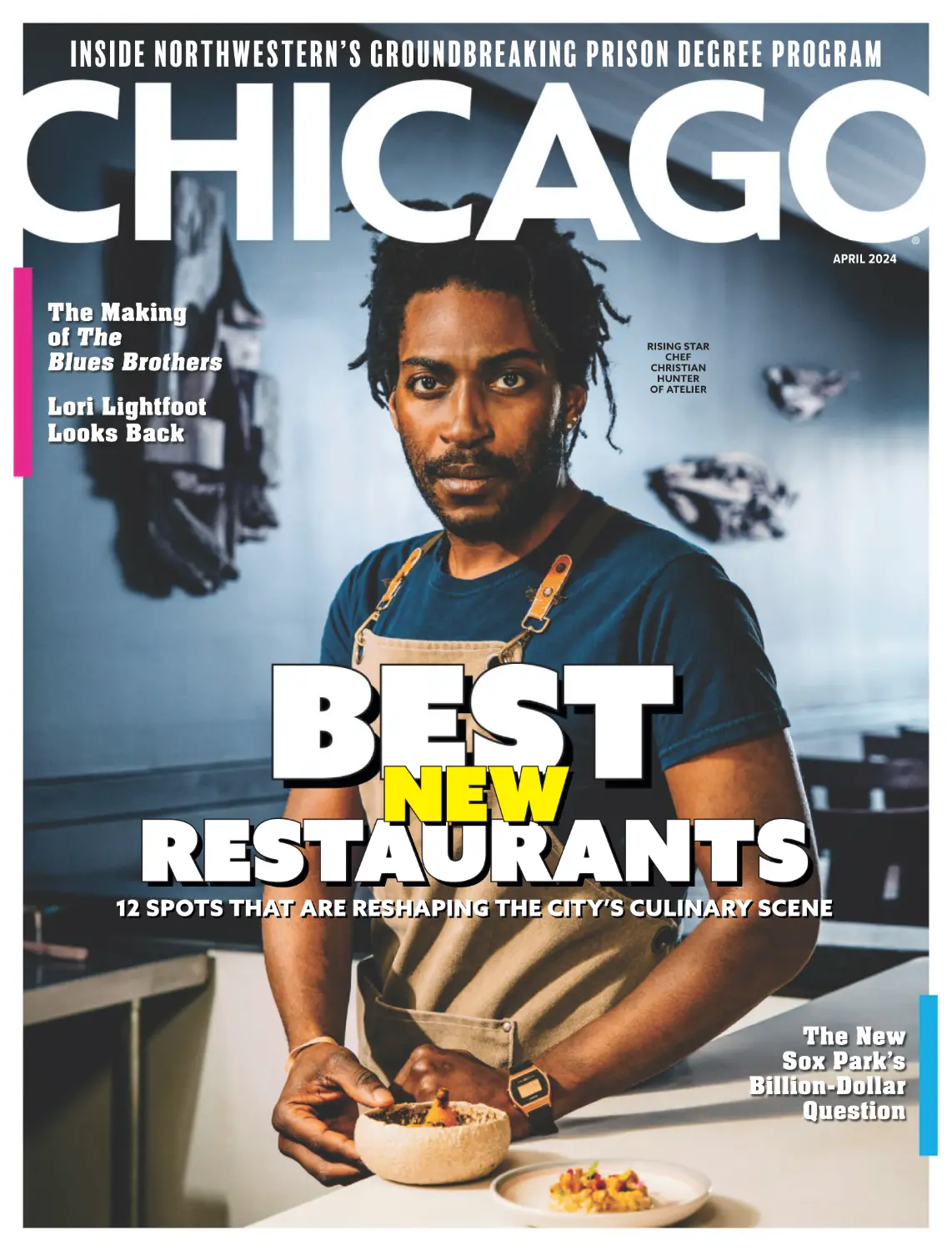
RISING STAR
CHEF
CHRISTIAN
HUNTER
OF ATELIER
Lori Lightfoot
Looks Back
NEW
restaurants
12 SPOTS THAT ARE RESHAPING THE CITY’S CULINARY SCENE
The New
Sox Park’s
Billion-Dollar
Question
“ O N C E I D R E A M E D T O B E CO M E T H E FA S T E S T D R I V E R .
T O DAY, I A M A D R I V E R O F C H A N G E .”
L E W I S H A M I LTO N , 7 TI M E FO R M U L A 1 T M WO R L D CH A M P I O N
IWC PERFORMANCE
CHRONOGRAPH.
P I L O T ’ S WAT C H P E R F O R M A N C E C H R O N O G R A P H
M E R C E D E S - A M G P E T R O N A S F O R M U L A O N E TM T E A M
7KH QHZ 3LORWpV :DWFK 3HUIRUPDQFH &KURQRJUDSK LV WKH PRVW SHUIRUPDQFHRULHQWHG ,:& FKURQRJUDSK
HYHU HQJLQHHUHG ,W FRPELQHV RXU H[SHULHQFH LQ FKURQRJUDSKV ZLWK RXU H[SHUWLVH LQ DGYDQFHG PDWHULDOV
7KLV YHUVLRQ ZLWK D &HUDWDQLXP FDVH DQ HODERUDWH EODFN ODFTXHUHG GLDO DQG DSSOLTXÆV ĺOOHG ZLWK
6XSHU/XPL1RYD LV GHGLFDWHG WR RXU ORQJVWDQGLQJ SDUWQHU WKH 0HUFHGHV$0* 3(7521$6 )RUPXOD
2QH70 7HDP 7KH FHUDPLF EH]HO ZLWK D WDFK\PHWHU VFDOH DGGV WKH GLPHQVLRQ RI VSHHG PDNLQJ WKLV UREXVW
DQG HDVLO\ OHJLEOH FKURQRJUDSK WKH SHUIHFW FRPSDQLRQ IRU WKRVH ZKR DUH GUDZQ WR WKH IDVW ODQH
I WC S C H A F F H AU S E N . E N G I N E E R I N G B E YO N D T I M E .
SCAN TO BOOK AN
APPOINTMENT
IWC B O U TI Q U E · 120 E . OA K S TR E E T · CH I C AG O · 312 366 3580
Woodwright Brewing Company, Dunedin, FL
Fresh and Local
Situated on the Gulf of Mexico, St. Pete/Clearwater has
access to an abundant array of seafood. Caught fresh daily
and year round, local restaurants proudly feature fresh
fish, shrimp, and other local delicacies on their menus.
Or you can catch your own dinner. Misty Wells, local
business owner, explains, “A lot of our restaurants are
hook and cook. You can go out on a charter or on your
own boat, catch fish and they’ll do the cooking for you.”
Beaches and Breweries
A Destination for World-Class
Dining and Drinks
Affectionately dubbed the “Gulp Coast,” the communities of
The communities of St. Pete/Clearwater have been named
Craft Beer Trail. The diverse brewery scene offers something
among the top 25 beaches in the U.S. by Tripadvisor, but
for everyone including family-friendly breweries and
beautiful beaches are only the beginning. St. Pete/Clearwater
award-winning establishments like Webb’s City Cellar,
offers a vibrant culinary scene with year-round outdoor
named a James Beard semi-finalist in the
dining and waterfront restaurants, casual beachside
“Outstanding Bar” category.
St. Pete/Clearwater boast over 40 local breweries on their
eateries, gourmet fare and a booming brewery scene. Fresh
Gulf seafood, locally sourced ingredients and hometown
Welcomed by Locals
charm make this Florida Gulf Coast destination a unique
While there are so many different dining options, they all
epicurean experience.
have one common thread—local hospitality.
“
YOUR NEXT
CULINARY
ADVENTURE
”
Many establishments are owned and operated by people
who have been part of this community for decades. Ken
Hamilton, president of Palm Pavilion, and his family have
owned their eatery on Clearwater Beach for over 50 years.
What started as a beach pavilion in the 1920’s has grown
into a local landmark. Featuring an extensive food and
bar menu, outdoor seating and live music, Palm Pavilion
offers beachfront dining with a truly local feel. “When
you’re sitting at our restaurant on the beach and watching
the sunset on the Gulf of Mexico it’s pretty spectacular,”
Hamilton says. Ken and his family have seen visitors come
back year after year and now generation after generation
because of the warm welcome they receive. “We are
committed to this community, and it’s been a lot of fun.”
Let’s Shine—plan your next culinary adventure
at VisitStPeteClearwater.com
Palm Pavilion Beachside Grill & Bar
Experience Transcendent
Enter a world of exquisite comfort and ease connected to the iconic 5-star St. Regis Chicago hotel.
The Residences at The St. Regis Chicago will captivate you with awe inspiring views, exceptional
finishes, and bespoke amenities. Live high above it all, right in the middle of it all.
To schedule your personal tour, please contact Leila Zammatta with the Magellan Marketing Group at +1 312 847 4581.
Ultra-luxurious lakefront residences, from 1,097 SF pieds-à-terre to full floor, 6,800 SF, 360°-view penthouses.
One-to-five-bedroom homes from $840,000 to $18,500,000.
363 E. Wacker Drive, Chicago, IL 60601 | srresidenceschicago.com
The St. Regis logos are the trademarks of Marriott International, Inc ., or its affiliates. The Residences at The St. Regis Chicago are not owned, developed or sold by Marriott
International, Inc. or its affiliates(“Marriott”). The developer of the residential project, Parcel C LLC,Dev License #2418452, uses the St. Regis marks under a license from
Marriott,which has not confirmed the accuracy of any of the statements or representations made about the project. If this license is terminated or expires without renewal,
the residential project will no longer be associated with, or have any right to use, the St. Regis tradenames or trademarks. Sales by Magellan Marketing Group.
F E AT U R E S
Volume 73 Q Number 4
64
Welcome to
Northwestern
University at
Stateville
A groundbreaking program
offers inmates the chance to
earn a degree from a top school.
Some will never leave these
walls. Here’s why it still matters.
By Bryan Smith
50
BEST NEW RESTAURANTS
Centered more on great ingredients than on chef egos, these
12 newcomers add up to one
fantastic year for dining.
By John Kessler
76
A MISSION FROM GOD
Stateville inmate and
recent Northwestern
graduate William Peeples
Photograph by ALEX GARCIA
Car chases in the Loop! Hate
rallies in Jackson Park! John
Belushi in the mayor’s office!
This exclusive excerpt from a
new book details how Chicago
became the inextricable backdrop to The Blues Brothers.
By Daniel de Visé
A P R I L 2 0 24 | C H I C AG O
7
page 38
19
THE 312
The billion-dollar question with
the Sox stadium proposal …
What makes art memorable? …
Richard Wright’s theatrical
dreams … A Montgomery Ward
heir’s mansion … Four places to
go in Beverly … How an actor
manages his type 1 diabetes.
31
GO
A new Art Institute show aims to
contextualize the feminine forms
of the late Christina Ramberg …
10 things to do this month.
35
TABLE
Four brunch spots to try …
Bisous is your new West Loop
predinner spot … The best shawarma in town … How to make
Jaleo’s tortilla española.
43
HABITAT
A dream home in Naperville …
End tables that double as art …
How to turn your backyard into
a drinking and dining oasis.
87
FOUND
A contemporary take on the oldfashioned general store … Prep
for prom season at Frankie’s
on the Park … An eclectic shop
worth the trip to Morris.
page 31
IN EVERY ISSUE
QFrom the Editor, 12
QInside Peek, 14
page 46
QCity of Big Questions, 15
QTalk to Us, 16
QBackroom: Lori Lightfoot, 100
ON THE COVER PHOTOGRAPH BY CLAYTON HAUCK
8
C H I C AG O | A P R I L 2 0 24
PHOTOGRAPHY: (BAR) JACLYN RIVAS; (PAINTING) © THE ESTATE OF CHRISTINA RAMBERG. STEWART CLEMENTS PHOTOGRAPHY; (TABLE) MOSS & LAM
D E PA R T M E N T S
A TRIBUNE PUBLICATION
EDITORIAL
EDITOR IN CHIEF
Terrance Noland
DESIGN DIRECTOR
David Syrek
DEPUTY EDITOR
Stanley Kay
DINING EDITOR
Amy Cavanaugh
PHOTO DIRECTOR
Michael Zajakowski
ART DIRECTOR
Elizabeth Carlisle
CONTRIBUTING EDITORS
A LIFE WELL LIVED.
A LIFE WELL EARNED.
Since 1998, Belmont Village has safely delivered an unparalleled
senior living experience for thousands of families. Collaborations
with experts from the nation’s top healthcare institutions
and universities, including Northwestern, have established
our national leadership in demonstrably effective cognitive
health and wellness programs. Combining the highest levels of
hospitality and care, our communities make life worth living.
Kelly Aiglon (Found)
Edward Robert McClelland (The 312)
Kris Vire (Go)
CONTRIBUTING WRITERS
Mark Bazer, Web Behrens,
Ximena N. Beltran Quan Kiu, Lolly Bowean,
Kim Brooks, Mark Caro, Thomas Connors,
Nina Kokotas Hahn, Cate Huguelet, Corli Jay,
John Kessler (dining critic), Rebecca Makkai,
Jake Malooley, Heidi Mitchell, Grace Perry,
Peter Sagal, Mike Thomas
CONTRIBUTING COPY EDITORS
Robert Loerzel, Amy Schroeder
RESEARCH ASSISTANTS
Isabella Kistler, Taj Smith
CONTRIBUTING ART DIRECTOR
Britney Trezzo
CONTRIBUTING PHOTOGRAPHERS
Jeff Marini, Lisa Predko
CONTRIBUTING ILLUSTRATORS
QuickHoney, John Kenzie
CONTRIBUTING DIGITAL IMAGING SPECIALIST
Andrew Davis
Learn more at BelmontVillage.com/Chicago
CONTRIBUTING DIGITAL EDITOR
Sarah Steimer
DIGITAL PRODUCERS
Mike Lietz, Lynette Smith
PRODUCTION SPECIALIST
Julie O’Brien
Member, American Society of Magazine Editors
ASME works to preserve editorial independence
and speaks out on public policy issues, particularly those
pertaining to the First Amendment.
©2024 Belmont Village, L.P. | SC 0052068, 0052076, 0052084, 6016935, AL 5104242
10
C H I C AG O | A P R I L 2 0 24
Chicago (Vol. 73, No. 4, APRIL 2024; ISSN 0362-4595) is published monthly by Chicago magazine, 560 W. Grand Ave., Chicago, IL, a wholly owned subsidiary of Tribune Publishing
Company. Periodicals postage paid at Chicago, IL, and additional
mailing offices. Subscriptions: $19.90/one year, $28/two years,
$36/three years. Single copy $6.99. Chicago assumes no responsibility for the return of unsolicited materials. For information regarding subscription purchases, renewals, or changes of address, call
800-999-0879 or visit chicagomag.com/subscriptions. © 2023 by
Chicago magazine. All rights reserved under International and Pan
American Copyright Conventions. Reproduction in whole or in part
without prior written permission is strictly prohibited. For article
reprints and permissions, call Wright’s Reprints, 877-652-5295.
Chicago is available in digital form through Zinio. The names Chicago
and Chicago Guide are trademarks of Chicago magazine.
Postmaster: Send address changes to Chicago magazine,
PO Box 37016, Boone, IA 50037-0016. Printed in USA.
ADVERTISING
ADVERTISING DIRECTOR
Megan Holbrook
NATIONAL SALES MANAGER
Sandra Gonzalez
SENIOR ACCOUNT MANAGERS
Patti Augustyn
Valeria Coric
Jacqueline Simon
REGIONAL SALES REPRESENTATIVES
Hawaii
Account Manager
DEBBIE ANDERSON
808-739-2200
debbieanderson@dmhawaii.com
Michigan
Regional Manager
JAN HESS-WAHL
248-505-0796
jhesswahl@comcast.net
Raising awareness of the global refugee
crisis through art — with contributions from
2,300 stitchers on six continents, 37 nations
and all 50 states, amassing 25 million
hand-sewn stitches.
Southeast U.S.
Experience a collection that embodies the enormity
of the world’s human displacement crisis and creates an
intimate understanding of the sacrifices and stories of
refugees through expressions of solidarity, community,
and hope. Curated and organized by Jennifer Kim Sohn.
Account Director
WHITNEY FORD DICK
954-493-7311
whitney.ford@gmail.com
WMQFA wishes to thank our supporters:
Northeast U.S. and Mid-Atlantic
National Account Director
CYNTHIA DONAHER
917-679-5506
cynthia@donahermedia.com
Western U.S.
SHANA WONG SOLARES
808-386-0872
shanawong@me.com
AUDIENCE DEVELOPMENT
SENIOR CONSUMER MARKETING MANAGER
Tanya Terry-Cobbin
AUDIENCE DEVELOPMENT SPECIALIST
Margaret Andras
Kohler Foundation
Horicon Bank
Ellie De Lia
Port Washington
State Bank
Jack & Judy Hearst
Associated Bank
Nina & Rich Edelman
CORPORATE
GENERAL MANAGER
Par Ridder
FINANCE
N50 W5050 Portland Rd
Cedarburg, Wisconsin
SENIOR DIRECTOR
Michele De Venuto
MANAGER
Wed-Sat: 10am-4pm | Sun: noon-4pm
Mon-Tues: by appointment
Gina Mata
SENIOR ANALYST
Laurie Anderson
CHICAGO MAGAZINE OFFICES
560 W. Grand Ave.
Chicago, IL 60654
Get more exhibit information.
wiquiltmuseum.com | 262-546-0300
A P R I L 2 0 24 | C H I C AG O
11
FROM TH E EDITOR
End of the Ego Era
John Kessler
OR CHICAGO DINING CRITIC JOHN KESSLER, WHO ASSEMBLED
Experience the sights, sounds and
complete joy that a visit to Kentucky
provides. Discover equine museums
and meet a champion on a horse
farm tour. Explore meandering
rivers and majestic trails that invite
outdoor adventures. Join distillery
tours and tastings that let you sip
bourbon at its source, then enjoy
James Beard-honored restaurants
and cozy diners, local shopping and
live music.
12
C H I C AG O | A P R I L 2 0 24
F
Terrance Noland
Editor in Chief
PHOTOGRAPHY: (NOLAND) MICHAEL ZAJAKOWSKI; (KESSLER) MIHOKO OBUNAI
THE MAKINGS OF
this year’s “Best New Restaurants” rankings (page 50), the latest
crop of newcomers is the strongest in recent memory — certainly
since the pandemic. And maybe because of the pandemic. “There’s
a new frugality that I feel has helped with people’s creativity,” Kessler says. “A
lot of these places offer stripped-down menus. They’re not trying to do everything. They have like 10 items, but make them really well. They’re cooking the
food they want to cook.”
With that shift has come a certain humility, a marked change from the
days of outsize kitchen personalities. “Particularly in Chicago, we’ve lionized
big-name chefs, starting with Jean Banchet, Jean Joho, Charlie Trotter, Grant
Achatz, Rick Bayless — the chef-as-auteur kind of model,” says Kessler. It’s different with the new wave of elite chefs here. “They are not auteurs. They are
craftsmen. They’re not about the ego so much. They’re letting the food speak
for itself. Maybe that’s why it’s so good.”
What does Kessler use as his benchmark in deciding which restaurants
make the list? “It’s a basic one: Do I want to go back there again and again?”
He was particularly taken with his top three picks: Warlord, Atelier, and John’s
Food & Wine. “Those are the ones where I tried things I’d never tried before
and was kind of blown away.”
0/-: */ ,&/56$,: %0 #063#0/ 5"45*/(4
'&"563& '063ų-&((&% (6&454 0' )0/03
'SPN VOJRVF CPVSCPO FYQFSJFODFT UP FYQFSJNFOUBM TQJSJUT ,FOUVDLZ CSJOHT
B EJTUJODU ŤBWPS BOE ţOJTI 1MBO ZPVS #MVFHSBTT HFUBXBZ BU LFOUVDLZUPVSJTNDPN
$POMFZ #PUUPN 3FTPSU .POUJDFMMP
INSIDE PEEK
Alex Garcia photographing a student inmate
Life Behind Bars
5ISPVHIPVU PVS ZFBS IJTUPSZ XF IBWF QSPVEMZ
JOUSPEVDFE UIF NPTU VOJRVF BOE FYDJUJOH TIPFT UP
$IJDBHP 5IF LJOE PG TIPFT UIBU NBLF QFPQMF TUPQ BOE
BTL ǶXIFSF EJE ZPV HFU UIPTF Ƿ
%JTDPWFS PVS IBOEDSBGUFE CSBOET
5IJFSSZ 3BCPUJO BOE 3PCFSU ;VS BOE PVS UIPVHIUGVMMZ
DVSBUFE DPMMFDUJPOT UPEBZ BU )BOJHǷT 'PPUXFBS
%FTJHOFE UP BEE EFMJHIU UP FWFSZ QBSU PG ZPVS MJGF
_ÒõÀĈ ďõ EõğÀ ~õĔǾˈ
B3A31;-D59f
ƧƟ i UV
+
14
ÊÇ B ÉÇ+ c $Ê M^OO
ƐƏƍ FǾ EÕ¶ÒǪ̃î ğÀǾ ȴ ÒÕ¶¨Ìõ ȇ ƋƉƊȇƏƐƏȇƎƐƈƈ
ƉƉƐƉ xÕçíÀďďÀ ğÀǾ ȴ xÕçíÀďďÀ ȇ ƐƌƏȇƊƍƎȇƋƍƌƍ
C H I C AG O | A P R I L 2 0 24
Ò¨îÕÌĈǾ¶õí
Chicago is rarely straightforward,
but shooting inside Stateville
Correctional Center for this month’s
feature on the Northwestern Prison
Education Program (page 64) was
especially complex. “You have to
make an inventory of everything
you’re bringing in,” says Alex Garcia,
the photographer who handled the
assignment. He also had to abide
by strict rules about what could be
photographed. He was forbidden from
shooting security cameras, locks, or
fencing, for example — anything that
could compromise the prison’s security. “There were a lot of great pictures
I wanted to take along the way, and
I was basically told no. They have to
make sure they avoid anyone planning their next escape.” — BELLA KISTLER
BELLOW
AND BLUES
New Jersey
artist Joe
Ciardiello has
never been to Chicago,
but he’s drawing it a lot these days.
As he worked on his illustration for our
book excerpt on the making of The Blues
Brothers (page 76), the U.S. Postal Service
released a stamp he designed honoring
Chicago writer Saul Bellow. “They wanted
a sense of Chicago without being too
specific,” Ciardiello says. “It seemed like
including the L made the most sense.” He
chose another Loop backdrop for our story: Daley Plaza, featuring, naturally, a car
crash from the movie. — B.K.
PHOTOGRAPHY: (GARCIA) MICHAEL ZAJAKOWSKI; (ILLUSTRATION) JOE CIARDIELLO
PHOTOGRAPHING A STORY FOR
Q:
ILLUSTRATION: GREG CLARKE
Why isn’t Mount
Greenwood Cemetery
part of Chicago?
Look at a map of
the Far Southwest
Side, where the
neighborhoods of
Beverly, Morgan
Park, and Mount
CITY OF
BIG QUESTIONS G r e e n w o o d
meet, and you’ll
ANSWERED BY
EDWARD ROBERT
see a rectanMCCLELLAND
gular-shaped
hole. It’s Mount
Greenwood Cemetery, a 79-acre
graveyard that was never annexed
to the City of Chicago and remains
part of unincorporated Cook County.
The cemetery was established in
1879, when Chicago’s boundaries
extended only as far south as 39th
Street (now Pershing Road). When the
Village of Mount Greenwood voted
for annexation to the city in 1927,
the cemetery didn’t come with it. “If
you incorporate, you’re going to pay
taxes for schools, parks,” explains
Carol Flynn of the Ridge Historical
Society in Beverly. “Those are amenities a cemetery’s ‘residents’ are not
going to take advantage of.”
Even though the cemetery is not
technically in the city, it still receives
Chicago water and Chicago fire protection and has a 773 area code and
a 606 ZIP code. But it relies on Cook
County for policing. “I have a lot of
underage drinking, kids causing
trouble,” says Paula Everett, president and co-owner of the cemetery.
“I call the district, they’ll say, ‘You’ve
got to call the sheriff.’ ”
Send your questions about the Chicago
area to emcclelland@chicagomag.com.
$35,/ $7
6<03+21< &(17(5
The Music of Bach
MAR 28-APR 2
Klaus Mäkelä & Yuja Wang
APR 4-6
Klaus Mäkelä
Once Upon a Symphony:
Goldilocks and the Three Bears
APR 6 & APR 20
Mendelssohn Elijah
APR 11-13
Yefim Bronfman
APR 14
Yuja Wang
Chopin & Tchaikovsky
APR 18-21
Gateways Festival Orchestra
featuring Take 6
Wynton Marsalis
APR 19
Jazz at Lincoln Center Orchestra
with Wynton Marsalis
APR 24
CSO x Jazz at Lincoln Center Orchestra
with Wynton Marsalis
APR 25-27
BRSO Symphonieorchester
des Bayerischen Rundfunks
CHOOSE ANY
3 OR MORE
CONCERTS AND
SAVE 15%
APR 28
&6225* _
6<03+21< &(17(5 _ 6 0,&+,*$1 $9(
Official Airline of the CSO
Youth Education
Program Sponsor
Apr. 4-6 concerts
sponsored by
Apr. 25-27 concerts
sponsored by
Zell Family Foundation
These programs are partially supported by a
grant from the Illinois Arts Council Agency.
Media Partners
A P R I L 2 0 24 | C H I C AG O
15
TA L K T O U S
Fascinating
article by
Max Blaisdell.
@pstanpolitics
via X
Smooth Sips
The Sportsman and the Forest Fire are both good [“Fancy a
Drink?,” February]. I will always champion the Duck a L’Orange
Old-Fashioned at Community Tavern. @YinkaDoubleDare via X
PRISONER OF IRAN
Riveting story with a glimpse of
an oppressive regime and a daring plan of escape [“The Islamic
Republic of Iran vs. Abbas
Alizadeh,” February]. Stellar
illustrations by Jan Feindt!
@odouglasj via X
DURBIN’S DERBY
[Dick] Durbin leaving would
basically hand Chicagoland
100 percent of political influence in the state [“The Next
Senator,” February].
@tencor_7144 via X
The 2026 Illinois Senate race
might be the California race
on steroids.
@Mass_Dem7 via X
Been saying for literally half a
decade that Congresswoman
16
C H I C AG O | A P R I L 2 0 24
Lauren Underwood will succeed Durbin. Mark it down.
@MatHelman via X
COVID LESSONS
When I think about who
are the sociologists I would
nominate to convey the value
of the field to skeptics, Eric
Klinenberg is absolutely
one of them [“Year of Fear,”
February]. I wish we could get
the Florida legislature to read
his Palaces for the People.
@vanishingcorp via X
CROWNING ROLE
Congratulations to Katy
Sullivan [“Royal Treatment,”
February], who is the first
female actress with a disability to perform Richard III
on a major stage, at Chicago
Shakespeare Theater.
@Rachel_Arfa via X
My god, I am obsessed with
this photo shoot.
@AshleyAnnWolfe via X
WHERE TO FIND US
Email us at letters@
chicagomag.com.
Chicago may
edit letters for
conciseness,
clarity, and
accuracy.
QOur email
newsletters alert
you to the latest
in dining, culture,
shopping, real
estate, current
events, and
more. Sign up at
chicagomag.com/
newsletters.
PHOTOGRAPH: MICHAEL ZAJAKOWSKI
Nothing from Meadowlark or
the Alderman?
@temporary_password
via Instagram
THE 312
Eclipse
Talking
Points
PHOTOGRAPHY: (REINSDORF) SCOTT OLSON/GETTY IMAGES; (BALLPARK) RELATED MIDWEST; (PRITZKER) JIM VONDRUSKA/GETTY IMAGES
This month’s
conversation
starters
1 Former House
speaker Michael
Madigan’s racketeering trial starts
April 1. The last boss
faces 22 counts,
including extortion.
The convictions of
the “ComEd Four”
for conspiring to
bribe him bodes ill.
2 For 2017’s total
solar eclipse, sunhead Chicagoans
road-tripped to
Carbondale for
prime viewing. That
will again be the
case April 8, when
Southern Illinois
University hosts a
watch festival.
3 The blues. Jet
magazine. Soul
Train. Oprah. In We
Are the Culture:
Black Chicago’s
Influence on
Everything, out April
16, Arionne Nettles
explores how local
Black culture has
shaped all culture.
4 The Chicago
Palestine Film
Festival opens April
20 at the Gene
Siskel Film Center.
Political? You bet.
Example: The Law
and the Prophets is
an exposé on the
ways “Israel exploits
and oppresses
Palestinians.”
Expect backlash.
Photo illustration by NADIA RADIC
Stealing Home
Despite all the hoopla, the White Sox’s proposed move from
Guaranteed Rate Field to the 78 is anything but guaranteed.
By ROBERT REED
EXT TO GATE 4 OF GUARANTEED RATE FIELD, HOME OF THE WHITE SOX, IS A BRONZE
bust of the late governor James R. “Big Jim” Thompson. It’s an homage to the wily
politician who in 1988 forged a government-backed financing deal — over significant
political opposition — to bankroll construction of that stadium and stop the franchise
from bolting to Florida. “He kept the White Sox in Chicago,” reads the bust’s inscription.
These days, the White Sox may want to stay in Chicago but not necessarily in their 33-yearold publicly supported stadium, where a team-friendly lease — another byproduct of Thompson’s
dealmaking — expires in five years. As we know, the Sox are talking about building a state-ofthe-art baseball palace in the 78, a nascent development in the South Loop that backers say will
turn a mostly barren 62-acre site into a residential, entertainment, and commercial district.
The excitement for a new stadium seems to grow daily. But before the project can move forward,
N
A P R I L 2 0 24 | C H I C AG O
19
THE 312
Sox owner Jerry Reinsdorf and Related Road and the South Branch of the Chicago
Midwest, the 78’s developer, will have River. Related Midwest recently issued
to address mounting questions and con- glossy renderings of a gleaming, high-tech
cerns raised by Governor J.B. Pritzker, stadium set against the Chicago skyMayor Brandon Johnson, activists, and line and amid a bustling neighborhood.
community groups.
Those images amped up many Sox fans on
Chief among them: How many, if any, social media and sports radio and elicited
public dollars and cost breaks should be encouraging comments from the mayor,
poured into a new stadium? Reinsdorf who says he’s open to discussing the move
told Crain’s Chicago Business that he’s but needs to know more. Major League
seeking $1.1 billion in public subsidies Baseball commissioner Rob Manfred has
for the ballpark itself, plus up to $900 endorsed the relocation, telling Crain’s it
million in related infrastructure work. would be a “game-changer.”
“Are we talking about more taxpayer
Related Midwest says the stadium and
investment? And are we going to risk surrounding development would consticreating a white elephant that just sits in tute a $9 billion investment and create $4
Bridgeport?” asks Marj Halperin of One billion annually in economic impact while
Community Near South,
producing thousands
a recently formed coaliof jobs. But funding it
tion of neighborhoods
would mean more ISFA
asserting that residents
bonds, as well as a spe“They can talk
must play a par t in
cial state taxing district
about
jobs,
any public-private ballfor the 78 to support
economic impact, t hose bonds. “ T hey
park negotiations.
W hile ever yone
or whatever, but can talk about jobs,
knew the Bears were
economic impact, or
they can’t make whatever, but they can’t
stadium shopping, the
Sox’s announcement
make it pay if they use
it pay if they
came as a surprise.
only their own money,”
use
only
their
De s pite t he te a m’s
say s spor t s econo middling record on the
mist and University of
own money.”
field of late, its value
Chicago professor Allen
— Allen Sanderson,
has climbed since a
Sanderson, who is critiUniversity of Chicago professor
Reinsdor f-led g roup
cal of taxpayer funding
bought the Sox in 1981
of spor t s st ad iu ms
for $19 million. The Sox
because, he contends,
are now worth an estimated $2 billion, they often don’t deliver the economic
a valuation based in part on a lease that benefits promised.
limits the amount they owe the Illinois
Pritzker, too, has repeatedly said he
Sports Facilities Authority, a city-state doesn’t support state financing of public
entity that owns Guaranteed Rate. For the businesses. In the case of the Sox park, “I
first 10 years, the Sox paid no annual rent start out really reluctant,” he told reportif attendance fell below 1.2 million, which ers. “And unless a case is made that the
it usually did. Under the current terms, long-term investment yields a long-term
the team forks out $1.5 million annually return for the taxpayers that we can jusbut controls revenue from ticket sales, tify in some way — I haven’t seen that yet.”
concessions, parking, and merchandise.
Yet he has not completely slammed
The city and state each contribute $5 mil- the door on some public backing. That
lion annually to Guaranteed Rate — money could mean kicking in for sewers, roads,
that’s generated by a tax on hotel rooms. and other infrastructure. But just how far
With this sweet lease winding down, are state lawmakers willing to go? “We
Reinsdorf is casting a wandering eye should not look to the original White Sox
toward the 78, located along Roosevelt deal as a blueprint for what to do now,
20
C H I C AG O | A P R I L 2 0 24
but as a guidepost for what we should
be doing better,” says state representative Kam Buckner, whose 26th District
includes Soldier Field and Bronzeville.
Tapping the ISFA again isn’t a certainty.
After bankrolling the Sox and Bears, that
agency has around $100 million in financing capability — far from what Reinsdorf
says he needs. Lawmakers would have to
approve boosting the ISFA’s bonding capabilities and the special tax district, which
could face resistance from suburban and
downstate pols, who couldn’t care less
about a new Sox park.
For community activists, there’s
another looming concern: the fate of
Guaranteed Rate Field and the surrounding neighborhood. Alderperson
Nicole Lee, whose 11th Ward would feel
the brunt of a Sox departure, has cobbled
together a “working group” of residents
and business owners to make a case to
the team to stay put in its current park.
“It’s in great condition,” Lee says. “It’s not
a new tax burden, it’s not a TIF handout.”
Some South Side groups fret that a
new stadium deal will be pushed through
Springfield without meaningful economic development plans for the area left
behind. They want financing and other
incentives for opening or expanding businesses, restaurants, and other ventures.
“There has to be a broader conversation with the community,” says Bruce
Montgomery, cofounder of the Urban
Innovation Center, a locally focused
economic development think tank on the
Illinois Institute of Technology campus,
just east of Guaranteed Rate.
Then there’s the matter of how the
Chicago Bears, who are actively hunting
for a new home, factor into lawmakers’
discussions of public subsidies. “All roads
lead to Springfield,” says Buckner. “And
the Bears and White Sox are two wheels
that spin on the same axle.” Buckner is
open to supporting a Sox move but also
favors a “public-private” partnership to
build a new Bears stadium on the lakefront, south of Soldier Field.
Yes, Big Jim Thompson is gone. But
the wheeling and dealing over professional sports stadiums lives on. C
®
b db bb
Buckle up for $800,000 in cash and prizes—including
four 2024 Toyota GR86s and a 2024 Toyota Supra!
Play with your Fire Keeper’s Club® card to earn entries—
five times the entries on weekly drawing days and when
the Milwaukee Brewers™ play at home.
SCAN FOR INFO
1721 WEST CANAL STREET | MILWAUKEE, WI 53233 | WINNERS RESPONSIBLE FOR ALL TAXES | 1-800-PAYSBIG | GAMBLING PROBLEM?
CALL 1-800-426-2535 | MANAGEMENT RESERVES ALL RIGHTS | ©2024 FOREST COUNTY POTAWATOMI COMMUNITY, MILWAUKEE WISCONSIN
THE 312
HY DO SOME THINGS
stick in our memory,
while others are completely forgettable?
That question is at the heart of
research being conducted by the
University of Chicago’s Brain
Bridge Lab, led by assistant professor Wilma Bainbridge. To
answer it, the lab is focusing on
art. It has built a machine-learning model called ResMem, which
mimics the way we process visual
information and can analyze the
features of an artwork to predict
whether it will be memorable.
In its latest effort, the lab is
hosting a contest, in which both
amateur and professional artists
can submit original pieces. Those
works predicted to be most memorable, as well as those thought to be
most forgettable, will be displayed
April 27 to May 25 at Connect
Gallery in Hyde Park and put to the
test in surveys of attendees.
Not only does the lab’s research
represent an inflection point for
artists (Is “memorable” art the
only art worth making?), it also
has implications in clinical and
educational settings.
W
Q: Isn’t memorable art subjective?
VOX
Forget
Me Not
The University of Chicago’s
Wilma Bainbridge is getting
to the bottom of what makes
certain artwork memorable.
Interview by KELLEY ENGELBRECHT
22
C H I C AG O | A P R I L 2 0 24
Aren’t we drawn to different pieces?
A: We think we have our unique
experiences, but people actually
are surprisingly similar in what
they remember and forget. Think
of the things that determine our
memory as a pie. Different slices
are your mood at the time, what
you’ve seen before, how much
you are paying attention, how noisy it is. All these things impact what we
remember. We’ve found that the image itself is like half of that pie. Until
now, we’ve only seen this using experiments in a lab on a computer screen
or using AI models. But research is most exciting when it can apply to the
real world. So we thought, When do people see images? When do they want
to remember the images that they’re seeing? And that’s when we thought,
Oh right, on a visit to an art museum.
Q: How important is it to understand what art is memorable?
A: You can imagine there’s many different motivations behind an art piece: to
deliver some emotion or convey an important message. Or even sometimes
Photograph by LENNY GILMORE
Discover the
ARTIST IN YOU
in Hamilton County, Indiana.
CARMEL FISHERS NOBLESVILLE WESTFIELD NORTHERN TOWNS
Discover the artist, the foodie and the adventurer
in you and you’ll be certain to discover the kid
in you too. Discover all of you. All in one place.
Plan your getaway today!
VisitHamiltonCounty.com
JUST NORTH
OF INDY
just to be beautiful. But I think that
for a majority of artists, one of the
underlying goals is for their art to be
remembered — that beauty or that message or that emotion. Because even if
you leave an impression, if it doesn’t
last, then it’s sort of like, What’s the
point? We all have intuitions about
what is memorable, but we found that
people’s intuitions correlate very little
with what’s actually memorable.
Q: So then how do you determine what
makes certain art memorable?
A: Well, first, we ran an online experiment and found that people tended to
remember and forget the same pieces
of art. So then we ran a study in person where we had participants go to
the Art Institute and do pretty much
a freeform visit. We just told them to
explore the American art wing, which
has like 160-ish pieces. The only thing
we asked was that they see every piece at
least once. After they stepped out of the
exhibit, we had them complete a memory test. What we found is that we could
predict what they remembered based on
just the pixels in the images. Brightness
and color were not related to memorability. Neither were beauty and emotion.
Interestingness was a little related.
Q: How do you assess interestingness?
A: We had a separate group of people
online tell us how interesting they
thought each piece was, so there was an
average interestingness measure. We
also found size matters. Larger pieces
were easier to remember. But then
there’s this other memorability aspect
that our neural network [ResMem]
picked up on, and we’re finding it’s a
pretty complex thing: how efficiently
HIGHLY MEMORABLE
“Perhaps the clear depiction of
a singular central figure makes
them easier to process,” says
Wilma Bainbridge. “Also, faces
are incredibly memorable.”
Jacopo da Empoli’s
Portrait of a Noblewoman
Dressed in Mourning
De Scott
Evans’s
The Irish
Question
90.3
90.3
MEMORABLE VS. FORGETTABLE
These four paintings from the Art Institute’s collection scored on the extremes
of the Brain Bridge Lab’s memorability scale (represented here from 0 to 100).
HIGHLY FORGETTABLE
“They’re sort of fuzzy, with no
central eye-catching object. That
might make them harder to process and harder to remember.”
Joachim Patinir’s
Landscape With
the Penitent
Saint Jerome
24.4
24
C H I C AG O | A P R I L 2 0 24
Joshua Cristall’s
A Scene
Near Lodore,
Cumberland
26.8
our brains can process the image. So
something we can process well easily sticks in our memories because it
doesn’t use up tons of resources.
Q: Does that mean art that’s more abstract
might be more forgettable?
A: We haven’t tested it, but that’s my
guess. In general, we’re finding that
impressionism pieces are less memorable, and our guess is it’s because they’re
more fuzzy. Something that’s more
clear-cut, with few objects, centrally
focused, might be easier to remember.
One other surprising finding: Our neural network, even though it didn’t know
anything about art or history or culture,
could predict what pieces were famous
only by their memorability score. In the
Art Institute’s collection, for example,
Van Gogh’s Self-Portrait scored as incredibly memorable. It could be that if you
paint something that’s intrinsically
memorable, then that lasts in your memory but also in memory across culture.
People are more likely to talk about it.
Potentially, famous artists are picking
up on some of these subtle differences.
That’s one thing we’re interested in
looking at with the contest.
Q: What do your findings mean for artists?
A: It seems like the role of an artist has
changed a lot with the boom of social
media — like, maybe a lot of art is trying
to stick in your memory to get the likes.
And one interesting question is: Is this
a goal that we should have? Within art,
there’s color theory, or how you should
do shadowing and highlighting. Maybe
there could be memory theory: looking
at ways to boost or decrease the memorability of your piece.
Q: What are the implications beyond the
art world?
A: People on the early trajectory for
Alzheimer’s disease start to forget
some types of images that are memorable to the average person. So we’re
finding that those images where people
diverge serve as potentially good diagnostic tools. Because you can tell early
on that if someone does poorly for this
image, that means they’re likely to have
a cognitive impairment. C
PAINTINGS: COURTESY OF THE ART INSTITUTE OF CHICAGO
THE 312
THE 312
TH E B IG QUOTE
Richard Wright’s
Theatrical Dreams
The Chicago author found great success as a novelist but struggled
as a playwright. Here’s what we learned from a new book on his
dramatic pursuits. By EDWARD ROBERT MCCLELLAND
Wright
(middle) in
the movie
version of
Native Son
1 Chicago’s
thriving theater
scene inspired
him creatively.
When he moved
here from Memphis
in 1927, at the age
of 19, Wright worked
initially as a ditch
digger, waiter, and
letter sorter, not
earning enough
money to splurge on
show tickets. Once
he established
himself as a writer,
though, “Chicago
sharpened his
understanding of
formal theater and
introduced him to
an odd assortment
of playwrights, actors, and producers who would
influence his writing
for years to come,”
Bruce Allen Dick
writes in Thunder
on the Stage, out
March 26.
26
2 He abandoned
his first attempt
at playwriting. In
1935, Wright tried
to adapt his thenunpublished novel
Lawd Today!, hoping
the magazine New
Theatre would run
the script in an issue
devoted to Black
playwrights and
actors, but he completed only one act.
3 He was an ardent
communist. For
a 1939 pageant in
New York to memorialize Lenin, Wright
contributed a manuscript endorsing the
Soviet regime, titled
‘United, We Stand,
Divided We Fall,’ in
which an old man
and his grandson
walk across a map
of Russia while the
grandfather quotes
from a book by
C H I C AG O | A P R I L 2 0 24
Stalin. The pageant,
however, never
took place.
4 His ego helped
torpedo the
big-screen version
of Native Son.
Though the Orson
Welles–directed
theater adaptation of Wright’s
acclaimed novel got
a Broadway run, the
1951 film version
was a disaster, due
in part to Wright’s
shortcomings as
an actor. Wright
insisted on not only
cowriting the script
but also playing
20-year-old main
character Bigger
Thomas, even
though Wright was
in his early 40s.
Despite working
out and dieting to
try to melt away 20
years, he still wasn’t
credible in the role.
“Wright’s performance lacks flair
and rarely conveys
the tormented
Bigger that we see
in the novel and the
play,” Dick writes.
5 His final attempt
at staging a play
was a dud. In
1959, while living
in France, he tried
to mount a Parisian
production of Daddy
Goodness, a satirical
work, based on the
life of Father Divine,
about a Harlem
preacher who drives
a Cadillac and carries on affairs with
female parishioners.
Wright was unable
to find investors, and
his play never made
it past a staged
reading. He died of a
heart attack the next
year, aged 52.
Why
Lightfoot
Lost
A new book assesses
the recent mayor’s
tumultuous tenure.
QChicago Tribune
reporter Gregory
Royal Pratt is out with
the first — and probably only — book about
Mayor Lori Lightfoot’s
single term. The City Is
Up for Grabs (the title
comes from a text she
sent to an alderperson
during 2020’s George
Floyd riots) follows
Lightfoot from her years
as a federal prosecutor to her 2023 reelection loss. The morning
after that defeat, Pratt
received this damning
text from a longtime
Lightfoot aide, explaining the boss’s downfall:
“You can’t run
on a platform
and then completely abandon
it. You can’t
run against the
status quo, and
then fill your
administration
with the status
quo. And you
can’t be mean
to everyone
who tries to
help you.”
See page 100 for
Lightfoot’s own take
on her mayoral term.
PHOTOGRAPHY: (FILM) JAMES WELDON JOHNSON COLLECTION, BEINECKE RARE BOOK & MANUSCRIPT LIBRARY; (BOOK) UI PRESS; (LIGHTFOOT BOOK) CHICAGO REVIEW PRESS
FIVE THINGS
SUMMER 2024
BECOME A DONOR TO RECEIVE
ACCESS TO TICKETS AS SOON AS
GET TICKETS ONLY AT
RAVINIA.ORG
PUBLIC ON-SALE BEGINS APRIL 24
THE 312
THE REGIMEN
Acting prodigy,
dedicated weightlifter,
diabetes self-manager
By WEB BEHRENS
OR A NEW YORK CITY
resident, actor Jon
Michael Hill spends a
lot of days in Chicago.
Several times a year, the Waukegan
native checks in on two families:
his relatives in the suburbs and his
artistic kin at Steppenwolf Theatre,
where he became an ensemble
member at the startlingly young
age of 20. His roles there include a
lead in 2008’s Superior Donuts,
which moved to Broadway and
earned him a Tony nom. He currently stars in Steppenwolf’s world
premiere of Purpose, running until
April 28. On TV, he was a regular
on CBS’s Elementary, and he’s
appearing this spring in the Netflix
series A Man in Full. At 38, Hill
keeps active, although a type 1 diabetes diagnosis five years ago
meant lifestyle adjustments.
F
28
C H I C AG O | A P R I L 2 0 24
MUSHROOM MOTIVATION
“I’ve been making that mushroom coffee RYZE. I mix it with
instant coffee, which helps with
the flavor. The mushrooms do
specific things for the brain,
digestion, energy. I have been
able to focus and get work done,
get to the gym consistently, and
my sleep is better than it’s been
in a long time.”
SUGAR-CRASH STRATEGIES
“I have a good rhythm with cooking now, which helps me regulate my blood sugar. When I get
food from restaurants, it’s hard
to guesstimate how many carbs
are on that plate. But I’ve experienced a lot of crashes. They
don’t feel good. There’s both a
physical and a mental response.
I’ve been onstage a couple times
during a crash, and it’s pretty
scary. Fortunately, I haven’t lost
any lines yet because of it. Now
I try to make sure there’s orange
juice somewhere hidden on the
set, just in case.”
WORK OUT VS. WIPED OUT
“When I played football and
ran track in high school, fitness
was about constantly pushing
past your limits so you can be
stronger, faster, have more endurance. As I get older, it’s about
listening to the body. Sometimes
that means taking it slow. Mostly,
I want to be lifting weights, and
I try to run a mile every day. I’ve
had days when I absolutely felt
like I’m walking through mud
and can’t handle a workout but
went to the gym anyway and of
course felt better afterward. So
it’s a balance of knowing when
to push and when to listen.”
Photograph by LISA PREDKO
PHOTOGRAPHY: (COFFEE) RYZE SUPERFOODS; (CUP, MUSHROOMS) GETTY IMAGES
Jon
Michael
Hill
THE 312
LISTING OF THE MONTH
Merchant’s
Mansion
A Montgomery Ward heir’s Winnetka
home blends the historic and modern.
PHOTOGRAPHY: (HOUSE) REALVISION; (THOMPSON) TOM FOWLER
By CARISA CRAWFORD CHAPPELL
HARLES H. THORNE, AN
heir to the Montgomery
Ward fortune, took his
family’s company public in 1919, seven years af ter
building a 12,000-square-foot residence on the corner of Maple and
Pine Streets in Winnetka. This storied home, now on the market for
$4.4 million, recently underwent a
renovation down to the studs, but
it remains steeped in history.
Thorne’s father, George, and
Aaron Montgomery Ward, his uncle
by marriage, cofounded the former
retail giant. After they retired,
Thorne became its president, and
lived in a home fit for a royal executive. He hired prominent Chicago
architect Benjamin Marshall, who
also designed the nearby house
that was the setting for Home
Alone, as well as the Drake and
Blackstone Hotels.
Despite occupying the sevenbedroom home for only four years,
Thorne had all the era’s bells and
whistles, including a wood-paneled
vestibule and intricate woodwork
worthy of an English manor. The
current owners purchased the
house in 2014. They rebuilt the
exterior, repairing and replacing brickwork and limestone, and
installed windows with transoms.
The home blends original features,
like the staircase, with modern
ones: heated hardwood f loors, a
kitchen with a center island breakfast bar, and a butler’s pantry with
an antique mirrored backsplash.
The size of the four-floor home
becomes evident after taking in
the six fireplaces, two staircases,
two laundry rooms, three outdoor
terraces, and window-filled conservator y. Upper-level outdoor
spaces offer treetop views, including a 10 0 -yea r- old mag nolia.
Contemporary amenities such as a
heated driveway, smart home technology, and a Sonos sound system
would have left Thorne in awe. C
C
MY
NEIGHBORHOOD
BEVERLY
OPTIMO HATS FOUNDER
GRAHAM THOMPSON
RECOMMENDS FOUR
SPOTS IN HIS HOOD.
> TWO MILE
COFFEE BAR
“It was started by an architect friend of mine, and it’s
a nicely designed space.
I always order a cortado.
I’m a bit of a coffee snob,
and this place does it
right.” 1766 W. 95th St.;
9907 S. Walden Pkwy.
> BEVERLY
PHONO MART
“This record shop
opened a few years ago
and has an awesome
vibe. It’s run by a husband-and-wife team who
have great taste in music.
I’m into jazz and rare
blues and some eclectic things, and they’ll
special-order records for
me.” 1808 W. 103rd St.
> BEVERLY RECORDS
“It’s where you go for
something vintage. This
shop holds a special
place in my heart because
they connected me with
someone who sold me an
entire personal collection
of Chicago jazz on vinyl.”
11612 S. Western Ave.
> TOP NOTCH
BEEFBURGERS
“So many restaurants
now feel like concepts.
This is an old-school diner that never changes. It’s
a step back in time. I love
to treat myself to a burger
once in a while.” 2116
W. 95th St. — INTERVIEW
BY JUDY SUTTON TAYLOR
A P R I L 2 0 24 | C H I C AG O
29
j'Q \' =D\'Q QD
Meetsthe River Road
\y° y ˾y ÖË¢È ²¢° ¸¾ ¾ÖË ÖË¾Ù Ö ¾¸²ê Ȳy ¢¸ ·Ë¢y äË Ö
=¾ÖË Q¾y ¾ Q¾ÙÖ ĆĆ ·ÖÏ Ö "ËyÖ Q¢ãË Q¾yŇ =Ö y ¢y¸Ö È¢¸°
²Èy¸Öň ¢¸ yÖ ¢Ï־ˢ ˾yÏ¢ yÏň Öy° y äy²° Ö˾٠yÙ¸Ö ¾Ö²Ï
y¸ ·y¸Ï¢¾¸Ï y¸ ˲yé ä¢Ö y ²yÏÏ ¾ ²¾y²²ê ËyÖ ä¢¸ Ï¢ Ö =¢Öê
=¢ÏÏ¢ÏÏ¢ÈÈ¢ Q¢ãËŇ
p¾ÙË ¾¸Ř¾ŘyŘ°¢¸ ˾y ÖË¢È yã¸ÖÙË ¢¸Ï yÖ Q¢ãËÏy¸Q¾ÙÖÏŇ¾·Ň
PAINTING: PRIVATE COLLECTION, WELLESLEY, MASSACHUSETTS. © THE ESTATE OF CHRISTINA RAMBERG. PHOTOGRAPH BY CLEMENTS/HOWCROFT
GO
Probed Cinch,
1971
Bodies of Work
A new Art Institute show aims to contextualize
the feminine forms of the late Christina Ramberg.
By CHARLOTTE GODDU
A P R I L 2 0 24 | C H I C AG O
31
GO
N AMATEUR ARCHIVIST.”
That’s what curator Thea
Liberty Nichols calls the late
artist Christina Ramberg,
who will get a retrospective at the Art
Institute of Chicago starting April 20.
Ramberg was an artist and a teacher, but,
as Nichols learned from months sifting
through her ephemera — diaries, postcards, 35 mm slides, a doll collection — she
was also a kind of historian. The objects
that inspired Ramberg “didn’t exist in a
library, or in an art history book,” Nichols
explains. “She really needed to collect the
material for herself.”
A member of the Chicago Imagists
who came out of the School of the Art
Institute of Chicago in the late 1960s,
Ramberg is best known for her glossy
acrylic-on-Masonite paintings of women’s torsos cinched by lingerie or of
hands wrapped in thick strands of hair.
Though her career was cut short — she
died in 1995 at 49 from Pick’s disease, a
type of dementia — Ramberg was a prolific
and varied artist: painting and quilting,
teaching at SAIC, and roaming the city
to photograph asphalt siding and flower
beds made out of old tires.
In her mind, such everyday objects
“weren’t something that had to be raised
to art,” says artist Phil Hanson, whom
Ramberg married in 1968. To her, they
were already art. Other times, her inspiration came from traditional works. On
a trip to Italy, she couldn’t stop sketching
torsos of Christ that appeared in Sienese
paintings, an influence that fed into her
art, says Hanson. (Though the couple
split up in the ’80s, they remained close.)
Cocurated by Nichols and Mark
Pascale, who taught alongside Ramberg
at the SAIC, the exhibit marks the first
in three decades to be dedicated solely to
Ramberg. It’s long overdue. “There are a
lot of contemporary artists who borrow
heavily from her without admitting it,”
says Pascale. In some ways, Ramberg’s
work is even more relevant today. “She’s
playing around with what it is to be feminine, the standards or the expectations,
and kind of undermining it at the same
time,” Pascale says.
A
32
C H I C AG O | A P R I L 2 0 24
Hanson remembers Ramberg’s discomfort with viewers interpreting her
paintings as sexual just because they
depicted female forms, recalling her
displeasure at one conversation with a
partygoer who wanted to talk at length
about bondage. Looking at just the content of her paintings — bound female
bodies — misses much of what makes
Ramberg’s work powerful. “It’s about
that monumental form, the strength of
the form that she has that meets with this
imagery,” Hanson explains.
Employing Ramberg’s archives, the
exhibition showcases not just the art but
the person behind it. Though he’d been
close with Ramberg — he gave a eulogy
at her funeral — Pascale found himself
surprised by what he learned while preparing the retrospective. He left the task
of going through Ramberg’s diaries to
Nichols, because, he explains, “it was too
hard for me to read about her debilitating
self-doubt.” The Ramberg he knew was
self-assured, with a dry sense of humor.
In her professional life, she seemed
bold and decisive, no matter the consequences. Sewing had been a part
of her life since childhood (she made
many of her own clothes, a useful skill
for a woman who stood 6-foot-2), but it
didn’t supplant painting until the ’80s,
when she threw herself into quiltmaking. Ramberg’s main dealer dropped
her, apparently uninterested in her new
focus. At first, she made quilts in the traditional patterns of the American South,
tweaking the fabrics to incorporate polyester scraps from a Japanese kimono.
Later, she approached them more unconventionally, like paintings, rather than
working from a grid. Some of her quilts
have never before graced the walls of a
museum. Owned by Chase Bank, they
have decorated corporate offices. “We
freed them for a bit,” Pascale says.
Ramberg likely would have appreciated those pieces making their way into
public view, judging by how she cherished others’ works. Nichols notes that
many of Ramberg’s photo slides are of
her friends’ art; she saved postcards from
them and gallery cards from their exhibitions. It was all part of how she connected
to what was around her, Hanson recalls:
“She paid attention to the world.” C
PHOTOGRAPH: COURTESY OF LORRI GUNN WIRSUM
Ramberg, seen with her doll collection circa 1970, played with the female form in unexpected ways.
AGENDA
Top 10 reasons to fill up your calendar this month
By KRIS VIRE
> ODES TO ENJOY
The Magnetic Fields, a.k.a. erudite songwriter Stephin Merritt, play
four nights at Thalia Hall to mark the 25th anniversary of the landmark triple album 69 Love Songs. Apr. 17–20. thaliahallchicago.com
> SASHA FIERCE
Last year, Hawaii native
Sasha Colby became the
first openly trans competitor
to win RuPaul’s Drag Race.
The fan favorite brings her
Stripped Tour to Thalia Hall.
Apr. 6. thaliahallchicago.com
> ALONG FOR
THE RIDE
Comedian Mike Birbiglia
straddles the worlds of
standup and theater,
taking his last two solo
shows to extended runs
on Broadway. The title
of his latest, Please
Stop the Ride, suggests
a new set of twists
and turns. Apr. 26–27.
thechicagotheatre.com
3
>
> HOUSE OF HEROES
Fans can meet comics artists, sci-fi actors, and other
nerd-culture notables as C2E2 enters its 15th year at
McCormick Place. Apr. 26–28. c2e2.com
PAIGE TURNER
Comprising textiles, drawings, ceramics,
and other media, the Hyde Park Art Center
exhibition The United Colors of Robert
Earl Paige surveys six decades of the
Woodlawn native’s artworks reflecting on
Black life. Apr. 6–Oct. 27. hydeparkart.org
> DANCE DEBUTS
The flourishing South
Chicago Dance Theatre
closes out its seventh season with
a program of six world-premiere
pieces by choreographers Tsai Hsi
Hung, Joshua Blake Carter, SCDT executive artistic director Kia Smith, and
others. Apr. 27. auditoriumtheatre.org
ART ALTERNATIVE
If this month’s Expo Chicago is too rich for your blood,
give The Other Art Fair a shot. Aiming for a more accessible vibe, this show at Ravenswood’s Artifact Events
features nearly 150 artists exhibiting works you can take
home for as little as $100. Apr. 11–14. theotherartfair.com
> WASH WHAT HAPPENS
Northlight Theatre looks to clean up with Brooklyn Laundry, a new
rom-com by the Academy Award and Pulitzer Prize winner John
Patrick Shanley (Moonstruck, Doubt). Apr. 11–May 12. northlight.org
>
>
PHOTOGRAPHY: (COLBY) PRESTON MENESES; (BIRBIGLIA) EMILIO MADRID; (PAIGE) HYDE PARK ART CENTER; (DANCE) MICHELLE REID PHOTOGRAPHY; (ART FAIR) THE OTHER ART FAIR; (TIME FOR THREE) LAUREN DESBERG
GO
89
TRIPLE PLAY
Pencil in Time for Three, as the Grammywinning contemporary classical trio
takes the stage at Evanston’s Nichols
Concert Hall. Apr. 27. musicinst.org
> IMMORTAL COMBAT
Dueling divas tussle over the ultimate antiaging potion in
Death Becomes Her, a musical comedy based on the cultfave 1992 film. Apr. 30–June 2. broadwayinchicago.com
A P R I L 2 0 24 | C H I C AG O
33
TABLE
Brunch Is Back!
Japanese breakfast? Pistachio croissants?
Four newcomers get the weekend started right.
At Obélix: Banh
mi, quiche, and
pistachio croissant
By AMY CAVANAUGH
Photography by JACLYN RIVAS
A P R I L 2 0 24 | C H I C AG O
35
TA B L E
At Scofflaw:
Sesame French
toast and steak
sandwich
Obélix
Brunch, Four Ways
SCOFFLAW
THE LOYALIST
OBÉLIX
MIRU
3201 W. Armitage Ave.,
Logan Square
177 N. Ada St.,
West Loop
700 N. Sedgwick St.,
River North
401 E. Wacker Dr.,
Loop
Brunch service: Saturday and
Sunday, 11 a.m. to 4 p.m.
The crowd: Day drinkers and
chill neighbors
Going sweet? New chef Fred
Chung revamped the bar’s daytime menu; get his Hong Kong–
style French toast, stuffed with
honey sesame and topped with
milk tea butter and berries.
Or savory? You’ll want the
umami-bomb steak sandwich
with avocado, nuoc cham, crispy
shallots, cilantro, and mint.
Fancy a drink? The gin-based
Red Snapper is Chicago’s best
Bloody. Or try the Garden Era, a
fresh, fruity sparkler.
Tip: Stretch out Sunday brunch
so you can roll right into the $8
drinks happy hour at 5 p.m.
Will you need a nap after? ZZZZ
Brunch service: Sunday, 11 a.m.
to 3 p.m.
The crowd: It’s a hang for friends
and restaurant industry folks.
Going sweet? The yogurt parfait, with layers of hazelnut
granola and black currant compote, straddles the line between
healthy and indulgent.
Or savory? For something rich:
The single choux bun Benedict
has crab, hollandaise, and
foie gras sausage (you read
that right). Nice and light: The
smoked salmon over milk bread.
Fancy a drink? Try the Irish coffee, with a crown of nutty amaretto cream.
Tip: There’s a kids’ menu. Hello,
chocolate chip pancakes and
cheeseburger sliders.
Will you need a nap after? ZZZZ
Brunch service: Saturday and
Sunday, 10:30 a.m. to 2 p.m.
The crowd: Older couples and
ladies who brunch
Going sweet? The pistachiocream-filled croissant is
Chicago’s best new pastry.
Or savory? Try the quiche,
which gets some funk from
rich and creamy Délice de
Bourgogne cheese.
Fancy a drink? The restaurant’s
full (and fabulous) wine list is
available for brunch. A sparkling
rosé will go with anything.
Tip: The rotating lineup of sandwiches is fun, and might include
a banh mi made with thinly
sliced housemade pork sausage
and duck pâté or a merguez
frites number.
Will you need a nap after? ZZZZ
Brunch service: Saturday and
Sunday, 7 a.m. to 2 p.m.
The crowd: Hotel guests and
special-occasion groups
Going sweet? Order the pastry
basket for the table to start.
Or savory? At this Japanese
spot, the shrimp okonomiyaki is
tasty, but the Tokyo brunch is a
showstopper. Opt for the salmon
one; you’ll get an elegant tray
featuring a grilled fillet with scallion sauce, plus miso soup, ginger rice, pickles, and other bites.
Fancy a drink? St. Regis properties are known for their Bloody
Marys. The fun one here features whiskey and smoke.
Tip: Brunch comes with access
to Juan Gutierrez’s desserts.
Get the black sesame mochi.
Will you need a nap after? ZZZZ
36
C H I C AG O | A P R I L 2 0 24
Introducing
C EL EB RATE I N T H E SK Y
at Fioretta's contemporary indoor-outdoor rooftop,
perfect for any event.
EV E NTS @ FI OR ET TA ST EA K. C OM
TA B L E
THE FOUR BEST …
Shawarma
1
FALAFEL KEBAB STATION
Its chicken shawarma Arabi, a
lavash-wrapped sandwich with
rotisserie-cooked halal chicken,
pickles, and garlic sauce, comes
out nice and toasty thanks to
the flattop grill. It’s cut into slices and served with fries, pickles, and hot sauce. $14. 1133 W.
Granville Ave., Edgewater
2
FALAFEL & GRILL
Right on Time
Bisous is the predinner drinking option the West Loop needed.
By AMY CAVANAUGH
HE WEST LOOP IS A GREAT DRINKING NEIGHBORHOOD, BUT MOST TOP
spots are reservations-based (Kumiko, the Office), are casual (Estereo,
Lone Wolf), or fill up with diners (Sepia, Rose Mary), leaving no good
options for a martini before dinner. Bisous changes that.
The cocktail spot, which opened in January, is from Peter Vestinos, a longtime
barman and the Footman Hospitality partner behind the Gold Coast rum bar Sparrow.
Here, he takes inspiration from 1960s France, which means brandy drinks, martinis,
French wines, and an overall fun, lounge-y vibe. Where to begin? L’Jardine, made with
basil brandy, vodka, and Cocchi Americano and poured straight from the freezer, is a
good place to start. So is a tradition-eschewing French 75: “I love combining brandy
and gin,” Vestinos says. “It’s a technique from cocktail books in the 1800s.”
Culinary director Jeannie Carlson offers some solid bites, from free truffle popcorn
during happy hour to macarons for dessert. Which is fortunate, since Bisous works
just as well for nightcaps (try a Pink Squirrel or the Norwegian Wood, a boozy tipple
with Calvados, Scotch, and maraschino) as for afternoon imbibing. The bar opens at 4
p.m. on weekdays and even earlier on weekends, at 2 p.m. “I had been second-guessing
myself on that, but as soon as we opened the doors, people came in and started drinking martinis,” Vestinos says. That makes Bisous just right for those of us who love our
5 p.m. dinner reservations but still want a cocktail beforehand. 938 W. Fulton Market
T
38
C H I C AG O | A P R I L 2 0 24
Get the shaved-to-order chicken
plate, since it comes with fluffy
rice, pita, salad, and some of the
best hummus in the city. Ask for
the excellent hot sauce to go
with it. $17. 1317 N. Milwaukee
Ave., Wicker Park; 1433 W.
Montrose Ave., Lake View
3
HELLO SHAWARMA
Who would have thought that
the odd combination of shawarma, peppers, mushrooms,
olives, corn, and American
or pepper Jack cheese in the
bashka sandwich could be so
delicious? $13. 10272 S. Harlem
Ave., Bridgeview
4
LAWN CRAFT HAMBURGER
As evidenced by this Ukrainianinfluenced hamburger stand,
shawarma is truly universal. Its
spicy chicken sandwich with
cabbage, pickles, and garlic
sauce eats like a burrito. $13.
1141 N. Ashland Ave., Noble
Square — TITUS RUSCITTI
Photography by JACLYN RIVAS
sponsored partner
FROM HUMBLE BEGINNINGS TO DELIVERY GIANTS:
HAPPY HOLDINGS’ RISE WITH 3 VIRTUAL BRANDS
AVONDALE, CHICAGO, (April, 2024) — Happy Holdings—delivering a unique twist on Asian fusion with 3
virtual brands — reaches $215K monthly revenue in less than 3 years, thanks to a growing, low risk, and
low capital ghost kitchen business model.*
Driven by their curiosity in ghost kitchens,
owners Wesley Li and Ana Moreno officially
entered the restaurant industry through
delivery back in 2021. It was a steep
learning curve, but the support of the ghost
kitchen community and fellow tenants at
CloudKitchens locations helped them feel
like they were part of the family.
What first began as a small food business,
quickly grew into a multi-brand delivery
powerhouse, accelerating their break-even
point and reaching more online customers
through delivery.
After launching his first brand in a single
ghost kitchen unit, Wesley and his team are
now operating out of 3 separate kitchen
spaces with multiple virtual brands offering
Asian fusion for delivery and pickup.
“In terms of our growth trajectory, we are
essentially able to double our run rate
revenue every year.”
– Wesley Li, Founder of Happy
Holdings Brands
Now Wesley and Ana are focused on consistently bringing a
superior delivery experience to their customers through their
diverse range of restaurant brands, redefining Asian cuisine.
Each Happy Holdings brand can be found online at Picnic
Digital Food Court in Chicago or on your favorite delivery app.
*Results may vary.
Curious how you can scale
your restaurant business
with CloudKitchens?
Visit CloudKitchens.com to
speak to a delivery expert
TA B L E
The Hot List
10 places everyone’s talking about (in order of heat)
1
“I didn’t know
what I needed,
but together we
figured it out.”
If you’re living with
Alzheimer’s or dementia, or
care about someone who
has been diagnosed, we’re
only a phone call away. The
Alzheimer’s Association®
24/7 Helpline is staffed
with dementia experts who
provide free, confidential
information and support
that’s proven to help. It
doesn’t need to be a crisis:
We’re here whenever you
want to talk.
BRASERO What The new hot
spot from John Manion (El
Che Steakhouse & Bar) brings the
flavors of South America — done up
with his signature live-fire cooking — to the former Funkenhausen
space. Why Work your way through
the Caipirinha menu at the bar, then
explore the range of the continent’s
cuisine through dishes like green
curry garlic prawns, moqueca (fish
stew) with coconut broth, and guava
barbecue pork ribs. Where 1709 W.
Chicago Ave., West Town
2
Pork ribs
PUBLICAN QUALITY BREAD What An outpost of Greg Wade’s local-grain
bakery lands in Oak Park. Why You already know that Wade’s loaves are
top-notch; this location stays open in the evenings, with Roman-style pizzas plus
beer and wine to make it a party. Where 211 Harrison St., Oak Park
MAO BAR What A new bar opens within Thai gem Immm Rice & Beyond.
Why A menu of Thai beers, sake, and coconut curry vermouth means we
aren’t mourning the end of BYOB. Where 4949 N. Broadway, Uptown
3
ARCHIVE LOUNGE What A casual Sicilian pizza spot in the Albert Restaurant
Why Order pies with toppings like smoked duck along with everyone’s
favorite thing: affordable wines. Where 228 E. Ontario St., Streeterville
4
5
LA GRANDE BOUCHERIE What Name a French specialty, and this massive
spot (400 seats!) serves it. Why Go here when one person wants steak frites
and another wants confit sardines. Where 431 N. Dearborn St., River North
KUMIKO What Thought Kumiko couldn’t get any cooler? On Fridays, there’s
now a Japanese whiskey and shochu bar in the basement. Why Try flights,
go deep on the highball, or sip a ginger martini. Where 630 W. Lake St., West Loop
6
FIVE 0 FOUR KITCHEN What Cristian Orozco (Tzuco) serves upscale, globally
inspired fare. Why Try ravioli with ricotta and huitlacoche or the shrimp
ceviche with harissa tortilla chips. Where 504 Crescent Blvd., Glen Ellyn
7
STEFANI’S BOTTEGA ITALIANA What The latest Stefani eatery slings fastcasual Italian. Why Vincenzo Vottero offers crowd pleasers like gnocchi
with Brie or eggplant ravioli. Where 6075 N. Milwaukee Ave., Norwood Park East
8
9
MAXINE’S What The team behind Oooh Wee! It Is! goes Italian. Why With its
white tablecloths, vibrant decor, and dishes like salmon Pop-Tarts, this
place has festive written all over it. Where 33 E. 83rd St., Chatham
MIA FRANCESCA What Scott Harris’s icon turns 32 and gets a face-lift.
Why Try an old fave (beef and pork meatballs) and find a new (scallops
with anchovy and walnut vinaigrette). Where 3311 N. Clark St., Lake View
10
40
C H I C AG O | A P R I L 2 0 24
PHOTOGRAPH: GARRETT BAUMER
One call can make
a difference.
24/7 Helpline:
800.272.3900
TA B L E
1
Cook the vegetables:
In a large skillet set
over medium heat,
combine onions,
2 teaspoons salt,
and 3½ cups oil.
When onions begin
to brown, about
20 minutes, add
potatoes and an
additional pinch of
salt. Cook, stirring
occasionally,
until potatoes
are fork-tender,
15 to 20 minutes.
Strain vegetables,
reserving oil for
another use, and set
aside to cool to room
temperature.
2
Prepare the eggs: In
a large bowl, whisk
eggs with a pinch of
salt. Stir in potatoes
and onions and allow
the mixture to rest for
15 minutes.
3
I N TH E KITC H E N
Good Eggs
TS INGREDIENT LIST IS SHORT AND ORDI-
nary, but the classic Spanish tortilla (a
tender omelet that’s equally satisfying hot
or cold, day or night) is a more-than-thesum-of-its-parts kind of dish. Prior to joining the eggs,
the onions and potatoes get a long, luxurious olive oil
bath that lends silky softness to every bite. Turning the
tortilla in the traditional manner, by quickly inverting
it onto a plate, is a maneuver that can foil hesitant cooks.
To avert disaster, move decisively, and take a tip from
Jaleo head chef José Dávila: “Make sure you oil the plate
before for easy sliding into the pan.” — CATE HUGUELET
I
Photograph by JACLYN RIVAS
JALEO’S TORTILLA ESPAÑOLA
Makes 3 tortillas
Active time 1 hour 5 minutes
Total time 2 hours 15 minutes
3 cups thinly sliced Spanish
onions (about 2 medium
onions)
2 tsp. salt, plus more for
seasoning
4 cups extra virgin olive oil,
divided
5 cups peeled, quartered, and
thinly sliced Yukon Gold
potatoes (about 3 medium
potatoes)
7 large eggs
Make the tortillas:
Oil and heat a small
nonstick skillet over
medium. Ladle in
a third of the egg
mixture. Use a
rubber spatula to stir
the mixture for 30
seconds, then reduce
the heat to low and
cook undisturbed
for 1 minute. Place
an oiled dinner plate
over the skillet. With
one hand holding the
plate firmly in place,
quickly invert the
skillet so the tortilla
drops onto the plate.
Slide the tortilla back
into the skillet and
continue cooking
until the center of
the tortilla springs
back when pressed,
about 6 minutes.
Slide the finished
tortilla onto a clean
plate and repeat
with the remaining
egg mixture. Serve
immediately.
A P R I L 2 0 24 | C H I C AG O
41
“THE
ORDINARY
MEETS THE
SURREAL”
TICKETS
START AT
$36
— Chicago Sun-Times
APRIL 25–MAY 5 JOFFREY.ORG
|
GROUPS OF 10+ | JOFFREYGROUPS@LYRICOPERA.ORG
PRESENTING SPONSOR AND
SET AND COSTUME BUILD SPONSOR MAJOR SPONSORS
Lynda Sue Lane M.D.
PRODUCTION SPONSORS
Mary Jo and Doug Basler
Jeanette Stevens
Mr. And Mrs. Ronald V. Waters III
Women’s Board of The Joffrey Ballet
PERFORMS AT:
LYRIC OPERA HOUSE
20 N. Wacker Dr. | Chicago, IL
2023–2024 SEASON SPONSORS
THE
FLORIAN
FUND
Anne L.
Kaplan
Margot
and Josef
Lakonishok
Special thanks to Live Music Sponsors Sandy and Roger Deromedi, Sage Foundation, Robert and Penelope Steiner Family Foundation, and The Marina and Arnold Tatar Fund for Live Music.
Joffrey Company Artist Olivia Duryea. Photo by Cheryl Mann.
HABITAT
When More
Is More
A dream home in Naperville
provides a young family dramatic
spaces for entertaining and
private spots for retreating.
By HEIDI MITCHELL
Photography by MICHAEL ALAN KASKEL
A P R I L 2 0 24 | C H I C AG O
43
H A B I TAT
V E N TH E M OST E X TRO -
verted homeowners need a
place to escape. So when
Dave Patel, a Dunkin’ franchise operator, and his wife, Gauri, a
homemaker, first discussed their dreamhome concept with architect Orren
Pickell, he understood that these serious
entertainers would need a residence that
delineated public spaces from private
family areas. The tricky part was meshing two distinct living styles under one
roof in a fashion that felt organic, stylish,
and not too precious — no easy feat in a
10,0 0 0 -square-foot contemporar y
abode whose owners requested a shark
tank, a golf simulator, a kids’ play area,
and a worship room.
Even from outside you will notice
that the dual-function notion extends
to dual entrances: A porte-cochère at
E
44
C H I C AG O | A P R I L 2 0 24
the side of the house leads to the owners’ two single-car garages, while the
more visible visitors’ circular driveway
swoops right up to the front door. The
interior, too, is organized in this binary
manner, with the primary family spaces
set on the upstairs level (no guests
allowed!) and the entertainment areas
placed on the entry and lower levels, the
latter opening onto the pool and deck.
The solution for melding the separate spaces? A central staircase with a
two-story rain curtain and statement
chandelier that, combined, tie the three
floors together.
“Because of the careful balancing of
family and guest spaces, the architectural design of the home delivers spaces
that are surprisingly intimate and used
daily by the family,” says Pickell, whose
Orren Pickell Building Group has offices
Contrasting patterns, from the Julie Dasher
rug and Vahallan brushed wall panels to the
upholstered Davos chairs from Charles Stewart,
add interest in the dining room. Previous page:
Custom lighting from Hammerton draws the eye
past the water feature and down the stairwell.
in Wilmette and the West Loop. It also
avoids the common problem of “cold,
grand, unused spaces that don’t serve
the family’s daily life,” he adds.
Guests who enter the foyer are met
by a statue of the Hindu god Ganesh,
illuminated by that dramatic light
fixture and strings of water that gently guide the eye downward. Sure, the
grand room to the left has 22-foot-high
ceilings with tiered mood lighting and
an inviting fireplace, and the massive
kitchen to the right is organized to
Gauri’s exacting standards, but the real
action is downstairs. The Patels’ friends
cross their fingers for an invitation to sit
on one of the seven leather chairs that
tuck under the aggregate cocktail bar
to watch the games (plural) on four facing televisions or just to marvel at the
three sand sharks that slink around in
the 1,500-gallon tank. “When the light
is on, it’s blue, and very pretty,” says
Michelle Rohrer-Lauer, a Loop-based
interior designer. She gave the whole
home a sophisticated aura by sticking to
blacks and whites and geometric shapes,
with splashes of silver, fuchsia, and teal
for flair. “Using black and white allowed
us to play with shapes and scale,” says
Rohrer-Lauer. “It’s very architectural.”
The couple’s
friends cross their
fingers for an
invitation to sit at
the cocktail bar to
watch the four TVs
or marvel at the
three sand sharks.
By contrast, the upstairs is an oasis of
calm, with bedrooms for the kids and a
primary suite with a bathroom anchored
by a freestanding glass shower in the
middle featuring a mosaic marble wall
and basem. Skylights cut through the
roof on both his and her sides, “which
makes the bathroom really bright all the
time,” says Rohrer-Lauer.
The primary bedroom includes hisand-her closets (Gauri’s has a small
refrigerator — “Picking out your dress
while having a glass of wine, how elegant
is that?” gushes Rohrer-Lauer), another
closet designed specifically for Indian
clothing, and a fireplace fronted by two
overstuffed chaise longues on which the
whole family can snuggle. “This home
was really built and designed for the
family to use all of it,” says the designer.
“It’s very modern but has a warmth to
it — a touch of sophisticated Miami style
in suburban Chicago.”
Gauri is smitten, even when she’s prepping for 20 dinner guests. “I thought living
in a big house would be uncomfortable,
but it’s so cozy,” she says. “We use each
corner, and every room has a purpose.” C
PHOTOGRAPH: (SHARK TANK) NORMAN SIZEMORE
Clockwise from left: A shark tank welcomes
guests to the downstairs bar; the marble wall of
the primary bathroom’s shower plays off a retro
chandelier; a CAI Designs bed with a Quiltmaster
duvet mirrors the fireplace in the primary bedroom.
A P R I L 2 0 24 | C H I C AG O
45
H A B I TAT
Taking Sides
1
2
Marcel Wanders chromed steel with aluminum wood transfer
Urbanhike table, $2,316, Haute Living, 213 W. Institute Pl.
Nathan Yong for Sancal oak Faces table,
$1,352, store.moma.org
3
Moss & Lam hand-finished plaster and cement Walking Bear table,
about $6,000, Studio B, 416-363-2996
5
Cassina walnut Réaction Poétique Hi Cross table,
$1,880, hivemodern.com
6
Moooi lacquered wood Chess table,
$1,444, Lightology, 215 W. Chicago Ave.
46
4
C H I C AG O | A P R I L 2 0 24
Kartell plastic Componibili Smile Wink table and storage unit,
$210, Saks Fifth Avenue, 700 N. Michigan Ave.
PHOTOGRAPHY: (FACES) MOMA DESIGN STORE; (URBAN HIKE) HAUTE LIVING; (BEAR) MOSS & LAM; (CROSS) HIVE MODERN; (CHESS) LIGHTOLOGY; (SMILE) KARTELL
End tables don’t have to serve merely as resting places for your coffee or phone.
These six beauties double as works of art. By DAVID SYREK
CHRISTOPHER PEACOCK | SUITE 148
EVERYTHING AND
THE KITCHEN SINK
Our unmatched selection of kitchen brands will make this
your favorite gourmet destination.
S H O P O U R S I X F L O O R S O F D E S I G N S H OW R O O M S
T H E M A R T. C O M | C H I C AG O
H A B I TAT
T H E A N N O TAT I O N
ADD A COZY NOOK
Bar Under the Stars
An adjacent lounge area has
comfy seating and a fire pit
framed by a table, perfect
for resting drinks and bites.
How to turn your backyard into an alfresco
drinking and dining oasis By KELLY AIGLON
when you can transform it into a bona
fide social space? Sean Kelley, owner of
landscape decorator Reveal Design in
East Garfield Park, made the barren area behind an
Elmhurst home into a fully equipped outdoor dining
room, bar, and kitchen — right down to the atmospheric lighting. “It’s made for gathering and
relaxing,” he says. Here are some key takeaways.
W
DO SOME SUN
CONTROL
The steel and cedar
ceiling provides
shade, making the
space usable at all
hours. And thanks
to heaters that were
installed, it can be
enjoyed comfortably
most of the year.
INVITE
CONVERSATION
COUNTER WITH
COUNTERS
USE TILE FOR
TEXTURE
EMPLOY NATURE
AS ART
The barstools face the
prep area for a communal feel, much like in an
open-plan kitchen.
Concrete countertops
create visual balance.
Make them a generous
width so that the stainless steel appliances
don’t dominate.
Vary your flooring to
define different areas.
Here, the dining space
uses porcelain, but the
tile switches to clay near
the bar and kitchen to
mimic a hallway runner.
Low-lit tree branches create a room-like setting by
framing the space. They
are arranged like a sculpture to give the eye a
resting place and to play
with scale.
48
C H I C AG O | A P R I L 2 0 24
PHOTOGRAPHY: CHRISTOPHER BRADLEY PHOTOGRAPHY
HY SIMPLY SOD YOUR BACK YARD
VISUAL COMFORT & CO.
VISUAL COMFORT & CO.
MENIL LARGE CHANDELIER
LANGSTON MEDIUM CHANDELIER
DESIGNER: MARIE FLANIGAN
DESIGNER: AVROKO
HIGHLAND PARK SHOWROOM
BARRINGTON SHOWROOM
1 1 4 S k o k i e Va l l e y R o a d
3 1 7 W. N o r t h w e s t H i g h w a y
Highland Park, IL 60035
Barrington, IL 60010
8 4 7. 8 3 1 . 3 6 0 0
8 4 7. 3 0 4 . 8 0 0 0
)+"%
_
THE INTERNATIONAL
EXPOSITION
OF CONTEMPORARY
& MODERN ART
CHICAGO
'/2
)"
+
APRI L 202 4 | CHI CAGO
49
Best
New
Restaurants
Centered more on great ingredients than
on chef egos, these 12 newcomers add up to
one fantastic year for dining.
By John Kessler
Photography by Clayton Hauck, Lucy Hewett,
Jeff Marini, and Jaclyn Rivas
Warlord
Co-chef and partner
Trevor Fleming.
Opposite page: Warlord’s
smoked maitake.
Warlord
[ best new restaurants ]
3198 N. Milwaukee Ave.,
Avondale
What have you heard about
Warlord? No reservations,
long waits, super noisy?
There’s truth in all this,
but let me tell you what I
find every time I go back
(which is often) to this chefdriven project, where Emily
Kraszyk, John Lupton, and
Trevor Fleming share equal
billing. Yes, the wait can
be insane (partly because
the restaurant is open only
four days a week), but it’s
tolerable if you spend it in
the vestibule with a smoked
apple daiquiri. And sure, the
music may be loud, but it’s
engaging — tracks that might
show up on your Discover
Weekly if you’ve ever listened to Brian Eno.
Listen to the food, too,
because it has so much to
say here at the most exciting new restaurant of
the year. Do peel-and-eat
shrimp thrill you? They do
me when their shells are
fire-blackened and slicked
with spiced chile oil, the
flesh inside sweet and crisp.
The plating is so simple
that the chefs risk flavors
going flat to keep extraneous
distractions off the plate. Yet
even a steak here gives me
that aha moment I crave in
ingredient-forward cooking.
A fist-size chunk of rib eye
52
C H I C AG O | A P R I L 2 0 24
Top, from left: Chef-partners Emily Kraszyk, Fleming, and John Lupton. Bottom left: dry-aged rib eye with garlic
scapes and bone marrow sauce. Bottom right: The chefs’ counter.
looks like none you’ve ever
seen, equal parts eye and
cap, napped with housefermented Worcestershire,
supple and tangy after
weeks in that glowing dryaging fridge by the front.
After trying the lacquered
duck — crisp-skinned, rosyrare, savory in ways I had
never before tasted — I’m in
awe of how these chefs harness aging to unlock flavor.
Then there’s the fire that
fuels this place: The hearth
blazes, the candlelight
glimmers in every corner,
the crowd dances with life,
flames to oxygen. It isn’t a
performance each night at
Warlord as much as a jam
session, where brilliant cooks
harmonize their insights,
plate by plate. — C.H., J.R.
When Iliana Regan closed
Elizabeth to decamp for
Michigan, the restaurant's
manager, Tim Lacey, took
over its shoebox space and
brought in chef Christian
Hunter, renowned for his
work at Community Table
in Connecticut, to devise
a tasting menu where he’d
workshop new dishes every
night. And for a while, the
place seemed just that — a
work in progress. A meal last
July felt like Chopped: Props
to the explosive Korean beet
soup, thumbs-down to the
rubbery jerk sweetbreads.
It also came off as stiff, with
the kitchen staff three feet
away never acknowledging
the cluster of guests.
What a difference a few
months make. At a recent
meal, the faux-rustic room,
with its rough-hewn wooden
tables and chunky silverware, perks up to the lively
crowd that has since found
it. The vibe feels like a party
rather than a Pottery Barn
showroom. The playful
cooking speaks to the way
our palates are so restless
today, always looking to
bridge cultures and find
simple, familiar pleasures in
fine ingredients.
A meal kicks off with a
“larder” course of canapés,
like semolina-fried cheese
curds with romesco and
housemade Chicken in a
Biskit crackers to spread
with green goddess gribiche. It zigs and zags every
night thanks to the collaboration between Hunter, now
a co-owner, and executive
chef Bradyn Kawcak. There
Celery root
with green
goddess
gribiche and
lardons
is a fantastic béchamel
lasagna, a hunk of warm
challah with honeyed fenugreek butter, a smoked rib
set over a stew of clams and
lentils. This kitchen, with
its open boundaries and
spot-on seasoning, makes
most ideas sing. — C.H.
Atelier
4835 N. Western Ave.,
Lincoln Square
A P R I L 2 0 24 | C H I C AG O
53
John’s Food
& Wine
[ best new restaurants ]
2114 N. Halsted St.,
Lincoln Park
A great neighborhood restaurant
must do several things. First, it
has to fit into its surroundings
like a piece of a jigsaw puzzle.
Second, its kitchen should make,
better than any other, something
you love as well as something you
never knew you loved because
you’d never had it before. And
finally, its prices should be low
enough to keep you coming back.
That’s John’s, a classic longbar bistro squeezed between
boutiques. Chef-owners Adam
McFarland and Thomas Rogers are
the kind of great cooks who can
blow you away with a salad — say,
one with beets, pistachios, and
aged Gouda that takes your palate
to a new place. The pulled pork
sandwich with Thai vinaigrette
on the lunch menu is the urbane
cousin of western North Carolina
’cue, and the crispy-crunchy
beef fat fries are just crazy magic
sticks, like none anywhere else.
The GM and wine director, Jonas
Bittencourt, has way more fun
than most with his list, and
establishes a wonderful (and rare)
push-pull with the kitchen. (A
light, juicy Barbera with bluecheese-sauced chicken comes
to mind.) How do they keep the
prices down? With a fast-fancy
counter-service model. It won’t be
everyone’s cup of tea, but it’s what
makes John’s John’s. — J.R., C.H.
54
C H I C AG O | A P R I L 2 0 24
Left, from top:
Lobster salad;
chef-owners Thomas
Rogers (left) and
Adam McFarland;
lumache with
mushrooms and
truffle. Right: The bar.
Futomaki
Otto Phan’s Kyoten has long set the
bar for omakase sushi in Chicago
with his tour de force of crafted small
plates and the best wild fish the seas
have to offer. Yet with an omakase
menu starting at $440, it’s not exactly
in most diners’ regular rotation. So
Phan opened this spot next door, and it
became a new kind of benchmark — one
that goes back to the origins of omakase. Here, it’s a chef’s choice selection
of what’s good, fresh, and seasonal,
presented simply as nigiri sushi.
Depending on the night, you might
find mature buri yellowtail, seductively
oily and firm, and sweetly delicate raw
sardine that plays with every preconception you have about that fish. There
will be melt-in-your-mouth favorites:
white-with-fat tuna belly and Ora King
salmon the color of blood oranges. The
variety of flavors and textures keeps
you in a state of anticipation. The
restaurant is sophisticatedly appointed
(blond wood, abstract art) and priced at
$159 to undercut the dozens of competitors around town. Kyoten Next Door is
the omakase experience to judge others
by. As a friend puts it, “You get Ottoquality fish at a third the price.” — J.M.
Kyoten
Next
Door
2513 W. Armitage Ave.,
Logan Square
A P R I L 2 0 24 | C H I C AG O
55
Anelya
[ best new restaurants ]
3472 N. Elston Ave.,
Avondale
A green-and-gold zakusky
tower wheels toward your table
looking like something from
a 1950s department store.
Combined with the carnival
glow cast by overhead lights
shaded by multicolored felt,
the effect is almost campy.
You’ll laugh at this three-tiered
display of various fried, marinated, pickled, and stuffed bites
to enjoy with your cocktail,
then appreciate it as a canny
icebreaker. Chefs Beverly Kim
and Johnny Clark have fashioned Anelya (which took over
their previous restaurant in
this location, Wherewithall) as
an ode to Ukraine and named it
for Clark’s Ukrainian grandmother. Relax, have fun, you’re
here to eat, they’re saying.
But explore. Clark, leading
a kitchen team of primarily
Ukrainian immigrants and
refugees, brings his estimable
skills and deep research to this
project and serves food you
won’t find elsewhere in the city.
Savor the varenyky dumplings
in saffron butter, and swipe
the juicy sturgeon meatballs
through mashed potatoes. Sip
the vodka infused with horseradish and honey or the kvass
made in-house with rye bread
and sugar. Save room for a slice
of honey cake. Yes, Ukrainians
are fighting a horrific war they
didn’t ask for, but they also have
a rich culinary culture. Pay
attention: It’s beautiful. — J.M.
56
C H I C AG O | A P R I L 2 0 24
Sturgeon
meatballs and
varenyky
Chef-owner Joe Fontelera
Journeyman Chicago chef Joe
Fontelera (formerly of Arami) tested
the waters for his heritage Filipino
fare at Revival Food Hall before
opening this handsome BYO. The
amber lighting, knotty pine paneling decorated with old family photos,
and wafting intoxicant of garlic
rice all pull you in and prime you
for the transportive experience the
kitchen delivers. Fontelera bends
and interprets Filipino recipes to
create memorable dishes, showering
the tomato ferment called burong
kamatis over grilled eggplant or turning the sweet-sour braising liquid of
adobo into a glaze for charcoal-grilled
chicken thighs. The must-order is
the sizzling sisig, a wobbly-looking
pork hash topped with a raw egg that
transforms into a crisp, gooey flavor
bomb on its superheated iron plate.
It’s like watching bacon fry. — J.M.
Boonie’s
Filipino
Restaurant
4337 N. Western Ave.,
North Center
A P R I L 2 0 24 | C H I C AG O
57
Sapporo-style
miso ramen
Akahoshi
Ramen
[ [ bbeesstt nnee w r e s tt aa uurraannttss ] ]
2340 N. California Ave.,
Logan Square
After 13 years as Ramen_
Lord, Reddit’s ranking
obsessive übergeek on
all things pertaining to
Japanese noodles, Mike
Satinover opened his own
shop to a rapturous welcome. Online reservations
disappear in minutes,
but there’s often room for
walk-ins. The noodles?
Very good: snappy and
chewy and offered in four
meticulously researched
styles. The miso ramen,
Satinover's specialty,
is brash, deep, intense,
and so rich the lard
pools atop. I prefer the
shoyu’s nuanced sardine
broth, while the soupless
tantanmen unites
extra-thick noodles with
hot-and-numbing spice,
plenty of ground pork,
and sesame paste for a
carbonara-level indulgence. Whatever you
order, it will be supremely
slurpable. — L.H.
58
C H I C AG O | A P R I L 2 0 24
Thattu
2601 W. Fletcher St.,
Avondale
The regional cuisines of the Indian subcontinent are as varied as those of Europe, but if
you ask an Indian food expert to call out one in
particular, they’ll likely speak of Kerala with
the same adoration Europeans from Ireland
to Moldova talk of Italy. Margaret Pak fell hard
for this cooking when her husband, Vinod
Kalathil, took her home to the Malabar Coast to
meet his mother and learn some of her recipes.
So hard, in fact, that Pak trained as a chef and
persuaded Kalathil to open this love letter of
a restaurant, set in a brick-walled former factory down an artsy side street and decorated
with Kalathil’s colorful photography. The
first order here should be Pak’s Kadala curry,
made with nutty black chickpeas and roasted
coconut gravy, and the second should be a lacy,
springy, crisp-edged appam crêpe to scoop it
up. Pak offers fun snacks like spicy chicken
bites and masala-spiced Chaater Tots with beet
ketchup, but don’t sleep on her more complex
plates, including a pork chop peralan rubbed
with dry-roasted spices and set atop coconutbraised collards and a crisp yucca cake. — J.R.
The Menu Items of the Year
What is that flavor? Fried onions? Cumin? Oregano? If you’ve been
dining in Chicago this past year, chances are you’re tasting nigella
Breaking down the dishes and
seeds, their intriguing pop showing up in a beet salad at John’s
Food & Wine, an egg mayo at Anelya, and a freshly baked pita at
ingredients we’re seeing everywhere
Sifr. If this is a small trend, then a huge one is cacio e pepe, the
pasta sauce made with pecorino cheese and black pepper that
runs through the veins of Chicago’s chefs, which has jumped the noodle and now appears on bagels (Tilly Bagel Shop)
and tavern-style pizza (Bungalow by Middle Brow). Trout roe — beadier and milder than salmon roe — is also everywhere; just check out Donald Young’s Duck Sel pop-up or Anelya’s memorable tartelette. While we’re on fish eggs,
farmed sturgeon caviar comes as a supplement to whatever you desire — from the pão de queijo at John Manion’s
new Brasero to the tortilla española at Asador Bastian. What else? Look for Asian shaved-ice desserts like the halohalo at Boonie’s, bolted vegetables (just wait for summer), miso cocktails (looking at you, Warlord), and housemade
snack cracker knockoffs — move over, Esmé’s Cheeto, Atelier’s Chicken in a Biskit has arrived. — J.K.
A P R I L 2 0 24 | C H I C AG O
59
[ best new restaurants ]
Clockwise from top
left: Bruschetta
pomodoro; tagliatelle
Bolognese; the bar
DeNucci’s
503 W. Dickens Ave.,
Lincoln Park
60
C H I C AG O | A P R I L 2 0 24
Hello, red sauce, my old friend, I’ve come to slurp you up again. If there’s one constant in
Chicago, it’s that every year sees a bumper crop of Italian American supper clubs. Many
attempt to update the tired yet beloved genre, but DeNucci’s feels like it actually has something new to say. Some of it is the way it reflects modern tastes (Who wants a Negroni
Sbagliato? A branzino piccata?), and some of it is the way it grounds the experience in oldschool service and the kind of brass and tile decor that feels timeless. Maybe you won’t be
greeted quite like Tony Soprano at Vesuvio, but you’ll be made to feel like your happiness is
all that matters, whether you’re just having some calamari and a drink at the bar or feasting
on a grand platter of cavatelli ragù alla Joe and a bottle of Super Tuscan Ornellaia. These folks
know how to take care of you, and if that’s not Italian … — C.H., J.M.
Tuk Tuk
Thai Isan
Street Food
2852 N. Clark St., Lake View East
Decorated in an explosion
of colors and materials that
evoke the cacophony of an
Asian night market, this
always busy but never chaotic
restaurant offers some of the
best and most flavor-amped
Thai food Chicago has seen
in years. Its menu explores
the Isan region of northeastern Thailand, renowned for
its vibrantly dressed salads
and grilled meats. That’s
where you should start, with
tum thai, a heaping, juicy
green papaya salad popping
with teeny dried shrimplets
and peanuts. Better yet: the
version called tum kao pod,
which is made with sweet
corn fresh from the cob.
Perhaps you’ve had laab
made with ground pork or
chicken, but have you had
laab moo krob featuring
crispy-meaty-fatty chunks of
pork belly brightened with
lime dressing? If you don’t
stuff yourself, finish with the
kanom tuay, coconut-pandan
puddings that come to the
table hot from the steamer.
It’s like a sweet balm after the
fireworks of the food. — J.M.
Maman
Zari
[ best new restaurants ]
4639 N. Kedzie Ave.,
Albany Park
I often feel about tasting
menus the way I do about
fixing scrapes and dings
on my SUV — they’re a
lot of money for precision craftsmanship that
ultimately doesn't matter
that much. Then, when I
visit a place like Maman
Zari, I’m reminded
they can be delightful. Co-owners Mariam
Shahsavarani and chef
Matteo Lo Bianco offer
a gently priced ($85)
eight-course meal that
tours the flavors of
Persia, from saffron and
rosewater to tart pomegranate molasses, dusky
fenugreek, and vegetal
herbs. The flavors are
bright, the presentations
eye-catching. Along this
journey, which zips by
over a quick two hours,
you’ll encounter some
of the hallmarks of the
Persian table, like tahdig
(rice crust) rendered
like a fritter, and mirza
ghasemi turned into the
best stuffed eggplant
you’ll ever taste. — J.M.
Chef and co-owner Matteo Lo Bianco
62
C H I C AG O | A P R I L 2 0 24
Ebi tom yum temaki
Itoko
3325 N. Southport Ave., Lake View
Imagine your favorite Japanese restaurant as a kid — the place where your
dad gave you some of his steak teriyaki,
your mom offered a couple of pieces
of her California roll, and you got your
own appetizer of tempura. Now imagine this restaurant all grown up and
living its best 2.0 life. Chef Gene Kato
brings his experiences (Sumi Robata
Bar, Momotaro) to Itoko’s somethingfor-everyone menu, from shishito
peppers with black garlic mayo and
foie-enhanced pork gyoza for starters
to rice bowls and a prime strip loin
for entrées. The sushi bar (set in the
back of a warren of rooms) is top tier
and features taco-like hand rolls: crisp
nori cradling bliss-inducing centers of
tom yum shrimp, XO-sauced scallops,
or the signature mecha kucha with
chutoro and o-toro, Kaluga caviar, and
uni. Your kids won't need to bum your
food; their own sushi and yakitori sets
will keep them busy. — J.M.
A P R I L 2 0 24 | C H I C AG O
63
64
C H I C AG O | A P R I L 2 0 24
WELCOME
TO
NORTHWESTERN
UNIVERSITY
AT
STATEVILLE
INSIDE THIS MAXIMUM
SECURITY PRISON,
A GROUNDBREAKING
PROGRAM OFFERS
INMATES THE CHANCE
TO EARN A DEGREE FROM
ONE OF THE COUNTRY’S
TOP SCHOOLS. SOME WILL
NEVER LEAVE THESE
WALLS. HERE’S WHY
IT STILL MATTERS.
By Bryan Smith
Photography by Alex Garcia
William Peeples graduated
from Northwestern last fall —
while serving a life sentence.
A P R I L 2 0 24 | C H I C AG O
65
William Peeples was an invisible man.
He did not know when exactly he’d come
to think of himself this way. But after 27
years in prison — 13 of them on death row
before his sentence was commuted — he had
accepted it as true.
That’s how Peeples felt one morning in 2017 while he
swept the chapel at Stateville Correctional Center. As one
might expect at a state prison, it’s a chapel in name only. No
stained-glass windows, no altar, no weeping Jesus gazing
down from a wall-mounted crucifix. Just a few small rooms
off a narrow hallway. Ring three times at the steel gate and
wait for it to be unlocked, then walk past the laundry (two
rings if that’s where you’re headed), with its row of churning
industrial washers and dryers and its sharp tang of bleach,
and into the chaplain’s office. There, the Reverend George
Adamson, a somewhat eccentric presence with his long hair
and penchant for motorcycles and a stint as musical director
for the Platters, greets you from behind his large desk.
On this day, Peeples, push broom in hand, glanced up
to see a visitor, a woman — a university professor. She was
66
C H I C AG O | A P R I L 2 0 24
Jennifer Lackey, founding
director of the Northwestern
Prison Education Program
talking fast and excitedly to the
chaplain, which, Peeples would
later learn, is how she speaks to
virtually everyone, always. Peeples
had heard some inmates talking
about her, about how she was a
real-life Northwestern University
facult y member teaching leg it
classes on philosophy and the law
inside the prison.
Peeples was interested in taking
her class, but he was nervous asking her about it. So, he was relieved
when the professor, Jennifer Lackey,
offered him a bright “Good morning”
and extended her hand.
“You’re the person I’ve been
hearing about,” Peeples said. “The
professor. I want to take your law
ethics class.”
“That’s great,” she responded.
“Unfortunately, we’re already two
68
C H I C AG O | A P R I L 2 0 24
weeks in and the class is full. Maybe
the next one.”
“No,” he said. “I need to be in this
one. Please.”
L ackey paused. The inmate
seemed so hungry and earnest.
“OK,” she said. “What if I get you
all the readings — there are six. Can
you do a paper on each by the next
class? It’s in one week.”
“ Ye s ,” he r e pl ie d w it hout
hesitation.
“All right. Get them to me and I’ll
see what I can do.”
No one i n t he of f ice t h at
day — not Lackey, or Adamson, or
Peeples — had any idea what would
happen in time: that Peeples would
become one of Lackey’s best students and that her classes would
evolve into a h istor y-ma k ing
endeavor that would ensure Peeples
and all the other inmates involved
were never invisible again.
THE TOMB-GRAY SLABS THAT FORM
the walls of Stateville, a maximum
security state prison in Crest Hill,
about 40 miles southwest of Chicago,
loom out of the flatlands like a low
line of brooding storm clouds. The
guard towers weep rust, and large
dark blotches mar the 33-foot-high
walls — a fitting ref lection of the
grim history that has played out
behind them. The serial killer John
Wayne Gacy was put to death here in
1994 by lethal injection, spared the
prison’s previous method of execution: Old Sparky, the electric chair.
Richard Speck, who slaughtered
eight nursing students in Chicago
in 1966, served his sentence here.
Leopold and Loeb, the University of
Chicago students who famously kidnapped and murdered a 14-year-old
boy in 1924 to try to prove they could
get away with it, also did time here,
as did Larry Hoover, who founded
Chicago’s Gangster Disciples.
Even the architecture of the
prison, which opened in 1925, is
notorious. At the center of its labyrinthine campus stands F House, a
circular building where hundreds of
inmates once lived in cells stacked
HE LIGHTING IS POOR.
CARDBOARD BOXES PROPPED
ON LAPS SERVE AS WRITING
DESKS. TRADITIONAL PENS
ARE FORBIDDEN BECAUSE THE
HARD PLASTIC CAN BE
FASHIONED INTO SHIVS.
around a tower from which a single
guard could peer into each one. This
panopticon model was adopted in
numerous prisons for its efficiency,
but all such buildings in the United
States, including Stateville’s, were
eventually shuttered after criticism
that the design created “insufferable
noise-levels; extreme temperatures
and poor ventilation,” in the words
of the John Howard Association, an
Illinois organization dedicated to
criminal justice reform.
One Wednesday morning last
November, eig ht d ay s before
Thanksgiving, the ghosts and gloom
of the old prison were temporarily
chased away, supplanted by an air
of something as rare as silence in a
cellblock: celebration. In the prison’s auditorium, 16 inmates in full
graduation regalia, tassels swinging
A P R I L 2 0 24 | C H I C AG O
69
Stateville warden Charles Truitt
70
C H I C AG O | A P R I L 2 0 24
from their mortarboards, took their
seats among family members and
the media, the first graduating
class of the Northwestern Prison
Education Program and the first students in history to earn a bachelor’s
from a top 10 American university
while behind bars.
They listened as the commencement speaker, celebrated author
Ta-Nehisi Coates, praised their
achievement and shared his sense
of connection with them. “When I
got the invitation to come here to
address you, wild horses couldn’t
stop me,” he said, “because I’m
addressing myself.” The graduates,
including William Peeples, strode
across the stage in turn, shook hands
with Lackey and Coates, and took
their diplomas in hand.
It was a scene that could have
taken place on Evanston’s leafy campus. Except for the reminders
that it wasn’t. Watching from
every corner, at every door,
from perches on each side of
the stage, and from a balcony
at the rear of the auditorium
were armed guards, some
chewing gum, some wearing sunglasses. And after the
ceremony, when the cameras
had left and the families had
been escorted back outside,
the inmates were aggressively
searched and had their cells
tossed, Lackey says — something that had not happened with
any other event she’s been involved
with at the prison.
I VISITED STATEVILLE IN EARLY
January to sit in on a Northwestern
class. When I arrived at the visitors’ entrance, a clean but drab
room with fluorescent lights and a
long list of rules posted in English
and Spanish, I spotted Lackey, who
would be leading me in. She was
unmistakable — there or anywhere.
A 5-foot-5 bundle of energy, earnestness, and fierceness, the 51-year-old
In this essay for Northwestern professor Alex Kotlowitz’s narrative
nonfiction class, a Stateville inmate from the South Side writes about
how he manages to regain a sense of control in prison.
“CLEANING IS
SOMETHING I CAN DO”
By MARK DIXON
I
sit in the cell listening to Kendrick Lamar’s album Mr. Morale &
the Big Steppers on my tablet with my headphones. It calms me.
Looking around the cell, the adage “Every man’s home is his castle” comes to mind. Nah, I say to myself, this all belongs to the
Department of Corrections. At any moment a guard could come and
force me to move somewhere else. I cannot consider a cell to be my
home. Which is why I refer to it as the cell and not my cell.
A cell is the one place in prison where the prisoner has some expectation of privacy. However, that privacy can be confiscated at any time.
Take, for instance, the night my cellie left for his graveyard shift in the
prison kitchen, leaving me a few
hours of alone time — a rare and treasured gem. I chose to use the time to
get a good sleep.
But at about 3 in the morning, I hear
keys in the door. Seasoned enough to
know that keys in the door at 3 a.m.
isn’t a good thing, I jump up. An officer
opens the door wide, and turns on the
light. “Go ahead, step out, Dixon,” he
orders. “Shakedown.”
Bewildered, half asleep, I lumber
out of the top bunk. A part of me fusses internally as I make my way into
the dayroom. After sitting outside the
Mark Dixon
cell for 10 or so minutes, I am allowed
back in. The cell has been ransacked.
The mattresses are flipped, clothes are strewn all over, trash covers the
floor. As the officer hands me the official paperwork acknowledging he
searched my cell, we make eye contact. “I tried not to do you too bad,”
he tells me. “At least I didn’t find anything.”
I keep quiet. I channel my frustration into cleaning the cell. Forty minutes later, I’m done. I leave my cellmate’s bedding and clothes to the side
for him to organize as he wants. That’s one of the stressful things about
prison: Outsiders have access to our lives. Not only access but control. It
can be demoralizing.
Sometimes the lack of control can take a bizarre turn. I was once moved
to a new cell only to realize once I stepped inside that it was a “suicide cell.”
That is a cell designed to limit an inmate’s access to harmful materials. Every
unnecessary feature had been removed: the mirror, the desk, the bunk bed.
The entire cell consisted of only two structures: a metal toilet-sink
combo and a concrete slab to sleep on. Usually we have a cheap version
of an air mattress, but here it was a spongy material. As if the design
A P R I L 2 0 24 | C H I C AG O
71
wasn’t stressful enough, further inspection revealed what looked like body fluid.
I began yelling to the guard, “Aye! CO, y’all
gotta find me another cell!” The guard nonchalantly responded, “This ain’t the Hilton,
inmate. But I’ll see if I can get you some
cleaning supplies.”
The devil on my left shoulder urged, “Bug
up! Kick this door, yell as loud as you can.
They’ll change their attitude.” The angel on
my right advised, “They knew this cell was
dirty. They setting you up to get aggressive. Then they have an excuse to bring
you under control.” I listened to the angel.
The CO sent a worker with rags, disinfectant, and a mop bucket. I spent the next
two hours wiping down every surface of that
cell, top to bottom.
On another occasion I was placed in a
cell only to find hair and bloody boogers
on the wall behind the single bunk. The
moment I realized what I was seeing, my
anxiety and anger began to rise. I remember thinking, Why would anyone be forced
to live like this? I pulled out the disinfectant
I’d learned to keep in my personal property
box. Tearing off a chunk of the shirt I was
wearing, I used it as a cleaning rag. As I
cleaned, I whispered to myself, “Inhumane
conditions can’t make me inhuman.”
I should mention that my penchant for
cleanliness is not shared by everyone here.
I’ve heard my fair share of inmates say things
like “This jail, bro, I don’t care how I live.”
Which usually meant they were OK with a
filthy cell. Me, I keep my sheets clean, my bed
made, my pillow arranged on the bed just so.
My clothes are usually folded in a laundry bag
off to the side of the bunk. On the floor, I neatly arrange my shoes. In prison everyone has
a coping mechanism. Cleaning is mine. With
every cleaning, I am regaining some control.
Wipe by wipe, I also feel like I’m cleansing
some of the bad choices of my past.
I haven’t always been this clean and organized. When I was young, my mother would
fuss about my room. “Boy, if I come in this
room one more time and find it messy, you
gone be looking for a place to stay,” she’d
threaten. I recall looking over the empty pop
bottles and haphazardly tossed clothes and
asking myself, Why she tripping? I was the
typical teenager. Who would have thought
that messy teen would learn to use cleaning
as a way of restoring some power over his
life. Cleaning is something I can do. Free of
others’ interference. Free of others’ control. C
72
C H I C AG O | A P R I L 2 0 24
professor is a hurricane blowing through the university and
the prison. Between the prison
program and her full-time job
teaching philosophy to undergrads in Evanston, 80-hour
workweeks are not unheard of
for her. On this day, she was
coordinating movements like
a field marshal mounting a
charge, chatting easily with
an intake sergeant, helping a
group of student volunteers and
teaching assistants get signed
in, greeting the professors, and
making sure everyone’s papers
and assignments were tucked
into plastic bags as required.
After being searched, we
were led by guards down a
sidewalk to the prison entrance.
One after another, steel gates
banged shut behind us as we
passed several checkpoints
under the tight gaze of correctional officers. At each gate,
t heir shouted instr uctions
echoed down the sterile, polished-concrete hallways. We
emerged through a solid steel
door into the squintingly bright
sunlight and walked across the
prison yard, where a number of
inmates who had been exercising stopped to watch us pass.
E ntering the education
building, we were shown to the
program’s main classroom, aptly
called the Purple Room. Its doorway, painted Wildcat purple,
is a singular splash of color in
the industrial gray hallway. The
school’s color also accents a long
iron girder overhead, the trim of
the classroom’s interior windows,
and the lower half of one of its
walls. The Northwestern Prison
Education Program seal is prominently stenciled on another.
W hen L ackey launched
the program in 2018, three
years after starting to teach
at Stateville and three years
before the endeavor would be
given degree-granting status,
classes were held amid tiers of
cells in another building. A roof
collapse necessitated the move
to the current room, which
had been unusable before, a de
facto trash dump condemned by
wall-climbing mold.
By ones and twos, the student in mates — d ressed in
WE SO OFTEN THINK
ABOUT THESE GUYS AS
SOME ‘OTHERS,’ AS
MONSTERS, AS PEOPLE
WHO ARE EVIL,” SAYS
PROFESSOR ALEX
KOTLOWITZ. “AND YET,
THEY ARE MORE THAN
THAT. THEY’RE WHO WE
ARE. THEY’RE US.”
powder blue prison shirts and navy
blue prison pants and sporting wool
hats or kufi caps, beards, braids, tattoo sleeves, and neck tattoos that
seemed incongruous with the reading glasses many wore — drifted in
beneath a set of pipes that rattled
like a bucket boy banging out a solo
on a downtown street corner.
At just past the hour, the professor arrived. Slightly rumpled in
a maroon sweater and chinos, his
dark beard fighting to hold off an
encroachment of silver, David Smith
is a Mr. Chips stereotype. He teaches
Statistical Methods of Psychology,
which, he is well aware, isn’t a favorite subject of most of his student
inmates, who tend to prefer explorations of philosophy and sociology
to the cold language of binomial distributions and standard deviations.
So, to grab the class’s attention, he
employs sports analogies.
That day, he introduced one
statistical method as a means of settling a timeless argument: Who was
better, Michael Jordan or Kareem
Abdul-Jabbar? Smith guided the
class through the formula, with
inmates peppering him with a range
of questions, some on point, others
not so much: “Can you do that last
part again?” “Is that the same thing
as the P values?” “Have you taught
Jeff Bezos’s daughter? I heard she’s
at Northwestern.”
The discussion culminated in a
genuine eureka moment. “Yes!” an
inmate named Miguelangel Garcia
shouted, grinning. “You’ve just given
me a way to prove Michael Jordan is
the best of all time.”
It was Lackey’s goal for the Purple
Room to mimic other Northwestern
classrooms as closely as possible,
important enough to her to spend
grant money acquiring the same
desks as those on the Evanston
campus. Likewise, course offerings
are many and varied — psychology,
chemistry, journalism, statistics,
sociology, physics, legal writing and
advocacy, philosophy (Philosophy of
Punishment and Incarceration is a
favorite), archaeology, documentary
filmmaking, and dozens of others.
The logistics of creating and
maintaining a program like this
would be daunting in any offcampus setting, but a place like
Stateville adds layers of complexity.
The syllabuses for all classes must
be approved by prison officials.
Ditto all textbooks, which also must
be physically checked by the prison
staff before being handed out to students. That’s quite an undertaking in
a program with around 100 inmates
enrolled — roughly 80 at Stateville
and 20 at Logan Correctional Center,
a women’s prison about 30 miles
northeast of Springfield. The students, divided into groups of about
20, take three classes a week, each
class lasting three hours, and have
one day of study hall. With four such
groupings at Stateville, that’s 12
classes a week in the Purple Room.
It’s a far cry from the early days.
The renowned author Alex Kotlowitz,
a professor at Northwestern’s Medill
School of Journalism, has been
teaching at Stateville since 2015.
He recalls the conditions back then,
when teaching was the easy part: “I
had 10 Evanston student volunteers
and 10 undergrads from Medill. And
we would all carpool down once a
week, and they would lock us in a
room [over the prison gym].”
As hard as Lackey has worked
to create a setting in Stateville that
mirrors Northwestern, one need
merely hear the voices that bounce
off the cinder blocks of the hallway
outside the Purple Room like screams
in a metal garbage can to start to
grasp the differences. Here, there
are no faculty office hours available
to inmates. “They can’t even drop a
professor a quick email,” Lackey says.
“They can’t follow up on something.
They can’t look something up online.”
Justified or not, the living situation is so oppressive, so filled with
distractions and hurdles, both psychological and physical, that, to
Lackey, it’s a wonder students can
read full passages from textbooks,
much less produce thoughtf ul
essays — all handwritten — on the
application of the philosophies of
Kant and Socrates to life in the housing projects. The cells are so small
that “if two men are standing up at
the same time, they’re quite literally bumping into each other,” says
Lackey, who, against the wishes of the
prison’s administrators, has visited
the cell house more than once.
The lighting is poor. Cardboard
boxes propped on laps serve as
writing desks. Traditional pens are
forbidden because the hard plastic
can be fashioned into shivs. Instead,
inmates must use the bendy plastic
inserts as their sole writing instruments. “I’m younger than many of the
students, and I feel like it would give
my hand arthritis,” Lackey says.
The biggest challenge, however,
is the noise — the relentless, jarring din of the cellblock. “Noise,
noise, noise,” Lackey says. “If one
person in the cell house wants to
blast rap music, and you’re trying to do homework — I mean, one
time we asked if we could donate
earplugs, and they said no. I was at
Stateville recently and saw one of
the students and said, ‘You look so
exhausted.’ He said, ‘It’s the noise.
I just can never sleep for more than
a couple of hours.’ We had a guy
who was in a cell with someone
who was smoking ketamine all day
and wound up having a psychotic
break and was screaming and dangerous while my student was trying
to do schoolwork.” And then there
are the periodic visits from the
Orange Crush, the prison’s tactical
team, which tosses cells, looking
for contraband. Textbooks and
assignments have been known to
get trashed in the process.
“It’s not an easy place to visit,”
echoes Kotlowitz. “Physically, I
A P R I L 2 0 24 | C H I C AG O
73
think, it’s the most depressing place
I’ve ever been. The prison’s a hundred years old, it’s literally falling
apart. The guys can’t even drink
the water there. They get, I think,
23 bottles of water a week, and they
went six months without hot water a
couple of years ago.”
Overcoming such obstacles is
a semimiraculous feat in Lackey’s
view: “Getting a college degree
is hard. Getting a college degree
from Northwestern is very hard.
And getting a college degree from
Northwestern University while
you’re incarcerated at a place like
Stateville Correctional Center is
nothing short of heroic.”
N UNDERCURRENT OF
RESENTMENT FROM SOME
OF THE GUARDS AND STAFF
MEMBERS AT STATEVILLE
RIPPLES THROUGH THE
PRISON. STUDENTS HAVE
BEEN SUBJECTED TO STRIP
SEARCHES THAT THEY FEEL
GO BEYOND ROUTINE
SECURITY MEASURES.
THE LETTER, NEATLY PENNED ON
yellow Care Bears stationery, was
addressed to the warden of Cook
County Jail. Its author, an 11-yearold girl, wondered if she might
satisfy her Catholic school service
requirement by doing volunteer
work with some of the inmates.
It seemed an absurd request.
Allow a young girl to mingle with
prisoners? Then again, the sheriff
at the time, Richard Elrod, knew the
value of feel-good publicity.
And so it was, one day in the fall
of 1984, that a squad car pulled up
in front of Jennifer Lackey’s school
in the west suburbs. To the astonishment of her classmates and teachers,
the seventh grader climbed in and
was soon on her way to 26th and
California. A photo in the newspaper captured the moment: Lackey,
dressed in a white short-sleeved
blouse with her dark hair pulled
back, flanked on one side by Elrod
and on the other by four female
inmates, beaming for the camera
while holding a tray of cookies that
Lackey and her mother had stayed
up most of the night baking.
While her schoolmates chose
activities like babysitting and volunteering in retirement homes to
satisfy their service requirements,
74
C H I C AG O | A P R I L 2 0 24
Lackey felt drawn to what at the
t ime was a rad ica l idea: t hat
inmates were as deserving of compassion and humanity as anyone
else. “I remember having a conversation with my mother,” she says.
“I don’t know exactly how I put it
then, but the feeling was that criminal activity is often attributed to
people entirely as arising from
agency — that you did this, and you
deserve [jail]. And I felt back then,
as I still do now, that there are many
kinds of social influences at play in
how people end up incarcerated.”
Her face-to-face meetings with
the inmates only confirmed such
feelings for her. “I remember one
woman was crying and hugged me
and gave me a flower made out of tissue. I still have that in my little box
of childhood memories. I think that
for many of them, it felt very comforting to be with a child when so
many of them were separated from
their own. It obviously had a very
profound impact on me.”
As formative as her visits were,
Lackey did not envision herself
working with inmates as a career.
Her mother, Lackey’s hero and guiding force, worked a series of office
jobs to support her daughter and two
older children as a single parent, and
to her, there was no greater pursuit
than a career in education.
Her mother didn’t just preach the
value of learning. “When I was 3 or
4, she started taking night classes,”
recalls Lackey. “And this is, I think,
another part of the connection to
the work that I do, because my mom
really felt that education is empowering. She didn’t have a college degree
when she had us, but she went back
to school and would have us in the
cafeteria studying, give us coloring books and stuff. She would take
her classes and come home and be
cooking in the kitchen and telling
us about literature and psychology.
I remember her literally walking
me through chapters of Tess of the
d’Urbervilles.” Eventually, Lackey’s
mother earned a bachelor’s from
Concordia University in River Forest.
Lackey received her doctorate
in philosophy from Brown in 2000
and began teaching at Pomona
College, an elite liberal arts school in
California. After a stint at Northern
Illinois, she joined the faculty of
Northwestern in 2007. In 2015, she
started teaching a single philosophy
class at Stateville, having gotten the
prison to agree to it. “I was doing it
PHOTOGRAPH: COURTESY OF JENNIFER LACKEY
on my own, with no credit, just a certificate, a very informal thing,” she
explains. But she had bigger ambitions. She soon drafted a proposal to
Northwestern for a degree program
“with the same content and the same
expectations as I had with my oncampus classes.”
She laid out specifics, like target
enrollment and a timeline, but to
mount such a program would take
an enormous buy-in from the university. And that proved to be no
easy sell. “It’s not something that
was really familiar to an institution
like Northwestern,” Lackey says.
The first provost she approached,
she says, “was a chemist by training, who I think really struggled
with even understanding the mission.” Overcoming the university’s
misgivings “was nearly all-out war,”
she adds. “It was intense.”
Perhaps the biggest hurdle was
the lack of precedent. No top-tier
university had ever offered anything
remotely like what Lackey had in
mind. Offering education programs
in prison was one thing. Handing
out a four-year degree from one of
the best universities in the country
was quite another.
Lackey knew she would need
money. For that, she applied for
and was awarded a $1 million grant
from the Mellon Foundation, a giant
in higher education philanthropy.
Though the foundation administrators initially had concerns over the
extent of Northwestern’s involvement with the program, Lackey
says, she eventually won them over.
“They were tired of these certificate
programs for incarcerated people,
where places like Yale, Princeton,
and Harvard walk in and feel morally superior because ‘Look at the
work we’re doing for incarcerated
people,’ but they don’t have to put
their name on anything.”
She still needed to persuade
Northwestern, though. A new provost, Jonathan Holloway, had said
he would allow credits to be granted
and tuition waived for such a program, but stopped short of agreeing
to grant a degree. Lackey continued
to fight. “My personality is a little
bit like a bulldozer,” she says. “I just
don’t let things go.”
When Holloway left to take over as
president of Rutgers in 2020, Lackey
and a colleague peppered the inbox
of the interim provost, Kathleen
Hagerty, asking for updates on the
request. Hagerty had been working
to secure funding that could sustain the program beyond the Mellon
grants, but Lackey was sending so
many emails that the
provost finally asked
for some patience. “I
remember I was walking into the grocery
store and she called
me,” Lackey recalls.
“She said, ‘Can you stop
emailing me? Stop! I’m
about two weeks out
from getting to a place
where I’m comfortable
with all of this. Just
please let up.’ ”
F ina lly, in 2021,
Northwestern agreed to
offer a four-year degree
to inmates who completed the program — at
no cost to them. Lackey was vacationing with her husband’s family
in Corrales, New Mexico, when she
received word via a Zoom call. “I
was sitting at the kitchen table in
this Southwestern-style house,”
she recalls. “It was that vivid, just an
absolutely incredible moment. I have
written books and won awards, but
this was the most emotional moment
of my whole career.”
The real work was just beginning. There were issues to iron out.
“It was like, What is the students’
major going to be, and what school
is going to confer it, and who’s on
board? And what happens when
the students are released and they
haven’t finished?” Lackey recalls.
“We met weekly — and I mean every
single week — for an hour to hammer
out all these details.” It would take
a full year before everything was
worked out. But with Lackey fueling
the program, there was no doubt it
would come together.
“She’s kind of a fast talker, a lot
of this kind of high energy,” says
Kotlowitz, the professor and author.
“But here’s the thing. She has an
incredibly generous spirit, one of the
Lackey visited Cook County Jail when she
was 11. “It obviously had a very profound
impact on me,” she says.
most generous people I know. And
I don’t mean that in that she gives,
but in her ability to build these individual connections with these guys.
I remember going into that prison
early on, and one of the things that I
just was astonished by — she not only
had the respect and admiration of
the students, but she also had the
respect and admiration of the corrections officers.”
WILLIAM PEEPLES TAKES A SEAT
across from me in a large corner
room in the education building. Sun
floods through the glass block windows. Clusters of student inmates
(Continued on page 93)
A P R I L 2 0 24 | C H I C AG O
75
m
o
r
F
n
o
i
s
s
i
M
A
CAR CHASES IN THE LOOP! HATE RALLIES IN JACKSON PARK!
JOHN BELUSHI IN THE MAYOR’S OFFICE!
THIS EXCLUSIVE EXCERPT FROM A NEW BOOK DETAILS HOW CHICAGO
BECAME THE INEXTRICABLE BACKDROP TO THE BLUES BROTHERS.
By Daniel de Visé
Illustration by Joe Ciardiello
ON JULY 1, 1979, JOHN BELUSHI FLEW TO CHICAGO.
As a hometown hero and the unrivaled star of a movie in the
works based on his and Dan Aykroyd’s Blues Brothers characters from Saturday Night Live, Belushi faced a crucial task:
to convince the new mayor to let a film crew tear up her city.
Jane Byrne had taken office that spring as
Chicago’s first female mayor. Before Byrne’s
ascent, Belushi and Aykroyd would have
stood little chance of filming their Chicago
car-chase musical in Chicago. Precious few
films had shot in the city, a prohibition that
dated to the early years of Mayor Richard J.
Daley. He had assumed office in 1955 and
indulged film and television crews until
1959, when an episode of a now-forgotten
series called M Squad portrayed a Chicago
cop taking bribes. The city hosted almost no
movies for the next two decades, while its
urban peers reaped millions in tax dollars
and priceless celebrity as cinematic settings: New York with Saturday Night Fever
and Manhattan, San Francisco with Dirty
Harry, Philadelphia with Rocky, Los Angeles
with Chinatown.
“There wasn’t an official policy or anything,” the Chicago Tribune recounted later.
“Movies did shoot here. Brian De Palma shot
The Fury here [in 1977]. A lot of commercials
were shot here. There was even a cottage porn
industry in River North. But the cooperation
needed for a large-scale Hollywood production — the kind Belushi, Aykroyd and director
John Landis had in mind, only bigger — was
out of the question.”
78
C H I C AG O | A P R I L 2 0 24
Now Daley was gone, and the new mayor
had other plans. Byrne had agreed to host
the Blues Brothers filming months before the
summer shoot. But her power extended only
so far. She could allow the crew to drive a
convoy across Daley Plaza. She could not
permit them to shoot inside the Daley
Center itself — that building fell under the
county’s purview. Nor could she corral the
city’s powerful unions.
Landis had visited Sidney Korshak, an
attorney and fixer whose friends included
Frank Sinatra, Ronald Reagan, and Lew
Wasserman, the Universal studio chief.
Korshak had grown up in Chicago and made
his name defending Al Capone before pivoting into a prosperous labor practice. His
meeting with Landis could open doors that
Chicago’s mayor could not.
“I was given his phone number,” Blues
Brothers producer Bob Weiss says. “And I
was told, ‘If you ever have a real problem in
Chicago, call this number. But if you call it,
make sure you’ve got a problem.’ He was a
heavy, heavy hitter. And not somebody you
spoke idly about or to.”
By the time Mayor Byrne summoned
Belushi, Landis, Aykroyd, Weiss, and
Universal junior executive Sean Daniel to
“We want to drive
a car through the
lobby of Daley
Plaza,” Belushi
informed Mayor
Byrne (below) at
one of their City
Hall meetings.
PHOTOGRAPHY: (CAR) UNIVERSAL CITY STUDIOS; (BYRNE) ERNIE COX JR./CHICAGO TRIBUNE
“I was told, ‘If you
ever have a real
problem in Chicago,
call this number. But
if you call it, make
sure you’ve got a
problem,’ ” says
producer Bob Weiss.
her downtown office, the meeting was
pro forma, more photo op than negotiating session. Before signing off on the
project, though, Byrne wanted to make
the filmmakers sweat.
When the group arrived at City Hall,
Belushi was already sweating. “I thought
he looked sick, to be honest,” Byrne later
told the Tribune. “To the point that his hair
was getting wet. I was a fan of his. But,
of course, I wasn’t going to say this right
away.” She greeted the party as Boss Daley
would have, “nodding like Buddha.”
“I know how Chicago feels about movies,” Belushi offered. The mayor nodded.
Belushi said the studio wanted to donate
money to Chicago orphanages.
“How much money?” the mayor asked.
“Two hundred thousand,” he replied.
She nodded. “So, what’s this movie
about?”
“Well, it’s about these two characters,
Jake and Elwood, and they’ve got about
10,000 traffic tickets.”
Byrne offered to take care of them.
The filmmakers laughed.
“All right,” she said. “If we can’t help
you with those tickets, what else can we
do for you?”
Belushi kept talking, and talking, and
talking. “Finally, I just said, ‘Fine,’ ” Byrne
recalled. “But he kept going. So, again I
said, ‘Look, I said fine.’ ”
“Wait,” Belushi said. “We also want
to drive a car through the lobby of Daley
Plaza. Right through the window.”
Daley Plaza’s namesake had died in
1976. Three years later, most of his former cronies had lined up against the new
A P R I L 2 0 24 | C H I C AG O
79
47th Street, in Bronzeville, that would
serve as backdrop for the Ray Charles
number. For the James Brown sermon
and song, they located an old Baptist
church on East 91st Street, its steeple
adorned with a crooked cross.
Location scouts had reported an
odd find with cinematic potential: an
niversal installed most of the
abandoned shopping mall. Dead malls
Blues Brothers cast and crew at
weren’t so common in the late 1970s,
a Holiday Inn. The staff set up a
a moment near the peak of the
war room inside a downtown producshopping center era. But one
tion office. They punched through walls
Chicago mall had just called it
to run dozens of cables for extra phone
quits: Dixie Square, a victim of
lines to support daily communication
crime, vacancies, and blight in
with cast and crew, police, and extras.
the struggling southwest subThe production would work Tuesdays
urb of Harvey. It had opened in
through Sundays, with most Mondays
1966 and closed in 1978.
off, a schedule both punishing and
“We got out of the van at the
costly: Union workers earned double
mall,” Sosna recalls. “I rememtime on weekends.
ber peeking through a crack, a
Much of the Chicago shoot would
piece of plywood that was
play out on Chicago streets and subplaced over the door.”
urban expressways.
They gazed upon a dusty
The script comprised
warren of empty stores.
389 scenes. Starting
“I’m standing there with
a r ou nd scene 72 ,
John Lloyd, and John says
when Jake and Elwood
to me, ‘We can’t show this
sped away from a routo Landis.’ We can’t show
tine traffic stop, the
him the mall because
narrative unfolded as
this is too big. They don’t
one long car chase.
have lights. That means
Aykroyd had scripted
they don’t have electricthe Bluesmobile as a
ity. That means we have
retired cop car, purto put all that stuff in. We
chased by Elwood at
were afraid of the cost.”
auction, a detail that
By the time the crew
honored his fascination
a r r ive d i n C h ic a g o,
with law enforcement
executives at Universal
a nd est abl ished a n
conceded t hat The
i r on ic c a m a r ader ie
Blues Brothers would
between the brothers
The film’s stars, including Dan Aykroyd — shown getting his makeup done — were an
cost more than the $5
and their police pursuunmistakable presence in the city, but the stunts were even harder to miss.
million that had been
ers. Landis reveled in
the comic absurdity of 50 new cop cars sible sets. They planned to shoot most budgeted initially. The revised budget,
of the outdoor scenes in and around passed down from the studio to the local
chasing an old one.
Crew papered the office with maps Chicago that summer. They beheld film commission to the press, now stood
of Lower Wacker Drive. Crucial chase Richard J. Daley Plaza, surrounding at $12 million. Sosna feared even that
scenes would be shot along Lower the county courts building and adorned wouldn’t cover the shoot.
Sosna and Lloyd didn’t breathe a word
Wacker, beneath the Lake Street L tracks, with a Pablo Picasso statue that they
and on windy stretches of expressway. dared not harm. They toured Maxwell of their mall find to Landis. But somehow,
Several Sundays would be set aside for Street, home to a famed Sunday flea mar- he found out. He asked his scouts why
“lockups,” crew and cops blocking more ket, where they planned to film John Lee they were not preparing to film there.
than one hundred intersections and exits Hooker’s musical number. They spotted They tried to explain their reservations.
“Shut up and show it to me,” Landis
so a stray Sears truck wouldn’t careen a flophouse on West Van Buren Street, a
structure that shook when the L trains said.
into a staged car crash.
The dead mall was perfect. Landis
Locking up for a single shot required passed, a perfect lodging for Elwood
many people and walkie-talkies. Workers Blues. They found a pawnshop on East would restore it to life.
U
80
C H I C AG O | A P R I L 2 0 24
designed a light board on one wall map,
with little blinking bulbs showing the
progress of the Bluesmobile fleeing its
police pursuers through downtown
Chicago. “It was the first digital electric
prop I recall anyone building,” says David
Sosna, the assistant director.
In late June, Sosna had driven around
the city and suburbs with John Lloyd,
the production designer, surveying pos-
PHOTOGRAPHY: (MAKEUP) ALAMY STOCK PHOTO; (CARS) JIM FROST/CHICAGO SUN-TIMES
mayor. They called her “crazy broad”
and “skinny bitch” and worse. They had
owned the city for years and thought they
owned it still.
“I wouldn’t have a problem with that,”
the mayor replied.
ON THE MORNING OF JULY 22, A SUNDAY,
54 Chicago police cars chased the
Bluesmobile, a 1974 Dodge Monaco 440,
down Lake Shore Drive. The shoot, with
stuntmen posing as Jake and Elwood
inside the Bluesmobile, ranked as the
most ambitious among several preproduction shots — smaller sequences
scheduled in the days before the full
shoot commenced. Thanks to their deal
with the mayor, Landis and company
wielded a “control of the freeway that’s
impossible to even think about in Los
Angeles,” Sosna says. The studio enlisted
76 police officers to drive squad cars and
direct traffic, paying them $16.50 an hour
and the city $30 a day for each vehicle,
plus a full tank of gas.
Weekend motor ist s found long
stretches of Lake Shore Drive and the
landlocked Eisenhower Expressway
closed to traffic, along with half of the
recalled. “Any of them that were available, we threw them in the movie.”
When they were done for the night,
Belushi and Aykroyd would hail a police
car as if it were a cab and catch a ride back
to their temporary home, the top floors of
the Astor Tower, a modernist Gold Coast
high-rise that had hosted the Beatles.
Korshak, the powerful lawyer and fixer,
had secured them the city’s finest perch.
Soon, the two were drawing thick
crowds wherever they went. They faced
a dilemma: how to carry on a 24/7 bacchanal while retaining some semblance
of anonymity. “There were times when I
had the de facto role of bodyguard,” Bob
Weiss recalls, “because John would get
mobbed and I’d have to get him through
and save him from autograph-seekers.
There were times when fans would just
materialize out of thin air. This was why
we had to have the Sneak Joint.”
ugust 13, 1979,
dawned as a cool,
crisp Monday. The
first day of full
production called
for a ser ies of
sweeping helicopter shots to establish the gritty gravitas
of industrial Chicago. The crew filmed
at South Works, a U.S. Steel mill at the
mouth of the Calumet River that had billowed smoke across the South Side since
the turn of the century. The footage
would open the finished film. “We didn’t
have drones in those days,” cinematographer Stephen M. Katz says. The camera
operator “was hanging out the door of the
chopper with a rig.”
Landis had not bothered to ask permission to film at the steel plant, “as we
knew they would say no,” he says. As
the helicopter hovered, security men
The studio spent $17,000 to replace the shattered nine-by-nine-foot glass
panels in the Daley Center, paying union glaziers double time to work
on a holiday so the panes would be in place when the city reopened the next day.
bridges that traversed the Chicago River.
Lakefront tenants telephoned the newsroom to report a high-speed chase.
While Landis and Sosna directed
police out on the Chicago streets, two
giants of R&B — Ray Charles and Aretha
Franklin — flew in to record vocals for the
big musical numbers that would serve as
the beating heart of The Blues Brothers.
By day, Belushi and Aykroyd hung out
at the music studio, recording the rest of
the Blues Brothers soundtrack with their
band. Belushi sang lead vocals on some
new songs: Taj Mahal’s “She Caught the
Katy,” Steve Winwood’s “Gimme Some
Lovin’,” and Solomon Burke’s “Everybody
Needs Somebody to Love,” along with the
local anthem “Sweet Home Chicago,”
the Elvis classic “Jailhouse Rock,” and
the Rawhide theme. At night, the boys
made the rounds of Chicago blues clubs,
hanging and jamming with local talent, including harmonica virtuoso Big
Walter Horton and Luther “Guitar Junior”
Johnson. “They knew what we were up
to, and they embraced it,” Aykroyd later
John Candy, Aykroyd’s old Second City
pal, reminded the boys of the Sneak Joint.
The Second City cast had haunted the
bar, tucked within a yellow coach house
across from the theater on Wells Street.
They found the shuttered pub and took
out a six-month lease at $500 a month.
They bought a jukebox and stocked it
with R&B singles. They imported a pinball machine and a pool table, polished
the old bar fixtures, and reopened the
space as the Blues Bar, a private club with
oversize portraits of the late Mayor Daley
adorning the walls. Steve Beshekas,
Belushi’s comedy partner from their
youth, came in to tend bar.
“It was glorious good fun,” said
Murphy Dunne, keyboardist in the Blues
Brothers band. “The police would go in
there and claim that they were closing it
down, but then it would open up the next
night. And Dan, during all of this, made
a lot of friends who were cops. He would
do ride-alongs. There were rumors the
police would go out with Dan, and they
would fire automatic weapons.”
emerged from the factory with weapons
and opened fire, briefly transforming
The Blues Brothers into a war film. Landis
ordered a retreat.
On the first morning of the shoot,
Katz vomited. The cinematographer
had worked with a tiny crew on The
Kentucky Fried Movie, which Landis also
directed. Now, he supervised a small
army of electricians and grips, and he
was scared. “I was a young guy — 29, 30,”
he says. “I got saddled with a Universal
crew. There were a lot of old-timers, a
lot of good old boys, a lot of them had
drinking problems, and they weren’t
very friendly to me.” Katz is gay. His
partner worked on the crew. An undercurrent of homophobia chilled relations
with the union men.
For the first big Blues Brothers musical number, on August 16, the crew set
up along Maxwell Street, southwest of
downtown. Founded by Jewish immigrants in the 19th century, the Maxwell
Street Market had evolved into a weekly
celebration of Black music and culture.
A P R I L 2 0 24 | C H I C AG O
81
Landis hired hundreds of extras to fill
the street, most of them locals. As he prepared to shoot, a police officer assigned to
the set bellowed through a megaphone to
the crowd, “All right, if anyone fucks up,
I’m gonna put them in jail. Do you understand me? You’re going to jail.”
“Hey, wait. What are you talking
about?” Landis cried. “They’re going to
work for us.”
The officer turned to the director and
replied through his megaphone, “You
don’t understand these people. We’re not
dealing with normal people.”
Landis, his patience exhausted,
shouted back sarcastically, “What are
we dealing with? Negroes?” The officer
backed down.
The scene shows the Bluesmobile
creeping through a dense crowd and
arriving in front of the Soul Food Cafe,
setting up the big Aretha Franklin number inside. Filmmakers didn’t touch the
gorgeous neon sign announcing the storefront’s true identity, Nate’s Delicatessen.
As the Bluesmobile pulls up, John Lee
Hooker leads a fiery rendition of “Boom
Boom” on the street outside, fronting an
all-star blues band: Big Walter Horton on
harmonica, Pinetop Perkins on piano,
Luther Johnson on guitar, Calvin “Fuzz”
Jones on bass, Willie “Big Eyes” Smith
on drums. That marked an expansive
divergence from the script, which called
for “two old Black men” playing guitars
into little Pignose amps. One of those
men was to be Muddy Waters. But a day
or two before the shoot, his people notified Landis that the great bluesman had
the flu. A doctor was dispatched to examine him, and pronounced that Waters
would need two weeks to recover. Alas,
The Blues Brothers could not wait. Had
Waters been well, “Boom Boom” would
have segued into one of Waters’s greats,
“Mannish Boy” or “Hoochie Coochie
Man” or “Rollin’ Stone.”
Jake and Elwood watch reverentially
from outside the diner. Elwood smiles
beatifically and says, “Yep,” sounding
too verklempt to say more as he takes in
the glorious scene, his crazy blues dream
made manifest. That exclamation did
not appear in the Blues Brothers script:
Aykroyd ad-libbed it.
The next day, August 17, the production traveled to the Calumet River,
82
C H I C AG O | A P R I L 2 0 24
gateway to Chicago’s unsung East Side,
to film a spectacular jump across the
95th Street Bridge. In the scene, Elwood
vaults the open drawbridge to prove the
worth of the new Bluesmobile to a skeptical Jake. A stunt driver executed the
jump, driving a Bluesmobile that carried only a gallon of gas, to trim its weight
and minimize fire risk. On the first try,
the driver “hit with such an impact that
the front bumper came off, and it went
under the car and it blew out a couple of
tires,” crew member Morris Lyda recalls.
“It wasn’t a very graceful landing, and
Landis just went ballistic.” Lyda was on
set with Belushi and Aykroyd to watch.
“Dan wouldn’t have missed that for anything.” Landis filmed it again.
“Car’s got a lot of pickup,” Jake deadpans in the filmed scene.
Elwood replies with a classic Aykroyd
gearhead soliloquy: “It’s got a cop motor,
a 440-cubic-inch plant. It’s got cop tires,
cop suspension, cop shocks. It’s a model
made before catalytic converters, so it’ll
run good on regular gas. Whaddaya say,
is it the new Bluesmobile or what?”
“Fix the cigarette lighter,” Jake replies.
Much of the dialogue between Jake and
Elwood in the Blues Brothers shoot would
play out inside a moving Bluesmobile. To
capture it, William B. Kaplan, the soundman, crouched down on the floor of the
sedan’s back seat for hours at a time with
a tape recorder and microphone.
Once or twice, filmmakers allowed
Aykroyd to drive the Bluesmobile at
speed. He had street-racer impulses, and
that terrified Belushi. Kaplan recorded
loud exchanges between driver and passenger, Belushi screaming at Aykroyd to
slow down and to ease up on the next turn.
Nearly every Blues Brothers scene
would play out to an impromptu audience. Pedestrians and Belushi fans stood
and gawked wherever the Blues Brothers
crew assembled to shoot. Sometimes, it
worked for the film: A high-speed chase
down a city street would naturally turn
heads. But crowds also gathered to watch
Jake and Elwood walk through a doorway.
That did not work. Then, the crew would
gently ask the throng to retreat behind the
police barriers. Sometimes, they refused.
“You can’t really tell people who are
walking down the street while you get
your shot, ‘You can’t watch our movie,’ ”
says Sosna, the assistant director. “ ‘Hey,
it’s a public street, asshole.’ ”
At one point, Aykroyd vented to a
Tribune reporter: “Every time we try to
film, thousands of people appear to watch
and foul things up.”
Groupies flocked to the daily Blues
Brothers shoot, a steady supply of lovely
young women, who sometimes paired
off with the young men from the mostly
male crew. Someone tacked up posterboard on the side of the grip truck and
wrote answers to some obvious questions
a visiting fan might ask: the name of the
production, its budget, its stars. Drugs?
Yes. Availability? Surely.
One night, Belushi donned a hat and
sunglasses and headed to a bar with his
manager, Bernie Brillstein, an executive
producer on the film. The camouflage
worked: No one recognized him.
After 15 minutes, he tore off the hat
and shades, leapt up, and cried, “Hey!
Drinks for everybody!” Then he turned
to his manager.
“Hey, Bernie, you got a hundred
bucks?”
roduction entered its
second week. The crew
journeyed to Joliet on
Tuesday, August 21,
to film at the Joliet
Correctional Center, a
limestone fortress that
had once housed Confederate prisoners.
Already, delays had pushed the production
more than a week behind schedule, but the
prison shoot, painstakingly arranged with
the warden, could not be moved.
Aykroyd insisted on traveling the 45
miles from Chicago to Joliet by motorcycle. Sosna tried to stop him. “If you
crash,” he said, “we won’t have a movie.”
Aykroyd appealed to Landis. The director gave his blessing; Aykroyd had ridden
thousands of miles on his Harley.
The Blues Brothers production was
awash in recreational drugs, so Sosna
warned cast and crew not, for heaven’s
sake, to bring any to the prison. A couple
of grips forgot his instruction. Prison
officials found the contraband and
sought to jail the offenders. Weiss and
Landis talked them out of it.
The Joliet prison housed its share of
dangerous men. Between takes, Belushi
PHOTOGRAPHY: (DANCING) UNIVERSAL CITY STUDIOS; (RESTAURANT) ALAMY STOCK PHOTO
turned to a guard, gestured to a group any reality, more of a spiritual moment. for a three-day shoot that would make
of inmates, and asked, “What did those Belushi the messiah had been set free.” its previous efforts look like child’s play.
Landis shot the emerging Belushi
Seventy-five police officers blocked
guys do?”
“You see that tall guy?” the guard mostly from behind: Only when Jake off the plaza at 7 a.m. Then the troops
replied. “He murdered his wife, his two and Elwood embrace, six full minutes arrived: more than 200 extras in street
children, his mother and father with into the film, would theater patrons see clothes, 200 faux National Guardsmen,
Jake’s face.
100 extras dressed like police, and seven
a hatchet.”
Not long after the prison visit, the mounted police officers on horseback,
“Really?” Belushi walked over to the
filmmakers invited the warden and his playing themselves.
tall convict.
The crew spent the day shooting the
“Hey, is it true you murdered your wife to the Blues Bar. That night, revelers
end of the car chase,
family with a hatchet?”
which culminates with
“Yes’um.”
the brothers arriving at
“What happened?”
the courthouse to pay
T he conv ic t g a z e d at
the orphans’ tax bill.
Belushi. “I don’t know, I just
“There it is,” Jake yells.
went crazy.”
Elwood pumps the horn
Belushi walked over to his
as he steers diagonally
director. He and Landis gaped
across the plaza, scatat each other and shared a spontering pedestrians. The
taneous “Whoa,” almost as if the
first man to leap away is
cameras were already rolling.
Landis, in a cameo à la
In the film’s opening scene,
Hitchcock, dressed in a
Jake emerges from the prison
beige camel-hair coat,
through a steel gate that had
reprising his stuntman
not moved in 30 years. Landis
days. The Bluesmobile
“paid big money to get
sk ir ts a subway
that thing opened up,”
entrance, narrowly
says Dennis Wolff, the
misses the Picasso, and
warden at the time.
swerves around a roadBr illia nt sun lig ht
block, plowing through
bathes Jake’s body in
a plate-glass window
an unearthly glow.
into the Daley Center.
In keeping w it h
It goes straight through
the film’s overarching
t he moder n ist civ ic
spir it ualit y, L andis
skyscraper, scattering
wanted Jake Blues to
more pedestrians, then
ma ke h is ent ra nce
crashes through another
like “an otherworldly,
plate-glass window at
Christlike creature,”
the far side, emerging
Stephen Katz recalls.
onto Randolph Street
L and is asked t he
outside the Greyhound
cinematographer to
bus terminal. Elwood
evoke t he blind ing
Filming took place all over town, from Pilgrim Baptist Church (top) on the Southeast Side
steers around the corner
light that framed the
to Chez Paul in River North, where director John Landis gave instructions to his leads.
onto Clark Street, jumps
aliens who emerged
from the spaceship in Steven Spielberg’s passed around a film can filled with weed. the sidewalk, and hits a no-parking sign,
Close Encounters of the Third Kind. Sosna The can reached Jackson Browne, who and the car comes to rest outside the Cook
found a way to create the effect: The unwittingly passed it to the warden. “The County Building at 118 North Clark Street.
“That was the last shot of the day,”
crew placed a giant white curtain behind warden’s holding it, and he’s looking at his
Belushi and scattered white silica sand wife, and he realizes that he’s holding a Sosna says.
After Belushi and Aykroyd exited the
on the ground, all to reflect light back at can of pot,” says Kaplan, the soundman.
the camera. When they shined 10,000- “And for a moment, he’s like, ‘Whadda I do battered Bluesmobile, Landis halted
filming, and the crew rolled in another
watt lights on the curtained scene, the now?’ And he just passed it on.”
Bluesmobile, this one precut into dozwhite-hot glare rendered the background
“bleached out and overexposed,” Katz SEPTEMBER 1, A SATURDAY, KICKED OFF ens of pieces, stitched back together,
says. The effect “truly set the tone for the Labor Day weekend. The Blues Brothers and held in place with pins attached to
film,” he continues. “It wasn’t based in production crew set up at Daley Plaza a slender steel cable. A tug of the cable
A P R I L 2 0 24 | C H I C AG O
83
pulled the pins, and the car fell apart. A
mechanical-effects operator had toiled
for months on the vehicle. A forklift carried it to the set.
Guards watched t he collapsible
Bluesmobile till morning, when filming
resumed. Belushi and Aykroyd found
their marks on the sidewalk beside the
new Bluesmobile, and the camera rolled.
In the scene, Jake and Elwood turn to
see the Bluesmobile collapse into pieces
behind them. Elwood, stricken by the loss
of his mechanical friend, doffs his hat.
The brothers disappear through
golden doors into the County Building.
An invading army of police and firefighters attack the barricaded doors with
axes. The doors were props, replacing
the real doors, which the crew had carefully removed.
Cut to Jake and Elwood, jaws set, staring stolidly ahead as the elevator they are
in creeps up to the 11th floor, the car silent
save for a low pulse of Muzak: “The Girl
From Ipanema,” the bossa nova classic.
Back when he was filming Animal
House, Landis had asked Antônio Carlos
Jobim for permission to parody “The Girl
From Ipanema” in a scene that showed
Otter dressing for a tryst. Doug Kenney
had written funny lyrics. Jobim “didn’t
find it funny and said no,” Landis says.
In revenge, the director repurposed the
song as elevator music in his next film.
All day, the plaza and surrounding
streets rattled beneath the combined
weight of one Sherman tank, three hookand-ladder trucks, four troop trucks, 50
squad cars, innumerable army jeeps,
one SWAT truck, more than 500 extras,
and seven horses. Some in the crew
feared the granite plaza might collapse.
Helicopters sliced through the sky.
SWAT men crawled across the roof and
rappelled down columns. Some of the
shaky aerial shots looked like war footage filmed with a handheld camera,
which, in fact, they were.
L a nd is a nd Weiss h ad bat t led
with a squeamish Federal Aviation
Administration over the helicopters.
A DC-10 had crashed on takeoff from
O’Hare just four months earlier, killing
273 people. Fearful aviation officials
forbade Weiss to land a helicopter on
Daley Plaza, restricting him to shooting
84
C H I C AG O | A P R I L 2 0 24
O
footage from above. And then, on the
ne hot late-summer day, the
morning of the plaza shoot, “I get the
crew traveled to Jackson Park, a
invariable 6 a.m. phone call,” Weiss
jewel in the necklace of sprawlsays. A fuel truck had backed into one of ing urban parks that landscape architect
the helicopters, rendering it unusable, Frederick Law Olmsted had planted
along with the fixed-camera mount around Chicago. Atop a historic Jackson
inside. Weiss told Katz that the cin- Park bridge, they staged a demonstration
ematographer would have to make do by Illinois Nazis.
without aerial shots.
By introducing white supremacists into
“I said, ‘Fuck it, take the handheld The Blues Brothers, Aykroyd and Landis fed
camera, go up,’ ” Katz recalls. “So, it’s the film’s narrative arc, the plot-driving
shot with a handheld camera. It’s great, “mission from God.” The Nazis served as
’cause you feel like you’re really in the a symbol of entrenched American racism,
helicopter. It reminded me of a Sam which every great Black musical artist
Fuller war movie.” Weiss procured a had battled. Yes, the brothers had legions
perch atop the Gothic-style First United of police and troopers and chagrined
Met hod ist C hurch
country-and-western
tower, once Chicago’s
musicians who tried
t a l le s t s t r uc t u r e ,
to thwart their quest.
The
L
track
chase
to shoot some less
But only the Nazis,
ends
in
an
epic
pileup.
shaky footage. (The
alone among the their
FAA ended up allowAs the scene unfolded, pursuers, counted as
ing Weiss to land one
truly villainous.
cinematographer
of his remaining birds
“We had always
Stephen M. Katz turned i ntended to h ave
on the plaza.)
The Daley Plaza
to a visiting Universal some sort of whiteshoot cost $3.5 milsupremacist thing,”
executive
and
said,
lion, more t han
L andis says. “ The
“I’ve always wanted
Universal had spent
K lan, we couldn’t
on Animal House,
use them, because it
to make an art film.”
mor e , r e p or te d ly,
was Chicago,” not the
than any studio had
South. Instead, Landis
spent on a single scene for any film in chose Nazis. And if the notion of a Catholic
a big city. Miraculously, a weekend of orphanage owing property taxes sounded
pantomimed police actions yielded just far-fetched, the idea of neo-Nazis marchtwo minor injuries. A stuntman tripped ing in Chicago did not. They had planned
while bursting out of an elevator and fell a demonstration for the summer of 1978 in
on his foam fire ax. And Belushi strained the largely Jewish suburb of Skokie. Amid
his back while, as Jake, helping Elwood howls of outrage, officials moved the rally
move furniture to block doors.
downtown, where Chicagoans pelted the
The studio spent $17,000 to replace Nazis with eggs.
the shattered nine-by-nine-foot glass
Now, Landis re-created the standoff in
panels in the Daley Center, paying union verdant Jackson Park, a dozen faux fascists
glaziers double time to work on a holiday facing scores of screaming protesters. He
so the panes would be in place when the recruited Henry Gibson, a former Laugh-In
city reopened the next day.
regular who had appeared in The Kentucky
The studio’s biggest fear had been Fried Movie, as their leader. Landis wrote a
that someone might land a helicopter on speech for Gibson to deliver to the froththe Picasso, the odd, brooding aardvark ing crowd, larded with lines such as “the
whose demise many Chicagoans would swastika is calling you.” He transcribed
have cheered. At one point amid the the words verbatim from the answeringmayhem, an extra had scaled the statue, machine message of the real-life National
prompting Landis to borrow Sosna’s bull- Socialist Party of America, the group that
horn and bellow, “Get off of that Picasso,” had assembled in Chicago.
a line that surely no director had said
Before the cameras rolled, Gibson told
before nor would utter again.
Landis, “I want to speak to the crowd.”
He addressed the throng of extras: “I’m
a nice guy. I don’t mean any of the things
I’m going to say.”
The scene starts with the Bluesmobile
stalled in traffic at the stone bridge.
“Hey, what’s going on?” Jake asks a
passing cop.
“Ah, those bums won their court case,
so they’re marching today.”
“What bums?”
“The fucking Nazi party.”
The line in the script contained no
expletive. The cop added it on his own.
Landis kept it.
Elwood scoffs. “Illinois Nazis.”
After a considered pause, Jake replies,
“I hate Illinois Nazis.”
Elwood screeches the Bluesmobile
around the traffic jam and up the bridge,
scattering Nazis into the lagoon, to
ecstatic cheers from the protesters. Crew
workers tossed dead fish into the water
to float among the thrashing Nazis in
their close-up.
A
t times, during those
long weeks in Chicago,
the Blues Brothers shoot
c a me to r esemble a
montage of car crashes.
In addition to renting active police cars
for chases, the Blues Brothers crew purchased more than 60 retired squad cars,
at $400 each, for crashes. Every night,
after a pileup, “the teamsters would be
there with car carriers, and they would
haul the cars that we had damaged back
to a garage on the West Side of Chicago,
a garage that was in a nasty neighborhood where people got shot,” Sosna
says. Repairs to the fleet would allow
The Blues Brothers to set a record for cars
destroyed in a film: 103.
The crew filmed many crash scenes
on Sundays, when expressway traffic ran
lighter. One Sunday, during filming in
the western suburbs, an inconvenienced
motorist “took his car, and he tried to run
over a lady cop” at a freeway entrance,
Sosna recalls. “So, the lady cop says on
the radio, ‘This guy’s trying to kill me
with his car.’ And at that moment, I lose
control of the set.” The imperiled officer’s
comrades took off in their squad cars,
“going the wrong way on the freeway,” a
scene as crazy as anything in The Blues
Brothers. Officers swarmed the aggressive motorist and “beat the fuck out of
this guy.” Then they returned to their
positions, and filming resumed.
For one particularly daring sequence,
to be shot over three days, the schedule
dictated: “100 mph chase under El tracks.”
Mayor Byrne had granted filmmakers
permission to shoot 30 cop cars chasing the Bluesmobile along Lake Street, a
catacomb of trestles supporting elevated
tracks, at racecar speeds. Sosna locked up
every intersection and cleared the sidewalks beneath the tracks before shooting
the breakneck pursuit. Stunt drivers
replaced Aykroyd and Belushi, whose
close-up images would be spliced in later.
In the scene, Elwood steers the
Bluesmobile through one calamitous
intersection after another, running red
lights, swerving around a panel truck,
evading station wagons and even a
pack of cyclists. The absurd procession
of obstacles looked like something out
of The Kentucky Fried Movie. Landis had
pumped the crew for suggestions.
He loved the idea of the Bluesmobile
blowing past bicycles. Sosna hated it.
“Somebody’s an eighth of a second late,
he’s gonna be dead,” he fretted.
Landis himself rode in the “Bullitt car,”
a stripped-down Corvette with a camera
mounted on top, designed for filming the
Steve McQueen movie, “going 110 mph
with the stunt driver and talking into the
walkie-talkie, cuing the trucks and the
bicycles,” the director says. “It was all
done in one long take.” He filmed Belushi
and Aykroyd in a separate run at a much
lower speed, shooting backward from a
camera car that towed the Bluesmobile.
The L track chase ends in an epic pileup.
The Bluesmobile hits a stopped cruiser.
More cop cars hurtle into the scene, crashing into each other, flipping dramatically
and launching off one another.
“We had to get permission from the
city to drill holes in their streets so pipe
ramps could be bolted into the street,”
Sosna says. The pipe ramp, a piece of
stunt-car technology, flipped a car on its
axis if hit at the right angle. The ramp
worked so well that the finished scene
shows cars entering the frame already
airborne and upside down. Filmgoers
had never seen the like.
The final smashup “took a hell of a lot
of planning,” Katz recalls. “I’m standing
on the sidelines watching this. All the
cameras are rolling, and I’m just hoping there’s film in the cameras.” As the
scene unfolded, Katz turned to a visiting Universal executive and said, “I’ve
always wanted to make an art film.”
Most interior shots for The Blues
Brothers would wait until the crew
reached Los Angeles. But the location
scouts wanted to film inside the flophouse at 22 West Van Buren Street. They
repurposed it as the Plymouth Hotel,
home to Elwood’s one-room apartment
on the L tracks in the Loop.
“Well, it ain’t much, but it’s home,”
Elwood announces in the scene as the
pair enters the pistachio-walled room, a
space almost too slender for a single bed.
“How often does the train go by?”
Jake asks.
“So often you won’t even notice it.”
Elwood puts a record on the turntable.
He toasts Wonder bread on a bent clothes
hanger over a hot plate. Jake falls asleep
on the bed as the ceaseless trains roll
past, visibly rattling the room.
Landis wanted the apartment scene to
play out against a constant rumble of passing trains. Outside the window lay parallel
tracks, enclosing the city center within a
rectangular loop of elevated railway.
Sosna paid four motormen to sit at
either end of each two-car L train and run
them in opposite directions. “On the foreground track I had one train, and it would
go right to left. And a second later, there’d
be a car going left to right” on the other
track, he says. “And then both cars would
stop, and they’d reverse.” All this played
out during a late-night lull in transit service. The scene defied reality: Even at rush
hour, L trains never pass quite that often.
Belushi had appeared healthy at the
start of shooting. By the time of the nocturnal flophouse scene, he looked pale
and sounded stuffy, the toll of relentless
partying. The decision to conceal the
boys’ eyes behind dark sunglasses suddenly looked providential. C
Excerpted from The Blues Brothers: An Epic
Friendship, the Rise of Improv, and the Making
of an American Film Classic. Copyright © 2024 by
Daniel de Visé. Reprinted with the permission of
the publisher, Atlantic Monthly Press, an imprint
of Grove Atlantic Inc. All rights reserved.
A P R I L 2 0 24 | C H I C AG O
85
FIVE STAR PROFESSIONAL
WHO WILL BE NAMED A
2024 AWARD WINNER?
Find out in a special section
inside the OCTOBER ISSUE.
Tell us about your home
professional today — they
could win the Five Star award!
GO TO:
www.fivestarprofessional.com/homesurvey
or call 651-259-1865.
Our Menu Celebrates the Essence of Breakfast
Serving
Chicago
since 2012…
elcome to Breakfast House, your premier destination in Chicago for
a cozy and delightful dining experience. Since our inception in the
charming West Town neighborhood in 2012, we have been on a mission
to unite people through the joy of breakfast. Our philosophy is simple:
provide delicious, homemade meals within a welcoming and amiable
environment, making every visitor feel at home. “Amor es nuestro
sazón” – Love is our seasoning – embodies our approach, infusing love
into every facet of our service, from the kitchen to your table.
W
As Breakfast House has expanded, introducing new locations in Lake
View, Irving Park, Wrigleyville, Belmont Heights, and Belmont Cragin,
our dedication to fostering a community gathering place for everyone
to relish in excellent food and camaraderie has only intensified. Each
location reflects the distinct character of its neighborhood, creating a
warm, inviting atmosphere for both locals and tourists to begin their
day positively.
Our menu celebrates the essence of breakfast, merging traditional
favorites with unique creations that appeal to a wide range of palates
and dietary needs. From fluffy pancakes and savory omelets to our
distinctive dishes with a Latin flair, every meal is prepared with
passion, attention to detail, and the finest ingredients. Highlighting
our commitment to inclusivity, we offer exciting vegan options like our
Vegan Chorizo Hash, catering to those seeking plant-based alternatives.
We continually innovate in the kitchen, rolling out weekly specials
and broadening our menu, ensuring there is always something
new for you to discover.
Visit any of our 6 locations, open every day from 7:30 AM to 2:30 PM
86
C HI CAG O | AP R I L 2 0 24
FOUND
General
Good
The Eco Flamingo offers
a contemporary take
on the old-fashioned
general store. By JENNY BERG
Q Four years ago, Bethany Barbouti
found a way to put her master’s in
sustainable food systems to use by
opening the Eco Flamingo, calling it
the city’s first “zero-waste” general
store. No plastic bags here: Shoppers
bring in their own containers to help
themselves to bulk-bin items ranging from coffee and spices to laundry
detergents and shampoos. Elsewhere
in the sunny shop, you’ll find unique
kitchen goods like reusable food
pouches and bamboo-and-sisal dish
scrubbers and organic bath and body
products like limoncello soap and lavender Earl Grey Lip Butter. The latest
twist: At the new Sustainability Center
two doors north, the store hosts the
Eco Farm Stand on Sundays and workshops covering the likes of waste
reduction, bike repair, and mending.
4750 N. Rockwell St., Lincoln Square
Photograph by JACLYN RIVAS
A P R I L 2 0 24 | C H I C AG O
87
FOUND
2
THE ENDORSEMENT
3
1
5
4
H OW TO S P E N D $ 3 5 0 : F R A N K I E ’ S O N TH E PA R K
Teen Dream
Fashion plates can get their prom on at the new location
of the beloved Lincoln Park boutique. By KELLY AIGLON
FTER 15 YEARS ON CLARK STREET, FRANKIE’S ON
the Park is tugging the hearts of high schoolers to
new digs on Webster. The more intimate space has
more to offer, including a lounge and a VIP fitting
room for special occasions. That’ll come in handy this prom season, when girls can make a date with a dress specialist who will
curate an assortment of frocks, plus make tailoring suggestions.
“Prom these days is more than the dance,” says owner Lisa Burik.
“It’s about the whole weekend, from the night-before hangout to
the after-party.” Even as the sequined curtain closes on prom,
Frankie’s aims to satisfy the fashion obsessed. “Our clothes are
on trend and mom approved,” says Burik, pointing to not overly
revealing staples like sweats, jeans, and sweaters. Of course, no
teen store is complete without a trove of drink tumblers. And
Frankie’s has them in spades. 1210 W. Webster Ave.
A
88
C H I C AG O | A P R I L 2 0 24
1 KatieJNYC
girls’ Roxanne
sequined dress,
$160
2 Tai CZ heart
studs, $58
3 Callista Sparkle
purse, $78
4 Beauty
Creations peach
and cherry lip
oils, $12 each
5 Cucumber
hot-and-cold
eye pads, $15
QAny shop that offers a free
beer when you buy a pretzel rod gets an A-plus in my
book. Granted, at $3, it’s the
most expensive pretzel rod
you’ll ever buy. But, the beer.
This quirky little lure is one
of many reasons to drive an
hour southwest to the town of
Morris and shop at True North
(539 Bedford Rd.). It’s surprising that a place with such
a big personality remains a
secret to many Chicagoans.
With 125 vendors from across
the Midwest selling everything from artisan soaps and
margarita mixes to vintage
clothing and disco records,
it scores major kid-in-candystore points. Make that candy
factory; the spot is 10,000
square feet and merchandise
changes every hour.
Shopping is not the only
thing to do here. On my last
visit, I navigated maze-like
aisle after aisle before succumbing to mere playtime. I
whooshed down an indoor
slide and landed in a “clothing garage,” then hopped on
a swing suspended from the
rafters. I played Pac-Man in
the arcade and watched a
monster movie in a mini theater. When was the last time
Nordstrom Rack gave you
those kinds of jollies?
True North’s outdoor market season is coming. It will be
held in the parking lot every
third Friday of the month
from May through October.
That means I’ll be back soon.
And hankering for a pretzel.
— KELLY AIGLON
PHOTOGRAPHY: (PROM ITEMS) FRANKIE’S ON THE PARK; (SHELVES) TRUE NORTH
True North
in Morris
SPECIAL
ADVERTISING
SECTION
REAL
ESTATE
PROFILES
Turn to these exceptional
Chicago Real Estate Professionals
for market advice and expertise
when buying or selling your home!
RAY
MORANDI
MORANDI PROPERTIES
Born and raised in Orland Park, Ray
Morandi got into the real estate
business at the early age of 19. Ray
is the managing broker and owner
of Morand Properties Inc., and the
majority of his business is in the
southwest suburbs of Chicago.
His passion for the business came
from his father, who was on the
investment side of real estate. Ray
has shaped his business around
hard work, honesty, and integrity.
Most clients can sense this when
first meeting Ray.
an amazing experience through
the process of buying or selling,
they will always think of you the
next time they want to buy or
sell. He has a firm understanding
that this purchase, in many cases,
is the largest purchase his clients
will make, and truly has their best
interests in mind.
Ray is consistently ranked in the
top 10 of all agents in Will County,
top 1 percent of all agents in
Illinois, and top 100 agents by
Chicago magazine multiple years
in a row! Ray's devotion to the
business, and his clients has put
him on top of the industry.
Ray's business is largely based
on referral's. People are always
surprised to hear that Ray
doesn't utilize any fancy CRMs or
automated marketing. He learned
early on that if you give the client
15715 S. Wolf Rd., Orland Park, IL 60467 | 708-516-6666 | morandiproperties.com | ray@morandiproperties.com
SPECIAL ADVERTISING SECTION
REAL ESTATE PROFILES
KIM
KERBIS
@PROPERTIES CHRISTIE'S INTERNATIONAL
Native Chicagoan Kim Kerbis, ABR, CRS, GRI, CNE,
SRES, AHWD, has been a top-producing real estate
agent in the city for over 25 years.
She brings both a high touch and high-tech
approach to working with clients, 99 percent of
whom are past clients and referrals. “I work with
buyers and sellers and do a touch of leasing as well.
I think it is important to see the whole market, not
just a small part of it. Even though the market can be
segmented, it all works together as a cohesive whole.
I’m always educating myself and asking questions to
see how local, national, and international events put
pressure on different aspects of the market.”
In addition to being a Chicago Association of
Realtors top-producer, Kim has been recognized
as a Who’s Who in Chicago Real Estate by Chicago
Agent Magazine since 2016, including being voted
Managing Broker of the Year (city) in 2019; as one
of Chicago’s most influential residential real estate
brokers by Crain’s Chicago Business (2018); topproducing individual agent in the @properties
Lakeview office in 2016; appearing on WBEZ and
being a go-to resource for local and national
news outlets, including Crain’s, Chicago magazine,
Curbed Chicago, and the Chicago Tribune. Kim is
also renowned for “kerb appeal-working with
buyers” a course she teaches to
@properties agents.
4100 N. Lincoln Ave., Chicago, IL 60618 | lakeeffectchicago@atproperties.com | 312-339-1849
90
C H I C AG O | A P R I L 2 0 24
PHOTOGRAPHY: FRANCIS SON
Kim chairs CAR’s Forms & Contracts Committee
and serves on the Illinois & Chicago Realtors
Professional Standards Committees. She recently
served on CAR’s Board of Directors. She’s also on
the Board of Trustees for the Francis W. Parker
School and the Board of Directors of Chicago
Women in Architecture Foundation. “I was
recently named an @properties brand ambassador.
Everything I do, whether on behalf of my clients,
or for the profession or for the organizations I
serve, reflect my belief system: ‘Everything to help,
nothing to hinder.’ “
SPECIAL ADVERTISING SECTION
REAL ESTATE PROFILES
CARRIE
McCORMICK
@PROPERTIES CHRISTIE’S
For over two decades, Carrie McCormick
has been at the forefront of the
Chicago real estate scene, consistently
delivering unparalleled results across
all neighborhoods and price points.
With a remarkable career amassing an
impressive $1.5 billion in sales, she has
firmly established herself as the epitome
of luxury real estate.
Carrie’s reputation precedes her, and her
name has become synonymous with
excellence and expertise in the industry.
Her extensive experience and unwavering
commitment to her clients have solidified
her as a true luminary in the world of
Chicago real estate.
In an era where digital presence is
paramount, Carrie McCormick shines
brightly. Her robust and engaging social
media presence keeps her clients and
followers informed about the latest
market trends, opportunities, and
exclusive listings. This dedication to
staying ahead of the curve has made her
a digital influencer in the world of luxury
real estate.
PHOTOGRAPHY: FRANCIS SON
Carrie’s approach to marketing is nothing
short of customized perfection. She
understands that every property is
unique, and her tailored strategies ensure
that each listing receives the attention it
deserves. Whether it’s a luxury penthouse
or a charming family home, Carrie knows
how to showcase a property’s finest
attributes to attract the right buyers.
312-961-4612 | carriemccormickre.com | carrie@atproperties.com
A P R I L 2 0 24 | C H I C AG O
91
SPECIAL ADVERTISING SECTION
REAL ESTATE PROFILES
JOANNE & RACHEL
NEMEROVSKI
COMPASS
Joanne and Rachel Nemerovski stand
at the forefront of Chicago’s luxury real
estate scene and have consistently been
ranked as Top Producers throughout
their combined 30-plus-year career.
Before joining Compass as a founding
member, Joanne held the distinguished
position of being the No. 1 Producing
Individual Agent at Berkshire Hathaway
Home Services in the entire Midwest
region. Since joining Compass, this
dynamic mother-daughter duo has
successfully guided countless families
through the buying and selling process,
managing transactions that collectively
exceed $1.5 billion in luxury real estate.
Engaging Joanne and Rachel as your
dedicated partners ensures unwavering
support at every phase of the process.
Prior to real estate, Joanne worked as an
attorney and Rachel managed projects
at top international advertising agencies.
Their versatile skill set, spanning real
estate, negotiation, sales, finance,
advertising, and marketing, coupled with
a personal commitment to each client,
guarantees meticulous attention and
concierge-level service.
2350 N. Lincoln Ave, Chicago, IL 60614 | 312-720-4505 | joannesellschicago.com
92
C H I C AG O | A P R I L 2 0 24
PHOTOGRAPH: FRANCIS SON
Proud residents of Chicago, Joanne
and Rachel are committed to helping
others experience the professional
growth, quality of life, and recreational
opportunities that this vibrant city offers.
They will ensure every aspect of your
partnership is well taken care of based on
the signature pillars of JoanneSellsChicago:
Honesty, Integrity, Results.
WELCOME
TO
NORTHWESTERN
UNIVERSITY
AT
STATEVILLE
INSIDE THIS MAXIMUM
SECURITY PRISON, A
GROUNDBREAKING
PROGRAM OFFERS
INMATES THE CHANCE
TO EARN A DEGREE FROM
ONE OF THE COUNTRY’S
TOP SCHOOLS. SOME WILL
NEVER LEAVE THESE
WALLS. HERE’S WHY IT
STILL MATTERS.
By Bryan Smith
Photography by Alex Garcia
William Peeples graduated
from Northwestern last fall —
while serving a life sentence.
64
65
Northwestern
University at Stateville
(Continued from page 75)
chat at nearby tables as one sets up a video
on a large-screen television on a rolling
stand. Lackey had introduced Peeples to
me earlier in the day, saying she wanted
me to talk to one of her best students — not
just at Stateville, but anywhere.
Peeples, in keeping with his Muslim
faith, wears a white kufi cap and a neatly
trimmed chin beard — mostly white save
for a stripe of iron gray. With his grayframed glasses and placid manner,
Peeples, now 60, looks the part of an
earnest, if older, student. He drops his
head and shakes it gently when I ask him
to recount his journey from death row
inmate to Northwestern graduate.
Peeples was raised in the Robert
Taylor Homes, the public housing highrises on South State Street that were
torn down in the early 2000s. By age 11,
Peeples was drinking wine and smoking
weed. By his early teens, he had joined
the Black Gangster Disciples and dropped
out of high school.
On May 18, 1988, according to trial
evidence, Peeples, who was living in
Schaumburg, stabbed a neighbor at
his apartment complex 39 times in the
process of robbing her for drug money,
killing her, then set fire to her apartment
to try to cover up the crime. The victim,
Dawn Dudovick, had opened the door to
Peeples to lend him a cup of sugar. The
Chicago Tribune reported that Peeples had
shown no remorse during the jury trial
and “stared defiantly” at Judge Brendan
McCooey as he sentenced him to death.
In his first years in prison, at Menard
Correctional Center, Peeples remained
violent, attacking a guard and other
inmates. It was in 1994, he says, after
someone brought him a tape of a Louis
Farrakhan sermon, that he began what
he calls his “transition.” Peeples eventually disavowed the controversial Nation
of Islam leader and became an orthodox Muslim. Over the years, as he grew
more devout, he also became a voracious reader, studying the dictionary
and devouring books by authors such as
James Baldwin and Richard Wright.
In 2003, Governor George Ryan
commuted the sentences of all those on
death row, and Peeples was transferred
to Stateville, where he is now serving a
life term.
After joining Lackey’s class in 2018
and taking as many additional courses
as the prison would allow, Peeples wasn’t
sure what would come next for him.
That’s when Lackey presented a new
opportunity. “Just as class was about to
wrap up, she comes in with this stack of
papers,” he recalls. “She was like, ‘These
are applications for Northwestern’s
degree program.’ I was like, ‘The what?’ ”
Lackey explained that she was rolling out
a full program and working hard to get
Northwestern to grant a bachelor’s to
inmates who completed it. She thought
Peeples would be an ideal candidate.
“I was a little intimidated,” Peeples
says. “You’ve heard of impostor syndrome?” He had thrived in Lackey’s class,
but he wasn’t sure if he was ready for a
full-time course load. He took the application as much to humor Lackey as anything.
Before the professor left, she gave
Peeples a parting word. “It was almost
like this woman read my mind,” he
recalls. “When I went to turn away, she
looked me in the eye and said, ‘You can
do this — if you want it.’ ”
Later that day, he returned to his cell
and filled out the application. “I wrote
probably the best, most heartfelt essays
of my life about why I should be in the
program.” He described the events that
brought him to death row: How he grew
up in public housing and was physically
abused as a child. How he was drawn
into gang life and became a thief and
murderer to fuel a deepening drug
habit. And how his conversion to Islam
and the courses he’d taken in prison had
reframed his view of himself and led him
to search for ways to atone for what he’d
done, an act that haunted him still.
“I’m a grandfather,” Peeples tells me.
“My victim will never be a grandparent
because I took her life.” Whatever he
has been able to achieve academically,
he says, he has done to honor not only
family members who stood by him but
also the victim’s memory.
ONE THING LACKEY DIDN’T ANTICIPATE:
Not everyone would share her excitement about a major university granting
inmates degrees. An undercurrent of
resentment from some of the guards
and staff members at Stateville ripples
through the prison. Students have been
subjected to strip searches that they feel
go beyond routine security measures,
according to Lackey, Kotlowitz, and
inmates I spoke with. Some days, guards
arrive late to take students from their
cells to the education building, making
them tardy for class. As those inmates
are escorted across the prison grounds,
they are met with rolled eyes, smirks, and
under-the-breath snipes from certain
corrections officers.
On some level, the discontentment
is understandable. These are convicted
criminals, after all — many of them murderers. The guards have led lives that
have kept them on the other side of the
bars. No one is offering them a free-ride
education from Northwestern.
Why do inmates deserve special
opportunities? Even Kotlowitz, who has
written with empathy and compassion
about poverty and perversions of justice, “kind of bumbled” his response to
that question during an interview with
the New Yorker editor David Remnick, he
says. His answer today comes down to a
question of humanity: “Look, they are a
part of us. We so often think about these
guys as some ‘others,’ as monsters, as
people who are evil. And yet, they are
A P R I L 2 0 24 | C H I C AG O
93
more than that. They’re who we are.
They’re us. They’ve made mistakes and
they’ve shown remorse and asked for forgiveness both of themselves and others.”
He continues: “We’ve got, what, two
million now behind bars, and they’re
disproportionately Black and brown
people. And if we’re going to restore a
sense of equity or equanimity to how we
deal with people who have committed
crimes, then we’ve got to include them
in our community. I’m always reminded
of Studs Terkel, who I was fortunate to
count as a dear friend and mentor. He had
this line — and I’m paraphrasing — that if
the community isn’t doing all right, then
neither am I. The challenge for us is to
imagine these men and women as part
of our community. If they’re not doing all
right, neither am I. On that basis, it seems
to me perfectly reasonable and fair that
we provide them with an education, even
a great education.”
On one of my visits, I met with Charles
Truitt, who took over as Stateville’s warden less than two years ago, after the
program was already underway. He
favors such a progressive stance toward
prison education, heaping praise on
Lackey and the Northwestern program
and calling the graduation ceremony
“monumental history” and “probably
the pinnacle to my career.” He treads
carefully, though, when asked about the
resentment, even hostility, from guards
that had been described to me.
Most of the complaints he’s heard
about the program, Truitt insists,
come from people outside the prison
walls — perhaps from those wary of
reading stories celebrating the student
inmates. “As far as my staff, that has
never gotten back to me that this is an
unacceptable practice here.” Still, the
former guard hints at disgruntlement. “I
would not say it was easy for me to get my
staff to understand, but they also understand that I worked this facility three
decades ago. I turned keys like they did.”
The critical factor in getting guards
on board, he says, has been explaining to
them the benefits to the Stateville operations. “When you look at the security
94
C H I C AG O | A P R I L 2 0 24
piece of putting these programs into
place, you realize they give the student a
sense of worth,” he says. “And the more
we give them to do, the more things to
help them work on themselves,” the fewer
problems the prison has managing them.
The graduation ceremony, at which
the inmates were allowed to freely
interact with friends and family and professors and the media, posed a particular
challenge for the guards, in terms of not
just ensuring security and safety but also
forcing themselves to stand back and not
interfere with an unabashed moment of
jubilation from men they had been accustomed to controlling. Says Truitt: “To say
that I was nervous — nervous every second — is an understatement.”
ON THAT WEDNESDAY MORNING IN
November, 16 students wearing purple
robes over white prison-issue sneakers
gathered in the Stateville auditorium.
On the stage were Northwestern professors and various dignitaries. Among
those inmates who were given a chance
to speak to the crowd of some 200 that
day was William Peeples.
He gripped the sides of the lectern,
letting the waves of applause wash over
him as he scanned the audience, glancing
from side to side before finally sighing
softly and pulling the microphone down
and close. “Family, friends, and loved
ones,” he began, his voice breaking
slightly. “This moment is literally the culmination of 30 years of people pouring
into me.” When he first arrived in prison,
he had been defined by “drugs, violence,
ignorance to the max,” he told the group,
chopping the air with each of his words.
“And instead of judging and condemning me, [the people in the Northwestern
program] loved me.”
He talked about the woman he had
met six years earlier, while sweeping
the prison chapel, feeling invisible. She
had made him feel seen. “I won’t bore you
with the story. But what I will say is that
there have been very few times in my
life where a stranger had made me feel
as accepted and valued as that woman
there.” He pointed to Lackey. “If we had
more people like her, these places would
not be necessary.”
When it came Lackey’s turn to speak,
her eyes were shining with tears. “I am
in awe of and humbled by each of you,”
she said to the graduates. “You have
radically expanded what it means to be
a Northwestern student, and you have
enriched Northwestern University in
ways that will echo for decades to come.”
A f t e r w a r d , g r a d u a t e M ic h a e l
Broadway approached Lackey onstage.
The two hugged briefly, and Broadway,
whose mother was in the audience, swept
his arm out as if to say to Lackey, Look at
this. “Is this everything you envisioned?”
he asked her.
“We both laughed really hard,” Lackey
recalls. “Because the answer was definitely no. It was so beyond anything I
could ever have imagined.”
A bittersweet feeling hung in the air
after the ceremony. Outside the prison
auditorium, the graduates posed for
group photos, beaming and laughing,
shouting at Lackey to stand in the center.
On a photographer’s count, they flung
their mortarboards skyward, and then
the student inmates and their professors
exchanged one last round of hugs. One of
the shots was included in Reuters’s weekly
selection of the best news photos from
around the world.
Peeples has applied for clemency and is
awaiting a ruling. In the meantime, he has
been hired by the Northwestern program
as a teaching fellow for a biology course
being taught by a physician from the university’s medical school. He may never get
out of prison, may never be able to apply
his degree outside these walls. But in a
broader sense, he sees this achievement
as another step on a path toward personal redemption. Guiding him, he says,
is a central question: “What am I doing
substantively to make the world, and even
this environment in here, a better place?”
The ceremony over, he and the other
students took off their purple gowns,
returning to their prison blues. The
guards, barking a little louder than usual,
lined the men up and began walking them
back to their cells, back into the gray. C
NOW PLAYING
MARKETPLACE
LEGAL SERVICES
FATHERS’
RIGHTS
Attorney
JEFFERY LEVING
312.807.3990
DadsRights.com
Sunday, April 21 at 3 PM
Harris Theater for Music and Dance
Chicago a cappella teams up with Deke Sharon, the
“Father of Contemporary A Cappella” and music director
of “Pitch Perfect,” to bring to life the history of pop vocal
harmony from the early 20th century to today.
PRIVATE PARTIES
Club Lucky BUCKTOWN / WICKER PARK
Good food and fun! Book your Private Party Room. Outdoor Patios. Pre-Set Family
Style. Menus & Bar Packages Available. Cocktail Lounge. Now Delivering.
1824 W. Wabansia Ave, Chicago, IL 60622 • (773) 227-2300 • clubluckychicago.com
Farewell to South Shore
A NEW novel by award-winning author
Charlene Wexler.
Deke Sharon, “Pitch Perfect”
Tickets: www.chicagoacappella.org | 773-281-7820
An extraordinary collection
of eagle rings - masterfully
handcrafted into exceptional
designs. Heavy in weight,
extreme in detail, made one-at
-a-time and guaranteed 100%.
Made in Chicago
Available in sterling silver,
10k, 14k or 18k gold.
7KH&DUUROO&ROOHFWLRQ
(DJOH5LQJVFRP
Farewell to South Shore taps into a woman’s emotions as she deals
with a changing society, divorce, single motherhood, and new mores,
and the joys resulting from a loving family, rewarding career, finding
new love in middle age, and making the world a better place. The
book shows how a woman can take charge of her life in a rapidly
evolving world vastly different than the idyllic South Shore of the main
character’s youth.
Available for purchase on Amazon.com and Speakingvolumes.us.
Now is the time to LIVE UNITED and build
a stronger, more equitable Chicago region.
LIVEUNITEDchicago.org
A PRIL 2024 | C HI CAGO
95
SPECIAL ADVERTISING SECTION
2024 CHICAGO
FIVE STAR LEGENDS
RECOGNIZING OUTSTANDING: REAL ESTATE AGENTS, MORTGAGE
PROFESSIONALS AND HOME/AUTO INSURANCE PROFESSIONALS
Nowadays, attention spans are short, so finding professionals who
are not only great at what they do, but can do it for a decade (or
longer)? That’s legendary. Excellence like this takes diligence, a
commitment to clients, a knowledge of the market and a knack for
making things happen.
Five Star Professional has been researching and recognizing
outstanding real estate agents, mortgage professionals and
home/auto insurance agents for more than 10 years. Each year, a
small percentage of professionals wins the Five Star award in the
Chicago area. Our research team takes consumer and peer
feedback to distinguish our candidates, then looks at their
experience, conducts a regulatory check, and then talks to
candidates and gathers information on their practice in order to
evaluate them for the award.
From all of this, a small fraction of candidates win the Five Star
award over and over again. How? It takes skill, consistency and
commitment to excellence to win and keep winning. That’s why
we’re recognizing this exclusive group of Five Star Legends in
Chicago with this special section, dedicated to and reserved for
those people who have won the Five Star award 10 years or more.
These Chicago-area winners embody professionalism and longterm commitment, making them stand out in their field.
RESEARCH: HOW OUR WINNERS ARE CHOSEN
• Five Star Real Estate Agents, Five Star Mortgage Professionals and Five Star
Home/Auto Insurance Professionals do not pay a fee to be included in the
research or the final lists.
Determination of Award Winners
• Each professional is screened against state governing bodies to verify that
licenses are current and no disciplinary actions are pending.
Evaluation Criteria: 1. Qualifying rating; Eligibility Criteria: 2. Holds an active license and
employed in their field for a minimum of five years; 3. Favorable regulatory and complaint
history review; 4. Satisfies minimum production on a one-year and three-year basis;
5. Successful completion of a Blue Ribbon Panel review.
• The inclusion of a real estate agent, mortgage professional or home/auto
insurance professional on the final lists should not be construed as an
endorsement by Five Star Professional or this publication.
• For more information on our research methodology,
go to fivestarprofessional.com.
1
— LEARN MORE AT FIVESTARPROFESSIONAL.COM
Professionals who satisfied each of the following objective criteria were named Five Star Real
Estate Agent, Five Star Mortgage Professional or Five Star Home/Auto Insurance Professional:
Real estate agents, mortgage professionals and home/auto insurance professionals are
pooled only with other candidates from their profession.
To see the full list of winners, visit www.fivestarprofessional.com.
SPECIAL ADVERTISING SECTION
2024 FIVE STAR LEGENDS
A and N Mortgage
13
YEAR
WINNER
Left to right: Thirteen-year winner Neena Vlamis, CEO, Owner, NMLS 37370; Thirteen-year winner Kiki Calumet, Executive Vice President, NMLS 185931
A and N Mortgage: With Our Loans, You’re Not Alone.
Whether you’re a first-time homebuyer or a seasoned homeowner,
a new home is a major investment and getting the best possible
mortgage for your particular situation is key.
• A+ rating with the BBB® since inception
• Serving 19 states and growing
However, for many people, the process of obtaining a residential
mortgage loan is intimidating and complicated. Luckily, you have
an ally in A and N Mortgage Services, Inc.
At A and N Mortgage Services, our mission is to provide you with
the highest quality programs tailored to fit your unique situation
at some of the most competitive rates in the nation. We are
dedicated to helping you. Please feel free to contact one of our
expert professionals. We are more than happy to assist you and
your family in finding the best loan options available.
Welcome to a better mortgage experience.
1945 N Elston Avenue • Chicago, IL 60642 • Phone: 773-305-LOAN
neenav@anmtg.com • kcalumet@anmtg.com • anmtg.com
Instagram @AandNmtg • Facebook @AandNmortgage • Twitter: @ANmtg • #ANmtg
THIS IS AN ADVERTISEMENT. This is not a commitment to lend. A and N Mortgage Services, Inc. 1945 N. Elston Ave. Chicago, IL 60642 p: 773.305.LOAN (5626) ANmtg.com NMLS No. 19291 Serving AL, AZ, CA, CO, FL, IA, IL, IN,
KS, MI, MN, MT, NC, OH, SC, TN, TX, WA, WI. California: Licensed by the California Department of Financial Protection and Innovation under the California Residential Mortgage Lending Act. Colorado: Regulated by the Division
of Real Estate. Illinois Residential Mortgage Licensee. IL MB.0006638. Texas Recovery Fund Notice. TX- SML Approved. For licensing information and for Texas consumers to file a complaint, go to: www.anmtg.com/licensing/
and www.nmlsconsumeraccess.org. Some restrictions may apply. Programs subject to change without notice. Offer of credit subject to credit approval. Neena Vlamis NMLS No. 37370 Kiki Calumet NMLS No. 185931.
FIVE STAR MORTGAGE PROFESSIONAL AWARD WINNER
LEARN MORE AT FIVESTARPROFESSIONAL.COM —
2
SPECIAL ADVERTISING SECTION
2024 FIVE STAR LEGENDS
Cherie Smith Zurek
Marsha Schwartz
Managing Broker
Certified Luxury Home Marketing Specialist™
444 S Rand Road, Suite 103
Lake Zurich, IL 60047
Phone: 847-778-8618
remaxcsz@aol.com
www.cheriesmithzurek.com
13
Glenbrook Office
1420 Waukegan Road
Glenview, IL 60025
Phone: 847-217-9599
Marsha@MarshaSchwartz.com
www.MarshaSchwartz.com
13
YEAR
WINNER
YEAR
WINNER
EXPERIENCE YOU TRUST, CARE YOU DESERVE
BIG OR SMALL — I SELL THEM ALL!
• Residential Relocation Specialist
• Accredited Staging Professional
I have been selling real estate since 1986. As a platinum, multimillion-dollar Realtor, I have consistently
ranked at the top of my profession, thanks to my clients and peers. I understand that buying or selling
a home is a huge step in your life. I am dedicated to selling my clients’ homes quickly and at top dollar
and finding my clients the right homes that meet their wants, needs and budgets.
• North Shore top-producing Realtor
• Coldwell Banker International
Diamond Society
Many thanks to all my clients — buyers and sellers alike — who have helped me grow my
business. I am grateful for the opportunity you’ve given me to use my extensive knowledge
and negotiation skills to help you make informed real estate decisions. I am proud to be one of
Chicago’s top brokers known for superior results with personalized service and to be granted this
prestigious award for 13 consecutive years.
FIVE STAR REAL ESTATE AGENT AWARD WINNER
FIVE STAR REAL ESTATE AGENT AWARD WINNER
Greg Desmond
Rubenstein Fox Team
Real Estate Broker
@properties
548 W Webster Avenue
Chicago, IL 60614
Phone: 773-251-1375
gdesmond@atproperties.com
www.gregdesmond.com
10
YEAR
WINNER
EXPERIENCE MATTERS
• Knowledge
• Integrity
• Dedication
• Results
With a career spanning more than two decades, Greg has consistently ranked as one of the top producers
within the Chicago Association of Realtors. Garnering widespread acclaim and five-star reviews
throughout his journey, he has carved a niche in the downtown and North Side neighborhood markets,
catering to both first-time buyers and seasoned sellers. Greg’s clientele remains steadfast due to his
unparalleled expertise and unwavering dedication to achieving results, making him a trusted ally.
RELATIONSHIPS MATTER
13
Left to right: Thirteen-year winner Marlene Rubenstein;
Dena Fox, Co-owner
Marlene and Dena own the Rubenstein Fox Team, a
dynamic team with diverse backgrounds and skill sets.
Their team is the No. 1 team of agents and relocation
specialists at Baird & Warner. Together with their unique
marketing strategy, 10-step process and invaluable
community relationships, they can provide their clients
with proven success, time and time again.
FIVE STAR REAL ESTATE AGENT AWARD WINNER
John Tunnell
Branch Manager, NMLS 212085
13
YEAR
WINNER
Baird & Warner
Lincoln Park, IL 60614 • Highland Park, IL 60035
Naples, FL 34102 • Hallendale Beach, FL 33009
Marlene: 847-565-6666 • Dena: 847-899-4666
rubensteinfoxteam@bairdwarner.com
FIVE STAR REAL ESTATE AGENT AWARD WINNER
Brian Sewell
3311 Hobson Road, Suite B
Woodridge, IL 60417
Phone: 630-352-0629
bsewell@guildmortgage.net
www.mytrustedprovider.com
• Named in the top half percent of
all real estate professionals in the
country by REAL Trends
YEAR
WINNER
416 W Talcott Road, Suite A
Park Ridge, IL 60068
Phone: 847-306-8600
johntunnell@allstate.com
agents.allstate.com/tunnell-insuranceagency-inc-park-ridge-il.html
13
YEAR
WINNER
LOOKING FOR A LENDER YOU CAN TRUST?
• Close on time
• No surprises at closing
• Treat you like family
• Weekly communication
I love the opportunity that I get to help our customers realize the dream of homeownership. We
show you how to build wealth through real estate while giving exceptional customer service! We
acknowledge that buying a home can be extremely stressful, but you will always be treated fairly
and communicated with throughout the entire process.
Company NMLS 3274. www.nmlsconsumeraccess.org.
FIVE STAR MORTGAGE PROFESSIONAL AWARD WINNER
3
— LEARN MORE AT FIVESTARPROFESSIONAL.COM
• Tenured, experienced agents to
care for you
• Serving Illinois, Wisconsin and
Indiana
Working as an Allstate agent provides the opportunity to give back to my community in numerous
ways. At my agency, we offer services in English and Spanish. The area is fantastically diverse, and
I love being able to help customers as they make decisions that help protect what matters most:
their family, home, car and more.
FIVE STAR HOME/AUTO INSURANCE PROFESSIONAL AWARD WINNER
SPECIAL ADVERTISING SECTION
2024 FIVE STAR LEGENDS
To see the full list of winners, visit www.fivestarprofessional.com.
Real Estate Agents
Janie Bress
@properties
847-217-7144
JoAnn Casali
Berkshire Hathaway HomeServices Chicago
847-308-1408
Marion Digre
RE/MAX In The Village
708-692-8050
Catherine Bernadette Simon-Vobornik
Baird & Warner
312-501-4048
Bryan Manke
The Manke Group
847-604-0505
Gayle Stellas
Baird & Warner
847-602-6266
Amanda McMillan
@properties
773-537-1300
Mortgage Professionals
Carolyn Michals
Michals Realty, Inc.
708-447-9950
Martha Heisinger
Coldwell Banker
630-369-9000
Margaret Nagel
Berkshire Hathaway HomeServices
312-301-6400
Matt Hernacki
MisterHomes Real Estate
847-366-8822
Nancy Hotchkiss
Berkshire Hathaway HomeServices Chicago
312-339-3405
Diane Lynch
Realty Executives
630-254-4226
Leslie Maguire
@properties
847-899-9420
Amy Nelson
Sarah Leonard Company/Legacy Properties
630-542-8848
Frank Pantell
Keller Williams Success Realty
708-987-4447
Tom Cramer
Wintrust Mortgage
847-852-2882
Todd Fisher
North Shore Trust and Savings
312-315-9321
Home/Auto
Insurance Professionals
William J. Beaupre
Johnson Insurance Agency
847-437-0030
Dan Browne
Forest Insurance
708-383-9000
REALTOR® is a federally registered collective membership mark which identifies a real estate professional who is a Member of the NATIONAL ASSOCIATION OF REALTORS® and subscribes to its strict Code of Ethics.
“Your heart has
to be in the right
place — you have
to genuinely
desire to make a
difference in your
clients’ lives.”
— Five Star award winner
LEARN MORE AT FIVESTARPROFESSIONAL.COM —
4
BACKROOM
QYou’ve got to make sure that what you’re doing
Lori Lightfoot
The former mayor, 61, on her enemies, lessons
from COVID, and why she’s finished with politics
Interview by MIKE THOMAS
Being a big-city mayor is a really, really hard
job. There are a lot of people shooting at you.
You’ve got to know who your enemies are and
know that they’re working every single day to
undermine you. I don’t know that I totally appreciated that early on.
100
C H I C AG O | A P R I L 2 0 24
reflects the lived experience of the people you’re
supposed to be helping. That means going into the
community and listening — and sometimes facing a
lot of hostility, because people are cynical. They’ve
watched others come and go and make promises that
are not kept. But if you really want to get to the heart
of things, you’ve got to be willing to take your licking.
QGoing through COVID made me a better leader.
It gave me a master’s class in crisis management,
crisis communications, how to build consensus, how
to communicate in a way that gave people comfort.
Every leader has their moment, and that was mine.
QSomeone once asked me, “What would you have
done differently?” Ridiculous question. What I
would say is that if you have the time to build authentic relationships, that’s always best. But sometimes
you don’t have the time. Sometimes you’ve got to say,
“I need you to be a grownup and work with me here.”
QSo much of what I saw in politics was just transactional: “What will it take for me to get you to give
me X?” That’s really not how I operate. You should
do things because it’s the right thing to do. And I
often found myself being the only one who felt that
way. That was difficult for me to navigate, for sure,
because I was often appalled by what I saw. So I don’t
want to do anything like that again.
QThere were very low expectations for me as a student at the beginning of my elementary school years.
I remember in first grade, there was a threshold to
read 25 books. I read 50, and they were shocked that
this young Black girl from a family that had nothing
had this intellectual spark and curiosity. My teachers
recognized that I was somebody they should invest
some energy in. And so they did. When I graduated
from high school, all my elementary school teachers
came to my graduation party.
QMy mother was a big catalyst in shaping who I was
in those early years, reminding me of her expectations for me — to get good grades, succeed, and stay
out of trouble. She and my father both grew up in
the segregated South and their lives were shaped
by that, but my father was forever traumatized by
it. And then he lost his hearing. So as a Black, highschool-educated, disabled man, he had this iron
dome over what he could do with his life. I think he
had aspirations for his children, but he saw the limitations. My mother saw more of the opportunities.
QI spent too many of my younger years being afraid
of failure. And when I got over that, it just opened
up lots of other possibilities for me. Everybody gets
insecure. But you can’t let it come to a point where
it’s debilitating. C
Illustration by QUICKHONEY
C HEF AND OW N ER LUELL A’S S OU T HE RN KITC H EN
TA S T E M A K E R S
DARNELL REED
MARIANO’S IS
PROUD TO SUPPORT
OUR TASTEMAKERS
AND THEIR BRANDS
4609 N. Lincoln Ave.
Chicago, IL 60625
luellassouthernkitchen.com
©$0 , *(77,1*
7+( %(67 &2856(
2) 75($70(17
)25 0< &$1&(5" ª
1(9(5 :21'(5
:KHUH \RX JR IRU \RXU FDQFHU WUHDWPHQW LV WKH PRVW
LPSRUWDQW GHFLVLRQ \RX FDQ PDNH ,W GHWHUPLQHV \RXU
H[SHULHQFH \RXU RSWLRQV DQG \RXU RXWFRPHV 8QLYHUVLW\
RI &KLFDJR 0HGLFLQH LV RQH RI RQO\ WZR 1&,GHVLJQDWHG
FRPSUHKHQVLYH FDQFHU FHQWHUV LQ DOO RI ,OOLQRLV
D WHVWDPHQW WR RXU XQZDYHULQJ FRPPLWPHQW WR H[FHOOHQFH
,Q IDFW 8&KLFDJR 0HGLFLQH LV DOVR WKH UDQNHG
FDQFHU FHQWHU LQ DOO RI ,OOLQRLV $QG LQ WKLV FLW\
WKDW VD\V D ORW
20 LOCATIONS IN CHICAGOLAND & NW INDIANA.
UChicagoMedicine.org/NeverWonder
86 1HZV
:RUOG 5HSRUW UDQNLQJV