/


Text
THE WORLD’S BEST CLASSICAL MUSIC REVIEWS
Est 1923 . APRIL 2024
gramophone.co.uk
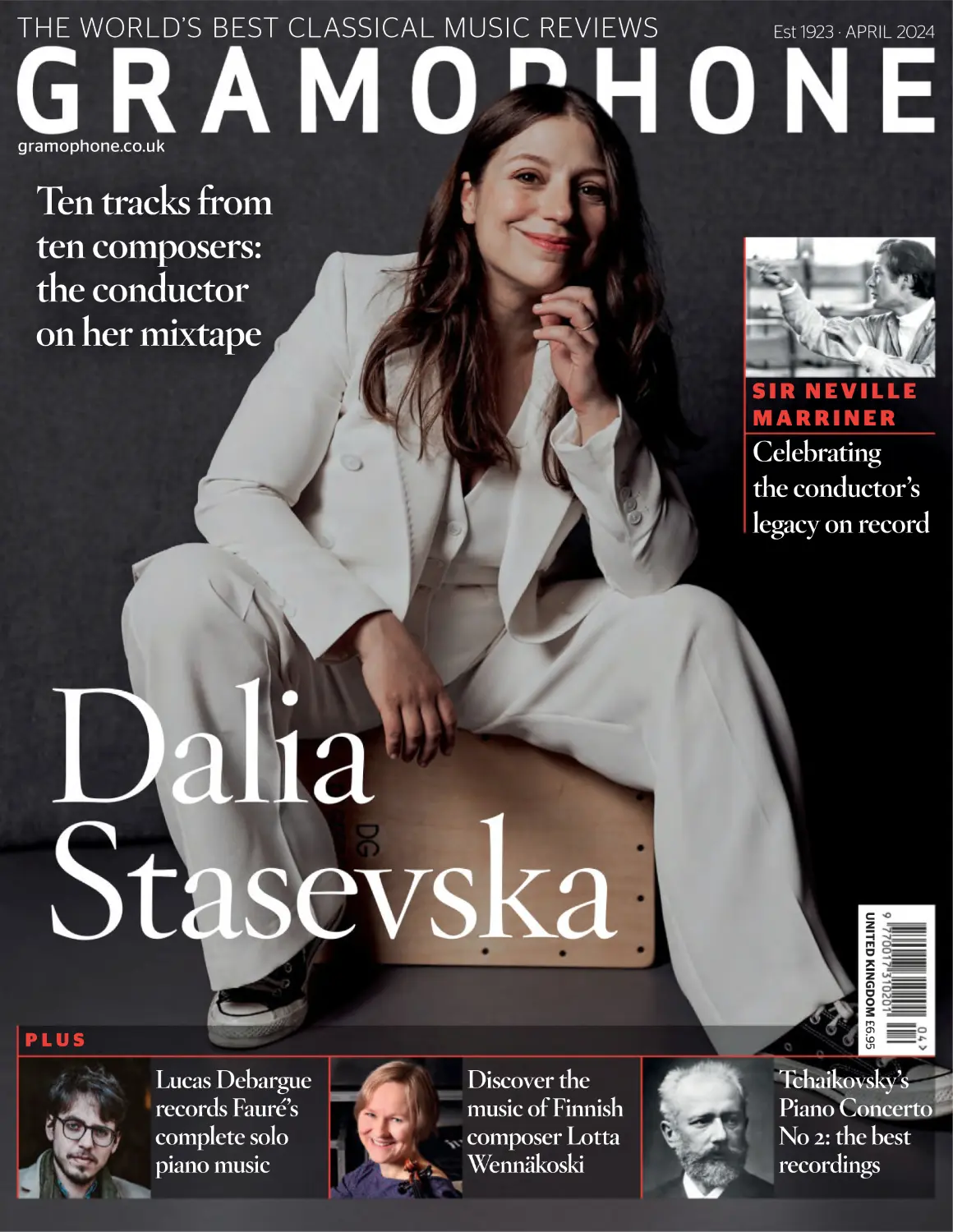
Ten tracks from
ten composers:
the conductor
on her mixtape
SIR NEVILLE
MARRINER
Celebrating
the conductor’s
legacy on record
UNITED KINGDOM £6.95
PLUS
Lucas Debargue
records Fauré’s
complete solo
piano music
Discover the
music of Finnish
composer Lotta
Wennäkoski
Tchaikovsky’s
Piano Concerto
No 2: the best
recordings
Y U N D I plays
M OZ AR T
T H E S O N ATA P R O J E C T 1
E U RO P E A N TO U R
M A R C H – M AY 2 O 2 4
MARCH
22 Freiburg im Breisgau
25 Heilbronn
27 Reutlingen
30 Sigmaringen
APRIL
03 Göttingen
05 Hanau
09 Würzburg
11 Bad Neustadt
13 Frankfurt • Alte Oper
16 Bamberg
21 Vienna • Musikverein
24 Munich • Isarphilharmonie
27 Paris • Théâtre des Champs-Elysées
M AY
01 Berlin • Philharmonie
06 Offenbach
08 Düsseldorf • Tonhalle
14 Basel • Stadtcasino
17 Essen • Philharmonie
19 Köln • Philharmonie
23 Bremen • Die Glocke
A special eight-page section focusing on recent recordings from the US and Canada
Karchin
‘Keyboards / Winds’
Three Imagesa. A Jersey Reverie on New York
Notesb. Processionsc. Quintet for Windsd.
Sonata-Fantasiae. Summer Songf
Marianne Gythfeldt cl aMichael Stephen
Brown, bHan Chen, eStephen Drury pf
c
Carson Cooman org dWindscape
Bridge (BRIDGE9586 • 68’)
f
Like most earthlings
during the coronavirus
pandemic, Louis
Karchin had an
inordinate amount of time on his hands.
He responded by immersing himself
in creative projects, including new
compositions and revisions of previous
pieces. A healthy number of those scores
make their presence felt on this recording
of works featuring keyboards and winds.
They reveal a composer with an inventive
sense of narrative design and instrumental
possibility, as well as the ability to convey
musical messages with succinct elegance.
Two of the piano works hail from the
first year of the pandemic, but they eschew
any degree of despair. The Sonata-Fantasia
is a feast of keyboard adventure, with
striking contrasts of register, texture
and harmonic implication. Glistening
figures rub shoulders with heraldic
pronouncements and darting activity.
In Three Images, Karchin deftly employs
tone-painting and atmospheric writing to
evoke the subjects: ‘Festival’, ‘Labyrinths’
and ‘Carousel’. Both works receive brilliant
accounts – Stephen Drury in the former
and Michael Stephen Brown in the latter.
A Jersey Reverie on New York Notes (2018),
the only piece entirely predating the
pandemic, pays tribute to the 80th birthday
of Charles Wuorinen by incorporating bits
of his New York Notes into a stately,
ruminative unfolding of ideas, which
pianist Han Chen shapes with meticulous
urgency. Processions, a 2021 revision of
a 2007 work for organ, is a sonorous
burst of arpeggiated flourishes, majestic
sonorities and pungent details that seize
the ears as offered by Carson Cooman.
gramophone.co.uk
Karchin could never be accused of
throwing caution to the winds in the
disc’s remaining pieces. Summer Song
(1994, rev 2021) gives the vibrant
Marianne Gythfeldt the opportunity
to travel the extremes of her clarinet
through athletic flights and birdlike
poetry. The four-movement Quintet
for Winds (2021) juxtaposes pastoral
gestures sometimes redolent of Milhaud
with a host of playful and lyrical
interactions, as well as a brief foray
into clarinet multiphonics. The
members of Windscape play Karchin’s
score to the fresh hilt. Donald Rosenberg
Perkinson . Perry
‘American Counterpoints’
Perkinson Louisiana Blues Strut: A Cakewalka.
Sinfonietta No 1 Perry Prelude for Strings.
Symphony in One Movement for Violas and
String Basses. Violin Concertoa. Ye, Who Seek
the Truth Stewart We Who Seeka
a
Curtis Stewart vn
Experiential Orchestra / James Blachly
Bright Shiny Things (BTSC0200 • 63’)
So many composers
have been neglected
in concert halls and
opera houses due to
prejudice that devoted musicians have
decided to do something about it.
Among them are violinist Curtis Stewart
and conductor James Blachly, whose new
album, ‘American Counterpoints’, focuses
on African American composers Julia
Perry (1924-79) and Coleridge-Taylor
Perkinson (1932-2004), whose creative
gifts as presented here deserve to be
embraced widely.
The ‘counterpoints’ in the disc’s title
serve as a metaphor for the richness of
musical expression found in the repertoire
performed with urgent and elegant
sophistication by Stewart, Blachly and
the first-rate Experiential Orchestra, a
New York-based ensemble. Perry and
Perkinson wrote in numerous genres,
including individual takes on the
concerto and the symphony.
The album’s gem is Perry’s Violin
Concerto (1968), a score of exceptional
originality, its six movements unfolding
in a seamless narrative of contemplation
and sharing. The lyrical and spiky
language abounds in arresting colours,
textures and lines. Stewart takes the solo
part to the eloquent heights, savouring
every gesture in tandem with the vibrant
orchestral writing, which Blachly and his
players invest with striking lucidity.
Perry’s range is also on display in the
distinctively scored Symphony in One
Movement for Violas and String Basses,
which packs a world of vital incident
into eight minutes, and two affecting
transcriptions: Prelude for Strings
(arranged by Roger Zahab from the solo
piano version) and Ye, Who Seek the Truth
(arranged for strings by Jannina Norpoth
from the original for tenor,
choir and organ).
Perkinson commands attention as a
composer of varied stylistic personalities.
The three-movement Sinfonietta No 1
reveals his ability to use spare materials
to vivacious and tender effect, while the
jubilant Louisiana Blues Strut: A Cakewalk
gives Stewart another opportunity to
bask in soloistic exuberance.
And then there’s Stewart’s own work,
We Who Seek for solo violin, verse, strings
and electronics. Blending bits of Perry’s
Ye, Who Seek the Truth with bursts of
hip hop, it’s a blast from the past and
the present. Donald Rosenberg
Reale
‘American Mosaic’
Cello Concerto, ‘Live Free or Die’a.
Piano Concerto No 1b. Piano Sonata
No 6, ‘The Waste Land’c
Kim Cook vc bJohn Jensen, cPaul Reale pf
a
Yale Symphony Orchestra / William Boughton
Naxos American Classics (8 559898 • 70’)
c
Recorded 2007
a
Out of an opening
cry and terse
introduction,
Kim Cook rises
GRAMOPHONE APRIL 2024 I
AVAILABLE NOW FOR PURCHASE OR STREAMING
Navona Records, Ravello Records, Big Round Records, and Ansonica Records are imprints of PARMA Recordings.
www.parmarecordings.com
SOUNDS OF AMERICA
percussion, Simon’s music has
a cinematic quality here.
The central movements reference
Spirituals. ‘Flying Africans’ is delicate
and gorgeously lyrical, with dripping
glissandos from the violins, while the
narrative thrust of ‘Go Down Moses
(Let My People Go)’ – at eight minutes,
the longest of the set – shows Simon to
be an immensely gifted storyteller. In
the finale, ‘John Henry’, he puts the
NSO brass and percussion sections
through their paces, and both acquit
themselves brilliantly. Indeed, Noseda
has the entire orchestra playing at the
top of their game throughout.
I predict that (in the US, at least)
Tales will be coming soon to an
orchestra near you. Andrew Farach-Colton
Corigliano . B Field . Glass
‘Soundscape’
Corigliano Etude Fantasy. Fantasia on an
Ostinato B Field Three Passions for Our Tortured
Planet Glass Metamorphosis – I; II
Kay Kyung Eun Kim pf
Steinway & Sons (STNS30230 • 55’)
P H O T O G R A P H Y: E L M A N S T U D I O
Composer Carlos Simon takes inspiration from Afrofuturist stories in his Tales: A Folklore Symphony
magnificently in Paul Reale’s Cello
Concerto against a landscape of earth
colours enriched by veins of unusually
non-percussive percussion. Reale writes
beautifully for the cello, with open strings
and rich-sounding harmonics that
complement his orchestral Western skies.
After a sad slow movement, seductive
cowboy rhythms dance through sunlight
in the third. Cook, the concerto’s
dedicatee, demonstrates how to pursue and
command. The concerto, inspired by the
New Hampshire motto ‘Live Free or Die’,
was written in 17 days following a terminal
diagnosis, and the end is deeply moving.
In his Piano Concerto, written in 1986
for John Jensen of the Mirecourt Trio
(and revised in 2016), Reale created a
portrait of a pianist able to impose his own
pace of jazz-rooted thought on traditional
classical elements; Jensen described it to
me as ‘Quick edits and surprising cadential
formulae set in a passionate setting of
tension/resolution’. The music inhabits
spaces of arresting beauty in short snatches
of melody and in purely physical sound.
The last movement’s muscularity is
viscerally thrilling, with references to
ephemera like Beethoven’s Fifth and
Reale’s own Sonata Brahmsiana. This is
music-making that shows how to explore
new musical universes, a tribute to both
men’s art.
Reale’s Sixth Piano Sonata, made of
eclectic materials in a tonal setting, was
gramophone.co.uk
inspired by, as the composer describes,
TS Eliot’s ‘magical delineation of small
events which persist in a lifetime
of memory’. The wide-screen recordings
of the concertos were made at Yale
University’s Woolsey Hall.
Laurence Vittes
C Simon
D
Tales: A Folklore Symphony
National Symphony Orchestra, Washington DC /
Gianandrea Noseda
National Symphony Orchestra (NSO0014D D • 23’)
Recorded live at the John F Kennedy Center for the
Performing Arts, Washington DC, March 3-5, 2022
‘Tales is an
exploration of
African American
folklore and
Afrofuturist stories’, Carlos Simon writes
in the booklet note for this digital-only
EP. And, in fact, each of the Symphony’s
four brief movements simultaneously
looks forwards and backwards. The
opening movement, ‘Motherboxx
Connection’, for example, was inspired
by the work of the visual artists known
as Black Kirby, who consider the
overwhelmingly white world of comicbook superheroes and reimagine it
from an Afrofuturist perspective. Brassy
and bright, with glittering shimmering
The Korean pianist
Kay Kyung Eun Kim,
a champion of
contemporary works
and innovative keyboard techniques, offers
pieces by three New York composers
written between 1976 and 2019.
John Corigliano’s Fantasia on an Ostinato
reveals the influence of minimalism as it
builds upon and contemporises the bassline pattern in the second movement of
Beethoven’s Seventh Symphony. Kim
realises beautifully the improvisatory style
of this work, with its gradual increase of
intensity that accommodates subtle
rhythmic and harmonic variation.
Expert and resourceful keyboard-writing
also characterises Corigliano’s Etude
Fantasy, a set of five linked yet disparate
pieces. The work requires a virtuoso
pianist, not least in the scampering
figurations and double notes in both
hands of No 3, and the shimmering
trills, clusters of notes and incisive
Bartókian hammering in No 4. The
final Etude calls for hushed playing
over long and concentrated stretches.
Philip Glass’s Metamorphosis I and II
are relatively brief essays in minimalism
with patterns of hypnotic repetition,
gently consoling intervals and ever-sogradual shifts in otherwise stationary
GRAMOPHONE APRIL 2024 III
NEW RECORDINGS
Jose Zarzo, Horn
Principal Gran Canaria
Philharmonic. “Artistry is
virtuosic” Gramophone
John Holt, Trumpet
Principal Dallas Opera
Orch.“elegant, sensitive
artist.” Gramophone
John Barcellona, Flute
Flutist Westwood Wind
Quintet, “nothing short
of breathtaking” International Record Review
Velvet Brown, Tuba
Intl. soloist. "one of
the best tuba players
anywhere" Fanfare
Jose Zarzo: premiere recording of Anthony Plog Horn Sonata,
plus Danzi Sonata, Duvernoy Trio, and more premieres. CD776
John Holt: premiere recording of new Eric Ewazen Trio for
Trumpet, Violin, & Piano, plus 9 fabulous short recital works by
Bozza, Handel, Piazzolla, Broughton, Goedicke, & more. CD962
John Barcellona: all premiere recordings. Christopher Caliendo, Flute Sonata, Dan Welcher, Florestan's Falcon, Fantasy after
Schumann; + music by Louis Moyse & John Barcellona. CD719
Velvet Brown: all premiere recordings. Roger Kellaway Dr.
Martin Luther King, In Memoriam; plus Barbara York, John
Stevens, Meyer Kupferman, and Drew Bonner. CD696
www.divineartrecords.com
10 DISC
BOXSET
LUDWIG VAN BEETHOVEN
COMPLETE 35
PIANO SONATAS
All TMERSWSREXEWQIXMGYPSYWP]
SVKERMWIHMRGLVSRSPSKMGEPSVHIVXSSJJIV
TOWARD THE LIGHT ETERSVEQMGZMI[SJLMWEVXMWXMGNSYVRI]
XVEGMRK&IIXLSZIR´WXVERWJSVQEXMZI
EXTRAORDINARY & BEAUTIFUL
TVSKVIWWMSREWEGSQTSWIV.
MUSIC BY JOHN CARMICHAEL
8EQEQM,SRQE TMERS
%RXSR]+VE] TMERS
Divine Art DDX 21001
7X4EYP´W7MRJSRME
Divine Art DDX 21103
AL AN HOVHANESS —"Beautiful sounds, unabashedly melodic...his music possesses instant appeal." (New York Times) Crystal has largest collection of Hovhaness works conducted or
supervised by Hovhaness, most with major British
orchestras. See www.crystalrecords.com for all 25
Hovhaness CDs. A small sample: CD810 (pictured):
And God Created Great Whales, etc.,
Philharmonia Orch. CD801:Prayer of St. Gregory;
Symphony 11 (All Men Are Brothers); Armenian
Rhapsody No. 1; Tzaikerk. Royal Phil. CD802: St.
Vartan Symphony, "Artik" Horn Concerto. National
Phil. of London & Israel Phil. CD803: Majnun Symphony. National Phil. of London. CD804: Etchmiadzin Sym., Fra Angelico, Mountains & Rivers Without End. Royal
Phil. CD807: Odysseus Symphony, Celestial Gate, Polyphonia Orch.,
Hovhaness cond. CD808: Magnificat (four Solo Voices, Chorus, Orch.).
REICHA 24 WOODWIND QUINTETS on 12 CDs.
Westwood Wind Quintet. Box Set Special $128
all 12 CDs (13 hours of music) "each is a masterpiece of the highest order. Those who ignore this legacy are missing out...on some of
the finest music ever penned. These pieces are
symphonies in miniature." (Audiophile Audition) Reicha, a friend
of Beethoven, was one of the most-influential composers of the
period. Westwood Wind Quintet has 24 CDs, including Hindemith,
Nielsen, Barber, Holst, Mathias, Ibert, Berio, J.S. Bach, Rossini, etc. See
www.crystalrecords.com for complete list. "a standard of ensemble
playing that is nothing short of breathtaking" Intl. Rcd Review
YIZHAK SCHOTTEN, VIOLA – Six CDs, including
The Elegant Viola, CD837: Vaughan Williams, Suite for
Viola & Orchestra; J.S. Bach, Sonata; Colgrass, Variations
for 4 Drums & Viola. "one of America's finest viola players...a leading light of the U.S viola establishment."
(STRAD) See Schotten's six CDs at www.crystalrecords.com
CDs $19.95 ea, See www.crystalrecords.com for over 330 CDs.
FREE shipping on all U.S. orders. Canada shipping US$10 per order
Crystal Records, phone 360-834-7022; order@crystalrecords.com
LUMINOS
MUSIC FOR CLARINET, BASSET
HORN & BASS CLARINET
6SREPH;SSHPI] GPEVMRIXWFEWWIXLSVR
%RHVI[;IWX TMERS
Métier MEX 77110
PARALLELS
ORGAN MUSIC FROM HOLST, ELGAR,
FLORENCE PRICE AND COLDPLAY
%PI\ERHIV*½RGLSVKER
4IVJSVQIHSRXLI'LIPXIRLEQ'SPPIKI
'LETIPSVKER
Divine Art DDX 21112
CHROMOSPHERE
SYMPHONIC COLOURS OF THE
WOODWIND ORCHESTRA
'^IGLTLMPLEVQSRMG;MRH)RWIQFPI
Divine Art DDX 21117
THE PATH ABOVE
THE DUNES
CHAMBER MUSIC BY NICOLA LEFANU
4IVJSVQIHF]+IQMRM)RWIQFPI
-ER1MXGLIPPGSRHYGXSV
DDX 77112
KǀĞƌϳϬϬƟƚůĞƐĂǀĂŝůĂďůĞĂƚĂŶLJŐŽŽĚĚĞĂůĞƌŽƌĚŝƌĞĐƚĨƌŽŵŽƵƌŽŶůŝŶĞƐƚŽƌĞŝŶ͕
ϮϰͲďŝƚ,͕&>ĂŶĚDWϯĚŝŐŝƚĂůĚŽǁŶůŽĂĚĨŽƌŵĂƚƐ͘
www.divineartrecords.com
SOUNDS OF AMERICA
harmonies. In Metamorphosis II, the
steady accompaniment underlies
sequences of arpeggios.
Brian Field’s programmatic Three
Passions was written for Kim in 2019.
Inspired by the phenomenon of climate
change (with movements entitled ‘Fire’,
‘Glaciers’ and ‘Winds’), the music is
accessible and thoroughly pianistic,
with sensitive applications of colour and
striking contrasts of dynamics. I thought
‘Glaciers’ the most original panel of the
triptych, with extremes of register
sustained at a slow tempo, punctuated
by roaring episodes to depict the break-up
of glacial ice.
Whatever one’s response to the music,
Kim’s playing throughout is exciting,
passionate and meticulously controlled,
as well as beautifully recorded.
Stephen Cera
Sinfonia Toronto
Our monthly guide to North American ensembles
P H O T O G R A P H Y: S I N F O N I A T O R O N T O
Founded 1999
Home Jane Mallett Theatre, Jeanne Lamon Hall, George Weston Recital Hall
No, not the Toronto premiere of Beethoven’s Fifth, but certainly
the first performance in Canada of a reduction for strings by the
Serbian violinist Sreten Krstiü. ‘It was a different experience,
more intimate’, says Nurhan Arman, the founding music director
of Sinfonia Toronto, a 13-piece ensemble that has been supplying
Canada’s biggest city with chamber repertoire (and then some)
since 1999.
Nor did this season-opening concert in October mark the
orchestra’s first performance of a Beethoven symphony. The
Seventh has been heard in Arman’s adaptation of the string quintet
version issued by Beethoven’s publisher Sigmund Anton Steiner.
Also on that programme was a beefing-up of Beethoven’s Quartet
Op 18 No 4. Sinfonia Toronto can augment or compress great
music, according to need, with exactly the same forces.
‘It’s necessary’, Arman says. ‘We can’t keep playing the same
DvoĜák Serenade and Tchaikovsky Serenade season after season.
You must offer something new to the audience and to the players.’
Concertos are very much part of the equation, from the wellknown Ignaz Lachner piano-plus-quintet adaptations of Mozart
(expanded by Arman) to selections as broad-shouldered as
Rachmaninov’s Piano Concerto No 2. ‘The piano is always heard,
there is no balance problem’, Arman says of a ‘Rach 2’ for piano,
two violins, viola, cello and bass by American composer Jeremy Liu.
Sinfonia Toronto subscribers this season will have heard
reductions of Schumann’s Piano Concerto and Cello Concerto,
the former with Italy’s Antonio Di Cristofano as soloist, the latter
featuring the Montrealer Stéphane Tétreault. Other highlights are
Arman’s arrangements of Falla’s Siete Canciones populares españolas
and Respighi’s Il tramonto with the Turkish-Canadian mezzosoprano Beste Kalender as soloist. Next season the ArmenianDanish pianist Marianna Shirinyan will attempt to hold her
own in a supersized version of Schumann’s Op 44 Quintet.
Sunny Ritter, an Austrian teenager studying in Toronto,
returns in Beethoven’s Piano Concerto No 3.
By no means does the orchestra confine itself to standards.
The October concert included the Canadian premiere of the
Violin Concerto No 2 of Otar Taktakishvili (1924-89), a Georgian
student of Shostakovich who shared some of the master’s penchant
for quirky contrasts of bitter and sweet. Elisso Gogibedaschwili,
a young Austrian of Georgian descent, was the assertive soloist.
Sinfonia Toronto also does its patriotic duty. There will be
premieres next season of works by Barbara Assiginaak, Kevin Lau,
Andrew MacDonald and Norbert Palej, all established names in
Canada. Last year the orchestra released a recording (‘Shadow &
Light’) on the Canadian Music Centre’s Centrediscs label of
gramophone.co.uk
Double Concertos (Marc Djokic, violin, and Christina Petrowska
Quilico, piano) by the veterans Christos Hatzis, Alice Ping Yee Ho
and Larry Kuzmenko.
Like the metropolis it hails from, Sinfonia Toronto welcomes
talent from around the world. Arman himself was born in Istanbul
to Armenian parents in 1948 and moved to Los Angeles in 1971
as a Disney Scholarship violin student at the California Institute
of the Arts, settling in Canada in 1982, where he became music
director of two regional stalwarts, the North Bay Symphony and
Symphony New Brunswick. After a term in the mid-1990s as
principal guest conductor of the Yerevan Symphony, Arman
founded Sinfonia Toronto, picking up where the Chamber Players
of Toronto (1969-92) and the Amadeus Ensemble (1985-2000)
left off. The post of music director leaves him time to pursue
guest engagements in Europe, often with Austria’s Arpeggione
Kammerorchester and Italy’s Milano Classica.
But back to Sinfonia Toronto. The orchestra performs its seven
subscription concerts in three geographically distinct midsize
facilities: the downtown Jane Mallett Theatre, midtown Jeanne
Lamon Hall – home of Tafelmusik – and the George Weston
Recital Hall in North York, a district with a family-friendly
character. ‘People who live in Richmond Hill may not want
to go all the way downtown’, comments managing director
Margaret Chasins, referring to a municipality north of the city.
Wherever the orchestra performs, the broad repertoire keeps
the crowds and the musicians happy. ‘There are some additional
challenges in blend and unity’, viola player Anthony Rapoport
says about arrangements of string quartets, ‘but overall it’s a
more forgiving setting, and the responsibility for interpretation
is largely taken on by the conductor.’
This player even admits to a preference for DvoĜák’s American
Quartet, Op 96, in expanded form. ‘This is a wonderful work,
but as a quartet enthusiast I can’t help feeling that it lacks
something in depth of part-writing and counterpoint,
compared to DvoĜák’s other masterpieces of the form.
‘As a string orchestra work, though, it’s magnificent. There
are frequently moments where I hear the double bass and think,
“yes, that’s exactly what that passage needed!”’ Arthur Kaptainis
GRAMOPHONE APRIL 2024 V
The world's best classical music reviews
Gramophone has been the world’s leading authority on
classical music since 1923. With 13 issues a year, every edition
will enrich your classical music knowledge with more than
100 expert reviews of the latest recordings, plus in-depth artist
interviews and features about composers past and present.
Our subscribers enjoy:
13 new print issues throughout the year, delivered direct to your door
13 new digital issues each year, available to read on your digital devices
Access to our complete digital archive, containing every issue of
Gramophone over the past century
50,000+ recording reviews in our searchable online database, bringing you
the best new releases and recommended recordings of classic works
SUBSCRIBE TODAY AND NEVER MISS AN ISSUE
us.magsubscriptions.com/GSUBS
+44 (0)1722 716997
subscriptions@markallengroup.com
SOUNDS OF AMERICA
A LETTER FROM Minneapolis
Rob Hubbard reports on a new era for the Minnesota
Orchestra and on the region’s thriving choral scene
T
he Thomas Søndergård era has arrived in Minneapolis.
Buildings and bridges bedecked in the red and white
hues of the Danish flag greeted the conductor as he
launched his tenure as the Minnesota Orchestra’s
newest music director this past fall. And the civic enthusiasm
was rewarded with some thrilling concerts.
The new speciality of the house at Orchestra Hall seems to
be big European orchestral showpieces written between 1880
and 1920, works that call for a massive number of musicians
and an expansive variety of moods and volume levels.
It was the music of Richard Strauss over which Thomas
Søndergård and the orchestra first bonded on a 2021 visit
(Ein Heldenleben), and they went even bigger on opening night,
presenting a deeply absorbing version of An Alpine Symphony.
The following weekend proved equally ambitious and involving
with the almost complete ballet music of Maurice Ravel’s Daphnis
et Chloé. In each case, the new conductor seemed to be taking the
full sound that Osmo Vänskä had cultivated during his 19-year
tenure and enhancing it with increased lushness.
While Søndergård spent
the holidays in Minneapolis –
celebrating the New Year with
pianist Stephen Hough and a
remarkably subtle take on
Rachmaninov’s Paganini
Rhapsody – the orchestra’s
strongest performance yet under
his leadership was a powerful rendition of Benjamin Britten’s
Violin Concerto with soloist Augustin Hadelich, who smoothly
segued between anxious ruminations and heartfelt elegies, his
trills, plucks, soaring lines and lightning-fast passages all
executed expertly.
The Minnesota Orchestra has not only completed its Mahler
symphonic cycle with Vänskä on the BIS label but has also released
a Decca Classics recording of its most memorable premiere of
2023. Conducted by Jonathan Taylor Rush, Carlos Simon’s
Brea(d)th was created with librettist and spoken word artist Marc
Bamuthi Joseph in response to the Minneapolis murder of George
Floyd, inspired by interactions with local residents.
For those who prefer the intimacy of a recital, some marvellous
pianists have visited. The American veteran Richard Goode made
a very involving sonic sojourn of Beethoven’s Diabelli Variations
at St Paul’s Macalester College under the auspices of the
Chopin Society.
Also going the long and episodic route was Icelandic marvel
Víkingur Ólafsson, who twice transfixed Schubert Club audiences
with his interpretation of Bach’s Goldberg Variations. Olafsson kept
the Ordway Concert Hall audiences at rapt attention with inspired
approaches to each of the work’s 30 variations, bringing a
continuity to the collage that flowed as smoothly as his crosshanded cascades down the keyboard.
That room is also the home hall for the Saint Paul Chamber
Orchestra, which has benefited from eschewing the music director
model, audiences delighting in the ensemble’s versatility under a
rotating roster of artistic partners. Most exciting among them is
South African cellist Abel Selaocoe, an invariably intriguing
programmer, soloist, singer and improviser. His performances
with the SPCO always feel like a spiritual exploration, an act
of liberation from the formality of a typical classical concert.
Keeping things invariably fun and fresh with Baroque fare is
fellow SPCO artistic partner Richard Egarr. And violinist Alina
Ibragimova admirably cast aside convention when she joined
the orchestra for a memorable version of Beethoven’s
Violin Concerto.
The SPCO continues to have success with its ‘Sandbox’
composer residencies, which allow months-long collaborations
between composers and the orchestra’s musicians. The latest
product of the programme was Clarice Assad’s The Evolution
of AI, for which she assumed
the character of a robothuman hybrid.
Few are the American
metropolitan areas that boast
two professional orchestras of
the calibre of the Minnesota
Orchestra and SPCO, yet it’s
sad to see us losing our third most prominent ensemble. The
Minnesota Sinfonia – best known for being the soundtrack to
summer nights in area parks and providing music education
programming in inner-city schools – has announced that it
will fold in January 2025, a victim of severe cuts in corporate
funding of the arts.
Yet the Twin Cities still manage to support a plethora of choirs,
most of them bearing the signature sound of the region, thickly
textured and precise in delivery. Among the memorable holiday
offerings was a splendid collaboration between VocalEssence and
the Bach Society of Minnesota on half of Bach’s Christmas Oratorio,
with the Bach Society’s Matthias Maute reminding audiences that
he might be the most charismatic conductor in town.
Minnesota Opera will present four productions instead of
the customary pre-covid five this season, but its boldness and
imagination came through in José ‘Pepe’ Martínez’s moving
mariachi opera Cruzar la Cara de la Luna, a triumphant synthesis
of two emotion-packed art forms. The company also greeted
a new principal conductor in Christopher Franklin, who led an
invariably engaging version of Donizetti’s The Elixir of Love that
offered a comedic critique of hucksterism that felt prescient in
2024 America.
Buildings and bridges bedecked in the
hues of the Danish flag greeted Thomas
Søndergård as he launched his tenure as
the Minnesota Orchestra’s music director
gramophone.co.uk
GRAMOPHONE APRIL 2024 VII
D
N
ON OUR CLASSICAL MUSIC PODCAST
ID
RE 0
O 0 DW
M 0,0 RL
W 0 O
O 7
N AN S W
D
TH OA
L
W
O
THE STARS COME OUT FOR
E
Simply search for ‘Gramophone magazine’ wherever you get your podcasts,
or visit gramophone.co.uk/podcast
Founded in 1923 by Sir Compton Mackenzie and Christopher Stone as
‘an organ of candid opinion for the numerous possessors of gramophones’
The importance of online artist engagement
C O V E R P H O T O G R A P H S : M AT T H E W J O H N S O N / B R I D G E M A N I M A G E S / A R C H I V E P I C S /A L A M Y S T O C K P H O T O / X I O M A R A B E N D E R
O
ur news pages are pleasingly full of new
signings this month. Two of those –
guitarist Alexandra Whittingham and
pianist Hayato Sumino, signed by Decca
and Sony Classical respectively – share two things in
common. The first is superb music-making and an
imaginative approach to repertoire. In Whittingham’s
case, her first release was a beautifully crafted debut
album from Delphian that ranged freely across the
European continent. Hayato Sumino, meanwhile,
first came to the consciousness of many of our
readers when he reached the semi-finals of the 2021
International Chopin Piano Competition, with Jed
Distler, on his daily blog on the competition written
for our website, describing the young Japanese
virtuoso as ‘a genuinely accomplished pianist.’
But for many people these two musicians were
already familiar faces and names. Under the nickname
‘Cateen’, Sumino has already attracted more than
1.5 million followers across his social media channels,
where his online audience is treated to videos ranging
from interpretations of core repertoire, his own
arrangements and compositions and even forays
into jazz. Guitarists and admirers of its repertoire,
meanwhile, may well have first encountered
Whittingham online too, where her beautifully filmed
renditions of pieces central for any player as well as
delightful discoveries have been shared with millions.
Signing to a major label might once have been the
start of an artist building a bond with an audience;
in both of these cases, it’s an already meaningful
relationship with vast numbers of listeners that they
bring to the labels. I’ve long lamented the downsides
of the sad decline of physical shops, but at the same
time welcomed the benefits of access that digital
delivery (whether streaming or downloads) brings.
And it’s not just about introductions to artists either:
for millions of people, online videos – long or short,
quirky or core classical repertoire – are legitimate
recording experiences in their own right.
So too are singles or online EPs. When the
parameters of a CD’s length no longer apply, there’s
nothing to determine what defines a ‘classical release’
as we once thought about it. This month’s cover
artist Dalia Stasevska has launched a listening journey
named with a nod to the affectionately recalled retro
‘mixtape’, but in practice it’s an ultra modern initiative:
new works, spanning styles, available on demand, and
with track length determined by work length.
Ultimately, the traditional album continues to
be the root of our coverage of music, and rightly
so. But it’s vital that we also endeavour to embrace
any innovative approach to making music accessible.
This month’s signings, and our cover conductor,
are shining beacons of exactly that.
Finally, we were delighted that Gramophone’s
recently published circulation figures showed an
increase in our overall readership for the past year.
So a huge thanks to everyone whose ongoing support
makes us what we are: and if you are a new reader,
not only are you welcome, but we can also promise
that we’ll endeavour to reflect classical recording
however you choose to explore it.
martin.cullingford@markallengroup.com
THIS MONTH’S CONTRIBUTORS
Tim Ashley • Michelle Assay • Richard Bratby • Edward Breen • Stephen Cera • Rob Cowan (consultant reviewer) •
Jed Distler • Adrian Edwards • David Fallows • Andrew Farach-Colton • Fabrice Fitch • Marina Frolova–Walker •
Charlotte Gardner • David Gutman • Christian Hoskins • Rob Hubbard • Arthur Kaptainis • Lindsay Kemp •
Richard Lawrence • Andrew Mellor • Kate Molleson • Jeremy Nicholas • Richard Osborne • Tully Potter •
Mark Pullinger • Peter Quantrill • Peter J Rabinowitz • Guy Rickards • Malcolm Riley • Donald Rosenberg •
Patrick Rucker • Edward Seckerson • Mark Seow • Hugo Shirley • Pwyll ap Siôn • Harriet Smith •
David Patrick Stearns • David Threasher • Laurence Vittes • Richard Whitehouse • Richard Wigmore
‘Dalia is the real
deal – a conductor
who’s on the
podium for all the
right reasons,’
writes KATE
MOLLESON , who
interviews the conductor for this
issue’s cover story. ‘She thinks about
the world and how music can
contribute. She’s as down to earth
as they come, which makes
interviewing her nothing more or
less than a genuine conversation.’
gramophone.co.uk
‘The tribute to
the late Sir Neville
Marriner was
anticipated, that
to Seiji Ozawa,
sadly, was not,’
writes RICHARD
OSBORNE , who surveys the legacies
of both conductors. ‘The relationship
these superbly gifted musicians had
with the gramophone was very
different, yet what underpinned my
writing of both pieces was the deep
sense of gratitude both lives inspired.’
‘I’m happy to
wave the flag
for Tchaikovsky’s
underrated and
entertainingly
ebullient Second
Piano Concerto,
which has been overshadowed by
its ubiquitous predecessor,’ writes
JEREMY NICHOLAS , author of this
month’s Collection. ‘Auditioning
recordings of both its original and
edited versions has been a journey
full of surprises.’
Gramophone, which has
been serving the classical
music world since 1923, is
first and foremost a monthly
review magazine, delivered
today in both print and digital
formats. It boasts an eminent and
knowledgeable panel of experts,
which reviews the full range of
classical music recordings.
Its reviews are completely
independent. In addition to
reviews, its interviews and
features help readers to explore
in greater depth the recordings
that the magazine covers, as well
as offer insight into the work of
composers and performers.
It is the magazine for the classical
record collector, as well as
for the enthusiast starting
a voyage of discovery.
GRAMOPHONE APRIL 2024 3
CONTENTS
Volume 101 Number 1238
EDITORIAL
Phone 020 7738 5454
email gramophone@markallengroup.com
EDITOR AND PUBLISHER Martin Cullingford
DEPUTY EDITOR Tim Parry
REVIEWS EDITOR Gavin Dixon
ONLINE CONTENT EDITOR James McCarthy
SUB-EDITORS David Threasher; Marija urić Speare
EDITORIAL ADMINISTRATOR Libby McPhee
EDITORIAL ASSISTANT Theo Elwell
EDITOR’S CHOICE
7
The 12 most highly recommended recordings
reviewed in this issue
ART DIRECTOR Juliet Boucher
PICTURE EDITOR Sunita Sharma-Gibson
AUDIO EDITOR Andrew Everard
EDITOR EMERITUS James Jolly
WITH THANKS TO Jasmine Cullingford
ADVERTISING
email advertising@gramophone.co.uk
RECORDING OF THE MONTH
36
Edward Seckerson hears a stunning account
of Mahler’s Sixth Symphony with Sir Simon
Rattle and the Bavarian Radio SO
FOR THE RECORD
COMMERCIAL DIRECTOR
Esther Zuke / 020 7501 6368
SUBSCRIPTIONS AND BACK ISSUES
0800 137201 (UK) +44 (0)1722 716997 (overseas)
subscriptions@markallengroup.com
PUBLISHING
HEAD OF MARKETING
ORCHESTRAL
38
Francesca Dego in Busoni and Brahms;
Hamelin stars in Turangalîla; Alpesh Chauhan
leads Tchaikovsky rarities; reconstructed Ysaÿe
8
The latest signing activity from Decca, Sony
Classical, Naïve and Alpha; introducing Quatuor
Agate; we launch a new series exploring the
history of record labels; meeting Sir James
MacMillan; we pay tribute to Seiji Ozawa; plus
Joseph Middleton on his Leeds Lieder festival
John Barnett / 020 7501 6233
GROUP INSTITUTIONAL SALES MANAGER Jas Atwal
PRODUCTION DIRECTOR
Richard Hamshere / 01722 716997
PRODUCTION MANAGER Kyri Apostolou
CIRCULATION DIRECTOR
Sally Boettcher / 01722 716997
CHAMBER
54
LETTERS & OBITUARIES
18
Christian Poltéra plays Brahms and Schumann;
Eastman’s Femenine; discovering Johann Schenck
Rachmaninov on record, the art of the engineer,
and celebrating Stanisław Skrowaczewski
INSTRUMENTAL
DALIA STASEVSKA
SUBSCRIPTIONS MANAGER
Bethany Foy / 01722 716997
EDITORIAL DIRECTOR Martin Cullingford
MANAGING DIRECTOR Ravi Chandiramani
CHIEF EXECUTIVE OFFICER Ben Allen
CHAIRMAN Mark Allen
68
Tiberghien’s Beethoven; complete Fauré from
Lucas Debargue; Arvo Pärt’s piano works
As she launches her exciting new recording
project – or ‘mixtape’ – the conductor talks to
Kate Molleson about music’s place in the world
VOCAL
Part of
markallengroup.com
GRAMOPHONE is published by
MA Education & Music Ltd, St Jude’s Church, Dulwich
Road, London SE24 0PB, United Kingdom.
gramophone.co.uk
email gramophone@markallengroup.com or
subscriptions@markallengroup.com
ISSN 0017-310X.
The April 2024 issue is on sale from March 27; the May issue
will be on sale from April 24 (both UK). Every effort has been
made to ensure the accuracy of statements in this magazine
but we cannot accept responsibility for errors or omissions,
or for matters arising from clerical or printers’ errors, or an
advertiser not completing his contract. Regarding concert
listings, all information is correct at the time of going to press.
Letters to the editor requiring a personal reply should be
accompanied by a stamped addressed envelope. We have
made every effort to secure permission to use copyright
material. Where material has been used inadvertently or
we have been unable to trace the copyright owner,
acknowledgement will be made in a future issue.
UK subscription rate £77.
Printed in England by Precision Colour Printing.
North American edition (ISSN 0017-310X): Gramophone,
USPS 881080, is published monthly with an additional
issue in October by MA Education & Music Ltd, St
Jude’s Church, Dulwich Road, London SE24 0PB, United
Kingdom. The US annual subscription price is $114.
Airfreight and mailing in the USA by agent named WN
Shipping USA, 156-15, 146th Avenue, 2nd Floor, Jamaica,
NY 11434, USA. Periodicals postage paid at Jamaica
NY 11431. US Postmaster: Send address changes to
Gramophone, WN Shipping USA, 156-15, 146th Avenue,
2nd Floor, Jamaica, NY 11434, USA. Subscription records
are maintained at MA Education & Music Ltd, Unit
A, Buildings 1-5 Dinton Business Park, Catherine Ford
Road, Dinton, Salisbury, Wiltshire SP3 5HZ, UK. Air
Business Ltd is acting as our mailing agent.
20
78
SIR NEVILLE MARRINER
Alfano songs; Mendelssohn reimagines Bach;
albums from Trinity and St John’s, Cambridge
ONLINE CONCERTS & EVENTS 88
26
The great recording conductor would have
marked his 100th birthday this year – Richard
Osborne looks back on the legacy he left
Peter Quantrill surveys concerts to stream
LUCAS DEBARGUE
OPERA
90
Rousset conducts Lully; Samson et Dalila from ROH
JAZZ, WORLD & MUSICALS
30
A pianist firmly focused on following his own
path, he tells Andrew Farach-Colton about
recording Fauré’s complete solo piano music
96
Reviews from Jazzwise, Songlines and Musicals
MUSICIAN AND THE SCORE
REISSUES
Semyon Bychkov takes Michael McManus
through the score of Smetana’s Má Vlast,
a work he considers a universal masterpiece
98
A centenary tribute to Victoria de los Ángeles;
exploring the catalogue of the Vienna Octet
52
ICONS
BOX-SET ROUND-UP
101
REPLAY
102
66
The Italian baritone Sesto Bruscantini is the
subject of this month’s celebration of a recording
great; Tully Potter pays tribute to his art
Rob Cowan on recent releases from the archives
CONTEMPORARY COMPOSERS 76
CLASSICS RECONSIDERED
104
Andrew Farach-Colton and Charlotte Gardner
on the Raphael Ensemble’s Brahms Sextets
Last year’s winner of our Contemporary Music
Award Lotta Wennäkoski is this issue’s focus, with
Andrew Mellor getting to the heart of her music
© MA Education & Music Ltd, 2024. All rights reserved.
No part of the Gramophone may be reproduced, stored in a
retrieval system, or transmitted in any form or by any means
electronic, mechanical, photocopying, recording, or otherwise
without prior written permission of the Publishing Director.
Please read our privacy policy, by visiting
privacypolicy.markallengroup.com. This will
explain how we process, use & safeguard your data.
BOOKS
HIGH FIDELITY
The views expressed do not necessarily represent those of the
editor or Gramophone. Advertisements in the journal do not
imply endorsement of the products or services advertised.
Jeremy Nicholas selects the finest recordings of
Tchaikovsky’s Second Piano Concerto
The Older Liszt; Women and the Piano
115
The latest from the world of audio equipment,
including a guide to ‘just add speakers’ systems
GRAMOPHONE COLLECTION 108
REVIEWS INDEX
4 GRAMOPHONE APRIL 2024
106
120
MY MUSIC
122
The Estonian photographer Kaupo Kikkas on
working with classical musicians, and why the
composer Arvo Pärt is such an inspiration
gramophone.co.uk
RECORDING OF THE MONTH
Martin
Cullingford’s
pick of the finest
recordings from
this month’s
reviews
MAHLER
Symphony No 6
Bavarian Radio
Symphony
Orchestra /
Sir Simon Rattle
BR-Klassik
EDWARD
SECKERSON’S
REVIEW IS ON
PAGE 36
BRUCKNER
STRAVINSKY Petrushka
DEBUSSY Jeux. Prélude
Symphony No 8
Yomiuri Nippon
Symphony Orchestra /
Stanisław Skrowaczewski
Dabringhaus und Grimm
à L’après-midi d’un faune
Orchestre de Paris /
Klaus Mäkelä
Decca
Following our recent Icons, Skrowaczewski
has been the subject of several letters of
tribute, which makes this Bruckner 8 from
the close of his life all the more timely.
Klaus Mäkelä once again justifies the
plaudits so early in his career with a
revelatory Petrushka, rich in thrilling
characterisation, caught in luxurious sound.
REVIEW ON PAGE 40
REVIEW ON PAGE 42
SMETANA Má vlast
Czech Philharmonic
Orchestra /
Semyon Bychkov
Pentatone
A performance of this
Czech masterpiece rooted in a relationship
between Semyon Bychkov at his finest and
players steeped in the musical and cultural
world in which the work was written.
REVIEW ON PAGE 46
RACHMANINOV
BEETHOVEN Piano
BEYDTS
Orchestral Works
Kirill Gerstein pf
Berlin Philharmonic
Orchestra /
Trio No 7, ‘Archduke’.
Symphony No 4
Leonidas Kavakos vn
Yo-Yo Ma vc Emanuel Ax
pf
Mélodies & Songs
Cyrille Dubois ten
Tristan Raës pf
Aparté
Kirill Petrenko
Berliner Philharmoniker
Sony Classical
Kirill Petrenko’s selection of Rachmaninov
works is striking both for the vividness of its
detail and for its compelling rhythmic drive.
Three star soloists clearly enjoying a project
as fascinating as it is rewarding: this time
it’s Beethoven’s Fourth transcribed.
REVIEW ON PAGE 49
REVIEW ON PAGE 54
PERGOLESI Stabat
mater VIVALDI Nisi
Dominus
PRJCT Amsterdam /
Maarten Engeltjes
counterten
Pentatone
‘A vital and heartfelt recording … from one
of the newest and slickest ensembles,’ says
Edward Breen of this moving release.
REVIEW ON PAGE 83
What a wonderful
discovery: the major song cycles from a
20th-century composer whose music has
lyrical beauty, but is rarely recorded. If
anything can change that, this can.
REVIEW ON PAGE 79
‘PAYSAGE’
WAGNER Parsifal
Véronique Gens sop
Munich Radio Orchestra
/ Hervé Niquet
Alpha
Vienna State Opera /
Philippe Jordan
Sony Classical
A rich feast of lateRomantic French orchestral song from
our Artist of the Year, Véronique Gens;
her skills of story-telling and of shaping
atmosphere are compelling from the start.
REVIEW ON PAGE 87
Last month’s
cover artist Jonas
Kaufmann’s insight into Parsifal is born
of immense reflection; his fellow soloists
and conductor Philippe Jordan are equally
superb in their contributions too.
REVIEW ON PAGE 94
DVD/BLU-RAY
DONIZETTI Chiara e Serafina
REISSUE/ARCHIVE
TCHAIKOVSKY. PROKOFIEV
La Scala, Milan; Orchestra Gli Originali /
Sesto Quatrini
Dynamic
Orchestral Works
Leningrad Philharmonic Orchestra; USSR
Symphony Orchestra / Arvīds Jansons
ICA Classics
Once again, we have a DVD to thank for a
splendid revival of a forgotten work, in this
case some wonderful early Donizetti.
REVIEW ON PAGE 90
gramophone.co.uk
Decades spent with
this music bear fruit in
a powerfully expressive
performance; the second
Recording of the Month
in a row from a truly
wonderful conductor.
These excellently remastered performances are a valuable reminder
of the superb music-making of Arvı̄ds Jansons.
REVIEW ON PAGE 47
GRAMOPHONE APRIL 2024 7
FOR THE RECORD
Alexandra Whittingham deal
guitar music. That was it, from then
on, I just wanted to learn to play that
way,’ she recalls. Scholarships to
Chetham’s School of Music and the
Royal Academy of Music followed.
Whittingham’s first studio recording
was an album called ‘My European
Journey’ for the Delphian label,
which Gramophone reviewer William
Yeoman decribed in August 2012 as
‘an enjoyable recital featuring concert
and salon pieces one is not afraid to
describe as utterly delightful. Key
is Whittingham’s unsentimental
yet beautifully expressive playing.’
Whittingham will begin her
new Decca relationship with the
release of 10 tracks, set to include
arrangements of well-known classical
pieces, established guitar miniatures,
transcriptions of popular themes
from media and, on two tracks, a
collaboration with Brazilian guitarist
Plínio Fernandes.
Guitarist Alexandra Whittingham joins the Decca label
Sony signs Hayato Sumino
Chandos Records sold
S
B
ony Classical has signed
pianist Hayato Sumino.
The Japanese-born,
New York-based artist’s debut
album for the label is scheduled
this autumn, and will feature
music by, among others, Bach,
Fauré, Purcell, Sakamoto and
Sumino himself.
Many may remember
Sumino from the semi-finals
of the 2021 International
Chopin Piano Competition in
Warsaw. Gramophone critic Jed
Distler, who was writing a daily
blog about the 2021 Chopin
Competition for our website,
described Sumino at the time
as ‘a genuinely accomplished
pianist. He also holds a
master’s degree in science
and engineering from the
University of Tokyo. In other
words, he’s serious, as his rocksolid performance of Chopin’s
Second Ballade this morning
amply demonstrated.’
8 GRAMOPHONE APRIL 2024
Hayato Sumino signs to Sony Classical
As for his own compositions,
Sony Classical describe his
style as ‘one that successfully
melds all of his musical
passions drawn from the worlds
of classical, jazz, film music,
post-classical and electronica.’
All this – as well as his artistry
in core classical works – can be
explored online; Sumino has a
huge following on social media
under the nickname ‘Cateen’,
with more than 1.5 million
followers across his channels.
ritish independent label
Chandos Records has
been acquired by Klaus
Heymann, the founder of
Naxos. Chandos – our Label of
the Year in 2022 – was founded
in 1979 by Brian Couzens and
is now led by his son Ralph.
It has for many years had a
distribution and marketing
relationship with Naxos Music
Group, which will now handle
the label’s worldwide physical
and digital distribution. Ralph
Couzens, Chandos’s Managing
Director, will continue to run
the company, whose recording
schedule will be uninterrupted.
Chandos’s roster includes
many of today’s finest artists,
from conductors Edward
Gardner and John Wilson,
to pianist Jean-Efflam
Bavouzet and ensembles
including the Doric String
Quartet and the Kaleidoscope
Chamber Collective.
Ralph Couzens said:
‘We are lucky to work
with a group of artists
whose dedication, enthusiasm,
skill and imagination result
in music making of the
highest order. Translating
this artistry to the recorded
medium with our dedicated
team of in-house engineers
and producers is not only
a privilege – it really is the
backbone of Chandos Records.
The continuation of these
relationships, the Chandos
brand and all it stands for is so
important to me, continuing
what my father started 45
years ago.’
Klaus Heymann added:
‘I decided to acquire Chandos
personally to give Ralph the
certainty that the label will
remain independent long-term.
I will do my best to keep the
company among the leading
classical labels in the world.’
gramophone.co.uk
P H O T O G R A P H Y: C L E M E N S A S C H E R / N AT M I C H E L E
G
uitarist Alexandra
Whittingham has joined
the Decca Classics label.
The British virtuoso has attracted an
extraordinary audience for her online
videos, totalling 50 million views to
date (a figure that has doubled since
Gramophone named her our One to
Watch back in July 2021) for filmed
performances of such well-known
guitar classics as Capricho Arabe and
Lagrima by Francisco Tárrega, Asturias
by Isaac Albéniz, and Un Dia de
Noviembre by Leo Brouwer, along with
a huge number of discoveries for both
players and listeners alike.
Growing up in Manchester,
Whittingham began playing guitar
aged five, initially learning the basics
from her father: ‘I was playing rock
and pop songs that I was into (and
still am!) for a couple of years until
one day I walked in, and the teacher
was playing some classical Spanish
FOR THE RECORD
Naïve and Alpha labels sign pianists
N
aïve has announced the signing of
the German pianist and composer
Joseph Moog, Gramophone’s
Young Artist of the Year back in 2015
and a pianist renowned for his innovative
programmes and adventurous repertoire.
Having recorded extensively for Onyx,
Moog’s first album for Naïve will be called
‘Walking the Dog’, after the Gershwin
Promenade, and will include works
by Lili Boulanger, Debussy, Françaix,
Milhaud, Prokofiev and Ravel. Aurélia
Rippe, head of A&R and production at
Naïve Classique, said: ‘We have been
following Joseph’s activity over the years
and came to a very intense and rich
dialogue with him about a series of new
recording projects. We can’t wait to see
Joseph’s worldwide acclaimed talent and
artistic charisma unfold within our label.’
Moog’s debut album for Naïve is due to
be released in April.
Meanwhile, Alpha Classics has signed
the American pianist Claire Huangci,
who has made many recordings for Berlin
Classics, including her most recent project,
a three-disc set of Schubert’s piano works
called ‘Meta’. In these pages in 2015, Jed
Distler described Huangci as ‘an artist
poised for greatness’, while Rob Cowan
admired her appearance on Alpha’s ‘Next
Generation Mozart Soloists’ series, playing
Mozart’s Piano Concertos Nos 15-17
(8/23), as ‘musically sound and technically
beyond criticism’. The first recording
of the new partnership will, like Moog’s
album for Naïve, include Gershwin’s
Rhapsody in Blue, in the solo arrangement
made by the composer, alongside Earl
Wild’s Virtuoso Études on Gershwin’s
songs, Barber’s Piano Sonata and John
Corigliano’s Etude Fantasy. The album
is expected to be released in October.
The magazine is just the beginning.
Visit gramophone.co.uk for …
Podcasts
If you enjoy podcasts then do make sure
to subscribe to the Gramophone Classical
Music Podcast. We publish new episodes
every Friday, and in each episode we
speak to classical artists about their new
recordings to gain a unique insight into their
creative process and musical inspirations.
In recent episodes we have welcomed
tenor Alessandro Fisher, who introduced
Claire Huangci signs for Alpha Classics
ONE TO WATCH
P H O T O G R A P H Y: S T É P H A N E L AV O U É / S T U D I O Z A H O R A / R A P H A Ë L N E A L , A G E N C E V U ’
Quatuor Agate
This issue’s One to Watch highlights an
exciting young string quartet whose debut
has drawn praise in our pages this month.
Formed in 2016, the Paris-based ensemble –
comprising Adrien Jurkovic, Thomas
Descamps, Raphaël Pagnon and Simon
Lachemet – have numerous prizes to their
name including the Best Contemporary
Interpretation Prize at the Banff International
String Quartet Competition (2022) and
the Audience Prize at the Steels-Wilsing
Competition (2020).
Debuts in the last few years have included
such renowned venues as Wigmore Hall,
Concertgebouw Amsterdam, Alte Oper
Frankfurt, Prinzregententheater in Munich,
Konzerthaus Berlin, Konzerthaus Dortmund
and Brucknerhaus Linz.
The name ‘Quatour Agate’ is not only
a reference to the gemstone but also to
Brahms’s String Sextet No 2, Op 36, which
was dedicated to his lover Agatha von
Siebold – and it’s the music of Brahms that
they’ve appropriately enough recorded
for their new album, featuring not only
String Quartets Nos 1 and 2 but also an
gramophone.co.uk
arrangement of the F major Romanze, Op 118
No 5. In his review (page 55) Stephen Cera
describes ‘four musicians speaking with a
single voice’.
As a further sign of this group’s talents,
the album is being released on Appassionato
Records, the new label founded by Mathieu
Herzog, former member of the acclaimed
Ébène Quartet and one of the ensemble’s
teachers. Looking to the future, as ECHO
Rising Stars of the 2024/25 season the
ensemble will be embarking on a tour of
various major European Concert venues.
Do catch them if you can.
Max Ruisi and Eloisa-Fleur Thom on the podcast
James Jolly to his solo album, ‘A Gardener’s
World’, a collection of songs about flowers
and their symbolic significance. We also
featured Jonathan Cohen, conductor of
Arcangelo, who talked to Editor Martin
Cullingford about his new Alpha recording of
Handel’s powerful late oratorio Theodora, a
work Cohen describes as Handel at ‘his very
finest and most inspired’. Cellist Max Ruisi
and violinist Eloisa-Fleur Thom joined Martin
to talk about their new album on the Platoon
label, ‘Metamorphosis’, featuring music by
Edmund Finnis, Claude Vivier, Oliver Leith and
Richard Strauss. And Andrew Mellor spoke to
conductor Dalia Stasevska about the launch
of her new project, ‘Dalia’s Mixtape’, which
begins with the single release of Nautilus by
Anna Meredith, who also joined the podcast.
GRAMOPHONE APRIL 2024 9
FOR THE RECORD
GUIDE TO RECORD LABELS
Decca Records
In the first of a new series charting the history of classical record labels,
Tim Parry starts with one of the most iconic of all
eventually becoming part of the Universal
Music Group.
Back in the UK, Decca was profitable
despite the challenges of wartime.
Following the war, the company was ideally
placed to prosper from developments in
recording technology. The introduction
of long-playing vinyl records in 1948,
which gradually replaced 78rpm shellac
records, coincided with Decca’s focus
on technical innovation, including the
development of the ‘full frequency range
recording’ technique (FFRR): Decca Sound
became a byword for quality.
The recording engineer Arthur Haddy
was at the forefront of these recording
developments, and alongside Roy Wallace
and Kenneth Wilkinson – Wilkinson
went on to train a whole generation of
celebrated Decca engineers – he honed
a distinctive triangular microphone pattern
that became famous as the Decca Tree,
which was especially successful with large
orchestral and choral stereo recordings.
The recording producer John Culshaw,
who had joined Decca in 1946, was also
pivotal in revolutionising the way classical
music was recorded, especially opera.
Decca’s pioneering studio recording of
Wagner’s Ring cycle with Solti, produced
by Culshaw between 1958 and 1965, topped
a Gramophone readers’ poll in 1999 as ‘the
greatest recording ever made’.
Alongside its classical activities, Decca
also thrived as a pop label – despite passing
RPS Awards
honour musicians
The Royal Philharmonic Society
Awards were presented at the
Royal Northern College of Music
in Manchester on March 5. Honours
included a posthumous award to
Kaija Saariaho (pictured), who died
in June 2023, in the Large-Scale Composition Award category for her
opera Innocence. Jasdeep Singh Degun became the first sitar player to
receive an RPS Award, winning the Instrumentalist category. FrançoisXavier Roth received the Conductor Award for his work with the LSO
and his own ensemble Les Siècles. The 2024 Gamechanger Award went
to music charity The Irene Taylor Trust and artistic director Sara Lee for
its work using music for rehabilitation in the criminal justice system.
10 GRAMOPHONE APRIL 2024
up the opportunity to sign The Beatles
in 1962. Its pop activities had essentially
ceased by the end of the 1980s, but its huge
success in 1990 with The Three Tenors –
Pavarotti, Domingo and Carreras – on
the back of that year’s football World
Cup appealed to a new brand of crossover
audience, paving the way for artists
such as Russell Watson, Andrea Bocelli,
Katherine Jenkins and Alfie Boe.
The Decca Music Group absorbed
Philips Records in 1999. Since 1947, British
Decca’s recordings had been issued in the
US under the London Records label, since
the independent existence of the American
Decca company prevented the use of the
name on British recordings distributed
there. This was no longer necessary from
1999, when MCA (who owned American
Decca) and PolyGram (who owned British
Decca) merged to create Universal Music.
In 2017 Universal revived the label’s
American arm as Decca Gold.
At the core of Decca’s classical legacy is
a roster of artists, past and present, many of
whom recorded for the label for decades –
Ernest Ansermet, Vladimir Ashkenazy,
Cecilia Bartoli, Clifford Curzon, Charles
Dutoit, Radu Lupu – as well as young
artists whose recording careers the label
launched, from Julius Katchen and Kyung
Wha Chung to Sheku Kanneh-Mason,
Benjamin Grosvenor and Yunchan Lim.
New ensemble Lyyra launched
The VOCES8 Foundation – which aside from its eponymous choir,
is also behind the Live from London online concert series and fellow
vocal ensemble Apollo 5 – has launched a new six-voice women’s
a cappella ensemble, Lyyra. Their first single ‘When The Earth Stands
Still’ by Don Macdonald is available to stream now.
Rattle joins Czech Philharmonic
Five years after his debut with the orchestra, Sir Simon Rattle – who
this issue has received his second Recording of the Month in a row –
has signed a five-year contract to become Principal Guest Conductor
with the Czech Philharmonic. One of three titled conductors, Sir Simon
will join Chief Conductor and Music Director Semyon Bychkov and
Principal Guest Conductor Jakub Hrůša at the ensemble.
gramophone.co.uk
P H O T O G R A P H Y: M A A R I T K Y T Ö H A R J U
O
ne of the most famous labels in
the history of recorded music,
Decca has a long pedigree that
spans both classical and popular music.
Although the company grew out of a
family business that stretched back as far
as 1832, the story of Decca Records starts
in 1928, when an ambitious 28-year-old
named Edward Lewis put gramophones
and records together, overseeing the
floatation of the Decca Gramophone
Company and the purchase of Duophone,
which manufactured the ‘unbreakable
record’, forming a new company, Decca
Record Company Ltd.
This new company began trading on
February 28, 1929. The timing could hardly
have been worse: the Wall Street stock
market crash hit the fledgling company
hard. When Decca’s two main competitors,
HMV and Columbia, merged in 1931 to
form EMI, Decca set out to undercut their
prices and signed popular artists with mass
appeal. Lewis also acquired the UK rights
to the American Brunswick label, with
artists including Al Jolson and Bing Crosby,
and soon set up a separate American Decca
company, introducing popular UK artists
to the US market. With war looming
Lewis sold his US Decca holdings, and
after the war the independent American
Decca became part of one of the biggest
entertainment companies in the world,
acquiring Universal-International in 1952
before merging with MCA in 1962, and
FOR THE RECORD
talks to …
James MacMillan
We meet the composer as he receives the Ivors Academy Fellowship
Congratulations! What does it mean to
you to be recognised with this award?
It was a delight and an honour. When I saw
the list of previous fellows, it’s an amazing
array of some of the most wonderful names,
not just in classical music, but right across
the musical world.
It’s always been difficult to be a composer,
especially now with reduced funding.
What advice would you have for aspiring
young composers aiming to make a
career out of it?
I meet a lot of young composers and I can
pick up on their anxieties about things. Every
composer’s career is different. But I think the
most useful advice I can give is to make use
of a portfolio of skills. I do several other things
other than being a composer. I didn’t know
I was going to be a conductor until I was
well into my 30s, but that has since become
a big part of my life. I also have one foot in
academia. These different things can support
each other.
Is there anything you consistently return
to for musical inspiration?
I’ve always valued early music. I had quite a
traditional university training at Edinburgh
University, where my teacher was the greatly
revered Kenneth Leighton, and his style of
teaching, which is perhaps now regarded
as a little old-fashioned, was the study of
counterpoint and harmony. The study of
older composers, pre-Baroque composers, for
example, was essential. We had to do species
counterpoint exercises, imitating Palestrina
and Byrd, and getting the distinction correct.
A lot of other students find it really boring, but
I loved it. Fugal writing, how to make disparate
lines come together and make sense,
fascinated me. So, the study of counterpoint,
the study of complexity and music, even
though it was part of an earlier age, had a
huge impact on the way that I think about
modern music.
P H O T O G R A P H Y: J A M E S B E L L O R I N I
Your piece ‘Who Shall Separate Us?’ was
commissioned by the Queen for her own
funeral. What was that process like?
I was called into a secret ‘cloak and dagger’
meeting at Westminster Abbey in 2011 and
was told that the passage from St John was
one of the Queen’s favourite scriptural
excerpts. I wrote it quickly and submitted it
to Boosey & Hawkes where it was put away
in a draw until the day she died. I love liturgy,
whether it’s Catholic or Anglican, and it’s
lovely that music has such an important place
in it. Music facilitates prayer in the liturgy,
you’re writing music for God and to carry the
prayers, the reflections, the deep thoughts of
all those people in the congregation to the
altar of God, and that’s a huge responsibility,
and that’s the real pressure.
gramophone.co.uk
GRAMOPHONE APRIL 2024 11
The pianist “with the whole
world in his hands”
International Piano
Yunchan Lim
In 2022 he became the youngest ever winner
of the Van Cliburn International Piano Competition.
In the months following, his rise to stardom has
been meteoric, with invitations from the most
prestigious concert halls and orchestras.
ǰȱĴȱȱ ȱȱǯȱŗŖȱȱǯȱŘśȱǰȱ
ȱȱĴȱȱȱȱȱȱȱ ȱȱ
of the greatest pianists of the past.
His debut studio album
“Yunchan Lim’s playing
is so good you think
you’re dreaming.”
The I Paper
“The real deal”
The Times
Released 19 April
Order now
FOR THE RECORD
It was initially greeted with bafflement but, as Richard
Whitehouse is reminded, Liszt’s Piano Sonata in B minor
played a crucial role in the evolution of musical form
C
onceived when he was still a touring
virtuoso, Liszt’s Sonata in B minor
(1853) was completed after he had
opted for a life of composing. Technical
brilliance is matched by an amalgam of
sonata design with a four-movementsin-one scheme, formally cohesive while
expressively diverse, and realised with
compelling potency by Claudio Arrau
(Philips, 7/83R).
Liszt had had a formidable precedent in
the Wanderer Fantasy (1822) by Schubert.
Here the customary four movements are
afforded continuity by being variations on
his song ‘Der Wanderer’ of six years earlier,
with few pianists probing its demands
and its innovations more thoroughly
than Sviatoslav Richter (Warner, 3/93R).
However, might Liszt have been aware of
Cherubini’s episodic Capriccio (1838), in
which he took a daringly improvisatory
approach to formal elaboration seemingly
at odds with his innate Classicism? Davide
Cabassi realises this persuasively and in
the illuminating company of Beethoven’s
Op 27 sonatas (Concerto, 2011).
Franz Liszt: leading us on a listening journey
Liszt dedicated his Sonata to Schumann,
and the latter’s Fourth Symphony
(1841/51) was another likely precedent
with its four movements running together
as a continuous sequence, with much
exchanging of themes to promote a
cumulative trajectory. Heinz Holliger
captures this with exceptional lucidity
(Audite). Seven decades on and Sibelius
more than meets its challenge in his
Seventh Symphony (1924), its seamless
design given focus by a magisterial theme
for trombones which re-appears at formal
and emotional cruxes – as has been tellingly
underlined by Klaus Mäkelä (Decca, 4/22).
Two works with smaller forces
but comparable ambition place this
musical lineage at an intriguing
remove. Schoenberg’s First Chamber
Symphony (1906) finds him infusing the
Lisztian archetype with a heady motivic
transformation, which the Orpheus Chamber
Orchestra viscerally captures (DG, 7/90).
More circumspect but more profound,
Enescu brings greater formal subtlety to
bear on his valedictory yet life-affirming
Chamber Symphony (1954), perceptively
realised by Peter Ruzicka (CPO, 12/15).
Nor have Liszt’s musical challenges
been overlooked by those writing for solo
piano. Medtner met these head-on with his
vividly evocative Night Wind Sonata (1911),
qualities admirably in evidence from Dina
Parakhina (Piano Classics, 8/23).
NEXT MONTH MAY 2024
Yunchan Lim
Few pianists have attracted such acclaim and
anticipation in recent years as this young prizewinning South Korean. We talk to him about his
hotly awaited first studio album on Decca,
of Chopin’s Études
Summer Festival Guide
P H O T O G R A P H Y: L I S A - M A R I E M A Z Z U C C O
With longer days and warmer weather almost here,
we look ahead to the worldwide concerts, events and
summer seasons set to draw audiences this year
Haydn’s ‘Clock’ Symphony
The composer’s Symphony No 101 was one of
his ‘London’ Symphonies and remains much-loved
today. But which are the finest recordings?
Richard Wigmore reveals his favourites
ON SALE APRIL 24 DON’T MISS IT
gramophone.co.uk
GRAMOPHONE APRIL 2024 13
Seiji Ozawa
1935-2024
As the music world mourns the death
of a great conductor, Richard Osborne
examines how his musicianship developed
and the valuable legacy he leaves behind
S
eiji Ozawa appears to have been born as a vessel through
which music passed. His parents and elder brothers
clearly thought so. Why, otherwise, did a cash-strapped
family, hearing of a piano 30 miles distant which they
could finally afford, borrow a cart to wheel it home? For a time,
it looked as if Seiji might become a professional pianist. Revered
pianist Noboru Toyomasu took him on as pupil, but at the age of
15 the obsessively athletic Seiji broke two fingers playing rugby.
Denied a soloist’s role, he would become a conductor
sought-after by great pianists. As a young man, he toured
with Arthur Rubinstein, who repaid him with masterclasses
in gourmet dining across several continents. There was Rudolf
Serkin, to whose pianist son Peter Ozawa became a trusted
friend and adviser, Krystian Zimerman, who thought of moving
to Boston during Ozawa’s time there, and, of course, Martha
Argerich. The performance of Beethoven’s First Piano Concerto
she and Ozawa gave in Mito, Japan, in May 2017 – Ozawa, 81,
physically ailing yet still at peak power musically – will forever
remain a treasured memento of the collaboration of two stellar
talents (Decca, 3/18).
14 GRAMOPHONE APRIL 2024
In 1948, Ozawa joined a new children’s music school cofounded in Tokyo by cellist Hideo Saito (1902-74). A hugely
influential figure, Saito had studied with Emanuel Feuermann
in Berlin. It was at his school that Ozawa imbibed that German
string sound which would be a defining feature of the Saito
Kinen (‘Saito Memorial’) Orchestra, which he founded in 1984.
Conversely, it would be an underlying cause of the problems he
eventually ran into during his 29 years as Music Director of the,
in recent decades, French-trained Boston Symphony Orchestra.
By the time Saito dispatched his pupil to Paris in 1959, he was
very much a finished product. The musicianship was palpable,
as was the universally admired conducting technique he’d
internalised as a teenager. The 1959 Besançon conductors’
competition was his for the taking, as was the 1960 Tanglewood
Koussevitzky prize which Boston’s music director Charles
Munch, a member of the Besançon panel, had encouraged
him to enter. No wonder the Boston Globe’s Richard Dyer later
wrote, ‘As a young man, Ozawa displayed the greatest physical
gift for conducting of anyone in his generation, and a range and
accuracy of musical memory that struck awe and envy into the
hearts of most musicians who encountered it.’
In 1960 he was invited to Berlin by Herbert von Karajan.
Having guest conducted Japan’s NHK SO in 1954, Karajan
knew about Ozawa ahead of time. For Leonard Bernstein, it was
the Koussevitzky success that did it. That autumn, during the
New York Philharmonic’s visit to Berlin, Ozawa was hauled off
to Berlin’s fashionable Rififi Bar, given a drink and an ear test,
gramophone.co.uk
SEIJI OZAWA: A TRIBUTE
and signed up as Bernstein’s assistant. For Bernstein it was
a double win: the acquisition of a conductor to whom he
could entrust the orchestra – Ozawa barely spoke English,
but the orchestra seemed to know what he wanted – as well as
a Japanese speaker ahead of the New York Philharmonic’s
diplomatically important tour of Japan in the spring of 1961.
One of the reasons why Ozawa’s death was breaking news
across the globe is because he was – in the words of his favourite
record producer, Dominic Fyfe, in a fine obituary on the Decca
website – ‘a truly international figure who united East and
West in his music-making’. The honour conferred on him
by President Barack Obama in 2015 reflected that.
We learn much about Ozawa in the conversations he had
in 2010-11 with the great Japanese novelist Haruki Murakami,
published in English in 2016 as Absolutely on Music: Conversations
with Seija Ozawa. It makes absorbing reading, not least for anyone
interested in the different ways in which music can be heard.
Ozawa was never ‘a record man’. He didn’t collect records,
knew little about past recordings and had no use for them
when it came to learning scores. By training, he was as much an
old-fashioned score-learner as Sir Adrian Boult, who famously
said he’d rather have scores than LPs on his desert island.
Mind you, Boult was never required to learn, let alone memorise,
the kinds of things Ozawa did. A new opera by Messiaen,
perhaps, or the inspired but appallingly difficult Walt Whitmaninspired cantata When Lilacs Last in the Dooryard Bloom’d by
Roger Sessions. Look up, if you can, Andrew Porter’s epic piece
in the New Yorker (May 16, 1977; reprinted in his Music of
Three Seasons, 1978) about Ozawa’s preparation of the Boston
performances and the
recording, which was released
in the US in 1977 on a New
World LP and later on CD
in the UK (Conifer, 4/89).
It makes a change from
wondering whether Ozawa’s
Vienna recording of Rimsky-Korsakov’s Sheherazade is better
than his Boston or Chicago ones.
Some criticised Ozawa for being too much the slick technician,
yet it all depends on how one listens. ‘It’s tremendously difficult
to get an entire orchestra to breathe together,’ he tells Murakami,
‘You’d be amazed how many conductors can’t do that.’ When
I listen to his sublime Saito Kinen Orchestra recording of
Beethoven’s Pastoral Symphony I know I’m entering not
a different world – Japan also has its woods, brooks and summer
storms – but a different way of perceiving it.
He could also be accused of not getting beneath the skin of
the music, yet he himself knew his limitations. He was fascinated
by Mahler but knew he could never understand him as Bernstein
did. As ‘a guy … with a Buddhist father, a Christian mother and
practically no religious beliefs of my own’, he knew that he
lacked certain insights into, say, the Berlioz Requiem, one of
those epic pieces he loved to conduct. On the other hand, he
had no such problem with Honegger’s oratorio Jeanne d’Arc au
bûcher, performances and recordings (CBS, 12/67, DG, 4/91)
of which run like a red line through his career. What Max
Loppert called Ozawa’s high-octane musical intelligence made
him an especially effective conductor of difficult late-Romantic
and 20th-century scores. It’s why Messiaen wanted him to
record and conduct all his music.
It was Bernstein who drove Ozawa’s American career. In 1964
he was offered the artistic directorship of the Chicago SO’s
Ravinia Festival. (Amazed, Ozawa thought the offer was a prank.)
There was a spell in Toronto, and then in 1970 he was appointed
to the San Francisco Symphony on the recommendation of its
outgoing conductor, Josef Krips. Chicago’s sound and virtuosity
particularly suited him, and he made some terrific recordings
there. But then, most of his late-1960s recordings are remarkable,
whatever the repertoire. ‘It sounds as if you’ve got the music
doing a lively dance on the palm of your hands. There’s a kind
of reckless audacity,’ says Murakami. ‘Reckless may be the
best way to go sometimes,’ quips Ozawa.
It was Karajan who insisted he did opera. ‘The symphonic
repertoire and opera are like two wheels on a single axle,’
Karajan told him. ‘If either of the wheels goes missing, you
can’t go anywhere.’ In 1969, he handed Ozawa Jean-Pierre
Ponnelle’s new Salzburg production of Così fan tutte. Karajan
helped at rehearsals, as did Karl Böhm and the young Claudio
Abbado. Unfortunately, Ozawa was poorly served by his record
companies, who seemed uninterested in his operatic credentials.
Not until the late 1980s did things change. First came a superbly
directed Boston account of Strauss’s Elektra, then two Parismade sets: Carmen, which appeared to elude him, and a version
of Offenbach’s Les contes d’Hoffmann that’s worthy of a place
in any library.
These operas, however, were only the tip of the iceberg.
Since so much of his work was done in an age before live
telecasts became record companies’ go-to medium for opera,
not much survives. Nor was Ozawa’s work especially well
achronicled in the specialist press. Opera reported on an
admired 1974 Covent Garden debut conducting Peter Hall’s
staging of Eugene Onegin, and the famous 1983 Paris premiere
of Messiaen’s epic Saint François d’Assise was given generous
coverage. In a 2002 edition
of Opera you’ll find Julian
Budden, no less, commending
the ‘at times … almost
frightening intensity’ of
Ozawa’s conducting of a new
staging of Peter Grimes at the
Maggio Musicale in Florence, with Philip Langridge in the
title-role. Two years later, Rodney Milnes is in Paris describing
a double bill of Ravel’s L’heure espagnole and Puccini’s Gianni
Schicchi as ‘two hours of operatic heaven’.
In Paris in 1979 Ozawa had paired Ravel’s other one-acter
L’enfant et les sortilèges with Stravinsky’s Oedipus rex: the Ravel
exquisite, the Stravinsky monumental, brutal in its power.
This love affair with Oedipus rex culminated in 1992 during
the inaugural Saito Kinen Festival, Ozawa’s private Salzburg
in the foothills of the Japanese Alps. The staging was directed
by Julie Taymor, with a cast headed by Langridge (Oedipus),
Jessye Norman (Jocasta) and Bryn Terfel (Creon). A famous
reimagining, it’s preserved on a Philips DVD (3/94). And how
Karajan would have smiled to see Ozawa enjoying an Indian
summer as a much-loved and profoundly happy director of
the Vienna State Opera, a post Ozawa held for eight years –
‘Maestro’ only managed seven – until illness intervened in 2010.
In the days following Ozawa’s death, performances on
YouTube of two of the Saito Kinen Orchestra’s trademark
works – Brahms’s First Symphony and Tchaikovsky’s Serenade
for strings – inspired a tsunami of tributes. One message read,
‘Your legacy will continue to inspire and resound.’ And so it
must. Some years ago, Andrew Farach-Colton suggested
that the companies should approach Murakami to curate the
recordings. What a thing that would be – a bespoke collection
designed to distil the craft and career of the boy whose piano
arrived on a cart but who grew up to become one of Western
music’s greatest ambassadors.
P H O T O G R A P H Y: A K I R A K I N O S H I TA / B S O
Ozawa didn’t collect records, knew little
about past recordings and had no use for
them when it came to learning scores
gramophone.co.uk
GRAMOPHONE APRIL 2024 15
CARTE BLANCHE
As he celebrates ten years as the Director of Leeds Lieder, Joseph Middleton talks to
James Jolly about his passion for song and bringing new audiences to the art form
Two decades of song in the North
T
he pianist Joseph Middleton, who
celebrates a decade at the helm of
Leeds Lieder, tells an inspiring
story of the power of song from last year’s
festival. ‘We put all of the artists up in the
Radisson Blu hotel in Leeds, and the woman
that we work with there had never heard
of us. She’d never been to any classical gig
either – ever. And she’d been a great help,
so we said, “Do you want to come for free to
the first night?” And she said, “Well, what is
it?” And we just said, “Just come along, hear
it, have a drink on us.” She was probably
24, something like that. And she came to
the first night – it was Mark Padmore – and
she absolutely loved it, came back on the
last night to see Simon Keenlyside, who
she didn’t know from Adam, brought her
boyfriend, brought some friends, she was
completely hooked.’
Song, be it art-song (Lieder, mélodie and
so forth), pop or rock, jazz, folk, or all the
forms of ‘work songs’ that people sing in
remote corners of the globe, is fundamental
to human existence. It speaks to us directly,
it tells stories and it celebrates what it is to
be alive. ‘Song can teach us so much about
the human condition,’ Middleton agrees,
‘about how to empathise, about how to
look into ourselves and learn more about
ourselves. So, I think it is the perfect art
form for somebody coming to classical
music for the very first time. And sure,
a lot of the finest ones aren’t in English,
but a festival like ours works super-hard
to overcome that by having pre-concert
talks, we subtitle everything in English,
we have programme notes, we have texts
and translations, we encourage the artists
to talk. We put out as much as we can on
social media and on YouTube. The key is
encouraging audiences just to try it for the
very first time.’ And he has other stories
of song newbies reduced to tears at the
experience of hearing a great singer live.
L
eeds Lieder was started 20 years ago
by a group of friends from Opera
North, one of the cultural gems that puts
the city on the musical map (along with
the celebrated piano competition founded
by Fanny Waterman). This group, who
16 GRAMOPHONE APRIL 2024
Joseph Middleton, the Leeds Lieder leader
loved song – the sort of people who visit
the Schubertiade at Schwarzenberg – but
rather resented having to travel to London
to hear song at Wigmore Hall. So, they
aimed high, and enquired how much Dame
Margaret Price’s fee would be to give a
recital in Leeds. The funds were raised,
the concert given and a festival of song
was launched 20 years ago. And in its early
years artists like Dame Janet Baker, Barbara
Bonney and Florian Boesch made the
journey to Leeds. The great Dutch soprano
Elly Ameling agreed to be President and
the festival’s reputation grew. For the first
ten years (it was biennial then), each festival
‘Song can teach us so
much about the human
condition’ – Joseph Middleton
was masterminded by one of the UK’s
leading song-pianists: Graham Johnson,
Roger Vignoles, Malcolm Martineau,
Iain Burnside and Julius Drake. Then,
the festival’s founder, Jane Anthony,
was diagnosed with terminal cancer and
succumbed very quickly. Middleton had
just given a concert there with Dame Ann
Murray. ‘They asked if I’d like to take
over, which I was really thrilled to. And
we decided fairly quickly to turn it into
an annual event with a concert season, so
that we could really bed into the cultural
landscape there, and try and build
audiences for song.
‘And it’s grown and grown, so that now
we do a nine-day-long event with 32 events
all over Leeds. We do a huge amount
of education work. We’ve got a young
artist training programme. We do lots of
community outreach as well. And we do a
year-round concert season as well to keep
the art form alive in Leeds. So, it’s changed
massively in that time and one of the main
changes has been the looking to the future,
so it’s future-proofed by having a small but
a paid workforce.’
The news last year that Leeds Lieder
had lost its Arts Council grant of £60,000
was met with disbelief – it fulfilled every
demand expected of such an organisation,
and fulfilled each superbly. When I ask
about the grant for this year Middleton
smiles and says that ‘We just put in a
new bid and, exactly like last year, we
scored top marks the entire way through,
and this year it’s come good. So really,
really thrilled to be having support from
them again. I feel really strongly that an
organisation like ours that does so much
work in schools – 1000 school kids will
take part in our song workshops this
spring – so much work in the community
with the Bring and Sing, that brings 100
artists to Leeds Minster to sing, should be
supported by a body like the Arts Council.’
S
ong, as a universally loved form (in
the pop and rock world 99 per cent
of all the music is song), can, and should,
cross barriers of race, creed, colour and
language. And in such an ethnically diverse
city as Leeds – it’s the UK’s fourth largest
city, with sizeable Sikh, Jewish and Hindu
communities – there is a large untapped
audience. It’s something that Middleton
is actively pursuing. ‘We’ve got Cheryl
Frances-Hoad setting Punjabi proverbs
for three artists that will take place in the
Sikh temple in Leeds, the first time that
we’ve ever done a gig there. And we’re
going to be working in collaboration with
South Asian Arts UK, a really extraordinary
charity in Leeds. Again, it’s about audience
building. It’s about going to a space where
our core audience probably haven’t been,
and I really hope that they do come. The
whole point is that they will experience
a new cultural exchange. Then in the
gramophone.co.uk
P H O T O G R A P H Y: H A R M O N I A M U N D I ( O P P O S I T E ) , L I N D E N S H O T S ( A B O V E )
CARTE BLANCHE
a piano that can whisper
with complete clarity,
and then can roar as
well – and everything
between. So, you want a
piano technician sitting to
your left-hand side in the
rehearsal who can really
understand what you need.
Then you need a concert
hall that gives the voice
some bloom, so that the
singer feels really free, but
that isn’t too “wet” so that
you can hear the words.
‘You need an audience
that has really come to the
concert with open hearts,
open souls and open ears,
because you wouldn’t
believe the difference it
makes. This is what I think
is the most extraordinary
thing about the world
that we live in right now,
which is so full of quick
gratification by technology,
The baritone James Newby, with Joseph Middleton at the piano, a highlight of the 2023 Leeds Lieder festival, returns this year
of pleasure being drawn
from anything that’s quick, anything
to the audience in a way that’s so natural
Sikh centre, an audience that probably
that’s not mindful. It’s the exact opposite
and full of wonder for the repertoire, but
hasn’t been to a Leeds Lieder concert will
of what we do in a concert hall, where if
in no way patronising or putting it on a
experience art song. And my hope is that
you’re going to get something out of it,
pedestal. I’m really, really thrilled that he
exactly as happened last year, some of them
you have to be mindful, you have to give
said yes to it.’
will then trickle in to see Carolyn Sampson
over to what’s happening. And if you’re
As well as the Frances-Hoad songs, there
or Benjamin Appl, or somebody else.’
playing to a few hundred souls who are all
will be a new piece by Tansy Davies. It’s all
Middleton is also giving a concert at
part of ensuring that the song tradition isn’t there breathing at the same time, listening
the Hyde Park Book Club, again a venue
intently, and just observing what it’s like to
just endless Winterreises and Dichterliebes –
first for Leeds Lieder – and, as a bar and
be part of this thread that goes from you
wonderful though they are – but is very
performance space, far cooler than its
back a couple of hundred years often, and
much alive. Middleton’s incredibly busy
ironic name suggests! ‘It’s a venue that
then forward into the future, if you get
schedule (when we spoke he was in the
our audience, I’m pretty sure, won’t have
all of that happening in one room, it’s the
midst of a series of concerts that contained
been to,’ he explains. ‘And it’ll have a
most extraordinary thing.
more music than most solo artists would
feeling that’s much more relaxed, there’ll
‘And then on top of that, you want to be
perform in a year) also finds room for a lot
be no printed programmes, there’ll be
on stage with somebody that you deeply
of new music – in the last six months he’s
lots of talking after we finish. There’s a
love and respect, who is singing repertoire
premiered song cycles by Errolyn Wallen,
club night-type vibe. And we do so much
that is really part of their personal makeBrian Elias and John Casken (as he says,
work with young artists in Leeds, I want
up. And that they really have spent so long
‘That stuff, there’s no quick fix. That is
to go to them rather than keep asking
with this material that it’s so invested in
hours and hours and hours and hours and
them to come to us.’ The singer is James
their being. They really feel a connection
hours of study!’).
Newby – and if you’ve never heard him
with their text. And they’ve got a Rollslive, do try; you couldn’t wish for a more
Royce voice too! And then you hope that
engaging young advocate for song. As
or such a passionate, yet refreshingly
you also are prepared enough that you feel
Middleton says ‘He’s electric, and he’s the
down-to-earth, advocate for song,
completely free, and then things really,
most natural person on stage. There’s no
Middleton is uniquely placed to answer
really fly. That’s when the magic happens.
filter involved, there’s no artifice. He’s
my last question: what, for you, makes for
But there’s a lot of things that need to be
just him being him. Audiences can tell if
the perfect song concert?
in place in a particular order for the match
somebody is not being completely honest
‘OK, wow! A perfect recital involves
to hit the touch-paper. But when it does
and James has no other way to be on
quite a lot of individual things falling
it just lifts off!'
stage. So I think he’s the ideal artist for
into place. So, from my point of view,
an evening like that. And the programme
the perfect recital involves a piano
Leeds Lieder runs from April 13 to 21.
that we’ll do will involve Mahler, Schubert,
that is extraordinary. This idea that an
All headline recitals and masterclasses
songs like that, and then we’ll go through
accompanist doesn’t need a top-notch
will be available to livestream via the Leeds
some folk songs to songs by Sting. I’ve
instrument just couldn’t be further from
Lieder website – leedslieder.org.uk – where
done concerts like this with James in
the truth. The palette of colours that
you can also find full information about
Germany and he has a knack of explaining
we need to draw on is huge, so I need
this year’s programme.
F
gramophone.co.uk
GRAMOPHONE APRIL 2024 17
NOTES & LETTERS
Write to us at St Jude’s Church, Dulwich Road, London SE24 0PB or gramophone@markallengroup.com; email is preferable at this time
Rachmaninov cuts
David Gutman’s informed and readable
article on recordings of Rachmaninov’s
Third Symphony (Collection, March,
page 100) set me off on a delightful
voyage of re-acquaintance. To this day
I can mentally ‘lip-synch’ the RCA/
Previn taping which saw me through
my school days. As David implies, it’s
a more passionately projected and alive
reading (vividly engineered by Decca’s
Kenneth Wilkinson) than Previn’s EMI
remake. Elsewhere in David’s piece,
the subject of cuts inevitably raises its
head, and he attributes the small excision
Rachmaninov makes in his own recording
of the first movement recapitulation to
the constraints of 78rpm side lengths.
I fear I have to disagree! The cut deprives
us of a mere five seconds of music
which is neither here nor there. Such
things are surely a stronger reflection
of the composer’s well-documented
insecurity than of the restrictions of the
medium. Maybe the best example of
this is contained in the composer’s own
recording of his Third Piano Concerto,
in which the cuts still have the power to
shock all devoted Rachmaninovians – yet
the ninth side of the original five doublesided shellac discs is blank. Plenty of room
for the whole piece to have been recorded
if such had been the wish.
Andrew Keener
New Malden, Greater London
Cheers to the engineers
All Gramophone’s readers are indebted
to Rob Cowan’s awesome knowledge
of discography. Last month’s issue
(page 90) included his informative
commentary on the Warner Classics
omnibus edition of Paavo Berglund’s
30-plus years of recordings from 1972.
Many of Berglund’s recordings with the
Bournemouth Symphony Orchestra in
the 1970s were singled out for praise.
At several points he refers to the
‘superb engineering’ of these recordings.
One of the sound engineers who
captured Berglund’s Bournemouth
performances was Stuart Eltham, one
of a remarkable generation of sound
engineers who produced magnificent
analogue recordings in that era. Another
of that generation was of course Kenneth
Wilkinson who famously worked his
magic for Decca in Kingsway Hall
and the Sofiensaal. Another such was
18 GRAMOPHONE APRIL 2024
Letter of the Month
Thanks for the memories!
Your February issue, only belatedly
received today in Bulawayo, provoked
more nostalgia than any issue I can recall
in over 60 years!
First Sgambati. Like Jeremy Nicholas
(page 39), I too have the old Genesis
recording of Jorge Bolet playing
the rather splendid Piano Concerto;
and mine too is signed – ‘Aw, that
old thing!’, he said when I produced
it. It’s dated July 1980 when Jorge
was here to give an all-Liszt recital
(including the Sonata, Funérailles and
the Réminiscences de Don Juan as well as
some of the Schubert transcriptions!),
an unforgettable evening from a wholly
delightful and modest man who was
one of the most entertaining dinner
guests I can recall.
And Smetana: like Nigel Simeone
(page 30), I was lucky enough to see
that ENO production of Dalibor and
still recall my breathless excitement at
the end of Act 1 – and the rest lived up
to it including that rapturous duet at
the end of Act 2.
And Má vlast: I was even luckier
to be in Prague for the 1990 Spring
Festival and was there for the return
of Rafael Kubelík to conduct Má vlast
on May 12, I think without a doubt the
most memorable concert of my life,
beginning with the arrival of President
Václav Havel to those stirring trumpet
fanfares of the Libu≈e prelude that Nigel
The February issue sparks precious memories
mentions. I don’t suppose Má vlast has
ever meant more to the Czech nation
than it did that night.
It was Martin≤ year in 1990 so not
much more Smetana at the festival but
I was privileged, thanks to that fine
pianist and great Smetana champion Jan
Novotn≥, to have most of a morning in
the Smetana Museum when it was closed
to the public and to see the manuscripts
and many personal possessions – almost
as moving in its own way as the music
a few nights before.
Michael Bullivant
Bulawayo, Zimbabwe
Each Letter of the Month now
receives a RAYMOND WEIL toccata
classic wristwatch RRP £695
RAYMOND WEIL are a Swiss luxury watch brand inspired by horology, music and family.
This toccata classic wristwatch features a sleek stainless steel 39mm case, Swiss
quartz movement, sophisticated Roman numeral dial with a date window at 3’oclock and
complemented by a black leather strap with alligator finish.
This elegant and timeless toccata model celebrates the artistic and musical spirit
behind the brand’s DNA. Following in the footsteps of the great composers, toccata promotes
RAYMOND WEIL’s Swiss horology while respecting the tradition and heritage handed down
from generation to generation within the family company.
EMI’s Christopher Parker, as was his
distinguished EMI opposite number in
France, Paul Vavasseur. There are of
course others of great distinction that
could be added to the list who worked
in the recording studios and venues of
that period.
This is in no way to suggest
the admirable results of todays’
sound engineers should be any less
appreciated for the wonderful results
they achieve. Many downloads
and CDs offer sound that is of
course superlative.
gramophone.co.uk
NOTES & LETTERS
Nevertheless, I’ll own up to a love
of returning to the vinyl frontier – to
enjoy the work of that older generation,
splendid exponents of the art of sound
engineering, captured on the medium
to which they devoted their skills and
energies for the appreciation of classical
music lovers – then, and now, and for
years to come. The results of their skill
and artistry made such an important
contribution to our glorious heritage
of recorded music.
These recordings can, and do, continue
to amaze, to thrill, and to sound fresh
minted. They form an irreplaceable
window on great performances from
many years ago. So, bravo to the sound
engineers of yesteryear! They fully
deserve to be widely acknowledged
and celebrated.
Robin Durham
Shrewsbury
Ageless Skrowaczewski
Michael McManus’s article on Stanisław
Skrowaczewski was ‘spot-on’ (February
issue, page 52). Stan’s insight into
the underlying visceral reality of
Shostakovich’s Fifth Symphony was
exceptional. In the days when UK
orchestras had medical advisors attached
to them I met this impressive man on a
few occasions. I remember the orchestral
manager telling me how Stan’s mate
drove him over from Poland in an old
van to conduct at the Bridgewater Hall,
a journey that most conductors of his
age would balk at. He didn’t seem fazed
by the vicissitudes of old age and the
ambrosial effect of music was very evident
in this remarkable conductor. He was
definitely an icon.
Dr William Tamkin (Medical Advisor to the
Hallé Orchestra – retired), by email
Fassbaender’s Schubert
It was good to see Brigitte Fassbaender’s
recording with Aribert Reimann of
Schubert's Winterreise so heavily endorsed
by Richard Wigmore and Hugo Shirley
(Classics Reconsidered, March issue,
page 96).
It might also be worth drawing
readers’ attention to their recording
of Schwanengesang, which the late Alan
Blyth described as ‘unforgettable’:
‘Fassbaender’s daring, all-in style
precisely matched, indeed encouraged
by Reimann's challenging, bold piano’
(June 1992).
Fassbaender stands out even amongst
an exceptional cohort of mezzos: Janet
Baker, Christa Ludwig, Helen Watts,
Yvonne Minton, Marilyn Horne,
Lorraine Hunt Lieberson and more.
Roger Brown (Professor)
Southampton
Claire Barnett-Jones
This is just to point out that the artist
recording Katya Kabanova with Simon
Rattle in the photograph on page 34
of the March issue is not Katerina
Dalayman – it’s Claire Barnett-Jones.
Readers will recall that Claire won the
Audience Prize at the 2021 Cardiff Singer
of the World having been called into the
competition at 24 hours’ notice.
It’s wonderful to see how well she’s
done. I knew her first as an excellent viola
player in the Somerset Youth Orchestra,
and after her success in Cardiff she found
time to come and sing Elgar’s Sea Pictures
with the orchestra in its Easter 2022
concert. Both Claire and the work itself
were a revelation for the players, but we
couldn’t tempt her to get out her viola
to play in the second half!
Hywel Jenkins
Glastonbury
OBITUARIES
CHRISTOPHER
HYDE-SMITH
P H O T O G R A P H Y: C O U R T E S Y O F R O B I N I R E L A N D / F R I T Z C U R Z O N / A R E N A P A L
Flautist
Born March 11, 1935
Died February 25, 2024
Born in Cairo,
Christopher HydeSmith went on to
become an influential
British flautist, as
both a teacher and
a performer. HydeSmith was a principal
flute with both the Northern Sinfonia
and the London Mozart Players and
Professor of Flute at the Royal College of
Music in London (where he taught for 36
years), as well as a founding chairman of
the British Flute Society. He was married
twice, first to harpist Marisa Robles and
second to pianist and harpsichordist Jane
Dodd, and performed and recorded
alongside both.
In a review of Vaughan Williams’s
Magnificat in the July 1971 issue, Trevor
Harvey commented: ‘I must not overlook Christopher Hyde-Smith who plays
the important part for solo flute with
gramophone.co.uk
real artistry.’ This recording, made with
contralto Helen Watts, the Ambrosian
Singers, Orchestra Nova of London and
Meredith Davies is still available as part of
Warner Classics’ British Music Series.
Hyde-Smith also made an important
contribution to the Alwyn discography
with his account of the Divertimento for
Solo Flute and Naiades Fantasy-Sonata for
Flute and Harp (on Lyrita). Reviewing
the recording in May 1972, Harvey
wrote: ‘He may not be the world’s most
publicised flautist but on this showing,
he is among the very few who are in
the finest category.’
PATRICK IRELAND
Viola player
Born November 20, 1923
Died February 14, 2024
A founding member
of the Allegri Quartet
(with Eli Goren,
James Barton and
William Pleeth),
viola player Patrick
Ireland – who has
died at the age of
100 – was highly regarded as a teacher, a
musical collaborator and, in later life, a
furniture maker. Ireland recorded Bach’s
Sixth Brandenburg Concerto alongside
Yehudi Menuhin in 1959, and Menuhin
subsquently invited him to be the
Menuhin School’s first viola teacher.
Among Ireland’s viola pupils were Simon
Rowland-Jones and Nicholas Logie.
Ireland made classic recordings of
Mozart’s Clarinet Quintet, K581, with
Jack Brymer and his Allegri colleagues,
and the Trio for Piano, Clarinet and
Viola, K498, with Brymer and Stephen
Bishop, described by Malcolm MacDonald
(in February 1971) as ‘unfailingly beautiful’
and ‘among the very best’.
Ireland was married to pianist Peggy
Gray; they met while studying at the
Royal College of Music. Together
they recorded William Wordsworth’s
Sonatina, Op 71, which was reviewed
by Roger Fiske in April 1966 issue,
who noted ‘the superb performance
by Patrick Ireland. His rock-like
intonation high up on the finger-board
is unusually sure, and his tone quality
is smooth and lovely.’
GRAMOPHONE APRIL 2024 19
DALIA STASEVSKA
From bridging genres to challenging
cultural expectations, Dalia Stasevska
is a conductor for our modern times.
Kate Molleson meets her
alia Stasevska has made
us all a mixtape. Not as in
she’s chosen a few tracks and
written notes for a ‘best of’
compilation. As in she’s
constructed her latest album
with the BBC Symphony
Orchestra as a mixtape
in shape, sound and ethos. The title is ‘Dalia’s Mixtape’ – nice
touch, a name you can imagine scribbled in ballpoint pen across
a cassette tape insert and stuffed into the coat pocket of your
latest crush. But this programme of contemporary orchestral
works is not a retro stunt. It’s intended to place the orchestra
in the broadest context of now – an age of playlists, mood mixes
and ‘if you like that, then try this’ algorithms. And for maximum
impact, the label Platoon is
drip-feeding the tracks (note:
‘tracks’, not ‘pieces’) with
digital releases once a month.
Don’t roll your eyes! Don’t
cry, ‘Gimmick!’ or, ‘Dumbing
down!’ Stasevska has put
a great deal of thought behind
her choice of format, or more specifically, behind her belief
that classical music programmers need to meet new audiences
where and how they like to listen. ‘I find it fascinating how our
listening culture has changed since we were kids,’ she tells me,
‘how we purchase music, how we consume music.’ She says
it would be ‘crazy’ to pretend that most of us listen to genres
in isolation. She also stresses that she doesn’t think old
programming models are obsolete: ‘It’s just that there are new
paths to walk. It’s an important task for an artist to search for
new ways – to explore, to see where we can go. We communicate
in our time, and that time is different from 20 years ago. I want to
invite myself and everyone else to be open. I want classical music
to be part of this journey, carrying on our beautiful tradition.’
Some of these phrases might read like stock rhetoric were it
another person speaking them, but Stasevska is not one to parrot
a PR line. I get the impression she is all substance. At 39, she is
the grounded, charismatic and subtly subversive Principal Guest
Conductor of the BBC SO and Chief Conductor of the Lahti SO
in Finland, where she’s lived since early childhood. Last summer
she debuted at Glyndebourne with Britten’s A Midsummer Night’s
Dream, which the Financial Times admired for her conducting
‘with bold colours and tougher accents than many’. In recent
seasons she’s made it big in the US, leading the major orchestras
in New York, Los Angeles, Chicago, San Francisco, Seattle,
Philadelphia, Cleveland, Minnesota and more. The New York
Times declared her one of its ‘Breakout Stars’ of 2023. It’s only
a matter of time before an American orchestra nabs her as music
director – something she tells me she’d love to take on.
It’s no wonder the Americans love her. Stasevska has found
a way of being on the podium that is light and serious, playful
and athletically energised. She cuts through hierarchy and
connects with orchestras and audiences as an actual person.
She studied the violin and
viola at the Sibelius Academy
in Helsinki, so she knows
what it is to be a player in the
band. When she saw a woman
conducting an orchestra she
realised she wanted to do that,
too, so she pawned her violin
and talked her way into lessons with renowned Finnish
conducting pedagogues Jorma Panula and Leif Seigerstam.
All the while, she had something few conductors genuinely
have: an innate ability to communicate on a human-to-human
level. And for reasons we discuss in this interview, she has felt
a sharp urgency over the past two years to make the essential
humanity of the music count for everything.
We schedule our conversation for a weekday morning in
deepest winter. She is in Finland, I’m in Scotland. Stasevska’s
name appears on the Zoom window without her video switched
on. Her voice sounds subterranean. She hasn’t slept for three
nights because she is just back from conducting in San Francisco
and her three-month-old daughter is jet-lagged. She offers to
carry on with the interview regardless, but I know how it feels
to be so sleep-deprived that all you can imagine is sinking
into the mattress and out the other side into the bedrock.
We reschedule and pick things up the following week.
P H O T O G R A P H Y: M AT T H E W J O H N S O N
‘My aim is never to compete with tradition.
Our tradition is exceptional.But there are
new paths to explore. It’s going in exciting
directions, and I’m excited to be part of it’
gramophone.co.uk
GRAMOPHONE APRIL 2024 21
DALIA STASEVSKA
Stasevska proudly donned an embroidered blouse of the Ukrainian national costume when she conducted the Lviv International SO in Ukraine in October 2022
I’m relating this detail not to elicit sympathy for how hard
it is to juggle baby and career – incredibly, this is the first time
Stasevska has changed a single appointment in response to
the insanity of infant sleep patterns (would she have changed
it with a male journalist? Possibly, possibly) – but rather to
demonstrate the utter pragmatism with which she handles
most aspects of her life and work. Stasevska went back to the
podium four weeks after giving birth. She didn’t have to (she
lives in Finland – utopia of parental rights), but she wanted to.
‘It felt good,’ she tells me, now having slept a bit and switched
on her video. ‘I felt more powerful.’ I can see the thin Helsinki
morning light landing on stylish white-painted bookshelves.
I can see a cup of presumably very strong coffee.
Was there pressure, external or internal, to prove she
can do it all? Not really, she shrugs. Her only surprise came
when she announced the pregnancy, and the management of
22 GRAMOPHONE APRIL 2024
several orchestras immediately wrote to her agent assuming
she would be off work for a year or more. Her agent spent
a lot of time correcting that assumption. Stasevska says that
overwhelmingly she’s been supported by women around
the world who are empowered by her choices. ‘There is still
a standard narrative’, she frowns, ‘that tells you: don’t get
back to work too quickly. Enjoy your new motherhood.
You’ll miss out on important moments with the baby if you
go back to work. It’s bullshit!’ She waves her hand dismissively.
‘Nobody’s going to miss out if you spend a couple of hours
away from the baby. There should be no taboo about it.
Women who feel the same way have been very supportive
and proud that someone in my position is willing to do this.
And to other women with big careers who are wondering
when or if they should have a baby, I say, “C’mon, just
do it.” You’ll still have a great career on the other side.’
gramophone.co.uk
DALIA STASEVSKA
She’s persuasive. I wish I could say she’s right. With any luck
one day the statistics will match her conviction.
Stasevska is typically making it work on her own terms.
When she was working in San Francisco, one of her best
friends – a ‘big boss in Finland at our main broadcasting
company’ – took a week off work and travelled there to help her
with childcare. ‘I’m lucky,’ she says, but I suggest it’s less about
luck and more about the fact that she makes good friendships
with people who care enough to cross the world for her.
The Finnish mentality does play its part, too, which means that
Stasevska’s husband, Lauri Porra, assumes he will split childcare
exactly 50–50. She looks puzzled that I even remark upon it.
‘But our baby is a shared project,’ she points out. Well, yes.
Porra is a well-known musician in Finland both as a composer
and as bass guitarist of the vastly successful power metal band
Stratovarius. He also happens to be a great-grandson of Sibelius.
Porra and Stasevska met nine years ago in a hamburger joint
in Helsinki in the middle of the night when ‘things were a bit
blurry’, Stasevska smiles with more than a glint of mischief.
Neither of them realised who the other was. Something must
have come into focus once the blur had cleared, because a week
later she moved in with him. Now they work together, too –
her conducting him as soloist in his own electric guitar concerto,
him contributing one of the pieces to her ‘mixtape’.
Back to that mixtape! Stasevska’s choices say a lot about her
taste in contemporary music aesthetics. She goes for music that
connects easily across genres – from what she calls the ‘industrial,
almost teenage energy’ of Anna Meredith’s clangily chromatic
Nautilus to the soft and hazy filter of The Observatory by Caroline
Shaw. There’s a rare ambient turn from Judith Weir; a nostalgic
nod to rock’n’roll from Julia Wolfe; a drone-heavy symphony
P H O T O G R A P H Y: C O U R T E S Y O F D A L I A S TA S E V S K A
‘Often young people don’t even know
they’re listening to classical music.
And they love it when they find out’
by Julius Eastman; a moment from Jóhann Jóhansson’s elegiac
score for the documentary film The Miners’ Hymns. All the
composers luxuriate in the capacity of acoustic instruments
to make a wrap-around sound that listeners can sink into.
I’d use the word ‘immersive’ if that weren’t such a cliché.
Stasevska believes we are in ‘a new golden age for orchestras’ –
a renaissance in classical music, she calls it, equating the
cross-pollination tendencies of today to Stravinsky first hearing
ragtime and going wild for syncopation a century ago.
Does she think the meaning and impact of each piece is
changed by its mixtape context? Is her point less about telling
individual stories, more about building a bigger narrative through
the curation process? ‘Yes! And no! Everything changes, and
nothing changes! The way stories have been told and received
is always shifting. A troubadour travels around the country.
A mother sings to her child. Teenagers lend each other their one
precious vinyl record. Now we send each other streaming links.
People listen to tracks and playlists. Young people don’t care
which genre it is. Often they don’t even know they’re listening
to classical music. And they love it when they find out.’ And
when she’s talking to that hypothetical ‘young person’, how does
she explain it, this thing called classical music? ‘You know …
That’s a good and strangely difficult question. It has to do with
our long tradition, with the instruments we use. Look, my aim
is never to compete with tradition. Our tradition is exceptional.
Our history is something I value and I’m a part of – carrying
gramophone.co.uk
GRAMOPHONE APRIL 2024 23
DALIA STASEVSKA
in her tracks. ‘I realised that this time it was different from 2014.
I realised Ukraine needed every pair of hands to help them.
I’d been speaking out since 2014, but at that time the world
wasn’t really interested. It felt frustrating. Now it was on
a different scale.’ That one of her brothers was living in Kyiv
brought ‘a new level of personal pain’ to those first weeks of
the crisis. She thought she needed to stop making music and
commit herself fully to volunteering. Then she thought again.
She happened to be conducting in Seattle that month, and the
orchestra’s management told her she was free to use the platform
as she wished. ‘I realised that there are so many ways I can use
my hands and my voice. We played the Ukrainian anthem at the
beginning of the concert. I gave a speech. It was an opportunity
to talk about it, to reflect on what was happening. The concert
hall has become one of my main platforms for fighting against
Russia.’ She has driven supply trucks to Ukraine, and has
Stasevska with her husband, composer and power metal bass guitarist Lauri Porra
conducted orchestral concerts in Lviv, which she describes as one
of the most powerful experiences of her life. ‘I wanted to show
this history, sharing it. But there are new paths to explore.
solidarity, that I’m not afraid to stand alongside them in these
It’s going in exciting directions, and I’m excited to be part of it.’ conditions. The whole war is about killing Ukrainian culture.
We discuss a tendency, during and after the pandemic, for
As long as we’re there and we’re playing, we are undestroyable.’
certain orchestras to play it safe with programming – to assume
She talks with steel about that experience, how the concert
that only core repertoire could replenish the lost ticket sales.
of Ukrainian contemporary music she gave in Lviv in October
‘Yeah, I don’t buy that at all,’ she counters. ‘Or, at least, the
2022 ‘felt surreal because it should have been so normal – like,
picture is more complicated. Orchestras need to look at who their this is how it should be, just gathering with friends, sharing
audience base is. If their programmes before the pandemic were the stage together, playing the music we love. There was
very conventional, that might now be
a wonderful sense of normality.’
a problem, because it’s the elderly who
The next morning she sat in a cafe in
didn’t come back. The contemporary
the centre of the city and drank coffee
music audience was easier to reconnect
while watching buses being loaded
with. So orchestras who were already
with new soldiers going to the front
on board with that repertoire had
line. ‘And there I am, drinking coffee.
a head start.’ You might reasonably assume she is only interested We cannot give up. We cannot look away.’ She exhales,
in working with the latter sorts of orchestras, but she is, in fact,
and confides that the visit gave her a new sense of freedom
pushing at open doors to fairly traditional institutions around the as a musician. She says she doesn’t care about the game, the
world. She points to the BBC SO: a ‘very established institution’,
industry, the image any more. ‘Without music, I don’t know
as she describes it, and here they are, making a mixtape together.
where my mental health would be. I’ve seen and heard things
Meanwhile, the fundamental questions surrounding what an
nobody should see or hear because of this war. When I conduct,
orchestra means to society – what ‘use’ an orchestra can have,
it gives me so much happiness. It gives me power to keep going.
what true and lasting power a conductor can hold – have become So yeah, sometimes I’m flamboyant on the stage because I don’t
ever more pressing for Stasevska. Her
care. I want other people to feel the
father is Ukrainian, her mother Finnish.
joy and the power it can bring.’
She was born in Kyiv, Ukraine, and
She now has two brothers in
grew up in Tallinn, Estonia, until the
Ukraine, one of them a correspondent
age of five, at which point the family
for the Finnish national broadcaster,
moved to Helsinki. ‘Identity is complex,’
the other playing the cello for soldiers
she says, with slow emphasis. ‘I always
in the trenches. I ask Stasevska what
say I am Finnish with a Ukrainian heart.’
music can possibly mean in a situation
Her Ukrainian grandmother lived
that is so extreme, when the immediate
with the family, so there was a strong
concerns are life and death. She
Ukrainian cultural presence in the home.
considers the question. ‘When the
Stasevska and her brothers learnt the
words don’t find us, the music comes.
language, they learnt about the food and
It’s what music does at its best.
about the singing culture. ‘My father
We all experience this language
and grandmother were homesick. They
individually, but at the same time
spoke with eyes wide, as if apples were
it’s a communal thing. It’s a safe place
bigger and shinier in Ukraine. So when
to come together. In those small
we actually visited for the first time in
moments it’s the core of humanity,
2001, the country wasn’t alien to us. And
and it’s about everything – what we
now, in adulthood, I’ve started my own
are as humans. Despite everything,
journey to get to know my father’s land.’
I feel so much goodness in humanity.
When the full Russian invasion
Goodness has to win.’
Platoon’s monthly release of ‘Dalia’s
began in February 2022, the usually
With her brother Justas and a truckload of supplies for Ukraine
Mixtape’ tracks began in March
irrepressible Stasevska was halted
24 GRAMOPHONE APRIL 2024
gramophone.co.uk
P H O T O G R A P H Y: C O U R T E S Y O F D A L I A S TA S E V S K A / M AT T H E W J O H N S T O N
‘Identity is complex.
I always say I am Finnish
with a Ukrainian heart’
SIR NEVILLE MARRINER
A beacon
‘Y
P H O T O G R A P H Y: I M A G I N E C H I N A L I M I T E D / A L A M Y S T O C K P H O T O
Sir Neville Marriner,
who would have celebrated
his 100th birthday this April,
was a central pillar of
post-war British musicmaking, maintaining
consistency and distinction
despite the shifting sands of
a rapidly changing musical
landscape. Richard Osborne
remembers a life
of collaboration
and accomplishment
ou watch that young man, he’ll be famous one day,’
observed Nora Byron as a young violin teacher
hurried down Eton High Street one morning in
1948. The violinist’s name was Neville Marriner,
and Miss Byron – a direct descendant of the poet – was well
placed to judge. Debussy had eavesdropped on her piano-playing
in Paris before the First World War. Now, 40 years on, she
could be found joining the queen and her two daughters for
the Tuesday evening madrigal sessions at Windsor Castle –
the English madrigal being another of her specialities.
None of this would have been lost on the 24-year-old Marriner.
A wartime friendship with mathematician turned musicologist
Thurston ‘Bob’ Dart had ensured that this greatly gifted violinist
was as much at home playing Jacobean consort music as he was
playing or directing music by Byron’s erstwhile admirer Debussy.
Marriner is best known as founder-conductor of the
Academy of St Martin in the Fields (ASMF), the world’s
first internationally renowned chamber orchestra. We can all
assemble lists of distinguished English conductors, yet there’s
a sense in which Marriner outstrips them all, both in the
longevity of his association with the orchestra he founded
(more than 50 years) and in the number of recordings he and
his orchestra sold worldwide. Only Herbert von Karajan and
the Berlin Philharmonic sold more, and for a similar reason.
In this market, quality sells.
A possible factor in Marriner’s below-the-radar status in the
roll call of ‘great conductors’ may be that he learnt his trade not
on the podium or in the opera pit, but from within the orchestra,
as a rank-and-file violinist who made his name conducting
musicians he knew and respected. ‘One of Neville’s many talents
was an admirable gift for creating an atmosphere in which music
can be enjoyed,’ recalled his friend the cellist Alexander ‘Bobby’
Kok in his immensely readable 2002 memoir A Voice in the Dark:
The Philharmonia Years. Amusing, subversive and quick-witted,
Marriner did indeed have the ability to help make tolerable the
galley-slave conditions in which most musicians work.
Nor was he just a musician. As John Amis explained in
a typically rambunctious obituary, he was ‘a good driver,
a handyman [a skilled carpenter, in fact], nifty at tennis [albeit
keener on cricket], always lucky and good at cards’. Turn to
Richard Morrison’s history of the LSO, whose second violins
Marriner led during the orchestra’s renaissance years between
1954 and 1967, and you’ll find phrases such as ‘always the
sharpest tool in the box’ or ‘ambitious and mercurially clever’.
Born in Lincoln, the son of a carpenter who loved music but
lacked the necessary executive skills, Marriner was 15 when he
won a scholarship in 1939 to London’s Royal College of Music,
GRAMOPHONE APRIL 2024 27
SIR NEVILLE MARRINER
where his violin teachers included
famous Elgar associates Albert
Sammons and WH ‘Billy’ Reed.
Having survived the Blitz, he was
wounded while carrying out
surveillance ahead of the D-Day
landings – the lucky chance that
led him to recuperating in the
same rest home as Dart.
At the war’s end, Dart used his
ex-serviceman’s gratuity to study
with the great Belgian musicologist
Charles van den Borren. Marriner,
meanwhile, went to Paris to study
with violinist René Benedetti
(teacher of Christian Ferras and
that other chamber-orchestra whizz
Emmanuel Krivine). It was in Paris,
Marriner at the piano – which he first learnt with his father – c1990 Working with Dietrich Fischer-Dieskau, Paris, 1988
where a decent meal cost the same
as a packet of tea in bombed-out
London, that Marriner first honed his credentials as a bon vivant. (‘We so enjoyed your concert, Mr String,’ purred one
We can learn much about Marriner’s personality and career
Eton mother.) It was through this chamber playing, Marriner
from the very first interview in a vast yet absorbing recent book
recalled, that his style was set: in particular, his preoccupation
edited by Raymond Holden, Speaking Musically: Great Artists in
with transparency and accuracy of sound.
Conversation at the Royal Academy of Music (Whitefox Publishing,
One of Dart’s great complaints was the sloppiness of English
1/24). Indeed, we’re doubly lucky, since we also have a hugely
string playing. It explains why neither he nor Marriner bought
enjoyable 35-minute conversation – in the form of an ASMF
into the idea of using ‘period’ strings. Neither could tolerate the
podcast – about the orchestra’s origins between Lady Molly
inordinate amount of time they took to make a half-decent
Marriner, happily still with us, and Sir David Attenborough,
recording or the poor intonation to which gut strings were prone.
a music-loving family friend of more than 60 years’ standing.
Elsewhere, Marriner was scrupulous in his use of scholarship.
The ASMF began in the late 1950s as a small group of mainly Until Dart’s untimely death in 1971, aged 49, it was a
LSO musicians meeting in the Marriners’ drawing room to play collaborative effort, as Marriner explained in a characteristically
chamber music ‘as an escape from conductors’. There’s no
well-written obituary of Dart for the September 1971
indication that Marriner
Gramophone. ‘Bob was to
planned to become
research for the umpteenth
a conductor himself, yet he’d
time existing manuscripts and
enjoyed an exemplary training
earliest publications, I was
in the profession at a time
to edit them into performing
when all the world’s great
editions; we would review them
conductors came to London
together in their printed form,
to record or give concerts. (They included Arturo Toscanini,
perhaps rehearse dubious conclusions with the orchestra,
whose magnetism Marriner admired more than his Brahms.)
and then go to the studios. A matter of some six months
As a student in the early war years, Marriner was frequently
per magnum opus.’
drafted into the post-Sir Thomas Beecham LPO or the LSO
After Dart’s death, Marriner’s friend Christopher Hogwood
under Sir Henry Wood. ‘Concerts were often both hilarious and edited the text of the first (1743) London performance of
embarrassing,’ he told Holden. ‘One had to have a fairly hardy
Handel’s Messiah for a famous (and, in places, famously swift)
temperament to live through those years as an orchestral player. It 1976 recording. ‘Quite simply, one of the finest accounts of
wasn’t until Herbert von Karajan took charge of the Philharmonia Messiah ever recorded’, wrote Handel collector Teri Noel Towe
Orchestra that things got better.’ What most impressed Marriner in Alan Blyth’s 1991 Choral Music on Record. Likewise, Marriner’s
about Karajan, apart from his extraordinary ear and his ability to 1980 recording of Haydn’s Die Schöpfung would be judged hors
rehearse without a score, was the fact that he knew how to control concours by Peter Branscombe in that same volume. Neither
an orchestra. It was almost as revealing an experience as that
recording would get into many shortlists today, such is the
afforded by Leopold Stokowski’s arrival at the LSO in the late
widespread prejudice against recordings that don’t use period
1950s when the orchestra, in Marriner’s words, ‘suddenly realised instruments. It’s the same with Marriner’s 1970 Argo recording
that it was a good orchestra’. Other conductors made different
of Bach’s four Orchestral Suites, which he cited as a fine example
impacts: Josef Krips, from whom Marriner learnt the Viennese
of Dart’s ‘technical resourcefulness in the purely practical
way with Mozart, or Pierre Monteux, who personally instructed
business of making records’. It’s also the case with Marriner’s
him in the art of podium conducting. There was also the LSO’s
1980 remake of the Brandenburg Concertos (his 1971 edition with
famously ferocious manager Ernest ‘flick-man’ Fleischmann –
Dart had caused a terrific hoo-ha), which – alongside Karajan’s
the sobriquet, needless to say, a Marriner invention.
own similarly paced 1978-79 remake using one-to-a-part frontdesk players from the Berlin Philharmonic – quickly became the
While teaching at Eton, Marriner had played with the Boyd
go-to choice for Brandenburg lovers who disliked period strings.
Neel chamber orchestra; co-founded the Virtuoso String Trio
Marriner was no stranger to recording. Indeed, as Decca’s
with Kok and viola player Stephen Shingles, another ASMF
Chris Hazell has recounted, he was the canniest of operators in
legend; and joined David Martin’s Martin String Quartet.
28 GRAMOPHONE APRIL 2024
gramophone.co.uk
P H O T O G R A P H Y: U N I T E D A R C H I V E S G M B H / A L A M Y S T O C K P H O T O / M A R I O N K A LT E R / B R I D G E M A N I M A G E S
Walter Legge had said he wanted his
orchestra to play not with ‘a style’, but
with style itself. Marriner concurred
SIR NEVILLE MARRINER
Marriner sometimes led the Academy of St Martin in the Fields from the violin (c1983)
the studio. The ASMF’s first recording was made in March
1961 for L’Oiseau-Lyre, the label owned by an old patron
of Dart and Marriner, the formidable Louise Hanson-Dyer.
Another Marriner gift was programme-building. Hence this
judiciously assembled debut LP which mixed plausible rarities
(a concerto by the German-born ‘Albicastro’, not his real name)
with more familiar masterworks such as Handel’s Concerto
grosso in G minor, Op 6 No 6. Gramophone’s Denis Stevens,
himself a former Philharmonia violinist and by the early 1960s
a distinguished US-based musicologist, described it as an hour
of music played with ‘precision, care, consummate musicianship,
and with more sense of style than all the chamber orchestras
in Europe put together’. Walter Legge had said he wanted his
Philharmonia Orchestra to play
not with ‘a style’, but with style
itself. Marriner concurred.
Central to the ASMF’s
post-Baroque repertory were
all the obvious masterpieces for
string orchestra. Roger Fiske
thought their 1967 recording of Mendelssohn’s Octet possessed
a knife-edge tautness that made a well-favoured version by
I Musici seem decidedly tame. That was without conductor.
There are some not so memorable accounts of classic pieces by
Dvo∑ák, Grieg, Tchaikovsky, Schoenberg (their Verklärte Nacht
one of the ASMF’s and Marriner’s greatest recordings),
Richard Strauss, Bartók (the last composer, claimed Marriner,
who really knew how to write for strings) and Stravinsky. I’ve
never quite got on with their much-admired recording of
Strauss’s Metamorphosen. But their 1967 disc of Stravinsky’s
Pulcinella Suite, coupled with a sublime account of Apollon
musagète, is one I’ve returned to almost more than any other.
Marriner was initially cautious about the symphonies (other
than Mozart’s) that he recorded. This despite the fact that his
1973 LP of Bizet’s youthful Symphony in C was a real winner,
more exhilarating even than Beecham’s. After Argo was
absorbed by Decca, and Decca by PolyGram/Philips, there
were bigger undertakings overseen by another distinguished
scholar-producer, Erik Smith. There’s a particularly fine
Schubert cycle that doesn’t fall at the final two fences as many
chamber orchestra Schubert cycles do; and a set of 33 ‘named’
Haydn symphonies that came as a useful complement to the
complete Antal Dorati cycle, much of which was recorded
on the hoof. Needless to say, Marriner had no wish to join
the Bruckner-Mahler rat race. He’d never taken Mahler
symphonies seriously, even though he’d always enjoyed playing
them. There is, however, a record of Elgar’s First Symphony
and In the South, which was one of his own favourites.
Unsurprisingly, it was a pair of films that brought Marriner
and the ASMF their widest exposure. The first was Peter Hall’s
Akenfield (1974) based on Ronald Blythe’s celebrated portrait of
an English village, for which Marriner’s recording of Tippett’s
Fantasia concertante on a Theme of Corelli was used. It was only
through the genius of this rightly revered Argo recording that so
technically difficult a work was finally recognised as one of the
towering masterpieces of English music. Years later, as Hall lay
dying, he had the recording playing on a tape loop at his bedside.
The second film was Amadeus (1984). Once again, it was
blessed with a musically minded director, Milo≈ Forman,
who – most unusually – recorded the music first and shot the
film around it. The spin-off discs sold more than 6.5 million
copies, bringing Marriner’s favourite composer to a new global
audience in performances that were the genuine article.
Mozart operas soon followed, meticulously produced by
Erik Smith. Marriner had mostly avoided opera houses and the
new breed of self-aggrandising stage directors who took most of
the rehearsal time, but he was no slouch where opera itself was
concerned. His debut recording was Rossini’ s Il barbiere di
Siviglia (Philips, 6/83), which I suggested was one of the most
stylish and engaging of all recorded accounts of the work.
His recording of the complete Rossini overtures, all 26 of them,
each according to a new critical edition, had already been an
important addition to the Rossini discography.
For 18 years (1968-86), Marriner worked a good deal in
America, first as music director of the newly founded Los Angeles
CO, later as director of the Minnesota Orchestra. The latter was
something of a poisoned chalice, such is the hold the trade
unions have over most US
orchestras. It also explains
why this famously prolific
conductor made relatively
few recordings with either
orchestra. He did devise
a delightful programme to
mark the 1976 US Bicentennial (Barber’s Adagio for Strings,
Ives’s folksy Third Symphony, Copland’s Quiet City, Cowell’s
Hymn and Fuguing Tune No 10 and Creston’s typically irreverent
divertissement A Rumor), but it was recorded in London.
One of Marriner’s last recordings was of Mozart two-piano
concertos in 2015 with the Dutch-born Jussen brothers, Lucas
(then 22) and Arthur (18). For all that they were favoured pupils
of Maria João Pires and Menahem Pressler, it must have been
a red-letter day in their young lives to find themselves working
with Sir Neville, a great Mozartian, still in fine fettle at the
age of 91. The performance of the E flat Concerto, K365,
is particularly treasurable.
That same year, Marriner was made a Companion of Honour,
and the ASMF became the first (and so far, only) British orchestra
to be given the Queen’s Award for Export Achievement. And
rightly so, given their massive record sales and the fact that
more and more of their concerts were being given abroad.
Sadly, that golden age of British music-making and recording
that had extended from 1945 to the mid-1990s was long gone.
Gone but, thanks to these recordings, not forgotten. In marking
the 100th anniversary of Marriner’s birth, we celebrate
both that and the similarly stellar achievements of his many
colleagues, collaborators, family members and friends who
helped make that golden age.
Marriner was the canniest of operators
in the recording studio … Another of his
gifts was programme-building
gramophone.co.uk
GRAMOPHONE APRIL 2024 29
Lucas Debargue has an
aversion to standardisation
and blind respectfulness to
the composer. Andrew
Farach-Colton hears of his
approach to his fellow
countryman’s solo piano
music on the release of
his new complete set
A fresh look at
LUCAS DEBARGUE
‘
hat do you think of this idea for
a recording?’ Lucas Debargue asks me.
‘Chopin’s four Scherzi and four Ballades,
but in two versions. One would be the
academic interpretation, where I’d go to the teachers who say,
“Chopin wanted it this way,” and make an effort to play it that
way, scientifically from the score and that tradition. The other
version would be from my own personal research to discover
how I would like it to be. I would love it if the recordings
posed the question, “What is interpretation?”’
I first met the gangly 33-year-old French pianist in New York
following his stunning Carnegie Hall recital in early February,
and now – a few weeks later – he’s chatting with me via Zoom
from his bookshelf-lined Paris apartment. ‘There is this standard
style of playing that you hear in competitions where it seems
that most of the pianists are simply imitating each other – I’m
sorry, but this is how I perceive it. You have all these students
who spend years with a teacher to learn rubato in a particular
way and to develop this crazy, maniacal expertise to play Chopin.
Then, in the competition, you can hardly tell the difference
between the performers if you’re not actually looking at them.’
Debargue knows about competitions. He entered the 2015
International Tchaikovsky
Competition in Moscow
as a complete unknown and
became the audience favourite
but was placed fourth; however,
he also won the special Critics’
Prize. But, as he tells me: ‘Not
winning a competition can be a good thing.
I wasn’t on the winners’ podium, but I didn’t
need that to have wonderful opportunities and
be very busy as a touring musician.’ This is
something of an understatement. Some jury
members and critics loudly claimed that
Debargue was robbed of a medal only because
his playing was considered too individual.
The resulting furore generated nothing but
positive publicity, and helped him to land
a recording contract.
His first studio release for Sony Classical
included an epic account of Medtner’s
First Sonata – a work he played with
mesmeric focus as part of his recent
Carnegie Hall programme. And now his
fifth solo recording for the label has just been released: a
four-disc set of Fauré’s complete solo piano music. ‘I think
there are a lot of prejudices against Fauré’s piano music because
so few performers and musicologists have taken any real interest
in it. What I wanted to do with this recording was to approach
it from a different angle – to get out of the French salon and
away from teatime,’ he laughs. ‘I think that 100 years after his
death we can feel free to take a new look. And I actually allowed
myself to be as free as possible, to go as far as I could as an
interpreter without worrying about being respectful. I wanted
to go further in order to respect the spirit of the music and
not be held back by “French restraint”.’
I suggest to Debargue that he has Fauré in his corner,
as the composer wrote in the preface to his 1915 edition of
Bach’s The Well-Tempered Clavier, ‘The main problem with
masterpieces is that they are surrounded by excessive respect
and this ends up making them boring.’
Debargue agrees, ‘Actually, that’s the thing with masterpieces.
In my current concert programmes, I’m playing Chopin’s Third
Ballade and Fourth Scherzo, Beethoven’s Piano Sonata No 27
[Op 90] and the Moonlight. I chose the Moonlight because I had
a vision for this piece. It might not be exactly what Beethoven
wanted, but I believe he gave his music to us as a gift and he
wanted musicians to be passionate about it. Why does it have
to be played in the tradition of the great Schnabel? Why do
we always have to walk in those footsteps? Schnabel was a
great artist, of course, but he was a reference only for Schnabel.
There’s nothing at all interesting to be gained from following or
imitating someone. I’m inspired by Schnabel and Brendel and
Barenboim, but I have no interest in imitating them. For me,
what makes this profession interesting is that it’s a constant
work in progress.’
Debargue says that his musical and artistic obsessions are very
simple. ‘What I aim for when I play Fauré, for example, is how
I can deliver emotion, how I can move from the first note to the
last in an emotional process that touches the skin and the mind
of the person listening – and how I can be as clear as possible.
I had a similar obsession when
I recorded Scarlatti sonatas.
I’m concerned with which
parameters I should use
and how daring I can be
in distorting sound and time,
but always with the goal of
making things more clear. Contrast, phrasing,
rhythm, pulse – for me, all this is about
making things clear, because clarity is one of
the qualities of truth. I believe that truth in
art has to be found. But it’s not about saying,
“This is the Truth” with a capital T. There
are different ways to be true in art. But I do
think there are certain parameters, like clarity
and an involvement from the performer to
find and to embody the physical means to
translate the spirit of the score. And these
will be different for every performer.’
Holding to or creating a ‘standard
interpretation’ holds no interest for him.
‘I just can’t stand it when there’s one standard
that everyone must follow. I find it horrible,
and I think that if we continue like this it will for sure be the
death of classical music, or it will mean that classical music will
be only for a very small group of people who want to entertain
this museum-like vision of interpretation.’
And, as he intimated earlier, he finds the word ‘respect’
to be equally problematic. ‘Honestly, I hate this word. It doesn’t
mean anything. Say you play something forte when it’s marked
piano, but this forte sounds tense and desperate and feels
a bit like a piano – for me, that’s what interpretation is about.
It’s translating, not respecting. I get so angry when I read critics
and their obsessions with “respecting the score” or “playing
correctly”. Correctness has never been an artistic parameter.’
Not surprisingly, although Debargue has listened to the
recordings of Fauré’s friend Marguerite Long and read her study
of his music, he doesn’t in any way view her legacy as a guide.
P H O T O G R A P H Y: F E L I X B R O E D E _ S O N Y M U S I C E N T E R TA I N M E N T
‘I wanted to approach Fauré’s music
from a different angle – to get out of the
French salon and away from teatime’
gramophone.co.uk
GRAMOPHONE APRIL 2024 31
LUCAS DEBARGUE
And, in fact, for many years he didn’t have much interest
in Fauré’s music at all, as he explains in his extensive and
illuminating booklet note to the new recording. But in 2020,
with his performing curtailed by the pandemic, he sightread
through the Op 103 Preludes and his obsession began. ‘Unlike
Stravinsky or Bartók, who banged their fists on the table and
said, “Let’s change the rules of the game in a spectacular way,”
Fauré used all the existing rules – but he was a master of them.
I compare him to a philosopher because he’s always showing
you that something you thought was this is actually that instead.
There’s a psychological strength in his music.
‘I think maybe Fauré was overshadowed by Debussy and
Ravel because people were looking – and are still looking –
for entertainment or for colour sensations rather than these
psychological tricks, even though they can be intoxicating.
His music can infiltrate your thoughts, your life, even the way
you see things, but it takes time – it’s not about just listening
to a few pieces, which is why I decided to work on his entire
corpus all at once. At the same time, I read all I could about him
to try to enter his world. And as I began to see the whole, from
one piece to the next, I began to see the extraordinary qualities.
There’s no trash. Even the early pieces like the three Romances,
or the Mazurka, which nobody plays – these may not be the
deepest works that he wrote, but they’re still extraordinary.
And I’ve read so many things about his four Valses-caprices,
but they’re also incredible pieces, and I’ll play them in concert
because they are extremely virtuosic – they’re some of the
few truly, shamelessly virtuoso pieces he wrote, and I’m sure
audiences will go mad for them because they’re so full of
sparkle and wit.’
32 GRAMOPHONE APRIL 2024
What ultimately drew Debargue into Fauré’s world and
fuelled his obsession, however, is the composer’s use of harmony.
‘Fauré’s harmony is complex and subtle. He was a tonal composer
all his life but he went right up to the edge in some pieces.
If you don’t get passionate about the harmony as a pianist,
then everything sounds plain and colourless. I’m a composer
as well as a performer, and I’m passionate about tonal harmony.
It’s essential not just to know what’s forte or piano, or staccato or
legato, or this or that tempo, but also to know the harmonies and
the tensions they create, to know which note of a chord belongs
to that chord or is passing by and leading to the next harmony.
This is fundamental work for a performer; it’s a priority. The
main information in a score is the music – the rhythm, melody
and harmony. The rest can be endlessly discussed, of course,
but the language is written in notes, not in crescendo signs.’
One aspect of Debargue’s Fauré recording which is sure to be
controversial is his decision to use Stephen Paulello’s Opus 102
piano with its extended keyboard of 102 keys and barless frame.
‘The piano has a special sound, this is for sure. It will please some
ears. It has some flaws also, as does any other instrument. The
thing is that the piano as we know it has been so standardised
that we forget about the flaws of the instrument because we’re
so used to them. This instrument has flaws, too, but I took the
risk for this recording because of the qualities it offers.
‘I don’t want to spend a lot of time talking about the extra
keys except to say that the additional strings mean additional
overtones. Basically, the richest register of this piano is the
middle, where you have more clarity – and more overtones
means more possibilities for finding colours, which is wonderful
for the late works of Fauré. And one of my goals in making
gramophone.co.uk
P H O T O G R A P H Y: M A N U E L G O U T H I E R E
‘It’s important for me
to be involved with
piano makers instead
of staying in my bubble,
playing one concert after
another on more or less
the same instrument’
LUCAS DEBARGUE
this recording is to promote these late works. I think it’s where
he gave his absolute best, yet it’s a world that remains mostly
unexplored. When I sat down and tried these pieces on this
instrument, I thought: “OK, this is the instrument I will use
because it’s so clear. You can hear all the voicing and polyphony
so plainly.”’
Debargue admits that the high register can be acidulous
at times, and that it’s something he uses as an advantage in
certain pieces, like those witty Valses-caprices – but it’s the clarity
of the bass that also won him over. ‘We’re not used to hearing
such clarity in the bass register, and I like it. It’s something
I also admire about old concert pianos like Bechsteins, Pleyels
and even some of the old Steinways. The bass can sound muddy
on a standard modern piano, but with this Paulello piano,
muddiness is impossible, and this is special.
‘Of course, there are arguments against using the Opus 102,
but with this recording I wanted to take the risk and offer
something non-standard because I feel our world is getting
creepier and creepier as things get increasingly standardised. So
I believe it’s important for me to be involved with piano makers
instead of staying in my bubble and playing one concert after
the other on more or less the same instrument. It’s important
to experiment, so this is an experimental recording, in a sense.’
And this spirit of experimentation has led Debargue to
challenge the common notion that polish and roundedness
is an ideal in Fauré – or in any other music, for that matter.
‘Music is not entertainment for me – it’s life. It’s a translation
of life into sound. Why does sound have to be polite and
unexaggerated? Just read Shakespeare. When he’s not polite,
he’s not at all polite. And sometimes music isn’t here to please
our ears or to caress us; it’s here to shake us, to challenge us.
And there are some of these Fauré pieces that are quite
challenging in this way, actually. If you think about the Fifth
Barcarolle, it’s an extremely violent piece, so how can you think
of playing it in a polished way? And what about the Seventh
Nocturne, which is a crazy nightmare; or the Eighth Barcarolle,
which is fairly short but quite bombastic and so extreme in its
emotions? All of these works need to be heard. And then we
have the Nocturnes Nos 11, 12 and 13, which form the great
final trilogy, and all of them explore different worlds. Fauré
was around 75 when he composed Nocturne No 13, and
seemed conscious of the fact that this would be his final
piano piece because in just seven minutes it sums up all
that he’d accomplished. I find that astonishing.
As our conversation turns back to his disdain for
standardisation and blind respectfulness, Debargue becomes
more philosophical. ‘I think we need more artists in this world.
We have a lot of wonderful professional musicians, and we need
them. And perhaps what I’m saying is terribly arrogant, but we
need artists who can carry the weight of this enormous legacy,
people who are able to react directly to works of art and who
are able to create directly without imitating.
‘I’m addicted to art, so I’m always looking for my drug.
I’m sincerely looking for artists, so I’m talking as a frustrated
person, because before anything else, I am an art lover, an art
addict. I love to read the masterpieces of today. I want to find
the Beethovens of our time – and I can’t help wishing that
there were more of them. So for me it’s not just about practising
and becoming a great professional, it’s also about becoming
a painter at the piano, a novelist, a poet. And this is something
you have to find in yourself. No teacher can help you with this.
This impulse, this spark – you have to be passionate, you have
to be absolutely obsessed.’
Debargue’s complete set of Fauré’s solo piano music is reviewed on page 70
gramophone.co.uk
GRAMOPHONE APRIL 2024 33
London’s Newest Attraction:
Leipzig’s Gewandhausorchester
I
t isn’t just a strong musical
DIˋQLW\WKDWELQGV'PLWUL
6KRVWDNRYLFKDQGWKH/HLS]LJ
*HZDQGKDXVRUFKHVWHUWRJHWKHU
7KHYHU\EXLOGLQJLQZKLFKWKH
RUFKHVWUDQRZSOD\V5XGROI6NRGDȢV
%UXWDOLVWPDVWHUSLHFHRSHQHGLQ
KDVLWVRZQIDVFLQDWLQJ
UHODWLRQVKLSZLWKWKHUHJLPHXQGHU
ZKLFK6KRVWDNRYLFKZRUNHG,WZDV
WKLVYHU\FRQFHUWKDOOWKDWLQWKH
DXWXPQRI
KRVWHGWKHVHULHV
RIRSHQGLVFXVVLRQVFRQYHQHGE\
WKHFRQGXFWRU.XUW0DVXUZKLFK
FRQWULEXWHGWRWKHVXFFHVVRIWKH
3HDFHIXO5HYROXWLRQMXVWGD\V
EHIRUHWKHIDOORIWKH%HUOLQ:DOO
6KRVWDNRYLFKȢVPXVLFWKDQNVWRWKH
FRXUDJHRIWKHSHRSOHRI/HLS]LJ
ZDVDOUHDG\LQWKHRUFKHVWUDȢVEORRG
7KRVHGD\VPD\IHHOOLNHDGLVWDQW
PHPRU\LQWKHYLEUDQWIDVKLRQDEOHDQG
ZHOFRPLQJFLW\WKDWLVPRGHUQ/HLS]LJ
%XWFXOWXUDODQGSROLWLFDOKLVWRU\LV
HYHU\ZKHUH\RXWXUQLQWKLVSODFHIURP
LWVZHDOWKRIFRPSRVHUPXVHXPVWRLWV
UHYHDOLQJDQGDZHLQVSLULQJWZHQWLHWK
FHQWXU\DUFKLWHFWXUH7KH*HZDQGKDXV
&RQFHUW+DOORQ$XJXVWXVSODW]UHPDLQV
SK\VLFDOO\DQGVSLULWXDOO\DWWKHKHDUW
RI/HLS]LJȢVFRQYHUVDWLRQVDQGLGHQWLW\
,WZLOOFHUWDLQO\IHHOWKDWZD\LQWKH
VXPPHURIZKHQPXVLFLDQV
XQLWHLQWKHFLW\IRURQHRIWKHPRVW
ZLGHUDQJLQJFRPSUHKHQVLYHDQG
VWDUVWXGGHGIHVWLYDOVRI6KRVWDNRYLFKȢV
PXVLFHYHUFRQYHQHG
7KUHHRUFKHVWUDVLQFOXGLQJWKH
*HZDQGKDXVRUFKHVWHU%RVWRQ
6\PSKRQ\2UFKHVWUDDQGDVSHFLDOO\
DVVHPEOHG)HVWLYDO2UFKHVWUDZLOO
SHUIRUPWKHFRPSRVHUȢVFRPSOHWH
V\PSKRQLHVDQGFRQFHUWRVXQGHU
*HZDQGKDXVNDSHOOPHLVWHU$QGULV
1HOVRQVDQGULVLQJVWDU$QQD5DNLWLQD
LQ0D\$UWLVWVLQFOXGLQJ'DQLLO
7ULIRQRY1LNRODM6]HSV=QDLGHU
*DXWLHU&DSX©RQDQG$QWRLQH7DPHVWLW
DUHDPRQJWKRVHSUHVHQWLQJWKH
FRPSRVHUȢVFKDPEHUDQGSLDQRPXVLF
2SHU/HLS]LJZLOOSUHVHQWLWV
SURGXFWLRQRIWKHRSHUD/DG\0DFEHWK
RI0WHQVNZLWK1HOVRQVFRQGXFWLQJ
KLV*HZDQGKDXVRUFKHVWHULQDVWDJLQJ
E\)UDQFLVFR1HJULQVWDUULQJ.ULVWåQH
2SRODLVDQG3DYHOÌHUQRFK$VHULHV
RIWDONVV\PSRVLXPVˋOPVDQG
UHOD[HGIR\HUSHUIRUPDQFHVZLOOKHOS
FRQWH[WXDOL]HHYHU\WKLQJVHHQDQG
KHDUG
$GYHUWLVHPHQW)HDWXUH
/HLS]LJUHPDLQVWKHPRVWWDQWDOL]LQJ
FLW\RQHDUWKIRUWKRVHDEVRUEHGLQ
WKHULFKKHULWDJHRIFODVVLFDOPXVLF
6KRVWDNRYLFKNQHZWKDWDQGPDGH
KLVRZQSLOJULPDJHWRWKHFLW\ZKRVH
PXVLFDOKLVWRU\VRIDVFLQDWHGKLP,Q
WKHFRPSRVHUYLVLWHG/HLS]LJIRU
WKHDQQXDOFHOHEUDWLRQRISHUKDSVLWV
PRVWIDPRXVPXVLFDOUHVLGHQW-RKDQQ
6HEDVWLDQ%DFKDQHYHQWWKDWOHGWR
WKHFRPSRVHUȢVRZQFHOHEUDWHGSLDQR
ZRUNLQKRPDJHWRWKHJUHDWPDVWHU
KLV3UHOXGHVDQG)XJXHVIRUSLDQR
)URP
WKH
*HZDQGKDXVRUFKHVWHUEHFDPH
WKHˋUVWLQWKHZRUOGWRSHUIRUP
6KRVWDNRYLFKȢVV\PSKRQLHVDVD
FRPSOHWHF\FOHXQGHUWKHOHDGHUVKLS
RI.XUW0DVXUZKRVHFKDPSLRQLQJ
RIWKH6RYLHWHUDFRPSRVHUPDUNHG
DVLJQLˋFDQWPRPHQWLQWKH
ZRUOGȢVUHFRJQLWLRQRIKLVZRUN
&XUUHQW*HZDQGKDXVNDSHOOPHLVWHU
$QGULV1HOVRQVKDVUHFHQWO\
FRPSOHWHGZKDWVRPHFRQVLGHU
WKHGHˋQLWLYHPRGHUQUHFRUGLQJ
RI6KRVWDNRYLFKȢVV\PSKRQLHVIRU
'HXWVFKH*UDPPRSKRQZLWKWKH
%RVWRQ6\PSKRQ\2UFKHVWUDLWVˋUVW
LQVWDOOPHQWZLQQLQJD*UDPRSKRQH
$ZDUGLQ
,Q6KRVWDNRYLFKȢVOLIHWLPHDQGORQJ
EHIRUHLWPXVLFLDQVDFURVVWKHZRUOG
WRRNQRWHRIHYHQWVLQ/HLS]LJD
EDURPHWHURIWKHKLJKHVWTXDOLW\DQG
PRVWLQWHUHVWLQJFUHDWLYLW\7KHVHGD\V
WKH*HZDQGKDXVRUFKHVWHUVWLOOHQMR\V
DSULYLOHJHGSRVLWLRQJLYHQLWVXQLTXH
VRXQGFXOWXUHDQGVWDWXVDVWKHROGHVW
FLYLFV\PSKRQ\RUFKHVWUDLQWKHZRUOG
,WVKRPHFLW\ZKLFKJDYHWKHZRUOG
:DJQHU(LVOHUDQG&ODUD6FKXPDQQ
DQGZDVKRPHWR%DFK0HQGHOVVRKQ
WKH6FKXPDQQFRXSOH*ULHJDQG
0DKOHUKDVQHYHUHQMR\HGDPRUH
WKULYLQJFODVVLFDOPXVLFOLIHDORQH
ZLOOVHHQRIHZHUWKDQHLJKWPXVLF
IHVWLYDOVWDNHSODFHIURPIHVWLYDOV
FHOHEUDWLQJ%DFK0HQGHOVVRKQDQG
WKHDUWRIGDQFHWRWKHWK)HVWLYDO
Ȥ/HLS]LJ-D]]'D\VȥZLOODOVRVHH
FHOHEUDWLRQVPDUNLQJWKUHHKXQGUHG
\HDUVVLQFHWKHˋUVWSHUIRUPDQFHRI
%DFKȢV6W-RKQ3DVVLRQDW(DVWHU
5LJKWQRZDOOWKLVPLJKWVHHPUDWKHU
FORVHUWRKRPH:LWKDQHZGLUHFW
ˌLJKWIURP/RQGRQȢV6WDQVWHG$LUSRUW
WR/HLS]LJWKHFLW\FDQEHUHDFKHG
IURPWKH8.LQXQGHUWZRKRXUV
7KUHHGHSDUWXUHVDZHHNWR/HLS]LJȢV
FRPSDFWDQGHDVLO\QDYLJDEOHDLUSRUW
PDNHWKHFLW\SHUIHFWIRUDVKRUWEUHDN
7KRVHZLWKPRUHWLPHPLJKWFKRRVH
WRDUULYHLQVW\OHE\WUDLQDOLJKWLQJDW
*HUPDQ\ȢVJUDQGHVWDQGPRVWEHDXWLIXO
UDLOWHUPLQXVDVKRSSLQJDQGHDWLQJ
GHVWLQDWLRQLQLWVRZQULJKW
6KRVWDNRYLFKȢVPXVLFKDVUDUHO\IHOW
PRUHUHOHYDQWWKDQLWGRHVQRZ7KH
6KRVWDNRYLFK)HVWLYDOSURPLVHVWR
EHDODQGPDUNHYHQWLQRXWFRQWLQXHG
XQGHUVWDQGLQJRIWKHFRPSRVHUDQG
KLVPXVLF:KHWKHU\RXGURSLQRQ
WKLVDEXQGDQWHYHQWWDNHDGYDQWDJH
RI/HLS]LJȢVH[WUDRUGLQDU\\HDUURXQG
FDOHQGDURIFODVVLFDOPXVLFDQGFXOWXUDO
HYHQWVRUMXVWZDONWKH1RWHQVSXU
0XVLF7UDLOWKURXJKODQGPDUNVDQG
LQVWLWXWLRQVDVVRFLDWHGZLWKˋJXUHV
IURP%DFKWR:DJQHU\RXFDQEHVXUH
RIDZDUPZHOFRPH
7KLVLQLWLDWLYHLVFRˋQDQFHGIURPWD[
UHYHQXHVRQWKHEDVLVRIWKHEXGJHW
DJUHHGE\WKH0HPEHUVRIWKH6WDWH
3DUOLDPHQWRI6D[RQ\
Shostakovich Festival
2025 runs from 15 May - 1
June gewandhausorchester.de/en/shostakovich/
leipzig.travel/cityofmusic
RECORDING OF THE MONTH
Edward Seckerson hears Simon Rattle instil a lifetime of experience into Mahler’s Sixth
Symphony with the Bavarian Radio Symphony Orchestra, the results as fine as any on record
Mahler
an imperative, an unstoppable
momentum about it.
Symphony No 6
The vaulting second subject – the
Bavarian Radio Symphony Orchestra /
so-called ‘Alma’ theme – has the requisite
Sir Simon Rattle
touch of ecstasy, a lightening of mood and
BR-Klassik (900217 • 82’)
countenance. And I love the way Rattle
Recorded live at the Isarphilharmonie im Gasteig
allows himself a little more expansive
HP8, Munich, September 27-30, 2023
rubato in the repeat with descanting horns
gloriously heartfelt. He makes a great deal,
The autumn of Simon Rattle’s illustrious
too, of the transformations of this theme,
career continues to deliver in abundance.
drawing our ears subliminally to them in
This deeply impressive account of
the rapt middle section of the movement –
Mahler’s harrowing Sixth Symphony is
the magical departure to higher planes,
plainly the product of journeying with it
literally and metaphorically (gorgeous oboe
over many decades (what a long way we
and violin solos lending sweet solace) –
have come since that auspicious CBSO
and the defiant approach to the momentous
cycle), of choices made and re-evaluated,
coda. The mighty dissonance which
of emotions deepened with greater
emerges from what is in effect an outsized
understanding of the text, of much soulappoggiatura just prior to the final sprint
searching between and beyond the notes.
is crushing.
It feels lived-in, inhabited, and like the
So here we are at an apparent turning
a compelling path between a driving
recent Ninth (12/22) blessed by playing
point in the piece and all my instincts are
trenchancy and world-weary weightiness.
from an orchestra which not only shares
crying out for the shocking descent back
You really don’t need to underline
his vision but brings it off the page with
into the minor key and relentless marching
its grimness with a Barbirolli-like
extraordinary artistry. There is only one
but now grotesquely distorted into an ugly
deliberation – there needs to be
aspect of it that has me agreeing to
limping goose-step. But
disagree and regular
that, of course, is not
readers can probably
what Rattle gives us
guess at what that
in his allegiance to the
might be: Rattle’s
revised movement
commitment to the
order and so we depart
revised order for the
into remote E flat
middle movements.
major and a yearning
But let’s not dwell
that knows no bounds
on that for now.
in the aching Andante.
There is too much to
Suffice it to say that
admire and thrill to
Rattle’s Bavarians bring
and most of all a sense
extraordinary poetry
of evolution about
to the melancholic
it which carries the
Andante with those
listener from the
famed Rattle pianissimos
remorseless opening
sometimes so hushed
pages through
as to be almost out
glimmering hope to
of reach. Like that
abject despair. Rattle’s
whisper of a violin
tempo for that
glissando and plangent
opening steers
The Isarphilharmonie, current home of the BRSO, provides stunning acoustics for the orchestra’s recordings
‘It carries the listener from
the remorseless opening
pages through glimmering
hope to abject despair’
36 GRAMOPHONE APRIL 2024
gramophone.co.uk
RECORDING OF THE MONTH
P H O T O G R A P H Y: A S T R I D A C K E R M A N N
Soul-searching beyond the notes: deeper emotions and an ever-greater understanding of the music characterise Rattle’s recent Mahler, and the BRSO share his vision
oboe solo preceding the climax. There
is hope here but it is fragile.
Rattle’s characterisation of the grisly
Scherzo feels frighteningly authentic now.
Its desperate attempts to turn a halting
Ländler into something halfway pleasing
grow increasingly grim and spectral –
truly an ungainly dance of death – with
the rattle of xylophone and sneering
stopped horns seeming to welcome
the encroaching darkness.
And yes, you could argue that Mahler
is prefacing here the nightmare scenario
of the finale. Rattle chronicles its highs
and lows, its succession of terrifying
apparitions, with an unerring sense of its
cumulative desperation. Again fantastic
rhythmic drive and a no-holds-barred
approach to those hammer blows of doom
(perfect in effect as you might expect
gramophone.co.uk
from an erstwhile percussionist) and the
trumpet- and trombone-laden fury which
weighs down on us in their wake. And as
Rattle repeatedly reminds us, the otherworldly, even cosmic effect of the opening
and those other brief moments of repose
with their strange glimmers of harps
and celesta and tubular bells point us
irresistibly to the Second Viennese School
and beyond.
In a recent comparison on BBC Radio 3
I chose the live 1983 Tennstedt/LPO
Proms performance for its
uncompromising and unremitting
intensity. Neurotic and then some.
There is Bernstein and the Vienna
Philharmonic, too – also unforgettable.
Both incidentally preserve the original
ordering of the middle movements. But
as that threnody of trombones confirms
that not a scintilla of hope remains,
Rattle and this marvellous orchestra
must join this triumvirate at the top
of the recommendations.
KEY TO SYMBOLS
b
Compact disc
(number of discs
in set)
Í SACD (Super
Audio CD)
◊ DVD Video
Y Blu-ray
6 LP
D Download/
streaming only
3 Reissue
1
T
t
Historic
Text(s) included
translation(s)
included
s
subtitles included
nla no longer available
aas all available
separately
oas only available
separately
Editor’s Choice
Martin Cullingford’s pick of the
finest recordings reviewed in
this issue
GRAMOPHONE APRIL 2024 37
Orchestral
Marina Frolova-Walker on eclectic
but compelling Tchaikovsky:
Adrian Edwards enjoys a vibrant
New Year celebration in Vienna:
‘The BBC Scottish Symphony Orchestra
play to the utmost and Alpesh Chauhan’s
conducting is perfectionist’ REVIEW ON PAGE 47
‘Thielemann, conducting without a baton,
revels in the intimacy of the moment,
smiles all round’ REVIEW ON PAGE 50
Bacewicz . Enescu . Ysaÿe
Bacewicz Concerto for String Orchestra Enescu
Octet, Op 7 Ysaÿe Harmonies du soir, Op 31
Sinfonia of London / John Wilson
Chandos (CHSA5325 Í • 67’)
Three string-playing
composers who hailed
from the same FrancoBelgian school of
string pedagogy – this album from John
Wilson’s Sinfonia of London presents a
continental counterpart to the ‘English
Music for Strings’ album that made the
ensemble’s name, twice (5/63, 2/21).
Sonically, it’s a variation on what we know
from Wilson’s group: a rich string texture
that concerns itself more with sonority than
blend and with the sort of tight vibrato that
can, in conjuring the spectre of Stokowski,
suggest a time warp.
It can also be bamboozling in the
orchestral realisation of Enescu’s Octet,
especially given a sound picture in which
different parts of the polyphonic weave
appear at different distances to the ear.
I liked the effect on the spread chord at the
end of the Enescu’s first movement – and
the big chords at the end of the second –
but was frustrated by a lack of humanity and
intimacy elsewhere, and a feeling that sound
was getting in the way of interpretation. It
arguably works best in bringing a fractious
tenderness to the third movement, but in
the hurtling waltz of the fourth it sent me
running for the clarity and acoustic warmth
of Vilde Frang and friends (Warner, 10/18).
Now there’s a real musical conversation.
The fit is better in the two other
works. Perfume wafts over the fin de siècle
chromaticism of Ysaÿe’s Harmonies du soir
(though the music dates from 1924 and
was probably more about the fin of the
composer’s life) and that suits the SoL’s
swooning little glissandos and sepia-toned
romance, while some of the withdrawn
playing is highly effective. In a very
different way, the ensemble also get to the
heart of Bacewicz at her most strident and
38 GRAMOPHONE APRIL 2024
neoclassical in the 1948 Concerto for String
Orchestra so admired by her peers.
Something of that sound, approach and
in-your-face resonance channels the idea of
a composer whose fearless iron will remains
among her most impressive and appealing
features. Andrew Mellor
N Boulanger . Fauré . Hahn
N Boulanger Fantaisie variéea Fauré Après un
rêve, Op 7 No 1 (arr Youn). Ballade, Op 19a.
Fantaisie, Op 111a Hahn À Chloris (arr Youn).
L’heure exquise (arr Youn). Piano Concertoa
William Youn pf bBerlin Radio Symphony
Orchestra / Valentin Uryupin
Sony Classical (19658 86330-2 b • 87’)
Lovers of French
rarities will enjoy
this stroll down the
boulevard of belle
époque Paris featuring Reynaldo Hahn’s
Piano Concerto and concertante works
by Gabriel Fauré and Nadia Boulanger.
Korean pianist William Youn has recorded
a number of sonata discs (Mozart for
Oehms, Schubert for Sony) but it’s
good to hear him in a concerto outing,
for this disc is very fine.
This year marks the centenary of Fauré’s
death. What a shame that this master of the
keyboard never composed a piano concerto.
His Ballade in F sharp major, Op 19, was
an early solo work (1879) that the composer
revised for piano and orchestra two years
later. It’s a far cry from Chopin’s ballades,
and Youn slowly teases out the work’s
gentle charm, its melodies meandering
over a largely unobtrusive Berlin Radio
Symphony Orchestra conducted by
Valentin Uryupin. I detect more magic in
Philippe Cassard’s rippling account though,
a tauter reading (La Dolce Volta). Fauré’s
Fantaisie comes from the other end of his
life, composed in 1918 for his old classmate
Alfred Cortot, who wasn’t especially keen
on the work, feeling it lacked brilliance.
It’s beautifully crafted, though, and Youn
gives an affectionate, nuanced account.
Nadia Boulanger’s Fantaisie variée is
a substantial single-movement work,
composed in 1912 for Raoul Pugno but
heard here in Anthony Girard’s new edition
that restores a number of cuts. After a
sombre introduction, the piano plays the
theme – said to be based on a Russian folk
song – which is then treated to a series of
rhapsodic variations. The writing is often
muscular and heavy – we’re miles from
Fauré here – and Youn tackles it valiantly,
but there’s tenderness too.
Hahn’s Piano Concerto in E (1930) has
only had a few recordings, notably the
composer himself conducting Brazilian
pianist Magda Tagliaferro, who gave the
premiere. It also featured – coupled with
the concerto by his composition teacher,
Massenet – in Hyperion’s ‘Romantic Piano
Concerto’ series (7/97) and on Shani
Diluka’s ‘The Proust Album’ (Warner,
12/21). Youn captures the perfumed
wistfulness of Hahn’s piano-writing well,
especially in the doleful ‘Rêverie’ that
opens the third movement. It’s a substantial
concerto, one that deserves far more
performances than it gets, and it earns
persuasive advocacy here.
Hahn is best known for a handful of
songs, two of which – ‘L’heure exquise’
and the perfection that is ‘À Chloris’ –
Youn plays in his own arrangements for
solo piano, along with Fauré’s ‘Après un
rêve’ as a delicate epilogue. At 87 minutes,
this just spills over on to two CDs
(hopefully at a competitive price).
Warmly recommended. Mark Pullinger
Brahms . Busoni
Brahms Violin Concerto, Op 77
Busoni Violin Concerto, Op 35a K243
Francesca Dego vn
BBC Symphony Orchestra / Dalia Stasevska
Chandos (CHSA5333 Í • 61’)
Italian-born Francesca
Dego returns to the
successful formula
of her debut concerto
gramophone.co.uk
ORCHESTRAL REVIEWS
P H O T O G R A P H Y: I R È N E Z A N D E L
Pianist William Youn takes a stroll down the boulevard of belle époque Paris with a programme of concertante works by Nadia Boulanger, Fauré and Hahn
disc (DG, 2/18), pairing an Italian rarity
with an established classic central to her
repertoire. With Brahms in lieu of
Paganini, Busoni’s ‘unpretentious’
composition of 1897 takes over from WolfFerrari. The new programme makes sense
not least because Busoni’s own cadenza
for the Brahms is played. It was written
in 1913, by which time his idiom had
moved into more experimental territory.
You’ll have to explore the soloist’s
accompanying notes to see what she
means (only half in jest) by ‘push[ing] back
on the whole “forty, with a beard” idea!’
But tastes change and there has been a
general reversion to swifter pacing and
smaller forces in Brahms. Dego and Dalia
Stasevska establish their own mix of
restraint and exuberance, setting less
store by inexorable development and
immaculate finish than a sense of
improvisatory freedom. Trying to think
Brahms afresh is not without risks. While
no texture is allowed to coagulate, some
will consider the music-making choppy or
mannered. The audibility of the timpani
throughout makes perfect sense though,
given the concept of Busoni’s firstmovement cadenza. This kicks off with
a percussive intervention harking back
to the violin’s initial entry. It’s as if Busoni
gramophone.co.uk
is querying the violin’s conventional role
before low strings contribute their own
spooky, motivically ingenious valediction.
The Adagio is lighter, sweeter and perhaps
more sentimental than usual, the finale
inventive, Mendelssohnian and not
without the odd iffy swoop. The
informality of its denouement is ‘like
someone sharing a funny story at a party’
(the Utah Arts Review on Dego’s Mozart,
relevant here too).
For those resistant to unpredictable
Brahms, two rival versions also include
Busoni’s cadenza. (Both, as it happens,
feature female soloists.) Lisa Batiashvili
is free without being as fantastical as Dego,
more conventionally polished and lyrical.
Just reissued by Harmonia Mundi, Isabelle
Faust is direct, particularly in her tautly
conceived opening movement, a much
closer recording still sounding well.
Veteran listeners might contend that
none of these accomplished soloists can
hold a candle to Ida Haendel’s broad,
authoritative sweep in 1953 – aided
and abetted but surely not initiated by
the podium presence of Sergiu Celibidache.
Then again, the story and the sound have
moved on.
Where Batiashvili and Faust offer
chamber fare, Dego scores with the
relevance of her full-scale coupling,
timpani and solo violin again frequently
juxtaposed. Busoni’s outer movements
sparkle bewitchingly, the central Quasi
andante striking deepest. Yet you’d be hardpressed to identify the composer. With
(deliberate?) cribs from more familiar violin
concertos, Brahms’s above all, the generic
anonymity of its material must explain why
the work has attracted so few front-ranking
soloists – only Joseph Szigeti, Adolf Busch
and Frank Peter Zimmermann spring to
mind. That and its preposterous difficulty.
There’s no mistaking Dego’s commitment
for this is another detailed, deeply personal
reading. Indeed, the playing seems to me
more technically dazzling than in the
Brahms. Chandos provides full annotations
and the recording made in Croydon’s
revamped Fairfield Halls is clean and
lustrous. David Gutman
Brahms – selected comparisons:
Haendel, LSO, Celibidache
Testament SBT1038 (2/55, 10/94)
Faust, Mahler CO, Harding
Harmonia Mundi HMM93 2075 (6/11)
Batiashvili, Staatskapelle Dresden, Thielemann
DG 479 0086GH (4/13)
Busoni – selected comparison:
FP Zimmermann, RAI Nat SO, Storgårds
Sony Classical SK94497 (7/06)
GRAMOPHONE APRIL 2024 39
ORCHESTRAL REVIEWS
Bruckner
Symphony No 2 (1872 version, ed Carragan)
ORF Vienna Radio Symphony Orchestra /
Markus Poschner
Capriccio (C8093 • 61’)
Bruckner
Symphony No 3 (1889 version, ed Nowak)
Bruckner Orchester Linz / Markus Poschner
Capriccio (C8088 • 47’)
Of the three versions of the Third
Symphony, the final one from 1889
remains the most widely recorded, and
any new version needs to be especially
compelling to stand out. Poschner’s
performance has the distinction of being
the fastest on any official label and is
enlivened by some notably vigorous
playing, especially from the timpani,
but does not compete in terms of mystery,
rapture or excitement when heard
alongside the recordings by Karajan (DG,
3/91) or Sanderling (Berlin Classics, 3/08).
It has to be said, though, that Capriccio’s
documentation, including Paul Hawkshaw’s
informative booklet essay, is first-class.
Christian Hoskins
Although Bruckner revised his Second
Symphony several times after its initial
composition in 1872, there’s much to be
said for hearing the work in its original
form, including the opportunity to
experience the Adagio without the cuts
that unbalance its structure in the 1877
version. Listeners familiar with other
interpretations of the 1872 version will
be in for a surprise when hearing this
recording, however, for although Markus
Poschner uses the standard edition by
William Carragan, the Adagio here
precedes the Scherzo rather than vice versa.
An explanation is provided in the booklet
note by Paul Hawkshaw, the editor of the
New Anton Bruckner Complete Edition,
whose research has found that although
there is some evidence that the composer
considered placing the Scherzo before
the Adagio, no surviving version of
the complete symphony features
the movements in this sequence.
As in his recent recording of the
1877 version of the Second Symphony
(1/24), Poschner conducts a fast-paced
performance in all four movements. This
latest instalment in Capriccio’s cycle strikes
me as being the more persuasive of the two,
however. In addition to communicating a
greater sense of involvement throughout,
the new performance finds Poschner
adopting more flexible tempos than in his
previous Bruckner interpretations, with
some well-judged ritardandos during
transitions to slower sections of the score.
In the hushed passage just before fig K
(9'43") in the Adagio, however, the pulse
slows so much that the performance
loses concentration. Here I prefer the
fractionally faster approaches adopted by
Marcus Bosch (Coviello, 5/11) and Ivor
Bolton (Oehms, 4/17) in their recordings
of the score. Nevertheless, with excellent
sound, this new version is a recommendable
option if you want to hear the symphony in
its 1872 form.
40 GRAMOPHONE APRIL 2024
Bruckner
Symphony No 8
Yomiuri Nippon Symphony Orchestra /
Stanisław Skrowaczewski
Dabringhaus und Grimm (MDG650 2307-2 b • 83’)
Recorded live at the Metropolitan Theatre, Tokyo,
January 21, 2016
Stanisπaw
Skrowaczewski, who
died in February 2017
at the age of 93, was a
master conductor and much-loved musician
whose Bruckner performances were among
the most highly regarded of his era.
Recorded in Tokyo on January 21, 2016,
this masterly account of Bruckner’s Eighth
Symphony was not Skrowaczewski’s last –
he conducted the symphony in Berlin three
months later – but it’s without doubt his
most important. Televised live and later
republished on YouTube, it’s a performance
that has the added merit of offering a
masterclass in the rostrum conductor’s art.
Skrowaczewski was 92 at the time of this
concert, though (a certain Wand-like stoop
and shuffle apart) he could be 30 years
younger, such is the vitality of the
conducting, and its precision. What more
can one ask for than a rhythmically exacting
right hand (the baton almost as short as
Gergiev’s), a left hand that registers those
larger expressive sweeps, and a gaze that’s
as generous as it’s all-seeing?
Used, no doubt, to having a score on the
desk, Skrowaczewski often looks down, but
there is no score there. This a symphony
whose every detail is fixed in the
conductor’s mind and imagination.
And in the orchestra’s, too: for this is
an immaculately prepared performance,
as any score-reader will confirm.
Tokyo boasts no fewer than eight
symphony orchestras, of which the
Yomiuri Nippon, founded by Nippon TV
in 1962, is, on its day, as fine as any.
Skrowaczewski was its chief conductor
from 2007 to 2010, which may explain
why concentration levels operate at
around 200 per cent and why conductor
and orchestra appear to breathe as one.
There are few strategic differences
between this Tokyo performance
and Skrowaczewski’s musically
unexceptionable 1993 reading with the
Saarbrücken RSO (still available separately
as an Oehms Classics download). Once
again the great slow movement takes its
time but never drags (which is exactly what
Bruckner asks for), while the finale has all
the space it needs, yet impetus, too. You
sense that’s what Skrowaczewski had in
mind for the finale in Saarbrücken, but
it’s only here that we finally get a sense
of accelerating excitement at the
prospect of the joyous homecoming
that’s about to greet us.
To facilitate an Adagio that runs to
29 minutes and a finale that’s done and
dusted in 21 (much as Furtwängler’s used
to be), Skrowaczewski makes strategic use
of the competing editions, observing
Nowak’s foreshortenings in the Adagio
but observing all Haas’s restorations in
the latter part of the finale.
It is good to have all this on CD at
last. It’s the same performance as the TV
transmission, using what I imagine is the
same sound source. That said, the higher
fidelity of the CD sound gives the
heavyweight low brass – Bruckner’s
five tubas and three trombones –
a prominence that I came at times to
find a touch wearisome. Richard Osborne
Selected comparison:
Saarbrücken RSO, Skrowaczewski
Oehms OC217
Chin
Violin Concerto No 1a. Cello Concertob.
Piano Concertoc. Chorós Chordónd.
Rocanáe. Le silence des Sirènesf
Barbara Hannigan sop aChristian Tetzlaff vn
b
Alban Gerhardt vc cSunwook Kim pf Berlin
Philharmonic Orchestra / bMyung-Whun Chung,
e
Daniel Harding, cSakari Oramo, adSir Simon Rattle
Berliner Philharmoniker (BPHR230411 b + Y •
119’ • T/t)
Recorded live at the abcefPhilharmonie, Berlin,
a
April 28, 2005; bMay 10, 2014; fJune 25, 2015;
c
June 5, 2021; eOctober 15, 2022; dSuntory Hall,
Japan, November 25, 2017
f
gramophone.co.uk
ORCHESTRAL REVIEWS
P H O T O G R A P H Y: M A R C O B O R G G R E V E
Semyon Bychkov leads the Czech Philharmonic in a stirring account of Smetana’s Má vlast that recalls the orchestra’s glory days under Kubelík – see review on page 46
Unsuk Chin follows John Adams in
getting the full Berliner Philharmoniker
Recordings treatment while still alive, and
rest assured the honour is deserved. All
six works included here underline what
a diligent, imaginative and consistently
engaging composer Chin is. Hers is music
that deserves the parallel qualities brought
to it by this illustrious orchestra – and, for
that matter, by the beautiful physical
product that has been assembled to house
the capturing of them.
Structure and sensuality are bound tight
in Chin’s scores. Her tendency to let you
in on a piece’s DNA from the start is
evident in the first of her violin concertos,
where clarity and logic are put in service
of cumulative emotional pull (no accident
that it begins, like Berg’s Concerto, with
arpeggaic patterning on open strings).
Far more interesting than the classical
floorplan is what Chin does within her
material: how she refracts her themes
outwards – the music becoming more
fantastical even as it cleaves resolutely
to its established geometry. Here as
elsewhere in her work, an enchanted
forest of orchestration – lusciously
irrigated in this instance by the Berlin
Philharmonic’s collective sound – is
married to a mathematical discipline not
gramophone.co.uk
just of overall form but of the treatment
and expansion of those thematic germs.
Clarity is a given, but Chin’s lyrical
and contrapuntal flair truly blossom
in the final movement, the only one
of the four not rooted in the
instrument’s open strings.
Chin’s concertos for cello and piano
have been recorded before by these
same soloists and the Seoul Symphony
Orchestra (DG, 11/14), the results of
which were nominated for a Gramophone
Award (the Cello Concerto also has the
same conductor, Myung-Whun Chung).
There’s not much between the two
recordings beyond companions and
presentation but the sound picture on
the Berlin newcomer is less literal,
which suits the Piano Concerto’s
echoes of Ligeti. Here is more of Chin’s
endearing search for stability in world of
fantasy, heard as various impulses come
to bear on the interlocking rhythmic
patterns woven by the first movement.
Messiaen looms behind the second
movement’s lacing of laconic harmonic
relish with bursts of ecstasy. The whole
piece needs maximum precision and
receives it here from orchestra and soloist
who have, nonetheless, prioritised far
more than getting the notes right.
That concerto was written for Sunwook
Kim, just as the Cello Concerto was for
Alban Gerhardt, who can sustain the long
legato lines and lyrical turns that emerge as
the work moves away from cat-and-mouse
games (including a delicious Tom & Jerry
upward pitch bend). If Chin reveals her
serious sense of humour and ability to tailor
to a particular musician in that piece, she
goes even further on both fronts in Le silence
des Sirènes, a vocal scena written for Barbara
Hannigan – more specifically, for her
elasticated, stratospheric and chameleonic
voice as much as for her characteristic
cabaret-meets-monodrama delivery (Chin
does well to keep her detailed orchestra
largely out of Hannigan’s way while
maintaining the vocal line’s seductive
charisma). This is a thrilling, totally
theatrical performance of a little roller
coaster of a piece that cocks an affectionate
snook at Homer and co. It’s hard to imagine
the score’s choreographed cackling,
speaking and suppressed nightmare screams
being realised by anyone else. You’ll want
the Blu-ray just to see Hannigan physically
negotiate it, gravity-defying hair included.
Rattle also conducts Chorós Chordón,
a work that again reinforces Chin’s
determination to drill deep and then
even deeper into her ideas, while Daniel
GRAMOPHONE APRIL 2024 41
ORCHESTRAL REVIEWS
Harding takes on Rocaná, in which the
composer moves close to the vaporous
sound world of the Icelandic school
(it was inspired by two Olafur Eliasson
installations) with spectral progressions
that take in striking glacial string textures.
Everything but the violin concerto is filmed
for the Blu-ray (or the Digital Concert
Hall, if you prefer), which also includes
an in-depth interview with Chin and a
tantalising glimpse of her Berlin apartment.
Go on – treat yourself. Andrew Mellor
Debussy . Stravinsky
Debussy Jeux. Prélude à L’après-midi d’un faune
Stravinsky Petrushka (1947 version)
Orchestre de Paris / Klaus Mäkelä
Decca (487 0146; 6 487 0147 b • 64’ • 64’)
swagger is infectious. And Mäkelä really
catches the poignancy of the ghostly final
pages where Petrushka’s demise briefly but
memorably achieves human proportions.
The Debussy couplings are equally fine.
Jeux, of course, is not in the least about
tennis but rather seduction. Debussy’s large
and exotic orchestra feels illuminated from
within here. It positively shimmers with
playful interactive colours. In essence this
is the most elaborate and protracted
foreplay in the history of music.
Speaking of seduction, Nijinsky’s sinewy
form hovers over L’après-midi d’un faune,
all manner of sensuousness addressed by
that flute (marvellous) and the effulgence
of that slowly emerging melody as it’s
taken up in the strings.
A most satisfying aural banquet for sure.
Edward Seckerson
Petrushka comes
home. To Paris if
not the Théâtre du
Châtelet. Following
on from Klaus Mäkelä’s handsome
coupling of Stravinsky’s Rite and Firebird
ballets (5/23) the headline feature of this
terrific Petrushka is characterisation. It’s a
performance full of animation and incident
and from the Orchestre de Paris and their
impressive line-up of wind soloists a
dancer’s sensibility in the way the work’s
cast of characters are drawn and move.
The puppetry, if you like, is exemplary.
Mäkelä opts for the 1947 revision and
takes full advantage of its marginally leaner,
more streamlined, orchestra in making the
inner detail pop. The hum of Stravinsky’s
opening scene where the business of the
thronging crowds is so vividly conveyed
by the composer is alive with fleeting
details, all adding to the wash of colour
and merriment. But there is plenty of
air around the sound. And then the
Showman’s plaintive flute silences the
crowd, mesmerising them and us with
his beguiling phrasing. His puppets’
Russian Dance is a vivid woodcut
drawn in keen rhythm and brilliant
articulation. That’s another defining
feature of the performance.
Backstage it’s the personality – and
presence – of the solo work that brings
these tableaux to life. The bass clarinet
traces the sultry menace of the Moor and
a decidedly awkward bassoon (anything
but en pointe) marks out the waltz rhythm
for the ballerina in anticipation of the
Moor’s graceless partnering.
Back among the Shrovetide crowds
the character dances exude a physical
muscularity, the dancing bear as coarse
as the coachmen are immaculate. Their
42 GRAMOPHONE APRIL 2024
Howell
Three Divertissements. Humoresque.
Koong Shee. Lamia. The Rock
BBC Concert Orchestra / Rebecca Miller
Signum (SIGCD763 • 63’)
‘Music is a rum
go.’ So remarked
Vaughan Williams
of his profession,
words that might have resonated with
the Birmingham-born Dorothy Howell,
for following her spectacular Proms
debut in 1919 with the symphonic poem
Lamia, conducted by Henry Wood,
her champion, she received her fair share
of brickbats, some personal, others allied
to the state of the nation. Of her ballet
Koong Shee (1921), the Daily Herald
puffed ‘merely an imitative feminine gift’;
the premiere of Three Divertissements at
the Proms in 1940 was postponed owing
to the destruction of the Queen’s Hall.
A perception then set in that her music
was ‘old hat’.
Now she has a new champion
in California-born Rebecca Miller
conducting the BBC Concert Orchestra,
one the UK’s finest, when – dare I say it –
it gets some decent music to play. This
Signum recording, to be welcomed with
open arms, is a fine advert for Howell’s
talents. Under Miller’s direction, the
resplendent climaxes and intimate detail
in Lamia – luxuriantly recorded by a team
led by Mike Hatch and Tom Lewington
in St Jude’s, Hampstead – always tell.
This tale of sea serpents briefly united
in mortal form is vividly imagined by
illustrator Kirsty Matheson in the
album cover art.
Humoresque, an orchestral rondo bathed
in Mediterranean light, reflects Howell’s
fondness for Spanish music, her rhythmic
inventiveness, flair for a good tune and
local colour. The spirit of the dance runs
through a lot of this music, so when
Howell wrote her only ballet, Koong Shee,
still never performed, it stood her in good
stead. The story of a doomed love affair,
with characters drawn from the chinoiserie
of the willow pattern, the score has at its
heart a sumptuous love song preceded by
a charming wooing scene, where the
plaintive calls of the lovers are taken
on, con amore, by the wind players of
the BBC CO. The orchestra relish
the disruptive climax with a sinister
clock chiming, the narrative well
paced by Miller.
The Rock (1928) was inspired by a trip
to Gibraltar. The conductor suggests
that Howell would have made a fine film
composer, a plausible notion were we to
imagine ourselves sitting in the stalls
watching a travelogue on the wide screen.
Impressions unfold, none more beguilingly
than the central episode with its delicate
chamber-like scoring, winds aloft on a
small body of divided strings, offering a
seductive invitation to explore the nooks
and crannies of Gibraltar’s narrow streets.
The Rock more than merits a reappearance
at the Last Night of the Proms, where it
was first heard in 1928.
The postponed premiere of Three
Divertissements took place in 1950 under
Boult. I bet he enjoyed conducting it, for
the grace and elegance of the writing in
the first Divertissement isn’t far removed
from Elgar’s Wand of Youth. The ‘ethereal’
mood of the second movement, like the
boisterous finale, has players and
conductor alert to every detail.
Would that one of those mythical
figures featured in Howell’s oeuvre could
whisk her back to Worcestershire, offer
her a gin and tonic and play her these
splendid performances. Adrian Edwards
Krieger
Canticum naturalea. Estro armonico. Fanfarra e
Sequênciasb. Três Imagens de Nova Friburgo.
Ludus symphonicus. Variações elementares
a
Flavia Fernandes sop bSão Paulo Symphony
Choir; Goiás Philharmonic Orchestra /
Neil Thomson
Naxos The Music of Brazil (8 574408 • 71’)
Diversity is an
outstanding feature
of the ‘Music of Brazil’
series from Naxos, not
gramophone.co.uk
Williams: Violin Concerto No. 1
Bernstein: Serenade
By combining these two concert pieces, this album puts the symphonic
work of Bernstein and Williams at the center, two composers who
weren’t afraid of crossing the boundaries between film music and
“serious” classical genres at a time when these worlds were
generally kept far apart.
PTC 5187 148
COMING THIS SPRING
PTC 5186 989
PTC 5187 125
PTC 5187 036
PTC 5187 204
An Electronic
Reimagination of Bach’s
Iconic Cello Suites
World Premiere Recording
of Moravec & Campbell’s
Haunting Opera
Kozłowski’s Requiem,
Featuring a Quartet of
Outstanding Soloists
A Triumphant Interpretation
of Schumann’s
Symphonies
Distributed
in the UK by
www.pentatonemusic.com
And in all good record shops
ORCHESTRAL REVIEWS
only in turning up so many distinctive
voices beyond Villa-Lobos but within
the output of individual composers. The
eclecticism of this Edino Krieger collection
doesn’t quite rival the remarkable recent
album of Santoro headlined by the Cello
Concerto (11/23) but a blind listening
might throw up any number of contextually
unlikely points of comparison.
While Copland could write like Carter,
and vice versa, they didn’t do so in the
same piece, whereas the Elemental
Variations of Krieger takes an arching,
near-atonal theme, chills it out on the
vibraphone, colours in Midwestern
cornfields with a flute-saxophone duet
and carries on from there, oblivious to
‘the rules’. The penultimate variation
(of 10) is pure Agon for 30 seconds, before
the equally brief finale signs off with
a Ruggles-like, sandstone abrasiveness.
A 15-minute setting of the Song of Songs
flitters in and out of Messiaen’s aviary,
before Estro armonico casts a mirthless laugh
in the face of anyone in the mood for neoVivaldi. Abstraction gets a terrible name
these days, having become (entirely falsely)
associated with bloodless academicism, and
the note here will not persuade anyone
otherwise (‘a succession of large blocks of
sound that differ from one another in terms
of the intervals between their notes’).
The piece itself covers remarkable ground
in eight minutes, leading a keen ear with
the kind of covert counterpoint that’s
under the lid of the Variations.
A trio of instrumental sketches captures
‘New Fribourg’ – a mountain town
northeast of Rio – with moody strings and
a Gothic-style Bernard Herrmann part for
harpsichord. Krieger could even stamp his
individuality on that most tired of
commissions, a five-minute festival opener:
only the bell-capped uproar of Fanfarra e
Sequências is listed as a first recording, but
albums of Krieger hardly crowd the
market. Thomson and his meticulously
prepared, sympathetically engineered Goiás
orchestra give the intrigued listener every
reason to start here. Peter Quantrill
Messiaen
Turangalîla-Symphonie
Marc-André Hamelin pf Nathalie Forget
ondes martenot Toronto Symphony
Orchestra / Gustavo Gimeno
Harmonia Mundi (HMM90 5336 • 73’)
Quick and even
precipitate tempos
don’t exclude
ardency of expression
44 GRAMOPHONE APRIL 2024
in Gustavo Gimeno’s direction of
Turangalîla. He shapes the divided stringwriting in ‘Chant d’Amour II’ (from
4'00") with a sensuous curve, quite
distinct from the choppier phrasing of
Salonen and Chailly at this point, and
takes a leisurely though not unduly filmic
après-midi stroll through the gardens of
the sixth movement. His evocation of
its mood is, however, undercut by the
percussive, at times marcato quality of
the piano part.
Whether that’s down to Hamelin’s
articulation, his forward placing in the
mix or the inherent dryness of the Roy
Thomson Hall is hard to say. An
acoustic overhaul in 2004 effected some
improvement but it’s no Concertgebouw,
and Gimeno might have been inclined
to give the symphony’s many climatic
moments more space in another context.
Gongs and cymbals in particular come
over as splashy even compared with the
Toronto SO’s previous recording, made
with the Loriod sisters and Seiji Ozawa
for RCA, which Philip Clark singled out
in his profile of the conductor (9/14) and
praised for its ‘carnal physicality’ in his
Collection survey (A/08).
Where Gimeno makes the piece his
own is in the complex rhythmic games of
the three ‘Turangalîla’ movements, coolly
coordinating them with a species of lateDebussian sensuality that Boulez might
have recognised, had he not deplored the
piece overall as ‘bordello music’. As a
sign of the TSO’s renaissance, the album
deserves attention, but the physical and
expressive weight of the piece is much
more fully measured by Aimard and
Nagano in Berlin. Peter Quantrill
Selected comparisons:
Toronto SO, Ozawa
RCA 82876 59418-2 (9/68)
Philh Orch, Salonen
Sony Classical SBK89900 (6/87)
RCO, Chailly
Decca 436 626-2DH (11/93, A/03)
BPO, Nagano
Teldec 8573 82043-2 (9/01)
Mozart
‘Piano Concertos, Vol 12’
Piano Concertos – No 6 in B flat, K238a; No 7
in F for Three Pianos, K242b; No 8 in C, K246a
Robert Levin tangent pf bYa-Fei Chuang fp
Academy of Ancient Music / aBojan Čičić,
b
Laurence Cummings hpd
Academy of Ancient Music (AAM044 • 61’)
For this group of
concertos from 1776,
Robert Levin turns to
the tangent piano, an
instrument in which the string is struck by
a wooden tangent, as in a clavichord, but
that has an escapement action, allowing
the string to vibrate freely. The sound
is accordingly somewhere between the
sustain of the nascent piano and the
percussiveness of the harpsichord.
Why use such an instrument for these
concertos? The principal builder of
tangent pianos was one Franz Jakob Späth,
whose instruments were favoured by
Mozart – until, that is, the following year,
when he encountered and transferred his
allegiance to the more advanced pianos
of Späth’s erstwhile apprentice, Johann
Andreas Stein. Späth didn’t only build
tangent pianos but it’s not beyond the
realms of possibility that Mozart played
one in performances of the solo concertos
included here.
The effect is fascinating. Listeners are
long accustomed to the attenuated tone
of the fortepiano when compared to the
pianos of today, and the tangent piano
goes a step or two further. Yes, it has a
tinkly treble that cuts through the texture
but its slender dimensions mean it doesn’t
ride over the orchestra like later, larger
instruments, even with the slimmed-down
forces of the AAM, fielding a string section
of 4.3.2.2.1. Robert Levin plays with such
personality and identification with the
music that rather than being lost in the
melee, he becomes an equal protagonist
peeping out of and then retreating into
the orchestral texture. It’s intriguing,
and you (metaphorically) lean into the
performance to hear clearly what’s
going on.
Levin and Ya-Fei Chuang recorded
the two-keyboard incarnation of K242
on their previous volume (1/24), using
a pair of fortepianos. For the work in its
original version, Levin takes the upper
part on the tangent piano, Chuang the
middle on a fortepiano and director
Laurence Cummings the simpler third
part (composed for the youngest of the
three Lodron sisters) on a harpsichord –
three keyboards with widely contrasting
actions and means of production, casting
a new and enticing light upon a work that
is usually performed with more closely
matched instruments. The twinkle of the
tangent piano is closer to the zing of the
harpsichord than the more rounded sound
of the fortepiano, rather as if the tangent
and harpsichord were conspiring in their
twangy frolics, while the fortepiano comes
across almost as an adult interloper from
another world entirely. All that’s missing
from this intriguing and gently provocative
album is a parallel recording of one of the
movements with the instruments swapped
to demonstrate all the sonic possibilities!
David Threasher
gramophone.co.uk
ORCHESTRAL REVIEWS
Pianist Marc-André Hamelin, conductor Gustavo Gimeno and ondiste Nathalie Forget perform Messiaen’s colossal Turangalîla-Symphonie with the Toronto SO
Mozart
‘Next Generation Mozart Soloists, Vol 8’
Piano Concertos – No 18, K456; No 21, K467
P H O T O G R A P H Y: J A G P H O T O G R A P H Y
Jonathan Fournel pf
Salzburg Mozarteum Orchestra / Howard Griffiths
Alpha (ALPHA1039 • 57’)
Howard Griffiths’s
‘Next Generation
Mozart Soloists’
project has performed
a valuable service in offering young
musicians studio experience in central
repertoire. On Vol 8 it is the turn of
French pianist Jonathan Fournel, now
aged 30 and a serial prize-winner with
an international concert career.
Mozart seems to be a natural fit for
him, and he gives readings of these two
concertos that are stylish and well-turned,
without any hint of indulgence. Perhaps,
in the B flat major Concerto (K456),
one might wish for a little more of the
devilment, the glint in the eye that was
surely a crucial ingredient of Mozart’s
own performances: there are moments
that seem a little too well-prepared, the
hair neatly combed, so to speak, the tie
straightened. While of course there’s
gramophone.co.uk
nothing wrong with that, one longs in
works such as this for something a little
more unbuttoned – a performance
that allows itself a touch of swagger
and to revel in showy technique just
a degree more.
With the ubiquitous C major Concerto
(K467), though, Fournel enters hotly
contested territory, and carries off the
challenge with great aplomb. In a work
that has attracted all the finest pianists
of any age – perhaps to a greater extent
than all but one or two of Mozart’s other
concertos – and entered the wider public
consciousness through its use on film,
maybe Fournel decided that all bets were
off and felt accordingly freer to be himself.
Certainly there are minute rhythmic tugs
and ear-catching dynamic editorialisms
that suggest he is right at home in this
concerto. Hear, too, how he expresses
that famous second movement plainly
and honestly, without lingering or
applying any but the most subtle
ornamentation, and how it comes off all
the more successfully for his moderation.
The Salzburg orchestra do their
namesake proud under Griffiths’s sure
baton. Fournel plays Mozart’s own
cadenza in the B flat but – nice touch –
pays tribute to one of the classic historic
recordings by selecting Dinu Lipatti’s
for the C major. This is another strong
instalment in a consistently intriguing
series, and a K467, especially, that is
well worth hearing.
David Threasher
Schumann
Symphonies – No 1, ‘Spring’, Op 38; No 2, Op 61
Stavanger Symphony Orchestra /
Jan Willem de Vriend
Challenge Classics (CC72958 • 67’)
Jan Willem de Vriend
has been busy in
recent years recording
Romantic orchestral
masterpieces for Challenge Classics: lots
of Beethoven and Schubert, and a
particularly well-received Mendelssohn
cycle foremost among them. Now he turns
to Schumann, fronting the Norwegian
band with which he has previously
recorded Handel and Mozart arias with
soprano Mari Eriksmoen (5/21).
If you’ve enjoyed de Vriend’s Beethoven,
Schubert or Mendelssohn with ensembles
from his native Netherlands, you will
know what to expect from his Schumann.
GRAMOPHONE APRIL 2024 45
ORCHESTRAL REVIEWS
Everything is scrupulously prepared, finely
considered and well dispatched, with no
recourse to eccentricities of interpretation
or tempo to make transient points.
De Vriend’s background as a violinist
means that string phrasing and attack
are approached with a great deal of
understanding and imagination, which can
be especially crucial in parts of the Second
Symphony, where Schumann’s rhythms
are in danger of tipping over from
obsessive to dogged.
The Spring’s introduction sets the scene,
following the opening reveille: a rich
orchestral sound built from the bottom
up, chords bulging gently in the middle,
the soft attack of the woodwind lending
character. Bass lines are kept mobile,
providing a flexible foundation for
de Vriend’s interpretations. There’s
a great deal to enjoy, and nobody is
likely to be disappointed with these
performances. Perhaps the Scherzo and
finale of the Second trot along a little too
cheerfully, lacking the drive or dynamic
contrast that give a sharper edge to
readings by the likes of Abbado (DG, A/13)
or Gardiner (Archiv, 6/98). Nevertheless,
the slow movement arcs gracefully without
sprawling and the finale builds in the end
to a suitably exultant peroration. Such
accomplished, high-class music-making
makes the imminent follow-up with the
Rhenish and Fourth Symphonies an
enticing prospect. David Threasher
Smetana
Má vlast
Czech Philharmonic Orchestra / Semyon Bychkov
Pentatone (PTC5187 203 • 81’)
stirring resurrection of the Czech nation
depicted in ‘Blaník’ it is the relationship
between sound and spirit that shines here.
There is an honesty and homespun
modesty about the playing that truly
invites you in. The playing sings. And even
where the scenario is one of blood and
thunder – as in ‘Šárka’ – it dances too.
It all feels so effortless and
unmanufactured and in a tableau like
‘Vltava’ which is so familiar and so ‘in
the air’ of our experience it sounds like
it’s being composed in the playing of it.
The polka at its heart is such a natural
departure from the ebb and flow of the
music from eddying streams to its majestic
surge into the capital Prague and such
turbulence as is encountered on the way
does not disproportionately strive to thrill.
The excitement is there without being
ratcheted up. Nothing is overcooked,
everything evolves.
I think it’s Bychkov’s ability to relate
phrasing to sound that is at the heart of
his success here. He plainly relishes the
orchestra’s natural blend while celebrating
the beauty of its soloists. That gorgeous
idyll at the heart of the final tableau
‘Blaník’ where the young shepherd’s song
finds kinship with the solo oboe is both
haunting and poignant and when solo
horn echoes its sentiment the effect is
as inevitable as it is touching.
Nor can one take for granted the crossfertilisation of material that elevates Má
vlast from seeming to be a succession of
tone poems to becoming all of a piece.
That, too, is Bychkov’s achievement.
But above all it feels authentic and that
has me thinking back to the glory days
of Rafael Kubelík. High praise indeed.
Edward Seckerson
There are precious
few orchestras in the
world with a sound
and an identity as
distinctly their own as the Czech
Philharmonic. The passage of time has not
changed that. And, of course, that identity,
that DNA, is irrevocably tied into their
place in history and the world. Small
wonder that they yearly pay homage to
those roots through Smetana’s enduring
and popular cycle of tone poems so
simply and proudly entitled Má vlast –
‘My Homeland’.
We can all identify with both that title
and its sentiments, not least Semyon
Bychkov, whose great skill and sleight
of hand here is to let his players tell their
story. From the strumming of harps
signalling songs of remembrance in
‘Vy≈ehrad’ (‘The High Castle’) to the
46 GRAMOPHONE APRIL 2024
R Strauss . Mahler
R Strauss Ein Heldenleben, Op 40
Mahler Rückert Liedera
a
Sonya Yoncheva sop
Montreal Symphony Orchestra / Rafael Payare
Pentatone (PTC5187 201 • 64’ • T/t)
This somewhat
unlikely concertderived programme
kicks off with an
orchestral work whose discography
stretches back to Willem Mengelberg’s
pioneering New York set of 1928.
Plentiful competition there. Happily,
Rafael Payare’s Heldenleben is very nearly
as successful as his recent account of
Mahler’s Fifth Symphony (6/23). While a
certain suspension of disbelief is required
when it comes to Strauss’s selfmythologising vein, doubts are banished in
a performance of real flair. An enthusiastic
podium presence, Payare gets results that
are by no means ‘flash’. He takes nearly
47 minutes to negotiate a score which
Carlos Kleiber and the composer himself
get through in under 40. The argument
flows nicely if not always with galvanic
force. Such trouble spots as the lovestruck
arrival of ‘The Hero’s Companion’ are
managed with patient dexterity and,
whether affectionate or nagging, the
eloquent leader, Andrew Wan, plays
impeccably. Given Payare’s background
as principal horn of the Simón Bolívar
Symphony Orchestra, one might expect
woodwind and brass to get special
treatment but harps too enjoy their place
in the sun and string tone, not quite
Karajan-plush, is never less than well
upholstered. As so often the work’s later
stages sag a little, notwithstanding Payare’s
careful elucidation of detail and authentic
molto espressivo. At least the conventional
revised ending has a rapt solemnity belying
the need for the downbeat original
favoured by Wolfgang Sawallisch (EMI,
10/96) and Fabio Luisi (Sony, 12/07).
It’s no surprise to find Sonya Yoncheva
tackling her first recordings of German
orchestral song without making too many
stylistic concessions or compromises as she
might see them. ‘Rebirth’ (Sony, 5/21),
her covid-era album, ran the gamut from
Dowland to Abba. Eduard Hanslick’s
curmudgeonly review of La bohème, given
under Mahler’s direction at the Vienna
Court Opera between the writing of the
Rückert Lieder and the songs’ public
premiere, reminds us that the composerconductor was not entirely averse to offpiste excursions. (That Hanslick was one
of the purist critics parodied by Strauss
might also be said to lend plausibility to
Pentatone’s bill of fare.) Yoncheva, who
has sung Verdi, Puccini and the rest with
distinction on many occasions, imparts her
own kind of expressive freedom to music
we think we know. Her admirers will be
pleased that she sounds so much herself
and it should be said at once that she
almost always takes her cue from the score,
responding with generosity to indications
sometimes ignored. Less committed
listeners may be disturbed by the thrilling
vibrancy of the upper range, which can
take precedence over what might be
thought the destination of a line. There
are sounds both luminous and inexplicable
in ‘Um Mitternacht’ where, after a very
personal, still viable response to Mahler’s
request for ‘fluency’, the final climax goes
awry, the vocal line drooping prematurely,
gramophone.co.uk
ORCHESTRAL REVIEWS
speeding up rather than slowing down
when confronted with the vocal score’s
clinching triple forte, the German
mangled. Moderating the statuesque
grandeur Karajan thought appropriate for
Christa Ludwig (DG, 12/75), Payare keeps
things moving forwards empathetically,
with some pungent, literally grell (or
‘lurid’) nature-painting thrown in.
As throughout, the recorded sound is
quite resonant, darker and more Teutonic
than the vaporous effect associated with
Montreal in the Charles Dutoit era.
Accompanying annotations include an
introduction from the conductor and some
incongruous French cerebration from
musicologist Brigitte François-Sappey.
An eclectic package, to say the least!
David Gutman
Tchaikovsky
Capriccio italien, Op 45. Fatum, Op 77.
Hamlet, Op 67. The Oprichnik – Dances.
The Queen of Spades – Introduction.
The Snow Maiden, Op 12 – Introduction;
Melodrama; Dance of the Tumblers
BBC Scottish Symphony Orchestra /
Alpesh Chauhan
Chandos (CHSA5331 Í • 76’)
Like the preceding
volume (8/23), this
further exploration
of Tchaikovsky’s
orchestral works and operas is a delight
for the audiophile. Every section and
soloist of the BBC Scottish Symphony
Orchestra plays to the utmost, Alpesh
Chauhan’s conducting is perfectionist and
the Chandos production values are as high
as ever. This winning combination allows
us to enjoy even the music that falls short
of Tchaikovsky’s own exacting standards,
such as the lumbering pomp that launches
his early symphonic poem Fatum (the first
performances were well received but he
burnt the score, which was posthumously
reconstructed from the orchestral parts).
Before he turned against the piece, he was
quite proud of the orchestration, which we
can fully appreciate in this performance.
The piece is episodic, so the whole is less
than the value of the individual parts. Still,
this performance makes the most of
passages such as the gorgeous pianissimo
opening of a wild dance section, at 11'30".
Although at a much higher artistic level,
the same could be said of Hamlet, a mature
piece that still comes across as a succession
of stops and starts. While a certain
abandon is required to make the sections
coalesce, the moment-by-moment
gramophone.co.uk
perfectionism of Chauhan’s approach here
lies at the opposite end of the spectrum.
Even so, this reaps its own rewards:
for example, I have never heard the
counterpoints to the beautiful oboe solo
so clearly (from 11'43"). This and other
beautiful moments are highly enjoyable,
but cannot create the necessary
momentum to deliver a devastating
climax at 16'28".
This is my last grumble, however, and
the rest of the CD is everything that could
be desired. The seldom-heard dances from
the opera The Oprichnik are very welcome.
Here, Tchaikovsky feels his way towards
beguiling yet intriguing melodies, such
as the balletic marvel at 2'06". This
performance of the Capriccio italien is
mesmerising from the start, with soft brass
chords and perfectly synchronised strings
providing a wealth of colour, and it builds
up to a peak of great intensity.
Among the crashing cymbals of these
noisier pieces, it is wonderful to hear the
rarely played Melodrama from The Snow
Maiden, which is an oasis of hearttouching lyricism. This was not another
opera but incidental music for a stage
drama, although the score was of an
unusual scale and virtuosity, since the
premiere was in the very capable hands
of the Bolshoi orchestra. There are three
numbers offered here, and the last, the
Dance of the Tumblers, is full of electric
rhythms and dazzling flourishes, which
enable it to serve as a fitting finale for this
lively and unusual Tchaikovsky selection.
Marina Frolova-Walker
Tchaikovsky . Prokofiev
Prokofiev Symphony No 1, ‘Classical’, Op 25a
Tchaikovsky Francesca da Rimini, Op 32b. The
Sleeping Beauty, Op 66 – excsb. Symphony No 5,
Op 64c
bc
Leningrad Philharmonic Orchestra;
USSR Symphony Orchestra / Arvīds Jansons
ICA Classics (ICAC5177 b • 103’)
Broadcast performances from the bRoyal Albert
Hall, London, September 13, 1971; cRoyal Festival
Hall, London, September 19, 1971; aUlster Hall,
Belfast, November 17, 1983
a
Back in September
1971 I attended a
concert at London’s
Royal Festival Hall
by what was then the Leningrad
Philharmonic under Arvı̄ds Jansons
(Mariss’s father). On the programme
was an account of Tchaikovsky’s Fifth
Symphony that thrilled me to the core,
what with its sleek lines and dynamic
attack, qualities that seemed to mirror
the various Fifths that the orchestra’s
principal conductor for near-on
50 years, Yevgeny Mravinsky,
habitually brought to the score.
For this admirably transferred
release (Paul Baily’s excellent work) the
performance was much as I remembered
it, which is why an interesting comment
in Jean-Charles Hoffelé’s excellent note
rather took me aback. ‘It could be said that
it sounds like the polar opposite to the
imperious style that … Mravinsky
habitually deployed in this work’,
he writes. Granted that he acknowledges
the finale’s ‘blazing presto’ … but
‘especially coming after the expansiveness
and profundity of the three preceding
movements’? That’s certainly not how
I heard things in 1971, so out of interest
I checked Jansons against Mravinsky/
Leningrad PO recordings of the Fifth
from 1948, 1960 and 1983. The 1960
(DG) version – the one I was familiar
with at the time – provides the best point
of comparison. Granted Mravinsky’s
account of the second movement clocks
up 11'53" as compared with Jansons’s
marginally broader 12'38", but as for the
first, third and fourth movements we have
Mravinsky’s arrival times of 14'33", 5'31"
and 11'03" to compare with Jansons at
14'32", 5'36" and 11'18". To these ears,
then as now, Jansons was in essence a loyal
ambassador for Mravinsky’s interpretation
and the Leningraders followed him every
step of the way.
Francesca da Rimini again recalls
Mravinsky, details such as the whispering
strings at full pelt and drawing back ever
so slightly for the p marcato bassoon at
3'42". Here we’re transported to the Royal
Albert Hall in the same month for another
remarkably gripping performance.
Mravinsky also recorded selections from
the Sleeping Beauty ballet in the late 1940s/
early 1950s (11 numbers in all – now on
Profil, 11/17) and here I would say that
although there are similarities between
the two, Jansons has the more refined
ensemble at his disposal. Mravinsky had
yet to achieve the levels of polish and
finesse that would distinguish his
Leningrad PO productions from around
10 years later. This most recommendable
set is rounded off with a mostly genial
1983 Ulster Hall performance of
Prokofiev’s Classical Symphony with
the USSR Symphony Orchestra (the finale
is terrific), recorded almost exactly a year
before Jansons’s death from heart failure.
Rob Cowan
Tchaikovsky Symphony No 5 – selected comparison:
Leningrad PO, Mravinsky
DG 477 5911GOR2 (10/61)
GRAMOPHONE APRIL 2024 47
NEW RELEASES
www.hyperion-records.co.uk
Russian Variations
George de La Hèle: Missa Praeter rerum seriem
PIERS LANE piano
EL LEÓN DE ORO
PETER PHILLIPS conductor
A short and gently
melancholic
opener by John
Field is the perfect
foil to the pianistic
red meat on offer in
the rest of Piers
Lane’s exciting
recital of works by
three of the greatest
Russians—mighty
CDA68428
Available Friday 5 April 2024
sets of variations by
Glazunov (his Op 72), Tchaikovsky (‘sur un seul thème’)
and Rachmaninov (the ‘Chopin’ variations).
George de La Hèle
may be an
unfamiliar name,
but Peter Phillips
and El León de Oro
have again struck
gold with his ‘Missa
Praeter rerum
seriem’ in this, its first
complete recording.
A selection of motets
CDA68439
Available Friday 5 April 2024
by other Flemish
composers employed by Philip II at his Spanish court adds
to the album’s attractions.
R E C E N T L Y
R E L E A S E D …
Tchaikovsky & Korngold: String Sextets The Nash Ensemble
Duruflé: Requiem; Poulenc: Lenten Motets The Choir of Trinity College Cambridge, Stephen Layton
Hamelin: New Piano Works Marc-André Hamelin (piano)
Sacred treasures of Venice The London Oratory Schola Cantorum, Charles Cole (conductor)
Sir Simon Rattle
Elizabeth Watts
Alice Coote
Allan Clayton
Available 19 April
SACD | Digital
Spring Symphony
Sinfonia da Requiem
Young Person’s Guide
to the Orchestra
ORCHESTRAL REVIEWS
Focus
RACHMANINOV IN BERLIN
Mark Pullinger welcomes a rare foray by the Berlin Philharmonic into the
music of the great Russian Romantic as his 150th anniversary approached
Kirill Petrenko and the Berlin Philharmonic offer big-hearted, bear-hug performances, full of passion
Rachmaninov
The Isle of the Dead, Op 29a. Piano Concerto
No 2, Op 18b. Symphonic Dances, Op 45c.
Symphony No 2, Op 27d
b
P H O T O G R A P H Y: S T E P H A N R A B O L D
Kirill Gerstein pf
Berlin Philharmonic Orchestra / Kirill Petrenko
Berliner Philharmoniker
(BPHR230461 b Í + Y • 145’)
Recorded live at the acdPhilharmonie, Berlin,
c
February 15, 2020; aJanuary 16, dMarch 20, 2021;
at the bWaldbühne, Berlin, June 25, 2022
For such a starry orchestra, the Berlin
Philharmonic has a pretty threadbare
Rachmaninov catalogue. Their only
symphony cycle was with Lorin Maazel
back in the 1980s, and they didn’t perform
the Symphonic Dances in concert until 2010,
with Simon Rattle (issued on Warner).
So a quartet of Rachmaninov’s
most popular works with current chief
conductor Kirill Petrenko is most
welcome. They were recorded between
2020 and 2022, charting – as can be seen in
the accompanying Blu-ray disc – the covid
pandemic: The Isle of the Dead was recorded
in an empty Philharmonie, and the Second
Symphony to a socially distanced audience.
gramophone.co.uk
The present issue retails for around
£60, which is a hefty sum for just four
works totalling 145 minutes. So what do
you get for your money at this premium
price? A premium product. In a handsome
book – programme notes followed by
two lengthy essays, plus a series of snowy
landscape photos by Thomas Struth –
are encased two SACDs, a Blu-ray of
the performances, including audio-only
options, and a code to download highresolution audio files. There’s also another
code for seven-day access to the Berlin
Phil’s streaming service, the Digital
Concert Hall. So £60 is a fair sum, but
the option to just purchase a two-CD
set would be welcome, especially as the
performances are, frankly, so wonderful.
In the interviews available to watch
on the DCH (but not included on the
Blu-ray), Petrenko expresses his love
for Rachmaninov’s music. ‘Whenever
I conduct or hear or experience
Rachmaninov’s music, I am reminded of
my homeland, which fate unfortunately
forced me to leave at an early age.’
That love is evident from the beaming
smile across his face in much of the
music-making. Turn to the SACDs and
I swear you can still see that smile; these
are big-hearted, bear-hug performances,
full of passion.
The Second Symphony is given a
dramatic, propulsive reading. And it’s
complete. Maazel’s clean, crisp – but cool –
account cuts the first-movement exposition
repeat. No such cuts by Petrenko, who fires
up the development section, building to a
terrific climax. The playing in the Scherzo
is equally powerful, while Wenzel Fuchs
shapes the Adagio’s great clarinet melody
far more eloquently than the prosaic solo
in the earlier Berlin Phil account. Petrenko
keeps the tempo flowing here – nearly
two minutes swifter than Maazel – yet his
pacing feels entirely natural. The finale is
rousing, its conclusion triumphant.
In The Isle of the Dead, Petrenko and
the Berliners dig their oars deep, lurching
through Rachmaninov’s unsteady 5/8
time signature. It builds to a thunderous
climax, cataclysmic chords subsiding into
‘Dies irae’ quotations, before the eerie
return voyage.
In the Second Piano Concerto, the
soloist is another Kirill – Gerstein –
who sweeps through the score with a
welcome freshness and a lack of gooey
sentimentality, speedier than recent
accounts by Daniil Trifonov (DG, 11/18)
or Yuja Wang (10/23) and only a few
seconds slower than Rachmaninov himself.
That’s not to say that it’s without poetry,
especially the poised Adagio sostenuto
middle movement, sensitively supported by
Petrenko and the orchestra. Considering
it was taped in the open air, at the
Waldbühne, the recorded sound is terrific,
very detailed, especially the piano.
The Symphonic Dances come off
terrifically. Petrenko injects these dances
with rhythmic drive but without forcing the
pace, slower than Maazel and Rattle in each
movement apart from the finale, where
he just pips Rattle. The Berlin Phil play
out of their collective skins for Petrenko –
there’s bite to the brass and percussion,
but enormous beauty too, especially where
oboe and clarinet (Jonathan Kelly and
Wenzel Fuchs) entwine wistfully ahead of
the saxophone solo in the first movement.
Concertmaster Daishin Kashimoto plays
long, sinuous lines in the sinister Andante
con moto, while Petrenko whips up the
sulphur in the finale, the strings’ pizzicato
balalaika effects especially infectious.
All four performances are warmly
recommended. I still baulk at the
price, but would I cough up the readies
to buy this Rachmaninov tribute?
I suspect I probably would.
Symphony No 2 – selected comparison:
BPO, Maazel
DG 478 5697 (1/84, 9/87)
Isle of the Dead, Symphonic Dances – selected comparison:
BPO, Maazel
DG 478 4238 (12/82, 3/84, 5/84)
Symphonic Dances – selected comparison:
BPO, Rattle
Warner Classics 984519-2 (10/13)
GRAMOPHONE APRIL 2024 49
ORCHESTRAL REVIEWS
Tellefsen . Kalkbrenner
Ysaÿe
‘The Romantic Piano Concerto, Vol 86’
Kalkbrenner Grande marche interrompue par
un orage et suivie d’une polonaise, Op 93
Tellefsen Piano Concertos – No 1, Op 8;
No 2, Op 15
‘Rêves’
Poème concertanta. Violin Concertoa. Deux
Mazurkas de salon, Op 10b. Rêve d’enfant, Op 14b
Nuremberg Symphony Orchestra /
Howard Shelley pf
Hyperion (CDA68345 • 76’)
There are lovely
moments in Thomas
Dyke Acland
Tellefsen’s two piano
concertos. The First (1847-48), Jeremy
Nicholas tells us in his enlightening and
entertaining booklet note, may have been
written under the supervision of Tellefsen’s
teacher Frédéric Chopin, but one can hear
the master’s influence clearly in both. Try
the passage starting at 3'15" in the opening
movement of the Norwegian composer’s
Second (1853), for instance, as it seems as
if it could have been lifted from Chopin’s
E minor Concerto.
At the same time, Tellefsen often takes
his own path, and his individuality makes
itself felt in small but important ways. Note
in that same movement, say, how the lyrical
second theme (a Mozartian tune that might
have suited Zerlina in Don Giovanni) slips
unceremoniously into the minor mode at
5'00", or sample the foreshortened
transition to the recapitulation at 9'50".
There’s a lovely duet between the soloist
and the first-chair clarinettist in the First’s
central Andante (at 3'27"), and a few
magical bars in the Adagio of the Second
where some unexpected harmonies are
illuminated by the strings’ warm radiance.
The strongest movement, though, is
probably the First’s finale – a rough-hewn
dance drawn from Norwegian folk music,
including a passage at 3'13" that looks
forward to Grieg’s livelier Lyric Pieces.
These concertos have been recorded
before – the First by Hubert Rutkowski
(Accord, 4/13) and both by Einar SteenNøkleberg (Simax) – but Howard Shelley’s
finesse and steadfast grace (in music that
isn’t always that graceful) coupled with
Hyperion’s superb engineering make this
new version the clear front-runner.
The bonus work, Friedrich Kalkbrenner’s
March, Storm and Polonaise (1828), rather
outstays its welcome but it’s a pleasant
diversion nonetheless. Nicholas writes
that it demands ‘the most delicate bravura
to negotiate’, and Shelley somehow
manages this while simultaneously keeping
the Nuremberg orchestra on its toes – an
impressive achievement. Andrew Farach-Colton
50 GRAMOPHONE APRIL 2024
b
Philippe Graffin vn Marisa Gupta pf
a
Royal Liverpool Philharmonic Orchestra /
Jean-Jacques Kantorow
Avie (AV2650 • 72’)
Two world premieres
from Eugène Ysaÿe
might seem like a
bonanza, but that’s
what we have here: a full-scale violin
concerto, written in 1884-85 but never
completed or orchestrated beyond the
first two movements, and another work for
violin and orchestra from a decade later,
inspired by a love affair and entitled Poème
concertant – though perhaps a later
generation would have called this
expansive 23-minute work a concerto
as well. This, too, was never orchestrated.
The job has been completed by Erika
Vega, while the finale of the concerto
has been reconstructed by Xavier
Falques, who supplies a full rationale
in the well-illustrated booklet.
In both cases, the completions feel
wholly idiomatic – capturing the brooding
colours of Ysaÿe’s particular brand of
overcast, Franckian late Romanticism.
The concerto, in particular, has an
enjoyable swagger and sweep, even if it’s
clear that Ysaÿe never quite decided what
he wanted to do with the finale (which is
headed, brilliantly, pomposo ma furioso). As
soloist, Philippe Graffin is fully committed:
agile, with a lean tone which in the quieter
and sweeter passages takes on a confiding
intimacy that I found very persuasive.
Nor do Kantorow and the RLPO stint
on energy or atmosphere, though climaxes
can be blustery and Graffin never feels
quite as commanding – as charismatic –
as you might hope when the name of
Ysaÿe is involved. These are not what
you’d call lived-in interpretations, but in
the circumstances one could hardly expect
that, and anyone excited by the prospect
of two major unfamiliar works by Ysaÿe
will find these performances much more
than merely serviceable. The three
encores – played with a sympathetic pianist,
Marisa Gupta – are delightful. Richard Bratby
‘Metamorphosis’
Vivier – selected comparison:
Schönberg Ens, de Leeuw
Philips 454 231-2PH (2/97)
D
Finnis Hymn (after Byrd) Leith Non voglio mai
vedere il sole tramontare R Strauss
Metamorphosen Vivier Zipangu
12 Ensemble
Platoon (STUDIOXII-01DS1 D • 51’)
Edmund Finnis
describes his Hymn
(after Byrd) – an
arrangement for string
orchestra of the fourth movement of his
First String Quartet (2018) – as ‘a reflection
on Byrd’s setting of the fifth-century hymn
Christe, qui lux es et dies’. (The entire quartet
was recently recorded by the Manchester
Collective for the Bedroom Community
label.) Numinous and luminously ethereal,
this Hymn sounds at once ancient and
contemporary, and I only wish it was two
or three times longer than its four-minute
duration. 12 Ensemble’s performance
preserves the intimacy of the original while
offering a richer sense of chiaroscuro.
There’s a blurring of old and new, too,
in Oliver Leith’s Non voglio, an aria from
his 2022 opera Last Days adapted here as an
instrumental number with the ensemble’s
leader Eloisa-Fleur Thom taking the
stratospheric soprano part. Leith gives us
verismo longing with a baroque sensibility –
quite a neat trick – yet the result sounds
distinctly modern. And there’s something
timeless, as well, in Claude Vivier’s Zipangu
(1980), whose unusual colours and striking
textures suggest some kind of time-worn
ritual, and indeed the work was inspired by
the composer’s experience seeing kabuki
plays in Japan. 12 Ensemble’s performance
is broader than the pioneering account by
Reinbert de Leeuw and the Schönberg
Ensemble but just as strangely alluring.
Metamorphosen, on the other hand –
Strauss’s contrapuntally ornate threnody
for pre-war German culture – is very much
tied to its era and location (Munich after
the bombing), yet to me at least, its
eloquence transcends any notion of
temporality or place. Remarkably, the
conductorless 12 Ensemble present it as a
piece of true chamber music for 23 strings.
It’s not the most rapturous or emotionally
devastating interpretation but the level of
clarity and textural transparency here is an
achievement in itself, as is the naturalness
and subtlety with which the players
negotiate the many tempo shifts. Taken
as a whole, this unusually imaginative
programme comes off as far more than the
sum of its parts. Andrew Farach-Colton
‘Neujahrskonzert 2024’
◊Y
Bruckner Quadrille (arr Dörner) Hellmesberger
Estudiantina-Polka. Für die ganze Welt Komzák
Erzherzog Albrecht-Marsch, Op 136 Lumbye
gramophone.co.uk
ORCHESTRAL REVIEWS
An enthusiastic podium presence: Rafael Payare leads a spirited, colourful account of Strauss’s Ein Heldenleben with the Montreal Symphony – see review on page 46
Glædeligt Nytaar! E Strauss Die Hochquelle,
Op 114. Ohne Bremse, Op 238 J Strauss I
Radetzky March, Op 228 J Strauss II An der
schönen, blauen Donau, Op 314. Figaro-Polka
française, Op 320. Nachtigall-Polka, Op 222.
Ischler Walzer. Neue Pizzicato-Polka, Op 449.
Waldmeister – Overture. Wiener Bonbons,
Op 307 Josef Strauss Delirien Waltz, Op 212.
Jockey Polka, Op 278 Ziehrer Wiener Bürger
P H O T O G R A P H Y: A N T O I N E S A I T O 2 0 2 3
Vienna Philharmonic Orchestra /
Christian Thielemann
Sony Classical (19658 85893-2 b;
19658 85894-9 ◊; 19658 85895-9 Y • 94’)
Recorded live at the Musikverein, Vienna,
January 1, 2024
Across the years
the New Year’s Day
concert from Vienna’s
Musikverein has been
conducted by the crème
de la crème of the
profession. This year
marked the return of the Berlin-born
maestro Christian Thielemann, casting that
caused a raised eyebrow in some quarters
on account of his championship of the
heavyweight German symphonic repertoire,
which, by dint of his bicentenary falling this
gramophone.co.uk
year, included Anton Bruckner. His
Quadrille, orchestrated for this occasion
from a piano score by Wolfgang Dorner,
is a light-footed medley of dance tunes,
conducted in a most congenial manner.
Thielemann’s symphonic credentials pay
dividends in the grander pieces, his overview
lending a structural breadth to such familiar
fare as The Blue Danube, which took on the
trappings of a symphonic poem with, in
addition, surely the longest fermata on
record before the main theme’s final return.
The famed discipline of the VPO is never
in doubt, their music-making invested with
an infectious zeal from the novelty of the
whip-cracking percussionist in Josef
Strauss’s Jockey Polka to Johann’s New
Pizzicato Polka with glockenspiel, in which
Thielemann, conducting without a baton,
revels in the intimacy of the moment, smiles
all round. The audience are held at bay from
clapping too soon in the Radetzky March.
The Waldmeister Overture, with tunes from
the operetta and admired by Brahms, is
fashioned with aplomb, with the whiff of
a Hungarian dance in the final galop.
The relaxed account of Eduard Strauss’s
Morning Spring is a reminder of how many
works in this concert have a connection to
Austria’s capital, this one celebrating the
opening of a water pipe to bring more fresh
water from the Alps to Vienna’s growing
population. The youngest brother is also
represented by the inevitable railway
composition, a ‘fast polka without breaks’;
talk about the runaway train coming down
the track – this one is a veritable express.
Then comes a delicious take on those Vienna
Bonbons, sweets designed to stop coughing,
where the distintinctive horn sound makes
a telling contribution. Josef Strauss’s
Delirium is a vivid picture of those feverish
dreams brought on in the flu season,
conjuring up the spirit of Berlioz.
Hellmesberger’s Für die ganze Welt –
a waltz ‘for the entire world’ – is a beauty.
After an introduction flying the flag for
all nations, a fragment of the main theme
played by wind quartet, harp and strings
blossoms into full bloom. Another tribute is
an elaborate ‘waltz in honour of the citizens
of Vienna’ by Carl Ziehrer, with the VPO
catching the civic grandeur of such an
occasion. If you watched the broadcast
on television, you’ll recall this piece as
the sumptuous backdrop to the Rosenburg
Castle in Lower Austria, which featured
dancers from the Vienna State Ballet.
Next year marks the return of Riccardo
Muti. In the meantime, enjoy this brilliant
recording, lovingly conducted by Christian
Thielemann. Adrian Edwards
GRAMOPHONE APRIL 2024 51
THE MUSICIAN AND THE SCORE
Smetana’s Má vlast
Semyon Bychkov tells Michael McManus why this Czech work is a universal masterpiece
S
emyon Bychkov assures me at once he doesn’t want
to adopt a ‘programme notes’ approach to discussing
Smetana’s Má vlast – he wants to discuss the ‘philosophical,
creative side of it’. He immediately enlarges upon that thought:
‘The core subject of this piece is home and the meaning of
home; everything else is the gravy. What I find very remarkable
about great Czech music, and this piece in particular, is how
connected composers such as Smetana, Dvo∑ák and Janá∂ek are
with the folk culture of the Czech people, to the lives of the
people, as they would express it in folk music, and to nature.’
I steer him towards the details of each section of the cycle.
The opening tone poem, ‘Vy≈ehrad’, is named after the
half-legendary rock that towers over the Vltava river,
supposedly the original seat of the Czech princes. It opens
with a slow harp solo, which leads into a broader theme for
brass and woodwind, setting the scene perfectly for what
follows, linked thematically with the much better-known
second movement, ‘Vltava’, which vividly evokes the most
famous river of the Czech lands, starting with its first source,
then the second, a hunting foray and a wedding scene. ‘Then
comes the lake with the moon and the mermaids, reminiscent
of Dvo∑ák’s Rusalka and all part of the Bohemian countryside.
There was a very funny discussion during rehearsals with the
musicians of the Czech Philharmonic, who were used to
playing the wedding section at a quicker tempo than I was
suggesting. The metronome indications are very specific.
But one of the musicians told me, “but at our weddings here,
people become so raucous when they have drunk enough”.
He lived it. This was in his DNA.’
So, does he regard this as programmatic music? ‘At that
time, the notion of programme music was very powerful:
audiences expected to know what a piece was about, as with
Wagner, Liszt, Schumann. But I don’t believe this piece is
programmatic. It evokes images and stories, but at no point
will Smetana tell you, “here we turn right, we come to the
crossroads and we turn left and this is what we see”. There are
indications in the score, of a wedding, a lake, woods, but that’s
it. “Vltava” is very suggestive of a river, but not descriptive.’
I press him on this. ‘Every culture is nourished by the past,
not just the present; and our legends are, more often than not,
about the human struggle for survival and identity, usually
victorious but always bloody.’ That description is certainly
apt for the third part of Má vlast, ‘Šárka’, which evokes an
ancient Czech tale, of a noble maiden who, having been
cheated on by her betrothed, seeks vengeance on the entire
race of men. She has her fellow warrior maidens tie her to a
tree, like a tethered goat, to entice the knight Ctirad and his
men, who arrive and release her. Then, when they are soundly
asleep, having been served with drugged mead, the warrior
maidens set about slaughtering them.
‘What I find so wonderful about great music’, says Bychkov,
‘is that it is able to depict either an event or a setting … In the
fourth section, “From Bohemia’s Fields and Groves”, we see with
our ears and we hear with our eyes, but it is not descriptive as
52 GRAMOPHONE APRIL 2024
Getting to the heart of a work that can speak to everyone: Semyon Bychkov
such: it is so much higher than that. It evokes, not describes …
The tonal development is so often completely unpredictable.
Smetana uses leitmotifs in a very Wagnerian way, placing
them in different tonalities, with very different characters.
This prevents the music becoming either monotonous or
predictable: we are on a quest to reveal something we think
we know, presented in a way that is completely different, even
though, melodically, it may be exactly the same.’
We move on to the closely connected fifth and sixth sections,
‘Tábor’ and ‘Blaník’. ‘Tábor’ relates to the Hussite Wars of the
early 1400s, the motto theme taken from the Hussite battle
hymn ‘Are ye not the warriors of God?’. The sixth and final
poem, ‘Blaník’, begins with the same motif that concludes
‘Tábor’. Blaník is a mythical, hollow hill to which the Hussite
heroes led by St Wenceslas retired, to sleep until such time as
they shall ride out again, to rescue their homeland. At the close
of the piece, a section of the same Hussite hymn sounds,
in combination with the opening theme of ‘Vysehrad’, a
triumphant chorale of aspiration, triumph and resurrection.
‘At the end of a performance, the artists are extremely wasted,’
says Bychkov, ‘both emotionally and physically as well … For
the string players especially, it never stops. It’s relentless. It is
a revelation to us, whenever we come into contact with it.’
For all its grandeur, pomp and portentousness, this closing
diptych of the cycle unexpectedly contains some of the most
tender music in the entire cycle, notably, in ‘Tábor’, the three,
fleeting and almost identical sections for woodwind, at bars
63-67, 94-97 and, finally, a tiny Lento interlude in the principal
molto vivace section, this time supported by a single, low note
from the strings, at bars 134-136. Then there is the haunting
melody for solo oboe from bar 70 in ‘Blaník’, picked up by the
other woodwind and horns, then the strings, followed by a no
less ethereal melody, led by a solo flute from bar 121, then
gramophone.co.uk
P H OTO G R A P H Y: P E T R A H A J S K A
THE MUSICIAN AND THE SCORE
echoed by oboes and clarinets before the piu mosso section.
‘Yes, yes,’ responds Bychkov, ‘and without having those tender
moments, the music would have lost so much … the contrast
between the tenderness and the drama, sometimes violence …
his ability to bring them into confrontation and to resolve them
somehow, that is given to so few … I’m almost amazed that
you are using the word tenderness. If you heard that in my
recording, that makes me happy, because we can be inhibited
about expressing this, but it is indispensable. It is that aspect
that touched – and touches – me so much.’
During the composition of this cycle, Smetana became
profoundly deaf. ‘This, for me, is his equivalent of the
Heiligenstadt Testament of Beethoven,’ declares Bychkov,
‘one of the most heart-breaking documents ever left by
anyone … Everything after the first two tone poems in this
cycle, the composer heard entirely and only within himself …
There is no discernible diminution of his musical craft and
the polyphonic complexity of the writing is staggering and
relentless, throughout all six poems … If anything, it becomes
more and more demanding. It is miraculous.’
I now feel able to confess that it was only my preparation for
this conversation that had brought me into close contact with
this extraordinary cycle for the first time, my Czech heritage
notwithstanding. I need not have worried. ‘I myself never
specifically looked into the whole piece until I became Music
Director of the Czech Philharmonic,’ explains Bychkov. ‘Then
I said to myself, this is the Bible of Czech music, so it is not
possible, not acceptable, for me not to conduct this work, so
I got into the piece. You have to live in the piece and believe in
it. Smetana and Má vlast are as holy to the Czechs as Verdi and
his masterworks are to the Italians, or Tchaikovsky is to the
Russians. When I started working on it, I became obsessed with
it. You can be very affected by a piece, then it wears off, but not
with this. If anything, it keeps growing. Then I asked myself,
why? Why am I so affected and touched by it? Then I stumbled
upon a thought: this piece is not just about the Czech homeland
of the Czech people. It is about everyone’s homeland – and
everyone has one, and every homeland has its dark pages, which
are part of the life and history of the nation, and everyone has
to live with that. This makes the piece completely universal.’
Is Bychkov not concerned there’s a nationalist edge to the
piece, which might offend modern, liberal sensibilities? ‘The
word “nationalism” naturally provokes enormous suspicion,
has a dreadful connotation, but this piece, for me, represents a
positive nationalism, an affirmation of identity and pride. We
must understand those who feel they’ve been dominated, but
don’t want to lose their identity. This is hard to comprehend,
for those who’ve never experienced domination or suppression
at the hands of a more powerful nation. Patriotism will always
be present and, in expressing these sentiments, Smetana
aligned with practically the entire Czech intelligentsia at
that time: Dvo∑ák, Janá∂ek, Martin≤ were no different’.
Bychkov clearly regards Smetana as a very major composer.
He’s disappointed by the international reluctance to
programme the full cycle, but he won’t give up. ‘Together
with my colleagues in the Czech Philharmonic, I have already
played this wonderful music of Smetana in Tokyo and at the
Barbican Hall, and I will go on proposing it and promoting
it at every opportunity. Má vlast is truly Czech, but not just
about the Czechs. We all have rivers and lakes, legends and
folklore. Má vlast is about all of us and all of our homelands:
a universal piece, with a Czech accent’.
www.divineartrecords.com
3 DISC
SACD
ROBERT SCHUMANN
FANTASIES
“Fantasies” continues Schliessmann’s
legacy of delivering extraordinary
interpretations that resonate with the
discerning classical music enthusiast.
Available as a 3 x SACD boxed set,
HD Digital and Doly Atmos.
Burkard Schliessmann (piano)
Divine Art DDC 25753
FINNISY:
ALETRNATIVE READINGS
Marsyas Trio
Lotte Betts-Dean, soprano
Joseph Havlat, piano
Métier MEX 77102
JOHN BOYDEN: A
CELEBRATION
BEETHOVEN, SCHUBERT
John Lill, piano
Ian Partridge, tenor
Jennifer Partridge, piano
New Queen’s Hall Orchestra
J.S. BACH: (RÉ)
INVENTIONS À DEUX
PIANOS
Chiahu Lee, piano
Yulia Vershinina-Mukhopadhyay piano
Diversions DDV 24172
EGUNGUN
PERCUSSION SEXTETS BY
LOUIS FRANZ AGUIRRE
Performed by SoXXI Percussion Group
Ekkozone: Ekkozone04
Divine Art DDX 21244
KǀĞƌϳϬϬƟƚůĞƐĂǀĂŝůĂďůĞĂƚĂŶLJŐŽŽĚĚĞĂůĞƌŽƌĚŝƌĞĐƚĨƌŽŵŽƵƌŽŶůŝŶĞƐƚŽƌĞŝŶ͕
ϮϰͲďŝƚ,͕&>ĂŶĚDWϯĚŝŐŝƚĂůĚŽǁŶůŽĂĚĨŽƌŵĂƚƐ͘
www.divineartrecords.com
Semyon Bychkov’s recording of Má vlast, on Pentatone, is reviewed on page 46
gramophone.co.uk
GRAMOPHONE APRIL 2024 53
Chamber
Pwyll ap Siôn on an engaging
reading of Eastman's Femenine:
Richard Wigmore enjoys Schubert
from the Berlin PO soloists:
‘Transcendence is impressively captured
in this measured, focused, finely tuned
and nuanced performance' REVIEW ON PAGE 58
‘Amid the exuberance and sense of shared
enjoyment, the players seize every opportunity
for lyrical eloquence’ REVIEW ON PAGE 62
Beethoven
‘Beethoven for Three’
Piano Trio No 7, ‘Archduke’, Op 97.
Symphony No 4, Op 60 (transcr Wosner)
Leonidas Kavakos vn Yo-Yo Ma vc Emanuel Ax pf
Sony Classical (19658 88164-2 • 75’)
My colleague
Andrew FarachColton ended his
review of the
previous volume, of the Pastoral and the
Piano Trio Op 1 No 3 (12/22), with the
plea: ‘Can we have [Symphonies] Nos 4
and 7 next, please?’
His cry has been answered, for here is
the Fourth which, like the Sixth, has been
transcribed with real panache by pianist
Shai Wosner. And, like AFC, I’m very
glad to have encountered this reworking.
Sometimes a chamber arrangement of an
orchestral work can stand uncomfortably
between the colour of the original and the
tension when it’s boiled down to a single
instrument (Liszt’s piano realisations of
the nine symphonies, for instance, where
the sheer difficulty is part of the joy). But
not here: it helps, I think, that Wosner is
himself such a fine pianist, and the result
sounds completely idiomatic. That, and
of course the fact that here are three
musicians who are not only world-class
players but who also have years of
experience working as a trio.
The sense of expectation of the
slow introduction to the symphony is
compellingly done here, and interestingly
you don’t miss the colours of the sustained
winds at all. The way that Wosner also
conjures the orchestral busyness as we
move into the Allegro vivace is another
masterstroke. The more you explore this
arrangement, the more you appreciate the
way Wosner respects the original without
being hemmed in by it. The Adagio second
movement, for instance, where Kavakos
has the pizzicato of the original, gently
set against Ma’s refulgent tone as he takes
up the woodwinds’ melody (from 2'28"),
54 GRAMOPHONE APRIL 2024
or the minor-key outburst (from 4'23")
where the three conjure real menace;
and, as the movement draws to a close,
the sweet longing in Kavakos’s beautifully
hushed line before the music builds to
end ff is another moment of wonder.
The Scherzo works because it goes
at a good lick – Manny Ax is certainly
not playing like a man in his mid-70s –
and, remarkably, you don’t miss the timps
underpinning the emphatic moments.
The finale, too, is boldly dispatched,
with no sense of it being a pale
imitation of Beethoven’s original.
Their reading of the Archduke of course
enters a crowded field, and what comes
across above all is an unhurried bonhomie,
the first movement imbued with an
egalitarian good humour. There are
points where I could have done with
more emotional extremes – their
Scherzo is more relaxed than the
Florestan’s or the wonderfully urgent
1964 Beaux Arts’, and as the music
plunges into the depths of B flat minor
for the Trio I wanted more of the work’s
dark shadows than are revealed here. But
the variation-form slow movement theme
is wonderfully modulated by Ax (every
bit as good as Menahem Pressler) and
the sense of inevitability as the note values
get ever smaller through the variations is
finely done, as is the poignancy of the
coda. Their finale, less driven than the
Beaux Arts, Florestan or sinuous Chung
Trio, is proof that, in the hands of
charismatic musicians, you can leave aside
expectation and simply be convinced by
their musicianship, with the final Presto
setting the seal on a reading of panache.
Harriet Smith
‘Archduke’ Trio – selected comparisons:
Beaux Arts Trio, r1964
Chung Trio
Florestan Trio
Decca 478 5153 (1/66)
Warner Classics 381751-2 (1/95)
Hyperion CDS44471/4 (11/03)
Brahms . Schumann
Brahms Cello Sonatas – No 1, Op 38; No 2, Op 99
Schumann Fünf Stücke im Volkston, Op 102
Christian Poltéra vc Ronald Brautigam pf
BIS (BIS2427 Í • 64’)
Rob Cowan recently
remarked that Casals
and Horszowski make
Brahms’s Second
Cello Sonata ‘sound truly the Eroica of cello
sonatas’ (11/23). Following up on that
acute observation, you might want to
say that Christian Poltéra and Ronald
Brautigam make it sound like the
Beethoven Seventh of cello sonatas. This
new version is one of the most precipitous
recordings around, and it plays up the
music’s urgency rather than its weight,
its sweep rather than its craggy details.
I don’t mean that Poltéra and Brautigam
are pushy or aggressive, that they skimp
on the music’s luminous moments. Indeed,
Poltéra’s glowing tone and supple
phrasing – warmly supported by the soft
sounds of Brautigam’s instrument (a Paul
McNulty copy of an 1868 Streicher) –
are among the recording’s greatest assets.
The flickering half-lights as we approach
the end of the first movement’s
development, the poignant whispers as
the second movement fades to nothingness:
there’s plenty here to caress the ear.
But you wouldn’t say that the players
dwell on the sonata’s harmonic beauties
or melodic allure.
Their account of the youthful First
Sonata is marginally less extreme in tempo,
but it’s similarly notable for its lift. The
middle movement is especially buoyant; but
more striking still is the glistening dexterity
with which they toss off the Bach-drenched
fugal writing of the finale, a movement that
can readily turn to quicksand.
In sum, if you’re looking for a less
overbearing alternative to the catalogue’s
many knotty and tough-minded recordings
(well represented by Rostropovich and
Serkin – DG, 5/83), you should find this
new release a refreshing option. To my
ears, though, the miraculously wellcoordinated Isserlis and Hough
(Hyperion, 1/06) is even more persuasive.
It’s marginally less impulsive, but it’s more
sensitive to shifts in timbre and more
gramophone.co.uk
CHAMBER REVIEWS
Cellist Anastasia Kobekina presents a personal tribute to the city of Venice, with music ranging from Monteverdi to Brian Eno – see review on page 64
attentive to the longer lines; it’s more
dramatic as well.
Isserlis and Hough offer, as a
makeweight, a bouquet of Dvo∑ák and
Suk; Poltéra and Brautigam’s choice,
Schumann’s Stücke im Volkston, is less
imaginative, but there can be no complaints
about their confident and artful
performance (the tipsy humour of the first
piece is especially well conveyed) or about
BIS’s engineering, lifelike as always.
Peter J Rabinowitz
Brahms
Three String Quartets
P H O T O G R A P H Y: F L O R I A N G A N S L M E I E R
Agate Quartet
Appassionato, Le Label (APP003 b • 110’)
The namesake of
France’s Quatuor
Agate is an
ornamental
gemstone. ‘Agate’ also alludes to the
group’s affinity for Brahms, whose second
muse (after Clara Schumann) was the
soprano Agathe von Siebold. Brahms is the
calling card in this impressive recording
debut by the young quartet, whose
playing reflects not only its roots in the
gramophone.co.uk
French school but the four musicians’
years of study in Berlin. Their smooth
tone, keen ensemble and secure intonation
bring ample rewards in the three
challenging works. I like the ardent
but never indulgent emotionalism, and
a collective sound that avoids heaviness
or an impasto of thick vibrato. They
strive to capture the distinctive ‘voice’
of each of these compositions.
In Op 51 No 1, they fearlessly address
the most Beethovenian of the three quartets,
a cousin of Brahms’s First Symphony in
the same key of C minor. The players
excel not only in managing their individual
instruments but also in the management of
the overall quartet texture – no easy feat in
this repertoire. They make lines and chords
balance so that the logic of the music’s
progression isn’t obscured. This entails
carefully planning the swell and decay of
individual notes while being ever attentive
to the total sound. Above all, the Quatuor
Agate present the image of four musicians
speaking with a single voice.
That voice sings with sweeter lyricism
in Op 51 No 2, a less rugged work than
its companion. Note the way the two
violins match their sound in the first
movement’s second subject (from 5'05").
Phrases ‘breathe’ and don’t sound
unnaturally pushed, even in the spit-andpolish precision of the Allegretto vivace
section of the Minuetto (from 1'44") or
the bracing unity at the start of the finale.
Quatuor Agate offer a mature
performance of the B flat Quartet, Op 67,
the most Classical and ‘Haydnesque’ of the
three quartets. After its opening horn-call
theme, this is a work full of complex and
ingenious details that benefit from the
group’s clarity and security. Brahms plays
around a lot with metre and toys with
rhythms, and the Agate make it all clear.
In the third movement the lead is given
to Raphaël Pagnon’s songful viola, so
prominent in this work, while the other
instruments (all three muted) primarily
accompany. The finale is a Brahmsian tour
de force, a masterly set of variations on
an unprepossessing little theme. Note
the sensitivity with which the Agate handle
the pacing of each variation and the pauses
between them. This final movement
represents a high point in Brahms’s
deployment of variation form, ending
with a gesture worthy of Haydn: that
opening horn-call theme turns out to
fit, with only slight adjustments, into the
pattern of the variations theme. It was there
all along, but we didn’t see it coming.
As a bonus, the new album includes
GRAMOPHONE APRIL 2024 55
CHAMBER REVIEWS
first violinist Adrien Jurkovic’s quartet
arrangement of Brahms’s late Romanze
in F for piano, Op 118 No 5. Stephen Cera
Brahms
Piano Trios (Sextets) – No 1, Op 18; No 2, Op 36
(both arr Kirchner)
Grand Trio Vilnius
Dreyer Gaido (DGCD21149 • 73’)
his Vilnius counterpart. There’s some
fine, vigorous playing, from the strings
especially, on this new disc. But for any
Brahms lover who wants the sextets in
their trio incarnation, the Gould are a
clear first choice. Richard Wigmore
Brahms
Three Violin Sonatas.
Scherzo (‘FAE’ Sonata), WoO2
Rachel Kolly vn Christian Chamorel pf
Indésens (IC032 • 70’)
Piano trios have cause
to be grateful that
Brahms’s loyal friend
Theodor Kirchner
(1823-1903) did such a thoroughly
professional job arranging the two string
sextets for violin, cello and piano. Brahms
himself approved. If you know the originals
you might feel short-changed at moments
like the opening of the Second Sextet,
where the piano is no substitute for
secretively rustling viola, or the lolloping
theme of the finale, conceived for the
violin’s throaty G string but transferred
by Kirchner to the piano. More generally,
you miss the succulent richness of Brahms’s
sextet scoring, especially in No 2. Yet so
skilful are the transcriptions that I suspect
most listeners new to this music would
hardly guess that it wasn’t originally
composed for piano trio.
This new disc starts unpromisingly with
the pianist’s over-accented delivery of the
First Sextet’s long-arched opening theme,
stolen by Kirchner from the cello. Things
improve considerably after that, with
ardent phrasing of the cello-led second
theme and an exciting build to the
development’s central climax. Too often,
though, I thought the Grand Trio Vilnius
lacking in delicacy and charm in these
most companionable of Brahms’s chamber
works. The First Sextet’s Allegro molto
Scherzo – in effect a quick Ländler – feels
stolid rather than amiably bucolic. The
twilit scherzo-intermezzo of No 2 emerges
as too extrovert, and sometimes too loud,
from the Vilnius players; and with an overassertive piano (not merely the result of a
close recorded balance), the veiled opening
of the Adagio becomes all too corporeal.
Granted, the trio medium can never quite
replicate Brahms’s floating violin-viola
textures here. Yet turn to the Gould Piano
Trio (Champs Hill, 1/18), and you’ll hear
playing of a mysterious stillness that eludes
the more forthright Vilnius.
In both works the Gould are far more
responsive to Brahms’s frequent requests
for dolce, tranquillo and piano espressivo. And
their pianist, Benjamin Frith, is that much
more sensitive and refined in touch than
56 GRAMOPHONE APRIL 2024
On first hearing, this
new set of Brahms
violin sonatas by
Rachel Kolly and
Christian Chamorel makes a curious
impression: the extravagant romanticism
of this Swiss duo’s 2015 calling-card
Franck/Chausson recording (Aparté)
is only somewhat detectable in the
contemporaneous Brahms sonatas but held
within a much smaller frame that can make
the performance seem under-interpreted.
Yet this recording claims a niche in the
crowded Brahms discography in ways that
don’t come fully into focus until one reads
Kolly’s well-researched and well-written
booklet notes. At one point, she quotes
the composer as complimenting a French
string quartet for the lightness of their
playing, in contrast to the heavier playing
of the Germanic instrumentalists. ‘We’ve
been warned!’ Kolly writes.
Getting fully on board with Kolly’s
subtle, anything-but-slick approach means
realigning one’s hearing away from
surface-y effects achieved by vibrato and
more towards the way she differentiates
each phrase – some articulated like an
inhale and an exhale, but never obscuring
the composer’s fundamental formality and
roots in past centuries. Kolly’s tone is
particularly pleasing in the upper range
(note her final seconds in Op 78). She also
uses her sense of colour and weight to
create a long build to the end of a
movement. The opening movement of
Op 100 is notable for the mystery she finds
in the heart of the development section.
The set truly comes into its own with
the Op 108 Sonata, with much credit going
to pianist Chamorel. He has Brahms in his
bones, employing a rich bass range that’s
an ideal counterpart to Kolly’s glistening
stratosphere. He has a strong but never
overbearing sense of phrase direction and
subtle tempo flexibility that unlocks the
sonata’s deeper meaning. It’s odd to think
that a special feeling for Brahms’s rhythm
would make a strong interpretative
difference, but that element from
Chamorel made me prick up my ears often,
especially as used with synergistic effect
that completes an interpretative idea being
explored by Kolly. Such fine points,
however welcome, don’t put this set at the
top in this widely recorded repertoire. I still
love the venerable 1963 Isaac Stern/
Alexander Zakin set (Sony, 4/64) and am
seduced by the attractive sound and
charisma of Alina Ibragimova/Cédric
Tiberghien (Hyperion, 10/19). But Kolly/
Chamorel take me back to the music’s
more fundamental elements, plus having
the youthful Brahms-authored Scherzo
from the jointly composed FAE Sonata
played as a fun encore. David Patrick Stearns
Busoni
Violin Sonatas – No 1, Op 29; No 2, Op 36a
Nicola Bignami vn Lucija Majstorovic pf
Tactus (TC860203 • 62’)
In his June 1937
editorial, Compton
Mackenzie remarked
that Elgar once told
him that he considered Busoni ‘the greatest
musical thinker who ever lived’. Make of
that what you will, but Nicola Bignami
and Lucija Majstorovic bring out a
distinctly nobilmente quality to the central
Adagio of the First Sonata. So do Lydia
Mordkovitch and Viktoria Postnikova on
Chandos, where the piano is in tune and
the recording perspective places us in the
sixth rather than the front row of the stalls.
The release is also let down in other
respects: the long variation finale of the
Second Sonata is unhelpfully presented as a
single track and Piero Mioli’s booklet essay
is poorly translated. It’s all the more
regrettable because Bignami and
Majstorovic have the measure of both works,
linking and shaping them in persuasively
old-school, Italianate arches of legato.
There is a palpable heritage to the violinist’s
vibrato-rich playing that goes beyond his
lineage as the grandson of the Bolognese
luthier Otello Bignami, evoking the likes of
Farulli and Accardo with an intensely
coloured core to his sound. He holds
nothing back in the free, recitative-like
unfolding of the Second’s opening
movement and embodies the brief Scherzo’s
mood of Brahms meets Paganini (again).
Only in the finale does his own tuning begin
to slip, which more sympathetic engineering
and editing would remedy.
Adolf Busch and Rudolf Serkin (1/19)
are still unmissable in the Second, but for
a modern coupling of both sonatas,
gramophone.co.uk
CHAMBER REVIEWS
Rachel Kolly and Christian Chamorel take Brahms’s music back to its fundamentals – focused rhythm and shapely phrasing – in their survey of his violin sonatas
Mordkovitch/Postnikova and Turban/
Scheps are versions to live with and
introduce new listeners to Busoni at the
crossroads of his formation. Peter Quantrill
Selected comparisons – coupled as above:
Turban, Scheps
Mordkovitch, Postnikova
CPO CPO555 213-2 (6/20)
Chandos CHAN8868
Cooper
‘Oculus’
Angel in Dark Greena. Ascensiob. Colour Me in
Deep Purplec. Echod. Illusione. Lullaby in Valley
Greenf. Moonglade in Jet Blackg. The
Renaissance Suiteh. To a Skylarki. Vanishingj.
Venus in Sunlight Greyk
Grace Davidson, djAnna Hale sops iJoshua
Davidson treb Eliza Marshall hfl/abfl aehClio Gould vn
f
Cara Berridge vc adfghijkCamilla Pay hp cdefgjkJulie
Cooper, bRebeca Omordia pf agjJoby Burgess perc
dfgj
Her Ensemble; adghikOculus Ensemble /
adgh
Jessica Cottis, hikSimon Hale
Signum (SIGCD847 • 59’ • T)
adijk
For evidence of the
blurred boundaries
that keep shifting
between music for the
concert hall and compositions written for
gramophone.co.uk
film and media, look no further than Julie
Cooper. ‘Oculus’ may be Cooper’s second
album for Signum (the first, ‘Continuum’,
was released a couple of years ago – 5/22),
but it forms part of an impressive creative
legacy that encompasses over a dozen
albums, reflecting Cooper’s varied
background as a classically trained
musician of pop sensibilities with
extensive experience of composing
soundtracks for film and television.
If the genres are often blurred in
Cooper’s music, ‘Oculus’ radiates a clarity
of sound and vision that resonates with
the album’s central subject matter.
According to the composer, the oculus –
a glass skylight at the top of a dome –
acts as a window into the universe.
Likewise, Cooper’s album acts as a
window upon the composer’s vivid,
ethereal and illuminating sound world,
as heard in the shimmering surface
textures of Moonglade in Jet Black,
featuring Joby Burgess on space harp,
the deeply resonant shakuhachi-like
timbres of Eliza Marshall’s bass flute in
Angel in Dark Green, or the Einaudi-like
Ascensio for solo piano, played with
restrained elegance by Rebeca Omordia.
The most intriguing moments
on ‘Oculus’ nevertheless belong to
pieces that appear to elude obvious
categorisation. Folk-like Renaissancestyle recombinations can be heard in
Cooper’s setting of Christina Rosetti’s
1862 poem ‘Echo’ – think Clemens non
Papa meets Irish band Clannad – with
soprano Grace Davidson and TikTok
close-harmony vocalist Anna Hale’s
glowing voices placed front and centre.
Likewise, the dance-inspired fourmovement Renaissance Suite shifts
disarmingly from pulsing Baroque-style
minimalism to the panoramic melodic
sweep of Vaughan Williams’s English
pastoral style via a theme that would not
sound out of place in the music for the
TV drama series Bridgerton.
With the Oculus Ensemble exuding
a warm sound throughout, telling
contributions from harpist Camilla Pay,
violinist Clio Gould and cellist Cara
Berridge and a lovely cameo role for
impressive treble Joshua Davidson in
Cooper’s evocative setting of Percy
Shelley’s ‘To a Skylark’, the sky is
surely the limit for this celestialsounding music.
Pwyll ap Siôn
GRAMOPHONE APRIL 2024 57
CHAMBER REVIEWS
Crumb
Shannon
‘Complete Crumb Edition, Vol 21’
Kronos-Kryptosa. Processional
(two versionsb/c). Solo Cello Sonatad
a
c
b
Timothy Eddy vc Marcantonio Barone, Gilbert
Kalish pf aCurtis Institute of Music Ensemble 20/21
Bridge (BRIDGE9592 • 61’)
Long in the making
perhaps but, 42 years
and 20 releases on,
Bridge has fulfilled
its plan for a Complete Edition devoted
to George Crumb. Volume 21 duly reflects
this with its trilogy of early, middle and late
works that features successive generations
of the composer’s advocates.
Uncharacteristic though it might be,
the Solo Cello Sonata (1955) has long
been central to its medium. Timothy Eddy
confirms why with the impulsiveness of its
initial Fantasia, the quixotic elegance of its
central ‘Tema pastoral con variazioni’ and
the unbridled virtuosity of its closing
Toccata. From here to Crumb’s
penultimate work is to be reminded of
the consistency in his output’s evolution,
Kronos-Kryptos (2020) renewing his love for
percussion in the evocative tintinnabulary
of ‘Easter Dawning’, the dextrous aqua-line
imagery of ‘A Ghostly Barcarolle’ then
visceral onslaught in ‘Drummers of the
Apocalypse’. Revised after his daughter’s
death, ‘Appalachian Echoes’ conflates
the intimate and the transcendent with
an affecting eloquence.
Framing these are two versions of the
piano piece Processional (1983). The former
is played by its dedicatee, Gilbert Kalish,
with typical dynamism and panache; the
latter by Marcantonio Barone with greater
fleetness and a recourse to ‘extended piano
effects’, which impart a more distanced if
no less tangible atmosphere to music that
is hieratic in the most involving sense.
Steven Osborne’s luminous and Robert
Shannon’s commanding accounts of
Processional are among the highlights of
the Crumb discography, as also are Rohan
de Saram’s long-breathed and Matt
Haimovitz’s lucidly poised readings of
the Sonata. Yet no one with even passing
interest in Crumb should be without the
present release – which, with its spaciously
immediate sound and detailed notes by
Crumb authority Steven Bruns, fittingly
rounds off this journey through a life.
The composer, happily able to attend
the sessions, was clearly gratified with
the result. Richard Whitehouse
Processional – selected comparisons:
Osborne
Hyperion CDA68108 (7/16)
58 GRAMOPHONE APRIL 2024
Bridge BRIDGE9113
Dvořák – selected comparisons:
Solo Cello Sonata – selected comparisons:
Pavel Haas Qt
Haimovitz
DG 431 813-2GH (1/92)
Escher Qt
De Saram
First Hand FHR130
Dvořák . Giddens . Price
‘But Not My Soul’
Dvořák String Quartet No 12, ‘American’, Op 96
Giddens At the Purchaser’s Option
Price String Quartet No 2
Ragazze Quartet
Channel Classics (CCS45724 • 61’)
Florence Price’s
Second Quartet (1935)
may not, quite, reach
the level of Dvo∑ák’s
celebrated American Quartet but it is a
beautifully crafted piece showing the
influence of the Czech master, and the
Classical-Romantic tradition as a whole.
The large opening movement, Moderato,
dominates proceedings and, despite taking
half the quartet’s duration, never outstays
its welcome, due to its intermittently
turbulent demeanour and mix of
chromaticism and Spiritual-like lyricism.
The lyrical acuity common to many
of Price’s scores is present in the wistful
Andante cantabile (not quite as lovely as
the Andante moderato of the unfinished
G major), but of more immediate impact
is the Juba, a slave dance that Price
substituted (as she also did elsewhere)
for the scherzo. The slightly Joplinesque
rhythms are as distinctive as are a furiant’s
to Dvo∑ák. The Ragazze Quartet have
the measure of this music, and their
performance is as every bit as convincing
as the Catalyst’s. (Naxos has also just
released the Avalon Quartet’s account of
the Second Quartet, coupled with her Five
Folksongs in Counterpoint and Leo Sowerby’s
unpublished Quartet.)
The Ragazze’s performance of the
Dvo∑ák makes for fascinating comparisons
with the Pavel Haas Quartet’s Gramophone
Award-winning account, not least for their
darker tone (the Czech ensemble seem
much brighter), more akin to the Escher,
who provide formidable competition in
a programme of Tchaikovsky and Borodin.
I like all three accounts so couplings will
likely determine choice. I would still give
first recommendation to the Haas (coupled
with the Thirteenth Quartet), but the
Ragazze have a delightful novelty encore in
Jacob Garchik’s arrangement of Grammy
Award-winning Rhiannon Giddens’s slavethemed song At the Purchaser’s Option; a
line from the second verse provides the
album’s title. Terrific sound. Guy Rickards
Supraphon SU4038-2 (12/10)
BIS BIS2280 (3/18)
Price – selected comparison:
Catalyst Qt
Azica ACD71346 (3/22US)
Eastman
Femenine
Talea Ensemble; Harlem Chamber Players /
Chris McIntyre synth
Kairos (0015116KAI • 72’)
The rise of Julius
Eastman as one of
the most significant
composers of his
generation remains one of the most
remarkable stories to have emerged in
recent years. Following his death in 1990 at
the age of only 49, cult interest in Eastman
among followers of minimalist and
experimental music has burgeoned during
the past decade to almost mainstream
canonisation of his oeuvre – what George
E Lewis has dubbed ‘Eastmania’.
Central to this story is the work
contained on this latest Eastman
instalment, Femenine. Composed in 1974,
the musical material for this large-scale
work for ensemble is generated from an
oscillating two-note, 13-beat figure, heard
on vibraphone and played more or less
continuously throughout its 70-minute
timespan. Like Terry Riley’s In C, with
which the work shares some surface
similarities (a steady pulse, modular
structure and flexible instrumentation,
for example), Eastman’s score provides
little more than a set of sketched-out
ideas and timeframes on what to play
and when to play it, although in Femenine
more emphasis is placed on improvisation
and taking creative liberties.
As a result, significant variations exist
between a growing body of recordings
featuring this work. Wild Up ensemble’s
free-form, multilayered performance for
their 2021 three-volume Eastman set on
New Amsterdam Records exudes a raucous,
party-like atmosphere and ritualistic
celebratory tone, while Apartment House’s
approach is altogether more relaxed, pareddown and laid back.
The Talea Ensemble and Harlem
Chamber Players combine a bit of both.
In the opening section, melodic shapes
and patterns are subtly woven around the
repeating two-note figure, as if emerging
out of empty space and silence. Around
the 20-minute mark, these nascent musical
thoughts converge into a series of stronger
and more forthright statements. By the
gramophone.co.uk
CHAMBER REVIEWS
halfway point, rising and falling
interlocking pentatonic patterns evoke
the more sensuous sound quality of midperiod Steve Reich, while the blaring
fanfare-like car horn interjections that
herald Femenine’s final section prefigure
the bold post-minimalism of John
Adams or Anna Meredith.
Under Chris McIntyre’s astute direction,
the Talea Ensemble and Harlem Chamber
Players’ interpretation remains closer in
spirit both to SEM Ensemble’s original live
recording (given at Albany Arts Center in
November 1974 and released on the
Finnish label Frozen Reeds in 2016), and
to Eastman’s concept of an ‘organic music’
where, in Kyle Gann’s words, each section
repeats what was in the previous section
to create a kind of ‘accumulating
transcendence’ – a transcendence
that is impressively captured in this
measured, focused, finely tuned
and nuanced performance.
Pwyll ap Siôn
Selected comparisons:
SEM Ensemble
Apartment House
Wild Up
Frozen Reeds FR6 (12/16)
Another Timbre AT137 (8/19)
New Amsterdam WILD11
Fauré . Grieg . R Strauss
‘1883’
Fauré Élégie, Op 24 Grieg Cello Sonata, Op 36
R Strauss Cello Sonata, Op 6
Christoph Croisé vc Oxana Shevchenko pf
Avie (AV2632 • 63’)
Two sonatas written
in 1883, Strauss’s the
work of a precociously
gifted 16-year-old who
would up his game four years later with a
masterly (and musically rather more
impressive) violin sonata, Grieg’s a
product of early middle age and despite the
composer’s own misgivings, music of real
quality. Still, according to an informative
booklet interview with journalist and writer
Jessica Duchen, cellist Christoph Croisé
and pianist Oxana Shevchenko thought
that these two pieces, with Fauré’s familiar
Élégie added, would make a wonderful
programme. A brief trawl through available
alternatives for the Strauss reveals an
abundance of interpretative riches, not least
cellist Angelica May with pianist Leonard
Hokanson (SWR), cellist André Navarra
with Erika Kilcher at the piano (Calliope)
and, of special interest, a vintage coupling
of these very same works with cellist
Ludwig Hoelscher and pianist Hans
Richter-Haaser but which adds instead
of the Fauré Brahms’s First Cello Sonata,
performances that are memorable first
and foremost for their unaffected style
(the second movement of the Brahms is a
real minuet, crisp but not dry! – DG, 3/59).
Not that there’s anything wrong with
the disc under review: Christoph Croisé’s
tone is warm and yielding, while Oxana
Shevchenko proves a feisty and at times
sensitive partner. But listen to the agitated
yet shimmering opening of the Grieg in
the hands of Steven Isserlis and Stephen
Hough (Hyperion, 7/15) or Leslie Parnas
with Manfred Fock (SWR) and there’s
an extra level of command that keeps you
riveted rather than merely listening. Esther
Nyffenegger (Divox), a wonderful cellist
too little known, also offers us a vibrant
account of the Grieg (coupled with
sonatas by Franck and Chopin), lively
yet emotionally attuned to the music’s
deeper elements.
NEW RELEASES FROM AVIE RECORDS
AV2668 | 2CD | DOWNLOAD | STREAM
AV2653 | 1CD | DOWNLOAD | STREAM
AV2659 | 1CD | DOWNLOAD | STREAM
CHRISTOPHER TYLER NICKEL
YOSHIKA MASUDA
NICHOLAS McGEGAN
The world-premiere recording of
Canadian composer Christopher Tyler
Nickel’s Requiem marries the placidity
of plainchant to complex rhythmic energy,
powerfully communicating an intensely
personal listening experience.
Japanese American cellist Yoshika
Masuda makes his recording debut
with Hidden Flame, an album of
beautiful music – both familiar and
new – by masterful women composers.
San Francisco-based early music
ensemble Cantata Collective continues
its series of J.S. Bach’s choral works with
a live recording of the Mass in B Minor,
featuring celebrated conductor
Nicholas McGegan, a stellar quartet
of vocal soloists and an impeccable
chamber choir.
avie-records.com
Distributed in the UK by Proper Music Distribution Ltd
and in North America by Naxos of America, Inc.
gramophone.co.uk
GRAMOPHONE APRIL 2024 59
1HZ0XVLFIRU()ODW7HQRU+RUQDQG6WULQJ2UFKHVWUD
)HDWXULQJ
´7KH9RLFHRIWKH
7HQRU+RUQµ
SHEONA WHITE
on Phoenix USA recordings
www.phoenixcd.com
US orders
www.phoenixcd.com
UK orders
www.sheonawhite.co.uk
Downloads and Streams:
Amazon, Spotify, Apple Music
PHCD 190
SanttuMatias
Rouvali
*UDPRSKRQH&KRLFH5HFRUGLQJV
'LVFRIWKHPRQWK
Bruce
Liu
Masaaki
Suzuki
London season highlights
Bruce Liu plays
Rachmaninov
The Bach Choir:
The Dream of Gerontius
Sunday 7 April, 3pm
Thursday 16 May, 7.30pm
Masaaki Suzuki conducts
Schumann & Dvořák
Brahms & Beethoven
with Isabelle Faust
Sunday 28 April, 7.30pm
Sunday 2 June, 7.30pm
Alexandre Kantorow
plays Liszt
Santtu conducts Elgar’s
Enigma Variations
Thursday 9 May, 7.30pm
Thursday 6 June, 7.30pm
Tickets: philharmonia.co.uk
%HHWKRYHQ )RU7KUHH
6\PSKRQ\HWF<R<R0D.DYDNRV$[
%H\GWV/ 0pORGLHV 6RQJV &\ULOOH'XERLV5DsV
%UXFNQHU 6\PSKRQ\ &' 1LSSRQ626NURZDF]HZVNL
'HEXVV\
-HX[3UpOXGH6WUDYLQVN\3HWUXVKND0lNHOl
'RQL]HWWL &KLDUDH6HUDILQD '9' *OL2ULJLQDOL4XDWULQL
0DKOHU 6\PSKRQ\1R%5625DWWOH
3HUJROHVL 6WDEDW0DWHU9LYDOGL 3UMFW$PVWHUGDP
5DFKPDQLQRY2UFKHVWUDO:RUNV &' %HUOLQ3KLO.3HWUHQNR
6PHWDQD
0i9ODVW &]HFK3KLOKDUPRQLF%\FKNRY
7FKDLNRYVN\6\PSKRQ\HWF &' /HQLQJUDG32$-DQVRQV
:DJQHU
3DUVLIDO &' .DXIPDQQ7p]LHU:LHQHU-RUGDQ
²²²²² 3D\VDJH 9pURQLTXH*HQV1LTXHW
1HZ5HOHDVHVIRU$SULO
%DFHZLF] <VD¹H (QHVFX0XVLFIRU6WULQJV 6LQIRQLD:LOVRQ
%UDKPV
9LROLQ&RQFHUWR6H[WHW )DXVW0DKOHU&2+DUGLQJ
%ULWWHQ
9LROLQ&RQFHUWR&KDPEHU:RUNV )DXVW+UĤãD
&KRSLQ
eWXGHV2SS <XQFKDQ/LP
(OJDU
'UHDPRI*HURQWLXV &' *DEULHOL0F&UHHVK
(QHVFX
6\PSKRQLHVHWF &' 0ăFHODUX
1LHOVHQ
6\PSKRQ\)OXWH&RQFHUWRHWF *DUGQHU
6FKXPDQQ 6\PSKRQLHV 6$&' 'UHVGHQ3KLO-DQRZVNL
:LOOLDPV- 9LROLQ&RQFHUWR%HUQVWHLQ (KQHV'HQqYH
²²²²² 5XVVLDQ9DULDWLRQV3LHUV/DQH
²²²²² 7KH%HUOLQ<HDUV &' 6LPRQ5DWWOH
)UHH0RQWKO\1HZ5HOHDVH 6SHFLDO2IIHU/LVWLQJV
:HDFFHSWSD\PHQWE\9LVD0DVWHU&DUG'HELW&DUG
3RVWDO&KDUJHV8.)LUVWLWHP WKHQ SHULWHP%R[6HWV
0D[LPXP8.SRVWDJHFKDUJH
(8 UHVWRIWKHZRUOG3RVWDJHDWFRVW
3ULFHVYDOLGXQWLODQGLQFOXGH9$7DW
2IILFH+RXUV0RQGD\)ULGD\
DPSP$QVZHUSKRQHDWRWKHUWLPHV
2UGHUV
(PDLO
VDOHV#FODVVLFVGLUHFWFRXN
&ODVVLFV'LUHFW32%2;68'%85<&2(1
ZZZFODVVLFVGLUHFWFRXNWRYLHZRXUVSHFLDORIIHUOLVWLQJV
CHAMBER REVIEWS
This trio of performances by two gifted
young artists makes for an immediately
rewarding encounter but as soon as you
start to look – and listen – farther afield,
you’re likely to find versions that you
prefer. For those hell-bent on Grieg with
Strauss, I’d give Hoelscher and RichterHaaser a try, although in mono, but if it’s
digital sound you’re after then Isserlis
and Hough are your best bet, albeit in the
context of two different CD programmes.
to Brahms, the Nash Ensemble position
it right next to Berg. But again, why not?
If you love Korngold’s chamber music,
you’ll want to hear both. Richard Bratby
Mendelssohn
Songs without Words (arr Ferdinand David)
Michael Barenboim vn
Natalia Pegarkova-Barenboim pf
Linn (CKD696 • 79’)
Op 62 No 6, a natural selection given
that the skipping tune is better suited to
the violin in many ways, is given its due
in this graceful performance. In its original
form, Op 62 No 1 might sound facile but
here those final pizzicato chords land with
evident pleasure from these players.
These are performances we can admire
without reservation and they make for
compulsive listening. Adrian Edwards
Rob Cowan
Pejačević
Korngold . Tchaikovsky
Cello Sonata, Op 35a. Piano Trio, Op 29.
Five Piecesb
Korngold String Sextet, Op 10
Tchaikovsky Souvenir de Florence, Op 70
Nash Ensemble
Hyperion (CDA68406 • 70’)
Funny, the
unconscious prejudices
one acquires. Not that
I’ve ever thought of
the Nash Ensemble as anything other than
excellent; but perhaps the group’s elegant
name and its long reputation for finesse
led me to expect a particular kind of
interpretation. Wrongly, as it happens:
the boldness, ferocity and raw red-blooded
vigour of this pairing of Tchaikovsky and
Korngold string sextets comes as a
bracing surprise.
But then, why not? Tchaikovsky’s
chamber works aren’t exactly restrained:
the dynamic range in Souvenir de Florence
stretches from triple piano to quadruple
forte and the Nash Ensemble make a pretty
good job of hitting both. The propulsive
energy of this performance hits you
between the eyes right from the earthy,
smudged opening chord. It’s all about
rhythms – bouncing, kicking, hammered
home by huge percussive spread chords.
If the more lyrical melodies are never
exactly lush, they’re always stylishly shaped,
and the crispness and clarity with which
the lower players articulate their
accompaniments means that even
in the grander climaxes (and it gets
very boisterous indeed) there’s a
sense of purpose and precision.
As for the Korngold: well, it’s as if
they’ve heard the wit, warmth and
ravishing polish of the Sinfonia of
London’s recent account (Chandos, 5/20)
and set out to offer an alternative. The
virtuosity of the playing is in a similar
class but this is a radically different vision:
multilayered, impulsive, sometimes violent
and unafraid to probe the work’s darker
corners. It’s an expressionist approach, and
if the Sinfonia’s recording relates this music
gramophone.co.uk
Hackles might rise at
the idea of tampering
with Mendelssohn’s
Songs without Words,
those piano gems from that fecund period
of early Romanticism, but that’s to reckon
without Ferdinand David. He arranged a
selection of them for violin and piano, in
all likelihood to extend the violin repertoire
of his friend, with whom he had closely
collaborated and given the first
performance of the Violin Concerto. In
all David arranged 32 ‘songs’, omitting
the final set, Op 102, and, among others
and somewhat surprisingly, the magisterial
‘Funeral March’, Op 62 No 3.
One never questions the aesthetic behind
David’s arrangements, which speaks
volumes for these strongly characterised
performances, each one worthy of a
separate comment in another context.
Michael Barenboim and Natalia
Pegarkova-Barenboim, his partner in both
senses of the word, invest in them an oldworld charm. By that I don’t mean the
polite and refined touch that dogged
Mendelssohn’s art once upon a time, for
there is nothing superficial or complacent
about their playing. From the beginning
of the Andante con moto, Op 19 No 1, where
Barenboim’s employment of portamento
lays down a definite mark, one is acutely
aware, as is his partner, of the strong sense
of direction in which these performers are
heading. In the Presto agitato, Op 53 No 3,
taken at a steady tempo, there’s time for
him to articulate the double-stopping;
in the ‘Hunting Song’, Op 19 No 2, the
primary colours of the hunting scene are
projected vividly and on a grand scale –
those hounds from Franck’s Le chasseur
maudit might be on our tail.
Of the three ‘Venetian Gondola Songs’
arranged by David, Mendelssohn composed
Op 19 No 4 in Venice. On specific points
of detail, listen out for the sound of the
treble bell pealing from the keyboard in
Op 67 No 1 and how the Barenboims
caress the increasingly nostalgic extension
of the melody in Op 30 No 6. The
scurrying melody of the ‘Spring Song’,
Trio RoVerde (bLusiné Harutyunyan vn
a
Caroline Sypniewski vc Ekaterina Litvintseva pf)
Brilliant (97020 • 79’)
Dora Peja∂ević (18851923) died at the
age of 38 from
complications
following childbirth, yet the Croatian
composer left behind a modest but
significant and finely wrought body of
work, the highlights of which have been
recorded in a multi-CD series by CPO.
The five pieces for violin and piano
included on this new Brilliant Classics
disc span the length of her career. The
Canzonetta (1899), Menuett (1904),
Romance (1907) and Elegy (1913) are in
essence salon pieces, although admirable
in the way they balance amiable charm
and darker strains of melancholy, while
the slippery, exploratory harmonies of
the Meditation (1919) reflect Peja∂ević’s
experiences working as a field nurse
during the Great War.
Violinist Lusiné Harutyunyan has
a sweeter tone than Andrej Bielow
(who plays these five slender works on
an excellent CPO disc that also includes
Peja∂ević’s two violin sonatas), and
I find her rubato especially lovely.
I wish I could be as unreservedly
enthusiastic about Caroline Sypniewski’s
reading of the E minor Cello Sonata
(1913). She’s a sensitive musician, mind
you, but she’s neither as dramatically
incisive nor as sure-toned as Christian
Poltéra (on a CPO disc similarly coupled
with the 1910 Piano Trio), and there
are moments of audible strain – in the
ferocious coda to the first movement,
for example, where Poltéra is incendiary.
If you’ve never heard a note of
Peja∂ević’s music, the Piano Trio would be
a great place to start. It opens with a lilting,
sing-songy tune that seems simple on its
surface yet is subtly coloured by shifting
harmonies. And from there the music
GRAMOPHONE APRIL 2024 61
CHAMBER REVIEWS
flows, with a hint of Brahms here and
of Fauré there, perhaps, but in a way
that’s still quite individual. Both this
new performance and the CPO account
are excellent – the former has a surer,
smoother trajectory while the latter is
more attentive to details. Do try to
hear one or the other. Andrew Farach-Colton
CPO CPO777 420-2
Cello Sonata, Piano Trio – selected comparison:
Bielow, Poltéra, Triendl
Mark Seow
Schubert
Octet, D803
Five Pieces – selected comparison:
Bielow, Triendl
No 1 is surprisingly rich. It’s a sonority not
only generated by the fact of two violas da
gamba and harpsichord playing together,
but also in the way the instrumentalists give
each other time to breathe and resonate.
Philharmonic Ensemble Berlin
Indésens (IC027 • 61’)
CPO CPO777 419-2
Schenck
L’écho du Danube, Op 9
Sofia Diniz, Torsten Klaes vas da gamba
Fernando Miguel Jalôto hpd
Challenge Classics (CC72968 b • 107’)
For someone who had
never even heard of
Johann Schenck, two
discs totalling almost
two hours of his music is an unexpected
surprise. Little is known of the Amsterdamborn composer. His Op 2, 15 fiddly sonatas
for the viola da gamba, was printed by
Estienne Roger in 1688 as Tyd en konstoeffeningen (‘Time and Art-Offering’).
Hot on the heels of Marin Marais’s Pièces
de viole (Book 1) of 1686, then, Schenck
was composing in the golden age of the
gamba. Here with his Op 9 we’re gifted
with a similarly poetic title. L’écho du
Danube originates from 1703-04, and the
collection was posthumously reprinted in
Paris in 1745 – a sure sign of its quality.
There is much to admire in these
performances. Gambist Sofia Diniz
presents these sonatas with grace and
generosity of sound. There’s an enticing
liveliness to her articulation. What I find
most attractive is the unprecious way Diniz
manoeuvres extremely complex figuration,
rarely resorting to rubato: sure, there might
be a duff note here and there, but in the
large sway of things, it is entirely
compelling. In the Sonata No 5, a solo
for viola da gamba, she’s left exquisitely
exposed. Diniz garners this solo texture
into something more: it’s loneliness and,
perhaps, regret. There’s nostalgia, too, but
Diniz conveys an extraordinary sense of the
present: she’s mixing lilac-hued memories
with pain in the here and now, and it’s
captivating. In the Aria Largo, her poetry
is infused with the subtle pulse of dance,
and the discreet ornamentation provides
enjoyable tactility to repeated sections.
Diniz’s colleagues provide almost always
excellent support. The tutti sound conjured
in, for example, the final Allegro of Sonata
62 GRAMOPHONE APRIL 2024
While clarinettists
and violinists – horn
players, too – may
disagree, Schubert’s
hedonistic Octet has always seemed to
me virtually fail-safe. I can’t remember
a performance, either live or recorded, that
I haven’t enjoyed. The line-up on this new
disc promises excellence, and that’s exactly
what you get. Combining vivid individual
character with a natural sense of give and
take, the Berlin Philharmonic players
balance delight in the moment with a
feeling for long-range structure. And as
you might guess, where a smooth tutti
blend is needed, the Berliners are second
to none. Both the first and last movements
bristle with energy – effortless virtuosity,
too, in the finale’s fiendishly difficult sallies
for violin and clarinet. But the Berliners are
always happy to bend the pulse in response
to the melodic and harmonic flux, as when
violin and cello momentarily linger on the
yearning appoggiaturas near the start of the
first movement’s development (from
8'34"). They also scrupulously observe
Schubert’s detailed dynamics, including
his many demands for pp, even ppp. The
first movement’s soft horn envoi, sounding
as if from afar, is as haunting as I always
hope, the swell and ebb of tone perfectly
controlled by Andrej ust.
Amid the exuberance and sense of selfless
shared enjoyment, the players seize every
opportunity for lyrical eloquence: most
obviously in the Adagio (the clarinet solo
dreamily floated by Wenzel Fuchs), but
also in the fourth-movement variations
and the Minuet, where Schubert puts a
wistful Romantic gloss on the Classical
dance. In the fourth movement I specially
savoured the duet between singing horn
and delicately cavorting violin, the
unusually agitated fifth variation –
a Schubertian night-ride – and the exquisite
tenderness of the penultimate variation,
where the jaunty theme dissolves into
poetic meditation. The Berliners are also
keenly alive to the moments of darkness
and anxiety that fleetingly cloud Schubert’s
idyll, whether in the mounting tension
of the Adagio’s coda – here as disturbing
as in any performance I know – or the
shudders and louring crescendos at the
opening of the finale, where you’re
uncommonly aware of the growling
double bass underpinning the ensemble.
In sum, the Berliners not only don’t
put a foot wrong but get everything
resoundingly right. Fine competing
performances of the Octet abound, of
course. A personal shortlist would include
the Vienna Octet, 1990 vintage, with those
distinctively mellow Viennese sonorities
(Decca, 2/93), the Nash Ensemble (Philips,
10/94) and the more expansive Mullova
Octet (Onyx, 2/06). Using period
instruments, Isabelle Faust and friends
(Harmonia Mundi, 7/18) find intriguing
colours (including, where apt, a touch of
rustic rawness) in a performance of rare
intimacy and transparency of texture. That
the Berliners, marrying esprit de corps and
individual flair, can stand happily in this
company is tribute enough. Richard Wigmore
Schumann
Adagio and Allegro, Op 70a. Andante and
Variations, Op 46b. Drei Fantasiestücke, Op 73c.
Drei Romanzen, Op 94d
Philibert Perrine ob cFlorent Pujuila cl abFélix Roth
hn bSarah Fouchenneret, bCaroline Sypniewski vcs
Théo Fouchenneret, bHortence Cartier-Bresson pf
B Records (LBM058 • 46’)
Recorded live at L’Estran, Guidel, France, on
October 7, 2022
d
Whatever you think
of Schumann’s
orchestrational
abilities, he had a
marvellous sense of instrumental character.
How perfectly suited the three Romances
are to the plangent tone of the oboe, for
example, and here oboist Philibert
Perrine’s rich, reedy tone evokes all the
longing and melancholy of the first piece
of the set, although special mention must
be made, too, of his exquisite pianissimo
playing in the central Einfach movement.
Or turn to the first of the three
Fantasiestücke, Op 73 – a romance in all
but name – where Florent Pujuila’s velvety
clarinet plays with seemingly infinite
tenderness. I especially love the passage at
1'17" where he proffers a melodic idea then
seems to ruminate on it in a whisper.
The Adagio of the Op 70 Adagio and Allegro
is yet another romance (although, again,
Schumann doesn’t call it that), and the
horn’s mellow brilliance seems just right
for such sweetly assertive entreaties.
gramophone.co.uk
CHAMBER REVIEWS
Hornist Félix Roth is an ardent suitor and
proves his mettle in the Allegro, where he
and pianist Théo Fouchenneret seem to
inflame one another as they trade phrases.
Roth is also terrific in the extraordinary
Andante and Variations for horn and pairs
of cellos and pianos. This work has such
an unusual sonority – the intricate interplay
of the keyboards cushioned by the warmth
of the cellos with the horn emblazoned on
top – and, happily, this French quintet do
a terrific job of capturing the music’s
adventurous yet comforting spirit. The
disc’s total playing time is a little short
but the recorded sound is clear and very
well balanced. I do wish the editors had
cut the audience’s applause at the end,
but otherwise this programme is an
absolute delight. Andrew Farach-Colton
‘The Golden Hour’
Boismortier Sonata, Op 50 No 6 Dornel Sonata,
Op 3 No 3 Francoeur Sonata, Book 2 No 12
Leclair Sonatas – Op 4 No 1; Op 13 No 2 Rebel
Sonata, Book 2 No 4
Simon Pierre vn Lucile Boulanger va da gamba
Olivier Fortin hpd
Alpha (ALPHA1059 • 70’)
The hour referenced
in the title is the
period in the early
decades of the 18th
century when Italian influence was making
itself felt in French chamber music. On the
one hand the sonatas of Corelli, and his
way with a violin, were seeping into the
Gallic musical awareness, giving it a new
formal and emotional assertiveness; on the
other the French love affair with the viola
da gamba was continuing, pressing
composers to preserve its silvery voice
in the aural and stylistic melange known
as the goûts réunis. In these six pieces, then,
the gamba is for much of the time not just
a bass-line instrument but also a trio-sonata
companion to the violin, intertwining with
it and taking its share of solo spotlights.
The resulting overall aesthetic is both
unmistakably French and irreversibly
Italian, though the proportions in which
the two manners coexist varies, such that
each of the sonatas on this album has its
own, often unpredictable personality.
All except one follow the typically Italian
four-movement format, for instance, but
while Dornel includes a Corellian secondmovement fugue, his other movements
are recognisably French, concluding with
a lyrically flowing chaconne. Boismortier
and Leclair (who studied in Rome) are
more clearly on the Italian side, Francoeur
64 GRAMOPHONE APRIL 2024
sits somewhere between (a gutsy ‘courente’
one moment, a melting sicilienne the next),
and Rebel’s joyfully athletic writing pauses
for a recitative passage reminiscent of
the 17th-century violin-gamba trio
sonatas of Buxtehude.
Characterful music demands characterful
playing, of course, and that is what it gets
from these talented and experienced
chamber musicians, who throughout avoid
any sense of the routine. Their sound is
clear but liquid and lyrical, with a richness
that allows them to take time over the
music and nourish it, an approach that
brings extra depth to slower movements
in particular, where the ornaments and
dissonances speak with compelling
eloquence. The two string-players make
a perfect pairing, listening and leaning
into each other’s music-making with soft
intensity; both Leclair sonatas are their
own arrangements (made with reasonable
historical justification) of two-violin
originals, and they could hardly have given
themselves a better present, nor accepted
it more gratefully. Listen to the way they
caress their way through Op 13 No 2
(especially the third movement) if you
want to hear baroque music-making at
its intelligent, creative best. Lindsay Kemp
‘A Room of Her Own’
L Boulanger Deux Pièces en trio
Chaminade Piano Trio No 1, Op 11
Smyth Piano Trio Tailleferre Piano Trio
Neave Trio
Chandos (CHAN20238 • 83’)
‘A Room of Her Own’
continues the Neave
Trio’s exploration
of works by female
composers begun four years ago with ‘Her
Voice’ (11/19). The title derives from
Virginia Woolf, in acknowledgement, one
suspects (we are not explicitly told), of her
relationship with Ethel Smyth, whose 1880
D minor Trio is the grandest in scale of the
works included here. Its companion pieces
are all French. Chaminade’s G minor Trio,
written for herself as pianist, similarly dates
from 1880. Lili Boulanger’s two pieces,
intended as a diptych, were composed in
1917-18, roughly contemporaneously
with Tailleferre’s Trio from 1916-17,
though Tailleferre radically revised it
in 1978, towards the end of her life.
Smyth’s Trio is invariably described,
or indeed dismissed, as Brahmsian,
though taken on its own terms it is a
notably beautiful work, formally rigorous
yet lyrical. The Neave’s way with it is
expansive, with an attractive warmth of
tone in the interlocking string phrases of
the outer movements and playing at once
weighty and admirably restrained from
pianist Eri Nakamura. There’s plenty
of subtle detail in the Andante’s ornate
variations on a theme that Smyth dubbed
‘The Courage of Simplicity’, and the
Scherzo, with its filigree piano-writing,
is done with nicely understated panache.
The same expansiveness is much in
evidence elsewhere, arguably with more
ambiguous results. It brings out qualities of
nostalgia and sadness beneath the grace and
surface charm of the Chaminade Trio, and
the fierce way Nakamura launches the
Allegro molto agitato finale takes you back
a bit after the bittersweet triple-time
elegance of much that has preceded it.
We’re in very different territory here
from the airy brilliance and dash of
the Parnassus Trio’s rival version
(Dabringhaus und Grimm, 7/17).
The spaciousness works less well with
the Tailleferre, however, where the first
movement dawdles a bit and the second,
impishly hovering between folk music
and Baroque, seems oddly heavy-footed:
I much prefer the greater brightness and
neoclassical poise of the Trio Karénine
(Mirare). The Boulanger pieces, written
shortly before her death, are superbly done,
though. The feverish quality the Neave
bring to ‘D’un matin de printemps’
tellingly undermines its breeziness, and
the funereal tread, tolling piano chords and
deliberately bleached string sound of ‘D’un
soir triste’ prove genuinely unsettling.
Not a perfect disc, perhaps, but the best
of it is very fine. Tim Ashley
‘Venice’
JS Bach Concerto, BWV974 (after A Marcello) –
2nd movt, Adagio Britten Solo Cello Suite No 3,
Op 87 – Barcarolla Dowland Go, crystal tears
Eno/Hopkins/Abrahams Emerald and Stone
Fauré Les berceaux, Op 23 No 1 Kobekin
Ariadne’s Lament (Variations on a Theme by
Claudio Monteverdi) Kurtág Signs, Games and
Messages – Árnyak (Shadows) Monteverdi
Lamento d’Arianna Rota Canto della Buranella
Sartorio Orfeo – Orfeo, tu dormi; Se desti
pietà Shaw Limestone & Felt Silvestrov
Abendserenade Strozzi Che si può fare Vivaldi
Cello Concertos – in A minor, RV419 – 3rd movt,
Allegro; in D minor, RV405; in E flat, RV408 –
2nd movt, Largo; in G minor, RV416. Concerto
for Cello and Bassoon in E minor, RV409 –
3rd movt, Allegro
Anastasia Kobekina vc with Mariana Doughty va
Fran Petrač db Maximilien Ciup sub-bass Azul Lima
theorbo/lute Martin Zeller, Leonardo Bortolotto
perc Basel Chamber Orchestra / Julia Schröder vn
Sony Classical (19658 82807-2 • 72’)
gramophone.co.uk
CHAMBER REVIEWS
P H O T O G R A P H Y: M A R K R O E M I S C H
The Neave Trio continue their exploration of music by women composers, programming Ethel Smyth alongside French trios by Lili Boulanger, Chaminade and Tailleferre
Silvestrov, Dowland,
Shaw, Rota, Brian
Eno … none of these
names immediately
suggest Venice, but the fact that they
appear on cellist Anastasia Kobekina’s
so-titled debut on Sony Classical shouldn’t
surprise anyone already familiar with the
creativity that comes so apparently naturally
to this recent BBC New Generation Artist.
Kobekina’s programme, performed on both
Baroque cello and ‘modern’ set-up, depicts
Italy’s ancient floating city not simply along
historical, musicological lines but as an
expression of the myriad impressions and
emotions it means to her. To this concept,
add some very special defining qualities:
the sheer sense of organic flow with
which it then all unfurls, the apparent
effortlessness of Kobekina’s own sound –
at times you forget you’re listening to a
cello at all, it sounds so lithely human – and
a host of often movingly intimate-feeling
musical collaborations. Dowland’s ‘Go,
crystal tears’ is a potent example of all the
above, Kobekina’s instrument sounding so
much like a supple, airily amber-toned,
exquisitely singing human voice, dropping
gramophone.co.uk
down at points to the barest of whispers,
with the closeness of the bond between her
and her theorbist partner Azul Lima verily
burning out of the stereo.
This being Venice, Vivaldi also gets
his full due, via two full cello concertos
and three isolated concerto movements
supported with bright, spry energy by
the Kammerorchester Basel. Dropped at
pleasingly symmetric intervals through the
running order, these are a strong unifying
force; but best of all is how their colours
and qualities are enhanced and heard
afresh through what happens either side.
Whoever would have thought, for instance,
that the darkly fiery G minor outer ends
of RV416 could be so evocatively set up
by Kurtág’s slyly scuttling ‘Árnyak’
(‘Shadows’), and departed from via the
barcarolle-like lilt of Fauré’s melancholy
cradle song ‘Les berceaux’, weeping for
men gone to sea. Slow-movement pleasures
meanwhile include the way RV416’s
accompanying textures are built up
and then down again – it’s a wonderful
moment, about a minute in, when the
harpsichord suddenly enters like a
glinting sun; and always, Kobekina’s
filigree embellishments sound as natural
as breathing even at their most ornately
baroque heights.
What else? The snap, spring and pulse of
Caroline Shaw’s string duo Limestone & Felt
rolling into Bach’s sensuously throbbing,
long-breathed Adagio song from his
Concerto in D minor, BWV904 (after
Alessandro Marcello); programme-closing
Ariadne’s Lament, a soul-filled variations
on a theme by Claudio Monteverdi by
Kobekina’s own father, Vladimir Kobekin;
overall, the perfectly weighted balancing and
elegant immediacy of the engineering.
The magical sum of all these parts is then
that – if you yourself have walked Venice’s
ancient high-walled alleyways imagining
Vivaldi and Monteverdi, if you’ve
experienced the nightlife of its residents’
quarter and gazed upwards in St Mark’s –
while the single impression all this leaves is
hard to articulate, its essence is so ephemeral
you will feel it every second of this album.
And that, folks, is true art. Charlotte Gardner
GRAMOPHONE APRIL 2024 65
ICONS
Sesto Bruscantini
Tully Potter celebrates the Italian baritone whose voice and persona had all the necessary
qualities for comedic roles but who was also eminently capable of taking on more serious parts
T
his article about the great baritone Sesto Bruscantini
a tragedian. While it is true that at Glyndebourne he was
is mainly addressed to those who believe, as I do, that
associated with Mozart and Rossini comedies until he shocked
the comic impulse is as vital to human discourse as the the society audience with his vehement Ford in Falstaff, there
tragic. After all, the ancient masks of Tragedy and Comedy
had always been a serious side to his art.
are the same size – only the
A glance at the early years
expression differs. The
of his chronology reveals
legendary actor Sir Herbert
a raft of recital and oratorio
Beerbohm Tree liked to
work, including a lot of Bach,
perform Hamlet’s soliloquy in
as well as Giorgio in I puritani,
the style of Falstaff’s soliloquy on honour, and vice versa.
Rodolfo in La sonnambula and Baldassare in La favorita –
I doubt if Bruscantini ever heard Tree’s historic records
he was a bass in those days, though Beniamino Gigli had
of these tours de force but he would surely have approved
rightly assessed him as a baritone.
of the sentiments behind them.
In the 1950s he was part of an unofficial Radiotelevisione
A cultured man with a law degree who had been poetry editor Italiana (RAI) repertory company, and many of the resulting
and writer of verse squibs for a weekly newspaper, Bruscantini
recordings were issued on LP and CD. Add his myriad studio
was always happy to go on stage and portray some old twit
recordings for a variety of companies, plus those from other
who’d married a woman a quarter his age (with inevitable
radio stations as well as videos and films, and we have
consequences), or an eccentric
a dazzling array of his
maestro trying to bully a little
characterisations at our
defining
moments
orchestra into accompanying
disposal. In his later years, he
him in an aria. On another
sometimes sang and directed,
•1919 – Destined to be a performer
evening he could instil as much Born Civitanova Marche, December 10. Age 8: performs on stage.
as at the Wexford Festival.
credence into one of Verdi’s
After 1954, when he first
1939: Wun-Hi in Sidney Jones’s The Geisha in home town. 1945: vocal
or Donizetti’s most dramatic
studies, Accademia Nazionale di Santa Cecilia, Rome, with Luigi Ricci sang Rossini’s Figaro at
characters, Rigoletto, Renato
Glyndebourne, Il barbiere
•1946 – Early successes
(Un ballo in maschera), Rodrigo
di Siviglia was Bruscantini’s
Colline (La bohème), with Mafalda Favero, Civitanova Marche –
(Don Carlo – with trills), the evil
signature opera: ‘Figaro here,
Coat Song encored. 1947: Uberto (La serva padrona), Rome opera
Enrico (Lucia di Lammermoor).
Figaro there’ indeed, even
school; Monteverdi and Pergolesi operas, Prague; wins RAI vocal
His Germont in La traviata
at the Bolshoi Theatre,
contest. 1948, first roles for RAI
teemed with verbal nuances
Moscow – and at his belated
•1949
–
Career
takes
off
missed by most interpreters.
Covent Garden debut in
Milan
La
Scala
debut,
Geronimo
(Il
matrimonio
segreto),
with
Tito
‘It is much more difficult to
1971 (he told some of us at
make people laugh in the right Schipa, Boris Christoff. 1950: Il Turco in Italia, Rome, with Maria
the stage door that he had
Callas.
1951:
Glyndebourne
debut,
Don
Alfonso
(Così
fan
tutte)
way than to make them cry or
often been invited there
to keep them in suspense,’ he •1953 – Marries during Glyndebourne season
but had been unable to
told Bruce Duffie, who asked Weds Sena Jurinac; they split in 1956, both remarry but still appear agree dates).
if he liked comedy more than together. 1954: first time as Rossini’s Figaro (Il barbiere di Siviglia),
He had the ideal opera
drama. ‘I like to do both, but
buffa assets: virtuoso verbal
Glyndebourne. 1955: sings both Figaros at Glyndebourne
generally I am asked to do
dexterity, quicksilver in
•1961 – American debut
more buffo roles than
recitatives, natural comic
Il barbiere di Siviglia, Chicago; returns in ten more seasons up to
dramatic roles. This is because 1986. Also popular in Dallas, San Francisco. 1981: New York Met
timing, irresistible rhythm
it’s easier to find singers who
akin to a bouncing rubber
Opera debut, Taddeo (L’Italiana in Algeri)
can interpret dramatic roles
ball which kept ensembles
•1977
–
The
singer-director
than those who can do buffo
buoyant, and an ability to
At Wexford Festival, acts as both singer and director in three brief
roles in the right way.’
make those around him
operas,
including
Luigi
Ricci’s
La
serva
e
l’ussero.
1979:
repeats
his
A common misconception
sound better. Ian Wallace
double
role
in
Crispino
e
la
comare
by
Luigi
and
Federico
Ricci
about Bruscantini and his
recalled that Bruscantini
•1991
–
Don
Alfonso
bows
out
170-or-so roles is that he
arrived at Abbey Road in
Final performances, Così fan tutte, Macerata, after which begins to
began as a comedian and
London straight off the
teach singing in Civitanova Marche. Dies there May 4, 2003, aged 83 plane from Italy to record
later metamorphosed into
His irresistible rhythm akin to a bouncing
rubber ball was ideal for opera buffa
66 GRAMOPHONE APRIL 2024
gramophone.co.uk
P H O T O G R A P H Y: T H E T U L LY P O T T E R C O L L E C T I O N
ICONS
Marcello (La bohème) on Thomas
Schippers’s RAI set, with Luciano
Pavarotti and Mirella Freni. In the
same attentive way, Bruscantini was
a superlative Michonnet in Adriana
Lecouvreur, at his best with Magda
Olivero in the title-role.
In the 1950s and ’60s he sang
many 18th-century roles with
Renato Fasano and I Virtuosi
di Roma. Just two were recorded,
but they are gems: a nonpareil
rendering of Cimarosa’s Il
maestro di cappella – I often find
myself muttering ‘Maledetto
contrabbasso!’ – and Pergolesi’s
La serva padrona with the correct
ending (Renata Scotto is Serpina).
Scotto was a frequent collaborator,
and Alfredo Kraus was another good
friend – tenor and baritone appeared
together 1959-90, and in 1966 they
recorded Les pêcheurs de perles in
Barcelona with Adriana Maliponte.
I would not dissent from Rodolfo
Celletti’s verdict that Bruscantini is
‘the best Zurga in recording history’.
His Mozart must be heard. Figaro
of course, but also Don Alfonso: he
recorded Così fan tutte at the
beginning and end of his career, and
there’s a glorious Salzburg DVD
with Riccardo Muti (who thought
the world of him). In grainier vision,
you can see his very funny 1960
Leporello under Francesco MolinariPradelli (separately available in
decent audio, as is a 1970 broadcast
under Carlo Maria Giulini).
Rossini is well covered as far
as Bruscantini goes, but Il barbiere
apart, only Gary Bertini’s brilliant
1978 Dresden L’Italiana in Algeri does not suffer from cuts
or casting problems. Donizetti is pretty well served, especially
L’elisir d’amore and Don Pasquale (but there is no recording
of his Malatesta).
For Verdi, I keep going back to Lamberto Gardelli’s 1973
Il traviata with Freni, or Carlo Franci’s 1963 RAI Rigoletto.
Two Japanese DVDs with local choristers offer a 1973
Il traviata with Scotto and José Carreras, and a 1967 Don Carlo
with Nicola Rossi-Lemeni’s vulnerable Philip II. And what
better role to finish with than querulous Fra Melitone in
La forza del destino, captured under Muti in 1974 (Vienna)
and 1986 (studio).
Cenerentola, and they plunged directly into their hilarious
Dandini–Magnifico duet.
Jean-Pierre Ponnelle’s Covent Garden production of
Don Pasquale was transformed when in 1974 Bruscantini took
over from Gabriel Bacquier as Dr Malatesta – he humanised
the character and meshed better with Geraint Evans’s likeable
Pasquale (two recordings preserve his own touching
assumption of the title-role).
He left Sir John Falstaff until 1976 with Scottish Opera
(culminating in a concert performance at the Proms). It was
the sort of portrayal one imagines was heard from Antonio
Scotti – replete with subtleties and sly digs and gaining (like
his Gianni Schicchi) from his mastery of
the essential recording
mime. Earlier that year he had sung the
Rossini Il barbiere di Siviglia
original version of Simon Boccanegra for
Sols; Glyndebourne Festival Chorus, RPO / Vittorio Gui
the BBC, with equal humanity.
Warner Classics (10/63)
Like Scotti, Bruscantini was
This transfer of Peter Ebert’s production to the Abbey Road
a sympathetic exponent of Puccini’s
studios has a sunny atmosphere. Victoria de los Angeles and
ungrateful baritone roles. We have to
Bruscantini are in superb voice, with those inbuilt laughs, and
take his Sharpless (Madama Butterfly) on
Luigi Alva delivers his best Almaviva. Gui conducts his excellent
trust, although his interpretation is well
edition with benign, genial grace.
attested, but there is a superb recorded
gramophone.co.uk
GRAMOPHONE APRIL 2024 67
Instrumental
Michelle Assay hears Can Çakmur
perform Schubert and Brahms:
Fabrice Fitch encounters Andreas
Staier as both player and composer:
‘His pianism is imbued with a natural
instinct for elegant phrasing and
sensitive voicing’ REVIEW ON PAGE 74
‘The effect is kaleidoscopic or cubist, and
Staier’s fastidious playing imbues it with
purpose and incident’ REVIEW ON PAGE 75
JS Bach
‘Organ Works, Vol 5’
Orgelbüchlein – Chorales for Easter and
Pentecost, Catechism hymns and miscellaneous
chorales, BWV625-644. Preludes and Fugues –
in B minor, BWV544; in C, BWV545; in D, BWV532
Masaaki Suzuki org
BIS (BIS2661 Í • 66’)
Played on the 1737 Christoph Treutmann organ
of Stiftskirche St Georg, Grauhof, Germany
As with Vol 4 of
Masaaki Suzuki’s Bach
series (A/23), this new
disc was recorded in
Grauhof’s Stiftskirche St Georg, which
houses a three-manual Christoph
Treutmann organ dating from 1737. Suzuki
gets straight down to business, launching
into a sparkling rendition of the Prelude
and Fugue in D, BWV532, making light
work of its fearsome pedal runs and judging
perfectly the speed and mood changes
throughout its Buxtehudian sectional form.
The meaty filling on this recording is the
selection of chorale arrangements from the
Orgelbüchlein, beginning with seven chorales
intended for Easter and Pentecost. All of
Suzuki’s hallmarks are on display here:
complete technical assurance and
precision enhanced by a satisfying serving
of rhetorical gestures, even in such tiny
movements as Erstanden ist der heil’ge
Christ (BWV628) and Komm, Gott
Schöpfer, Heiliger Geist (BWV631),
which captures perfectly that element
of Thuringian pomposity which Bach
allows from time to time.
The modestly proportioned Prelude
and Fugue in C, BWV545, strides along
sturdily, allowing the air to clear before we
embark on the final substantial sequence of
13 chorales (Pentecostal, Catechismic and
miscellaneous). The consoling supplication
of both Liebster Jesu treatments (BWV633
and 634, with a deliciously languid
tremulant) brings much welcome respite
and I enjoyed Suzuki’s unhurried nurturing
of the twists and turns in the tonally
68 GRAMOPHONE APRIL 2024
ambivalent setting of Durch Adams Fall
(BWV637). In the same vein, Ich ruf’ zu dir,
Herr Jesu Christ (BWV639) is almost too
beautiful and moving, despite occasional
action thumps from the venerable organ.
Lightness is restored in the tiny but
sparkling Ach wie nichtig (BWV644).
To round things off there is a bracing
performance of the monumental Prelude
and Fugue in B minor, BWV544. Perhaps
the Prelude could have been a shade
slower; there is a very slight tendency for
the chosen tempo to blur the semiquaver
figuration in this lofty and spacious
acoustic. All in all, though, this is a
solid and satisfying Bach-fest, beautifully
recorded and presented.
Malcolm Riley
Beethoven
‘Complete Variations for Piano, Vol 2’
JS Bach Aria variata alla maniera italiana,
BWV989. Solo Violin Partita No 2, BWV1004 –
Chaconne (transcr Brahms) Beethoven
Variations – in C minor, WoO80; in G, WoO77; on
a March by Dressler, WoO63; on ‘God save the
King’, WoO78; on ‘Menuet à la Vigano’ (Haibel),
WoO68; on ‘Rule, Britannia!’ (Arne), WoO79; on
‘Venni amore’ (Righini), WoO65 Cage Seven
Haiku. In a Landscape Crumb Processional
Feldman Last Pieces Sweelinck Variations on
‘Mein junges Leben hat ein End’, SwWV324
Cédric Tiberghien pf
Harmonia Mundi (HMM90 2435/6 b • 154’)
Cédric Tiberghien’s
notion of mixing
things up, done with
such mastery in the
first volume of his complete Beethoven
variations (5/23), continues in Vol 2, in
which figures as varied as Sweelinck,
Bach, Feldman, Cage and Crumb
are interspersed with the man himself,
ensuring the set’s 133 tracks are constantly
absorbing. Four of the variation sets
overlap with his recording from
20-plus years ago, making for fascinating
comparison with his younger self.
Of those, the 32 Variations in C minor
are temperamentally more sure-footed (all
that Beethoven with Alina Ibragimova has
clearly paid off), the shift from ferocious
minor to major in Vars 12 to 16 all the
more emotionally powerful, and the
final extended variation now suggesting
much later musical vistas than its 1806
date would suggest.
At the other end of the emotional scale,
Tiberghien’s ‘Rule, Britannia!’ now makes
more contrast between the (irritatingly)
upbeat theme and the way Beethoven then
strong-arms it into something much tenser
in the first variation and, particularly in
the minor-key fourth, gives it more time
than previously, making the final variation
all the more dartingly subversive.
Subversive too is the way he follows this
with Morton Feldman’s Last Pieces, giving
them the colours and spaciousness of a
master artist. The last of these, ‘Very fast –
soft as possible’, has a true sense of play,
after which the graceful theme of
Beethoven’s WoO77 variation set
somehow seems an entirely natural fit.
It’s more considered in mood and tempo
than the young Tiberghien. I do, though,
have a soft spot for the more guileless
way of his earlier Var 1. After this Cage’s
Seven Haiku are profoundly refreshing,
each potently characterised by the
pianist in the briefest of time spans.
Other highlights include the Dressler
Variations, which don’t get out that much:
in the same key as the C minor Variations,
they are quite different in mood, partly
because the theme itself is majestic rather
than driven. Tiberghien is more effective
than Pletnev, who feels too interventionist,
more aligned to the masterly Brautigam in
the way both extract maximum impact
through the nine variations without
exaggeration. From here to the haunting
Processional by George Crumb is another
powerful move. And Cage’s In a Landscape
hypnotises the ear as much as
Chamayou’s recent account.
Any doubts? Just very occasionally:
the Sweelinck ‘Mein junges Leben’
Variations don’t sound all that
gramophone.co.uk
INSTRUMENTAL REVIEWS
Cédric Tiberghien continues his survey of Beethoven’s variation sets, adding broad historical context with additional works ranging from Sweelinck to Feldman
convincing transferred to piano;
Bach’s youthful Aria variata is not on
the same level as Ólafsson’s, whose utter
contrapuntal mastery elevates this music
to a new level; Brahms’s arrangement
of the Bach Chaconne lacks a certain
inherent majesty at the outset; and not
even Tiberghien’s mastery can lift the
early Beethoven ‘Venni amore’ set
above banality (even Brautigam
can’t quite manage it). But as a
whole, Tiberghien’s reframing
of Beethoven is full of delights.
Harriet Smith
Beethoven Variations – selected comparison:
Brautigam
BIS BIS2403 (1/20)
WoO77, WoO78, WoO79, WoO80 – selected comparison:
Tiberghien
Harmonia Mundi HMC90 1775 (4/03)
‘Dressler’ Variations, WoO63 – selected comparison:
Pletnev
DG 457 493-2GH2 (6/01)
Bach Aria variata – selected comparison:
Ólafsson
DG 483 5022GH (11/18)
P H O T O G R A P H Y: F R A N C E S M A R S H A L L
Cage In a Landscape – selected comparison:
Chamayou
Erato 5419 76964-4 (12/23)
Beethoven
Piano Sonatas – No 7, Op 10 No 3;
No 8, ‘Pathétique’ Op 13; No 12, Op 26.
Rondo, Op 51 No 1
Gianluca Cascioli fp
Arcana (A558 • 68’)
gramophone.co.uk
For his first
recording on a
fortepiano, Gianluca
Cascioli has chosen
works by Beethoven composed and
published between 1796 and 1802,
presented in chronological order. He
plays a 2009 replica by Paul McNulty of
a Walter & Sohn Viennese instrument
from c1805. In an interview with Gabriele
Riccabono in the booklet, Cascioli, who is
now in his mid-40s, says that, although
this is his first recording using a historical
instrument, familiarity with fortepianos
has informed his approach to Beethoven
since his student days. This recording
indicates he is the master of this Walter
replica, fully exploiting its potential.
Cascioli’s phrases are inevitably
shapely. He never rushes embellishments,
always giving them their full melodic due.
He is happy to interpolate fully fledged
cadenzas where appropriate and he
doesn’t shy from varying repeated
melodies and passages. His stylistic
departures from the text are particularly
enhancing in the theme-and-variations
movement of the A flat Sonata, Op 26,
adding shape and nuance. Likewise,
the ensuing Scherzo seems the perfect
marriage of sonority, kinaesthesia and
forward momentum. Voice-leading in
the Minuet of the D major Sonata, Op 10
No 3, is exquisite and its tempo spot on.
It is in the rhetorical realm, however,
that Cascioli can give pause for thought.
The Adagio cantabile of the Pathétique
strikes as rather brisk and calculated. In
the first movement of the D major Sonata,
the cadenza interpolated following the
development and ushering in the
recapitulation is perhaps too long and
discursive. The coda of that movement,
which should rise and blossom, is rendered
earthbound by Cascioli’s tendency to
pound the bass. The subsequent Largo
e mesto, surely one of the most profound
movements in early Beethoven, seems
almost metronomic, when a little flexibility
would enhance the air of pathos. Later,
at 7'37", following the long crescendo
as the drama reaches maximum intensity,
there is no rhetorical breath or emotional
relief; instead the music lurches forwards,
business as usual. In the Rondo, Cascioli
applies extravagant rallentandos to the
ends of the opening phrases, which tend
to destabilise the pace of the movement
from the outset. Patrick Rucker
GRAMOPHONE APRIL 2024 69
INSTRUMENTAL REVIEWS
C Brown
24 Preludes and Fugues. Baroquery
Nathan Williamson pf
Lyrita (SRCD2431 c • 3h 4’)
provides a more accessible window on
Brown’s style. I can’t imagine the composer
being less than ecstatic with Williamson’s
pianism and Lyrita’s production values.
Jed Distler
Czerny
In 2011 Christopher
Brown began
composing 24
Preludes and Fugues
for piano, completing them in time for his
70th birthday in 2013. Although the project
took six years longer than anticipated, the
work’s publication in 2020 inspired Nathan
Williamson to learn the cycle. Perhaps one
should regard his splendidly authoritative
performances as an 80th-birthday present
for the composer.
Brown’s programme notes elucidate
the cycle’s tonal design, compositional
structure and allusions to musical
influences in greater detail than this
reviewer could muster. I first listened
to all four books in succession, and then
I backtracked at random. The opening
B flat minor Prelude’s grand arpeggiated
gestures and booming bass notes beckon
your attention, and its companion Fugue
deploys the iconic B-A-C-H motto theme
while hinting at the second subject in
Contrapunctus VIII from Bach’s The Art
of Fugue. The D major Prelude’s subtle
shifts between major and minor modes
build from quiet introspection to a volatile
climax. Imagine Brahms at his most earnest
recomposed by Hindemith and you’ve got
the D minor Prelude followed by a zesty
Fugue featuring clipped repeated notes.
The A minor Prelude hauntingly juxtaposes
stark melodies in two-handed unison and
chorale-like chordal passages, in marked
contrast to the gnarly Fugue that follows.
The skittish F minor Prelude wouldn’t
be out of place among Prokofiev’s Visions
fugitives, while the G flat Prelude might be
described as the Gavotte from Bach’s Fifth
French Suite gone wrong. I’m partial to the
G pairing, where the Prelude’s gently
cascading chromaticism stands apart from
the angular, declamatory Fugue’s use of
wide intervals. The composer casts his
most monumental aspirations on the
concluding B minor Prelude and Fugue,
a work one could subtitle ‘slow, serious
Shostakovich’. In general, however, the
preludes convey more emotional variety
and charm than the occasionally dour
fugues do. For this reason I lean towards
sampling the cycle in modest doses, rather
than in one gulp. Book 2’s six Preludes also
happen to comprise a Dance Suite entitled
Baroquery, and are reiterated as such on
disc 2. Hearing them in succession actually
70 GRAMOPHONE APRIL 2024
the propriety and grace that informs all
her playing. If at the end of the day one
yearns for a bit of extra magic, Horowitzstyle, well, that’s like asking for the
moon, is it not? Throughout the piano
sounds well and is clearly recorded in
an appropriately intimate manner.
Huit Nocturnes, Op 368. Huit Nocturnes
romantiques de différents caractères, Op 604.
Nocturne sentimental et brillant sur la Valse
Alexandra, un motif favori de Strauss, Op 537
Adrian Edwards
Roberte Mamou pf
Naxos (8 574581 • 83)
Lucas Debargue pf
Sony Classical (19658 84988-2 d • 4h 23’)
It’s the fate of the
Austrian composer
Carl Czerny to be
known not as the
composer of over 1000 compositions in all
genres but rather as a pupil of Beethoven,
his soloist in the first performance of the
Emperor Concerto and the teacher of
many, including Franz Liszt.
Czerny’s two sets of Nocturnes recorded
by Roberte Mamou, a pianist of Tunisian
descent, date from the 1830s and ’40s,
when the piano was undergoing a rapid
transformation in design, and playing the
piano in Vienna had become a cultural
pursuit for amateurs and professionals
alike. Czerny served that market well.
The second set of six, Op 604, translated
as ‘romantic and of different characters’,
is the more ambitious in scope. The first,
‘L’hommage’, is the most substantial,
nicely shaped by Mamou, with an
appreciation of the drama at the centre
of the piece. No 5, ‘L’excuse’, the simplest
and most rarefied, is well suited to this
refined player, who wisely doesn’t attempt
to read into it, or the Op 368 set, more
than in fact there is. No 4 (‘La colère’)
and No 7 (‘La méditation’) acknowledge
Chopin and Beethoven, respectively
the ‘Revolutionary’ Étude and the
slow movement of the Pathétique Sonata.
(Czerny would in all likelihood
find himself in court today on
charges of plagiarism.)
Alas, all this music highlights his
limitations as a composer, for instance
his over-reliance on rudimentary tonic/
dominant patterns in Op 604 No 8 (‘La
joie’) or that interloper, the Alexandra
Waltz, where the dog-eared transition
between nocturne and waltz surely takes
the biscuit! This ‘sentimental and brilliant
nocturne’, based on a theme by Johann
Strauss I and published in 1931, is
dedicated to Queen Alexandra
Feodorovna. Mamou gives it her best shot
but there’s little she can do with it beyond
Lucas Debargue is
an artist who likes
to go his own way, as
witness his terrifically
characterful Scarlatti sonatas (11/19), which
I enjoyed as much as Patrick Rucker did.
Here is something quite different: the
complete Fauré solo piano music, a project
that is still something of a rarity even
today. Debargue writes in his refreshingly
frank booklet essay that his has been a
gradual enlightenment, having avoided
Fauré in his youth (‘sleek, mechanical and
occasionally opaque’); with the first cracks
in his resistance coming when he overheard
the First Barcarolle at a lesson in 2010.
Only during lockdown did he find his
breakthrough work – the Preludes, Op 103.
Into this mix comes another vital element:
a piano made by Stephen Paulello and
named the Op 102 after the number of
notes on its extended keyboard. For
Debargue this was the right instrument –
for its changeability of sound and its
unusual clarity. These recordings were
made in Paulello’s studio in 2021 and 2022.
That conviction Debargue mentions can
certainly be heard in his account of those
late Preludes, but this is a set laid out in
chronological order, so there is much
before them. The three Romances sans
paroles bring us gently into Fauré’s world,
here suitably unfussy, rubato applied
judiciously in the Schumannesque second,
while the third flows as easily as JeanPhilippe Collard’s classic account. The
First Barcarolle – that revelation for the
young Debargue – has an easy fluidity,
Marc-André Hamelin steadier by some
way, even if it doesn’t reach the quiet
poetic heights of Germaine ThyssensValentin. Other highlights among the
earlier music include the Fourth Nocturne,
whose wide-eyed wonder is compellingly
captured, contrasting with the build-up of
its inner section, and the third Valse-caprice,
whose sense of play is brought alive in a
manner quite different from Thyssens-
Fauré
‘Complete Music for Solo Piano’
gramophone.co.uk
Brilliant Classics
Piano Classics Spring 2024
10CD
DUSSEK
Complete
Piano Sonatas & Sonatinas
95503
96666
97280
96880
1CD
J.S. Bach & D. Shostakovich
Messa et Salmi
Salvation
Paul Hindemith
Le Nuove Musiche,
Krijn Koetsveld artistic leader
Vocal and Instrumental Music
Complete Music
for Cello and Piano
Dorothee Mields soprano
G.A.P. Ensemble
Umberto Aleandri cello,
Filippo Farinelli piano
2CD
Monteverdi
1CD
www.brilliantclassics.com www.piano-classics.com
PCL10287
PCL10303
PC L1 03 09
1CD
Beethoven
Con alcune licenze
Hammerklavier Sonata OP.106 • Piano Sonata OP.110
Grosse Fuge OP.133 (Piano Sola Version)
1CD
2CD
Without, With a Little
Expression
Complete Piano Works
Hindemith, Mosolov, Brahms,
Schumann
Arash Rokni piano
Andrea Moteni
www.amazon.com
www.rskentertainment.co.uk
www.prestomusic.com
George Benjamin
Erik Bertsch
INSTRUMENTAL REVIEWS
Valentin but no less potently. As we reach
the Sixth Nocturne and Barcarolles Nos 5
and 6, we get into much-played territory.
The Nocturne, though naturally flowing,
doesn’t possess the poetry of its greatest
interpreters – Thyssens-Valentin, Kathryn
Stott and Collard among them – while the
haunting tormented quality of the Fifth
Barcarolle is more persuasive in Hamelin’s
hands, but the ease of the Sixth is well
conjured by Debargue.
With the Seventh Nocturne we’re
thrust into a different world – one in which
darkness and absolute seriousness of intent
unfold on a larger canvas, with Debargue
alive to its heaviness of heart. There’s
another shift of mood for the Huit Pièces
brèves, whose opening Capriccio has a
pleasing insouciance to it, contrasting
with the sombreness of the two fugues,
an Allegresse that charms and a final
Nocturne glinting with gossamer lines.
Debargue is a master when it comes
to delineating new developments in
Fauré’s sound world: the desiccated
Nocturne No 9 is here starkly portrayed,
significantly cooler than Hamelin.
Thyssens-Valentin takes a faster tempo
than either – all convince in their different
ways. The links between this and the Tenth
Nocturne, which picks up where the Ninth
left off, are again made clear. I wondered if
Debargue was trying too hard in the Ninth
Barcarolle, where Stott evokes a hypnotic
rocking motion with the simplest of means.
However, the fifth of the Impromptus is
particularly effective, with Debargue
dispatching its whole-tone scales with a
smiling virtuosity.
As we come to the very late music,
there’s no doubting the conviction behind
Debargue’s playing. The mourning quality
of the Eleventh Nocturne, seemingly
stilled by grief, is tellingly done, its radical
harmonies and mournful bells uppermost.
If he’s slightly less persuasive in the Tenth
Barcarolle – here Hamelin is outstanding –
the way he moulds the final bars is a thing
of beauty. The final five pieces, three
Barcarolles and two Nocturnes, make for
draining listening – and I mean that as a
compliment. Among the pervasive shadows,
ire and spareness of means, almost more
disturbing are the lighter elements (about
as trustworthy as the hallucinatory majorkey songs in Schubert’s Winterreise): how
disconcerting, for instance, is the Eleventh
Barcarolle, with its journey from pain to
sunniness, or the Thirteenth Barcarolle.
For Debargue the Twelfth Nocturne is
where Fauré comes ‘closest to evoking the
pain of the Great War’. And that quality is
powerfully conveyed, especially in the
terrifying crescendo-ing acceleration and
72 GRAMOPHONE APRIL 2024
its uneasily quiet sign-off. The final
Nocturne also possesses great conviction:
at a more flowing tempo than Hamelin or
Thyssens-Valentin, there’s slightly less
contrast with the shock of the G sharp
minor outbreak, but its sense of wandering
disquiet is palpable and he pulls a sense of
hard-won consolation from its closing
moments. Altogether, there is much to
compel about this new set. Harriet Smith
Piano Works – selected comparisons:
Stott
Hyperion CDA66911/14 (5/95)
Collard
Erato 9029 56335-7
Barcarolles, Nocturnes – selected comparison:
Hamelin
Hyperion CDA68331/2 (10/23)
Nocturnes – selected comparison:
Thyssens-Valentin
Testament SBT1262 (8/02)
Barcarolles, Thème & Variations – selected comparison:
Thyssens-Valentin
Testament SBT1215 (8/02)
Valses caprices, Pièces brèves, Impromptus –
selected comparison:
Thyssens-Valentin
Testament SBT1263 (8/02)
Finnis
D
Youth. Lullaby for Emmeline
Clare Hammond pf
Pentatone (PTC5187 197 D • 18’)
Those au fait with
the music of Edmund
Finnis via releases
such as ‘The Air,
Turning’ (NMC, 4/19) and ‘Shades’
(Bedroom Community, 2022) will already
be familiar with the composer’s fondness
for cyclical forms that shift and evolve
organically, and open-ended patterns and
processes that seem to take on a life of
their own. On one level, these ‘Finnisisms’
(for want of a better word) imbue the music
with a mechanical, almost impersonal
quality, yet under its polished, translucent
surface lies a more deeply personal and
expressive voice. This is especially evident
in the two works for solo piano contained
on this latest EP of Finnis’s music.
Composed in 2017, Youth comprises
10 short pieces (barely over a minute
long in most cases) that draw in an almost
Proustian way on Finnis’s own childhood
memories. Mendelssohn’s Kinderszenen
immediately springs to mind, with
the opening movement, ‘Bloom’, even
taking on some of the Romantic work’s
harmonic, rhythmic and textural qualities.
Nevertheless, Finnis’s biographical
snapshots give the appearance of having
been refracted through the lens of the
composer’s own present-day thoughts
on youth’s loss and disappearance. In
other words, Youth exudes a more ‘grownup’ visualisation of childhood in general.
The cycle gains much from its ability
to contrast the boundless energy of youth,
depicted through moto perpetuo-style
movements such as ‘Spin’, ‘Stream of
Days’ and ‘Buren’ (named after the French
conceptual artist Daniel Buren), with
moments of stasis and introspection,
as heard in ‘Frankenthaler’ (named
after another painter, American abstract
expressionist Helen Frankenthaler),
‘Heath’ and the Debussy-like
‘Hammershøi Windows’. It also gains
much from Clare Hammond’s exquisite
performance. Hammond has known Finnis
since his studies at the Guildhall School of
Music & Drama, and the other piece
contained on this recording, the beautiful
Lullaby for Emmeline, was written and
dedicated to the pianist and her husband
after the birth of their baby daughter.
As Hammond has noted, a special glow
and sonic lustre come across in Finnis’s
music, above and beyond the structures
and systems that underpin it, as this minialbum demonstrates in abundance.
Pwyll ap Siôn
Pärt
‘Diagrams – Complete Piano Music’
Diagrams, Op 11. Four Easy Dances. Für Alina.
Für Anna Maria. Hymn to a Great Citya.
Mommy’s Kiss. Pari intervalloa. Partita, Op 2.
Two Sonatinas, Op 1. Ukuaru Waltz. Variations
for the Healing of Arinushka
Tähe-Lee Liiv pf with aMarrit Gerretz-Traksmann pf
Estonian Record Productions (ERP13723 • 48’)
Arvo Pärt’s piano
works may not rate
as highly in his
oeuvre as the choral
settings or symphonic works but together
they form important landmarks along
the Estonian composer’s creative journey.
If around two-thirds of the music
contained on ‘Diagrams’ predates Pärt’s
by now well-known tintinnabuli style,
pianist Tähe-Lee Liiv doesn’t waste time
dwelling on the significance of the early
works, rattling through a brace of
neoclassical Sonatinas with the poise and
efficiency of a Bartók Mikrokosmos study.
Take a breath and they’re gone. Sparks
also fly in the opening Toccatina and
explosive Fughetta in Pärt’s Partita, Op 2,
but these pieces are more than simply
exercises in contrapuntal technique.
A pent-up rage bubbles under the surface
of the Larghetto that is transformed into
a sardonic Shostakovich-style military
march during the final movement. If
the Partita suggests that the young Pärt
gramophone.co.uk
2-CD SET • 2CDLX 7408
CDLX 7411
RALPH VAUGHAN WILLIAMS
The Future, The Steersman, Fantasia for piano and orchestra
Lucy Crowe soprano, Jacques Imbrailo baritone, Andrew Von Oeyen piano
BBC SYMPHONY ORCHESTRA & CHORUS
Martin Yates conductor
STATE FAIR AND THE 20TH CENTURY-FOX SONGBOOK
with guest star Michael Feinstein
featuring Scarlett Strallen, Clare Teal, James Taylor & Derek Greten-Harrison
CDLX 7413
CDLX 7412
For full release details visit www.duttonvocalion.co.uk | Many titles in the Dutton Epoch series are available on iTunes
Dutton Epoch | PO Box 609 | Watford WD18 7YA | T: 01923 803 001 | info@duttonvocalion.co.uk
The BBC Concert Orchestra, BBC Symphony Orchestra & Chorus, BBC Singers and BBC Radio 3 logos are trademarks of the BBC and are used under licence.
VOCBK 1803
CDLX 7410
CDLX 7409
BBC CONCERT ORCHESTRA & SINGERS
David Charles Abell conductor
INSTRUMENTAL REVIEWS
was not toeing the party line, musically
speaking, this state of affairs becomes
even more noticeable in the 12-note
Diagrams, its Webernesque pointillism
yielding clenched fistfuls of chords and
dense chromatic clusters across the
piano’s entire range.
Not all pieces on the album bristle
with anger and indignation at Soviet
state-controlled censorship, however.
The playful, childlike Four Easy Dances,
Mommy’s Kiss and charming Ukuaru
Waltz exude a more relaxed atmosphere,
while the later Hymn to a Great City for
two pianos (also featuring Marrit GerretzTraksmann) is one of Pärt’s most
hopeful-sounding – as well as one of
his most American-sounding – works.
Listening to the tintinnabuli
compositions on ‘Diagrams’ through the
lens of a nation weighed under by postSecond World War cultural politics, it’s
difficult not to hear Für Alina, Variations
for the Healing of Arinushka and Pari
intervallo as cries against the injustices
of humanity as much as an appeal
towards a higher authority, spiritual
enlightenment and eternal forgiveness.
Perhaps they are both, and this is
where Tähe-Lee Liiv’s performances
really come into their own. Liiv shares
the same background, history and identity
as Pärt, and her impressive interpretations
demonstrate a clear and nuanced
understanding of what this music is
about, in both its spiritual and material
forms. Setting a new benchmark for
future recordings, ‘Diagrams’ is
highly recommended, and not
only for Pärt enthusiasts.
Pwyll ap Siôn
Schubert . Brahms
Brahms Four Piano Pieces, Op 119
Schubert Four Impromptus, D935.
Drei Klavierstücke, D946
Can Çakmur pf
BIS (BIS2680 Í • 81’)
If Can Çakmur’s
recordings so far
have shown anything,
it’s that this rising
star of the Turkish piano scene has no
shortage of individualism, intelligence
and sensitivity, not to mention enviable
technical command. This second
instalment of what is promising to be
an impressive survey of Schubert’s major
completed piano works is no exception.
Each disc juxtaposes Schubert with
another composer, the pairings being
74 GRAMOPHONE APRIL 2024
designed, as Çakmur puts it in a recent
interview, to keep the audience engaged
and stop them from drifting away as a
result of too much of one kind of a good
thing. For this disc it’s Brahms’s Op 119
Piano Pieces that provide the alternative
perspective, placed between Schubert’s
D935 Impromptus and Drei Klavierstücke,
D946. The latter set is also a conceptual
bridge, since Brahms was the editor of
these posthumously published gems.
Throughout the programme Çakmur
is fearless in revealing his personal voice,
opting for a thoroughly romantic take
on the music, without traducing the
Schubertian spirit. His pianism is imbued
with a natural instinct for elegant
phrasing and sensitive voicing, alongside
an ear for orchestral textures. But there
is also quite a bit of pushing and pulling,
and, arguably, over-interpreting. While
this freedom offers some heartbreaking
moments (such as the return of the fragile
third theme in the second of the Drei
Klavierstücke), it can all too easily become
tiresome and predictable, as squeezing
the romantic heart of every single
episode risks diminishing returns.
In the third Impromptu, for example,
Çakmur follows a hesitant, albeit charming
rendition of the theme with yet another
tiptoeing first variation, rendering the
music simply too static. Compare this
to Mitsuko Uchida’s harp-like flow of
interwoven waves. Uchida’s Impromptus
are a masterclass in seamless changes
of character and clarity of architecture.
Structures are less convincing in Çakmur’s
readings, with mood shifts coming across
at times self-consciously.
In the second Impromptu I much
prefer Uchida’s subtler shadings and
dreamier approach. But this could have
to do with Çakmur’s choice of piano
(a Kawai), or perhaps the recorded sound
or a combination of the two, which
imparts a tinny and unyielding quality,
particularly in the treble. The lack of
glow is particularly damaging to the
Brahms pieces; the falling tears of the
first Intermezzo are beautifully shaped
but so shallow and brittle in timbre.
Taken at a hyper-risoluto marching
pace, the last Intermezzo’s lack of élan
is another unsatisfying experience, for
which the piano sound can only partly
be held responsible.
The next album of the series is due
to be issued in May and pairs Krenek
with Schubert. Here’s hoping the
piano sound is more persuasive.
Michelle Assay
Schubert Impromptus – selected comparison:
Uchida
Philips 456 245-2PH (5/97); 475 6282DB8
‘Eternity’
Beethoven Grosse Fuge, Op 134 Brahms
Variations on a Theme by Schumann, Op 23
Messiaen Visions de l’Amen – No 1, Amen de la
Création; No 4, Amen du désir; No 5, Amen des
Anges, des Saints, du chant des oiseaux
Schubert Fantasie, D940
Gülru Ensari, Herbert Schuch pf
Naïve (V8319 • 79’)
This is the fourth
release by the
Cologne-based
husband-and-wife
piano duo team of Gülru Ensari and
Herbert Schuch. As Schuch explains in
his booklet note, ‘it would take a lot to
explain why we have chosen these particular
pieces, why we have chosen precisely this
particular sequence’. Their preference,
presumably, is that we simply experience
the music, perhaps with the added filter of
the ninth of Rilke’s 10 Duino Elegies, which
is printed in full in the original German.
Most successful of these performances is
also the longest: the three selections from
Messiaen’s 1943 Visions de l’Amen, which
bookend Brahms’s Schumann Variations,
the fourth, ‘Amen du désir’ before, and the
fifth, ‘Amen des Anges, des Saints, du chant
des oiseaux’, and first, ‘Amen de la
Création’, following. The harmonic
piquancy and rhythmic vitality of these
pieces summon from the duo a greater
decisiveness of touch than one hears in
either the Schubert or Brahms. Each piece
creates a distinctive and vivid atmosphere.
Beethoven’s Grosse Fuge also inspires
a wider spectrum of touch and dynamic
strategies – including attack and release,
legato and staccato, and loud and soft –
than in Schubert or Brahms, though
applied in ways that suggest a rather
aggressive hard edge. Cohesion and
drive, on the other hand, seem abundant.
One comes away with the impression
of a stylistic net cast wide yielding a
catch of varying quality.
Patrick Rucker
‘The Journey of Orpheus’
Buxtehude Auf meinen lieben Gott (Partita),
BuxWV179 L Couperin Tombeau de
Mr Blancrocher JCF Fischer Musikalischer
Parnassus – excs Frescobaldi Toccata quarta
per l’organo da sonarsi all’Elevazione Froberger
Méditation sur ma mort future Kuhnau Sonata
quarta, ‘Der todtkrancke und wieder gesunde
Hiskias’ Pachelbel Hexachordum Apollinis – Aria
prima Purcell Sefauchi’s Farewell, Z656
Zsombor Tóth-Vajna hpd
Hungaroton (HCD32886 • 51’)
gramophone.co.uk
INSTRUMENTAL REVIEWS
The myth of Orpheus provides inspiration for Zsombor Tóth-Vajna’s programme of German keyboard music from the early Baroque
‘Méditation’
JS Bach Prelude and Fugue in E, BWV878
L Couperin Pavane in F sharp minor
JCF Fischer Ariadne musica – Preludes and
Fugues Fux Gradus ad Parnassum – Fugue
Froberger Fantasia II. Méditation sur ma mort
future. Ricercar IV Staier Anklänge
P H O T O G R A P H Y: D Á N I E L B O R O V I
Andreas Staier hpd
Alpha (ALPHA1012 • 67’)
These two German Baroque keyboard
recitals are strikingly similar in both
conception and programme. Zsombor
Tóth-Vajna uses the Orpheus myth as a
programmatic device: two laments by
Froberger and Couperin portray the hero’s
anguish at Eurydice’s death before his
gradual redemption and metamorphosis.
On paper this makes programmatic sense,
though the inner tensions and the dramatic
arc elude me. Partly that’s because the
music representing Orpheus’s recovery
(via Pachelbel and Kuhnau) doesn’t match
the pathos of those opening numbers;
equally, there’s a lack of rhythmic flexibility
gramophone.co.uk
(rubato, swing – call it what you will) in
those opening numbers, whose style so
plainly cries out for them. The choice
of an Elevation toccata to represent
Eurydice’s death is odd in itself, for this
type of work seems specifically conceived
for performance on an organ, and it’s easier
to draw out its affects on a sustaining
instrument than on a harpsichord.
Both these reservations are combined
in the short prelude-like pieces by
JCF Fischer, which alternate with the
character pieces. Formulaic in the extreme,
they require a more interventionist
approach on the part of the performer than
the literal readings given here. To be clear,
this is solid playing, and the recital’s
premise isn’t lacking in imagination. But
it feels like a narrative has been devised to
fit the programme after the fact.
Not so with Andreas Staier, the guiding
thread of whose recital is not narrative but
concretely musical. It follows the fortunes
of a fugal subject at the hands of Fux,
Fischer and Froberger, culminating in
one of its crowning iterations, the second
E major Fugue of Bach’s Well-Tempered
Clavier. (Staier’s informative programme
notes mentions other ones, from Josquin
to Mozart, emphasising its range and
longevity.) Like Tóth-Vajna, he interleaves
the meatier contrapuntal pieces with
selections by Fischer, which sound
altogether more effective in his hands.
Another point of comparison is Froberger’s
memento mori, which we hear in both
recitals, but which Staier imbues with all
the pathos and subtlety one could wish for.
Staier avoids the potential didactic pitfall
that the concept might have laid for him.
But the surprise comes in the form of music
by Staier himself, a suite of six pieces (or
‘meditations’) based on the same theme
and its avatars in the rest of the recital, the
fruits of the enforced break from touring
brought on by the pandemic. Its atonal and
pungently dissonant harmonic idiom is
leavened by audible melodic references
to his source materials; an improvisatory
formal looseness chimes with a certain
Baroque aesthetics. The effect is
kaleidoscopic or cubist, in that similar
affects return and rotate (with the short,
arpeggiated fifth piece the lone exception).
Lasting over half an hour, they feel slightly
unbalanced in proportion to the rest of the
recital, but Staier’s fastidious playing
imbues them with purpose and incident,
and the transition from the last piece into
the Prelude to Bach’s E major Fugue works
as well as he intends; a side to his artistry
that one’s grateful to encounter. Fabrice Fitch
GRAMOPHONE APRIL 2024 75
CONTEMPORARY COMPOSERS
Lotta
Wennäkoski
Clarity and colour are key in the music of this
Finn who has a penchant for orchestral forms
such as the concerto, finds Andrew Mellor
L
otta Wennäkoski grew up in the Finland of Magnus
Lindberg and Kaija Saariaho, absorbing something of
the latter’s feeling for distinctive colours and textures
and the former’s way with orchestral gesture and panache.
But Wennäkoski’s interest in the progressive engineering
of large-scale concert works has resulted in music about
far more than beguiling beauty for its own sake, while
her personal beliefs and energetic proactivism make her
an artist to be reckoned with.
Wennäkoski was born in Helsinki but has been shaped
as much by other European nations as by Finland. At the
age of 19 she travelled south to master violin technique at the
Béla Bartók Conservatory in Budapest, where the curriculum
included the obligatory study of Hungarian folk music.
Later, in 1994, she enrolled on the composition course
at the Sibelius Academy back home where her teachers
included Saariaho, Eero Hämeenniemi and Paavo Heininen.
During her time there, she also travelled to the Netherlands
to study with Louis Andriessen (1998-99).
We know we’ll hear distinctive colours
from Wennäkoski, so in Sigla it’s thrilling to
taste, again, what she can do with structure
The folk music Wennäkoski encountered in Budapest stuck
with her, coming to shape her own work in the long term,
but in the immediate term helping to fix her feet firmly on
terra firma – in senses both musical and societal. On returning
to Finland, she played Hungarian folk tunes as a busker on
the streets of Helsinki and allowed that music, and its vital
impetus, to inform her work as a musician at children’s
daycare centres and after-school groups in the city. ‘I belong
to a generation of composers who see the outside world
as an opportunity, rather than a threat,’ she has said.
Wennäkoski’s work to date may demonstrate a broad
and liberated outlook but it does so while suggesting that
established traditions and outlets are those that fascinate
and stimulate her most. It was the flute concerto Soie (2009)
that brought her attention and adumbrated her chief musical
interests, among them concerto form and the continued
exploration of the colouristic and textural capabilities of
the acoustic symphony orchestra.
Soie, Wennäkoski told me in a 2015 interview, was ‘the first
piece where I had the feeling I could really do what I wanted’.
She continued: ‘I had been looking to be clear in my writing
for so long and in this piece I somehow succeeded in that.’
76 GRAMOPHONE APRIL 2024
Wennäkoski – whose music won last year’s Gramophone Contemporary Award
Clarity and comprehension, she went on to explain,
are key objectives.
Soie is first and foremost a beguiling exploration of texture,
colour, light and density. Its three movements are inspired by
textiles of different textures and states (‘Voile’ – ‘sail’ or ‘veil’;
‘Lin gros’ – ‘coarse linen’; and ‘Soie’ – ‘silk’) and reveal their
inspiration with almost spartan control and uncanny acuity.
Winds of many strengths and characters appear to blow
through the soloist’s instrument, but Wennäkoski avoids
any sense of the aimless noodling that composers are often
drawn into when writing for the flute, instead establishing
a particular sort of lyricism built on the idea of cumulative
melodic shape. Clarity is key, manifest in the crisp, clean air
the concerto appears to breathe.
Many of the same principles inform the contemporaneous
song-cycle Le miroir courbe (2010-11) for mezzo-soprano
and orchestra, setting poetry by Yves Bonnefoy (it’s not yet
recorded commercially, but there’s a fine 2013 performance
on YouTube sung by Virpi Räisänen with Tapiola Sinfonietta
conducted by Nils Schweckendiek). Like a coiled spring,
the score’s tense yet exquisite broken lyricism harbours huge
latent power – a characteristic this piece has in common with
much of the composer’s music from the ensuing decade.
Concerto form was tugging more and more at Wennäkoski
at this time, perhaps following the stimulus of Soie and its
success. Her succumbing to the bait has resulted in some
of her most admirable and enjoyable works. She worked
collaboratively with guitarist Petri Kumela on the concerto
Susurrus (2016). Its title is an onomatopoeic one, a Latin word
referring to rasping, whining, whooshing, rattling and scraping
sounds – many of which are provided by Wennäkoski’s
orchestra in service of yet another extraordinarily subtle and
varied palette (the most obvious example of ‘scraping’ comes
gramophone.co.uk
CONTEMPORARY COMPOSERS
wennäkoski facts
Birth Helsinki, Finland,
February 8, 1970
Studies Violin, folk music
and composition in Hungary,
Finland and the Netherlands
Breakthrough work Orchestral
piece Sakara, commissioned
and first performed by
Esa-Pekka Salonen and the
Helsinki PO in 2003
Artistic directorships
Tampere Biennale (2008-10),
Avanti! Summer Sounds (2017)
Recent premiere Prosoidia
(2022-23), violin concerto for Ilya
Gringolts and BBC SO – Barbican,
London, November 2023
Award Finland’s State Prize
for Music, 2020
from the plastic ruler with
which the soloist extracts
a twanging sound from the
instrument’s strings).
As a concerto for
large orchestra but a lowresonance solo instrument,
Susurrus set challenges for
Wennäkoski that she
approached holistically in the context of concerto form and its
opportunities. The soloist is effectively embedded within the
orchestra, their grooving rhythms spreading out virally while the
orchestra gives the illusion of playing far more emphatically –
and with far more pitch content – than it actually is.
A similarly configured work that followed, the harp concerto
Sigla (2021-22), took some of these ideas forward. The harp,
said Wennäkoski at the time of writing the piece, has its own
problems when it comes to resonance but can do far more
than we think: ‘It can growl, whizz and rattle.’ It does those
things in the concerto. Far more important, however, is the
work’s serious response to the thrown gauntlet of concerto
form. Here the harp is the motor that brings the orchestra
to life, suggestively feeding it not just particular timbres and
colours but also rhythms in what is an intense and absorbing
rhythmic conversation. We know we’ll hear distinctive colours
from Wennäkoski, so it’s thrilling to taste, again, what she can
do with structure – how she can explore musical relationships
by taking one structural idea a long way. The work’s title,
by the way, has multiple meanings in many languages; in
Tagalog, spoken in the Philippines, these include ‘vivacity’
and ‘enthusiasm’.
Sigla was first performed by harpist Sivan Magen in
May 2022, at the end of the Finnish Radio Symphony
Orchestra’s season-long celebration of Wennaköski’s music.
His subsequent recording of the work under the orchestra’s
chief conductor Nicholas Collon won 2023’s Gramophone
Award in the Contemporary category. The recording
opens with a performance of Flounce, Wennäkoski’s primarycoloured orchestral jamboree written in 2017 for that year’s
Last Night of the Proms.
Also included on the recording is Sedecim (2015-16),
a three-part orchestral work marking the centenary of the
gramophone.co.uk
Sibelius Academy Symphony Orchestra in 2016, each of
its three movements inspired by artworks or events dating
from a century earlier. Again, the work proves that structural
integrity lays the best foundations for exploratory music,
from the regimented fantasies of its opening movement
(a response to Finnish-Swedish poet Edith Södergran’s poem
‘Violetta skymningar’ – ‘Violet Twilight’, published in 1916),
to the earthy moan commemorating the Battle of Verdun,
to the finale, spun off the slow movement of Melartin’s
Symphony No 5, premiered in 1916. ‘I feel so alive now,
I have to tell myself to cycle in the streets more slowly,’
Wennäkoski told me while at work on the piece. Something
of that certainly shows.
The composer’s obvious relish when faced with the myriad
opportunities of orchestral resonance has not prevented her
from delivering fine work elsewhere. In 2022 there was the
first performance of her new work for the Danish Quartet,
Pige (‘Girl’) at Carnegie Hall, New York. For all her working
inside tradition, there are examples of her distorting it (the
work Jong, 2012-13, for orchestra and onstage juggler, earned
her a second nomination for the Nordic Council Music Prize)
and railing against it (the monodrama Lelele, composed in
2010, echoed its predecessor the song-cycle N! – Love and Life
of a Woman, 2002-03, in underlining pertinent political issues
surrounding the place and treatment of women). Those two
stage works will undoubtedly feed into her recently completed
full-scale opera, Regine, telling the story of Danish theologian
and philosopher Søren Kierkegaard’s fiancée Regine Olsen
to a libretto by Laura Voipio – and soon to have its premiere
at Finland’s Savonlinna Opera Festival.
THE ART OF WENNÄKOSKI
Recordings featuring some concertos – among other works
Amor omnia (suite). Hava. Soie
Kersten McCall fl Finnish RSO / Dima Slobodeniouk
Ondine (A/15)
Essential Wennäkoski here, starting with the concerto
that announced her mature style, Soie, and the 2014
suite from Amor omnia – the score she wrote in 2011-12 to retrofit
Konrad Tallroth’s 1922 tragic-romantic silent film of the same name.
Flounce. Sedecim. Sigla
Sivan Magen hp Finnish RSO / Nicholas Collon
Ondine (4/23)
Winner of the 2023 Contemporary Gramophone
Award, this needs little introduction. The centrepiece
is Sigla, a consistently beguiling harp concerto in which the
composer addresses big technical questions with beauteousness
and personality. There’s lots to listen out for in Sedecim, while the
performance of Flounce reveals hidden depths in the score.
‘Culla d’aria’
Eija Räisänen, Tanja Kauppinen-Savijoki, Riikka Rantanen vocs
Avanti! / Pietari Inkinen, Tuomas Ollila-Hannikainen
Alba
This 2008 release is a good snapshot of Wennäkoski’s
chamber works, including her playful love letter to Hungary and
its folk music, My Nostalgia (2006-07), and the 12 movements
of her song-cycle N! – Love and Life of a Woman, designed to be
performed with Schumann’s Frauenliebe und -Leben but here
heard alone. The title-track, Culla d’aria (2003-04), is a poetic
and delicate string quartet seasoned with extended techniques.
GRAMOPHONE APRIL 2024 77
Vocal
Edward Breen discovers composer
George Jeffreys with Solomon’s Knot:
David Fallows on impressive Victoria
Responsories from I Fagiolini:
‘This is bold music that conjures strange
harmonies and it is sung with sensitivity
and confidence’ REVIEW ON PAGE 83
‘There are plenty more versions of the music
out there but this one creates a very special
colour and atmosphere’ REVIEW ON PAGE 85
Alfano
a
È giunto il nostro ultimo autunno . Giorno per
giornob. Due Lirichec. Sei Lirichea – Perché
piangi?; Al chiarore della mattina; Malinconia;
Non partire, amor mio. Cinq Mélodies, Op 1a.
Tre Nuovi poemia
Anna Pirozzi sop bcBozidar Vukotic vc
Emma Abbate pf
Resonus (RES10330 • 56’ • T/t)
ac
Franco Alfano is best
known these days for
his completion of
Puccini’s Turandot but
he was a prolific composer in his own right:
of his 14 operas, Risurrezione (1904) was
performed over 1000 times within its
first 50 years before sliding into relative
obscurity (although Wexford staged it in
2017). Alfano was also a composer of art
song: his vocal output ranges from his Op 1
set of Cinq Mélodies, student compositions
written in Leipzig in 1896, to his Due Liriche
per canto, violoncello e pianoforte from 1949,
composed just five years before his death.
Riding in on white chargers to champion
Alfano’s songs come soprano Anna Pirozzi
and pianist Emma Abbate with this new
release from Resonus Classics. Of the
15 songs on the disc, 12 are premiere
recordings, as is the instrumental Giorno
per giorno for cello and piano, beautifully
played by Bozidar Vukotic, that pads out
the disc to 56 minutes. But are these
songs actually worth exploration?
What becomes apparent is that
Alfano was a sensitive setter of text and
that he didn’t use the piano as mere
‘accompaniment’. The Op 1 songs (setting
French texts by Alfred de Musset, Alphonse
de Lamartine and Victor Hugo) drew
admiration from Jules Massenet, who
found them ‘inspirational and worthy
of praise’. They are delicately perfumed,
often lilting student works, but
‘inspirational’ is pushing it a bit far, Jules.
Mature Alfano takes on sparser textures,
the Sei Liriche (1919-22) indebted more to
Debussy than to Italian composers of the
78 GRAMOPHONE APRIL 2024
verismo school, the piano taking on an
almost orchestral role. Pirozzi chooses four
of these songs. Vocal lines are sometimes
terse and fragmented, as in ‘Perché
piangi?’, but the emotional temperature
can rise in more dramatic numbers such as
the passionate ‘Al chiarore della mattina’.
The Tre Nuovi poemi (1939) are perhaps
the closest Alfano’s songs come to the
Italian verismo school: bells toll in ‘Ninna
nanna di mezzanotte’; moonlight glimmers
in ‘Melodia’; and the reverence of
‘Preghiera alla Madonna’, setting the words
of Luigi Orsini, could grace Suor Angelica.
The Due Liriche (1949) include an
obbligato cello part that helps colour the
atmospheric nature of these final songs.
Pirozzi makes for a persuasive advocate,
her phrasing sensitive, even if there are
some squally top notes that lose their
firmness and spread under pressure.
Her soft singing is admirable, her French
in the Op 1 songs creditable. Abbate is a
fine partner, negotiating some tricky scores
with finesse. And if none of these songs are
instantly memorable, then it’s good to have
encountered them on disc and one hopes
for future reacquaintance in the occasional
song recital. Mark Pullinger
JS Bach
St Matthew Passion, BWV244 (arr Mendelssohn)
Dann Coakwell ten Evangelist William Sharp bar
Christus Clara Rottsolk sop Luthien Brackett mez
Isaiah Bell ten Enrico Lagasca bass The Bach Choir
of Bethlehem; Bach Festival Orchestra /
Christopher Jackson
Analekta (AN953 b • 125’)
The story of how
the 20-year-old
Mendelssohn revived
the unknown
St Matthew Passion by Bach at a series
of performances in Berlin is a familiar
one. Less well known is that 12 years
later he put on a performance at Bach’s
Thomaskirche in Leipzig, restoring some
of the numbers he had cut. This recording
is a hybrid: it apparently follows the later
version, but the recitatives are accompanied
by the fortepiano of 1829 rather than the
two cellos and double bass of 1841. There
has been some tinkering, too: passages in
the arias requiring a filling-out of the
harmony (such as in the B section of
‘Blute nur’), intended for the grand
organ of the Thomaskirche, are here
given to the strings.
As Malcolm Bruno points out in his
helpful booklet note, Mendelssohn did
not provide ‘additional accompaniments’
as Mozart had done for Messiah. Sustained
woodwind chords support the jagged
strings in ‘Erbarm es Gott!’; minor
alterations include the flutes and oboes
in ‘So ist mein Jesus nun gefangen’ being
shorn of their appoggiaturas. In fact, the
only significant change is the rather
charming substitution of gentle clarinets
for the oboes d’amore and quacking oboes
da caccia. But there are cuts aplenty: out
went five chorales and six arias, including
the tuneful ‘Ich will dir mein Herze
schenken’ and the two with viola da gamba
obbligato; and the lovely ‘Mache dich,
mein Herze, rein’ lost its middle section
and reprise. Surprisingly, Mendelssohn
retained ‘Gebt mir meinen Jesum wieder’:
also tuneful, but superfluous. Various cuts
in the Evangelist’s part give a greater
sense of drama to the narrative. When
Mendelssohn alters the pitch his touch
is less sure. The urgency of the phrase
‘Er soll vom fremden Raub bezahlen’ in
the tenor’s ‘O Schmerz!’ is quite lost
without the top B flat. And the alto aria
‘Erbarme dich’, oddly assigned to the
soprano, has the solo violin disconcertingly
shooting up an octave at one point.
There is nothing old-fashioned about
the conducting of Christopher Jackson.
With the chorale melody doubled an
octave lower, the opening chorus flows
along, taking 7'28" (compare Klemperer’s
11'47"!). The staccato exchanges between
the two orchestras at ‘Seht – Wohin?’ are
delicately pointed. The Bach Festival
Orchestra (modern instruments, modern
pitch) play very well throughout; the
gramophone.co.uk
VOCAL REVIEWS
P H O T O G R A P H Y: R YA N J . H U LVAT
Christopher Jackson steps into Mendelssohn’s shoes to lead Bach’s St Matthew Passion in the arrangement that spurred the work’s revival in the early 19th century
fortepiano continuo takes some getting
used to, but Charlotte Mattax Moersch
is sensitive and unobtrusive. The 90-odd
singers of The Bach Choir of Bethlehem
sing fervently. The big set pieces go well
but the more intimate passages for the
apostles are on the ponderous side. The
sopranos have a tendency to flatness, such
as in the opening number of Part 2.
The soloists are led by the exemplary
Evangelist of Dann Coakwell, who tells
the story with a free, easy delivery. There’s
an appealing nobility to William Sharp as
Jesus that can also be heard in the warm
bass of Enrico Lagasca. Deprived of
‘Geduld, Geduld!’, Isaiah Bell is fluent in
the melismas of ‘Ich will bei meinem Jesu
wachen’. Clara Rottsolk sustains the line
magically in ‘Aus Liebe will mein Heiland
sterben’, and Luthien Brackett, deprived
of ‘Erbarme dich’ as well as of ‘Sehet, Jesus
hat die Hand’ and, indeed, the da capo of
‘Buss und Reu’, is touching in the
bewilderment and sorrow of ‘Ach, nun
ist mein Jesus hin’.
An enjoyable performance. In the end,
though, what’s the point? Like RimskyKorsakov’s version of Boris Godunov
(on a much smaller scale, of course),
Mendelssohn’s version of the St Matthew
Passion was a pioneering effort, appropriate
gramophone.co.uk
for its time and place. With the original
freely available, this is really only of
historical interest. Richard Lawrence
Beydts
‘Mélodies & Songs’
Six Ballades françaises. Chansons pour les
oiseaux. Le coeur inutile. La Fontaine de Pitié.
Cinq Humoresques. Quatre Odelettes. D’ombre
et de soleil. Le Pont Mirabeau. Le Sylphe
Cyrille Dubois ten Tristan Raës pf
Aparté (AP345 • 82’ • T/t)
Following on from
their Gramophone
Award-winning Fauré
survey (8/22), Cyrille
Dubois and Tristan Raës head into hitherto
uncharted territory with a disc of songs and
song-cycles by Louis Beydts (1895-1953), a
pupil of Messager and Hahn, who made his
name in the early 1930s as a composer of
operettas before gravitating towards film
music, with over 20 soundtracks to his
credit. In later life he became director
of the Opéra-Comique, where he oversaw
a new 50th-anniversary production of
Debussy’s Pelléas and the French premiere
of Stravinsky’s The Rake’s Progress.
Dubois and Raës’s interest was sparked
by an encounter with his 1948 cycle
Chansons pour les oiseaux, one of only a
handful of works previously recorded.
‘His style instantly had us charmed!’
Dubois writes in a booklet note, and one
easily understands why. He’s a composer
of some stature, by turns lyrical, refined
and urbane. Dubois and Raës give us his
major song-cycles (there are few standalone songs here), and you notice an
attraction to late Symbolist poetry as it
tips towards Surrealism, and a gravitation
towards overriding themes of youth
and age, time and memory. One song,
‘Mélancolie’, notably recorded in Beydt’s
lifetime by the Opéra-Comique diva Géori
Boué, does not appear on the physical disc,
curiously, but is due for digital release on
28 June, a day before the anniversary of
Beydt’s birth.
The cycles from the 1920s have
elements of a sparky modernism,
reminiscent at times of Les Six. Cinq
Humoresques of 1928 uses poems by
Tristan Klingsor (very different from his
text for Ravel’s Shéhérazade) for a caustic
sequence of amatory games, in which
elderly lovers offer each other snuff
where once they proffered roses, and
freewheeling dissonances accompany
GRAMOPHONE APRIL 2024 79
VOCAL REVIEWS
gossipy innuendo about adultery. In the
later cycles, the harmonic language is
more stripped back, as whole-tone scales
repeatedly suggest the movement of water
(fountains dominate the poetic imagery)
and nostalgia aches in pulsing chords
and slow harmonic progressions that
recall Hahn’s Études latines. The finest of
the discoveries here is D’ombre et de soleil,
an astonishingly beautiful cycle from
1946 to a text by Paul Jean Toulet, in
which memories of a past affair broaden
into an erotic reverie gradually stained
by sadness and regret.
Dubois is very much in his element
with Beydts’s lyrical yet declamatory
vocal writing, and the poetic quality
of his singing, familiar from his Fauré,
proves equally beguiling here. Sense
and sound are immaculately fused,
colour and dynamics beautifully deployed.
His soft singing is marvellous, so when
Beydts is quietly trading in gossip (Cinq
Humoresques) or indulging in intimate
confessions (D’ombre et de soleil), Dubois
seems to be whispering secrets into our
ears. Elsewhere the voice can blaze with
emotion: in D’ombre et de soleil again, when
the sight of a sunrise reminds the lover of
his first meeting with his beloved; or the
closing pages of Quatre Odelettes, another
fine cycle, which deals elliptically with the
fulfilment of artistic creativity in solitude.
Beydt’s piano-writing can sometimes
sound deceptively simple, though Raës
matches Dubois’s subtlety by making
every chord, figuration and harmonic
sidestep speak volumes. Another superb
disc, in short, from a singer and pianist
who always seem to think and feel as one.
Its rediscoveries may prove significant,
too: D’ombre et de soleil, above all, belongs
by right in the regular repertory. Tim Ashley
Duruflé . Poulenc
Duruflé Requiem, Op 9a Poulenc Quatre
Motets pour un temps de pénitence
The Choir of Trinity College Cambridge /
Stephen Layton with aHarrison Cole org
Hyperion (CDA68436 • 56’ • T/t)
den Heuvel organ the journey starts
gently, flowing serenely like the Seine.
The church’s vast acoustic tends to blunt
consonants somewhat but the overall
effect is sublime. Moving seamlessly
into the Kyrie, the various ‘gear changes’
are impeccably negotiated, building to
a luminous, rounded climax.
Dramatic and dynamic contrasts and
perfectly judged tempos make the Domine
Jesu Christe a highly satisfying movement,
abetted by scrupulous attention to organ
registration instructions and the honeyed
intensity of baritone soloist Florian Störtz.
The Sanctus maintains this high-octane
approach, with a particularly thunderous
central ‘Hosanna’.
So far, so good, with predictably
impeccable choral singing. However, in
the Pie Jesu opinions might be divided
about the mezzo-soprano solo by Katherine
Gregory. I find her rather heavy vibrato
just too laboured, although her use of
portamento adds another layer of
expression. Myrtille Hetzel’s cello
obbligato is, in comparison, more
innocent and direct. The rest of the
work has many beautiful moments,
especially the unbridled basses in the
Libera me and a shimmering nervous
energy in the thunderous ‘Dies illa’.
Poulenc’s Lenten motets are some of
the most difficult and exacting a cappella
works in the repertory. This recording
dates from 2021 and was made in the
choir’s ‘home acoustic’ in Cambridge.
Clarity is the keyword here – that and
impeccable tuning. Interestingly, in the
second motet, ‘Vinea mea electa’, Layton
makes a tiny change to one chord which
is different from his earlier recording
(4/08). Plaudits for soprano Sumei BaoSmith, who soars lightly in the final motet,
which ends in Poulenc’s favourite key at
that time of G minor. A Gallic choral feast
and strongly recommended.
Malcolm Riley
Dvořák . D Scarlatti
Dvořák Stabat mater, Op 58
D Scarlatti Stabat mater
La Tempête / Simon-Pierre Bestion
Alpha (ALPHA1054 b • 94’ • T/t)
In July 2022, having
established themselves
in the Parisian church
of Saint-Eustache,
the Chapel Choir of Trinity College
Cambridge under Stephen Layton –
in addition to recording a disc of choral
music by David Briggs, ‘Hail, Gladdening
Light’ – laid down this new, glowing
account of Duruflé’s Requiem. With
Harrison Cole presiding at the van
80 GRAMOPHONE APRIL 2024
By now, audiences
know not to expect
anything conventional
from Simon-Pierre
Bestion, who imposes all kinds of outside
influences on to composers from
Monteverdi to Rachmaninov, often in a
hyper-animated manner that may capture
the ear of newcomers. But such projects
can’t help being a qualified success,
if only because Bestion is in the
confrontation business, pitting one
composer against the other – this time
Domenico Scarlatti and Antonín Dvo∑ák –
which means losing some elements in an
attempt to gain others. The inspiration for
doing so on this disc is reincarnation – his
word is ‘rebirth’ in the booklet interview
describing Scarlatti’s relationship with
Dvo∑ák – which many musicians would
not want to publicly admit, no matter how
deeply they might believe it. But Bestion
is out to prove his point by interspersing
movements of the respective composers’
Stabat mater settings (Scarlatti’s from
1715, Dvo∑ák’s from 1877), the loss being
overall continuity in the respective pieces,
while gains are elusive. Bestion also goes
on to say that this project has given
Scarlatti a third life. Really? Did he need
one? And is this third life worth having?
To his credit, Bestion works hard to
make the fusion seem sensible, having
transcribed both pieces so that the playing
field is more even, claiming to beef up
Scarlatti with presumably more than usual
strings plus continuo while Dvo∑ák is
scaled down to the piano version written
by the composer himself, but augmented
by Bestion with strings. The sequencing
of the movements is thoughtful, starting
with a tasteful instrumental prelude based
on Scarlatti, and then representing each
composer usually two or three movements
at a time. Two Dvo∑ák movements –
‘Virgo virginum praeclara’ and ‘Fac ut
portem’ – are left out, but some chant is
added in the middle of the sequence.
I’ve heard much more incongruent
juxtapositions – Haydn and Webern string
quartets, for one – but the two composers
have fundamental differences that don’t
allow them to be comfortable bedfellows.
Scarlatti is essentially concise; Dvo∑ák
is fundamentally expansive. Scarlatti’s
opening chorus is followed by Dvo∑ák’s,
which is more than five times as long.
Using similar forces for each piece ought
to aid a sense of continuity – the chorus
numbers 24 and instruments number 20,
all used in various configurations – though
the presence of a modern piano in the
Dvo∑ák is a constant reminder of the eras
that separate the two pieces. One stroke
of continuity that does indeed work is
holding the final note of Scarlatti’s
‘Amen’ – played like fine filigree –
to dovetail with Dvo∑ák’s finale
(‘Quando corpus morietur’).
As for the singing, vocal blend is
secondary to an intensity of expression
that also demands slowish tempos. The
gramophone.co.uk
VOCAL REVIEWS
The Sixteen explore Renaissance customs of borrowing and reworking between composers on their album ‘Masters of Imitation’ – see review on page 86
Dvo∑ák tempos might be appropriate
in the full-orchestral version but when
applied to a smaller-sound ensemble,
moments that strive for monumentality
come off as phlegmatic. In Scarlatti, the
healthy pulse heard in Vox Luminis’s
opening chorus (Ricercar, 4/08) comes
in at 3'00" while the more contemplative
Bestion is worse off for being 3'31".
The chorus deliver their best singing for
Scarlatti, though solo roles in the Dvo∑ák
are taken by chorus members who get the
job done but can wear on the ears when
exposed unflatteringly amid the slimmeddown instrumental contingent. Using
the Dvo∑ák piano version as is, Laurence
Equilbey (Naïve) has Brigitte Engerer
playing with far more style and meaning
plus the refined Accentus Chamber Choir.
Where does that leave Bestion? With a
brainy playlist full of mystical pretensions.
P H O T O G R A P H Y: D AV I D M O N T E I T H - H O D G E
David Patrick Stearns
Handel
Dixit Dominus, HWV232. Laudate pueri,
HWV237. Nisi Dominus, HWV238
Carolyn Sampson, Viktoria Wilson, Johanna
Winkel sops Alex Potter counterten Hugo Hymas
ten Andreas Wolf bass RIAS Chamber Choir, Berlin;
Akademie für Alte Musik Berlin / Justin Doyle
Harmonia Mundi (HMM90 2723 • 60’ • T/t)
gramophone.co.uk
It was through the
agency of one of his
patrons in Rome,
Cardinal Colonna,
that Handel was commissioned to compose
psalm settings for Vespers at the Carmelite
church, S Maria di Monte Santo, in 1707.
The church celebrated the Feast of Our
Lady of Mount Carmel every year on
July 16; Laudate pueri and Nisi Dominus were
completed on July 8 and 13 respectively.
Nisi Dominus is scored for chorus and
three soloists, each of whom is given a solo
spot. The appropriate plainsong psalm tone
appears, loud and clear, in the opening verse
and in the ‘Gloria’. Of the brief solo sections
the most vivid is ‘Sicut sagittae’, where
rushing scales in the violins illustrate ‘the
arrows in the hand of the giant’. In Laudate
pueri, for solo soprano and chorus, Handel
adds a pair of oboes to the strings.
Orchestra, soprano and chorus praise
the Lord in turn, with playful exchanges in
different registers. ‘Sit nomen Domini’ is
more reflective. Justin Doyle is slower than
Marc Minkowski, with an eloquent postlude
from the oboist Xenia Löffler. Carolyn
Sampson is superb throughout, dancing
along in ‘Excelsus super omnes’ and matching
the violins’ skittishness in ‘Qui habitare facit’,
where the soprano’s opening phrase looks
forward to ‘O had I Jubal’s lyre’ in Joshua.
Dixit Dominus, composed three months
earlier, may also have been performed at the
Vespers celebrations. The vigorous opening
movement for the chorus, splendidly done,
is followed by the continuo-only ‘Virgam
virtutis’, smoothly sung by Alex Potter and
with a prominent bass line from the cellist
Jan Freiheit. Johanna Winkel brings an
attractive wistfulness to the unpromising
text of the next verse, ‘Tecum principium’,
which Handel sets as a minuet.
The RIAS Kammerchor punch out
phrases like ‘et non poenitebit’ and
‘conquissabit capita’ with admirable force.
In contrast, where Minkowski on the rival
recording articulates ‘Tu es sacerdos’ with
precise, detached phrases, Doyle is no
less effective with his gentler approach.
Only in one verse is Minkowski clearly
superior: Doyle’s chorus sopranos are no
match for the near erotic charge that Annick
Massis and Magdalena KoΩená find in the
sinuous phrases and semitone clashes of
‘De torrente’. A minor reservation about
an excellent recording. Richard Lawrence
Dixit Dominus – selected comparison:
Minkowski
Archiv 459 627-2AH (2/00)
GRAMOPHONE APRIL 2024 81
sࢾࣃࢿࢽࣂ
˒˒˒ेʰɏȲʦɔ˗ʰȲȲɷʦɏʁʜेȦʁɴ
VISIONS
JOHN RUTTER
Choristers of
The Choir of King’s
College, Cambridge
Hannah Perowne
Britten Sinfonia
Daniel Hyde
Available 22 March
Stream | Download
kingscollegerecordings.com
VOCAL REVIEWS
Handel . Vivaldi
Handel Neun Deutsche Arien, HWV202-210a
Vivaldi Trio Sonata in G minor, RV63
a
Daniel Sæther counterten Ensemble C4
LAWO (LWC1269 • 56’)
Already well
represented on
disc and regularly
reviewed in these
pages, Handel’s Nine German Arias need
little introduction save for a reminder
that there is evidence to date them in the
1720s, somewhere among that glittering
trio of operatic masterpieces Julius Caesar,
Tamerlano and Rodelinda. For my own
tastes, I have a mild preference for a more
introspective performance style in these
German arias (as well as in Handel’s
Italian cantatas). I enjoy the sensation
of eavesdropping rather than being
performed at. For this reason
I gravitate towards light voices:
Emma Kirkby’s shimmering 1985
LP with London Baroque (Erato, 9/86),
Monika Mauch’s intimate precision
(Carus, 5/09) and Carolyn Sampson’s
warm charm (Hyperion, 7/07).
These pieces were soprano territory
until Iestyn Davies’s account (Wigmore
Hall Live, A/10), so it’s a delight to
hear a relatively new voice, Norwegian
countertenor Daniel Sæther, and welcome
the recording debut of Oslo-based
Ensemble C4. There is much to enjoy
here as they have clearly grasped the
essence of Handel’s settings of Barthold
Heinrich Brockes’s Enlightenment poetry
in pared-back style, and they play with
confident precision as the (unnamed)
obbligato part is shared between the
two regular members of C4.
‘Künft’ger Zeiten eitler Kummer’ (‘Vain
concerns for the future’) uses recorder and
I love recorder-player Caroline Eidsten
Dahl’s husky, woody tone, which makes an
interesting counterpart to Sæther’s focused
and citrusy falsetto – there’s no denying
that his voice is a stunning instrument –
but in both cases I would prefer more
legato line. I prefer this aria characterised
by ‘gentle slumber’ (‘sanften Schlummer’)
and this performance is a bit fidgety for
that: the fluttering of eyelids during
slumber, perhaps?
In ‘Das zitternde Glänzen der
spielenden Wellen’ (‘The shimmering
gleam of dancing waves’), Ingrid Økland’s
violin is indeed shimmering and dancing,
especially in the B section. It’s not as fast
as others and taps into a sense of serenity
that I adore. Similarly, ‘Süsse Stille, sanfte
gramophone.co.uk
Quelle’ (‘Sweet quiet, gentle source’)
immediately captures an atmosphere
of ‘peaceful serenity’ in a warm and
passionate performance and is quite my
favourite on this album. I find the crucial
sense of spring frivolity is too subtle at the
start of ‘Meine Seele hört im Sehen’ (‘My
soul hears, through seeing’). Similarly in
the majestic ‘Die ihr aus dunklen Grüften’
(‘You who from dark vaults’), which is
surely a distant cousin of the twin arias
‘Va tacito’ and ‘Camminando lei pian
piano’, although one could argue for
more contrast at ‘Sprecht nicht: es ist
nur Farb und Schein’ (‘Do not say:
it’s merely light and colour’).
Having said all that, this is a superb
recording and a strong debut for
Ensemble C4. It’s characterised by the
voice of Daniel Sæther: sure-footed, stylish
and confident. There’s a bright future
ahead for these musicians, I’m sure.
Edward Breen
G Jeffreys
‘Lost Majesty – Sacred Songs and Anthems’
Awake my soul. Brightest of days. Busy time this
day. Great and marvellous are thy works. Hark,
shepherd swains. He beheld the city. How
wretched is the state you all are in. In the midst
of life. Look up, all eyes. The Lord in thy
adversity. A music strange. Rise heart, thy Lord
is risen. Turn thee again. Turn thou us, O good
Lord. What praise can reach thy clemency.
Whisper it easily
Solomon’s Knot
Prospero (PROSP0086 b • 85’ • T)
If you have ever
stopped to wonder
about that awkward
musical gap between
William Byrd and Henry Purcell in
traditional music history books, then
this double album will open your ears
to the early arrival of new Italian styles
in England during the Civil War. Formed
from the happy union of Jonathan
Wainwright’s new volume for Musica
Britannica and the passion of organist
William Whitehead, early music specialists
Solomon’s Knot tap into an extraordinary
forgotten composer, George Jeffreys
(c1610-1685), and the results are absolutely
fascinating. The recordings took place at
Kirby Hall near Corby, Northamptonshire,
one of England’s most enchanting
Elizabethan manor houses, now partly
abandoned to the elements, which
infuses the recording with a generous
acoustic, perfect for four- and five-voice
works with continuo.
We know nothing about Jeffreys before
1631, when he made contact with the
Hatton family, for whom he worked
over the following years in a ‘secretarial
capacity’ while also composing. Copies
of the latest Italian music in Jeffreys’s
hand demonstrate that he closely followed
continental developments, which filter
through to his own music: expressive
dissonance and chromaticism, contrasting
sections of homophony and polyphony,
virtuosic writing, declamatory passages
and many delicious harmonic
progressions – quite different from the
late polyphonic styles that preceded him.
One huge advantage Solomon’s Knot
have in this type of music is the
unrelenting beauty of their individual
voices: listen for the cascading phrases
in the four-voice work What praise can
reach thy clemency.
The headline piece here is In the midst
of life, a funeral text set by Jeffreys during
his own life-threatening illness. This is
bold music that conjures strange
harmonies and ends with a minor-key
alleluia, and it is sung with sensitivity
and confidence. Similarly, The Lord in thy
adversity, a paraphrase by George Sandys
of Psalm 20, strikes a delicious balance
between fragility and sure-footed
navigation of multiple harmonic twists.
Listen for the delicate opening and
delightful word-painting on ‘perfume’:
this is highly nuanced music, for sure,
but Solomon’s Knot clearly have the
measure of it.
What praise can reach thy clemency –
another text by George Sandys, this time
a paraphrase of Isaiah 38 – has many
beautiful moments that these performers
relish, especially ‘I therefore to the
warbling string / His praise will sing’.
Finally, there are vocal contrasts as well:
consider Turn thee again from Psalm 80,
richly performed by lower voices, who
lean into the wonderful harmony at
‘and giv’st them plenteousness of tears
to drink’ and find many colours in a
particular luscious passage on the words
‘Thou has brought a vine out of Egypt’.
I’m apt to agree with the marketing
copy that this recording will ‘undoubtedly
show that [Jeffreys] is the great
“forgotten” composer of the English
17th century’. Certainly these excellent
performances will help. Edward Breen
Pergolesi . Vivaldi
Pergolesi Stabat matera
Vivaldi Nisi Dominus, RV608
a
Shira Patchornik sop PRJCT Amsterdam /
Maarten Engeltjes counterten
Pentatone (PTC5187 053 • 57’ • T/t)
GRAMOPHONE APRIL 2024 83
VOCAL REVIEWS
This third album from
PRJCT Amsterdam is
also their Pentatone
debut. Pergolesi’s
Stabat mater and Vivaldi’s Nisi Dominus
must be high on the list of frequently
recorded Baroque music, and I often
wonder whether we need a continued focus
on what are now canonic and well-known
pieces. This new release, however, is
moving and poignant: it is obvious these
artists have something personal to say
about the Stabat mater. They demonstrate
a palpable urgency of communication, and
countertenor/director Maarten Engeltjes’s
booklet note explains his personal
reflection on the text.
Engeltjes and soprano Shira Patchornik
are well matched in tone and temperament,
both sensitive and responsive to the text.
Overall they favour brisk tempos with
delicate quicksilver gestures but thankfully
they never allow the music to become
frenetic. Their sound is less operatic
than Alessandrini’s thrilling account with
Concerto Italiano; if anything PRJCT
Amsterdam belong to that profoundly
reflective but fresh continuum of
interpretations initiated by Hogwood’s
Academy of Ancient Music, and indeed
Engeltjes has admirable Bowman-esque
qualities at several key moments.
I particularly like his mini cadenza on
‘lacrimosa’ in the first movement, and both
singers have heart-stopping long notes
in the fifth movement, ‘Quis es homo’.
The orchestra are superb accompanists,
often setting scenes with striking moods
and then operating subtly but persuasively
when singers (and, crucially, text) enter.
In particular I was chilled by the visceral
representation of swords in ‘Cuius animam
gementem’ and the palpitations that
proceed ‘Vidit suum’. The irony of an
ensemble named without vowels is not
lost on me when here my only gripe is
an occasional vowel salad: for example
‘dum pendebat’ can veer towards ‘doom’
or ‘damn’ and such tiny nuances are
frequently detectable (‘Quae moerebat’
is also unexpectedly murky). However,
remembering how Hogwood’s recording
moved me to tears as a teenager, I feel
sure that new audiences will have the
same reaction with this vital and
heartfelt recording.
In Vivaldi’s Nisi Dominus, Engeltjes is a
confident and polished soloist. In the first
movement his coloratura might perhaps
have benefited from more articulation (à la
Bowman). ‘Vanum est vobis’ has a gorgeous
84 GRAMOPHONE APRIL 2024
sense of space and stillness in the long
phrases, with a beautifully placed final
phrase, ‘ante lucem surgere’. Listen out
also for sumptuous viola-playing
from Simone Siviero in the ‘Gloria Patri’.
All in all a very moving and engaging
performance from one of the newest
and slickest ensembles on the scene.
Edward Breen
Pergolesi – selected comparisons:
Hogwood
L’Oiseau-Lyre 425 692-2OH (2/90)
Alessandrini
Naïve OP30441 (12/07)
Rachmaninov
Vespers, ‘All-Night Vigil’, Op 37
Igor Morozov ten Evgeny Kachurovsky bar
Alexis V Lukianov octavist PaTRAM Institute
Male Choir / Ekaterina Antonenko
Chandos (CHSA5349 Í • 70’ • T/t)
In recent years there
has been almost an
embarrassment of
fine recordings of
Rachmaninov’s All-Night Vigil, better
(if erroneously) known as his Vespers,
which he composed quickly early in 1915.
It is scored for mixed, unaccompanied divisi
voices, and 10 of its 15 movements are
based on traditional Russian Orthodox
chants, the others by Rachmaninov himself,
which he labelled ‘conscious counterfeits’.
Where this 2022 recording differs from
its rivals is that it features an all-male choir,
the PaTRAM Institute Choir, specially
assembled, with the music transposed
downwards. The venue is also unique: the
Russian Orthodox Convent Monastery at
the Church of the Ascension in Jerusalem.
The notion of employing an all-male group
was prompted by the fact that the seventh
movement, ‘Glory to God in the highest’,
had already been arranged decades earlier
by Grechaninov. The remaining
movements for this new version have
been completed by Benedict Sheehan
and Dmitrii Lazarov.
Frankly, the lower tessituras take some
getting used to, the resulting timbre being
distinctively lugubrious, making the slower
movements gloomier and more ponderous.
Still, it is a wonderful thing to hear a really
characterful basso profundo, Alexis Lukianov,
as he intones the opening of ‘O gladsome
light’. He is one of no fewer than eight
‘octavists’ who underpin the choral body,
including the celebrated Glenn Miller.
To appreciate this effect best, listen to
and marvel at the conclusion of the
sixth movement, ‘Rejoice, O Virgin’.
The conductor, Ekaterina Antonenko,
clearly likes to linger; her slower tempos
stretch this performance to 70 minutes.
My favourite interpretation remains the
2012 release by the Latvian Radio Choir
under Sigvards Kl, ava (Ondine, 2/13),
which runs to 62 minutes – a substantial
difference. The recorded sound favours the
higher basses and lower tenors somewhat.
However, the fervour of the singing cannot
be faulted. An interesting endeavour, but
not a first choice. Malcolm Riley
Stainer
The Crucifixion
Liam Bonthrone ten Arthur Bruce bar
Choir of St Mary’s Cathedral, Edinburgh /
Duncan Ferguson with Imogen Morgan org
Delphian (DCD34275 • 69’ • T)
Has John Stainer’s
1887 warhorse ever
truly gone out of
fashion? This
‘Meditation on the Sacred Passion of the
Holy Redeemer’, scored for mixed chorus
and organ, has, despite its detractors, been
a fairly constant fixture of Holy Week,
especially among parish and
Nonconformist chapel choirs for whom
Bach’s Passions are just beyond their grasp.
Its 20 movements offer a clear and compact
telling of the story with a strong dose of
late Victorian melodrama. It is an uneven
work, with a couple of particularly creaky
sub-Mendelssohnian bridging passages;
but, these apart, when the piece is
performed with such professional
polish and intensity as in this new
release, it comes up well.
Crucial to a successful interpretation is
the quality of the soloists, and conductor
Duncan Ferguson has struck gold with
tenor Liam Bonthrone and baritone Arthur
Bruce. All of the tenor narrations are
imbued with suitably dramatic fervour
(with ‘The Mystery of the Divine
Humiliation’ being especially memorable)
and the Choir of St Mary’s Cathedral,
Edinburgh, are also on top form. Their
diction is crisp and vivid and they show a
great range of power and refinement, from
the clamouring of ‘Fling wide the gates’
to the hushed intensity of ‘God so
loved the world’, which I have never
heard more beautifully rendered.
The five hymns are heartily sung, with
a real sense of unanimity from the large
congregation. ‘Holy Jesu, by thy Passion’ is
the least effective, due to its weak melodic
construction. The music of the four-part
male-voice quartet ‘And one of the
malefactors’ is also rather undistinguished.
Imogen Morgan provides exceptionally
gramophone.co.uk
VOCAL REVIEWS
Ekaterina Antonenko directs an innovative account of Rachmaninov’s All-Night Vigil, arranged for all-male choir to take the music back to its monastic roots
vivid and sensitive organ accompaniment
throughout, for example in track 16, ‘There
was darkness’, which provides a real sonic
treat. She has a clear instinct for quasiorchestral colour. There is a strong sense
of occasion on this splendid recording,
which surely sets the benchmark high.
Malcolm Riley
Victoria
Officium Hebdomadae Sanctae –
Tenebrae Responsories
P H O T O G R A P H Y: G . K . P H O T O G R A P H Y
I Fagiolini / Robert Hollingworth
Coro (COR16204 • 72’ • T/t)
Robert Hollingworth’s
motto for this disc is
the question he poses
in his introduction:
‘How can so little mean so much?’
Victoria’s Tenebrae Responsories are among
the starkest music ever penned, with the
four voices just declaiming some of the
starkest words in the Christian liturgy; but
the impact here is just overwhelming. The
solo singers almost never raise their voices
and absolutely never put the stress on any
particular word or phrase, whereas most
other recordings put their emphasis on the
gramophone.co.uk
Spanish passion hidden in his apparently
simple phrases; the very restraint of
I Fagiolini does the trick here.
Between each set of three motets
(though only on the physical CD)
Hollingworth himself reads poems by
Christopher Reid, poems that mourn the
death of his wife. By reading these very
simple poems in such a marvellously
undramatic way he contributes magically
to the atmosphere. Again, the very
restraint of the poems contrasts with
the anguish of the Latin poetry but
beautifully complements the gentle
clarity of the singing.
One could add that the CD comes with
an admirably informative note by Hugh
Keyte and a very clear introduction to how
the music works by Hollingworth himself.
There are plenty more versions of the
music out there but this one creates a very
special colour and atmosphere. Nobody
is likely to regret obtaining a copy,
however many other recordings they
have of the same music. David Fallows
‘Lumen Christi’
‘A Sequence of Music for the Easter Vigil’
Baker O filii et filiae Langlais Incantation pour
un jour saint Lassus Jubilate Deo Lhéritier
Surrexit pastor bonus M Martin Vidi aquam
Monteverdi Missa Ave Domine Jesu Christe –
Gloria Palestrina Angelus Domini descendit.
Sicut cervus Reid Exodus Canticle Victoria
Laudate Dominum
The Choir of Westminster Cathedral /
Simon Johnson with Peter Stevens org
Ad Fontes (AF012 • 72’)
Here’s the second
‘sequence’ of liturgical
music recorded
by Westminster
Cathedral Choir in the faraway
surroundings of Buckfast Abbey,
whose unparalleled acoustic, new
Ruffatti organ and plenteous on-site
accommodation are apparently
luring church musicians to Devon
to make recordings in ideal conditions.
There is some fine music-making on this
approximation of the Easter Vigil service
but, perhaps inevitably, there’s also the
sense of a liturgy divorced from its actual
community. Photos in the booklet show
both a packed Westminster Cathedral
and an empty Buckfast Abbey, as if to
reinforce the fact that the congregation
is conspicuous by its absence on this
recording. More authentically, fiddly
GRAMOPHONE APRIL 2024 85
VOCAL REVIEWS
liturgical passages include the long-winded
(the Litany of the Saints – a not-so-thrilling
memory from my own childhood singing
the Easter Vigil at Buckfast) and the
substandard (mediocre settings from
Andrew Reid and Matthew Martin).
Then there are equally fiddly liturgical
passages that carry a greater interest and
authenticity while demonstrating what this
choir can do better than any other – notably
the accompanied Gregorian chants in which,
as at home on Victoria Street, they overlay
a beefy organ sound with an even beefier
unison sound, sustaining a long, long line.
And, of course, polyphony. That
characteristically gilded treble sound
launches Lassus’s Jubilate Deo attacca while
the rest is underpinned by that equally
fortitudinous adult sound (though we don’t
seem to hear boys on the alto line here, as
was traditional with this choir). The steadily
negotiated peaks and come-downs of
Palestrina’s Sicut cervus carry a musical
fluidity and the sense (at least) of liturgical
authenticity. The same composer’s Angelus
Domini descendit is another highlight, though
again you need to lock in to the gravitas and
ocean-liner smoothness that this choir
favour over polyphonic agility. We also
hear some good stile antico Monteverdi.
Overall, perhaps the sequence itself lacks
the formal satisfaction of a Vespers service,
while the choir seems to be in a period of
transition. It is good of Ad Fontes to be
chronicling that shift under the cathedral’s
new Master of Music, Simon Johnson,
even as the sound of his singers remains
distinctive. But the choir’s last recording
for the label, a sequence for Holy Week
titled ‘Vexilla regis’ – also made at Buckfast
but under its previous boss, Martin Baker –
has the edge on this. Andrew Mellor
‘Masters of Imitation’
Casulana Morir non può il mio core. Vagh’
amorosi augelli regina Chilcott Lauda
Jerusalem Dominum Josquin Benedicta es
caelorum regina Josquin/Guyot Benedicta es
caelorum Lassus Cantai, or piango. Lauda
Jerusalem Dominum. Magnificat Benedicta es
caelorum regina. Missa Osculetur me – Credo.
Osculetur me osculo oris sui. Salve regina a 6
The Sixteen / Harry Christophers
Coro (COR16203 • 67’ • T/t)
I’ll get straight to the
point and say that this
new release from The
Sixteen, celebrating
the Renaissance tradition of borrowing
between composers, is worth hearing even
though I find much of it very frustrating.
86 GRAMOPHONE APRIL 2024
For one thing, it’s an odd mix of things that
amply deserve coverage and would warrant
an entire programme by themselves –
confronting the madrigals by Casulana
with those of Lassus, for instance, or the
Magnificat settings of Lassus based on preexisting polyphony, or again (though it’s
already got a distinguished discography) the
host of pieces based on Josquin’s Benedicta
es; frustrating, also, for where alternative
performances exist one cannot help finding
The Sixteen wanting: compare Lassus’s
Osculetur me and the Credo based upon it
with The Tallis Scholars’ much cleaner and
clearer version, or several performances of
Josquin’s Benedicta es, beginning with David
Munrow’s nearly 50 years ago – Harry
Christophers’s sharpening of the leading
note at the final cadence (which Josquin
seems to have gone out of his way to
obviate) being the most obvious irritation.
And I remain unconvinced by
Christophers’s insistence on performing
madrigals with his full complement of
singers. While there’s no denying that
The Sixteen make a great sound, they are
at their boldest and most outgoing in the
concluding psalm-setting by Bob Chilcott,
a stirring if conservative setting whose last
chords elicit the punch and precision that
one often misses elsewhere.
You may then ask for what reason I wrote
at the start that I enjoyed this. I’ll give
three: first, Lassus’s Magnificat based on
Benedicta es is a masterclass of invention
(hence my call for a whole disc of them);
second, his Salve regina a 6 replicates
one of the principal techniques used by
Renaissance singers to improvise upon
a cantus firmus, with the chant in equal
notes in the bass with no rests; and finally,
because The Sixteen make a much better
fist of Guyot de Châtelet’s marvellously
batty reworking of Josquin’s Benedicta es
than the recent recording by the Namur
Chamber Choir (Ricercar, A/23).
Fabrice Fitch
‘New Millennium’
Betinis Aeterna lux, divinitas. Cedit, Hyemsa
Comeau Vanity of Vanitiesb Farrington
Celebration. Conversations. Nova, nova
Frances-Hoad A Blessing Hopkins Salvator
mundi, Domine Kennedy O nata lux MacMillan
O give thanks unto the Lord Nunn oh pristine
example. Sitivit anima mea Pott Laudes Semple
Oriens … Weir Leaf from leaf Christ knows.
Vertue Wheeler Alleluia, I heard a voice
Westbrooke Quiet Streamc
Anna Ryan fl cSophie Westbrooke rec
b
Alex Semple vn The Choir of St John’s College,
Cambridge / Andrew Nethsingha with
George Herbert org
Signum (SIGCD750 • 73’ • T/t)
a
Between 2007 and
2022 Andrew
Nethsingha raised
the already high
standard of the Chapel Choir of St John’s
College, Cambridge, to an even more
elevated position. Part of his distinguished
legacy has been to widen the scope of
fresh commissions for the chapel’s music
and to stretch his singers (and listeners) in
countless new directions. This generously
filled disc brings together 18 tracks
recorded in the chapel at various times in
2022 and offers the richest spectrum of
contemporary liturgical and organwriting one could wish for, with some
delightful surprises along the way.
MacMillan’s O give thanks provides
a brilliant opener, setting the pace in
terms of energy and tonal blend without
frightening off the unsuspecting. This is
immediately followed by the first of two
spellbinding pieces by David Nunn,
Sitivit anima mea of 2018, which
introduces electronics into the mix, and
highly successfully. Abbie Betinis’s Cedit,
Hyems matches the choir with a dancing
solo flute; again, a delightful combination.
Other highlights include Betinis’s
perfectly formed Aeterna lux, divinitas,
which wastes not a moment, Alexander
Hopkins’s gorgeously poised Salvator
mundi, Domine for ATB voices, Nunn’s
evocative and inventive oh pristine example
and Cheryl Frances-Hoad’s gorgeous,
blooming A Blessing. Slightly less
successful are the two contributions
from Judith Weir, Vertue being more
memorable than Leaf from leaf, which
suffers from a quirky organ part.
Mention of the organ leads to a
quartet of superb organ solos, played
by George Herbert. Although the
St John’s instrument doesn’t sound in
the best of health (some blower wheezing
is noticeable in quieter passages), it is
certainly front of stage in Frances Pott’s
chunky and absorbing Laudes, Anna
Semple’s meditative Oriens … and
two outstanding movements by Iain
Farrington. For sheer joy, the two
minutes of his Celebration takes some
beating. Farrington’s Nova, nova makes
a breathtaking conclusion to the
programme. With its finger clicks
and jazz-flavoured organ chords,
this is the epitome of funk and fun.
A resoundingly rewarding release
with first-rate notes by Martin Ennis.
Heartily recommended.
Malcolm Riley
gramophone.co.uk
VOCAL REVIEWS
Soprano Véronique Gens is in fine voice for her survey of late Romantic French orchestral songs with Hervé Niquet and the Munich Radio Orchestra
‘Paysage’
Chausson Chansons de Miarka, Op 17 – No 1,
Les morts Dubois Ce qui dure. Chansons de
Marjolie – No 3, Celui que j’aime; No 7, En
paradis. Musiques sur l’eau – No 6, Blancheurs
d’ailes. Petits rêves d’enfant – No 1, Andantino;
No 2, Andantino grazioso Fauré La chanson du
pêcheur, Op 4 No 1. Clair de lune, Op 46 No 2.
Les roses d’Ispahan, Op 39 No 4. Shylock, Op 57 –
No 5, Nocturne Gounod Clos ta paupière.
La fauvette Hahn D’une prison. Mai. Paysage
La Tombelle Rêverie Massenet Les Érinnyes –
Invocation. Esclarmonde – Pastorale. Sapho –
Solitude Saint-Saëns Aimons-nous. Mélodies
persanes, Op 26 – No 2, La splendeur vide
Véronique Gens sop
Munich Radio Orchestra / Hervé Niquet
Alpha (ALPHA1030 • 56’ • T/t)
‘French vocal music
could not have a finer
ambassador’ was how
I closed my citation for
our Artist of the Year, Véronique Gens, in
last autumn’s Gramophone Awards. As if
further proof were needed (it really wasn’t),
along comes the soprano’s latest album for
Alpha. Entitled ‘Paysage’, after Reynaldo
Hahn’s song, it is a classy collection of
gramophone.co.uk
French orchestral songs. And as it’s
a co-production involving Palazzetto
Bru Zane, those songs involve plenty
of rediscoveries.
The two most famous groups of French
orchestral songs – neither of them cycles
in the strictest sense – are Berlioz’s Les nuits
d’été (1840-41, orch 1856) and Ravel’s
Shéhérazade (1903). Neither of them appears
on this disc but all the repertoire includes
late Romantic works by composers as
familiar as Gounod, Saint-Saëns, Chausson,
Hahn and Fauré, but also Théodore
Dubois, a little-remembered composer who,
like Fauré, died a century ago this year.
The four accomplished songs by Dubois
presented here were all orchestrated by the
composer during his retirement. The two
Chansons de Marjolie are especially affecting;
‘Celui que j’aime’ has an almost operatic
sweep to it, while ‘En paradis’ features
a sighing solo violin line.
Some of the songs will be familiar
from their voice-and-piano guise: Hahn’s
‘D’une prison’ and ‘Paysage’, perhaps,
and Fauré’s ‘Clair de lune’ and
‘Les roses d’Ispahan’, but nonetheless it’s a
joy to hear them in their composer’s own
orchestrations. And Chausson’s glowing
setting of the elegiac ‘Les morts’ deserves to
be better known, one of many gems on this
disc. Gens is in quite splendid voice. Her
soprano is in remarkably good shape, supple
and elegant, her diction exemplary and her
phrasing exquisite, deftly capturing the
mood of each song.
She is ably supported by Hervé Niquet
and the Munich Radio Orchestra, who get
to bask in the spotlight in several orchestral
interludes. Although there are no Massenet
songs on the disc – Bru Zane lavished a
single disc on him that Tim Ashley adored
(9/22) – we do get the beautiful ‘Pastoral’
from Esclarmonde, ‘Solitude’ from Sapho, and
‘Invocation’ from Les Érinnyes, which will be
familiar to British ballet-goers as it is used
in Kenneth MacMillan’s Manon. Niquet
shapes the Nocturne from Fauré’s Shylock
tenderly and the Munich horn gleams in
the lovely Rêverie by another neglected
composer, Fernand de La Tombelle.
Warmly recommended. Mark Pullinger
GRAMOPHONE APRIL 2024 87
ONLINE CONCERTS & EVENTS
Peter Quantrill explores a worldwide range of web-based concerts
Birthday treats
N
o doubt the announcement of Von
heute auf morgen and Die glückliche
Hand in new productions will
drop into my inbox any day now; so far in
2024, the Schoenberg anniversary (marking
150 years since his birth) has produced
slim pickings. The standout exception has
been the Berlin Philharmonic, with a lavish
presentation of Die Jakobsleiter led by its
music director, Kirill Petrenko.
The concert opens with a fluid, coursing
account of Schoenberg’s First Chamber
Symphony, never so hasty as to preclude
assimilation of its argument, virtuosically
articulated by the 15 principals, leaning into
its condensed-Brahmsian nature and the
sostenuto phrasing cultivated by the BPO
in this repertoire from Karajan onwards.
Die Jakobsleiter is something else. With
simultaneous subtitling of the original
German text and English translation
complementing Petrenko’s decisive, sharply
contoured shaping and excellent diction
from the soloists, every effort is made to
open out what will always be a challenging
score. Yet both the harmony and the vocal
writing embrace the high-flown ambition
of Mahler’s Eighth as much as the taut,
expressionist vernacular of Berg’s Wozzeck,
or they do when so scrupulously prepared
and ardently sung as they are here.
The heart of Schoenberg’s project – the
obligation, as he saw it – is to hold on to and
even treasure the difficulty of being human,
and to make art that contains as much as
possible of that difficulty, yet within the
dialectic German tradition refined by Bach
and Mozart onwards. In Die Jakobsleiter he
plots a frustrated course towards oneness
with God through a compilation of texts by
Balzac, Swedenborg and biblical authors.
The protagonist is Gabriel, recognisably
both a self-portrait and a precursor of
Moses, dismissing one Job’s comforter
and easy way out after another.
The Pilgrim’s Progress with wrong notes?
To see the Berlin Philharmonic musicians
smiling at Schoenberg’s satirical caricatures
88 GRAMOPHONE APRIL 2024
or a deftly turned phrase from one of
their colleagues is also to appreciate how
directly this music was meant to speak to
its listeners, and how it can still do so when
the technical difficulties are fully overcome,
and some of Schoenberg’s most ravishing
music steals in during the gradual, final
ascent towards heaven.
There is now more than one challenger
for the title of Berlin’s ‘second’ orchestra,
and foremost among them must be the
Konzerthausorchester under its new chief,
Joana Mallwitz. The Stage+ platform hosts
her inaugural concert as director: typically
dynamic and thoughtfully programmed
as a triple bill of the first symphonies by
Prokofiev, Weill and Mahler. Ranged
Anniversary events to
mark Busoni’s death in
1924 are even more scarce
than for Schoenberg
across the back of the stage, Vienna-style,
the string basses are as nimble as solo winds
in the first movement of the Prokofiev,
though Mallwitz does well not to push the
tempo in a compositional-performative
exercise of pure brilliance.
Composed in 1921, while Weill was
still a student of Busoni, the ‘Berliner
Sinfonie’ bears comparison with the
symphonic curtain-raisers of Schoenberg
and Prokofiev, especially the former in its
continually evolving, single-movement
model, bracing momentum and scintillating
orchestration. As with Schoenberg, this
music is only ‘edgy’ or ‘difficult’ when
performers and listeners determine it
to be so, or are incapable of hearing it
otherwise. A more acerbic, personal
sonority comes out in the writing for solo
trumpet and percussion that would later
become a signature of Weill in his musictheatre works, but Mallwitz also loses no
opportunity to underline a good tune or
its florid cantabile elaboration in textbook
Brahmsian style.
On this showing, the Konzerthaus strings
may not rival the collective muscle of their
Philharmonic colleagues but their own,
cultivated sweetness of timbre comes into
its own in the introduction of the Mahler,
glowing on mere filaments of sound but not
italicised or mannered, its own Brahmsian
motivic origins (lifted from the finale of
the Second) plain to hear in a flowing pulse
which dovetails nicely with the main Allegro.
The film is a co-production with Accentus,
so a Blu-ray will probably emerge in due
course; sharp microphone placement and
mixing bring out Mahler’s own relationship
to the German dialectic tradition of
symphonic thinking more than his debt to
the broader, picturesque canvases of Berlioz.
Much as with Von heute auf morgen,
I would love to report on a new staging
of Doktor Faust, but anniversary events
to mark Busoni’s death in 1924 are even
more scarce than for Schoenberg. Two
hundred years after his birth, Bruckner is
faring better. Four years after covid halted
concert life, live performances of the
symphonies still feel like special occasions
for sustained, hour-long immersion within
self-contained worlds of musical logic.
Even if the task of assimilating them is a
life’s work, young and emerging conductors
are examining these scores free of prejudice
and inherited stylistic conflicts. In London
during February, Nos 7 and 9 benefited
from Nathalie Stutzmann’s fresh insights
as a Brucknerian in two concerts with the
LSO, the last of them filmed by Medici.
No 7 may have overtaken No 4 as
the most often performed of Bruckner’s
symphonies but its apparent, long-breathed
serenity sets particular interpretative
challenges that may not be overcome by
a generically Schubertian or Wagnerian
approach. On the ARD Mediathek,
Manfred Honeck unfolds the first half of
the opening movement in one cogently
unbroken span. The C minor caesura is
gramophone.co.uk
ONLINE CONCERTS & EVENTS
P H O T O G R A P H Y: S I M O N P A U LY
Joana Mallwitz is a dynamic podium presence in the first symphonies of Prokofiev, Weill and Mahler, her debut concert as chief conductor of the Berlin Konzerthaus Orchestra
not cast in the monumental granite of
old but brings, against type, a compelling
quickening of pulse, all the better to direct
the ear towards the pp entry of the timpani
as the movement’s true arrival point.
Schooled in this music by Bruckner
conductors from Rosbaud to Gielen and
beyond, the SWR SO does not resort to
heavy vibrato to bring pathos to the Adagio.
Honeck keeps a light hand on the pulse
in the manner of Blomstedt and Jansons,
though he allows for a more affectionate
moulding of cadences, which should please
Brucknerians wedded to older conventions
in this music. In the lightly sprung lilt of
the second theme is a quality of tenderness
not often associated with the composer,
making an effective contrast with the main
hymn in the manner of late-Beethoven
slow movements, and correlating to
similarly genial and relaxed episodes in
the outer movements. If you find it hard
to imagine Bruckner smiling, or dancing,
this Seventh is for you.
In his 86th year, more than a century
on from Schoenberg, Steve Reich was
also inspired by the Biblical image of
Jacob’s ladder, reaching from earth to
heaven. His ensemble piece of that title
received its French premiere in February
at the opening concert of the Présences
festival in Paris, played by the Ensemble
Intercontemporain under George Jackson,
filmed by Radio France and available
on Arte. Reich’s command of pulse and
pattern is as mesmerically assured as any
gramophone.co.uk
Bruckner ostinato figure, but image is
the operative term: Reich paints in sound
where Schoenberg argues. The softly
throbbing blend of voices, vibraphones
and clarinets may be familiar from Music
for 18 Musicians and The Desert Music but
Reich renews his sound world with a chantlike declamation of both text and musical
motif both new to him and inflected with
ancient-Jewish accents (echoing Bernstein’s
method in Chichester Psalms).
A pair of world premieres flanks Jacob’s
Ladder. In Time Like Air by Josephine
Stephenson evokes a rich and swirling but
comparably ethereal world, its tonality
effectively frayed at the edges by rustling
paper and water glasses. A wind chorale
arrives as the revelation of something
previously hinted at, bringing a surprise
focus to the 16-minute form. The violinist
Hae-Sun Kang (first performer of Boulez’s
Anthèmes II) then joins another FrancoBritish singer-composer, Héloïse Werner,
for the first performance of close-ups; and
as much as her Delphian albums have
bewitched and dazzled listeners on record,
it’s another matter to see Werner in action,
in a 14-minute showpiece that presents her
as a Billie Whitelaw or Cathy Berberian for
our time.
One more First Symphony: the
Melbourne Symphony Orchestra is gradually
accumulating an impressive archive of live
concerts on its subscription-only mso.live
platform. Highlights from the most recent
season include the young German maestro
Thomas Guggeis in a powerfully built
account of Smetana’s Má vlast and Chloé
van Soeterstède leading a mercurial, highly
coloured Sibelius Symphony No 1. Van
Soeterstède is a graduate of the Dudamel
fellowship programme through which several
rising conductors have learnt their craft in
Los Angeles. She gives some license to the
MSO brass, and the microphone balance
closes in on particular musicians (harp
especially) more than the camerawork, but
there is an unpredictable ebb and flow to her
pacing that feels true to the young Sibelius’s
idiosyncratic synthesis of influences from
Bruckner, Tchaikovsky and more. She is also
good at rhythmic detail such as the balletic
spring of the slow movement’s interlude and
the bubbling vitality of the parallel windwriting: this is one of those Firsts that opens
windows on to the later symphonies, No 5
especially. If van Soeterstède was in town,
I would book a ticket.
THE EVENTS
Schoenberg Chamber Symphony No 1.
Die Jakobsleiter BPO / Kirill Petrenko
digitalconcerthall.com
Prokofiev. Weill. Mahler Symphonies No 1
Berlin Konzerthaus Orch / Joana Mallwitz
stage-plus.com
Bruckner Symphony No 7 SWR SO /
Manfred Honeck ardmediathek.de
Reich Jacob’s Ladder Ens Intercontemporain /
George Jackson arte.tv
Sibelius Symphony No 1 Melbourne SO /
Chloé van Soeterstède mso.live
GRAMOPHONE APRIL 2024 89
Opera
Richard Lawrence enjoys Lully’s
Atys, recorded at Versailles:
Tim Ashley on a striking Samson
et Dalila from the Royal Opera:
‘Rousset’s pacing is admirable: the recitatives
never drag and the set pieces benefit from his
subtle approach to tempo’ REVIEW ON PAGE 93
‘Antonio Pappano conducts with relentless
energ y, forging a consistent stylistic and
dramatic unity’ REVIEW ON PAGE 93
Donizetti
◊Y
Chiara e Serafina
Pietro Spagnoli bar ......................................Don Meschino
Matías Moncada bass ...... Don Alvaro/Don Fernando
Fan Zhou sop ................................................................ Serafina
Greta Doveri sop ............................................................Chiara
Hyun-Seo Davide Park ten ...........................Don Ramiro
Sung-Hwan Damien Park bar ................................. Picaro
Valentina Pluzhnikova mez .................................... Lisetta
Mara Gaudenzi sop .....................................................Agnese
Andrea Tanzillo ten...................................................Spalatro
Giuseppe De Luca bar ............................................Gennaro
Chorus of La Scala, Milan; Orchestra Gli Originali /
Sesto Quatrini
Stage director Gianluca Falaschi
Video director Matteo Ricchetti
Dynamic (37987 ◊; 57987 Y • 153’ • s)
Recorded live at the Teatro Sociale, Bergamo,
December 4, 2022
As revivals of forgotten
operas go this is a gem:
a clever staging, finely
sung, of an opera that
owes its 200 years’
neglect more to
the circumstances of its making than
to the music, much of which is vintage
early Donizetti.
True, it was Donizetti who
recommended to La Scala, Milan’s
house librettist, Felice Romani, an overly
complex melodrama by the ‘Corneille of
the Boulevards’, Guilbert de Pixerécourt.
Romani clearly loathed it (and said as
much) but, even by Romani’s standards,
he was unusually late in delivering the text,
leaving Donizetti three weeks to complete
the opera. Composers wrote fast in those
days. Still, it was quite a push.
Donizetti’s autograph manuscript is
preserved in the Ricordi archive, complete
with late-night candlewax on the brilliant
Act 2 duet between the heroine Chiara and
the opera’s delightful quixotic buffo, Don
Meschino – a marvellous comic role,
wonderfully well realised by Pietro
Spagnoli. It’s a very Rossini-like duet.
Since the hallmark of Donizetti’s
90 GRAMOPHONE APRIL 2024
emergent genius is that he was very
much his own man, this may be a sign
of the pressure he was under.
The story charts the machinations
surrounding Chiara and Serafina, daughters
of the enslaved (and falsely impersonated)
mariner, Don Alvaro. It’s billed as a
melodramma semiserio, yet it’s clear that
having landed himself with this piece of
tidied-up Gallic rodomontade, Donizetti
didn’t entirely know whether he was
writing melodrama or comedy.
Which brings me to the genius of
Gianluca Falaschi’s Bergamo Festival
staging, which plays the piece as part
pantomime, part comédie larmoyante. He
achieves this by having father and daughter,
Alvaro and Chiara, played straight, and the
rest as real people in pantomime mode.
Falaschi’s fame is as a designer – hence
the fabulously over-the-top costumes
we have here. But he’s recently moved
into production, at which he’s clearly
a dab hand, with movement and music
properly aligned as they always used to be.
It helps that it’s unknown Donizetti,
not Don Pasquale in some new directorial
makeover. It’s why we opera lovers beat
a path to Wexford every autumn. Last year
we were treated to Donizetti’s Zoraida di
Granata, whose success in Rome in 1822
persuaded La Scala to commission Chiara
e Serafina. The pitifully small audiences
that turned up to see Chiara e Serafina
were another factor in the opera’s demise.
Still, La Scala has made handsome amends
by furnishing this bicentenary Bergamo
Festival revival with performers from
its prestigious Accademia.
One Accademia star-in-the-making is
soprano Greta Doveri, who sings Chiara,
a lovely role which Donizetti rounds off
with a grandstand finale alla Rossini which
Doveri delivers with rare aplomb. Another
is the baritone Sung-Hwan Damien Park in
the pivotal role of Picaro, the erstwhile
servant of the blackguard Don Fernando
who bribes Picaro into impersonating Don
Alvaro. Soprano Fan Zhou, dazzling in the
cabaletta of her Act 2 aria, and tenor HyunSeo Davide Park are equally impressive
as the lovelorn duo Serafina and Don
Ramiro. And there’s a nice cameo from
Valentina Pluzhnikova as Lisetta, target
of what we would now call Don Meschino’s
‘inappropriate’ advances.
The highly experienced Sesto
Quatrini conducts Donizetti’s winningly
orchestrated score with flair and pinpoint
precision. Even at his quickest, he’s never
so quick that this superbly drilled Milanese
ensemble isn’t with him all the way. The
recitatives are also nicely done, with a few
operatic in-jokes added for good measure.
Well filmed with a minimum of fuss, and
furnished with an informative booklet, this
is a DVD no lover of Donizetti can afford
to miss. Richard Osborne
Handel
Alcina
Magdalena Kožená mez ............................................ Alcina
Anna Bonitatibus mez ..........................................Ruggiero
Elizabeth DeShong mez................................Bradamante
Valerio Contaldo ten ...................................................Oronte
Erin Morley sop......................................................... Morgana
Alois Mühlbacher counterten ............................... Oberto
Alex Rosen bass ........................................................... Melisso
Les Musiciens du Louvre / Marc Minkowski
Pentatone (PTC5187 084 c • 3h 2’)
Includes libretto and translation
Alcina was first staged
on April 16, 1735,
at John Rich’s new
theatre at Covent
Garden, where it ran for 18 performances.
Like its predecessor, Ariodante, it was based
on Orlando furioso, the epic poem by
Ariosto. All the members of the cast but
one had sung in Ariodante three months
earlier, the exception being the boy who
took the part of Oberto. Handel again took
advantage of the availability of a small
chorus and the presence of the French
dancer Marie Sallé and her company.
As so often in Baroque opera, what looks
complicated on paper is reasonably easy to
follow on stage (but see below). Alcina is a
sorceress who entices heroes to her island,
gramophone.co.uk
OPERA REVIEWS
P H O T O G R A P H Y: R O H C L I V E B A R D A 2 0 2 2
Elīna Garanča proves a compelling Dalila at Covent Garden, her acting subtle, her voice dark and velvety with a gleaming upper register – see review overleaf
where she seduces them before
transforming them into wild beasts
or inanimate things such as stones. She
has fallen in love with the latest, Ruggiero:
he, equally besotted, has forgotten
Bradamante, his betrothed, who arrives,
disguised as her brother, to rescue him.
Alcina has done well on record, with
excellent versions including two conducted
respectively by Richard Hickox and
William Christie. Its popularity today
stems from productions starring Joan
Sutherland, who also recorded it (but not
with period instruments). Magdalena
KoΩená is the latest in a distinguished line,
and she is absolutely terrific. Over the
course of six arias Alcina expresses a range
of emotions, which KoΩená conveys with
brilliance and sensitivity. In ‘Di, cor mio’
she is almost kittenish, while stabbing
violins and violas and a staccato bass line
anticipate her anguished cries of ‘Perché?’
(‘Why?’) in ‘Ah, mio cor!’, a word that
recurs in ‘Ombre pallide’. The despair
of the latter aria is even more intense in
the preceding accompagnato, where the
shifting tonalities and the strange phrases
in unison with unaccompanied violins
indicate a disordered mind. In Alcina’s last
aria, a siciliana in F sharp minor, Handel
unexpectedly and sublimely moves to the
gramophone.co.uk
tonic major for the B section. Here,
as throughout, the shaping of KoΩená’s
phrasing, her intensity and her care for
the words are beyond praise.
Ruggiero, a castrato role, is well sung
by Anna Bonitatibus. ‘Verdi prati’, where
Ruggiero sadly contemplates the
impending dissolution of the beautiful
surroundings, is all the more effective
for the simplicity of her delivery. ‘Sta
nell’Ircana’ is exciting, but here she is
outclassed by Della Jones on the Hickox
recording: some of the best Handel singing
you will hear anywhere, abetted by a pair
of properly prominent high horns.
As Bradamante, who is reunited with
Ruggiero by the end, Elizabeth DeShong
is spirited in ‘È gelosia’ and wrathful in
‘Vorrei vendicarmi’: two D major arias
taken very fast, with spot-on chains of
semiquavers. Bradamante’s gentler side
comes out in ‘All’alma fedel’, DeShong
spinning a long, flowing line.
Morgana, Alcina’s hapless sister, who
falls in love with the disguised Bradamante,
gives Oronte a hard time and ends up with
no one, has three arias. Two feature a solo
instrument, respectively a violin and a cello:
Alice Piérot introduces unexaggerated
rubato to ‘Ama, sospira’, while Gauthier
Broutin brings a Bachian sensibility to
‘Credete al mio dolore’. Handel also gives
Morgana the plum that concludes the first
act, ‘Tornami a vagheggiar’: I particularly
liked the way Erin Morley alternates
staccato and legato on the prolonged last
syllable of ‘vagheggiar’. There are fine
contributions, too, from Valerio Contaldo
and Alex Rosen. The countertenor Alois
Mühlbacher sings sweetly as the boy
Oberto, a part he took as a treble on the
Minkowski DVD (ArtHaus Musik, 12/11),
though I did wonder why it was necessary
to transpose two of his three arias down
a tone.
Under Marc Minkowski’s inspired
direction the orchestra is fully part of the
drama: just listen to the violence of the
repeated quavers at the beginning of
Alcina’s accompagnato ‘Ah! Ruggiero
crudel’. The version is that of 1735, played
complete with just a few repeats omitted in
the dances. There are no trumpets in the
score: the names in the booklet presumably
belong to the unmentioned horn players.
And, as hinted above, there is no synopsis.
But this is an excellent set that will give
much pleasure. Richard Lawrence
Selected comparisons:
Hickox
Warner Classics 358681-2 or 088021-2 (11/86, 11/88)
Christie
Warner Classics 2564 69653-2 (3/00)
GRAMOPHONE APRIL 2024 91
CELEBRATING MUSIC AND PLACE
CHORAL MUSIC IN OXFORD | 30 SEPTEMBER–4 OCTOBER 2024
Photograph ©Hugh Warwick.
A truly extraordinary musical, architectural and spiritual experience. Fourteen
choirs and instrumental groups, seven Oxford chapels and churches, seventeen
concerts – the centrepiece is the complete Divine Office, performed within a
single day and at the appropriate times. A range of hotels to choose from.
martinrandall.com
+44 (0)20 8742 3355
ATOL 3622 | ABTOT 5468 | AITO 5085
OPERA REVIEWS
Lully
Atys
Reinoud Van Mechelen ten.......................................... Atys
Marie Lys sop ..............................................Sangaride/Flore
Ambroisine Bré mez ...................................................Cybèle
Philippe Estèphe bar................................................ Célénus
Romain Bockler bar...........................................................Idas
Gwendoline Blondeel sop...................................Doris/Iris
Olivier Cesarini bar .......................... Phobétor/Le Temps
Kieran White ten ............................... Le Sommeil/Zephyr
Apolline Raï-Westphal sop ........ Mélisse/Melpomène
Namur Chamber Choir; Les Talens Lyriques /
Christophe Rousset
Château de Versailles Spectacles (CVS126 c • 173’)
Includes synopsis, libretto and translation
It was with Atys,
staged and recorded
in 1987 by William
Christie and Les Arts
Florissants to mark the tercentenary of the
composer’s death, that the modern revival
of Lully’s operas really got going. Among
the participants was an astonishing array
of artists who have since made their names
directing performances of French Baroque
music: the orchestra included Hugo Reyne,
Marc Minkowski and Stephen Stubbs;
Hervé Niquet was a member of the chorus.
And one of the harpsichord continuo
players was Christophe Rousset, who
is now steadily working his way through
the Lully operatic canon.
Atys was Lully’s fourth collaboration with
the librettist Philippe Quinault, coming
between Thésée (Aparté, 12/23) and Isis
(1/20). It was lavishly staged before the
court at Saint-Germain-en-Laye in January
1676, then at the Paris Opéra the following
April. It soon became known as ‘the king’s
opera’. The story, taken from Ovid, is told
in flashback. During the sycophantic
Prologue in praise of Louis XIV, the
Tragic Muse Melpomene announces that
the goddess Cybèle wishes to revive the
memory of her unrequited love for Atys.
She had sent him mad, causing him to stab
his lover Sangaride to death; on regaining
his wits he killed himself and was
transformed by Cybèle into a pine tree.
So no happy ending for anybody; and
another victim – though he didn’t die –
was Célénus, the king, whom Sangaride
was supposed to marry. The essential
seriousness of the drama is offset by the
divertissements, which give the chorus and
orchestra the opportunity to shine; and
shine they do, with perfectly tuned singing,
the strings combined with the delicate
sound of flutes and recorders. Rousset’s
pacing of the score is admirable. The
recitatives never drag, and the set pieces
gramophone.co.uk
benefit from his subtle approach to tempo.
In the Prologue, for instance, Flora and
Time sound excited rather than merely
respectful when Rousset speeds up at
‘Nothing can stop him [Louis XIV] when
Glory calls’. And Cybèle’s great monologue
at the end of Act 3 is all the more effective
through his flexible direction.
Reinoud Van Mechelen is from Brabant
in the Flemish-speaking part of Belgium,
but to these ears his French sounds perfect.
He is well inside the part of Atys: the
heartfelt repetition of ‘If by some
misfortune I should love one day …’
shows his mask slipping. Similarly,
Marie Lys as Sangaride tells Doris that
she loves Atys in intense recitative that
really does come across as heightened
speech. When Atys finally confesses
his love, her pianissimo ‘Quoi? vous?
Vous m’aimez?’ is heart-stopping.
Cybèle, the goddess whose descent
from Olympus causes all the trouble, is
the villain of the piece. But she too is a
woman in love, and Ambroisine Bré evokes
our sympathy in her threefold refrain of
‘Esprit si cher et si doux / Ah! pourquoi
me trompez-vous?’ Philippe Estèphe
as Célénus sounds properly regal and
forthright at his first appearance but soon
shows his vulnerability when he tells Atys
of his worries about Sangaride. There is –
or should be – a short comedy scene when
her father appears: unlike William Christie
on the pioneering recording, Rousset plays
it down, Olivier Cesarini sounding rather
po-faced. The highlight of the opera is the
ravishing sommeil, the sleep scene
introduced by strings and recorders.
It’s beautifully sung by the quartet led
by Kieran White; but here Christie has
the edge with his more leisurely approach,
taking a good 10 minutes over the first
section, compared with Rousset’s eight.
The translation of the libretto comes
from the Christie version, oddly attributed
to a different author and repeating the
line ‘Atys worships Celenus’, instead
of ‘Sangaride’. Equally nonsensical, but
more entertaining, is a passage in Pascal
Denécheau’s essay, where the translator
has evidently mistaken the name Faure
(one of the dancers at the first
performance) for ‘fauve’ (a wild beast),
leading Mme de Sévigné to appear to have
written ‘there are five or six new little
men who dance like lions’.
Anyone who owns either of the excellent
CD recordings listed below can rest
content, but this superb performance
should be the choice for newcomers. And
the DVD of the 1987 Arts Flo production,
which was revived in 2011, should on no
account be missed. Richard Lawrence
Selected comparisons:
Christie
Harmonia Mundi HML590 1257/9 (7/87)
Reyne
Musiques à la Chabotterie 605 008 (12/10)
Christie
FRA Productions ◊ FRA006 (3/12)
Saint-Saëns
◊Y
Samson et Dalila
SeokJong Baek ten ................................................... Samson
Elīna Garanča mez ..........................................................Dalila
Łukasz Goliński bass-bar ..................................High Priest
Blaise Malaba bass .............................................. Abimélech
Goderdzi Janelidze bass ................................ Old Hebrew
Thando Mjandana ten.......................................Messenger
Alan Pingarrón ten....................................... First Philistine
Chuma Sijeqa bar....................................Second Philistine
Chorus and Orchestra of the Royal Opera House /
Antonio Pappano
Stage director Richard Jones
Video director Peter Jones
Opus Arte (OA1371D ◊; OABD7315D Y • 133’ + 12’)
Recorded live at the Royal Opera House, London,
June 10 & 19, 2022
Richard Jones’s
production of Samson
et Dalila polarised
opinion when it
opened at Covent
Garden in 2022.
I didn’t see it in the theatre, but can’t say
that I entirely warmed to it on DVD. It
has unquestionable strengths: musically it
is extremely fine; and it’s strikingly filmed
by Peter Jones with an almost rhythmic
combination of close-ups and wide shots
that replicates the opera’s oscillation
between intimacy and monumentality.
But some of it lacks clarity and focus, and
on occasion takes unnecessary liberties
with both narrative and dramaturgy.
Jones apparently sought to avoid
orientalism (difficult to do with this work)
and, though presenting the opera in
20th-century dress, refused, wisely,
to anchor it to any specific religious
or political conflict. So what we have
is a clash between an austere, closely
knit Jewish community and a nebulously
observed totalitarianism that combines
brutality with profligate hedonism.
The Philistine High Priest has become a
military type in a fur-lined parka, lording
it over a gang of thuggish squaddies,
whom we first encounter abusing women
in the street. Later they reveal a penchant
for line dancing during the kitsch
Bacchanale in Dagon’s temple, where
the god’s statue is a red-nosed clown
clutching a slot machine in one hand
and a bag of gambling chips in the other.
The tackiness is inescapable.
GRAMOPHONE APRIL 2024 93
OPERA REVIEWS
Abimélech, meanwhile, has become
Dalila’s kinsman, and it is his murder by
Samson that now provokes her decision
to destroy the Israelite hero, all of which
is at odds with both libretto and score.
Some of Jones’s interventions just about
work: the Philistines’ murder of the Old
Hebrew precisely at the moment Samson
reveals the secret of his strength to Dalila
is genuinely chilling. Others, however,
misfire: ‘Voici le printemps’ is sung not
by Philistine women as a prelude to
seduction but by the Israelites in formal
celebration of Samson’s victory, which
undermines its eroticism. The ending
is anticlimactic to the point of bathos.
The performance is terrific, however.
Antonio Pappano conducts with
relentless energy, forging a consistent
stylistic and dramatic unity from the
eclectic mix of elements – Bach’s
Passions, Wagnerian chromaticism,
North African music – that fired SaintSaëns’s imagination. The playing is
superb in its detail and intensity, from
the grinding pedal points that underscore
the Israelites’ spiritual certainties to the
brittle allure of the Philistines’ glitz and
razzle, and the chorus are are on similarly
splendid form, whether expressing
spiritual fervour, savage mockery
or hedonistic glee.
Nicky Spence had originally been
cast as Samson, though injury forced his
withdrawal, leading to his replacement
by Korean tenor SeokJong Baek, who
was singing Samson for the first time.
He began his career as a baritone, and
a warm fullness of tone remains in his
lower registers, though his top is easy
and free, nobly expressive and beautifully
controlled. His soft singing captures
a vulnerability that eludes some Samsons
and there are some breathtaking high
pianissimos in his long duet with Elı̄na
Garan∂a’s Dalila. She is simply
magnificent throughout, her tone
dark and velvety, those low notes all
sumptuously in place, her upper registers
gleaming. A subtle, compelling actress,
she more than transcends Jones’s
theatrical waywardness as well.
There are strong performances
elsewhere. Łukasz Goliński makes
a fierce High Priest, bristling with
supercilious arrogance and contempt.
Blaise Malaba’s smug Abimélech
occasionally lacks focus, though
Goderdzi Janelidze is splendidly fervent
and sonorous as the Old Hebrew. In so
many ways, this demands to be heard,
though you may not like the staging.
An audio-only release on CD would
perhaps have been better. Tim Ashley
94 GRAMOPHONE APRIL 2024
Wagner
Parsifal
Jonas Kaufmann ten..................................................Parsifal
Ludovic Tézier bar...................................................Amfortas
Georg Zeppenfeld bass .................................. Gurnemanz
Elīna Garanča mez ......................................................Kundry
Wolfgang Koch bar ...................................................Klingsor
Stefan Cerny bass ..........................................................Titurel
Chorus and Orchestra of the Vienna State Opera /
Philippe Jordan
Sony Classical (19439 94774-2 d • 4h 2’)
Recorded live, April 8 & 11, 2021
Includes synopsis, libretto and translation
Stage+ hosts the
film of this Russianprison Parsifal,
directed (via Zoom)
by Kirill Serebrennikov in Vienna in
2021. Anyone discomfited by potential
overlaps between Wagner the dramatist
and the recently decapitated merchant
army should find that this audio-only
version has much to recommend it. Sony
has captured a cast fully inhabiting their
roles in the moment yet uncompromised
by staging noise or unreliable balance
perspectives of the kind usually attendant
on such projects – such as the last Vienna
Parsifal (DG, 6/06), which presents the
most salient point of comparison.
The most striking sign of
Serebrennikov’s agency arrives
(appropriately enough) through a
literal absence – of the usual histrionic
cry from the knights in Act 3 as they
shrink back from Amfortas.
The star tenor sounds like a weatherbeaten wanderer even from his first
entrance, though untouched by his
recent vocal afflictions. The notion of an
‘experienced’ Parsifal looks on paper like
a contradiction in terms, yet there is
much to be said for the confident,
reflective figure portrayed by Kaufmann
even in Act 1 – a hero we can believe in –
rather than the artless naïf which often
makes a cipher out of the opera’s
nominally central figure.
Kaufmann gives as good as he gets
from Garan∂a in Act 2 and Zeppenfeld
in Act 3, which is saying something,
because these are gripping portraits
indeed. Zeppenfeld has for some years
made a highly articulate Gurnemanz –
no need for a libretto if the original
text means something to you – but
his coloured account of the first-act
narration now gives us much more than
the time-honoured, third-party unfolding
of the back story, dropping heavy hints
of the one-time squire as an independent
but impotent actor. Whatever the
individual details of Serebrennikov’s
production, Zeppenfeld registers in Act 3
all the overtones of a John the Baptist
figure of undimmed fervour, which
Wagner evidently had in mind.
Meanwhile Garan∂a’s Kundry – her
debut in the role – is sumptuously sung
even in one-line dialogue, flashes of
anger or self-pity; the most vocally
opulent Kundry since Ludwig for Solti
(Decca, 4/73), but more fully resolving
the role’s paradox of seductress/penitent
by effacing old traces of hieratic
declamation in the part. As another
debut bringing new insights, Ludovic
Tézier’s Amfortas returns such lyric
firepower with interest in his two solos,
Wolfgang Koch effectively soft-pedals
the elements of caricature in Klingsor,
and the excellent supporting cast
features a strongly differentiated
line-up of Flowermaidens.
Jordan’s direction is spacious but more
responsive (to both his singers and the
score) than his father Armin’s for the
Syberberg movie (reissued in soundtrack
form on Erato, 8/82). Take the
transformation scenes in the outer
acts, the second being properly more
raw and urgent than the first rather than
a straightforward mirror image. This
is not conducting that draws attention
to itself by means of extremes of tempo
or hyper-refined textures. For a Parsifal
to be led so vividly by the personalities
on stage makes a welcome change.
Peter Quantrill
‘In the Shadows’
Auber La muette de Portici – Spectacle
affreux! … Ô Dieu! toi qui m’as destiné
Beethoven Fidelio – Gott! Welch Dunkel hier! …
In des Lebens Frühlingstagen Bellini Norma –
Meco all’altar di Venere … Me protegge, me
difendea Marschner Hans Heiling – Gönne mir
eine Wort der Liebe Méhul Joseph – Vainement
Pharaon, dans sa reconnaissance … Champs
paternels Meyerbeer Il crociato in Egitto –
Suona funereab Rossini Elisabetta, regina
d’Inghilterra – Della cieca fortuna un tristo
esempio … Sposa amata Spontini Agnes von
Hohenstaufen – Der Strom wälzt ruhig seine
dunklen Wogen Wagner Die Feen – Wo find ich
dich, wo wird mir Trost?. Lohengrin – Mein lieber
Schwan!. Rienzi – Allmächtiger Vater, blick’
herab! Weber Der Freischütz – Nein, länger trag’
ich nicht die Qualen … Durch die Wälder, durch
die Auen
Michael Spyres, aJulien Henric tens
ab
Jeune Choeur de Paris; Les Talens
Lyriques / Christophe Rousset
Erato (5419 78798-2 • 85’)
Includes texts and translations
gramophone.co.uk
OPERA REVIEWS
P H O T O G R A P H Y: E D O U A R D B R A N E
Michael Spyres looks forward to his Bayreuth debut this summer with an album of music by Wagner and the early Romantic composers who inspired him
We’ve got used to
the fact that Michael
Spyres albums take
us on unexpected
journeys, often with unexpected diversions
on the way. Here, though, it’s the
destination that’s likely to be the talking
point. The tenor has already discussed in
these pages (3/23) his move to heavier
repertoire, and here – a year later, and a
few months before he makes his Bayreuth
debut as Siegmund – is the album he
mentioned at the end of that interview,
culminating in three Wagner arias.
Spyres’s aim is to demonstrate where
those operas come from, to trace their
provenance through a multifarious operatic
history that Wagner himself was keen to
underplay or downright deny. The result
is a fascinating programme taking in wellknown works by Beethoven, Bellini and
Weber, as well other arias of different
degrees of rarity – by composers and
from works that have languished in the
Wagnerian shadows.
gramophone.co.uk
It provides a fascinating prospectus
of early 19th-century opera, in which
the dramatic possibilities of the genre
were expanded and, not unrelatedly,
the tenor was positioned increasingly
as hero. And there’s plenty of vocal
heroics from Spyres, as one would
expect. He’s terrific in Leicester’s aria
from Elisabetta, regina d’Inghliterra, for
example (and how close to Beethoven
its opening feels!), and there’s swagger
to his Pollione and a real drama to the
aria from La muette de Portici.
The other French and Italian arias
are superbly done, too, the support
from Christophe Rousset and Les
Talens Lyriques brilliantly alive and
engaged throughout. They also do
a terrific job of setting the scene in
the Beethoven and Weber arias.
There, however, the tenor feels
a little less at home.
First of all, his German isn’t entirely
idiomatic – there’s an unfortunate slip
in the Freischütz extract where he sings
of bringing home rich brides (‘Bräute’)
instead of booty (‘Beute’). But both
arias are dispatched with the expected
security and style, and the slight,
tremulous vibrato in Max’s aria
(as well as in the Marschner extract)
is appealing. There’s a rare singerly
sensitivity, too. The lack of steel in
the timbre is notable, but maybe that’s
precisely the point he’s making: that
we’re wrong to cast these roles looking
back, as it were, from Wagner.
And when we get to the Wagner itself,
there’s much to admire. The real rarity,
the aria from Die Feen, is performed with
a compelling sense of drama. Rienzi’s
Prayer is impassioned and moving –
and benefits greatly from Spyres’s bel
canto credentials. The tenor already
offered a taste of Lohengrin (albeit
in French) on his ‘Baritenor’ album
(A/21), and his ‘Mein lieber Schwan’
here is refreshingly clean and clear
rather than heroic.
So, Spyres as Wagner singer? Let’s
say that I’m intrigued to hear what
comes next. For now, this is another
fine, fascinating album from an
unusually interesting and intelligent
artist, handsomely recorded.
Hugo Shirley
GRAMOPHONE APRIL 2024 95
JAZZ, WORLD MUSIC AND MUSICALS REVIEWS
The Editors of Gramophone’s sister music magazines, Jazzwise, Songlines and
Musicals, recommend some of their favourite recordings from the past month
Jazz
Youn Sun Nah
Elles
Warner Music Arts
This latest studio album
from the South Korean
vocalist and songwriter
finds her creatively
reimagining a wideranging collection of songs made famous
by female artists. From the hypnotic fournote ostinato played on kalimba which
announces ‘Feeling Good’ to a
tintinnabulating music box which provides
the backdrop to ‘Killing Me Softly With
His Song’, the singer takes the listener on
entirely new pathways through these songs.
Key to the album’s success is the inspired
pairing with the wondrous US pianist, Jon
Cowherd, who summons up supremely
subtle and expressive accompaniment,
whether performing on Fender Rhodes
Brought to you by
(‘My Funny Valentine’), a gorgeous
sounding piano (‘Baltimore Oriole’), or
Wurlitzer (‘Sometimes I Feel Like A
Motherless Child’, in an arrangement
which seems to nod to the delicate
simplicity of Erik Satie’s Gymnopédies). Best
of all is the duo’s remarkable take on Edith
Piaf’s jaunty waltz-time ‘La Foule’, the
newly cast groove of which transports the
song to New Orleans. Peter Quinn
John Surman
Words Unspoken
ECM
Words Unspoken is a natural
heir to Surman’s Invisible
Threads. As the titles
suggest, this is music about
the spaces between, of the
unseen and unmeasured. The voicings are of
course different across the recordings.
Waring’s shimmer and suggestion remains
from the trio and if Nelson Ayres’ keys are
gone, we are compensated by Rob Luft’s
deep lyricism and his orchestra of effects.
The biggest difference is the patterning of
Thomas Strønen’s percussion which is the
glue that binds the others’ wanderings.
As Surman clocks up his 80th circulation
of the sun, his sonorities remain consistent
(the less charitable may suggest
predictable?). It would be easy to argue that
there’s a lack of tonal or indeed tempo
variation across the 10 tracks. But that is
precisely Surman’s sound world: the palette
is not limited but contained, and we are left
to discover our own resolutions. We may
have wished for more of Luft the soloist
rather than colourist, though he finds some
definition on the standout ‘Onich Ceilidh’.
But why wish for that we don’t have when
Surman’s gift to us yet remains a thing
of beauty. Andy Robson
World Music
Ramzi Aburedwan & Dal’Ouna
Ensemble
Oyoun Al Kalam
Riverboat Records
Originally recorded in
2007, Oyoun Al Kalam,
by multi-instrumentalist
Ramzi Aburedwan & Dal’
Ouna Ensemble finally
gets a digital release 17 years later. This
album of poetic songs and instrumentals
from the Middle East region consists of
original compositions and was the first of
four records to come out from the group.
It features soaring vocals by ‘Oday
Al-Khatib and Noura Madi, both young
refugee students of the Al-Kamanjati music
school that Ramzi founded.’ Though Oyoun
Al Kalam is a traditional album in terms of
instrumentation, it also very much feels
contemporary, because music as good as
this will always have a timeless quality.
The opening track, ‘Idha Al Shamsi’ sets
the tone of intricate oud playing that really
showcases Aburedwan’s mastery of the
instrument. The ten-minute instrumental
opus, ‘Mandira Hijaz’, is another example
of multi-instrumentation featuring the oud,
accordion, percussion, viola and buzuq that
you never want to end. This is music that
stirs emotions and heightens the senses.
Yousif Nur
Gao Hong & Ignacio Lusardi
Monteverde
Alondra
ARC Music
Following her awardwinning 2023 album with
kora-player Kadialy
Kouyate, US-based
Chinese pipa virtuoso
Brought to you by
Gao Hong returns with a new duo
collaboration, this time with Flamenco
guitarist Ignacio Lusardi Monteverde.
Conceived when she was presented
with the unexpected opportunity to
record at Abbey Road Studios, Gao Hong
opted to explore new territory with a
London-based musician, rather than
settle for the relative comfort of a solo
recording. In a week the pair compiled
a repertoire that draws from their
respective backgrounds, as well as semiimprovised original material. ‘On the
Clock’ is a particular highlight: a
thrilling bulería on which Gao Hong
stretches her improvisatory capabilities,
taking her instrument into unfamiliar
modal realms. Filled with exquisite
musicality and effortless spontaneity,
Alondra is an impeccably chosen set of
pieces by two masters of their craft.
Charlie Cawood
Gramophone, Jazzwise, Songlines and Musicals are published by MA Music, Leisure & Travel, home to the world’s
best specialist music magazines. Find out more at jazzwise.com, songlines.co.uk and musicalsmagazine.com
96 GRAMOPHONE APRIL 2024
gramophone.co.uk
JAZZ, WORLD MUSIC AND MUSICALS REVIEWS
Musical Theatre
Barbra Streisand: Yentl
40th Anniversary Deluxe Edition
Columbia Records/Legacy Recordings
To begin at the end. The
real fascination of this
40th Anniversary Deluxe
Edition of Streisand’s
Yentl (she did star in it,
direct and co-write it) comes with the
second disc and its series of demos and
alternative versions of Michel Legrand’s
much-loved score – and right at the end we
have the closing titles underscored with a
recap of key songs in orchestrations so
super-lush that you want to go back and
relive them all over again. A reminder
never to leave the auditorium before the
final credit has rolled.
This is a score fashioned for Streisand,
and the music can go where Legrand knows
she’ll take it. The original soundtrack is
airbrushed sonically to give it a big-screen
feel but I cannot be alone in feeling that
the ‘living-room demos’ with piano
accompaniment convey how much more
thrilling it can be to hear the unvarnished
Streisand sound. It gives us a glimpse of the
process – the songs in embryo, as it were.
The commercial studio recordings also
featured here are the least interesting aspect
of this edition. They are arranged in the
glossy ‘popular’ style of the day and, apart
from sounding dated, they diminish (not to
say cheapen) the songs. I doubt I’ll be
returning to them. No need. The originals
are stellar and the demos are revealing
beyond their slightly murky sound as an
insight into what makes the lady (Streisand,
that is) so special. Edward Seckerson
Mandela
Original Cast Recording
Centre Stage Records
The musical depiction of
Nelson Mandela (Michael
Luwoye) and his political
and personal fight for
freedom from apartheid
opened at London’s Young Vic in 2022
with the best of intentions. The fullthroated, impassioned cast performed with
invigorating sincerity. But that couldn’t
Brought to you by
mask a painfully workaday script that
comes closer to a treatment rather than an
insightful, engaging drama.
Impressively captured live, the cast give
it all they’ve got in a score running from
foot-stomping choric numbers to heartfelt
ballads and so-called ‘I want’ songs bulging
with political narration. Informative as the
words are, unfortunately they are almost
never shaped into lyrics that illuminate or
prove memorable. Some of that is because
several of Mandela’s speeches are spoken or
sung over wordless harmonising or electric
keyboard chords.
Mandela’s prison guard gets the closest
to a powerfully shaped song. Thanks to
Stewart Clarke’s passionate singing, his
lesson from Mandela that ‘Everything
I’ve known about you all along / has
proven to be wrong’ is just saved from
sentimentality. But it’s awkward that the
key moment of the entire score goes to
a white man. The company revels in
uplifting defiance, ensuring the show’s
conscience is emphatically worn on its
sleeve. It’s just a shame the material doesn’t
match the performance. David Benedict
The World of Musical Theatre from the West End to Broadway and beyond
Musicals is the new
magazine celebrating
the World of
Musical Theatre,
from the West End to
Broadway and beyond
Subscribe today
to receive our
April/May issue
Lea
Salonga
From Miss Saigon
to a new solo tour:
her impressive career
continues to evolve
MusicalsMagazine.com
Plus!
The best courses
in the UK for budding
Musical Theatre stars
Live show reviews
Including
The King and I,
Hadestown and
The Notebook
Recording reviews
Including
The winners take it all!
Exploring the journey
of Mamma Mia! from
TV to the West End
Days of Wine and Roses,
The Gardens of Anuncia
and The Little Big Things
Live show listings
West End, Broadway,
regional, touring and
international
April/May 2024
#8
£6.95
Elaine Paige:
flying the flag
for Les Misérables
Visit www.MusicalsMagazine.com
Call: 0800 137201 (UK) or +44 (0)1722 716997 (Overseas)
gramophone.co.uk
GRAMOPHONE APRIL 2024 97
REISSUES & ARCHIVE
Our monthly guide to the most exciting catalogue releases, historic issues and box-sets
VICTORIA DE LOS ÁNGELES • 98
ROB COWAN’S REPLAY • 102
VIENNA OCTET • 100
CLASSICS RECONSIDERED • 104
BOX-SET ROUND-UP • 101
Victoria de los Ángeles
Tim Ashley relishes a sensational centenary tribute to the great Spanish soprano
T
Bayreuth in 1961, with
he centenary
Wolfgang Sawallisch.
of Victoria de los
Even though she blew
Ángeles’s birth fell
hot and cold about opera
in November last year,
on occasion and always
an anniversary marked by
preferred the recital
Warner with the release
platform to the stage,
of this set containing
her operatic discography
most of the recordings
includes some of the
she made for HMV
greatest recordings ever
between 1948 and 1977.
made. Pride of place for
It isn’t, I’m afraid, quite
many would probably go
as complete as it claims.
to her Bohème and Carmen
Her early mono version
with Beecham along with
of Falla’s La vida breve,
her Manon with Monteux.
conducted by Ernesto
The Bohème, made in New
Halffter and released by
York in 1956, remains the
HMV in 1954, is missing
benchmark for the work,
here, but is currently
and her heartbreaking
available from Somm.
Mimì opposite Jussi
Some performances,
Björling’s ardent
meanwhile, come as
Rodolfo may have been
extended excerpts, so we
equalled elsewhere but
have only the Antonia act
has never been bettered.
from André Cluytens’s
The sometimes voiced
1964 Contes d’Hoffmann
Warner’s set is an extraordinary exploration of the legacy of Victoria de los Ángeles
argument that she was at
(the other heroines
her best playing vulnerable
were played by Gianna
characteristic of everything she did, is
women is not borne out by her Carmen,
D’Angelo and Elisabeth Schwarzkopf), and
already present. And her interpretative
meanwhile, coolly sexy, knowingly
the Trittico, in which she sings Angelica
powers, carefully fusing line and text rather ironic (the amused smile in her voice at
and Lauretta but not Giorgetta, is minus
than imposing upon them, are similarly
the opening ‘Quand je vous aimerai?’ is
its Tabarro. Similarly, we only have the
in evidence from the outset. There are
matchless), and fiercely asserting both
songs from El Amor brujo and The Threesongs by Falla, Turina and Granados, as
independence and integrity as Nicolai
Cornered Hat, which don’t work out of
well as glimpses of major operatic roles,
Gedda’s José turns increasingly violent.
context, however finely she sings them.
Salud in La vida breve, Mimì, Marguerite,
The Manon, from 1955 with OpéraYet much that we hear is simply glorious,
Massenet’s Manon, Mozart’s Countess
Comique forces, is comparably subtle,
and allows us to marvel at de los Ángeles’s
and Elisabeth in Tannhäuser. She was never the shifting balance between eroticism,
achievement afresh.
to record the last two commercially. As
venality and genuine love immaculately
Her recording career began when she
far as HMV was concerned, Mozart and
captured. She’s in marvellous voice, too:
was in her mid-20s with a series of 78s,
early Wagner were effectively the property
sometimes a hint of hardness could creep
somewhat overlooked after the advent
of Elisabeth Schwarzkopf and Elisabeth
into her upper registers under pressure,
of LPs, though they contain in embryo
Grümmer respectively, so we have to turn
but here the treacherous ascents to top D
much that followed. The voice, with
to off-air labels such as Walhall for de los
are admirably secure.
its astonishing radiance, is immediately
Ángeles in Figaro (with Reiner, at the Met,
The advent of stereo, meanwhile, meant
recognisable and fully formed. The
in 1952) and Orfeo for her Elisabeth, at
that she recorded some operas twice, in
unaffected sincerity of her singing,
98 GRAMOPHONE APRIL 2024
gramophone.co.uk
REISSUES
relatively quick succession. Opinions differ
as to which versions are preferable. Few,
I suspect, would rather have her mono
Faust (1953) than the stereo remake (1958),
both with Gedda in the title-role, Boris
Christoff as Méphistophélès and Cluytens
conducting the Paris Opéra Orchestra.
She is lovely in both, but in 1953 Christoff
is so scene-stealingly melodramatic as
to unbalance the whole enterprise, and
the sound is boxy with the chorus too far
back. By 1958 Christoff had dialled the
snarling down, and the stereo is much
better balanced.
When we come to The Barber of Seville
and Madama Butterfly, however, the issues
are less clear-cut. Her earlier Rosina,
with Serafin in Milan in 1952, is vocally
fabulous, her upper registers gleaming,
the low notes all marvellously warm. She
has a gorgeous-sounding Almaviva in
Nicola Monti, though her Figaro, Gino
Bechi, is apt to bark a bit. Ten years later,
in London with Vittorio Gui and the
RPO, her tone sounds less full but her
characterisation has deepened, and her
Rosina, tellingly impulsive in 1952, has
become more calculating. Luigi Alva, her
Almaviva this time, is less glamorous than
Monti, though Sesto Bruscantini is as fine
a Figaro as one could wish.
Both Butterflies were made in Rome, and
many, I suspect, would opt for the second,
from 1959 with Björling’s very romanticsounding Pinkerton. But Gabriele Santini’s
conducting can be foursquare, and the
sound is oddly muddy. In 1954 Gianandrea
Gavazzeni proves the more insightful
conductor by far, and the mono recording
is much clearer. Giuseppe Di Stefano is
the nicely ambivalent Pinkerton, amorous
yet pressurising, and you have the bonus
of Tito Gobbi’s matchless Sharpless. In
1959 de los Ángeles’s way with the text is
wonderfully insightful but in 1954 she lets
the line do the greater part of the work in
carrying the emotion. She also sounds both
exquisitely fragile and shockingly young,
and the end result is devastating.
Not every recording is perfect, by
any means. Her Santuzza, with Santini,
opposite Franco Corelli’s stormy Turiddu,
is too reined-in for my taste, and she’s
much better as a tellingly manipulative
Nedda in Pagliacci with Björling as her
tragic Canio. The Simon Boccanegra, in
which she sings a ravishing Amelia to
Gobbi’s Doge and Christoff’s Fiesco, is
occasionally let down by some routine
conducting yet again from Santini. On
the other hand, the 1965 Vida breve is
overpowering in its emotional veracity,
sometimes achieved by the most
understated of vocal means. I still find
gramophone.co.uk
her Violetta the most moving of all. And
as one might expect, she’s an outstanding
Mélisande, for Cluytens in 1956, admirably
maintaining the ambivalence between
innocence and knowingness throughout.
From the mid-1960s, de los Ángeles’s
operatic appearances became fewer as
she concentrated more on recitals. Many
who heard her in concert (I always regret
I never did) commented on her ability
to communicate both the pleasure she
took in singing and the intimate ease
with which she could engage an audience,
qualities apparent on almost every single
one of her recital discs, whether with
piano, ensemble or orchestra. Two albums
with Gerald Moore, ‘The Fabulous
Victoria de los Ángeles’ from 1960 and
‘In Concert’, recorded live at the Festival
Hall in 1964, allow us to hear how she
regularly structured her recitals, which
usually began with arie antiche, followed by
lieder, mélodies or English songs, before
gravitating to the Spanish repertory,
ending with encores (‘Adiós, Granada’ on
both discs here) when she accompanied
herself on the guitar. ‘In Concert’ is the
finer of the two, largely because we can
hear both how her voice could soar easily
Her operatic discography
includes some of the greatest
recordings ever made
into a large auditorium and just how much
her captivated audience adored her.
She was wonderful in French music.
A 1966 album of mélodies gives us one of
the most sensuous accounts of Chansons de
Bilitis on disc alongside exquisite Fauré and
Ravel. Her artfully suggestive Shéhérazade,
from 1962 with Georges Prêtre and the
Paris Conservatoire Orchestra, has always
been sidelined a bit in comparison with
Régine Crespin’s more blatant Decca
recording released the previous year, but
is marvellous in its poise and subtlety. Its
companion pieces include her only foray
into Duparc on disc, where her floated
pianissimos in ‘Phidylé’ are breathtaking.
Her Poème de l’amour et de la mer was only
recently equalled by Véronique Gens, while
its coupling, a selection from Canteloube’s
Chants d’Auvergne, put the latter on the
map for generations of listeners.
Few, I suspect, have ever equalled her
in the Spanish repertory or explored
it so extensively. Falla’s Siete Canciones
populares españolas became something
of a calling card. She recorded the set
three times, in 1951, 1962 and 1971.
The second is the most familiar, though
the first is the earthiest and best. The
third forms part of another live album,
from New York in 1971, with Alicia de
Larrocha, in which the high point is
Granados’s Colección de canciones amatorias,
ravishingly done. Orchestral versions of
some of the latter can be heard on ‘Cantos
de España’ alongside an unbeatable
performance, by turns tender, touching
and witty, of Montsalvatge’s beautiful
Cinco Canciones negras.
When it came to early Spanish music,
she was ahead of her time. ‘Five Centuries
of Spanish Song’ from 1955, examining
largely anonymous songs from the 14th to
the 18th century, was made in London with
a carefully picked ensemble that included
Sidonie Goossens and George Malcolm.
But the playing sounds unidiomatic even
by the standards of the day, and for the
disc’s successors, ‘Spanish Songs of the
Renaissance’ and ‘Songs of Andalusia’, de
los Ángeles worked with the Ars Musicae
de Barcelona, a specialist early music
group founded in 1935. Both discs are
wonderfully done, and I can think of no
other singer, with the possible exception of
Anna Prohaska, who sounds so completely
at home in early music and the mainstream
repertory. Her most remarkable recital
disc of all, perhaps (a favourite of mine,
anyway), brings together Lorca’s folk-song
arrangements with medieval Sephardic
songs, the two groups separated by Falla’s
‘Psyché’ and ‘Soneto a Córdoba’, all of it
sung with the hypnotic beauty that was
uniquely her own.
De los Ángeles made her final recording
for HMV, a further disc of Chants
d’Auvergne, in 1974. Her voice had
lost some of its lustre by then, her tone
thinning a bit. It was by no means the
end, though. She returned to the studios
in 1977, for Erato, in Vivaldi’s Orlando
furioso, singing Angelica’s long slow arias
with her customary sensitivity and grace.
Her recital career, meanwhile, lasted for
nearly another two decades, and audiences
continued to adore her until she retired.
Her last recording, ‘An Evening with
Victoria de los Ángeles’, was made live at
the Wigmore Hall for Collins Classics in
1990, and the charm and elegance of her
singing were still very much in evidence.
The Warner box, meanwhile, is terrific, an
extraordinary exploration of her legacy and
a sensational tribute to one of the greatest
sopranos of all.
THE RECORDING
The Warner Classics Edition Complete
recordings on His Master’s Voice & La Voix
de Son Maître Victoria de los Ángeles
Warner Classics (59 CDs) 5419 75292-8
GRAMOPHONE APRIL 2024 99
REISSUES
Tales of old Vienna
David Gutman revisits the recordings of the Vienna Philharmonic’s satellite chamber group
E
ver wondered how British-based
Decca Records secured its long
association with the Vienna
Philharmonic? The answer lies in the
backroom machinations that brought
this well-connected satellite ensemble to
the label. The Vienna Octet had been
formed only recently by the Boskovsky
brothers: long-term concertmaster Willi
and clarinettist and orchestral administrator
Alfred. Although two members of the
original line-up were associated with the less
prestigious Vienna Symphony Orchestra,
record producer John Culshaw recalled
the signing as a sweetener, the variably
constituted combo ‘made a fuss of … at a
time when nobody else cared’. Its earliest
recordings, made in studios in Geneva
and West Hampstead as well as Vienna’s
Musikverein, can sound unalluring, even
shrill today. But taking advantage of the
warmer acoustic of the Sofiensaal, Decca’s
‘full frequency stereophonic sound’ helped
confirm the group as the go-to ensemble
for a repertoire defined perhaps a little
reductively in the new booklet as Viennese
Hausmusik. Reviewing previous reissues of
the Mozart and Brahms Clarinet Quintets,
Beethoven’s Septet and Spohr’s Nonet,
Op 31 (Testament, 9/03), John Warrack
observed that ‘for those of us who bought
these records as an early part of our
collections in the mid-1950s, it is impossible
to dislodge them from the affections’.
Blithe renditions of unprecedented
finesse made the team a fixture in the bestbuy lists. Not that every critic was keen.
The iconoclastic Record Guide of Edward
Sackville-West and Desmond ShaweTaylor discerned a general lack of ‘bounce’
and took against Alfred’s ‘straight’ timbre,
preferring the continuous vibrato (and
relative imprecision) of Reginald Kell. For
listeners only now reaching pensionable
age Boskovsky sounds smooth and bright as
well as mellow, not that different from, say,
Michael Collins. It is Willi’s violin-playing,
cosier in style with plenty of old-school
portamento, that may prove harder to take,
particularly in the earliest recordings, which
now seem to lack the promised bloom.
In later sessions the ensemble’s elegantly
matched tone is still something to marvel
at, notwithstanding a certain downplaying
of tension and attack. Willi himself left at
the end of the 1950s while maintaining his
association with the Philharmonic and its
offshoots, famously establishing himself as
a Johann Strauss specialist. ‘The orchestra
100 GRAMOPHONE APRIL 2024
What the Austrians call Gemütlichkeit: the Vienna Octet
hated him’ or so Culshaw claimed. The
Octet’s regular pianist was Walter Panhofer,
sometimes clumpy as miked. He was
replaced in the stereo remake of Schubert’s
Trout Quintet by the ever-elegant Clifford
Curzon, whose other Viennese chamber
outings, differently credited, are not here.
Spontaneous and relaxed as it is, the
ensemble’s music-making tends to be repeatshy. Is it too cynical to suggest that praise
couched in terms of its innate understanding
contained some element of Mitteleuropean
fantasy? By the 1970s chamber music had
become less a lingua franca than a specialist
interest even in old Vienna. Denied prior
premium release, the Octet’s recordings
began appearing at mid-price with the
Ace of Diamonds logo. Chamber sessions
subsequently resumed under the monicker
of the differently constituted New Vienna
Octet (confusingly there were always
overlapping groups). The present set
comprises all the recordings Decca ascribed
to the original Vienna Octet between July
1948 and November 1972. Still adorning
disc 15 is artwork crediting ‘Wagner’s
Adagio for Clarinet and Strings’ as published
in 1926 by Breitkopf & Härtel. Only later
did it emerge that the music was in fact the
second movement of the Clarinet Quintet
No 3 by Heinrich Baermann. If little else
in this handsome set has dated in quite such
cut-and-dried fashion, Eloquence is pitching
nostalgia, and nothing wrong with that.
With altered notions of authenticity
holding sway in Mozart and elsewhere,
the fabled Viennese charm feels least
anachronistic in lesser-known repertoire
from the likes of Louis Spohr, Conradin
Kreutzer, Berwald and Rimsky-Korsakov.
I hugely enjoyed Dvo∑ák’s String Sextet,
Op 48, and the String Quintets, Opp 77
and 97, even if modern Czech players opt
for a brasher, more consciously ‘outdoor’
sonority. There are two Mendelssohn
Octets, one without, one with the firstmovement exposition repeat (recorded in
1953 and 1972). Between those dates, the
Decca group issued a version from the
Academy of St Martin in the Fields (Argo,
5/68) whose forthright clarity breathes a
different air. The Octet’s third account of
Schubert’s D803 (1959) is nearly 10 minutes
shorter than we expect today, whether
offering the nth degree of idiomatic subtlety
or a surfeit of geniality you must decide for
yourself. The (second) Brahms Clarinet
Quintet (1961) has a wistful restraint
that holds up well. It would be unfair
to claim that the affectionate approach
precludes profundity.
A clutch of modern repertoire reminds
us that the Vienna Octet also commissioned
new work. Marcel Poot’s Octet, taped in
1956, is all garrulousness and bustle, like
Poulenc without the personality. Octets of
similar vintage by Henk Badings and Egon
Wellesz were set down in 1971, the latter
constituting probably the most rewarding
of these pieces. Ensemble Modern (Nimbus,
1/05) find overlooked pockets of darkness
in their relatively spacious treatment of its
opening Andante but a more mobile finale
cannot hope to trump the exquisite balance
and blend of the unflappable Viennese.
In the mid-1960s the Octet’s personnel
was fluid enough to accommodate a debut
recording of Britten’s Sinfonietta, Op 1,
scored for 10 players and paired then as now
with the late Octet by Hindemith. Anoraks
looking for anomalous inclusions can point
to Dvo∑ák’s String Quartet No 10 in E flat,
Op 51, the one and only recording credited
to the ‘Boskovsky Quartet’.
Let’s not nitpick. Beneath a substantial
laminated lid, 27 component discs are
arranged more or less chronologically,
the look suitably classy. Original-sleeve art
adorns the individual cardboard wallets with
otherwise excluded LP jackets painstakingly
referenced in miniature on the reverse.
Completists will be in seventh heaven.
Recording details are provided in the
booklet where known, albeit in rather small
print. If you want to encounter what the
Austrians call Gemütlichkeit in music, this
is as good a place as any to start.
THE RECORDING
The Decca Recordings Vienna Octet
Decca Eloquence (27 CDs) ELQ484 2220
gramophone.co.uk
BOX-SETRound-up
Rob Cowan’s listening takes in a quartet, a countertenor, a conductor and minimal piano
S
ony Classical’s
timely release
of the Cleveland
Quartet’s RCA legacy
(1972-83) offers us,
among many prize
items, the original
ensemble’s complete
Beethoven cycle, where
Donald Weilerstein
occupies the leader’s chair rather than
William Preucil, who replaced him in
1989 (the group disbanded in 1995)
and leads for the quartet’s conceptually
similar if marginally less taut Telarc cycle.
High points include an energised Op 18
No 6 and an ethereal account of Op 131,
where the galloping finale is tailed by its
rhythmic near-counterpart, the Grosse Fuge
(sadly divorced from its rightful home as
the mighty close to Op 130). The ‘middle’
quartets are especially impressive and
there are some wonderful collaborations
including Mendelssohn’s Octet with the
Tokyo String Quartet, surely the finest
recorded version after Heifetz’s 1961
classic (also RCA) – keenly driven, glowing
in the Andante, with a light, elfin Scherzo
(swift but also elegant) and a finale that
truly whips up a storm. Another torrent
blows in at the centre of the Andante in
Schubert’s C major Quintet (with Yo-Yo
Ma), a performance that’s remarkable
for its singing lines and appreciation
of the music’s epic dimension (the first
movement’s long exposition repeat is
played). Other highlights include the three
Brahms string quartets and the two sextets
with guests Pinchas Zukerman playing
viola and cellist Bernard Greenhouse, the
G major work being especially affecting,
the Poco allegro finale like a loving
embrace. Richard Stoltzman ruminates
wistfully through Brahms’s Clarinet
Quintet (the Adagio is quite magical). Of
various collaborations with Emanuel Ax,
my favourite disc couples Schumann’s
Piano Quintet and Quartet. Also included
are quartets by Barber (No 1) and Ives
(No 2). An excellent set, extremely well
transferred. Most of the recordings are
new to CD.
Also new to CD are the majority of
American Decca’s recordings featuring
the memorably expressive countertenor
Russell Oberlin, most notably collaborations
in early music with New York Pro
gramophone.co.uk
Musica under Noah Greenberg, though
the medieval Play of Daniel or Ludus
Danielis (second version – a drama with
monophonic music written about 1227-34)
where Oberlin sings, among other roles,
Belshazzar’s Prince did briefly appear
locally as a CD import. According to
The New Yorker, it ‘galvanised the earlymusic movement in the US and made
a star out of the countertenor Russell
Oberlin’, but new to me were ‘Music of
the Medieval Court and Countryside for
the Christmas Season’, ‘Sacred Music of
Thomas Tallis’, ‘Elizabethan and Jacobean
Ayres’, ‘Madrigals and Dances’, ‘Handel
Arias’ (under Thomas Dunn), a Josquin
Desprez programme, ‘Baroque Cantatas’
(Buxtehude, Handel and Telemann, with
violinist Alexander Schneider and cellist
George Ricci), a mixed recital ranging
from ‘Anon’ and Purcell to Hugo Wolf
and Jerome Kern, and Walton’s Façade,
where Oberlin recites alongside Hermione
Gingold. Oberlin was quite unlike
English-school countertenors, a vibrant
singer, rich in tone and with crystal-clear
delivery. I thought this a remarkable and
musically satisfying set, and I’ve already
returned to it on numerous occasions. The
production team of Markus Kettner, Alan
Newcombe and Lars Hoffmann are to
be congratulated.
I was also much taken with a set
celebrating the SWR Symphony
Orchestra Baden-Baden and Freiburg
under Sylvain Cambreling. The repertoire
ranges from Debussy and Ravel, through
Stravinsky and Bartók, Schoenberg, Berg
and Webern, to Dutilleux and Messiaen.
Significant details proliferate, such as the
crescendoing side drum towards the close
of Bartók’s Miraculous Mandarin Suite and
the ingenious way Cambreling ‘compiles’
(SWR’s word) Webern’s Six Pieces for
Orchestra among Debussy’s Six Épigraphes
antiques. Ravel’s La valse and Valses nobles
et sentimentales are powerfully played and
rich in incident, and there’s a stunning
Boléro to close. Dutilleux’s Second
Symphony, Messiaen’s Chronochromie
and Ives’s Fourth Symphony also make
a big impression, in part because of
Cambreling’s grasp of their very different
sound worlds but also because the
recordings are incredibly good. These
highly intelligent performances are cast
rather in the manner of Cambreling’s
predecessors at SWR – Hans Rosbaud,
Ernest Bour and Michael Gielen – and
deserve to be heard.
Lovers of minimalist music will
gravitate either towards or away from
Simeon ten Holt’s complete piano works.
Ten Holt’s juicy tonal style (with
occasional discordant stings) and patient,
often hypnotic sequencies provide an
ideal resting place for tired sensibilities –
at least they do for mine! A good place
to start is Canto ostinato. Two versions
are included, for two players (Jeroen van
Veen and Sandra van Veen) or for four
(the van Veens plus Irene Russo and
Fred Oldenburg). The main differences
between them, aside from the expected
fuller sonority involving four players, is
that the version for eight hands is twice
the length as that for four. If you want
to try for yourself, access disc 6 via your
chosen streaming service. You’ll know
within a minute, maybe two, whether ten
Holt’s journey takes you where you want
to be or not. In case you’re wondering,
I’m a fan.
THE RECORDINGS
The Complete RCA Album Collection
Cleveland Qt RCA (23 CDs) 19439 99805-2
The Complete Recordings on American
Decca Russell Oberlin DG i 486 4034
Berlioz. Debussy, etc Orch Wks
SWR SO / Sylvain Cambreling
SWR Classic j SWR19135CD
Ten Holt Cpte Pf Wks Jeroen van Veen
Brilliant (20 CDs) 96915
GRAMOPHONE APRIL 2024 101
REPLAY
Rob Cowan’s monthly survey of historic reissues and archive recordings
Ill-fated masters of the bow
H
arking back to the early years of
the 20th century and the violin
concertos that emerged during
that period, I often wonder if Elgar
picked up on Max Reger’s Concerto
of 1907-08 (Elgar’s was premiered in
1910), not only because of a parallel
sense of scale – an average of between
48 and 55 minutes in toto for both – but
because of a shared burning lyricism
and the often choppy style of solo
writing. Listen to the close of Elgar’s
first movement (at 16'32", preferably
in Yehudi Menuhin’s first recording
under the composer’s own baton), then
switch to Pristine Audio’s excellent new
transfer of the Reger as broadcast from
Amsterdam’s Concertgebouw in January
1944 with soloist Georg Kulenkampff
and Willem van Otterloo conducting,
again the close of the first movement
(from 24'09"), and the similarities in the
violin-writing are unmistakable. I choose
these particular recordings because they
share a common emotional climate, at
once candid and warm, that suggests a
bonding spirit. In both you have long,
sweeping musical paragraphs and a sense
of yearning introspection (cue from
13'04" into Reger’s slow movement and
stay with it until the movement’s close).
Kulenkampff’s playing is glorious and
van Otterloo sustains a finely tensed
accompaniment; and although marginally
cut, this must count among the work’s
greatest recorded performances, if not
the greatest.
The second CD’s ‘bonus’ selection
of Reger violin solos includes two more
superb tracks featuring Kulenkampff,
the Praeludium to the Suite in A minor
and the Andante sostenuto from the
Sonata in A minor for solo violin. We’re
also treated to the first known shellac
recording of a piece by Reger (1915),
the Andantino from the Solo Sonata in
A played by Efrem Zimbalist. Add the
playing of Adolf Busch and Issay Barmas
(Dr Jürgen Schaarwächter of the Reger
Institute tells us that both violinists were
in close contact with Reger and gave
102 GRAMOPHONE APRIL 2024
concerts with him) and you have the basis
of a priceless Reger document. But there’s
more: two 1950s Philips recordings of
Reger’s purely orchestral music featuring
The Hague Residentie Orchestra under
van Otterloo. True, there have been more
compelling recordings of the Variations
and Fugue on a Theme by Mozart – Karl
Böhm in Dresden (Warner Classics)
and Berlin (DG) for starters – but van
Otterloo’s 1956 version of A Romantic
Suite is a peach of a performance: try
the rapturously beautiful Molto sostenuto
finale if you need convincing. Both have
been very well remastered by Andrew
Rose, as has the rest of the collection.
Reger aficionados shouldn’t – indeed
mustn’t – hesitate.
Harking back to Kulenkampff for
a second, this great musician died of
encephalitis (spinal paralysis) when he
was only 50, hardly more fortunate than
another violinist of a similar quality,
Christian Ferras, who committed suicide
when he was just 49. Both players left
us bereft of their unique musicianship,
though in the case of Ferras we do at least
have numerous live recordings and radio
broadcasts that testify to just how brilliant
he was. Latest to arrive are Vols 2 and 3
of ‘Christian Ferras Live’ from Doremi,
which open with very different concerto
recordings. Vol 2 launches with a 1959
Boston Symphony Brahms Concerto
under Charles Munch which from the
outset sounds like a mismatch. Munch
wades in at a fast pace that would seem
tailor-made for Heifetz but that finds
Ferras questioning the tempo by pulling
back with a marked ‘what’s your hurry?’
Some lovely playing notwithstanding,
this is an uncomfortable performance,
whereas the Tchaikovsky Concerto with
the Orchestre National de l’ORTF under
Eugen Jochum (1964) is both flexible and
exciting to listen to, the finale in particular
a real tour de force. The Sibelius
Concerto under Zubin Mehta (also with
the Orchestre National de l’ORTF,
1965) is another firecracker, the finale
so much more combustible than Ferras’s
DG studio recording under Herbert
von Karajan.
Berg’s Concerto with the Berlin Radio
Symphony Orchestra under Paul Kletzki
is fairly similar to Ferras’s recording for
Warner with the Paris Conservatoire
Orchestra under Georges Prêtre: both
testify to deep emotional involvement
with the piece. Ferras’s two recordings of
Joaquín Rodrigo’s Concierto de estío are also
similar, the one put out in Doremi’s Vol 3
with the Orchestre National de France
under Ataúlfo Argenta, the other on Decca
and reissued by Testament, and featuring
the Paris Conservatoire Orchestra under
Georges Enescu, whose Third Sonata was
something of a Ferras speciality. His 1959
recording with his soulmate pianist partner
Pierre Barbizet fans the flames, much as
Beethoven’s Kreutzer does in 1961 (both
are in Vol 3). But were I to choose a single
work that seems to encapsulate Ferras’s
musical spirit, it would be Schumann’s
Second Sonata – my only reservation there
being the purely selfish one that every
time I hear it I wish Ferras had ventured
to record Schumann’s Violin Concerto,
my favourite among repertory pieces from
the period and that for me would seem to
be the perfect musical reflection of this
wonderful player’s vulnerable personality.
In summing up, both of these sets are
worth having; but were I forced to choose,
I’d definitely opt for Vol 3 first.
THE RECORDINGS
Reger Violin Concerto, etc
Kulenkampff, van Otterloo
Pristine Classical b PASC707
pristineclassical.com
Live, Vol 2 Christian Ferras
Doremi b DHR8223/4
Live, Vol 3 Christian Ferras
Doremi b DHR8225/6
gramophone.co.uk
REPLAY
Boult as adventurer
Another massive rendition of a large-scale
Second Piano Concerto finds the American
pianist Malcolm Frager confronting
Prokofiev with the Paris Conservatoire
Orchestra under René Leibowitz for
what must surely be among the greatest
recordings ever made of this mighty work
(Charles Gerhardt and Peter Dellheim
produced). I’d invite you to sample 9'25"
into the first-movement cadenza, the point
where the brass make a high-rise return
after witnessing some of the composer’s
most powerful piano-writing. Another high
point is the ‘fee-fi-fo-fum’ third movement,
menacing one moment, playful the next, or
the riotous finale. Haydn’s Piano Sonata
No 51 in E flat (HobXVI:35) – another
Gerhardt/Dellheim production – is elegant
and unaffected, and the programme is
completed by an excellent account of
Bartók’s Sonata for two pianos and
percussion with Vladimir Ashkenazy and
percussionists Ruslan Nikulin and Valentin
Snegirev, a taut performance, rhythmically
assured, with plenty of drive, captured in an
admirably clear (mono) recording. The rest
of the disc is in highly impressive stereo.
Since Adrian Boult’s death in February
1983, various live recordings have appeared
that document the conductor’s versatility
beyond the realm for which he was most
celebrated, namely British music. One
thinks of Mahler’s Third, Ravel’s Daphnis et
Chloé Second Suite and Sibelius’s Seventh
Symphony, none of which he recorded
commercially. Now Alban Berg’s first opera,
Wozzeck, adds substantially to the proof that
Boult was above all an honest broker who
could release the potency of great music
from just about anywhere. So, referencing
this valuable Somm release, Berg’s
devastating opera could as well be conducted
by Hans Rosbaud, Stravinsky’s hard-kicking
Capriccio with the excellent albeit ill-fated
Noel Mewton-Wood could easily be the
work of Ernest Ansermet (both recordings
are with the BBC SO, from 1949 and 1948
respectively) and Vaughan Williams’s
Fourth alone – with the Royal Opera House
Orchestra (from a 1965 Prom, also out
on CRQ Editions) – bears the stamp of
Boult’s consistently dependable way with
this composer’s music. Wozzeck boasts an
excellent cast, Suzanne Danco’s Marie being
something of a revelation. Try Act 3 scene 1
(disc 2 track 1), where she reads aloud the
story of Mary Magdalene then reads to her
little son about a child who has no parents
left alive. Danco infuses this music with a
wealth of feeling and Boult has his players
trace her every phrase with a full measure of
tragedy. Then there’s the colossal crescendo
at the close of scene 2, just after Wozzeck
(a compelling Heinrich Nillius) has cut
Marie’s throat (to an ominous drumbeat),
scene 4 (with its emotionally draining
orchestral interlude) and the heartbreaking
final scene, where Marie’s bereft son rides
his hobby horse before running off to join
the other children. I cannot think of any
operatic ending that moves me quite as
much as this does, and Boult had the full
measure of the whole act. Other celebrated
singers taking part include Parry Jones
and Walter Widdop. We’re also given
Boult in conversation with Bernard Keefe
about his years with the BBC Symphony
Orchestra and excellent notes by Jon
Tolansky. OK, this isn’t exactly hi-fi, but the
sound is certainly good enough to convey
the essence of some great music-making.
Strongly recommended.
THE RECORDING
THE RECORDING
Georg Kulenkampff: candid and warm with a yearning sense of introspection in the Reger Violin Concerto
P H O T O G R A P H Y: T H E T U L LY P O T T E R C O L L E C T I O N
Toscanini and Horowitz
Vladimir Horowitz’s finest surviving
account of Brahms’s Second Piano
Concerto with Arturo Toscanini
conducting dates from October 1948
and has been superbly remastered by
Pristine as Vol 1 of the 1948 Toscanini/
NBC Brahms cycle. Rarely has Horowitz
exhibited such emotional engagement in
Brahms as he does when he enters after the
superbly played cello solo in the concerto’s
Andante third movement (Frank Miller,
I’m assuming), his crescendo sounding
like a confessional improvisation. Other
transfers of this performance have tended
towards brittleness, but not this option
prepared by Andrew Rose. Here Horowitz
is truly off the leash; try the headstrong
opening of the Allegro appassionato second
movement, or from 2'59" or 6'18" into
the first. Electrifying, while the watertight
rapport with an equally fired-up Toscanini
compounds the effect. And there are the
purely orchestral items, the first movement
of the First Serenade a little too breathless
to sound joyful maybe. Stokowski with what
was basically the same orchestra renamed
as the Symphony of the Air recorded the
whole work rather more sympathetically
many years later (in stereo, now out
on DG). The Tragic Overture is less
imposing than the generally superior RCA
recording but the First Symphony is given
a forthright, musclebound performance,
the Andante sostenuto second movement
providing a poignantly played change of
mood, while the finale’s various shifts in
tempo are very well judged. All in all, this is
Toscanini’s Brahms at his best; his way with
the music is both noble and exciting. Ben
Grauer’s distinctive spoken introductions
and audience applause are included.
gramophone.co.uk
THE RECORDING
Brahms ‘The 1948 Brahms
Cycle, Vol 1’ Horowitz;
NBC SO / Toscanini
Pristine Classical b PASC701
The young Frager
Prokofiev. Haydn. Bartók
‘The Young Malcolm Frager’
Frager, Ashkenazy, Leibowitz
Parnassus PACD96090
Berg. Stravinsky. Vaughan
Williams Adrian Boult
Somm b ARIADNE5024-2
GRAMOPHONE APRIL 2024 103
Classics RECONSIDERED
Andrew FarachColton and Charlotte
Gardner engage in
some light verbal
sparring while
reassessing the
Raphael Ensemble’s
1988 debut recording
of Brahms’s Sextets
Brahms
String Sextets – No 1, Op 18; No 2, Op 36
Raphael Ensemble
Hyperion
I’m sure every record lover knows that
feeling when you play a record for the first
time and somehow know after a few bars that
everything is going to be just right. Such
was the case with this new issue. In previous
reviews of the Brahms sextets I’ve suggested
that there’s room for an outstanding new
version, and I think that has now arrived.
What struck me at once was the strength of
character in the playing. The first movement
of Sextet No 1 is a case in point. The Berlin
Andrew Farach-Colton I clearly remember
when this was released in the late 1980s.
I was still a student and couldn’t afford
Hyperion discs, which were quite dear
over here in the US. But not knowing these
sextets that well, and inspired by reading
Alan Sanders’s review, I found the 1982
RCA recording (on a cheap cassette!) by
the Cleveland Quartet with Pinchas
Zukerman and Bernard Greenhouse and
fell madly in love with both pieces. When I
was finally able to hear the Raphael
Ensemble’s performances some years later,
it was honestly a bit of a let down. They’re
very good, mind you, but I wasn’t
transported – and returning to them now, I
feel rather the same way. Am I missing
something?
Charlotte Gardner Well, then this is going
to be interesting! I would say that yes you
are – but not because I think it’s a clean
sweep of perfection, more of which anon.
This is a more recent discovery for me, but
when I first pressed ‘play’, my instinct was
to ask myself where it had been all my life.
We’re not short of sextet recordings that
104 GRAMOPHONE APRIL 2024
Octet members’ performance is well played
and musicianly and gives a good deal of
pleasure. But how much greater an impact
the music makes here, where the playing has
more commitment, contrast and depth, an
extra boldness in the use of phrase, and a
feeling of joy in response to the experience
of exploring and mastering a great work.
I particularly relished the sheer exuberance
of the First Sextet’s Scherzo, which precedes
a gently expressed, unaffected and yet most
heart-warming account of the rondo-finale.
At the opening of the Second Sextet the
players simply let the music float gradually
into being, as if Brahms is improvising and
exploring, and then as the movement gathers
momentum they respond with radiantly
positive, almost rapturous playing. And
what a delicious, infectious rocking rhythm
there is at the outset of the finale, and how
movingly the players shape that wonderfully
wise theme. These are glorious performances
which quite eclipse those of the worthy Berlin
Octet and the musical but somewhat cautious
accounts by the Kocian Quartet and friends.
The recording is of a very high standard
technically, but some listeners may find it
a little too searching and uncomfortable.
But that is the only drawback to an
outstanding new issue. Alan Sanders (1/89)
give us Brahms’s warm nobility, his loving
richness, or even his blend of urgency and
calm; but I’d say we’re less well catered for
when it comes to something a bit more
unbuttoned. In your Cleveland recording,
for instance, I don’t hear Brahms the
red-blooded 26-year-old in the Allegro ma
non troppo of No 1, whereas the Raphael’s is
so vibrant, so rapturous, it sounds at points
as though it could take off from the
ground, all without skimping on elegance.
And, overall, I feel there are more such
moments in the Second Sextet. The finale
is absolutely joyous.
CG Yes the Mandelring are marvellous,
but for me the Raphael do more than
smile with conviviality, even before their
ebullient No 2 finale. Sanders mentions
‘boldness’, and that’s what strikes me.
No 1’s Andante, ma moderato is a knockout,
it is so folkily wild and volatile: strident,
impassioned singing from James Clark’s
first violin and Sally Beamish’s viola, the
accompanying double-stopped chords
coming with sharply swinging swish; the
churning swell of the cellos’ semiquaver
octaves. It’s almost more ‘scherzo’ than
the Scherzo itself, but also, as you say, with
that exquisite fifth variation. Their actual
Scherzo’s Animato is dancingly rocketpowered. We’ve been highly spoilt recently
for keeper sextet recordings, notably the
Belcea and the Aix Easter Festival team
led by Renaud Capuçon, but their own
respective No 1 Scherzo animatos are
steadier to an almost amusing degree,
even if Corina Belcea’s tone is fearlessly
folkily uncouth elsewhere.
AFC Oh, I agree. The Cleveland put
Brahms in a warm embrace, and I love
them for it. However, I wouldn’t describe
the Raphael’s performances as rapturous,
either. If you want to hear Brahms as an
impetuous young man, I’d go for the
Mandelring Quartet et al (Audite). My
impression of the Raphael’s Brahms is one
of smiling yet thoughtful conviviality.
There are moments when I feel they do
something magical – the exquisite,
otherworldly fifth variation in the Andante,
ma moderato of Op 18, say, or the
mysterious atmosphere conveyed in the
development of Op 36’s first movement.
gramophone.co.uk
CLASSICS RECONSIDERED
time is 74 minutes, and
I seem to remember that
those are some of the
in those early digital days
other Raphael highlights
not all CD players could
for me, as well. But in the
handle long-playing discs.
gloriously lyrical opening
I do think there are cases
movements of both works,
where forgoing the
I feel that they don’t quite
exposition repeat is
give me a sense of the
acceptable, but I miss
music’s light and shade,
it here simply because
nor do they convey
the music is so gloriously
the same sense of
tuneful and full of
conversational spontaneity
delectable incident
as do Capuçon and co,
that I can’t get enough of
for example, or the Nash
it. I’d say yes, a recording
Ensemble, or those
could be termed ‘great’
venerable and still
even if it skips a repeat –
incredibly evocative early
it might not be ideal, but
1960s accounts led by
if the interpretation is
Yehudi Menuhin (if you
exceptionally illuminating
can forgive some imperfect
then that accolade could
intonation here and there).
still apply. And as fine
as the Raphael’s
CG I hear you (and there’s
performances are,
not much I wouldn’t
I wouldn’t call them
forgive Menuhin). For me,
exceptional, which is why
while there is so much to
when I want to hear these
love about the Raphael’s
Back row: Sally Beamish (viola), Elizabeth Wexler (violin), James Clark (violin)
sextets I reach for the
Sextet No 1 reading, the
Front row: Andrea Hess (cello), Roger Tapping (viola), Rhydian Shaxson (cello)
Capuçon, the wildly
problems you’ve just
underrated version by Die
identified become an issue
Kammermusiker Zürich (on Jecklin), and
place ‘beside any of the great chamber
in No 2 with all its ethereal mystery and
that old Cleveland recording which I still
music recordings of the past’.
tightly woven contrapuntal conversation.
cherish and is now on CD at long last.
Conversationally, the Raphael feel less in
each other’s pockets. Also, I want more
CG Their capacity for rusticity without
gossamer-weight delicacy especially in
awkwardness is fantastic. As for soloist
CG I have every sympathy for genuinely
the Allegro non troppo and the Scherzo,
versus ensemble playing, that was actually
old recordings having to make tough
and the lack of it means there’s not much
one of the things that instantly excited me
space-related decisions, and sometimes
contrast when the former tips into its
about their No 1: there is such a sense of
it can even be a good thing to ignore an
bar 135 forte espressivo waltzing, or the
individuals bringing, sometimes stridently,
exposition repeat. Here, though, I miss
latter into its Presto giocoso; whereas both
their separate characters to the table – even it too, because for me it’s the first sextet
Belcea and pals and Capuçon and co bring
if I still can’t quite decide what I think of
where most of the real gold lies. I’m also
everything to the table in these places. Plus, the degree to which first cellist Andrea
pretty much on board with your own final
is it just me, or is tone not always very nice
Hess’s Allegro ma non troppo bar 42 quavers
conclusion, although where we differ is that
in moments when it should be?
stick out like a sore thumb! I love the feel
back in 1989 I’d have agreed with Sanders
of boldness and energy it creates, even if
that the disc held its own with the best of
later, in No 2, I’m wanting something
the rest. But that’s no longer the case, and
AFC Hyperion’s engineers normally do
different. It’s also strange, isn’t it, that
I likewise reach these days for Capuçon
impeccable work, but yes! – here I feel that
they don’t do No 1’s Allegro ma non troppo
and co. What could have flipped it to
the recorded sound (from St Paul’s Church
‘exceptional’ for me is if it had been just
in New Southgate, London) isn’t always the repeat. It’s the only repeat they miss. Can
the First Sextet, in full, within the sort of
most flattering to the ensemble, giving their a modern-times recording be ‘great’ if it
cuts a chunk of a work without an obvious
variety-rich mix – Lieder, a piano solo,
tone a hint of strain. And in some passages
scholarly, artistic or practical reason for
perhaps a piano trio – that Brahms himself
it seems that Clark is a soloist rather than
would have originally envisaged for its
one among equals. That said, even the most doing so? Genuine question. I want to
concert performance. I think that
starry ensembles sound ungainly in the First know what you think.
this wonderfully personality-rich group
Sextet’s Scherzo – it’s those double-stops in
of artists, plus a few extra chums, could
the violins a dozen bars in, I think – but the
AFC I really like those bold quavers in
have pulled something thoroughly
Raphael manage to convey delightful
bar 42, and then also how second violinist
magnificent out of the bag along those
rusticity without any awkwardness. Indeed,
Elizabeth Wexler and second cellist
lines. Interestingly, we’re still waiting
on a purely technical level, the Raphael are
Rhydian Shaxson sound like one warmfor such a period-aware programme from
very impressive throughout. I just can’t
toned instrument in the tranquillo that
a top constellation of artists – everyone’s
agree with Sanders, who, reviewing the
directly follows. As for repeats, I’d imagine
so determined to record the sextets as
ASMF Chamber Ensemble’s Chandos
that excising the one in the first movement
a pair! So if anyone’s reading this and
recording a few years later, suggested that
of Op 18 was simply a matter of fitting
fancies a go …
the Raphael’s performances could take their both sextets on one CD. As it is, the total
P H O T O G R A P H Y: P E T E R R A U T E R
AFC Again, I would agree;
gramophone.co.uk
GRAMOPHONE APRIL 2024 105
Books
Patrick Rucker on a perceptive
overview of Liszt’s final years:
Jeremy Nicholas weclomes a new
book from pianist Susan Tomes:
‘Coleman maintains that in later life, far
from being a conflicted personality, Liszt
remained faithful to his earliest goals’
‘This study of women and their place in
the history of the piano is not only valuable
and timely but long overdue’
The Older Liszt
Music, World and Spririt
by Peter G Coleman
Lutterworth Press, HB, 324pp, £60
ISBN 978-0-718-89715-4
When Liszt died in 1886,
three months short of his
75th birthday, he was
among the longer-lived of
the major Romantics. Only Victor Hugo
and Verdi lived longer. The sea change in
attitudes towards Liszt that occurred after
the Second World War was partially due
to the radical music of his late maturity
becoming more widely known. Harmonies
that seem at times to abandon tonality,
rhythms ranging from obsessively repetitive
to near stasis and formal procedures that
lead to inconclusive endings are found
in songs, piano pieces and choral works
that can sound more like 20th-century
experiments than products of the 19th.
In retrospect, some of this music may
be seen as the logical result of progressive
tendencies evident in Liszt’s earliest
music. But what led him, over a period
of years, to pursue an aesthetic all but
incomprehensible to his contemporaries
remains something of an open question.
This is what a compelling new book by
Peter G Coleman, The Older Liszt: Music,
World and Spirit, attempts to come to grips
with. Previous biographers have laid out
the various circumstances of grief and
disappointment, as well as the physical
and mental crises that characterised Liszt’s
later life. But Coleman’s perspective is not
that of a biographer or musicologist, but
of a medical professional. He is Emeritus
Professor of Psycho-Gerontology at the
University of Southampton and his point
of view comes as a breath of fresh air.
In 2014 Dolores Pesce published Liszt’s
Final Decade (University of Rochester
Press). Coleman’s purview, however, is
broader, focusing essentially on the last
third of Liszt’s life, beginning around
106 GRAMOPHONE APRIL 2024
1860 with his departure from Weimar for
Rome. It has been estimated that more
than 7500 Liszt letters have been published
and that, once everything has been
accounted for, the total would be perhaps
10,000 letters to roughly a thousand
individual correspondents. Coleman bases
his observations on a close, comparative
reading of selections from this treasure
trove of evidence.
Coleman explores three topical areas
central to an understanding of Liszt, both
as an artist and as a man. First, while Liszt’s
virtually lifelong reputation as the foremost
living pianist remained undisputed, he was
frequently disappointed by critical and
popular responses to his compositions.
Second, though women played a significant
role in Liszt’s life and these relationships
were often long-lasting and passionate,
none ever led to marriage. Finally, Liszt’s
spiritual yearnings were unwavering in
a time of increasing secularisation and
remained intrinsic to his sense of self.
Certainly Liszt was sensitive to the
reception accorded his music. The failure
of his Missa solennis when first heard in
Paris in March 1866 was a persistent
source of chagrin to him, only alleviated
by a successful performance there 20
years later, a few months before his death.
Disappointments like this one did not,
however, diminish Liszt’s urge to compose.
Nor did they dull his search for new modes
of expression, ‘protesting against outmoded
things’, as he put it. He felt sympathy for
Flaubert’s quest for the mot juste. ‘I know
similar torments in music. This or that
chord, or even pause, have cost me hours
and numerous erasures,’ he wrote in
1880. ‘Those who know the meaning of
style are prey to these strange torments.’
The following year, he said: ‘Yet I go on
composing – not without fatigue – from
inner necessity and long habit.’
A number of the most intimate
correspondents of Liszt’s later years were
women, including the Princess Carolyne zu
Sayn-Wittgenstein, her daughter Princess
Marie zu Hohenlohe, Agnes StreetKlindworth and Olga von Meyendorff.
Coleman does not limit himself to the
examination of these relationships but
focuses perceptively on Liszt’s mother
Anna. The relationship with Marie
d’Agoult, the mother of Liszt’s three
children, is also considered in light of
their later meetings in Paris.
During the time that Liszt lived in
Rome, the city became the capital of a
united Italy, French troops were withdrawn
from the Vatican, the First Vatican Council
was convened and Pius IX promulgated
the doctrine of papal infallibility. Against
this historical backdrop Coleman looks
at Liszt’s unwavering and indeed almost
childlike faith, as well as his fulfilment of
an early sense of religious vocation by his
decision to enter minor holy orders.
Coleman observes that while biographers
have drawn summary conclusions about
Liszt’s life and personality, there is
surprisingly little agreement among them.
He does not subscribe to the idea of Liszt
as a mass of contradictions, famously
characterised by Ernest Newman as
‘a soul divided against itself’. Rather,
Coleman maintains that in later life, far
from being a conflicted personality, Liszt
remained faithful to his earliest goals,
namely the integration of his life around
the development of music and contributing
to the spiritual renewal of society around
him. In addition to clear instances of
clinical depression Liszt experienced,
Coleman wonders if he may also have
been subject to seasonal affective disorder.
This thoughtful study, superbly organised
and fluently written, offers a welcome
new perspective on a complex figure of
musical Romanticism. It will appeal to
both committed Lisztians and those just
beginning to appreciate the composer.
Early in the book, Coleman states: ‘I believe
that Liszt still has much to communicate to
us today, not only in his music and writings
on music, but also in his advice on dealing
with life’s problems.’ He has plausibly
outlined the mature character contours,
with the objectivity possible at our historical
distance, of one of the major creative figures
of the 19th century. Patrick Rucker
gramophone.co.uk
BOOK REVIEWS
interest to the general reader
as much as the pianophile.
The 44th of the 50 lives
covered is the Chinese Zhu
Xiao-Mei, born in 1949,
the final classical pianist
included by Tomes, and the
only one still living. A pity.
That brings us only to page
180. There are many more
than six other names she
might usefully have included.
In a four-part survey for
International Piano magazine
in 2016, only of women
pianists born before 1870,
I celebrated the significant
careers of Julie Rivé-King,
Marie-Léontine Pène,
Clothilde Kleeburg, Natalia
Janotha, Fanny Davies and
Ilona Eibenschütz, to say
nothing of those born a
The final decades of the long and complex life of Liszt – pianist, composer, religious observer – are the subject of a perceptive study decade or so later: Ethel
Leginska, for instance, Irene
Women and the Piano
Scharrer, the short-lived, brilliant Marie
Thus Susan Tomes’s study of women
Novello and the Australian Una Bourne.
and their place in the history of the piano
A History in 50 Lives
These ladies and the likes of Elly Ney,
is not only valuable and timely but long
By SusanTomes
Magda Tagliaferro and Moura Lympany
overdue, a story she tells through the lives
Yale University Press, HB, 304pp, £25
of 50 female pianists from c1767 to 2003. It had far more significant careers than Amy
ISBN 978-0-300-26657-3
Fay, Leopoldine Wittgenstein, Winnaretta
is, as with all her earlier books, beautifully
Singer and Nancy Weir, all included by
written and well-researched but as with
the author. Of the remaining 62 pages of
her equally absorbing The Piano (Yale
text, 19 are devoted to the final six names
University Press, 10/21) slightly marred
of the 50 – not classical concert pianists
by some strange authorial (or editorial?)
Until comparatively
but ‘jazz and light-music pianists’ including
decisions. Men have always outnumbered
recently, the profession of
Lovie Austin, Mary Lou Williams,
women on the concert platform – except,
concert pianist was a man’s
Winifred Atwell (when is someone going to
paradoxically, when the concept of a
world, dominated by male
re-release her Grieg Piano Concerto?) and
‘professional pianist’ was in its infancy, ie
managers and promoters, with piano
Nina Simone. This sidesteps the awkward
the 18th century. Of those who embarked
manufacturing companies founded and run
fact of there being, with the exceptions of
on such a career, a surprising proportion
by men, building instruments designed by
Margaret Bonds and Philippa Schuyler, no
were women. Tomes leads off with Annemen for men’s hands. Almost all the music
classical female concert pianists of colour
Louise Boyvin d’Hardancourt Brillon de
that pianists (of both sexes) played was
within Tomes’s chosen timeframe.
Jouy (1744-1824) – not exactly a snappy
written by men, their performances judged
The latter pages address such issues as
name for the billboards – and the blind
by critics who were exclusively male. Piano
prodigy Maria Theresia von Paradis (1759- today’s pianos and piano teachers, piano
competitions are still dominated by men.
competitions and how female concert
1824). (Among the many delightful titbits
Between 1960 and 2005, in the three
pianists feel about their status today,
Tomes throws into the mix, I learnt that
most prestigious international piano
most of which polemic serves to underline
competitions (the Tchaikovsky, the Chopin the lovely arrangement by the American
problems confronting pianists of all sexes
violinist Samuel Dushkin of the Sicilienne
and the Leeds) Martha Argerich was the
in today’s fractious, difficult environment.
by Paradis is a hoax: it is in fact from the
only female first-prize winner. Then there
She does not ask why so few female pianists
slow movement of Weber’s Violin Sonata,
were the historical social pressures under
have championed piano music composed
Op 10 No 1. Honestly – these men!) From
which women were constrained in their
by women. And by ending her history
there, in chronological order we progress,
endeavours to become pianists and/or
well before the turn of the 21st century
composers, vividly illustrated by the lives of in chapters of two to five pages in length,
(‘because I felt it would be invidious to
through the roll call of honour: Clara
Clara Schumann, Fanny Mendelssohn and
proceed’, she says), Tomes deprives herself
Schumann, Arabella Goddard, Sophie
poor Amy Beach, who when she married
and her pianistic sorority of the killer
Menter (successful enough to have bought
aged 18 was forbidden by her much older
punch that her subject deserves: after
a castle as her residence), Teresa Carreño
husband from playing in public for money,
almost two centuries of prejudice, neglect
and Fannie Bloomfield Zeisler through
teaching and taking composition lessons.
and disparagement, women are now
to Annie Fischer, Alicia de Larrocha and
That was as late as 1885. Thank heavens
front and centre on the concert platforms
Tatiana Nikolayeva. This is the heart
such laughable restraints no longer exist.
of the world, judged purely on merit.
Oh – wait a moment! They do. I don’t have of the book, full of insight, anecdotes,
contemporary reviews and comments, of
to tell you where.
Jeremy Nicholas
gramophone.co.uk
GRAMOPHONE APRIL 2024 107
THE GRAMOPHONE
COLLECTION
Tchaikovsky’s Piano Concerto No 2
Tchaikovsky’s Second Piano Concerto has long lived in the shadow of its ubiquitous predecessor and
fallen victim to well-meaning editorial excisions. Jeremy Nicholas assesses its eight-decade discography
108 GRAMOPHONE APRIL 2024
gramophone.co.uk
P H O T O G R A P H Y: F I N E A R T I M A G E S / B R I D G E M A N I M A G E S
I
second movements. Tchaikovsky wrote to
Andante’ (my italics). The orchestration
have to start on a personal note.
Jurgenson in August 1893 saying that he
was complete by April 28, 1880, and
Decades ago, I had no idea that
had agreed to certain of Siloti’s changes but
the concerto was dedicated to Nikolay
Tchaikovsky had written more
there were others that he quite definitely
Rubinstein (despite the critical mauling
than one piano concerto. Then one day
could not accept. ‘He is overdoing it in
the latter had handed out to the First
I alighted on an LP announcing not only
his desire to make this concerto easy,
Piano Concerto, of which Rubinstein had
a second Tchaikovsky piano concerto but a
and wants me to literally mutilate it for
third. Pianist – Gary Graffman. Conductor – since become a major champion). The
the sake of simplicity. The concessions
score and orchestral parts were published
Eugene Ormandy. I bought it, played it
I have already made and the cuts which
by Jurgenson in February 1881. Less
and fell in love with both works.
both he and I have introduced are quite
than a month later, Rubinstein died. The
Often, when you hear something for
sufficient … There will be no great
premiere was now entrusted to Sergey
the first time it becomes your benchmark,
changes – it will be a matter of cuts only.’
Taneyev and took place on May 18, 1882,
and so it was with this recording of
Tchaikovsky died three months later
under the baton of Anton Rubinstein.
Tchaikovsky’s Piano Concerto No 2 …
without ever seeing the revised publication.
In late 1888 Tchaikovsky himself
until I learnt many years later that what
It appeared in 1897 with all the rewrites,
conducted performances in St Petersburg,
I had been happily listening to all that
alterations and cuts to which Tchaikovsky
Prague and Moscow with Vasily
time was not the full score. For the first
had objected. Unforgivably, Jurgenson
60 years after the publication of the Second Sapelnikov. For these, he made three small
issued it as ‘Nouvelle édition, revue et
cuts: in the first movement, bars 319-42;
Concerto, Graffman and Ormandy,
diminuée d’après les indications de l’auteur
and in the Andante, bars 247-81 and
like almost everyone else, played what
par A Ziloti’. (Interesting to read a letter
310-26. These are the only cuts we know
is known as the Siloti version. Because
written by Josef Hofmann in 1924 advising
for definite that he sanctioned. Then, in
this was issued with the imprimatur
the Curtis Institute not to employ him:
1893, Jurgenson entrusted to Alexander
of the composer, musicians everywhere
‘In my opinion Siloti is a musical joke.’)
Siloti the job of editing the concerto’s
understandably assumed that this score
One recording gives you the opportunity
republication. Siloti (1863-1945), pianist,
contained nothing but the authentic final
of being able to compare both versions
composer and prolific transcriber, was
thoughts of Tchaikovsky.
of the slow movement on the same disc.
also Rachmaninov’s cousin. Not only did
There are basically two versions of
That comes from Stephen Hough with
Siloti propose revising and simplifying
‘Tchaik 2’ sanctioned by the composer –
the piano part but radically altering the
one with no cuts, the other with cuts
the Minnesota Orchestra under Osmo
formal structure of the first and especially
authorised and agreed by Tchaikovsky.
Vänskä. You can tell how much music
This survey focuses on the
Siloti slashed from the Andante
former, but the Siloti version,
(second movement) by looking
like it or not, is part of the
at the timings: 13'27" in
history of the work and must
Tchaikovsky’s original; a mere
be considered.
7'06" in Siloti’s abridgement.
The chronology of the
From its first performances,
concerto’s creation is easy
there had been criticism over
to follow. Tchaikovsky began
this movement. In what is
it on October 10, 1879, and
one of Tchaikovsky’s most
sketched the first movement in
expressive and heartfelt slow
10 days and the finale during
movements, it is almost as
November. In mid-December
though the piano had been
he wrote that ‘the sketch of
demoted to an accompanying
my concerto is now complete
role, dominated not by the
and I am very satisfied with it,
soloist but by the duetting
especially the second half of the
of a solo violin and solo cello.
Siloti radically revised the work; Tchaikovsky didn’t approve all the changes
P H O T O G R A P H Y: H E R I TA G E I M A G E P A R T N E R S H I P LT D / A L A M Y S T O C K P H O T O
THE GRAMOPHONE COLLECTION
Tchaikovsky, whose Second Piano Concerto was
premiered in 1882: which recordings stand out?
gramophone.co.uk
GRAMOPHONE APRIL 2024 109
THE GRAMOPHONE COLLECTION
While Siloti’s solution was far too
drastic, there was an inherent problem
with the structure, which Tchaikovsky
himself recognised. Hough offers his own
solution to the problem in a third version
of the Andante. This, in his words, gives
‘a symmetry to the whole movement,
lending a psychological cohesion, and
obviating the need to remove any music’.
Hyperion’s release, which also includes
the Piano Concertos No 1 and 3, the
Concert Fantasia, Op 56, and a couple of
Hough’s solo song transcriptions, is an
important reference point. All the works
receive thrilling live performances and
if your introduction to these works was
through them, you would be fortunate
indeed. My only cavil is over the last
section of the finale of No 2, where clarity
is sacrificed for speed. It sounds like an
adrenalin rush – highly effective, I’m
sure, if you were there in the audience
but disconcerting for repeated listening
(it is, after all, marked l’istesso tempo). Still,
Hough’s performance, dating from 2009,
is a classic.
THE EARLIEST RECORDINGS
The G major Concerto was recorded just
three times in the 78rpm era. The earliest
was the great Benno Moiseiwitsch in August
1944 with the Liverpool Philharmonic
and George Weldon standing in for
an indisposed Malcolm Sargent. The
opening Schumannesque subject is far
from Allegro brillante e molto vivace, more
maestoso e pesante. In fact, many of the
older recordings begin like this – fourto-a-bar instead of the more alert twoin-a-bar. Nevertheless, Moiseiwitsch
carries all before him – until, that is, the
first movement’s massive second cadenza.
Not only is this abbreviated with the
help of someone’s dreadful Tchaikovsky
pastiche but the orchestra’s tutti re-entry
is, calamitously, played by the soloist,
a terrible decision that not even Siloti
would have countenanced. Siloti’s
abbreviated Andante (Moiseiwitsch is
not above adding some left-hand thirds
of his own to the mini-cadenza) is followed
by the full finale with Moiseiwitsch’s
rewritten final bars.
THE SILOTI VERSION
THE REFERENCE VERSION
GRAMOPHONE AWARDEE
Gary Graffman; Philadelphia Orch /
Eugene Ormandy
Sony Classical b S2K94737
Apart from Graffman’s superb handling
of the (extremely demanding) solo part,
there is the Philadelphia sound. The strings
are to die for. Balance between soloist and
orchestra is ideal. The recorded sound
from 1965 comes up
freshly minted in its
latest iteration. And
the Second Concerto is
followed by the Third
in my benchmark
recording.
Stephen Hough; Minnesota Orch /
Osmo Vänskä
Hyperion b CDA67711/12
Stephen Hough’s 2009 account should
be in every collection, not merely because
of the spellbinding live performance, the
unique inclusion of the slow movement in
the original, Siloti's and his own versions,
plus his own
transcriptions of two
Tchaikovsky songs.
This is the best twodisc issue of all three
concertos and the
Concert Fantasia.
Peter Donohoe; Bournemouth SO /
Rudolf Barshai
Warner Classics c 500962-2
If Siloti had heard the slow movement
played by Donohoe, Nigel Kennedy and
Steven Isserlis, he would not have wanted
to cut a note. The finale simply fizzes
with high spirits and pianistic bravura.
Currently issued
with the other piano
concertos, the
Concert Fantasia,
the Violin Concerto
and the Rococo
Variations.
110 GRAMOPHONE APRIL 2024
THE LP ERA
In his famous 1955 recording with the
Berlin Philharmonic under Richard Kraus,
Cherkassky displays the same lightness of
touch, clarity of texture and characteristic
charm as on the shellac recording (the
two first-movement cadenzas are superbly
articulated and nuanced – not simply a
fast finger-fest). The Andante is a mishmash of authorised Tchaikovsky and some
(but not all) of the Siloti cuts. It’s a pity,
because the playing is exquisitely expressive
and entirely convincing, and in the finale
every note has clarity and purpose – a rare
achievement. As Trevor Harvey said in his
1956 review, ‘the opportunity of hearing
such piano-playing should not be missed’.
Cherkassky’s third iteration of the
concerto was made in 1981 with the
gramophone.co.uk
P H O T O G R A P H Y: G R E G H E L G E S O N
Stephen Hough recording Tchaikovsky with the Minnesota Orchestra and Osmo Vänskä in 2009
Apart from cutting swathes of the
first and second movements, Eileen Joyce
in May 1946 also decided to write her
own ending (she does not even finish on
Tchaikovsky’s unison tonic minim). She
and the LPO under Grzegorz Fitelberg
were recorded in better sound (it was
Joyce’s first outing on Decca) but for
some reason the performance was not
issued until 2017 in the 10-CD set of
her complete studio recordings.
Also from 1946 is the little-known (until
its release on APR last year) recording by
Shura Cherkassky with the Santa Monica
Symphony Orchestra under Jacques
Rachmilovich. As I wrote at the time,
‘though it is a compelling performance
from the soloist, daring, constantly pushing
forwards, electrifying at times, impulsive
at others, [it] fails on three counts: the
less than ideal acoustic of the Los Angeles
venue, the undernourished Santa Monica
Symphony and the savage cuts of the Siloti
edition’. Cherkassky it is who is largely
responsible for the work’s return to the
(fringes of the) repertoire, for it was one
he championed throughout his career.
P H O T O G R A P H Y: L E B R E C H T M U S I C A R T S / B R I D G E M A N I M A G E S
THE GRAMOPHONE COLLECTION
Cincinnati Symphony Orchestra and
Walter Susskind, whose final recording
it was. The Siloti cuts notwithstanding,
I would rather hear Cherkassky in the
theme of the slow movement of this
concerto than anyone else.
Another Siloti version comes from
Emil Gilels, recorded in 1973 with Lorin
Maazel. Unlike Moiseiwitsch and
Cherkassky, he opens proceedings with
some urgency. The first movement is
pianistically thrilling, the second comes
nowhere near the expressiveness of
Cherkassky and the finale is unattractively
heavy-handed.
Despite the dated Melodiya sound,
I prefer his pupil Igor Zhukov (1936-2018)
with the Moscow Radio Large Symphony
Orchestra and Gennady Rozhdestvensky,
recorded in 1969. He takes a similar view
of the finale but captures the exciting
theatricality of the first movement like few
others and plays the full score. Available
intermittently on disc, it can be viewed
on YouTube.
The latest (last?) Siloti version I have
come across was made in 2012 by
Simon Trpčeski (well aware the cut score was
by then an anachronism) with the Royal
Liverpool Philharmonic Orchestra under
Vasily Petrenko. Here the Andante sounds
almost perfunctory but the close working
relationship between soloist and conductor
in the outer movements is palpable, and the
final pages are very exciting. Arguably the
best recorded sound for the Siloti version.
The first artist to record the full score
(c1951) was Tatiana Nikolayeva in a reading
that is thus of some discographical
importance. It’s an impressive account,
with good tempos and tempo relationships,
even though inevitably the sound quality
is not exactly state-of-the-art. What
militates against its inclusion in the top
echelon is the quite insensitive re-entry
of the violin and cello after the più mosso
section of the slow movement, the very
section that listeners were hearing for
the first time on disc. Also, the tuning
of the piano’s high D natural in the finale
becomes a more noticeable defect as the
movement progresses.
THE DIGITAL AGE
I know many rate Mikhail Pletnev’s 1990
version highly. Fabulous technique,
everything tossed off with enviable ease, big
paragraphs, long phrases, pushing forwards
constantly, and the accompaniment from
Vladimir Fedoseyev and the Philharmonia
is first class (stylish woodwind-playing), but
bravura passages pass by in a meaningless
blur. The Andante features a saccharine
violin soloist with a narrow vibrato that
gramophone.co.uk
Benno Moiseiwitsch’s recording was the first
I didn’t care for. Finally, speed here does
not equal excitement. I found it all a bit
showy and heartless.
Oleg Marshev’s account dates from 2002.
His Tchaikovsky on Danacord is a good
option if you want the convenience of all
six works for piano and orchestra on a twodisc set (it even includes the brief Allegro in
A minor for piano and strings). There are
drawbacks: the recorded balance frequently
favours the vin ordinaire Aalborg Symphony
Orchestra at the expense of the soloist; the
brass section sounds underpowered; and,
despite two fine soloists in the Andante, the
sluggish tempo elongates the movement to
nearly 17 minutes.
Yet another Russian take comes from
Denis Matsuev and Valery Gergiev (with
the Mariinsky Orchestra back in 2013).
The back of the CD informs us that
‘Piano Concerto No 2 is performed
using Tchaikovsky’s revised version’.
And so it is for the most part until the
first beats of alternating bars in the first
cadenza (bar 267 et seq), which Matsuev
unaccountably changes from quaver/quaver
rests to minims. All tension evaporates.
Everything then goes swimmingly until the
second cadenza, in which he makes an ugly
and needless cut of 16 bars leading into the
big tutti restatement of the first subject.
Not good. A shame, because the slow
movement is ravishing, the finale sparkling
if somewhat impatient.
Ivan March thought Peter Donohoe’s
account with the Bournemouth Symphony
Orchestra under Rudolf Barshai ‘one of the
great Tchaikovsky records, bringing a new
dimension to the score … brilliantly vivid
and full-bodied in the orchestra …set in an
ideal recording relationship with the richly
coloured backcloth’ (11/88). His review
heralded a 1988 Gramophone Award. Is
the piano a little glassy-toned? No matter.
The brilliance of Donohoe’s performance
puts it in a different league to Matsuev
and Pletnev. He also has the grace to take
note of the composer’s smallest requests,
such as the three pauses in the bars before
the big cadenza. Few manage to use them
as successfully. In the Andante he has two
world-class soloists in Nigel Kennedy and
Steven Isserlis.
I was similarly enthusiastic in May 2016
over the Chandos recording with the
SELECTED DISCOGRAPHY
RECORDING DATE / ARTISTS
RECORD COMPANY (REVIEW DATE)
1944
Benno Moiseiwitsch; Liverpool PO / George Weldon
1946
Eileen Joyce; LPO / Grzegorz Fiterlberg
1946
Shura Cherkassky; Santa Monica SO / Jacques Rachmilovich
c1951
Tatiana Nikolayeva; USSR St SO / Nikolai Anosov
1955
Shura Cherkassky; BPO / Richard Kraus
1965
Gary Graffman; Philadelphia Orch / Eugene Ormandy Sony Classical b S2K94737; l 88883 73716-2 (4/66, 10/80)
1969
Igor Zhukov; USSR RTV Large SO / Gennady Rozhdestvensky
1973
Emil Gilels; New Philh Orch / Lorin Maazel
1981
Shura Cherkassky; Cincinnati SO / Walter Susskind
Vox b CDX5139; VOX7210
1986
Peter Donohoe; Bournemouth SO / Rudolf Barshai
Warner Classics c 500962-2 (8/87)
1990
Mikhail Pletnev; Philh Orch / Vladimir Fedoseyev
1997
Elisabeth Leonskaja; New York PO / Kurt Masur
2002
Oleg Marshev; Aalborg SO / Owain Arwel Hughes
2009
Stephen Hough; Minnesota Orch / Osmo Vänskä
2012
Simon Trpčeski; RLPO / Vasily Petrenko
2013
Denis Matsuev; Mariinsky Orch / Valery Gergiev
Mariinsky Í MAR0548 (A/14)
2013
Garrick Ohlsson; Sydney SO / Vladimir Ashkenazy
Sydney Symphony SSO201301
APR APR5518 (12/44, 3/97); Naxos 8 110655
Decca Eloquence j ELQ482 6291 (2/18)
APR c APR7316 (11/23)
APR APR5666 (3/55, A/08)
DG 457 751-2GOR (10/56, 2/79, 7/99)
Melodiya/BMG b 74321 49612-2 (1/71, 1/88)
Olympia MKM189
Erato b 561463-2 (6/91)
Apex 2564 61913-2 (5/05)
Danacord DACOCD586/7 (A/07)
Hyperion b CDA67711/12 (5/10)
Onyx ONYX4135 (A/14)
2015
Xiayin Wang; RSNO / Peter Oundjian
Chandos Í CHSA5167 (5/16)
2019
Kirill Gerstein; Czech PO / Semyon Bychkov
Decca g 483 4942DX7 (10/19)
GRAMOPHONE APRIL 2024 111
The world's best classical music reviews
Gramophone has been the world’s leading authority on
classical music since 1923. With 13 issues a year, every edition
will enrich your classical music knowledge with more than
100 expert reviews of the latest recordings, plus in-depth artist
interviews and features about composers past and present.
Our subscribers enjoy:
13 new print issues throughout the year, delivered direct to your door
13 new digital issues each year, available to read on your digital devices
Access to our complete digital archive, containing every issue of
Gramophone over the past century
50,000+ recording reviews in our searchable online database, bringing you
the best new releases and recommended recordings of classic works
SUBSCRIBE TODAY AND NEVER MISS AN ISSUE
magsubscriptions.com/GSUBS
+44 (0)1722 716997
subscriptions@markallengroup.com
THE GRAMOPHONE COLLECTION
P H O T O G R A P H Y: M A R C O B O R G G R E V E
Kirill Gerstein: a soloist on fire, but not at the expense of clarity or thoughtful phrasing
brilliant Chinese-American Xiayin Wang,
the Royal Scottish National Orchestra and
Peter Oundjian. The outer movements are
on a par with Donohoe and Barshai. Wang
plays the finale with tremendous swagger
and exuberance, emphasising that this is
a virtuoso showpiece intended to dazzle –
no more, no less. If the two soloists are
not quite as expressive and characterful
as Donohoe’s, the Andante rises to a
powerful climax enhanced by Chandos’s
technicolour sound picture. The unusual
coupling is the Khachaturian Concerto.
There is one passage in the Second
Concerto that moved me to tears the first
time I heard it (played by Graffman and
Ormandy). It comes at the end of the big
first-movement cadenza when the piano
seems to be heroically fighting for its life
before the orchestra throws him, as it were,
a lifebelt and allows him to swim safely
to shore. Garrick Ohlsson with Vladimir
Ashkenazy expertly piloting the Sydney
Symphony had the same effect on me.
It’s all to do with the pacing, timing and
phrasing of this passage – three things
which this team get spot-on throughout.
Ashkenazy’s attention to the woodwindand brass-writing reveals many details
commonly lost, as does Ohlsson. For
example, I was made aware for the first
time of the string of dotted F natural
minims at the outset of the first cadenza
(un poco capriccioso e a tempo rubato). And
when the score says fff, Ohlsson has the
gramophone.co.uk
power and stamina to duly oblige. It’s only
the lack of fuoco in the Allegro fuoco finale
that slightly disappoints, but if you want to
hear every note clearly – and this is, after
all, a concerto for piano, not a symphony
with piano accompaniment – then you will
not be disappointed.
In a round-up of classic concerto
recordings in 2005, I admired the account
by Elisabeth Leonskaja, Kurt Masur and
the New York Philharmonic. This is their
1997 recording (not their earlier one with
the Gewandhaus Orchestra, which is now
less easy to find). ‘Leonskaja takes no
prisoners in the outer movements’, I wrote,
while drawing attention to a persistent
cougher in the front row of Avery Fisher
Hall in this live recording. Listening
again, I hardly noticed the cougher but
did pick up a door opening (?) and later
a moment of conversation (?) at 8'25" in
the slow movement. Not enough to mar
a tremendous performance – just odd.
With each recording examined for a
survey like this, an increasing number
of potential pitfalls and danger points
emerge, moments that are missed or
inaudible, or passages that are not as
effectively realised as in other versions.
No recording I have heard clears every
single hurdle but the one that gets closest
to a clear round is from the mighty
Kirill Gerstein with the Czech Philharmonic
and Semyon Bychkov. Recorded in an
ideal acoustic, as early as bar 33 (the
answering trio of
horns) you know
this is going to be
special. Little details
are attended to – such
as the flute in bar 113
making sure the first
beat is played as written
(quaver/quaver rest) –
without detracting
from the big picture.
Added to this, you have
a soloist who is on fire,
but not at the expense
of clarity or thoughtful
phrasing. The Andante
is as heartbreaking as
any without descending
to sentimentality, and
few versions do the
question-and-answer
between soloist and
orchestra in the finale
better. It storms to one
of the most exciting
codas on record.
‘In my beginning is
my end.’ After all this
listening, I went back to
my first encounter with the Second Piano
Concerto. I had not played it for a year or
two, I suppose. How would it stack up after
all this, albeit with Siloti’s attenuated slow
movement and the composer’s sanctioned
cut in the first movement? Would I think
more or less of my first love? Honestly?
I think I got lucky with Graffman and
Ormandy. There is a warmth, depth and
exhilaration in this performance that
remains unequalled. Much as I admire
Hough, Donohoe, Gerstein, Leonskaja,
Wang and Ohlsson in their different ways,
and even though I have to contend with
the cuts, Graffman is the one who moves
me more than any other. That’s my purely
personal preference, but for the full score
it’s Gerstein.
TOP TCHAIKOVSKY TWO
Kirill Gerstein; Czech PO / Semyon Bychkov
Decca g 483 4942DX7
Gerstein and Bychkov tick all the boxes more
clearly, convincingly and consistently than
even the finest competition. As everyone
storms into the final bars, you really do
feel like standing and shouting ‘Bravo!’.
It comes in a box set with all the symphonies,
concertos and other
works – over seven
hours of Tchaikovsky,
‘a complete portrait
of the composer’ as
the October 2019
review put it.
GRAMOPHONE APRIL 2024 113
Classified
ORANGES & LEMONS
oandlhifi.co.uk
02079242040 - London SW11
bowers & wilkins rega sonos linn naim atc pmc arcam tellurium q chord co neat dynaudio rotel rel sennheiser chord electronics
Visit our website or call us for advice...
musicmatters.co.uk
Specialists in sound & vision
Potton Hall Recording Studio
• Reasonable rates
Solihull
0121 742 0254
Leamington Spa
01926 888 644
London
020 8420 1925
Stratford
01789 414 533
www.grahams.co.uk
GRAHAMS
• First class acoustics and facilities
• A complete CD package available
0121 429 2811
020 7226 5500
• Set in Suffolk Countryside 5 miles from Southwold
• Steinway Model ‘D’ Grand Piano available
Birmingham
“One of the five best hi-fi
shops in the world”
ARENA Magazine
• Accommodation/Leisure Spa available on site
• Full Brochure available by request
Grahams Hi-Fi
Canonbury Yard
190a New North Road
London N1 7BS
www.pottonhallltd.co.uk | 01728 648265
Wanted. Classical/Jazz LPs.
Can collect or deal by post. Cardiff based.
esmetronrecords@btinternet.com
TO
ADVERTISE IN THIS SECTION
PLEASE CALL
SCHOPPER AG
(Switzerland)
The best partner for your Thorens TD 124 !
Restorations & Parts
www.thorens-td124.ch
TO
ADVERTISE
IN THIS
SECTION
PLEASE
CALL
020
7501
6368
020 7501 6368
114 GRAMOPHONE APRIL 2024
www.gramophone.co.uk
HIGH FIDELITY
T H E T E C H N O LO G Y T H AT M A K E S T H E M O S T O F Y O U R M U S I C
THIS MONTH A neat system
in a pair of speakers gets
even more affordable; it’s
never been simpler to start
streaming your music; and
how much power do you
actually need?
APRIL TEST RECORDINGS
A wonderfully crisp
Pentatone recording
brings all the detail of
this second Bach
recital from Alon Sariel
played on guitar, lute,
mandolins and more
Andrew Everard, Audio Editor
Can you get more
definitive than these
Philip Glass piano
pieces, recorded with
detail and ambience
and played by the
composer himself?
ESSAY
Absolute power?
Some recent amplifier arrivals have put the emphasis on elevated
power outputs – but do you really need masses of watts?
nce, in home audio’s dimmest
and thankfully distant era,
there was a real arms race
going on between the leading
manufacturers of packaged systems: they’d
tried the more facilities and more flashing
lights routes, and now they turned their
attention on power, quoting outlandish
output figures for even very modest
systems. To an extent, the big hi-fi names
started it all, telling consumers that more
amplifier power was a good thing, but then
makers of music centres and even those
stereo all-in-one ‘boombox’ radiocassette
units jumped on the bandwagon.
So, you could buy an all-in-one music
system claiming 1000W output, or a unit
you could cart around with you claiming
similarly huge numbers. You had to read
deep into the small print, if you could even
find it there, to discover that your ‘500W’
boombox actually had an output of 2x20W
or so when measured in any meaningful
way – for example both channels driven,
50Hz-20kHz, and with 0.1 per cent
distortion – but then everyone was doing
it, so who cared?
Well, people did, and so this powerled advertising slipped away, and things
became more sensible. Power ratings are
now quoted measured to sensible standards,
and the awareness has grown that it isn’t
the absolute power on offer, but how an
amplifier deploys that power, and moreover
how it responds to the load loudspeakers
present to it.
Perhaps the arrival of the classic
NAD 3020 amplifier back in 1978 – yes,
O
gramophone.co.uk
almost 50 years ago – played its part in
this change: at a time when most of the
Japanese competition was promoting
lots of features and even more power, the
NAD came in with a simple layout and just
20W per channel quoted output. It then
confounded everyone by being able to drive
a wide range of speakers very well, thanks
to clever design – still found in NAD’s
amps – making it responsive to the speakers
in harness.
It turned out that the little amp could
deliver as much as 72W into a demanding
2ohm load, at least for momentary peaks in
the music, acknowledging that the stated
impedance of a speaker is only a nominal
figure, and varies with frequency to a
greater or lesser degree, depending on the
design. It’s those variations an amplifier
needs to handle, along with the dynamic
requirements of the music being played.
Watch an amplifier with an accurate output
meter – yes, those seem to be making a
comeback on some models, and you’ll
find that most of the time the music only
requires a few watts – especially with
modern, high-sensitivity speakers – but the
dynamics of an orchestra, or even a solo
instrument – might require instantaneous
bursts of much higher power.
Perhaps all that’s why we’re seeing a
return of the high-power amplifier: just
in the past few months we’ve seen arrivals
from several companies, including Linn,
McIntosh and Naim. Scottish company
Linn, for example, has launched its most
powerful amplifier to date, the Klimax Solo
800 delivering – you guessed it – 800W
Vintage advertisements majored on power
outputs: the Linn Klimax Solo 800 mono
amplifier is a brand-new take on the ‘drives
anything’ amplifier
per channel into a 4ohm load, rising to a
1.2kW peak into 2ohms. It’s something
of a behemoth, although not huge by the
standards of some high-end amps, and is
designed to ‘drive any loudspeaker without
compromise.’ It’s priced from £37,500, but
of course it’s a mono amplifier, so you’ll
need a pair.
American company McIntosh’s latest
arrival is an even more powerful design:
the MC2.1KW amplifier has separate
connections for speakers of 8, 4 and 2ohm
nominal impedance, and is designed to
deliver 2kW into any of those loads. Again,
this is a mono design, and a pair will set
you back £59,995.
Rather more affordable, and indicating
that the benefits of power are once more
beginning to spread, is the latest arrival in
Naim’s Uniti range of ‘just add speakers’
network player/amplifier units. The
prosaically-named Uniti Nova PE – the
suffix standing for ‘Power Edition’ – almost
doubles the output of the standard Nova
to deliver 150W per channel into 8ohms,
again expanding the range of speakers it
can drive (not that the Nova itself is known
for struggling in this respect). Selling for
£8600, it uses Class D amplification to
deliver this output, and might just start a
whole new power struggle …
GRAMOPHONE APRIL 2024 115
REVIEW PRODUCT OF THE MONTH
KEF LSX II LT
New ‘lite’ version of KEF’s popular ‘system in a pair of speakers’ trades away a little
convenience for a lower price, but the sound is as compelling as ever
KEF LSX II LT
Type Active streaming speaker
system
Price £899
Speaker drive units KEF UniQ,
combining 19mm dome tweeter
powered by 30W amplifier and
11.5cm mid/bass driver with 70W
amp
Networking Wi-Fi/Ethernet
Audio inputs Optical digital, USB
Type C, HDMI for TV sound
Audio outputs USB-C to connect
to passive speaker, RCA analogue
out for subwoofer
Accessories supplied 3m
interspeaker cable, remote handset
Dimensions [each speaker,
HxWxD] 24×15.5×18cm
kef.com
EF really started something when
it celebrated its 50th anniversary
back in 2012 with the arrival of
the LS50 speakers, a modern
reimagining of its classic version of the BBC
LS3/5a monitor, the new design centred
around the company’s ‘two in one’ UniQ
drive unit. The LS50 Wireless followed give
years later, adding built-in amplification and
a streaming platform, to create a ‘system
in a pair of speakers’, and on its heels came
a smaller, simpler and more affordable
version of that concept, the LSX.
These days both the LS50 Wireless
and the LSX have moved on again:
the LS50 has gained the company’s
Meta technology, with a maze-shaped
construction behind the driver to absorb
unwanted sound for a clearer presentation,
the LS50 Wireless and LSX are both in
MkII versions, and the range has expanded
to include the excellent LS60 Wireless
floorstanding speakers. Now comes a more
affordable ‘LT’ version of the LSX II
wireless speaker system, shorn of a few of
the original’s features, but also £300 less
expensive, at £899. If you want a compact,
simple way of playing music without a
whole stack of electronics, it looks like an
extremely attractive prospect.
With each speaker standing just 24cm
tall, 15.5cm wide and 18cm deep, these
K
116 GRAMOPHONE APRIL 2024
really are ‘fit in anywhere’ speakers, and
they come in a fashionable choice of
colours – Sage Green, Stone White and
Graphite Grey matt finishes, with colourcoded UniQ drivers – although the Danish
Kvadrat fabric wrap found on some of the
six colourways of the ‘full fat’ LSX II is
absent here. That’s not really any hardship:
the design, by long-time KEF collaborator
Michael Young, is neat and attractive, and
there’s no sense of the LSX II LT having
been built down to a price.
Whether playing highresolution music from
local storage or streaming
services, the LSX II LT sounds
rich, confident, and controlled
In terms of the technology here, the
main differentiator is that while the LSX
II uses a wireless link between the ‘master’
and ‘slave’ speakers, both of which are
fully active designs with their own power
supplies, the LSX II LT has one speaker
containing all the electronics, while the
other is purely passive, and linked to the
master via cable. A 3m cable is provided
with the speakers, with an 8m ‘C-Link
Interspeaker Cable’ available at £50
should you need to place the speakers
further apart: both cables use standard
USB-C connectors, though KEF says
that: ‘Using other cables except the
supplied interspeaker cable or the C-Link
interspeaker cable for the interspeaker
connection is not recommended.’ That
said, I found the LSX II LT appeared to
work perfectly well with a 5m USB-C-toUSB-C cable I had to hand.
Other accessories available include floor
stands, ‘desk pads’ for tabletop use and
wall-brackets.
One advantage of the more affordable
system is that only one mains cable is
needed, to the master speaker, whereas
the all-active LSX II requires mains
to each enclosure; it’s also possible to
decide which speaker handles which
channel, so the master speaker here
can be on the left or right channel,
to suit the availability of your mains
power supply. This is done via the KEF
Connect app, which also ‘drives’ the
whole system; there’s also a conventional
remote handset supplied with the LSX II
LT, but the app offers a much smoother
user experience.
Other omissions on the LSX II LT
include coaxial digital and analogue audio
inputs, MQA decoding and Roon-ready
accreditation, but this new affordable
gramophone.co.uk
HIGH FIDELITY
SUGGESTED
PARTNERS
The LSX II LT is a complete
streaming system – these
accessories will make the
most of it.
KEF C-LINK
INTERSPEAKER CABLE
An extended cable
that will let you put
your speakers further
apart for a wider,
deeper soundstage
model is hardly stripped-down: it
offers wired and wireless networking, is
compatible with Apple AirPlay 2, Bluetooth
5.0, Google Chromecast and UPnP,
meaning it can play from handheld devices,
network music stores and streaming
services including Amazon Music, Qobuz,
Spotify, Tidal and Internet radio/podcasts.
Physical connections run to optical digital,
USB Type C for storage devices and
HDMI ARC for TV sound, and there’s
also a single RCA output for an active
subwoofer. The LSX II LT can accept
music streams at up to 384kHz/24bit
and DSD, but downsamples internally to
96kHz/24bit.
The drive units here are the 11th
generation of KEF’s UniQ, with a 19mm
aluminium dome tweeter mounted at the
centre of an 11.5cm magnesium/aluminium
alloy mid/bass driver, and powered using
Class D amplification: 30W for the
tweeter and 70W for the mid/bass. This
is all controlled by the company’s Music
Integrity Engine, which uses digital signal
processing to ensure each driver is being
powered optimally, as well as providing –
via that KEF Connect app – equalisation to
account for the position of the speakers in
the room, or just your personal taste when
it comes to the sonic balance.
The app also allows multiple LS
Wireless speaker systems to be combined
to make a whole-house sound system, all
controlled from the palm of the hand.
PERFORMANCE
The best news about the LSX II LT is
that it retains all the performance of the
original LSX II: it’s simple to set up and
tune to the room using the app, which has
both ‘simple’ and ‘expert’ modes, the latter
allowing a deeper dive into the equalisation
options, and once in place delivers a sound
ATACAMA MOSECO 7
The speaker stands for
the KEFs are elegant, but
pricey – try designs such
as these Atacamas to
save some cash
both bigger and more revealing than one
would expect from a speaker this compact.
Whether playing a close-focused
recording such as Lana Trotov≈ek’s
Prokofiev Milestones recital, or a larger-scale,
expansive-sounding release such as the
2006 Berlin Philharmonic/Rattle reading
of Strauss’s Ein Heldenleben, the little KEF
speakers deliver a sound with plenty of
power, natural instrumental timbres and
the remarkable soundstage focus that’s a
hallmark of that UniQ driver technology.
Provided you don’t push them to fill too
large a space with music – KEF suggests
around 40m is about the limit, which is
hardly small – the speakers will always
be well within their capabilities, and will
deliver music with no shortage of scale
while retaining sufficient headroom for
the dynamic swings of the score and the
performance.
Whether playing high-resolution music
from local storage or streaming services, or
even the BBC’s online streams, the LSX II
LT sounds rich, confident and controlled,
and with a good stereo recording can
deliver an enjoyably three-dimensional
experience, without any need to fiddle
with the speaker position or alignment to
achieve this. It offers a remarkable ‘fit and
forget’ set-up proposition, and then just
gets on with letting you enjoy the music.
And there’s really no arguing with that…
Or you could try …
The appeal of the LSX II LT as an allin-one system in a pair of speakers
means it has few rivals, and with the
price reduction made possible by the
simplification of this model, there’s
little to challenge it at the price.
PSB Alpha iQ
However, the little PSB Alpha iQ is a fairly
close competitor, and uses
the BluOS system to stream
music, as well as integrating
with other products from
NAD and Bluesound using
the same operating system.
And the speakers come in
gramophone.co.uk
a very vibrant range of
colours, as you can see at
psbspeakers.com
Sonus Faber Duetto
Italian company Sonus Faber’s take on
wireless streaming speakers is the very
luxurious-looking Duetto, with a real wood
finish, touch-sensitive controls on the top
panel and full app control on
Apple or Google devices. Find
out more at sonusfaber.com
KEF LS60 Wireless
If you want to go full-on high-end
with your wireless streaming
system, look no further than KEF’s
flagship model, the superb LS60
Wireless. These
floorstanding
speakers use the
familiar UniQ driver and
side firing bass units
for a sound combining
focus and room-filling
power, and come in four
colours – black, white,
grey and blue – plus a
special Lotus edition
in British Racing Green.
All the details are at
kef.com
GRAMOPHONE APRIL 2024 117
PRESENTS...
MY CLASSICAL MUSIC
In partnership with
Including: Cate Blanchett, Paul Simon, Joanna Lumley, Paul McCartney, Alexander Armstrong and many more…!
PRESENTS...
MY CLASSICAL MUSIC
In partnership with
gramophone.co.uk
Your favourite stars on
the composers, artists
and albums they love
UNITED KINGDOM £9.99
In this limited edition
special collaboration
with Classic FM, we
draw together nearly
100 of our most
fascinating My Music
interviews.
Find out which
composers, works and
artists have enriched
the lives of some of
today’s most famous
celebrities including
Sir Paul McCartney,
Sir Christopher Lee,
Joanna Lumley,
Armando Iannucci,
Sting, Paul Simon,
Ruth Bader Ginsburg
and many more.
Order your copy today for just £9.99
Go to magsubscriptions.com/my-classical-music
Call: 0800 137201 (UK) or +44 (0)1722 716997 (Overseas)
P&P is free for UK addresses. An additional charge will be added for shipping overseas.
HIGH FIDELITY
THE GRAMOPHONE GUIDE TO …
‘Just add speakers’ systems
They’re easy to set up and simple to operate, and the latest generation of systems offer all
this convenience while also allowing you to choose your own speakers to suit your room
2
1
5
3
4
6
Today’s integrated systems offer listeners what they need, at every price and power point
emember those music centres of
the 1970s and 1980s: the spiritual
successors to the radiograms
of a generation before, they
offered a complete system – in those days
a turntable, cassette deck, radio tuner,
amplifier and speakers – for quick and easy
set-up and operation, not to mention being
very simple to buy. The same applied to
the mini- and midi-systems that followed,
enabling even those baffled by the niceties
of hi-fi to achieve an enjoyable presentation
of their music with minimal fuss.
However, their performance was often
compromised by budgetary restraints, and
by the need to provide a ‘one size fits all’
solution: while a system with small speakers
might be fine for a bedroom or study, for
example, it might struggle to fill a larger
space with music, while larger speakers
could threaten to boom in small rooms.
That’s where the latest generation of
integrated systems come in, providing the
music sources the user requires – usually
based around network and online playback,
but often also allowing the connection of
a turntable or CD player – while allowing
the buyer to select their own speakers to
suit the room. And there are systems at
every level of price and power, able to cope
with everything from desktop/small room
set-ups to filling very large rooms with
sound, driving a large pair of speakers.
The entry-level here has recently been
redefined by the arrival of the WiiM Amp,
1 a development of the affordably-priced
WiiM Pro network streamer reviewed
in these pages in December 2023. The
Amp version adds onboard amplification
to network/online streaming, packing it
R
gramophone.co.uk
all into an enclosure just 19cm square and
selling for a very tempting £299 – you even
get inputs for one analogue source and
two digital, so it would be easy to add a
turntable with a built-in phono stage, plus
a CD player. There’s even an HDMI input
for sound from a TV. The output from the
internal amplification is 60W per channel,
which is more than adequate to drive the
kind of compact bookshelf/standmount
speakers with which the unit is likely to be
used – and even some larger designs – and
the WiiM can be driven using the remote
supplied or the excellent WiiM Home app.
Similarly compact is the Bluesound
PowerNode, 2 part of the BluOS system
which also includes some NAD products.
It delivers 80W per channel, can play
network and online music as well as files
on local USB storage, and has both a
combined 3.5mm analogue/optical digital
input, and an HDMI for TV sound.
Talking of BluOS, the NAD C 700, 3
the most affordable of the company’s
network player/amp systems, has a
convenient large screen to show what’s
playing, along with album artwork, two
analogue and two digital inputs, plus
HDMI, and delivers 80W per channel into
8ohm speaker loads. It’s neat and tidy and,
thanks to the BluOS control app, easy to
use either as a standalone unit or part of a
multiroom system.
The Marantz 70s 4 takes a different
approach: it may look like a conventional
full-size stereo amplifier, but in fact it’s a
two-channel AV receiver, with multiple
HDMI inputs and an output to feed a TV,
as well as receiving sound back from the
screen. It has four sets of analogue inputs
including a phono stage for a record player,
can drive two sets of speakers using its
75W per channel amplification, and has
full streaming capability using the HEOS
system developed by stablemate Denon. Oh,
and there’s even an FM/DAB radio tuner
built-in, as well as internet radio reception.
The prize for elegance in ‘just add
speakers’ system is shared by the sleek
Technics SU-GX70 5 and the compact
Cambridge Audio EVO systems. The
Technics makes use of a raft of in-house
technologies to smooth and de-noise digital
music, has both phono and line analogue
inputs plus the usual digital ins (including
HDMI) and a radio tuner, and sets itself
apart with its simple fascia design and an
understated display. If you want a system
that looks like a conventional minimalist
hi-fi amplifier, this is a fine choice, and
though its output is only 40W per channel,
that will be more than enough for compact
speakers in a modest-sized room.
However, if you plan to drive large
speakers with a compact streaming
amplifier, the obvious choice is the
Cambridge Audio EVO 150: 6 as the name
suggests, this one delivers 150W per
channel, and it has both line and balanced
inputs, plus moving magnet phono, plus
an array of digital ins including both a
USB-A for storage devices and a USB-B
for a computer, plus HDMI for TV sound.
The fascia is dominated by a large, clear
display and a smooth-acting multifunction
control for volume and other settings,
and the unit comes with a choice of black
rippled side panels or wood replacements,
so you can tailor it to match your room –
or your speakers.
GRAMOPHONE APRIL 2024 119
REVIEWS INDEX
A
Betinis
Alfano
Cedit, Hyems
È giunto il nostro ultimo autunno 78
Giorno per giorno
Due Liriche
Sei Liriche – Perché piangi?;
Al chiarore della mattina;
Malinconia; Non partire,
amor mio
Cinq Mélodies, Op 1
Tre Nuovi poemi
Chilcott
86
86
Aeterna lux, divinitas
78
78
Beydts
79
79
79
79
79
79
79
79
79
Six Ballades françaises
Chansons pour les oiseaux
La Fontaine de Pitié
Cinq Humoresques
Quatre Odelettes
D’ombre et de soleil
Le Pont Mirabeau
Auber
Le Sylphe
La muette de Portici – Spectacle
affreux! … Ô Dieu! toi qui
m’as destiné
94
Boismortier
64
Chorós Chordón
Piano Concerto
Rocaná
Le silence des Sirènes
Violin Concerto No 1
86
Vanity of Vanities
Bacewicz
N Boulanger
Concerto for String Orchestra Í 38
Fantaisie variée
Ascensio
Illusion
Lullaby in Valley Green
38
Moonglade in Jet Black
The Renaissance Suite
JS Bach
Brahms
To a Skylark
Aria variata alla maniera italiana,
BWV989
68
Cello Sonatas – No 1, Op 38; No 2,
Op 99
Í 54
Vanishing
Concerto, BWV974 (after
A Marcello) – 2nd movt, Adagio
Orchestral Works
64
Orgelbüchlein – Chorales for Easter
and Pentecost, Catechism hymns
and miscellaneous chorales,
BWV625-644
Í 68
Preludes and Fugues – in B minor,
BWV544; in C, BWV545; in D,
BWV532
Í 68
Prelude and Fugue in E, BWV878 81
St Matthew Passion, BWV244
(arr Mendelssohn)
Solo Violin Partita No 2,
BWV1004 – Chaconne
(transcr Brahms)
78
68
85
Grosse Fuge, Op 134
56
Violin Sonatas (cpte)
Piano Trio No 7, ‘Archduke’, Op 97
54
54
Variations – in C minor, WoO80;
in G, WoO77; on a March by
Dressler, WoO63; on ‘God save
the King’, WoO78; on ‘Menuet
à la Vigano’ (Haibel), WoO68;
on ‘Rule, Britannia!’ (Arne),
WoO79; on ‘Venni amore’
(Righini), WoO65
68
D’une prison
Enescu
Octet, Op 7
L’heure exquise
Í 38
Paysage
Eno/Hopkins/Abrahams
Emerald and Stone
Mai
64
Piano Concerto
Alcina, HWV34
90
Neun Deutsche Arien, HWV202-210
F
Venus in Sunlight Grey
57
57
57
57
57
57
57
57
57
57
57
L Couperin
Pavane in F sharp minor
Tombeau de Mr Blancrocher
81
81
Crumb
58
58, 68
58
Kronos-Kryptos
Processional
Solo Cello Sonata
Czerny
Celebration
86
Conversations
86
Nova, nova
86
Laudate pueri, HWV237
Nisi Dominus, HWV238
Haydn
Fauré
Après un rêve, Op 7 No 1
38
Ballade, Op 19
38
Les berceaux, Op 23 No 1
64
La chanson du pêcheur, Op 4 No 1
Piano Sonata No 51 in E flat,
HobXVI:35
103
Hellmesberger
Estudiantina-Polka
◊ Y 50
Für die ganze Welt
◊ Y 50
87
Clair de lune, Op 46 No 2
87
Élégie, Op 24
59
ten Holt
Complete Piano Works
Fantaisie, Op 111
38
Hopkins
Piano Works (cpte)
70
Salvator mundi, Domine
Les roses d’Ispahan, Op 39 No 4 87
Howell
Shylock, Op 57 – No 5, Nocturne 87
Three Divertissements
Humoresque
Feldman
Last Pieces
68
Koong Shee
Lamia
The Rock
Finnis
70
Dixit Dominus, HWV232
83
81
81
81
101
86
42
42
42
42
42
Hymn (after Byrd)
D 50
Lullaby for Emmeline
D 72
Nocturne sentimental et brillant sur
la Valse Alexandra, un motif
favori de Strauss, Op 537
70
Youth
D 72
JCF Fischer
Awake my soul
Ariadne musica –
Brightest of days
83
Busy time this day
83
Great and marvellous are thy works
64
C Brown
70
70
Bruckner
◊ Y 50
Symphony No 3
40
40
40
Preludes and Fugues
81
D
Musikalischer Parnassus – excs
81
Debussy
Frances-Hoad
42
Jeux
Chiara e Serafina
64
Go, crystal tears
Auf meinen lieben Gott (Partita),
BuxWV179
81
C
Cage
Seven Haiku
In a Landscape
68
68
Casulana
Morir non può il mio core
Vagh’ amorosi augelli regina
Piano Trio No 1, Op 11
Berg
Chansons de Miarka, Op 17 –
No 1, Les morts
86
86
87
Look up, all eyes
The Lord in thy adversity
A music strange
81
81
Méditation sur ma mort future
81
Ricercar IV
81
Whisper it easily
81
Benedicta es caelorum regina
Chansons de Marjolie –
No 3, Celui que j’aime;
No 7, En paradis
87
Gradus ad Parnassum – Fugue
Musiques sur l’eau – No 6,
Blancheurs d’ailes
87
Petits rêves d’enfant –
No 1, Andantino;
No 2, Andantino grazioso
G
87
Fux
80
Dvořák
58
86
K
Kalkbrenner
Gounod
Clos ta paupière
87
La fauvette
87
Grieg
Cello Sonata, Op 36
86
Josquin/Guyot
Benedicta es caelorum
80
String Quartet No 12, ‘American’,
Op 96
58
83
83
Josquin
Giddens
At the Purchaser’s Option
83
83
83
83
83
83
83
Turn thou us, O good Lord
What praise can reach thy clemency
Fantasia II
87
Duruflé
Rise heart, thy Lord is risen
Turn thee again
Froberger
Ce qui dure
Stabat mater, Op 58
Chausson
64
Dubois
Requiem, Op 9
64
In the midst of life
Toccata quarta per l’organo da
sonarsi all’Elevazione
83
83
83
64
Frescobaldi
Sonata, Op 3 No 3
83
He beheld the city
How wretched is the state you all
are in
83
◊ Y 90
Dornel
G Jeffreys
86
Francoeur
Sonata, Book 2 No 12
Dowland
Buxtehude
A Blessing
J
Hark, shepherd swains
Prélude à L’après-midi d’un faune 42
Donizetti
Violin Concerto, Op 35a K243
Í 38
Violin Sonatas – No 1, Op 29; No 2,
Op 36a
56
Norma – Meco all’altar di Venere …
Me protegge, me difende
94
120 GRAMOPHONE APRIL 2024
38
87
38
87
87
38
À Chloris
Huit Nocturnes romantiques de
différents caractères, Op 604 70
Chaminade
103
58
Femenine
Britten
Bellini
Wozzeck
Hahn
Solo Cello Suite No 3, Op 87 –
Barcarolla
Busoni
94
81
Eastman
Huit Nocturnes, Op 368
Symphony No 8
Piano Sonatas – No 7, Op 10 No 3;
No 8, ‘Pathétique’ Op 13; No 12,
Op 26. Rondo, Op 51 No 1 69
Symphony No 4, Op 60
(transcr Wosner)
Í 38
Violin Concerto, Op 77
Symphony No 2
103
56
String Quartets (cpte)
55
Variations on a Theme by Schumann,
Op 23
81
Quadrille
Beethoven
Fidelio – Gott! Welch Dunkel
hier! … In des Lebens
Frühlingstagen
Scherzo (‘FAE’ Sonata), WoO2
24 Preludes and Fugues
Bartók
Sonata for Two Pianos and
Percussion
Four Piano Pieces, Op 119
Piano Trios (Sextets, arr Kirchner) –
56
No 1, Op 18; No 2, Op 36
Baroquery
Baker
O filii et filiae
103
Í 81
H
Farrington
Cooper
Echo
64
Deux Pièces en trio
E
Handel
Comeau
Colour Me in Deep Purple
L Boulanger
B
40
40
40
40
40
40
Angel in Dark Green
Sonata, Op 50 No 6
86
Chin
Cello Concerto
Le coeur inutile
78
78
78
Lauda Jerusalem Dominum
Grande marche interrompue
par un orage et suivie d’une
polonaise, Op 93
50
Kennedy
59
O nata lux
86
gramophone.co.uk
REVIEWS INDEX
Kobekin
Mendelssohn
Ariadne’s Lament (Variations on a
Theme by Claudio Monteverdi)
Songs without Words
(arr Ferdinand David)
61
64
Messiaen
Komzák
Turangalîla-Symphonie
Erzherzog Albrecht-Marsch, Op 136
◊ Y 50
Visions de l’Amen – No 1, Amen de
la Création; No 4, Amen du
désir; No 5, Amen des Anges, des
Saints, du chant des oiseaux 81
Korngold
61
String Sextet, Op 10
44
Canticum naturale
Estro armonico
Fanfarra e Sequências
Três Imagens de Nova Friburgo
Ludus symphonicus
Variações elementares
42
42
42
42
42
42
Kuhnau
Kurtág
Il crociato in Egitto – Suona funerea
94
64
L
Monteverdi
64
Lamento d’Arianna
Missa Ave Domine Jesu Christe –
Gloria
85
Piano Concertos – No 6, K238;
No 7 for Three Pianos, K242;
No 8, K246
Piano Concertos – No 18, K456;
No 21, K467
45
Langlais
85
Nunn
oh pristine example
Lassus
86
85
86
Cantai, or piango
Jubilate Deo
Lauda Jerusalem Dominum
Magnificat Benedicta es caelorum
86
regina
86
86
86
Missa Osculetur me – Credo
Osculetur me osculo oris sui
Salve regina a 6
Sitivit anima mea
87
Rêverie
86
86
Sonatas – Op 4 No 1; Op 13 No 2 64
Diagrams, Op 11
Four Easy Dances
Für Alina
Non voglio mai vedere
il sole tramontare
D 50
Lhéritier
Hymn to a Great City
Mommy’s Kiss
85
Surrexit pastor bonus
Pari intervallo
Partita, Op 2
Lully
93
Atys
Two Sonatinas, Op 1
Ukuaru Waltz
Lumbye
Glædeligt Nytaar!
Für Anna Maria
◊ Y 50
Variations for the Healing
of Arinushka
72
Piano Trio, Op 29
MacMillan
O give thanks unto the Lord
86
Five Pieces
Mahler
Pergolesi
Rückert Lieder
Stabat mater
Symphony No 6
46
36
Canto della Buranella
Esclarmonde – Pastorale
Sapho – Solitude
85
86
Metamorphosen
Petrushka
103
42
64
Che si può fare
62
Schubert
81
Í 81
Í 81
62
Schumann
Adagio and Allegro, Op 70
62
Andante and Variations, Op 46
62
Drei Fantasiestücke, Op 73
62
Drei Romanzen, Op 94
62
Fünf Stücke im Volkston, Op 102
Í 54
Symphonies – No 1, ‘Spring’, Op 38;
45
No 2, Op 61
Semple
86
String Quartet No 2
87
87
87
80
64
58
64
Prokofiev
Piano Concerto No 2, Op 16
103
46
Smyth
Ziehrer
Tailleferre
64
94
81
Stainer
84
E Strauss
94
Sefauchi’s Farewell, Z656
81
Wiener Bürger
◊ Y 50
Tchaikovsky
Capriccio italien, Op 45
Í 47
Fatum, Op 77
Í 47
Francesca da Rimini, Op 32
47
Í 47
Í 47
Hamlet, Op 67
Collections
‘The Complete RCA Album
Collection’ – Cleveland Quartet
101
The Oprichnik – Dances
The Queen of Spades – Introduction
Í 47
‘The Complete Recordings on
American Decca’ –
Russell Oberlin
The Sleeping Beauty, Op 66 – excs 47
The Snow Maiden, Op 12 –
Introduction; Melodrama;
Dance of the Tumblers Í 47
‘The Decca Recordings’ –
Vienna Octet
100
‘Eternity’ – Gülru Ensari,
Herbert Schuch
81
Souvenir de Florence, Op 70
Symphony No 5, Op 64
61
47
Piano Concertos – No 1, Op 8;
No 2, Op 15
101
‘The Golden Hour’ – Simon Pierre,
64
Lucile Boulanger
‘In the Shadows’ – Michael Spyres 94
Tellefsen
50
‘The Journey of Orpheus’ –
Zsombor Tóth-Vajna
81
102
V
Symphony No 4
103
Laudate Dominum
85
Officium Hebdomadae Sanctae –
Tenebrae Responsories
85
Die Hochquelle, Op 114 ◊ Y 50
Ohne Bremse, Op 238 ◊ Y 50
Cello Concertos – in A minor,
RV419 – 3rd movt, Allegro;
in D minor, RV405; in E flat,
RV408 – 2nd movt, Largo;
in G minor, RV416
64
Concerto for Cello and Bassoon in
E minor, RV409 – 3rd movt,
Allegro
64
Nisi Dominus, RV608
Trio Sonata in G minor, RV63
83
83
Vivier
Zipangu
‘Lumen Christi: A Sequence of Music
for the Easter Vigil’ – The Choir
of Westminster Cathedral
85
‘Masters of Imitation’ – The Sixteen
Vivaldi
47
Purcell
Poème concertant
50
50
50
50
Z
64
Staier
The Crucifixion
Í 38
Deux Mazurkas de salon, Op 10
Violin Concerto
Victoria
Smetana
Anklänge
Ysaÿe
Rêve d’enfant, Op 14
Vaughan Williams
Silvestrov
Agnes von Hohenstaufen –
Der Strom wälzt ruhig
seine dunklen Wogen
Y
‘Live, Vols 2 & 3’ – Christian Ferras
Shaw
Limestone & Felt
86
Alleluia, I heard a voice
Variations on ‘Mein junges Leben
hat ein End’, SwWV324
68
Piano Trio
Schenck
86
Wheeler
Sweelinck
T
80
86
86
Westbrooke
Harmonies du soir, Op 31
Strozzi
64
Spontini
Price
Méhul
gramophone.co.uk
59
46
D 50
Ein Heldenleben, Op 40
Capriccio
Aimons-nous
87
Mélodies persanes, Op 26 –
87
No 2, La splendeur vide
Samson et Dalila
◊ Y 93
Má vlast
Symphony No 1, ‘Classical’, Op 25
Joseph – Vainement Pharaon,
dans sa reconnaissance …
Champs paternels
64
Poulenc
Quatre Motets pour un temps
de pénitence
Massenet
Les Érinnyes – Invocation
83
Der Freischütz – Nein, länger trag’
ich nicht die Qualen … Durch
die Wälder, durch die Auen 94
Quiet Stream
Cello Sonata, Op 6
Saint-Saëns
Fantasie, D940
Four Impromptus, D935
Drei Klavierstücke, D946
Octet, D803
◊ Y 50
R Strauss
Stravinsky
Piano Trio
94
M Martin
Vidi aquam
94
S
Abendserenade
Pott
Laudes
Marschner
Hans Heiling – Gönne mir eine
Wort der Liebe
61
61
61
Weber
Jockey Polka, Op 278
Oriens …
Cello Sonata, Op 35
94
Delirien Waltz, Op 212 ◊ Y 50
Pejačević
M
94
Rienzi – Allmächtiger Vater,
blick’ herab!
Elisabetta, regina d’Inghilterra –
Della cieca fortuna un tristo
esempio … Sposa amata
L’écho du Danube, Op 9
72
72
72
72
72
72
72
72
72
72
Parsifal
Rossini
Stabat mater
Leclair
Lohengrin – Mein lieber Schwan! 94
Vertue
Hexachordum Apollinis – Aria prima
Sicut cervus
Ischler Walzer
◊ Y 50
Neue Pizzicato-Polka, Op 449
◊ Y 50
Die Feen – Wo find ich dich, wo
wird mir Trost?
94
Leaf from leaf Christ knows
D Scarlatti
85
85
An der schönen, blauen Donau,
Op 314
◊ Y 50
Figaro-Polka française, Op 320
◊ Y 50
Nachtigall-Polka, Op 222
◊ Y 50
Josef Strauss
85
Exodus Canticle
Pachelbel
Palestrina
Wagner
J Strauss II
Weir
102
Reid
Orfeo – Orfeo, tu dormi;
Se desti pietà
81
W
Waldmeister – Overture ◊ Y 50
Wiener Bonbons, Op 307
◊ Y 50
P
Pärt
Leith
Reger
Sartorio
Angelus Domini descendit
La Tombelle
64
Rota
N
Incantation pour un jour saint
The Isle of the Dead, Op 29 Í 49
Piano Concerto No 2, Op 18 Í 49
Symphonic Dances, Op 45
Í 49
Symphony No 2, Op 27
Í 49
Vespers, ‘All-Night Vigil’, Op 37
Í 84
Violin Concerto
44
Signs, Games and Messages –
Árnyak (Shadows)
Rachmaninov
Sonata, Book 2 No 4
Mozart
Sonata quarta, ‘Der todtkrancke und
81
wieder gesunde Hiskias’
Radetzky March, Op 228 ◊ Y 50
Rebel
Meyerbeer
Krieger
J Strauss I
R
D 50
‘Méditation’ – Andreas Staier
86
81
‘Metamorphosis’ – 12 Ensemble
D 50
‘Neujahrskonzert 2024’ – Vienna
Philharmonic Orchestra
◊ Y 50
‘New Millennium’ – The Choir
of St John’s College, Cambridge
‘Paysage’ – Véronique Gens
86
87
‘A Room of Her Own’ – Neave Trio
‘Venice’ – Anastasia Kobekina
64
101
64
‘The Warner Classics Edition’ –
Victoria de los Ángeles
98
‘Sylvain Cambreling Conducts’
GRAMOPHONE APRIL 2024 121
MY MUSIC
Kaupo Kikkas
The Estonian photographer is one of the
most sought-after and admired chroniclers
of classical musicians working today
A
ctually, I did have a music career – it was just
incredibly short, but it was very important and it really
defined who I am now. I studied at music high school
in Estonia, but it was a very harsh Soviet-style music school,
where everything was dedicated to music. Psychologically,
it was very tough in that you were either going to be a
musician or nothing! But I did finish my time there by
playing a Weber clarinet concerto. Standing in front of an
orchestra in a full hall was really something I’ll never forget!
Memory has a funny way of redefining truth, but in my
version my first real photographic model was my clarinet
mentor. Back then he really was the best in Estonia and
a really serious player. He probably said ‘Would you like
to take my portrait?’ or something like that. And it was such
an honour. A few years ago I published a book of Estonian
musicians, and this is the oldest picture in the book and really
the starting point of everything.
I have been working for YCAT [Young Classical Artists
Trust] for ages, and it’s such an amazing cooperation working
with these young musicians at the start of their careers.
Nowadays young players are much more aware about the
need for good visuals, but back at the start there were a lot
of amazingly talented young people who were already giving
recitals and concerts of such a remarkable quality, but all
their visual material was really horrible. And again, this gave
me purpose and that’s really important to me, even today.
I’ve just finished a project, ‘100 Faces of Croydon’, working
with Jonathan Bloxham, Resident Conductor of the London
Mozart Players, who are based in Croydon – which was a
London Borough of Culture last year. I personally have very
little connection with Croydon. I had been there a couple of
times, but I don’t feel the kind of emotional attachment that I
could go and do portrait sessions with 100 people. So I figured
let’s engage as many local photographers as possible, and I will
tutor them and give them feedback. The culmination of the
project came at the London Mozart Players’ 75th birthday
122 GRAMOPHONE APRIL 2024
THE RECORD I COULDN’T LIVE WITHOUT
Pärt ‘Adam’s Lament’
Various choirs and orchestras / Tõnu Kaljuste
ECM New Series (1/13)
The Salve regina is for me the gem on the album.
It’s rarely performed but it’s very special to me.
concert in February when nearly all 100 of the people
photographed came and took part in a performance of Ligeti’s
Poème symphonique for 100 metronomes. There was one magic
moment where this Ligeti soundscape reached the kind of level
of being an art piece, not just an experiment with a big group.
Estonia is a small country but it has a disproportionate
number of great musicians. For me they’re almost like a
family as well, because we share a language and culture.
Arvo Pärt has been absolutely my greatest teacher but
without specifically teaching me anything. He’s the greatest
inspiration. Whatever he says – as little it is sometimes – has
such a depth and such a meaning to me that it really kind of
unlocks something inside me. I often come away in tears!
I went to the ECM sessions for Arvo’s ‘Adam’s Lament’
album. They were spread over five days. Manfred Eicher
was there, along with his amazing engineers. And the whole
experience gave me a lasting relationship with this album.
This is music from a later period of Arvo’s career which I
have a feeling will have its actual moment in maybe 10 or 20
years. It’s a hidden gem, and the Salve regina is for me the
special moment here. I think it’s actually common in all the
arts that art really becomes something much greater when we
develop our own private, personal special bond with it. So for
me this album is really just a big love story.
gramophone.co.uk
I L L U S T R AT I O N : P H I L I P B A N N I S T E R
One of the things I love about photography is its sense of
purpose, even if it’s an ordinary countryside kind of a village
wedding – still they need me. I mastered my craft, but my
pictures were just a kind of a wallpaper, there was no ‘me’
there. Then I met Kevin Kleinmann, who used to be a Senior
Vice President at PolyGram [now Universal Music] who is
also a fantastic motivational speaker. He said, ‘You shouldn’t
be here. You should go to London. You should go to Paris.
You should give people an opportunity to meet you and to
show them your work as well.’ And he helped realise that
I could be somewhere else as well, not just sitting here being
the master frog in this beautiful little pond.
NEW VIENNA OCTET
VIENNA WIND SOLOISTS
The Decca Recordings
WIENER OKTETT
The Decca Recordings
RALF YUSUF GAWLICK
NEVILLE MARRINER
HANDEL
The Decca Legacy
O Lungo Drom (The Long Road)
WORLD PREMIERE RECORDING
Coming soon:
JOSEF
KRIPS
EDITION
VOLUME 1: 1947–1955
VOLUME 2: 1955–1972
www.eloquenceclassics.com
Join the ELOQUENCE CLASSICS
YouTube channel
Sign up to our
newsletter
Follow us