/



























































Text
                    1.8. Кожевникова
АНГЛИЙСКИЙ
ЯЗЫК
для университетов
и институтов связи
Рекомендовано Минсвязи России
в качестве учебника для вузов связи
Москва
РАДИО U СВЯЗЬ
2002

ББК81.2Англ9
К 58
Рецензенты: канд. пед. наук И. А. Голованова,
канд. филолог, наук Н. Л. Адамия,
канд. техн. наук О. П. Иевлев
Кожевникова Т. В.
К 58 Учебник английского языка для университетов и институтов
связи. - М.: Радио и связь, 2002. - 336 с. :ил.
ISBN 5-256-01467-9
Учебник английского языка для вузов связи рвссчитан на 170 аудиторных
часов и предназначен для работы на 1-2 курсах всех отделений технических
факультетов.
Учебник состоит из трех частей' вводно-коррективного курса, основного
курса и приложения Он снабжен словарем, ссылками на использованную
литературу и ключами к ряду заданий.
Для студентов вузов связи.
ББК812Англ9
Издание учебника осуществлено при поддержке
международной компании связи
«МирТелеКом»
ISBN 5-256-01457-9
© Кожевникова Т. В., 2002

ПРЕДИСЛОВИЕ
Учебник английского языка для вузов связи рассчитан на 170
аудиторных часов и предназначен для работы на 1-2 курсах всех
отделений технических факультетов.
Учебник состоит из трех частей: вводно-коррективного курса,
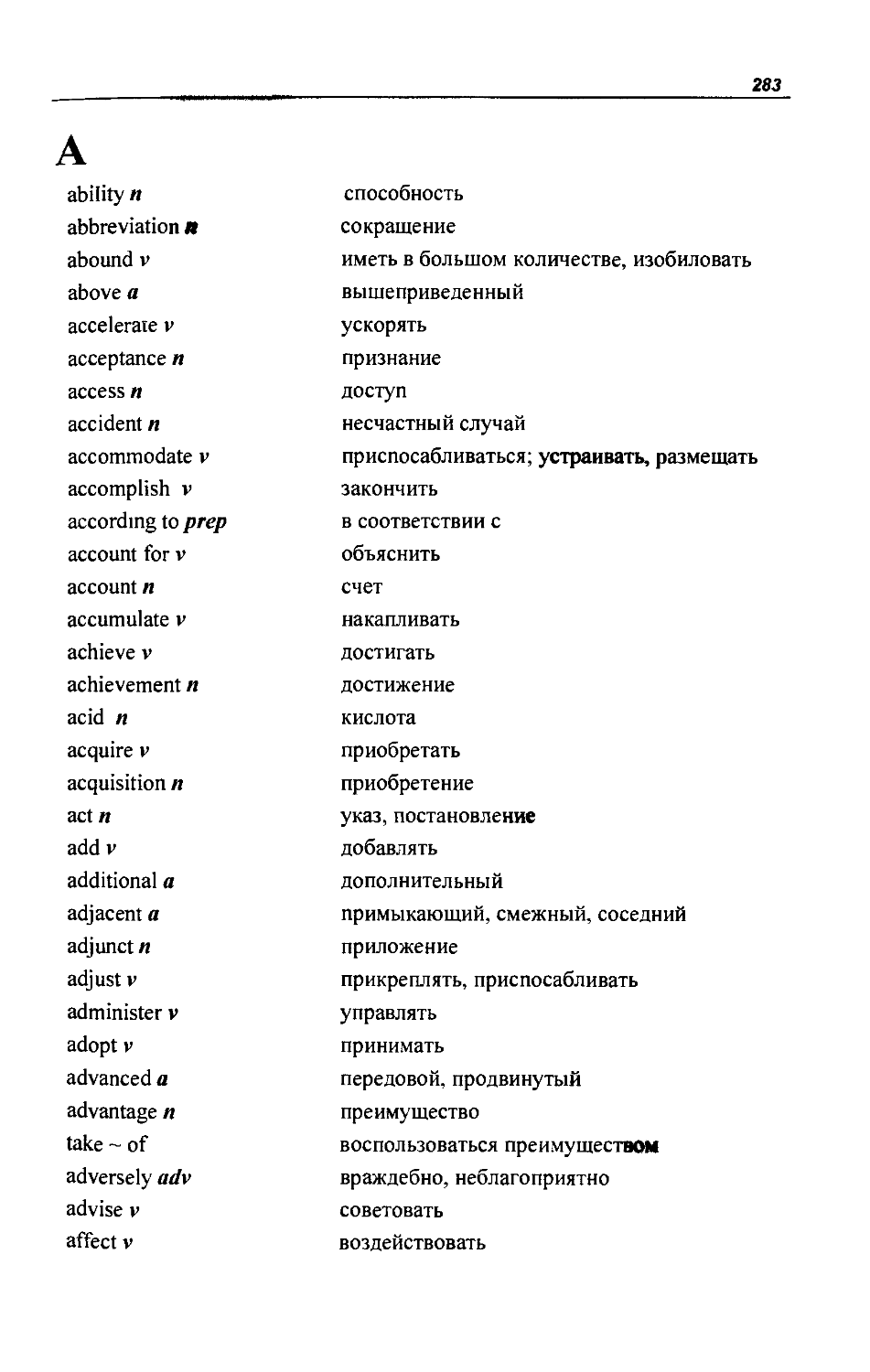
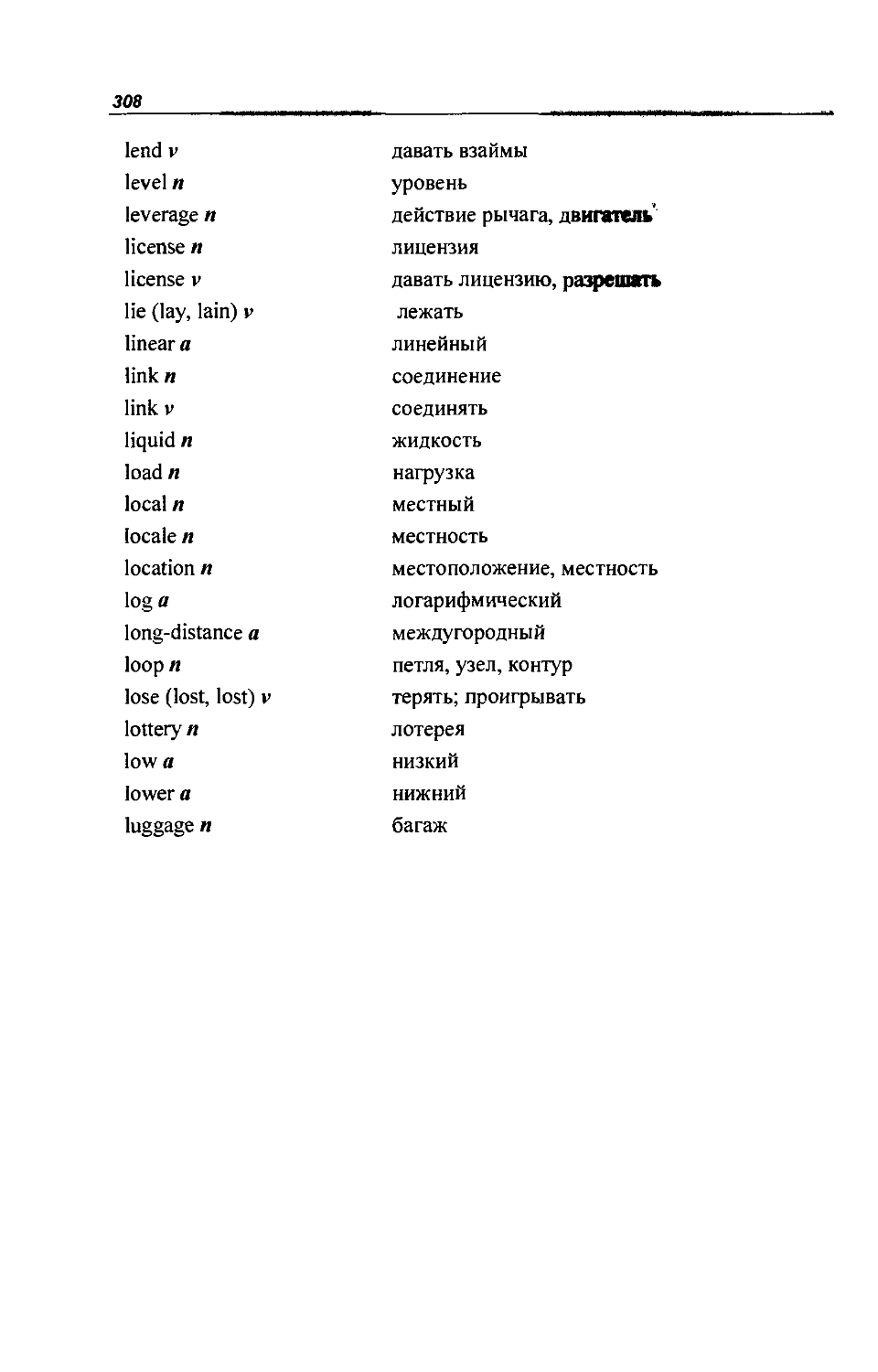
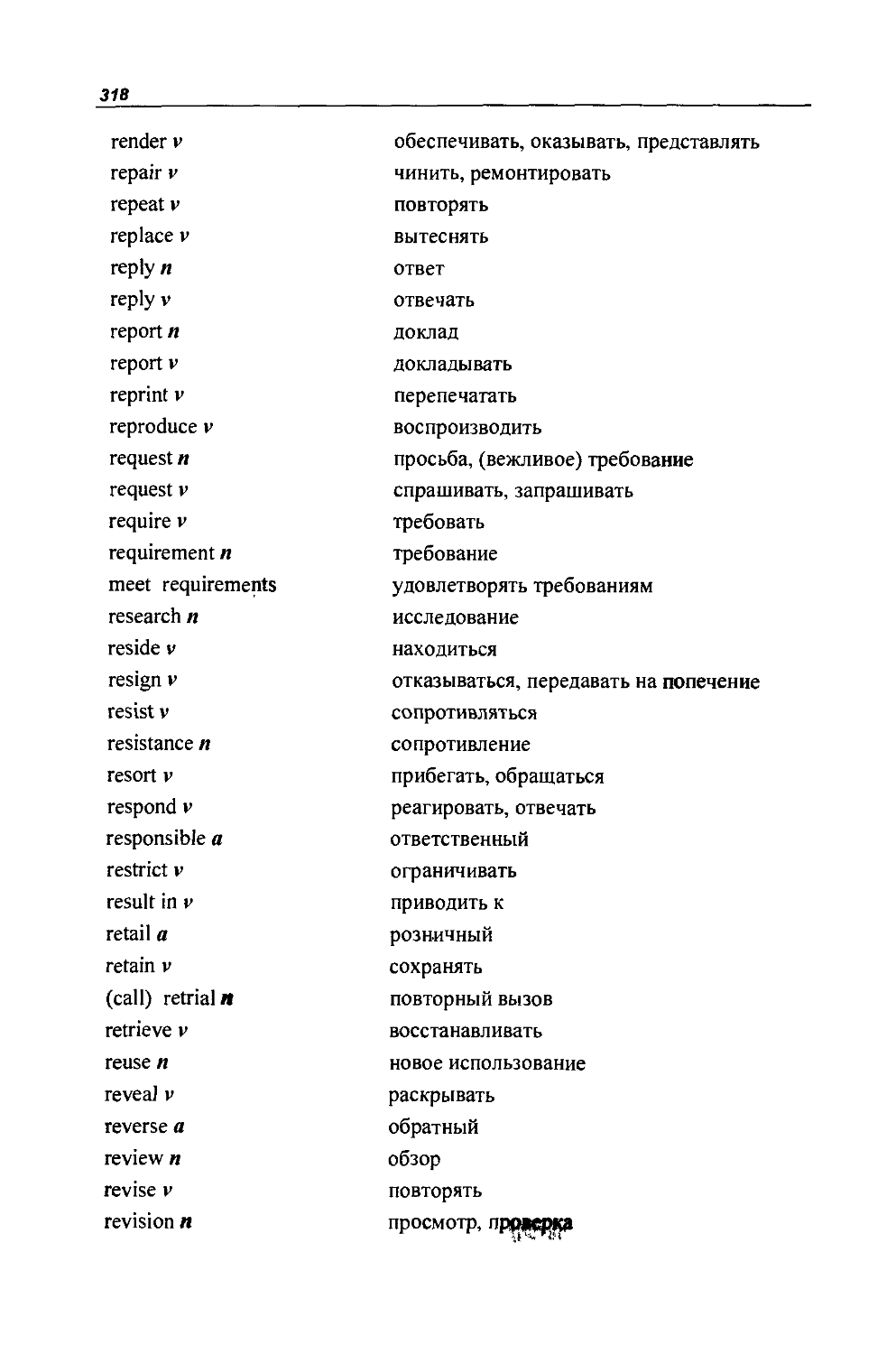
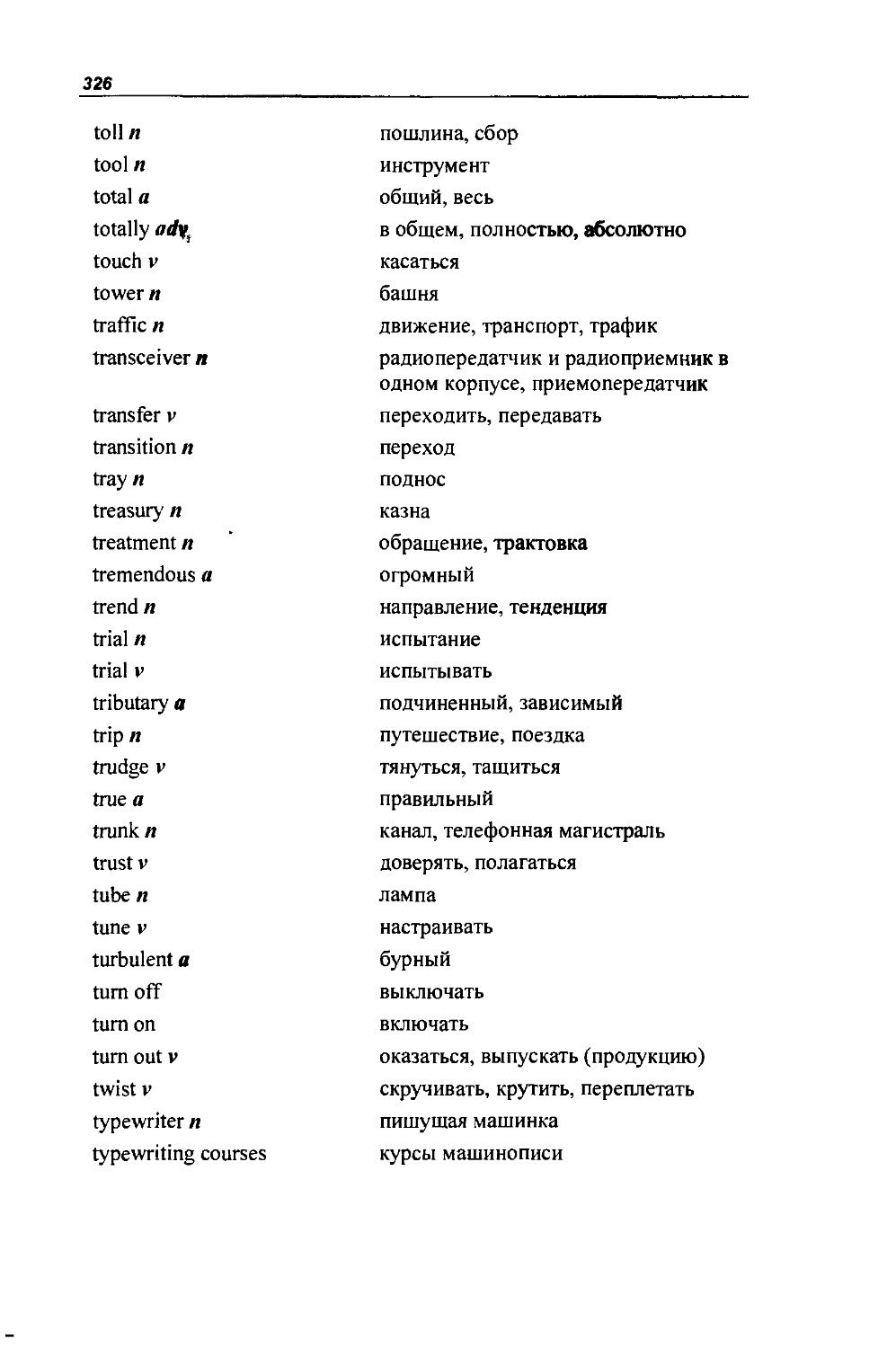
основного курса и приложения. Он снабжен словарем, ссылками на
использованную литературу и ключами к ряду заданий.
Все части учебника поделены на уроки ( Units).
Во вводно-коррективном курсе каждый урок посвящен
нескольким правилам чтения и наиболее простым грамматическим
явлениям. Правила чтения представлены схематично,
грамматические явления описаны кратко и, по возможности, тоже схематично.
Каждое правило и/или явление отрабатывается с помощью
тренировочных упражнений урока. Одновременно, наряду с повторением
бытовой и страноведческой лексики, обучаемые начинают работать
над усвоением общенаучной, политехнической и специфической
связистской лексики, а также над специфическими сокращениями,
используемыми в отрасли.
Уроки основного курса посвящены определенным
грамматическим явлениям, представленным кратко и схематично, и содержат
значительное количество соответствующих тренировочных
заданий. Используемая лексика носит бытовой, страноведческий,
общенаучный, политехнический и специфический характер. Сложность и
объем предлагаемых оригинальных текстов увеличиваются от урока
к уроку. Их тематика как страноведческая, так и специфическая.
Помимо заданий, направленных на овладение языковым
материалом, в каждом уроке имеются задания для развития умений и
навыков содержательной стороны всех видов речевой деятельности:
чтения, письма, аудирования, говорения.
Приложение направлено, в основном, на развитие чтения и, в
определенной степени, письма. Представленные в нем тексты носят
узко профессиональный характер, взяты только из современных
оригинальных источников и не подвергались никакой адаптации.
Приложение может быть использовано в качестве дополнительного

4
материала для работы с сильными группами, а также в качестве
основного материала для работы с аспирантами.
При составлении словаря автором была сделана попытка
отобрать наиболее употребительную специфическую современную
лексику, как правило, вызывающую затруднения у студентов.
Учитывая большое внимание, уделяемое в настоящее время
самостоятельной работе студентов, автор снабдила ряд заданий
ключами, что гарантирует самоконтроль в отсутствие
преподавателя.
Задания вводно-коррективного и основного курсов могут
быть легко введены в компьютерные программы, что позволит
использовать их для занятий в компьютерном классе с
преподавателем, для дистанционного обучения в автономном режиме или в
режиме on-line. При дистанционном обучении рекомендуется вводить
в программы также и теоретическую часть.
Отдельные части учебника английского языка для вузов
связи в течение ряда лет использовались в учебном процессе на 1-2
курсах общетехнических факультетов дневного отделения
Московского технического университета связи и информатики и в ряде
других вузов. Такая апробация учебника способствовала
выявлению и устранению ряда недостатков уже на этапе подготовки
рукописи к печати.
Автор благодарен рецензентам рукописи за внимательное и
объективное отношение к его работе.
Автор признателен старшему преподавателю кафедры
иностранных языков МТУ СИ Г. Л. Орловой за помощь в подготовке
словаря.
Замечания и пожелания по поводу содержания учебника
просьба направлять по адресу: 123955, ГСП, Москва, ул. Народного
Ополчения, д. 32, кафедра иностранных языков МТУСИ.

Вводно-коррективный курс
5
Часть 1
Вводно-коррективный курс
Unit 1
Принято считать, что в английском языке 7 кратких гласных,
5 долгих гласных и 8 дифтонгов.
Краткие гласные:
III- pit, / е / - pet, / эе / - pat, / Л / - putt, / э / - pot, / u / - put,
/ Э / - another
Долгие гласные:
/ i: / - bean, / a: / - barn, / э: / - born, / u:/ - boon, /3: / - burn
Дифтонги:
/ ei / - bay, / ai / - buy, I oil - boy, / ou / - no, / au / - now, / 1Э / - peer,
/ ЕЭ / - pair, / иЭ / - poor
Представив наши органы речи в виде четырёхугольника, мы
получим следующие таблицы английских кардинальных гласных:
\* '•
• [
\* е
\ • и:
\«и .
\э,3:
Ал
\» эе \ • а:

6
Что касается трифтонгов, то их обычно рассматривают как
сочетание дифтонгов с нейтральными звуками.
Например: layer / eia /, fire / aia /.
Английские согласные делятся на:
взрывные:
/ р / - pin, 1Ы - bin, /1 / - tin, / d / - din, / k / - kin, / g / - gum
аффрикаты:
/ tf / - chain, / d3 / - Jane
фрикативные:
/ f / - fire, / v / - vine, lei- think, / 5 / - this, / s / - seal, / z / - zeal,
/ J / - sheep, / 3 / - measure, / h / - how
сонорные:
/m/ - sum, /n/ - n, / rj / - sung
аппроксиманты:
/ 1 / - light, / r / - right. / w / - wet, / j / - yet
Их можно представить в виде таблицы , где звонкие и глухие
согласные размещены попарно: глухая - слева, звонкая - справа.

Вводно-коррективный курс
7

Билабиальные (губные)
Лабиально-
дентальные
(губозубные)
Дентальные
(межзубные)

Альвеолярные
Заальвеоляр-
ные
Палатальные
(нёбные)
Задненёбные
Гортанные
Взрывные
р, Ь
t,d
k,g

Аффрикаты
tf,d3

Фрикативные
k,g
в, а
k,g
J,3
(х)
h
Сонорные
m
n
4
Аппрокси-
манты
W
1
Г
j
Звуки (гласные и согласные) произносятся в речи, а буквы
служат для обозначения звуков на письме. Для обозначения 44
английских звуков используется латинский алфавит, имеющий 26 букв.
Аа
ВЬ
Сс
Dd
Ее
Ff
Gg
Hh
li
Jj
Kk
LI
Mm
/ei/
/bi:/
/si:/
/di:/
III
/ef7
/d3i:/
/eitj/
/ai/
/d3ei/
/kei/
/el/
/em/
Nn
Oo
Pp
Qq
Rr
Ss
Tt
Uu
Vv
Ww
Xx
Yy
Zz
/en/
/ou/
/pi:/
/kju:/
/a:/
/es/
/ti:/
/ju:/
/vi:/
/'dAbl'ju:/
/eks/
/wai/
/zed/
Соответственно, одна и та же буква в разных положениях
может читаться как несколько разных звуков.

8
Часть 1
Выделение слога в слове называется словесным ударением. В
транскрипции оно обозначается знаком / ' /, стоящим перед
ударным слогом.
Во многих случаях в двусложных существительных,
прилагательных, наречиях, местоимениях ударение падает на первый слог,
в двусложных глаголах - на второй, в многосложных словах - на
третий слог с конца ('export - to ex'port, 'beautiful). Однако эта
закономерность очень часто нарушается ('contact-to 'contact).
Кроме того, многие слова имеют двойное ударение
(^contra'dict, 'cross-e^xami 'nation) или меняют ударение в
зависимости от контекста ('compact - com'pact). Поэтому рекомендуется как
можно чаще проверять правильность словесного ударения по
словарю.
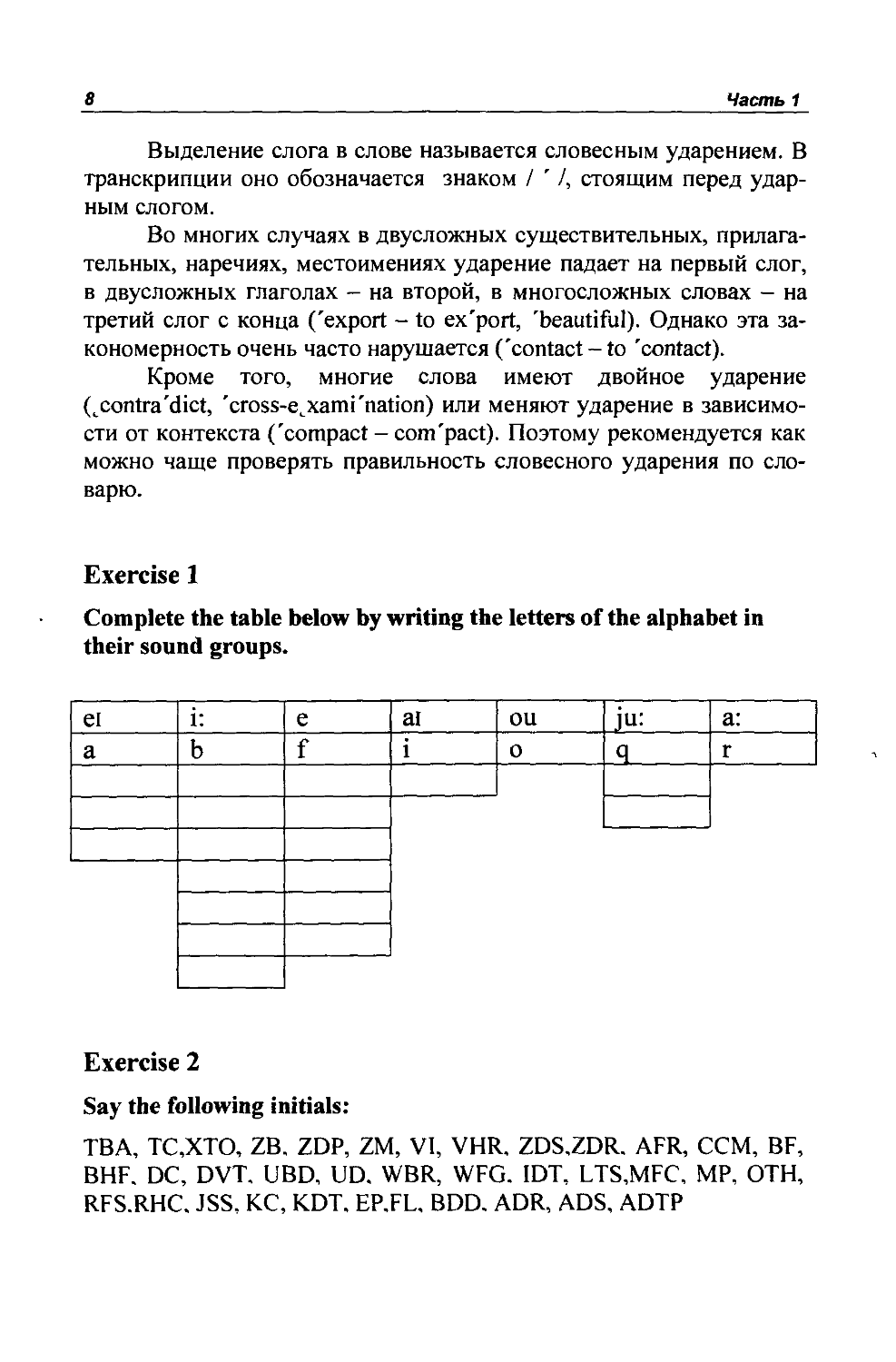
Exercise 1
Complete the table below by writing the letters of the alphabet in
their sound groups.
ei
a
i:
b
e
f
at
i
ou
0
ju:
q
a:
г
Exercise 2
Say the following initials:
TBA, TC,XTO, ZB. ZDP, ZM, VI, VHR, ZDS,ZDR. AFR, CCM, BF,
BHF. DC, DVT. UBD, UD. WBR, WFG. IDT, LTS,MFC, MP, OTH,
RFS.RHC JSS, КС, KDT, EP.FL, BDD. ADR, ADS, ADTP

Вводно-коррективный курс
9
Exercise 3
Match the abbreviations in the box to the definitions below.
A, AC, NC, TM, VLF, PDP, S, WPS
address code, analog (signal), time monitor, network control, project
development plan, very low frequency, waveform processing system,
saturation
Unit 2
ее (see, reed) —■
ea (cheap, clean) — ~!Ц^^^-~—___
e + согласная + e (complete, ^"i^" —^"tr^-—
i + согласная + e (elite, chlorine)_j^___-—-^^^— '"
ie (niece, piece) —— ~~~~~^Z~ "~
ei (ceiling, receive) ^—-
Exercise 4
Write the words beside their definitions.
a. a plan ( ).
b. to instruct ( ).
c. players on the same side in a game ( )
d. to touch ( )
e. a thing with moving parts which needs some kind of power to do its
job( )
f. a chair ( )
g. every ( )
h. to cross out ( )
i. high temperature ( )
j. what we do with food ( )
k. to take without asking ( )

10
Часть 1
Exercise 5
Complete the words in the text below.
Electricity can travel over a very long p- -ce of wire. But a note
written on a p- -ce of paper can't be put into a wire. It is well known that
electricity can move a n- -die from left to right. So a special electric
mach-ne with a n- -die pointing at letters written on a p- -ce of paper must
be used to send messages.
e (elastic, event) ——^^ / [ /
i (if, important) ~~~~^~~~^
Exercise 6
Match the words in the box with the definitions below.
electric, expensive, elect, entire, excite
a. Choose especially
b. The opposite to cheap
с If petrol runs out in the world, we may all have to use cars.
d. Complete, whole
e. To cause someone to have stronger feelings.
Exercise 7
Listen and repeat:
rich, sit, in, input, inphase, inner, inquiry, inspect, inside, insert, instruct,
instrument, drift, shift, integrated, integral, insulator, intact, insulation,
intensity, midband, mil, minimum, mixed, single, bit
e - (edge, energy) / e /
Exercise 8
Which words are pronounced /e/ and which are pronounced /1 /?
central, session, begin, bend, bell, cell, behavior, cement, felt

Вводно-коррентивный курс
11
or
ore
oor
al
(absorb, cord)
(core) "~~
(floor, door)-
(call) -—---""
/D:/
Exercise 9
Match the words on the left with the definitions on the right/
a. call I. middle, centre
b. chalk 2. cable
c. more 3. to telephone
d. cord 4. opposite to less
e. core 5. you write on a blackboard with this
о (off, on, offer) - / э /
Exercise 10
Match the words in the box with definitions below.
positive, oxide, often, optical, opera, optimum, oxygen, optimize
a. happening regularly
b. a musical play
с gas
d. best suited
e. favorable, possessing good qualities
f. a special kind of glass is called glass
g. a product of a chemical reaction
u + согласная +е
ue
ui
evv
oe
о
oo
о + согласная + е
ou
(rule, June)
(blue, true)
(fruit, suit)
(flew, chew)
(shoe)
(who, do)
(boot food)'
(more, whose)
(route)
/u:/

12
Часть 1
Exercise 11
Read the common words which include the sound /u:/ and
remember their spelling.
cool, boost, boot, loop, loose, noon, pool, tool, roof, root, soon,
tooth, zoo
Exercise 12
Write the words beside their definitions.
a. footwear that covers the leg ( )
b. a place to go and see animals in cages ( )
с to pick or select something ( )
d. 12 o'clock midday ( )
e. to break up food in your mouth ( )
f. footwear that covers the foot ( )
g. opposite to tighten ( )
u (must, shut) ___^^
о (mother, cover) ~~~~^^ / д /
ough (rough, tough) _- "
Exercise 13
Complete the poem by using the words in the box. All the words
have the sound / л /.
sunny, come, worry, honey, tonne, some, son, hurry, curry,
love, money, glove, none, dove
1. Bees make .
2. Workers make .
3. The weather can be .
And jokes can be funny.
4. Indians make .
5. Exams make you .
6. Clocks make you .

Вводно-коррективный курс
13
Alarms make you scurry.
7. I minus I makes .
8. A thousand kilos make a
9. A baby boy - your little _
Congratulations! Well done.
10. A lovely white bird's called a
11. A couple holding hands call it
12. A quiet night is alright for
13. But here's a party invitation for those who want to
Exercise 14
Write the words in their sound groups.
/Л/ /D/ /d:/ /i: / /I/ /e/
object, electron, echo, off, order, optimize, nonuniform, normal, net,
metal, meter, former, foreign, formula, mean, medium, melt, four,
emergency, enough, cover, element, cement
a (vase)
ar (car, far)
u (put)
oo (book, foot)
u (huge)
ew (news)
Exercise 15
Put the following words into the correct categories:
bar, cubic, cumulative, art, book, accumulator, dew, dark, enlarge,
partial, target, tube, tune, few, full
Exercise 16
Now use these words to fill in the sentences below.
1. In the evenings people like to go to ....
2. The volume of the swimming pool is 250 ... meters.
3. Very ... students can speak English well.

14
Часть 1
4. Are you interested in .. ?
5. What is ... used for?
6. What... are you reading now?
7. In winter it gets .. very early.
8. ... was a very important part in old TV-sets.
9. At the exam one must... one's answer as much as possible.
10. ... in your radio sets.
11. ... zones are bombarded by electrons.
12. ... data must be sent to the processing centre.
13. Sometimes ... addressing can be used instead of a ... one.
Unit3
Звук / Э / никогда не встречается в ударном слоге. Он может пере*
даваться различными буквосочетаниями (letter, Saturday).
Exercise 17
Underline the syllables which contain the sound / Э / in the words
below. List the ways you found to spell / Э /.
father electron damage
important electrostatic visible
centre cellular vertical
tonight nominal contact
employment voltage suspender
Exercise 18
Complete the words in the following sentences by spelling
the sound / Э /.
_ hundrd ph_togr_ph s frm Cand nd meric rrived in Britain
tnight tjoin th_ discuss n in Londn bout th_ role _f television
nd nevvspap s.
A -1- согласная (man, plan) - / ж /

Вводно-коррективный курс
15
Exercise 19
Listen and repeat:
Ann, lamp, analog, accuracy, acetate, accident, access, absolute, channel,
black, battery, balance, back, manual, management, match, tab, tap,
tandem, tank, pack, package, panel, transfer, amplifier, unclassify
er (her) ~~—^^^
ir(firm) V^S> /3:/
yr (Byrd) —^^^
ur (turn)
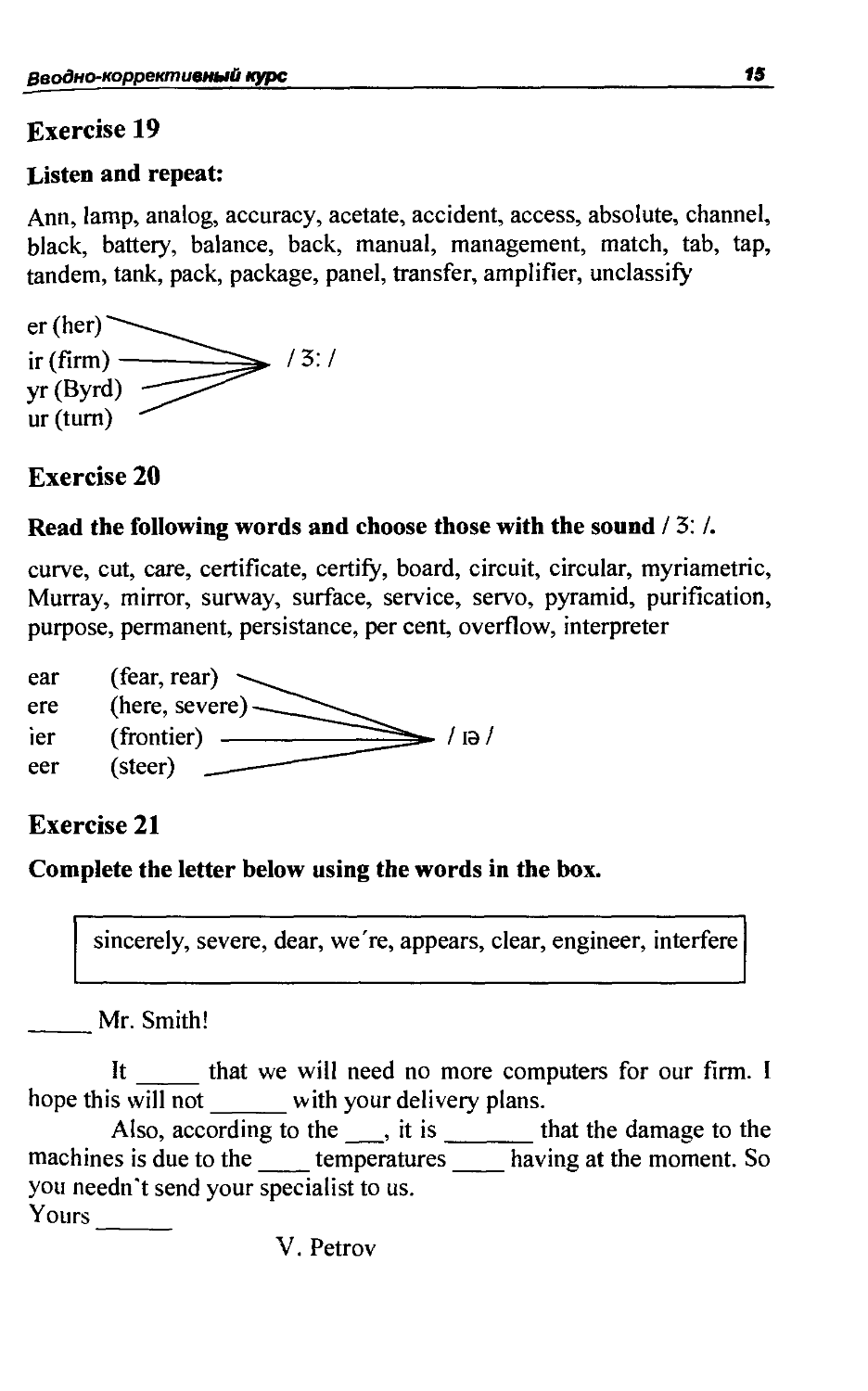
Exercise 20
Read the following words and choose those with the sound / 3: /.
curve, cut, care, certificate, certify, board, circuit, circular, myriametric,
Murray, mirror, surway, surface, service, servo, pyramid, purification,
purpose, permanent, persistance, per cent, overflow, interpreter
ear (fear, rear) -\^^
ere (here, severe) ~--~^\.
ier (frontier) J^Z^^ 11ЭI
eer (steer) __——■—
Exercise 21
Complete the letter below using the words in the box.
sincerely, severe, dear, we're, appears, clear, engineer, interfere
Mr. Smith!
It that we will need no more computers for our firm. I
hope this will not with your delivery plans.
Also, according to the , it is that the damage to the
machines is due to the temperatures having at the moment. So
you needn't send your specialist to us.
Yours
V. Petrov

16
Часть 1
(station, stable)
a
a + согласная + е или у (name, fame)
ai (aim, remain)
ay (pay, stay)
ei (weight)
'/ei/
Exercise 22
Unscramble the words to finish the letter.
Dear(teKa)!
How was your (oyilhad) in the (satSte)?
It's a nice (alcpe). I hope you weren't too (aridfa). So many people (ysa)
New York is a (zaycr) city but I couldn't (coplmina) about my own
(tsay) in the USA. I felt quite (fase).
I went on an (chaexnge) visit with a friend at school who was the
(mase) (gea). His father was a (repiant).
What was the weather like? When I was there we had a lot of
(niar). Especially the (yad) we went to a (mage) of (sabellab). They had
to stop it. I didn't mind as no one could (xeplina) it to me (nyawya)!.
Must go now. I've got a (rinat) to catch. I (amy) have a new job
in TV. I'm still in search of (mafe)!.
Lots of love
(neJa)
i (find, bind, wind)
i+ согласная + е или у (tiny, nice)^ •====^B / ai /
igh (light) —
у (my, cycle)
Exercise 23
Unscramble the letters and match the words in the box to the
definitions.
thgfi. plypa, dedio, nefi. ylpmi. iltgh, dlinb. dnib, lefi, hercip
a. bring into action, make use of
b. suggest, hint at. mean

Вводно-коррективный курс
17
c. screen
d. tie, fasten
e. secret writing
f. an electric device
g. pleasant, excellent, exquisite, thin
h. set of papers
i. we turn it on in the darkness
j. battle, combat, action
о + согласная + е или у (nose, rosy) \^^
ow (flow) ^^^^^___^> / ou /
oa (coat) .
Exercise 24
Complete the following sentences:
a. Opposite of high is .
b. The place where you live is called .
c. Yesterday I up at 6 am but I didn't get up until 8 am.
d. A piece of rock is called .
e. In summer the winds from the south-east.
f. A short letter is called a .
g. Can you me your holiday photos?
h. He spoke in a very angry of voice.
are (software, care)
air (chair, fair)
ear (wear) ~Z^-^^' /£Э/
ere (there, where)
Exercise 25
Read the following words and remember their spelling:
air, hair, armchair, affair, warehouse, hardware, whereabouts, underwear
ow(now) _______^
on(house) / au/

18
Часть 1
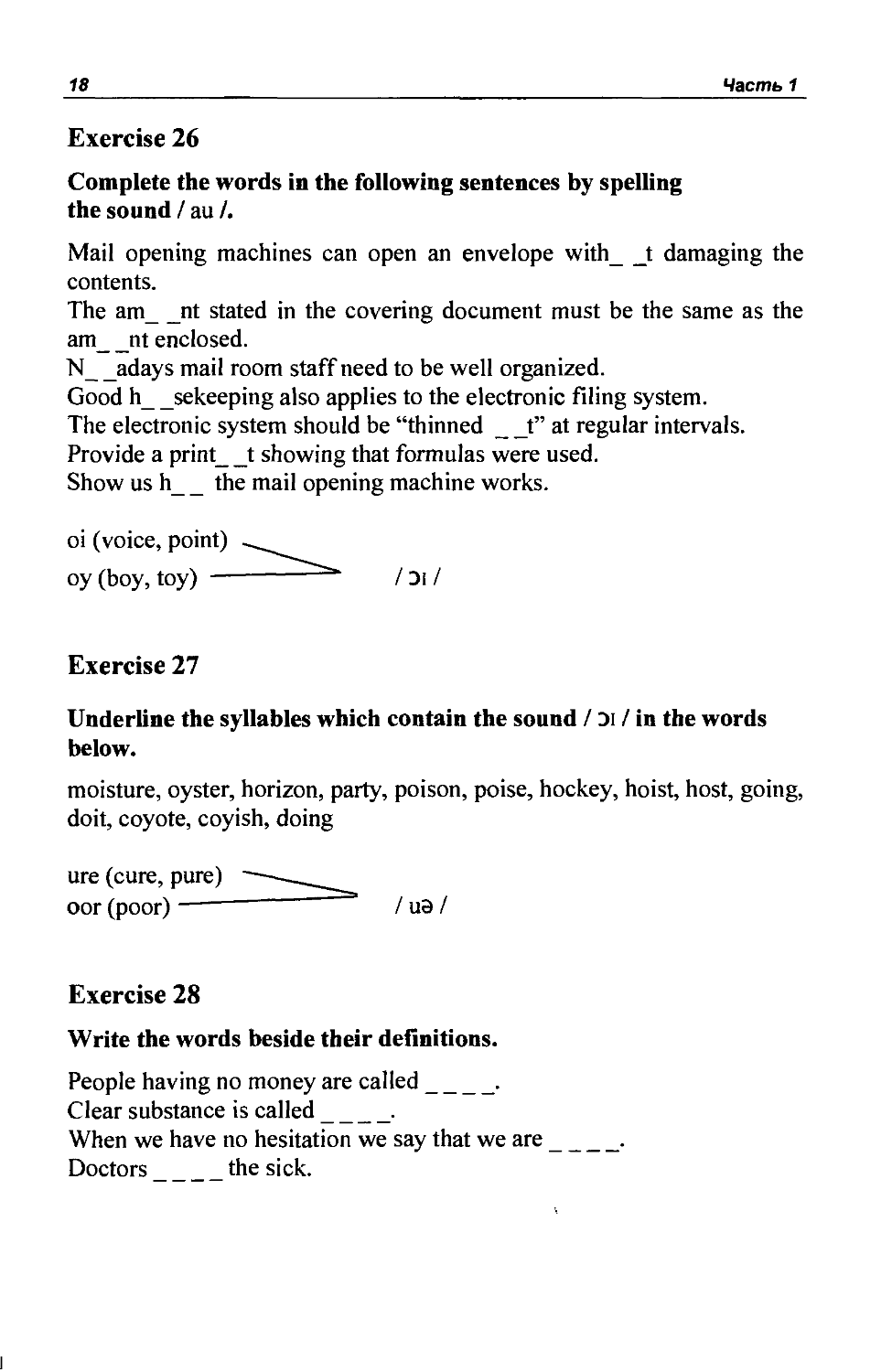
Exercise 26
Complete the words in the following sentences by spelling
the sound / au /.
Mail opening machines can open an envelope with t damaging the
contents.
The am nt stated in the covering document must be the same as the
am nt enclosed.
N adays mail room staff need to be well organized.
Good h sekeeping also applies to the electronic filing system.
The electronic system should be "thinned t" at regular intervals.
Provide a print t showing that formulas were used.
Show us h the mail opening machine works.
oi (voice, point) ^^^
oy (boy, toy) / 3i /
Exercise 27
Underline the syllables which contain the sound / Di / in the words
below.
moisture, oyster, horizon, party, poison, poise, hockey, hoist, host, going,
doit, coyote, coyish, doing
ure (cure, pure) —^-______^
oor (poor) / иЭ /
Exercise 28
Write the words beside their definitions.
People having no money are called .
Clear substance is called .
When we have no hesitation we say that we are .
Doctors the sick.

Вводно-коррективный курс
19
Unit 4
sh (ship, fresh)
t (section, initial, cautious)
с (electrician, commercial)
s (extension, suspension)
ss (profession, session)
Exercise 29
Underline the letters which are pronounced as / / / in the following
sentence.
The ambitious language learner, who wants to do some translation after
graduation, should work hard on pronunciation and dictation as well as
conversation.
f (fall, floor)"
ph (telephone)
Exercise 30
Match the words in the box with the given definitions.
telegraph, telephone, philosophy, photography, physical science
a. The process of making pictures using light.
b. An instrument which sends voices over long distances,
с A system for sending messages over long distances.
d. The study of natural forces such as gravity and energy.
e. A logical study of thought, knowledge, the universe.
к (break, thank)
ke (smoke, stroke)
с (republic. statistic)^____IZHf^. / к /
ck (flack, check)"
que (technique, unique)

20
Часть 1
Exercise 31
Choose the correct spelling.
a. Why don't we go for a walc/walk in the park/parck?
b. The answers are at the bake/back of the book/booc.
с He's off worck/work because he's feeling sic/sick.
d. Good luj/luck with new job.
e. He has a basic/basick understanding of the subject.
f. He didn't make/mace many mistakes/mistackes.
g. This is a historic/historick occasion for our countries.
ch (lunch, speech) —~^_^_^
tch (catch, fetch) "~~~ *- / tj /
Exercise 32
Choose the correct spelling.
a. I've just bought a Swiss wach/watch.
b. Can you touch/toutch the branch/brantch of that tree.
с The customer asked the waiter to fech/fetch a mach/match for his
cigar.
s + согласная (test) "———__^_^
s в начале слова (sit) —-IHl^^^---^^^
в конце слова после глухой согласнойТП^Т^^^^» / s /
ss (boss) . ■ ^^"^^^'^
с + е, i, у (cinema, center, policy) ^^^^
Exercise 33
One word in each group is pronounced differently from the others.
Which one is it and how is it pronounced? How are the rest
pronounced?
cinema stress sad eggs ask
center boss safe kicks fast
policy less vision picks phase
republic profession sack fists mist

Вводно-коррективный курс
21
на конце слова после звонкого
согласного и гласного (pens, bees)
s между двумя гласными
z в любом случае
'Izl
Exercise 34
Write the words in their sound groups.
/ s / Izl
set, cellular, circuit, circular, zoo, zone, sample, save, instruction,
inspect, inverse, instructions, tools, errors, invisible, fuse, gains, wires,
scale, frequency
g перед е, i, у (page, gin, gym)
j в любом случае (jam)
dg + гласная (bridge)
/03/
Exercise 35
Choose the correct spelling.
Technological/Technolodgical/Technolojical developments take place in
the "electronic"office.
Records must be chanjed/changed/chandged, updated and organized.
Many conventional paper-based routines are replaced by modern
information technoloji/technology.
When a new employee goins/joins a company a personnel file is made
out.
Urgent/Urdgent/Urjent mail should be sent by first class post.
th в начале служебных слов (this, that),
th в знаменательных словах между
гласными буквами (bathe)
1Ы
th в начале и в конце знаменательных слов (thick, thin) — / 6 /

22
Часть 1
Exercise 36
Read the following extracts and write the words with "th" in them in
their sound groups.
/6/ 1Ы
Modern telephone systems meet the individual requirements
They are built on a "modular" basis. This means that future needs and
developments can be added without changing the basic structure. They
still have the usual components but changes are made in the way these
are brought together.
Documents and correspondence in one file can be referred to
those in another. This occurs when there is a change of names. For
example, women who get married usually change their surname. For
thtst files not to become "thick" unnecessary information is deleted.
g перед согласными (bag) ~~^=^ I g /
g перед гласными: кроме е, i, у (game) —
ng (hunger) / g /
ng(reading) /n/
ng (strange) / nd3 /
Exercise 37
How are "g" and "ng" pronounced in the following words?
doing, gang, stranger, ranger, ringing, grade, ground, growing, gain,
fringe, galvanic, gate, gating, government, gold, general, good, glow,
Geneva, group, grading, guy, hunger, heating
h в начале слова перед гласной (he, hat) —_
wh + "o"(who) . ■ ~^/h/
Exercise 38
Read the following words paying attention to the sound / h /:
hot, high, hollow, heat, height, heavy, helical, helix, harmonic, half,
hack, hair, hand. hall, harden, whole, hang, hold, hole, whom, hardware,
hay, harsh, head, whopper, hell, Hertz, hesitation, hood, house, howl,
hub. hunting, hyperfine. wholesome

Вводно-коррективный курс
23
х перед согласными и на конце слова (six) / ks /
х перед ударной гласной (exam) / gz /
Exercise 39
Write the following words in their sound groups.
/ks/ /gz/
x-axis, xerography, executive, excitation, exchange, exact, examination,
excess, excite, excitor, exclusive, exempt, extension, expand, exit,
exhaustion, exercise, example, exposure, explore, expiry, external, extra,
exuberant, exult, exurb, exterior
w + гласная (want, wate) "— _____^
wh + гласная, кроме "о"(what, white)-""" "— / w/
qu + гласная (quick) / kw /
Exercise 40
Practice saying these sentences quickly.
Quick liquor and quite quiche frequently.
The liquid squid questions the quarreling queen mosquito.
Exercise 41
Write the words with "wh" or "w" in them in their sound groups.
/w/ /h/
wave, weight, weld, whom, what, way, wax, white, wheel, weak, which,
whose, weather, whisper, wide, widow, wire, whole, wet, want, where,
work
г перед любой гласной, кроме немой *'е" (red, read) - / г /
Exercise 42
Read the following words and remember their spelling:
trade, priority, private, mirror, return, processor, peripheral, run, reverse,
ring, transmission, retest, relative, relay, write, tariff, nonreturn, lorry,
battery, barium, barrier, arrive, arrange

24
Часть 1
Гласная + s + ure (leisure, measure)"~~^-^^^
гласная + s + ion (vision) / 5 /
Exercise 43
Complete the words in the following sentences by spelling
the sound / 5 /.
Money is kept in the tre .
Meter is a me of length.
At le I like reading.
In mist v on is bad.
A man was walking at a le by pace.
Me ments are wery important in telecommunications.
у в начале слова перед гласной (yes, yet) - / j /
Exercise 44
Write down your own examples of words with the sound /j /.
v в любой позиции (valve) - / v /
d в любой позиции (did)-/ d/
t в любой позиции (test) - /1 /
b в любой позиции (big) - / b /
p в любой позиции (pat) - / p /
l в любой позиции (late, tale) -III
m в любой позиции (merge, some) -I ml
n в любой позиции (no, lane) - / n /
Exercise 45
Complete the words in the text below.
A receptionist aways _ries to mai_tai_ goo_ vvill. He grees the isiors
frie ly. isiors shoul_ no_ _e ket vvaiing unnecessa_y. They
should always be aske о ake a sea_. They coul_ a_so be offered a
_ews_a_er or agazie _o rea_. I_ is i or_an_ to let them know
th_ they are receiing attention.

Вводно-коррективный куре
25
Unit 5
Когда слово оканчивается на согласную +у, при
присоединении суффиксов и окончаний у изменяется на i:
carry - carried;
certify - certificate;
happy-happily;
happy - happier;
carry - carries.
Обычно множественное число существительных и 3-е лицо
единственного числа простого настоящего времени глаголов
образуется с помощью окончания s:
Не makes model receivers.
Но к словам, оканчивающимся на ch, sh, x, s, у (после
согласной), добавляется es:
My wife teaches young children,
I like sea beaches.
При образовании множественного числа существительных,
оканчивающихся на f или fe, f переходит в v:
half- halves.
Некоторые существительные образуют множественное число
особым образом:
man - men;
woman - women;
goose - geese;
mouse - mice.
Exercise 46
Change the words in brackets into the correct plural or third person
form.
All (organization) are made up of (individual). Any organization
(to need) to attract and keep worthwhile (employee). Every employee (to
require) tact, enthusiasm and the ability to communicate with people at
all (level). When a vacancy (to arise) a job description is prepared. This
(to give) a clear outline of the (duty) and (responsibility) involved.

26
Часть 1
A job description (to describe) the nature of the job. It (to list)
the main (aspect) of the job, the (duty) and (responsibility) and any
specific (requirement), such as typewriting (skill).
A job specification (to list) the knowledge, (attribute) and (
quality) needed to carry out the job.
В словах, оканчивающихся на ударную гласную + согласную
(кроме w, у, х), при прибавлении суффиксов ed, er, est, ing и у
конечная согласная удваивается:
big-bigger-biggest;
debag - debagged;
debit - debitted.
Exercise 47
Which of these words double the final consonant?
Write the consonants where necessary.
job, jog, join, gulp, gun, guess, group, enlarge, emit, club, fit, fix, flap,
big, need, seed
Обычно наречия образуются добавлением -ly к
прилагательному: light - lightly.
Однако если прилагательное оканчивается на у, то у
переходит в i перед ly: funny - funnily.
Если прилагательное оканчивается на е, при образовании
наречия е опускается: simple - simply.
Если прилагательное оканчивается на ic, при образовании
наречия добавляется ally:
automatic - automatically;
photographic - photographically;
но:
public - publicly;
shy - shyly;
true - truely.
Некоторые наречия имеют ту же форму, что и
прилагательные: early, fast.
Некоторые наречия имеют особую форму: good - well.

Вводно-коррвктивный курс
27
Exercise 48
Form adverbs from the following adjectives:
quick, correct, early, slow, bad, sunny, witty, ample, true, rough, elastic,
electromagnetic, elegant, chilly, sharp, large, active, content, loyal, low,
lucky, slight, simple, uniform, kind
Unite
В английском предложении под ударением (-), как правило,
стоят знаменательные слова: существительные, наречия,
вопросительные и указательные местоимения. Неударными (.) обычно
бывают служебные слова: артикли, союзы, предлоги, вспомогательные
глаголы, а также личные и притяжательные местоимения. В случае
необходимости говорящий может выделить ударением какое-либо
служебное слово, кажущееся ему важным, или сделать безударным
знаменательное слово.
В английском языке имеются два основных речевых тона:
нисходящий и восходящий. Нисходящий тон (~^) выражает
законченность высказывания, его категоричность. Он употребляется в
повелительном и повествовательном предложениях. Восходящий
тон (J) выражает незаконченное высказывание, употребляется при
перечислении, в вопросительных предложениях. Повышение голоса
при этом происходит в конце слога и начинается с самого низкого
тона.
Первый ударный слог в предложении произносится самым
высоким тоном по сравнению с остальными слогами.
Give me my box.
'Л
—^
•
• •
• • •
Could you help me?

28
Часть 1
Exercise 49
Read the following text. Find mistakes in it. Read it again marking
the intonation.
Spreadsheet are the electronic equivalent of a large sheet of paper.
They consists of row and column organized in a "grid" format. Each cell
give its row and column reference.
Spreadsheets has a wide range of use. They are used to keep
account, analyze information and make calculation. The spreadsheet
program carries out all mathematical and statistical function by the use
of special formula. A formula tell the spreadsheet what calculation to
perform.
Why do business organization often need information? They needs
information so that they can analyses it and make a decision. One of the
most important advantage of a spreadsheet is its ability to answer "what
if question. Many spreadsheet program also offer a fastly and reliable
way of converting data into graphical form. But you should always
remember that the work done by any machine depend on the accuracy,
skill and competence of the operator.
Простые повествовательные и повелительные предложения
произносятся, как правило, с понижающейся интонацией.
Managers plan activities.
'Л.
'Л
Л
Advertise in special journals.
'Л
• • ш »
Однородные члены и обстоятельства принято выделять
повышающейся интонацией.

Вводно-коррективный курс
29
In the U£, | the national telecommunications network is supplied
by British Telecom.
A customer may use the following postal services: patapost,
Cash on Delivery | and Freepost.
Для выделения отдельных членов предложения применяется
также смешанная (нисходяще-восходящая) интонация и резкий
подъём.
The model, selected | is available from all potential suppliers.
Предложения, входящие в состав сложных, произносятся как
с повышающейся, так и с понижающейся интонацией в зависимости
от смысла и типа соединения.
When the mistakes are discovered |, the Accounts Department
must be informed.
In a small firm |, one person may be responsible for carrying out
all of the invoice checking procedures, | but in a,large organization |,
4several members of staff may perform these duties.
Unit 7
Существуют три основных типа вопросов: прямые вопросы,
косвенные вопросы и вопросы-утверждения.
Прямые вопросы можно подразделить на два вида:
• wh- вопросы, начинающиеся с wh- вопросительного слова
(включая how); они, как правило, произносятся с
понижающейся интонацией;
How should the post town be typed?
• yes /no- вопросы, ответами на которые являются "да" и "нет";
произносятся, как правило, с повышающейся интонацией.
Do some organizations type the name of their firm below the
complimentary close?
Альтернативные вопросы имеют ту же форму, что и yes/no-
вопросы; их первая часть произносится с повышающейся, а вторая с
понижающейся интонацией.
Do all lines of the letter begin at the left-hand margin or do they
begin at the Tight-hand margin?

30
Часть 1
Однако на альтернативный вопрос нельзя ответить кратко
"да" или '"нет". Ответ на него всегда полный.
Порядок слов в прямом вопросе можно изобразить в виде
следующей схемы:
Вопросительное
слово
(+
существительное)
+
Модальный
глагол/
Вспомогательный
глагол
+
Подлежащее
+
Остальные
элементы
глагольной
фразы
В косвенный вопрос входит вопросительное слово (wh-, how,
if или whether) и придаточное предложение с утвердительным
порядком слов, интонация которого, как правило, понижающаяся.
I don't know | why it is necessary to arrange the different parts
of a letter into a standard form of presentation (а не is it necessary...).
Could you tell me | if the typewriter is still the most frequently
used business machine for preparing letters (а не is the typewriter
still...).
Существует два типа вопросов-утверждений:
• утверждение, произносящееся с повышающейся интонацией:
This sector provides details of some frequently used reference
books?
• утверждение + question-tag, произносящееся с понижающейся
интонацией:
An annual publication provides information and statistics about
government, industry, finance and commerce, doesn't it?
Exercise 50
Read the following questions. Define their types (direct yes/no
questions, direct wh- questions, indirect questions, statement
questions, statement questions + tag). Answer them.
1. What has been your most valuable experience?
2. Do you prefer money or do you prefer status?
3. Are you an aggressive person?
4. When did you last lose your temper?
5. Could you tell me why you lose your temper?

Вводно-коррективный курс
31
6. Can you describe yourself in three adjectives?
7. What is the best idea you've had this year?
8. What is the hardest thing you've done?
9. You've got enough experience for a job, haven't you?
10. You can't tell me everything about yourself, can you? Why?
11. Your worst fault?
12. What is your proudest achievement?
13. What would you like to be doing in 5 years' time? In 10 years' time?
Exercise 51
Are the questions below correctly formed? Write the corrections if
necessary.
1. The firm is a big organization or a small firm?
2. How many people it employs?
3. Where is the firm based?
4. The firm has no subsidiaries, hasn't it?
5. Do it have a good industrial relations record?
6. Has any recent political or economic events affected the firm?
7. What is the name of the chief executive?
8. The firm exports goods?
9. Could you tell me where does the firm exports goods?
10. Does the firm take training and career development seriously?
Exercise 52
Read the following text. Ask all types of questions to each
paragraph.
The Job Interview
Arrive in good time - not only because it is polite but because
having to rush will leave you feeling hot and flusted, and therefore
nervous.
Be neat and fairly conservative in your appearance.
Take cues from interviewer on degree of formality - your
sensitivity to non-verbal communication should help you with this.
Perhaps be a little more formal than usual - not a stuffed shirt. Be
cautious about jokes, sarcastic asides etc.

32
Часть 1
Don't smoke unless invited to do so, and then only if you must,
unless the interviewer smokes. Never smoke if there is no ashtray in
sight.
Be prepared to take notes, if it is necessary to record information.
But it might be best to ask the interviewer if they would mind if you did.
Even then, don't scribble furiously all the way through.
Be polite, but friendly and don't forget to smile (but only when it's
appropriate).
Leave promptly when the interview is over, don't hover. Smile,
shake hands and thank the interviewer.
Exercise 53
Think of a situation where you might telephone an organization and
request information. Write the questions you might ask. Use
different types of questions and different wh- words.
Exercise 54
Read the following text aloud with proper intonation. Ask five
questions which will make up a plan of the given text. Retell the text.
The mobile telephone, fast train and air travel have cut the problems
of distance for today's business executives. However, where the
recipient cannot be reached personally by telephone, the fax message and
the telex message, which can be transmitted fast to the person concerned,
may still prove invaluable in extremely urgent situations where
immediate action is required.
Generally speaking, telex machines are now only used in
situations where there needs to be legal proof that a message has been
sent when fax machines are not acceptable.
Telex messages present the communication with the greatest test
in conveying a clear message in the minimum number of words. This
skill in writing information-packed messages can be useful in other
writing tasks.

Основной курс
33
Часть 2
Основной курс
Unit8
Четыре основных формы глагола
I
Инфинитив
(The Infinitive)
(to) V
(to) ask
(to) teach
(to) take
II
Простое прошедшее время
(The Past Simple Tense)
V+ed или особая
(2-я форма глагола)
asked
taught
took
III
Причастие II
(Participle II)
V+ed л™ особая
(3-я форма глагола)
asked
taught
taken
IV
Причастие I
(Participle I)
V+ing
asking
teaching
taking
Exercise 55
Define the forms of the following verbs:
spoken, sang, said, stood, speaking, worked, understand, shown, sit,
said, had, building, caught, chose, blew, binding, begun, got, awoke,
dug, fought, hurt, gettjng, forgiven, flew, lay, must, met, can, forbade,
lit, brought, drawing, digging, ground, hoped, giving, winning
Exercise 56
Read the given forms of the verbs. Decide which of them are correct
and which are not. Give the right versions.
(to) cost, costed, cost, costing
(to) hang, hang, hang, hanging
(to) think, thought, thought, thinking
(to) eat, eated. eaten, eating
(to) come, come, came, coming
(to) fall. fall, fallen, falling
(to) feel, felt, felt, feeling
(to) lose, lost, lost, losing

34
Часть 2
(to) ring, rung, rung, ringing
(to) built, built, built, building
Exercise 57
Give the four forms of the following verbs:
читать, писать, жить, покидать, покупать, связывать, хотеть,
любить, нравиться, соединять, посылать, набирать (номер),
получать, давать, брать, бежать, идти, двигаться, слышать
Exercise 58
Give the infinitives of the following verbs:
became, learned, helping, broken, forbidden, reading, kept, gone, was,
doing, drunk, drove, carried, dreamt, finding, crowded, sold, paid, knew,
throwing, burnt, putting, seen, broke, driven, forbade, kept, shook, told,
written, worn, smelt, shown
Exercise 59
Add three forms of the verbs given below.
I
lean
choose
II
bent
led
found
III
hidden
mistaken
IV
holding
freezing

Основной курс
35
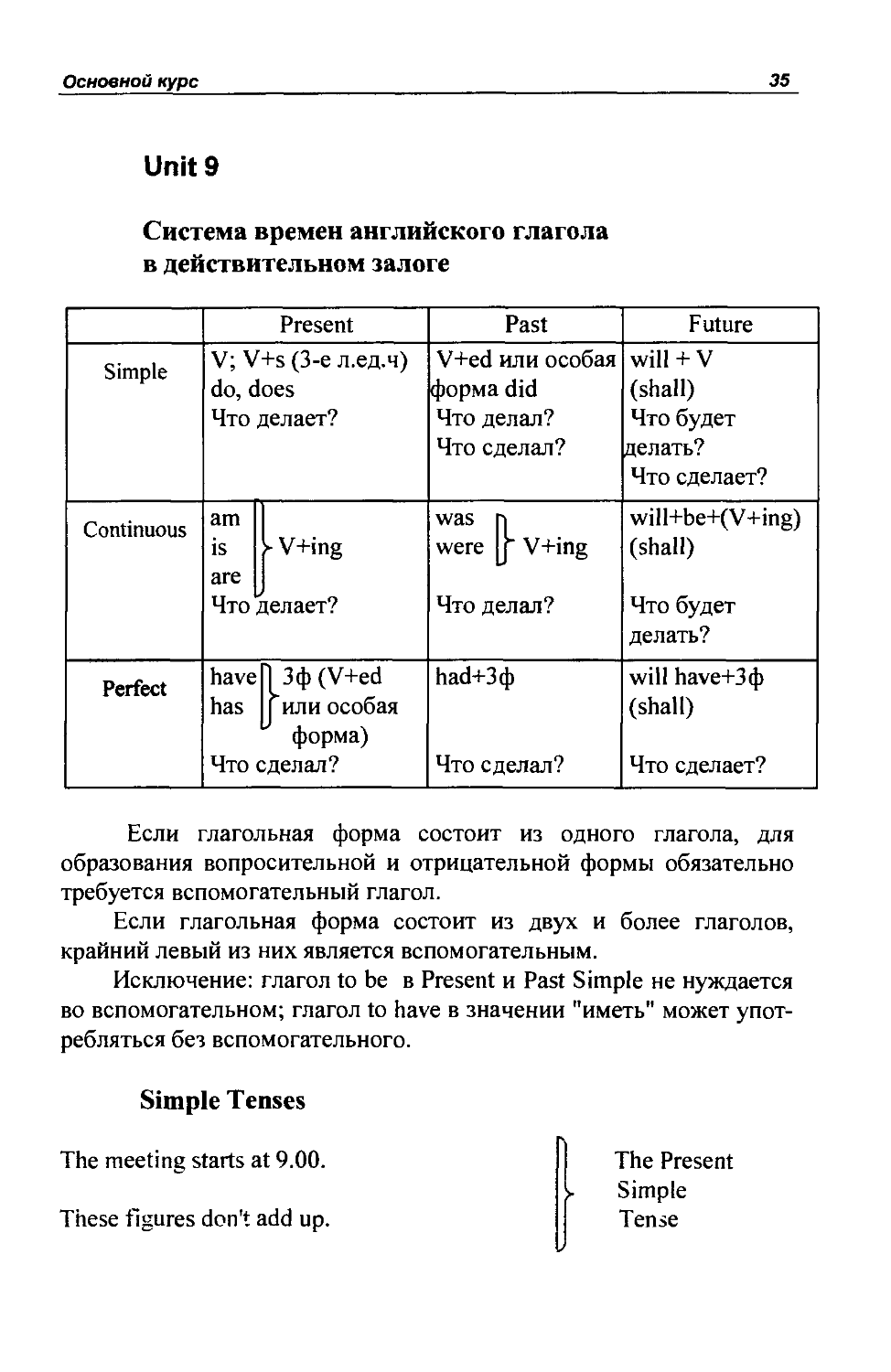
Unit 9
Система времен английского глагола
в действительном залоге
Simple
Continuous
Perfect
Present
V; V+s (3-е л.ед.ч)
do, does
Что делает?
am
is
are
► V+ing
Что делает?
have
has
1 Зф (V+ed
[или особая
форма)
Что сделал?
Past
V+ed или особая
форма did
Что делал?
Что сделал?
was n
were If V+ing
Что делал?
had+Зф
Что сделал?
Future
will + V
(shall)
Что будет
делать?
Что сделает?
will+be+(V+ing)
(shall)
Что будет
делать?
will have+Зф
(shall)
Что сделает?
Если глагольная форма состоит из одного глагола, для
образования вопросительной и отрицательной формы обязательно
требуется вспомогательный глагол.
Если глагольная форма состоит из двух и более глаголов,
крайний левый из них является вспомогательным.
Исключение: глагол to be в Present и Past Simple не нуждается
во вспомогательном; глагол to have в значении "иметь" может
употребляться без вспомогательного.
Simple Tenses
The meeting starts at 9.00.
These figures don't add up.
The Present
Simple
Tense

36
Часть 2
During the year we installed a new
accounting system.
When did you finish your work?
I think I'll read your proposal.
At the first stage the machine will
not/won't work properly.
Positive Form
I work in different
departments.
We/you/they work...
He/she/it works.
Negative Form
1 don't work at
different departments.
We/you/they don't
work...
He/she/it doesn't
work...
I worked in different I didn't work at
departments.
We/you/they
worked...
He/she/it worked.
I/we will fshallVIl
work in different
departments.
He/she/it/you/they
will/'! 1 work-
different departments.
We/you/they didn't
work...
He/she/it didn't
work...
I/we will (shall)
not/won't (shan't)
work...
He/she/it/you/they will
not( won't) work...
The Past
Simple
Tense
The Future
Simple
Tense
Interrogative Form
Do I work at different
departments?
Do we/you/they work...?
Does he/she/it
work...?
Did I work at different
departments?
Did we/you/they
work...?
Did he/she/it work..?
Will (shall) I/we
work...
Will he/she/it/ you/ they
work...
Времена группы Simple обозначают регулярное действие в
настоящем, прошедшем или будущем.

Основной курс
37
Present Simple может употребляться для обозначения
будущего времени с глаголами движения или при наличии
обстоятельства будущего времени.
A new plant opens on February 1.
When do you leave?
Exercise 6t
Complete the following sentences with the correct form of a verb
from the list in the box:
provide, rise, start, consist, be, proceed, expand, cause, have
1. The new computer program fs .;a variety of helpful applications.
2. The new machine 50 percent more than the previous machine.
3. When the temperature the metal .
4. The broken contact the heater to be switched on and so the
cycle again,
5. Shape memory alloys many applications.
6. Silicon the most common element on this planet.
7. A transistor ^' of two types of silicon.
Exercise 61
Write sentences to complete a dialogue based on the flowchart below.
Ask what the size of the ^ medium -sized company
company is
Ask how many terminals
they have got
Ask how they input
information and provide it
to senior staff
Ask if they have got a
specially designed computer
room
Ask what they need
keyboard operators
no room
>• an authorized access

38
Часть 2
Exercise 62
Complete the following text.
Silicon solid and the ability to conduct electricity. It
neither a good conductor nor a good insulator. That why it and other
solids such as germanium semiconductors.
As a semiconductor silicon very sensitive to impurities or
dopants. If you 0.0001% of dopant to silicon you conductivity
by 100 times.
Exercise 63
Read the completed text above and compose a similar text of your own.
Describe copper, iron, alluminium.
Exercise 64
Read the following text. Ask 10 questions to it.
Let your fellow-students answer them.
The Mason-Dixon Line, often considered by Americans the
demarcation between the North and the South, is in reality the boundary
that separates the state of Pennsylvania from Maryland and parts of
West Verginia. Prior to the Civil War, this southern boundary of
Pennsylvania separated the non-slave states to the north from the slave
states to the south.
The Mason-Dixon Line appeared long before the Civil War, as a
result of a boundary dispute between the two states. Two English
astronomers, Charles Mason and Jeremiah Dixon surveyed the area and
officially marked the boundary between the two states. They completed
the survey in 1767 and marked the boundary with stones.
Exercise 65
Read the text given above again and choose the best endings to the
sentences below.
1. The best title for this text is
a) Dividing the North and the South:
b) The Meaning of the Mason-Dixon Line;
c) Two English Astronomers;

Основной курс
39
d) The History of the Mason-Dixon Line.
2. Before the Civil War
a) Pennsylvania was south of the Mason-Dixon Line;
b) Pennsylvania was a non-slave state;
c) the states south of the Mason-Dixon Line had the same opinion
about slavery as Pennsylvania;
d) the slave states were not divided from the non-slave states.
3. The Mason-Dixon Line appeared because of disagreement
a) about borders;
b) about slaves;
c) between two astronomers;
d) over surveying techniques.
4. The word "survey" means
a) view;
b) understand;
c) map out;
d) separate.
5. They marked the Mason-Dixon Line with
a) pieces of rock;
b) a fence;
o) a stone wall;
d) a border crossing.
Excercise 66
Answer the following questions about yourself.
1. What will you do after classes?
2. Where will you go in the evening?
3. Who'll you see tomorrow?
4. Will you go to the University tomorrow?
5. What won't you do in the evening?

40
Часть 2
Unit 10
Continuous Tenses
Which project are you working on?
I'm finishing preparations for our meeting
tomorrow morning.
What were you doing at this time last year?
As the equipment was getting old we
decided to replace it.
What will you be doing this time next year?
The business will be dropping gradually
next year.
Positive Form
I ат/*т checking the
figures now.
We/you/they are
checking...
He/she/it is checking.
I was checking the
figures yesterday.
We/you/they were
checking...
He/she/it was
checking...
Negative Form
I am not/m not
checking...
We/you/they are
not/aren't checking...
He/she/it is not/isn't
checking...
1 was not/wasn't
checking...
We/you/they were
not/weren't checking
He/she/it was
not/wasn't checking...
The Present
Continuous
Tense
The Past
Continuous
Tense
The Future
Continuous
Tense
Interrogative Form
Am I checking...?
Are we/you/they
checking..?
Is he/she/it checking..?
Was I checking..?
Was he/she/it
checking...?
Was he/she/it
checking..?

Основной курс
41
I will/1!! be checking 1 will not/won't be
the figures checking...
tomorrow.
Will I be checking..?
We/vou/thev will/41
be checking ...
He/she/it will/41 be
checking ...
We/you/they will
not/won't be
checking...
He/she/it will
not/won't be
checking...
Will we/you/they be
checking...?
Will he/she/it be
checking...?
Времена группы Continuous обозначают действие,
происходящее в определенный момент (период) в настоящем,
прошедшем или будущем. Этот момент (период) может быть обозначен
конкретным временем или другим действием.
Tomorrow the engineers will be discussing the advantages of optical
fibres compared with copper cables.
When the consultant came the manager was speaking about security
requirements for the computer equipment.
Время Present Continuous может
обозначения действия, ставшего привычкой.
She is always grumbling.
употребляться для
Оно может передавать значение будущего времени с
глаголами движения или при наличии обстоятельства будущего
времени.
We are writing a test tomorrow.
Hurry up! The train is leaving.

42
Часть 2
Exercise 67
How many sentence combinations can you make based on the
following alternatives?
I
Mr Black
The production
The enineer
was
were
researching
writing
projecting
a new problem
a new plant
a report
when
they
the
director
I
he
helped
me
found
the
solution
rejected the idea
resigned
Exercise 68
Put the verb into the correct form.
1. A: What... your father(do)?
B: He's a teacher, but he ... (not/work) at the moment.
2. Electronic computers ... (become) very good at routine clerical
work now.
3. Engineers and physicists ... (solve) many engineering problems by
means of semiconductors.
4. A: What... (you/do)?
B: I... (solve) the problem from my home assignment.
5. In 1948 the world ... (see) a revolutionary concept: the invention of
the transistor.
6. Automatic control... (develop) now and ... (develop) in the near
future.
6. In a circuit in which a steady direct current... (flow) there will be a
direct relation between the current, voltage, and resistance.

Основной курс
43
Exercise 69
Complete the following dialogue by choosing the correct form of the
verb in brackets:
Engineer: We _ (to have) a lot of problems with existing equipment.
Manager: So, what do you suggest?
Engineer: Well, at the moment we (to use) a modem linked up
direct to our microcomputer and the telephone line.
Manager: What's the problem?
Engineer: Well, the weak link is the line. A lot of our clients are
overseas and we (to have) problems with the lines.
We (to transmit) the files but they (to arrive) in the
same form.
Manager: That sounds bad.
Engineer: Even more serious is that it (to cost) us a lot of money in
call charges. Call charges on international lines are high.
Manager: Yes, that is serious. So what do you suggest?
Engineer: Well, I think we should use an electronic mailbox.
Exercise 70
Transfer the dialogue into the past and then into the future making
all the necessary changes.
Exercise 71
Read the following text. Imagine that you are /were/ will be
installing the 945C Photocopier at all the stages described below.
Tell us what you are /were/ will be doing at each stage.
First you are to take out the main copier and adjust the feet, so
that the machine is level. Next, you should attach the lid. You are not
supposed to use force - it just clips on. Next you ought to slide in the A4
cassette holder into the upper space. It is not to go into the lower space.
You are supposed to just click it into position. Then you ought to fit the
A3 cassette holder into the lower space. Finally the copy tray is to be
fitted on the opposite side. You oughtn't to need any force - it just sits in
position. Now the copier is assembled. Next take 2 bottles of toner. You
mustn't use any other toner except 9450. The bottles must be shaken
first, and then poured into the toner compartment.
Switch on the machine, and it should be ready for use.

44
Unit 11
Perfect Tenses
Today, electronics has started a new era.
Our engineers have developed many new devices.
The Present
У Perfect
Tense
When we installed the new software, it had already
become obsolete.
I had already worked in marketing before I joined
my present company.
By the end of the century most of the industries will
have become automatic.
The new legislation on environmental protection
will have appeared by the end of this year.
The Past
Perfect
Tense
The Future
Perfect
Tense
Positive Form
Negative Form Interrogative Form
I/you/we/they have/'ve I/you/we/they have Have I/you/we/they
finished the project. not/haven't finished...?
We are free now. finished...
He/she/it has/'s
finished ...
He/she/it has not/
hasn't finished...
Has he/she/it
finished...?
I/you/we/they/he/she/ it I/you/we/they/he/ Had I/you/we/they/he/
had/*d finished the she/it had not/ hadn't she/it finished...?
project by Tuesday. finished...
I/you/we/they/he/she/ it I/you/we/they/he/ Will I/you/we/they/he/
will/'ll have finished the she/it will not/won't she/it have finished ...?
project by the end of the have finished...
month.
Времена группы Perfect обозначают действие, завершившееся
к определенному моменту в настоящем, прошедшем или будущем.

Основной курс
45
Этот момент может быть обозначен конкретным временем или
другим действием.
The researchers got useful results after they had made a number of tests.
We had tested cables under different conditions by the end of October.
Исключение:
Present Perfect может употребляться для обозначения
действия, начавшегося в прошлом, продолжавшегося какое-то
время, продолжающегося в настоящий момент и имеющего
тенденцию к продолжению. В этом случае глагол в Present Perfect
переводится на русский язык глаголом в настоящем времени.
I have lived in Moscow since 1980.
Exercise 73
Read the text and place the different actions in the appropriate
column in the box below, according to the meaning in the context.
Both men and women are living longer these days in the
industrialized countries. However, women, on the average, live longer.
One important biological factor that helps women live longer js the
difference in hormones between men and women. Female hormones
have a positive effect on the heart and the blood flow. They help the
body defend itself against some kinds of infections. This means that
women generally get sick less often and less seriously than men.
The cultural context also influences life expectancy for men and
women. Women generally smoke cigarettes less than men. They also
drink less alcohol on average. Both cigarettes and alcohol have been
proven to cause many health problems and to shorten lives.
Another factor that has influenced the lives of women is the lack of
stress. Until recently, women who worked were in less responsible, less
stressful positions.
These cultural factors have played an important part for the women who
are now getting old. But the social habits of women are changing. Young
women are smoking and drinking more than women used to. More
women are holding more responsible positions now. These changes
mean that the cultural context will no longer help women live healthier
lives. However, the other, biological factors in life expectancy remain
unchanged. Women probably will therefore continue to live longer than
men.

46
Часть 2
Regular activity
Activity at a certain
moment or period of time
Activity finished by the
moment of speech
Exercise 74
Look at the time lines below to make sentences which contrast two
different actions. Use "already" in each sentence. The first has been
done for you.
1 Personnel's installation
instruction of a computer now
We had already instructed before we installed
the personnel the computer
2 Operator's testing
training the machines now
Maintenance
trainer's arrival
Schedule
Finish
everything
beginning of
the course
sending a
telex
an official
opening date
now
now
now

Основной курс
47
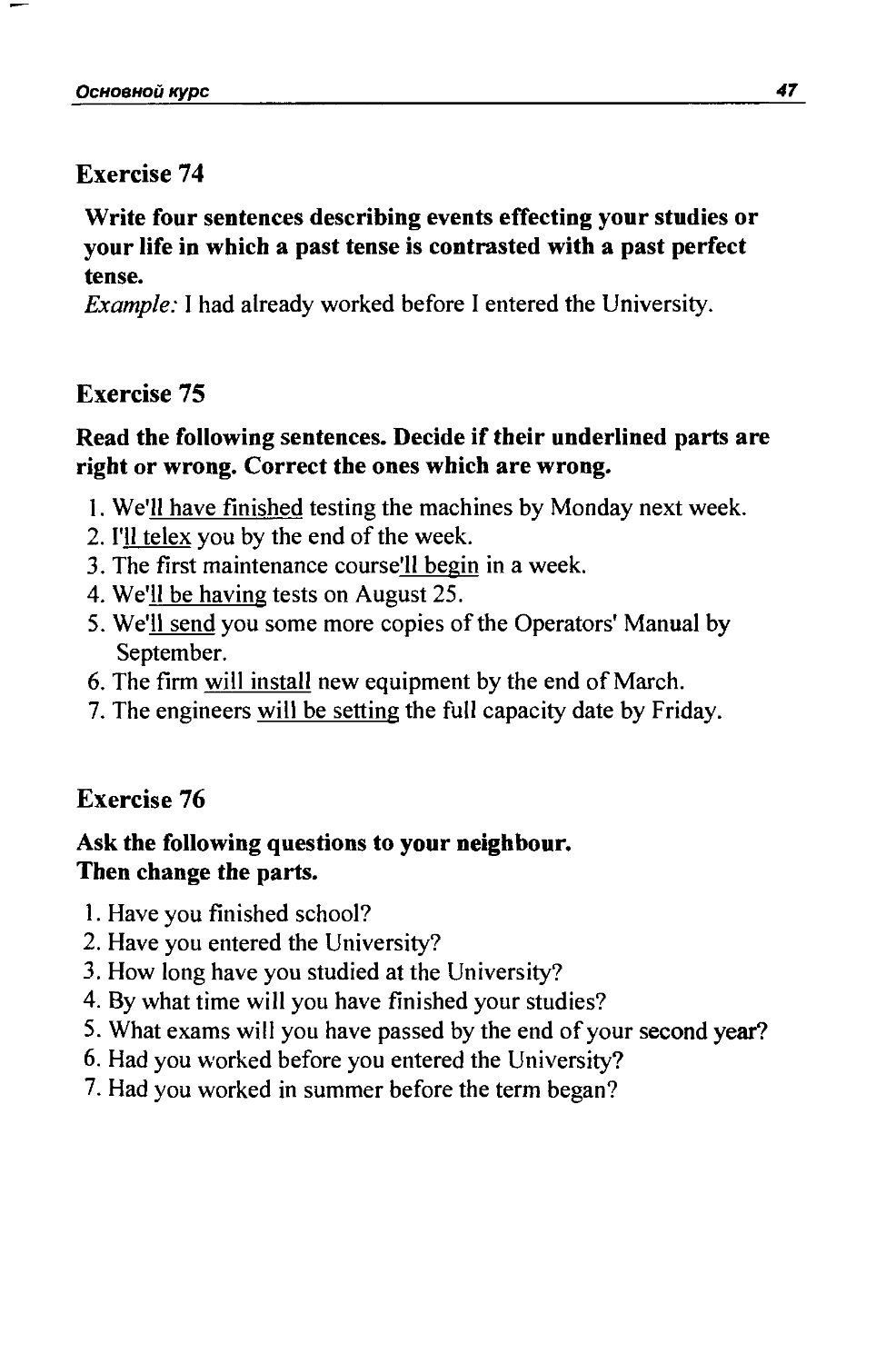
Exercise 74
Write four sentences describing events effecting your studies or
your life in which a past tense is contrasted with a past perfect
tense.
Example: I had already worked before I entered the University.
Exercise 75
Read the following sentences. Decide if their underlined parts are
right or wrong. Correct the ones which are wrong.
1. We'll have finished testing the machines by Monday next week.
2. I'll telex you by the end of the week.
3. The first maintenance course'll begin in a week.
4. We'll be having tests on August 25.
5. We'll send you some more copies of the Operators' Manual by
September.
6. The firm will install new equipment by the end of March.
7. The engineers will be setting the full capacity date by Friday.
Exercise 76
Ask the following questions to your neighbour.
Then change the parts.
1. Have you finished school?
2. Have you entered the University?
3. How long have you studied at the University?
4. By what time will you have finished your studies?
5. What exams will you have passed by the end of your second year?
6. Had you worked before you entered the University?
7. Had you worked in summer before the term began?

48
Часть 2
Unit 12
Perfect Continuous Tenses
We have been reviewing our Software
development programme for 2 hours.
We are testing it now.
We have been developing quality equipment
since 1953.
We had been improving quality for 2
years before we reached good results.
We had been working with the system
for a year and then we changed over to
Microsoft Windows.
By 2004 we'll have been working with the
system for 3 years.
By the time you come we will have been
discussing the problem for 4 hours already
The Present
Perfect
У Continuous
Tense
The Past
Perfect
Continuous
Tense
The Future
Perfect
Continuous
Tense
Positive Form
Negative Form Interrogative Form
Have I/you/ we/ they
been using the agency
9
I/you/we/they have/'ve been I/you/we/they have
using the agency since not/haven't been
1996. using...
He/she/it has/'s been using He/she/it has not/ Has he/she/it been
the agency since 1996. hasn't been using ... using...?
I/you/we/they/he/ she/it I/you/we/they/he/ Had I/you/we/they/
had/'d been using the
agency for 5 years before
changing over to another
one.
1/you/we/they/he/ she/it
will/'ll have been using
the agency for 3 years by
2003.
she/it had not/
hadn't been using.
I/you/we/they/he/
she/it will not/
won't have been
using...
he/she/it been
using...?
Will I/you/we/they/
he/she/it have been
using..?

Основной курс
49
Времена группы Perfect Continuous употребляются для
обозначения действия, начавшегося до какого-то момента в
настоящем, прошедшем или будущем, продолжавшегося до этого
момента, продолжающегося в этот момент и имеющего тенденцию
к продолжению.
I have been working at the laboratory since 1990.
In 19961 had been working in the laboratory for 5 years.
By 2009 I will have been working in the laboratory for 9 years.
В этом случае время Present Perfect Continuous переводится на
русский язык глаголами в настоящем времени.
Кроме того, времена группы perfect Continuous
употребляются для обозначения действия, длившегося в течение некоторого
времени, но закончившегося к определенному моменту в
настоящем, прошедшем или будущем, чтобы подчеркнуть
длительность этого действия.
We have been testing the new equipment since the beginning of the
year. It works perfectly now.
We had been testing the new equipment for 3 weeks before starting
operating it.
Exercise 77
Make nine sentences from the following prompts in Present Perfect
Continuous, Past Perfect Continuous and Future Perfect Continuous.
Make first a positive statement, then a negative statement and finally
a question. Add necessary time definitions (for many years before
created them; for three months by January; since 1996).
They /develop/ new communications satellite.
Exercise 78
Read the situation and then make up a sentence.
1. Marie Sklodowska taught in Warsaw during several years. In 1891
she moved to Paris where she studied physics. Marie Sklodowska ...
2. Marie Sklodowska began working in Sorbonne in 1893. Two years
later she married the French chemist Pierre Curie. Marie Sklodowska

50
Часть 2
3. Marie Curie began researching radioactivity in 1898. It took her four
more years of work to isolate radium in its pure form. Marie Curie ...
4. Maria Curie became chief of the laboratory in her husband's
department at the Sorbonne in 1903. After her husband's death in
1907 she succeeded him there as a professor of physics. Marie Curie
5. Marie Curie worked in the Sorbonne during 11 years. In 1914 she
headed the radioactive laboratory of the new Institute of Radium in
Paris. Marie Curie ...
Exercise 79
Ask 2 questions for each situation. Let your neighbour answer them.
Example: Your friend looks tired.
(You/study? How long/you/study?)
Have you been studying? How long have you been studying?
1. You come into the room. Your colleagues are installing a new
computer.
(How long/install/the computer? Since when/you/install/the computer?)
2. Your friend comes in. His hands are covered in oil.
(What/you/do? You/work/on the machine?
3. Your friend is learning Spanish.
(How long/you/learn/Spanish? Since when/you/learn/Spanish?)
4. Your friend is to finish working at the machine by June.
(How long/you/work/at the machine/by June? You/work/at the machine/for
3 months/by June?)
5. Your friend is looking for a job.
(How long/you/look for a job? Since when/you/look/for a job?)
Exercise 80
Describe a decision connected with your studies. Use both the
present perfect and the present perfect continuous forms.
Example:
I have decided to study better. I have been thinking about this for a long
time.

Основной курс
51
Exercise 82
Read the following text and ask your neighbour questions beginning
with 'how long' or 'since when'. Then change the parts.
Pierre Curie, French physicist, was born in Paris on May 15, 1859
and was educated in the Sorbonne. He became professor of general
physics in 1895 and started working in the Sorbonne in 1904. He
investigated piezoelectricity in crystal in 1880. He worked in the
Sorbonne up to his death in 1906.
Exercise 83
Put the verbs in brackets in the necessary tenses.
1. By this time next year^ou (Jo graduate) from Jhe University.
2. All last week he (tcrprepare) for the examinations.
3. That man (to teach) at the University since 1985. ,
4. Water (to change) into ice when the temperature (to drop^below zero.
5. Kindly repeat what you just (to say).
6. I only (to succeed^Jn solving the problem after I (to work^bn it for
several hours.
7. He reminded me that we, (to be) classmates at school.
8.1 (to hear^ihat you (to give) up the idea of learning French.
9. By the time he (to be) thirty he (to become) a good engineer.
10. My friend (to go) to Moscow last summer and he (to work) there
since then.
11. When I (to get) back they probably (to work) at the computer.
12. When I (to go) to the library the next day I (to find) the book exactly
where I (to leave) it.
13. I'm sure that they (to complete) their work by May.
14. At this time tomorrow you (to take) your exam.
15. She (to return) from the library at 6 o'clock.
16.1 not (to work) at 8 o'clock. I (to finish) my work by that time.
17. At what time you (to finish) you work?
18. What you (to do) at 8 o'clock? I (to work) on my report.
19. He (to speak) French? - Yes, he (to speak) French quite fluently.
20. Don't go into the classroom. The students (to write) a test there.
21. The man who(to stand) at the window (to be) our English teacher.
22. Where (to be) Peter? - He (to have) his English lesson. I think that he
always (to have) it at this hour.

52
Часть 2
23. Helen (to learn) English at the Institute. She (to learn) English since
last autumn.
24. They (to be) busy now. They (to discuss) an important question.
They (to discuss) it since 5 o'clock.
25. Where (to be) Petrov? -He (to work) at the computer. - He (to
work) long? - Yes, he (to work) since morning.
Unit 13
Система времен английского глагола
в страдательном залоге
Present
Past
Future
Simple
3<J>.V(V+ed
или особая
форма)
was
were
ЗФ.у
Что сделано?
Что делается?
Что было сделано?
Что делалось?
will (shall) be + ЗФ.У
Что будет сделано?
Что будет делаться?

Continuous
am
is у being+ЗФ.У
are j
Что делается?
was
were
being+Зф.У
Что делалось?
Perfect
have Г)
has г Ьееп+Зф.У
Что было сделано?
had been+Зф.У
Чтц было сделано?
will have been+Зф.У
Что будет сделано?
Случаи употребления времен страдательного залога те же, что
и действительного. В страдательном залоге отсутствуют времена
групп Future Continuous ц Perfect Continuous.
Simple Tenses

Основной курс
53
The fabricated products are stored in the
warehouses.
Our headquarters are located in Moscow.
The investment was made in the last
quarter.
The range of services was expanded.
Protective clothing will be worn inside the
production area.
50 percent of our production will be made at
our plant in Moscow.
Positive Form
I am/*m developed.
He/she/it is/'s
developed.
We/vou/thev are/Ve
developed.
I/he/she/it was/s
developed.
We/you/they were/'re
developed.
I/you/we/they/he/she
/it will/'ll be
developed.
Negative Form
I am not/"m not
developed.
He/she/it is not/
isn't developed.
We/you/they are
not/aren't
developed.
I/he/she/it was
not/ wasn't
developed.
We/you/they
were not/weren't
developed.
I/you/we/they/he/
she/it will not/ won't
be developed.
1 The Present
У Simple
Tense
The Past
"■ Simple
Tense
J
I The Future
„ Simple
Tense
Interrogative Form
Am I developed?
Is_he/she/it
developed?
Are we/you/they
developed?
Was I/he/she/it
developed?
Were we/vou/thev
developed?
Will I/you/we/they/
he/she/it be developed?

54
Часть 2
Exercise 83
Change the following from the active to the passive:
1. Electronic devices revolutionize life.
2. Mendelyeev observed interesting regularities in the properties of
elements.
3. We use boilers for many purposes.
4. Our engineers will design and construct new thermal power stations.
5. Edison discovered a new phenomenon of electricity.
6. Engineers use computers in all the branches of the economy.
7. The delegates will see tremendous hydro-potential in Siberia.
Exercise 84
Complete these sentences with one of the following verbs:
cause, repair, make, postpone, translate
1. A decision will not... until the next morning.
2. Her new book will probably ... into a number of foreign languages.
3. The machine ... by someone.
4. The meeting ... because of illness.
5. The fire ... by an electrical fault.
Exercise 85
Complete the text by choosing an appropriate form of each verb in
brackets.
The Sierra Club ... (be) an organization whose goals ... (center) on
the protection of the environment. It... (found) in 1692 in San Francisco
by naturalist John Muir, who ... (be) intent on preserving the natural
beauty and harmony of Sierra Nevaaas in eastern California.
Today the Sierra Club ... (boast) almost 200,000 members in all
fifty states of the United States. Through activities such as conferences,
lectures, exhibits, expeditions, and films, the organization ... (work) to
continue the effort begun by John Muir. The Sierra Club aiso ...
(publish) a weekly newsletter, a bimonthly magazine, and various books.

Основной курс
55
Unit 14
Continuous Tenses
From transmission links power is being
subdivided into smaller
blocks and fed into the subtransmission
parts of the power network.
The
Present
Continuous
Tense
A new proposal was being considered for
most of last year.
The Past
Continuous
Tense
Positive Form
I am/'m being
developed.
We/you/they are/Ve
being developed.
Negative Form
I am not/'m not being
developed.
We/you/they are
not/aren't being
developed.
Interrogative Form
Am I being
developed?
Are we/you/they
being developed?
He/she/it is/|s
being developed.
I/he/she/it was/'s
being developed.
We/you/they vvere/'re
being developed.
He/she/it is not/ isn't
being developed.
I/he/she/it was
not/wasn't being
developed.
We/you/they were
not/weren't being
developed.
Is he/she/it being
developed?
Was I/he/she/it
being developed?
Were we/you/they
being developed?

56 Часть 2
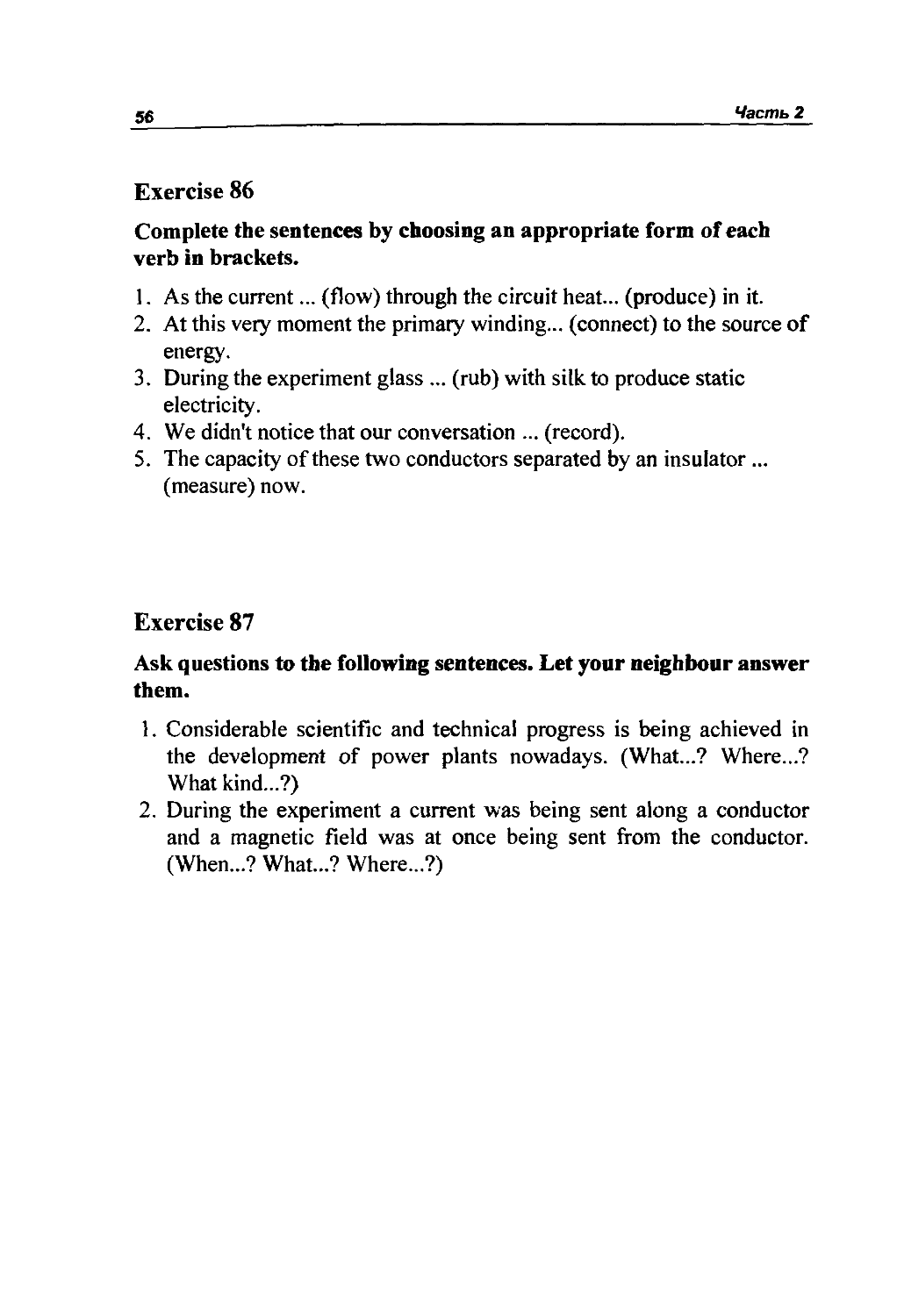
Exercise 86
Complete the sentences by choosing an appropriate form of each
verb in brackets.
1. As the current... (flow) through the circuit heat... (produce) in it.
2. At this very moment the primary winding... (connect) to the source of
energy.
3. During the experiment glass ... (rub) with silk to produce static
electricity.
4. We didn't notice that our conversation ... (record).
5. The capacity of these two conductors separated by an insulator ...
(measure) now.
Exercise 87
Ask questions to the following sentences. Let your neighbour answer
them.
1. Considerable scientific and technical progress is being achieved in
the development of power plants nowadays. (What...? Where...?
What kind...?)
2. During the experiment a current was being sent along a conductor
and a magnetic field was at once being sent from the conductor.
(When...? What...? Where...?)

Основной курс
ST
Perfect Tenses
Copper has been used as a conductor since the
beginning of the industry.
In transformers which have been in service,
the oil always contains considerable
concentration of carbon dioxide.
After thin wires had been used in the device
they got hot and melted.
The results of the experiment had been
referred to in the article before
they appeared in the book.
The Present
Perfect
Tense
14 The Past
Perfect
> Tense
By 10 o'clock the distance of 10 miles will
have been covered.
A new invention will have been implemented
in industry by the end of the year.
Positive Form
Negative Form
I/we/you/they have/Ve I/we/you/they have
been developed. not/haven't been
developed.
The Future
Perfect
Tense
Interrogative Form
Have I/we/you/they
been developed?
He/she/it has^s been
developed.
He/she/it has not/ Has he/she/it been
hasn't been developed, developed?
I/we/you/they/
he/she/it had/'d been
developed.
I/we/you/they/he/
she/it had not/ hadn't
been developed.
I/we/you/they/he/ I/we/you/they/he/
she/it will/'li have been she/it will not/ won't
developed. have been developed.
Had I/we/you/they/
he/she/it been
developed?
Will I/we/you/they/
he/she/it have been
developed?

58
Часть 2
Exercise 88
Look at the following chart which shows the development of a
company. Write a short paragraph which explains the main
events. Begin each sentence with "by".
Jan
June
Oct
Nov
June
1992
1992
1995
1996
1997
2005
reports profits increase of 25%
produces prototype of a device
offers to buy new equipment
installs new equipment
produces devices of improved quality
will begin producing newest models
Exercise 89
Describe the activity of the company known to you in a way similar
to given above.
Exercise 90
Describe how your University has been changed in recent years.
How was it changed a few years ago? How will it have been changed
by 2015?
Exercise 91
Create passive sentences in different tenses using the prompts in the
table below.
finished products
new plant
goods
manufacture
open
store
several locations
in Moscow
warehouse

Основной курс
59
Exercise 92
Read the following text. Ask questions to the underlined sentences.
Let your neighbour answer them.
In 1948 revolutionary concept was introduced to the electronic
world: a transistor was invented, a crystal which amplified was
announced. Nothing like this had happened in electronics since the
discovery of the triode vacuum tube in 1907. Some years later the crystal
detectors of the wireless era were replaced by radio tubes.
Now a crystal amplifier, the transistor, challenges the vacuum tube
because transistors are smaller, simpler, more efficient and longer lived.
In hearing aids tubes have already been replaced by transistors with
unheard-of battery economy. Moreover, many transistor circuits have
fewer components than the vacuum tube circuits, such as multivibrators.
For example, in switching circuits, such as multivibrators, the work of
two triode tubes will be done by one point-contact transistor.
The transistor is a current-operated device, whereas the vacuum
tube is a voltage-operated device. The transistor is designed to become a
relatively low-voltage, low current device. Electron tubes will shortly be
replaced by transistors in communication equipment, computers, radio
and television receivers.
Exercise 94
Translate the verbs given in Russian into English. Read the text. Use
appropriate tenses. Retell the text.
A transistor is an active semiconductor device with three or more
electrodes. By active (подразумевается) that the transistor is capable of
current gain, voltage amplification and power gain. A transistor is an
electronic device in which electronic conduction (производится )
within a semiconductor.
A semiconductor is an electric conductor with resistivity in the
range between metals and insulators, in which the electrical charge
carrier concentration (увеличивается) with increasing temperature
over some temperature range. g
The resistivities of semiconductors and insulators (уменьшается)
rapidly with rising temperatures, while those of metals
(увеличивается) relatively slow. Unlike metals and insulators, the
resistivity of semiconductors depends upon the direction of current

60
Часть 2
flow. The direction of the easiest current flow or lowest resistivity
(называется) the forward direction, the direction of restricted current
flow or highest resistivity (известно) as the reverse or back direction.
Unit 15
Выражение будущего времени с помощью
словосочетания to be + going to+V
We are going to end the conference on Friday at 6 o'clock.
When are you going to have this report ready?
The new materials are not going to be delayed.
Словосочетание "to be+going to+v" употребляется для
обозначения уже задуманного действия или намерения. При этом
степень уверенности в обязательности их осуществления меньше,
чем при употреблении "will".
Exercise 94
Write sentences on any of the following:
- your intentions
- an action already decided
Exercise 95
Ask your neighbour about his/her intentions and actions already
decided. Then change the parts.

Основной курс
61
Употребление выражения "to have got smth" для
обозначения наличия чего-либо в настоящий
момент
Have you got any money?
She hasn't got a car.
В современном английском языке выражение "to have got
smth" употребляется для обозначения наличия чего-либо в
настоящий момент чаще, чем глагол "to have".
Оно никогда не может быть употреблено в устоявшихся
словосочетаниях типа to have breakfast, to have a swim, to have a
bath и т.д. Употребление выражения "to have got smth" в таких
словосочетаниях меняет их смысл. Например:
to have a bath - принять ванну,
to have got a bath - иметь ванну.
Выражение "to have got smth" употребляется только в
настоящем времени.
Exercise 96
Make negative sentences with "have got".
I. I can't make a phone call, (any change)
2.1 can't pay my bills, (any money)
3. Nick doesn't know the news, (a newspaper)
4. Ann can't find her way back, (a map)
5. We can't operate the tape recorder, (a socket)
Exercise 97
Some of the sentences below contain mistakes. Correct them.
1. Had you got any benefit from the training course you did last week?
2. Have you an agent in Morocco?
3. Our competitors have got good products at present.

62
Часть 2
Unit 16
Согласование времен. Косвенная речь
Не promised that the conference would be ready for us when we arrived.
He said that they had signed the contract.
She says that we have a deal.
Если сказуемое в главном предложении выражено глаголом в
настоящем или будущем времени, сказуемые придаточных
предложений не претерпевают никаких изменений.
Если сказуемое в главном предложении выражено глаголом в
прошедшем времени, времена глаголов-сказуемых придаточных
предложений претерпевают следующие изменения:
present past;
past past or past perfect;
will would.
Например:
She says: 'The policy of the government has changed.' She says that
the policy of the government has changed.
She said: 'The policy of the government has changed.' She said that
the policy of the government had changed.
При переводе из прямой речи в косвенную изменения
претерпевают некоторые местоимения и наречия:
Прямая речь Косвенная речь
I/you he/she
we/you ■ they
me/you • him/her
us/you them
yesterday the day before/the previous day
today that day
tomorrow the day after/the following day
last... the previous ...
next... the following ...

Основной курс
63
this... that...
Исключение:
Время глагола-сказуемого не меняется, если сказанное все еще
является правдой.
She said: 'The date of the next meeting hasn't been fixed yet.'
She said that the date of the next meeting hasn't been fixed yet.
(They haven't decided about it by the moment of speech).
При переводе из прямой речи в косвенную помимо глагола
"say" рекомендуется употреблять такие, как: add, agree, announce,
answer, claim, comment, declare, emphasize, explain, highlight, imply,
indicate, inform, prove, reply, report, reveal, show, state, stress, suggest,
tell.
При переводе вопросов из прямой речи в косвенную порядок
слов в них становится прямым, так как вопросы в этом случае
превращаются в обычное придаточное предложение:
She asked: 'Have you increased the quality of products?' She asked if
we had increased the quality of products.
Exercise 98
Below is an extract from a newspaper report.
Complete the spaces with an appropriate form of one of the verbs
from the box.
warn, believe, say, remind
The Minister the audience that 20 years ago things were very
different. He the time had come to face realities and he we had
to choose between cooperation or isolation. He that major problems
would arise if we made the wrong choice.

64
Часть 2
Exercise 99
Here is a conversation between an administrative manager and a
communications engineer. Transform it into indirect speech. Use
past tenses. Make all the necessary changes. Ask your neighbour ten
questions connected with the text received. Retell the text.
Administrative manager (Ad. M.):
So you think we should change the system?
Communications engineer (C. Eng.):
Yes, I do. We're having a lot of problems with the existing
configuration.
Ad. M.: So, what do you suggest?
C. Eng.: Well, at the moment we're using a modem linked up direct to
our microcomputer and the telephone line. Very simple, in
theory we send files from our computer direct to our clients'
computers using a software package called 'Communicate'.
Ad. M.: OK... Well, sounds fine. What's the problem?
C. Eng.: Well, the weak link is the line. As you know a lot of our clients
are overseas and we are having problems with the lines. The
files are being transmitted but they are not arriving in the same
form. The data are being corrupted.
Ad. M.: What does that mean?
С Eng.: Well, say we send a 10 page contract to a client in France.
We make the connection, start transmitting and then there's
fault on the line and they receive the contract with some
parts missing, or parts they can't understand
Ad. M.: That sounds bad.
C. Eng.: Even more serious is that it's costing us a lot of money in call
charges. Call charges on international lines are high and each
time we send a report or contract - let's say 10 pages long - it
takes up to 5 minutes to transmit - longer if we have problems
with the line.
Ad. M.: Yes. that is serious. So what do you suggest?
С Eng.: Well, I think we should use an electronic mailbox.
Ad. M.: How does that work?
C. Eng.: Very simply really. We subscribe to a service called
DIALCOM. We send our files to a central computer. The files
are stored there and our clients can get the file out when they

Основной курс
65
want. We use our existing equipment and so we only have to
pay for the subscription and the call charges.
Ad. M.: How expensive is it?
C. Eng.: It's cheaper, but more important - the system uses a data
network, not the normal telephone lines; so transmission is faster
and more reliable - there's less chance of the data being
corrupted.
Ad. M.: Alright, I think we should go ahead.
Exercise 100
Here is a telephone conversation between two managers.
Write a brief message to their chief telling him the details of this
conversation. Use the following pattern: Jim spoke with Chris
yesterday. He asked Chris...
Jim: Hi, Chris. It's Jim here. I'm calling about the Saudi project... to find
out how the work's coming along.
Chris: Not bad, we're mostly on schedule.
Jim: Has all the equipment been installed?
Chris: Yes, we finished installation last week. We start testing the
machine on Monday next week.
Jim: How long will that take?
Chris: Well, the operator training has already started. We kicked off on
Wednesday this week and the first course ends next Friday.
Jim: Oh yes, that was one of the things I wanted to mention. Fred
Hyman, the maintenance trainer should arrive at the weekend.
Chris: Fine, do you know what time?
Jim: No, but I expect he'll arrive at 12 on Saturday. I'll telex you as soon
as I know for certain.
Chris: OK. Anyway he'll have a week before he starts training. The first
maintenance course is due to begin a week from Monday.
Jim: When do you plan to finish the training programme?.
Chris: Just a moment. I'll look at the planner ... here it is, urh, .... the last
course is in July - that's the supervisors ' course - if all goes well
that'll finish at the end of the month and they'll be ready to start
work at the beginning of August.
Jim: So >ou plan to start up in August?

66
Часть 2
Chris: Yes, if all the tests are OK, we've got a provisional start-up date
on 25-th August ... for the first two weeks we'll be building up
capacity slowly ... hope to reach full capacity by September 8th.
Jim: Sounds fine. Anything you need?
Chris: Um. I don't think so. Thanks Jim.
Jim: You're welcome. Speak to you again soon.
Chris: Yes, Bye.
Jim: Bye.
Unit 17
Модальные глаголы
Модальные глаголы не имеют многих глагольных форм:
I ф. 2 ф. отрицательные формы
Сап - could cannot = can't, could not = couldn't
Must must not = mustn't
May - might may not, might not = mightn't
Should should not = shouldn't
В неопределенной форме перед ними не употребляется
частица to , в 3-м лице единственного числа настоящего времени
они не имеют окончания -s, инфинитивы, стоящие после модальных
глаголов, употребляются без частицы to.
We can speak English a little.
My brother should help me do my hometask.
Every student must study well.
В большинстве случаев форма could (мог) является простым
прошедшим временем от сап (мочь):
I can swim.
I could swim when I was Ю.
Could (могли бы) может также использоваться для
обозначения возможного действия в настоящем и будущем, в
особенности для внесения какого-либо предложения:
The weather is fine. We could go to the country.

Основной курс
67
Использование сап в том же значении также возможно:
The weather is fine. We can go to the country.
Эквивалентом can является to be able to.
В большинстве случаев to be able to употребляется для
компенсации недостающих форм can.
I haven't been able to perform my work properly recently because of my
illness.
New technology might be able to improve the quality of goods.
В прошедшем времени was/ were able to ... = managed to ...
(удалось, смог) и соответствует случившемуся в определенной
ситуации, в то время как could (мог) характеризует возможность
чего-либо в прошлом в широком смысле:
This department could coordinate the activities of various other
departments.
(= it had general ability to coordinate other departments)
This department was able to coordinate the activities of various other
departments last year as its chief was a very talented person.
Отрицательная форма could not = couldn't возможна в любых
ситуациях.
Could have done (мог бы) относится к ситуациям, которые
были возможны, но не осуществились.
The trip was cancelled as we handn't enough money. We could have
gone away if we had had enough money.
Can't (не может быть) используется в случаях, когда что-либо
считается невозможным.
The interview can't be successful as the participants haven't planned and
prepared it carefully.
The participants were not able of careful monitoring of what was
happening. The interview (can't) couldn't have been successful.

68
Часть 2
Exercise 101
Complete the sentences using can or be able to.
1. A dividend only be paid out of profits but not out of capital.
2. In 1894 Michal Marks and Tom Spenser to organize what
was to become the most famous business partnership in English
history.
3. The owners of a private company be members of the same
family.
4. Typewriting courses combine keyboard training with the
theory and practice of typewriting.
5. We install a fax machine yesterday.
Exercise 102
Answer the questions with a suggestion.
1. How shall we correct the mistakes? (insert the right letters)
We
2. Where shall we find information about telephone rates and charges?
(supply all customers with a booklet)
Rostelecom
3. What w^ll make contact between members of staff possible? (use)
A telephone
Exercise 103
Read the following information:
Bill wasn't at home on Sunday. He was short of money. He had to
borrow from his aunt. Bill went to the Zoo. At 5 p.m. he met Ken there.
The^y went to Ken's. Bill returned home at 11 p.m.
Some people phoned Bill and left their messages which were
recorded on the answering machine. Bill dealt with the messages
properly i.e. listened to them and called back if necessary. Say whether
he could have done or couldn't have done what he was asked to do.
1. A friend of his wanted him to go out for a meal on Sunday. Bill

Основной курс
69
2. His girl-friend asked him for money. Bill
3. His aunt asked Bill to visit her at 5 p.m. Bill
4. Ken wanted Bill to come to his place at 4 p.m. Bill
5. Jane wanted Bill to call her back at 10 p.m. Bill
Exercise 104
Complete the following text using can, can't, can't have done.
The interviews begin on Tuesday, each interview last not
more than 30 minutes. They start earlier than 9.30 as it
takes time to get to the place of the interviews and fulfill all the
necessary formalities. No interviews scheduled after 4.30.
An interview take place between 1.00 p.m. and 2.00 p.m. as it
is lunch-time. The participants come on Monday as they were
warned beforehand. They be waiting for the beginning
now as it is only 8.30.
Основное значение глагола must - долженствование,
необходимость.
The train starts at 6. It is 5.30 now. We must hurry.
Отрицательная форма must в данном случае выражает запрет.
You mustn't touch the contacts. You may be killed.
Если запрет отсутствует, а действие просто не нужно
совершать, вместо mustn't употребляете needn't или don't need to.
The train starts at 6. It is 5 now. We needn't hurry или We don't need to
hurry.
Обратите внимание на то, что глагол need - переходный от
обычного к модальному. Поэтому мы говорим needn't do smith,
don't need to do smith.
Форма didn't need to характеризует отсутствие необходимости
действия в прошлом и показывает, что оно не свершилось.
The train started at 6. We got up at 4. They didn't need to hurry.
Форма needn't have done показывает, что действие
совершилось несмотря на отсутствие необходимости в нем.

70
Часть 2
We got up at 4 and hurried to the station. But the train started at 6.
We needn't have hurried. We had plenty of time.
Эквивалентами глагола must являются have to и be to. Have to
соответствует долженствованию, вынужденности в силу
обстоятельств, a be to - долженствованию в силу морального долга или
договоренности.
I'm ill. I have to go to hospital.
I am to meet my friend at 8 p.m.
Эквиваленты глагола must могут употребляться вместо него в
любом времени.
Вместо have to в том же значении в настоящем времени
может употребляться have got to.
Значение mustn't и don't have to различны. Если mustn't
означает запрет, то don't have to - только отсутствие
необходимости.
You mustn't tell anyone about our secret (=don't tell anyone).
You don't have to tell anyone about our conversation (=needn't tell
anyone).
Обратите внимание на то, что вопросительные и
отрицательные формы глагола to have в модальном значении образуются
только с помощью глагола to do.
Глагол must также употребляется для того, чтобы
подчеркнуть, что то, что мы говорим, соответствует истине.
You've been working for 5 hours. You must (должно быть) be tired.
Where is Tom? - He must be working.
Для отнесения действия к прошлому с тем же значением
употребляется must have done.
Where is Tom? - He must have gone out.

Основной курс
71
Exercise 105
In each sentence translate the underlined verbs.
1. Payment must be collected from the customer when the goods are
delivered.
2. People wishing to use a new service have to pay a sum of money in
advance.
3. The customer doesn't have to pay the postage. It's the duty of the
firm.
4. The customers needn't enjoy all the services suggested to get a
discount.
5. Harmful substances mustn't be stored in unlocked premises.
6. The machine must have been switched off and disconnected. I don't
hear it working.
7. Paper-cutting machines must be dangerous while working. They can
cut fingers as easily as they cut papers.
8. You needn't have gone to the medical room. Our department has got
its own trained first-aider for emergencies.
9. We didn't need to destroy the unnecessary documents manually. We
used a document shredder for this purpose.
Exercise 106
Complete the following text using the verbs can, must, need, have to,
be to, translate and retell it.
Many business people prefer the flexibility, reliability and
convenience of a hire car to using their own car. Car hire
be particularly useful and advantageous when combined with air
travel. The major international car rental firms provide a
special programme designed specially for business people. This
include a 'Rent it here / Leave it there' service. Different sizes
and types of car be available. Some firms ______ provide a
driving directions service. Computerized systems provide an
instant printout containing step-by-step directions to the destination.
When a hired car is required you book in advance. The rates
are usually cheaper and availability be guaranteed. When

72
Часть 2
selecting and booking a vehicle you to take into account any
luggage regulations.
In some countries a driving license of your country is not
acceptable; you an international driving permit. For a small
charge permits be issued to any current holder of a valid driving
license. You always check the driving regulations for the countries
concerned.
Unit 18
Основное значение may и might - показать возможность,
вероятность чего-либо.
They say Bab is ill. It may be (вероятно) true или It might be true.
В прошедшем времени с тем же значением употребляется may
have done или might have done.
I wonder why Sam didn't stay at our hotel? - He may not have liked the
location.
Иногда could используется с тем же значением, что may или
might.
Why did Tom arrive earlier? - He could have left on Monday morning.
Might указывает на несколько меньшую степень вероятности
чего-либо, чем may. Как правило, в речи не имеет значения,
используете вы may или might.
Exercise 108
Read the situations and make sentences with may or might.
1. You receive an account for repairs to your car. It must be paid
within seven days. You have got enough cash. You say: I pay
right away.
2. You have been assisting the buying office. You have been
asked to make the order to be passed to the regular suppliers. You are
not sure whether you have done it.
You say: I to be passed to the regular suppliers.

Основной курс
73
3. You work in the Purchasing department. You and your
colleagues must check the copy orders regularly. One of your colleagues
is checking something now. You say: He copy orders.
4. Your colleague has been asked to prepare a standard letter of
enquiry to be sent to the potential suppliers. You see him writing
something. You say: He a standard letter of enquiry to be sent to
the potential suppliers.
5. You sell very useful travel reference books which contain a
variety of information: routes, road maps, street plans of major cities,
garages, hotels and restaurants. They are sold at your office. You say:
You buy travel reference books at my office.
Модальный глагол should указывает на желательность
действия, его уместность. Он используется для того, чтобы дать
совет или изложить свое мнение.
The receptionist should be able to organize and use the reference
books provided to obtain the necessary information.
Should используется также в тех случаях, когда что-то
происходит не так, как мы ожидаем.
There is no alphabetical index of streets in this street map of the
town but there should be one.
Should have done smth употребляется в случаях, когда вы не
сделали того, что вам следовало сделать.
Your travel agency should have arranged car hire and travel
insurance but didn't.
Во всех перечисленных случаях эквивалентом should является
ought to.
A company ought to deal with calls rapidly and efficiently to have
a more professional image = (a company should deal with calls rapidly).

74
Часть 2
Should обычно употребляется после таких глаголов, как
suggest, propose, recommend, insist, а также после таких
прилагательных, как strange, odd, funny, typical, natural, interesting, и
причастий surprised, surprising.
I suggest we should install telephones in all the departments.
It's typical that modern telephone systems should be designed to
meet the individual requirements of businesses.
В конструкциях типа if smth should happen или should smth
happen глагол should подчеркивает малую вероятность события и
отдельно на русский язык не переводится.
Should you make a call outside your local area find out the
national dialing code.
Exercise 108
Are these sentences right or wrong?
1. An operator can know how to use the telephone system. An operator
may know how to use the telephone system. An operator should
know how to use the telephone system.
2. I suggest we should buy a mobile telephone to stay in touch. I
suggest we bought a mobile telephone to stay in touch. I suggest to
buy a mobile telephone to stay in touch.
3. If Tom called leave me a message. Should Tom called leave me a
message. Must Tom called leave me a message.
4. You should deal with the calls promptly in the morning but I see that
they are not answered. You should have dealt with the calls
promptly in the morning but I see that they are not answered. You
should be dealing with the calls promptly in the morning but I see
that they are not answered.
Exercise 109
Read the text and answer the following questions. Retell the text.
— Why should a business letter be well written and perfectly
produced?
— What impression should a business letter produce?
— Should there be any mistakes in a business letter?
— What should create a balanced appearance?

Основной курс
75
— What equipment should be used to type a business letter?
— What skills should be used to type a letter?
— What program should a microcomputer be used with?
A business letter is often the first contact that a customer has with
an organization. It must therefore be well written and perfectly produced
so it gives a good impression of the organization. There should be no
spelling or punctuation errors. The layout or overall appearance of the
letter is just as important as the message. The careful use of the space
available and the correct positioning of the various parts of the letter will
create a balanced appearance.
The typewriter is still the most frequently used business machine
for preparing letters. However more and more companies are using
microcomputers and word-processing systems to produce their business
correspondence. Both typewriters and computers use the traditional
'QWERTY' keyboard (the name coming from the first six letters on the
second row). Hence, the same keyboarding skills are required. A wide
range of equipment is now available. The equipment consists of a
keyboard, a visual display unit (VDU), a processing unit, a disk drive
and a printer. Text is not typed directly on to paper, as with a
conventional typewriter, but appears on a VDU. There are two types of
word processor: a dedicated system, which means that it is used only for
word processing; and a microcomputer, which can be used with word-
processing programs. In some offices the word processor is used simply
as a glorified typewriter. It's potential and capabilities are never
explored or discovered.
Unit 19
Сослагательное наклонение
Сослагательное наклонение показывает, что говорящий
рассматривает действие не как реальный факт, а как предполагаемое
или желательное.
Present Subjunctive - соответствует неопределенной форме
глагола без частицы to для всех лиц и чисел (he be. it have, we work).

76
Часть 2
Past Subjunctive - полностью совпадает с Past Simple
изъявительного наклонения; вместо формы was может употребляться
форма were (he worked, I was / were).
Past Perfect Subjunctive - полностью совпадает с формой Past
Perfect изъявительного наклонения (he had worked, I had been).
It is necessary (необходимо) ""^^^
It is desirable (желательно) J^> that he telephone us immediately.
It is important (важно) и т.п. — (чтобы он ...)
ordered (приказал) ■
commanded (приказал)
demanded (потребовал) —Z^-j^ that she submit
the document without
suggested (предложил) -""^ /delay (чтобы она сдала ...)
proposed (предложил) и т.п. •
Действие относится к настоящему или будущему
If I had a pattern I would write a letter (если бы у меня был
бы написал).
Как жаль, что у меня нет ..
I wish I had a pattern.
Я хочу, чтобы у меня был
Действие относится к прошлому
(в реальности не совершилось и не может совершиться)
If I had had a pattern yesterday I would have written a letter (если
бы у меня был ... вчера, я бы написал ...).
I wish I had had a pattern yesterday (как жаль, что у меня вчера
не было ...).
If I had written that letter yesterday 1 would be free now (если бы
вчера я написал..., то сегодня был бы ...). - В первой части
предложения действие относится к прошлому, во второй - к
настоящему.

Основной курс
77
Exercise ПО
Write a sentence with if for each situation.
1. You are employed by the Stylifax Group. Your Office Manager has
asked you to write a letter from the list of brief notes but you don't
know how to write letters. You say:
If I ...
2. The manager is ready to prepare an official order but the supplier
doesn't offer a suitable arrangement. The manager says:
If the supplier ...
3. A company has performed an advertising campaign but customers
haven't sent letters of enquiry yet to ask for information on the
product, price, discount, availability and delivery. The manager
says:
If the customers ...
4. Computers and word processors are able to save and file large
quantities of information. That's why they are so popular. We say:
If computers and word processors...
5. Yesterday we wanted to send a fax but the destination fax was
engaged so the fax remained unsent. We say:
If the destination fax...
Exercise 111
Write sentences beginning with I wish...
1. I haven't got a fax machine (and I need one). I wish...
2. I can't confirm that the call has been connected to the correct
number as I haven't got the 'answerback' code (and I want the call
to be confirmed). I wish...
3. I can't make a telex call (and I need to make it). I wish...
4. Yesterday I was on the move all day long and I couldn't contact
anyone as I had no mobile phone on me (and I was to contact
people). I wish...
5. Last month I had no telephone answering machine that's why I
didn't know about my clients' calls when I was absent (and knowing
about them was very important). I wish...
Exercise 112
Write your own sentences beginning with I wish or if

78
Часть 2
1. (something you'd like to be now - in the forest, in the cinema etc.).
I wish I...
2. (something you'd like to have - a computer, a new suit etc.).
I wish I...
3. (something you'd like to become - an engineer, an actor etc.).
I wish I...
4. (something you'd like to do if you could - sing, dance etc.).
Iflcouldl...
5. (something you'd like to be if you had a possibility - rich, clever etc.).
If I had a chance I...
Exercise 113
Imagine that you are in these situations.
For each situation, write a sentence beginning with it is necessary...,
it is desirable etc. or I order..., I demand... etc.
1. Many organizations prefer to use franking machines rather than
stamps for their mail.
It is desirable...
2. If mail is to receive the best possible service correct addressing is
important.
It is important...
3. Your electric kettle has developed a fault and you return it to the
manufacturers by post to get your money back.
You say:
I demand...
4. You are a chief of a department. You want your letter to be sent
through a traditional postal system.
You say:
I order...
5. You are a chief of a department. You want to centralize the services
your department renders.
You say:
I suggest...
or
It is desirable...

Основной курс
79
Exercise 114
Read the following text. Imagine that you should send a telex now /
had to send a telex yesterday. Say what you would do / would have
done.
A telex call is made in the following way:
1. Type or dial the telex number, depending on the system.
2. Wait for the answerback code to confirm that you are connected to
the correct number. If the answerback code is given, provide your
own answerback code.
3. Type the message or retrieve the message stored in memory.
4. Exchange the answerback code, to check the connection was held
during the transmission.
5. The message is then transmitted and printed or stored in memory
simultaneously on both machines.
If I was to send a telex I would...
If I had had to send a telex yesterday I would have...
Unit 20
Сложноподчиненные предложения с придаточными,
вводимые союзами if и when и их эквивалентами
В придаточных предложениях, вводимых союзами if в
значении «если» и when в значении «когда» и их эквивалентами
(while, unless, in case и т.д.), будущее время не употребляется.
Употребление будущего времени в придаточных
предложениях после вышеупомянутых союзов возможно, если они имеют
другое значение.
If a word in the manuscript is unfamiliar it will be written in the
margin.
When customers request details and information on the new goods
letters will be sent to them enclosing a catalogue and price list.
The manager asked if the customers would request details and
information on the new goods.

80
Часть 2
Конструкции had better, would rather, it's time
Конструкция had better do smth свидетельствует о
желательности действия, показывает, что в случае его невыполнения
могут возникнуть трудности.
I am to phone Mary today. I'd better do it now or it may be too
late.
Отрицательная форма конструкции had better соответствует
had better not.
— Are you going out tonight?
— I'd better not. I've got a lot of work to do.
Конструкция had better do smth относится к настоящему или
будущему.
(for somebody) to do smth..
/ >v действие относится
It's time /^ ^> к настоящему
^*^\^ ^^^ или будущему
smb. did smth.
It's time to go home. = It's time for js to go home. = It's time we went
home.
В некоторых случаях конструкция it's time smb. did smth.
может быть эквивалентна it's time smb. should have done smth. или
should have started doing smth.
It's time our fax machine was repaired. It hasn't been working properly
for a week already.
Конструкция would rather указывает на предпочтительность
действия.
do smth.
smb. did smth.
would rather

Основной курс
81
Отрицательная форма конструкции - would rather not do smth.
и would rather smb. didn't do smth.
Exercise 115
Read the situations and write sentences using I'd rather, I'd better,
it's time.
1. You think it is very convenient to use a credit card instead of cash or
cheques. You say: It's time...
2. You are in a shop. You are asked whether you will pay cash or
cheques. You say: I'd rather...
3. Your friend must meet his business colleagues in a different part of
the country and asks you if he should travel by plane or by train.
You prefer train as the space and seating arrangements provide the
opportunity to work while travelling. You say: You had better...
4. There is a wide range of filing equipment available. You think that
your firm should buy such an equipment considering the space
available and the expense involved. You say: You had better... It's
time...
5. A telephone apparatus with automatic redial costs more than the
apparatus without it. Which one would you prefer and why? I'd
rather...
Exercise 116
Read the following text and write seven recommendations for a
receptionist with had better.
There are usually many regular callers at a reception desk. These
could include: people delivering letters and parcels, security van drivers,
window cleaners, service staff, and messengers delivering accounts and
packages. Receptionists should always follow 'in-house security rules"
when dealing with deliveries. When authorized to receive parcels /
packages, the receptionist should not sign the delivery note before the
following 'checking" procedures are carried out:
1. Check that the goods were ordered.
2. Check the consignment quantities or number of packages against
the delivery note.
3. Check that the parcells) is(are) in good condition - undamaged.

82
Часть 2
4. When the contents have not been examined, and a signature is
required, add the words 'not examined" before signing.
An efficient receptionist will quickly recognize and know by
name the clients and visitors who call regularly.
Exercise 117
Read the following advertisement and make up not less than ten
sentences beginning with it's time.
It's London!
Fly to London with us this winter and enjoy a wonderful week in
this enchanting city at a price you will find hard to believe! We will be
flying from Moscow to London on a specially charted, brand new jet
aircraft, giving you the chance to make the very most of all your holiday
time in the British capital. \rj J
All the famous landmarks wait to greet you. Explore them or simply
sit over a coffee at one of the cafes and watch the world go by. There
really is something for everyone in this great city which draws visitors
back time and time again.
We leave Moscow at 9.00 a.m. in the morning on Friday (please
enter date - first Friday of next month). On arrival at Heathrow you will
be transferred direct to your hotel. The next few days are then free for
you to enjoy - join your optional excursions or explore London at
leisure. We will return on Friday (enter date please) in the late
afternoon.
Don't miss this wonderful opportunity! Send for a full-color
brochure today.
Употребление used to, would do, to be used to, to get used to
Used to do smth (отрицательная форма - didn't use to do smth)
употребляется для обозначения регулярного действия в прошлом.
Nick used to do weli at school. He is not doing well at the Institute.

Основной курс
83
Would может употребляться с тем же значением для
обозначения прошедшего действия.
Normally our firm would take part in the worldwide Telecom exhibition
every four years.
To be/get used to doing smth употребляется для того, чтобы
показать, что что-то не является новым или непривычным. После
этих конструкций никогда не употребляется инфинитив. 'Т'о после
used - предлог, а не частица, предшествующая инфинитиву.
Mary has a new flat. It is very far from her office. She has to get up very
early to be there in time. This is difficult for her because she isn't used
to getting up early.
Exercise 118
Complete the following text using used to, to be / to get used to,
would do.
Computerized systems ... to play such a vital role in the world as
they play now. You... seeing keyboard-based electronic equipment
almost everywhere you go: in banks, schools, colleges etc. A few years
ago one... think it impossible to process information so quickly. And
now we ... to the fact that the information can also be displayed, updated
or printed out at any time. State-of-the-art computers reflect the latest
technology. They can be used to run sophisticated word-processing
programs along with any number of other applications: databases,
spreadsheets, stock control, book-keeping, payroll, graphics and
desktop publishing. We... to operating state-of-the-art computers using the
popular MS-DOS system. This means that we can use the same
application software for all the computers. An operating system is a
group of procedures which manages the overall operation of the
computer. We... to carrying out specific tasks, such as word processing,
financial analysis and record keeping, by means of application programs.

S4 Часть 2
Exercise 119
Read the following text. Translate the underlined words into
Russian.
All word-processing systems have some form of storage facility. It
is no good being able to process information if it is not readily available
when needed. It may have taken hours or even days to produce important
text or facts and figures and they cannot easily or quickly be replaced.
Data must be stored electronically on a diskette or a hard disk.
Diskettes are generally referred to as 'floppy disks'. They may be
considered the most common form of storage. However, hard disks have
a far greater memory capacity than floppy disks. This means that they
can store much larger amounts of data. They are also to transfer data
faster because the information is stored within the system. Before a new
disk can be used, it has to be formatted. This process should create
tracks on the disk to prepare it to accept and store information. Disks are
read by means of a disk drive.
If disks are damaged, the stored data may be lost. For this reason a
copy of any data must be kept on a separate disk. This is called a
backup. Back-up disks may be stored in a case or box. When not in use, they
should be locked away in a secure place. The following guidelines
should be observed:
1. Do not touch the exposed recording surface.
2. Protect them from dust. Keep them in their protective enclave when
not in use.
3. Never place heavy objects on top of them.
4. Write on disk lables before attaching them to disks.
5. Keep them away from other magnetic fields, including televisions,
printers, telephones, etc. Magnetic fields can destroy the contents of
disks.
6. Do not bend. Store them vertically in their box.

Основной курс
85
Exercise 120
Read the text given above again. Imagine that in the past you
violated the guidelines. Describe your past actions beginning each
sentence with I used to or I would. Use I am / get used to in the
subordinate clause.
Example: I used to touch the exposed surface and now I am not used to
touching it.
Exercise 121
Say what would happen / would have happened if you violated / had
violated the guidelines mentioned above. Add the necessary
adverbial modifiers.
Exercise 122
Make up ten complex sentences with if and when connected with
your studies. Refer them to real and unreal conditions.
Unit 21
Неличные формы глагола
Инфинитив
Существуют следующие формы инфинитива:
Indefinite
Continuous
Perfect
Perfect
Continuous
Active
(to)V
(to) ask
(to) be + V + ing
(to) be asking
(to) have + 3 ф. V
(to) have asked
(to) have been + V + ing
(to) have been asking
Passive
(to) be + Зф. V
(to) be asked
(to) have been + 3 ф.
V

86
Часть 2
The Indefinite Infinitive употребляется для обозначения
действия, одновременного с действием, обозначенным глаголом-
сказуемым.
Гт pleased to inform you that we are going to send you the information
every week.
The Continuous Infinitive употребляется для того, чтобы
подчеркнуть, что обозначенное им действие находится в развитии.
Mik may be working in his office now.
The Perfect Infinitive употребляется для обозначения действия,
предшествующего обозначенному глаголом-сказуемым.
The company was thought to have received the documents on Monday.
The Perfect Continuous Infinitive обозначает действие,
длившееся какое-то время до действия, обозначенного глаголом-
сказуемым.
For ten days we seem to have been advertising our product in the local
press.
В предложении инфинитив может быть:
• Подлежащим.
То advertise (рекламировать, реклама) is very expensive.
• Частью сказуемого.
Would you like to advertise (рекламировать) in the local press?
• Обстоятельством.
To advertise (для того, чтобы рекламировать) in the local
press one needs money.
• Определением.
Your intention to advertise (рекламировать) in the local press
must be discussed.
• Дополнением.
We agreed to advertise (рекламировать) our product in the
local press.
Особое затруднение для понимания и перевода на русский
язык вызывают случаи нахождения инфинитива в начале
предложения. Для правильного понимания и переведа необходимо,
прежде всего, определить, является ли инфинитив подлежащим

Основной курс
87
(стоит на первом месте в предложении) или обстоятельством (стоит
левее подлежащего).
То carry out all the invoice checking procedures one person may be
needed.
Для того чтобы осуществлять проверку всех инвойсов, может
потребоваться один человек.
То carry out all the invoice checking procedures may take one person.
Проверка всех инвойсов может занять одного человека.
Exercise 123
Read the following text. Identify all infinitives in it. Translate all
sentences with the infinitives into Russian.
Alphabetical filing is very popular. This method is easy to
understand and operate. To use it in offices is particularly suitable for
filing correspondence. It is the only method to classify correspondence
by looking through the storage system.
With the alphabetical method, a file is made out for each customer
or client according to the first letter of the surname. The files are
arranged in strict alphabetical order in the storage system. Index or guide
cards are used to divide the letters. They act as signposts and help staff
locate files quickly.
To file the documents one should collect them together and arrange
them into alphabetical order. This is known as pre-sorting. Many
different pre-sorting aids are available. These allow the filing operation
to be carried out more efficiently. Expanding indexed wallets are
frequently used for this purpose.
Each letter of the alphabet will have its own 'miscellaneous' file.
This contains documents which do not require a separate file. The
documents in a miscellaneous file should be kept in alphabetical order.
A list of the contents is often kept on the front of miscellaneous folder.

88
Часть 2
Exercise 124
Decide if the following sentences are grammatically correct or not.
If they are wrong correct them.
1. To receive or pay out cash always count it carefully.
2. You can have paid the rent by standing order.
3. It is important to be checking the facilities available.
4. An organization is planning to have taken part in a training
exhibition at the National Exhibition Centre.
5. To have left on Wednesday morning two cars will be required.
6. To hire a car may be particularly useful when combined with air
travel.
7. We want to talk about the exchange of information.
Exercise 125
Choose the correct infinitive to complete the spaces in the text. Read
the completed text again, retell it.
calculate, guarantee, pay, make, produce
Chromalab Processing is one of the leading photographic
laboratories. It has facilities the highest quality photographic
work using the very latest in processing technology. Customers can
a first class service. The motorcycle dispatch riders same-
day deliveries throughout the Yorkshire area. The dispatch riders own
their own vehicles, but all petrol expenses and percentage of running
costs must by the firm. the payment for petrol the number
of miles they travel each month must be known. The running costs are
paid in the form of a set monthly allowance according to the engine size
of the motorcycle.

Основной курс
89
Unit 22
Инфинитивные конструкции
Сложное дополнение
Глагол-сказуемое
Существительное
или местоимение
в функции
дополнения
+
Часть дополнения,
выраженная
инфинитивом
Jim warned me.not to.tpuch the switch as it was dangerous.
Джим предупредил, чтобы я не трогал выключатель, так как это
опасно.
Конструкция "сложное дополнение" включает в себя
дополнение, выраженное существительным или местоимением, и
инфинитив. Она стоит сразу за сказуемым, которое может быть
выражено следующими глаголами в действительном залоге:
• want, expect, ask, beg, help, mean (=intend), would like;
We expected the new machine to be delivered in time.
• tell, order, remind, warn, force, invite, teach;
We invite you to share in a whole new concept in office design.
• advise, recommend, encourage, allow, permit, forbid;
The Director recommended the workers to improve productivity.
• make, let;
После этих глаголов инфинитив употребляется без 'to'.
My mother made me apply for this job.
• see, hear, feel, listen.
После этих глаголов в конструкции '"сложное дополнение"
может употребляться как инфинитив (если нас интересует
констатация факта), так и -ing-форма (если мы хотим
подчеркнуть длительность действия).

90
Часть 2
I saw a clerk pass the documents to the manager. Я видела, как клерк
передал документы менеджеру.
I saw a clerk passing the documents to the manager. Я видела, как
клерк передавал документы менеджеру.
Конструкция "сложное дополнение" чаще всего переводится
на русский язык придаточным предложением.
Exercise 126
Read the following text. Find the sentences with the construction
'verb+object+infinitive'. Translate them into Russian. Retell the
text.
Telephone Problems
Though we expect telephone to have convenience and speed it
also has Ithe power to convey a poor impression of the efficiency of
individuals and organizations and create confusion and irritation.
Telephone firms encourage customers to make telephone calls as
they seem cheaper than sending a letter. Many organizations calculate
that the average cost of sending a letter is about £25, which allows the
customers to buy a lot of telephone time,even at current rates. But
telephone calls do not necessarily save time - and in business time is
money. We have all suffered from the irritating waste of time caused by
bad telephone manners. We can expect,such time-wasters as trying to
get a line, being left hanging oiy being passed from department to
department etc. to take longer than it takes to write or dictate a letter.
Perhaps the principal cause of the telephone inefficiency is that
although the standard telephone allows a customer to perform oral
communication, it doesn't yet transmit visual communication. Facial
expressions, gestures and posture not only help people convey the real
meaning of words, but are often the principal means of feedback in face-
to-face conversation. They allow misunderstandings to be instantly
corrected. Without visual communication we expect such typical
problems as missed words, misheard words, misunderstood words to
occur. jo, у , fg
Many people have developed a positive dislike to-tke telephone
because they cannot see th? person te-wh©trt"they-are*a4ki«g.

Основной курс
91
Exercise 127
Decide if the sentences below are right or wrong. Correct the
mistakes where necessary.
1. Some organizations let their least able employees to become
telephone operators.
2. Let me remind to phone me when calls are cheaper if you can
wait.
3. The manager told to dial the number carefully as wrong numbers
are the most common cause of frustration and time-wasting.
4. I would like you wait patiently to be put through.
5. If you are cut off we expect replace telephone receiver, wait a few
seconds and ring again.
6. I saw you to write down the name and number of the person you
were speaking.
7. Telephone etiquette officially advises decide when the call ends,
but since not everyone knows this, use your judgement.
Сложное подлежащее
Подлежащее
Глагол-сказуемое
Часть подлежащего,
выраженная инфинитивом
Mary is said to work 8 hours a day.
(Говорят), что Мери работает 8 часов в день.
Мери, (говорят^ работает 8 часов в день.
Конструкция '"сложное подлежащее" состоит из собственно
подлежащего и его инфинитивной части. Сказуемое в
предложениях, содержащих '"сложное подлежащее", может быть
выражено следующими глаголами:
• теми же глаголами, что и при употреблении конструкции
"сложное дополнение"', но стоящими в страдательном залоге;
Models and experiments are expected to be used where they are
essential.

92
Часть 2
• say, believe, suppose, think, know, consider, report, allege,
understand (употребляются при наличии конструкции "сложное
подлежащее" в страдательном залоге, в действительном залоге
могут употребляться с конструкцией "сложное дополнение");
Videos are supposed to be hired from the distributors,
а также с конструкциями to be likely, to be unlikely.
The rate of change in price and choice of equipment is likely to be
fast.
Как правило, сказуемое в предложениях, содержащих
конструкцию "сложное подлежащее", переводится на русский язык
вводным словом, стоящим в начале или в середине предложения.
Инфинитив же, входящий в конструкцию "сложное дополнение",
переводится глаголом в личной форме.
Exercise 128
Write these sentences in another way, beginning as shown. Use the
underlined words in your sentences.
1. It is expected that you will volunteer to help rather than wait to be
asked. You are expected to volunteer to help rather than wait to be
asked.
2. It is supposed that you won't attempt to reason with someone
while they are still angry. You are ...
3. It is believed that an employee will personalize the conversation
by introducing himself and getting the caller's name. An
employee ...
4. It is advised not to suggest or agree a solution until all the facts
have emerged. One is advised ...
5. We heard an employee offer excuses. An employee...
6. We saw an employee showing a client a new type of equipment.
An employee ...
7. It is understood that a caller should be offered sympathy. A
caller...

Основной курс
93
Exercise 129
People say a lot of things about a new manager. For example:
a. He takes all the complaints personally.
b. He is not objective.
c. Не gets angry very quickly.
d. He considers every complainer unique.
e. He agrees to do things he is not in a position to deliver.
f. He never takes advice.
Nobody knows for sure whether these things are true or not. Write
sentences about the new manager using such verbs as suppose,
believe, say, think, etc.
a. The new manager is supposed to take all the complaints personally.
b. The new manager ....
c. Не... .
After completing the exercise decide whether the new manager is a
good one. Give your reasons.
it is important
it is interesting
it is possible
it is dangerous, etc
+ toV
It is important to have a system of assessing the performance of
employees in the firm.
На фирме важно иметь систему поощрения работы сотрудников.
Exercise 130
Ask your neighbor six questions with it is important, it is possible
etc. Let him answer them. Then change the parts.
... for +дополнение +to V
The firms give many opportunities for the employees to discuss their
career prospects and long-term objectives.

94
Часть 2
Фирмы предоставляют своим сотрудникам много возможностей для
обсуждения перспектив их карьеры и долговременных целей.
или
Фирмы предоставляют много возможностей для того, чтобы их
сотрудники обсуждали перспективы своей карьеры и
долговременные цели.
Exercise 131
Translate the following sentences into Russian:
1. It is important for us to understand the difference between
duplicating and copying.
2. Copiers give an opportunity for a firm to produce accurate copies
from texts, drawings, graphs and even photographs.
3. For large organizations it is possible to centralize reprographic
services.
4. It is essential for any meeting to be well organized.
5. Using the very latest computer technology makes it possible for an
agent to have a direct access to the larger computer systems.
Unit 23
-ing- и -ed-формы
V+ing
I enjoy working with the computer.
Я люблю работать с компьютером.
Would you mind visiting our office on Monday?
He зайдёте ли вы к нам в офис в понедельник?
После таких глаголов, как enjoy, mind, suggest, stop, finish,
postpone, imagine, consider, avoid, involve, continue, keep,
употребляется -ing-форма, которая, как правило, переводится на
русский язык инфинитивом.
Preposition + -ing-форма
Are you interested in working for us?
Вы заинтересованы в работе с нами?

Основной курс
95
How about changing our equipment?
Как насчёт замены нашего оборудования?
-ing-форма обычно употребляется после следующих
предлогов: in, at, with, of, for, about, instead of, in spite of, before,
after, by, without, to и переводится на русский язык
существительным.
Словосочетания с -ing-формами
It's no use/no good ...
It's no use trying to change the data.
Бесполезно пытаться изменять данные.
There is no point in ...
There is no point in having a computer if you don't use it.
Нет смысла иметь компьютер, если вы им не пользуетесь.
It's (not) worth ...
I don't think newspapers are worth reading.
Я не думаю, что газеты стоит читать.
Have difficulty...
I had difficulty reading a book of a foreign author in the original.
Мне было трудно читать книгу иностранного автора в оригинале.
A waste of money.../ a waste of time...
spend /waste (time)...
(be) busy...
go swimming/go fishing etc.
I'm busy performing an experiment.
Я занята постановкой эксперимента.
An engineer spent hours trying to find the cause of the failure.
Инженер проводил часы, пытаясь обнаружить причину поломки.
It was a waste of time visiting this exhibition.
Посещение этой выставки было потерей времени.

96
Часть 2
Exercise 132
Read the following sentences. Translate the underlined word
combinations into Russian.
1. Organizations sometimes have difficulty providing people with all
necessary goods.
2. A mixed economy is interested in combining the benefits and
advantages of both public and private enterprise.
3. The private sector suggests providing employment and offering a
wide range of goods and services.
4. It's no use starting a business without having an office of some
description.
5. Most business activities involve performing some sorts of
calculations.
6. An ambitious organization is interested in attracting and keeping
worthwhile employees.
7. Would you mind defining the difference between wages and
salaries?
-ing-форма в начале предложения
Identifying training needs is an important function of personnel work.
Определение потребностей обучения - важная функция работы с
персоналом.
Identifying training needs, a Personnel Manager helps the firm greatly.
Определяя потребности обучения, менеджер по работе с
персоналом значительно помогает фирме.
Для правильного перевода -ing-формы, стоящей в начале
предложения, на русский язык необходимо определить, является ли
она подлежащим (стоит на первом месте) или обстоятельством
(стоит левее подлежащего), -ing-форма в функции подлежащего
переводится на русский язык существительным или инфинитивом,
а в функции обстоятельства - деепричастием.
-ing-форма в функции обстоятельства может также стоять в
конце предложения. Перевод на русский язык от этого не
изменяется.
A Personnel Manager helps the firm greatly identifying training needs.

Основной курс
97
-ing-форма, содержащая having + 3 ф. V, обычно стоит в
начале предложения, показывая, что обозначаемое ею действие
свершилось до действия, обозначенного глаголом-сказуемым, и
переводится на русский язык либо деепричастием, либо
придаточным предложением.
Having identified training needs, a Personnel Manager could set up
appropriate training programmes.
Определив (после того, как он определил) потребности обучения,
менеджер по работе с персоналом смог составить соответствующие
программы обучения.
-ing-формы в функции части сказуемого
An important function of personnel work is arranging and
organizing introductory or introduction courses for new employees.
Важной функцией работы с персоналом является организация
и проведение ознакомительных или вводных курсов для новых
работников.
Unit 24
Обороты с -ing- и -ed- формами
-ed-оборот
I г
The services offered by telecommunication firms are useful for
customers.
Услуги, предлагаемые телекоммуникационными фирмами.
полезны абонентам.
-ing-оборот
I г
Telecommunication firms offering new services are likely to
receive greater profits.
Телекоммуникационные фирмы. предлагающие новые
услуги, вероятно, получают большие доходы.

98
Часть 2
При переводе на русский язык время -ing-форм, входящих в
оборот, соответствует времени глагола-сказуемого.
-ed-форма всегда имеет страдательное значение.
Если в предложении стоят рядом две -ed-формы, не
разделённые запятой, то правая из них является сказуемым, а левая
- определением.
The firm possessing a product designed wanted to sell it at the highest
possible price.
Фирма, обладающая сп^ре.ктиррванным продуктом, хотела продать
его по самой высокой возможной цене.
Независимый причастный оборот
Существительное
или местоимение
-ing- или -ed-
форма
Независимый
причастный оборот
The two biggest troubles being massive debt and growing competition,
cable companies have some good reasons to focus on short-term fixes.
Так как двумя основными проблемами являются крупная
задолженность и растущая конкуренция, кабельные компании
имеют основание сосредоточиться на краткосрочных затруднениях.
Local service providers are contemplating dramatic structural changes,
the division of the company into organizations being one of them.
Местные провайдеры услуг рассматривают значительные
структурные изменения, причём разделение компании на две
организации является одним из них.
Независимый причастный оборот стоит либо в начале, либо в
конце предложения и отделяется запятой. На русский язык
независимый причастный оборот может переводиться только
предложением, входящим либо в состав сложносочинённого
(используются союзы а, и, но или бессоюзное соединение), либо
сложноподчинённого (используются союзы так как, когда, если,
причём) предложения.

Основной курс
99
Exercise 134
Read the following text. Translate the underlined words and word
combinations into Russian. Ask your neighbor 10 questions of
different types connected with it. Work in pairs.
Pushing new products and services against rising competition is
rather difficult. Some companies realized this years ago. They installed
an online customer tracking and analysis system having its own
database. This system delivering a greater range of detailed reports
faster and cheaper, the results have been impressive. The companies
have seen the success rate of their direct marketing efforts climb by 20
percent, and they have doubled the number of new promotions they
offer.
Getting into the data analysis game relatively early, such
companies as Comcast Cellular are now in position to develop targeted
marketing plans that other service providers may not be able to pursue.
Using a new analysis system gives the companies a better understanding
of who their customers are, what services they use, and what need they
have. The companies relying on the reports from their billing systems,
that kind of understanding was hard to come by. Using the Macrocell
billing system to generate reports was slow and costly. The reports came
in on paper. They provided only a snapshot of activities at a given
moment.
Comcast Cellular's reporting prospects changed markedly, the
company having installed a software system. Along with giving Comcast
Cellular the ability to track customer activity, the system delivers an
online database of subscribers updated through the billing records.
Exercise 135
Combine the following sentences using the Independent Participial
Construction. The first one is done for you.
1. The wireless industry turned its back on many potential
customers. Many potential customers did not qualify for service
because of bad or nonexistent credit histories.
Many potential customers not qualifying for service because of
bad or nonexistent credit histories, the wireless industry turned its
back on them.

100
Часть 2
2. Prepaid technology has been available for several years. Providers
lacked a realtime billing engine.
3. Prepaid services are positioned as a way for subscribers to control
costs. They involve purchasing airtime in advance and tying a user
to a certain amount of usage.
4. Developing countries are rapidly expanding the reach of their
telephone systems in underserved and unserved areas. Cellular
and personal communication services are quickly penetrating
developing countries.
5. The satellite-based systems are targeting markets that are not
served adequately. Iridium is focusing on travelling executives.
Exercise 136
You are going to read a text from which some words or
constructions have been removed. Choose from the words or
constructions given after the text the suitable ones, complete the
text and retell it.
It had been thought for more than two decades that the first
electronic digital computers were the Colossus in England in
1943 and the Electronic Numerical Integrator in the United States
in 1945. However, the first electronic digital computer was actually built
by John V. AtanasofF, an American theoretical physicist at Iowa State
College (now Iowa State University). During the period 1937-42
Atanasoff built two small-scale, special-purpose electronic computers,
that was the prototype for the second larger machine as the
Atanasoff-Berry Computers, ABC. The ABC was named after Atanasoff
and his graduate assistant Clifford E. Berry with him. The
prototype was built in a couple of months by October 1939, for
the purpose of two ideas central to Atanasoff s design: capacities
to store addition and subtraction. The ABC computer itself was
partly constructed from 1939 to 1942, . It featured about 300
vacuum tubes for control and arithmetic calculations; use of binary
numbers; logic operations (instead of direct counting); memory
capacitors; and punched cards as input/output units. Atanasoff s digital
computer was capable of accuracy that was 1,000 times greater
than was possible with Bush's differential analyzer, the scientific
computer at this time.

Основной курс
101
Atanasoff s computer greatly influenced the future of electronic
technology. It was the first machine to use electronic means to
manipulate binary numbers. Several concepts by Atanasoff
remain important in today's computers, . The recognition of
Atanasoff s achievement, quietly compared with the introduction
of the ENIAC, resulted from a lawsuit filed in 1967 by the Sperry Rand
Corporation against Honeywell, Inc., to protect the patent on ENIAC
at that time by Sperry. Portions of the patent (which covered
essentially all aspects of electronic digital computers) were shown to be
derived from the ABC and from information to John W. Mauchly
by Atanasoff in the early 1940s. In 1973 the ENIAC patent was ruled to
be invalid by federal court.
Words and constructions:
1) imparted;
2) most advanced;
3) testing;
4) the use of capacities in dynamic random-access memories, the
regeneration of capacities, and the separation of memory and
processing being the most significant ones;
5) built;
6) held;
7) introduced;
8) built;
9) performing;
10) computing;
11) done;
12) the first being the central computing apparatus;
13) achieving;
14) known;
15) being operational;
16) Atanasoff and Berry discontinuing work before the completion of
the computer because of World War II;
17) working.

102
Часть 2
Unit 25
Артикли
Неопределенный артикль (a, an) употребляется с
исчисляемыми существительными в единственном числе, упоминаемыми
впервые.
A more effective design can improve components.
A data-centric architecture facilitates the inclusion of busi-s
ness rules.
Неопределенный артикль не может употребляться с
неисчисляемыми существительными.
Have you got any money?
The computer can't work. There is no electricity.
Такие существительные, как advice, baggage, behavior,
bread, damage, furniture, information, luck,-luggage, news,
permission, progress, traffic, weather, work, являются
неисчисляемыми.
Соответственно мы не можем употреблять с ними
неопределенный артикль (a, an) и они не имеют множественного
числа.
We have no information concerning this device.
What's the news?
Our equipment can't cope with such heavy traffic.
С исчисляемыми существительными во множественном числе
может употребляться местоимение some, имеющее два значения:
1. несколько;
2. некоторая часть.
Some components provide a higher abstraction layer for
operator application development (a number of components).
Some views can be replaced with real tables (but not all
views).

Основной курс
103
Определенный артикль ( the) употребляется в следу ю-
щих случаях:
1. С существительными, упоминаемыми вторично, а также в
случаях, когда из ситуации ясно, кто или что имеется в в и-
ДУ-
At the end of the 20 century the digitization of telephony
came about.
To make a good choice an evaluation of network
management is needed. To perform the evaluation we start by listing
major operator management goals that need to be met by best
in class management solutions.
2. С существительными, обозначающими предметы или явл е-
ния, единственные в своем роде.
The earth goes round the sun.
Moscow is the capital of Russia.
3. Перед same (the same).
The new equipment can transmit the same data quicker than
the old one.
4. Для обозначения типа чего-либо (устройств).
When was the telephone invented?
• национальности ;
the Chinese invented printing.
• групп людей;
Should the rich pay more taxes to help the poor?
5. С названиями океанов, морей, рек, каналов;
the Atlantic Ocean, the Red Sea, the Suez Canal, the Rhine
• групп островов, горных цепей;
the Canaries, The Andes
• названиями стран во множественном числе;
the Netherlands, the Philippines, the United States
6. Для обозначения семьи.
the Johnsons
7. Для обозначения сторон света.
the north, the south-east.

104
Часть 2
Exercise 136
Put in a, an or some where necessary. If no word is necessary,
leave the space empty (-).
1.... new system was ... wonderful piece of technology.
2.For ... television broadcasting the dish would only be a little
larger than ... conventional aerial.
3. Cable media was spending billions on building ... new satellite
system.
4. In ... network system like the Internet, ... innovation incurs ...
types of costs: ... development, ... distribution, ... adoption.
5 portable scanner that can upload ... images over the
Internet or ... cell phones is ... example of Internet appliances.
6 items of interest brought up by the panelists were ...
advantages and ... disadvantages of... various technologies.
7. We studied ... minimal set of ... functionality required for ...
small appliances or sensors.
8.Despite ... minimization, ... implementation works well with
... standard browsers.
9.... design of ... converged system includes ... radio frequency
unit and ... baseband unit, covering ... software and ...
hardware issues.
Exercise 137
Choose the correct form with or without the.
10. Plan /the plan was to launch a series of low-orbit geostationary
satellites covering whole of Europe /the whole of Europe.
stretching from Urals /the Urals in east /the east of Atlantic
/the Atlantic in west /the west, from Scandinavia /the
Scandinavia in north /the north to shores /the shores of North Africa
in south /the south.
11. Satellites /The Satellites are multi-purpose; each one has
capacity /the capacity to beam down up to two thousand /the two
thousand digital television channels, as well as providing a
ready-made network for both mobile and fixed-line telecoms
systems.
12. Beauty /The beauty of a low-orbit sateilite. circling earth /the
earth in atmosphere /the atmosphere is that it is ciose enough
to dispose of big dishes /the big dishes that restricted market

Основной курс
105
/the market for satellite communications /the satellite
communications.
13. Launching new satellites /the new satellites was an
increasingly competitive business in past few years /the past few
years; Americans /the Americans used their space shuttle,
Chinese /the Chinese the Long March rocket system and
Europeans /the Europeans the Arianne.
14. Most of new technology /the new technology is commercially
available, sold to companies /the companies operating
broadcasting throughout West /the West.
15. Each desk /The each desk has two display terminals and a
keyboard, linked directly to main monitor /the main monitor.
16. We have capacity /the capacity to monitor our targets via tele-
coms surveillance, as well as physical surveillance through
satellites /the satellites.
17. Picture /The picture was scanned into PC /the PC using a
simple, off-the-shelf photo-processing programme, a type used by
thousands /the thousands of magazines /the magazines.
18. Announcement /The announcement company /the company
was in talks /the talks with bankers /the bankers about
rescheduling debts /the debts.
19. A row of lights /the lights flashing on phone /the phone
indicated more calls /the more calls were waiting.
Exercise 138
Some of these sentences are correct, but some need the or a
(perhaps more than once). Correct the sentences where
necessary. Put 'right' if the sentence is already correct.
1. A few of the salesmen were in the office all night, taking calls
from Far East.
2. Software for rudimentary analysis has just been installed.
3.Each image downloaded from the satellite is converted into
digital form and stored in long lines of binary code.
4. Performing millions of calculations every second, computer
checks code for each of its targets, comparing it with
thousands of images it is downloading every day.
5.The basic technique for phone tracking is based on voice
recognition.

106
Часть 2
6. Each individual voice has distinctive quality which, when
analysed on computer, can be translated into series of waves.
7. Money was poured into the media divisions, extending its
product range.
8. The system appears to be working well.
9. The computer was already set up and the modem was
connected to a phone socket.
Ю. On modem one can see series of small red lights flashing, as
information was relayed down the line and answers came back
through the system.
Exercise 139
Complete the sentences of the text adding a /an /some /the
where necessary. Read the text again, write down its plan and
retell the text using the plan.
Joe Nathan had never seen anything like it. For fifteen years, now,
he had been monitoring ... flow of ... calls from ... office in ... British
Telecom building in ... Newgate street checking that nothing was amiss
with ... system. Before him there was ... bank of ... computer screens,
regulating ... traffic and providing ... constant, twenty-four-a-day
surveillance of ... calls around ... country. Usually, nothing happened.
Indeed, in ... last fifteen years he could recall less than half... dozen
incidents where anything had even come close to happening; ... last was
when one of ... tabloid newspapers printed its bingo numbers
incorrectly, and was flooded with ... calls from readers who thought they had
scooped ...jackpot.
Right now he couldn't believe his eyes. "What is going on?" he
said to himself.
Each electronic exchange within ... ВТ network was designed
to handle ... different number of ... calls, depending on ...
expected flow of ... traffic. Relatively sleepy exchanges in rural
areas were built to cope with ... couple of ... thousand calls ...
minute; anything more would be ... waste of ... money. High-density
city-center exchanges were far more powerful and ... West End
exchange, covering most of ... central London office blocks and
government departments, was one of ... most powerful of them all.
It was capable of handling fifty thousand calls ... minute, more
than twice ... peak level ever recorded in ... area. There were only
ten thousand phones served by ... exchange, so unless each person

Основной курс
107
received five calls at ... same time there was no way it could run
out of... capacity.
At this moment, according to ... screen ... inch from Nathan's
nose, ... exchange was receiving forty-eight thousand calls. ...
couple of ... thousand more and ... system would seize up
completely.
Иногда существительное во множественном числе упо т-
ребляется для обозначения одного предмета, состоящего из
двух частей: trousers (two legs), glasses (two glasses), pyjamas
(top and bottom) etc. Они никогда не употребляются с неопр е-
деленным артиклем.
Некоторые существительные, оканчивающиеся на -s,
употребляются только в единственном числе без артикля или с
неопределенным артиклем: mathematics (maths), physics,
electronics, politics, news etc.
Некоторые существительные, оканчивающиеся на -s,
могут употребляться как в единственном, так и во множестве н-
ном числе:
• means - a means of communication - many means of
communication;
• series - a television series - two television series.
Некоторые существительные можно без изменений упо т-
реблять как в единственном так и во множественном числе:
government, staff, team, audience, committee, company, firm etc.
The government (they) want to increase taxes. = The
government (it) wants to increase taxes.
Nokia have decreased the price of cell-phones. = Nokia has
decreased the price of cell-phones.

108
Часть 2
Exercise444-
In each example the words on the left are connected with an
activity. Write the name of the activity. The beginnings of the
words are given.
1. calculate, algebra, equation mathematics
2. policy, election, minister g
3. finance, trade, industry e
4. light, heat, gravity ph
5. computer, chip, video e
Exercise 141
Choose the correct form of the verb, singular or plural.
1. Physics was /were my best subject at school.
2. Informatics is /are very important nowadays.
3. The news wasn't / weren't as bad as we expected.
4. Communications is /are a very important branch of
industry.
5. I can't find my glasses. Where are they /is it?
6. The government plan /plans some reforms.
7. The committee haven't /hasn't made a decision yet.
8. Communication means is /are in demand today.
9. The staff of the firm is not /are not happy with their new
working conditions.
Для обозначения одного лица, предмета или явления ча с-
то используется комбинация двух или нескольких существ и-
тельных (существительное + существительное):
• a firm manager = a manager of a firm;
• income tax = tax that you pay on your income;
• A Moscow engineer = an engineer from Moscow etc.
В таких случаях главным является правое существител ь-
ное, а левое (левые) - определением к нему:
• media servers = servers acting in the media;
• servers media = media where servers act.

Основной курс
109
Exercise 142
What do we call these things and people? Use the structure
noun + noun.
1. A magazine about computers is ...
2. An engineer in the field of telecommunication is ...
3. An engineer working in Moscow is ...
4. The results of your examinations are your ...
5. A card you can use to pay for things instead of cash is
called ...
6. To phone in the street we use a ...
7. We pay for a call with a ...
Exercise 143
Read the following text. Translate the underlined structures
into Russian. Give a summary of the text.
One of the methods for achieving all-optical switching is by
means of liquid-crystal (LC) technology, which can be used to
control the polarization of a light beam. Liquid crystals are used in
conjunction with polarization-dependent materials, which absorb
or reflect light with a specific polarization. When a voltage is
applied to an LC device, the individual crystal elements align with
the applied electric field. If the elements are orthogonal to the
optical beam polarization, the light will be reflected. On the other
hand, if the elements are lined up with the optical polarization, the
light passes through the liquid crystal.
While liquid-crystal technology is well-characterized and has
been proven reliable in many years of display applications, it has
three noted disadvantages.
It is fairly slow; is difficult to integrate with other optical
components; and has relatively high light losses from the liquid
crystal itself, the polarization splitters, and imperfections in the
fairly complex optical path.
The optical polarization of any input signal is completely
uncontrolled. Therefore, the signal must be split into two known
orthogonal polarizations using polarization splitters and switching

110
Часть 2
done separately on each. The results are then recombined to form
the output.
This approach is difficult and costly to implement and could
cause unacceptable polarization mode dispersion, in which short
pulses are spread out in time because different components of the
pulses propagate at different speeds, depending on their
polarization. In addition, compensating for the liquid crystal's temperature
dependence renders it too costly for all optical switching needs in
the metro and access networks.
Exercise 144
Read the following text. Translate the underlined structures
into English using noun + noun constructions. Render the
whole text into English.
Один из крупнейших производителей мультимедийных
проектов - корпорация In Focus совместно со своим росси й-
ским дистрибьютором , компанией "Русский Стиль", предст а-
вила в Москве свой взгляд на состояние рынка проекторов и
свое новое оборудование. В результате состоявшихся в п о-
следние годы слияний корпорация владеет сегодня тремя то р-
говыми марками: In Focus, ASK и Proxima. Главное направл е-
ние деятельности In Focus - выпуск проектов на основе DLP-
технологии и жидко кристаллических устройств .
Оценить состояние рынка проекторов в мире можно по
экономическим показателям In Focus, на долю которого в
2000 г. пришлось около 24 % общемировых продаж . На рынке
мультимедийных компьютеров идет интенсивная перестройка.
Сегодня все более активную роль начинают играть продавцы
компьютерной техники . Чтобы укрепить свои позиции, In
Focus наращивают маркетинговую активность . За год маркети н-
говые расходы компании выросли на 51%. В соответствии с
тенденцией к снижению цены на оборудование и изменению
круга заказов основными адресатами рекламы становятся
конечные потребители . а сама реклама становится менее техн ' и-
ческой и б олее "'эмоциональной".
В России продажу своего оборудования компания ведет
по двум каналам: с крупными заказчиками - подразделениями
межнациональных корпораций и некоторыми российскими

Основной курс
111
компаниями работает непосредственно российское представ и-
тельство In Focus, а с остальными клиентами и реселлерами -
"Русский Стиль". Прошедший год стал переломным для
российского рынка проекционного оборудования Это связано со
снижением цен на проекторы и ростом круга потенциальных
потр ебителей.
В то же время быстрорастущий рынок привлекает новых
участников, в результате чего появляется все больше торговых
марок и продавцов компьютерных компаний . Новые продавцы,
в отличие от специализированных фирм, активно играют на
понижении цен, что приводит к снижению прибыли. Специ а-
листы "Русского Стиля" даже призвали к консолидации
"традиционных" участников рынка для борьбы с этой тенде н-
цией. Однако аналогичные процессы идут во всем мире, и, в е-
роятно, в скором времени мультимедиа-проекторы превратятся
в товар для компьютерных супермаркетов Это означает, что
специализированным компаниям, которые сегодня продают
такого рода оборудование, придется искать новые пути пр и-
влечения и удержания клиентов, например, концентрируясь на
корпорати вных проектах .
Unit 26
Местоимения
It, there
Чаще всего местоимение it употребляется вместо упомянутого
выше неодушевленного существительного.
A new exchange is being built near my house. It is very modern.
Также it употребляется в безличных предложениях, связанных
со временем, расстоянием и погодой:
It's a long way from here to the airport;
It's a nice day.
и вместо словосочетаний:
It didn't take us long to get ready for the lesson.

112
Местоимение there употребляется, когда говорящий
впервые упоминает о существовании лица или предмета (часто
в определенном месте).
There is a new exchange in our street.
There was no doubt that the trend towards full competition
on the telecommunication market was unavoidable.
да".
Кроме того, there может передавать значение "там, т у-
Му new office is very far from my house. It takes me an hour
to get there.
Some /any /none /no
В большинстве случаев местоимение some употребляется
в утвердительных предложениях, a any - в вопросительных и
отрицательных. Местоимения по и попе употребляются в
отрицательных предложениях .
Some investigations show that average usage of the PC and
Internet at home tends to decrease.
No investigations show that average usage of the PC and
Internet at home tends to decrease.
None of the investigations shows that average usage of the
PC and Internet at home tends to decrease.
There aren't any investigations that show that average usage
of the PC and Internet at home tends to decrease.
Местоимение any в утвердительном предложении соответств у-
етзначению "любой".
Any investigations show that average usage of the PC and
Internet at home tends to decrease.
One /ones
Местоимение one /ones употребляется вместо упомянутого
выше исчисляемого существительного.
I think his best inventions are his early ones.
The reform the government started in the telecommunications
ser\ice market was a very important one.

Основной курс
113
Myself /yourself /themselves etc.
Местоимения myself /yourself /themselves etc. употребляются в
случаях, когда подлежащее и дополнение - одно и то же лицо.
Nick cut himself while he was repairing the device.
Подлежащее ->
cut
Nick
<- Дополнение
himself
Местоимения myself /yourself /themselves etc. употребляются
также в значении "сам, самостоятельно".
Who repaired the device for you? - Nobody. I repaired it myself.
Exercise 145
Answer the following questions using none /nobody /nothing
/nowhere.
1. What did you do? - Nothing.
2. Where are you going to work?
3. Who helps you find a job?
4. How much are you going to be paid?
5. Where did you get your education?
6. Where do you live?
7. What are you going to do in the nearest future?
Now write full sentences using any /anybody /anything /anywhere.
8. I didn't do anything.
9. I ...
10.
12.
13.
14.

114
Часть 2
Exercise 146
Complete the sentences with some or any.
1. In the new horizontally layered network architecture ...
applications and services are separated from the access network.
2. ... modern mobile applications can handle several kinds of
media in the same message.
3. The Service Network provides ... end-users with a
personalized service environment.
4. Ericsson is working across ... industry sectors to develop
mobile Internet Services.
5. The supply processes this far will not be adequate to cope with
... market demand for environment.
Exercise 147
Put in there is /was /were, it is /was, it or there.
1. Multimedia messaging service (MMS) is taking a giant step
forward. ... gives users the power to become content developers
and content consumers.
2. ... requires new portals for Mobile Internet to develop.
3 not easy to model the supply concepts on large-volume
business.
4 many different clients (phones, smart-phones, high-
power home PC's, game consoles and TV's) for the Internet and
mobile Internet.
5 a trend among new imaging formats to ease transcoding
and adaptation to client capabilities.
6. Some phones might have built-in cameras. If videocameras are
used ... video clips can be recorded.
7. The mobile Internet is different from the Internet as we know
... because ... offers additional services.
Exercise 148
Define where "one" is a numeral and where a pronoun.
Translate the sentences into Russian.
1. SMS is one of the most-used services in second-generation
mobile telecommunications systems.

Основной курс
115
2. The packet core network is a collection of logical entities and
physical ones.
3. One of the solutions is to store one, high-quality version and
then adapt the image to the client's requirements.
4. The simplest is nearly always the best one.
5. After drafting the requirements the standardization group has
started to single out the most important ones.
Exercise 149
Finish the story by translating its end into English. Compose a
dialogue on the basis of the text.
Imagine that one of you is an expert in the field and the other
knows nothing about it.
The payphone, which has changed little in its 100-plus
history, is not escaping the wireless revolution. Ask a
telecommunications official from Ghana to recall how many payphones there
were in his country in 1998. The answer would be that there were
only 35 payphones servicing the entire country, 32 of which were
located in the capital city of Accra. In the year of 2000 there were
over two hundred payphones there and the number is growing. The
reason for this is that the Ghanaian authorities decided that the
quickest and most economical solution for improving its
telecommunications infrastructure was the wireless payphone.
Гана - не единственная страна, использующая преимущества
этого устройства. Его легко можно обнаружить в таких крупных
метрополиях, как Нью-Йорк. Там независимые провайдеры услуг
устанавливают платные радиотелефоны по всему городу. Им не
нужна прокладка крупных наземных сетей. Одновременно они удо б-
ны для размещения рекламы. Это создает дополнительный источник
доходов для провайдеров. Специалисты утверждают, что в насто я-
щее время разрабатываются совершенно новые образцы платных
телефонов. Как и сотовый, платный телефон будет развиваться от
голосового устройства к многофункциональному. Он сможет прин и-
мать и посылать не только звуковые, но и видеосигналы, передавать
неподвижные изображения, данные и текст. Он позволит пользов а-
телям получать сводки новостей, биржевые цены и информацию о
расписании движения поездов и самолетов.

116
Часть 2
Unit 27
Степени сравнения прилагательных и наречий
Сравнительная степень одно- и большинства двусложных
прилагательных и наречий образуется с помощью суффикса - ег.
New communications means transmit messages faster than
old ones.
The exam was easier than we expected.
Многосложные (три и более слогов) прилагательные и наречия
образуют сравнительную степень с помощью more. More
используется также для образования сравнительной степени н а-
речий, оканчивающихся на - 1у.
You should work at your English more seriously to get a
good mark at the exam.
We can't buy a more expensive device.
Ряд прилагательных и наречий образует сравнительную ст е-
пень особым образом:
good /well - better;
bad /badly - worse;
far - farther (further).
Превосходная степень одно- и большинства двусложных пр и-
лагательных и наречий образуется с помощью суффикса - est.
Многосложные прилагательные и наречия образуют прево с-
ходную степень с помощью most.
The lectures of this teacher are really boring. They are the
most boring lectures I've ever heard.
Can you name the cheapest way of communication?
Nowadays the most expensive way of communication is by
videoconference.
Некоторые прилагательные и наречия образуют превосходную
степень особым образом:
good /well - best;
bad /badly - worst:
far - furthest (farthest).

Основной курс
117
Exercise 151
What do you say in these situations? Use comparative or
superlative forms.
1. Your friend meets a lot of famous people. You ask your
friend:
(famous /person /meet)
Who is the most famous person you've ever met?
2. You've just been to the lecture. It was extremely boring. You
tell your friend:
(boring /lecture /hear)
It...
3. You decided to give up your job. Now you think it was a bad
mistake. You say to your friend:
(bad /mistake /make)
It...
4. Your friend and you both did badly at the exam. Your friend
got a "three" and you got a "two".
Your friend ... than ....
You ... than ....
5. You were very busy at work today. You're not usually as busy
as that.
You ... than ....
Exercise 151
Complete the sentences. Each time use the comparative or
superlative form of one of the words in the list.
disaggregated; popular; good; low; new; great;
interesting; attractive; high; significant; large
1. Today the ... way to access the Internet is using a personal
computer.
2. A free PC user has the technical capability to ... service
providers.
3. The ... problem is the problem of a dense mobile network.
4. Designers have done their ... to ensure that telecome
facilities look ....
5. To minimize interference the ceils should be run at ... power.

118
Часть 2
6. The operators have to support unpredictable but potentially
... cellular usage.
7. Real-time monitoring through a system called SeePower
represents ... solutions.
8. The expertise involved would be of ... interest to all the
operators.
9. In years to come we anticipate ... use of mobile data
connectivity for uploading pictures in virtually real time.
10. Where can the world's ... wireless payphone system be
found?
Exercise 152
Give the following two-way translation. Retell the dialogue in
indirect speech.
Student A.: Why are wireless payphones most popular in
developing countries?
Student В.: Использование радиотехнологии позволяет охв а-
тывать большие сельские районы с меньшими затратами.
Платные радиотелефоны позволяют предоставлять насел е-
нию больший набор услуг.
S. A.: In which countries are wireless payphones widely spread?
S. В.: Крупнейшая в мире система платных радиотелефонов
имеется в Мексике. Благодаря ей телефонные услуги предо с-
тавляются в самых удаленных областях страны за умеренную
плату. Телефоны могут быть модифицированы для приема
самых разнообразных карточек. Разве ты не знаешь, что с о-
временные системы способны обслуживать более чем 400000
платных телефонов?
S. A.: Yes, I do. And besides it is well known that it offers security
and automatic software upgrades on the payphones. But have
wireless payphones also found a market in major cities,
especially where competition is high?
S. В.: Да, конечно. Наиболее продвинутые провайдеры услуг
считают платные радиотелефоны одним из способов расш и-
рения своего поля деятельности. Те. у кого нет мобильного
телефона, могут приобрести карточки повременной оплаты и
осуществлять вызовы с платных радиотелефонов.

Основной курс
119
Exercise 153
Compose a written paper devoted to the problem of wireless. <
payphones in the world. Use as much additional information as
possible. Pay attention to comparative and superlative forms of
adverbs and adjectives.
Числительные
В английском языке запятая отделяет тысячи от сотен, ми л-
лионы от тысяч и т. д. При чтении вслух она не произносится.
1,110,806 - one million one hundred and ten thousand eight
hundred and six.
Для обозначения десятичных дробей употребляется точка. При
чтении вслух она произносится как " point" /point/.
5.85 - five point eighty five.
Дроби произносятся следующим образом: числителю соотве т-
ствует количественное числительное, а знаменателю - поря д-
ковое:
3/5 - three fifths;
7/8 - seven eighths.
Степень обозначается порядковым числительным:
83 - eight in the third power;
107 - ten in the seventh power.
Существительное, которому предшествует порядковое числ и-
тельное, употребляется с определенным артиклем:
the third page; the twenty second book.
Существительное с количественным числительным употребл я-
ется без артикля:
bus fifteen; room thirty two.
Даты читаются следующим образом :
May 1, 1998 - the first of May nineteen ninety eight
или
May the first nineteen ninety eight;
2002 - the year of two thousand and two.

120
Часть 2
Exercise 154
Pronounce the following correctly:
1) 01.01.2000; 22.06.1941; 9.05.1945; 05.05.1991; 11.09.1812;
25.01.1870; 08.12.1972; 31.11.1983;
2) 113;254; 57; 82; 34n; 155; 40t0;
3) page 3; bus 5; room 31; tram 23; hall 8; volume 10;
4) 1/8; 2/3; 5/7; 9/10; 18/25; 15/72; 3/20;
5) 325,118,005; 2,318,108; 15,252,015; 112,502,305;
1,808,454,913 ;
6) 15.02; 8.205; 205.205; 1.0001; 26.8.
Exercise 155
Read the following text once. Try to remember as many figures
as you can. Close the book and try to check up your neighbor's
comprehension by asking him 5 questions concerning the main
figures mentioned in the text. Then change the parts.
Stadium Australia, the heart of the Olympic park, can support
more than 120,000 minutes per hour of mobile capacity - or 2,000
concurrent calls. Overall, the networks create in the Park 200 cells
to support the user demand. Stadium Australia has the highest
density coverage in such a small area - 300 m by 300 m. In run-up and
rehearsal events to the Games themselves the network was able to
support 1,000 simultaneous calls. For a few short minutes during a
rugby event at the half time break it carried what was equaled to
ten per cent of Sydney's average mobile traffic. The network was
switching 250,000 at major, pre-Olympic events at the Stadium,
which effectively means that attendees were making some three
calls on average in the course of an evening event.
Users experienced one per cent congestion, equivalent to
saying that for a period of 40 seconds only, customers ma> have
had to make a second call attempt. These design limits are about
twice as stringent as the normal specification for mobile in the
Sydney area.

Основной курс
121
Exercise 156
Discuss the following topics:
1. Shares of different firms in the cellular market in Russia.
2. Different capabilities of cellular devices.
3. Wireless payphones - one of the most effective means to
improve telecommunications infrastructure.
Словообразование
Exercise 157
Translate the following words into Russian. Say how they were
formed.
state-of-the-art; four-wheel-drive; security-card-operated;
matchbox; break-out; lie-down; read-out; push-up; intake;
outcome; looker-on; passer-by; runner-up; day-to-day; tablecloth;
word-processor; golf-course; office-worker; commander-in-
chief; risk-taking; film-making; 'export - ex'port; 'import -
im'port; employment; readable; installation; beautiful; helpless;
disabled; misunderstand; understandable; realization; briefly;
effective; identical; impossible; specific; aviation; aviator;
communication; television; adventure; amplify; amplifier;
amplification
Exercise 158
Form as many new words as possible from the following ones:
interest; understand; probable: page; heart; produce;
recognize; access; result; cover; support
Exercise 159
Read the text, translate the underlined words and explain how
they were formed. Read the text again and give its summary.
Showplaces are in telecom terms showcases. For Sydney
during the 27th Olympiad telecom piqvers were battling to get their
name out and their product recognized. Few sectors provide more
of a high profile than the mobile communications to support the

122
Часть 2
wave of visitors attracted to the Games. With the inflax of more
than 600,000 people expected into the city, providing telecom
facilities that are accessible was a primary mission of Tesla and its
competitors. Tesla officials say the company pumped some
A$150m into major upgrades of their networks to give an average
a near-tripling of capacity across the city, and that the resulting
total capability makes the Olympic event probably the most
heavily architected localized network ever developed.
In the "hotspots" of the Sydney Olympic Park and other
major Games venues, as well as key locations such as airports,
highway, and hotel areas, the actual increase its proportionately much
greater, equivalent to ten per cent of the current overall city
cellular capacity.
The mobile plans are part of the Tesla Millennium Network
developed for the Olympic Games. The Millennium Network
covers not only 30,000 new telephone lines and the conventional fixed
telephone services for the participants and spectators but high
quality transmission systems for media distribution supporting the
20,000 correspondents at the Games, and links to earth stations and
onward distribution through 11 satellites. A separate trunked
mobile radio network supports 13,000 organizer and emergency
personnel in 600 talk groups across the Sydney metropolitan area.
Media Centre facilities alone support 2,200 services for phone, fax
and data as well as 210 ISDN links, 15 international data leased
lines and 400 payphones. There is also a paying network
operational for the Olympic event.
Unit 28
Предлоги и союзы. Фразовые глаголы
For - в течение, в продолжение (как долго?):
for an hour, for a month.
For- так как:
We couldn't start the experiment for we didn't have all the
necessary facilities.
During - в течение, в продолжение:
during the experiment.

Основной курс
123
While - когда, в то время как:
Robert suddenly began to feel ill while he was doing the
examination.
As, as long as, as well as, as if, like:
As - так как:
As the aesthetics should be observed the antennae were
designed as lighting towers along walkways.
As - когда:
As a sponsor paid business model is developed service
providers will significantly enhance revenue potential.
As long as - если:
The firm will expand its coverage as long as it has paying
customers.
As well as - и, а также:
Tesla developed techniques to relocate capacity in-house as
well as developing specific solutions to solve the
architectural problem.
As if - как, как будто, как если бы:
It sounds as if a real time monitoring represents genuine
innovation.
Like - как; такой же, как; например:
Like every manager you must make important decisions.
Many factors like crowd behavior may influence capacity
potential.
In case, unless, provided /providing:
In case - если:
I'll give you my phone number in case you need to contact me.
Unless - если не:
Unless you work much harder you won't be able to pass the
exam.
Provided /Providing- если, при условии :

124
Provided /Providing you study hard you'll pass your exams.
If/whether-ли:
They couldn't decide whether/if it was worth re-sitting the
exam.
At ,on, in для обозначения времени:
At - для обозначения времени :
at 8 o'clock, at dawn, at lunch time.
On - для обозначения дней недели и дат:
on Monday /on Mondays,
on 8 March, 2002,
on my birthday,
on Christmas Day.
In - для обозначения относительно длительных периодов вр е-
мени:
in May, jn spring, in 1990s, ]n 1991, In the XXth century, in
the future.
At используется в следующих устоявшихся сочетаниях:
at night, at the weekend, at Christmas /Easter, at the moment,
at present, at the same time.
In - употребляется в выражениях :
in the morning, |n the afternoon, ]n the evening,
HO
on Monday morning, on Saturday afternoon, on Sunday
evening и т. д.
Перед словами last, next, this, every предлоги at, on, in
не употребляются.
Предлог in часто употребляется для обозначения времени
в будущем:
in a week - через неделю,
in five minutes - через пять минут.

Основной курс
125
In, at, on для обозначения места:
In (в, внутри):
in a house, in a building, in a box, in a garden.
At (у, около, в, на поверхности):
at the window, at the bus stop, at the end of the page, at the
top of the page, at the end of the street.
On (на, на поверхности ):
on the floor, on the door, on a page.
Сравните:
on /at the corner of the street;
in the corner of the room;
in the front /back of a car (на переднем /заднем сидении );
at the front /back of a building /cinema /group of people;
on the front /back of a letter /piece of paper.
Запомните :
in bed /in hospital /in prison;
at home /at work /at school /at university /at college /at a
party /at a concert /at a conference /at any event;
on a bus /on a train /on a plane /on a ship,
HO
in a car /in a taxi;
on a bicycle /on a motorcycle /on a horse.
On, in, at - другие случаи :
on holiday /on business /on a trip /on a tour /on a cruise,
on television /on the radio,
on the phone /telephone,
on the whole,
on purpose;
(write) in ink /in biro /in pencil.
in words /in figures /in block letters,
in cash.
in (my) opinion;
at the age of... (at a speed of ... /at a temperature of .. ).

126
By:
by post /by hand/ by cheque /by credit card,
by mistake /by accident /by chance,
by car / by train /by bus etc.,
by road /by rail /by air /by sea /by underground,
by millions of people /by Pushkin,
increased by $100 /by 10 per cent,
by (before)5 o'clock,
by (near) the door.
To, at, in. into:
go /come/ travel etc. to a place,
been to a place,
get to a place,
arrive in a country /c'ty /town,
arrive at a village /building /event,
go home /come home /get home /arrive home /on the way
home etc.,
be at home /stay at home /do smth. at home,
go into ... /get into ... = enter (a room /a building /a car etc.),
get on /off a bus /a train /a plane.
Глаголы часто употребляются со следующими словами :
in, on, up, away, round, about, over, by, out, off, down, back,
through, along, forward.
Добавление их к глаголу меняет его значение, и глагол
при этом становится фразовым:
Put out /get on /take off /run away etc.
How was the exam? How did >ou get on? (= how did you do?).
It was my first flight. I was nervous as the plane took off (=
went into the air).
Why did you run away from me?

Основной курс
127
Exercise 161
Complete the text using the necessary prepositions.
Imagine that you and your neighbor are two engineers
speaking about the problem discussed in the text. Compose a
dialogue devoted to this problem.
The final decision to use cdmaOne ... China is a culmination
... a process which began ... lobbying Qualcomm ... 1994. Four
trial networks were established ... the PL A ... various locations ...
China. These are the networks which will be purchased ...
Unicom. But the network status was never upgraded ... full
commercial operation. The result is that though they have paying
customers, they are unable to expand their coverage. Their combined
share is now one per cent ... the Chinese market.
The state Council has conducted a long-standing compaign to
limit the commercial activities ... the PL A, which ... one time
ranged ... agriculture ... nightclubs and included the four cdmaOne
networks. It seemed that transferring ownership ... these networks
... China Unicom was the perfect solution. But other obstacles lay
... the path ... full deployment. ... the background a political battle
appeared to be raging ... China's Ministry ... Information
Industries and Premier who saw a link ... the adoption ... cdmaOne
technology and China's entry ... the World Trade Organization.
... the end it may not have been WTO-related factors that
won the day ... cdmaOne. Pressure ... domestic manufactures ...
cdmaOne played a major part.
Furthermore, cdmaOne's efficient use ... spectrum may have
played its role. The number ... cellular subscribers ... China is
growing faster than even the most optimistic forecasts. The urban
areas are already facing pressure ... the radio spectrum. Granting
the right to build out cdmaOne ... 800 MHz will help alleviate
problem ... some networks.

128
Часть 2
Exercise 162
Read the following text. Underline phrasal verbs and translate
them into Russian. Read the text again, write its plan and retell
the text.
A Step away from Ideal
All the indications are that the era of traditional silicon
computers is coming to a close. A discovery made by scientists could
turn around the high-tech market.
The researchers built a computer with DNA molecules.
According to the scientists the computer of one trillion molecules will
be able to perform one billion operations per second with a 99.8
per cent accuracy.
This claim is not at all groundless. One cubic centimeter of
DNA can contain more information than a trillion CDs. Moreover,
DNA-computers use very little energy.
Research in DNA computer technology began when scientists
saw a striking similarity between the way a DNA works and the
way an ideal computing machine - the so-called Turning machine
- could be organized. In 1994 the test-tube DNA was first used to
solve a mathematical problem. Already at the time it was clear that
it was far more convenient to work with the DNA computers than
with the usual kind. They have capacity to store and work out vast
amounts of information. The density of data storage on such
machines is approximately 100,000 times higher than on a regular
hard disk.
The DNA computer consists of DNA molecules and
molecules of enzymes, or DNA analyzing substances. The new
computer can work entirely on its own. This miniature electronic
computing machine does not need a human. Thus far it can only
process sythesised DNA. But it will soon graduate to read molecules.
An ordinary computer is unable to perform several tasks
simultaneously. It performs them consecutively - true, very fast, so
fast in fact that users are unaware of the defect. If a defect it is.
The DNA computer is free from any such shortfall. DNA
molecules work as a team, and this is why the new machine is poly-
chronic being able to perform several tasks at once.
The DNA computer processed information and stores it in the
form of a chain of symbols.

Основной курс
129
So far the DNA computer operates with only two symbols,
the way ordinary computers operate with the notions of "'logical 0"
and "logical l". Thus far the system is too elementary to work out
any specific task. But it can serve as a platform for DNA
computers of the future that will be able to work directly in a human cell
identifying potential diseases and curing them. It may still be a
long way to the shining pinnacles of the future. But the first step
has already been made.
Unit 29
Сложные предложения
Who / which / that-придаточные :
Today's e-commerce which/that was a novelty not long ago
is just an additional channel for conducting business.
On the Web today all customers who/that use it expect good
reliable performance.
Как правило, which/that употребляется с неодушевле н-
ными, a who/that - с одушевленными существительными, пр и-
чем придаточное следует непосредственно за определяемым
существ ительным.
Which употребляется с одушевленными существител ь-
ными, когда нужно выбрать одного из нескольких.
The teacher didn't know which of the students spoke French.
Иногда who/which/that можно опустить.
The operators try to compensate for money (which/that) they
lost on the stock exchanges.
В этом случае между which/who/that и глаголом находится
существительное или местоимение.
Whose-придаточные :
В. Moon is a journalist whose article "Real-time services in
Wireless Mobile Networks" has attracted a lot of attention.

130
Часть 2
Иногда whose употребляется с неодушевленными сущ е-
ствительными.
We need to learn from companies whose trading is more
healthy than our own.
Where-, when-, whereby-, why-придаточные :
We are looking forward to a time when everyone will be able
to use cellular phones.
The government is to end the system whereby providers
make more money from increasing payments than from
introducing new services.
I didn't get a pay rise, but this wasn't the reason why I left.
I don't remember where I put my notes.
What, who, whatever, whoever, whichever-придаточные :
Can you give me a list of who has fulfilled the task?
The staff didn't know what to expect of a new director.
I'm sure I'll enjoy doing whatever you ask me to do.
Whichever one of you broke the device will have to pay for it.
Whoever wins the tender will have to pay all the taxes.
It- и what-придаточные :
Was it by cutting the staff he managed to save the firm? -
No, it was by improving distribution that he succeeded.
What I'd like you to work on is exercise 3 page 8.
Dave lost his flat and was short of money, so what he did
was to sell his flat and move in with his brother.
Инверсия
Were packets forwarded to the terminal by dynamically established
paths, the establishment of these paths would be triggered by
the mobile terminal. =
If the packets were forwarded to the terminal by dynamically
established paths, the establishment of these paths would be
triggered by the mobile terminal.
Should you need more information, please telephone our main
office. =

Основной курс
131
If you should need more information, please telephone our main
office.
I believe, as did my colleagues (=... as my colleagues did), that the
plan would work.
Research shows that children living in villages watch more
television than do their counterparts (... than their counterparts do)
in inner city areas.
Hardly had the modifications been introduced when a change in
access segment occurred.
Only in this was it possible to consider the handover decision
algorithm.
Under no circumstances are customers permitted to open these
doors.
Not a single word had she written since the exam had started.
Little did they then realize how lucky they were.
So successful was his business that he was able to retire at the age
of 60. =His business was so successful that he was able to
retire at the age of 60.
Exercise 162
Complete the sentences with who /which /that or do without
them if possible.
1. There are two different stages ... are possible in the handover
decision algorithm.
2. This work has been performed in the framework of the project
... is funded by the European Community.
3. The decoding function may be applied to a frame ...
corresponds to a datagram previously corrected.
4. Not that long ago each of the telecommunications networks
was developing in a specific way ... it used to support its
services.
5. My successor, ... is a current member of our Board, is the first
woman to be elected Com Soc President.
Exercise 163
Complete the sentences with whose, where, when, whereby,
why, what, whatever, whoever, whichever.
Translate them into Russian.

132
Часть 2
1. A lot of regards to the Nigerian section ... good efforts
supported the committee.
2. By means of our list the participants receive ... information
they need concerning scientific conferences, programs,
research grants.
3. Statistics of our list shows ... percentage of subscribers is
related to radio engineering and electronics.
4. We don't know ... is appointed a chairman of our students'
society. ,
5. It is not clear ... the University of New Mexico solely
distributed three microelectronic graduate courses on video.
6. The main reason ... the committee is particularly interested in
presenters with experience in the identified subject areas is that
such specialists are in great demand nowadays.
7. The committee hasn't settled yet ... the 5,h International
Symposium will take place.
8. ... wants to take part in the symposium should submit an
application form.
9. ... you would like to write in your paper should be approved
for presentation during the conference.
10. The aim is to promote the interface ... the researchers will be
involved in the development and application of methods and
technologies within the framework of video /image processing
and multimedia communications.
Exercise 164
Give the following two-way translation. Retell the dialogue in
indirect speech.
Student А.: Заседание регионального комитета начало свою
работу 2 августа?
Student В.: No, it was on August 31 when it started and it finished
on September 2.
S. А.: Все заседания проходили в Новом Городе, не так ли?
S. В.: No, it was Edinburgh Castle where the sittings took place.
What I'd like to say is that it is situated in the center of the Old
Town.
S. А.: Неужели? Значит, то, что сделали организаторы, это
предоставили возможность насладиться достопримечател ь-
ностями старого центра шотландской столицы, да?

Основной курс
133
S. В.: Certainly. What is the dominent feature of the capital is the
imposing Edinburgh Castle.
S. А.: А как вы проводили свободное время? Путешествуя, п о-
сещая кинотеатры, выставки? Или же вы были так заняты,
что единственное, что вас интересовало, были доклады уч а-
стников на заседаниях?
S. В.: As a break from the serious business on Saturday evening
the delegates were taken on a conducted tour of Holyrood
Palace. What the guides did was to provide a wealth of information
of Scotland's romantic and turbulent past.
Exercise 165
Transform the following sentences using the inversion.
Translate them into Russian.
1. A truly unified communication standard with a common well-
defined management and operation system would be implemented if
it were profitable to implement it.
2. New material for photoelectric power generation would be very
important if intelligent power distribution systems attracted solar
power.
3. The introduction of smart sensors was so successful that they began
to be widely used.
4. I believe, as my colleagues did, that the intelligent home might
include smart appliances with wireless or wired communications
interfaces.
5. Only in some cases semiconductor-based optical amplifiers and
wavelength converters could become more reliable, accurate, and
cost effective.
Exercise 166
You are the Purchasing Supervisor at ICC, 13 Station Road,
London, England. Your Manager has just sent you this memo.
To purchasing supervisor Date 15 April, 2002
From Manager Subject Order 564
We sent you an order for the equipment on January 4 but little had
we received as yet. Please write to them and ask them when they can
deliver the equipment. Their address is Calle Mayor 340. Madrid, Spain.

134
Часть 2
Write the letter to Corona taking the memo given above as an example.
Compose an answer to your letter.
Exercise 167
You work in Bahrain, at Eastern Bank. You are to write to Interfon
Inc. informing them that you have received their letter of 8
February enquiring about agents for their products and have got some
suggestions. Their address is 1677 Sea Harbor Drive, Orlando,
Florida 3509. Compose an answer to your letter.
Exercise 168
Translate the following letter into English:
Уважаемые господа!
Опыт нашего сотрудничества был таким успешным, что мы
вновь обращаемся к вам с просьбой принять заказ на публикацию
рекламных объявлений наших клиентов в каталоге ярмарки.
Просим вас сообщить о готовности рекламных объявлений.
В случае возникновения каких-либо трудностей просим
немедленно информировать нас.
Заранее благодарны за ваше внимание.
Приложение: фото - 5 экз.
тексты - 5 экз.
марки - 5 штук.
Exercise 169
Translate the following sentences into Russian:
1. Using new products and services against growing competition is tough
enough, but companies that are saddled with slow customer
reporting mechanisms and substandard tools for analyzing information are
staring into the jaws of a marketing disaster.
2. Over the next three to six months, the provider will develop enhanced
models to identify likely prospects for its services - a practice that's
almost unheard of in the telecommunications business.
3. The problem with the new approach is that it doesn't enable providers
to use the transaction data they've collected for cross-marketing or
customer acquisition.

Основной курс
135
4. By getting into the data analysis game relatively early, Comcast
Cellular is now in position to develop targeted marketing plans that
other service providers may not be able to pursue.
5. By tracking usage patterns - the numbers that subscribers call, how
often and at what times they call them, and what other services they
use - the firm can better target promotions.
6. Subscribers, who use call waiting might be targeted for a marketing
pitch for voice mail or call forwarding; subscribers using the phone
while driving may be interested in voice connect, which offers
voice recognition devices to automatically dial preselected
numbers.
7. Billing data has to come in clean and properly formatted from the
billing application; it also has to be appended with demographic
information, such as whether a subscriber is a homeowner or a renter,
and whether he or she owns a car.
8. Low- and medium-earth-orbit satellite system or network will reach
every corner of the globe-even places where no phone has gone
before; they will act as providers, who can offer their customers
worldwide service and partake of a new revenue stream: money
from people making calls that would otherwise never be placed.
9. To consider which partner to choose - if any-service providers must
first look at the systems.
Ю. With four operators jumping into the fray at almost the same time
and trying to capture the same customers, there are concerns about
the viability of these services.
11. In light of the world-wide growth and penetration of wireline and
wireless systems, is there really a market for mobile satellite-based
telephony, or are we going to witness the multibillion-dollar
investments in these systems vanish into thin air?
12. Developing countries are rapidly expanding the reach of their
telephone systems in underserved and unserved areas.
13. Cellular and personal communications services have been widely
implemented in industrialized countries and are quickly penetrating
developing countries.
14. Since new services will be used essentially as "fill-in" services -
filling in gaps in coverage between cellular networks, for example,
- cellular users will carry dual-mode handsets that will support both
the satellite system and the local cellular networks.

136
Часть 2
15. If a user travels out of range of the cellular network, the handset will
automatically switch to the satellite. In either case, the service
provider will partake of the revenue.
16. Microsoft regards the development of digital TV as a battle for
computer screens and recently tried to slow HDTV standards by
proposing alternative Windows 95-complaint (of course) television
standards that offer approximately half the resolution of the current
HDTV solution proposed by the television industry.
17. The broadcast industry isn't fretting about "revenue models" for push
technology or advertising revenues from Web pages like the rest of
the new media crown: broadcasters already have the big bucks to
pay hard.
18. If you are a carrier, look at how you can provide linkage and feeder
services to the broadcasters trying to make the new medium
happen.
19. A lot of work on SMT-2000 is now aimed at ensuring that different
flavors of the base standard are compatible with one another,
thereby giving vendors economies of scale and ensuring that users
can travel the world without changing their phones.
20. Even in the arcane world of standard-setting and industrial
policymaking, a kind of market exits, and difficult trade-offs between
being first and being left behind must be made.
21 In the increasingly competitive world of mobile communications,
operators and customers will be able to pick and choose systems
that meet their needs, especially if, as seems likely, third-generation
systems are equipped with clever technical fixes that ensure
compatibility.
22. Even if new competitors don't have the resources to offer other kinds
of services, they don't necessarily have to settle for the razor-thin
margins of simple resale.
23. Of course, long-term sustainability is exactly why local competitors
are in business: to get there, experts say, they'll have to do a lot
more than serve as an alternative billing agent for incumbent
service.
24. New entrants that are taking the facilities-based approach to
competition believe they can maximize their investments easily, even
though the price of building a fiber optic network or installing
switching equipment starts at about $1 million and grows
exponentially depending on the scope of the project.

Основной курс
137
25. Competitors with their own networks can often bypass the
incumbent's network, thus avoiding access charges that incumbents assess
on any provider that has to use its network to reach the customer.
26. Of the large interexchange earners, MCS seems to be the most
aggressive as far as facilities-based local competition is concerned.
27. One of the most dramatic structures that local service providers are
contemplating is the division of the company into two
organizations: a wholesale arm to sell network services to resellers, and a
retail arm comprised of one or more business units within the
corporation.
28. Once profits are on the line, the network organization begins to
examine and carefully manage its cost-leading to better efficiency,
profitability, and eventually lower prices.
29. Despite the deep cost reporting skills that reside within telco
organizations, their reports have been designed to produce regulatory
information - not data that can contribute directly to company
profitability.
30. Bell company information systems are configured to produce
analyses that support the regulated telephone subsidiaries as they report
to regulatory bodies, usually the state public service commissions.
31. The rise in demand meant the company was in the position of having
to add more generation capacity just to run all the heaters it had
been selling.
32. There may be larger telecom mergers than the one recently sealed
between SBC Communications Inc. and Pacific Telesis but few are
likely to have such involved OSS integration challenges.
33. Tightly connected OSS management systems would undoubtedly
help promote today's marketing hot button, bundling; and would
also help reduce staffing needs and create greater operating
efficiencies through centralized control of billing, order management,
and customer service.
34. AT&T has spent most of its time since the McCaw Cellular
acquisition forming the business processes to support an integrated
corporation.
35. Nevertheless, it's hard to ignore the ultimate benefits AT&T could
reach from combining OSSs, including efficiencies and economies
of scale gained from operating a single billing and customer care
operation.

138
Часть 2
36. Databases with information from the old and new Marcus systems
are integrated, so a single interface needs to be written for each
function such as managing the deployed base of addressable set-top
converters, billing and program authorization for pay-per-view,
inventory tracking, marketing campaign reporting, and data
warehousing.
37. While the partnerships differ in scope - Concert involves the merger
of ВТ and MCI, Global One is a minority equity investment, and
UniWorld a looser alliance of service providers - they are all
placing OSS integration on the back burner.
38. Major carriers may be almost tripping over themselves to choose up
sides for international team play, but that doesn't mean they are
rushing to merge their operations support systems.
39. Of course, cable companies have forged a high-speed game plan in
their inimitable style: they want to deliver state-of-the art service
while spending as little as possible on their aging cable plants.
40. Upstream traffic travels the old dial-up dirt road, via what cable
operators call the telephone return path.
41. Two-way high-speed cable modem service is not dead - the market
entry strategies can work in tandem - but it does raise the
possibility of even longer and more limited hybrid fiber/coax deployment.
42. If the cable industry's history of being reluctant to make investments
before a revenue stream is proven is any indication, however, at last
some of the operators probably will elect never to take the second
step.
43. While rebuilds continue - many design and construction firms say
they are busy - the overall momentum has slackened and in some
cases activity ceased.
44. Given all their immediate troubles and concerns - the two biggest
being massive debt and growing competition for their most
lucrative subscribers from providers of satellite service-cable companies
have some good reasons to focus on short-term fixes instead of
looking at the long-term picture.
45. Cable modems that use the telephone return path give cable
operators a way to rejigger the equation in their favor - at least in the
short run.

Основной курс
139
46. As a sort of low-cost, entry-level data service, telephone return-path
cable modems can help cable companies establish a quick revenue
base for data services and build some brand recognition with
customers.
47. Assuming a fairly conservative market penetration rate of 5 percent,
a telco return-path service offered in a 100,000-subscnber cable
system at a monthly fee of $30 would generate $1.8 million per
year in revenue.
48. A bigger question is whether the one-way strategy will work in the
commercial sector, now viewed by most convergence players as the
key to long-term success.
49. The difference between building a convergence platform and
offering a single convergence product is subtle but important, because
the speed and extent of infrastructure investment are determined by
that single product.
50. If the cable industry can solve its financial problems and if demand
for high-speed service remains as strong as it now appears today,
the balance will likely tip toward the installation of more two-way
systems.
51. While service providers wonder if they can afford the luxury of
looking too far ahead right now, equipment makers are in the
opposite bind.
52. Gazing into next millennium - even if it's less than five years away -
something that Bell South Cellular Corp. just doesn't want to do, at
least not publicly.
53. The need for a technology overhaul to deliver high-speed data
services is exactly why wireless service providers have to get involved
in third-generation infrastructure planning now; for the time being,
however, the focus for most service providers remains on the
deployment of second generation infrastructure.
54. One of the big issues concerning modem chip sets right now is rate
adaptation, the ability of modem to adjust to line conditions.
55. Along with measuring raw throughput and application performance,
tele.com and NS-TZ also tested modems for latency and for
maximum operating distance.
56. Because we used different types of computers for the server and the
workstation, we later found that the test bed was slightly
asymmetric when we reran a test on one modem using identical computers
for the server and the workstation; the resulting effect was higher

140
Часть 2
downstream rates than would occur if two identical computers were
used.
57. The Tl integrator, which is housed at the customer site, can be
programmed to handle any combination of DS-o (64 kbit/s) channels
for voice and data; for instance, a customer can dedicate 16 of the
24 DS-os channels that make up Tl access line voice traffic, which
the other eight DS-os dedicate to data and Internet access.
Unit 30
Что такое резюме?
Резюме - краткое изложение сути написанного, сказанного
или прочитанного; краткий вывод, заключительный итог чего-либо.
Целевое назначение резюме разнообразно. Его функции
следующие:
1. Резюме отвечает на вопрос, какая основная информация
заключена в рассматриваемом источнике.
2. Дает описание первоисточника.
3. Оповещает о выходе в свет и о наличии соответствующих работ.
4. Является источником для получения справочных данных.
Резюме является также одним из самостоятельных средств
научной информации.
В резюме не используются доказательства, рассуждения и
исторические экскурсы. Материал подается в форме описания фактов
или консультации. Информация излагается точно, кратко, без
искажений и субъективных оценок. Краткость достигается во многом за
счет использования преимущественно терминологической лексики.
Резюме, как правило, включает следующие части:
а) библиографическое описание первичного документа;
б) текст резюме;
в) справочный аппарат, т.е. дополнительные сведения и
примечания.
Текст резюме рекомендуется строить по следующему плану:
а) цель и методика исследования или разработки:
б) конкретные данные о предмете исследования или разработки,
его изучаемых свойствах;

Основной курс
141
в) временные и пространственные характеристики исследования;
г) результаты и выводы.
Заглавие резюме не должно повторяться в тексте. Следует
избегать лишних вводных фраз.
Примерный объем резюме находится в пределах 1/8 или 10-
15% объема статьи. При необходимости объем может быть больше
указанного.
Исходный текст для резюме
The End of A Monopoly Era
The GSM community is fond of talking about the benefits of
competition. Competition between operators is said to be good.
Competition between handset suppliers is said to be good. And competition
between infrastructure suppliers is said to be good.
The irony of this is that throughout the first half of the 1990s
GSM was itself a virtual wireless technology monopoly. Japan got a
good Second Generation digital system up and running in the form of
PDC. But it then found that a combination of the frequency band it
operates in, and inflexible commercial acumen on the part of Japanese
suppliers, meant that it could not succeed outside Japan. For it's part, North
America floundered between fledgling TDMA and IS-95 CDMA
systems. Neither of them looked like succeeding in the United States, let
alone anywhere further afield.
During the first five years of commercial deployment, GSM has
enjoyed startling success. But it has only done so by virtue of being the
only credible Second Generation technology on the market. That
comfortable position has changed during 1996 with the posing of the first
serious challenges by alternative technologies. IS-95 CDMA has got off
the ground and is alive and commercially kicking at last in the Far East
and in the United States. IS-136 TDMA now looks like a far more
serious option than IS-54. And Japan's cordless PHS has clearly stolen the
wireless limelight from GSM with its extraordinary take-up rates. All of
a sudden, the world looks like a different place. GSM can no longer
assume continued success on the same scale as before. It is no longer the
only credible digital wireless solution.

142
Часть 2
This new reality necessitates a change of strategy on the part of
the GSM community. The first thing which has to go is the negative
mindset which some Europeans have had towards other digital
technologies. True, some of the marketing of IS-95 has been highly derogatory
about GS. But now that that seems to have peaked, there is no point
pretending that the alternatives to GSM are not a lot more credible than
they were a couple of years ago.
In any case it is childish to deny the hugely positive impact which
the rise of these rivals has had on the GSM standard. But for the threat
posed by IS-95, it is doubtful whether PCS-1900 operators in the US
would have pushed so hard for an enhanced I3kbits/s vocoder - an
enhancement which other GSM operators world-wide are now able to
benefit from. It is also doubtful whether the migration towards Phase 2+
would now be moving as fast as it is were it not for the GSM camp's
need to stay ahead of the game in the value added service, data and
information stakes.
Faced with a new competitive landscape, the GSM community
also needs to be more thorough in its marketing. The IS-95 camp have
been pushing themselves as much - if it not more - as wireless local loop
suppliers. The GSM community, by contrast, has done very little to
position itself for wireless local loop.
The evolution of regulatory and standardization policy for GSM
has become a little less Euro-centric but it is still too wrapped up in the
blue and yellow of the European Union. The American Way has
definitely been a positive influence in the last couple of years. The doors
should be opened still wider. Asia's GSM operators are also key to GSM'
future. Regrettably, the only Asian countries with sufficiently powerful
and outward looking telecomms policy bodies are Japan and Korea, both
of which are outside the GSM camp.
1997 opens a new chapter - a Phase Two so to speak - in GSM's
development. Europe's technology has done fantastically well without
any real rivals. Now it must do just as well in the face of real
competition.
Patrick Donegan GSM World Focus J997, p. 7

Основной курс
143
Резюме
Donegan P. The End of Monopoly Era. GSM World Focus, 1997, p.7
The End of Monopoly Era
The aim of the article is to show the reader that real competition
in the GSM field is now a reality and should be faced both by reducers
and operators.
The research method used in the article is description.
Recognizing that in the first half of the 1990s GSM was a virtual
wireless technology monopoly the author admits that nowadays that
situation has changed dramatically due to the appearance of alternative
technologies such as IS-95 CDMA, IS-136 TDMA, PHS.
This new reality leads to change of strategy in the GSM
community. Measures should be taken to let some Europeans' negative mindset
towards other digital technologies go and to become more thorough in
marketing; the doors should be opened for America's and Asia's GSM
operators.
The article describes the period of GSM's development beginning
with the first half of the 1990s and ending with 1997 which was mainly
a Europe-centric one.
The author's conclusion is that GSM's development has entered a
new chapter, i.e. the phase of competition. And it's up to GSM's
technology to do as well in the face of real competition as it did without any
real rivals.
Exercise 170
Read the following text and do the tasks given after it.
Data Communications, June 1997, Л4-А5
Solving the SNA and LAN Problem Using Frame Relay
by Robin Leyland
SNA networks are stable and reliable, and the business world
depends on them. LANs are growing but require high maintenance. At first
glance, combining the two into one integrated network seems like
mixing oil and water, but this is exactly what network managers are under
pressure to do. The reason is simple: Maintaining, installing, and man-

144
Часть 2
aging two networks is an expensive headache. With budgets being
stretched to provide ever-increasing support and band-width, network
managers need a simple solution to the integration problem: frame relay.
Frame relay provides the look and feel of a leased line network by
employing virtual circuits while delivering the performance,
manageability, and cost savings of a single network. Unfortunately, you still
have to select the correct frame relay solution for your network, so that
nothing can be difficult and time consuming. This challenge amplifies
the selection process by presenting eight leading equipment vendors who
show you how they integrate frame relay. This lets you compare their
different solutions and techniques as they all respond to a common
networking problem.
The Challenge
The network given here is based on a real corporation's national
network. Two physically separate networks have grown up over time.
The older SNA network serves SNA cluster controllers that are
primarily 3174s but could just as well be older 3274s or AS/400s. This is a star
network of leased lines connecting to FEPs at the company's data center
in Atlanta. The line speeds are 19.2 and 56 kbps, supporting single
3174s or multidrop 3174s, depending on the size of the locations.
The second network is comprised of PCs and LAN servers. This
network supports a range of applications from database inquiries to
groupware and even SNA accessing using emulation software running
on the PCs. Besides servers located at many of the remote sites, there is
a large server farm at the headquarters location in Philadelphia.
The challenge as presented to vendors is to combine these two
networks into one using frame relay. The first part of this challenge
focuses on the equipment needed at the remote sites, headquarters, and
data center to support combined SNA and LAN networking over frame
relay. The second part addresses the frame relay service portion of the
problem.
Whose and what equipment should be used to connect the remote
sites headquarters, and data center to the frame relay network?
CSU/DSU are not necessarily part of the challenge, but vendors can
include them if they desire.

Основной курс
145
Network Details
The network in the SNA-Frame Relay Challenge consists of 80
remote sites scattered across the United States, with the bulk on the East
Coast.
These 80 remote sites fall into two types. Sixty-one of the sites
have both LAN and SNA cluster controllers (3174s). Twenty-eight of
these sites need 56-kbps bandwidth to the frame relay network; 21 sites
have a greater bandwidth need requiring a 128-kbps access line, and 12
require a 256-kbps access line. The LAN's a mixture of token ring and
Ethernet, split approximately 50:50. This is the result of a corporate
merger in the past in which the two companies had different LAN
standards. There are 19 sites that have only SNA cluster controllers. Sixteen
of these smaller sites are currently supported with a 19.2-kbps link,
while three use a 56-kbps link to the data center.
The traffic from the remote sites goes to two locations. The SNA
traffic is destined for the mainframe data center located in a suburb of
Atlanta. Each site in the network needs a PVC from the site to the data
center. A second PVC is needed from the sites that have a LAN. The
LAN servers are located at the company's headquarters in Philadelphia.
The second PVC, or LAN PVC, is from the sites to the headquarters.
The network manager has estimated that the company needs three Tls
from the frame relay network to both the data center and the
headquarters. Three lines were selected because the company wants to be sure
that that is enough bandwidth. In addition, the equipment at the
headquarters and data center must have ports installed for five Tls so that it
can be quickly upgraded if needed. The company is willing to pay extra
for this future growth insurance.
The network manager has decided that the SNA traffic needs a
guarantee of either 16 or 32 kbps from each remote site, depending on
the number of attached stations at the site. In frame relay terms, this
means that the committed information rate (CIR) - the amount of
bandwidth guaranteed - needs to be either 16 or 32 kbps. The LAN traffic
needs a CIR of either 16 or 32 kbps, again depending on the size of the
LAN. Whatever the guarantee, the equipment needs to be able to support
traffic bursts up to the maximum of the access line - 256 kbps in some
cases. The reason of these guaranteed bandwidth requirements is to
ensure that service levels are maintained in the combined network.

146
Часть 2
The data center has multiple IBM mainframes that are channel-
attached to the two 3745s using an Escon channel connection. The FEP
is running NCP 7.2, and VTAM is at 4.2. The mainframe applications
are CISC-based, with devices accessing the mainframes using the 3270
protocol (PU2 and LU2). The FEP has a token ring connection (TIC) to
a 16-Mbit backbone token ring LAN, with plants to add Tl ports for the
frame relay connections if necessary.
Network management for the SNA network is provided by IBM's
Host Net View running on the mainframe. The LAN hubs are managed
using one of the more popular SNMP managers, such as Hewlett-
Packard's, IBM's, Cabletron's, or Sun's SNMP management platform.
Network Manager's Concerns
There are always concerns when integrating two different types of
networks. Each solution given here should address the following:
• Response time: The solution should help the network manager meet
the service-level commitment to the end-users. SNA end-users
especially expect good and consistent response times. The solution should
protect the SNA traffic from potentially bursty LAN traffic.
• Reliability: One of the chief concerns is network reliability. How
does the solution address this?
• Cost: The solution should be cost effective, not only in terms of
equipment but also in relation to staff needs and network
management requirements. While cost is a primary concern, this doesn't
always mean that the lowest initial cost is always the best. The solution
should strike a balance between providing the lowest cost with the
most benefits while meeting the needs of the business.
• Network management and support: The solution should say how the
vendor proposes to manage and monitor the network. It is safe to
assume that there is no network technical support of people at the
remote sites. Thus the preferred solution is one that allows the manager
to control the network from the headquarters. Additional concerns
involve the type of visibility into the frame relay network, the role of
Host Net View, and the need for the operators to understand lnc
relationship between the existing SNA networking and the vendor's
solution.
• Service and problem resolution: The solution should outline how the

Основной курс
147
new software is installed and note whether the network needs to be
taken down for any potential problem fixes. It should be easy to
maintain and should accommodate central-site maintenance and
problem determination. Also, the vendor should specify the type of
support that will be provided.
Other Features
The real world is more complicated than the challenge presented
here. Vendor's solutions can also solve more than just the basic problem
outlined above. Examples of additional services or features include
support for BSC devices in a banking environment or support for voice calls
between the branch office and headquarters of a corporation. Vendors
are free to explain how their solutions provide additional features that
solve SNA-LAN networking problems.
Pricing Guidelines
The following rules are applied to all prices. The cost for the
solution must cover the equipment and any software required, including
any special network management software. The cost of network
management software, however, does not include the SNMP manager or
NetView, as it is assumed that the network already has these managers
in place. If this is not the case with your particular setup, remember to
add this cost into your network plans when you migrate to frame relay.
The cost for any equipment or software must be based on the US list
price. The cost of the WAN service is not part of the equipment
challenge.
Tasks:
• Write down the imprint of the article and define its genre (scientific,
methodical etc.).
• Find an extract where the main problem of the article is described.
Give its summary.
• Name the main ways of solving the problems touched upon in the
article.
• What are the main characteristics of the network?
• Write out specific terms used in the article and translate them into
Russian.

148
Часть 2
• Give a written translation of the article into Russian. Use a
dictionary. Try to do it as quickly as possible. Mark the time.
• Write a resume of the article.
Exercise 172
Do the following tasks:
• Read the first extract of the text and express its main idea.
• Read the whole text. Name the main problems mentioned in it.
• Give the full version of the following abbreviations:
ATM, AZA, Mbps, Md, VSAT, ITU, AZE.
Translate them into Russian.
• Divide the text into logical parts and give their summaries.
• What are the author's conclusions?
• Give a written translation of the text into Russian. Use a dictionary.
Try to do it within three hours.
• Write a resume of the article.
Banking on ATM by satellite
By Renee Sounders, Washington correspondent
The general population probably thinks ATM by satellite means
their favorite automated teller machine uses a satellite link to talk to an
unseen computer brain. Well, in some instances that could be true, but
it's another story for another time. In addition to the automated tellers,
the acronym ATM represents a powerful telecommunications protocol
aimed at making broadband communications a reality. The challenge of
using this protocol in satellite transmissions captured the attention of
scientists at the Clacrksburg, Md.-based Comsat Laboratories several
years ago. Now those scientists, and executives with Bethesda, Md.
parent company Comsat Corp., are banking on ATM via satellite in a whole
new light.
ATM, or Asynchronous Transfer Mode, is a telecommunications
protocol originally developed for use on terrestrial networks for
simultaneous transmission of a phenomenal array of information, including

Основной курс
149
voice, data and video. This translates into videoconferencing, telemedi-
cine, high-resolution imaging, and advanced Internet services. Until
now, customers using ATM technology on their terrestrial networks
have not been able to use satellite links with the same capabilities.
Reinventing ATM
"ATM is a powerful networking standard that has the ability to
convey multimedia information in a unified structure," according to
Benjamin Pontano, president of the labs. "Unfortunately, ATM was
invented for fiber-optic cable, not satellites." Pontano explained that ATM
had to be reinvented to operate on a satellite link because satellite
transmissions are subject to noise and interference, unlike fiber-optic
cables which experience very little noise and few errors.
Comsat Labs has developed two products that company officials
say will permit satellite-customers to use the ATM protocol over
satellites.
During recent years, ATM has continued to grow in the
fiberoptic community, under high standards for performance set by the
International Telecommunications Union (ITU), according to Susan Miller,
director of advanced business applications for Comsat World systems.
"Typically, satellite transmissions are disturbed by none, so performance
that is possible cost-effectively has not quite been what we need to
support ATM," Miller says. To solve the problem, Miller says, Comsat
Labs developed special technology that interfaces between the terrestrial
and satellite networks to improve the satellite link and meet those
stringent ITU performance standards.
Comsat Labs developed two of these interfaces to serve two
distinct markets. The ATM Link Accelerator-2000 (ALA-2000) offers data
speeds up to 8 44 Mbps. With this device, Comsat will target
multinational companies that want to use ATM over their very small aperture
terminal networks, or to connect remote computer networks using the
ATM standard.
The ATM Link Enhancer (ALE-2000) offers speed of 45 Mbps.
and is geared more towards large telecommunications network operators
that want to connect two or more large public ATM networks. For
example, Miller says, long-distance carrier Sprint Corp. of Kansas City is
currently beta-testing the high-speed product.
The lower speed product will cost about $9,000 per unit, and the

150
Часть 2
higher-speed interface will cost $13,000 per unit. However, Miller said,
during the current "precommercial phase," customers with existing
Comsat satellite transponder leases, and those who sign up before
December, can use the equipment free of charge for the remainder of their
current leases. According to Miller, most leases are for five to seven
years.
Once the current lease runs out, the customer can either purchase
the hardware outright, or lease it. Leases would cost $300 per month for
low-speed units, and $450 per month for high-speed. Both would include
24 hour technical support, Miller says.
Nuts and bolts
The new satellite ATM interface is not a switch, but a translator.
Miller says it can be installed in one of several locations: on the
customer's premises, at an ATM switch site or at a satellite Earth station.
The box of electronics accepts the generic ATM signal and
processes it using a set of algorithms. "It picks apart the ATM signal and
applies error corrections and protects the signal over the satellite link",
Miller says. "The interface also uses other algorithms to improve the
ATM performance."
Then the traffic is prioritized according to real-time vs.
non-realtime. Real-time signals would be voice calls or videoconferences; non-
real-time transmissions could be data file transfers, for example. The
voice or video transmission would receive priority, because real-time
transmissions depend on encountering as few errors as possible.
Meanwhile, the data for file transfers or other non-real-time applications can
be compressed and, since its delivery need not be instantaneous,
corrections for any errors in the initial transmission can be sent.
The ATM interface can also act as traffic cop, by detecting
congestion in certain streams and instructing the switch to adjust the throttle
of data streams, Miller says.
Miller acknowledges some of these signal management tasks
could be accomplished without ATM. For instance, she said, a customer
could have a satellite modem that performs extra forward-error
correction. However, she adds, that method takes up more valuable bandwidth
than the unencoded signal, she said, so it is more cost-effective.

Основной курс
151
In English please...
But what does satellite ATM actually do? Miller and others say it
will allow customers to do things they have never been able to do before
with their satellite capacity.
Veteran satellite consultant Walter Morgan, president of the
Communications Center, also located in Clarksburg, says ATM-capable
satellite transmissions are a significant step toward solving a number of
problems.
"A customer could have voice lines, video conferencing, data, and
so on all multiplexed together on one ATM stream. The customer could
tear down applications and put different types of traffic up all day long
without having to do anything," Morgan says.
For example, say an international company has multiple
transatlantic locations linked via satellite, and suppose Ю individuals were
using the satellite link for voice communications. Now suppose two of the
10 want to switch to a video-conferencing mode. With ATM, those two
users can seamlessly switch without disturbing the other users. Without
ATM, every one of those 10 users would have to disconnect to allow the
two to engage in their videoconference.
Miller also notes the bandwidth-hungry applications of today will
only become more demanding of speed and space. "ATM is future-
proof," Miller concludes. No matter what customers want to send down
the pipe in the future, ATM can handle it, she adds.
Technology Ahead of the Market
Satellite customers are not breaking down Comsat's doors,
screaming "I want my ATM!" On the contrary, "We are intentionally
ahead of the market," Miller says. Operators, whether big or small, do
not decide to add new capabilities to telecommunications networks
overnight, "so when customers do facilities planning, now they have our
ATM option."
According to Miller, there will likely be some commercial
installations of the service by the second part of this year, but the company is
focusing on the long-term growth potential.
At first glance, Comsat is facing little if no competition from
other satellite technology developers on the ATM front.
Shekhar Bhandaru, senior director of products for Hughes Net-

152
Часть 2
work Systems, Rockville, Md., told Satellite Communications that
Hughes is not independently developing a similar product "because it
doesn't fit into the main (VSAT) focus of our business." Bhandari says
Hughes Network Systems has been working with Comsat labs for one
mutual customer to assemble a system relating to Comsat's 8-megabit
ATM interface.
Bhandaru says he doesn't see a lot of demand for the ATM
capability from customers using pure VSAT configurations. However, he
adds, it could be of interest to customers looking to integrate wireless
and satellite networks with a broad-band capability.
A spokeswoman with the Norcross, Ga.-based Scientific Atlanta
also said they are not developing a competing product. "It does not fit
with our market focus," she said.
Satellite Communications, June 1997, 43- 45
Unit 31
Exercise 172
Read the given text and answer the following questions:
• When and where was the Academy of sciences founded?
• What can you say about the time when the Academy appeared?
• What required a thorough study and rapid development of Russia's
natural resources?
• What gave rise to the Russian national culture?
• What became a basis of the famous Cabinet of Curiosities?
• When did a thought occur to Peter the Great about the creation of an
academy of sciences in Russia?
• What did Peter the Great original project include?
• Who was sent on a mission abroad?
• What was Schumacher instructed to do?
• Where was the problem of the foundation of the academy of
sciences discussed?
• What did his Emperial Majesty order?
• Hov/ was the Academ> called?

Основной курс
Historical Rtview
[дЪе Academy of Sciences was founded in St. Petersburg according to Peter the
Great's order and by the decree of the Governing Senate of January 28 (February
8), 1724^The date is considered to be the day of the foundation of the Russian
Academy of Sciences
*This was the time when science, as we know now, was gaining
ground and rapidly accumulating the true knowledge about the nature
based on the experiment and mathematical methods. It was the time
when life itself demanded closer contacts between science and practice.
The creation of the Academy was one of the key elements of the Russia's
deep-cutting transformation initiated by Peter the Great's reforms.-The
developing industry, transport and trade needed scientific support and a
higher cultural level to facilitate the state to gain both domestic and
international ground. These tasks, and economy in the first place, required
a thorough study and rapid development of Russia's natural resources.
The Emperor was also trying to involve the country into the European
cultural stream. The transformations, initiated by Peter the Great in the
first quarter of the 18th century, in the field of industry, agriculture,
trade, state management and culture, were of progressive importance.
They gave rise to the Russian national culture.
During his multiple visits abroad Peter the Great acquired the first
collections which became later a basis of his famous Cabinet of
Curiosities, the forefather of all our museums. Already in 1714, Be registerea
officially the Cabinet^offcfirlosities (Museum of Anthropology and
Ethnography named after Peter the Great today) and the Library (Library of
the Russian Academy of Sciences today), which became_later the first
jsgablisnmem^iofthe created Academy of Sciences. To replenish their
collections and funds, Peter the Great issued the special decrees "On'
Acquisition of Born Freaks and Unusual Things Found in All Towns"
and on the delivery, from all eparchies and monasteries to Moscow, of
"ancient manuscripts of church and civil annals, chronicles, etc." (he
ordered that copies should be made of them and the originals be returned
to the owners).

154
Часть 2
It was already at the close of the 17th century when a thought
occurred to Peter the Great about the creation of an academy of sciences in
Russia. Later, he came back repeatedly to such idea, in particular, when
discussing with Gottfried Leibnitz the programs of cultural and
elucidative reforms in Russia (the years of 17 ll, 1712, 1716) and writing letters
toC.Wolfattheendof 1719.
The idea of the creation of an academy of sciences was finally
formed during his foreign trips. Not once he gave instructions "to make
an academy". One foreign journal even wrote about his intention. After
Peter the Great visited the Paris Academy of Sciences in 1717, he wrote
on the report of his adviser G.Feke (1718): "To make an academy". At
that time, he implied an educational establishment by this idea. Later, he
formed his original project of an all-round institution just needed, in his
opinion, for Russia and comprising an academy of sciences proper and
two educational establishments, namely, a university and a grammar
school. According to his conception and with regard for the specific
features of Russia of that time, the national academy of sciences should
differ from any of the West-European academies.
In 1721 the court librarian I. Schumacher was sent on a mission
abroad. He was instructed to select a scientific staff "for the organization
of sciences like in Paris, London, Berlin and other places". Schumacher
visited the Royal Society in London and the Paris Academy of Sciences.
He passed to the Paris Academy's Secretary B.Fontannel a proposal of
Peter the Great of strengthening the scientific ties and his invitation to
the French scientists to come to Russia, which was announced at a
public meeting in the Paris Academy. Soon the negotiations started on
sending the foreign scientists to Russia.
In January. 1724 Peter the Great asked his physician-in-ordinary
L.Blyumentrost to put down his ideas in the draft regulations of the
academy. He approved the prepared draft and introduced a number of
additions and amendments (on the income for the academy's
maintenance, on the necessity of providing the foreign members of the
academy with Russian pupiis. and others).

Основной курс
155
On January 20, 1724 the Office of Peter the Great sent a note to
the Senate, which read:
"On Academy where languages will be studied. Also other
sciences and best arts. And books will be translated. To provide a place for
such occupation. And an income...".
Within the framework of "Draft Regulations of the Foundation of
the Academy of Sciences and Arts", the problem of the foundation of the
academy of sciences was discussed at the meeting of the Senate on the
22nd of January attended by such major state figures as Admiral
F.Apraksin, Chancellor G.Golovkin, A.Menshikov, Procurator-General
of the Senate P.Yaguzhinsky, and others. Unfortunately, no details of the
discussion are preserved. Though one can maintain that Peter the Great
raised a question of the translation work which, apart from other
objectives, was to become a part of the future Academy's activity.
Several days later a brief nominal decree of the Senate of January
28 (February 8), 1724 on the foundation of the academy was announced:
"ON ACADEMY AND MONEY FOR ITS MAINTENANCE. January
28, His Emperial Majesty ordered that an academy should be
established, in which languages will be studied as well as other sciences and
the best arts, and books will be translated. On January 22, His Emperial
Majesty acquainted himself with the project of the foundation of the
academy and wrote with his own hand on the project: The Academy will
be maintained at the expense of the customs and license income drawn
from the towns of Narva, Derpt, Pernov and Arensburg in the amount of
24,912 roubles. According to such decree of His Emperial Majesty, the
Governing Senate ordered that the drawn income should be kept in the
State Treasury, paid out to the Academy by the Senate decree and spent
on no other purposes. The corresponding decrees were forwarded to the
Chamber Board and the State Office. The decree is certified by the
Governing Senate".
As "Draft Regulations of the Academy" were never officially
published, and the first Regulations were put into force only in 1747. the
Academy was called in a different way during more than 20 years (when

156
Часть 2
it was mainly guided by the non-approved Draft): Academy. Academy
of Sciences, Academy of Sciences and Arts, Emperial Academy of
Sciences, Russian Academy of Sciences, but more often as Petersburg
Academy of Sciences. According to the 1747 Rules the Academy was
called the Emperial Academy of Sciences and Arts in St. Petersburg,
between 1803 and 1836 it was called the Emperial Academy of
Sciences, from 1836 till July I917 it was the Emperial St. Petersburg
Academy of Sciences, in July 1917 it became the Russian Academy of
Sciences, in May 1925 was renamed into the USSR Academy of Sciences
and since December 1991 - the Russian Academy of Sciences.
Exercise 173
Retell the text given above.
Exercise 174
Read the following text and give the general outline of the
structure of the Russian Academy of Sciences.
The Russian Academy of Sciences
^The Russian Academy of Sciences is the higher scientific
institution of Russian Federation uniting the most outstanding scientists of the
country as its members.
^he Academy conducts researchjpromoting the advancement of
all branches of scipti^e in Russian keeping with the procedure
determined by the General Meeting of the Academy. ,
* It includes such sections as Physics and Mathematics, Chemistry,
Geology and Geography, Biology, Engineering Sciences, History,
Economics, Philosophy and Language and so on.
л /|The Academy consists of the following Institutions:
Э Research institutes, laboratories, observatories, ralions} branches
of the Academv, libraries, museums, botanical gardens, standing and
special commissions and committees, scientific expeditions and others^/
V Attached to the AcadbqW'there are scientific Societies founded in
accordance witW a procedure^fi&jd by the Academy's Presidium.

Основной курс
157
Vrhe Academy participates in establishing international scientifiq
institutions and organizations)by agreement with scientific institutions of
other countries. s.
Гц convenes scientificVSessions, congresses, conferences and
meetings to discuss scientific prbblemsjand the coordination of research
work. ,
}JTie Russian Academy of Sciences establishes and promotes
scientific contacts with scientific academies and other scientific institutions
abroad] participates in international scientific congresses, conferences,
and meetings and joins international scientific organizations. _
The Academy trains scientific personnel through the
postgraduate courses attached] to its institutions and conducts work to
advance the qualifications of scientific workers.
The Russian Academy of Sciences consists of full members
(academicians), corresponding members, and foreign members^}
General Meeting of the RAS
RAS Scientific Divisions
Presidium of the RAS
RAS Regional Branches
Scientific
Institutions of
RAS Divisions
Scientific Centers
of RAS
Regional Branches
Scientific
Institutions of
RAS Branches
Scientific Journals
Scientific
Institutions of
RAS Centers
RAS
Scientific
Centers
Scientific
Institutions under
the Authority of RAS
Presidium
Subsidiary Institutions and Organization's

158
Часть 2
JThe^eJe jexions of full members, corresponding members, and
foreign members, of the Academy are held in accordance with the presem
Chartertamd the. Regulations governing elections of the Russian
Academy of/Sciences subject to approval by the Academy's General Meeting,
С tine highest body of the Academy is the General Meeting con-
resisting of the Academy's full and corresponding members)
1 u he General Meeting of the Academy defines the basic trends ir
) the Academy's Scientific worly it deals with major organizational
matters; it hears the reports of Sections, branches and others of the Academ)
institutions, as well as of individual members; it discusses problems oft
scientific, scientific-technical and scientific-organizational nature; ii
elects full and foreign members of the Academy and directors of the
Academy's research institutions.
Sessions of the General Meeting of the Academy are convened
whenever necessary but at least twice a year.
\Jivery member of the Academy wishing to raise some question al
the General Meeting must give written notice of it to the Academy's
^Presidium in advance^
The Presidium of the Academy consists of the Academy's
President, Vice-Presidents, Head Scientific Secretary of the Presidium and
Presidium members - Secretary Academicians of the Academy's
Sections and other members whose number is determined by the Academy's
General Meeting.
The President and Vice-President of the Academy, Secretary
Academicians of the Sections and other members of the Academy's Pre-
sidiurrbffre_elected from among jts fujjmembers. The elections are
conducted by a simple majority vote by ballot. "
The Presidium of the Academy carries out the decisions of the
Academy's General Meeting and directs all the Academy's activities in
between General Meetings.
A Section of the Russian Academy of Sciences is a scientific and
organizational center uniting within the Academy scientists of one or
several fields of science.
A Section of the Academy embraces institutes and other scientific
institutions subordinated in all their scientific and organizational
activities directlv to the Section.

Основной курс
159
The highest body of the Section of the Academy is the General
Meeting of the Section consisting of the full and corresponding members
of the Academy in that Section.
The leading body of the Section between General Meetings is the
Section Bureau elected by the General Meeting of the Section by ballot
from among the members of the Section.
The Bureau of the Section exercises scientific and organizational
guidance of the institutions belonging to the Section, as well as of the
Scientific activities of institutions of the Academy's branches working
in corresponding fields which unite research institutes and other
scientific institutions of the Academy according to the territorial principal.
The principal research bodies of the Academy are its research
institutes.
The research institutes of the Academy are headed by directors.
The scientific and historical manuscripts of the Academy are preserved
in the Archives of the Russian Academy of Sciences.
\Jhe Academy exchanges publications with scientific institutions,
higher institutions of learning, libraries, museums, publishing houses,
scientific societies, and government institutions of other countries!
Exercise 175
Ask your neighbor 10 questionsHbased oi^tjie text and let him
answer them. Then change the parts.
Exercise 176
Speak about the International activities of the Russian Academy of
Sciences.
Find some additional information to make your report interesting.
Exercise 177
Read the following text. Compare the structure of the Royal Society
of London with the structure of the Russian Academy of Sciences.

160
Часть 2
The Royal Society of London
^JThe Royal Society founded in 1660 occupies a special place in the
country's scientific affairsylts Fellowship consists of approximately 500
eminent scientists and 50 foreign members! Admission of the former is
restricted to 25 a year, and of the latter to four a year; ten eminent non-
scientists are also elected to Fellowships.?The Society maintains a
Library (j 40,000 books of a purely scientific nature), issues a large
number of publications, including the "Philosophical Transactions" and the
"Proceedings", and convenes conferences which are attended by
scientists from all countries] In addition the Society is responsible for the
administration of many research funds derived from various sources and a
number of Government grants.^These funds and grants are used for the
promotion of science through "research, publications, congresses, the
award of medals, lectures and in many other ways\
\The Royal Society has its Statutes and CharterTJThe Statutes was
adopted by Council in 1915 and subsequently amerlaed. The Council
from time to time makes Standing Orders for the regulation of the affairs
of the Society. Such Standing Orders may be made amended or repealed
at any meeting of the Council.
Election and Admission of Fellows
XEvery candidate, who must be a British subject or citizen of Eire,
is proposed and recommended by a certificate in writing signed by six or
more Fellows, of whom three at least certify their recommendation from
personal knowledge??
The Council selects by ballot from a printed list of candidates a
number not exceeding twenty-five, to be recommended to the Society for
election.
Persons may be elected into the Society, under the title of Foreign
Members, who are neither British subjects nor citizens of Eire; they are
selected from among persons of the greatest eminence for their scientific
discoveries and attainments.
Every Fellow of the Society takes part at the Anniversary Meeting
for electing the Council and Officers.

Основной курс
161
The Council for the ensuing year, out of which the President,
Treasurer, two Secretaries, and Foreign Secretary, are chosen, consists
of eleven members of the existing Council, and often Fellows who are
not members of the existing Council.
The President annually appoints two or more members of Council
to be Vice-Presidents. In the absence of the President, one of the Vice-
Presidents acts as his deputy.
Committees
jThe Council appoints from among the Fellows of the Society,
Committees representing the several branches of Natural Knowledge,
and called "Sectional Committees^ The members of each Committee are
chosen with a view to secure, so far as is possible, a representation of
the several subdivisions of each branch of Natural Knowledge, and to
obtain the assistance of Fellows who, from their connection with other
societies, and otherwise, are specially qualified to advise the Council in
respect to particular parts of Natural Knowledge.
The Sectional Committees are eight in number viz?)
A 'Mathematics' Committee
A 'Physics' Committee
A 'Chemistry' Committee
An 'Engineering Sciences' Committee
A 'Geology' Committee
X 'Botany' Committee
A 'Zoology' Committee
A 'Physiology and Medical Sciences' Committee.
The Chairmen of Sectional Committees, together with the
Officers of the Society, are a Standing Committee with powers to make
recommendations to the Council. They meet at least once a year.
Meetings of the Society
"J The Session of the Society commences in November, and ends in
June.
The business of the Society in their Ordinary Meetings is to order.

162
Часть 2
consider, and discourse on experiments and observations: to read, hear,
and discourse upon letters, reports, and other papers containing
philosophical matters; as also to view, and discourse upon rarities of nature
and art; and thereupon to consider what may be deduced from them; and
how far they may be improved for use or discovery.
The Anniversary Meeting for the election of the Council and
Officers, and the Annual Meeting for the election of Fellows, take place at
an hour determined by the Council.
The President of Council may at any time call a Special General
Meeting of the Society when it appears to them to be necessary.
Research Professorships and Research Appointments
Professorships are awarded only to candidates who have shown
outstanding ability for independent research.
A Royal Society Professor is appointed for a period of five years,
the appointment can be renewed on the application of the Professor for
further successive periods of five years, provided that the President and
Council approve his work.
The President and Council may appoint men of proved ability for
independent research to research fellowships of student-ships for the
purpose of carrying out original work. Research appointments usually
are for two years in the first instance, but may be renewed for such
periods if Council determines.
A Research Fellow or Student annually, or more often if required,
presents to Council a report on the progress of his work.
The Lectures of the Society
^ The Society's Lectures are delivered annually or at the intervals
decided by the Council.
Members of the Council at a meeting (in December) propose
candidates for the lectureships for the following year.
Bakerian Lecture was originated in 1775 for an oration or
discourse on natural history or experimental philosophy.
Croonian Lecture is delivered for the advancement of natural
knowledge.

Основной курс
163
Ferrier Lecture is given triennially on the structure and functions
of the nervous system.
Wilkins Lecture established in 1947 is on the history of science.
Leeuwenhoek Lectures were instituted in 1948 and delivered on
microbiology annually.
Rutherford Memorial Lecture was established in 1952. The
Lecture is to be delivered at selected University centres in the British
Commonwealth overseas.
Books and Publication of Papers of the Society
The Society keeps a book called the Charter Book. This Book
contains the copy of the Charters, the Obligation subscribed by the
Fellows of the Society in their own handwriting, etc.
The Society also has a book called the Statute Book where all the
Laws, Statutes, and Constitutions made concerning the government and
regulating of the Society or Council are written or printed. The Fellows
of the Society are registered in this book with the times of their election
and admission.
All the minutes, orders, and business of the Society and Council
enter in Journal Books of the Society. Journal Books are kept at the
Library of the Society.
The papers communicated to the Society, and other matters are
published under the title of "the Philosophical Transactions of the Royal
Society of London", and under the title of "the Proceedings of the Royal
Society of London".
The Library and the Archives of the Society i -у/йА
The Royal Society has its own Library. Any Fellow may loan
almost any printed book of the Society.
The scientific and historical manuscript collections of the Society
are preserved in the Archives, and catalogued so as to be available for
consultation and study.

164
Часть 2
Exercise 178
What are the Professorship and Research Appointment of the Royal
Society?
Are there similar titles in the Russian Academy of Sciences?
Exercise 180
Read the following text and tell your groupmates what is said about:
• the election;
• the meeting;
• the sessions;
• the committees;
• the publications.
National Academy of Sciences
and National Research Council (USA)
The National Academy of Sciences adopted in 1863 the
constitution and bylaws approved by the President of the United States.
The Academy organized the National Research Council during the
first World War. Its members numbering about 250, are drawn from
academic, industrial and Government organizations throughout the
country. Most members are nominated by the major scientific and
technical societies, but the representatives from Government scientific
bureaus are designed by the President of the United States.
The over-all organization of the National Academy of Sciences -
National Research Council has come to be known generally as the
Academy-Research Council.
Matters of executive policy are considered at bimonthly meetings
of a Governing Board composed of the Council of the Academy and the
Division Chairman of the Research Council.
The Academy-Research Council does not maintain laboratories of
its own but supports the work of individual scientists and coordinates
investigations dealing with broad problems in research. This is carried
out through a wide variety of means including conferences, technical

Основной курс
165
committees, surveys, collections and collation of scientific and technical
data, the sponsorship of scientific publications and research
organizations, and the administration of public and private funds for research
projects and fellowships.
The Council and the Sections of the Academy
The Academy consists of members, members emeriti, and foreign
associates. Members must be citizens of the United States.
The officers of the Academy are a president, a vice-president, a
foreign secretary, a home secretary, and a treasurer, all of whom are
elected for a term of 4 years, by a majority of votes present, at the
annual meeting of the year in which the current terms expire. The date of
expiration of the terms of office is June 30.
The officers of the Academy, together with six members who are
elected by the Academy, and the chief executive officer of the National
Research Council (provided he is a member of the Academy) constitute
a Council for the transaction of business.
There is also an executive committee of the Council of the
Academy, composed of seven members, consisting of the president and vice-
president of the Academy, the chief executive officer of the National
Research Council, the home secretary of the Academy, the treasurer of
the Academy, and additional members of the Council of the Academy
appointed by the president.
The Academy is divided by the Council into sections representing
the principal branches of scientific research. Each section elects its own
chairman to serve for 3 years. The chairman is responsible to the
Academy for the work of his section.
There is the following division of the Academy into sections:
Mathematics, Astronomy, Physics, Engineering, Chemistry, Geology,
Botany, Zoology and Anatomy, Physiology and Bacteriology,
Anthropology, Psvchology. Geophysics.

166
Часть 2
The Meetings, Election, Sessions and Committees
The Academy holds one stated meeting, called the annual
meeting, in April of each year in the city of Washington, and another stated
meeting, called the autumn meeting, at a place determined by the
Council. The Council also has the power to fix the date of each meeting.
Special scientific meetings of the Academy are held at times and
places designated by a majority of the Council. Election of members is
held at the annual meeting in Washington.
Communications on scientific subjects are read at scientific
sessions of the Academy, and papers by any member may be read by the
author or by any other member.
Persons who are not members also may read papers in scientific
sessions of the Academy on invitation of the Council or of the
committee in arrangements.
The president of the Academy presents an annual report to
Congress. This report is presented to Congress after authorization by the
Council. It is also presented to the Academy at the annual meeting.
Fellowship
The fellowship activities of the National Academy of Sciences —*
National Research Council comprise large program. The administration
and information regarding them is centered in the Fellowship Office or
the Office of Scientific Personnel.
Publications
The Academy provides the publications of Proceedings, Scientific
Memoirs, Biographical Memoirs and Reports.
The publications of the Proceedings is under the general charge of
the Council. They contain original articles in brief form of permanent
scientific value.
The Scientific Memoirs give opportunity for the publication of
longer and more detailed scientific investigations.
The Biographical Memoirs contain an appropriate record of the
life and work of the deceased members of the Academy.

Основной курс
167
National Research Council
The National Research Council serves as the principal operating
agency of the Academy, furnishing professional and research advice to
governmental and other organization, and administrating certain funds.
The Research Council is composed of:
1. Representatives of national scientific and technical societies.
2. Representatives of the Government.
3. Representatives of other research organizations.
4. Persons whose aid may advance the objectives of the Council.
The Council is organized in Division dealing with branches of
science and technology. It includes the following eight Divisions:
Anthropology and Psychology, Biology and Agriculture, Chemistry and
Chemical Technology, Earth Sciences, Engineering and Industrial
Research, Mathematics, Medical Sciences, and Physical Sciences.
These Divisions carry on their work through permanent Boards
and Institutes, Committees, Subcommittees and Panels, as well as ad hoc
' groups for special projects.
An Office of Scientific Personnel and an Office of International
Relations deal with problems in those areas common to all sciences.
The executive board of the Research Council consists of the
Chairman and officers; the chairman of the Divisions of the Council;
and members of the executive committee of the Council of the National
Academy of Sciences.
The Chairman of the National Research Council is appointed by
the Council of the National Academy of Sciences. The Chairman is the
executive officer of the National Research Council. He acts as chairman
of its executive board in the absence of the president and vice-president
of the Academy.
An annual report on the work of the National Research Council is
presented by the Chairman to the National Academy of Sciences for
inclusion in the annual report of the Academy to Congress.

168
Часть 2
Unit 32
Exercise 181
Read the text and follow the instructions.
Moscow Technical University of Communications and Informatics
MTUCI - History
V у he MTUCI is one of the largest academic-research centers aimed
at educating students and retraining professionals in the field of
telecommunication, radio engineering and economics)
The history of the University goes back to its predecessors, the
Moscow Institute of Electrical Engineering and National
Communications founded in 1921 and merged in 1938 with the Engineering and
Technology Academy of Communications. These two institutions
formed the basis of the Moscow Institute of Communications Engineers
renamed in 1946 into the Moscow Institute of Telecommunications
Engineers (MITE). In 1988 three institutes - the MITE, the All-Union
Institute for Correspondence in Electrical Engineering and АН-Union
Institute for Administrative Staff Retraining formed the basis for the
Moscow Institute of Communications (MIC).
In 1992 the MIC was transformed into the Moscow Technical
University of Communications and Informatics (MTUCI) by a decree of
the Government of Russia.
MTUCI -teday
^ The teaching staff of the University consists of about 700
individuals employed as professors, assistant professors and lecturers] of
whom seventy per cent possess scientific degrees of Doctor of Science
or Candidate of Science and have certified academic ranks of Professor
or Assistant Professor.
Among the tuitors of the University, there are 42 members and
corresponding members of various academies. 17 Lenin Prize and State
Prize winners, !0 were awarded the State honorary title in
communications and i - in economics.

Основной курс
169
^/LAmong the Russian academic institutions the MTUCI was one of
the first to introduce multilevel training providing the probation for
Bachelors' and Masters' degrees and Engineers^
ACADEMIC ACTIVITIES
ore than 15000 under- and postgraduate students, doctorants,
trainees and learners both full time and correspondence study at the
University^)
^ЦЪе academic structure of the University comprises:
• educational administration,
• 13 faculties,
"• 45 departments,
'• 97 laboratories and 1 l^study-roomj
• new technology testing ground for educational and research
purposes.
The educational facilities include:
non-graduate upgrade center,
distance learning center,
computer center,
information and postal services technology center,
training centers.
"^PjTie University collaborates with secondary schools in Moscow
and the Moscow Regiog|[lt has two branches: in Rostov-on-the Don and
Nizhny Novgorod
Its library contains more than 1,073,000 publications on science
and technology, its computer resources are based on 850 computers, 90
per cent of which are IBM compatible.
]The University organizes annual scientific and technological
conferences. The results of researches are published in scientific journals,
monographs and collected article^ Advanced information and
telecommunication technologies are penetrating the teaching process deeper and
deeper: the distance learning center for under- and postgraduate training
has been organized; all dejwtrnelits have a'ccess'to the Internet: special
study-rooms have facilities for video conferences through the ■ ISDN
channels and multimedia net in Russia.

170
Часть 2
/
A distance learning net in Russia has been developed and started
to operate under the supervision of the University in collaboration with
the largest communication service operators, such as Rostelecom,
MGTS and the leaain'g'Russian Universities. P^(_
Moreover, the International distance learning project for the CIS
countries has been launched in collaboration with the International
Telecommunication Union, the Communications Administration of the CIS
countries and their leading higher educational centers.
The following disciplines are taught at the University:
Accounting, Financial Analysis and Audit,
Economics of and Control over Communications Enteprises,
Radiophysics and Electronics,
Physics and Technology of Optical Communication,
Information Systems in Engineering and Technology,
Applied Mathematics,
Radio Engineering,
Communication Networks and Switching Systems,
Multichannel Telecommunication Systems,
Wireless Communication, Broadcasting and Television,
Communication with Mobile Objects,
Secured Communication Systems,
Automation in Technological Processes and Industry,
Computers, Complexes, Systems and Networks,
Computer-Aided Data Processing and Control,
Software Development,
Applied Informatics in Economics,
Management,
Economics,
Automation and Control,
Telecommunications.
Information Systems in Economics,
Radio Engineering,
Informatics and Computer Technologies.

Основной курс
171
Scientific - Research Activity
"^The MTUCI is a large scientific center with a high rating among
other institutions of technical education in RussiaJ
The scientific schools founded by famous scientists, such as
Kotelnikov V.A., Kharkevich A.A., Levin G.A., Mints A.L, Kliatskin
I.G., Shulejkin M.V., Pistolkors A.A., Aizenberg G.Z., Kataev S.I.,
Goron I.E., Terentjev B.P., etc., ensure the high potential of research
activities at the University.
ЧСЬе University participates in a number of federal projects in^the
field of telecommunication and informatics,projects*of*the •Russian
Foundation for Basic Research and the Ministry of Education, is deeply
involved in the project "Fundamental Aspects of New Information and
Alternative Technologies" of the Ministry of Communications.
The basic research efforts are concentrated on:
• perspective and non-traditional systems and means of communication,
• new principles, methods and algorithms of data transmission and
processing,
• methods of the efficiency upgrade of information networks,
• physical problems in systems and communication means, including
optical communications,
• ecology and environment monitoring,
• economic strategies for communications as a branch of industry,
• modern technologies in education.
£Х considerable part of applied research results in software
applications, pilot models, design documentation, technical descriptions^ In
recent years more than 40 types of devices have been constructed of
which the most important ones are:
• local TV transmitters up to l kWT, modulators and power amplifiers
for TV transmitters,
• secured systems for extended objects,
• software for satellite communications design automation,
• communication devices for the power transmission lines control
service at the Russian Energy System LTD,
• highly effective power amplifiers of high- and extremely high-
frequency bands,

172
Часть 2
• the telecommunication terminal.
• autoinformation equipment for national public exchanges,
• sound mixer panels for high-quality broadcasting,
• electrosurgical HF apparatus for biological tissues coagulation, and
many others.
Investigations and researches are held in 63 research laboratories
(RL) and scientific department groups that are united in the MTUCI
research center where about 700 employees including one third having
scientific degrees work. Annually more than 350 scientific research
experimental design works (SREDW) that are invested with more than l
million US dollars are carried out in the subunits of the research unit
(RU).
2 experimental certification laboratories and the training center
of metrologists were opened. The MTUCI is the leading higher
educational institution that conducts the All-Russia competition of students'
scientific works on radio engineering, electronics and communications.
Many of the MTUCI students used to be the prize winners of this
competition.
Turning out highly qualified staff is provided through defending
Doctor degrees and postgraduate courses where 160-180 postgraduates
study annually. There are 4 specialized councils for defending theses for
Doctor and Candidate degrees in almost all the specialities of the
University.
Exercise 181
Make up a detailed plan of each part of the text.
Retell each part of the text separately.
Exercise 182
Write down a summary of the text.
Exercise 183
Bearing the text in mind say a few words about the faculty you
graduated from, the chair you perform your research at, the theme
of your would-be thesis and about your scientific adviser.

Основной курс
173
Unit 33
Exercise 184
Read the following text and discuss it with your neighbor.
Retell the text.
Alexander Popov, the first inventor of the radio
47 Today, when powerful radio stations transmit the latest news all
over the globe, and the remotest corners of the world have the possibility
to listen in. we realize how great is the name of Alexander Popov, the
first inventor oithe radio.
Y}t was about 100 years agoj At that time electrical engineering was
a new science.VPopov took great interest in electricity and began to work
at it. He made experiments with electric waves. But his work went on
under very haraconditions„ He had neither money nor special eqmpwfeni
_ , . .(www<v . „ «aufW/-f. ^«o?^ r, ...
for his numerous experiments. But^gLspjiejof all dimculties Popov did
not stop his experiments, all his money on his work and made
many parts of his equipment with his own hands.
v>.<<f
V On the 24th of March,)J 896 a ^rneetmg took place in one 6f the
auditoriums ofthe Petersburg University^ .
vAlhe greatest scientists of the city were present at that meeting.
Popov made a ^porUabout the results of his work and demonstrated the
first radiograms in the world7 ^j**sl
After his report the government gave him ^mnssron tomake his
experiments on bereft a smalrsnip. And that was all. Again he had to
work wjthout any help. очл»-
]At this time an Italian, Marconi, began making the same kind of
experiments,.He already knew about Popov's experiments, and as he was
a businessman hepTagianzefy Popov's ideas to make money out of therm
^He wanted to show he was the first inventor of the radio. His mother
was an Englishwoman. She recommended him to go to England.

174
Часть 2
Не packed his apparatus and in spring,}!896, left Italy for London]
^Цп London he founcfthe protecnbn of rich businessmen and the English
government.^) that in June, 1897, he received a patent for his invention
and organized a commercial company named "The London Commercial
Company of Marconi's WirelessJl\This English company wanted to keep
Popov in the^a^grtMand gave ten thousand roubles to a Russian
reactionary newspaper which often printed articles about Marconi's
work- щт*
Popov and Marconi were people^ of a different kind. Popov was a
professor, a great scientist, a modesTjnan. He called his work a repf&-""->'
^\auction of the Hertz experiment. .Whereas Marconi was a young
businessman whoTootced upon his work as means of getting rich.
YWhile the great Russian inventor lived and worked under very
hard conditions, Marconi's company already had a capital of 2,000,000
roubles! .Q/1*'""
x/ Dt was only in 1899 that Popov could build a radio station. This
was the first radio station in the world[.
4|n August 1903 Popov took part in the work of the first
International Conference on the Wireless^ Marconi was also present at this
conference, and tried to^rove'that he was the inventor of the radio. But the
French scientist Bourdulong protested against this. He got up and spoke
about Popov and his great invention. \
Щп 1904, during the Russian-Japanese war, the government
realized the importance of the wireless] Ships could communicate at long
distances only by means of the radiojTjhen the government gave money
and was ready to supply Popov with all the necessary equipment^ But as
it was wartime and there were no instruments and no specialists in
Russia, it was quireffn'pOssiDfe to do anything.
"JPopov died in 1905?))
A few years after Popov's death, the Russian Physical Society set
up a commission to settle the question of Popov's invention. This
commission stated that Popov was the first inventor of the radio.

Основной курс
175
Exercise 185
Read the text and follow the instructions.
Kolmogorov, Andrey Nikolavevich (b. April 25 [April 12, Old
Style], 1903, Tambov, Russia - d. Oct. 20, 1987, Moscow), Russian
mathematician whose work influenced several branches of modern
mathematics. Notably, he presented some basic postulates for
probability theory that have since served to make the subject an integral part of
analysis.
At the age of 17 Kolmogorov was enrolled in the Moscow State
University. In the autumn of 1921 he worked on complex problems - in
the theory of trigonometrical series and operations on sets - closely tied
with the basic directions of the Moscow mathematical school of that
time, namely, with ideas in the theory of functions of real variables. In
the spring of 1922 he completed a study in the theory of operations on
sets (published in 1928).
In 1925 Kolmogorov graduated from the faculty of physics and
mathematics of Moscow State University and was appointed a research
associate of the faculty. At this time he became interested in probability
theory. His important "General Theory of Measure and Probability
Theory", published in 1929, gave the first description of an axiomatic
construction of probability theory based on measure theory. In 1933
Kolmogorov expanded the paper into the monograph "Grundbegriffe der
Wahrscheinlichkeitsrechnung", which in 1950 was translated into
English under the title "Foundations of the Theory of Probability".
In 1931 Kolmogorov was elected a professor of Moscow State
University; two years later he was appointed a director of the Institute of
Mathematics of the University. During the period of this appointment he
elaborated the principles of stochastic processes, including the Markov
processes, in the monograph "Analytical Methods of Probability
Theory." Other contributions concerned aspects of functional analysis - a
comparatively recent branch of mathematics in which the traditional
techniques of algebra and calculus are applied to entire collections of
functions. He also made contributions to studies of topology and
turbulent flow of fluids. In the study of probability theory, which is
considered his basic speciality. Kolmogorov formulated two systems of partial
differential equations that bear his name; they describe transition
probabilities controlling a Markov process. The Kolmogorov equations
provide a means of dealing with problems in the theories of Brovvnian mo-

176
Часть 2
tion and diffusion. The work marked a new period in the development of
probability theory and its application in physics, chemistry, civil
engineering, and biology.
This fundamental study in probability was succeeded by a
fundamental study of Markov chains that embodied many new ideas in the
theory of dynamic systems and served as a starting point for numerous
works of other mathematicians.
Of considerable importance were Kolmogorov's investigations
in problems of random stationary processes, which he related to the
analysis of locally isotropic turbulent flow. Wiener, the founder of
cybernetics (the theory of control and communication as applied to animals
and machines), had independently investigated many aspects of
stationary processes, particularly those identified with statistical prediction,
and he pointed out that the investigations by Kolmogorov were relevant
to the statistical theory of information upon which the science of
cybernetics in part depended.
In topology, Kolmogorov, simultaneously with US mathematician
James Alexander but independently of him put forward certain
considerations relating to an operator called the nabla operator and applied
these to complexes and later to any topological space. Related algebraic
structures called nabla groups turned out to be very effective and
provided suitable instrumentation in the study of numerous problems of
topology, including continuous maps. On this foundation, Kolmogorov put
forward a conception of a homological ring, an important idea in
topology. His formulation of the duality law (on equivalent representations of
certain mathematical properties) was very important for the period from
1935 to 1936. In this context the duality law concerned closed sets
situated in a topological space that is locally bicompact and fully regular.
During the 1930s Kolmogorov also published the articles entitled
"On Topological Group Formulation of Geometry" and "On Formulation
of Projective Geometry," as well as others on the areas of functional
analysis and the optimum approximation of functions.
Later Kolmogorov's interests broadened into problems of
mathematical logic and the foundations of mathematics. In 1938, he published
a large article. "Mathematics," in the first edition of the "Bolshava
Sovyetskaya Entsiklopediya" ("Great Soviet Encyclopaedia"), in which
he described the development of mathematics from ancient to modern
times and interpreted it in terms of dialectical materialism.
In 1939 Kolmogorov was elected an academician of the Academy

Основной курс
177
of Sciences of the USSR and, a little later, an academician-secretary of
the department of physical and mathematical sciences of the academy;
the department had been established to unite and direct scientific work
of the most prominent researchers in this field. In the mid-1950s Kol-
mogorov turned his attention to information theory, dynamic-system
theory, interconnections of information theory with function theory,
classical mechanics, the 13th Hilbert Problem (representation of
functions of a large number of variables by functions of a lesser number of
arguments), and complex theory. Throughout the latter part of his life,
Kolmogorov paid great attention to problems of mathematical education
of schoolchildren. He was appointed chairman of the Commission for
Mathematical Education. Under his leadership a new state program of
training in mathematics in the Soviet general school was developed and
introduced.
Exercise 186
Define the main facts mentioned in the text.
Exercise 187
Write the theses of the text and retell it using them.
Exercise 188
Who can be considered an outstanding scientist? Give your reasons.
Exercise 189
Do you know outstanding scientists working at your University?
Speak about one of them. Use the texts given in exercises 184,185 as
examples to follow.

178
Часть 2
Unit 34
Exercise 190
Read the text, write its detailed plan and retell it.
CONFERENCES, SYMPOSIUMS, CONGRESSES
Global English for Global Understanding
Moscow 23 - 25 May, 2001
Before the Conference a preliminary work was performed.
The Organizing Committee composed the following letter and sent it to
different higher educational institutions in Russia and abroad.
The Global Divergence of English
Dear Colleagues,
For the first time, several key organizations and institutions of
higher education have joined together to hold a truly international
conference. This Conference, "Global English for Global Understanding,"
will be devoted to the emerging issues and challenges of English
Language Teaching in the 21st Century.
Anthony Burgess once observed, "The privilege of being an
international language is to suffer the divergence." English is, at present, not
uniform; it is increasingly conceptualized not in the singular, but in the
plural - as a number of "Englishes" exist all over the world.
The aim of the conference is to provide a forum in which to
evaluate and examine precisely this phenomenon - an exciting and
challenging undertaking that the Organizing Committee for "Global English
for Global Understanding" invites you to attend.
The Conference will be comprised of a series of keynote speakers,
sessions, and poster presentations, in order to facilitate the intensive
discussion of research findings. General areas of interest for the
Conference include the following:
• GLOBAL ENGLISH
Teach local, think global!

Основной курс
179
In what manner do various "Englishes" exist in the world? Do they
represent a "divergence" or a "convergence?" Out of all "Englishes",
what kind of English are we teaching? What kind of ELT will assure
quality language knowledge and skills? What is the future of ELT (its
forms, methods, and approaches)? How can we address the question of
equity of learning opportunities?
• GLOBAL UNDERSTANDING
Mind the gap, be tolerant!
What is needed to facilitate cross-cultural communication in a
world of multiple Englishes? What is the relationship between ELT and
cultural diversity/cultural awareness? What do students need to be
comfortable and proficient in a multicultural world?
• GLOBAL USE
Discover the world through English!
Who is the English learner of tomorrow? What is the role of ELT
in the Labor Market? In civic education? Why do we need English? How
is English teaching changing?
CONFERENCE ORGANIZERS
Ministry of Education, Russian Federation
Moscow State University
Research-Methodological Council for Foreign Languages
(Ministry of Education, Russian Federation)
NATE (National Association of Teachers of English)
LA TEUM (Linguistic Association of Teachers of English at University of
Moscow)
United States Embassy, Moscow
British Council

180
Часть 2
С. U. P. (Cambridge University Press)
Dinternal, Longman, MacMillan
KEY DATES:
Deadline for receipt of abstracts:
- 10 FEBRUARY 2001-
Deadline for non-resident registration:
- 1 MARCH 2001 -
Deadline for resident registration:
- 15 APRIL 2001-
Phone:
The Conference was quite crowded. There was a few hundred
participants from Russia and foreign countries. The Chairman of the
session who was also the Chairman of the Organizing Committee started
the meeting with an opening address in which he pointed out that there
had been a remarkable progress in our understanding of the role of
English as a means of international communication. He stressed that the
main goal in holding that Conference was to discuss various aspects of
teaching, learning and understanding English. The total number of
papers included in the Program was over 100. Some abstracts could be sent
only by title so as to keep the meeting within reasonable proportions.
The Structure of the Conference was outlined in the program distributed
beforehand. It included sessions of 9 working groups or workshops
which were held correctly in the morning and in the afternoon for three
days. In addition there was a plenary session on the first day and a
general closing sessions on the last day. The plenary session included
invited lectures by prominent researchers who surveyed recent
developments in their respective areas. Each participant was allowed 20 minutes
for the normal presentation of his paper in a working group sessions and
40 minutes for the lecture in the plenary session.\'Everyone had a chance
to participate in the discussion and exchange of personal experience^
during private discussions was promoted. The Conference provided a

Основной курс
181
stimulating ground for the exchange of information and for the
generation of new ideas.
There were also a few social events scheduled for three days.
Exercise 191
Speak about the conference (congress, symposium, workshop) on
telecommunication problems you have read about recently.
Use the plan you have written for the previous text.
Exercise 192
Have you ever taken part in a conference (congress, symposium,
workshop)? Share your experience with your neighbor.
Answer his/her questions. Then change the parts.
Unit 35
Exercise 193
Read the text. Find the English equivalents of the following
sentences.
1. Но особенно важные детали, от которых зависит успех или
провал соглашения, все еще обсуждаются, и предпринимается
мало реальных шагов для решения проблемы.
2. По оценкам ученых мы можем позволить себе выделить в
атмосферу лишь ограниченное количество углерода, в противном
случае мы перейдем " безопасные" границы изменения
климата.
3. Вот почему мы должны немедленно сократить выделение
двуокиси углерода и готовиться к этапу отказа от использования
ископаемого топлива.
4. Первым шагом к этому является устранение препятствий для
перехода на другие источники энергии.
5. Таким образом, мы боремся за капиталовложения в
возобновляемую энергию и за устранение препятствий для обеспечения
возобновляемой энергией.

182
Часть 2
Environmental problems
Greenpeace has identified global climate change as one of the
greatest threats to the planet. Governments and scientists alike have
agreed that the problem is real, and serious. Last year at the climate
summit in Kyoto, industrialized countries agreed, at least on paper, to
reduce the amount of carbon dioxide and other greenhouse gases they
pump into the atmosphere. But crucial details, upon which the success or
failure of the agreement rests, are still under negotiation, and in the
meantime little real action is being taken to address the problem.
Greenpeace is therefore campaigning for governments to face up
to their responsibilities and urgently1 address this problem. The longer
action is delayed, the more drastic it will need to be in order to avoid
dangerous interference with the planet's climate from the so-called
greenhouse gases.
Carbon Hypocrisy
Governments should be leading the way to a fundamentally new
energy direction based on clean renewable energy, like wind or solar
power. But at present many governments instead use taxpayers money to
support the agenda of the companies which continue to spend billions of
dollars on development of coal, oil or gas - the climate-damaging fossil
fuels.
The Carbon Logic
Scientists estimate that we can only afford to release a limited
amount of carbon into the atmosphere; otherwise, we pass the "safe"
limits of climate change. It is at this point that climate change happens
so fast that ecosystems are unable to adapt. Greenpeace believes that a
temperature increase of 1 degree С is the absolute maximum that should
be allowed. The amount of carbon that we can release to keep within
these limits can be calculated and is in the range of 112.5 to 337.5
billion tonnes of carbon over the next 100 years.
But industry already has around four times this amount of carbon

Основной курс
183
- over one thousand billion tonnes - in existing reserves of oil, coal and
gas. This means that three quarters of the oil, coal and gas already found
cannot be burned if we want to avoid dangerous climate change.
If we continue burning fossil fuels at present levels, the "safe" limit of
1 degree С will be reached in just 40 years. That is why we have to start
reducing carbon dioxide emissions immediately and prepare for an
orderly phase out of fossil fuels. Greenpeace calls this the "carbon logic".
The oil companies alone have already found enough oil to cause
dangerous climate change. Yet they continue to look for more. And of
course once they have invested in finding the oil, they will not be
prepared to give up their right to pump it out and sell it. The effects on the
climate could be catastrophic.
In other words, we are in a second world oil crisis. But in the
1970's the problem was a shortage of oil. This time round the problem is
that we have too much.
In the meantime, every dollar spent on new oil exploration for oil
which cannot be used is a dollar not spent on the real solutions to
climate change: a conversion to renewable energy sources such as wind
and sun.
Oil companies, such as Exxon, Shell, Mobil and BP continue to
extend their reach - exploring for oil in ever more remote 'frontier' areas,
previously too expensive or harsh to contemplate. Governments are
licensing this to happen, even efJcourSging it with favourable tax rates,
despite the climate threat.
In order to do this, a first step is to remove the obstacles to a
switch of energy sources. Greenpeace is therefore campaigning against
new oil exploration. We are challenging the oil industry to stop
exploring for more oil-oil we cannot afford to see used-and to switch
investment into renewable energy. We are focussing on halting oil exploration
in two 'frontiers' - the Arctic in Northern Alaska and on the Atlantic
Frontier in the wild ocean to the north and west of Ireland, Scotland and
Norway.

184
Часть 2
Renewable Energy for the Future
Greenpeace firmly believes that it is possible to completely
change the way the world provides for its future energy needs. We can
no longer %Surrie that fossil fuels will provide the butfc of our energy in
the future. Instead, changes need to be made now to move towards a
future where our energy needs are met by clean, renewable energy. We are
therefore campaigning for investment in renewable energy; and for
removal of the barriers to the provision of renewable energy.
Buying a Fridge to save the Climate
i
„ „ The most important greenhouse gas is carbon tlioxide (CO?).
However, also powerful - and regulated by the Kyoto Protocol - are the
hydrofluorocarbons (HFCs). These have been widely "used in recent
years to replace the ozone-destroying CFCs (chlorofluorocarbons) which
are now being phased out under the Montreal Protocol. As part of
Greenpeace's campaign to protect the ozone layer2 Greenpeace
developed Greenfreeze technology, which is a cooling system that is safe both
for the ozone layer and the climate. Greenpeace wants this solution to be
applied throughout the world to replace HFC refrigeration.
Exercise 194
Answer the following questions:
What is Greenpeace?
What is Greenpeace campaigning for?
What should governments do?
What is "carbon logic"?
Why is it necessary to find energy sources?
What does Greenpeace firmly believe?
What is the most important greenhouse gas?
What is known about Greenfreeze technology";
Exercise 195
Read the text.

Основной курс 4185
Compare it with the text from exercise 193. Combine the
information given in both texts. Make up a detailed plan and retell them as a
single story.
The Science Of Climate Change
The Changing Climate
The natural greenhouse effect kefeps^he planet 33°C warmer than
it would otherwise be, allowing the «arm to sustain life. Over the last
200 years human activities have resulted in emissions of greenhouse
gases, (primarily carbon dioxide from the burning of fossil fuels), which
have altered the composition of the atmosphere and caused an 'enhanced'
greenhouse effect. As a result the earth's temperature is rising and this,
in turn, is changing the climate.
The Framework Convention on Climate Change
Using computer models, the Intergovernmental Panel on Climate
Change (IPCC) has projected that if human interference continues to
alter the composition of the atmosphere, average surface temperatures
could rise between 2 and 3 °C globally over the next 100 years. This
unprecedented rate of climatic change would cause significant damage
to ecological systems and economies on a global scale.
In response to these climate projections the United Nations
Framework Convention on Climate Change (Climate Convention) was
adopted by the Intergovernmental Negotiating Committee and signed by
162 countries at the Rio Earth Summit in 1992.
The Climate Convention is a blueprint for precautionary action
against the threat of global climate change. Its ultimate objective is to:
'achieve stabilisation of greenhouse gas concentrations in the
atmosphere at a level that would prevent dangerous anthropogenic (human
made) interference with the climate system.
Such a level should be achieved within a timeframe sufficient to
allow ecosystems to adapt naturally to climate change, to ensure that
food production is not threatened and to enable economic development

Часть 2
to proceed in a sustainable manner.'
To achieve these objectives requires limits to both the total
amount of change and the rate at which it happens.
Setting Limits
The United Nation's AGGG - Advisory Group on Greenhouse
Gases - worked out "targets and indicators" for climate change in 1990.
The "indicators" set limits to the total amounts of temperature rise and
sea level rise on the basis of known behaviour of ecosystems. In other
words, what level of change nature can tolerate, or "ecological limits".
The AGGG report identified these indicators to "protect both
ecosystems as well as human systems".
Sea-Level Rise
Maximum rate of rise 20 - 50mm per decade
Maximum 0.2 - 0.5 metres above 1990 global mean sea-level
The lower rate of rise - 20mm per decade - would permit the vast
majority of vulnerable ecosystems, such as natural wetlands and coral
reefs to adapt. Beyond this rate, damage to ecosystems will rise rapidly.
Global Mean Temperature
Maximum rate of 0.1 °C per decade
Maximum temperature increase of 1.0°C
2.0° С was "viewed as an upper limit beyond which the risks of
grave damage to ecosystems and of non-linear responses are expected to
increase rapidly".
In view of this Greenpeace believes that the 2.0° С limit should be
seen as one to be avoided by a significant margin. A long term increase
in temperature of i.0° С above pre-industrial levels, with a rate of
change of 0.i° С per decade, is the absolute maximum that policy
makers should accept.

Основной курс
±жЭ
Carbon budget
fcoiuu С
Working from the IPCC emissions scenarios and models it is po£'
sible to estimate a "budget" for fossil fuels: how much we can extract
and burn while limiting the temperature increase to 1°C. The small
amount of oil, coal and gas that we can afford to burn could then be used
wisely, in an ordered phase out.
Analysis of carbon cycle models suggests that to avoid dangerous
climate change over the next 100 years, the total amount of carbon
dioxide from the burning of fossil fuels that can be released is around 225
billion tonnes - or gigatonnes - of carbon (GtC)
If no action is taken on deforestation (which also releases carbon
dioxide into the atmosphere), the amount will be lower.
Fossil Fuel Reserves
Reserves of oil, gas and coal identified as "economically
recoverable" currently stand at 1,053 GtC. This would, if burnt, lead to a 5.0°C
rise in temperature.
In reality 'reserves' are rapidly expanding due to oil, gas and coal
exploration. The resource base that could be brought into reserves is
4,000 GtC.
Carbon Logic
The 225 GtC "carbon budget" is vastly exceeded by known fossil
fuel reserves. ■ {
At current rates of fossil fuel energy use, the budget e.g. 225 GtC,
will be exceeded in 40 years globally.
At current rates of increase in energy use (about 2% per annum)
the budget will be exceeded in 30 years.
The logic of this is that 75% of the known, economically
recoverable reserves of conventional fossil fuels (as carbon) can never be used

r$.
Часть 2
as fuel.
If this is considered in terms of the actual resources of oil, coal
and gas and other fossil fuels, 95% must remain in the ground.
So logic dictates that fossil fuels must be phased out. Given the
size of the oil, coal and gas industry it is clear that governments have
never before had to face such a task and are not giving it serious
consideration.
Exercise 196
Read the text. Find the sentences beginning with the following:
1. Following the trend, in March...
2. The average monthly mean over the Pole...
3. For example, scientists have known for years...
4. In other findings, the 1996...
5. The environmental imperative has always been...
6. The alarming state of the ozone layer dictates...
7. The goal must be not only to minimize...
Translate them into Russian. Retell the text using these sentences.
THE HEALTH OF THE OZONE LAYER
If we were to assume the role of a physician in order to diagnose
the health of the ozone layer, no doubt we would state that our patient is
in very poor health, and that the patient's condition is getting worse.
• In 1995, 1996 and now in 1997 we have experienced record ozone
depletions over both the Southern and Northern hemispheres.
• The 1996 Antarctic ozone hole reached a record 10 million square
miles - an area greater than the total surface area of North America,
and twice the size of Europe.
• During November and December of 1996, ozone levels over
Northern Europe and the north Atlantic were 20% lower than the average
measurements between 1957 and 1970. More than 25% ozone
depletion was measured over some populated areas.

Основной курс
• Following the trend, in March 1997, the ozone layer was 15 to 25
percent thinner over the Arctic than it was a year earlier, and
Environment Canada reported a record of nearly 40% ozone depletion
over the North West Territories.
• The European Commission's Environment and Climate Programme
reported in May, 1997, that "For the third winter in succession,
record low temperatures in the Arctic's lower stratosphere, coupled
with the presence of man-made pollutants, have resulted in...up to
40% ozone depletion in the Northern Hemisphere... (with) total
ozone as low as 270 Dobson Units near the pole during March this
year."
Of further concern is the recurrence of extremely cold spring time
temperatures over the Arctic, which is a precondition for increased
ozone depletion. The European Commission noted that "Analyses of
stratospheric temperature data shows that the stratosphere during March
1997 was by far the coldest on record. The average monthly mean over
the Pole was some six degrees lower than the previous minimum
average. These very low temperatures in the Arctic springtime for the third
successive year give rise to the concern that they may be part of a
longer-term trend. It is important to understand whether, for example,
this represents part of changes induced by chemistry-climate feedback."
Concurrently, scientists are reporting alarming data due to
increases of UV-B radiation. For example, scientists have known for years
that UV-B radiation reduces the reproduction of phytoplankton, the
micro-organism at the bottom of the marine food chain which are vital to
the survival of marine animals; but this past year they have also found
species of fish with UV-B induced skin cancer and DNA damage. In
other findings, the 1996 UNEP Scientific Assessment states that "recent
studies suggest that potentially detrimental effects of UV-B radiation in
evergreen woody plants may accumulate from year to year... and that
there are accumulating and intensified adverse effects on plants from
generation to generation." In other words, UV-B damage is cumulative
and passed on from one generation to the next.
The envifortmenfalv imperative has alway^ been, and continues to

t 190
Часть 2
be, to stop using all ozone depleting substances'as quickly as possible,
without resorting to the use of siibstances, such as HFCs, that signifi-
й cantly exa'cerbate the crises of gfobal warming and the toxification of the
environment. *
T, .^t .r ++ ,+, **& }У':^,и +v- смщ/JHh
The alarming state of the ozone layer dictates that it is essential,
from both a short term and a long term perspective, that the Parties to
the Protocol adopt policies that aim toseradicate the use of all ozone
destroyers on an emergency time scale. Greenpeace calculations show that
an emergency phase out of ozone depleting substances could accelerate
recovery of the ozone layer by rieany fifteen years (to 2026) and this
would reduce ozone depletion by nearly 40%.
The goal must be not only to minimize further ozone loss, but ul-
'j \ t. t n '.,: '- » . . . .s' t w v r , ii, ли toe
timately, to facilitate - as much as it is humanly possible - the earliest
recovery of the ozone layer.
Exercise 197
What other problems besides the ones mentioned in the texts from
exercises 193,195,196 are of vital importance today for
environmental protection? Discuss them with your neighbor. Make up a
short report devoted to environmental problems both in Russia and
in the whole world.

Часть 3
Приложение
Textl
Read the text and follow the instructions.
History and Regulation of the Telephone Industry
"Mr. Watson, come here, I want you. With these historic words
Alexander Graham Bell called to his assistant Thomas Augustus Watson over
the so-called "telephone", and an industry was born.
The place: 5 Exeter Place, Boston, Massachusetts.
The time: evening, March 10, 1876.
As with all inventions, the road had not been smooth. For years, Graham
Bell (as he liked to be called) had been experimenting with harmonic telegraph.
It should be possible, he reasoned, to send six tones over the same wire at the
same time and cause six reeds attached to the receiving end to be operated.
Furmermore, if all worked well, varied combinations of these six pitches could
reproduce human speech.
5 f*"Э-i'-t Ъ 1И \ ytf-i *«M сш
Simultaneously he was working on a scheme that utilized the varying
resistance of a wire. A diaphragm, which would be vibrated by the human voice,
was attached to.a wire that was dipped into a mixture of acid and water. In
theory, as the diaphragm moved downward, forcing more wire into the acid, the
resistance of the wire would be decreased. As the diaphragm moved upward, the
wire would be withdrawn from the conducting liquid, and its resistance would
be increased. 'лЦйЖ
It was this device that was ultimately successful and that formed the
basis for the telephone industry for many years.
A year later, on July 9, 1877, the Bell Telephone Company was formed,
and Alexander Graham Bell became the company's electrician, at a salary of
$3,000, and Watson became superintendent in charge of research and
manufacturing. Unfortunately for Bell, the basic patents were due to run out in
1893 and 1894. But by this time, Theodore Newton Vail had been brought in as
general manager, and he immediately set about establishing an organization
strong enough to survive without a monopoly. "What we wanted to do was get
possession of the field in such a way that, patent or no patent, we could control

192
Часть 3
it, "Vail said. The first step was to obtain a captive manufacturing facility, and
this was accomplished in 1881 with the purchase of Western Electric Company.
Vail also sent his salesmen into the field to set up telephone exchanges in
virgin territory. Generally, local promoters were encouraged to organize a local
telephone company and sell stock. Thus, by 1885 Vail had established a
vertically integrated supply division, a network of companies licensed by the
parent, and a strong research and development arm. The expiration of Bell's
basic patents in 1893 and 1894 was the starting signal for open competition.
Independent telephone operating companies sprang up throughout the country;
by the turn of the century there were approximately 6,000 of them, and these
6,000 provided service to some 600,000 subscribers. Through the years, mergers
and acquisitions togkjheirtoll; at the present time there are approximately 1,300
local exchange carriers.
Unfortunately for the general public, all of these telephones weje not
interconnected. Therefore, it was necessary for a subscriber to have twp or three
instruments to communicate with the total population of the city. However, the
great asset of AT&T, which became the official name of the company at the end
of 1899, was the control of all the long-distance circuits and its steadfast refusal
to interconnect any other company to it.
This would never do, and the Justice Department filed suit in 1912. The
world was angry with AT&T, and an AT&T vice president - Nathan С
Kingsbury - realized it. He recognized that the best demonstration of AT&T
not being in a monopoly position was to point to thousands of independents
apparently operating in harmony. To this end, AT&T agreed to provide
interconnection arrangements to all independents. This 1913 agreement was
henceforth called the Kingsbury Commitment.
By 1934 telecommunications had become so important to the country
that Congress passed a Communications Act and, simultaneously, created the
Federal Communications Commission (FCC). The section of this Act that has
turned out to be most important has to do with what we now call universal
service. It said: "For the purpose of regulating interstate and foreign commerce
in communication by wire and radio so as to make available, so far as possible,
to all the people of the United States a rapid, efficient, nationwide, and
worldwide wire and radio communication service with adequate facilities at
reasonable charges."
As a result of this principle, a support structure has been established
whereby certain groups of subscribers (e.g.. long-distance users, business
subscribers, subscribers in locations where telephone service can be provided
with relative ease, etc.) will pay more than true costs, and other groups of

Приложение
193
subscribers (e.g., subscribers in rural and other high-cost locations) will pay less
than true costs.
[n 1949 the Justice Department again filed suit against AT&T, claiming
that Western Electric charged inordinately high prices from their customers (i.e.,
the operating telephone companies owned by AT&T), thus making it possible
for the operating telephone companies to charge their subscribers
inappropriately high rates. The suit dragged on, and a consent decree was
reached in 1956. AT&T won; Western Electric need not be divested from
AT&T, the Bell System would be engaged only in telecommunications
business, and nonexclusive licenses would be granted to any applicant on fair
terms. This was the final judgment. The eventual breakup of the Bell System in
1984 was accomplished through a modification of this final judgment, hence the
modification of final judgment (MFJ).
Although the Bell System appeared to be the winner in this 1956 suit,
over the next jwo decades tit would lose battles, one at a time. Therewas the
Hush-A-Phone case in 1955; the Carterfone case in 1968; MCI's "above 890"
case in 1959, and the MCI case dealing with a long-distance route from Chicago
to St. Louis in 1969. In November, 1974, the Justice Department once again
filed suit to break up the Bell System. The case trudged on until 1978, when
Judge Harold Greene took over. Hejoo^Kd-tHings-qmckry^ and on January 4,
1982, a terse announcement was issued by the Justice Department and AT&T
saying that negotiations had been reopened. Then, on January 8,1982, the-jjews*)
^hroJcej^AT&T had agreed to break up its $136.8 billion empire. It was agreed
that AT&T would divest the local parts of the Bell operating telephone
companies. It would keep its manufacturing facilities and its long-distance
network. The agreement would take effect on January 1, 19j!4.
The 22 regional Bell operating companies (RBOCs) agreed to form 7
regional holding companies (Bell Atlantic, NYNEX, BellSouth, Ameritech, US
WEST, Pacific Telesis, and Southwestern Bell). The agreement also said that
the Bell operating companies would not be allowed to manufacture nor would
they be allowed to get in the long-distance business within their territories.
AT&T would not be allowed to get in the local-exchange business nor to
acquire the stock or assets of any RBOC.
That remained the state of affairs until^the^4s^aje_^f_the_1996
Telecommunications Act. This Act threw most of the rules established in 1984
out the window and left the implementation of the Act to the FCC. There have
been problems ever since. What did the Congress mean by "promote
competition?" Should AT&T be allowed to get in the local-exchange business?
(Answer: yes.) Should the RBOCs be allowed to get in the long-distance
business? (Answer: yes, but only after passing a 14-point checklist.) What did
"expanded universal service" mean? Should the RBOCs be allowed to merge?

194
Часть 3
(Answer: yes. Bell Atlantic has merged with NYNEX; Southwestern Bell [SBC]
has merged with Pacific Telesis and is planning to merge with Ameritech. Bell
Atlantic intends to merge with GTE. If all of these are ultimately approved,
there will remain four RBOCs). Today, many questions remain, and there is no
assurance that they will be answered in the foreseeable future.
Taskl
Find the English versions of the following sentences in the text.
1. Одновременно он работал над схемой, использовавшей меняющееся
сопротивление провода.
2. Независимые телефонные эксплуатационные компании появились по
всей стране; к концу века их насчитывалось примерно 6000, и они
предоставляли услуги приблизительно 600 000 абонентам.
3. Таким образом, абоненту нужно было иметь два или три аппарата,
чтобы общаться со всем населением города.
4. Раздел этого закона, оказавшийся наиболее важным, относится к тому,
что мы сейчас называем всемирным обслуживанием.
5. Соглашение вступит в силу 1 января 1984г.
Task 2
Translate the following sentences from English into Russian.
1. It should be possible, he reasoned, to send six tones over the same wire at
the same time and cause six reeds attached to the receiving end to be
operated.
2. But by this time, Theodore Newton Vail had been brought in as general
manager, and he immediately set about establishing an organization strong
enough to survive without a monopoly.
3. However, the great asset of AT&T, which became the official name of the
company at the end of 1899, was the control of all long-distance circuits and
its steadfast refusal to interconnect any other company to it.
4. It said: "For the purpose of regulating interstate and foreign commerce in
communication by wire and radio so as to make available, so far as possible,
to all the people of the United States a rapid, efficient, nationwide, and
worldwide wire and radio communication service with adequate facilities at
reasonable charges".
5. In 1949 the Justice Department again filed suit against AT&T, claiming that
Western Electric charged inordinately high prices from their customers (i.e.,
the operating telephone companies owned by AT&T), thus making it
possible for the operating telephone companies to charge their subscribers
inappropriately high rates.

Приложение
Task3
Agree or disagree with the following statements.
1. By 1880 Vail had established a vertically integrated supply division.
2. The best way for AT&T to survive was to use a monopoly.
3. The expiration of Bell's basic patents in 1893 and 1894 was the starting
signal for open competition.
4. The Justice Department did not file suit against AT&T.
5. The 1996 Telecommunications Act solved all the problems.
Task 4
Write the theses of text 1 and retell it using them.
Text 2
Read the following extracts and put them in the correct order so as to form
text "Network;'.
/Network J
TTHowever, this methodology has proven to be disadvantageous to the
CATV companies, because it is extremely difficult to send signals upstream. Of
course, in a telephone system, signals (voices) must be sent in both directions.
CATV companies are spending billions of dollars to upgrade their systems not
only by utilizing fiber instead of the coax but by adding electronics to the many
nodes that permit both upstream and downstream transmission.
2. [f there were only three or four telephones in a locale, it would make
sense to connect each phone to all other phones and find a simple method of
selecting the desired one. However, if there are three or four thousand phones in
a locale, such a method is out of the question. Then it is appropriate to connect
each phone to some centrally located office and perform switching there. This
switching could be a simple manual operation using plugs and sockets or could
be done with electromechanical devices or with electronics. In any case, this
central-office (CO) solution is the one that has been chosen by the
telecommunications industry.
3. But what if a particular telephone call is not originated and terminated
within the particular CO's geographic coverage? How do we get to another city
or another state or even another country?
4. As we connect each of these thousands of telephones to the central
office, we have what is a star configuration; all lines are particular to one and
only one station, and all terminate on the nucleus of this star - the CO

196
Часть 3
5. The answer, of course, is to connect these COs to a higher-echelon CO
(see Figure l). We apply numbers to these levels of offices; the local office, also
called the end office, is called a Class-5 office. The office to which it connects is
called the Class-4 office. The top level, the Class-1 office, appears in only a few
places in the country. Please note that the only office that has people as its
subscribers is the Class-5 office. The other offices in this hierarchy have lower-
level COs as their subscribers. Those lines connecting switching offices to
switching offices, rather than to subscribers, are called trunks.
Class-1
Regional
Class-2
Sectional
Class-3
Primary
Class-4
Toll
Class-5
End Office
S S S S a Subscribers
Figure 1. The Hierarchy of Switching Systems in its Most Basic
Form Consists of Five Classes of Offices
6. These connections are called the local exchange plant, and the
telephone company handling this function is called the local exchange carrier
(LEC). The connections themselves are often called the "local loop;" at other
times we refer to them as "the last mile." In more technical terms, the section
closest to the customer's premises is called the distribution plant and that section
closest to the CO, the feeder plant (see Figure 2).
(Note: This is certainly a generalization, as will be much that follows.
Although the feeder plant usually consists of one or more cables leading to some
point of demarcation [a terminal box or an enclosure] after which the lines are
spread out going in many smaller cables to the customer premises [the
distribution plant], there are cases where there is no need for a point of
demarcation. Then what do we call the plant? We will not struggle with such
semantic difficulties here.)

Приложение
197
Distribution
Feeder Cable
Residence
The
Toll Tandem
Office
Figure 2. Particular Names Are Applied to the Various Parts of the PSTN;
End Offices Are Class-5 Offices;
Toll Tandem Offices Are Generally Class-4 Offices
7. This section of the telephone infrastructure - the section leading
upward from the Class-5 offices - is handled not by the LECs but by the
interexchange carriers (IXCs), the long-distance carriers. This entire structure
has been titled the "hierarchy of switching systems." The total network is called
the public switched telephone network (PSTN).
8. However, this hierarchical network is not the only network in the
telephone system of today. There are many others including the following:
• A local-area network (LAN) is a limited-distance network connecting a
defined set of terminals. It could connect workstations in an office,
offices in a building, or buildings on a campus.
• A wide-area network (WAN) links metropolitan or local networks,
usually over common carrier facilities.

198
Часть 3
• The intelligent network is a concept that centralizes a significant amount
of intelligence rather than installing this intelligence in individual COs.
For instance, how does a particular CO know which long-distance carrier
is to receive a particular call?
• The synchronous optical network (SONET) is a particular set of
standards that allows the interworking of products from different
vendors. It usually embodies a fiber-optic ring that will permit
transmission in both directions.
f
• The Internet is really quite different from the network we have been
describing. It is a packet network (rather than a circuit-switched
network), but, as has been discussed, it is an overlay network.
• The common channel signaling network is especially important; it works
closely with the PSTN. We also apply the term out-of-band signaling. In
the original PSTN, signaling (e.g., call setup) and talking utilized the
same common trunk from the originating switching system to the
terminating switching system. This process seized the trunks in all of the
switching systems involved. Hence, if the terminating end was busy, all
of the trunks were set up unnecessarily. In the mid-1970s, the common
channel signaling network was established; it utilizes the protocol called
signaling system 7 (SS7). With this system, a talking path was not
assigned until all signaling had been satisfactorily completed. This
network, incidentally, was and is a packet network rather than a circuit-
switched network. t , t,
^ ;.t>( §. The PSTN we have been describing utilizes a star configuration.
However, this is not the only configuration being applied, in today's
telecommunications world. The cable-television (CATV) companies, for
' instance, "use a tree-and-bianch technology, fn this case, the head end
(equivalent to the CO) ^receives'programming from satellites and sends all
signals downstream, out on the trunk. At various points along the way, branches
extend outward, toward various neighborhoods. These branches are split several
more times before the coaxial cable (the media of choice in past CATV systems)
reaches the customer's premises. |Frequently the signals must be amplified along
the way, and therefore power must be sent along with the TV signal. In any
case, because the intent of the CATV system is broadcast - that is. send the
signal to everyone - there is no need to send an individual and distinct wire to
each and every subscriber, as was the case with the telephone system.
, 9. In days of old there was only one Ions-distance carrier - AT&T.
Hence, any time a telephone number was dialed with an area^Qode up-front, the
LEC knew that it must be nanded'off to AT&T. But then eame^MCI, Sprint, and
hundreds of other long-distance carriers. What was an LEC to do with a

Приложение 199
particular long-distancecall? To whom should it be handed off? This was and is
a technical сЬа1Герйе.|п political terms,"it was called f'equa| access," which'
means that-a'requesting long distance carrier could require mat the LEC
examine the number and hand off the call to the proper long distance carrier.
This handoff was from the CO of the LEC to thejxtint of presence (PoP) of the
IXC. This PoP eould be in a biiifding adjacent to the telco's CO, or it could be in
some еойуе'ШпЪ site jn the suburbs where it could serve several of the telco's
COs. The pure hierarchy of switching systems was becoming somewhat
w corrupted; new hierarchies in the long-distance part of the network were being
VM
(<«
applied on top of the old one.
10. Aithough it is not pertinent to the topology_pf this network, it should
be recognized that the interconnections between these various CDs can be
twisted copper-pair earner systems utilfzirfg copper pairs (е.£.,Ч 1), micidwave,
satellrtes, and certainly fiber.
Task 5
Read text 5, find the abbreviations given below and give their meanings:
PSTN, AT&T, WAN, IXC, CO, PoP, LEC, SS7, SONET, CATV
Task 6
What do the following terms mean?
network, switching, plug, manual, socket, electromechanical device, electronics,
telecommunications industry, star configuration, nucleus, connection, local
exchange, handle, function, carrier, customer, premises, distribution plant,
feeder plant, cable, terminal box, enclosure, line, coverage, point of
demarcation, local office, end office, hierarchy, subscriber, trunk, infrastructure,
long-distance carrier, public switched telephone network, dial, area code, equal
access, handoff, copper pair, fiber, terminal, intelligence, intelligent network,
synchronous optical network, fiber-optic ring, circuit-switched network, overlay
network, vendor, packet network, common channel signaling network, out-of-
band signaling, call setup, tree-and-branch technology, coaxial cable, amplify,
broadcast, node
Task 7
Ask 10 questions to the text. Let your neighbor answer them.
Task 8
Write a summary of the text.

200
Часть 3
Text3
Read the text and follow the instructions.
Switching Technology
The PSTN we have been describing has a star configuration. Local loops
(usually one per subscriber) terminate in a CO. This CO completes connections
from one local loop to another local loop, or from one local loop to a trunk that
terminates on some other CO. This CO has gone through a number of
fundamental technological changes (see Table 1).
Table 1. Types of End-Office Switching and Their Evolution
Switching
System
1878 manual
operator
1892 step-by-step
1918 cross-bar
1960ESS-first
generation
1972ESS-second
generation
1976ESS-third
generation
Operation
manual

electromechanical

electromechanical
semielectro-
nic
semielectro-
nic
electronic
Method
of Switching
space/analog
space/analog
space/analog
space/analog
space/analog
time/digital
Type
of Control
human
distributed stage-
by-stage
common control
common control
stored program
control
stored program
common control
Type
of Network
plug/cord/jack
stepping switch
train
X-bar switch
reed switch
reed switch
pulse code
modulation
The manual system required, of course, constant attention from
operators. In the late 1800s, telephone calls were connected manually at the CO.
When a call came in, an attendant would plug into a horizontal bar line. He then
would yell to the operator who handled the customer being called, and that
second operator would connect to the bar and finish setting up the call. When
the call was completed, another operator would yell to all in the room that the
line was clear again. The step-by-step system, which is still in operation in many
parts of the country, utilized what is known as the Strowger switch. The
intelligence in the system was located in relays mounted on each switch. The
switch itself responded to the dial pulses of the rotary dial.
The crossbar system was still electromechanical in nature, but the
intelligence of the system was separated from the actual switch. Thus, this
common control could be used repeatedly to set up and tear down calls and
never sit idle.

Приложение
201
When electronics came along, the electromechanical control of the
common control system was replaced with electronics, and the network, or
matrix, was usually replaced with tiny glass-encapsulated reed switches. Hence,
only a part of the switch was electronic. In the next generation, the stored
program operation of a digital computer was applied to the switch, although the
network remained a complex of reed switches. In the final generation, called a
digital switch, the talking path was no longer an electrically continuous circuit;
rather the speech being carried was digitized into a stream of "Is" and "Os."
Notice that this final generation depicted a significant change from the previous
generations in that there was no longer an electrical talking path through the
switch. We were, in fact, operating in a digital (rather than analog) domain.
However, whether the system was analog or digital, one thing must be
recognized: there was an actual talking path - a circuit - from the calling party
to the called party. This talking path was established at the beginning of a call
and held for the duration of a call. We call it circuit switching. This system is
not actually efficient. When I am talking, you are listening, and the circuit is
being used in only one direction - that is, 50 percent. When you are talking and
I am listening, it is still 50 percent. When neither of us is talking, or when there
is silence between words, the efficiency is 0 percent.
There is, however, a different kind of connection, and we see it today in a
number of applications:
• credit-card verification;
• automated teller machine;
• SS7;
• Internet and the World Wide Web.
This system is called packet switching (as opposed to circuit switching).
In a packet-switching system, the information being transmitted (be it data or
digitized voice) is not sent in real time over a dedicated circuit; rather it is stored
in a nearby computer until a sufficiently sized packet is on hand. Then a very
smart computer seizes a channel heading in the general direction of the
destination, and that packet of data is transmitted at very high speeds. Then the
channel is released. So, except for some necessary supervisory information
(destination, error checking codes, etc.) the channel is 100 percent efficient.
When the distant station gets that message no more than a few milliseconds
later, it responds with the necessary handshaking information - again, by
accumulating a packet of data, seizing a channel, and bursting the information
out over that channel. Again, 100 percent efficient.
As mentioned earlier, the packet networks in the world (actually overlay
networks to the PSTN) are being used extensively for data; only recently are we

202
Часть 3
seeing them being used for voice. As systems are perfected, this also will
change.
Task 9
Find all the terms and abbreviations given in the text, write them down and
give their meanings.
Task 10
Give a written translation of the extract beginning with "When electronics
came along..." and ending "...in a digital (rather than analog) domain"
and the extract beginning with "This system is called packet..." and ending
"... 100 percent efficient". While making your translation you may use a
dictionary.
Task 11
Make up a plan of the text. Retell it using your plan.
Text 4
Read the text and find the endings of the following sentences in it. Translate
them into Russian.
1. Technically known as unshielded...
2. However, this is the way...
3. These load coils...
4. For example, a drop wire...
5. Usually an outer insulating cover...
6. Whereas transmission over copper...
7. However, if a local loop...
8. The message is clear...
9. With single-mode fiber...
10. Most of the disruptions...
11. With microwave there is no...
Transmission Media
There are four types of media that can be used in transmitting
information in the telecommunications world:
• copper wire;
• coaxial cable (actually an adaptation of copper wire);
• fiber;
• wireless.

Приложение
203
In days of old, copper wire was the only means of transmitting
information. Technically known as unshielded twisted pair (UTP), this consisted
of a large number of pairs of copper wire of varying size in a cable. The cable
did not have a shield and therefore the signal - primarily the high-frequency part
of the signal - was able to leak out. Also, the twisting on the copper pair was
very casual, designed as much to identify which wires belonged to a pair as to
handle transmission problems. However, this is the way it was done, and for
voice communications it was quite satisfactory. Consequently, there are millions
of miles of copper in the PSTN - miles that must be used.
Not only did the copper cable itself have limitations, but things were
done to this cable to make it even more unsuitable for high-speed data
transmission. These actions primarily took two forms:
• loading - Load coils were frequently added to loops longer than 18,000
feet. These load coils were essentially low-pass filters. That is, they
passed without attenuation all voice frequencies but effectively blocked
frequencies above the voiceband. This is disastrous for data
communications, which depend on high frequencies to achieve the
desired speed of transmission.
• bridge taps - A bridge tap is any unterminated portion of a loop not in
the direct talking path. A bridge tap may be a used cable pair connected
at an intermediate point or an extension beyond the customer. For
example, a drop wire that provided a second line to a home is left in
place even after the second set of customer premises equipment (CPE) is
removed. Records of this were not always kept and assigning a particular
copper pair to a high-speed data circuit is far from a sure thing. Bridge
taps do nasty things to data transmission.
Coaxial cable consists of a single strand of copper running down the axis
of the cable. This strand is separated from the outer shielding by an insulator
made of foam or other dielectrics. A conductive shield covers the cable. Usually
an outer insulating cover is applied to the overall cable - this has nothing to do
with the carrying capacity of the cable. Because of the construction of the cable,
obviously coaxial in nature, very high frequencies can be carried without
leaking out. In fact, dozens of TV channels, each 6 MHz wide, can be carried on
a single cable.
The fact that a coaxial cable - or coax - can support a tremendous
bandwidth has not been lost on the CATV folk. A leader of the СATV industry
said, some years ago, "We have more bandwidth by accident than the telephone
people have on purpose." Indeed, that is correct; piggybacking a telephone
channel on a coax cable is no challenge at all.
Fiber is the third transmission medium, and it is unquestionably the
transmission medium of choice. Whereas transmission over copper utilizes

204
Часть 3
frequencies in the megahertz range, transmission over fiber utilizes frequencies
a million times higher. This is another way of saying that the predominant
difference between electromagnetic waves and light waves is the frequency.
This difference, in turn, permits transmission speeds of immense magnitudes.
Transmission speeds of as high as 9.9 Gbps have become commonplace in the
industry today. At this speed, the entire fifteen-volume set of Encyclopedia
Britannica can be transmitted in well under one second.
Laying fiber on a per-mile basis still costs somewhat more than laying
copper. However, on a per-circuit basis there is no contest; fiber wins hands
down. However, if a local loop is being laid to a residence, there is little
justification to installing fiber - there will never be a need for more than one or
two or three circuits. This realization has led to a transition in our thinking.
Shortly after the commercialization of fiber, we talked about fiber-to-the-home
(FTTH). It was then realized that there was little need to install fiber for a final
several hundred yards, so the industry shied away from fiber-to-the-curb
(FTTC). In such a system, fiber would carry a plurality of channels to the
"curb," whereupon they would be broken down and applied to the copper drop
leading to the home. In many cases even this was overkill, and fiber-to-the-
neighborhood (FTTN) is now being used. The message is clear: apply fiber
when it is economical to do so, and otherwise rely on copper.
One final approach is being used in many areas, and it often proves
workable. This is a combination of fiber and coax or, as it is known, hybrid
fiber/coax (HFC). As we have seen, coax has a greater bandwidth than copper
but a smaller one than fiber. Also, in some 60 percent of the homes in the
United States, coax in the form of CATV goes to the home; tying fiber to coax
for the final several hundred yards makes technological sense.
Fiber comes in several forms; the two predominant ones are multimode
and single-mode (see Figure 3). As can be seen, the total strand diameter for
both is about 125 microns (a micron is a millionth of a meter). However, the
ultrapure glass that forms the core transmission medium is between 50 and 62.5
microns for the multimode fiber and about 8 to 10 microns for the single-mode
fiber. One would think that the multimode fiber would have a greater carrying
capacity; however, just the opposite is true. With single-mode fiber, only one
ray or mode can travel down the strand, and this makes for a simpler job in
regenerating the signal at points along the span. In fact, single-mode fiber makes
up the majority of today's long-distance network.
The tremendous capacity of fiber certainly makes for more efficient
communications; however, placing so much traffic on a single strand makes for
greater vulnerability. Most of the disruptions in the long-distance network are a
result of physical interruption of a fiber run. It is called backhoe fade.

Приложение 205
Wireless communications is the final option as a transmission medium.
This can take several forms: microwave, synchronous satellites, low-earth-orbit
satellites, cellular, personal communications service (PCS), etc. Some of these
will be described in more detail later. In every case, however, a wireless system
obviates the need for a complex wired infrastructure. In the case of synchronous
satellites, transmission can take place across oceans or deserts. With microwave
there is no need to plant cable, and in mountainous territories this is a significant
advantage. Cellular and PCS afford mobility. There are advantages and
disadvantages to each.
Single-Mode MultiMode
8-10 urn 50 urn
Ф ©
125 um 125 um ' 125 um
Figure 3. Optical Fiber Sizes
Task 12
Read the text again and find the sentences where the following terms are
used. Translate them into Russian.
media, copper wire, cable, transmission, high-speed data transmission, load
coils, data communications, customer premises, high frequency, coaxial cable,
bandwidth, telephone channel, local loop, curb, multimode, single-mode, span,
long-distance network, capacity, traffic, transmission medium, wireless system
Task 13
Find all the abbreviations in the text. Give their meanings.
Task 14
Discuss the text with your neighbor in a form of a dialogue.

206
Часть 3
Text5
Read the text and answer the following questions.
1. What kinds of transmission are used in local exchange plants and in
longdistance networks?
2. What is the most popular TDM system? Describe it.
3. What kinds of a talking path are in the PSTN?
4. How can a digital signal be transmitted?
5. What challenges are given in the text?
Transmission Technology
Most transmission - at least most transmission in the local exchange
plant - is analog in nature. That is, the signal being transmitted varies
continuously, both in frequency and in amplitude. A high-pitched voice mostly
contains high frequencies; a low-pitched voice contains low frequencies. A loud
voice contains a high-amplitude signal; a soft voice contains a low-amplitude
signal.
In the long-distance network, and more and more in the local exchange
plant, digital transmission is being used. A digital signal is comprised of a
stream of Is and Os that portray the analog voice signal by means of a code.
Analog signals can be combined (i.e., multiplexed) by combining them
with a carrier frequency. When there is more than one channel, this is called
frequency division multiplexing (FDM). FDM was used extensively in the past
but now has generally been replaced with the digital equivalent: time division
multiplexing (TDM). The most popular TDM system is known as tier 1 (Tl). In
a Tl system, an analog voice channel is sampled 8,000 times per second, and
each sample is encoded into a 7-bit byte. Twenty-four such channels are mixed
on these two copper pairs and transmitted at a bit rate of 1.544 megabits per
second. Tl remains an important method of transmitting voice and data in the
PSTN (see Figure 4).
Such a digital transmission scheme (and certainly there are modifications
of it that improve efficiency, capacity, or quality, etc.) works hand in glove with
the digital-switching schemes we talked about previously. Those 1 s and 0s need
not be transmitted through an actual circuit in that switch; rather, one can simply
turn on and off the various electronic devices that make up that switch.
Thus a talking path (i.e.. a switched circuit) in the PSTN can be either
analog or digital or a combination thereof. In fact, a digital signal can be
transmitted over a packet-switched network as easily as a circuit-switched
network. Now if we consider the next step, we see that digitized voice is not
very different from data, and if data can be transmitted over a packet network,
then so can digitized voice. This, of course, is now known as voice over the

Приложение
207
Internet. The challenge, of course, is to get the transmitted signal to the
destination fast enough. After all, this may well be a time-sensitive voice
conversation. A second challenge is to get each packet, which is a small piece of
a voice conversation, to the destination in the proper order. Progress is being
made, and we can well believe that packet switching will play an important role
in the PSTN of tomorrow.
Total Amplitude
to be Quantized
Sample
1
2
3
4
5
6
Value
1
2
5
7
5
2
Code
001
010
101
111
101
010
Samples
Figure 4. Pulse Code Modulation (PCM) Sampling, Quantizing and
Encoding Process: In this Example, a 3-bit Encoding Scheme is Used
for Quantizing the Total Amplitude
Task 15
Find all the abbreviations in the text and give their meanings.
Task 16
Make up a list of terms you can find in the text. Translate them into Russian.

208
Часть 3
Task 17
Make up 10 sentences of your own with the terms used in the text. Let your
neighbor translate their Russian versions into English, then change the
parts.
Text 6
Read the text and follow the instructions.
Broadband Access and Service
Transmission in the telecommunications networks of today is, more and
more, digital in nature, and the transmission medium of choice is fiber.
"Digital," however, does no more than imply a string of Is and 0s racing
through the network. But how are these Is and 0s to be arranged? At what speed
are they to travel? What route should they take? Answers to questions such as
these have taken many forms and have made for the most complicated aspect of
the telecommunications business.
There has never been a scarcity of coding schemes in the industry.
Starting with Morse code, going to the Baudot code, then the ASCII code, we
have seen each providing for better transmission and higher quality. In this
section we will discuss the most popular and important three codes.
SONET
SONET is a standard for optical telecommunications transport. The
SONET standard is expected to provide the transport infrastructure for
worldwide telecommunications for at least the next two or three decades. It
defines a technology for carrying many signals of different capacities through a
synchronous optical hierarchy. The standard specifies a byte-interleaved
multiplexing scheme. The synchronous optical hierarchy mentioned is shown in
table 2.
Table 2. SONET Hierarchy
Signal
OC-192
OC-48
OC-12
OC-3
OC-I
Bit Rate
9953.280 Mbps
2488.32 Mbps
622.080 Mbps
155.520 Mbps
51.840 Mbps
Capacity
5376DS-1S
I344DS-1S
336DS-1s
84DS-1S
28DS-1S
ОС = optica/ carrier
The DS-1 channel can carry twent>-four voice circuits, each called a DS-0

Приложение
209
The SONET standards govern not only rates, but also interface
parameters; formats; multiplexing methods; and operations, administration,
maintenance, and provisioning (OAM&P) for high-speed transmission. We
most often hear of SONET rings in which fiber strands are strung around a
metropolitan area in a ring configuration. The system is designed so that
transmission can take place in either direction; should there be a fault at any one
location, transmission will immediately take place in the opposite direction.
That is, the system is self-healing.
ATM
Asynchronous transfer mode (ATM) is a high-performance switching
and multiplexing technology that utilizes fixed-length packets to carry different
types of traffic. Information is formatted into fixed-length cells consisting of 48
bytes (8 bits per byte) of payload and 5 bytes of cell header. The fixed cell size
guarantees that time-critical information (e.g., voice or video) is not adversely
affected by long data frames or packets. Of course, if the cells were longer in
length the system would be more efficient, because the header would take up a
smaller percentage of the total cell.
Multiple streams of traffic can be multiplexed on each physical facility
and can be managed so as to send the streams to many different destinations.
This enables cost savings through a reduction in the number of interfaces and
facilities required to construct a network.
ADSL
Asymmetric digital subscriber line (ADSL) is, essentially, a modem that
employs a sophisticated coding scheme. This coding scheme permits
transmission over copper pairs at rates as high as 6 Mbps for distances of 9,000
to 12,000 feet. Speeds of this magnitude bring to mind television signals; a 6-
Mbps channel can easily handle a television movie.
ADSL succeeds because it takes advantage of the fact that most of its
target applications (video-on-demand, home shopping, Internet access, etc.)
function perfectly well with a relatively low upstream data rate - hence the word
asymmetric. LECs are now using ADSL as an access technology for their
television businesses and for Internet access.
Task 18
Complete the following sentences from the text. Translate them into Russian.
1. Transmission in the telecommunications networks of today is, more and
more, ... in nature.
2. What... should they take?

210
Часть 3
3. There has never been ... of coding schemes in the industry.
4. The SONET ... is expected to provide ... for worldwide telecommunications
for at least two or three decades.
5. We most often hear of SONET .... in which are strung around a
metropolitan area in a ... configuration.
6. Information is formatted into fixed-length ... consisting of 48 bytes (8 bits
per byte) of... and 5 bytes of... header.
7. Of course, if the ... were longer in length the system would be more ...,
because the ... would take up a smaller ... of the total cell.
8. Multiple ... of... can be ... on each physical facility and can be managed so
as to send the ... to many different....
9. Asymmetric digital subscriber line (ADSL) is, essentially, a ... that employs
a sophisticated ... scheme.
10. Speeds of this ... bring to mind television ... ; a 6-Mbps channel can easily
... a television movie.
11. LECs are now using ADSL as an ... technology for their television
businesses and for Internet....
Task 19
Find and write down all the abbreviations from the text. Say, which of them
are new for you and which are already known. Translate into Russian the
sentences where the abbreviations are used.
Task 20
Make up a plan of the text and retell it.
Text 7
Read the text and define the main problems touched upon in it.
Wireless
The first commercially available radio and telephone system, known as
improved mobile telephone service (IMTS), was put into service in 1946. This
system was quite unsophisticated - but then there was no solid state electronics
available.
With IMTS, a tall transmitter tower was erected near the center of a
metropolitan area. Several assigned channels were transmitted and received
from the antenna atop this tower. Any vehicle within range could attempt to
seize one of those channels and complete a call. Unfortunately, the number of
channels made available did not come even close to satisfying the need. To

Приложение
211
make matters worse, as the metropolitan area grew, more power was applied to
the transmitter or receiver, the reach was made greater, and still more
subscribers were unable to get dial tone.
The solution to this problem was cellular radio. Metropolitan areas were
divided into cells of no more than a few miles in diameter, each cell operating
on a set of frequencies (send and receive) that differed from the frequencies of
the adjacent cells. Because the power of the transmitter in a particular cell was
kept at a level just high enough to serve that cell, these same sets of frequencies
could be used at several places within the metropolitan area. Beginning in 1983,
two companies, one called a wireline company and the other called a
nonwireline carrier, were given a franchise to operate in each major territory.
Two characteristics of cellular systems were important to their
usefulness. First, the systems controlled handoff. As subscribers drove out of
one cell and into another, their automobile radios, in conjunction with
sophisticated electronic equipment at the cell sites (also known as base stations)
and the telephone switching offices (also known as mobile telephone switching
office [MTSO]), transferred from one frequency set to another with no audible
pause. Second, systems were also designed to locate particular subscribers by
paging them in each of the cells. When the vehicle in which a paged subscriber
was riding was located, the equipment assigned sets of frequencies to it, and
conversation could begin (see Figure 5).
The initial transmission technology used between the vehicle and the cell
site was analog in nature. It is known as advanced mobile phone service
(AMPS). The analog scheme used was called frequency division multiple access
(FDMA).
But the age of digital transmission was upon us, and many companies
operating in this arena concluded that a digital transmission scheme would be
preferred. The result was time division multiple access (TDMA). In Europe, the
selected scheme was an adaptation of the TDMA used in the United States, and
it was called groupe special mobile. Since then, the name has been changed to
global system for mobile communications (GSM).
As if that was not enough, a third group of companies determined that a
special spread-spectrum or frequency-hopping scheme would be even better,
and this also was developed and trialed. This is called code division multiple
access (CDMA). Thus, there are at least four schemes that may be used for
communications between a vehicle and the cell site. Communications between
the cell site and the MTSO utilized more conventional techniques, such as
microwave, copper pairs, or fiber optics.

212
Часть 3
Mobile Telephone
Switching Office (MTSO)
Figure 5. In a Cellular System Vehicle-to-Site Communications
Take Place Using FDMA, TDM A, CDMA, GSM, etc.:
Communications between the Cell Site and the MTSO Utilize
Conventional Techniques
The continuing growth of cellular communications (there are presently
about 20,000 new subscribers signing on each day), led government and
industry in the United States to search for additional ways to satisfy the obvious
need not only for ordinary telephone service but also for special services and
features, smaller telephones, and cellular phone use. This search led to the PCS
industry. Additional frequency bands were allocated for their use, and rather
than assign them to the first comers or by way of a lottery, the FCC auctioned
them off through a sophisticated bidding contest that brought the US treasury
billions of dollars.
Geosynchronous satellites represent yet another way of providing
wireless communications. These satellites, located 22,300 miles above the earth,
revolve around the earth once each twenty-four hours - the same as the earth
itself. Consequently they appear to be stationary. Communications between two
places on earth can take place by using these satellites; one frequency band is
used for the uplink, and another for the downlink. Such satellite systems are

Приложение
213
excellent for the transmission of data, but they leave something to be desired for
voice communications. This is a result of the vast distance and the time it takes
for an electrical signal to make an earth-satellite-earth round trip. That time
amounts to one quarter of a second. A reply from the called subscriber takes
another quarter of a second, and the resultant half a second is definitely
noticeable. Consequently, voice communications is seldom carried via
geosynchronous satellites.
Yet another wireless telecommunications technology is the low earth
orbit (LEO) satellite system. LEOs are satellites that communicate directly with
handheld telephones on earth. Because these satellites are relatively low - less
than 900 miles - they move across the sky quite rapidly.
In a LEO system the communications equipment on a satellite acts much
like the cell site of a cellular system. It catches the call from earth and usually
passes it to an earth-based switching system. Because of the speed of the
satellite, it is frequently necessary to hand off a particular call to a second
satellite just rising over the horizon. This is akin to a cellular system, except that
in this case it is the cell site that is moving rather than the subscriber.
Several systems are now in the planning stage, and in fact many satellites
have already been launched. The most noted is Iridium, created by Motorola,
which would utilize sixty-six satellites. A second system, called Globalstar,
would employ forty-eight satellites. There are at least two or three others that
are well advanced in terms of preparations to launch.
Task 21
Answer the following questions:
1. When was the first commercially available radio and telephone system put
into service?
2. What problem did cellular radio solve?
3. Which characteristics of cellular systems were important?
4. What technology was used between the vehicle and the cell site?
5. How many schemes may be used between the vehicle and the cell site?
6. How did the PCS industry appear?
7. What do geosynchronous satellites represent?
8. What is LEO?
9. What are the most noted satellites?
Task 22
Retell the text.

214
Часть 3
Text 8
Read the text and follow the instructions.
Code Division Multiple Access
Summary
Code division multiple access (CDMA) is a wireless communications
technology that uses the principle of spread spectrum communication. The
intent of CDMA technology is to provide increased bandwidth in a limited
frequency system, but has also other advantages including extended range and
more secure communications. In a CDMA system, a narrowband message
signal is multiplied by a spreading signal, which is a pseudo-noise code
sequence that has a rate much greater than the data range of the message.
CDMA uses these code sequences as a means of distinguishing between
individual conversations. AH users in the CDMA system use the same carrier
frequency and may transmit simultaneously.
CDMA is a driving technology behind the rapidly advancing personal
communications industry. Because of its greater bandwidth, efficiency, and
multiple access capabilities, CDMA is becoming a leading technology for
relieving the spectram congestion caused by the explosion in popularity of
cellular mobile phones, fixed wireless telephones, and wireless data terminals.
Since becoming an officially recognized digital cellular protocol, CDMA is
being rapidly implemented in the wireless communications networks of many
large communications corporations.
Introduction
CDMA stands for "Code Division Multiple Access." It is a form of
spread-spectrum, an advanced digital wireless transmission technique. Instead
of using frequencies or time slots, as do traditional technologies, it uses
mathematical codes to transmit and distinguish between multiple wireless
conversations. Its bandwidth is much wider than the required for simple point-
to-poiht communications at the same data rate because it uses noise-like carrier
waves to spread the information contained in a signal of interest over a much
greater bandwidth.
However, because the conversations taking place are distinguished by
digital codes, many users can share the same bandwidth simultaneously. The
advanced methods us.'d in commercial CDMA technology improve capacity,
coverage and voice quality, leading to a new generation of wireless networks.
Old-fasr >n-'d radio receivers separate stations and channels by filtering
in the frequencs domain. CDMA receivers, conversely, separate communication

Приложение
215
channels by a pseudo-random modulation that is applied and removed in the
digital domain. Multiple users can therefore occupy the same frequency band.
This universal frequency reuse is crucial to CDMA's distinguishing high
spectral efficiency. CDMA has gained international acceptance by cellular radio
system operators as an upgrade because of its universal frequency and noise-like
characteristics. CDMA systems provide operators and subscribers with
significant advantages over analog and conventional TDMA-based systems. The
main advantages of CDMA are as follows:
• increased capacity;
• improved voice quality, eliminating the audible effects for multipath fading;
• enhanced privacy and security;
• improved coverage characteristics which reduce the number of cell sites;
• simplified system planning reducing deployment and operating costs;
• reduced average transmitted power, thus increasing talk time for portable
devices;
• reduced interference to other electronic devices;
• reduction in the number of calls dropped due to handoff failures;
• development of a reliable transport mechanism for wireless data
communications;
• coexistence with previous technologies, due to CDMA and analog operating
in two spectras with no interference.
Background
To understand why there is a demand for CDMA, it is necessary to
understand the technology that existed prior to its introduction and to know the
background behind previous spread-spectrum systems. Spread spectrum
communications have been used for encrypting military communication for
many years. Its strengths in the military arena lie in its ability to resist enemy
jamming and to provide secure communication. It is difficult to interfere with or
intercept a CDMA signal because of its use of a spread signal. The great
attraction of CDMA technology from the beginning was its inherent ability to
boost communications capacity and reuse frequencies to a degree unheard of in
narrowband multiple access wireless technology. Its civilian mobile radio
application was proposed theoretically in the late I940's, but its practical
application in the market did not take place until 40 years later due to the many
technical obstacles that still needed to be overcome. The viability of CDMA
technology was dismissed by TDMA (Time Division Multiple Access)
supporters as a technology that worked fine in theory but would never work in
practice. The rapid development of high density digital ICs. however, combined
with the realization that regulating all transmitter powers to the lowest level
required for a link would achieve optimal multiple access communication,
allowed CDMA to materialize as a working technology. In 1991, the promising

216
Часть 3
results of the first field trials demonstrated that CDMA could work as well in
practice as it did in theory. Commercial CDMA was introduced, tested,
standardized, and initially deployed in less then seven years, a relatively rapid
maturation cycle compared to other technologies such as TDMA. The first
commercial CDMA service was launched in Hong Kong in 1995, followed by a
launch in Korea and Pennsylvania. It has rapidly become the primary choice of
carriers in the US Now 11 of the top 14 cellular carriers, 10 of the top 17 PCS
carriers, the 2 largest PCS С block bidders and 60% of POPs have selected
CDMA for their new digital network.
Task 23
Find in the text words and word combinations given below, translate them
into Russian, put questions to the sentences where these words are used, let
your neighbour answer them. Then change the parts.
wireless communication technology, spread spectrum, narrowband message
signal, code sequences, spectrum congestion, time slots, point-to-point
communications, filtering in the frequency domain, upgrade, civilian mobile
radio application, viability, high density, transmitter powers, field trials,
maturation cycle, launch, primary choice, cellular carrier, digital network
Task 24
Retell the text using words and word combinations given in task 23.
Text 9
Read the text and follow the instructions.
Current Cellular Standards
The cellular solution, originally designed by Bell Telephone laboratories
in the 1970's makes use of multiple fixed stations. Each station, located in what
is termed a "cell" services subscriber stations within a limited geographical area.
Cellular companies are each granted 25 Mhz of the spectral division in the 800-
900 Mhz region, each split between the two directions of communications.
Typical analog systems such as AMPS employ FDMA schemes that divide the
spectral allocations into uniform frequency channels in the range of 25-30 kHz
wide. Applying simple algebra shows the approximate number of channels to be
around 416. This number, although appearing somewhat large, is rather small
with respect to data communications.
Different types of cellular systems employ various methods of" multiple
access'*, meaning that multiple, simultaneous users can be supported. These
users share a common pool of radio channels and can gain access to an)'

Приложение
217
channel. Just as each telephone call is granted a specific line for discourse, each
subscriber is assigned a unique channel to propagate data transmission. Only
one subscriber at a time is assigned to each channel; no other conversations can
access it until the call is completed. These channels are a limited resource of
cellular companies, as are the number of phone lines for Ma Bell. Solutions to
achieve greater capacity are central to cellular principles.
Spectral allocations are limited for each cell, due in part to regulatory
agencies limiting the bandwidth in order for communication companies to create
highly efficient solutions. This spectral efficiency is measured in Erlangs per
unit service area, per MHz. Quite simply, this dimensionless unit of telephone
traffic intensity, known as the Erlang blocking probability (typically 0.05), is
equal to calling rate multiplied by the average call length. This shows the
capacity for a channel to be completely occupied for some given time frame,
with higher values representing higher channel usage. Due to the explosive
growth of the cellular industry exceeding initial predictions of analysts,
subscribers in many urban cities often experience "blocking" with the trend
increasing as the number of wireless LAN's and personal cellular radios
continue to grow. Anyone who has tried to make a call and has been prevented
or "blocked" will understand this concept. One in six Los Angeles subscribers
experiences blocking during peak hours. Many subscribers also experience
"dropped calls" when leaving one cell and moving into another when the new
cell can't allocate a carrier channel to the mobile. Consequently this leads to
poor customer relations which forces the cellular providers to arrive at solutions
that achieve high spectral efficiency to increase cell capacity.
Central to the cellular concept is frequency reuse, which is critically
dependent upon the fact that the carrier wave power decays with increasing
distance. With this information, and some physics (which we won't get into), a
cellular division of frequency channels can be implemented. It's the same
rationale when travelling long distances: your favorite radio show on a familiar
frequency is not the same in each city. The channel is allocated to another radio
station far enough apart where signals won't interfere with each other. By
reusing channels in multiple cells, the system can grow without geographical
limits.
Here each cell represents an allocation of channels where no adjacent
cells share common frequencies, with a typical maximum subscriber load at
about 350 users. This idealized depiction is a hypothetical representation of true
cellular systems that is good for modeling, but unfortunately not substantial
enough for real world implementations of cellular technology.

218
Часть 3
Task 25
Translate the following sentences into Russian.
1. Applying simple algebra shows the approximate number of channels in the
range of 25 - 30 kHz wide.
2. Only one subscriber at a time is assigned to each channel, no other
conversations can access it until the call is completed.
3. Solutions to achieve greater capacity are central to cellular principles.
4. Due to the explosive growth of the cellular industry exceeding initial
predictions of analysts, subscribers in many urban cities often experience
"blocking" with the trend increasing as the number of wireless LAN's and
personal cellular radios continue to grow.
5. By reusing channels in multiple cells, the system can grow without
geographical limits.
Task 26
Answer the questions given below.
1. When was the cellular solution designed?
2. What schemes do typical analog systems employ?
3. What do multiple access methods mean?
4. How many subscribers are assigned to each channel at a time?
5. How is spectral efficiency measured?
6. What do subscribers experience?
7. What does frequency reuse depend upon?
Task 27
Retell the text.
Text 10
Read the text and answer the following questions.
1. What has led to a rapid development of the technology?
2. When was the first commercial CDMA network installed in Hong Kong?
3. What has happened since the installation of the first commercial network in
Hong Kong?
4. Why is the widespread acceptance of the network likely to be accelerated?
5. What is the trend with the new CDMA networks?
6. How is the billing performed?

Приложение
219
Commercial Applications
The technical advantages associated with the usage of CDMA
technology has led to a rapid development of the technology from its conception
to use in full-service telecommunications networks. Despite the claims from
advocates of existing technology that CDMA was a theory that looked good on
paper but could never be refined enough to be applied, the technology was
researched and pursued. By 1991, Qualcomm corporation had demonstrated its
first example of CDMA technology in a rather promising field trial. By proving
that the technology could in fact be applied, Qualcomm effectively started the
CDMA bandwagon. The next year saw CDMA's acceptance by the
Telecommunications Industry Association and ANSI as an official digital cellular
technology. By the year 1995, the first commercial CDMA network was
installed in Hong Kong - making CDMA's maturation period less than five
years, A significantly shorter time period than for most other communications
standards.
Since the installation of the first network in Hong Kong, the major
telecommunications corporations have been feverishly shaking their claims in
the future CDMA market, especially in the United States. 1996 saw FCC
auctions for the frequency ranges used by CDMA networks, and several
companies have been trying to capture the most profitable regions of the country
for their coverage. Several pockets of CDMA coverage were established in the
United States in late 1996, and 1997 and 1998 promise to be the years of major
construction for the infrastructure. Sprint claims that the CDMA network will
become the "replacement for current cellular technology", and many companies
are working on making that statement reality. Technology enthusiasts and those
who live in the center of the initial CDMA coverage areas will probably take
advantage of the services during this first year of service, but it will probably be
at least 1998 before it becomes widespread enough to gain widespread public
acceptance.
The widespread acceptance of the network is likely to be accelerated
nearly as much by the change in the typical conventions of cellular service as by
the improved quality due to the new technology. The highly competitive market
has caused companies to place more importance on what consumers see as a
barrier to using cellular and wireless networks. Consumers will be attracted to
the new networks by the promise of increased call quality, range privacy, and all
of the other benefits of CDMA technology, but may likely be convinced by the
changes that have been made from the way cellular service has typically been
billed. One of the major problems that consumers report with existing cellular
service is the ambiguity related to billing. Aside from being expensive, it is
often unpredictable what any particular call will cost. Roaming fees and long
distance fees vary in every location and it is impossible to tell ahead of time
what the rates for any one call will be. The trend with the new CDMA networks

220
Часть 3
is to establish a defined "local calling area" and bill any minutes outside of that
area at a constant amount of money per minute, typically 50 or 60 cents. Also,
users of the networks will be able to query their account balance at any time
from their phones, configure the network to notify them when a certain balance
is exceeded, and program the phones to stop working after a maximum balance
has been reached. Other subtle differences, such as not charging for airtime if a
call cannot be completed, are changes in policy that are likely to affect the
purchasing decisions of consumers.
Current cellular service providers cover only relatively small geographic
areas, which leads to billing nightmares if a phone serviced by one company is
used in an area serviced by another. While the phone can still be used, the
"foreign" company bills the original service provider who in turn bills the
customer, with unpredictable rates and fees. Sprint's Personal Communications
Services (PCS) division currently plans to operate a network that will cover the
entire nation. Sprint currently hold licenses to operate this network in 33
metropolitan areas, plans to add coverage for 59 more cities in 1997, and fill in
the remaining areas in the years to follow. Their own estimates place the
potential coverage area between 190 and 260 million people. Such a nationwide
network would alleviate many of the difficulties currently associated with using
cellular technology outside of one's own local coverage area.
Task 28
Find in the text the English equivalents for:
технические преимущества; услуги сотовой связи; улучшенное качество;
испытание в полевых условиях; стандарты связи; зона охвата; период
становления; непредсказуемый; плата за междугородние вызовы; оценки;
широко распространенный; частотный диапазон; расчет оплаты вызовов
Task 29
Find the endings to the following sentences from the text. Translate them
into Russian.
1. The next year saw the CDMA acceptance by...
2. Sprint claims that the CDMA network...
3. Technology enthusiasts and those who live in the center...
4. One of the major problems that consumers report...
5. Their own estimates place the potential coverage...

Приложение
221
Text 11
Read the text and follow the instructions.
Software is the Key
(Asia-Pacific Satellite - FEBRUARY/ March 1999)
When the manufacturers of satellite receivers first approached digital
technology, a first step they had to get through was the understanding that a
digital satellite receiver software is two orders of magnitude more complex than
an analogue one.
As a comparison, an analogue satellite software is typically 8 Kbit of
code running on a eight bit micro, while a digital receiver requires typically 800
Kbit of code running on a 32 Reduced Instruction Set Computing (RISC)
processor. This alone would justify totally different methods of software
architecture and debugging management. Furthermore, other features add to the
complexity.
Typically, real-time constraints for an analogue receiver are limited to
detecting the remote control code and front panel key sensing. A digital receiver
must also handle in real time the compressed data demultiplexing and supply to
the MPEG video and audio decoders, the update and analysis of a number of
Digital Video Broadcasting (DVB) tables and, when conditional access is used,
the real-time handling of all the software tasks necessary for the descrambling
process.
The need for coordinated real-time actions has led to the use of a Real-
Time Operating System (RTOS) which facilitates the control of the time used
and allocated to each task, and their priority levels. Also, the task concept
replaces the older logic diagram control of software modules.
Unfortunately, the above list does not show the whole range of additional
difficulties facing the digital satellite receiver software developer. The reason is
that the digital satellite market is split into many more variations than the
analogue one. The major software variations come from pay-TV operators who
define which conditional access to use and, if any, which middleware to include.
The middleware, also sometimes called operating system, is a software layer
which allows a generic software to behave in the same way whatever hardware
platform is used. There are presently two main middleware in use:
Mediahighway and OpenTV, both targeting mainly the addition of interactive
applications to the set-top box. As a result, if a software development for an
analogue satellite receiver is typically a three-man-months work, for a digital
one this ranges from a 15- to 60-man-months work, even if all low-level drivers
are available.

222
Часть 3
Faster, Better Solutions
The first market targeted by most newcomers in the digital satellite
receiver field is Free-To-Air (FTA) broadcasting. In this market, no operator
dictates his personal preference, while only the end-user is to be satisfied.
FTA receivers still have variations, just like analogue receivers, to cope
with regional preferences like output standards (e.g., SVHS or SCART), but
they allow an entry point design to be achieved fast. This is why FTA receivers
have been the first platform developed by STMicroelectronics in Singapore,
complete with all hardware, drivers and application layer.
Some customers are even using such reference platform 'as is' to sell to
the Chinese markets. Most of them, however, have chosen to add their own user
interface and application layer, thus differentiating their product and making it
more attractive to the user. Currently, it is estimated that about 70 per cent of
Asian digital FTA satellite receivers are using a solution derived from ST
reference.
Thanks to ST's platforms, over half of the Asian manufacturers have
been able to develop their own model with in-house resources. Such a process,
while attractive for the long-term flexibility it gives the manufacturer, initially is
time consuming since a new knowledge, or even a new team needs to be trained
and developed.
This is why the use of an external but specialised third party can often be
recommended, either to start faster in this field or complement internal
resources. This trend is also valid for high-end applications which need a lot of
resources and can often be found at attractive prices in Asia.
ST is currently working with such third parties in various countries around the
world, two of them being situated in Asia itself.
Tools
It is easy to guess from the variety of software origins and tasks that the
major part of the work is dedicated to integrating and debugging all the
processes. This is why good development and debugging tools are of prime
importance.
Since 1995, STMicroelectronics complete kit is based on a 32bit micro
core issue from the transputers developed originally by INMOS. This powerful
core, able to handle over 50 Millions of Instructions per Second (MIPS), is
supplied with an efficient С compiler.
Now, a new improved series of toolset is available for ST customers.
Based on a JTAG interface included in all members of the Omega chip family,
this new toolset, referred to as Diagnostic Controller Unit (DCU), allows the
software developer to get non-intrusive reai-time debugging capabilities - a
very useful feature for critical tasks like section filtering and handling for
complex conditional access functions.

Приложение
223
Satellite Software Trends
Currently, the master word in the satellite TV industry is interactivity,
while other fashionable related items are fast Internet and convergence.
Interactivity, which starts with an Electronic Programme Guide (EPG), is
in its essence purely local: the user employs his remote control and embedded
functions to browse through a transmitted programme guide. It is often believed
that EPG requires a middleware, though this is not necessarily true as can be
seen in DirecTV or PerfecTV.
The complete set of user functions related to EPG, including such
features as selecting a type of movie at a specific date on any channel is,
however, quite complex to implement. This gives operators an incentive to use a
middleware for which such EPG features have already been developed.
One other type of 'local' interactivity is the possibility given to the user to
view his own selection of a set of transmitted programmes. These may be
composed of pure graphics, normal MPEG pictures, still pictures, or a mix of
them. An example is the weather channel broadcast by TPS, where the user can
point and click on the map he wants to see with more details.
Real interactivity needs a return channel. The only return channel used so
far is a modem, but there are projects to get higher data rates using the satellite
itself for the return path.
Because of the user-friendly features available in PCs, these kinds of
functions are most of the time PC add-on cards.
It is to be noted that although a satellite can broadcast data rates up to
about 30Mbit/s (compared with 56Kbit/s on telephone lines), the effective bit
rate is much lower, in the order of 400Kbit/s because of the TCP/IP protocol
with its handshaking and the delay due to the distance of the satellites
(36,000km above earth).
As can be expected, with the decreased cost of components and increased
competition, satellite service providers want increasingly more features.
The direct consequence is that software is destined to be the main part of
any development of satellite television. From a technical point of view, it is
expected that set-top boxes will use I00MIPS to 400MIPS processors within
two years, while the amount of system memory is already requested to go up to
32Mbit by some operators - this despite the fact that a set-top box can run
perfectly well with only 1Mbit.
As a result, with the variety of markets and the increasing complexity of
the requested features, the software skills of the development team, be it in-
house or from a third party, will be the major factor of success.
Task 30
Find the English versions of the following sentences in the text.

224
Часть 3
1. Более того, другие характеристики увеличивают сложность.
2. К сожалению, приведенный выше список не показывает всего
диапазона дополнительных трудностей, стоящих перед разработчиком
программного обеспечения цифрового спутникового приемника.
3. Однако, большинство из них предпочитает добавить собственный
пользовательский интерфейс и заявочный слот, таким образом выделив
свой продукт и сделав его более привлекательным для пользователя.
4. Такой процесс, хотя и привлекает производителя своей
долговременной гибкостью, изначально требует больших временных
затрат на развитие новой базы и подготовку специалистов.
5. Исходя из многообразия источников и задач программного
обеспечения, легко догадаться, что большая часть работы посвящена
интеграции и отладке всех процессов.
6. В настоящее время ключевым словом в индустрии спутникового
телевидения является интерактивность, а другими модными
связанными элементами - быстро срабатывающий Интернет и
конвергенция.
7. Как можно ожидать, при уменьшении стоимости деталей и росте
конкуренции провайдеры спутниковых услуг стремятся к постоянному
увеличению числа характеристик.
Task 31
Find the endings of the following sentences in the text.
Translate them into Russian.
1. This alone would justify totally different methods...
2. Typically, real-time constraints for an analogue receiver are...
3. The major software variations come from pay-TV operators...
4. There are presently two main middleware in use:...
5. The first market targeted by most newcomers in the digital satellite receiver
field...
6. Some customers are even using...
7. This is why the use of an external but specialized...
8. Since 1995, STMicroelecrronics complete kit...
9. Interactivity, which starts...
10. This gives operators an incentive...
11. An example is the weather channel...
12. Because of the user-friendly features available...
13. It is to be noted that...
14. The direct consequence is that...
15. From a technical point of view...
Task 32
Write a resume of the text.

Приложение
225
Text 12
Read the text and write down what it said about:
• traditional voice traffic;
• internet traffic;
• traffic engineering methods;
• traditional switch-based traffic measurements;
• exponential model;
• power law model;
• call arrival data;
• dialup internet access;
• day-to-day variability.
1. Introduction
Traditional voice traffic on the Public Switched Telephone Network
(PSTN) is currently combined with facsimile, voicemail, cellular mobile radio,
credit card verification, and long holding, time Internet access and modem-
based data calls, some of which may constitute a significant portion of the total
traffic on the network. These various traffic types are associated with call
holding times ranging from short (e.g., credit card verification) to long (e.g.,
Internet access calls). Recent evidence indicates that internet traffic is saturating
the Public Switched Telephone Network (PSTN). Currently, the internet traffic
is engineered and managed using traditional circuit-switched methods.
However, the properties displayed by internet traffic are not adequately captured
by conventional stochastic processes. Given the fundamental differences in
application traffic patterns and usage between internet traffic and other services,
the lack of more suitable methods is resulting in capacity and performance
problems. For instance, internet traffic causes much worse call blocking
performance than traditional voice traffic. Methods must be developed to traffic
engineer and administer the network so that an extensive range of data and voice
services can be provided at reasonable cost. Traffic engineering methods must
determine the sufficient capacity to meet the anticipated demand while meeting
different Grade of Service (GoS) objectives, and ensure that the capacity is not
so excessive as to render network services uneconomical. In order to engineer
and administer the network effectively traffic engineers must recognize and deal
with a variety of new traffic characteristics and be able to evaluate their effects
and the factors that affect them. This paper addresses the impacts of Internet
traffic on the PSTN. It includes an overview of the behavior of the combined
v»ice and data traffic such as long holding time distribution, call arrival
patterns, call retrials, peakedness and traffic variation, and engineering periods.

226
Часть 3
2. Call Holding Time Distribution
One source of data for determining the properties of Internet access
traffic on the PSTN is provided by 'traditional' switch-based traffic
measurements, such as call and load peg counts. However, this data gives very
limited information. For example, it can be used to estimate the mean Internet
call holding time (CHT), but provides no information on the CHT distribution.
In fact even the use of peg count data to estimate mean call holding times can
lead to incorrect estimates unless care is taken to correct for distortions
associated with long holding time (LHT) calls; (this issue will be discussed in
more detail below). For this reason, the results in this paper rely on analysis of
SS7 data. Time-stamped SS7 messages, collected directly from the network,
provide detailed information on the Internet CHT distribution, the call arrival
process, per line load statistics, and customer reattempt behavior. This
information is extremely useful in understanding the impacts of Internet access
traffic on the PSTN, and in designing new engineering algorithms for this
traffic.
The traditional model for the CHT distribution of voice calls is the
exponential model. The exponential model underlies most of the engineering
algorithms and practices currently used to engineer the PSTN. It has assumed
this central role for several reasons. First, it has nice mathematical properties,
which make it easier to solve engineering problems and derive useful formulae.
Second, although the true distribution of voice CHTs is not exponential, past
experience has shown that the exponential model is a good approximation: it has
given reasonably good results in practice. Finally, from a mathematical
standpoint, many traditional engineering models are known to be relatively
insensitive to the CHT distribution. This fact has provided justification for using
the exponential model to facilitate mathematical solutions.
It has been recognized for some time that the exponential model needs to
be revised, in view of the many new services supported by the PSTN.
Traditional voice traffic is now supplemented with facsimile, voicemail, cellular
mobile radio, credit card verification, and long holding time data calls, some of
which constitute a significant portion of the total traffic carried by the network.
These various traffic types are associated with call holding times ranging from
short (e.g., credit card verification) to long (data calls). Other properties of the
traffic - not necessarily related to the call holding time distribution - may also
differ, such as the daily variation in the offered load, the times of busy hours,
the degree of within-the-hour and day-to-day variation, etc. Finally, the
properties of these new traffic types are also impacted by AIN features and new
access technologies such as hybrid fiber-coax.
Based on analysis of data from various sources, it appears that the tail of
the Internet CHT distribution decays according to a power law. The power law
distribution, used by Bellcore to better model LHT traffic, is characterized by

Приложение
227
two parameters, a and p. Note that details of Bellcore models are proprietary. A
sample Internet CHT distribution derived from SS7 data is shown in Figure 6.
The function plotted in Figure 6 is the complementary cumulative
distribution function (CCDF), denoted by Fc(t), which gives the probability that
a randomly sampled CHT will exceed t seconds. Also shown in Figure 6 are the
best fit exponential and power law distributions. Note that Figure 6 is plotted on
linear-linear axes, and the time axis extends out to 6000 seconds (100 minutes).
On this scale, both the exponential and power law distribution appear to be
reasonable approximations to the true CCDF. Figure 7 shows the same plots on
log-linear axes, and the time axis now extends out to 30,000 seconds (8 hours,
20 minutes). On this scale it is clear that the exponential model is not a good
model of the true CCDF. In particular, the exponential model significantly
underestimates the probability of long call holding times. In contrast, the power
law distribution appears to model the true CCDF quite well.
In the power law model, the dimensionless parameter a determines the
relative weighting of short and long calls in the distribution. If one holds the
mean CHT constant, while allowing a to lend to one from above, the CHT
distribution becomes very flat, which means that call holding times can vary
enormously from zero to infinity. For larger values of a (e.g., a>4) the
distribution is well behaved, and CHTs tend to cluster closer to the mean.
Intuitively, the value of a can be thought of as characterizing a type of service
(i.e., internet access) and is not expected to vary significantly between different
service providers. In contrast, the parameter P has dimensions of time. It
effectively determines the mean CHT, and can be expected to vary between
locations (i.e., user populations) and internet service providers (i.e., classes of
service).
In order to fit the power law model to data, it is necessary to estimate
values for a and p. In principle, a may be estimated from the asymptotic slope
of a plot of log Fc(t) versus log t. However, estimation of a can be complicated
by the sampling bias inherent in any finite-length dataset. Finite samples of SS7
data can exhibit significant statistical bias, due to the under-sampling of longer
calls. An SS7 sample of duration T will provide CHT data only for calls that
both begin and end within the sample. Calls that begin before and/or end after
the interval are lost in this respect. By virtue of their length, longer calls
therefore tend to be under-represented in the observed CHT distribution. When
the SS7 data is corrected for this effect, the difference can be quite significant,
particularly for datasets spanning less than 12 hours. Figure 8 shows the-effect
of allowing for sampling bias in a 5-hour dataset. The corrected distribution
decays more slowly than the observed distribution at large t, and produces
correspondingly smaller estimates for a. The effect on 24-hour datasets is much
smaller, though still not negligible.

228
Часть 3
0.8
0.6
0.4
0.2
0.0
i*4
\ \
\ ч
\ 4t
\ ч
1 1
^new bellcore model
ч^
V
ч
Ч
.exponential
f
Ч4
^data
"^^^
т?^—-—
0 1000 2000 3000 4000 5000
time /seconds)
Figure 6. ISP Call Holding Time CCDF (Linear-Linear Axes).
0.1
0.2
0.3
0.4
0.5
"\
\
Ш
new bellcor
*■*-
в model
expone
data
ntial
5000 10000 15000 20000 25000
time /seconds^
Figure 7. ISP Call Holding Time CCDF (Log-Lmear Axes).

Приложение
229
IE 0.1
IE 0.2
IE 0.3
IE 0.4
IE 0.5
>-У
raw dat
^correcte
\
,/
;d data
new bellcore model
N
™ -,.._
■X..
5000 10000 15000
time fseconds^
20000 25000
Figure 8. Statistical Bias in the ISP Call Holding Time CCDF
(Log-Linear Axes)
In order to obtain correct a and p estimates, it is therefore necessary to
allow for the statistical bias inherent in finite data samples. It is also important
to allow for statistical bias in the observed mean CHT. Failure to do this can
result in the true mean CHT being under-estimated by 40% or more, depending
on the length of the measurement interval. Clearly, an under-estimate of this
magnitude in the mean Internet call holding time could result in significant
under-engineering of the PSTN, leading to excessive blocking and other
problems.
3. Internet Traffic Load Patterns
3 I Daily Load Profile
Figure 9 shows the hourly variation of ISP call arrivals and offered load
(in units of erlangs) during a weekday. This figure was derived by combining
measured call arrival data, with the theoretical power law call holding time
(CHT) distribution described in section 2. Figure о shows that the ISP call
arrival rate is fairly constant during business hours, and continues on through
the early evening at approximately the same rate. The new feature of the ISP
call arrival profile is the pronounced spike in arrivals around 10PM This spike

230
Часть 3
appears to occur on weekdays only, and is responsible for the weekday Internet
busy hour at around 10PM. (The weekday Internet busy hour in fact appears to
run from 9:30-10-30PM, though it could vary between offices.)
Aside from indicating where the internet busy hour occurs, Figure 9
highlights an important aspect of Internet traffic, namely that there is a lag
between the ISP call arrival profile and the corresponding load profile. Each call
generates load from its arrival time through to its disconnect time. The load
generated by a typical call is therefore centered on a point т/2 after the call
arrival, where т is the mean call holding time. In this respect, the load profile
lags behind the call arrival profile by approximately half the mean CHT. For
traditional voice calls, the mean CHT is of the order of 3 minutes, and this effect
is not noticeable. However, ISP calls have a mean CHT equal to approximately
20 minutes, and the effect becomes noticeable, particularly at times of day
where the call arrival rate is changing rapidly, and the lag between load and
arrivals is pronounced.
The lag between call arrivals and load can lead to errors in traffic
calculations unless care is taken. Figure 9 shows the call arrival and load peg
counts that would be produced by a switch handling this ISP traffic. A typical
way to arrive at an estimate of the mean call holding time is to divide the load
during a given clock hour by the calls that arrived during that hour. The top
(dashed) plot in Figure 10 shows the results that would be obtained by applying
this method to the call and load data in Figure 9. This plot shows that the mean
ISP CHT vanes significantly during the day from a low of 14 to a high of 35
minutes. However, this result is incorrect. From direct analysis of the SS7 data
we know that the ISP CHT varies from a low of 10 minutes to a high of 23
minutes, as shown in the lower plot in Figure 10
It is no accident that the error in the dashed estimate is greatest at times
of day when the ISP traffic is ramping up or down quickly, and is negligible
when the traffic is constant. The error is due to the lag between load and
arrivals. A significant portion of the load in any hour is due to calls that arrived
before the start of the hour. During hours when the load is ramping up or down
these calls are not captured in the call arrival peg count - the call and load peg
counts get out of step - and consequently the mean CHT calculation is incorrect.
This is another example of the statistical bias effects discussed in section 2. It
also highlights the fact that switch based data can hide the real nature of SS7
traffic, by summarizing it only in the form of hourly peg counts.

Приложение
231
1400
Figure 9. Weekday ISP Offered Load Profile (Trlangs)
40
30
20
10
0
switch
SS7<
data
data
12 16
20
Figure 10. Mean ISP Call Holding Time by Time of Day (Minutes)

232
Часть 3
3.2. Per-line Load
A critical element in network capacity planning is to understand the
fraction of total subscribers that access the internet via ISP calls, and the load
per line generated by these subscribers in ISP calls versus other calls. This sort
of information is needed not only to perform routine capacity planning, but also
to assess the economics of alternatives to the PSTN for supporting internet
access. For example, tins information can help identify the fraction of ISP
customers that would have to be provided with alternative access methods in
order to reduce the ISP load on the PSTN by a specified amount. Of course, per
line load statistics will vary according to the subscriber population (location,
mean income, etc), so this information needs to be accumulated for a range of
populations.
0.8
0.6
0.4
0.2
0 ^^--.^___^
0 10 20 30 40 50
Figure 11. Busy Hour CCS Load Distribution per ISP Subscribers
Based on Bellcore's market analysis, the current percentage of PSTN
subscribers that use a dialup Internet access service is expected to be in the
range 11-13%, on a US-wide basis. These figures are consistent with data
collected from the PSTN. More specific figures can be obtained using census
data and economic models for specific cities, towns, suburbs, etc. Of course, this
percentage is changing as PC and modem penetration grows. Figure 11 shows a
sample CCDF for the load generated per ISP subscriber (i.e.. per line) during the
Internet busy hour. It shows that on a given day, as many as 40% of the ISP
callers that are active during the busy will generate a busy hour load in excess of
10 CCS. (A centum call second (CCS) is a load unit equal to one hundred
seconds of connect time.) The same data that was used to generate Figure 11 can
be used to determine the percentage of ISP load generated b\ the top x percent
of ISP subscribers, as x is varied from 0 to 100%. This type of data suggests that

Приложение
233
the total ISP load on the PSTN can be substantially reduced by providing a
relatively small percentage of subscribers with an alternative access method
(e.g., pre-switch adjunct) that routes Internet calls to a data network rather than
through the PSTN. Identification of heavy ISP users therefore becomes a critical
problem.
3.3. Peakedness
Peakedness, or within-the-hour variation, is a property of the offered load
generated by a traffic stream. By definition, it is equal to the ratio of the
variance to the mean of the offered load. Traditionally, peakedness is associated
with overflowed traffic streams on alternate route trunk groups. The peakedness
of Poisson traffic is equal to one. Overflowed traffic typically has peakedness
values between 1 and 10, which is the largest value occurring in the standard
Neal-Wilkinson tables for trunk engineering. Peakedness captures the
'burstiness' of overflowed traffic. Traffic streams with large peakedness values
are more volatile than Poisson traffic, and require correspondingly more
resources (e.g., trunks) in order to produce the same grade-of-service (e.g.,
blocking).
Intuitively, one might expect first offered ISP traffic to be Poisson, in
which case its peakedness would be equal to one. However, in the process of
being overflowed onto alternate route trunk groups the peakedness of ISP traffic
is likely to be magnified relative to traditional traffic. The question therefore
arises as to whether ISP traffic will exhibit peakedness values greater than 10.
Peakedness can be calculated using either direct or indirect methods. Indirect
methods rely on traditional (i.e., exponential holding time) theories of trunk
performance to deduce the peakedness of the offered load from the observed
mean load and blocking. Because traditional theories are not valid for Internet
traffic, these indirect methods will not give accurate results for ISP traffic.
Direct methods of peakedness calculation will also encounter problems.
For example, one direct method is described in. It involves measuring the
number of calls in progress at 50 second intervals during a given hour.
Assuming that blocking is negligible, the ratio of the variance to the mean of
this quantity is the peakedness of the offered load. If this 'first principles'
method is applied to first offered ISP traffic, it can produce peakedness values
that are much less than one (e.g., 0.2). Peakedness values less than one are
rarely encountered in the network, and are not expected in this context.
The problem with the calculation is that long holding time (LHT) calls,
such as Internet access calls, introduce a high degree of correlation into the
offered load. The first principles method is based on the assumption that these
numbers of active calls at points in time 50 seconds apart are essentially
uncorrected. This assumption is correct for traditional voice traffic, composed
of relatively short calls. However, it breaks down for Internet ассе1ь traffic The
strong correlation in the ISP offered load process severely distorts ine calculated

234
Часть 3
peakedness values, to the point where they cannot be trusted. It will be
necessary to develop reliable new methods of peakedness calculation in order to
facilitate accurate trunk engineering for Internet access traffic.
3.4. Day-To-Day Variability
Consider a specific hour on a specific day of the week (e.g., Tuesday 10-
11 AM). If the offered load is measured for this same hour over many weeks,
the measurements will generally exhibit a degree of variability over and above
that which is due to the inherent statistical variability of the call arrival process.
This additional variability is referred to as day-to-day (DTD) variability. In
traditional voice traffic DTD variability was analyzed and modeled by
Wilkinson in classic studies of trunk performance [3]. For ISP traffic, the
question arises as to whether DTD variability will exceed the levels documented
by Wilkinson. If so, it could produce worse switch and trunk blocking than
might otherwise be expected (i.e., than might be predicted by traditional
engineering algorithms).
In order to estimate DTD variability, one must first measure the total
variability of the load, and then subtract the component which is due to the
statistical variability inherent in the call arrival process. For ISP traffic,
calculation of this last component is difficult, due to fact that, the call arrivals
occurring many hours prior to the time in question can affect the offered load
process. Another way of stating this is that, due to the long holding times of ISP
calls, the statistical variability of the call arrival process becomes difficult to
quantify, since it is strongly dependent on the time variation of the call arrival
process throughout the course of the daily cycle. Traditional methods of
quantifying the statistical variability of the call arrival process make the
simplifying assumption that each hour can be considered in isolation, which is
true for traditional exponential traffic. This assumption breaks down for ISP
traffic, due to the longer time scales involved.
Creative methods of measuring day-to-day variability can still be
devised. And in fact, they suggest that the DTD variability of ISP traffic will be
no worse than that traditionally documented by Wilkinson. Nevertheless, the
difficulty of measuring the magnitude of ISP DTD variability according to
straightforward traditional methods highlights the unique properties of ISP
traffic.
4. Network Design and Operations Systems
The impact of the Internet traffic has already been observed in many
Regional Bell Operating Companies (RBOCs) in the United Sates in the form of
busy hour shifts, busy day shifts, larger blocking levels in certain switches,
substantially increased variability in subscriber line usage, congestion in
interoffice trunk groups, and congestion in internal modules of Local Exchange

Приложение
235
Carrier (LEC) switching systems. The result is an increase in the cost of
providing the PSTN, with little or no compensating offset in operating revenue.
The impacts of this increased data traffic is estimated to cost millions of dollars
for each metropolitan area in switch upgrades alone this year.
The Total Network Data System/Trunking (TNDS/TK) of Bellcore uses
traffic theory and procedures to determine the number of circuits required based
on usage and congestion data which are collected from central office switching
systems. It also creates a long-term forecast, providing a snapshot of trunk
requirements for multiple periods of time.
The selection of the proper theory and procedure for sizing a trunk group
is largely dependent on trunk group types. Trunk group type is, in turn,
determined by the nature of the offered load and the treatment to be afforded
calls which overflow the group. Some offered load characteristics can be
assumed and, need not to be considered explicitly when identifying a trunk
group type. The current assumptions which include finite and independent
sources as well as exponentially distributed variable call holding times need to
be reevaluated and possibly revised as specified in Section 2.
Perhaps the most significant characteristics of various trunk groups are
the peakedness and day-to-day variation of the offered load. Since in large
measure, peakedness and day-to-day variation levels on a trunk group are a
function of the group's relationship to and interaction with other groups in the
network, it is reasonable to determine trunk group types based on whether or not
a group receives overflow, and whether it overflows to another group or blocks
calls which find no idle trunks. Based on the routing structure, four groups types
can be modeled in TNDS/TK. These are Only-Route, Primary High Usage
(PHU), Intermediate High Usage (IHU), and Final. An only-route group
provides the only route for all traffic offered to it. This type of group neither
receives overflow nor overflows to another group. Therefore, it is reasonable to
assume its combined Internet and voice offered load to be Poisson distributed
with a peakedness of one.
Like the only-route traffic, the PHU group has an offered load which
consists only of first-route traffic. It does not receive any overflow, however,
calls which find no idle trunks are overflowed. Therefore, the characteristics of
the offered load can also be assumed to be Poisson distributed, statistical
equilibrium across the hour, and random or systematic day-to-day variations.
The IHU group offered load consists of overflow traffic from subtending groups
and, ordinarily, some first route traffic. Figure 12 illustrates that the volume of
traffic which could overflow to a IHU group may be extensive. The overflow
can be route advanced overflow or switched overflow. Route advanced overflow
comes from subtending PHU groups whereas switched overflow is the overflow
that has been route advanced at a preceding office. Although this traffic loses its
identify as it passes through a switch and is combined with other traffic and then
offered to the IHU group, the question is then whether it is reasonable to assume
that the combined traffic retains a peaked characteristic, and to engineer the IHU

236
Часть 3
group using ihe Wilkinson equivalent random theory where the peakedness
factor of the combined overflow load is approximated by adding individual
overflow loads, adding their variances, and then dividing the total variance by
the total overflow to develop the weighted peakedness factor. The day-to-day
variation level should also be evaluated depending on the nature of the overflow
load component of tile offered load.
Namber of Calls
3500n
3000
2500
2000
1500
1000
500
□ Carried
Ш Overflowed
n ffl».n, П. П П II , n Hfll
о
о
(О
о
о
00
о
о
о
о
о
см
о
о
■ч-
о
о
(О
8
ю
о
о
о
см
о
о
см
см
Figure 12. Example of Internet and Voice Traffic Characteristics
Finally, final groups are the last choice trunk group which are usually
engineered for a low probability of blocking. The offered load on final groups
consists of the same component as an 1HU group. Current assumptions which
include statistical equilibrium over the hour, an ordinarily day-to-day variations
which range from low to high, and Wilkinson engineering methods must also be
evaluated for the combined Internet and voice peaked offered load.
To size the network efficiently with Internet and traditional traffic, it is critical
to determine how much of the offered load to a high-usage group should be
carried and how much should be overflowed to alternate route. If cost were the
only consideration, the high-usage group would be sized to carry the entire
offered load. However, in practice, an alternate route path, though more
expensive, can also be more efficient in load carrying capacity than a high-usage
trunk. Thus, it is necessary to evaluate the relationship of the costs and
efficiencies of the two route to determine how to allocate the total offered load
to the high-usage group and its alternate route in a way which will minimize the
total cost.
In order to account for the immediate impact of Internet traffic on PSTN,
Bellcore has developed stand-alone tools based on statistical analysis,
mathematical modeling and new administration and engineering
recommendations. The Switch Capacity Engineering/Administration Tool would be
used to transform input load measurements obtained from each central office's
data collection system into new equivalent loads. The output of this tool would

Приложение
237
quantify the reduced capacity of existing modules and could allow line
concentration selection inputs to existing switch-vendor-provided engineering
tools. This results in switches sized adequately to carry a call mix inclusive of
LHT calls. It can be viewed as a pro-processor for traffic engineering data as
well as an administration system.
The Internet Access Planning Tool will aid service providers to cost
effectively evaluate alternatives of deloading the Internet traffic off the PSTN
and carrying it on Frame Relay and/or ATM networks. It provides engineering
and economic breakpoints in determining: which centra! offices are candidates
for offloading, when should offloading be implemented in each candidate
central office, when and where is it more economical to continue to carry traffic
on the PSTN, and how should offloaded traffic be aggregated for efficient
transport to the Internet Service Providers.
5. Conclusions
Due to a variety of market drivers, including wider availability of
personal computers, the popularity of web browsers, and the rapid increase in
Internet service providers, internet traffic on the PSTN has experienced
explosive growth in the past 6 to 12 months, and is projected to continue this
growth for at least the next 5 years. The PSTN is already struggling under the
increased volume of this traffic, and network problems such as congestion,
excessive blocking of subscriber calls, and exhaustion of switch capacity point
to the danger of network failures unless effective short term and long term
network solutions are identified and implemented soon.
Internet traffic is essentially data traffic, and can be carried most
effectively on data networks. However, since the PSTN is currently the only
near-universal method of access, any long term solution will necessarily involve
a staged migration from the present mode of operation to some data network
solution. The burning issue for LECs is how to engineer this migration in a cost
effective and timely manner, given current technological constraints. Regardless
of the ultimate solution selected by an LEC, it will be necessary in the short
term to develop accurate techniques for engineering the PSTN for Internet
traffic. This paper has identified the properties of Internet traffic that need to be
captured in any engineering algorithm, and has discussed some of the
difficulties associated with obtaining accurate measurements of these properties.
Finally, the paper has surveyed some of the areas in which existing operations
support systems (OSSs) need to be enhanced in order to deal with Internet
traffic. OSSs underlie the day to day operations of the PSTN, and are critical to
its profitability.

238
Часть 3
Task 33
Translate the following sentences into Russian.
1. Traffic engineering methods must determine the sufficient capacity to meet
the anticipated demand while meeting different Grade of Services (GoS)
objectives, and ensure that the capacity is not so excessive as to render
network services uneconomical.
2. For this reason, the results in this paper rely on analysis of SS7 data. Time -
stamped SS7 messages, collected directly from the network, provide
detailed information on the Internet CHT distribution, the call arrival
process, per line load statistics, and customer reattempt behavior.
3. Other properties of the traffic - not necessarily related to the call holding
time distribution - may also differ, such as the daily variation in the offered
load, the times of busy hours, the degree of within-the-hour and day-to-day
variation, etc.
4. In order to fit the power law model to data, it is necessary to estimate values
for a and [3.
5. By virtue of their length, longer calls therefore tend to be under-represented
in the observed CHT distribution.
6. Failure to do this can result in the true mean CHT being under - estimated
by 40% or more, depending on the length of the measurement interval.
7. Aside from indicating where the Internet busy hour occur, Figure 9
highlights an important aspect of Internet traffic, namely that there is a lag
between the SSP call arrival profile and the corresponding load profile.
8. A typical way to arrive at an estimate of the mean call holding time is to
divide the load during a given clock hour by the calls that arrived during
that hour.
9. A critical element in network capacity planning is to understand the fraction
of total subscribers that access the Internet via ISP calls, and the load per
line generated by these subscribers in ISR calls versus other calls.
10. However, in this process of being overflowed onto alternate route trunk
groups, the peakedness of ISP traffic is likely to be magnified relatively to
traditional traffic.
11. The problem with the calculation is that long holding time (LHT) calls,
such as Internet access calls, introduce a high degree of correlation into the
offered load.
12. Another way of stating that is that, due to the long holding times of ISP
calls, the statistical variability of the call arrival process becomes difficult
to quantify, since it is strongly dependent on the time variation of the call
arrival process throughout the course of the daily cycle.
13. Trunk group type is, in turn, determined by the nature of the offered load
and the treatment to be afforded calls which overflow the group.
14. Since the large measure, peakedness and day-to-day variation levels on a
trunk group are a function of the group's relationship to an interaction with

239
other groups in the network, it is reasonable to determine trunk group types
based on whether or not a group receives overflow, and whether it
overflows to another group or blocks calls which find no idle trunks.
15. The day-to-day variation level should also be evaluated depending on the
nature of the overflow load component of the offered load.
16. To size the network efficiently with Internet and traditional traffic, it is
critical to determine how much of the offered load to a high-usage group
should be carried and how much should be overflowed to alternate route.
17. The PSTN is already struggling under the increased volume of this traffic,
and network problems such as congestion, excessive blocking of subscriber
calls, and exhaustion of switch capacity point to the danger of network
failures unless effective short term and long term network solutions are
identified and implemented soon.
Task 34
Choose the answer true to the text.
1. What is traditional voice traffic on the PSTN currently combined with?
a) with long holding time Internet access;
b) with voicemail;
c) with all mentioned above plus facsimile, cellular mobile radio, credit
card verification, modem-based data calls.
2. What is the traditional model for the CHT distribution of voice calls?
a) a power law model;
b) an exponential model;
c) a combined model.
3. What can lead to errors in traffic calculation?
a) an hourly variation of ISP call arrivals:
b) under-engineering of the PSTN;
c) a lay between call arrivals and load.
4. What is the first principles method based on?
a) on measuring the number of calls in progress at 50 second intervals
during a given hour;
b) on the assumption that the numbers of active calls at points in time
50 seconds apart are essentially uncorrected;
c) on a lay between call arrivals and load.
5. Why has Internet traffic on the PSTN experienced explosive growth in the
past 6 to 12 month?
a) as it is a data traffic;
b) as it is very cheap;
c) due to a variety of market drivers, including wider availability of
personal computers, the popularity of web browsers, and the rapid
increase in Internet service providers.

240
Часть 3
Task 35
Make up a detailed plan of each part of the text
Retell each part of the text separately.
Task 36
Write down a summary of the text.
Text 13
Read the text and follow the instructions.
WAP - The Catalyst of the Mobile Internet
Staffan Pehrson.
(Ericsson REVIEW No. 1, 2000).
Ericsson is actively helping to shape the mobile Internet industry with
enabling technologies, such as WAP, Bluetooth, EPOC, Parlay, GPRS, UMTS,
and associated products. In particular, the wireless application protocol is an
early enabler with the potential both to offer and unlock value in the emerging
mobile Internet industry. In fact, WAP is probably the one technology that will
kick-start the new industry and open the doors of opportunity.
The author describes the new wireless paradigm with its emerging business
roles and opportunities. He then provides a brief background to WAP and goes
on to compare it against competing technologies and solutions.
The Mobile Internet Industry - Opportunity Knocking
A New Wireless Paradigm
Mobile communication and data communication are two of the fastest
growing areas in the communications industry. In particular, mobile data
communication, which includes wireless Internet, carries a great deal of
momentum. The media is keeping a vigilant eye on the evolution of wireless
data, and operators and various kinds of enterprise have put wireless datacom at
the top of their strategic agendas.
Wireless data communication combines mobile communication and data
communication by giving consumers easy access through mobile phones,
pagers, or other wireless devices to relevant information on the Internet and
intranets.
Operators see wireless data communication as an opportunity to create
innovative services on top of existing networks and investments. Doing so will
give them a means of differentiating themselves—for instance, to enhance their
business image, reduce churn, attract new subscribers, and increase traffic
volume per subscriber.

Приложение
241
Enterprises are increasingly looking for ways of increasing employee
productivity. Wireless data will enable professionals to access corporate data,
such as e-mail, production status, price lists, and other critical information for
doing business while they are away from the office. Specific vertical segments,
such as financial institutions, have expressed interest in wireless data as a way
of distributing services. In this context, wireless data would improve their
overall image and increase the availability of services through a rapidly growing
low-cost distribution channel. These needs and initiatives from Ericsson and
others, have created "phone browser technologies," such as the wireless
application protocol, or WAP.
BOX A, ABBREVIATIONS AND DEFINITIONS
Bluetooth
CDMA
CDPD
CSD
EPOC
ETSI
GPRS
GSM
HTTP
IDC
IETF
IP
ISP
LAN
OS
Parlay
i Universal radio interface for ad hoc
wireless connectivity
Code-division multiple access
Cellular digital packet data
Circuit-switched data
Operating system developed for
use in mobile devices
European Telecommunications
Standards Institute
General packet radio service
Global system for mobile
communication
Hypertext transfer protocol
International Data Corporation
Internet Engineenng Task Force
Internet protocol
Internet service provider
local area network
Operation system
Name of application program inter-
face-a specification designed to
enable earners and independent
PCS
PDC
PoP
SIM
SMS
TCP
TDMA
UDP
UMTS
USSD
W3C
WAP
WML
WTA
XHTML
XML
software vendors to write
applications for providing services across
wireless networks, IP-based
networks, and the PSTN
Person communication services
Personal digital communication
Point of presence
Subscnber identity module
Short message service
Transmission control protocol
Time-division multiple access
User datagram protocol
Universal mobile
telecommunications system
Unstructured supplementary data
World Wide Web Consortium
Wireless application protocol
Wireless markup language
Wireless telephony application
Extensible hypertext markup
language
Extensible markup language
New Business Roles for Operators
The mobile Internet market is being formed by the intersection and
merger of the wireless telecommunications and Internet industries. In this realm,
which is still very much characterized by transition, the rules of the game are
changed and several traditional value chains have been upset. Consequently, on
entering this realm, many players feel uncertain of their role. Ericsson has
carefully evaluated the situation and identified a number of emerging business
models that operators can adopt to position themselves in this turbulent market.

242
Часть 3
Although the business models of the mobile Internet are similar to those of the
Internet, some differences have been identified (Figure 13):
• The role of portals to the mobile Internet is more prominent than that of
portals to the traditional Internet.
• The emerging classes of service will have more impact on the success or
failure of the mobile Internet than mobility-enabling technologies.
• The mobile Internet represents a major opportunity for electronic commerce
(e-commerce).
Thanks to their important assets, such as large customer bases, gateways
between mobile networks and the Internet, billing and invoice systems, and
control over mobile terminals and networks, wireless operators are well-
positioned for success in the emerging wireless data industry (Figure 14 and
Box B). Mobile operators who choose to capitalize on their position in the
emerging industry will open wireless portals that incorporate c-commerce and
transaction centers. By doing so — and in particular, by adding WAP-enabled
services chat fulfill end-users' needs — operators can
• differentiate themselves from the competition;
• reduce churn, thanks to customized user profiles;
• improve their overall business image; and
• enjoy large increases in datacom traffic.
Figurel3. Comparison: Access to the Internet via WAP and
over a Fixed-Network Connection

Приложение
243
WAP-What is it?
The wireless application protocol is a suite of specifications that defines
a protocol for communication between server applications and clients; how
specific functions in the mobile device can be used at the client's current
location; and an enhanced markup language for wireless applications — the
wireless markup language (WML). The specifications have been drafted with
the aim of
• becoming a global standard that is not restricted to any particular cellular
standard;
• being optimized for narrowband bearers;
• being optimized for handheld devices with limited capabilities, especially
in terms of the user interface; and
• integrating telephony services with microbrowsing.
Figure 14. Operators are Well-Positioned to Make Money in the
New Wireless Data Communications Industry
The wireless application protocol is specified by an industry consortium — the
WAP Forum - which was founded in December 1997, by Ericsson, Motorola,
Nokia, and Unwired Planet. The consortium, whose membership is open,
currently has approximately 250 members. The work of the forum is divided
among working groups and committees that oversee the work and ensure that
the specifications do not drift apart. In short, the WAP specifications cover:

244
Часть 3
• the microbrowser;
• scripting;
• wireless telephony applications (WTA) and a WTA interface to mobile
devices;
• content format for applications; and
• a layered stack, which includes application, session, transport, and
security layers.
The WAP gateway, which terminates WAP on the server side, can be
located at the site of the mobile operator, independent service provider, or
enterprise. Different locations offer different advantages. If located at the
operator's site, end-users can enjoy faster access, customized billing solutions,
and specific network features provided by the operator. If located at the
enterprise, end-users can use the standardized security layer for end-to-end
security when they access bank services or services within their corporation.
Today, WAP 1.1 products have been rolled out and several operators and
service providers have launched WAP 1.1-compliant gateways and servers.
WAP 1.2, which includes features like PUSH and wireless telephony
applications, was recently completed and related products are expected to
appear on the market this spring.
The future roadmap includes work on combining WAP and Bluetooth,
converging WML with the extensible hypertext markup language (XHTML),
and on making WAP and smart cards fully compatible.
A Sure Bet
WAP is an open standard that has been optimized for mobile
environments with limited bandwidth and small screens, making it the first
major enabler of a truly broad deployment of wireless data.
Several technologies are competing to become the dominating standard
for wireless information and Internet services, but numerous indicators suggest
that WAP will predominate: WAP represents superior technology that has been
optimized for mobile environments. WAP has gained the support of operators,
telecommunication and data communication suppliers, and a variety of
corporations. Moreover, WAP does not compete head-to-head with other
technologies.
The main contending technologies are Windows CE (Microsoft/Wireless
Knowledge), Palm VII (Palm Computing), 1-mode (NTT), and the SIM-Toolkit
(Schlumberg-er). The unquestioned leader today among these contenders is I-
mode, which already has several million end-users and a broad content
portfolio.

BOX B. DEVELOPMENT OF BUSINESS MODELS IN THE MOBILE INTERNET SPACE
Role
Access provider
Portal
Content provider
E-commerce site
Enterprise
intranet/Internet
Payment/transaction
center
Description
• ISP or wireless access provider
• Page referring to
other pages
• Content on Web page
• Shopping possibility
via Web page
• Information or
applications on Web
pages
• Entity where subscribers
can have accounts from
which to issue payment
Business model Internet
• Monthly fee or usage-based
♦ Advertising revenues
• Advertising revenues
• Link hosting
• Advertising revenues
• Brand building
• Cost-saving distnbution channels
• Revenue share of
transaction
• Improved productivity
• Closer tie-up to customers
and suppliers
• Role assumed by credit
card companies/banks
• Percent on transaction volume
Sources of income in mobile Internet
• Fee for selected operator-based service -
reduced chum
• Monthly/usage fee for value-added services
• Monthly fee or or usage-based fee for surfing/
external services
• Flash/rolling ad revenues
• Flash advertising/rolling ads
• Co-branding with Internet portal - revenue
captured on the Internet portal
• Flash advertising/rolling ads
• Cost-saving distnbution channel
• Brand building
• Revenue share of transactions
• Improved productivity
• Closer tie-up to customers and
suppliers
• Role could be assumed by operator
• Percent on transaction volume
-
1*
с
го
£

246
Часть 3
WAP
The objective of WAP is to provide an open standard for access via a
mobile device to the Internet or intranets. Because WAP has been optimized for
mobile environments, it makes optimum use of restricted conditions, including
small screens, limited device memory, and limited bandwidth availability.
Furthermore, WAP operates with existing networks and will be compatible with
future standards for third-generation wireless systems and XML/XHTML The
WAP Forum has established relationships with the European
Telecommunications Standards Institute (ETSI), Internet Engineering Task Force
(IETF), and the World Wide Web Consortium (W3C).
WAP enjoys the greatest support of all contending technologies. Most
leading players in all affected segments (handset manufacturers, operators,
content providers, application developers and system integrators) support WAP.
In addition to Ericsson, a few principal members of the Forum include Alcatel,
AT&T, IBM, Microsoft, Motorola, Nokia, Oracle, Phone.com, T-Mobil, and
Sun Microsystems.
Wireless appfcation protocol
Application layer (WAE)
Session layer (WSP)
Transaction layer (WTP)
Security layer (WTLS)
Transport layer (WDP)
Other services and
_ application!
■ЧР^ИЧЯИЯ
-#
BeflfBTS*
SMS, USSD, CSD, IS-136, CDMA, CDPO, PDC-P, GPRS, Etc...
Figure 15. Comparison of Architectures: the Internet Verus WAP
Rapid Market Penetration
The recent launch of several WAP portals and the release of WAP
terminals are expected to give WAP rapid market penetration (Figures 16 and
17).

Приложение
247
Millions of subscribers
GSM
700
□ WAP
EINon-WAP
1999 2000 2001 2002 2003 2004
Figure 16. Estimates of WAP Penetration into GSM. Note:
These Estimations Assume WAP Interoperability, WML Application
Development and the Availability of WAP-Enabled Phones
Millions of subscribers
TDMA
□ WAP
SNon-WAP
1999 2000 2001 2002 2003 2004
Figure 17. Estimates of WAP Penetration into TDMA. Note."
These Estimations Assume WAP Interoperability, WML Application
Development and the Availability of WAP-Enabled Phones

248
Часть 3
The predicted market penetration is based on Ericsson's estimates of
mobile penetration, a three-year life expectancy for non-WAP phones, a two-
year life expectancy for WAP phones, and percentages of WAP-enabled phones
being sold per system.
Initially, not all users of WAP-enabled phones will have active WAP
subscriptions. In 1999, only 20% of users with WAP-enabled phones had active
WAP subscriptions; during 2000-2001, this number is expected to reach 30%.
By 2004, nearly 95% of all users with WAP-enabled phones are expected to
have active WAP subscriptions.
The percentage of WAP users who subscribe to WAP-based financial
services is expected to equal that of users who use the Internet for similar
services. The International Data Corporation (IDC) estimates that this number
will increase from 23%, in 1999, to 36%, in 2004. Approximately 50% of all
financial transactions via WAP are expected to be served by a WAP gateway
owned by financial institutions.
Some 40% of all WAP users are expected to use their WAP phones at
work. This is the percentage of corporate mobile phone subscriptions in
Scandinavia. Nearly 15% of the WAP phones used at work will be served by
enterprise-owned WAP gateways.
WAP Evolves with the Network
Evolving Networks and Technology
Present-day WAP services use two different bearer services: circuit-
switched data (CSD) and short message service (SMS), each of which is
significantly limited. Ericsson's network solution offers WAP over unstructured
supplementary data (USSD), but at present there are no terminals that support
this solution.
A CSD phone call can take up to 30 seconds to set up, which causes a
major barrier for WAP. Even by improving the access time for WAP services
over CSD this delay is still an obstacle to using WAP services - when a fast-
access server is used, the total delay can be reduced to only 8 or 10 seconds;
when a proprietary non-authenticating access server solution is used the delay
can be reduced to 3 seconds.
By contrast, the set-up time for WAP over SMS is extremely short, but
since SMS has far lower bandwidth than CSD, WAP over SMS is slow for
services that transmit large amounts of information to the mobile terminal.
The deployment of general packet radio service (GPRS) will eliminate
delays - the access time will be insignificant since GPRS is always online.
Furthermore, GPRS offers much greater bandwidth than CSD.
Bluetooth is another technology that will enhance and work in symbiosis
with WAP. Bluetooth will greatly enhance mobility by opening the way for
communication with other electronic devices; for example, in shops. When used

Приложение
249
in combination with WAP, Bluetooth will enable communication between end-
users, electronic devices, and applications and storage in the network or the
Internet.
Evolution of WAP
The WAP 1.2 specification was recently approved, which means that
PUSH functions, wireless telephony applications, and end-to-end solutions
(compliant with WAP 1.1) are now being launched throughout the world.
Future revisions of the specification will include functions for billing,
smart cards, WAP over Bluetooth, WAP in third-generation wireless systems,
multimedia, and convergence with XHTML. In short, we can characterize the
evolution of WAP as:
• increasing the functionality of WAP in current second-generation
wireless systems, thereby strengthening the systems in use today; and
• extending the abilities of WAP to work in conjunction with other
technologies, now and in the future; for instance, paging, Bluetooth,
smart cards, and so forth.
WAP will also develop into a major service of third-generation wireless
networks.
Conclusion
Browser technologies for handheld devices are one of several key
enablers for the mobile Internet. Of the competing browser technologies, WAP
is almost certain to emerge as the dominant solution for second-generation
systems. Over time, WAP will maintain its position and evolve to adopt the
characteristics of third-generation wireless systems.
Certain key characteristics that have been observed in newly emerging
business models are as follows:
• The role of mobile portals is more important to the mobile Internet than
that of traditional portals to the Internet.
• Several new classes of service will accompany the rise of the mobile
Internet.
• The mobile Internet vastly improves the potential of mobile electronic
commerce.
As new business models take form, network operators are finding
themselves in a key position to serve as mobile Internet payment and transaction
centers, mobile Internee portals, and sites for mobile Internet-based e-
commerce.
The deployment of WAP end-to-end solutions this year (2000) will be
welcomed and give rise to rapid, large-scale market penetration. These services

250
Часть 3
will evolve with the introduction of GPRS, Bluetooth, and third-generation
wireless technology. Application developers who develop WAP services will
later develop services for EPOC, GPRS, Bluetooth, Parlay, and third-generation
systems. WAP is thus more than just another wireless technology; it is the
catalyst of the mobile Internet. Within two to three years, WAP will have
become a convenient commodity among mobile end-users, significantly
changing the way they approach and carry out numerous daily tasks.
Task 37
Underline the sentences true to the text.
• Ericsson is helping to shape the Internet industry.
Ericsson is actively helping to shape the Internet industry.
Ericsson is actively helping to shape the Mobile Internet industry.
• Voice communication and mobile communication are two of the fastest
growing areas in the communications industry.
Mobile communication and data communication are two of the fastest
growing areas in the communications industry.
Mobile communication and data communication are two of the fastest
growing areas in the telecommunication industry.
• The mobile Internet market is being formed by the intersection and
merger of the wireless telecommunications and Internet industries.
The mobile Internet market is being formed by the merger of the
wireless telecommunications and Internet industries.
The mobile Internet market is being formed by the intersection and
merger of the wireless communications and Internet industries.
•
•
The wireless application protocol is a set of specifications that defines a
protocol for communication between server applications and clients.
The wireless application protocol is a suite of specifications that defines
a protocol for communication between operator applications and
subscribers.
The wireless application protocol is a suite of specifications that defines
a protocol for communication between server applications and clients.
Different locations offer different advantages.
Different locations offer the same advantages.
Different locations offer different possibilities.
WAP is a standard that has been optimized for mobile environment with
a broad bandwidth and small screens.
WAP is a closed standard that has been optimized for mobile
environment with limited bandwidth and small screens.
WAP is an open standard that has been optimized for mobile
environment with limited bandwidth and small screens.

Приложение
251
Task 38
Read abbreviations and definitions given in box A, translate the definitions
into Russian. Read the text again, find sentences with abbreviations given
in box A, translate them into Russian.
Task 39
Comprehend the information given in Box B. Say which of the business
models is the most advantageous one. Give your reasons.
Task 40
Comment on figures 13,14,15.
Task 41
Ask 15 questions to the text and let your neighbor answer them. Then
change the parts.
Task 42
Write the theses of text 13 and retell it using them.
Task 43
Find some additional material devoted to the problems raised in the text
and write a short report in English.
Text 14
Read the text, find the sentences where abbreviations mentioned under the
title "Terminology" are used, translate them into Russian. What other
abbreviations are used in the text? What do they mean? Translate the
sentences with them into Russian.
UTStarcom SPDH,m Family of Optical LINK Integrated
Multiplexing Terminals (Optimux)
1. Terminology
• SPDH A method to multiplex and transmit several PDH data streams
synchronously over an optical fiber.
• ADM Add and Drop Multiplexer. A class of multiplexing equipment
that has the add'drop functionality.

252
Часть 3
• OPTIMUX Type of fiber optical terminals that integrate both optical link
transmission and digital multiplexing.
• PDH Plesiochronous Digital Hierarchy, which is an ITU-T standard
method to multiplex digital bit streams into a higher speed bit
stream.
• SDH Synchronous Digital Hierarchy, which is an ITU-T standard
method to multiplex digital bit streams into a higher speed bit
stream.
• PCM Pulse Code Modulation, a method to encode analog voice into
digital format for transmission over digital networks.
• El The first order of ITU-T PGH digital hierarchy . Its
transmission rate is 2.048 Mbps. This is also the primary rate of digital
service which can carry 30 PCM voice channels at 64 Kbit/s
per channel.
• E2 The second order of PDH digital hierarchy. Its transmission
rate is 8.448 Mbps.
• E3 The third order of PDH digital hierarchy. Its transmission rate
is 34.368 Mbps.
• E12 El to E2 multiplexing according to ITU-TG
• E23 E2 to E3 multiplexing according to ITU-T G.751.
• UNCP UT Starcom Network Control Protocol. It is developed for the
management and control of all UT Starcom
telecommunication products. It is based on the conceptual model of
SNMPandMIB.
• DLC Digital Loop Carrier
• CO Central Office
• RT Remote Terminal
2. Introduction
Optical Link Integrated Multiplexing Terminals, or OPTIMUX systems,
are major building blocks for building fiber optical based telecommunication
infrastructure. Since most digital interface used internationally are based on
ITU-T 2.048 MHz G.703 standard (usually called El standard), one of the most
popular product category in this area is the PDH multiplexing and transmission
devices. The OPTIMUX products, which multiplexes El into higher bit rate
(mostly at 34.368 MHz E3 rate) according to ITU-T PDH multiplexing
hierarchy governed by G.742 and G.751 and directly convert the resultant
higher tributary data streams into optical signal and transport over optical fiber
link, are the most cost effective and easy to maintain transmission products on
the market today.
OPTIMUX products are used for a wide range of applications. For
example, in PTT. they are used for building inter-office trunks, DLC systems.

Приложение
253
and for interconnecting modular CO switches. These products are applicable to
all countries that have adopted the ITU-T standards. That include most countries
in the world, except North America countries, Taiwan, Japan, and few other
countries.
3. Product Overview
3.1. System Overview
SPDH*"1 is an advanced fiber optical multiplexing and transmission
system that has up to 1920 PCM digital voice channel capacity (without voice
compression) and centralized network management system based on the ITU-T
PDH standards. With the advanced "Synchronous Fiber Optical Transmission"
technology, the SPDHtm is one of the most competitive OPTIMUX systems on
the market today.
3.2. Principle of Operation
The SPDH"" is designed as either single, dual, and quad E23 multiplexer
with optical fiber interface. When fully configured as the OMUX-400 model,
the system consists of 16 E12 multiplexer modules, 2 dual E23 multiplexer
modules, 1 or 2 optical link transceiver modules, 1 controller module, and 4
power supply modules. It is capable of transporting up to 64 El (2.048 Mbps), or
1920 telephone lines. With EMUX-400 model, it is also possible to configure
the system as a full functional El 4 digital multiplexer with 64 El (2 Mb/s)
inputs/outputs and 1 E4 (140 Mb/s) input/output.
On the multiplexer side, input El signals that are connected to the E1M
modules are multiplexed into E2 data streams according to ITU-T G.742
standard. These E2 streams are then routed to the DEM module where they are
multiplexed into E3 data streams according to ITU-T G.751 standard. One, two
or four E3 output signals of the DEM module are routed to the optical link
transceiver module where they are multiplexed and coded into 5B/6B signal and
passed to a laser diode which injects the signal into an optical fiber. The system
can accommodate two fiber optical links which can be configured as either a
redundant optical link, or as an East/West configuration for Add/Drop functions.
With proper configuration, these routing mechanisms can provide by-pass,
add/drop, and optical link redundancy functions.
On the demultiplexer side, signals travel in the exact reverse direction
with respect to the multiplexer side.
The 1CM controller module performs die routing function for the E3 data
streams between Ac DEM module and the two optical link transceiver modules.
The 1CM also provide the control function for the whole node, as well as the
connectivity to the NETMAN network management system.
For installations that don't require fiber optical Interface, the system can be
configured as standard E12 or E13 PDH multiplexer.

254
Честь 3
3.3. UTStarcom SPDH Major Competitive Advantages
The SPDH1"1 family of products offers the following major competitive
advantages:
• Lowest Per El Cost
By using an UT Starcom designer EI2/E23 ASIC, the UT8123 EMUX
chip, we are able to significantly reduce the cost of the system.
Therefore, the SPDH™ is the lowest per El cost OPTIMUX available
today anywhere in the world.
• Advanced Dual and Quad E3 Capability
By using a unique Synchronous Fiber Optical Transmission design, the
SPDH can transport two or four E3 signals over one single pair of fiber.
Tilts technique effectively turns the SPDH1™ into a 1920 channel system.
• Add and Drop Capability
This unique feature of the SPDHtm allows the customer to design the
network very flexibly without resulting using SDH technology, which is
not economical in places where transmission requirement is less than 140
Mbit/s.
• Advanced Functions and Network Management
SPDHtm can compete not only on price but also on functions. SPDHtm will
provide sophisticated functions that are only available from AT&T and
Siemens. Among some of the key features are centralized network
management, link redundancy, power supply redundancy, hot
insert/removal, add/drop, and diagnostic testing.
• Lowest Per Node and Maintenance Cost
A unique controller architecture will allow us to design a system without
the use of CPU and firmware. These systems will be targeted to rural
areas where the bells and whistles are not necessary.
• Alarm Indicator Controller
ALARM INDICATOR CONTROLLER - this feature provides a simple
and cost effective controller module that can be applied for environment
where advanced network management functions are either not necessary
or can be upgraded later. The alarm indicator controller module provides
a set of alarm information leads that can be used to wire to an alarm
control unit.
• Intelligent Controller
This feature provides an advanced controller module that has a built-in
microprocessor and firmware. This controller can provide local and
remote network management functionality and more advanced diagnostic
capabilities. This controller is ideal for advanced applications where
multiple OMUX have been interconnected to form a fiber network. The
intelligent controller module provides a network management interface

Приложение
255
and a network control channel that has the capability to allow the NMS
to communicate with all interconnected OMUXs.
• Voice Order-Wire
This feature provides a voice communication channel for the OMUX
whence the fiber optical interface is in service. It can be a useful feature
during the installation and trouble shooting of the system. The voice
order-wire supports both selective calling and OMUX-BUS calling.
• Overhead Data Communication Channel
An end to end Overhead Data Communication Channel is provided to
allow the customer to send user data, such as NMS of the access
equipment, over the optical fiber link.
• Hot Insert/Removal of Modules
In order to reduce the down time during the repair of the system, the
following modules are made to be hot swappable:
E1M-E12 Module
OLM - Optical Link Module
PSM - Power Supply Module
Optical Link Redundancy
This feature provides the capability to allow the fiber optical interface
module to have a hot stand-by. When the working module fails during
operation, the hot stand-by module automatically switches over therefore
protecting the communication from breaking down. Please note that this
feature is only available for point-to-point configuration since the ADM
configuration uses both fiber interface modules. This feature also
requires the use of intelligent controller module.
• Power Supply Redundancy
The system is designed with two load sharing DC/DC power supply
modules. Under the normal operation, both power supply modules can
provide power to the system. If one power supply module fails during
operation, the redundant power supply module can allow the system to
continue to operate while the failed power supply module gets replaced.
3.4. Advanced Configurations and Applications
3.4.1. Major Configurations
In order to satisfy diversified applications needs, the SPDH can be
configured to support the following configuration:
1. Single Pair Fiber - Single, dual or quad E3 point-to-point multiplexer, one
pair of fiber optic {FC connector) input/output).
2. Two Pair Fiber - Single, dual or quad E3 point-to-point multiplexer, one
pair of primary fiber optic (FC connector) input'output and 1 pair standby
fiber optic (FC connector) input/output.

256
Часть 3
3. Two Pair Fiber ADM - Single, dual or quad E13 multiplexer with dual
fiber optical interfaces (east bond/west bond) with add/drop capability at El
level and one, two, or three complete E3 is by-passed.
3.4.2. Major Applications
In this section, a Dual E3 SPDH*"1 system is used as an example to
illustrate some of the typical applications of the system. Other configurations
differ only in the number of the El they can support.
3.4.2.1. Application Summary
Major applications for SPDH1™ systems can be summarized in the
following:
Point-to-Point
• DLC TRUNKING - used to provide trunking bandwidth for DLC
application.
• INTRA-OFFICE - used in intra-office environment for interconnection
and grooming of El lines.
• INTER-OFFICE — used for interconnecting CO switches, modular
switches, and national and international trunking.
Multi-point Add/Drop
• RAILROAD - used for fiber lines laid along the railroad with add/drop
capability.
• OIL FIELD - used for interconnecting many different sites.
• CAMPUS - used for interconnecting many different buildings.
• FACTORY - used for interconnecting different office and production
buildings.
3.4.2.2. Point-to-point Application Scenario
Point-to-point setup is the most common application for SPDH. In this
configuration, the SPDHtm system can be used to connect up to 32 EI digital
trunks, or 960 voice channels. Please see Figure 18 for details.
4.4.2.3. Point-to-Point Redundant Application Scenario
Same as above, but with a second pair of fiber used to back-up the
primary fiber in case of failure, such as natural disaster. It is advised that the
secondary fiber runs and different route so that such disaster will have less
chance to hit both fiber at same time. Please see Figure 19 for details.

Приложение
257
4.4.2.4. Multi-drop Application Scenario
Multi-drop setup is the cost effective solution for forming chained
networks, such as along the railroad or oil or gas pipelines. In this configuration,
the SPDH system can be used to terminate up to 32 El digital trunks at the
beginning the chain. At the each hop site, the SPDH"" can drop off up to 16 El
digital signals. Please see Figure 20 for details.
4.4.2.5. Add/Drop Application Scenario
As shown in Figure 21, in this type of application, the SPDH system at
each hub along the fiber route can drop (terminate) certain number of Els from
die up-stream traffic and add certain number of Els to the down-stream traffic.
4.4.2.6. Add/Drop and By-pass Application Scenario
As shown in Figure 22, this application is almost the same as the above
with one exception. One E3 traffic is never touched along the route and is used
to connect the two CO switches together at each end of the fiber route. As it is
shown in the diagram, the OMUX-300 system can be effectively used to double
a 480 channel system with out substantial increase in investment.
The same application applies to Digital Loop Carrier (DLC) application as well
as Remote Switch Module (RSM) deployment as well.
4.4.2.7. Single Point Network Management/Control (NETMAN)
Application Scenario
The NETMAN NMS can be used to control a SPDH*"1 network, A
SPDH*"1™ network is defined as die local node and remote node in point to
point application and as the entire chain of nodes in a multi-point application.
Please see Figure 23 for details.
The NETMAN NMS runs on a PC workstation with Windows 3.1. The
NMS workstation is connected to the SPDH*"1 network via the network
management interface (RS-232) port on the local SPDH*"1 node. From the
NETMAN NMS workstation, the system administrator can access the local
node and all the remote nodes.
4.4.2.8 Hand-held Craftsman Interface Terminal Application Scenario
For field and rural applications, the use of sophisticated Network
Management System is not necessary. In this case, a hand-held terminal can be
used for controlling the SPDH node.
A palm-top PC based computer is selected for the hand-held terminal for
SPDH, such as the HP palm top PC. Such a palm-top PC terminal provides both
highly used friendly interface and good value since the PC can also be used for
other purposes too.

32xE1
32xE1
CO
CO/RSM
Figure 18. Point-to-Point Application
Figure 19. Point-to-Point Application with Redundant Optical Link.

Приложение
259
СО
.Ъ"&^'<^£|
32хЕ1
32хЕ1
32хЕ1
Figure 20. Multi-drop Application
CO/RSM
32xE1
\ \ 16xE1
Figure 21. Multi-point Add/Drop Application

260
Часть 3
32ХЕ1
32ХЕ1
Figure 22. Add/Drop with By-pass Application
32xE1
Network Manager
(NETMAN)
Figure 23. NETMAN Network Management System

Приложение
261
5. System Architecture
5.1. System Block Diagram
5.1.1. System Configured With Integrated Optical Link
When configured with the optical link module, the SPDH"" system
becomes an integrated OPTIMUX system that includes all fixtd PDH
multiplexing and fiber optic transmission functions. It is becoming the most
popular and cost effective application Model OMUX-50, OMUX-100. OMUX-
200, OMUX-300, and OMUX-400 have this kind of configuration.
Figure 24 is the high level function block diagram of the SPDH1™ system
when configured as OMUX-300:
OLM
ОШ
F*JU3 X «t*. w HUB. -—i«L5J О
® ®
2xE3
BxE2
ICM
MtT
DEM
E1M
Service Phone
• • •
E1M
4xEl
4xEl
Network Manager
"fcvitf', (NETMAN)
or
Hanu-Held Terminal
Figure 24. System Block Diagram with Interrated Optical Interface
5.1 2 System Configuration As Standard Digital Multiplexer
When the system is configured as a standard PDH multiplexer, such as a
2/34 Mb/s skip multiplexer, the optical link module is not required. At the place
of the DEM module, the E3M module is plugged in. The E3M module provides
a standard BNC type interface for the 34.368 Mb/s E3 interface. Model EMUX-
50, EMUX-100, EMUX-200, EMUX-300 and EMUX-400 have this kind of
configuration. Figure 25 is the high level function block diagram of the SPDH
system when configured as EMUX-200 skip multiplexer:

262
Часть 3
Figure 25. System Block Diagram When Configured
as Standard PDH Multiplexer
5.2. System Description
The SPDH1"1 system is a family of fiber optical multiplexer based on
ITU-T (formerly CCITT) PDH multiplexing standard for high capacity digital
transmission of PCM voice and data. The system has the total capacity to
transmit up to 4 E3 worth of bandwidth, or 1920 64K PCM voice channels. Due
to the flexible design of the system architecture, the system can have a range of
configurations.
The standard SPDHtm system is a standard 19 3U rack mount chassis,
consists of 14 slots with backplane design. All cables and fiber optical
connections are made from the front panels for easy access. Two Power Supply
modules can plug in as load sharing configuration to provide redundant power
sources. This configuration can handle up to 2 E3 worth of bandwidth drop and
insert in to the optical fiber. A double height (6U) will accommodate the
maximum configuration with up to 4 E3 worth of bandwidth drop and insert into
the optical fiber.
Depending on customer needs, the SPDHlm system can be ordered as low
cost, plug and play, with no CPU control for simple installations, or ordered as
sophisticated network manageable unit for large network installations.

Приложение
Task 44
Define the main problems raised in the text.
Task 45
What can you add to the text using your own experience in the field of fiber
optic?
Task 46
Are similar products produced in Russia? Give their advantages and
disadvantages.
Text 15
Read the text and answer the following questions:
1. What do ISAM statements and functions provide?
2. What is ISAM?
3. What are the statements for performing ISAM file tasks?
4. When can the ISAM statements be executed?
5. Where are the ISAM files often used?
6. Why do you use the set statement?
7. What does the ISAM engine create?
8. What are the parts of the ISAM fi le?
9. Why does ISAM simplify file manipulation?
Database Programming with ISAM
Visual Basic gives you the power and flexibility of the Indexed
Sequential Access Method (ISAM) through a group of straightforward
statements and functions that are part of the Visual Basic language. ISAM
statements and functions provide an efficient and simple method for quickly
accessing specific records in large and complex data files, yhis chapter
describes ISAM statements and functions and how to use them in programs that
access and manipulate the records in ISAM database files. These statements and
functions make it easy for your programs to manage database files as large as
128 megabytes.
When you finish this chapter, you'll understand:
• What ISAM is, and when and why it is useful.
• The new and modified Visual Basic statements used for ISAM file access
and manipulation.
• A general approach to creating, accessing, and manipulating records in
ISAM databases.
/™>

264
Часть 3
• The structure of an ISAM file.
• Using indexes to work with data records as though they were sorted in
many ways.
• Using EMS (expanded memory) with ISAM programs.
• Using transaction statements in applications with complex block
processing requirements.
• Converting existing database code to ISAM code.
• Using ISAM utilities to convert your sequential and database files to
ISAM format, to compact ISAM databases, repair damaged databases,
and exchange tables between database files and sequential files.
What is ISAM?
When a program uses or modifies records stored in a file, it often has to
sort and re-sort the records in various ways. When a file contains many complex
records, sorting can require substantial program code and a great deal of
processing time. ISAM is an approach to creating and maintaining a special data
file, in which the way records typically need to be sorted can be easily defined
and efficiently stored along with the records themselves. This means your
program doesn't have to re-sort the records each time the file is used or each
time you want a different perspective on the records. In addition to your data
records, an ISAM file contains information that describes and facilitates access
to each data record. Much of this information is maintained in tables and
indexes. Tables serve many purposes, including allowing quick access to any of
the values of a specific data record. Indexes represent various ways of ordering
the presentation of records in a table, and they permit you to easily access a
whole record by the value of a field in the record.
Column
Each column in a table has a name. A column in a table is the collection
of all fields having the same column name. Thus, a column is a vertical
collection of fields in the same way a row is a horizontal collection of fields.
The name of each column in a table comes from the corresponding element in a
TYPE...END TYPE statement in the program that created the table. For
example the TYPE...END TYPE statement in Figure 25 shows some of the
elements of a record variable defined in a hypothetical program. When an ISAM
table is created to accept data from records of Example Type, ISAM uses the
TYPE...END TYPE element names as the names of the table's columns. Figure
26 illustrates the relationships between rows, fields, and columns in a table.

Приложение
265
UnitsSent
UnitsSent i
UnitsSent 2
TotalBill
TotalBffl i
TQtalBill 2
ClientCode
ClientCode |
ClientCode 2
UnitsSent n
TotalBill „
ClientCode n
ClientRep -
ClientRep 1
ClientRep 2
ClientRep n>
Names
У Actual
Rows in
Table
I Actual Columns in Table
Figure 26. Records and Fields (Rows and Columns)
Database
A collection of tables and indexes contained in a disk file.
Index
An independent structure within the ISAM file created when a
CREATEINDEX statement is executed. Each index represents an alternative
order for presentation of the records in the table. The order is based on the
relative values of each data item in the column (or columns) specified in the
CREATEINDEX statement. You might want to think of an index as a "virtual
table," that is, a virtual ordering of the table's data records. An index must have
a name, and may have other attributes. Any index you create is saved and
maintained as part of the database until it is explicitly deleted. Figure 27
illustrates a table. Beside the table, a list of positions indicates where each
record actually resides in the table. Beneath the table, a diagram illustrates how
an index on one of the columns (the Invoice column) changes the presentation
order of the data when the index is specified.
Specifying an index is a separate step in which the order of the indexed
column (or columns) is imposed on any presentation of the table's records. To
present a table's records in the index's order, you first specify that index in a
SETINDEX statement. If you were to create, and then specify the index on the
Invoice column in the preceding figure, the records would be presented in the
order shown in the final part of Figure 27, with the record at table position 3
first, followed by the record at table position 6, followed by the record at table
position 2, and so on.

266
Часть 3
Default Presentation Order of Table
UnitsSent
105
172
166
197
220
177
ClientCode
147.914
162.694
155.555
149.276
153.353
121.212
Invoice
6037.01
5427.22
2445.78
6003.73
8072.47
5002.00
ClientRep
Smith & Jones
Duckworth Inc.
Charles R. Pierce
Mulholland Co.
Pinzer & Sons
Bonelli Behring
• position
■ position
■ position
■ position
■ position
■ position
CREATEINDEX filenum/'Invoicelndex",в,"Invoice"
SETINDEX filenum/'Invoicelndex"
\
Invoicelndex Entry Points to The record at
Invoicelndex position 1 —► table position 3
Invoicelndex position 2 —*• table position 6
Invoicelndex position 3 —► table position 2
Invoicelndex position 4 —► table position 4
Invoicelndex position 5 —►• table position 1
Invoicelndex position 6 —►• table position 5
New Presentation Order
UnitsSent
166
177
172
197
105
220
ClientCode
155.555
121.212
162.694
149.276
147.914
153.353
Invoice
2445.78
5002.00
5427.22
6003.73
6037.01
8072.47
ClientRep
Charles R. Pierce
Bonelli Behring
Duckworth Inc.
Mulholland Co.
Smith & Jones
Pinzer & Sons
Figure 27. Indexes on the Columns of a Table

Приложение
267
NULL Index
The default index for a table; that is, the presentation order of the records when
no user-created index is specified. When the NULL index is in effect (for
instance, when the table is first opened), the order of the records is the order in
which they were inserted into the table. In Figure 27, this order is illustrated by
the table itself.
Record Order
The actual physical order of records on disk is arbitrary because whenever
records are deleted from a table, their physical disk positions are filled by the
next records inserted in the table. This optimizes access speed and disk-space
usage. For example, if you delete the third record added to the table, then add
the sixth record, the sixth record would be placed in the physical disk position
previously occupied by the third record as shown in Figure 28.
Initial Insertion
insert rec 1
insert rec 2
insert rec 3
insert rec 4
insert rec 5
rec 1
rec2
rec3
rec4
rec 5
Deletion of Rec 3
delete rec 3
rec 1
rec 2
<deleted>
rec 4
rec 5
Insertion of Rec 6
insert rec 6
rec 1
iec2
rec 6
rec 4
rec 5
Figure 28. Insertion and Deletion of Records in a Table
Insertion Order
The order in which the records are inserted into the table. This order
corresponds to the order imposed by the NULL index (the default index).
Presentation Order
The apparent order imposed on the table by the current index. Note that file-
space optimization has a side effect: the subordering of records when an index is
applied corresponds to the actual physical order of records on the disk. If you
want presentation order to include specific subordering, use a combined index.
Combined Index
An index that is based on more than a single column. Specifying a combined
index enforces a specific subordering on the presentation order of the records.
Indexed Value
The value (or combination of values} that determines a record's position on a
particular index. While an index is a coilection of indexed values, there is one

268
Часть 3
indexed value for each record (row). Therefore, with a combined index, the
indexed value is the combination of the constituent fields of the index.
Key Value
A value against which indexed values are tested when using a SEEKoperand
statement to seek a record that meets the specified condition.
Unique Index
An index requiring that each indexed value (i.e., each field in the column on
which the index is defined) be different from all others. When you use the
CREATEINDEX statement to create an index, you can specify it as unique.
For example, if you specified a unique index on ClientCode column in the table
in Figure 27, ISAM would generate a trappable error if the value of any
ClientCode field ever duplicated the value of any other ClientCode field in the
table. You could use a unique index to prevent a user from assigning the same
ClientCode to two different clients.
Current Position
The focus of activity is in a table. Understanding position in the table is
important because, in all cases, position is relative to some structure within the
table that doesn't exist in other Visual Basic files. In an ISAM table, "currency"
(meaning the current position, not the CURRENCY data type) is determined by
several factors. Since multiple indexes may be created on any table, the current
position depends on which index has been specified. There is no concept of a
current table in ISAM, but there is always a current index for each open ISAM
table. If a table contains any records, one record is the current record, except in
two cases:
• There is no current record at the beginning or end of the table (when
BOF or EOF return time).
• There is no current record after the unsuccessful execution of a
SEEKoperand statement (because EOF then returns true).
Otherwise, every open table has a current index and a current record (if it
contains any records).
Current Index
The index whose sorting order determines the order of appearance of a table's
records. When a table is first opened, the NULL index is the current index. Once
an index is created on a column or combination of columns, specifying it as the
current index imposes the sorting order of that column or combination of
columns on the presentation order of all records in the table. That index remains
the current index on that table until it is deleted, a different index is specified for
that table, or the table is closed. Every open table has a current index.

Приложение
269
Current Record
The focus of activity between your program and an ISAM table. Directly
following a SETINDEX statement, the current record is the record with the
smallest indexed value, according to the index specified. ISAM provides many
statements for making different records current, and for altering the current
record. At any time, one and only one record can be the current record in each
open table. When the NULL index is specified with SETINDEX, the current
record is the record that was inserted into the table first.
Focus
The focus of data exchange (that is, the record affected by an ISAM statement
that fetches, overwrites, inserts, or deletes data in a table). The focus is always
the current record, as determined by the current index. Note this is unrelated to
which control or form in an application may have the focus.
ISAM Engine
Routines used by ISAM to access and maintain the database.
ISAM File
A database created and maintained using ISAM.
Data Dictionary
Tables and indexes used by the ISAM engine in maintaining the database.
ISAM Components
SAM works by applying routines contained in the ISAM engine to a
physical disk structure called an ISAM file. The following sections describe
these components and the table/index model for record access.
The ISAM Engine
The ISAM engine creates tables representing your data records to
enhance the storage of and rapid access to each record. The relationship between
the individual records in the table and what is actually in memory as your
program runs is determined by the ISAM engine. This lets you easily
manipulate the records of very large files as though they all fit in memory at
once. The actual order of physical storage of records in the file is unimportant
because ISAM allows you to deal with the records as though they were stored in
a variety of convenient ways.
Your program can present the records in the file according to the sorting
order of any column in the table simply by creating, and then specifying an
index. Using the SETINDEX statement is functionally equivalent to sorting the
records according to the values of the constituent fields of the indexed column
(or combination of columns). When indexes are created, they become part of the

270
Часть 3
database. They can then be saved as part of the database, or deleted. When
saved, the ISAM file contains the indexes you've created, in addition to the
tables containing the data records themselves.
The Parts of the ISAM File
ISAM places your data records in the table (or tables) you specify. Each
table represents a group of logically related records, but the logic of the
groupings is completely up to you. For example, it might be useful to keep one
table in the database for your inventory and another for clients.
Information describing an ISAM file is maintained within the file in a set
of system tables called the data dictionary. The data dictionary itself is invisible
to your program, and you never have to deal with it if you don't want to. In fact,
it is safest to simply let the ISAM engine handle all interaction with the data
dictionary, since corrupting it could destroy your database. Information in the
data dictionary includes table names, indexes and index names, column names,
and all the other information used by ISAM to access and manipulate the
records in response to the ISAM statements.
You can create any number of tables within a database file, although the
number of tables you can open simultaneously has an upper limit of 13 and
decreases each time an additional database is opened. A practical maximum of
four databases can be opened at once.
ISAM File Allocation and Growth
Because an ISAM file contains descriptive information, it has some file-
size overhead. Additionally, to optimize access speed and flexibility, ISAM files
grow periodically in large chunks (32K per chunk), rather than in record-sized
increments as single records are added. A database contains a header of about
3K. Each table has 4K of overhead beyond its actual data records; each index
requires at least 2K. The data dictionary consists of five system tables plus eight
system indexes, resulting in a total initial overhead of about 39K. Therefore, the
smallest ISAM file is 64K. Though an ISAM file with a single record is 64K,
there is considerable room for adding data records within that 64K file before
the next 32K chunk is added. The initial combination of system tables and
system indexes is about 39K; the remaining 25K are used for your data records
and the new indexes and tables you create.
When to Use ISAM
For data files are too large to completely load into memory, ISAM vastly
simplifies file manipulation because ISAM support replaces the kind of sorting
that can only otherwise be accomplished efficiently by loading all data records
in memory simultaneously. This makes ISAM an excellent method for dealing
with large amounts of data which require sorted access. An ISAM file can be as

Приложение
271
large as 128 megabytes. ISAM handles all the work of moving portions of such
a huge file in and out of memory during record manipulation.
Whenever data records contain many fields that need to be examined in a
variety of ways, using ISAM simplifies the programming. Although you can
write code to sort or index random-access files, ISAM integrates these tasks for
you with high-level statements that manipulate sophisticated file structures. This
lets you easily manipulate records by the values in specific fields, and is far
more flexible than a random file's one-dimensional ordering by record number.
However, if disk space is at a premium, don't automatically choose ISAM for
short, easily-sorted files of relatively constant size. These may be better handled
using other methods (for example, by creating and using hash tables). However,
if you need to sort on different fields at different times, or if you need very fast
access to records according to complex subsorting orders, the benefits of the
ISAM file quickly make up for its overhead. Also, consider that for very large
files, the amount of descriptive information relative to actual records remains
relatively constant, so the percentage of the file devoted to overhead decreases
progressively.
Task 47
Describe the ISAM Programming Model.
Task 48
Translate the description of ISAM concepts and terms into Russian.
Task 49
Complete the following sentences and translate them into Russian.
1. These statements and functions ... it easy for your programs to manage data
base files ... large ... 128 megabytes.
2. When a program ... or ... records ... in a file, it often sort and resort
the records in various ways.
3. This... your program resort the records each time the file ... or each
time you ... a different perspective on the records.
4. Tables ... many purposes, including allowing quick access to any the
values... a specific data record.
5. Similarly, when you ... the elements ... the user defined type, you
them according to the ISAM naming convention (which ... a subset ... the
Visual Basic identifier-naming convention).
6. With an ISAM file you records ... by relative position (row) by the
contents ... any field in a specific column.
7. ISAM also ... from other record - indexing approaches because all the
information relating to the records ... in a single file that also ... the data
records themselves.

272
Часть 3
8. This ... you easily ... the records ... very large files as sough they all ... in
memory at once.
9. Information describing an ISAM file ... within the file in a set of system
tables ... the data dictionary.
10. Additionally, to optimize access speed and flexibility, ISAM files ...
periodically in large chunks (32 К per chunk), rather than in record-sized
increments as single records ....
11. This ... ISAM an excellent method ... dealing ... large amounts ... data
which access.
Task 50
Write a resume of the text.
Text 16
Read the text and follow the instructions.
The Latest News in the Field of Number Portability.
By Deidre Ward, on behalf of the European Billing Association
Everyone values their telephone number. We all know the frustration of
moving house, going through the laborious process of letting friends and family
know your new contact details.
In September 1999, a total of 200,000 calls were ported throughout the
US, according to statistics from Lockheed Martin's NPAC (Number Portability
Administration Centre). That equals about four calls per minute across the
whole of the US. The number of ported calls is growing steadily each month but
remains just a fraction in comparison to the overall volume on public switched
networks. It makes you wonder whether or not number portability will ever
become the norm.
Number portability is a hot issue at the moment. In Ireland, incumbent
operators have until January 2000 to upgrade their systems to allow the import
and export of numbers. Start-ups are required to have the facility to port
numbers, which adds millions to their initial set up costs The cost of upgrading

Приложение *'J
systems is running into billions of pounds with what chance of recuperating the
costs in the next few-years? In the US, the FCC said last year that companies
could recover some of their costs through a monthly charge on consumers' bills.
Ameritech, GTE and SBC wanted to impose these monthly charges and set a
rate, but in July 99 the FCC ruled that the companies couldn't recover as much
as they wanted and reduced the charges. Ameritech will be permitted to charge
customers 28 cents a month, reducing the amount it can recover by $483
million; GTE can charge 36 cents a customer, reducing by $28 million. SBC
Pacific Bell can charge 34 cents a customer down $19 million and SBC can
charge 33 cents, down $ 154 million. The cost of making number portability a
reality is significant, so who did the cost benefit analysis?
On the Move
Everyone values their telephone number. On a personal level we all
know the frustration of moving house, going through the laborious process
of letting friends and family know your new contact details. It is inconvenience,
costly, and invariably you forget to tell someone resulting in missed calls.
It is particularly laborious for businesses. All company stationery,
brochures, business cards, signage and advertising must be reprinted. Every
business customer, potential customers and supplier must be informed. Many
companies have made significant investments in promoting and advertising their
company telephone number, particularly companies that rely on freephone
(1800) or part paid numbers (1850). Will your existing or potential customers be
able to reach you during the change over, if not can you quantify how much
business you have lost? When you have completed the change how long will it
take to re- establish this number with your customers?
Your options at the Moment
Mobile number portability is partially available in Ireland at the moment.
You can change from Esat to Eircell or vice versa and keep your subscriber
number but the operator code will change, e.g., 086 868 1234 becomes 087 868
1234. The porting operator will kindly place a message on your old number,
informing callers that your number has changed. However, how long before
your old operator reissues your number? Will my forgotten friend end up
speaking to some unknown? How will a third or even fourth mobile operator
affect this?
You could choose to have all your calls directed to your unique
alphanumeric number with no cost to you. However your friends and business
associates may not be thrilled when they find that the rates are not quiet the
same as calling your landline or mobile directly.

274
Часть 3
Your Options in the Next mMillennium
Location portability will be an option, you can change address and keep
the same telephone number. This offers significant benefits to consumers, as a
move of house or a move to a new office would not necessitate a number
change. At present it is not possible to have location portability throughout the
country for all numbers and indeed it would not make sense to have a number
registered in Galway (091) living in Dublin (01). This means that location
portability is only relevant with 'minimum numbering areas', of which there are
128 in Ireland at the moment. However an operator that can arrange for a
business to move across town without needing to change number, may have a
distinct advantage over an operator that could not offer location portability.
Portability does in fact promote competition, it drives down prices, and
keeps providers competitive. The availability of number portability will bring
benefits to both commercial and residential customers. In particular, it will
allow businesses to take full advantage of the choices that will become available
in a more competitive telecommunications market and choose the provider that
best meets their needs without the risk of losing customer through changing
their phone number.
True Portability
So how do we achieve true number portability? Some believe that the
answer lies in the current freephone number system. As it stands most countries
maintain a database of freephone and numbers. When a customer applies for a
freephone number the routing information is input on the database, all calls to
that number are then routed accordingly. This may work, however, consider .the
resources needed to input the relevant routing information for every number in
the country. How difficult would this database be to maintain? It may be
possible to maintain regional databases, but that will not eliminate the porting
costs from a number registered in that region to another region. Yet again we are
back to costs, who will pay the transaction costs of porting an individual number
and the additional conveyance costs arising from the re-routing of the call?
The Alternatives for Now
Is a fresh look at number portability required? Looking at the GSM
market, where by default all numbers are non-geographic within a country,
International roaming via TAP (transfer account procedure) allows users to
have fully portable numbers on (almost) a global scale. However, as a GSM user
I know the shock of getting my GSM bill and finding that it cost me a small
fortune to answer a call from an unknown while abroad. GSM offers a form of
number portability, but at a financial disadvantage to the customer. With the
introduction of WAP and GPRS there may be an interim solution that could
keep costs down. Would it be possible to extract customer location information

Приложение
275
from the VLR (visitor location register), pass this back to the home network
informing the home network that I am in France for example. In doing so when
someone calls me from Ireland while I'm abroad, they could receive a SMS
(short message service) on their handset telling them that I am in France, and
that the cost of making the call will be £X.OO per minute. This would then
place the financial responsibility on the calling party for the full route and
duration of the call, thus the GSM customer is not being financially penalised
for having global number portability.
Number portability offers many benefits to customers and operators
alike. However, as we have seen from the US example perhaps some cost
benefit analysis (common sense) may be required before rushing headlong into
implementing costly this strategies and systems. If the regulator is forcing the
issue, then perhaps the above US statistics may present an interesting case to the
regulator for a financial contribution.
Task 51
Find the English equivalents of the following sentences in the text:
1. Стоимость усовершенствования систем выливается в миллиарды
фунтов стерлингов, а какова при этом вероятность возмещения затрат
за ближайшие несколько лет?
2. Число перенесенных вызовов постоянно растет с каждым месяцем, но
остается незначительным по сравнению с общим объемом в сетях
общего пользования.
3. Оператор, занимающийся перенесением вызова, любезно оставит
сообщение на вашем новом номере: сообщит вызывающим, что ваш
номер изменился.
4. Возможность переноса номеров предоставляет много преимуществ как
абонентам, так и операторам.
5. Перенос номера при изменении места жительства будет
дополнительной услугой; вы можете изменить адрес и сохранить свой
прежний номер телефона.
6. Возможно, удастся обслуживать региональные базы данных, но это не
ликвидирует затраты на перенос вызова с номера,
зарегистрированного в одном районе, в другой район.
7. Перенос номеров фактически стимулирует конкуренцию, он снижает
цены и заставляет провайдеров быть конкурентоспособными.
Task 52
Find the sentences where the following words and word combinations are
used and translate them into Russian:

276
Часть 3
ported calls, hot issue, promoting and advertising, re-establish, portability,
alphanumeric, rates, location portability, full advantage, customer, number
portability, routing, database, transaction, handset, freephone
Task 53
Make up a plan of the text. Retell the text in detail and then give its
summary.
Task 54
Is number portability possible in Russia? Discuss this problem with your
neighbor. Give advantages and disadvantages of number portability.
Text 17
Read the text. While reading try to find the following sentences:
1. Это применения, которые либо просто возможны в IP, либо
эксплуатируются в ней гораздо более эффективно.
2. На заре развития этого рынка заранее оплаченные телефонные
карточки являлись предпочтительным способом сортировки и
выписки счетов.
3. При пользовании телефонными карточками это является
распространенной практикой и пользователи IP телефонии с
готовностью принимают ее.
4. Соответственно, сервисные отношения весьма изменчивы - абоненты
пользователи меняются, а в некоторых странах даже неизвестны
расчетчику (т.е. обычно они представлены номерами карточки или
PIN).
5. Как я, потребитель, получаю их и у кого?
6. Вариант с предварительно оплаченными телефонными карточками дал
толчок развитию специфических сервисных решений ведения
расчетов.
7. Так как число этих новых услуг изменяется от 3 до 12 или 100, такой
подход становится абсолютно непригодным.
Hearing Voices
(Michael Couture sees how financial reward will inspire telco providers
to convert from IN to VOLP).
The value of Internet Protocol (IP) telephony to service providers comes
from the long-term benefits of a multi-service IP network, and service portfolio.
What will make compel carriers convert their primary service platforms from
the safe circuit-switched. Intelligent Network (IN) world to IP, and attract new
Service Providers (SPs) toVolP is quite simply, money. And money will flow to

Приложение
277
SPs when compelling new applications and services that make the
communication experience richer for consumers and businesses are offered at
affordable prices, and when operational efficiency gains compel them to do so.
These are the applications that are either only feasible over IP, or are much more
efficiently operated over IP.
So, from a user's perspective, where are all of these 'killer-applications'
that will drive IP telephony growth? Much has been made in IP telephony
circles lately of the perceived lack of progress in the deployment of these added-
value IP applications to complement the basic voice services that pioneered the
industry. Several factors are held responsible for this. Among these is the need
to improve voice quality and the need to reduce relative cost per port to the level
of circuit-switches. Equipment vendors are rapidly addressing both of these
issues.
One key factor in the lack of progress that is often missed is the billing
system. Quite simply, it is typically too costly and time consuming to build
billing, customer care, and service management solutions to address these needs.
Without being able to deploy and charge for new services rapidly, marketers fail
to move business cases forward for these new applications. Innovation is
choked. But why is this happening and what can current Internet telephony
service providers (ITSPs) do to overcome this?
What's Hot in VoIP Billing?
In addition, value for the service is also very relevant today. As noted,
voice quality is not yet up to circuit-switched standards, but it's getting there.
Today, IP telephony facilitates the bypass of established carrier routes with the
associated fees and high monopoly rates, and remains largely unregulated.
Rapidly improving voice quality coupled with the inconvenience of two-stage
dialling, making price the driver of IP telephony uses. With ongoing erosion of
this price advantage, there is currently no sustainable advantage over traditional \
calling.
Pre-paid calling cards have been the distribution and billing method of
choice in these early days of this market. What is 'hot' in the IP telephony billing
space, then, revolves around billing for pre-paid calling card services, and to
some extent wholesale international transport, and fax over IP. Calling cards and
pre-paid services are popular avenues for a number of reasons, including
technical, financial, and established consumer behaviour.
First, most phone-to-phone IP telephony requires two-stage calling to
access the IP network via the PSTN. This is analogous to using regular calling
cards from traditional providers that do not utilise the '0+' option. This is an
accepted practice when using calling cards, and is readily adopted by consumers
of IP telephony. Also driving the pre-paid calling card approach is the fact that
ITSPs are generally new entrants into the market with little established brand
value. Their marketing objectives are typically not focussed on building

278
Часть 3
customer relationships and cross-selling other services or applications. Rather,
they are focused on rapidly driving the number of minutes through their
gateways and over their networks. Consequently, the service relationship is
highly transactional - subscribers/users are transient and, in some cases, even
anonymous to the biller (that is, they are typically just card or PIN numbers).
This suits calling card and pre-paid services very well. Furthermore,
calling cards allow for easy retail branding and may expand sales channels and
the addressable market through wholesale and private-label arrangements. This
is ideal for providers with little or no brand equity trying to rapidly build
minutes, manage costs, and improve margins. In addition, value for the service
is also very relevant today. As noted, voice quality is not yet up to circuit-
switched standards, but it's getting there. With little or no brand identity and
very low rates, this is not a major consumer or provider issue at this stage of the
market. Pre-paid card users, particularly international callers, are conditioned to,
or at least resigned to, lower quality in exchange for very low rates. Other
reasons that pre-paid is so hot include the credit and fraud issues typically
associated with international calling. With its built-in authorisation and
authentication, and a pre-requisite of money in the bank, pre-paid services
reduce the risk of toll fraud.
But underpinning all of this is the fundamental driver of lower rates. As
deregulation of international telephony accelerates and the threat of regulation
for IP looms larger, it is clear that this arbitrage will evaporate. Value-added
applications, single-stage dialling, and higher-voice quality must take-over to
drive IP telephony to its potential.
Equipment vendors are furiously working on solutions that address the
latter two issues of quality and convenience, and significant progress is being
made. New applications also abound:
• unified messaging, collaborative work groups, distance learning, video
on demand, Internet call handling, multi-media conferencing;
• all will serve to attract new users of IP telephony.
But where are these applications in the market? How do I get them as a
consumer, and from whom? One of the key reasons we do not see a proliferation
of new and amazing services at the market level yet is the bottleneck of billing.
The classic telco problem - we can build that service/feature product, but we just
can't bill for it. This must change for IP telephony to close the immense gap, by
sustaining or accelerating conversion rates.
The 'Stovepipe' Trap
This focus on pre-paid calling cards has given rise to familiar pattern in
the evolution of service-specific billing solutions. That is, the 'stovepipe'
approach to building or buying infrastructure.
This layered business model and multi-service capability is the key to the
success of IP telephony and its sp in the longer-term evolution of the new public

Приложение
279
network. This was also evident in traditional telephony and in the early years of
IP in general to support the handful of new IP services. For each service, this
approach served the purpose of getting SPs to market relatively quickly - that is,
in a matter of a few months at a reasonable cost. It also allowed SPs to tailor the
infrastructure solution, including provisioning, subscriber management, billing,
and distribution, to each specific service offering and specific customer segment
- sometimes even to each specific pricing plan! So the corporate e-mail,
residential dial, and SOHO web hosting, each had their own specific solution.
While having the potential to be an effective short-term solution, this
'stovepipe' approach serves as a major bottleneck to the growth of IP voice
applications in the evolution of the new public network. Stovepipes make
introducing new services or changing the billing approach or pricing plans cost,
and time, prohibitive. As new service features become available to help
differentiate the basic offering (for example, a new QoS metric), major projects
are required to take advantage of the new service attributes that need to be
exposed for billing, or to facilitate some kind of usage-based pricing. The new
service feature is either given away or ignored, and the cycle to commodity
status continues. New service introductions require new stovepipes to be built.
As these new services count from three to twelve to one hundred services, this
approach becomes completely unfeasible. Projects take months and cost
hundreds of thousands, if not millions of dollars, to complete. Scarce internal IT
resources compound this problem, as new code is required for every change.
GLOBAL VOICE/FAX OVER IP TRAFFIC AND MARKET DRIVERS
90000.0000
80000.0000
70000.0000
80000.0000
50000.0000-
40000.0000
30000.0000
20000.0000
10000.0000
0.0000
Hobbyist
Feature
Tariff Parity
Arbitrage
1996 1997 1998 1999 2000 2001 2002 2003 2004 2005
Source: Probe Research Inc.
By Michael Couture, Product Manager, IP Telephony Solutions,
Select Technology Group. The Select website is at: www.solect.com
St«

280
Часть 3
The proliferation of stovepipes, sometimes supporting the same basic
network service but for multiple, different, offerings or segments within the
same SP is highly inefficient. The investment in the infrastructure yields no
scale economies, impacting larger service providers most significantly. In
addition, the bundling of services into attractive offerings tailored to suit the
needs various market segments or user niches is nearly impossible in a
stovepipe approach. This makes service differentiation a further challenge.
Finally, the stovepipes are typically built or purchased as short-term solutions.
The longer term needs for scalability, availability, and performance is often not
considered. Consequently, the stovepipes can not keep pace with the
phenomenal subscriber growth, and are certain to be even more of a problem as
IP voice applications mature.
Solution: Billing as a "Business Operating System"
By breaking down the stovepipes and introducing a single, layered,
multi-service IP infrastructure, ITSPs can dramatically improve operating
efficiencies, add new services quickly to increase the addressable market, and
host multiple, branded resellers to more effectively target new segments. The
layered model allows underlying value in the network to be commercialised in
products and pricing plans, extracting the value from the network for improved
margin and differentiated services.
This layered business model and multi-service capability is the key to the
success of IP telephony and ITSPs in the longer-term evolution of the new
public network. With ample bandwidth inexpensive and innovative network
applications, low cost and rapid commercialisation capabilities, and the ability
to leverage any strong brand to target any market niche economically, the back-
office function of billing is transformed into a core differentiator. Billing
becomes the business operating system for rapidly deploying new voice and
other IP applications, and for entering new market segments or channels. ITSPs
are able to enter the market on the coat-tails of rate arbitrage, build their
network, and rapidly drive marginal revenue by deploying complimentary voice
and other IP applications.
Task 55
What do the following abbreviations mean?
IP, VoLP, PSTN, ITSP, IT, SP
Task 56
Explain the meaning of the following:
Business operating system, the 'stovepipe' trap, what's hot in VoLP billing

Приложение 281
С ■" - ■ ■ — i ■ циуучи. , ,
Task 57.
Answer the following questions:
1. What's the value of Internet Protocol telephony to service providers?
2. What has been done in IP telephony circles lately?
3. What key factor in the lack of progress is often missed in the billing
system?
4. What does IP telephony facilitate today?
5. Why are calling cards and pre-paid services avenues?
6. What are equipment vendors furiously working on?
7. What has the focus of pre-paid calling cards given use to?
8. What is known about the 'stovepipe' approach?
9. What is the author's solution?
Task 58
Write down the theses of the text and retell it.
Task 59
Have you ever used pre-paid calling cards?
Share your experience with your neighbor.
Ask him/her five questions about his/her own experience.

англо-русский словарь
Английский алфавит
Аа
ВЬ
Сс
Dd
Ее
Ff
Gg
Hh
Ii
Jj
Kk
LI
Mm
Nn
Oo
Pp
Qq
Rr
Ss
Tt
Uu
Vv
Ww
Xx
Yy
Zz
Принятые сокращения
a
adv
cj
n
Pi
PP
pron
prep
V
adjective
adverb
conjunction
noun
plural
past participle.
pronoun
preposition
verb
имя прилагательное
наречие
союз
имя существительное
множественное число
причастие II
местоимение
предлог
глагол

ability и
abbreviation a
abound v
above a
accelerate v
acceptance и
access и
accident it
accommodate v
accomplish v
according to prep
account for v
account it
accumulate v
achieve v
achievement it
acid it
acquire v
acquisition it
act и
add v
additional a
adjacent a
adjunct it
adjust v
administer v
adopt v
advanced a
advantage it
take ~ of
adversely adv
advise v
affect v
способность
сокращение
иметь в большом количестве, изобиловать
вышеприведенный
ускорять
признание
доступ
несчастный случай
приспосабливаться; устраивать, размещать
закончить
в соответствии с
объяснить
счет
накапливать
достигать
достижение
кислота
приобретать
приобретение
указ, постановление
добавлять
дополнительный
примыкающий, смежный, соседний
приложение
прикреплять, приспосабливать
управлять
принимать
передовой, продвинутый
преимущество
воспользоваться преимущества*
враждебно, неблагоприятно
советовать
воздействовать

284
afford v
affordable a
agency я
agenda я
aggregate v
agree v
agreement я
ahead of timearfv
aid я
aid v
akin adv
alarm я
alleviate v
allocate v
allocation я
allow v
alloy и
alter v
alternate v
although adv
altitude я
ambiguity я
amount n
amount v
ample a
amplifier n
amplify v
amplitude n
angry a
be ~ with
announce v
announcement n
annual a
another a
позволить себе, иметь возможность;
предоставлять, давать
доступный
агенство
повестка дня
собирать в одно целое
соглашаться
договор, соглашение
досрочно
помощь
помогать
сродни; похоже,сходно
звуковой сигнал; сигнальный звонок
облегчать
предназначать, распределять
распределение
разрешать
сплав
изменить
изменить
хотя, несмотря на
высота
неясность, двусмысленность
количество
составлять; достигать
обильный, богатый, широкий
усилитель
усиливать
диапазон
сердитый
сердиться на
объявлять
объявление, сообщение
годовой
другой

285
anticipate v
apart adv
apparently adv
appear v
appearance n
applicant я
application и
apply v
approach я
appropriate a
approve v
approximate a
approximately adv
approximation я
arbitrary a
arise (arose, arisen) v
arrive at v
arrive at solutions
arrive in v
ashtray я
aside from adv
assess v
asset и
assign v
assignment и
assume v
assumption я
assurance я
asymptotic a
atop adv
attach v
attempt v
attendant я
attention я
attenuation я
предвидеть
в отдалении, в стороне
очевидно
появляться, оказаться
появление
претендент, кандидат
применение
применять
подход, метод
соответствующий, уместный
одобрять
приблизительный
приблизительно
приближение
спорный
возникать, появляться
приезжать в
принять решение
приезжать в
пепельница
помимо
определять размер налога; облагать налогом
актив, имущество
определять, устанавливать
задание
предполагать, допускать
предположение, допущение
уверенность
асимптотический
наверху, сверху
прикреплять
пытаться
обслуживающее лицо; служитель
внимание
затухание

286
attract v
attraction n
attribute n
audible a
audience n
authenticate v
authentication n
availability n
available a
average a
axis и
привлекать
привлекательность
определение
слышный; слышимый
аудитория
удостоверяться, устанавлимть
удостоверение
доступность
доступный
средний
ось

background я
band я
bandwagon я
battery я
battle я
become (became, become) v
behave v
behind adv
behind prep
believe v
belong to v
bend v
beneath prep
benefit я
bet я
better v
bias я
bidder я
bidding n
bill л
bimonthly adv
bit л
blood и
boast v
boost v
borrow v
bottleneck я
boundary л
branch n
brand я
break up (broke, broken) v
фон, предпосылка
полоса
победа, массовые движения
батарея
битва
становиться
вести себя
сзади, позади
за; указывает на запаздывание, отставание;
позади
верить, полагать
принадлежать
сгибать
под, ниже
выгода, доход
пари
улучшать, усовершенствовать
уклон, наклон, склон
покупщик
предложение цены (на аукционе);
надбавка к цене; торги i
счет
раз в два месяца, два раза в месяц
бит (единица информации)
кровь
хвастать
повышать, ускорять
занимать
помеха, препятствие
граница
ветвь; отрасль
марка
разбивать, прекращать

288
breakup я
bridge tap я
brief a
bring (brought, brought) v
broadcast v
browse v
browser я
bundle я
burning a
busy a
разрыв
ответвление
краткий
принести
вещать, передавать по радио
пролистать, проглядеть
программа просмотра; броузер
узел
насущный
занятой, несвободный

cable я
calculate v
calculation n
call ii
call v
cancel v
capability я
capacity я
capitalize v
captive a
capture v
carrier frequency n
carrier я
carry out v
carry v
case я
casual a
catch (caught, caught) v
cause v
cautious a
cell я
cellular a
cement я
cement v
census n
century я
certain a
certainly adv
chain n
challenge n
challenge v
chance и
кабель
подсчитывать
подсчет
звонок, вызов
называть, звонить
отменять
способность, возможность
емкость
превращать в капитал, капитализировать
захватывающий
захватить
несущая частота
несущий (ток или частота)
выполнять
нести
дело, случай
случайный
ловить
заставить, вызывать
осторожный
ячейка
сотовый
цемент
цементировать; устанавливать прочную
связь
перепись
век
определенный
конечно
цепочка
вызов
вызывать
случай

290
channel я
chapter я
charge я
charge v
be in ~ of
chassis я
chief a
chief я
choice я
choke v
choose (chose, chosen)
chunk я
circle я
circuit я
civilian a
claim я
claim v
clerical a
cluster v
coexistence я
collaborative a
colleague я
column я
combine v
command v
comment v
commerce я
commitment я
commodity я
common a
commonplace a
communicate v
compare v
comparison v
compatible a
канал
глава
руководство, ответственность, плата,заряд
взимать
заведовать чем-либо; отвечать за
шасси
главный
шеф
выбор
душить, задыхаться
выбирать
кусок
круг
схема; цепь
граж дане кий
заявление
заявлять
духовный
ассоциироваться, быть тесно связанным
сосуществование
сотрудничающий
коллега
колонка, графа
соединять
приказывать
комментировать
торговля
обязательство
предмет потребления, товар
общий
банальный, избитый
осуществлять связь, общаться
сравнивать
сравнение
совместимый

идаигаш-"'8'иг
compel v
compete v
competition n
competitive a
competitor n
compiler я
complement n
complementary a
complete v
compliant a
complicated a
compose v
compound v
comprehend v
comprise v
concept я
concern я
conclude v
conditional n
conduct v
conductivity n
confirm v
congestion n
conjunction n
connect v
consent n
consent v
consequence n
consequently adv
consider v
consignment n
consist of v
consistent a
constitute v
заставлять, подчинить
соревноваться
соревнование
соперничающий, конкурирующий;
конкурсный; конкурентноспособный
конкурент
составитель
дополнение
дополнительный
выполнить, завершить
податливый, уступчивый
сложный
состоять
усложнять
понимать
содержать, охватывать
понятие
отношение, беспокойство
заканчивать, завершать
условный
проводить(тепло)
проводимость
подтверждать
скопление
соединение, союз
соединять
согласие
соглашаться; уступать; разрешать
следствие
следовательно, в результате
рассматривать
груз, партия, отправка грузов
состоять из ,
совместимый, последовательный
составлять

292
constraint я
consume v
consumer n
consumption я
contain v
contend v
contender я
content я
contents я
contest я
continue v
convenience я
convenient a
conventional a
converge v
conversation я
conversely adv
convert v
convey v
conveyance я
convince v
cope with v
copper я
core я
corporate a
correct v
corrupt v
cost я
cost v
cover v
coverage n
create v
crossbar system
crucial a
cubic a
принуждение
потреблять, поглощать
потребитель; абонент
потребление
содержать
бороться; спорить; соперничать
соперник, претендент
довольство, чувство удовлетворения
содержание
соревнование
продолжать
удобство
удобный
обычный
сходиться в одной точке, сводить воедино
разговор
обратно, противоположно, наоборот
превращать
перевозить, транспортировать
перевозка, транспортировка
убеждать
справляться с
медь
сердечник, сердцевина
корпоративный
исправлять
портить; давать взятку
стоимость
стоить
охватывать
охват
создать
координатная система
решающий
кубический

293
cue n реплика, сигнал
cumulative а накопленный, совокупный
curb я ограждение
current а современный; текущий, нынешний
currently adv в настоящее время
customer я клиент; покупатель

294
D
daily a
damage я
damage v
danger n
dash я
datum я (datap/)
deal with (dealt, dealt) v
debugging и
decade я
decay v
declare v
decrease v
decree я
dedicate v
dedicated a
deduce v
default я
defend v
definition я
define v
delay я
delay v
delete v
delivery я
demand я
demand v
denote v
density n
depend on v
depict v
depiction n
deploy v
deployment n
ежедневный
повреждение
повреждать
опасность
тире, черточка
данные
иметь дело с, относиться
нахождение и устранение дефешсгов
десятилетие
уменьшаться, угасать, слабеть
заявлять
снижать
декрет, указ; решение, постановление (суда)
посвящать
посвященный
выводить; делать вывод; вычитать
неплатеж; недосмотр; отсутствие
защищать
определение
определять
задержка
задерживать
уничтожать
доставка
спрос, требование
требовать
выражать, обозначать; показывать, отмечать
плотность
зависеть от
описывать
описание
размещать
размещение

295
derive from v
describe v
descriptive a
desert я
design v
desire n
despite prep
destination n
destine v
destroy v
detail и
detect v
determine v
develop v
device я
devise v
devote v
dew я
dial v
die я
die v
differ from v
different a
differentiate v
difficult a
digital a
digitize v
dimensions npl
dip v
disadvantage я
disadvantageous a
disaster я
disastrous a
discount и
происходить
описывать
описательный
пустыня
проектировать, создавать
желание
несмотря на
место назначения
предназначать
разрушать
деталь, мелочь
обнаруживать
определять
разрабатывать, развивать
прибор, устройство
придумывать, изобретать
посвящать
роса
набирать
матрица, пуансон
затухать
отличаться от
различный
отличать, различать
трудный
цифровой
преобразовывать непрерывные сигналы в
цифровые
размеры, величина
погружать
недостаток
непригодный
бедствие
бедственный
скидка

296
ti Vj irr штат m
discourse я
dismiss v
display v
distinct a
distinguish v
distort v
distortion я
distribution я
diversify v
divest v
divide v
division я
domain я
double v
downstream a
downward adv
drag v
draw v
drift apart v
drive out (drove, driven) v
driving permit (license)
drop v
dual a
due a
to be ~ to v
duration я
dust я
разговор
распускать; отклонять
показывать
ясный, отчетливый
различать
искажать
искажение
распределение
разнообразить, варьировать
отнимать, лишать
делить
подразделение, отдел
область
удвоить
нижний
вниз, книзу
тянуть, тащить
привлечь
разойтись
приводить в движение; выходить
водительские права
падать, снижать
двойной
должный, причитающийся
быть должным
продолжительность
пыль

earth и
ease я
economic a
economical a
effect я
effect v
efficiently adv
elect v
eliminate v
embed v
embody v
emergency n
emphasize v
employ v
employee я
employment и
enable v
encapsulate v
enchanting a
enclave я
enclosure я
encounter v
encourage v
encrypt v
engage v
be engaged v
engine я
engineer v
enhance v
enjoy v
земля
легкость
экономический
экономный
влияние
иметь воздействие, воздействовать, влиять
эффективно
выбирать, избирать
уничтожать, устранять, исключать
встраивать
включать, содержать
непредвиденный случай
подчеркивать
применять
служащий
работа (по найму), служба, занятие
позволять
заключать в капсулу
очаровательный, обворожительный
анклав; территория, окруженная чужими
владениями
ограждение, вложение
сталкиваться, (неожиданно, случайно)
встретить
ободрять, поощрять, помогать,
поддерживать, способствовать
скрывать, хранить в тайне
заниматься
быть занятым
машина, мотор, устройство
создавать, проектировать, работать в"1
качестве инженера
увеличивать, усиливать
наслаждаться

298
enlarge v
enormously adv
enough adv
enquiry n
ensure v
enterprise я
entire a
entrant n
entry я
environment n
equal a
equilibrium я
equipment я
equity я
erect v
erlang n
errorя
erstwhile a
especially adv
essence n
essentially adv
establish v
estimate n
estimate v
estimates pi n
evaluate v
evaporate v
eventual a
evolve v
examine v
example n
exceed v
excellent a
except for adv
увеличивать
чрезвычайно, крайне, очень
достаточно, довольно
вопрос, запрос
обеспечивать
предприятие
весь, полный
участник
вход
окружающая среда
равный
равновесие
оборудование
акция; справедливость
возводить
распределение Эрланга (термин теории
массового обслуживания)
ошибка
прежний, былой
особенно
суть, сущность
существенно, главным образом
установить
оценка; смета, предварительный подсчет
оценивать, приблизительно подсчитывать
(сметные) предположения
оценивать; вычислять
испарять, выпаривать
возможный, конечный
развивать
осматривать
пример
превышать
отличать
за исключением

except prep
excessive a
exchange n
excite v
excursion я
execute v
executive я
exempt v
exhaustion и
exhibit v
exist v
expand v
expect v
expectancy n
expense я
expensive a
experience v
expiration я
explain v
explicitly adv
explore v
explosion я
explosive a
extend v
extensive a
extensively adv
external n
extract n
extremely adv'
за исключением
чрезмерный, излишний
телефонная станция
возбуждать, вызывать
экскурсия
исполнять
исполнитель
освободить
истощение, изнурение
выставлять, проявлять
существовать
расширять
ожидать
ожидание
расход
дорогой
испытывать
истечение (срока)
объяснять
ясно, точно
исследовать
взрыв
взрывчатый, взрывной
расширять
обширный
обширно, широко
внешний
выдержка
чрезвычайно

300
face v
facilitate v
facilities/?/ R
facility я
fade v
fading и
fail v
failure я
fair a
fairly adv
fashionable a
fast a
fast adv
fault я
favourite a
feature и
fee я
feeder я
female a
fence я
fetch v
feverishly adv
fiber я
field n
file v
file a suit v
final a
find (found, found) v
finite a
first aid
fit a
fit v
сталкиваться (с проблемой)
способствовать, облегчать
средства, устройства, оборудование
доступность, способность
замирать, затухать
затухание, замирание
выходить из строя
неудача
справедливый
относительно
модный
скорый, быстрый
быстро, скоро
недостаток
любимый
черта, особенность
плата
фидер
женский
забор
принести, извлекать
лихорадочно
волокно
область, поле
подавать, хранить, подшивать
подавать иск
конечный, последний
найти
конечный
первая помощь
пригодный
соответствовать

flat a
flexibility it
floppy a
fluently adv
flustered a
fly (flew, flowa)*
foam it
follow v
foot it
force it
force v
forecast и
foreign a
foreseeable a
form v
former a
fortune it
found v
fraction я
frame и
franchise it
fraud n
frequency n
frequently adv
frustration n
fulfill v
furiously adv
furthermore adv
прямой, плоский; находящийся в этой же
плоскости
гибкость
висящий
свободно
взволнованный
летать
мыло, пена
следовать
фут
сила
заставлять
прогноз
иностранный, зарубежный
ближайший
формировать, образовывать
прежний, предшествующий
состояние
основывать
дробь, частица, доля
рамка
право, привилегии, льгота
подделка
частота
часто
бедствие
выполнить
бешено
кроме того, к тому же

302 __
■ ■ — .. ii i .. i ■ in ни ни ■-■ !■ in ■ .. .- i i ' — —.. ^—,i "ЧИНИМ*
G
gateway я
gain я
gain с
game л
gap и
gateway я
generally adv
generate v
generation n
generic a
germanium я
glass я
glove я
goal я
govern v
gradually adv
grant v
grow v
growth я
grumble v
guess v
guide n
ворота, вход; выход, доступ
коэффициент усиления
получить
игра
промежуток
ворота, вход; выход, доступ
в общем
производить; образовать
поколение
общий
германий
стекло
перчатка
цель
управлять
постепенно
даровать, жаловать, разрешать
расти
рост
ворчать
догадываться
инструкция

303
н
half я
handhold я
handhold (handheld,
handheld) v
handle v
hardware я
harmful a
header я
headlong a
headquarter я
heart и
heater я
height n
hence adv
henceforth adv
hide (hid, hidden) v
hierarchy я
highlight v
hold (held, held) v
hop v
hot a
hourly a
however adv
hub и
huge a
humidity я
половина
упор, опора для рук
делать упор для рук, держать руками
выполнять
оборудование
вредный
магистраль
опрометчивый
главное управление
сердце
нагреватель
высота
отсюда, с этих пор, с этого времени
с этого времени, впредь
прятать
иерархия
освещать
держать
скакать
горячий, актуальный
ежечасный
однако
втулка
огромный
влажность

304
ideal a
identify v
idle a
illness я
image я
immediately adv
immense a
impact я
impact v
impedance я
implement v
implementation V
imply v
important a
impose v
improve v
impurity я
inappropriately adv
incentive и
incidentally adv
include v
inclusive a
inclusive of a
incorrect a
increase v
increment я
incumbent a
independent a
indicate v
infinity я
influence я
inform v
inherent a
идеальный'
определять
праздный
болезнь
образ
немедленно
огромный
влияние, удар, толчок
уплотнять, плотно сжимать
сопротивление
внедрять
осуществление, выполнение
предполагать, подразумевать
важный
облагать; налагать, навязывать
усовершенствовать, улучшать
примесь
неуместно, несоответствующе
стимул
случайно, между прочим
включать
включающий
включая
неправильный
увеличивать
увеличение, приращение
возложенный (об обязанности)
независимый
указывать
бесконечность
влияние
информировать
присущий, свойственный

initial a
inject v
innovative a
inordinately adv
input я
insensitive a
insert v
install v
instead of adv
institution я
insulator я
insurance я
intelligence n
intelligent я
intend v
intent я
intercept v
interconnect v
interest n
be interested in v
interference я
interim a
interleave v
intermediate a
internal a
interruption n
interstate a
interstate commerce
intrusive a
invaluable v
inventory n
investigate v
investment n
invoice n
начальный
впрыскивать
нововведенный
чрезмерно
вход
нечувствительный
включать
устанавливать
вместо
учреждение
изолятор, изоляционный материал
страховка
информация
умный
намереваться
намерение, цель
перехватить, нарушить связь, подслушивать
связывать
интерес
интересоваться
помехи
временный
прокладывать чистые листы между
страницами, прослаивать
промежуточный
внутренний
прерывание
межштатный
торговые отношения между государствами
навязчивый
бесценный
опись, инвентаризация; список, каталог
исследовать
капиталовложения
счет-фактура, накладная

306
involve v
isolation я
isolate v
issue v
item и
включать
изоляция
изолировать
выходить, выпускать
пункт, вопрос
jamming и
judgement я
justice я
justification я
justify v
заглушение, помеха
приговор, решение, суждение, мнение
правосудие, справедливость
оправдание
оправдывать

307
К
keep (kept, kept) v
keep pace v
key я
keyboard я
kit л
поддерживать, содержать
идти в ногу
ключ
клавиатура
комплект, набор
laborious a
lack я
lag я
landmark я
language я
latter a
launch v
law я
lay я
layer я
lead (led, led) v
leak out v
leave (left, left) v
leave smth. to be desired
legislation я
leisure n
трудный, трудоемкий
отсутствие
отставание, запаздывание
наземный ориентир
язык
последний
запускать
закон
положение
пласт, слой
вести, проводить
просачиваться
оставлять, уходить
оставлять желать лучшего
законодательство
досуг

lend v
level и
leverage и
license и
license v
lie (lay, lain) v
linear a
link и
link v
liquid я
load я
local я
locale я
location я
log a
long-distance a
loop я
lose (lost, lost) v
lottery я
Iowa
lower a
luggage и
давать взаймы
уровень
действие рычага, двигатель'
лицензия
давать лицензию, разрешать
лежать
линейный
соединение
соединять
жидкость
нагрузка
местный
местность
местоположение, местность
логарифмический
междугородный
петля, узел, контур
терять; проигрывать
лотерея
низкий
нижний
багаж

м
magnify v
magnitude n
mailbox я
maintain v
maintenance я
major a
majority я
make (made, made) v
make for v
manual a
manually adv
manufacture n
manufacture v
manufacturing я
map out v
margin я
mat и
match v
maturation и
mean я
mean time n
mean v
means n
means pi n
measure я
measure v
media pi n
medium v
melt v
mention v
merge v
merger и
увеличивать, преувеличивать
величина
почтовый ящик
поддерживать, сохранять
поддержка, сохранение, эксплутационные
расходы, стоимость содержания, содержание
главный
большинство
делать; заставлять
направляться
ручной
вручную
производство
производить
производство, обработка
составлять план, планировать
предел, запас, прибыль
матрица
соответствовать
созревание
среднее число, средняя величина
промежуток времени
означать
средство
средства
измерение
измерять
средства, способы, пути
средство, способ, путь
таять
упоминать
сливаться
слияние

message я
micron n
middleware
mix v
mixture я
momentum я
mount я
mount v
movie я
multimode a
multiple a
multiplex a
multiply v
сообщение
микрон
вид программного обеспечения
смешивать
смесь
инерция движущегося тела, движущая сила,
импульс
крепление, держатель
монтировать
фильм
мультирежимный
сложный, составной
многоканальный; мультиплексный
умножать; увеличивать

namely adv
narrow и
nasty a
nature it
nearly a
neat a
necessary a
necessitate v мътцгщ,
needle it
negligible a
neighbor it
neighborhood it
neither ... nor cj
neither pron
net it
network it
nevertheless adv
nevertheless cj
newcomer it
nightmare it
node it
noise it
note v
noted a
noticeable a
notify v
nowadays
numerous a
а именно
узкий
отвратительный
природа
соседний
аккуратный
необходимый
делать необходимым, требовать
иголка
ничтожный, не принимаемый в расчет
сосед
соседство, окрестность
ни ..., ни
никто
сеть
сеть
все же, как бы то ни было
хотя, несмотря на
новоприбывший
кошмар
узел, узловая точка
шум, помеха
заметить, отметить
знаменитый, известный
заметный
уведомлять
в наши дни
многочисленный

312
О
object n
object v
objective я
observe v
obsolete a
obstacle n
obtain v
obviate v
obvious a
obviously adv
occur v
ocean я
offload v
offset я
oil л
old-fashioned a
oppose v
option я
optional a
order я
order v
origin и
originate v
otherwise adv
outer a
output я
overall a
overcome (overcame,
overcome) v
overflow (overflew,
overflown) v
overhead a
overhead и
предмет, цель
возражать
цель
наблюдать
устаревший
препятствие
получать
избегать, уклоняться, устранять
очевидный
очевидно
появляться, встречаться
океан
разгружать
сдвиг, несовпадение
масло, нефть
старомодный
противопоставить
выбор
необязательный, факультативный
приказ, инструкция
приказать
происхождение
возникать, происходить
иначе
внешний
выход
полный, общий
преодолевать
переполнять
воздушный, верхний
потолок, накладные расходы

313
overkill и
overlay network
oversee (oversaw,
overseen) v
own v
многократное уничтожение
наложенная сеть
наблюдать
владеть
Р
packet network
packet switching
particular a
party и
pass a
pass an act v
passage it
path и
pattern it
payload и
peakedness n
penalize v
penetration it
per prep
percent it
perfect v
perform v
perhaps adv
permit v
persistance it
perspective и
pertinent a
piggybacking и
pioneer v
пакетная сеть
пакетная коммутация
особенный
лицо, человек, участник
законопроект
принять постановление, указ
принять
полоса
образец
полезная нагрузка
пиковая точка
наказывать, штрафовать
проникновение
в, на
процент
усовершенствовать
выполнить
возможно
разрешать
упорство, настойчивость
вид
уместный, подходящий
на спине, за плечами
быть первооткрывателем, вести

314
pitch я
plant я
plot v
plug я
plugv
plurality я
point communications я
point я
point to v
pool я
population и
portal я
portray v
postage я
possible a
power и
powerful a
precede v
predict v
prediction я
predominant a
prefer v
preference я
premises p/я
present v
preserve v
prevent v
previous a
previously adv
primarily adv
primary a
print out v
высота тона, звука
установка, оборудование
составлять план, делать схему,
вычерчивать кривую и диаграмму,
наносить на
штепсель
вставлять в розетку
множество
направленная связь
точка
указывать на, говорить о,
свидетельствовать о
общий фонд, группа
население
главный вход
описывать
стоимость почтового отправления
возможный
мощность, энергия
мощный
предшествовать
предсказывать, прогнозировать
предсказание
преобладающий, превалирующий
предпочитать
предпочтение, преимущество
помещение, недвижимость
представлять
сохранять
помешать
предыдущий
ранее
первоначально
первоначальный, важнейший
печатать

prior a
priority я
probability и
probably adv
process v
profit я
profitable a v
prohibitive a
proliferation я
prominent a
promise v
promising a
promote v
promoter и
prompt v
promtly adv
pronounce v
proof я
propagate v
proper a
property и
proposal n
propose v
proprietary a
prove v
provide v
pulse n
purchase n
purchase v
pure a
purpose r
pursue v
прежний, предшествующий
приоритет
вероятность
возможно
обрабатывать
доход, выгода
выгодный
препятствующий, запрещающий
распространение
выдающийся
обещать
многообещающий, перспективный
обеспечивать
лицо, способствующее развитию наук,
искусств, производства, бизнеса
подсказывать
быстро
произносить
доказательство
распространять
правильный
свойство
предложение
предложить
частный
оказываться, доказывать
обеспечивать
импульс
покупка
покупать
чистый
цель
следовать какому-либо курсу

316
quad я
quality я
quantify v
quantity я
quarter я
query v
четырехугольник
качество
определять количество
количество
четверть
осведомляться, собирать сведения
R
rack и
raise v
ramp v
random a
range я
rapid a
rapidly a
rate и
rather than ah
ratio и
rationale я
ray и
reach v
realize v
realm я
зубчатая рейка
поднимать
идти под уклон
случайный
диапазон
быстрый
быстро
ставка, степень, процент,
производительность, скорость
лучше, скорее, чем
отношение, коэффициент
логическое обоснование, разумное
объяснение
луч
достигать
понимать
царство, государство

reason n
reason v
reasonable*
receive v
recipient я
recognize v
record keeping
record и
recover v
recuperate v
reduce v
reduction я
redundancy я
redundant a
reed и
refer to v
reference n
reference book n
refine v
refusal и
regardless of prep
related a
relative a
relatively adv
release и
release v
reliability n
reliable a
relieve v
rely on v
remain v
remind v
remote a
remove v
причина
обдумывать
допустимый, разумный, обоснованный
получать, принимать
получатель
признавать, узнавать
ведение записей
запись
восстанавливать, возрождать
восстановить, рекуперировать
уменьшать, снижать
уменьшение, снижение
избыточность
излишний, чрезмерный
пружина
ссылаться
ссылка
справочник
очищать, совершенствовать
отказ
независимо от
связанный
относительный
относительно
выпуск
отпускать
надежность
надежный
выделяться, выступать, освобождать,
загружать
положиться на
оставаться
напоминать
удаленный
устранять

318
render v
repair v
repeat v
replace v
reply n
reply v
report n
report v
reprint v
reproduce v
request и
request v
require v
requirement я
meet requirements
research я
reside v
resign v
resist v
resistance я
resort v
respond v
responsible a
restrict v
result in v
retail a
retain v
(call) retrial»
retrieve v
reuse я
reveaJ v
reverse a
review я
revise v
revision n
обеспечивать, оказывать, представлять
чинить, ремонтировать
повторять
вытеснять
ответ
отвечать
доклад
докладывать
перепечатать
воспроизводить
просьба, (вежливое) требование
спрашивать, запрашивать
требовать
требование
удовлетворять требованиям
исследование
находиться
отказываться, передавать на попечение
сопротивляться
сопротивление
прибегать, обращаться
реагировать, отвечать
ответственный
ограничивать
приводить к
розничный
сохранять
повторный вызов
восстанавливать
новое использование
раскрывать
обратный
обзор
повторять
просмотр, проверка

319
revolve v
reward и
ride (rode, ridden) v
rise (rose, risen) v
roaming a
rook я
rotary a
rotary dial
row я
rule и
run (ran, ran) out v
rural a
with respect to
вращаться
вознаграждение
водить, управлять, ехать
подниматься, вставать
блуждающий
ладья
вращательный
вращательный (наборный) диск
ряд
правило
истекать, кончаться
сельский
что касается, в отношении чего-либо

320
satellite и
salary и
salesman я
sample я
satisfactorily adv
satisfy v
saturate v
saturation и
scale я
scarce a
scarcity я
schedule я
schedule v
scheme и
screen v
scribble я
search v
secure a
security я
seek (sought, sought) v
seize v
seldom adv
selfhealing n
semantic a
semiconductor n
send (sent, sent) v
senior a
sense я
sensing я
sensitive a
sensitivity я
separate v
sequence я
спутник
зарплата
продавец
образец, проба
удовлетворительно
удовлетворять
насыщать
насыщение
шкала
недостаточный, дефицитный
нехватка, недостаток
расписание
планировать
план
экран
небрежный почерк
искать
безопасный, надежный
защита
искать
схватить, охватить
редко
самовосстановление
семантический, смысловой
полупроводник
посылать
старший
смысл
датчик
чувствительный
чувствительность
делить, разделять
последовательность

321
sequential a
service it
set about v
set up v
several pron
severely adv
shake (shook, shakpn) v
shape v
share v
shield и
shift it
shirt и
shorten v
shot it
show (showed, shown) v
shy away v
sign v
signature it
significant a
silence it
silicon n
similar a
simplify v
simultaneously adv
single a
singlemode
site n
size и
skill n
skip v
slide v
slope n
smooth a
snapshot it
so-called a
следующий (из чего-либо), последовательный
услуга
приступать к
устанавливать, создавать
несколько
сильно, строго
трясти
создавать
разделять
щит
сдвиг, перемена, перемещение
рубашка
укорачивать
выстрел, попытка, удар
показывать
избегать
подписывать
подпись
важный
молчание
кремний
похожий
упрощать
одновременно
единственный, один
однорежимный
сайт, страница; местоположение
размер
мастерство, умение, опыт
перескакивать, пропускать
скользить
уклон; наклон, крутизна
ровный
моментальный снимок, щелчок
так называемый

322
software it
solid it
solid a
solution it
solve v
sophisticated a
source it
span it
specify v
speech it
speed it
spelling it
spike it
split (split, split) v
spread (spread, spread) v
spring up (sprang, sprung) v
stack it
staff it
stand for (stood, stood) v
state v
steadfast a
steadily adv
steady a
step и
step-by-step a
stock it
storage it
store v
stovepipe it
straightforward a
strand и
stream it
strength it
strengthen v
stress v
программное обеспечение
твердое тело
твердый, сильный, солидный
решение
решать
сложный
источник
интервал, расстояние
определять
речь
скорость
правописание
штырь, пик
расщеплять
растягивать, расширять
возникать, появляться
кипа
штат
означать
утверждать
непоколебимый, твердый
прочно, равномерно
твердый
шаг
шаговая
облигация, ценная бумага
память
хранить
дымоход, цилиндр
прямой
жила
поток
сила
усиливать
подчеркивать

string (strung, strung) v
string я
struggle v
stuff v
submit v
subscriber я
subscription it
subsidiary я
substance я
substantial a
subtend v
subtle a
subtract v
suburb я
suburb я
succeed v '
success я
successful a
sufficiently adv
suggest v
suit н
suit v
suitable a
suite я
summarize v
superintendent и
supervisory a
supplement n
supplement v
supplementary a
supplier n
supply n
supply v
support и
натягивать
струна
бороться
набивать
подчиняться, подвергать
абонент
подписка
филиал, дочерняя компания
вещество
существенный
стягивать, противолежать
(о стороне треугольника)
тонкий
вычитать
пригород, окраина
пригород, предместье
добиться цели, преуспевать
успех
успешный
достаточно
предлагать
иск
подходить
подходящий
набор
суммировать
начальник, заведующий
контрольная, контролирующая
дополнение
дополнять
дополнительный
поставщик
поставка
снабжать
поддержка

324
support v
sure a
surface n
surname и
survey v
survive v
suspend v
suspender я
sustain v
swap v
switch on v
switch я
switch v
switching я
symbiosis я
поддерживать
уверенный
поверхность
фамилия
обозревать, осматривать
выживать
подвешивать, приостанавливать, устранят^'
подвеска
поддерживать, оказывать поддержку
обменивать
включать
переключатель
переключать
переключение, коммутация
симбиоз

325
'[11»|]| l| IHil
take into account у
tail и
tailor v
take over v
take place
target я
target v
task я
tax я
tear down v
technique я
telecommunications n
telephone rate я
temper я
tend v
term и
terminal я
terminate v
terse a
therefore adv
thereof adv
thesis (theses pi) n
through prp
throughout adv
throughout prp
throw (threw, thrown) v
thus adv
tie v
tiny a
title n
title v
принимать во внимание
конец
приспосабливать, шить, делать на заказ
придти на смену
происходить, иметь место
цель
иметь цель
задача
пошлина, сбор
срывать
метод
связь, телекоммуникация
телефонный тариф
характер
стремиться
условие
терминал
заканчиваться
сжатый, выразительный
поэтому
этого, того, из этого, из того,
вследствие того
тезис, положение, диссертация
через, сквозь
во всех отношениях, на всем протяжении,
повсюду, везде
через, по всему, в продолжение
(всего времени)
выбрасывать
таким образом
связывать, соединять
крошечный
название, заглавие
озаглавливать

toll я
tool я
total a
totally adys
touch v
tower n
traffic я
transceiver л
transfer v
transition я
tray я
treasury я
treatment я
tremendous a
trend я
trial я
trial v
tributary a
trip я
trudge v
true a
trunk я
trust v
tube я
tune v
turbulent a
turn off
turn on
turn out v
twist v
typewriter я
typewriting courses
пошлина, сбор
инструмент
общий, весь
в общем, полностью, абсолютно
касаться
башня
движение, транспорт, трафик
радиопередатчик и радиоприемник в
одном корпусе, приемопередатчик
переходить, передавать
переход
поднос
казна
обращение, трактовка
огромный
направление, тенденция
испытание
испытывать
подчиненный, зависимый
путешествие, поездка
тянуться, тащиться
правильный
канал, телефонная магистраль
доверять, полагаться
лампа
настраивать
бурный
выключать
включать
оказаться, выпускать (продукцию)
скручивать, крутить, переплетать
пишущая машинка
курсы машинописи

uncertain a
undamaged a
underestimate v
underlie (underlay,
underlain) v
underpin v
unfamiliar a
unfeasible a
unfortunately adv
ultimately adv
unique a
universal a
unless cj
unpredictable a
unscramble v
unsuitable a
up to prep
update v
uplink я
upset v
upward adv
urban a
urgent a
user n
utilize v
неуверенный
неповрежденный
недооценивать
подчеркивать
поддерживать, подкреплять
незнакомый
невыполнимый, неосуществимый
к несчастью
в конечном счете, в конце концов,
окончательно
уникальный
всеобщий, всемирный
пока не, если не
непредсказуемый
расшифровывать
неподходящий
до сих пор, до
модернизировать
верхнее соединение
расстраивать
вверх
городской
срочный
пользователь
использовать

valid a
value я ,
value v
variability и
variety я
various a
vary v
vast a
vehicle я
vendor я
verification и
version я
versus prep
\\zprep
viability n
view v
vigilant a
violate v
virgin a
virtue of я
visible a
voice я
a high-pitched voice
действительный
ценность, значение
оценивать
непостоянство, изменчивость
разнообразие
различный
меняться, изменяться
обширный
аппарат, движущееся средство,
движущееся устройство
продавец
проверка
вариант
в противовес, против
через
жизнеспособность
рассмотреть
бдительный
нарушать
чистый, нетронутый
посредством, благодаря
видимый
голос
высокая высота голоса или голе
a low-pitched voice
volatile a
voltage я
volume я
vulnerability*
высокой высотой
низкая высота голоса или голос с
низкой высотой
непостоянный, изменчивый
напряжение
объем, емкость
уязвимость

water n
way я
weather я
web я
weekdays я
weekly a
weighting и
whence cj
whereas cj
whereby adv
whereupon cj
whether cj
while cj
whistle я
wholesale a
width я
wilt v
win (won, won) v
wire я
wireless a
wireless n
withdraw (withdrew,
withdrawn) v
within prep
without prep
wonder v
вода
способ, путь
погода
паутина
будни
еженедельный
нагрузка
откуда, из какого источника, который
тогда как, в то время как, поскольку
при помощи, посредством
после того, вследствие чего, тогда
ли
в то время как
свисток
оптовый
ширина
увядать
выиграть
проволока, провод
беспроволочный
радио
уходить, удалять, отодвигать
в течение
без
интересоваться, удивляться
yell v
yield v
кричать
производить

330
KEYS
1. /ei/ - aj,k,h; Iv.l - b,c,d,e,g,p,t,v; /e/ - f,l,m,n,s,x,z; /ai/ - i,y; /ou/- o;
/u:/ -q,u,w; /a:/ - r
2. A - analog (signal); AC - address code; NC - network control;
TM - time monitor; VLF - very low frequency; PDP - project
development plan; S - saturation; WPS - waveform processing
system
4. a - scheme; b - teach, с - team; d - feel; e - machine; f - seat;
g - each; h - delete; i - heat; j - eat; к - steal.
5. piece, piece, needle, machine, needle, piece
6. electric - c; expensive - b; eject - a; entire - d; excite - e
8. Id - central, session, bend, bell, cell, cement, felt
N - begin, behavior, cement
9.a-3,b-5,c-4,d-2,e-l
10. a - often, b - opera, с - oxygen, d - optimize, e - positive,
f - optical, g - oxide
12. a - boot, b - zoo, с - choose, d - noon, e - chew, f- shoe, g - loosen
13.1- honey, 2 - money, 3 - sunny, 4 - curry, 5 - worry, 6 - hurry,
7 -none, 8 - tonne, 9 - son, 10 - dove, 11 - love, 12 - some,
13 -come.
14. fa:/ - order, nonuniform, normal, former, formula, four
fa/ - object, optimize, nonuniform, foreign, off
/л/ - enough, cover
l\:l - meter, mean, medium
l\l - electron, emergency, enough, cement
Id - element, cement
15. /a:/ - bar, art, dark, enlarge, partial, target
/u/-bull
/ju:/ - cubic, cumulative, accumulator, dew, tube, tune, few

331
16. I - bar; 2 - cubic; 3 - few; 4 - art; 5 - accumulator; 6 - book;
7 - dark; 8 - tube; 9 - enlarge; 10 - tune; 11 - target;
12 - cumulative; 13 - partial, full
17. father, important, centre, tonight, employment, electron, electrostatic,
cellular, nominal, vertical, suspender
18. A hundred photographers from Canada and America arrived in
Britain tonight to join the discussion in London about the role of
television and newspapers.
21. dear, appears, interfere, engineer, clear, severe, we're
22. Kate, holiday, states, place, afraid, say, crazy, complain, stay, safe,
exchange, same age, painter, rain, day, game, baseball, explain,
anyway, train, may, fame, Jane
23. a - apply, b - imply, с - blind, d - bind, e - cipher, f- diode, g -
fine, h - file, i - light, j - fight
24. a - low, b - home, с - woke, d - stone, e - blow, f - note, g -show, i
-tone
30. a - photography, b - telephone, с - telegraph, d - physical science,
e - philosophy
43. treasury, measure, leisure, vision, leisurely, measurement
45. always, tries, maintain, goodwill, greets, visitors, friendly, visitors,
should, not, be, kept, waiting, unnecessarily, asked, to, take, seat,
could, also, newspaper, magazine, to, read, it, important, that,
receiving
47. job -jobber, jog -jogged -jogger, gun - gunned - gunner- gunning,
emit - emitted - emitting - emitter, club - clubbed - clubbing,
fit - fitted - fitting, flap - flapped - flapping, big - bigger - biggest
49. spreadsheets, consult, rows, columns, gives, have, uses, accounts,
information, calculations, carries, functions, formulas, tells,
organizations, need, analyse., advantages, questions, programs, fast,
forms, depends

Список использованной литературы
1. Аннотирование и реферирование: пособие по английскому языку. -
М.: Высшая школа, 1991.
2. Дмитриева Е. Ф. Сборник тематических текстов для изучающих
разговорную речь. Английский язык. - М.: Издательство РАН, 1992.
3. Смирнова Л., Власова Е. Symposium. - М.: Златоуст, 1993.
4. Термины по проводниковой связи. - М.: ЦНИИС, 1976.
5. Успенская Н. В., Михельсои Т. Н. Как писать по-английски научные
статьи, рецензии и рефераты. -С.-П.: Специализированная
литература, 1995.
6. Шестоперова Л. А. Практический курс по основным разделам
грамматики английского языка для технических ВУЗов. - М: ЛАТМЕС,
1998.
7. Шпетный К. И. Пособие по обучению реферированию и
аннотированию текстов английской научно-технической литературы. - М., 1997.
8. Brieger N., Comfort J. Technical Contacts. - Prentice Hall English
Language Teaching, 1995.
9. Brieger N., Sweeney S. The Language of Business English: Grammar and
Functions. - Prentice Hall International, 1994.
10. Digby Chr., Myers J. Making Sense of Spelling and Pronunciation. -
Prentice Hall International (UK) Ltd., 1993.
11. English M., Lynn S. Business across Cultures. - Longman, 1995.
12. Hashemi L. English Grammar in Use Supplementary Exercises. -
Cambridge University Press, 1997.
13. Haykraft B. English Aloud. - Heineman English Language Teaching,
1994.
14. Hewings M. Advanced Grammar in Use. - Cambridge University Press,
1999.
15. Jones D. English Pronouncing Business Dictionary. - Cambridge
University Press, 1997.
16. Littlejohn A. Company to Company. - Cambridge University Press, 1994.
17. Mikulecky В., Jeffries L. More Reading Power. -Addison-Wesley
Publishing Company, 1996.
18. Murphy R. English Grammar in Use. - Cambridge University Press, 1997.
19. Nichalson M. Mastering Business Administration. - L.: Macmillan, 1992.
20. Station N. Mastering Communication. - L.: Macmillan, 1996.
21. Computer review. - 2001. - № 19.

333
22. Data Communications. - 1997. - June.
23. Ericsson Review: the telecommunications technology journal. - 2001. -
№ 3; 2.
24. IEEE Communications Magazine. - 2001. - vol. 39. - № 10, 11, 12.
25. IEEE Regional News. -2001. - vol. 4. - № 4.
26. IEEE Spectrum. —2001. — October, November.
27. In Depth. - 1997. - May - August.
28. The Institute. -2001.-vol. 25. -№ 10, 11.
29. Moscow News. - 2001. - № 49.
30. Public Networks.
31. Telecommunications.

Оглавление
Предисловие 3
Часть 1. Вводно-коррективный курс 5
Unit 1 5
Unit 2 9
Unit 3 14
Unit 4 19
Unit 5 25
Unit 6 27
Unit 7 29
Часть 2. Основной курс 33
Unit8 33
Unit 9 35
Unit 10 40
Unit 11 44
Unit 12 48
Unit 13 52
Unit 14 55
Unit 15 60
Unit 16 62
Unit 17 66
Unit 18 72
Unit 19 75
Unit 20 79
Unit 21 85
Unit 22 89
Unit 23 94
Unit 24 97
Unit 25 102
Unit 26 111
Unit 27 116
Unit 28 122
Unit 29 129
Unit 30 140
Unit 31 152

Unit 32 168
Unit 33 173
Unit 34 - 178
Unit 35 181
Часть З. Приложение 191
Textl 191
Text 2 195
Text3 200
Text 4 202
Text 5 206
Text 6 208
Text 7 210
Text 8 214
Text 9 216
Text 10 218
Text 11 221
Text 12 225
Text 13 240
Text 14 251
Text 15 264
Text 16 272
Text 17 276
Англо-русский словарь 282
Ключи 330
Список литературы 332