/


Author: Серебренникова Э.И. Круглякова И.Е.
Tags: языки мира химия аналитическая химия органическая химия английский язык издательство высшая школа
Year: 1987



Text
                    ПЕРИОДИЧЕСКАЯ СИСТЕМА
ПЕРИОДЫ	РЯДЫ		 г Р У п п ы
		I	II	III	IV	V
1	I	н 1 1.00794	, ВОДОРОД
2	II	Li 3 6-94> ЛИТИЙ	Be * 9.01218	„ БЕРИЛЛИЙ	s	В .	10.81 БОР	6	C 1f2	!2'011 УГЛЕРОД	7	N 14.0067 ~p-' АЗОТ
3	‘ III	Na 1! 22,98977	, Ss НАТРИЙ	Mg 24.305	, , МАГНИЙ	13 Al 26.98154 Зр1 АЛЮМИНИЙ	14 Si 28.085 s 3/>2 КРЕМНИЙ	15	p . 30.07376 -'Г ФОСФОР
4	IV	К 19 39.098; ' -h-i КАЛИЙ	Са 20 40.08 45- КАЛЬЦИЙ	Sc 21 44.9559 СКАНДИЙ	Ti 22 47.90 3^4? ТИТАН	V	23 50.9415 ВАНАДИЙ
	V	29 CU 63,54. МЕДЬ	30 zn 65.38 4s2 ЦИНК	31 Ga 69.72 4/7 1 ГАЛЛИЙ	32 Ge , 72.5, 4/>* ГЕРМАНИЙ	33 As 74.9216 4/7- МЫШЬЯК
5	VI	Rb 37 85.467, _ ] РУБИДИЙ	Sr 38 87,62 СТРОНЦИЙ	Y	39 88.9059 4^5? ИТТРИЙ	Zr 4° 91.22 4rf25.r2 ЦИРКОНИЙ	Nb 41 92.9064 НИОБИЙ
	VII	47 Ag 1 107,8682 СЕРЕБРО	48 Cd 112,41 КАДМИЙ	49 In 114.82 5л1 ИНДИИ	50 Sn 118.6q -V2 олово	-s> Sb 121,7, СУРЬМА
6	VIII	Cs 55 132.9054 6 л1 ЦЕЗИЙ	Ba 56 137.33 6 s2 БАРИЙ	57La—Lu71 *	Hf 22 178.4 q .W . ГАФНИЙ	Ta 73 180.947Q ТАНТАЛ
	IX	79 Аи 196,9665 ЗОЛОТО	80 Hg 200.5 „ РТУТЬ	81	Л 204.'- 6/11 ТАЛЛИЙ	82	pb 207.2 6p2 СВИНЕЦ	83 Bi 208.9804 6/Й ВИСМУТ
7	•X-	Fr 87 [223] 7s1 ФРАНЦИЙ	Ra 88 226.0254 РАДИЙ	89Ac-(Lr)i°3 **	Ku 104 [261] (>J27.O КУРЧАТОВИЙ	Ns (261] 6rZ3 7 5 2 НИЛЬСБОРИЙ	i
* Л А Н Т А Н
La 57	Ce 58	Pr 59	Nd 60	Pm 61	Sm 62	Ей 63	Gd 64
138.905 5	140.12	140.9077	144.24	(145]	150.4	151,96	157,2 с
< Да J		4/'652	4/S?	4/' 65*"	4/6652	4/76j3	4/75J16s:
ЛАНТАН	ЦЕРИЙ	ПРАЗЕОДИМ	НЕОДИМ	ПРОМЕТИЙ	САМАРИЙ	ЕВРОПИЙ	ГАДОЛИНИЙ
** А К Т И Н
Ac 89	Th 90	Ра 91	U 92	Np 93	PU 94	Am 95	Ст 96
[227]	232.0381	231.0359	238.029	237.0482	[244]	[243]	[247]
6? 7?	b42^2	5? 6 ^7?	s/W??		>/67?	о/7~?	5/76?7?
АКТИНИЙ	ТОРИЙ	ПРОТАКТИНИЙ	УРАН	НЕПТУНИЙ	ПЛУТОНИЙ	АМЕРИЦИЙ	КЮРИЙ
ЭЛЕМЕНТОВ Д.И. МЕНДЕЛЕЕВА
ЭЛЕМ	БИТОВ
VI	VII		VIII
	н			2	Не 4.00260 ГЕЛИЙ
S	О 15.999. 2г*	4 КИСЛОРОД	9	f 18.998403 ФТОР			10	Ne 2^	20.17§ НЕОН
W	S .	32.06 3/ СЕРА	П	С1 35,453 ' ХЛОР			18	Аг ( >р АРГОН
Сг	24 51Л96 з/4з* ХРОМ	Мп 25 54.9380 3<?4? МАРГАНЕЦ	Fe	26 55,84, 5<7-4з: ЖЕЛЕЗО	[ Со 27 58.9332 .'</ 4?2 КОБАЛЬТ	Ni	28 58,70 НИКЕЛЬ
34	Se 78.96 4р4 СЕЛЕН	35	Вг 79.904 4р- БРОМ			36	Кг 83,80 4/ КРИПТОН
Мо 42 95,94 4<А'? МОЛИБДЕН	Тс	43 98.9062 4/5.? ТЕХНЕЦИИ	Ru	44 10107	. 4бП5/ РУТЕНИЙ	Rh 45 102,9055 4ДЭ? РОДИЙ	Pd 46 106,4 4?°5? ПАЛЛАДИЙ
52	Те , 4	127-6о ТЕЛЛУР	53	J 126.9045 5/1' ИОД			54 Хе . (	131,30 КСЕНОН
W	74 183,8,- 5Л4ь.ч’2 ВОЛЬФРАМ	Re 75 186,207 5d56s2 РЕНИЙ	Os	76 190.2 ?J665: ОСМИЙ	Ir	77 192.2 2 5/б.Э ИРИДИЙ	Pt	78 195.0Q ПЛАТИНА
84	Ро [209] i	6? ;	полоний	83	At [210] 6/ АСТАТ			86	Rn [222] О’* РАДОН
Атомные массы приведены ио Международной
 Атомный номер таблице 1981 г.
Точность последней значащей цифры ±1 или ±3,
если она выделена мелким шрифтом.
В квадратных скобках приведены массовые числа
наиболее устойчивых изо гопов.
Названия и символы элементов, приведенные
в круглых скобках, не являются общепринятыми.
Атомная масса	U 92-
Распределение электронов	-238,02^
по застраивающимся и
последующим застроенным
подуровням	УРАН
>
о и д ы
Tb 65	Dy 66	Но 67	Ег 68	Тш 69	Yb 70	Lu 71
158.9254	162,50	164,9304	167,26	168.9342	173.04	174.967
4/96?	4/106г2	4/П6?	4/12Ь52	4/ 1-VJ	4/>W	5
ТЕРБИЙ	ДИСПРОЗИЙ	гольмий	ЭРБИЙ	ТУЛИЙ	ИТТЕРБИЙ	ЛЮТЕЦИЙ
РИДЫ
Вк 97	Cf 98	ES 99	Гт ню	Md loi	(No) 107	(Lr) юз
[247]	[251]	[254]	,1257]	[258]	[255]	[256]
V’Cc/'ls2	5/I07f2	'5/n7?	5/1 7?	5/и7з2	5/U7?	b/l7s2
^БЕРКЛИИ	КАЛИФОРНИЙ	ЭЙНШТЕЙНИЙ	ФЕРМИЙ	МЕНДЕЛЕВИЙ	(НОБЕЛИЙ)	(ЛОУРЕНСИЙ]

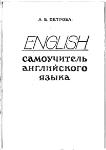
Э. И. Серебренникова, И. Е. Круглякова
АНГЛИЙСКИЙ ЯЗЫК
для химиков
ИЗДАНИЕ ВТОРОЕ,
ИСПРАВЛЕННОЕ И ДОПОЛНЕННОЕ
Допуьцено Министерством высшего и среднего
специального образования СССР
в качестве учебника для студентов
хи мико-технологических специальностей
высишх учебных заведений
МОСКВА «ВЫСШАЯ ШКОЛА» 1987
ББК 81.2 Англ-923
С 32
,	ди*—'
Г ЬИВЛИ0?5^м	S
| w^6?2J	нк~~’~’
кафедрт""1Гйостранных языков Московского института нефть
и газа им. акад. И. М. Губкина
(зав. кафедрой канд. ист. наук Н. Т. Карташев)
Серебренникова Э. И., Круглякова И. Е.
С 32 Английский язык для химиков: Учеб, для сту-
дентов химико-технолог. спец, вузов.— 2-е изд.,
испр. и доп.— М.: Высш, шк., 1987.— 400 с.: ил.
Цель учебника—подготовить студентов к чтению оригинальной лите-
ратуры по специальности, а также умению вести беседу в пределах
тем, предусмотренных программой.
Во 2-м издании (1-е—1976 г.) увеличено количество уроков, заменены
тексты, расширены речевые упражнения, введены диалоги на разговор-
ные формулы, добавлен материал для внеаудиторной работы, включен
лексический минимум.
С«ОМ10<ЮО(Ш9».<Ю)-г.2 ив_<7	ББК 81 2 А1,гл.923
Учебное издание
Эмма Исааковна Серебренникова
Ирма Евгеньевна Круглякова
английский язык для химиков
Заведующий редакцией И. Э. Волкова. Редактор И. А. Краснова, Млад-
ший редактор Е. П. Политова. Художник В, И. Казакова. Художест-
венный редактор В. И. Пономаренко, Технический редактор Р. С. Роди-
чева. Старший корректор Н. А. Каджардузова
ИБ № 65 08
Изд. № А-18. Сдано в набор 28.10,86, Подп. в печ. 26.02.87. Формат
84Х1081/яя- Бум. кн.-жури. № 2. Гарнитура литературная. Печать высо-
кая- Объем 21 усл. печ. л. + форзац 0,21 усл. печ. л. 21,21 усл. кр.-отт.
24,69 уч. изд. л. + форзац 0,30 уч.-изд. л. Тираж 27000 экз.
Зак. № 893. Цена 1 р. 30 коп.
Издательство «Высшая школа», 101430 Москва, ГСП-4, Неглинная ул.,
д. 29/14.
Отпечатано с матриц Ордена Октябрьской Революции и ордена Трудо-
вого Красного Знамени МПО «Первая Образцовая типография» имени
А. А. Жданова Союзполиграфпрома при Государственном комитете СССР
по делам издательств, полиграфии и книжной торговли. 1 13054, Москва,
Валовая, 28 во Владимирской типографии Союзполиграфпрома. при
Государственном комитете СССР по делам издательств, полиграфии и
книжной торговли, 6 00000, г. Владимир, Октябрьский проспект, д. 7.
© Издательство «Высшая школа», 1976
© Издательство «Высшая школа», 1987, с изменениями
ПРЕДИСЛОВИЕ
Настоящий учебник предназначен для студентов химико-техноло-
гических институтов и факультетов, изучавших английский язык в сред-
ней школе и продолжающих его изучение в институте.
Цель учебника — развить у студентов навыки, необходимые для
чтения и понимания оригинальной литературы на английском языке, а
также обучение устной речи в объеме материала, предусмотренного про-
граммой.
По структуре и содержанию учебник соответствует требованиям
«Программы по английскому языку для неязыковых специальностей
высших учебных заведений».
Учебный материал распределяется по трем этапам обучения, где
все виды речевой деятельности взаимосвязаны между собой, однако
на разных этапах их соотношение различно. На первом этапе совер-
шенствуются базовые языковые навыки и речевые умения: повторение и
углубленная проработка как основных грамматических разделов, так и
определенного минимума лексических единиц (с учетом словарного
запаса, полученного в школе) (Уроки 1 — 12). На втором этапе отрабаты-
ваются навыки и умения для изучающего и ознакомительного чтения
(Уроки 13—28)., На третьем этапе совершенствуются навыки и умения в
чтении по специальности и устной речи (Уроки 29—35).
Структура каждого урока представлена предтекстовыми упражне-
ниями, текстами и пос лете кетовыми упражнениями. Если предтекстовые
упражнения (языковые и речевые) подготавливают обучаемого к пони-
манию текстовой информации, то послетекстовые упражнения выпол-
няет следующие функции: усвоение лексико-грамматического материа-
ла и контроль навыков и умений чтения и устной речи, упражнения с
применением технических средств обучения.
Учебник содержит дополнительные тексты для ознакомительного
чтения. Все научные тексты заимствованы из оригинальной английской
или американской литературы по химии и подверглись в учебных це-
лях незначительной адаптации и сокращению.
Учебник содержит ряд текстов, посвященных достижениям в об-
ласти химии, химической технологии и современной химической про-
мышленности в СССР.
Согласно требованиям программы по английскому языку лекси-
ческий минимум должен составлять 2500 слов и словосочетаний. Тек-
стовой материал учебника построен на словарном минимуме, отобранном
статистическим анализом научных текстов 1.
При организации грамматического материала авторы учебника
также руководствовались программными требованиями, положив в
основу частотность грамматических конструкций в научной литературе
по химии на английском языке. Грамматический материал представлен в
1 Англо-русский частотный словарь по химии и химической техно-
логии/Под ред. Г. Б. Архипова и Л. Эдед.— Изд-во ВХТУ, ВНР, 1983.
**	3
виде моделей и тренировочных предтекстовых и послетекстовых упраж-
нений, а также в кратком грамматическом справочнике. Справочник
предназначен для самостоятельной работы над выделенными граммати-
ческими явлениями. В конце учебника даны упражнения на основные
грамматические темы для их закрепления и контроля.
В учебнике даны правила чтения химических формул и список
химических элементов с указанием их произношения.
При подготовке второго издания учебника авторы использовали
результаты многолетней работы с ним кафедр иностранных языков
химико-технологических вузов и факультетов и внесли необходимые
изменения: увеличено количество уроков, заменен ряд устаревших
текстов, увеличен раздел грамматических упражнений, изменена си-
стема упражнений по отдельным видам речевой деятельности, введены
диалоги на разговорные формулы. В учебник включен словарь-минн-
мум для чтения литературы по специальности, составленный старши-
ми преподавателями Э. И. Серебрениковой, Л. И. Гладковой и
М. В. Черняк
Авторы выражают благодарность коллективу кафедры иностран-
ных языков Московского института нефтехимической и газовой промыш-
ленности им. акад. И. М. Губкина за ценные советы и помощь, оказан-
ные при подготовке учебника к печати.
Авторы
4
LESSON 1
Grammar: 1. There is, there are.
2. The Demonstrative Pronouns: this, that, these,
those.
Text: The Soviet Union.
Ex. 1. Pronounce the following words and word combinations:
Supreme Soviet [sju(:)'pri:m 'souviet]	HP occupy [bkjupai]	r altogether [p:lta'gedaj surface ['sa:fis] j record ['reko:dj sphere [sfia] fertilizer ['fa:tilaiza] cement [si'ment] ‘K - microbiological l'maikro(u)- baia'bdgikal] • >	resource [rfsais] f' * . particularly [pa'tikjubhj synthetic [sin'OetikJ achieve [a'tfiiv] . . success [sak'ses]	. \  determine [di'ta:min] qualitative {'kwolitativ] coexistence ('ko(u)ig'zist- (a)ns]
Ex. 2. Read the following word combinations:
a sixth of the earth [a'siksO av Si 'a:0]
square kilometre ['skwea 'kila,mi:ta]
manganese ores [,mter)go'ni:-z 'o:z]
non-ferrous metals ['non'feras 'metlz]
qualitative changes ['kwalitativ z-yein(d)3iz]
Ex. 3. Read the following words, mind the stresses:
technology [tek'noladsi] — technological [^ekna'bdgikal]
industry ['indastri] — industrial [in'dAstnal]
produce [pra'dju:s]— production [pra'dAkJan]
science fsaians]—scientific [,saian'tifik]
Ex. 4. Read the following fluently:
an outstanding record in technology; microbiological
industry; Far East; iron and manganese ores; non-ferrous and
rare metals; synthetic fibres; industrial output; postwar
5
period; ice-breaker; put forward; the 12th Five-Year Plan;
well-being of people; peaceful coexistence; nuclear threat.
Study and remember the following charts:
№ 1
1.	There is a good library in our Institute.
2.	There is no ink in my pen.
3.	Is there coal in this region?
№ 2
1.	There are many good laboratories in our
Institute.
2.	There are no books on analytical chemistry
on the shelf.
3.	Are there English books in your library?
№ 3
1.	There were many students at the meeting
yesterday.
2.	There were no mistakes in his work.
3.	Were there many people at the lecture?
Ex. 5. Complete the following sentences using “there is”, “there are” ac-
cording to the model:
Model: Moscow is a cultural centre, (many theatres,
museums) in it.
Moscow is a cultural centre, there are many
theatres, museums in it.
1. The Soviet Union is rich in mineral resources, (much
iron, coal, oil) in it. 2. I shall go to the library, (no books)
in our reading room. 3. Your work was very poor, (many
mistakes) in it. 4. Our laboratory is very good, (new devices,
modern apparatus) in it. 5. Our city is very beautiful, (parks,
gardens) in it. 6. Many years ago our town was very small,
(no big houses, cinemas, institutes) in it.
Study and remember the following chart:
1. There will be a lot of new schools in our city.
2. There will be no old houses in our street.
6
Ex. 6. Complete the following sentences according to the model:
Model: Ask him to come at three, in the hall (a meet-
ing).
Ask him to come at three, there will be a meet-
ing in the hall.
1. Don’t forget to come tomorrow, at 5 o’clock (a very
interesting lecture). 2. Carry out this work today, (no time
tomorrow) I think. 3. Read the article now, (no time later).
4. Do not come late, (nobody in the laboratory).
Ex. 7. Put the following sentences into the negative form!
1. There were many new laboratories in our Institute
some years ago. 2. There is an English magazine on the table.
3. There are foreign students in our group.
Study and remember the following chart:
1.	This article is very important.
2.	These articles are very important.
3.	That lecture was very interesting.
4.	Those lectures were very interesting.
Notes on the Text
1.	for a term of four years — сроком на четыре года
2.	to achieve an outstanding record — достичь выдающегося успеха
3.	to hold one of the leading places — занимать одно из первых мест
TEXT. THE SOVIET UNION
The Soviet Union is the first socialist state in the world.-
It is the socialist state of workers and peasants. The LTSSR
is a state emboding 15 Soviet Socialist Republics...
J The USSR Supreme Soviet is the highest body of state
power in our country. It is elected for a term of four years.
The Soviet Union is the largest country in the world. It
occupies half of Europe and a third of Asia, altogether a
sixth of the earth’s land surface. Its territory is 22,4 million
square kilometres, its population is over 280 million
people.
Under the leadership of the Communist Party, the Soviet
Union achieved an outstanding record in all spheres of life.
The Soviet Union is a highly developed industrial country.
It now leads the world in steel and oil production, in tractors,
mineral fertilizers.
7
Today the USSR produces more pig-iron, steel, oil, natural
gas, cement, machine tools, tractors, mineral fertilizers and
many other goods than any other country in the world.
New industries, such as atomic, space rocket, electronics
and microbiological industries have been set up.
It is important that powerful production complexes have
been built in the Urals, Siberia, the Far East, in fact, in all
regions of our great country. /
The USSR holds one of the leading places in the world
for the resources of coal, oil, gas, iron арД manganese ores,
non-ferrous and rare metals.
The rate of development of chemical industry is very
high, particularly in the production of synthetic fibres, poly-
mers, resins.
The country’s national income has grown greatly since
the end of the 2nd world war; industrial output increased
many times during the postwar period. Soviet science and
technology have achieved outstanding successes. The Soviet
Union blazed the path into space. It pioneered the peaceful
uses of atomic energyAThe Soviet Union built the first nuclear
power station and nuclear-powered ice-breake^.j^
Now the CPSU Central Committee has put forward the
tasks on accelerating scientific and technical progress.
Society’s development will be determined by qualitative
changes, by the intensification of our economy.
According to the New 12th Five-Year Plan the output of
manufactured consumer goods will greatly increase.
All these measures are aimed at the further improvement
of well-being of our people. Concern for the well-being of
the people was, is and will remain the highest aim of our
Party.
<P Great progress has been achieved in the field of education.
In the Soviet Union the training of skilled workers is regarded
now as a matter of great importance.*
In the next Five-Year-Plan period Soviet secondary and
higher schools will undergo further qualitative development.
The Soviet Union pursues a policy of peaceful coexistence.
' The Soviet Union stands for cooperation in science and
technology with all countries. The Soviet Union stands for
peace in space. The USSR stands for full elimination of nu-
clear threat, for peace and friendship with other countries.
Remember the following words and word combinations:
power	iron	to put forward'
to elect	to set up. task
8
term
to occupy
to extend
highly
to develop
to produce
resources
rare r
fibre'
to achieve
to use
nuclear.
to accelerate'
to change </
change : '
to remain ’
well-being
to stand for
Ex. 8. Answer the following questions according to the model. (Work In
pairs.)
Mode 1: This text is very interesting, isn’t it?
Yes, it is. or No, it isn’t.
This text is not long, is it?
Yes, it is. or No, it isn’t.
1. This is a very large country, isn’t it? 2. It is a new .
power station, isn’t it? 3. The chemical industry is remarkable
for the scale of its development, isn’t it? 4. Soviet science
today is in the forefront щ many spheres of world scientific
progress, isn’t it? 5. The rate of development of the Soviet
chemical industry is very high in the USSR, isn’t it? 6. This
text is not very difficult, is it? 7. This plant is not very
old, is it?
Ex. 9. Answer the following questions:
1. What is the first socialist country in the world? 2. What
is the highest body of state power in the USSR? 3. What terri-
tory does the Soviet Union occupy? 4. What is the population
of the USSR? 5. What are the new industries in the USSR?
6. What do you know about the first nuclear power station?
7, -What tasks have been put forward by the Communist Party
of the USSR at the XXVII Congress? 8. What can you say
about the progress in education? 9. What is the foreign policy
of the Soviet Union?
Ex. 10. Put the following words into plural:
this plan, that factory, this branch, that field.
Ex. 11. Give short answers according to the model. (Work in pairs.)
Model: Is there much coal in our country?
Yes, there is.
Is there a power station in your town?
No, there is not (isn’t).
1. Is there much iron in the Urals? 2. Is there a new plant
in your town? 3. Are there many power stations in the Soviet
Union? 4. Are there many old houses in the centre of Moscow?
5. Are there many schools in your city?
9
Ex. 12. Make up sentences according to the model:
Model: a new power plant, in our district
There is a new power plant in our district.
1. a lot of books, in our new library; 2. many research
centres, in our city; 3. new, modern houses, in all cities of
our country; 4. over 8 million people, in Moscow.
Ex. 13. Listen to the tape-recorded text and discuss it:
The Russian Soviet Federative Socialist Republic is the
biggest of the Soviet republics. Over half the population of
the Soviet Union lives there.
It is the leading Union republic in terms of economic
might. The products of its industry include machines and
instruments, chemicals, the best textile goods.
The Russian Republic produces two-thirds of all the Soviet
Union’s industrial items and about half of its total agricul-
tural output.
LESSON 2
Grammar: 1, The Indefinite Tense Forms (Present, Past,
Future).
2, The Degrees of Comparison.
Text: Moscow.
Ex. 1. Pronounce the following words and word combinations:
movement {'mu:vmont]
major ['meidja]
seat [si:t]
authority [o:'0onti]
council ('kauns(i)l]
young [jAIj]
present [pri'zent]
modern ['modan]
concrete ['konkrirt]
ancient ['emj(a)ntj
cathedral [ko'0i:drolj
masterpiece ['mastapiisj
architecture ['akitektfo]
area 1'еэпэ]
theatre ['0iata]
museum [mju'ziam]
state library ['steit 'lai-
bran]
volume I'voljum]
monument ['monjumantj
motor vehicle ['mouta
fvi:ikl]
honour 1'эпэ]
boulevard ['bu:lvotd]
avenue faevmju:]
palace ['paehs]
rally ['raeli]
defeat [di'fi.tj
be awarded [bi a'wozdid]
10
Ex. 2. Read the following word combinations:
in the course of [in дэ 'ko:s ov]
an outstanding role [an aut'stendig 'roul]
great masterpieces of old Russian architecture ['greit 'ma:s-
tapi:siz av 'ould 'гл|эп 'a:kitektja]
thirty-two-storey house ['0a:ti'tu;'sta:n 'haus]
Ex. 3. Read the following words, mind the stresses:
republic [п'рлЬкк]
to present [to pri'zent] —present ['preznt]
education ^edju'keij’n]—educational [,edju'keijanl]
culture ['kAltfa]—cultural ['kAltfaral]
number ['плтЬа]—numerous ['nju:maros]
within [wi'Sin]
Ex. 4. Form the comparative degrees of the following adjectives according
to the model:
Model: short—shorter
important—more important
old, wide, large, beautiful, long, early, famous, nice,
narrow, big, high, young, interesting, small, rich.
Ex. 5. Form the superlative degree of the following adjectives according
to the model:
Model: short—the shortest
important—the most important
ancient, convenient, great, modern, large, old, big, wide,
hot, cold, difficult, fine, near, small.
Study and remember the following charts:
good bad little much 1 many [	better worse less more	the best the worst the least the most
№ 2
1.	This town is older than that one.
2.	This book is as interesting as that one.
3.	This street is not so long as that one.
Ex. 6. Complete the following sentences according to chart No. 2:
1. This text is not so difficult as ... . 2. This work is
easier than ... .3. These results are better than ... .4. This
laboratory is as new as ... .
Ex. 7. Translate the following word combinations:
the best library, the best student, the worst answer, the
oldest city, the most interesting book, the least piece, the
highest building.
Ex. 8. Form the comparative and superlative degrees of the following
adjectives:
long, important, wide, interesting, good, hard, great,
hot, early, main, big, large.
Study and remember the following charts:
№ 1	1. I work much at home. 2. He attends lectures.	They do not work. She does not work.		Do you work much? Does he study?
№ 2	1. I worked much yesterday. 2. He attended all the lectures last month.	They did not work two days ago. She did not come yesterday.			Did you work yesterday? Did he speak to you yes- terday?
№ 3	1. I shall trans- late the article tomorrow. 2. He will finish this work.	We shall not come next week. She will not come.	Shall we work to- morrow? Will he come?
Ex. 9. Put the following sentences into the interrogative form according
to the models:
Model I: 1. He lives in the centre of Moscow.
Does he live in the centre of Moscow?
2. We know the history of our town very
well.
Do you know the history of our town very
well? •
12
1. Many people come to our city every day. 2. This scien-
tist works at a very interesting problem. 3. She teaches chem-
istry at school. 4. He collects stamps and postcards. 5. They
attend lectures every.day. 6. On Sundays she does not go to the
Institute. 7. We read many English books.
M о d e 1 II: He visited this town last year.
Did he visit this town last year?
1. He went to Kiev last month. 2. They answered all the
questions very well yesterday. 3. She spent her childhood in
the country. 4. At school he liked chemistry. 5. She went
to the Institute by bus.
Ex. 10. Complete the sentences using the Future Indefinite Tense according
to the model:
Model: She is in the laboratory now. (to come soon,
here)
She is in the laboratory now, she will soon come
here.
1. They go to school this year, (to finish, next year)
2. She is still in Moscow, (to leave, tomorrow for Kiev) 3. We
translate the article, (to continue our work, tomorrow too)
Ex. 11. Complete the sentences according to the model:
Model: I shall come if (provided, when, unless) I have
time.
1. The students will go home when they ... . 2. She will
take part in this work if she .... 3. He will answer your
question if .... 4. I shall speak to him unless ... . 5. They
will help us if ... . 6. He will finish his work before he ... .
7. We shall find the document if ....
Ex. 12. Open the brackets choosing the correct form of the verb:
1. This scientist (work, works, doesn’t work) in the field
of organic chemistry, he deals with organic compounds.
2. He (take, doesn’t take, will take) part in this work as he
has no time. 3. Last year she (uses, used, will use) a new
method in her work. 4. He (attends, attend, doesn’t attend)
lectures on Sundays. 5. In three days they (shall carry out,
will carry out, do not carry out) this interesting work.
Ex. 13. Remember the Past Indefinite Tense of the following verbs:
to find—found to found—founded
to have—had	to stand—stood
13
Ex. 14. Remember the meaning of the following:
some—некоторый,	не-	same—тот же (самый)
сколько	at the same time —в то же
at some time—в какое-то (самое) время
время	the number of—число, ко-
а number of—ряд	личество
Notes on the Text
1.	in the course of — зд. на протяжении
2.	to play a role — играть роль (иметь значение)
3.	one can see — можно видеть
4.	both . . . and — как . . . так и
5.	as well as — так же, как
TEXT. MOSCOW
Moscow, the capital of the Union of Soviet Socialist Re-
publics, is one of the oldest Russian cities. It was founded in
1147 by the prince Yuri Dolgoruki. In the course of its long
history Moscow played an outstanding role in the life of the
Russian State. Moscow saw much and experienced much.
Moscow became one of the most important centres of the
working class movement.
Moscow played a major role in the Revolution of 1905-
1907. In 1917 Moscow set up a centre to direct the struggle
for transfer of power into the hands of the Soviets.
In 1918 Moscow became the capital of the Soviet State.
Moscow is the nation’s political centre. It is the seat of
the Supreme Soviet of the USSR, the highest body of state
authority, of the Council of Ministers, and of the Central
Committee of the Communist Party of the USSR.
Moscow is old and young at the same time. We say that
Moscow presents both old and modern Russia. One can see
wide new streets, modern buildings made of glass and con-
crete, and at the same time old monuments, the ancient Krem-
lin with its cathedrals, Red Square, the famous old monu-
ments to Minin and Pozharsky, and St. Basil’s Cathedral—
great masterpieces of old Russian architecture.
Moscow is both the most important political centre of
the country and one of the world’s greatest centres of science
and culture. Moscow is a student city.
There are a lot of higher educational establishments in
Moscow.
14
There is a famous University named after the great Rus-
sian scientist Lomonosov in Moscow. It occupies a vast area
on Lenin Hills, its main building is a 32-storey house. Many
students and post-graduates both from the Soviet Union
and abroad study in it.
Moscow is a great cultural centre. It is famous for its the-
atres, museums, a lot of libraries, the largest being the State
Lenin Library, its collection contains millions of volumes.
There are a lot of historical monuments in Moscow. Mos-
cow is the main scientific centre of the Soviet Union. The
USSR Academy of Sciences as well as a great number of
Scientific research centres and institutions are located in
Moscow.
Moscow has become an important industrial centre. It
produces motor vehicles, machine tools, radio apparatus,
electronic devices, computers, cars, chemicals and so on.
Moscow is the largest sports centre. In 1980 Moscow right-
fully had the honour to host the 22nd Olympic Games.
Moscow changes from day to day. It has become one of the
most beautiful cities in the world. Numerous parks, boule-
vards and wide avenues make our capital beautiful and
green.
The heart of Moscow is the Kremlin. A new palace was
built within the Kremlin Walls, the Palace of Congresses.
All the congresses, rallies, meetings take place in this
wonderful Palace.
Moscow is the Hero City. In 1941 the front was on the
very approaches to our capital. The people of Moscow and
all the Soviet peoples rose in Moscow’s defence. They dis-
played unprecedented heroism. The Soviet people stood to
death and withstood. It was near Moscow that the myth of
the invincibility of Hitler’s armies was dispelled. It was
the first big nazi defeat. Moscow was awarded the Gold Star
of the Hero City for its heroism during the Great Patriotic
War.
Remember the following words and word combinations:
to found in the course of.^ to play a role^r1*	vast to be famous for to contain	recently to appear to take place
to present	as well as	to display
present	scientist	to defeat
at the same time to produce	research researcher	to be awarded
15
Ex. 15. Give short answers according to the models. (Work in pairs.)
Model I; Does he live in the centre of Moscow?
Yes, he does. No, he doesn’t.
Do you often go to the theatre?
Yes, I do. No, I don’t.
1. Does Moscow University occupy a vast area on Lenin
Hills? 2. Do you like to study in the library? 3. Do you live
in the centre of Moscow? 4. Does your Institute have many
departments? 5. Does your friend know Moscow well? 6. Do
you like to go to the museums of Moscow? 7. Do many people
come to see our capital? 8. Does he study in the library?
9. Does Moscow become more and more beautiful? 10. Do
parks and boulevards make Moscow a green city? 11. What is
the largest library in the Soviet Union? 12. Do you work in
Leningrad? 13. Do all the congresses take place in the new
Palace of Congresses?
Model II: Did he visit many cities of the Soviet Union?
Yes, he did. No, he didn’t.
1. Did you see the monument to Pushkin? 2. Did your
sister see the building of Moscow University on Lenin Hills?
3. Did the meeting take place in the hall? 4. Did they go to
the Opera House yesterday? 5. Did Moscow change greatly?
6. Did the people of Moscow defend their city heroically?
7. Did you see the new districts of our capital? 8. Did she
like Kiev more than Moscow?
Ex. 16. Answer the following questions:
1. Who founded Moscow? 2. When was Moscow founded?
3. Why can we say that Moscow is old and young at the same
time? 4. What do you know about Moscow University?
5. What museums are there in Moscow, what can you say about
the Tretyakov Picture Gallery? 6. What is the largest library
in Moscow? 7. What monuments are there in Moscow? 8. What
do you know about the Kremlin? 9. Why was Moscow awarded
the Gold Star of the Hero City?
Ex. 17. Retell the text according to the following plan:
1.	The foundation of Moscow.
2.	The places of interest.
3.	Moscow University.
4.	Moscow museums.
5.	The Kremlin.
6.	Moscow during the Great Patriotic War.
16
Ex. 18. Open the brackets choosing the correct form of the adjectives:
1. The monument to Pushkin is one of (old, the oldest)
and (good, better, the best) in Moscow. 2. The Moscow un-
derground is (better, the best) in the world. 3. The Lenin Li-
brary is (large, the largest, larger) than other libraries in our
country. 4. This street is as (green, the greenest) as that one.
5. This building is much (big, bigger, the biggest)' than the
old one. 6. This park is (beautiful, the most beautiful) in
our city. 7. This street is not so (longer, long) as that one.
Ex. 19. Open the brackets translating the Russian words into English:
1. Moscow, the capital of the USSR, is (как) the most
important political centre of the country (так и) one of the
world’s greatest centres of science. 2.The Palace of Congresses
is a modern building (из стали и стекла). 3. (Оба) buildings
have been built recently. 4. A large new bridge (играет
важную роль) in the economic life of this industrial city.
5. Many people from all parts of our country (так же, как)
from abroad came to the exhibition. 6. (Множество) new
libraries and reading-rooms have been opened in many towns
and cities of our country. 7. This gallery (известна) for its
great collection of pictures. 8. The meeting (состоялся) in
a large hall. A lot of students were present at it. 9. This
new district is (такой же большой как) a whole town. 10.
The picture of Moscow changes (изо дня в день). И. We can
say that Leningrad is old and new (в то же время, одновре-
менно).
Ex. 20. Pay attention to the translation of the following words and word
combinations:
a number of new houses — ряд новых домов
the number of the house is — номер дома
both museums are in the centre — оба музея находятся
в центре
both old and new streets are — как старые, так и новые
улицы расположены
some monuments are — некоторые музеи находятся
the same houses you can see — такие же дома вы можете
увидеть
Ех. 21. Choose the Russian equivalents from the right column:
a lot of	иметь значение
at some time	множество
numerous	иметь место, происходить
to take place	в какое-то время
2—893	|7
to play a role	в то же	время (одновременно)
at the same	time	недавно
recently	знаменит
famous for	многочисленный
Ex. 22. Give the missing forms of the following verbs:
build, built, ... see, seen, ... know, known, ...
come, coming, ... made, making, ... been, being, ...
have, having, •..
Ex. 23. Insert prepositions:
1. There are many museums ... Leningrad. 2. Leningrad
is famous ... its monuments. 3. Moscow University was found-
ed ... M. Lomonosov. 4. Our meetings usually take place ...
our club. 5. The monument ... Mayakovsky is in the centre
of Moscow. 6. Our cities are changing ... day ... day. 7. They
came ... Moscow ... the same time as we did.
Ex. 24. Read the texts and retell them:
1.
Leningrad is a large city on the Neva. It was from here
that V. I. Lenin’s words about the victory of the proletarian
revolution were heard in every corner of the world.
Leningrad is one of the most beautiful cities. Thousands of
tourists come to see this wonderful city. One can see many
places of interest. Such museums as the State Russian Mu-
seum, the State Hermitage are well known not only in our
country but in many countries all over the world. The State
Hermitage is the largest museum in the Soviet Union. Over
300 rooms are open to the public.
There are many monuments in Leningrad. The monument
to V. I. Lenin in front of the Finland railway station is one
of the best monuments to the founder of the Communist Party
and the Soviet State.
During the Second World War the German armies attacked
our country. Leningrad was blockaded. The city was subjected
to an almost 900-day-long siege.
Leningrad withstood all the trials. The Presidium of the
Supreme Soviet of the USSR decorated the Hero City with
the Order of Lenin for its heroism.
2.
London is the capital of the United Kingdom. The popu-
lation of London is over eight million people. London is a
18
large industrial centre, it is a city of great social contrasts.
In the West End there are beautiful houses, palaces, theatres,
museums. Among them one can see the British Museum.
There are many parks, beautiful monuments. In the East
End one can see small houses black with smoke, numerous
docks, plants and factories.
London is an old city and there are many places of inter-
est, such as the Tower, St. Paul’s Cathedral, Westminster
Abbey and many others. The Tower is more than 900 years
old. Many years ago it was a royal residence, then a prison.
Now it is a museum. St. Paul’s Cathedral is very large and
fine. It was built in 1710. The City is the commercial heart
of London.
Ex. 25. Listen to the following tape-recorded text and discuss it:
Everyone who visits Moscow goes to Red Square, the heart
of Moscow.
There is the Lenin Mausoleum in Red Square. Red Square,
one of the most beautiful in the world, stretches along the
eastern wall of the Kremlin. Many events in the country’s
history are associated with it. V. I. Lenin spoke in Red
Square many times. The first time it was on November 7,
1918.
LESSON 3
Grammar: 1. Review of the Indefinite Tense Forms.
2. The meanings of one.
Text: Chemistry.
Ex. 1. Pronounce the following words:
 7	'
material [mo tioriol]
property ['propati]
undergo [.Anda'gou]
composition I,kompa'ziJ(a)n]
condition Ikan'diJ^n]
accompany [э'клтрэш]
colour ['кл1э]
fundamental [,fAnds'mentl]
important [im'po:tant]
magic ['maedsik]
quantitatively ['kwontitativ-
h] -	'
relationship In'leij'anJTp] >
external [eks'taml]
concept ['konsept] ’
molecule ['molikju:!]
equal ['i:kwal] <	1
among [э'тлд]
hydrogen ['haidndjan]
19
2*
biochemistry ['baio(u)'kemis-	radium ['reidjaih]
tri]	create [krir'eit]
geology [dsi'alodji]	machine [ms'Jim]
origin ['ondsin]	polymer ['polima]
manufacture],maenju'faektja]	liquid ['likwid]
bronze [bronz]	homogeneous Lhoma'dgimjas]
century ['sentfuri]	alloy ]'aebi]
sufficient [sa'fijant]
Ex. 2. Read the following word combinations:
chemistry is the science ['kemistri iz Зэ 'saians]
it deals with materials [it 'di:lz wi3 ma'tiarialz]
catalysis and crystal structure [ka'taelisis and 'knstal
'strAktJa]
entirely free of [m'taiali 'fri: av]
regularities in properties [,regju'18eritiz in 'prapatiz]
artificially radio-active elements [,a:ti'fiJah 'reidio'aektiv
'ehmants]
Ex. 3. Read the following words, mind the stresses:
transform [traens'fa:m] — transformation [,traensfa'meijan]
nature I'neitja]—natural ['naetjral]
reactive [ri/aektiv]—reactivity [,ri:ask'tiviti]
practice ['praektis]—practically	['praektikah] — practical
['praektikal]
understand [,Anda'staend] — understandable [,Anda'staendabl]
Ex. 4. Read the following verbs, mind the pronunciation of the suffix “-ed”:
worked, translated, visited, passed, carried, attended,
looked, lived, stayed, smoked, created, transformed, changed,
asked, repeated.
Ex. 5. Complete the following sentences according to the model. Use
the Past Indefinite Tense:
Model: He studies organic chemistry but last year he
studied inorganic chemistry.
1. The students come to the Institute at 9 but last year
they ... at half past nine. 2. She carries experiments herself
but some time ago she ... them under the teacher’s supervision.
3. He works at the Research Institute but two years ago he ...
at the plant. 4. They speak English'rather well but last year
they ... poorly.
Ex. 6. Open the brackets using the verbs in the correct forms:
1. Last year he (to deal with) quantitative analysis. 2. Eve-
ry day she (to attend) lectures on chemistry. 3. Two years
20
ago he (to study) the problems of the crystal structure. 4. Yes-
terday they (not work) in the laboratory as there was no
electricity. 5. He (to pass) his exams well, and now he (to
rest). 6. They (to get) good results, which helped them in
their work. 7. Many students (to graduate from) the Institute
last year. 8. When they (to heat) water to 100°C it (to begin)
to boil. 9. She (not take part) in this research work as she
(to be ill) at that time. 10. Next year he (to graduate) from
the Institute and (leave) Moscow for his native town. 11. She
(to work) in the field of nuclear physics next year. 12. They
(to use) this new device in their work soon.
Ex. 7. Give the 3rd person singular of the following verbs:
to teach, (she, he) ...; to undergo, (it) ...; to study, (he,
she) ...; to change, (it) ...; to get, (he, she) ...; to introduce,
(she) ....
Ex. 8. Mind the note and translate the sentences into Russian:
Note:
(один (числительное)
подлежащее (в неоп-
ределенно-личном
предложении)
слова-за местшпе-
one, ones ли СущеСтвитель-
no one—никто
anyone—любой, кто-нибудь
one may — можно
one must — нужно
ного
l.'They study organic processes and inorganic ones.
2. Anyone can take part in this work. 3. This method is sim-
pler than that one. 4. No one has'ever observed this phenome-
non. 5. .One must know all the properties of this substance.
6. Sodium is the only one of the alkali metals which is used
industrially in large quantities. 7. No one could state the
definite properties of this substance. 8. One may expect that
this substance dissolves easily in water. 9. Only one out of
100 million atoms of radium decomposes per second. 10. At
one time the chemists took the weight of the hydrogen atom
as the unit. 11. Hydrogen consists of particles, each one is
made up of 2 hydrogen atoms.
Notes on the Text
1.	to deal with — иметь дело, рассматривать, касаться
2.	to take place — иметь место, происходить
3.	to be concerned with — иметь дело с
4.	to devote to — посвящать
5.	to make a contribution to — делать вклад
21
/>	т CHEMIST RY
Chemistry is the science which deals.with materials,..then
tPropenieyand the tfcmsformationstheym^erffi^So chemis-
try is the study of the composition’and properties of matter,
their changes, tl^e q^nditions under whi<&,suc^,d^nges take
place, and the $nergy_ changes which, .accompany' them.
Chemistry is сопсмткЭ with theJnaijur^ of /ire'd^d the
structure of water, it deals with dolours!, cmalySis'ahd crystal
structure, with physical properties and chemical reac-
tivity. > i	л.
Chemistry is one oLthe fundamental sciences. It plays an
?-<? important~part in theoeyflqpment of biochemistry, physics,
geology, anci many othef fields of science. Chemistry’s origin
goes back ter Ancient times, with the manufacture of bronze,
iron, ceramics, glass.
^Q.-en,d of the si0zeenthecentury' sufficient facts, en-
free .of , magic which surrounded, the work of the al-
chemists, Ideated.	>//'  ' •	(- (
jn j7t;h century modern chemistry began with the
work of Robert Boyle. He was the first one who stitt^d^fuanti-
^^^tatively' the relationship between the volume ,of a gas and
the external pressure upon it. Later A. Lavoisier introduced
the concept of the chemical elements.	A >
In the 19th century A. Avogadro introduced>the concept
of molecules. Restated' that'equal volumes of gases under the
same conditions of temperature and pressure contain the same
number of molecules.
F. A. Kekule and A. M. Butlerov introduced the structural
Fty^theory of organic chemistry.	' ' ‘ '
In 1869 D. I. Mendeleyev discovered regularities in the
properties of the elements. D. I. Mendeleyev’s discovery was
the greatest one in chemistry.	' ;
Many great $ci ep. lusts devoted their life to the development
of chemistry, aptidhg them Bohr whose theory of the hydrogen
atom was very important, the Curies who in 1934 announced
L the preparation of artificially radio-active elements, Marie
Curie who »disco,vered radium and..zthe element polonium.
Mgny, great. Russian chemists made a great'contribution
to the world sciepce^' Among them,-the outstanding Russian
chemists M. V. Lomonosov, D. I. Mendeleyev, A. M. Butle-
rov, Academician N. N. Semenov, and many others.
Everyone now understands the importance of chemistry.
T^yfujtmerof chemistry is practically unlimited. Rapid
development of chemical industry will make it possible to
22
create many new goods, machines, plastics, polymers, it will
help to understand many new phenomena.
In yourVktudy of chemistry you will learn many things
about	compounds, materials, chemical and phys-
ical changes,'/ cnermcal prqpertjes, reactions and many other
interestihg and im^Srtant'things. It is to be remembered
that:
1.	Chemistry is the study of substances, their structure,
their properties, and their reactions.
2.	Matter exists as solids, liquids, or gases.
3.	Homogeneous material is material with the same prop-
erties throughout-' -4
4.	Heterogeneous material is material consisting of parts
with different properties.
5.	Compound is a substance that can be decomposed into
two or more substances.
6.	Substance is a homogeneous species of matter with
lefinite chemical composition.
7.	Chemical reactions are the processes that convert sub-
tances into other substances.
8.	Alloy is a metallic material containing two or more
lements.
Remember the
to; deal with
property
to undergo
entirely
to surround
relationship
external
to introduce
to develop
development
origin
to--Iearn
substance
to exist
homogeneous
heterogeneous
to consist of
following words and word combinations:
composition
' to accompany
to be concerned
with
equal
to discover
discovery
practically
phenomena
Ex. 9. Answer the following questions:
1. What do you know about chemistry? 2. What does
chemistry study? 3. What does chemistry deal with? 4. Why
is chemistry one of the fundamental sciences? 5. When did
sufficient facts about chemistry appear? 6. When did modern
chemistry begin? 7. Who was the first to study quantita-
tively the relationship between the volume of a gas and the
external pressure upon it? 8. What did Lavoisier introduce?
9. Who discovered regularities in the properties of the ele-
ments? 10. What can you tell about the future of chemistry?
23
Ex. 10. Retell the text according to the following plans
1.	The definition of chemistry.
2.	The relation of chemistry to other fields of science.
3.	The origin of chemistry.
4.	The great chemist Robert Boyle and his theory.
5.	A. Avogadro’s formulation of molecules.
6.	D. I. Mendeleyev’s Periodic Law.
7.	Great scientists of the 19th century.
8.	The future of chemistry.
Ex. 11. Find the line where all the words are adjectives.*
1.	chemical, naturally, fundamental;
2.	entirely, practically, possible, physically;
3.	possibly, artificially, entirely, naturally;
4.	practically, artificially, original, possibly;
5.	different, impossible, original.
Ex. 12. Find the pairs of antonyms and remember them:
internal, to appear, natural, old, to disappear, artifici-
al, new, external.
Ex. 13. Find the pairs of synonyms and remember them:
to deal with, to change, to start, field, to be concerned with,
to alter, branch, to begin.
Ex. 14. Give the Past Indefinite Tense of the following verbs:
to learn, to deal with, to accompany, to create, to study, to
change, to undergo, to place, to take, to begin, to contain,
to make, to go, to be.
Ex. 15. Find the sentences where the word “change” is a predicate:
1. This is an example of a chemical change, since a chemi-
cal change results in permanent changes of properties. 2. The
properties of this substance change when we heat it. 3. The
change from one state into another was accompanied by the
evolution of heat. 4. The colour of the solution changed after
the reaction. 5. Great changes took place in our laboratory, it
became one of the largest in our institute. 6. Nuclear changes
may be shown by equations. 7. One form of energy may be
changed into another. 8. The temperature at which the exper-
iments were made changed between room temperature and
1,400 deg. C.
Ex. 16. Translate the following sentences paying attention to the dif-
ferent meanings of the word “matter":
1. Mass is the quantity of matter in a special specimen.
2. Chemistry is the branch of science which deals with dif-
24
ferent substances or varieties of matter. 3. It is a matter of
common observation that matter exists in three states.
4.Though this substahce is of organic origin it is still a matter
of some doubt whether it is of animal or vegetable origin. 5. As
a matter of fact this discovery was not a new one, but still it
was very interesting. 6. No matter what results we get we
shall continue our work. 7. It doesn’t matter when he comes,
we shall begin our experiment without him, and later we shall
show him the results. 8. Changes in matter can’t be without
changes in energy. 9. Matter is that which makes up the uni-
verse, matter is the reality. 10. It is known that mass is a
quantity of matter that makes a body. 11. The concentration
of mineral matter in sea water slowly increases. 12. Sea water
contains approximately 3.6 per cent of mineral matter in
solution. 13/The forms of motion of matter are diverse.
Ex. 17. Translate the sentences paying attention to the words in bold type:
1. The article dealt with the changes which took place
during the reaction. 2. Lomonosov devoted his life to the de-
velopment of Russian science. 3. It doesn’t matter what meth-
od we will employ in our work. 4. Different matters can be
classified according to their properties. 5. The students of
these two departments attend the same lectures. 6. The science
that is concerned with the composition of bodies and with the
changes of composition they undergo is chemistry. 7. It is a
matter of common observation that discovery of the electron
was the beginning of a new era in all the sciences. 8. *Inorganic
chemistry is concerned with mineral substances, organic chem-
istry deals with the compounds of carbon. 9. The experi-
mental method involves some observations of phenomena
which take place in nature. 10? Chemical reactions are accom-
panied by definite changes in energy.
Ex. 18. Translate the words in the brackets into English:
1. Chemistry is the science which (рассматривает) with
materials and their properties. 2. We think that the exhibi-
tion of our achievements (состоится) at the end of September.
3. This scientist (внес большой вклад) both in chemistry
and physics. 4. All his life he worked in the field of chemistry,
and we can say that he (посвятил) his life to science. 5. All
the changes which (сопровождали) this reaction play a
very important role. 6. Later Lavoisier (ввел) the concept
of the chemical elements. 7. Though these two teams work
under (одинаковые) conditions the results of their work are
25
different. 8. This article (касается) the development of
our industry.
Ex. 19. Translate the text using a dictionary. Reproduce the text:
Analytical chemistry deals with the methods of separation.
Synthetic chemistry deals with the methods by which complex
bodies can be built from simpler substances. Physical chemis-
try deals with changes, of state and with the motions of mole-
cules. But at the present time the scientists don’t maintain
this definition.
The discovery of X-rays, an electron, and radioactivity
marked a new er$ .iij all sciences and in chemistry. It was a very
important discovery in science. It plays an important part in
the development of geology and physiology, in technology
and in chemical engineering.
Chemistry deals with medicine and agriculture as they are
all concerned with the properties and changes of chemical
substances.
Ex. 20. Read the text and discuss it:
Some Facts about Chemistry
The science of chemistry deals with substances. Chemistry
is the investigation and discussion of the properties of sub-
stances.
Common examples of substances are: water, sugar, salt,
copper, iron and many others.
Chemists study substances in order to learn as much as
they can about their properties and about the reactions that
change them into other substances. This knowledge is very
important as it can make the world a better place to live in,
it can make people happier, it can raise their standard of
living.
Chemists discovered many laws, investigated many im-
portant phenomena in life. They produced many artificial
substances which have valuable properties.
Chemistry has two main aspects: descriptive chemistry,
the discovery of chemical facts, and theoretical chemistry,
the formulation of theories.
The broad field of chemistry may also be divided in other
ways. An important division of chemistry is that into the
branches of organic chemistry and inorganic chemistry.
Organic chemistry is the chemistry of the compounds of car-
bon that occur in plants and animals.
Inorganic chemistry is the chemistry of the compounds of
26
elements other than carbon. Each of these branches of chem-
istry is in part descriptive and in part theoretical.
Ex. 21. Listen to the tape-recorded text and retell it in Russian:
Chemistry is a very large subject. Chemistry is a complex
subject. It is the investigation and discussion of the properties
of substances.
If we ask—why do we study chemistry, the answer can
be—it is through chemistry we obtain the knowledge of mat-
ter, its changes and transformations.
Everyone understands that science of chemistry plays an
important part in the modern world.
Chemistry plays an important part in the development of
other sciences such as physics, biochemistry, geology and a
lot of other fields of science. Soviet scientists made a great
contribution to the development of chemical science. The
pioneers of Soviet chemical science are: N. Kornakov, N. Ze-
linsky, A. Favorsky, A. Arbuzov. Everybody • knows such
great Russian chemists as A. Butlerov, D. Mendeleyev, N. Se-
menov and many others.
LESSON 4
Grammar: 1. The Perfect Tense Forms (Present, Past and
Future).
2. The Suffixes of the Nouns and Adjectives.
Text: Soviet Achievements in Science.
Ex. I. Pronounce the following words:
major f'meidjaj area ('еэпэ] goal [goulj towards [ta'wo:dz] enrich [m'ntf] significance [sig'mfikans] biology [bai'oladsi] metallurgy [me'tsela:- dji] valuable ['vseljuablj synthesize ['smQisaiz]	extract [iks'traekt] phenol [zfi:nol] acetone ['sesitounj benzene ['benzim] propylene ['proupilim] hydrogen ['haidndsfajnj superconductivity [,sju:pa-« ,kon-dAk'tiviti] interact [,mtar'aekt] climate ['klaimitj weather fweda] knowledge ['nahdjj purpose ['pa:pas] 27
Ex. 2. Read the following words and word combinations:
outstanding success ['aut'staendig sak'ses]
constructional material [kan'strAkJanl ma'tmrial]
technological progress Ltekna'bdsikal 'prougres]
rolled ferrous metals [ rould 'feras 'metlz]
valuable properties ['vaeljuabl 'propatiz]
Ex. 3. Read the following words, mind the stresses:
metal ['metl]	metallic [mftaehk]
industry ['mdastri]	industrial [in'dAstrial]
value ['vaeljur]	valuable ['vaeljuabl]
Study and remember the following charts:
№ 1
1.	He has graduated from the University,
2.	He has never been to Moscow.
3.	They have already finished their work.
4.	She has not seen us since 1972.
5.	We have carried out many experiments lately.
6.	He has just come.
№
2
1.	By two o’clock he had finished this work.
2.	When he came into the laboratory they had
already finished their experiment.
3.	He said that they had finished their work.
№ 3
1. They will have built this house by the end
of the year.
2. By the time he returns we shall have carried
out a number of experiments and shall begin
the second part of our work.
Ex. 4. Make up the sentences using Perfect Tenses. Mind charts 1, 2, 3:
1. He	never to see	such research laboratories.
2. I	not to visit him	since he finished school.
3. They	to pass	their exams by 3 o’clock.
4. She	to leave	before I came.
23
gx. 5. Repeat the following suffixes of the noun and translate the nouns
into Russian:
-tion, -ment, -ence, -ance, -er, -or, -y
discovery, inventor, producer, constructor, difference, for-
mation, acceleration, accelerator, development, extraction,
achievement.
Ex. 6. Mind the suffixes in the following adjectives, translate the ad-
jectives into Russian:
important, significant, various, different, artificial, chemi-
cal, valuable, scientific, industrial, experimental.
Ex. 7. Form the nouns from the following adjectives using the suffixes
“-ness”, “-ity”, “-ure”:
useful, dense, thick, moist.
Ex. 8. Give short answers according to the models. (Work in pairs.)
Model.!: Have you ever worked in the field of chain
reactions?
Yes, 1 have. No, I haven’t.
1. Have our scientists made great discoveries in the field
of nuclear research recently? 2. Have you ever visited the new
research centre near Moscow? 3. Have Soviet scientists opened
a new era in the investigation of space? 4. Have you ever been
to Dubna? 5. Have they solved all the questions in the field
of organic chemistry?
Model II: Has he done his home-work well?
Yes, he has. No, he hasn’t.
1. Has this student taken part in this experimental work?
2. Has your brother read any articles in English? 3. Has Acad-
emician N. N. Semenov made great discoveries in the field
of chain reactions? 4. Has this scientist worked in the field of
lasers? 5. Has the production of artificial radioactive iso-
topes developed into a new industry?
Ex. 9. Translate the sentences, mind the meanings of the word “solve”:
Note: to solve — решать; растворять
1. They have solved recently many important problems in
the field of artificial radioactivity. 2. He has solved the sub-
stance easily. 3. Another problem which he had solved by
that time was important and interesting for research-workers.
Ex. 10. Translate the following words of the same root:
to invent, inventor, invention; to discover, discovery)
to vary, various, variety; to penetrate, penetration; to create,
29
creation; to form, formation; to accelerate, acceleration; to
apply, application; research, researcher; to produce, produc-
tion.
Ex. 11. Translate the following sentences paying attention to the use
of the Present Perfect and Past Perfect Tenses:
1. The scientists and engineers have built an apparatus
which makes it possible to test materials which will be used
in cosmos. 2. He had collected some information about modern
discoveries in the branch of chemistry by the end of the year.
3. Chemists have discovered how to break down compounds
which occur naturally. 4. The foundation of the Dubna Insti-
tute played an important part in the development of the world
science. 5. They have not solved this problem yet. 6. Soviet
scientists have already solved many problems of nuclear phys-
ics. 7. We have not seen him since he graduated from the In-
stitute. 8. Recently our factories have produced many new
synthetic products. 9. Our scientists have given great atten-
tion to the development of peaceful uses of nuclear energy.
Ex. 12. Translate the following sentences, mind the verb “to have":
1. Many foreign scientists have visited Dubna. 2. Biologists
have discovered new kinds of microorganisms which produce
a number of antibiotics. 3. The laboratory has very good
ventilating-hoods. 4. We have got two lectures on Monday
and three lectures on Friday. 5. Soviet engineers have created
the machine which helps to detect unknown particles. 6. This
invention has a great significance for science. 7. This new
accelerator has a great capacity. 8. Have you seen this new
device in our laboratory? 9. He has a great number of books
on analytical chemistry. 10. He has made about twenty dis-
coveries which play an important part in our research work.
11, They had a number of interesting lectures last year. 12.
The students had carried out their first experiment by the end
of September.
Notes on the Text
1. more than once — не раз
2. a large number of — большое количество
TEXT. SOVIET ACHIEVEMENTS IN SCIENCE
V Soviet science has more than once achieved outstanding
successes in major areas of world scientific and technological
progress. :  <
30
The goal set by the Party is clear, it is a sharp turn of
the country towards intensive development by accelerating
scientific and technical progress.
Our scientists and inventors have enriched science and
technology with great achievements and brought fame to
Soviet science.
у Many discoveries of great theoretical and practical signif-
icaricfF'have been made in our country recently. They deal ,
with various fields of science such as chemistry, physics, bi-
ology, metallurgy and so on.
vln the field of chemistry our scientists have created new
polymers, which possess valuable properties for our industry.
Thus one kilogram of polymer constructional material can
replace four to five kilograms of rolled ferrous metals. The
production of one ton of plastic parts requires two or three
times less energy than the manufacture of the same amount of
metal parts.
VOur great scientist N. N. Semenov has made, great discoy-
eries in the field of chain reactions.! He has formulated the
theory of chemical chain, branched reactions.
yN. D. Zelinsky’s works have formed the basis for the syn-
thesizing of a large number of new compounds.,
A team of Soviet researchers has evolved a new method of
extracting phenol and aceton from benzene and propylene.
A very interesting experiment has been carried out by the
research workers of the Institute of High Pressure Physics.
This experiment has resulted in obtaining metallic hydrogen,
which possesses very important properties, namely the prop-
erty_pf superconductivity at high temperatures.,,
Another great discovery has been made in the Kurchatov
Nuclear Energy Institute by V. Mostovoy, the head of the
Neutron Physics Laboratory, His research is concerned with an
analysis of the probability of isomeric U235 fission, when in-
teracting with thermal or slow neutrons. For his work he was
awarded the Kurchatov Gold Medal. Soviet scientists are
occupied with ecological problems. They have drawn up a
large programme of experiments dealing with environmental
pollution. They have investigated the state of the air and wat-
er, the changes in climate and weather as a result of extensive
environmental pollution.
Outstanding investigations have been made in the field
of space.
Soviet space research has opened a whole new era of scientif-
ic knowledge. Great successes in space research have been
the result of experimental activity of our scientists.
31
Our scientists, engineers, cosmonauts have carried out a
series of investigations in space science. They were the first
to explore outer space for peaceful purposes, to study global
natural phenomena and resources.
Remember the following words and word combinations:
outstanding	recently	chain
success	to create	a large number of
major	to possess	to evolve
areas	valuable	to result in
to set	to replace	to interact
invention	to require	state
inventor	. to manufacture	to explore
to enrich
Ex. 13. Answer	the following questions:
1.	What have Soviet scientists enriched science with?
2. What do the new discoveries deal with? 3. What have
chemists created? 4. What properties do polymers possess?
5. What field of science did N. N. Semenov work in? 6.
What problems did N. D. Zelinsky work at? 7. What discov-
ery has been made by V. Mostovoy? 8. What investigations
did our scientists carry out in space?
Ex. 14. Choose the English equivalents from the right column:
исследовать	to deal with
с тех nop	to involve
недавно	recently
иметь дело	to investigate
значение	a number of
различный	valuable
проводить	to result in
требовать	to carry out
ряд	science
приводить к	to require
развитие	development
наука	various
выполнять	significance
ценный	to evolve
включать	since
развивать	to carry on
Ex. 15. Retell the text according to the following plan:
1.	The achievements of the Soviet scientists.
2.	New discoveries.
32
3.	New polymers.
4.	N. N. Semenov and N. D. Zelinsky.
5.	Discoveries in nuclear physics.
6.	The achievements of the Soviet science in the field of
space investigations.
Ex. 16. Open the brackets using the correct tense:
1. Every day our research-workers (carry on, have carried
on) great research work. 2. This year our plant (has produced,
produces) many new products which are better than those
which (are produced, were produced, have been produced) last
year. 3. They (solved, have solved) that problem two months
ago. 4. They already (completed, have completed) their
investigation. 5. He (hasn’t worked, didn’t work) at this
problem since he left our Institute. 6. I (have never been,
was) in Dubna. 7. Last year they (applied, have applied) that
new method. 8. Recently a group of scientists (has created,
created) a new accelerator. 9. Next year our scientists (have
solved, will solve) many new problems. 10. Now he (is carry-
ing out, has carried out) an experiment.
Ex. 17. Translate the following adjectives, mind the suffixes:
scientific, valuable, theoretical, structural, various, im-
portant, chemical, industrial, useful, artificial.
Ex. 18. Read the text using a dictionary and give a summary of it:
Soviet scientists have discovered how to synthesize dia-
monds. L. F. Vereshchagin and his research group have devel-
oped this process. New industries are in need of super-hard
materials, especially diamonds.
A diamond, like common graphite, is almost pure carbon.
So, graphite and diamond are two forms of the same substance,
but still their properties differ. Graphite is a black, non-trans-
parent and light substance. It is a good conductor of electri-
city. A diamond is colourless, very hard, transparent and a non-
conductor. This is explained by the difference in the structure
of their crystals.
Ex. 19. Read the text without a dictionary, retell It:
The scientists have found out that a diamond is the hardest
mineral. It is the most brilliant of all the minerals. Many
industrial processes have become possible due to a diamond,
for instance, metal-working.
Recently the Soviet scientists have discovered how to syn-
thesize diamonds. It is a great success as new industries are in
3—893
33
need of super-hard materials, diamonds in particular. Art!
ficial diamonds are cheaper than natural ones and can be ap
plied in many industries.
Ex. 20. Listen to the tape-recorded text and answer the teacher’s questions
Soviet scientists have made a great contribution to techno-
logical development.
The Communist Party and the Soviet Government have
created conditions for scientific development. Soviet scientists
have pioneered in research on the use of atomic energy for
peaceful purposes, in space exploration.
Many Russian scientists are well known in the world. For
example M. Lomonosov who has advanced science in Russia,
N. Lobachevsky, V. Petrov and many others.
Chemistry developed rapidly in the second half of the 19th
century. The works of A. Butlerov, D. Mendeleyev and many
others contributed greatly to the development of Russian
chemical science.
Ex. 21. Listen to the tape-recorded text and retell it in Russian:
The USSR is in favour of international cooperation in
science and technology. The Soviet people are deeply con-
vinced that such cooperation promotes peace and mutual
understanding among nations and thus serves the interests
of all mankind.
Soviet scientists maintain close contact with their col-
leagues in the socialist countries, both on a bilateral basis and
within the framework of the Council for Mutual Economic
Assistance (CMEA).
The Soviet Union, which is committed to the principles
of peaceful coexistence of states with different social systems,
is also for many-sided scientific-technical cooperation with
the capitalist countries.
At present the Soviet Union cooperates in the scientific-
technological and economic field with many countries of
Western Europe, including France, Italy, Finland, Austria,
Sweden, Norway, Denmark, Canada and Japan.
The Soviet Union also maintains contacts with the develop-
ing nations to whom it renders considerable assistance in
training scientific personnel, developing scientific research,
establishing educational institutions, building hydroelectric
power stations, factories and plants.
Ex. 22. Read the text and discuss it:
The 27th Congress of the CPSU holds a special place in the
heroic history of the Party and the people. The Guidelines
34
for the Economic and Social Development of the USSR for
1986-1990 and for the Period Ending in 2000 is an important
political and economic document.
The draft specifies the programme tasks and aims that will
have to be attained before the end of the present century.
Acceleration of the country’s social and economic develop-
ment is a strategic task now.
An important feature of the 12th five-year plan is 80 per
cent growth in capital investments in the engineering com-
plex. Special emphasis is being put on developing some
branches that provide for qualitative changes in the technolo-
gical level of the engineering industry.
In chemical industry the main stress is put on the replace-
ment of metals by chemical materials. Manufacture of the
latest types of plastics is to increase nearly six-fold.
The share of natural gas in the fuel and energy resources
is to increase to 38 per cent.
Natural gas extraction will come chiefly from the Yamburg
deposit. In the coal industry, open-cast mining is getting
special attention.
The main task is to obtain 75-80 per cent of the growth rate
of the needed fuel, energy, raw materials, metal and other ma-
terials by economising these materials. In the 12th five-year
plan much attention is paid to new mineral fertilizers.
Intensification and scientific and technological progress
are the keynotes of the structural policy in the 12th five-year-
plan period.
LESSON 5
Grammar: The verbs to be to, to have to.
Text: Mendeleyev Chemico-Technological Institute.
Ex. 1. Pronounce the following words:
period ['piamd]
leadership ['li:dajrp]!
catch up ['kaetf 'др]
caught up ['ko:t - др]
behind [bi'hamd]
hundred ['hAndrad]
engineer [,end5i'nia]
^graduate from ['graedjueit
'from] 	’
plant [plaint]
type [taip]
subject f'sAbdjikt]
mathematics [^mseOi'meetiks]
foreign ['form] /,L ''
fortnight ['foitnaitj
3*
35
Ex. 2. Read the following word combinations:
research centres [n'sa:t]’ -sentaz]
well-equipped ['weh'kwipt]
Ex. 3. Read the following words, mind the stresses:
history [€histari]—historical [his'tonkal]
success [sak'ses]—successful [sak'sesful]
Ex. 4. Remember the meanings of the following words and word combine-
tions:
to last — длиться, продолжаться
at last — наконец
to carry on — вести
to carry out — выполнять, проводить
to work (to work out) — работать (вырабатывать)
Study the following chart, remember the meaning of the
verb "to be io”.
1.	He is to come at five, (today, tomorrow)
2.	They were to take their exams last Monday.
3.	He was to speak to the director, (yesterday)
Ex. 5. Compare the meanings of the verb “to be” in the following sen-
tences, translate the sentences into Russian:
1.	The meeting is to take place in our Institute. 2. He is a
second-year student. 3. There is a good library in our Institute.
4. She is speaking to the teacher now. 5. I was very busy
yesterday. 6. They are to carry out many interesting experi-
ments. 7. He was to return the book after the lecture.
Ex. 6. Translate the following sentences, mind the meanings of the
verb “to have”;
1.	We have many interesting books on chemistry. 2. We
have already finished our work. 3. We have got two lectures
today. 4. Have you seen him? 5. I have not read this book.
Study and remember the following chart:
1.1 have to repeat this experiment, (the results are bad)
2.	He has to stay at the office, (as he has much work to
do)
3,	They had to stop their work, (it was late)
36
Ex. 7. Compare the following sentences, translate them into Russian:
1. He has attended all the lectures this month. 2. He has to
attend all the lectures this month. 3. The students have
worked very well this summer. 4. The students have to work
this summer. 5. He had finished translating the article by
five o’clock. 6. He had to finish translating the article.
Ex. 8. Answer the following questions according to the model. (Work
in pairs.)
Model: Have you read about this great chemist?
No, 1 haven’t read about him.
Yes, I have read about him.
1. Has your friend passed all his exams this term? 2.
Have you ever attended his lectures? 3. Have you seen your
friends since you left Moscow? 4. Have they solved this
problem lately? 5. Has he taken part in the discussion at the
meeting?
Ex. 9. Remember the following verbs:
catch—caught—caught;	break—broke—broken; find—
found—found; found—founded—founded.
Notes on the Text
1.	to catch up with — догонять
2.	to leave behind — зд. обгонять
3.	full-day-time students — студенты дневного отделения
4.	to take exams — сдавать экзамены
TEXT. MENDELEYEV CHEM1C0-TECHN0L0G1CAL INSTITUTE
, In a historically short period the Soviet people under the
leadership of the Communist Party have not 'only caught up
with the advanced capitalist countries in the field of educa-
tion but even have left them behind.
Many new Universities, Institutes have been founded in
our country. Among them the Chemico-Technological Insti-
tute named after the great Russian chemist D. I. Mendeleyev
is to be mentioned.
This Institute was founded in 1920 and since that time has
grown into a big famous Institute. Every year hundreds of
young engineers graduate from the Institute and go to different!'
cities and towns. They work at plants and research centres.
They carry on research work at the Research Institutes. They
create new types of materials, they work out new methods of
production, they investigate substances.
37
Many famous chemists in all fields of chemistry have grad-,
uated from this Institute. There are full-day-time students'
as well as night-class students. The school year lasts from Sep-
tember till June. The first- and second-year students study
such subjects as mathematics, structure of matter, general
chemistry, physics, organic chemistry, history of the Commu-
nist Party, philosophy, a foreign language and some other
subjects. The third-year students study such subjects as ana-
lytical chemistry, physical chemistry, political economy and a
number of other subjects.
The students have to take their exams twice a year and then
they have their vacation. Besides lectures and practical
classes the students work in the laboratories. There are some
well-equipped modern labs where the students carry out their
experiments and do their research work. There is a good library
and reading rooms in the Institute. Almost all the students
go in for sports.
For its successful work and great achievements the Insti-
tute is awarded the Order of Lenin and the Order of Red Banner.
Remember the following words and word combinations:
leadership <<	'	different	fortnight
to catch up with	plant	besides
even	’ ' K !	research centre	well-equipped
to leave behind	to work out	to go in for sports
to mention	to last ,	successful
to grow (grewpr	subject
grown)	to take exams
to graduate from
Ex. 10. Answer the following questions:
1.	When was the Chemico-Technological Institute found-
ed? 2. Where do young engineers work when they graduate
from the Institute? 3. What scientists do you know who gradu-
ated from this Institute? 4. How long does the school year
last? 5. What subjects do the first-year students study? 6.
When do the students take their exams? 7. What do the stu-
dents do during their vacations? 8. What do the students do in
the laboratories? 9. What orders was the Institute awarded?
Ex. 11. Translate the following words of the same root:
to found, foundation, founder; research, researcher; to dif-
fer, difference, different; to develop, development; to achieve,
achievement; to equip, equipment, equipped.
38
Ex. 12. Choose the Russian equivalents from the right column;
to work out	обгонять
to carry out	вырабатывать
to carry on	вести
it takes	выполнять
to take exams	ряд
to leave behind	сдавать экзамены
a number of	требуется
Ex. 13. Translate the following sentences into Russian:
1. They had founded that new research centre by the end of
the year. 2. He carries on his research work in the laboratory
of analytical chemistry. 3. Last year a great number of young
people graduated from Institutes. 4. They had a very inter-
esting lecture on chemistry yesterday. 5. He will take his
exams at the end of May. 6. He hasn’t been to Moscow since
he graduated from the University. 7. They have to finish
their work as soon as possible. 8. D. I. Mendeleyev devoted al!
his life to chemistry. 9. Our meetings usually take place on
Mondays. 10. The Soviet government has founded a number of
Institutes in different Soviet republics.
Ex. 14. Listen to the tape-recorded text and discuss it:
Oxford and Cambridge are the two great universities in
England. Oxford and Cambridge are almost identical. Ox-
ford is the oldest of these two universities.
A characteristic feature of these universities, is their asso-
ciation with the higher ranks of society.
Oxford consists of several colleges. Both in Oxford and
Cambridge there is a Tutorial System, that is every student
has a tutor, who plans his work, helps him to study.
It should be noted that women couldn’t enter these univer-
sities till the end of the 19th century.
LESSON 6
Grammar: L The Passive Voice.
2, The adverb hardly.
Text: D. I. Mendeleyev.
Ex. 1. Pronounce the following words and word combinations:
Siberia [sai'biarra]	significance [sig'nifikans]
gymnasium [dsim'neizjem]	supervision Lsjmpa'visn]
39
especially [is'pejsli]
Pedagogical Institute [,peda-
'godsikl Tnstitju-.t]
university [Ju:ni'va:siti]
thesis ['0i:sis]
alcohol ['aelkahol]
theoretical [0io'retikal]
Periodic Law [,pian'odik 'b:Ji
contribution [,kontri'bju:Jn)i
numerous ['nju:maras]
theory ['Gian]
patriot ['peitnatj
proud [praud]
Ex. 2. Read the following word combinations:
especially liked [is'pejali 'laikt]
at the age of [at di 'eids av]
physico-mathematical department ['fizikou ,mse0i'maetik(p)l
di'pcctmant]
Doctor of Science degree ['daktar av 'saians di'gri:]
practical significance ['prsektikal sig'nifikans]
present the work [pn'zent 6a 'walk]
a new era [a 'nju: 'iara]
thankful to ['Oaepkful ta]
Ex. 3. Use the Passive Voice according to the model:
Model: A. Will you use this solvent in your work?
B. No, it has already been used.
1. Will he explain this new method to them? 2. Do you
want to find out the melting point of this substance? 3. Will
they evaporate this solution? 4. Is he going to translate this
article this week?
Study and remember the following chart:
1.	This book is translated into many languages.
2.	This analysis was examined by our students.
3.	The new laboratory will be built next year.
4.	Many new houses are being built in our town.
5.	When I came to this town our Institute was being
built.
Ex, 4. Find the sentences in which the form with the suffix “-ed” is a
part of the passive construction:
1. They produced many new goods at our plant. 2. This
new material was produced at our plant. 3. He carried out his
first experiment at the age of 18. 4. Great research work is
being carried out by our students. 5. D. I. Mendeleyev formu-
lated the Periodic Law. 6. This law opened ’a new era in chem-
40
Istry. 7. The articles were translated by our students^ 8.
He was appointed professor of the physico-chemical depart-
ment. 9. All the samples will be carefully examined. 10.. The
work was presented in time.
Ex. 5. Translate the following sentences into Russian:
Note:	.	. ( трудный, упорный
nard	уПОрНО f много
hardly—едва, вряд ли
1. There is hardly anybody who doesn’t know the proper-
ties of oxygen. 2. His work was very hard. 3 . He worked very
hard and passed all his exams well. 4. There is hardly any
living substance which doesnot consist of compounds contain-,
ing oxygen. 5. Though he spoke very slowly I could hardly
understand him as my English was very poor at the time. 6.
The text was very hard and we could hardly understand it.
Ex. 6. Use the Passive Voice according to the model:
Model: They gave her an interesting article.
She was given an interesting article.
1. I met them in our Institute yesterday. 2. She offered
him this work. 3. They invited her to the meeting. 4. We
held the meeting in our hall. 5. The students used some sol-
vents for their experiments. 6. He wrote a very good report.
Ex. 7. Translate the following sentences into Russian:
Note: present — данный; настоящий; присутствующий
at present — в настоящее время
to be present — присутствовать
to present — представлять
1. When his experimental work was ready he presented
it to his professor. 2. At present potassium nitrite is manufac-
tured widely at the plants. 3. His present work is very inter-
esting, he likes it very much. 4.The Present Tense was explained
at the last lesson. 5. All the reports which were presented by
our young research workers will be discussed>6. Who was
not present at the last lesson? 7. At present the Soviet chemi-
cal industry is developing on a wide scale. 8. Hydrogen ions
are present in solutions of acids.
Notes on the Text
1.	at the age of — в возрасте
2.	to grant a degree — присуждать ученую степень
3.	to carry on (smth) — вести что-л., заниматься чем-л<
41
TEXT. D. I. MENDELEYEV
D. I. Mendeleyev, the great Russian chemist, was born in
Siberia on February 8, 1834. When seven years old he went to
gymnasium at Tobolsk. He studied very hard, he especially
liked mathematics, physics and history. At the age of 16 he
entered the Pedagogical Institute in St. Petersburg, physico-
mathematical department. He graduated from the Institute in
1855 and began to teach chemistry at the Technological In-
stitute and then at the UniversityJln 1865 Mendeleyev was
granted the Doctor of Science degree for the thesis on the com-
bination of alcohol with water. This work was both of great
theoretical and practical significance. Soon after that D. I.Men-
deleyev was appointed Professor of General Chemistry of
St. Petersburg University. Despite lectures and supervision
of the laboratory, D. I. Mendeleyev carried on great research
work.
Mendeleyev’s greatest discovery was the Periodic Law.
The Periodic Law suggested by Mendeleyev stated that the
properties of the elements were a periodic function of their
atomic masses. He presented this work to the Russian Chem-
ical Society. Mendeleyev’s Periodic Law opened a new era in
the history of chemistry.
. Mendeleyev was interested in many branches of science,
indeed there is hardly any field of science that was not en-
riched by his contribution. His numerous works dealt with
fhany subjects: properties of liquids, theories of solutions, the
development of the gas law, the use of oil and many others.
D. I. Mendeleyev was a great patriot. He did everything
for the development and progress of his country.
D. I. Mendeleyev continued his research work to the very
last day of his life. He died in 1907.
The world is thankful to Mendeleyev for his great contri-
bution to the world science. At present there is hardly any-
body who doesn’t know this Russian scientist and his Periodic
Law. We are proud of D. I. Mendeleyev who did so much for
his country, for the development of the world science.
Remember the following words and word combinations:
great	society	to	die
hard	significance	to	be proud	of
especially	to be appointed to	be interested in
to enter	the Insti- despite	hardly
tute
42
to teach (taught, supervision
contribution
liquid
to continue
taught)	to suggest
degree	very
thesis
Ex. 8. Give answers according to the model:
Model: Was your Institute founded in 1920?
Yes, it was.
No, it was not.
Yes, it was founded in 1920. No, it was not founded in
1920.
1. Was the experiment carried out in the analytical la-
boratory? 2. Was this article translated into many languages?
3. Was Ь. I. Mendeleyev appointed Professor of General Chem-
istry? 4. Was this substance purified before the experiment?
Ex. 9. Answer the following questions:
1. When was D. I. Mendeleyev born? 2. Where was he
born? 3. When did he go to gymnasium? 4. What subjects
did he like? 5. What Institute did he enter? 6. Where did he
work after the graduation from the Institute? 7. When was he
granted the Doctor of Science degree? 8. What was he granted
this degree for? 9. What was Zvfendeleyev’s greatest discov-
ery? 10. What did he present to the Russian Chemical Society?
11. What other problems was Mendeleyev interested in? 12.
What subjects did his numerous works deal with? 13. When
did he die?
Ex. 10. Retell the text according to the following plan:
1.	D. I. Mendeleyev’s childhood.
2.	The gymnasium and the Pedagogical Institute.
3.	D. I. Mendeleyev’s work at the Technological Insti-
tute and at the University.
4.	His research work.
5.	D. I. Mendeleyev’s greatest discovery.
6.	D. I. Mendeleyev’s greatest contribution to science.
7.	D. I. Mendeleyev is a great chemist and patriot.
Ex. 11. Translate the following sentences paying attention to the passive
constructions:
1. Physics and chemistry are taught at school. 2. Some of
the experiments were carried out in our Institute. 3. Our Insti-
tute was named after the great Russian chemist D. I. Men-
deleyev. 4, Some of the properties of this substance will be
predicted. 5. He was appointed Rector when he was 35 years
old. 6. Almost all branches of chemistry and physics will be
43
enriched by this new theory. 7. I was told about that great
chemist who devoted his life to chemistry. 8. A new la-
boratory will be built in May. 9. The professor was asked many
questions after the lecture. 10. He was sent abroad to contin-
ue his studies. 11. This problem is dealt with in many
textbooks. 12. This article will be presented as soon as we fin-
ish it. 13. This problem is being discussed by many scientists
both in our country and abroad. 14. Some new results were
obtained by a group of research workers. 15. This substance
cannot be used, it has many impurities.
Ex. 12. Translate the sentences paying attention to the verb “to be”:
1. He was carrying out his experiments when I entered the
laboratory. 2. The substance was examined under the micro-
scope. 3. He was born in Siberia. 4. He was interested in chem-
istry when he was a schoolboy. 5. He was sent to Petersburg
to continue his studies. 6. This student was present at the
lecture. 7. This work was interesting both for him and for his
students. 8. He was appointed Professor of Moscow Universi-
ty. 9. His work was devoted to physics. 10. He was not pres-
ent at the Institute yesterday.
Ex. 13. Find the correct translations of the following English sentences:
1.	The professor was asked many questions by the stu-
dents after the lecture.
а)	Профессор задал студентам много вопросов после
лекции.
Ь)	После лекции профессору задали много вопросов.
с)	Профессору задали много вопросов студенты после
лекции.
d)	После лекции студенты задали профессору много
вопросов.
2.	Chemistry is taught at our Institute by a well-known
scientist.
а)	Химия преподается в нашем институте известным
ученым.
Ь)	Известный ученый читает (преподает) курс химии в
нашем институте.
Ех, 14. Choose the Russian equivalents from the right column:
especially	представлять
to graduate from'	именно этот
hardly	трудный
44
the very
hard
despite
to deal with
to present
to be present .
несмотря на
иметь дело, касаться
особенно
окончить
присутствовать
едва
Ех. 15. Open the brackets choosing the suitable word. Translate the
sentences into Russian:
1. Many scientists before D. I. Mendeleyev tried to classi-
fy elements (despite, according to) their atomic weights.
2. He worked (hardly, hard) at the new problem. 3. It was
(very, the very) important to solve this problem in time. 4.
They could (hard, hardly) finish their work without his su-
pervision. 5. Elements with (very, the same) properties are at
definite intervals in the Periodic Table. 6. When D. I. Men-
deleyev went to gymnasium he was interested (both, both. . .
and) in mathematics, physics. 7. Give me (very, the very)
book you brought. 8. He was very (interested, interesting)
in chemistry from (very, the very) childhood. 9. I like (both,
both ... and) these pictures. 10. One may think that (the very,
very) amount of heat which will raise the temperature of one
gram of water from 0°C to 1°C will also raise the temperature
of the same mass of water from 60°C to 61 °C.
Ex. 16. Read the text and render the main idea:
In more than a hundred years of its existence the Periodic
Law did not lose1 its significance. The Periodic Law became
the property of all nations, like the works of Newton, Lomo-
nosov, Einstein and other great scientists.
The importance of D. I. Mendeleyev’s discovery is not
limited to chemistry alone. The Periodic Law opened up 2
the way to the structure of the atom and its nucleus.
At the time when D. I. Mendeleyev published his Table
only 63 elements were known. Now 104 elements are known.
Thus the Periodic Law discovered a hundred years ago plays
a great part in the development of modern chemistry and
physics.	I
Notes
1. to lose — терять
2. to open up — открывать
46
Ex. 17. Listen to the tape-recorded text and discuss it:
Moscow University
The first Russian University was established in 1755 in
Moscow.
The founder of the University was M. Lomonosov, he was a
pioneer in Russian science and education^ -
Lomonosov is a great scientist. His research ,wprк in many
fields of science contributed greatly to the development of
science in Russia. He was the first, for example^ to discover
the veggtahlejoUgi.n of coal, he created the Law of Conserva-
tion of'Matter. He studied thoroughly chemistry, metallurgy,
mining, mathematics, foreign languages, literature. The
University founded by Lomonosov has developed into the lead-
ing University. Young people both from different parts of
our country and abroad study at this University.
Research constitutes an important aspect of the Univer-
sity’s activities. In most cases the results of investigations are
directly utilized in industry and agriculture. Many agreements
are signed on scientific and technological cooperation between
the University and different plants. These agreements are to
open wide prospects for the results of research carried out by
the scientists.
Moscow University is the centre of research almost in
all fields of science. It is known all over the world. Soviet
people are proud of this famous centre of education and re-
search.
Ex. 18. Read the table:
Give the positions of the following elements In relation to the whole
table according to the following model:
Model: Vanadium is in the third column from the left,
at the top. Cobalt is in the top row, near the
middle.
tungsten, cadmium, zinc, gold, scandium, iron.
Now give the position of these elements in relation to others:
Model: Osmium is beside and to the right of rhenium.
Cobalt is ... to nickel and iron.
Niobium is . . . to molybdenum.
Platinum and mercury is ... to gold.
Gold is ... to silver.
Iron is ... to rhodium.
Silver is ... to zinc.
Silver is ... to gold.
Read these sentences which give other positions:
Cobalt is next to, or adjacent to, nickel.
Iron is not adjacent to nickel because cobalt is between
them.
Manganese is in line with copper and gold is in line with
hafnium.
Yttrium is near tantalum but far from zinc.
Now say whether these statements are true or false. Correct the false
statements.
Silver is diagonally above nickel.
Zinc is in line with scandium.
Molybdenum and ruthenium are on either side of techne-
tium.
Gold is adj cent to mercury.
Iron is beside and to the right of cobalt.
Gold is vertically below silver.
LESSON 7
Grammar: 1* The Passive Voice (continuation).
2. Different meanings of the word much,
Text: Some Facts about Atoms.
Ex. 1. Pronounce the following words:
atom ['aetam]	conclusion [kan'klmgon]
particle fpatikl]	essentially [I'senjah]
47
extremely [iks'tri-.mli]
method fmeQad]
determine [di'to:mm]
contact fkontaekt]
molecule ['mohkju:!]
radius ['reidjas]
idea [ai'dia]
imagine [I'maedjm]
million ['miljon]
copper ['кэрэ]
stack [stsek]
pile [pail]
Ex. 2. Read the following words,
exist [ig'zist]
present ['prezni]
refer to [ri'fa: to]
unite [ju/nait]
below [bi'lou]
electron [x'lektron]
type [taip]
diagram ['daiagrsem]
constituent [kon'stitjuant]
structural ['strAktyaral]
relative ['relotiv]
'regular {'regjulo]
pair [pea]
formula ['fo:mjub]
summarize ['sAmaraiz]
numerical [nju/menkel]
ratio ['reijiouj
mind the stresses:
proton f'prouton]
neutron ['nju:tron]
dioxide [dai'oksaid]
experimental [eks,pen'mentl]
constant ['konstant]
Ex. 3. Use the Passive Voice in the following sentences according to the
models. Translate the sentences into Russian:
Model I: They asked him to investigate this method.
He was asked to investigate this method (by
them).
1.- They showed us a new laboratory of organic chemistry.
2. I told him the news at once. 3. The teacher gave the stu-
dents many interesting books. 4. I shall answer all your
questions in two days. 5. They will tell her the results when
the work is over.
Model II: They sent for the teacher.
The teacher was sent for.
1. Everybody spoke about this new method of production.
2. He looked at this modern machine with great interest. 3.
We shall send for the doctor if he feels bad. 4. They always
listen to him very attentively.
Ex. 4. Translate the following sentences into Russian:
1. The rate of this reaction can be strongly influenced by
high temperature. 2. The changes in these parameters during
decomposition were followed by a number of other changes.
3. Common salt was acted upon by sulphuric acid and hydro-
gen chloride was produced. 4. His work in this field can be
4»
relied on. 5. They were told about the new discoveries in oil
production. 6.The change in colour was followed by the change
of other properties. 7. Fermi is looked upon as an outstand-
ing physicist of our time. 8. The results of their investiga-
tion can be referred to. 9. I was asked to attend his lecture on
chemistry. 10. Liquid solutions will be dealt with in this
chapter. 11. The qualitative examination of this compound is
followed by the quantitative one.
Ex. 5. Repeat the forms of the following verbs:
mean—meant—meant—meaning
give—gave—given—giving
see—saw—seen—seeing
hold—held—held—holding
come—came—come—coming
Ex. 6. Translate the following sentences paying attention to the mean-
ings of the word “much”:
1. This experiment is much more tedious and time consum-
ing than the first one. 2. That work was much more interest-
ing for us though it was more difficult. 3. The solubility of
helium is much less than that of nitrogen. 4. It would be
noted that as much as 20 per cent of this solvent was used.
5. He worked very much last year and could fulfil as much as
50 per cent of his work. 6. Much attention has been paid to
the development of nuclear physics in our country. 7. Much
research in the field of atomic structure has been carried out
recently. 8. As much as 30 per cent of water was evaporated
from this solution upon heating. 9. This new discovery is
much spoken about.
Ex. 7. Translate the following sentences paying attention to the mean-
ings of the word “mean”:
Note; to mean—зна- means n—средство, способ
чить, иметь by means of—при помощи,
значение	посредством
mean а—средний
1. In mechanics, force does not mean strength. 2. Elec-
trolysis is a process by which a chemical reaction is carried out
by means of the passage of an electric current. 3. This means
that all the atoms of any element have the same properties.
4. It is generally possible by suitable means to separate the
constituents of solutions. 5. Dissociation means the separa-
tion of a molecule into its original constituent atoms. 6. A
number of various complicated problems has been solved by
means of computers. 7. At any given temperature the mole-
cules of gases have the same mean kinetic energy.
4—893	49
Notes on the Text
1.	the radius is as much as 0JX10^»m — радиус равен 0,lX10'Fi
2.	a full stop — точка
3.	in the course of — в ходе, в процессе
4.	regular arrangement — упорядоченное расположение
z ТЕХ Т. SOME FACTS ABOUT ATOMS
An atom may be spoken of as the smallest particle of ar
substance.	<
If atoms cannot be seen it does hot necessarily mean thax
they do not exist. It indicates that any particles, if present,
must be extremely small. There are methods by means of
which the sizes of atoms and their arrangement in molecules
can be determined. One of these methods uses X-ray diffrac-
tion.
The results of a number of investigations show that when
atoms are in contact with other atoms in molecules, their ra-
dius is as much as 0.1 X IO-8 m (0.1 nm).
Some idea of how small atoms are can be obtained by imag-
ining one million copper atoms (radius=0.13X 10⁻⁸ m
(0.13 nm)). If these copper atoms are stacked one on top of the
other, the pile will be as high as the full stop at the end of
this sentence.
In the course of many investigations, chemists came to a
conclusion that the atoms of different elements are all made
essentially of three simple types of units, which were referred
to as protons, neutrons, and electrons.
The following diagram shows us the constituents of the
atom:
1. Atoms contain the following structural units:
Electrons	Protons	Neutrons
t	t	t
Charge —1, very small relative mass	Charge 4-I, relative mass 1	Zero charge, relative mass 1
2. The position and numbers of these structural units in
an atom is shown below:
50
Electrons fill the space around
the nucleus.
Number of electrons=Atomic
number.
Very small nucleus.
Number of protons = Atomic
number.
Number of protons + Number
of neutrons — Relative
atomic mass.
The numbers of electrons, protons, and neutrons in an atom
of an element can be calculated if the atomic number and rela-
tive atomic mass of the element are known:
Number of electrons = Number of protons = Atomic
number of element.
Number of protons-!-Number of neutrons = Relative
atomic mass of element.
V -Ч-ч	fy------
It was also found that many elements and compounds are
composed of small numbers of atoms which are held together, ii^
a regular arrangement. These groups of atoms are referred to/f
as molecules. The gas hydrogen, for example, is composed of ,
pairs of hydrogen atoms and each pair is called a mofeciile and
its formula is H2.	.
Another example is the compound carbon dioxide which is
composed of molecules, the formula is CO2.
The Atomic Model
The electron, the proton, and the neutron gather together
into what can be called the atom.	^7'	-
Our concept of the atom derives from a series of observa-
tions. As a result of these observations, we now believe that
an atom is composed of a cloud of electrons that revolve about
a central core of protons or of protons plus neutrons. Repeated '
experiments, which were referred to above, show that every 1
atom has the same number of electrons as well as protons.
The positively charged prdtons form the rtiicleus of the atom,
and balance the positive charges of the protons in the core
of the atom. The neutrons are also found in the nucleus of
the atom.
4*
,51
Ah atom has already been spoken of as the smallest unit
of an element.
It is known that ninety-two elements occur in nature, and
a number of others have been made by man in the laboratory.
Every element is a special combination, of protons, neutrons,
and electrons. Each element is identified by the number of
protons in its nucleus and is designated by a name and
a symbol.
Element Number 1 is a combination of one proton and one
electron. Long before its atomic structure was known, this
element was referred to as hydrogen, or “water-former”, because
water forms when hydrogen burns in air. Its symbol is H.
Hydrogen has first place in the list of elements because it
has one proton in its nucleus. Element 1 is followed by Ele-
ment Number 2. It consists of two protons and two electrons.
It was named helium, with the symbol He.
Remember the following words and word combinations:
to mean	to stack H '	to fill
to indicate	to obtain	nucleus
extremely	top	to calculate
size	essentially	to hold
to determine	to refer to as	evidence
diffraction	constituent	statement
to show	unit	to compose
radius	charge	to derive
as much as	relative	to charge to identify
Ex. 8. Answer the following questions:
1. What is an atom? 2. What does it mean if atoms cannot
be seen? 3. What methods are used to determine the sizes
of atoms? 4. What is the radius of an atom? 5. To what con-
clusion did the chemists come? 6. What structural units do
the atoms contain? 7. What space do the electrons fill? 8.
How can the numbers of electrons, protons, and neutrons in an
atom be calculated? 9. How many elements occur in nature?
10. Why is Element Number 1 referred to as “water-former”?
Ex. 9. Retell the text according to the following plan:
1.	The definition of an atom.
2.	The methods by means of which it is possible to deter-
mine the size of an atom.
3.	The size of an atom.
4.	Three simple types of units.
52
5.	The diagram showing the constituents of an atom.
6.	The position and numbers of the structural units in
an atom.	-
7.	The numbers of electrons.
8.	The number of elements occurring in nature.
Ex. 10. Read the following words, state parts of speech they belong to
and translate them into Russian:
extremely, numerical, means, essentially, constituent,
regular, relative, determination, unite, evidence, type.
Ex. 11. Translate the following sentences into Russian:
1. According to the atomic theory this means that the
number of atoms of carbon in combination with the same num-
ber of atoms of oxygen is two times as great in carbon monoxide
as in carbon dioxide. 2. The velocity of a reaction means the
amount of the material which undergoes change in unit time.
3.The heterogeneity of a substance may be shown by differ-
ent means. 4. Fractional distillation is used extensively in
chemical industry as a means of separating and purifying many
products. 5. The average distance through which a molecule
moves between collisions is called the mean free path. 6. The
kinetic theory makes it possible to calculate the mean ve-
locity of molecules.
Ex. 12. Open the brackets choosing the correct form of the adjective.
Translate the sentences into Russian:
1. Atoms are not (smaller, the smallest) particles, but they
are very small. 2. This discovery is (more important, the most
important) than the previous one. 3. It is much (easier, the
easiest) to make parts of plastics than of metal or wood. 4.
This is (better, the best) laboratory in our Institute. 5. Alumin-
ium is (lighter, the lightest) known metal. 6. Hydrogen is
(lighter, the lightest) of the elements. 7. Beryllium is (less,
the least) active member of the group, and there is a regular
increase in activity from metal to metal in the order of in-
creased atomic numbers. 8. Moscow University is (larger, the
largest) University in our country. 9. (More, the most) char-
acteristic chemical property of hydrogen peroxide is its
great oxidizing power.
Ex. 13. Translate the following sentences into Russian, mind the Passive
forms of the verbs:
1. Electrons have been spoken of as moving in orbits about
the atomic nucleus. 2. This law is generally spoken of as the
Second Law of Thermodynamics. 3. It had already been men-
53
tioned that many of the elementary gases could exist in diatomic
molecules. 4. ' In general the oxidation number may be thought
of as an electrical charge of the atom. 5. The results of our work
will be discussed at the conference. 6. A base is referred to as
a substance that accepts protons from another substance. 7. It
has been noted that chlorine dioxide reacts with water. 8. The
sodium salt is being,manufacture^ in industrial quantities.
'M 9. This method is being used in our laboratory. 10. The Insti-
tute was being built when we came to this town.
Ex. 14. Choose the Russian equivalents from the right column:
like
because of
closely
to result in
to pay attention
nucleus
the same charge
nuclei
means
meaning
тщательно
приводить
обращать внимание
ядро
ядра
тот же заряд
средство
значение
подобный
из-за
Ех. 15. Translate the text paying attention to the translation of adjectives:
An atom is the smallest possible particle of any substance.
Before, atoms were looked at as the smallest particles that can
exist. But now it has been proved that atoms have a complicat-
ed internal structure which is composed of particles which are
much smaller still. When we say that an atom is the smallest
particle of any substance, we mean that atom is the basic
unit of a substance.
Ex. 16. Translate the sentences into Russian. Mind the use of “most":
1. In the dye solution most dyes go into colloidal suspen-
sion. 2. In most carbon compounds only one valence bond is
held between adjacent carbon atoms. 3. The discovery of
steel was one of the most important inventions of man, for it
gave him one of the hardest materials. 4. In the atmosphere
oxygen is for the most part uncombined. 5. Most of the interior
of an atom can be considered as an empty space, similar to
that between the planets. 6. Many ions, probably most of
them, are hydrated in aqueous solution. 7. The most conve-
nient method was that used by our scientists. 8. The most ex-
tensive use of ammonium sulphate is in plant fertilizers. 9.
Most of our students take an active part in the preparation for
54
this conference. 10. Unlike most salts the solubility of anhy-
drous salt decreases with the rise in temperature.
Ex. 17. Read the text and retell it:
The Nuclei of Atoms
In 1911 the British physicist Ernest Rutherford carried
out some experiments which showed that every atom contains,
in addition to one or more electrons, another particle, called
the nucleus of the atom.
Every nucleus has a positive electric charge. It is very
small. It is about as big as an electron. It is very heavy.
There are many different kinds of nuclei. The nuclei of the
atoms of one element are different from the nuclei of the atoms
of every other element.
LESSON 8
Grammar: 1. The Adverbs.
2. The use of very, the very.
Text: The Nature of Ceramics.
Ex. 1. Pronounce the following words:
ceramics [si'raemiks]
natural ['naetfral]
variety [va'raiatij
strength [strerjO]
comparatively	[кэт'ргегэ-
tivli] '	<
durable ['djuarablj	neighbour ['neiba] ,
surprising (sa'praizigj WbW^Monize ['aianaizj
pottery ['potari]	resistant [ri'zistant]
lustrous ['lAstras] Дх#д
ruby ['rmbi]
refractory [ri'fraktari] C
lining ['lainipj iuS,'
non-metallic ['nonmi'taelik] *
matrix ['meitriks] .
primarily ('praimarili] : «/za<
covalent [kou'veibnt] /<
particularly [pa'tikjuhh]
vacancies ['veikansiz]”
t,x. silicon fsilikon]
aluminium [,aelju'minjom] >
/Zs^giant ['djaiant] л/хг/'м •
Ex. 2. Read the following word combinations:
highly oxidized compounds ['haili £oksidaizd 'kompaundzj
control devices [кэпЧгои! di'vaisiz]
strongly resistant materials (fstrorjli ri'zistant mo'tiarialz]
highly ionized atoms ['haili ^aranaizd -aetamz]
significant extent [sig'mfilont iks'tent]
principal elements ['prmsapl ?elimants]
65
<Ех. 3* Read the following words, mind the stresses!
nature I'neitfa]	natural ['naetfral]
attack [a'taek]	definite f'definit]
products ['prodakts]	significant [sig'nifikont]
control [kan'troul]
Ex. 4. Form adverbs according to the model:
Model: warm + -ly = warmly
chemical, great, natural, essential, particular, strong.
Ex. 5. Translate the following sentences into Russian:
Note: hardly—едва	nearly—почти
highly—весьма	readily—охотно,
largely—главным образом, легко
преимущественно
.	1. The reaction of carbon with oxygen is highly exother-
mic. 2. Up to now chemistry has largely been a matter of tak-
ing natural products of the earth and converting them to
man’s uses. 3. This element exists in two readily recognizable
modifications: crystalline silicon and amorphous silicon. 4.
Mercury oxide can be readily decomposed by heat. 5. There are
many reactions which proceed readily, some even violently, if
a trace of water is present. 6. For nearly two thousand years
it was believed that all heavy objects fell faster than light
ones. 7. One of the properties common to nearly all nuclear
radiations are particles in their ability to ionize. 8. Hydrogen
readily combines with fluorine and chlorine. 9. In many cases
mixtures and compounds are not so readily distinguished. 10.
There is hardly any living substance in nature which does not
consist of compounds containing oxygen.
Ex. 6. Complete the following sentences using the verbs “to find” or “to
find out” according to the model:
Model: 1. At last he found the article about the new
methods of production of some synthetic
products.
2. He carried a number of experiments as he
wanted to find out the composition of this
new substance.
1. After many years of hard work the scientist ... a new
method of purifying water. 2. I should like . . . where this
scientist will make his report about the refining of petroleum.
3. This material . . . wide application everywhere. 4. If
you like ... about his new investigations in the field of me-
56
tallurgy, you had better speak to him. 5. Have you ... what
the term “chemical durability” means?
Ex. 7. Translate the following sentences into Russian:
Note: very (with adjectives and adverbs) — очень
the very book — именно эта книга
the very student — тот самый студент
1. This is the very material we need in our experiment. 2.
At the very end the text was very difficult. 3. The very first
step in applying the scientific method is to obtain some facts
by observation and experiment. 4. He knows the subject very
well as he works very hard. 5. In the very nature glass is
brittle. 6. This is the very man who can help you.
Ex. 8. Translate the following sentences paying attention to the word
“provided":
1. These investigations provided new methods of detecting
very minute quantities. 2. Provided the temperature is kept
constant the volume of a given amount of gas is inversely pro-
portional to its pressure and directly proportional to its ab-
solute temperature. 3. The steel may be provided with the
desired degree of hardness. 4. The laboratory is provided
with gas and running water. 5. The expedition was provided
with food for many days. 6. Provided the relative pressure of
water is higher in the atmosphere (surroundings), vapour will
condensate.
Ex. 9. Translate the following word combinations:
main industrial products; mainly in industry; chemists
are interested in this method; a very interesting new method;
primarily ionic; is of prime importance; the very substance;
a very good substance; by means of; the means of; nearly all
the substances; near the limit.
Notes on the Text
1.	if not the very first — если не самый первый
2.	it should be noted — необходимо отметить
3.	to account for — объяснять
4.	mass-produced materials — изделия массового производства
TEXT. THE NATURE OF CERAMICS
One of the first solid materials, if not the very first, that
man learned to use was a ceramic natural stone. It was used
in a variety of applications because of its characteristic prop-
57
erties such as hardness, strength to chemical attack which
make it comparatively easy to shape. Thus natural ceramics
provided man with tools, durable containers and even a rdof.
It is not surprising that man got greatly interested in ceramics
and tried to create ceramics such as: pottery, bricks, concrete,
glass. These products are spoken of as main industrial prod-
ucts to this day.
Ceramic materials have been extended greatly. They range
from dull clay to lustrous ruby, from the refractory linings
to electronic control devices.
What is ceramics? Can this question be answered? Essential-
ly it is defined as a combination of one or more definite metals
with a non-metallic element, usually oxygen. The compara-
tively large oxygen atoms serve as a matrix with the small
metal atoms.The main characteristic of the construction of ce-
ramic crystals is that the atoms are linked by bonds that are
- primarily ionic but also to a significant extent covalent. These
bonds are responsible for the stability and strength of ceramic
materials. In the combination of oxygen atoms with metal
atoms the ionic bonds are particularly strong. It should be
noted that each oxygen atom with two electronic vacancies in
its outer shell borrows two electrons from its metal neighbours,
thus both kinds of atoms become highly ionized—one nega-
tively, the other positively.
As highly oxidized compounds the ceramics are strongly
resistant to attack by nearly all chemicals. This accounts
for many of their uses, even the making of steel depends on
the use of ceramics.
A lot of analyses have been made by chemists. They found
that the principal elements, for instance, in natural clays
were oxygen, silicon and aluminium. They form the compounds
known as aluminosilicates.
But a giant step forward in ceramic science came when
crystal structures were analysed by means of X-ray diffrac-
tion. It has been found out that in the construction of
ceramic materials much depends on how the atoms are
stacked.
Many scientists both in the Soviet Union and abroad work
at the investigation of the properties of ceramic products.
Many ceramic materials are being mass-produced now. They
can be drawn into rods, cast or pressed. These ceramics are
light in weight, but very strong. Some of them are so hard that
they can cut steel. You can hardly find any branch of industry
where ceramic products are not used.
58
Remember the following words and word combinations:
solid variety	1 because of/J, hardness ”4 a. strength comparatively to provide durable to try pottery	to range/	outer . ; dull	resistant . refractory	neighbour to define	to	account for bond	to	find . .Л- primarily	to	find out , significant	to	cast to be responsible for to	cut,^’, stability	oven particularly	r	1
Ex. 10. Answer the following questions. (Work in pairs.)
1. What was the very first solid material that man began
to use? 2. What did natural ceramics provide man with? 3.
Why was ceramics used in a variety of applications? 4. Why
did man get interested in ceramics so much? 5. What is ceram-
ics? 6. What is a main characteristic of the construction of
ceramic crystals? 7. Why are the ceramic materials so strong-
ly resistant? 8. What are the principal elements in natural
clays? 9. What does the construction of ceramic materials
depend on? 10. Why are ceramic materials mass-produced? 11.
Why is the ceramic industry so important?
Ex. 11. Open the brackets using the correct verb form:
1. Last year our plant (produced, produces) many ceramic
goods which (are used, were used) widely. 2. At first man
(baked, has baked) vessels of clay in the sun. 3. Recently ce-
ramic compounds (are used, have been used) even in making
steel. 4. Numerous analyses (have been carried out, had been
carried out) before they stated the exact composition of this
compound. 5. Now many scientists (are working, work) at the
investigation of the new properties of ceramics. 6. Many new
discoveries (took place, have taken place) since the last centu-
ry. 7. Last week they (analysed, analyse) crystal structure of
those new materials by means of X-ray diffraction. 8. For
many years considerable work (has been carried out, was car-
ried out) to convert ethylene into motor fuel. 9. Many beauti-
ful articles made of ceramics (provided, provides) man with
tools even in ancient time.
Ex, 12. Choose the Russian equivalents from the right column:
because of	оба	very	едва
to provide	при условии; the very	упорно
если
59
provided	из-за
both ... and обеспечивать
both	очень
hardly	легко	.
readily	именно	этот
hard	как .. •	так И
Ex. 13. Find the pairs of synonyms and remember them:
because of, to provide, lately, to learn, to explain, due to,
to supply, recently, to account for, to find out.
Ex. 14. Find the pairs of antonyms and remember them:
hard, solid, fast, light, dull, difficult, heavy, bright,
weak, easy, liquid, slow, soft, strong.
Ex. 15. Open the brackets choosing the suitable word:
1. (The very, very) first subjects we studied in the first
year were mathematics, inorganic chemistry and English.
2. This was (very, the very) book I needed for my work. 3.
Have you (found out, found) what subject he was interested
in? 4. I shall use this new material (provide, provided) it is
resistant to corrosion. 5. She could (hardly, hard) use this
material as it was too brittle. 6. These ceramic materials are
(light, heavy) in weight. 7. This solid material was (very,
the very) good for construction.
Ex. 16. State parts of speech the words in bold type belong to:
1. Quartz was used in the form of large, nearly perfect
crystals. 2. Quartz, silicates and aluminosilicates together
with other minerals form a great amount of naturally occurring
ceramic raw materials. 3. Among ceramic products, alumina
in both its forms possesses the highest mechanical strength
and hardness. 4. At first man could shape vessels of clay by
hand. 5. The shape of this vessel was very strange. 6. Ceram-
ic products are light in weight. 7?The light was shed on the
use of new ceramic products. 8. The range of application of
products made from clay is very wide. 9. The ceramic prod-
ucts may range from bright lustrous ruby to dull clay.
Ex. 17. Translate the text paying attention to the use of the word “very".
Give a summary of the text:
Pottery, porcelain, brick and tile are all very similar in
composition and method of manufacture, and with glass they
provide the class of materials known as ceramics. These prod-
ucts are made from varying mixtures of clay, silica, and feld-
spar.
The very first of them are usually prepared from natural
clays which already contain silica and feldspar. These natural
clays are made into a workable mud with water and then fired
60
in special ovens. As the temperature rises, water is first driv-.
en from the mixture, then various decomposition products are.
formed and above 1250° C the feldspar fuses and binds the
other materials present.
Porcelain is made from a very fine white clay known as
kaolin. Then very pure sands and feldspars ar° " Med. Very
soft porcelain is obtained if one adds calciv znosphate to
the mud.
Ex. 18. Read the texts and render them:
Glass
Silicate materials include glass, porcelain, enamels and
cement.
Ordinary glass is a mixture of silicates in the form of
supercooled liquid. It is made by melting a mixture of sodium
carbonate (or sodium sulphate), IfTnestone and sand.
Ordinary glass contains about 10% sodium, 5% calcium,
and 1% aluminum, the remainder is silicon and oxygen. It
consists of an aluminosilicate tetrahedral framework, within
which are embedded sodium ions and calcium ions.
Cement
Portland cement is an aluminosilicate powder which sets
to a solid mass on treatment with water. Portland cement be-
fore treatment with water consists of a mixture of calcium
silicates and calcium aluminate. When treated with water the
calcium aluminate hydrolyzes and forms calcium hydroxide
and aluminum hydroxide. These substances react further with
the calcium silicates and produce calcium aluminosilicates in
the form of crystals.
Ex. 19. Listen to the following tape-recorded text and answer the ques-
tions that follow:
With few exceptions, construction materials are solid
materials or hardened into solid materials. Solid materials can
be grouped into three fundamental types: ceramics, metals, and
organics. The ceramic materials are rock or clay minerals, or
are compounded from such minerals. Examples are: sand,
limestone, glass, brick, cement, gypsum. These are materials
which are dug from the earth’s crust. Since they are extracted
from the earth, they are relatively inexpensive as compared to
metals or the organic materials. The ceramics have been used
as building materials since ancient time.
61
1.	What kind of materials are construction materials?
2.	Into what types can solid materials be grouped?
3.	What are ceramic materials?
4.	What are the examples of ceramic materials?
LESSON 9
Grammar: 1. Modal Verbs and their Equivalents,
2. Revision of the Passive Voice.
Text: Laboratory.
Ex. L Pronounce the following words:
escape [is'keip]	,
harmful ['hamful]
odour ['ouda]
drawer [dro:]
apparatus [,aepa'reitas]
device [di'vais]
flask [flask]
beaker ['bi:ka]
funnel I'fAnal]
glassware ['glaswea]
serve [sa:v]
crucible ['kru.sibl]
ignite [ig'nait]
quartz [kwo:ts]
platinum ['plaetmam]
pour [po:]
expel [iks'pel]
colourless ['клЫв]
fume [fju:m]
moist [moist]
bottom ['botam]
sour f'saua]
litmus ['litmasj
complete [kam'pli:t]
retort [n'to:t]
Ex. 2. Read the following words and word combinations:
ventilating hood ['ventileitig £hud]
test-tube ['testtjuib]
weighing bottles ['weng fbotlz]
hydrogen chloride ['haidridgan £kb:raid]
hydrochloric acid ['haidrou'kbrik 'aesid]
sulphuric acid [SAl'fjuarik 'aesid]
sodium chloride ['soudjam 'kb:raid[
suffocating odour ['sAfakeitip 'ouda]
sodium acid sulphate ['soudjam 'aesid 'sAlfeit]
nitric acid ['naitrik 'aesid]
sodium nitrate ['soudjam 'naitreit]
Ex. 3. Read the following words, mind the stresses:
experiment [iks'penmant]	running water ['глшд 'wo:ta]
experimental work [eks,pen- evaporating dish [i'vaepareitig
'mentl 'wa:k[	'dijl
62
research-worker [n'sa:tf originally [o'ridpnali]
'walks]
Study the following chart, mind the meaning of modal verbs
and their equivalents:
The students must study hard.	duty, obligation
We have to carry out this experi- ment two times.	necessity, duty
The meeting is to take place at 5 p. m.	plan, agreement
We can finish our work in due time.	ability, capability
We shall be able to solve this prob- lem much earlier if we get neces- sary information in time.	ability
You may take these books, I have read them. May I take these books?	permission request
Ex. 4. Give the Past Indefinite Tense:
1. He can speak English quite well. 2. He is to be at home
at 7 o’clock. 3. She has to work at home today. 4. They must
be very attentive at the lessons.
Ex. 5. Complete the following sentences according to the models:
Model I: I have missed many lessons and now I have
to work very hard.
The results of their experiments were bad,
they had to repeat them.
1. He has worked very hard this month, he ... a little
now. 2. This substance is very rare, if you want to use it,
you . . . before the experiment. 3. They used analytical bal-
ances as they . . . very minute quantities. 4. The water is
very cold, you . .. before drinking it.
63
Model II; I cannot attend the lecture as I am to be at
home at six.
1. Don’t be late, the meeting ... at five sharp. 2. He . . .
his research work by the end of this year, that’s why he is so
busy. 3. The temperature ... to 100°C if you want to finish
your experiment in time.' 4. Don’t you know that she ...
at three, it will take her an hour to get here.
Ex. 6. Fill in the blanks with “to have to” or “to be to”:
1. I can’t go with them as I... (to be) at the Institute at
half past nine. 2. If you want to understand this phenomenon
better, you ... (to look through) some articles devoted to this
problem. 3. As this question is not solved the meeting . . .
(to be put off). 4^ At ten a.m. he . . . (to make a report), I
think it will be interesting to listen to him. 5. As he made
many mistakes in his last work he . . . (to rewrite) it.
Ex. 7. Compare the following pairs of sentences and translate them into
Russian:
1.	They washed glassware well.
Glassware was washed well.
2.	The professor referred to this new book.
The new book was referred to by the professor.
3.	The student sent his friend to the library.
The student was sent to the library.
4.	The students have answered all the questions.
The students have been answered all the questions.
5.	He spoke much about this new invention.
He was much spoken of.
6.	He insisted on these conditions.
These conditions were insisted on (by him).
7.	Large quantities of sulphur have been produced recently
at the plants.
They have produced large quantities of sulphur recent-
ly-
Ex. 8. Fill in the blanks with “can”, “must”, “may”:
1. I . . . help you yesterday as I came very late from the
Institute. 2. You . . . understand now that it is necessary to
do everything in time. 3. ... I take your dictionary? I have
lost mine. 4. Yesterday he . . . come to the library as he had
a meeting. 5. They . . . prepare everything for the experiment
tonight. 6, If you want, you ,.. read this article.
64
Ex. 9. Translate the following sentences Into Russian:
1. He was told to be in time. 2. She was asked to help him.
3. They were sent to the plant. 4. He was sent for. 5. The
professor was sent for. 6. The speaker has been listened to with
great interest and attention. 7. The new discovery is much
spoken of in our Institute. 8. They will be given a very im-
portant task.
Ex. 10. Remember the following verbs and nouns:
to limit—a limit
to light—light
to place—a place
to order—an order
to escape—an escape
Notes on the Text
1.	to be alike — быть подобным, похожим
2.	a great number of — много, большое количество
3.	besides — кроме, помимо
4.	in good order — в хорошем состоянии, в хорошем порядке
5.	in addition to — кроме, помимо, в дополнение к
TEXT. LABORATORY
All the laboratories of inorganic chemistry are almost alike.
These are large rooms where both students and research-work-
ers carry out their experimental work. Modern laboratories
of inorganic as well as organic and analytical chemistry are
provided with gas and running water. Every laboratory is to
be provided with a ventilating hood for the escape of both
harmful and unpleasant vapours and odours. Every laboratory
has to be lit up very well.
There are many laboratory benches with a great number of
drawers in every laboratory. Different apparatus devices as
well as materials are to be kept in them. Besides we can see
•'many shelves and cases for containers with chemicals.
On every laboratory bench one can see test-tubes, flasks,
beakers, funnels, evaporating dishes, weighing bottles. All
this glassware should be kept in good order.
Various burners serve for producing flames. Bunseh burner
is to be mentioned among them.
Different crucibles are to be employed when heating of
solution and igniting of materials are to be carried out. Cru-
cibles are usually made of quartz, porcelain and iron. In addi-
S —893	65
tion to these crucibles, there are platinum crucibles in some
laboratories, but they are used very seldom.
Every laboratory should be equipped with different kinds
of apparatus. Everything in the laboratory is to have its
definite place.
Experiments in the Laboratory
Many experiments can be carried out in the laboratory of
inorganic chemistry. Thus, if we want to obtain hydrogen chlo-
ride (HC1), which is often referred to as a
hydrochloric acid gas, it is necessary to
pour some sulphuric acid through a tube
over the crystals of sodium chloride, in a
flask. The flask is to be heated. On warm-
ing the flask, the hydrogen chloride is
expelled as a colourless gas with a suffo-
cating odour. It produces heavy clouds of
white fumes when it cornes in contact with
the moist air of the room.
It is soluble and it cannot be collected
over water as are oxygen and hydrogen.
, D ,. It is much heavier than the air and may be
ofg hy’drogen^chkb passed through a glass tube to the bottom
3 ride.	of a bottle (see Fig. 1). If we dissolve
some of the gas in water, the solution has
a sour taste, reddens blue litmus, reacts with zinc, etc.: it
is hydrochloric acid. When all the sodium chloride originally
present in the flask has been transformed, the reaction is com-
plete. The flask then contains a salt called sodium acid sul-
phate (NaHSOJ together
with unchanged excess of
sulphuric acid.
* * *
Nitric acid may be pre-
pared by the reaction of con-
centrated sulphuric acid
with sodium nitrate.
In the laboratory meth-
od, a mixture of sodium
nitrate and concentrated
sulphuric acid is heated in
a glass retort (see Fig. 2).
Nitric acid is boiled out of
Fig. 2. Laboratory apparatus for the
preparation of nitric acid.

the mixture and is condensed:
NaNO3 + H3SO4 = HNOS + NaHSO4
Remember the following words find word combinations:
almost	funnel	- ‘ ‘	to warm
to be alike	evaporating dish	to expel
to escape	weighing bottle	colourless  • .
harmful	glassware	fume	л.-W -moist	'	v
vapour	order
odour	burner	to collect
laboratory bench	to serve	to pass	r
to keep besides	flame to mention i,	bottom sour
shelf (ves)	crucible	taste
container	to employ	to transform
chemical	to ignite	to uncharge
test-tube	in addition to	excess
flask	. beaker.	seldom to pour.	to boil 4
Ex. 11. Answer the following questions:
1. What do we call a laboratory? 2. In what laboratories
can the students carry out their experiments? 3. What is every
laboratory provided with? 4. Why is every laboratory provided
with a ventilating hood? 5. What can you see on the shelves?
6. What glassware is there on every laboratory bench?
7. What are burners used for? 8. What are crucibles used
for? 9. What are crucibles made of? 10. What is it necessary
to do if we want to obtain hydrogen chloride? (describe the
experiment) 11. How can nitric acid be prepared in the la-
boratory?
Ex. 12. Answer the following questions according to the model. (Work
in pairs.)
Model: May I come into the laboratory?
Yes, you may. No, you can’t.
1. May he look through these documents? 2. May I take
this test-tube? 3. May we use this glassware? 4. May she heat
this substance?
Ex. 13. Find the answers in the right column:
1. What are weighing bottles 1. for the measurement of
used for?	quantities of liquids
2. What is Bunsen burner 2. for igniting materials
used for?
5*
3.	What is evaporating dish
made of?
4.	What - is the beaker used
for?
5.	What are crucibles used
for?
6.	What is a water-bath
used for?
3.	for heating substances
4.	from glass or porcelain
5.	for protecting material
from the air, while the
material is being weighed
6.	for slow heating or evap-
orating the material
Ex. 14. Find the pairs of synonyms and remember them:
alike, nearly, different, similar, almost, various, employ,
obtain, use, get.
Ex. 15. Find the pairs of antonyms and remember them:
large, inorganic, cool, small, organic, harmful, pleasant,
often, useful, unpleasant, seldom, warm, heavy, tasteful, in-
definite, light, testless, definite.
Ex. 16. Translate the following sentences paying attention to the mean-
ings of the verb “to have":
1. The laboratory of general chemistry has many benches
with a number of drawers. 2. A first-year student has to carry
out a number of experiments in the laboratory of general
chemistry. 3. This term the students have carried out a
number of experiments. 4. These substances have very low
solubility. 5. They have to find out the solubility of this
substance. 6. They have found the solubility of this substance
and now can investigate its properties better.,/. This metal
has found wide application both in industry and in agricul-
ture. ,8. They have to raise the temperature greatly as the
mixture doesn’t boil. 9. Hydrogen peroxide has been heated.
10. Hydrogen peroxide has a lower vapour pressure than water.
11. The evaporation has to be carried out in the waterbath.
12. This crucible has been used for heating some solutions. 13.
This solution has an unpleasant odour, he has to open the
window. 14. A rombic sulphur has to be kept at a tempera-
ture of 96°C. 15. It is necessary to purify water, you will
have to pass it through porous paper. 16. It has to be noted
that chlorine dioxide reacts with water and yields a mixture
of chlorous and chloric acid. 17. It has been already noted that
hydrogen is found in the free state only in minute quantities.
Ex. 17. Translate the following sentences paying attention to the mean-
ings of the verb “to be”:
68
1. This substance is colourless and odourless. 2. Liquids
which are not appreciably soluble in each other are called
immiscible liquids. 3. Many new research institutes are being
built in our country. 4. They are discussing a very important
problem dealing with the development of new branches of
chemistry. 5. The volume of an object increases when it is
heated. 6. There is a large new laboratory in our Institute. 7.
.This experiment is to be carried out again, the results are
wrong48. The meeting of our Chemical Society is to take place
tomorrow at 5 o’clock. 9. He is to graduate from the Chemico-
Technological Institute in 1988. 10. This solution was to be
heated in a porcelain crucible. 11. The solution was heated and
evaporated. 12. The glassware is to be washed very thorough-
ly when the experiment is over.
Ex. 18. Find the verbs in the following list of words and translate them
into Russian:
contain, various, vary, very, employ, vaporize, solution,
solve, different, differ.
Ex. 19. Complete the sentences according to the model:
Model: This year he must work very hard, but a year ago
he didn’t have to.
1. Now I must help her but last year I ... 2. This term
the students must attend the lectures in the evening but last
term they ... 3. We must carry out a number of experiments
but a year ago we . . .
Ex. 20. Find the sentences in which “to be” is a modal verb:
1. The laboratory was lit up very well. 2. This substance
is to be heated to a high temperature. 3. In this experiment we
were to find out all the properties of this substance. 4. This
example was referred to by our teacher. 5. Hot water is to be
poured in a flask. 6. If dry chlorine gas is passed into the
liquid trichloride in a cooled container, the pentachloride is
formed. 7. Silver is not attacked by oxygen under ordinary
conditions. 8. The use of this gas is to be omitted as it is
very harmful. 9. If the boiling point of the solution is to be
established, you should carry out,this experiment.' 10. Many
ores which are to be refined often contain considerable,quanti-
ties of impurities. 11. He is working at a very important
experiment, it is to help our "researchers to finish their work.
(12. The vapor pressure of this unstable phase is greater than
that of the stable phase at the same temperature.
69
Ex. 21. Translate the following sentences, mind the verbs:
1 1. The energy of the atomic bomb comes from within atoms
to learn how this is possible, we shall have to analyse the con
cept of energy carefully. 2. Each molecule has a microscopi<
impact force. 3. It has been mentioned that hydrogen is pre
pared in large quantities because of its many industrial uses
4.The ability of water to dissolve a wide variety of substance
has to be noted. 5. Attention has to be directed to the fact
that iodine is more soluble in aqueous solutions of potassiurr
iodide than it is in pure water. 6. He has been studying thi:
subject for many years. The results of his investigation hav<
to be discussed. 7. In addition to his experimental worl
he had to work at the plant. 8. This gas has to bepasset
through a glass tube at a low temperature. 9. Have you gol
new devices in your laboratory?
Ex. 22. Find the English equivalent of the following Russian sentence:
Все приборы и посуда должны быть в полном порядке
в лаборатории.
a)	In the laboratory all the devices and glassware have been
kept in good order.
b)	All the devices and glassware were kept in good order
in the laboratory.
c)	In the laboratory the devices and glassware have its
definite place.
d)	All the devices and glassware are to be kept in good
order in the laboratory.
e)	A good order should be kept in the laboratory.
Ex. 23. Fill in the blanks with the words given below:
glassware, reaction, drawers, as well as, crucibles, chemi-
cals, to pour.
1. In the laboratory the students carry out experiments...
research work. 2. On the laboratory benches we can see much
. . . 3. A laboratory bench has a number of ... 4. ... are
used for heating solutions. 5. Cases are used for containing
. . . 6. When we obtain hydrogen chloride we . . . some sul-
phuric acid in a flask. 7. Nitric acid may be obtained by the
. . . of concentrated sulphuric acid with sodium nitrate.
Ex. 24. Choose the Russian equivalents from the'right column:
the escape of	мензурка
harmful vapours	безвкусный
to be lit up well	превращать
as well as	производить
70
бесцветный
пробирка
пары
быть хорошо освещенным
так же как и
оба раствора
как жидкости, так и газы
улетучивание вредных паров
both solutions
both liquids and gases
fumes
beaker
test-tube
colourless
tasteless
to transform
to produce
Ex/'25./Describe the following experiment and answer the questions
that follow:
Laboratory Preparation of Hydrogen
The most convenient, laboratory method for the prepara-
tion of hydrogen is basea bn the reaction of zinc with tnHjW
sulphuric acid.
Fig. 3. Laboratory prepara-
tion of hydrogen.
Fig. 4. A new, simplified
technique for catalytic com-
bustion of organic materials in
oxygen.
The gas to be collected over w^ter (seze Fig. 3).
Zinc’s rale of reaction can be eSsify controlled by regulat-
ing the rate with which sulphuric acid is added.
Zn -F HgSO^ —► H2 + ZnSOj
The surface of pure zinc placed in a solution of dilute sul-
phuric, acid [becomes cbaleq^with a fifnibf hydrogen, the reac-
tion proceeds ^very &I'bdl'ly’. The evolution of gaseous hydrogen
cannot be observed.
1.	What is the laboratory method for the preparation of
hydrogen based on?
71
2.	Where is gas to be collected?
3.	How can the zinc’s rate of reaction be controlled?
4.	Can the evolution of gaseous hydrogen be observed?
Ex. 26. Read the text using a dictionary and retell it:
A New, Simplified Technique for Catalytic Combustion
of Organic Materials in Oxygen
* A new technique is^p^d for the rapid determination of
sulphur halogens and traces of metals in organic substances.
This сдп, b£ done by s^jtyrlg cornbust ion in oxygen. No elabo-
rate equipment is required'. . ...
By means of ttys iTjethod it .is possible to convert organic
materials into soluble combustion products which then have to
be analysed by usual inorganic gravimetric or volumetric
methods.
Conical flask is,ty^de of barosilicate glass,(£ee Fig. 4, p. 72).^
It has an dlongaleci stopped with апасКеЙ platinum WireY
gauz^a^ple carrier and a holder of a sample. The sample is to
be wrapped and is to be placed in the platijrjuty carrier. Thcn. ^
the flask has to be charged with a small amount of absorbing
liquid and with free^flowingr oxygen.
LESSON 10
Grammar: 1. Modal Verbs (continuation).
2. The use of since.
Text: The Measurements in Chemistry.
words:
sampl^Vsampl]
microscope ['maikraskoup]
lenses ['lenziz] t zzzr<zr
permit [po'mit]
naked eye 4'neikid 'ai]
qualitative ['kwohteitiv]
metric ['metrikp^'p'^л
millimetre ['mitymkta]
micron ['maikron]
kilogram ['kitegraem]
Ex. L Pronounce the following
between [bftwim]
balance ['hastens]
calorimeter [.kaelo'nmita]
"thermometer [Oa'momita]
^cylinder ['silinda]
burette [bjuo'ret]
^pipette [pi'pet]
volumetric [,volju'metrik]
barometer [ba'roimta]
polarimeter [^oute'nmite]
refractometer [jiTraek'tomite]
Ex. 2. Read the following word combinations:
quantitative relationship ['kwontiteitiv rftejanjip]
72
measuring devices ['megani) di'vaisiz]
graduated cylinder ['grsedjueitid 'silmda]
burettes for the measurements [bjua'rets fa da 'megom&nts]
extremely short [iks'trhmh 'Joit]
unit of mass ['ju:nit av 'mses]
Ex. 3. Read the following words, mind the stresses)
determine [di'ta-.mm]— determination [di,ta:mi'nei.fan]
microscope ['maikraskoup]—microscopic [,maikra'skapik]
measure ['mega]—measurement ['megamant]
volume ['volju:m] — volumetric [,valju'metnk]
Ex. 4. Read the following fluently:
1. We studied the measurements in chemistry. 2. This is
the one type of measurement. 3. The microscope is an instru-
ment for making very small objects look larger. 4. The funda-
mental unit of the metric system is the metre.
Ex. 5. Fill in the blanks with “to have to", “to be to”, “must” according
to the sense:
1. The experiment . . . take place on Monday, I think
everything is ready. 2. They . . . examine this sample under
a very powerful microscope as it is very small. 3. I am very
tired, I . . . have a rest. 4. Our meeting . . . take place after
our last lecture. 5. You . . . work hard if you want to finish
this work. 6. I . . . go to the reading-room as I have no books
at home. 7. He . . . wait for two hours as his train has just
left. 8. All the students of our Institute . . . carry out a num-
ber of experiments in analytical laboratory.
Ex. 6. Fill in the blanks with “can”, “could”, “to be able to”:
1. If you come earlier, I .. . help you. 2. This solution , , .
be evaporated now. 3. Yesterday he ... finish his experiment,
I think he ... do it today. 4. As he was very busy he. . .
attend the lecture.
Ex. 7. Translate the following sentences into Russian:
m ~	/ так как, поскольку
Note since <	J
[ с, с тех пор, как; co времени
1. Since we know all the properties of the substance, we
can use it in our experiment. 2. Many interesting investiga-
tions have been done since the foundation of this research la-
boratory at our plant. 3. Helium belongs to the same group as
argon since it does not combine with other elements. 4. I
have not carried out any experiments in the laboratory since
73
I graduated from the Institute. 5. We couldn’t finish our
work since we had no necessary devices. 6. Since the kinetics
of the reaction was studied at room temperature, the results
were good. 7. This element has been known since the 19th
century.
Ex. 8. Translate the following sentences paying attention to the mean-
ings of the word “order”:
1. D. I. Mendeleyev arranged the elements in the order of
increasing atomic weights. 2. In order to be used in a chemi-
cal laboratory natural water must be purified. 3. The order
was announced at the meeting. 4. In order to dissolve this sub-
stance one must heat it. 5. The students must put everything
in order when they finish their work. 6. In order to study the
relationship between microstructural and mechanical prop-
erties of the gel, it is very important to use pure stable gels.
Ex. 9. Give the Russian equivalents of the following words:
close relationship, exact measurement, quantitative ana-
lysis, necessary method, the order of arrangement.
Notes on the Text
1.	in order to — для того чтобы
2.	that is (i. e.) — то есть
3.	to take into account — принимать во внимание
TEXT. THE MEASUREMENTS IN CHEMISTRY
'	'  , . l'C(  I.	r.  ;r, I/,j. . : .. Z • Y
In or(der to understand ^he^quaptitatiye ' relationships
which exist between Varlpu^ kinds'of:matter, the clienust who
is interested in matter and the changes which it undergoes, has
to measure the quantities of matter with which he works, that
is since mass is the measure of the quantity of matter, he is to
measure mass. The measuring device the chemist is to employ
in this determination should be the balance.
Since for every chemical change there is always acconigg;.
nying energy change which the chemist has to take into ac-
count, the calorimeter and the thermometer have to be used.
The chemist usually employs graduated cylinders, bur-
ettes, pipettes and volumetric flasks for the measurements
of volumes of liquids, and the gas burette for the measurement
of volumes of gases.
The chemist employs the barometer if he has to measure the
pressure. - '
The analytical chemist and the physical chemist employ
74
such devices as calorimeters, polarimeters, refractometers
and a number of electrical, devices.	:.:>J
If the chemist is to examine very small samjjie^ of matter,
he should use a microscope. The microscope is an instrument
which by the combination of lenses permits man to see objects
which are too small to be seen with a naked eye. It is an instru-
ment whictpis useful in many sciences apd which, although
more frequently useff in a qualitative Way, can also be used
quantitatively.
The Metric System
The fundamental unit of the metric system is the metre.
The millimetre and centimetre are the units which the chemist
uses very frequently in his work.
If one is to measure extremely short distances, the micron
is to be used.
The unit of mass is the gram, milligram or the kilogram.
The unit of the heat measurement is the calorie.
Remember the following words and word combinations:
in order to	burette matter	pipette to measure	to examine that is (i.e.)	sample determination	to permit balance	object to accompany	useful to take into account	although frequently qualitative unit short distance volume
Ex. 10. Answer the questions according to the model:
Model: What is the crucible used for?
It is used for heating.
1.	What is the thermometer used for? 2. What is the bal-
ance used for? 3. What is the calorimeter used for? 4. What
is the microscope used for?
Ex. 11. Answer the following questions:
1.	What relationship exists between various kinds of mat-
ter? 2. What is the chemist to do if he wants to understand the
quantitative relationships between various kinds of matter?
3. What does the chemist use balances for? 4. When does the
chemist use a calorimeter and thermometer? 5. What is it
necessary to use in order to measure volumes? 6. What de-
vices do the analytical and physical chemists use? 7. What
75
device does the chemist use if he wants to examine very small
samples of matter? 8. What is the fundamental unit of the
metric system? 9. When can the micron be used? 10. What is
the unit of volume? 11. What is the unit of the heat measure-
ment?
Ex. 12. Translate the following sentences, mind the verbs»
1. They had to use balances in their work. 2. He was to
determine the relationships between these two substances. 3.
You should take into account all the results of your first exper-
imental work. 4. In order to determine the definite weight
some of the samples have to be examined. 5. Students should
know that barometers can be of two types, that is (i.e.) mercu-
rial and aneroid. 6. The quantity of the sample is to be meas-
ured before the experiment. 7. Various instruments are to be
employed if chemists want to get necessary results. 8. Some
balances are much more sensitive than others and chemists
should take this fact into account. 9. Students have to know
the metric system. 10. When a chemist finishes his work he is
to put the analytical balance into a special glass box. 11. For a
number of reasons, mercury is to be used in barometers.
12. Everything has to be put in order when you finish your
experiments in the laboratory. 13. The industry spread to
areas where coal had to be used.
Ex. 13. Find the pairs of synonyms and remember them:
matter, various, main, quantity, often, different, use,
amount, employ, frequently, substance, fundamental
Ex. 14. Give the missing forms of the following verbs:
understood, understanding undergo, undergoing
take, taken	use, used
raise, raised
Ex. 15. Open the brackets choosing the suitable word. Translate the sen-
tences into Russian:
1. (A balance, a calorimeter, a thermometer) is a device
which determines the quantity, but not the quality of heat in
a body. 2. If a chemist determines mass, he is to employ (a
flask, a thermometer, a balance). 3. (A calorimeter, a flask, a
microscope) is used if a chemist must examine small samples
of matter. 4. For the measurement of volumes of gases a chem-
ist uses (burettes, pipettes, gas burettes). 5* The unit of
(volume, mass) in the metric system is the gram. 6. On (the
Centigrade scale, the Fahrenheit scale) the freezing point of
76
water is 0°. 7. If a chemist must measure extremely short dis-
tances, (the centimetre, the micron) is to be used.
Ex. 16. Find the words having similar sound forms and the same mean-
ings both in Russian and in English:
various, change, thermometer, cylinder, gas, sample, mi-
croscope, examine, centimetre, metre, gram, distance, vol-
ume, litre, heat, calorie, temperature, millimetre, frequently.
Ex. 17. Choose the Russian equivalents from the right column:
relationship
to undergo
to take into account
flask
determination
подвергаться
принять во внимание
отношение, связь
измерение
колба
Ех. 18. Read and retell the text:
A thermometer is a device which is used
to determine the temperature of a body.
Two bodies of unequal size may have
the same temperature; the bigger contains
more heat, but the quality of the heat in
each is the same. Thermometers take many
forms, the commonest of which is the mer-
cury-bulb variety.
Therd are two scales—Centigrade and
Fahrenheit.
On the Fahrenheit scale the freezing point
of water is marked as 32° and the boiling
point of water as 212°. On theCentigrade scale
the freezing point of water is called 0° and
its boiling point 100° (see Fig. 5). Thus, 130
divisions on the Fahrenheit scale are equal
to 100 divisions on the Centigrade scale,
and 1°F=5/9°C.
If the chemist wants to convert temper-
atures from one scale to the other, the fol-
lowing formulas are to be used:
C = 5/9(F—32) and F = 9/5C + 32
C F
Fig. 5. A com-
parison of a few
points on the
Centigrade and
Fahrenheit
scales.
Ex. 19. Translate the text and answer the questions that follow:
The Balance
If the chemist is to determine mass, he should use a bal-
ance. The balance is an instrument which is used when it is
necessary to compare known masses with unknown masses.
77
Some balances are much more sensitive than others, that is,
some can detect smaller differences in mass than others. This
sensitivity depends upon several factors. In the first place,
the sensitivity increases as the length of the beam increases,
and secondly, the sensitivity increases as the mass of the objecl
on the pan increases. Thirdly, the sensitivity increases as
the weight of the beam decreases.
In the average chemical laboratory there are usually three
types of balances. The analytical balance is the most sensitive.
It is kept in a glass case, in a special balance room, where
the temperature is constant. Hot or cold objects shouldn’t be
placed on such a balance and the glass case should be closed,.
1.	When is the chemist to use a balance?
2.	What is a balance?
3.	Which balance is the most sensitive?
4.	Where is the analytical balance to be kept?
Ex. 20. Read and retell the text:
Very often a chemist has to measure volumes of liquids.
The commonest instrument is the graduated cylinder. On the
side of it one can see scratches. They correspond to millilitres.
The cylinder has a lip so that its contents may be poured easi-
ly into another container.
The volumetric flask is used for the preparation of solu-
tions.
The burette and the pipette are used in quantitative ana-
lysis and other quantitative work. The burette is a glass tube,
open at the top end. The pipette has a scratch on the neck.
This scratch is the mark to which it can be filled.
Ex. 21. Translate the text in written form, mind modal verbs:
The chemical industry needs instruments for accurate
measuring. Good measuring instruments are able to give rap-
id results. Without modern instrumentation chemical pro-
cesses were often controlled by a human operator who had to
decide what needed to be done. It was rather difficult to do.
The results had often to be checked thoroughly. There are many
different kinds of measuring instruments and there is much
information about the instruments which are to be used in
chemical plants. The purpose of all measuring devices is to
control a chemical reaction. In a process controlled by a human
operator, the temperature, for example, can be read from a
thermometer. The operator is to decide whether the tempera-
ture is all right. Then he has to make some measurements.
In the automated system, some mechanical or electrical device
78
must replace the human operator to decide whether a process
correction is needed and, if so, the extent of the necessary cor-
rection.
LESSON 11
Grammar: 1. Participle I, Participle II.
2. The Suffixes.
Text: Radioactivity.
accuracy f'aekjurasi]
comprise fkam'praiz]
human ['hju:man]
expose [tks'pouz]
whereas [wear'aezj
excite [ik'sait]
luminescent [Jju:mi'nesnt]
explanation < [zekspla'neijan]
vital ['vaitl]
diagnostics [zdaiag'nostiksJ
disease [di'zi:z]
combinations:
Ex. 1. Pronounce the following words:
radioactivity ['reidiousek'tivi-
ti]
usher ['aJo]
era fiara]
phenomenon [fi'nommanj
occur [a'ka:]
uranium [jua'remjam]
decade [di'keid]
essence ['esns]
nuclide ['nju:klaid]
milestone ['mailstoun]
carbonaceous [zkaba'neij,as]
Ex. 2. Read the following word
natural radioactivity ['naetj’ral 'reidiouaek'tiviti]
thousands of scientists ['Qauzandz av 'saiantists]
theoretical work [Oia'retikal 'wa:k]
measurement of radioactivity ['megamant av 'reidiouaek'ti-
viti]
a period of time [a 'piariad av 'taim]
Ex. 3. Read the following words, mind the stresses:
transform [trsens'fo:m]
independently [zmdi'pendant-
h]
influence ['influans]
systematically [zsisti'maetika-
h]
Ex* 4. Pronounce the following proper names:
Henri Becquerel ['henri bek'rel]
E. Rutherford ['rAdafad]
J. Chadwick ['tfaedwik]
medicine ['medsin]
technique [tek'niik]
examination [ig/aemi'neijnl
metallic [mi'taehk]
considerable [kan'sidarabl]
79
Study and remember the following charts:
№ 1
1.	The student translating the article knows Eng-
lish very well.
2.	Translating the article, the student does not
consult the dictionary.
3.	While translating the article the student did
not consult the dictionary.
№ 2
1.	The article translated by this student is very
interesting.
2.	The article translated was sent to him.
3.	When translated the article was sent to him.
4.	If translated well the article will be sent to
him.
№ 3
1. The experiment being carried out in our labor-
atory is very important for my work.
2. Being carried out in our laboratory the exper-
iment can be studied thoroughly by our stu-
dents.
Ex. 5. Form Participle I (Active and Passive) from the following verbs
according to the model:
Model: to build—building—being built.
to work out, to observe, to get, to send, to write, to bring,
to charge, to make.
Ex. 6. Form Participle II from the following verbs according to the model:
Model: to translate — translated
to give—given
make, detect, bring, get, write, work, build, read, speak,
leave, charge, produce, observe, take, pass, discover.
Ex. 7. Open the brackets choosing the correct forms of the Participles:
1. A positively (charging, charged) particle having the
mass of the electron was discovered in 1932. 2. The scientist
found that X-rays (produced, producing) were complex. 3.
According to this theory (dealt with, dealing with) atomic
80
structure the nucleus is a very small, compact, central part
of an atom. 4. Oppositively (charged, charging) particles
exert forces of attraction on one another. 5. Elements (com-
posed, composing) of atoms containing only one or two valence
electrons usually form positive ions. 6. (Investigated, inves-
tigating, having investigated) this phenomenon the scientists
can make some important conclusions. 7. The work (doing,
done) by these research-workers resulted in many new discov-
eries. 8. The ions (involving, involved) can be used as a high-
ly sensitive detector of radiation. 9. The investigation (fol-
lowed, following) by many experiments was of great impor-
tance. 10. The nuclei (formed, forming) in this reaction are
unstable.
Ex. 8. Find the sentences in which the word “producing” is to be trans-
lated as “производя”:
1. The factory has been producing artificial fibres for ten
years. 2. Producing new kinds of materials one should be par-
ticular about their quality. 3. The plant producing these goods
was built last year. 4. This shop is producing new optical
devices. 5. While producing a new kind of crucibles engineers
have to pay attention to the material they are to be made of.
6. The machines producing these goods must be renewed.
Ex. 9. Find the sentence in which the word “investigated” is to be trans-
lated as “исследованный”:
1. The substance being investigated can be used in this
experiment. 2. The new method was investigated in our re-
search Institute. 3. The fibres investigated by them were
strong enough.
Ex. 10. Complete the sentences according to the model:
Model: 1. Examining this substance under the micro-
scope the scientist . . .
2. Examining this substance under the micro-
scope the scientist found many impurities.
1. Speaking to the students the teacher ... 2. When work-
ing in the lab the students ... 3. The students carrying out
this experiment ... 4. Reading the text he ... 5. Going
to the Institute she . . .
Ex. 11. Remember the following nouns:
Singular
spectrum
datum
phenomenon
Plural
spectra
data
phenomena
6 —893
81
analysis
nucleus
Ex. 12. Remember the suffixes
strength — to strengthen
length—to lengthen
intense—to intensify
class—to classify
vapour—to vaporize
Ex. 13. Remember the suffixes
to work — worker
to produce—producer
to assist — assistant
analyses
nuclei
forming verbs:
crystal —to crystallize
real — to realize
black —to blacken
deep — to deepen
forming nouns:
to accelerate—acceleration
to extract—extraction
to develop—development
Notes on the Text
1.	ushered in a new era — возвестило новую эру
2.	to call for — требовать; нуждаться
3.	half-life — период полураспада
4.	to dispense with — обходиться без
T В X T. RADIOACTIVITY
The discovery of natural radioactivity by the French re-
searcher Henri Becquerel ushered in a new era in science and
technology. This phenomenon is based on the principle that
substances occurring in nature, such as uranium and radium,
are transformed into other chemical elements, independently
of influences from outside, emitting different kinds of radia-
tions which blacken a photographic plate as this is done by
the rays of light.
In the decades following this discovery thousands of sci-
entists in many countries of the world have systematically
investigated the essence and the application of radioactivity
and of the radiation emitted by radioactive nuclides.
The basic practical and theoretical work done by the Cu-
ries, the work by E. Rutherford who achieved an artificial
nuclear transformation, the development of apparatus for
the detection of radioactive nuclides by Geiger and Muller,
the discovery of neutron by the English physicist J. Chad-
wick, the discovery of the artificial radioactivity by the Cu-
ries and; the discoveries of some other scientists are the mile-
stones in the history of radioactivity.
The field of application of radioactive nuclides in chem-
istry, physics, biology, agriculture, medicine and industry
has rapidly expanded.
82
One of the most interesting fields of applications of radio-
activity is the determination of the age of carbonaceous ma-
terials, that is materials containing carbon, by measurement
of their radioactivity due to carbon 14.
This technique of radiocarbon dating permits the dating of
samples containing carbon with an accuracy of around 200
years.
At the present time the method involved can be applied to
materials that are about 25,000 years old.
Today the range of application of radioactive nuclides
comprises all branches of research work. Thus, for example,
certain medicpl examinations call for short lived radioactive
nuclides in order that the human organism should not be ex-
posed too long a period of time to radiation, whereas a radio-
active nuclide which excites the luminescent material should
have a long half-life.
Investigations into the reaction mechanisms in chemistry,
researches in the field of physics, the explanation of vital
processes in plants, animals and man, diagnostics of diseases
of the human body, the testing of metallic and ceramic ma-
terials are but a few fields of science and technology which
today, 91 years after the discovery of radioactivity, cannot
dispense with radioactive nuclides and the radiation emitted
by them.
It should be added that a considerable number of research
problems has only become soluble by the use of radioactive
nuclides.
Remember the following words and word combinations:
natural to occur	detection milestone	to expose 'Л'' to call for
independently	to expand	whereas '
influence	carbon	to excite
outside	accuracy	half-life
to emit	to comprise	explanation
plate	for example	vital
ray essence	certain	to test a few considerable
Ex. 14. Answer the following questions:
1.	Who discovered the phenomenon of radioactivity? 2.
What is the phenomenon of radioactivity based on? 3. What
are the milestones in the history of radioactivity? 4. Where can
radioactivity be applied? 5. What is the most interesting
6*
83
field of applications of radioactivity? 6. Where are radioac-
tive nuclides applied now?
Ex. 15. Open the brackets choosing the correct forms of the Participles.
Translate the sentences into Russian:
1. Much could be (writing, written) about the application
of nuclides. 2. Many experiments have been (carrying out,
carried out) in the field of radioactivity. 3. The work (doing,
done) by the scientists was of great significance. 4. Many of
the above-mentioned applications of radioactive nuclides or
of the radiation (emitting, emitted) by them are directly or
indirectly connected with industry. 5. A mechanical meth-
od was (substituting, substituted) by a new one. 6. This
type of radiation consists of a current of positively (charged,
charging) particles. 7. This discovery (following, followed)
by many experiments was of great use to chemists. 8. The two
substances (investigating, investigated) were homogeneous.
9. The man (speaking, spoken of) was the first to discover this
phenomenon.
Ex. 16. Find the pairs of antonyms and remember them:
long-lived, artificial, dependent, slow, natural, indepen-
dent, outside, discovered, inside, undiscovered, short-lived,
rapid.
Ex. 17. Translate the following words of the same root:
1. to consider, consideration, considerable, considerably;
2. to produce, production, productivity, product; 3. to de-
pend, dependence, dependent, dependently, independent; 4.
to use, use, useful, useless, usefulness; 5. to increase, in-
crease, increasingly; 6. to measure, measurement, measurable;
7. to add, addition, additional; 8. to discover, discovery,
discovered.
Ex. 18. Read the text fluently and answer the questions that follow:
Half-Life
The discovery of radioactivity raised a number of ques-
tions. In the beginning research-workers tried in vain to influ-
ence the phenomena of radioactivity by pressure and increased
or reduced temperatures. They understood that the forces
involved could not be controlled by the means available at the
time.
Further they have found that certain elements were trans-
formed into other elements completely uninfluenced by meas-
ures taken.
84
The first clue that could lead to the formulation of some
laws was the half-life which is defined as the time required for
disintegration of one half of the atoms of a sample of an ra-
dioactive element.
1.	What questions did the discovery of radioactivity raise?
2.	What did research-workers try to do in the beginning?
3.	What did research-workers understand?
4.	What have they found further?
5.	What was the first clue that led to the formulation of
some laws?
6.	How can the half-life be defined?
Ex. 19. Read the text and retell it:
The Discovery of X-Rays and Radioactivity
Several great scientific discoveries were made in a period
of a few years, beginning in 1895. These discoveries made great
changes in chemistry as well as in physics.
X-rays were discovered in 1895, radioactivity was discov-
ered in 1896, the new radioactive elements polonium and
radium were isolated in the same year, and the electron was
discovered in 1897.
W. Rontgen reported that he had discovered a new kind
of rays called X-rays. These rays are produced when electri-
city is passed through a tube.
The rays are outside of the tube, they radiate from the
place where the cathode-ray electrons strike the glass.
Soon after the discovery of X-rays the French physicist
Henri Becquerel investigated some minerals containing ura-
nium. He found that these minerals emit rays that/1ike X-rays,
can pass through black paper and expose a photographic plate.
He also found that the radiation produced by the uranium
minerals could, like X-rays, discharge an electroscope.
Marie Curie began a systematic investigation of “Becquerel
radiation” using the electroscope as a test. She found that
natural pitchblende, an ore of uranium, is several times more
active than purified uranjum oxide.
Ex. 20. Listen to the following tape-recorded text and answer the ques-
tions that follow:
The discovery of radioactivity by Henri Becquerel in
1896 dispelled the belief that all atoms are permanent. The
detected energetic particles were later understood as being
emitted when the nuclei of the atoms of a radioactive substance
decay spontaneously into other atomic nuclei. The nuclei of
85
common elements such as hydrogen and oxygen are absolutely
stable.
There are now several theoretical reasons to suspect that
all atomic nuclei ultimately decay and hence that all matter
is in some small degree radioactive. In a decay of this kind
one of the two types of particles in the atomic nuclei, a pro-
ton or a neutron, will be spontaneously transformed into
energetic particles very different from the particles that make
up ordinary atoms. Even the lightest nucleus, that of hydrogen,
which consists of a single proton, would be subject to decay.
1.	When did Henri Becquerel discover radioactivity?
2.	What did the discovery of radioactivity dispell?
3.	When can energetic particles be emitted?
4.	What nuclei can be absolutely stable?
5.	What reasons are there to suspect that all atomic nu-
clei decay?
LESSON 12
Grammar: 1. Participle II; when, if Participle П.
2. No before the Noun.
Text: Chemical and Physical Changes.
Ex. 1. Pronounce the following words:
fire ['faia]
enough [t'nAf]
content ['kontent]
unprotected ['Anpra'tektid]
nevertheless [^nevoda'les]
cool Jku:l]
just jdjAst]
temporary [Четрэгэп]
alteration [/Klta'reifn]
regain [n'gem]ef.
familiar [fa'milja] /
behaviour [bi'heivja]
further [Чо:3э]
sufficiently [so'fijsntli]
bubble ['ЬлЬ1]
diminish [di'minij]
disappear ^disa'pia]
altogether [уэ:Нэ'дедэ]
Ex, 2. Read fluently the following word combinations:
iron rod, subsequent heating, temporary alteration, reversed
process, when cooled sufficiently, gaseous state, numerous
examples, subsequent cooling.
Ex. 3. Read the following words, mind the stresses:
subsequent ['sAbsikwantj; process ['prouses]; reactant
[ri:'aektant]
86
Ex. 4, Translate the following sentences according to the given models:
Model I: The question involved is to be solved today.
1. Вопрос, о котором идет речь, должен быть
решен сегодня.
2. Данный вопрос должен быть решен се-
годня .
1. The elements involved varied in their properties greatly.
2. The rate of the reaction depends on the nature of the sub-
stance involved. 3. The acid involved acted as a catalyst. 4.
The importance of the technique involved was evident to
everyone.
Model II: The discovery followed by many experiments
resulted in new investigations in chemistry.
Открытие, за которым последовало много
опытов, привело к новым исследованиям в
области химии.
1. The lecture followed by practical hours took place in
our club. 2. These rays uninfluenced by the magnetic field
were examined by our workers. 3. The substance affected by
a magnetic field must be a metal. 4. The analysis followed by
an examination gave unexpected results.
Model III: When (if) heated, water turns into a steam.
При нагревании (когда воду нагревают)
вода превращается в пар.
1. When asked about this work, he couldn’t answer any-
thing. 2. If carried out carefully, the experiment can give re-
liable data. 3. When shown this chart, pay attention to the
figures.
Ex. 5. State the sentences where the verb form with the suffix “-ed" is
Participle II:
1. A piece of iron placed in a container with an acid can
diminish in mass. 2. They placed the iron rod in a container
with water. 3. Carbon uncombined is a solid. 4. Some ele-
ments combined resulted in new elements. 5. They combined
some obtained data. 6. They produced good products. 7. The
products produced were good.
Ex. 6. Translate the following parts of the sentences:
1. When heated sufficiently, ... 2. If cooled to 20°C,
. . . 3. Translated into Russian ... 4. The question in-
volved ... 5. When removed, ... 6. If examined under the
microscope, ... 7. Produced at the plant ... 8. When pro-
87
duced at the plant, ... 9. If hold in the hand, ... 10. When
changed greatly, ...
Ex. 7. Translate the sentences paying attention to the translation of
“no” before the noun:
1. No change took place in the solution in the air. 2. No
solution could be formed in such conditions. 3. No tempera-
ture change was observed in the sample used. 4. No oxida-
tion of any substance takes place without the reduction of
some other substance. 5. No material is perfectly elastic
even at a very low stress. 6. When liquid water becomes ice
or steam, there is no change in the chemical nature of the sub-
stance. 7. No animal can live without oxygen. 8. No signif-
icant relationship in the properties of solutions can be no-
ticed.
Ex. 8. Translate the following verbs into Russian, mind the meaning
of the prefix “re-”:
to gain —to regain to place—to replace
to write—to rewrite to examine—to re-examine
Notes on the Text
1.	nevertheless — тем не менее
2.	Just as — также как
3.	to result from — происходить, проистекать
TEXT. CHEMICAL AND PHYSICAL CHANGES
An iron rod held in the fire long enough increases in energy
content until it becomes too hot to hold in the unprotected
hand. Nevertheless the rod is still iron, and when cooled to its
original temperature, its properties are just as they were
before.
The heating and the subsequent cooling of the rod are exam-
ples of physical changes.
A physical change may result in a more or less temporary
alteration of a few of the properties of a substance involved,
but no change of composition results from it and most of the
altered properties usually regain their former value.
Changes of this type are numerous and many of them are
familiar to everyone. As an example we may take the behav-
iour of ice when it is heated.
At first when heated the ice melts, when further heated, the
liquid water boils forming the gaseous water (or the steam, as
it is usually called). If the steam is cooled, the process is re-
88
versed—when cooled sufficiently, the ice results. The sub-
stance present in every instance was water. This experiment
shows that there are three physical states in which the sub-
stance may exist.
If the rod concerned is placed in a container of hydrochlo-
ric acid, it will be noted that bubbles begin to form on the
rod. If the rod involved is left in the acid for some time, the
evolution of gas will continue. When examined, it will be
found that the rod has diminished in mass or disappeared alto-
gether. The liquid in the container if examined will have a
greenish colour.
If evaporated, a mass of greenish crystals will be obtained.
The crystals will have totally different properties. This is an
example of a chemical change. So, a chemical change may be
called a chemical reaction or simply a reaction, the sub-
stances entering into a chemical reaction are called reactants.
Phenomena accompanied by radical changes of substances
are called chemical phenomena.
Remember the following words and word combinations:
	enough increase content until hot	familiar behaviour to melt further reverse
nevertheless	sufficiently	to result from	evolution
to cool	instance	temporary	to diminish
original	state	alteration	to disappear
subsequent	to note	composition	altogether
to result in	bubble	to regain	totally
		• value	simply
Ex. 9. Answer	the following	questions:
1.	When does an iron rod increase in energy content? 2.
What happens when an iron rod cools to its original tempera-
ture? 3. What are the examples of a physical change? 4. What
kind of changes are familiar to everyone? 5. What happens to
the ice when it is heated? 6. When do bubbles begin to form on
the rod? 7, When does the rod disappear altogether? 8. What
is a chemical change? 9. What does this lesson deal with?
Ex. 10. Find in the text the words with the suffix “-ed” and state their
functions.
Ex. 11. Translate the following sentences into Russian, mind the Partici-
ples:
89
1. A change accompanied by the evolution of heat is
described as exothermic, while one in which heat is absorbed is
called endothermic. 2. The substance begins to melt if heated
to a sufficient temperature. 3. The method involved depended
on a number of factors described earlier. 4. If a given amount
of energy is put into a machine, the very amount will be devel-
oped, neither more nor less. 5. Experiments made with various
elastic materials have shown that there is a simple relation-
ship between the acting force and the resistance force. 6. A giv-
en molecule is able to move within the liquid from place to
place. 7. Solids can be changed to gases when they are heated.
8. The experiments carried out in our laboratory resulted in
many new investigations in the field of ceramics. 9. The energy
produced by the splitting of the nucleus of an atom is called
“nuclear” or atomic energy. 10. Mostly atoms contain un-
charged particles called neutrons.
Ex. 12. Open the brackets translating the Russian words into English:
1. An iron rod (нагретый) in the fire increases in energy
content. 2. (При охлаждении) to the original temperature the
substance becomes solid. 3. The question (рассмотренный, о
котором шла речь) was discussed at the last meeting. 4. The
new experiment (о котором говорили) so much will be carried
out again very soon. 5. The piece of ice (помещенный) in the
water began to melt. 6. (При нагревании) ice melts. 7. The
text (переписанный) by him was very useful in our work. 8.
The new device (показанный) by our professor was very in-
teresting. 9. (При выпаривании) a mass of greenish crystals
will be obtained. 10. The work (выполненная) in time was very
important.
Ex. 13. Find the pairs of synonyms and remember them:
to rise, to change, to occur, to alter, to get, to take place,
to obtain, to increase.
Ex. 14. Find the pairs of antonyms and remember them:
to enter, to appear, to leave, to disappear, to evolve, to in-
volve, to cool, to continue, to heat, to cease.
Ex. 15. Choose the Russian equivalents from the right column:
for example помещать first of all замещать
to replace более менее
to place	прежде Bcei
more or less например
at first вначале
to result in приводит]
вначале
приводить
прежде всего
90
islate the following sentences, mind the words in bold type:
heat energy may be employed to produce steam. 2.
iquid is heated the molecules move faster. 3. Heat
uses an increase in kinetic energy. 4. Heat may also
change of state without any change of temperature.
psov stated that heat phenomena were due to the
molecules. 6. If you want to heat this mixture, put
; container. 7. The lecture will take place in our
8. They placed new devices on the laboratory
). When the students finish their work in the la-
they must put everything back in place.
nslate the text using a dictionary:
oins have lain in sea water for hundreds of years
irnishing, but most substances change with time,
snow melts to water, copper roofs go green with age
i. Scientists have studied these and many other
id found that some are brought about by changes in
e alone.
cd ice melts. Further heating raises the temperature
er until it boils and turns to steam.
cooled the steam turns back to water and the water
ther cooled until it changes to ice.
ompare this kind of change with the rusting of iron
that iron cannot be easily “unrusted”. This is be-
is a different substance from the iron and has
properties.
aging from iron to rust the iron has undergone a
change or a chemical reaction.
nslate the following text and render it:
nakes a chemical reaction go? This is a question that
nd students have asked since they began to examine
reactions.
beginning of the nineteenth century the question was
saying that two substances react if they have a
affinity” for each other. The answer involved had no
i until some quantitative meaning was given to
affinity”, and some way was found to measure or
be thought that the heat of a reaction is its driving
the reaction will proceed if it evolves heat, and not
it absorbs heat. This idea, however, is wrong as many
:an proceed even though they absorb heat.
91
LESSON 13
Grammar: 1. The Perfect Participle.
2. The use of that.
Text: Superdense Water.
Ex. 1. Pronounce the following words:
superdense [,sju:pa'dens]
among [э'шлд]
invariant [in'veariant]
t slightly ['slaitli]
exhibit [ig'zrbit]
'variability [/veana'biliti]
mt negligible ['neglidjabl]
ordinary ['a:dnn]
dilute [dai'lju.-t]
impact ['impaekt]
immediately [i'mi:djath]
molecular [mou'lekjula]
approximately [a'praksimit-
li]
hypothesis [hai'paOisis]
noctilucent [znokti'lju:sant]
height [hait]
copper sulphate ['кара 'saI-
feit]
hydrogen oxide ['haidridjan
'aksaid]
atmosphere ['aetmasfia]
ton [tAn]
minute [mai'nju:t]
greasy ['gri:zi| >	' i!
fatty I'faeti]
purify ['pjuanfai]
tasteless ['teistlis]
saturate ['saetfareit] S*x'
environment [in'vaiaranmant]
Ex. 2. Pronounce the following:
0°C ['ziarou di'gri: 'sentigreid]
1 ml ['wAn 'mili,li:ta]
3.98°C ['0ri: 'paint 'namti 'eit di'grkz 'sentigreid]
100°C ['wAn 'hAndrad di'gri.z 'sentigreid]
Ex. 3. Read the following words, mind the stresses:
reason ['ri:zn]	standard ['staendad]
commonest fkamanast]	motivate ['moutiveit]
international [/nta'naejanl]
maximum ['maeksimam]
index ['indeks]
contrast ['kontraest]
Ex. 4. Read fluently the following words and word combinations:
essentially invariant, slightly compressible, characteristic
properties, international standards of measurement, negli-
gible changes, stability of the molecules, mainly in the form
of, millions of tons, one atm. pressure, major constituent,
living matter.
92
Ex. 5. Form the Perfect Participle according to the models:
Model: to take—having taken (Active)
to forget, to bring, to come, to carry out, to get, to find,
to found, to translate, to compare.
Model II: to take—having been taken (Passive)
to solve, to receive, to build, to find, to learn.
Ex. 6. Replace the subordinate clauses by the Perfect Participle accord-
ing to the model:
Model: When they had finished their work, they left
the lab.
Having finished their work, they left the lab.
1. When the composition of the substance had been deter-
mined, the scientists compared it with some other substances.
2. When they had investigated all the properties, they could
state that these gases were harmful. 3. After they had separat-
ed nitrogen from other gases, they obtained it in nearly pure
condition. 4. When he had found the needed solvent, he could
continue his experiment.
Ex. 7. Give the Russian equivalents of the following:
1. Having compared these two substances, ... 2. When
comparing these substances ... 3. When compared, these
substances ... 4. Comparing these substances ... 5. Hav-
ing examined this element, ... 6. If examined, this min-
eral ... 7. Examining this liquid ... 8. While examining
this liquid ... 9. The substance examined ...
Ex. 8. Translate the sentences, mind the word “that”:
( тот, та, то (указ, мест.)
Note: that 4T0 (c™3)
J который (относит, мест.)
( слово-заместитель существительного
1. We know that in all chemical reactions the weight of
the substances that are reacting is equal to the weight of
the products obtained. 2. The concentration of iodine in the
ether layer is approximately 200 times that of the water layer.
3. A rise in temperature increases the velocity of the endother-
mic reaction more than that of the exothermic reaction. 4.
The number of molecules of water is twice that of molecules
of oxygen from which it is produced, that is each oxygen mole-
cule is split into two equal reactive units. 5. The solid that
was used is highly soluble in water. 6. The density of ice is
93
lower than that of liquid. 7. A gram molecular weight of a
gas is that weight which occupies the same volume as 32 grams
of oxygen at the same temperature and pressure.
Ex. 9. Translate the following adjectives, mind the meaning of the suf-
fix “-less”:
colourless, odourless, helpless, painless, tasteless, weightless.
Ex. 10. Translate the following sentences paying attention to the mean-
ings of the word “number”:
[ ЧИСЛО
Note: number < количество
I номер
a number of—ряд
the number of—число; номер; количество
1. The number of new synthetic products produced by our
chemists increases every year. 2. It is known that every chem-
ical element has its number in Mendeleyev’s Periodic Table
of Elements. 3. Hydrogen reacts with the oxides of a number
of metals forming water and free metal. 4. One of the tables
which presents the greatest number of facts about each ele-
ment was included in this book. 5. You can find this apparatus
in laboratory number 3. 6. Solubility is generally expressed
as the number of parts of solute that will dissolve in 100 parts
of solvent. 7. There are a number of other hydrogen compounds
that do not have the properties of acids. 8. M. V. Lomonosov
introduced a number of terms into the Russian language. 9.
The number of papers dealing with the electro-oxidation of the
element is very limited. 10. A number of questions involved
had been discussed long before.
Ex. 11. Translate the following sentences paying attention to the mean-
ings of the word “learn”:
1. He carried out a number of experiments as he wanted to
learn all the properties of the water. 2. We have learned that
he teaches at the Chemico-Technological Institute. 3. The
first-year students learn physics, mathematics, and some other
subjects. 4. Having learned the weight of hydrogen and oxy-
gen, the research-workers could determine the ratio of two
elements. 5. If you want to investigate all the properties of
this element, first of all learn its atomic weight.
Ex. 12. Translate the following words, mind the suffix
solid — solidify	clear — clarify
liquid — liquefy	simple —simplify
pure—purify
94
Notes on the Text
1. in contrast to — в противоположность
2. any given sample — любой имеющийся образец
3. one and a half times — в полтора раза
4. index of refraction — коэффициент преломления
5. 10 times larger — в 10 раз больше
TEXT. SUPERDENSE WATER
I
There is a tradition among physical chemists to regard the
properties of liquids as essentially invariant. When comparing
them with gases we can see that they are only slightly com-
pressible.
In contrast to crystalline solids liquids do nbt exhibit
variability. These and some other characteristic properties of
liquids were the reason that the commonest of them viz.
water was adopted as the basis for the definition of several in-
ternational standards of measurement.
The choice of a cubic centimetre of water as the internation-
al unit of mass has been mo|ivated by the fact that any given
sample of water has a maximum density at a special tempera-
ture, near which small changes in the temperature cause very
small changes in the density, and hence negligible changes in
the mass of standard volume.
Having carried out a number of investigations the scien-
tists made a very interesting discovery, i.e. a new stable form
of water having the density almost one and a half times that of
ordinary water was obtained. This water was named Water II.
Having examined its properties they found out that its index
of refraction was equal to about 1.48 to 1.49. But when Water
II was diluted with ordinary water (Water I) this value
dropped to the value for pure water, i.e. 1.33. Having contin-
ued their work the scientists stated that the density of
Water II was equal to that of pure water. Then it was very
important to learn the stability of the molecules of Water II
and the forces responsible for their stability.
It was assumed that under the impact of the electrons on
the molecules of Water II, these molecules are immediately
broken down into ordinary molecules of H2O. And that Wat-
er II in solution has a definite molecular weight that is
approximately 10 times larger than that of ordinary water.
Many scientists working in this field got interested in it.
Thus the Soviet scientist O. F. Vasiliev has expressed the
hypothesis that noctilucent clouds consist of drops of Wat-
95.
er II which in contrast to drops of ordinary water may remain
at a height of 90 kilometres without being evaporated.
Some scientists suggested the possibility that on Venus wat-
er exists mainly in the form of Water II. This question attract-
ed the attention of many scientists and will be discussed in
future.
II
Water is hydrogen oxide, a compound of hydrogen and oxy-
gen. It can be made if hydrogen or a hydrogen-containing
substance are burnt in air or oxygen.
Most of the world’s water is liquid, but an important frac-
tion is solid as ice and snow.
Many mineral substances contain water of crystallization
(e.g. copper sulphate) and in the atmosphere there are millions
of tons of water vapour. Clouds consist of minute droplets of
water or crystals of ice.
Water dissolves a very large number of substances and is
the most important solvent. It does not dissolve greasy, fatty
substances or most plastics.
Having found the composition of water, the scientists
could investigate its properties. It was stated that ordinary
water is impure, it usually contains dissolved salts and dis-
solved gases, and sometimes organic matter.
For chemical work water is to be purified by distillation.
Pure water is colourless, tasteless and odourless. Rain water
formed by the condensation of water in the air is nearly pure
water, containing only small proportions of the dust and of
dissolved gases.
Having examined the properties of water, the chemists
found that physical properties of water can be used to define
many physical constants and units.
The freezing point of water (saturated with air at 1 atm
pressure) is taken as 0°C and the boiling point of water at 1
atm is taken as 100°C.
The unit of volume in the metric system is chosen so that 1
ml of water at 3.98CC (the temperature of its maximum density)
weighs 1.000 g/cm3.
So water is one of the most important of all chemical sub-
stances. It is a major constituent of living matter and of the
environment in which we live.
Remember the following words and word combinations:
superdense	hence	height
to regard	negligible	mainly
96
invariant
to compare
slightly
in contrast
to exhibit
variability
common
viz. (namely)
to adopt
choice
to cause
stable
that
to dilute
to drop
to state
to assume
impact
immediately
ordinary
approximately
to remain
to attract
future
to burn
fraction
purify
freezing point
to saturate
to choose
major
environment
Ex. 13. Answer the following questions:
1. How do physical chemists regard the properties of liq-
uids? 2. What is the difference between liquids and gases?
3. What is the difference between liquids and crystalline sol-
ids? 4. Why was water adopted as the basis for the definition
of several international standards of measurement? 5. What
is the choice of a cubic centimetre of water as the international
unit of mass motivated by? 6. What is the index of refrac-
tion of water equal to? 7. When are the molecules of Water fl
broken down into ordinary molecules of H2O? 8. What hy-
pothesis has the Soviet scientist O. F. Vasiliev expressed? 9.
What is water? 10. What substances can’t be dissolved in wat-
er? 11. What properties of water do you know?
Ex. 14. Find the pairs of synonyms and remember them:
at once, learn, stable, mainly, several, chiefly, find out,
almost, immediately, get, nearly, obtain, invariable, some.
Ex. 15. Find the pairs of antonyms and remember them:
impossible, stable, purity, solidify, unstable, indefinite,
liquefy, impurity, definite, possible.
Ex. 16. Find the adjectives in the following list of words:
almost, equal, choice, density, stable, tasteless, approxi-
mately, appropriate, near, liquid, colourless, high, highly.
Ex. 17. Find the verbs in the following list of words:
exhibit, purity, purify, choice, choose, learn, measure,
equal, differ, different.
Ex. 18. Translate the following words into Russian:
near—nearly	equal—equally
high—highly	hard—hardly
dense—densely
7—893
97
Ex. 19. Translate the following sentences paying attention to the words
in bold type:
1. Rain water is nearly pure water. 2. Sea water contains
nearly 3.6 per cent of mineral matter in solution. 3. Hydrogen
ions can be in solutions of acids and are responsible for their
characteristic properties. 4. Pure substances may be of one or
two kinds viz. (namely) elements and compounds. 5. If we
weigh the hydrogen and oxygen liberated in the electrolysis of
water, we find that the oxygen weighs 8 times as much as
the hydrogen. 6. The volume of ice is greater than that of the
same weight of water. 7. That the solid dissolves in water can
be found by a number of ways. 8. You can use any sample
in your work.
Ex, 20. Open the brackets choosing the correct forms of the Participles:
1.	When (heating, having heated) this substance, one
should be very careful. 2. (Investigated, having investigated,
investigating) all the properties of new water, they could
understand the mistery of silvery clouds. 3. The (dissolving,
dissolved, having dissolved) materials may be soluble solids,
liquids or gases. 4. Water (using, used, having used) in steam
boilers, should be free from substances that cause corrosion.
5. (Purified, having purified, purifying) the water from the
substance that cause corrosion, we can use it in steam boilers.
Ex. 21. Translate the following into English:
1.	Сравнивая их с газами, мы видим . . .
2.	Выполнив (проведя) ряд исследований, ученые . . .
3.	Продолжив свою работу, ...
4.	Дождевая вода, образованная конденсацией водяного
пара, , . .
5.	Проведя точное определение состава воды, . . .
Ех. 22. Read the text fluently and render if:
Salts are insoluble in most solvents but they are soluble in
water. Gasoline, benzene, carbon disulphide are good solvents
for grease, rubber, organic materials generally, but they do not
dissolve salts.
The reason that water is so effective for salts is that it has a
very high dielectric constant and its molecules tend to combine
with ions forming hydrated ions. Both of these properties are
due to the large electric dipole moment of the water molecule.
Having studied these properties, we can understand that water
molecule has a considerable amount of ionic character.
98
Ex. 23. Read the text and retell it:
Liquid water in thin layers is colourless, but in deep layers
it has a bluish colour.
Pure water is odourless and tasteless. Natural waters have
taste because of the presence of dissolved substances. Water is
a poor conductor of electric current.
Several common units of measurement are defined in terms
of the properties of water. The melting point of ice and the
boiling point of water at a pressure of one atmosphere were
selected arbitrarily.
Ex. 24. Translate the text, answer the questions that follow and retell
the text:
Soviet scientists have discovered water having amazing
properties. It is 50 per cent heavier than ordinary water. It
boils not at 100° but 50°C.
The chemical structure of this water is the same as that of
the water which we drink. It is also composed of two atoms of
hydrogen and one of oxygen.
The Soviet physicists have noticed that this water becomes
condensed in thin capillary glass tubes. Such a phenomenon can
happen if the chamber in which the experiment was carried
out was saturated with vapour. But in this case there was little
vapour and it became clear that it was unusual water. This
water had quite different new properties, e.g. its viscosity
was ,45 times greater than that of ordinary water. It froze at
40°-50эС below zero.
Having investigated all the properties of this water, the
scientists can solve the riddle of the special silvery clouds,
which can be found at an altitude of 80 km, i.e. 10 times higher
than the usual ones.
1.	What have Soviet scientists discovered?
2.	What are the properties of this water?
3.	How many atoms is this water composed of?
4.	What have the Soviet physicists noticed?
5.	What new properties has this water?
, 6. What riddle will our scientists be able to solve?
z
f Ex. 25. Write the translation of the following text:
A related effect which stabilizes the dissolved ions is the
formation of hydrates of the ions. Each negative ion attracts
the positive ends of the adjacent water molecules, and tends
to hold several water molecules attached to itself. The positive
ions show the effect still more strongly; each positive ion at-
tracts the negative ends of the water molecules, and binds sev-
7*
99
eral molecules about itself, forming a hydrate which may.have
considerable stability.
The number of water molecules attached to a cation is
7 determined by the size of the cation. The forces between cations
and water molecules are so strong that ions often retain a layer
of water molecules in crystals. This water is referred to as water
of crystallization.
LESSON 14
Grammar: The Absolute Participle Construction.
Text: Isotopes.
words:
instrumental [/nstru'mentl]
diagnosing [^aiag'nouzig]
extent [iks'tent]
machine [ma'Jim]
dismantling [dis'maentlig]
combinations:
Ex. 1. Pronounce the following
isotope ['aisotoup]
hence [hens]
frequently ['fri:kwanth]
identical [ai'dentikal]
alpha rays ['aelfa 'reiz]
beta rays ['bi:ta 'reiz]
diverse [dai'va’.s]
Ex. 2, Read the following word
considerably great frequency [kan'sidarabli 'greit 'frirkwansi]
groups of atoms ['gru:ps av 'aetamz]
identical with [ai'dentikal wi3]
tremendous energies [tn'mendas 'enadjiz]
stable isotopes ['steibl 'aisotoups]
deepest secrets ['di:past 'si:knts]
extent of wear [iks'tent av 'wea]
new uses of isotopes ['nju: 'ju:siz av 'aisotoups]
Ex. 3. Change the sentences according to the given models:
Model I: As my work is very difficult, he helps me.
My work being very difficult, he helps me.
1. As the range of application of stable isotopes is very
wide, the scientists are greatly interested in it. 2. As this
machine works well, we can use it at our plant. 3. Since the
speed of light is extremely great, we cannot measure it by
ordinary means. 4. As their lectures begin in the morning, they
are free at five o’clock.
100
Model II: When radioactivity had been discovered,
science made great progress in atomic physics.
Radioactivity having been discovered, sci-
ence made great progress in atomic physics.
1. When all the properties of the element had been discov-
ered, it was much easier to use it. 2. After the new computer
had been built, they could calculate the acceleration of the
particles. 3. When the solution had been evaporated, they
began to examine the residue left.
Ex. 4, Compare the following pairs of sentences and translate them into
Russian:
1.	This scientist being in our country got interested in our
system of education.
D. I. Mendeleyev being a great chemist, his name is well
known not only in the USSR but also abroad.
2.	Having carried out a series of analyses, he could make some
interesting conclusions.
The scientist having carried out his investigations in the
laboratory, we could ask him about the results.
3.	The phenomenon discovered by him helped us greatly in
our research work.
The melting point having been discovered, it was possible
to continue our research work.
4.	A solution containing no excess of either acid or basic hy-
droxide is known as a neutral solution.
A solution containing no excess of an acid or basic hydro-
xide, we can call it a neutral one.
Ex. 5. Pay attention to the translation of the following verbs and remem-
ber them:
to give—давать	to give out—выделять
to give rise to—вызывать, обуслов-
ливать
to find — находить to find out — выяснять, узнавать
to make—делать	to make up—составлять
Notes on the Text
1.	in the case of uranium — если мы имеем дело с ураном (в случае с
ураном)
2.	regular atoms — обычные атомы
3.	to be of great significance — иметь большое значение
101
TEXT. ISOTOPES
The word “isotope” is derived from the Greek “isos”, “topos”
and means the same place.
Hence, isotopes are atoms having the same atomic number,
but differing in atomic weight (mass number), e.g. Х,С and
’JC are isotopes of carbon, or one out of every 5,000 atoms of
hydrogen has an atomic weight of 2.016 instead of 1.008.
This odd atom has a neutron in its nucleus as well as a
proton, it being known as heavy hydrogen. The water contain-
ing it is known as heavy water.
Isotopes occur with considerably greater frequency in other
elements than in hydrogen, an extreme case being chlorine, its
atomic weight being 35.5. It is made up of two groups of atoms
in a ratio of 3 : 1, the weight of one group being 35, that of the
other 37.
In the case of uranium, for example, one isotope of atomic
weight 235 is found in every 140 atoms of the standard weight,
with the weight being 238.
The chemical properties of isotopes being identical with
those of regular atoms, their discovery was of little interest
to chemists. Physicists, however, got interested in them, a new
way of approaching to the structure of matter being opened.
Radioactive and Stable Isotopes
The use of new atomic power sources of tremendous ener-
gies is of great significance.
However, a part of no lesser importance is played by radio-
active and stable isotopes obtained in nuclear reactors and
accelerators, almost every chemical element having a number
of isotopes.
At present about 1,000 artificial radioactive isotopes emit-
ting alpha, beta and gamma rays, and about 300 stable (i.e.
non-emitting) isotopes of all elements of Mendeleyev’s Pe-
riodic System are known.
Production of artificial radioactive isotopes has developed
into a new industry, while their application has become so wide
and diverse that one can hardly name a branch where they are
not or cannot be used.
Thus when used by doctors, radiation of radioactive iso-
topes is instrumental in diagnosing and curing diseases. When
used by scientists they are helpful in penetrating into the
deepest secrets of some processes.
102
Biologists have succeeded in breeding new varieties of
microorganisms producing large quantities of most valuable
antibiotics.
By using isotopes the control of the pig-iron and steel
production process can be made simpler and cheaper.
By means of isotopes it is possible to control the extent of
wear of cutting tools of machine parts while in operation with-
out stopping or dismantling them. All this gave rise to new
investigations of still more new uses of isotopes.
Remember the following words:
source
to accelerate
accelerator
to succeed
pig-iron
by means of
extent
to give rise to
questions:
the following sentences:
give — давать
give off — выделять, испускать
give out — выделять, выпускать
give attention to — уделять внимание
to derive
derivative
extreme
to make up
identical
diverse
regular
to approach
Ex. 6. Answer the following
1. What is an isotope? 2. What is heavy hydrogen?
3. What is heavy water? 4. What is the atomic weight of chlo-
rine? 5. How many artificial radioactive isotopes are known
at present? 6. What has production of artificial radioactive
isotopes developed into? 7. What is possible to do by means
of isotopes?
Ex. 7. Translate
Note: to
to
to
t°
to give rise to — вызывать, обусловливать, при-
водить к
to give up — отказаться, оставить, бросить,
уступить
1. Р. N. Yablochkov gave up a military career for the sake
of science. 2. He has given me some interesting new books on
chemistry. 3. Our scientists give much attention to the crea-
tion of new types of cyclotrons. 4. Upon heating the substance
was giving off harmul vapours. 5. His numerous experiments
gave rise to new discoveries in the field of radioactive sub-
stances. 6. The radiant energy can be given off in the form of
photons. 7. The amount of energy given out during the forma-
103
tionof a nucleus from protons and neutrons is called the bind-
ing energy of the nucleus.
Ex. 8. Find the pairs of antonyms and remember them:
seldom, odd, artificial, even, irregular, natural, regular,
unstable, possible, stable, impossible, frequently.
Ex. 9. Open the brackets choosing a suitable word:
1.	Isotopes occur more (seldom, frequently) in other elements
than in hydrogen.
2.	The chemical properties of isotopes are (different, identical)
with those of regular atoms.
3.	At present about 1,000 (natural, artificial) radioactive
isotopes are known.
4.	The (even, odd) atom has a neutron in the nucleus as well as
a proton.
5.	The use of new atomic power sources of (tremendous, small)
energies is of great significance.
6.	Using isotopes it is possible to make the control of pig-iron
and steel production process (cheaper, more expensive).
Ex. 10. Choose the Russian equivalents from the right column:
to occur	ускорять
frequency	частый
frequent	вес
weight	частота
to weigh	приводить к
to accelerate	ценный
to give rise to	встречаться
valuable	взвешивать
Ex. 11. Give derivatives of the following words and translate them into
Russian:
to consider; power; to accelerate; to produce; to use; to
investigate.
Ex. 12. Translate the following sentences, mind the Absolute Participle
Construction:
1. The experiment being very interesting, we work readily.
2. The range of application of stable isotopes being very wide,
the scientists are interested in them. 3. The electron is about
as large as a nucleus, its diameter being about IO-1* cm. 4. Or-
dinary salt being examined with a magnifying glass, they saw
that the crystals were of cubic form. 5. A gas can be dissolved in
a liquid, the liquid changing its boiling point. 6. The elements
having been arranged in the Periodic Table, it became easier
104
to predict new elements. 7. The experiment being time-con-
suming, he has to spend much time in the laboratory. 8. Simple
substances consist of atoms, each substance having its own
special atom.
Ex. 13. Write the translation of the following text:
Consideration of the masses of the isotopes shows that they
are not additive’, the mass of the ordinary hydrogen atom being
1.00813, and that of the neutron being 1.00897.
If the helium atom were made from two hydrogen atoms
and two neutrons without change in mass, its mass would be
4.03420, but it is in fact less, only 4.00386.
The loss in mass accompanying the formation of a heavier
atom from hydrogen atoms and neutrons is due to the fact that
these reactions are strongly exothermic, a very large amount of
energy being evolved in the formation of the heavier atoms
from hydrogen atoms and neutrons. This amount is so large
that the mass of the energy, as given by the Einstein equation
E^mc2, is significant.
Ex. 14. Render the text:
The ways of obtaining artificial radioactive isotopes are
diverse.
The best equipment for obtaining radioactive isotopes in
greater quantities is a л cyclotron.
However, its low efficiency and complicated technological
operations render it inferior to the nuclear reactor. To obtain
radioactive isotopes chemical compounds of different elements
are enclosed into a reactor, where they are exposed to inten-
sive bombardment with thermal fast neutrons. The method is
efficient and relatively cheap, its advantage being that it does
not permit to produce all isotopes. '
Ex. 15. Read the text and answer the questions that follow:
It is known that the most common reaction is the capture
of a neutron by a bombarded nucleus which is attended with
emission of gamma quantum and results in the formation of a
radioactive isotope of the same element.
Bombarding of tellurium oxide with thermal neutrons
serves as an example. The isotope tellurium 131 thus produced
having a half-life of 24.8 minutes disintegrates into iodine
131 which has a half-life of 8 days.
Another reaction widely used for radioactive isotope pro-
duction is where a nucleus captures a thermal neutron emit-
ting a proton.
105
1.	What is the most common reaction?
2.	What does the reaction result in?
3.	_What do you know about the isotope tellurium 131?
Ex. 16/ Read the text and retell it:
Of very great importance for radioisotope production is
also use of the fission products of the nuclei of some heavy ele-
ments, the most important isotope thus obtained being cesium
137 and strontium 90.
To obtain compounds enriched in stable isotopes a number
of physico-chemical separation methods are used, diffusion and
thermodiffusion separation, electrolysis, electromagnetic sep-
aration being the most important.
Ex. 17. Write the translation of the following text:
Stable Isotopes
The range of application of stable isotopes is very wide
indeed. They have become an indispensable means for solving
problems associated with modern research work and industrial
production. Stable isotopes can be used without special safe-
ty precautions in any laboratory.
Chemical changes caused by radioactive effects invariably
associated with the use of radioactive isotopes do not occur
in the use of non-radiant stable isotopes.
The use of stable isotopes differs in no way from the use of
normal chemical substances as far as safety precautions are
concerned. Stable isotopes are a valuable means for investi-
gating reaction mechanisms.
LESSON 15
Grammar: 1. The Emphatic Construction.
2.	The use of for.
3.	Revision of the Participle.
Text: Some Semiconducting Materials.
Ex. 1. Pronounce the following words:
selenide ['selinaid]
telluride ['teljuraid]
synthesis ['smOisis]
amorphous [a'mmfas]
conventional [kan'ven.fanl]
analogue ['aenabgj
supercool ['sju:paku:l]
advent {'aedvant]
range [reindj]
transparency [traens'pearansi]
conductivity [,kondAk'tivitij
vitreous ('vitriasj
106
accidental ],®ksi'dentl] technique [tek'ni-.k]
chalcogenous glass [kael'kodsmas 'glasj
Ex. 2. Read the following word combinations fluently:
semiconducting materials ['semikan'dAktig ma'tiariolz]
a wide range of glasses [a 'waid 'remdj av -glasiz]
chemical analogues ['kemikal 'aenalagz]
a set of required conditions [a 'set av n'kwaiad kan'dijanz)
compared with the oxide [kam'pead wid 3i 'oksaid]
a far lower softening point [a 'fa -loua 'safnig 'paint]
their radiation resistance [dso jeidi'eij'an ri'zistans]
Ex. 3. Translate the following sentences according to the given models:
Model I: It was M. V. Lomonosov who founded the
first University in Russia.
(Именно) M. В. Ломоносов основал первый
университет в России.
1. It is this article that shows the progress of our industry.
2. It was D. I. Mendeleyev who first classified the elements
according to their atomic weights. 3. It is the development of
chemical processes that his report deals with. 4. It was not
until 1911 that the first theory of atomic structure was suggest-
ed. 5. It was in the Soviet Union that the first atomic power
station was built. 6. It was the Dutch physicist, Christian
Huygens, who offered an explanation for this new phenom-
enon.
Model II: I do know this man very well.
Я действительно знаю этого человека очень
хорошо.
1. Though these molecules are very small the examina-
tion under a'very powerful electronic microscope may show
that they do exist. 2. He did carry out this experiment with-
out any outside help. 3. Water does dissolve some substances
readily. 4. This metal does conduct electricity well. 5.
Though this subject was very difficult for him he did master it
well. 6. All of the weight relations in chemical reactions do
depend upon the weights of the atoms of the elements. 7.
The process of extraction does involve four steps. 8. These
electrode reactions, like other chemical reactions, do occur in
steps.
Ex. 4. Find the English equivalents of the following Russian sentences:
I.	Именно этот полупроводник был использован в этом
приборе нашими научными сотрудниками.
107
a)	This semiconductor was used in this device by our re-
search-workers.
b)	It is this semiconductor that was used in this device by
our research-workers.
c)	Our research-workers used this semiconductor in this
device.
II.	Именно этот ученый обнаружил необычные свойства
этого типа стекла.
a)	This scientist revealed the peculiar properties of this
type of glass.
b)	The peculiar properties of this type of glass were re-
vealed by this scientist.
c)	It was this scientist who revealed the peculiar proper-
ties of this type of glass.
Ex. 5. Translate the sentences into Russian, mind the use of “for”:
1. This new machine has been working for twelve hours
without stopping. 2. This semiconductor was used for the
first time at our plant. 3. The use of charcoal and other ad-
sorbents for the removal of impurities from a substance in
solution has long been common practice. 4. For this reason
this material couldn’t be used as a conductor. 5. There is one
use for which the carbon lamp suits better than the tungsten
lamp. 6. Photoelectric cells are known to be used for detecting
flaws in certain products. 7. For centuries glass was used for
jewelry, ornaments and mosaic.
Ex. 6. Remember the meaning of the following words:
feature—черта, особенность thorough —тщательный, ос-
future—будущее	новательный
low—низкий	through —через
law—закон
Ex. 7. Form the nouns corresponding to the following verbs:
to produce, to define, to lengthen, to distribute, to inves-
tigate, to require, to expect, to conduct, to classify, to resist,
to use, to develop, to establish.
Notes on the Text
1.	the investigations are known to have yielded.,, —известно, что ис-
следования дали...
2.	a final product — конечный продукт
3.	this glass was found to differ — было обнаружено, что это стекло
отличается
108
it was the logical outcome — это было логическим следствием (ре-
зультатом)
5,	far lower — гораздо ниже
6.	they can be classed with — их можно поставить в один ряд
/. ’ • '
TEXT. SOME SEMICONDUCTING MATERIALS
It was the Physico-Technical Institute in Leningrad that,
first began investigating solid solutions of semiconducting,
compounds such as,metal sulphides, selenides and tellurides. .
The object of the research was to obtain new semiconducting
materials for the industry.	4	i.
The investigations are known to have yielded interesting "
results. A synthesis of these compounds gave a final product
which turned out to be an amorphous material whose physico-
chemical properties were similar to those of glass. This glass
was found to differ from the conventional oxide glass only in
colour.
It has long been established that alloys of crystalline oxides
of certain metals form a wide range of glasses. If alloys of
metal oxides form glasses, it would be natural to expect that
their chemical analogues, namely, sulphides, selenides and
tellurides should also form glasses. Therefore, the new inter-
esting result obtained was by no means surprising of acci-
dental. On the contrary it was the logical outcome of the effort.
To distinguish this group of glasses from the conventional
oxide glasses we shall call them chalcogenous glasses. It has to
be noted that there is no gap between oxide and chalcogenous
glasses.
According to D. I. Mendeleyev glass is a supercooled
liquid. This definition has been widely confirmed. It has
been shown that by creating a set of required conditions for
cooling a melt it is possible to obtain in glassy form many
substances surrounding us. However, as a rule they are ob-
tained in very small quantities.
Until recently glass as a material for practical use was
represented only in the form of oxide glasses. Today we can
speak of the advent of another class of glasses—of a new mate-
rial for a wide range of uses. What are the properties of those
glasses?
If we considered the properties of chalcogenous glasses we
could see that they could be distinguished for their transpar-
ency, the region of this transparency covering a range from
0.7 to at least 25 micrones. When compared with the oxide
glasses they have a far lower softening point. They do not
109
react to moisture, acids or organic solvents. They are soluble
in alkalies. They are distinguished for their stability.
It would be interesting to state that they can be classed
with typical semiconductors. Their conductivity turned out to
reach the conductivity which is 1,000 times higher than that of
such classical semiconductor as crystalline selenium.
Having carried out a series of experiments the scientists
learned that the conduction of glass was of a purely electronic
character that is why this new class of substances might be
called “vitreous semiconductors”. A very important feature of
these semiconductors is high radiation resistance. The conduc-
tivity of vitreous semiconductors is hardly affected by any
form of radiation.
Vitreous semiconductors were applied in electronics for
their photoelectric properties. They were first used in TV
tubes. Thanks to their radiation resistance tubes working on
vitreous semiconductors are the only ones that are suitable for
operation in outer space. Vitreous semiconductors are now
being used for the development of a technique for obtaining a
photographic image without the use of chemicals. Many In-
stitutes and scientists are conducting thorough investigations
on vitreous semiconductors.
Remember the following words and word combinations:
it was he who	as a rule	to resist
yield v, n final(ly)	to confirm	resistance
	transparency	radiation
to differ	far lower	thanks to
alloy	to soften	suitable
on the contrary	soft	operation
outcome	moisture	to operate
to distinguish	semiconductor	to conduct
conventional	vitreous	conduction
gap definition	feature	conductivity
Ex. 8. Answer the following questions:
1.	What did the Physico-Technical Institute in Leningrad
first begin to investigate? 2. What was the object of this re-
search? 3. What was the final product? 4. What do the alloys of
crystalline oxides of certain metals form? 5. What glasses are
called chalcogenous? 6. What is glass according to D. I. Men-
deleyev? 7. What types of glasses do you know? 8. What are
the properties of chalcogenous glasses? 9. What is the dif-
ference between oxide and chalcogenous glasses? 10. What is
no
the conduction of glass? 11. What class of substances can we
call “vitreous semiconductors”? 12. What are the properties
of vitreous semiconductors?
Ex. 9. Find the pairs of antonyms and remember them:
hard, solid, wide, liquid, cool, low, narrow, heat, big,
small, suitable, soft, high, unsuitable.
Ex. 10. Find the pairs of synonyms and remember them:
thanks to, to get, to require, finally, to obtain, usual, due
to, to demand, at last, ordinary.
Ex. 11. Translate the words in the brackets into English:
1. A synthesis of these compounds gave а (окончательный)
product which turned to be an amorphous material. 2. (Цель)
of this research was to obtain new semiconducting materials
for the industry. 3. (Чтобы отличить) this group of glasses
from the conventional oxide glasses we shall call them chalco-
genous glasses. 4. (Наконец) it has been shown that it is
possible to obtain in glassy form many substances surrounding
us. 5. However, (как правило) these glasses are obtained in
very small quantities. 6. When compared with the oxide
glasses these glasses have (гораздо более низкую) softening
point. 7. (Благодаря) to their radiation resistance tubes work-
ing on vitreous semiconductors are suitable for operation
in outer space. 8. The (проводимость) of vitreous semicon-
ductors is hardly affected by (любой) form of radiation.
Ex. 12. Choose the Russian equivalents from the right column:
suitable
to soften
to manifest
that’s why
stability
by no means
finally
as a rule
moisture
наконец
никоим образом
устойчивость
поэтому
проявлять
пригодный
размягчать
влага
как правило
Ех. 13* Retell the text according to the following plan:
1.	Investigation of semiconducting materials.
2.	The results of this investigation.
3.	The formation of glasses.
4.	Chalcogenous glasses, their properties.
5.	The definition of glass.
6.	The difference between oxide and chalcogenous glasses.
Ш
7.	Vitreous semiconductors.
8.	The application of vitreous semiconductors.
Ex. 14. Find the English equivalents of the following Russian words and
word combinations in the text:
1.	именно Физико-технический институт в Ленинграде
2. конечный продукт
3. наоборот, это было логическое следствие
4. а именно
б. чтобы отличить эту группу
6.	следует отметить
7.	до недавнего времени стекло как материал
8.	проводимость оказалась
9.	очень важная особенность этих полупроводников
10. любой формой радиации
11. тщательное исследование
Ех. 15. Read the following, find the Participles and retell the text:
The USSR Academy of Sciences and the academies of sci-
ences of some socialist countries are conducting work on vit-
reous semiconductors.
Soviet scientist B. Kolomiets, who was born in 1908, was
working in the field of solid state physics. Having graduated
from the Institute, he got interested in this problem. For some
years he has been working in the field of complex semiconduc-
tors. He is known to have discovered a new class of glasses in
general and vitreous semiconductors in particular. He is the
author of a well-known work “Vitreous Semiconductors”.
Ex. 16. Translate the text and render it:
Chalcogenous glasses and vitreous semiconductors have
been discovered by the Laboratory of Photoelectric Phenomena
of the Physico-Technical Institute.
Vitreous semiconductors were first applied in electronics
for their photoelectric properties. In vitreous semiconductors
the photoelectric effect manifests itself in a wide range of
wave-length.
The telecast conducted from the Vostok-2 piloted by H. Ti-
tov was realized with the help of a tube working on vitreous
semiconductors. This was also the case with the Soyuz-3 pilot-
ed by G. Beregovoi.
TV tubes for transmitting images on the basis of the photo-
electric effect had been introduced before the advent of vit-
reous semiconductors. But the vitreous semiconductors are
known to have considerably improved their sensitivity.
112
LESSON 16
Grammar: 1. The Gerund.
2.	The use of any.
3.	The ... the + Adjectives.
Text: Liquids.
Ex. 1. Pronounce the following words:
intermediate [zmto'mi:djotl	generate	['djensreitJ
contrast ['kontraest]	closeness	['klousnisj
require [ri'kwaia]	viscosity	[vis'kositi]
characteristics [zkaerikta'ris-	fluidity	[flu:'iditi]
tiks]	opposite	['opazit]
layer [lea]	average ['aevaridj]
disturb [dis'taib]	interior [in'tiaria]
gasoline ['gaesali’.n]
Ex. 2. Read the following word combinations:
intermediate position, gaseous state, in contrast to, kinetic
energy, gradually mixing, a homogeneous solution, much closer
together, the opposite of viscosity, increases with tempera-
ture, within the interior, definite temperature, at any given in-
stant, escaping of molecules, through the surface layer.
Study and remember the following chart:
1.	Before leaving the laboratory he cleaned his labo-
ratory bench.
2.	After finishing his work he left the Institute.
3.	His work resulted in discovering this new pheno-
menon.
Ex* 3. Remember the following verbs after which the Gerund is gene-
rally used:
to account for—объяснять,
отвечать
to depend on—зависеть от;
полагаться на, рассчиты-
вать
to give up—бросать, отка-
зываться
to go on—продолжать
to insist on—настаивать
to be responsible for—быть
ответственным за что-л.
to result from—проистекать
to result in — приводить к
to succeed in—удаваться
to stop, to finish — прекра-
щать, остановить
to start, to begin—начинать
8—893
113
to prevent from—мешать,
не допускать
Ex. 4. Remember the following prepositions after which the Gerund is
often used:
on account of — из-за, вслед-	besides—кроме
ствие	due to—благодаря
in addition to—кроме того, in spite of — несмотря на
к тому же
because of — из-за
Ex. 5. Change the following sentences as in the models:
Model I: 1. He will wash glassware before he leaves.
2. He will wash glassware before leaving.
1. We shall discuss this plan before we begin our work. 2.
Before 1 translate the article I shall read it thoroughly.
Model II: After school he began to attend high courses.
After school he began attending high courses.
1. As he was tired he stopped to read the report and left for
home. 2. They started to make experiments in the second year.
3. They finished to look through the papers as soon as they had
found the article concerned. 4. As I am very busy I can’t
continue to attend these lectures.
Model III: When he came into the laboratory he came
up to me. (on)
On coming into the laboratory he came
up to me.
1. You can get better results if you repeat the analysis.
(by) 2. He will be able to translate the article after he repeats
all the words, (after) 3. When he leaves the office he usually
locks the door, (on) 4. Excuse me that I came so late, (for)
Ex. 6. Use the Gerund of the verbs in brackets:
1. On (to get) good results he will inform me. 2. He suc-
ceeded in (to find) the book he needed. 3. His work resulted in
(to discover) new elements.
Ex. 7. Translate the sentences into Russian, mind the Gerunds:
1. Solid bodies have the property of keeping their shape
without supporting of a vessel. 2. Upon being heated, the
molecules begin moving very quickly. 3. If two glass rods are
charged by rubbing them with silk, it is possible to watch a
very interesting phenomenon. 4. Without being treated this
114
substance cannot be used. 5. At last our research-workers
succeeded in getting good results. 6. The teacher insists on
carrying out this experiment in our laboratory. 7. Upon carry-
ing out a number of experiments our students solved many
interesting problems. 8. By using this law we define a unit
charge of electricity. 9. Heating the wire from 0° to 100° in-
creases its resistance approximately by 40%. 10. This exper-
iment shows the increase of reaction velocity with increasing
temperature.
Ex. 8. Translate the following sentences according to the model:
Model: The higher the temperature, the greater is the
amount of heat evolved.
Чем выше температура, тем больше количе-
ство выделяемого тепла.
1. The stronger the acid, the greater is the tendency to lose
protons. 2. The stronger the magnification, the greater is the
possibility to detect whether the body is homogeneous. 3.
The faster an object moves, the greater is the air resistance. 4.
The lower the atomic weight or atomic number of the inert
gas, the lower are its boiling and melting points. 5. The
larger the diameter, the smaller is the resistance and hence,
the more current will flow through it. 6. The greater the
difference in temperature between two points, the more heat
will flow per second. 7. The greater the number of free elec-
trons in a substance, the better that substance is a conductor
of electricity.
Ex. 9. Translate the following sentences paying attention to the mean-
ings of “any”:
1. At any temperature the molecules of gases can have the
same kinetic energy. 2. Any body when heated to a sufficient
high temperature becomes a source of light. 3. There is hardly
anybody who doesn’t know this law. 4. In any chemical
compound the algebraic sum of the valence charges, or num-
bers, must be zero. 5. Give us any book on the history of Rus-
sian culture. 6. Have you got any new devices in your lab-
oratory? 7. They couldn’t get any articles dealing with the
development of rubber industry. 8. Any student who is in-
terested in research work can take part in the work of our
scientific society. 9. Many of the metals occur more extensively
in silicates than in any other compounds, but the silicates
are not used so extensively as ores because of difficulties in-
volved in the production of the metals. 10. The classification of
a particular element as a metal is based on a consideration of all
8*
115
its properties rather than any single property. 11.; Having
entered the laboratory, I couldn’t see anybody at first as it
was very dark there. 12. This substance is to be purified before
using, at any rate.
Notes on the Text
1. in turn — в свою очередь
TEXT. LIQUIDS
The liquid state occupies an intermediate position between
the gaseous and solid states, liquid having a definite volume
but no definite shape.
Like a gas, a liquid can take the shape of any vessel in
which it is put, but in contrast to a gas, a definite quantity of
liquid is required for filling the vessel. A liquid can’t be
compressed so much as a gas because its molecules are already
close together, large pressure producing small changes in vol-
ume.
Increasing in temperature increases the kinetic energy of
all molecules.
The change of a liquid into the gaseous or solid states being
dependent upon the kinetic energy of the molecules, which
in turn is dependent upon the temperature, there are definite
temperature characteristics for most liquids at which these
changes occur. They are known as transition temperatures.
If we place one liquid layer carefully on top of a layer of
a more dense liquid in which it is soluble, and set the vessel
where it won’t be disturbed, we shall see that two liquids
begin gradually mixing. It is also to be taken into considera-
tion that all liquids do not flow with the same ease, water,
alcohol, gasoline flowing easily, while heavy oil, glycerine
flowing very slowly.
When a liquid flows, layers of molecules begin rubbing
over each other, friction being generated by this rubbing of
layers of particles. The greater the friction, the slower is
the flow. A liquid which resists flowing, or resists the action
of any other deforming force upon it results in a homogeneous
solution. We give this example for illustrations that the mo-
lecules of a liquid diffuse, though much more slowly than do
those of a gas.
The molecules of a liquid are much closer together than
they are in a gas, because of the greater relative strength of
attraction, the density of liquids being much greater. Nat-
116
urally as the volume of a liquid begins varying with temper-
ature its density will also start varying with temperature.
It should be noted that the closeness of the molecules also
is known as viscous, the opposite of viscosity being fluidity.
Viscosity diminishes and fluidity increases with temperature.
Evaporation
The molecules within the interior of a liquid have a defi-
nite average energy of motion, and thus a definite mean ve-
locity at each temperature. Some of them, however, at any
given instant have a velocity sufficiently greater than the
average velocity and this enables them breaking through the
surface layer of molecules and escaping. Escaping of mole-
cules from a liquid into its vapour is called evaporation.
Remember the following words vJf intermediate	to disturb vessel	mean a to compress	slow(ly) in turn , -	gradually layer	to rub carefully	friction	and word combinations. viscosity^ , ль. fluidity interior to enable surface
Ex. 10. Answer the following questions:
1. What position does liquid state occupy? 2. What shape
does liquid take? 3. Is it possible for a liquid to be com-
pressed? 4. Why is it impossible? 5. What does the change of
a liquid into the gaseous or solid states depend on? 6. What
will happen if we place one liquid layer on top of a layer of a
more dense liquid in which it is soluble? 7. Do all liquids
flow with the same ease? 8. What is the friction generated by?
9. Why are the molecules of a liquid much closer together than
those of a gas? 10. What is evaporation?
Ex. 11. Translate the following sentences into Russian paying attention
to the meanings of the words in bold type:
1. The temperature of the sun is intensely high. 2. This
substance is highly insoluble in water. 3. The increase of
energy stored in the gas, because of the rise in temperature, is
called the increase of internal energy. 4. Solids that conduct
heat readily are called good conductors. 5. This reaction
should be watched closely because it is very important for
the final results. 6. If you close this container, the reaction
117
will stop. 7. A solid body has a definite shape, its molecules
acting as though they were closely bound to one another.
8. It is very important to remember that melting occurs
without any change in temperature. 9. Any change in temper-
ature influences the pressure. 10. The closer we bring two
charged bodies together the more attraction or repulsion they
will exercise on each other.
Ex. 12. Remember the following synonyms:
because of — due to	to differ—to vary
to change—to alter	mean—average
to occur—to take place	force—strength
for example — for instance
Ex. 13. Find the pairs of antonyms and remember them:
rapidly, liquid, definite, decrease, solid, indefinite, in-
crease, ease, heavy, difficulty, light, slowly.
Ex. 14. Translate the following sentences, mind the “ing”-forms:
1. After melting, the average speed of the molecules re-
mains the same as before but the molecules are now free of
each other. 2. The process of overcoming the attractive forces
between the molecules of a substance is called melting. 3. The
only difference between waves transmitting heat radiation and
radio waves is the difference in the wave length. 4. Instead of
increasing the temperature of the ice, the energy is used in
decreasing the attraction between the ice molecules. 5. The
temperature of the melted ice rising, the movement of its
molecules is speeded up. 6. In the process of boiling heat
is constantly added to the liquid. 7. When a liquid boils
evaporation takes place throughout the volume of the liquid,
small bubbles of vapour forming within the liquid. 8. By
increasing the pressure, however, the substance can be ob-
tained in a liquid state, provided the change from liquid to
solid is accompanied by an expansion. 9. As we have seen,
adding heat to a substance will not always cause a rise of
its temperature. 10. It is only the fast moving molecules
that are able to escape from a liquid surface. 11. When
a liquid starts boiling at a certain temperature and under
a given pressure, the heat causes the liquid to vaporize.
12. Every liquid can have a definite vapour pressure, this
pressure increasing with rising temperature. 13. The vapour
pressure of a liquid becoming equal to atmospheric pressure,
the liquid boils. 14. They succeeded in getting good results
after a number of tedious investigations. 15. The steam ex-
118
panding, its volume will increase. 16. This resulted in in-
creasing the temperature greatly. 17. The rate of evapora-
tion also depends on evaporating surface. 18. Since gases ex-
pand on heating and contract on cooling, it is interesting to
consider, what will happen if we continue lowering their
temperature. 19. A thermometer bulb exposed to direct sun-
light becomes much hotter than the surrounding air. 20. Using
a thermometer, it is possible to transform power at low vol-
tage into power at high voltage, power at high voltage being
also transformed into power at low voltage.
Ex. 15. Translate the following sentences into Russian, mind the words
in bold type:
1. Having absorbed much heat, the aluminium when it is
cooled can give up the same quantity of heat. 2. The energy
lost by the hot water is equal to the energy transferred to the
cold water. 3. The wire being very thin and the current being
large, the amount of generated heat is greater than that in the
thick wire. 4. The wire, being very thin, was very good for our
experiment. 5. The melting point of pure iron is about 1,535°C,
most steels melting at about 1,300 to l,500°C. 6. A gas being
heated at constant pressure, work is done by the gas when it
expands. 7. The problem having been solved, we could go home.
8. The vapour pressure of a solid at any temperature being
greater than one atmosphere, the substance will pass directly
from the solid to the vaporous condition. 9. A solid body
having been melted, the change of state took place at a defi-
nite temperature. 10. Experiments using a constant source of
heat show that heat must be supplied to melt the solid. 11.
The quantity of heat required for the changing the unit mass
of a substance from the solid to the liquid state without any
change of temperature is called the latent heat. 12. The liquid,
being lighter than mercury, rises. 13. The silicon atom, being
only slightly heavier than the aluminium atom and a bit
smaller in radius, is also very active. 14. Having four elec-
trons in its outer level with light electrons in the next lower
level, the atom may attain stability by either losing four
electrons or gaining four electrons. 15. The process of elec-
trification is, therefore, not one of creating electricity but of
transferring electrons from one material to another. 16. In
passing through the metal electrons must collide with many
ions. 17. In making up a condenser, one has to take into consid-
eration its size, as the amount of charge that a condenser
stores depends on its size.
Ex. 16. Read the text and retell it;
419
When equilibrium exists between any liquid and its;ya-
pour, the number of molecules contained in a unit volume of
vapour is constant, and hence the pressure exerted by a va-
pour at equilibrium is constant.
The pressure exerted by a vapour in equilibrium with its
liquid is known as the vapour pressure of that liquid. The
greater the number of gas molecules in a specific space and
the greater their average speed, the greater will be the pres-
sure they exert. Vapour pressure is to be determined experi-
mentally.
A rather simple method consists of setting up a barometer
tube and noting the height of the mercury. Then a small quan-
tity of the liquid which is to be tested is put at the bottom
of this tube.
The liquid, being lighter than mercury, rises to the top
of the mercury column, where it evaporates into the empty
space of the closed tube. The pressure of the vapour above
the mercury column causes it to be depressed. Then if we
subtract the height of the column from the original height,
we shall obtain the vapour pressure.
Ex. 17. Translate the text using a dictionary. Analyse the “ing”-forms:
A liquid being cooled, its molecules lose energy. The
cooling process being conducted slowly, the particles which
constitute the solid may arrange themselves into definite
positions. The solid itself will exist in a regular geometric
form called a crystal. Crystals are of various forms and of
varying degrees of strength and rigidity, both these properties
depending upon the substance of which they are composed.
Having learned this, we can state that the properties of
matter in the gaseous state are determined largely by the
motion of particles, while in the solid state they are deter-
mined largely by the rigidity of the structure formed and
by the position which the particles occupy with respect to
each other in the structure, these latter being dependent upon
the magnitude of the forces of attraction and upon the size of
the particles.
Ex. 18. Read the text and render it:
The molecules within the interior of a liquid have a defi-
nite average energy of motion, and thus a definite average
velocity at each temperature. Some of them, however, at
any given instant, have a velocity sufficiently greater than
the average velocity to enable them to break through the
surface layer of molecules and escape. Thereafter they are
120
fi-ёе to wander about in the space above (see Fig. 6) and con-
stitute a vapour — namely a gas that can be condensed to a
liquid merely by increasing the pressure upon it. (Air is not
a vapour, for to condense it to a liquid it must ж
be both compressed and cooled.)	PT
The escape of molecules from a liquid in- II
to its vapour is called evaporation. A liquid
that evaporates readily is volatile. After a suf-	гйй&ч
ficient number of molecules have collected in	lUMBv
the space above the liquid, their haphazard •—
wanderings bring them back to the surface as Fig. 6.
fast as other molecules escape. Thereafter, there
is a balance between evaporation and recondensation and
thus a constant number of molecules within the closed space
at any given moment; and these, by bombardment of the
walls of the vessel set up a constant pressure, called the
vapour pressure.
Ex. 19. Describe the following experiment (use Fig. 7):
If some iodine crystals are put into a flask, which is then
stoppered and allowed to stand at room temperature, it will
soon be seen that the flask has
become violet in colour, showing
that a quantity of iodine has
evaporated. After a while it will
be evident that the process
of evaporation has apparently
ceased, because the intensity of
colouration of the gas-will no long-
er increase, but will remain con-
stant. This state is reached when
the concentration of gas molecu-
les becomes so great that the rate
at which gas molecules strike the
crystal surface and stay there is
just equal to the rate at which molecules leave the surface.
A steady state of such a sort is an example of equilibrium.
Ex. 20. Listen to the following tape-recorded text and retell it in Russian:
Two Properties of Liquids
If you place a paper clip gently on the surface of water,
the paper clip will float. Why does the water support the
weight of the paper clip?
In this case the surface of water behaves like a stretched
membrane.
121
This behavior has to do with the phenomenon of surface
tension. Surface tension refers to a liquid’s ability to resist
penetration. It occurs because of the strong cohesiveness of
molecules at the liquid’s surface. The paper clip being placed
on the water, the surface of the water resists being penetrated
by the paper clip.
Viscosity is another property of liquids. Internal resist-
ance to flow is called viscosity. Viscosity depends on both
the constitution and the temperature of a liquid.
LESSON 17
Grammar: The Gerund and Gerundial Constructions.
Text: The Electrical Properties of Materials.
Ex. 1. Pronounce the following words:
touch [tAtf] polystyrene [zpoli'stiri:n] extremes [iks'trr.mz] universe ['ju:niva:sj magnitude ['maegnitjurd] gallium ['gaeliam] arsenic fasnik] germanium [dga/meiniam]	suitable ['sjurtobl] titanium dioxide [ti'temjam dai'oksaid] insulator ['msjuleita] abrupt [a'brApt] vanadium [va'neidjam] jumps [djAmps] peculiar [pi'kjutlja]
Ex. 2. Read the following words, mind the stresses:
experiment [iks'penmant]—experimenter [iks'penmento]
conduct [kan'dAkt]—conductor [kan'dAkta]
introduce [,intra'dju:s]—introduction [jntra'dAkj’an]
illuminate [i'lju:mineit] — illumination [^Ijuimi'neijan]
Ex. 3. Read the following word combinations:
electrical conductivity, fundamental significance, technol-
ogical importance, on the earth, the individual materials,
inverse resistivity, minute traces, suitable for using, ex-
tremely sensitive.
Ex. 4. Read two-syllabled words:
conduct, improve, resist, increase, exist, reduce, effect.
Ex. 5. Read many-syllabled words:
semiconductor, illumination, resistivity, individual, va-
riability, fundamental, experimental, technological.
122
Ex. 6. Replace the Subordinate Clauses by the Gerund according to
the models:
Model I: After the student carried out his experiment
he cleaned the laboratory bench.
After carrying out his experiment the stu-
dent cleaned the laboratory bench.
Model II: When they had finished their experimental
work they could write the report.
After having finished their experimental
work they could write the report.
1. When they passed their last examination they came to
me. 2. After they had purified the water they could use it for
drinking. 3. Before he began the translation of that article
he had read it twice. 4. When he discovered that new phenom-
enon he told us about it at once. 5. Before he left he had pre-
pared everything for us.
Ex. 7. Translate the sentences into Russian, mind the Gerund and Ger-
undial Constructions:
1. One of the most common methods of dissolving precip-
itates is their chemical conversion into soluble products.
2. Besides finding out the type of a given reaction a chemist
wants to know what products of the reaction he’ll receive.
3. After being recrystallized from ethyl alcohol the solid be-
gan melting. 4. In writing formulas, the symbol for the more
positive element is written first, as in NaCl. 5. After having
investigated this strange phenomenon they succeeded in
solving this problem. 6. It is because of this reaction with
water that sodium must be protected from the moisture of
the air by being kept under kerosene. 7. You should stop
speaking at the lectures. 8. We know of the new laboratory
having been built in our Institute.
Ex. 8. Find the words which have the same form as nouns and verbs:
experiment, discover, range, exhibit, explore, turn,
amount, extent, rule, order, add, pressure, use, need, increase,
trace, mix, change, produce, light.
Notes on the Text
1.	to begin with — начнем хотя бы с того, что...
2.	...amounts to 23 orders of magnitude — достигает величины порядка 23
3. quantity — количество; зд. величина
4.	by two orders — на 2 порядка
123
TEXT. THE ELECTRICAL PROPERTIES OF MATERIALS
The electrical conductivity of material was first demonstrat-
ed in 1792 by the English experimenter Gray. His demon-
strating this phenomenon made his name well known at that
time.	_ ''	".
It was he who touched a charged glass rod to the end of a
moistened cord and discovered that the cord transmitted the
electricity to a distance of about 1,000 feet.
Today the exploration of the electrical properties of solids
is disclosing much more'interesting phenomena. We knowof
many new experiments having been carried out in thjsjield.
All these have turned out to be of fundamental significance
in the understanding of matter, as well as of great technol-
ogical importance.	’’ t
To begin with, the wide range of electrical conductivities
‘ exhibited by materials is itself a striking fact. The difference
in electrical conductivity between the most conductive sub-
stances (for example, copper and silver) and the most resist- ;
ive (polystyrene) amounts, to 23 orders of magnitude.
e•; If we want to understand the extent of this spread, we
should compare it with extremes in the scales of distance. One .
rnigljt^pqtd, for instance, that the ruler needed to measure ,
the size of the universe,is only some 23 orders of magnitude
larger than the mile ruler that measures distance on the
earth.
Evidently then, the electrical conductivity (or rather its
inverse resistivity, the quantity used in statements of Ohm’s
Law) is one of the most widely varying of all physical quan-
tities.
The individual materials begin showing great variability
in resistivity according to the conditions of temperature,
pressure and the mixture of component substances.
If a minute trace of gallium or arsenic (one part per bil-
lion) were added to pure germanium, its conductivity would
be increased by two orders of magnitude (nearly l.OOOfold) *
and would rather make it suitable for using in transistors.
A tiny further addition of the impurity could increase the
conductivity lOO.OOOfold, converting germanium to a con-
ductor.
Similarly silicon and metal oxides such as nickel and tita-
nium dioxide are lowered in resistivity by introducing of
appropriate impurities. Indeed nickel oxide, which is an
insulator in the pure state, is reduced in resistivity by 13
orders of magnitude by adding only one per cent of helium.
124
We know of great changes being produced by changes in tem-
perature.
Thus a semiconductor can be made a conductor by heating
it to a high temperature or it can be made an insulator by
cooling it to a low temperature.
In contrast, the resistivity of a pure metal is much less
increased by heating and reduced by cooling.
In some cases the change is very abrupt. For example
above 150 kelvin vanadium is a semiconductor, when it is
cooled its resistivity suddenly jumps and it becomes a good
insulator. Some semiconductors and insulators are extremely
sensitive to light. Thus upon illuminating, their conductivity
may be several orders of magnitude higher than it is in the
dark. This phenomenon is called photoconductivity.
Ex. 9. Remember the following words and word combinations:
to touch	magnitude	trace
to transmit	to spre^r^V rather
foot (feet)	evidently	tiny
exploration;vX dark n <4tlGvto convert
to disclose	i	inverse6 <	appropriate
fundamental	r	resistivity	insulator
striking v suddenly to reduce
’’	sensitive
Ex. 10. Answer the following questions:
1. When was the electrical conductivity of material first
demonstrated? 2. What experiment did Gray carry out? 3.
What is the most resistive substance? 4. What do the individ-
ual materials show? 5. What happens if a minute trace of
gallium or arsenic is added to pure germanium? 6. When are
nickel oxide and titanium dioxide lowered in resistivity?
7. What changes are produced by changes in temperature?
8. When does vanadium become a good insulator? 9. What
phenomenon is called photoconductivity?
Ex. 11. Translate the words in the brackets into English:
 1. The electrical (проводимость) of different materials
was investigated by many scientists. 2. Today (исследование)
of the electrical properties of solids has revealed many inter-
esting phenomena. 3. To understand (значение) of this inves-
tigation we must compare it with the previous one. 4. If
а (мельчайший) trace of arsenic were added to pure germani-
um, the conductivity of the latter would increase. 5. Great
125
(изменения) can be produced by increasing temperature. 6.
In some (случаях) the change is very abrupt. 7. Some (полу-
проводники и изоляторы) are extremely sensitive to light.
8. Can you say what principles (объясняют) the great
differences in conductivity between metals and insulators?
9. The resistivity of a pure metal is known to be increased by
heating and (понижена) by cooling.
Ex, 12. Choose the Russian equivalents from the right column:
as well
as well as
to amount to
to turn out
to turn
amount
suitable
to lower
low
to account for
объяснять
пригодный
количество
превращать
так же, как
составлять, равняться
оказываться
понижать
низкий
также
Ех. 13. Translate and remember the following groups of words:
1. range low range to range	2.	to turn to turn red to turn out		to turn off a turn in its turn	(on)
3. low as low as to lower	4.	order to order in order	to	in order of some orders magnitude	of
5. account on account of on this account to account to			6.	trace to trace tracer element
Ex. 14. Translate the sentences paying attention to the words in bold type:
1. In a crystal of copper, in which the atoms are packed
together, the electrons spread themselves over the wide range.
2. In contrast to copper, the atoms of the semiconductor ger-
manium turned out to be together, by forming covalent
bonds. 3. It is advisable to use a solution whose resistance
will be of about the same order of magnitude as the resist-
ances in the previous solution. 4. On account of the resistance
of tin to the action of air and water, it is used to coat other
126
metals. 5. Having finished measuring, you should turn off
the light. 6. How can this phenomenon be accounted for?
This is a question which in its turn can be solved only by very
experienced chemists. 7. In order to understand this process one
should read some papers before starting his work. 8. In either
of these cases the solubility of lead will be lowered practically
to zero. 9. On account of its resistance to corrosion, copper is
widely used. 10. Traces of aluminium which dissolve in solid
copper greatly reduce the electrical conductivity. 11. If
this substance is heated and turned red, cupric oxide is formed.
12. If concentrated hydrochloric acid is added to a so-
lution of cupric chloride, the green solution turns brown owing
to the formation of the complex anion. 13. Because of uni-
form expansion over a wide range of temperature, mercury is
used in thermometers. 14. As a rule, if the length of a con-
ductor is doubled, the resistance is doubled too.
Ex. 15. Find the pairs of antonyms and remember them:
suitable, significant, impure, increase, cool, conductor,
light, decrease, insulator, insignificant, unsuitable, warm,
dark, pure.
Ex. 16. Insert prepositions:
1. When you leave the laboratory don’t forget to turn . , .
the light and gas. 2. Mercury is a good conductor . . . heat
and electricity. 3. This can be accounted . . . the increase of
temperature and pressure. 4. The resistances in ohms of
these and other frequently used conductors turned out to have
been carefully measured. 5. When we turn . . . the light and
our electric lamp is burning, the tungsten of the lamp has
about 30 times the resistance that it had. 6. The impact of
light has an effect . . . electrical resistivity. 7. The resist-
ance .. . some conductors was much greater when they carried
a large current.
Ex. 17. Translate the following text analysing the functions of the Gerund:
A saturated solution of one of the numerous solids which
are more soluble at higher temperatures than at lower ones
should, upon being cooled, deposit crystals of the solute until
equilibrium is established at the lower temperature. If, how-
ever, the saturated solution at the higher temperature con-
tains no undissolved solute and no particles of foreign mat-
ter, and if it is allowed to cool without being disturbed in any
127
way, it is often possible to cool it without crystallizing,,of
the excess solute occurring.
A solution which has been so cooled naturally contains
more solute than can normally be dissolved in the given
quantity of solvent at the existing temperature.
Ex. 18. Retell the text:
Conductivity
It will be interesting to note that an iron wire of the same
length as a copper one has a greater resistance. Under the same
conditions the copper wire allows more current flowing than
the iron wire. Copper has a greater conductivity. Conducti-
vity means the ability of carrying the current. The unit of
conductivity is the siemens or the mho. The unit of resist-
ance is the Ohm.
In 1826 Ohm found a simple correlation between resistan-
ce, current and voltage. He also observed that if the voltage
remains the same, the greater the resistance, the smaller the
current is.
So, it can be stated: the current that flows in a circuit is
directly proportioned to the voltage and inversely propor-
tioned to the resistance.
Ex. 19. Write the translation of the following text:
The Metallic Elements
About seventy-nine of the one hundred substances are
metals. A metal may be defined as a substance which has
large conductivity of electricity and of heat, has a characteris-
tic luster, called metallic luster, and some other properties.
In addition, the electric conductivity increases with decrease
in temperature.
The metals themselves and their alloys are of great useful-
ness to man. The importance of some alloys is due primarily
to their hardness and strength. These properties are a conse-
quence of the presence in the metals of very strong bonds be-
tween the atoms.
For this reason it is of great interest to us to understand
the nature of the forces holding the metal atoms together in
these metals and alloys.
First we should consider an alloy, it is a metallic material
containing two or more elements. It may be homogeneous,
consisting of a single phase, or heterogeneous, being a mix-
ture of phases.
128
Ex 20. Listen to the following tape-recorded text and answer the ques-
tions that follow:
All matter seems to be essentially electrical in nature,
either negative or positive. The electrical nature was early
illustrated by a simple experiment — a piece of fur and a
piece of amber were rubbed together, and afterwards they
could pick up light objects such as wood. But the material
picked up by the fur was repelled by the amber. In the 16th
century William Gilbert proposed that the power responsible
for this phenomenon be called electricity. We say that like
. electric charges repel each other and unlike charges attract
each other.
We have seen this principle in action in the poles of two
adjacent magnets. The so-called north poles repel each other
but are attracted by the south poles, and vice versa.
1.	What does this text deal with?
2.	How can the electrical nature be illustrated?
3.	What object can be picked by amber and fur?
4.	What did William Gilbert propose?
5.	What electric charges repel each other?
6.	What poles repel each other?
LESSON 18
! Grammar: 1. The Adverbial Clauses of Condition,
i	2. The use of as.
Tex t: Air.
;Ex. 1. Pronounce the following words:
liquefy ['likwifai]
firesence ['preznsj
ilter ['filta]
filtrate ['filtrit]
tint [tint]
finger ['figga]
mercury ['ma:kjun]
fifth [fifO]
vigorously ['vigarasli]
support [sa'po:t]
combustion [kam'bAstfn]
brilliantly ['briljanth]
diseased flesh [di'zitzd 'flejj
wound [wu:nd]
commercial [ka'marjl]
per cent [pa'sent]
Ex. 2. Read the following many-syllabled words, mind the stresses: *
to liquefy, extremely, vigorously, ordinary, numerous,
relatively, comparatively, to manufacture, commercial, com-
bustion.
f —893	129
Study and remember the following charts:
№ 1
L
1.	I shall speak to him if I see him. (7)
2.	I should speak to him if I saw him. (ZZ)
3.	I should have spoken to him if I had seen
him. (ZZZ)
№ 2
1.	If the book were interesting, he would read it.
2.	Were the book interesting, he would read it.
3.	Provided he had this book, he would read it.
4.	Had he this book, he would read it.
Ex. 3. Change the sentences according to the model:
Model: The experiment is not interesting. I shall not
carry it out.
If the experiment were interesting, I should
carry it out.
1.	This article does not deal with organic chemistry.
I shall not translate it. 2. I have no time. I shall not go to the
library. 3. He does not feel well. He does not attend lectures.
Ex. 4. Complete the following sentences according to the models:
Model I: If I knew him, ... (I should speak to him).
1. If she were in the laboratory, she ... 2. Provided they
prepared for their examination better, they ... 3. Were he
free, he ... 4. Unless he came in time, he . . .
Model II: If I had known him before, ... (1 should
have spoken to him).
1. И he had read that book, he ... 2. If she had not been
ill, she ... 3. Provided they had come earlier, they ... 4.
If he had been in her place, he . . .
Ex. 5. Open the brackets, use the correct verb forms:
1. If liquid boiled, nitrogen (to escape) from the solution
more rapidly than oxygen, as its boiling point is lower than
that of oxygen. 2. Provided a liquid had evaporated into a
closed space, its gaseous molecules (to leave) the liquid sur-
face. 3. Unless he helps me, I (to be able) to finish this work
in time. 4. If we did not know the nature of radioactive ele-
ments, it (to be difficult) to deal with them. 5. If they had
130
as late as—уже, только
as soon as—как только
as well as—так же, как
studied the activity of uranium, they (to understand) that
phenomenon better. 6. If this molecule (to be) decomposed,
we should obtain atoms. 7. Provided zinc were heated with
sulphuric acid, the metal (to replace) hydrogen. 8. If someone
weighed, say 80 kilograms at the North Pole, he (to weigh)
less at the equator. 9. If sulphur burns in air or oxygen, the
main product (to be) sulphur dioxide.
Ex. 6. Translate the following sentences:
Note:
as—-как, в качестве; так
как; в то время как, по
мере того как
as . • • as—такой же ... как,
так же ... как
as early as—еще
as little as—только, уже
as long as—до тех пор, по-
ка; поскольку
1. Physical changes, continue as long as the exciting cause
exists. 2. As the evaporation continues, the temperature
of the water gradually drops. 3. A solution containing no
excess of the acid' or the basic hydroxide is known as
a neutral solution. 4. A few of these oxides also react with
water as noted in the previous book. 5. As little as one
part of heavy water in 100,000 parts of water may be de-
tected. 6. Solvents, as we shall see later, sometimes decompose
a compound into its constituents. 7. We shall start our work
as soon as a number of experiments is carried out. 8. As a
continuation of our work on the relation between the strength
and the chemical composition of glass we carried out a number
of experiments. 9. As it is estimated, nearly half of the sun
by weight is hydrogen. 10. The laboratory is the place where
experiments as well as scientific researches of great significan-
ce are carried out. 11. As a rule, acids are not reactive unless
 they are in solution. 12. These books were published as early
as at the end of the last century. 13. Aluminium as well as
copper are the best conductors of electricity. 14. The existence
of neutrons was discovered as late as in 1932. 15. Mechanical
processes of separation include distillation as well as freezing.
16. This experiment is as interesting as the previous one.
. Ex. 7. Translate the following words of the same root:
present, presence, to be present, to present; solid, to
solidify, solidification; liquid, to liquefy, liquefaction; prod-
9*	-	131
uct, to produce, production, productivity; use, to use, use-
ful.
Ex. 8. Find adverbs and translate them into Russian:
liquid, hard, extremely, low, cool, numerous, lightly,
hardly, rapidly, readily, near, dusty, high, humidity, nearly,
remarkable, extremely.
Ex. 9. Translate the sentences:
Note: use — использовать, употреблять, применять
use — применение, употребление, польза
used to — иметь обыкновение (обычно) делать
что-л.
make use of — использовать, применять, упот-
реблять
1. The analytical balances are used for accurate weighing
of samples. 2. It was known long ago that oil could be used as
a raw material. 3. The combination of atoms and the arrange-
ment of atoms in a molecule used to be regarded as the special
field of the chemist. 4. One of the most important uses of
electricity is the production of heat. 5. The electric lamp
widely used for the generation of light depends on the heat-
ing property of electricity. 6. For a number of reasons mer-
cury is used in barometers. 7. Atomic energy has many peace-
ful uses. 8. Commercial and home refrigerators make use of
Joule-Thompson effect. 9. Aside from its uses in research lab-
oratories radium is used chiefly in the treatment of some dis-
eases.
Notes on the Text
1. owing to the presence — благодаря присутствию
2. in terms of — на основании, исходя из...
TEXT. AIR
Liquid Air
Liquid air is a mixture of the liquefied gases. It is a milky
liquid owing to the presence of solid carbon dioxide and ice.
If these solids were removed by filtering, the filtrate would
have a pale blue tint.
Liquid air due to its extremely low temperature produces
remarkable physical changes.
If a tin or iron vessel were cooled by liquid air, it would
become so brittle that it could be crushed with the fingers.
132
Mercury freezes so hard in liquid air that it could be used as a
hammer. It could be hardly crushed.
If the liquid air were in a tea kettle standing on a block of
ice, the liquid air would boil vigorously. If the kettle of liquid
air’were placed over a lighted Bunsen burner, frost and ice
would collect on the bottom of the kettle.
Ordinary liquid air is from one half to one fifth liquid
oxygen, and therefore it can support combustion.
A red hot rod of steel would have burned brilliantly if it
had been placed in the liquid air.
Lately numerous applications of liquid air have been pro-
posed and have been used in all branches of life. For example,
it can be used to remove diseased flesh from the wounds. It
can be widely used as commercial source of oxygen and nitro-
gen. Liquid air can be readily manufactured in large quanti-
ties at a comparatively low cost, that is why liquid air is
made use of both in industry and in everyday life.
Ordinary Air
Ordinary air contains nearly constant proportions of
three elementary substances, viz. nitrogen — 75.4 per cent,
jxygen — 23.2 per cent and argon — 1.2 per cent by weight,
it also contains small proportions of several inactive gases
ind some proportions of carbon dioxide, water vapour and
lust.
The relative proportion of water vapour in the air could
?e stated in terms of relative humidity,!, e. the ratio between
the concentration of water vapour in the air and the concent-
ration required for equilibrium at the same temperature.
If the relative humidity were low, evaporation would
эссиг rapidly. If the relative humidity were high, evapora-
tion would occur slowly as the air is nearly saturated.
Remember ihe following words and word combinations:
carbon dioxide
to remove
int сЯ
ow
remarkable
brittle
to crush r to make use of *
frost	term :	' .
combustibn in terms of
used to	to require
to freeze	humid
vigorously	humidity	., о л
cost .1 -	ratio
133
Ex. 10. Answer the following questions:
1. What is liquid air? 2. What are the properties of liquid
air? 3. What changes can liquid air produce? 4. When does
an iron vessel become brittle? 5. What freezes hard in liquid
air? 6. What do you know about ordinary liquid air? 7. Where
is liquid air applied? 8. What does ordinary air contain? 9.
When can evaporation occur rapidly? 10. What would happen
if the relative humidity were high?
Ex. IL Retell the text according to the following plan:
1.	The composition of liquid air.
2.	Some physical changes produced by liquid air.
3.	Some applications of liquid air.
4.	The composition of ordinary air.
5.	The proportion of water vapour in the air.
6.	Low and high humidity.
Ex. 12. Find the right statement:
I.	Liquid air can be manufactured
a)	in small quantities at a high cost;
b)	in large quantities at a high cost;
c)	in small quantities at a comparatively high cost;
d)	in large quantities at a comparatively low cost.
II.	Liquid air is
a)	a mixture of solid gases;
b)	a compound;
c)	an element;
d)	a mixture of the liquefied gases.
Ex. 13. Find the pairs of synonyms and remember them:
to use, to produce, due to, to manufacture, quickly, to
employ, rapidly, owing to.
Ex. 14. Find the pairs of antonyms and remember them:
active, to solidify, warm, solid, inactive, the same, cool,
to liquefy, different, liquid.
Ex. 15. Choose the Russian equivalents from the right column:
both ... and
nearly
near
as well as
in terms of
due to
both
так же, как
оба
близко
около, приблизительно
благодаря
как ..., так и
на основании, исходя из
134
Ex 16. Translate the following sentences paying attention to the words
’ in bold type:
1. In terms of the given formula N4O we can say that air
is a mixture of nitrogen and oxygen. 2. Water is sometimes
cloudy due to the presence of some particles. 3. They can
hardly solve the problem without you. 4. We know that ice
can freeze hard if the temperature is low. ,5. The lecture was
attended by nearly all the students. 6. If we work hard, we
shall certainly finish our work soon. 7. Air conditioning re-
quires the regulation of both the temperature and humidity.
8. When the air is not in circulation, the layer near the body
becomes nearly saturated. 9. The transition point at which a
change takes place is described in terms of temperature and
pressure.
Ex. 17. Translate the following sentences, state the function of the words
in bold type:
1. Both copper and tin melt at a low temperature. 2. The
reaction of acids with metal hydroxides is a completed reac-
tion because of the low degree of ionization of water. 3. The
only manganic compounds which may be prepared in aqueous
solution are those of low solubility. 4. If a highly compressed
gas composed of molecules is allowed to expand quickly to
low pressure, its molecules overcome the forces of attraction,
consequently, the temperature of the gas is lowered. 5. Ceramic
products could be characterized by low thermal conductivity.
6. The freezing point lowers in this reaction. 7. The scientist
tried to lower the concentration of the absorbed substance in
the reaction.
Ex. 18. Find the sentence where the word “change” is a verb. Translate
the following sentences into Russian:
1. This is well known that changes take place in all the
substances. 2. Chemical changes are usually permanent.
3. The changes that take place during the freezing of a liquid
are opposite to those that take place during the melting of
the solid. 4. There is little change in the concentration of
complex anions so long as the solution is acidic. 5. It has
been shown that every chemical change could be accompanied
by a definite energy change. 6. The vapour pressure of a
liquid is affected by changes in temperature. 7. If you changed
the temperature, the reaction would go to completion.
Ex. 19. Open the brackets translating the Russian words into English:
1. (На основании) the kinetic theory, the energy of mole-
cules increases with rise in temperature. 2. When he was a
135
student he (бывало) spend a lot of time in the reading-room
of this Institute. 3. Oxygen is also (используется) to main-
tain air composition for respiration at high altitudes. 4. I
shall finish my work (как только) I get good results. 5. They
can (едва) finish their research without his help. 6. (Послед-
нее время) many new articles dealing with this subject have
been published. 7. The heat of combustion of acetylene,
(t. e.) the number of calories evolved per mole, is large.
8. The most extensive industrial (использование) of oxygen
is in the production of high temperatures in oxygen-gas
flames. 9. Ozone decomposes slowly at room temperature
but rapidly and (легко) at 250°. 10. The reactions of ozone
are of the same variety (как) those of oxygen. 11. This (тер-
мин) can be (использован) by us. 12. (Еще) in the 16th
century the scientists knew this reaction. 13. (Изменение)
in temperature results in the (изменениях) of solubility. 14.
The velocity of a reaction is (изменяется) by (изменением)
in conditions. 15. The ventilation of a room requires (как) a
sufficient supply of fresh air (так и) the circulation of the
air. 16. Air conditioning requires the regulation of (как) the
temperature (так и) the humidity.
Ex. 20. Analyse the Adverbial Clauses of Condition, translate them into
Russian:
1. If there were no dust, the air would become supersaturat-
ed with water. 2. If air is cooled sufficiently, it can be con-
verted into a liquid. 3. If the liquid air were allowed to evapo-
rate, different components would predominate in the fractions
obtained at different temperatures. 4. If the atmosphere con-
tinued to be of uniform density, we should find that it is
5 miles deep. 5. Were a quantity of silver chloride placed in a
quantity of water, silver and chloride ions would begin to
leave the surface. 6. Had water been added to the mixture,
more alcohol and acid would have been formed. 7. Had not
chemistry made possible the production of fundamental
materials, radio and TV would have been unknown.
Ex. 21. Supply the appropriate forms of the verb instead of the Infinitives
in brackets:
1. The reaction will not take place, unless they (to add)
a catalyst. 2. Provided you wanted to obtain pure nitrogen,
you (to pass) gaseous ammonia over heated copper oxide.
3. If at ordinary temperatures molecules of a gas exhibit no
attraction, Joule-Thompson effect (to be) not effective.
4. If a liquid had been cooled gradually, it (to reach) a tempe-
136
rature at which crystals of the solid form (to begin), ta appear.
5. Were this laboratory equipped well, it (to be) much easier
to work in it. 6. Were the oxygen in the air reduced below a
certain percentage, it (not to support) combustion. 7. Unless
iron is heated red-hot, it (not to absorb) any carbon. 8. If
you took a little salt and examined the grains, you (to see)
that most of them are perfect cubes. 9. Provided there were
no air, the piece of paper and the piece of iron (to fall) together.
10. If one or more of the reacting substances were a weak
electrolyte, the reaction (to involve) the dissociation of such
substances into ions. 11. If the concentration of one of the
ions involved is greater than the equivalent proportion, the
concentration of the other (to be) less.
Ex. 22. Read the text and answer the questions that follow:
Dust in the air consists of solid particles of a number of
substances so small that they do not readily settle. The pres-
ence of dust in the air is important in that dust particles
serve as nuclei for the condensation of water vapour.
If there were no dust, the air would become supersaturated
with water and clouds and rain would be formed. Moisture
would condense directly on the surface of solid objects.
Dust also includes living organisms, some of them lead
to disease and infection.
1.	What does dust in the air consist^ of?
2.	Why is the presence of dust in the air important?
3.	What would happen if there were no dust in the air?
Ex. 23. Read the texts paying attention to the words in bold type:
1.
Air contains nearly constant proportions of three elemen-
tary substances, namely nitrogen — 75.4%, oxygen — 23.2%
and argon — 1.2% by weight.
The relative proportion of water vapour in the air is usually
stated in terms of relative humidity. The relative humidity
affects hard the rate of the evaporation.
If the relative humidity were low, evaporation would
occur rapidly. If the relative humidity were high, evaporation
of water would occur slowly as the air is nearly saturated.
2.
The most important source of oxygen is the air. Air may
be changed into a liquid both in the laboratory and at the
plant.
437
If liquid air were boiled, nitrogen would escape from the
solution readily and more rapidly than oxygen. By the use
of many devices, most of the nitrogen may be boiled out.
Ex. 24. Listen to the tape-recorded text and discuss it:
The Earth is a solid sphere. It is made up of three layers,
they being called the core, the mantle, and the crust. The
solid sphere is surrounded by a gaseous sphere, which is
called the atmosphere.
We know most about the crust of the Earth which is the
outermost sphere. This layer is very thin compared with the
diameter of the whole Earth. It consists of rock which contains
a lot of minerals. These are usually in compounds called
oxides, containing oxygen, or sulphides, containing sulphur.
The mantle is much thicker than the crust. It consists
mainly of rocks. The core seems to be divided into two parts.
We believe it to be mainly composed of iron, but it also con-
tains about 10% nickel.
Ex. 25. Read and render the text:
Oxygen, nitrogen, argon, and a number of other elemental
gases are now produced almost exclusively from air. Oxygen
ranks very high among all chemical products. Nitrogen ranks
a little lower, but still high. The total production of other
gases from the air is small by comparison.
Dry air consists mostly of nitrogen (75.4% by volume),
almost 23.2% oxygen, almost 1% argon, and 0.03% carbon
dioxide.
Some gases usually found in trace amounts in the atmos-
phere. These gases sometimes result from the activities of
man, but all of them are also produced naturally. For example
methane, sometimes called “marsh gas”, is formed by decay
brought about by anaerobic bacteria. Ozone comes from the
action of solar ultraviolet radiation and of lightning on oxygen
in our atmosphere. Nitrogen dioxide is formed from the
spontaneous oxidation of nitric oxide, which in turn comes
from the action of lightning on air.
LESSON 19
Grammar: 1. Different meanings of that, those.
2. Either ... or, neither ... nor.
Text: Solid State.
138
previously ['pri.-vjaslij
unsuspected properties ['ahsos-
'pektid 'propatiz]
quantum mechanics ['kwon-
tam mi'kaemks]
whereas [wear'aez]
nickel ['nikl]
no wonder [nou 'wAnda]
Ex. 1. Pronounce the following words:
ductile ['dAktadJ
brittle ['britl]
particular [pa'tikjula]
therefore ['3eafo:j
kind [kamd]
opaque [o'peik]
major ['meidjaj
reveal [n'vi:l]
Ex. 2. Read the following word combinations:
electrical transmission lines; crystalline and amorphous
state; important branches of technology; solid-state physics;
a millionth of an inch; the discovery of electron; a sheet of
metal; experimental investigation; crystalline solids; disor-
dered way.
Ex. 3. Translate the sentences paying attention to the words in bold type:
Note: either — любой; также
ei ther ... or — либо . . . либо
neither — ни один (из двух), никто; также не
nei ther . . , nor — ни ... ни
both — оба
both . . . and — как . . . так и
1. Either of these substances can be used in this analysis.
2. Homogeneous materials may be classified either into com-
pounds and elements or into solutions. 3. Both substances
were examined before solving. 4. Neither weak acids nor
weak bases could react with aluminium hydroxide to produce
salts. 5. In his research work he could use neither of these
techniques. 6. Both the volume and the shape of the crystal-
line solid can be altered, but only by the application of con-
siderable force. 7. A reversible decomposition of either kind
is known as thermal dissociation. 8. The crystals deposited
were neither colourless. 9. Hydroxide is itself very weak
both as an acid and as a base. 10. Both substances were used
in the reaction after their purification. 11, The molecules of
a solid are also in motion, but they are limited both in the
manner and range of movement. 12. I know the composition
of this mixture neither.
Ex. 4. Translate the following sentences into Russian, mind the func-
tions and meanings of “that”, “those”:
1. In terms of crystal structure, isomorphism means
that isomorphous substances form crystals with identical
139
space-lattices, and that units of one compound may replace
those of another. 2. It should be mentioned that metals in
solid state are invariably crystalline. 3. Compounds that con-
tain an ionic bond dissolve in water to form solutions. 4. The
conduction of an electric current by a solution differs from
that of an electric current by a metal. 5. These solids are more
soluble than those taken before. 6. The freezing points of
nonpolar substances are usually much lower than those of
either ionic or polar substances. 7. Gases have no specific
volume or shape but take the volume and shape of the vessel
that contains them. 8. Such a process is typical for the phenom-
enon known as vaporization, that is the phenomenon, in
which numbers of molecules escape from the liquid and enter
the vapour or gaseous state. 9. In liquids the force of attraction
between the molecules is less than that in solids. 10. That
this liquid can be evaporated to dryness there is no doubt.
11. Those substances that strongly resist the flow of current
are termed insulators. 12. So we can say that the capacity
of the second sphere is twice that of the first one.
Notes on the Text
1.	In this respect — в этом отношении
2.	a great deal of — много
3.	the electrons in a metal proved thus to move freely — таким образом
оказалось, что электроны в металле двигаются свободно
TEXT. SOLID STATE
If you took a paper clip and bent it, it would stay bent, it
wouldn’t spring back and it wouldn’t break. The metal of
which the clip is made is ductile. Some other materials are
not ductile at all. If you tried to bend a glass rod (unless you
are holding it in a flame), it would simply break. It is brittle.
In this respect as in many others, glass behaves quite differ-
ently from a metal. The difference must lie either in the
particular atoms of which metals and glass are made up or
in the way they are put together, probably both. There are
of course many other differences between metals and glass.
Metals, for example, conduct electricity and are therefore
used for electrical transmission lines, glass hardly conducts
electricity at all and can serve as an insulator. Glass being
transparent, it can be used in windows whereas a sheet of
metal even more than a millionth of an inch thick is quite
opaque. It is of course interesting to understand the reasons
of these differences in behaviour.
140
During the past 20 years studies of this kind have been
called solid-state physics, or sometimes since the subject
includes a great deal of chemistry, just “solid state”. It is a
major branch of science that has revealed new and previously
unsuspected properties in materials. Solid-state physics has
become one of the most important branches of technology.
It has given rise to technological progress. Having studied
this branch of technology, engineers could understand much
better the phenomenon of quantum mechanics as it is applied
to solids. Though solids, of course, were the subject of exper-
imental investigation long before quantum mechanics was
invented.
If we considered the fact known since the earliest studies
of electric currents, we should remember that metals conduct
electricity well and most other materials do not.
It is only the discovery of electron that could help the
scientists to understand some of these facts well. With the
discovery of electron it was assumed that in metals some or
all of the atoms had lost an electron and that in insulators
such as glass they had not. The electrons in a metal proved
thus to move freely, whereas the electrons in insulators do
not. Why did this happen in metals? This very question had
to await the discovery of quantum mechanics. The next ques-
tion was: “How are” the atoms arranged?
As far as this question is concerned we can say that solids
can be divided into two classes: crystalline and amorphous.
In the crystalline group, which- is the largest and includes
the metals and most minerals, the atoms are arranged in a
regular way. In some metals (for instance copper and nickel),
they are backed together. In other metals (such as iron, for
example), they are arranged in the form of a cube. The com-
monest of the amorphous group of solids appears in glass,
its atoms are put together in a more disordered way than
those of a metal.
The structure of an amorphous material is much more
difficult to discover than that of a crystalline solid and consi-
derable effort is being made to learn more about the arrange-
ment of atoms in such materials.
Much has been learned about solids but much is still to be;
learned. There is a number of problems which are to bei
solved. No wonder that many scientists have been workingi
at this interesting, so-called “solid-state” science.
Remember the following words and word combinational
to bend (bent, bent) inch (in.) current ~
till
in respect of
probably
probability
to behave
sheet
reason
reasonable
opaque
to reveal
subject
te await
to remember
to happen
as far as
regular
Ex. 5. Answer the following questions:
1. What metal can be called ductile? 2. What would hap
pen if you tried to bend a glass rod? 3. What is the difference
between glass and metal? 4. What is the reason of these differ
ences? 5. What was assumed with the discovery of electrons'
6. Into what classes can solids be divided? 7. Which clas:
is the largest? 8. How are the atoms arranged in metals-
9. How are the atoms arranged in glass? 10. What have manj
scientists been studying for many years?
Ex. 6. Choose the Russian equivalents from the right column:
a great deal of
whereas
particular
partial
loss
lost
long before
as far as
as soon as
тогда как
особый
потеря
частичный
задолго до (того как)
как только
поскольку, насколько
потерянный
много, большое количество
Ех. 7. Find the pairs of antonyms and remember them:
order, together, transparent, separately, opaque, thick
conductor, thin, insulator, regular, to gain, disorder, to lose
irregular.
Ex. 8. Give the missing forms of the following verbs:
bent ...	staying ...
hold ...	lose ...
became ...	study ...
try ...
Ex. 9. State the types of the Adverbial Clauses of~Condition. Translati
the sentences into Russian:
1. A system will remain in equilibrium provided the
temperature and pressure are maintained constant. 2. If the
liquid phase underwent a slight change in composition al
constant temperature, there would be changes in the partia
vapour pressures pr and рг. 3. If the second phase is solic
instead of gaseous, we shall have, for example, a salt solutior
142
in contact with ice. 4. И an electric field could be applied
to a perfect vacuum, there would be no separation of positive
and negative electricity, because there would be no electrons
and no positive ions or nuclei in the empty space. 5. Had
they investigated the properties of the substance, they would
have been careful. 6. Were two bodies placed in contact with
each other, the temperature of the hot body would fall while
that of the cold one would rise. 7. Water vapour could be
condensed into a liquid if we took away heat or if we decreased
its volume. 8. If a vapour were superheated, it would
behave approximately as a gas. 9. Had the gas been cooled
instead of heated, the heat supplied would have become the
heat given out by the gas. 10. Unless the cathode C were
cooled, it would overheat and emit gases.
Ex. 10. Open the brackets translating the Russian words into English:
1. Each allotrope of a given substance is associated with
а (конкретным, особым) quantity of energy. 2. One should
(помнить) that in many crystals the atoms occupy almost
the same relative position as they would in a close-packed
structure. 3. (Как) the volume (так и) the shape can be al-
tered by applying considerable force. 4. You should be very
careful when working, as this glassware is very (хрупкая).
5. This investigation (вскрыло) very interesting new facts
about the nature of crystalline solids. 6. Glass being (про-
зрачно) it can be used in windows. 7. Some substances occur
naturally in the form of large (правильных) crystals. 8. (В этом
отношении) glass behaves quite differently from a metal.
9. Metals are quite (непрозрачны). 10. Hence it was very
difficult (обнаружить) whether this sheet was opaque or
transparent.
Ex. 11. State parts of speech the words in bold type belong to:
1. The constant temperature at which the solid phase may
form is the freezing point of the liquid. 2. The form of this
figure was irregular. 3. The solid is the familiar form of a
substance at temperatures below its melting point. 4. The
physical state in which a substance exists at ordinary temper-
ature and pressure is a prominent property. 5. The scientists
state this new substance is quite unstable for their experi-
ment. 6. The uses of substances depend on the properties
they possess. 7. He uses these new methods and gets good
results. 8. The freezing point of a liquid is the temperature
at which the solid and liquid forms of the substance are in
equilibrium at a total pressure of one atmosphere. 9. The
143
effect of changes in temperature on the vapour pressure of
the solid is greater than on the vapour pressure of the liquid.
10. Once the stable form has been attained it cannot be direct-
ly changed again into a less stable form.
Ex. 12. Translate the following sentences, mind the functions of “would”:
1. The scientists said that that discovery would greatly
improve the production. 2. That insulator wouldn’t allow
the current to flow freely. 3. Before this new technique had
been discovered, they would use old methods in their work.
4. If the water flowed through a straight uniform passage
with perfectly smooth walls, there would be no resistance and
no energy would be lost. 5. If we were to make accurate meas-
urement, it would be necessary to use this new measuring
: device. 6. It would be difficult to fulfil this work without
his help.
' Ex. 13. Open the brackets translating the Russian words into English:
1. If you (пытались бы) to bend a glass rod when it is
; not heated, it (сломался бы). 2. If this glass (было бы) trans-
i parent, it (могло бы использоваться) in windows. 3. If you
i try (согнуть) this glass rod, it (сломается) as it is brittle.
4. If they (изучали) solid last year, it (было бы) not so diffi-
cult to understand these new phenomena. 5. This substance
i (можно было) used as an insulator. 6. This question (был бы
( решен) provided you (помогли) them. 7. If the electron trans-
i fer (имело бы место, произошел бы), the atom which has
lost the electron (стал бы) a cation. 8. If a liquid (охлажда-
ется), its molecules (теряют энергию). 9. If the cooling process
! (проводился бы) slowly enough, the particles which consti-
 tute the solid (могли бы располагаться) into definite posi-
‘ tions with respect to each other.
Ex. 14. Read the text and retell it:
Crystalline Substances
In some cases, particularly among organic compounds,
the process of solidification means the coming together of
the gaseous molecules and their final packing together in the
crystal.
In the majority of solids, however, the identity of the
molecules is lost, and the crystal is a system of atoms in
which each is linked to its neighbours in a pattern which
extends throughout the crystal. The crystal itself is regarded
as a giant molecule.
144
A crystalline solid usually consists of a number of small
crystals which cannot easily be studied individually. Some
substances, for instance, quartz, mica, calcite, and diamond,
can occur naturally in the form of large crystals. Any partic-
ular crystalline solid has a definite volume and a definite
shape. The volume and the shape could be changed if consid-
erable force were applied.
Ex. 15. Translate the text using a dictionary:
Allotropy
A given chemical substance whether elementary or com-
pound may frequently assume more than one form. This
phenomenon is known as allotropy, and the different forms
of the substance which exhibit allotropy referred to as allo-
tropes.
Several allotropes of a substance involved often show re-
markable differences of physical and chemical properties.
If an allotrope can exist indefinitely in a given physical
condition without changing even in part into some other
allotrope, it is stable under those conditions. An allotrope
changing into another allotrope is unstable under those con-
ditions.
Change from one allotrope to another is never instanta-
neous, the time taken for completion of the change varying in
different cases from a few seconds to years. The speed with
which the change takes place depends on the nature of the
substance and on the temperature. It would therefore be
possible for an allotrope which is unstable under given condi-
tions to exist in them for a considerable time.
Each allotrope of a substance is associated with a particu-
lar quantity of energy.
Ex. 16. Listen to the following tape-recorded text and discuss it:
Properties of Solids
The molecules^ of solids are close to each other, they are
vibrating in a fixed position. There is a strong force of attrac-
tion between molecules in a solid. Because of the strong at-
traction between molecules, solids have certain properties.
If we examined solids thoroughly, we should find that these
properties are: tenacity,1 hardness, malleability, - and duc-
tility?
Tenacity is a measure of solid’s resistance to being pulled
. apart. Steel has a high tensile strength; concrete has a much
lower tensile strength. Hardness is a measure of a substance’s
10 -893	145'
ability to scratch 4 another substance. The diamond is the
hardest solid, it being able to scratch all other substances.
Malleability refers to a solid’s ability to be hammered or
rolled into thin sheets. Gold is famous for its malleability,
copper, tin and aluminum being other examples of malleable
materials.
Ductility is the ability to be drawn out6 in the form of
wires.’
Notes
L tenacity — вязкость
2* malleability — ковкость
3.	ductility — пластичность
4.	to scratch — царапать
5.	to draw out — вытягивать
6.	wire — проволока
LESSON 20
Grammar: 1. The Subjunctive Mood.
2. Whether.
Text: The Nature of Polymeric Materials.
Ex. 1. Pronounce the following words:
clothing ['klouSigJ
fur [fa:]
leather [ЧеЗа]
wool [wul]
cotton ['katn]
protein ['proutkn]
cellulose ['seljulous]
fragility [fra'djiliti]
defied attempts [di'faid
a'tempts]
synthetic [sm'Qetik]
adhesive [ad'hi:siv]
corrosion [ka'rougn]
moisture ['maistfa]
inexpensive [/niks'pensiv]
glycerol ['ghsaral]
to precipitate [ta pn'sipiteit
precipitate [pn'sipitit]
feeble ['fiiblj
thorough ['блга]
viscometer [vis'kamita]
intricacy ['mtnkasi]
incredibly large [m'kredabl
'loidj]
superior [sju'piana]
cheap [tfi;P)
Ex. 2. Read the following words, mind the stresses:
molecule ['mohkjul] — molecular [mou'lekjula]
product ['pradakt]—produce [pra'dju:s]
analysis [a'naelasis]—analyse ['aenalaiz]
synthesis ['sinOisis]—synthesize ['smOisaiz]
polymer ['palima]—polymeric [,pah'merik]
structure ['strAktfa]—structural ['strAktfaral]
146
ЕХ 3 Read the following word combinations:
organic polymers; natural organic products; complexity
of molecules; structural materials; resistant to corrosion;
satisfactory resistance; ancient times; an electron microscope.
Ex. 4. Translate the following word combinations:
material needs, man-made polymers, long-life durability,
until very recently, principal products, a large scale.
Study and remember the following charts:
№ 1
1.	It would be interesting to see our new labor-
atory.
2.	He would come if he were free.
3.	He could take part in this work, if he were
not so busy.
4.	He might answer this question if you helped
him.
№ 2
1.	It is important that he should take part in
our research.
2.	It is unlikely that this experiment should be
interesting.
3.	He suggests that this new method should be
used.
4.	Read attentively lest you should make mis-
takes.
Ex, 5. Make up sentences according to the models:
Model I: In your place I should take part in the
discussion today.
to attend his lecture
to find out the composition
of the mixture
to follow this method
not to pay attention to his
words
M о d e 1 II: It is necessary that you should examine
this substance.
he to solve the question
we to be present
to*
147
she	to send for him
they	to detect the particles
Model III: He proposed that they should take their
examination soon.
suggest he not to translate this article
demand	she to discuss the problem
insist	we to work out a new method
Ex. 6. Open the brackets using the correct verb forms:
1. It is important that this new invention (to be used)
for peaceful purposes. 2. It is necessary that the solution (to
be heated) to a high temperature. 3. They suggested that this
chart (to be learned). 4. The scientist insists that this new
technique (to be applied).
Ex. 7. Translate the following sentences according to the model:
Model: Nobody knew at that time whether a chain
reaction was possible at all.
В то время никто не знал, возможна лн цепная
реакция вообще.
1. The scientists wanted to find out whether these new
substances could be produced on a large scale. 2. The question
could then be raised as to whether the reaction rate was
enough. 3. He wanted to reveal whether these compounds had
been known in the ancient times. 4. Sometimes it is difficult
to say whether a given substance is a mixture or a chemical
compound.
Ex. 8. Translate the following sentences into Russian:
Note: to make—делать to make up—составлять
to make for—eno- to make use—использовать
собствовать
1. Inorganic chemistry is the study of those substances
which make up the dead material of the universe. 2. The
chemical industry makes use of isotope instruments to su-
pervise a number of chemical processes. 3. Any process in
which oxygen is made to combine with a given substance is
called oxidation. 4. Free hydrogen, if it could normally exist
is made up of diatomic molecules H : H. 5. Heating makes
for the acceleration of the particles.
148
Notes on the Text
1.	man-made polymers — искусственные полимеры
2.	are already in common use — уже широко распространены (исполь-
зуются)	.
3.	on a large scale — в большом масштабе, количестве, широко
4.	as late as the end of the 19th century — еще в конце XIX века
5.	in various ways — зд. во многом
TEXT. THE NATURE OF POLYMERIC MATERIALS
Life depends fundamentally on organic polymers. These
polymers provide not only food but also clothing, shelter
and transportation.
Indeed nearly all the material needs of man could be
supplied by natural organic products. The list of these mate-
rials and things made of them might be very long: wood, fur,
leather, wool, cotton, silk, rubber, oils, paper, paints and
so on. The organic polymers from which such things could
be made include proteins, cellulose, starch, resins, and a
few other classes of compounds.
Because of the complexity and fragility of their mole-
cules, the natural organic polymers, although known and used
for ages, defied attempts to analyse their molecular structure
until very recently.
Modern methods of physical and chemical analyses have
uncovered the principles that govern the properties of the
natural polymers.
On the basis of the discovery involved a new industry of
man-made organic polymers has appeared. One could list
the principal products: such as fibres, synthetic rubbers,
coatings, adhesives and a lot of materials called “plastics”.
Plastics and synthetic coating are already in common use.
It is desirable that they should be used on a large scale, and
get further development.
Synthetic polymers now available already possess sever-
al of the properties required in a structural material. They
are light in weight, easily transported, easily repaired,
highly resistant to corrosion and solvents, and satisfactorily
resistant to moisture. It would be necessary to add that they
have long-lived durability and resistance to high temperatu-
res. A very important question could arise whether synthetic
polymers could be made inexpensive enough to compete with
the structural materials such as metals and ceramics. The
answer could be—“yes”.
It might seem odd that man came rather late to the in-
vestigation of organic polymers as the principal means of
Ц9
supporting life. The natural polymers such as proteins, cellu-
lose and other dominated his existence and even in ancient
times people used these materials.
Yet as late as the end of the 19th century polymer chemis-
try got little attention.
Chemists attacked sugar, glycerol, fatty acids, alcohol
and other ordinary organic compounds—dissolving, precipi-
tating, crystallizing and distilling them to learn what these
substances were composed of.
But only feeble efforts were made to investigate such
common materials as wood, starch, wool, silk. The substances
composing these materials couldn’t be crystallized from solu-
tion, nor could they be isolated by distillation.
It was only in the 20th century that the scientists begar
thorough investigation of these materials. Having used some
powerful physical instruments, an electron microscope, vis-
cometer, X-ray-diffraction apparatus, they could have revealec
the polymers in all their intricacy. Their molecules wen
incredibly large, the molecular weights running as higl
as millions of units, whereas simple organic substances sucl
as, for instance, sugar and gasoline have molecular weight
in the range of only about 50—500.
The giant molecules can be composed of a large numbe
of repeating units, they being given the name “polymer” frori
the Greek words “poly” many and “meros” a part. Most poly
mers have the form of long, flexible chains. Having foun
out that, chemists began synthesizing artificial polymers
This has led to the establishment of industries producin
synthetic fibres and numerous polymeric materials, many c
which were less expensive and superior in various ways to th
natural materials.
Now it’s quite clear that the production of syntheti
polymers is very important.
Soviet scientists work hard at this problem. It is quit
clear that Soviet science will continue to create new polymei
and our industry and agriculture will receive cheap new mat
rials with valuable properties.
Remember the following words and word combinations:
clothing	to govern	long-life
to need	man-made	durability
list v, n	fibre	to arise (arose, arisen)
wood	coating	whether
leather	adhesive	such as
paint	on a large scale	fatty
150
analysis	available	thorough
analyses	desirable	way
soon	to repair	clear
resin	satisfactory
complexity
Ex. 9. Answer the following questions:
1. What does life depend on? 2. Why does life depend
upon organic polymers? 3. What is the list of materials needed
for life? 4. What do organic polymers include? 5. What have
modern methods of physical and chemical analyses uncovered?
6. What products appeared on the basis of the discovery of
polymers? 7. What properties possess synthetic polymers?
8. Did people use natural polymers such as proteins, cellulose
and others in ancient times? 9. When did the scientists begin
thorough investigation of the materials such as wood, silk,
starch and others? 10. What have they found out about poly-
mers? 11. What are the molecules of polymers composed of?
Ex. 10. Retell the text according to the following plan:
1.	The importance of organic polymers.
2.	Natural organic products.
3.	Discoveries made by modern methods.
4.	New industry of man-made organic polymers.
5.	Synthetic polymers (their properties).
6.	The history of polymers.
7.	The molecules of polymers.
Ex. 11. Find the pairs of synonyms and remember them:
to provide, due to, lately, to supply, because of, recently,
artificial, a lot of, man-made, many, to learn, for example,
to find out, for instance, various, different.
Ex. 12. Find the pairs of antonyms and remember them:
natural, long, artificial, short, involve, appear, modern,
evolve, heavy, disappear, old, light, cheap, expensive.
Ex. 13. Choose the Russian equivalents from the right column:
principal products
structural material
instrument
list
apparatus
to dominate
technique
alcohol
список
спирт
аппарат
преобладать
метод, способ
строительный материал
основные продукты
инструмент, прибор
151
Ex.; 14. State,parts of speech the words in bold type belong to. Translate
the sentences into Russian:
1. This investigation provided new methods for creating
new synthetic materials. 2. Provided this synthetic fibre is
cheap, it will be widely used in the manufacture of many prod-
ucts. 3. Our industry needs more and more new materials
which can resist corrosion and high temperatures. 4. The
need for cheap, good and beautiful materials is growing fast.
5. Phenol and acetone are needed for the manufacture of
plastics. 6. New products of organic chemistry are widely
used. 7. The use of this new type of polymers helps to develop
new machines for the investigation of cosmic space. 8. If
you listed all the properties of these new materials, you would
understand their importance both in our everyday life and in
research. 9. The lists with all necessary equipment have been
already sent. 10. Ceramic products are known to cover a wide
range of things from small ones to big constructions. 11. Semi-
conductor is a material whose conductivity ranges between
that of conductors and non-conductors.
Ex. 15. Open the brackets choosing the suitable verb:
1. They (made up, made) this solution evaporate by raising
the temperature. 2. These crucibles are (made up, made)
from iron and porcelain. 3. Everyone knows that a molecule
of water is (made, made up) of two atoms of hydrogen and one
of oxygen. 4. High pressure (made, made up) the analyst
stop carrying out that experiment. 5. In the presence of suf-
ficiently powerful oxidizing agents, most substances can
be oxidized, and (are made, made up) to serve as reducing
agents. 6. A brief study of this method should be (made use
of, made).
Ex. 16. Open the brackets choosing the correct verb forms:
1. It is necessary that this substance (should, shall) be
analysed under suitable conditions. 2. If they used these
materials, the cost of production (would be, will be) much
cheaper. 3. Everybody (should, shall) know that Soviet
scientists developed methods of obtaining strong and cheap
glass fibre. 4. If you (use, used) such fibres, the material
will be very durable. 5. Had they known about this new dis-
covery earlier, they (would apply, would have applied) this
method in their investigation. 6. Decrease the temperature
lest the solution (would, should) evaporate. 7. Were I in
your place, I (should, would) investigate the properties of
these synthetic materials before using them. 8. The professor
452
insisted that I (should, shall) take part in this work. 9. It is
desirable a chemist (should, will) know the structure of a
polymer. 10. Unless synthetic polymers possessed such valu-
able properties, they (will, would) not be so important for
industry.
Ex. 17. Read the text and retell it:
V. A. Kargin, the Soviet chemist, was born in 1907 in
Dnepropetrovsk. He graduated from the University of Mos-
cow in 1930, and became head of the laboratory of colloid
chemistry in the Karpov Institute. He founded the depart-
ment of high polymers at the University of Moscow in 1956.
In 1953 he was elected a member of the Academy of Sci-
ences of the USSR.
V. A. Kargin started his research with a study of colloid
solutions, in which dispersed substances are not separate
molecules but relatively large particles that are charged.
But the main trend in V. A. Kargin’s research was the
study of the structure of polymers and the relation between
their structure and behaviour. He investigated deformation
of amorphous polymers in a wide range of temperatures in
terms of deformation of flexible molecules and their models
in viscous media.
His research was the basis for the thermomechanical meth-
od of polymer characterization, the method widely used in
the preliminary estimation of polymers.
Ex. 18. Listen to the following tape-recorded text and then retell it in
Russian:
The synthetic chemistry of polymers appeared in 1833,
when Berzelius formulated the concept of polymerism.
Gay-Lussac synthesized the first polymer. During the
subsequent years the field of macromolecular compounds
has been enriched by a large number of new synthetic methods,
the contribution of Soviet scientists to polymer chemistry
being very substantial.
The works of Butlerov, Lebedev, Favorski, Shorygin,
Kargin, Medvedev and others laid the foundations of polymer
science. A great number of chemists are now engaged in syn-
thesis of new polymers, 50% of all organic chemists working
directly or indirectly on polymers, and a still greater number
of scientists are occupied with use of the results of these in-
vestigations in industrial production, processing and appli-
cation of polymers. It should be stated as an illustration that
now in the course of one year, about 50,000 new polymers
163
can be synthesized, i. e. more than 160 new polymers per
day or one new polymer every three minutes. Polymer technol-
ogy of the future is based to a considerable extent on chemi-
cal moulding processes.
Ex. 19. Translate the text in written form using the dictionary:
An important section of polymer synthesis is concerned
with production of heat resistant polymers capable of with-
standing prolonged use at high temperatures. It was suggested
that many polymers should be synthesized for this purpose.
Very great advancements have been made in work on
polymers designed for various electrical purposes, such as
for production of insulators, electrically conducting materi-
als, semiconductors, etc. It should be noted that some inves-
tigators have paid much attention to the problem of synthe-
sis of polymeric semiconductors and superconductors. For
this purpose polymers with conjugated bonds of the type of
polyvinylene, polyacetylene, etc. and their derivatives have
been prepared. The problem of protection of the environment
is closely connected with the problem of production of poly-
mers.
This is particularly important in the case of packaging
materials. This problem is to be solved in a number of ways,
synthesis of polymers being one of them. On the other hand,
practical necessity would give rise to the task of preparing
non-flammable and self-extinguishing polymers, it being
extremely important to the building industry and a number
of branches of the new technology.
Another great problem is to find ways of preparing a wide
assortment of polymers. It should be mentioned that each
element makes its own contribution to the combination of
properties. A clear example of this is provided by the organo-
silicon polymers.
LESSON 21
Grammar: 1. The use of should, would.
2. Review of the Subjunctive Mood.
Text: Colloids and Colloidal Particles,
Ex. 1. Pronounce the following words:
colloid I'kobid]	maintain [men'tem]
momentary ['moumantan]	dispersion Idis'parjbn]
suspension [sas'penjnl	adjoin [a'djoin]
154
agitation [.aedgi'teipi]	dimension [di'menjn]
cease [si:s]	coarse [кэ-.s]
supernatant [,sju:pa'neitant] suspensoid [sas'pensoid]
sugar ['J’ugs]	emulsoid [I'mAlsoid]
Ex. 2. Read the following word combinations:
a homogeneous mixture; an adjoining layer; within a
certain range; purely arbitrary; an internal phase; an exter-
nal phase; definite categories; the second component.
Ex. 3. Read the following verbs:
catch—caught—caught; lower—lowered—lowered; shake—
shook—shaken; lie—lay—lain; derive—derived—derived.
Ex. 4. Translate the following sentences, state the functions of the verb
“should”:
1. You should examine all the properties of this substance
very carefully. 2. I know that I should do that work in time.
3. It is necessary that this experiment should be done in
our laboratory. 4. You must be very careful with this machine,
so that it should work well. 5. You must leave your home
earlier lest you should be late for the lesson. 6. If I could,
I should help him in his investigation. 7. He suggested that
this work should be carried on by the student of our Institute.
8. I should like to visit this new laboratory.
Ex. 5. Translate the following sentences, state the functions of the verb
“would”:
1. One would like to know the effect of this new technique.
2. He said that this oxide would be less stable when heated.
3. If he were present at the lecture, he would certainly tell
me about that. 4. When she was not so busy, she would read
very much. 5. He would like to know when this device was
invented.
Ex. 6. Translate the following sentences paying attention to the forms
of the verbs in bold type:
1. If the solution of iodine in water had been shaken with
an equal volume of ether and then allowed to stand, the mix-
ture could have been separated into two layers. 2. If a beam
of light were passed through the liquid, its path would become
illuminated. 3. If he were able to take part in this work, he
would do that. 4. Were he invited to deliver a lecture, he
would do that with pleasure. 5. If he had weighed these sub-
stances yesterday, he would have noticed the differences
in weights. 6. If hydrochloric acid is present, the liquid will
165
remain clear for some minutes.. 7. Should he carry out his
research, the results would be known. 8. Should he made the
experiment in our analytical laboratory, the results would
be more reliable.
Ex. 7. Find the sentences in which the verb “could” is used to express
the Subjunctive Mood:
1. He said he couldn’t speed up his research. 2. I am sure
he could have passed his exams much better. 3. Last year
he couldn’t come to Moscow as he was very busy. 4. I think
you could read better, repeat this text, please. 5. I believe
they could produce more devices at their plant.
Ex. 8. Translate the following sentences:
Note:
to close—закрывать	term—семестр; термин
close to—близко	terms—условия
closely—тщательно	in terms of — исходя из, на
основании
to term—называть(ся)
1. I think that these terms have already been agreed on.
2. The term “work” has a special meaning in mechanics.
3. Chemical energy is usually expressed in terms of the heat
dhange. 4. The substance reduced in a redox reaction is termed
the oxidizing agent. 5. These substances have been heated
in a closed container for a short time. 6. He closed the venti-
lating hood in the laboratory after his work. 7. He studied
all the properties very closely. 8. He lives close to my Insti-
tute, so I see him very often. 9. Don’t stand close to the labo-
ratory bench, the gas is flammable.
Ex. 9. Translate the following sentences, mind the meanings of the
words in bold type:
1. This is a very long way, it takes me more than fifty
minutes to get home. 2. Long before our time Boyle used a
new method based on laws observed in natural phenomena.
8. Having combined with the monoxide, the hemoglobin can
tio longer combine with oxygen. 4. When atoms combine
chemically, they no longer remain absolutely unchanged.
6. It is possible to build an atomic locomotive for long railway
trips. 6. The length of this pipe was not established. 7. This
procedure is as long as the first one. 8. When the boiling
fioint was reached, adding heat to the liquid couldn’t raise
he temperature any longer. 9. Glass is no longer a fragile
material. 10. He lengthened this tube and used it for his
156
experimental work. 11. So long as he is in Moscow; I can'
see him.
Ex. 10. Write all the forms of the following verbs:
to shake, to begin, to catch, to make, to lie, to see, to
settle, to maintain.
Notes on the Text
1. on the other hand — с другой стороны
2. none of — ни один из
3. so long as — пока
4. a true solution — истинный раствор
TEXT. COLLOIDS AND COLLOIDAL PARTICLES
If one shook sand and water together in a closed vessel
a momentary suspension of the sand particles in the water
would be obtained. As soon as the agitation ceases, however,
the sand particles begin to settle to the bottom of the vessel,
where in a very short time, nearly all of them collect, leaving
a clear supernatant liquid above.
If on the other hand one shook sugar and water together,
a homogeneous mixture would be formed from which none
of the solute would tend to settle, so long as there were suffi-
cient water present to maintain the mixture. The former of :
these systems could be referred to as a coarse suspension, the
latter as the solution, intermediate between systems of these
two types being a third type of dispersion. The particles of
this middle class, when suspended, are too small. They couldn’t
be seen with the aid of the best of optical microscopes. They
are so small that they could not be caught by the most fine
filter paper, and they do not settle to the bottom of the vessel.
These particles when suspended in a liquid do not tend to
diffuse into an adjoining layer of the pure dispersing liquid.
It was Thomas Graham who made a careful study of such
particles. He suggested that they should be named “colloid”.
The term “colloid” is derived from “kolla”, the Greek word
for glue. *
Today the terms “colloid”, “colloidal” do not refer to def- ,
inite categories of matter, but rather to particles of any
variety of matter whose dimensions lie within a certain range. ;
The smallest particles in the coarse suspension might have ,
a length of about 5xl0-s cm, while particles whose length, ••
* glue — клей	•-: •
16Г «
or diameter, is 1X IO-7 cm or less might have all the charac-
teristic behaviour of the particles which constitute a true
solution.
Hence, the colloidal particles lie between
1 x 10⁻⁷ and 5xl0~! cm.
This range is purely arbitrary.
A substance which is dispersed in particles of colloidal
size throughout another might be called the dispersed or
internal phase of the mixture, while the second component
is known as the dispersion medium or the external phase.
If a solid were colloidally dispersed in a liquid, it could be
referred to as a suspensoid, while a liquid colloidally dis-
persed in a second liquid could often be referred to as an
emulsoid.
Since each of the three states of matter might be suspended
colloidally in matter of each of the three states, it might be
anticipated that there would be nine types of colloidal dis-
persions; actually there are only eight, for mixtures of gases,
because of the relatively large distances between their mole-
cules, form only true solutions.
Remember the following words and word combinations:
to shake (shook,	so long as	dimension
shaken)	to maintain	length
agitation	coarse	to lengthen
to cease	suspended	arbitrary
to settle	aid	to disperse
solute	to catch (caught,	dispersion
long	caught)	internal
any longer	fine	medium
no longer	to adjoin	to anticipate
Ex. 11. Remember the following
as soon as—как только
with the aid of—с помощью
within range—в пределах
word combinations:
only true solution—только
истинный раствор
the only true solution—един-
ственно истинный раствор
Ex. 12. Answer the following questions:
1. When can a momentary suspension be obtained? 2. What
happens when the agitation ceases? 3. What happens if sugar
and water are shaken together? 4. What is the third type of
tea
dispersion? 5. Is it possible to see the particles of the middle
class? 6. Why is it impossible to see these particles? 7. What
does the term “colloid” refer to? 8. What is a dispersed phase?
Ex. 13. Choose the Russian equivalents from the right column:
at least	пока
suddenly	задолго до
at last	стремиться
as long as	разнообразие
long before	внезапно
to tend	по крайней	мере
variety	наконец
Ex. 14. Open the brackets choosing the suitable word:
1. Don’t look at him so (closely, close). 2. You have
(closed, close) the laboratory, haven’t you? 3. The future of
automation is (close, closely) linked with cybernetics. 4. The
rate of reaction is accelerated (as long as, any longer) uni-
form heating is used. 5. If we shake sand and water together
in a (closed, closely) vessel, a momentary suspension will
be obtained. 6. I can’t stay in this laboratory (any longer,
no longer).
Ex. 15. Complete the sentences choosing the suitable word from the list
of the words given below:
1. Very . . . particles of substances which have little
ability to absorb light scatter blue light more than they
do red light. 2. ... particles are not so affected because their
surfaces are very large. 3. Colloidal particles are small
enough to pass through a filter paper, they do not ... to the
bottom. 4. Nearly all suspended colloidal particles are elec-
trically . . ., as is shown by the fact that they can travel
toward one pole or the other of an electrolytic cell. 5. If
two sols whose particles have . . . charges are mixed in equal
proportions, precipitation of the dispersed phases takes
place. 6. If you shake water and sugar in a closed vessel
a . . . mixture will be formed. 7. These particles are too . . .
to be seen under this microscope. 8. A substance which is
dispersed in particles of colloidal size throughout another
is called the . . . phase of the mixture.
fine, coarse, to settle, to rise, charged, discharge, unlike,
like, homogeneous, heterogeneous, small, large, internal,
external.
159
Ex. 16. Complete the sentences:
1. A suspension of sand particles would have taken place
if one ..... 2. If the agitation ceased, the sand particles
..... 3. A homogeneous mixture could be formed if one
.... 4. If a solid were colloidally dispersed in a liquid, it
..... 5. If you had read this text attentively, you ....
6. Were this text not so difficult, we ... .
Ex. 17, Translate the sentences paying attention to the meanings of
“would”:
1. Thus, theoretically, a given sample would never entire-
ly disappear. 2. Since silicon shows a valence of four, it
would naturally be expected to form the hydroxide Si(OH)4.
3. It would seem from this description that most of the in-
terior of an atom is empty space, similar to that between
the planets and the sun. 4. The idea occurred to Fermi that
neutrons would be produced during the fission process. 5. The
dual behaviour of dilute solutions of hydrogen peroxide would
have been predicted from the fact that the oxidation number
of oxygen in H2O2 is —1. 6. Under various influences atoms
combine in exact proportions to form compounds, just as
Dalton has said they would. 7. Rutherford was the first
to see that if a suitable nuclear projectile were available,
it might be possible to bring it into such powerful contact
with another nucleus that a proton would be ejected. 8. The
scientist said that it would be necessary to tell about ioni-
zation in order to clarify the theory of the electromagnetic
method. 9. It would be very difficult to carry out this re1-
search without electronic equipment. 10. They would repeat
their experiment many times if the results were unsatis-
factory. 11. Unless the atmosphere contained oxygen, nei-
ther life nor burning would be possible. 12. The absolute
zero of temperature would represent the cessation of mo-
lecular motion.
Ex. 18. Translate the sentences paying attention to the meanings of
“should”:
1. It should be mentioned that the gamma rays of radium
are of shorter wave length than any other form of radiant
energy could be. 2. It is necessary that the solution should
be dried. 3. If the experiment hadn’t been so time-consum-
ing, we should have been able to complete it much earlier.
4. Before beginning our work we should like to check all the
{lata received. 5. In each case this question should be consid-
ered separately. 6. An indicator should actually change co-
i60	'
lour when acid and base are brought together in chemically
equivalent quantities. 7. If the titration were continued until
the solution became neutral, we should have too much acid.
8. The scientist suggested that this lecture should be devoted
to the latest discoveries in the field of inorganic chemistry.
9. Decrease the temperature lest the solution should be evap-
orated. 10. Switch off the device lest it should be overheat-
ed. 11. It is necessary that the battery should be charged.
12. It is surprising that this process should continue. 13. It
is necessary that synthetic dyes, perfumes and medicines
should be widely used instead of the natural substances.
Ex. 19. Read the following and give a summary of it:
When dissolved substance is in the molecular or ionic
state a solution is homogeneous.
Solute particles diffuse readily into a layer of the pure
solvent. Finally divided solids produce suspensions when
they are shaken with a liquid in which they are not soluble.
In a coarse suspension the particles of the solid are vis-
ible to the unaided eye. There is an intermediate range be-
tween the solution and the mechanical mixture, in which the
dispersed material retains its former phase, but the parti-
cles are so small that they are not visible. Such systems are
called dispersed systems.
A colloidal system is a heterogeneous system in which
the dispersed material is distributed uniformly in a fine
state throughout the dispersing medium.
Ex. 20. Translate the text paying attention to the Adverbial Clauses of
Condition:
If colloidly dispersed particles in liquid systems could
pass through filter paper, they would not separate from the
liquid.
The most noticeable differences in properties between
colloidal dispersions and coarser suspensions are due to the
fine state of the colloidal particles. The more finely divided
the substances are, the greater the number of particles and
the total area of the surface exposed for the same weight
of material.
The total surface of a cube with 1cm edges is 6sq cm.
If this cube were cut in half along each of its three dimen-
sions, there would be eight cubes, with 1/2 cm edges, and
the total surface would be 12 sq cm.
If this process of subdivision were continued to the lower
limits of colloidal size, the total surface area would be approx-
imately P/a acres.
И «»'893	161
Ex. 21. Read the text and retell it (use Fig. 8):
Electric Charges of the Particles in Colloidal Suspension
Colloidally dispersed particles almost always carry an
electric charge. This may be shown by placing a colloidal
suspension beneath water in a large U-tube
(see Fig/ 8) and inserting electrodes connect-
ed with a source of direct current into the
clear liquid. If colloidal arsenious sulphide
were tested in this manner, it would be
found that the colloidal particles would move
toward the anode, bearing negative charges
in general. Many of the metal sulphides
and the free noble metals form negatively
charged particles in the colloidal state.
The source of this charge cannot be stated
Fig. 8. with certainty, though it is (probably due
to the adsorption of specific electrically
charged ions from the solution. The charges of the colloidal
particles are balanced by the charges of free ion in the
solution.
LESSON 22
Grammar: 1. The Infinitive forms and their functions.
2. Review of the Adverbs.
Text: Man-Made Elements.
Ex. 1. Pronounce the following words:
to subtract [sab'traekt]
phosphorous f'fosfaras]
cyclotron [' saikbtron]
accelerator [ok'sebreitaj
technetium [tek'ni.’JTam]
alkali ['selkalai]
francium ['framsiam]
neptunium [nep'tjumiaml
isolation ^aisa'leijn]
nobelium [nou'beham]
lawrencium [,lo:'rensiam]
kurchatovium [^urtjo'to-
viam]
Ex. 2. Read the following word combinations:
first of all; by bombarding; alpha particles; man-made
isotope; highly radioactive substances; half-life; alkali-
metal family; neutron-bombarded uranium; in honour, ofj
the field of nuclear physics.
Study and remember the following chart, mind the functions
of the Infinitive:
1.	To repeat the words is very useful. 1 It is important to solve this question, j	? Subject
2.	The main task is to examine this sub- stance.
	He has to (must, may...) solve this problem.	I The substance began to melt.	J	Predicative
3.	He tried to finish his work in time. 1 He is sorry to have been late.	J	Object
4.	The material to be used was examined. \ He was the first to examine this mate- rial. Here is the student to examine this | material.	J	( Attribute
5.	He came to the Institute to speak to the teacher before the lectures.	Adverbial
	To understand this phenomenon well	I Modifier of
	one must know the structure of the material.	J	purpose
6.	He knew me too well not to believe me.	Adverbial Modifier of result
Ex. 3. Paraphrase the following sentences according to the given models:
Model I: The problem which is to be solved by us
is very interesting.
The problem to be solved by us is very in-
teresting.
1. Many ores which are to be found in our region will be
used in industry. 2. The report which will be made by this
scientist deals with very important problems in the field
of atoms. 3. The solution which is to be filtered was poured
into a flask. 4. The article which is to be translated is pub-
lished in our journal. 5. The experiment which will be car-
ried out will help us in our investigation.
Model II: He was the first who passed all his exams.
He was the first to pass all his exams.
1. Dalton was the first who deduced scientifically the
atomic theory from experimental data. 2. She was the last
u*
I6J
who learned the news. 3. Alpha radiation was the first that
was studied in detail at that time. 4. He was the third who
translated the article so well. 5. This student was the last
who left the laboratory.
Study and remember the following chart, pay attention to
the Passive Infinitive:
Active Infinitive	Passive Infinitive
1.	She doesn’t want to ask you. 2.	My friend was glad to have given you this book. 3.	He had to translate this article without a diction- ary.	1.	She doesn’t want to be asked. 2.	My friend was glad to have been given this book. 3.	The article had to be translated without a dic- tionary.
Ex. 4. Give the Passive forms of the following Infinitives:
to accelerate, to have made, to attack, to use, to have
determined, to take, to suppose.
Ex. 5. Translate the sentences into Russian. Pay attention to the func-
tions of the Infinitives:
1. Chemical reactions that change the concentration of
hydrogen ions to become the same as in pure water are called
neutralization reactions. 2. Ammonium ions interact with
water to form hydronium ions in equilibrium with mole-
cular ammonia. 3. No special regulation of concentration is
required to effect a separation between the chlorides of these
ions. 4. The purpose of these experiments was to observe
properties of the element involved. 5. The aim of these re-
search-workers is to find out the required element. 6. As a
result of many experiments involving combining weights,
chemists have been able to determine the relative weights
of different elements. 7. The substance to be extracted should
be more soluble in the extracting solvent than in the initial
solution. 8. Some of the metals are not active enough to
react with water at ordinary temperature. 9. To establish
the molecular weight of oxygen means to find the number
of atoms in the oxygen molecule. 10. The apparatus to be
used in our work was constructed in our laboratory. 11. Where
is the mixture to be heated? 12. E. Rutherford was the first
to change nitrogen to oxygen by bombarding nitrogen atoms
164
with alpha particles. 13. To determine the relative weights
of different elements we were to use the relative system of
atomic weights. 14. A slight addition of pressure at this
temperature should cause liquefaction to take place, but
beyond this temperature no amount of pressure would enable
the gravitational attraction to exceed the energy of motion.
15. In order to liquefy a gas at a temperature below its crit-
ical temperature, it is practically necessary only to com-
press the gas.
Ex. 6. Form the adverbs from the following adjectives and translate
them into Russian:
practical, partial, high, hard, near, simple, ready, con-
siderable.
Ex. 7. Remember the meanings of the following words, translate the
sentences:
practically — практически
particularly — особенно
partially — частично
1. Artificial graphite surpasses practically natural graph-
ite in purity and particularly in homogeneity. 2. Acetylene
is a very important starting material particularly for pre-
paration of a number of synthetic products. 3. Observations
were made partially in order to determine if there was any
relation between these two elements. 4. Polystyrene is a
thermoplastic which can be used in laboratories particularly
for windows. 5. Practically there is no great difference be-
tween these two substances, the former one being more sol-
dble in water. 6. I know him to be particularly interested
in this problem. 7. No phase separation was shown practically
on cooling crucible just below the temperature of the liquid.
8. It is very difficult to define the shape of these glasses
particularly since it appears impossible to quench these
glasses to homogeneous materials.
Notes on the Text
l. first of all — прежде всего
2. energetic particle-accelerators — ускорители высоких энергий
TEXT. MAN-MADE ELEMENTS
Man at last understood the elements well enough to make
his own.
First there were some elements still missing from the
165
Periodic Table. The fact was they were practically missing
from nature, too.
Scientists had to make these elements themselves. To
make such elements meant first of all to carry on great ex-
perimental work. Many scientists worked hard at this prob-
lem. In 1919 Ernest Rutherford was the first to change
nitrogen to oxygen by bombarding nitrogen atoms with
alpha-particles.
To alter an element artificially is to add or subtract
particles in its nucleus. The first completely new man-made
isotope was created by Rutherford’s method, its creators
being Irene Curie and her husband Frederic Joliot. To do
that they had to bombard aluminium with alpha-particles.
This attack transformed some of the aluminium atoms into
a highly radioactive substance. This substance was a new
kind of phosphorus, its atomic weight being 30, instead of
natural phosphorus 31.
It was no wonder that phosphorus 30 did not occur in
nature, its half-life being only two and a half minutes. Thus
the Joliot-Curies were the first to produce “artificial radio-
activity”.
The era of artificial transmutation began with the build-
ing of the first “atom-smasher”, i.e. the cyclotron. By means
of cyclotron and energetic particle-accelerators developed
later it became possible to open up the nucleus of any atom.
It became possible to add particles to it, and even to create
new ones.
The first element produced in this way was the missing
number 43, it being named “technetium” meaning “artifi-
cial”. The aim of the scientists was to discover other elements.
In 1939 a new element was found. It behaved like an alkali-
metal, therefore it was to be 87 the missing number of the
alkali-metal family. It was called “francium”. It was detect-
ed in nature. Later that element was produced artificially
by an accelerator, and only then did chemists obtain enough
of it. For that reason francium is to be considered as a man-
made element.
Later scientists discovered traces of an element in neutron-
bombarded uranium. They called it “neptunium”. Radio-
active neptunium gave rise to another element—number 94.
In 1955 chemists could produce a few atoms of element
101, which was named “mendelevium” in honour of D. I. Men-
deleyev. The isolation of element number 102 occurred
in 1963, it being named “nobelium”, as part of the work was
done at the Nobel Institute in Stockholm.
166
The next element to be produced was 103, it was named
“lawrencium” for E. Lawrence, the inventor of the cyclo-
tron.
Then the task was to discover the next element. It was
104. It was named “kurchatovium” in honour of the great
Soviet scientist I. V. Kurchatov, who worked in the field
of nuclear physics. He conducted a great deal of research
in the field of nuclear physics.
The scientists of the whole world continue their research
in the field of artificial elements.
Remember the following words and word combinations:
own
to miss
first of all
to bombard
highly
instead of
to alter
to attack
transmutation
to open up
aim
alkali-metal
to detect
in honour of somebody
isolation
Ex. 8. Answer the following questions:
1. Why did it become possible to make elements artifi-
cially? 2. What problem did many scientists work at? 3. What
does it mean to alter an element artificially? 4. What ele-
ment was produced by Irene Curie and Frederic Joliot?
5. How did they get this element? 6. What is cyclotron used
for? 7. What element was produced by means of cyclotron?
8. What element was found in 1955? 9. Why was element
number 104 named “kurchatovium”? 10. How many elements
in the Periodic Table are known now?
Ex. 9. Form nouns by using the suffixes “-er”, “-or”, translate the nouns
into Russian:
to accelerate; to create; to invent; to produce; to manu-
facture.
Ex. 10. Find the English equivalents of the following Russian words
and word combinations in the text:
искусственные элементы; в честь; период полураспада;
стало возможным; вызывать; открыт; он вел себя подобно
щелочному металлу.
Ех. 11. Open the brackets translating the Russian words into English:
1. (При помощи) of a new cyclotron it became possible
to open up the nucleus of any atom. 2. The new device was
167
created (вместо) an old one. 3. The element produced (таким
образом) was named “technetium”. 4. The element be-
haved (подобно) an alkali-metal. 5. Radioactive neptunium
(привел) to another element—number 94. 6. The isolation
of element number 102 (имело место) in 1963. 7. (He удиви-
тельно) that many new discoveries have taken place recently.,
8. (Наконец) they succeeded in creating a new type of ma-
chine. 9. This element was named (в честь) of this famous
scientist. 10. It was (особенно) difficult to distinguish this
substance. 11. It was (практически) impossible to create
a new type of machine at our plant.
Ex. 12. Explain the difference between:
hard—hardly	near—nearly
ready—readily	high—highly
late—lately
Ex. 13. Find the sentences where the word “hard” is translated as “упор-
но”, “настойчиво”:
1. The research-workers of our Institute had to carry on
hard work to find out all the missing properties of this sub-
stance. 2. He has to work hard this term as he missed many
lectures. 3. It was hardly possible to distinguish the pro-
perties of this substance at a glance, therefore a powerful
microscope had to be used. 4. They worked hard and their
hard work resulted in new interesting discoveries. 5. If you
studied hard, you would hardly fail at the examination.
6. She will hardly come as she is very busy. 7. The mole-
cules of even the hardest steels can be separated by enor-
mous distances compared to the size of the molecules.
Ex. 14. Translate the text using a dictionary:
Element 101 Mendelevium in the form of the isotope
?®eMd, was the first to be synthesized in 1955. In recent years
several additional isotopes of Mendelevium have been pre-
pared, the most important one being ?b8Md which has the
surprisingly long half-life of two months. It was produced
in a large quantity—10,000 atoms by the bombardment
of an isotope of Einsteinium with ions of helium.
The isotope ?*’Md having a half-life of 77 minutes has
been used by chemists to elucidate some of the chemical
properties of the element in aqueous solution.
The isotope 254102 was identified through the fact that
its daughter, an isotope of fermium, 2*0Fm, formed by alpha-
particle decay was observed and chemically identified.
168
The half-life of102 was stated to be about three seconds.
Later work showed that this short-lived activity was due to
another isotope.
In 1965 Dubna workers found a longer-lived isotope—
lawrencium 25eLr, its half-life being 35 seconds.
Ex. 15. Read and render the text:
In general, the elements fall into two main categories:
metals and non-metals.
The metals are those which have the bright lust ex" and
other characteristics which are usually associated with such
substances as iron, silver, zinc and tin, while the non-met-
als are those substances which do not have characteristics
of metals.
By far the greater number of elements are known to be
metals, since the transition elements are all metals. The
elements could be still further subdivided into five groups,
three of which being metallic and two of which being non-
metallic.
LESSON 23
Grammar; 1. The Objective Infinitive Construction.
2. The use of much.
Text: Laser Light.
Ex. 1. Pronounce the following words:
laser ['leizo]
brief [bri:f]
intense [m'tens]
monochromatic ['monakrou-
'mactik]
coherent [kou'hiorantj
incandescent [,inkaen'desntj
uncoordinated ['Anko'o:dineit-
id]
chromatic [kra'msetik]
spontaneously [spon'temjasli]
directionality [di,rekja-
'nseliti]
merely ['miali]
illuminate [i'lju:mineit]
surface ['sa:fis]
amplifier ['aemphfawj
image [Tmidg]
diamond ['daiamandj
Ex. 2. Read the following word combinations:
uncoordinated waves; more or less; excited atoms; in
technology and physics; ordinary light; internal structure;
small areas of any material; incandescent lamp; the probing
169
of materials; a wide range of materials; well-being of people;
coherent light sources.
Study and remember the following charts:
№
1.	I want him to translate the article tomorrow.
2.	I expect the students to pass their exams well.
3.	We knew them to have finished their work.
4.	I want this experiment to be carried out
today.
№
2
1.	I see him leave the Institute every day at
5 p. m.
2.	I saw him leave home.
3.	She hears him speak in the room with the
teacher.
№ 3
1. He makes them clean the laboratory benches
when they finish working.
2. Heating caused the body to expand.
Ex. 3. Change the following sentences as in the models:
M o d e 1 I: We expect that they will solve this problem
very soon.
We expect them to solve this problem very
soon.
1. The scientists know that this phenomenon is important.
2. They suppose that she will take part in this work. 3. We
consider that he knows the subject well. 4. Chemists know
that isotopes find wide application both in industry and
agriculture. 5. They expect the reaction will go to comple-
tion. 6. We think that he will help us in this work. 7. We
consider that mercuric ions are colourless. 8. I want that
he will leave for Leningrad tomorrow.
Model II: I thought that he had returned.
I thought him to have returned.
170
1. We knew that the delegation had arrived. 2. They
learned that he had carried out the experiment by the end of
the week. 3. They expected that he had passed his last exam
well.
Ex. 4. Form words of the same root using the prefixes “in-”, “im-”, “dis-”,
“un-”:
direct, different, dependent, visible, possible, advantage,
pure, coordinated, definite.
Ex. 5. Translate the following sentences paying attention to the mean-
ings of “much”:
1. This acid is much stronger than that you used before.
2.This reaction depends much on the surrounding air. 3.There
is much iron in the Urals. 4. He works much in the labo-
ratory. 5. He likes his work very much. 6. They had to work
with the solution containing as much as 95% of organic
solvents. 7. There is much glassware in our laboratory.
Ex. 6. Remember the following words of the same root:
strong—strength—to strengthen
long—length—to lengthen
wide—width—to widen
>Ex. 7. Translate the following sentences:
Note: to light — освещать
light — свет
light — светлый; легкий
1. Light weight metals are required in the manufacture
of aircraft equipment. 2. Silver halides darken when ex-
posed to white light. 3. The production of light is the secon-
dary phenomenon in those cases in which the energy of ac-
tivation is large. 4. Aluminium is a light metal which ex-
hibits a silvery luster. 5. The first electric power station
built in this region lighted the houses and industrial enter-
prises. 6. The amount of light radiated by an atomic bomb
is so great that one could hardly imagine it. 7. The labora-
tory is lighted very badly, there should be much more light.
8. All light metals are widely used in all the branches of
industry.
Notes on the Text
1.	in brief — коротко, кратко
2,	more or less — более или менее
3.	result from the fact — происходят из-за того, что
4.	light-scattering phenomena — явления рассеивания света
171
TEXT. LASER LIGHT
How does laser light differ from ordinary light? In brief,
it is much more intense, directional, monochromatic and
Coherent.
We know the light emitted by an ordinary source such
as candle or an incandescent lamp to consist of uncoordi-
nated waves of many different lengths, that is, it is inco-
herent and more or less white.
The scientists found the waves of laser light to be coor-
dinated in space and time and to have nearly the same length.
This coherence and chromatic purity and also intensity of
laser light result from the fact that in a laser excited atoms
are stimulated to radiate light before they have had time
to do so spontaneously and independently. The direction-
ality of laser light arises from the geometry of the laser.
These properties of laser light suggest many uses for it
both in technology and in physics. The scientists consider
laser light to be different from ordinary light even when it
merely illuminates a surface. The surface looks grainy and
sparkles.
By means of some instruments it has become possible
to examine materials and physical phenomena in new ways.
Among the most interesting applications of the laser the
probing of materials by the study of their scattering of light
should be mentioned.
The laser is being applied to probe the internal structure
and behaviour of molecules by examining the light-scatter-
ing phenomena. Many investigators are working at the
development of coherent light sources, those ones whose
wave-length can be changed.
Many amplifiers and oscillators have been constructed
for this purpose lately.
Laser light is applied in many fields such as medicine,
biology, industry and so on. We can say scientists made
laser light serve man.
The scientists found the energy density of the image formed
by a lense in a laser beam to be used to heat, melt or
even vaporize small areas of any material. Laser is also
used to pierce holes in diamond.
Soon laser is to be used to cut a wide range of materials
including wood and paper.
The scientists work hard to use laser in all fields of science
and life. They expect laser to be widely used almost every-
where. It will be used for the well-being of people.
172
Remember the following words and word combinations!
wave more or less spontaneously independently to suggest merely to sparkle to probe to scatter	amplifier area internal purpose to pierce hole to cut to expect well-being
Ex. 8. Answer the following questions:
1. What is the difference between laser light and ordi-
nary light? 2. What did the scientists find out about the
waves of laser light? 3. What do the properties of laser light
suggest? 4. Why did it become possible to examine some
materials in a new way? 5. Which is the most interesting
application of laser light well known to everybody? 6. Where
else can laser be applied? 7. Why is the discovery of laser
light so important? 8. What are many scientists working at?
Ex. 9. Find the correct answer to the following question:
How does laser light differ from ordinary light?
a)	The waves of laser light are found to be coordinated in
space and time and to have nearly the same length.
b)	The light emitted by an ordinary source consists
of uncoordinated waves of many different lengths.
c)	Laser light is not so intense and coherent.
d)	Laser light does not differ greatly from ordinary light.
Ex. 10. Repeat the following antonyms:
internal—external	include—exclude
direct—indirect	dark — light
purity—impurity
Ex. 11. Form the derivatives from the following words:
differ, purity, use, develop, science, apply.
Ex. 12. Give the missing forms of the following verbs:
light—lighting	find—found
arise	heat—heating
show—showed
Ex. 13. Open the brackets translating the Russian words into English:
1. The light emitted by an (обычным) source consists of
uncoordinated waves. 2. The scientists found the waves
173
of laser (света) to be coordinated in (пространстве) and
time. 3. Laser light is different from ordinary light even
when it (просто) illuminates a surface. 4. (С помощью)
some instruments it is possible to examine materials and
physical phenomena in new ways. 5. (Внутренняя) struc-
ture should be examined much better.
Ex. 14. Insert prepositions or adverbs:
1. Laser light differs . . . ordinary light. 2. This differ-
ence results . . . the fact that this light is more intense.
3. . . . means . . . some microscopes we can observe the
movement of these particles. 4. This material was examined
. . . new ways. 5. He is working . . . the problem of using
the source of light in industry. 6. Many new instruments
and devices have been built . . this purpose lately. 7. This
work consists . . . two parts, the first one having already
been done.
Ex. 15. Give the English equivalents of the following Russian words:
более или менее; как . . . так; посредством; такой как.
Ех. 16. Translate into English using the Objective Infinitive Construction:
1. Мы знаем, что луч лазера широко используется в
медицине. 2. Мы думаем, что этот опыт был проведен ус-
пешно. 3. Я предполагаю, что источник этого света будет
изучен. 4. Я хочу, чтобы вы приняли участие в этом ис-
следовании. 5. Я вижу, как они проводят опыты в нашей
лаборатории. 6. Мы предполагаем, что конференция уже
закончилась. 7. Мы считаем, что эти легкие металлы будут
использованы во многих отраслях промышленности в
будущем.
Ех. 17. Translate the following sentences into Russian, mind the Ob-
jective Infinitive Constructions:
1. The scientists stated atoms or molecules which contain
an even number of electrons to have no magnetic moment.
2. They found that gas to be oxygen. 3. We supposed this
substance to have liberated heat when the temperature had
been greatly raised. 4. This scientist states laser light to be
different from ordinary light. 5. The scientists proved this
substance to be an element. 6. After a number of tedious
experiments they made the substance dissolve. 7. Pressure
caused ice to melt. 8. The scientists know many substances
organic as well as inorganic to be stable in the presence of
visible light.
174
Ex. 18. Write the translation of the text:
Nobel Prize winners N. Basov and A. Prokhorov are
well known all over the world.
The creation of optical quantum generators known as
lasers and other apparatus have become possible due to their
work. The Soviet scientists successfully use lasers in medi-
cine. Everybody knows even the very thin beam of light
emitted by a laser to be capable to replace the surgical scal-
pel in a number of operations.
The scientists found out the laser beam to cut through
body without causing it to bleed.
Furthermore, the light beam knife is absolutely sterile
and precludes the possibility of introducing any kind of
infection.
Though the value of lasers to medicine has been estab-
lished, however, before giving the green light to their use
Soviet scientists were to make a thorough check of the effects
of laser radiation.
Ex. 19. Translate the text, analyse the Infinitives:
How Light is Analysed
The efforts of ancient philosophers to analyse matter
begin with an understanding that matter can be separated
into its elementary constituents.
The concept that light can be analysed was much less
obvious. We know men to have looked at rainbows without
devising any kind of rational explanation for them.
Even when Rene Descartes noted the colours of a rainbow
to be like those produced by a prism he couldn’t give an
explanation to this phenomenon.
It was Newton who formulated the basic concept that
light from ordinary sources is complex. By “complex” he
meant that such light could be analysed into colours and
the colours could be used to synthesize light.
Ex. 20. Listen to the following tape-recorded text:
The first ruby laser beam flashed on in a laboratory at
the Physics Institute many years ago.
This marked the birth of one of the remarkable creations
of the scientific and technological revolution.
In the short time since it appeared the laser beam has
become a wide-ranging indispensable scientific and indus-
trial tool. We know lasers to be able to monitor continental
drift, measure air pollution and detect deep-lying mineral
175
\deposits, follow the movement of artificial satellites, study
the structure of matter.
By using a laser beam it is possible to develop a commu-
qlcation line which can carry simultaneous conversation
'by thousands of millions of people.
. We are sure lasers to enter the homes during the lifetime
the present generations. People will use the all-powerful
;peam in their life.
! Ёк, 21. Listen to the tape-recorded text and answer the questions that
follow:
Everybody knows our country to have pioneered lasers.
tJOty we manufacture laser devices of several dozen types
pSoth for domestic needs and for export. Medals won at the
(International fairs testify to the reliable performance by
^oylet lasers. By using a laser beam it is possible to develop
communication lines.
i It would be interesting to note that the research project
юу Soviet scientists that was awarded a State Prize will
'become more important than ever, it is connected with
lining the laser to amplify weak light for the projection mi-
croscope. A series of laser radars, developed by Siberian en-
gineers and scientists also contribute to environmental pro-
teetion. They are used to monitor air cleanliness, to detect
sources of contamination and to analyse smells.
I.	What country was the first to have pioneered lasers?
2.	What laser devices are manufactured in our country?
3.	What do medals won at the international fairs testify
to*
4.	What is the research project connected with?
6. What did Siberian engineers and scientists develop?
6. Where are laser devices used?
LESSON 24
--- ------------- —
Grammar: 1. The Subjective Infinitive Construction»
2, Review of the ing-forms.
Text: Mercury in the Environment.
Ex. 1. Pronounce the following words:
lithosphere ['liOosfio]	disinfect [,disin'fekt]
hydrosphere ['haidrosfra]	threat [Oretj
biosphere fbaiosfia]	health (helQj
176
injurious [m'dguarias]
tarnish ['tctnij*]
coefficient [.koui'fij’antj
ultraviolet ['Altra'varalitj
tissue f'tisju:]
marine [tna'rknj
algae ['aeldgi:]
Substantial [sab'staenjal]
sUblimate ['sAblimeit]
Ex. 8. Read the following word combinations fluently!
sensitive methods; throughout the lithosphere; a threat
tp health; per million; on a substantial scale; chemical in-
dustry; ordinary temperature.
Study and remember the following chart:
1. He is known to work in the field of nuclear physics.
3. He is believed to have carried out a number of
tests.
3. This problem is expected to have been solved.
4. This question is supposed to be solved soon.
6. He is known to be preparing for his exams.
Ek. 8. Paraphrase the following sentences using the Subjective Infinitive
Constructions as in the models:
Model I: It is known that he will make his report
today.
He is known to make his report today.
I. It is believed that the method involved is good. 2. It
is expected that they will take part in this research work? .;
3. It is known that evaporation goes more rapidly at the
higher temperature. 4. It was known even in ancient times
that water is denser than air.
Model II: It was found that those rays had been de-
flected.
Those rays were found to have been de*--;
fleeted.	•
I. It was known that the substance had been purified, j
2. It was considered that the method had been improved. :
3. It was known that the investigations carried out by him
had resulted in new discoveries. 4. It is believed that they
have examined this substance sufficiently.
Ex. 4. Combine
structlon
the sentences using
as in the model:
the Subjective Infinitive Con-

I7t
Model: He has graduated from the Institute. I know it.
He is known to have graduated from the In-
stitute.
1. M. Curie discovered radium. Everybody knows that.
2. He has finished his work. They said to us about it. 3. They
work in the laboratory of organic chemistry. We know that.
4. The meeting will take place in our club. Wa were informed
about it. 5. She has passed all her exams well. I know it.
Ex. 5. Compare the following pairs of sentences, translate them into
Russian:
1.	The science of chemistry is known to deal with sub-
stances.
We know the science of chemistry to deal with sub-
stances.
2.	Every crystal has been found to consist of atoms
arranged in a three-dimensional pattern.
They have found every crystal to consist of atoms ar-
ranged in a three-dimensional pattern.
3.	Wilhelm Konrad Rbntgen is known to have discovered
a new kind of rays which he called X-rays.
Everybody knows Wilhelm Konrad Rontgen to have
discovered a new kind of rays which he called X-rays.
4.	Helium atom was stated to contain two electrons
both of which are held tightly.
The scientists stated helium atom to contain two elec-
trons both of which are held tightly.
5.	The substance concerned is supposed to have been
prepared by the reaction of some metals with water.
The scientists suppose this substance to have been
prepared by the reaction of some metals with water.
Ex. 6. Remember the words which have the same form as nouns and
verbs, translate them into Russian:
present v, n measure v, n
range v, n use v, n
flow v, n form v, n
amount v, n
Notes on the Text
1.	one part per million — одна часть на миллион
2.	on a substantial scale — в больших масштабах
3.	to amount to — составлять; равняться (чему-л.); достигать (чего-л.)
178
TEXT. MERCURY IN THE ENVIRONMENT
Mercury is known to be a rare element. The element is
found in trace amounts throughout the lithosphere (rocks
and soil), the hydrosphere, the atmosphere and the biosphere
(in tissues of plants and animals).
In the rocks and soil mercury is found to be measured
in fractions of one part per million.
In the hydrosphere (the seas and fresh waters) it occurs
only in parts per billion. In the atmosphere mercury is pres-
ent both as vapour and in the form of particles.
It should be noted, however, that under natural condi-
tions the amount of mercury in the atmosphere is so small
that extremely sensitive methods are required for detecting
and measuring it.
The situation is somewhat different in the biosphere.
Plants and animals tend to concentrate mercury. For exam-
ple, it has been found some marine algae to contain a con-
centration of mercury more than 100 times higher than that
in the seawater in which they live.
Mercury today is used on a substantial scale in chemical
industries, it being used in the manufacture of paints and
paper as well as in agriculture. The world production of
mercury has been found to amount to about 10,000 tons per
year.
In agriculture mercury in the form of corrosive subli-
mate (HgCl2) can be used for disinfecting seeds. The chlo-
rides of mercury are employed in protecting a number of
vegetable crops.
Due to such large-scale uses a considerable amount of
mercury waste is likely to flow into the air, the soil, the
streams, rivers, lakes. One might ask whether all these may
present a threat to health?
In order to answer this question it is necessary to exam-
ine the forms in which mercury occurs. Liquid mercury
itself is not toxic to man, but mercury vapour, however,
can be injurious.
The soluble inorganic salts of mercury have long been
known to be toxic.
So, knowing properties and forms of mercury it is possible
to use it.
Mercury being very important, it is useful to continue
investigating its properties very closely.
179
always do everything in due time. 14. Do you know that a
quite new property of this substance was observed? 15. I’ll
do my best to study well.
Ex. 12. Translate the following constructions into Russian:
1.	Having examined the substance, they . . .
2.	They having investigated the substance, the analyst
3.	His investigating these phenomena resulted in . . .
4.	The scientists having done new discoveries, it was . . .
5.	The examination of this mixture being carried out,
they . . .
Ex. 13. State the functions of the Infinitives and translate the following
sentences into Russian:
1. At least three of the remaining four particles are needed
to account for the observed relationships. 2. This substance
was purified to investigate its properties carefully. 3. Lead
is known to be a bright silvery metal with a pronounced
bluish colour. 4. The radiation was first thought to consist
of gamma-rays, but the energy relationships were found
to disagree with this assumption. 5. They proved soluble
lead salts to be poisonous. 6. They have been told to ex-
amine all the found precipitates. 7. The laboratory appeared
to have been equipped very well. 8. The sediment to be
investigated appeared on the bottom of the flask. 9. They
are likely to have proved this solvent to be very volatile.
10. They were asked to find out all the constituents of the
compound. 11. A series of experiments was conducted to
determine the effect of adding this element.
Ex. 14. Analyse the“ing”-forms and translate the sentences into Russian:
1. Copper being a good electrical conductor, they used
it in their experiment. 2. Like all soluble aluminium salts,
the sulphate is readily hydrolyzed, yielding both aluminium
“hydroxide” and a solution which is acidic. 3. As a result
of one reaction decreasing in velocity while the other is
increasing, a point presently is reached at which the two
reactions are proceeding at the same rate and the products
of each reaction are being used up at the same rate at which
they are formed. 4. The temperature increased, the heat
being evolved. 5. The solution obtained, we could begin
carrying out our experiment. 6. A steel containing some
metallic element other than iron and carbon is generally
known as “special steel”. 7. Large amounts of hydrogen are
used in industry in converting oils into solid fats. 8. Many
nuclear reactions result from interacting of nuclei and neu-
trons. 9. Using only very small quantities of the substances
he succeeded in obtaining a considerable amount of infor-
mation about the chemical properties of the elements. 10. Mer-
cury may be purified by washing it with dilute nitric acid.
11. They were using this substance in their experiment sev-
eral times. 12. While examining the properties of this
metal pay attention to its melting point. 13. Upon beinf)
heated the oxide changes into the red modification. 14. Being
lower than hydrogen in the activity, mercury does not dis-
place hydrogen from solutions of the acids. 15. His having
created this new machine soon became known to everybody.
16. All nitrates decompose upon being heated and hence
serve well as dry oxidizing agents.
Ex. 15. Translate the text and render it:
Mercuric oxide is obtained as a bright, orange-red, crys-
talline substance either by heating mercury in air or by the
pyrolysis of mercuric nitrate.
It is also obtained as a yellow precipitate when soluble,
basic hydroxides are added to solutions of mercuric nitrate,
the hydroxide undergoing spontaneous decomposition.
The yellow oxide is known to differ from the red only in
that its particles are of smaller size.
Upon being heated it changes into the red modification.
The other mercuric salts are usually prepared by treating
either the oxide or free mercury with the appropriate acid.
Ex. 16. Translate the text:
Metallic mercury can be obtained by heating the sul-
phide ore in air with sulphur dioxide as a by-product:
HgS + O2->Hg + SO2
Mercury vapour is condensed from the gaseous products.
Mercury may be purified by washing it with dilute nitric
acid, which oxidizes the more active metallic impurities
present, especially zinc and cadmium.
Hot mercury vapour is known to conduct electricity and
give out light that is rich in the ultraviolet rays.
The common metals except iron and platinum form al-
loys with mercury, known as amalgams.
183
Properties of Mercury
Mercury is unusual in that it is the only metal which is
stable in the liquid state at about 20°C. It has a bright
silvery luster, shows little tendency to tarnish at ordinary
temperature, it being a good conductor of both heat and
electricity.
Because of its uniform expansion over a wide range of
temperature, it is well adapted to use in thermometers,
and due to its high density, low coefficient of expansion,
and slight vapour, pressure at ordinary temperature it is
well suited for using in the liquid type barometer.
Despite having high boiling point, mercury does show
a small vapour pressure even at ordinary temperatures.
Being raised to a temperature above its boiling point,
mercury vapour readily conducts electricity at the same time
emitting radiation, it being rich in ultraviolet rays.
Remember the following words and word combinations:
rock	to amount	luster
tissue	waste	density
plant	to flow	to tarnish
soil	threat	expansion
however	injurious	to adapt
to tend	closely	to suit
substantial	bright
Ex. 7. Answer the following questions:
1. Where can mercury be found? 2. What methods are
required to detect the presence of mercury in the atmosphere?
3. Where is mercury used? 4. In what form is mercury used
in agriculture? 5. What is mercury used for in agriculture?
6. Why is mercury considered to be unusual metal? 7. What
properties of mercury do you know? 8. Why can mercury be
used in thermometers and barometers? 9. When does mer-
cury conduct electricity?
Ex. 8. Retell the text according to the following plan:
1.	The occurrence of mercury.
2.	The use of mercury.
3.	The importance of mercury.
4.	Properties of mercury.
Ex.. 9. Translate the following sentences paying attention to the words
in bold type:
180
1. By dose study they could learn that the vapours of
this substance are dangerous. 2. The similarity of mercury
to zinc and cadmium is not very dose, the metal showing
a greater similarity to copper and silver. 3. Close the test
tube until the solution cools. 4. The elements of Group II-B
and Iv-B of the Periodic System closely resemble the ele-
ments of Group III and IV respectively. 5. One degree is
the one hundredth part of the temperature range between
the normal freezing and boiling points of water. 6. The sLi
Content of samples encountered in this laboratory has ranged
from 4 to 98%. 7. The amount of water was not enough to
carry out this experiment. 8. It should be noted that the
increase in temperature amounted to only 20°C.
Ex. 10. Choose the Russian equivalents from the right column:
due to considerable somewhat present to be present to be due to in order to to amount to ordinary	присутствующий для того чтобы составлять отчасти благодаря обычный значительный быть обусловленным присутствовать
Ex. 11. Explain the meaning of the verb “to do’’ in the following sentences:
1. The old methods of carrying out such experiments
should be done away with. 2. What do you usually do in
the laboratory? 3. He will do his best to finish his work
in time. 4. Among the gases with which mercury does react
is hydrogen sulphide. 5. Being lower than hydrogen in the
activity series mercury does not displace hydrogen from
solution but it does react with the oxidizing oxides to form
their respective salts. 6. The substance does support com-
bustion. 7. While no exchange takes place between chlo-
ride bromate and the corresponding halogen in neutral so-
lutions exchange does occur if the solution is acidified. 8. Gold
does not combine with oxygen or with sulphur and does
not react with any familiar acids. It does, however, combine
with chlorine and bromine. 9. Copper does not displace
hydrogen from acids, but does react with acidic oxidizing
agents. 10. They did carry out this work in due time. 11. Des-
pite its high boiling point, mercury does show a small vapour
wessure even at ordinary temperature. 12. They did their
ffome task very well though it was rather difficult. 13. They
181
always do everything in due time. 14. Do you know that a
quite new property of this substance was observed? 15. I’ll
do my best to study well.
Ex. 12. Translate the following constructions into Russian:
1.	Having examined the substance, they . . .
2.	They having investigated the substance, the analyst
3.	His investigating these phenomena resulted in . . .
4.	The scientists having done new discoveries, it was . . .
5.	The examination of this mixture being carried out,
they . . .
Ex. 13. State the functions of the Infinitives and translate the following
sentences into Russian:
1. At least three of the remaining four particles are needed
to account for the observed relationships. 2. This substance
was purified to investigate its properties carefully. 3. Lead
is known to be a bright silvery metal with a pronounced
bluish colour. 4. The radiation was first thought to consist
of gamma-rays, but the energy relationships were found
to disagree with this assumption. 5. They proved soluble
lead salts to be poisonous. 6. They have been told to ex-
amine all the found precipitates. 7. The laboratory appeared
to have been equipped very well. 8. The sediment to be
investigated appeared on the bottom of the flask. 9. They
are likely to have proved this solvent to be very volatile.
10. They were asked to find out all the constituents of the
compound. 11. A series of experiments was conducted to
determine the effect of adding this element.
Ex. 14. Analyse the “ingMorms and translate the sentences into Russian:
1. Copper being a good electrical conductor, they used
it in their experiment. 2. Like all soluble aluminium salts,
the sulphate is readily hydrolyzed, yielding both aluminium
“hydroxide” and a solution which is acidic. 3. As a result
of one reaction decreasing in velocity while the other is
increasing, a point presently is reached at which the two
reactions are proceeding at the same rate and the products
of each reaction are being used up at the same rate at which
they are formed. 4. The temperature increased, the heat
being evolved. 5. The solution obtained, we could begin
carrying out our experiment. 6. A steel containing some
metallic element other than iron and carbon is generally
known as “special steel”. 7. Large amounts of hydrogen are
182
used in industry in converting oils into solid fats. 8. Many
nuclear reactions result from interacting of nuclei and neu-
trons. 9. Using only very small quantities of the substances
he succeeded in obtaining a considerable amount of infor-
mation about the chemical properties of the elements. 10. Mer-
cury may be purified by washing it with dilute nitric acid.
11. They were using this substance in their experiment sev-
eral times. 12. While examining the properties of this
metal pay attention to its melting point. 13. Upon beini}
heated the oxide changes into the red modification. 14. Being
lower than hydrogen in the activity, mercury does not dis-
place hydrogen from solutions of the acids. 15. His having
created this new machine soon became known to everybody.
16. All nitrates decompose upon being heated and hence
serve well as dry oxidizing agents.
Ex. 15. Translate the text and render it:
Mercuric oxide is obtained as a bright, orange-red, crys-
talline substance either by heating mercury in air or by the
pyrolysis of mercuric nitrate.
It is also obtained as a yellow precipitate when soluble,
basic hydroxides are added to solutions of mercuric nitrate,
the hydroxide undergoing spontaneous decomposition.
The yellow oxide is known to differ from the red only in
that its particles are of smaller size.
Upon being heated it changes into the red modification.
The other mercuric salts are usually prepared by treating
either the oxide or free mercury with the appropriate acid.
Ex. 16. Translate the text:
Metallic mercury can be obtained by heating the sul-
phide ore in air with sulphur dioxide as a by-product:
HgS + O.-^Hg + SO,
Mercury vapour is condensed from the gaseous products.
Mercury may be purified by washing it with dilute nitric
acid, which oxidizes the more active metallic impurities
present, especially zinc and cadmium.
Hot mercury vapour is known to conduct electricity and
give out light that is rich in the ultraviolet rays.
The common metals except iron and platinum form al-
loys with mercury, known as amalgams.
183
LESSON 25
Grammar: 1. The Subjective Infinitive Construction (continua-
'tiofi).
2. Review of that, those.
Text: Nuclear Fission.
initiate [fnijieit]
daughter ['daita]
cause |ko:z]
explosive [iks'plousiv]
foregoing jfo/gouiijJ
thorium [Tb:nom]
Ex. 1. Pronounce the following words:
fission I'fijn]
transmutation Ltraenzmiu-
'teijn]
nuclei ['nju:klai]
disparate ['dispant]
neutron ['nju: trail]
calory f'kaehri]
Ex. 2. Read the following word combinations fluently:
nuclear fission; unstable nuclei; in attempting to pre-
pare; slow-moving neutrons; nearly equal; direct calori-
metric measurement; two-gram atoms; two and a half mil-
lion times; spontaneous fission; intermediate mass; one
millionth of a second.
Study and remember the following charts:
№ 1	1.	He proves to work at this problem. 2.	They seemed to be interested in this work. 3.	She appeared to deal with this branch of chemistry. 4.	He happened to be in Moscow. 5.	This turned out to be very simple.

№ 2	1.	They proved to have examined this substance. 2.	He appeared to have attended the lecture. 3.	She seemed to have completed her tests. 4.	He happened to have taken part in the dis- cussion.

№ 3	1. He is likely to be in the laboratory. 2. She is unlikely to know him.
184
Ex. 3. Compare the following pairs of sentences, and translate them into
Russian:
1. The article appeared in our magazine yesterday.
The article appeared to be very interesting.
2. He proved this phenomenon tentatively.
He proved to know this law.
Ex. 4. Paraphrase the following sentences using the Subjective Infinitive
Construction:
1. It seems that they have already purified the substance.
2. It appears that the iron rod has been rusted. 3. It happened
that the method had been unsuitable. 4. It happened that
he had discovered some new and very interesting properties
of this element. 5. It seemed that the temperature had been
raised. 6. It is likely that they have translated the article.
7. It appears that he has passed all his exams very well.
8. It happened that they had carried on their research si-
multaneously. 9. It seemed that this solution was more con-
centrated.
Ex. 5. Find the sentences with the Subjective Infinitive Construction.
Translate the sentences into Russian:
1. The new method appeared to be very tedious and time-
consuming. 2. The atoms of unconfined elements proved to
be electrically neutral. 3. Elements composed of atoms
containing only one or two valence electrons prove to form
positive ions by giving up electrons during their reactions.
4. This new element has been discovered to be very useful.
5. They knew this new element to have been discovered
and used. 6. The concentration of the solute particles seems
to be less than an integral multiple of the molecular concen-
tration. 7. The question known to be very important will
be discussed very soon. 8. Many of the substances determined
to be soluble will be carefully investigated. 9. Zinc and
cadmium are used widely to protect iron and steel from rust.
10. The concentration of chromate ions required to establish
this condition may be secured through the use of a weakly
acidic solution of potassium chromate. 11. During the burn-
ing of coal there appears to be a loss of weight. 12. No single
set of properties is sufficient to serve for the definition of
matter. 13. The changes reported to take place are shown
in this table. 14. These changes were found to follow certain
rules. 15. The particles shown to be negatively charged
were used in this device. 16. The Beta rays were shown to
be negative particles. 17. The element helium is known to
J85
have been discovered in the sun. 18. Organic chemistry is
known to be defined as the chemistry of compounds contain-
ing carbon. 19. The experimenter knew this substance to
be absolutely pure. 20. The procedure to be used for this
work must be very accurate.
Ex. 6. Find the sentences in which “that”, “those” substitute nouns:
1. Before this discovery, it had been supposed that spe-
cific composition and formula could represent only one
substance. 2. The density of ice proved to be lower than
that of the liquid. 3. The volume of steam has been found
to be many times that of liquid water. 4. The energy lib-
erated by the complete disintegration of 1g of radium into
lead is equivalent to that obtained by the combustion of
more than half a ton of coal. 5. The range is greater for atoms
of even atomic numbers than for those of odd numbers.
6. This review reveals that all atomic nuclei are believed
to contain protons. 7. The neutron cannot be accelerated by
use of the electric machine, but slow-moving ones appear
to be more effective than are those of greater speed. 8. Ger-
manium resembles silicon in that it forms several unstable
hydrides. 9. Vessels made of platinum-rhodium alloy are
even less susceptible to loss of weight on heating than are
those made of platinum alone. 10. They had to use those
vessels which were less susceptible to loss of weight on heat-
ing. 11. We make use of the heat energy that is evolved when
wood and coal change into gases and ashes to heat our homes
and to provide power for industry. 12. Chemical research
today is proceeding more rapidly than that before. 13. These
are a number of substances that absorb moisture.
Notes on the Text
1. not at all — вообще не, совсем не
TEXT. NUCLEAR FISSION
Nuclear fission is known to be a new type of transmutation,
it being discovered as a result of attempts to prepare iso-
topes of elements of atomic number greater than 92.
It should be noted that unstable nuclei ordinarily disin-
tegrate into particles of disparate mass and charge. In these
cases the larger particle is usually an atom whose mass dif-
fers not at all, or only by a few units from that of the parent
atom.
186
When in attempting to prepare atoms of an atomic num-
ber higher than that of uranium, that element was bombarded
with slow-moving neutrons, it was found that some of its
atoms were split into two particles, their mass and charge
being nearly equal.
Disintegration of this type was named nuclear fission,
and was found to be accompanied by the evolution of tre-
mendous quantity of energy.
It was verified by the direct calorimetric measurement
that a very large amount of energy is liberated by fission,
over 5X10¹² calories per mole. Since a pound of uranium
contains about 2 gram-atoms, the complete fission of one
pound of this element, or a similar heavy element, produces
about 10X1012 calories. This may be-compared with the
heat of combustion of 1 pound of coal, which is approxi-
mately 4X10⁶ calories. Thus uranium as a source of energy
may be 2.5 million times more valuable than coal.
Uranium 235 and plutonium 239, which can be made from
uranium 238, are found to be capable of undergoing fission
when exposed to slow neutrons.
It was shown that the thorium isotope 232Th undergoes
fission under the influence of fast neutrons. It seemed like-
ly that all of the elements with atomic number 90 or great-
er can be made to undergo this reaction.
Uranium and thorium are considered to be important
sources of heat and energy in the world.
The fission reactions can be chain reactions. These re-
actions prove to be initiated by neutrons. A nucleus 285U,
for example, may combine with a neutron to form 23*U. This
isotope happens to be unstable, and to undergo spontaneous
fission, into two particles of roughly equal atomic number,
the sum of the atomic numbers being 92, that is, the protons
in the 23 eU nucleus are divided between the two daughter
nuclei.
These daughter nuclei appeared to contain some of the
neutrons originally present in the 2”U nucleus. Since, how-
ever, the ratio of neutrons to protons is greater in the heav-
ier nuclei than in those of intermediate mass, the fission
is also accompanied by the liberation of several free neutrons.
The neutrons which are thus liberated may then combine
with other 23’U nuclei, forming additional 230U nuclei which
themselves undergo fission. A reaction of this sort, the prod-
ucts of which cause the reaction to continue, is called a
chain reaction.
If a few pounds of ^?U or ??*Pu are brought together sud-
187
4gilly (within about one millionth of a second) into a small
ydlyme, the chain fission of the nuclei occurs nearly com-
pletely, and an amount of energy is released equal to that
accompanying the detonation of about twenty thousand
tons of a high explosive.
The foregoing text illustrates the great significance of
Hie nuclear fission and fissionable elements as a source of
ehergy. Taking into account that uranium and thorium are
hot rare elements, but are among the more common elements,
We can understand the promise of nuclear energy for the
tyorld of the future, and the possibility of its contributions
to human welfare.
Bx. 7. Remember the following words:
fission nuclei disparate to split tremendous to verify pound to initiate	to undergo (underwent, undergone) roughly intermediate completely explosive promise welfare
Bx. 8. Answer the following questions:
1. What is nuclear fission? 2. How was nuclear fission
discovered? 3. What nuclei ordinarily disintegrate into
particles of disparate mass and charge? 4. What is the larg-
dr particle in these cases? 5. What element was bombarded
with slow-moving neutrons? 6. What was found when ura-
nium was bombarded with slow-moving particles? 7. What
was named nuclear fission? 8. What was verified by direct
calorimetric measurement? 9. How many calories can be
produced by the complete fission of one pound of uranium?
10. What elements are capable of undergoing fission when
Exposed to slow neutrons? 11. What elements are considered
tp be important sources of heat and energy in the world?
12. What reactions are initiated by neutrons?
Bx. 9. Retell the text according to the following plan:
1.	Definition of nuclear fission.
2.	Unstable nuclei.
3.	The results obtained in attempting to prepare atoms
of an atomic number higher than that of uranium.
4.	Uranium is a source of energy.
1»
5.	Chain reactions.
6.	The importance of nuclear fission.
Ex. 10. Answer the questions as in. the model. (Work in pairs.)
Model: Nuclear fission is a new type of transmutation.
Isn’t it?
Yes, it is. No, it is not.
1. Disintegration of this type is named nuclear fission.
Isn’t it? 2. He obtained good results. Didn’t he? 3. It is a
new method, isn’t it?
Ex. II. Translate the following sentences into Russian paying attention '
to the words in bold type:
1. Changes involving identical materials prove to pro-
duce the same results. 2. The results of our investigation
are surely to be correct. 3. This new element is known to
have been discovered as a result of great experimental ac-
tivity. 4. No solution will result from mixing two immis-
cible liquids. 5. It is now believed that complex ions result
from the sharing of electron pairs by the simple ion and the
ions or molecules which become attached to it. 6. Great
results in different fields of science have been achieved re-
cently. 7. Disintegration will continue through a number
of expulsions until a stable nucleus results.	‘ ;
Ex. 12. Translate the following text, mind the Infinitives:
All of the simple particles which exist in nature have.,
been found to undergo reactions in which they prove to be,'
converted into or obtained from other particles or radiation.,.
There are no particles which are immutable and which can',
be said to be truly fundamental.	<
These particles can be considered to serve as the building .
units for more complicated forms of matter. Thus the deu-
teron, the nucleus of 2H, can be considered to be built up from
a proton and a neutron.
Ex. 13. Open the brackets choosing the suitable word and translate the :
sentences into Russian:
1. The capture of neutrons by the atoms of uranium, tho-
rium and protactinium is known (to result from, to result
in) forming of heavier isotopes. 2. I can’t start working (till,
until) he comes, as he has got all the necessary figures. 3. (On-
ly, the only) chemicals examined in our laboratory should
be used in our work. 4. The only method available for this
work (till, until) recently was the gravimetric method.
6,	Having carried out a number of investigations, Fermi
succeeded in creating the (natural, artificial) isotope. 6. Since
the atomic nuclei of radioactive elements differ from (that,
those) of nonradioactive elements only in the number of
frotons and electrons which they contain, it is believed
hat radioactivity (results in, results from) instability of
pertain atomic nuclei. 7. Ammonium salts greatly resemble
(those, that) of the alkali metals especially (that, those) of
f'Otassium. 8. The positively charged particles are known
о be called alpha-rays, (those, that) negatively charged
are called beta-rays. 9. The ordinary heterogeneous reaction
is (that, those) involving solid catalysts with liquid or gas-
eous reactants. 10. The properties of the oxide of deuterium
are similar to (those, that) of water but still there are small
differences.
Ex. 14. Find the line in which there are only nouns:
1.	fission, unstable, charge, transmutation;
2.	violent, speed, instability, fragment, range;
3.	pair, cause, fission, intermediate, emission;
4.	release, subject, decrease, excess, stability.
Ex. 15. State the meaning of the word “cause” in the following
sentences:
1. Heat to be absorbed by a liquid causes the liquid to
evaporate. 2. Pressure in any fluid is due to one of two causes
either compression or the weight of the fluid itself. 3. Since
liquid water occupies a smaller volume than its solid, mod-
erate pressure tends to cause ice to melt. 4. The difference
between the voltage actually required to cause a reaction to
proceed and the theoretical voltage calculated for the process
is known as overvoltage. 5. The cause of his giving up this
interesting work was unclear. 6. Combustion is caused by
union of the oxygen atoms of the air with the carbon and
hydrogen atoms of the fuel. 7. Moving through air causes
air resistance. 8. All sources of sound cause the air to vibrate
in different ways. 9. A. L. Lavoisier’s explanation of com-
bustion phenomena caused a revolution in chemistry. 10. Pres-
sure changes caused by differences between the external and
the internal vapour pressure may have more serious conse-
quences.
Ex. 16. Read the text and give a summary of it:
As has already been said, the discovery made before has
opened up a new source of projectiles in the form of neutron.
190
Therefore E. Fermi was sure that he could use neutrons
to produce nuclei whose masses exceed the mass of uranium,
i.e. transuranic elements. These nuclei were expected not
to be stable, but radioactive.
Their position in the periodic system of elements could
only be determined on the basis of half-life and the disin-
tegration products.
During the study of such experiments, Otto Hahn found
nuclei whose position could be in the centre of the periodic
table. He realised that it was not a matter of constructing
a new nucleus but of a fission of the bombarded nuclei.
Ex. 17. Read the text using a dictionary. Find the Subjective Infinitive
Constructions:
When a nucleus of either 238U or 235U is split by the im-
pact of a neutron, two atoms of other elements are found
to be formed. These are elements which are located somewhere
near the centre of the Periodic System, they usually being
isotopes. These isotopes were stated to be temporarily un-
stable, and therefore radioactive.
For example, the fission of a 238U nucleus appears to pro-
duce one atom of barium and one of krypton; no less than
thirty different elements have been identified in the course
of recent experiments. The kind of elements formed is known
to depend on how the uranium atom divides.
As might be expected of bodies accelerated by 200 mil-
lion electron volts, these atoms have tremendous kinetic
energy, and it is this energy which provides the blast effect
or demolition force of the atomic bomb.
The energy released by fission is analogous to that pro-
duced by the explosion of powder.
So, the atomic bomb’s destruction was said to be caused
by the kinetic energy delivered by small particles moving
at terrific speeds.
Ex. 18. Translate the text:
The advantage of a nuclear reactor is based on the lib-
erated binding energy in the form of heat.
The disintegration is turned into a continuous process,
a chain reaction is only due to the fact that the nuclei under
fission ej’ect neutrons which cause other fission in nuclei. The
number of fissile material can be increased by slowing-down
high-speed neutrons by collisions with atoms of such sub-
stances which do not absorb them. Such moderators, e.g.
iieavy water or graphite are necessary because, although
191
fast neutrons are not lost in the analysis, since they are
absorbed by uranium 238, they are indispersible to maintain
the chain reaction.
For the same reason, namely to keep neutron losses,
reflectors, e.g. graphite and beryllium, are arranged at the
ends of the active zone.
The nuclei of these reflectors are reported to repel the
colliding neutrons without entering into a reaction with
them.
Ex. 19. Read and translate the text:
If a few pounds of 235U or 238Pu were brought together
suddenly into a small volume, the auto-catalytic fission of.
the nuclei would occur nearly completely, and an amount
Of energy would be released equal to that accompanying
the detonation of about twenty thousand tons of a high
explosive such as TNT. An ordinary atomic bomb is known
to consist of a few pounds of 23?U or 238Pu and a mechanism
for suddenly compressing the metal. The process of nuclear
fission is stated to liberate energy. The fission of a very
heavy nucleus converts about 0.1% of its mass into energy.
LESSON 26
Grammar: Revision.
Text: Great Britain.
Ex. 1. Pronounce the following words:
island ['ailand]
separate ['separeit]
mountains ['mauntinz]
canal [ka'nael]
picturesque ],piktj“a'resk]
mountainous ['mauntinas]
lake [leik]
climate ['klaimit]
mild [maild]
weather f'weda]
textile ['tekstarlj
food [fu:d]
town ftaun]
monarchy ['manaki]
business ['biznis]
fashionable ffaejnabl]
quarter ['kwa:ta]
art [at]
gallery ['gaelari]
store [sto:]
Ex. 2. Pronounce the following geographical names:
Great Britain ['greit 'bntn] West End ['west 'end]
Europe ['juarapj	East End ]'i:st 'end]
North Sea ]'na;0 'si:]	Liverpool I'livapu:!]
4g2
Gulf Stream ['gxlf 'stri:m] Manchester ['maentjistoj
the Thames [дэ 'temz]	Bristol ['bristl]
London fUndon]	Glasgow ['glasgou]
Ex. 3. Pronounce the following word combinations:
an island country; three thousand feet; the inland water-
ways; a great deal of; the rainfall in Britain; advanced in-
dustrial country; world power; metal-working industry;
by manufacture and trade; the Houses of Parliament; the
House of Commons; fashionable quarters.
Ex. 4. Repeat the main forms of the following verbs:
to rise—rose—risen—rising
to build—built—built—building
to say—said—said—saying
to grow—grew—grown—growing
to lie—lay—lain—lying
Ex. 5. Translate the following sentences, mind the meanings of the
verb “to do”:
1. They do not want to take part in this work as they are
very busy. 2. The English do have their lunch between twelve
and one o’clock. 3. What do you know about the City?
4. As they are interested in this work they try to do it very
well. 5. Despite its high boiling point mercury does show
a small vapour pressure even at ordinary temperatures.
6. Though the text was very difficult and there was little
time for its translation they did translate it in time.
Ex. 6. Translate the following sentences, mind the Passive Infinitive:
1. This research work can be carried on in our new lab-
oratory. 2. The production of consumer goods must be greatly
increased next year. 3. This canal is known to have been
built last year. 4. We know the new buildings of our Insti-
tute to be built in two years. 5. They expect this investiga-
tion to be carried out by young engineers. 6. This problem
should be solved by the end of this month.
Ex. 7. Translate the following sentences:
Note: long — длинный
length — длина
no longer — больше не
any longer — больше не
at length — наконец
1. A long series of experiments are to be carried out be-
fore we begin writing our report. 2. We know him to work
13—893	193
at this problem no longer. 3. There are many long rivers in
the North of our country. 4. He has passed all his exams
at length, and now he won’t stay in town any longer. 5. The
length of this wire is not enough for our experiment.
Notes on the Text
1. a great deal of — много
2. ...is engaged in industry...— заняты в промышленности
TEXT. GREAT BRITAIN
Great Britain is an island country. It is separated from
the continent of Europe by the English Channel and the
North Sea.
The greater part of Britain is level. The highest moun-
tains, which rise to a height of about three thousand feet,
are in the North-West.
There are many rivers in Britain, but they are not long,
the longest being the Thames. Many canals are known to
have been built to connect the inland water ways.
Some parts of Great Britain are very beautiful and pic-
turesque. In the mountainous North-West there are many .
fine lakes, this part being called the Lake District. There
is a great deal of rain there. In general the rainfall in Great
Britain is greater than in the rest of Europe. Due to the
Gulf Stream the climate of Britain is mild and damp. The
weather is very changeable.
Great Britain is the oldest capitalist country. In the
19th century it did become the most advanced industrial
country in the world. Britain is no longer the world power
that it was. Today it has a highly developed industry, the
textile industry being the most important one. After it
comes the metal-working industry.
Britain is known to be rich in coal, and iron ores. As for
raw materials it has to import most of them from other coun-
tries. Britain does not grow enough food to feed its popu-
lation, it has to import the food. The people of Great Brit-
ain are said to eat home-grown food only on one day of the
week.
The majority of the working population of Great Britain
is engaged in industry. Eighty per cent of its population
lives in towns.
Britain is a parliamentary monarchy, but in practice
it is governed by Parliament that consists of the House of ;
Lords and the House of Commons.
194	;
London is the capital of Great Britain. London is one of
the largest cities in the world. It stretches for nearly thirty
miles from north to south, and for nearly thirty miles from
east to west, this is known as “Greater London”.
The “City of London” is a very small part, it does cover
only one square mile. The City is often called the commer-
cial heart of London. Fleet Street, a well-known street in
the City, is known as the home of British journalism.
London is a city of striking social contrasts. The West
End which lies to the West of the City is the fashionable
quarter of London. One can see the finest theatres, cinemas,
concert halls, the largest museums, art galleries, best ho-
tels, restaurants, the biggest shops and department stores
there.
The East End of London is the district of factories and
docks. Most of the people living there are workers. You
won’t find big parks, green gardens, high comfortable houses
there.
The sharp contrasts between London’s West End and
London’s East End show the true face of a capitalist city.
There are many other big cities in Great Britain, most
of them being ports, such as Liverpool which is the second
largest port, Manchester, which is an inland port, Bristol,
Glasgow and many others.
Remember the following words:
>	island	in general	week
to separate	mild	majority
to rise (rose,	damp	to be engaged
risen)		in
river	weather	to stretch
to connect	to be rich in	to cover
lake	as for	to lie
mountain	raw materials sharp
Ex. 8. Answer the following questions:
1.	By what is Britain separated from Europe? 2. Where
are the highest mountains in Britain? 3. What can you say
about the rivers in Britain? 4. Where can you see many beau-
tiful lakes? 5. What can you say about the climate in Great
Britain? 6. When did Great Britain become an advanced
industrial country? 7. What industries are mostly developed
in Britain? 8. What mineral resources is Britain rich in?
9. Why has Great Britain to import raw materials? 10. What
13*
195
Another interesting monument is St. Paul’s Cathedral.
Speaking about London, one should say, of course, about
the Houses of Parliament. The Houses of Parliament are on
the bank of the Thames, near Westminster Bridge.
The Clock Tower of the Houses of Parliament is called
Big Ben, it being 313 feet high. The faces of the clock are
very large. The minute-hand is 14 feet, the hour-hand is
9 feet long. The famous bell clock strikes every quarter of
an hour.
Another well-known historic building is Westminster
Abbey. For nearly a thousand years all the kings and queens
of England have been crowned there. One part of the Abbey
is known as Poet’s Corner, where many great writers and
poets are buried: Charles Dickens, Thomas Hardy, Rudyard
Kipling and some others.
LESSON 27
Grammar: 1. Review of the Infinitive.
2.	The use of once.
3.	Review of only, the only, for.
Text: Helium.
Ex. 1. Pronounce the following words:
helium ['hi:ljam]
slight [slait]
earth [a:0]
terrestrial [ti'restrial]
association [a^sousi'eifan]
fuel [fjual]
except [ik'sept]
balloon [ba'lum]
compare [кэш'pea]
explosion [iks'plousan]
burn [ba:n|
leak [li:k]
capsule ['kaepsju:lj
refrigerant [n'fridsarant]
inert [i'na:t]
instead of [in'sted av)
breath [bre0]
irretrievably [,iri'tri:vablij
delay [di'lei]
reality [ri:'sehti]
distribute [dis'tnbjut]
Ex. 2. Pronounce the following words; mind the stresses:
atmosphere {'aetmasfia] — atmospheric ],aetmas'ferik]
technology [tek'noladji] — technological ],tekna'lod3ikal]
molecule |'molikju:l] — molecular [mou'lekjula]
electricity |ilek'trisiti]—electrical fi'lektrikal]
vary ['veari] — variety [va'raiati]
produce [pra'dju:s] — production [pra'dAkJn]
193
Ex. 3. Read the following word combinations:
important constituent; in association with; technological
uses; 93 per cent; helium molecule; easy to breathe; for
electrical generators; in reality; widely distributed; the only
sample.
Ex. 4. Translate the following sentences paying attention to the Sub-
jective Infinitive Constructions:
1. The solubility of helium is stated to be much less than
that of nitrogen. 2. Argon appears to be widely used for
filling electric light bulbs. 3. The spectrum of the gas has
been found to be the same as that observed before. 4. The
amount of this substance was considered to have been of
no practical importance. 5. Natural gas proves to contain a
small percentage of argon. 6. This gas is stated to have found
wide application in medicine. 7. These analyses turned out
to have been of great importance for our research. 8. Our
research-workers are reported to have finished their investi-
gations in time. 9. Some materials are found to become
readily charged and to hold their charges, while others are
known to lose their charges very quickly.
Ex. 5. Translate the following sentences:
Note: once — как только, в том случае, однажды
once — когда-то
at once — тотчас, сразу
once again — еще раз
1. Once collected heat can be used in a variety of ways.
2. Once it was thought that all the substances found in plants
and animals could be made only by using of a living plant
or animal. 3. He is to open the ventilating-hood at once.
4. Once carrying out his experiment the scientist noticed
a very interesting phenomenon which later resulted in new
discoveries. 5. Once absorbed the water was difficult to re-
move. 6. Once formed bubbles rise to the surface. 7. If we
consider the problem of evaporation once again, we shall
easily explain these facts. 8. This work should be done at
once. 9. Once a thermometer reactor is established there are
some methods to obtain power. 10. Once the acidic properties
were used to define an acid.
Ex. 6. Translate the sentences, mind the meanings of “only”, “the only”,
“for”:
1. The only way to charge a body negatively is to add
electrons to it. 2. Thus it is only the fastest molecules that
199
is Britain governed by? 11. What is the capital of Great
Britain? 12. What do you know about London?
Ex. 9. Retell the text according to the following plan:
1.	Great Britain is an island country.
2.	Physical background of Britain.
3.	Mineral resources.
4.	Industry.
5.	Political Structure of Great Britain.
6.	The capital of Great Britain.
7.	The City of London.
8.	The West End of London.
9.	The East End of London.
10.	The Ports of Great Britain.
Ex. 10. Give the Russian equivalents of the following English words;
rainfall; world power; metal-working industry; home-
grown food; in practice.
Ex. 11. Fill in the blanks with prepositions “of, “in”, “by”:
1. Our country is rich . . . coal, oil and iron ores. 2. There
is a great deal . . . snow in the North . . . our country . . .
winter. 3. . . . general this part . . . the country can be
called agricultural one. 4. The highest mountains in Brit-
ain are . . . the North-West. 5. . . . the 19th century Great
Britain became the most advanced industrial country . . .
the world. 6. . . . the East of Britain there is a low-lying
district which is called the Fens. 7. . . . the South-East . . .
England, is the county . . . Kent, there are many meadows
and woods there.
Ex. 12. Translate the following sentences Into Russian, mind the In-
finitives:
1. The copper to be used for electrical purposes must
be extremely pure. 2. Many food products are known to be
imported to Britain. 3. In the USSR many mineral resources
can be found in the Urals, Kazakhstan, and some other
places. 4. The iron ore in England is found to be low grade.
5. Iron to be protected from rust should be coated by zinc
or cadmium. 6. Their task was to find out all the properties
of this element. 7. We know the majority of the population
of Britain to live in towns. 8. Metals which corrode easily
are to be protected with a film of copper. 9. We expect them
to have visited many cities of our country.
Ex. 13. Read the texts and retell them:
196
1.
The USA is situated in the central part of the North Amer-
ican continent. It is washed by the Pacific Ocean in the
West, and by the Atlantic Ocean in the East.
The United States of America is a highly developed
capitalist country. It is rich in mineral resources, espec-
ially in iron, coal, gold, silver.
The USA is both a highly developed industrial and agri-
cultural country. Speaking about industry we should say
that such industries as motor-car industry, machine build-
ing industry, food, textile, chemical industry, particularly
the production of plastics, glass, dyestaffs, fertilizers, are
highly developed. It should be mentioned that despite the
fact that the USA is one of the advanced industrial countries
its economy displays growing instability. The capitalist
system creates growing chronic unemployment. Its economy
suffers from constant crises.
The USA is a country of great contrasts: mineral re-
sources, plants, banks belong to rich people, at the same time
millions of people can’t find work, they live in poverty.
The USA is a federal republic. It consists of fifty states
and the District of Columbia.
The White House is the residence of the President. The
President is elected for four years. The country is governed
by the Congress and the President. The Congress consists
of two Houses, the House of Representatives and the Senate.
Practically power belongs to the capitalists. The two tnain
parties are: the Republicans and the Democrats, their prog-
rammes being almost the same. The only party which de-
fends the interests of the working people is the Communist
Party. The Communist Party of the USA was founded in
1919. The Communist Party is struggling against racial
discrimination. It fights for peace, for peaceful coexistance
with other countries.
The capital of the United States of America is Washing-
ton. It is a big administrative and political centre. The
White House, the residence of the President, is in Washing-
ton.
2.
There are many places of interest in London. The Tower
of London is the most famous historic building in London.
For many centuries it guarded the entrance to London from
the sea, now it is a museum.
197
are able to escape from a liquid surface. 3. The resistance
of a conductor depends not only on its diameter and length
but also on the kind of a substance involved. 4. Plastics
having been discovered, cast iron was substituted for by
plastics in many cases. 5. For purposes of illustration let
us consider these gases. 6. They have used this substance for
it is more soluble. 7. It is known that this great scientist
gave up his brilliant career for a hard life of a researcher.
8. When liquid water becomes ice or steam there is no change
in the chemical nature of the substance for the matter which
makes steam and ice is the same in kind as that of liquid
water. 9. For a long time this question couldn’t be solved.
10. A few metals, such as copper and mercury, form oxides
only slowly, even when heated.
Ex. 7. Remember the meanings of the following prepositions:
instead of — вместо, вместо того, чтобы
despite — несмотря на
due to — благодаря, в силу, из-за
Notes on the Text
1.	in association with — в связи с
2.	except for — за исключением
3.	to face the problem — встать перед проблемой, столкнуться с про-
блемой
/
TEXT. HELIUM
Helium is known to have been discovered in 1858 in the
atmosphere of the sun, where it is an important constituent.
Slight amounts of it proved to be present in the earth’s
atmosphere, the main terrestrial source of helium being
mineral. It also occurs in association with the natural gas
used for fuel.
It happens to be the lightest element except for hydro-
gen. Helium is found to have a wide variety of technologi-
cal uses. Its first common use was to lift balloons, its lifting
power as compared with that of hydrogen being only 93 per
cent, but it is safe from explosion and burning. As the he-
lium molecule, which contains only 2 atoms, is so small the
gas can be used as a detector of minute leaks in such small
things as space capsules.
We know liquid helium to be used as a refrigerant. He-
lium is also used as the inert gas instead of nitrogen. It re-
places nitrogen in medical uses as it is lighter and thus easier
200
to breathe. Helium is found to be used in a mixture with
oxygen, the mixture being used as a synthetic atmosphere
by the workers who have to work under high pressures.
Deposits that contain helium are mostly used for fuel.
Helium is stated to be lost irretrievably. Scientists face the
problem how to avoid the loss of helium which is so impor-
tant.
From the standpoint of variety of its uses, helium is con-
sidered to be the most important of the inert gases.
Despite the fact that its discovery was long delayed and
that it was once believed to be very rare, in reality, this
gas is widely distributed but in small amounts.
The scientists estimated helium to be present in the ex-
tent of 0.0004 per cent by volume in the air and in various
naturally occurring minerals and gases.
Remember the following words:
earth	refrigerant	to	delay
fuel	to replace	to	believe
light a	to breathe	in	reality
to lift	deposit	to	distribute
safe	to lose	to	avoid
explosion	loss	detector
Ex. 8. Answer the following questions:
1. When was helium discovered? 2. Where can it be found?
3. Where is helium used? 4. What can helium molecules be
used for? 5. Why is helium sometimes used instead of ni-
trogen? 6. What problem do the scientists face? 7. Why is
helium considered to be the most important of the inert
gases?
Ex. 9. Find the right statement:
I.	Helium was discovered in 1868
a)	in the earth;
b)	in the air;
c)	in the atmosphere of the sun.
II.	The first common use of helium was
a)	to lift balloons;
b)	to be a fuel.
Ex. 10. Translate the following words and state the suffixes of nouns:
discovery, variety, various, constitution, productivity,
useful, usefulness, vary, consideration, considerable, dis-
tribution, important, importance.
201
natural ['naetjral]	static ['staetik]
deduce [di'djuis]	dynamic [dai'neemik]
law [Id:]	kinetic [kai'netik]
imply [im'plai]	collaboration[kajseba'reifan
absence ['aebsans]	theoretician [,0iare'tijn]
length [ley9]	hypothetical [,haipo'0etikl]
motion ['moujn]	employ [im'ploi]
equation [iTcweiJn]	vibrate [vai'breit]
species ['spi:J*i:z]	complexity [kam'pleksiti]
II
distinguish [dis'tiggwij'J	bead [bi:dj
accuracy i'aekjurasi]	manual ['maenjual]
abacus ['aebakas]	subtract [sab'traekt]
Ex. 2. Read the following word combinations:
mathematical solution; the advent of the computer
relatively few molecular properties; quantum mechanics
dynamic processes; particular theoretical model; a variet
of relative positions.
Ex. 3. Analyse the following pairs of sentences., translate the sentences
into Russian:
I.	Having constructed a new powerful chemical accel-
erator, they could start their work.
A new powerful accelerator having been constructed,
they started their work.
II.	The electric computer simplifying greatly the calcula-
tions, it is much easier now to find out all the proper-
ties of new substances.
The electronic computer simplifying the calculations
has been used in our laboratory.
III.	A metal and non-metal combining transfer of electrons
occurs with the formation of an ionic crystal.
A metal combining with a non-metal was investigated
in our laboratory.
Ex. 4, Analyse the following sentences and translate them into Russian:
1. They suppose this method to be time-consuming and
difficult. 2. The new method is supposed to be very interest-
ing. 3. It is supposed that this new method can be widely
used. 4. They found this machine to have been built at our
plant. 5. This new device was found at our experimental
shop. 6. They appeared quite unexpectedly. 7. They appeared
to be wrong. 8. The students appeared to have finished
204
their work beforehand. 9. The text proved to be very diffi-
cult. 10. It was proved that he was right. 11. They proved
this method to have been useful.
Ex. 5. Translate the following sentences paying attention to the verb
forms in bold type:
1. It would be very useful for you to attend all the lec-
tures. 2. Were he free, he would attend these lectures. 3. If
he had come in time, he would have been able to speak to
this scientist. 4. It is necessary he should be present at this
conference. 5. I think he could have done this work much
better. 6. They suggested she should take part in this work.
7. She should have done this work in time, now it is too late.
8. If they wanted, they might come. 9. He would have come
but he fell ill. 10. They would use these new accelerators
but they can’t do it without him.
Ex. 6. Translate the following nouns:
rapidity, solubility, direction, absence, simplicity, in-
vestigator, investigation, variety, definition, involvement,
difficulty, relation, length, strength.
Ex. 7. Find the nouns and translate them into Russian:
relative, definition, gaseous, long, usefulness, useful,
various, length, difficult, difficulty, greatly, strength, mo-
tion, direction, direct.
Ex. 8. Translate the following sentences into Russian:
Note: even — даже
even — равный, одинаковый
even — четный
1. This phenomenon is responsible for the fact that the
absorption spectra even of gases at very low pressures con-
sist of extremely narrow bands. 2. The first row of this table
consists of even numbers. 3. This substance was difficult
to dissolve even at a very high temperature. 4. Some sub-
stances, even if present in insignificant quantities, greatly
decrease the activity of the catalyst. 5. Before experimenting
you should divide this substance into even portions.
Ex. 9. Translate the following word combinations:
even figures; the rest of his days; the body is at rest;
the rest part of; provided he works; he provides figures for
the solution of the problem; the result of the work; it results
in; present work; to present work; to be present at the lec-
ture.
205
I
Ex. 11. Choose the Russian equivalents from the right column:
at least	несмотря на
at last	кроме, за исключением
instead of	в связи с
in spite of	по крайней мере
in association with	вместо
except for	наконец
Ex. 12. Open the brackets choosing a suitable word:
1. Helium was found to be an important (sample, constit-
uent) of the atmosphere of the sun. 2. Helium is known to
be used as the inert gas (in addition to, instead of) nitrogen.
3. Helium is said to be the (lightest, heaviest) element ex-
cept for hydrogen. 4. Helium occurs in association with the
(artificial, natural) gas used for fuel. 5. Helium can replace
(hydrogen, nitrogen) in medical uses. 6. Helium is (present,
absent) in various naturally occurring minerals.
Ex. 13. Find the sentences with the Objective Infinitive Constructions,
translate all the sentences into Russian:
1. Helium, argon, neon, radon are known to be inert
gases. 2. The scientists knew these gases to be inert. 3. The
chemists found the existence of inert gases to have been
scarcely suspected until the discovery of argon. 4. Helium,
the lightest of the gases, is considered to have the properties
which are very important. 5. A very few compounds of the
inert gases appeared to have been reported at that time.
6. They found the atom of helium to contain only two el-
ectrons of the first energy level. 7. Radon was found to be
the heaviest of the inert gases. 8. Radon as have been stated
by some scientists is known to be the direct disintegration
product of radium. 9. This gas is to be found in the earth.
10. They believe the use of this element to result in many
discoveries. 11. This element is believed to be widely used.
Ex. 14. Read and translate the text paying attention to the Infinitives:
The examination of the spectrum of the sun is known to
have led to the discovery in the sun of a substance then un-
known in terrestrial matter. This substance was named he-
lium.
The amount of helium obtained then from uranium mi-
nerals appeared to be of no great practical importance.
Having investigated the properties of helium, the scien-
tists stated it to have the lowest density next to hydrogen.
The solubility of helium was found to be much less than that
of nitrogen.
202
Ex. 15. Retell the text:
Helium, the lightest of the inert gases, was discovered by
W. Ramsay. The story of the discovery has its beginning
in 1868, that year the French astronomer, Janssen discovered
a brilliant yellow line which was unknown in the spectra
of any of the terrestrial elements. This discovery is known
also to have been made in the same year by Lockyer and
Frankland.
The conclusion was that there existed in the sun an ele-
ment not known on the earth. Lockyer gave to this new solar
element the name helium, derived from the Greek word.
Later another scientist showed helium to be present in the
air though in very minute concentration.
Ex. 16. Listen to the tape-recorded text and retell it:
Elements
Element Number 1 is known to be a combination of one
proton and one electron. Long before its atomic structure
was known, this element was named hydrogen or “waterform-
er”, the name being derived from Greek roots “hydro”
and “gen” meaning “water” and “to be born”, because water
forms when hydrogen burns in air.
Its symbol is H. Hydrogen has the first place in the list
of elements because it has one proton in its nucleus.
Element Number 2 is found to consist of two protons
plus two neutrons in the most common form and two elec-
trons, it being called helium with the symbol He, from the
Greek “helios”, “the sun”, because it was first identified in
the solar spectrum before it was isolated on the earth. He-
lium’s place in the list of elements is Number 2 because it
has two protons in its nucleus.
LESSON 28
Grammar: Review of the Infinitive, Participle and the Sub-
junctive Mood.
Text: Computer Experiments in Chemistry, Electronic Com-
puters.
Ex. 1. Pronounce the following words:
I
rapid ['raepid]	mechanics [mi'kaeniks}
electronic [ilek'tronikj	enormously [i'no:masli]
203
Notes on the Text
1. at rest — в состоянии покоя
2. within the range — в пределах
T E XT. COMPUTER EXPERIMENTS IN CHEMISTRY,
ELECTRONIC COMPUTERS
I
With the rapid evolution of electronic computers it
would be natural to ask if they could provide mathematical
solutions to problems in chemistry.
Before the advent of the computer relatively few mole-
cular properties could be deduced directly from physical
laws, they being mostly the properties whose definition
implies the absence of atomic motions. An example of such
a property is the length of the chemical bond between two
atoms at rest.
When atomic motions are put into the equation, even in
such an uncomplicated case as the transformation of one
species of molecules into another in the gaseous state, the
difficulty of the problem increases enormously.
For describing a simple reaction in a gas the equations
of classical, or Newtonian, mechanics might be almost as
useful as those of quantum mechanics.
The electronic computer is known to have greatly sim-
plified the calculation of the static properties of molecules,
bringing some of the dynamic processes within the range of
mathematical investigation.
In the field of chemistry known as gas kinetics there has
been a long collaboration between the experimental chemist
working in the laboratory, and the theoretician, working
with “models”, or hypothetical molecular systems.
As a result, some of our knowledge of rates and other
properties of chemical reactions in gases appears to come
from experiment and from theoretical analysis of simplified
systems.
The computer is found to be employed not merely as a
high-speed machine but as an experimental tool.
A computational experiment might involve solving the
physical equations for particular theoretical model, to de-
termine if its detailed properties could really conform to
what chemists have always assumed.
Learning something about gas reactions seems to present
great difficulties. Any reaction appears to involve at least
206
three atoms. They can have a variety of relative positions.
If some of them were combined into a molecule, the mole-
cule might vibrate and rotate. That’s why the complexity
of the task can be solved by means of new computers. There
are many types of computers used both for the investigation
of physical and chemical properties. Many scientists are
working at the invention of new types of computers.
II
The history of electronic computers proves the importance
of their application in science.
Computers involved can be distinguished for the speed
and accuracy of their operation, these two qualities having
been realized in 1940’s. It should be mentioned that they
were not suddenly realized, they being the product of a long
historical development.
Electronic computers owe some of their earlier develop-
ment to adding machines. One of the earliest adding ma-
chines that we know is the abacus, a computing device that
uses beads for counting, the beads being strung in groups
of ten; the counting is known to be completely manual.
Therefore, the speed of counting depends on the speed of
the operator. In contrast, the early computing machines
of Pascal and Leibniz were not completely manual. These
machines employed a mechanical device for certain processes.
This meant that the speed and accuracy of the particular
process would not be completely limited by the speed
and accuracy of the operator.
Pascal’s device, which added and subtracted, can be
referred to as the prototype for other early calculators.
Later the scientists began searching for ways to develop
и counting machine. Soviet engineers developed such ma-
chines which can automatically multiply and divide as
well as subtract and add.
Scientific and technological progress requires the inven-
tion and production of all types of machines. Soviet engi-
neers use numerically controlled machine tools, robots and
computers which help to raise productivity. They use com-
puter facilities on a large scale to automate designing and
research. The faster scientific and technological progress
will enable to increase the growth rate of the national in-
come.
Soviet society needs a faster scientific and technological
progress which will enrich our people, both materially and
culturally.
Remember the following words:
I
evolution
computer
to simplify
as a result
relatively
to deduce
to involve
to imply
absence
at rest
equation
species
enormously
II
involved
to distinguish
speed
accuracy
to count
counting
manual
to subtract
to search for
to multiply
to add
Ex. 10. Answer the following questions:
1. What can computers provide? 2. How could molecular
properties be deduced before the advent of the computer?
3. What did the electronic computer greatly simplify? 4. Where
did some of our knowledge of rates and other properties
of chemical reactions in gases come from? 5. What might
a computational experiment involve? 6. Where are electron-
ic computers applied? 7. How can electronic computers
be distinguished? 8. What is the earliest adding machine?
9. What does the speed of counting depend on? 10. What
do you know about early computing machines of Pascal
and Leibniz?
Ex. 11. Find the line in which there are only nouns:
1.	rapid, use, absence, equation, law;
2.	property, mostly, relative, greatly;
3.	rate, properties, difficulty, analyses;
4.	simplify, even, range, enormously.
Ex. 12. Choose the words which have the same form as nouns and verbs:
rate, range, provide, speed, direct, increase, rest, case,
state, process, result, work, experiment, computer, model,
rotate, task, analyse.
Ex. 13. Translate the following words of the same root:
assumption, assume; simplicity, simple, simplify; di-
rect, direction, directly; vary, various, variety; deduce,
deduction, deductive.
Ex. 14. State parts of speech the words in bold type belong to:
1. If we increase the temperature, gas will expand. 2. The
increase in the production of synthetic materials was great-
208
ly affected by the creation of new types of machines. 3. These
new machines provided all the necessary information for
our work. 4. You would be able to use this new apparatus
provided you are familiar with new technique. 5. Rubber
acquires wide use in almost all branches of industry. 6. They
use the electronic microscope when they have to detect tiny
particles which the ordinary microscope fails to detect.
7. The solution of these mathematical tasks would be rather
difficult without these computers. 8. The solution should
be purified and then heated. 9. The results of his analyses
were not yet clear, they had to be examined carefully. 10. So
far, we have seen that this energy results from oxidation
reaction and rearrangement of molecules. 11. In present
work we should like to present the data of the analyses car-
ried out in our new laboratory. 12. Speed is uniform when
equal distance is passed over in an equal unit of time. 13. If
the molecules of a substance are speeded up when heat is
added, the temperature of the substance rises. 14. After
their hard work they had rested before they started working
again. 15. I carried out the rest of our work in the laboratory
alone. 16. His work on using these accelerators in chemistry
was very interesting. 17. He works hard as he wants to fi-
nish his work as soon as possible.
Ex. 15. Find the English equivalents of the following Russian words
and word combinations in the text:
математическое решение задач; непосредственно из
физических законов; главным образом; между двумя ато-
мами в состоянии покоя; даже в таком несложном случае;
в области химии; в результате; по крайней мере; вот по-
чему.
Ех. 16. Translate the sentences paying attention to the meanings of the
word “rest”:
1. He devoted the rest of his life to the solution of this
problem. 2. Having carried out a series of tedious experi-
ments, they decided to have a rest. 3. We have learned that
bodies do not change their state of rest or motion until some
other body forces them to do so. 4. An object at rest is known
to tend to stay at rest until a force is applied to make it
move. 5. Both the state of rest and the state of motion are
found to be changed due to some force. 6. He carried out
the rest part of his work in the laboratory of the plant. 7. The
rest part of this substance can be used in our experiment.
8. They rested their research work on the new methods dis-
14 — 893
209
covered by this professor. 9. The rest of his work was devoted
to the investigation in the field of physics. 10. The final
result is obviously for the rest the same in both cases.
Ex. 17. Analyse the following pairs of sentences, translate the sentences
into Russian:
I.	A number of new nuclear photochemical methods is
known to be widely used.
Everybody knows a number of new nuclear photoche-
mical methods to be widely used.
II.	The simplest imaginable way to accelerate a molecule
into the electrovolt range is supposed to be mechanical.
They supposed the simplest imaginable way to acce-
lerate a molecule into the electrovolt range to be me-
chanical.
III.	The work on the energy dependence of the reactions
between ionized molecules was found to have been done
with the help of modified mass spectrometers.
They found the work on the energy dependence of the
reactions between ionized molecules to have been done
with the help of modified mass spectrometers.
Ex. 18. Translate the following sentences, mind the verb forms:
1. Having examined the properties, they could continue
their work. 2. Examining the static properties of molecules
helped them in their work. 3. The properties examined by
the electronic computer were very important. 4. The com-
puter employed in our laboratory, was very good. 5. The
computer having been employed, they could finish their
work in time. 6. Employing the computer they could make
very important calculations.
Ex. 19. Choose the Russian equivalents from the right column:
having worked out the plan разрабатывая план
working out the plan
the process described in the
разработав план
описывая процесс
описав процесс
процесс, описанный в статье
article
describing the process
having described the process
Ex. 20. Find the sentences in which “should” and “would” are used to
express the Subjunctive Mood:
1. They said they would use this computer. 2. When they
worked at the plant they would often use your methods in
their work. 3. He would tell us about the design of this new
electronic computer but unfortunately he is very busy now.
210
4. It is necessary that this method should be simplified.
5. We said that we should take part in this investigation.
6. They knew that the difficulty of the problem would in-
crease enormously if they didn’t use the new design. 7. He
suggested that this new method should be examined in their
laboratory. 8. This engineer would have told you about his
new experimental work if you had asked him.
Ex. 21. Translate the text using a dictionary:
One of the amazing things about computing machinery
is that although it is designed and programmed by human
minds, its abilities often surpass those of its inventors.
A striking example is the application of artificial intel-
ligence in the analysis of chemical data, this method being
applied at some laboratories.
The scientists believe this method to find wide appli-
cation in the solution of problems which chemists can’t
solve now. This method appears to confront a problem basic
to all sciences.
Ex. 22. Listen to the tape-recorded text and discuss it:
Modern technology puts steadily increasing demands
to the quality of alloys and steel. This depends on the mi-
crostructure of the metal, the order in which its crystals
occur, and the orientation of the crystalline grains in poly-
crystals. This quality can be improved if we learn how to
measure the deficiencies in the “packing” of the crystals
and control the quality of the metal we produce.
Now, there are two tested methods. One is the optical,
using powerful microscopes, and the other is the X-ray tech-
nique. Both involve considerable practical difficulties and
cannot be applied in all cases, for example, when dealing
with coarse-grained materials. Of course, one can use instead
a magnetic texturemeter, as specialists here call it. It can
distinguish very fine characteristics of motion in a material
placed in a strong magnetic field. But the instrument in
its traditional form is far too clumsy, consisting of two
sections, one weighing 100 and the other 20 kilograms.
Experts of the Institute of Metal Physics at the Urals
Research Center of the USSR Academy of Sciences have now
developed their own version of this instrument which is
much smaller and easy to use. The new instrument weighs
only 5 kilograms, and now it takes less than one minute
to measure a metal sample with it. The new instrument was
14*
2H
awarded a Gold Medal of the 1984 Leipzig Fair. It is now
used at metallurgical works in the Soviet Union and other
socialist countries.
LESSON 29
Grammar: 1. Revision of the Infinitive Constructions.
2. Revision of the Perfect Tenses.
3. The use of few, a few, little, a little.
Text: The Microbiological Production of Industrial Chemicals.
explosive [iks'plousiv]
substrate ['sxb'streit]
starch [statJ]
medium ['mi:djam]
n-butanol ['on'bju:teinl]
aceton ['aesitoun]
amino acid ['aemino(u) 'aesid]
enzyme f'enzim]
Ex. 1. Pronounce the following words:
microbiological ['maikro(u)-
baio'bdgikal]
capability [,keipa'bihti]
microorganism ['maikro'o:ga-
nizm]
pharmaceutical [,famo'sju:-
tikl]
serve [s9:v]
lubricant ['l(j)u:brikant]
extractant [iks'traektant]
adhesive [ad'hi:siv]
Ex. 2. Practise the reading of the following word combinations:
surface coatings; in microbiological fermentation; the
chief raw material; chemical synthesis; the product from
the fermentation medium; the synthetic-chemicals industry;
the advantage of an abundant and inexpensive feedstock.
Ex. 3. Read the following word combinations and translate them into
Russian:
industrial chemicals; either biologically or by chemical
synthesis; a major consideration; the principal raw mate-
rial; the process must be taken into consideration; commer-
cial value; particular substrate molecule.
Ex. 4. Translate the following sentences, mind the meaning of “few”,
“a few”, “little”, “a little”:
1. With few exceptions, construction materials are solid
materials or harden into solid materials. 2. When the com-
pass is placed successively at a few points in the vicinity
of the bar magnet the compass needle alines itself with the
field at each position. 3. We have got little information
212
about this new discovery. 4. Since little air is fed to the
lower column in liquid form, start-up requires some kind
of special program. 5. For a few uses requiring rigidity,
aluminum must be alloyed with one or other elements,
chiefly magnesium. 6. A little water should be added to
make this substance melt. 7. A few years ago a new device
was invented at our research institute, now it being used at
a few plants. 8. As I had little time I couldn’t get reliable
figures, I’ll have to carry out the experiment again. 9. There
is little ink in the ink-stand, I can’t write. 10. There are
few uses of this metal in industry.
Ex. 5. Translate the following sentences into Russian, mind the tenses
of the Predicate:
1. For nearly a century the scientists working with food
have been trying to understand more fully the role of mi-
croorganisms in fermentation. 2. The rising cost of petroleum
has made the product less competitive. 3. The introduction
of microbiology into the pharmaceutical industry has bro-
ught about a transformation profound enough to be called
a revolution. 4. They have been working at the problem
involved since 1980, but still much is to be done. 5. Re-
cently it has become widely accepted to use this technique
in determining the weight of some substances. 6. This view
of conservation laws has been radically changed by the de-
velopment of the modern theories of elementary-particle
interraction. 7. He had been carrying out the experiment
for two hours when I came into the laboratory. 8. They
have been working out the new procedure for at least a month,
they will have to begin their experiments. 9. A great number
of foreign scientists have visited our laboratory as it is con-
sidered to be the best one in our Research Institute. 10. A lot
of workers have been attending these courses to get acquaint-
ed with the new methods of producing some products from
different chemicals. 11. Our chemists have solved a great
number of urgent problems in the field of environmental
protection lately. 12. I was asked how long I had been work-
ing at that plant. 13. The new apparatus had already been
installed in our shop by the end of November. 14. The work
hasn’t been finished yet, we have to continue experimenting.
15. Unfortunately I haven’t been to Leningrad since I gra-
duated from the Institute.
Ex. 6. Translate the following sentences into English, mind the use of
the tenses:
213
1. Он посещает лекции по химии с сентября. 2. Он по-
сетил несколько лекций с сентября. 3. В прошлом году
он посетил несколько лекций по общей химии. 4. К де-
кабрю он провел целую серию экспериментов. 5. Когда
я приступил к работе, он уже закончил эксперименты.
6. Он изучает физическую химию уже три года. 7. Недавно
мы посетили выставку «ХИМИЯ-86». Она произвела на
нас очень большое впечатление. 8. В прошлом году мы
посетили ряд химических заводов. 9. Когда я вошел в
лабораторию, он уже проводил опыт в течение часа. 10. Ко-
гда я вошел в зал, докладчик говорил о развитии химии
полимеров в нашей стране.
Ех. 7. Translate the following sentences into Russian, mind the Infi-
nitive Constructions:
1. Thousands of years ago stars were believed to govern
the fate of men. 2. Scientists are known to agree that our
universe is fundamentally dependent on two factors, one of
which proves to be matter, the other energy. 3. The scien-
tist found the atom to have, first of all a nucleus; the nuc-
leus was found to be composed of the protons and neutrons.
4. Of all the available building materials, rock and stone
are known to be traditionally associated with permanence.
5. The organic materials with the notable exception of wood
appeared to be largely a development of the twentieth cen-
tury. 6. We know metals to be extracted from natural ores,
which of course are also ceramic materials. 7. The metals
turn out not to be as hard as the ceramic materials, but
ceramic materials have been stated to be very brittle. 8. Al-
though neither hydrogen nor helium proved to be now com-
mercially produced from air, it is appropriate to mention
that neither liquid hydrogen nor liquid helium can be trans-
ported in the type of equipment used for liquid oxygen, ni-
trogen, and argon. 9. As the field of chemical engineering
developed, physical operations have been found to be con-
venient to classify into a number of “Unit Operations”,
which could be separately studied and investigated.
Notes on the Text
1. to put it another way — другими словами
2. in conjunction with — вместе, сообща
214
TEXT. THE MICROBIOLOGICAL PRODUCTION
OF INDUSTRIAL CHEMICALS
The synthetic capabilities of microorganisms are not
confined to food, drink and pharmaceuticals. Microorganisms
are known also to produce industrial chemicals that can eith-
er serve as or be employed to make solvents, lubricants,
extractants, adhesives, plastics, surface coatings, explo-
sives, etc. Often an organic substance with industrial appli-
cations can be made either biologically or by chemical syn-
thesis, the decision to make it one way or the other being
essentially an economic one. A major consideration proves
to be the cost of the raw materials. In microbiological fer-
mentation the chief raw material has been found to be the
growth substrate, it usually being starch. In chemical synth-
esis the principal raw material has been found to be petro-
leum or a derivative of it. The efficiency of the process must
be taken into account. Another factor to be taken into ac-
count is the cost of recovering the product from the fermen-
tation medium. One must also weigh the potential value of
by-products, and the cost of disposing wastes.
Microorganisms are known to produce some 200 sub-
stances of commercial value, only a few of them being cur-
rently made by biological methods in industry, they in-
clude ethanol, n-butanol, aceton, acetic acid, amino acids
and enzymes. Scientists consider microorganisms to have
a larger role in many industries. With the new genetic meth-
ods the microbiologists and chemists are able to replace
an existing pathway with a new one. To put it another way,
they can construct organisms that have new characteristics
and capabilities. Thus microbiological fermentation in
conjunction with the new techniques could contribute sig-
nificantly to the production of three broad classes of indus-
trial chemicals: aliphatic organic compounds, amino acids,
and enzymes.
Enzymes can catalyze both the making and the braking
of chemical bonds. Each enzyme is stated to act only on a
particular substrate molecule.
Commercially produced enzymes are playing an increas-
ing role in medical diagnosis.
Microorganisms have been studied thoroughly but still
much is to be studied.
Remember the following words and word combinations:
to confine	cost	feedstock
to serve	substrate	finite
215
pressures we must consider the concentration or activity of
hydrogen ions (pH).
Biochemical reactions can proceed only if certain energy
requirements are met. The primary source of energy on
our planet has been solar radiation. A part of this energy is
known to be stored as chemical energy in the bonds of va-
rious compounds. Most of the energy required for maintain-
ing the structure of living systems derives from oxidation—
reduction processes particularly from the oxidation of hy-
drogen by atmospheric oxygen.
Biochemical reactions proceed at a rate that depends
on the concentration of the reacting molecules and on the
rate constants characterizing the given type of reaction.
This rate can be increased in living systems by the presence
of catalysts (enzymes).
LESSON 30
Grammar: Review of the Subjunctive Mood and Adverbial
Clauses of Condition.
Text: The Chemical Elements Essential to Life.
Ex. 1. Pronounce the following words:
certainty ['sa:tntij
growth [grouQ]
fluorine ['fluarimj
biologist [bai'obdgist]
organism ['o:ganizm]
crust [krAst]
potassium [po'taesjam]
magnesium [maeg'ni:ziam]
versatility [,va:sa'tiliti]
generalization ['dgenaralai-
'zeijn]
amino acid ['ammo 'aesidj
pyramidine [,pira'midainl
nucleotide [,nju:kli'ataid]
glycogen ['ghkodgen]
nucleic acid ['nju:kliak 'aesidj
anion ['aenaianj
neutrality [njui'traehti]
Ex. 2. Read the following words and word combinations:
with certainty; since then; for the growth; living orga-
nisms; atmosphere; in the earth; essentially; non-existent;
98 per cent; unique ability; constituents of the molecules;
minute quantities.
Ex, 3. Translate the sentences into Russian, mind the Infinitives and
Infinitive Constructions:
1. A. S. Popov is known to have demonstrated his inven-
tion in 1895. 2. The material to be analysed was cleaned
218
and dried. 3. The scientists expected these elements to be
essential for life. 4. These materials are believed to be used
in the aviation industry as they are very durable. 5. This
new plant proved to be one of the greatest plants in our
region. 6. Nitrogen compounds principally as proteins are
found to be essential constituents of all living organisms.
7. Their first task was to synthesize some new elements.
8. The natural organic polymers from which things are made
appear to include proteins, cellulose and some other classes
of compounds. 9. In ancient times some liquids were be-
lieved to have power to dissolve all things. 10. Eight elements
seemed to provide more than 98 per cent of the atoms in the
earth’s crust.
Ex. 4. Translate the following sentences paying attention io the Sub-
junctive Mood and Adverbial Clauses of Condition:
1. Free silicon might be expected to be produced both in
laboratory and in industry. 2. This question couldn’t be
answered with certainty if you didn’t carry out a number
of investigations. 3. If this research had been done earlier,
the role of this element would have been clear. 4. This ele-
ment could be predicted if you knew the properties of the
other elements. 5. Were all the properties known, it would
be much easier to use this element. 6. Nitrogen itself is
known to be inactive. If the atmosphere contained much
more than the normal amount of it, the chemical activity
of the oxygen, an active ingredient of air would be too much
retarded. 7. Had the laboratory been repaired in time, we
should have finished our research much earlier. 8. It would
be interesting to find out all the properties of these elements.
9. It is necessary that all the properties of these elements
be investigated before we start experiments.
Ex. 5. Translate the sentences into Russian:
Note:
case—случай
the cQse is—дело в том
in no case—ни в коем случае
in case—в случае, если
in any case—во всяком (лю-
бом) случае
account — описание; отчет,
доклад
on this account — по этой
причине
on account of—из-за, по
причине
to take into account — при-
нимать во внимание
to account for — объяснять,
быть причиной
1. In case of the atomic explosion the energy is known
to be liberated in the form of heat and radiation. 2. Ordi-
219
nary glass in no case transmits ultraviolet rays owing to the
iron oxide contained in it, 3. In other case, the decay into
radicals is slower than that of the molecules. 4. In the case
of gaseous substances this phenomenon can be attributed
to dissociation, 5, The case is that the cement mixture is
prepared artificially from lime stone. 6. In most cases of
this kind the mutual solubility of the liquid increases. 7. In
case the plates of the charge storage battery are connected
by means of a conductor the current begins to flow. 8. An
alpha particle (whose mass is 4 and whose charge is + 2)
may be expelled as is the case with naturally occurring
radioactive elements. 9. He will finish his work in any case,
though he is very busy. 10. How can we account for the exis-
tence of neutrons? 11. If the gas is collected over water, the
pressure due to water vapour must be taken into account.
12. To complete the account of the transition series of the
first long period it is necessary to say about copper and
zinc. 13. On account of the resistance of tin to the action of
air and water it is used to coat other metals. 14. All the
accounts of their experimental work were completed in time.
15. The laboratory was under repair, on this account they
couldn’t finish their experiments.
Ex. 6. Read the following word combinations:
naturally occurring elements; exactly defined limits;
extremely difficult task; rarely met elements; hardly pos-
sible task; highly soluble substance; nearly non-existent
mixture.
Ex. 7. Translate the following sentences paying attention to the mean-
ings of the word “way”:
1.	In this way he succeeded in obtaining chemically pure
forms of this substance. 2. Scientific and engineering thought
is occupied with the problem of obtaining iron by way of
direct reduction from its ores. 3. Platinum is a white lust-
rous metal which in no way changes in the air even if heated
very intensively. 4. The engineers have placed a compres-
sorless turbine with a power generator in the way of the hot
gas stream leaving the furnace. 5. Physical properties of
water are strikingly different from those of other substances
in ways that determine the nature of physical and biological
world. 6. An electron may act like a proton in some way.
7. The experiments were carried out in such a way that the
exchange of the final deutron was measured. 8. We are deal-
ing with 2 opposing reactions, each of which is taking place
220
n such a way that the other can occur at the same time.
). In this way, repeated distillation may be eliminated and
:he separation may be accomplished in a single operation.
10. The way was very difficult and they could hardly reach
:he place late in the evening. 11. This explains by the way
;he use of those elements in light industry.
Notes on the Text
!. building-block — зд. основа
2.	to set a limit — установить предел
3.	to be responsible for — обусловливать, быть причиной
4.	living matter — живая материя
5.	in no way — никоим образом
TEXT. THE CHEMICAL ELEMENTS
ESSENTIAL TO LIFE
How many of the naturally occurring elements are es-
sential to life? After more than a century of investigation
the question still cannot be answered with certainty.
Only some time ago the best answer would have been
twenty. Since then four more elements have been shown to
be essential for life, for example, for the growth of animals,
such as fluorine, silicon, tin, and vanadium.
Nickel is thought by the scientists soon to be added to
the list.
In many cases the exact role played by these elements
would remain unknown or unclear. Both chemists and bio-
logists have long been surprised by the way the evolution
has selected certain elements as the building-blocks of liv-
ing organisms.
Thus the composition of the earth and its atmosphere
obviously sets a limit on what elements are available.
The solar system, like the universe, seems to be 99 per
cent hydrogen and helium. In the earth’s crust helium ap-
pears to be essentially non-existent, except in a few rare
deposits, hydrogen atoms constituting only 22 per cent of
the total.
Eight elements provide more than 98 per cent of the atoms
in the earth’s crust, namely oxygen 47 per cent, silicon
28 per cent, aluminium 7.9 per cent, iron 4.5 per cent, cal-
cium 3.5 per cent, sodium 2.5 per cent, potassium 2.5 per
cent, magnesium 2.2 per cent.
221
to employ
lubricants
adhesives
coatings
essential
major
starch
derivative
to recover
wastes
no longer
search
random
conjunction
broad
Ex. 8. Answer the following questions:
1.	What does this text deal with? 2. What do microor-
ganisms produce? 3. How can an organic substance with
industrial applications be made? 4. What is the major con-
sideration? 5. What is the chief raw material in microbio-
logical fermentation? 6. What is the principal raw material
in chemical synthesis? 7. How many substances are known
to be produced by microorganisms? 8. What do scientists
think about microorganisms? 9. What three broad classes
of industrial chemicals do you know? 10. What do you know
about enzymes?
Ex. 9. State to what part of speech the following words belong according
to their suffixes and translate the words into Russian:
capability, production, industrial, employ, apply, ap-
plication, essentially, usual, usually, efficiency, special,
specificity, impractical, decision, principal.
Ex. 10. Translate the following text into Russian, mind the Infinitive
Constructions:
The second major class of industrial chemicals is known
to be made up of aliphatic organic compounds, which prove
to be distinguished by the absence of benzene rings and
similar structures. The aliphatic substances with indus-
trial applications can be broadly divided into two cate-
gories: solvents and organic acids. The solvents were found
to include ethanol, n-butanol, acetone and glycerol; the
organic acids have been found by the scientists to include
acetic acid, citric acid and lactic acid.
In general the scientists found the solvents not to be made
by biological means, although n-butanol, acetone and gly-
cerol were once made that way. Nevertheless, the solvent
industry may return to fermentation because of the cost
of petrochemicals, the prospect of exploiting thermophillo
bacteria and the availability of new feedstocks.
Thermophilic bacteria have been stated to grow rapidly
in the range of temperatures between 60° and 75°C. We
found their chief advantage over microorganisms to be their
faster metabolism.
216
Ex. 11. Translate the text in written form, mind the tenses:
The introduction of microbiology into the pharmaceu-
tical industry which began in the 1940’s has brought about
a transformation profound enough to be called a revolution.
Advances in our understanding of microorganisms and tech-
niques are now exploited in the identification of new thera-
peutic substances, in research and development and in the
processes of industrial production itself. The linked chemical
reactions that have made up the metabolic system of a mi-
croorganism constitute the means of production. In huge
tanks cultures of genetically identical cells bred for high
yield are immersed in a rich liquid medium. The pharma-
ceutically valuable products of metabolishi are being ex-
tracted and subjected to further processing.
Ex, 12. Translate from Russian into English, use Subjective and Ob-
jective Infinitive Constructions:
1. Известно, что в последнее время фармацевтическая
промышленность значительно развилась. 2. Было уста-
новлено, что этанол является одним из наиболее важных
органических химикатов в этой промышленности. 3. Мы
знаем, что эта статья посвящена развитию микробиологии
в нашей стране. 4. Оказалось, что стоимость производства
этих веществ очень велика. 5. Известно, что научные
сотрудники нашего института провели серию эксперимен-
тов, используя органический растворитель — бутанол и
получили хорошие результаты. 6. Этот метод, по-види-
мому, старый и не дает хороших результатов. 7. Они знали,
что опыты были закончены и результаты были удовлет-
ворительными. 8. Обнаружено, что из промышленных
кислот уксусная кислота является самой важной. 9. Этот
растворитель, по-видимому, не может быть использован
в нашей отрасли.
Ех. 13. Listen to the following tape-recorded text and retell it in Russian:
We know biochemistry to be described as chemistry of
living objects (cells and organisms). Living objects are stat-
ed to differ from inanimate ones in their ability: a) to me-
tabolize and b) to transmit genetic information.
They are governed by all the principal laws of nature,
such as the law of conservation of mass and energy and the
law of thermodynamics.
Biochemical reactions are considered to take place with-
in a relatively narrow range of physical and chemical par-
ameters. Besides the limited range of temperatures and
217
Of these eight elements only five are among the eleven
that account for more than 99.9 per cent of the atoms in the
human body.
Two elements, hydrogen and oxygen, account for 88.5
per cent of the atoms in the human body, hydrogen supply-
ing 63 per cent of the total and oxygen 25.5 per cent.
Carbon accounts for another 9.5 per cent and nitrogen
1.4 per cent. The remaining 20 elements now thought to be
essential for life account for less than 7 per cent of the body’s
atoms.
Silicon is known to be 146 times more plentiful than
carbon in the earth’s crust. Silicon like carbon has the ca-
pacity to gain four electrons and form four covalent bonds.
Carbon was selected over silicon as the central building-
block. The difference that led to the preference for carbon
compounds over silicon compounds can be explained: 1) by
the unusual stability of carbon dioxide, and 2) by almost
unique ability of carbon to form long chains and stable rings
with five or six members.
The versatility of the carbon atom is responsible for the
millions of organic compounds found on the earth.
If some generalization were made about the role of va-
rious elements it would be interesting to note that six ele-
ments carbon, nitrogen, hydrogen, oxygen, phosphorus
and sulphur make up the molecular building-blocks of living
matter: amino acids, sugars, fatty acids, purines, pyrimidi-
nes and nucleotides.
These molecules not only have independent biochemical
roles but also are the constituents of the following large mo-
lecules: proteins, glycogen, starch, lipids, and nucleic acids.
This is the first essential group.
The electrochemical properties of living matter depend
on elements or combination of elements that either gain or
lose electrons when they are dissolved in water, thus forming
ions.
The principal positively charged ions are provided by
four metals: sodium, potassium, calcium and magnesium.
The principal anions (ions with negative charge) are pro-
vided by the chloride ion, sulphur, and phosphorus. These
seven ions maintain the electrical neutrality of a body fluid
and cells. This is considered to be the second essential group.
The third group of essential elements consists of the trace
elements. The fact that they are required in extremely mi-
nute quantities in no way diminishes their great importance.
222
Remember the following words and word combinations:
growth	existent	ability
case	total	generalization
in case	namely	protein
in no case	human	to gain
in any case	plentiful	in no way
crust	unique
Ex. 8. Answer the following questions. (Work in pairs.)
1. Is it possible to answer the question about the number
of naturally occurring elements with certainty? 2. What
have the chemists and biologists long been surprised by?
3. What does the solar system consist of? 4. Is there much
helium in the earth crust? 5. What eight elements can pro-
vide more than 98 per cent of the atoms in the earth’s crust?
6. What two elements account for 88.5 per cent of the atoms
in the human body? 7. What element is more plentiful,
silicon or carbon? 8. What elements make up the molecular
building-blocks of living matter? 9. What do the electro-
chemical properties of living matter depend on? 10. What
ions maintain the electrical neutrality of a body?
Ex. 9. Find the correct answer to the following question:
What elements make up the molecular building-blocks
of living matter?
a)	Sulphur and phosphorus make up the molecular
building-blocks of living matter.
b)	Carbon and nitrogen make up the molecular building-
blocks of living matter.
c)	Six elements, namely carbon, nitrogen, hydrogen,
oxygen, phosphorus and sulphur, make up the mo-
lecular building-blocks of living matter.
Ex. 10. Find the pairs of synonyms and remember them:
lately, to account for, recently, essential, to provide,
to explain, to supply, amount, important, quantity.
Ex. 11. Find the pairs of antonyms and remember them:
existent, clear, disappear, negative, unlike,- charge,
appear, like, stable, to gain, artificial, unclear, unstable,
to lose, discharge, positive, non-existent, natural.
Ex. 12. Translate the following sentences paying attention to the mean-
ings oi the word “provide”:
1. The steel may be provided with the desired degree of
hardness depending on the temperature to which it is reheat-
223
ed. 2. To provide the laboratory with necessary equipment
much money should be spent. 3. Our new laboratory is pro-
vided with gas and running water. 4. The materials provided
by nature can no longer satisfy the rapidly developing tech-
nology. 5. The mass spectrum can be used to provide unique
information concerning the molecular structure of some
unknown compounds. 6. This type of information provided
by this technique is new. 7. They will apply these new meth-
ods provided they are effective enough.
Ex. 13. Translate the text, mind the Infinitives:
Analyses of the strengths of the dark absorption lines in
the spectra of the stars and of the sun have shown hydrogen
and helium to be the most abundant in the universe.
The scientists found normal stars to contain two-third
by mass of hydrogen and one-third by mass of helium, all
the other elements together amounting to about 2 per cent
by mass.
The next three elements—lithium, beryllium, boron
appear to be very rare. The following three elements—car-
bon, nitrogen, oxygen are known to account for most of the
above 2 per cent.
Ex. 14. Translate the text, mind the Adverbial Clauses of Condition and
Subjunctive Mood:
Very pure solutions of hypochlorous acid might be pre-
pared from its anhydride. If less pure solution were to be
prepared, it could be done by one of the following methods:
1) The acid might be prepared if chlorine were passed
into a suspension of finely divided calcium carbonate. Pre-
sumably, chlorine would be again hydrolyzed but the re-
latively insoluble carbonate would be attacked опГу by the
stronger acid, HC1.
2) If chlorine were passed into a cold solution of sodium
hydroxide, a mixture of the chloride and hypochloride of
sodium would be formed. If the solution had been treated
with a weak acid or with a very dilute solution of one of
the stronger acids, weakly ionized hypochlorous acid would
have been formed.
Ex. 15. Open the brackets translating the Russian words into English:
1. A temperature change (будет причиной) volume chan-
ges in concrete. 2. No attempt was made (объяснить) asym-
metry of the spectrum. 3. In developing this theory the
Chemical stability of noble gas atoms (была принята во
224
рнимание). 4. (В случае) of bad results the experiment is
to be carried out again. 5. The solution will be evaporated
(при условии) the temperature is very high. 6. They (обес-
печили) us with all glassware necessary for this test. 7. (Та-
ким образом) the element was extracted without any dif-
ficulty. 8. This (случай) was difficult and we couldn’t ex-
plain it. 9. They can (едва) fulfil this test without his help.
Ex. 16. Retell the text:
Hydrogen is known to be the lightest of the elements.
If the temperature is 20°C, it is a colourless, odourless, taste-
less gas, its density being 0.08987, i.e. 1/15 that of air.
Hydrogen was liquefied. The device used for it proved
to be similar to that used in liquefying air. The gas is only
slightly soluble in water, its solubility under standard pres-
sure in 100 ml of water being 1.93 ml at 0°.
Hydrogen could be found in the free state only in minute
quantities because of its marked chemical activity. It is
known to be prepared in the laboratory by its liberation
from acids, bases, or water.
Ex. 17. Listen to the following tape-recorded text and render it:
Specialists consider hydrogen to be an extremely promis-
ing energy source. The reserves of hydrogen are known to
be practically unlimited, it containing almost three times
more thermal energy than benzene. Another plus is that
hydrogen can be used as fuel in transport, industry and at
home.
Extensive use of hydrogen as an energy source will help
keep the environment clean—hydrogen combustion pro-
duces simply the vapour of distilled water.
Hydrogen is easy to transport and store. It could be
shipped over large distances using conventional pipe-lines.
Even today, it costs several times less to transport hy-
drogen by pipe-lines than to transmit electricity across huge
power lines. Like any other gaseous fuel it could be accu-
mulated and kept for a long time either in conventional or
natural reservoirs.
Scientists have found many ways of producing hydrogen
on a commercial scale—basically from ordinary water. Large
volumes of this fuel could be obtained from coal, its reserves
being tremendous.
15—893	«15
LESSON 31
Grammar: Review of the Infinitive and Nominative Abso-
lute Construction.
Text: Pollution.
Ex. 1. Pronounce the following words:
humanity [hju:'maeniti]
automobile ['o:tomabi:l]
environmental [m,vaiar(a)n-
'ment(o)l]
chimney ['tfimm]
furnace ]'fa:ms]
incompletely ],inkam'pli:tli]
unburned ['An'ba.nd]
negligible ['neglidgabl]
lime |laimj
Portland ['p^tland]
cement [si'ment]
lead [led]
bromide ('broumaid]
exhaust [ig'zoist]
aerosol f'earasoul]
contaminant [kan'taemmant]
urban ['э:Ьэп]
lung [1лд]
sewage ['sjuzidgj
unfortunately [An'fo:tJ“nitlil
atmosphere ['aetmasfia]
species I'spijiz]
Ex. 2. Read the following word combinations:
industrial activity; environmental protection; funda-
mental principles; unburned carbon; mineral content; lead
bromide; exhaust of automobiles; urban areas; earth’s sur-
face; carbon monoxide; extensive damage; ocean water;
discharged gases; extensive measures.
Ex. 3. Translate the following words paying attention to the sujfixes?
industry, industrial, active, activity, use, useful, use-
fulness, useless, important, importance, current, currently,
principle, principles, main, mainly, incomplete, incom-
pletely, nature, natural, chemical, chemicals, consideration,
considerable, extensively, addition, additional, harmful,
harm, valuable.
Ex. 4. Repeat the meaning of the following verbs:
to	give	off	to	turn on	to	set
to	give	out	to	turn off	to	set up
to	give	up	to	turn out
to	find	to	concern
to	find	out	to	be concerned with
226

Ex. 5. Translate the following sentences into Russian, mind the words
in bold type:
1. The present figures are not enough to complete this
work. 2. They had to present all the available data by the
end of the year. 3. Everyone who was present at the confer-
ence should present their reports. 4. They caused the ma-
chine start working. 5. The cause of his failure can be easily
understood. 6.-The tasks to be solved at our conference are
of great significance. 7. If you heat this substance it can be
solved very soon. 8. The use of natural gas is of great help
in reducing pollution. 9. If the weather is fine the plane
will land at 5 p.m. 10. The pollution of the land mass is
to be investigated very thoroughly.
Ex. 6. Translate the following sentences into Russian:
1. The problem to be solved deals with environmental
protection. 2. Some chemical processes to be considered
were of great importance. 3. Raw materials to be used for
manufacture of some chemicals can be obtained in this re-
gion. 4. The discovery to be made in the field of nuclear
physics was of great value. 5. The substances to be purified
should be carefully treated. 6. The lecture to be followed
by the experiment was devoted to pollution. 7. The figures
to be referred to should be arranged in the table.
Ex. 7. Give the Russian equivalents to the following word combinations:
the matter of great concern; as a whole; in addition to;
to pay attention to; to go into service; as a result; either
. . . or; to take care of; constant care; consuming materials.
Ex. 8, Repeat the following verbs:
to spend—spent—spent
to lay—laid—laid
to burn—burnt—burnt
to find—found—found
to study—studied—studied
to set—set—set
TEXT. POLLUTION
Pollution is known to be of great concern to both science,
industry and to humanity as a whole.
There has always been pollution, even when man was not
present. When man appeared upon earth, he added much
to the pollution. As the population of man on earth increased,
pollution increased too, it being increased in three ways!
15*	227
through the numbers of persons, through the industrial ac-
tivity, and through man’s use of devices such as automobiles
that cause pollution. One of the most important tasks to
be solved is air pollution. The Soviet Union is currently
spending a great sum of money on environmental protection,
the fundamental principles of environmental protection
being laid down in the constitution.
The study of pollution could be divided into three main
parts: pollution of the air, of water and of the land mass.
To study this problem is very important for man.
Air Pollution
Every smoking chimney turns out to be a source of air
pollution. Home furnaces tended to, burn soft coal incom-
pletely, thus adding unburned carbon particles to the air.
The use of natural gas or oil that have a negligible min-
eral content is of great help in reducing pollution, but has
the disadvantage of rapidly consuming materials which
could better be conserved for future generation as raw ma-
terials for the manufacture, for example, chemicals and
plastics.
It has been found that some chemical processes, such as
the manufacture of lime, Portland cement, steel, tend to
give off much dust.
Lead, bromide and chloride emitted from the exhaust
of automobiles which burn lead-containing gasoline pro-
duce a lead-chloride-bromide aerosol which is considered
to be a common air contaminant in urban areas, it being
toxic to people. The chief atmospheric gaseous pollutants
originating from the earth’s surface appeared to be oxtdes
of sulphur, oxides of nitrogen, incompletely burned hydro-
carbons, and carbon monoxide.
These gases are known to react with energy from sunlight
to produce photochemical smog. Smog not only can be highly
irritating to eyes and Jungs, but it can also cause extensive
damage to vegetation?
There are many problems to be solved concerning the
pollution of air.
Water Pollution
Some cities simply run their raw sewage directly into
nearby natural waters. This is one of the worst types of whter
pollution. ,
228
Another type of pollution of sea and ocean water is pe-
troleum oil, it taking place in connection with off-shore
drilling operations. It should be also noted that unfortu-
nately there is as yet no satisfactory method of overcoming
the effects of oil spills, although many methods have been
tried.
Earth Pollution
In addition to air and water, the solid part of the earth
is also in danger from pollution. Solid wastes include such
things as: metal cans, glass bottles, plastic containers,
ashes from the combustion of coal and wood, and radioactive
isotopes. The problems created by pollution are very diffi-
cult, but fortunately great progress is being made in their
solution.
The Soviet Union plans to protect the land, its mineral
and water resources, plants and animals. The’atmosphere
over cities is the object of constant care and attention on
the part of the government. Each year steps are taken to
improve the protection of the atmosphere from harmful
factory pollution.
Hundreds of new devices to.trap and neutralize the harm-
ful substances contained in discharged gases go into service.
As a result, in more than 70 per cent of cities where the
air monitored, discharges of dust, sulphur gases and
hydrogen sulphide were either stabilized or reduced
altogether, harmful industrial pollution of the air of cities
and industrial centres having been greatly diminished
throughout the country.
Extensive measures are being taken to set up reserva-
tions and carry through biotechnical measures for the pro-
tection and reproduction of species of animals, birds and
valuable fish.
Much money is being spent, but it should be noted that
money alone is not enough to protect the environment. The
attitude of people is vital and much depends on the people.
There will never be complete success unless human beings
are taught to use nature with care. .
Remember the following words and word combinations:
pollution	environment	dust	extensive
pollutant	to protect	to emit	drilling
concern	protection	lead	to spill
humanity	main	area	satisfactory
229
to act activity devices currently	to turn out furnace to reduce to consume	contaminant surface damage	object vital being
Ex. 9. Answer 1. When	the following questions: did pollution appear? 2. When		did pollution
increase? 3.	Why did pollution increase? 4.		In what ways
did pollution increase? 5. How can the study of pollution
be divided? 6. What sources of air pollution do you know?
7. Where does much dust come from? 8. What are the chief
atmospheric gaseous pollutants? 9. What can smog cause?
10. What is the worst type of water pollution? 11. Is there
any method of overcoming the effects of oil spills? 12. What
do solid wastes include? 13. What steps are taken to pre-
vent pollution of the air, water and land? 14. Is it possible
to achieve a progress in preventing cities from pollution?
Ex. 10. Find the pairs of synonyms:
rapid, produce, chief, use, quick, help, manufacture,
main, application, assistance.
Ex. 11. Learn the following
appear—disappear
rapidly—slowly
increase—decrease
soft—hard
antonyms:
natural—artificial
completely—incompletely
worst — best
include—exclude
Ex. 12. Find in the text the English equvalents of the following words
and word combinations:
защита окружающей среды; будущее поколение; сырье;
выделять; неполностью; сокращение загрязнения; недо-
статок; постоянная забота; улучшать; вредный; разновид-
ности; следует отметить; зависеть от.
Ех. 13. Listen to the tape-recorded text and render it in Russian:
These wastes include the unwanted by-products of chem-
ical plants as well as of other factories. Their treatment
depends upon the nature of the materials. Chemists are
familiar with by-products and are working out the ways of .
disposing of them without polluting public waters.
Organic waste products that cannot be recycled can of-
ten be pyrolized, or else burned in such a way that the air
is not contaminated appreciably. If the concentration of
organic matter is quite high as in some paper mill wastes,
230
even material dissolved in water can be burned; there are
oxygen torches which operate submerged in water.
Water from a chemical plant which contains traces of
organic matter and is about to be returned to a lake or river,
may be treated by ozone, a powerful oxidizing agent in
aqueous solution.
Ex. 14. Write the translation of the following text:
Lead
Lead is naturally present, in small amounts, in soil,
rocks, surface waters, and the atmosphere. Due to its unique
properties it has been an element widely useful to human.
This utility has resulted in greatly elevated lead concen-
trations in certain ecosystems. Locations where lead is being
mined, smelted, and refined, where industries are consuming
lead, and in urban-suburban complexes the environmental
lead level is greatly elevated. It is widely agreed that a pri-
mary source of these latter sites is the combustion of gaso-
line containing lead additives. Other important sources
include coal combustion, burning or attrition of lead-painted
surfaces, and industrial processes.
The atmospheric lead particles are found to be widely
distributed over all parts of the earth.
The input of lead, its cycling.within forest ecosystems,
its transfer in food chains, its residence in soil received con-
siderable research attention.
LESSON 32 .
G r a m m a r: Review of the Absolute Participle Construction and
the Subjective Infinitive Construction.
Text: Energy.
Ex. 1. Pronounce the following words:
kinetic [kai'netik]	vital j'vaitl]
primary ['praimari]	source [so:s]
owe [ou]	waste [weist]
assimilate [o'simileit]	existence [ig'zist(a)ns]
convert [kan'vait]	suitable ['sju:tabl]
Ex. 2. Read and translate the following word combinations: •
chemical and. mechanical energies; kinetic energy; the
primary energy; fundamental contribution; type of energy;
231
vital problem; to make fundamental contribution; thermal
dissociation of sulphur trioxide; exothermic catalytic reac-
tion; decomposition through gas expansion; thermodynamic
inefficiency.
Ex. 3. Read the following words and pay attention to their meaning:
convenient—inconvenient
direct—indirect
usual—unusual
expensive—inexpensive
dependent—independent
definite—indefinite
necessary—unnecessary
Ex. 4. Analyse the following sentences:
1. The products of an exothermic reaction contain less
energy than the reactants at the same temperature, this
energy being lost to the surroundings. 2. The heat of com-
bustion is known to be the energy lost on complete com-
bustion of one mole of the substance. 3. Energy is known to be
changed from one form to another, but it cannot be created
or destroyed. 4. The energy is considered to be heat energy
which is transferred to the surroundings. 5. An atomic re-
actor getting its energy from a loss in mass during the nu-
clear reaction, we consider mass to be a form of energy.
6. There are many forms of energy, kinetic energy being the
energy of motion. 7. A ball rolling along a smooth surface
can be expected to continue rolling along uniformly unless
acted upon by an outside force.
TEXT. ENERGY
Energy is the ability of a system to do work.
There are various forms of energy; heat energy, kinetic
energy, potential energy, electrical energy, chemical energy
and some others.
The primary energy to which all life on earth owes its
existence is known to be the energy of the sun. It is assimi-
lated by plants and finally transformed to chemical energy
which is supplied to man with the food he consumes. Man'
converts the chemical energy to heat energy and mechanical:
energy, these being the most important types of energy for
man. Of course, other forms of energy also make fundament
tai contributions, e.g. electrical energy being one of them.
It should be mentioned that in any transformation of.
one type of energy into another form, energy cannot be
destroyed, but it can be wasted.
232
A very important problem concerning energy is the stor-
age of energy. There are many methods of storing energy,
among them being the electrolysis of water.
Another problem to be solved by our researchers is the
problem of cost. This problem has been discussed and is
being discussed by our engineers and scientists as it is con-
sidered to be a vital problem for our national economy.
Electrical energy as a source of heat costs more per
unit of energy than does direct heat, because electrical
energy proves to be usually produced from heat.
Even when electrical power is produced from the energy
of falling water, electricity is usually more expensive per
unit of energy than is heat obtained in other ways. As long
as energy continues to be wasted, by leaving home and of-
fice lights burning unnecessarily the problem is very diffi-
cult to solve. People must remember that their life greatly
depends on electricity.
The scientists consider our existence on Earth also to
depend on the energy received from the sun. It is found
to be stored in the foods, in the coal and gas the people burn
to keep warm, and in the gasoline to drive machines. That
is why much attention is given to the investigation of the
sun energy.
Having investigated all phenomena connected with
energy, the scientists stated that any form of energy is ca-
pable of doing something useful. Therefore energy can be
defined as ability to do work. It should be noted that not
all forms of energy are easily converted to work, but all
forms through suitable transformations can do work.
The word “energy” was derived from the Greek, “en”
meaning “in”, and “ergon”, meaning “work”.
Remember the	following	words and word combinations:
ability	waste	regenerate	storage
primary	burn	convenient	capable
owe	employ	cost	suitable
assimilate	need	efficiency	derive
supply	expand	expensive	derivation j
consume	expansion	store 1
Ex, 5. Answer the following questions:
1. What is energy? 2. What forms of energy do you know?
3. What is the primary form of energy? 4. What do you know
about the energy of the sun? 5. What is a very important
problem concerning energy? 6. What methods of storing
233
energy do you know? 7. What can you say about electrical
energy? 8. Where can the energy ol the sun be stored? 9. Why
can energy be defined as the ability to do work? 10. What
does the word “energy” mean?
Ex. 6. Give the synonyms to the following words:
various, finally, to supply, to convert, to require, to
produce.
Ex. 7. Give the antonyms to the following words:
ability, important, warm, capable, suitable.
Ex. 8. Translate the following extract into Russian, mind the Absolute
Participle Construction:
The first law of thermodynamics states that in a closed
system the total amount of energy remains constant, this
meaning that the sum of chemical energy C, heat energy U
and mechanical energy A will always remain constant in
a closed system.
Two factors in this system being known, the third can be
computed. According to this law the amount of one kind
of energy may change, but this must be compensated by
changes in the other two kinds of energy. It being difficult?
to determine the absolute amount of energy in any system,
we must be very attentive indicating the changes which
occur.
Ex. 9. Translate the following extract into Russian, mind the Subjective
Infinitive Construction:
A certain amount of work proves to be done in a second,
in a week or in a month. How fast the work is done is known
to be very important. This is stated to be particularly true
for machines in this age of automation. They are used to
run factories, to drive dynamos for generating our electri-
city, to power our automobiles, trains, airplanes, and for
many other purposes. The value of a machine was found
to depend on how much work it can do per hour or per sec-
ond. A diesel engine is known to be able to exert a large
force on a long train to accelerate it and move it at a high
speed.
Ex. 10. Listen to the tape-recorded text and render it:
What makes a chemical reaction go? This is a question
that chemists have asked ever since chemical reactions be-
gan to be investigated. At the beginning of the nineteenth
century the question was answered by saying that two sub-
234.;
stances react if they have “a chemical affinity” for each
other. This answer, of course, had no real value until some
quantitative meaning was given to “a chemical affinity’
and some way was found for measuring or predicting it.
It might be thought that the heat of a reaction is its driv-
ing force, and that a reaction will proceed if it evolves heat,
and not proceed if it would absorb heat.
This idea, however, is wrong, many reactions proceed
even though they absorb heat.
Ex. IL Translate the following text and discuss it:
It has been found that the reaction of photosynthesis
that is carried out by plants is one of the most important
of all chemical reactions.
It has not been found possible to carry out the reactior
of photosynthesis in the laboratory. Early in the history ol
the world, however, nature found a way by developing г
special catalyst which is highly effective. This catalyst,
called chlorophyll, is a complex substance containing mag-
nesium ion. It is the green substance that gives the green
color to the leaves of plants. Chlorophyll is green because
it absorbs the light in the red-orange region of the spectrum
and allows the green light to pass through or to be reflected.
The energy of the absorbed light is used for the chemical
reaction which is catalyzed by the chlorophyll. This process
of photosynthesis is one of the important ways in which man
obtains energy from the sun.
Ex. 12. Translate the text in written form using a dictionary:
When one surface rubs over another, the irregularities
in the surfaces interlock again. Since the molecules of one
surface are continually striking against the molecules of
the other surface, they are all set into rapid vibration. The
more the surfaces are rubbed together, the faster the mole-
cules vibrate and the warmer the substance becomes. Mechan-
ical energy is said therefore to be converted to heat energy.
A piece of metal resting on a solid support will become warm-
er if struck a few blows with a hammer because the hammer
imparts some of its energy to the atoms in the metal, increas-
ing their linear kinetic energy; it causing the temperature
of the metal to rise. If a gas is compressed, its temperature
rises. Heat energy produced by friction, compression are all
examples of mechanical energy being converted to heat.
235
Ex. 13. Read the text and render it:
Energy and Temperature
The concept of energy is as difficult to define as that of
matter.
Energy is involved in doing work, or in heating an ob-
ject.
A boulder at the top of a mountain has potential energy.
As it rolls down the mountain side, its potential energy is
changed into the kinetic energy of its motion. If it were to
fall into a lake, and be slowed down by the friction of its
motion through water, part of its kinetic energy would be
changed by friction into heat, which then would raise the
temperature of the boulder and of the water.
In addition, part of its kinetic energy would be trans-
ferred to the water.
Another kind of energy is radiant energy, visible light,
infrared radiation, X-rays, for example, being radiant ener-
gy. They are all closely similar in nature.
When a mixture of gasoline vapor and air is exploded,
energy is liberated. This energy is said to be chemical energy.
LESSON 33
Grammar: 1. General review of the Infinitive.
2. Review of the ing-forms and Subjunctive Mood.
Text: Some Facts about Quantum Mechanics.
Ex. 1. Pronounce the following words:
intensely [in'tensli]
magnetic [maeg'netik]
effect [ffekt]
exemplify [ig'zemplifai]
diverse [dai'vais]
unify ['jumifai]
subsequent ['sAbsikwont]
extension [iks'tenjbn]
region ('riidgan]
equivalence [t'kwivabns]
occurrence [э'клгэпэ]
supply fsa'plai]
Ex. 2. Read the following words, mind the stresses:
nine—nineteenth electricity—electr ict ical twenty—twentieth theory—theoretical	molecule—molecular physics—physical experiment—experimental astronomy—astronomical
236
Ex. 3. Read fluently the following word combinations.*
intensely active; complete unification; experimental ob-
servations; birth of the theory; quantum mechanics; rela-
tivity theory; through the concept of; nuclear energy; sig-
nificant occurrence.
Ex. 4. Translate the nouns into Russian, mind the suffixes of the noun
“-ty”, “-tion”, “-ance”, “-ence”:
unification, observation, prediction, demonstration, rel-
ativity, alteration, manifestation, intensity, importance,
significance, occurrence, consideration, contribution.
Ex. 5. Translate the sentences into Russian, mind the meaning of the
word “much”:
1. It is probable that there were much larger amounts
of carbon dioxide in the atmosphere during the Carbonifer-
ous Period than at the present time. 2. There is much wat-
er in the flask. 3. They worked much as they had to finish
their experimental work in due time. 4. How much time
will it take you to complete your studies? 5. Silver and
copper are said to be the best of all heat conductors: alumi-
num appeared to be much better than iron.
Ex. 6. Translate the sentences into Russian, mind the “ing”-forms:
1. The law describing the dependence of the volume of
the gas on the pressure is called Boyle’s law. 2. An example
of a compound involving a covalent bond between a' halo-
gen and a non-metal is chloroform. 3. In this case these pro-
cesses are really chemical reactions, involving the formation
of new chemical bonds. 4. Elementary nitrogen occurs in
nature in the atmosphere, of which it constituting 78% by
volume. 5. In the cyanamide process a mixture of lime and
coke is heated in an electric furnace, forming calcium acet-
ylide. 6. The nitrite ion is a reducing agent, being oxidized
to nitrate ion by bromine. 7. The commercial process of
manufacturing ammonia from the elements became practi-
cable when catalysts were found which caused the reaction
to proceed rapidly enough at low temperatures. 8. In in-
dustries such as the fermentation industry the control of
the pH of the materials being processed is very important.
9. A definite amount of heat is required to convert a crystal
into the liquid at the melting point, this being called the
heat of fusion. 10. Hg2Cl2 is an insoluble white crystalline
substance obtained by adding a solution containing chlo-
ride ion to a mercurous nitrate solution. 11. The structure
having been determined, he attempted to synthesize the
237
substance. 12. Having determined the weight of the substance
they could compare it with another substance. 13. Gases
which do not react with the substance may be drived by being
bubbled through sulphuric acid. 14. The solubilities of most
gases in water are of the order of magnitude of that of oxy-
gen, exceptions being those gases which combine chemi-
cally with water or which dissociate largely into ions, in-
cluding carbon dioxide, for example. 15. Salts such as Na2SO4,
which result from complete neutralization of an acid by a
base, prove to be called normal salts, those containing
more acid being called acid salts.
Ex. 7* Translate the sentences into Russian, mind the Infinitives:
1. Many of the substances react readily with water, to
form a hydride of one element and a hydroxide of the other.
2. This rule is seen to be followed in many examples. 3. Va-
rious well-known procedures have to be used in the synthe-
sis of some hydroxy aromatic hydrocarbons. 4. There are
many other groups that can replace a hydrogen atom, to
form other substances. 5. In softening water by use of cal-
cium hydroxide or sodium carbonate enough of the sub-
stance is used to cause magnesium ion to be precipitated
as magnesium hydroxide and iron as ferrous hydroxide.
6. The effect of probability was found to be described quan-
titatively by a new property of substances. 7. To apply a
force on one object, we must be able to push it against some
other object. 8. Consequently, energy and work have been
found to be numerically the same and we may use the same
unit of measurement for both. 9. Because oxygen was found
to be the only component in air that is paramagnetic the
measured paramagnetism of air appears to be directly pro-
portional to the amount of oxygen present. 10. These lines
were previously thought to be due to atomic hydrogen and
to be anomalous because they did not fit the Rydberg for-
mula. 11. The identification of the positively charged alpha
particles with helium atoms was made by Rutherford by
an experiment in which he allowed alpha particles to be
shot through a thin metal foil.
TEXT. SOME FACTS ABOUT QUANTUM MECHANICS
The first half of the nineteenth century was an intensely
active period for discovery of electric and magnetic effects,
best exemplified by the brilliant work of M. Faraday and
238-
the complete unification of many diverse experimental ob-
servations by Maxwell.
Not only did Maxwell’s prediction of the electromagnet-
ic nature of light unify the fields of optics and electricity
and magnetism, but its subsequent experimental demon-
stration by Hertz in 1887 appeared to be a final blow to the
old (corpuscular) theory of light.
The early twentieth century saw the birth of the theory
of relativity and of quantum mechanics.
The first, due to Einstein alone, completely altered the
ideas of space and time, it being an extension of classical
physics to the region of high velocities and astronomical
distances.
Quantum mechanics on the other hand, was developed
over several decades by many scientists and it being an ex-
tension of classical physics to subatomic, atomic, and mole-
cular sizes and distances.
Fig. 9. The rotation of a single particle about a fixed point.
Relativity theory and quantum theory are known to
- constitute what is now called modern physics. Although
relativity theory has played a profound role in our everyday
life through the concept of the equivalence of mass and
energy and its manifestation through nuclear energy, it
has not yet played an important role in the field of chemistry.
Quantum mechanics, however, in dealing with the atomic
and molecular region has played a very important role in
chemistry.
Many scientists were interested in quantum mechanics
and worked hard at this problem, one of them being Bohr.
It should be noted that the significant occurrence on the
239
road to the development of quantum mechanics was Bohr’s
theory of the structure of the hydrogen atom.
According to the nuclear model of the atom, the hydro-
gen atom can be pictured as a central rather massive nucleus
with one electron. Because the nucleus is so much more
massive than the electron, we can consider the nucleus to
be fixed and the electron to be revolving about it (see Fig. 9).
The force holding the electron in a circular orbit is sup-
plied by the coulombic force of attraction between the pro-
ton and the electron. It was Bohr’s great contribution to
make these assumptions. Bohr’s theory was found to
give a very true picture of the hydrogen atom.
A great number of scientists continued working at this
problem and achieved great success.
Remember	the following words and word		combinations:
complete	subsequent	to alter	to force
unification	subsequently	to extend	force
unity	final	extension	to revolve
diverse	finally	size	to supply
to predict	relative	to constitute	to assume
prediction	relatively	occurrence	assumption
Ex. 8. Answer the following questions:
1. What period was active for the discovery of electric
and magnetic effects? 2. What did the brilliant work of
M. Faraday deal with? 3. What can you say about Maxwell’s
prediction? 4. When was the birth of the theory of relativity
and of quantum mechanics? 5. What can you say about
quantum mechanics? 6. What is called modern physics?
7. What problem did Bohr work at? 8. What do you know
about Bohr’s theory? 9. What was Bohr’s contribution to
science?
Ex. 9. Translate the following text using a dictionary:
The series of experiments that are known to have revolu-
tionized the concepts of physics had to do with the radia-
tion given off by material bodies when they are heated.
It is known, for instance, that when the burner of a stove
is heated, it first turns dull red and progressively becomes
more and more red as the temperature increases. It is also
known that as a body is heated even further, the radiation
becomes white and even becomes blue as the temperature
becomes higher and higher. Thus, we see that there is a con-
tinual shift of the color of a heated body from the red through
240
the white and into the blue as it is heated to a higher
and higher temperature. In terms of frequency, the radia-
tion emitted appears to go from a lower frequency to a high-
er frequency as the temperature increases, because red is
in a lower frequency region of the spectrum than is blue.
Ex. 10. Translate the text into Russian and render it:
In 1886 and 1887, while H. Hertz was carrying out the
experiments that confirmed Maxwell’s theory of the elec-
tromagnetic nature of light, Hertz discovered that ul-
traviolet light causes electrons to be emitted from a me-
tallic surface. The ejection of electrons from the surface of
a metal by radiation is called the photoelectric effect. Two
experimental observations of the photoelectric effect are in
contrast with the classical wave theory of light. The kinetic
energy of the ejected electrons is turned out to be indepen-
dent of the intensity of the incident radiation.
According to classical physics, electromagnetic radia-
tion is an electric field oscillating perpendicular to its di-
rection of propagation, and the intensity of the radiation
is proportional to the square of the electric field.
Ex. 11. Translate the text into Russian, mind the Infinitives:
Towards the end of the nineteenth century, several ex-
periments were found to have been done that were unable
to be explained theoretically.
Two of the most famous of these experiments are known
to be blackbody radiation and the photoelectric effect. The
explanation of these experiments is likely to require a dras-
tic break from the theoretical ideas.
M. Planck was able to derive theoretical equations for
blackbody radiation. Five years later Einstein explained
the photoelectric effect by assuming that electromagnetic
radiation itself is quantized and that it consists of a beam
of photons. Both Planck and Einstein are assumed to use
the same equation to derive their results.
These theories were the first theories to introduce some
sort of quantum condition and are the forerunners of mod-
ern quantum theory.
Ex. 12. Translate the text, mind the Subjunctive Mood and Adverbial
Clauses of Condition:
The Quantum Theory
Any successful theory in the physical sciences might
be expected to make accurate predictions.
16—893
241
Given some well-defined experiment, the theory should
correctly specify the outcome or should at least assign the
correct probabilities to all the possible outcomes.
From this point of view quantum mechanics must be
judged highly successful. As the fundamental modern the-
ory of atoms, of molecules, of elementary particles, of elec-
tromagnetic radiation and of the solid state it supplies
methods for calculating the results of experiments.
Apart from experimental confirmation, however, some-
thing more could be demanded of a theory. It is expected not
only to determine the results of an experiment but also to
provide some understanding of the physical events that
might be expected to underline the observed results. In
other words, the theory should not only give the position,
but it is to explain this position.
For example, in quantum mechanics an elementary par-
ticle such as an electron might be represented by the mathe-
matical expression called a wave function, which often
describes the electron as if it were smeared out over a large
region of space. This representation is not in conflict with
experiment, on the contrary, the wave function yields an
accurate estimate of the probability that the electron
would be found in any given place. Were electron actually
detected, it would be never smeared out but always had
a definite position. Hence it is not entirely clear what phys-
ical interpretation should be given to the wave function.
Ex. 13. Listen to the tape-recorded text and discuss it:
Soviet physicists carry on great theoretical and experi-
mental work in the field of physics.
The Kurchatov Nuclear Energy Institute is known to
have contributed greatly to nuclear physics.
Another unique physical complex Baksan neutrino ob-
servatory of the Institute of Nuclear Research was built in
a giant man-made cave in the North Caucasus, it being the
largest nuclear physics installation in the world. Now the
Party put forward the task of speeding up scientific and
technological progress which will result in creating more
scientific centres.
LESSON 34
Grammar: Review of the Participle II, the Subjunctive Mood
and the Infinitive Constructions.
Text: Organic Chemistry, Carbon and Compounds of Carbon.
242
Ex. 1. Pronounce the following words:
overwhelming (,ouvo'welmir)]
obvious fobviss]
effort ['efot]
diamond ['daiamand]
graphite ['graefait]
lubricant ['lju.’brikant]
charcoal ['tjakoul)
amorphous [a'moifas]
monoxide [mo'noksaid]
dioxide [dai'oksaidj
poisonous ['poiznosj
h(a)emoglobin [,hi:mo(u)-
'gloubm]
exhaust [ig'zo:st]
potent ['poutontj
toxicity [tok'sisiti]
ambient ['aembiont]
acute [a'kju:t]
exposure [iks'pouga]
threshold ['OreJ(h)ouldJ
hypothesis [hai'poOisisJ
enormous [i'no:mas]
Ex. 2. Read fluently the following word combinations:
great technological significance; overwhelming majority;
electron diffraction; carbon monoxide; carbonated water;
atmospheric contaminants; ambient concentration; carbp/i
dioxide; forest ecosystems.
Ex. 3. Translate the following sentences into Russian. Mind the Par-
ticiple II:
1. As pointed out above heavy water has been carefully
studied, new methods referred to earlier having been devel-
oped for its isolations. 2. The methods followed in the in-
vestigation of some properties of heavy water have been
worked out at our research Institute. 3. The first investiga-
tor of the chemistry of the complex compounds was the
Swiss chemist A. Werner whose concept followed soon by
the concepts of other scientists made a great contribution
to science of complex compounds. 4. Most rubber referred
to in his book goes now into the manufacture. 5. The heat
liberated causes a rise in temperature that is indicated on
the thermometer. 6. Some of the pressures were measured
before the experimental difficulties involved were fully
appreciated. 7. Usually the solution is made up somewhat
stronger than needed and poured over an excess of crystal-
line solvent spoken above. 8. Given the value of x,the veloc-
ity of a body can readily be calculated. 9. The amount of
material really affected was too small for some purely chem-
ical methods. 10. In the systems discussed, all the impor-
tant reactions for temperatures involved are stated.
Ex. 4. Translate the sentences into Russian, mind the Subjunctive Mood
and Adverbial Clauses of Condition:
1. In general, the chemical reactions that could be used
to convert methane into its derivatives could be applied
16*
243
also to the other hydrocarbons. 2. This same result might
have been obtained by adding together in an appropriate
way the expressions for the individual molal enthalpies;
3. If the volume of a sample of gas enclosed in the tube were
measured at 1 atm, and then mercury were removed,, it
would be found that the volume of the sample of gas would
become just equal to twice its original value. 4. If more
mercury had been removed from the system the volume of
the sample of gas would have become just 3 times its orig-
inal value. 5. It is necessary that more mercury should
be removed from the system, so that the difference in level
of mercury.would become 507 mm. 6. If there were no order
in the way in which atoms of different elements combine
to form the molecules and crystals of compounds, it would
be necessary for us to memorize one by one the formulas of
thousands of substances. 7. The chemical atomic weight
defined in this way as the average for the usual isotopic
composition of the element would not be very useful unless
the isotopic composition were constant. 8. If a substance
could be decomposed (that is, if it could be made to undergo
reaction in which it is destroyed) to form two or more prod-
uct substances, the original substance must be a compound.
TEXT. ORGANIC CHEMISTRY. CARBON
AND COMPOUNDS OF CARBON
I
Organic chemistry is an extremely interesting field of
natural science and of great technological significance.
The overwhelming majority of chemists prove to be engaged
in producing organic compounds; several millions being
known so far.
In view of their obvious success in the manufacture of
synthetic compounds, the chemists are greatly interested
in this field of science.
The name organic chemistry, which was originally used
to refer to the chemistry of substances that occur in living
organisms, is now used for the chemistry of the compounds
of carbon. The chemistry of carbon was greatly advanced
about a century ago through the development of a general
structure theory, this theory being a chemical theory, in-
duced from chemical facts.
In recent years it has received added verification through
the determination of exact structures of molecules and crys-
244
tals by physical methods, especially X-ray diffraction, elec-
tron diffraction, and the analysis of the spectra of sub-
stances.
During the first half of the 19th century many organic
compounds were found to have been obtained from plants
and animals and also to have been made in the laboratory.
They were analyzed for their constituent elements, and
their properties were carefully studied. Efforts were made
to find some correlation between the chemical composition
and the properties of the substances.
.	Elementary Carbon
Carbon occurs in nature in its elementary state in two
allotropic forms namely diamond, this being the hardest
substance known, and graphite, a soft, black crystalline
substance used as a lubricant. Having investigated all the
substances thoroughly the scientists found charcoal, coke,
and carbon black to be microcrystalline or amorphous (non-
crystalline) forms of carbon.
Carbon burns to form gases: carbon monoxide CO, and
carbon dioxide CO2, the former being produced when there
is a deficiency of oxygen or the flame temperature is very
high.
This investigation followed by others resulted in new
discoveries in the field of carbon. It has been found out
that carbon monoxide is a colourless, odourless gas with
small solubility in water. It is poisonous, because of its
ability to combine with the hemoglobin in the blood in the
same way that oxygen does, and thus to prevent the hemo-
globin from combining with oxygen in the lungs and carry-
ing it to the tissues. It should be noted that the exhaust
gas from automobile engines contains some carbon. Never-
theless carbon monoxide is a valuable industrial gas, for use
as a fuel and as a reducing agent.
Carbon Dioxide
Carbon dioxide is a colourless, odourless gas with a weak-
ly acid taste, due to the formation of some carbonic acid
when it is dissolved in water. It appears to be about 50%
heavier than air. It is easily soluble in water, one liter of
water at 0°C dissolving 1,713 ml of the gas under 1 atm pres-
sure.
245
When crystalline carbon dioxide is heated from a very
low temperature its vapour pressure reaches 1 atm at 79°
at which temperature it vaporizes without melting. If pres-
sure were increased to 2.5 atm the crystalline substance
would melt to a liquid at 56.6°. Under ordinary pressure,
then, the solid substance could be changed directly to a gas.
Carbon dioxide is known to combine with water to form
carbonic acid H3CO3, it being a weak acid.
If you studied all the properties more thoroughly you
would see that carbon dioxide is used for the manufacture
of sodium carbonate, sodium hydrogen carbonate, and car-
bonated water and for many other uses.
From this short review it’s clear that chemistry of carbon
and its compounds is a very important field of chemistry
and should be studied carefully.
II
Carbon Pollutants
Carbon monoxide and carbon dioxide are both very im-
portant atmospheric contaminants. Human activities are
responsible for the introduction of increasing quantities
of these gases to the atmosphere. Carbon monoxide is par-
ticularly important because of its potent mammalian tox-
icity, while carbon dioxide is most significant because of
its ability to regulate global temperature. Neither gas is
thought to cause direct damage to vegetation at ambient
concentrations presently monitored.
Carbon monoxide has not been shown to produce acute
effects on plants at concentrations below 100 p.p.m. for
exposures from one to three weeks. The threshold of carbon
dioxide toxicity to plants is in such excess of ambient con-
ditions as to be completely unimportant. The hypothesis
that the increasing concentration of carbon dioxide in the
atmosphere might result in elevated global temperatures,
however, has enormous implications for the health of forest
ecosystems.
Remember the following words and word combinations:
overwhelming
majority
to be engaged
so far
verification	exhaust gas
correlation	valuable
lubricant	to reduce
carbon black deficiency to damage
246
in view of poisonous	to be responsi-
recent	to prevent	ble for
Ex. 5. Answer the following questions:
1. What is organic chemistry? 2. Why are the scientists
interested in the field of organic chemistry? 3. What does
the name organic chemistry refer to? 4. When was the chem-
istry of carbon advanced? 5. What phenomenon was found
during the first half of the 19th century? 6. Where does
carbon occur? 7. In what form does carbon occur in nature?
8. What gases does carbon form during its burning? 9. What
properties of carbon monoxide do you know? 10. What pro-
perties of carbon dioxide do you know? 11. What does car-
bon dioxide form combining with water? 12. What are very
important atmospheric contaminants?
Ex. 6. Retell the text according to the following plan:
1.	Organic chemistry.
2.	The chemistry of carbon.
3.	Elementary carbon.
. 4. The properties of carbon.
5. Carbon monoxide.
. 6. Carbon dioxide.
7. Carbon pollutants.
Ex. 7. Translate the following text into Russian:
The atmosphere contains about 0.03% carbon dioxide.
This figure can’t be fully relied on. Additional carbon dioxide
is being poured into the atmosphere all of the time. All
animals have been found to exhale carbon dioxide, it having
been produced by the oxidation of carbon compounds in
their tissues. Carbon dioxide is also produced by the burning
of wood and coal and the slow decay of plant and animal
remains.
This is a great threat. This problem has been much spoken
of by many scientists. Carbon dioxide is taken from the air
by the plants, and it is broken down into carbon and free
oxygen, it being liberated into the air.
Some of the plants are burnt or are oxidized during the
process of decay. The decay is followed by the return of
carbon to the atmosphere as carbon dioxide.
Ex. 8. Listen to the tape-recorded text and discuss it:
There are two crystalline forms of carbon, graphite and
diamond. These two types of crystals have different struc-
247
tures, and their properties being mostly different from each
other. However, diamond and graphite are alike in that
they both are refractory that is rionmelting at high temper-
atures and are difficult to burn in air. Slow oxidation of.
graphite in air does not start until about 450°C, and that
of diamond at about 800°C.
It has already been said that the common crystalline
form of carbon is graphite. Most graphite is made by heat-
ing petroleum coke in the absence of air in an electric fur-
nace to a temperature of about 2700°C.
A graphite crystal consists of layers. The uses of graphite
depend chiefly on its lubricating properties, its resistance
to oxidation in air. Graphite is used as a lubricant in the
form of both dry powder and suspensions in liquids.
Ex. 9. Listen to the tape-recorded text and retell it:
Diamond
Diamond is the hardest known substance. Most diamonds
are obtained from natural sources, the chief source being
the diamond mines.
Diamond can now be produced in the laboratory. The
first synthetic diamonds are said to be made in 1955. They
were small. The commercially produced diamonds are still
small. They are known under the name “industrial diamonds”.
They are used as polishing powder. The diamond grit ap-
pears to do all the cutting.
Ex. 10. Translate the text in written form using a dictionary:
The gases and vapours from the coke oven are cooled to '
condense out of the most liquid products and the tar. The
last of the tar is usually removed by electrostatic precipi-
tation. The liquid products appear to include an aqueous
phase containing some ammonia and an organic phase which
contains benzene and a variety of higher aromatic coal-
tar-hydrocarbons, the aqueous and organic phases being
separated. The mixture of organic products is distilled into
a number of crude fractions. The crude fractions are redis-
tilled and purified to obtain benzene, toluene, phenol and
other chemicals.
Ex. 11. Read the text and render it:
Carbon and hydrogen are the principal constituents of
the solid fuels coal and wood. Coal has been formed in na-
ture by the slow decomposition of vegetable matter, in the
presence of water and absence of air. Most of it was formed
248
during the Carboniferous Period of geologic time, about
250 million years ago. Coal consists of free carbon mixed
with various carbon compounds and some mineral matter.
Anthracite coal (hard coal) contains only a small amount
of volatile matter, and burns with a nearly colorless flame;
bituminous coal (soft coal) contains much volatile matter,
and burns with a smoky flame.
Bituminous coal can be converted into coke by heating
without access of air. When the heating is carried out in
a by-product coke oven, many substances distill out, includ-
ing gas for fuel, ammonia, and a complex mixture of liquid
and solid organic compounds. The solid material remaining
in the ovens, consisting mainly of carbon, is called coke.
It burns with a nearly colorless flame, and is used in great
amounts in metallurgical processes.
Petroleum is a very important liquid fuel. It is a com-
plex mixture of compounds of carbon and hydrogen.
The gas obtained from a coke furnace (coal gas) consists
of hydrogen (about 50%), methane, CH4 (30%), carbon mon-
oxide (10%), and minor components. This coal gas was
the original illuminating gas.
Natural gas, from gas wells and oil wells, consists
largely of methane.
Ex. 12. Read the text; give the main idea in two or three sentences:
Every year there are changes in climate in different
parts of the world. Some of these changes are due to natural
causes. However, some climatic changes are caused by air
pollution and these changes may increase. One kind of pol-
lution results from burning oil and coal in transport and in
factories.
If the pollution affects the level of carbon dioxide in
the atmosphere, the results are likely to be serious. Carbon
dioxide constitutes only a small part of the atmosphere.
But it has an important function in maintaining the bal-
ance between radiation from the sun entering the atmosphere
and radiation leaving the Earth. Some of the radiation is
absorbed by the Earth and some is radiated back into the
atmosphere. The carbon dioxide in the atmosphere prevents
some of the radiation from leaving the atmosphere. Thus,
the heat remains in the atmosphere and carbon dioxide helps
to prevent the temperature of the Earth from falling.
If the proportion of carbon dioxide in the atmosphere
is increased as a result of air pollution, the temperature of
the atmosphere may rise. This might eventually cause the
249
ice in the north and the south poles to melt. If this happened,
the sea level would rise and parts of the Earth would be
flooded. The likelihood of this happening is remote, but
the possibility exists.
There is also a fairly strong possibility that the dust
level in the atmosphere will rise as a result of industrial
pollution. This dust pollution will reflect sunlight back
into space. If this happens, less sunlight will reach the Earth
and the temperature will fall.
LESSON 35
Grammar; Genera) Review.
Text: Zinc.
words:
flue [flu:]
insufficient [,inso'fijont]
impact ['impaekt]
archaeologist Laki'olodgist]
unalloyed {'Ano'bid]
appreciably [o'pri:J’abli]
malleable ['mselwblj
titanium ['taitaniam]
combinations:
Ex, 1, Pronounce the following
whilst [wailst]
commercial [ка'тэ.’/э!]
separate ['separit]
phase [feiz]
immediately [i'mi:djatli]
furnace ['fomis]
occasionally [s'keignah]
escape [is'keip]
Ex. 2. Read the following word
on a commercial scale; as early as 200 B.C.; whilst it
is oxidized; insufficient to have any commercial impact;
when unalloyed; the creep resistance; atmospheric corro-
sion; the electro-negative character; partly ionic and partly
covalent.
Ex. 3. Pay attention to the word combinations in bold type, translate
them into Russian:
1. As early as in 19th century .... 2. This experiment
is as important as .... 3. As far as this report is concerned
.... 4. As far back as in 1947 .... 5. As late as in the 18th
century occurs .... 6. As long as this reaction occurs . . . .
7. As soon as he comes ....
Ex. 4. Translate the following word combinations, mind the Partici-
ples II:
the method involved was; the experiment spoken of is;
the lecture followed by the experiment took place; the data
. 250
referred to must be; the report presented involved some
data; the figures summed up resulted in; the book trans-
lated consisted of 2 parts; the work done helped greatly;
the ore found contained; the solution used is to be heated.
Ex. 5. Translate the following sentences, mind the Infinitives:
I. The copper to be used must be pure. 2. The metal is
to be used in our experiment. 3. To use this solution we
have to heat it. 4. To use these figures is to complete this
work. 5. The method seems to be useful in this work. 6. The
work done proves to be of great importance. 7. They found
this substance to melt at a low temperature. 8. The appli-
cation of zinc is known to be important in heavy industry.
9. Zinc is known to be a silvery white metal. 10. This metal
appears to be readily dissolved by most mineral acids.
TEXT. ZINC
I
The production of zinc occurred much later than that of
the other common metals. Whilst copper was smelted from
its ores probably about 5000 B.C., lead was produced about
4000 B.C. and iron about 2000 B.C., zinc does not seem to
have been available on a commercial scale until the four-
teenth century.
As a metal zinc was certainly known before this time.
Brass, an alloy of zinc and copper, was produced by the Ro-
mans as early as 200 B.C., but the method they used in-
vloved the heating together in crucibles of copper, zinc oxide
and carbon. The zinc formed by reduction of the oxide was
absorbed immediately in the copper and was not produced
as a separate phase.
Most lead ores contain zinc, and during smelting, a pro-
portion of the zinc oxide present is reduced and forms zinc
vapour, and whilst most of this is oxidized immediately in
the upper levels of the furnace, occasionally some escapes
and condenses as metal in the flues, and can be recovered
from the fume scraped from the walls. Only very small amounts
could have been collected in this way, insufficient to
have any commercial impact, but enough to show the exist-
ence of the metal, to enable its characteristics to be deter-
mined, and possibly to account for the few zinc objects which
archaeologists have found dating from B.C.
251
II
Zinc is a silvery white metal with a relatively low melt-
ing point (419.5CC) and boiling point (907°C). When unal-
loyed its strength and hardness is greater than that of tin
or lead, but appreciably less than that of aluminium or cop-
per and it cannot be used in stressed applications. Except
when very pure, zinc is brittle at ordinary temperatures
but malleable above 100°C and can then be readily rolled.
When alloyed with 4 per cent aluminium its strength and
hardness is increased considerably. Small additions of cop-
per and titanium appreciably improve the creep resistance
of rolled sheet and the use of this material is growing. With
additions of 20-22 per cent aluminium, superplasticity can
be developed, the alloys produced flowing readily at tem-
peratures of 220°C under vacuum.
One of the most useful characteristics of zinc is its re-
sistance to atmospheric corrosion, one of its main appli-
cations thus being for the protection of steelwork. The elec-
tro-negative character of zinc also leads to its use in consid-
erable quantities in dry batteries.
Zinc, cadmium and mercury constitute Group IIB of
the periodic table.
Zinc is divalent only and can give up the two outer elec-
trons to form an electrovalent compound, for example,
zinc carbonate ZnCO3. It may also share those electrons as
in zinc chloride ZnCL, in which the bonds are partly ionic
and partly covalent.
Remember
common
whilst
to smelt
available
scale
Ex. 6. Answer
the following words:
brass	to scrap
reduction	strength
level	appreciably
occasionally superplasticity
to escape	to give up
le following questions:
1. When did the production of zinc occur? 2. When was
lead produced? 3. What is brass? 4. What characteristics
of zinc do you know? 5. What chemical properties of zinc
do you know?
Ex. 7. Translate the text using a dictionary:
Ore Concentration
The character of zinc ores is almost invariably highly
complex and in addition to containing considerable quan-
252
tities of gangue material, almost always they contain other
metals which must be recovered in a pure form as possible.
It is particularly important that high grade concentrates
should be obtained, since for all the processes for production
in use, the costs of production rise steeply with decreasing
grade of concentrates treated, and therefore the maximum
possible degree of separation and purification in the con-
centrating plant is always demanded. It is fortunate that
the flotation process has been developed to a high pitch of
perfection and good grade concentrates can now be obtained
from most sulphide ore bodies. As a result the flotation
process has now almost entirely replaced the older specific
gravity based on methods of concentration.
No two ore bodies are identical; they differ in mineral-
ogical constitution and chemical composition. Even from
the same mine considerable variations in the composition
of the ore may occur from day to day.
Ex. 8. Read the text and render it:
As with most metals, the zinc industry relies on the for-
tunate fact that at certain spots on the earth’s surface a
high degree of concentration of the metal has taken place
to form workable ore deposits. The flotation process permits
the minerals in these ore bodies to be still further concen-
trated until they are then worth treating by the electrolytic
or smelting processes now available.
With present techniques the dependence of the zinc in-
dustry on the discovery and exploitation of these ore bodies
is complete. Their occurrence in the earth’s surface is al-
most certainly limited and their availability in sufficient
numbers in the future must be a matter of some concern
since the demand for zinc has been growing at a consid-
erable rate.
Ex. 9. Read the text, analyse the grammar constructions:
Brass
The addition of zinc to copper to form brass is the oldest
and one of the most important applications of zinc. The art
of producing bronze by alloying copper with tin was devel-
oped relatively early and was one of primitive man’s great-
est technological advances, but, due to the difficulties in-
herent in the metallurgy of zinc, brasses do not seem to
have been produced until the first or second century B.C.,
when the cementation process was practised in India and
253
China, and also in Europe by the Romans. A mixture of
zinc oxide (as calcined calamine) and charcoal was placed
in a crucible and covered by a layer of pieces of copper.
The crucible was heated to 1000°C, when the zinc oxide was
reduced and formed zinc vapour, which dissolved in and
was retained by the copper. As the zinc content of the cop-
per rose to approximately 30 per cent, the alloy began to
melt and ran down to the bottom of the crucible, and at
the end of the reaction was cast into moulds—usually made
of stone slabs—and later hammered into the shapes required.
The process did not involve the separation of zinc as metal.
The method was the main source of brass production for
many centuries. It was not capable of producing alloy con-
taining more than 30 per cent zinc, and, due to losses which
must have been difficult to avoid, considerable skill must
have been required to reach this figure.
When methods for producing zinc were developed in
India and China in the thirteenth and fourteenth centuries
A.D., and the metal became generally available, some brass
was made by directly alloying the two metals. This method
was more controllable and enabled alloys with a higher zinc
content than 30 per cent to be made if required, but the
cementation process was presumably cheaper and its use did
not die out for many years.
The brasses constitute an important series of alloys,
since by varying the composition and heat treatment, a
wide range of mechanical properties can be produced with
valuable characteristic and excellent corrosion resistance.
They form one of the three major outlets for zinc metal but
as copper is the major constituent of the commercial brasses
they are described in detail in the handbook on copper in
this series.
Ex. 10. Read the text and discuss it:
As would be expected from its relatively low melting
point, zinc itself, and the alloys of which it forms the main
constituent, have only mediocre physical properties, and
cannot be used for highly stressed applications; neverthe-
less, the zinc-aluminium alloys, with their good ability to
be cast, fill a gap between plastics and the stronger but
higher melting point aluminium alloys, the brasses and
nickel-containing alloys, and one of the main outlets for
zinc is in the diecasting industry.
Another major use for zinc is the series of alloys with
copper to form the brasses and nickel silvers. By varying
254
the zinc content from 15 per cent to 40 per cent alloys with
a wide range of strength and ductility can be produced.
An important outlet for the metal itself is in rolled form,
zinc sheet being used to a considerable extent for roofing
and cladding. It is handicapped by a low resistance to creep,
although this can be overcome to some extent by small ad-
ditions of copper and titanium.
Ex. 11. Listen to the tape-recorded text and render it:
The Protection of Steel Work by Zinc
Zinc coatings are one of the best methods for the protec-
tion of steelwork against corrosion. There are two reasons
for this, the first being that zinc is itself resistant to normal
atmospheric corrosion—instances have been recorded where
zinc roofing sheet has given service for over 100 years. In
most atmospheric conditions the rate of attack on zinc is
only 3-10 per cent that on steel, and this is due mainly to
the grey impermeable film which forms over the surface
of the metal exposed to air. This resists further attack, al-
though in industrial atmospheres containing sulphur dioxide
the film is less stable because it consists largely of basic
zinc carbonate which reacts with the sulphurous acid. Thus,
a coating of metallic zinc on steelwork forms a durable bar-
rier affording considerable protection under normal condi-
tions. The second reason arises from the fact that zinc is
considerably more electronegative than iron, and when the
two metals are in contact in an electrolyte, zinc tends to
dissolve, leaving the iron unattacked.
EXERCISES FOR TRANSLATING
THE PASSIVE VOICE
Ex. 1. 1. There are a number of coloured substances, in
a natural fibre that are changed to colourless products by
reaction with oxygen. Many of these substances are not
affected by atmospheric oxygen. 2. Complete precipitation
is often ensured by the use of the common ion effect. 3. A few
of the uses of aluminium have already been referred to in
the article published this month. 4. Ions, such as the hydro-
nium ions, which are made up of several atoms held together
by covalence, are known as radicals. 5. An unsaturated com-
pound is defined as one in which the maximum valency is
not exerted by all the component atoms. 6. Cellulose ace-
tate is unaffected by weak acids, oils and most solvents.
7. Since X-ray patterns for some amorphous substances are
similar to those of fluid liquids, they are looked upon as
liquids which have high viscosities, and are often referred
to as supercooled liquids. 8. The preparation of sodium chro-
mate from chromate ores has already been spoken of. 9. The
discovery of manganese is usually credited to Cahn. 10. This
question can’t be answered at once. It should be thoroughly
studied. 11. The heating of the solution was followed by a
sudden cooling, which resulted in forming of a new product.
12. Oxidation has been defined as the losing of electrons.
13. The same procedure is followed in deriving the formula
of a compound containing more than two elements. 14. Gold
is slowly attacked by fused nitrates and alkali-metal hy-
droxides. 15. Glass and silica are not attacked by sulphuric
acid of any strength.
THE MODAL VERBS AND THEIR EQUIVALENTS
Ex. 2. 1. If the substance for which the formula is to be
derived is both non-volatile and insoluble, its molecular
weight is always unknown. 2. The most striking contrasts
between organic and inorganic chemistry is to be found
in the instantaneous character of most inorganic reactions.
3. Any material whose properties are to be studied must first
be suitably purified. 4. The emulsion has to be sufficient-
ly robust to withstand pigmentation. 5. If positive ions
of a given element are to be deposited as the free element
on a cathode, it is evident that the ions must be converted
back into atoms. 6. Theoretically any element should be
able to force any element below it in the series. 7. The
dispersing action of water on an ionic solid may be ex-
plained in terms of the polar nature of its molecules. 8. This
work can’t be carried on in this laboratory. 9. We must
make a brief excursion into the realm of geology if we are
to get any clear understanding of the nature of the minerals.
10. They had to graduate from the Institute last year. 11. When
liquid air is allowed to evaporate, different compounds pre-
dominate in the fractions obtained at different temperatures.
12. By studying matter in bulk, physicists have been able to
draw conclusions concerning the size and weights of the atoms
and molecules. 13. From all that has been said, it might
be imagined that structural formulas were the result of pure
speculation. 14. A complex ion is to be regarded as a chem-
ical entity with its own properties. 15. It is to be remem-
bered that no animal can live without oxygen. 16. You
should be very careful if you are to carry out this experi-
ment in our laboratory. 17. The results reported have to be
examined thoroughly. 18. The electron spectrometer used
for this investigation is to be of a new type. 19. The surface
of the metal has to be well cleaned before resins are applied,
and at least some hours must be allowed for the resin to cure.
20. A substance may be crystalline and yet show no external
regularity. 21. Once the pressure at which the distillation
is to be conducted is established, the number of theoretical
or equilibrium stages is determined.
THE PARTICIPLES
Ex. 3. 1. A consideration of the equilibria involved in a
solution of potassium cyanide illustrates the relationships
upon which the degree of hydrolysis depends. 2. The increased
concentration of the ions of water increases the effects
caused by these ions. 3. The change in solubility resulting
from the rise in temperature causes the completion of some
hydrolytic reactions which are normally incomplete. 4. A
very porous product used as a heat insulator is produced
17—893	257
by preparing a mixture of this substance with asbestos.
5. There are several different types of alloys, some being
homogeneous and others heterogeneous. 6. Many of the
metallic products, used extensively, are not single metals
but alloys. 7. Sait can.be obtained from salt mines, sea
water. The impure salt thus obtained may be purified by
recrystallization. 8. A solution containing no excess of either
the acid or the basic hydroxide is known as a neutral solu-
tion. 9. Equations are known to show the proportions in
which the substances concerned react, consequently, the
quantity of one of the substances involved establishes the
quantities of all of the others. 10. A salt is a compound re-
sulting from the replacement of the hydrogen of an acid by
a metal or a metallic radical. 11. The reaction of non-metal
oxides with basic hydroxides are closely related to the two
types of reactions of acidic substances with basic substances
already considered. 12. The partial pressure exerted by each
gas in the mixture depended on the per cent of its molecules,
i.e., upon the relative value of the molecular concentration
of the gas. 13. The gaseous molecules, formed by the evapo-
ration of a liquid, constitute its vapour. 14. When dissolved
in cold water, the acid reacts very slowly. 15. Ultramarine is
stable to bases, but decomposes to yield hydrogen sulfide
when treated with acids. 16. The hydrogen atom, having its
valence electrons in the first level, is smaller in diameter
than is the sodium atom. 17. Aluminium oxide like magne-
sium oxide decreases greatly in volume if heated in an elec-
tric furnace. 18. The temperature remaining constant, the
volume of a given mass of a gas is inversely proportional to
the pressure to which it is subjected. 19. The barometer
commonly employed in the laboratory consists of a V-tube
closed and evacuated at one end. 20. A number of investi-
gations have been carried out using a procedure in which
no absolute values need be known, all the results being
referred to an arbitrary chosen substance, such as benzoic
acid. 21. The steam expanding, its volume increases. 22. The
experiment followed by the discussion was carried out by
our young research workers. 23. Carbon dioxide, being
highly exothermal in its formation, is quite stable with
respect to heat. 24. Other conditions being equal, iron heats
up faster than aluminium. 25. Having absorbed twice as
much heat, the aluminium when it is cooled can also give
up twice as much heat as iron. 26. The isolation of radium
followed by many important investigations resulted in many
new discoveries. 27. The dilute solution of hydrogen peroxide
258	.
decomposes slowly liberating oxygen gas, it decomposing
more rapidly when heated, or when exposed to sunlight.
28. Dilute solutions are stable if kept in a dark and cool
place. 29. Electroplating was invented in Russia, the in-
ventor being the Russian scientist Jacobi. 30. The principal
materials affected by magnetism are iron and steel. 31. The
professor much spoken about is to deliver a lecture in our
Institute next month. 32. The type of spectrum emitted
depended considerably on the source used. 33. The values
obtained are to be thoroughly examined.
THE GERUND
Ex. 4. I. Insoluble compounds are removed by allowing
them to settle or by filtering. 2. Alloys are usually prepared
by melting metals together and allowing the melt to cool.
3. By cooling the solution a temperature is reached at which
the solid pure ice and the liquid solution have the same
vapour pressure. 4. After having made a number of exper-
iments, the Soviet scientists and engineers succeeded in
creating an automatic interplanetary station. 5. We have
learned of his having finished a number of new laboratory
experiments. 6. Freon is used in some refrigerating machines,
it has the advantage of being nontoxic and noninflammable.
7. Hydrogen chloride is usually prepared by heating a mix-
ture of concentrated sulphuric acid and the appropriate
salt. 8. A catalyst is a substance which alters the speed of
a reaction without itself being consumed in the reaction.
9. Iron is the most useful of metals, partly because of its
extreme abundance, but largely because of the ease with
which its properties may be altered by adding small amounts
of other elements. 10. Water gas is obtained mainly by pass-
ing steam over coke. 11. Ethylene is a material which is
widely available in refining gases. 12. After having reached
the boiling point, the temperature of water could not be
increased any more in spite of our adding more heat. 13. Add-
ing heat to a piece of ice or increasing the pressure upon it
means to change it to water. 14. The cooling of a gas which
occurs when it expands without doing external work is known
as the Joule-Thompson effect. 15. Some metals are remarkable
for being very light. 16. Your having carried out this work
under this professor helped you greatly in your research work.
17. Physical properties are those that may be expressed
without considering the possibility of transforming the given
17*
259
material into materials of other kinds. 18. The capacity
material for being dissolved in water or in some other
vent is also commonly listed as a physical property. 19. 1
has the chemical property of being transformed into oi
materials.
THE SUBJUNCTIVE MOOD AND ADVERBIAL
CLAUSES OF CONDITION
Ex. 5. 1. This effect would be expected to produce
opposite result to that discussed in the preceding paragra
2. The existence of minute particles in the atoms of the
ments is now considered to be fully established. Five par
les, which might serve as units, have been described. 3
the solution were treated with a weak acid or with a v
dilute solution of one of the stronger acids, weakly ioni
hypochlorous acid would be formed. 4. Precipitation wc
occur until the concentrations of the ions in solution :
been reduced to such a point that the product of their <
centrations would not exceed 1.69X10⁻¹⁰. 5. Since the
dium has a much greater tendency than does hydrogen
loose its one valence electron, it is to be expected that
ionic hydroxide of sodium would be formed. 6. Neither w
acids nor weak bases would react with aluminium hydros
to produce salts. 7. Most of the reactions of inorganic cht
istry are those which occur between solutions of elec
lytes, so it is highly important that the chemical behavi
of such solutions should be considered. 8. If we attemp
to prepare hydrogen bromide in a test-tube with a cone
trated sulphuric acid, the result would not be satisfactc
9. Were the sulphur melted, a little above the boiling pc
of water, and allowed to cool, it would form long monocli
needles. 10. The total surface of a cube with 1 cm edge;
6 sq cm, if this cube were cut in half along each of its th
dimensions, there would be eight cubes. 11. One might
why engineers prefer to supply us with a.c. rather than <
We could easily understand this if we remembered that c
rent flows first in one direction. 12. It is necessary that t
source of heat should be removed. 13. The scientists sugg<
ed that this substance should be examined under the m
powerful microscope. 14. Whenever we have to deal w
a substance that is only slightly ionized, the general res
of the reaction may be obtained by treating the substa:
as if it were not ionized at all. 15. He insists that we shoi
260
take part in this research work. Had we been told earlier,
we should have agreed, but now we can’t. 16. The container
should be thoroughly cleaned lest grease should prevent the
reaction. 17. As might be predicted from its position in the
periodic table, fluorine is the most active of the electron-
gainers. 18. Since carbonic acid is so weak, one would ex-
pect the existence of only the carbonates and bicarbonates.
19. Had water been added to the mixture, more alcohol and
acid would have been formed. 20. Water might possibly
be considered a polybasic acid as a consequence of having
two hydrogen atoms in its molecule. 21. To prevent refor-
mation of these layers it would be necessary to decrease the
surface tension of one, or of both liquids. 22. Phosphoric
acid behaves in certain respects as if it were a mixture of
three different acids of different degrees of activity.
THE INFINITIVE
Ex. 6. 1. M. V. Lomonosov was the first to found Rus-
sian materialistic philosophy in the middle of the 18th cen-
tury. 2. Water that has been very carefully purified by repeat-
ed distillations proves to be a rather good insulator. 3. To
make a precipitation as complete as possible, it is necessary
to add a slight excess of one of the ions concerned in the
formation of the precipitate. 4. We found water and water
vapour to be in equilibrium at constant temperature and
pressure when the thermodynamic potential of unit mass
of the water is equal to that of unit mass of vapour. 5. For
nearly a century after Dalton formulated the atomic theory,
atoms were generally assumed to be the indivisible parti-
cles of the elementary substances. 6. The particles in the
positive rays are assumed to be formed by removal of one
or more electrons from the atoms. 7. The lightest of the pos-
itive ray particles proves to be formed when hydrogen is
the residual gas in the tube. This particle is considered to
be a second fundamental unit of matter. 8. The first step in
the experimental determination of the atomic weight of
an element by this method is to find the weight of one mole
of several of its compounds. The second step is to analyse
the compounds. 9. Some metals, active enough to combine
extensively with carbon, may be produced by the reduction
of the oxides with aluminium. 10. Chlorine reacts with cal-
cium hydroxide to form a mixed salt with the two negative
ions. 11. In a number of instances some ions are hydrolyzed
261
to give acidic solution. 12. Atoms are too small to be seen
even under a powerful microscope. 13. The metal hydro-
xides react with acids and with oxides of non-metals to form
water and a class of compounds known as salts. 14. Carbon
dioxide reacts with sodium hydroxide to yield water and
sodium carbonate. 15. It was observed in 1930 that the bom-
bardment of beryllium by alpha-particles from polonium
gives rise to a very energetic type of radiation, this radiation
was thought to consist of gamma-rays, but the energy re-
lationships were found to disagree with this assumption.
16. In 1911, E. Rutherford proposed all of the positive elec-
tricity and nearly all of the mass of the atom to be concen-
trated in a very small nucleus, with enough electrons out-
side of this nucleus to equal the positive charge. 17. A large
proportion of the particles in an alpha-ray beam proves to
pass through a metal film placed in its path and fall upon
a screen without significant change in direction, while oth-
ers show large deflections. Consequently, rays are scattered
over a wide area, the deflections are too great to be caused
by single electron or proton. 18. Some years ago, it was
discovered that' anhydrous aluminium chloride added to
motor oil caused a sediment of dark material to form. 19. Alu-
minium is the third element of the third period and the most
abundant of the metals to be found in the earth’s crust.
20. When concentrated solutions of substances which exist
as ionic crystals are diluted, the degree of ionization appears
to increase. 21. The first man to study thoroughly the
electrolytic properties of solutions was M. Faraday. 22. Chem-
ists have long believed chemical reactions to be of an elec-
trical nature. 23. The conditions to be observed are well
illustrated in this chapter. 24. The treatment to be given
any sample of water, in order to fit it for industrial use, will,
of course, depend on the kind of impurities to be removed
and should be based upon a careful chemical analysis. 25. To
be useful as an ore, an iron mineral must contain at least
30 to 40 per cent of iron. 26. To improve the quality of pig-
iron it is to be purified by melting in a furnace. 27. Robert
Boyle was the first investigator to study quantitatively
the relationship which exists between the volume of a gas
and the external pressure which is exerted upon it. 28. We
have noted that one of the three chief problems of chemistry
is to discover the means and conditions for changing any
given kind of matter into matter of other kinds, that is,
into new material.
262
THAT, THOSE, ONE, ONES
Ex. 7. 1. The formulas of elements are derived in the
same way as those of compounds. 2. It is important to re-
member that in terms of the ionic theory a neutral solution
is one containing H+ and OH- ions in the same concen-
tration as in water. 3. The solubility of helium is much less
than that of nitrogen. 4. The changes that take place during
the freezing of a liquid are opposite to those that take place
during the melting of the solid. 5. The strong odour charac-
teristic of burning sulphur is that of sulphur dioxide. 6. To
understand this matter thoroughly, one must have first a
knowledge of reaction rates. 7. That ions do migrate to the
pole of unlike charge can be shown by a very simple exper-
iment. 8. The volume to be occupied by a given mass of
any substance is much greater in the state of vapour than in
that of a liquid. 9. Substances that may be prepared from,
or that may be resolved into elementary substance are called
compound substances. 10. That the sun is a star is a very
important fact. 11. A concentrated solution is one that con-
tains a relatively large amount of solute in a given volume
of solution. 12. Note, that a saturated solution is not one
that contains as much of the dissolved substance as it can
be made to dissolve. 13. One gram of water will dissolve
almost 5 g. of zinc chloride but only about a millionth of
a gram of silver chloride at room temperature. 14. Equa-
tions that do not involve oxidation and reduction as well
as many that do are very easy to balance. 15. Oxidation
and reduction have much broader meanings than those indi-
cated by the previous definition. 16. Nearly all the elements
that have been shown to consist of mixtures of isotopes are
those the atomic weights of which are very different from
whole numbers. 17. These experimental methods were simi-
lar to those known before. 18. When the currents to be de-
tected are very small, one should use a galvanometer. 19. Ob-
servation leads one to note continual changes in the ma-
terial environment. 20. The small crystals dissolve and the
larger ones increase in size when such a suspension is allowed
to stand. 21. Chlorine is so active chemically that it is never
found free in nature. 22. The terms “oxidizing agent” and
“reducing agent” are purely relative ones. 23. That the at-
mosphere is a mixture and not a chemical compound at all,
is proved by the fact that it varies somewhat in its compo-
sition from place to place and from time to time. 24. On
263
theoretical grounds one would expect the minimum fre-
quency for ionization to be connected with the ionization
potential.
WHETHER
Ex. 8. 1. The same products result from the complete
reaction of oxygen with a substance whether the reaction
takes place slowly, or rapidly. 2. Whether H2O2 acts as an
oxidizing or reducing agent depends not only on the specific
nature of the substance with which it is placed in contact.
3. It is impossible to say whether water above its critical
temperature should be considered as a liquid of very low
density, or as a vapour of exceedingly high density. 4. Wheth-
er a solution is saturated, supersaturated, or unsaturated
may be determined by noting what happens when an addi-
tional crystal of the given substance is thrown into it. 5. Wheth-
er obtained from sea water, from salt lakes, or produced
in the laboratory, salt contains two elements in the same
ratio. 6. If we wish to know whether many moles correspond
to a given volume of a substance we may use either of the
two methods. 7. Whether a substance will dissolve and form
a solution is based upon three things. 8. The groups, whether
molecules or ions, which are attached by bonds to the cen-
tral atom in a complex ion are known as ligands.
FOR, SINCE
Ex. 9. I. For a long time this substance was considered
to be stable. 2. If the two liquids are very different in den-
sity, this method may give only very rough results, for a
very considerable increase or decrease in volume may take
place when the two are mixed. 3. For the composition of
solutions is not definite, the concentration of the solute
may be varied. 4. They have been working for ten days,
but still there is much to be done. 5. The chemical symbol
for water is known to be H2O, H standing for hydrogen, О
for oxygen. 6. Sulphur hexafluoride is of great theoretical
interest for its properties illustrate how inert it may be.
7. For the first time in history the Soviet man Y. Gagarin
flew into the space. 8. For a long time this problem couldn’t
be solved. 9. In fact, the higher the temperature we employ,
the worse are the results we get, for the change is reversible
and the reverse reaction is the one that is favoured most
by the application of more heat. 10. If the substance for
which the formula is to be derived is both non-volatile and
insoluble, its molecular weight is unknown. 11. They haven’t
been to this plant since they moved to another town.
REVISION GRAMMAR EXERCISES
(for home-work)
THE PASSIVE VOICE
1. The experimental results will be referred to in the
article which is to be published in our local journal. 2.
Enough has already been written about this new discovery.
3. After a long discussion the decision was arrived at. 4. La-
tely much attention has been given to the artificial fibres
which can be produced from oil. 5. All his remarks about
this new work have been taken into account and particular
consideration is .given to the experimental part. 6. The con-
ference was attended by many foreign scientists working in
the field of nuclear physics. 7. They have been given the
results of the tests carried out in our laboratory. 8. The
agreement between these two relations can be reached if
you examine the data thoroughly. 9. Once the distribution
of gas velocities has been calculated, the final step is to
determine the nature and extent of the separation of uranium
isotopes in the gas. 10. The composition of the product is
profoundly affected by addition of chlorine and hydrogen
chloride. 11. The rate of reduction of the amount of oxygen
was affected by the oxidizing conditions. 12. Any neutrons
and protons left over after the formation of the maximum
number of alpha-particles are looked upon simply as being
present in the nucleus. 13. This technique has been followed
in our research work and it proved to be very reliable. 14.
They were offered a very interesting work which could re-
sult in a new discovery. 15. The method of preparation of
oxygen by the decomposition of potassium chlorate was
described in chapter 5. 16. Special mention must be made
of the extensive research now being conducted in biochem-
istry. 17. The electrons in any one energy level were spoken
of as if they all possessed exactly the same quantity
of energy. 18. In general the oxidation number is thought
of as representing the net electrical charge on the atom.
265
19. These calculations can be fully relied on as they have
been checked repeatedly. 20. The coefficient of heat transfer
in any vaporator is considerably affected by the magnitude
of the temperature drop, the rate of circulation and some
other factors. 21. For many years it has been known that
some substitution reactions of complex ions are hastened
by light. 22. The reactions were followed by titration with
a standard base. Methyl Red—Metylene Blue was used as
indicator. 23. Platinum is attacked only slowly by fluorine.
Copper and steel can be used as containers for the gas; they
are attacked by it, but become coated with a thin layer of
copper fluoride or iron fluoride which then protects them
against further attack.
THE PARTICIPLES
1. This behaviour can be understood in the light of the
formation reaction in which the electric fields of completed
molecules or ions interact with adjacent ions or molecules,
thus forming compounds of a higher order. 2. Based on the
laws of conservation we can formulate chemical equations
with a somewhat greater measure of justification. 3. Depend-
ing on their chemical compositions, solvents are divided
into polar and non-polar solvents, and intermediary types,
non-polar solvents being organic hydrocarbons. 4. The pres-
sure exerted on the walls of a container by a gas is entirely
due to collisions that take place between the moving mole-
cules and the walls. 5. All of the carbonions described are
powerful nucleophiles, they being used for the reactions
given below. 6. When considering the stability of equili-
brium, we should start from some definition and, using this,
investigate the given system, the investigation might pro-
ceed in two ways. 7. Some of the compounds involved have
not been reported previously, additional data being reported
in the appendix referred to in this report. 8. The results
obtained for the analyses of a group of synthetic mixtures
were as satisfactory as those obtained from other group
methods. 9. All the processes described above take place
more or less simultaneously, the hydrolysis of acetylchlo-
rine resulting from a combined action of all the functional
groups. 10. This indicates that the carbon dioxide evolved
on heating results solely from the decomposition of carboxyl
groups referred to earlier, one carboxyl group giving one
mole of carbon dioxide. 11. The temperature remaining
constant, the volume of a given mass of a gas is inversely
266
proportional to the pressure to which it is subjected. 12. Hav-
ing replaced some of the details of the new device they could
get better results which were of great importance for the
research concerned. 13. The results obtained were in good
agreement with the values involved. 14. A small amount
of common salt when added to water will be taken up by
the water and become invisible. 15. Having examined the
new work carried out by our research workers we could say
that various lines of technological progress, ranging from
the invention of new devices to the development of some
industrial chemical processes were characterized by a steady
improvement. 16. The terms insisted on in this statement
are to be discussed again. 17. The data derived are to be found
in table 5, they being reliable. It’s obvious from the results
given above. 18. Surrounding the nucleus were electrons,
their number depending upon the atom. 19. The experiment
spoken of is to be carried out again. 20. Substances thought
of as radioactive should be treated carefully. 21. The con-
ference attended by our students was devoted to the pol-
lution problem. 22. When solving a non-linear problem
described by differential equation, we must first design the
computing diagram of the machine. 23. The temperature
having been raised, the vapour began forming again. 24. Any
neutrons and protons left over after the formation of maximum
number of alpha-particles are looked upon simply as being
present in the nucleus.
THE SUBJUNCTIVE MOOD AND CONDITIONAL
SENTENCES
1. Had they taken into account the weight before heat-
ing they would have made less mistakes. 2. Thus, the deu-
terium, the nucleus of H2 could be considered to be built
up from a proton and a neutron. 3. Had the condenser been
placed in a direct current the current would have started
flowing as though the condenser were not present. 4. Were
water allowed to run back into the generator an explosion
might result. 5. It is necessary that they should determine
whether or not this inorganic substance is contained in the
sample to be analysed. 6. It is necessary that atomic energy
should be used only for peaceful purposes. 7. A reliable de-
vice for neutron storage could greatly simplify the procedure,
so that only one detector would be needed. 8. It is desirable
that the determination of the effect of glass composition
should be made. 9. If no catalyst were employed in cracking,
267
the process would be called “thermal cracking”. 10. If the
gas were colourless, we should not notice its formation; we
should have noticed the formation of this gas if it hadn’t
been colourless. 11. If analytical balances were used the
results would be much more precise. 12. If air were a single
compound the bubbles escaping from the solution would
have the same composition as those of undissolved air. 13. If
the liquid were placed between the plates of a condenser and
an electric field applied, the molecules would tend to orient
themselves both to positive and negative plates. 14. Had
water been purified carefully they wouldn’t repeat the ex-
periment. Remember: water has to be purified lest it should
contain microbes. 15. If two liquids had been mutually in-
soluble, neither one would have lowered the vapour pres-
sure of the other. 16. It is desirable that the sample should
be weighed again as the weight does not confirm our data.
17. If a crucible filled with pure arsenic were heated to a
temperature above the melting point of the arsenic, and the
system were then allowed to cool, it would be noted that the
temperature would increase steadily with time. 18. If pure
lead were used the falling drops would solidify rather sud-
denly on reaching the temperature 327°C. 19. If we contem-
plated water in a glass, the water would appear optically
uniform. At any rate, we cannot discern any difference in
the appearance of the water at the bottom of the glass and
on the surface. 20. If there was no order in the way in which
atoms of different elements combine to form the molecules
and crystals of compounds, it would be necessary for us to
memorize one by one the formulas of thousands of substan-
ces. 21. If an electron were to be removed from the sodium
atom, leaving only 10 electrons around the nucleus, the
resulting particle would have a positive charge, this par-
ticle composed of a sodium nucleus and 10 electrons, being
called a sodium ion. 22. If the absolute temperature were
doubled, the speed of the molecules would increase. 23. If
some iodine crystals are put into a flask, which is then stop-
pered and allowed to stand at room temperature it would
soon be seen that the gas in the flask becomes violet in colour,
showing that a quantity of iodine evaporated.
THE INFINITIVE
1. Reaction appears to be almost instantaneous at room
temperature. 2. To test the validity of these assumption,
we have to study the reactions of two representative ni-
268
trones. 3. However, since the problems to be investigated can-
not be solved even in an idealized form by linear differen-
tial equation, the differential equation, which we are to
use will have to be non-linear. 4. The system under inves-
tigation is considered to be in a state of equilibrium, when
all the co-ordinates are constant with respect to the time.
5. Hence, the Young’s model appears to be too simple and
needs to be modified to fit the present experimental findings.
6. He was always the first to take up the most difficult prob-
lems and to solve them. 7. One can hardly expect a true
scientist to work in the limits of one narrow field. 8. To
find the length of an object was a very difficult task, and
we had to carry out a lot of experiments. 9. Once the distri-
bution of gas velocities has been calculated, the final step
is to determine the nature and extent of the separation of
uranium isotopes in the gas. 10. The only practical way was
to detect a slow neutron is to allow it to be absorbed by a
nucleus. 11. Since we are to deal very largely with ions in
our reactions it is necessary to remember that the solution
should be diluted. 12. The science of organic chemistry is
a very extensive one, and the selection of a small number
of facts to be presented in these two chapters has to be re-
stricted. 13. Urea was long considered to be the first organ-
ic compound, it is known first to be produced in the labor-
atory. 14. Nylon is found to have been made in several dif-
ferent firms; the first to be produced commercially was the
most important. 15. The order of some reactions is known
to have been determined by measuring the time required
for a constant fraction of reaction to occur. 16. Every living
organism can be shown to be made of cells. 17. Since the
enzyme concentration in living cells is likely to be difficult
to estimate we often speak about their activities. 18. Over
the past few years much attention is known to have been
given to unimolecular reactions driven by lasers. It has also
been stated lasers to find wide application in chemical in-
dustry. 19. This assignment is too difficult to be carried
out at once, it is to take at least ten days or even more. 20. In
qualitative analysis we have to deal chiefly with the ampho-
teric characteristics of the hydroxides. 21. Since we are to
deal very largely with ions in our reactions it is necessary
to remember that the solution has to be diluted to such a
degree that the substance is largely ionized. 22. The absorp-
tion of a quantum of visible or ultraviolet radiation could
be expected to alter the state of excitation of the electronic
structure of an atom or a molecule.
SUPPLEMENTARY READING
THE DISCOVERY OF THE NUCLEI ATOMS
In 1911 E. Rutherford carried out the experiment that
showed that most of the mass of atoms is concentrated in
particles that are very small in size compared with the atoms
themselves. His experiment consisted in bombarding a film
of some substance, a piece of metal foil, with a stream of
fast-moving alpha-particles, and observing the direction in
which the alpha-particles rebound from the atoms.
If the atoms bombarded with alpha-particles were solid
throughout their volume, we should expect all of the alpha-
particles in the beam to be deflected to some extent. Actu-
ally, however, E. Rutherford observed that most of the
alpha-particles passed through the metal foil without ap-
preciable deflection.
Later Rutherford found that the heavy nucleus has
cross-sectional area only 0.00000001 as great as the cro<.-
sectional area of the atom, and hence that the diameter of
the nucleus is only 1/10,000 as great as the diameter of the
atom. The picture of the atom that has been developed from
experiments is an extraordinary one. If we could magnify
a piece of gold leaf by the linear factor 1,000,000,000—a bil-
lion fold—we should see it as an immense pile of atoms
about two feet in diameter, each atom being about as big
as a bushel basket. Practically the entire mass of each atom
would, however, be concentrated in a single particle, the
nucleus, about 0.001 inch in diameter, like an extremely
small grain of sand. This nucleus would be surrounded by
electrons, equally small, and moving rapidly about.
THJi FUNDAMENTAL PARTICLES
All pi the simple particles which exist in nature have
been found to undergo.reactions in which they .are converted
into or obtained from other particles of radiation. There are,
then, no particles which can be said to be truly fundamental.
270
The electron was the first of the simple particles to be
recognized, it being, discovered by J. J. Thomson in 1897.
The proton, the nucleus of the. ordinary hydrogen atom, was
observed as.positively charged rays in a discharge tube. The
nature of the rays was not at first understood-. The next very
simple particle to be discovered was the positron, found in
1932. The positrons were found among the particles produced
by the interaction of cosmic rays with matter. They seem
to be identical with electrons except that their charge is
+e instead of —e. Their span of life as free particles is very
short, it being less than a microsecond (1X10⁻⁶ sec).
The neutron is known to have been discovered by the
English physicist J. Chadwick, also in the year 1932. Neu-
trons have been found to be particles with mass only slightly
larger than that of the proton, and with zero electric charge.
They having no electric charge, neutrons interact with other
forms of matter only very weakly, and it is accordingly
hard to prove their existence by direct method. On passage
through solid substances they undergo deflection only when
they approach extremely closely to nuclei, that is, when they
undergo direct collisions with nuclei. Neutrons and nuclei
being so small, the chance of collision is very small and
neutrons are accordingly able to penetrate through great
thicknesses of heavy elements.
ENERGY
The structure of matter cannot be explained completely
in terms of material particles alone. It is necessary to make
use of another concept which takes into account the relations
of the particles to one another and the extent to which they
are in motion. This concept is known to be Energy. A system
is said to possess energy if it is able to do work. Work is
done when the point of application of a force moves. If a
force of 1 dyne moves 1 cm along its line of action 1 unit of
work is done. This unit is known as the erg. Work is done in
many processes, and may be calculated as the product of
two factors if this product is expressible in ergs. For example,
when a gas expands against a pressure, we state work to be
done; the simplest conditions arise when the pressure is
kept constant and the volume is changed, and the work
then done is p (V2—V\) where p is the pressure (force per
unit area), Vi the initial and V2 the final volume.
Energy which can be released from a system in the per-
formance of work must previously have been stored in some
271
manner within the system. The energy of a system may
depend either on the relative positions of parts of it: for
instance, a raised weight has energy which can be released
as work when it falls; or on the motions of parts of the sys-
tem: for example, a moving body possesses energy which
can be converted to work in the act of bringing the body to
rest. Energy due to position is potential energy, energy due
to motion is kinetic energy.
NUCLEAR CHEMISTRY
Atoms are known to undergo certain changes, however,
which cannot be explained by changes in the configuration
of atomic electrons. ''	/ !
H. Becquerel was the first to notice that a crystal of a
salt of uranium placed on a photographic plate in the dark
affected the plate so that an image of the crystal appeared. <
He concluded this effect to have been caused by the emission
of some kind of ray from uranium.
Shortly after his discovery, the Curies found the intensity
of the rays emitted by the pitchblende ore from which ura-
nium is obtained to be greater than would be expected from
a knowledge of the uranium content.
The enhanced activity was proved to be due to a prev-
iously unknown element radium, which occupies the position
below barium in Group II of the periodic table.
It was shown that the rays emitted by radium consist
of two kinds of particles, called A-particles and B-particles,
and an electromagnetic radiation called Y-rays, having a
wave length of the same order as that of X-rays. A-particles
have been shown to be the nuclei of helium atoms. They are
emitted from radium with a speed of about 15,000 miles per
second and are able to penetrate a few cm of air, or very
thin aluminium foil.
B-rays are electrons; their speed is about 100,000 miles
per second.
ORGANOMETALLIC COMPOUNDS
For the present purposes organometallic compounds may
be defined as those having carbon metal bonds, the word
bond being taken to include all types of chemical combina-
tion or linkage that do not involve in intermediate atom.
This definition excludes, for example, salts or organic
acids, amides, esters or ethers of the amphoteric elements,
272
for in all these carbon is bonded to the metal through a third
element.
The formation of organic derivatives is a very general
phenomenon.
There are a few elements for which no organic compounds
have been isolated, but there appears to be no theoretical
reason why such elements should not form organic deriva-
tives.
Classifying the very large number of known organometal-
lic compounds into a few distinct types is not a simple mat-
ter. The properties of an organometallic compound depend
both on the nature of the central atom or “parent element”
and on the nature of the organic group or groups attached
to that atom.
Although a knowledge of the behaviour of the carbon-
metal bond is essential to understanding the chemistry of
organometallic compounds other factors also are of impor-
tance.
A few broad generalizations can be made concerning the
trends in chemical behaviour of organometallic compounds.
The compounds of the heavier elements are observed to be
less stable toward thermal decomposition than those of the
light elements.
PHOTOCHEMISTRY
Many chemical reactions are caused to proceed by the
effect of light. For example, a dyed cloth may fade when
exposed to sunlight, because of the destruction of molecules
of the dye under the influence of the sunlight. Reactions
of this sort are said to be called photochemical reactions.
A very important photochemical reaction is known to be
the conversion of carbon dioxide and water into carbohy-
drate and oxygen in the leaves of the plant, where the green
substance chlorophyll serves as a catalyst. One law of pho-
tochemistry, discovered in 1818, is that only light which
is absorbed is photochemically effective. Hence a colored
substance must be present in a system that shows photochem-
ical reactivity with visible light.
The second law of photochemistry, formulated in 1912
by A. Einstein, is that one molecule of reacting substance
may be activated and caused to react by the absorption of
one light quantum, a light quantum being the smallest
amount of energy that can be removed from a beam of light
by any material system. Its magnitude depends on the fre-
18 — 893
273
quency of the light. In some simple systems the absorption
of one quantum of light proved to result in the reaction o£
decomposition of one molecule.
PROBLEMS OF CHEMISTRY
The chemistry involves a systematic study of the sub-
stances of the universe, of their properties and their reactions
with each other to form new substances with different pro-
perties and of the conditions governing those reactions.
Were this all, then the chemistry would be little more
than a massive catalogue of facts and a collection of tech-
niques to be discovered.
But chemistry is also said to be concerned with the clas-
sification of data it has acquired and with a series of precise
generalizations called laws.
Chemistry is not concerned only with the discovery of
laws. Its aim is to find the simplest explanation of these
laws—to invent a theory which makes clear the relationship
between one law and another.
A number of theories are encountered in chemistry—the
atomic theory, the kinetic theory, the ionic theory and the
electronic theory of valency.
It is an important feature of scientific theories that they
should provide an explanation of facts already known, but
they should also lead to a further advance in our knowledge.
FUSION
The basic process of nuclear fusion is well known. If
two light atomic nuclei were brought together with enough
force to overcome the repelling Coulomb force, they would
fuse, yielding a heavier nucleus and at least one other par-
ticle (a proton or a neutron, depending on the reaction),
the reaction products being all characterized by extremely
high energy.
For example one of the possible fusion reactions involves
two isotopes of hydrogen (deuterium and tritium) which
when they fuse yield an alpha-particle and a neutron with
an energy gain of 17.58 million electron volts (mev).
A fusion reactor could consist simply of a container hold-
ing a mixture of fully ionized deuterium and tritium nuclei
at a very high temperature.
274
In such a hot plasma fusion reactions would occur when
the ignition temperature is reached, at this temperature the
energy released by the fusion reactions being equal the energy
lost by radiation from the plasma.
THE CHEMISTRY OF POLYMERS
I
The chemistry of macromolecular compounds is stated
to be one of the most actively developing branches of chem-
ical science at the present time, its rapid development
could be explained by the fact that the chemistry of high
polymer synthesis is involved in progress in such important
fields of polymer technology as plastics, synthetic rubbers,
synthetic fibres and synthetic film formers.
The synthetic chemistry of polymers proved to have ap-
peared in 1883, when Berzelius formulated the concept of
polymerism.
Gay-Lussac is known to have synthesized the first poly-
mer. During the subsequent years the field of macromole-
cular compounds has been enriched by a large number of
new synthetic methods, the contribution of Soviet scientists
to polymer chemistry being very substantial.
The works of Butlerov, Lebedev, Shorygin, Kargin, Med-
vedev and others are known to have laid the foundations
of polymer science.
A great number of chemists is now engaged in synthesis
of new polymers, 50% of all organic chemists working di-
rectly or indirectly on polymers and a still greater number
of scientists being occupied with use of the results of these
investigations in industrial production, processing and
application of polymers.
To illustrate the extent of work on polymer synthesis
it can be stated that now in the course of one year about
50,000 new polymers can be synthesized, i.e. more than 160
new polymers per day or one new polymer every three min-
utes. Polymer technology of the future has been stated to
be based to a considerable extent on chemical moulding
processes. Polymers are known to be used everywhere. Very
great advancements have been made in work on polymers
disigned for various electrical purposes, such as for produc-
tion of insulators, electrically conducting materials, semicon-
ductors, etc.
It should be pointed out that some investigators have
paid particular attention to the problem of synthesis of
18*
275
polymeric semiconductors and superconductors. The problem
to be solved dealt with the production of polymers that are
degradable after use, this being particularly important for
protection of the environment. This problem could be solved
in a number of ways, among which one of the most impor-
tant being synthesis of polymers that degrade under the
action of light.
Another pressing problem is that of producing polymers
for medical purposes having various combinations of prop-
erties, such as ability to be absorbed in the organism and
conversely resistance to the media of the living organism
pharmacological activity, etc. which are known to be nec-
essary for construction of an artificial heart, liver and
other organs.
A problem of great interest seemed to be that of finding
ways of preparing a wide assortment of polymers.
Speaking about polymers it is necessary to say that the
methods of synthesis of polymers, namely addition poly-
merization, polycondensation and modification of polymers
should be considered.
On the basis of information gained it may be stated
that research in the field of addition polymerization was
mainly concerned with improvement of methods of polyme-
rization. It should be also noted that addition polymeriza-
tion is being studied very intensively and great advances
in this field have been achieved.
In conclusion it should be pointed out that much prog-
ress is being made in the field of polymers.
As a result of this, science is being enriched by a large
number of new polymers. Finally, an especially characteris-
tic feature of contemporary polymer synthesis is the ten-
dency to produce polymers designed not only for construc-
tional purposes but also heat-resistant, semiconducting and
electrically conducting polymers, polymers with photoelec-
tric activity, light sensitivity and biological activity, etc.
A large contribution to this field of science has been made
by the work of our Soviet chemists.
11
The present state of the chemistry of polymer synthesis
and the prospects for its future development are being dis-
cussed. The range of monomers used in polymerization and
polycondensation and the types of polymers formed are shown
in our work.
276
Attention is drawn to the important fact that all synthe-
sis reactions involve formation of polymers containing dif-
ferent units. Specific features of the development of polymer
synthesis by addition polymerization and polycondensation
methods, as well as means of modification of polymers,
are of great interest. The diversity of polymerization and
polycondensation processes is known to be discussed, as
well as the modification of already prepared polymers main-
ly by the example of new reactions, especially those leading
to production of polymers of a new type.
The chemistry of macromolecular compounds is found
to be the most actively developing branches of chemical
science at the present time, its rapid development being
explained by the fact that the chemistry of high polymer
synthesis is involved in progress in such important fields
of polymer technology as plastics, synthetic rubbers, syn-
thetic fibres and synthetic film formers. In turn production
of these materials proved to play an important part in ad-
vances in a number of important branches of industry, such
as the aviation and automobile industries, the electrical
and radio industries, etc.
THE CARBON DIOXIDE
In the century and a quarter since 1850 human activities
have increased the amount of carbon dioxide in the atmosphere
of the earth from 290 parts per million or less to slightly
more than 330 parts per million. Perhaps a fourth of the
total increase has come within the past decade. By the year
2020, if present trends continue, the amount of carbon
dioxide in the atmosphere could approach twice the current
value. Until recently the increase was commonly attributed
to the burning of fossil fuels. Now there is evidence that it
may be due in equal degree to another source: the world-
wide destruction of forests.
Although carbon dioxide is only a trace gas in the atmo-
sphere of the earth, present at a concentration of about 0.03
per cent by volume, it plays a possibly critical role in con-
trolling the climate of the earth because it absorbs radiant
energy at infrared wavelengths. Heat trapped in this way
has a large potential for altering the world climate substan-
tially. And quite apart from possible effects on the climate,
the carbon dioxide in the atmosphere also plays a critical
role as the source of the carbon that is fixed in photosynthe-
277
sis by green plants and therefore provides the basis for all
plant and animal life.
Mankind therefore faces a historic dilemma. The human
activities that are increasing the carbon dioxide content of
the atmosphere promise to bring a general warming of the
climate over the next several decades. Although one can
not be certain of how much the climate will change, or of
the precise mechanisms that will be involved, the results
of a steadily rising amount of carbon dioxide in the atmosphere
will almost certainly be destabilizing. An increase in the
average world temperatures will probably enlarge the area
of the arid zones and significantly affect agricultural produc-
tion.
SOME FACTS ABOUT ELECTRONS AND PROTONS
At one time, students of electricity used to be told: “We
don’t know what electricity is. We don’t know what current
is. We don’t knowhow electricity goes through a solid wire.”
The electron theory could explain these things clearly and
simply. In addition it could explain the true meaning of
voltage, resistance, insulation, magnetism, induced voltage
and a lot of other phenomena.
Scientists now found our universe to be fundamentally
dependent on two factors: one being matter, the other being
energy. Matter has been stated to be anything that occupies
space and has weight. The composition of matter turned
out to be divided into three ingredients, viz: protons, neu-
trons, and electrons. The word “proton” gives us a clue that
the proton is a positive charge, it having very little weight.
The proton proves to carry a positive electric charge, equal
in magnitude but opposite in sign to that of the electron.
The proton, however, is about 1.820 times as heavy as the
electron. The proton could decay into other particles without
violating the conservation of either energy or electric charge.
For example, electron has an antiparticle called the posi-
tron, with the same mass as the electron but with a posi-
tive electric charge equal to that of the proton. Inciden-
tally, the positron is stable for the same reason. There is
nothing in the laws of energy or charge conservation that
would forbid a proton from decaying into a positron and ariy
number of protons and neutrons.
If we could examine the structure of a piece of copper,
for example, we would find that it consists of a specific
number of protons, neutrons, and electrons arranged in some
278
particular manner. In a piece of iron a certain number of
protons, neutrons, and electrons are arranged in a different
way. The proton of iron is found to be identical to that of
copper, and similarly for the other elements.
They are all made up of the same ingredients.
THE DECAY OF THE PROTON
First of all we shall consider the electron. As far as is
known, there are only a few kinds of particles with a mass
less than that of an electron, the most familiar of them being
the proton, the quantum of light, whose mass is thought
to be exactly zero. There are strong theoretical grounds for
thinking there is also a quantum of gravitational radiation,
the gravitation, again with zero mass. Finally there are various
species of particles called neutrons, which prove to be sim-
ilar in some respects to the electron, they being emitted
in the familiar kind of radioactivity known as beta decay,
the kind that was discovered by Becquerel in 1896.
Neutrons have generally been thought to have zero mass,
but the determination of their mass is at present an object
of intense theoretical and experimental effort.
THE QUANTUM THEORY AND REALITY
Any successful theory in the physical sciences is expected
to make accurate predictions. Given some well-defined ex-
periment the theory should correctly specify the outcome or
should at least assign the correct probabilities to all the
possibleoutcomes. From this point of view quantum mechan-
ics must be judged highly successful. As the fundamental
modern theory of atoms, of molecules, of elementary parti-
cles, of electromagnetic radiation and of the solid state it
supplies methods for calculating the results of experiments
in all these fields.
Apart from experimental confirmation, however, some-
thing more is generally demanded of a theory. It is expected
not only to determine the results of an experiment but also
to provide some understanding of the physical events that
are presumed to underlie the observed results.
When one seeks information of this kind in the quantum
theory, certain conceptual difficulties arise. For example,
in quantum mechanics an elementary particle such as an
electron is represented by the mathematical expression
279
called a wave function, which often describes the electron
as if it were smeared out over a large region of space.
This representation is not in conflict with experiment;
on the contrary, the wave function yields an accurate esti-
mate of the probability that the electron will be found in
any given place. When the electron is actually detected,
however, it always has a definite position. Hence it is not
entirely clear what physical interpretation should be given
to the wave function or what picture of the electron one should
keep in mind. Because of ambiguities such as this many
physicists find it most sensible to regard quantum mechan-
ics as merely a set of rules that prescribe the outcome of
experiments.
NEGATIVE ABSOLUTE TEMPERATURES
Temperature is a property of matter that seems to have a
well-defined range of possible values. If all the heat could
be extracted from a body, it would be assigned a tempera-
ture of absolute zero, or zero degrees Kelvin, and it could
not become any colder. At the other extreme, heat can al-
ways be added to a body, at least in principle, and so its
temperature can increase without limit. All absolute tem-
peratures therefore seem to fall in the range between zero
and positive infinity. (Negative temperature on the Cel-
sius and Fahrenheit scales arise only because the zero points
of those scales do not correspond to absolute zero.)
Temperatures of the kind that are measured with an or-
dinary thermometer are indeed confined to the range of pos-
itive numbers. There are a few physical systems, however,
whose temperature when measured on an absolute scale
can assume negative values. What may seem even more
peculiar, such temperatures are not colder than absolute
zero. The negative temperatures are not “below zero”, they
are “above infinity”.
In order to understand how an absolute temperature can
be negative, it is first necessary to recognize that a single
body can simultaneously include systems of particles that
exhibit more than one temperature. In a crystalline solid,
for example, the ordinary temperature—the property meas-
ured by a mercury thermometer—reflects the average vi-
bratory motion of the atomic nuclei; that temperature can-
not be negative. The same nuclei, however, have freedom
of orientation as well as freedom of motion, and the set of
all the orientations makes up an independent system of par-
280
tides that can also have a temperature. It is temperatures
of this kind that can take on negative values. Because the
energy in question is small, a crystal in which the nuclear
orientations are at a negative temperature feels neither
hot nor cold to the touch. Negative absolute temperatures
are nevertheless real; they can readily be measured and can
even be manipulated by the methods of calorimetry.
MEASUREMENT AND CONTROL
IN CHEMICAL PLANTS
To produce good-quality products, the chemical indus-
try is known to use instruments for accurately measuring
and controlling operating conditions.
Good measuring instruments give rapid results, tend to
avoid errors, permit automatic control. In the absence of
modern instrumentation chemical processes were often con-
trolled by a human operator. With modern instrumentation,
the quality of the product could be improved and kept' more
uniform, than when human operators have to decide, with
little or no instrumental help, what to do next.
There are many different kinds of measuring instruments,
for example: chemists are known often to use different vis-
cometers to control the viscosity.
WHAT IS VISCOSITY?
The term “viscosity” applies to both liquids and gases,
it being a measure of the thickness or ease of stirring of a
fluid.
For example, the viscosity of honey is greater than that
of water and fuel oil than that of gasoline. In the labora-
tory, viscosity could be determined by an Ostwald viscosi-
meter, in which a given volume of liquid is allowed to flow
at constant temperature between two marks. The longer it
takes for the liquid to pass through, the greater is the vis-
cosity. The results are usually compared with those for pure
water at the same temperature.
In a chemical plant the viscosity is usually determined
by an instrument which gives rapid results and permits
controlling the viscosity.
A PROTEIN MOLECULE AS COMPUTER SENSOR
The research done at the Institute has demonstrated that
globular protein molecules can be considered by a number of
their indices as solid bodies whose mechanical characteris-
281
tics are equal to those of acrylic plastics of ebonite, the only
difference being that a protein molecule is a structure with
elasticity varying in different directions. Bearing this in
mind one can design what can be termed chemomechanical
transducers.
Assume that certain chemical substances to be discovered
and analyzed have started to arrive at the computer “input”
sensing the development of some technological process. The
transducer is to detect their concentration and give a defi-
nite signal. Attached to the base, immobilized protein mole-
cules pick up the molecules or atoms of other substances
and as a result, they change their dimensions by either ex-
panding or compressing, which makes it easy to register
them. Then the transducer returns to its initial position.
ELECTRON THEORY
The electron theory can explain electricity, current, in
addition it explains the true meaning of voltage, resistance,
insulation, magnetism. Therefore, an understanding of the
fundamentals of the electron theory is basic to the under-
standing of electrical and electronic theory. Scientists now
agree that our universe is greatly dependent on two factors,
one of which being matter, the other being energy. Matter is
anything that occupies space and weight, it existing in any
of three forms: solid, liquid, or gaseous.
The composition of matter is known to be divided into
three ingredients: protons, neutrons, and electrons.
The word “proton” appears to be a positive charge, it
having very little weight.
The neutron has no charge. It supplies practically all the
weight of matter.
The electron charge is opposite to the proton; that is,
it has a negative charge, it having very little weight.
These are our basic ingredients. If we could examine the
structure of a piece of copper, we would find that it con-
sists of specific number of protons, neutrons, and electrons
arranged in some particular manner.
In a piece of iron, a certain number of protons, neutrons,
and electrons are arranged in a different way. The proton
of iron is identical to that of copper, and similarly for the
other elements, they all being made up of the same ingre-
dients.
When we take protons, neutrons, and electrons and make
up a small part of iron or copper, we call it an atom. Atoms
could be called the smallest recognizable part of any element.
282
We find the atoms to have first of all a nucleus. The
nucleus is composed of the protons and neutrons. All the
protons and all the neutrons are grouped into one small mass
which is called the nucleus, the charge of the nucleus con-
sisting of protons which are positive, and neutrons which
have no charge, therefore the nucleus must be positive.
A few words should be also added about atomic weights
and atomic numbers.
The word “weight” tells us that atomic weight has
something to do with the number of neutrons in the atom.
The atomic number corresponds to the number of protons
in the atom, and also the number of electrons.
The electrons have been found to be arranged in shells
around the nucleus, the maximum number of shells for any
known element being seven.
The electrons in the last shell are called valence elec-
trons. The electrons are tightly bound to their nucleus. It
should be added that in a normal atom the number of elec-
trons is equal to the number of protons.
As we have already stated the second fundamental fac-
tor of the universe is energy.
Energy has been defined as the ability to do work.
We cannot see energy, but we can notice its effects. Care-
ful analysis has proved that energy is actually being lib-
erated or converted from one form to another.
NEW CHEMISTRY OF AN OLD MOLECULE
Platinum compounds have had a long and distinguished
history in the development of inorganic chemistry. Because
of the slow rate of dissociation of atoms attached to plati-
num in its most common oxidation states, platinum com-
plexes have been extensively studied as prototypes for sub-
stitution reactions. Platinum has also been widely employed
in the chemical industry as a catalyst for naphta reform-
ing and is currently a chief component of catalytic convert-
ers used to remove toxic substances from automobile ex-
hausts. For the past decade, platinum has served medicine
in the form of cis-diamminedichloroplatinum, cis-DDP,
which has had notable success as an anticancer drug.
The molecule cis-DDP, first synthesized in 1845, was
known for many decades as Peyron’s chloride, its structure
having been deduced in 1893. The scientists got interested
in its mechanism of action as an antitumor drug. Careful
scrutiny of the chemical changes taking place when cis-DDP
283
dissolves in water revealed new compounds that were pre-
viously undetected.
Later it was observed that the reaction of cis-DDP with
nucleic aeids gave blue colors. Blue compounds could also
be obtained with the nucleic acid building blocks, the py-
rimidine bases and thymine. Although “platinum blues”
had been known for nearly a century, their geometric and
electronic structure were not understood. Since blue-colored
platinum compounds are very rare, it was a challenge to
understand these molecules.
CHEMICAL REACTIONS WITHOUT SOLVATION
Chemical reactions are strongly influenced by the sol-
vent medium in which they proceed. New technique makes
it possible to examine the behavior of so called “bare” chem-
ical reactants in the absence of solvent.
Chemistry is the science ok molecules. It is concerned
with how and why atoms bond together to form molecules
and how rapidly molecules can be transformed into new
configurations. Most chemical reactions are found to take
place in a solvent medium such as water whether they do so
in the test tube or in the living cell.
Chemists have long been curious about what happens when
solvents are changed or, better yet, when they are removed
entirely. In the absence of a solvent would chemical reac-
tions still proceed? Would the same products be formed?
These questions are very important for a variety of reasons:
First, the fundamental factors that influence reaction
rates cannot be studied in solution because the solvent mol-
ecules themselves interact strongly with the reacting spe-
cies. If the solvent could be totally removed, the intrinsic
reactivity of the “bare” reactants could be measured and
distinguished from the effects attributable to solvation.
A second reason for having an interest in the role of sol-
vation is evidence that in living organisms the active sites
on enzyme molecules exclude water, so that they can engi-
neer reactions that either would not proceed in bulk water
solution or would proceed only very slowly. Some experi-
ments can prove these reasons. In these experiments ions,
the electrically charged fragments of molecules, undergo
chemical reactions totally without interference from sol-
vents. The apparatus for conducting the experiments is
called a pulsed-ion cyclotron-resonance mass spectrometer.
Ж
Studying the reactions of isolated ions and molecules
in the absence of solvation is a difficult experimental prob-
lem.
WEATHERING
Variations in temperature from day to night and from
winter to summer cause expansion and contraction of rock
material. Occasionally these changes are known to cause
mechanical failure of rock. But it still seems unlikely that
temperature changes are great enough to cause extensive
mechanical weathering. Theoretically, such changes in tem-
perature should cause disintegration. For example, we know
different materials which form a granite to expand and con-
tract at different rates as they react to rising and falling
temperatures. We would expect, then, that even minor ex-
pansion and contraction of adjacent minerals would, over
long periods of time, weaken the bonds between mineral
grains, and that it would be thus possible for disintegration
to occur along these boundaries. It’s also been noted that
frost is much more effective than heat in producing me-
chanical weathering.
When water freezes, its volume increases about 9 per cent.
So when water expands as it passes from the liquid to the
solid state it sets up pressures that are directed outward
from the inside of the rock.
THERMOSTATS
Heat causes substances to expand. This is because heat
causes the atoms and molecules in the substance to move
more quickly. As a consequence, they take up more space.
This is true for gases, liquids and solids, but gases expand
much more than liquids, and liquids much more than sol-
ids. When a substance is cooled, the molecules slow down
and as a result the substance contracts.
Thermostats make use of the principle of expansion. The
function of a thermostat is to maintain a constant tempera-
ture over a period of time. They are used in refrigerators,
heating and cooling systems and many industrial processes.
When different materials are heated, some expand more
than other. For example, if brass is heated by one degree
Celsius, it will expand by one fifty-thousandth of its length.
Heating copper, on the other hand, will cause it to expand
by about 90% of this. One kind of thermostat contains a
285
strip of brass and a strip of copper which are joined to form
a bimetallic strip. When the strip is heated, the different
metals expand by different amounts. As a result, the strip
is forced to bend towards the side which expands less. This
bending can be used to operate a valve or open and close
an electrical circuit.
Such a bimetallic strip is used in central heating systems.
It switches off the heaters when the air reaches a certain
temperature, and switches them on when the temperature
falls. One end of the strip can move while the other is fixed.
The free end completes an electrical circuit which controls
the gas or oil burner. The strip bends as it is heated. At a
certain temperature the strip bends sufficiently to break
the contact, thereby switching off the burner. When the air
cools, the strip contracts until it makes contact and switches
the burner on again.
SOME FACTS ABOUT OXYGEN
Scientists have been looking for ways to protect the liv-
ing from the lethal influence of ionizing radiation since the
discovery of radioactivity.
More than 30,000 different chemical combinations were
tested, but unfortunately none of them were found to be
applicable to man due to their high toxicity. It is quite
possible to increase the organism’s resistance to radiation
in a low-oxygen chamber. But these chambers are known to
be very expensive and complicated.
A fairly simple method of protection from ionizing ra-
diation has been developed in the USSR. It requires neither
a rarefied air chamber nor a special suit.
Air similar to that found at the mountain altitudes of
3.5-5.5 thousand metres above the sea level is pumped in
through a face mask. Its oxygen content is twice as low as
that of normal air on the plain. Similar mixtures have been
used in various investigations of both ill and healthy peo-
ple for nearly fifty years. This proportion proved to be the
best. The experiments demonstrated that animals survive
otherwise lethal doses of radiation after being exposed to
such a gas mixture.
Human and animal bodies consist of about 80 per cent
water.
Radiation causes it to form compounds which actively
enter into reaction with biomolecules of the cells, causing
their damage. The lower the oxygen content in the tissues,
286
the fewer such combinations, which means less damage
from ionizing radiation. In other words, lower oxygen con-
tent results in a greater resistance of healthy normal cells
to radiation.
SOMETHING ABOUT WATER
Ancient Romans used to say: “water is everywhere”.
However, the ideas on the true proportions of the dis-
tribution of water on the Earth and its true role in the life
of our planet was found to have been confirmed only by
the latest achievements in hydrogeology. The task of hydro-
geology as such is to study the problems of formation of
groundwater aquifers. It is very important to study the re-
sources and reservoirs of groundwaters.
Water has been found to be involved virtually in all geo-
logical processes. Without water the mantle material would
not be in the molten state. It proves to change the physical
properties of the magma rising in volcanos, sharply reduces
the melting point of silicate rocks and largely determines
the crystallization process.
Water appears to be totally dissociated, its molecules
being split into atoms at a depth of 10 kilometers.
Thanks to new methods of research enriched with theo-
retical achievements of modern science, primarily in physics
and chemistry, virtually all hydrogeological processes have
been found to involve water.
The scientists have pointed out that the utilization of
water resources should be cardinally reviewed. The discharge
of wastewater into lakes and subsurface reservoirs should
be reduced and prevented. Now everybody understands the
importance of water.
MYSTERY OF THE CENTURY
For more than 75 years scientists have been trying to
explain the Tunguska phenomenon.
On June 30, 1908 people in one of the regions of Central
Siberia witnessed a unique event. A dazzling celestial body
crossed the sky in a western-north-westerly direction, it
being between the Lena and the Lower Tunguska River.
Exploding at about five kilometers above the ground,
it emitted in the space of several tenths of a second an amount
of energy totalling 1023-1024 ergs. As it disintegrated it
covered a distance of some 20 kilometers. Trees were found
287
to have been knocked down over an area of 2,150 square
kilometers, fires broke out, and for several days people saw
such atmospheric anomalies as “white nights” and noctilu-
cent clouds. After years of efforts scientists have come to
the conclusion that the celestial body, which has come to
be known as the Tunguska object was no meteorite at all but
the head of a small comet.
But still and all this is only a hypothesis, though it
appears to be the more convincing of all conjectures voiced.
And it should be stressed that recent Soviet and foreign
publications show once again how cautious one must he in
solving such problems.
It should be said that the past two years have witnessed
a marked interest in the scientific world in the Tunguska
object problem. Though scientists have been investigating
the phenomenon for 75 years, there is still no consensus of
opinion.
Thus, the basic question concerning the chemical, and
isotope composition of the Tunguska object, and to what
class of cosmic objects it belongs, is still to be solved.
Associated researches have been conducted for several
years under the direction of the Soviet space chemist Koles-
nikov. The evidence assembled has confirmed a previously
suggested hypothesis, that in composition the Tunguska
object approximates that of carboniferous chondrites, they
being a variety of stone meteorites. When it disintegrated
the ground was covered by much cosmic matter rich in the
lighter elements, primarily carbon and hydrogen.
It has been also stated that large quantities of meteor
“background” dust fall upon the Earth annually. Soviet
scientists have proved that definite portion of the matter
discovered by them is from the Tunguska object, but
though much has been done, much is to be done.
MAGNET “SEES THROUGH” ALLOYS
Modern technology puts steadily increasing demands
to the quality of alloys and steel. This is known to depend
on the microstructure of the metal, the order in which its
crystals occur, and the orientation of the crystalline grains
in polycrystals, i.e., on the “texture” of the material. This
quality could be improved if we learnt how to measure the
deficiencies in the “packing” of the crystals and control the
quality of the metal we produce.
288
Now there are two tested methods of taking a look into
the structure of a material, one being the optical, using
powerful microscopes, and the other being X-ray technique.
Both involve considerable practical difficulties and cannot
be applied in all cases.
Research-workers of the Institute of Metal Physics at
the Urals Research Centre of the USSR Academy of Sciences
have developed their own method and their own instrument.
This new instrument weighs only 5 kilograms, and now it
takes less than one minute to measure a metal sample with
it; this instrument is known to be used now at metallurgical
works in the Soviet Union and other socialist countries.
YOUTH AND PROTECTION OF NATURE
Ecological problems were specially discussed at the 12th
World Festival of Youth and Students for the first time in
the festival’s history. The Centre for Environmental Pro-
tection was set up for this purpose together with the 15 other
thematic centres. Some 600 researchers, and people from ecol-
ogical youth organizations from over 80 countries took part
in the centre’s work.
The centre’s programme covered the cause of the ecolo-
gical crisis, the ways of overcoming it, national programmes
for environmental protection, the influence of the arms race
on nature, problems of the World Ocean and problems of
urbanization. Meetings were held with prominent experts,
and activists of the All-Russia Society for Nature Protec-
tion which has a membership of 35 million people, a half
of whom are school children. An exhibition on environmental
protection in the USSR has been arranged with ecological
films.
The further development of ecological events can be made
more reasonable only through joint efforts to draw all young
people on Earth into action.
Moscow, host of the Festival, is a city from which more
than 80 industrial enterprises have been removed over the
last few years. Today it is one of the world’s cleanest and
greenest cities.
CONVERSATIONAL FORMULAE
(Some dialogues to be remembered)
Dialogue 1
A:	When do you usually get up?
B:	As a rule I get up at 7 a.m.
19 — 893	289
A:	It’s rather early, isn’t it?
В:	I shouldn’t say so. You know I live rather far from the
Institute.
A:	I see. How much time does it take you to get to your
Institute?
B:	Well, if I go by bus it takes me 35 minutes. If I take
the underground it takes me less time.
A:	Do you like to go on foot?
B:	Oh, yes, if the weather is fine, and I’m not in a hurry,
I like to go on foot.
Dialogue 2
Boris: Peter, wake up, it’s time to get up. It’s half past seven.
Peter: 1’11 be ready in a minute.
Boris: Have you washed? Let’s have breakfast.
Peter: Oh, yes, I’ve already washed, and shaved. Is break-
fast ready? I’m hungry as a hunter.
Boris: Everything is ready. Here are some sandwiches with
sausage and cheese and tea.
Peter: Thank you, Boris, but I don’t see the sugar-basin.
Boris: Here it is.
Peter: Thank you, Boris.
Boris: Don’t mention it.
Dialogue 3
A:	Hello, Boris. How are you?
B:	Hello, Ann, thank you. I’m fine and how are you?
A:	I’m well too. Are you going home?
B:	Oh, no, I have got two more lectures, the lecture in gen-
eral chemistry, and in the history of CPSU. Have you
any lectures today?
A:	No, I have two seminars and then English. I am to be
free at a quarter to four. Shall we go home together?
B:	Certainly, I’ll wait for you downstairs.
Dialogue 4
W: Where do you live?
A: I live in a new district. I rent a room, what about you?
W: I live in the hostel not far from the University. It is
a new comfortable building.
A:	You are lucky then.
290
Dialogue 5
W: Do you take part in the students’ scientific society?
B:	Certainly, I have been carrying on my research work for
2 years already.
W: Who is your supervisor? Does he help you much?
B: My work is supervised by a senior research-worker, he
helps me very much. Next month I am to make a report
at the conference, therefore I have to work very hard.
Dialogue 6
Teacher: Good morning, comrades. Who is on duty today?
Student: I’m.
Teacher: Is everybody present today?
Student: No, Klimov is absent, he is ill.
Teacher: Is everybody ready for the lesson?
Student: Yes, everybody is ready for the lesson.
Dialogue 7
N: Hello, Ann. When will your winter examinations begin?
A: Oh, very soon. Here is the time-table of my exams.
N: How many exams are you to take?
A: Oh, I’ll have to take five exams.
Dialogue 8
N: Hello, Ann. Have you already passed your exams?
A: Not yet. I have to take two more exams, I’m afraid to
fail in chemistry.
N: Don’t worry, I’m sure you’ll pass it. What mark did you
get for the structure of matter?
A: I got five. I’m interested in this subject, besides the lec-
tures delivered by professor Sergeev were very interest-
ing. All the students attended them willingly.
Dialogue 9
— Hello, Nick. What are you doing here?
— Hello, Ann. I’m late for the lesson.
— Oh, it’s very bad, you have to get up earlier.
Dialogue 10
N: Do you go in for sports?
A: Certainly, I’m keen on volley-ball, besides that I like
skating and skiing. And what about you?
19*
291
N: Unfortunately I have no time to go in for sports, but
on Sundays 1 play chess or go skiing.
Dialogue 11
N: What’s the time, Peter? My watch is wrong.
P: It’s half past nine by my watch.
N: Is it right?
P: I think so ... .
Dialogue 12
Marry: Why are you late?
Ann: I’m not. I’m just in time, look at your watch. It’S'
7 sharp.
Marry: No, you are wrong, it’s a quarter past seven, you
are fifteen minutes late.
Ann: Oh, no, your watch is fifteen minutes fast.
Marry: Oh, I’m sorry, Ann.
Remember the following:
A. M.= in the morning
P. M.= in the evening
КРАТКИЙ ГРАММАТИЧЕСКИЙ СПРАВОЧНИК
ЧАСТИ РЕЧИ
(THE PARTS OF SPEECH)
Существительное (The Noun)
Образование множественного числа существительных
Множественное число имен существительных в англий-
ском языке, как правило, образуется:
1) прибавлением окончания -s к форме единственного
числа:
a book — books [-s]
a pen — pens I-z]
2) прибавлением окончания -es к существительным,
которые в единственном числе оканчиваются на -s, -ss,
-х, -sh, -ch, -о:
a match — matches [-izj
a class — classes
a box — boxes
a hero — heroes l-z]
Падеж (The Case)
В современном английском языке сохранилось только
два падежа существительных: общий (the Common Case)
и притяжательный (the Possessive Case).
Существительное в форме притяжательного падежа
выполняет функцию определения другого существитель-
ного и занимает место перед определяемым существитель-
ным.
Притяжательный падеж существительных в единствен-
ном числе образуется путем прибавления апострофа и
буквы s (-’s) к форме существительного единственного
числа в общем падеже. Во множественном числе к суще-
293