/
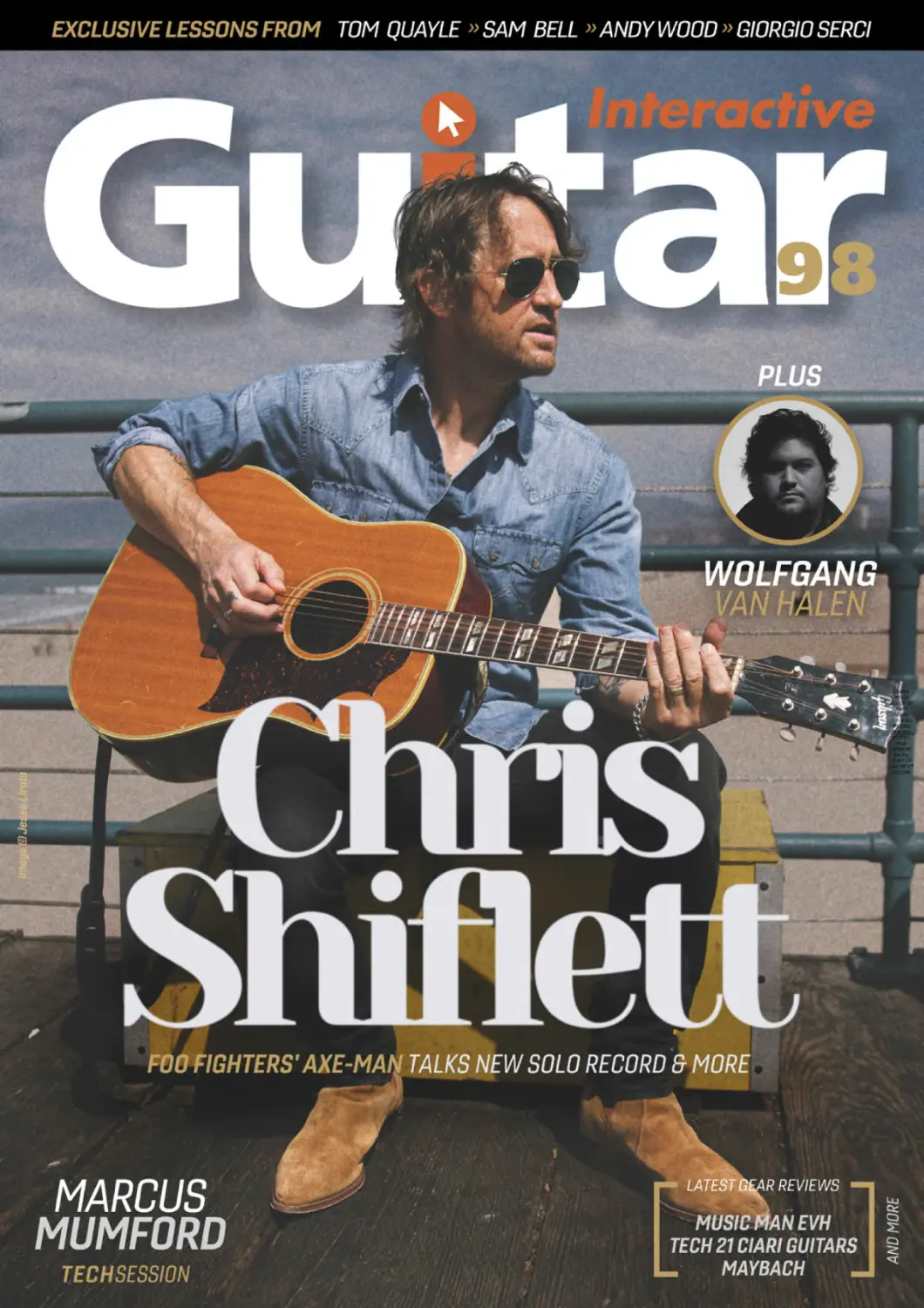


Tags: magazine music magazine guitar interactive
Year: 2023




Text
                    GOOD TO GO
WHEN EVER WHERE VER
•

A passion for playing means that inspiration can strike anytime, anywhere.
With Elixir® Strings you know that when you pick up your guitar it’s going
to sound great—time and time again. That’s because our featherweight
coating protects your strings from the elements, keeping corrosion away
and allowing your tone to sound great for longer, in any environment.

Elixir Strings. Performance-ready with long-lasting tone.
GORE, Together, improving life, ELIXIR, NANOWEB, POLYWEB, OPTIWEB, GREAT TONE • LONG LIFE, “e” icon, and designs are trademarks of W. L. Gore & Associates. ©2009-2021 W. L. Gore & Associates, Inc.

02

Guitar Interactive Issue 98

www.guitarinteractivemagazine.com

03

98

WELCOME TO ISSUE

Editor
// Jonathan Graham

Hello and welcome to issue 98 of Guitar Interactive Magazine!
For more than
25 years, Chris
Shiflett has
blurred the lines
between genre
and generation,
balancing his fullband projects with a thriving solo
career. The Punk veteran, Rock
& Roll Hall of Fame inductee,
Americana and rock songwriter
and modern-day guitar hero is
back with his latest album, ‘Lost
At Sea’ (out 20th October 2023
via Snakefarm Records). Guitar
Interactive editor Jonathan
Graham speaks exclusively with
Shiftey about the new release and

so much more in this issue’s cover
feature.
First impressions last a lifetime.
Now a solo artist, Wolfgang Van
Halen has prepared a lifetime to
make his. The songwriter, vocalist,
and multi-instrumentalist has
worked tirelessly towards the
introduction of MAMMOTH
WVH, his self-titled debut
album. Now with his latest release
‘Mammoth II’ out now worldwide,
Guitar Interactive Magazine
talks with Wolf in this exclusive
interview .
If that’s not enough, Nick
Jennison takes a closer look at

Review crew
Nick Jennison, Sam Bell

Editor
Jonathan Graham
jonathan@guitarinteractivemagazine.com
Contributors
Jonathan Graham, Nick Jennison

Columns
Tom Quayle, Sam Bell, Nick Jennison,
Andy Bell & Giorgio Serci
Advertising Manager
Helen Bavester
helen@guitarinteractivemagazine.com

Marcus Mumfords’ approach to
guitar playing, breaking down his
percussive attack, note choice and
overall dynamic feel in this issue’s
Tech Session/
As usual, with every issue, we
have a whole host of the latest and
best gear reviews from around the
world of guitar, with our team of
world-class gear reviewers offering
their unique insight, expertise, and
personality, which as always, I hope
you will enjoy. However, if that’s
still not enough, don’t forget all of
our exclusive lessons from, Tom
Quayle, Sam Bell, Nick Jennison
& Giorgio Serci.

USA Advertising Sales
Lisa Spiteri
LisaSpiteri@guitarinteractivemagazine.com
Design and layout
Simon Gibbs
simon@guitarinteractivemagazine.com
Video Editors
James Masterton & Dave Kidd

Sound En
Dave Kidd

Cameras
James M

Publishe
Guitar Int

Publishin
Kim Walle

(c) Copyright 2023 Guitar Interactive Ltd. No part of this publication may be reproduced in any form or by any means without prior permission of the copyright owners. The views expressed in

04

Guitar Interactive Issue 98

GUITAR INTERACTIVE WELCOME

Welcome to Guitar Interactive Issue 98

GET IN TOUCH Ask a question, share your ideas and let’s see what works!
facebook.com/
GuitarInteractive
Magazine

iGuitarMag
Tweet your ideas and
thoughts here

www.guitarinteractive
magazine.com

Keep up-to-date with the
latest from Gi

ngineering
d & James Masterton

s
Masterton & Dave Kidd

ers
teractive Ltd

ng Director
er

Contact
Sales and Information line:
+ 44 (0)1708 757 337
Fax Line: +44 (0)1708 757 528
Address: Unit A, Chesham Close, Romford,
Essex, RM7 7PJ, UK

Full user access to our extensive
website and content

AD INDEX
Our advertisers.
DONNER 87
ELIXIR 126-127
ELIXIR 2
ELIXIR 42-49
ELIXIR 126-127

FRET KING 19
INTEGRAL 83
JOE DOE 83
LANEY 3

MARSHALL 15
MOOER 31&59
PRS 29
SENNHEISER 97
VINTAGE 19

Guitar Interactive are those of the contributors and not necessarily those of the Editor or Publisher.

www.guitarinteractivemagazine.com

05

Reviews
THE

COM ME N

T

RE

ED

D
COM M E N

INTERVIEWS

RE

72

O
D P R DUC T

P RO D U C

At Guitar Intera
ctive, we pride
reviews and
ourse
of guitar and demonstrations for only lves on bringing you
audio electr
onics has to the best products the in-depth
world
offer.
If it’s in Gi, then
it’s gear we’
d buy! All of
accompanied
our written
by a detailed
reviews and
video — so you
right for you.
breakdowns
can see and
are
hear for yourse
lf if it’s

DE

Contents
ISSUE 98

GI92
GUITARS
, AMPS
AND EFF
ECTS

Guitar Interac
tive Issue 92

www.guitarint

eractivemagaz
ine.com

73

Chris Shiflett:
Gi editor Jonathan Graham speaks exclusively
with Shiftey about the new release and so
much more in this issue’s cover feature.

010

Wolfgang Van Halen:
The songwriter, vocalist, and multi-instrumentalist talks
‘Mammoth II’ and much more

024

FEATURES

Maybach Guitars:
Maximum Quality...
Uncompromised
036

06

Guitar Interactive Issue 98

REVIEWS - GUITARS,
AMPS & FX
TECH SESSION

052_Music Man Steve Lukather
L4 Steamroller
056_EVH Frankenstein Relic
Series
062_Fret King FKV27SBK
Country Squire Stealth
Gloss Black
066_Ciari The Ascender
Folding Guitar
070_Maybach Stradovari
074_Chapman Ghost Fret
078_Donner HUSH-I Travel
Guitar
084_Marshall Studio JTM
ST20C Combo
090_Positive Grid Mini Go
094_DOD Meatbox
098_Laney IRF-DUALTOP & IRFLEADTOP
102_Tech 21 SansAmp
Character Plus
Series Fuzzy Brit
108_D’Addario XS Coated
Strings

TECH SESSION
Marcus Mumford
– Nick Jennison —
Sponsored By Elixir

044

TOM QUAYLE
Modern Guitar - Part 8

140

SAM BELL
Extended Guitar - Part 1

146

STUDIO TO STAGE

GIORGIO SERCI
Creative Fingerstyle

116_Boss Gigcaster 8
Streaming Mixer

150

122_MOD AUDIO - AIDA DSP
Plugins

ANDY WOOD

QUIETROOM

Country Guitar - Part 4

134_Martin SC-13E Special
Burst

COLUMNS

128_Cort L60 MF Acoustic

156

www.guitarinteractivemagazine.com

07

Interviews

W
E
S
I
E
V
X
R

THE

L
C

For more than 25 years, Chris Shiflett has blurred the lines between genre and generation, balancing his full-band projects with a thriving solo career. The Punk veteran, Rock & Roll Hall of Fame inductee, Americana and rock songwriter and modernday guitar hero is back with his latest album, ‘Lost At Sea’ (out 20th October 2023 via
Snakefarm Records). Guitar Interactive editor Jonathan Graham speaks exclusively
with Shiftey about the new release and so much more in this issue’s cover feature.
First impressions last a lifetime. Now a solo artist, Wolfgang Van Halen has prepared a lifetime to make his. The songwriter, vocalist, and multi-instrumentalist has
worked tirelessly towards the introduction of MAMMOTH WVH, his self-titled debut
album. Playing every instrument and singing each and every note, his music presents a personal and powerful perspective, balancing memorable hooks and tight
technicality. As many times as audiences have experienced his talent alongside the
likes of Tremonti, Clint Lowery, and of course, Van Halen, we meet Wolf as an individual. Now with his latest release ‘Mammoth II’ out now worldwide, Jonathan Graham talks with Wolf in this exclusive interview .

08

Guitar Interactive Issue 98

V
I
E
S
I
N
U
L
T
N

ERVI EWS
www.guitarinteractivemagazine.com

ER

LU S I V E
C
I
EX

NT

RV I EW
E
T
S

GI98
IN-DEPTH CHATS WITH
GUITAR’S BIGGEST NAMES

09

X

C LU S I V
E
I
EX

INTERVIEWS_CHRIS SHIFLETT

Chris S

LOST A

For more than 25 years, Chris Shiflett has blurred the lines between genre and generation, ba
of Fame inductee, Americana and rock songwriter and modern-day guitar hero is back with
tive editor Jonathan Graham speaks exclusively with Shiftey about the new release and so

10

Guitar Interactive Issue 98

CHRIS SHIFLETT : LOST AT SEA

Chris Shiflett Talks ‘Lost at Sea’

Shiflett:

AT SEA

alancing his full-band projects with a thriving solo career. The Punk veteran, Rock & Roll Hall
his latest album, ‘Lost At Sea’ (out 20th October 2023 via Snakefarm Records). Guitar Interacmuch more in this issue’s cover feature.

www.guitarinteractivemagazine.com

11

INTERVIEWS_CHRIS SHIFLETT

NAMED

“Americana’s biggest rockstar” by
Rolling Stone, Shiflett has played a crucial
role in shaping the sound and the scope of
modern-day rock music as a longtime member of the Foo Fighters.
He joined the band in 1999, after kicking off his career playing guitar for seminal
pop-punk groups like No Use For A Name
and Me First and the Gimme Gimmes. Foo
Fighters quickly made use not only of his
instrumental chops, but his songwriting capabilities, too, with Shiflett contributing to
era-defining hits like “All My Life”, “Times
Like These” and “Best of You.”
While flying the flag for modern rock ‘n’
roll, he also made time to pursue projects
outside of the band. Groups like Jackson
United and Chris Shiflett and the Dead
Peasants found him in the driver’s seat,
establishing his credentials as a frontman,
while the long-running Americana podcast
Walking the Floor saw him shining a light
on his heroes and contemporaries, its 200plus episodes highlighting the storytellers,
songwriters and road warriors of contemporary roots music.

Two critically-acclaimed solo albums,
2017’s ‘West Coast Town’ and 2019’s
‘Hard Lessons,’ marked Shiflett’s entry
into the Americana world, mixing classic Bakersfield influences with greasy
guitar riffs, Marshall amplifiers and
country rock rasp.
Shifty turns a new page now with ‘Lost
At Sea,’ a solo record that builds a musical bridge between Nashville — where
Shiflett has become a frequent visitor,
performing on the Grand Ole Opry
one minute and collaborating with Music City tastemakers like The Cadillac
Three frontman Jaren Johnston and legendary producer Dave Cobb the next
— and his native California.

“’
T
a

Caught halfway between the honkytonk saloon and the punk rock dive
bar, ‘Lost At Sea’ is both eclectic and
electric, making room for alt-country
crunch, guitar-driven grit and sharp
songwriting. Tying that mix together is
Shiflett himself, a musical Renaissance
Man whose influences are every bit as
wide-ranging as his resumé.

f
i
h
S
f
o
e
g
n
a
r
l
l
fu
e
ry
h
t
t
n
s
u
e
o
s
c
a
c
ed
w
i
f
o
i
l
h
p
s
’
m
a
a
,
Se
y
t
z
a
z
i
t
L
s
o
in
L
h
T
f
o
y
th
r
o
w
s
o
ol
e.”
c
n
e
u
l
f
etty12’s in Guitar Interactive Issue 98
Chris Shiflett - “Damage Control”

CHRIS SHIFLETT : LOST AT SEA

es.
i
t
i
l
i
b
a
flett’s
i
h
S
f
o
zy,
ge
z
i
n
L
a
r
n
l
i
l
h
u
the f
y of T
Tom
h
s
t
e
n
r
s
i
o
a
d
c
w
e
w
s
p
o
o
e
l
r so
s ste
ea’ sh
a
r
t
S
e
i
k
t
u
c
a
g
o
t
r
d
s
’Lo
onise
roots
m
d
r
n
a
a
h
s
e
r
m
There a country anthe
plifiedat Sea’
am“’Lost
.”
the full range of Shiflett’s
nceshowcases
e
u
l
f
n
i
s
’
ty
Petabilities.
There are harmonised guitar solos worthy
of Thin Lizzy, amplified country anthems and roots
rockers steeped in Tom Petty’s influence.”

a
t
i
u
g
d
ise
n
o
m
r
a
h
m
e
o
r
T
a
n
e
i
r
e
ed
h
p
T
e
.
e
s
t
e
s
i
t
s
r
ili
e
b
k
a
c
o
s
’
r
t
t
s
ot
fle
o
r
d
n
a
s
m
e
h
t
n
ya

www.guitarinteractivemagazine.com

13

INTERVIEWS_CHRIS SHIFLETT

‘Lost At Sea,’ meanwhile, finds him
bridging the distance between West
Coast Town’s honky tonk homage
and Hard Lessons’ overdriven crunch.
Shiflett recorded the majority of the
album in Nashville, working with producer/collaborator Johnston (songwriter
behind nearly a dozen Number 1 country hits) plus a small cast of Americana
all-stars – the likes of fellow guitar-slingers Charlie Worsham, Tom Bukovac and

Nathan Keeterle, all of whom laced the
record with fiery fretwork.
He also teamed up with a number of
co-writers, partnering with Kendell
Marvel, Cody Jinks and others to fill
‘Lost At Sea’ with storylines that pack as
hefty a punch as the music itself. “Black
Top White Lines”, a riff-heavy rocker
that barrels forward at highway speed,
was written with Johnston and

f
i
h
S
f
o
e
g
n
a
r
l
l
fu
e
ry
h
t
t
n
s
u
e
o
s
c
a
c
ed
w
i
f
o
i
l
h
p
s
’
m
a
a
,
Se
y
t
z
a
z
i
t
L
s
o
in
L
h
T
f
o
y
th
r
o
w
s
o
ol
e.”
c
n
e
u
l
f
etty14’s in Guitar Interactive Issue 98
Chris Shiflett - Dead And Gone (Lyric Video)

CHRIS SHIFLETT : LOST AT SEA

a
t
i
u
g
d
ise
n
o
m
r
a
h
m
e
o
r
T
a
n
e
i
r
e
ed
h
p
T
e
.
e
s
t
e
s
i
t
s
r
ili
e
b
k
a
c
o
s
’
r
t
t
s
ot
fle
o
r
d
n
a
s
m
e
h
t
n
Nuno Bettencourt - Interview
ya

www.guitarinteractivemagazine.com

15

INTERVIEWS_CHRIS SHIFLETT

Brothers Osborne guitarist John Osborne,
while “Carrie Midnight Texas Queen” —
a nostalgic track whose shuffling swagger
conjures up images of boot-scuffed Austin
dancehalls — was penned alongside Nick
Autry and Cary Barlowe.
“We wrote a lot of these songs during
the lockdown,” recalls Shiflett, who spent
much of the Covid-19 pandemic at home
in Southern California. “Then I began
making trips to Nashville to work with
Jaren. He and I have a lot of overlap, in
terms of the music we like. We made a
guitar-centric record that encapsulates
everything I’ve been listening to over the
years, from the most country songs I’ve
ever recorded to ‘90s punk, rock ‘n’ roll,

and even songs that sound like a California version of The Clash!”
‘Lost At Sea’ showcases the full range of
Shiflett’s abilities. There are harmonised
guitar solos worthy of Thin Lizzy, amplified country anthems and roots rockers
steeped in Tom Petty’s influence. The
breakneck pace and palm-muted guitars
of “Parties” salute Shiflett’s early days
within the Bay Area punk scene, while
“Damage Control” — with its layers of
reverb, pulsing percussion and Echoplex
tape delay — flirts with the atmospheric
dub that Lee Scratch Perry introduced.

“S
th
C

Everything is grounded in melody. Shiflett
nods to his heroes throughout,

f
i
h
S
f
o
e
g
n
a
r
l
l
fu
e
ry
h
t
t
n
s
u
e
o
s
c
a
c
ed
w
i
f
o
i
l
h
p
s
’
m
a
a
,
Se
y
t
z
a
z
i
t
L
s
o
in
L
h
T
f
o
y
th
r
o
w
s
o
ol
e.”
c
n
e
u
l
f
etty16’s in Guitar Interactive Issue 98

CHRIS SHIFLETT : LOST AT SEA

ecord
r
o
l
o
s
a,’ a
e
S
t
A
ative
t
n
s
s
o
i
L
‘
h
h
d
le an
w wit
l
i
o
v
n
h
e
s
g
a
a
ew p
een N
n
w
t
a
e
s
b
n
e
r
u
l bridg
a
c
Shifty t
i
s
u
sam
d
l
i
u
b
t
ha
ia.”
Californ

“’Lost at Sea’ showcases the full range of Shiflett’s
abilities. There are harmonised guitar solos worthy
of Thin Lizzy, amplified country anthems and roots
rockers steeped in Tom Petty’s influence.”

a
t
i
u
g
d
ise
n
o
m
r
a
h
m
e
o
r
T
a
n
e
i
r
e
ed
h
p
T
e
.
e
s
t
e
s
i
t
s
r
ili
e
b
k
a
c
o
s
’
r
t
t
s
ot
fle
o
r
d
n
a
s
m
e
h
t
n
ya

www.guitarinteractivemagazine.com

17

INTERVIEWS_CHRIS SHIFLETT

but he charts his own territory, too, whipping up a diverse sound that’s distinctly
his own.
A road warrior since the mid-1990s, Chris Shiflett continues to juggle multiple
projects. ‘Lost At Sea’ is his most personal moment to date, stocked with genrebending songs that never fail to push beyond boundaries. Call it Arena Americana. Call it California alt-country. Call it whatever you like. For Shiflett, it’s just
the latest stop on the road that goes on forever.
Chris Shiflett will release new album ‘Lost At Sea’ on 20th October 2023 via
Snakefarm Records.

f
i
h
S
f
o
e
g
n
a
r
l
l
fu
e
ry
h
t
t
n
s
u
e
o
s
c
a
c
ed
w
i
f
o
i
l
h
p
s
’
m
a
a
,
Se
y
t
z
a
z
i
t
L
s
o
in
L
h
T
f
o
y
th
r
o
w
s
o
ol
e.”
c
n
e
u
l
f
etty18’s in Guitar Interactive Issue 98

CHRIS SHIFLETT : LOST AT SEA

“’Lost at Sea’ showcases the full range of Shiflett’s
abilities. There are harmonised guitar solos worthy
of Thin Lizzy, amplified country anthems and roots
rockers steeped in Tom Petty’s influence.”

a
t
i
u
g
d
ise
n
o
m
r
a
h
m
e
o
r
T
a
n
e
i
r
e
ed
h
p
T
e
.
e
s
t
e
s
i
t
s
r
ili
e
b
k
a
c
o
s
’
r
t
t
s
ot
fle
o
r
d
n
a
s
m
e
h
t
n
ya

www.guitarinteractivemagazine.com

19

INTERVIEWS_CHRIS SHIFLETT

Chris Shiflett:

LOST AT SEA
Tracklist

‘Dead And Gone’
‘Overboard’
‘Black Top White Lines’
‘Damage Control’
‘Weigh You Down’
‘Burn The House Down’
‘Where’d Everybody Go?’
‘I Don’t Trust My Memories
Anymore’
‘Carrie Midnight Texas Queen’
‘Parties’

f
i
h
S
f
o
For more information on Chris Shiflett, including pre-sale
e
g
n
a
r
l
details for ‘Lost At Sea’ and tour dates, pleasefvisit
l
u
e
ry
h
t
t
n
www.chrisshiflettmusic.com
s
u
e
o
s
c
a
c
ed
w
i
f
o
i
l
h
p
s
’
m
a
a
,
Se
y
t
z
a
z
i
t
L
s
o
in
L
h
T
f
o
y
th
r
o
w
s
o
ol
e.”
c
n
e
u
l
f
etty20’s in Guitar Interactive Issue 98

CHRIS SHIFLETT : LOST AT SEA

a
t
i
u
g
d
ise
n
o
m
r
a
h
m
e
o
r
T
a
n
e
i
r
e
ed
h
p
T
e
.
e
s
t
e
s
i
t
s
r
ili
e
b
k
a
c
o
s
’
r
t
t
s
ot
fle
o
r
d
n
a
s
m
e
h
t
n
ya

www.guitarinteractivemagazine.com

21

INTERVIEWS_WOLFGANG VAN HALEN

WOLFGANG VAN HALEN:

second firs
impression
First impressions last a lifetime. Now a solo artist, Wolfgang Van Halen has prepared
a lifetime to make his. The songwriter, vocalist, and multi-instrumentalist has
worked tirelessly towards the introduction of MAMMOTH WVH, his self-titled
debut album. Playing every instrument and singing each and every note, his
music presents a personal and powerful perspective, balancing memorable hooks
and tight technicality. As many times as audiences have experienced his talent
alongside the likes of Tremonti, Clint Lowery, and of course, Van Halen, we meet
Wolf as an individual. Now with his latest release ‘Mammoth II’ out now worldwide,
Jonathan Graham talks with Wolf in this exclusive interview. »

22

Guitar Interactive Issue 98

WOLFGANG VAN HALEN : SECOND FIREST IMPRESSIONS

rst
ns

www.guitarinteractivemagazine.com

23

INTERVIEWS_WOLFGANG VAN HALEN

IN

writing all of the songs and performing
every part of the instrumentation and vocals, Wolfgang Van Halen has already established his
own musical identity with the release of his debut
album Mammoth WVH (available worldwide via
EX1 Records/Explorer1 Music Group). From the
rocking opening guitar riff on album opener “Mr.
Ed” to the driving bass and drums on album closer
“Stone,” Mammoth WVH showcases the various
musical influences that have inspired Wolf. Songs
like “Resolve,” “The Big Picture,” and “Think It
Over” are all sonically different from each other but
unique to what Mammoth WVH is all about.

Wolfgang Van Halen - Mammoth WVH:
Distance (Official Music Video)

24

Guitar Interactive Issue 98

WOLFGANG VAN HALEN : SECOND FIREST IMPRESSIONS

Late last year saw the first single “Distance” drop to
universal praise and chart success. The track—written as a tribute to his father and guitar icon Eddie
Van Halen—is another side of Mammoth WVH.
On release, it promptly rocketed into the #1 spot on
US rock radio, with the emotional music video having been viewed over 4.6 million times on YouTube.
Surprisingly, the song was not originally intended to
be on the debut album, but due to the overwhelming response, it has been added as a bonus track,
with all of Wolfgang’s proceeds from “Distance” being donated to the charity Mr. Holland’s Opus.
To coincide with the album announcement earlier
this year, Mammoth WVH made their performance
television debut for late night on Jimmy Kimmel
Live! The band—currently on tour in the United
States supporting Guns N’ Roses—comprised of
Wolfgang Van Halen (guitars/vocals), Ronnie Ficarro (bass/vocals), Jon Jourdan (guitars/vocals), Frank
Sidoris (guitars) and Garrett Whitlock (drums).
Coming from such a musical household, it may
come as a surprise, but outside of his father teaching
him one drumbeat from an AC/DC song, Wolfgang
taught himself every instrument. “My dad wasn’t the
best teacher,” he laughs. “I would ask him to play
something, and then he would just proceed to »

“You only have one
chance to make a first
impression, and I wanted
to do so to the best of my
abilities,”
www.guitarinteractivemagazine.com

25

INTERVIEWS_WOLFGANG VAN HALEN

be Eddie Van Halen. He would look
at me and say, ‘Do that.’ to which I
would laugh and sarcastically reply,
‘Sure thing, no problem.”
His father often played guitar against
his mother’s pregnant belly, however, and Wolf clearly absorbed those
vibrations from the womb. By the
age of 10, his Pop gave him a drum
kit for his birthday. To this day, Wolf
considers himself “a drummer before
anything else.” As he developed as a
musician, he learned how to play the
guitar in order to perform “316” —
which his father penned for him —
at a 6th-grade talent show.

In the summer of 2006, when he was
15 years old, Wolf grabbed a bass
and began noodling for the first time.
While at the legendary 5150 Studios,
his impromptu woodshedding inspired Eddie and Uncle Alex. Endless
family jam sessions followed. By summer’s end, Wolfgang phoned David
Lee Roth’s manager, and by winter
Roth showed up for rehearsal. They
rocked “On Fire,” and “That’s how
the 2007 tour began,” says Wolf.
Not only did Wolf canvas the world
with Van Halen while in high school,
but he also held down the low end on
2012’s ‘A Different Kind of »

Wolfgang Van Halen - Interview

26

Guitar Interactive Issue 98

WOLFGANG VAN HALEN : SECOND FIREST IMPRESSIONS

“Not only did Wolf canvas the world withVan Halen
while in high school, but he also held down the low
end on 2012’s ‘A Different Kind of Truth.’”

Mammoth WVH: Epiphany (Official Video)

www.guitarinteractivemagazine.com

27

INTERVIEWS_WOLFGANG VAN HALEN

Truth’— which debuted at #2 on the
Billboard Top 200. When not on tour
with Van Halen, he cut bass for Tremonti’s critically acclaimed ‘Cauterize’
(2015) and ‘Dust’ (2016), in addition to
joining the band on the road. In 2019,
Wolf handled drums and also played
bass on half of the ten songs for Clint
Lowery’s solo debut, ‘God Bless The
Renegades.’

28

In the midst of all this, at the beginning of 2015, Wolf broke ground on
what would become MAMMOTH with
producer Michael “Elvis” Baskette [Alter
Bridge, Slash] behind the board. Wolf
began to embrace his voice, inspired by
everyone from his father, to bands like
AC/DC, Foo Fighters, Nine Inch Nails,
TOOL, and Jimmy Eat World. “I’ve
been singing my whole life, but it wasn’t
until MAMMOTH that I really found

Guitar Interactive Issue 98

WOLFGANG VAN HALEN : SECOND FIREST IMPRESSIONS

BEST OF BOTH WORLDS

© 2020 PRS Guitars / Photos by Marc Quigley

The PRS SE Hollowbody II Piezo provide musicians with the
versatility of wielding both acoustic and electrics tones in one
instrument. It’s designed with two discrete volume controls
(magnetics and piezo) that can be run to the same amp with
one cable – players can use the volume controls to blend the
pickups. Or, you can run two cables and have the magnetic
pickups go to your favorite amp while running the piezo signal
straight to the board for a huge sound. To find out more and to
hear how versatile this guitar is, go to www.prsguitars.com.

www.guitarinteractivemagazine.com

29

INTERVIEWS_WOLFGANG VAN HALEN

my voice. Elvis was great, and he helped
me gain the confidence to become a lead
vocalist.”
“The name Mammoth is really special
to me,” says Wolf. “Not only was it the
name of Van Halen before it became
Van Halen, but my father was also the
lead singer. Ever since my dad told me
this, I always thought that when I grew
up, I’d call my own band Mammoth, be-

30

cause I loved the name so much. I’m so
thankful that my father was able to listen to, and enjoy the music I made. I’m
really proud of the work I’ve done, and
nothing made me happier than seeing
how proud he was that I was continuing
the family legacy.”
“You only have one chance to make a
first impression, and I wanted to do so
to the best of my abilities,” he affirms.

Guitar Interactive Issue 98

WOLFGANG VAN HALEN : SECOND FIREST IMPRESSIONS

www.guitarinteractivemagazine.com

31

INTERVIEWS_WOLFGANG VAN HALEN

For more information on Mammoth WVH, plea
mammothwv

32

Guitar Interactive Issue 98

WOLFGANG VAN HALEN : SECOND FIREST IMPRESSIONS

“Throughout the whole process, I was finding who I am
musically, and by the end, I got a pretty good handle on a
sound I can claim for myself.”
Mammoth WVH is out now worldwide via EX1 Records/
Explorer1 Music Group.

Mammoth WVH – Mammoth WVH Tracklist
1. “Mr. Ed”

8. “Circles”

2. “Horribly Right”

9. “The Big Picture”

3. “Epiphany”

10. “Think It Over”

4. “Don’t Back Down”

11. “You’re to Blame”

5. “Resolve”

12. “Feel”

6. “You’ll Be the One”

13. “Stone”

7. “Mammoth”

14. “Distance”

ase visit:
vh.com

www.guitarinteractivemagazine.com

33

Features

W
E
S
I
E
V
X
R

THE

L
C

From the very beginning, Maybach has written on its flag not only to manufacture
instruments of the best possible quality but to implement this consistently with the
promise of “Made in Europe.” This vision had been developed over three years of intensive preparation. It was successfully turned into reality when the Maybach ship
set sail in 2011 and quickly set its course—driven by a wind of enthusiasm sparked by
the many musicians thrilled by the quality of Maybach instruments.

34

Guitar Interactive Issue 98

V
I
E
S
I
N
U
L
T
N

ERVI EWS
www.guitarinteractivemagazine.com

ER

LU S I V E
C
I
EX

NT

RV I EW
E
T
S

GI98
HIGHLIGHTING THE BEST
FROM THE WORLD OF GUITAR

35

X

C LU S I V
E
I
EX

FEATURES_MAYBACH GUITARS

MAYBACH

Maximum Quality...Uncompromi

From the very beginning, Maybach has written on its flag not only to manufacture instruments of the best possible quality but to implement this consistently with the promise of
“Made in Europe.” This vision had been developed over three years of intensive preparation.
It was successfully turned into reality when the Maybach ship set sail in 2011 and quickly
set its course—driven by a wind of enthusiasm sparked by the many musicians thrilled by
the quality of Maybach instruments.

36

Guitar Interactive Issue 98

MAYBACH GUITARS MAXIMUM QUALITY...UNCOMPROMISED

H GUITARS:

ised

www.guitarinteractivemagazine.com

37

FEATURES_MAYBACH GUITARS

Another storm called the pandemic that
fundamentally shook up the overall global
economic situation from 2020 to 2022
brought new challenges for Maybach.
However, the brand showed itself to be
prepared for this situation as well.
Wood procurement, undoubtedly the
central issue for every guitar maker in
these times, was addressed by Maybach
in good time, for example, to successfully master the balancing act between
traditional guitar making and the unique
requirements of the present day to protect
the environment. This includes, on the
one hand, intensive research & development in vintage guitar science, but also

creative and competent research for good
wood sources in general and alternative
woods in particular, to be able to professionally compensate for the dwindling
supplies of classic tonewoods. This guarantees the uncompromising quality attested to Maybach instruments over the
last years.
To offer the right product for every demand and price level, Maybach relies on
a so-called 3D strategy in its production,
which meets almost every musician’s
requirements. The three stand for the
three Maybach production lines Standard
Series, Classic Series and Masterbuilt.

Interview with Maybach Guitars CEO Toni Götz

38

Guitar Interactive Issue 98

MAYBACH GUITARS MAXIMUM QUALITY...UNCOMPROMISED

Standard Series

In the Maybach factory in the Czech Republic, the instruments of the Classic Series
are expertly built by qualified guitar makers – for the most part, from certified woods
of European origin. If African, South, or
North American tonewoods are used, they
come from sustainably managed plantations
and are certified. Every Maybach guitar in

the Classic production meets the general
sustainability criteria.
The Standard instruments are built to our
established, fixed standards with the highest consistency. These standards naturally
include the features of our “true spec “philosophy and offer optimal vintage handling
and sound without compromise – and in a
price range that is consistently tailored to
the budgets of “working musicians “.

www.guitarinteractivemagazine.com

39

FEATURES_MAYBACH GUITARS

The Bodies

The bodies of the bolt-on instruments are
made of two-piece European Alpine spruce
or poplar, while the set-neck ones are made
of two-piece Khaya mahogany or Okoume.
The necks are made of European or North
American maple and come with either a “fat
“or “slim-taper “profile, while the tops of
the Lester model, for example, are made of
flame, solid maple of 3A grade.

Czech Workshop

Despite the traditional “true-spec “orientation in our production, modern times have
a solemn word to say, especially regarding
the instruments’ handling and functionality. You will find contemporary fingerboard
radii like 9.5″ for the bolt-on and 12″ for
the set-neck guitars and the use of compo-

nents from proven, first-class manufacturers
like pickups from Amber (DE) or Lollar
(USA), tuners from Gotoh (JP) or Kluson
(DE), pots and switches from CTS (USA)
and Switchcraft (USA), tremolo systems
from Gotoh (JP) or Bigsby (USA), fret wire
from Sintoms (BY), etc. Like all Maybach
instruments, the Classic Series are sealed
with nitrocellulose lacquer.
However, the Czech Maybach Workshop
offers the Maybach Custom Shop, an alternative to the usual Classic production for
those with unique preferences in detail and
maintaining specific optical preferences.

Classic Series
The instruments of the Czech Custom Shop
are built from hand-selected woods,
which are weighed before production
and individually “matched “by our
experts. In this way, we guarantee compliance with our weight standards and
an optimal neck-to-body match from
both acoustic and vibration aspects.
The flamed maple is used for the necks
of the Bolt-On instruments, the alpine
spruce for the bodies is one-piece, and
the tops of the Lester models are made
of solid 5A grade maple.
Furthermore, the pickup selection is
extended to aggregates from VanZandt
(USA), Lindy Fralin (USA), or Monty’s
(UK) in addition to the range of Amber (DE) and Lollar (USA) and the versatile VegaTrem (ES) is available here as

40

Guitar Interactive Issue 98

MAYBACH GUITARS MAXIMUM QUALITY...UNCOMPROMISED

a tremolo alternative. For those who prefer
a vintage 7.25″ fretboard radius for their
bolt-on instrument, this can be ordered to
fit in the Custom Shop.
However, if you want to plan your Maybach
guitar with us from scratch and tailor it to
your personal preferences, then the Custom
Shop Masterbuilt is the right place. Here,
you work with a competent and highly motivated team of professionals under the leadership of master builder Nick Page. Here,
you will experience how the motto “Dream
your guitar, and we built it “is passionately
translated into unique works of guitar art –
day after day.

The 3D strategy of Maybach production
provides the basis for anyone looking for a
sophisticated guitar to find the right instrument for them! Consistently aligned with
our “true-spec “philosophy and the best
possible “on-the-road “functionality, all
three production lines offer the instruments
that fit the individual sound, performance,
and visual ideas, but also the budget of the
respective musicians.
For more information on Maybach, please
visit: maybach-guitars.de

Masterbuilt
At the Maybach Custom Shop Masterbuilt
in Wuppertal/Germany, individual one-off
instruments and strictly limited small series
are designed and built by Nick Page and
his workmates. Due to the classic Maybach
designs, everything is possible here – a wide
variety of selected tonewoods in all grades,
a large selection of the best hardware components, and first-class pickups. Of course,
all possible and impossible nitrocellulose
finishes are only one wish away. Plus: The
Maybach Custom Shop Masterbuilt specialises in Paisley, Sparkle, or Multi-Layer
finishes as well as in etched aluminium applications up to complete aluminium tops,
and that in all ageing gradations – from very
gentle to highly extreme.

www.guitarinteractivemagazine.com

41

Tech Session

O
I
N
S
T
S

E

THE

H
C

In each issue, the Guitar Interactive Tech Session shines the spotlight on one
of guitar’s biggest icons. These in-depth lessons look to break down the style,
techniques and individual nuances that make these great players stand out from
the crowd in the form of a tailor-made composition.
All Gi TECH SESSION are accompanied with full tablature and a backing track —
to help you learn, practice and utilise these new techniques in no time.

42

Guitar Interactive Issue 98

E

SPONSORED BY

S
E
S
S
I
O
H
ES

H

TEC

T

I

H
S

S E S S I ON

N

T

H SESS
C
E

ON

S IO N T E C

m

GI98
UNDERSTANDING WHAT
MAKES THE GREATS GREAT

43

S

www.guitarinteractivemagazine.com

TECH SESSION_MARCUS MUMFORD
SPONSORED BY

T
44

Guitar Interactive Issue 98

MARCUS MUMFORD TECH SESSION
SPONSORED BY

Tech Session

Marcus Mumford is a musician with hidden depths. A talented multi-instrumentalist who first cut his teeth playing drums for Laura Marling, alongside
Ted Dwane, Winston Marshall and Ben Lovett—a trio of musical polymaths
with whom Mumford would later form pop-folk phenomenons Mumford
& Sons. In this issue’s Gi Tech Session, Nick Jennison takes a closer look at
Marcus’ approach to guitar playing, breaking down his percussive attack, note
choice and overall dynamic feel.
www.guitarinteractivemagazine.com

45

TECH SESSION_MARCUS MUMFORD
SPONSORED BY

WHILE

Mumford & Sons
was the project
that defined Mumford in the minds of
many (not surprising, since his name is in
the title), Marcus Mumford is far from a
one-trick pony. Contributing as a songwriter and performer on everything from
the Cohen brothers’ film “Inside Llewyn
Davis” and the soundtracks to “Ted Lasso”
and “Daisy Jones & The Six”, though to
supergroup “The New Basement Tapes”
alongside Elvis Costello, Pulitzer Prize
winner Rhiannon Giddens, Taylor Goldsmith (Dawes) & Jim James (My Morning
Jacket), Mumford has accomplished more
by age 36 than most musicians will in a
lifetime.

It’s important to acknowledge the diversity
of Mumford›s body of work before we get
stuck into this Tech Session (brought to
you by Elixir Strings), because we›re going
to be focussing primarily on Mumford›s
early work with Mumford & Sons - specifically, his economical songwriting style. As
such, this session is very beginner-friendly,
but has a few interesting twists and turns
that more advanced players will get a kick
out of. So, grab your favourite acoustic
and let›s get going!
Bars 1-28:
We’re kicking things off with some heldopen chord strums. The actual chord
shapes here are straightforward, but the

Marcus Mumford Tech Session Performance

46

Guitar Interactive Issue 98

MARCUS MUMFORD TECH SESSION
SPONSORED BY

timing requires some attention due to
the 2/2 time signature and the 7-bar
phrase length. Hold the Em for 4 counts,
the D/F# for 2 counts and the G for 8
counts, then repeat that timing for the
Cadd9 (4 counts), G/B (2 counts) and
the final Em (8 counts), and you’ll be
fine! Remember to stomp your foot in
time with the bass drum on the second
pass!

too precise in terms of exactly *which*
strings you’re hitting. So long as there’s a
pronounced difference between low and
high, you’re good to go. There’s also a
very slight swing to the strumming here,
but don’t worry about making it exactly a
full 8th triplet swing - just listen and feel
it, and you’ll be fine.

Bars 29-32:

Here we bump up against our first oddtime bar in bar 33 - a bar of 3/2, contrasting our 2/2 feel. Probably the best
way to think about this is by playing one
repetition of our strumming pattern as
normal, and then “adding in” the two
bass notes (G and F# on the low E string

The “verse” section of our Tech Session,
and were we establish the strumming
pattern that’s at the core of this session.
Think about it as “low” strings vs. “high”
strings, but don’t worry about being

Bars 33-35:

www.guitarinteractivemagazine.com

47

TECH SESSION_MARCUS MUMFORD
SPONSORED BY

respectively) before starting the next
pattern. Once you get a feel for this, it’ll
flow naturally.
Bars 43-51:
We’re into the pre-chorus now, which
once again incorporates the 3/2 bar from
our previous section, this time in a 3 bar
phrase as opposed to the 7 bar phrases in
the previous two sections. Keep your eyes
peeled for the little bass note “pick-up” in
the third bar of each phrase.

48

Guitar Interactive Issue 98

Bars 52-55:
A more conventional 4-bar phrase here
to build momentum into the «drop» (yes,
folk music has «drops» too!). It›s the same
strumming pattern as before, but on a D
major, punctuated by a Dsus4 in bar 54.
Here, the «low» strings in our strumming
pattern will be the A and D strings.
Bars 56-69:
A return to the chords from the intro,
but this time as a “drop” chorus. Begin

MARCUS MUMFORD TECH SESSION
SPONSORED BY

with a short strum of Em, followed by
thumps on the guitar’s body for a total
of 6 counts (5 thumps, then a bass note
pickup), then it’s the same strumming
pattern from the verse for 4 repetitions.
Then it’s exactly the same thing on a
Cadd9 for 6 counts (4 thumps, then
two bass notes) followed by 4 repetitions of our strumming pattern on Em.
Bars 70-83:
The same chords from our intro, but
with strumming all the way through.
The best way to think about this is as 2
repetitions of the strumming pattern on
Em, 1 repetition on D/F# and 4 repetitions on G. Then we repeat this 2/1/4
repetition cycle on Cadd9, G/B and
Em.}}

Bars 84-91:
One pass of our intro/chorus chords
to finish, but this time with held open
strums. Think of 4 counts, 2 counts and
8 counts for each chord in order, just
like in the intro, and you’re golden.
…and there we have it! A look at Marcus Mumford’s deceptively simple
songwriting style in Mumford & Sons.
This should serve as an example of how
much you can achieve with a relatively
small number of basic chords, just by
playing with rhythm bar and phrase
lengths and arrangement tools like held
chords, strumming patterns and drops.
Have fun playing through this session,
and hopefully, use some of these ideas in
your own songwriting!

Marcus Mumford Tech Session Lesson

www.guitarinteractivemagazine.com

49

Reviews
THE

At Guitar Interactive, we pride ourselves on bringing you in-depth reviews
and demonstrations for only the best products the world of guitar and
audio electronics has to offer.
If it’s in Gi, then it’s gear we’d buy! All of our written reviews and breakdowns are
accompanied by a detailed video — so you can see and hear for yourself if it’s
right for you.

50

Guitar Interactive Issue 98

GI97
GUITARS, AMPS
AND EFFECTS

RE

E

P RO D U C T

RO D U C T
P
D

ED

R

OM ME N
C
E
D

www.guitarinteractivemagazine.com

51

COM M E ND

THE REVIEWS_GUITAR REVIEW

Ernie Ball Music Man Steve Lukath
30th Anniversary Steamroller

The Steve Lukather line of signature guitars gets an extensive makeover this year with the introd
new L4. Available in an HT SSS and HT HH configuration, and a limited edition 30th anniversary v
an HT HSS pickup configuration with Music Man double-locking floating tremolo. The L4 is the cu
over 30 years of collaboration with Platinum and Grammy award-winning artist Steve Lukather w
accomplishments includes an extensive session career (guitarist on over 1500 recordings), major
the multiplatinum Michael Jackson “Thriller” album, and leader and a significant contributor of th
rock band Toto.

WHEN

it comes to signature guitars, Music Man go all in. While it’s common
for some other brands to simply palette-swap an existing model (and
maybe change the pickups) and call it a day, Music Man will work with their artists to conjure
something completely unique from the ground up. Such is their commitment to giving their
artists what they want, that signature models make up the bulk of their range, and the

Ernie Ball Music Man Steve Lukather L4 30th Anniversary Steamroller

52

Guitar Interactive Issue 98

THE REVIEWS ERNIE BALL MUSIC MAN STEVE LUKATHER L4 30TH ANNIVERSARY STEAMROLLER

her L4

COM M E ND

RE

ED

P RO D U C T

P RO D U C T

ED

COM M E ND

duction of the allversion featuring
ulmination of
whose list of
r contributor on
he legendary

RE

Ernie Ball Music Man Steve
Lukather L4 30th Anniversary
Steamroller
MSRP: (UK) £TBC / (US) $3999

The Breakdown
Vintage

Modern

Specialised

Versatile

Warm

Bright

Affordable

High-end

For fans of
The best necks in the business.
Supreme versatility.
Floyd Rose antics.

For more information, please visit:
www.music-man.com/instruments/
guitars

www.guitarinteractivemagazine.com

53

THE REVIEWS_GUITAR REVIEW

majority of what we’d consider the “classic”
EBMM designs - the Morse, the Axis (yes,
this was a signature model), the JP (and now
the Majesty), and of course, the Luke.
NAMM 2023 saw the introduction of the
fourth iteration of Steve Lukather’s iconic
signature guitar, and while the outline
remains largely unchanged since the Luke I
launched in 1994, the new L4 represents a
significant evolution of this timeless design.

54

Guitar Interactive Issue 98

Aside from the new finishes, perhaps the
most significant change is the pickups.
Available for the first time with three single
coils, alongside more traditional HH and
HSS configs, the new L4s all feature Music
Man’s new HT pickups. Inspired by the
processes that led to the development of
Ernie Ball’s M-Steel and Cobalt Slinky
strings, these heat-treated pickups offer
higher output than traditional designs,
while also offering extended dynamic range
and frequency response. This is quite the

THE REVIEWS ERNIE BALL MUSIC MAN STEVE LUKATHER L4 30TH ANNIVERSARY STEAMROLLER

achievement, since the hotter a passive
pickup gets, the more the constricted the
dynamics, high treble and deep bass tend
to become, but the clever folks over at
Music Man seem to have pulled off genuine
alchemy here. It’s clearly been a big enough
change to catch Lukather’s attention, and
when you plug these guitars in, it’s easy to
see why.

The new Music Man L4 is a guitar befitting
one of the all-time greats. It offers incredible
playability, elegant and eye-catching visuals
and a palette of stunning tones that will
not only hang in any musical setting, but
excel. This is a serious instrument for serious
players, and if that’s you, you need to check
one out.

Of the five new L4 models announced,
the one that immediately caught my eye
was the limited edition 30th Anniversary
“Steamroller” - not just for its stunning
aesthetics, but for how it harks back to the
original Luke I with its HSS pickups and
recessed Floyd Rose tremolo - a rarity, since
most Lukes since the Luke II have come with
a standard 2-point tremolo.
Let me tell you, “Steamroller” is an
appropriate choice of name here, because
this guitar is an absolute monster. It comes
straight out of the case with an almost-tooeasy setup that practically dares you to shred
on it, and the neck feels unbelievably good
under the hand. To be fair, that’s something
that seems to be common to all Music Man
guitars, but there’s something about the
neck shape on the Luke that just *works*.
It’s crazy fast, but it’s not a “shredder’s”
neck profile, and you can wrap your thumb
around it and wrestle it too if that’s what
you’re into. Sonically, those new HT pickups
really deliver the goods, while the HSS
configuration offers the kind of versatility
that a player like Lukather requires - whether
it’s huge slabs of rock, Texas-inspired blues,
“MJ” funk picking or soulful throaty lead
tones, the L4 delivers.

www.guitarinteractivemagazine.com

55

THE REVIEWS_GUITAR REVIEW

EVH Frankenstein Relic Series

If your playing incorporates the gamut of rock pyrotechnics—the EVH Frankenstein Series Relic
was built with you in mind. Paying tribute to Edward Van Halen’s revered proto-superstrat platfor
draping it in a road-punished, solid-coloured finish and updating it with modern hardware and
electronics, the Frankenstein Series Relic includes a comfortable quarter-sawn maple neck and f
playing compound-radius fingerboard, and its dive-bomb-only D-Tuna-equipped Floyd Rose lets
you mimic Eddie’s signature trem-work with ease Nick Jennison Reviews.

A

strong contender for “Most Important Guitarist Of All Time”, Edward Van Halen’s
explosive 1978 debut heralded a seismic shift in not only the way guitar was played, but
in the form the electric guitar would take for decades to come. Perhaps the most iconic of Ed’s
innovations is his legendary “Frankenstein”; an unholy union of Californian playability and
Kalamazoo grunt, and the world’s first “Superstrat”. There’s probably no more recognisable
guitar in all of rock history.
Perhaps a little TOO recognisable for some folks, particularly in the striped finishes that adorn
the EVH brand’s loving recreations of Ed’s legendary guitars. Fortunately, there is an answer

EVH Frankenstein Relic Series

56

Guitar Interactive Issue 98

THE REVIEWS EVH FRANKENSTEIN RELIC SERIES

P RO D U C T

RE

ED

P RO D U C T

rm,

COM M E ND

fasts

COM M E ND
ED

RE

EVH Frankenstein Relic Series
MSRP: (UK) £1249 / (US) $1699

The Breakdown
Vintage

Modern

Specialised

Versatile

Warm

Bright

Affordable

High-end

For fans of
Juicy rock tones;
Road-warrior aesthetics;
Effortless playability

For more information, please visit:
www.evhgear.com

www.guitarinteractivemagazine.com

57

THE REVIEWS_GUITAR REVIEW

in the form of the new “Frankenstein Relic”
series. Essentially, these guitars are “Frankie”
replicas, but without the stripes. Available in
black, red and white heavily relic’d finishes,
they’re handsome and hugely evocative of
Ed’s legendary guitar without being quite so
“on the nose” visually.
The body is a classic Strat shape, complete
with cut away pickguard and exposed pickup
routes, housing a direct-mounted Wolfgang
humbucker along with a vestigial neck single
coil and a pickup selector that aren’t actually
wired in - just like Ed’s original. With only

58

Guitar Interactive Issue 98

a single volume pot (with a knob marked
“tone”), this is not a guitar that promises an
endless array of tones - rather, it delivers one
voice with laser-focussed excellence. In the
world of the Frankenstein Relic, it’s always
rock o’clock.
So yes, one tone, but my word, what a
tone! It’s powerful, articulate and very well
balanced, with a tight low end that chugs
and thumps with the best of them, and is
beautifully responsive to your pick dynamics
while still being forgiving enough for all
manner of shreddy tomfoolery.

THE REVIEWS EVH FRANKENSTEIN RELIC SERIES

MOOER

www.guitarinteractivemagazine.com

59

THE REVIEWS_GUITAR REVIEW

The tremolo, an aged, EVH-branded Floyd Rose, is
everything you’d hope for in such a unit.
It takes confidence and experience
to get the best out of a single pickup
guitar like this, but if you’ve got the
chops and the touch, this guitar will
reward you with heaps of character and
expressiveness.
If you’re played any guitars that have
bourn the EVH name, the neck profile
on this instrument will feel very

60

familiar. It’s not “shredder-thin”, but
it’s very fast and comfy. The 12’16”
compound radius makes for a very low
action without a hint of buzz, and the
jumbo frets make legato and bending
an absolute breeze. The relic finish is
very good, but the neck really stands
out in this regard, with a very authentic
“played-in” look and feel.

Guitar Interactive Issue 98

THE REVIEWS EVH FRANKENSTEIN RELIC SERIES

The tremolo, an aged, EVH-branded
Floyd Rose, is everything you’d hope
for in such a unit. Yes, there are
compromises when it comes time to
change strings, but the performance
benefits are well worth the extra
headache. Where this guitar differs
from some previous EVH guitars is
that the bridge is floating - meaning
you can not only dive, but also pull
up. This not only makes harmonic
screams even more dramatic, but also
facilitates better chord shimmers, bar
vibrato and pseudo-slide lines. It also
comes fitted with a D-Tuna, making
traditions between standard tuning
and drop-D an absolute breeze.
The EVH Frankenstein Relic is a
“Frankie” through and through,
but in a finish that doesn’t scream
“signature guitar” quite so hard. It
plays like a dream, and has a powerful
and expressive tone that makes it hard
to put down. Funk choppers, jazz
cats and blues dads may want to look
elsewhere, but if you’re a rock player
who wants a rugged, handsome and
focussed instrument, this guitar will
do you proud.

www.guitarinteractivemagazine.com

61

THE REVIEWS_GUITAR REVIEW

Fret King FKV27SBK Country Squir

The Country Squire is one of Fret King’s most enduring styles—a proud benchmark for the brand,
The best attributes are sometimes hidden, as they are in the Country Squire Stealth with an intrig
ing “Old school”, period-perfect tone, or an “altered state” hum cancelled edge—the Stealth deliver
ity. Sam Bell explores the emblematic tonalities and great sustain of the Fret King FKV27SBK Cou

Guitar Interactive review, I’ll be diving into a visual and audio treat from Fret King
IN this
Guitars. This time, I looked at a Tele-style design called the ‘Country Squire’ in Stealth
Gloss Black. This beautiful object does more than country, though. Tele’s are known for their
simplicity and versatility. The Country Squire has a few cool hidden features, cool looks, great
sounds and a price tag that isn’t too shabby!

Fret King FKV27SBK Country Squire Stealth Gloss Black

62

Guitar Interactive Issue 98

THE REVIEWS FRET KING FKV27SBK COUNTRY SQUIRE STEALTH GLOSS BLACK

re Stealth Gloss Black

COM M E ND

ED

RE

, blending the familiar with the contemporary.
guing pairing of visible and invisible pickups deliverrs either and more with Fret-King’s signature versatiluntry Squire.

P RO D U C T

P RO D U C T

ED

RE

COM M E ND

Fret King FKV27SBK Country
Squire Stealth Gloss Black
MSRP: (UK) £699 / (US) $TBC

The Breakdown
Traditional

Modern

Specialised

Versatile

Warm

Bright

Affordable

High-end

For fans of
Superb playability
Sleek good looks
Blending the familiar with the
contemporary
For more information, please visit:
https://www.jhs.co.uk/collections/
fret-king-guitars

www.guitarinteractivemagazine.com

63

THE REVIEWS_GUITAR REVIEW

END <<

It’s probably a bit slicker than a classic tele without
being too “wizard-like.”

First of all, this is what you’d expect of a
T-style design; we have the T-style body,
22 frets, 25,5 inch scale length, Wilkinson Ashtray 3 brass saddle bridge, and
3-way pick-up selector for the two
visible pickups. The guitar features
a unique pickguard and a strat-style
pickup selector placement. The Steal
Gloss black looks awesome in the flesh,
and the painted F hole gives the guitar a
classic/contemporary vibe.
The body is made from American Alder;
it’s made from three pieces with a 4-inch
centre block. The neck is bolt-on and
made from Hard Rock Maple with a
light oil finish. It feels almost satin-like
to me. The fretboard features an easyplaying 10’ radius on an Indian Rosewood fingerboard. The headstock sports
Fret Kings’ unique, flashy design and is
topped off with super sturdy Wilkinson
WJ05 tuners. Everything feels solid out
of the box, nothing coming loose or
looking particularly shabby. Great quality guitar!
Stealth Black might be the name of the
finish, but there’s another reason for
the stealthyness of this guitar. First of
all, you might see that the pickups look
standard for a T-Type. Two Fret King
pickups designed by Trev Wilkinson

64

Guitar Interactive Issue 98

himself. They sound amazing! However, under the pickguard, there’s also
the Bukka Phantom Coils, which can be
switched on via the push/pull volume
pot. This allows us to get hum-cancelled
style tones from the single coils, adding a new level to the tonal pallet. If
that wasn’t enough for you, this guitar,
like other Fret King guitars, features
the Vari-Coil control. This allows us to
‘wind’ the pickups either hotter or cooler. In the Country Squire guitar, this
allows us to go from a hot tele sound
to a more classic T-style sound. And if
country is your thing, you’ll be able to
dial many different eras of sonic exploration. However, it’s not just country
this guitar can do. It sounds great with
high gain and processed sounds as well.
There’s a reason why lots of metal bands
use Teles on recordings: there’s plenty of
twang and punch. So, in my opinion,
this guitar is incredibly versatile
The neck feels great: C shape, 10-inch
radius, 25’5 scale length—nothing really gets in the way. It’s probably a bit
slicker than a classic tele without being too “wizard-like.” So, no matter
what your playing style or needs, it’s a
great all-rounder. The medium frets feel
great...and of course, no dings or rusty

THE REVIEWS FRET KING FKV27SBK COUNTRY SQUIRE STEALTH GLOSS BLACK

edges. Everything feels like the quality you’d
expect.
If you’re in the market for a T-style guitar and
want something a bit different, the Country
Squire might be worth checking out. It’s not
a bad price for what you get (check out Fret
King’s website for the current RRP), and

you get a gig back; what’s not to love? Fret
King makes unique yet classic designs affordable for the practising musician, and I’d say
they are worth considering if you’re looking
for a great T style in your collection.

www.guitarinteractivemagazine.com

65

THE REVIEWS_GUITAR REVIEW

Ciari The Ascender Folding Guitar
The Ascender Standard is the latest in Ciari’s collection of stage-quality, full-size
professional electric guitars with patented folding technology. This folding electric guitar
features a surf-forward, satin basswood body, “wave top” 3+3 headstock, natural-neck
finish with ebony fingerboard, Ciari locking tuners, master tone and volume electronics
with pick-up selector, and our back “throttle” actuator. Nick Jennison tells us more.

CLOSE

your eyes and think of the first thing that comes to mind when you hear
the words “travel guitar”. It’s probably not great, now is it? Maybe some
short-scale atrocity with a body the shape of a half-sucked boiled sweet, frets that require more
stronger tetanus shots than the exotic location you’re about to travel to and a tone that can
charitably be described as “a sound”.
Yes, these weird little guitar homunculi have been around for ages, but no serious player would
be seen dead with one. Which is where Ciari Guitars come in. The Ascender is not a “travel

Ciari The Ascender Folding Guitar

66

Guitar Interactive Issue 98

THE REVIEWS CIARI THE ASCENDER FOLDING GUITAR

COM M E ND

RE

ED

P RO D U C T

P RO D U C T

ED

RE

COM M E ND

Ciari The Ascender
Folding Guitar
MSRP: (UK) £TBC / (US) $1799

The Breakdown
Vintage

Modern

Specialised

Versatile

Warm

Bright

Affordable

High-end

For fans of
Great humbucker guitars
Effortless playability
Travelling light

For more information, please visit:
ciariguitars.com

www.guitarinteractivemagazine.com

67

THE REVIEWS_GUITAR REVIEW

END <<

guitar”, as the Ciari guys are keen to point out, but a legitimate, pro level instrument
that just happens to fold in half and fit into a backpack. Yes, you read that right. It
folds in half - with the strings on, and tuned to pitch. This is accomplished with some
good old fashioned mechanical engineering, and a complex-looking but very elegant
set of levers and springs in the back of the guitar’s body. It’s wild to see, but what’s even
crazier is just how good the Ascender is as an instrument.

68

Guitar Interactive Issue 98

THE REVIEWS MOOER GTRS S801 INTELLIGENT GUITAR

The Ciari Ascender has pulled off something we’ve all
been hoping for for years - it’s a legitimate, pro-level
instrument that’s easy to travel with.
When I say “good”, I don’t mean “good
for a folding guitar”, I mean “is an
excellent guitar in it’s own right”. It
comes Plek’d from the factory, and
plays like a dream. The mahogany
neck is comfortable, finished in a
very tactile satin and with a genuine ebony fretboard and 22 jumbo
frets, perfectly level and with no
chokes, buzz or sharp ends - even
up in the dusty end where the
guitar’s “hinge” is. Speaking of
which, the hinge mechanism—made
entrirley from high-grade aircraft
aluminum—feels very natural under
the hand. It isn’t sharp, distracting or even
noticeable while playing.
So it plays great, but what about the sound?
Surely the small body size and the big hole
in the back “kill the tone” or something like
that, right? Nope. The Ascender sounds like
a great humbucker guitar. Loaded with a
pair of Seymour Duncan ‘59s, there’s tons of
vintage-voiced punch and clarity, with excellent touch sensitivity and an even response
all across the neck. Of course, metal players may want to spec this guitar with hotter
pickups, and Ciari is happy to accommo-

date, but the fact it sounds so “right” with
vintage-voiced low output humbuckers is
testament to how good the Ascender is.
So yes, it folds in half. But apart from that,
the Ascender is a very traditional guitar, and
a very good one at that. There’s a traditional
headstock. You can use normal strings, and
don’t need to cut the ball ends off. It even
looks like a traditional guitar, especially
from the front where the only clue that it’s
a folding guitar are the six tiny slots in the
fretboard at the 12th and 14th frets that
guide and protect the strings when the Ascender is folded and unfolded.
The Ciari Ascender has pulled off something
we’ve all been hoping for for years - it’s a
legitimate, pro-level instrument that’s easy
to travel with. Whether it’s going in your
suitcase or the overhead locker or under seat
(yep - it’s the only full-size guitar that qualifies as a “Personal Item”!) on a long-haul
flight, or on your back as you traverse a major city on foot/two wheels/public transport,
it’s an instrument that can go anywhere
without compromise in tone or playability.

www.guitarinteractivemagazine.com

69

THE REVIEWS_GUITAR REVIEW

Maybach Stradovari S61

German brand Maybach is not shy about innovation in so many of its models; however, with the i
S61 they also prove the classic phrase; “If it’s not broken, don’t fix it!” Since 1954, guitarists worldwid
by this unique guitar design: the ST style model. It is still the most successful solidbody electric gu
its versatility and sound variety, ingenious tremolo system, and incredibly ergonomic body shap
a staple of popular bands of all genres. A remarkable career for an instrument...and it continues w
Stradovari S61. Nick Jennison takes a closer look.

IF

there’s one thing we have an
abundance of in the guitar gear
“space”, it’s “S-type” guitars. While we’re not
allowed to use the actual word to describe
anything that isn’t made by the big boys
over in California, we all know what we’re
talking about here - bolt-on (usually maple)
neck, 6-a-side headstock, contoured doublecut body, three single coils, blade switch,
tremolo… you get the gist.
Leo’s timeless design transcends “classic” and
has become an electric guitar “archetype” potentially THE electric guitar archetype,
especially as depicted in non-guitar-centric
media. As such, everyone and their dad
has had a go at making one, and it takes
something quite special for a guitar of this
style to rise above the crowd.
This is where German guitar makers
Maybach come in. Designed in Deutschland
and built by hand by a small team in Europe,
Maybach’s bread and butter is making loving
recreations of classic guitars from the ‘50s
and ‘60s, but with the benefit of decades of
experience, modern production techniques
and the same German engineering precision
as their automotive namesake.

70

Guitar Interactive Issue 98

The Stradovari S61 is a fitting tribute to the
most revered of S-types. It sports a two-piece
alder body, maple neck with a 21-fret “slab”
rosewood board, complete with skunk stripe
and single-action truss rod and bone nut.
The tuners are a small button “split post”
design (aka, the best non-locking tuners for
stability), and everything is finished in a
tastefully aged nitro. When I say “tasteful”,
I mean it - so often, relic jobs can look
like some kind of unfortunate mishap,
but Maybach’s ageing is some of the most
authentic I’ve ever come across. Every scrape,
knock and crack is in a spot where you’d
expect to find one on a real vintage guitar,
and the exposed wood, hardware and plastics
are all suitably dirty and discoloured.
In terms of playability, the S61 does make
some concessions to modernity in the form
of a 9.5” radius and medium jumbo frets
- discreetly tacking two of the “flaws” common to vintage instruments. The result is an
action that’s very comfortable, and can accommodate everything from Swedish shred
to Texas blues, without disrupting the classic
“look”.

COM M E ND

RE

ED

P RO D U C T

P RO D U C T

RE

ED

COM M E ND

impressive Stradovari
de have been inspired
uitar ever. Thanks to
pe, it quickly became
with the Maybach

THE REVIEWS MAYBACH STRADOVARI S61

Maybach Stradovari S61
MSRP: (UK) £1999 / (US) $TBC

The Breakdown
Vintage

Modern

Specialised

Versatile

Warm

Bright

Affordable

High-end

For fans of
Classic Californian guitars
Tasteful relic finishes
Amazing pickups

For more information, please visit:
maybach-guitars.de

www.guitarinteractivemagazine.com

71

THE REVIEWS_GUITAR REVIEW

The relic-ing is every bit as good, as is the playability, and the pi
Maybach AND a nice amp when compared to a custom shop “S”.

A real standout is the Amber pickups. Hand wound in Germany under the
watchful eye of Wolfgang Damm (a student of Seth Lover, and inventor of the
Gibson P94), these are without doubt some of the best single coil pickups I’ve ever
played. They’re balanced, lively and exceptionally dynamic, with a generous output
for a vintage-style single coil. The top end is super sparkly and clear, but somehow
isn’t piercing or shrill with high gain, and crucially, there’s no microphonic

Maybach Stradovari S61

72

Guitar Interactive Issue 98

THE REVIEWS FRET-KING ELISE CUSTOM WITH CLASSIC VIBRATO

ickups are definitely better, and you have change for a SECOND
”.

feedback or excessive hum, even under
studio lighting with a loud gainy amp. The
only way this guitar falls short of sonic
perfection is that the bridge pickup isn’t
wired to a tone control, which means
no creamy Eric Johnson leads without
performing a (very minor, admittedly)
modification. That, and having to
take the neck off to adjust the truss
rod were the only faults I could find
with this superb guitar, and they’re both
“vintage correct”, so I should probably
take my complaint up with Leo’s ghost.
This leads me to perhaps the biggest plus
point for the Stratovari S61 - the price.
While this is by no means a “cheap” guitar
(tipping the scales at just under £2k at the
time of writing, subject to change), it’s
literally 2/5ths of the price of a custom
shop relic from the “F” brand. The
relic-ing is every bit as good, as is the
playability, and the pickups are definitely better, and you have change
for a SECOND Maybach AND a
nice amp when compared to a custom shop “S”. It feels quite bizarre
to describe a hand made, high-end
relic guitar as a bargain, but that’s
exactly what it is - a bargain!

www.guitarinteractivemagazine.com

73

THE REVIEWS_GUITAR REVIEW

Chapman Guitars 2023 Ghost Fret P

After a few years out of production, the Chapman Ghost Fret returns to the brand’s lineup by pop
body, powerful Seymour Duncan humbuckers, rock-solid roasted maple neck, and rolled ebony f
vamped Ghost Fret Pro is a performance-centric workhorse optimised for high-octane rock and m

I’m

sure everyone reading this is familiar with the story of Chapman
Guitars. The brainchild of YouTube star Rob
Chapman and designed collaboratively by
polling players and fans of the brand, these
instruments shook the “guitar space” and saw
mass adoption, particularly among younger
players, thanks to their impressive spec and
quality-to-price ratio. Back when I was still
teaching face-to-face, it seemed like at least
half of my degree-level students owned a
Chapman.
Fast forward to 2023, and Chapman as a
brand seem to be healthier than ever, with the
launch of the ultra-high-end “British Standard” line, a slew of new signature models, and
the return of one of their most beloved discontinued models - the Ghost Fret. This offset
design clearly has some Explorer DNA, but
to my eye, it’s more reminiscent of a Jackson
Kelly crossed with an inverted version of the
Hamer GT Customs played by Glenn Tipton.
Like the other guitars in the Chapman line,
it’s a modernist take on a familiar aesthetic.
It’s also a featherweight compared to Gibsons
of a similar shape, weighing in at just 7lbs,
likely due to its smaller, more elegant silhouette and Korina body.

74

Guitar Interactive Issue 98

It’s a visually very striking instrument, not just
for its shape, but the satin Korina top finished
in transparent Sonic Boom Blue - a colour
very reminiscent of the Blue Matteo PRS
guitars of the early 2000s. It’s a very clean and
un-fussy design, with sharp lines, minimalist
hardware and a single “infinity” inlay on the
12th fret. The roasted maple neck is finished
in a very tactile satin, and the Macassar ebony
board has glow-in-the-dark side dots to help
you get around on dimly lit stages. It also
sports 22 jumbo stainless steel frets - a very
nice high-performance appointment.
Speaking of performance, this guitar shreds
like nobody’s business. The factory action
is very low, but without a hint of choking
or buzzing, making for an effortless playing
experience that almost dares you to go faster.
It’s actually quite addictive. That’s not to say
that this is purely a shredder’s guitar, but it’s
certainly one of the more “specialised” instruments in the Chapman range (as opposed to
the ML3, for example).
That specialisation is very evident in the guitar’s sonics. The Seymour Duncan Alternative
8 and Distortion pickups are hot and very
mid focussed, with that signature Rob

THE REVIEWS CHAPMAN GUITARS 2023 GHOST FRET PRO

Pro

COM M E ND

ED

RE

pular demand! Featuring a compact Korina X-style
fingerboard with stainless steel frets—the remetal styles. Nick Jennison reviews.

P RO D U C T

P RO D U C T

ED

RE

COM M E ND

Chapman Guitars 2023
Ghost Fret Pro
MSRP: (UK) £1149 / (US) $TBC

The Breakdown
Vintage

Modern

Specialised

Versatile

Warm

Bright

Affordable

High-end

For fans of
Crazy playability
Mid-focussed rock tones
Aggressive, modern aesthetics

For more information, please visit:
https://digitech.com/

www.guitarinteractivemagazine.com

75

THE REVIEWS_GUITAR REVIEW

END <<

Chapman “cocked wah” honk evident in all
three positions. It’s a voice that sounds massive and articulate through a ton of gain, and
whether you’re playing intricate heavy riffs or
searing solos, this guitar will make its presence
felt in a dense mix. Through a Marshall-style
amp, it’s more Tom Scholz than Paul Kos-

soff—but then again, who’s buying a guitar
that looks like this to play the blues?? Interestingly, the midrange push does lend itself very
well to vocal slide playing through a more
distorted amp, and the coil splits are very
convincing for modern, wiry distorted tones
and super-processed cleans. If modern and

The Chapman Ghost Fret Pro is a very welcome return—it’s
a guitar with a strong identity, and doesn’t pretend to be
something it’s not.

Chapman Guitars 2023 Ghost Fret Pro

76

Guitar Interactive Issue 98

a
e

Th
c
t
n

THE REVIEWS CHAPMAN GUITARS 2023 GHOST FRET PRO

aggressive tones are your bag, the Ghost Fret
especially delivers.

The Chapman Ghost Fret Pro is a very welcome return—it’s a guitar with a strong identity, and doesn’t pretend to be something it’s
not. If you’re looking for a one-axe-fits-all in-

strument that’s at home in any musical setting,
you should probably consider an ML3. But, as
an out-and-out, unashamed rock machine, the
Ghost Fret reigns supreme in the Chapman
range. We’re delighted to see it back.

www.guitarinteractivemagazine.com

77

THE REVIEWS_GUITAR REVIEW

Donner HUSH-I Travel Guitar
Sam Bell reviews the Donner HUSH-I Travel Guitar. Allowing you to seemingly practice anytime, anywhere—the HUSH-I delivers ultra-quiet performance, equipped with a preamp system providing a natural-sounding acoustic tone through headphones or the 6.35 port output. As lightweight as a laptop with a headless design, button tuners, and removable frames,
the Donner HUSH-I may be the answer to taking a guitar on the go. Let’s find out more.

HEADLESS

sitting position and it does have sturdy strap
pins if you wish to play standing up.

Donner is well known for creating affordable
gear for the practising musician. Everything
from FX pedals, accessories and guitars is
covered, all within a very palatable price
point. Perhaps most popular with Guitarists starting out in the very first steps of their
journey and pro musicians looking for quick
and usable accessories for their work.

You can run this guitar two ways. There’s a
¼-inch jack out if you wish to plug the guitar into an acoustic amp, PA system or DAW.
But the way I feel that Donner wants us to
use it is with the headphones (included!) to
make it a truly silent travel practice experience. The guitar is powered by a 9-volt battery, which gives us a pre amp which features
a volume, bass and treble control, plus a
phase switch. The pickup system is Piezo,
mini magnets under the bridge, within the
body of the instrument, leading to a direct
translation of the steel strings to output.
Donner’s website says that the 9-volt will last
up to 50 hours of playing, which is plenty.

The Donner Hush-I gives us a headless guitar
with a streamlined body, the tuners are on
the butt end of the guitar. There are removable frames that provide us with a picking
hand armrest and leg rest so it feels a little bit
more like a regular-sized guitar, but it’s not
imperative that you attach these every time
as the guitar can be balanced on one leg in a

The neck looks very cool; its symmetrical
radius, light and well-balanced. The rounded
fret edges make the instrument feel smooth.
My only gripe with the guitar is the traditional acoustic bridge, which makes it very
hard to adjust the action. The guitar does
have a truss rod on the body end of the neck,
which can be adjusted to set the angle of

Guitars
have been/
still indeed are all the rage. They look like
something from Star Trek, and they lead to
convenience and Avant guard design. In this
review, I’m going to be diving into a new offering from the music gadget company Donner. This is a silent acoustic guitar that could
fit most conceivable places.

78

Guitar Interactive Issue 98

THE REVIEWS DONNER HUSH-I TRAVEL GUITAR

COM M E ND

RE

ED

P RO D U C T

P RO D U C T

ED

RE

COM M E ND

Donner HUSH-I
Travel Guitar
MSRP: (UK) £279 / (US) $299

The Breakdown
Vintage

Modern

Specialised

Versatile

Warm

Bright

Affordable

High-end

For fans of
Clever design
Value for money
A portable guitar is as lightweight
as a laptop
For more information, please visit:
idonner.eu

www.guitarinteractivemagazine.com

79

THE REVIEWS_GUITAR REVIEW

Donner delivers affordable gear that does its job well!

the neck. But out of the box,
the guitar had incredibly high
action; we managed to get
this down a bit in the studio
with some truss adjustment.
However, if you want to
make this a smoother playing
experience, it may be worth
taking it to a professional to
bring the bridge saddle down
a small amount to make it
more playable.

Donner HUSH-I Travel Guitar

80

Guitar Interactive Issue 98

THE REVIEWS DONNER HUSH-I TRAVEL GUITAR

The sound of the guitar isn’t bad at all, the Piezo
gives a direct translation of the strings. Due to the
size of the instrument, it’s a little shallow sounding. Turning up the bass on the Preamp gives the
guitar a bit more body. It’s undoubtedly workable
and fulfils its duties as a travel practice instrument.
Thanks to the design, you don’t have to buy specialised strings for this instrument, but you do have to
string it back to front! Which is quite fun. If you
want to play along to backing tracks, you can also
plug in a ¾ inch jack for AUX, so you can take
your tunes on the road.

www.guitarinteractivemagazine.com

81

THE REVIEWS_GUITAR REVIEW

When writing these reviews, I try to be mindful that
not all gear is designed for everyone. The HUSH-I is
certainly designed for a few purposes. First of all, a travel
guitar. Something to take on holiday, take on a business trip, or take on the tour bus. It’s not meant to be an
instrument that promises a grandeur of tone and playability, but it serves its purpose and is full of features for
a very reasonable RRP. In the travel guitar world, this is
definitely an option worth considering. Donner delivers
affordable gear that does its job well!

82

Guitar Interactive Issue 98

THE REVIEWS DONNER HUSH-I TRAVEL GUITAR

www.guitarinteractivemagazine.com

83

THE REVIEWS_AMP REVIEW

Marshall Studio JTM ST20C Combo

Marshall’s Studio series has long served as a Gi Mag favourite, as it perfectly packs many of the co
pact, gig-and-studio-ready combos and heads. From the Super Lead to the Silver Jubilee, the Stud
shall’s long history—with the ST20C Studio JTM, it reaches all the way back to the beginning. Nick

JTM45 is the amp that started it all. What do I mean by “it all”? Well, MarTHE shall
amps for one thing, and by extension, the sound of rock guitar. That

high-gain amp you have sat next to you? It probably traces its lineage back to the JTM. That
legendary rock tone from the ‘60s and ‘70s that you love so much? Probably recorded using
either a JTM or one of its younger siblings (like a 1987, a 1959, or possibly even a 2203).
It’s fitting, then, that Marshall should mark a “changing of the guard” in the form of new
ownership by Zound (the company that already owned Marshall Headphones) by re-visiting
the amp that started it all. The result is the Studio JTM - a 20w take on the classic JTM45,
and my word is it good.

84

Guitar Interactive Issue 98

THE REVIEWS MARSHALL STUDIO JTM ST20C COMBO

o

COM M E ND

ED

RE

ompany’s iconic amplifier models down into comdio series encompasses almost the entirety of Mark Jennison reviews.

P RO D U C T

P RO D U C T

ED

RE

COM M E ND

Marshall Studio
JTM ST20C Combo
Let’s start by getting the superficial stuff out
of the way. This might be the most handsome
amp I’ve ever seen. I amp prone to hyperbole,
but I’m really struggling to think of a more attractive looking amp! I really like the look of a
Bogner Shiva. Magnates look super cool. And
of course I think my amps of choice (Victory)
all look great, but the Studio JTM has Audrey
Hepburn levels of timeless elegance and beauty. The non-textured black tolex, the wheat
grille cloth, the silver face plate with matching
“coffin” logo… even if it sounded a bit rubbish, I’d want one on my shelf just to look at.
As it happens, it sounds fabulous. If you’re
familiar with the sound of a Super Lead (most
commonly referred to as a “Plexi”, although
that term can refer to a number of amps), you
might think of the JTM tone as a less refined,
more “raw” version of that tone. It breaks up
earlier, with a more blown-out low end and a
more aggressive midrange punch. That’s if you
crank it up of course. It’s far from a one trick
pony that needs to be cranked to sound good
though - the JTM clean is one of my absolute
favourites, which makes sense, given it’s essentially a Fender Bassman with a British accent.

MSRP: (UK) £999 / (US) $1945

The Breakdown
Traditional

Modern

Specialised

Versatile

Studio

Stadium

Affordable

High-end

For fans of
Classic British tones
Jaw-dropping good looks
Not going deaf

For more information, please visit:
www.marshall.com

While the Studio JTM is capable of a a whole
range of tones, you probably shouldn’t

www.guitarinteractivemagazine.com

85

THE REVIEWS_AMP REVIEW

The Studio JTM is available in both head form (with
matching 1x12 and 2x12 cabs), or as a compact combo like
the one we’re looking at today.

expect channel switching wizardry. While
this is a two-channel amp, it comes in the
form of two sets of inputs - “normal” and
“high treble”, each with high and low sensitivity inputs. You can of course use a patch
cable to “jump” the channels and blend
the two to your heart’s content, but each
channel’s voice is useful all on it’s own. The
“normal” channel has a very warm, rolled off

high end that’s super flattering for aggressive
fuzzes and amp-in-a-box pedals, while the
“high treble” channel will add sparkle and
clarity to both congested, mid-heavy overdrive pedals and muddy humbucker guitars
alike.
Other features include a very useful emulated DI, which is very convenient for both

Marshall Studio JTM ST20C Combo

86

Guitar Interactive Issue 98

THE REVIEWS HIWATT SUPER-HI 50 HEAD

www.guitarinteractivemagazine.com

87

THE REVIEWS_AMP REVIEW

If I’m being honest, I despaired a little when Marshall
were bought by a headphone company earlier this
year, but my word was I mistaken.

88

Guitar Interactive Issue 98

THE REVIEWS MARSHALL STUDIO JTM ST20C COMBO

recording and going direct to FOH
(although you’ll still need to run a
speaker on stage), and a slightly less
useful FX loop. Why less useful? Well,
the charm of the JTM’s overdrive is
the way the power amp breaks up so
quickly, and the FX loop is, by its very
nature, between the preamp and power
amp. If you’re hoping for clean reverb
and delay sounds while cranking the
Studio JTM, you’ll likely be disappointed - and if you run the amp clean,
you’re just as well running these effects
in front. Still, it doesn’t do any harm
having it there.
The Studio JTM is available in both
head form (with matching 1x12 and
2x12 cabs), or as a compact combo like
the one we’re looking at today. The first
thing that should be noted is that this
combo sports a 12 inch Creamback M,

and not a 10 inch speaker like some
recent Marshall combos. While there’s
nothing wrong with 10s, they have a
tone all of their own, and one that’s
maybe not what we associate with the
Marshall “thing”, which is part of why
some of these combos have been a little
disappointing. Kudos to Marshall for
including a legit 12 inch driver here,
and a very good one at that!
If I’m being honest, I despaired a little
when Marshall were bought by a headphone company earlier this year, but
my word was I mistaken. If the Studio
JTM is anything to go by, Marshall are
back with a vengeance. It’s an fabulous
sounding amp that honours the legacy
of the legendary amp that it’s based on,
instead of just cashing in on it.

www.guitarinteractivemagazine.com

89

THE REVIEWS_AMP REVIEW

Positive Grid Spark Go

Just when you thought it was safe to assume great tones couldn’t come any smaller—play whenev
tive Grid Spark GO portable guitar amp—a tiny, app-supercharged beast! We’re talking seamless in
chock full of amps, pedals, Auto Chords, Smart Jam, 50,000 tones on the cloud, and so much mor

SINCE

NAMM 2022, I’ve been
waxing lyrical to everyone
who would listen about how good the Positive
Grid Spark Mini is. It’s tiny, portable, sounds
enormous and feels great to play. It looks fab on
my desk, and works as an absolutely phenomenal bluetooth speaker. I’ve taken it on road
trips (my car is an older Jag without an aux in),
to barbecues on the beach, and most recently to
provide music in a large courtyard at a friend’s
wedding - and we even got a noise complaint!

90

Guitar Interactive Issue 98

As a practice amp, it’s basically perfect. Imagine
my surprise when, less than a year later, Positive Grid announced the even smaller and even
more affordable Spark GO. At an impressive
5w, given that it’s a similar size to a compact
camera, the Spark GO is small enough to fit in
your pocket, or dangle from your guitar strap.
It weighs just 346g/0.76lbs and still pushes out
82dB SPL - similar levels to a passing freight
train!

THE REVIEWS POSITIVE GRID SPARK GO

COM M E ND

ED

RE

ver and wherever you feel inspired with the Posintegration with the acclaimed Spark App that’s
re. Nick Jennison reviews.

P RO D U C T

P RO D U C T

ED

RE

COM M E ND

Positive Grid Spark Go
MSRP: (UK) £TBC / (US) $TBC

Given its diminutive size and equal
diminutive price point, it’s kind of a
no-brainer!

The Breakdown
Vintage

Modern

Studio

The physical controls are very simple, with a large
volume ring to control how loud your guitar signal
is, a button to toggle between four presets (which all
sound excellent, and represent a good cross-section
of the sounds the Spark GO can produce) and a
rocker switch for controlling the volume of the music
you’re streaming over Bluetooth. The majority of the
control comes via the Spark app, though. Connect
to your favourite mobile device over Bluetooth and
you’ll have full control over your signal chain, from
amp type to effects selection, with each “block” offering a good level of tweakability without getting too
granular (you can tweak the treble middle and bass,
but not the transformer ripple, for example). You can
also save, recall and share your favourite sounds, and
download presets from the ToneCloud if you’re looking for a shortcut to a particular tone - or just looking for inspiration.

Stage

Specialised

Versatile

Affordable

High-end

For fans of
Great sounding amp modelling
Making practice more fun
Taking your tones anywhere

For more information, please visit:
positivegrid.com

www.guitarinteractivemagazine.com

91

THE REVIEWS_AMP REVIEW

END <<

Sonically, the Spark GO is as impressive as I’ve ever heard from such a tiny
amp. There are some compromises
compared to the Spark Mini - specifically, the Mini is stereo as opposed to
the mono output on the GO, and the
GO does roll off more low end than
the Mini, cutting off at 110hz. What’s
the same is the excellent amp and effect
modelling, with a comprehensive variety of tones that all sound very authentic
and feel excellent to play.

As an ultra-portable practice solution,
the Spark GO is an excellent choice. It
feels great to play, has a ton of useful
practice tools and looks very cool (like
a small vintage camera or something).
It works as a great-sounding Bluetooth speaker that competes well with
similar-sized speakers - but with the
addition of killer-sounding amp models. Given its diminutive size and equal
diminutive price point, it’s kind of a
no-brainer!

Positive Grid Spark Go

92

Guitar Interactive Issue 98

It
we
so

THE REVIEWS POSITIVE GRID SPARK GO

works as a great-sounding Bluetooth speaker that competes
ell with similar-sized speakers - but with the addition of killerounding amp models.

www.guitarinteractivemagazine.com

93

THE REVIEWS_PEDAL REVIEW

DOD Meatbox

The original ‘90s DOD Meatbox was a short-lived and misunderstood stomp box widely known fo
and an array of controls that some found confusing. Thankfully, DOD has reissued this true-bypa
the pedal’s classic sonic glory with a much easier-to-navigate control layout. Bassists, guitarists, an
up open space within your mix or just beefing up your tracks with some boomingly synthy prese

I,

like many other guitar players my age,
have a massive soft spot for DOD
pedals. As a young man, I was fascinated
by the ads in the guitar magazines of
the day for these colourful, outlandishly
named boxes. I had no idea what they
sounded like, and no way of finding out,
but I knew I wanted them all.

Fast forward to 2023, and after an extended hiatus, DOD are back! With a
slew of reissues of vintage classics like the
250 Overdrive/Preamp and more modern
designs like the Gunslinger MOSFET Distortion, I was positively spoiled for choice
for review subjects… So I chose the one
with the funniest name: the Meatbox.

DOD Meatbox

94

Guitar Interactive Issue 98

THE REVIEWS DOD MEATBOX

P RO D U C T

RE

ED

P RO D U C T

COM M E ND

or its incredible speaker-bursting synth-bass sound
ass Meatbox Subharmonic Synth Pedal to showcase
nd synth fanatics: rejoice! It’s a perfect tool for filling
ence. Here’s Nick Jennison to tell us more.

COM M E ND
ED

RE

DOD Meatbox
MSRP: (UK) £149 / (US) $169

The Breakdown
Traditional

Modern

Straightforward

Feature-rich

Specialised

Versatile

Affordable

High-end

For fans of
Thunderous, analogue lows
Twiddling knobs
Putting “fun” above “function”

For more information, please visit:
digitech.com

www.guitarinteractivemagazine.com

95

THE REVIEWS_PEDAL REVIEW

END <<

Given its diminutive size and equal
diminutive price point, it’s kind of a
no-brainer!
The Meatbox is an octaver
and a subharmonic synthesizer, offering a multitude of ways to perform a
single task - add a massive
low octave to your guitar
or bass signal. That’s it.
No multiband overdrive,
no step sequencer, no
polyphonic harmoniser,
just thick, analogue, occasionally unpredictable
low-end girth.
The super simple control
layout of ” output” “octave”, “low” and “sub”
invites experimental
knob-twiddling more than pre-meditated precision dialling. The “octave” control
determines the blend of dry and processed signals, while the “low” and “sub” controls determine the exact makeup of the additional low-end information. Honestly,
it’s best not to overthink it when it comes to these controls and just get your hands
dirty twisting knobs. There is a whole plethora of great low-octave sounds to be
had, though, with everything from traditional octave divider tones to uncontrollable walls of sub-noise that make your speakers fart and compress in a delightfully
chaotic way. There’s even enough output to get a convincing boost, if you just want
a characterful way to pulverise your preamp valves.
The DOD Meatbox is everything I hoped it would be - unique, chaotic, and a lot
of fun. Whether you have a specific low octave sound in mind, or you just want an
“inspiration machine”, this is a great pedal to have in your collection.

96

Guitar Interactive Issue 98

THE REVIEWS DOD MEATBOX

MK 4

For stage
and studio
The MK 4 large-diaphragm true
condenser microphone is the
perfect choice for anyone looking
for outstanding condenser sound,
rugged design and excellent value
for money. As at home in the studio
as it is on stage, the cardioid MK
4’sfine resolution and excellent
sound quality make it ideal for
vocals, acoustic guitars and on
guitar amps.

www.guitarinteractivemagazine.com

97

THE REVIEWS_AMP REVIEW

Laney IRF-DUALTOP & IRF-LEADTO

Laney Amplification’s continued commitment to innovation seems to know no bounds—especia
Black Country Customs range to the superb LA Studio amplifier, which dropped earlier in the yea
in the historic UK brand’s line of forward-thinking products in this review of the Laney IRF-DUALT

IN

a separate review from Guitar Interactive, you will hear me waxing lyrical
about Laney’s excellent IRF Loudpedal. Given
its tiny format, comically low price and distinct
lack of magical glowing bottles, this excellent
little device has no right sound as good as it
does. It’s so good, in fact, that Laney has taken
the IRF ball and run with it. The new IRF
LEADTOP and DUALTOP amp heads are essentially the same fantastic design as the Loudpedal, but in the form of compact, desktop-

IRF-LEADTOP

98

Guitar Interactive Issue 98

friendly heads—and at a similar “no brainer”
price tag.
The smaller of the two, the LEADTOP head
is a single-channel design, featuring the Loudpedal’s hugely versatile Channel 1. An absolute chameleon of a circuit, this channel spans
everything from sparkling cleans through to fat
and juicy high-gain lead sounds with a single
gain control. It also sports the same perfectly
voiced boost function from the Louudpedal -

THE REVIEWS LANEY IRF-DUALTOP & IRF-LEADTOP AMP HEADS

OP Amp Heads

COM M E ND

ED

RE

ally in recent years, from their remarkably good
ar. Nick Jennison takes a closer look at the latest
TOP & IRF-LEADTOP amp heads.

P RO D U C T

P RO D U C T

ED

RE

COM M E ND

Laney IRF-DUALTOP & IRFLEADTOP Amp Heads

When you factor in the crazy
pricing, it’s hard to imagine why
anyone WOULDN’T want one of
these

MSRP: IRF-DUALTOP £259 /
IRF-LEADTOP £169

The Breakdown
Vintage

Modern

Studio

it’s mostly clean, but with a bias towards the mids
and upper mids for a vocal and present “push” without becoming harsh or muddy. A little bit of gain
and healthy amount of boost, and you have a Timmons-esque glassy chime. Push the gain with a more
conservative boost, and you have an articulate metal
riffing tone.
Speaking of riffing tones, this is where the DUALTOP head comes in. It’s a two-channel head, with
the same channel from the LEADTOP head as its
first channel, paired with a dedicated high gain second channel, making it a fully-fledged “Loudpedalin-a-headshell”. This second channel is beefy and aggressive with a fuller low end than channel one, but
tight and percussive in a way that is perfect for heavy
styles, but also works admirably a big, fat crunch
tone.

Stage

Specialised

Versatile

Affordable

High-end

For fans of
Meaty high-gain tones
Versatility
A lot of amp for the money!

For more information, please visit:
laney.co.uk

Both ends feature a generous 60w power section,
switchable down to a whisper quiet >1w for bedroom
playing. They’re loud enough to gig and rehearse

www.guitarinteractivemagazine.com

99

THE REVIEWS_AMP REVIEW

END <<

IRF-DUALTOP

Laney IRF-DUALTOP & IRF-LEADTOP Amp Heads

100

Guitar Interactive Issue 98

THE REVIEWS LANEY IRF-DUALTOP & IRF-LEADTOP AMP HEADS

with, but also ideal desktop companions for practising, home recording and
just jamming for the fun of it. To that
end, they also sport the same excellent
cab simulated DI out from the Loudpedal, but with two switchable voices a 1x12 and a 4x12. You can also defeat
the cab sim if you’d like to use your
own, as it’s after the fact.
Both the LEADTOP and DUALTOP
heads each come with their own accompanying speaker cabinets, perfectly
voiced to compliment their tones, but

of course, you don’t HAVE to use a
cab if (like me) your house operates on
a strict “no backline at home” policy.
They’re both lightweight, super versatile and sound just as good as the pedal
that inspired them. When you factor in
the crazy pricing, it’s hard to imagine
why anyone WOULDN’T want one of
these - either as a “first quality amp” for
a new player, a “backup and rehearsals”
rig, outfitting a teaching studio, or as a
perfect home/hotel room solution.

www.guitarinteractivemagazine.com

101

THE REVIEWS_PEDAL REVIEW

Tech 21 SansAmp Character
Plus Series Fuzzy Brit

Taking the concept of its original Character Series pedals a step further, Tech 21 has broadened th
Plus Series—celebrating the unique chemistry between specific historic amplifiers and specific h
packages. With tones ranging from a ‘50s Fullerton to a Blackface and Silverface, Sam Bell reviews

IN

this issue, I’ll be taking a look at one
of Tech 21’s new pedals, which is part
of their Character Plus series of compact “amp
in a box” solutions. The SansAmp Character
Plus series features classic amps paired with a
classic boost. Each pedal features two channels
with a unique character control, which changes the overdrive and texture of the amp the
pedal is based on. In this review, we’ll be looking at the Fuzzy Brit, which gives us all kinds

102

Guitar Interactive Issue 98

of Marshall-like tones with a boost based on a
Fuzz Face.
The pedal can be used in front of an amp or
into the return using the main amp as a slave
amp. Or it can be used directly using the XLR
out. The XLR out has a matched speaker cabinet emulation, which interacts with the pedal’s
EQ, giving a balanced sound. The Fuzzy Brit’s
speaker emulation is based on a 4x12 with
Greenback speakers. It sounds great, direct!

THE REVIEWS TECH 21 SANSAMP CHARACTER PLUS SERIES FUZZY BRIT

P RO D U C T

RE

ED

P RO D U C T

COM M E ND

he range of tonal options in its new SansAmp Character
historic pedals and cleverly unites them together in single
s the Character Plus Series Fuzzy Brit.

COM M E ND
ED

RE

Tech 21 SansAmp Character
Plus Series Fuzzy Brit
MSRP: (UK) £329 / (US) $279

The pedal itself features two channels; both are
identical, with their own gain, volume, treble,
middle, bass and character control. The character control changes the identity of the amp
sound. On lower settings, this gives us a Bluesbreaker amp sound—clean, punchy and a little
crunchy. Midway, the settings start to get a little
more “Plexi” in character, with a bit more middle punch and grit. When on higher settings,
the character control takes you into a modded
Plexi sound with a lot more gain! Perfect for a
classic Metal tone if needed. Having the two
channels’ the same’ gives us the opportunity to
have a ‘clean’ channel and a ‘boost’ channel if we
so wish. But let’s not forget the awesome Fuzz
Face style boost, which can be engaged on both
channels, taking the tone shaping even further.
The Fuzz Face boost gives us Level, Tone and
Drive. Level alone can give a clean boost to the
signal with lower drive settings; higher drive
settings give you lots of Fuzzy sustain, which, in
conjunction with the Marshall-style amp, allows
us to access all kinds of tones from Cream-style
blues through to Hendrix-like screaming bends
all the way to Judas Priest heavy metal.

The Breakdown
Straightforward

Feature-rich

Specialised

Versatile

Affordable

High-end

Studio

Stage

For fans of
American-style tube amp with a
screaming-style overdrive
100% analogue circuitry

For more information, please visit:
www.tech21nyc.com

www.guitarinteractivemagazine.com

103

THE REVIEWS_PEDAL REVIEW

END <<

Tech 21 SansAmp Character Plus Series Fuzzy Brit

104

Guitar Interactive Issue 98

THE REVIEWS TECH 21 SANSAMP CHARACTER PLUS SERIES FUZZY BRIT

WANT TO FEATURE IN THE
NEXT GUITAR INTERACTIVE?

IT’S SIMPLE. TO ADVERTISE...
Get in touch with our sales team and let them
help you book your advert.
Helen - UK AND EUROPE.
helen@guitarinteractivemagazine.com
T: +44 (0)7803 726 012

Lisa - USA .
lisaspiteri@guitarinteractivemagazine.com
T: 973-610-0441

www.guitarinteractivemagazine.com

105

THE REVIEWS_PEDAL REVIEW

END <<

106

Guitar Interactive Issue 98

THE REVIEWS TECH 21 SANSAMP CHARACTER PLUS SERIES FUZZY BRIT

So, in summary, the Tech 21 Fuzzy Brit is an awesome
all-in-one Marshall amp emulation solution that can
almost fit in your pocket
The sounds and overall feel are really impressive with the Fuzzy Brit; however, this
little unit also gives you some great amp
and speaker emulation options—making
it a real go-to solution for the travelling
musician. Bear in mind, if Marshall isn’t
your thing, the Character Plus series also
features a Vox, Hi Watt and Fender edition, which are all just as versatile in their
ballparks. The pedal itself is well built,
sturdy footswitches and easy to use layout
make this perfect for road use. Plus, it’s
probably the same size as your average supermarket chocolate bar, so it’ll fit nicely
into your gig bag. It’s got a very sturdy
metal construction and can be powered
by 9-volt adapters. It comes with its own
resilient 9v adapter with a nice, fabricated
power chord, which won’t get tangled up
or start to cut out because it has been used
twice. It’s super!

If the direct-to-desk thing isn’t your
cup of tea, you can use it with an amp
and change the character of the amp nice
and easy; perfect for those gigs where
you’re using a shared or house backline
and want to bring your own tone. This
will also enable you to use external FX after the pedal if you’re into reverbs/delays;
this isn’t quite possible when using the
XLR out unless you prefer your ambient
effects in front of the preamp of an amplifier, which I personally wouldn’t do, but
you do you.
So, in summary, the Tech 21 Fuzzy Brit
is an awesome all-in-one Marshall amp
emulation solution that can almost fit in
your pocket. There are tons of tones in a
small footprint, with sturdy pro construction that you can easily use on the road...
or just enjoy at home! Need I say more?
Check one out! I love it.

www.guitarinteractivemagazine.com

107

THE REVIEWS_STRINGS REVIEW

D’Addario XS Coated Acoustic Strin

Nick Jennison reviews D’Addario’s XS coated acoustic strings—an innovative line of guitar string
tone, plus deliver incredible reliability. If you play guitar regularly, hate unexpected breaks and/or
love what D’Addario XS has to offer.

“STRINGS

are strings”,
right? You’d be
surprised how common this attitude is among
guitar players, but it couldn’t be further from
the truth. The string is both the part of the instrument that you actually *play*, and the thing
that actually produces sound. Consider it this
way - a string without a guitar, if stretched tight
enough, can make music. A guitar without a
string cannot.

108

Guitar Interactive Issue 98

This is *especially* true with acoustic guitars,
where string gauge and material are some of
the only ways to manipulate the tone of your
guitar, and without the signal processing typical
with electric guitars, the sonic differences between string sets are even more pronounced.
Of course, sound is not the only consideration
when choosing strings. Playability is an equally
important factor, as is longevity - hence the

THE REVIEWS D’ADDARIO XS COATED ACOUSTIC STRINGS

ngs

COM M E ND

ED

RE

gs specially coated to prolong life expectancy and
r the feeling of dead strings, then you’ll probably

P RO D U C T

P RO D U C T

ED

RE

COM M E ND

D’Addario XS Coated
Acoustic Strings
MSRP: (UK) £18 / (US) $20

D’Addario XS strings are
everything that they (and many
other brands of coated strings)
purport to be.

The Breakdown
Vintage

Modern

Warm

popularity of coated strings, which are a great option
for improving string life, but can be something of a
compromise. This is where New York string pioneers
D’Addario come in. Following on from the success
of their wildly popular NYXL and XT strings, the XS
string range make use of the same premium materials and manufacturing techniques, but with a more
aggressive coating for even longer string life. What’s
more, they’re now shipping on every new Taylor
guitar.
Where the XTs are made with a treated wrap wire,
the XS strings are made using a more traditional film
coating, and have a similar “smooth” feel to some
of the most popular coated string brands (some of
whom actually use D’Addario strings and apply
their own coating - a surprisingly common practice).
What’s interesting is that they don’t seem to exhibit
any of the drawbacks of coated strings that many
players - myself included - find so off-putting.

Bright

Specialised

Versatile

Affordable

High-end

For fans of
Smooth play feel
Long string life
“Un-coated string” tone

For more information, please visit:
daddario.com

www.guitarinteractivemagazine.com

109

THE REVIEWS_STRINGS REVIEW

END <<

D’Addario XS Coated Acoustic Strings

110

Guitar Interactive Issue 98

THE REVIEWS D’ADDARIO XS COATED ACOUSTIC STRINGS

Firstly, the feel. I tend to find coated strings hard work - I slide off them, which means I
tend to apply too much fretting pressure just to stay “on” the string. I also find it difficult to get a convincing pull-off using just the friction of my left hand calluses, because
of the slickness of the string. While the XS strings certainly feel smooth, I found them
very comfortable and “natural” to play.
Next, the tone. Coated strings can often sound a little dull compared to an equivalent
non-coated set, and I think this is down to the way the coating is applied. Now, this is

www.guitarinteractivemagazine.com

111

THE REVIEWS_STRINGS REVIEW

END <<

112

Guitar Interactive Issue 98

THE REVIEWS D’ADDARIO XS COATED ACOUSTIC STRINGS

just a hypothesis, so take my inexpert
opinion for what it is, but strings can
become dull if the gaps between the
winds fill with dirt. A thick coating can
have exactly the same effect. Now, it
could be down to the thinness of the
coating (which is *incredibly* thin) or
the way it’s applied, but the XS strings
sound as bright and vibrant as I’d expect from an uncoated string, with an
impressively long and even sustain to
boot.
Finally, performance. While I haven’t
had the XS strings for long enough to
really test their lifespan, I do happen to
know several guitar players who absolutely *destroy* guitar strings. There’s
something in their skin chemistry that
corrodes strings the way that sea air
corrodes ships. So, I took the beautiful
Taylor guitar that these strings came
fitted on to be played by each and every
one of them, and then left the guitar in
it’s case for a few days. This is a recipe

for dead strings in my experience,
but the XS strings came out looking,
sounding and feeling brand new. They
also took almost no time to bed in, and
held their tuning exceptionally well.
D’Addario XS strings are everything
that they (and many other brands of
coated strings) purport to be - they
have the tone we love from uncoated
strings, but with a greatly increased
resistance to wear and corrosion and,
as such a much longer lifespan. They
feel great, and have the same “squeakreducing” effect of traditional coated
strings without dampening the tone in
the process. Honestly, they’re hard to
fault, and even at double the price of a
traditional string set, they’re something
of a bargain since they’re going to last
more than twice as long, and save you
the time and effort of several string
changes in that time. It’s easy to see
why Taylor Guitars likes them so much!

www.guitarinteractivemagazine.com

113

Studio to Sta
THE

At Guitar Interactive, we pride ourselves on bringing you in-depth reviews
and demonstrations for only the best products the world of guitar and
audio electronics has to offer.
If it’s in Gi, then it’s gear we’d buy! All of our written reviews and breakdowns are
accompanied by a detailed video — so you can see and hear for yourself if it’s
right for you.

114

Guitar Interactive Issue 98

age

RE

E

P RO D U C T

RO D U C T
P
D

OM ME N
C
E
D

ED

R

GI98
PLAY IT - RECORD
IT - PERFORM IT

www.guitarinteractivemagazine.com

115

COM M E ND

STUDIO TO STAGE_MIXER REVIEW

Boss Gigcaster 8 Streaming

Boss’ Gigcaster 8 is a powerful all-in-one audio command powerhouse, purpose-b
dio and video content. Plug in a guitar or bass and play with flagship-level GT amp
with studio-grade processing from the VE series. Or bring in a keyboard or drum m
could very well be an essential partner for anyone creating music-focused media

WHEN

the world closed in
2020, I (like many
other musicians) was
thrust into the world
of live streaming. The
learning curve was
pretty steep, and much
of the gear I was using
was pretty janky, but I
quickly came to love it.
Our weekly education
streams on the GI YouTube channel quickly
grew into a community
of like-minded guitar
players, and Monday
nights quickly became
a highlight of my week.
As much fun as the
streams are, though,
I’d be lying if I said the

116

tech always cooperated,
which is why I was so
excited to check out the
Boss Gigcaster 8.
While the Gigcaster 8 is
ostensibly digital mixer
aimed at streamers, it’s
way, way more powerful than its name suggests. On the surface, it
has four combo XLR/
jack inputs on its back
along with a single jack
input for a guitar on
the front. It also offers
a stereo output along
with four headphone
outputs, one of which
is compatible with a
headset mic. Each input
has its own fader, and
each headphone output

Guitar Interactive Issue 98

has its own dedicated
volume control, along
with faders for a USB
input, the “mobile” aux
input jack, a device connected via Bluetooth
and the 8 “pads” (these
are VERY cool - more
on this later). Each of
these faders can be easily assigned to the main
mix and headphone
mixes via the “mute”
and “headphone” buttons, and each comes
with a full suite of EQ,
compression and effects,
accessed via the channel’s top button or the
large touch screen. Yes,
touch screen.

STUDIO TO STAGE BOSS GIGCASTER 8 STREAMING MIXER

g Mixer

COM M E ND

ED

RE

COM M E ND

built for musicians who livestream and create aups and effects. Connect mics and process voices
machine using the line inputs. The Gigcaster 8
a. Nick Jennison reviews.

P RO D U C T

P RO D U C T

ED

RE

Boss Gigcaster 8
Streaming Mixer
MSRP (UK) £665 / (US) $699

The Breakdown

Studio

Stage

Specialised

Versatile

Straightforward

Feature-Rich

Affordable

High-end

For fans of

Great audio for streams and
content creation
Easy, intuitive user interfaces
Massive versatility
For more information, please visit:
boss.info

www.guitarinteractivemagazine.com

117

STUDIO TO STAGE_MIXER REVIEW

This bright and generously proportioned
display is the heart of the Gigcaster 8,
and it’s how you access its more detailed
features. It affords huge “tweakability” for
all of your inputs via a very intuitive and
easy-to-navigate interface - something
that’s absolutely invaluable in a live broadcast, especially if you’re doing it solo,
like most of mine are! Mic inputs can be
easily configured for singing, dialogue or
console-style processing that’s appropriate

for synths, drums, acoustic instruments or
any other source you might want to connect. There are reverb, delay, modulation,
and even special effects presets for things
like radio and telephone vocals. These
effects are not just for musicians - they’re
great for adding interest, humour and
drama to your live content.
The most powerful effects suite in the
Gigcaster 8 is definitely on the guitar

Boss Gigcaster 8 Streaming Mixer

118

Guitar Interactive Issue 98

STUDIO TO STAGE BOSS GIGCASTER 8 STREAMING MIXER

input though. This channel comes loaded
with an entire guitar signal chain, using
BOSS’s latest amp and effects models
taken directly from the GT-1000. There
is a huge range of tones available in the
bundled presets alone, from fantastic
feeling high gain amps to beautiful ambient cleans, acoustic simulation, rotary
speakers, you name it. Of course, you’re
not limited to the presets - you can get as
deep with your signal chain as you’d like
in the edit window, or using the dedicated
Gigcaster app.

Perhaps my favourite feature - and perhaps the most misunderstood feature,
based on the other reviews I’ve seen - is
the 8 touch pads. They fulfil two functions - triggering sound effects, and also
for quickly and easily controlling both the
built-in features on the Gigcaster, but also
external software and hardware via MIDI.
You can assign these pads (in banks of 8)
to do all manner of things, from switching guitar presets to enabling and disabling vocal effects, all the way through to
switching scenes and playing effects and
overlays in software like OBS.

www.guitarinteractivemagazine.com

119

STUDIO TO STAGE_MIXER REVIEW

All in all, the Gigcaster 8 is a hugely full-featured a
that’s perfect not just for streamers, but also for c
online guitar teachers, podcasters… you name it.

120

Guitar Interactive Issue 98

STUDIO TO STAGE BOSS GIGCASTER 8 STREAMING MIXER

and very well thought out device
content creators, video professionals,

What’s more, you can also mirror
these pads on a GA-FC footswitch!
This gives guitar players the option
of controlling everything from their
tones to their camera angles without
having to take their hands off their
instrument!
So yes, the Gigcaster 8 is a fantastic live-streaming audio tool, but it
also works wonderfully as a recording device. It functions as a 20x18
USB interface, compatible with any
modern DAW, but it also records
both stereo and multitrack audio to
a micro-SD card. There’s also a large
button to write markers to the audio
being recorded, to greatly speed up
your workflow when it comes time to
edit.
All in all, the Gigcaster 8 is a hugely
full-featured and very well thought
out device that’s perfect not just for
streamers, but also for content creators, video professionals, online guitar
teachers, podcasters… you name it.
Perhaps my only criticism is that the
name “audio streaming mixer” doesn’t
come close to describing the capabilities of this unit. It’s fantastic, and I
will most certainly be adding one to
my streaming setup.

www.guitarinteractivemagazine.com

121

STUDIO TO STAGE_PLUGIN REVIEW

MOD AUDIO - AIDA DSP JCV
Tweaker & Vibro Amp Plug

Developed in collaboration with AIDA DSP, MOD Audio has announced the relea
modelling devices. and utilising AI technology, Vibro, JCVM and Tweaker promis
with a range of advanced tone-shaping possibilities with significantly enhanced s
vanced machine learning techniques. Nick Jennison Tells us more.

IN

a recent edition of Guitar Interactive Magazine, I had the pleasure
of looking at the MOD Dwarf from MOD
Audio. It’s a very clever take on the “do it
all” signal processor - it’s tempting to use
the term “modeller”, but that’s not really
what it is. The MOD Dwarf hosts plugins
and links them together in chains referred
to as “pedalboards”. It’s an elegant and
well-realised ecosystem, but there was one
very noticeable “weak link” in the chain the amp tones.
Now, for all but the most avant-garde
guitar players, a great amp tone is makeor-break. You can have the most powerful, best thought-out processor, but if the
amp tones aren’t great, forget about it.
This is where the new Aida Audio JCVM,
Tweaker, and Vibro plugins come in. Available for a nominal fee in the MOD Audio
plugin store, these amp modelling plugins

122

Guitar Interactive Issue 98

take advantage of the latest machine learning technology for maximum authenticity
of tone and feel.
The highest gain of the bunch, the JCVM
is essentially every flavour of Marshall
in one plugin. It runs the gamut from
mid-forward British cleans (that aren’t
very clean, but that’s Marshalls for you!)
through to Plexi-ish “Crunch” mode, 800
grind in the “Rock” mode, and more modern over-the-top gain in the form of the
mid-pushed “Lead” mode and the more aggressive and scooped “Metal” mode. Each
of these modes offers not only a different
level of gain, but an entirely different voicing and EQ signature, which can be further
tweaked with the 3-band EQ and presence
controls.
Speaking of tweaking, the “Tweaker” is
basically an Egnater Tweaker re-imagined

STUDIO TO STAGE MOD AUDIO - AIDA DSP JCVM, TWEAKER & VIBRO AMP PLUGINS.

COM M E ND

ED

RE

COM M E ND

ase of three new plugins for their range of amp
se to redefine amp modelling and provide users
sound quality by processing audio data with ad-

P RO D U C T

P RO D U C T

RE

ED

VM,
gins.

MOD AUDIO - AIDA DSP
JCVM, Tweaker & Vibro Amp
Plugins.
MSRP Priced at €19.90 each

The Breakdown

Studio

Stage

Specialised
Straightforward

Versatile
Feature-Rich

Affordable

High-end

For fans of
Killer amp tones

Simple user interfaces
The MOD Audio ecosystem

For more information, please visit:
mod.audio/neural-modelling/

www.guitarinteractivemagazine.com

123

STUDIO TO STAGE_PLUGIN REVIEW

in a plugin. These surprisingly intuitive little amps are known for covering the entire
spectrum of classic guitar tones, and you’ll
find all of these tones in this plugin too.
The “AC” and “USA” modes handle cleans
through to breakup tones, with a distinctly
“Voxy” and “Fendery” flavour depending
on which mode you’ve chosen, while the
“Brit” mode is much higher gain with a
very smooth high end and a chewy, lively
midrange that’s perfect for blues and rock
soloing.

The cleanest of the bunch, the Vibro is
Aida Audio’s take on a Fender Vibrolux.
The three modes represent the two channels
(Normal and Bright), as well as an option
to bridge both channels for a little more
hair and compression. Both “Norm” and
“Bright” modes offer a beautiful vintage
chime and punch, with an added dose of
sparkle from the “Bright” mode, and both
modes start to break up nicely when you
push them. The “Bridge” mode, even more
so, with a healthy dose of Keef-esque bite
and SRV-ish clean-but-dirty sustain.

MOD AUDIO - AIDA DSP JCVM, Tweaker & Vibro Amp Plugins.

124

Guitar Interactive Issue 98

STUDIO TO STAGE MOD AUDIO - AIDA DSP JCVM, TWEAKER & VIBRO AMP PLUGINS.

Because there’s so much going on under
the hood, these plugins are quite CPUhungry, with loads up as high as 75%
with just one amp plugin and a cab sim,
and to ameliorate this, each plugin comes
with “light” modes. There are several settings on each, allowing you to determine
how much CPU power you want to dedicate to the amp sim. There is a tradeoff in
tone, but in a mix, you’re unlikely to spot
the difference. That said, it’s nice to have

the option to run these plugins at their
highest resolutions for recording or for
“amp only” applications.
The JCVM, Tweaker & Vibro by Aida
Audio have addressed the biggest weakness of the MOD Dwarf in a big way.
They all sound fantastic, and feel super
realistic. They also hint at exciting things
to come for the MOD Audio ecosystem.
Definitely one to watch!

www.guitarinteractivemagazine.com

125

Quietroom
THE

At Guitar Interactive, we pride ourselves on bringing you in-depth reviews
and demonstrations for only the best products the world of guitar and
audio electronics has to offer.
If it’s in Gi, then it’s gear we’d buy! All of our written reviews and breakdowns are
accompanied by a detailed video — so you can see and hear for yourself if it’s
right for you.

126

Guitar Interactive Issue 98

GI98
W H E N O N LY
ACOUSTIC WILL DO

RE

E

P RO D U C T

RO D U C T
P
D

ED

R

OM ME N
C
E
D

COM M E ND
SPONSORED BY

www.guitarinteractivemagazine.com

127

THE QUIETROOM_GUITAR REVIEW

Cort L60 MF Acoustic
Nick Jennison reviews the Cort L60 MF Acoustic—Cort’s homage to great vintage
acoustic guitars with the look, sound, feel and playability of those fine instruments with
uncompromising quality and excellent value. The dark, open-pore finish of the L60 MF
ensures the wood choice resonates naturally—providing balanced dynamics, with ample bottom-end response that doesn’t inhibit the top-end.

EAST

Asian guitar manufacturers par-excellence Cort have been making some
exceptionally impressive acoustic guitars lately. Sam Bell was very impressed
with the Gold series guitar he looked at recently, and I couldn’t resist taking the Flow OC I
reviewed home with me. While they’re by no means cheap, these higher-end guitars easily
compete with instruments twice their price, and hint at the kind of work Cort can do when
the constraints of cost are removed.

Cort L60 MF Acoustic

128

Guitar Interactive Issue 98

THE QUIET ROOM CORT L60 MF ACOUSTIC
SPONSORED BY

COM M E ND

RE

ED

P RO D U C T

P RO D U C T

ED

RE

COM M E ND

Cort L60 MF Acoustic
MSRP: (UK) £259 / (US) $TBC

The Breakdown

Traditional

Modern

Specialised

Versatile

Warm

Bright

Affordable

High-end

For fans of
Easy playability
Warm tones
Value for money
For more information, please visit:
cortguitars.com

www.guitarinteractivemagazine.com

129

THE QUIETROOM_GUITAR REVIEW

The Cort L60M
It looks attrac
a tone that w

Of course, not everyone
close to a grand for a gui
the quality more than w
asking price, it’s still a ve
outlay. Fortunately, Cort
of great quality guitars in
the sub-£200 mark, and
just such an instrument.
tra-sized all-mahogany g
open pore finish that loo
sets it apart from the “Se
Dreadnoughts” that dom
end of the market, but w
outlandish in a way that
traditionalists.

Like its pricier siblings, t
sports a very playable, sli
great action straight from
might not have the asym
ly ergonomic neck profil
but it’s still a very comfo
experience right up to th
This is refreshing to see,
acoustics can often play
open position, but devel
that’s positively finger-br
soon as the 5th fret. It’s g
playability of the higherhas made it to the L60M

130

Guitar Interactive Issue 98

THE QUIET ROOM CORT L60 MF ACOUSTIC

M is an entry-level guitar with a lot to offer.
ctive in an unfussy way, plays great and has
will deliver in most musical settings.

e can justify
itar, and while
warrants the
ery significant
t has a number
n their range at
d the L60M is
. It’s an orchesguitar, with an
oks great, and
ea Of Spruce
minate this
without being
t might upset

the L60M
im neck with a
m the factory. It
mmetrical, highle of a Flow,
ortable playing
he neck join.
since budget
just fine in the
lop an action
reaking even as
great that the
-end models
M.

Sonically, the L60M
is balanced, softly
spoken and on the
warm side. Mahogany
body guitars are always
more mid-forward than
spruce-topped models, and
that’s definitely true of the
L60. It doesn’t have the bellowing punch of a dreadnought,
nor the extended highs of a
jumbo, but it does have a sweet,
warm voice that compliments
fingerstyle and flatpicking very
well, and will still perform well as a
strumming guitar if you pair it with a
lighter gauge pick.
The Cort L60M is an entry-level guitar
with a lot to offer. It looks attractive in
an unfussy way, plays great and has a
tone that will deliver in most musical
settings. Considering the asking price,
the quality is quite exceptional. If you
want to get in on Cort’s growing range
of fantastic acoustics without breaking
the bank, the L60M is a great choice.

www.guitarinteractivemagazine.com

131

THE QUIETROOM_GUITAR REVIEW

Martin SC-13E Special Burst Ac

Do you want to play leads all the way up the neck on an acoustic guitar? Well, your prayers have b
with the SC-13E. Martin Guitars’ SC-13E—with its patented Sure Align neck system—gives you full a
so you can comfortably reach those high notes. It’s also equipped with a new, low-profile velocity
ergonomically accommodates your hand as you move up the neck, giving you the comfort and p
electric. Nick Jennison takes a closer look at the Martin SC-13E Special Burst acoustic, featuring a
and ziricote fine veneer gloss finished back and sides.
SC-13E dropped at NAMM 2020, I was lucky enough to be
WHEN inthetheMartin
room for the “big reveal”. In fact, I think I was the first person to

play one post-launch (I was so excited I literally ran and grabbed one). My first thoughts were,
“Oh wow, Martin has made a guitar for me!”…
Let me explain. I love the “Martin sound”. We refer to it here at GI towers as “the sound
of the records” (© Jonathan Graham). I think it’s reasonable to say that most Martins don’t
exactly play like butter though. They make you work. Don’t get me wrong, it’s always *worth*

Martin SC-13E Special Burst Acoustic

132

Guitar Interactive Issue 98

THE QUIET ROOM MARTIN SC-13E SPECIAL BURST ACOUSTIC

coustic

COM M E ND

RE

ED

P RO D U C T

P RO D U C T

ED

COM M E ND

been answered
access to all frets
y neck barrel that
playability of an
a spruce gloss top

RE

Martin SC-13E Special
Burst Acoustic
MSRP: (UK) £2099 / (US) $1999

The Breakdown

Vintage

Modern

Specialised

Versatile

Warm

Bright

Affordable

High-end

For fans of
Effortless playability

Exceptional plugged-in performance
Still sounding like a Martin

For more information, please visit:
martinguitar.com

www.guitarinteractivemagazine.com

133

THE QUIETROOM_GUITAR REVIEW

Speaking of the piezo, the pickup system on the SC-13E
is the excellent LR Baggs Element system.

the work, but being a pretentious shredder I always find myself gravitating to
acoustics that are easier to play, even at
the expense of the sound.
Well, the SC-13E is the answer to this
conundrum. It sounds like a Martin, but
it plays like an electric. If you’ve played
enough acoustics, you’ll know how
impressive this particular magic trick is.
The SC-13E Special is basically the same
recipe, but with some extra fanciness in
the form of ziricote back and sides, without a significant increase in price.
Spec-wise, the SC-13E has an offset
body style that uses some special bracing
wizardry (technical term) under the solid
spruce top to make it not only resonant
and powerful beyond its small size, but
also extraordinarily feedback resistant,
meaning that when you play live you

134

Guitar Interactive Issue 98

can crank it louder, compress harder and
even use a healthy amount of distortion
if that’s your bag. The 25.4” scale “sure
align” neck is a slim asymmetrical design
with a 13th fret join, although the high
frets are still easily accessible thanks to
the generous cutaway - and unlike many
cutaway acoustics, the higher register
sounds just as good as the lower octave.

Rather than a glued-in join, the neck attaches via a unique bolt-on mechanism.
Far from a cost-cutting measure, this is
actually a very clever piece of design thar
allows for much greater setup tweakability without having to adjust the guitar’s
saddle (which comes with a whole host
of problems, not least of which is how
the saddle affects the response of the piezo pickup). This is how Martin are able

THE QUIET ROOM MARTIN SC-13E SPECIAL BURST ACOUSTIC

www.guitarinteractivemagazine.com

135

THE QUIETROOM_GUITAR REVIEW

The SC-13E Special is, in my
opinion, a perfect example of
a “player’s acoustic”.

to get the action so bonkers low, and still
have the SC-13E sound great, even when
you dig in with a heavy pick.
Speaking of the piezo, the pickup system on the SC-13E is the excellent LR
Baggs Element system. It’s a very natural
sounding pickup, but also exceptionally
feedback resistant. If you play live with
an amp, this will allow you to get the
guitar’s top “going” way before the onset of feedback, and it also takes effects
exceptionally well.
The SC-13E Special is, in my opinion, a
perfect example of a “player’s acoustic”. It
works with you rather than against you,
which means no musical idea is off-limits
because of the guitar. But it also sounds
like a Martin, which is a huge deal on a
guitar this playable.

136

Guitar Interactive Issue 98

THE QUIET ROOM MARTIN SC-13E SPECIAL BURST ACOUSTIC

GOOD TO GO
WHEN EVER • WHERE VER

A passion for playing means that inspiration can strike anytime, anywhere.
With Elixir® Strings you know that when you pick up your guitar it’s going
to sound great—time and time again. That’s because our featherweight
coating protects your strings from the elements, keeping corrosion away
and allowing your tone to sound great for longer, in any environment.

Elixir Strings. Performance-ready with long-lasting tone.
GORE, Together, improving life, ELIXIR, NANOWEB, POLYWEB, OPTIWEB, GREAT TONE • LONG LIFE, “e” icon, and designs are trademarks of W. L. Gore & Associates. ©2009-2021 W. L. Gore & Associates, Inc.

www.guitarinteractivemagazine.com

137

Columns

N
M
S
U
E
L
X

THE

L
C

Inside each and every issue, we have a host of exclusive lessons — with our
team of world-class contributors offering their unique insight, knowledge
and expertise to help you get the most out of your own playing.
Also in this edition, Gi’s Jonathan Graham exclusively sits down with Adam
“Nergal” Darski of black metal pioneers: Behemoth.

138

Guitar Interactive Issue 98

V
I
S
E
U
C
L

GI98
CLASS IS BACK
IN SESSION

OL
www.guitarinteractivemagazine.com

139

COLUMNS_TOM QUAYLE

Continuous
Scale
Exercises
TOM QUA YLE

PART 8

140

Guitar Interactive Issue 98

TOM QUAYLE NON DIATONIC TRICKS

Class is in session. Tom Quayle brings you a brand new
and exclusive lesson for Guitar Interactive Magazine.

www.guitarinteractivemagazine.com

141

COLUMNS_TOM QUAYLE

HI

guys and welcome back to my column for issue 34. We’ve done a lot
of pretty complicated material over the last
33 issues but for our 34th outing we’ll be
dealing with a concept that is really very
simple but will challenge you as much as
anything we’ve looked at so far!
One of the big issues that I see improvising
guitar players deal with time and again is
grounded in their ability to visualise scales in
a manner that prevents them from having to
jump around the fretboard to keep up with
chord changes. Most guitar players have a really hard time creating a continuous line over
a set of changes without ‘jumping’ to a more
familiar area of the neck and thus breaking the line they had started to play. This is

because we are taught to visualise our scales
and arpeggios from the lowest note upwards,
constantly referencing back to the lower root
note when we are looking for the next scale
or arpeggio shape for each new chord. For
this issue I want to introduce you to a system
of practice that will help you to develop this
visualisation process so that you can always
see where the nearest scale shape or note is
for a new chord to the one you just played
over. If you get good at this you will always
be in control of the direction of your line
and be fully aware of where the nearest scale
or chord tone is for each new chord you have
to play over.
The concept is known as a ‘Continuous Scale
Exercise’ and is incredibly simple in its

Tom Quayle - Non Diatonic Tricks

142

Guitar Interactive Issue 98

TOM QUAYLE NON DIATONIC TRICKS

www.guitarinteractivemagazine.com

143

COLUMNS_TOM QUAYLE

144

Guitar Interactive Issue 98

TOM QUAYLE NON DIATONIC TRICKS

premise. The hard part is actually doing the practice as it requires a lot of
concentration and energy at first, but
as with any exercise is becomes far
easier the more you work at it. For the
sake of argument let’s say that we had
to play over two Major 7th chords a
semitone apart, Gmaj7 and Abmaj7.
Since these two scales do not occur in
the same key we have to play different scales over each one and for this
exercise we’ll be using G Lydian over
the Gmaj7 chord and Ab Lydian over
the Abmaj7. Our goal is to play eight
scale tones over the first chord, initially
ascending through one octave from
root to root. Once we’ve played all
eight note we must then play another
eight notes ascending over the Abmaj7
starting on the nearest scale tone above
the last note we played over our Gmaj7
chord. In doing so we have to be able
to visualise our A Lydian scale in the
same position we were in for the G
Lydian and keep the scale line constant
without breaking its ascending flow.
The exercise then moves back to the
Gmaj7 chord and we continue to ascend through another eight scale tones
always visualising the next nearest scale
tone for each new chord, until we run
out of fretboard.

your line from each note in the scale,
starting on each chord tone, descending rather than ascending scales, using
combinations of ascending and descending notes, staying in one position,
staying on one string. Use your imagination to come up with other ideas
and you can really start to develop a
fantastic method for always knowing
where you are in a given scale and how
to transition smoothly from one chord
to the next without breaking up your
line.
This exercise can be applied to any
chord progression you choose and is
very effective for developing your ears
and learning to hear harmony in a
linear way, understanding how scales
transition smoothly into one another,
rather than abruptly starting and visualising each new scale from its lowest
note each time. As ever, watch the
video for my examples and apply this
exercise in your playing and you’ll really start to notice a marked difference
in the way you visualise and hear scales
on the neck.
I hope this is useful – good luck with
your playing and I’ll see you in the
next issue.

The exercise can be developed in a
number of ways, for example - starting

www.guitarinteractivemagazine.com

145

COLUMNS_SAM BELL

EXT

146

Guitar Interactive Issue 98

SAM BELL EXTENDED GUITAR

TENDED
GUITAR
PART1

by Sam Bell

Sam Bell Sales of eight string guitars are on a high and the web is alive with
talk of ‘extended guitars’ - which we take to mean any guitar with more than 6
strings that isn’t a 12 string Ricky or a Dreadnought acoustic! But who to turn
to for advice? Step forward Sam Bell, guitarist with UK band Mask Of Judas brand new on the GI team and your guide for our brand new series - Extended
Guitar with Sam Bell.

HELLO

everybody, Sam
Bell here. Welcome
to the first installment of my eight string
guitar series. In this series we will be looking at the many options and advantages an
eight string guitar can give us when writing music, I will be breaking down various
techniques, concepts and some of my own
riffs which I hope will give you a good insight and source of inspiration to pick up
an eight string and create some brand new
music for yourself! In this column I want
to introduce this extended range instrument to readers who may be completely
new to the idea of eight string guitar.

First of all let’s talk about the subject of
tuning. For the first riff example I am in
standard tuning. Standard tuning on an
eight string is just like a regular six string
guitar in standard tuning, E A D G B E,
with the addition of the 7th string B and
our 8th string F#. This keeps the consistency of intervals between the strings, so
our regular six string scale positions and
chords can translate down onto the low B
and F# strings with ease. This riff is based
around the lower strings, and starts by
outlining a G#m9, A#m, Bmaj7, C# chord
progression using string skipping and
slides.

www.guitarinteractivemagazine.com

147

COLUMNS_SAM BELL

When playing this kind of stretchy wide
interval riff in this area of the eight string it’s
key to keep the fretting hand index finger
lightly muting the higher strings to keep excess string noise down. Be sure to keep your
thumb in the middle of the neck in order to
keep an even spread between the fingers. The
riff ends with a string skipping tapping idea
that outlines a C# power chord. I personally
like to use my index and ring finger to tap
the F# and E string respectively, this way I
can keep my hand in a comfortable place to
start the riff again.
Our next example is taken from the chorus of my song “Icicle” and utilises an eight
string tuning that is relative to six string
drop D. We are leaving all of our strings in
standard tuning, however we are dropping
the 8th string down a tone from F# to E
which puts the lower three strings in an open
power chord. This tuning, coupled with the
awesome range available, is where the eight
strings advantages really come into action.
This riff starts with an octave chord idea
outlining an E minor tonality followed by C
and B minor. The second turn around utilises tapping on the low, low E string and our
regular low E string! We can play the same
frets on each string which makes visualisation
of these kinds of arpeggio ideas much easier
to execute. The second half of this chorus
moves in to an Aadd9/Am tonality, and we
have an extension of our string skipping
arpeggio idea with a huge A minor arpeggio
covering a lot of range within one position,
which is another example of why having this
range is useful not only to have low notes,
but also have a nice range of notes available

148

Guitar Interactive Issue 98

within one position on the neck. Really keep
an eye out on string muting on this tapping
idea, we want to keep our picking hand palm
and fretting hand index finger close to the
strings, to keep stray notes from ringing out.
One of the most frequently asked questions I
get about the eight string guitar is most often
regarding either string gauge and/or scale
length (the distance between the nut and
the bridge) Due to the added range of the
low F# string, it helps to have a longer scale
length than a regular six or seven string guitar. It helps the string tension on the lower
strings, which means the notes resonate
much better, and gives the notes much more
clarity in the low end in general. This added
length does mean the string gauges you may
be used to on a six string will feel heavier due
to the extra tension put on the strings by the
longer neck, for example a set of 10s may feel
like 11s.
My Ibanez RG2228A has a scale length of 27
inches, which is an ideal length for an eight
string guitar, it gives good tension in the low
end without compromising the playability of
the upper range. Ibanez do have several models of eight string guitar, from the RG2228
through to the more affordable RG8. All of
these models feature the 27 inch scale length.
Other makers have other ideas, of course,
and I’ll be joining the GI review team in the
very near future, so that we can start adding
eight string reviews to the mix!
The next subject I want to touch on is tone.
The eight string is often associated with
Metal, however its uses are incredibly versa-

SAM BELL EXTENDED GUITAR

tile and suit a wide range of styles. It is important though to be aware of balancing this
extended range with other instruments in a
live or mix situation. From experience I find
its best not to over do the bass frequencies
with the eight string and keep a nice upper
presence in the middle range to cut through
and blend around the bass. I like to think of
the eight string working with the bass guitar
to create a big sound, this doesn’t necessarily mean the bass has to be an octave lower
than the already low F#! Some basses can do
this now, however, the magic of the extended
range comes into action when we unison
the lower notes, this creates a really power-

ful, present sound that really hits hard! The
power of unison is not to be underestimated!
I hope you’ve enjoyed this first eight string
installment in the series, hopefully it has given you some insight into the basic workings
of an eight string guitar, and some inspiration for your own ideas. In the next issue we
will be looking into some interesting ways of
using arpeggios to create some wide interval,
quirky sounding riffs!

Sam Bell: Extended guitar

www.guitarinteractivemagazine.com

149

COLUMNS_GIORGIO SERCI

Giorgio Serci

CREATIVE
FINGERSTYLE
HELLO
Quiet room.

there and welcome to
Guitar Interactive’s

In this issue’s column, I would like to share a
solo guitar arrangement of a beautiful composition by one of my favourite composers,
the Maestro Ennio Morricone. This piece is
one of a few themes written for the muchcelebrated Oscar nominee movie ‘Cinema
Paradiso’, by film director Giuseppe Tornatore.
The original piece is in the key of Bb major,
so when adapting it for guitar I decided to
transpose it down to the more guitar-friendly
key of A major, which would have allowed
me to utilized the open A, D and E strings,
particularly in the bass register.

150

Guitar Interactive Issue 98

Melodic ingredients:
As the melody is very delicate and singinglike, I have decided to used a legato approach
and utilize the ‘campanella’ style as often as
possible. This is evident in the first bar with
the first melodic statement playing across the
first 3 strings, letting notes overlap to each
other.
One of the main challenges with this piece
is holding the notes of the melody as well
as those in the bass line as much as needed.
Being a slow number, this becomes particularly laborious in places as we have to hold a
note firmly while retaining enough flexibility
in the other fingers that need to be changing
position.

COLUMNS GIORGIO SERCI CREATIVE FINGERSTYLE- CINEMA PARADISO

www.guitarinteractivemagazine.com

151

v

COLUMNS_GIORGIO SERCI

Harmonic ingredients:
Here are the chords utilized and described in a concise manner, omitting the passing notes.

Aadd2
Add2 E/G#
Add2/C# D6
Aadd2

E7/B
Aadd2/C#
F#m D/F# E
C#m A/C# D

Another important harmonic ingredient is
the frequent use of inversions. This is evident
in bar 2, 3, 5 etc. The main purpose of these
inversions is to add melodic qualities to the
bass line, which tends to ascend or descend
step-wise in a singing like manner.
Rhythmic ingredients:
The piece is a ballad, with a very understated
rhythmic palette. However, the harmonic
rhythm, namely the rhythm in which the
harmony unfolds, is pleasantly unpredictable.
As always, I would like to recommend exploring the above-mentioned techniques
in order to compose your own pieces. We
have to allow ourselves to make mistakes
and reflect on the reasons why we like or not
a particular sound, a chord progression or
modulation. Eventually, these sounds will
become part of your musical lexicon and
you’ll be able to use these with fluidity and
effectiveness.

152

Guitar Interactive Issue 98

D
Aadd2/C#
A E/G# F#m
A/E

F#7
E6
E7

Bm7 E7
D

The picking-hand pattern is predominantly
as follows:
(Please note E=low E string, e= high E
string)
‘p’ focuses predominantly on the bass lines,
while ‘i, m, a’ play the melody and countermelody or harmony part. The melody is
predominantly played with the ‘a’ finger, so it
is important to use the appropriate velocity
for the note to cut through.
Play this part in a relaxed and clear manner,
making sure your thumb is a little forward
compared to the ‘i, m, a’ fingers, in order to
prevent it from colliding with the ‘i’ finger.
As always, focus on attack and tonal consistency. The melody and the supporting harmonies will be played with the ‘a’ finger, so more
attack is needed to outline the melody.
Next we are going to look at the left-hand
part (chord shapes):

COLUMNS GIORGIO SERCI CREATIVE FINGERSTYLE- CINEMA PARADISO

Bar 1: Open A, index f on fret 2 of D, little
f on fret 4 of G middle f on fret 2 of B and
open e. Open B, middle f on ret 6 of G and
open e.
Bar 2: Middle f on fret 2 of A, index f on
fret 1 of G and little f on fret 3 of B, followed by rind f on fret 2, little f on fret 3 and
ring f on fret 2 of e. Next, little f on fret 4 of
A with open 3, index on fret 2 of D, middle
f on fret 2 of G and index on fret 1 of G.
Bar 3: Little f on fret 5 of A with ring f on
fret 4 of D. Index on fret 2 of e, middle f on
fret 3 of B, index on fret 2 of B. Next, little f
on fret 4 of A with open e, index on fret 2 of
G, open B, and index on fret 1 of G.

Bar 4: Barre’ on fret 2 to play fret 2 of E,
D and middle f on fret 3 of G followed by
fret 2 of e. Next, index on fret 1 of A, open
G little f on fret 3 of B followed by ring f on
fret 2 of B. Next, barre’ on fret 2 again to
play fret 2 of A, G, middle f on fret 3 of B
followed by little f on fret 5 of e. Next, barre’
on fret 4 of G, B and e with middle f on fret
5 of B, followed by little f on fret 7 of ‘e’.
Bar 5: Open A and B with index on fret 6
of G and ring f on fret 7 of e. Next, index on
fret 7 of D, open B and little f on fret 9 of
e. Next, ring f on fret 11 of A, followed by
index on fret 9 of G, little f on fret 12 of B
and index on fret 9 of e.

Giorgio Serci - Creative Finderstyle

www.guitarinteractivemagazine.com

153

COLUMNS_GIORGIO SERCI

Bar 6: Index on fret 9 of E and G with little f on fret 12 of e. Middle f on fret 10 of
B and ring f on fret 10 of e. Next, open E,
index on fret 7 of e, ring f on fret 9 of B and
middle f on fret 9 of G.
Bar 7: Open A with little f on fret 9 of e and
ring f on fret 9 of G. Next, index on fret 4 of
E, middle f on fret 5 of B and little f on fret
7 of e. Next, index on fret 2 of E with little f
on fret 5 of e. With the same barre’, play fret
2 of G, B and again fret 5 of e.
Bar 8: Open E with little f on fret 4 of e,
index on fret 2 of D, ring f on fret 4 of G
and index on fret 2 of B. Next, open D, middle f on fret 2 of G and ring f on fret 2 of e,
followed by open e, little f on fret 3 of B and
open e.
Bar 9: Little f on fret 4 of A with open e,
index on fret 2 of D and middle f on fret 2
of G. Next, open D, middle f on fret 2 of G,
little f on fret 3 of B and ring f on fret 2 of B.
Bar 10: Open E with little f on fret 2 of B,
middle f on fret 2 of D, ring f on fret 2 of G,
broken chord.
Bar 11: Open E, D, B with index on fret 1
of G, broken chord as per the video.
Bar 12 and 13: Open A, index on fret 2 of
D, middle f on fret 2 of G, open B, ring f on
fret 2 of B, open e, index on fret 5 of e, middle f on fret 7 and 9 of e, with harmonic on
XII fret of e.
Congratulations, you have completed this
arrangement!

154

Guitar Interactive Issue 98

As always, you will be able to download a
transcription by selecting the menu option in
this page.
I strongly recommend experimenting with a
few picking variations, changing the chords
as you wish in terms of voicing (higher or
lower), as well as trying the same picking
pattern on a different chord progression, or
using a ‘capo’ on fret 2 for a brighter outcome.
When repeating any section twice or more,
you may want to play ‘sul ponticello’, (closer
to the bridge) or ‘sul tasto’ (over the frets) for
more contrasting results.
Make sure you highlight the melody (singing
is a great strategy to play the melody in more
assertive and singing-like manner)
Focus on minimum-movement approach, as
this will help delivering the piece in a more
accurate and consistent manner, while saving
energy.
This will complete this creative fingerstyle
lesson.
I hope you will enjoy playing this study piece
and that this will give you some ideas on
how to write your own solo guitar compositions. If you would like to listen any more of
my compositions, please check the previous
issues of Guitar Interactive Magazine as well
as any of my CDs, available from my website:
www.giorgioserci.com

COLUMNS GIORGIO SERCI CREATIVE FINGERSTYLE- CINEMA PARADISO

You can also find me on instagram on giorgio_serci
or twitter @giorgioserci as well as on facebook.com/
giorgiosercimusic

Until the next time Good-bye.
Check me out here at
www.giorgioserci.com

www.guitarinteractivemagazine.com

155

COLUMNS_ANDY WOOD

Country
with Andy Wood

Balanced Alternate Picking continued...

In

continuation of our last column, we’re going to look at
an idea here which I alternate pick, and I want you to
understand why I alternate pick it.
The thing with alternate picking is it’s just a technique. You use
it to play ideas, but these same ideas could be hybrid picked, or

156

Guitar Interactive Issue 98

economy picked - as long as the n
my background in mandolin play
of experience going down and up
like Brent Mason (who is one of m
a thumb pick and his middle and
effect - pick middle pick ring repe

ANDY WOOD COUNTRY GUITAR

Guitar Interactive is proud to welcome back Andy Wood
with the fourth instalment of his new column!

y Guitar

notes are there. As I’ve explained,
ying had given me a great deal
p, so I favour that, but a player
my all time heroes) actually uses
d ring finger to achieve a similar
eat instead of down up down up.

What we’re focusing on here is technique that allows us to play
whatever we want, not technique that limits us to play what our
technique allows us to play.
So when you look at your typical rock shredder, they tend to
favour one picking mechanic over another – some are good

www.guitarinteractivemagazine.com

157

COLUMNS_ANDY WOOD

inside picker, others are good outside pickers. Some favour 3 note per string picking (Paul Gilbert, John Petrucci etc) while others find it easier to pick 2 notes per string (Zakk Wylde, Eric
Johnson) – and while there’s absolutely nothing wrong with that, in Country music, it wouldn’t
be enough as our phrases aren’t dictated by notes per string, it’s about the actual notes - speed
comes later.
So in this lick we’re outlining an A or an A6 sound. A6 has the same notes as an F#m7 though,

158

Guitar Interactive Issue 98

ANDY WOOD COUNTRY GUITAR

so you may find it easier to see this as being
shape 4 of the F# minor pentatonic pattern,
but I like to see the little A triad on the top 3
strings.

string before ending on the root. So, notes
per string wise, we have 3, 1, 6, 1, 3, 2, 1.
A nightmare to play fast if you’ve only ever
practised Paul Gilbert licks!

We begin by picking the 5th, #5 (chromatic)
and 6th on the G string before jumping to
the B string and playing the root, then walking chromatically from the 3rd up to the 5th
on the high E. So in terms of notes per string
we’ve had 3, 1 and the 4 so far - so being a
good “pattern picker” will not help you here.

Stick with it though and just keep your technique focused on what you use to execute
the ideas you hear, not the other way – we
don’t want to be hearing ideas our technique
makes easy to play.

We then play out trust b3 to 3 movement on
the high E and come down the arpeggio and
target that same b3 to 3 movement on the D

You can apply this logic to any line, just
keep playing down up down up until you get
where you need to be - I’ll see you next time!

Andy Wood Country Guitar

www.guitarinteractivemagazine.com

159

Go beyond just licks, and learn the secrets of
how to construct the perfect melodic guitar solo
packed with head-turning phrasing.
Improvisation guru Nick Jennison presents the key ingredients that make up modern blues,
progressive rock and minor blues guitar phrasing; including note choice, resolution and
nuance—combined into study solos to engage your ears as well as your fingers! Want to truly
master your craft? Then check out part one of this exclusive Guitar Interactive course.
Ever wondered what goes into writing a truly great melody? What about solos that take you
on a journey with them, like a story within a song? In this course, Nick Jennison guides you
through the process of creating the kind of evocative, memorable lines that are the hallmark of
not just great guitar players, but all great musicians.
The Ultimate Guide to Melody & Phrasing includes 50 examples of melodic development
exploring everything from note choice, intervals and melodic contour to timing, expression
and dynamics, along with and three full-length solo studies in three different styles: “Modern
Soul,” “Melodic Prog” and “Minor Blues.”
Each of these solo studies is accompanied by
note-for-note tuition, as well as a complete
masterclass explaining the rationale behind
the composition.
If you want to become a more musical player,
this is the course you’ve been waiting for.

‘Ultimate Guide - Part 1

Watch this entire course and more
incredible lesson content with a Gi Plus
subscription.

To find out more, visit: guitarinteractivemagazine.com/ gi-plus/

www.guitarinteractivemagazine.com

160