/


ISBN: 978-0-2304-0844-9


Text
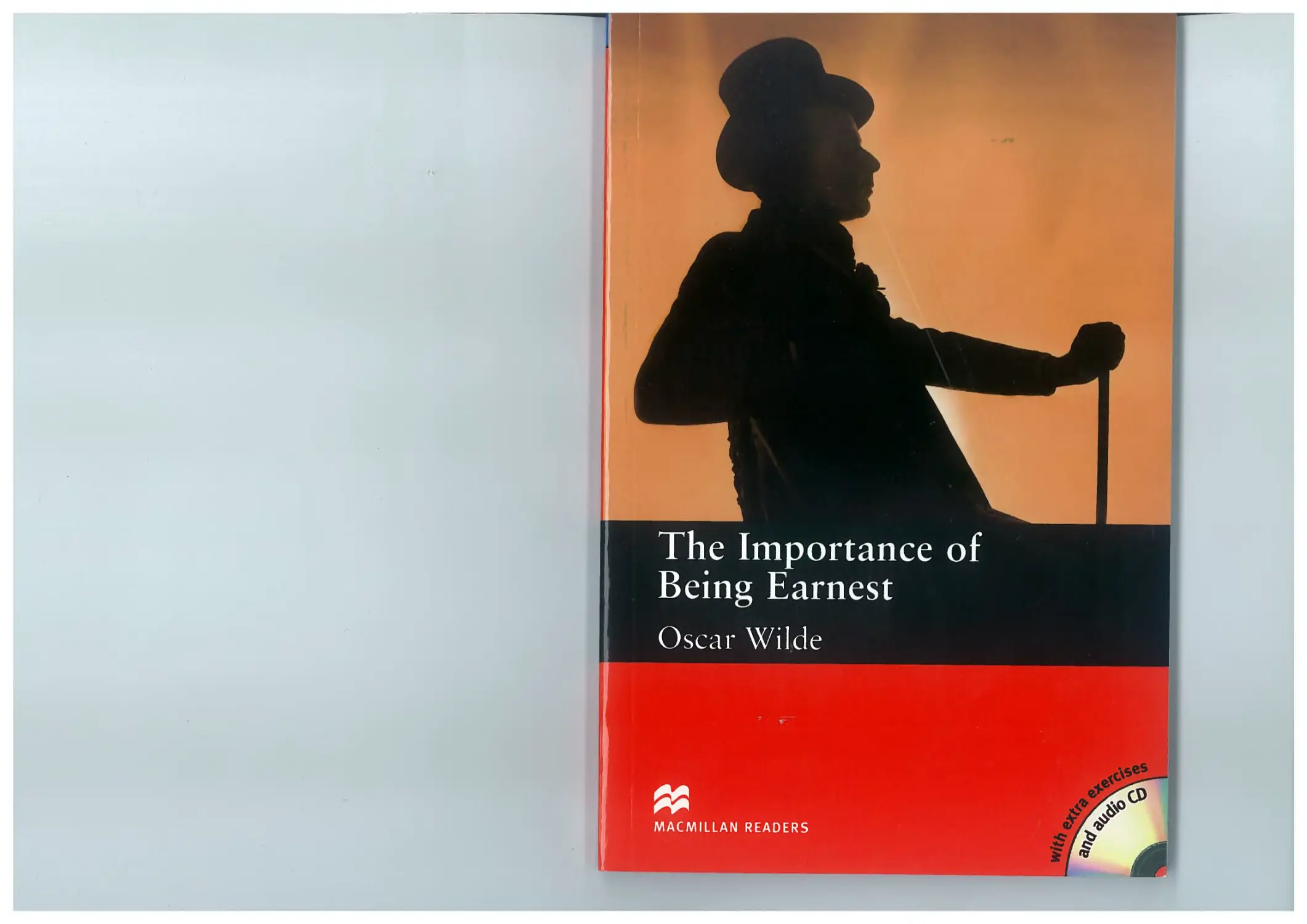
The Importance of
Being Earnest

Oscar Wilde

UPPER LEVEL

OSCAR WILDE

The Importance
of Being Earnest

Retold by F H Cornish

MACMILLAN
MACMILLAN READERS

UPPER LEVEL

Founding Editor: John Milne

The Macmillan Readers provide a choice of enjoyable reading
materials for learners of English. The series is published at six levels
- Starter, Beginner, Elementary, Pre-intermediate, Intermediate and
Upper.

Level Control

Information, structure and vocabulary are controlled to suit the
students’ ability at each level.

The number of words at each level:

Starter	about 300 basic words
Beginner	about 600 basic words
Elementary	about 1100 basic words
Pre-intermediate	about 1400 basic words
Intermediate	about 1600 basic words
Upper	about 2200 basic words

Vocabulary

Some difficult words and phrases in this book are important for
understanding the story. Some of these words are explained in the
story, some are shown in the pictures, and others are marked with a
number like this:.. .3. Phrases are marked with p. Words with a number
are explained in the Glossary at the end of the book and phrases are
explained on the Useful Phrases page.

Answer Keys

Answer Keys for the Points for Understanding and Exercises sections can
be found at www.macmillanenglish.com/readers.

Audio Download

There is an audio download available to buy for this title. Visit
www.macmillanenglish.com/readers for more information.
Contents

A Note About The Author	4

A Note About This Play	6

The People In This Play	10

Act One	11

Act Two	34

Act Three	64

Points for Understanding	81

Glossary	83

Useful Phrases	91

Exercises	93
A Note About The Author

Oscar Fingal O’Flahertie Wills Wilde was bom on October 16th
1854 in Dublin, the capital city of Ireland. Wilde’s father, Sir
William Wilde, was a famous surgeon. His mother, Jane, was a
woman with literary interests. She was well known as the hostess
of a literary salon1 and she was also a writer herself. Using the pen
name ‘Speranza’, she published Irish legends and folk stories. She
was also interested in Irish politics. At that time, Ireland was part
of the United Kingdom and Speranza was devoted to the cause
of freeing her country from British rule. Oscar Wilde was always
very close to his extraordinary mother.

Wilde was educated at the Portora Royal School at Enniskillen,
then at Trinity College, Dublin, and finally at Magdalen College,
Oxford. At Oxford, Wilde studied Greek, Latin and ancient
history. He was a brilliant student and he achieved a first class
degree. Besides this, he also won the Newdigate Prize for poetry.
Wilde also became very interested in aesthetics2 at Oxford and
was influenced3 by the works of two famous authors who wrote
about the theory of beauty - John Ruskin and Walter Pater.

Wilde’s earlier career as a writer centred mostly on poems and
short stories. Some of the stories were written for his two sons
- he had married Constance Lloyd in 1884 and soon after the
couple had had Cyril and Vyvyan. Many of the stories are still
read and admired - The Happy Prince, Lord Arthur Savile’s Crime,
The Canterville Ghost, The Portrait of Mr W. H., for example.
Wilde became famous - even infamous4 - with the publication of
his only novel, The Picture of Dorian Gray, a classic of‘decadent’5
literature, in 1890.

During this period, Wilde was also trying to influence people’s
taste in clothes, the decoration of their houses and the kind of
furniture they bought. He toured Britain and the United States
lecturing on these subjects, as well as on literary topics. He was
not always taken seriously - in fact he was often satirized6 in the
press, in novels and even on^the stage.

Wilde’s main interest in the early 1890s was the writing of
plays. He wrote several serious plays, including Salome (which he
wrote in French) and A Florentine Tragedy, and four comedies,
Lady Windermere's Fan, A Woman of No Importance, An Ideal
Husband and The Importance of Being Earnest, all of them full of
wit and epigrams7.

Soon after the first performance of The Importance of Being
Earnest in 1895, Wilde’s wife divorced him and in his later years,
he went to live in France. He died there from meningitis on
November 30th 1900. Two works from this later period of his life
were published - De Profundis (a collection of letters) and a poem,
The Ballad of Reading Gaol, which is centred on the thought that
each man kills the thing he loves.

Oscar Wilde is now remembered for his novel, his light-
hearted stories and his comedies. His more serious works have
almost been forgotten. But we should remember that several of
them were made into musical works in the early twentieth century
- Richard Strauss’s opera Salome is based on Wilde’s play of that
name and Alexander von Zemlinsky wrote an operatic version
of A Florentine Tragedy and another opera, Der Zwerg, based on
Wilde’s short story The Birthday of the Infanta. Franz Schreker and
John Alden Carpenter both wrote music for ballets based on that
story too.

Wilde’s most popular works have also interested film-makers:
The Picture of Dorian Gray was filmed in 1945 and again in 2009.
There have been two major films of The Importance of Being
Earnest, one made in 1952 and the other in 2002.
A Note About This Play

Wilde gave The Importance of Being Earnest - his last and, many
believe, best play - a subtitle: A Trivial8 Comedy for Serious People.
And he wrote that the play ‘has its philosophy: that we should
treat all the trivial things in life seriously, and all the serious things
of life with sincere triviality’. The serious matter treated with the
most triviality in the play is marriage. Like many comedies, The
Importance of Being Earnest ends with impending9 marriages, but
by then Wilde has used the play to attack and satirize marriage
as it was understood by the upper classes of Victorian10 England.

The play certainly takes some ideas from several other
late-Victorian comedies: W. S. Gilbert’s Engaged and Lestocq
and Robson’s The Foundling are often mentioned as important
sources. But most English comedies of that period are written in a
tradition that began with the ancient Roman comedies of Plautus
and Terentius.

Wilde wrote the play in the late summer and autumn of 1894.
His first version of the play was in four acts, like his other comedies,
but the final text was reduced to three acts. In making the changes,
Wilde was helped by George Alexander, who directed and acted
in the first production, which opened on February 14th 1895 in
London. Together they removed a sub-plot11 and concentrated the
action entirely on the double marriage plot, which resulted in a
play of great technical perfection. The first-night audience must
have enjoyed watching this very subversive12 account of love and
marriage on Saint Valentine’s Day - the day of love.

Wilde’s humorous attack on the social habits of the Victorian
upper classes uses satire and the constant inversion13 of accepted
ideas of normal behaviour and attitudes as its weapons. The play
is full of jokes, but it is very important to remember that they are
mostly jokes between the author and the audience - the characters
on the stage don’t hear them as jokes; they don’t laugh. The title
of the play itself turns out to be a joke. Earnest is a ‘pun’ - or a
play on words - based on the fact that the adjective ‘earnest’,
meaning ‘serious and sincere*? has the same pronunciation as the
man’s name ‘Ernest’. Both the young women in the play come to
think they are engaged to young men called Ernest, when in fact
neither of the men really has that name. Both men sometimes use
the name to take advantage of social situations in ways that show
their basic unseriousness and lack of earnestness.

Wilde attacks many things about upper class society in The
Importance of Being Earnest. The play’s main satirist and inverter
of society’s beliefs and opinions, Algernon, even pretends to have
a reversed view of class relations. What use are the lower classes,
he asks us, if they do not set a good example to the upper classes?
Both the lead male characters are cynical14 and decadent young
men. They - especially Algernon - are like comic equals to Dorian
Gray, the wicked hero of Wilde’s horror novel. But while Dorian
Gray is guilty of great wickedness, the worst sin that Algernon
demonstrates is a kind of mild greed - he loves sandwiches and
cakes. And Jack’s deviousness15 is intended for nothing worse
than escaping boredom.

Despite Algernon’s cynicism about marriage in general - he
alters16 the well-known proverb ‘marriages are made in Heaven’
to ‘divorces are made in Heaven’ - he, like his friend Jack,
becomes enthusiastic about marriage when it affects him. They
both exhibit at least some conventional attitudes about proposing
to their intended brides. Social conventions say that the men
should make the first move, while the young women should
appear shy and meek17. However, the young women in the play
prove to be so ‘modem’ and cynical in their own approaches to
the traditions of proposal and engagement that they leave the
men far behind. They are so impatient with the conventions that
they have accepted the men’s proposals before they have been
made - in Cecily’s case before she has even met her fiance18 -
simply because they are both called Ernest.
The young women’s ‘modernity’ is even more clearly
demonstrated when Wilde makes fun of the serious ideas of
repentance19 and forgiveness, which were important to Victorian
society. Having fotpjd out that they have been deceived20 over
their fiances’ names, Gwendolen and Cecily watch Algernon
and Jack for signs of repentance. They are so eager to forgive,
however, that they will accept almost anything as such a sign.
‘They have been eating muffins21. That looks like repentance
to me,’ says Cecily. This line sums up22 the attitude of the main
female characters perfectly.

The other main character in the play, Lady Bracknell, is more
complicated. In some ways, Wilde portrays her as a ‘dinosaur’
with very fixed, old-fashioned beliefs about good families and
education. Jack cannot marry her daughter because his parents
are unknown, she says. Indeed her anger at the circumstances of
Jack’s discovery in a handbag as a baby is the play’s most famous
moment. And when Jack claims that Algernon is devious, Lady
Bracknell claims that this is impossible because he was educated
at Oxford University.

But in other ways, Wilde shows Lady Bracknell to be a realist.
She accepts the inversion of the old stereotypes whereby poor
women married rich men for their money, and she sees nothing
wrong in the idea of her poor but aristocratic23 nephew, Algernon,
marrying the very rich Cecily for her money. By the late nineteenth
century, this kind of marriage was a reality in Britain, even if
people sometimes pretended differently.

When Lady Bracknell tells her daughter that she is certainly
not Jack’s fiancee, and that she (Lady Bracknell) or her husband
will tell Gwendolen when she is engaged, Wilde is not joking
about arranged marriages. This would not have been a joke to his
audience.

In fact, the main idea of the London ‘season’24 at that time was
that it provided a series of parties and dances at which parents
of eighteen-year-old girls from ‘good’ families (or ‘good society’)
could introduce them to ‘eligible’25 young men. The idea was
that by the end of the season^ all the girls would be engaged to
someone from an equally ‘good’ family. Lady Bracknell explains
that Jack is not on her list of eligible men, which she shares with
other aristocratic ladies. Here, Wilde is making fun of the way
such ladies treat marriage as a kind of market-trading.

A final thing to mention is the upper class custom of
‘afternoon tea*. Afternoon tea is served in both Acts One and
Two of the play. This was not just a drink, but a light meal served
late in the afternoon. It consisted of thin sandwiches (usually
containing cucumber) as well as bread and butter, cakes of
various kinds and tea to drink.

Wilde made his portrayal of a section of the society of his
time cynical and humorous, but it was very recognizable. So The
Importance of Being Earnest was a great success when it opened in
London in 1895. It was successfully brought back to the stage not
long after Wilde’s death and has been a popular favourite in the
British theatre ever since.
The People In This Play

Jack Worthing, also*known as Ernest Worthing; a rich bachelor26
Algernon Moncrieff, Jack’s friend; also a rich bachelor. He is a
little younger than Jack. His friends call him Algy.

Lady Augusta Bracknell, Algernon’s aunt

Gwendolen Fairfax, Lady Bracknell’s daughter

Cecily Cardew, Jack Worthing’s ward27

Miss Laetitia Prism, a middle-aged spinster; Cecily’s governess28

Canon29 Frederick Chasuble, an elderly clergyman

Lane, Algernon’s servant

Merriman, Jack’s servant
Act One

[The living room of Algernon^Aoncrieffs flat in Mayfair, London.
Lane is arranging afternoon tea on a table. Algernon enters]
Algernon: Lane, have you made the cucumber sandwiches for
Lady Bracknell’s tea?

Lane: Yes, sir. [Handing them to Algernon on a silver tray]
Algernon: [Looking carefully at them, taking two and sitting down
on the sofa] Oh, by the wayp, Lane, I looked at your notebook. I
noticed that when Lord Shoreman and Mr Worthing dined with
me on Thursday night, eight bottles of champagne were drunk.
Lane: Yes, sir; eight bottles.

Algernon: Why is it that, in a bachelor’s home, the servants
always drink the champagne? I just ask because I am interested,
Lane.

Lane: I think that it is because the champagne is better in a
bachelor’s home. I have noticed that the champagne in married
people’s homes is rarely very good.

Algernon: Good heavensp! Is marriage so depressing?

Lane: I believe marriage is very pleasant, sir. I haven’t had much
experience of it myself. I have only been married once, and that
was because of a misunderstanding30 between myself and a young
person.

Algernon: [Lazily, without interest] I am not very interested in
your family life, Lane.

Lane: No, sir; it is not a very interesting subject. I never think
of it myself.

Algernon: That is very understandable. Well, thank you, Lane.

[Lane goes off]

Algernon: [To himself] Lane’s views on marriage seem very casual.
Really, if the servants don’t set us a good example, what on earth
is the use of them? They seem to have no morals31.

[Lane enters]

Lane: Mr Ernest Worthing is here, sir.
[Jack enters. Lane goes off]

Algernon: How are you, my dear Ernest? What brings you to
town?

Jack: Oh, pleasure brings me, pleasure, of course! What else
should bring one anywhere? You’re eating as usual, I see, Algy!
Algernon: [Very formally] I believe it is normal in good society
to have some light refreshment at five o’clock. [In a normal voice]
Where have you been since last Thursday?

Jack: [Sitting down on the sofa] In the country.

Algernon: What on earth do you do in the country?

Jack: [Taking off his gloves] When one is in town one entertains
oneself. When one is in the country one entertains other people.
It is very boring.

Algernon: And who are the people you entertain?

Jack: Oh, neighbours, neighbours!

Algernon: Have you got nice neighbours in your part of
Shropshire32?

Jack: No, they’re all horrid. I never speak to any of them.

Algernon: You must entertain them very much, then! [Going
over to the table and taking a sandwich] By the way, Shropshire is
where you come from, is it not?

Jack: Shropshire? Yes, of course. My dear fellow33! Why are all
these cups here? Why cucumber sandwiches? Why are you being
so extravagant34? Who is coming to tea?

Algernon: Oh, just Aunt Augusta and Gwendolen.

Jack: How perfectly delightful!

Algernon: Yes, but I am afraid Aunt Augusta won’t be happy
that you’re here.

Jack: And why is that?

Algernon: My dear fellow, the way that you flirt35 with
Gwendolen is perfectly disgraceful. It is almost as bad as the way
Gwendolen flirts with you.

Jack: I am in love with Gwendolen. I have come to town in
order to propose marriage to her.
Algernon: I thought you had come to town for pleasure. I call a
marriage proposal business.

Jack: How very unromanficyou are!

Algernon: I really don’t think proposing is romantic. It is very
romantic to be in love. But there is nothing romantic about a
proposal. Someone might accept. They usually do, I believe.
Then the exciting time is over. The most important thing about
romance is the uncertainty. If I ever marry, I’ll certainly try to
forget that I am married.

Jack: I believe you, dear Algy. The Divorce Court was especially
invented for people with memories like yours.

[Jack puts out his hand to take a cucumber sandwich; Algernon
immediately stops him]

Algernon: Oh, there is no point in thinking about that. Divorces
are made in Heaven. Please don’t touch the cucumber sandwiches.
They were ordered specially for Aunt Augusta. [Taking a sandwich
himself and eating it]

Jack: Well, you have been eating them all the time.

Algernon: That is different. She is my aunt. [Offering Jack a
different plate] Have some bread and butter. The bread and butter
is for Gwendolen. Gwendolen loves bread and butter.

Jack: [Helping himself to bread and butter] And very good bread
and butter it is too.

Algernon: Well, my dear fellow, you don’t need to eat it all. You
are behaving as if you are married to her already. But you are not
married to her and I don’t think you ever will be.

Jack: Why on earth do you say that?

Algernon: Well, firstly, girls never marry the men they flirt with.
They don’t think it’s the right thing to do.

Jack: Oh, that is nonsense!

Algernon: It isn’t. It’s true. [Taking two more sandwiches] That’s
why one sees such a large number of bachelors all over the place.
And secondly, I don’t give my consent36.

Jack: Your consent!
Please dont touch the cucumber sandwiches.
They were ordered specially for Aunt Augusta.
Algernon: Gwendolen is my cousin. And before I allow you to
marry her, you will have to ^ar up37 the matter of Cecily.

[Algernon rings a bell]

Jack: Cecily? What on earth do you mean, Algy? I don’t know
anyone called Cecily.

[Lane enters]

Algernon: Lane, bring me the cigarette case which Mr Worthing
left last time he dined here.

Lane: Yes, sir.	-g

[Lane goes off. Algernon takes the last of the cucumber sandwiches]
Jack: Have you had my cigarette case all this time? I wish you
had told me. I have been writing letters to the police about it. I
nearly offered a large reward.

Algernon: Well, I wish you would offer a large reward. I am very
poor at the moment.

Jack: There is no point in offering a large reward now that you’ve
found it.

[Lane enters with the cigarette case on a silver tray. Algernon takes it
immediately. Lane goes off]

Algernon: I think that is mean of you, Ernest, I must sayp.
[Opening the case and examining it] However, it doesn’t matter.
Now I look at the inscription38 inside, I see that this isn’t yours.
Jack: Of course it’s mine. [Moving towards Algernon] You have
seen me with it a hundred times, and you shouldn’t be reading
what is written inside it. It is very impolite to read a private
cigarette case.

Algernon: Oh! It is ridiculous to have rules about what one
should read and what one shouldn’t. Most of modern culture
depends on reading what one shouldn’t read.

Jack: I know that, and I am not going to discuss modem culture.

I simply want my cigarette case back.

Algernon: Yes; but this isn’t your cigarette case. This cigarette
case is a present from someone called Cecily. And you said you
don’t know anyone called Cecily.
Jack: Well, if you want to know, Cecily is my aunt.

Algernon: Your aunt?

Jack: Yes. She is a charming old lady. Just give it back to me,
Algy.

Algernon: [Going behind the sofa] But why does she call herself
‘little Cecily’ if she is your aunt? [Reading] ‘From little Cecily, with
all her love.’

Jack: [Going to the front of the sofa and kneeling on it] My dear
fellow, some aunts are tall. Some aunts are not tall. My aunt
should be allowed to decide her height for herself. You seem to
think that every aunt should be like your aunt, Lady Bracknell!
That is ridiculous. Now, give me back my cigarette case. [Following
Algernon all around the room]

Algernon: Yes. But why does your aunt call you her uncle?
[Reading] ‘From little Cecily, with all her love to her dear Uncle
Jack.’ I don’t object to an aunt being a small aunt. But why does
an aunt, whatever her size, call her own nephew ‘uncle’? 1 don’t
understand. And your name isn’t Jack; it is Ernest.

Jack: It isn’t Ernest; it’s Jack.

Algernon: You have always told me that your name is Ernest.
I have introduced you to everyone as Ernest. You answer to the
name Ernest. You look as if your name is Ernest. You are the most
earnest-looking person I have ever seen in my life. It is perfectly
ridiculous to tell me your name isn’t Ernest. It is on your visiting
cards39. Here is one of them. [Taking it from a case] ‘Mr Ernest
Worthing, B.4, The Albany, London.’ I’ll keep this as proof
that your name is Ernest. Don’t ever try to deny it to me or to
Gwendolen or to anyone else. [Putting the card in his pocket]
Jack: Well, my name is Ernest in town and Jack in the country,
and the cigarette case was given to me in the country.

Algernon: That does not explain why your small Aunt Cecily
calls you her dear uncle. My dear fellow, you had better tell me
everything. Go on! I have always suspected that you were a secret
Bunburyist and now I am quite40 sure.
Jack: Bunburyist? What on earth do you mean by a Bunburyist?
Algernon: I’ll tell you the meaning of Bunburyist when you tell
me why you are Ernest in town and Jack in the country.

Jack: Well, give me my cigarette case first.

Algernon: Here it is. [Handing Jack the cigarette case] Now give
me your explanation and please make it unbelievable. [Sitting on
the sofa]

Jack: My dear fellow, there is nothing unbelievable about my
explanation. In fact, it’s perfectly ordinary. I was brought up by an
old gentleman called Thomas Cardew. He adopted me when I was
a little boy and he made me the guardian of his granddaughter,
Miss Cecily Cardew, in his will41. Cecily is my ward and calls me
uncle because she respects me, although you wouldn’t understand
that! You don’t understand respect. Cecily lives in my house in
the country and is looked after by her excellent governess, Miss
Prism.

Algernon: Where is your house in the country, by the way?

Jack: That is nothing to do with you, my dear fellow. I am not
going to invite you there ... but I will tell you honestly that the
house is not in Shropshire.

Algernon: I guessed that, my dear fellow! I have Bunburyed all
over Shropshire twice. Now, go on. Why are you Ernest in town
and Jack in the country?

Jack: My dear Algy, I don’t know whether you will understand.
You are not a very serious person. I will try to explain it to you.
I am a responsible guardian and I have to behave well all the
time in the country. It is my duty. But it is not very good for my
health or my happiness. So, when I want to leave the country
and come to town, I pretend to have a younger brother called
Ernest. I tell everyone that he lives in The Albany and that he
gets into the most terrible trouble. That, my dear Algy, is the
truth.

Algernon: You are a Bunburyist! I was right to say you were a
Bunburyist. You are one of the most advanced Bunburyists I know.
Jack: What on earth do you mean?

Algernon: You have invented a younger brother called Ernest so
that you can come to town as often as you like. I have invented an
invalid42 called Bunbury so that I can go to the country as often
as I like. When I pretend to visit him, I call it Bunburying. And I
call someone who visits imaginary people a Bunburyist. Bunbury
is very valuable. For example, if it wasn’t for Bunbury’s very bad
health, I wouldn’t be able to dine with you tonight. I should be
dining with Aunt Augusta.

Jack: I haven’t asked you to dine with me tonight.

Algernon: I know. You are very careless about sending out
invitations. It is very foolish of you. Nothing annoys people more
than not receiving invitations.

Jack: You ought to dine with your Aunt Augusta.

Algernon: I don’t have any intention of dining with Aunt
Augusta. Firstly, I dined there on Monday and once a week is
enough time to spend with one’s relations. Secondly, Aunt
Augusta will either give me two women to talk to at dinner or
none. And thirdly, I know that tonight she will make me sit next
to Mary Farquhar, who always flirts with her own husband across
the dinner table. It is not very pleasant. In fact, respectable women
should not behave like that ... and more and more women are
doing it. The number of women in London who flirt with their
own husbands is terrible. It looks so bad. Well, now I know that
you are a Bunburyist, I want to talk to you about Bunburying. I
want to tell you the rules.

Jack: I am not a Bunburyist. If Gwendolen agrees to marry me, I
am going to kill my brother. In fact, I think I will kill him anyway.
Cecily is a little too interested in him. So I am going to get rid of
Ernest. And I think you should kill Mr ... your invalid friend with
the ridiculous name.

Algernon: Nothing will make me kill Bunbury, and, if you ever
get married, you will be glad to know Bunbury. A man who marries
without knowing Bunbury will have a very boring marriage.
Jack: That is nonsense. If I marry a charming girl like Gwendolen,
I certainly won’t want to know Bunbury.

Algernon: Then your wife will want to know him. You don’t
understand that in married life three is company and two is none.
Jack: Don’t try to be cynical. It’s perfectly easy to be cynical.

Algernon: My dear fellow, it isn’t easy to be anything these days.
There is so much competition. [There is the sound of a doorbell
being rung for a long time] Ah! That must be Aunt Augusta. Only
relatives ring like that. Now, I will take her out of the room for
ten minutes so that you can propose to Gwendolen. So I can dine
with you tonight, can’t I?

Jack: I suppose so, if you want to.

Algernon: Good.

[Lane enters]	"°

Lane: Lady Bracknell and Miss Fairfax are here, sir.

[Algernon goes forward to meet them. Lady Bracknell and Gwendolen
enter]

Lady Bracknell: Good afternoon, dear Algernon. I hope you are
behaving very well.

Algernon: I’m feeling very well, Aunt Augusta.

Lady Bracknell: Feeling very well is not the same as behaving
very well. In fact, the two things rarely go together.

Algernon: [To Gwendolen] Good heavens, you are smart!
Gwendolen: I am always smart! Aren’t I, Mr Worthing?
Jack: You’re quite perfect, Miss Fairfax.

Gwendolen: Oh! I hope I am not perfect. There would be no
room for development and I intend to develop in every direction.
[Gwendolen and Jack sit down together in a comer of the room]
Lady Bracknell: I am sorry if we are a little late, Algernon,
but I had to visit Lady Harbury. I hadn’t seen her since her poor
husband died. She has changed very much; she looks quite twenty
years younger. And now I’ll have a cup of tea and one of those
nice cucumber sandwiches you promised me.

Algernon: Certainly, Aunt Augusta. [Going over to the tea table]
Lady Bracknell: Will you come and sit here, Gwendolen?
Gwendolen: Thanks, Mama, Гт quite comfortable over here.
Algernon: [Picking up the empty plate of sandwiches in horror]
Good heavens! Lane! Why are there no cucumber sandwiches? I
ordered them specially.

Lane: [Seriously] There were no cucumbers in the market this
morning, sir. I went there twice.

Algernon: No cucumbers?

Lane: No, sir.

Algernon: Thank you, Lane. You may go.

Lane: Thank you, sir. [Goes off]

Algernon: I am very upset that there were no cucumbers, Aunt
Augusta.

Lady Bracknell: It doesn’t matter, Algernon. I had some crumpets
with Lady Harbury.

Algernon: I hear that her hair has turned quite blonde from grief.
Lady Bracknell: It certainly has changed its colour. I do not know
why, of course. [Algernon takes her a cup of tea] Thank you. I’ve got
quite a treat for you at dinner tonight, Algernon. I am going to
seat you next to Mary Farquhar. She is such a nice woman and she
is so sweet to her husband. It’s delightful to watch them.

Algernon: I am afraid, Aunt Augusta, I cannot dine with you
tonight after all.

Lady Bracknell: [Frowning43] I hope you can, Algernon. There
will be thirteen people at the dining table if you aren’t there. That
is unlucky. Your uncle will have to eat upstairs. Fortunately, he
often has to do that.

Algernon: It is terribly disappointing to me, but I’ve had a
telegram44 to say that my poor friend Bunbury is very ill again.
[Smiling quickly at Jack] They think I should be with him.

Lady Bracknell: It is very strange. Mr Bunbury seems to suffer
from very bad health.

Algernon: Yes, indeed. He is a permanent invalid.

Lady Bracknell: Well, Algernon, I think it’s about timep that

Mr Bunbury decides whether he is going to live or die. I don’t
sympathize with invalids. Illness should not be encouraged in
others. One should be healthy. Could you ask Mr Bunbury not to
be ill on Saturday? I am holding a reception45 and I want you to
organize the music. People talk during performances of music and
I want to encourage them to talk, particularly since it is the end of
the London season and they have nearly run out of things to say.
Algernon: I’ll speak to Bunbury, Aunt Augusta, if he is still
conscious. I think I can promise you that he will be well by
Saturday. Of course, the music is a problem. You see, if one plays
good music, people don’t listen and if one plays bad music, people
don’t talk. But I will show you the programme of music I have
chosen if you will come into the music room for a moment.

Lady Bracknell: Thank you, Algernon. It is very thoughtful of
you.

[Lady Bracknell and Algernon go into the music room, Gwendolen
remains behind]

Jack: It’s been a charming day, Miss Fairfax.

Gwendolen: Please don’t talk about the weather, Mr Worthing.
When people talk to me about the weather, I always feel quite
certain they mean something else and I get nervous.

Jack: I do mean something else.

Gwendolen: I thought so. In fact, I am never wrong.

Jack: I would like to talk to you about the ‘something else’ while
Lady Bracknell is out of the room.

Gwendolen: Then talk about it quickly. Mama often comes back
into a room suddenly.

Jack: [Nervously] Miss Fairfax, ever since I met you, I have
admired you more than any girl... I have met ever since ... I met
you.

Gwendolen: Yes, 1 am quite well aware of that. I was always
fascinated by you - even before I met you. [Jack looks at her in
amazement] We live in an age of ideals46 - any expensive monthly
magazine will tell you that - and my ideal has always been to
love someone called Ernest. When Algernon mentioned he had a
friend called Ernest, I knew I would love you.

Jack: Do you really love me, Gwendolen?

Gwendolen: Very much!

Jack: Darling! You don’t know how happy you have made me.
Gwendolen: My own Ernest!

Jack: But could you love me if my name wasn’t Ernest?
Gwendolen: But your name is Ernest.

Jack: Yes, I know it is. But what if it was something else? Couldn’t
you love me then?

Gwendolen: [Cleverly] Ah! But you are called Ernest, so there is
no reason to think about you not being called Ernest.

Jack: Personally, darling, I don’t really like the name Ernest... I
don’t think the name suits me.

Gwendolen: It suits you perfectly. It is a wonderful name. It is
musical.

Jack: Well, really, Gwendolen, I think there are a lot of nicer
names. I think that Jack, for instance, is a charming name.

Gwendolen: Jack? ... No, there is very little music in the name
Jack. It does not excite me. I have known several Jacks and they
all were very ordinary. I feel pity for any woman who is married
to a man called Jack. I think the only really good name is Ernest.
Jack: Gwendolen, I must get baptized47 at once ... I mean we
must get married at once. There is no time to lose.

Gwendolen: [Shocked] Married, Mr Worthing?

Jack: Well ... you know that I love you and you told me, Miss
Fairfax, that you love me.

Gwendolen: I do love you. But you haven’t proposed to me yet.
Nothing has been said about marriage.

Jack: Well ... may I propose to you now?

Gwendolen: I think that this would be an excellent time to
propose to me. And I will tell you now that I will accept you so
that you aren’t worried.

Jack: Gwendolen!
Gwendolen: Yes, Mr Worthing? What are you going to say to
me?

Jack: You know what I am going to say to you.

Gwendolen: Yes, but you haven’t said it.

Jack: Gwendolen, will you marry me? [Going down on his knees]
Gwendolen: Yes, of course I will. You have taken a long time to
ask. I am afraid you have had very little experience of proposing.
Jack: My dear, I have never loved anyone in the world but you.
Gwendolen: Yes, but men often practise proposing. My brother,
Gerald, often proposes to people. All my friends tell me. What
wonderful blue eyes you have, Ernest! They are quite, quite blue.
I hope you will always look at me like that, especially when there
are other people in the room.

[Lady Bracknell enters]

Lady Bracknell: Mr Worthing! Get up from that position. It is
not respectable to behave like that.

Gwendolen: Mama! [Jack tries to stand up but Gwendolen makes
him stay in a kneeling position] Please go away. Mr Worthing has
not finished yet.

Lady Bracknell: Finished what, may I ask?

Gwendolen: I am engaged to be married to Mr Worthing, Mama.
[Jack stands up]

Lady Bracknell: Pardon me, you are not engaged to anyone,
Gwendolen. When you are engaged to someone, I, or your father,
will inform you of the fact. An engagement should come as a
surprise to a young girl. A pleasant surprise or an unpleasant
surprise. It is not something that she is allowed to arrange for
herself. ... And now, I have a few questions to ask you, Mr
Worthing. While I am asking these questions, you, Gwendolen,
will wait for me in the carriage48.

Gwendolen: Mama!

Lady Bracknell: Wait in the carriage, Gwendolen! [Gwendolen
goes to the door. She and Jack kiss their hands and pretend to blow
the kisses to each other behind Lady Bracknell's back. Lady Bracknell
looks around for the cause of the noise. Finally she turns round
and sees them. Frowning] Gwendolen, I said wait for me in the
carriage!

Gwendolen: Yes, Mama. [Going off, looking back at Jack]

Lady Bracknell: You can sit down, Mr Worthing. [Looks in her
pocket for a notebook and pencil]

Jack: Thank you, Lady Bracknell, I prefer to stand.

Lady Bracknell: [Notebook and pencil in hand] I must tell you that
you are not on my list of eligible young men, although I have the
same list as the Duchess of Bolton. We work together during the
season. However, I am quite ready to add your name to the list if
your answers are satisfactory. Do you smoke?

Jack: Well, yes, I do smoke.

Lady Bracknell: I am glad to hear it. A man should always have
an occupation49. There are far too many men in London who
don’t have an occupation. How old are you?

Jack: Twenty-nine.

Lady Bracknell: That’s a very good age to get married. I have
always believed that a man who wants to get married should
know everything or nothing. Which do you know?

Jack: [After hesitating] I know nothing, Lady Bracknell.

Lady Bracknell: I am pleased to hear it. I approve of ignorance.
I don’t approve of modem education. Fortunately, in England at
least, education has no effect at all. What is your income?

Jack: It’s between seven and eight thousand pounds a year.

Lady Bracknell: [Making a note in her book] Do you earn this
income from land that you own or from investments50?

Jack: From investments.

*Lady Bracknell: That is satisfactory. Owning land is neither
profitable nor pleasurable - it costs money to look after it when
one is alive and then there are taxes when one is dead. That’s all
I can say about land.

Jack: I have a country house with some land, but I don’t depend
upon it for my income.
Lady Bracknell: A country house! How many bedrooms? Well,
that doesn’t matter. I hope you have a house in town. Gwendolen
must have a house in town.

Jack: Well, I do have a town house in Belgrave Square but it is
rented to Lady Bloxham.

Lady Bracknell: Lady Bloxham? I don’t know her.

Jack: Oh, she doesn’t go out very much; she’s very old.

Lady Bracknell: She’s not necessarily respectable even if she is
old. What number Belgrave Square?

Jack: 149.

Lady Bracknell: [Shaking her head disapprovingly] But that is the
unfashionable side of the street. However, that could easily be
changed.

Jack: Do you mean the fashion or the side?

Lady Bracknell: [Very disapprovingly] Both, if necessary. Now, let
us discuss less important details. Are your parents living?

Jack: I have lost both my parents.

Lady Bracknell: To lose one parent, Mr Worthing, is unfortunate;
to lose both seems like carelessness. Who was your father? He must
have been a wealthy man. Was he a businessman or an aristocrat?
Jack: I am afraid I don’t know. Lady Bracknell, I said that I had
lost my parents. In fact, my parents lost me ... I don’t know who
I am. I was ... well, I was found.

Lady Bracknell: Found?

Jack: The late51 Mr Thomas Cardew, a very kind and charitable
old gentleman, found me and called me ‘Worthing’ because he had
a train ticket for Worthing in his pocket at the time. Worthing is
a seaside town.

Lady Bracknell: Where did the kind gentleman who had a train
ticket for this seaside town find you?

Jack: [Seriously] In a handbag.

Lady Bracknell: A handbag?

Jack: [Very seriously] Yes, Lady Bracknell. I was in a handbag - a
large, black leather handbag - an ordinary handbag with handles.
Lady Bracknell: Where did Mr Thomas Cardew find this ordinary
handbag?

Jack: In the cloakroom52 at Victoria Station, here in London. It
was a mistake. It was given to him instead of his own bag.

Lady Bracknell: In the cloakroom at Victoria Station?

Jack: Yes.

Lady Bracknell: Mr Worthing, I am shocked by what you have
just told me. I do not think it is right to be born in a handbag,
even if it has handles. And I do not think it is right to be found in
a handbag in a cloakroom at a railway station. It is not the way to
become a respectable gentleman with a good position in society.
Jack: What is your advice, Lady Bracknell? I would, of course, do
anything to make Gwendolen happy.

Lady Bracknell: My advice to you, Mr Worthing, is this - try
to find some relations as soon as possible. And try to find at least
one parent.

Jack: Well, I don’t see how I could possibly do that. I can show
you the handbag. It is in a wardrobe at home. I really think that
should satisfy you, Lady Bracknell.

Lady Bracknell: Me, sir! It has nothing to do with me! Do you
really think that Lord Bracknell would allow our only daughter to
marry the son of a cloakroom and form a relationship with a piece
of luggage? Goodbye, Mr Worthing!

[Lady Bracknell leaves the room with great dignity53]

Jack: Goodbye! [Algernon starts singing a Wedding March54 in the
music room. Jack looks very angry and goes to the door] Stop singing
that awful tune, Algy!

[The singing stops and Algernon enters cheerfully]

Algernon: Didn’t everything work out all right, old fellow? Did
Gwendolen refuse to marry you?

Jack: Oh, Gwendolen was fine. She believes we are engaged. Her
mother is awful. I’ve never met such a monster. Oh, I beg your
pardon, Algy, I suppose I shouldn’t talk about your own aunt in
that way in front of you.
Algernon: My dear fellow, I love hearing people being rude
about my relations. Relations are simply a boring group of people
who don’t know how to live and don’t know when to die.

Jack: Oh, that is nonsense^

Algernon: It isn’t!

Jack: Well, I won’t argue about it. You always want to argue
about things.

Algernon: Things were made for arguing about.

Jack: If I believed that, I’d shoot myself ... [A pause] You don’t
think Gwendolen will become like her mother in a hundred and
fifty years, do you, Algy?

Algernon: All women become like their mothers. That is their
tragedy. No men become like theirs. That is their tragedy.

Jack: Have you said something clever?

Algernon: They were very fine sentences and they are very true.
Jack: I’m tired of cleverness. Everybody is clever nowadays. You
meet clever people everywhere. I wish that there were a few fools
left in the world.

Algernon: There are.

Jack: I should like to meet them. What do they talk about?

Algernon: The fools? They talk about the clever people, of
course.

Jack: What fools!

Algernon: By the way, did you tell Gwendolen the truth about
being Ernest in town and Jack in the country?

Jack: My dear fellow, one does not tell the truth to a nice, sweet
girl. You have extraordinary ideas about how to behave to a
woman!

Algernon: The only way to behave to a woman is to flirt with her
if she is pretty. And if she isn’t pretty, you must flirt with someone
else.

Jack: Oh, that is nonsense.

Algernon: What about your badly behaved brother Ernest? Did
you tell her about him?
Jack: Oh, I shall have got rid of him before the end of the week.
I’ll say he died in Paris of a heart attack. Lots of people die of a
heart attack quite suddenly, don’t they?

Algernon: Yes, but it’s hereditary55, my dear fellow. It’s the sort
of thing that runs in familiesp. You had better say that he died of
a bad cold.

Jack: Are you sure that a bad cold isn’t hereditary?

Algernon: Of course it isn’t.

Jack: Very well, then. My poor brother Ernest will die suddenly,
in Paris, of a bad cold. That gets rid of him.

Algernon: But you said that your ward ... Miss Cardew ... was
a little too interested in your poor brother Ernest. Won’t she be
very distressed?

Jack: Oh, that’s not a problem. Cecily is not a silly romantic girl,
I am pleased to say. She eats big meals, goes for long walks and
doesn’t pay attention to her lessons.

Algernon: I would like to meet Cecily.

Jack: I will make sure that you never meet her. She is extremely
pretty and she is just eighteen.

Algernon: Have you told Gwendolen that you have an extremely
pretty ward who is just eighteen?

Jack: Oh, one mustn’t tell people everything all at once. Cecily
and Gwendolen will be great friends, I’m sure. They will be calling
each other sister half an hour after they meet.

Algernon: Women only call each other sister after they have
called each other lots of other things first. Now, my dear fellow,
if we want to get a good table at the restaurant, we must go and
change our clothes now. It’s nearly seven. I’m hungry.

Jack: [Irritably] I never knew a time when you weren’t hungry.
Algernon: What shall we do after dinner? Go to a theatre?
Jack: Oh no! One has to listen at the theatre. I hate listening.

Algernon: Well, let us go to the Club56.

Jack: Oh no! One has to talk at the Club. I hate talking.

Algernon: Well, we could go to the Empire Music Hall57 at ten.
Jack: The Music Hall? Oh no! I hate looking at things.

Algernon: Well, what shall we do?

Jack: Nothing!

Algernon: Doing nothing-is very hard work. However, I donk
mind very hard work if there is nothing definite to do.

[Lane enters]

Lane: Miss Fairfax has returned, sir.

[Gwendolen enters. Lane goes off]

Algernon: Gwendolen. Hello!

Gwendolen: Algy, please go away. I have something which I
want to say to Mr Worthing in private.

Algernon: Really, Gwendolen. 1 donk think I can allow you to
do that.

Gwendolen: Algy, you are not quite old enough to say things like
that. [Algernon goes to the other side of the room near the fireplace and
stands with his back to them]

Jack: My own darling!

Gwendolen: Ernest, we may never be married. I saw the frown
on Mama’s face. Few parents these days pay attention to what
their children say to them. I was three years old the last time I
had any influence over my mother. Ernest, she may stop us from
getting married. I may get married to someone else, 1 may get
married again and again - but nothing will ever change my love
for you.

Jack: Dear Gwendolen!

Gwendolen: Mama told me the romantic story of your birth.
She is displeased about it, but I love it. Your name - Ernest -
fascinates me. You are so simple and good-natured and that makes
you wonderfully complicated. I’ve got your town address at The
Albany. What is your address in the country?

Jack: The Manor House, Woolton, Hertfordshire.

[Algernon, who has turned round and has been carefully listening,
smiles to himself and writes the address on the cuff58 of his shirt. Then
he picks up a railway timetable from a shelf]
The Manor House, Woolton, Hertfordshire.
Gwendolen: It may be necessary to do something impetuous59.
We will have to think carefully about this. I will write to you
every day.

Jack: My own one!

Gwendolen: How long will you be in town?

Jack: Till Monday.

Gwendolen: Good! Algy, you may turn round now.

Algernon: Thanks, I have turned round already.

Gwendolen: You may also ring the bell for Lane to take me to
the door. [Algernon rings the bell]

Jack: Let me take you to the door, my own darling.

Gwendolen: Certainly.

Jack: [To Lane, who now enters] I will take Miss Fairfax to the
door.

Lane: Yes, sir.

[Jack and Gwendolen go off]

Algernon: Bring me a glass of wine, Lane.

Lane: Yes, sir.

Algernon: Tomorrow, Lane, I’m going Bunburying.

Lane: Yes, sir.

Algernon: I shall probably not be back till Monday. Pack my
evening clothes, some casual clothes and all my Bunbury suits ...
Lane: Yes, sir. [Handing Algernon his glass of wine]
Algernon: I hope that tomorrow is a fine day, Lane.

Lane: It never is, sir.

Algernon: Lane, you are a pessimist.

Lane: I do my best, sir.

[Jack enters. Lane goes off]

Jack: What a sensible, intelligent girl! The only girl I’ve ever
cared for in my life. [Algernon is laughing loudly] What on earth are
you laughing at?

Algernon: Oh, I’m a bit worried about poor Bunbury, that is all.
Jack: Your friend Bunbury will get you into trouble one day, you
know.
Algernon: I love trouble. It’s the only thing which is never
serious.

Jack: Oh, that’s nonsense, Algy. You never talk anything but
nonsense.

Algernon: Nobody ever does.

[Jack shakes his head at him and leaves the room. Algernon lights a
cigarette, looks at his shirt-cuff and smiles]
Act Two

[The garden at the Manor House in Woolton, Hertfordshire, Jack
Worthing s country home. Miss Prism is sitting at a table. Cecily is
watering flowers]

Miss Prism: [Calling] Cecily, Cecily! I think that watering flowers
is a servant’s occupation rather than yours, especially at a moment
when the pleasures of education are waiting for you. Your German
grammar book is on the table. Please open it at page fifteen. We
will do yesterday’s lesson again.

Cecily: [Coming over to the table very slowly] But I don’t like
German. It isn’t a very pretty language. I know that I look quite
ugly after my German lesson.

Miss Prism: Child, your guardian is anxious that you improve
yourself in every way. As he was leaving for town yesterday, he
reminded me how important your German is. Indeed he always
reminds me how important your German is when he is leaving
for town.

Cecily: Dear Uncle Jack is so very serious! Sometimes he is so
serious that I think he must be ill.

Miss Prism: [Sitting up very straight in her chair] Your guardian’s
health is excellent and his seriousness - indeed his earnestness -
is very admirable in such a young man. I do not know anyone else
who has such a good sense of duty and responsibility.

Cecily: I suppose that is why he often seems a little bored when
we three are together.

Miss Prism: Cecily! I am surprised at you. Mr Worthing has
many troubles in his life. You must remember that he is always
worried about that unfortunate young man, his brother Ernest.
Cecily: I wish Uncle Jack would allow that unfortunate young
man, his brother Ernest, to come here sometimes. We might
have a good influence on him, Miss Prism. I am sure that you
would. You know German and geology and all kinds of things
that influence a man very much. [Cecily begins to write in her diary]
Miss Prism: [Shaking her head] I do not think that even I could
have a good influence on his character. Mr Worthing himself
says that his brother’s character is weak and indecisive. Indeed, I
wouldn’t want to have a good influence on him. I do not approve
of this modem desire to turn bad people into good people at
a moment’s noticep. I think he should suffer because of his
misbehaviour. You must put away your diary, Cecily. I really don’t
understand why you keep a diary at all.

Cecily: I keep a diary in order to write down the wonderful
secrets of my life. If I didn’t write them down, I should probably
forget all about them.

Miss Prism: Our memory is the diary that we all have with us.
Cecily: Yes, but our memory usually remembers things that have
never happened and couldn’t possibly have happened. I believe
that memory is responsible for all the three-volume novels people
write.

Miss Prism: Do not be dismissive60 of the three-volume novel,
Cecily. I wrote one myself a long time ago.

Cecily: Did you really, Miss Prism? How wonderfully clever you
are! I hope it did not end happily! I don’t like novels that end
happily. They depress me so much.

Miss Prism: The good people ended happily. The bad people
ended unhappily. That is fiction.

Cecily: I suppose so. But it seems very unfair. And was your
novel ever published?

Miss Prism: I am sad to say it was not. The manuscript,
unfortunately, was lost. Now, start work, child. There is no point
in thinking about these things.

Cecily: [Smiling] But I see dear Canon Chasuble coming towards
us through the garden.	z|

Miss Prism: [Standing up and going towards Canon Chasuble?
Canon Chasuble! It is indeed a pleasure to see you.

Chasuble: And how are we today? Miss Prism, you are, I hope,
well?
Cecily: Miss Prism has just been complaining of a slight
headache, I think that it would do her good to have a short walk
with you in the park, Canon Chasuble,

Miss Prism: Cecily, I haye not mentioned anything about a
headache.

Cecily: No, dear Miss Prism, I know that, but I felt that you had
a headache. Indeed, I was thinking about that, and not about my
German lesson, when Canon Chasuble arrived.

Chasuble: I hope, Cecily, that you pay attention to your lessons.
Cecily: Oh, I am afraid I do not!

Chasuble: That is strange. If I were Miss Prism’s pupil, I would
always pay attention. Has Mr Worthing returned from town yet?
Miss Prism: We expect him on Monday afternoon.

Chasuble: Ah, yes, he usually likes to spend his Sundays in
London. He is an earnest young man who does not always look
for pleasure as, I believe, his younger brother does. I will see you
both at church later, shall I?

Miss Prism: I think, dear canon, I will have a walk with you. I
find I have a headache after all and a walk might do it good.

Canon Chasuble: It would be a pleasure, Miss Prism, a pleasure.
Let us go to the end of the garden and back.

Miss Prism: That would be delightful. Cecily, you will read your
Political Economy in my absence,
[Miss Prism goes down the garden with Canon Chasuble]
Cecily: Oh horrid Political Economy! Horrid German!

[Merriman enters with a visiting card on a silver tray]

Merriman: Mr Ernest Worthing has just arrived from the station.
He has brought his luggage with him.

Cecily: [Taking the card and reading it] ‘Mr Ernest Worthing, B.4,
The Albany, London.’ He must be Uncle Jack’s brother! Have
you told him Uncle Jack is in town?

Merriman: Yes, miss. He seemed very disappointed. I told him
that you and Miss Prism were in the garden. He said he was
anxious to speak to you privately for a moment.
Cecily: Ask Mr Ernest Worthing to come here. And you had
better talk to the housekeeper61 about a bedroom for him.

Merriman: Yes, miss.

[Merriman goes off]

Cecily: [To herself] I have never met a really wicked person
before. I feel rather frightened. I am so afraid that he will look
just like everyone else. [Algernon enters looking very handsome and
fashionable] Oh dear, he does!

Algernon: [Raising his hat] You are my little cousin, Cecily, 1
sure.

Cecily: You are making a strange mistake. I am not little. In fact,
I believe I am quite tall for my age. [Algernon is rather surprised]
But I am your cousin, Cecily. You, I see from your card, are Uncle
Jack’s brother, my cousin Ernest, my wicked cousin Ernest.

Algernon: Oh! I am not really wicked at all, Cousin Cecily. You
mustn’t think that I am wicked.

Cecily: If you are not wicked, then I think you have been
deceiving us all. I hope that you have not been leading a double
life. I hope you have not been pretending to be wicked and being
really good all the time. That would be hypocrisy62.

Algernon: [Looking at her in amazement] Oh! Of course, I have
been rather bad.

Cecily: I’m glad to hear it.

Algernon: In fact, I think that I have been very wicked in my
own way.

Cecily: I don’t think you should be so proud of that, though I’m
sure it must have been very pleasant.

Algernon: It is much pleasanter being here with you.

Cecily: I can’t understand why you are here at all. Uncle Jack
won’t be back from town till Monday afternoon.

Algernon: That is a great disappointment to me. I have to
leave for London by the first train on Monday morning. I have a
business meeting that I am anxious ... to miss!

Cecily: Couldn’t you miss it anywhere but in London?
Algernon: No. The appointment is in London.

Cecily: Well, of course, I know that it is important not to attend
a business meeting. That is what makes life interesting. But I
think you should wait till JJncle Jack arrives. I know he wants to
speak to you about your emigration.

Algernon: He wants to speak to me about... I don’t understand!
Cecily: About your emigration. He has gone to town to buy your
clothes.

Algernon: I certainly wouldn’t let Jack buy my clothes. He has
no taste in ties at all.

Cecily: I don’t think you will require ties. Uncle Jack is sending
you to Australia.

Algernon: Australia! I’d rather die.

Cecily: Well, at dinner on Wednesday he said that you would
have to choose between this world, the next world and Australia.
Algernon: Oh well! I don’t believe Australia and the next world
are very nice. This world is good enough for me, Cousin Cecily.
Cecily: Ah, but are you good enough for it?

Algernon: I’m afraid I’m not. That is why I want you to reform63
me. Please will you do this, Cousin Cecily.

Cecily: I’m afraid I don’t have time this afternoon.

Algernon: Well, would you mind if I reformed myself this
afternoon?

Cecily: It is rather ambitious of you. But I think you should try.

Algernon: I will. I feel better already.

Cecily: You are looking a little worse.

Algernon: That is because I am hungry.

Cecily: How thoughtless of me. I should have remembered that
someone who is going to reform himself needs regular meals.
Please come in.

Algernon: Thank you. May I have a flower for my buttonhole
first? I never have any appetite unless I have a flower for my
buttonhole. I’d like a pink rose.

Cecily: [Picking up scissors] Why? [Cutting a flower]
Algernon: Because you are like a pink rose, Cousin Cecily.

Cecily: I don’t think that it is right for you to talk to me like
that. Miss Prism doesn’t say such things to me.

Algernon: Miss Prism must be a very short-sighted old lady.
[Cecily puts the flower in his buttonhole] You are the prettiest girl I
have ever seen.

Cecily: Miss Prism says that good looks are a trap.

Algernon: They are a trap that every sensible man would like to
be caught in.

Cecily: Oh, I don’t think I would like to catch a sensible man. I
wouldn’t know what to talk to him about.

[They go into the house. Miss Prism and Canon Chasuble enter]

Miss Prism: You are on your own too much, Canon Chasuble.

You should get married.

Chasuble: The Early Church was very much against marriage.
Miss Prism: That is obviously the reason why the Early Church
has not lasted to the present day. And you do not seem to realize,
dear sir, that a man who remains single becomes a permanent
temptation.

Chasuble: But isn’t a man equally attractive when he is married?
Miss Prism: No married man is ever attractive except to his wife.
Chasuble: And often, I’ve been told, he is not even attractive
to her.

Miss Prism: That depends on the woman. If she is a mature
woman, she can be relied upon. You cannot rely upon a young
woman. But where is Cecily?

Chasuble: Perhaps she followed us.

[Jack enters from the back of the garden. He is wearing black mourning
clothes64]

Miss Prism: Mr Worthing!

Chasuble: Mr Worthing!

Miss Prism: This is a surprise. We did not expect you till Monday
afternoon.

Jack: [Shaking Miss Prism’s hand in a tragic way] I have returned
sooner than I expected to. Canon Chasuble, I hope you are well?
Chasuble: Dear Mr Worthing, I hope these black clothes do not
mean that something dreadful has happened?

Jack: My brother.

Miss Prism: More shameful debts and bad behaviour?

Chasuble: Is he still leading his wicked life?

Jack: [Shaking his head] Dead!

Chasuble: Your brother Ernest is dead?

Jack: Quite dead.

Miss Prism: What a lesson for him! I hope he will learn from
this.

Chasuble: Mr Worthing, I offer you my sincere condolences65.
At least you know that you have always been most generous and
forgiving to him.

Jack: Poor Ernest! He had many faults, but it is very, very sad.
Chasuble: Very sad indeed. Were you with him at the end?
Jack: No. He died abroad; in Paris, in fact. I had a telegram last
night from the manager of the Grand Hotel in Paris.

Chasuble: Did the telegram mention the cause of death?

Jack: A bad cold, it seems.

Miss Prism: As a man sows, so shall he reapp.

Chasuble: Charity66, dear Miss Prism, charity! None of us are
perfect. I myself am particularly sensitive to draughts67. Will the
funeral take place here?

Jack: No. It seems he wanted to be buried in Paris.

Chasuble: In Paris! [Shaking his head] I don’t think he was being
very serious even at the end. You will want me to mention this sad
event in church next Sunday. [Jack presses Canon Chasubles hand
very hard and looks very sad] My sermon68 on the mercy of God
can be used on any occasion, happy or sad. [They all sigh] I have
preached it at baptisms, weddings and funerals. The last time I
preached it was to the Society for the Prevention of Discontent69
among the Upper Classes. The Bishop, who was present, liked it
very much.
Jack: Ah! That reminds me. You mentioned baptisms, I think,
Canon Chasuble? You know how to baptize people, I suppose?
[Canon Chasuble looks very surprised] I mean you often baptize
people, don’t you?

Miss Prism: It is, I am sorry to say, one of the canon’s most
frequent duties. I have often spoken to the poorer classes about it.
But they don’t take any notice.

Chasuble: But is there any particular child in whom you are
interested, Mr Worthing? Your brother was, I believe, unmarried?
Jack: Oh yes.

Miss Prism: [Bitterly70] People who live just for pleasure are
usually unmarried.

Jack: But it is not for any child, dear canon. No! The fact is that
I would like to be baptized myself, this afternoon, if you have
nothing better to do.

Chasuble: But surely, Mr Worthing, you have been baptized
already?

Jack: I don’t remember anything about it. Of course, I don’t
know if you think I am a little too old now.

Chasuble: Not at all. At what time would you like the ceremony
performed?

Jack: Oh, I’ll come about five o’clock if that would suit you.

Chasuble: Perfectly, perfectly! In fact I have two similar
ceremonies to perform at that time - twins who were bom in one
of the cottages on your estate.

Jack: Oh! I don’t think it would be much fun to be baptized
along with other babies. It would be childish. Would half-past
five be all right?

Chasuble: Of course, of course! [Taking out his watch from his
pocket] And now, dear Mr Worthing, I will not stay any longer in
this house of grief. I ask you not to grieve too much. Bitter trialsp
are often blessings in disguisep.

Miss Prism: This seems to me to be an extremely obvious blessing.
[Cecily enters from the house]

z^,
Cecily: Uncle Jack! Oh, I am pleased to see you. But what
horrible clothes you are wearing. Please go and change them.
Miss Prism: Cecily!

Chasuble: My child! My qbild!

[Cecily goes towards Jack, who kisses her forehead in a tragic way]
Cecily: What is the matter, Uncle Jack? Please look happy! You
look as if you have toothache, and I have got such a surprise for
you. Who do you think is in the dining room? Your brother!

Jack: Who?

Cecily: Your brother Ernest. He arrived about half an hour ago.
Jack: What nonsense! I haven’t got a brother.

Cecily: Oh, don’t say that. He is still your brother even though
he has behaved badly in the past. You mustn’t be so heartless. I’ll
tell him to come out. And you will shake hands with him, won’t
you, Uncle Jack?

[Cecily runs back into the house]

Chasuble: This is very happy news.

Miss Prism: Since we were just getting used to his departure, his
sudden return seems very distressing.

Jack: My brother is in the dining room? I don’t know what it
means. I think it is perfectly ridiculous.

[Algernon and Cecily enter holding hands. They come slowly towards
Jack]

Good heavens! [He waves his hand to try to make Algernon go away]
Algernon: [Holding his hand out to Jack] Brother Jack, I have
come from town to tell you that I am very sorry for all the trouble
I have given you and that I will behave myself better in future.
[Jack glares71 at him and doesn't take his hand]

Cecily: Uncle Jack, are you going to refuse to shake your brother’s
hand?

Jack: Nothing will make me shake his hand. I think it is
disgraceful that he has come here. He knows perfectly well why.
Cecily: Uncle Jack, do be nice. There is some good in everyone.

Ernest has just been telling me about his poor invalid friend, Mr
Bunbury, whom he goes to visit very often. There must be much
good in Ernest if he leaves London to sit by the bed of an invalid.
Jack: Oh! He has been talking about Bunbury, has he?

Cecily: Yes, he has told me all about poor Mr Bunbury and his
very bad health.

Jack: Bunbury! Well, I don’t want him to talk to you about
Bunbury or about anything else. It makes me furious.

Algernon: Of course, I agree that I used to behave very badly.
But I must say that I think Brother Jack’s coldness towards me is
very unkind. I expected a better welcome, especially since it is the
first time I have come here.

Cecily: Uncle Jack, if you don’t shake hands with Ernest, I will
never forgive you.

Jack: You will never forgive me?

Cecily: Never, never, never!

Jack: Well, this is the last time I shall ever do it. [Shaking hands
with Algernon and glaring at him]

Chasuble: It is pleasant to see a perfect reconciliation72, is it not?
I think we should leave the brothers together.

Miss Prism: Cecily, you will come with us.

Cecily: Certainly, Miss Prism. My task of reconciliation is over.
Chasuble: You have done something beautiful today, dear child.
Miss Prism: We must not say these things too soon.

Cecily: I feel very happy.

[They all go off except Jack and Algernon]

Jack: You young scoundrel73, Algy, you must get out of this place
as soon as possible. I don’t allow any Bunburying here.

[Merriman enters]

Merriman: I have put Mr Ernest’s things in the room next to
yours, sir.

Jack: What?

Merriman: Mr Ernest’s luggage, sir. I have unpacked it and put it
in the room next to your own.
Jack: His luggage?

Merriman: Yes, sir. Three large suitcases, a small suitcase, two
hat boxes and a large picnic basket.

Algernon: Гт afraid I can only stay for a week this time.

Jack: Merriman, order the carriage at once. Mr Ernest has
suddenly been called back to town.

Merriman: Yes, sir.

[Merriman goes off]

Algernon: What a liar you are, Jack. I have not been called back
to town at all.

Jack: Yes, you have.

Algernon: I haven’t heard anyone call me.

Jack: Your duty as a gentleman calls you back.

Algernon: My duty as a gentleman has never interfered with my
pleasure at all.

Jack: Yes, I quite understand that!

Algernon: Well, Cecily is a darling.

Jack: You are not to talk of Miss Cardew like that. I don’t like it.
Algernon: Well, I don’t like your clothes. You look perfectly
ridiculous in them. Why don’t you go upstairs and change? It is
perfectly childish to be wearing black clothes for a man who is
going to stay in your house for a whole week as a guest.

Jack: You are certainly not staying with me for a whole week.
You have got to leave ... by the four o’clock train.

Algernon: I certainly won’t leave you while you are in black
clothes. That would be very unfriendly.

Jack: Well, will you go if I change my clothes?

Algernon: Yes, if you are not too long. I never saw anybody else
who took so long to get dressed, and with such uninteresting
results.

Jack: Well, at least that is better than always being overdressed
like you.

Algernon: If I am occasionally overdressed, I make up for it by
being extremely overeducated.
Jack: Your vanity is silly, your behaviour is outrageous and your
presence in my garden is ridiculous. However, you have got to
catch the four o’clock train and I hope you will have a pleasant
journey back to town. This Bunburying has not been a success
for you.

[Jack goes into the house]

Algernon: [To himself] I think it has been a great success. I’m in
love with Cecily and that is wonderful.

[Cecily enters at the back of the garden. She picks up a can and starts
watering the flowers]

But I must see her before I go and make arrangements for some
more Bunburying. Ah, there she is.

Cecily: Oh, I came back to water the roses. I thought you were
with Uncle Jack.

Algernon: He’s gone to order the carriage for me.

Cecily: Oh, is he going to take you for a nice drive?

Algernon: He’s going to send me away.

Cecily: Then we have to part?

Algernon: I am afraid so. It’s a very painful parting.

Cecily: It is always painful to part with new friends. It is easy
to bear the absence of old friends, but even a short parting from
someone whom one has just met is extremely painful.

Algernon: Thank you.

[Merriman enters]

Merriman: The carriage is at the door, sir.

[Algernon looks sadly at Cecily]

Cecily: It can wait, Merriman ... for ... five minutes.

Merriman: Yes, miss.

[Merriman goes off]

Algernon: I hope, Cecily, I shall not offend you if I tell you that
you seem to me to be perfect in every way.

Cecily: I think that it is very good that you are so honest. If you
will allow me, I will copy your words into my diary. [Going over to
a table and starting to write in her diary]
Algernon: Do you really keep a diary? I’d love to look at it. May
I look at it?

Cecily: Oh, no. [Putting her ft&nd over it] You see, it is just a young
girl’s record of her thoughts and impressions, and of course, it is
going to be published. When it appears in the form of a book, I
hope you will buy a copy. But please don’t stop, Ernest. I enjoy
writing things down from dictation. I have got to ‘perfect in every
way’. You can go on. I am quite ready to write down more.

Algernon: [Rather surprised, coughing] Ahem! Ahem!

Cecily: Oh, don’t cough, Ernest. When one is dictating, one
should speak clearly and not cough. Besides, I can’t spell a cough.
[Writing as Algernon speaks]

Algernon: [Speaking very quickly] Cecily, ever since I first looked
at your wonderful beauty, I have loved you wildly, passionately,
devotedly, hopelessly.

Cecily: I don’t think that you should tell me you love me wildly,
passionately, devotedly, hopelessly. Hopelessly doesn’t make
much sense, does it?

Algernon: Cecily.

[Merriman enters]

Merriman: The carriage is waiting at the door, sir.

Algernon: Tell it to come to the door next week at the same
time.

Merriman: [Looking at Cecily, who doesn't say anything] Yes, sir.

[Merriman goes off]

Cecily: Uncle Jack would be very annoyed if he knew you were
staying till next week at the same time.

Algernon: Oh, I don’t care about Jack. I don’t care about anybody
in the whole world except you. I love you, Cecily. You will marry
me, won’t you?

Cecily: You silly boy! Of course. We have been engaged for the
last three months.

Algernon: For the last three months?

Cecily: Yes, it will have been three months on Thursday.

Algernon: But how did we become engaged?

Cecily: Well, ever since Uncle Jack told us he had a very wicked
younger brother, you, of course, have been the main topic of
conversation between myself and Miss Prism. And a man who is
talked about all the time is very attractive. And I fell in love with
you, which is probably a bit silly of me.

Algernon: Darling! And when did we become engaged?

Cecily: On the fourteenth of February. I was unhappy that you
didn’t know I existed, so I made up my mind to decide the matter,
one way or the other. After thinking about it for a long time, 1
decided to accept your proposal of marriage. I decided that we
were engaged. And so the next day I bought this little ring for you
to give me and I promised you that I would always wear it.

Algernon: Did I give you this? It’s very pretty, isn’t it?

Cecily: Yes, you’ve got wonderfully good taste, Ernest. It’s the
excuse I’ve given you for leading such a bad life. And this is the
box in which I keep all your dear letters. [Puttinga box on the table.
Opening the box and bringing out a bundle of letters tied up with a blue
ribbon]

Algernon: [Sitting beside her] My letters! But, my own sweet
Cecily, I have never written you any letters.

Cecily: You needn’t remind me, Ernest. I remember very well
that I had to write your letters for you. I always wrote three times
a week and sometimes more often.

Algernon: Oh, do let me read them, Cecily.

Cecily: Oh, I couldn’t possibly let you do that. They would make
you far too conceited74. [Replacing the box] The three that you
wrote me after I had broken off the engagement are so beautiful
and so badly spelt that even now they make me cry a little when
I read them.

Algernon: But was our engagement ever broken off?

Cecily: Of course it was. On the twenty-second of March. You
can see the diary entry if you like. [Showing her diary] ‘Today I
broke off my engagement with Ernest. I feel it is better to do so.
The weather continues to be very pleasant?

Algernon: But why on earth did you break it off? What had I
done? I had done nothing at all. Cecily, I am very hurt indeed to
hear that you broke it off. particularly when the weather was so
pleasant.

Cecily: It wouldn’t have been a very serious engagement if it
hadn’t been broken off at least once. But I forgave you before the
end of the week.

Algernon: What a perfect angel you are, Cecily.

Cecily: You dear romantic boy. [He kisses her]

Algernon: Do you promise that you’ll never break off our
engagement again, Cecily?

Cecily: I don’t think I could break it off now that I have actually
met you. Besides, of course, there is your name.

Algernon: [Sounding nervous] Yes, of course.

Cecily: You must not laugh at me, darling, but it had always been
a dream of mine to love someone called Ernest. [Algernon stands
up and then Cecily does also] There is something about that name
which inspires confidence. I pity any poor married woman whose
husband is not called Ernest.

Algernon: But, my dear child, couldn’t you love me if I had
another name?

Cecily: But what name?

Algernon: Oh, any name you like - Algernon - for instance ...
Cecily: But I don’t like the name Algernon.

Algernon: Well, my own dear, sweet, loving little darling, I can’t
see why you don’t like the name Algernon. It is not a bad name.
In fact, it is rather an aristocratic name. Half the fellows who get
into the Bankruptcy Court75 are called Algernon. But seriously,
Cecily ... [Moving to her and making her sit down with him] if my
name was Algy, couldn’t you love me?

Cecily: [Standing up] I might respect you, Ernest. I might admire
your character, but I would not really want to spend very much
time with you.
Algernon: Ahem! Cecily! [Picking up his hat] The clergyman
here is, I suppose, a very experienced man?

Cecily: Oh, yes. Canon Chasuble is a very learned man. He has
never written a single book, so you can imagine how much he
knows.

Algernon: I must see him at once about an important baptism ...

I mean ... on important business.

Cecily: Oh!

Algernon: I shan’t be away for more than half an hour.

Cecily: We have been engaged since the fourteenth of February
and I only met you today for the first time, so I think it is rather
hard that you should leave me for as long as half an hour. Couldn’t
you make it twenty minutes?

Algernon: I’ll be back in no time. [He kisses her and runs down
the garden]

Cecily: What an impetuous boy he is! I must write about his
proposal in my diary. [She sits down and writes in her diary]
[Merriman enters]

Merriman: A Miss Fairfax has just called to see Mr Worthing.
She says it is on very important business.

Cecily: Isn’t Mr Worthing in his library?

Merriman: Mr Worthing went to Canon Chasuble’s house some
time ago.

Cecily: Please ask the lady to come out into the garden and join
me. Mr Worthing is sure to be back soon. And you can bring tea.
Merriman: Yes, miss.

[Merriman goes off]

Cecily: [To herself] Miss Fairfax! I suppose she is one of the many
good women who help Uncle Jack with his charitable work in
London. I don’t really like women who are interested in charitable
work. I think it is so presumptuous76 of them.

[Merriman enters]

Merriman: Miss Fairfax.

[Gwendolen enters. Merriman goes off]
Cecily: [Standing up and going to meet her] Let me introduce myself
to you. My name is Cecily Cardew.

Gwendolen: Cecily Cardew? [Moving to her and shaking hands]
What a very sweet name! I think we are going to be great friends.
I like you already more than I can say. My first impressions of
people are never wrong.

Cecily: How nice of you to like me so much when we have
known each other for such a short time. Please sit down.

Gwendolen: [Still standing up] I may call you Cecily, may I not?
Cecily: Of course, with pleasure.

Gwendolen: And you will always call me Gwendolen, won’t you?
Cecily: If you wish.

Gwendolen: Then that is all quite settled, is it not?

Cecily: I hope so.

[A pause. Then they both sit down together]

Gwendolen: Perhaps this is a good opportunity to tell you who
I am. My father is Lord Bracknell. You have never heard of Papa,
I suppose?

Cecily: I don’t think so.

Gwendolen: Outside the family circle, Papa, I am glad to say, is
completely unknown. I think that is quite right. The home seems
to me to be the proper place for a man. Certainly once a man
begins to neglect his duties at home, it makes him very attractive.
Cecily, Mama, whose views on education are very strict, has
brought me up to be extremely short-sighted; it is part of her
system. So do you mind me looking at you through my glasses?
Cecily: Oh! Not at all, Gwendolen. I like being looked at.

Gwendolen: [After looking at Cecily carefully through a lorgnette77]
You are here on a short visit, I suppose?

Cecily: Oh no! I live here.

Gwendolen: [Severely] Really? Your mother, or an elderly female
relation, lives here also?

Cecily: Oh no! I have no mother, nor, in fact, any relations.
Gwendolen: Indeed?
Cecily: My dear guardian, with the help of Miss Prism, has the
difficult task of looking after me.

Gwendolen: Your guardian?

Cecily: Yes, I am Mr Worthing’s ward.

Gwendolen: Oh! It is strange that he never mentioned to me
that he had a ward. How secretive of him! He is becoming more
interesting every hour. However, I am not sure that I am delighted
by this news. [Standing up and going to Cecily] I have liked you
ever since I met you, Cecily. But, now that I know you are Mr
Worthing’s ward, I must say that I wish you were — well - a bit
older than you seem to be - and not quite so pretty. In fact, if I
may speak candidly78...

Cecily: Please do! I think that when one has anything unpleasant
to say, one should always be quite candid.

Gwendolen: Well, to be quite candid, Cecily, I wish that you
were at least forty-two years old and extremely plain. Ernest has
an honourable, truthful nature. He would never be deceitful. But
the most honourable men can be influenced by the beauty of
others. Modem history, and indeed ancient history, give us many
painful examples of what I refer to. Indeed, history would be quite
unreadable if it were not so.

Cecily: I beg your pardon, Gwendolen, did you say ‘Ernest’?
Gwendolen: Yes.

Cecily: Oh, but it is not Mr Ernest Worthing who is my guardian.
It is his brother - his elder brother.

Gwendolen: [Sitting down again] Ernest never mentioned to me
that he had a brother.

Cecily: I am sorry to say that they have not got on well with each
other for a long time.

Gwendolen: Ah! I see. And now I think about it, I have never
heard any man mention his brother. Most men don’t seem to like
the subject. Cecily, you have lifted a weight from my mind. I was
becoming almost anxious. It would have been awful if any cloud
had come across such a special friendship, would it not? Are you
quite, quite sure that it is not Mr Ernest Worthing who is your
guardian?

Cecily: Quite sure. [A pause] In fact, I am going to be his guardian.
Gwendolen: I beg your pardon?

Cecily: [Shyly] Dearest Gwendolen, there is no reason why I
should keep it a secret from you. It will be in the local newspaper
next week. Mr Ernest Worthing and I are engaged to be married.
Gwendolen: [Politely, standing up] My darling Cecily, I think
that there must be some small mistake. Mr Ernest Worthing is
engaged to me. The announcement will appear in the newspapers
on Saturday at the latest.

Cecily: [Very politely, standing up] I am afraid that you are
mistaken. Ernest proposed to me exactly ten minutes ago. [Showing
her diary to Gwendolen]

Gwendolen: [Looking at the diary very carefully through her
lorgnette] It is very strange because he asked me to be his wife
yesterday afternoon at halTpast five. Please check for yourself.
[Producing a diary of her own] I never travel without my diary. One
should always have something exciting to read on the train. I am
so sorry, dear Cecily, if it is any disappointment to you, but I am
afraid that I was his first choice.

Cecily: It would make me very sad, dear Gwendolen, to cause
you any pain, but I feel I must point out that since Ernest proposed
to you he has clearly changed his mind.

Gwendolen: [Thoughtfully] If the poor fellow has been trapped
into making a foolish promise, it is my duty to rescue him at once
- and firmly.

Cecily: [Thoughtfully and sadly] If my dear boy has got into an
unfortunate entanglement79, I will never reproach80 him for it
when we are married.

Gwendolen: Are you calling me an entanglement, Miss Cardew?
You are presumptuous. On an occasion of this kind, it becomes
more than a duty to speak one’s mind. It becomes a pleasure.

Cecily: Do you suggest, Miss Fairfax, that I trapped Ernest into
It is very strange because he asked me to be
his wife yesterday afternoon.
an engagement? How dare you! This is no time to pretend to have
good manners. When I see a spade, I call it a spadep.

Gwendolen: I am glad to say that I have never seen a spade. It is
obvious we do not live in the same social circle.

[Merriman enters, pushing a small trolley. It holds a tablecloth, a
teapot, some milk, sugar, plates of cakes, muffins, teacake, bread and
butter, and some plates. Cecily is about to reply but doesn't while the
servant is there]

Merriman: Shall I set the table for afternoon tea here as usual,
miss?

Cecily: [Sternly, in a calm voice] Yes, as usual. [Merriman begins to
lay the cloth on the table. There is a long pause. Cecily and Gwendolen
look angrily at each other]

Gwendolen: Are there many interesting walks near here, Miss
Cardew?

Cecily: Oh, yes, a great many. From the top of one of the hills
one can see five counties.

Gwendolen: Five counties! I don’t think I should like that; I
hate crowds.

Cecily: [Sweetly] I suppose that is why you live in town.
[Gwendolen doesn't answer and taps her foot nervously on the ground]
Gwendolen: [Looking around] This is quite a welhkept garden,
Miss Cardew.

Cecily: I’m glad you like it, Miss Fairfax.

Gwendolen: I had no idea there were any flowers in the country.
Cecily: Oh, flowers are as common here, Miss Fairfax, as people
are in London.

Gwendolen: Personally, I cannot imagine how anyone manages
to live in the country - if anybody who is anybodyp does. The
country always bores me to deathp.

Cecily: Would you like some tea, Miss Fairfax?

Gwendolen: [Extremely politely] Yes, thank you. [To herself]
Hateful81 girl! But I want some tea!

Cecily: [Sweetly] Sugar?
Gwendolen: No, thank you. Sugar is not fashionable anymore.
[Cecily looks angrily at her, picks up the sugar tongs82 and puts four
lumps of sugar into the cup]

Cecily: [Severely] Cake or bread and butter?

Gwendolen: [In a bored way] Bread and butter, please. Cake is
not seen in the best houses nowadays.

Cecily: [Cutting a very large slice of cake and putting it on the tray
which Merriman is holding] Give that to Miss Fairfax.

[Merriman gives Gwendolen the cake and goes off. Gwendolen drinks
some tea and makes a face. She puts down her cup, reaches out her
hand for the bread and butter, looks at it and finds that it is cake. She
stands up angrily]

Gwendolen: You have filled my tea with lumps of sugar. And,
though 1 asked for bread and butter, you have given me cake. I am
known to be sweet"tempered, but I warn you, Miss Cardew, you
may go too far.

Cecily: [Standing up] I would go any distance to save my poor,
innocent, trusting boy from being trapped by a girl like you.

Gwendolen: I have distrusted you from the moment I saw you. I
felt you were false and deceitful. I am never wrong in such matters.
My first impressions of people are always right.

Cecily: It seems to me that I am keeping you from other
appointments. No doubt you have many other similar calls to
make in the area.	z

[Jack enters]	"°

Gwendolen: [Seeing him] Ernest! My own Ernest!

Jack: Gwendolen! Darling! [Offering to kiss her]

Gwendolen: [Drawing away from Jack] Wait a moment! May I
ask if you are engaged to be married to this young lady? [Pointing
to Cecily]

Jack: [Laughing] To dear little Cecily? Of course not! What could
have put such an idea into your pretty little head?

Gwendolen: Thank you. You may kiss me. [Offering her cheek]
Cecily: [Very sweetly] I knew there must be some kind of
misunderstanding, Miss Fairfax. The gentleman whose arm is at
present around your waist is my guardian, Mr Jack Worthing.
Gwendolen: I beg your pardon?

Cecily: This is Uncle Jack

Gwendolen: [Pulling away from Jack] Jack! Oh!

[Algernon enters]

Cecily: Here is Ernest.

Algernon: [Going straight to Cecily without noticing anyone else]
My own love! [Offering to kiss her]

Cecily: [Drawing away from Algernon] Wait a moment, Ernest!
May I ask you - are you engaged to be married to this young lady?
Algernon: [Looking around] To what young lady? Good heavens!
Gwendolen! Of course not! What could have put such an idea
into your pretty little head?

Cecily: Thank you. [Offering her cheek] You may kiss me.

[Algernon kisses her]

Gwendolen: I felt there was some slight error, Miss Cardew. The
gentleman whose arm is at present around your waist is my cousin,
Mr Algernon Moncrieff.

Cecily: [Breaking away from Algernon] Algernon Moncrieff! Oh!
[The two girls move towards each other and put their arms around each
other's waists as if for protection]
Are you called Algernon?

Algernon: I cannot deny it.

Cecily: Oh!

Gwendolen: Is your name really Jack?

Jack: [Standing rather proudly] I could deny it if I liked. I could
deny anything if I liked. But my name certainly is Jack. It has
been Jack for years.

Cecily: We have both been terribly deceived.

Gwendolen: My poor wounded Cecily!

Cecily: My poor wronged Gwendolen!

Gwendolen: [Slowly and seriously] Please will you call me ‘sister’.
[They embrace. Jack and Algernon groan and walk up and down]
Are you called Algernon?
Cecily: [Rather brightly] There is just one question I would like to
ask my guardian.

Gwendolen: A very good idea! Mr Worthing, there is just one
question I would like permission to ask you. Where is your brother
Ernest? We are both engaged to be married to your brother Ernest
so it is important for us to know where he is at present.

Jack: [Slowly and hesitantly] Gwendolen - Cecily - it is very
painful for me but I must speak the truth. It is the first time in
my life that I have been in such a painful position and I am quite
inexperienced at doing this. However, I will tell you honestly that
I have no brother Ernest. I have no brother at all. I have never
had a brother in my life and I don't intend ever to have a brother
in the future.

Cecily: [Surprised] No brother at all?

Jack: [Cheerfully] None!

Gwendolen: [Severely] Did you ever have a brother of any kind?

Jack: [Pleasantly] Never. Not of any kind.

Gwendolen: I am afraid, Cecily, that neither of us is engaged to
be married to anyone.

Cecily: It is not a very pleasant position for a young girl suddenly
to find herself in, is it?

Gwendolen: Let us go into the house. They will not follow us
into the house, will they?

Cecily: No, men are so cowardly83, aren't they?

[They go into the house, after looking scornfully84 at the men]

Jack: I suppose that this awful business is what you call
Bunburying, is it?

Algernon: [Laughing] Yes, and it's the best Bunburying I have
ever done in my life.

Jack: Well, you have no right to Bunbury here.

Algernon: That is absurd85. One has a right to Bunbury wherever
one chooses. Every serious Bunburyist knows that.

Jack: What are you saying? Serious Bunburyist? Good heavens!
Algernon: Well, one must be serious about something if one
wants to enjoy one’s life. I am serious about Bunburying. I have
no idea what you are serious about - I suppose you are serious
about everything.

Jack: Well, the only satisfaction I get from this awful business is
that you won’t be able to Bunbury anymore. Your friend, Bunbury,
is quite finished. You won’t be able to run away from town to the
country quite so often now, Algy. And that’s a very good thing.
Algernon: Your brother isn’t very well, is he, Jack? Dead, in fact.
You won’t be able to run away to town from the country quite so
often now. And that’s a very good thing too.

Jack: And you have behaved very badly towards Miss Cardew.
I must say that deceiving a sweet, simple girl like Cecily is very
wicked of you. To say nothing of the factp that she is my ward.

Algernon: I must say that deceiving a brilliant, clever young lady
like Miss Fairfax is very wicked of you. To say nothing of the fact
that she is my cousin.

Jack: I wanted to be engaged to Gwendolen, that is all. I love
her.

Algernon: Well, I simply wanted to be engaged to Cecily. I adore
her.

Jack: There is certainly no chance of you marrying Miss Cardew.
Algernon: I don’t think there is much chance of you marrying
Miss Fairfax, Jack. [Sitting at the table and beginning to eat muffins]
Jack: I can’t understand how you can sit there calmly eating
muffins when we are in this awful trouble. You seem to me to be
perfectly heartless.

Algernon: Well, I can’t eat muffins in an agitated86 manner. The
butter would probably get on my cuffs. One should always eat
muffins calmly. It is the only way to eat them.

Jack: I think that it is perfectly heartless to be eating muffins at
all in the circumstances.

Algernon: When I am in trouble, eating is the only thing which
makes me feel better. Indeed, when I am in very great trouble, I
refuse everything except food and drink. At present, I am eating
muffins because I am unhappy. Besides, I like muffins. [Standing
up]

Jack: [Standing up] Well, that is no reason why you should eat
them all. [Taking the plate ofrmuffins from Algernon]

Algernon: [Offering Jack teacake] Please will you have teacake
instead. I don't like teacake.

Jack: Good heavens! I think a man may eat his own muffins in
his own garden.

Algernon: But you just said that it was perfectly heartless to eat
muffins.

Jack: I said it was perfectly heartless of you to eat muffins. That
is very different.

Algernon: Maybe. But the muffins are the same. [Taking the plate
of muffins from Jack]

Jack: Algy, I wish you would go.

Algernon: You can’t ask me to go without giving me some dinner.
I never go without my dinner. Besides I have just arranged with
Canon Chasuble to be baptized at a quarter to six. I am going to
be baptized with the name of Ernest.

Jack: My dear fellow, no you aren’t. That is nonsense. I arranged
with Canon Chasuble to be baptized myself at half-past five. I
will, of course, take the name Ernest. Gwendolen would want me
to. We cannot both be baptized with the name Ernest. It’s absurd.
Besides, I have a right to be baptized if I like. There is no evidence
that I have ever been baptized. I think it very likely that I never
was and so does Canon Chasuble. It is different for you. You have
been baptized already.

Algernon: Yes, but that was years ago.

Jack: Yes, but you have been baptized. That is the important
thing.

Algernon: Yes indeed. So I know my health can bear it. I must
say I think that it is rather dangerous for you to be baptized now.
It might make you very unwell. You can’t have forgotten that a
close relative very nearly died in Paris this week of a bad cold.
Jack: Yes, but you said yourself that a bad cold was not hereditary.
Algernon: I know it didn’t use to be - but it probably is now.
Science is always making wonderful improvements.

Jack: [Picking up the muffin plate] Oh that is nonsense. You always
talk nonsense.

Algernon: Jack - muffins again! I wish you wouldn’t. There are
only two left. [Taking them] I told you I was particularly fond of
muffins.

Jack: But I hate teacake.

Algernon: Then why on earth do you serve teacake to your
guests? I don’t like your ideas of hospitality.

Jack: Algernon! I have already told you to go. I don’t want you
here. Why don’t you go?

Algernon: Because I haven’t finished my tea yet! I have one
muffin left.

[Jack groans and sits down. Algernon continues eating]
Act Three

[The living room at the Manor House. Gwendolen and Cecily are at
the window looking out into the garden]

Gwendolen: They have not followed us into the house, as
anyone else would have done. They must be ashamed.

Cecily: They have been eating muffins. That looks like
repentance to me.

Gwendolen: [After a pause while she thinks about what Cecily has
said] They don’t seem to notice us at all. Couldn’t you cough?
Cecily: But I haven’t got a cough.

Gwendolen: They’re looking at us. How dare they!

Cecily: They’re coming towards us. How presumptuous of them.

Gwendolen: Let us remain silent and dignified.

Cecily: Certainly. It is the only thing to do now.

[Jack enters, followed by Algernon. They are whistling the tune of a
popular song]

Gwendolen: This dignified silence is rather unpleasant.

Cecily: Yes, I agree. It is.

Gwendolen: But we will not be the first to speak.

Cecily: Certainly not.

Gwendolen: Mr Worthing, I have something to ask you. Your
reply is extremely important.

Cecily: Gwendolen, I value your common sense. Mr Moncrieff,
I would be grateful if you would answer the following question.
Why did you pretend to be my guardian’s brother?

Algernon: In order that I might have the opportunity of meeting
you.

Cecily: [To Gwendolen] That seems a satisfactory explanation,
does it not?

Gwendolen: Yes, dear, if you can believe him.

Cecily: I don’t believe him. But it is a wonderful answer.

Gwendolen: That is true. If you are talking about something
very serious, the style of what you say is much more important
than the sincerity. Mr Worthing, why did you pretend to have a
brother? Was it in order that you could come to town as often as
possible to see me?

Jack: Can you doubt that, Miss Fairfax?

Gwendolen: I have very strong doubts. But I intend to ignore
them. [Going closer to Cecily] Their explanations appear to be
quite satisfactory, especially Mr Worthing’s. His answer seems to
me to be particularly truthful.

Cecily: I am very happy with what Mr Moncrieff said. The sound
of his voice alone makes me feel certain that I should believe him.
Gwendolen: Then, do you think we should forgive them?

Cecily: Yes ... I mean no.

Gwendolen: I agree! I had forgotten something. We have ideals
which we must not ignore. Which of us should tell them? The
task is not a pleasant one.

Cecily: Could we not both speak to them at the same time?

Gwendolen: That is an excellent idea! I nearly always speak at
the same time as other people. Are you ready?

Cecily: Certainly.

[Gwendolen beats time with a finger as if she is conducting an
orchestra]

Gwendolen and Cecily: [Speaking together] Your first names are a
problem that cannot be solved. That is all!

Jack and Algernon: [Speaking together] Our first names! Is that
all? But we are going to be baptized later this afternoon.

Gwendolen: [To Jack] Are you really prepared to do this terrible
thing for my sake?

Jack: I am.

f Cecily: [To Algernon] Are you really prepared to face this awful
ordeal87 to please me?

Algernon: I am!

Gwendolen: How absurd to talk about the equality of the sexes!
Men are infinitely88 better than us at self-sacrifice.

Jack: We are! [Getting hold of Algernons hand]
Cecily: They have moments of courage of which we women
know nothing.

Gwendolen: [To Jack] Darling!

Cecily: [To Algernon] Darling!

[They fall into each others arms. Merriman enters. When he sees the
situation, he coughs loudly]

Merriman: Ahem! Ahem! Lady Bracknell is here.

Jack: Good heavens!

[Lady Bracknell enters. The couples separate very quickly. Merriman
goes off]

Lady Bracknell: Gwendolen! What does this mean?

Gwendolen: It means that I am engaged to be married to Mr
Worthing, Mama.

Lady Bracknell: Come here. Sit down. Sit down immediately. [To
Jack] I learnt of Gwendolen’s sudden departure from her trusted
maid, who gave me the information after I had given her a small
coin. I followed her at once on the next train. Her father does not
know where she is and I don’t propose to tell him the truth. In
fact, I never tell him the truth about anything. I would consider
it wrong to do so. You must understand that all communication
between you and my daughter must stop immediately. On this
point, as indeed on all points, I am firm.

Jack: I am engaged to be married to Gwendolen, Lady Bracknell!
Lady Bracknell: You are not, sir. And now ... Algernon! ...
Algernon: Yes, Aunt Augusta.

Lady Bracknell: Is this the house in which your invalid friend
Mr Bunbury lives?

Algernon: [Finding it difficult to speak] Oh! No! Bunbury doesn’t
live here. Bunbury is somewhere else at present. In fact, Bunbury
is dead.

Lady Bracknell: Dead! When did Mr Bunbury die? His death
must have been extremely sudden.

Algernon: Oh! I killed Bunbury this afternoon ... 1 mean poor
Bunbury died this afternoon.
Gwendolen! What does this mean?
Lady Bracknell: What did he die of?

Algernon: Bunbury? Oh he was quite exploded89.

Lady Bracknell: Exploded? Was he the victim of a terrorist plot?
I was not aware that Mr Bunbury was interested in politics. If so,
he deserved his punishment.

Algernon: My dear Aunt Augusta, I mean that he was found
out! What I mean is the doctors found out that Bunbury could
not live - so he died.

Lady Bracknell: He seems to have had great confidence in his
doctors’ opinions. I am glad, however, that he made up his mind
to do something definite and acted on proper medical advice.
And now, Mr Worthing, may I ask: who is that young person
whose hand my nephew Algernon is holding? He is holding it, I
may add, in a most unnecessary way.

Jack: The lady is Miss Cecily Cardew, my ward. [Lady Bracknell
bows coldly to Cecily]

Algernon: I am engaged to be married to Cecily, Aunt Augusta.
Lady Bracknell: I beg your pardon?

Cecily: Mr Moncrieff and I are engaged to be married, Lady
Bracknell.

Lady Bracknell: [Shivering, then moving over to the sofa and sitting
down] I do not know whether there is anything very exciting
about the air in Hertfordshire, but the number of engagements
being made seems to be considerably above the expected average.
I think that it would be a good idea for me to make some
preliminary enquiries. Mr Worthing, is Miss Cardew connected
with any of the larger railway stations in London? I am merely
asking for information. I did not know until yesterday that there
were families or persons who were related to railway stations.

Jack: [Speaking in a cold, clear voice] Miss Cardew is the
granddaughter of the late Mr Thomas Cardew of 149 Belgrave
Square, London; of Gervase Park, Dorking, Surrey; and also of
The Sporran, Fifeshire, Scotland.

Lady Bracknell: That sounds not unsatisfactory. Three addresses
always inspire confidence. But I have no proof that they are real.
Jack: Miss Cardew’s family lawyers are Markby, Markby and
Markby.

Lady Bracknell: Markby, Markby and Markby? They are lawyers
in the very highest position of their profession. Indeed I know
that one of the Mr Markbys is occasionally to be seen at dinner
parties. I am almost satisfied.

Jack: [Very irritably] How extremely kind of you, Lady Bracknell!
I have also got, you will be pleased to hear, certificates of Miss
Cardew’s birth, baptism and confirmation of vaccinations for
whooping cough90 and the measles91 - both German and English.
Lady Bracknell: Ah! A busy life, I see. Though perhaps it has
been too exciting for a young girl. I do not believe a young girl
should have too many experiences. [Standing up and looking at her
watch] Gwendolen! We must leave. We have not a moment to
lose. Since I am making enquiries, Mr Worthing, I had better ask
you if Miss Cardew has any personal fortune.

Jack: Oh! She has an investment of a hundred and thirty
thousand pounds in Government Stocks92, so her annual income
is very large. That is all. Goodbye, Lady Bracknell. So pleased to
have seen you.

Lady Bracknell: [Sitting down again] Just a moment, Mr Worthing.
A hundred and thirty thousand pounds! And in Government
Stocks! Miss Cardew seems to me to be a very attractive young
lady, now that I look at her. Few girls today have any good qualities
which last and improve with time. We live in a time, sadly, when
beauty is the only important thing. [To Cecily] Come here, dear.
[Cecily goes to her] You are a pretty child! Your dress is not very
fashionable and your hair has not been styled very well. But we
can soon alter that. An experienced French maid will produce a
very good result in a short time. I remember recommending one
to Lady Lancing and after a few months her own husband did not
know her.

Jack: After a few months nobody knew her.
Lady Bracknell: [Glaring at Jack, then pretending to smile at Cecily]
Turn round, sweet child. [Cecily turns completely round in a circle]
No, I want to see you from the side. [Cecily turns round so that
Lady Bracknell can see her face in profile from the side] Yes, very
good. There is much about your situation which is promising -
you could fit well into good society. Hold your chin a little higher,
dear. Chins are worn very high at present. Algernon!

Algernon: Yes, Aunt Augusta!

Lady Bracknell: There is much about her situation which is
promising - she could fit well into good society.

Algernon: Cecily is the sweetest, dearest, prettiest girl in the
whole world. And I don't care about her fitting into good society.
Lady Bracknell: Do not be dismissive of good society, Algernon.
Only people who can’t get into good society speak like that. [To
Cecily] Dear child, of course Algernon has no money. He has
nothing but his debts to bring to a marriage. But I do not approve
of marrying for money. When I married Lord Bracknell, I had no
fortune at all, but I didn’t allow that to stand in my wayp. Well, I
suppose I must give my consent to this marriage.

Algernon: Thank you, Aunt Augusta.

Lady Bracknell: Cecily, you may kiss me!

Cecily: [Kissing her] Thank you, Lady Bracknell.

Lady Bracknell: You may also call me Aunt Augusta in future.
Cecily: Thank you, Aunt Augusta.

Lady Bracknell: The marriage ought to take place quite soon.
Algernon: Thank you, Aunt Augusta.

Cecily: Thank you, Aunt Augusta.

Lady Bracknell: I do not approve of long engagements. They
give people a chance to find out about each other’s character
before marriage, which I think is never advisable.

Jack: I beg your pardon, Lady Bracknell, but their engagement
is not acceptable. 1 am Miss Cardew’s guardian and she cannot
marry without my consent until she comes of agep. I will not give
my consent.
Lady Bracknell: Why, may I ask? Algernon is an extremely
eligible young man. He has nothing, but he looks as if he has
everything. What more can one want?

Jack: I am very sorry to have to say this to you, Lady Bracknell,
but the fact is that I do not approve of his character. I suspect that
he is devious.

[Algernon and Cecily look at him, amazed and indignant93]

Lady Bracknell: Devious? My nephew Algernon? Impossible!
He was educated at Oxford University.

Jack: There can be no doubt about it. This afternoon, while I
was away in London, he was allowed into this house because he
said he was my brother. While pretending to be my brother, he
drank, I am informed by my servant, a complete bottle of very
good quality champagne which I was keeping especially for
myself. He also succeeded in turning my ward against me. He
then stayed to tea and ate every muffin we had. He behaved
completely heartlessly. And what is worse, he knew that I don’t
have a brother, that I have never had a brother and that I don’t
intend to ever have a brother of any kind. He knew because I told
him so myself yesterday afternoon.

Lady Bracknell: [Coughing] Ahem! Mr Worthing, after thinking
about this carefully, I have decided to forget about the way my
nephew behaved towards you.

Jack: That is very good of you, Lady Bracknell. I have decided,
however, not to change my mind. I will not give my consent.

Lady Bracknell: [To Cecily] Come here, sweet child. [Cecily goes
to her] How old are you, my dear?

Cecily: Well, I am really only eighteen, but I always say I am
twenty when I go to parties.

Lady Bracknell: You are perfectly right to make a small
alteration. Indeed, no woman should ever be quite accurate about
her age. It looks so devious. [Speaking again, thoughtfully] Well, it
will not be very long before you come of age. So I don’t think your
guardian’s consent is very important.
Jack: Excuse me for interrupting you again, Lady Bracknell.
I must tell you that, according to her grandfather’s will, Miss
Cardew does not come of age until she is thirty-five.

Lady Bracknell: That does not seem to me to be a problem.
Thirty-five is a very attractive age. London society is full of
women who have, by their own free choice, remained thirty-five
for years. Lady Dumbleton is an example. She has been thirty-five
ever since she reached the age of forty, which was many years ago.
Our dear Cecily will be even more attractive at the age of thirty-
five than she is at present. She will have even more money then
than she has now.

Cecily: Algy, could you wait for me till I was thirty-five?
Algernon: Of course I could, Cecily. You know I could.

Cecily: Yes, I believe that you could, but I couldn’t wait all that
time. I hate waiting even five minutes for anybody. It always
makes me rather cross. I am not punctual myself but I do like
other people to be punctual. Waiting, even to be married, is quite
out of the questionp.

Algernon: Then what are we going to do, Cecily?

Cecily: I don’t know, Mr Moncrieff.

Lady Bracknell: My dear Mr Worthing, Miss Cardew states that
she cannot wait till she is thirty-five - a remark that tells me she
has a rather impatient nature - however, I beg of you to think
again about your decision.

Jack: My dear Lady Bracknell, the decision is entirely in your
own handsp. When you consent to my marriage with Gwendolen,
I will gladly consent to your nephew’s marriage with my ward.

Lady Bracknell: [Standing and looking very tall] You must know
that your marriage with my daughter is not possible.

Jack: Then none of us can look forward to ever getting married.
Lady Bracknell: I cannot agree to Gwendolen never getting
married. Algernon, of course, may choose for himself. Come, dear,
[Gwendolen stands up] we have already missed five, if not six, trains.
[Canon Chasuble enters]
Chasuble: Everything is quite ready for the baptisms.

Lady Bracknell: The baptisms? Is it not a little early for baptisms?
First marriage, then children, tKen baptisms!

Chasuble: [Looking puzzled and pointing at Jack and Algernon] Both
these gentlemen have said they wish to be baptized immediately.
Lady Bracknell: Baptized? At their age? The idea is ridiculous
and quite irreligious. Algernon, I forbid you to be baptized. My
husband, Lord Bracknell, would be very displeased to hear that
you were wasting your time and money like this.

Chasuble: Do I understand you correctly? Is neither of you
gentlemen to be baptized?

Jack: I don’t think that baptism would be much use to either of
us at the moment, Canon Chasuble.

Chasuble: I am very sorry to hear you say so, Mr Worthing. That
sounds like the view of an irreligious man. I have written four
unpublished sermons on this subject. However, since you have
decided to ignore religion for now, I will return to the church
where Miss Prism has been waiting for me for an hour and a half.
Lady Bracknell: [Looking shocked and sitting down again] Miss
Prism? Did I hear you say ‘Miss Prism’?

Chasuble: Yes, Lady Bracknell. I am going to the church to join
her now.

Lady Bracknell: Please wait a moment, Canon Chasuble. This is
something which may be important to Lord Bracknell and myself.
Is this Miss Prism a rather ugly female who is remotely connected
with education?

Chasuble: [Rather indignantly] She is a very respectable lady.

Lady Bracknell: It must be the same person. May I ask what
position she has in your household?

Chasuble: [Severely] I am celibate94, madam.

Jack: Lady Bracknell, Miss Prism has been Miss Cardew’s valued
governess and companion for the last three years.

Lady Bracknell: I must see her at once. Let her be sent for.

Chasuble: [Looking offstage] She’s approaching. She’s nearly here.
[Miss Prism enters very quickly]

Miss Prism: I was told you were coming to the church, dear
canon. I have been waiting there for an hour and three-quarters.
[Seeing Lady Bracknell, whqjs glaring at her, Miss Prism turns pale.
She looks round her as if she wants to escape]

Lady Bracknell: [In a severe voice, as if she is a lawyer in a
courtroom] Prism! [Miss Prism lowers her head, looking ashamed]
Come here, Prism! [Miss Prism approaches looking nervous] Prism!
Where is that baby? [Everyone looks horrified. The canon takes
a step backwards. Algernon and Jack pretend to be anxious to stop
Gwendolen and Cecily from hearing something shocking] Prism,
twenty-eight years ago, you left Lord Bracknell’s house, Number
104, Upper Grosvenor Square, London, in charge of a pram95
containing a baby boy. You never returned. A few weeks later,
after a police investigation, the pram was discovered at midnight
in a remote part of the city. It contained the manuscript of a very
bad three-volume novel. [Miss Prism looks indignant] But the baby
was not there. [Everyone looks at Miss Prism] Prism, where is that
baby? [There is a pause]

Miss Prism: Lady Bracknell, I am ashamed to say I don’t know. I
wish I did. These are the facts. On the morning of that day, a day
I will remember forever, I prepared as usual to take the baby out
in the pram. I had with me a large old handbag in which I had
intended to put the manuscript of a three-volume novel that I
had written. In a moment of forgetfulness, for which I can never
forgive myself, I put the manuscript in the pram and the baby in
the handbag.

Jack: [Who had been listening very carefully] But where did you put
the handbag?

Miss Prism: Do not ask me, Mr Worthing.

Jack: Miss Prism, this is very important to me. I must know
where you put the handbag which contained the baby.

Miss Prism: I left it in the cloakroom of one of the larger railway
stations in London.
I put the manuscript in the pram and the baby in the handbag.
Jack: Which railway station?

Miss Prism: [Looking very miserable] Victoria. [Sitting down slowly
on an armchair]

Jack: I must go to my bedroom for a moment. Gwendolen, wait
for me here.

Gwendolen: If you are not too long, I will wait for you all my life.
[Jack leaves, very excited]

Chasuble: What do you think this means, Lady Bracknell?

Lady Bracknell: I dare not guess, Canon Chasuble. You must
know that strange coincidences are not supposed to happen in
families with a high position in society like ours. They are not
appropriate.

[Noises are heard above as if someone is throwing boxes around.

"°	Everyone looks up]

Cecily: Uncle Jack sounds very agitated.

Lady Bracknell: The noise is extremely unpleasant.

Chasuble: [Looking up] It has stopped now. [The noises start again,
sounding even louder]

Lady Bracknell: I wish he would stop.

Gwendolen: The suspense is terrible. I hope it will last.

[Jack enters, with a black leather handbag in his hand]

Jack: [Rushing over to Miss Prism] Is this the handbag, Miss Prism?
Examine it carefully before you speak. The happiness of more
than one person depends on your answer.

Miss Prism: [Calmly] It seems to be mine. Yes, here is the
damage which happened in an accident on a bus. Here is the
stain caused by a drink which exploded at Leamington. And here,
near the lock, are my initials. I had forgotten that I had had them
put there. The bag is definitely mine. I am delighted to have it
returned to me so unexpectedly. It has been inconvenient not to
have it all these years.

Jack: [In a pathetic voice] Miss Prism, you have had more returned
to you than the handbag. I was the baby you placed in it.

Miss Prism: [Amazed] You?
Jack: [Embracing her] Yes ... Mother!

Miss Prism: [Pulling away from him indignantly] Mr Worthing, I
am unmarried.

Jack: Unmarried! That is a serious problem. But who has the
right to speak badly of someone who has suffered? Why should
society treat men and women differently? Mother, 1 forgive you.
[Trying to embrace her again]

Miss Prism: [Now even more indignant] Mr Worthing, you are
wrong. [Pointing to Lady Bracknell] There is the lady who can tell
you who you really are.

Jack: [After a pause] Lady Bracknell, would you kindly inform me
who 1 am?

Lady Bracknell: I am afraid that my news may not please you.
You are the son of my poor sister, Mrs Moncrieff, and therefore
Algernon’s elder brother.

Jack: Algy’s elder brother! Then 1 have a brother after all. I
knew I had a brother! I always said I had a brother! Cecily - how
could you ever have doubted that I had a brother? [Getting hold of
Algernon and leading him around the room] Canon Chasuble, here
is my unfortunate brother. Miss Prism, my unfortunate brother.
Gwendolen, my unfortunate brother. Algy, you will have to treat
me with more respect in the future. You have never behaved to
me like a younger brother should.

Algernon: Well, I haven’t done until today. I did my best,
though. [They shake hands]

Gwendolen: [To Jack] My own - but my own - what? What is
your name, now that you are not Jack Worthing?

Jack: Good heavens! I had forgotten about my name. I suppose
that you won’t change your mind about your favourite name?
Gwendolen: Never!

Jack: Then the question must be cleared up at once. Aunt
Augusta, had I been baptized?

Lady Bracknell: Your loving parents had done everything for
you, including baptism.
Jack: Then I was baptized! That is clear. Now what name was I
given? Let me know the worst!

Lady Bracknell: You were the elder son so you were given your
father’s name.	r<

Jack: [Irritably] Yes, but what was my father’s name?

Lady Bracknell: [Thoughtfully] I cannot at present remember
what the general’s name was. But I have no doubt that he had
one.

Jack: Algy! Can’t you remember what our father’s name was?
Algernon: My dear fellow, we never even spoke to each other.
He died before I was a year old.

Jack: His name will appear in the Army Lists96 of that period, I
suppose, Aunt Augusta?

Lady Bracknell: The general was a man of peace, except in his
domestic life. So I have no doubt that his name will appear in an
Army List.

Jack: The Army Lists for the last forty years are here. I should
have read them all! [Rushes over to a bookcase and pulls lots of books
out] Mmm ... generals ... Mallam, Maxbohm, Magley - what
awful names they have - Markby, Migsby, Mobbs, Moncrieff!
Lieutenant: 1840, Captain, Lieutenant-Colonel, Colonel,
General: 1869: names Ernest John. [Putting down the book and
speaking quite calmly] I always told you, Gwendolen, that my name
was Ernest, didn’t I? Well, it is Ernest after all. I mean it really is
Ernest.

Lady Bracknell: Yes, I remember now that the general called
you Ernest. I knew I had a reason for disliking that name.

Gwendolen: Ernest! My own Ernest! I felt from the first time I
met you that you could have no other name!

Jack: Gwendolen, it is terrible for a man to find out suddenly
that he has been speaking the truth all his life. Can you forgive
me?

Gwendolen: I can. Because 1 feel that you are going to change.
Jack: My own darling!
I always told you, Gwendolen, that my name was Ernest, didn't I?
Chasuble: [To Miss Prism] Laetitia! [Embracing her]

Miss Prism: [Enthusiastically] Frederick! At last!

Algernon: Cecily! [Embracing her] At last!

Jack: Gwendolen! [Embracing her] At last!

Lady Bracknell: My nephew, you seem to be displaying signs of
a lack of seriousness.

Jack: On the contrary, Aunt Augusta, I’ve now realized for the
first time in my life the Importance of Being Earnest.
Points for Understanding

Act One

1 Algernon discusses marriage with Jack. When he says that
‘divorces are made in Heaven’, he is inverting the sense of an old
English proverb: ‘marriages are made in Heaven’. Can you find
another saying of Algernon’s later in the act which you think
might be an inverted proverb? Do you know, or can you guess,
what the original form of this proverb is?

2 ‘It is very impolite to read a private cigarette case!’ Jack tells
Algernon. Explain why this is a joke.

3 ‘My dear fellow, some aunts are tall. Some aunts are not tall. My
aunt should be allowed to decide her height for herself,’ Jack tells
Algernon. Explain why he says this.

4 ‘To lose one parent, Mr Worthing, is unfortunate; to lose both
seems like carelessness,’ says Lady Bracknell. Explain her deliberate
misunderstanding of what Jack has just told her.

5 Algernon tells Jack that he should claim that his brother has died
of a bad cold. Wilde has chosen this illness deliberately because it
is a comical one. What is comical about it?

Act Two

1 Near the beginning of the act, Canon Chasuble says to Cecily, ‘If
I was Miss Prism’s pupil, I would always pay attention.’ And later
Miss Prism tells the canon that if a man has a wife who is a mature
woman, ‘she can be relied upon’. What future development is
hinted at in these speeches?

2 When Jack announces the death of his brother, Miss Prism says,
‘What a lesson for him! I hope he will learn from this.’ What is
Wilde telling his audience about the character of the governess
when he makes this joke?
3 Canon Chasuble says that he will preach a sermon which will
mention Jack’s brother’s death. He has already got a sermon that
‘can be used on any occasion, happy or sad’. He adds, ‘I have
preached it at baptisms, weddings and funerals.’ What is Wilde
really telling us about this sermon?

4 ‘I haven’t got a brother,’ Jack says when Cecily tells him that
his brother Ernest has arrived at the house. Cecily and Canon
Chasuble understand what Jack says in different ways. Explain why.

5	Both Gwendolen and Cecily keep diaries. What do we learn about
the characters of the girls from the reasons they give for keeping
diaries?

6	Gwendolen and Cecily conclude at one point in the act that they
are both engaged to the same man. Explain briefly how this has
happened.

7	The conversation between Gwendolen and Cecily on the subject
of flowers seems polite but they are really insulting each other.
Explain how.

8	How, according to Algernon, does a wonderful improvement in
science make it dangerous for Jack to be baptized? How sensible is
Algernon’s suggestion?

Act Three

1	On her entrance Lady Bracknell refers to Gwendolen’s ‘trusted’
maid. This expression is a cliche from the period when the play
was written, but why is Lady Bracknell’s use of it here ironic?

2	‘Is Miss Cardew connected with any of the larger railway stations
in London?’ Lady Bracknell asks. What does she really mean?

3	‘Few girls today have any good qualities which last and improve
with time,’ Lady Bracknell says. But she obviously regards Cecily as
an exception. Why?

4	When Miss Prism is shown the handbag in which Jack was found,
her reaction is an example of ‘bathos’ - a sudden change from
seriousness to triviality. Explain why.
Glossary

1	salon (page 4)

in the past, a regular meeting of artists, writers, musicians etc,
usually at the home of a rich, famous woman

2	aesthetics (page 4)

the study of the nature of beauty, especially in arts such as painting
and architecture

3	influenced - to influence someone (page 4)

to affect the way that someone thinks or behaves, or to affect the
way that something happens

4	infamous (page 4)

well known for something bad

5	decadent (page 4)

describing or involving a lot of pleasure that is considered immoral.
A person who is decadent allows himself or herself so much pleasure
that it almost seems morally wrong.

6	satirized - to satirize (page 5)

to use humour to criticize someone or something and make them
seem silly. This use of humour is called satire and someone who uses
this type of humour is a satirist.

1 epigram (page 5)

a short poem or sentence that expresses something such as a feeling
or idea in a short and clever or funny way

8	trivial (page 6)

not very important, serious or valuable

9	impending (page 6)

an impending event or situation, especially an unpleasant one, is one
that will happen very soon

10	Victorian (page 6)

relating to the period from 1837 to 1901, when Queen Victoria
ruled the UK. In this period, upper-class people had very strict
moral attitudes.

11	sub-plot (page 6)

a story in a play, novel or film that is separate from the main story
and is not as important as the main story

12	subversive (page 6)

intended to destroy the power or influence of a government or an
established belief
13

14

15

16

17

18

19

20

21

22

23

24

inversion (page 6)

the process of changing something to make it the opposite of what
it was before, or turning it upside down

cynical (page 7)

someone who is cynical believes that people care only about
themselves and are not sincere or honest. This belief is called
cynicism.

deviousness (page 7)

the quality of being devious - dishonest and clever

alters - to alter something (page 7)

to make something or someone different

meek (page 7)

quiet, gentle and easily persuaded by other people to do what they
want

fiance (page 7)

someone’s fiance is the man they are engaged to and are going to get
married to. The woman someone is engaged to and is going to get
married to is their fiancee.

repentance (page 8)

the act of showing that you feel ashamed and sorry because you
recognize that you have done something wrong, especially against
the rules of your religion

deceived - to deceive someone (page 8)

to trick someone by behaving in a dishonest way. Someone who
deceives people is deceitful.

muffin (page 8)

a flat round type of bread, usually cut in half and eaten hot with
butter. Muffins are often part of afternoon tea. People also eat
crumpets with afternoon tea. Crumpets are a flat round cake, also
eaten hot with butter. Another type of cake that people eat with
afternoon tea is a teacake. Teacakes are a type of small round cake
with raisins - dried grapes - in them.

sums up - to sum up (page 8)

to make a statement that shows what something or someone is like
aristocratic (page 8)

belonging to or typical of the aristocracy - the people in the highest
class of society, who usually have money, land and power and who
often have special titles, such as ‘duke’ or ‘countess’

season (page 8)

a period of the year when a series of special events for fashionable,
upper-class society take place
25

26

27

28

29

30

31

32

33

34

35

36

37

eligible (page 9)

considered to be suitable as a marriage partner because you are rich
or attractive	-

bachelor (page 10)

a man who has never been married. An eligible bachelor is one who
many women want to marry because he is rich or attractive. A
woman who is not married and is past the age when women usually
get married is called a spinster. Spinster is an old-fashioned and
insulting word. Now, it is more usual to say that a man or woman
who is not married is single.

ward (page 10)

someone, especially a child, who is officially being looked after by
a court of law or by someone who is not their parents. The person
who looks after them is their guardian.

governess (page 10)

a woman whose job is to look after and teach her employer’s
children in their home, especially in the past

Canon (page 10)

a Christian priest who works in a cathedral

misunderstanding (page 11)

a failure to understand someone or something correctly

morals (page 11)

principles of right or wrong behaviour that are generally accepted
by a society

Shropshire (page 12)

a county - a region that has its own local government - on the
west coast of England. Shropshire has more countryside and fewer
inhabitants than most other regions iri England.

fellow (page 12)

used for talking to a man in an old-fashioned, friendly way
extravagant (page 12)

spending or costing a lot of money, especially more than is
reasonable

flirt - to flirt with someone (page 12)

to behave towards someone in a way that shows your sexual or
romantic interest in them

consent (page 13)

permission to do something

clear up - to clear up something (page 15)

to solve a problem or a mystery
38	inscription (page 15)

a piece of writing written or cut on or in something, especially as a
record of an achievement or in order to honour someone

39	visiting card (page 16)

a small card with your name printed on it that people left in the
past with people who they visited

40	quite (page 16)

quite usually means to some degree, but not completely or
extremely, but speakers of British English sometimes use quite to
mean ‘very’. This is only possible before words with an extreme
meaning. When Algernon says that he is quite sure, he means that
he is very sure.

41	will (page 17)

a legal document that explains what you want to happen to your
money and possessions after you die. This is often more formally
called a last will and testament.

42	invalid (page 18)

someone who is ill or injured and is unable to look after themselves

43	frowning - to frown (page 20)

to move your eyebrows down and closer together because you are
annoyed, worried or thinking hard

44	telegram (page 20)

a message that you send by telegraph - a method of communicating
by sending electric signals through wires or by radio waves - used
especially in the past for short urgent messages

45	reception (page 22)

a formal party to welcome someone or to celebrate something

46	ideal (page 22)

the best example of something that you can think of or imagine

47	baptized - to baptize someone (page 23)

to perform a religious ceremony during which a baby is made a
member of the Christian religion and given a name

48	carriage (page 24)

a vehicle with wheels that is pulled by horses, especially one used in
the past before cars were invented

49	occupation (page 25)

something that you do in your free time. A more usual meaning of
occupation is job.

50	investment (page 25)

money used in a way that may earn you more money, for example
money used for buying property or shares in a company
51	late (page 26)

used for talking about someone who has died, especially recently

52	cloakroom (page 27)	-x*

a room in a theatre, station etc where people can leave their coats,
bags and other possessions while they are in the building

53	dignity (page 27)

the impressive behaviour of someone who controls their emotions
in a difficult situation. If someone behaves in this way, people say
that they are dignified,

54	Wedding March (page 27)

a piece of music traditionally played when a woman arrives at her
wedding or when she and her husband leave after it

55	hereditary (page 29)

a hereditary disease or quality is passed from a parent to a child in
their genes

56	Club (page 29)

an organization that provides a place where its members, especially
men, can go and eat, relax or stay

57	Music Hall (page 29)

a type of entertainment of the late nineteenth and early twentieth
centuries that consisted of a series of short performances by singers,
dancers and comedians in a theatre

58	cuff (page 30)

the part of a sleeve that fits around your wrist

59	impetuous (page 32)

done quickly, without thinking about what the effects will be

60	dismissive (page 35)

reacting to something in a way that shows you do not think it is
worth paying attention to

61	housekeeper (page 3 7)

someone whose job is to organize all the work that needs to be done
in someone’s house, such as cleaning, cooking etc

62	hypocrisy (page 37)

behaviour in which someone claims to have certain moral
principles or beliefs but behaves in a way that shows they are not
sincere

63	reform - to reform someone (page 38)

to change your own or someone else’s behaviour so that it is no
longer illegal or harmful
64	mourning clothes (page 39)

clothes, especially black clothes, that are worn as a sign of respect
for someone who has died

65	condolences (page 40)

the things that you say to show sympathy when someone has just
died

66	charity (page 40)

kindness that you show towards other people by not judging them
or criticizing them too severely. Charity is more usually used to talk
about money or food that is given to people who are poor or ill so
that they can live.

67	draught (page 40)

cold air that blows into a room and makes you feel uncomfortable

68	sermon (page 40)

a speech made by a priest or religious leader, especially as part of a
religious ceremony

69	discontent (page 40)

the unhappy feeling that you have when you are not satisfied with
something

70	bitterly (page 41)

in a way that shows that you are extremely angry, upset or
disappointed about something

71	glares - to glare at someone or something (page 42)

to look at someone or something in a very angry way

72	reconciliation (page 44)

a new and friendly relationship with someone who you argued with
or fought with

73	scoundrel (page 44)

an old-fashioned word for a man who behaves in an unfair or
dishonest way

74	conceited (page 49)

someone who is conceited behaves in a way that shows they think
they are very intelligent, skilful or attractive

75	Bankruptcy Court (page 50)

a person or business that is bankrupt has officially admitted that
they have no money and cannot pay what they owe. The situation
of being bankrupt is called bankruptcy. People who are bankrupt must
attend a court - a place where trials take place and legal cases are
decided. Algernon is saying that a lot of people who owe money
and cannot pay are called Algernon.
76

77

78

79

80

81

82

83

84

85

86

87

88

89

90

presumptuous (page 51)

showing too much confidence and not enough respect

lorgnette (page 52)

old-fashioned glasses with a long handle that you hold in front of

your eyes

candidly (page 53)

speaking in an honest and direct way, even when the truth is not

pleasant

entanglement (page 54)

a complicated situation or relationship

reproach - to reproach someone for (doing) something (page 54)

to criticize someone and feel disappointed with them for something
they have done

hateful (page 56)

extremely bad, unpleasant or cruel

sugar tongs (page 57)

a metal or plastic object that consists of two connected arms that
you push together in order to pick up lumps of sugar

cowardly (page 60)

a cowardly person is not brave enough to fight or do something

difficult or dangerous that they should do

scornfully (page 60)

in a way that shows you do not think someone or something is good
enough to deserve your approval or respect

absurd (page 60)

completely stupid, unreasonable, or impossible to believe

agitated (page 61)

worried or upset

ordeal (page 65)

an extremely unpleasant experience, especially one that lasts for a

long time

infinitely (page 65)

very, or very much

exploded - to explode something (page 68)

to prove that a story or theory that many people believe is in fact
false

whooping cough (page 69)

an infectious disease of children that causes them to cough and
make a loud noise when they breathe
91	measles (page 69)

an infectious disease common in children in which there are red
spots all over the body and a high temperature

92	Qovernment Stocks (page 69)

a type of investment which* is offered by the government and is
considered to be safe and reliable

93	indignant (page 71)

angry because of an unfair situation or someone’s unfair behaviour

94	celibate (page 73)

not married and never having sex, often because of religious beliefs

95	pram (page 74)

a large object with four wheels that a baby can lie in while you
push it around. This is a shortened form of the original word
perambulator, which is no longer used in English.

96	Army List (page 78)

an official list of all the officers in the British army which gives
information about their position in the army and their careers
Useful Phrases

by the way (page 11)

used for introducing a new or extra fact or comment into a
conversation

Qood heavens (page 11)

used for showing that you are very surprised, angry or upset

I must say (page 15)

used in spoken English for emphasizing a statement

It’s about time (page 20)

used for saying that someone should do something soon

runs in families - something runs in the/someone’s family (page 29)
if something such as a quality or disease runs in someone’s family, a lot
of people in the family have it and it is passed from parents to their
children in their genes

at a moment’s notice (page 35)

without being given much warning before something happens

As a man sows, so shall he reap (page 40)

the most basic meaning of this phrase is that the seeds you plant in
the ground - sow - will grow into the plants which you will cut and
gather - reap. This phrase is used for saying that something happens to
someone because of what they have done in the past. It was originally
a religious phrase, but people use it now with a general meaning.

Miss Prism says that Ernest died of a bad cold as a result of his bad
behaviour.

bitter trials (page 41)

a bitter trial is a very painful or difficult experience

blessings in disguise (page 41)

Chasuble says that painful experiences — bitter trials - can be blessings
in disguise. A blessing is something good that you feel very grateful or
lucky to have. Chasuble is saying that something can seem to cause
problems, but later you realize it is a good thing.
call a spade a spade (page 56)

to say very directly what you think about someone or something even if
this is rude. A spade is a tool used for digging.

anybody who is anybody (page 56)

all people who are important or famous. Gwendolen is saying that she
does not believe that any important people live in the countryside.

bores me to death - to bore someone to death (page 56)
to make someone feel extremely impatient or dissatisfied. The
expression to death is used after a verb or an adjective to emphasize that
someone feels something very strongly.

to say nothing of the fact that (page 61)

used for adding extra information to what you have just said

stand in my way - to stand in someone's way (page 70)
to stop or try to stop someone from doing something

comes of age - to come of age (page 70)

to reach the age when you are legally an adult

out of the question -to be out of the question (page 72)
used for saying that something is definitely not a possibility

in your own hands - to be in someone’s hands (page 72)
if something is in someone’s hands, they are responsible for it

Glossary and Useful Phrases definitions adapted from Macmillan English Dictionary 2nd Edition
© Macmillan Publishers Limited 2007 www.macmillandictionaries.com
Exercises

Background Information

Choose the correct information to-eomplete the sentences.

1	Oscar Wilde was Qrish^)/ Scottish.

2	Wilde’s father / mother was involved in working for independence
for his / her country.

3	Wilde studied at Oxford I Cambridge University.

4	At university, Wilde got very good / bad grades.

5	As a student, Wilde won a prize for writing plays / poems.

6	Wilde was influenced by the writings of John Ruskin and Walter Pater
on politics / beauty.

7	At the start of his career, Wilde wrote some short stories for his
wife / children.

8	The Picture of Dorian Gray was the only play / novel which
Wilde wrote.

9	Wilde was always / not always seen as a serious figure when he
gave lectures.

10	Wilde’s work included a play written in German / French.

11	Wilde was married / divorced at the time of his death.

12	Today, Wilde’s serious / light-hearted works are best remembered.

13	In the twentieth century, one / several of Wilde’s works led to (a)
musical production(s).

14	The Importance of Being Earnest has been made into a film at
least once I twice.
Multiple Choice

Tick the best answer.

1	What is Lady Bracknell’s relationship to Algernon?

a She is his mother.

b She is his aunt. /

c She is his mother-in-law.

d There is no family relationship.

2	What reason does Jack give for coming to town in Act 1 ?

a To have tea with Algernon.

b To have dinner with Lady Bracknell.

c To propose to Gwendolen.

d To propose to Cecily.

3	How does Algernon discover that Jack’s real name is not Ernest?

a By asking him about an inscription on a cigarette case.

b By asking his aunt, Lady Bracknell.

c By asking him about an inscription on a handbag.

d By going to his house in the country and asking Cecily.

4	Which of the following is NOT true about Jack and Algernon’s
imaginary characters?

a Algernon uses his imaginary friend as an excuse to avoid dinner
with his aunt.

b Jack uses his imaginary brother as an excuse to come to town and
have fun.

c Both of their imaginary characters are named Ernest.

d Algernon’s imaginary friend is an invalid with poor health.

5	Why was Jack given the surname ‘Worthing’?

a Because it was his father’s name.

b Because he liked the town Worthing and decided to call himself
this name.

c Because the man who found him had a ticket to Worthing in
his pocket.

d Because there was a note in the handbag saying his name
was Worthing.
6	Why does Jack return to his country home wearing black clothes?

a Because he is in mourning for his dead imaginary brother.

b Because it is fashionable to wear black in the country.

c Because he has been to a funeral.

d Because Thomas Cardew, the man who brought him up, has died.

7	Which of the following is NOT served as part of afternoon tea?

a Muffins.

b Tea.

c Coffee.

d Bread and butter.

8	Who tells Lady Bracknell the address that Gwendolen has gone to in
the country?

a Algernon.

b Miss Prism.

c Lord Bracknell.

d A maid.

9	Why does Lady Bracknell consider Cecily a good future wife for
Algernon?

a Because she is fashionable and attractive.

b Because she has a lot of money.

c Because she is a friend of Gwendolen’s.

d Because she is in love with Algernon.

10	What is Jack’s main reason for refusing to consent to Algernon
marrying Cecily?

a He believes that Algernon does not love Cecily.

b He hopes to force Lady Bracknell to consent to his own marriage
with Gwendolen.

c Algernon has no known parents.

d Algernon is not as rich as Cecily.

11	Why is Jack’s real name Ernest at the end of the play?

a Because he asks Chasuble to baptize him with this name.

b Because Thomas Cardew baptized him as Ernest as a baby.

c Because Gwendolen insists that he is baptized with this name.

d Because his mother and father, also called Ernest, baptized him with
this name.
Word Focus

Complete the table with the missing nouns. The missing nouns
are all in the play.

NOUN	ADJECTIVE
1 wickedness	wicked
2	equal
3	hypocritical
4	careless
5	pleased
6	ignorant
7	romantic
8	amazed

Complete the sentences with one of the words from the table.

1	Algernon argues that whilst being in love is.romantic....,

proposing marriage is not.

2	When Jack tells Lady Bracknell that he has lost both parents, she says
that to lose one parent is unfortunate, but losing both suggests he is

3	Lady Bracknell is pleased to hear that Jack considers himself to know
nothing, as for her,....................is	better than education.

4	When accepting an offer, for example to go for a walk in the garden, a
possible answer is, ‘Yes, with....................’.

5	Cecily is a little frightened to meet Jack’s...............brother,

Ernest, as she has never met such a badly behaved person before.

6	Cecily tells Algernon, who she believes to be Ernest, that if he has
been leading a double life and pretending to be bad while in fact being
good, then this is a sign of......................
7	When Jack and Algernon agree to be baptized, Gwendolen sees this
as a sign that there will never be..................between the sexes

because men have a greater capacity for self-sacrifice than women.

8	Miss Prism is..........;..at the end of the play to discover that

Jack is the baby she mistakenly left in the cloakroom in Victoria Station.

Vocabulary: Negative prefixes

Complete the gaps with a negative prefix dis-, un-, mis-, in- to form a
word with the opposite meaning.

1	Lady Bracknell dis...approves of Jack marrying her daughter as he has

no known relatives.

2	Algernon’s imaginary friend is often....well, which gives Algernon

an excuse to visit him.

3	Jack thinks that his life story is perfectly ordinary and there is nothing
........believable about it.

4	Lady Bracknell thinks that Jack’s house in London is on the
........fashionable side of the street.

5	Lady Bracknell states that an engagement should be a surprise to a girl,
whether pleasant or.......pleasant, not something she plans herself.

6	Miss Prism believes that Jack’s imaginary brother is weak and
........decisive, after hearing Jack’s stories of Earnest’s.behaviour.

7	Merriman.......packs Algernon’s luggage after his arrival at the house.

8	Gwendolen believes that Cecily’s story about being engaged to Ernest is
........true.

9	Lady Bracknell forbids Algernon from being baptized, saying that it
would.........please Lord Bracknell.

10	Miss Prism is happy to have her bag...expectedly returned to her at

the end of the play, saying that it was.convenient to have lost it

many years ago.

11	When Lady Bracknell is reminded of the general’s name, Ernest, she
remembers her reason for..........liking the name.
Vocabulary: Opposites

Tick the word which has the opposite meaning to the underlined word in
each sentence.

1	Lady Bracknell refuses to consent to the marriage of Jack and Gwendolen,
a rejects	r<

b agrees /
c allows
d enables

2	Gwendolen tells Jack that he is wonderfully complicated,
a open
b straight
c bored
d simple

3	Before discovering he has lied, Gwendolen claims that her ‘Ernest’
has a truthful nature.

a lying
b deceitful
c unhelpful
d honest

4	Miss Prism tells Chasuble that he can rely on a mature woman,
a dishonest
b young

c poor
d adult

5	Cecily believes that Jack’s brother is a wicked man.
a good
b healthy
c living
d true

6	Believing her to be his mother, Jack says it could be a serious problem
that Miss Prism is unmarried.

a future
b trivial
c major
d quite
Vocabulary: Formal language

Find a formal word or expression from the quotations for each
explanation given below.

Algernon: My dear fellow, the waf^that you flirt with Gwendolen is
perfectly disgraceful, (p 12)

Jack: You ought to dine with your Aunt Augusta, (p 18)

Algernon: Good heavens! Lane! Why are there no cucumber
sandwiches? (p 20)

Jack: 1 beg your pardon, Algy, I suppose I shouldn’t talk about your own
aunt in that way. (p 27)

Chasuble: It would be a pleasure, Miss Prism, a pleasure. Let us go to the
end of the garden and back, (p 36)

Jack: You young scoundrel, Algy, you must get out of this place as soon as
possible, (p 44)

Cecily: When one is dictating, one should speak clearly and not cough.

(p 47)

Gwendolen: Outside the family circle, Papa, I am glad to say, is completely
unknown, (p 52)

1	father......Papa.......

2	expression showing surprise or anger ..............................

3	pronoun used to mean ‘you’ or people in general ..................

4	expression used to address a male friend .........................

5	expression used to make a suggestion, now abbreviated to

Let’s ............................................................

6	name for a man who behaves badly or dishonestly ..................

7	expression to accept an invitation ................................

8	expression meaning‘I’m sorry’/‘Excuse me’ ........................

9	verb meaning ‘have dinner’ .......................................

10	adverb and adjective meaning socially unacceptable ...............
Useful Phrases

Complete the sentences. Use each phrase from the box once.

bitter trial blessing in disguise bores her to death
call a spade a spade come of age in her own hands
out of th$ question runs in famUies

1	When debating how to kill off his imaginary brother, Algernon
warns Jack not to choose a hereditary condition which
	i^ns in families............. such as heart attacks.

2	After the death of Jack’s imaginary brother, Chasuble tells Jack not to
grieve too much, suggesting that the death of this wicked man might be

a....................................

3	Chasuble refers to the painful experience of Ernest’s death as a

4	Cecily angrily tells Gwendolen that it is important to be direct and
honest and...................................., rather than pretending

to have good manners when in fact you are rude.

5	Gwendolen tells Cecily that she cannot imagine how anyone lives in
the country, a place which.....................................

6	Jack informs Lady Bracknell that Cecily will only
....................................when	she is thirty-five according to
her grandfather’s will.

7	Cecily says that she hates waiting and therefore waiting until she is
thirty-five to get married is completely..............................

8	Jack informs Lady Bracknell that the decision about Algernon and
Cecily’s future is...................................
Grammar: Question tags

Complete the questions from the play with a question tag from the box.

There are three which you do not need.

1	Then that is all quite settled, ......Isitnot........1

2	1 can dine with you tonight,....................... ?

3	You will marry me,..........................?

4	Hopelessly doesn’t make much sense, .........................

5	I may call you Cecily, .....................?

6	You often baptize people,.......................?

Which two of the question tags above are old-fashioned and formal?

1 ________mayInot!

2

How could they be said in a less formal, more modern way?

1		I can call y ou Cecily,can't1?.....................

2	..........................................................

Now add modern question tags to the following questions.

1	You’re not married, ...... are	you...... ?

2	She lives in the country,.......................?

3	He won’t marry her daughter, ...................... ?

4	It’s difficult to lead a double life, .................?

5	You can’t get married before you come of age,.......................

6	His brother behaved in a wicked way,	?
Grammar: Relative clauses

Rewrite the two sentences to make one sentence using a relative
pronoun, which, that, who, where or whose.

1	Miss Prism left a bag at Victoria Station. The bag contained a baby.
Miss Prism left a bqg which contained a baby at Victoria Station .

2	Thomas Cardew made Jack the guardian of Cecily. Thomas Cardew
found Jack as a baby.

Thomas Cardew............................................

3	Lady Bracknell does not want her daughter to marry Jack. Jack has no
known relations.

Lady Bracknell

4	Algernon writes down the address of Jack’s country home. Cecily lives
in Jack’s country home.

Algernon................

5	Cecily is frightened of meeting Ernest. Ernest’s behaviour is wicked.
Cecily................................................................

6	Cecily keeps a diary. She writes her secrets in it.
Cecily................................................................

7	Jack refuses to consent to Cecily’s marriage. This means she cannot
marry until she is thirty-five.

Jack.......................................................................................................

8	Jack’s father baptized his son with the same name. Jack’s father’s name
was Ernest.

Jack’s father .........................
Visit the Macmillan Readers website at
www.macmillanenglish.com/readers

to find FREE resources for use in class and for independent learning.
Search our online catalogue to buy new Readers including audio
download and eBook versions.

Here’s a taste of what’s available:

For the classroom:

•	Tests for every Reader to check understanding and monitor progress

•	Worksheets for every Reader to explore language and themes

•	Listening worksheets to practise extensive listening

•	Worksheets to help prepare for the FCE reading exam

Additional resources for students and independent learners:

•	An online level test to identify reading level

•	Author information sheets to provide in-depth biographical
information about our Readers authors

•	Self-study worksheets to help track and record your reading which
can be used with any Reader

•	Use our creative writing worksheets to help you write short stories,
poetry and biographies

•	Write academic essays and literary criticism confidently with the
help of our academic writing worksheets

•	Have fun completing our webquests and projects and learn more
about the Reader you are studying

•	Go backstage and read interviews with famous authors and actors

•	Discuss your favourite Readers at the Book Corner Club

Visit www.macmillanenglish.com/readers to find out more!
Published by Macmillan Heinemann ELT

Between Towns Road, Oxford 0X4 3PP

A division of Macmillan Publishers Limited

Companies and representatives throughout the world

Heinemann is the registered trademark of Pearson Education, used under licence.

ISBN 978-0-2304-0844-9

ISBN 978-0-2304-0868-5 (with CD edition)

This version of The Importance of Being Earnest was retold by F H Cornish
for Macmillan Readers.

First published 2011

Text © Macmillan Publishers Limited 2011

Design and illustration © Macmillan Publishers Limited 2011

All rights reserved; no part of this publication may be
reproduced, stored in a retrieval system, transmitted in any
form, or by any means, electronic, mechanical, photocopying,
recording, or otherwise, without the prior written permission of
the publishers.

Illustrated by Gavin Reece

Cover photograph by Corbis / Cond£ Nast Archive

Printed and bound in Thailand

without CD edition

2016 2015 2014 2013 2012 2011

10	987654321

with CD pack edition

2016 2015 2014 2013 2012 2011

10	987654321


Upper

Algernon: Your name isn't Jack; it is Ernest.

Jack: It isn't Ernest; it's Jack.

Algernon: You have always told me that your name is
Ernest. I have introduced you to everyone as Ernest. You
answer to the name Ernest. You look as if your name is
Ernest. You ore the most earnest-looking person I hove
ever seen in my life. It is perfectly ridiculous to tell me
your name isn't Ernest.

Oscar Wilde’s comic masterpiece of love and mistaken
identity was a great hit when it first appeared on the
stage in 1895. It has remained hugely popular with
theatre audiences ever since.

This Macmillan Reader is written as a playscript.

Extra grammar and vocabulary exercises

Notes about the story

Notes about the life of Oscar Wilde

Points for Understanding comprehension questions
Glossary of difficult vocabulary and Useful Phrases
Free resources including worksheets, tests and author
data sheets at www.macmillanenglish.com/readers
Audio CD/download available for this title

11	Starter
[2	Beginner
3	Elementary
4	Pre-intermediate |
|5	Intermediate
6	Upper	1

BRITISH ENGLISH

MACMILLAN READERS

This series provides a wide variety of enjoyable reading
material for all learners of English. Macmillan Readers
are retold versions of popular classic and contemporary
titles as well as specially written stories, published at
six levels.

www.macmillanenglish.com/readers


OICT'ONARV


-MACMILLAN

Use your Macmillan English
Dictionary with this book.