/





Text
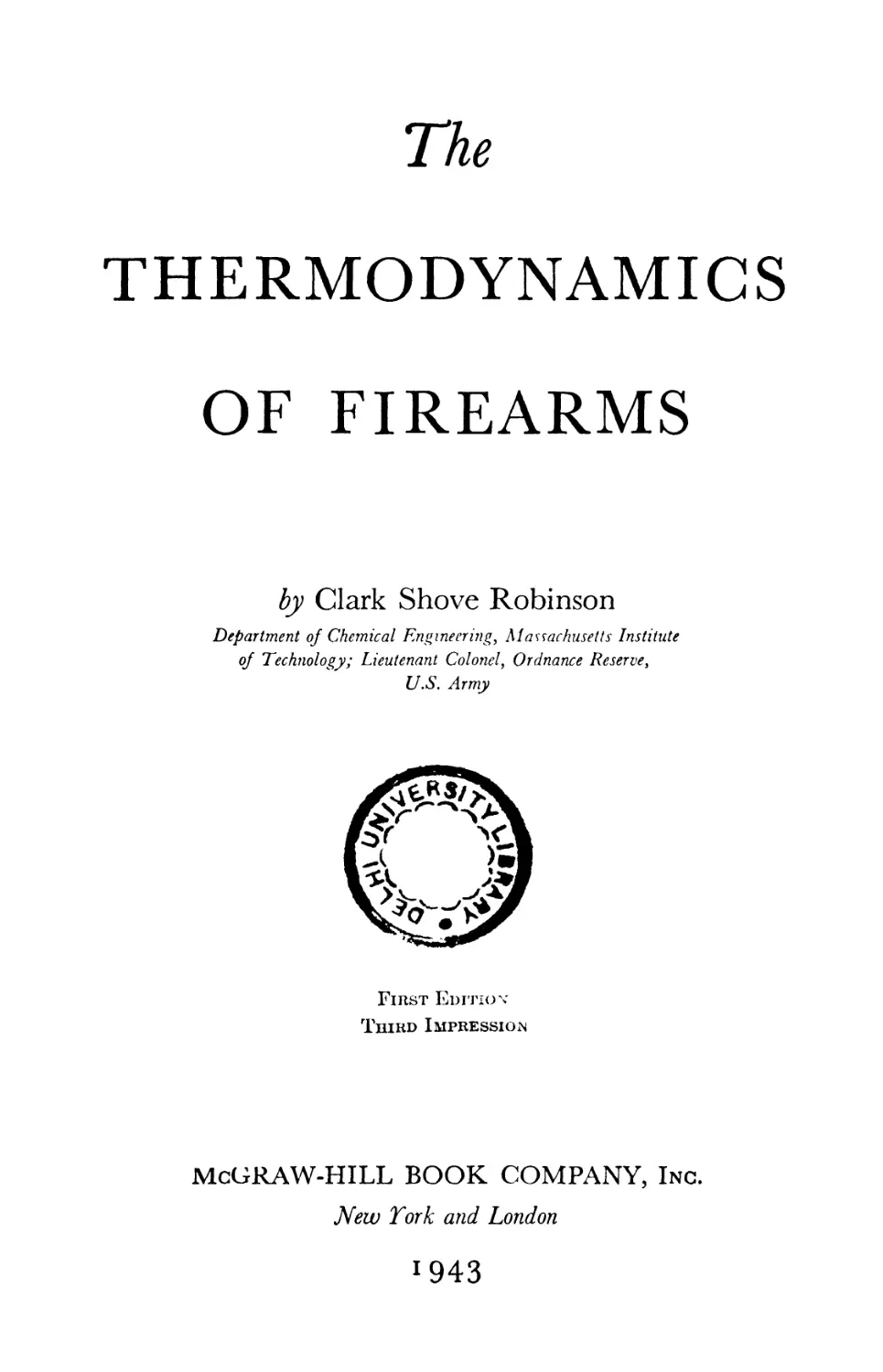
                    The
THERMODYNAMICS
OF FIREARMS
by Clark Shove Robinson
Department of Chemical Engineering, Massachusetts Institute
of Technology; Lieutenant Colonel, Ordnance Reserve,
U.S. Army
First Edition
Third Impression
McGRAW-HILL BOOK COMPANY, Inc.
New York and London
1943
THE THERMODYNAMICS OF FIREARMS
Copyright, 1943, by the
McGraw-Hill Book Company, Inc.
PRINTED IN THE UNITED STATES OF AMERICA
All rights reserved. This book, or
parts thereof, may not be reproduced
in any form without permission of
the publishers.
THE MAPLE PRESS COMPANY, YORK, PA.
PREFACE
This book has been produced under the restrictions of wartime
regulations in regard to confidential material. There is nothing
in it that has not been available in book and periodical form for
some years and that is not known by experts in the field of
interior ballistics. Nevertheless, there is no equivalent work on
the subject in the English language.
The recent great development of the explosives and ammuni-
tion industry has created a demand on the part of newcomers
into the field for a compilation of this information on a sound
theoretical basis. It is hoped that this book will fill this need.
The bibliography was prepared with the assistance of Ruth A.
Ogilvie.
Clark Shove Robinson.
Boston,
May, 1943.

CONTENTS
Рлоа
Preface............................................. v
Table of Symbols.................................. ix
Chapter I
Introduction........................................ 1
Chapter n
Basic Thermodynamic Principles..................... 5
Chapter hi
Basic Mechanics....................................22
Chapter iv
Basic Stoichiometry................................27
Chapter v
Basic Physical Chemistry...........................32
Chapter vi
Heat of Explosion..................................41
Chapter vii
Heat Capacity of Powder Gases......................55
. Chapter vni
Calculation of Explosion Temperature and Pressure 60
Chapter ix
Ignition of Propellent Powders.....................68
Chapter x
Rate of Explosion..................................75
Chapter xi
Loading Density....................................87
vii
viii	CONTENTS
Chapter xn	pAQX
Surface Factor.....................................90
Chapter xiii
Propellent-powder Composition......................92
Chapter xiv
Recoil.............................................96
Chapter xv
Rotation of Projectile.............................99
Chapter xvi
Friction..........................................102
Chapter xvii
Flash and Smoke...................................109
Chapter xviii
Stability of Propellants..........................112
Chapter xix
Measurement of Pressure...........................114
Chapter xx
Measurement of Temperature........................116
Chapter xxi
Closed-chamber Experiments........................118
Chapter xxii
Graphical Study of Experimental Firings  .........132
Chapter ххш
Calculation of Interior-ballistic Curves..........135
Chapter xxrv
Rockets...........................................145
Unit Equivalents..................................149
References........................................151
Index.............................................173
TABLE OF SYMBOLS
A = area
a = acceleration
°C. ® degrees centigrade
c » heat capacity or specific heat
= radiation coefficient
d ® differential
® diameter
E ® internal energy
e ® web thickness
°F. ® degrees Fahrenheit
F « friction
e force
f =« coefficient of friction
g = acceleration due to gravity (980.7 cm. per sec.1, or 32.16 ft. per sec.2)
H = enthalpy — E + PV
I = moment of inertia
К = equilibrium constant
°K. = degrees Kelvin (degrees centigrade + 273.1)
к ® proportionality coefficient
= Vieille exponent
e radius of gyration
L ® length
In ® logarithm to base e = 2.303 X logio
log = logarithm to base 10 = logio
M = mass (1 slug ® 32.16 lb.; 1 g.)
= molal
TV ® number of molecular weights (moles)
« force normal to sliding surface
n = twist, in calibers
P « pressure
p « partial pressure
® emissivity
Q ® heat (external heat effect)
R « gas constant (1546 in foot-pound-Rankine degree units; 0.08206
in liter-atmosphere-Kelvin degree units, 1.987 in heat units)
°R. « degrees Rankine (degrees Fahrenheit + 459.6)
r ® radius, or distance from center of rotation
T ® absolute temperature, in degrees Kelvin or Rankine
t ® temperature in degrees centigrade or Fahrenheit
и — velocity
ix
X
TABLE OF SYMBOLS
V " volume, usually molal or specific
W - work
e weight of powder
x « elevation
г - fraction of web consumed (Kent formula)
Subscripts
c « critical value
« conductive
e final value
n ,	,	- actual value
R - reduced value = д,а1уа1ие
r « radiant
max «« maximum value
Greek Letters
у
<x (alpha) — van der Waals’s covolume -y
» proportionality constant
3 (beta) » constant in Charbonnier’s formula
7 (gamma) » ratio of specific heats
Д (delta) » loading density (grams per cubic centimeter)
« difference of limits, such as T2 — Ti
к (kappa) « ratio of specific heats
X (lambda) « Vieille coefficient
д (mu) « viscosity
== coefficient in PV » ixNRT
Ф (phi) » function of
« angle of twist
r (pi) « ratio of circumference to diameter
« total pressure
p (rho) » density
3 (theta) « time
w (omega) « angular velocity
Calculus Symbols
f « integral sign (summation)
d « partial derivative
THE THERMODYNAMICS OF
FIREARMS
CHAPTER I
INTRODUCTION
Thermodynamics is the science of the relationship between heat,
work, and other forms of energy in combination with the physical
properties of the substances involved.
Firearms are weapons from which projectiles are discharged by
the explosion of gunpowder or other propellant.
The gun is a heat engine, used to convert the heat of exploding
powder into mechanical energy, and as such is amenable to the
fundamental concepts of thermodynamics. It takes propellent
powder, rich in stored-up energy, and causes it to explode and
produce gases at high temperature and pressure. These hot,
highly compressed gases, confined in the powder chamber, expand,
pushing the projectile in one direction and the gun in the
other, the energy present in the gases being converted by this
process into kinetic energy of the moving parts and into friction.
The gun as a heat engine differs only from other types of heat
engine in the fact that the firing of the gun is not a cyclic process,
in contrast to the steam or internal-combustion engine where all
the moving parts return to their original positions at the end of
a cycle. But from the thermodynamic viewpoint the three have
much in common, the resemblance between the gun and the
internal-combustion engine being marked. The basic thermo-
dynamics that applies to the explosion in the internal-combustion
engine can be applied to the firing of the gun with but few
changes and with much profit.
The present high degree of refinement in steam turbines and
gasoline engines is largely due to the fact that scientific study of
their functioning is possible with the aid of thermodynamics.
1
2	THE THERMODYNAMICS OF FIREARMS
Firearms are susceptible to similar treatment, and it is the pur-
pose of this book to indicate the lines along which this may be
carried out. The lack of a complete thermodynamic treatment
of firearms at the present time is due, not to the difficulties
involved, but to lack of adequate data. It is hoped that such
data will be forthcoming.
It is expected that this book will be used to some extent as a
textbook in courses relating to the design of firearms and ammuni-
tion; therefore, the material has been developed along textbook
lines, starting with fundamental thermodynamics and later apply-
ing the basic principles to firearms. Readers who are familiar
with thermodynamics may find this method elementary. How-
ever, many who use this book will have had no previous training
in the subject. The arrangement of material is based on the
author’s experience in teaching both interior ballistics and thermo-
dynamics for many years.
Thermodynamics, as it is now known, is the result of develop-
ments over a period of several hundred years, chiefly, however,
during the past one hundred and fifty. Numerous engineers and
scientists have been interested in these developments—many of
them because of their studies of guns and ammunition. For
example, the first man to discover what is now known as the first
law of thermodynamics, Benjamin Thompson, Count Rumford,
investigated the subject while he was inspector general for the
Elector of Bavaria in the late eighteenth century. He noticed
that heat was liberated when cannon were being bored at the
Royal Arsenal at Munich and made measurements of the amount
of heat so produced. Another famous name in thermodynamics
in the early nineteenth century is that of Carnot, who was
trained as an officer of the French army and was thoroughly
familiar with ordnance problems. This joint interest has con-
tinued all the way from Bernoulli and Newton in the seventeenth
and eighteenth centuries to Gibbs and others in the nineteenth
and twentieth.
Ballistics is the art of-hurling a projectile. It is ordinarily
divided into two branches, interior ballistics, which deals with the
projectile and its accessories while it is within the weapon, and
exterior ballistics, which deals with the projectile from the gun to
the target. Exterior ballistics controls the projectile with its
velocity, spin, and angle of flight as it leaves the muzzle of the
INTRODUCTION
3
gun and subjects it to the several external influences that deter-
mine its subsequent course, including gravitational, fluid-fric-
tional, and meteorological effects. Interior ballistics includes all
the previous history of the firing from the instant the firing pin
or hot wire ignites the primer mixture until the projectile and the
hot powder gases have left the muzzle. It involves studies of
ignition, the rate of explosion of propellent powder, the tempera-
ture, composition, and pressure of the resulting products of the
explosion, the travel of the projectile in the bore of the gun
together with the fluid flow of the powder gases, and certain
external effects such as heat, flash and smoke, and recoil. —
The design of propellent powder suitable for a specific weapon
falls clearly in the field of interior ballistics. It involves some
study of the chemical and physical-chemical relationships of
powder and of powder gases.
The possibility of correlating laboratory experiments in interior
ballistics, such as closecbchamber, or laboratory, bomb firings,
with the actual performance of the same propellent powders in
the gun itself is one of the attractive features of this method of
presentation.
The mechanical features of gun design and construction are
usually grouped under the heading of ordnance engineering, and
the manufacture of propellent powders and other ammunition
materials comes ttnder the subject of ammunition manufacture..
However, neither ordnance engineer nor ammunition designer can
move a step without specifications furnished to them by the
interior ballistician as to pressures, velocities, charges, rates of
explosion, etc.
The primary requirement of the weapon has to do with the
functioning of the missile on arrival at its destination, and the
gun has the sole purpose of placing it there in working condition
at the right time. The gun is therefore a means to an end and is
the result of this primary requirement.
It may therefore be presumed that the statement of the prob-
lem will specify the primary conditions to be met. This will
include the type and size of projectile to be used, the range at
which it is to be fired, and the angle at which it is to hit
the target. Secondary requirements that will also influence the
problem will have to do with the mobility of the gun and the
desired rapidity and duration of its fire.
4	THE THERMODYNAMICS OF FIREARMS
The problem of the flight of the projectile from the gun to its
target is one of exterior ballistics and deals with the behavior of
the projectile after it has left the gun and is beyond direct control.
Exterior ballistics therefore has to do with the effect of natural
laws on the projectile while it is in flight. It presupposes that
the projectile leaves the gun with an initial velocity and initial
spin and at an initial angle of azimuth and of elevation. It is the
specific problem of exterior ballistics to figure backward from
the target to the gun in order to determine just what these initial
conditions must be.
It is the problem of interior ballistics to design the gun and
ammunition so that the initial requirements set up by exterior
ballistics as to velocity, spin, and angles are met.
CHAPTER II
BASIC THERMODYNAMIC PRINCIPLES
The relationship between the many forms of energy, including
heat and work, is simple. The basic principle is that energy can
be neither created nor destroyed. This is known as the first law
of thermodynamics and is based on experiments covering a period
of over a hundred years. Energy in the form of work can be
converted completely into heat, while that in the form of heat
can be converted partly back into work, depending on the tem-
perature. Energy may also be tied up in a substance as latent,
or bound, energy and as such is called internal energy. If a sub-
stance is in motion, it has kinetic energy. If it has been raised
up above some datum level, it has potential energy due to its
elevated position. It may be charged with electricity or magnet-
ism and have energy on that account. It may have chemical
energy on account of its composition. The first law of thermo-
dynamics says simply that the loss or gain of energy by a body
is accompanied by an equivalent gain or loss of energy in its
surroundings.
The second law of thermodynamics is equally simple. It states
merely that energy in the form of heat can be more or less com-
pletely converted into work or other form of mechanical energy
depending on the temperature of the body from which the heat
is taken. The system of temperature referred to in this book
is the absolute temperature, as measured above absolute zero, which
is — 273°C. or — 459.5°F. depending on whether the centigrade
or the Fahrenheit system is used. Absolute zero is the lowest
possible temperature that can ever be reached.
Work may be mechanical or electrical in character. Mechani-
cal work is usually defined as the product of force times distance.
For example, a force that lifts a one-pound weight a vertical
distance of one foot has done one foot-pound of work on the body
so lifted.
Since work can be quantitatively converted into heat, it is
often convenient to express work in heat units instead of mechani-
5
6	THE THERMODYNAMICS OF FIREARMS
cal units. One heat unit in the English system is the heat needed
to raise one pound of water one degree Fahrenheit, and is called
the British thermal unit (B.t.u.); in the metric system, it is the
amount of heat needed to raise one gram of water one degree
centigrade, being called the calorie (cal.). It requires 778.26 foot-
pounds of work to be the equivalent of 1 British thermal unit.
Since there are 453.6 grams in 1 pound and 1.8 Fahrenheit degrees
is the equivalent of 1 centigrade degree, the number of calories
of energy equivalent to 1 British thermal unit is 453.6/1.8, or
252 cal. = 1 B.t.u.
It is customary and convenient to express the first law of
thermodynamics as a formula, based on the fact that the amount
of energy contained in a system at the start of a process plus the
net gain or loss of energy during the process from or to the sur-
roundings.must be equal to the amount left in the system at the
end of the process. In the following equation the subscript 1
refers to the start and the subscript 2 to the .end of the process.
„ ,	. MuJ . л tit л ,	. Mu??
Ei + xi +	+ Q- W = Ez + xz +	(1)
This formula is for a batch system where the entire contents of
the system remain within it at all times. The meaning of the
symbols is as follows:
E = internal energy of the material in the system. This energy
is represented by the energy content due to the temperature
of the body, its chemical composition, its molecular struc-
ture, its physical state, whether a liquid, solid, or gas, and
similar properties. This form of energy is that stored
within the body and is other than that due to its position
in space or its mass movement as a whole. It is not practi-
cable to obtain an exact value of E, but its relative value
can be obtained by comparison with some other known con-
dition as a point of reference. It does not depend on the
previous history of the material in the system.
x = potential energy, which is the energy a body possesses due
to its position above some datum plane or reference level.
M = mass of the body in question. In the English system, the
unit of mass is the slug, which weighs 32.2 or g lb. In the
metric system the unit of mass is the gram.
и = velocity, or rate of mass movement of the body as a whole
BASIC THERMODYNAMIC PRINCIPLES ,
7
Q и heat received by the body from the surroundings between
the start of the process (point 1) and the end of the process
(point 2)
W = work performed by the system on the surroundings between
the beginning and the end of the process
The mechanical work done on a mass of material to force it
into a system from the outside may be computed by measuring
the force needed to move the mass from the outside to the inside
of the system multiplied by the distance the force has to act,"
since, by Newton’s laws of motion, mechanical work is equal to
force times distance. Since force can be measured as pressure
per unit area (pounds per square inch) times the cross-sectional
area against which the pressure is applied and the distance which
the mass moves times the cross-sectional area is the volume of
the mass, the work needed to push it into the system will be
Work = force X distance = pressure X area X distance (2)
Work = pressure X volume = PV	(3)
where P = pressure acting on the mass in question
V = its volume
In a system in which material is entering continuously at a
uniform rate at one point and the same weight of material is
leaving the system at another point, the work done by the sur-
roundings on the material so entering is equal to the pressure
required to force it into the system times its volume. If the
inlet point be designated by the subscript 1, then this work will
be Р1У1. In the same manner, the material leaving the system
must do work on the surroundings in order to get out; and if the
outlet point be called 2, then this amount of work will be P2V2.
A system, therefore, in which material is entering and leaving
at a continuous, uniform rate is known as a “flow” system, and
the formula for the energy balance on a definite mass of material
entering and leaving the system is similar to the one for the
batch system with the items PiV\ and P2V2 added. This is in
the form
E1 + P1V1 + x1 + ^ + Q-W = E2 + P2V2 + x2 + ^ (4)
The sum E + PV is called enthalpy and is indicated by H.
8	THE THERMODYNAMICS OF FIREARMS
Therefore, the flow formula becomes	—/
f н1 + ®1 + ^ + с-ж-я, + ®, + ^ Й)
4	£i	At
The gun is an example of what might be called a “semiflow”
process. At the time it is fired, all the material, powder, and
projectile are already in the system and the initial velocity is zero.
At the end of the process, the projectile and some of the powder
gases are leaving the system and there is a large velocity effect.
A special formula of the energy balance for this case would be
Ex 4-	+ Q - W = E2 + Р2У2 + x2 +	(6)
A
For this equation to hold, all terms in it must be expressed in
the same units, such as foot-pounds or perhaps calories. It is
customary to select the system so that it contains 1 lb. or 1 gm.
The word system in thermodynamics refers to a body of matter
isolated from its surroundings but able to exchange energy with
it in the form of either heat or work. If there is no heat exchange
between the system and its surroundings, the process is called
adiabatic. If a system undergoes a change of such a character
that an exact reversal of the process would restore the system
to its original state, which might occur if the process were
frictionless, the change is called reversible.
Heat added to a system is positive and is called Q. When heat
is removed, Q is a negative quantity.
Work done by a system on the surroundings is positive and is
called W; therefore, in a horizontal batch apparatus with no
velocity effects,
Q -W = ЛЕ	(7)
The last formula is commonly used for many cases, particularly
in its differential form
dQ - dW = dE	(8)
Suppose that the system consists of a horizontal cylinder,
insulated against external heat effects so that it is adiabatic and
equipped at one end with a frictionless piston whose cross-
sectional area is A and with its other end closed. The cylinder
contains expansible fluid, such as air, at the pressure P. The
BASIC THERMODYNAMIC PRINCIPLES	9
force acting on the inside of the piston and attempting to push
it out will be pressure times area, or F (force) « PA. If the
piston moves out a distance dL, which would correspond to an
expansion of the fluid dV at zero velocity, so that there is no
kinetic-energy effect, then dW = PA dL = P dV, which is the
work done by the fluid on the piston and, in this case of a friction-
less piston, also equals the work done by the piston on the
surroundings. When the piston has moved a finite distance L,
the total work will be the sum of all the differential works and
will be given by the integrated formula
J* Vi
v'PdV	(9)
which is good for a frictionless or reversible process only. There-
fore the batch energy balance becomes
Q = AE+r'PdV	(10)
J Vi
for a reversible process only, where ДЕ represents E2 — Ei.
In the case where the cylinder is not horizontal and the piston
moves with an appreciable velocity, the changes in potential
energy and kinetic energy must be allowed for. If the cylinder
contains a unit weight of fluid and the piston itself has no mass,
then the increase in kinetic energy of the moving fluid will be
(Mu22/2) — (Afui2/2); and since, for one unit weight, M = 1/g
where g is the acceleration due to gravity, the increase in kinetic
(эд2\
=- I. Similarly, the change in potential energy
Щ/
will be a?2 — Xi, or Ax. In such a case, и and x represent the
average velocity and average elevation, respectively, of the unit
weight of fluid at the instant in question.
Example 1.—The work done by a gas supplied to a horizontal cylinder
12 in. inside diameter at a constant average pressure of 2,000 atm., pushing
a frictionless piston a distance of 10 ft., is calculated as follows:
W - fJ'PdV’* P(Vt - VO « PA(Lt - Li) - 2,000 X 14.7
x 144 x 10 = 33,200,000 ft.-lb.
4 X 144
The units in this calculation are taken as follows: If W is to come out
in foot-pounds (ft.-lb.), then P must be in pounds per square foot (lb. per
10
THE THERMODYNAMICS OF FIREARMS
sq. ft.), and V must be in cubic feet (cu. ft.), since pounds per square foot
times cubic feet equals foot-pounds.
1 atm. — 14.7 lb. per sq. in. - 14.7 X 144 lb. per sq. ft.
33,200^0 ft-lb: , 42)700 B.t.u.
f <O.«0
Example 2.—Suppose the gas in Example 1 had expanded, not at
constant pressure, but under such conditions that the pressure decreased
as the volume increased, so that PV = a constant = P\V\. Then
J-7,
тг PdV, substituting that value for P gives
V i
= fV'PiVi the value of which, according to calculus, is Pi Vi
log. (7,/7i).
If the original volume of the gas 7i corresponded to Li = 10 ft., then
7j would correspond to Li = 20 ft. and
W - 2,000 X 14.7 X 144 X X X 10 X log.
Since log. Ц = log. 2 « 0.693,
W = 2,000 X 14.7 X 144 X ? X X 10 X 0.693
’	4 >	144
= 23,000,000 ft.-lb.
This example would approximate a constant-temperature expansion of
the gas.
Example 3.—If the gas in Example 2 had expanded adiabatically, without
friction, the relation between the pressure and the volume would be given
approximately by the formula PVn = a constant = Pi7in. If the exponent
n were 1.4, then the expansion work of the gas would be calculated as
follows;
W « fVi P dV = Pi7i14 CVi
"	J Fi	V 11 J Fi 7“
By calculus,
	LA
"	0.4	F,04/
Ш L _ XLA _ L (v - F»14A
W " 0.4 \Fi»4 Fi°7 “ 0.4 v ‘	V>°-4/
Since Pi = 2,000 X 14.7 X 144 = 4,230,000 lb. per sq. ft.,
Vi - j X ~~ X 10 - 7.85 cu. ft.
4	144
Fl - I X x 20 = 15.7 cu. ft.
W _ 4,230^000 £7 86 _ g.8|L.J = 19,900,000 ft.-lb.
BASIC THERMODYNAMIC PRINCIPLES
11
Example 4.—Suppose that the tube in Example 3 had been vertical, and
the frictionless piston being pushed by the expanding gas had weighed
3220 lb., which would be 100 slugs (the English system unit of mass is the
slug, weighing 32.2 lb.); then the energy given up by the gas, whose weight
in this example will be neglected, will be used up in raising the piston and
giving it kinetic energy due to its velocity.
W = 19,900,000 ft.-lb. = Дх 4- Д (^y-)
Дж = 10 ft. X 3,220 lb. = 32,200 ft.-lb.
Initial velocity Ui = 0
In order to calculate uj, the velocity when the piston has traveled 10 ft.,
make use of the following mechanics relationships:
F = Ma
where F = force
M = mass
a = acceleration	(11)
a = rate of increase of velocity =	(12)
where du = velocity increase during the time dO
и (velocity) = jy
where dL = distance traveled during the time dO	, (13)
When energy is added to a body, causing a rise in temperature
of that body, that energy is called sensible heat. Latent heat,
when added to a body, is that energy which causes a change in
its physical form such as melting or boiling without rise in
temperature
Sensible heat, added to a body under such conditions that the
pressure exerted by the body remains constant during the heating
process, is called heat added at constant pressure and is repre-
sented by Qp. Sensible heat added while the volume of the body
remains constant is called heat added at constant volume and has
the symbol Qv. The Qp needed to raise one unit weight of the
material in question 1° is called its specific heat at constant pres-
sure, cp, while the corresponding Qv is called specific heat at
constant volume, cv.
Referring to the basic formula Q — W = &E, for a constant-
volume reversible process where the work W is equal to j*r*P dV,
12
THE THERMODYNAMICS OF FIREARMS
once dV « 0, therefore, Q« » AE. However, if Q« is the sensible
heat needed to raise the temperature of a unit weight of the
material from Ti to Тг, then
Qv = St' CvdT =	(14)
Another way of writing the same thing is
(dE\
\дт), C’
(15)
and this is its usual definition.
The sensible heat added at constant pressure, Qp, must allow,
not only for the heating at constant volume, but also for the
J*V2
v P dV
against the surroundings. Therefore,
Qp — W = AE or Qp-f^PdV = AE (16)
Qp =	Cp dT = AE + fy ' p dV	(17)
This last equation may be rewritten in differential form as in the
previous case, giving
—4- P (—	= c
dTJp + \дТ)р :
(18)
which is the usual definition for specific heat at constant pressure.
If these heat effects are for quantities other than one unit
weight, they are called heat capacities and the quantity of material
must be stated.
In addition to the heat capacities of substances, their pressure-
volume-temperature relationships must be known. There are no
accurate simple PVT relations for real gases and vapors. They
must be determined experimentally for each gas. There are,
however, certain approximate PVT relations that are often con-
venient, if not exact. The best known is the perfect-gas law.
This so-called law does not apply accurately to real gases, but
some of them come close enough to it so that it may be used for
many calculations. The perfect-gas law has two formulas, both
of which must apply for a perfect gas.
BASIC THERMODYNAMIC PRINCIPLES	13
PV <= NRT	(19)
(5?) =0	(20)
\uJL J T
The second formula states that there is no change in the internal
energy E of a perfect gas when the temperature is constant, no
matter how the pressure P or, for that matter, any other con-
dition such as volume V changes. In PV = NRT, for the
perfect gas,
P = pressure exerted by the gas, lb. per sq. ft.
V = volume occupied by the gas, cu. ft.
N = number of molecular weights of the gas in question
One molecular weight would be 2 parts by weight of hydrogen
(H2), or 32 parts of oxygen (O2), or 28 parts of nitrogen (N2), etc.,
considering these gases as “perfect.”
R = the gas constant = 1,546, in ft.-lb.—°F. units
T = absolute temperature of the gas = °F. + 459.6, in °F. units
Since, for a perfect gas, the second formula means that the
internal energy is a function of temperature only, then the formula
can be rewritten
dE = cv dT	(21)
and, combining it with the PV = NRT for N = 1 and with
Q — W = &E for a reversible process, it follows that
Mcp = Mcv + R	(22)
where Mcp and Mcv are molal heat capacities, for one molecular
weight of the gas.
The ratio of the specific heats cp/c„ (called к or 7) is also useful.
For a perfect gas, being compressed or allowed to expand
reversibly at constant temperature, since ЛЕ = 0
Wt = Qt = С’ P dV
JVl
Substituting for P its value NRT/V gives
CVt NRT dV CVt
Qt = Wt	= NRT d (In У)
JVi “	JVi
Qt = NRT In £ = NRT In £?	(23)
V1	it
Table 1.—Summary of Formulas for Perfect Gases
Condition of restraint	v -c	P - c	т = с	I	Q = o Reversible; adiabatic	Q = Се ДТ Reversible; polytropic
PV relations	Fi = Vt	Pl - Pt	PiFi - PtVt Pt Fi Pi “ Vt	PiFi* » PtVt* 5e/Ly Pl \vj	PiFi» = PiFi* * - fby Pl \vj
PT relations	515 и 1 2IS			Ti - Tt	к— 1 I? e (ЪХ— Tt \pj	n — 1 I? _ (?Л~ Ti \pj
TV relations		Vi Ti Vi " Ti			Й-СЙГ	Й-(ЙГ
•	ДР7	- F(Pa - Pl)	- P(Fi - Pl)	~ 0	--[(йрМ	-PiFi[(£) — _x] n— 1 -™Ti[(£)~-1]
ДТ			= 0		n	I ”11 Hl 1	1 H*	t »-* t
Q	- ДЕ - NC, ДТ - " к - 1	- ДН - NCp &T 	Ц-ДР7 к — 1		 Pl Fi - -NRTln^ Vt	= 0	“ /	(Л/	№ АГ (к - l)(n - 1) n— 1 -(к-п)(NRTi) Г /РЛ	1 (к ~ l)(n - 1) IAPi/	J e —~	~ n)— дР7 (<- l)(n - 1) n — 1 -(к - n)(PiFi) Г (РЛ— _ , 1 («- D(n - i) Lw	4
THE THERMODYNAMICS OF FIREARMS
JFuon«flow e / P dV Reversible	- 0	- ДР7 - P(F> - Fi)	- -лтгпп^ - -ATRTln^1 V 2	-l' S «Г s'l’ 1	1	l> ®	к 1-4 < § 1 7 £ 1 1	1 * 1 1 * 1	INI	1	1	й	й 3 1 Тз 1	1 1 ? > 1 §	§ - * - * * I	1 И!*4’?с 1 ~
VPeh*ft e ~~ f F dP Reversible	- F ДР - F(Pi - Pi)	- 0	- — ЛГЯПпр^ Vi = -WTln^ Vi	» -ДЯ - — NCp AT - - («/* - 1)(APF)	- - (п/п - 1) NR йТ -^тЧ(йгМ = - (п/п - 1) (APF) -5г?Н(Й)—-]
Д2Г	- ЯС. ДТ = LPV к — 1	» NC, AT ж — 1	= 0	и	ii a	i "N ж|?’ж|2 1 1—1	(—n 8 Hl «Il ? 1	1	1 1 1 е	| 1 с “т-1	1—1 < В,Р UI- - S gl1 1 Я1 1 W <1 1 W	1	X й	II	й	П
ДН	- NCp AT	= NCP AT 	Ц-ДР7 ж — 1	= 0	e — TFahaft e NCp AT “ т^тлру -‘^[(йгМ	II	й II	н *|L *| х	*1 ' ?	т	1 *	т 1—1	>	 1	>* Z**s	r~1	50 а?	’	§	$ 1’	'Til и-	1
Notation: P — absolute pressure. T » absolute temperature. V = volume. CP = molal heat capacity at	constant	pressure.	С»	и	molal heat
capacity at constant volume, ж — Cp/C9, Д “ final value — initial value. Се — C»[(k — n)/(l — n)].
Subscript: 1 « initial state; 2 e final state. N = number of moles. R * gas constant.
Conditions: PV - NRT for equation of state. Cp and C9 are constant. Ср — С» - R. For flow,	Д (U*/2g)	and	ДХ	are assumed negligible
BASIC THERMODYNAMIC PRINCIPLES
16 THE THERMODYNAMICS OF FIREARMS
For a perfect gas in a reversible adiabatic process, Q = 0 and
therefore
-W = AE = - fJ'PdV
JVi
J.r,
cv dT, then
Ti
CT>	CVi	CVi dV
cvdT = — I P dV = — \ NRT^r
JTi	J Vi	JVi	У
which, when rearranged, gives
AV	V
cvdT = —NR = -NR In p (24)
JTi	JVi V	Vt
If cv is called a constant at the average volume over the tem-
perature range involved, this relationship then becomes
СТг dT _	. Tz _ Л7р. Vz	zoK\
Cv I г т у — In	(25)
For one mole, or molecular weight, N = 1 and
\tJ \vj \vj
giving
(m \MCV -	tt	/ rn \ «—1
TJMC~ - " Й = (Й)	(26)
and also the PT relationship
) or PV’ = a constant (27)
Substituting this in the AE value for one mole of a perfect gas,
AE = Mcv AT =	[ Ф) ‘ - 1
к - 1L \Pi/
(28)
Table 1 is a summary of the thermodynamic formulas for a
perfect gas with a constant value of the specific heat.
BASIC THERMODYNAMIC PRINCIPLES	17
J*Ti
„ c, dT should be
Г1
evaluated graphically, using experimental relationships between
c, and T, as given later in Chap. VII.
At the pressures and temperatures obtained in firearms, the
perfect-gas laws fail to give sufficiently accurate results at higher
pressures. Various formulas have been developed to allow for
these deviations. The best one is that due to van der Waals,
(p + (V - a) = RT for 1 mole (29)
In this formula b/V2 is a measure of the mutual attraction of the
gas molecules for each other, and a is the so-called “covolume,”
or the space actually occupied by the gas molecules, and is
supposed to be one-third the critical volume Vc of the gas in
question. When the pressure P is very high, it is often suitable
to omit the b/V2, and the formula becomes
P(7 _ «) = RT
(30)
A still better approximation of the PVT relationships is given
by the д chart method. This method uses the formula
PV = uNRT
(31)
when д is an empirical factor that has been found to be the same
for all common gases and is based on the critical values for the
individual gases. The treatment is as follows:
Divide the actual absolute pressure exerted by the gas by its
critical pressure, and call the quotient the reduced pressure
P
Pc
= Pr
The reduced temperature is obtained in a similar fashion,
T
¥c = T^
and the reduced volume
V
Vc
= VB
18
THE THERMODYNAMICS OF FIREARMS
Table 2 gives critical volume for common gases, the tempera-
tures being in degrees Kelvin (°C.abs. « °O. + 273.2) and the
pressures in atmospheres.
Table 2
Gas	Tc, °K.	Vc, liters per mole	Pe, atm.	Molecular weight
Acetylene (C2H2)		309.	0.113	62.	26.02
Ammonia (NHs)		405.6	0.0724	111.5	17.03
Argon (A)		151.	0.0753	48.	39.94
Carbon dioxide (CO2)		304.3	0.0957	73.0	44.00
Carbon monoxide (CO)		133.0	0.0930	35.	28.00
Ethylene (C2H4)		282.8	0.127	50.9	28.03
Helium (He)		6.3*	0.058	3.26*	4.00
Hydrogen (H2)		41.3*	0.065	20.8*	2.02
Methane (CH4)		190.7	0.099	45.8	16.03
Nitric oxide (NO)		179.	0.0578	65.	30.01
Nitrogen (N2)		126.1	0.0900	33.5	28.02
Oxygen (O2)		154.4	0.0744	49.7	32.00
О	\	*/ ••••••••••••••••• Water vapor (H2O)		647.2	0.0566	217.7	18.02
* The values for hydrogen and helium are not the true critical values but empirical ones
selected so that these two gases will fit the same values of д that other gases fit.
The plots (Figs. 1 and 2) give the values of д plotted against
the reduced pressure Ря for various values of the reduced tem-
BASIC THERMODYNAMIC PRINCIPLES
19
perature Tn. The values for Tn up to 14 are based on averages
Fig. 2.
data are given from the “ International Critical Tables” (vol. Ill,
page 6); V = 1 at 0°C. and 1 atm.
PV = a+ ЪР + cP2 + dP*	(32)
Table 3
T,’C.	a	6	c	d
—208	+0.2384	+0.035508	+0.0*2380	—0.0’141
-183	0.3299	6229	0735
-150	0.4507	5090	0259
-100	0.6336	5310	0165
-50	0.8165	5320	0.0*0094
0	0.9994	5290
+50	1.1824	5240
+ 100	1.3654	0.035080
In order to use Figs. 1 and 2, proceed as in the following
example:
Determine the volume occupied by 44 g. of CO2 gas at 2,000
atm. abs. and 335.4°C.
20
THE THERMODYNAMICS OF FIREARMS
The critical pressure for СОз is 73 atm., and the critical tern*
perature is 304.2°K.
T _ 335.4 + 273.2
T*-------3041-------20
= 27 4
73.0
Using Fig. 1, д = 2.02, and therefore
PV = 2.02Ж
д being independent of the kind of units used.
In the metric system, with P in atmospheres and T in degrees
Kelvin (degrees centigrade + 273.2), R is 0.08206, giving V in
liters and N in moles.
2,000 X V = 2.02 X X 0.08206 X (335.4 + 273.2)
V = 0.0504 1.
Experience indicates that calculations with the ц charts are
usually very close to the exact experimental values and, except
for very moderate pressures, are much to be preferred to those
values calculated from PV = NRT.
Using the covolume method, the following results are obtained
for the same case:
P(V — a) = RT
Ve 0.0957 nnQ1Q
a = -3- = —g— = 0.0319
2,000 X (V - 0.0319) = 0.08206 X 608.6
V = 0.0250 + 0.0319 = 0.0569 1.
which varies by more than 10 per cent from the more reliable
g chart value.
By Dalton’s law, the total pressure exerted by a gas mixture
is the sum of the pressures exerted by each of the constituents, or
the sum of the partial pressures. By Amagat’s law, the volume
of a gas mixture is the sum of the volumes of the several con-
stituents. Both these rules are approximate only but are usually
adequate for ballistic purposes.
For mixtures of gases, data for which at high pressures and
temperatures are not yet sufficiently reliable for accurate calcu-
lations, it is believed that the most satisfactory method for com-
BASIC THERMODYNAMIC PRINCIPLES
21
puting PVT relations is to use the д charts with weighted average
values for the reduced pressure and temperature. As an example,
it is required to estimate the volume occupied by two gram-
molecular weights of CO mixed with one gram-molecular weight
of N2 at 1000°C. and 1,000 atm. abs. pressure.
From the table of critical values, Te for N2 is 126.1° and for CO
is 133.0°, while Pc for N2 is 33.5 atm. and for CO is 35 atm. The
general method, for a moles of A, b moles of В, c moles of C, etc.,
would be
B a + Ы- c + • • •	+ Te„ + Tei
, _	1,000	/ a . b c
я “ a + b + c + • • \Pc. PCB + Pc.
(33)
(34)
Thus, in this example,
= (1,000 + 273.2) /2	1 \
я	3	\134 **” 126.1/
_ 1,000 / 2	1 \_290
Ря 3 \35 + 33.5/	29,0
From the charts, д = 1.30 and
1,000 X V = 1.30 X 3 X 0.08206 X 1,273.2
V = 0.408 1.
This method checks the volume of known mixtures very
closely.
CHAPTER III
BASIC MECHANICS
The basic mechanics of firearms stem from Newton’s laws of
motion. The basic units are mass (M), distance (L), and time (0).
Velocity (u) is the rate of change of distance with respect to
time and is usually written
dL	znex
u ~"dd
Acceleration (a) is the rate of change of velocity with respect
to time and is written
« =	“ -^2 = Я (when due to gravity) (36)
Force (F) produces acceleration in a mass and is defined as
F = Ma	(37)
Momentum is defined as mass times velocity,
Momentum = M X и	(38)
Newton's three laws of motion are given as follows:
I.	A force (F) is necessary to change the direction or velocity
of a mass in motion.
II.	A change in momentum (M X u) of any part of a system
must be accompanied by a corresponding change in momentum
in the opposite direction in the balance of the system so that the
resultant of all the changes in momentum is zero. This is called
the principle of the conservation of momentum.
III.	To every force exerted by one body on another, there is a
corresponding force equal to and opposite in direction, exerted
by the second body on the first. This is the principle known as
action equals reaction.
The work (TP) done on a body by a force (F) is the product
of the force times the distance over which the force acts, or
W = fL' F dL	(39)
J Lt
22
BASIC MECHANICS
23
„. dL „	,,	, du
Since и - F = Ma, and a =
W =
Ma dL =
Mu du =
C ъ/rdu ,
I M -jt- u dO
Jl, do
Мщ1	Mui2 .
~2------2” = Д
(40)
Mu2
"T"
Mu2/2 is called the kinetic energy of the moving body.
The mechanical work thus done on a moving body equals its
increase in kinetic energy. Force used up in overcoming friction,
rather than causing acceleration, does not increase kinetic energy.
In the case of a rigid body rotating about a fixed axis with the
angular velocity a, the change in angular velocity due to the
action of an applied force is and is called the angular accelera-
au
tion. The linear acceleration a tangential to the line of rotation
of any unit particle of the mass M' of the body is
(41)
(42)
dw
a ~rd0
where r is the distance of the particle in question from the center
of rotation and the force F acting on that particle is
z	F = M2' = M'r
av
The product F X r is the moment of the force acting on that
particle, and therefore the summation of all the moments of force
acting on the entire rotating body is
(43)
where 1 — moment of inertia of the rotating body
If the entire mass M of the rotating body could be concen-
trated in a hollow cylindrical shell of radius к such that
Mk2 = I	(44)
then к would be called the “radius of gyration” of the rotating
body.
The moment of inertia of a non-homogeneous rigid body is the
sum of the moments of all the homogeneous portions.
24 THE THERMODYNAMICS OF FIREARMS
It follows from these formulas that the kinetic energy of a
rotating body
“ 2
(46)
and the work done by the application of a force tangential to the
direction of rotation is equal to the increase in this kinetic energy.
It should be remembered that forces used in overcoming fric-
tion or in producing acceleration in directions other than those
in question are not included in the above discussion, only the
resultant forces acting in the direction of motion being used.
In the metric system, the gram is the unit of mass, and the
force exerted by gravity on one gram is therefore
F = 980.5 X weight, g. = force, dynes (46)
where the units are expressed in the centimeter-gram-second
system.
In the English system, the pound is the unit of force, and then
the value of the mass in this system is
Af = ~~32^2—~ mass’ slu9s	(^7)
where the units are expressed in the foot-pound-second system.
The use of these relations is given in the following examples:
A body weighing 322 lb. and therefore having a mass of
322/32.2 = 10 slugs is acted on by an unresisted force of 100 lb.
for a distance of 100 ft. •
M = 10 slugs F = 100 lb. F = Ma 100 = 10a,
a = 10 ft. per sec.2
du
t	a~ de
Ui ~~ Ui = 10(02 — 01)
If, at the start, when 0i = 0,	= 0, and Li = 0,
и = 100 =
(Lu
ede
L = 502
or
BASIC MECHANICS
25
Since Lt - 100,
0 «= VW - V20 = 4.47 sec.
and
Uj = 10 д/^б = 44.7 ft. per sec.
W = F X L = 100 X 100 = 10,000 Ib.-ft.
Using the metric system, consider a body weighing 1,000 g.
(M = 1,000) and acted on by a force of 5,000 dynes for a dis-
tance of 300 cm.; initial velocity and time = 0.
M = 1,000 F = 5,000 L = 300
F 5,000	_	2
° = м = да = 5 cm-per sec-
du	„
a = y-=u = a0 = 50
(10
/»0	02
L =	50 d0 = 5	= 2.502 or
Jo
0 “	“ 10>94 sec-
\ 2.0
и = 5 X 10.94 = 54.7 cm. per sec.
As an example of the principle of the conservation of momen-
tum, suppose that a projectile weighing 1,000 lb. is fired from a
gun mounted on a boat weighing 1,000 tons (2,000,000 lb.) with
a muzzle velocity of 2,000 ft. per sec. Since
Мл X uA = MB X uB
(48)
the velocity or recoil imparted to the vessel, uB, will be 1 ft. per
sec., in the opposite direction.	i
The force exerted by a gas under pressure in a closed chamber
is the product of the pressure per unit area times the area against
which the pressure is acting. Thus a 2,000-lb. projectile 1 ft. in
diameter whose base, against which a gas is pressing with a
pressure of 1,000 atm., has an area of тг/4 sq. ft. has acting on it
a force of
1,000 X 14.7 X 144 X = 1,660,000 lb.
26	THE THERMODYNAMICS OF FIREARMS
If this force is unopposed, the projectile will have an acceleration
of a ft. per sec.’
1,660,000 =
a — 26,700 ft. per sec.2
If such a pressure acted for a period of Ho sec. with the projectile
starting from rest, the velocity developed would be 2,670 ft. per
sec., and the amount of work done on the projectile would equal
its kinetic energy, or
X = 2.22 X 10’ ft.-lb.
Z 04.4	4
and the distance over which it must have acted would be
W = F XL
2.22 X 10® = 1.66 X 10е X L
b =	= 133.7 ft.
CHAPTER IV
BASIC STOICHIOMETRY
The application of the principle of the conservation of energy
and of material balances to chemical equations is called stoichi-
ometry. The sum of the number of atoms of any element present
on one side of an equation must be equal to the sum of the number
of atoms of that element present on the other side of the equation.
Similarly the weights of each element on both sides of an equation
must be equal.
The system of symbols used by chemists is very simple. For
example, the symbol C stands for the element carbon. It also
stands for one atom of carbon, which has an atomic weight of 12,
expressed in pounds, or grams, or any other convenient system.
The common chemical elements met with in propellent powders
and other explosives are given in Table 4:
Table 4
Name	Symbol	Atomic weight
Commonest:
Hydrogen		H	1.008
Carbon		C	12.01
Nitrogen		N	14.01
Oxygen		0	16.00
Less common:
Aluminum		Al	26.97
Barium		Ba	137.36
Calcium		Ca	40.08
Chlorine		Cl	35.46
Copper		Cu	63.57
Iron		Fe	55.84
Lead		Pb	207.21
Magnesium		Mg	24.32
Mercury		Hg	200.61
Phosphorus		P	30.98
Potassium		К	39.10
Silver		Ag	107.88
Sodium		Na	23.00
Sulphur		S	32.06
Tin		Sn	118.70
Zinc	1	Zn	65.38.
27
28
THE THERMODYNAMICS OF FIREARMS
The equations to describe chemical reactions make use of these
symbols, to indicate, first, the proportions of the several elements
that go to make up a chemical compound and, second, the ratios
in which these chemical compounds react with each other to
produce new substances.
For example, water is a compound of hydrogen (H) and
oxygen (0) in the proportion of 2 H and 1 O, and so its chemical
formula is written H20. This also shows that 2 parts of hydro-
gen, weighing 2.016 lb., combine with 1 part of oxygen, weighing
16.00 lb., to produce 18.016 lb. of water (H2O).
In a similar manner, 12.01 g. of carbon (C) combine with
32.00 g. of oxygen (0) to produce 44.01 g. of carbon dioxide
(CO2).
To use a less familiar material, the modern very sensitive
explosive that is used in detonators, lead azide, is a compound
of 1 atom of lead, weighing 207.21, and 6 atoms of nitrogen,
weighing 6 X 14.01 = 84.06, so that the formula weight of PbN«
is 207.21 + 84.06 = 291.27.
One of the principal constituents of smokeless powder is
cellulose nitrate, one form of which has the chemical formula
C24H3o02o(N02)io, each molecular weight of this substance con-
taining 24 atoms of C, 30 of H, 10 of N, and 40 of O. Its formula
weight would therefore be
24 X 12.01 = 288.24 C
30 X 1.008 =	30.24 H
10 X 14.01 = 140.1 N
40 X 16.00 = 640.0 О
Formula weight = 1,098.58
and it contains 140.1/1,098.58 X 100 = 12.76 per cent N.
When cellulose nitrate explodes, the products of the explosion
may be considered to be CO2, CO (carbon monoxide), H2O, H2
(hydrogen gas), and N2 (nitrogen gas). The chemical equation
for this explosion would be as follows, the lower-case letters indi-
cating the number of molecules of each of the explosion products.
СмНзо02о(Ы02)ю = aCO2 + 5CO + cH2O + dH2 + eNa (49)
The number of each atom must be the same on both sides of the
equation. Therefore,
BASIC STOICHIOMETRY
29
а Ч- b = 24 0
a + ^ + ^ = 20Oa
c + d = 15 Ha
e = 5 N2
Here are five quantities to be evaluated, a, b, c, d, and e, with
four equations. Therefore, a fifth relationship is needed. As
will be shown in Chap. V on Basic Physical Chemistry, such an
additional relation is obtained from the equilibrium constant of
the water-gas reaction, which might, for example, show that
= 10
b X c
When these five equations are solved simultaneously for a, b, c, d,
and e, there is obtained the following result:
CmH3o02o(N02) io = 14.11CO2 + 9.89CO + 1.89H2O
+ 13.11H2 + 5N2 (50)
This is therefore the correct equation to fit this explosion when
the equilibrium constant is as stated above.
In dealing with gases, it is customary to assume Dalton’s and
Amagat’s laws, although they are not exact for extreme con-
ditions. It is therefore permissible in most cases to assume that
the volumes of the gases produced in an explosion like the above
are proportional to the number of moles of the individual con-
stituents. Thus, the composition of the products of the explosion
in the preceding example may be calculated in per cent by volume
in the following manner. Obtain the total moles of gas present
and divide the number of moles of each gas by the sum, multi-
plying the quotient by 100.
14.11 + 9.89 + 1.89 + 13.11 + 5 = 44.00
14 11 Per cent CO2 by volume = —A— 44	X 100 = 32.1
CO	X 100 = 22.5
H.0	- 44	X 100 =	4.3
13.11
TT		 XV. AA н»	- 44	X 100 = 29.8
1КГ	- 5 Na	~ 44	X 100 = 11.3
100.0
30	THE THERMODYNAMICS OF FIREARMS
In order to calculate the percentage by weight, the number of
moles of each gas must be multiplied by its molecular weight, the
results added, and each one divided by the sum as before.
т>	x	V	• U 14.11 X 44 Per cent CO2 by weight = 				X 100 =	56.5
9.89 X 28 2	X 100 =	25.2
и n	_ 1-89 X 18 H2O	2	X 100 =	31
w	13.11 X 2	x 100 =	2.4
N,	= ЦД8	x 100 =	12.8 100.0
and, since S = 1,098, the formula weight of the powder, the per-
centage becomes as indicated above.
The volume of one mole of a perfect gas at standard conditions
(normal barometer and the freezing point of water) is 22.4 1. per
gram-mole or 359 cu. ft. per Ib.-mole. If the gases deviate appre-
ciably from PV = NRT, the best thing to do is to use the м chart
method given in Chap. II. Where the perfect-gas relation can
be used, the volume of a mixture such as that just calculated
would be estimated as follows:
The average molecular weight of the gas mixture is obtained
by dividing the weight of a given number of moles of the mixture
by that number. Thus in the preceding example the average
molecular weight is 1,098 4- 44 = 25.0.
As an example, calculate the volume occupied by 1 kg. of this
gas mixture at 100 atm. abs. pressure and at 2000°C.
_ Similarly, calculate the volume occupied by 100 lb. of this gas
at 200 atm. abs. pressure and 3000°F.	'
BASIC STOICHIOMETRY
31
In correcting gas volumes for pressure and temperature,
absolute pressures and absolute temperatures must be used.
(°F. abs. = 460 + °F.; °C. abs. = 273 + °C.)
These values should then be corrected for deviation from the
perfect-gas laws by means of the д chart given in Chap. II.
When this is done, it will be found that the first example should
be 77,000 cc. and the second should be 51.9 cu. ft.
CHAPTER V
BASIC PHYSICAL CHEMISTRY
The rate at which any process takes place may be expressed
by a very simple basic rule, that the rate is proportional to the
potential, or driving force, and is inversely proportional to the
resistance, or retarding effect. This general rule applies to all
natural phenomena whether physical or chemical. It applies
to the rate at which the projectile travels through the bore of the
gun and to the explosion of the propellent powder which is
responsible for the movement.
This general rule may be stated in the form of a rate equation,
dW , „ potential
-чт = к X ---------- (51).
ав resistance	v '
All that is necessary is to evaluate the potential and the resistance
of the phenomenon in question and solve this equation. In
many cases, this is quite simple.
The explosion of propellent powder in a firearm is a chemical
reaction, and it is possible to study its rate. The products of
the explosion are mostly gases. It is a characteristic of gaseous
mixtures that they frequently react with each other chemically.
It is also usual that these gaseous chemical reactions will proceed
either backward or forward, depending on the direction of the
potential, or driving force. Such reactions are termed reversible.
The driving force of a chemical reaction is proportional to the
quantities of the reacting substances present. Suppose that a
particular reaction takes place between three substances A, B,
and C and that the basic stoichiometry indicates that the reaction
equation (producing the products D and E) is as follows:
aA +bB + cC = dD + eE	(52)
The rate at Which this reaction would proceed from left to right
would be indicated in the following way:
dW (either A, B, or Q = [АВДТО	( .
de	resistance	' '
82
BASIC PHYSICAL CHEMISTRY
33
where the brackets [ ] indicate the concentration or amount of
the constituent present in the reacting mixture.	”
lAbis reaction is reversible, and most gaseous reactions are,
as soon as any D and E are formed, then these two products react
to form some of the original materials A, B, and C and the rate
at which this reverse reaction takes place is given by a similar
equation,
dW (either D or E) = k,
dO	resistance
(54)
As the original reaction progresses, A, B, and C are being used
up, so the rate becomes smaller. At the same time D and E are
increasing, and so the reverse reaction has an increasing rate.
Finally, the two rates will approach the same value; at this time
the net change of any component will become zero, and the reac-
tion is said to have reached equilibrium and the two rates are
equal. When this is true, then
k [A]W[Cp = k, [D]<W
resistance resistance
(55)
This equation can be rearranged, combining k, kf, and the two
resistances into one grand coefficient K, called the equilibrium
constant.
J21W.
[ahbjto
(56)
In many cases in gaseous reactions, the partial pressures of the
constituents of the mixture of gases are directly proportional to
their concentration in the mixture so that another equilibrium
relationship may be written, using partial pressures instead of
concentrations, the symbol Pa referring the partial pressure of A,
etc., while x indicates the total pressure on the whole mixture.
Рв/тг X Ps/t
Pjl/тг X Рв/тг X Рс/т
(57)
If the total pressure x is kept constant, it may be combined
with K, and the formula becomes
PD X Pb
PaXPbX Pc
= KP
(58)
34 THE THERMODYNAMICS OF FIREARMS
and Kp is called the equilibrium constant of the gas reaction at
constant pressure.
This equilibrium constant Kp changes as the total pressure
changes and also is affected by temperature. If the gases in the
reaction approximate perfect gases, the following relation holds
for the change oi К P with temperature:
d In KP ДНр
dT RT2	{ )
where &Hp = external heat effect at constant pressure for one
mole.
While the products of the explosion of propellent powders
include a large variety of gases, those present in the greatest
proportion are CO2, CO, H2, H2O, and N2. The first four of
these are joined in what is called the water-gas reaction, which is
usually written
CO2 + H2 = CO + H2O	(60)
and which is associated with the manufacture of water gas by the
action of steam on hot carbon. Whenever these four gases are
present in a gaseous mixture, their relation to each other may be
approximated by the equilibrium constant for that reaction, as
follows, assuming the perfect-gas laws and constant pressure:
Pco X РнгО _ т(
PcOl XPhi
where Pco = partial pressure of CO, etc.
The values of KP vary widely with temperature as indicated
by Eq. (59), experimental values being found in Table 5.
Suppose, for example, that cellulose deca-nitrate,
C24H3o02o(N02) 10,
is to explode in the absence of air and that the products of the
explosion are in equilibrium at 2000°C., or 2273°K. Since the
reaction may be assumed to have the following form
C24H3o02o(N02)io = aCO2 -f- ЬСО 4* cH2O 4- dH2 4- eN2 (62)
which neglects any other gases such as CH4, NHS, or oxides of
nitrogen, the stoichiometric values for a, b, c, d, and e may be
Table 5.—Values for the Logarithm (logic) of the Equilibrium Constant
Reaction	Д#о°	j	logic к
		1 300°	400°	600°	800°	1000°	1200°	1400°	1600°	1800*
H, ^2H	-102,800	— 70.9	-52.1	-32.2	-21.7	-17.19	-13.19	-10.52	- 8.48	- 6.85
O,r*2O	-117,300	- 80.2	-58.6	-36.9	-26.1	-19.48	-15.10	-11.97	- 9.61	- 7.77
N,*=»2N	-168,000	-117.2	-86.2	-55.4	-39.9	-30.6	-24.4	-19.9	-16.6	— 13.9
CO, <=* CO + HO,	- 66,757	- 44.72	-32.43	-20.07	-13.89	-10.20	- 7.755	- 6.00	- 4.715	- 3.69
H,O H, + HO,	- 57,111	- 39.77	-29.26	-18.64	-13.28	-10.05	- 7.90	- 6.34	- 5.20	- 4.27
co, + H, CO + H,0	- 9,646	- 4.947	- 3.167	- 1.433	- 0.610	- 0.147	+ 0.145	+ 0.341	+ 0.485	+ 0.580
CO <=* C + HO,	- 27,404	- 24.08	-19.23	-14.41	-11.98	-10.52	- 9.530	- 8.817	- 8.277	- 7.850
HO,+ HN, ^NO	- 21,400	- 15.04	-11.13	- 7.194	- 5.231	- 4.052	- 3.267	- 2.706	- 2.285	- 1.959
NO <=* N + 0	-121,000	- 83.4	-61.2	-38.9	-27.7	-20.93	-16.42	-13.18	-10.76	- 8.87
CO + 3H, <=t CH4 + H,0		+11.6 at 500°K.			+ 1.5	- 1.5		-5.8 at 1500°K.
Reaction	&E o°	logic К
		2000°	2200°	2400°	2600°	2800°	3000°	3200°	3500°	4000°	5000е
H,<=±2H	-102,800	- 5.53	- 4.46	-3.57	-2.80	-2.13	-1.58	-1.08	-0.434	+0.43	+1.64
O, <=*2O	-117,300	- 6.30	- 5.09	-4.08	-3.23	-2.50	-1.86	-1.29	-0.577	+0.379	+2.715
N, ?=*2N co, <=± CO + HO, НЮ ?=* H, + HO, CO, + H, <=* co + H,0 CO f* C + HO,	-168,000 - 66,757 - 57,111 - 9,646 - 27,404	-11.9 - 2.86 - 3.52 + 0.658 - 7.504	-10.2 - 2.19 - 2.91 + 0.717 - 7.221	-8.72 -1.648 -2.41 +0.762 -6.980	-7.50 -1.206 -2.00 +0.794 -6.777	-6.47 -0.811 -1.63 +0.819 -6.595	-5.56 -0.470 -1.31 +0.840 -6.440	-4.77	-3.76	-2.39	-0.472
HO, <=± HN, NO	- 21,400	- 1.695	- 1.479	-1.300	-1.150	-1.019	-0.907	-0.807	-0.680	-0.513	-0.27»
NO N + 0 CO + 3H, CH4 + H,0	-121,000	- 7.35 - 8.0	- 6.11 -9	— 5.065 at 2300°	-4.194 K.	-3.431 Data fi Bibliog	-2.778 'om Cra raphy, В	-2.203 nz (See tef. 11.)	-1.465	-0.475	+0.024
♦Lbwis and том Elbs, J. Am. Cktm. See., No. 612, p. 57, 1935.
BASIC PHYSICAL CHEMISTRY
00
СД
36	THE THERMODYNAMICS OF FIREARMS
calculated as in Chap. IV, using Kp for 2273°K. This is found
to be
log Kp = 0.73 or Kp = 6.37
Write material balances as follows:
Carbon	a + b — 24
Ъ c
Oxygen	a + ^ + g = 20
Hydrogen	c + d = 15
Nitrogen	e = 5
Equilibrium value	~
This last is correct, since a+b+c+d+e always equals 44
in this reaction, no matter what the proportions are, and, by
Dalton's law,
— = and PA = g	(63)
т 44	44
Solving these five equations simultaneously gives a = 6.21
b — 17.79, c — 9.79, d = 5.21, e = 5. Therefore it may be
written that cellulose deca-nitrate explodes and gives the fol-
lowing gaseous mixture at 2000°C.
CO,		6.21 moles	6.21 44	X	100 = 14.1 per cent by volume
CO	=	17.79	17.79 44	X	100 = 40.5
HiO	e	9.79	9.79 44	X	100 = 22.2
H,	cs	5.21	5.21 44	X	100 = 11.8
N,	=	5.00	5 44	X	100 = 11.4
Total		44.00 moles		Total 100.0 per cent by volume
The example just quoted was for an explosive with insufficient
oxygen for complete combustion. To illustrate a case where the
explosive has more than sufficient oxygen for complete com-
bustion, consider nitroglycerin, or, more properly, glycerin tri-
BASIC PHYSICAL CHEMISTRY
37
nitrate, C«HS(NO»)». If possible oxides of nitrogen formation
are neglected, the explosion would give
C»H6(NOj)8 = aCO2 + 6CO + cH2O + dH2 + eO2 + /N2 (64)
Setting up material balances as before,
Carbon	a + b = 3
Oxygen	, b , c , a+2+2+e	_ 9 2
Hydrogen	5 c + d = g
Nitrogen	/ = 3 J 2
Since there are this time six unknowns, two equilibrium constants
must be chosen; any two that involve any of the reacting gases
will do. Assume that the gases exist at 3000°K., and use the
reactions
CO2 = CO + MO2
H2O = H2 + ио2
For the first one,
= Kp = 0.339 (from Table 5)
d
For the second,
- X = KP = 0.049
c
where E is the sum total of the moles of explosion gas.
Solve these simultaneously as before assuming 1 atm. pressure.
a + b = 3
a + 0.56 + 0.5c + e = 4.5
c + d = 2.5
b X (e/£)* = 0.339a
d X (e/^)H = 0.049c
The approximate values are as follows:
a =	1.67	d	=	0.44
b =	1.33	e	=	1.14
c =	2.06	/	=	1.5
Thus that the products	of the	explosion of nitroglycerin at
3000°K. (2727°C.) would be approximately
38 THE THERMODYNAMICS OF FIREARMS
CsHe(NOa)a = 1.67COj + 1.33CO + 2.O6H2O + 0.44H2
+ 1.14O2 + 1.5Na
and the gas composition would be
COa = X 100 = 20.5 per cent by volume
co = ntx 100 = 164
H2O = X 100 = 25.3
0 44
H2	=	X	100	=	5.4
1 14
°2	= ni	x	100	=	140
Na	=	X	100	=	18.4
100.0 per cent by volume
The reaction rate increases with rise in temperature. At room
temperature the reaction rate of many chemical reactions doubles
with a rise in temperature of 10°C. At higher temperatures this
temperature interval increases somewhat. Many reactions have
rates which are extremely rapid at high temperatures (2000° C.
and higher) but which become so slow at room temperature that
the reaction appears to be at a standstill. When a gas mixture
is cooled from a high to a low temperature, it frequently passes
through a point in temperature at which the reaction apparently
stops and the composition of the gas mixture becomes “frozen”
at that temperature. It is possible to calculate the “freezing”
temperature from the composition of the gas as analyzed and
from the equilibrium constant of that particular reaction.
A sample of pyro smokeless powder was exploded in a bomb,
giving the following gas, analyzed after the removal of water:
CO2 = 14.83 per cent by volume
CO = 46.65
H2 = 23.00
N2 = 14.84
O2 = 0.26
CH4 = 0.31
C2H4 = 0.13
BASIC PHYSICAL CHEMISTRY
39
The original powder had the following composition:
C = 27.86 per cent by weight
H = 3.26
О = 56.86
N = 12.02
Take a basis of 100 parts by weight of the powder.
Atoms С	=	=	2.32
Moles H2	=	=1.63
i 56.86	, __
Moles O2	=	Qo	•	=	1.78
04
1 9 П9
Moles N2 =	= 0.43
Take a basis of 100 moles of dry gas as analyzed.
Table 6
Moles	C	o2	Ht	N,
CO2 =14.83	14.83	14.83
CO =46.65	46.65	23.33
H2 = 23.00				23.00
N2 =14.84						14.84
O2 = 0.26			0.26
CH< = 0.31	0.31			0.62
C2H< = 0.13	0.26			0.26
Total		62.05	38.42	23.88	14.84
Using C as a reference value, the O2 from the powder must
have been
62.05 X К = 47.6 moles
Similarly, the H2 must have been
62 05 X = 43,6
Therefore, the O2 that disappeared is
47.6 - 38.42 = 9.18
40	THE THERMODYNAMICS OF FIREARMS
and the H2 that disappeared is
43.6 - 23.88 = 19.72
If the H2 that disappeared all has gone to form H2O, this amount
would have been 9.18 X 2 = 18.36 moles, which is in fair agreement
with the 19.72 reported.
The N2 that should be present in the gas is
62.05 X = 11.5 moles
14.84 actually appeared, showing that some air was present in
the gas as analyzed, probably owing to difficulties of manipula-
tion. The N2 from the air = 14.84 — 11.5 = 3.34 moles. This
would correspond to
3.34 X 2/^э = 0.89 moles O2 from air
Therefore, the corrected O2 from the powder is
38.42 - 0.89 = 37.53 moles
and that to form water is
47.6 - 37.53 = 10.07 moles
which corresponds to 10.07 X 2 = 20.14 moles of H2 as compared
with that actually calculated by the H2 disappearance, or 19.72,
a satisfactory agreement. The H2O present in the gas may
therefore be taken as 20 moles. Calculating the value of К for
the water-gas reaction,
„	46.65 X 20 o	in лоо
K ~ 14.83 X 23 “ 2’74, log K i"0,438
This corresponds to a temperature of approximately 1520°K. or
1247°C. ±, at which temperature the reaction “froze.”
CHAPTER VI
HEAT OF EXPLOSION
While most chemical reactions liberate or absorb heat, it is a
characteristic of all explosive chemical reactions that they liberate
heat, making the external heat effect Q a positive quantity.
Using the simple form of the batch energy balance
Q - W = ДЕ	(7)
it appears that in an adiabatic apparatus, where there is no heat
interchange with the surroundings and therefore where Q = 0,
-W = bE
If the explosion occurs in a closed-chamber, or laboratory, adia-
batic calorimetric bomb, where there can be no external work,
then
W = 0
and &E must also equal zero. This means that all the heat
liberated by the explosion must be absorbed by the system itself,
which means a corresponding rise in temperature. Since, in a
constant-volume process,
Cv dT = ЬЕ	(14)
the rise in temperature may be computed if values of the heat
capacity at constant volume of the products of the explosion are
known.
By similar reasoning, in a constant-pressure process where
there is no external heat effect and any expansion takes place
reversibly, i.e., without friction,
QP - j^’PdV = &E = Qp — P &V (16)
But in a constant-pressure process P ДV = Д PV, and therefore,
under this condition, since ДН = ДЕ 4- Д PV, Qv = ДЯ. If the
41
42	THE THERMODYNAMICS OF FIREARMS
process is also adiabatic so that Q = 0, then the heat liberated
will all go toward raising the temperature and since
bH-f*CpdT	(65)
if the heat capacity at constant pressure of the explosion products
is known, the rise in temperature may be computed.
The relation between the molal heat capacity of a perfect gas
at constant pressure and at constant volume is
McP — Mcv = R	(66)
For a non-perfect gas, the relationship is
cp ~ Cv = p + (H)4] (и)Р (67)
which can be evaluated by use of the д charts and the critical
data for the gases in question.
The relation between the heat effect at constant pressure, Qp,
and that at constant volume, Qv,
Qv = &E, Qp = ДЯ = ЬЕ + Д PV (68)
:.Qp-Qv = &PV	(69)
If the average values of cP and cv are taken as constants over the
temperature ranges in question, the
J*Tt Cp dT = cp(T2 Ti)	(70)
and
P cv dT = c.(T2 - Ti)	(71)
J T1
Then
QP - Qv = (cp - cv)(T2 - Tx)	(72)
and for one mole of a perfect gas, when Mcp — Mc„ = R,
QP- Qv = R^T
(73)
Most values for heats of explosion are computed from data on
heats of formation. Experimental determinations in the labora-
tory serve to check the reliability of the data used. Most heats
of explosion of solid explosives are measured in calorimetric
HEAT OF EXPLOSION
43
bombs, i.e., at constant volume. Those for gaseous explosions
may be carried out at constant pressure if the explosion reaction
can be slowed down enough, but the closed-chamber method is
much more common.
The technique for computing heat of explosion from heat of
formation makes use of the method of Henri Hess, over 100
years old. Hess’s law is correct for constant-pressure reactions
only as may be shown by thermodynamic manipulation. The
usual procedure, making use of a calorimetric bomb, is to explode
the material being studied at ordinary temperature, the resulting
temperature and pressure being very high. The temperature of
the contents of the bomb is then allowed to fall until the initial
value is again reached, and the external heat effect, measured by
a calorimeter, is called the heat of explosion. Since, in such a
calorimetric device, the heat passes from the interior, which is at
high temperature, to the calorimeter, which is at lower tempera-
ture, this heat effect is not reversible and cannot be handled
thermodynamically as a point function as can E or H. The
correct method for computing such heat effects requires, there-
fore, the use of AE or AH, rather than Q. For a constant-pressure
process, however, since Qp = AH, the use of Hess’s method, with
Q effects, is exact.
To illustrate the method of computing heat of reaction, take
the case of the water-gas reaction, CO2 + H2 = CO 4- H2O. It
is required to calculate the heat of this reaction at ordinary term-
perature (25°C.) and pressure (normal barometer). In order to
do this, the heats of formation of CO2, CO, and H2O from their
elements, at the same temperature and pressure, are needed.
The following gives these values:
C 4- 0» = CO2 4- 94,400 cal. per mole
C + jhjOa = CO 4- 26,400 cal. per mole
Ha + ИОа — H2O 4- 68,400 cal. per mole for liquid H2O or
58,300 for water vapor
These values, expressed as gram calories per gram formula weight,
may be converted to the English system in B.t.u. per pound
formula weight by multiplying by 1.8. Thus,
C + Oa = CO» 4- 169,900 B.t.u. per Ib.-molecule
44	THE THERMODYNAMICS OF FIREARMS
Then proceed as follows:
_____________CO, + H2 CO + H,0 + Ор(ДЯ)____________________
^02 + H, = H,0 (vapor) + 58,300 cal.
= CO + 26,400 cal.
-jgf-jOa__________= -CO2 - 94,400 cal.
CO, + Ha = CO + H2O (vapor) — 9,700 cal.
This states that at constant pressure and at 25°C. the water-
gas reaction absorbs 9,700 cal. per mole (of any one constituent
such as CO2), being what is called an cwdothemic reaction. (A
reaction that liberates heat is called exothermic.)
If this reaction were allowed to take place at constant volume,
since
QP = ДЯ = ДР + ДРУ * and Qv = ДР
it is necessary to evaluate Д PV and subtract it from = ДЯ.
In this case, since the temperature before and after was the same
and the number of moles on each side of the equation
CO2 4- H2 = CO + H2O
is the same (two), and if the perfect-gas formula PV = NRT is
assumed, then
ДРУ = Р2У2 - Р1У1 - N2RT2 - N1RT1
and
T2 = Ti and Nz = Ni
.'. ДРУ = 0 and Qv = Qp = AH = AE
Where the number of moles of gas on the two sides of a stoi-
chiometrical equation is different, there is a correction, as illus-
trated in the heat of formation of H2O vapor.
H2 + ИО2 = H2O (vapor) 4- 58,300 cal. per mole
at constant temperature and pressure, where Qp = AH = 58,300.
At moderate pressures and temperatures, where PV = NRT is
sufficiently close to the correct value, У2 = %Vi since there are
1% moles on the left-hand side of the equation and 1 mole on the
right. Therefore, for each mole of H2O formed, Nz = 1 and
Ni = 1И-
.*. APV = RT AN = 1.985 X 298 X (-И)
— 296 cal. (300 cal. approx.)
HEAT OF EXPLOSION
45
and
Q, = ДБ = 58,300 - 300 = 58,000 cal.
Since most interior-ballistic calculations are for processes that
are more nearly constant volume than constant pressure, the
values given in Table 7 are given for Qv = AE and must have
Д PV added to them to obtain Qp = ДЯ.
The heat of formation of cellulose deca-nitrate,
C24Hso02o(N02)io
at constant volume and room temperature is about 670,000 cal.
per mole. It is required to calculate the heat of explosion at
constant volume at room temperature. First it is necessary to
determine the equilibrium products of the explosion at 25°C.
(298°K.), making use of the value of KP for the water-gas reaction
at that temperature and assuming that the value of KP is not
affected by the change in pressure.
C24H,002o(N02)10 = aCO2 + 6CO + cH2O + dH2 + eN2
a 4- b = 24
c + d = 15
a 4- | + £ = 20
At At
e = 5
b-~^ = log"1 - 4.947 = 0.0000113 (from Table 5)
d z\ d
giving a = 16, b = 8, c = 0, d = 15, e = 5 (approx.).
Solvq these five equations simultaneously.
C24H3o02o(N02)io = 16CO2 4- 8CO 4- 15H2 + 5N2
16C 4- 16O2 = 16CO2	4- 16 X 94,400 cal.
8C 4- 4O2 = 8CO	4- 8 X 26,700 cal.
~5N2 —• 15H2 — 24C — 20O2 = C24H2o02o(N02)io
- 670,000 cal.
C24Hjo02o(N02)10 = 16CO2 4- 8CO 4- 15H2 4- 5N2
4- 1,054,000 cal.
Since the formula weight of cellulose deca-nitrate is 1,098.44,
the heat of explosion at constant volume at 25°C. will be
1,054,000 ПЙЛ .
тдаг " 960-сЛ per g-
or
960 X 1.8 = 1,728 B.t.u. per lb.
Table 7.—Thermochemical Data at Constant Volume and Room Temperature	о
(Based on Schmidt, Z. ges. Schiess-Sprengstoffw., 29: 259-266, 296-301, 1934)
Name*	Formulas f		Molecular weight (approx.)	Heat of combus- tion {	Heat of formation}
Carbon—Diamond		C		12	7,873
Graphite					7,856
Sugar charcoal						8,060
Gas carbon						8,097
Carbon monoxide		co		28			26,700
Carbon dioxide				co2		44			94,400
Hydrogen cyanide (hydrocyanic
acid)		HCN		27	5,881
Formaldehyde		CH2O		30			25,400
Nitromethane		CH3NO2		61	2,790	25,600
Nitrourea		CH3N3O	NHrCO-NH-NO»	105	1,272	62,700
Methyl nitrate		CH3NO3		77			39,900
Urea		CH4N2O	(NH2)2CO	60	2,535	77,300
Methane		CH4		16	13,270
Methyl alcohol		CH4O	CH3OH	32			61,700
Nitroguanidine		CH4N4O2	NH2CNHNHNO2	104	2,032	18,000
Methylamine nitrate		СНв^гОз	CHs-NHj-HNOs	94			58,000
Guanidine nitrate		CH6N4O3	CNH(NH2)2-HNO3	122	1,715	88,000
Acetylene		C2H2		26	12,115	-58,100
Ethylene		C2H4		28	12,140
Ethylene glycol dinitrate		СзНзКгО,	C2H4(ONO2)2	152	1,764	56,000
Acetaldehyde		C2H4O	CH3CHO	44			57,100
THE THERMODYNAMICS OF FIREARMS
Nitroethane		CoHrNO»		75	4,299	35,400
Ethyl nitrate		c2h5no3		91	3,561	33,700
Ethane		C2H6		30	12,360
Methyl ether		C2H6O	(CH3)2O	46		51,400 (gas)
Ethyl alcohol		C2H6O	C2H5OH	46		67,000
Ethyl nitramine		C2H6N2O2	C2H6NH-NO2	90	4,143	18,400
Ethanol amine dinitrate		C2H7N3Oe	C2H5NH2(NO3)2	169	1,887	107,000
Ethylene diamine nitrate		c2h10n4o6	C2H4(NH2)2-(HNO3),	186	2,030	149,000
Cvanogen		c2n2		52	5,056
Mercury fulminate		C2N 2O2Hg	Hg(OCN)2	284.6		-65,400
Glycerin trinitrate (nitroglycerin). .	C3H5N3O9	C3H5(NO3)3	227	1,631	82,700
Acetone		СзН6О	(CH3)2CO	58		66,300
Cyclic trimethylene trinitramine
(hexogen) (cyclonite)		C3H6N6O6	(CH2-N-NO2)3	222	2,285	-21,300
Nitro pro pane		C3H7NO2		89	5,369	42,100
Glycerin		C3H8O3	C3H5(OH)3	92	4,312	157,000
Ethyl urea		С3Н81ч 2O	CONH2NHC2H6	88	5,360	81,200
Cyanuric triazide		C3N i2		204		-222,000
Erithritol tetranitrate		C4H6N4O12	C4H6(NO3)4	302	1,546	114,000
Dinitrodimethyl oxamide		c4h6n4o6	C2O2(NCH3NO2)2	206	2,485	68,600
Diethylene glycol dinitrate		c4h8n 2O7	O(C2H4O-NO2)2	196	2,798	99,400
Ethyl acetate		C4H8O2	C2H6CH3COO	88		114,900
Erithritol		С4Н80з	C4H6(OH)4	122	4,132	211,000
Ethyl ethef		C4H10O	(C2H6)2O	74		70,500
* The usual chemical name, in certain cases followed by the common industrial name,
f The condensed chemical formula is followed by the explanatory formula.
t The heat of combustion is in calories per gram
$ The heat of formation is in calories per gram molecular weight (mole).
Table 7.—Thermochemical Data at Constant Volume and Room Temperatube.—{Continued)
Name*	Formulas f
Penta erithritol tetranitrate (PETN)		C6HsN(O12 С(СНгОКОг)4 СЛ12О4	CsHeCOHh CjHjNjOeCl C,H2(NO2),C1 C6H,N3OsPb C6H(NO2),O-Pb-H2O CeH»NiO» Cja,(NO»),
Penta erithritol
Trinitrochlorobenzene
Lead trinitroresorcinate (lead styph- nate)
Trinitrobenzene (symmetrical)	 Trinitmhen zenft (unsymmetrical)..
2,4,6 Trinitrophenol (picric acid)... 2,3,4,6 Tetranitroaniline		C,H,N,Or	CeH1(OH)(NO2), C»H,N5O8	C»HNH2(NO2)4 cja.N,o,	c.h(oh)2(no2), C.H4N2O4	C.H4(NO2)2
2,4,6 Trinitroresorcinol (styphnic acid)
o-Dinitrobenzene
m-Dinitrobenzene
p-Dinitrobenzene
2,4 Dinitrophftn nl		C«H4N2O4 C«H»OH(NO2)2 C.H4N4O, C«H2NH2(NO2), C.H^O, CeHsNO,	C«H4OH(NO2) C«HtN4O4 C,H2NH2(NO2)2 CeHsNj C«H4NiO2 c.h4nh2no2 C,H.N4O, CoH2(NO2),ONH4
2,4,6 Trinitroaniline
Nitrobenzene
p-Nitrophenol
2,4 Dinitroaniline
Phenyl azide
m-Nitroaniline
Ammonium picrate (Explosive D)..
Molecular weight (approx.)	Heat of combus- tion J	Heat of formation}
316	1,960	123,000
136	4,132	211,000
247.5	2,609	-11,100
468	1,111	-107,000
213	3,126	2,300
		3,195	-12,400
229	2,690	53,500
273	2,411	. 8,500
245	2,203	125,000
168	4,194	-2,500
		4,155	4,000
		4,146	5,600
184	3,527	53,000
228	2,962	27,000
123	6,033	6,200
139	4,900	54,800
183	3,934	15,500
119	6,866	-82,000
138	5,464	16,000
246			81,900
THE THERMODYNAMICS OF FIREARMS
Benzene		СЛТ,		78	10,026	-13.000
Phenol		CeHeO	C«H50H	94	7,811		35,000
Resorcinol		СЛ.О,	C«H4(0H)i	110	6,210		86,000
Aniline		C6H7N	CeHsNH2	93	8,756		-12,000
Mannitol hexanitrate		C<H gN eOie	CeHe(ONO2)e	452	1,515		152,000
Dinitro diethyl oxamide dinitrate..	CeH8NeOu	C,O4Ni(NO1)j(C,H4-NO,)1	356	2,024		116,000
Hexamethylene diamine triperoxide	CeHnNaOe	(CH,)t05Na	208	4,295		80,000
Cellulose				162n	4,185		227.000n
Nitrocellulose		11 05 ner cent N			2,580	7.54 cal. ner cram
	11.64			2,515	699
	12.20				2,437	664
	12.81				2,370	605
	13.45				2,280	558
	14.12			2,208	500
Trinitro triazide benzene		CeNnOe	C«(N1)J(NOS).	336	2,500		-272,000
Trinitro benzaldehyde		C7H3N3O7	CeHrCH0(N02)i	241	3,035		31,600
Trinitro anisol		C7H6N3O7	CeH2O(CH3)(NO2)t	243	3,236		44,200
2,4,6 Trinitrotoluene (TNT)		C7H6NjOe	C(HiCH»(N0i)«	227	3,599		13,000
Trinitrocresol	.		C7H6N3O7	cja(CHs)0H(N01)»	243	3,200		52,700
Trinitro phenyl methyl nitramine
(tetryl)		c7h6n6o8	CeH1(N02)lNCH»-N0j	287	2,925		-9,300
Dinitrotoluene (DNT)		CyHeN^Oi	CeHlCH!(NOI)»	182	4,709		6,900
o-Nitro toluene		CrHrNOj	CeH<-CH3(NO2)	137	6,559		8,400
m-Nitro toluene					6,527		12,700
p-Nitro toluene					6,494		17,300
Cresol		CyTTgO	СвНгСНз-ОН	108	8,290		36,000
Phenyl urea		C7H8N2O	CeHi-NH-NHrCO	136	6,469		51,300
Phthalide		CgHgOs	CeH4-CH2-COO	134	6,470		92,000
HEAT OF EXPLOSION
Cn
Table 7.—Thermochemical Data at Constant Volume and Room Temperature.—(Continued)
Name*	Formulas f	Molecular weight (approx.)	Heat of combus- tion!	Heat of formation}
Trinitro phenyl glycol nitrate ether	C8HeN4Oio C6H2(NO2)3O-C2H4ONO2	318	2,823	61,400
Dinitro phenyl glycol nitrate ether	C8H7N3O8 C«H3(NO2)2OC2H4O-NO2	273	3,455	49,400
2,4,6 Trinitro xylene		C8H7NjO8 C6H(CH3)2(NO2)3	241	4,039	19,200
Nitroso ethyl phenylamine		C8HioN20 c2h5c6h6-n-no	150	7,453	-24,500
Xylene	 Tetra methanol cyclopentanone	C8H10	C8H4(CH3)2	106	10,273	4,000
tetranitrate	 Tetra methanol cyclopentanol tetra-	C„H12N4O18 C4H4(CH2ONO2)4C0	384	2,870	153,000
nitrate 		C,H13N40i6 C4H4(CH2O-NO2)4CHO-NO2	431	2,668	140,000
1,5 Dinitronaphthalene	 1,8 Dinitronaphthalene		C10H6N2O4	C10H6(NO2)2	218	5,299 5,286 6,878 9,640	—7,300 -4,600 -8,700
Nitronaphthalene	 Naphthalene		O2 CioHs	173 128
Naphthylamine		c10h9n	c10h7nh2	143	8,865	-20,000
Methyl phenyl urethane	 Tetra methylol cyclohexanone tetra-	c10h13no2 conch3c8h6oc2h8	179	7,515	36,000
nitrate 	 Tetra methylol cyclohexanol tetra-	C10Hi4N4O15 C8H8(CH2ONO2)4CO	398	3,153	163,000
nitrate 			Ci0H16N«OI6 C6He(CH2ONO2) 4chono2	445	2,921	152,000
Camphor		c10h16o	152	9,273	74,900
Ethyl phenyl urethane				CuHi6NO2 CONC2H6C8H6(OC2H8)	193	7,561	80,000
Nitroso diphenylamine		C12HioN20 (C8H6)2NNO	198	7,788	-71,000
Diphenylamine (DPA)		C12HUO	(C8H8)2NH	169	9,086	-31,000
THE THERMODYNAMICS OF FIREARMS
Diphenyl urea (asymmetrical)		C13H12N 2O	CONH2N(C6H5)2	212	7,700 ,	1,000
Benzoyl peroxide		C14H10O4	(C6H5CO)2O2	242	6,417	107,000
Diphenyl urethane		C15H15NO2	CON(C6H6)2OC2H6	241	7,697 ’	69,000
Diethyl diphenyl urea (Centralite)	C15H20N2O	CO-N-(C6H5)2(C2H6)2	268	8,528 	-4,000
Dibutyl phthalate		C16H22O4	C6H4(COOC4H9)2	278	7,756	100,000
Inorganic Compounds
Aluminum oxide		AI2O3	102		392,000
Ammonia (gas)		NH3	17		10,500
Ammonium azide		NH4N3	60		-19,000
Ammonium carbonate		(NH.KCOa	96		221,600 (solution)
Ammonium chloride		NH4C1	53.5		75,800
Ammonium nitrate		NH4NO3	80		88,100
Ammonium sulphate		(NH4)2SO4	132.2		282,000
Antimony sulphide		Sb2S3	336.3		34,400
Barium azide		BaN6	221.4		-13,700
Barium chlorate		Ba(C103)2	304.1		175,200
Barium chloride		BaCl2	208.1		197,100
Barium nitrate		Ba(NO3)2	261.4		228,000
Carbon disulphide		cs2	76		-19,000
Copper azide		CuN3	105.6		-63,700
Copper picrate		Cu[C6H2(NO2)3O]2	519.3		60,400
Hydrazoic acid		HN3	43		-55,200
Lead azide		PbN6	291.2		-107,000
Lead oxide		PbO	221.9		52,900
Lead nitrate	.		Pb(NO3)2	330.9		v	108,100
Lead picrate		Pb[C6H2(NO2)3O]2	661.9			82,200
Сл
HEAT OF EXPLOSION
Table 7.—Thermochemical Data at Constant Volume and Room Temperatube.—(Continued)
Name*	Formulas!	Molecular weight (approx.)	Heat of combus- tion!	Heat of formation §
Mercurv azide		HgNi	242.6		-64,500
Mercury oxide		HgO	216		21,500
Mercury nitrate		Hg(NOj)i	333.6		57,400
Nitric acid		HNOi	63		41,600
Nitrogen oxide		n2o	44		-18,000
	NO	30			-21,600
	n2o8	76		-21,400
	no2	46		-4,100
	n2o6	108		-1,200
Potassium carhnnate		K2CO1	138.2		280,000
Potassium chlorate		КСЮ»	122.6		93,800
Potassium chloride		KC1	74.6		103,300
Potassium nitrate		KN01	101.1		119,500
Potassium oxide		K2O	94.2		86,800
Potassium perchlorate		KC1O4	138.6		113,500
Potassium picrate		K[CeH2(NO2)jOl	267.1		110,100
Potassium sulphate		КЙО4	174.2		344,300
Potassium sulphide		K1S	110.2		102,200
Silver azide		AgNi	149.9		-67,800
Silver oxide		Ag2O	231.8		22,200
Silver nitrate		AgNO»	169		28,700
Sodium carbonate			Na2COj	106		272,000
Sodium chlorate		NaClOi	106.5		84,800
THE THERMODYNAMICS OF FIREARMS
Sodium chloride...................
Sodium nitrate....................
Sodium perchlorate................
Sodium picrate....................
Sodium sulphate...................
Sodium sulphide...................
Strontium oxide...................
Strontium nitrate.................
Strontium picrate.................
Sulphur dioxide...................
Sulphur trioxide..................
Sulphuric acid....................
Water.............................
Zinc azide........................
Zinc oxide........................
Zinc picrate......................
NaCl
NaNO3
NaCICh
Na[CeH2(NO2)3O]
Na2SO4
Na^
SrO
Sr(NO3)2
Sr[C6H2(NO2)jO]2
SO2
so3
H2SO4
H2O
ZnNe
ZnO
Zn[C6H2(NO2)3O]2
58.5			97,800
85			111,300
122.5			100,300
251			103,400
142.8			328,600
78			88,400
103.5			141,200
211.6			220,000
543.5			196,000
64			69,300
80			103,700 (solid)
98			193,000
18			58,000 (gas) 68,000 (liquid)
149.4		-52,100
81			85,400
521			102,800
HEAT OF EXPLOSION
54	THE THERMODYNAMICS OF FIREARMS
If the heat of explosion at constant pressure is desired, it is
necessary to subtract ДРР which in this case, calling it equal
Д NRT with R — 1.985, T = 298°K., and NN = 44, paying no
attention to the volume occupied by the solid powder as compared
with that of the gas,
ДЯ = 1,054,000 - 44 X 1.985 X 298
= 1,028,000 cal. per 1,098 g., or 936 cal. per g.
The computation of heats of explosion at other than room tem-
perature requires reliable heat-capacity data and will be included
in a later chapter after such data have been described.
Table 7 gives the heats of formation for a number of chemical
compounds of interest in ballistic calculations. These data give
the heat of formation at constant volume, expressed in calories
per mole. The first portion of Table 7 contains various organic
substances of interest to the explosives industry. The arrange-
ment is according to the number of C atoms and then according
to the H atoms.
CHAPTER VII
HEAT CAPACITY OF POWDER GASES
As stated in Chap. II on Basic Thermodynamic Principles, the
heat capacity, or specific heat, of a gas is defined as
Heat capacity at constant volume = cv
\5Г/,
or
Heat capacity at constant pressure
- (дЖ\
Cp \dTj,
When based on one unit weight of substance, it is called specific
heat. When based on one mole or molecular weight, it is called
molal heat capacity. In the English system, specific heat is
usually expressed as B.t.u. per pound per degree Fahrenheit; in
the metric system, as gram calories per gram per degree centi-
grade. Since the heat capacity of liquid water in the metric
system is approximately 1, the expression specific heat often
refers to the ratio of the heat capacity of the substance in question
to that of an equal weight of liquid water. Heat capacity, while
having the physical dimensions of heat per unit of weight per
degree temperature, is independent of the system and has the
same numerical value in any consistent system.
The specific heat of liquid water is the highest of any known
substance except hydrogen, that of valors being appreciably less
and that of the common so-called “permanent” gases being still
less, while most heavy solids are lowest of all. All heat capaci-
ties increase with increasing temperature.
As an estimate of the molal heat capacity at constant volume
for solids (at constant pressure also), it is usual to assume Kopp’s
law. This rule adds the atomic heat capacities of the elements
making up the compound in their proper proportions. For the
atomic heat capacities at constant volume of the elements, use
the following:
55
63
THE THERMODYNAMICS OF FIREARMS
Fig. 5,
Fig. 6.—(From Weber.)
HEAT CAPACITY OF POWDER GASES
69
Tlje plot of (Я* — H)/T vs. Pr is shown in Fig. 6. To use
this chart, select the temperature T at which the effect of pres-
sure is to be computed, and calculate TB = T/Te when Te is the
critical temperature of the gas in question.
H* represents the enthalpy of the gas at zero pressure where
it behaves as a perfect gas and fits the Mcp chart (Fig. 6), and H
is the enthalpy at the desired pressure P, represented on the
chart by Pr = P/Pc-
Fia. 7.
To complete the calculation, refer to Fig. 7. Compute H* — H
for Ti (point a to point b) where Pi is the initial pressure; then
calculate
J.Ti
Mc,dT
(77)
using the chart, Fig. 7 (point b to point c). Then go from c to d
at T2. The sum of all three ДЯ’з will be the AH required; i.e.,
H^ - McpdT
and
_ AH(d - a)
^Pave	_ rp
(78)
This method is quite precise for single gases. For mixtures of
gases, the best method known at the time of writing is to use a
weighted mean, based on the molal composition of the mixture.
CHAPTER VIII
CALCULATION OF EXPLOSION TEMPERATURE
AND PRESSURE
The chemical reaction that takes place when a propellent
powder or similar substance explodes liberates the heat of reac-
tion described in Chap. VI. If the explosion is confined within
a closed chamber, such as the calorimetric bomb, the energy thus
liberated can do a small amount of external work by causing the
bomb to swell, but the bulk of the energy will appear either in
the form of heat lost to the surroundings or as an increase in
temperature of the contents of the bomb. The first effect due
to the expansion of the vessel is usually small enough to be
neglected but may be estimated as shown below. The other two
effects are complementary. When the final temperature is the
same as that at the start, all the heat effect at constant volume
goes to the surroundings. If the bomb is strictly adiabatic, the
energy must all go toward raising the temperature and the final
temperature will be the maximum temperature possible under
the circumstances. The pressure produced at the maximum
temperature will also be the maximum pressure. ~
For all practical purposes, the maximum temperature will be
independent of the loading density, or quantity of explosive
present, but the maximum pressure will vary almost directly
with it. For this reason, it is customary to compute the maxi-
mum possible temperature by thermochemical means and then
use this figure to estimate the corresponding pressure.
While the use of the perfect-gas formula or of the covolume
calculation is quite simple, the results of the pressure calculations
are not considered sufficiently precise for firearms purposes and
recourse is had to the д chart method, which gives results that
appear to be as good as those determined experimentally. The
variations of these several methods will be noted below.
Any hot gas confined in a closed vessel will lose heat to that
vessel. Therefore, in actual closed-chamber firings of explosives,
the maximum temperature obtained and the corresponding pres-
60
CALCULATION OF EXPLOSION TEMPERATURE 61
sure will be less than the theoretical “uncooled” temperature.
The amount of this heat loss can be predicted and suitable allow-
ance made for it.
The calculation of uncooled maximum temperature requires
successive approximation, since it is necessary to know the com-
position of the explosion gases, and that composition depends on
the equilibrium constants, which in turn depend on the temper-
ature. Fortunately, the values of KP do not change rapidly with
respect to temperature at the temperatures reached in firings,
and preliminary estimates are usually very near the actual
value.
As an example, allow 100 g. of СгДТзоОго^Ог)™ to explode in
a chamber of 1 1. capacity (this is a loading density of 0.1) with
no air present and with the initial temperature 15°C. As a first
approximation, neglect expansion of the container and any heat
losses to it or to the surroundings.
Take as a basis one formula weight of explosive, or 1,098 g.
This will not affect the temperature calculation, and it simplifies
the stoichiometry. Proceed as in Chap. V.
C2<Hjo02o(N02)io = аСОг 4~ ЬСО 4* CH2O 4* dH2 4* еЫз
62 THE THERMODYNAMICS OF FIREARMS
a + b « 24
a + | + |»20
c 4- d = 15
e = 5
Ь X c
= Kp for water-gas reaction (see Table 5)
The plot of KP vs. temperature in Fig. 8 shows that at the
probable high temperature expected—somewhere between 2000
and 3000°K.—the value of KP is approximately 6; this value will
therefore be used as the first approximation.
Solving for a, b, c, d, and e gives the following:
СмНж0»(Ы02)ю = 6CO2 4- 18CO 4- ЮН2О 4- 5H2 4- 5N2
Using this gas composition, then calculate the heat of explosion
at constant volume.
24C 4- ЗОН 4- 400 4- ION = С24Нзо02о(М02) 4- 670,000 cal.
6C 4- 6O2 = 6CO2 4-6 4- 94,400 = 566,400 cal.
18C 4- 9O2 = 18CO 4- 18 X 26,700 = 480,600 cal.
ЮН2 4- 5O2 = ЮН2О 4- 10 X 58,000 = 580,000 cal.
Combining these heats of formation as before, gives
СгЛзоОгоСНОгЬо = 6CO2 4- 18CO 4- 10H2O 4- 5H2 4- 5N2
4- 957,000 cal.
This means that 957,000 cal. is available for heating the explosion
gases up to Г2°К.
Continue the approximation by using the chart, Fig. 5, for
Mcp^n plotted against Z°F., and assuming the perfect-gas relation
Mcp — R = Mcv, when R = 1.987.
At 3000°K., i°F. is 4340°, and the values read from the chart
for ЛГср,„ are
CO2 = 13.4
CO = 8.3
H2O = 10.8
H2 = 7.7
N2 = 8.1
CALCULATION OF EXPLOSION TEMPERATURE
63
Multiply these by the moles of each gas present.
CO2 = 13.4 X 6 = 80.4
CO = 8.3 X 18 = 149.4
H2O = 10.8 X 10 = 108.0
H2 - 7.7 X 5 = 38.5
N2 = 8.1 X 5 = 40.5
Sum for 44 moles 416.8
or a weighted average Mcp — 416.8/44 = 9.47.
Then subtract 1.987(7?) to obtain the perfect-gas value for
Mcvm = 7.48.
The rise in temperature that might be expected, therefore,
would be
ДТ = Tt - Ti
957,000
7.48 X 44
= 2910°
which would give T2 as 2910° + 15°C. = 2925°C. or
2925°C. 4- 273° = 3198°K.
Referring again to KP, it is seen that for 3198°K., KP = 7.15
(extrapolated above 3000°K.). Solving again for a, b, c, d, and e,
using the new value (b X c)/(a X d) = 7.15, gives
5.65CO2 + 18.35CO + 10.35H2O + 4.65H2 + 5N2
This change in gas composition will make but little change
in the computed temperature, and because of the approximations
introduced it is considered unnecessary to carry the calculation
of T further. It may therefore be stated that the maximum
uncooled temperature would be approximately 3200°K. or
2900°C. (to the nearest 100°).
It is now possible to calculate the pressure corresponding
to the maximum uncooled temperature.
First use the least reliable PV = NRT formula when
P = desired pressure, atm.
V = gas volume, 1. = 1,098/100 = 10.98 1. (since 100 g.
occupies 1 1.)
N » moles of gas present = 44
R = gas constant = 0.08206, in l.-atm.
T = uncooled temperature = 3200°K.
P X 10.98 = 44 X 0.08206 X 3,200
Рш*ж = 1,050 atm.
64	THE THERMODYNAMICS OF FIREARMS
Next use the covolume relation; since a = Vc/3, tabulate a
for the constituents of the gas.
Table 8
Gas	Vc	a	N	otN	Те, °K.	Pe, atm.
co,	0.0957	0.0319	5.65	0.180	304.26	73.0
co	0.0930	0.0310	18.35	0.569	132.98	34.53
H,0	0.0560	0.0189	10.35	0.196	647.30	218.53
H,	0.0650	0.0217	4.65	0.101	41.3	20.8 (pseudo value)
N,	0.0900	0.0300	5.00	0.150	126.1	33.5
			44.00	1.196
a average = ~= 0.0272
Р(У - a) = RT (for 1 mole)
V = 1. per mole = 10-08 = 0.2496
44
P(0.2496 - 0.0272) = 0.08206 X 3,200
D 0.08206 X 3,200	. 1Qn .
Pm“ = ------0.2224 — = 1,180 atnu
Now to use the м chart relation (Fig. 1). Calculate first the
reduced temperature (Tr) using the critical data given above.
3,200 / 5.65	18.35	10.35	4.65	5 \
44 \304.26 + 132.98 + 647.30 + 41.3 + 126.1/
Tr = 23.9
= Pmax /5.65	18.35	10.35	4.65	5 \
44 \73.0 + 34.53 +- 218.53 + 20.8 + 33.5^
PR = 0.0233Pm«
Рш„ X 0.2496 = м X 0.08206 X 3,200
Pxnaz = 1,052м .
To solve for Pm„ by successive approximation, set up Table 9:
Table 9
Tr =
P max	Pn		1,052м = Pm„	Deviation
1,000	23.3	1.17	1,233	+233
1,233	28.8	1.16	1,220	- 13
Probable correct Pm„ = 1,220 atm.
CALCULATION OF EXPLOSION TEMPERATURE 65
Summary of calculation of Рви.
By д charts = 1,220 atm. (most reliable)
By covolume = 1,180
By PV = NRT = 1,053
The relative reliability of the д chart method increases with
increasing loading density and therefore with pressure.
The actual temperatures and pressures obtained in a closed
chamber or in a gun are less than those calculated by the above
method because of the loss of heat to the walls of the container
and the resulting drop in temperature and pressure and also
because of the work done by the gas in causing the expansion
of the container. The latter loss may be calculated quite accu-
rately from the dimensions and physical properties of the con-
tainer. The heat loss may be estimated approximately by the
following method:
лп
Call the rate of heat loss -~
JO	f t\*	O°-s
= 0.0001368A	+0.000373с,ТИ^_Л(Г-То) (79)
CLv	\ 1UU/	JLJ
. dQ
where ~ =
dO
A =
T =
To =
D =
G =
cp =
cal. per sec.
container surface area, sq. cm.
temperature of gas, °K.
wall temperature, °K.
container diameter, cm.
average mass burning rate, g. per sq. cm. per sec.
average specific heat of gas at constant pressure
The loss due to expansion of the container has been found by
Crow and Grimshaw (Ref. 69) to be
Loss in calories = kP2A	(80)
where к was 8.18 X 10⁻⁸ for a chamber of 130.7 cc. and 251.6
sq. cm. sufface, and 3.70 X 10⁻⁸ for a chamber of 649 cc. and
656.8 sq. cm. surface, P being in kilograms per square centimeter.
The loss of heat from the hot explosion gases to the wall of the
chamber and thence to the surroundings depends, not only on the
time interval, but also on the respective temperatures. As
66	THE THERMOD Y NAM ICS OF FIREARMS
the gas cools off and the walls warm up, the rate of loss gradually
becomes smaller. It can be calculated for each instant and the
total obtained by summation. However, at the start of the
cooling-off period, the gas is somewhere near the maximum
uncooled temperature and the walls are relatively cold. It is
therefore possible to calculate a maximum value for the cooling
loss.
Taking the results of the previous calculation,
A = surface of 1-1. sphere = 589 sq. cm.
T - 3200°K.
To = 300°K.
D — sphere diameter = 12.4 cm.
Mcv + 1,987	7.48 + 1.987 n o1_
cp =------------------------------ = 0.215
G = average mass burning rate, g. per sq. cm. of bomb surface
per second
Since this is a fictitious example, no rate-of-burning data are
available, but from other data a reasonable estimate would bp
50 milliseconds, or 0.05 sec. G then would be 100 g. burning in
0.05 sec. in a container whose surface is 589 sq. cm.
• Г =	100	= 44
*	589 X 0.05
Substituting these values in the heat-loss formula,
= 0.0001368(589) (*^Y
(2,900) (589)
+ 0.000373(0.215)(3,200)^
= 84,500 + 12,200 = 96,700 cal. lost per second
If the elapsed time were 0.05 sec., as assumed above, the calories
lost would be
96,700 X 0.05 = 4,830 cal. lost
The original value of Q„ for 100 g. of powder was
957,000	„	.
10.98	87,000 caL
CALCULATION OF EXPLOSION TEMPERATURE 67
As an approximation, therefore, the value of the maximum
“cooled” temperature would be
2,910 (87,°S nM,83°) + 273 = 3000°K.
and Pnax would be
1,220 X = 1,140 atm.
The expansion loss is usually negligible. Using the Crow and
Grimshaw formula, which fits only the closed chamber they
used but which may be used to indicate the relative magnitude
of the correction,
Loss (Q) = kP2A
where к = about 4 X 10~8
P — 1,140 X 1.033 (kg. per sq. cm. = 1 atm.) = 1,180
A — 589 sq. cm.
Q = 4 X 10⁻⁸ X (l,180)2 X 589 = 33 cal., which is negli-
gible.
CHAPTER IX
IGNITION OF PROPELLENT POWDERS
With few exceptions, explosives are compounds or mixtures of
compounds of nitrogen. This chemical element is unique in its
apparent disinclination to form stable chemical compounds, most
of them being relatively unstable and therefore likely to decom-
pose on little provocation. The decomposition of an explosive
is a chemical reaction; and, as with all chemical reactions, the rate
at which it takes place is influenced by potential, resistance, and
certain other factors of which temperature is the most important.
Physical chemists have known for many years that the rate of
chemical reaction increases with rising temperature, doubling in
many cases for each rise of 10 centigrade degrees or thereabouts.
Since explosive nitrogen compounds exist in an unstable state, it
must be assumed that this is possible only because at the tem-
perature in question their decomposition rates are so low that
they are negligible or practically zero.
To illustrate the point, certain forms of nitrocellulose, a
principal constituent of smokeless powder, and particularly gun-
cotton, will explode instantly when heated to about 185°C., or, to
be more precise, within 5 sec. after exposure to that temperature.
The same substance, When held at room temperature, will have a
life, or “stability,” of several years. If pure guncotton, in the
absence of any added stabilizer, may be expected to have a
stability life of 10 years at 0°C., then doubling its decomposition
rate each 7°C. would cause it to increase so that it would explode
in 5 sec. at 185°C. If stored in a magazine near a steam radiator
that is at 100°C., the guncotton would be expected to explode in
88°
(5 sec.) X (2)7’ = 5 X (2)12Л = 5 X 4,560 = 23,000 sec.
or about 6 hr.
4 The significance of this temperature effect, which is common to
all explosives, lies in the fact that it is necessary to raise the tem-
68
IGNITION OF PROPELLENT POWDERS
69
perature of the explosive to this instantaneous-ignition temperature
to cause it to explode. This is the problem of ignition in the gun.
Propellent powders may decompose in three ways, viz., by
detonation, by explosion, or by combustion.
Combustion occurs when the explosive is burned in the presence
of air or other external source of oxygen, just as any combustible
material burns in external oxygen. Most propellent powders
bum by combustion in a manner similar to celluloid or camera
film, quietly, with little flame and no smoke.
Explosion takes place in the absence of additional oxygen and
may be a relatively slow process, the speed of which depends on
the degree of confinement, or loading density. Explosion is a
surface effect, taking place solely on the surface of the powder
grain, never beneath the surface. Each layer of the surface must
explode away before the next layer underneath can do so. This
phenomenon is called an explosion because it is usually so confined
that the process is rapid as compared with combustion and gives
an explosive effect.
Detonation is an extremely rapid phenomenon, as much faster
than explosion as explosion is faster than combustion. The
whole solid mass detonates almost simultaneously, the detonation
wave proceeding through the solid mass with a velocity of several
thousand meters per second. Detonation is therefore a violent
process. If propellent powders are allowed to detonate, which
happens at times, the result is always a burst gun and other
serious effects.
The products of explosion and of detonation are the same, while
those from combustion are presumably solely CO2, H2O, and N2.
There is no sharp line of demarcation between explosion and
detonation. There is a long list of explosives whose individual
decomposition rates range all the way from very rapid detonation
to very slow explosions. Certain high explosives detonate only;
at the other end of the list is black powder, which does not
detonate. Smokeless powder will either explode or detonate,
depending on circumstances; when it detonates, it is a true
high explosive. Nitroglycerin, which normally detonates, can
be made to explode by blending it with certain other explosives
as is done in certain types of smokeless powders like cordite.
From the foregoing discussion, it is evident that the problem
of the ignition of propellants consists in raising the temperature
70	THE THERMODYNAMICS OF FIREARMS
of the surface of the powder grain to above the instantaneous-
explosion temperature but doing so under such conditions that
explosion and not detonation occurs. A corollary to this state-
ment is that, if, by chance, the powder-grain surface is cooled
below this temperature, the explosion will stop because of the
slowing up of the decomposition reaction, as when partly burned
grains or slivers are blown out of the muzzle of a gun. Another
factor in maintaining ignition is that the heat produced by the
explosion must be more than sufficient to take care of the energy
delivered to the moving projectile and also the heat lost to the gun
itself; otherwise, the temperature will fall and the explosion be
extinguished before the powder has all been consumed.
One of the most important factors in ignition is the adiabatic
compression of gas. Suppose, for example, a perfect gas is
subjected to reversible adiabatic compression. Using the simple
batch energy balance,
VtPdV	(81)
Since the compression is adiabatic,
and
Q = 0
cv dT
Since PV = RT for one mole of a perfect gas,
fr‘	СГг dV СТг
PdV = - RT~ = cvdT
JVi	JVi у JTi
Rearranging gives
^dV _
n V
[*r‘ dT
m
Ti i
(82)
(83)
(84)
Then, calling cv a constant, this becomes
Vi	Т»
R In ~ = cv In ~	(85)
r 2	2 1
But since, for one mole, R = cp — cv,
t \1	1 Tt
(Cp cv) In — cv In y-
(86)
cr—c.
(87)
IGNITION OF PROPELLENT POWDERS
71
and if Ср/e» — y,
= ъ
But as
(88)
P1V1 = P2V2
Tr T2
_ P2T1
V2 PrT2
Атл-1 = I?
.PiTJ Tr
(89)
(90)
or
(9D
A
A
T2
A
or
(92)
Pt _ T2
Pi \Ti.
This gives the compression ratio P2/Pi needed to raise the
temperature of a perfect gas from Ti to T2.
Suppose now that it is required to raise the surface of pro-
pellent powder grams to such a temperature that ignition and
explosion would take place in 0.001 sec., or 1 millisecond. Using
the same rule as before, that explosion will take place in 5 sec.
at 185°C. (185 + 273 = 458°K.), the increase in explosion
rate = 5/0.001 = 5,000 fold.
Ti- 458
5,000 = (2) 7
log 5000 = 7'2 ~ 458 log 2
3.699 = 0.301 (-2 ~ 458^
T2 = 544°K. = 271°C. (Ti = 288°K.; 15°C.)
In the previous chapter, it was seen that for a specific case,
using the average values, Mcp = 9.47, and Mcv = 7.48.
л Г = 745 = L266
Mcv 7.48
1.266
рл	/ ₽i44.\o.266
£ = (1Й) = (189)4Лв » 20.7
1 \	\4ОО/
72
THE THERMODYNAMICS OF FIREARMS
If the initial pressure were 1 atm., it would appear that a reversi-
ble adiabatic compression of the gas surrounding the powder
grain to about 20 atm. would raise its temperature, and therefore
that of the surface of the grains in contact with it, to such a
temperature that ignition of the powder would take place in
about 0.001 sec. It is believed that some such process of com-
pression equivalent to that just calculated is responsible for part
of the ignition phenomenon.
Propellent powders in firearms are ignited by primers. In
small arms, which always have the propellent powder enclosed
in a metallic cartridge case, the primer consists of a small cup
inserted in the base, or rear end, of the cartridge. This cup con-
tains a sensitive composition that explodes by friction or shock
and produces a flame made up of hot gases and incandescent
solids which flows through an orifice in the base of the cartridge
case into the powder chamber, where it comes into direct contact
with the propelling change. In cannon, the primer must ignite
a much larger amount of powder and therefore is made up of two
parts. The first part is much like that in the small-arms cartridge
and contains a sensitive composition that is exploded by friction,
shock, or electric heat. This explosion then ignites a much
larger mass of black powder, which in turn supplies the heat for
igniting the main charge of propellant.
There is no substitute for black powder in cannon primers.
The reason for this is well understood. Propellent powders must
be ignited by high temperature and not by shock, since the latter
will cause detonation. This means that heat must flow from the
hot primer flame to the powder grain. This sensible heat plus
that due to any adiabatic compression of gases in the vicinity
is the sole source of the heat needed.
Heat flows from a hot substance to a cooler substance by a
combination of two means, conduction and radiation. The laws
governing heat flow have been well developed. The semiempiri-
cal formula quoted in Chap. VIII for the rate of heat flow from
hot gases to the walls of the chamber is an excellent example of
this effect.
Heat flow by radiation is correctly given by the formula
dQr _	. ( T
de cpA V10Q
4
(93)
IGNITION OF PROPELLENT POWDERS
73
where = rate of radiant heat flow, B.t.u. per sec.
Uu
c = radiation coefficient = 0.172, English units
p = emissivity, or specific radiating ability
A = area of radiating surface
T = absolute temperature of radiating surface
In the case where one body more or less surrounds the other, the
net radiation between them is given as
[(тЛ* _(тЛ*
de pA L\ioo7 \юо/
(94)
The emissivity p of most solids is high, from 0.5 to 1.0, while
that of most gases is low, not over one-tenth as much. For this
reason, luminous flames, which contain large numbers of solid
particles in suspension in the flame, radiate much more intensely
than non-luminous flames. This accounts in large measure for
the superiority of black powder for use in primers, for the prod-
ucts of the explosion contain large amounts of solids such as
potassium carbonate and sulphate. These incandescent solids
radiate intense heat, in contrast to the non-luminous flames from
smokeless powders.
Heat also flows by direct conduction, following Newton’s laws
of conduction, to the effect that
dQc ,Tz — Ti
where R = resistance offered to the flow of heat.
Such a formula for flow from a hot gas to a solid surface is
typified by the following:
= kcpA(Ti)°-6 (Л - T2)	(96)
where к = conductivity coefficient
cp = specific heat at constant pressure of the hot gas
A = area of the solid in question to which the heat is
flowing
Ti = temperature of the hot gas
Tt = temperature of the cold surface
G = mass velocity of the gas in contact with the solid
D = average diameter of the solid
74	THE THERMODYNAMICS OF FIREARMS
The example quoted in Chap. VIII indicated that, for that case,
the bulk of the heat flow from the hot gas was by radiation.
When the radiation from hot gas is enhanced by the presence of
incandescent solids, it is believed that radiation effects are more
important than conduction.
The usual methods for determining the ignition temperature of
explosives are those which depend largely on direct conduction
of heat rather than on radiation. For this reason, no great
reliance is placed on such results. The most common method
Fig. 9.
consists in placing some of the
explosive in a copper cup and
immersing it in a bath of molten
metal. The time for explosion
and the bath temperature are
recorded.
Extrapolation of the curve in
Fig. 9 would give the instantane-
ous ignition temperature. How-
ever, it is believed that some other method, based on radiant
heating, would be much more likely to represent ignition condi-
tions as they exist in the gun.
Under ideal conditions, each grain of powder in the propelling
charge would be ignited at the same instant by being brought
into complete contact with the primer flame. It has been found
quite difficult to arrange this, particularly in large guns. The
use of a large primer requires so much black powder that the
firing is no longer smokeless. Powder grains that pack together
tightly offer such obstruction to the flow of hot primer flame
that ignition is irregular; and it is believed that many of the
irregularities in firings can be traced to poor ignition conditions*
From a purely theoretical viewpoint, the most satisfactory
primer would consist of an explosive gas which would permeate
the entire propellent charge and which, on exploding, would
liberate solid particles. It is suggested that a mixture of acety-
lene and air (or oxygen), with insufficient of the latter for com-
plete combustion to carbon monoxide, would liberate incandescent
carbon particles and give ideal ignition conditions. Such a
mixture would be an equal-volume mixture of acetylene and
oxygen.
CHAPTER X
RATE OF EXPLOSION
The chemical decomposition of smokeless powder at ordinary
temperatures is an autocatalytic process. That is, the products
formed in the decomposition catalyze, or increase the speed of,
the subsequent reaction, the catalytic effect increasing as their
amount increases. At ordinary temperatures, it is believed that
nitrocellulose does not form the same sort of products as at high
temperatures and that the oxides of nitrogen, which are very
evident in laboratory experiments at moderate temperatures and
which are acid in behavior, are largely responsible for this
catalytic effect. This decomposition might be indicated by the
following equation:
C24H8o02o(N02)io = 4CO2 + 17CO + 3C + 15H2 + 5NO + 5NO2
the last two, the oxides of nitrogen, both being decidedly acidic
when in the presence of water.
However, in the successive layer explosion of propellent
powder, it is believed that the temperature is too high for these
oxides of nitrogen to exist in any appreciable amount, even
though their presence is obvious in the gases discharged from
some guns. Freak examples even show the presence of free
ammonia (NH3) in the products of the explosion. It is much
more likely that the rate of explosion in a confined space is
affected chiefly by temperature and to a less degree by pressure.
This statement is based on the belief that the rate of explosion
is determined by the rate at which heat flows from the hot
explosion products to the cold unburned surface of the powder,
which is distinctly a temperature phenomenon, pressure having
a purely secondary effect. Nevertheless, all current formulas for
rate of explosion are on a pressure basis.
The reason for the attempt to explain explosion rate on a
pressure basis is historical and experimental. Temperatures of
flames of short duration are extremely difficult to measure, par-
ticularly when the flame is enclosed in a powder chamber. Gas
75
76
THE THERMODYNAMICS OF FIREARMS
pressures, on the other hand, are relatively easy to measure, at
least with approximate accuracy. It is only to be expected,
therefore, that the first studies of explosion rates were made in
connection with pressure-time
measurements and that the formu-
las so developed were based on
pressure rather than on tempera-
ture or heat transfer.
Experiments showed very early,
both in closed chambers and in
guns during the period before the
projectile starts to move, that the
pressure increases slowly at first,
and then more and more rapidly, as shown in Fig. 10. This
type of curve strongly resembles a hyperbola of the form
у = axn	(97)
This led Vieille, in 1893, to offer such a formula, in the differen-
tial form
dy — d(axn) = anxn~l dx	(98)
or
= anxn~l	(99)
where n = a quantity greater than unity
His formula is
de
i	<10°)
de
where -r = decrease in web thickness in the time d9
a0
X = a coefficient
P == pressure at the time 9
к = an exponent that has a value greater than 0
Vieille recognized that к varied with conditions, but others
who have attempted to use his formula have tried to fix it at a
constant value, using values variously from 0.5 to 1.0. In this
e formula, the web thickness e is the radial dimension of the powder
grain, measured in a direction at right angles to the layers that
are successively burning away. In the case of long single-
RATE OF EXPLOSION
77
perforated powder grains, or multiperforated grains, whose burn-
ing surface does not change much or increases slightly as the
grain burns away, the rate of decrease of web thickness is about
proportional to the rate at which the powder burns. Further-
more, if the temperature of the powder gases remains about con-
stant during the firing, which would be true in an ideal adiabatic
closed chamber, then the amount of gas produced and therefore
the pressure would increase at a rate proportional to that at
which the web thickness decreased, or
—a dp = de	(101)
Using this substitution in the Vieille formula gives
= XP*	(102)
Separating the variables and integrating between limits gives
P -adP _
Л. Pk Л, d
If a and X are assumed to be constant, this becomes
fPi dP X P ,a
I pi = ~ “ I de
Jpt P a J9l
This, when solved, gives
(ЮЗ)
(Ю4)
(Ю5)
when — 0.
Except at the beginning of the explosion, Pi is small compared
with P2 and may therefore be neglected, giving
p2i-fc = _ X(1 V 02
a
(Ю6)
Perhaps a better way to handle the Vieille formula, as converted
to P vs. 0, is to take the logarithm of both sides.
log = log— + MogP	(107)
Civ	a
A plot of this last equation should give a straight line with the
slope equal to k, if it fits experimental data. In using the Vieille
78
THE THERMODYNAMICS OF FIREARMS
Table 10
Charge » 0.8 kg.		Charge =0.7 kg.		Charge — 0.4 kg.
Time	Pressure	Time	Pressure	Time	Pressure
0	0	0	0	0	0
0.8	4 1	0.9	4	2	2
2.5	12	1	2.7	8	6	4
4.1	33	4.6	16	10	8
5.8	90	6.4	36	14	20
7.5	159 1	8.2	77	18	45
9.2	240	10.0	137	22	89
10.8	326	11.5	202	26	146
12.5	440	13.6	274	30	223
14.2	580	15.5	363	34	321
15.8	769	17.3	471	38	435
17.5	1,030	19.1	620	42	587
19.16	1,380	20.9	801	46	792
20.83	1,860	22.73	1,040	50	1,063
22.50	2,580	24.55	1,345	52.6	1,280
23.25	3,010	26.36	1,770
		28.18	2,360
		28.61	2,510
в
Fig. 11.
RATE OF EXPLOSION
79
formula, X/a should be the same for any given variety of powder,
independent of the loading density.
As a test of this formula, the classic data by Krupp, quoted by
Cranz (Ref. 11), are used. These data were obtained on some
German S.D. (solventless powder, made with a non-volatile gelatin-
izing agent) tubular powder, fired in a calorimetric bomb of 3.4501.
capacity. The density of the powder was 1.64 kg. per 1. Runs
were made on three weights of charge, 0.8, 0.7, and 0.4 kg., the
pressures being given in kilograms per square centimeter and the
time (elapsed) in milliseconds, the origin being in doubt by about
1.5 milliseconds. Three grams of black powder were used to
Table 11
e	P	dp do	1 dp X°^-d9	log P
Charge — 0.8 kg.
6.2	110	32.7	1.515	2.041
10.0	280	54.3	1.735	2.447
13.8	560	109.5	2.039	2.748
17.9	1,080	178	2.250	3.033
22.0	2,275	435	2.638	3.357
Charge « 0.7 kg.
6.0	30	15.5	1.190	1.477
10.1	130	30.8	1.489	2.114
14.2	290	51.3	1.710	2.462
18.0	530	80.0	1.903	2.724
21.9	920	122	2.086	2.964
25.8	1,575	226	2.354	3.197
Charge = 0.4 kg.
10	8	3.64	0.561	0.903
14	20	6.12	0.787	1.201
22	89	12.2	1.086	1.949
28.3	185	18.6	1.270	2.267
31	250	21.4	1.330	2.398
34	320	26.5	1.423	2.505
38	430	32.8	1.516	2.633
42	587	46.5	1.667	2.769
46	792	59.0	1.770	2.899
50	1,063	76.7	1.885	3.027
go THE THERMODYNAMICS OF FIREARMS
ignite each charge. The final value in each run is the maximum
pressure obtained.
Figure 11 shows these data plotted as pressure against time.
The values of the slopes in Table 11 were then obtained from
du
those curves and tabulated with their logarithms.
dP
These values of log -jx and log P have been plotted in Fig. 12.
du
It will be seen that they fail to give straight lines and that the
slopes of straight lines approximating the points are variable, as
shown in Table 12.
Table 12
Loading	Slope
0.8	0.92
0.7	0.72
0.4	0.67
From Figs. 11 and 12, it would appear that the Vieille formula
serves as a rough approximation only; for the lines are not
straight, and the slopes vary widely with the loading density.
Another still more empirical formula, based on pressure rela-
. tions, is the Krupp-Schmitz modification of the Charbonnier
formula, as follows;
= Ф(.У)Р	(108)
RATE OF EXPLOSION
81
where у is the weight fraction of the powder burned at the time fl
and ф(у) is a purely empirical function of y, which is a function
solely of the variety and granulation of the powder and inde-
pendent of the loading density. Since ф(у) can be any sort of
function whatsoever, the formula can be made to fit any curve
exactly, and the only test of its usefulness is to see whether ф(у)
is independent of loading density.
Separating the variables gives
(Ю9)
between the initial and final limits,
powder ф(у) is a definite function,
Since for any variety of
Г1 dy
n Ф(у)
must be the same, no matter what the loading density.
Furthermore, since in an ideal adiabatic closed chamber the
pressure is directly proportional to the fraction of the powder
burned, the final value of P will be Pmu.
82
THE THERMODYNAMICS OF FIREARMS
Take the same Krupp data that were used in the Vieille formula,
and plot P vs. fl, the area under the curve
being equal to dd.
If this Charbonnier formula is reasonable, the areas for the three
runs should be the same. This has been done in Fig. 13 as indi-
cated, the areas as measured on the original drawing being given
in Table 13.
Table 13
Weight of Charge, Kg. Area, Sq. In.
0.8	3.9
0.7	4.0
0.4	3.8
This is considered to be a satisfactory check for these firings.
However, it offers no check as to the pressure-time relations,
which must be made by determining whether or not the ф(у)
relation is the same for all three loading densities. To do this,
proceed as follows:
Making the same simplifying assumptions as in the Vieille
formula,
P =
P — Pm** when у = 1
.*. dP = Pmn dy	(110)
or
dP
dy = £-	(111)
a max
Substituting this in the Charbonnier formula,
dP
Pde~ Ф(у)	(112)
dP
p A0 - P - dinP ф(у)~ ф(у)	(113)
(/In P	. .
d,	(114)
Thus, to test the formula, plot In P vs. fl, measuring the slope
for various values of y, as shown in Fig. 14. These slopes,
RATE OF EXPLOSION
83
LOG P
Fig. 15.
84 THE THERMODYNAMICS OF FIREARMS
when divided by P»», will give the corresponding value of ф(у),
samples of which are given in Figs. 15 and 16.
Neither the Vieille nor the Charbonnier formulas recognize the
thermal effects involved, the adiabatic compression of the powder
gases, and the heat flow from those gases to the unburned grains.
It would appear that so far as the latter effect is concerned, since
the temperature of each gas molecule is in the vicinity of
the heat conveyed from the hot gases to the cold powder surface
by conduction would depend on the number of molecular con-
tacts per unit time, which, in turn, would be some function of the
pressure. In addition, the heat flow by radiation would depend
on the fourth power of the gas temperature and would also be
greater the greater the density of the gas itself. Therefore, if it be
assumed that the rate of heating and the corresponding rate of
burning depend on the sum of these two effects, there can be
written
g = к[ф(Р)] + к'[ф'(Р)](Т)*	(115)
their relative magnitude being determinable analytically from
experimental data.
RATE OF EXPLOSION
85
A simplification of this formula was suggested orally to the
author some years ago by R. H. Kent, as follows:
- • + c
(116)
where dr is the regression of the grain surface [about equal to
d(e/2)] in the time de, kP is an approximation of the term for
Fig. 17.
heat conduction, and C is the heat flow by radiation, being called
constant for simplicity’s sake. If
W — weight of solid powder at the time 0
Co == original web thickness
z = fraction of web consumed
the formula becomes
dr _ dP
de~ de *
(И7)
Since in the long tubular powder described by Cranz (Ref. 11) dr
is directly proportioned to dP, this formula reduces to the simpler
form
dP
de
= kP + C
(118)
86	THE THERMODYNAMICS OF FIREARMS
dP
A plot of -yr vs. P should give a straight line with the intercept
uy
dP
on the -Tr axis equal to C. Figure 17 shojvs this plot, and it will
be seen that, if the final points are omitted, the three lines have a
common intercept, indicating the reliability of the radiation
concept.
CHAPTER XI
LOADING DENSITY
The loading density is defined as the weight of powder per unit
volume of chamber, grams per cubic centimeter, or kilograms per
liter and is given the letter A. This quantity has both theoretical
and practical importance.
The uncooled gas pressure developed in a chamber by a given
weight of explosive varies directly as the loading density for any
given temperature. From a theoretical standpoint, in an
adiabatic container, this is the chief effect that loading density
would have on the ultimate pressure. However, in actual
chambers, both gun chambers and closed chambers, the loading
density has much greater importance.
Actual powder chambers consist of metal walls which are at a
temperature much lower than the powder flame temperatures
and which are able to absorb heat from the hot gases just as
well as the burning powder itself absorbs heat, with the additional
effect that the walls are good conductors of heat and tend to keep
cool on that account. The result is that the powder gases lose
an appreciable amount of heat to the surrounding walls. When
the loading density is small, the percentage loss will be greater
than when A is large. The effect of increasing A is much the
same as increasing the value of Q, the heat evolved in the explo-
sion, per unit weight of explosive. The result is higher net
temperatures and correspondingly higher chamber pressures. It
must be remembered that, when A increases, the pressure pro-
duced will increase for two reasons. There is a larger amount of
explosive per unit volume, and the final temperature is higher.
A still more important effect of increasing A is the effect on the
rate of explosion, because the temperature difference between the
powder gases and the solid powder increases, and the velocity
constant of the reaction increases.
Using the data on the closed chamber given in the preceding
chapter on Rate of Explosion, it will be interesting to compare
87
88 THE THERMODYNAMICS OF FIREARMS
the final maximum pressure with the weight of charge. The
values are as follows (chamber = 3.45 1.):
Table 14
Weight of charge, kg.	p2	Д
0.8	3,010	0.232
0.7	2,510	0.203
0.4	1,280	0.116
It may be assumed that P2 is a function of Д and that a function
of the type
Pt = а(Д)п
may approximate the data. Take the logarithm of both sides
log Pi = log a + n log Д
and construct a plot of log P vs. log Д.
Table 15
Pl	log Pl	Д	log Д
3,010	3.479	0.232	-0.634
2,510	3.400	0.203	-0.692
1,280	3.1075	0.116	-0.935
Plotting log Pi against log Д gives the line as shown in Fig.
18. The equation of this line is
log P2 = 4.257 + 1.23 log Д
or, written in the original form,
P2 = 18,100(Д)1Л»
This relation has no theoretical significance. It does, however,
indicate that the maximum pressure rises faster than Д.
Table 16 gives the results of purely theoretical calculations on
the effect of loading density on the composition of the powder
gases obtained on firing an obsolete pyro nitrocellulose powder
in a closed chamber.
LOADING DENSITY
89
Table 16
Loading density Д		0.0337	0.1481	0.2577
Maximum pressure, atm. (meas- ured) 		340	1,700	3,400
Maximum temperature, °K. (cal- culated) 		2,890	2,905	2,910
Partial pressures (calculated from equilibrium constants): CO2		41.3	206.3	412.9
co		138.1	691.3	1,382.7
H2O		82.1	412.8	827.2
H		0.75	1.7	2.5
OH		0.85	2.0	2.9
Hs		40.7	204.6	409.2
N,		36.3	181.3	362.6
It is well known that a moderate increase in Д may change the
reaction in the chamber from explosion into detonation, with a
correspondingly great increase in peak pressures due to pressure
wave impulses and excessive gas pressures due to the inability
of the projectile to move fast enough in the bore to relieve the
chamber pressure.
CHAPTER XII
SURFACE FACTOR
A study of rate of explosion shows that per unit area of powder-
grain surface, under given external conditions, the weight of a
specific powder burning per unit time is a constant. It follows
from this that the total weight of powder burning per unit of time
is directly proportional to the total powder surface exposed.
This, of course, presupposes that the surface everywhere has the
same opportunity to ignite and to free itself of the explosion
products.
This fact is utilized to control the explosion rate during the
entire explosion to suit the requirements of the gun. Some of the
commoner types of powder grains are mentioned below.
Flat sheets of powder, whose width and length are large com-
pared with the thickness, burn with but little change in surface
exposed, until the strip becomes very thin, after which the surface
decreases. Flat sheets sewed together lose this effect.
Hollow cylinders of considerable length, or so-called “single-
perforated” long grains, burn with nearly constant surface,
provided that the ignition is uniform inside and out.
Solid rods, solid grains, etc., burn with constantly decreasing
surface. These powders are called “degressive” powders.
Rods or grains with a large number of perforations, such as the
standard seven-holed grain, have an increase in surface during
that part of the burning in which the grain is still in one piece.
Such grains finally fall into pieces or slivers, and the surface
decreases thereafter. The grain is called “ progressive ” while the
surface area increases.
Certain types of granulation may be changed from degressive
to simulated progressive powders by coating the surface with a
slow-burning composition, which will give a slow degressive period
followed by a fast degressive period.
Figure 19 shows the area in square millimeters of three common
grain forms, plotted against the per cent of the powder burned.
90
SURFACE FACTOR
91
By controlling the area of the grain during the explosion, it is
possible to exert some control over the rate at which the pressure
rises in the gun chamber. The internal surface, the degree of
°/o OF GRAINBURNED
Fig. 19.
progressivity or degressivity, the loading density, and the heat
of explosion are the four chief factors with which the powder
designer can work to produce the required gun ballistics so far
as the propellant is concerned.
CHAPTER XIII
PROPELLENT-POWDER COMPOSITION
Propellent powders are divided into groups, the modem smoke-
less powders and the nearly obsolete smoking powders. Black
powder, which is a mechanical mixture of charcoal, sulphur, and
potassium or sodium nitrate, the commonest of the obsolete
propellants, is still used as a propellant in some of the older
sporting rifles; but for military purposes its use is confined to
saluting' charges, to its use as a priming powder for smokeless
powder, for which it is unexcelled, and for use in fuze trains and
similar purposes.
Modern smokeless powders consist of nitrated organic com-
pounds, mixed with each other and with small amounts of non-
explosive materials in various combinations. These mixtures are
made in order to give the powder the desired properties. The
factors that must be considered include the following:
Supply of raw materials needed
Problems of manufacture
Safety in handling
Stability in storage
Uniformity in properties
Heat of explosion
Ease of ignition
Corrosion and erosion of rifling in the gun
Smoke production
Flash production
Hydroscopicity
For many years, the standard smokeless powder used by the
United States Army and Navy consisted of about 95 per cent
nitrocellulose of about 12.6 per cent nitrogen content, which
corresponds roughly to the pure compound C24HSo020(N02)io,
with about И Per cent of diphenylamine added as a stabilizer,
the remaining 4 or more per cent consisting of water, alcohol, and
etherleft behind from the manufacturing process. This so-called
“pyro” powder is smokeless in rifles and small guns but is not
92
PROPELLENT-POWDER COMPOSITION	93
smokeless in large ones, owing chiefly to the formation of oxides
of nitrogen. Furthermore, in many important weapons it
produces a large flash in front of the muzzle of the gun. It also
picks up moisture from the air, and, unless manufactured with
the greatest care, its stability is not particularly good. On the
other hand, it is made out of raw materials that are abundant, it
is safe to handle, it can be blended to give uniform charges, it is
fairly easy to ignite, and it is not particularly erosive to the
rifling in the gun.
The standard smokeless powder used in England, on the other
hand, has been of the “cordite” type—the name comes from the
shape of grain used, long slender solid rods—which is a mixture
of nitrocellulose and nitroglycerin with suitable stabilizers, etc.
Sample compositions, including various grades of “ cordite,” from
Crow and Grimshaw (Ref. 69) are given in Table 17.
Table 17
Name	Per cent nitro- cellulose	Per cent N content	Per cent nitro- glycerin	Per cent stabilizer	Kind of stabilizer
N.C.	96.90	12.6		0.46	Diphenylamine
M.D.	65.68	13.0	29.53	4.45	Mineral jelly
Mk. 1	37.00	13.0	58.00	5.00	Mineral jelly
H.C.	39.00	12.2	58.00	3.00	Centralite
The first sample, N.C., in Table 17 is obviously similar to the
now obsolete United States pyro powder.
Cordite-type powders have superior stability to pyro powders,
have a higher heat of explosion, and are probably superior in
regard to smoke formation. On the other hand, they cause
severe erosion in the gun because of their high temperature, and
their manufacture is more hazardous. The supply of raw
materials is also less plentiful.
Recently both in the United States and in Europe there have
been developed powders that are superior to the ones given above
in regard both to hydroscopicity and to flash in front of the
muzzle of the gun.
Improvement in non-hydroscopicity may be made by incor-
porating into the powder substances that are less soluble in
water, making the powder more waterproof. Flash reduction is
94	THE THERMODYNAMICS OF FIREARMS
obtained by cutting down the heat of explosion and the resulting
temperature or by improving the ignition in order to move the
point of maximum pressure back toward the breech of the gun.
Table 18 shows the effect of the composition of modern powders
on their properties.
Table 18
Name	Composition, per cent	Chamber temperature, °C. (calculated)	Heat of explosion, cal. per g.
N.C.	Nitrocellulose	95.79 (12.57 per cent N) Diphenylamine	0.49 Volatiles	3.72	2400 This is usually call	874 ed “pyro” powder
N.G.	Nitrocellulose	78.20 (13.15 per cent N) Nitroglycerin	19.80 Diphenylamine	0.99 Volatiles	1.01	3200 This is known t	1,150 is 80-20 cordite
F.N.H.	Nitrocellulose	83.3 (13.15 per cent N) Dinitrotoluene	9.8 Dibutylphthalate	4.9 Diphenylamine	1.0 K2SO4	.0	2200 This is du Pont F. man Patent, D.R	750 >N.H. powder (Ger- .P. 640,312)
The last of the three above powders, F.N.H. (flashless, non-
hydroscopic), is in general the type of smokeless powder recom-
mended at the present time because of those two very desirable
properties.
Various other combinations of explosive substances have been
experimented with. It is quite probable that changes in accepted
powder compositions will occur from time to time in accordance
with the results obtained.
In general, propellent powders containing nitroglycerin are
known as double-base powders. Cordite is an example. Pow-
• ders that contain no nitroglycerin are known as single-base
powders, even though there may be more than one explosive
constituent present.
PROPELLENT-POWDER COMPOSITION	95
The composition of propellent powders is of the greatest
importance for firearms because, from the interior-ballistics
standpoint, it is possible to predict the behavior of the powder
when fired if its composition is known. The compositions that
have the proper ballistic properties are studied by the powder
manufacturer and that one is selected which is most desirable.
This phase of the subject is beyond the scope of this book. The
patent literature is full of references to powder and explosive
compositions, and a study of this will convince the reader that
there appears to be no limit to the possibilities of variation.
Cool-burning powders, such as F.N.H. and to a less extent
pyro powder, produce much less energy on explosion than does
a hot powder such as cordite, and a corresponding larger amount
must therefore be used. Furthermore, the presence of flash
reducers such as K2SO4 tends to increase smoke, especially when
coupled with the solid residues from a black-powder primer.
CHAPTER XIV
RECOIL
As will be recalled from Chap. Ill on Basic Mechanics, New-
ton’s third law of motion states that, when a force acts in one
direction, there is an equal force acting in the opposite direction,
or that action equals reaction.
When a propelling charge explodes in the chamber of a gun,
the resulting gases under pressure exert a force in all directions.
Part of this force is exerted against the base of the projectile.
Another force exactly equal in amount must therefore be exerted
against the breechblock of the gun in the opposite direction.
The first effect of the force is to push the projectile against the
rifling in the bore, which prevents the forward motion of the
projectile until grooves have been cut in the soft-metal rotating
bands on the projectile. As soon as this is done, the projectile
starts ahead under increasing velocity.
According to the principle of the conservation of momentum,
at any instant the sum of the momenta of the projectile and
powder gases moving toward the muzzle of the gun must exactly
equal the momentum of the gun and other recoiling parts moving
in the opposite direction. If MP is the mass of the projectile,
Ma the mass of the gases, UP the velocity of projectile, Ua the
velocity of the gas, m the mass of all the recoiling parts, and и the
velocity of the recoiling parts, then
MPUP Ч- MaUa = mu	(119)
The momentum of the projectile and that of the recoiling
parts are not difficult to calculate. That of the moving gas
must be approximated, however. It is customary to assume
that the average velocity of the gas at any instant is equal to
half that of the projectile and that it is all in forward motion.
This is obviously an approximation since the gas pressure at the
breech must be higher than it is on the base of the projectile in
order to account for the forward motion of the gas itself. How-
06
RECOIL
97
ever, it is believed that the assumption stated does not introduce
a serious error
Thus, write
UP = 2Ua	(120)
giving
MpUp +	= mu	(121)
or
) Up = mu	(122)
{Mp + (Afe/2)] is called the equivalent mass of the projectile
indicated as M'.
The kinetic energy of the recoiling parts is mu2/2, while that of
the equivalent projectile is M'Up2/2‘, and since M'UP = mu, the
ratio of the kinetic energy of the recoiling parts to that of the
equivalent projectile is
K.E (gun)	= mu2 = и
K.E. (projectile) M'UP2 UP	K
There are two theoretical limiting cases, the first when the gun
has a fixed mount with no possible recoil, and the second when
it has a free-recoiling mount with nothing to stop the backward
motion. In the case of a rigid mount, since there is no backward
motion of the gun, there is no kinetic energy absorbed by the gun
and therefore the amount of energy available for giving the
projectile motion is a maximum. Such a gun is impracticable,
although a mount of this kind has been occasionally approxi-
mated. The other extreme of the free-recoiling mount has been
used experimentally with some success. In this case the kinetic
energy absorbed by the gun is a maximum, leaving a corre-
spondingly smaller amount available for the projectile.
Actual guns make use of a retarded-recoil mechanism, the
particular features of which influence the energy absorbed and
thus take away from the supply available. The theory and
practice of the design of recoil mechanisms are included in
ordnance engineering and are outside the scope of this book.
Advantage is frequently taken of the recoil of a weapon to
study the travel of the projectile through the bore. Since the
projectile is invisible until it reaches the muzzle, the only direct
measurement of its travel is by means of electrical contact points
98	THE THERMODYNAMICS OF FIREARMS
inserted along the bore. This requires a special weapon and
ruins it for any other use. On the other hand, a weapon sus-
pended so that it will recoil freely can be fitted with instruments
that measure its motion and speed. An infantry rifle that
weighs 10 lb. fires a bullet weighing 150 grains (150/7,000, or
0.02, lb.), and therefore the rifle will recoil with a speed only
00 °f that of the bullet, making velocity measurements rela-
tively simple. Some of the best work along these lines, using the
recoil method, has been carried out by European investigators
and is well reported in their literature. In fact, this method is
about the only one that can be used to determine projectile
friction.
One of the factors that should have some attention in this
regard in the actual weapon as fired in the field is the influence
of recoil bn the muzzle velocity of the projectile. Recoil mecha-
nisms vary because of the temperature effect on the viscosity of the
recoil fluid. An unduly slow recoil means that the gun is absorb-
ing less energy for its kinetic energy than if the recoil were
faster. Some of this energy difference goes into heat in the
recoil fluid, and the rest must go into increased muzzle velocity.
To illustrate the point, take a 10-lb. infantry rifle, firing a 150-
grain bullet with 40 grains of powder and producing a muzzle
velocity of 3,000 ft. per sec. The free recoil of the gun would be
calculated as follows:
3Z2 u = (150 + T) (7,000 X З2.2) 3,000
и (recoil velocity) = 7% ft. per sec., and the kinetic energy of the
piece would be
m / q\2
О VQ9 9 7j = 8-25	- 00106 B-t U-
Z z\ oZ.Z у if
= 2.7 cal.
Since 40 grains of powder with an energy content of 800 cal. per
grain would liberate
800 X 454 X 40 o n__ ,
—w— - 2-07S caL
the free recoil of the piece would absorb about Ho per cent of
the energy available, which is just about on the line so far as
precision of measurements is concerned.
CHAPTER XV
ROTATION OF PROJECTILE
Considerations of stability of the projectile in flight after leav-
ing the muzzle require that the projectile be given a spin about
its axis parallel to its motion of translation. The action is that
of the familiar gyroscope, which when in rapid rotation about its
axis tends to maintain the direction of that axis against forces
tending to shift the direction. The spin is given by means of
helical grooves cut in the bore of the gun into which the rotating
bands on the projectile fit.
There are various methods used in the design of the twist.
It may be uniform throughout the length of the bore, or the twist
may increase as it approaches the muzzle. The raised ridges
separating the grooves are called the “lands,” and they must
resist the pressure of the corresponding ridges in the projectile.
The lands gradually wear away, partly by direct abrasion and
partly by melting. When they haVe worn so smooth that they
no longer offer a tight seal for the powder gases, the gun has lost
its accuracy and must be repaired by renewal of the rifling.
At any time in the bore of a gun the angle of twist of the
rifling <p is found from the relation
tan ~	(124)
where n is the twist in calibers, i.e., the number of bore diameters
needed for the twist to make one complete turn.
If the projectile velocity at any point in the bore is UP, with r
the radius of the bore and « the angular velocity of the projectile
at that point, then
Up tan <p
w =-----------
r
The kinetic energy of rotation of the projectile, from the section
on mechanics, is
K.E. =	(126)
40
99
100 THE THERMODYNAMICS OF FIREARMS
where I « moment of inertia of the rotating body and
I - SM'r2	(127)
I = Mk*	(128)
where к » radius of gyration.
.'. K.E. =	(129)
which, combined with Eq. 125, gives
K.E. = W^tan2	(130)
Tschappat gives the following values for fc2/r2 for various
projectiles:
k*
Type of projectile....................... -5
Solid shot................................................ 0.50
Shell..................................................... 0.58
The uniform twist in the .30-caliber Springfield rifle is 1 turn
in 10 in., or about 33 calibers.
tan ф = 57; = 0.095
In order to compute the kinetic energy of rotation of the
.30-caliber bullet at the muzzle with a translational velocity of
2,700 ft. per sec., use Eq. (130). In this
M = = 0 000665 sl’^s
• X 04. Z
- = 0.50
П
Up = 2,700 ft. per sec.
v „	0.000665 X 0.50 X (2,700)2(0.095)2
K.E.	2
= 10.9 ft.-lb. = Й? = 0.014 B.t.u.
/ /0
Since the kinetic energy of translation of this bullet would be
K.E. = 0^5 X (2,700)-_312B tu
4 X < <o
ROTATION OF PROJECTILE
101
this means that neglecting the energy of rotation introduces an
error of about 1 part in 300. By way of contrast, the energy
liberated by the propellent powder would be about
indicating that the utilization of the energy of the powder by this
weapon is about 35 per cent.
The pressure exerted by the rotating projectile on the lands of
the rifling is utilized in two ways, in causing angular acceleration
and in overcoming friction. Since the kinetic energy of rotation
may be calculated at any point from Eq. (130), for any value of
Up and <p, for a particular projectile and gun, the force producing
the angular acceleration may be calculated and from a resolution
of forces, combined with some knowledge of the coefficient of
sliding friction between the bands and the lands, the total pres-
sure required to produce the rotation of the projectile may be
calculated. The friction due to motion of translation in the
bore of the gun is probably small compared with that due to
pressure against the lands. The difference between the total
pressure acting on the base of the projectile and that needed to
cause the rotation is available for causing acceleration along the
bore of the gun.
CHAPTER XVI
FRICTION
The rate at which a projectile travels through the bore of a
gun depends on the driving force and on the resistance, the basic
flow formula being
db = force	,131)
dd resistance	' '
The resistance is the sum of that due to the projectile itself and
that due to the gases moving along with it.
In addition to the resistance of travel, most firearms, that
is, those of the rifled variety, require the cutting of grooves in
the walls or rotating bands of the projectile as well, and this
additional resistance must be overcome before the projectile
really gets under way.
These resistances are usually classed as friction (F) and are
measured by the force necessary to maintain constant velocity
applied in the direction of travel. The coefficient of friction (f)
is defined as F/N when N is the force normal or at right angles
to the surface where the sliding motion is taking place. The
force needed to put a body which is at rest into motion is called
static friction.
Friction in firearms is made up of three parts. The first part
has to do with the forces needed to cut the grooves in the rotating
bands and put the projectile into motion. Part two consists of
the sliding friction overcome as the projectile slides along the
bore, and the third part has to do with the friction of the gases
in front of and behind the moving projectile. The last one of
these can be predicted quite satisfactorily by means of well
worked out formulas for fluid flow. The other two are in a less
satisfactory condition.
Fluid friction is best predicted by means of the Fanning
formula and the Reynolds number. The force needed to pro--
duce fluid flow through a tube, F, is given by the formula
dP = 2fpu2
dL gd
102
FRICTION
103
where dP « pressure drop, lb. per sq. in., or pressure needed to
overcome fluid friction over a length of tube dL
p = density of the fluid
и — average velocity of the fluid at the point in question
d = tube diameter
g = acceleration due to gravity
f = “friction factor,” which depends on the Reynolds
number
where p = viscosity of the fluid
The friction factor f may be estimated with sufficient precision
for present purposes by the formula
log / = -0.133 log
- 1.641
(133)
This formula is independent of the system of units, provided that
the system is consistent.
The viscosity of gases increases with temperature. Pressure
has much less effect and, within the precision of these calcula-
tions, may be neglected. The Sutherland formula for gas
viscosity is
/273 + C\ / T \*
P	+ C ) \273/
(134)
where p = viscosity at the temperature T, °K.
C = a coefficient given in Table 19
Table 19
Gas	Mo*	c
Air		171	124
CO		166	102
CO2		137	240
H2		84	72
n2		166	110

is given in poises times 10е. To convert poises to English engineering units editable
for use in the Reynolds number, multiply poises by 0.0072.
104
THE THERMODYNAMICS OF FIREARMS
To illustrate the use of these formulas, calculate the pressure
needed to force compressed air through a gun tube under the
following conditions:
Diameter of tube = 3 in. = 0.25 ft.
Pressure of gas = 1,000 atm.
Temperature of gas = 3600°R. (°F. abs.)(2000°K.)
Gas velocity = 1,000 ft. per sec.
/273 + 2,000\ /2,000V4 _ _ Ann	.
д “ 171 \124 + 2,000/ \ 273 ) ~ 3,600 X 10 P°1SeS
= 3,600 X 10~® X 0.0672 = 0.00024 English units
Pr =	= 83 Tr - 2’~ - 15
0O	10Z
M(for PV = pNRT") = 1.45
= 1 =. P =	1,000 X 14.7 X 144
p V pNRT 1.45 X ^9 X 1,546 X 3,600
= 7.6 lb. per cu. ft.
since P must be expressed in pounds per square foot.
= weight = _1_ ffor ai \
molecular weight 29	'
R = 1,546 English ft.-lb., °R. units
, dup 0.25 X 1,000 X 7.6 _лчх1Пв
Reynolds number = —~ - ----------а лкпол------ = 7.6 X 10е
м	0.00024
log / = 0.133 log (716 X 106) - 1.641
/ = 0.0028
g = 32.2
dP 2 X 0.0028 X 7.6 X (l,000)2
dL	32.2 X 0.25
= 5,300 lb. per sq. ft.
=	— 37 lb. per sq. in.
which would be the pressure drop due to friction of air moving
under these conditions through 1 ft. of length of tube.
The sliding friction of the metal projectile on the metal gun-
barrel wall is not nearly so well known. Many experimental data
are available for metal-on-metal sliding friction for moderate
speeds and pressures, up to about 100 ft. per sec. Gun velocities,
however, may exceed 3,000 ft. per sec. It is very difficult to
measure friction directly at high speeds, for the friction genet-
FRICTION
10ft
ates so much heat that the sliding surfaces start to melt almost
instantly, giving a lubricated contact. Incidentally, there is
до reason to believe that such melting, or at least plastic flow on
the surface of the metal, does not actually take place in the gun.
The most successful direct measurement of friction of metal on
metal at high speed has been made by W. K. Woods in his
“bouncing-ball” method. This method allows a steel ball to
fall vertically on top of a rapidly revolving horizontal metal
drum. If the drum is standing still, the ball will rebound
vertically. If the drum is revolving, the ball will rebound at an
angle, the magnitude of the angle, which is measured photo-
U~(l/ELOCITY IN METERS PER SECOND)
Fig. 20.
graphically, being a simple algebraic function of the coefficient
of friction. Experiments by this method indicate that the
coefficient decreases slightly with increasing speed up to the
limit of the experiments, about 300 ft. per sec.
Indirect ballistic measurements have been made of sliding
friction by certain European investigators, giving a relation like
Fig. 20. This method of indirect determination appears to be
most hopeful, as it is based on actual firings. The weakness in
this method is due to the necessity for determining friction by the
difference of various ballistic measurements whose precision is
not always good.
The coefficient of friction is that fraction of a pressure normal
to the surface in question which is necessary to keep the moving
surfaces in contact with each other at constant velocity. For
106 THE THERMODYNAMICS OF FIREARMS
example, Woods found that the coefficient of sliding friction of
steel at a speed of 300 ft. per sec. was about 0.11. If, therefore, a
steel block with an area of 1 sq. ft. were pressed against a steel
plate with a pressure of 1,000 lb. per sq. in. and were sliding at a
velocity» of 300 ft. per sec., the force needed to overcome friction
would be 1,000 X 144 X 0.11 = 16,000 lb.; the energy to over-
come this friction for a distance of 1 ft. would be 16,000 ft.-lb.,
and the power needed to produce this energy would be
16,000
300
16,000 X 300 = 4,800,000 ft.-lb. per sec.
or
4’82?n°° = 8,700 hp
OoU
In order to calculate the friction of the rotating bands against
the lands of the rifling, consider Fig. 21, in which the line BA is
parallel to the axis of the bore of the gun, while the angle <p repre-
sents the angle of twist of the rifling. A force represented in
direction and magnitude by the line ED is forcing the projectile
parallel to the axis of the bore. At the same time, a line EF
represents the force acting at right angles to the axis of the bore
with a radius of gyration equal to k, causing the projectile to
rotate. The resultant of these two forces, represented by the
line FD, is the force pressing against the lands of the rifling and
the cause of the frictional resistance to sliding. The product of
this force FD and the coefficient of sliding friction will be the
force needed to overcome the friction of the projectile against
the lands.
dE = FdL	(135)
dE = FB X г X « d9	(136)
dE — FrX U tan <p dO	(137)
FRICTION
107
where FR = force causing rotation
Since the kinetic energy of rotation is
K.E. = M 0У (tan2	(138)
then, differentiating,
dE = M 0У tan2 <pU dU	(139)
whence
FB = Ml-} tan <p	(140)
If the force FD is called Ff, then
Fj = Fr sec tp	(141)
,, (k\ +	dU
= M I - I tan <p sec v -r^-
\r/	dO
and if the coefficient of friction is called /, then the frictional
resistance will be
= fM ( - I tan <p sec cp	(142)
where U = velocity of translation of the projectile at the time в
Table 20
Values of Starting Pressure and Mean Passive Resistance for
Various Guns*
[Taken from Tschappat (Ref. 57)]
Name of gun	Starting pressure, lb. per sq. in.	Mean resistance, lb. per sq. in.
3-in. field		4,800	3,200
3-in. 15-pounder Seacoast		4,800	2,450
5-in. Seacoast Model 1897		5,400	2,100
6-in. Model 1908		5,300	1,960
8-in. Model 1888		4,800	2,100
10-in. Model 1888 and 1895		3,850	1,800
12-in. Model 1888 and 1895		3,200	1,640
14-in. Model 1907		2,860	1,475
12-in. mortar Model 1890		2,500	2,600
16-in. Model 1895		2,400	1,200
♦ These pressures are determined experimentally by ramming a projectile through the
gun in question at substantially sero velocity. There are no data as to the effect of velocity
on these pressures.
108
THE THERMODYNAMICS OF FIREARMS
The usual method in the past for estimating friction in guns
was based on experiments carried out at Watertown Arsenal
many years ago, the results of which are quoted by Tschappat.
In Table 20, it is believed that the values for starting pressure
are reliable but that those for mean resistance, which, refers to
the average resistance along the bore of the gun, are high. The
reason for this is the fact, observed experimentally by DeForest,
that the gun barrel swells as the projectile travels along it very
much as a boa constrictor swells when swallowing a rabbit.
The most suitable method for direct measurement to allow for
this swelling effect is to force the projectile through the bore by
hydraulic means.
The friction of the projectile in the bore of the gun was
studied experimentally by Langweiler (Ref. 73) by measuring the
movements of the gun in a free-recoil carriage and at the same
time measuring the pressure-time curve by a piezoelectric gauge.
It was found that in the case of the standard German army rifle
ammunition the average friction of the projectile through the
bore amounted to 48 kg. while the starting friction was about
four times that value, or 172 kg. (This friction is defined as
momentum divided by time and has the dimensions of weight.)
The fraction of the charge moving forward was 0.48, and the
average pressure difference between the projectile base and the
breech was 128 kg. per sq. cm.
CHAPTER XVII
FLASH AND SMOKE
From the practical viewpoint, both flash and smoke are objec-
tionable in firearms. Smoke discloses the location of the gun in
daytime, and flash does the same thing at night. Smoke in the
daytime hides the target from the gunner; at night, flash may
temporarily blind him. Black powder as a propellant was forced
out by smoke. Flash is one of the reasons for the discarding of
pyro smokeless powder. With present powders, smoke is a
minor problem, flash being much more troublesome.
Flash from a gun is of two kinds. The first kind is small and
occurs at the muzzle of the gun owing to the incandescent gas
leaving the muzzle. The second, which is the objectionable type,
is caused by the ignition, out in front of the muzzle, of the explo-
sive mixture produced by the mixing of the powder gases with
air after leaving the muzzle. In some guns the second type of
flash is intense enough to resemble heat lightning in summer and
may frequently be seen many miles away.
An analysis of the problem indicates that two factors must be
present to produce the second type. The mixture of the gases
with air must be explosive, and the temperature must be high
enough to ignite the mixture.
It will be recalled that owing to the operation of the mass-
action law (see Chap. V on Basic Physical Chemistry) the com-
position of the gas in the gun depends on its temperature. At
low temperatures the value of the equilibrium constant К of the
water-gas reaction is small, while at high temperatures К is large.
This means that the proportion of carbon monoxide and water
vapor is high at high temperatures, while at low temperatures the
proportion of carbon dioxide and hydrogen is high. In other
words, as the powder gases travel down the length of the bore
of the gun, their composition changes as the temperature
decreases, so that when they issue from the muzzle into the air
their composition will vary according to the length of the gun,
109
по
THE THERMODYNAMICS OF FIREARMS
the amount of work the gases have performed on the projectile,
etc. The resulting mixture with the air will therefore have
varying explosive properties depending on this composition.
Still more important than the'composition, however, is the
temperature of the mixture of gases and air. This must be
above the ignition point for the particular mixture. The simplest
way, therefore, to control the flash for any particular weapon is
to control the powder-gas temperature so that it will not ignite
after mixing with the air. The best way to do this is to add
some substance to the powder which will reduce its net heat of
explosion by the absorption of heat. During the First World
War it was standard practice to add a small pad of moist salt
(NaCl) on top of the regular powder charge, in separately loaded
guns, for. nighttime firing. Experimentation with various sub-
stances indicates that potassium salts seem to be most effective
in reducing flash, K2SO4 (potassium sulphate) being excellent in
this respect.
The principle involved appears to be a chemical dissociation
at high temperature with an absorption of heat. This heat is
then recovered as the gas cools down but at a lower temperature,
so that the net energy loss is not necessarily great, but the cooling
effect persists. Cranz (Ref. 11) states that 750°C. is about the
critical temperature of the resulting mixture and that the moisture
content of the air, either liquid or vapor, has some effect—the
higher the moisture, the less the chance of flash.
It is also known that the ignition of the propelling charge has a
considerable effect on flash production and that certain guns
which have always given severe flashes with certain charges have
had the flash entirely removed by improvement in ignition of
the powder.
Insofar as smoke is concerned, the smoke is always due to the
presence of finely divided solid particles in the gas. Under some
conditions, nitric oxide (NO) is one of the constituents of the
powder gas, and when this mixes with the oxygen of the air it
oxidizes at once to NO2, which is a dark, reddish-brown gas.
In considerable masses this dark gas becomes nearly opaque and
has the appearance of true smoke, except that it disappears on
diffusion into the air while real smoke persists after diffusion.
In the case of black powder, the smoke, which is white, is made
up of solid particles of K2COs and K2SO4 and others, the only
FLASH AND SMOKE
111
color-producing material, the charcoal, being all consumed in the
explosion under ordinary conditions. In the case of smokeless
powder, however, any solid particles of unburned powder, or
any solid organic substances formed as the result of partial burn-
ing of the powder may appear as a smoke, varying in color from
pale gray to dense black, depending on the amount of free carbo-
naceous material liberated and the amount of black powder used
in the primer. Guns with heavy charges or with a low ratio of
length to diameter are likely to offend in this regard. The more
nearly finished the burning, the less the smoke. It is an interest-
ing fact that certain guns on the dividing line of flashlessness are
known to produce smoke when there is no flash and no smoke
when there is flash.
Since the important factor in flash is the gas—air mixture
beyond the muzzle and since the temperature of that mixture
depends on the amount of air in it, any device attached to the
muzzle that gives the issuing gases a wider distribution into the
air will increase their dilution and lower their temperature and
therefore will reduce flash.
CHAPTER XVIII
STABILITY OF PROPELLANTS
The requirements for propellent powders as to stability include
testing by heating the sample of the powder at various tempera-
tures, such as at 135°C. and at 65.5°C. According to Tschappat
(Ref. 57), a powder should survive 5 hr. at 135°C. and 60 days at
65.5°C.
The decomposition of powder on standing at an elevated
temperature appears to be an autocatalytic reaction in which the
products of the reaction catalyze the subsequent reaction. It
is known that many chemical reactions of this type are very
sensitive to temperature and that a rise in temperature of about
10°C. will double the reaction rate. It is interesting to test this
fact against the stability figures given above.
60 days = 1,440 hr.
1 440
= 288 and 135° - 65.5° = 69.5°
о
Therefore, if x is the number of degrees centigrade needed to
double the reaction rate,
✓69.5\
2^ * ' = 288
— log 2 = log 288
x
x = 8.5°
This is considered a good check on the theory that the slow
decomposition of powder is a chemical reaction of this type.
The decomposition of powder goes on at any temperature,
although the rate of decomposition varies as stated above. A
statistical analysis of many hundred samples of powders stored
at constant temperature gave a curve of the type shown in Fig. 22.
From a study of a curve of this sort, it is possible to estimate the
probable subsequent life of any particular batch of powder. It is
obvious that individual samples deviate widely from the mean in
studies of this sort.
112
STABILITY OF PROPELLANTS
113
One way of writing an autocatalytic reaction is as follows:
Let Wo = weight of original powder
W = weight of powder at time 0
Wo — W = weight of decomposed powder
0---- AGE OF POWDER IN YEARS
Fig. 22.
Assume that the reaction-rate constant к is directly propor-
tional to the amount of decomposition products present. Then
к = k'(W0 -W + a)
dW
Л ™ = k^Wo -W + a)W
du
(143)
(144)
where a is the amount of impurities present at the start of the
process, due to imperfections in manufacture. Separation of
variables gives on integration
Cw dW CwdW	Ce
w	= (TF. + a)k' de (145)
Jw. W0 — W + a Jwo W	Jo
giving
,	aW	_(Wo + a)k'
log (Wo + a - W)Wo 2.3	6	(146)
From this equation, it may be seen that the amount of impuri-
ties, a, at the start in a sample of powder will influence its life
profoundly. This explains the high degree of purity required for
military explosives, which must remain in storage fit for use
for many years.
CHAPTER XIX
MEASUREMENT OF PRESSURE
The measurement of steady pressures offers few or no diffi-
culties. Variable pressures are increasingly difficult to measure
—the greater the rate of change of pressure with respect to time,
the greater the difficulty—and in the case of guns and closed
chambers, the difficulty becomes very great indeed.
The classical method for measuring the pressure in guns and
closed chambers is the copper crusher gauge method. This
method makes use of a small copper cylinder of known dimen-
sions; this is placed in a container holding a piston, and the whole
is placed in the powder chamber. When the charge is fired, the
compressed gas applies pressure to the piston, which in turn
compresses the copper cylinder beyond its elastic limit. After
firing, the cylinder is measured, and the degree of compression is
supposed to be proportional to the maximum pressure in the
chamber. The device is calibrated by a static-pressure device
to give the proper reading. This method fails to tell the truth,
however, for stressing the metal beyond its elastic limit causes
plastic flow, and flow of any variety requires time. When the
charge is fired in the gun, the time interval is so short that the
metal does not have an opportunity to flow so far as it should for
the pressure applied and the result is that the gauge records too
low a pressure. Recent experiments on the effect of rate of load-
ing on copper crusher gauges have indicated that at a maximum
pressure of 30,000 lb. per sq. in. the error in the instantaneous
application of load on a gauge calibrated by the static method
is 7 per cent, the gauge reading about 27,900 lb. per sq. in.
Another difficulty with the crusher gauge is the compression of
the wall of the tube through which the piston moves, causing it
to stick and thereby reduce the pressure reading still further.
It should be remembered, however, that successive gauge read-
ings on similar guns should have values which are correct relative
to each other, even if they are in error on an absolute basis.
114
MEASUREMENT OF PRESSURE
115
The time lag in recording pressure gauges for guns and closed
chambers is equally a serious problem. The duration of pressure
in a gun is frequently of the order of magnitude of 5/1,000 to
20/1,000 sec., while in a closed chamber the duration of the rise
in pressure is often considerably shorter than this. To be of real
value in ballistic calculations, the pressure lag should be less than
1/1,000 sec.
There are two satisfactory methods in use at the present time
for recording pressures. The first of these is the piezoelectric
gauge. This gauge depends on the property of certain crystals,
notably quartz, of generating a flow of electricity when pressure
is applied to it in a certain direction. The amount of electricity
generated is proportional to the rate of application of the pres-
sure; and if this amount is measured by a suitable chronograph,
the record should therefore be a function of the pressure-time
curve desired. It requires some sort of amplifying device to
magnify the reading to make it measurable, the most successful
device at present used for this purpose being the cathode-
ray oscillograph. Present instruments of this type have very
little inertia and a time lag of about one-millionth of a second.
The second method in use is the Petavel mechanical, or spring,
gauge. This device makes use of two metal springs in the form
of steel tubes, one of which is under compression and the other
under tension. These are stressed well within their elastic limits
so that the strain is proportional to the pressure. The movement
of the end of the spring is recorded by means of a mirror attached
to it, which deflects a beam of light. The deflection is recorded
on the sensitized paper of a chronograph and is proportional to
the pressure. While this device has a certain amount of time
lag, it seems possible to build this type so that it is extremely
rapid; times of explosion of the order of magnitude of 1.5 milli-
seconds have been successfully measured by one of these gauges.
CHAPTER XX
MEASUREMENT OF TEMPERATURE
A rational analysis of interior ballistics requires a knowledge of
the temperature. At the present time, the only reliable method
for determining powder flame temperature is by a calculation by
means of a heat and material balance. There are several reasons
why it is not an easy matter to measure flame temperature.
In the first place, measuring instruments of the thermometer or
thermocouple type consist of solid elements which are immersed
in the hot flame and which are supposed to reach the temperature
of that flame in order to actuate some sort of indicating device.
If the flame is of sufficiently long duration and if the thermometer
were to be left in it indefinitely, it might be supposed that the
thermometer would reach flame temperature. This is not the
case except under very special conditions. The usual result is
that the thermometer will reach a final equilibrium temperature
between the temperature of the flame and the temperature of
the surrounding walls. This is due to radiation effects between
hot solids through gases that are transparent to radiant heat.
Thus, if the powder gases are at 3000°C. and the surrounding
walls are at 1000°C., the thermometer might read in the vicinity
of 2000°C. ±, depending on the degree of turbulence of the hot
gases. The only case in which the thermometer will read the true
gas temperature is the rare one in which the gas and the surround-
ing walls are all at the same temperature.
But in the case of flames from the explosion of powder the time
interval is very short, and, because the thermometer must receive
heat in order to become heated up to its final temperature, the
time element enters into the picture. The result is that the
thermometer never has a chance to reach its theoretical equilib-
rium temperature, its degree of failure to do so depending, on the
duration of the flame itself.
Several methods have been used to approximate explosion
flame temperatures. One device consists of a rotating disk on
the rim of which is placed a thermocouple junction. This disk
116
MEASUREMENT OF TEMPERATURE	117
ie then whirled at known speed through a continuous gas burner
flame of known temperature at such a speed that the time interval
in contact with the flame corresponds to the duration of an explo-
sion flame. The thermocouple reading under these conditions
is an approximate value for the burner flame. Such a device,
calibrated in this way, has been used to measure the temperatures
of the flames from primers with some success.
Another method for measuring steady flame temperatures of
long duration is the sodium-D-line reversal method. In this
method the light from a tungsten-filament (or platinum-filament)
incandescent lamp is led through the flame in question on the
way to the spectroscope. The D line will appear as a bright line
on a continuous spectrum if the flame is hotter than the filament
and as a dark line if the flame is colder than the filament. The
temperature of the filament is then adjusted by electrical means
until the D line just disappears, at which point it and the flame
have the same temperature. The temperature of the filament is
then measured by means of an optical pyrometer, which gives its
correct temperature.
This method has been used for flames of short duration by tak-
ing a motion-picture film of the spectrum and adjusting the fila-
ment temperature by trial and error for successive firings until
the proper temperature has been reached.
The results of experiments on powders burning by combustion
in the open air by the D-line method are given below:
Table 21
Name of Powder	Temperature, °C.
•30-caliber pyro (P.A. 375)............................. 2000
12-in. cannon powder (D.P. 765)......................... 1880
American Powder Milla black powder (FFG)................ 2700
CHAPTER XXI
CLOSED-CHAMBER EXPERIMENTS
The most useful piece of equipment in the interior-ballistics
laboratory is the closed chamber; when combined with a calorime-
ter, this is called a “ calorimetric bomb.” Such bombs consist of
strong vessels fitted with suitable means for opening and closing,
drawoff leads for gases, firing connections, and attachments for
measuring pressure and sometimes temperature. They have
been built in all sizes from about 1 gal. down to minute bombs
with but a few cubic centimeters capacity. They are used for
two principal purposes, to obtain thermochemical data for check-
ing theoretical calculations and to study rate of explosion. The
former use is well developed but the latter has not yet been
perfected, particularly in regard to ignition insofar as simulated
gun firings are concerned.
While a great mass of experimental closed-chamber data has
accumulated in ballistic laboratories of governments and com-
mercial companies, not much has appeared in the literature, and
students of this subject depend chiefly on the work of Crow and
Grimshaw (Ref. 69), whose work has been unexcelled in quality,
superseding all previous published work in reliability. The
contents of this chapter are based largely on their work, and all
experimental data quoted are taken from their papers.
Two sizes of chambers were used, the larger one having a
capacity of 649 cc. and an exposed inside-surface area of 656.8
sq. cm. and the smaller one corresponding values of 130.7 cc.
and 251.6 sq. cm. The chambers were equipped with either a
spring pressure gauge or a piezoelectric pressure gauge, relief
valve, and electrical firing connections.
In order to obtain simultaneous ignition of all the powder, gas
ignition was used. After loading, the chamber was filled with
a mixture of 2 parts acetylene by volume to 25 parts of air. This
gaseous mixture was, in turn, ignited by a small amount of
cordite and guncotton threaded on an electrically heated fuze
wire. This explosive priming mixture was insufficient alone to
118
CLOSED-CHAMBER EXPERIMENTS
119
affect the readings on the pressure gauges. It should be noted
that this method of ignition is quite different from that used in
actual firearms; suitable allowance for this must be made in
correlating closed-chamber and gun firings.

Fig. 23.
The pressure gauges, one of the Petavel spring type and the
other of the piezoelectric cathode-ray-tube type, have been men-
tioned in the chapter on Measurement of Pressure. The original
papers should be consulted for details. The apparent precision
of the gauges was about 0.2 per cent.
The pressure-time curves obtained were of the type shown in
Fig. 23.
Three types of powder were used, all in the form of long cords
of the type known as cordite, but of three widely different com-
Table 22
Name of powder	Diam- eter, cm.	N.C., per cent	N con- tent, per cent	N.G., per cent	D.P.A., per cent	Vola- tiles, per cent	Mois- ture
N(l)	0.071	97.10	12.6		0.47		2.43
N(2)	0.215	96.90	12.6			0.46	2.14	0.50
N(3)	0.554	94.80	12.6			0.45	4.25	0.50 .
C(l)	0.066	71.03	13.2	28.74		0.23
C(2)	0.328	70.16	13.2	28.67		1.17
C(3)	0.890	68.91	13.2	28.79		2.30
B(l)	0.064	40.43	12.6	59.40		0.17
B(2)	0.430	40.49	12.6	59.35		0.16
B(3)	1.200	40.57	12.6	59.26		0.17
120 THE THERMODYNAMICS OF FIREARMS
positions. One was a single-base pyro powder, the second was
a double-base powder resembling M.D. (modified) cordite, and
the third was a very hot double-base powder much like Ballistite.
Data on the powders used are given in Table 22.
The heat of explosion of these powders was determined sepa-
rately in a calorimetric bomb; the results are shown in Table 23.
Table 23
Expressed as calories per gram, with H2O as liquid
Name of Powder	Q*
N(l)	936
N(2)	896
N(3)	831
C(l)	1250
C(2)	1220
C(3)	1170
B(l)	1470
B(2)	1465
B(3)	1460
Analyses of these experiments indicated the composition of the
explosion gases corresponded to a “freezing” temperature such
that Kp = 2.5 +.
In order to compute the gas analysis, proceed as in Chap. IV,
using powder N(l) as an example.
Table 24
Basis = 100 g. of powder
Constituent	Weight	Moles C	Moles o2	Moles H2	Moles n2	Moles of constit- uent
N.C. (12.6 per cent N)	 D.P.A	 H2O	 Totals		97.1 0.47 2.43	2.120 0.035	1.767 0.068	1.325 0.015 0.135	0.442 0.001	0.0883 0.00272 0.135
	100.00	2.155	1.835	1.475	0.443
In this computation, N.C. (12.6 per cent) is presumed to be
C24H30O20 (N Ог) 10
which has a nitrogen content of 12.75 per cent. The D.P.A. is
(CeH6)2NH (diphenylamine).
CLOSED-CHAMBER EXPERIMENTS	121
(100 g. powder) -* aCO2 + bCO + cH2O 4- dH2 4- eN2
a + b = 2.155
c + d = 1.475
Ь c
a + | + g = 1-835
a = 0.72 b = 1.435 c = 0.83 d = 0.645
Solve simultaneously, for a, b, c, and d. e — 0.443
Total moles — 2.598.
Therefore 100 g. of powder gives
0.72CO2 + 1.435CO + 0.83H2O + 0.645H2 + 0.443N2
Computing the heat of explosion at constant volume, Qv,
0.0883C24H3o020(N02)10*- 2.12C 4- 1.325H2 4- 1.767O2
4- 0.442N - 670,000 X 0.0883
0.00272(CeH6)2NH«— 0.035 4- 0.015H2 4- 0.001N 4- 31,000
X 0.00272
0.135H2O«—	4-0.135H2 4- 0.06802 - 68,000
X 0.135
0.72C 4- 0.72O2 -> 0.72CO2 4- 0.72 X 94,400
1.435C 4- 0.7202 -> 1.435CO 4- 1.435 X 26,700
0.83H2 4- 0.41502 -> 0.83H2O 4- 0.83 X 68,000
100 g. powder -> 0.72CO2 4- 1.435CO 4- 0.83H2O
4- 0.645H2 = 0.443N2 4- 94,350 cal.
or 943.5 cal. per g. This is in fair agreement with the experi-
mental value of 936 as found calorimetrically.
The nine varieties of powder were fired at 11 loading densities,
the maximum observed pressure being recorded as well as the time
of burning as measured between the point where the recorded
pressure was И о of the maximum and where it was * 4%o of the
maximum. The “uncooled” pressure was then calculated by a
method similar to that recommended in earlier chapters of this
book. In the following tables,
Д = loading density, g. per cc.
9 — 4%o of pressure time, sec.
Pe = maximum recorded pressure in large bomb, kg. per
sq. cm.
122 THE THERMODYNAMICS OF FIREARMS
Ръ = same for small bomb
Pm» = calculated uncooled pressure, same units
Table 25.—N(l) Powder
Diameter = 0.071
Д	e	Pa	Pb		Рътлх
0.2479	0.0054	3,309	3,115	3,395	3,347
0.2211	0.0065	2,862	2,707	2,940	2,909
0.2049	0.0071	2,616	2,523	2,688	2,714
0.1819	0.0081	2,227	2,167	2,296	2,332
0.1546	0.0094	1,857	1,764	1,924	1,911
0.1344	0.0104	1,572	1,507	1,636	1,642
0.1066	0.0119	1,199	1,125 762	1,261	1,245
0.0755	0.6139	803		862	875
0.0585	0.0153	613	583	673	695
0.0420	0.0167	419	397	478	505
0.0263	0.0184	257	228	317	328
The corresponding values for the same loading density
(Д = 0.2479) for the nine varieties of powder are given in Table
26.
Table 26
Kind of powder	e	Pa	Pb	p amax	Pbmax
N(l)	0.0054	3,309	3,115	3,395	3,347
N(2)	0.0135	3,284	3,033	3,396	3,306
N(3)	0.0405	3,134	2,906	3,287	3,247
C(l)	0.0031	3,694	3,561	3,781	3,830
C(2)	0.0125	3,722	3,484	3,849	3,819
C(3)	0.0375	3,660	3,377	3,841	3,793
B(l)	0.0016	3,378	3,125	3,448	3,326
B(2)	0.0091	3,271	3,118	3,375	3,391
B(3)	0.0196	3,208	3,079	3,339	3,405
The composition of the gas and the value of the maximum
“uncooled temperature,” T^, are given in Table 27. These
gas compositions were computed by the equilibrium constant of
the water-gas reaction at the maximum temperature Tm, by a
series of successive approximations.
CLOSED-CHAMBER EXPERIMENTS
123
Table 27.—Moles of Gas per Gram of Powder
Kind of powder	CO»	co	Н»	H»O	N»	Total	T’max, °K.
N(l)	0.004335	0.017432	0.004463	0.010543	0.004373	0.041146	2998
N(2)	0.003649	0.019174	0.005611	0.009398	0.004363	0.042195	2927
N(3)	0.003200	0.020244	0.006976	0.008827	0.004269	0.043519	2758
Cd)	0.007140	0.011946	0.001370	0.011214	0.005241	0.036911	3781
C(2)	0.006607	0.012771	0.001676	0.011272	0.005195	0.037521	3706
C(3)	0.005964	0.013748	0.002016	0.011367	0.005144	0.038239	3617
B(l)	0.009708	0.007155	0.000546	0.011706	0.005740	0.034855	4172
B(2)	0.009709	0.007155	0.000546	0.011704	0.005739	0.034853	4172
B(3)	0.009699	0.007176	0.000558	0.011698	0.005737	0.034868	4170
It should be noted that the use of five significant figures in
some of the columns of Table 27 is not so much a matter of
precision of measurements, as of convenience in stoichiometry.
In order to illustrate the calculation of and P^, select
N(l) as before with a loading density A = 0.2479, and to save
time in the successive approximation start with the value of
Ттм as given, 2998°K. According to the values given for the
water-gas reaction, the value of Kp = 6.92.
Take as a basis 100 g. of powder, as before.
100 g. powder aCO2 + ЬСО 4- cH20 + dH2 + eN2
a + b = 2.155
c + d = 1.475
a + | + £ = 1.835 e = 0.443
= 6.92
ad
Solving these gives
b = 2.155 - a
d = 1.475 - c
a + c= 1.515
d = 1.475 - 1.515 + a = a - 0.040
(2.155 - a)(1.515 - d) = 6.92a(a - 0.040)
3.263 - 3.670a + a2 = 6.92a2 - 2,768a
124
THE THERMODYNAMICS OF FIREARMS
б.92а» + 3.403а = 3.263
а» + 0.5752а = 0.552
а» + 0.5752а + (0.2876)2 = 0.552 + 0.0827 - 0.6347
а + 0.2876 = ± V0.6347 = + 0.796
а = 0.508
6 = 2.155 - а	= 1.647
с = 1.515 - а	= 1.007
d = а - 0.040	= 0.468
Ъс = 1.647 X 1.007
ad 0.508 X 0.468
= 6.98(6.92)
То calculate Qv for room temperature (taken by Crow and Grim-
shaw as bomb temperature = 350°K.) compute the value on the
basis of the final Tmaz composition and then allow this heat to
raise the explosion products to T^, since in the basic energy
balance Q — W = Д.Е, W = 0, and Q all go toward raising tem-
perature, or
Qv = JT cv dT (water as water vapor)
0.0883C24H3o02o(N02)2<- 2.12C + 1.325H2 + 1.767O2
+ 0.442N2 - 670,000 X 0.0883
0.00272(CeH5)2NH <- 0.035C + 0.015H2
4- 0.001N2 + 31,000 X 0.00272
0.135H2O+0.135H2 4- 0.06802
- 67,000 X 0.135
0.508C 4- 0.50802 -* 0.508C02	4-	0.508	X	94,400
1.647C 4- 0.82402 -> 1.647CO	4-	1.647	X	26,700
1.007H2 4- 0.5040г	1.007H20 (vapor) 4- 1.007 X 67,000
100 g. powder -> 0.508C02 + 1.647CO 4- 1.007H20
+ 0.468H2 4- 0.441N2 4- 91,400 cal.
This heat is now available to heat the gases from Ti (350°K.)
to (presumed on first trial to be 2998°K., from Crow and
Grimshaw’s results). Using the heat-capacity chart, Fig. 5,
0.508 moles of CO2:
Mcp„e at 2998°K. (4936°F.) = 13.56	Mc,m = 11.57
at 350°K. (170°F.) = 9.15	McVm = 7.16
Heat consumed by CO2 =
0.508(11.57(2,998 - 288) - 7.16(350 - 288)] = 15,700 cal.
CLOSED-CHAMBER EXPERIMENTS
125
~ 6.28
McVvn = 5.02
1.647 moles of CO:
Mcp„, at 2998eK. = 8.27
at 350°K. = 7.01
Heat consumed by CO =
1.647(6.28(2,998 - 288) - 5.02(350 - 288)] = 27,500 cal.
= 11.05 McVm = 9.06
= 8.11 McVm = 6.12
1.007 moles of H2O vapor
Mc^n at 2998°K.
at 350°K.
Heat consumed by H2O =
1.007(9.06(2,998 - 288) - 6.12(350 - 288)] = 24,350 cal.
0.468 moles of H2
at 2998°K. = 7.82 McVm = 5.83
at 350°K. = 6.90 McVm = 4.91
Heat consumed by H2 =
0.468(5.83(2,998 - 288) - 4.91(300 - 288)] = 7,260 cal.
0.441 moles of N2
Mc^ve at 2998°K. = 8.20 Mcv„, = 6.21
at 350°K. = 6.96 Mcvm = 4.97
Heat consumed by N2 =
0.441(6.21(2,998 - 288) - 4.97(350 - 288)] = 7,280
Total 82,090 cal.
which is a little too low (91,400), indicating that the probable
temperature rise is about
91,400	— 288	3370°K
82,090 X 2,998 - 288	““	66 "
Repeating the previous calculation with Ттлт = 3370°K. instead
of 2998°K., it is found that the heat consumed would be slightly
greater than that estimated from the value of Qv. Therefore, it
may be stated that is very close to 3300°K.
The next step is to estimate the maximum uncooled pressure
Pmu (which Crow and Grimshaw computed to be about 3,350 kg.
per sq. cm.), or 3,240 atm., making use of the д chart relation
PV - uNRT.
Calculate first the weighted average reduced temperature by
the method indicated in Chap. II.
T 3,300 /0.508 , 1.647	1.007	0.468	0.441\
*	4.071 \304.3 + 133.0 + 647.2 + 41.3 + 126.1/
= 811(0.001668 + 0.01239 + 0.001556 + 0.01132 + 0.00350)
- 24.7
126
THE THERMODYNAMICS OF FIREARMS
Then, using Crow and Grimshaw’s Pm value as a first approxi-
mation,
P =	3,240 /0.508	1.647	1.007	0.468	0.441\
B	4.071 \ 73.0	+ 35	+ 217.7	+ 20.8 +	33.5 /
= (0.00696 + 0.0471 + 0.00463 + 0.0225 + 0.01316) = 79.7
The value of g estimated for these values of TR and PR is 1.28,
indicating that at this high temperature the PVT relations of
such a gas do not depart greatly (28 per cent) from the perfect-
gas relation in spite of the high pressure. Put g into the formula
PV — fxNRT, for 100 g. of powder.
Since Д = 0.2479,
V (liters) = 0 2479 x 1000 = 0.404
N = 2.598 moles
T = 3300°K.
R = 0.08206, l.-atm.
„	1.28 X 4.071 X 0.08206 X 3,300	_	.
P =-----------------0404----------= 3,390 atm.
Correcting g for 3,390 atm. (Pr = 83.3) gives a value about 1.29,
so that the calculated Pmu would be 3,410 atm. The measured
pressure, diminished from P^ by cooling of the gases and expan-
sion of the larger bomb, was 3,309 kg./sq. cm., or 3,210 atm.
The rate of explosion in the closed chamber was also studied by
these investigators, using four types of propellent powders, as
follows:
Table 28
Name	Cord diam- eter, cm.	N.C., per cent	N con- tent, per cent	N.G.	Sta- bilizer, per cent	Volatiles plus moisture
N.C. DVTO		0.2144	96.90	12.6		0.46	2.64
rJ 		 M.D. cordite		0.0965	65.68	13.0	29.53	4.45	0.34
Mk. 1 cordite		0.1340	37.00	13.0	58.00	5.00	Trace
H.C		0.2492	39.00	12.2	58.00	3.00
The stabilizer used in the N.C. pyro was diphenylamine
[(C»Hs)2NH], that used in the M.D. cordite and the Mk. 1
CLOSED-CHAMBER EXPERIMENTS
127
cordite was mineral jelly or vaseline (C20H42), while that used in
the H.C. was Centralite (C17H20N2O), which is very commonly
used in Europe for that purpose instead of D.P.A. The calcu-
lated heats of explosion at room temperature (Q„) were as follows:
Cal. per G.
N.C. pyro.............................................. 891
M.D. cordite......................................... 1,051
Mk. 1 cordite........................................ 1,253
H.C.................................................. 1,323
The specific heats of these powders were estimated from Kopp’s
law (see Chap. VII) and taken as follows:
N.C. pyro............................................ 0.306
M.D. cordite......................................... 0.347
Mk. 1 cordite........................................ 0.365
H.C.................................................. 0.360
The instantaneous-ignition temperature was estimated to be as
follows:
°C.
N.C. pyro............................................. 303
M.D. cordite.......................................... 242
Mk. 1 cordite......................................... 223
H.C................................................... 263
Using an initial temperature of 26.7°C., the following values
of the “uncooled” pressure (P^) were calculated:
Table 29
Name of powder	Loading density, g. per cc.	Pmax, per sq. cm.	T’max, °K.
N.C. pyro		0.2479	3,385	2927
M.D. cordite		0.2479	3,770	3265
Mk. 1 cordite		0.2211	3,472	3669
H.C		0.2479	3,953	3898
The explosion products, calculated at are shown in Table
30.
128
THE THERMODYNAMICS OF FIREARMS
Table 30
Based on 100 g. of explosive, expressed in moles
Powder	co,	co	H,0	H,	N,	Total
N.C. pyro		0.3649	1.9174	0.9398	0.5611	0.4363	4.2195
M.D. cordite....	0.3654	1.7726	1.0738	0.4736	0.5006	4.1860
Mk. 1 cordite....	0.5000	1.4180	1.2339	0.2692	0.5553	3.9764
H.C		0.7047	1.1305	1.1821	0.1308	0.5643	3.7124
The four powders were then fired in the larger (649 cc.)
chambers at two starting temperatures, TP, to study the effect of
T/ME IN MILLISECONDS
Fig. 24.
powder temperature. The time intervals, expressed in milli-
seconds (Hooo sec.), are given for each successive 4 per cent of
the highest pressure, starting with 2 per cent.
These data for N.C. pyro, for the 26°C. temperature only,
using for the highest pressure the calculated “uncooled” pressure,
3,280 atm., have been plotted in Fig. 24.
In order to test rate-of-burning formulas against closed-
chamber data, it is permissible to make certain assumptions
CLOSED-CHAMBER EXPERIMENTS	129
in order to avoid too great complications in computation. These
will be noted in the following discussion.
The powder used in this experiment was in the form of long
cords. If it is assumed that the end effects can be neglected, it
then follows that the surface
(A) =
(147)
where V = volume of the cord.
If the density of the powder is p, then the weight of powder
W = pV and
/w\^
A = 2r« HL j	(148)
since p = 1.58 g./per cc.,
A = 2 W* = 2.82Ж*	(149)
Since in the Charbonnier formula
M = ф^р
у is the fraction of the powder burned,
Wo - W	.	W
У Жо	1	Жо
and if P = yP^,
w0 - wp
Wo '
Rewrite the Charbonnier formula.
To ” Ф’^АР
Then combining these relations gives
= (2.82 y/WoP^4’(.y}(l - y)y
du
(150)
(151)
(152)
(153)
where 2.82 Pm» is a constant for a particular firing and is
called 3-
130 THE THERMODYNAMICS OF FIREARMS
Table 31.—Typical Time-interval Measurements
N.C., Д - 0.2479 M.D., Д °= 0.2479 Mk. 1, Д - 0.2211
H.C., Д = 0.2479
” 26.7°C.	T = —0.55°C.	- 26.0°C.	T? — 1.67°C.	Tp = 26.0°C.	TP = 0.55°C.	T = 26.7°C.	Tp - 0.3°C.
1.717	3.233	1.371	1.470	1.322	1.606	1.234	1.054
0.911	1.083	0.383	0.455	0.386	0.462	0.558	0.605
0.627	0.731	0.253	0.281	0.220	0.297	0.432	0.458
0.556	0.634	0.188	0.188	0.207	0.193	0.348	0.367
0.496	0.502	0.162	0.181	0.139	0.159	0.297	0.305
0.479	0.451	0.136	0.157	0.131	0.165	0.234	0.253
0.403	0.405	0.111	0.121	0.121	0.127	0.196	0.221
0.356	0.359	0.106	0.119	0.093	0.107	0.183	0.212
0.308	0.349	0.096	0.109	0.091	0.095	0.173	0.187
0.313	. 0.314	0.093	0.099	0.089	0.093	0.157	0.173
0.288	0.307	0.082	0.089	0.081	0.084	0.154	0.168
0.269	0.280	0.075	0.085	0.072	0.080	0.133	0.160
0.268	0.278	0.071	0.083	0.072	0.075	0.146	0.143
0.252	0.268	0.064	0.079	0.072	0.072	0.121	0.132
0.256	0.266	0.066	0.076	0.070	0.075	0.125	0.145
0.255	0.251	0.067	0.071	0.07a	0.077	0.124	0.140
0.244	0.264	0.068	0.069	0.075	0.078	0.121	0.127
0.256	0.254	0.065	0.071	0.075	0.076	0.124	0.131
0.260	0.276	0.067	0.077	0.072	0.071	0.114	0.129
0.272	0.278	0.068	0.076	0.072	0.078	0.137	0.154
0.278	0.312	0.070	0.080	0.079	0.089	0.134	0.154
0.284	0.327	0.082	0.095	0.086	0.091	0.154	0.161
0.354	0.395	0.093	0.100	0.108	0.114	0.190	0.214
0.540	0.563	0.133	0.148	0.136	0.174	0.281	0.284
У
Fig. 25.
CLOSED-CHAMBER EXPERIMENTS
131
Therefore,
A'A A - _dy/d9_
ф (У)	/3(y)(l - y)
(164)
which should be independent of the surface. It is interesting to
plot ф'(у) vs. у for this particular firing.
Wo = 649 X 0.2479 = 160.7 g.
= 2.82 V1607 X 3,280 = 117,000
This plot in Fig. 25 is quite characteristic of Ф'(у) values from
the Charbonnier formula. It indicates that, for the first 80 per
cent of the burning, an average value of Ф'(у) may be taken with-
out too great deviation. The last portion, while the remnants
of the grains are going, indicates that the relationship is more
complex.
Table 32
У	Ay		Ay de	1-2/	Ьу/AO	, /3(1 - У) (.у) ф (y)
0.02				......	0.98
0.06	0.04	1.717	0.0234	0.94	3.53 X 10*
0.10	0.04	0.911	0.0439	0.90	4.17
0.14	0.04	0.627	0.0638	0.86	4.53
0.18	0.04	0.556	0.0720	0.82	4.17
0.22	0.04	0.496	0.0807	0.78	4.02
0.26	0.04	0.479	0.0835	0.74	3.71
0.30	0.04	0.403	0.0993	0.70	4.05
0.34	0.04	0.356	0.1122	0.66	4.27
0.38	0.04	0.308	0.1300	0.62	4.71
0.42	0.04	0.313	0.1278	0.58	4.48
0.46	0.04	0.288	0.1388	0.54	4.78
0.50	0.04	0.269	0.1487	0.50	5.08
0.54	0.04	0.268	0.1492	0.46	5.13
0.58	0.04	0.252	0.1587	0.42	5.57
0.62	0.04	0.256	0.1563	0.38	5.67
0.66	0.04	0.255	0.1600	0.34	6.09
0.70	0.04	0.244	0.1638	0.30	6.67
0.74	0.04	0.256	0.1563	0.26	6.93
0.78	0.04	0.260	0.1538	0.22	7.67
0.82	0.04	0.272	0.1470	0.18	8.52
0.86	0.04	0.278	0.1440	0.14	10.23
0.90	0.04	0.284	0.1408	0.10	13.35
0.94	0.04	0.354	0.1130	0.06	17.10
0.98	0.04	0.540	0.0742	0.02	32.4
CHAPTER XXII
GRAPHICAL STUDY OF EXPERIMENTAL FIRINGS
Ballistic experiments on actual guns are often of value.
The following are data obtained by firing an experimental
gun mounted in such a way as to have virtually frictionless recoil.
Weight of gun and other recoiling parts =	7,700	kg.
Weight of projectile	=	162.5	kg.
Weight of propellant	=	13.16	kg.
Length of chamber	=	74	cm.
Diameter of chamber	= 23.9 cm.
Distance from base of projectile to muzzle = 403 cm.
Table 33
Table 33
Time, sec.	Projectile travel, cm. (relative to gun)	Pressure, atm. (piezoelectric gauge)
0.0010	3.1	260
0.0042	12.8	830
0.0069	44.0	1,480
0.0094	74.7	1,530
0.0118	136	1,360
0.0128	212	920
0.0160	302	570
0.0182	393	410
Since this gun was fitted with a free-recoil carriage and the
weight of the recoiling parts is known, it is possible to calculate
the amount of recoil by the equality of momenta. Taking the
equivalent mass of the projectile as that of the projectile plus
half that of the charge, then
M'U' = mu
(162,500 +	= 7,700,000u
\ * /
-	(162,500 + ^4^)
ТЙ “	7,700,000u	= 0,219
132
GRAPHICAL STUDY OF EXPERIMENTAL FIRINGS 133
but since и
^and U
as
dL'
de
= 0.0219 and I = 0.0219L' when l0 = Loz = 0,
uL
where M'U' and L' are relative to the gun and U' — и equals the
projectile velocity relative to the ground.
L = L* — I = projectile travel relative to the ground
By proportion,
~ = 1 - 0.0219 = 0.9781
JU
Therefore calculate the value of the projectile travel relative to
the ground. The values obtained are given in Table 34:
	Table 34 Travel Relative
0, Sec. 0.0010 0.0042 0.0069 0.0094 0.0118 0.0138 0.0160 0.0182	to Ground, Cm. 3.0 12.5 45.1 73.2 133.0 207.5 296 385
See Fig. 26.
Since velocity is the first derivative of distance with respect
to time,
Therefore construct a derivative curve from curve A; this will be
a velocity-time curve, in centimeters per second. This is given
in Fig. 26.
The first derivative of the velocity-time curve gives the
acceleration-time curve.
a
du
css
de
134 THE THERMODYNAMICS OF FIREARMS
Calling the pressure in excess of that needed to overcome
friction P,
P X A = M Xa
and P = (M/А) X a. Therefore, multiplying the values of a
obtained by differentiating the velocity-time curve by ~MJA will
give values
P (23.9)2 X ir X 980.7 X 1,033.3 *	0 000373a atm'
The total pressure would be P + Р/ when Р/ is the pressure
needed to overcome friction. Such a pressure curve, not includ-
ing friction, has been plotted in Fig. 26 as atmospheres.
TMfE-/NSECONDS
Fig. 26.
Inspection of these curves will show that the pressure needed
to overcome friction, which should be the difference between
the two, is most irregular, indicating negative friction near
the start and at the peak pressure. The difficulty is experi-
mental and illustrates the lack of precision in the determination
of friction by differences of quantities that are not sufficiently
well measured. This particular set of data is considered very
reliable, but analysis of this sort indicates its difficulties.
CHAPTER XXIII
CALCULATION OF INTERIOR-BALLISTIC CURVES
It is possible to predict the relations between time, pressure,
velocity, and travel for a definite gun, given suitable data. This
makes it possible to estimate the probable performance of fire-
arms before they are constructed, which is of the greatest impor-
tance to both the gun designer and the powder maker. It also
permits the latter to modify his ammunition on paper in order to
attempt to meet changed requirements for guns already in exist-
ence. While such predictions are not particularly precise, they
are frequently sufficiently accurate as to save much time and
effort in firearms development.
There are two methods of attack. One method depends on the
use of statistics and empirical relations. The other method
depends on physical and chemical data and the application of
thermodynamics. The first method is quicker and entirely
suitable for interpolation. The second method is more reliable
for extrapolation although it is more laborious. The chief
object of this book is to emphasize the second method, which
while discussed quite completely in the German literature has
never been published in English. The first method is largely
used in Hayes’s “Elements of Ordnance” (Ref. 20) and, earlier,
Tschappat’s “Text-book of Ordnance and Gunnery” (Ref. 57).
A brief outline will be included here:
The velocity-time curve in a gun is usually of the type of curve
shown in Fig. 26. If plotted as a velocity-travel curve, its shape
becomes the integral curve of the ив curve, since
dL = I udO
Li	JOi
the area under the uO curve between any two values of 0 being
the distance traveled (L2 to Li) during that time (02 to 0i).
When plotted in the usual way, it resembles Fig. 27. On the
135
136
THE THERMODYNAMICS OF FIREARMS
other hand, when и is plotted against L, the curve usually resem-
bles Fig. 28. This curve was recognized by Le Due as a curve
of the form и = aL/(b + L). In an equation of this form, as L
increases, b becomes less significant and, when L = infinity,
и = a, which is supposed to be a constant, a practical absurdity
since, because of friction and external pressure, и approaches zero
as a theoretical limit. • However, for reasonable values of L,
this is no hardship. The value of b is 2L at the point in the travel
when the pressure available for increasing velocity is a maximum.
Note that this is the total pressure minus that needed to overcome
friction.
Practically, purely empirical formulas based on statistical
evidence are used to determine a and b, and the reader is referred
to either of the texts mentioned above for details (Ref. 20 or 57).
As an introduction to the thermodynamic method, consider the
example of the classic compressed-air gun of Lieutenant Zalinsky
of the United States Army, designed in the late nineteenth cen-
tury and installed in the abortive U.S.S. “Vesuvius.” Data on
this weapon are
Length of bore = 30 ft.
Diameter of bore = 15 in.
Weight of projectile = 1,300 lb.
Recoil device,	none
Charge	= 48.5 cu. ft. of air at 350 atm. gauge
pressure and at 70°F.
Mean pressure needed to overcome friction in the bore assumed
to be 1,000 lb. per sq. in.
Forcing resistance = zero (smooth bore)
CALCULATION OF INTERIOR-BALLISTIC CURVES 137
Assume for purposes of this calculation that the air acts as a
perfect gas and that the expansion of the air is reversible and
adiabatic, all the friction taking place between the projectile and
the bore. Assume also, as is customary among ballisticians, that
the effective mass of the projectile is that of the actual projectile
plus half that of the charge.
The problem is to calculate the probable conditions at the
muzzle, including velocity, pressure, and temperature.
Density of air = у =
351 X 14.6 X 144 _ „ , .,	..
X 1,546 X 530	26,3 lb’ реГ CU’ ft
Weight of air = 26.3 X 48.5 = 1,275 lb.
„ . , 4	1,300 + (1,275/2)	.
Equivalent mass = —---qqV----— — 60.2 slugs,
(English mass units)
Kinetic energy —	= 30. lu2
£
Energy needed to overcome friction = F X L
= PVXAX(L2- = P,X (V2 - Vi)
where V2 and Vi = final and initial volume of the air, respectively
A = (%)2 X (r/4) X 1.23 sq. ft.
(V2 - Vi) = 30 X 1.23 = 36.9 cu. ft. V2 = 85.4
Frictional energy = 1,000 X 144 X 36.9 = 5,310,000 ft.-lb.
The energy available from the reversible adiabatic expansion
of a perfect gas, from Chap. II, is — (P2V2 — PiVi)/(y — 1),
where у is the ratio of the specific heats and is about 1.4 for air
at this condition. The relation between P and V for this type of
expansion is
P2 _ (vx
Pl ~ \vj
. A - (4 - 0 453
“ 351 “ \85.4/ ~ 0 453
P2 — 159 atm.
Total energy of expansion
159 X 14.7 X 144 X 85.4 - 351 X 14.7 X 144 X 48.5
“	1-1.4
- 18,250,000 ft.-lb.
138 THE THERMODYNAMICS OF FIREARMS
Energy available for producing motion
= 18,250,000 - 5,310,000 = 12,940,000 ft.-lb.
30. lu2 = 12,940,000
и = 656 ft. muzzle velocity
The actual gun had a muzzle velocity of 650 ft. per sec.
The temperature of the air at the instant the projectile leaves
the muzzle is calculated from the formula
г» = fZiY-1
Ti \vj
Тг = /48.5\1л-1
70 + 460	\85.4/
= 422°R. = —38°F.
The following method may be used to predict the behavior of a
specific powder in a specific gun. The powder might be the
N.C. pyro powder studied by Crow and Grimshaw (see Chap.
XXI) and the gun the 155-mm. G.P.F. Model 1917; it should
be realized, however, that that particular powder is not the
proper granulation for this weapon. Data on the gun are as
follows:
\/Weight of gun and recoiling parts = 8,795 lb.
. Length of chamber = 37.09 in.
Diameter of chamber = 6.69 in.
•/Volume of powder chambers = 1,329 cu. in.
^/Travel of projectile = 185 in.
Number of rifling grooves = 48
Twist of rifling (uniform) = 1 turn in 29.89 calibers
•/Weight of projectile = 95 lb.
^/Weight of standard pyro charge = 25)4 lb.
./Maximum pressure = 31,500 lb. per sq. in.
•/Muzzle velocity = 2,380 ft. per sec.
V Maximum range = 17,700 yd.
It must be emphasized that the Crow and Grimshaw powder
differs in several ways from that ordinarily used in this weapon.
Some of these differences are listed below:
1.	The (Crow and Grimshaw) powder consists of solid rods and
is very degressive, while the standard powder is multiperforated
and therefore progressive. This will increase the burning rate at
the start and give a high maximum pressure.
2.	The powder was fired with an explosive gas primer while
the standard powder is primed with a pad of black powder at tho
CALCULATION OF INTERIOR-BALLISTIC CURVES 139
base of the charge. This would give more uniform ignition than
can be expected with the standard powder.
3.	The web thickness is not the same.
The forcing resistance and the friction in the bore are not
known, and it will be assumed that the pressures in pounds per
square inch needed to overcome these effects are 5,000 and 2,000,
respectively.
The relative heat losses to the walls will be considered the same
in both gun and closed chamber.
The energy required to produce the retarded recoil will be
neglected.
Table 35
Д	вс	log. (1000.)	Pmax, kg. per sq. cm.
0.2479	0.0135	0.300	3,351
0.2211	0.0160	0.470	2,892
0.2049	0.0176	0.565	2,639
0.1819	0.0194	0.662	2,294
0.1546	0.0232	0.842	1,878
0.1344	0.0260	0.956	1,588
0.1066	0.0303	1.108	1,240
0.0755	0.0362	1.286	863
0.0585	0.0401	1.388	642
0.0420	0.0444	1.495	471
0.0263	0.0489	1.587	292
Using Crow and Grimshaw data for this kind and size of powder
to determine the effect of loading density Д on the total burning
time 6c, and plotting Д against log. (In) of (1OO0C) for convenience,
as recorded in Table 35, it is seen (Fig. 29) that the points make a
straight line. This empirical relation gives an equation of the
form
Д = a In 6e + b
or
and applying this to the particular powder gives
Д = -0.1725 In ec 4- 0.30
The relation between Д and Pm is shown in Fig. 30.
140
THE THERMODYNAMICS OF FIREARMS
ln(ecx!00)
Fig. 29.
Fia. 30.
CALCULATION OF INTERIOR-BALLISTIC CURVES 141
The gun data have been converted into the metric system for
simplicity.
Volume of chamber = 21.8 1.
Weight of charge = 11.5 kg.
11 5
Loading density = 575 = 0.526
Zi.o
Since this value of Д is outside the range of the experimental
values, the corresponding value of Pmax is estimated by the д
chart.
7'шах (Crow and Grimshaw) = 2927°K.
Moles gas per gram = 0.0422
TB = 21.9 PR =	(74.8 is average Pe)
P«« = 21.8м X 0.0422 X 11,500 X 0.08206 X 2,927
Рш„ = 5,350д atm.
Since this runs off the chart for experimental values of g, it would
appear that P^ would be about 8,000 atm. when Д = 0.526.
Substitute this value in the
Charbonnier formula given in
Chap. XXI (see Fig. 31).
Й - ФШР or	_ ф(у)р,
The value of ф(у) for the first portion of the burning may be
considered as proportional to P—
142 THE THERMODYNAMICS OF FIREARMS
The time for the pressure to rise from у — 0.02 or 160 atm.
to 5,000 lb. per sq. in., or 340 atm., would be estimated by taking
the experimental time for у — 340/8,000 = 0.0425, or a time
about 0.9 milliseconds, and dividing it by this ratio:
0.9 о лпЛ = 0.37 milliseconds
O,UUU
It is therefore estimated that the projectile will start to move
when the pressure has risen to 340 atm., which will occur about
0.37 milliseconds after the pressure has reached 160 atm., or
у = 0.02.
From this point on, the projectile moves down the bore, and
the volume of the powder chamber increases in proportion. The
equivalent loading density decreases in proportion as does the
corresponding value of Pmax.
The conditions at this instant are summarized as follows:
Pressure	=	340 atm.
Temperature =	2927°K.
у	=	0.0425
Рвт	=	8,000 atm.
Д	=	0.526
AL	=	travel of	projectile	=	0
0	=	0.37 milliseconds	after	P = 160 atm.
V	=	21.8 1.
д	=	1.5
The projectile now moves a distance dL and attains a velocity
и in the time de, the average acceleration during that time being
which comes from the applied force. This applied force is
du
the average pressure during that period, P, minus that pressure
needed to overcome friction, expressed in suitable units. The
kinetic energy delivered to the projectile and moving charge
comes from the hot powder gas (W), cooling it a corresponding
amount. These several effects can be summarized by the follow-
ing equations, using average values over short increments:
AL = и Д0
F = P'A = M’a — M'
K.E. = F X Д1 = Л7 X с, ДТ
Й
CALCULATION OF INTERIOR-BALLISTIC CURVES 143
In these formulas, use the following values:
A - (15.5)2^ - ,189 sq. cm.
M’ = [95 4- (25.25/2)]454 = 48,900 g.
F - P' atm. X 1.0133 X 10е X 189 - 191.5 X 10*F dynes
N = 25.25 X 454 X 0.0422 X у = 485y moles
P' = P - (2,000/14.7) = P - 136 atm.
cv = 7.48 cal. per mole
(P - 136)(189) X 191.5 X 10е = 48,900^
dU
or
(P - 136) (0.74 X 10«) =
189 X 191.5P AL = 485y X 7.48 AT
or
P AL = O.lOOy AT
= ф(у)Р и = РУ = fiNRT
Au	AU
The simplest method of following the projectile along the bore
is to use stepwise integration, taking small finite steps and taking
average conditions along the step.
Step 1.—Let AL — 10 cm.
л L2 = 10
The average P during this interval = (P2 + 340)/2.
л P' = P2 + 170 - 136 = P2 + 34
and
(P2 + 34) (0.74 X 10е) = ~
UU
which, on integration, gives
д _________________________________________
° ~ 0.74 X 10«(P2 + 34)
Since ui « 0, Au = и
and using 6i « 0,
~ = 0.74 X 10»(P2 + 34)0
144
and
THE THERMODYNAMICS OF FIREARMS
AL = 0.37 X 1O’(P2 4- 34)02
( io Xй
\0.37 X 10»(Pa + 34)/
Since ф(у) (from Fig. 31) for this case will be about 0.18,
dy _ n 1R /Рэ + 340\	_ y2 - 0.0425
de ~	\	2	/	0.18[(P2 + 340)/2]
These two values for 9 are then combined, and the several
relations solved simultaneously for the corresponding values of
P2, u2, T2, and fl2.
Step 2.—This is similar to the first step, using a new value of
AL = 10, with
Ди = u3 — u2, ДТ = T3 — T2, and P.v. = (P3 + P2)/2
and a new value of ф(у) as read from Fig. 31.
A set of values computed for the same gun but for a different
powder is given in Table 36.
Table 36
L, cm.	P, atm.	T, °K.	0, sec.	У	и, cm. per sec.
0	367	4,200	0.00358	0.033	0
1	790	4,195	0.00465	0.120	1,860
2	944	4,173	0.00507	0.140	3,007
4	1,280	4,140	0.00592	0.191	6,230
13	1,700	4,073	0.00694	0.266	11,670
43	2,200	3,882	0.00865	0.427	23,880
113	2,485	3,550	0.01081	0.719	42,950
133	2,520	3,477	0.01126	0.797	47,120 .
185	2,490	3,313	0.01224	1.000	56,240
329	1,400	3,030	0.01424			86,700
470	938	2,810	0.01574			99,800
The final value represents the predicted conditions at the muzzle.
When у ш 1.00, the powder is completely burned and, from
that point to the muzzle, it is sufficiently precise to assume a
reversible adiabatic expansion of a perfect gas, viz.,
лру CT*
EE = Д(К.Е.) + F =	= Wc. dT
к — 1 jTt
CHAPTER XXIV
ROCKETS
The use of rockets as a weapon is very old, and the basic princi-
ples have remained unchanged, being based on the action-equals-
reaction or recoil principle.
The propelling action of the rocket depends on the production
of large quantities of gas by a slow-burning propellent powder or
other fuel contained within the rocket itself. This gas is formed
in the gas chamber of the rocket under moderate pressure and
blows out through a nozzle of such design that pressure head is
converted to velocity head with but little loss due to friction.
This gas, issuing into the atmosphere at high velocity, causes the
rocket itself to move in the opposite direction at a velocity such
that
Mu = M'u'
where M and M' = the masses of the rocket and the moving gas,
respectively
и and u' = their corresponding velocities referred to a
fixed point in the surroundings.
In the usual rocket, it seems preferable to use an outside pro-
pellant to give the rocket its initial velocity and to depend on the
subsequent reaction effect of the rocket gases for further accelera-
tion and external work, including friction with the air.
The energy available in the rocket gases may be computed if
the composition of the fuel is known. Since the gas pressure
within the rocket is ordinarily moderate, it is a fair assumption
that the propellant burns at constant pressure.
Suppose, for example, that the rocket fuel consists of a petro-
leum hydrocarbon of the formula C8Hi8 and compressed oxygen
gas, which are allowed to mix gradually in stoichiometric propor-
tions and burn at constant pressure. The heat effect would be
computed as follows:
C8Hi8 + 12ИО2 = 8CO2 + 9H2O + QP
— 1,300,000 cal. per mole (114 g.) of C8Hi8
145
146 THE THERMODYNAMICS OF FIREARMS
Since the combustion is within the rocket chamber, the process is
substantially adiabatic and the result will be the rise in temper-
ature of these combustion gases to at constant pressure,
which would give Тщ» = 6000°K. approximately. To retain this
gas at such a temperature for any length of time would require the
use of a ceramic-lined cylinder and a ceramic nozzle.
The energy balance for a flow of a compressible gas through a
nozzle is
ДЯ + Д — + Ax = 0
when AH = enthalpy change of gas
u
Д -£• — kinetic energy change
Ax = change in elevation
Since in a horizontal, stationary nozzle, Ax = 0, then
Д^-------AH
A
But for a perfect gas, and at these high temperatures and low
pressures, all gases are nearly perfect.
K— 1
u? k(PiVi) Г (P\ ‘	'
2 к - 1 L \Pj
where к = ratio of the heat capacities, about 1.2 in this case
Pi = pressure in the gas chamber
Рг = pressure in the atmosphere
Vi = volume occupied by the gas in the gas chamber, per
unit mass of gas
u
It should be remembered that Д -£• refers to the velocity change
JU
with respect to the nozzle and not to the surroundings. If the
velocity of the rocket is и and that of the gas is u', both with
respect to the surroundings, then и + и' — un. The problem
of suitable nozzle design is much the same as that in respect to
high-pressure turbine nozzles, to which the reader is referred.
Setting up the momentum balance in differential form, for a
differential increase in rocket velocity, du,
M du = dM'u'
ROCKETS
147
where dM' = quantity of gas issuing from the nozzle in the time
d9 with the absolute (referred to the surroundings)
velocity u'.
Since the mass of gas flowing is at the expense of the mass of the
rocket, then —dM = dM’. The relative, or nozzle, velocity may
be called a constant, for a constant rocket pressure, and
whence
and
и + и' = иП)
du = —du'
Calling Mi = 1, then
i M2 , ,,	. u2
In —r = In M2 = In —
1	Ui
Table 37 gives the ratio of propellent weight to rocket weight, p,
needed to give velocity и with a jet velocity un.
Table 37*
From Randolph (Ref. 305)
u	Values of p for various values of Un
	Un « 6,000	Un = 8,000	Un = 10,000	Un = 12,000
1,000	0.182	0.133	0.105	0.087
3,000	0.648	0.455	0.35	0.284
5,000	1.3	0.869	0.648	0.516
10,000	4.3	2.49	1.788	1.3
20,000	27	11.2	6.4	4.3
* Velocities are in feet per second. It is stated that rocket velocities of 12,000 ft. per
sec. have been obtained experimentally.
The problem of preparing a suitable solid fuel for military use
is a matter of control of composition and burning surface such
that, under flight conditions, the chamber pressure will remain
substantially constant. The nozzle design, both as to shape and
size and as to material of construction, is similar to that for the
gas turbine, which at the time of writing is still in the experi-
mental stage.

Unit Equivalents
1 inch «= 2.540 centimeters
1 meter = 39.37 inches
1 square inch = 6.452 square centimeters
1 square meter = 1,550 square inches
1 cubic inch = 16.39 cubic centimeters
1 liter = 61.02 cubic inches
1 pound = 453.59 grams = 7,000 grains
1 kilogram = 2.205 pounds
1 slug (English mass unit) = 32.158 pounds
1 gram per cubic centimeter — 62.43 pounds per cubic foot
1 pound per square inch « 70.31 grams per square centimeter
1 atmosphere — 14.70 pounds per square inch
 1.0133 X 10е dynes per square centimetei
e 1.0333 kilograms per square centimeter
в 760 millimeters of mercury
= 29.92 inches of mercury
= 1,013.3 millibars
1 gram per square centimeter « 980.7 dynes per square centimeter
1 foot per second = 30.48 centimeters per second
1 foot-pound = 0.1383 kilogram-meters
1 liter-atmosphere = 74.73 foot-pounds
«в 101.33 joules
1 joule » 107 ergs = 107 dyne-centimeters
1 British thermal unit (B.t.u.) = 777.52 foot-pounds
= 252 calories
1 calorie = 4.183 joules
® 0.04129 liter-atmospheres
1 kilowatt-hour = 3,415 B.t.u.
1 gram molecular weight (mole) « 22.4 liters (standard conditions)
1 pound molecular weight = 359 cubic feet (standard conditions)
149

REFERENCES
Interior Ballistics
Books
1.	Bergmann, W.: “Larbok i Artileriteknik,” I, 2. Aufl., Stockholm, 1M8.
2.	Berthelot, M.: “Sur la force des matures explosives d’apr^s la
thermochimie,” 2 Bde., Paris, 1883.
3.	Bianchi, G.: “Balistica interna/' Turin, 1910.
4.	Brunswig, H.: “Explosivstoffe,” 2. Aufl., Leipzig, 1923.
5.	Brynk, A.: “Innere Ballistik” (russisch), St. Petersburg, 1901; von
Sinewitz (deutsch), St. Petersburg, 1906.
6.	------: “ Konstruktion der Geschutzrohre ” (russisch), St. Petersburg,
1901.
7.	Callenberg: “Die Fundamentalwerke der inneren Ballistik” (auto-
graph. Hefte), Berlin, 1887-1899.
8.	Cazaux, L. F.: “Theorie und Berechnung der Wirkungen des Pulvers
in Minen und Geschutzen,” Magdeburg, 1839.
9.	Charbonnier, P.: “Balistique intdrieure,” Paris, 1908.
10.	Cranz, C.: “Anwendung der elektrischen Momentphotographie auf die
Untersuchung von Schutzwaffen,” Halle, 1901.
11.	-----: “Lehrbuch der Ballistik,” 2. B., “Innere Ballistik. Die
Bewegung des Geschosses durch das Rohr und ihre Begleiterschein-
ungen,” Berlin, 1926.
12.	Duhem, P.: “ Thermodynamique et chimie,” 1902.
13.	Eberhard, O. von: “Einiges uber die Ballistik grosser Schutzweiten,”
Berlin, 1924.
14.	Glennon, J. H.: “Interior Ballistics,” Baltimore, 1894.
15.	Gossot, G., and Lionville, R.: “Balistique int£rieure,” Paris, 1922.
16.	Guttmann, O.: “Die Industrie der Sprengstoffe,” Brunswick, 1895.
17.	-----: “Handbuch der Sprengarbeit,” Brunswick, 1892.
18.	-----: “Schutz- und Sprengmittel,” Brunswick, 1900. (3. Teil,
“Innere Ballistik.”)
19.	Hamilton, A.: “Ballistics,” Fort Monroe, Va., 1909.
20.	Hayes, T. J.: “Elements of Ordnance,” Chap. 3, Interior Ballistics,
pp. 65-96, New York, 1939.
21.	Heydenreich, W.: “Lehre vom Schutz,” Bd. II, Berlin, 1908.
22.	Hoff, J. van 't: “Vorlesungen uber theoretische und physikalische
Chemie,” 1. Heft, “Chemische Dynamik,” 2. Aufl., 1901.
23.	Indra, A.: “Wahre Gestalt der Spannungskurve,” Vienna, 1901.
24.	Ingalls, J. M.: “Interior Ballistics, Fort Monroe, 1894,” New York,
1912.
151
152 THE THERMODYNAMICS OF FIREARMS
25.	JXhns: “Geschichte der Kriegswissenschaften,” 3 Bde., Munich and
Leipzig, 1889.
26.	H. von JOptner: “Explosivstoffe und Verbrennungsmotoren,” 1906.
27.	Justrow, Hptm.: “Theoretische Betrachtungen fiber die Lebens-
dauer unserer Geschfitz-, Minenwerferrohre usw.,” Charlottenburg,
1923.
28.	-----: “Geschosskonstruktion (Vortrag vom September, 1920)/’
Druckerei der Insp. f. Waffen und Gerat, Berlin.
29.	Kaiser, G.: “Konstruktion der gezogenen Geschfitzrohre” (mit
Atlas und Nachtrag), Vienna, 1892-1900.
30.	Hast, H.: “Spreng- und Zfindstoffe,” 1919.
31.	Kritzinger, H. H.: “Schutz und Schall in Wetter und Wind/’ Leipzig,
1918.
32.	Longridge, J. A.: “Interior Ballistics,” London, 1883.
33.	Lorenz, H.: “Ballistik, die mechanischen Grundlagen der Lehre vom
Schutz,” 2. Aufl., Munich, 1917.
34.	Mache, H.: “Die Physik der Verbrennungserscheinungen,” Leipzig,
1918.
35.	Mata, O.: “Tradato de balistica interior,” Madrid, 1890.
36.	Moisson, A.: “Pyrodynamique, th6orie des explosions dans les armes
et les torpilles,” Paris, 1887.
37.	Nernst, W.: “Theoretische Chemie,” 3. Aufl., Stuttgart, 1900.
38.	Noble, A., and Abel, F. A.: “Researches on Explosives,” London,
1874.
39.	Paschkievitsch: “Interior Ballistics,” Washington, 1892.
40.	Piobert, G.: “Trait6 d’artillerie,” 3 Bde., Paris, 1831-1860; supplem.
1869.
41.	Prehn, M.: “Versuch fiber die Elemente der inneren Ballistik,”
Berlin, 1866.
42.	Resal, H.: “Recherches sur le mouvement des projectiles dans les
armes & feu,” Paris, 1864.
43.	Sarrau, E.: “Nouvelles recherches sur les effete de la poudre dans les
armes,” Paris, 1876; additions 1877, 1878.
44.	-----: “Recherches th6oriques sur le chargement des bouches & feu,”
Paris, 1882.
45.	-----: “Introduction & la th6orie des explosifs,” Paris, 1893.
46.	-----: “Recherches th4oriques sur les effete de la poudre et des sub-
stances explosives,” Paris, 1875.
47.	Sabudski, N.: “Vom Druck der Pulvergase im Rohr der 3 zdll.
GeschUtze und von der Geschossgeschwindigkeit in verschiedenen
Rohrquerschnitten” (russisch), St. Petersburg, 1914.
48.	-----: “Gasdruck des rauchlosen Pulvers” (russisch), St. Petersburg,
1894; “Ubersetzung von Callenberg” (deutsch), Berlin, 1899.
49.	Schbve, v.: “Drallgesetze,” Berlin, 1892.
50.	Schweikert, G.: “Innere Ballistik,” Leipzig, 1923.
51.	Sebert, H.: “De la mesure des pressions developpds par les gaz de la
poudre,” Paris, 1877.
REFERENCES	163
52.	—-----; “Essai d’enregistrement de la loi du mouvement des projec-
tiles,n Paris, 1881.
53.	------; “Notice sur les nouveaux appareils balistiques,” Paris, 1881.
54.	Sebert, H., and Hugoniot: “Etude des effets de la poudre,” Paris,
1882.
55.	Stbttbacher, A.: “Schutz- und Sprengstoffe,” 1919.
56.	St. Robert, P. de: “Principes de thermodynamique,” Turin and
Florence, 1870.
57.	Tbchappat, W. H.: “Text-book of Ordnance and Gunnery,” Chap.
IV, Interior Ballistics, pp. 108-175, New York, 1917.
58.	Vahlen, Th.: “Ballistik,”’Berlin and Leipzig, 1922.
59.	Valuer, E.; “Balistique des nouvelles poudres,” Encyclopedic
scientifique des Aides-M&noire. Paris.
60.	-------: “Th6orie et trace des freins hydrauliques,” Paris, 1900.
Periodical Articles
61.	Balfour, С. M.: Pressure Measurement in Ballistic Research, Engi-
neering, 134: 231-232, Aug. 26, 1932.
62.	Benda, V.: Internal Ballistics Considered as a Link between the
Manufacture and Consumption of Smokeless Powder, Chimie &
industrie, Special No. 1006-1010, June, 1933.
63.	Bingen, J. N.: Les similitudes ou la recherche des lois naturelies.
Bull. soc. roy. beige ing6nieurs ind., 1: 31-44, 1938. Application of
principle of similitude to theory of internal ballistics.
64.	Bod lien, К. H.: Beitrag zur inneren Ballistik gezogener Gewehre,
Z. ges. Schiess-Sprengstoffw., 34: 33-38, February, 1939; 34: 65-69,
March, 1939; 34: 97-102, April, 1939.
65.	Boll6, E.: Zur inneren Ballistik der Biichsen, Z. ges. Schiess-
Sprengstoffw., 26: 73-76, March, 1931; 26: 122-125, April, 1931.
33.	-------: Zur inneren Ballistik der Biichsen, Z. ges. Schiess-Sprengstoffw.,
27: 222-225, July, 1932; 27: 261-264, August, 1932; 27: 295-299,
September, 1942.
37. -------: Zur braktischen inneren Ballistik, Z. ges. Schiess-Sprengstoffw.,
34: 227-230, August, 1939.
^8. Clemmow, C. A.: Differential Equations of Ballistics, Phil. Trans.,
Roy. Soc. London series A, 231: 263-288, 1933.
69.	Crow, A. D., and Grimshaw, W. E.: Combustion Problems of Internal
4/1 Ballistics, Phil. Mag. and J. Science, 15: 529-553, March, 1933;
15 : 729-752, April, 1933.
70.	De Gerszonowicz, D. M., and Gerszonowicz, S.: An Approximate
Analytic Expression of the Ballistic Sensitivity Curve and Its
Application to Rapid Measurement, Rev. Sci. Instruments, 12:
98-99, February, 1941.
71» Gabriel, F.: Zur schnellen Berechnung des Verlaufs der innenbal-
listischen Vorgange, Z. ges. Schiess-Sprengstoffw., 36: 1-3, January,
1941; 86: 49-52, March, 1941.
72.	Jachino, C.: Calcolo termico di una bocca da fuoco, Ing., 18: 274-276,
Apr. 15, 1940. Theoretical mathematical discussion of internal
154
THE THERMODYNAMICS OF FIREARMS
ballistics, with special reference to thermodynamics of explosion in
artillery guns.
73.	Langweiler, H.: Entwicklung und experimentelle Priifung von
geschlossenen mathematischen Gasdriicken fur innenballistische
Grosse, Z. ges. Schiess-Sprengstoffw., 33: 273-276, October, 1938;
33: 305-309, November, 1938; 33: 338-342, December, 1938.
74.	-------. Innenballistische Berechnungen aus Impulsmessungen, Z. ges.
Schiess-Sprengstoffw., 32: 65-67, March, 1937.
75.	Macconochie, A. F.: Propelling the Projectile, Steel, 9: 60-63, 116,
Dec. 8, 1941.
76.	Reich, H. J., and Toomim, Hershel: A Ballistic Meter for Measuring
Time and Speed, Rev. Set. Instruments, 12: 96-98, February,
1941.
77.	Rohne, H.: Gemeinverstandliches aus dem Gebiete der inneren
Ballistik, Z. ges. Schiess-Sprengstoffw., 26: 1-4, January, 1931;
26: 84-88, March, 1931; 26: 117-122, April, 1931; 27: 159-163,
May, 1931.
78.	-------: Die Vorgange im Seelenraum beim Schuss auf Grund des
LeDucschen Formelsystems (Phenomena in barrel of gun during
firing, based on Le Due formula), Z. ges. Schiess-Sprengstoffw.,
27: 258-261, August, 1932; 27: 289-293, September, 1932; 27:
333-337, October, 1932; 27: 371-373, November, 1932.
79.	Voituriez.: Les vitesses balistiques, Мёт. soc. des ing. civils France,
89: 948-952, November, 1936.
Gases
80.	Beattie, J. A\: Heat Capacities of Real Gases and Mixtures of Real
Gases. Phys. Rev., 34: 1615-1620, Dec. 15, 1929.
81.	Bratt, Donald: Determination of the Specific Heat of Gases at
High Temperatures, Iva (Stockholm), 2: 320-322, 1930.
82.	En tekniskt annaendbar metod foer bestaemningen av gasers specifika
vaerme cp vid hoega temperaturer, Teknisk Tids., 61: 92-99,
Feb. 14, 1931.
83.	Brueckner, H.: Die wahren und mittleren spezifischen Warmen
technischer wichtiger Gase, Gas- und Wasserfach, 78: 637-639,
Aug. 17, 1935.
84.	Chipman, John, and Fontana, M. G.: A New Approximate Equation
for Heat Capacities (of Gases) at High Temperatures, J. Am.
Chem. Soc., 67: 48-51, January, 1935.
85.	Cranz, C., and Schardin, H.: Eine neue Method zur Messung des
Geschosswiderstandes iih Rohr, Z. tech. Physik, 13: 124-132, 1932.
86.	Crow, A. D., and Grimshaw, W. E.: The Equation of State of
Propellent Gases, Trans. Roy. Soc., A320: 39-73, 1931.
87.	David, W. T.: Specific Heat of Gases at High Temperatures, Nature,
129 <942, June 25, 1932.
88.	De Baufre, W. L.: The Pressure-volume-temperature Relation of
Gases, Combustion, 2: 27-32, 47, August, 1930.
REFERENCES
155
89.	Ellis, О. C. de C.: Rationale of the Movement of Flame through
Explosive Mixtures of Gases; Explosions in Closed Containers,
J. Soc. Chem. Ind., 60: 403T-409T, Oct. 30, 1931.
90.	Eichelberg, G.: Zustandsanderungen idealer Gase mit endlicher
Geschwindigkeit, Forschung. Gebiete Ingenieurwesens, 5: 127-129,
May-June, 1934.
91.	Fauveau and Le Paire: Influence d’un sei antilueur sur la composi-
tion des gaz provenant de la combustion de la poudre, Мёт. poudres,
- 26:86-88,1934-1935.
92.	Gelperin, I. I., and Rips, S. M.: Calculations of Heat Capacities
of Gases at High Pressures and Temperatures, Khimstrot, 6: 277-279,
1934; 6: 455-458, 1934.
93.	Gilliland, Е. R.: P-V-T Relations of Gaseous Mixtures, Ind. Eng.
Chem., 28: 212-215, February, 1936.
94.	Godnev, I. N.: Specific Heat of Gases at High Pressures, J. Gen.
Chem. (U.S.S.R.), 1: 684-688, 1931.
95.	Godnev, I. N., and Sverdlin, A. S.: Heat Capacities of Gases at High
Pressures, Khimstrot, 6: 8-14, 1934.
96.	Grottanelli, F.: Determination of the Stability of Smokeless Powder,
Mem. reale accad., Italia, chim. 2, 6: 5-17, 1931.
97.	Gunz, W.: Die mittlere spezifische Warme der Gase, Feuerungstechnik,
23: 85-86, Aug. 15, 1935.
98.	Heat Capacity Curves of the Simpler Gases, J. Am. Chem. Soc., 55:
153-172, 172-186, January, 1933; 55:2744-2753, July, 1933; 56: 271-
276, February, 1934; 56: 1045-1047, May, 1934; J. Chem. Phys.,
2: 389-395, July, 1934; 2: 710, October, 1934.
99.	Heck, R. С. H.: New Specific Heats (of Gases), Meeh. Eng., 62:
9-12, January, 1940; 63: 126-135, February, 1941.
100.	Hoxton, L. G.: Pressure Variation of Specific Heats of Gases Derived
from Compressibility Data, Phys. Rev., 36: 1091-1095, Sept. 15,
1930.
101.	JOptner, H. von: Betrachtungen uber die spezifische Warmen der
Gase, Feuerungstechnik, 20: 2-4, Jan. 15, 1932.
102.	Justi, E.: Spectroscopic Determination of the Specific Heat of Gases
at High Temperatures, Forschung Gebiete Ingenieurwesens, 2: 117-
124, April, 1931.
103.	------: Spezifische Warme technischer Gase und Dampfe bei hoheren
Temperaturen, Forschung. Gebiete Ingenieurwesens, 6: 130-137,
May-June, 1934.
104.	------: Uber das Thermodynamische verhalten von Gasgemischen,
(abstract), Angew. Chemie, 53: 509, Oct. 26, 1940.
105.	------: Zur Thermodynamik realer Gasgemische. II, Feuerungstechnik,
27:	297-301, Nov. 15, 1939.,
105,		, and Lueder, H.: Spezifische Warme, Entropie und Dissoziation
technischer Gase und Dampfe, Forschung. Gebiete Ingenieurwesens,
6: 209-216, September-October, 1935.
107.		, and Kohler, M.: Zur Thermodynamik realer Gasgemische,
Feuerungstechnik, 27: 5-10, Jan. 15, 1939.
156 THE THERMODYNAMICS OF FIREARMS
108.	Kent, R. H.: Some Special Solutions for the Motion of the Powder Gas,
Physics, 7: 319-324, September, 1936.
109.	Krase, N. W., and Mackey, В. H.: Specific Heats of Gases at High
Pressures; Method and Apparatus at Room Temperature, J. Am;
Chem. Soc., 52: 108-115, January, 1930.
110.		: Specific Heats of Gases at High Pressures; Results for Nitrogen
to 150°C. and 700 Atmospheres, Ind. Eng. Chem., 22: 1060-1062,
October, 1930.
111.	Lewis, B.: Concerning the Explosion Method for the Determination of
Specific Heats of Gases at High Temperatures, J. Am. Chem. Soc.,
53: 4227-4228, November, 1931.
112.		and von Elbe, G.: Heat Capacities and Dissociation Equilibria
of Gases, J. Am. Chem. Soc., 57: 612-614, April, 1935.
113.	Linhart, G. A.: Application of the Law of Mathematical Probability
to the Behavior of Gases in Their Pressure-volume-temperature
Relations, J. Phys. Chem., 37: 645-653, May, 1933.
114.		: Interpretation of the Pressure-volume-temperature Relations
of Single and Composite Gases, J. Phys. Chem., 38: 1091-1097,
November, 1934.
115.	Lourie, H.: Chaleur specifique des gaz, Chaleur Ind., 11: 361-370,
August, 1940; 11: 423-435, September, 1940.
116.	Maron, S. H., and Turnbull, D.: Generalized Thermodynamic
Properties of Gases at High Temperatures, Ind. Eng. Chem., 34:
544-551, May, 1942.
117.	Place, P. B.: Specific Heat of Air and Gaseous Products of Combus-
tion, Blast Furnace and Steel Plant, 20: 349-351, April, 1932.
118.	Rodebush, W. H.: Thermodynamics and the Kinetics of Gaseous
Reactions, J. Chem. Phys., 1: 440-443, July, 1933.
119.	Schwarz, C.: Die spezifischen Warmen der Gase als Hilfswerte zur
Berechnung von Gleichgewichten, Arch. Eisenhitttenw., 9: 389-396,
February, 1936.
120.	Smallwood, J. C.: Equations for the Specific Heats of Gases, Ind.
Eng. Chem., 34: 863-864, July, 1942.
121.	Spencer, H. M., and Flannagan, G. N.: Empirical Heat Capacity
Equations of Gases, J. Am. Chem. Soc., 64: 2511-2513, October,
1942.
122.	Sweigert, R. L., and Beardsley, M. W.: Empirical Specific Heat
Equations Based upon Spectroscopic Data, Georgia School Technology
Eng. Exp. Sta. Bull. 2, vol. 1, No. 3, June, 1938, 11 pp.
123.	Taylor, G. B.: Heat Content of Gases from 0° to 1900°C., Ind. Eng.
Chem., 26: 470, April, 1934.
124.	Wilson, E. B.: Present Status of the Statistical Method of Calculating
Thermodynamic Functions (of Gases), Chem. Rev., 27: 17-38,
у, bibliography (182 references, pp. 34-38), August, 1940.
Д25. Workman, E. J.: New Method of Measuring the Variation of the
Specific Heats (cp) of Gases with Pressure, Phys. Rev., 36: 1083-
1090, Sept. 15, 1930.
REFERENCES
157
126.	York, R.: Thermodynamic Properties from P-V-T Data, Ind. Eng.
Chem.t 82: 64-56, January, 1940.
Projectiles
Patents
127.	U.S. 1,742,836. Jan. 7, 1930. Trench mortar projectile. Pieter D.
Van Essen, The Hague, Netherlands.
Projectile with short ogival head blending rearward with a portion
adapted to fit the muzzle of the mortar; conical tail portion having
wind vanes extending to fit muzzle of mortar.
128.	U.S. 1,817,377. Aug. 4, 1931. Projectile. Roy Walter James,
Covina, Calif.
Projectile with axial bore opening through respective ends and a
telescopic rear end. Rear end adapted for rearward axial expansion
responsive to air pressure through the bore while the projectile is in
flight.
129.	U.S. 1,861,522. June 7, 1932. Projectile with automatic driving
band. E. W. Brandt, Paris.
Projectile intended to be fired from smooth-bore gun; body portion
of lesser diameter than the bore, adapted to slide freely through bore.
Body has ring on which powder gases act to expand it outward into
engagement between projectile and gun walls to form driving band.
130. U.S. 1,890,175. Dec. 6, 1932. Projectile (with guide tails). William
Brandt, Paris, France.
131.	U.S. 1,941,590. Jan. 2, 1934. Projectile. Samuel Wiley, Metuchen,
N. J.
Projectile comprising body and base plug and including cup-
shaped propellent-charge container having an expansible side wall
to serve as a gas check and a central fuze container and a cover for
the propellent-charge container.
132.	U.S. 1,944,885. Jan. 30, 1934. Projectile. Hermann Gerlich,
Bexley, England.
Projectile adapted to be fired from a barrel increasing in cross-
sectional area from the muzzle toward the breech chamber. Cylin-
drical body with pointed nose and boat tail.
133.	U.S. 2,014,367. Sept. 17, 1935. Projectile. Daniel A. Breegle,
Hunkers, Pa.
Elongated projectile with external air-pressure-receiving vanes.
134.	U.S. 2,021,685. Nov. 19, 1935. Armor-piercing projectile. Curio
Fomaci, Terni, Italy.
Projectile including a body and driving band, with means to fit
jacket tightly on body against passage of gases of service charge
and to permit jacket to be detached from projectile body only during
piercing of armor plate.
135.	U.S. 2,062,495. Dec. 1,1936. Projectile. H. M. Brayton, Teaneck,
N.J.
158
THE THERMODYNAMICS OF FIREARMS
Projectile with radial fins and capsules of impelling powder extend-
ing longitudinally between these.
136.	U.S. 2,113,313. Apr. 5, 1938. Projectile for smooth-bore weapons.
Edgar William Brandt, Paris, France.
Includes full-caliber cylindrical guiding part engaging the bore
of the weapon; fuze at front end of body adapted to cause bursting
of projectile.
137.	U.S. 2,115,028. Projectile and gun. Orwell Logan, Berkeley, Calif.
Apr. 26, 1938.
Subcaliber projectile, with flat rings on body. Rings fitted so
that neither will be driven forward by gas pressure produced in nor-
mal operation of gun.
138.	U.S. 2,288,604. July 7, 1942. Projectile. Waldemar Born, Stutt-
gart, Germany.
Projectile suitable for a barrel having a tapered bore portion.
Propellent Powders
Periodical Articles
139.	Accossato, Ermenegildo: Stabilization of Smokeless Powder, Rivista
chim. scieniifica ind., 1: 273-279, 307-312, 1930.
140.	Angeli, Angelo, and Jolles, Z. E.: The Presence of Alkaline Nitrites
in Certain Smokeless Powders, Giorn. chim. ind. applicata, 14:
65-68, February, 1932.
141.	Ball, A. M.: Burning Characteristics of Smokeless Powder, Ind.
Eng. Chem., 23: 498-501, May, 1931; 23: 1076-1077, September,
1931.
142.	Becker, F., and Hunold, G. A.: The Determination of the Stability
of Smokeless Powder According to Bergmann-Junk, Z. ges. Schiess-
Sprengstoffw., 27: 79-80, March, 1932.
143.		: Die Bestimmung von Stabilisatoren in rauchschwachen
Pulvern, Z. ges. Schiess-Sprengstoffw., 28: 233-237, August, 1933;
28 : 284-286, September, 1933.
144.		. Diphenylamine in Smokeless Powder, Z. ges. Schiess-Spreng-
stoffw., 33: 213-215, 244-247, July, 1938.
145.	Bolle, E., and Seitz, G.: Zur Berechnung der Wirkung des Pulvers
in gezogenen Gewehren, Z. ges. Schiess-Sprengstoffw., 36: 197-198,
September, 1940; 35: 222-224, October, 1940.
146.	Cook, S. G.: Determination of Diphenylamine in Smokeless Powders,
Ind. Eng. Chem., anal, ed., 7: 250-255, July 15, 1935.
147.	Crow, A. D., and Grimshaw, W. E.: Combustion of Colloidal Pro-
pellants, Phil. Mag. and J. Science, 17: 161-172, 1934.
148,		: Rate of Burning of Colloidal Propellants, Nature, 131: 60-61,
Jan. 14, 1933.
149.	Delfino, P. P., and Marenco, F.: Smokeless Powder Containing
Phthalide, IX cong. intern, quim. pura aplicada, 4 : 447-458, 1934.
150.	de Pauw, P. F. M.: De Bepaling van de Verbrandingstemperatuur
van Rookloos Buskruit (Determination of the Combustion Tern-
REFERENCES	169
perature of Smokeless Powder), Chem. Weekblad (Amsterdam), 31:
717-718, Dec. 1, 1934.
151.		: Uber die Berechnung der Vefbrennungstemperatur des rauch-
losen Pulvers, Z. ges. Schiess-Sprengstoffw., 32: 121-123, May, 1937.
152.		: Die Verbrennungswarme des rauchlosen Pulvers, Z. ges.
Schiess-Sprengstoffw., 31:10-12, January, 1937; 31: 36-37, February,
1937; 31: 60-63, March, 1937.
153.	Desmaroux: Ballistic Characteristics of Small Arms Powders, Мёт.
poudres, 25: 121-129, 1932-1933.
154.	Druetska, O.: Changes Taking Place in Smokeless Powder during
Storage under Water, Bull. soc. chim. roy. Yugoslavie, 10: 81-84,
1939.
155.	Dunkle, C. G.: Burning Characteristics of Smokeless Powder, Ind.
Eng. Chem., 23: 1076, October, 1931.
156.	Dupuis, J.: The Laws of Combustion of (Colloidal) Powders, Мёт.
artillerie frang., 17: 799-830, 1938.
157.	Guia, Michele: Smokeless Powders, Industrie, chimica, 4: 1157-1160,
1929; 5: 26-30, 163-169, 304-310, 418-426, 573-578, 1930.
158.		and Guastalla, G.: Sur les stabilisants et g&atinisants dans
les poudres sans fum6e, Chimie & industrie, 29: 268-277, February,
1933.
159.		and Racciu, Giovanni: Some experiments on certain accessory
components of smokeless powders, Atti accad. sei. Torino, 65:
205-212, 1930.
160.	Hale, G. C.: The Stability of Smokeless Powder; Observations on
Methods and Results of Testing Nitrocellulose, Army Ordnance,
12: 413-415, 430-431, May-June, 1932.
161.	Hardy, R. E.: Producing Smokeless Powder by 1942 Methods,
Chem. Met. Eng., 49: 76-79, April, 1942.
162.	Hunt, F. R. W., and Hinds, G. H.: Rate of Burning of Colloidal
Propellants, Proc. Roy. Soc. (London), A138: 696-707, 1932.
163.	Kausch, Oscar: Neue Nitrocellulose-schiesspulver und Sprengstoffe,
Z. ges. Schiess-Sprengstoffw., 30: 361-364, December, 1935. Review
of patent literature.
164.	Kostevich, M.: Practical Remarks Concerning the Burning of Smoke-
less Powders, Separate, Belgrade, 9-12, 1934. Refers to burning in
storage of ammunition.
165.	Lenze, F., Metz, and Rubens, E.: Determination of Chemical Stability
of Smokeless Powder and Explosives by Determination of Hydrogen-
ion Concentration, Jahresber. Chem.-tech. Reichsanstalt, 8: 26-28,
1930.
166.	Lesauskis, M. P.: The Rate of Decomposition of Smokeless Powders,
Мёт. ar tiller ie frang., 14: 487-501, 1935.
167.	Levenson, H.: Determination of Centralite in Double-base Smokeless
Powders, Ind. Eng. Chem., anal, ed., 2: 246-247, July 15, 1930.
168.	Mfecfft, J., and Sillinger, F.: The Chemical Stability of Smokeless
Powders, Compt. rend. 17me cong. chim. ind., Paris, September-
October, 1937, pp. 822-839.
160 THE THERMODYNAMICS OF FIREARMS
169.	MAdard, L.: Detonation of Smokeless Powder, Mlm. artillerie /rang.,
18: 277-323, 1939.
170.	Meerscheidt-HOllessem, F. von: Vereinfachung des Verfahrens zur
Bestimmung der Stabilitat des rauchlosen Pulvers, Z. ges. Schiess-
Sprengstoffw., 85: 107-109, May, 1940.
171.		: Die Bestimmung der Stabilitat des rauchlosen Pulvers nach
dem Volumen der bei der Zersetzung sich bildenden Gase bei
konstantem Druck und konstanter Temperatur, Z. ges. Schiess-
Sprengstoffw., 28: 6-8, January, 1933.
172.		: Erganzung zum Artikel, die Bestimmung der Stabilitat des
rauchlosen Pulvers nach dem Volumen der bei der Zersetzung sich
bildenden Gase bei konstantem Druck und konstanter Temperatur,
Z. ges. Schiess-Sprengstoffw., 32: 205-206, August, 1937.
173.	Monaghan, F. F.: The Purification of Cellulose; a Suggested Improve-
ment in Smokeless-powder Specifications, Army Ordnance, 12:
255-257, January-February, 1932.
174.	Muraour, H., and Aunis, G.: Verification de la loi de combustion par
couches paralldles des poudres colloidales, Compt. rend. acad. sci.
206: 1723-1726, June 8, 1938.
175.	Nash, H. E.: Static Charges in Smokeless Powder. Army Ordnance,
11: 292-296, January-February, 1931.
176.	Phillips, A. J.: Smokeless Powder Grains, Army Ordnance, 11:
195-198, November-December, 1930.
177.	Rouvillois, J.: pH and the Stability of (Colloidal) Powders, I. Essen-
tial Notions of pH, Мёт. artillerie frang., 17: 773-798, 1938.
178.	Schmidt, Albert: Contribution to the Thermodynamics of Explosive
Reactions, Z. ges. Schiess-Sprengstoffw., 25: 97-101, 144-148, Janu-
ary, 1930. Values for temperature of explosion, heat of explosion,
composition and specific volume of gases of explosion, and energy
per unit of weight, calculated for nitroglycerin smokeless powders.
179.	Seiberlich, J.: Attempts to Increase the Nitrogen Content of Smoke-
less Powder and Thereby Its Propellent Power by Suitable Ingredi-
ents of High Nitrogen Content, Z. ges. Schiess-Sprengstoffw., 33: 277-
279, 310-312, October, 1938.
180.	Smisniewicz, T., and Wykowski, W.: Mdthode pratique et rapide de
dosage du taux d’humidit5 dans la poudre sans fum£e, Chimie &
industrie, 28: 1289-1296, December, 1932.
181.	Storm, C. G.: Military Smokeless Powder, Army Ordnance, 21: 20-23,
July-August, 1940.
182.	Tonegutti, M.: Wfirmebestandigkeitsprilfungen des Ballistiks in
Gegenwart von Calciumoxyd, Z. ges. Schiess-Sprengstoffw., 31:
2-5, January, 1936; 31: 42-43, February, 1936.
183.	and Brandimarte, E.: Prolonged storage at 80° and in dry
atmosphere of old ballistites of different origins, Мёт. artillerie
pang., 17: 152-160, 1938.
184.	Torek, Old£ich: Bromometric Determination of Centralite in Smoke-
less Powder by the Turek, Levenson, Ellington-Beard Method,
REFERENCES
161
Уо/епвко-ТесЛ. Zprdny-Prague, 9: 73-75, 96, 1931. In Czech,
summary in French.
185.	Urbanski, T.: Uber die Detonation des rauchlosen Pulvers, Z. ges.
Schiess-Sprengstoffw., 34: 103-105, April, 1939.
186.	Wiggam, D. R., and Goodyear, E. S.: Explosion-time Test of Double-
base Powders, Ind. Eng. Chem., anal, ed., 4 : 77-78, Jan. 15, 1932.
187.		: Stability Test of Nitroglycerin-Nitrocellulose Smokeless
Powder, Ind. Eng. Chem., anal, ed., 4: 73-76, Jan. 15, 1932.
188.	Woodbridge, R. G.: Improvements in the Quality of Smokeless
Powder, Coast Artillery J., 75: 29-33, January-February, 1932.
189.	Yamaga, Ыовил: The Combustion Velocity of Smokeless Powders,
Proc. World Eng. Cong., Tokyo, 1929, 31: 79-84, 1931.
190.		: The Combustion Velocity of Smokeless Powders, Z. дев.
Schiess-Sprengstoffw., 25: 60-62, February, 1930.
191.	Yen, Y. Y. C.: Improvement of the Apparent Specific Gravity of
Smokeless Powder, Chemistry (China), 2: 699-709, 1935.
192.		: Moisture Content of Hanyang Smokeless Powder, J. Chinese
Chem. Soc., 3: 52-55, 1935.
Patents
193.	Brit. 494,277. Oct. 24, 1938. Propellent explosives. Western
Cartridge Company, East Alton, Ill.
194.	Brit. 520,577. Apr. 29, 1940. Double-base propellent powders.
Edward Whitworth, Thomas Thomson, and Imperial Chemical
Industries Ltd.
195.	Brit. 536,096. May 2, 1941. Progressive-burning smokeless powder.
Hercules Powder Company, Wilmington, Del.
196.	Brit. 537,408. June 20, 1941. Smokeless-powder grains. Bernhart
Troxler, assignor to Hercules Powder Company, Wilmington, Del.
197.	Can. 308,109. Jan. 27, 1931. Smokeless powder. E. H. Nollau
and J. M. R. Linhart, assignors to Canadian Industries, Ltd.
Nitrocellulose smokeless powder treated with liquid solution, rich
in aliphatic nitrocellulose solvent as a softening agent.
198.	Can. 314,731. Sept. 1, 1931. Smokeless powder. Arthur Hough.
Powder composed of diethylene glycol dinitrate, nitrocellulose,
and nitroglycerin.
199.	Fr. 716,429. May 1, 1931. Ballistic powders. E. I. duPont de
Nemours & Company, Inc.
Contains 0.3 to 2.5, preferably 0.5 to 2 per cent of K2SO4 as anti-
flash agent. An example contains nitrocellulose (13.15 per cent N)
85, dinitrotoluene 10, dibutyl phthalate 5, diphenylamine 1 and
K3SO4 1 parts.
200.	Ger. 548,427. Jan. 10, 1931. Smokeless powders. Westfalisch-
Anhaltische Sprengstoff-Abt.-Ges. Chemische. Fabriken.
Smokeless powders comprising nitrocellulose and nitrates of glycol
condensation products, e.g.f of (ОНСзН^зО.
162 THE THERMODYNAMICS OF FIREARMS
201.	Ger. 667,878. June 26, 1930. Smokeless powder. E. I. duPont de
Nemours & Company, Inc., Wilmington, Del.
Smokeless powder that causes no flash from the barrel and that
contains nitrocellulose, polynitrotoluene, and an ester of an organic
acid insoluble in water.
202.	Ger. 640,312. Jan. 5, 1937. See U.S. 1,838,347.
203.	Ger. 691,679. May 9, 1940. Smokeless powder. Wilhelm Rosier,
to Westfalisch-Anhaltische Sprengstoff-Akt.-Ges. Chemische Fabri-
ken.
Smokeless powder sprayed with an aqueous solution of Turkey-
red oil with or without the addition of alkali salts.
204.	Swed. 69,120. Mar. 26,1930. Progressive smokeless powder. Antie-
bolaget Bofors’ Nobelkrut (R. Sohlman, inventor).
Powder composed of several layers of explosives of different
compositions and combustion velocity.
205.	U.S. 1,752,881. Apr. 1, 1930. Smokeless powder, manufacture.
C. R. Borland, Concord, Mass., assignor to American Powder Co.
Method of treating grains of nitrated cotton to produce smokeless
powder.
206.	U.S. 1,780,911. Nov. 11, 1930. Smokeless powder. E. I. duPont,
Wilmington, Del., assignor to U.S.F. Powder Co., Wilmington,
Del.
Propellent powder containing colloidal nitrocellulose in dominating
proportion and a substance substantially non-volatile at normal
temperature for the drying of powder.
207.	U.S. 1,788,438. Jan. 13, 1930. Smokeless powder. S. G. Norton,
assignor to Hercules Powder Company, Wilmington, Del.
Abietates uch as ethyl, phenyl, or benzyl abietate is used with
nitrocellulose and nitroglycerin for improving safety of manufacture
and lessening burning temperature and muzzle flash.
208.	U.S. 1,808,513. June 2, 1931. Propellent powder. T. F. Werme,
assignor to Remington Arms Co.
Pb dust intermixed in sufficient quantity to form corrosion-
preventing coating in bore of gun in which cartridge is fired.
209.	U.S. 1,808,613. June 2, 1931. Propellent explosive. W. O. Snelling,
Allentown, Pa., assignor to Trojan Powder Company, New York,
N.Y.
Desensitized nitrostarch and a temperature-reducing agent that
is an addition product of an amine and a nitric acid.
210.	U.S. 1,809,695. June 9, 1931. Smokeless powder. A. S. Hawkes-
worth.
OjNCeHiMe used as solvent and stabilizer.
211.	U.S. 1,819,458. Aug. 18, 1931. Propellent explosive. W. M. Dehn,
Seattle, Wash.
Comprising a preponderant proportion of ammonium nitrate in an
intimate state and molded form with starch and colloided nitro-
cellulose, the quantity of the starch exceeding that of the nitro-
cellulose.
REFERENCES
163
212.	U.S. 1,838,345. Dec. 29, 1931. Propellent powder. R. G. Wood-
bridge, assignor to E. I. duPont de Nemours & Company, Inc.,
Wilmington, Del.
Powder containing a muzzle-flash preventative comprising potas-
sium sulphate.
213.	U.S. 1,838,346. Dec. 29, 1931. Propellent powder. R. G. Wood-
bridge, assignor to E. I. duPont de Nemours & Company, Inc.,
Wilmington, Del.
Powder containing muzzle-flash preventative, comprising stannous
phthalate.
214.	U.S. 1,838,347. Dec. 29, 1931. Propellent powder. R. G. Wood-
bridge, assignor to E. I. duPont de Nemours & Company, Inc.,
Wilmington, Del.
Powder containing small quantity of a metal salt.
215.	U.S. 1,854,776. Apr. 19, 1932. Nitrocellulose propellent powder.
R. G. Woodbridge, Wilmington, Del., assignor to E. I. duPont de
Nemours & Company, Inc.
Nitrocellulose so incorporated with a deterrent explosive and
a flash-eliminating ingredient that each of these when in Equid form
has a substantial solvent action on the nitrocellulose.
216.	U.S. 1,862,914. June 14, 1932. Propellent powder. W. E. Wagner,
assignor to Western Cartridge Company, East Alton, Ill.
Treatment of nitrocellulose grains with a solution of nitroglycerin
in a non-solvent for nitrocellulose.
217.	U.S. 1,862,915. June 14, 1932. Propellent powder. W. E. Wagner,
assignor to Western Cartridge Company, East Alton, Ill.
Process of treating nitrocellulose grains with a solution containing
nitrocellulose near its precipitating point.
218.	U.S. 1,890,241. Dec. 6,1932. Double-base powders. W. E. Wagner,
assignor to Western Cartridge Company, East Alton, Ill.
Nitroglycerin mixed with the nitrated cellulose in the presence of
the nitrating agent.
219.	U.S. 1,890,960. Dec. 13, 1932. Smokeless powder. Richard Wein-
gand and H. I. Schulz, Germany.
Submitting nitrocellulose containing at least 12.8 per cent nitrogen
to more than 100 atm. pressure in presence of volatile organic
Equids.
220.	U.S. 1,899,147. Feb. 28, 1933. Propellent powder. G. C. Hale,
Dover, N.J.
Powder consisting of nitrocellulose, trinitrotoluene 5 to 15 per cent,
mononitrobenzene 2 to 10 per cent.
221.	U.S. 1,906,675. May 2, 1933. Propellent powder, double base.
W. E. Wagner, assignor to Western Cartridge Company, East Alton,
Ill.
Process of treating by partly extracting the more active base from
the gelatinized part of a double-base grain.
222.	U.S. 1,916,763. July 4, 1933. Smokeless powder. Arthur Hough,
Passaic, N.J., assignor to Degn Corp.
164 THE THERMODYNAMICS OF FIREARMS
Smokeless-powder propellant containing about 85 to 90 per cent of
nitrocellulose, together with a small percentage of diethylene glycol
dinitrate.
223.	U.S. 1,924,464. Aug. 29, 1933. Smokeless powder. J. M. Skilling,
Pennsgrove, N.J., and O. J. Teeple, Jr., Cragmere, Del., assignors
to E. I. duPont de Nemours & Company, Inc., Wilmington, Del.
Process of preparing nitrocellulose-water mixture, partly colloiding
the nitrocellulose with substantially water-insoluble volatile solvent.
224.	U.S. 1,924,465. Aug. 29, 1933. Propellent powder. O. J. Teeple,
Jr., deceased, assignor to E. I. duPont de Nemours & Company, Inc.
Treating water suspension of nitrocellulose-base grain powder with
liquid explosive material.
225.	U.S. 1,943,421. Jan. 16, 1934. Propellent explosive. Robert Burns
and O. W. Strickland, Stevenson, Scotland, assignors to Imperial
Chemical Industries, Ltd.
Containing stable non-volatile organometallic tin compound in
which the metal is linked directly to carbon and which has no
destabilizing action on constituents of the powder.
226.	U.S. 1,955,927. Apr. 24, 1934. Propellent powders. G. A. McBride,
Alton, Ill., assignor to Western Cartridge Company, East Alton, Ill.
Suspending deterrent in treating bath and exposing powder grains
to action of the suspension.
227.	U.S. 1,963,116. June 19, 1934. Propellent powder. Robert Burns,
Saltcoats, Oliver Ward Strickland, West Kilbrede, and Edward
Whitworth, Saltcoats, Scotland, assignors to Imperial Chemical
Industries, Ltd.
Producing antifouling propellent explosive having low erosive
power by applying to surface antifouling agent comprising one or
more compounds consisting of tin.
228.	U.S. 1,963,992. June 26, 1934. Propellent powder. G. C. Hale,
Dover, N. J., assignor to Hercules Powder Company, Wilmington, Del.
Colloiding nitrocellulose with liquid nitroderivatives of ethyl
benzene.
229.	U.S. 1,965,362. July 3, 1934. Smokeless powder. D. R. Wiggam,
Kenvil, N.J., assignor to Hercules Powder Company, Wilmington,
Del.
Process of wetting nitrocellulose with water, partly dissolving wet
nitrocellulose in solvent, and introducing solution into water con-
taining an oxidizing salt in solution.
230.	U.S. 1,966,806. July 17, 1934/ Smokeless powder. H. M. Spurlin,
Kenvil, N.J., assignor to Hercules Powder Company, Wilmington,
Del.
Process of dissolving nitrocellulose in solvent, adding nitroglycerin
and effecting precipitation of dissolved nitrocellulose with water.
231.	U.S. 1,967,913. July 24, 1934. Propellent powders. G. C. Tibbetts
and F. R. Seavey, assignors to Western Cartridge Company, East
Alton, Ill.
Agitating powder grains in excess of non-solvent.
REFERENCES
165
232.	U.S. 2,003,914. June 4, 1935. Propellent explosive. Edward
Whitworth, Saltcoats, Scotland, assignor to Imperial Chemical
Industries, Ltd.
Process of manufacturing gelatinized propellent explosives con-
taining nitrocellulose and a liquid nitric ester of a polyhydric aliphatic
alcohol.
233.	U.S. 2,008,889. July 23, 1935. Propellent powder. W. E. Wagner,
assignor to Western Cartridge Company, East Alton, Ill.
Nitrocellulose with gelatinizer and sufficient of dialkyl phthalate
concentrated near its surface to retard initial combustion rate and
render grain progressive burning.
234.	U.S. 2,008,888. July 23, 1935. Propellent powder. W. E. Wagner,
assignor to Western Cartridge Company, East Alton, Ill.
Ungelatinized nitrocellulose surface treated with diamylphthalate
to an extent sufficient to retard initial combustion rate and render
grain progressive burning.
235.	U.S. 2,024,128. Dec. 10, 1935. Smokeless powder. W. de C. Crater,
assignor to Hercules Powder Company, Wilmington, Del.
Double-base smokeless powder containing nitrated flake starch
retaining substantially its original flaked form.
236.	U.S. 2,026,531. Jan. 7, 1936. Propellent powder. G. C. Hale and
D. R. Cameron, Dover, N.J.
Propellent powder consisting of nitrocellulose, trinitrotoluene, and
triacetin 2 to 10 per cent.
237.	U.S. 2,027,114. Jan. 7, 1936. Smokeless powder. F. Olsen, G. C.
Tibbetts, and E. B. W. Kerone, assignors to Western Cartridge
Company, East Alton, Ill.
Process of agitating smokeless powder base in non-solvent vehicle
with solvent immiscible with vehicle, sufficient to form globules of
dissolved base.
238.	U.S. 2,028,990. Jan. 28, 1936. Propellent powder. F. Olsen,
assignor to Western Cartridge Company, East Alton, Ill.
Treating ungelatinized nitrocellulose powder grain with gelatinizer
for nitrocellulose while the grain contains a solvent for the gelatinizer.
239. U.S. 2,031,659. Feb. 25, 1936. Smokeless powder. M. F. Lindsley,
Jr., Kings Mill, Ohio, assignor by mesne assignments to E. I. duPont
de Nemours & Company, Inc., Wilmington, Del.
Process of forming grains of nitrocellulose suitable for bulk powder
from finely divided nitrocellulose.
240.	U.S. 2,035,471. Mar. 31, 1936. Propellent powder. G. C. Hale and
D. R. Cameron, Dover, N.J.
Powder consisting of nitrocellulose and triacetin 2 to 10 per cent.
241. U.S. 2,038,700. Apr. 28, 1936. Propellent powder. R. G. Wood-
bridge, Wilmington, Del., assignor to E. I. duPont de Nemours &
Company, Inc., Wilmington, Del.
1.	Process of suppressing muzzle flash in propellent powder and
reducing smoke or fog by incorporating tin compound with inorganic
muzzle flash eliminating salt.
166
THE THERMODYNAMICS OF FIREARMS
2.	Powder containing in finely divided condition 0.3 to 2.0 per cent
tin oxide and 0.3 to 2.0 per cent potassium sulphate.
242.	U.S. 2,050,871. Aug. 11, 1936. Flashless-powder charge. R. G.
Woodbridge, assignor to E. I. duPont de Nemours & Company, Inc.
Wilmington, Del.
Propellent-powder charge containing central core of cloth impreg-
nated with a flash-suppressing alkali metal salt.
243.	U.S. 2,072,671. Mar. 2, 1937. Ammunition and propellent charge.
W. B. Foulke, Media, Pa., assignor to Hercules Powder Company,
Wilmington, Del.
Propellent charge comprising mass of explosive forming portion of
total charge and container formed from a combustible material
embedded and freely movable within the mass of material.
244.	U.S. 2,076,772. Aug. 13, 1937. Smokeless powder. E. S. Goodyear,
assignor to Hercules Powder Company, Wilmington, Del.
Smokeless powder coated with an alkyl phthalyl glycolate.
245.	U.S. 2,096,451. Oct. 19, 1937. Propellent powder. Paola Parodi-
Delfino, Rome, Italy.
Nitrocellulose propellent powder, containing triacetate of alkyl-
trimethylolmethane.
246.	U.S. 2,111,075. Mar. 15, 1938. Propellent powder. F. Olsen and
G. C. Tibbetts, assignors to Western Cartridge Company, East
Alton, Ill.
Process of treating grains with plasticizer and flattening while still
soft.
247.	U.S. 2,112,256. Mar. 29, 1938. Smokeless powder. Bernhart
Troxler, Kenvil, N.J., assignor to Hercules Powder Company,
Wilmington, Del.
Method of removing solvent.
248.	U.S. 2,112,257. Mar. 29, 1938. Smokeless powder. L. N. Bent,
Holly Oak, Del.
Method of removing solvent.
249.	U.S. 2,113,418. Apr. 5, 1938. Propellent explosive powder. R. G.
Woodbridge, assignor to E. I. duPont de Nemours & Company, Inc.
Double-base powder grain with surface impregnated with diethyl
diphenyl urea and capable of maintaining ballistic stability when
stored at 55° for about a month.
250.	U.S. 2,120,324. June 14, 1938. Smokeless powder. L. D. Dicker-
man, Hackettstown, N.J., assignor to Hercules Powder Company,
Wilmington, Del.
Smokeless double-base powder grain including colloided nitro-cellu-
lose fines agglomerated through the medium of a non-explosive binder.
251.	U.S. 2,121,138. June 21, 1938. Smokeless powder. D. R. Wiggam,
West Chester, Pa., assignor to Hercules Powder Company, Wilming-
ton, Del.
Method of manufacture that includes admixing nitrocellulose wet
with water with nitroglycerin emulsified in water containing a water-
soluble hydrophile colloid in solution.
REFERENCES
167
252.	U.S. 2,123,517. July 12, 1938. Smokeless powder. R. G. Wood-
bridge, assignor to E. I. duPont de Nemours & Company, Inc.,
Wilmington, Del.
Process of restoring chemical stability of diphenylamine stabilized
nitrocellulose powder grains while retaining grains in substantially
original form.
253.	U.S. 2,131,383. Sept. 28, 1938. Propellent explosive. H. N. Marsh,
assignor to Hercules Powder Company, Wilmington, Del.
Substance containing 0.25 to 2 per cent of inorganic silicon.
254.	U.S. 2,160,626. May 30, 1938. Propellent explosives. H. F.
Schaefer, assignor to Western Cartridge Company, East Alton, Ill.
255.	U.S. 2,179,330. Nov. 7, 1939. Smokeless powder. E. S. Goodyear,
assignor to Hercules Powder Company, Wilmington, Del.
Coating smokeless-powder grains with admixture of non-volatile
non-explosive organic material. Breech pressures of this powder
at subzero temperatures not much greater than those at ordinary
temperatures.
256.	U.S. 2,187,866. Jan. 23, 1940. Smokeless powder, manufacture.
H. M. Spurlin and G. H. Pfeiffer, assignors to Hercules Powder
Company, Wilmington, Del.
Surface coating smokeless-powder grains with non-volatile non-
explosive organic deterrent, which is non-solvent for nitrocellulose
but compatible with it.
257.	U.S. 2,201,640. May 21, 1940. Smokeless powder, progressive burn-
ing. L. C. Weldin, assignor to Hercules Powder Company,
Wilmington, Del.
Comprises preformed smokeless-powder grains mechanically and
loosely admixed with particles, separate from those of the powder
grains, of a deterrent selected from the group of carbonaceous mate-
rials, consisting of starch, organic esters and ethers thereof, cellulose,
organic esters and ethers thereof, gelatin, and coal dust.
258.	U.S. 2,206,048. July 2, 1940. Propellent charge. E. R. Rechel and
T. Stevenson.
Double-base powder with nitroglycerin as base constituent, with
non-corrosive and non-explosive primer including red phosphorus.
259.	U.S. 2,206,916. July 9, 1940. Smokeless powder, manufacture.
F. Olsen, G. C. Tibbetts, and E. B. W. Kerone, assignors to Western
Cartridge Company, East Alton, Ill.
Process of comminuting gelatinized nitrocellulose containing
unstable regions so as to form fine particles and treating nitrocellulose
with a solvent in presence of protective colloid.
260.	U.S. 2,210,871. Aug. 6, 1940. Smokeless powder. F. L. Boddicker,
assignor to Hercules Powder Company, Wilmington, Del.
Process of making smokeless powder containing more than 35 per
cent by weight of a non-volatile solvent plasticizer.
261.	U.S. 2,221,391. Nov. 12, 1940. Propellent powders. E. Whitworth
and T. Thomson, Scotland, assignors to Imperial Chemical Indus-
tries, Ltd.
168
THE THERMODYNAMICS OF FIREARMS
Process for manufacture of double-base propellent powder.
Agitating sheet material with nitroglycerin in presence of volatile
liquid.
Powder comprises rounded masses including nitroglycerin and
aggregations of lamellar fragments.
262.	U.S. 2,228,309. Jan. 14, 1941. Propellent powder. E. S. Goodyear,
assignor to Hercules Powder Company, Wilmington, Del.
Smokeless flashless non-hygroscopic powder consisting essentially
of nitrocellulose. Nitrocellulose, 76 to 79 per cent. Dinitrotoluene,
21 to 24 per cent. Diphenylamine, 0.8 to 1.2 per cent.
263.	U.S. 2,230,100. Jan. 28, 1941. Smokeless powder. J. H. Aaron and
J. J. McIntyre, assignors to E. I. duPont de Nemours & Company,
Inc., Wilmington, Del.
Method for producing cellular smokeless powder that involves
colloiding nitrocellulose by means of solvent having boiling point of
at least 100°C.
264.	U.S. 2,230,848. Feb. 4, 1941. Smokeless powder, progressive burn-
ing. W. P. Regestein, assignor to E. I. duPont de Nemours &
Company, Inc., Wilmington, Del.
Nitrocellulose-base grain, coating with moderant, adding explosive
liquid nitric ester.
265.	U.S. 2,231,946. Feb. 18, 1941. Propellent powder. E. R. Rechel
and T. Stevenson.
Propellant containing 2 to 10 per cent of an agent selected from
class consisting of phosphorus and its compounds and yielding
phosphoric acid on combustion.
266.	U.S. 2,235,298. Mar. 18, 1941. Smokeless powder, manufacture.
Frederich Olsen, assignor to Western Cartridge Company, East
Alton, Ill.
Process of making grains of powder suitable for use as propellent
powder.
267.	U.S. 2,131,061. Sept. 27, 1938. Propellent explosive. H. N. Marsh,
Wilmington, Del., assignor to Hercules Powder Company, Wilming-
ton, Del.
Smokeless powder composed of about 0.25 to 2 per cent of an
inorganic substance selected from group consisting of antimony
sulphide, metallic antimony, and antimony oxide.
268.	U.S. 2,131,352. Sept. 27, 1938. Propellent explosive. H. N. Marsh,
Wilmington, Del., assignor to Hercules Powder Company, Wilming-
ton, Del.
Smokeless powder containing 0.25 to 2 per Cent of inorganic cad-
mium-containing substance.
269.	U.S. 2,131,353. Sept. 27, 1938. Propellent explosive. H. N. Marsh,
Wilmington, Del., assignor to Hercules Powder Company, Wilming-
ton, Del.
Smokeless powder containing 0.25 to about 2 per cent metallic
cobalt.
REFERENCES
169
270.	U.S. 2,131,354. Sept. 27, 1938. Propellent explosive. H. N. Marsh,
Wilmington, Del., assignor to Hercules Powder Company, Wilming-
ton, Del.
Smokeless powder containing 0.25 to 2 per cent manganese dioxide.
271.	U.S. 2,292,469. Aug. 11, 1942. Smokeless powder. F. Olsen,
assignor to Western Cartridge Company, East Alton, Ill.
Process of making smokeless powder by dissolving wet nitro-
cellulose containing some residual spent acid in a solvent to form a
lacquer.
272.	U.S. 2,302,558. Nov. 17, 1942. Smokeless powder. W. W. Lewers,
Drexel Hill, Pa., W. A. Menges, Metuchen, N.J., and E. C. Pitman,
Red Bank, N.J., assignors to E. I. duPont de Nemours & Company,
Inc., Wilmington, Del.
Process of treating smokeless powder to reduce its viscosity char-
acteristic to a value below 3,300 centipoises and to remove color.
273.	U.S. 2,304,037. Dec. 1, 1942. Propellent explosive charge. Thomas
Thomson, Kilmarnock, Scotland, and Edward Whitworth, New
York, N.Y., assignors to Imperial Chemical Industries, Ltd.
Colloided nitrocellulose propellent-powder gun charge comprising
an antimonyl compound free from halogens and containing a com-
bined alkali metal.
Rocket Propulsion and Rockets
274.	Africano, A.: Design of Stratosphere Rocket, J. Aeronautical Sci.,
3: 287-290, June, 1936.
275.	Ananoff, A.: L’6volution des recherches sur les fus6es Si travers le
monde, А ёгophite, 48: 85-87, April, 1940.
276.	Atzeni, G.: La tecnica e I’impiego des razzo, Rivista marittima, 69:
421-439, June, 1936; 69: 244-246, September, 1936.
277.	Bartocci, A.: La forza di reazione nelP efflusso di gas, Aerotecnica, 18:
235-276, March, 1938.
278.		: Il razzo, Aerotecnica, 14: 255-266, March, 1934.
279.	Brequet, L., and Devillere, R.: L’aviation superatmosphdrique,
Sci. atrienne, 5: 183-222, July-August, 1936; 5: 268-317, Septem-
ber-October, 1936.
280.	Campini, S.: Sulla teoria analitica del moto-propulsore Campini,
Aerotecnica, 18: 13-63, January, 1938.
281.	Chatley, H.: Notes on Rocket Propulsion, Junior Inst. Eng. J. and
Record Trans., 42: 594-595, September, 1932.
282.		: Principles of Rocket Propulsion, Eng. Soc. China Advance
Paper 2, Dec. 10, 1930, 7 pp.
283.		: Principles of Rocket Propulsion, Roy. Aeronautical Soc. J.,
87:	723-728, August, 1933.
284.		Rocket Theory, Trans. Soc. Eng. London, 1932, pp. 53-61;
discussion, pp. 61-73.
285.	Damblanc, L.: Les fuse6s autopropulsives h explosifs, Atrophile, 43:
205-209, July, 1935; 48 : 241-247, August, 1935.
170 THE THERMODYNAMICS OF FIREARMS
286.	Erickson, A. C.: Periodically Interrupted Flow through Air Passages,
Aeronautical Sci., 2: 118-122, May, 1935.
287.	Goddard, Calvin: Rockets, Army Ordnance, 19: 302-304, March-April,
1939; 19: 369-370, May-June, 1939; 20: 46-47, July-August, 1939.
288.	Goddard, R. H.: Liquid-propellent Rocket Development, Smithsonian
Inst. Misc. Collections, vol. 95, No. 3, Mar. 16, 1936, 10 pp.
289.	Hausenstein, A.: Zur Entwicklungsgeschichte der Rakete. Z. ges.
Schiess-Sprengstoffw., 34: 135-139, May, 1939; 34: 170-174, June,
1939; 34: 206-210, July, 1939; 34: 237-242, August, 1939; 34:
286-288, October, 1939; 34: 306-308, November, 1939; 34: 331-333,
December, 1939; 35: 8-9, January, 1940; 35: 32-34, February, 1940.
290.	Ideas acerca de los propulsores de reaccion, Revista Aeronautica,
1: 77-78, May, 1932; 1: 211-213, August, 1932.
291.	Kort, L.: Raketen mit Strahleapparat, Z. Flugtech. Motorluftschiffahrt
23: 483-486, Aug. 27, 1932.
292.		: Raketen mit Strahleapparat, Z. Flugtech. Motorluftschiffahrt,
24:	411-412, Aug. 14, 1933.
293.	Lanchester, F. W.: Rocket Propulsion, Flight, 40: 78-80, Aug. 7,
1941; 40: 135-136, Sept. 4, 1941.
294.	Lasser, D.: “Conquest of Space,M New York, 1931, 271 pp.
295.	Ley, Willy, and Schaefer, II.: Les fusses volantes m£t£orologiques,
A6rophile, 44: 228-232, October, 1936.
296.	Ley, Willy, Praktische Arbeit an der Fliissigkeiterakete, Maschinen-
Konstrukteur-Betriebstech., 65: 118-122, Oct. 10, 1932.
297.		: Les premiers essais de courrier postal par fus£e, Aerophile,
45:	176-181, August, 1937.
298.		: Rocket Propulsion, Aircraft Eng., 7: 227-231, September,
1935.
299.		: Some Practical Aspects of Rocketeering, Aviation, 35: 18-20,
November, 1936.
300.		: War Rockets of the Past, Coast Artillery J., 84: 226-233,
May-June, 1941.
301.	Malina, F. J.: Characteristics of Rocket Motor Unit Based on Theory
of Perfect Gases, J. Franklin Inst., 230: 433-454, October, 1940.
302.	Pendray, G. E.: Engineers Find Rocketry a New Field, Tech. Eng.
News, 16: 72-74, 82, 1935.
303.	Philp, C. G.: Is Rocketry Progressing? Discovery, 18: 269-271, 277,
September, 1937.
304.	Raffaelli, I.: Propulsione a reazione, Rivista Aeronautica, 10:
463-472, June, 1934.
305.	Randolph, J. R.: What Can We Expect of Rockets? Army Ordnance,
19: 225-227, January-February, 1939.
306.	Saenger, E.: “Raketen-flugtechnik,” Munich, Berlin, 1933, 222 pp.
307.	Tsien, Hsueshen, and Malina, F. J.: Flight Analysis of Sounding
Rocket with Special Reference to Propulsion by Successive Impulses,
J. Aeronautical Sci., 6: 50-58, December, 1938.
308.	U.S. Works Project Administration, “ Bibliography of Aeronautics,”
supplem. to part 49, Rocket Propulsion, March, 1941, pp. 14-17:
REFERENCES
171
Compiled from index of aeronautics of Institute of Aeronautical
Sciences.
309.	Villey, J.: L’aviation й trds grandes vitesscs par les tuydres thermo-
propulsives, Sci. Аёггеппе, 5: 61-72, March-April, 1936.
Patents
310.	Brit. 476,227. Dec. 3, 1937. Liquid propellants for use in the jet
propulsion of rockets. Edward Burke.
311.	U.S. 2,114,214. Apr. 12, 1938. Self-propelling projectile. Louis
Damblanc, Paris, France.
Rocket with divided charge of powder.
312.	U.S. 2,145,507. Jan. 31, 1939. Percussion fuze for rocket projectiles.
Paul E. J. Denoix, assignor to Sageb (Socicte anonyme de gestion et
d’exploitation de brevets).
313.	U.S. 2,179,404. Nov. 7, 1939. Rocket projectile. P. V. Fabionar.
Elongated cylindrical head having target receiving tip at forward
end.
314.	U.S. 2,191,841. Feb. 27, 1940. Rocket. R. Zwerina, Vienna,
Austria.
Tubular-shaped firing charge arranged within a sleeve so as to
provide central tubular opening; plug formed of combustible material
arranged within this opening.
315.	U.S. 2,206,057. July 2, 1940. Rocket projectile. L. A. Skinner,
United States Army, assignor to U.S. government.
Strains and Stresses
316.	Almen, J. O.: Facts and Fallacies of Stress Determination, Soc.
Automotive Eng. J., 50: 52-61, February, 1942.
317.	Battelle Memorial Institute. “ Prevention of the Failure of Metals
under Repeated Stress,” New York, 1941.
318.	Brown, A. F. C., and Vincent, N. D. G.: Relationship between Stress
and Strain in the Tensile Impact Test, Inst. Meeh. Eng. J. and
Proc., 145: Proc. 126-134, June, 1941.
319.	De Forest, A. V.: The Measurement of Impact Strains, 5th Intern.
Cong. App. Mechanics, Proc., 1938, pp. 673-676.
320.		: A Novel Recording Strain Gage, 1932, 1 p. Reprinted from
Research Lab. Rec., November, 1932.
321.		: Some Complexities of Impact Strength, Am. Inst. Mining
Met. Eng. Tech. Pub. 1341, 1941, 17 pp.
322.		and Anderson, A. R.: “ A New Lateral Extensometer,” 10th
Eastern Photoelasticity Conference, Dec. 9, 1938.
323.		and Fanning, R.: “Apparatus for Measuring Impact Strains
and Some Preliminary Results,” Cambridge, Mass., M.I.T. Research
Laboratory of Dynamics of Materials, 1939, 16 pp.
324.		and Leaderman, H.: “The Development of Electrical Strain
Gages,” Washington, D.C., National Advisory Committee for
Aeronautics, 1940, 38 pp. (mimeographed).
172
THE THERMODYNAMICS OF FIREARMS
325.	f MacGregor, C. W., and Anderson, A. R.: Rapid Tension
Tests Using the Two-load Method, Metals Tech., 8: 1-9, December,
1941.
326.	Jones, P. G., and Moore, H. F.: Investigation of the Effect of Strain on
the Results of Tension Tests of Metals; Speed of Testing Machines,
Proc. Am. Soc. Testing Materials, 40: 610-624; discussion, pp.
637-642, 1940.
327.	Landau, D.: “Fatigue of Metals; Some Facts for the Designing
Engineer/’ 2d ed., New York, 1942.
328.	Peterson, R. E.: Some Examples of Failure Due to Stress Concen-
tration, abstract, J. App. Phys., 12: 624-625, August, 1941.
329.	Sachs, G., and Espey, G.: Measurement of Residual Stresses in Metal,
Iron Age, 148: 63-71, Sept. 18, 1941; 148: 36-42, bibliography
(92 references, pp. 40-42) Sept. 25, 1941.
330.	Smith, J. O.: Effect of Range of Stress on the Fatigue Strength of
Metals. Univ. Illinois Eng. Expt. Sta. Bull., 334: 1-52; bibliog-
raphy (pp. 47-49), 1942. *
331.	Welch, W. P., and Wilson, W. A.: New High-temperature Fatigue
Machine, Proc. Am. Soc. Testing Materials, 41: 733-745, 1941;
discussion, 41: 746, 1941.
332.	Williams, G. T.: Selection of Steels as Affected by Endurance Limit,
Metal Progress, 89: 464-468, August, 1941.
INDEX
A
Absolute zero, 5
Acceleration, definition of, 22
Adiabatic compression of gases, 70
definition of, 8
Amagat’s law, 20
Angular acceleration, 23
Atomic weights, table of, 23
В
Ballistics, definition of, 2
exterior, definition of, 2
interior, definition of, 2
Black powder in primers, 72
C
Calorimetric bomb, 118
Cellulose nitrate, products of explo-
sion of, 28
Charbonnier formula, 80
Closed chamber experiments, 118
Combustion, definition of, 69
Cordite, composition of, 93
Co volume, definition of, 17
Critical data for gases, 18
Crow and Grimshaw, 65, 118
D
Dalton’s law, 20
DeForest’s experiments on friction,
108
Degressive grains, 90
Detonation, definition of, 69
Double base powder, 94
E
Elements, common chemical, 27
Endothermic reaction, 44
Energy balance, 7
Enthalpy, definition of, 7
of gases, computed by Weber’s
method, 57
Equilibrium constants, 33
table of, 35
Exothermic reaction, 44
Explosion, definition of, 69
pressure, calculation of, 60
rate of, 75
temperature, calculation of, 60
Exterior ballistics, definition of, 2
F
Fanning formula for friction, 102
Firearms, definitions of, 1
First law of thermodynamics, 5
Flash and smoke, 109
F.N.H. powder, 94
Force, definition of, 22
Friction, chapter on, 102
coefficient of, 102
Fanning formula for, 102
in guns, 107, 108
Langweiler’s data on, 108
Frozen reaction, 40
G
Gas constant, definition of, 13
Graphical study of firings, 132
H
Heat, of combustion, table of, 46
definition of, 7
of explosion, 41
of formation, table of, 46
Heat capacity, definition of, 12, 55
of powder gases, 55, 57, 58
173
174
THE THERMODYNAMICS OF FIREARMS
Heat engine, gun as, 1
Heat flow, by conduction, 73
by radiation, 72
Heat loss, by closed chamber, 65
Heat units, 6
Hess, law of, 43
I
Ignition, of propellent powder, 68
temperature, instantaneous, 69
Interior ballistic curves, calculation
of, 135
Interior ballistics, definition of, 2
Internal energy, definition of, 6
К
Kent’s formula for rate of burning,
85
Kinetic energy, definition of, 9
Kopp’s law, 55
Krupp’s data on S.D. powder, 79
L
Langweiler’s data on friction, 108
Latent heat, definition of, 11
Le Due formula, 136
Loading density, calculation of, 61
chapter on, 87
effect of, on pressure, 88
M
Mass, definition of, 6, 24
Mechanics, basic, 22
Mole, definition of, 30
Moment of inertia, 23
Momentum, conservation of, 96
definition of, 22
Mu (д) chart method, 17
N
Newton’s laws of motion, 22
Nitroglycerine, products of explo-
sion of, 38
О
Ordnance engineering, definition of,
3
P
Perfect gas, definition of, 12
formulas for, 14
Physical chemistry, basic, 32
Potential energy, definition of, 6
Pressure, measurement of, 114
Primers, function of, 72
Progressive grains, 90
Propellants, stability of, 68, 112
Propellent powder, composition of,
92
Pyro powder, composition of, 92
explosion of, 38
R
Radius of gyration, 23
Rate, of explosion, 75
of reaction, 32
Recoil, chapter on, 96
Reduced values, definitions of, 17
References, 151
Reversible, definition of, 8
Reversible reactions, 32
Reynolds number, 103
Rockets, 145
Rotating bands, friction of, 106
Rotating disk method, for measuring
temperature, 116
Rotation of projectile, 99
S
Second law of thermodynamics, 5
Sensible heat, definition of, 11
Single base powder, 94
Sodium D-line method, 117
Specific heats, definition of, 11, 55
ratio of, 13
Stability, of propellants, 68, 112
INDEX
175
Starting pressure, for guns, 107
Stoichiometry, basic, 27
Surface factor, 90
Sutherland formula for gas viscosity,
103
System, definition of, 7, 8
T
Temperature, measurement of, 116
Thermodynamic principles, basic, 5
Thermodynamics, definition of, 1
first law of, 5
second law of, 5
U
Uncooled temperature, 61
V
Velocity, definition of, 6, 22
Vieille formula, 76
Viscosity of gases, 103
W
Waals, van der, formula, 17
Water-gas reaction, 34
chart for KP1 61
Web thickness, definition of, 76
Weber’s method for computing
enthalpy of powder gases, 57
Woods’ method for instantaneous
friction, 105
Work, definition of, 7
Z
Zalinsky’s air gun, 136