/




Author: Thompson T.
Tags: english english grammar english language
ISBN: 978-0-19-467407-2
Year: 2010


Text
                    OXFORD
PRIMARY
SKILLS
OXFORD

I Unit	Structures	Vocabulary	Skills
1 Use your imagination page 4	Imperatives Sequencing words: First...» Next...	Making things: imagination, carve, sculpture, etc.	Ш How to make a mask (instructions) X Instructions
2 Working with animals page 8	Modals: need to mustn’t...» have to ...	Describing jobs: train (v), recognize, hope, etc.	Ш / would like to be a vet (description of a job) 4? A job 1 would like to have
3 Extreme weather page 12	Comparative and superlative of adjectives Order of adjectives	Describing weather conditions: thermometer, sunfall, temperature, etc.	Ш Cherrapunji (description of a place) S A description of Valdez
4 Unusual houses page 16	have got: It’s only got one room. Adjectives: extremely, very, quite, not very	Unusual places: upside down, tourist attraction, unlike, etc.	Ш An interesting house (description of a house) X An unusual building
5 Life in the future page 20	will / won’t / think / imagine for predictions: There will be ..., 1 think ...	Inventions and technology: 3D, network, wire, etc.	Ш A day in my life in 2020 (prediction) S Everyday life in the future
6 Clever creatures page 24	can infinitive of purpose	Animals: nest, creature, crow, etc.	Ш Meet the octopus (paragraphs with topic sentences) X Blue whales
7 A helping hand page 28	Making suggestions: Why notPerhaps you could...	People in need: famine, poverty, disaster, etc.	Ш Girls raise money for hospital (news report) X A news report
8 Sweet and tasty page 32	First conditional: Chocolate will give you energy if you are tired.	Recipes and cooking: bitter, tasty, melt, etc.	Q Colourful cupcakes (recipe) A recipe
9 Journeys into space page 36	Wh- questions	Space exploration: development, cosmonaut, spacecraft, etc.	Ш Space Quiz (questions and answers) r Questions for a quiz
10 It’s time for a story page 40	Past simple Adjectives in stories	Verbs in stories: bury, slip, greet, etc.	Ш A Lucky Day (story) X A story
11 Winners page 44	The passive Syllables and rhyming words	Competitions: award, ceremony, compete, etc.	Ш The Winner (poem) X A poem
12 Remarkable women page 48	Time linkers: When ..., By the time ..., Finally ...	Stories from the past: remarkable, fiction, peace, etc.	Ш Helen Keller (life story) S A life story
More words page 52		Six extra words for each unit
OXFORD
UNIVERSITY PRESS
Teaching notes
The Oxford Primary Skills series is designed to be used alongside your main coursebook, to further develop reading
and writing skills. The series uses a balance of familiar and new language in a range of contexts.
Levels 5 and 6 are made up of twelve teaching units, to be used in order. The texts progress in difficulty from unit
to unit, introducing new vocabulary and structures and developing writing skills. The grammar and vocabulary
syllabus is designed to be consistent with what the children are learning in their main coursebook.
Reading
The series introduces children to different types of written English, using a variety of texts. Children will be
motivated when they find that they can read and understand ‘real’ text types such as, newspaper reports, recipes
or traditional tales - all written in language appropriate to their stage of learning. Through doing various types
of comprehension activities, children will develop the skills of reading and listening for gist and detail, which
are essential for all-round communicative competence. Finally, by doing vocabulary exercises and becoming
competent dictionary users, children will develop skills that will enable them to approach new words and texts
with confidence.
Writing
In the Writing section of each unit, children practise and revise writing subskills such as topic sentences and time
linkers. They will also learn how to improve their writing by using language appropriate to the context. Children
are given a variety of writing tasks, which will develop their ability to use the language more flexibly. Their
writing confidence will develop as they produce a wide range of texts, including instructions, questions for a quiz
and a poem.
More words
The More words section at the back of the book presents supplementary vocabulary which children can use in
their writing tasks. Some of these words will be new; others are presented as revision. It is to be stressed that
these words are optional and it is perfectly possible to complete the course without using this additional section.
Tour of a unit
The twelve units cover topics that children are likely to meet in their main English coursebook or in other school
subjects. Each unit follows the same structure:
Reading
Before reading
Each unit begins with open class discussion
questions. These questions are designed to focus
children on the unit topic. They help children to
draw on their own understanding of the topic,
and from this to make predictions about the
content of the text.
It may be useful to pre-teach a few words in the
text which could cause special problems, but
do not try to solve every difficulty beforehand.
Guessing the sense of unknown words is an
important part of developing reading skills.
2 Teaching notes
Read and listen
Each text is recorded on the Teacher’s CD. Play the recording as children follow in their books. Listening to
the reading text and reading silently will develop children’s ability to read for gist. It is not important for them
to understand every word at this point. Reading without interruption is important if they are to gain a general
understanding of the text. After reading and listening, ask a few simple comprehension questions to ensure
children understand the gist.
Vocabulary
In the vocabulary exercise that follows the Reading section, children choose highlighted words from the text to
complete the sentences or match to the definitions. Presenting new vocabulary in context, and encouraging
children to look up the definitions in their dictionaries, develops children’s confidence and competence as
independent readers.
Reading comprehension
The exercises in the Reading comprehension section will allow you to monitor
children’s understanding of the text, both in general and in detail. Make sure
that children understand the task. Answer one or two of the questions with
the class if you feel this is necessary, then let the children finish the exercise on
their own. The exercises could also be given as homework, giving children the
opportunity to re-read the text at their own speed - an ideal way to build on
their work in class.
The last exercise on the Reading comprehension page is intended to promote
classroom discussion and introduce related topics. Encourage children to
express their own ideas and opinions. They could also discuss the questions at
home with their families in their own language, then report their findings back
to the class in English.
Writing
The Writing page begins with a short text which children can use as a model for
their own writing. Children should read the text through, focusing on gaining a
general understanding. Again you can ask a few simple questions just to check
comprehension. These texts do not present new or difficult vocabulary as they
are designed to focus on writing sub-skills rather than vocabulary development.
Below each text are writing tips in preparation for the task that will conclude
the unit. They cover a variety of writing points: lexis, syntax, idiom and
structure. Tell the children that you want them to make use of these tips in their
own writing. Use the exercise which follows the writing tips for practice and
reinforcement. Children should complete these exercises on their own, but do
feedback as a class before they move on to the writing task.
Read the instructions for the final writing activity with the children, to be sure
that everyone understands what they have to do. Less confident writers can
stay close to the model text, copying its structure while substituting vocabulary; other children may be able to
write more independently. Children who are progressing well with their writing may be encouraged to use the
optional More words section at the back of the book, which provides additional vocabulary that can be used in the
writing task.
For more extensive teaching notes and answer key, go to www.oup.com/elt/teachersclub/young_learners
Teaching notes
Use your imagination
Reading
Before reading
♦
1 Look at the photos and discuss these questions
1
Have you ever seen works of art like these?
Where?
What do you think they are made of?
How do you think they are made?
*
i
i
2 Read and listen.
2
3
“You can make anything out of ice,” says
Ian Foster. Ian is an ice sculptor. He carves
animals, buildings and trees - all out of ice.
The biggest ice sculpture he ever made was
an entire castle.
Each sculpture begins with a piece of paper,
a pencil and Ian’s imagination. He makes
drawings of the sculpture and imagines it
from the front and back and from every
side. Once he is happy with his idea, he
. starts to work with his tools on a big block
of ice.
J! “I have to wear a thick coat and a fur hat
to work, even when it’s hot outside. The
temperature in the studio is always close to
freezing. Otherwise the sculpture would melt.
It’s like working in a big fridge.”
Most of the sculptures are made for special
occasions: weddings, town festivals or parties
in big companies. The sculptures are taken to
the party in refrigerated vans. Once they are
taken out of the van and put on show, they
begin to melt. However, the biggest sculptures
will last for many hours before they turn into
water.
Does Ian feel sad when his sculptures melt?
“Not really,” he says, “because I am already
thinking about the next sculpture.”

Melting ice is not a problem for Mike Evans. He is
a sand sculptor.
Mike started making sand sculptures 24 years
ago, and for the last 16 years sand sculpture has
been his full-lime job. He works with a team of
sculptors. They travel all over the world to make
sand art for festivals, shows, museums, zoos,
shopping centres and big companies.
The team has made hundreds of sculptures, from
small statues to a huge palace for a hundred
people to have dinner inside. They never make the
same sculpture twice. The team has won lots of
prizes for their art. They also teach people how to
make sand sculptures.
1 To make a sand sculpture, you need a
wooden frame. First, fill the frame with sand,
then use water to wet the sand. Press the sand
down into the frame until the sand is hard.
2 Then remove the frame and start to carve
the sand sculpture. Start at the top of the
sculpture. You can use gardening tools, a stick
and an ordinary knife to carve the sand.
Vocabulary
3	Use the words from the text to complete the sentences.
1	Artists use their imagination to make beautiful things.
2	A is an artist who carves things out of stone.
3	An ice sculptor amazing things out of ice.
4	Ice sculptors start their sculptures with a big of ice.
5	To make a big sand sculpture, you need a wooden.
6	You must the green button to turn on the computer.
7	If you leave ice cream in a warm room, it will.
8	Big usually have their offices in large cities.
9	Birthdays, weddings and festivals are all special.
10	My mum works in an office three days a week. She doesn’t want
a job.
Unit 1 Use your imagination
Reading comprehension
4	Write True or False.
1	Ian Foster makes sculptures out of ice.	True
2	He wears a T-shirt at work because it’s hot.
3	His sculptures begin to melt when they are put on show.
4	Ian is very sad when his sculptures melt.
5	Mike Evans started making sand sculptures last year.
6	His team makes sand sculptures all over the world.
7	They make the same sculptures all the time.
8	You don’t need special tools to make a sand sculpture.
5	Circle the correct words to make true sentences.
1	Ian Foster can make animals out of paper /(ice)
2	He does lots of drawings I paintings before he makes a sculpture.
3	It is always very warm / cold in Ian’s studio.
4	Some of his sculptures are made for parties in big shops I companies.
5	Mike Evans makes sculptures I pictures out of sand.
6	He’s been making sand sculptures for 24 / 16 years.
7	The team has won prizes twice / lots of times.
8	If you make a sand sculpture, use a frame I gardening tools to carve the sand.
6	Write short answers.
1	Does Ian Foster make ice sculptures of animals?	Yes, he does.
2	Has he ever made a castle out of ice?
3	Do ice sculptures last many days?
4	Is sand sculpture Mike Evans’ hobby?
5	Does Mike work with other sculptors?
6	Do we know how many sculptors work with Mike?
7	Can you use an ordinary knife to make a sand sculpture?
8	Do you need to make the sand wet when you make a
. sand sculpture?	_____________________
7	Discuss these questions with a partner or with your class.
1	Would you like to be an ice sculptor? Why? / Why not?
2	Imagine you are going to make a sculpture. What would you make?
3	Do you like making things? What tools do you use?
6 Unit 1 Use your imagination
Writing
More words: Giving instructions, page 52
How to moke a mask
You need...
a balloon old newspapers paste paint paintbrush scissors
1 First, blow up a balloon, then tie the top. Put the balloon on a cup while you work on it
2 Next, cut the newspaper into long strips. Then put the pieces of newspaper in the paste.
3 Cover half of the balloon with the wet strips of newspaper. When you have added one
layer of newspaper, use cardboard to make a nose and ears. Then cover the mask with
more layers of newspaper.
4 When your mask has dried, pop the balloon. Use scissors to cut holes in the maskfor
your eyes and mouth. Finally, paint your mask.
When you write instructions for making something ...
•	Give a list of what you need.
•	Use imperatives to tell people what to do:
blow up / tie / put / cut
•	Use sequencing words for each step:
first / next / then / finally
•	Use to when you explain what we do with something:
Use scissors to cut holes in the mask.
•	Use with when you suggest what to use:
Cover the balloon with strips of newspaper.
8	Complete the sentences. Use to or with.
1	Find some old newspaper to cover the table.
2	Fill a cup water.
3	You can use the water wet your paintbrush.
4	Use your paintbrush paint the card.
5	You can decorate the card stickers or pictures.
9	Write instructions for making something, for example, a picture frame, a hat
or a fan, or write about something you have made in the past.
Unit 1 Use your imagination
( Working with animals
Reading
Before reading
1
1
•02* Read and listen.
2
3
Sarah Turner has an unusual job.
She trains sharks at the Sea Life Centre.
We asked Sarah a few questions to find out more about her job.
Discuss these questions.
What do you know
about sharks?
Are you afraid of sharks?
Do you think sharks are
clever animals?
Why did you become a shark trainer?
I've always loved sharks. They're
amazing creatures and they're very
clever. Lots of people are scared
of them, of course. I want to learn
more about them so that I can teach
people not to be scared.
What do you do at work?
I usually feed, study and train the
sharks here at the Sea Life Centre. The
sharks live in huge tanks. I also study
sharks in their natural habitat. You
need to be brave to dive with a video
camera to film the sharks in the sea!
How do you train the sharks at the Sea Life Centre?
We teach them to touch a special button to get
food. There is a different button for every species
of shark here. Every button is a different colour
and has a different pattern on it. The sharks
learn to recognize their button and press it with
their noses when they are hungry. We move the
buttons around the tank so that the sharks learn
to follow them.
What does this teach us about sharks?
Many things. It tells us that sharks can
understand and remember. They understand
that one button means "food", although it doesn't
look like food. And when we put the button in a
different place, they still remember it.
8 Unit 2 Working with animals
Why do you train the sharks?
Sharks usually stay in groups. We
want to teach the sharks to come
to special places so that we can
study them and check their health.
We start by teaching them to come
to different places to get food. We
have to teach them one thing at a
time. Sharks get scared when you
try to do lots of things at once.
What other things have you learnt about sharks?
I've learnt a lot about their eating habits and
routines. I've also learnt that all sharks have
different personalities. One of the young sharks
here likes to chase the bigger sharks. She also
likes to play with her food. I hope my work will
teach people that sharks are not monsters. They
are often clever, funny creatures.
Vocabulary
3 Match the words from the text to the definitions.
1	recognize (verb) to know again something that you have seen before
2	 (verb) to keep something in your memory
3	 (verb) to know what something means or why something happens
4	 (verb) to want something to happen
5	 (verb) to teach a person or an animal to do something
6	 (noun) a group of animals that are the same
7	 (noun) the natural place where an animal	lives
8	 (noun) a large container that holds liquid
9	 (noun) shapes and colours on something
10	 (noun) things that a person or animal does often
Unit 2 Working with animals
Reading comprehension
4	Write True or False.
1	Sarah works in a fish shop.	False
2	Sarah doesn’t want people to be scared of sharks.
3	The sharks learn to touch a button to get food.
4	The sharks learn to move the button around the tank.
5	The sharks think that the buttons are food.
6	The sharks learn that one button means “food”.
7	Sarah has learnt that all sharks have different personalities.
8	Sarah’s job has taught her that sharks are monsters.
5	Match the two parts of the sentences.
1	Sarah’s job is---------------a
2	She became a shark trainer	because	b
3	The sharks live	\	c
4	Sometimes Sarah films	d
5	The sharks don’t forget the	food	button	—e
6	Sarah teaches the sharks	f
7	One young shark chases	g
8	Sharks can be	h
sharks in the sea.
the older sharks.
she’s always loved sharks,
one thing at a time.
very unusual.
clever and funny,
in a big tank.
when Sarah moves it.
6	Complete the facts. Write one word in each gap.
1	Sarah works at the Sea Life Centre.
2	She wants to learn more about.
3	Sarah sometimes in the sea with a video camera.
4	She teaches the sharks to press with their noses.
5	When the sharks press the correct button, Sarah gives them,
6	Sarah wants to check the sharks’.
7	Sharks like doing lots of things at once.
8	There is one shark that likes to play with her food.
7	Discuss these questions with a partner or with your class.
1	Do you think Sarah Turner has a good job? Why or why not?
2	Why are some people scared of sharks?
3	Has the text taught you anything new about sharks? What was the most
interesting thing you learnt?
Unit 2 Working with animals
Writing
More words: Personalities, page 52
Q: What job would you like to have? Why?
I fkink I'd like to be « vef. One ге«$ои is fk«f «
vet sees m«ny different «nim«ls witk different
problems, $o tke job isn't boring. Another re«son is
tk«t it's good to kelp Sick «nim«|$. You know tk«t
you «re doing « useful job frnd kelping «nim«ls
and tkeir owners.
You k«ve to know «bout «nim«|$ «nd tkeir ke«ltk.
You need to be good «t science, especi«|ly biology.
You need to be kind «nd "friendly. You mustn't be
«fr«id of dogs or big «nim«ls.
It's imporf«ntto study every «nim«| c«re"fully, So
tk«t you C«n kelp tkem.
When you answer the question Why? you may want to give a long answer. Split up
your answer:
One reason is that... Another reason is that...
When you describe a job, think about what someone needs to be like to do the
job well:
You need to be calm and patient. You mustn’t be afraid of dogs.
Also think about what someone should know:
You have to know about animals and their health.
8	Match and make sentences.
1
2
3
I think that being--	a
One reason is	b
You have to know about	^^-c
that all animals have different personalities,
afraid of dangerous animals.
a zoo keeper is an interesting job.
4 You need to be
5 You mustn’t be
6 It’s important
d to know all the animals and their personalities,
e animals and their eating habits.
f clever and patient.
9	Write about the job you would like to have. Why would you like this job?
Use these words and phrases.
/ think I’d like to be a ...	One reason is that...	Another reason is that...
You have to know about...	You need to be ...	You mustn’t be ...
Unit 2 Working with animals
11
р Extreme weather
Reading
Before reading
♦
1 Look at the photos. Discuss these questions.
1	Where do you think these places are?
2	What do you think the weather is like in
these places?
3	Would you like to visit these places?
Why or why not?
2 Read and listen.
The hottest place on Earth


On September 13th 1922, scientists in El Azizia
in Libya	a temperature of 5 7 8°C.
This is the hottest temperature ever recorded.
High
few
The temperature changes all
the time. Summer is hotter than
winter, and days are usually
warmer than nights. If we want
to know the correct temperature,
we look at a thermometer.
Thermometers show us the
temperature in degrees. For
example, if the temperature is 30
degrees Celsius (30°C), it is a
nice, warm day. However, 40°C
is hot and uncomfortable.
If the temperature is 5 °C, it is
a cold day. Water freezes at
0°C, but in very cold places the
temperature falls below zero.
Very cold temperatures are
measured in negative numbers,
for example, minus five degrees
Celsius (-5 °C).
El Azizia is near the Sahara Desert. Scientists believe that the temperature in the
desert is even hotter than the temperature in El Azizia. but there are no weather
stations in the desert to record the temperature.
Libya is one of the hottest places in the world because a hot. sandy wind blows across
the country in the spring and autumn. The wind can raise the temperature by 20°C in
just a of hours. Also, there is very little water in the desert and it
rains. In some parts of Libya, ten years can pass without rain. In Uweinat on the
between Libya and Egypt, the last rain was recorded in 1 998.
hardly 5
border
In 1 983, Russian scientists working in
Antarctica recorded a temperature of
-89°C. This is the coldest temperature
ever recorded.
Antarctica is colder than the Arctic
because the snow surface in Antarctica
is higher than in the Arctic. Also, the
North Pole is in the middle of the Arctic
Ocean. Although most of the sea is
frozen, it is not as cold as the South
Pole in Antarctica. Under the snow in
Antarctica there is land, not ocean. Land
can get colder than a frozen sea, so
Antarctica is colder than the Arctic.
Antarctica is also the driest continent on
Earth. It gets less than ten centimetres
of rain every year. This means that
Antarctica is a desert, because a desert
is a place where there is less than 25.4
centimetres of rain every year. There
is a lot of water in Antarctica, but it is
all frozen in huge ice sheets. However,
you can still get in Antarctica,
because the snow reflects the sun.

Vocabulary
3	Use the words from the text to complete the sentences.
1	El Paso is on the border between the United States and Mexico.
2	In El Paso it ever rains in the summer.
3	In winter in Russia, the temperature is often below.
4	One hundred degrees is written as 100°C.
5	The on the moon is about 107°C in the day.
6	At night, the temperature on the moon falls to about -153°C. That’s a difference
of 260.
7	Scientists in Libya a temperature of 57.8°C in 1922.
8	In the desert, the temperature can change a lot in a of hours.
9	If you want to know the temperature, look at a.
10	You will get if you lie in the sun for too long.
Unit 3 Extreme weather
Reading comprehension
4	Write Libya or Antarctica.
1	The South Pole is in Antarctica .
2	All the water in is frozen.
3	Scientists recorded a temperature of 57.8°C in.
4	On the border between and Egypt it hardly ever rains.
5	The Arctic is warmer than.
6	is one of the hottest countries in the world.
7	is the driest continent in the world.
8	A hot wind blows across for some of the year.
5	Circle the correct words to make true sentences.
1	We use scientists / 'thermometers to show us the temperature.
2	A temperature of 40°C I 20°C isn’t very comfortable.
3	When the temperature falls below zero / 30°C, the weather is very cold.
4	El Azizia is in Russia I Libya.
5	Scientists believe I don’t believe that some places are hotter than El Azizia.
6	In Libya it’s hot I cold and windy in the autumn.
7	Russian scientists in Antarctica I the Arctic recorded the coldest temperature ever.
8	There is lots of I isn’t much rain in Antarctica.
6	Answer the questions.
1	What does C mean in 30°C?	Celsius
2	What are measured in negative numbers?
3	Are there any weather stations in the desert?
4	When was the last rain recorded in Uweinat?
5	What was the coldest temperature ever recorded?
6	What is in the middle of the Arctic Ocean?
7	What is under the snow in Antarctica?
8	How much rain does Antarctica get?
7	Discuss these questions with a partner or with your class.
1	What clothes do you wear on hot days and on cold days?
2	What is the hottest place you have been to? What is the coldest place?
3	How many hot countries can you name? How many cold countries?
4	Would you prefer to live in a very hot or a very cold country?
Unit 3 Extreme weather
Writing
More words: Describing places, page 52
Cherrapunji is one of the wettest places on Earth.
Cherrapunji is in India, high in the Khasi Hills. There
is a lot of rain in the hills and most of it falls in the
summer. In 1974 there were 2,455 centimetres of
rain in Cherrapunji. This was the highest annual
rainfall ever recorded in one place.
Cherrapunji is a wonderful place to visit. There are
lots of hills and valleys, so it is a great place to hike.
There are beautiful, high waterfalls and amazing
views from the hills and cliffs. You can walk in the
lovely, green forests, explore some amazing, old
caves or go fishing in the deep, blue rivers.
The rain in Cherrapunji usually falls at night. During the day it is often warm and sunny, but
remember to pack an umbrella. The weather can always change.
Use adjectives to make your writing more interesting. When you use more than one
adjective, write them in this order:
opinion	size	age	colour	material
amazing	big	old	blue	wooden
funny	deep	new	white	glass
You can explore some amazing, old caves.
You can go fishing in the deep, blue rivers.
7	Put the adjectives in the correct order.
1	I like to visit interesting, old places.	old / interesting
2	We walked across a bridge. small / wooden
3	The children played in the snow, white / deep
4	Our school has got a door.	blue / big / wooden
5	Have you seen my trainers?	new / amazing / green
8	Write about Valdez. Use the notes below. Write the adjectives in the correct
order.
Valdez (Alaska, USA) = one of the snowiest cities in the world
January 16th 1990 - 116 centimetres of snow = highest daily snowfall ever recorded
mountains (rocky / high) - great place to climb - skiing, snowboarding
temperature (cold) - remember clothes (thick / woolly / nice)
Unit 3 Extreme weather
$ Unusual houses
Reading
Before reading
1 Discuss these questions.
1	Do you live in a house or
a flat?
2	How many rooms are
there? What are they?
3	Look at the picture. Does
this look like your home?
What’s different?
2 *04* Read and listen.
All around the world, houses look similar - doors,
windows, a roof - but here are three houses that are very
unusual and would look out of place in any country!
Welcome to a home with a difference.
In most ways, this is a normal house. It's
quite big. There's a living room, a kitchen,
a bathroom and three bedrooms. But every
week hundreds of people come to see
this house.
What's unusual about it? It's upside down!
You walk in through a window and the first
room you come to is the attic. When you
go upstairs to the bedrooms, there are
more surprises. Look up and you'll see beds
and wardrobes stuck to the ceiling. Look
down and you'll see lights that come up
from the floor.
At the top of the house there's a living
room and a kitchen. Where's the sofa?
Where's the cooker? They're on the ceiling,
of course. Everything in this house is upside
down. Only the stairs are the right way up,
because visitors have to use them.
The house is a favourite tourist attraction,
but nobody lives there. That would be
impossible. Nobody could sleep upside
down in a bed that's stuck to the ceiling.
This strange house is in Germany. Its name
is unusual too. The house is called The
World Stands on its Head.
Unit 4 Unusual houses
Zhang Lianzhi's house in north China is
bigger than Maria Ponce's. However, like
Maria, he has used his imagination to make
a house that is unlike any other. His house is
covered with pieces of beautiful cups and
plates which he collected for more than
twenty years. He has also stuck small
sculptures onto his house, and pieces of
Here's a more normal house. Firstly, it's the
right way up. Secondly, the person who
built it really lives there. However, the
coloured crystal. All these beautiful things
have cost Zhang 65 million dollars.
Fortunately, Zhang is a rich businessman,
unusual thing about this house is that it's
made of plastic bottles.
Maria Ponce's house is in a village in
El Salvador in Central America. She didn't
have enough money to build a normal
house, so she collected empty plastic
bottles and made a house with them.
It took Maria nearly two years to collect
the bottles and build her house and
she is proud of it. It's only got one
room but Maria hopes to build
another room one day.
so money isn't a problem
for him.
Vocabulary
3 Match the words from the text to the definitions.
1	tourist attraction
2
3
4
5
6
7
8
9
10
(noun) something that tourists want to visit
(adjective) with the top part at the bottom;
имор spisdn 9jd spjoM ssaqi
(adjective) in the correct position; not upside down
(adjective) usual and ordinary; not different
(adjective) not usual; strange or different
(noun) the top part of a room
(noun) the room or space under the roof of a house
(noun) a kind of rock that looks like glass
(adjective) different from
(adjective) something you can’t do
Unit 4 Unusual houses

4
1
2
3
4
5
6
7
8
Reading comprehension
Match the sentences with the correct pictures.
This house is covered with beautiful things.
Nobody lives in this house.
This house belongs to a rich businessman.
There is only one room in this house.
The furniture in this house is stuck to the ceiling.
The woman who lives in this house is poor.
When you visit this house, you don’t go in through a door.
If you want to visit this house, you’ll have to go to China.
5 Circle the correct words to make true sentences.
1	The World Stands on its Head is a house in the USA /(Germany)
2	The kitchen in The World Stands on its Head is at the top I bottom of the house.
3	The lights are in the ceiling I floor.
4	Maria Ponce’s house is made of crystal I plastic bottles.
5	Her house has two rooms I one room.
6	Maria Ponce I Zhang Lianzhi has a lot of money.
7	Zhang Lianzhi has small sculptures I pictures stuck onto his house.
8	It took him two / twenty years to collect materials for his house.
6
Match the two parts of the sentence.
1	Money isn’t a problem---------------a
2	He has paid	b
3	Zhang Lianzhi collected cups	and	plates	c
4	The World Stands on its Head is	— d
5	The first room you go into is	e
6	In The World Stands on its Head, the stairs are	f
7	Maria Ponce lives	g
8	Her house is	h
the right way up.
in El Salvador.
65 million dollars,
for Zhang Lianzhi.
the attic.
very small.
a tourist attraction,
for many years.
7 Discuss these questions with a partner or with your class.
1	Which house is the most unusual? Which is the most beautiful?
2	Can you think of names for Maria Ponce’s house and Zhang Lianzhi’s house?
3	Have you ever seen any unusual houses?
18
Unit 4 Unusual houses
Writing
More words: Buildings, page 53
An interesting house
When we visit my unde and aunt in the countryside,
we pass a very unusual house. It's quite big and very
pretty but the strange thing about this house is that
it's got grass on the roof. It looks like a garden on
top of the house.
Dad saw an article about this house in the newspaper.
It's a good idea to put soil and grass on the roof because it saves energy and it is extremely
good for the environment. The soil keeps the house: quite warm in winter. In summer, it feels
quite cool inside.
I would love to live in this house. It's not very close to the town, but it's interesting and fun, and we
could play on the roof!
When you write about a building, use it’s got to describe its different parts:
It’s got a red door. It’s got grass on the roof. It’s only got one room.
Use extremely, very, quite and not very to describe the house:
It’s very big. It’s quite big.
Say why the building is interesting:
The unusual I strange thing about this building is that...
8	Complete the sentences using extremely, very, quite and not very.
1	Mount Everest is high.
2	My building’s got eight floors. It’s tall.
3	Sardines big fish- they are only about 10 cm long.
4	Blue whales are big - they can be up to 27 metres long.
5	Summer in England is warm.
6	It is usually hot in Antarctica.
9	Write about an unusual house or building that you have seen.
Describe its size and appearance. Use extremely, very, quite or not very.
Write about different parts of the building. Use it’s got.
Say why it is unusual.
Unit 4 Unusual houses
Life in the future
Reading
Before reading
1 Discuss these questions.
1	How old will you be in 20 years? Think about your life then.
2	Do you think computers, TVs and phones will be the same? How will they look?
3	Do you think that we will all have robots in our homes?
2 •os- Read and listen.
Qyr fytore
In the next Геш decades, пеш inventions and
discoveries mill make huge changes to our
lives. On these tuio pages, scientists give
their predictions about life in the future.
UJill there be schools in the Future?
Yes, children mill still go to school, but schools mill
be very different. There mill still be teachers, but
computers uuill teach some lessons. Some students
will stay at home and learn in virtual classrooms.
Virtual reality uuill give them an image of a
classroom in three dimensions-or 3D. They uuill see their teacher and their friends, so
they uiiII feel like they are really at school.
UJill computers understand iuhat ше say to them?
Computers uuiII be more intelligent. They шilI understand ujhat ше say, iuhat ше think
and horn ше feel. In the future, humans and computers mill be part of a huge radio
netuuork. Ше uuiII send messages from our brain to our computer and the computer
mill send messages straight to our brain, uuithout using mires. UUhen you mant to learn
something пеш, your computer mill send the information straight to your brain.
20 Unit 5 Life in the future
UUhat шП1 clothes be like?
In a fem years there mill be clothes mith soft TV screens in them. You mill be able to
change the pattern on your T-shirt. You mill be able to shorn music videos on your
clothes mhile you are dancing. Before long, there mill be jackets mith a soft match on
the sleeve.
LU ill ше have robots to help us?
In the future, me mill have Idts of very clever robots colled nanobots. Nanobots mill be
very small, but they mill be everymhere. They mill clean our homes, mend our clothes
and make our meals.
UJill there be televisions?
Televisions in the future mill be different from televisions nom. They mill be much bigger
and the pictures on the television uuon't be flat. They mill all be in 3D. You mill be able to
malk into your favourite TV programme. It mill happen all around you.
Ulhat about TV channels?
TV channels mill be a thing of the past. People uuill choose TV programmes from a menu
on their computer. In the future, TV programmes, films, music and books mill all come to
us through our computers. Ше mill say to the computer, "I niant to match a funny film" or
'Td like to hear some dance music." The computer mill understand us and choose the film
or the music.
Vocabulary
3 Use the words from the text to complete the sentences.
1	There are many predictions about our future.
2	A;is a tiny robot which will help people with the housework.
3	All the computers at our school are on the same.
4	When you click on the HELP icon, a appears.
5	Your is in your head. You use it to think.
6	There are ten years in a.
7	SimCity is a computer game. You can use it to create a city.
8	Usually, a attaches a computer to a printer.
9	The picture on a TV or computer is often called an.
10	“This TV programme isn’t interesting. Let’s try another
Unit 5 Life in the future
Reading comprehension
Write True or False.
1 There won’t be a
There won’t be any schools in the future.
False
2 In some lessons, computers will teach the students.
3 Some students will have lessons at home.
4 We will have computers in our brains.
5 Our brains will be connected to computers with wires.
6 Some people will have TV screens on their clothes.
7 There will be a lot more TV channels.
8 We will be able to speak to our computers.
5	Complete the facts. Write one word in each gap.
1	Sometimes students will learn in a virtual classroom .
2	Computers will what people say.
3	People and will be part of the same network.
4	Computers will send information straight to our.
5	Some will have a watch on the sleeve.
6	Small will help us in our homes.
7	There won’t be any TV in the future.
8	Your computer will films and music for you.
6	Write short answers.
1	Will there be teachers in the future?	Yes, there will.
2	When students learn at home, will they see their friends?
3	Will there be lots of wires on computers?
4	Will computers know how people feel?
5	Will all clothes be like they are now?
6	Will there be little robots in people’s houses?
7	Will housework be easier?
8	Will there be lots of TV channels?
7	Discuss'these questions with a partner or with your class.
1	Do you think these predictions will come true?
2	Do you think that virtual classrooms are better than real ones?
3	Do you think life will be better in the future? Why or why not?
22 Unit 5 Life in the future
Writing
More words: Inventions and technology, page 53
Й doy in my iife in 2020
I imagine I will wake up early. I won't have an alarm clock. My computer will send a
message to my brain to wake me up. I will have a shower and get dressed. For breakfast,
I will tell my microwave how to cook my eggs. A robot will bring me tea.
I probably won't go to school. I think I'll
have my lessons at home on my computer.
The teacher's computer and all the students'
computers will probably be part of the same
network. Perhaps I'll go to a 3D cinema
after lessons. I hope we'll drive there in a
flying car!
8	Write predictions.
1	we / probably / have / tiny computers
We will probably have tiny computers.
2	I think / people / go on holiday / in space
3	I imagine / scientists I invent / lots of new things
4	perhaps / students / have lessons / on the Internet
5	I hope / we / use / alternative energy
6	people / probably / travel / by spaceship
9 Write about a day in your life in 2050. Answer these questions.
Where will you live?
What will you eat?
How will you travel?
What will you do in your free time?
Unit 5 Life in the future
Clever creatures
Reading
Before reading
1 Discuss these questions.
1
Which animals do you think
are clever?
Which do you think are the
most clever: monkeys, birds
or elephants?
•0&* Read and listen.
Which are the most intelligent
animals in the world?
♦
It’s difficult to say, because different animals
have different types of intelligence. For example,
dolphins can speak a type of language. Also,
some birds remember where they built nests
and fly hundreds of miles to go back there.
Or what about spiders? They make amazing
webs, so maybe spiders are very intelligent too.
Now let’s meet three very clever creatures.
2
2
Koko the gorilla can talk.
She lives in California in the USA and she
can use sign language to talk to people. Her
teacher, Penny Patterson, has taught Koko
more than 1,000 signs for different objects,
actions and feelings.
Koko invents new signs when she sees new
things. The first time she saw a duck, she
used the sign for water and the sign for bird.
Penny believes that all gorillas can learn to
use sign language, because they are a very
intelligent species.
Crows are intelligent
birds. Betty, a crow who
lives in England, is especially fl
intelligent. The amazing
thing about Betty is that she \ W '*1
makes tools to get her food.
It’s not unusual for crows to
use twigs to pull food from holes
in trees or in the ground. Betty can do
more than that. She can pick up a piece
of wire and bend it to make a hook. The
hook is better than a straight piece of wire,
because Betty can use it to get her food
more easily.
What’s more, she didn’t make a hook just
once, by accident. She has made hooks
many times, while some scientists were
watching her. Betty wasn’t just lucky. She
L learnt and she remembered.


creatures
МЯВ»

Now imagine an elephant that can paint. Sao is a 35-year-old elephant who lives
in Thailand. When Sao was young, she worked in the forests. She used to pull up
trees so that people could sell the wood. Then in the 1980s, companies stopped
selling wood from the forests because there were not enough trees left.
Luckily, Sao has found a new job. She is a painter. She can hold a paintbrush with
her trunk and paint beautiful pictures.
There are lots of
elephant artists like
Sao in Thailand.
People can visit
exhibitions and buy
paintings by Sao
and other amazing
elephants. Sao’s
keepers are going to
use the money from
the paintings to help
protect elephants.

Vocabulary
3	Match the words from the text to the definitions.
1	bg accident (adverb) by chance; not because you planned it
2	 (verb) to make something that was straight into a curved shape
3	 (noun) a curved piece of metal or plastic
4	 (noun) a black bird that makes a loud noise
5	 (noun)	a bird that lives on or near water
6	 (noun)	the place where a bird keeps its eggs
7	 (noun)	a thin net that a spider makes to catch	flies
8	 (noun)	a language that uses hand movements,	not speech
9	 (noun) a small, thin branch of tree
10	 (noun) an animal or bird; any living thing that is not a plant
Unit 6 Clever creatures
25
Reading comprehension
4	Write Koko, Betty or Soo.
1	Koko is a gorilla.
2	can paint beautiful pictures.
3	knows lots of words in sign language.
4	is a crow.
5	used to work in the forests.
-------------- Ф
6	bends pieces of wire.
7	is thirty-five years old.
8	can make hooks to get her food.
5	Circle the correct words to make true sentences.
1	Koko used two signs to say (ducK)/ ‘bird’.
2	Penny Patterson is Koko’s doctor I teacher.
3	She says that gorillas are very friendly I intelligent animals.
4	Betty lives in the UK I the USA.
5	She made a hook when visitors I scientists were watching her.
6	Crows often use grass I twigs to get their food.
7	Sao uses her trunk I mouth to hold the brush.
8	She is not / is the only elephant in the world that can paint.
6	Answer the questions.
1	What clever thing can spiders do? make Q web
2	Which animal in the text lives in California?
3	What are Betty’s hooks made of? ________________________________________________
4	Why does she make them? ________________________________________________________
5	Where does Sao live? ___________________________________________________________
6	What job did Sao do in the forests? ____________________________________________
7	Why did she change her job? ____________________________________________________
8	Why do her keepers sell her paintings?
7	Discuss these questions with a partner or with the class.
1	Which is the cleverest animal: Koko, Betty or Sao?
2	Think of other clever animals. What amazing things can they do?
3	Describe an animal and what it can do. Don’t say what the animal is. Ask your
friends to guess.
Unit 6 Clever creatures
Writing
/Йоге words: Sea life, page 54
Meet the octopirc
the intelligent invertebrate
Octopuses are unusual and interesting creatures.
They look strange because they have eight legs
and because they are invertebrates. This means that
they have no back bones.
Octopuses are the most intelligent invertebrates.
They can open jars and bottles to get food. Parts
of an octopus’s brain are in its legs so its legs can
actually think!
Octopuses can remember things. When an octopus
has solved a problem once, it remembers and does
the same thing another day. They can remember
different shapes and patterns. We know this because
scientists have studied octopuses for a long time.
We use topic sentences to introduce information in a piece of writing. Topic sentences
go at the beginning of a paragraph:
Octopuses are the most intelligent invertebrates. Octopuses can remember things.
8	Match the topic sentences to the paragraphs.
1	Octopuses are invertebrates. 3 Octopuses like to play.
2	Octopuses learn with no help.
a Young octopuses don’t stay with their parents so they don’t learn from them.
They don’t have teachers: they teach themselves!
b Because they have no bones in their bodies, octopuses can hide in small places
between rocks.
c Sometimes octopuses throw things and catch them. They are like children
playing with a ball.
9	Write about blue whales. Use the topic sentences (a to c) and the notes.
a)	Blue whales are the biggest animals in the world.
b)	They live in small groups. c) They are not dangerous to humans.
-	more than 30 metres long	- can use sounds to talk
-	bigger than dinosaurs	- only eat small sea creatures
-	usually two or three whales in a group	- intelligent and gentle
Unit 6 Clever creatures
® rA helping hand
Reading
Before reading
1 Discuss these questions.
1	Do you ever help people who
are poor?
2	How can we help them?
3	What other people might
need help? Think about your
own country and others.
2 *ол" Read and listen.
OXFAM
you can help too!
O»4wi
What is Oxfam?
Oxfam is a that helps people
all over the world. Oxfam started
in Oxford in 1942, when a group of

group was called the Oxford Committee for
Famine Relief but the name soon became Oxfam.
Today, Oxfam works in more than 70 countries
around the world to make people’s lives better.
What does Oxfam do?
Oxfam helps people who are poor, hungry or in
trouble. Oxfam sends helpers to different countries
to work with local people and try to find
to and other problems. Oxfam trains
health workers, builds schools, gives food and
and makes sure that people have clean
water to drink. Oxfam also helps people in natural
, Like s or
rrica
28 Unit 7 A helping hand
What can you do?
Here are some simple ways you can help.
•	Raise money for Oxfam
There are Lots of fun ways to
money. Why not organize a concert
or a sporting event at your school
and sell tickets? Or perhaps you
could make cakes and sweets and
sell them to people.
•	Give an Oxfam gift
Are you Looking for a special gift for
a friend? When you buy an Oxfam
gift, yourfriend will get a card and
Oxfam will send a gift to a poor
country. The gift can be something
Like a meal, clean water, a tree or a
goat. Sometimes a few friends put
their money together to buy a big
gift, Like a water tan к to give clean
water to a whole village.
raise
•	Read and learn
It is important to Learn about what is
happening in the world. Read newspapers
and use the Internet to learn more about
the world we Live in. There are lots of ideas
for school on the Oxfam website, with
information about disasters,famine, clean
water and environmental subjects. When
you know about the problems in the world,
you can start to Lookfor solutions.
•	Spread the word
Yourfriends and family care about what
you think, so tell them your ideas. What do
you want to change in the world? How do
you think we can make that change? Talking
to people is thefirst step to making things
happen. You can find people with the same
opinions and ideas and work together to
make your world a better place.
Vocabulary
3 Use the words from the text to complete the sentences.
1	Oxfam helps victims of famine and other disasters.
2	When there is a , a lot of water covers the land.
3	Scientists are trying to find to the problem of pollution.
4	When there is a, the wind can pull off the roofs of houses.
5	Floods and earthquakes are natural.
6	A happens when there is not enough food in a country.
7	My aunt works for a. They collect money for ill children.
8	When houses are destroyed in a flood, people have no.
9	There are poor people in all countries. Sadly,is a global
problem.
10	Our school sold cakes to money for charity.
Unit 7 A helping hand 29
Reading comprehension
4 Write True or False.
1	Oxfam started 100 years ago.	False
2	At first, Oxfam had another name.
3	Oxfam works in lots of countries.
4	Oxfam doesn’t try to help people when there are floods.
5	You can sell cakes to help Oxfam.
6	You can pay for a new water tank in a poor village.
7	Oxfam is going to have a website next year.
8	It’s important to tell people what you think.
5 Circle the correct words to make true sentences.
1	Oxfam wants to make people’s(fiyes)/ jobs better.
2	When it began, Oxfam wanted to help victims of floods I famine.
3	In some places, Oxfam trains health workers I police officers.
4	Oxfam builds shopping centres I schools in some countries.
5	Oxfam makes sure people have clean homes I water.
6	You can organize football matches I exams to raise money for Oxfam.
7	We can learn more about our world from newspapers I computer games.
8	The Oxford I Oxfam website can tell you how to help people.
6 Match the two parts of the sentences.
1	Oxfam is
2	Oxfam helps
3	When there are natural disasters,
4	In some places, Oxfam
5	You can do lots of things
6	If you buy your friend an Oxfam gift,
7	Then Oxfam will send the gift
8	If we all work together,
a people who are hungry.
b has built schools.
c your friend will get a card.
d we can make a better world
e a very large charity.
f Oxfam tries to help.
g to people in a poor country,
h to raise money for Oxfam.
7 Discuss these questions with a partner or with your class.
1	Do you think Oxfam is a good organization? Why or why not?
2	What charities are there in your country? How do they help people?
3	How do you try to help other people?
30 Unit 7 A helping hand
Writing
More words: Charity work, page 54
GIRLS RAISE MONEY FOR HOSPITAL
Kent schoolgirls Lily and Poppy Brook have collected £80 for
their local hospital. Last month, their brother Oily's life was saved
by the hospital’s emergency team after he was in a bike accident.
The girls decided to say ‘thank you’ by raising money for new
equipment at the hospital.
They put on fancy dress costumes to get people's attention and
asked them to donate money. They collected £80 in only one
hour! Lily and Poppy now want to do more. They plan to have
a collection at school next month. 'We want to make sure the
hospital continues to save lives,' said Lily.
8 Change these sentences into news report sentences. Put information before
peoples’ names.
1	Sita Patel, who is a teenager from London, raised £250.
2	Ivan Zukov, who is a doctor working at the Manchester Hospital, saved her life.
3	Mary Connolly, who is an ambulance driver from Belfast, was first to arrive.
4	Mr and Mrs Parsons, who are tourists visiting from Canada, saw the accident.
9 Write a newspaper report. Use the information below.
LONDON SCHOOLBOY SELLS PAINTINGS FOR FLOOD VICTIMS
Name	Jack Walters (aged 14)	Quote	“I was going to sell my paintings for £1 each, but people wanted to pay more. One man paid £100 for a painting.”
Sold	his paintings
Raised	over £400
Disaster	flood in Thailand
Unit 7 A helping hand 31
Sweet and tasty
Reading
Before reading
Discuss these questions.
1
2
3
Where do you think chocolate comes from?
Do you think chocolate is good for you?
Do you prefer eating or drinking chocolate?
2
•08- Read and listen.
Chocolate
Would you like a piece of chocolate? Most of us enjoy
a bar of chocolate - or we like the taste of chocolate
in cakes or ice cream. However, not many of us know
the history of chocolate. Let's look back in time ...
People first made chocolate 3,000 years ago, in Central America and Mexico. They
grew trees and used the beans from the trees to make chocolate. The Aztecs
used cacao beans as money, because there were no coins or banknotes then. A turkey
cost 100 cacao beans and a piece of fruit cost three beans.
At first, people only used chocolate to make a drink. They called the drink xocolatl.
This means ' water' in an Aztec language because cacao beans have a very bitter
taste on their own. Later, people used chocolate as an ingredient in various dishes.
They believed that chocolate was good for you, so they used chocolate to some
illnesses. They also learnt that chocolate will give you energy if you are tired.
32 Unit 8 Sweet and tasty
During the 16th century, Spanish people travelled
to Mexico and were introduced to chocolate. They
took chocolate home with them and soon people in
Europe started to use chocolate, too. At first, only
rich people could enjoy chocolate, because it was
very expensive.
In England, people visited special chocolate shops to
drink chocolate drinks. They found out that if you
add and sugar to chocolate, it tastes a lot
nicer. In about 1690, a doctor called Hans Sloane
made a new drink with chocolate and milk. This
drink was and , so it was very popular.
Today, chocolate is one of the most popular foods
in the world. There are hundreds of different
chocolate bars and sweets. We give chocolate as
gifts on special occasions. A special treat is
chocolate fondue. We heat the chocolate until it
s and then fruit into the
chocolate. Strawberries are delicious when they are covered in melted chocolate.
There are different kinds of chocolate: dark chocolate, milk chocolate and white
chocolate. If you like chocolate, you will be pleased to know that dark chocolate can be
healthy. Unlike milk chocolate, dark chocolate does not have a lot of milk and sugar in
it. Dark chocolate is good for your and helps your to move around your
body. Eating a small amount of dark chocolate every day can even help protect you
from some illnesses.
Vocabulary
3 Match the words from the text to the definitions.
1	blood (noun) the red liquid inside your body
2	~ (noun) the part of your body that makes your blood go round
3	 (verb) to use medicine to make a sick person well again
4	 (adjective) having the taste of sugar
5	 (adjective) having a sharp, unpleasant taste
6	 (adjective) nice to eat
7	 (noun) the tree that gives us seeds to make chocolate
8	 (verb) to put something into a liquid and take it out again
9	 (noun) a plant that gives a taste to some sweet foods
10	 (verb) to get wuhiici uiid Ueuouie liquid
Unit 8 Sweet and tasty 33
Reading comprehension
4	Write True or False.
1	Long ago, people used cacao beans as money.	True
2	Cacao beans have a very sweet taste.
3	People learnt that you get tired if you drink chocolate.
4	English people took chocolate to Europe.
5	Chocolate wasn’t cheap in the 16th century.
6	There were special chocolate shops in England.
7	Milk chocolate is healthier than dark chocolate.
8	A small amount of dark chocolate every day is good for you.
5	Answer the questions.
1	Where was chocolate first made? In Central America and Mexico^
2	Why did the Aztecs use cacao beans as money?
3	When did Spanish people travel to Mexico?
4	Where did people in England drink chocolate?
5	Why did they add vanilla and sugar to chocolate?
6	What did Hans Sloane invent in 1690?
7	What are the three differents kinds of chocolate?
8	Why isn’t milk chocolate as healthy as dark chocolate?
6	Complete the facts. Write one word in each gap.
1	The Aztec word for chocolate means ‘ bitter water’.
2	Chocolate comes from the of the cacao tree.
3	In Aztec times, a cost 100 cacao beans.
4	people learnt about chocolate when they went to Mexico.
5	People liked Sloane’s new drink because it was and.
6	In a chocolate, you dip fruit in melted chocolate.
7	Dark chocolate is good for your.
8	If you are tired, chocolate gives you.
7	Discuss these questions with a partner or with your class.
1	Which facts in the text are the most surprising?
2	What is your favourite kind of chocolate?
3	How often do you eat or drink chocolate?
34 Unit 8 Sweet and tasty
Writing
More words: Recipes and cooking, page 55
Colourful cupcakes
Ingredients	Instructions
100g flour	1 Heat the oven to 180°C.
100g butter	2 Put eighteen paper cake cases on a baking tray.
100g sugar	3 Mix the butter and sugar in a large bowl.
2 eggs	4 Add the eggs, flour and vanilla. Stir together.
1 tsp vanilla	5 Divide the mixture into the paper cake cases.
225g icing sugar	6 Bake the cakes in the oven for 20-25 minutes.
30ml water
7 Take the cakes out of the oven. Leave them to cool for 30 minutes.
colourful sweets
8 Mix the icing sugar and water in a large bowl to make icing.
9 Use the icing and sweets to decorate your cakes.
When you write a recipe, use abbreviations for measurements and temperatures:
1 tsp vanilla (= 1 teaspoon of vanilla)	225g icing sugar (= 225 grams of icing sugar)
30ml milk (= 30 millilitres of milk)	180°C (= 180 degrees Celsius)
Use imperatives for each instruction:
Mix the butter and sugar in a large bowl. Take the cakes out of the oven.
7 Match the abbreviations to the words.
teaspoon
centimetre
Celsius
millilitre
gram
8	Write a recipe. Use the notes below.
Chocolate Cookies
150g flour • 100g butter • 125g sugar • 1 egg • 25g milk chocolate •
1 tsp vanilla
1	heat / oven / 180°C
2	mix I butter / sugar / vanilla / bowl
3	cut / chocolate / into small pieces
4	add / chocolate and flour / stir / mixture / carefully
5	drop / spoons / mixture / baking tray
6	then / bake / cookies / oven / twenty minutes
Unit 8 Sweet and tasty 35
Journeys into space
Reading
Before reading
1
Discuss these questions.
1
Would you like to be an astronaut?
2 Where have people gone in space?
3 Which planets have spacecraft visited?
2
Read and listen.
The History of
ace Exploration
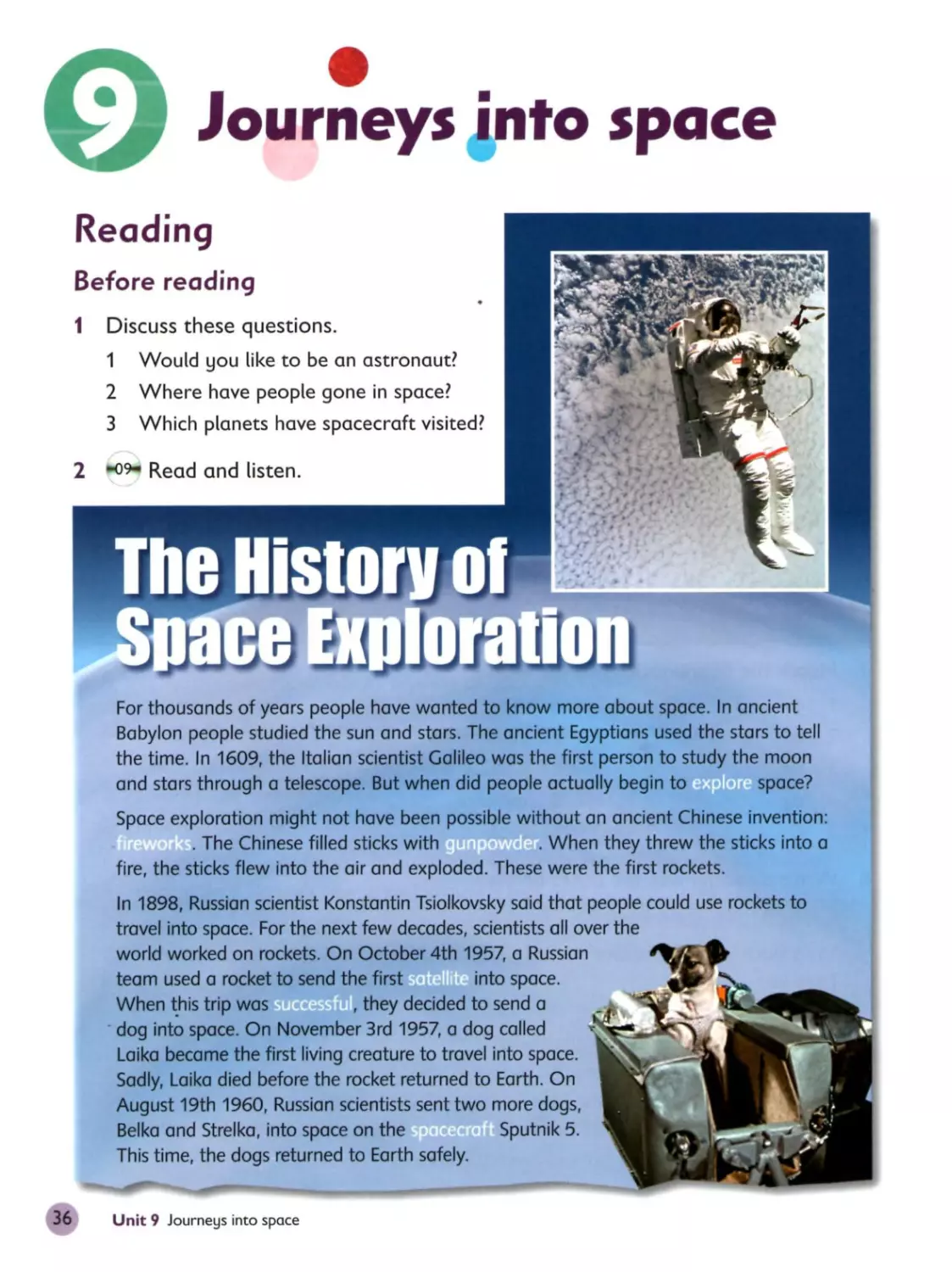
For thousands of years people have wanted to know more about space. In ancient
Babylon people studied the sun and stars. The ancient Egyptians used the stars to tell
the time. In 1609, the Italian scientist Galileo was the first person to study the moon
and stars through a telescope. But when did people actually begin to space?
Space exploration might not have been possible without an ancient Chinese invention:
ж. The Chinese filled sticks with	When they threw the sticks into a
fire, the sticks flew into the air and exploded. These were the first rockets.
In 1898, Russian scientist Konstantin Tsiolkovsky said that people could use rockets to
travel into space. For the next few decades, scientists all over the
world worked on rockets. On October 4th 1957, a Russian
team used a rocket to send the first into space.
When this trip was	, they decided to send a
dog into space. On November 3rd 1957, a dog called
Laika became the first living creature to travel into space.
Sadly, Laika died before the rocket returned to Earth. On
August 19th 1960, Russian scientists sent two more dogs,
Belka and Strelka, into space on the
This time, the dogs returned to Earth safely.
gunpowdi
explore
satellite
36
Unit 9 Journeys into space
On April 12th 1961, Russian	Yuri Cargarin became the first human to go
into space. Eight years later, on July 20th 1969, people all over the world turned on
their televisions to see American astronaut Neil Armstrong become the first human to
walk on the КЯof the moon.
Since then, there have been many exciting
surtaa
ismona
land
s in space exploration. On
December 15th 1970, Venera 7 became the first spacecraft to on another planet.
The Russian spacecraft travelled to Venus and sent information about the planet back
to Earth. In 1997 the American spacecraft Pathfinder landed on Mars. A small robot
came out of the spacecraft, explored the surface of Mars, and sent some amazing
pictures back to Earth.
In the future, perhaps astronauts will not be the only
people to travel into space. Some companies
already offer flights into space for space
tourists. At the moment, these flights cost
millions of dollars, so only very rich
people can afford them. However,
space companies hope that
more people will be able to
have holidays in space in the
future. Perhaps you will
visit other planets one
day, and look at Earth
from space.
Vocabulary
3	Use the words from the text to complete the sentences.
1	In many countries, you can see fantastic fireworks on New Year’s Eve.
2	The invention of computers was an important in the
20th century.
3	Russian atronauts are usually called s.
4	is dangerous because it causes explosions.
5	Laika’s trip was not because she died.
6	The first to land on Venus was called Venera 7.
7	“When did Pathfinder on Mars?” - “In 199Z”
8	The of the moon is dry and rocky.
9	s in space send television pictures back to Earth.
10	Scientists the jungle to find new plants and animals.
Unit 9 Journeys into space 37
Reading comprehension
4	Number the events in the correct order.
The Russians sent the first satellite into space.
A spacecraft landed on Venus.
The first human travelled into space.
The Chinese invented fireworks.	1
Sputnik 5 was sent into space.
Neil Armstrong walked on the moon.
A spacecraft landed on Mars.
The first dog travelled into space.
5	Correct the information in bold,
a telescope
1 Galileo used Eteri's to study the moon.
2 The Russians were the first to use rockets.
3	The Americans sent the first satellite into space.
4	Laika was the first astronaut to travel into space.
5	Yuri Gagarin was the first man on the moon.
6	Venera 7 was the first spacecraft to visit Mars.
7	You can travel into space for hundreds of dollars.
8	Maybe one day we will visit the sun.
6	Complete the facts. Write one word in each gap.
1	Galileo was a who lived in Italy.
2	Fireworks were invented by the.
3	The first living creature to travel into space was a called Laika.
4	Yuri Gargarin was the man to travel into space.
5	Human beings landed on the in 1969.
6	The first spacecraft to land on was called Venera 7.
7	A small took pictures of Mars.
8	If you want to have a into space, it will cost you a lot
of money.
7	Discuss these questions with a partner or with your class.
1	Would you like to travel into space as a tourist?
2	Do you think space tourism will be popular? Why or why not?
Unit 9 Journeys into space
Writing
/Йоге words: Space exploration, page 55
SPACE QUIZ
japuqquDj g 5элэшо]1>| 000‘W8 inoqy £
1961 9 6uoJ3Siujy ]iaN g omj_ 7 d>|id-| £ aurudaN Z fijnoja^ |, suaMSuy
How for is the moon from Earth - 844,000 km or 8,400 km?
What was the name of the spacecraft that sent pictures of Mars
back to Earth? (It begins with P.)
Which is the smallest planet in our solar system?
(It ends with Y.)
2 Which planet is furthest from the Sun? (It starts with N.)
3 What was the name of the first dog to travel in space?
How many dogs travelled in Sputnik 5?
Who was the first man on the moon?
(His initials are N.A.)
6 When did Yuri Gagarin become the first human to go into space -
1981 or 1961?
When you write quiz questions, use a variety of question words:
Who... What... When... Which... How many ... How far...
Add clues to make questions easier:
It begins with N. It ends with W. It’s got three letters.
8	Match the clues and the answers.
1	It begins with
2	It ends with A.
3	It’s got four letters.
4	His initials are Y.G.
5	It’s got seven letters.
a Laika
b Mercury
c Sputnik 5
d Yuri Gagarin
e Mars
9	Write questions for a quiz about space or a different
subject you know a lot about.
Unit 9 Journeys into space
Reading
Before reading
1 Discuss these questions.
1	Do you like listening to stories?
2	What are some of your favourite stories?
3	Do you prefer real stories or imaginary stories?
2 *1()* Read and listen.
Double Trouble
Kallu and his wife Zahra lived in a little hut
on the side of a hill. They were very poor and
they didn’t have money for food or clothes.
They decided to grow some vegetables and sell
them at the market, but they didn’t have enough
money to buy seeds or a spade. They only had
Zahra’s gold necklace.
Zahra took off her necklace and gave it to
Kallu. There were tears in her eyes.
“Sell my necklace at the market,” she said. “You
can use the money to buy the things we need.”
So Kallu sold the necklace and bought some seeds and a spade. He came home
and started to work. While he was digging, his spade hit something in the
ground. It was a large pot. While Kallu was looking into the pot, a coin fell out
of his pocket and landed in the pot. When Kallu tried to take his coin out of the
pot, he couldn’t believe his eyes. There were now two coins in
the pot. *
Kallu called Zahra and showed her the pot.
“We’re going to be rich,” said Zahra happily.
Zahra and Kallu put all their coins in the pot. Soon
they had a small pile of coins. Zahra jumped for joy.
40 Unit 10 It’s time for a story
“Go and buy my necklace back,” she told Kallu. “Buy us some food and new
clothes, too.”
Kallu went back to the market. He ran as fast as he could. While he was away,
Zahra put a potato into the pot, then two potatoes, then four. When Kallu came
home. Zahra was sitting on a huge pile of potatoes. When she saw Kallu, she tried
to climb down to greet him, but she slipped and fell into the pot. Kallu tried to pull
her out. but he fell into the pot too. When Kallu and Zahra climbed out of the pot,
another Kallu and another Zahra climbed out.
“Oh no!" said Kallu. “No\v there are two Kallus and two Zahras. What are we
going to do?”
Kallu 'cratched his head, but Zahra had an idea.
“Let’s build a hut like ours for our new friends,”
she said. "We’ll make them a copy of everything
in our hut.”
So Kallu built another hut on the other side
of the hill. Then he and Zahra put all of their
thing' into the pot, so that the second Kallu and
Zahra had everything they needed. The two
c s became friends. They weren’t rich, but
they were happy. Zahra told Kallu to bury the
pot deep in the ground.
FThat’s a good idea,” said Kallu. He smiled at
Zahra and after that they were never greedy
again.
Vocabulary
3 Match the words from the text to the definitions.
1	greedg (adjective) wanting more of things than you really need
2	 (noun)	a	tool that you use for digging in the ground
3	 (verb) to	put something in the ground
4	 (noun)	a	deep, round container for cooking or storing
5	 (noun)	a	lot of things on top of one another
6	 (noun) to say hello when you see someone
7	 (verb) to move quickly over something and almost fall
8	 (noun) a small, simple building with one room
9	 (noun) a thing that is just like another thing
10	 (noun) a man and woman who are married
Unit 10 It’s time for a story
41
Reading comprehension
4
Write Kallu or Zahra.
1	Zahra and her husband were very poor.
2	decided to sell her necklace.
3	found a pot in the ground.
4	dropped a coin into the pot.
5	wanted some new clothes.
6	was the first person to fall into the pot.
7	decided to build a hut for their friends.
8	buried the pot in the ground again.
5	Circle the correct words to make true sentences.
1	Kallu and Zahra’s farm /(^ut)was on the side of a hill.
2	They wanted to grow vegetables but they didn’t have a spade I potato.
3	Zahra’s necklace was made of gold I money.
4	Kallu’s spade I coin fell into the pot.
5	While Kallu was at the market, Zahra put a potato I coin in the pot.
6	Kallu fell in the pot when he tried to take a potato out I pull Zahra out.
7	At the end of the story there were two children I couples.
8	They were rich I happy at the end of the story.
6	Write short answers.
1	Were Kallu and Zahra rich at the beginning of the story? No, they weren’t.
2	Did they live in a big house?
3	Was Zahra’s necklace made of gold?
4	Did Zahra and Kallu put some money in the pot?
5	Did Zahra go to the market with Kallu?
6	Were Kallu and Zahra happy at the end of the story?
7	Discuss these questions with a partner or with your class.
1	Did .you enjoy the story?
2	What lesson did Kallu and Zahra learn?
3	Can you think of a different ending for the story?
4	Do you know any other stories that teach us lessons? What lessons have you
learnt from stories you have read?
Unit 10 It’s time for a story
Writing
More words: Expressing feelings, page 56
A Lucky Day
It was Saturday afternoon. Katie and Sam
were in a cafe, but they weren’t happy.
Their favourite singer was in town for a
concert, but there were no tickets left.
Just then, Sam saw something under the
table. He couldn’t believe his eyes: four
tickets for the concert!
“We can’t keep them, can we?” Sam
asked, sadly.
“No, we can’t,” said Katie. “We must
take them to the police station.”
Katie and Sam gave the tickets to a police
officer and gave him their names and
their address. Then they went home.
Later that afternoon, the phone rang. It
was a girl from Katie’s school.
“My name’s Emma,” she said. “Thank
you for finding my tickets. Two of my
friends can’t go to the concert now.
Would you like to come with me?”
Katie and Sam had a great time at the
concert. Sam smiled at Katie. “That was a
lucky day, wasn’t it?” said Sam.
To express feelings in stories, use adjectives:
John was excited when he first flew in an aeroplane.
You can also use actions or expressions to show people’s feelings. This will make
your writing more interesting:
Sam smiled at Katie. (= Sam was pleased with Katie.)
Kallu couldn't believe his eyes. (= Kallu was very surprised.)
There were tears in her eyes. (= She was very sad.)
She jumped for joy. (= She was very happy.)
8 Match the two pairs of sentences to
1	Bob jumped for joy. -------
2	There were tears in Sarah’s eyes.
3	Sally couldn’t believe her eyes.
4	Auntie Alice smiled at Emma.
make part of a story.
a All her toys were floating in the air.
b “Look! Two tickets for the big match,”
he said.
c “That was a lovely day,” she said.
d “I can’t find my doll,” she said.
9 Write a story about someone who finds something. Use adjectives or actions
to express people’s feelings, and use these questions to help you.
•	Who is the main character in the story? What does the main character find?
How does the main character feel when he / she finds this thing?
•	What happens next? What happens in the end? How does the main character
feel at the end of the story?
Unit 10 It’s time for a story
| | Winners
Reading
Before reading
1
2
Read and listen.
Who is your favourite actor or actress?
What is your favourite film?
Have you ever watched ‘The Oscars’
(the film award ceremony)?
Discuss these questions.
1
2
3
The Oscars 1
The Academy Awards - or 'Oscars’ - are prizes for talented
actors, writers and directors for their work in films. The awards
are given every year at a special ceremony in Hollywood.
The first Academy Awards ceremony was on May 16th 1929
at the Hollywood Roosevelt Hotel. Tickets to the ceremony
cost five dollars and there were fewer than 250 people in the
audience. The ceremony only lasted for fifteen minutes and it
was not on television or radio. In 1953 the awards were shown
on TV for the first time. Now, the ceremonies on television last
for four hours, and millions of people around the world watch
to see their favourite movie stars receive awards.
The audience is made up of hundreds of glamorous actors, but
only-а few will be winners. Every Academy Award winner is
given a golden statue. The statues are called Oscars. They
are made of metal and are in the shape of a knight who is
standing on a round film can and holding a sword. Fifty
new Oscar statues are made every year.
There are different stories about how the Oscar got its name. Some people say
that the director of the Academy gave the statue its name in 1931 because she
said that it looked like her cousin Oscar. However, actress Bette Davis said that
she called her award Oscar as a joke, because her husband's name was Oscar.
Nobody knows which story is correct, but in 1939, the Academy named the
award the ‘Oscar’.
Most Oscar winners have been adults, but a few have been children. In the past
the Academy gave out 'baby' Oscars to child actors, which were half the size of
the normal statues.
Now, child actors compete against adults for Best Actor or Actress
awards. In 1993, Anna Paquin won an Oscar for her acting in a film
called The Piano. She was eleven!
The person who has won the most Oscars was Walt Disney, who
won twenty-six altogether for his films. And the film with the
most Oscars was Titanic. In 1997, it won eleven Oscars.
Today, the Academy Awards ceremony is very popular. We
look forward to the ceremony each year and we want to
know who will win. We love to watch talented actors and
directors when they win their prizes and say thank you to
the audience. And everyone hopes their favourite film
will get an Oscar!
Vocabulary
3 Use the words from the text to complete the sentences.
1	At the Olympics, winners are given medals in a special ceremony .
2	Children aren’t allowed to drive - only can drive a car.
3	Famous actors are sometimes called .
4	In the football World Cup, teams from different countries
against each other.
5	Brave soldiers in the past that rode horses were called s.
• 6 My sister’s getting married soon, and I’m looking to the
wedding.
7	That cake is too big to eat so I’ll only eat of it.
8	My brother is never serious. He’s always making s.
9	That actress with the diamond necklace looks very.
10	The Oscars are for actors and other people who make films.
Unit 11 Winners
Reading comprehension
4 Circle the correct words to make true sentences.
1	The Oscars are ceremonies Z(£r/ze£) given to people who work in films.
2	The prizes are given at a special ceremony in New York I Hollywood.
3	The first Oscars ceremony lasted for five I fifteen minutes.
4	Now 250 I millions of people watch the Oscars.
5	The winners are given a small statue I sword.
6	The statues were called Oscars in 1931 I 1939.
7	Child actors used to get adult I baby Oscars.
8	Titanic won eleven I twenty-six Oscars.
5 Number the sentences in the correct order.
The Academy named the awards ‘Oscars’.
Anna Paquin, aged 11, won an Oscar.
The first Academy Awards ceremony took place.
The Academy director said the statues looked like her cousin.
Titanic won 11 Oscars.
The Oscars ceremony was on TV for the first time.
The first films were produced.	1
6 Match the two parts of the sentences.
1	The Academy Awards are also called a
2	The Academy Awards	\ b
3	The first Oscars ceremony wasn’t	<c
4	The first Oscars ceremony took place d
5	Fifty new Oscars are made	e
6	No one really knows	f
7	Walt Disney won more Oscars	g
8	Lots of people look forward to	h
on television or radio.
every year.
Oscars.
than any other film maker,
in a hotel in Hollywood,
the Oscars ceremony.
how the Oscar got its name,
are prizes.
7 Discuss these questions with a partner or with your class.
1	Do you think the Oscars ceremony is a good idea?
2	Can you think of other award ceremonies?
3	Do you think it’s a good idea to give awards to people? Why or why not?
Unit 11 Winners
Writing
More words: Competitions, page 56
The-Winner & M
Mt/ school has an art competition.
Were painting our favourite things.
Mg best friend is painting a rainbow,
And I'm painting butterflies' Wings.
The Winner is given a trophg.
Theg get a certificate, too.
Тю дои think that I'll be the Winner?
Magbe mg Wish Will come true.
EVerg gear, When the Winner is chosen,
There's a ceremong in the school hall.
The art teacher shows the best painting
And then hangs it up on the Wall.
When the art teacher held up mg painting,
I heard a big cheer from the trow'd.
Mg friends Were all laughing and clapping.
I felt Verg happg and proud.
When you write a poem, remember ...
•	A poem is usually made of different verses. This one has four. Can you see them?
•	We sometimes use rhyming words when we write a poem. For example ‘things’ and
‘wings’ in the first verse. Can you find more rhyming words in the other verses?
8 Complete the poem with the words in the box.
everyone go here mine prize win
Our school sports day is lots of fun,
With lots of games for * 1 everyone .
Every year, I close my eyes
And wish that I will win a 2.
I wait for my race to begin.
I’m nervous now, I hope I’ll3.
And then I hear the whistle blow -
The race has started, off we 4!
I run towards the finish line.
I want that medal to be 5
I cross the line, my friends all cheer
“Hooray, hooray! The winner’s 6!”
9 Write a poem about a day when you felt happy. Divide your poem into
different verses and use rhyming words.
I I Illi 1Ы О
♦
Remarkable women
Reading
Before reading
1 Discuss these questions.
1	Can you name any
important women in the
world now, or from the past?
2	Have you ever heard of
Pocahontas? Who was she?
2 *12- Read and listen.
fifc real Pocahontas
Most people know the name Pocahontas because a famous cartoon film
about her was made in 1995. The film mixes fact and iction to create an
exciting story. The real Pocahontas wasn’t like the Pocahontas in the film.
However, she was a remarkable woman and she had an amazing life.
Pocahontas was born in America in about 1595. Her father, Powhatan, was
the chit of many Native American tribes in the area that is now called
Virginia. Pocahontas’s real name was Mataoka, but she was given the
nickname Pocahontas because she liked to run and play. Pocahontas means
‘ layfu little girl’ in the language of her tribe.
In May 1607, Englishmen sailed to Virginia. One of them was John Smith.
Some Native Americans saw John Smith. They didn’t know if he was a
friend or an enemy so they took him to Chief Powhatan. Smith had to lie
down’on a big, flat rock. The Chiefs men picked up huge sticks and wanted
to kill Smith. Suddenly Pocahontas ran to Smith and put her head on his.
The men could not hit Pocahontas because she was the Chiefs daughter.
Pocahontas helped Smith to stand up. Chief Powhatan said that he and
Smith were now friends, because Pocahontas had saved Smith’s life.
48
Unit 12 Remarkable women

The English built a fori in Virginia. Pocahontas often visited the fort. She
took food and clothes for the English and they gave her tools for her people.
Unfortunately, the Native Americans and the English were not friends for
long. They began to fight and Pocahontas was not allowed to visit the
fort so often.
In 1613, Pocahontas met an Englishman called John Rolfe. They
fell in love and decided to marry. Their marriage helped to
bring peace between the English and Chief Powhatan’s people.
Pocahontas changed her name to Rebecca and she had a son
called Thomas.
In 1616, Pocahontas and her family travelled to England.
She met the King of England and many other important
people. She also met her old friend, John Smith.
Pocahontas became famous in England and people
were kind to her. Everyone heard the story of how she
saved John Smith’s life and helped the English and the Native
Americans to become friends.
The Rolfe family stayed in England for seven months. When it
was time to return to Virginia, Pocahontas became ill and could
not make the long journey back to America. Pocahontas died in
England in March 1617. She was only twenty-two years old.
Vocabulary
3	Match the words from the text to the definitions.
1	Jort (noun) a strong building that was made to protect a place
2	 (noun) the opposite of a friend - someone who hates you
3	 (noun) something that really happened
4	 (noun) stories that somebody writes that are not true
5	 (adjective) unusual and surprising in a good way
6	 (adjective) fun and childlike
7	 (noun) a name that your friends and family sometimes call you
instead of your real name
8	 (noun) small groups of people who have the same language or
customs
9	 (noun) the leader or ruler of a tribe
10	 (noun) a time when there is no fighting between people or countries
Unit 12 Remarkable women
Reading comprehension
4	Number the events in the correct order.
Pocahontas met the King of England.
Pocahontas was given the nickname Pocahontas.
Pocahontas married the Englishman John Rolfe.
Pocahontas was born in about 1595.	1
Pocahontas died in England in 1617.
Pocahontas saved John Smith’s life. ’
Pocahontas went to England.	_____
Chief Powhatan’s men met John Smith.
5	Write True or False.
1	Pocahontas was a Native American girl.	True
2	Chief Powhatan was the chief of one Native American tribe.
3	John Smith was an Englishman.
4	Chief Powhatan said that John Smith was his enemy.
5	The people in the fort gave Pocahontas food and clothes.
6	Pocahontas married an Englishman called Thomas.
7	Pocahontas met lots of important people in England.
8	The cartoon film about Pocahontas tells the true story of her life.
6	Answer the questions.
1	When was the cartoon film Pocahontas made? In 1ЯЯ5.
2	What was Pocahontas’s real name?
3	What does the word pocahontas mean?
4	Why did Chief Powhatan and John Smith become friends?
5	Were Chief Powhatan’s people and the Englishmen friends for long?
6	Who did Pocahontas meet in 1613?
7	What was Pocahontas’s new name?
8	How old was Pocahontas when she died?
7	Discuss’these questions with a partner or with your class.
1	Did any parts of the text surprise you? Why?
2	Do you think Pocahontas was brave? Why or why not?
3	Why do you think we know about more remarkable men than women from
the past?
50 Unit 12 Remarkable women
Writing
More words: Life stories, page 56
Helen Keller
Helen Keller was born in Alabama, USA on June 27th 1880. When she was
a baby, Helen was very ill and her illness left her deaf and blind. Helen’s
friend, Martha, helped Helen to create a sign language. By the time she
was seven, Helen could use more than sixty signs to talk to her family.
In 1886, the Kellers met an amazing teacher called Anne Sullivan. They
asked her to teach Helen. Anne*used her finger to ‘write’ words on Helen’s
hand. The first word Helen learnt was ’water’. Anne spelt the word on
Helen’s hand while she ran water over Helen’s other hand. Soon she was
able to go to school, then university. Later, Helen became a famous speaker
and writer. She worked hard to make life better for people with disabilities.
When you write the story of someone’s life, use time linkers such as:
when, by the time, later, soon, then, finally
When she was a baby, Helen was very ill.
By the time she was seven, Helen could use more than sixty signs to talk to her family.
Can you find more examples? 7 8
7 Read and circle the best time linkers.
1 Then I When Amy was eight, she decided to learn the violin.2 Later I By the time she
was ten, she could play very well.3 When I Soon she was invited to play in the school
concert. She practised every day. By the time I Finally, the day of the concert arrived.
Amy played beautifully and everyone clapped.
8 Write the life story of Florence Nightingale. Use these notes. Remember to
use time linkers.
Name
Florence Nightingale
Born
12th May 1820, in Florence (Italy)
Education
was taught by her father
Interests
helping and caring for sick people
Work
1849 - travelled to Europe to study
European hospitals
1850 - travelled to Egypt to study
nursing
1853 - was in charge of a women’s
hospital in London
1854 - went to Turkey and improved
conditions in hospitals
Nickname
‘The Lady of The Lamp’, because she
worked all day and all night.
Unit 12 Remarkable women
More words
1 Giving instructions
Check the words in your dictionary. Then choose the correct words.
brush cardboard decorate glue, scissors sticky tape
1	Make a frame for a photo with a piece of1 brush /(^ardboar^i
2	Cover the front of the cardboard with coloured paper. Use 2 scissors I sticky tape
to stick the coloured paper to the back of the cardboard.
3	Use a 3 brush I scissors to spread 4 glue I cardboard on the back of your photo.
Stick your photo in the middle of the piece of cardboard.
4	Use 5 sticky tape I scissors to cut out some paper flowers.
5	6 Decorate I Brush the sides of the frame with the paper flowers. Stick them round
your photo.
2 Personalities
Check the words in your dictionary. Then match the two sentences,
calm energetic friendly honest organized patient
1	Alfie is friendly.----
2	John is calm.
3	Sarah is patient.
4	Emma is very organized.
5	Fred is really energetic.
6	Mary is honest.
a He never gets tired.
b Her bedroom is always tidy.
c He doesn’t worry about things.
d He is nice to everyone.
e Everything that she says is true.
f She doesn’t hurry to finish things.
3 Describing places
Check the words in your dictionary. Then complete the sentences,
avalanche cliff glacier peak pothole waterfall
1	Even in summer, there is snow on the peak of that mountain.
2	We saw a beautiful when we were on holiday. The water in the
river falls more than 100 metres.
3	I wouldn’t like to go down a. I hate being under the ground.
52
More words
4	A is a frozen river that moves very slowly.
5	When there is an, lots of snow suddenly falls from the side of a
mountain.
6	Don’t go near the edge of the! You could fall.
4	Buildings
Check the words in your dictionary. Then choose the correct words.
balcony basement garage gate roof storey
1	The(fjasemenp/ roof is the bottom part of the building. It is under the ground.
2	The stairs in a house go from one storey I gate to the next.
3	The basement I roof is on top of a house. It covers the house.
4	A storey I balcony is a small place outside a window. People can sit there and see
the street.
5	The garage I balcony is a small building for cars, next to the house.
6	The roof / gate is a type of door in the wall or fence, in front of a house.
5	Inventions and technology
Check the words in your dictionary. Then complete the predictions.
holograms remote control solar energy
virtual reality network screen
1	I think that we will use a remote control to turn the lights on or off.
2	I hope that I will have a computer with a very big.
3	Perhaps we will have of famous sculptures, so we can look at
them from every side.
4	I imagine that groups of people will be in the same computer.
I will talk to my friends using my computer all the time.
5	People will use. Houses will have machines on the
roof to collect energy from the sun.
6	I think people will play football. The other players
will be computer images that seem to be all around you and almost real.
More words
6	Sea life
Check the words in your dictionary. Then complete the sentences.
backbone breathe fin krttt tentacles Whale
1	The sea is full of tiny animals that we can’t see. They are called krill.
2	Dolphins can’t under water. They have to come to the surface for
air.
3	A shark has a on its back. You can see it above the surface of the
sea.
4	An octopus has eight long. It uses them to hold things.
5	The Blue is the biggest animal on Earth.
6	Fish have a line of bones down the middle of their backs called a.
7	Charity work
Some words are often used together in collocations. Check the green
collocations in your dictionary.
Oxfam helps victims of floods and other disasters.
Oxfam’s helpers provide food for people who are hungry.
When people see films of disasters on TV, they want to donate money.
My mum supports charities that help people in Africa.
My friends and I are making cakes and biscuits to raise money for poor people.
Our teacher is organizing a concert to help victims of the hurricanes in America.
Now match the words to make collocations.
1	raise —.	a	victims
2	help	\	b	money
3	provide	\	c	a charity
4	support	'	4 d	a concert
5	organize	—e	money
6	donate	f	food
More words
8	Recipes and cooking
Check the words in your dictionary. Then complete the sentences.
bake cool ingredient mixture oven stir
1	A salad is mixture of cold vegetables - for example, tomatoes, carrots and
rice.
2	The most important in a milkshake is milk.
3	When Mum makes soup, she uses a big spoon to it.
4	If you make bread or a cake, you have to it in an oven.
5	The is the part of a cooker that has a door. You bake bread and
cakes in it.
6	If food is very hot, you must leave it to before you can eat it.
9 Space exploration
Check the words in your dictionary. Then complete the questions and answers
in the Space Quiz.
atmosphere comet galaxy gravity orbit space shuttle
1 Q: How long does the Earth take to orbit the sun?
A: It takes one year.
2 Q: When did the first go into space?
A: On April 12th, 1981.
3 Q: If we went to Mars, could we breathe?
A: No, we couldn’t, because there is no oxygen in the on Mars.
4 Q: What’s a?
A: It’s something that looks like a star and has a bright tail.
5 Q: What is the word for a very large group of stars and planets?
A: A.
6 Q: Why do rockets need a lot of energy to go into space?
A: Because pulls everything towards the Earth.
More words
10 Expressing feelings
4
5
6
pretty, ugly, beautiful, lovely
big, huge, tiny, large
Read the groups of adjectives. Find the odd-one-out.
1	happy, glad,(sad) pleased
2
3
nervous, calm, frightened, scared
horrible, wonderful, brilliant, great
hot, warm, freezing, boiling
11	Competitions
Check the words in your dictionary. Then complete the sentences,
certificate competition loser medcrt race trophy
1	At the Olympic Games, the winners get medals made of gold, bronze or silver.
2	The winners of the Football World Cup are given a big gold.
3	My friend Nadia is a good runner. She won the last week, but I
came second.
4	Every year my school has a to find the best poem.
5	Dad put my in a frame and hung it on the wall.
6	We can’t all be winners, so it’s OK to be a. The important
thing is to do your best.
12 Life stories
Check the words in your dictionary. Then match the two parts of the
sentences.
adult childhood education get married grow up train (verb)
1	My grandmother was
2	She grew up
3	She had a loving family, so
4	At the local school she had
5 When she became an adult,
6 She trained to be
a in a small town in Egypt,
b she went to live in Cairo,
c got married in 1965.
d she had a happy childhood,
e born in 1942.
f a doctor.
7 She met my grandfather in 1964 and they
g a good education.
More words
OXFORD
UNIVERSITY PRESS
Great Clarendon Street, Oxford 0x2 6dp
Oxford University Press is a department of the University of Oxford
It furthers the University’s objective of excellence in research, scholarship,
and education by publishing worldwide in
Oxford New York
Auckland Cape Town Dares Salaam Hong Kong Karachi
Kuala Lumpur Madrid Melbourne Mexico City Nairobi
New Delhi Shanghai Taipei Toronto
With offices in
Argentina Austria Brazil Chile Czech Republic France Greece
Guatemala Hungary Italy Japan Poland Portugal Singapore
South Korea Switzerland Thailand Turkey Ukraine Vietnam
oxford and oxford English are registered trade marks of
Oxford University Press in the UK and in certain other countries
© Oxford University-Press 2010
The moral rights of the author have been asserted
Database right Oxford University Press (maker)
First published 2010
2014 2013 2012 2011 2010
10 98765432
No unauthorized photocopying
AU rights reserved. No part of this publication may be reproduced,
stored in a retrieval system, or transmitted, in any form or by any
means, without the prior permission in writing of Oxford University
Press, or as expressly permitted by law, or under terms agreed with the
appropriate reprographics rights organization. Enquiries concerning
reproduction outside the scope of the above should be sent to the ELT
Rights Department, Oxford University Press, at the address above
You must not circulate this book in any other binding or cover
and you must impose this same condition on any acquirer
Any websites referred to in this publication are in the public domain
and their addresses are provided by Oxford University Press for
information only. Oxford University Press disclaims any responsibility
for the content
isbn: 978 019 467407 2
Printed in China
ACKNOWLEDGEMENTS
Illustrations by: Kathy Baxendale pp.5 (ex 2), 7 (top), 23 (top right),
Tomek Giovanis and Christos Skaltsas pp.40 (ex 2), 41 (ex 2), 42 (ex 4).
The publisher would like to thank the following for their permission to reproduce
photographs: Alamy pp.9 (Lemon shark/WaterFrame), 11 (vet/Juniors
Bildarchiv), 12 (Sahara Desert, Libya/Cubolmages srl), 15 (Nohkalikai
Falls, Cherrapunjee/Aruna Bhat), 19 (grass roofflason Lindsey), 24
(goriUa/Imagebroker), 24 (crow/Blickwinkel), 32 (chocolate/Keith
Leighton), 33 (strawberry in chocolate/Gastromedia), 35 (cupcake/
foodfolio), 36 (Laika/RIA Novosti), 47 (girl with trophy/Catchlight
Visual Services), 48 (Pocahontas interceding for the life of John Smith/
Classic Image), 49 (Pocahontas statue/Ange), 51 (Helen KeUer/Maiy
Evans Picture Library); Corbis UK Ltd. pp.8 (Divers/Specialist Stock),
20 (man wearing hologram display glasses/Colin Anderson/Blend
Images), 25 (elephant painting/Frank Brandmaier/Dpa), 27 (octopus
opening jar/Reuters), 28 (Zairean girl coUecting clean water/Howard
Davies), 37 (Mars Pathfinder Model/Peter Ginter/Science Faction),
44 (Oscar ceremony 1930/Bettmann), 45 (Anna Paquin with Oscar/
Reuters/A.M.pj\.S.®); Getty Images pp.16 (upside down house/Sean
GaUup), 17 (house of plastic bottles/Jose Cabezas), 18 (house of plastic
bottles/Jose Cabezas), 18 (upside down house/Sean GaUup); NASA pp.36
(astronaut/Johnson Space Center), 39 (planets/JPL); Oxfam p.28t (Oxfam
worker/Amin); Photofusion Picture Library p.31 (fundraisers/Don Gray);
Photolibrary Group p.13 (Antarctic); Press Association Images pp.5 (sand
sculpture/Lionel Cironneau/AP Photo), 44 (Oscar statuette/ABACA USA);
Rex Features pp.4 (Ice sculpture/Nils Jorgensen), 17 (china house/Sinopix),
18 (china house/Sinopix); Science Photo Library p.39 (Mars/USGS)
OXFORD
PRIMARY
SKILLS
Oxford Primary Skills is a six-level supplementary
series to develop reading and writing skills in
the primary classroom. Each unit is very clearly
structured, and includes vocabulary work as well
as step-by-step reading and writing tasks.
•	A broad range of text types, with a particular
focus on real-world topics
•	Thorough, systematic development of reading
sub-skills
•	Graded writing tasks, with a clear outcome
•	More words section extends the vocabulary
areas in the units
The series is accompanied by Audio CDs with
recordings of the reading passages, and a website
with notes and guidance for teachers.
OXTORD
UNIVERSITY PRESS
OXFORD ENGLISH
ISBN 978-0-19-467407-2
www.oup.com/elt
9
780194
674072