/
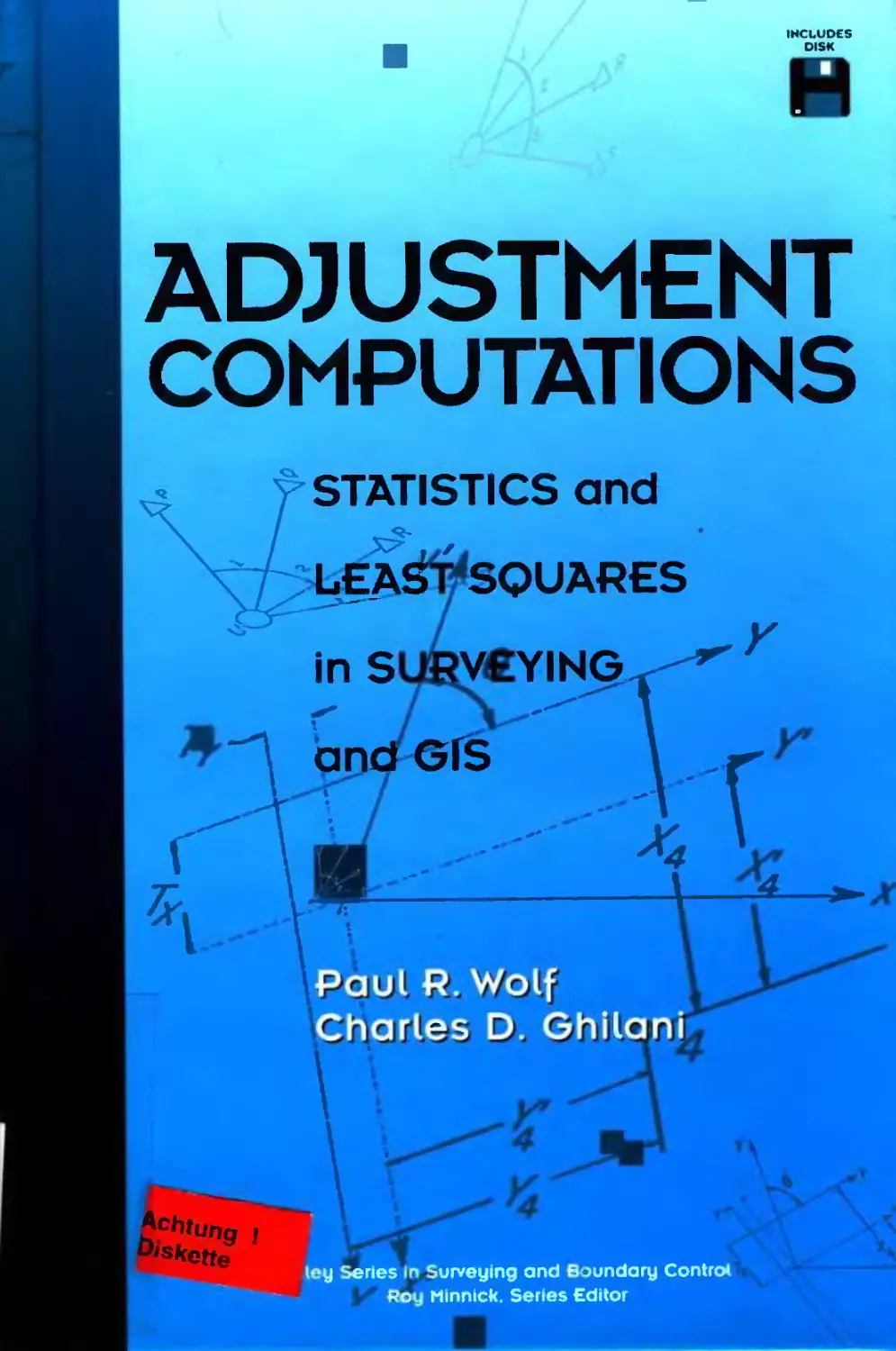


Author: Wolf P.R. Ghilani C.D.
Tags: geodesy mathematical statistics least squares method geoinformatics
ISBN: 0-471-16833-5
Year: 1997



Text
                    INCLUDES DISK
ADJ USTMENT
COMPUTATIONS
STATISTICS and
 jEAST SQUARES
VEYING
ley Series in Surveying and Boundary Control Roy Minnick, Senes Editor
in S
Paul R. Wolf Charles D. Ghilani
The complete guide to adjusting for measurement error— expanded and updated
All measurements contain errors. And with global positioning systems, total station instruments, digital metric cameras, and satellite imaging systems now generating vast quantities of data, adjustment for errors is crucial to accurate interpretation. Adjustment Computations provides a complete, up-to-date treatment of every aspect of least squares adjustment, the most rigorous procedure available for computing adjustments to measured data.
This comprehensive work starts with basic principles and proceeds to the development of proper mathematical and stochastic models. Advanced topics include use of constraint equations and blunder detection. Each chapter is supported by clear, practical examples, numerous illustrations, and helpful end-of-chapter problems The accompanying disk contains three software packages: statistical analysis, the performance of least squares
operations.
adjustments, and basic
New material in this
edition includes;
and distance measurements, determination
steOtical testing .
•	Error propagation in putations, and
•	Confidence intervals
•	Adjustments GPS
•	Bleeder detection i
An exc^llenpefdreece and self-study source for togra wtretrisls. and GIS managers, this book is a for students preparing for the LSIT,4_-S. and PE for courses irt surveying, civil'engineering, fat
survey netwo
GIS managers, this book is t
erse com-
rorkfnesurveyors, pho-indisp^isable resource terns
the ideal text g^raphy, and
PAUL R. WOLE, PhD, Emeritus Professor, Departs rdnmentai Engineering, University of Wisconsin, Is tl of Photogrammetry and the bestselling Elementary Su edition. CHARLES D. GHILANI, PhD, is Associate lege of Engineenng and Chair of the Surveying ProScan University.	I
ent of I u auth Xey/ng
ivil and Envi-r of Elemegi» Irw ninth Orin the Col-
it Pennsylvania State
Cover Design. Lvnn Cote
wn FVJMTKoe/jiENC is, ln<
'[JF 040020057610
Achtung ’ Diskette
Brisbane • Sing,
WILEY SERIES IN SURVEYING AND BOUNDARY CONTROL
Series Editor: Roy Minnick
Colc/WATER BOUNDARIES
Smith/INTRODUCTION TO GEODESY: THE HISTORY AND CONCEPTS OF MODERN GEODESY
Wolf and Ghilam/ADJUSTMENT COMPUTATIONS: STATISTICS AND LEAST SQUARES IN SURVEYING AND GIS
ADJUSTMENT COMPUTATIONS
Statistics and Least Squares in
Surveying and GIS
Paul R.(Wolf, Ph.D.
Professor Emeritus Department of Civil and Environmental Engineering University of Wisconsin-Madison
Charles D. Ghilani, Ph.D.
Associate Professor
Surveying Program Pennsylvania State University
A WII.EY-INTERSCIENCE PUBLICATION
JOHN WILEY & SONS, INC.
New York Chichester Brisbane Toronto Singapore Weinheim
This text is printed on arid-free paper.
Copyright © 1997 by John Wiley & Sons, Inc
All rights reserved. Published simultaneously in Canada
Repioduction or translation of any part of this work beyond that permitted by Section 107 or 108 of die 1976 United States Copyright Act without the permission of the copyright owner is unlawful. Requests for permission or further information should be addressed to the Permissions Department, John Wiley & Sons, Inc.. 605 Third Avenue. New York. NY 10158-0012
This publication is designed to provide accurate and authoritative information in regard to the subject matter covered. It is sold with die understanding diat the publisher is rtot engaged in rendering legal, accounting, or other professional services. If legal advice or other expert assistance is required, the services of a competent professional person should be sought
Library- of Congress Cataloging tn Publication Data:
Wolf. Paul R
Adjustment computations : statistics and least squares in surveying and G1S / by Paul R. Wolf and Charles D Ghilanl.—3rd ed.
p	cm.—(Wiley series in surveying and boundary control)
Includes bibliographical references and index.
ISBN 0-471-16833-5 talk, paper)
I.	Surveying Mathematics. 2. Surveying—Statistical methods 3 1 east squares 4 Error analysis <Mathematics) I Ghilani. Charles D 11. Title 111. Series.
TA556 M38W65 1996
526 9'072—de 20
96-22146
Printed in the United States of
10 9 8
та=пйЬ1Ь1ю1!~ек
ri«
Techn tcl'fi 1 livefsilat
9 ' ’г. p 'Z ХЬ
CONTENTS
Preface
Acknowledgments
xiii
xvii
Introduction
1.1	Introduction / I
1.2	Direct and Indirect Measurements / 2
1.3	Measurement Error Sources I 2
1.4	Definitions I 3
1.5	Precision Versus Accuracy / 4
1.6	Redundant Measurements in Surveying and Their Adjustment / 7
1.7	Advantages of Least-Squares Adjustment I 8
* 1.8 Overview of the Book / 10
Problems / 10
2 Measurements and Their Analysis	13
2.1	Introduction / 13
2.2	Sample Versus Population / 13
2.3	Range and Median / 14
2.4	Graphical Representation of Data / 15
2.5	Numerical Methods of Describing Data I 18
2.6	Measures of Central Tendency / 19
2.7	Additional Definitions / 19
2.8	Alternative Formula for Determining Variance / 22
2.9	Numerical Examples / 24
2.10	Derivation of the Sample Variance (Bessel’s Correction) / 30
2.11	STATS Program / 31
Problems / 31
v
Vi CONTENTS
3
Random Error Theory
3	1 Introduction I 35
3.2	Theory of Probability I 35
3.3	Properties of the Normal Distribution Curve / 38
3.4	Standard Normal Distribution Function / 40
3.5	Probability of the Standard Error I 43
3.6	Uses for Percent Errors / 46
3.7	Practical Examples I 46
Problems / 49
4	Confidence Intervals and Statistical Testing	53
4	I Introduction I 53
4.2	Distributions Used in Sampling Theory / 55
4	3	Confidence	Interval for the Mean: / Statistic /	59
4	4	Testing the	Validity of the Confidence Interval	/ 62
4.5	Selecting a	Sample Size / 62
4.6	Confidence	Interval for a Population Variance	/ 63
4	7 Confidence Interval for the Ratio of Two Population
Variances / 65
4.8	Hypothesis Testing / 67
4	9	Test of Hypothesis for the Population Mean / 70
4.10	Test of Hy pothesis for the Population Variance: a2 I 73
4.11	Test of Hypothesis for the Ratio of Two Population
Variances /75 Problems / 79
5	Propagation of Random Errors in Indirectly Measured
Quantities
81
5.1	Basic Error Propagation Equation I 81
5.2	Frequently Encountered Specific Functions / 86
5.3	Numerical Examples / 87
5.4	Conclusions / 91
Problems / 92
6	Error Propagation in Angle and Distance Measurements 97
6.1	Introduction / 97
6	2 Error Sources in Horizontal Angles / 97
6.3	Reading Errors / 98
6.4	Pointing Errors / 100
6.5	Estimated Pointing and Reading Errors with Total Stations / 101
CONTENTS
vii
6.6	Target-Centering Errors / 101
6.7	Instrument Centering Errors / 104
6.8	Effects of Leveling Error in Angle Measurement / 108
6.9	Numerical Example of Combined Error Propagation in a Single Horizontal Angle / 110
6.10	Use of Estimated Standard Errors to Check Angular Misclosure in a Traverse /111
6.11	Errors m Astronomical Observations for Azimuth / 112
6.12	Errors in Electronic Distance Measurements I 117
6	13 Use of Spreadsheets / 118
Problems / 119
7	Error Propagation in Traverse Surveys	123
7.1	Introduction I 123
7	2 Derivation of Estimated Error in Latitude and Departure / 124
7.3	Derivation of Estimated Standard Errors in Course
Azimuths I 125
7.4	Computing and Analyzing Polygon Traverse Misclosure
Errors I 126
7.5	Computing and Analyzing Link Traverse Misclosure
Errors I 132
7	6 Conclusions I 136
Problems /136
8	Error Propagation in Elevation Determination	141
8.1 Introduction / 141
8 2 Systematic Errors in Differential Leveling / 141
8.3 Random Errors in Differential Leveling I 144
8.4 Error Propagation in Trigonometric Leveling / 149
Problems / 153
9	Weights of Observations	155
9 I Introduction I 155
9 2 Weighted Mean I 157
9.3 Relation Between Weights and Standard Errors I 159
9 4 Statistics of Weighted Observations I 160
9.5	Weights in Angle Measurements / 162
9.6	Weights in Differential Leveling / 163
9.7 Practical Examples I 164
Problems / 167
viii
CONTENTS
10 Principles of Least Squares	169
IO.I Introduction / 169
10	2 Fundamental Principle of Least Squares I 170
10.3	Fundamental Principle of Weighted Least Squares / 172
10.4	Stochastic Model I 173
10.5	Mathematical Model / 173
10.6	Observation Equations I 174
10.7	Systematic Formulation of the Normal Equations / 176
10.8	Tabular Formation of the Normal Equations / 180
10	9 Using Matrices to Form the Normal Equations I 180
10	10 Least Squares Solution of Nonlinear Systems / 184
10	11 Least-Squares Fit of Points to a Line or Curve / 187
10.12	Calibration of an EDM Instrument / 190
10.13	Least Squares Adjustment Using Conditional Equations / 191
10.14	Example Using Observation Equations I 194 Problems / 195
11 Adjustment of Level Nets	201
il	l	Introduction	/ 201
11.2	Observation	Equation	/	201
11.3	Unweighted	Example	I	202
I 1.4 Weighted Example / 204
11.5	Reference Standard Deviation / 207
11.6	Another Weighted Adjustment I 209 Problems /212
12	Precisions of Indirectly Determined Quantities	217
12.1	Introduction I 217
12.2	Development of the Covariance Matrix /217
12.3	Numerical Examples I 221
12 4 Standard Deviations of Computed Quantities / 222 Problems / 225
13 Adjustment of Horizontal Surveys: Trilateration	229
13	I Introduction I 229
13.2	Distance Observation Equation / 231
13.3	Trilateration Adjustment Example / 233
13.4	Formulation of a Generalized Coefficient Matrix for a More
Complex Network / 239
13.5	Computer Solution of a Tnlatcratcd Quadrilateral / 239
13.6	Iteration Termination / 243 Problems / 245
CONTENTS
ix
14 Adjustment of Horizontal Surveys: Triangulation	249
14	1 Introduction I 249
14.	2 Azimuth Observation Equation / 249
14.	3 Angle Observation Equation I 252
14.	4 Adjustment of Intersections / 254
14.	5 Adjustment of Resections / 259
14.	6 Adjustment of Triangulated Quadrilaterals / 265 Problems / 269
15	Adjustment of Horizontal Surveys: Traverses and Networks 275
15.1	Introduction to Traverse Adjustments I 215
15.2	The Observation Equations I 275
15.3	Redundant Equations / 276
15.4	Numerical Example / 277
15.5	Minimum Amount of Control I 282
15.6	Adjustment of Networks / 283
15.7	x2 Test: Goodness of Fit / 290 Problems / 291
16	Adjustment of GPS Networks
297
16.1	Introduction I 297
16.2	GPS Measurements / 298
16.3	GPS Errors and the Need for Adjustment I 301
16.4	Reference Coordinate Systems for GPS Measurements / 301
16.5	Converting Between the Terrestrial and Geodetic Coordinate
Systems / 303
16.6	Application of Least Squares in Processing GPS Data / 308
16	7 Network Preadjustment Data Analysis I 309
16 8 Least Squares Adjustment of GPS Networks /314
Problems / 321
17 Coordinate Transformations
335
17.	1 Introduction I 335
17.	2 Two-Dimensional Conformal Coordinate Transformation I 335
17.	3 Equation Development / 336
17.	4 Application of Least Squares / 338
17.	5 Two Dimensional Affine Coordinate Transformation / 341
17.	6 Two-Dimensional Projective Coordinate Transformation I 343
17.	7 Three-Dimensional Conformal Coordinate
Transformation / 347
17	8 Statistically Valid Parameters / 353
Problems / 354
X
CONTENTS
18
Error Ellipse
357
18	1 Introduction / 357
18.2	Computation of Ellipse Orientation and Semiaxes I 359
18.3	Example of Standard Error Ellipse Calculations / 363
18.4	Another Example / 365
18.5	Error Ellipse Confidence Level I 361
18.6	Error Ellipse Advantages / 369
Problems / 372
19	Constraint Equations	375
19.1	Introduction I 375
19.2	Adjustment of Control Station Coordinates / 375
19.3	Holding Control Station Coordinates and Directions of Lines Fixed in a Trilateration Adjustment /381
19.4	Helmert’s .Method I 385
19.5	Redundancies in a Constrained Adjustment I 390
19.6	Enforcing Constraints Through Weighting / 390
Problems I 393
20	Blunder Detection in Horizontal Survey Networks	397
20.1 Introduction I 397
20 2 A Prion Methods for Detecting Blunders m Measurements I 398
20 3 A Posteriori Blunder Detection / 400
20.4	Development of the Covariance Matrix for the
Residuals I 402
20.5	Detection of Outliers in Observations I 404
20.6	Techniques Used in Adjusting Control I 406
20.7	Data Set with Blunders / 407
20 8	Some Further Considerations /416
20 9	Survey Design /418
Problems / 420
21	General Least-Squares Method and Its Application to Curve Fitting and Coordinate Transformations	423
21 I Introduction to General Least Squares / 423
21.2	General Least-Squares Equations for Fitting a Straight Line I 423
21 3 General Least-Squares Solution I 425
21.4	Two-Dimensional Coordinate Transformation by General Least Squares /430
CONTENTS
xi
21.5	Three-Dimensional Conformal Coordinate Transformation by
General Least Squares / 435
Problems 453 / 438
22	Computer Optimization
441
22.1	Introduction I 441
22.2	Storage Optimization / 441
22.3	Direct Formation of the Normal Equations / 444
22.4	Cholesky Decomposition / 445
22.5	Forward and Back Solutions / 447
22.6	Using the Cholesky Factor to Find the Inverse of the Normal Matrix / 450
22.7	Sparseness and Optimization of the Normal Matrix I 451 Problems / 456
A
Introduction to Matrices
459
A. I Introduction I 459
A.2	Definition of a Matrix / 459
A.3 Size or Dimensions of a Matrix / 460
A.4 Types of Matrices / 461
A.5 Matrix Equality / 462
A .6	Addition or Subtraction of Matrices / 463
A.7	Scalar Multiplication of a Matrix / 463
A.8	Matrix Multiplication I 464
A.9	Computer Algorithms for Matrix Operations / 467
A. 10 Use of the Program MATRIX I 470
Problems / 470
В Solution of Equations by Matrix Methods	473
B.l	Introduction I 473
B.2	Inverse Matrix I 473
B.3	Inverse of a 2 X 2 Matrix / 474
В 4 Inverses by Adjoints / 476
B.5	Inverses by Row Transformations / 478
B.6	Numerical Example / 480 Problems I 483
C Nonlinear Equations and Taylor’s Theorem	485
C.l Introduction I 485
C.2 Taylor Senes Linearization of Nonlinear Equations / 485
C.3 Numerical Example / 486
Xii CONTENTS
C.4 Using Matrices to Solve Nonlinear Equations / 488
C.5 Simple Matrix Example I 489
C.6 Practical Example / 490
Problems / 493
D Normal Error Distribution Curve and Other Statistical Tables 495
D. 1 Development for the Normal Distribution Curve Equation I 495
D.2 Other Statistical Tables / 503
E Confidence Intervals for the Mean	517
F Documentation for Software	523
F.l	Introduction I 523
F.2 Similarities m the Programs STATS and ADJUST I 524
F.3	STATS / 531
F.4	ADJUST / 532
F.5	MATRIX / 548
Bibliography
Index
553
557
PREFACE
No measurement is ever exact. As a corollary, every measurement contains error. These statements are fundamental and universally accepted. It follows logically, therefore, that surveyors and GIS managers who are measurement specialists should have a thorough understanding of errors. They must be familiar with the different types of errors, their sources, and their expected magnitudes. Armed with this knowledge they will be able to (1) adopt procedures for reducing error sizes when making their measurements, and (2) account rigorously for the presence of errors as they analyze and adjust their measured data. This book is devoted to creating a better understanding of these topics.
In recent years, least squares has been gaimng popularity rapidly as the method used for analyzing and adjusting surveying data. This should not be surprising, because the method is the most rigorous adjustment procedure available. It is soundly based on the mathematical theory of probability, it allows for appropriate weighting of all observations in accordance with their expected precisions, and it enables complete statistical analyses to be made following adjustments so that the expected precisions of adjusted quantities can be determined. Procedures for employing the method of least squares and then statistically analyzing the results are major topics covered in this book.
In years past, least squares was seldom used for adjusting surveying data because the time required to set up and solve the necessary equations was too great for manual methods. Now computers have eliminated that disadvantage. Besides advances in computer technology, some other recent developments have also led to increased use of least squares. Prominent among these arc the global positioning system (GPS), and geographic information systems and land information systems (GISs and LISs). These systems rely heavily on rigorous adjustment of data and statistical analysis of the results. But perhaps the most compelling of all reasons for the recent increased interest in least-squares adjustment is that new accuracy standards for surveys are being developed that are based on quantities obtained from least-squares adjustments. Thus surveyors of the future will not be able to test their mea-
xlil
xiv
PREFACE
surcments for compliance with these standards unless they adjust their data using least squares. Clearly, modem surveyors must be able to apply the method of least squares to adjust their measured data, and they must also be able to perform a statistical evaluation of the results after making the adjustments.
This book originated tn 1968 as a set of lecture notes for a course taught to a group of practicing surveyors in the San Francisco Bay area by Professor Paul R Wolf. The notes were subsequently bound and used as the text for formal courses in adjustment computations taught at both the University of California-Berkeley and the University of Wisconsin-Madison. In 1980, a second edition was produced which incorporated many changes and suggestions from students and others who had used the notes. The second edition, published by Landmark Enterprises, has been distributed widely to practicing surveyors and GIS managers, and has also been used as a textbook for adjustment computations courses in several colleges and universities.
For this new third edition. Professor Charles D. Ghilani of the Pennsylvania State University has joined Professor Wolf as coauthor. Professor Ghilani has used the second edition in his classes for several years and has incorporated substantial amounts of new material into the book which he has found beneficial in his teaching.
This third edition has been revised completely and substantially expanded. New chapters have been added on confidence intervals and statistical testing, propagation of errors, constraint equations, blunder detection, and general least squares. A new chapter has also been added on the use of least squares to adjust GPS network surveys.
This current edition now consists of 22 chapters and several appendixes. The chapters are arranged in' the order found most convenient in teaching college courses on adjustment computations. It is believed that this order also best facilitates those practicing surveyors who use the book for self-study. Earlier chapters define terms and introduce students to the fundamentals of errors and methods for analyzing them. The next several chapters are devoted to the subject of error propagation in the different types of basic surveying measurements. Then chapters follow that describe observation weighting and introduce the least-squares method for adjusting observations. Application of least squares in adjusting basic types of surveys are then presented m separate chapters. Adjustment of level nets, trilateration, triangulation, traverses and horizontal networks, and GPS networks are included. The subject of error ellipses is covered in a separate chapter Procedures for applying least squares in curve fitting and in computing coordinate transformations are also presented The more advanced topics of blunder detection, the method of general least squares, and computer optimization are covered in the later chapters.
As with the previous editions, matrix methods which are so well adapted to adjustment computations continue to be used in this edition For those students who have never studied matrices, or those who wish to review this topic, an introduction to matrix methods is given in Appendixes A and B.
PREFACE
XV
Those students who have already studied matrices can conveniently skip those sections.
Least-squares adjustments often require the formation and solution of nonlinear equations. Procedures for linearizing nonlinear equations by Taylor’s theorem are therefore important in adjustment computations, and this topic is presented in Appendix C. Appendix D contains several new statistical tables. These include the standard normal error distribution, the chi-squared distribution, the Student’s t Distribution, and a set of F distribution tables. These tables are described at appropriate locations in the text, and their use is demonstrated with examples.
Examples are presented throughout the book that illustrate statistical analyses and least-squares adjustment of typical surveying measurements. The examples progress from the analysis of a single observation to adjustment of complex networks of data.
A diskette is included with the book. It contains three major computer program packages. The first package, called STATS, performs basic statistical analyses. For any given set of measured data, it will compute the mean, median, mode, and standard deviation, and develop and plot the histogram and normal distribution curve. The second package, called ADJUST, contains programs for performing specific least-squares adjustments Level nets, horizontal surveys (trilateration, triangulation, traverses, and horizontal network surveys), and GPS networks can be adjusted using programs in this package. It also contains programs to compute the least-squares solution for a variety of coordinate transformations, and determine the least-squares fit of a line, parabola, or circle to a set of data points. Each of these programs computes residuals and standard deviations following the adjustment. The third package, called MATRIX, performs a collection of basic matrix operations such as addition, subtraction, transpose, multiplication, inverse, and more. Using this program, systems of simultaneous linear equations can be solved quickly and conveniently, and the basic algorithm for doing least-squares adjustments can be performed in a stepwise fashion. All programs on this diskette are menu driven and very easy to use. Examples within the text are solved with the programs to demonstrate their use. Documentation on the use of these programs is given in Appendix F. For those who wish to develop their own software, the book provides several helpful computer algorithms in the languages BASIC, C, FORTRAN, and PASCAL.
Homework problems are given at the end of each chapter so that students can test their understanding of the material m the text More than 300 problems are included. An Instructor’s Manual is available upon request to instructors who adopt the book for use in their classes. It contains answers to all after-chapter problems, and diskettes which contain the figures from this textbook. Instructors can make overheads from this diskette.
A course in calculus is a necessary prerequisite for a complete understanding of some of the theoretical coverage and equation derivations given herein. Nevertheless, those who do not have this background but who wish to learn
XVi PREFACE
how to apply least squares in adjusting basic surveying measurements can use this book by ignoring these theories and derivations.
Besides being appropriate for use as a textbook in college classes, this book should also be valuable to practicing surveyors and GIS managers. The authors hope that through the publication of this book, least-squares adjustment and rigorous statistical analyses of surveying data will become more commonplace, as they should.
Paul R. Wolf Charles D. Ghilani
ACKNOWLEDGMENTS
Through the years many people have contributed to the development of this book. As noted, the book has been used in continuing education classes taught to practicing surveyors as well as in classes taken by students at the University of California-Berkeley, the University of Wisconsin-Madison, and the Pennsylvania State University at Wilkes-Barre. The students m these classes have provided data for many of the examples, and have supplied numerous helpful suggestions for improvements throughout the book. The authors gratefully acknowledge their contributions.
Earlier editions of the book benefited specifically from the contributions of Joseph Dracup of the National Geodetic Survey, Professor Harold Welch of the University of Michigan, Professor Sandor Veress of the University of Washington, and Professor David Mezera of the University of Wisconsin-Madison. The manuscript for this current edition was reviewed in total by Charles Schwarz of the National Geodetic Survey and editor of the ACSM journal Surveying and Land Information Systems, and by Earl Burkholder, a consultant in surveying and mapping and editor of the ASCE Journal of Surveying Engineering. The suggestions and contributions of these people were extremely valuable and are very much appreciated. Special thanks are also expressed to Paul Hartzhcim of the Wisconsin Department of Transportation and to Eduardo Fernandez-Falcon of Pennsylvania State University for providing the field data used in Chapter 16 and for their review of that chapter and also to Jesse Kozlowski and Bryn Fosburgh of Trimble Navigation for their review of Chapter 16. Finally the authors thank Susan Burford for her contributions.
To improve future editions, the authors will gratefully accept any constructive criticisms of this edition and suggestions for its improvement.
xvii
1
INTRODUCTION
1.1	INTRODUCTION
We currently live in what is often termed the information age. Aided by new and emerging technologies, data are being collected at unprecedented rates in all walks of life In the field of surveying, for example, total station instruments, global positioning system (GPS) equipment, digital metric cameras, and satellite imaging systems are only some of the new instruments that are now available for rapid generation of vast quantities of measured data.
Geographic information systems (GISs) have evolved concurrently with the development of these new data acquisition instruments. GISs are now used extensively for management, planning, and design They are being applied worldwide at all levels of government, in business and industry, by public utilities, and in private engineering and surveying offices. Implementation of a GIS depends upon large quantities of data from a variety of sources, many of them consisting of measurements made with new instruments such as those noted above.
Before measured data can be utilized, however, whether for surveying and mapping projects, for engineering design, or for use in a geographic information system, they must be processed. One of the most important aspects of this is to account for the fact that no measurements are exact. That is, they always contain errors.
The steps involved in accounting for the existence of errors in measurements consist of (1) performing statistical analyses of the measurements to assess the magnitudes of their errors, and studying their distributions to determine whether or not they are within acceptable tolerances; and (2) if the measurements are acceptable, adjusting them so that they conform to exact geometric conditions or other required constraints. Procedures for performing
1
2
INTRODUCTION
these two steps in processing measured data are principal subjects of this book.
1.2	DIRECT AND INDIRECT MEASUREMENTS
Measurements are defined as observations made to determine unknown quantities. They may be classified as either direct or indirect. Direct measurements are made by applying an instrument directly to the unknown quantity and observing its value, usually by reading it directly from graduated scales on the device. Determining the distance between two points by making a direct measurement using a graduated tape, or measuring an angle by making a direct observation from the graduated circle of a theodolite or total station instrument, are examples of direct measurement.
Indirect measurements are obtained when it is not possible or practical to make direct measurements. In such cases the quantity desired is determined from its mathematical relationship to direct measurements. Surveyors may, for example, measure angles and lengths of lines between points directly and use these measurements to compute station coordinates. From these coordinate values, other distances and angles that were not measured directly may be derived indirectly by computation During this procedure, the errors that were present in the original direct observations are propagated (distributed) by the computational process into the indirect values. Thus the indirect measurements (computed station coordinates, distances, and angles) contain errors that are functions of the original errors. This distribution of errors is known as error propagation. The analysis of how errors propagate is also a principal topic of this book.
1.3	MEASUREMENT ERROR SOURCES
It can be stated unconditionally that (1) no measurement is exact, (2) every measurement contains errors, (3) the true value of a measurement is never known, and thus (4) the exact sizes of the errors present are always unknown. These facts can be illustrated by the following. If an angle is measured with a scale divided into degrees, its value can be read only to perhaps the nearest tenth of a degree. If a better scale graduated in minutes were available and read under magnification, however, the same angle might be estimated to tenths of a minute. With a scale graduated in seconds, a reading to the nearest tenth of a second might be possible. From the foregoing, it should be clear that no matter how well the measurement is taken, a better one may be possible. Obviously m this example, measurement accuracy depends on the di vision size of the scale. But accuracy depends on many other factors, including the overall reliability and refinement of the equipment used, environmental conditions that exist when the measurements are taken, and human
1.4 DEFINITIONS
3
limitations (e.g., the ability to estimate fractions of a scale division). As belter equipment is developed, environmental conditions improve, and observer ability increases, measurements will approach their true values more closely, but they can never be exact.
By definition, an error is the difference between a measured value for any quantity and its true value, or
€ = у -	(1.1)
where e is the error in a measurement, у the measured value, and p, its true value.
As discussed above, errors stem from three sources, which are classified as instrumental, natural, and personal These sources are described as follows:
1.	Instrumental Errors. These errors are caused by imperfections in instrument construction or adjustment For example, the divisions on a theodolite or total station instrument may not be spaced uniformly. These error sources are present whether the equipment is read manually or digitally.
2.	Natural Errors. These errors are caused by changing conditions in the surrounding environment. These include variations m atmospheric pressure, temperature, wind, gravitational fields, and magnetic fields.
3.	Personal Errors. These errors arise due to limitations in human senses, such as the ability to read a micrometer or to center a level bubble. The sizes of these errors are affected by personal ability to see and by manual dexterity. These factors may be influenced further by temperature, insects, and other physical conditions that cause humans to behave in a less precise manner than they would under ideal conditions.
1.4	DEFINITIONS
From the discussion thus far it can be stated with absolute certainty that all measured values contain errors, whether due to lack of refinement in readings, instabilities in environmental conditions, instrumental imperfections, or human limitations. Some of these errors result from physical conditions that cause them to occur in a systematic way. whereas others occur with apparent randomness. Accordingly, errors are classified as either systematic or random. But before defining systematic and random errors, it is helpful to define mistakes. These three terms are defined as follows:
I.	Mistakes. These are caused by confusion or by an observer’s carelessness. They are not classified as errors and must be removed from any set of observations. Examples of mistakes include (a) forgetting to
4
INTRODUCTION
set the proper parts-per-million (ppm) correction on an EDM instrument or failure to read the correct air temperature, (b) mistakes in reading graduated scales, and (c) blunders in recording (i.e„ writing down 27.55 for 25.75). Mistakes are also known as blunders or gross errors.
2.	Systematic Errors. These errors follow some physical law and thus can be predicted. Some systematic errors are removed by following correct measurement procedures (e.g., balancing backsight and foresight distances in differential leveling to compensate for earth curvature and refraction). Others are removed by deriving corrections based on the physical conditions that were responsible for their creation (e.g., applying a computed correction for earth curvature and refraction on a trigonometric leveling observation. Additional examples of systematic errors are (a) temperature not being standard while taping, (b) an index error of the vertical circle of a theodolite or total station instrument, and (c) use of a level rod that is not standard length. Corrections for systematic errors can be computed and applied to measurements to eliminate their effects.
3.	Random Errors. These are the errors that remain after all mistakes and systematic errors have been removed from the measured values. In general, they are the result of human and instrument imperfections. They are generally small and are as likely to be negative as positive. They usually do not follow any physical law and therefore must be dealt with according to the mathematical laws of probability. Examples of random errors are (a) imperfect centering over a point during distance measurement with an EDM instrument, (b) bubble not centered at the instant a level rod is read, and (c) small errors in reading graduated scales. It is impossible to avoid random errors in measurements entirely. Although they are often called accidental errors, their occurrence should not be considered an accident.
1.5	PRECISION VERSUS ACCURACY
Due to errors, repeated measurement of the same quantity will often yield different values. A discrepancy is defined as the algebraic difference between two measurements of the same quantity. When small discrepancies exist between repeated measurements, it is generally believed that only small errors exist. Thus the tendency is to give higher credibility to such data and to call the measurements precise. Precise values are not necessarily accurate values, however. To clarify the difference between precision and accuracy, the following definitions are given:
1.	Precision: degree of consistency between measurements and is based on the sizes of the discrepancies m a data set. The degree of precision
1.5 PRECISION VERSUS ACCURACY 5
attainable is dependent on the stability of the environment during the time of measurement, the quality of the equipment used to make the measurements, and the observer’s skill with the equipment and measurement procedures.
2.	Accuracy: measure of the absolute nearness of a measured quantity to its true value. Since the true value of a quantity can never be determined, accuracy is always an unknown.
The difference between precision and accuracy can be demonstrated using distance measurements. Assume that the distance between two points is paced, taped, and measured electronically and that each procedure is repeated five times. The resulting measurements are:
Observation	Pacing, P	Taping, t	EDM. e
I	571	567 17	567.133
2	563	567.08	567.124
3	566	567.12	567 129
4	588	567.38	567.165
5	557	567.01	567.114
The arithmetic means for these data sets are 569, 567,15. and 567.133, respectively. A line plot illustrating relative values of the electronically measured distances, denoted by e, and the taped distances, denoted by r, is shown in Figure 1.1. Notice that although the means of the EDM data set and of the taped measurements are relatively close, the EDM set has smaller discrepancies. This indicates that the EDM instrument produced a higher precision. However, this higher precision does not necessarily prove that the mean of the electronically measured data set is implicitly more accurate than the mean of the taped values. In fact, the opposite may be true if, for example, the reflector constant was entered incorrectly, causing a large systematic error to be present in all the electronically measured distances. Because of the larger discrepancies, it is unlikely that the mean of the paced distances is as accurate as either of the other two values. But its mean could be more accurate if large
eeee e
t	t t t	t
ll 1111111111111111111111111111111111111111
567.0	567.1 ; ;	567.2	567.3	567.4
Mean of e  Mean of t
Figure 1.1 Line plot of distance quantities.
6
INTRODUCTION
systematic errors were present in both the taped and electronically measured distances.
Another illustration explaining differences between precision and accuracy involves target shooting, depicted in Figure 1.2. As shown, four situations can occur. If accuracy is considered as closeness of shots to the center of a target at which a marksman shoots, and precision as the closeness of the shots to each other, then (1) the data may be both precise and accurate, as shown in Figure 1.2(a); (2) the data may produce an accurate mean but not be precise, as shown in Figure 1.2(6); (3) the data may be precise but not accurate, as shown in Figure 1.2(c); or (4) the data may be neither precise nor accurate, as shown in Figure 1 2{d).
Obviously, Figure 1 2(a) is the desired result when observing quantities. The other cases can be attributed to the following situations. The results shown in Figure 1.2(b) occur when there is little refinement in the measurement process Someone skilled at pacing may achieve these results. Figure 1 2(c) generally occurs when systematic errors are present m the measurement process. This can occur for example in taping if corrections are not made for tape length and temperature, or with electronic distance measurements when using the wrong combined instrument-reflector constant. Figure 1 2(d) shows results obtained when the observations are not corrected for systematic errors and are taken carelessly by the observer (or the observer is unskilled at the particular measurement procedure).
In general, when making measurements, data such as those shown in Figure I 2(b) and (d) are undesirable. Rather, results similar to those shown in Figure 1.2(a) are preferred. However, in making measurements the results of
Figure 1.2 Examples of precision versus accuracy.
1.6 REDUNDANT MEASUREMENTS IN SURVEYING
7
Figure 1.2(c) can be just as acceptable if proper steps are taken to correct for the presence of the systematic errors. (This correction would be equivalent to the marksman realigning the sights after taking the shots.) To make these corrections, (1) the specific types of systematic errors that have occurred in the observations must be known, and (2) the procedures used in correcting them must be understood.
1.6	REDUNDANT MEASUREMENTS IN SURVEYING AND THEIR ADJUSTMENT
As noted earlier, errors exist in all measurements. In surveying, the presence of errors is obvious in many situations where the measurements must meet certain conditions. In level loops that begin and close on the same benchmark, for example, the elevation difference for the loop must equal zero. In practice this is hardly ever the case, however, due to the presence of random errors. (For this discussion it is assumed that all mistakes have been eliminated from the measurements and that corrections have been applied to remove all systematic errors.) Other conditions that disclose errors in surveying measurements are that (1) the three measured angles in a plane triangle must total 180°, (2) the sum of the angles measured around the horizon at any point must equal 360°, and (3) the algebraic sum of the latitudes (and departures) must equal zero for closed polygon traverses that begin and end on the same station. Many other conditions could be cited; however, in any of them, the measurements rarely, if ever, meet the required conditions, due to the presence of random errors.
The examples above not only demonstrate that errors are present in surveying measurements but also illustrate the importance of redundant measurements, those made that are in excess of the minimum number needed to determine the unknowns. Two measurements of the length of a line, for example. yield one redundant measurement The first measurement would be sufficient to determine the unknown length, and the second is redundant. This second measurement is very valuable, however. First, by examining the discrepancy between the two values, an assessment of the size of the error in the measurements can be made. If a large discrepancy exists, a blunder or large error is likely to have occurred. In that case, measurements of the hne would be repeated until two values are obtained that have an acceptably small discrepancy. Second, the redundant measurement permits an adjustment to be made to obtain a final value for the unknown line length, and that final adjusted value will be more precise statistically than either of the individual measurements. In this case, if the two measurements were of equal precision, the adjusted value would be the simple mean.
Each of the specific conditions cited in the first paragraph of this section involves one redundant measurement There is one redundant measurement, for example, when the three angles of a plane triangle are measured This is
8
INTRODUCTION
true because with two measured angles, say A and B, the third could be computed as C = 180° - A - B, and thus measurement of C is unnecessary. Measuring angle C, however, enables an assessment of the errors in the angles to be made, and it also makes possible an adjustment to obtain final angles with statistically improved precision. Assuming that the angles were of equal precision, the adjustment would enforce a 180° sum for the three angles by distributing the total discrepancy in equal parts to each angle
Although the examples cited here are indeed simple, they help to define redundant measurements and illustrate their importance In large surveying networks, the number of redundant measurements can become extremely large, and the adjustment process is somewhat more involved than it was for the simple examples given here.
Prudent surveyors always make redundant measurements in their work, for the two important reasons indicated above: (1) to enable assessing errors and making decisions regarding acceptance or rejection of the measurements, and (2) to make possible an adjustment whereby final values with higher precisions are determined for the unknowns.
1.7	ADVANTAGES OF LEAST-SQUARES ADJUSTMENT
As indicated in Section 1.6. in surveying it is recommended that redundant measurements always be made and that adjustments of the measurements always be performed. These adjustments account for the presence of errors in the observations and increase the precisions of the final values computed for the unknowns. When an adjustment is completed, all measurements are corrected so that they are consistent throughout the survey network [i.e., the same values for the unknowns are determined no matter which corrected observation(s) are used to compute themj.
Many different methods have been devised for making adjustments in surveying. The method of least squares should be used, however, because it has significant advantages over all other procedures. The advantages of least squares over other methods can be summarized with the following four general statements: (I) it is the most rigorous of adjustments, (2) it can be applied with greater ease than other adjustments, (3) it enables rigorous postadjustment analyses to be made, and (4) it can be used to perform presurvey planning. These advantages are discussed further below.
Least-squares adjustment is rigorously based on the theory of mathematical probability, whereas in general, the other methods do not have this rigorous base As described later in the book, m a least-squares adjustment, the following condition of mathematical probability is enforced: The sum of the squares of the errors times their respective weights are minimized. By enforcing this condition m any adjustment, that set of errors is computed which has the highest probability of recurrence. Another aspect of least-squares adjustment that adds to its ngor is that it permits all observations, regardless
1.7 ADVANTAGES OF LEAST-SQUARES ADJUSTMENT 9
of their number or type, to be entered into the adjustment and used simultaneously in the computations. Thus an adjustment can combine distances, horizontal angles, azimuths, zenith or vertical angles, height differences, coordinates, and even GPS observations. One important additional asset of least-squares adjustment is that it enables “relative weights” to be applied to the observations in accordance with their expected relative reliabilities. These reliabilities are based on expected precisions. Thus if distances were measured in the same survey by pacing, taping, and using an EDM instrument, they could all be combined in an adjustment by assigning appropriate relative weights.
Years ago, because of the comparatively heavy computational effort involved in least squares, non-rigorous or so-called “rule-of-thumb” adjustments were most often applied. Now. however, because computers have eliminated the computing problem, the reverse is true and least squares is performed more easily than these rule of thumb techniques. Least squares is less complicated because the same fundamental principles are followed regardless of the type of survey or the kind of measurements. Also, the same basic procedures are used regardless of the geometric figures involved (e.g., triangles, closed polygons, quadrilaterals, or other more complicated networks). Rules of thumb, on the other hand, are not the same for all types of surveys (e.g., level nets use one rule and traverses use another), and they vary for different geometric shapes. Furthermore, the rule of thumb applied for a particular survey by one surveyor may be different from that applied by another surveyor. A favorable characteristic of least-squares adjustments is that there is only one rigorous approach to the procedure, and thus no matter who performs the adjustment for any particular survey, the same results should be obtained.
Least squares has the advantage that after an adjustment has been finished, a complete statistical analysis can be made of the results. Based on the sizes and distribution of the errors, various tests can be conducted to determine if a survey meets acceptable tolerances or whether the measurements must be repeated. If blunders exist in the data, these can be detected and eliminated. Least squares enables precisions for the adjusted quantities to be determined easily, and these precisions can be expressed in terms of error ellipses for clear and lucid depiction. Procedures for accomplishing these tasks are described in subsequent chapters.
Besides its advantages in adjusting survey data, least squares also can be used to plan surveys. In this application, prior to conducting a needed survey, simulated surveys can be run in a trial-and-error procedure. For any project, an initial trial geometric figure for the survey is selected. Based on the figure, trial measurements are either computed or scaled. Relative weights are assigned to the observations in accordance with the precisions that can be expected using different combinations of equipment and field procedures. A least-squares adjustment of this initial network is then performed and the results analyzed. If goals have not been met, the geometry of the figure and
10
INTRODUCTION
the measurement precisions are varied and the adjustment run again. In this process different types of measurements can be used, and observations can be added or deleted These different combinations of geometric figures and measurements are varied until one is achieved that produces either optimum or satisfactory results. The survey crew can then proceed to the field, confident that if the project is conducted according to the optimum design, satisfactory results will be obtained. This technique of applying least squares in survey planning is discussed further m later chapters.
1.8	OVERVIEW OF THE BOOK
In the remainder of the book the interrelationship between measurement errors and their adjustment is explored. In Chapters 2 through 4, methods used to determine the reliability of measurements are described. In these chapters, the ways that errors of multiple measurements tend to be distributed are illustrated, and techniques used to compare the quality of different sets of measured values are examined In Chapters 5 through 8 and in Chapter 11, methods used to model error propagation in observed and computed quantities are discussed. In particular, error sources present in traditional surveying techniques are examined, and the ways these errors propagate throughout the measurement and computational processes are explained. In the remainder of the book, the principles of least squares are applied to adjust measurements in accordance with random error theory, and techniques used to locate mistakes in measurements arc examined.
PROBLEMS
1.1	Describe an example in which directly measured quantities are used to obtain an indirect measurement.
1.2	Explain the difference between systematic and random errors.
1.3	What systematic errors may be present in a taped distance?
1.4	List three examples of mistakes that can be made when measuring distances with EDM instruments.
1.5	In your own words, define the difference between precision and accuracy.
1.6	Identify each of the following errors according to its source (natural, instrumental, personal):
(a)	tape length	(d) reading a tape graduation
(b)	EDM-reflector constant (e) earth curvature m EDM measurements
(c)	tape temperature	if) index error of a vertical circle
PROBLEMS
11
1.7	Why do surveyors measure angles using both faces of a theodolite (i.e., direct and reverse)?
1.8	When measuring an angle, what possible error sources might affect the precision of the measurement?
1.9	Give an example of compensating systematic errors in a horizontal angle measurement when the angle is doubled.
1.10	What systematic errors could possibly exist in differential leveling? In trigonometric leveling?
1.11	Discuss the importance of making redundant measurements in surveying.
1.12	What are the advantages of making adjustments by the method of least squares?
MEASUREMENTS AND THEIR ANALYSIS
2.1	INTRODUCTION
Sets of data can be represented and analyzed using either graphical or numerical methods. Simple graphical analyses to depict trends commonly appear in newspapers or on television. A plot of the daily variation of the closing Dow Jones industrial average over the past year is an example A bar chart showing daily high temperatures over the past month is another. Data can also be presented in numerical form and be subjected to numerical analysis. As a simple example, instead of using the bar chart, the daily high temperatures could be tabulated and the mean computed. In surveying, measurement data can also be represented and analyzed either graphically or numerically. In this chapter some rudimentary methods for doing so are explored.
2.2	SAMPLE VERSUS POPULATION
Due to time and financial constraints, in statistical analyses, generally only a small data sample is collected from a much larger, possibly infinite population For example, political parties may wish to know the percentage of voters who support their candidate. It would be prohibitively expensive to query the entire voting population to obtain the desired information Instead, polling agencies select a sample subset of voters from the voting population. This is an example of population sampling.
As another example, suppose that an employer wishes to determine the relative measuring capabilities of two prospective new employees. The candidates could theoretically spend days or even weeks demonstrating their
13
14
MEASUREMENTS AND THEIR ANALYSIS
abilities. Obviously, this would not be very practical, so instead, the employer could have each person record a sample of readings, and from the readings predict the person’s abilities. The employer could, for instance, have each candidate read a micrometer 30 times. The 30 readings would represent a sample of the entire population of possible readings. In fact, in surveying, every time that distances, angles, or elevdtion differences are measured, samples are being collected from a population of measurements.
From the preceding discussion, the following definitions can be made:
1.	Population. A population consists of all possible measurements that can be made of a particular quantity. Often, a population has an infinite number of data elements.
2.	Sample. A sample is a subset of data selected from the population.
2.3	RANGE AND MEDIAN
Suppose that a 1-second (1") instrument is used to read a direction 50 times. The seconds portions of the readings are shown in Table 2.1. These readings constitute what is called a data set. How can these data be organized to make them more meaningful9 How can one answer the question: Are the data representative of readings that should reasonably be expected with this instrument and a competent operator? What statistical tools can be used to represent and analyze this data set?
One quick numerical method used to analyze data is to compute its range, also called dispersion. Range is the difference between the highest and lowest values. It provides an indication of the precision of the data. From Table 2 1. the lowest value is 20.1 and the highest is 26.1. Thus the range is 26 1-20.1. or 6.0. The range for this data set can be compared with ranges of other sets, but this comparison has little value when the two sets differ in size. For instance, would a set of 100 data points with a range of 8.5 be better than
Table 2.1 Fifty readings
22.7	25.4	24 0	20.5	22.5
22.3	24.2	24 8	23.5	22.9
25.5	24.7	23.2	22 0	23.8
23.8	24.4	23.7	24 1	22.6
22.9	23.4	25.9	23.1	21.8
22.2	23.3	24.6	24.1	23.2
21.9	24.3	23.8	23.1	25.2
26.1	21.2	23 0	25 9	22.8
22.6	25.3	25.0	22.8	23.6
21 7	23.9	22.3	25.3	20.1
2.4 GRAPHICAL REPRESENTATION OF DATA
15
the set in Table 2.1? Clearly, other methods of statistically analyzing data sets would be useful.
To assist in analyzing data, it is often helpful to list the values in order of increasing size This was done with the data of Table 2.1 to produce the results shown in Table 2.2. By looking at this ordered set, it is possible to determine quickly the data's middle value or midpoint. In this example it lies between the values of 23.4 and 23.5. The midpoint value is also known as the median. Since there are an even number of values in this example, the median is given by the average of the two values closest to (which straddle) the midpoint. That is, the median is assigned the average of the 25th and 26th entries in the ordered set of 50 values, and thus for the data set of Table 2.2, the median is the average of 23.4 and 23.5. or 23.45.
2.4 GRAPHICAL REPRESENTATION OF DATA
Although an ordered numerical tabulation of data allows for some data distribution analysis, it can be improved with a frequency histogram, usually simply called a histogram. Histograms are bar graphs that show the frequency distributions in data. To create a histogram, the data are divided into classes. These are subregions of data that usually have a uniform range in values, or class width. Although there are no universally applicable rules for the selection of class width, generally 5 to 20 classes are used As a rule of thumb, a data set of 30 values may have only five or six classes, whereas a data set of 100 values may have as many as 15 to 20 classes. In general, the smaller the data set, the lower the number of classes used.
The histogram class width (range of data represented by each histogram bar) is determined by dividing the total range by the number of classes to be used. Consider, for example, the data of Table 2.2. If they were divided into seven classes, the class width would be 6.0/7 = 0.857 = 0.86. The first class interval is found by adding the class width to the lowest data value. For the
Table 2.2 Arranged data
20.1 20.5 212 21.7 21.8
21.9 22.0 22.2 22.3 22.3
22.5 22.6 22.6 22.7 22.8
22.8 22.9 22 9 23.0 23 1
23.1 23.2 23.2 23.3 23.4
23.5 23.6 23.7 23.8 23.8
23.8 23 9 24.0 24 I 24 1
24.2 24.3 24.4 24.6 24.7
24 8 25 0 25.2 25.3 25.3
25.4 25.5 25.9 25 9 26.1
16 MEASUREMENTS AND THEIR ANALYSIS
data in Table 2.2, the first class interval is from 20.1 to (20.1 + 0 86), or 20 96 This class interval includes all data from 20.1 up to (but not including) 20 96. The next class interval is from 20.96 up to (20 96 + 0.86), or 21.82. Remaining class intervals are found by adding the class width to the upper boundary value of the preceding class. The class intervals for the data of Table 2.2 are listed in column (1) of Table 2.3.
After creating class intervals, the number of data values in each interval are tallied. This is called the class frequency. Obviously, having data ordered consecutively as shown in Table 2.2 aids greatly in this counting process. Column (2) of Table 2.3 shows the class frequency for each class interval of the data m Table 2.2.
Often, it is also useful to calculate the class relative frequency for each interval This is found by dividing the class frequency by the total number of measurements. For the data in Table 2.2, the class relative frequency for the first class interval is 2/50 = 0.04. Similarly, the class relative frequency of the fourth interval (from 22 67 to 23.53) is 13/50 = 0.26. The class relative frequencies for the data of Table 2.2 are given m column (3) of Table 2.3. Notice that the sum of all class relative frequencies is always I. Class relative • frequency enables easy determination of percentages. For instance, the class interval from 21.82 to 22.67 contains 16% (0.16 X 100%) of the sample measurements.
A histogram is a bar graph plotted with either class frequencies or class relative frequencies on the ordinate, versus values of the class interval bounds on the abscissa. Using the data from Table 2.3, the histogram shown in Figure 2.1 was constructed. Notice that in this figure, relative frequencies have been plotted as ordmates.
Histograms drawn with the same ordinate and abscissa scales can be used to compare two different data sets. If one data set is more precise than the other, it will have comparatively tall bars in the center of the histogram, with
Table 2.3 Frequency count
(1) Class Interval	(2) Class Frequency	(3) Class Relative Frequency
20.10-20.96	Э	2/50 = 0.04
20.96-21.82	3	3/50 = 0.06
21.82-22.67	8	8/50 = 0.16
22.67-23.53	13	13/50 = 0.26
23.53-24.38	11	11/50 = 0.22
24.38-25.24	6	6/50 = 0.12
25.24-26.1	7	7/50 = 0.14
		S - 50/50 = 1
2 4 GRAPHICAL REPRFSENTAflON OF DATA
17
Direction readings
Figure 2.1 Frequency histogram.
relatively short bars near its edges. Conversely, the less precise data set will yield a wider range of abscissa values, with shorter bars at the center
A summary of items easily seen on a histogram include:
•	Whether the data are symmetrical about a central value
•	The range or dispersion in the measured values
•	The frequency of occurrence of the measured values
•	The steepness of the histogram, which is an indication of measurement precision
Figure 2.2 shows several possible histogram shapes. Figure 2.2(a) depicts a histogram that is symmetric about its central value with a single peak in
lol	U)	(rf)	<r>
Figure 2.2 Common histogram shapes.
18
MEASUREMENTS AND THE IR ANALYSIS
the middle. Figure 2.2(b) is also symmetric about the center but has a steeper slope than Figure 2.2(a), with a higher peak for its central value. Assuming the ordinate and abscissa scales to be equal, the data used to plot Figure 2.2(b) are more precise than those used for Figure 2.2(a). Symmetric histogram shapes are common m surveying practice as well as in many other fields. In fact, they are so common that the shapes are said to be examples of a normal distribution. In Chapter 3, reasons why these shapes are so common are discussed.
Figure 2.2(c) has two peaks and is said to be a bimodal histogram. In the histogram of Figure 2.2(d). there is a single peak with a long tail to the left. This results from a skewed data set, and in particular, these data are said to be skewed to the right. The data of histogram Figure 2.2(e) are skewed to the left.
In surveying, the varying histogram shapes just described result from variations m personnel, physical conditions, and equipment. For example, consider histograms resulting from repeated measurements of a long distance made with an EDM instrument and by taping The EDM procedure would probably produce data having a very narrow range, and thus the resulting’ histogram would be narrow and steep with a tall central bar like that in Figure 2.2(b). The histogram of the same distance measured by tape and plotted at the same scales would probably be wider, with the sides not as steep nor the central value as great, like that shown in Figure 2 2(a). Since measurements in surveying practice tend to be normally distributed, bimtxlal or skewed histograms from measured data are not expected. The appearance of such a histogram should lead to an investigation for the cause of this shape. For instance, if a data set from an EDM calibration plots as a bimodal histogram, it could raise questions about whether the instrument or reflector were moved during the measuring process, or if atmospheric conditions changed dramatically during the session. Similarly, a skewed histogram in EDM work may indicate the appearance of a weather front that stabilized over time. The existence of multipath errors in GPS observations could also produce these types of histogram plots.
2.5	NUMERICAL METHODS OF DESCRIBING DATA
Numerical descriptors are values computed from a data set that are used to interpret the data’s precision or quality. Numerical descriptors fall into three categories: (1) measures of central tendency, (2) measures of data variation, and (3) measures of relative standing. These categories are all called statistics. Simply described, a statistic is a numerical descriptor computed from sample data.
2.7 ADDITIONAL DEFINITIONS
10
2.6	MEASURES OF CENTRAL TENDENCY
Measures of central tendency are computed statistical quantities that give an indication of the value within a data set that tends to exist at the center. The arithmetic mean, the median, and the mode are three such measures. They are described as follows:
1.	Arithmetic Mean For a set of n measurements, у,, y2, ..., v„, this is the average of the measurements. Its value, y, is computed from the following equation:
Л
S y,
У = —	(2.1)
n
Topically, the symbol у is used to represent the sample’s arithmetic mean and the symbol p is used to represent the population mean. Otherwise, the same equation applies. Using Equation (2.1), the mean of the measurements in Table 2.2 is 23.5.
2.	Median. As mentioned previously, this is the midpoint of a sample set when arranged in ascending or descending order. One-half of the data are above the median, and one-half are below- it. When there is an odd number of quantities, only one such value satisfies this condition. For a data set with an even number of quantities, the average of the two measurements that straddle the midpoint is used to represent the median.
3.	Mode Within a sample of data, the mode is the most frequently occurring value. It is seldom used in surveying because of the relatively small number of values observed in a typical set of measurements. In small sample sets, several different values may occur with the same frequency, and hence the mode can be meaningless as a measure of central tendency. The mode for the data in Table 2.2 is 23.8.
2.7	ADDITIONAL DEFINITIONS
Several other terms, which are pertinent to the study of measurements and their analysis, are listed and defined below.
1.	True Value. A quantity’s theoretically correct or exact value. As noted in Section 1.3, the true value can never be determined.
2.	Error, €. The difference between any individual measured quantity and its true value The true value is simply the population’s arithmetic mean if all repeated measurements have equal precision. Since the true value
20
MEASUREMENTS AND THEIR ANALYSIS
of a measured quantity is indeterminate, errors are also indeterminate and are therefore only theoretical quantities. As given m Equation (1.1) and repeated for convenience here, errors are expressed as
= yt - p.	(2.2)
where yt is the individual measurement associated with error c, and p. is the true value for that quantity.
3.	Most Probable Value, y. That value for a measured quantity which, based upon the observations, has the highest probability. It is derived from a sample set of data rather than the population, and is simply the mean if the repeated measurements have the same precision.
4.	Residual, v The difference between any individual measured quantity and the most probable value for that quantity. Residuals are the values that are used in adjustment computations since most probable values can be determined. The term error is frequently used when residual is meant, and although they are very similar and behave in the same man-. ner, there is this theoretical distinction. The mathematical expression for a residual is
<>,- = У ~ У,	(2.3)
where vt is the residual in the ith measurement y(, and v is the most probable value for the unknown.
5.	Degrees of Freedom. The number of observations that are in excess of the number necessary to solve for the unknowns. In other words, the number of degrees of freedom equals the number of redundant observations (see Section 1.6). As an example, if a distance between two points is measured three times, one observation would determine the unknown distance and the other two are redundant. These redundant observations reveal the discrepancies and inconsistencies in observed values. This, in turn, makes possible the practice of adjustment computations for obtaining most probable values based on the measured quantities.
6	Variance, a2. This is a value by which the precision for a set of data is given. Population variance applies to a data set consisting of an entire population. It is the mean of the squares of the errors and is given by
(2.4)
Sample variance applies to a sample set of data. It is an unbiased es-
2.7 ADDITIONAL DEFINITIONS
21
timate for the population variance given in Equation (2.4), and is calculated as
(2.5)
Note that Equations (2.4) and (2.5) are identical except that e has been changed to v, and n has been changed to (n - I) in Equation (2.5). The validity of these modifications is demonstrated in Section 2.10.
It is important to note that the simple algebraic average of all errors in a data set cannot be used as a meaningful precision indicator. This is because random errors are as likely to be positive as negative, and thus the algebraic average will equal zero. This fact is shown for a population of data in the following simple proof. Summing Equation (2.2) for n samples gives
i^ = i(y.-u) = iv.-SH = iy,-nu »=1	I- I	i=l »= I	i»l
(a)
Then substituting Equation (2.1) into Equation (a) yields
Л
Similarly, it can be shown that the mean of all residuals of a sample data set equals zero.
7.	Standard Error, ст This is the square root of the population variance. From Equation (2.4) and this definition, the follow ing equation is written for the standard error:
(2.6)
where n is the number of measurements and tf is the sum of the squares of the errors.
Note that both population variance, ст2, and standard error, ст, arc indeterminate because true values, and hence errors, are indeterminate.
22
MEASURbME-NTS AND THEIR ANALYSIS
As will be explained in Section 3.5, 68.3% of all measurements m a population data set he within ±ct of the true value, p. Thus the larger the standard error, the more dispersed are the values in the data set and the less precise is the measurement.
8.	Standard Deviation. S. This is the square root of the sample variance. It is calculated using the following expression:
(2.7)
where 5 is the standard deviation, n - 1 is the degrees of freedom or number of redundancies, and S", vj the sum of the squares of the residuals. Standard deviation is an estimate for the standard error of the population. Since the standard error cannot be determined, the standard deviation is a practical expression for the precision of a sample set of’ data. Residuals are used rather than errors because they can be calculated from most probable values, whereas errors cannot be determined. Again, as discussed in Section 3.5, for a sample data set 68.3% of the measurements will theoretically lie between the most probable value, plus and minus the standard deviation. 5. The meaning of this statement will be clarified in examples which follow.
9.	Standard Deviation of the Mean. Because all measured values contain errors, the mean that is computed from a sample set of measured values will also contain error. The standard deviation of the mean is computed from the sample standard deviation according to the following equation.
(2.8)
Notice that as n —» then — 0. This illustrates that as the size of the sample set approaches the total population, the computed mean у will approach the true mean p. This equation is derived in Chapter 4.
2.8	ALTERNATIVE FORMULA FOR DETERMINING VARIANCE
An alternative formula for computing sample variance can be derived which does not require the calculation of residuals. The use of this formula results in a savings of time and effort From the definition of residuals, Equation (2.5) is rewritten as
2.8 ALTERNATIVE FORMULA FOR DETERMINING VARIANCE 23
(2.9)
Expanding Equation (2.9) gives
52 = Ky - >’i)2 + (y - y2)
r + ... + (y - y„)2]
(b)
Substituting yjn for у into Equation (b) and dropping the bounds for the summation yields
Expanding Equation (c), we obtain
Rearranging Equation (d) and recognizing that (S yjn)2 occurs n times in Equation (J) gives us
+ y; 4- yj + — + y2
(e)
Adding the summation symbol to Equation (e) yields
Ху. Г 2
2 У. + S (У.)2
(/)
Factoring and regrouping similar summations in Equation (/), we have
24
MEASUREMENTS AND THEJR ANALYSIS
($)
Multiplying the last term m Equation (g) by n!n gives
(Л)
Finally, recognizing that у = S yjn. the following expression for the variance results:
2 (v.)2 ~ ' n - 1
(2.10)
Using Equation (2.10). the variance of a sample data set can be computed by subtracting n times the square of the data’s mean from the summation of the squared individual measurements. With this equation, the variance and the standard deviation can be computed directly from the data. However, it should be stated that with large numerical values. Equation (2.10) may overwhelm a hand -held calculator or a computer working m single precision. If this problem should arise, the data should be centered or Equation (2.5) used. Centering a data set involves subtracting a constant value (usually, the arithmetic mean) from all values in a data set. By doing this, the values are modified to a smaller, more manageable size.
2.9 NUMERICAL EXAMPLES
Example 2.1 Using the data from Table 2.2, determine the sample set's mean, median, and mode and the standard deviation using both Equations (2.7) and (2.10). Also plot its histogram (Recall that the data of Table 2.2 result from the seconds portion of 50 measured directions.)
SOLUTION
Mean'. From Equation (2,1) and using the X y, value from Table 2.4, we have

25
26
MEASUREMENTS AND THEIR ANALYSIS
Median'. Since there are an even number of observations, the data’s midpoint lies between the values that are numerically 25th and 26th from the beginning of the ordered set. These values are 23.4 and 23.5, respectively. Averaging them yields 23.45.
Mode'. The mode, which is the most frequently occurring value, is 23.8. It appears three times in the sample.
Range, Class Width, Histogram: These data were developed m Section 2.4, with the histogram plotted in Figure 2.1.
Standard Deviation: Table 2.4 lists the residuals [computed using Equation (2.3)J, and their squares, for each measurement
From Equation (2.7) and using the value of 92.36 from Table 2.4 as the sum of the squared residuals, we obtain
If the individual у values of Table 2.4 are squared and summed, they yield
s (>,y = 27,7(M 86
By Equation (2.10),
c, 27,704.86 - 50(23.5)2 _ 92.36 _ ,
J — ------------------- — ——— — 1.00
50-1	49
Thus 5 = ±V1.88 = ±1.37".
Notice from Table 2.4 that the number of measurements which lie within a standard deviation of the mean, that is, between (23.5 — 1.37) and (23.5 + 1.37), or between 22.13 and 24.87. is 34. This represents 34/50 x 100%, or 68% of all measurements in the sample and matches the theory noted earlier. The reader can also verify that the algebraic sum of residuals is zero.
The histogram shown m Figure 2.1 plots class relative frequencies versus class values. Notice how the values tend to be grouped about the cent!al point. This is an example of a rather precise data set.
Example 2.2 The data set shown below also represents the seconds portion of 50 measurements of a direction. Compute the mean, median, and mode, and use Equation (2.10) to determine the standard deviation. Also construct a histogram. Compare the data of this example with those of Example 2 1.
2.9 NUMERICAL EXAMPLES
27
34.2	33.6	35.2	30.1	38.4	34.0	30.2	34.1	37.7	36.4
37.9	33.0	33.5	35.9	35.9	32.4	393	32.2	32.8	36.3
35.3	32.6	34.1	35.6	33.7	39.2	35.1	33.4	34.9	32.6
367	34.8	36.4	33.7	36.1	34.8	36.7	30.0	35.3	34.4
33.7	34.1	37.8	38.7	33.6	32.6	34.7	34.7	36.8	31.8
SOLUTION: Table 2 5, which arranges each measurement and its square in ascending order, is first prepared.
Mean.
50 b, l'»l
50
1737
50
34.74
Median-. The median is between the 25th and 26lh values, which are both 34.7. Thus the median is 34 7.
Mode: The data have three different values that occur with a frequency of 3. Thus the modes for the data set are 32.6, 33.7, and 34.1.
Range: The range of the data is 39.3 - 30.0 = 9.3.
Class Width: For comparison purposes, the class width of 0.86 is taken because it was used for the data m Table 2.2. Since it is desired that the histogram be centered about the data’s mean value, the central interval is determined by adding and subtracting one-half of the class width (0.43) to the mean Thus the central interval is from (34.74 - 0 43), or 34.31, to (34.74 + 0.43) or 35.17 To compute the remaining class intervals, the class width is subtracted, or added, to the bounds of the central interval as necessary until all the data are contained within the bounds of the intervals. Thus the interval immediately preceding the central interval will be from (34.31 — 0.86), or 33.45, to 34.31, and lhe interval immediately following the central interval will be from 35.17 to (35.17 + 0.86), or 36.03. In a similar fashion, the remaining class intervals were determined and a class frequency chart was constructed as shown in Table 2.6. Using this table, the histogram of Figure 2.3 was constructed
Variance: By Equation (2.10), using the sum of measurements squared in Fable 2.5, the sample variance us
- V 2 _ cn У2 - 60.584.48 - 5O(34.74)2 ’ £1 У‘ 50 49	50 -1
= 4.92
and the sample standard deviation is
5 = ± V4.92 = ±2.22
28
\О чО чО
оо
ОС
Г4
оо
оо
О
3
оо
оо
оо
ОО об оо
2 9 NUMERICAL EXAMPLES
29
Table 2.6 Frequency table for Example 2.2
Class	Class Frequency	Class Relative Frequency
29.15-30 01	1	0 02
30.01 -30.87	2	0.04
30.87-31 73	0	0.00
31 73-32.59	3	0.06
32.59-33.45	6	0 12
33.45-34.31	11	0.22
34.31-35.17	7	0.14
35.17-36.03	6	0.12
36.03-36.89	7	0.14
36 89-37.75	1	0.02
37 75-38.61	3	0.06
38.61-39.47	3	0.06
	L = 50	2 - 1 00
The number of measurements that actually fall within the bounds of the mean ± 5 (i.e.. between 37 74 ± 2.22) is 30. This is 60% of all the measurements. and closely approximates the theoretical value of 68.3%. These bounds and the mean value are shown as dashed lines in Figure 2.3.
Comparison. The data set of Example 2 2 has a larger standard deviation (± 2.22) than that of Example 2.1 (± 1.37). The range for the data of Example 2.2 (9.3) is also larger than that of Example 2.1 (6.0) Thus the data set of
Figure 2.3 Histogram for Example 2.2
30
MEASUREMENTS AND THEIR ANALYSIS
Example 2.2 is less precise than that of Example 2.1 A comparison of the two histograms shows this precision difference graphically. Note, for example, that the histogram in Figure 2.1 is narrower in width and taller at the center than the histogram in Figure 2.3.
2.10 DERIVATION OF THE SAMPLE VARIANCE (BESSEL’S CORRECTION)
Recall from Section 2.7 that the denominator of the equation for sample variance was n — 1, while the denominator of the population variance was n. A simple explanation for this difference is that one observation is necessary to compute the mean (y), and thus only n - 1 observations remain for the variance’s computation. A derivation of Equation (2.5) will clarify.
Consider a sample size of n drawn from a population with a mean p. and standard error of ст. Let y, be an observation from the sample. Then
У/ “ И = (У. “ У) + (У ~ Р-)	(q
= (У, - У) + с
where с = у — р, is the error or deviation of the sample mean. Squaring and expanding Equation (i) yields
(У. “ P-)2 = (У. - У)2 + €2 + 2e(y4 - y)
Summing all the observations in the sample from z equaling 1 to n yields
S (У. - И)2 = S (у. - y)2 + ne2 + 2t V (y, - y) (/) i = l	I	«'•!
Since by definition of y,
S (У. “ У) = S У. “ «v = S У. - S У, = 0	(*)
»-l	Z“1	i = l
Equation (j) becomes
У (у, - p.)2 = 2 (у. “ у)2 + 1=1	/=1
Repeating this calculation for many samples, the mean value of the lefthand side of liquation (/) (by definition of o2) tends to ncr. Similarly, the
PROBLEMS
31
mean value of ле2 = л(р. - y)2 will tend to n times the variance of у since c represents the deviation of the sample mean from the population mean. Thus ле2 —» n^/n), where сг27л is the variance in v as л — From the discussion above, and using Equation (/), we obtain
no-2------ 2 (>'< ~ У)2 + v2
i
Rearranging Equation (/л) gives
Л
S (>; “ У)2------* (n - Ija2	(л)
I-1
Thus from Equation (л), it follows that
2 (>\ “ y)2
S2 =	---------- a2	(o)
л - I
In other words, for a large number of random samples, the mean value of “7-i (У, ~ v)2/n - 1 tends to <?. That is, S2 is an unbiased estimate of the population’s variance.
2.11	STATS PROGRAM
A statistical software package called STATS is included on the diskette that is provided with this book. It can be used to quickly perform statistical analysis of data sets as presented in this chapter. Directions on its use are given in Appendix F.
PROBLEMS
2.1	Following are 100 readings of the seconds portion of a direction made using а Г instrument. All readings were taken to the tenth of a second.
31 6	35.4	34.3	33.9	36.1	33.9	33.4	41.0	36.4	39.4
35.2	35.1	33.8	36.4	34.5	39.0	36.1	32.5	34.7	33.4
34.8	38.0	40.2	37.6	31.7	33.5	33.2	36.1	33.9	37.2
39.1	39.1	32.6	34.8	38.9	30.3	35.5	30.6	36.1	33.2
35.0	31.5	39.0	33.8	35.2	33.4	32.2	31.5	33.6	35.8
32 MEASUREMENTS AND THEIR ANALYSIS
36.4	36.8	37.0	35.0	37.5	32.5	31.5	32.5	34.4	36.0
34.9	35.0	36.6	39.1	37.6	33.5	36.3	33.3	39.3	31.8
32.9	37.1	33.1	32.3	33.7	34.2	36.7	38.1	35.4	35.4
37.7	32.8	33.1	40.3	30.2	36.2	36.2	35.4	37.3	33.3
37.8	32.2	41.6	38.8	37.2	37.9	34.8	33.7	36.8	38.3
(a)	What is the mean of the data set?
(b)	Construct a frequency histogram of the data using seven uniformwidth class intervals.
(c)	What are the variance and standard deviation of the data?
(d)	What is the standard deviation of the mean?
2.2	An EDM instrument and reflector are set at the ends of a baseline that is 400.781 m long. Its length is measured 25 times, with the following results:
400.806 400.824 400.814 400.793 400.804 400.803 400.816 400.820 400.811
400 807 400.825 400.820 400.809 400.800 400.813 400.813 400.817 400.812’
400.815 400.805 400.807 400.810 400.828 400.808 400.799
(a)	What are the mean, median, and standard deviation of the data?
(b)	Construct a histogram of the data and descnbe its properties. On the histogram, lay off the standard deviation from both sides of the mean.
(c)	How many measurements are between у ± S, and what percentage of measurements does this represent9
2.3	A distance was measured in two parts with a 100-ft steel tape and then in its entirety with a 200-ft steel tape. Ten repetitions were made by each method.
Distances measured with 100-ft tape: Distances measured with 200-ft tape:
Pan 1:
100.001 100 018 99.974 99.992 99.972 149.326 149.397 149.357 149.294 149.337 99.990 99 950 99.984 99.979 99.988 149 338 149.329 149.331 149.370 149.363
Part 2:
49.329 49.365 49.346 49.300 49.327
49.324 49.349 49.357 49.341 49.333
(a)	What are the mean, variance, and standard deviation for the data sets of the two partial distance measurements, and the data set for the full distance measurement?
PROBLEMS
33
(b)	Create a class frequency table and histogram for each of the three sets of data using a class width of 0.009. Center the data as explained in Example 2.2.
2.4 During a triangulation project, an observer made 50 readings for each direction. The seconds portion of the directions to station Red are listed below. Analyze the data and state whether this set appears to be reasonable. Using а Г class interval, plot the histogram using relative frequencies for the ordinates. Note any abnormalities in the data and suggest possible reasons for any detected. As a supervisor, would you suggest	that	the	station be reobserved?
36 7 38.4	34.0	35.8	33 8	35 6	31 6	35.0	34 5	35 4	32 8	38.0	36.2	32.6	35 8	36 2
32.9 35 7	33 4	33.6	36.7	33 8	.34 5	37.0	35.9	46 9	50.5	48.6	44.0	46 7	46.4	48.9
49.7 48.1	47.3	50.7	49.7	47 6	46 0	48.4	48.5	49.2	48 2	48.7	46 8	47 2	47.8	51.2
47 5 45 7
2.5	Use the program STATS to compute the mean, median, mode, and standard deviation, and plot a histogram of the data in Table 2.2.
Use the program STATS to do problems 2.6 through 2.9.
2.6	Problem	2 1
2.7	Problem	2.2
2.8	Problem	2.3
2.9	Problem	2.4
2.10	Given the data in Problem 2.2, what is the combined EDM-reflector offset?
Practical Exercises
2.11	Using а Г least-count theodolite, lock the horizontal circle, center the micrometer, and read the horizontal circle to the nearest 0. Г. Move the micrometer off center, recentcr it, and read the circle again. Repeat this process 50 times. Perform the calculations of Problem 2.1 using the resulting data set.
2.12	Same as Problem 211 except that, in addition, make a pointing on some well-defined distant target. Between each reading, back the instrument off the point with the tangent screw, reestablish the pointing, and recenter the micrometer. Construct a histogram of the resulting data set using a class interval equal to one-half of the data set’s standard deviation.
34
MEASUREMENTS AND THEIR ANALYSIS
2.13	Determine your EDM-reflector constant, K, by observing the distances between three points that are on-line, as shown in the figure Distance AC should be roughly 1 mile long with В situated at some location between A and C. From measured values AC, AB, and BC, the constant К can be determined as follows.
AB	C
Since
AC + К (AB + К) + (ВС + K)
thus
К = AC - (AB + BC)
When establishing the line, be sure that AB / BC and that all three* points are precisely on a straight line. Use three tnpods and tribrachs to minimize setup errors and be sure that all are m adjustment Measure each line 20 times with the instrument m the metric mode. Be sure to adjust the distances for the appropriate temperature and pressure, and for differences in elevation. Determine the 20 values of К and analyze the sample set What is the mean value for K, and what is its standard deviation?
RANDOM ERROR THEORY
3.1	INTRODUCTION
As noted earlier, the adjustment of measured quantities containing random errors is a major concern to people involved in the measurement sciences. In the remaining chapters it is assumed that all systematic errors have been removed from the measured values and that only random errors, and blunders which have escaped detection, remain In this chapter the general theory of random errors is developed, and some simple methods that can be used to isolate remaining blunders in sets of data are discussed.
3.2	THEORY OF PROBABILITY
Probability is the ratio of the number of times that an event should occur to the total number of possibilities For example, the probability of tossing a two with a fair die is 1/6 since there are six total possibilities (faces on a die) and only one of these is a two. When an event can occur in m ways and fail to occur in n ways, the probability of its occurrence is m!(tn + n), and the probability of its failure is n!(m + n).
Probability is always a fraction ranging between zero and I. Zero denotes impossibility, and 1 indicates certainty. Since an event must either occur or fail to occur, the sum of all probabilities for any event is 1, and thus if 1/6 is the probability of throwing a two with one throw of a die, then 1 - 1/6, or 5/6, is the probability that a two will not appear.
In probability terminology, a compound event is the simultaneous occurrence of two or more independent events. This is the situation encountered
35
36
RANDOM ERROR THEORY
most frequently in surveying. For example, random errors from angles and distances (compound events) cause traverse misclosures. The probability of the simultaneous <KCurrence of two independent events is the product of their individual probabilities.
To illustrate, consider the simple example of having two boxes containing combinations of red and white balls. Box A contains four balls, one red and three white. Box В contains five balls, two red and three white. What is the probability that two red balls would be drawn if one ball is drawn randomly from each box? The total number of possible pairs is 4 X 5, or 20, since by drawing one ball from box A, any of the five balls in box В would complete the pair. Now, there are only two ways to draw two red balls. That is, box A’s red ball which has a IM01 probability of being drawn, can be matched with either red ball from box B. The probability of drawing a red ball from Box В is 2/5. Thus the probability of this compound event is the product of the individual probabilities of drawing a red ball from each box, or:
P = 1/4 x 2/5 = 2/20
Similarly the probability of simultaneously drawing two white balls is 3/4 X 3/5, or 9/20, and the probability of getting one red and one w'hite is 1 - (2/20 + 9/20), or 9/20.
From the foregoing it is seen that the probability of the simultaneous occurrence of two independent events is the product of the individual probabilities of those two events. This pnnciple is extended to include any number of events:
P = P{ x P2 x — x Pn
(3.1)
where P is the probability of the simultaneous occurrence of events having individual probabilities Pt, P2, ... ,
To develop the principle of how random errors occur, consider a very simple example where a single tape measurement is taken between points A and В Assume that this measurement contains a single random error of size 1. Since the error is random, there are two possibilities for the value of the resultant error, +1 or — I. Let t be the number of ways each resultant error can occur, and T be the total number of possibilities, which is two. Fhe probability of obtaining +1, which can occur only one way (i.e., t = 1), is thus t/T or 1/2. This is also the probability of obtaining —1. Suppose now that in measuring a distance AB the tape must be placed end to end so that the result depends on the combination of two of these tape measurements. Then the possible error combinations in the result are -1 and -1,-1 and 4-1, +1 and —1, and 4-1 and 4-1, with T = 4. The final errors are —2, 0, and 4 2, and their t values are 1, 2, and 1, respectively. This produces probabilities of 1/4. 1/2, and 1/4, respectively In general, as n, the number of
3.2 THEORY OF PROBABILITY
37
Table 3.1 Occurrence of random errors
(I) Number of Combining Measurements	(2) Value of Resultant Error	(3) Frequency, l	(4) Total number of Possibilities, T	(5) Probability
I	+ l	I	2	l/2
	-I	I		I/2
	+2	I		I/4
0 Av	0	2	4	I/2
	-2	I		I/4
	+ 3	I		l/8
3	+ l	3	8	3/8
	-I	3		3/8
	-3	I		l/8
	+4	I		I/16
	+ 2	4		1/4
4	0	6	16	3/8
	-2	4		1/4
	—4	I		1/16
	+5	I		1/32
	+3	5		5/32
5	+1	10	32	5/16
	-I	IO		5/16
	-3	5		5/32
	-5	I		1/32
single combined measurements, is increased, T increases according to the function T = 2", and thus for three combined measurements, T - 21 = 8, for four measurements, T = 24 = 16, etc.
The analysis of the preceding paragraph can be continued to obtain the results shown in Table 3.1 Figures 3 1(д) through (e) are histogram plots of
Figure 3.1 Plots of probability versus size of resultant errors.
38
RANDOM ERROR THEORY
the results in Table 3.1 where the values of the resultant errors are plotted as the abscissas, and the probabilities are plotted as ordinates of equal-width bars.
If the number of combining measurements, n, is increased progressively to larger values, the plot of error sizes versus probabilities would approach a smooth curve of the characteristic bell-shape shown in Figure 3.2. This curve is known as the normal error distribution curve. It is also called the proba bditv density function of a normal random variable. Notice that when n is 4 as illustrated in Figure 3 1(d). and when n = 5 as shown in Figure 3 1 (e), the dashed lines are already beginning to take on this form.
It is important to notice that the total area of the vertical bars for each plot equals 1. This is true no matter the value of n, and thus the area under the smooth normal error distribution curve is equal to I. If an event has a probability of 1, it is certain to occur, and theiefore the area under the curve represents the sum of all the probabilities of the occurrence of errors.
As derived in Section D.l of Appendix D, the equation of the normal distribution curve, also called the normal probability density function, is
JU) =
-------
(т\2тг
(3.2)
where J(x) is the probability density function, e the base of natural logarithms, x the error, and ст the standard error as defined in Chapter 2.
3.3	PROPERTIES OF THE NORMAL DISTRIBUTION CURVE
In Equation (3.2), f (x) is the probability of occurrence of an error of a size between x and x + dx, where dr is an infinitesimally small value. The error’s probability is equivalent to the area under the curve between the limits of x
Figure 3.2 Norma1 error distribution curve
3.3 PROPERTIES OF THE NORMAL DISTRIBUTION CURVE
39
and x + dx, which is shown crosshatched in Figure 3.3. As stated previously, the total area under the probability curve represents the total probability, which is 1. In equation form this is represented as
area =
—— e-xif2°2 dx = I
" av2-n
(3.3)
Let у represent /(x) in Equation (3.2) and differentiate:
Recognizing the term in parentheses of Equation (3.4) as у gives
dv	x
т = —’ у dx	<T“
Taking the second derivative of Equation (3.2), we obtain
J2y	x dy у
dx2	о 2 dx cr2
Substituting Equation (3.5) into Equation (3.6) gives
d\	x2 у
dx2	it4 V <T2
Equation (3.7) can be simplified to

s
Error size
Figure 3.3 Normal density function.
40
RANDOM ERROR THEORY
(3.8)
From calculus, the first derivative of a function gives the slope of the function when evaluated at a point. In Equation (3.5), dyldx = 0 when the values of x or у equal zero. This implies that the curve is parallel to the x axis at the center of the curve when x is zero and is asymptotic to the x axis as у approaches zero
Also from calculus, a function’s second derivative provides the rate of change in a slope when evaluated at a point. The curve’s inflection points (points where the algebraic sign of the slope changes) can be located by finding where the function’s second derivative equals zero. In Equation (3.8), dzy!djr = 0 when .v/ct2 -1=0, and thus the curve’s inflection point occurs when x equals ± a
Since e° = 1, if x is set equal to zero in Equation (3.2). then
(3.9)
This is the curve’s central ordinate, and as can be seen, it is inversely proportional to ст. According to Equation (3.9), a group of measurements having small cr must have a large central ordinate. Thus the area under the curve will be concentrated near the central ordinate, and the errors will be correspondingly small. This indicates that the set of measurements is precise. Since ст bears this relationship to the precision, it is a numerical measure for the precision of a measurement set. In Section 2.7 we defined ст as the standard error and gave equations for computing its value.
3.4	STANDARD NORMAL DISTRIBUTION FUNCTION
In Section 3.2 we defined the probability density function of a normal random variable as f(x) = (1/ctV2tt) e~x2f2a’. From this we develop the normal distribution function:
=
e ~x2f2a2 dx
(3.10)
where t is the upper bound of the integration, as shown in Figure 3.4
As stated in Section 3.3, the area under the normal density curve represents the probability of occurrence. Furthermore integration of this function yields the area under the curve. Unfortunately, the integration called for in Equation (3.10) cannot be carried out in closed form, and thus numerical integration techniques must be used to tabulate values for this function. This has been
3 4 STANDARD NORMAL DISTRIBUTION FUNCTION 41
Figure 3.4 Area determined using Equation (3 10).
done for the function when the mean is zero (p. = 0) and the variance is 1 (ст2 = 1). The results of this integration are shown in the standard normal distribution table, Table D. I of Appendix D. In this table the leftmost column with a heading of t is the value shown in Figure 3.4 in units of ст. The top row (with headings 0 through 9) represents the hundredths decimal places for the t values. The tabulated values in the body of Table D. I represent areas under the standard normal distribution curve from -x to t. For example, to determine the area under the curve from -<» to 1.68, first find the row with 1.6 in the t column. Then scan along the row io the column with a heading of 8. At the intersection of row 1.6 and column 8 (1.68). the value 0.95352 occurs This is the area under the standard normal distribution curve from -<» to a t value of 1.68 Similarly, other areas under the standard normal distribution curve can be found for various values for t. Since the area under the curve represents probability, and its maximum area is 1, this means that there is a 95.352% (0.95352 x 100) probability that t is less than or equal to 1.68. Alternatively, it can be stated that there is a 4.648% (1 - 0.95352) X 100 probability that t is greater than 1.68.
Once available, Table D.l can be used to evaluate the distribution function tor any mean, p,, and variance, ст2. For example, if v is a normal random vanable with a mean of p, and a variance of ст2, an equivalent normal random variable z = (у - р,)/ст can be defined that has a mean of zero and a variance of 1. Substituting the definition for z with p. = 0 and ст2 = 1 into Equation (3.2). its density function is
M(z) = —l—e	(3.11)
\ 2тг
and its distribution function, known as the standard normal distribution function, becomes
(3 12)
42
RANDOM ERROR THEORY
For any group of normally distributed measurements, the probability of the normal random variable can be computed by analyzing the integration of the distribution function Again, as stated previously, the area under the curve in Figure 3 4 represents probability. Let z be a normal random vanable; then the probability that z is less than some value of t is given by
P(z <t) = Nz(t)
(3.13)
To determine the area (probability) between t values of a and b (the cross-hatched area in Figure 3.5), the difference in the areas going to b and a, respectively, can be taken By Equation (3.13), the area from -n to b is P(z < b) = A (b). By the same equation, the area from — <» to a is P(z < a) — Thus the area between a and b is the difference in these values and is expressed as
P(« < z < b) = N (b) -	(3.14)
If the bounds are equal in magnitude but opposite in sign (i.e., -a = b = t), the probability is
P(|z| < t) = M(f) - NX~t)	(3.15)
From the symmetry of the normal distribution in Figure 3 6, it is seen that
P(z > 0 = P(z < -t)	(3.16)
for any r > 0. This symmetry can be also shown with Table D 1 The tabular value (area) for a t value of -1.00 is 0.15866. Furthermore, the tabular value for a t value of +1.00 is 0.84134. Since the maximum probability (area) is 1, the area above +1.00 is 1 — 0.84134. or 0.15866, which is the same as the area below -1.00. Thus since the total probability is always 1, we can define the following relationship:
Figure 3.5 Area representing probability in Equation (3.14).
3 5 PROBABILITY OF THE STANDARD ERROR 43
Figure 3.6 Area representing probability in Equation (3 16).
1 - Nt(t) = M(-/)
(3.17)
Now substituting Equation (3.17) into Equation (3.15), we have
P(|z| < t) = 2/VXr) - 1
(3.18)
3.5	PROBABILITY OF THE STANDARD ERROR
The equations above can be used to determine the probability of the standard error, which from previous discussion is the area under the normal distribution curve between the limits of ±ct. For the standard normal distribution when ст- is 1, it is necessary to locate the values of t = -1 (ст = -1) and t = +1 (ст = 1) in Table D.l. As seen previously, the appropriate value from the table for t = -1.00 is 0.15866. Also, the tabular value for t — 1.00 is 0.84134. and thus, according to Equation (3.15). the area between о and +ct is
P( —ст < z < +ct) = Аг(+ст) - N.(—ст)
P(-ct < z < +ст) = 0.84134 - 0.15866 = 0.68268
From this it has been determined that approximately 68.3% of all measurements from any data set are expected to he between -ст and +ct. It also means that for any group of measurements there is approximately a 68.3% chance that any single observation has an error between ±ct. The cross-hatched area of Figure 3.7 illustrates that approximately 68.3% of the area exists between ±ct. This is true for any set of measurements having normally distributed errors Note that as discussed in Section 3.3, the inflection points of the normal distribution curve occur at ±ct. This is illustrated m Figure 3.7.
3.5.1 The 50% Probable Error
For any group of observations, the 50% probable error establishes the limits within which 50% of the errors should fall. In other words, any measurement
44
RANDOM ERROR THEORY
Figure 3.7 Normal distribution curve.
has the same chance of coming within these limits as it has of falling outside them. Its value can be obtained by multiplying the observations’ standard deviation by the appropriate t value. Since the 50% probable error has a probability of 1/2, Equation (3 18) is set equal to 0 50 and the t value corresponding to this area is determined
P(|z| < i) = 0.5 = 2Nz(t) - 1
1.5 - 2N.(t)
0.75 = N(t)
From Table D 1 it is apparent that 0.75 is between a t value of 0 67 and 0.68: that is,
N.(0.67) = 0.7486 and ,V,(0.68) = 0.7517
The t value can be found by linear interpolation, as follows:
Д/ 0 75 - 0.7486	0.0014
	=		 =	= 0.45 6 0.68 - 0.67-----------------------0.7517 - 0.7486-0.0031
or
Д/ = 0.01 X 0.4516 = 0.0045
and t = 0.67 + 0.0045 = 0 6745.
For any set of observations, therefore, the 50% probable error can be obtained by computing the standard error and then multiplying it by 0.6745, or
= 0.6745n
(3.19)
3.5 PROBABILITY OF THE STANDARD ERROR 45
3.5.2 Th© 95% Probable Error
The 95% probable error, or E95, is the bound within which, theoretically. 95% of the observation group’s errors should fall. This error category is popular with surveyors for expressing precision. Using the same reasoning as in de vcloping the equation for the 50% probable error, substituting into Equation (3.18) gives
0.95 = P(|z| < t) = 2/V.(f) - 1
1.95 = 2M(r)
0.975 = NXt)
Again from Table D.l it is determined that 0.975 occurs with a t value of 1.960. Thus to find the 95% probable error for any group of measurements, the following equation is used:
E9S = 1.960a	(3.20)
3.5.3 Other Percent Probable Errors
Using the same computation techniques as in Sections 3.5 1 and 3.5.2, other percent probable errors can be calculated. One other percent error worthy of particular note is E<^7. It is obtained by multiplying the standard error by 2 965. or
EW1 = 2.965a	(3.21)
This value is often used for detecting blunders, as discussed in Section 3.6. A summary of probable errors with varying percentages, together with their multipliers, is given in Table 3.2.
Table 3.2 Multipliers for various percent probable errors
Symbol	Multiplier	Percent Probable Errors
0.6745a E.M	1.6449a ^«5	1 960a 2.576a E.M7	2.965a 3.29a	50 90 95 99 99.7 99 9
46
RANDOM ERROR THEORY
3.6 USES FOR PERCENT ERRORS
Standard errors and errors of other percent probabilities are commonly used to evaluate measurements for acceptance. Project specifications and contracts often require that acceptable errors be within specified limits such as the 90% or 95% errors. The 95% error, sometimes called the two-sigma (2a) error because it is computed from I 960a, is most often specified. Standard error is also frequently used. The probable error, E50, is seldom employed
Higher percent errors are used to help isolate outliers (very large errors) and blunders in data sets. Since outliers seldom occur in a data set, measurements outside a selected high percentage range can be rejected as possible, blunders. Generally, any data that differ from the mean by more than 3a can be considered as blunders and removed from a data set. As seen in Table 3.2, rejecting observations greater that 3a means that about 99 7% of all measurements should be retained. In other words, only about 0.3% of the measurements in a set (or 3 observations in 1000) should lie outside the range of ± 3a.
Note that as explained in Chapter 2, standard error and standard deviation are often used interchangeably, when in practice, it is actually the standard deviation that is computed, not the standard error. Thus for practical applications, a in the equations of the preceding sections is replaced by S.
3.7 PRACTICAL EXAMPLES
Example 3.1 Suppose that the following values tin feet) were obtained in 15 independent distance measurements. Df: 212.22, 212.25, 212.23, 212.15, 212.23. 212.11, 212.29, 212.34, 212.22, 212.24, 212.19, 212.25, 212.27, 212.20, and 212.25. Calculate the mean. S, E50, £95, and check for any measurements outside the 99.7% certainty level.
SOLUTION From Equation (2.1), the mean is
V = ------
n
3183.34
15
= 212 22 ft
From Equation (2.10). 5 is
675,576.955 - 15 x 212 2232 _ 0.051298
15-1	V 14
±0.06 ft
where S D2 = 675,576.955. By scanning the data, it is seen that 10 measurements are between 212.22 ± 0 06 or within the range of (212.16, 212.28)
3.7 PRACTICAL EXAMPLES 47
This corresponds to 10/15 X 100, or 66.7% of the measurements. For the set, this is what is expected if it conforms to normal error distribution theory.
From Equation (3.19), £50 is
£50 = 0.6745S = ±0.6745 (0.060) = ±0.04 ft
Again by scanning the data, nine measurements lie between 212.22 ± 0.04, which is within (he range of (212.18, 212.26). This corresponds to 9/15 x 100, or 60% of the measurements. Although this should be 50% and thus is a little high for a normal distribution, it must be remembered that this is only a sample of the population and should not be considered a reason to reject the entire data set. (In Chapter 4, statistical intervals involving sample sets are discussed )
From Equation (3.20), £9« is
£95 = 1.9605 = ±1.960(0.060) = ±0.12 ft
Note that all measurements actually lie between 212 22 ± 0 12 (212.10, 212.34).
At the 99.7% level of confidence, the range of ±2 9655 corresponds to an interval of ±0.18. From the data, all values lie in this range, and thus there is no reason to believe that any measurement may be a blunder or outlier.
Example 3.2 The seconds portion of 50 direction readings from а Г instrument are listed below Find the mean, standard deviation, and £95. Check the observations at a 99% level of certainty for blunders.
41 9	46.3	44.6	46.1	42.5	45.9	45 0	42.0	47.5	43.2	43.0	45.7	47.6
49 5	45.5	43.3	42.6	44.3	46.1	45.6	52.0	45.5	43.4	42.2	44.3	44.1
42.6	47.2	47.4	44.7	44.2	46.3	49.5	46.0	44 3	42.8	47.1	44.7	45.6
45.5	43.4	45.5	43.1	46 1	43.6	41.8	44.7	46.2	43.2	46.8
SOLliTlON: The sum of the 50 measurements is 2252, and thus the mean is 2252/50 = 45.04".
Using Equation (2.10), the standard deviation is
101.649.94 - 50(45.04)2
50 - 1
48
RANDOM ERROR THEORY
where Ъ у2 = 101,649.94. There are 35 measurements between 45.04 ± 2.12, or within the range from 42.92 to 47.16. This corresponds to 35/50 x 100 = 70% of the measurements, and correlates well with the anticipated level of 68.3%.
From Equation (3.20), E95 = ±1.960(2.12) = ±4 16. The data actually contain three values that deviate from the mean by more than 4.16 (i.e., that are outside the range 40.88 to 49.20). They are 49.5(2) and 52.0. No values are less than 40.88, and therefore 47/50 x 100, or 94% of the measurements lie in the E05 range.
From Table 3.2, Ew = ±2.576(2.12) = ±5.46, and thus 99% of the data should fall between 45.04 ± 5.46, or (39.58, 50.50). Actually, one value is greater than 50.50. and thus 98% of all the measurements fall in this range.
By the analysis above it is seen that the data set is skewed to the left. That is, values higher than the range always came from the right side of the data. The histogram shown in Figure 3.8 depicts this skewness. This suggests (hat it may be wise to reject the value of 52.0 as a mistake. The recomputed values for the data set (minus the observation 52.0) are
2252 - 52 mean =------—-----= 44.9(T
49
S У2 = 101,649.94 - 52.O2 = 98,945.94
98,945.94 - 49(44.90)2
\	49-1
Figure 3.8 Skewed data set.
PROBLEMS
49
Now after recomputing errors, 32 measurements lie between ±5, which represents 65.3% of the measurements, 47 measurements he in the range, which represents 95.9% of the data, and no values are outside the E^ range. Thus there is no reason to reject any additional data at a 99% certainty level.
PROBLEMS
3.1	Determine the t value for Еыг
3.2	Determine the t value for £75
3.3	Use Program STATS to do Problem 3.1
3.4	Use Program STATS to do Problem 3.2.
3.5	Assuming a normal distribution, explain the statement: As the standard deviation of the group of measurements decreases, the precision of the group increases.
3.6	If the mean of a population is 2 456 and its variance of 2.042, what is the peak value for the normal distribution curve, and at what abscissas do the points of inflection occur9
3.7	If the mean of a population is 13.4 and its variance is 5 8. what is the peak value for the normal distribution curve, and at what abscissas do the points of inflection occur9
3.8	Plot the curve in Problem 3.6 using Equation (3.2) to determine ordinate and abscissa values.
3.9	Plot the curve in Problem 3.7 using Equation (3.2) to determine ordinate and abscissa additional values.
3.10	The following data represent 60 planimeter measurements of the area within a plotted traverse.
1 677	1 676	1.657	1 667	1.673	1.671	1.673	1 670	1.675	1 664	1.664	1 668
1 664	1 651	1.663	1.665	1 670	1.671	1.651	1.665	1 667	1 662	I 660	1.667
1.660	1 667	1.667	1 652	1 664	1 690	1 649	I 671	1 675	1.653	1.654	1.665
1.668	1658	1 657	1 690	1 666	1 671	1.664	1.685	1.667	1.655	1.679	1.682
1 662	1 672	1 667	1 667	1.663	1 670	1.667	1.669	1.671	1.660	1.683	1.663
(a)	Calculate; (1) the mean and (2) the standard deviation.
(b)	Plot the relative frequency histogram (of residuals) for the data above using a class interval of one-half of the standard deviation.
(c)	Calculate the E5O and intervals.
50
RANDOM ERROR THEORY
Id) Can any measurements be rejected at a 99% level of certainty?
(e) What is the peak value for the normal distribution curve, and where are the points of inflection on the curve?
3.11 Discuss the normality of each set of data below and whether any measurements may be remoAcd at the 99% level of certainty as blunders or outliers. Determine which set is more precise after apparent blunders and outliers are removed Plot the relative frequency histocrams to defend your decisions.
Set 1:
468 0Q	468.13	468.11	468.13	468.10 468.13	468 12 468.09	468.14 468 10
468 10	468.12	468.14	468 16	468.12 468 1 и	468 10 468.11	468.13 468 12
468.18
Set 2.
750 82	750.86	750.83	750.88	750.88 750.86	750.86	750 86	750.85 750.86
750.86	750.88	750.84	7S0.84	750.88 750.86	750.87	750 86	750.83 750.90
750.84
3,12 Using the following data set. answer the questions below.
17.5	150	13.4	23.9	25.2	19.5	25 8	30.0	22.5	35.3
39.5	23 5	26.5	21.3	22.3	21 6	27.2	21.1	24.0	23.5
32.5	32.2	24.2	35.7	28.0	24.0	1ft.8	21.1	19.0	30.7
30 2	33.7	19.7	19.7	25.1	27.9	28.5	22 7	31.0	28 4
31.2	24.6	30.2	16.8	26.9	23.3	21.5	18.8	21.4	20.7
(a)	What are the mean and standard deviation of the data set?
(b)	Construct a relative frequency histogram of the data, and discuss whether it appears to be a normal data set.
(c)	What is the interval for this data set?
(d)	Would there be any reason to question the validity of any measurements at the 95% level?
3.13	Repeal Problem 3.12 using the following data:
2Л98	2 918	2 907	2 889	2 901	2.901	.2 899	2 899	2 911 2 909 2 895 2 904
2.905	2.900	2.920	2.899	2.896	2.897	2.907	2.897
PROBLEMS 51
I se Program STATS to do each problem.
3.14	Problem 3.10
3.15	Problem3.il
3.16	Problem 3.12
3.17	Problem 3 13
4
CONFIDENCE INTERVALS AND STATISTICAL TESTING
4Л INTRODUCTION
Tabic 4.1 contains a finite population of 100 values. The mean (p) and variance (a2) of that population are 26.1 and 17.5, respectively. By randomly selecting 10 values from Table 4.1, an estimate for the mean and variance of the population can be computed. However, it would not be expected that these estimates (y and 5?) would exactly match the mean and variance of the population Sample sets of 10 values each could continue to be selected from the population to determine additional estimates for the mean and variance of the population. However, it is just as unlikely that these additional values would match those obtained from either the population or the first sample set.
Now if the sample size were increased, it would be expected that the mean and variance of the sample would more nearly match the values of the population. In fact, as the sample size becomes very large, the mean and variance of the samples tend to approach those of the population This procedure was done for various sample sizes starting at 10 and increasing them by 10, with the results shown in Table 4 2. Note that the value computed for the mean of the sample approaches the value of the population as the sample size is increased. Similarly, the value computed for the variance of the sample also tends to approach the value of the population as the sample size is increased.
Since the mean of a sample set, y, and its variance, S2, are computed from random variables, they are also random variables. This means that even if the size of the sample is kept constant, varying values for the mean and variance can be expected from the samples. Thus it is concluded that the values computed from a sample also contain errors. To illustrate this, an experiment was run for four randomly selected sets of 10 values from Table 4.1. Table 4.3
53
54
CONF IDENCE INTERVALS AND STATISTICAL TESTING
Table 4.1 Population of 100 values
18.2	26.4	20.1	29.9	29.8	26.6	26.2
25.7	25 2	26.3	26.7	30.6	22.6	22.3
30.0	26 5	28.1	25.6	20.3	35 5	22.9
30.7	32.2	22.2	29.2	26.1	26.8	25.3
24.3	24 4	29.0	25.0	29 9	25.2	20.8
29.0	21 9	25 4	27.3	23.4	38.2	22.6
28.0	24.0	19.4	27.0	32.0	27.3	15.3
26.5	31.5	28.0	22.4	23.4	21.2	27.7
27.1	27.0	25.2	24.0	24.5	23.8	28.2
26.8	27 7	39.8	19.8	29.3	28.5	247
22.0	18 4	26.4	24.2	29.9	21 8	36.0
21.3	28 8	22.8	28.5	30.9	19 1	28.1
30.3	26.5	26.9	26.6	28.2	24 2	25.5
30.2	189	28.9	27.6	19.6	27.9	24.9
21.3	26.7
lists the samples, their means, and variances. Notice the variation in the computed values for the four sets. As discussed above, this variation is expected.
Fluctuations in means and variances computed for sample sets raises questions about the reliability of these estimates. For example, a higher confidence value is likely to be placed on a sample set with a small variance than on one with a large variance Thus in Table 4.3, because of its small variance, one is more likely to believe that the mean of the second set is the most reliable estimate for the mean of the population from among the four sample sets. In reality this is not the case, however, as the means of the other three sets are actually closer to the population mean of 26.1.
As noted earlier, sample size also factors into considerations about reliability in a computed mean and variance. If the mean were computed from a
Table 4.2 Increasing sample sizes
No.	у	№
10	26 9	28.1
20	25.9	219
30	25.9	20.0
40	26.5	186
50	26.6	20.0
60	26.4	17 6
70	26.3	17.1
80	26.3	18.4
90	26 3	17 8
100	26.1	17 5
4.2 DISTRIBUTIONS USED IN SAMPLING THEORY 55
Table 4.3 Random sample sets from population
Set I: 29.9.	18.2.	30.7,	24.4.	36 0,	25.6.	26.5	29.9,	19.6, 27.9	у	=	26 9.	S2	=	28.1
Set 2: 26.9,	28.1.	29.2,	26.2,	30.0,	27.1,	26.5.	30.6,	28.5, 25.5	v	=	27.9.	S2	=	2.9
Set 3: 32.2,	22.2.	23.4.	27.9,	27.0,	28.9,	22 6.	27.7,	30.6. 26.9	V	=	26.9,	S2	=	10.9
Set 4: 24 2,	36.0,	18.2,	24.3,	24.0,	28.9.	28.8.	30.2,	28.1. 29.0	v	=	27.2,	S2	=	23.0
sample of five values, and then another calculated from a sample of 30 values, more confidence is likely to be placed in the larger sample rather than in the smaller one, even if both sample sets had similar variances.
In statistics, this relationship between the sample sets, their sizes, and the values computed for their means and variances is part of sampling distribution theory. This theory recognizes that estimates for the mean and variance do vary from sample to sample. Estimators are the functions used to compute these estimates. Examples of estimator functions are Equations (2.1) and (2.5), which are used to compute estimates of the mean and variance for a population, respectively As demonstrated and discussed, these estimates vary from sample to sample and thus have their own population distributions. In Section 4.2 three distributions are defined that are used for describing or qualifying the reliability of mean and variance estimates. By applying these distributions, statements can be made about how good we can expect these computed estimates to be at any given level of confidence. In other words, a range or interval, called the “confidence interval,” can be determined within which the mean and variance can be expected to fall for selected levels of probability.
4.2	DISTRIBUTIONS USED IN SAMPLING THEORY
4.2.1 x2 Distribution
The chi-square distribution, symbolized as x2. compares the relationship between the population variance and the variance of a sample set, based on the number of redundancies in the sample. If a random sample of n observations Vi, y,, .... ул, is selected from a population that has a normal distribution with mean p. and variance cr, then by definition the x2 sampling distribution is
vS2
(4.1)
where v is the number of degrees of freedom in the sample and the other terms are as defined previously.
A plot of the distribution is shown in Hgure 4.1. The number of redundancies (degrees of freedom) in sample set statistics such as those for the mean or variance are и — n — 1. Table D.2 is a tabulation of x2 distribution curves having various degrees of freedom from 1 to 120. To find the area
56
CONFIDENCE INTERVALS AND STATISTICAL TESTING
Figure 4.1 x2 distribution.
under tlie upper tail of the curve (right side shown crosshatched in Figure 4 I) starling al some specific x2 value and going to infinity («4. simply intersect the row corresponding to the appropriate degrees of freedom, e. with the column corresponding to the desired area under the curve For example, lo find the specific x2 value relating to 19c (<t = 0.0I0) of the area under a curve having 10 degrees of freedom, intersect the row headed by IO with the column headed by 0 010 and find a x* value of 23 21 This means that 1% of the area under this curve is between the values of 2.3.21 and x.
Due to the nonsymmetnc nature of the distribution, the percentage points1 (a’s) of the lower tail (left side of the curve) must be computed from those tabulated for the upper tail A specific area under the left side of the curve starting at zero and going to some specific x? value is found by subtracting the tabulated a (right-side area) from 1 This is due to the fact that the table lists « (areas) starting at the x~ value and going to anil the total area under the curve is I. For example, if there aie 10 degrees of freedom, and the x2 value relating to 1% of the area under the left side of the curve is needed, the row corresponding to и equal to 10 is intersected with the column headed by a = 0.990 (I - 0.010), and a value of 2.56 is obtained This means that 1% of the area under the curve occurs from 0 to 2.56.
The x2 distribution is used in sampling statistics to determine the range in which the variance of the population can be expected to occur based on (1) some specified percentage probability, (2) the variance of a sample set. and (3) the number of degrees of freedom in the sample. In example 4.3 of Section 4.6. this distribution is used to construct probability statements about the variance .S2 of the population being in a range centered about the variance of a sample having v degrees of freedom In Example 4.7 of Section 4.10 a test is presented using the x2 distribution to check if the variance of a sample is a valid estimate for the variance of a population.
4.2.2 t (Student) Distribution
This distribution is used to compare a population mean with the mean of a sample sei based on ihe number of redundancies (r) in the sample set II is
1 Pervaiiagc points .ire decimal equivalents <»I percent probability; Ihat is. а |ктсеп! probability of 95% is equivalent to 0.95 percentage points.
4.2 DISTRIBUTIONS USED IN SAMPLING THEORY
57
similar to the normal distribution (discussed in Chapter 3), except that the normal distribution applies to an entire population, whereas the t distribution applies to a sample. This distribution is preferred over the normal distribution when samples contain fewer than 30 values. Thus it is an important distribution in analyzing surveying data.
If z is a standard normal random variable as defined in Section 3.4, x2 is a chi-square random variable with v degrees of freedom, and z and x2 are both independent variables, (hen by definition.
t =	H.2)
\ X'fv
The t values tor selected upper-tail percentage points (crosshatched area in Hgure 4.2) versus the t distributions with various degrees of freedom (u) are listed in Table D.3. For specific degrees of freedom (u) and percentage points (a), the table lists specific t values that correspond to the areas a under the curve between the tabulated t values and *>. Similar to the normal distribution, the i distribution is symmetric. Generally in statistics, only percentage points in the range 0.0005 to 0 4 are necessary, and thus these t values are tabulated m Table D.3. To find the t value relating to a = 0.01 for a curve developed with 10 degrees of freedom (v = 10), intersect the row corresponding to v -10 with the column corresponding to a = 0.01. At this intersection the t value of 2.764 is obtained. This means that 1% (a = 0.01) of the area exists under the t distribution curve having 10 degrees of freedom in the interval between 2.764 and Due to the symmetry of this curve, it can also be stated that lri (ot = 0.01) of the area under the curve developed for 10 degrees of freedom also lies between and -2.764.
As described in Section 4.3, this distribution is used to construct confidence intervals for the population mean (p.) based upon the mean (y) and variance (S2) of a sample set, and the degrees of freedom (u). Example 4.1 in that section illustrates the procedure Furthermore, in Section 4.9 it is shown that this distribution can be used to determine whether the mean of a sample set is a reliable estimate for its population mean. Example 4.6 in that section demonstrates that procedure.
Figure 4.2 t distribution
58
CONFIDENCE INTERVALS AND STATISTICAL TESTING
4.2.3 F Distribution
This distribution is used when comparing the computed variances from two sample sets. Их? and x? are two chi-square random variables with vt and u2 degrees of freedom, respectively, and both variables are independent, then by definition

(4.3)
Various percentage points (areas under the upper tail of the curve, shown crosshatched in Figure 4.3) of the F distribution are tabulated in Table D.4. Notice that this distribution has i>, numerator degrees of freedom, and v2 denominator degrees of freedom which correspond to the two sample sets. Thus unlike the x" and t distributions, each desired a percentage point must be represented m a separate table. In Appendix D. tables for the more commonly used values of a (0.20, 0.10, 0.05, 0.025, 0.01, 0.005, and 0.001) are listed
To illustrate the use of the tables, suppose that the F value that marks a 1% area under the upper tail of the curve is needed. Also assume that 5 is
4.3 CONFIDENCE INTERVAL FOR THE MEAN: f STATISTIC
59
the numerator degrees of freedom relating to 5,. and 10 is the denominator degrees of freedom relating to In this example, a equals 0.01, and thus the F table in Table D4 that is written for « = 0.01 must be used. In that table, intersect the row headed by v2 equal to 10 with the column headed by l'( equal to 5, and find the F value of 5 64. This means that 1% of the area under the curve constructed using these degrees of freedom lies in the region going from 5.64 to
The F distribution is used to answer the question of whether two sample sets come from the same population. For example, suppose that two samples have variances of Sf and 5;. If these two sample variances represent the same population variance, the ratio of their population variances (crf/cr;) should equal 1, (i.e., a; = <t;). As we discuss in Section 4.7, this distribution enables confidence intervals to be established for this ratio. Also, as discussed in Section 4.11. the distribution can be used to test whether the ratio of the two variances is statistically equal to I.
4.3	CONFIDENCE INTERVAL FOR THE MEAN: t STATISTIC
In Chapter 3 the standard normal distribution was used to predict the range in which the mean of a population mean may exist. This was based on the mean and standard deviation for a sample set. However, as noted previously, the normal distribution is based on an entire population, and as was demonstrated, variations from the normal distribution arc expected for sample sets having a small number of values. From this expectation, the i distribution was developed As we demonstrate later in this section with an example, the t distribution (in Table D.3) for samples having an infinite number of values uses the same г values as those listed in Table 3.2 for the normal distribution. It is generally accepted that when the number of observations is greater than about 30, the values in Table 3.2 arc valid for constructing intervals about the population mean. However, when the sample set is less than 30, a t value from the i distribution should be used to construct the confidence interval for the population mean.
To derive an expression for a confidence interval, a sample mean (y) is computed from a sample set of normally distributed data having a population mean of p. and variance in the mean of a2 In. Then let z = (y - р.)/(<т/ Vn) be a normal random vanable, and substitute it and Equation (4.1) into Equation (4.2) This yields
Thus to compute a confidence interval for the population mean (p.) given a sample set mean and variance, it is necessary to determine the area of a
60
CONFIDENCE INTERVALS AND STATISTICAL TESTING
(1 - a) region. For example, in a 95% confidence interval (noncrosshatched area in Figure 4.4), center the percentage point of 0 95 on the I distribution This leaves 0.025 in each of the upper and lower tail areas (crosshatched areas in Figure 4 4). The i value that locates an a/2 area in both the upper and lower tails of the distribution is given in Table D 3 as /o/2.t.. For sample sets having a mean of у and variance of S2, the correct probability statement to locale this area is
P(|z| </)=!-«
(a)
Substituting Equation (4 4) into Equation (a) gives
v - И S/Xn
< t
= I - a
which after rearranging yields
Ply — / —7= < p. < v + t —?= ) - I - a \	Xn ' Xn)
(4.5)
Thus, given y, tnl2v, n, and 5, it is seen from Equation (4,5) that a (1 - a) probable error interval for the population mean p is computed as
5	_	5
^a/2 ~	' И < У +	/-
Xn	Xn
(4.6)
where ta/2 is the / value, which is from the t distribution based on v degrees of freedom and a/2 percentage points.
The following example illustrates the use of Equation (4.f>) and Table D.3 for determining the 95% confidence interval for the population mean, based on a sample set having a small number of values (n) with a mean of у and a variance of S.
Figure 4.4 t„/2 plot.
4,3 CONFIDENCE INTERVAL FOR THE MEAN t STATISTIC 61
Example 4.1 In carrying out a control survey, 16 pointings were measured for a single direction. The mean (seconds portion only) of the readings was 25 4" with a standard deviation of ±1.3" Determine the 95% confidence interval for the population mean. Compare this with the interval determined by using a t value determined from the standard normal distribution tables (Table 3.2).
SOLUTION: In this example the confidence level (1 - a) is 0.95. and thus a is 0.05. Since the interval is to be centered about the population mean ц. a value of a/2 m Table D 3 is used This yields equal areas in both the lower and upper tails of the distribution, as shown in Figure 4.4. Thus for this example, a/2 is 0.025. The appropriate I value for this percentage point with v degrees of freedom is found in Table D.2 as follows:
Step 1: In the leftmost column of Table D.3, find the row with the correct number of degrees of freedom (u) for the sample, which in this case is 16 - 1 or 15.
Step 2: Find the column headed by 0.025 for a/2.
Step 3: Locate the intersection of this row and column, which is 2.131.
Step 4: Then by Equation (4.6), the appropriate 95% confidence interval is
24.7 = 25.4 - 2.131 (^=) = у - rtt02, X < ц \V 16/	Vn
1.3
< у + /ОО25	25.4 + 2.131
= 26.1
V16
This computation can be written more compactly by stating that p. has a 95% probability of being in the range
5	/ 1.3 \
v±f().o„— or 25 4 ± 2.131 -7= = 25.4 ± 0.7
Vn	\V16/
After making the above calculation, it can be stated that for this sample, with 95% confidence, the population mean (p.) lies in the range (24.7, 26.1). If this were a large sample, the t value from Table 3.2 could be used for 95%. That t value for 95% is 1.960, and the standard error in the mean then would be ± 1.3/V 16 = ±0.325. Thus the population’s mean would be in the range 25 4 ± 1.960 x 0.325", or (24.8, 26.0). Notice that due to the small sample size, the t distribution gives a larger range for the true mean than does the standard normal distribution. Notice also that in the t distribution of Table D.3, for a sample of infinite size (i.c., v = the tabulated t value for a equal to 0 025 is 1 960, which matches Table 3.2.
62
CONFIDENCE INTERVALS AND STATISTICAL TESTING
4.4	TESTING THE VALIDITY OF THE CONFIDENCE INTERVAL
A test that demonstrates the validity of the theory of the confidence interval is illustrated as follows. Using a computer and normal random number generating software, 1G00 sample data sets of 16 values each were collected randomly from a population with mean p. = 25 4 and standard error <r = ± 1.3. Using a 95% confidence interval (a = 0.05) and Equation (4.6), the interval for the population mean derived for each sample set was compared with the actual population mean If the theory is valid, the interval constructed would be expected to contain the population’s mean 95% of the time based on the confidence level of 0.05. Table E. 1 shows the 95% intervals computed for the 1000 samples. The intervals not containing the population mean of 25.4 are marked with an asterisk From the data tabulated it is seen that 50 of 1000 sample sets failed to contain the population mean. This corresponds to exactly 5% of the samples. In other words, the proportion of samples that do enclose the mean is exactly 95%. This demonstrates that the bounds calculated by Equation (4.6) do, in fact, enclose the true value of p. at tfie confidence level selected
4.5	SELECTING A SAMPLE SIZE
A common problem encountered in surveying practice is determination of the necessary number of repeated measurements needed to meet a specific measurement precision. In practice, the size of 5 cannot be controlled absolutely. Rather, as seen in Equation (4 6), the confidence interval can be controlled only by varying the number of repeated measurements. In general, the larger the sample size, the smaller the confidence interval. From Equation (4.6), the range in which the population mean (p.) resides at a selected level of confidence (a) is
5
У ± '«/2 — Vw
<b)
Now let I represent one-half of the interval in which the population mean lies. Then from Equation (/>), / is
(4.7)
Rearranging Equation (4.7), we have
n =
(4 8)
where n is the number of repealed measurements, I the desired confidence
4.6 CONFIDENCE INTERVAL FOR A POPULATION VARIANCE
63
interval, to/2 the t value based on the number of degrees of freedom (v), and 5 the sample set standard deviation In the practical application of Equation (4,8), tn/2 and 5 are unknown since the data set has yet to be collected. Also, the number of measurements, and thus the number of redundancies, are unknown, since they are the computational objectives in this problem. Therefore, Equation (4.8) must be modified to use the standard normal random variable, and its value for t. which is not dependent on v or n; that is.
(4 9)
where n is the number of repetitions, to/2 the t value determined from the standard normal distribution table (Table D.l), cr an estimated value for the standard error of the measurement, and 1 the desired confidence interval.
Example 4.2 From the preanalysis of a horizontal control network, it is known that all angles must be measured to within ±2" at the 95% confidence level. How many repetitions will be needed if the standard deviation for a single angle measurement has been determined to be ± 2.6"?
SOLUTION In this problem, a final 95% confidence interval of ±2" is desired From previous experience, or analysis2, the standard error for a single angle observation is estimated as ±2.6". From Table 3.2, the multiplier, (or t value) for a 95% confidence level is found to be 1.960. Substituting this into Equation (4.9) gives
/1.960 X 2.6 \
= I 2 ) = 6
I bus, eight repetitions are selected, since this is the closest even number above 6.49. [Note that it is necessary to select an even number of repetitions because an equal number of face-left (direct) and face-right (reverse) readings must be taken to eliminate instrumental systematic errors.]
4.6	CONFIDENCE INTERVAL FOR A POPULATION VARIANCE
From Equation (4.1), x2 = vS4tr\ and thus confidence intervals for the variance of the population, a2, are based on the x2 statistic. Percentage points (areas) for the upper and lower tails of the x2 distribution are tabulated m fable D.2. This table lists values (denoted by x2) that determine the upper boundary for areas from x^ to +00 °F the distribution, such thai
- Sec Chapter 6 for a methodology to estimate the variance in an angle observation
64
CONFIDENCE INTERVALS AND STATISTICAL TESTING
P(x2 > Xa) = a
for a given number of redundancies, u. Unlike the normal distribution and the t distribution, the x2 distribution is not symmetric about zero. To locate an area in the lower tail of the distribution, the appropriate value of x?-Q must be found, where P(x2 > X2-a) = 1 ~ a. These facts are used to construct a probability statement for x2 as
P(x?-a/2 < X2 < Xa/2) = 1 - a
(4.10)
where Xi aZ2 ar>d X«/2 tabulated in Table D 2 Substituting Equation (4.1) into Equation (4.10) gives
р/ X1 -a/2 <	< Xa/2
\ uS2 ст2 vS2
(4.11)
Recalling a property of mathematical inequalities, that in taking the reciprocal of a function the inequality is reversed, it follows that
< ст* <	= 1 - a	(4.12)
\Xu/2	X I-a/2/
Thus а (1 - a) 100% confidence interval for the population variance (ст2) is
(4-13)
Example 4.3 An observer’s pointing and reading error with а Г instrument is estimated by collecting 20 readings while pointing at a distant, well defined target. The sample standard deviation is determined to be ± 1.8*. What is the 95% confidence interval for ст2?
SOLUTION For this example the desired area enclosed by the confidence interval (1 - a) is 0 95 Thus a is 0.05, and a/2 is 0 025. The tabulated values of X0.025 an^ X0.975 with v equal to (20 - 1) = 19 degrees of freedom are needed. They are found in the x2 table (Table D.2) as follows:
Step /: Find the row with 19 degrees of freedom and intersect it with the column headed by 0.975. The value at the intersection is 8.91.
Step 2: Follow this procedure for 19 degrees of freedom and 0.025. The value is 32 85.
Using Equation (4.13), the 95% confidence interval for ct? is
4 7 CONFIDENCE INTERVAL FOR THE RATIO OF TWO POPULATION VARIANCES 65
(20—1)1.8- . ,	(20-1)1.8-
32.85 <T 8.91
1.87 < <r < 6.91
Thus 954c of the time the population’s variance should lie between 1.87 and 6.91
4.7 CONFIDENCE INTERVAL FOR THE RATIO OF TWO POPULATION VARIANCES
Another common statistical procedure is used to compare the ratio of two population variances. The sampling distribution oi the ratio uq/o; ratio is well known when samples are collected randomly from a normal population. 7he confidence interval for 07/07 is based on the 1 distribution using Equation (4 as follows:
F = XiZt'i
X 2^1'2
Substituting Equation (4.1) and reducing gives
P tq.S'j/fcrj/u,) = 57/07 = 5] x 0-3 u2S2/(a2/u2)	5; cry
(4.14)
To establish a confidence interval for the ratio, the lower and upper values corresponding to the distribution’s tails must be found Notice that the lower tail values are not listed in the F distribution table (Table D.4). Listing them is not necessary because
^1 ~ f't «.vi,- p	(4.15)
* ti.l’J.l.1
where Ft is the lower tail.
A probability statement to lind the confidence interval for the ratio is constructed as follows:
«/лги ? < F < Tu/?.r ll2) = 1 - a
Rearranging yields
>
66
CONFIDENCE INTERVALS AND STATISTICAL TESTING
/ S2	(T2	\
P(F, < F < Fu) = PF, < x < Fu
\	^2	CT7	/
(C2	2	C2	\
F^<4<7IF.)
О I <r!	Jj	/
By substituting Equation (4.15) into (4.16), we obtain
(4.17)
Thus, from Equation (4.17), the (1 - a) confidence interval for the ratio u]/<T2 is
51
a/2.K|.vj CT2 ^2
(4 18)

Notice that the degrees of freedom for the upper and lower limits in Equation (4.18) are opposite each other, and thus v2 is the numerator degrees of freedom and i», is the denominator degrees of freedom in the upper limit.
An important situation where Equation (4 18) can be applied occurs in the analysis and adjustment of horizontal control surveys. During least-squares adjustments of these types of surveys, control stations fix the data both positionally and rotationally in space. When observations tie into more than a minimal amount of control, the control station coordinates must be mutually consistent. If they are not, adjusting the measurements to the control will warp the data to fit the discrepancies in the control. A method for isolating control stations that are not consistent is to first do a least-squares adjustment using only enough control to fix the data both positionally and rotationally in space. This is known as a minimally constrained adjustment. In traverse surveys this means that one station must have fixed coordinates, and one line must be fixed in direction. This adjustment is then followed with an adjustment using all available control. If the control information is consistent, the reference variance (S;) from the minimally constrained adjustment should be statistically equivalent to the reference variance (5;) obtained when using all control information. That is, the S\/S2 ratio should be equal to 1.
4 8 HYPOTHESIS TESTING
67
Example 4.4 Assume that a minimally constrained trilateration network adjustment with 24 degrees of freedom has a reference variance ol 0.49 and that the full) constrained network adjustment with 30 degrees of freedom has a reference variance of 2.25. What is the 95% (1 — a) confidence interval loi the ratio of the variances, and docs this surround the numerical value of I or is there reason to be concerned about the control having values that are not consistent?
SOLUTION; In this example the objective is to determine whether the two reference variances are statistical!) equal. Equation 4 18 is used. Let the variance in the numerator be 2.25 and the variance in the denominator be 0.49. Huis the numerator has 30 degrees of freedom (u, = 30) and corresponds to the adjustment using all the control The denominator has 24 degrees of freedom (r. — 24) and corresponds to the minimall) constrained adjustment Because ot is equal to 0.05 the values	and / are taken from
fable D.4 with nt/2 = 0.025. Using Equation (4.18). the 95% confidence interval foi this ratio is
2.25	1	, o] 2.25
0.49 X 2.21 C < 0.49
X 2.14 - 9.83
Note from the calculations above that 95% of the time, the ratio of the population variances is in the range 2.08 to 9.83. Since this interval does not contain I. it can be said that eq/и; r 1 and that nj <H at a 95% level of certainty. Recalling from Equation (2.4) that the size ot the variance is dependent of the sizes of the errors, it can be stated that the fully constrained adjustment revealed discrepancies between the observations and the control. This could be caused by inconsistencies in the coordinates of the control stations, but it could also stem from the presence of uncorrcctcd systematic errors in the observations.
4.8 HYPOTHESIS TESTING
In Example 4.4 the concern was not so much about the actual bounds of the constructed interval but rather, about whether the constructed interval contained the expected ratio of the variances. This is often the case in statistics. I hat is. the actual values of the interval are not as important as is answering the question. Is the statistic consistent with what is expected from the pop
‘Ног nnilidence intervals, u is not iniponani which variance is selected as the numerator In this case. the larger variance was selected arbitrarily as the numerator.
68
CONF IDENCE INTERVALS AND STATISTICAL TESTING
ulation? The procedures used to test the validity of a statistic are known as hypothesis testing. The basic elements of an hypothesis test arc as follows:
1.	The null hypothesis, Ho, is a statement that compares a population statistic with a sample statistic. This implies that the sample statistic is part of the “expected” population. In Example 4.4 this would be that the ratio of the variances is statistically equivalent to 1
2.	The alternative hypothesis. HB, is what is accepted when a decision is made to reject the null hypothesis, and thus represents an alternative population from which the sample statistic was determined. In Example 4 4 the alternative hypothesis would be that the ratio of the variances is not equal to I.
3.	The te\t statistic is computed from the sample data and is the value used to determine whether the null hypothesis should be rejected. When the null hypothesis is rejected, it can be said that the sample statistic computed is not consistent with what is expected from its population. In Example 4.4 a rejection of the null hypothesis would occur when the ratio of the variances is not statistically equivalent to 1.
4	The refection region is the value for the test statistic where the null hypothesis is rejected. In reference to confidence intervals, this number takes the place of the confidence interval bounds. That is, when the computed test statistic is greater than the value defining the rejection region, it is equivalent to the sample statistic of the null hypothesis being outside the bounds of the confidence interval.
Whenever a decision is made concerning the null hypothesis, there is the possibility of making a wrong decision since there can never be 100% certainty about a statistic or a test Returning to Example 4 4, a confidence interval of 95% was constructed With this interval, there is a 5% chance that the decision was wrong. That is, it is possible that the larger than expected ratio of the variances is consistent with the population of observations. This reasoning suggests that further analysis of statistical testing is needed
Two basic errors can occur when a decision is made about a statistic. A valid statistic could be rejected, or an invalid statistic could be accepted. These two errors can be stated in terms of statistical testing elements as type J and type II errors. If the null hypothesis is rejected when in fact it is true, a type I error is committed If the null hypothesis is not rejected when in fact it is false, a type II error occurs. Since these errors are not from the same population, the probability of committing each error is not directly related. A decision must be made as to the type of error that is more serious for the situation, and that decision should be based on the consequences of committing each error. For instance, if a contract calls for positional accuracies on 95% of the stations to be within ±0.3 ft, the surveyor is more inclined to commit a type 1 error to ensure that the contract specifications are met. How-
4.8 HYPOTHESIS TESTING
69
Table 4.4	Relationships in statistical testing
Situation	Decision Accept Ho	Reject 1%
Ho true	Correct decision P = 1 - a Type I error: P = a (confidence level)	(significance level)
Ho false (Ha true) Type il error: P = p	Correct decision P = 1 - p
(power of test)
ever, the same surveyor needing only 1-ft accuracy on control to support a small-scale mapping project may be more inclined to commit a type II error. In either case it is important to compute the probabilities of committing both type I and type II errors to assess the reliability of the inferences derived from an hypothesis test. For emphasis the two basic hypothesis-testing errors are repeated.
•	Type I Error: rejecting the null hypothesis when it is in fact true (symbolized by a).
•	Type II Error: not rejecting the null hypothesis when it is in fact false (symbolized by P).
Table 4.4 shows the relationship between the decision, the probabilities of (x and p, and the acceptance or rejection of the null hypothesis, Ho. In Figure 4.5. the left distribution represents the data from which the null hypothesis is derived. That is, this distribution represents a true null hypothesis. Similarly, the distribution on the right represents the data for the true alternative. These two distributions could be attributed to measurements that contain only random errors (left distribution) versus measurements containing blunders (right distribution). In the figure it is seen that valid measurements in the a region
Figure 4.5 Graphical interpretation of type i and II errors.
70
CONFIDENCE INTERVALS AND STATISTICAL TESTING
of the left distribution are being rejected at a significance level of a. Thus, a represents the probability of committing a type 1 error. This is known as the significance level of the test. Furthermore, data from the right distribution are being accepted at a (3 level of significance. The power of the test is I - p, and corresponds to a true alternative hypothesis Methods of computing p or 1 - P are not clear, or are often difficult, since nothing is generally known about the distribution of the alternative. Consequently, in statistical testing, the objective is to prove the alternative hypothesis true by showing that the data does not support the statistic coming from the null hypothesis distribu tion. In doing this, only a type I error can be made, for which a known probability of making a wrong decision is a.
Example 4.5 As an example, assume that for a population of 10,000 people, a flu virus test has a 95% confidence level and thus a significance level, a. of 0.05 Suppose that 9200 people test negative for the flu virus and 800 test positive. Of the 800 people who tested positive, 5%, or 40 people, will test incorrectly (false positive). That is. they will test positive for the flu but do not have it. This is an example of committing a type I error at an a significance level Similarly, 0 05 X 9200. or 460 people, will test negative for the flu when, in fact, they do have it (a false-negative case). This is an example of a type II error at a probability of p. which is 0.046, (460/10,000). Furthermore, the power of the test is 1 - p. or 0.954, in this example.
From the foregoing it is seen that it is possible to set the probability of committing a type I error for a given H(). However, for a fixed le\ el of a and sample size n. the probability of a type II error, p, may be unknown If the null hypothesis, Hn, and a are fixed, the power of the test can only be increased by increasing the sample size. n. Since the power of the test may be low or unknown, statisticians always say that the test failed to reject the null hypothesis rather than making any statements about its acceptance.
A similar situation exists with surveying measurements. If a distance measurement contains a large systematic error, it is possible to detect this with a fully constrained adjustment and thus reject the null hypothesis. However, if a distance contains a very small systematic error, the ability to detect this situation is low Thus, while some confidence can be placed in the rejection of the null hypothesis, it can never be said that the null hypothesis should be accepted since the probability of undetected small systematic errors cannot be determined.
4.9 TEST OF HYPOTHESIS FOR THE POPULATION MEAN
At times it may be desirable to test a sample mean against a known value. The null hypothesis for this test can take two forms: one-, or two-tailed tests In the one-tailed test, the concern is whether the sample mean is either sta
4 9 TEST or HYPOTHESIS FOR THE POPULATION MEAN
71
tistically greater or less than the population mean In the two-tailed test, the concern is whether the sample mean is statistically different from the population mean. These tests are:
One-Tailed Test	Two-Tailed Test
The null hypothesis is
Ho: И = V
Ho: и = У
The alternative hypothesis is
Нэ: и > у (р. < у)
На: g * у
fhe test statistic is
S/\n
(4.19)
The region where the null hypothesis is rejected is
t > ta (or t < ta) И > ta/2
It should be stated that for large samples (n > 30). the t value can be replaced by the standard normal variate, z.
Example 4.6 A baseline of calibrated length 400.008 m is measured repeatedly with an EDM instrument. After 20 measurements, the average of the measured distances is 400.012 m with a standard deviation of ±0.002 m. Is the measured distance significantly different from the calibrated distance at a 0.05 level of significance?
SOI I TION Assuming that proper field procedures were followed, the fundamental question is whether the EDM instrument is calibrated within specifications and thus is providing distance measurements in a population of calibrated values. To answer this question, a two-tailed test is conducted to determine whether the distance is either the same or different than the calibrated distance at a 0.05 level of significance. That is, the measured distance will be rejected if it is either statistically too short or too long to be considered the same as the calibration value. The rationale behind using a two-tailed test is similar to that used when constructing a confidence interval, as in Example 4.1. That is, 2.5% of the area from the lower and upper tails of the t distribution is to be excluded from the interval constructed, or in this case, the test.
72
CONFIDENCE INTERVALS AND STATISTICAL TESTING
The null hypothesis is
H„: и = 400.012
and the alternative hypothesis is
Ha: и * 400 012
Ry Equation (4.19). the test statistic is
v-H 400.012 - 400.008
S/\ n 0.002/V20
= 8 Q44
and the rejection region is
I = 8.944 > t„,2
Since a two-tailed test is being done, the a/2 (0 025) column in the t distribution table is intersected with the (v = n - I) or 19 degrees of freedom row, From the t distribution (Table D 3) fOO25 l9 is found to be 2.093, and thus the rejection region is satisfied In other words, the value computed for i is greater than the tabulated value, and thus the null hypothesis can be rejected. That is,
t = 8 944 > tnt2 = 2 093
Based upon the foregoing, there is reason to believe that the average measured distance is significantly different from the calibrated distance at a 5% significance level. This implies that at least 5% of the time, the decision will be wrong. As stated earlier, a 95% confidence interval for the population mean could also have been constructed to derive the same results. Using Equation (4 6), that interval would be
0.002
400.011 « 400.012 - 2.093 X —— < и V20
< 400.012 + 2 093 x
0.002
V20
== 400 013
Note that this 95% confidence interval fails to contain the baseline value of 400.008. and similarly, there is reason to be concerned about the calibration status of the instrument. That is, it may not be measuring distances from the population of calibrated measurements.
4 10 TEST OF HYPOTHESIS FOR THE POPULATION VARIANCE, i? 73
4.10 TEST OF HYPOTHESIS FOR THE POPULATION VARIANCE, <r?
In Example 4.6, the procedure for checking whether a measured distance compares favorably with a calibrated distance was discussed. The surveyor may also want to check if the instrument is measuring at its published precision. The x2 distribution is used when comparing the variance of a sample set against that of a population. This test involves checking the variance computed from a sample set of measurements against the published value (the expected variance of the population).
As stated in Section 4.2.1. the confidence interval for the variance of a population can be determined from the computed variance of a sample set using a x2 distribution. By using Equation (4.1), the following statistical test can be written:
One-Tailed Test
The null hypothesis is
Ho: S2 = ст2
and the alternative hypothesis is
Two-Tailed Test
Ho: S2 = ст2
Hd. S > ст* (or Ha: S' < ст ) Hd: S2 * ст2
The lest statistic is
, vS2 v = ~г
(4 20)
from which the null hypothesis is rejected when the following rejection region is satisfied
X‘ > Ха <or x2 < X?-J X2 < XT „/2 or x2 > X2/2
The rejection region is determined from Equation (4 11). Graphically, the null hypothesis is rejected in the one-tailed test when the computed x value is greater value than that tabulated This rejection region is the shaded region shown in Figure 4.6(a). In the two-tailed test, the null hypothesis is rejected 'vhen the computed value is either less than x? a/i °r greater than xln- This is similar to the computed variance being outside the constructed confidence interval for the population variance. Again in the two-tailed test, the probability selected is exenly divided between the upper and lower tails ot the distribution such that the acceptance region is centered on the distribution lhese rejection regtons are shown graphically in Figure 4.6(6)
74
CONFIDENCE INTERVALS ANO STATISTICAL TESTING
Figure 4 6 Graphical interpretation of (a) one- and (t>) two-tailed tests.
Example 4.7 The manager of a surveying firm wants all surveying technicians to be able to read a particular instrument to within ± 1.5". To test this value the senior held crew chief is asked to perform a reading test with the instrument. The crew chief reads the circle 30 times and obtains a S, = ± 0.9". Does this support the 1.5" limit at a 5% significance level?
SOLUTION: In this case, the manager wishes to test the hypothesis that the computed sample variance is the same as the population variance, versus its being greater than the population variance. That is, all standard deviations that are equal to or less than 1.5’ will be accepted. Thus a one-tailed test is constructed as follows, (note that v = 30 - I. or 29.)
The null hypothesis is
H(): S‘ = er"
The alternative hypothesis is
Ha: 52 > a2
The test statistic is
,	(30 - l)(0.9)2	_
X- =------------------= 10.44
and the null hypothesis is rejected when lhe computed test statistic exceeds the tabulated value, or when
X2 = 10.44 > x.L = Xo.o5,29 = 42-56
where 42.56 is from lable D.2 for Xoos.29- Since the computed \2 value (10.44) is less than the tabulated value (42.56), the null hypothesis is not rejected.
However, simply failing to reject the null hypothesis does not mean that the value of ±1.5" is valid. This example demonstrates a common problem
4 11 TEST Oh HYPOTHESIS FOR THE RATIO OF TWO POPULATION VARIANCES 75
m statistical testing when results are interpreted incorrectly By selecting only one employee, a valid sample set from the population of all surveying employees has not been obtained. Furthermore, every instrument reads differently, and thus a new employee may initially have problems reading an instrument due to lack of experience with it. To account properly for this lack of experience, the employer could test a random sample of prospective employees during the interview process, and again after several months of employment A check could then be made for correlation between the company’s satisfaction with the employee, and the employee’s initial ability to read the instrument
This example illustrates an important point to be made when using statistics The interpretation of statistical testing requires judgment by the person performing the test It should always be remembered that with a test, the objective is to reject and not accept an hypothesis.
4.11 TEST OF HYPOTHESIS FOR THE RATIO OF TWO POPULATION VARIANCES
When adjusting data, surveyors have generally considered control to be absolute and without error. However, it is a known fact that control, like any other quantities denved from measurements, contains errors. As discussed in Example 4.4, one method of detecting either errors in control, or possible systematic errors in horizontal network measurements, is to do both a minimally constrained and fully constrained least-squares adjustment with the data. After doing both adjustments, the postadjustment reference variances can be compared. If the control is without error and no systematic errors are present in the data, the ratio of the two reference variances should be close to I. Using Equation (4.16), a hypothesis test can be constructed to compare the ratio of variances for two sample sets as follows:
One-Tailed Test
I he null hypothesis is
Two-Tailed Test
Ho: = I (i.e., S? = 5|)
S1
H„:	= 1 (i.e.. S? = 5?)
О
The alternative hypothesis is
or
Ho: > | (i.e., S- > S;>
Ha: * 1 (i.e..	* 5;)
kJ >
76
CONFIDENCE INTERVALS AND STATISTICAL TESTING
Гн.: < 1 (i.e.. 5? < S*)J
The test statistic that will be used to determine rejection of the null hypothesis is
One-Tailed Test
Two-Tailed Test
si
V2 or F = sj
larger sample variance smaller sample variance
and (he null hypothesis should be rejected when the following statement is satisfied.
F > F
CM
F > FO'i
Fa and Fa /2 are values that locate the a and a/2 areas, respectively, in the upper tail of the F distribution with u, numerator degrees of freedom and v2 denominator degrees of freedom. Notice that in the two-tailed test, the degrees of freedom of the numerator are taken from the numerically larger sample variance and the degrees of freedom of the denominator are from the smaller variance.
Example 4.	8 Using the same data as m Example 4.4, would the null hypothesis be rejected?
SOLUTION: In this example, a two-tailed test is appropriate since the only concern is whether the two reference variances are statistically equal. In this problem, the interval is centered on the F distribution with an a/2 area in the lower and upper tails. In the analysis, the 30 degrees of freedom in the numerator corresponds to the larger sample variance, and the degrees of freedom in the denominator are 24, so that the following test is constructed.
The null hypothesis is
S2
Ht): = 1
The alternative hypothesis is
H a* * 1
The test statistic for checking rejection of the null hypothesis is
4.11 TEST OF HYPOTHESIS FOR THE КАТЮ OF TWO POPULATION VARIANCES 77
2.25
0 49
= 4.59
Rejection of the null hypothesis occurs when the following statement is satisfied:
F = 4.59 > FqZ2H v2 = F0025 3024 = 2.21
Here it is seen that the computed F value (4.59) is greater than its tabulated value (2.21) from Table D4. Thus the (null) hypothesis can be rejected. In other words, the fully constrained adjustment does not have the same variance as its minimally constrained counterpart at the selected 0.05 level of significance. Notice that the same result was obtained here as was obtained m Example 4.4 with the 95% confidence interval. Again, the network should be inspected for the presence of systematic errors, followed by an analysis of possible mistakes in the control stations. This postadjustment analysis is revisited in greater detail in Chapter 20.
Example 4.	9 Ron and Kathi continually debate who measures angles more precisely with a particular instrument. Their supervisor, after hearing enough, describes a test where each is to measure a particular direction by pointing and reading the instrument 51 times. They must then compute the variance for their data. At the end of the 51 readings, Kathi determines her variance to be 0.81, and Ron finds his to be 1.21. Is Kathi a better instrument operator at a 0.01 level of significance?
SOLUTION: In this situation, even though Kathi’s variance implies that her measurements are more precise than Ron’s, a determination must be made to see if the reference variances are statistically equal, versus Kathi’s being better than the Ron’s. This test requires a one-tailed F test with a significance level of (x = 0.01.
The null hypothesis is
52
H<>:	= I (5J = S2K)
and the alternative hypothesis is
H.:	> 1 (Si > Si)
The test statistic is
78
CONFIDENCE INTERVALS AND STATISTICAL TESTING
The null hypothesis is rejected when the computed value for F (1.49) is greater than the tabulated value of FOO15O5O (1.95). Here it is seen that the computed value for F is less than its tabulated value, and thus the test statistic docs not satisfy the rejection region. That is,
F = 1.49 > Fq 5O3() = 1.95 is false.
Therefore, there is no statistical reason to believe that Kathi is better than Ron at a 0.01 level of significance.
Example 4.1	0 A baseline is repeatedly measured using an EDM instrument over a five-day period. Each day, 10 measurements are taken and averaged. The variances for the measurements are listed below. At a significance level of 0.05, are the results of day 2 significantly different from those of day 5?
Day	1	2	3	4	5
Variance. 52 (mm )	50.0	61.0	51.0	53.0	54.0
SOLUTION: This problem involves checking whether the variances of day 2 and day 5 are statistically equal versus their being different. This is the same as constructing a confidence interval involving the ratio of the variances. Because the concern is about equality or inequality, this will require a two-tailed test. Since there were 10 values collected each day, both variances are based on 9 degrees of freedom (l> , and u2). Assume that the variance for day 2 is S% and the variance for day 5 is Sj. The test is constructed as follows:
The null hypothesis is
Si ^sl=l
and the alternative hypothesis is
The computed test statistic is

The null hypothesis is rejected when the computed F value (1.13) is greater than the tabulated value (4.03) in Table D.4. In this case the rejection region is. F > Foo2599 = 4.03, and is not satisfied because F = 1 13. Consequently, the test fails to reject the null hypothesis, and there is no statistical reason to believe that the data of day 2 are statistically different from those of day 5.
PROBLEMS
79
PROBLEMS
4.1	Use the x2 distribution table (Table D.2) to determine the values of xl,2 that would be used to construct confidence intervals for a population variance for the following combinations:
(a)	a = 0.10, v = 25
(b)	a = 0 05, v = 15
(c)	a = 0.05, v = 10
(d)	a = 0.01, v = 30
4.2	Use the t distribution table (Table D.3) to determine the values of tn/2 that would be used to construct confidence intervals for a population mean for each of the following combinations:
(a)	a = 0.10, v = 25
(b)	a = 0.05, и = 15
(c)	a = 0.01, v = 10
(d)	a = 0.01, и = 40
4.3	Use the F distribution table (Table D.4) to determine the values of ^a.uuu2 would be used to construct confidence intervals for the ratio of two sample variances for each of the following combinations:
(a)	a	=	0.20.	=24, u2	= 2
(b)	a	=	0.01,	u,	=	15, v2	= 8
(c)	a	=	0.05,	Uj	=	60, v2	= 20
(d)	a	=	0.80.	u,	=	2, v2 = 24
Use Program	STATS to do each problem.
4.4	Problem	4.1
4.5	Problem	4.2
4.6	Problem	4.3
4.7	Compare the variances of day 2 and day 5 in Example 4.10 at a level of significance of 0.20 (a = 0.20). Would testing the variances of day 1 and day 2 result in a different finding?
4.8	Using the data given in Example 4.9, determine if Kathi is statistically better with the equipment than Ron at a significance level of:
(a)	0.05.
(b)	0.10.
4.9	A least-squares adjustment is computed twice on a data set. When the data are minimally constrained with 24 degrees of freedom, a variance of 0 67 is obtained. In the second run, the fully constrained network has 30 degrees of freedom with a standard deviation of 1.25. The a
80
CONFIDENCE INTERVALS AND STATISTICAL TESTING
priori estimate for the variance in both adjustments is 1; that is, erf = or? = 1.
(a)	What is the 95% confidence interval for the ratio of the two variances?
(b)	Are these reference variances statistically equal at a 5% level of signficance?
4.10	A surveying company decides to base a portion of their employee’s salary raises on improvement in use of equipment. To determine their improvement, the employees measure their ability to point on a target and read the circles of a theodolite every six months. One employee is tested six weeks after starting employment and obtains a standard deviation of ± 1.5" with 25 measurements. Six months later this same employee obtains a standard deviation of ± 1.2" with 30 measurements. Did the employee statistically improve over six months at a 5% level of significance? Is this test an acceptable method of determining improvements in quality? What suggestions, if any, would you give to modify the test?
4.11	The calibrated length of a baseline is 402.167 m. An average distance of 402.251 m with a standard deviation of ±0.025 is computed after the line is measured 10 times with an EDM.
(a)	Is the measured distance statistically different from the calibrated distance at a 5% significance level?
(b)	What is the 95% confidence interval for the measurement? Does this range contain the calibrated value?
4.12	An observer’s pointing and reading standard deviation is determined to be ± 1.8" after pointing and reading the circles of a particular instrument 20 times (n = 20). What is the 99% confidence interval for the population variance?
4.13	It the data sets m Problem 3.11 were distances measured with an EDM instrument that had a manufacturer’s specified accuracy of ±(5 mm + 5 ppm), are they statistically justifiable measurements? (Assume that the distances in Problem 3.11 are in units of feet.)
4.14	Use Program STATS to determine at what level of significance the variance of day 2 in Example 4.10 would have been rejected.
PROPAGATION OF RANDOM ERRORS IN INDIRECTLY MEASURED QUANTITIES
5.1	BASIC ERROR PROPAGATION EQUATION
As discussed in Section 1.2, unknown values are often determined indirectly by making direct measurements of other quantities which are functionally related to the desired unknowns. Then the unknowns are computed. Examples in surveying include computing station coordinates from distance and angle measurements, obtaining station elevations from rod readings in differential leveling, and determining the azimuth of a line from astronomical observations. But as noted m Section 1.2, because all directly measured quantities contain errors, any values computed from them will also contain errors. This intrusion, or propagation, of errors that occurs in quantities computed from direct measurements is called error propagation. This topic is one of the most important discussed in this book.
In this chapter it is assumed that all systematic errors have been eliminated, so that only random errors remain in the direct observations. To derive the basic error propagation equation, consider the simple function, z = а,х, + a2^2, where x, and x2 are two independently observed quantities with standard errors tr, and <r2, and a, and a2 are constants. By analyzing how errors propagate in this function, a general expression can be developed for the propagation of random errors through any function
Since x, and x2 are two independently observed quantities, they each have different probability density functions. Let the errors in n determinations of <i be c'j, c", e')", —, e", and the errors in n determinations of x2 be €'2, t2, e2, e". Then the true value of z for each independent measurement, is
81
82
PROPAGATION OF RANDOM ERRORS IN INDIRECTLY MEASURED QUANTITIES
ZT = «X-Vj -€',) + (l2(.XJ2 ~ 62) = «рГ*! +	~ (f/jEj + (l2e‘2)
ZT = t/|(A|' - e") 4- a,(.v\' - e") = «X 4- h2aJ2 - u/,e" 4- (/2e2)	(5.1)
Z, = а,(л7* - €'") + </,(.<" - c'2") = rq.v"' 4-	+ U,€T)
The values for z computed from the observations are
? = «i-К1! + ayti z" = a,*, + z'" = arf + ciyx^'
(5.2)
Substituting Equations (5.2) into Equations (5.1) and regrouping Equations (5.1) to isolate the errors for each computed value, we have
Z' - Zr = б/,€' 4- a2^
Z“ ~ ZT = «,€" 4-
Z!” ~ Zr =	+ tl2€2
(5.3)
From Equation (2.4), for the variance in a population, /иг2 = 2£"=i e2, and thus for the case under consideration, the sum of the squared errors for the value computed is
n
c2 = («,€] 4- a2e‘2)2 4- («|€|’ 4- ^^2e,2'), 4- («2tj" 4- a2e2')2 +	= w<r2
!-• I
(5.4)
Expanding the terms in Equation (5.4) yields
/кг2 = (tf|€i)2 4- 2«|6J2e’le2 4- (a2e2)2 + («i^'i')2 + 2«1п2е'('б2 4- (a2€2)2 4- •”
(5.5)
Factoring terms in Equation (5.5) gives us
5.1 BASIC ERROR PROPAGATION EQUATION 83
naj = aftef + ef + €’"2 + •••) + «;(€? + e"2 + e"'2 + —)
+ 2ala2(e\e'2 + e"e£ + e*'^1 + —)
(5.6)
Inserting summation symbols for the error terms in Equation (5.6) gives
(5.7)
Recognizing that the terms in parentheses in Equation (5.7) are by definition and стл2» respectively, Equation (5.7) can be rewritten as
= «?< + 2а{а2иХ1Х2 + а22(г2Х2
(5.8)
In Equation (5.8), the middle term, огД|Х2 is known as the covariance. This term shows the interdependence between the two unknown variables jq and x2. Its importance is discussed in more detail in later chapters.
Equations (5.7) and (5.8) can be written in matrix form as
= [«,
cr2 a,
n J L 2
(5.9)
where is the variance-covariance matrix (also simply called the covariance matrix) for the function z- It follows logically from this simple derivation that, in general, if z is a function of n independently measured quantities, jq, x2, ..., xn, then is
= I«.
«2
(5.10)
Further, for a set of m functions with n independently measured quantities, *i, x>, ..., xn, Equation (5.10) expands to
	«11	«12	• • •	«1л				• ••	<ГХ|ХЯ		«11	«21	• • •	«Ш1
V =	«21	«22	• • •	•		«Л|Л2 •			<ГЛ2ЛЯ		«12	«22	• • •	«Т2
	w	*	 • •	•		*		*	*		я	г»	• • •	я
								•	•		•	•		•
	_«ml	«л>2	• • •	тл		_«Л|ЛЯ		• • •	•*л	_		_«1л	«2л	• • •	«л.,.
(5.11)
84
PROPAGATION OF RANDOM ERRORS IN INDIRECTLY MEASURED QUANTITIES
Similarly, if the functions are nonlinear, a first-order Taylor senes expan sion can be used to linearize them.1 Thus u12, ... are replaced by the partial derivatives of the z,. c,, .... with respect to the measurements, xt. л2. ... etc. Therefore, after linearizing a set of nonlinear equations, the covariance matrix for the function z can be written in linear form as
dZj	dZ,	dz;
ax,	0x->	Av,.
oz,	oz2	>iZ-,
—		-
a.v,	d.v?	<4,

•	• • • •	9 • •
•	•
		'Mm
	V V V
d.V|	d.\.

"dZj	...
fi.V|	rLV|	fl.Vj
(>X2 dx2
• •	•
az, ...
_d.v„ dx„ Hx„_
(5.12)
Equations (5.11) and (5.12) are known as the genera! law of propagation of variances (GLOPOV) for linear and nonlinear equations, respectively. Both Equations (5.11) and (5.12) can be written symbolically m matrix notation as
= AZA'
(5.13)
where E is the covariance matrix for the function Z. and - is the covariance matrix for the measurements. For a nonlinear set of equations that has been linearized using Taylor’s Theorem, the coefficient matrix (Л) is called a Jacobian matrix. That is. it is a matrix of partial derivatives with respect to each unknown, as shown in Equation (5.12).
If the measurements, x,. x2, .... x„, are unrelated, that is. if they are statistically independent, then the covariance terms (off-diagonal elements), oK|r, ... are equal to zero, and thus Equations (5.11) and (5.12) can be rewritten, respectively, as
Readers who are unfamiliar with solving nonlinear equations should refer to Appendix C.
5.1 BASIC ERROR PROPAGATION EQUATION
85
«11	«12	"•	«1,,
«21	«22	-	«2л
_«ml	«m2	«и<|_
<lZ|	f)Z|	f>Z,
ctV|	O.V,	(lv„
dZ2	aZ,	dZ,
<fA,	dx2	dX„
... ^4л
_ a.x t	a.v,	a.v„
r?l 0 0	0 ax 0		0 0 • > cr;		a a a
	7 Л I	0	- c
	0	%	c	)
	•		• •
			•
	0	0	••• CT		...
11	«21 12	«22	• • • • • •	«ml «m2		(5-14)
n «2м	...	^rnn	-
dZ,	dZ2
clA’l	c'lA’i		d-'i
0Z|	az.		-»/,
cl.V2	a.v.		a.v, •
dZL	az.		• az
A	<4,		a.v„
					(5.15)
If there is only one function Z, involving n unrelated quantities, a,, a,......
л„. then Equation (5.15) can be rewritten in algebraic form as
//az V	/aZ V	/az	V
a _ = I---ст. I +1----<t ) +•••+(------ст I (5 16)
\ \a.v,	'/	\ал2	л-/	W.	7
Equations (5.14). (5.15). and (5.16) express the spet ial law of propagation of variances (SLOPOV). These equations govern the manner in which errors from statistically independent measurements (i.e.. <r,, = 0) propagate in a function. In these equations, individual terms (dZ/dA.kr, represent the individual contributions to the total error that occur as the result of measurement errors in each independent variable. When the size of a function’s estimated error is too large, inspection of these individual terms will indicate the largest contributors to the error. Then the most efficient method to reduce the overall error in the function is to examine closely ways to reduce those largest terms in Equation (5.16).
Generic Example. Let Л = В + C, and assume that В and C are independently measured quantities. Note that HA/tiB = 1 and аД/аС = 1. Substituting these into liquation (5.16) gives
«л = xYhr,,)2 + (l<r<)2
(5.17)
(’sing Equation (5.15) yields
oj, 0
0	<r;
= |ct^ + 07 I
86
PROPAGATION OF RANDOM ERRORS IN INDIRECTLY MEASURED QUANTITIES
which produces the same results as Equation (5.16). In the equations above, standard error (<r) and standard deviation (5) can be interchanged.
5.2	FREQUENTLY ENCOUNTERED SPECIFIC FUNCTIONS
5.2.1 Standard Deviation of a Sum
Let A = B, + B2 + ••• + Bn, where the B’s are n independently observed quantities having standard errors of SHl, SB,.5Вя; then by Equation (5.16),

(5.18)
5.2.2 Standard Deviation in a Series
Assume that the error for each measured value in Equation (5.18) is equal; that is, SB1, ....S„n = SH. Then Equation (5 18) simplifies to
$A	n
(5.19)
5.2.3 Standard Deviation of the Mean
Let у be the mean obtained from n independently observed quantities y1? y2, ..., yn, each of which has the same standard deviation S. The mean is expressed as
y, 4- y2 4- - 4- yn n
An equation for S-, the standard deviation of y, is obtained by substituting the expression above into Equation (5.16). Note that dy/dyi = Un = By/dy2 = ••• = dydyn.
(5-20)
Notice that Equation (5.20) is the same as Equation (2.8).
5.3 NUMERICAL EXAMPLES
87
5.3	NUMERICAL EXAMPLES
Example 5.1 The dimensions of a rectangular lank (Figure 5.1) arc measured as
L = 40.00 ft
W = 20.00 ft
H = 10.00 it
S, = ±0.05 ft
5И,= ±0.03 ft
SH = ±0 02 ft
Find the tank's volume and its estimated standard deviation using the measurements above.
SOLUTION. The volume of the tank is found by the formula
V = l.WH = 40.00 x 2U.00 X 10.00 = 8,(XX) ft3
Given that дХ/ГаЕ = WH. ciV/гШ = LH, and DVIdH = LW. the standard deviation in the computed volume is determined by using Equation (5.16):
= \AWH)2((IQ5? + (LH)2(0.03)2 + (LHQ2(0.02)2
= \ (200 x 0.05 )2 +7400 X 0.037 + (800 X 0 02 )2
= \ 100 +144 + 2^6 = x/500 = ± 22 ft’
(a)
In Equation (a), the third term is the largest contributor to the total error, and thus to reduce the overall estimated error in the computed volume, it would be prudent first to try to make SH smaller, to achieve the greatest effect on the estimated error of the function
Figure 5.1 Rectangular tank.
88
PROPAGATION OF RANDOM ERRORS IN INDIRECTLY MEASURED QUANTITIES
Example 5.2 A vertical angle a to point В is measured at point A as 3°00, with Sa being ± Г, and the slope distance, D, from A to В is measured as 1000.00 ft, with SD being ±0.05 ft (Figure 5.2). Find the horizontal distance H and its standard deviation.
SOLUTION: The horizontal distance can be determined using the equation
H = D cos(a) = 1000 00 costЗТЮ ) = 998.63 ft
Given that dHIbD = cos (a) and dH/da = -D sin (a), the estimated error in the function is determined by using Equation (5.16) as
(5.21)
In Equation (5.21), Sa must be converted to its equivalent radian value to achieve agreement in the units, thus:
vU)x(a«)f J-gty
(0.9986 x 0.05)2 + -0.0523 x 1000 x
\	10,800 /7Г
= V0.049932 + O.OI522 = ±0.052 ft
Notice in this example that the major contributing error source (largest number under the radical) is 0 049932. This is the error associated with the distance measurement, and thus if the resulting error of ±0.052 ft is too large, the logical way to improve the results (reduce the overall error) is to adopt a more precise method of measuring the distance
Figure 5.2 Horizontal distance from slope measurements.
5.3 NUMERIGAl EXAMPLES
89
Example 5.3 The elevation of a point C on a chimney stack is desired. Field angles and distances are measured as shown in Figure 5.3. Station Д has an elevation of 1298.65 ± 0.006, and station В has an elevation of 1301.53 ± 0.004. The instrument height, hi, at station A is 5.25 ± 0 005, and the instrument height, hi, at station В is 5.18 ± 0 005. The other field measurements and their estimated errors are:
AB = 136.45 ± 0.018
^A = 44°12'34" ± 8.6"
= 8°12'47" ± 4.1"
= 39°26'56" ± 11.3"
4v2 = 5°5O'1O" ± 5.1"
What are the elevation of the chimney stack and the estimated error in its computed value?
SOLUTION: Normally, this problem is worked in several steps. The steps include computing distances Al and Bl, and then solving for the average elevation of C using values obtained from both и, and v2 of Figure 5.1. However, caution must be exercised when doing error analysis in a stepwise fashion since the computed values could be correlated, and thus the stepwise method may lead to an incorrect analysis of the errors. To avoid this, either GLOPOV can be used or a single function can be derived that includes all quantities measured in the calculation of the elevation. This procedure is demonstrated here.
From the sine law we can denve the solution of Al and Bl as
AB sin(4#)	AB sin(4B)
sm[180° - (4Л + 4B)J sin(4d + 4#)
also Bl =
AB sin(4A) sin(4?l + 4R)
(5-23)
Figure 5.3 Chimney stacked elevation
90 PROPAGATION Of- RANDOM ERRORS IN INDIRECTLY MEASURED QUANTITIES
Using Equations (5.22) and (5 23). the elevations for C from both t>. and is are
ElevC|^ = M tan(4i\) + Elev, + hiA	(5.24)
ElcvcK.ghl = /?/ lan(4u,) + Elevft -I- hiw
(5.25)
Thus the stack's elevation, given as the average Equations (5.24) and (5.25). is
Elev, = 4Elev, r + Elev,. ) 7'	< l-cli
(5.26)
Substituting Equations (5 22) through (5.25) into (5.26). a single expression for the chimney elevation is
Kiev, = |
Elev, + hi, +
AB sin(4Z?) ian(4i>,j
>in(4A 4- 4/0
I Elevfi + hiB
AB sin(4X) tan(4u2) sin(4A 4- 4/?)
(5.27)
F rom Equation (5.27). the elevation of C is 1.316 49 To perform the error analysis. Equation (5.16) is used. In this complex problem it is often easier to break the problem into smaller parts. This can be done by solving numerically each partial derivative necessary for Equation (5.16) before squaring and summing the results. From Equation (5.27).
, ()Elcvr aElevr I (a) ------- =------- = -
f'lElcv.	dElevw	2
. ч	<)Elevc	aElev,	I
(b)	——= —r—L = -
ahi,	dhiH	2
(<1)
8Elevc _ 1 sin(4B) tan(4tg) 4- sin(4A) tan(4i>2) l)AB 2	sin(4A + 4/?)
= 0.08199
<)Ele.vc Я4Л
AB -cos<44 4- 4/?)[sm(4^) tan(4i’,) 4- sin(4>l) tan(4f2)|
2	sin2 (4A 4- 4/?)
AB cos(4/l) tan(4v,)
’  ----:—:—:-------— = З./оаУо
5.4 CONCLUSIONS
91
(С)
aElev

AB -cos(4-A + 4&)|sin(Д.Я) tan(4u,) + sm(4A) tan(4n;)] 2
sin* (Д.А + Д.В)
AB cos(4/?) tan(4£i) 2 sin(4A + Д.В)
= 6.40739
aElevr <*’ -T—- = aElevr (g)		 = ад.г>2	AB sin(4/?) =	:			= 44.52499 2 sin(4A + i^B) cos2(4iq) AB sin(4A) = - T  л	n ,z		 = 48.3651 1 2 sm(4A + Д.В) cos (4r2)
Again tor compatibility ot the units in this problem, all angular errors are converted to their radian equivalents by dividing by 206.264.8"/rad. Finally, using Equation (5.16). the estimated error in the computed elevation is
aE)evr
aElev^ AeIcva
aElevc aElevB
aElevf ahi л
aEIevr „ V /aElev,. „ У ahiw hiV \ MB лп)
aFlevc <  \
i^B )
+ (0.08199 X 0.018)2
+ (3.78596 X 4.1693 X 10~5)2
+ (6.40739 X 5.4783 x 10’5)2
+ (44.52499 X 1.9877 X IO-5)2
+ (48.3651 I x 2.4725 x 10 5)2
= ±0.0055 ft = ±0.01 ft
thus the elevation of point C is 1316.49 ± 0.01 ft
5.4 CONCLUSIONS
Errors associated with any indirect measurement problem can be analyzed as described above. Besides being able to compute the estimated error in a tunc-
92
PROPAGATION OF RANDOM ERRORS IN INDIRECTLY MEASURED QUANTITIES
tion, the sizes of the individual errors contributing to that functional error can also be analyzed. This identifies those measurements whose errors are most critical to reduce if the functional error is too large An alternative use of the error propagation equation involves computing the expected error in a function of measured values prior to going to the field. The calculations can be based on the geometry of the problem, and estimates for the measurements can be used in the function. Errors can be assigned to the measured values and they can be varied to correspond with those expected using different combinations of available equipment and procedures. That particular combination which produces the desired accuracy in the final computed function can then be adopted in the field. This analysis falls under the heading of survey planning and design. This topic is discussed further in Chapters 7 and 19.
PROBLEMS
5.1	In running a line of levels, 10 instrument setups are required, with a backsight and foresight taken from each. For each rod reading, the estimated error is ±0.005 ft, due to various causes. What is the estimated error of the measured elevation difference between the origin and terminus?
5.2	In Problem 2.3 compute the estimated error in the overall distance as measured by both the 100-ft and 200-ft tapes. Which tape produced the smallest estimated error?
5.3	A line was measured in sections as follows:
Section	Measured Length	Standard Deviation (ft)	(ft)
AB BC CD DE	416.24	±006 1044 16	±008 590.03	±0.06 714.28	±0.08
Find the estimated error in length AE.
5.4	The volume of a cone is given by V = (I/^ttD2 h. The cone’s measured height is 10.0 in. with Sh = ±0.20 in. Its measured diameter is 6.0 in., with SD = ±0.20 in What are the cone’s volume and standard deviation?
5.5	An EDM instrument manufacturer publishes the instrument’s accuracy as ±(5 mm + 5 ppm). [Afore: 5 ppm means 5 parts per million. This is a scaling error and is computed as
PROBLEMS
93
(distance x 5/1,000,000).]
(a)	What formula should be used to determine the error in a distance measured with this instrument?
(b)	What is the expected error in a 2750.34-ft distance measured with this EDM instrument?
5.6	A racetrack is measured in three simple components; a rectangle and two semicircles (Figure 5.4). Using an EDM instrument with a manufacturer’s specified accuracy of ±(5 mm + 10 ppm), the rectangle’s dimensions measured at the inside of the track are 5280.02 ft by 840.34 ft. The semicircles are on the shorter sides of the rectangle. Assuming only errors in the distance measurements, what are the:
(a)	area enclosed by the track?
(b)	standard deviation in the track’s dimensions?
(c)	standard deviation in the area enclosed by the track?
5.7	Using an EDM instrument with a manufacturer’s specified accuracy of ±(3 mm + 5 ppm), the rectangular dimensions of a large building 1435.67 ft by 453.67 ft were laid out. Assuming only errors in distance measurements, what are the:
(a)	standard deviations in the building’s dimensions?
(b)	area enclosed by the building, and its standard deviation?
5.8	A surveyor’s error due only to reading is determined to be ± 1.5" when making observations with a particular instrument. After repeatedly pointing on a distant target with the same instrument, the surveyor determines the combined error due to both pointing and reading to be ± 2.6". What is the surveyor’s pointing error?
5.9	For each tape correction formula noted below, express the error propagation formula in the form of Equation (5.16) using the variables listed.
(a)	H = L cos(a), where L is the slope length and a the slope angle. Determine the error with respect to L and a.
(b)	CT = k(Tf - T)L, where к is the coefficient of thermal expansion, Tf the tape’s field temperature, T the calibrated temperature of the
Figure 5.4
94 PROPAGATION OF RANDOM ERRORS IN INDIRECTLY MEASURED QUANTITIES
tape, and L the measured length. Determine the error with respect to Tf.
(c)	Cp = (Pf - P)L/AE, where Pf is the field tension. P the calibrated tension for the tape, A its cross-sectional area, E the modulus of elasticity, and L the measured length. Determine the error with respect to Pf.
(d)	Cs = -rfPjZAPj, where w is the weight per unit length of the tape, ls the length between supports, and Pf the field tension Determine the error with respect to Л.
5.10	Given the following tape calibration data:
A = 0.006 in2	/ = 99.994 ft
/' = 100 ft	w = 0.02 lb
к = 0.00000645/°F	E = 29,000,000 lb/in2
P = 10 lb	T = 68°F
Compute the corrected distance and its expected error if the measured distance is 145.67 ft. Assume that Tf = 50°F ± 5°F, Pf = 20 lb ± 4 lb, a reading error of ±0.005 ft, and that the distance was measured as two end-support distances of 80.00 ft and 65.67 ft. [Reminder. Don’t forget the correction for length: CL = [(/ - Г)/Г]Е, where I is the actual tape length, Г its nominal length and L the measured line length.]
5.11	Show that Equation (5.12) is equivalent to Equation (5.11) for linear equations.
5.12	Derive an expression similar to Equation (5.9) for the function z = «(Xj + a?x2 + a^Xy
Practical Exercises
5.13	Use the data gathered in Problems 2.11 and 2.12 to determine your error in pointing.
5.14	With an engineer’s scale, measure the radius of the circle in Figure 5.5 (on page 95) ten times using different starting locations on the scale. Use a magnifying glass and interpolate the readings on the scale to the tenth of a 1/60 inch graduation
(a)	What are the mean radius of the circle and its standard deviation?
(b)	Compute the area of the circle and its standard deviation.
PROBLEMS
95
(c)	Calibrate a planimeter by measuring a 2-in square. Calculate the mean constant for the planimeter (k = umts/4 in2), and based on 10 measurements, determine the standard deviation in the constant.
(d)	Using the same planimeter, measure the area of the circle and determine its standard deviation.
6
ERROR PROPAGATION IN ANGLE AND DISTANCE MEASUREMENTS
6.1	INTRODUCTION
All surveying measurements are subject to errors from varying sources. For example, when measuring an angle, the major error sources include instrument placement and leveling, target placement, circle reading, and target pointing. Although great care may be taken in measuring an angle, these error sources will nonetheless render inexact results. To appreciate fully the need for adjustments, surveyors must be able to identify the major measurement error sources, know their effects on the measurements, and understand how they can be modeled. In this chapter, emphasis is placed on analyzing the errors in measured horizontal angles and horizontal distances. In Chapter 7 the manner in which these errors propagate to produce traverse misclosures is studied In Chapter 8 the propagation of errors in elevation determination is covered.
6.2	ERROR SOURCES IN HORIZONTAL ANGLES
Whether a transit, theodolite, or total station instrument is used, errors are present in every horizontal angle measurement. Whenever an instrument’s circles are read, a small error is introduced into the final measured angle. Also, in pointing to a target, a small amount of error always occurs. Other major error sources in angle measurement include instrument and target setup errors, and instrument leveling. Each of these sources produces random errors. They may be small or large, depending on the instrument, the operator, and the conditions at the time of the angle measurement. The effects of reading,
T;.;» i
 :;<Chen
97
98 ERROR PROPAGATION IN ANGLE AND DISTANCE MEASUREMENTS
pointing, and leveling errors can be reduced by increasing the number of angle repetitions. However, the effects of instrument and target setup errors can only be reduced by increasing sight distances.
6.3	READING ERRORS
Errors in reading conventional transits and theodolites are dependent on the quality of the instrument’s optics, the size of the smallest division of the scale, and the observer’s abilities, for example the ability to set and read the micrometer of a theodolite. Typical reading errors for а Г micrometer theodolite can range from tenths of a second to several seconds. Reading errors also occur with digital instruments, their size being dependent on the sensitivity of the particular electronic angular resolution system. Manufacturers of digital reading instruments quote the expected combined pointing and reading precision for an individual direction measured face left (direct) and face right (reverse) with their instruments m terms of standard deviations Typical values range from ± Г for the more precise instruments, to ±10" for the less* expensive ones. These errors are random, and their effects on an angle are dependent on the measurement method and the number of angle repetitions.
6.3.1 Angles Measured by the Repetition Method
When measuring a horizontal angle by the repetition method using a repeating instrument, the circle is first zeroed so that angles can be accumulated Then the angle is turned a number of times, and finally, the cumulative angle is read and divided by the number of repetitions to determine the average measured value. In this method, a reading error exists in just two of the circle readings regardless of the number of repetitions. The first occurs when the circle is zeroed, and the second when reading the final cumulative angle. For this procedure, the average angle is calculated as
a = °' + °* + •" + °-	(a)
n
where a is the average angle and cq, a2, •••, a„ are the n repetitions of the angle Recognizing that readings occur only in cq and a„, and applying Equation (5.16) to the function of Equation (a), the standard error aa in the average angle due only to reading errors is
where <ya is the estimated error in the average angle due to reading, ct0 the estimated error in setting zero on the circle, <rr the estimated error in the final reading, and n the number of repetitions of the angle. Note that the number
6.3 READING ERRORS
99
of repetitions should always be an even number, with half being turned face left (direct) and half face right (reverse). This procedure compensates for systematic instrumental errors.
If an operator’s ability to set zero and to read the circle are assumed to be equal (a reasonable assumption), Equation (6.1) can be simplified to
(6.2)
Example 6.1 Suppose that an angle is read six times using the repetition method. Eor an operator having a personal reading error of ± 1.5", what is the estimated error in the angle due to circle reading?
SOI UT1ON: From Equation (6.2).
1.5" \ 2
<r = ±----------- = ±0.4"
6
6.3.2 Angles Measured by the Direction Method
VV hen a horizontal angle is measured by the directional method, the horizontal circle is read in both the backsight and foresight directions. The angle is then the difference between the two readings. Multiple measurements of the angle are made, with the circle being advanced prior to each reading to compensate tor the instrument's systematic errors. The final angle is taken as the mean of all measured values. Again, an even number of repetitions arc made, with half taken in face left and half in face right Since each repetition of the angle requires two readings, the error m the average angle due only to reading, by Equation (5.16). is
_	1 IS. t 1 + + <<rt + S.
ci----------------------------------------------------(6.3)
fl
where <r,7 and <r, are the estimated reading errors in the backsight and foresight directions, respectively, and zi is the number of repetitions. Assuming that one’s ability to read the circle is independent of the particular direction, so that. <r,ifr = <r, , = a,. Equation (6.3) simplifies to
crr \ 2
= ~T~=-	(6.4)
Vzi
Example 6.2 Using the same parameters of six repetitions and an observer reading error of ± 1.5" as given in Example 6.1, find the estimated angular error due to reading when the directional method is used
100 ERROR PROPAGATION IN ANGLE AND DISTANCE MEASUREMENTS
SOLUTION
V6
= ±0.9"
Note that the additional readings needed in the directional method produced a larger error in the average angle than that obtained with the repetition method.
6.4 POINTING ERRORS
Accuracy in pointing to a target is dependent on several factors. These include the optical qualities ot the telescope, target size, the observer s personal ability to place the crosswires on a target, and weather conditions at the time of observation. Pointing errors are random, and the} will occur in ever} angle measurement no matter what instrument is used. Since each repetition of an angle consists of two pointings, the pointing error for an angle that is the mean of n repetitions can be estimated, using Equation (5.16) as
(6.5)
where <j is the estimated contribution to the overall aneular error due to pointing, and	••', (T/n arc the estimed errors in pointings for the
first repetition, second repetition, and so on Again for a given instrument and observer the pointing error can be assumed the same for each repetition (i.e., tjf । = irp2 = ••• = (трл = crp) and Equation (6.5) simplifies to
(6.6)
Example 6.3 An angle is measured six times by an observer whose ability to point on a well-defined target is estimated to be ± I 8". What is the estimated error in the angle due to pointing?
SOLUTION From Equation (6.6),
6 6 TARGET-CENTERING ERRORS
101
6.5	ESTIMATED POINTING AND READING ERRORS WITH TOTAL STATIONS
With the introduction of digital theodolites and subsequently, total station instruments, new standards were developed for estimating errors in angle measurements. The new standards, called DIN 18723, provide values for estimated errors in the mean of two direction measurements, one each in face left and face right. Thus, in terms of a single pointing and reading error, &pr, the DIN value, ctdin, can be expressed as
<VA_2 = 2^
2 V2
Using this equation, the expression for the estimated error in the measurement of a single direction due to pointing and reading with a digital theodolite is
Upr ~ aDIN^/2
(b)
Using a procedure similar to that given in Equation (6.6), the estimated error in an angle measured n times and averaged due to pointing and reading is
Substituting Equation (b) into Equation (c) yields
2 fTl)lN
(6.7)
Example 6.4 An angle is measured six times (3 direct and 3 reverse) by an observer with a total station instrument having a published DIN 18723 value for pointing and reading of ±5*. What is the estimated error in the average angle due to pointing and reading?
SOLUTION: From Equation (6.7),
6.6	TARGET-CENTERING ERRORS
Whenever a target is set over a station, there will be some error due to faulty centering. It can be attributed to environmental conditions, optical plummet
102
ERROR PROPAGATION IN ANGlE AND DISTANCE MEASUREMENTS
errors, quality of the optical plummet optics, plumb bob centering error, personal abilities, and so on. When care is taken, the instrument is usually within ООО I to 0.01 ft of the true station location. Although these sources produce a constant centering error for any particular angle, target centering errors will appear as random in the adjustment of a network involving many stations.
An estimate of the effect of this error in an angle measurement can be made by analyzing its contribution to a single direction. As shown in Figure 6.1, the angular error due to centering is dependent on the position of the target. If the target is on line but off center, as shown in Figure 6.1(a), target decentering contributes no angular error. However, as the target moves to either side of the sight line, the error size increases. As shown in Figure 6.1 (J), the largest error occurs when the target is offset perpendicular to the line of sight. Letting <rd represent the distance the target is from the true station location, from Figure 6.1 (J) the maximum error in an individual direction due to target decentering is
e — rad	(^6.8)
where e is the uncertainty in the direction due to target decentenng, Oj the amount of a centering error at the time of pointing, and D the distance from the instrument center to the target (Figure 6.2).
Since two directions are required for each angle measurement, an estimate of the angular error is,
(6.9)
Figure 6.1 Possible target positions.
6.6 TARGET-CENTERING ERRORS
103
Figure 6.2 Error in angle due to target centering.
where vai is the angular error due to target centering. <rih and <rz, are the target-centering errors at stations I and 2. respectively, and /), and D: are the distances from the target to the instrument at stations I and 2. respectively. Again, assuming the ability to center the target over a point is independent of the particular direction, and thus. = <тл = и,, and converting the result of liquation (6 9) to arc seconds by multiplying by p. it can be rewritten as
(6. IO)
Notice that since the same target-centering error occurs on each pointing, it cannot be reduced in size by making multiple pointings. Thus Equation (6.10) is not divided by the number of angle repetitions. This makes the targetcentering error one of the more significant ones in angle measurement. Note also that Equations (6.9) and (6.10) arc unitless, and thus the answers obtained using them must be converted from their radian values to some appropriate units. This conversion is generally to seconds, and is made using the factor P = 206,264.8"/rad.
Example 6.5 An observer's estimated ability at centering targets over a station is ±0.003 ft For a particular angle measurement, the backsight and Foresight distances from the instrument station to the targets arc approximate!) ft and 450 ft. respectively What is the expected contribution to the overall angular error due to target centering?
SOLUTION From Equation (6.10) the estimated error is
V25O2 + 450*
<tu. = ± osn v 0003 x 206.264.8"/rad = ±2.8"
Tx.
104
ERROR PROPAGATION IN ANGLE AND DI STANCE MEASUREMENTS
If hand-held range poles were used in this example with an estimated centering error of ±0.0! ft. the estimated angular error due to the target centering would be
V25(?~+ 4503
" 250 X 450
0.01 X 206.264.8"/rad = ±9 4"
Obviously, this error source can be significant if care is not taken in target centering.
6.7	INSTRUMENT CENTERING ERRORS
Every time an instrument is centered over a point, there is some eiror in its position with respect to the true station location. This error is dependent on the quality of the instrument and the state of adjustment of its optical plummet, the quality ot the tripod, and the skill of observer. The error can be compensating as shown in Figure 6 3(«), or if can be maximum when the instrument is on the angle bisector as shown in Figure 6.30) and (c). For any individual setup this error is a constant, however, since the instrument’s location is random with respect to the true station location, it will appear to be random in the adjustment of a network involving many stations. From Figure 6.3, the true angle a is
a = (P2 + e2) - (P, + €|) = (P, - P,) + (€2 - €,)
where P( and P, arc the true directions and e, and e2 are errors in those directions due to faulty instrument centering. Thus the error size for anj setup is
Figure 6.3 Error in angle due to error in instrument centering.
6.7 INSTRUMENT CENTERING ERRORS 105
€ = €2 -
(6.П)
The analysis of the error in a measured angle due to instrument-centering errors is accomplished by propagating errors in a formula based on (л, у) coordinates. In Figure 6.4 a coordinate system has been constructed with the x axis going from the true station to the foresight station. The у axis passes through the instrument’s vertical axis and is perpendicular to the x axis. From the figure the following equations can be derived:
ih = ip - qr = iq cos(a) - sq sin(a)	(6.12)
Letting sq = x and iq = y, Equation (6.12) can be rewritten as:
ih = у cos(ct) - x sin(ot)	(6.13)
Furthermore, in Figure 6.4,
Figure 6.4 Analysis of instrument-centering error.
106
ERROR PROPAGATION IN ANGLE AND D’STANCE MEASUREMENTS
and
ih
у cos(ct) - x sin(ot)
^ = D2
(6.14)
(6.15)
By substituting Equations (6.14) and (6.15) into Equation (6.11), the estimated error in a measured angle due to instrument centering is
у у cos(a) - x sin(ot)
£ - D2-------------D,----------	(616)
Reorganizing Equation (6.16) gives
€ = Dty + D^x sin(ot) - D^y cos(ot)
Now because the instrument’s position is truly random, Equation (5 16) can be used to find the angular uncertainty due to instrument centering. Taking the partial denvative of Equation (6.17) with respect to both x and у gives
and
de D2 sin(ot) dx ~ D,D2
(6.18)
Эе Dt - D2 cos(ot)
Ту ~ D,D2
Substituting the partial derivatives of Equation (6 18) into Equation (5 16) yields
2
P2 sin(q)\
D,D2 )
D] — D2 cos(a)
D|D2
(6.19)
Because this error is a constant for any setup, the mean angle has the same error as a single angle, and thus it is not reduced by making repetitions. The estimated error in the position of a station is derived from a bivariate distribution,1 where the coordinate components are independent and have equal magnitudes. Assuming that estimated errors in the x and у axes are ctx and (ту, from Figure 6.5 it is seen that
'The bivariate distribution is discussed in Chapter 19
6 7 INSTRUMENT CENTERING ERRORS
107
Figure 6.5 Centering errors at a station.
стг = ст,. =
Idling = ct„ , expanding the squares ol Equation (6.19), and rearranging \ ields
D~t + /J2|cos?(a) + sitr(a)] — 2DtD cos(a) ст; D]Df	~2
(6.20)
In Equation (6.20), recognize that cos2(a) + sin2(a) = I. and that D] + D~2 2DXDZ cos(ct) = D\ (refer to Figure 6.4 for /?,)• Making those substitutions, and taking the square root of both sides and multiplying by p to convert the results to arc seconds. Equation (6.20) is rewritten as
Example 6.6 An observer centers the instrument to within ±0 005 ft of a station for an angle with backsight and foresight distances of 250 ft and 450 I. respectively i he measured angle is 50 . What is the estimated contribution to the overall angular error due to the instrument-centering error?
SOI UTION: Using the cosine law, D\ = /); +	— 2D\D2 cos(4). and
substituting in the appropriate values, we find to be
/Л = V25O2 + 4502 - 2 X 250 X 450 X cos(50°) = 346.95 ft
Substituting this value into Equation (6.21), the estimated contribution of the instrument centering error to the overall angular error is
346.95
о = ±-------------------7=0.005 x 206,264.8"/rad = ±2.2"
250 x 450 x V2
108
ERROR PROPAGATION IN ANGLE AND DISTANCE MEASUREMENTS
6.8	EFFECTS OF LEVELING ERROR IN ANGLE MEASUREMENT
If an instrument is imperfectly leveled, its vertical axis is not truly vertical, and its horizontal circle and horizontal axis are both inclined If while an instrument is imperfectly leveled it is used to measure horizontal angles, the angles will be measured in some plane other than horizontal. Errors that result from this source are most severe when the backsights and foresights are steeply inclined, for example in making astronomical observations. If the bubble of a theodolite were to remain off center by the same amount dunng the entire angle-measuring process at a station, the resulting error would be systematic. However, because an operator normally carefully monitors the bubble and attempts to keep it centered while turning angles, the amount and direction by which the instrument is out of level become random, and hence the resulting errors tend to be random.
In Figure 6.6, € represents the angular error that occurs in either the backsight or foresight of a horizontal angle measurement made with an imperfectly leveled instrument located at station /. The line of sight IS is elevated by vertical angle v. In the figure, IS is shown perpendicular to the instrument’s horizontal axis. The amount by which the instrument is out of level is /дх, where fd is the number of divisions the bubble is off center and p is the bubble sensitivity. From the figure,
and
SP = D tan(v)
PP' = De
(</)
(e)
where D is the horizontal component of the sighting distance and the angular error e is m radians. Because the amount of leveling error is small, PP can be approximated as a circular arc, and thus
PP' =MSP)
(/)
Substituting Equation (J) into Equation (/) gives
PP' - tan(v)
(6 22)
Now substituting Equation(6.22) into Equation (e) and reducing, the error in an individual pointing due to an imperfectly leveled instrument is
e = tan(v)
(6 23)
As noted above, Figure 6 6 shows the line of sight oriented perpendicular to the instrument’s horizontal axis. Also, the direction a bubble runs is random. Thus Equation (5.16) can be used to estimate the combined angular error that results from n repetitions of an angle made with an imperfectly
6 8 EFFECTS OF LEVELING ERROR IN ANGLE MEASUREMENT
109
Figure 6.6 Effects of instrument leveling error
leveled instrument (note that each angle measurement involves both a backsight and a foresight pointing):
V|,/> tan(vfo)l2 + (Z/PL tanCry)]2
(6.24)
where// is the fractional division the instrument is ott level; vb and are the vertical angles to the backsight and foresight targets, respectively; and н is the number of repetitions of the angle.
Example 6.7 A horizontal angle is measured on a mountainside where the backsight is to the peak and the foresight is in the valley. The average zenith angle to the backsight and foresight are 80° and 95 , respectively. The instrument has a le\el bubble with a sensitivity ot 30"/div and is leveled to within 0.3 div. For the average angle obtained from six repetitions, what is the estimated contribution of this leveling error to the overall angular error?
SOLUTION: The zenith angles converted to vertical angles are +10° and ~5 . respectively.
Substituting the appropriate values into Equation (6.24) gives
V[(H div x 30'7div x tan( + 10°)]2 + [0.3 div X 30"/div X tan(-5jF ~ ±
= ±0 7"
This error is generally small for traditional surveying work when normal
110
ERROR PROPAGATION IN ANGLE AND DISTANCE MEASUREMENTS
care in leveling the instrument is taken Thus it can generally be ignored for all but the most precise work However, as noted earlier, for astronomical observations, this error can become quite large, due to the steeply inclined sights to celestial objects Thus, for astronomical observations, it is extremely important to keep the instrument precisely leveled for each observation.
6.9	NUMERICAL EXAMPLE OF COMBINED ERROR PROPAGATION IN A SINGLE HORIZONTAL ANGLE
Example 6.8 Assume that an angle is measured four (2D and 2R) circle with a directional-type instrument. The observer has an estimated reading error of ± I" and a pointing error of ± 1.5". The targets are well defined and placed on an optical plummet tribrach with an expected centering error of ±0.003 ft. The instrument is in adjustment and centered over the station to within ±0.003 ft. The horizontal distances from the instrument to the backsight and foresight targets are approximately 251 ft and 347 fl. respectively. The measured angle is 65°37'12" What is the standard deviation in the angle?
SOLUTION: The best way to solve this type of problem is to develop each item in Sections 6.3 to 6.8 individually and then apply Equation (5.18).
Error Due io Reading: Substituting the appropriate values into liquation (6.4) gives
= ±0.71"
Error Due to Pointing: Substituting the appropriate values into Equation (6.6) yields
1.5"V2
ii = ±------=r- = ±1.06"
\<4
Error Due to Target Centering: Substituting the appropriate values into Equation (6.10) gives
\(251)2 + (347.)2
251 X 347
( ±().(X)3) X 206.264.8'7rad = ±3.04"
Error Due to Instrument Centering. From the cosine law we have
6 10 USE OF ESTIMATED STANDARD ERRORS
111
D\ = (251)2 + (347)2 - 2(251 )(347> cos(65°37’l2")
D, = 334 ft
Substituting the appropriate values into Equation (6.21) yields
334
ua = ±------------------^0.003 X 206.264.8'7rad = ±1.68"
251 X 347 x V2
Combined Error. From Equation (5.18). the estimated angular error is
<r„ = \ O.712 + 1.06 ^ГЗ.О42-+ L685 = ±3.7"
In Example 6.8. notice that the largest error sources arc target and instrument centering, respectively. This is true even when the estimated centering error is only ±0 003 ft. Since these two error sources do not decrease with increased repetitions, there is a limit to what can be expected from the typical survey. And often surveyors place more confidence in their measurements than is warranted For instance, assume that the targets were hand-held reflector poles with an estimated positional error of ±0.01 ft. Then the error due to target centering becomes ±10.1". This results in a total estimated angular error of ± 10.3". If the 99% probable error were computed, a value as large as ±30" could be expected!
6.10 USE OF ESTIMATED STANDARD ERRORS TO CHECK ANGULAR MISCLOSURE IN A TRAVERSE
When a traverse is geometrically closed, the angles are usually checked for misclosure. By computing the estimated standard errors for each angle in the traverse as described in Section 6.9 and summing these errors with Equation (5.18). an estimate tor the size of the angular misclosure is obtained. The procedure is best demonstrated with an example.
Example 6.9 Assume that each of the angles in Figure 6.7 were measured using two repetitions (ID and 1R) and that their estimated standard errors were computed as shown in lablc 6.1. Does this traverse meet acceptable angular closure at a 95% level?
SOLUTION: The actual angular inisclosure of the traverse is 30". The estimated angular misclosurc of the traverse, at a 95% level of confidence, is found by applying Equation (5.18) with the estimated standard errors. That is, the estimated angular misclosure is
112
ERROR PROPAGATION IN ANGLE ANU DISTANCE MEASUREMENTS
Figure 6.7 Closed polygon traverse.
<TV = \ 8.92 + 12.12 + L3.72 ± I0.02 + 9.92 = ±24.7" — A-
Thus the actual angular misclosure of 30* is greater than the value estimated (24 7") at a 68.3% probable error level However, since each angle was turned only twice, a 95% probable error must be computed by using the appropriate t value (Table D.3). Since /OO25, = 12.705. the 95% probable error for the angular sum is found to be
(r95<Jfc = 12.705 X 24.7 = ±314"
Thus the traverse angles meet the minimum level of angular closure at a 95%c confidence level.
6.11 ERRORS IN ASTRONOMICAL OBSERVATIONS FOR AZIMUTH
The total error in an azimuth determined from astronomical observations is dependent on errors from several sources, including those in timing, the ob-
Table 6.1 Data for Example 6.9
	Estimated
Angle	Obsencd Value	Standard Error
I 2	60 50 48"	± 8.9" 134'09'24"	±12.1"
3 4 5	109'00'12"	±13.7" 100’59'54"	±10.0" 1354)0'12"	±9.9"
6 11 ERRORS IN ASTRONOMICAL OBSERVATIONS FOR AZIMUTH 113
server’s latitude and longitude, the celestial object's position at observation time, watch accuracy, observer response time, instrument optics, atmospheric conditions, and others as identified in Section 6.2. The resultant error in an astronomical azimuth measurement can be estimated by analyzing the hour-angle formula, which is
z = tan 1
sin(z)
cos(<t>) tan(8) - sin(<J>) cos(r)
(6.25)
where z is the azimuth of the celestial object at the time of the observation, t the angle at the pole in the PZS triangle at the time of observation, ф the observer’s latitude, and 8 the celestial object's declination at the time of the observation.
The t angle is a function of the local hour angle (LHA) of the sun or star at the time of observation. That is, when LHA <180°, t = LHA; otherwise, i = 360° - LHA. Furthermore, LHA is a function of the Greenwich hour angle (GHA) of the celestial body, and the observer’s longitude; that is,
LHA = GHA - X
(6.26)
where X is the observer’s longitude, considered positive if west and negative if east The GHA increases approximately 15° per hour of time, and thus an estimate of the error in the GHA is approximately
<r, = 15 X dr degrees
where <rr is the estimated error in time (in hours). Similarly, by using the declination at (У1 and 24h, the amount of change in declination per second can be derived, and thus the estimated error in declination determined.
Using Equation (5.16), the error in a star’s azimuth is estimated by taking the partial derivative of Equation (6.25) with respect to t, 8, ф, and X. To do this, simplify Equation (6.25) by letting
F = со8(ф) tan(8) - 8т(ф) cos(r), and и = sin(z) X F'
Substituting Equations (6.27), Equation (6.25) is rewritten as
= tan l(u)
(6.27a)
(6.27b)
(6 28)
From calculus it is known that
114
ERROR PROPAGATION IN ANGLE AND DISTANCE MEASUREMENTS
d tan ’(u) _	1 du
dx 1 + m2 dx
Applying this fundamental relation to Equation (6.28) and letting G represent GHA gives
dz _____________1__________du ____________F2________du
dG ~	1 + [sin(G -	Х)//П2 dG	F2 + sin2(G	- X) dG	9)
Now duldG is
du cos(G - X) sin(G - X) .	.
=------p--------------p-----smw sin(G - X)
cos(G - X) sin2(G - X) sin(4>)
’ F	F2
and thus
du F cos(G - X) - sin2(G - X) sin(<J>)
dd = ------------------------------------- <630)
Substituting Equation (6.30) into Equation (6.29) and substituting in t for G -X yields
dz Fcos(z) - sin2(0 чш(ф)
5g =---------P + sin2(r)-------	(63,)
In a similar fashion, the following partial derivatives are developed from Equation (6.25):
dz = sin(r) cos(4>)
38	cos2(8)[F2 + sin2(f)]
dz = sin(f) cos(Q cos($) + sin(r) sin(4>) tan(8)
Эф “	F2 + sin2(r)
dz sin2(r) 8ш(ф) - F cos(0
dX =---------P + sin^O----------	(634)
where z is the celestial object’s azimuth, t the angle at the pole in the PZS tnangle, 8 the celestial object’s declination, ф the observer’s latitude, X the observer’s longitude, and F = со$(ф) tan(8) - $т(ф) cos(z).
If the horizontal angle (H4) is the measured angle to the nght from the line to the celestial body, the equation for a line’s azimuth is
6 11 ERRORS IN ASTRONOMICAL OBSERVATIONS FOR AZIMLHH 115
Az = z + 360“ - H4
Therefore, the error contributions from the horizonal angle measurement must be included in computing the overall azimuth error. Since the distance to the star is considered infinite, the estimated contribution to the angular error due to instrument centering can be determined with a formula similar to that tor target centering with one pointing. That is.
<j,
D
(6.35)
w here o, is the amount of decentering of the instrument and D is the length of the azimuth line in the same units.
Example 6.10 Using Equation (6.25) for a single face left observation, the azimuth to Polaris was found to be 01)1'31.9". The observation time was 1 00:00 UTC with an estimated standard error of o7 = ±0.5*. The Greenwich hour angles to the star at 01' and 24“ UTC were 243°27'05.0" and 244°25'50.0", respectively The LHA at the time of the observation was 18l°27'40.4" The declinations at O’’ and 24h were 89c13’38.18" and 89°l 3'38.16". respectively. At the time of observation, the declination was 89° 13'38.18". The clockwise horizontal angle measured from the backsight to a target 450.00 ft away was 221 25'55.9". The observer s latitude and longitude were scaled from a map as 40 13'54" and 77 01 51.5", respectively, with estimated standard errors of ± I" The vertical angle to the star was 39°27'33.1" The observer’s estimated standard errors in reading and pointing arc ± 1" and ± 1.5", respectively, and the instrument was leveled to within 0.3 of a division w ith a bubble sensitivity of 25"/div. The estimated error in instrument and target centering is ±0.003 ft What is the line's azimuth and its estimated error? What is the error at the 95 confidence level?
SOLUTION: The line’s azimuth is Az = 04)1'31.9" + 360 - 221°25'55.9" = 138 35'36". Using the Greenwich hour angles al 0h and 24h, an error of 0.5 time will result in an estimated error in the GHA of
360" + (24425'50.0" - 24327'05.0") 24h X 60*“ x 60'
x 0.5s = ± 7.52"
E according to Equation (6.27<z) is (note: / = 360 - LHA = 178°32'!9.6"|
/ = cos(40°L3'54") tan(89r 13'38 18") sin(40°!3'54") cost 178’32' 19.6")
= 57.249
116
ERROR PROPAGATION IN ANGLE AND DISTANCE MEASUREMENTS
Now the error in the measured azimuth can be estimated by computing the individual error terms as follows:
(a)	brom Equation (6 31) with respect to the GIIA, G:
dz 57.249 cos( 178°32'19.6") - snr( 178*32'19,6") sin(40c 13'54")
aG<Tc	(57.249)2 + sin2(178°32'19.6")	752
= ±0.13"
(b)	By observing the change in decimation, it is obvious that for thi> observation, the error in a time of 0.5 second is insignificant. In fact, for the entire day, the declination changes only 002". This situation is common for stars. However, the sun's declination may change from a few seconds daily to more than 23 minutes per day, and thus for solar observations, this error term should not be ignored.
(c)	From Equation (6.33) with respect to latitude, <J>:
riz sin(r) cos(r) cos(<b) + sin(r) sin(<f>) tan(8)
Эф	I-2 + sin’(z)
(d)	From Equation (6.34) with respect to longitude, X:
dz _ sin?(r) sin(<b) - 57.249 cos(r)
ЭХ л (57.249)3 + sin2(/) = ±0.02"
(e)	1 he circles are read both when pointing on the star and on the azimuth mark. Thus from Equation (6.2), the reading contribution to the estimated error in the azimuth is
<r = ±w\ 2 = ±1"V2 = ±1.41"
(f)	Using Equation (6.6), the estimated error in the azimuth due to pointing is
<t. = ± ст \ 2 = ±1.5"\-/2 = ±2.12" "p	r
(g)	From Equation (6.8), the estimated error in the azimuth due to target centering is
- = ± ——- x 206,264.8" - ± 1.37
D 450
6 12 ERRORS IN ELECTRONIC DISTANCE MEASUREMENTS
117
(h)	Using Equation (6.35), the estimated error in the azimuth due to instalment centering is
450
x 206.264.8" = ±1.37"
(i)	From Equation (6.23), the estimated error in the a/imuth due to the leveling error is
tan(v) = ±0.3 x 25" tan(39c27'33.1") = ±6.17"
Parts (a) through (i) are the errors from each individual source. Now applying Equation (5.18), the total estimated error in the azimuth is
аЛ7 = |(0.13")2 + (I.32")2 + (0.02")2 + (1.4I")2
+ (2.12")2 + 2 x (1.37")2 + (6.17")2],/2
= ±7.1"
Using the t value of tOO25,i from Table D.3, the 95% probable error is
<rA, = ± 12.705 X 7.1" = ±90.2"
Notice that in this problem, the largest error source in the azimuth error is caused by instrument leveling.
6.12 ERRORS IN ELECTRONIC DISTANCE MEASUREMENTS
All EDM instrument measurements arc subject to instrumental errors that manufacturers list as a constant and scalar error. A typical specified accuracy is ±(« + /, ppm). In this expression, a is generally in the range 3 to 10 mm, and b is a scalar error which typically has the range 3 to 10 parts per million (ppm). Other errors involved in electronic distance measurements stem from target and instrument decentering Since in any survey involving several stations these errors tend to be random, they should be combined using Equation 's 18). Thus, the estimated error in an EDM measured distance is
ст,, = V o2 + a2 + ir + (/) X b ppm)2
(636)
where <rn is the error in the measured distance D, u, the error in instrument setup centering, o, the error in reflector setup centering, and a and b arc the mstrument’s specified accuracy parameters.
118
ERROR PROPAGATION IN ANGLE AND DISTANCE MEASUREMENTS
Example 6.11 A distance of 453.87 ft is measured using an EDM with a manufacturer’s specified standard error of ±(5 mm + 10 ppm). The instrument is centered over the station with an estimated standard error of ±0.003 ft, and the reflector, which is mounted on a hand-held pnsm pole, is centered with an estimated standard error of ±0.01 ft. What is the total error in the measured distance? What is E^‘l
SOLUTION: Converting millimeters to feet using the survey foot2 definition gives us
0 005 m x 39.37 in./12 in. = 0.0164 ft
The scalar portion of the manufacturer’s estimated standard error is computed as
distance x kt 1,000,000
In this example, the error is 453.87 x 10/1,000,000 = 0.0045 ft. Thus, according to Equation (6.36), the total estimated distance error is
ст = V(O.OO3)2 + (0.01 )2 + (0.0164)2 + (0.0045)2 = ±0.02 ft
Using the appropriate t value from Table 3.2, the 90% error is
= 1.6449 X о = ±0.03 ft
Notice in this example that the instrument’s constant error is the largest single contributor to the total error, and it is followed closely by the targetcentering error. Furthermore, since both errors are constants, their contribution to the total error is unchanged regardless of the distance Thus, for this particular EDM instrument, distances under 200 ft would probably be measured more accurately with a calibrated steel tape.
6.13 USE OF SPREADSHEETS
The computations demonstrated m the chapter are rather tedious and time consuming when done by hand, and this often leads to mistakes. This type of problem, and others in surveying that involve repeated computations of a few equations with different values, can be done conveniently with a spreadsheet.
?The survey foot definition ts 1 meter = 39.37 inches, exactly.
PROBLEMS
119
PROBLEMS
6.1	Plot a graph of vertical angles from 0° to 80°, versus the error in horizontal angle measurement due to a dislevelment m an instrument of 10".
6.2	For an angle of size 135° with equal sight distances to the targets of 50, 100, 150, 200, 250, 300, 400, 600, 800, 1000, and 1500 ft, construct:
(a)	a table of estimated standard deviations due to target centering when ad = ± 0.005 ft.
(b)	a plot of distance versus the standard deviations computed in part (a).
6.3	For an angle of size 135° with equal sight distances to the targets of 50, 100, 150, 200, 250, 300, 400, 600, 800, 1000, and 1500 ft, construct:
(a)	a table of standard deviations due to instrument centering when u, = ±0.005 ft.
(b)	a plot of distance versus the standard deviations computed m part (a).
6.4	Derive Equation (6.32).
6.5	Derive Equation (6.33).
6.6	Derive Equation (6.34).
6.7	For the following traverse data, compute the estimated standard deviation in each angle if crr = ± Г, crp = ± 1.8", u, - <r, = ±0.005 ft, and the angles were each measured four times (twice direct and twice reverse) using the direction method. Does the traverse meet acceptable angular closures at a 95% confidence level?
Station	Angle	Distance (ft)
A	62°33'1!"	221.85
В	12456'19"	346.55
C	60'44'08"	260.66
D	lll°46'07"	349.17
A
120 ERROR PROPAGATION IN ANGLE AND DISTANCE MEASUREMENTS
6.8	A total station with a DIN 18723 value of ±5" was used to turn the angles in Problem 6.7, Repeat Problem 6.7 for this instrument.
6.9	The problem is the same as Problem 6.8 except a total station with a DIN 18723 value of ± 10" was used to turn the angles in Problem 6.7.
6.10	For the following tiaverse data, compute the estimated error in each angle if crr = ±18", up = ± 5", ст, = ст, = ± 0.005 ft, and the angles were measured four times (2 direct and 2 reverse) using the repetition method. Does the traverse meet acceptable angular closures at a 95% confidence level?
Station	Angle	Distance (ft)
A	38°58'24"
В	148 53'30”	321.31
C	84°28'06"	276.57
D	H4o40'24w	100 30
E	I52°59'18"	306.83
A		255.48
6.11	A total station with a DIN 18723 value of ±2" was used to turn the angles in Problem 6.10. Repeat Problem 6.10 for this instrument.
6.12	The problem is the same as Problem 6.11 except a total station with a DINI 8723 value of ±5" was used to turn the angles in Problem 6.10.
6.13	An EDM instrument was used to measure the distances in Problem 6 7. The manufacturer’s specified standard error for the instrument was ±(5 mm + 10 ppm). Using ст, and ст, from Problem 6.7, calculate the standard errors m each distance.
6.14	Similar to Problem 6.13, but for the distances m Problem 6.10. The manufacturer’s specified standard error for the instrument was ±(3 mm + 5 ppm). Use ст, and ст, from Problem 6 10.
6.15	A surveyor notices that a crew has obtained perfect angular closure in measuring the intenor angles of a 12-sided closed polygon traverse by the repetition method. Upon closer inspection, the first angle and average angle are found to be exactly the same for every angle. Should the surveyor accept or reject these results? What is the basis for your decision9
PROBLEMS
121
6.16	The following observations and data apply to a solar observation to determine the azimuth of a line.
Observation	UTC	Horizontal Angle	Vertical Angle	8	LHA	z
1	16:30:00	4I°O2'33"	39°53'08"	- 328'00.58’	339°54’05.5"	15326'51.8'
2	16:35:00	42°35'28"	40' 16'49"	-328'05.43'	3413)9'06.5"	I54°59'42.4"
3	16:40:00	44 09 23"	40 39'11*	328'1027’	34224'07.5"	156°33'39.0"
4	16 45:00	45'44'25'	41°00’05"	-328'15.11"	343°39'08.5"	1584)8'39.2’
5	16:50:00	4720'21"	4I°I9'42"	- 328'19.96'	344°54'09.5"	159’44'40 2'
6	16:55:00	48°57'24"	4l°37'47"	-328'24.80"	346°09'10.5"	1612Г38.9"
The Greenwich hour angles for the day were 182°34'06.00" at 0h UT, and 182°38'53.30" at 24h UT. The declinations were -3° 12'00.80" at 0h and ~3°35'16.30" at 24h. The observer’s latitude and longitude were scaled from a map as 43°15'22" and 90°13T8", respectively, with an estimated standard error of ±1" for both values. Stopwatch times were assumed to be correct to within a standard error of ±0.5*. A Roelof’s prism was used to take pointings on the center of the sun. The target was 535 ft from the observer's station. The observer’s estimated reading and pointing standard errors were ± 1.2" and ± 1.8". respectively. The instrument was leveled to within 0.3 div on a level bubble with a sensitivity of 20"/div. The target was centered to within an estimated standard error of ±0 003 ft of the station. What is the:
(a)	average azimuth of the line and its standard deviation?
(b)	estimated error of the azimuth at the 95% level of confidence? (c) largest error contributor in the observation?
6.17	The following observations were made on the sun:
Pointing	Universal Time	Horizontal Angle	Zenith Angle
1	13:01:27	179°16'35"	564)0'0Г
2	13:03:45	179°40'25"	55°34'11"
3	13:08:58	180°35'l9"	54*35'36"
4	13:11:03	180°57'28"	54°12'12"
5	13:16:53	1824)0'03"	534)6'47"
6	13:18:23	182°16'23"	52°50'05"
The Greenwich hour angles for the day were 178°22'55.2O" at 0й and 178°22'58.7O" at 24h. The declinations were 19°25'44.40" at 0й and 19°12'18.80" at 24h. The observer’s latitude and longitude were scaled from a map as 4148'06" and 75D00'01". respectively, with an estimated standard error of ± 1" for both. Stopwatch times were assumed to be
122 ERROR PROPAGATION IN ANGLE AND DISTANCE MEASUREMENTS
correct to within an estimated standard error of ±0.5s. A Roelof’s pnsm was used to take pointings on the center of the sun The target was 335 ft from the observer’s station. The observer’s estimated reading standard error was ± l .Г and the estimated pointing standard error was ± 1.6". The instrument was leveled to within 0.3 div on a level bubble with a sensitivity of 30"/div. The target was centered to within an estimated standard error of ±0.003 ft of the station. What is the: (a) average azimuth of the line and its standard deviation?
(b) estimated error of the azimuth at the 95% confidence level ? (c) largest error contributor in the observation?
Programming Problems
6.18	Create a program or spreadsheet that will compute the errors in angle observations. Use the spreadsheet to compute the standard deviations for the angles in Problem 6.7.
6.19	Create a program or spreadsheet that will compute the errors in distances measured with an EDM instrument. Use the spreadsheet to solve Problem 6.13.
6.20	Create a program or spreadsheet that will compute the standard deviations in astronomical observations. Use the spreadsheet to solve Problem 6.16.
7
ERROR PROPAGATION IN TRAVERSE SURVEYS
7.1	INTRODUCTION
Specifications for projects may allow varying levels of accuracies, but the presence of blunders in measurements is never acceptable. Thus an important question for every surveyor is: How can I tell when blunders arc present in the data? In this chapter we begin to address that question, and in particular, we stress traverse analysis. The topic is discussed further in Chapter 19.
In Chapter 5 it was shown that the estimated error in a function of measurements is dependent on the individual errors in the measurements. Generally, measurements in horizontal surveys (e.g., traverses) are independent. That is, the distance measurement of a line is independent of its azimuth measurement. But the latitude and departure of each line, which are computed from the distance and azimuth, are not independent Figure 7.1 shows the effects of distance and azimuth errors on the computed latitude and departure. In the figure it can be seen that there is correlation between the latitude and departure (i.e., if either distance or azimuth changes, it causes changes in both latitude and departure).
Because the measurements from which latitudes and departures are computed are assumed to be independent with no correlation, the SLOPOV approach, Equation (5.15), can be used to determine the estimated error in their computed values. However, for proper computation of the errors in functions that use these computed values i.e., traverse linear misclosure, the effects of correlation must be considered, and thus the GLOPOV approach. Equation (5.12), must be used.
123
124
ERROR PROPAGATION IN TRAVERSE SURVEYS
Figure 7.1 Latitude and departure uncertainties due to (a) the distance standard error (<rD), and (bj the azimuth standard error (<yj. Note that if either the distance or azimuth changes, both the latitude and departure are affected.	,
7.2	DERIVATION OF ESTIMATED ERROR IN
LATITUDE AND DEPARTURE
When computing the latitude and departure of a hne, the following well-known equations are used.
Lat = L) cos(Az)
(7.1)
Dep = D sin(Az)
where Lat is the latitude, Dep is the departure, Az is the azimuth, and D is the horizontal length of the line. To derive the estimated error in the line’s latitude or departure, the following partial derivatives from Equation (7.1) are required in using Equation (5.15):
aLal = cos(Az) oL)	Э1 al	. zA —— - -D sm(Az) dAz	(7.2)
dDep ao = s,n(Az)	ODep 	= D cos(Az) dAz
Example 7.1 A traverse course has a length of 456.87 ± 0.02 ft and an azimuth of 23°35'26" ± 9”. What are the latitude and departure, and their estimated errors?
7 3 DERIVATION OF ESTIMATED STANDARD ERRORS IN COURSE AZIMUTHS	125
SOLUTION: This problem is solved using matrix equation (5.15) as
	aLat	aijit		aLat	aDcp
X	7—	ap	a Az	oj, 0	dD	an	2 —	(Т1.И	ut.Dep
*'1 at.Dcp	aDep	dDep	L°	aLat	aDep	> /’’lat.Dcp	<rLX-p
	dD	aAz		aAz	aAz
Substituting partial derivatives into the above gives
cos(Az) sm(Az)
-D sin(Az) 0.022
D cos(Az) 0
0 (97p)2
cos(Az) sin(Az)
-D sin(Az) D cos(Az)
(7.3)
Entering the appropriate numencal values into Equation (7.3), the covariance matrix is computed to be
0.9164
0.4002
-456.87 (0.4O02)
456.87 (0.9164)
0.0004
0
0
_ 9 206,264.8


0.9164	0.4002
-456.87 (0.4002) 456.87 (0.9164)
from which
“I at.Пер
0.00039958
0.00000096
0.00000096
0.00039781
(7.4)
In Equation (7.4). <rj, is the variance of the latitude, <r|2 is the variance of the departure, and cr12 and ct2. are their covariances. Thus the standard devi-ations are = V<r^ = \ 0.00039958 = ±0.020 ft and crI)ep = Vct22 = V 0.00039781 = ±0.020 ft. Note that the off-diagonal of SUinep is not equal to zero, and thus the computed values are correlated as illustrated in Figure 7 I
7.3	DERIVATION OF ESTIMATED STANDARD ERRORS IN COURSE AZIMUTHS
Equations (7.1) are based on the azimuth of a course. In practice, how'ever. traverse azimuths are normally computed from measured angles rathcr than
126 ERROR PROPAGATION IN TRAVERSE SURVEYS
observed directly Thus another level of error propagation exists in calculating the azimuths from angular values. In the following analysis, consider that interior angles are measured and that azimuths are computed in a counterclockwise direction successively around the traverse using the formula
Azr = Azp + 180° + 0,
(7.5)
where Azv is the azimuth for the current course, Azp the previous course azimuth, and 0, the appropriate interior angle to use m computing the current course azimuth By applying Equation (5.17), the error in the current azimuth, can be estimated as

(7.6)
In Equation (7.6) is the error in appropriate intenor angle used to compute the cunent azimuth, and the other terms are as defined previously.
7.4	COMPUTING AND ANALYZING POLYGON TRAVERSE MISCLOSURE ERRORS
From elementary surveying it is known that the following geometric constraints exist for any closed polygon-type traverse:
S interior 4’s = (n - 2) x 180°	(7.7)
and
S Lats = 0	(7.8)
S Deps = 0	(7.9)
Deviations from these conditions, normally called misclosures, can be calculated for the measurements of any traverse. Statistical analyses can then be made of these misclosures to determine whether or not they are reasonable and acceptable, or whether they indicate the presence of blunders in the measurements. If blunders appear to be present, the measurements must be rejected and the observations repeated. The following example illustrates methods of making these computations for a closed polygon traverse.
Example 7.2 Compute the angular and linear misclosures for the traverse illustrated in Figure 7.2. The data for the traverse are given in Table 7.1. Distances are m feet. Determine the expected misclosures at the 95% confidence level, and comment on whether or not there is any indication of possible blunders.
7.4 COMPUTING AND ANALYZING POLYGON TRAVERSE MISCLOSURE ERRORS 127
Figure 7.2 Closed polygon traverse
SOLUTION
Angular Check: First the angular misclosure is checked to see if it is within the tolerances specified. From Equation (5.18), and using the standard deviations given in Table 7.1, the angular sum should have an error within ± ^'ст41 + a42 +	+ CT4n 68.3% of the time. Since the angles were meas-
ured four times, each computed mean has three degrees of freedom, and the appropriate r-value from Table D.3 (the t distribution) is ra025.3 which equals 3 183. Thus the angular rmsclosure at a 95% confidence level is estimated as
= 3.183 V3.52 + 3.12 + 3.62 + 3.12 + 3.92 = ±24.6"
Using the summation of the angles in Table 7 1, the actual angular misclosure in this problem is
540W19" - (5 - 2)180° = 19"
Thus the actual angular misclosure for the traverse (19") is within its estimated range (±24.6"), and there is no reason to beheve that any blunders exist in the angles at the 95% confidence level.
Azimuth Computation: In this problem, no azimuth is given for the first course To solve the problem, however, the azimuth of the first course can be assumed as 0°00'00" and to be free of error. This can be done even when the initial course azimuth is measured, since only geometric closure on the traverse is being checked, not the onentation of the traverse. For the data of Table 7.1, and using Equations (7.5) and (7.6), the values for the course azimuths and their estimated standard errors are computed and listed in Table 7.2.
Computation of Estimated Linear Misclosure: Equation (5.12) properly accounts for correlation in the latitude and departure when computing the linear misclosure of (he traverse. Applying the partial derivatives of Equations (7.2) for the latitudes and departures, the Jacobian matrix, A, for this traverse has the form
II и
£ CQ U Q UJ
О
5
128
7 4 COMPUTING AND ANALYZING POLYGON TRAVERSE MISCLOSURE ERRORS	129
Table 12 Estimated errors in the computed azimuths of Figure 7 2
From:	To:	Azimuth	Estimated Error
A	В	0°00'0(Г	0"
В	C	267°36 14"	±3.1"
€	D	213 23'41"	V3 I2 + 3.62 = ±4.8"
D	E	I33°2O43*	V4 82 + 3.I2 = ±5.7"
E	A	6935'39"	V5.72 + 3.92 = ±6.9"
	"costAz^)	-DAH sin(AzAB)	0	0	0	0
	sin(Az^)	®лн COS(A/.ab)	0	0	0	0
	0	0	cos(Azflf)	DM sin(Azw)	0	0
A =	0	0	sin(Azec)	cos(Azec)	0	0
			•
	6	0	0	0	costAz^)	sin(Az^)
	0	0	0	0	sin(AzM)	cos(AzE4) _
(7.10)
Because the lengths and angles were measured independently, they are uncorrelated. Thus the appropi late covariance matrix, S, for solving this problem using Equation (5.15) is
		0	0	0	0	0	0	0	0	0
	0	\ p ’	0	0	0	0	0	0	0	0
	0	0		0	0	0	0	0	0	0
	0	0	0	/ \ p >	.J 1 0	0	0	0	и	0
	0	0	0	0		0	0	0	0	0
у -=	0	0	0	0	0 1	< P /	0	0	0	0
	0	()	0	0	0	0		0	0	0
	0	0	0	0	0	0	0 (	. 2 Az/м | P	0	0
	0	0	0	0	0	0	0	0	g»«	0
	0	0	0	0	0	0	0	0	0	/	\ 3 IgAtM)
										’ p /
										(7.11)
Substituting		numerical		values	for this	problem into		Equations		(7.10) and
(7 11), the covariance matrix X|BI dep is computed for the latitudes and departures as ASA \ or:
error propagation in traverse surveys
X ^LaLOcp
- 0.00040	0	0	0	0	0	0	0	0	0
0	0	0	0	0	0	0	0	0	0
0	O0.00ol7		0.01Ю02	0	0	0	0	0	0
0	OO.OOO02		0.00040	0	0	0	0	0	0
0	0	0	0	000049	0.00050	0	0	0	0
0	0	0	0	0.00050	090060	0	0	0	0
0	0	0	0	0	0	000064	-0.00062	0	0
0	0	0	0	0	0	0 00062	0.00061	0	0
0	0	0	0	0	0	0	0	0 00061	0.000.34
-	0	0	0	0	0	0	0	0	0.00034	O.OOO43 _
(7.12)
By taking the square roots of the diagonal elements of the l>p' matrix [Equation (7 1^)], ,|ie estimated errors for the latitude and departure of each course can be found. That is, the estimated error in the latitude for course BC is the square root of the “3,3” clement in Equation (7.12), and the estimated error in ^e departure of BC is the square root of the “4,4” element. In a similar fashion, the estimated errors in latitude and departure can be computed for any other course.
The formula for determining the linear misclosure of a closed polygon traverse is:
LC =	+ LatH< + ••• + LatM)2 + (DcpAB + DepBt + — + DepM)2
(7.13)
where LC is the linear misclosure. To determine the estimated error in the linear misclosure, Equation (5.15) is applied to the linear misclosure formula, Equation (7.13). The necessary partial derivatives from Equation (7.13) needed tor substitution into Equation (5.15) must first be determined. The partial derivatives with respect to the latitude and departure of course AB are
dLC У Eats dLC 2 Deps
-I ~	77;	T77	—--------- (7.14)
Notice that these partial derivatives are independent of the course. Also, the other courses have the same partial derivatives as given by Equation (7.14), and thus foe Jacobian matrix for Equation (5.15) has the form
A _ У Eats У Deps 2 Eats У Deps У Lats У Deps . LC " lc LC LC	LC ~~LC~
(7.15)
7.4 COMPUTING AND ANALYZING POLYGON TRAVERSE MISCLOSURE ERRORS
131
Table 7.3 Latitudes and departures for Example 7.2
Course	Latitude (ft)	Departure (fl)
AB	1435.67	0
BC	-35.827	856.191
CD	-939.811	619.567
DE	-723.829	766.894
EA	263.715	708.886
	v = -0 082	Z = 0.022
IC - \ (—O.O82)2	+ (0.022)’ - 0.085 ft
As shown in Tabic 7.3, the sum of the latitudes r —0.082, the *>um of the departures is 0.022. and LC = 0.085 ft. Substituting these values into Equation (7.I5). which in turn is substituted into Equation (5.15), gives
S/c = [-0.9647 0.2588 -0.9647 0.2588 - -0.9647 0.2588|
" -0.9647-0.2588 -0.9647 0.2588
X	= [0.00229]
V. — JOO -0.9647 0.2588 -0 9647
- 0.2588-J	(7 16)
in I q nation (7 16) 1LC is a single-element covariance matrix which is the variance of the linear closure and can be called cCl(. Also .„ Ix is the matrix given by Equation (7.12). To compute the confidence level, a t value from table D 3 (the / distribution) must be used, with о = 0.05 and 3 degrees of freedom.1 Thus the estimated error in the traverse closure at a 95% confidence level is
A closed polygon traverse has 2(n - I) unknown coordinates with 2n + I measurement*, where n is the number of uaverse sides. Thus degrees of freedom is always 2n t I - 2(n -I) 3. lor a live-sided traverse there arc five angle and live distance observations plus one azimuth Also, there arc four stations each having two unknown coordinates, so 11 - X - 3 degrees of freedom.
132 ERROR PROPAGATION IN TRAVERSE SURVEYS
<r/c = '0.025.3	= 3 183 \ 0.00229 = ±0.15 ft
Because this value is well above the actual traverse linear misclosure of 0 085 ft, there is no reason to believe that the traverse contains any blunders at the 95% confidence level
7.5 COMPUTING AND ANALYZING LINK TRAVERSE MISCLOSURE ERRORS
As illustrated in Figure 7.3, a link traverse begins on one station and ends on a different one. Normally, they are used to establish the positions of intermediate stations, as in A through D of the figure The coordinates of the endpoints, stations 1 and 2 of the figure, are known. Angular and linear misclosures are also computed for these types of traverse, and the resulting values used as the basis for accepting or rejecting the measurements. Example 7.3 illustrates the computational methods.
Example 7.3 Compute the angular and linear misclosures for the traverse illustrated in Figure 7.3. The measured data for the traverse are given in Table 7.4. Distances are in feet. Determine the expected misclosures at the 95% confidence level, and comment on vvhether or not the measuiements are expected to contain any blunders.
SOLUTION
Angular Misclosure: In a link traverse, angular misclosure is found by com puling initial azimuths for each course, and then subtracting the final computed azimuth from its given counterpart. The initial azimuths and their estimated errors are computed using Equations (7.5) and (7.6) and arc shown in Table 7.5.
The difference between the azimuth computed tor course D2 (84°19'22") and its actual value (264°19'13" - 180°) is +9". Using Equation (5.18). the
Figure 7.3 Link traverse.
7.5 COMPUTING AND ANALYZING LINK TRAVERSE MISCLOSURE ERRORS 133
Table 7.4 Link traverse for Example 7.3
Distance observations				Control stations
From-	To	Distance (ft)	S (ft)	X Station	(ft)	Y (ft)
I	A	1069.16	±0.021	1	1248.00	3979.00
A	В	933.26	±0 020	2	4873.00	3677 00
В	C	819.98	±0 020
C	D	1223.33	±0 021
D	2	1273.22	±0.021
Angle observations				Azimuth observations
Backsight Occupied Foresight			Angle	S	From: To: Azimuth	5
1	A	В	66° 16'35" ±4 9*	1 A 1974)4'47"	±4 3"
A	В	C	205° 16'46* ±5.5*	2 D 26449'13"	±4.1*
В	C	D	123°40 19* ±5 1"
C	D	2	2124)0'55* ±4.6*

estimated standard error in the difference is Vll.O2 + 4.12 = ±11.7*, and thus there is no reason to assume that the angles contain blunders.
Linear Misclosure: First the actual traverse rmsclosure is computed. From Table 7.6, the total change in latitude for the traverse is -302.128 ft and the total change in departure is 3624.968 ft. From the control coordinates, the cumulative change in X and Y coordinate values is
AX = X2 - X, = 4873.00 - 1248 00 = 3625.00 ft
А У = Y2 - F, = 3677.00 - 3979.00 = -302.00 ft
The actual misclosures in departure and latitude are computed as
Table 7.5 Computed azimuths and their uncertainties
Course	Azimuth	о
1A	1974)4'47*	±4.3*
AB	83421'22*	±6.5*
BC	108 38'08*	±8.5*
CD	5248'27*	±99"
D2	844 9'22*	±11.0*
134 ERROR PROPAGATION IN TRAVERSE SURVEYS
Table 7.6 Computed latitudes and departures
Course	Latitude (ft)	Departure (ft)
IA AB BC CD D2	-1022 007	-314.014 107.976	926	993 -262 022	776	989 747.973	968.025 125.952	1266	975 X = -302.128	X = 3624 968
ADep = 2 Dep - AX = 3624.968 - 3625.00 = -0.032 ft .(7 17) ALat = £ Lat - ДУ = -302.128 - (-302.00) = -0 128 ft
where ADep represents the misclosure in departure and ALat represents the misclosure m latitude. Thus the linear misclosure for the traverse is
LC = VADep2 + ALat2 = V(-O.O32)2 + (-0.128)2 = 0 132 ft (7.18)
Expected Misclosure for the Traverse: Following procedures similar to those described earlier for polygon traverses, the expected misclosure m this link traverse is estimated. The Jacobian matrix of the partial derivatives for the latitude and departure with respect to the distance and azimuth measurements is
	”cos(Az.ia)	sin(Az,A)	0	0	0	0
	sin(AzM)	DtA cos(Azm)	0	0	0	0
	0	0	cos(Az,e)	sin(Azxe)	0	0
A =	0	0	sin(AzAM)	Da/j cos(Aza/,)	0	0
	•					-
	0	0	6	6	cos(Azpj)	-Dm sin(Az/;,)
	0	0	0	0	sin(Az/)?)	DD2 cos(Azd;) _
(7.19)
Similarly, the corresponding covariance matrix X in Equation (5.15) has the form
7 5 COMPUTING AND ANALYZING LINK TRAVERSE MISCLOSURE ERRORS 135
V =	-	000000000- /а, V 0	1	100	0	00000 \ p / 0	0	0	0	0	0	0	0	0 0	0	0	0	0	0	0	0	0 \ p / 0	0	0	0	0	0	0	0	0 0	0	0	0	0	(— 1	0	0	0	0 \ p / 0	0	0	0	0	0	<г^о	0	0	0 /	\ 2 0	0	0	0	0	0	0	о	0 X p / 0	0	000000	<г£и	0 000000000 \ p /
(7 20)
Substituting the appropriate numerical values into Equations (7.19) and (7 20) and applying Equation (5.15), the covariance matrix, 5,ljJlDcp, is
“L.al.Uep
-	0.00<M46	0.000263	0	0	0	0	0	0	0	0
0.000263	0.000492	()	0	0	0	0	0	0	0
0	0	0 000859	00U0145	0	0	0	0	0	0
0	0	0 000145	O.OU0406	0	0	0	0	0	0
0	0	0	0	0.00107	0.000467	0	0	0	0
0	0	0	0	-0.000467	0.000476	0	0	0	0
0	0	0	0	0	0	0.002124	0 001881	0	0
0	0	0	0	0	0	0001481	0.001565	0	0
0	0	0	0	0	0	0	0	0.004570	0.'XJO497
.	о	0	0	0	0	0	0	0	0.000497	0.000482 _
To estimate the expected error in the traverse misclosure, Equation (5.15) must be applied to Equation (7.18). As was the case for closed polygon traverses, the terms of the Jacobian matrix are independent of the course for v-hich they are determined, and thus the Jacobian matrix has the form
ALat	ADep	ALat	ADep ALat	ADep
LC	LC LC LC	*" ~LC	LC J	(7'21)
following procedures similar to those used in Example 7.2, the expected standard error in the misclosure of this link traverse is
= A \a^vAr = 10.010001
136
ERROR PROPAGATION IN TRAVERSE SURVEYS
From this result and using a t value from Table D 3 for 3 degrees of freedom, the estimated linear misclosure error for a 95$ confidence level is
<r95% = 3.183 V 0.01000 = ±0.32 ft
Because the actual misclosure of 0.13 ft is less than the misclosure expected at the 95% level (±0.24 ft), there is no reason to believe that the traverse measurements contain any blunders.
When using traditional methods of adjusting link traverse data, such as the compass rule, the control is assumed to be perfect. However, since control coordinates are themselves derived from measurements, they contain errors that are not accounted for in these computations. This fact is apparent in Equation (7.21) where the coordinate values aie assumed to have no error and thus are not represented. These equations can easily be modified to consider the control errors, but this is left as an exercise for the student. One of the principal advantages of the least-squares adjustment method is that it enables the control to be included in the adjustment A full discussion of this subject is presented in Chapter 18.
7.6 CONCLUSIONS
In this chapter propagation of measurement errors through traverse computations has been discussed. Error propagation is a powerful tool for the surveyor, enabling an answer to be obtained for the question: What is an acceptable traverse misclosure? This is an example of surveying engineering. Surveyors are constantly designing measurement systems and checking their results against personal or legal standards. The subjects of error propagation and detection ol measurement blunders arc discussed further m later chapters of the book.
PROBLEMS
7.1	Show that Equation (7.6) is valid for clockwise computations about a traverse.
7.2	Explain the significance of a standard deviation in the azimuth of the first course of a polygon traverse.
7.3	Given a course with an azimuth of 123“ 15'03'' ± 10* and a distance of 986.59 ± 0.05, what arc the latitude and departure, and their estimated errors'?
PROBLEMS
137
7.4	A polygon traverse has the following angle measurements and related standard deviations. Each angle was measured two times (ID and 1R). Do the angles meet acceptable closure limits at a 95% confidence level?
Backsight	Occupied	Foresight	Angle	S
A	В	C	85°37'3I"	±6"
В	C	D	52°46'4(T	±4”
C	D	A	137°02'57"	±2”
D	A	В	84°32'37"	±9"
7.5	Given an initial azimuth for course AB of 116°27'5CT, what are the azimuths and their estimated standard errors for the remaining three courses of Problem 7.4?
7.6	Using the distances listed in the following table and the data from Problems 7.4 and 7.5, compute the:
(a)	actual linear misclosure of the traverse.
(b)	estimated linear traverse misclosure error.
(c)	95% probable traverse misclosure error.
From:	Distance	5 To:	(ft)	(ft)
A В C D	В	227.40	±0.022 C	377.87	±0.022 D	237.57	±0.022 A	220.04	±0.022
7-7 Given the traverse misclosurcs in Problem 7.6, does the traverse meet acceptable closure limits at a 95% confidence level9 Justify your answer numerically.
7.8	Using the data for the link traverse listed below, compute the:
(a)	actual angular misclosure and its estimated standard deviation.
(b)	actual linear misclosure of the traverse.
(c)	estimated linear traverse misclosure error.
(d)	95% probable error in the traverse misclosure.
138 ERROR PROPAGATION IN TRAVERSE SURVEYS
Distance observations			Angle observations
From	Distance ст	Backsight Occupied Foresight Angle	ст
	To (ft)	(ft)	И'	X	Y 161°33'58" + 13"
W	X 223.60 ±0.02	X	Y	Z 195°15'16" ±9"
X	Y 424 26 ±0 02
Y	Z 403 11 ±0.02
	Control azimuths			Control stations
				Easting	Northing (ft)	(ft)
From:	To:	Azimuth	ст	Station
W	X 63°26'13"	±11	И'	1000 00	1000.00
Y	Z 60°15'18"	±6	Z	185000	1600.00
7.9	Does the link traverse of Problem 7.8 have acceptable linear traverse misclosure at a 95% level of confidence? Justify your answer numerically.
7.10	Following are the length and azimuth data for a city lot survey.
Course	Distance (ft)	(ft)	Azimuth	(4z
AB	134.58	0.02	83°59'54"	±0"
BC	156.14	0.02	353°59'44"	±20"
CD	134.54	0.02	263°59'54"	±28"
DA	156.10	0.02	174°00'04"	±35"
Compute the:
(a)	actual linear misclosure of the traverse.
(b)	estimated linear traverse misclosure error.
(c)	95% probable linear traverse misclosure error.
7.11	A survey produces the following set of data. The angles were obtained from the average of four measurements (two face left and two face right) made with a directional instrument having a level bubble sensitivity of p. = 30"/div. The estimated standard errors in the observations are
±14’ <jp = ±2.1"
<t, = ±0.010 ft
ст, = ±0 005 ft fd = ±0.3 div
PROBLEMS
139
The EDM instrument has a specified accuracy of ±(5 mm + 5 ppm).
Distance observations	Angle observations
		Distance	Backsight	Occupied	Foresight	Angle
brom	to:	(ft)	5	1	2	191’40 08’
1	2	999 99	1	2	3	56’42'22’
2	3	801.55	2	3	4	122J57'1(T
3	4	1680.03	3	4	5	125°02 11’
4	5	1264 92	4	5	1	43’38'1 O’
5	1	1878.82			Control stations

	ООПТГО! azimums				Easting (ft)	Northing (ft)
From:	To:	Azimuth	a	Station
1	2	216°52'H’	±3	1	1000.00	100000
Compute the:
(a)	estimated standard errors in angles and distances.
(b)	actual angular misclosure and its 95% probable error.
(c)	actual linear misclosure of the traverse.
(d)	estimated linear traverse misclosure error.
(e)	95% probable linear traverse misclosure error.
7.12	Develop new matrices for the link traverse of Example 7.3 that considers the errors in the control. Assume control coordinate standard errors of = <TV = ±0.01 ft for both stations 1 and 2, and use these new matrices to compute the:
(a)	estimated linear traverse misclosure error, and
(b)	95% probable linear traverse misclosure error.
(c)	Compare these results with those in Example 7.3.
Programming Problems
7.13	Develop a program or spreadsheet that will compute the course azimuths and their estimated errors given an initial azimuth and measured angles. Use the program or spreadsheet to solve Problem 7.4.
7.14	Develop a program or spreadsheet that will compute estimated linear traverse misclosure error given course azimuths and distances, and their estimated errors. Use the program or spreadsheet to solve Problem 7.10.
7.15	Develop a program or spreadsheet that will solve Problem 7.12, and use the program to solve that problem.
8
ERROR PROPAGATION IN ELEVATION DETERMINATION
8.1	INTRODUCTION
Differential and trigonometric leveling are the two most commonly employed methods for finding elevation differences between stations. Both of these methods are subject to systematic and random errors. The primary systematic errors include earth curvature, atmospheric refraction, and instrument maladjustment. The effects of these systematic errors can be minimized by following proper field procedures. They can also be modeled and corrected for computationally. The random errors in differential and trigonometric leveling occur in instrument leveling, m distance measurements, and in reading graduated scales. These must be treated according to the theory of random errors.
8.2	SYSTEMATIC ERRORS IN DIFFERENTIAL LEVELING
During the differential leveling process, sight distances are limited in length, and balanced, to minimize the effects of systematic errors. Still, it should always be assumed that these errors are present in leveling, and thus corrective measurement procedures should be followed to minimize their effects. These procedures are the subjects of discussions that follow.
8.2.1 Collimation Error
•
Collimation error occurs when the line of sight of an instrument is not truly horizontal, and is minimized by keeping sight distances balanced. Figure 8.1 shows the effects of a collimation error. For an individual setup, the resulting error in an elevation difference due to collimation error is
141
142
ERROR PROPAGATION IN ELEVATION DETERMINATION
ec = £)]« — D2a	(8 1)
where ec is the error in elevation due to the presence of a collimation error, Dj and D2 the distances to the backsight and foresight rods, respectively, and a the amount of collimation error present at the time of the measurement, expressed in radian units. Applying Equation (8.1), the collimation error for a line of levels can be expressed as
ec = a[(D, - D2) + (D3 - D.) + - + (£>„.., - DJ] (8.2)
where D,, D3, ..., Dn_i are the backsight distances and D2, D4......Dn are the
foresight distances. If the backsight and foresight distances are grouped in Equation (8.2), then
ec = ^bs — ^es)	(8.3)
Thus when the sums of backsights and foresights in a level line are not equal, the collimation error can be determined from Equation (8.3) and subtracted from the measured elevation difference in the level line to obtain the corrected value.
Example 8.1 A level having a collimation error of 0.04 mm/m is used on a level line where the backsight distances sum to 863 m and the foresight distances sum to 932 m. If the measured elevation difference for the line is 22.8654 m, what is the corrected elevation difference?
SOLUTION: Using Equation (8.3), the error due to collimation is
ec~ 0.00004(863 - 932) m = -0.0028 m.
and thus the corrected elevation difference is
8.2 SYSTEMATIC ERRORS IN DIFFERENTIAL LEVELING
143
22.8654 - (-0.0028) = 22.8682 m
8.2.2 Earth Curvature and Refraction
As the line of sight extends from an instrument, the level surface curves down and away from it. This condition always causes rod readings to be too high. Similarly, as the line of sight extends from the instrument, refraction bends it toward the earth surface, causing readings to be too low. The combined effect of earth curvature and refraction on an individual sight always causes a rod reading to be too high by an amount that may be approximated as

(8.4)
where h(K is the error in the rod reading (in feet or meters), CR is 0.0675 when I) is m units of meters or 0.0206 when D is in units of feet, and D is the individual sight distance.
The effect of this error on a single elevation difference is minimized by keeping backsight and foresight distances short and equal. For unequal sight distances, the resulting error is expressed by the formula
eCR
CR
(r>, V ' 1000/
- CR
\iooo/
(8.5)
where eCR is the error due to earth curvature and refraction on a single elevation difference. Factoring common terms in Equation (8.5), gives
10002
(8.6)
Thus if the backsight and foresight at any setup are unequal, the curvature and refraction error can be computed from Equation (8.6) and subtracted from the measured elevation difference to get the corrected value.
Example 8.2 An elevation difference between two stations on a hillside is determined to be 1.256 m. What would be the error in the elevation difference and the corrected elevation difference if the backsight distance were 100 m and the foresight distance only 20 m?
144
ERROR PROPAGATION IN ELEVATION DETERMINATION
SOLUTION: Substituting the distances into Equation (8 6) and using CR = 0.0675 gives us
= 77^7 <l002 - 202> = 00006 "> I Wv
From this, the corrected elevation difference is
ДА = ] .256 - 0.0006 = 1.255 m
For a line of differential leveling, the combined effect of this error is
1 uw
(8.7)
Regrouping backsight and foresight distances, Equation (8.7) becomes
(8.8)
The error due to refraction caused by the vertical gradient of temperature can be large when sight lines are allowed to pass through the lower layers of the atmosphere. Since measuring the temperature gradient along the sight line would be cost prohibitive, a field procedure is generally adopted that requires all sight lines to be at least 0.5 m above the ground, and thus the lowest layers of the atmosphere which are difficult to model, are avoided
8.2.3 Combined Effects of Systematic Errors on Elevation Differences
With reference to Figure 8.1, and by combining Equations (8.1) and (8.5), a corrected elevation difference, ДА, for one instrument setup is
CR
= (r, - r2) - (£>,a - D2a) - .	2 (Df - Df) (8.9)
( 1VUU)
where r, is the backsight rod reading, r2 is the foresight rod reading, and the other terms are as defined previously.
8.3 RANDOM ERRORS IN DIFFERENTIAL LEVELING
Differential leveling is subject to several sources of random errors. Included are errors in leveling the instrument and in reading the rod. The sizes of these
8.3 RANDOM ERRORS IN DIFFERENTIAL LEVELING
145
errors are affected by atmospheric conditions, the quality of the optics of the telescope, the sensitivity of the level bubble or compensator, and the graduation scale on the rods. These errors arc discussed below.
8.3.1 Reading Errors
The estimated error in rod readings can be expressed as a ratio of the estimated standard error in the rod reading per unit sight distance length. For example, if an observer’s ability to read a rod is within ±0.005 ft per 100 ft, then <тг//> is ±0.005/100 = ±0.00005 ft/ft. Using this, rod reading errors tor any individual sight distance D can be estimated as

(8.10)
where стг//, is the estimated error in the rod reading per unit length of sight distance and D is the length of the sight distance.
8.3.2 Instrument Leveling Errors
The estimated error in leveling for an automatic compensator or level vial is generally given in the technical data for each instrument. For precise levels, this information is usually listed in arc seconds or as an estimated elevation error for a given distance. As an example, the estimated error may be listed as ±1.5 mm/km, which corresponds to ±1.5/1,000,000 x p = ±0.3". A precise level will usually have a compensator accuracy or setting accuracy between ±0.Г and ±0.2", while for a less precise level the value may be as high as ± 10".
8.3.3 Rod Leveling Errors
While a level rod that is held nonvertical always causes the reading to be too high, this error will appear random in a leveling network due to its presence in all backsights and foresights of all lines in the network This type of error can be modeled. With reference to Figure 8.2, the rod reading error due to imperfect rod leveling is approximately
d^
2r
W ~ r'
(8.11)
where d is the linear amount that the rod is out of plumb at the location of the rod reading, r. The size of d is dependent on the rod level bubble centering error and the reading location. If the rod bubble is out of level by p, then d is
146
ERROR PROPAGATION IN ELEVATION DETERMINATION
Figure 8.2 Nonvertical level rod.
d = r sin(P)
Substituting Equation (8.12) into (8.11) gives
j sin2(P)
(8.12)
(8.13)
Example 8.3 Assume that a rod level bubble is within ± Г of level and the rod reading is at 3 m. The estimated error m the rod reading is
3
els = - sin2(± Г) X 1000 mm/m = 0.0001 mm
Since this type of error occurs on every sighting, backsight errors will tend to cancel foresight errors. Thus with precise leveling techniques, the combined effect of this error can be written as
e =
r, sin2(p) _ r2 sin2( p)
2	2
r3 sin2(P) r4sin~(P)
2	2
+ ••• (8.14)
Grouping like terms in Equation (8.14) gives
e = - sin2(p) (r, -
(8.15)
Recognizing that the quantity in parentheses in Equation (8 15) is the elevation difference for the leveling line yields
83 RANDOM ERRORS IN DIFFERENTIAL LEVELING
147
AElev
2
sin2(P)
(8.16)
Example 8.4 If a level rod is maintained to within + Г of level and the elevation difference is 22.8654 m, the estimated error in the final elevation will be
22
= ——-------sin2( ± Г) X 1000 mm/m = 0.001 mm
This error can be practically eliminated by waving the rod or by carefully centering the bubble of a well-adjusted rod level When these precautions are followed, the error is generally small, and thus will be ignored in subsequent computations.
8.3.4 Estimated Errors in Differential Leveling
The major random error sources in differential leveling are errors in rod readings and errors m instrument leveling. Note that the collimation error, and curvature and refraction errors are considered to be systematic, and are effectively negated by balancing the backsight and foresight distances. However, no matter what method is used to measure the lengths of the sight distances, some random error in these lengths will be present. This will cause random errors in the elevation differences due to the effects of earth curvature, refraction, and instrumental collimation errors. Thus Equation (5.16) can be applied to Equation (8.9) to model the effects of the random errors in rod readings, leveling, and sighting lengths. The following partial derivatives are needed:
ash	dih	, ад/г	адл
— = — = 1	— = - D, ---------= D,
drt	dr2	йа,	da2
ад/l /	CR(D.)\ ЭДЛ СЯ(/Л)
flD, “ ’	+ 500.000/ dD2 ~ “ + 500,000
(8.17)
By substituting Equations (8.17) into (5.16) with their corresponding estimated standard errors, the standard error in a single elevation difference can be estimated as
(l^^rlD)2 + (-f>2"r/o)2 + (_^i"ui)2 + (^2<r«>)2
(8.18)
C7?(D,)\
500,000/
CR( D2) \ 500,000/ CT/>2
148
ERROR PROPAGATION IN ELEVATION DETERMINATION
where ar//> is the estimated error in a rod reading, <rQl and <ra2 the estimated collimation errors in the backsight and foresight, respectively, and <rOi and <td, the estimated errors in the sight lengths and D2, respectively.
In normal differential leveling procedures, D, = D2 = D Also, if the estimated standard errors in the distances are equal, aDi =	= cr„. Fur-
thermore, if the estimated collimation eiror for the backsight and foresight are assumed equal, <та( = сга2 = cto. Thus Equation (8.18) simplifies to
+ 2<y2) + 2ob
C/?(D) V 500.000/
(8.19)
Equation (8.19) is appropriate for a single elevation difference when the sight distances are approximately equal. In general, if sight distances are kept equal for N instrument setups, the total estimated error in an elevation'difference is
+ °7.) + 2Mt*
CR(D) у 500.000/
(8.20)
In Equation (8.20) the estimated error in the elevation difference due to earth curvature and refraction, and collimation are small, and thus the last term can be ignored. Therefore the final equation for the estimated standard error in differential leveling is
(тДА = D V2N((t;/d + cr2)
(8.21)
Example 8.5 A level line is run from benchmark A to benchmark B. The estimated standard error in rod readings is ±0.01 mm/m. The instrument is maintained to within ±2.0" of level. A collimation test shows that the instrument is within 4 mm per 100 m. Fifty-meter sight distances are maintained within an uncertainty of ±2 m. The total line length from A to В is 1000 m. What is the estimated error in the elevation difference between A and B? If A had an elevation of 212.345 ± 0.005 m, what is the estimated error in the computed elevation of B?
SOLUTION: The total number of setups in this problem is 1000/(2 x 50) = 10 setups. Substituting the appropriate values into Equation (8.20) gives
r	Г / \	\ 2
ад, = • 2 x 10 x 5O2 (^) + \ ИЛЮ/
+ 2 x 10 x 22
/0.004
\ 100
0.0675 x 5py]l/2
500.000 J J
= \ 0.00312 + 0.00042 = ±0.0031 m = ±3 1 mm
8 4 ERROR PROPAGATION IN TRIGONOMETRIC LEVELING 149
From an analysis of the individual error components in the equation above, it is seen that the error caused by the errors in the sighl distances is negligible tor all but the most precise leveling. Thus this error can be ignored in all but the most precise work. Therefore the simpler Equation (8.21) can be used to solve the problem:
0.0031 m
Note that the same answer (±3.1 mm) is obtained using either Equation (8.20) or (8.21). The estimated error in the elevation of В is found by applying Equation (5.18) as
°i-icvB — ± V ct^CVa + адЕ1сУ
= X 5; + 3.12 = ±5.9 mm
8.4 ERROR PROPAGATION IN TRIGONOMETRIC LEVELING
With the introduction of total station instruments, it is becoming increasingly convenient to measure elevation differences using trigonometric methods. However in this procedure, because sight distances cannot be balanced, it is important that the systematic effects of earth curvature and refraction, and inclination in the instrument’s line of sight (collimation error) be removed From Figure 8.3, the corrected elevation difference, Д/i, between two points is
S S/n(v)
Figure 8.3 Determination of elevation difference by trigonometric leveling.
150
ERROR PROPAGATION IN ELEVATION DETERMINATION
ДА = hi + S sin(v) + hCK — hr
or for zenith angle reading instruments is
ДА = hi + S cos(z) + hCK — hr
(8.22)
(8.23)
where hi is the instrument height above ground, 5 the slope distance between the two points, v the vertical angle between the instrument and the prism, z the zenith angle between the instrument and the prism, hCK the earth curvature and refraction correction given in Equation (8.4), and hr the rod reading. Substituting the curvature and refraction formula into Equation (8.23) gives
ДА = hi + S cos(z) + CR
(S sin(z)V , (TodoJ "hr
(8.24)
In developing an error propagation formula for Equation (8.24), not only must errors relating to the height of instrument and pnsm be considered, but errors in leveling, pointing, reading, and slope distances as discussed in Chapter 6 must also be included. Applying Equation (5.16) to (8.24), the following partial derivatives apply:
аДА , ^7=1
адл _ dhr ~
ЗДА / z ч CR(S) sin2(z)\ — - (^cos(z) + 500 000 j
d&h / CR(S2) sin(z) cos(z) а? ~ \	500,осю
5 sin(z)
Entering these partial derivatives, and the standard errors of the observations into Equation (5.16), the total error in trigonometric leveling is
CR(S) sin2(z)\
500,000 ) CTi
CRtS2) sin(z) cos(z) 500ДЮ0
- 5 sin(z)
(8.25)
8.4 ERROR PROPAGATION IN TRIGONOMETRIC LEVELING
151
where z is the zenith angle, CR is 0.0675 if units of meters are used or 0.0206 if units of feet are used, S is the slope distance, and p is the seconds to radian conversion factor of 206,264.8"/rad.
In Equation (8.25), errors from several sources make up the estimated error in the zenith angle. These include the operator’s ability to point and read the instrument, the accuracy of the vertical compensator or the operator’s ability to center the vertical circle bubble, and the sensitivity of the compensator or vertical circle bubble. For best results, zenith angles should be measured both face left and face right and the average taken. Using Equations (6.4) and (6.6), the estimated error in a zenith angle that is measured in both positions (face left and face right) with a theodolite is
(8.26a)
where crr is the error in reading the circle, up is the error in pointing, стд is the error in the vertical compensator or in leveling the vertical circle control bubble, and /V the number of face-left and face-right measurements of the zenith angle. For digital theodolites or total stations the appropriate formula is
(8.26b)
where <rDJN is the DIN 18723 value for the instrument and all other values are as above.
Notice that if only a single zenith angle observation is made (i.e., it is measured only in face left), its estimated error is simply
стг = Vct; + ct“ + ct£
(8.27a)
For the digital theodolite and total station the estimated error for a single observation is
ст. — X/2ctpJN + Стд
(8.27b)
Similarly, the estimated error Equation (6.36).
in the slope distance, 5, is computed using
Example 8.6 A total station instrument has a vertical compensator accurate to within ±0.3", a digital reading accuracy of ±5", and a distance measuring accuracy of ±(5 mm + 5 ppm). The measured slope distance was 1256.78 It. The instrument was set to within ±0.005 ft of the station, and the target was set to within ±0.01 ft. The instrument’s height was 5.12 ± 0.01 ft, and
152
ERROR PROPAGATION IN ELEVATION DETERMINATION
the prism height was 6.78 ± 0.01 ft. The zenith angle was measured in only one position and was recorded as 88 13' 15". What are the corrected elevation difference and its estimated error?
SOLUTION Using Equation (8 24), the corrected elevation difference is
Д/i = 5.12 + 1256.78 cos(88°13'15") + 0 0206
1256.78 sin(88ol3'15")
1000
-6.78 = 37.39 ft
With Equation (8.27/?). the zenith angle error is estimated as
ст, = \ 2 x 52 + 0.32 = ±7.1"
From Equation (6.36) and convening 5 mm to 0.0164 fl, the estimated error in the distance is
= v0 0052 + 0012 + 001642 + (щ® 125678
±0.021 ft
Now substituting numerical values into Equation (8.25), the estimated error in the elevation difference is
ct^, = 0.012 + 0 012 + (0.031 x 0.021)2 + Л-12-6-172 x 7_L V	\ p
= V 0.012 + 0.012 + 0.000652 + .0432 = ±0 045 ft
Note in this example, that the estimated error m the elevation difference caused by the distance error is negligible (±0.00065 ft), whereas the error in the zenith angle is the largest (±0.043 ft). Furthermore, since the vertical angle was not measured in both face-left and face-right positions, it is possible that an uncompensated systematic error cou Id be present in the final computed value. For example, assume that a 10" indexing error existed on the vertical circle. If the measurements had been taken in both the face-left and face-right positions, the effects of this error would be negated However, by making only a face-left measurement, the systematic error due to the vertical indexing error would be
1256.78 sin(10") = 0.061 ft
Thus this uncompensated systematic error in the final value would be considerably larger than the estimated error in the measurement. It is thus extremely
PROBLEMS
153
important to be aware of the causes of systematic errors, and know how to correct for them. Failure to do so can only lead to poor results. In trigonometric leveling, a minimum of one face-left and one face-nght reading should always be taken.
PROBLEMS
8.1	A line of three wire differential levels goes from benchmark Gloria to benchmark Carey. The length of the line was determined to be 1487 m. The instrument had a stated compensator accuracy of ±1.5 mm/ km. The instrument-rod combination had an estimated reading error of ±0.2 mm per 40 m. Sight distances were kept to approximately 50 ± 5 m. If the observed difference in elevation is 23.4516 m, what is the estimated error in die final elevation difference?
8.2	If in Problem 8.1, benchmark Gloria had a fixed elevation of 431.071 m and Carey had a fixed elevation of 454.520 m, did the job meet acceptable closure limits at a 95% confidence level? Justify your answer statistically.
8.3	An elevation must be established on a bench mark on an island that is 2345 ft from the nearest benchmark on the lake’s shore. The surveyor decided to use a total station instrument that has a stated distance measuring accuracy of ±(5mm + 5ppm) and a vertical compensator accurate to within ±5". The height of instrument was 5.1 ft with an estimated error of ±0.05 ft. The prism height was 6.9 ft with an estimated error of ±0.05 ft. The single zenith angle is read as 88°56' 13". The estimated errors in instrument and target centering are ±0.005 ft If the elevation of the occupied benchmark is 853.09 ft, what is the corrected benchmark elevation on the island? (Assume that the instrument does not correct for earth curvature and refraction.)
8.4	In Problem 8.3, what is the estimated error in the computed benchmark elevation if the observer has a pointing error of ±9" and reading error of ±7.5"?
8.5	After completing the job in Problem 8 3, the surveyor discovered that the instrument had a vertical indexing error that caused the sight line to be inclined by 5 minutes.
(a)	How much error would be created in the elevation of the island benchmark if the indexing error were ignored?
(b)	What is the corrected benchmark elevation?
8.6	A tilting level was used to run precise levels to a construction project benchmark from benchmark DAM, which had an elevation of
154
ERROR PROPAGATION IN ELEVATION DETERMINATION
345.90! m. The line was run along a road that goes up a steep incline. To expedite the job, backsight distances were kept to 50 m while foresight distances were 25 in. The total length of differential levels was 5248 m The measured elevation difference was 21.051 m. What is the corrected project benchmark’s elevation if the instrument has a sight line that declines at the rate of 0.5 mm per 50 m?
8.7 In Problem 8.6, the instrument’s level bubble was centered to within ± 3" for each sight and the rod could be read to ± I mm per 50 m. (a) What is the estimated error in the elevation difference?
(b) If a project engineer requests the estimated error in the final established benchmark, what would be your answer?
8.8	Which method of leveling presented in this chapter offers the most precision? Defend your answer statistically.
PROGRAMMING PROBLEMS
8.9	Create a program or spreadsheet that will compute a corrected elevation difference and its estimated error using the method of differential leveling.
8.10	Do Problem 8 9 for the method of trigonometric leveling.
WEIGHTS OF OBSERVATIONS
9.1 INTRODUCTION
When surveying data are collected, they usually must conform to a given set of geometric closure conditions, and when they do not, the measurements are adjusted to force those closures. For a set of uncorrelated observations, a measurement with a high precision, as indicated by a small variance, implies a good observation, and in the adjustment it should receive a relatively small portion of the overall correction Conversely, a measurement with a lower precision as indicated by a larger variance implies an observation with a larger error, and thus it should receive a larger portion of the correction.
The weight of an observation is a measure of its relative worth compared to other measurements. Weights are used to control the sizes of corrections applied to measurements in an adjustment. The more precise an observation, the higher its weight, or in other words, the smaller the variance, the higher the weight. From this analysis it can be stated intuitively that weights are inversely proportional to variances. Thus it also follows that correction sizes should be inversely proportional to weights.
In situations where measurements are correlated, weights are related to the inverse of the covariance matrix, S. As discussed in Chapter 5, the elements of this matrix are variances and covariances. Since weights are relative, variances and covariances are often replaced by cofactors. A cofactor is related to its covariance by the equation
= 5	<9l>
CTo
155
156
WEIGHTS OF OBSERVATIONS
where q4 is the cofactor of the yth measurement, <t,7 the covariance of the //th measurement, and Oq the reference variance, a value that can be used for scaling. Equation (9 1) can be expressed in matrix notation as
(9.2)
where Q is defined as the cofactor matrix. The structure and individual elements of the S matrix are'
From the discussion above, the weight matrix W is
(93)
For uncorrelated measurements, the covariances are equal to zero (i.e., all стХ(Л( = 0) and the matrix S is diagonal. Thus Q is also a diagonal matrix with elements equal to o^/o-o- The inverse of a diagonal matrix is also a diagonal matrix, with its elements being the reciprocals of the original diagonals, and therefore Equation (9.3) becomes
(9.4)
From Equation (9,4), any independent measurement with variance equal to erf has a weight of
w, =
(9.5)
If the zth observation has a weight, w, = 1, then = a?, or tr„ = 1. Thus, Сто is often called the variance of an observation of unit weight or shortened
9.2 WEIGHTED MEAN
157
io the variance of unit weight, or simply unit variance. Its square root is called the standard deviation of unit weight. If <r(; is set equal to I in Equation (9 5), then
I iv, = “ <ГГ
(9.0)
Note in Equation (9 6) that as earlier stated, the weight of an observation is inversely proportional to its variance
W ith correlated observations, it is possible to have a covariance matrix. 2, and a cofactor matrix, (), but not a weight matrix. This occurs when the cofactor matrix is singular, and thus an inverse for Q does not exist. Most situations in surveying involve uneorrelated measurements, l or the remainder of this chapter, only the uneorrelated case with variance of unit weight will be considered.
9.2 WEIGHTED MEAN
If two measurements are taken of a quantity and the first is tw ice as good as the second, their relative worth can be expressed by giving the first measurement a weight of 2 and the second a weight of I. A simple adjustment involving these two measurements would be to compute the mean value. In this calculation, the observation having the weight of 2 could be added twice, and the observation of weight I could be added once. As an illustration, suppose that a distance is measured with a tape to be 151.9 ft. and the same distance is measured with an EDM instrument as 152.5 ft. Assume that previous experience has indicated that the electronically measured distance is twice as good as the taped distance, and accordingly, the taped distance is given a weight of 1 and the electronically measured distance is given a weight of 2. Then one method of computing the mean from these measurements is
-=!5L9 f 1^5 + 152.5 =|524
As an alternative, the calculation abo\e can be rewritten as:
1(151.9) + 2(152.5) =
1+2
Note that the weights of I and 2 were entered directly into the second computation and that the result of this calculation is the same as the first. Note
158
WEIGHTS OF OBSERVATIONS
also that the computed mean tends to be closer to the measured value having the higher weight (i.e., 152 3 is closer to 152.5 than it is to 151.9). A mean value computed from weighted observations is called the weighted mean.
To develop a general expression for computing the weighted mean, suppose that we have m independent, uncorrelated observations (z„ z2, ..., zm) for a quantity z, and each of these observations has standard deviation ст. Then the mean of the observations is
m
(9.7)
If these m observations were now separated into two sets, one of size ma and the other mb such that ma + mb = m, the means for these two sets wotild be
/Яд Sz. za =	(9.8)
ma
m S Z. - = (9 9)
fnb
The mean z is found by combining the means of these two sets as /Яд	m	fna	m
S Z, + s Z, Ё z, + S Z, 2 = 1—!______1	_	_______I=mfl+1
m	ma + tnb
But from Equations (9.8) and (9.9),
/Яд	/л
z>a = S z. and Zjnb = s Z, i“l	i,‘»na+l
Thus
zawa + z —------:----
ma +
(9.11)
(9 12)
Note the correspondence between Equation (9.12) and the second equation used to compute the weighted mean in our simple illustration given earlier. By intuitive comparison it should be clear that ma and mh correspond to
9.3 RELATION BETWEEN WEIGHTS AND STANDARD ERRORS
159
weights that could be symbolized as wa and wh, respectively. Thus Equation (9.12) can be written as
- =	+ Wb?b =
wa + wb
(9.13)
Equation (9.13) is used in calculating the weighted mean for a group of uncorrelated observations having unequal weights. In Chapter 10 it will be shown that the weighted mean is the most probable value for a set of weighted observations.
Example 9.1 As a simple example of computing a weighted mean using Equation (9.13), suppose that a distance d is measured three times with the following results: 92.61 with weight 3, 92.60 with weight 2, and 92.62 with weight 1. Calculate the weighted mean.
SOLUTION: By Equation (9.13):
- 3(92.61) + 2(92.60) + 1(92.62)	__ _
a =--------------------------------= 92.0U0
Note that if weights had been neglected, the simple mean would have been 92.61.
9.3	RELATION BETWEEN WEIGHTS AND STANDARD ERRORS
By applying the special law of propagation of variances [Equation (5.16)] to Equation (9.8), the variance in Equation (9.8) is
(9.14)
Substituting partial derivatives with respect to the measurements into Equation (9.14) gives
Thus
(9.15)
Using a similar procedure, the variance of zb is
160
WEIGHTS OF OBSERVATIONS
(9 16)
In Equations (9.15) and (9,16), a is a constant, and the weights of and Tb were established as ma and mb, respectively, from Equation (9.13). Since the weights are relative, from Equations (9.15) and (9.16),

and
(9.17)
%
Conclusion: With uncorrelated observations, weights of measurements are inversely proportional to their variances.
9.4	STATISTICS OF WEIGHTED OBSERVATIONS
9.4.1 Standard Deviation
By definition, an observation is said to have a weight w when its precision is equal to that of the mean of w observations of unit weight. Let <r0 be the standard error of an observation of weight 1, or unit weight. If y,, y2, .... yn are observations having standard errors a,, cr2, ..., an and weights w,, w2, ..., wn, then by Equation (9.5),
In Section 2.7, the standard error for a group of observations of equal weight was defined as
Now, in the case where the observations are not equal in weight, the equation above becomes
9 4 STATISTICS OF WEIGHTED OBSERVATIONS 161
+ H'26* + - + wnt2n n
(9.19)
When modified for the standard deviation in Equation (2.7), it is
+ w2v2 + - + wnv2n n - 1
(9.20)
9.4.2 Standard Error of Weight, иг, and Standard Error of the Weighted Mean
The relationship between standard error and standard error of weight w was given in Equation (9.18). Combining this with Equation (9.19) and dropping the summation limits, equations for standard errors of weight w are obtained in terms of cr0 as follows:
(9.21)
Similarly, standard deviations of weight w can be expressed as
wv2
—-------77 (9.22)
w„(n - 1)
Note that if w in the denominator of Equation (9.22) is assigned a value of 1, the standard deviation of unit weight, 5n, for a weighted set of observations is obtained. Finally, the reference standard error of the weighted mean is calculated as
162 WEIGHTS OF OBSERVATIONS
/2
V2™
and the standard deviation of the weighted mean is
/ 2 wv2
\ ^w(n - 1)
(9.23)
(9-24)
9.5	WEIGHTS IN ANGLE MEASUREMENTS
Suppose that the three angles a„ a2, and a3 in a plane triangle are measured n„ n2, and n3 times, respectively, with the same instrument under the same conditions. What are the relative weights of the angles?
To analyze the relationship between weights and the number of times an angle is turned, let S be the standard deviation of a single angle measurement. The means of the three angles are
The variances of the means, as obtained by applying Equation (5.16), are
S2
n2	n3
Again, since the weights of the observations are inversely proportional to the variances and relative, the weights of the three angles are:
In, ,	1 n2	1 n3
w'  " S5 ’ ~ sir's2 и’3 ~ sir s2
In the above expressions, S is a constant term in each of the weights, and because weights are relative, it can be dropped. Thus the weights of the angles are h'j = n,, w2 = n2 and w3 = n3.
In summary, it has been proven that when all conditions in angle measurement are equal except for the number of turnings, angle weights are proportional to the number of times the angles are turned.
9.6 WEIGHTS IN DIFFERENTIAL LEVELING
163
9.6	WEIGHTS IN DIFFERENTIAL LEVELING
Suppose that for the leveling network shown in Figure 9.1, the lengths of the lines I, 2, and 3 are 2 miles, 3 miles, and 4 miles, respectively. For these varying lengths of lines, it can be expected that the errors in their elevation differences will vary, and thus the weights assigned to the elevation differences should also be varied. What relative weights should be used for these lines?
To analyze the relationship of weights and level line lengths, recall from Equation (8.21) that the variance m ДА is estimated as
= D2[2/V(ct?/d + cr5)|
(«)
where D is the length of the individual sights, N the number of setups, crr/D the estimated error in a rod reading, and <ja the estimated collimation error for each sight Let f be the length of the fth course between benchmarks; then
Substituting Equation (b) into Equation (a) yields
+ о-a)	(c)
However, D, (rr/D, and <ya are all constants, and thus by letting к = + CT«)» Equation (c) becomes
= l,k	(d)
Thus for this example, it can be said that the three level line weights are:
BM A = 100.00
Figure 9.1 Leveling network.
164 WEIGHTS OF OBSERVATIONS
*	/,*	”2 l2k Wi l3k
(*)
Now since к is a constant and weights are relative. Equation (e) can be simplified to
w, = y- = 1 /2 w2 = — = 1 /3 ‘1	*2
*з = T = 1/4 ‘3
In summary, it has been shown that weights of differential leveling lines are inversely proportional to their lengths, and since any course length is proportional to its number of setups, weights are also inversely proportional to the number of setups.
9.7	PRACTICAL EXAMPLES
Example 9.2. Suppose the angles in an equilateral triangle ABC were each measured by the same observer using the same instrument, but the number of repetitions for each angle varied The results were A = 45° 15'25", n = 4; В = 83°37'22", n = 8; and C = 51°07'39", n = 6. Adjust the angles.
SOLUTION: Weights proportional to number of repetitions are assigned, and corrections made in inverse proportion to those weights. The sum of the three angles is 180°00'26", and thus the misclosure that must be adjusted is 26". The correction process is demonstrated in Table 9.1.
Note that a multiplier of 24 was used in the third column for convenience to avoid fractions in computing correction factors. Because weights are relative, this did not alter the adjustment.
Note also that two computational checks are secured in the above solution; the sum of the individual corrections totaled 26", and the sum of the corrected angles totaled 180°00'00".
Table 9.1 Adjustment of Example 9.2
Angle	n (Weight)	Correction Factor	Correction	Corrected Angle
A	4	(l/4)x24= 6	(6/13) x 26" = 12"	45°15'13"
В	8	(l/8)x24= 3	(3/13) x 26" = 06"	83°37'16"
C	6	(1/6) x 24 = 4	(4/13) x 26" = 08"	5Г07'ЗГ
		2 = 13	1 = 26"	S = 18000'00"
9.7 PRACTICAL EXAMPLES
165
Example 9.3 In the leveling network of Figure 9.1, recall that the lengths of lines 1, 2 and 3 were 2, 3 and 4 miles, respectively. If the observed elevation differences in lines I, 2 and 3 were ±21.20 ft, +21.23 ft and +21.29 ft, respectively, find the weighted mean for the elevation difference, and the adjusted elevation of BMX (Note: All level lines were run from BMA to BMX).
SOLUTION: The weights of lines 1, 2, and 3 are 1/2, 1/3, and 1/4, respectively. Again since weights are relative, these weights can arbitrarily be multiplied by 12 to obtain weights of 6, 4, and 3, respectively. Applying Equation (9.13), the weighted mean of the elevation difference is
Mean AELEV = ^L.20) + 4(21.23) + 3(21-29) = 6 + 4 + 3
Thus the elevation of BMX = 100 00 + 21.23 = 123.23 ft. Note that if the weights had been neglected, the simple average would have given a mean of +21.24.
Example 9.4 A distance is measured as 625.79 ft using a cloth tape and given a weight of 1; it is measured again as 625.71 ft using a steel tape and assigned a weight of 2; and finally, it is measured a third time as 625.69 ft with an EDM instrument and given a weight of 4. Calculate the most probable value of the length (weighted mean), and find the standard deviation of the weighted mean.
SOLUTION: By Equation (9.13), the weighted mean is:
- 625.79 + 2(625.71) + 4(625.69)	_ „
M = —		= n' л /I
By Equation (9.24), the standard deviation of the weighted mean is
/ Swu? $м . v z \ z w<n - о
where
u, = 625.71 - 625.79 = -0.08	w,u2 = Ц-0.08)2 = 0.0064
v2 = 625.71 - 625.71 = 0.00	w2v2 = 2( 000V = 0 0000
v3 = 625.71 - 625.69 = +0.02	w3v2 = 41+0.02)2 = 0.0016
X иг2 = 0.0080
166
WEIGHTS OF OBSERVATIONS
Table 9,2	Route data for Example 9.5
Route	Length (mi)	AElev (ft)	w
1 2 3 4	1	+25.35	18 2	+25.41	9 3	+25.38	6 6	+25 30	3
Example 9.5 In leveling from benchmark A to B, four different routes of varying length are taken. The data of Table 9.2 are obtained. (Note that the weights were computed as 18// for computational convenience only.) Calculate the most probable elevation difference (weighted mean), the standard deviation of unit weight, the standard deviation of the weighted mean, and the standard deviations of the weighted observations.
By Equation (9.13), the weighted mean for elevation difference is
-	18(25.35) + 9(25.41) + 6(25.38) + 3(25.30)	„	_
M =-----------------------—---------------------= +25.366 It
36
Note that the arithmetic mean for this set of observations is 25.335, but the weighted mean is 25 366. To find the standard deviations for the weighted observations, the data in Table 9.3 are first created.
By Equation (9.20), the standard deviation is
Ю.0363
3
±0.11 ft
By Equation (9.24), the standard deviation of the weighted mean is
Table 9.3 Data for standard deviations in Example 9.5
Route	И’	V	V2	HT>2
1	18	+0.016	0 0002	0.0045
2	9	-0.044	0.0020	0.0176
3	6	-0.014	00002	0.0012
4	3	+0.066	0.0043	0.0130
				Ywv2 = 0.0363
PROBLEMS
167
0.0363 36(3)
±0.018 ft
By Equation (9.22), the standard deviations for the weighted observations are
0.0363
\'~1ад = ±0 026ft
'0.0363 9(3)
±0.037 ft
/0.0363
=±0 045 f*
'0.0363 3(3)
±0.063 ft
PROBLEMS
9.1	An angle was measured as 49°27'20" using an engineer’s transit, and had a standard deviation of ± 15". It was measured again using a repeating optical theodolite as 49°27'24" with a standard deviation of ± 6". This angle was measured a third time with a directional theodolite as 49°27'27" with a standard deviation of ±2". Calculate the weighted mean of the angle and its standard deviation.
9.2	An angle was measured at four different times with the following results:
Day	Angle	5
1	136° 14 '45"	±12.2"
2	136° 14'30"	±6.7"
3	136°14'30"	±8.9"
4	136°14'16"	±9.5"
What is the most probable value for the angle, and its standard deviation?
9.3	A distance was measured by pacing as 156 ft with a standard deviation of ±2.5 ft. It was then measured as 153.48 ft using a steel tape with a standard deviation of ±0.03 ft. Finally, it was measured as 153.44 ft with an EDM instrument with a standard deviation of ±0.02 ft What are the most probable value for the distance and its standard deviation?
9.4	A distance was measured by pacing as 267 ft with a standard deviation of ±3 ft. It was then measured as 269.08 ft with a steel tape and had
168 WEIGHTS OF OBSERVATIONS
a standard deviation of ±0.05 ft. Finally, it was measured as 268.99 ft with an EDM instrument. The EDM instrument and reflector setup standard deviations were ±0.005 ft and ±0.01 ft, respectively, and the manufacturer’s estimated standard deviation for the EDM instrument is ±(5 mm + 5 ppm). What are the most probable value for the distance and its standard deviation?
9.5	What is the computed standard deviation for each weighted observation of Problem 9.4?
9.6	Compute the standard deviation for the taped measurement in Problem 9.4 assuming standard deviations of ±5° in temperature, ±3 lb. in pull, ±0.005 ft in tape length, and ±0.01 ft in reading and marking the tape. The temperature was 78°F, the calibrated tape length is 100.009 ft. and the field tension was recorded as 15 lb. The cross-sectional area of the tape is 0 004 in2, its modulus of elasticity is 29,000,000 lb/in2, its coefficient of thermal expansion is 6.45 x 10"5 /°F, and its weight is 2.5 lb. Assume horizontal taping with full tape lengths for all but the last partial distance with ends support only.
9.7	Do Problem 9.3 using the standard deviation information for the EDM instrument in Problem 9.4, and the tape calibration data in Problem 9.6.
9.8	A zenith angle was measured six times direct and 6 times reverse. The average direct reading is 86°34'ЗГ with a standard deviation of ± 15.6". In the reverse face, it was measured as 273°25'09" with a standard deviation of ± 10.9". What is the most probable value for the zenith angle in the direct face?
9.9	Three crews level to a benchmark following three different routes. The lengths of the routes and the measured differences in elevation are:
Route	AElev (ft)	Length (ft)
1	14 80	2500
2	14.87	5000
3	14.83	3600
What are the:
(a)	best value for the difference in elevation?
(b)	standard deviation for the elevation difference?
(c)	standard deviation for the weighted observations?
9.10	Find the computed standard deviations for the weighted observations in Problem 9.9.
10
PRINCIPLES OF LEAST SQUARES
10.1 INTRODUCTION
In surveying, the measurements must often satisfy established numerical relationships known as geometric constraints. As examples, in a closed polygon traverse, honzontai angle and distance measurements should conform to the geometric constraints given m Section 7.4, and in a differential leveling loop, the elevation differences should sum to given a quantity. However, because rarely, if ever, will the geometric constraints be perfectly met, an adjustment of the data must be made.
As discussed in the earlier chapters, errors in measurements conform to the laws of probability, and they follow the normal distribution theory. Thus they should be adjusted in a manner that follows these mathematical laws. While the mean has been used extensively throughout history, the earliest works on least squares started in the late eighteenth century. Its earliest application was primarily for adjusting celestial observations. Laplace first investigated the subject and laid its foundation in 1774. The first published article on the subject, entitled,“Methode des Moindres Quarr£s” (“Method of Least Squares”) was written m 1805 by Legendre. However, it is well known that although Gauss did not publish on the subject until 1809, he developed and used the method extensively as a student at the University of Gottingen beginning in 1794 and thus is given credit for its development. In this chapter, equations for performing least-squares adjustments are developed, and their use is illustrated with several simple examples.
169
170
PRINCIPLES OF LEAST SQUARES
10.2 FUNDAMENTAL PRINCIPLE OF LEAST SQUARES
To develop the principle of least squares, a specific case will be considered. Suppose that there arc n independent equally weighted measurements, z2, .... z„. of the same quantity z, which has a most probable value denoted by M By definition.
M - Z, = u,
M - z2 = v2
(Ю.1)
M - z„ = vn
where the u’s are the residual errors. Note that residuals behave in a manner similar to errors, and thus they may be used interchangeably in the normal distribution function given b> Equation (3.2). When substituting v for a. there results.
/,(u) = у = —= e 1,2/201 = Ke~hV
<t\2tt
(10.2)
where h = l/o\ 2 and К = /i/Vtt.
As discussed in Chapter 3. probabilities are represented by areas under the normal distribution curve. Thus the individual probabilities for the occurrence of residuals v}, v2....vn are obtained by multiplying their respective ordinates
v,. v2, .... yn by some infinitesimal increment Au as follows:
= y, Au = Ke~h2vi' Au
P2 = y2 Au = Ke h2'* Au
(10.3)
P„ = y„ Ar = Ke-"v- Ar
From Equation (3.1), the probability of the simultaneous occurrence of all the residuals u, through u„ is the product of the individual probabilities, and thus:
P = (Ke h2^ Au)(Keh21'! Au) — (Ke Au)	(10.4)
Simplifying Equation (10.4) gives
P = A'n(Au)"e
Л2<1'| <	+	• t.-2>
(10.5)
10.2 FUNDAMENTAL PRINCIPLE OF LEAST SQUARES
171
M is the quantity that is to be selected in such a way that it gives the greatest probability of occurrence, or stated differently. M is chosen so that the value of P is maximized. Figure IO.I shows a plot of the e~' versus л. From this plot it is readily seen that e ’ is maximized by minimizing x. and thus in relation to Equation (10.5), the probability P is maximized when the quantity (uf +	+ ••• + v2) is minimized. In other words, to maximize P,
the sum of the squares of the residuals must he minimized. Equation (10.6) expresses this fundamental principle of least squares:
V v2 = (iq + vj + ••• + v~) = minimum	(10.6)
This condition is: The most probable value (MPV) for a quantity obtained from repeated measurements of equal weight is the value that renders the sum of the residuals squared a minimum. From calculus, the minimum value of a function can be found by taking the first derivative of the function with respect to the variable, and equating the function to zero. The condition stated in Equation (10 6) is enforced by taking the first derivative of the function with respect to the unknown variable M and setting the result equal to zero. Substituting Equations (10.1) into Equation (10.6) yields
V и2 = (Л7 - с,)2 + (M - z2)2 + - + (M - z„)2	(10.7)
Taking the derivative of Equation (10 7) with respect to M and setting the resulting equation equal to zero gives
- dM = 2(M - z,)(l) + 2(M - z2)(l) + - + 2(M - z„)(l) = 0
(10.8)
Now dividing Equation (10.8) by 2 and simplifying yields
Figure 10.1 Plot of e *.
172
PRINCIPLES OF LEAST SQUARES
M — Z| + M - z2 + — + M - Z„ = 0 nM = Zi + 42 + — + Zn
M = z, + z2 + - + z„ n
(10.9)
In Equation (I0.9) the quantity (z, + z2 + *” + z„)/n is the mean of the observed values. This is proof that when a quantity has been observed independently several times, the MPV is the arithmetic mean.
10.3	FUNDAMENTAL PRINCIPLE OF WEIGHTED LEAST SQUARES
In Section 10.2 the fundamental principle of a least-squares adjustment was developed for observations having equal (or unit) weights. The more general case of least-squares adjustment assumes that the observations have varying degrees of precision, and thus different weights.
Consider a set of measurements z,, z2, —. z„ having relative weights w,, w2, ..., wn and residuals u,, u2, ..., vn. Denote the weighted MPV as M. As in Section 10.2, the residuals are related to the observations through Equations (10.1), and the total probability of their simultaneous occurrence is given by Equation (10.5) However, notice in Equation (10.2) that h2 = 1/2ct2, and since weights are inversely proportional to variances, they are directly proportional to h2. Thus Equation (10.5) can be rewritten as
P = Kn (Ac)"e(10.10)
Again to maximize P in Equation (10.10), the negative exponent must be minimized. To achieve this, the sum of the products of the weights times their respective residuals squared must be minimized, which is the condition imposed in weighted least-squares adjustment The condition of weighted leastsquares adjustment in equation form is
iv^'i + w2v2 + ••• + wnv2 = X wv2 = minimum (10.H)
Substituting the values for the residuals given in Equation (10.1) into Equation (10.11) gives
H |(M - z,)2 +	- z2)2 + — +	- zn)2 = minimum (10.12)
This condition is: The most probable value for a quantity obtained from repeated measurements having varying weights is that value which renders the sum of the weights times their respective squared residuals a minimum.
The minimum condition is imposed by differentiating Equation (10.12) with respect to M and setting the resultant equation equal to zero, and thus
10.5 MATHEMATICAL MODEL
173
2wx(M - Z,)(l) + 2w2(M - z2)(l) + - + 2wn(M -	= 0 (IO. 13)
Dividing Equation (10.13) by 2, and rearranging yields
W|(A4 - z,) + w2(M - z2) + — +	- z„) = 0	(10.14)
WiZi + w2z2 + — + w„z„ = w}M + w2M + — + н„Л/
from which S wz = X wM. Thus
У wz
M = ^Z~	(10.15)
Z
Notice that liquation (10.15) is the same as Equation (9.13), which is the formula for computing the weighted mean.
10.4	STOCHASTIC MODEL
The determination of variances, and subsequently the weights of the observations, is known as the stochastic model in a least-squares adjustment. In Section 10.3 the inclusion of weights in the adjustment was discussed. It is crucial to the adjustment to select a proper stochastic (weighting) model since, as was discussed in Section 9.1, the weight of an observation controls the amount of correction it receives during the adjustment. However, development of the stochastic model is important not only to weighted adjustments. When doing an unweighted adjustment, all observations are assumed to be of equal weight, and thus the stochastic model is created implicitly. In Chapters 6 to 9 we established the foundations for selecting a proper stochastic model in surveying. It will be shown in Chapter 20 that failure to select the stochastic model correctly will also affect the ability to isolate blunders in a measurement set.
10.5	MATHEMATICAL MODEL
A mathematical model in adjustment computations is an equation or set of equations that represents or defines an adjustment condition. It must either be known, or assumed. If the mathematical model represents the physical situation adequately, the observational errors can be expected to conform to the normal distribution curve. For example, a well-known mathematical model states that the sum of angles m a plane triangle is 180°. This model is adequate it the survey is limited to a small region. However, when the triangles are very large, this model does not account tor systematic errors caused by the earth's curvature. In that case the mathematical model is inadequate and needs
174
PRINCIPLES OF LEAST SQUARES
to be modified to include corrections for spherical excess. In traversing, the mathematical model of plane computations is suitable for smaller surveys, but if the extent of the survey becomes too large, again the model must be changed to account for the systematic errors caused by earth curvature. This can be accomplished by transforming the observations into a plane mapping system such as the state plane coordinate system, or by working with geodetic observation equations. Needless to say, if the model does not fit the physical situation, an incorrect adjustment will result.
There are two basic forms for mathematical models: the conditional and parametric adjustments. In the conditional adjustment, geometric conditions are enforced upon the observations and their residuals. Examples of conditional adjustment are: (1) the sum of the angles in a closed polygon is (n - 2) x 180°, where n is the number of sides in the polygon; (2) the latitudes, and departures, of a polygon traverse sum to zero; and (3) the sum of the angles in the horizon at any station equal 360°. A least-squares adjustment example using condition equations is given in Section 10.13.
When performing a parametric adjustment, observations are expressed in terms of unknown parameters that were never measured directly. For example, the well-known coordinate equations are used to model the measured angles, directions, and distances in a traverse. The adjustment yields most probable values for the coordinates (parameters), which in turn enable the most probable values for the adjusted observations to be computed.
A primary objective in an adjustment is to ensure that all observations are used to find the most probable values for the unknowns in the model In leastsquares adjustments, no matter if conditional or parametric, the geometric checks at the end of the adjustment are satisfied and the same adjusted observations are obtained. In complicated networks, it is often difficult and time consuming to write the equations to express all conditions that must be met for a conditional adjustment. Therefore this book will focus on the parametric adjustment, which generally leads to larger systems of equations but is straightforward in its development and solution and, as a result, is well suited to computers.
10.6	OBSERVATION EQUATIONS
In the parametric adjustment method, observation equations are written that relate measured quantities to both observational residuals and independent, unknown parameters. One equation is written for each observation, and for a unique solution of the unknowns, the number of equations must equal the number of unknowns. Usually, there are more observations (and hence equations) than unknowns, and this permits the determination of the most probable values for the unknowns based on the principle of least squares.
10.6 OBSERVATION EQUATIONS
175
10.6.1 Elementary Example of Observation Equation Adjustment
As an elementary example of a least-squares adjustment by the observation equation method, consider the following three equations:
(I)	* +
(2)	2x —
(3)	x -
у = 3.0
У = । 5 у = 0.2
(10.16)
Equations (10.16) relate the two unknowns, x and y, to the observed quantities (the values on the right side of the equations). One equation is redundant since the values for x and у can be obtained from any two of the three equations For example, if Equations (1) and (2) are solved, x would equal 1.5 and у would equal 1.5, but if Equations (2) and (3) are solved, x would equal I 3 and у would equal 1.1, and if Equations (I) and (3) are solved, x would equal 1.6 and у would equal 1.4. Based on the inconsistency of these equations, the measurements apparently contain errors. Therefore new expressions called observation equations can be rewritten which include residuals as
(4)	x + у
(5)	2x - y
(6)	X - у
— 3.0 =
- 1.5 = v2
— 0.2 = v3
(10.17)
Equations (10.17) relate the unknown parameters (x and y) to the observations and their errors. Obviously, it is possible to select values of и,, v2, and v3 that will yield the same values for x and у no matter which pair of equations are used. For example, to obtain consistencies through all of the equations, arbitrarily let u, = 0, v2 = 0, and v3 = —0.2. In this arbitrary solution, x would equal 1.5 and у would equal 1.5, no matter which pair of equations is solved. This is a consistent solution, however, there are other values for the u’s that will produce a smaller sum of squares.
To find the least-squares solution for x and y, the residual equations are squared, and these squared expressions are added to give a function, f(x.y) which equals the S v2. Doing this for Equations (10.17) yields
/(x,y) = v v2 = (x + у - 3.0)2 + (2x - у - 1.5)2 + (x - у - 0.2)2
(10.18)
As discussed previously, to minimize a function, its derivatives must be set equal to zero. Thus in Equation (10.18), the partial derivatives with respect
176
PRINCIPLES OF LEAST SQUARES
to each unknown must be taken and set equal to zero This leads to the two equations
d S v2
—------= 2(x + у - 3.0) + 2(2x - у - l.5)(2)
ox
+ 2(x - у - 0.2) = 0	(10.19)
a Sv2
—------= 2(x + у - 3.0) + 2(2x - у - 1 5)(-1)
dy
+ 2(x - у - 0.2)(— 1) = 0
Equations (10.19) are called normal equations. Simplifying them gives reduced normal equations of
6x - 2y - 6.2 = 0
-2x + 3y - 1.3 = 0
(10.20)
The simultaneous solution of Equations (10.20) yields x equal to 1.514 and у equal to 1.442. By substituting these adjusted values into Equations (10.17), numerical values for the three residuals can be computed. Table 10.1 provides a comparison of the arbitrary solution to the least squares solution. The tabulated summations of residuals squared shows that the least squares solution yields the smaller total, and thus the better solution. In fact, it is the most probable solution for the unknowns based on the measurements.
10.7	SYSTEMATIC FORMULATION OF THE NORMAL EQUATIONS
10.7.1 Equal-Weight Case
In large systems of observation equations, it would be helpful to use systematic procedures to formulate the normal equations In developing these pro-
Table 10.1 Comparison of an arbitrary and least-squares solution
Arbitrary Solution		Least-Squares Solution
Vi = 0	uf = 0	r, = -0.044	u2 = 0.002
v2 = 0	l>2 = 0	v2 = 0.086	u2 = 0.007
v3 = -0.2	v2 = 0 04	u3 = -0 128	u2 = 0.016
	S v2 = 004		1 v2 = 0.025
10.7 SYSTEMATIC FORMULATION OF THE NORMAL EQUATIONS 177
cedures. consider the following generalized system of linear observation equations having variables of (А, В, C, N):
axA +	bxB	+	f|C	4-	•••	+	nxN	=	l}	+	v,
аЛ +	b2B	4-	c2C	4-	+	r/JV	=	/,	+	v2	/ in -»t i
c	L	-	z	г	(10.21)
O^A + Ь„,В + Cm^ "* *" + nmN =	+ Vm
fn	mm	m	m	m
The squares of the residuals for Equations (10.21) are
v2 = (a,A + b,B 4- c,C + ••• 4- nxN — /,)2
V2 ~ (a2^	^2^ + C2C +	n2^ ~ ^z)2	(10 22)
V2m = (amA + bmB + cmC + - 4- nmN - lj2
Summing Equations (10.22), the function, f(A,BtC,..., N) = S v2 is obtained, which expresses the equal-weight least-squares condition as
S v2 = (fl|A + btB + cxC +	4- ntN - /,)2
+ (a2A 4- b2B + c2C + ••• + n2N - l2)2
+ - + (a„A + bmB + cmC + - 4- nmN - l„,)2	(10.23)
According to least-squares theory, the minimum for Equation (10.23) is found by setting the partial derivatives of the function, with respect to each unknown, equal to zero. This results in the following normal equations:
3 S v2 dA
д У v2 dB
= 2(axA + b{B + c,C 4- ••• 4- nxN — /()«!
4- 2(a2A 4- b2B 4- c2C + ••• 4- n2N — l2)a2 4- •••
4- 2(amA + bmB 4- cmC + - + nmN - lm)a,n = 0 (10 24)
— 2(atA + bxB 4- CjC 4- ••• + nxN — lx)bx
+ 2(ayA + h2B + c2C +	+ n2N — l2)b2 +
+ 2(amA + h„B + c„C + - + nn,N - 1„)Ь„ = 0
178	PRINCIPLES OF LEAST SQUARES
d^V2 ac
a
9N
= 2(a,A + btB 4- C|C 4- •••	+ TlfN —
+ 2(a2A + b2B + c2C 4-	••• 4- n2N	—	l2)c2	4-	•••
+ 2(«_A + bB 4- cmC + ••• + nN — lm)cm = 0
= 2(axA 4- btB + C|C 4- •••	4- nxN —	ll)nl
4-	2(a2A + b2B 4- c2C 4-	••• + n2N	—	l2)n2	4-	•••
4-	2(a_A + bB + c'C + — + nmN — lm)nm = 0
Dividing each expression of Equations (10.24) by 2 removes the constant, and, after grouping terms, the following are obtained:
l(«i)2 + (a2)2 + — + (t/m)2]A + [tqb, + a2h2 + — + awbJB
+ [«iG + «2^2 + — + amcm)C + — + [rvq + a,n2 + — 4- amnm]N
-	[a1ll + a2l2 + - 4- amlm] = 0
+ b2a2 4- — 4- bmam]A 4- [(b,)2 4- (b2)2 4- — 4- (bJ2]B
+ [b,c, + b2c2 4- - 4- b„,cJC 4- ••• 4- [Ь,лг, 4- b2n2 4- - 4- bmnm\N
-	[bxlx + b2l2 4- ... + bmlnt] = 0
k.a. + c2a2 + ••• 4- cma2m]A 4- [qb, 4- c2b2 4- ••• 4- cmbJB
+ [(C|)2 + k2)2 + — 4- (cJ2]C 4- — 4-	4- c2n2 4- ••• 4- cmnm]N
~ tCJl + C2^1 + '**	= 0
4- n2a2 4- — + nmam\A 4-	4- n2b2 4- — 4- n„,bm]B
4-	[Z2,c, 4- n2c2 4- — 4- nmcJC 4- — 4- [(л,)2 4- (n2)2 4- — 4- (nm)z]N
- [nxlx 4- n2l2 + ••• 4- nmlm\ = 0
(10.25)
Generalized equations expressing normal Equations (10.25) can now be written as
10 7 SYSTEMATIC FORMULATION OF THE NORMAL EQUATIONS
179
(X a2)A + (X ah') В 4- (2 ac)C +	•••	+ (S an)N =	Y al
(S ba)A 4- (S b2)B + (S bc)C 4-	•••	+ (2 bn)N =	S bl
(S ca)A 4- (1 cb)B + (2 c2)C +	-	4- (S cn)N =	S cl	(10.26)
(X na)A 4- (2 nb)B + (S nc)C + ••• 4- (X n2)N — S nl
where the a's, b's, c’s, ..., n's are the coefficients for the unknowns А, В, C, ..., N: the I values are the observations; and S signifies the summation from i = I to m.
10.7.2 Weighted Case
In a manner similar to that of Section 10.7.1, it can be shown that normal equations may be formed for weighted observation equations systematically in the following manner:
S(wa2)A 4- H(wab)B 4- ^(wac)C	+	•••	+ ^(wan)N	=	^.(wal)
^(yvba)A + ^(wb2)B + Y(wbc)C	+	+ S(wbn)N	=	Y(wbl)
^(wca)A + Y.(wcb)B 4- 'Zlwc-yC	+	•••	+ T(wcn)N	—	Hwcl)	(10.27)
\(wna)A 4- Y(wnb)B + 2(hwc)C + ••• 4- Y(wn2)N = S(hti/)
where iv are the weights of the observations; and again the o’s, b’s, c’s.....
n’s are the coefficients for the unknowns А, В, C, ...» N’, the I values are the observations, and S signifies the summation from i = 1 to m. Notice that the terms in Equations (10.27) are the same as those in Equations (10.26) except for the addition of the h’s, which are the relative weights of the observations. In fact. Equations (10.27) can be thought of as the general set of equations for forming the normal equations, since if the weights are equal, they can all be given a value of 1, in which case they will cancel out of Equations (10.27) to produce the special case given by Equations (10.26).
10.7.3 Advantages of the Systematic Approach
Using the systematic methods just demonstrated, the normal equations can be formed for a set of linear equations without having to write the residual equations, compile their summation equation, or lake partial derivatives with respect to the unknowns. Rather, for any set of linear equations, the normal equations for the least-squares solution can be written directly.
180
PRINCIPLES OF LEAST SQUARES
10.8 TABULAR FORMATION OF THE NORMAL EQUATIONS
Formulation of normal equations from observation equations can be simplified further by handling Equations (10.26) and (10.27) in a table. In this way, a large quantity of numbers can easily be manipulated.
Tabular formulation of the normal equations for the example in Section 10.6.1 is illustrated below, first. Equations (10.17) are made compatible with the generalized form of Equations (10 21). This is shown in Equations (10.28).
(7)	x + у = 3.0 + и,
(8)	2x - у = 1.5 + u2	(10.28)
(9)	x - у = 0.2 + u3
In Equations (10.28), there are two unknowns, x and y, with different coefficients for each equation. Placing the coefficients and the measurements, Z’s, for each expression of Equation (10.28) into a table, the normal equations can be formed systematically Table 10 2 shows the coefficients, the appropriate products, and summations in accordance with Equations (10.26).
Substituting the appropriate terms for S(cr), S(/r), S(a/), and S(b/) from Table 10.2 into Equations (10.26), the following normal equations are obtained
6x - 2y = 6.2	(10.29)
-2x + 3y = 1.3
Notice that Equations (10.29) are exactly the same as those obtained in Section 10.6.1 using the nontabular least-squares method. That is. Equations (10.29) match Equations (10 20).
10.9	USING MATRICES TO FORM THE NORMAL EQUATIONS
Note that the number of normal equations in a parametric least-squares adjustment is always equal to the number of unknown variables. Often, the
Table 10.2 Tabular formation of normal equations
Eqn.	a	b	/	a2	ah	b2	al	bl
(7)	I	I	3.0	I	I	I	3 0	3.0
(8)	2	-I	1.5	4	_ 2	1	3.0	-1.5
(9)	I	-I	02	I	-I	1	02	-02
				v = 6	v - -2	1 = 3	v = 6.2	v = 1.3
10 9 USING MATRICES TO FORM THE NORMAL EQUATIONS
181
system of normal equations becomes quite large. But even when dealing with three unknowns, their solution by hand is time consuming. As a consequence, computers and matrix methods as described in Appendixes A through C are almost always used today. In the following subsections we present the matrix methods used when performing least-squares adjustments.
10.9.1 Equal-Weight Case
To develop the matrix expressions for performing least-squares adjustments, analogy will be made with the systematic procedures demonstrated in Section 10.7. For this development, let a system of observation equations be represented by the matrix notation
AX = L + V
(10.30)
where
a2l	a22	’**	a2n
aml	am2	”	amn
Note that the system of observation equations (10.30) is identical to Equations (I0.2I) except that the unknowns are x,, x2, ..., x„ instead of A, B, ..., M and the coefficients of the unknowns are aH, al2, ..., aln instead of a„ b}, .... и,.
Subjecting the matrices above to the manipulations given in the following expression, the normal equations are produced [i.e., matrix Equation (Ю.ЗIn) is equivalent to Equations (10.26)]:
A1 AX = ATL
Equation (10.31a) can also be expressed as
NX = ArL
(10.31a)
(10.31Л)
The correspondence between Equations (10.31) and Equations (10 26) becomes clear if the matrices are multiplied and analyzed as follows:
182
PRINCIPLES OF LEAST SQUARES
A1 A
«II
«12
«21
«in
«2л
a
a
a
am2
«12
«22
«1л
«2л
^nn
	«и	«21	.9.	«ml		V
ATL =	«12	«22	9 9 9	«m2
	•	*	e	9
	•			•
	_«1л	a. In	• • •	«тл_		lm
i= I
S (eo)4
i - I
m
The individual elements of the TV matrix can be expressed in the following summation forms:
«11=2 «И «21 = X «.2«.l 4=1	«12 = S «<l«r2	•"	«1л = S «1«.л i=l	i=l «22 = S «Й	“•	«2л = 2 «.2«m i“l	i"1
•	: . :
m «л1 = S «m«.l i=l	m	m ^n2 ~ S «in«i2	**’	«ли ~ S «гл i—l	i“ 1
By comparing the summations above with those obtained in Equations (10.26), it should be clear that they are the same. Therefore, it has been demonstrated that Equations (10.31a) and (10.31b) produce the normal equations of a least-squares adjustment. By inspection, it can also be seen that the /V matrix is always symmetric (i.e., и, = nyi).
By employing matrix algebra, the solution of normal equations like Equation (10.3 la) is
X = (A1 A) 'A'L = N 'ATL
(10.32)
Example 10.1 To demonstrate this procedure, the problem of Section 10.6.1 will be solved. Equations (10.28) can be expressed in matrix form as
AX =
1
2
1
3.
1 5
«1
«2
(«)
V
Applying Equation (10.31) to Equation (a) yields
109 USING MATRICES TO FORM THE NORMAL EQUATIONS 183
A'AX = NX =
")
2 -I
I -1
6
-2
—2
3
(b)

v
and
A'I. -
э
-1
3.0
(c)
0.2
6 2
Finally, the adjusted unknowns. X matrix, are obtained
using the matrix meth-
ods of Equation (10.32), which yields
X = NA'L =
6.2 = 1.514
1.3	J.442
(d)
Notice that the normal equations, and the solution, m this method are the same as those obtained in Section 10.6.1
10.9.2 Weighted Case
A system of weighted linear observation equations can be expressed in matrix notation as
WAX = WL + HV
(10ЛЗ)
Using the same methods as demonstrated in Section 10.9.1. it is possible to show that the normal equations for this weighted system are
ArH'AX = A’WL
(10.34a)
Equation (10.34a) can also be expressed as
NX = A'WL
(10.346)
where /V = A'IVA.
Using matrix algebra, the least-squares solution of these weighted normal equations is
X = (A'WA) 'A'WL = N 'A'WL
(10.35)
where VV is the weight matrix as defined in Chapter 9.
184
PRINCIPLES OF LEAST SQUARES
10.10	LEAST SQUARES SOLUTION OF NONLINEAR SYSTEMS
In Appendix C we discuss a method of solving a nonlinear system of equations using a Taylor series approximation. Following this procedure, the leastsquares solution for a system of nonlinear equations can be found as follows:
Step I: Write the first-order Taylor series approximation for each equation.
Step 2: Determine initial approximations for the unknowns in the equations of step I.
Step 3 Use matrix methods similar to those discussed in Section 10.9 to hnd the least-squares solution for the equations of step 1 (these are corrections to the initial approximations).
Step 4: Apply the corrections to the initial approximations.
Step 5. Repeat steps 1 through 4 until the corrections become sufficiently small.
A system of nonlinear equations, expressed as functions Ft, F2,..., Fm, that are linearized by a Taylor series approximation can be written as
JX = К + V
(10.36)
where the Jacobtan matrix J contains the coefficients of the linearized observation equations. The individual matrices in Equation (10.36) are
ar,	ar,	ar,
ax ।	ax2	ax„
2	dF*z ... dF2
ax,	ax2	Sxn
dFm dFm	dFm
ax,	ax2	dxn
ll -	*20» — U
l2 ~
lm ~	....Xj
V.2
The vector of least-squares corrections in the equally weighted system of Equation (10.36) is given by
X = (JrjylJrK = N-'J'K
(10.37)
Similarly, the system of weighted equations is
10.10 LEAST SQUARES SOLUTION OF NONLINEAR SYSTEMS 185
WJX = WK
(10.38)
and its solution is
X = (.ЛК/) lJTWK = N~'JrWK	(10.39)
where W is the weight matrix as derined in Chapter 9.
Example 10.2 Find the least-squares solution for the following system of nonlinear equations:
F:	x + у - 2.У2 = -4
G:	x2 + y2	=8
H.	lx2 - y2	= 7.7
GO
SOLUTION
Step 1: Determine the elements of the J matrix by taking partial derivatives of Equations (e) with respect to the unknowns x and y. Then write the lirst-order Taylor series equations:
dx dF . — = 1 — 4v ay		dG _ э					atf _ — = 6x Эх dH — = -2v ay
		Эх dG dy		= 2y
	 1	1 - 4y0~		dx		-	-4	~ F(x0,y0)
JX =	2r			=		8	- G(x0,y0)	= К
	_6x0	-2y0					7.7	- H(x0,y0
(f)
Step 2: Determine initial approximations for the solution of the equations. Initial approximations can be derived by solving any two equations for x and y. This was done m Section C.3 for the equations for (F) and (G), and their solution was x0 = 2 and y0 = 2. Using these values, the evaluation of the equations gives:
F(x0,y0) = -4	G(x0,y0) = 8	Я(х0,у(>) = 8	(g)
Substituting Equations (#) into the К matrix of Equation (f), the К matrix becomes:
—4 - (-4) 8-8 7.7 - 8
0
0
-0.3
186
PRINCIPLES OF LEAST SQUARES
It should not be surprising that the first two rows of the К matrix are zero since the initial approximations were determined using these two equations. In successive iterations, these values will change and all terms will become nonzero.
Step 3: Solve the system using Equation (10.37):
Substituting the matrices of Equation (Л) into Equation (10.37), the solution for the first iteration is1
Step 4: Apply the corrections to the initial approximations for the first iter-
ation
x0 = 2.00 - 0.02125 = 1.97875 y0 = 2.00 + 0 00458 = 2 00458
Step 5: Repeating steps 2 through 4, we get the following results:
X = N'J'K =
157.61806 -38.75082
-38.75082	81.40354
-0.12393
0.75219
0.00168
0.01004
x = 1.97875 + 0.00168 = 1.98043
у = 2.00458 + 0.01004 = 2.01462
Iterating a third time yields extremely small corrections, and thus the final solution, rounded to the hundredths place, is x = 1.98 and у = 2.01. Notice that A' changed by a relatively small amount from the first iteration to the second iteration. This can be expected when the initial approxima-
1 Note that although the solution represents more significant figures than can be warranted by the observations, it is important to carry more digits than are desired for the final solution. Failure to carry enough digits can result in a system that will never converge, rather, it may bounce above and below the solution, or it maj take more iterations due to these rounding errors. This mistake has been made by many beginning students. The answer should be rounded only after convergence has been achieved
10 11 LEAST-SQUARES FIT OF POINTS TO A LINE OR CURVE 187
lions are close to their final values. Thus if these computations were done by hand, the initial N matrix could be used for each iteration, making it only necessary to recompute JTK between iterations. However, this procedure should be used with caution, for if the initial approximations vary too much from their final values, it will result in an incorrect solution. One should always perform complete computations when doing the solution with the aid of a computer.
10.11	LEAST-SQUARES FIT OF POINTS TO A LINE OR CURVE
Frequently m engineering work, it is desirable or necessary to fit a straight line or curve to a set of points with known coordinates. In solving this type of problem, it is first necessary to decide on the appropriate mathematical model for the data. The decision on whether to use a straight line, parabola, or some other higher-order curve can generally be made after plotting the data and studying their form, or by checking the size of the residuals after the least-squares solution with the first selected line or curve.
10.11.1 Fitting Data to a Straight Line
Consider the data illustrated in Figure 10.2. The straight line shown in the figure can be represented by the equation
у = mx 4- b	(10.40)
where x and у are the coordinates of a point, m is the slope of a line, and b is the у intercept at x = 0. If the points were truly linear, and there were no measurement or experimental errors, all coordinates would lie on a straight line. However, this is rarely the case as seen in Figure 10.2, and thus it is possible that (1) the points contain errors, (2) the mathematical model is a
Figure 10J? Points on a line.
188
PRINCIPLES OF LEAST SQUARES
higher-order curve, or both. If a line is selected as the model for the data, the equation of the best-fitting straight line is found by adding residuals to Equations (10.40) which account for the errors shown in the figure. Equations for the four data points А, В, C, and D of Figure 10.2 are rewritten as
У a + vyA = mxA + b
Ун + ^ун = mxH + b
Ус + vyc = fnxc +
Уп + vyl> = mxD + b
(10.41)
Equations (10.41) contain two unknowns, m Their matrix representation is
and b, with four observations.
where
AX = L + V
(10.42)
Equation (10.42) is solved by the least-squares method using Equation (10.32). If some data were more reliable than others, relative weights could be introduced and a weighted least-squares solution could be obtained using Equation (10.35).
Example 10.3 Find the best-fit line for the following points, whose x and у coordinates are given in parentheses.
A: (3.00, 4.50) B: (4.25, 4.25) C. (5.50, 5.50) D: (8.00, 5.50)
SOLUTION: Following Equations (10.41), the four observation equations for the coordinate pairs are
3.00m + b = 4.50 + v„
4.25m + b = 4.25 + vh
5.50m + b = 5.50 + vc
8.00m + b = 5.50 + va
Rewriting Equations (i) into matrix form yields
10 11 LEAST-SQUARES FIT OF POINTS TO A LINE OR CURVE
189
3.00
4.25
5.50
8.00
I
I w
1 I?
4.50
4.25
5.50		vc
5.50
(/>
To form the normal equations, premultiply matrices A and L of Equation (J) by A' and get
121.3125
20.7500
20.75
4.00
m = 105.8125
b 19.7500
(k)
Applying Equation (10.32) the solution of Equation (k) is
ml	ГI21 3125 20-7500
b 20.7500	4.0000
105.81250
19.75000
0.246
3.663
Thus the most probable values for m and b to the nearest hundredth are 0.25 and 3.66, respectively. To obtain the residuals, matrix equation (10.30) is rearranged and solved.
	"3.00	Г		"4.50"		"-0.I0
V = AX - L =	4.25	1	Г 0.246	4.25		0.46
	5.50	1	[3.663	5.50		-0.48
	8.00	1		5.50		0.13
10.11.2 Fitting Data to a Parabola
For certain data sets or in special situations, a parabola will fit the situation best. An example would be fitting a vertical curve to an existing roadbed. The general equation of a parabola is
Ar + Bx + С = у
(10 43)
Again, since the data rarely fit the equation exactly, residuals are introduced. For the data shown m Figure 10.3, the following observation equations can be written:
+ C = ya + va Axl + Bxb + C = yh + vh Ax^ + BxL + C = yt. +
(10.44)
190 PRINCIPLES OF LEAST SQUARES
Figure 10.3 Points on a parabolic curve.
Equations (10.44) contain three unknowns, A. B, and C, with five equations. Thus this represents a redundant system that can be solved using least squares. In terms of the unknown coefficients, Equations (10.44) are linear and can be represented in matrix form as
AX = L + V
(10.45)
Since this is a linear system, it is solved using Equation (10.32). If weights were introduced, Equation (10.35) should be used. The steps taken in the solution are similar to those used in Section 10.11.1.
10.12	CALIBRATION OF AN EDM INSTRUMENT
Calibration of an EDM instrument is necessary to ensure confidence in the distances it measures In calibrating these devices, if they internally make corrections and reductions for atmospheric conditions, earth curvature, and slope, it is first necessary to determine if these corrections are made correctly. Once these corrections are applied properly, the instruments with their reflectors must be checked to determine their constant and scaling corrections. This is often accomplished using a calibration baseline. The observation equation for an electronically measured distance on a calibration baseline is
5£)л + C — DH Da + VDH
(10.46)
where 5 is a scaling factor for the EDM, C an instrument-reflector constant, DH the measured horizontal distance with all atmospheric and slope corrections applied, Da the published horizontal calibrated distance for the baseline, and Vlw the residual error for each measurement. This is a linear equation with two unknowns, S and C. Systems of these equations can be solved using Equation (10.32).
10.13 LEAST-SQUARES ADJUSTMENT USING CONDITIONAL EQUATIONS 191
Example 10.4 A surveyor wishes to use an instrument-reflector combination that has an unknown constant value. Baseline measurements were carefully made, and following the manufacturer’s recommendations, the necessary corrections were applied for the atmospheric conditions, earth curvature, and slope. Use these corrected distances and the published values listed in Table 10.3 to determine the instrument/reflector constant (C) and scaling factor (S) for the system.
SOLUTION. In accordance with Equation (10.46), the matrix equation for this problem is
- 149.9975	1 “	Г 150.0175		- 149.9975 “1
149.9975	1		150.0174	- 149.9975
430.0101	1		430.0302	- 430.0101
430.0101	1		430.0304	- 430.0101
1400.0030	1		1400.0223	- 1400.0030
1400.0030	1		1400.0221	- 1400.0030
280.0126	1	LCJ	280.0327	280.0126	+ V
280.0126	1		280.0331	- 280.0126
1250.0055	1		1250.0248	- 1250.0055
1250.0055	1		1250.0257	- 1250.0055
969.9929	1		970.0119	- 969.9929
969.9929	1		970.0125	- 969.9929
Using Equation (10.32), the solution is S = -0.0000007 (-0.7 ppm) and C = 0.0203 m. Thus the constant value for the instrument/reflector pair is approximately 20 mm.
10.13	LEAST-SQUARES ADJUSTMENT USING
CONDITIONAL EQUATIONS
As stated in Section 10.5, observations can also be adjusted using conditional equations. In this section this form of adjustment will be demonstrated by
Table 10.3 EDM instrument-reflector calibration data
Distance	DA (m)	(m)	Distance	DA (m)	DH (m)
0-150	149.9975	150.0175	150-0	149.9975	150.0174
0-430	430.0101	430.0302	430-0	430.0101	430.0304
0-1400	1400.0030	1400.0223	1400-0	1400.0030	1400.0221
150-430	280.0126	280.0327	430-150	280.0126	280.0331
150-1400	1250.0055	1250.0248	1400-150	1250.0055	1250.0257
430-1400	969.9929	970.0119	1400-430	969.9929	970.0125
192
PRINCIPLES OF LEAST SQUARES
using the condition that the sum of the angles in the horizon at a point must equal 360°.
Example 10.5 While measuring angles at a station, the horizon was closed The following measurements and their standard deviations were obtained:
No.	Angle
«i	134°38'56"	±6.7"
«2	83°17'35"	±99"
	I42°O3'I4"	±4 3"
What are the most probable values for the observations above? *
SOI UTION: In a conditional adjustment, the most probable set of residuals are found that satisfy a given mathematical condition. In this case the condition is that the sum of the three angles is equal to 360°. Since the three angles measured actually sum to 359°59'45", the angular misclosure is 15", and thus errors are present. The following residual equations can be written for the measurements listed above.
Uj + v2 + v3 = 360° - (a, + a2 + a J - 15"	(/)
where the tfs represent the observations and the v are residuals.
Applying the fundamental condition for a weighted least-squares adjustment, the following equation must be minimized:
F =	+ w2v2 + w3i?3
(m)
where the w’s are weights, which are the inverses of the squares of the standard deviations.
Obviously, Equation (/) can be rearranged such that v3 is expressed as a function of the other two residuals, or
v3 = 15 - (u, + u2)
Substituting Equation (л) into Equation (zn),
F = w,U| + w2vj + w3[ 15 - (u, + u2)J2
(n)
(<>)
Taking the partial derivatives of F with respect to both u, and t»2, respectively in Equation (o),
10 13 LEAST SQUARES ADJUSTMENT USING CONDITIONAL EQUATIONS 193
— =	+ 2wjl5" - (r( 4 1>2)](-1) = 0
dF
— = 2w2v2 + 2w3[15" - (u, + u2)](-1) = 0 dl?2
(p)
Rearranging Equations (/?) and substituting in the appropriate weights yields the following normal equations:
/ I I \ I	/ 1 \
\6.72 + 4.32/ 1 + 4.32 ”2	\4-32)
1 ( 1 1 \ / । \
4.32 Vi + \9.92 + 4.32/ 2 ~ 5 \4.32/
(Q)
Solving Equations (q) for u, and v2 gives
u, = 4.2" v2 = 9 Г
By substituting these residual values into Equation (n), residual v3 is determined to be
v3 = 15" - (4.2" + 9.1") = 1.7"
Finally, the adjusted observations are obtained by adding the computed residuals to the observations, and thus:
No.	Observed Angle	V	Adjusted Angle
"i	134'38 56"	4.2"	P4°39'00 2"
«2	8347'35"	9.1"	8347'44 1"
«J	142c03'14"	1.7"	1424)3'15.7"
			I = 3604)0'00 0"
Note that geometric closure has been enforced in the adjusted angles to make their sum exactly 360r. Note also that the angle having the smallest standard deviation received the smallest correction (i e , its residual is smallest), and the angle having the largest standard deviation received the largest correction
194
PRINCIPLES OF LEAST SQUARES
10.14 EXAMPLE USING OBSERVATION EQUATIONS
Example 10.5 can also be done using observation equations. In this case the three observations are related to their adjusted values and their residuals by writing the following observation equations:
= I34°38'56" + u, a2 = 83°17'35" + v2 a3 = l42°03'l4* + v3
(r)
While these equations relate the adjusted observations to their measured values, they cannot be solved m this form. What is needed is the constraint,2 which states that the sum of the three angles equals 360°. This equation is
ai + a2 + аз = 360°	(s)
Rearranging Equation (5) to solve for a3 yields
a3 = 360° - (a, + a2)	(/)
Substituting Equation (t) into Equations (r) gives
a, = !34°38'56" + u,
a2 = 83° 17'35" + v2	(u)
360° - («, + a2) = 142°03'14" + v3
This is a linear problem with two unknowns, at and a2. The weighted observation equation solution is obtained by solving Equation (10.35). Appropriate matrices for this problem are
A =	1 0 -1	o' 1 -1	w =	- 1 6.72 0	0 1 9.92	0 0	L =	134°38’56" 83°17'35" 142°03'14" - 360°
	b—					]
				0	0
						4.32J
Performing matrix manipulations, the coefficients of the normal equations are
2 Chapter 19 covers the use of constraint equations in least squares adjustment.
PROBLEMS
195
0.07636 0.05408
0.05408 0.06429
14.7867721
12.6370848
Finally, X is found from
X = (ArWA)~'ArWL =
134°39'00.2"
83^17'44.1"
Using Equation (r), it can now be determined that is 360° - 134°39'00.2" 83"17'44.1" = 142°03'15.7" This is the same result as obtained in Section 10.13. It is important to note that no matter the method of least-squares adjustment, if the procedures are performed properly the same solution will be obtained.
PROBLEMS
10.1	Calculate the most probable values for A and В in the equations below by the method of least squares. Consider the observations to be of equal weight. (Use the tabular method to form normal equations.) (a) A	+	2B	=	10.50 + u,
(b)	2A	-	3B	=	5.55 + v2
(с)	2A	-	В	=	-10.50 + u3
10.2	If observations (a), (b) and (c) in Problem 10.1 have weights of 2, 3, and 1 respectively, solve these equations for the most probable values of A and В using weighted least squares. (Use the tabular method to form normal equations.)
10.3	Repeat Problem 10.1 using matrices.
10.4	Repeat Problem 10.2 using matrices.
10.5	Do Problems 10.1 and 10.2 using the Program MATRIX
10.6	Three angles were measured to close the horizon at station Red. The measured values and their standard deviations are.
196 PRINCIPLES OF LEAST SQUARES
Angle	Value	S
1	1 14°23'05"	±6.5"
2	138° 17 '59"	±3.5"
3	107° 19'03"	±8.9"
What is the most probable value for each angle?
10.7	The three interior angles of a triangle were measured as:
Angle	Value	S
1	65°23'15"	±7.6'
2	83°15 43"	±5.1'
3	31°21'12"	±8.4'
What is the most probable value for each angle?
10.8	Eight blocks of the Main Street are to be reconstructed. The existing street consists of jogging, short segments as tabulated in the traverse survey data below. Assuming coora.nates of X = 1000.0 and Y = 1000.0 at station A, and that the azimuth of AB is 90е, define a new straight alignment for a reconstructed street passing through this area which best conforms to the present alignment. Give the Y intercept and the azimuth of the new alignment.
Course	Length (ft)	Station	Angle to Right
AB	735.7	В	18047'
BC	464.8	C	179°5Г
CD	503.1	D	179°28'
DE	820.0	E	18O°33'
EF	917.3	F	179° 10'
FG	329.8	G	179°59'
GH	287.4	H	I81°O2'
Hl	345 9
10.9	Use the Program ADJUST to do Problem 10.8.
10.10	The property comers on a single block with an alley are shown as a straight line with a due east bearing on a recorded plat. During a recent survey, all the lot comers were found, and measurements from the station A to each were obtained. The surveyor wishes to determine the possibility of disturbance of the comers by checking their fit to a straight line. A sketch of the situation is shown in Figure 10.4, and
PROBLEMS
197
To backsight и
-----о-------о-------о-------оо---------о-------о--------о
л 0	С	О	Е F	G	Н	I
Figure 10.4
the results of the survey are given below. Assuming that station A has coordinates of X = 5000.00 and Y = 5000.00, and that the coordinates of the backsight station are X = 5000.10 and К = 5200 00. determine the best-fitting line for the comers. Give the Y intercept and the bearing of the best-fit line.
Course	Distance (ft)	Angle at A
AB	100.02	904)1'14"
AC	200.03	904Ю' 11"
AD	300.14	89°57'5O"
AE	399 90	904)1'12"
AF	420 02	90 00’54"
AG	519.94	904)0'30"
AH	620 18	89°59'47*
Al	72008	904)0'26"
10.11 Use the Program ADJUST to do Problem 10 10.
10.12	Calculate a best-fit parabola for the following data obtained on a survey of an existing vertical curve. The curve starts at station 10+00 and ends at station 18+00.
Station Elevation
Station Elevation
10+00	51.2
11+00	49.5
12+00	48 2
13 + 00	47.3
14+00	46.8
15+00	46.9
16+00	47.3
17+00	48.3
18+00	49.6
198
PRINCIPLES OF LEAST SQUARES
10.13	Use the Program ADJUST to do Problem 10.12.
10.14	Using a procedure similar to that in Section 10.7.1, derive Equations (10.27).
10.15	Using a procedure similar to that used in Section 10 9.1, show that the matrix operations in Equation (10.34a) result in the normal equations given by Equation (10.27).
10.16	Discuss the importance of ^electing the mathematical model when adjusting data.
10.17	The values for three angles in a plane triangle, measured using the repetition method, are:
Angle	Number of Repetitions	Value
A	2	14°25'20"
В	3	58° 16'00"
C	6	107 19'10"
The measured lengths of the courses are:
AB = 971.25 ft BC = 253.25 ft CA = 865.28 ft
The following uncertainties are assumed for each measurement:
ст, = ±0.004 ft ст, = ±0.010 ft ст, = ±60" стр = ±2.3" What are the most probable values for the angles? Use the conditional equation method.
10.18	Do Problem 10.17 using observation equations and a constraint equation as presented in Section 10.14.
10.19	The following data were collected on a calibration baseline. Calibrated and measured distances are DA and DH, respectively. Atmospheric refraction and earth curvature corrections were made to the measured distances, which are in units of meters. Determine the instrument-reflector constant and any scaling factor.
Distance			Distance	oA
0-150	149.9104	149.9447	150-0	149.9104	149.9435
0-430	430.0010	430.0334	430-0	430.0010	430.0340
0-1400	1399.9313	1399.9777	1400-0	1399.9313	1399.9519
150-430	280.0906	280.1238	430-150	280.0906	280.1230
150 1400	1250.0209	1250.0795	1400-150	1250.0209	1250.0664
430-1400	969.9303	969.9546	1400-430	969.9303	969.9630
PROBLEMS
199
10.20	A survey of the centerline of a horizontal metric curve is performed to determine the as-built specifications. The coordinates for six points along the curve are:
Point	X	Y
1	10,006.82	10,007.31
2	10,013.12	10,015.07
3	10,024 01	10,031.83
4	10,032.44	10,049.95
5	10,038.26	10,069.04
6	10,041.39	10.088.83
(a)	Using Equation (C. 10), compute the most probable values for the radius and center of the circle.
(b)	If two points located on the tangents have (X, У) coordinates of (9987.36. 9987.40) and (10,044.09, 10,119.54), what are the coordinates of the PC and PT of the curve?
ADJUSTMENT OF LEVEL NETS
11.1	INTRODUCTION
Differential leveling measurements are used to determine differences in elevation between stations. As with all measurements, these observations are subject to random errors which can be adjusted using the method of least squares. In this chapter, the observation equation method for adjusting differential leveling observations by least squares is developed, and several examples are given to illustrate the adjustment procedures.
11.2	OBSERVATION EQUATION
To apply the method of least squares in leveling adjustments, a prototype observation equation is first written for any elevation difference Figure 11 1 illustrates the functional relationship for the observed elevation difference between two stations / and J The equation is expressed as
E — E= AElev + v...
J I	tj Atdcv(
(11.1)
This prototype observation equation relates the unknown elevations E, and E of any two stations, / and J, with the differential leveling observation AElev and its residual . ui .iv«
201
202
ADJUSTMENT OF LEVEL NETS
11.3	UNWEIGHTED EXAMPLE
In Figure 11.2, a leveling network and its survey data, given in feet, are shown. Assume that all observations are equal in weight. In this figure, arrows indicate the direction of leveling, and thus for line 1, leveling proceeded from benchmark X to A with an observed elevation difference of +5.10 ft. By substituting into prototype Equation (11.1), an observation equation is written for each measurement in Figure 11.2, which results in the equation set
Observed Elevation Difference
_Line_____1Ю_______
1	5.10
2	2 34
3	1 25
4	6.13
5	0.68
6	3 00
7	1.70
Figure 11.2 Interlocking leveling network.
11.3 UNWEIGHTED EXAMPLE
203
A	-BM X =	5.10 +	"i
-A	+ BM Y =	2.34 +	u2
	С -BM У =	-1.25 +	»з
	-C +BM X =	-6.13 +		(11.2)
-A В	=	-0.68 +
В	-BM Y =	-3.00 +
-В	C	+ 1.70 +
Rearranging so that the known benchmarks		are on the right-hand sides of
the equations and substituting in their appropriate elevations gives
A	—	+105.10 +	и,
-A	=	-105.16 +	v2
C =	+106.25 +	v.
-C =	-106.13 +	v4
—Д	+B	—	—0.68 +	iJj
В	=	+104.50 +	vb
— B	+C —	+1.70 +	v7
(П.З)
In this example there are three unknowns. A, B, and C. Equations (11.3) can be written in the following matrix form:
AX = L + V	(11.4)
where
	1	0	0“				" 105 10“
	— 1	0	0				-105.16		V2
	0	0	1		A		106.25		^3
A =	0	0	-1	X =	в	L =	-106.13	V =
	-1	1	0		c		-0.68		^5
	0	1	0				104.50		^6
	0	-1	1				1.70 —	M
Note in the A matrix that when an unknown does not appear m an equation.
204 ADJUSTMENT OF LEVEL NETS
its coefficient is zero. Since this is an unweighted example, according to Equation (10.31) the normal equations are
ATAX = NX =
-1
0
-1
3
-1
0
-1
3
and
ATL =
210.94
102.12
214.08
(И.5)
A В C
The solution of Equation (11.5) can (10 32):
be found using the methods of Equation
X = N lATL = - 1	3
0 -1
O’
-1
3
210.94
102.12
214.08
X =
0.38095
0.14286
0.04762
0.14286
0.42857
0.14286
0.04762
0.14286
0.38095
210.94
102.12
214.08
105.141
104.483
106.188
(11.6)
From Equation (11.6), the rounded most probable elevations for A, B, and C arc 105.14, 104.48, and 106.19 ft, respectively. To compute the residuals, the following rearranged form of Equations (11.4) is applied:
V = AX - L
(H.7)
From Equation (11.7), the matrix solution for V is
-I
0
0
-1
0
0
0
0
0 0
1
1
-1
105.141
104.483
106.188
" 105.10“
-105.16
106.25
-106.13
-0.68
104.50
1.70
" 0.041"
0.019
-0.062
-0.058
0.022
-0.017
0.005
11.4 WEIGHTED EXAMPLE
In Section 9.6 it was shown that relative weights for adjusting level lines are inversely proportional to the lengths of the lines, or
I length
(ll 8)
11 4 WEIGHTED EXAMPLE
205
The application of weights in the least-squares adjustment of level circuit is illustrated by including the variable line lengths for the unweighted example of Section 11.3. These line lengths for the leveling network of Figure 11.2 and their corresponding relative weights are given in Table 11.1. For convenience, each length is divided into the constant 12, so that integer “relative weights’’ were obtained. (Note that this is an unnecessary step in the adjustment.) The observation equations are now formed as in Section 11.3, except that in the weighted case, each equation is multiplied by its weight.
и’Д A
) = w,(+105.i0)
H’jD,
w2( -A
) = w2(-105.16)
w2u2
w3(
w4(
(11-9)


+B
w5(-0.68)
) = и-6(+104.50)
и’б1;б
w5(-A
В
w<>(
w7(1.70)
W7V7
(11 9), they can be written in
0"
0
1
0 0
0
4
0
0
0
0 0
0 0
6 0
0
0
0
0
0
0
6
0
O'
0
0
0
0
0
6
“ 105.10“
— 105.16
106.25
-106.13
-0.68
104.50
1.70
(1110)
W5V5
A
В
0
0
According to Equation (10.34), the normal equations are
(ATWA)X = NX = A'WL
where
206
ADJUSTMENT OF LEVEL NETS
Table 11.1 Weights for example in Section 11.2
Line	Length (mi)	Relative Weight
1	4	12/4 = 3
2	3	12/3 = 4
3	2	12/2 = 6
4	3	12/3 = 4
5	2	12/2 = 6
6	2	12/2 = 6
7	2	12/2 = 6
A'WL =
740.02
612.72
O'
(zeros)
6
6	0
0	6
1072.22
By using Equation (IO.35). the solution for the X matrix is
0.0933
X = N '(ATWL) = 0.0355
0.0133
0.0355
0.0770
0 0289
0.0133
0.0289
0.0733
740.02
612.72
1072.22
105.150
104.489
106.197
(11.12)
Equation (1 1.7) is now applied to compute the residuals:
11.5 REFERENCE STANDARD DEVIATION
207
	1	0	o'
	-1	0	0
	0	0	1		"105.150“
V - AX - L =	0	0	-1		104.489
	-1	1	0		106.197
	0	1	0
	0	— 1	1
105.10"		' 0.050
-105.16		0.010
106.25		-0.053
-106.13	=	-0.067
-0.68		0.019
104.50		-0.011
1.70 —		0.010
It should be noted that these adjusted values (X matrix) and residuals (V matrix) differ slightly from those obtained in the unweighted adjustment of Section 11.3. This illustrates the effect of weights on an adjustment Although the differences are small, for precise level circuits it is both logical and wise to use a weighted adjustment.
11.5 REFERENCE STANDARD DEVIATION
From Section 9.4.2, the standard deviation of unit weight for a weighted set of observations is
(Il.l3)
However, Equation (I1.13) applies to a multiple set of observations for a single quantity, where each observation has a different weight. Often, observations are obtained that involve several unknown quantities which are related functionally like those in Equations (11.3) or (11.9). For these types of observations. the standard deviation of unit weight in the unweighted case is
which in matrix form is
(1114)
where X v: in matrix form is expressed as VTV. In Equation (11.14), m is the number of observations and n is the number of unknowns. Thus, there are r ~ tn - n redundant measurements or degrees of freedom.
The standard deviation of unit weight for the weighted case is
',VT\W
which in matrix form is = /-----------------
\ r
(11.15)
208
ADJUSTMENT OF LEVEL NETS
where S wv2 in matrix form is VTWV.
Since these standard deviations of unit weight relate to the overall adjustment and not a single quantity, they are referred to as reference standard deviations. Computation of the reference standard deviations for both unweighted and weighted examples are illustrated below.
11.5.1 Unweighted Example
In the example of Section 11.3, there were 7 - 3 or 4 degrees of freedom. Using the residuals given in Equation (11.7), the system’s reference standard deviation is determined using the algebraic expression of Equation (11.14) as:
/(0.041): 4- (0.019)2 + (-0.062)2 4- (-0 058)2 + (0.022)2 + (-0 017)2 4- (0.005)2
I	7-3
= ±0.05 ft
(11.16)
This can be computed using the matrix expression of Equation (11.14) as
So
VTV = {0041 0019 -0.062 -0.058 0.022 -0.017 0.005]
“ 0.041'
0.019
-0.062
-0.058
0.022
= 0.010
0.017
0.005
„	0.010
V 4
±0.05 ft
(11.17)
11.5.2 Weighted Example
Notice that the weights are used when computing the reference standard deviation in Equation (11.15). That is, each residual is squared and multiplied
11.6 ANOTHER WEIGHTED ADJUSTMENT
209
by its weight, and thus the reference standard deviation, computed using non-inatrix methods, is
,3(0 050)2 + 4(0.010)2 4 6(-0.053)2 + 4(-0067)2 4 6(0.019)2 4 6( 0,011)2 4- 6(0-010)-
V	7-3
004598
\ 4
±0.107
(11.18)
It is left as an exercise to verify this result by solving the matrix expression of Equation (11.15).
11.6 ANOTHER WEIGHTED ADJUSTMENT
Example 11.1 The level net shown in Figure 11.3 was measured with the following results (the elevation differences and standard deviations are given in meters, and the elevation of A is 437.596 m):
From To:	AElev a From:	To AElev a
A	в	10.509	0.006	D	A	-7.348	0.003
В	c	5.360	0.004	В	D	-3.167	0.004
	D	-8.523	0.005	A	C	15.881	0012
What are the most probable values for the elevations of В, C, and /)?
SOLUTION
Step 1: Write the observation equations without their weights:
(1)	+B			= A + 10 509 + u, = 448.105 +
(2)	-B	+c		= 5.360 + v2
(3)		-c	+D	= -8.523 +
(4)			-D	= -A - 7.348 + v4 - - 444.944	+ v4
(5)	-B		+D	= -3.167 + v5
(6)		+c		= A + 15.881 +	= 453.477 4-	V*
Step 2: Rewrite observation equations in matrix form AX = L + V as:
210	ADJUSTMENT OF LEVEL NETS
D
Figure 11.3 Level net.
I -I
0
0
-I
0
0
I
-1
0
0
1
448.105
5.360
-8.523
-444.944
-3.167
453.477
l>4
l>5
(11.19)
Step 3: In accordance with Equations (9.4) and (9.6), form the weight matrix as
		_1 0.0062	0 1_ 0.0042	0
		0 0		0 1
			0
vv =				0.0052
		0	0	0
		0	0	0
		0	0	0
from which		27,778	0	0
	0		62,500	0
W =	0 0		0 0	40,000 0
	0		0	0
	0		0	0
0	0	0
0	0	0
0	0	0
i			(11.20)
и	0	0
0.0032
	1
о	0.0042	0
		1_
о	о
		0.0122
0	0	0
0	0	0
0	0	0	(11.21)
111,111	0	0
0	62,500	0
0	0	6944
Step 4: Compute the normal equations using Equation (10.34):
11.6 ANOTHER WEIGHTED ADJUSTMENT
211
(A1 WAlX = NX = ArWL
(11,22)
This gives
	’ 152,778	-62,500	-62,500
N =	-62,500	109,444	-40,000	X =	C
	 62,500	-40,000	213,611		D
ATWL =
12,310,298.611
3,825,065.833
48,899.364.722
Sten 5: Solve for the X matrix using Equation (10.35), which yields
448.1087
453.4685
444.9436
(11.23)
Step 6: Compute the residuals using the matrix expression V = AX — L.
V =	448.1087" 5.3598 -8.5249 -444.9436	—	448.105" 5.360 -8.523 -444.944	=	0.0037" -0.0002 -0.0019 0.0004	(H-24)
	-3.1651		-3.167		0.0019
	453.4685		453.477		-0.0085
Step 7: Calculate the reference standard deviation for the adjustment using the matrix expression of Equation (11.15).
V4VV= [0.0037 -0.0002 -0 0019 0.0004 0.0019 -0.0085] W
0.0037
-0 0002
-0.0019
0.0004
= [1.269761
(11.25)
0.0019
-0.0085
Since the number of system redundancies is the numbei of observations minus the number of unknowns, r = 6 — 3 = 3, and thus So is
^0 ~
1.26976
±0.6575 m
(11.26)
3
212 ADJUSTMENT OF LEVEL NETS
Step 8: Tabulate the results showing the adjusted elevation differences, their residuals, and the final adjusted elevations.
From	To	Adjusted AElev	Residual	Station	Adjusted Elevation
A	В	IO.513	0.004	A	437.596
В	C	5.360	0 000	В	448.109
c	D	-8.525	-0 002	c	453 468
D	A	-7.348	0.000	D	444.944
В	D	-3.165	0.002		«
A	C	15.872	-0.009
PROBLEMS
Note: For problems below requiring least-squares adjustment, if a computer program is not distinctly specified for use in the problem, it is expected that the least-squares algorithm will be solved using the program MATRIX which is included within the diskette supplied with the book
11.1	For the leveling network shown m Figure 11.4, calculate the most probable elevations for X and Y. Use an unweighted least-squares adjustment with the observed values given in the accompanying table.
Line	AElev
1	+ 1.00
2	+0.08
3	+0.92
4	-1.00
5	+0.08
BMA = 100.00 (1> (4)/ BMC= 103 00	BMB =101.00 /(2) *4 (3) BM D = 102.00
Figure 11.4
PROBLEMS
213
11.2	For Problem 11.1, compute the reference standard deviation and tabulate the adjusted observations and their residuals.
11.3	Do Problem 11.1 using Program ADJUST.
11.4	For the leveling network shown in Figure 11.5. calculate the most probable elevations for X, Y, and Z. The observed values and line lengths are given in the table. Apply appropriate weights in the computations.
Line	Length	AElev	Line	Length	AElev
1	4	+ 1 05	4	2	-1.95
2	4	-0.95	5	1	+0.10
3	2	+2.10	6	3	+0.05
11.5	For Problem 11.4, compute the reference standard deviation, and tabulate the adjusted observations and their residuals
11.6	Use Program ADJUST to solve Problem 11.4
11.7	A line of differential levels was run from benchmark Oak (elevation 753.01) to station 13+00 on a proposed road alignment. It continued along the alignment to 19+00. Rod readings were taken on stakes set at each full station. The circuit then closed on benchmark Bridge having an elevation of 764.95 ft. The observed elevation differences, in order, are -3.03, 4.10, 4.03, 7.92. 7.99, -6.00. -6.02, and 2.98 ft. A check measurement between benchmark Rock (elevation = 772.39 ft) and station 16+(X) gives an elevation difference of -6.34 ft.
(a)	What are the most probable values for the adjusted elevation differences?
(b)	What is the reference standard deviation for the adjustment?
(c)	Tabulate the adjusted observations and their residuals.
Figure 11.5
214 ADJUSTMENT OF LEVEL NETS
11.8	Use Program ADJUST io solve Problem 11.7.
11.9	If the elevation of A is 257.891 m, adjust the following leveling data using the weighted least-squares method.
From	To	AElev (m)	Distance (km)
A	В	5.666	1
В	C	48.025	4
C	D	3.021	3
D	E	-13.987	2.5.
E	F	20.677	3
F	G	-32.376	5
G	A	-30.973	2
A	C	53.700	5
C	F	9.634	4
F	D	-6.631	3
(a)	What are the most probable values for the elevations of the stations?
(b)	What is the reference standard deviation9
(c)	Tabulate the adjusted observations and their residuals.
11.10	Use Program ADJUST to solve Problem 11.9.
11.11	If the elevation of station 1 is 2395.67 ft, use weighted least squares to adjust the following leveling.
rom	To	AElev (ft)	Distance (mi)	From	To	AElev (ft)	Distance (mi)
1	2	37.17	2.00	4	5	-10.92	200
3	4	34 24	1 00	6	I	-28.06	1 00
5	6	-23.12	1.00	7	3	11.21	1 II
1	7	16 99	1.11	7	6	10.89	1.11
2	7	-19.99	1.11	3	8	74.93	1.17
6	3	-0.04	1.00	6	8	74.89	1.17
8	5	-51.96	1.08	8	4	-41.14	1 08
2	3	-9 20	1.00
(a)	What are the most probable values for the elevations for the stations?
(b)	What is the adjustment’s reference standard deviation9
(c)	Tabulate the adjusted observations and their residuals.
11.12	Use Program ADJUST to solve Problem 11.11.
11.13	Precise procedures were applied with a level that can be read to within ±04 mm/m to obtain the following listed elevation differences The
PROBLEMS
215
line of sight was held to within ±3* of horizontal, and the sight distances were approximately 50 m in length. Use these specifications and Equation (8.21) to compute standard deviations and hence weights. The elevation of A is 100.000 m Adjust the network by weighted least squares.
From	To	AElev (m)	Number of Setups	From	To	AElev (m)	Number of Setups
A	В	12.378	26	M	D	-38.238	18
В	C	-16.672	42	C	M	30.338	15
C	D	-7.903	32	M	В	-13.676	40
D	A	12.190	37	A	M	26.051	11
(a)	What are the most probable values for the elevations of the stations?
(b)	What is the reference standard deviation for the adjustment?
(c)	Tabulate the adjusted observations and their residuals.
11.14	Repeat Problem 11.13 using the number of setups for weighting following the procedures discussed in Section 9.6.
11.15	Demonstrate that X v2 = VrV.
11.16	Demonstrate that S wv2 = VrWV.
Programming Problems
11.17	Write a program that reads a file of differential leveling observations and writes the matrices A, IV, and £ in a format suitable for the MATRIX program
11.18	Write a program that reads matrices A, W, and £, computes the leastsquares solution for the unknown station elevations, and writes a file of adjusted elevation differences and their residuals.
11.19	Write a program that reads a file of differential leveling observations, computes the least-squares solution for the adjusted station elevations, and writes a file of adjusted elevation differences and their residuals.
PRECISIONS OF INDIRECTLY DETERMINED QUANTITIES
12.1	INTRODUCTION
Following an adjustment, it is important to know the estimated errors in both the adjusted observations and in quantities derived from the adjusted values. For example, after adjusting a level net as described in Chapter 11, the uncertainties in both adjusted elevation differences and computed benchmark elevations should be determined. In Chapter 5, error propagation formulas were developed for indirectly measured quantities which were functionally related to observed values. In this chapter, error propagation formulas are developed for the quantities computed in a least squares solution.
12.2	DEVELOPMENT OF THE COVARIANCE MATRIX
Consider an adjustment involving weighted observation equations like those in the level circuit example of Section 11.4. The matrix form for the system of weighted observation equation is
WAX = WL + W
(12.1)
and the least-squares solution of the weighted observation equations is given by
X = (ArWA) lArWL
(12.2)
In this equation, X contains the most probable values for the unknowns,
217
218
PRECISIONS OF INDIRECTLY DETERMINED QUANTITIES
whereas the true values are X^. The true values differ from X by some small amount AX, such that
X + XV = X^
(12.3)
where AX represents the errors in the adjusted values.
Consider now a small incremental change, AL, in the measured values, L, which changes X to its true value, X + AX Then Equation (12.2) becomes
X + AX = (A^AY'A^L + AL)
(12.4)
Expanding Equation (12.4) gives
X + AX = (ATVVA) 'A^WL + (A'WA) ‘A7W (AL)
(12-5)
Note in Equation (12.2) that X = (ArWA) lATWL, and thus subtracting this from Equation (12.5) gives
AX = (A7WA)-]AnV (AL)
(12.6)
Recognizing AL as the errors m the observations. Equation (12.6) can be rewritten as
AX = (А'ИАГ'АЧУУ
(12.7)
Now let
В = (A7WA) ‘ATW
then
AX = BV
(12.8)
(12.9)
Multiplying both sides of Equation (12.9) by their transposes yields
AX AX7 - (BV)(BV)T
(12.10)
Note that in matrix algebra, (BV)T = Applying this property to Equation (12.10) gives
AX AX7 = BWTBT
(12.11)
The expanded left side of Equation (12.11) is
12.2 DEVELOPMENT OF THE COVARIANCE MATRIX 219
		Ax, Av.	Ax, Ax,	••• Ax, Ax„
	Ax2 Ax,	Ax^	Ax2 Ax3	- Ax2 Ax„
AX(AX') =		Ax3 Ax2	Ax^	Ax3,Axn	(12.12)
	Axn Ax,	Ar„ Ar.	Ax„ Ax,	Дд.2
Also, the expanded right side of Equation (12.11) is
В	v,u2	v,u3	- v2vt u2	u2u3	—	v2um u3ut	v3y2	v2	v3ym ^2	VmV3	-	v2m _	Br
(12 13)
Assume that it is possible to repeat the entire sequence of observations many times, say a times, and that each time a slightly different solution occurs, yielding a different set of X’s. Averaging these sets, the left side of Equation (12.11) becomes
S (AX)(AXf =	S	У Ax, Ax2 a	a S Д-Ч	2 Axf a	a •	«	a У Ax2 Ar„ a	(12.14)
	у Агл Ax, У Ax„ Ax2	S
	a	a	a
If a is large, the terms in Equation (12.14) are the variances and covariances as defined in Equation (5.7), and Equation (12.14) can be rewritten as
S*	- \x
S* -*2*1	х2	л2*я
Vi	ги*2	хя
(12.15)
Also, considering a sets of observations. Equation (12.13) becomes
220
PRECISIONS OF INDIRECTLY DETERMINED QUANTITIES
		M a M <=	° 5 ijki	c; 1	•	X V\Vm~
	a		a X v2vm
В	a	a	a	Br

	•		•
	% w	M c a c W >	M
	a	a	a	•
(12.16)
Recognizing the diagonal terms as variances of the observed quantities, 52, the off-diagonal terms as the covariances St/, and the fact that the matrix is symmetric, Equation (12.16) can be rewritten as
			\'3	• ••	$lxl„
	Sh>2		S<2h	...	^l2l„
в		Sh'y	sl	...		B’
	в	a			в
	в		a
	•		•
	Slti„	Sl2‘~	Sl3lm	...	st.
(12.17)
In Section 9.1 it was shown that an observation’s weight is inversely proportional to its variance. Also, from Equation (9.5), the variance of an observation of weight w can be expressed in terms of the reference variance as
S'2 °o

(12.18)
Recall from Equation (9.3) that VV = Q 1 = <t2X_|. Therefore, 2 =	*,
and thus substituting Equation (12.18) into matrix (12.17) and replacing ct0 with So yields

(12.19)
Substituting Equation (12.8) into Equation (12.19) gives
S^BW 'BT = 52(ЛrWA)- ‘ДTWW~1 WTA((A rWA)"1 )г	(12.20)
Since the matrix of normal equations is symmetric, we can show that
((А'ЫА)~1)Г = (AlWA)~l
(12.21)
12.3	NUMERICAL EXAMPLES 221
Also, since the weight matrix W is symmetric, WT = W, and thus Equation (12.20) reduces to
= S-(ATWA)~l (12.22)
Equation (12.15) is the left side of Equation (12.11), for which Equation (12.22) is the right. That is,
S’ = ^(A^WA)-' =	(12.23)
In least-squares adjustment, the matrix QM of Equation (12.23) is known as the variance-covariance matrix, or simply the covariance matrix. Diagonal elements of the matrix when multiplied by S5 give variances of the adjusted quantities, and the off-diagonal elements, multiplied by S%, yield covariances. From Equation (12.23), the estimated standard deviation S, for any unknown parameter, having been computed from a system of observation equations, is expressed as

(12.24)
where is the diagonal element (from the Zth row and «th column) of the matrix, which as noted in Equation (12.23), is equal to N~\ the inverse of the matrix of normal equations.
Since the normal equation matrix is symmetric, its inverse is also symmetric, and thus the covariance matrix is a symmetric matrix (i.e., element ij = element ji).1
12.3 NUMERICAL EXAMPLES
The results of the level net adjustment in Section 11.3 will be used to illustrate the computation of estimated errors for the adjusted unknowns. From Equation (11.6), the N 1 matrix, which is also the matrix, is
Note that an estimate of the reference variance. <r0, may be computed using either Equation (11.13) or (11.14) However, it should be remembered that this only gives an estimate of the a priori (before the adjustment) value for the reference variance. This estimate may be checked using a x test as discussed in Chapter 4 И it is a valid estimate for ct(2>. the a priori value for the reference variance should be used. Thus if the a priori value for <Tq is known, it should be used when computing the a posteriori (after the adjustment) statistics When weights are determined as 1/ct^, the implicit assumption made is that the a prion value for w 1 [see Equations (9.5) and (9 6)).
222 PRECISIONS OF INDIRECTLY DETERMINED QUANTITIES
0.38095
0.14286
0.04762
0.14286 0.04762
0.42857 0.14286
0.14286 0.38095
Also, from Equation (11.17) 50 = ±0.05 ft. Now by Equation (12.24), the estimated standard deviations for the unknown benchmark elevations A, B, and C are
SA = S.	VqZ =	±0.05	V6738O95 =	±0.031	ft
SB = So	=	±0.05	Vo.42857 =	±0.033	ft
Sc = So	Vq^r =	±0.05	VO.38O95 =	±0.031	ft
In the weighted example of Section 11.4, it should be noted that although this is a weighted adjustment, the a priori value for the reference variance is not known because weights were determined as 1/length, not 1/of. From Equation (11.12), the Qxx matrix is
0.0933
0.0355
0.0133
0.0355
0.0770
0.0289
0.0133
0.0289
0.0733
Recalling that in Equation (11.18), So = ±0.107, the estimated errors in the computed elevations of benchmarks A, B, and C are
SA = So	= ±0 107 VO.0933 = ±0.033 ft
SB = So	= ±0.107 V0.0770 = ±0.030 ft
Sc = So = ±0.107 VO.O733 = ±0.029 ft
These standard deviations are at the 68% probability level, and if other percentage errors are desired, these values should be multiplied by their respective / values as discussed in Chapter 3.
12.4 STANDARD DEVIATIONS OF COMPUTED QUANTITIES
In Section 5.1, the generalized law of propagation of variances was developed.
Recalled here for convenience. Equation (5.13) was written as
= AS„Ar
(a)
where / represents the adjusted observations, Sz/ the covariance matrix of the adjusted observations, the covariance matrix of the unknown parameters
12 4 STANDARD DEVIATIONS OF COMPUTED QUANTITIES
223
|i.e., (ArWA) *], and A is the coefficient matrix. Rearranging Equation (9.2), Also from Equation (12.23), S2 = S2QXI = S2o(ArWAy\ and thus = S’. Substituting this equality into Equation (a), the estimated standard deviations of the adjusted observations is
= S’ = A^r = AS’(A^VA)'A^ = S^AQ^ = S2Q„ (12.25)
where AQ^7 = Q!r which is called the covariance matrix of the observations.
Example 12.1 Consider the linear example in Section 11.3. By Equation (12.25), the estimated standard deviations in the adjusted elevation differences are
S^AQXXAT = (0.050)’
0
-1
о 0
о 0
0	1
0 -1
1	0
1	0
-1 1
0.38095
0.14286
0.04762
0.14286
0.42857
0.14286
0.04762
0.14286
0.38095
0
0
-1
0
0
0
0 0-1	0 0
001	1-1
I -1	0	0 1
(12.26)
Performing the required matrix multiplications in Equation (12.26) gives
S’ = 0.0502
0.38095 -0.38095	0.04762	-0.04762 -0.23810	0.14286 -0 09524“
-0.38095 0.38095	-0.04762	0.04762 0.23810	-0.14286 0.09524
0.04762 -0.04762	0.38095	-0.38095 0.09524	0 14286 0.23810
-0.04762 0.04762	-0.38095	0.38095 -0.09524	-0.14286 -0.23810
0.23810 0.23810	0.09524	-0.09524 0.52381	0.28571 -0.19048
0.14286 -0.14286	0.14286	-0.14286 0.28571	0.42857 -0.28571
-0.09524 0.09524	0.23810	-0.23810 - 0.19048	-0.28571	0.52381
(12.27)
In accordance with Equation (12.25), the estimated standard deviation of an observation is found by taking the square root of the corresponding diagonal element of the S’, matrix. For instance, for the fifth observation (leveling from A to B), S^5,5) applies, and thus the estimated error in the adjusted elevation difference of that observation is
224
PRECISIONS OF INDIRECTLY DETERMINED QUANTITIES
Saelev,. = ± 0.050 V0.52381 = ±0.036 ft
An interpretation of the meaning of the value just calculated is that there is a 68% probability that the adjusted elevation difference (/5 + v5 = -0.68 + 0.022 = -0.658) is within ±0.036 of its true value. Thus the true value lies between -0.622 and -0.694 ft with 68% probability.
Careful examination of the matrix manipulations involved in solving Equation (12 25) for Example 12.1 reveals that the effort can be reduced significantly. In fact, to obtain the estimated standard deviation in the fifth observation, only the fifth row of the coefficient matrix, A, which represents the elevation difference between A and В need be used in the calculations. That row is [— 1 1 0]. Thus to compute the standard deviation in this observation, the following computations would be made:
0.38095
= (0.050)4-1
0.14286
0.04762
0.14286
0.42857
0.14286
0.04762
0.14286
0.38095
= (0050)2f-0.23809
0.28571
0 09524J
— 1
1
0
= (0.050)40.52380]
(12.28)
•Saelev я = ± 0.050V 0.52380 = ±0.036 ft 4LLL
Note that this shortcut method produces the same value. Furthermore, because of the zero in the third position of this row from the coefficient matrix, the matrix operations in Equation (12.28) could be further reduced to
SLlev^ = (0.050)4-1
0.38095
0.14286
0.14286
0.42857
J = (0.050)40.52380]
Another use for Equation (12.25) is m the computation of adjusted uncertainties for measurements that were never made For instance, in the example of Section 11.3, the elevation difference between benchmarks X and В was not observed. But from the results of the adjustment, this elevation difference is 104.48 - 100.00 = 4.48 ft. The estimated error in this difference can be found by writing an observation equation for it (i.e., В = X + AELEVXB). This equation does not involve either A or C, and thus in matrix form this difference would be expressed as
[0 1	01
(12.29)
Using this row matrix m the same procedure as in Equation (12.28) gives
PROBLEMS
225
0.38095
S^b = (0.050)40 1 0|
0.14286
0.04762
0.14286
0.42857
0.14286
0.04762~| ГО
0.14286	1
0.38095J [О
= (0.050)40.42857]
Hence
5дха = ± 0.050V0.42857 = ±0.033 ft
Again, recognizing the presence of the zeros in the row matrix, these computations can be simplified to
= (0.050)411(0 42857П1 ] = (0.050)40.42857]
The method illustrated above of eliminating unnecessary matrix computations is formally known as matrix partitioning.
Computing uncertainties of quantities that were not actually measured has applications m many other areas. For example, suppose m a triangulation adjustment that the x and у coordinates of stations A and В are calculated and the covariance matrix exists. Equation (12.25) could be applied to determine the estimated error in the length of hne AB calculated from the adjusted coordinates of A and B. This is accomplished by relating the length AB to the unknown parameters as
AB = \'(Xb - ХаУ + (Yb - YJ
(12.30)
This subject is discussed further in Chapter 14.
An important observation that should be made about the and Qtl and Q„ matrices is that only the coefficient matrix. A, is used in their formation. Since the A matrix contains coefficients that express the relationships of the unknowns to one another, it depends only on the geometry of the problem. The only other term in Equation (12.25) is the reference variance, and that depends on the quality of the measurements. These are important concepts that will be revisited m Chapter 20 when the simulation of surveying networks is discussed.
PROBLEMS
For each problem, calculate the estimated errors for the adjusted benchmark elevations. Except where specified otherwise. Program MATRIX should be used.
12.1	Problem 11.1
12.2	Problem 11.4
226 PRECISIONS OF INDIRECTLY DETERMINED QUANTITIES
Figure 12.1
12.3	Problem 11.7
12.4	Problem 11.9
12.5	Problemll.il
12.6	Problem 11.13
For each problem, calculate the estimated errors for the adjusted elevation differences.
12.7	Problem	11.1
12.8	Problem	11.4
12.9	Problem	11.7
12.10	Problem	11.9
12.11	Problemll.il
12.12	Referring to Figure 12.1 and the measurement data below, calculate adjusted length AD and its estimated error (Assume equal weights.)
/, = 100.00	/2 = 200.00	/3 = 300 00	/4 = 99.92
/5 = 200.04	/6 = 299 96
12.13	Use Figure 12.2 and the data below to answer the following questions.
PROBLEMS
227
Figure 12.2
Elevation of BM A = 1060.00 ft					Elevation of BM В = 1125.79 ft
Obs	From:	To:	AElev		Obs.	From:	To:	AElev	о
1	BM A	V	12.33	±0.006	8	Y	Z	3.51	±0.010
2	BM В	V	-53.46	±0 003	9	W	Z	58.84	±0.008
3	V	X	—6.93	±0.007	10	V	w	-28.86	±0 004
4	V	Y	26.51	±0006	11	BM A	w	-16.52	±0.002
5	BM В	Y	-27 09	±0.009	12	BM В	X	-60.36	±0 009
6	BM A	X	5.38	±0.004	13	W	X	21.86	±0 005
7	Y	X	-33.50	±0.008	14	X	z	36.90	±0.002
What is the:
(a)	most probable elevation for stations V, W, X, Y, and Z?
(b)	estimated error in each adjusted elevation?
(c)	estimated error in each measurement?
(d)	estimated error in the elevation difference from benchmark A to station Z?
12.14	Do Problem 12.13 without including observations 3, 4, and 10.
12.15	Do Problem 12.13 without including observations 4, 8, 9, and 12.
12.16	Use Program ADJUST to do Problems 12.13, 12.14, and 12.15. Discuss how the removal of these observations weakens the network.
Programming Problems
12.17	Adapt the program developed in Problem 11.18 to compute and tabulate:
(a)	the adjusted elevations and their estimated errors.
228	PRECISIONS OF INDIRECTLY DETERMINED QUANTITIES
(b)	the adjusted elevation differences and their estimated errors.
12.18	Adapt the program developed in Problem 11.19 to compute and tabulate:
(a)	the adjusted elevations and their estimated errors.
(b)	the adjusted elevation differences and their estimated errors.
13
ADJUSTMENT OF HORIZONTAL SURVEYS: TRILATERATION
13.1 INTRODUCTION
Horizontal surveys are performed for the purpose of determining precise relative horizontal positions of points. They have traditionally been accomplished by trilateration, triangulation, and traverse. These traditional types of surveys involve making distance, direction, and angle measurements. As with all types of surveys, errors will occur in making these measurements, and thus they must be analyzed, and if acceptable, adjusted. In the following three chapters procedures are described for adjusting trilateration, triangulation, and traverse surveys, m that order.
In recent years, the global positioning system (GPS) has gradually been replacing these traditional procedures for conducting precise horizontal surveys. In fact, GPS not only yields horizontal positions, but it gives ellipsoid heights as well Thus GPS provides three-dimensional surveys. Again as with all measurements, GPS surveys contain errors and must be adjusted In Chapter 16 we discuss the subject of GPS surveying in more detail and illustrate methods for adjusting networks surveyed by this procedure.
Horizontal surveys, especially those covering a large extent, must account for the systematic effects of earth curvature. One way this can be accomplished is to do the computations using coordinates from a mathematically rigorous map projection system such as the state plane system or a local plane coordinate system that rigorously accounts for earth curvature. In the following chapters, methods are developed for adjusting horizontal surveys using parametric equations that are based on plane coordinates. It should be noted that if state plane coordinates are used, the numbers are usually rather large. Consequently, when they are used in mathematical computations, errors due to roundoff and truncation can occur This can be prevented by translating
L
229
230
ADJUSTMENT OF HORIZONTAL SURVEYS TRILATERATION
the origin of the coordinates prior to adjustment, a process that simply involves subtracting a constant value from all coordinates. Then after the adjustment is finished, the true origin is restored by adding the constants to the adjusted values. This procedure is demonstiated with the following example.
Example 13.1 Assume that the NAD83 state plane coordinates of three control stations to be used in a horizontal survey adjustment are as given below. Translate the origin.
Point	Easting (m)	Northing (in)
A	698.257.171	172,068.220
В	698.734.839	171.312.344
C	698.866.717	170.696.617
SOLUTION:
Step 1 Many surveyors prefer to work in feet, and some jobs require it. Thus in this step the eastings and northings, respectively, are converted to X and Y values in feet by multiplying by 3.28083333. This is the factor for converting meters to U.S. survey feet, and is based on there being exactly 39.37 inches per meter. After making the multiplications, the coordinates in feet arc:
Point	X (ft)	У (ft)
A	2.290,865 40	564.527.15
В	2.292.4.32.55	562,047 25
c	2.292.865.22	560,027.15
Step 2: To reduce the sizes of these numbers, an X constant is subtracted from each X coordinate, and a Y constant is subtiacted from each Y coordinate For convenience, these constants are usually rounded to the nearest thousandth and are normally selected to give the smallest possible coordinates without producing negative values. In this instance, 2,290.000 ft and 560.000 ft are used as the X constant and У constant, respectively. Subtracting these values from the coordinates above yields:
Point	X' (ft)	У' (ft)
A	865.40	4527.15
В	2432.55	2047 25
C	2865.22	27.15
These X' and Y' coordinates can then be used in the adjustment After the adjustment is complete, the coordinates arc translated back to their slate plane values by reversing the steps described above, that is, by adding 2,290,000 ft
13.2 DISTANCE OBSERVATION EQUATION
231
to all adjusted X coordinates and adding 560.000 ft to all adjusted Y coordinates. If desired, they could also be converted back to meters. In the horizontal adjustment problems solved later in the book, either translated state plane coordinates or local plane coordinates arc used.
In this chapter wc concentrate on adjusting trilateration surveys. those involving only horizontal distance measurements. This method of conducting horizontal surveys became common with the introduction of EDM instruments. which enabled accurate distance measurements to be made rapidly and economically Trilateration is still practiced using today's modem total station instruments, but as noted, the procedure is now' giving way to traversing and GPS surveys.
13.2 DISTANCE OBSERVATION EQUATION
In adjusting trilateration surveys by parametric least squares, observation equations arc written that relate the observed quantities and their inherent random errors to the most probable values for the л and у coordinates (the parameters) of the stations involved. Referring to Figure 13.1, the following distance equation can be written for any line IJ:
I.> + vltj = V(a; - a,)2 + (у; - y,)2
(13.1)
where llf is the measured length of a line between stations I and J. v the residual in the measurement, л( and y, the most probable coordinate values tor station /, and л and у are the most probable coordinate values for station J Equation (13.1) is a nonlinear function involving the unknown variables xt. v,. л,. and v, which can be rewritten as
y„ .v,,y,) = / + Vly
(13.2)
where F(A(,y(. v7.yy) = V(x7 - .r,)2 + (y, - y,)2.
Figure 13.1 Measurement of a distance
232
ADJUSTMENT OF HORIZONTAL SURVEYS TRILATERATION
As discussed in Section 10.10. a system of nonlinear equations such as Equation (13.2) can be linearized and solved using a first-order Taylor series approximation. The linearized form of Equation (13.2) is
f(.v,.b.v,.y,) =	+ I —I dx, + 1 — 1 dy,
\ол1/0	\ °Xj/ 1)
+ (—— | dx + (—•) dx,	(13.3)
V-b/o \ay7/(1
where x . y4. л , and у arc approximations of the unknowns д,. у,. л,, and yz; (а/7Эл,)0. (<i/7tfy,)0. ((iF/tlvJ^ and (<?/-7<7v )0 arc the partial derivatives of F with respect to v(. v, a , and у , respectively, evaluated using the approximate coordinate values: and </a(, dy,, dx,. and dy are the corrections to the initial approximations such that
b = -b() + y, = yin + dy,	J 3 4)
b = bo + dxj b = bo + dvj
The evaluation of paitial derivatives is straightforward and will be illustrated with dF/Hx,. Equation (13.2) can be rewritten as
F(x1.y/..r/,yJ = f(x? - л,)2 + (у, - у,)2Г2	(13.5)
Taking the derivative of Equation (13.5) with respect to a, gives
dF I
— = 2 Kb " b)2 + (У, ~ Jb)2J,/2l2(.v, - aJ(- 1 )]	(13.6)
and simplifying Equation (13.6) yields
— =	~'b + x> _ A' ~ xj	(13.7)
fix, \ (Xf - x,)2 + (y; - у,)2 II
Employing the same procedure, the remaining partial derivatives arc
_ У, - У, aF -S - x „ y, - y, U3 8)
<1V4 U tiXj IJ (iy'j IJ
If Equations (13.7) and (13.8) arc substituted into Equation (13.3) and the results substituted into Equation (13.2), the following prototype linearized distance observation equation is obtained:
13 3 TRILATERATION ADJUSTMENT EXAMPLE
233
V* dx‘+V“>+“dx'+Y dy>=ki"+v’"
(13.9)
where k, = /„ - IJ.. and •t/	4	41
/J() = F(x^v^x^y)ti) = V(aAi - xj2 + (rAi - yj2
13.3 TRILATERATION ADJUSTMENT EXAMPLE
Even though the geometric figures used in trilateration are many and varied, they are all readily adaptable to the observation equation method in a parametric adjustment. Consider the example shown in Figure 13.2, where the distances are measured from three stations with known coordinates, to a common unknown station U. Since the unknown station has two unknown coordinates and there arc three observations, this results in one redundant measurement. That is. the coordinates of station U could be determined using any two of the three measurements. But all three measurements can be used simultaneously and adjusted by the method of least squares to determine the most probable value for the coordinates of station U.
The observation equations are developed by substituting into prototype Equation (13.9). l or example, the equation for distance AU is formed by interchanging subscript / with A and subscript J with U in Equation (13.9). In a similar fashion, an equation can be created for each measured line using the following subscript substitutions:
.4 li C
U u и
А ДА
Legend:
Measured
C< Distance
— > x
Figure 13.2 Trilateration example
234 ADJUSTMENT OF HORIZONTAL SURVEYS: TRILATERATION
When one end of the measured line is a control station, its coordinates are fixed, and thus those terms can be dropped m prototype equation (13 9). This can be thought of as setting the dx and dy corrections for the control station equal to zero, in this example, station U always takes the position of J in the prototype equation, and thus only the coefficients corresponding to dx and dyj are used. Using the appropriate substitutions, the following three linearized observation equations result:
+ “ AU"} + v'~
A Uo	A ut)
Чтг5 + dy- = (/‘- "	+ v‘*	03 10)
r — r	v — V
-77— dxu + dyu = (lcu - CUJ + uu
CL/q	V-L'o
where
AU0 =	-	xaY	+ (yt40 -	yj2;
BU{) =	-	хьУ	+ (y^ -	yj2;
CU0 =	V(.xki	-	xr)2	+ (yw -	y,.)2;
lau, and L the measured distances; the u’s are residuals; and and y^ are initial coordinate approximations for station U. Equations (13.10) can be expressed in matrix form as
J X = К + V
(13 11)
where J is the Jacobian matrix of partial derivatives, X the matrix or unknown corrections dxu and dyu, К the matrix of constants (i e , the measured lengths, minus their corresponding lengths computed from the initial approximate coordinates), and V the residual matrix. Equation (13.11) in expanded form is
~Xuo - x«	- yo-
AU0	AUq ‘
~ Уи,, ~ Уь
BU0	BU0	|/y„
Xu^~ Xe Хя, - 7 _ cu0 ’ cu0 .
L - AU0 lb. ~ BU0 L - CUn
vlb.
(13.12)
The Jacobian matrix can be formed systematically using the following steps:
13.3 TRILATERATION ADJUSTMENT EXAMPLE 235
Step 1: Head each column with an unknown value.
Step 2: Create a row for every observation.
Step 3: Substitute in the appropriate coefficient corresponding to the column into each row.
If this procedure is followed for this problem, the Jacobian matrix is
dyt
АЩ- — bu\^ dXu dyu
dXu dyu
Once Equation (13.12) is created, the corrections dxu and dyu can be computed using Equation (10 37). The corrections are then applied to the initial approximations of ли and y„. To obtain the final adjusted values, the solution must be iterated, as discussed in Section 10.10.
Example 13.2 To clarify the computational procedure, a numerical example for Figure 13.2 is presented. Suppose that the measured distances lau, lf)U, and l,v are 6049.00, 4736.83, and 5446.49 ft, respectively, and the control stations have coordinates of
xa = 865.40 x„ = 2432.55 xe = 2865.22
ya = 4527.15
yb = 2047.25 yc =27.15
(Note that these are the translated coordinates obtained in Example 13 1). Compute the most probable coordinates for station U.
SOLUTION
First Iteration
SteP I: Calculate approximate coordinates for station U.
a.	Calculate azimuth AB from the coordinate values of stations A and B.
А/лв = tan	———) + 180"
\vfc ~ У J
= tan
2432.55 - 865 40 \ ,ол
-------------------1 4- 1RCI
2047.25 - 4527.15/
= 147°42'34‘
236 ADJUSTMENT OF HORIZONTAL SURVEYS TR.LATERAT1ON
b.	Calculate the distance between stations A and В from then coordinate values.
AB = V(xb - xa)2 + (yb - ya)2
= V (2432.55 - 865 2O)2 + (2047.25^4527.15)2
= 2933.58 ft
c.	Calculate azimuth AU0 using the cosine law in triangle AUB:
cos(^UAB) =
(6049 00)2 + (2933.58)2 - (4736 83)2
2(6049.00X2933.58)
4UAB = 50°06'50"
AzAuo = 147°42'34" - 50°06'5(T = 97°35'44"
d Calculate the coordinates for station U
Xuo = 865.40 + 6049.00 sin(97°35'44") = 6861.325 ft
= 4527.15 + 6049.00 cos(97°35'44") = 3727.596 ft
Step 2: Calculate AU0, BU(), and CU0. For this first iteration, AU0 and BU0 are exactly equal to their respective measured distances since xUQ and were calculated using these quantities. Thus:
AU0 = 6049.00 BUV = 4736.83
CUO = [(6861.325 - 2865.22)2 + (3727.596 - 27.15)2|1/2 = 5446.298 ft
Step 3: Formulate the matrices.
a.	The elements of the Jacobian matrix in Equation (13.12) are1
6861.325 - 865.40	= 0.991	3727.596 - 4527.15	= -0.132

7,1 “	6049.00		7,2 “	6049 00
6861.325 - 2432.55	= 0.935	3727.596 - 2047.25	= 0.355

j2i ~	4736.83		722 “	4736.83
6861.325 - 2865.22	= 0.734	3727.596 - 27.15	= 0.679

7,1 “	5446.298		7,2 “	5446.298
‘Note that the denominators in the coefficients of step 3a are distances computed from the approximaic coordinates. Only the distances computed for the first iteration will match the measured distances exactly Do noi use measured distances tor the denominators of these coefficients.
13.3 TRILATERATION ADJUSTMENT EXAMPLE
237
b.	The elements of the К matrix m Equation (13.12) are
Л, = 6049.00 - 6049	= 0.000
k2 = 4736.83 - 4736.83 = 0.000 = 5446 49 - 5446.298 = 0.192
Step 4: The matrix solution using Equation (10.37) is
X = (JTJ) 'JTK
0.991
-0.132
0.935 0.734
0.355 0.679
0.991 -0.132
0.935	0.355
0.735	0.679
2.395 0.699
0.699 0.605
(J1J)-'
_l_ 0.960
0.605
-0.699
-0.699
2.395
0.991 0.935
-0.132 0.355
0.734
0.679
0.000
0.000
0.192
0.141
0.130
0.960
0.605
-0.699
-0.699	0.141
2.395	0.130
-0.006
0.222
I he revised coordinates of I! are
xu = 6861.325 - 0.006 = 6861.319
y„ = 3727.596 + 0.222 = 3727.818
Second Iteration
5'Ф 1: Calculate ДГ0, HU0, and СЦ,.
ЛЦ, = \ ТбвбЁЗ 1865 4()T7 (3727T818 - 4527.15Ё = 6048.965
= V(6861.319 - 2432.55)2 + (3727.818 - 2047.25Я = 4736.909
677„ = V(686I.3I9 - 2865.22)1 + (3727.818 - 27.15)2	= 5446.444
N nice that these computed distances no longer match their measured counterparts.
^ф 2: Formulate the matrices With these minor changes in the lengths, the J matrix (to three places) docs not change, and thus (J lJy' does not change
238
ADJUSTMENT OF HORIZONTAL SURVEYS: TRILATERATION
either. However, the К matrix does change, as shown by the following computations:
kx = 6049.00 - 6048.965 = 0.035
k2 = 4736.83 - 4736.909 = -0.079
k3 = 5446.49 - 5446.444 = 0.046
Step 3: Matrix solution
				0 035		r-
JTK =	0.991 0.935 0.734 -0.132 0.355 0.679			-0.079	=	-0 005 -0 001
				0.046

A=i	1	0.605 -0.699		-0 005		-0.002
	I960	-0.699	2.395		-0.001		0.001
The revised coordinates of U are
xu = 6861.319 - 0.002 = 6861.317
yu = 3727.818 + 0.001 = 3727.819
Satisfactory convergence is shown by the very small corrections in the second iteration. This problem has also been solved using program ADJUST. Values computed include the most probable coordinates for station U, their standard deviations, the adjusted lengths of the measured distances, their residuals and standard deviations, and the reference variance and standard deviation These are tabulated as shown below.
AAAAAAAAAAAAA A A A A
Adjusted Stations
Station	X	Y	Sx	Sy
U	6,861.32	3,727.82	0.078	0.154
AAAAAAAAAA1	tAAAAAAAAAA	AAAAAAAAA
Adjusted Distance Observations
AAAAAAAAAAi	к A A A A A A A A A A	AAAAAAAAA
Station	Station
Occupied	Sighted	Distance	V	S
A	u	6,048.96	-0.037	0.090
В	и	4,736.91	0.077	0.060
c	и	5,446.44	-0.047	0.085
		AAaAAAaAAAAAA	AAAAAAAA
Adjustment Statistics
AAAAAAAAAAAAAAAAAAAAA
So2 » 0.00954
So - ±0.10
13.5 COMPUTER SOLUTION OF A TRILATERATED QUADRILATERAL 239
13.4 FORMULATION OF A GENERALIZED COEFFICIENT MATRIX FOR A MORE COMPLEX NETWORK
In the trilaterated network of Figure 13.3, all lines were measured. Assume that Stations A and C are control stations. For this network, there are 10 observations and eight unknowns. Stations A and C can be fixed by giving the terms dxa, dya, dxc, and dyc zero coefficients, which effectively drops these terms from the solution The coefficient matrix formulated from prototype Equation (13.9) has nonzero elements, as indicated in Table 13.1. In this table the appropriate coefficient from Equation (13 9) is indicated by its corresponding unknown terms of dxt, dyit dx, or dyr
13.5 COMPUTER SOLUTION OF A TRILATERATED QUADRILATERAL
The quadrilateral shown m Figure 13.4 was adjusted using the Program MATRIX. In this problem, points Bucky and Badger are control stations whose coordinates are held fixed. The five observed distances are:
Line	Distance (ft)
Badger- Wisconsin	5870.302
Badger-Campus	7297 588
Wi sconsin-C ampus	3616.434
Wisconsin-Bucky	5742.878
Campus-Bucky	5123.760
The state plane coordinates for control station Badger are x = 2,410,000.000 and v = 390,000.000, and for Bucky they are x = 2,411,820.000 and v = 386,881.222.
Step I: To solve this problem, approximate coordinates are first computed for stations Wisconsin and Campus. This is done following the same pro-
Figure 13.3 Trilateration network.
240 ADJUSTMENT OF HORIZONTAL SURVEYS: TRILATERATION
Table 13.1 Structure of the coefficient matrix for the complex network in Figure 13.3
Distance, IJ	Unknown
		dyh	dxd	dyd	dxe	dyr	dx,	dyz
AB	dx	dVj	0	0	0	0	0	0
AE	0	0	0	0	dr	d>'j	0	0
BC	dx	dy,	0	0	0	0	0	0
BF	dx	dy,	0	0	0	0	dx,
BE	dx.	dy,	0	0	dr,	dyt	0	0
CD	0	0	dr	dv	0	0	0	0
CF	0	0	0	0	0	0	dx,	dy,
DF	0	0	dXj	dy	0	0	dx,
DE	0	0	dx,	dy,	dxj	d>j	0	0
EF	0	0	0	0	dx,	dy.	dr,	dyj
cedures used in Section 13.3, with the resulting initial approximations being
Wisconsin: x = 2,415,776.819 у = 391,043 461
Campus:	x = 2,416,898.227 у = 387,602.294
Step 2: Following prototype Equation (13.9) and the procedures outlined in Section 13.4, a table of coefficients is established. For the sake of brevity in Table 13.2, the following station assignments were made: Badger = 1, Bucky = 2. Wisconsin = 3, and Campus = 4.
After forming the J matrix, the К matrix is computed. This is done in a manner similar to step 3 of the first iteration in Example 13.2. The matrices were entered into a file following the formats as listed in Appendix F for program MATRIX Following are the input data, matrices for the first and last iterations of this three-iteration solution, and the final results.
Legend: ▲ Control station
Figure 13.4 Quadrilateral.
13.5 COMPUTER SOLUTION OF A TRILATERATED QUADRILATERAL 241
Table 13.2 Structure of the coefficient or J matrix for example in Figure 13.4
	Wisconsin	WlKOtlMn	^'campus
В adger- Wisconsin	-4 - *1	Vlo - >’l	0	()
1 -3	(|-3)O	(1-3).,
Badger- Campus	0	0	4 - *i	>4o “ -V1
1^4			(l-4)o	H-l)o
Wisconsin-Campus	4 - 4.	-VJo “ .4,	-4> - Л3о	.4 - .4
3-4	(3-4).,	(3-4 )(,	(3-4).,	(3-4).
Wisconsin-Bucky	*4 - <2	v’v - v2	0	0
3-2	(3—2)0	(3-2)»
Campus-Bucky	n	o	-4 - -v.	.4> - у 2
«д.—?			(4-2).,	(4-2).,
Computer Solution of Example Trilaterated Quadrilateral
***********★★**********★**** + *•*************
Initial Approximations for Unknown Stations wAA*i*«AA***AA»A*«*AAAA***«*****frtt**i’*t**iA
Station
Wisconsin	2,415,776.819	391,043.461
Campus	2,416,898.228	387,602.294
Control Stations
Station
Badger
2,410,000.000
Bucky	2,411,820.000
390,000.000
386,881.222
**********************
Distance Observations *********************
Station Occupied
Badger
Badger Wisconsin Wisconsin
Campus
Station Sighted
W isconsin Campus Campus Bucky Bucky
Distance
5,870.302 7,297.588 3,616.434 5,742.878 5,123.760
242
ADJUSTMENT OF HORIZONTAL SURVEYS. TRILATERATION
Firet Iteration Matrices
J Dim: 5x4	К Dim: 5x1 X Dim 4x1
0.98408	0.17775	0.00000	0.00000	-0.00026	0.084751
0.00000	0.00000	0.94457	-0.32832	-5.46135	-0.165221
-0.30984	0.95079	0.30984	-0.95079	2.84579	-5.531445
0.68900	0.72477	0.00000	0.00000	-0.00021	0.959315
0.00000	0.00000	0.99007	0.14058	-5.40507
JC.J Dim: 4x4
1.539122	0.379687	-0.096003	0.294595
0.379687	1.460878	0.294595	-0.903997
-0.096003	0.294595	1.968448	-0.465525
0.294595	-0.903997	-0.465525	1.031552
Inv( N ) Dim: 4x4
1.198436	-1.160169	-0.099979	-1.404084
-1.160169	2.635174	0.194272	2.728324
0.099979	0.194272	0.583337	0.462054
1.404084	2.728324	0.462054	3.969873
Final Iteration Matrices
J Dim: 5 x 4			К Dim: 5x1	X dim 4x1
0.98408	0.17772	0.00000	0.00000	-0.05468	0.000627
0.00000	0.00000	0.94453	-0.32843	0.07901	-0.001286
-0.30853	0.95121	0.30853	-0.95121	-0.03675	-0.000040
0.68902	0.72474	0.00000	0.00000	0.06164	0.001814
0.00000	0.00000	0.99002	0.14092	-0.06393
JtJ Dim: 4	x 4
1.538352		0.380777	-0.095191	0.293479
0.380777		1.461648	0.293479	-0.904809
-0.095191		0.293479	1.967465	-0.464182
0.293479		-0.904809	-0.464182	1.032535
Qxx = Inv(	N ) Dim	: 4 x 4
1.198574		-1.160249	-0.099772	-1.402250
-1.160249		2.634937	0.193956	2.725964
0.099772		0.193956	0.583150	0.460480
-1.402250		2.725964	0.460480	3.962823
13.6 ITERATION TERMINATION
243
QI 1 = J Qxx Jt Dim: 5x5
0.838103	0.233921	-0.108806	0.182506	0.189263
0.233921	0.662015	0.157210	-0.263698	0.273460
0.108806	0.157210	0.926875	0.122656	-0.127197
0.182506	-0.263698	0.122656	0.794261	0.213356
-0.189263	0.273460	-0.127197	0.213356	0.778746
★A***************
Adjusted Stations «A***************
Station	X	Y	Sx	sy
Wisconsin	2,415,776.904	391,043.294	0.1488	0.2206
Campus	2,416,892.696	387,603.255	0.1038	0.2705
*******************************
Adjusted Distance Observations
***************************		* * *
Occupied	Sighted	Distance	V	s
Badger	Wisconsin	5,870.357	0.055	0.1244
Badger	Campus	7,297.509	—0.079	0.1106
Wisconsin	Campus	3,616.471	0.037	0.1308
Wisconsin	Bucky	5,742.816	-0.062	0.1211
Campus	Bucky	5,123.824	0.064	0.1199
-----Reference Standard Deviation = ±0.135905-------- Iterations » 3
Notes
1.	As earlier noted, it is important that measured distances not be used m the denominator of the coefficient matrix, J. This is not only theoretically incorrect, it can cause slight differences in the final solution, or even worse, it can cause the system to diverge from any solution! In developing the J matrix, always compute distances based on the current approximate coordinates.
2.	The final portion of the output lists the adjusted x and у coordinates of the stations, the reference standard deviation, the standard deviations of the adjusted coordinates, the adjusted line lengths, and their residuals.
3.	The QKX matrix was listed on the last iteration only. It is needed for calculating the estimated errors of the adjusted coordinates using Equation (12.24), and is also necessary for calculating error ellipses. The subject of error ellipses is discussed in Chapter 18.
13.6 ITERATION TERMINATION
hen programming a nonlinear least-squares adjustment, some criteria must be established to determine the appropriate point at which to stop the iteration
244
ADJUSTMENT OF HORIZONTAL SURVEYS TRILATERATION
process. Since it is possible to have a set of data that has no solution, it is also important to determine when that condition occurs. In this section, we describe three methods commonly used to indicate the appropriate time stop the iteration process.
13.6.1 Method of Maximum Iterations
The simplest procedure of iteration termination involves limiting the number of iterations to a predetermined maximum. The risk with this method is that if this maximum is too low, a solution may not be reached at the conclusion of the process, and if it is too high, time is wasted on unnecessary iterations. Although this method does not assure convergence, it can prevent the adjustment from continuing indefinitely, which could occur if the solution diverges. When good initial approximations are supplied for the unknown parameters, a limit of 10 iterations should be well beyond what is required for a solution since the least-squares method converges quadratically.
13.6.2 Maximum Correction
This method was used in earlier examples. It involves monitoring the absolute sizes of the corrections. When all corrections become negligibly small, the iteration process is stopped. The term negligible is relative. For example, if distances are measured to the nearest fixit, it would be foolish to assume that the sizes of the corrections will become less than some small fraction of a foot. Generally, negligible is interpreted as a correction that is less than one-half the least count of the smallest unit of measure. For instance, if all distances are measured to the nearest 0 01 ft, it would be appropriate to assume convergence when the absolute size of all corrections is less than 0 005 ft. While the solution may continue to converge with continued iterations, the work to get these corrections is not warranted based on the precision of the measurements.
13.6.3 Monitoring the Adjustment’s Reference Variance
The best method for determining convergence involves monitoring the reference variance for its changes between iterations. Since the least-squares method converges quadratically, the iteration process should definitely be stopped if the reference variance increases. An increasing reference variance suggests a diverging solution, which happens when one of two things has occurred: (I) a large blunder exists in the data set and no solution is possible, or (2) the maximum correction size is less than the precision of the measurements. If the second case has occurred, the best solution for the given data set has already been reached, and when another iteration is attempted, the solution will converge, only to diverge on the next iteration. This apparent bouncing in the solution is caused by round-off errors, or convergence limits being too stringent tor the quality of the data.
PROBLEMS
245
By monitoring the reference variance, convergence and divergence can be detected. Convergence is assumed when the change in the reference variance falls below some predefined percentage. Convergence can be generally assumed when the change in the reference variance is less than 1% between iterations. If the size of the reference variance increases, the solution is di-\ergmg and the iteration process should be stopped. It should be noted that monitoring changes m the reference variance will always show convergence or divergence in the solution, and thus it is better than the other two methods. However, all methods should be used in concert when doing an adjustment.
PROBLEMS
Note: For problems below requiring least squares adjustment, if a computer program is not distinctly specified for use in the problem, it is expected that the least squares algorithm will be solved using the program MATRIX which is included within the diskette supplied with the book.
13.1	Given the following measured values for the lines in Figure 13.2:
AU = 1653.92 ft BU = 1067.24 ft CU = 1298.10 ft
The control coordinates of stations A, В and C are:
Station	X	У
A	0.00	0.00
В	1000.00	0.00
C	0.00	1000.00
What are the most probable values for the adjusted coordinates of station U^
13.2	Do a weighted least squares adjustment using the data in Problem 13.1 with weights based on the following observational errors.
AU = ±0.021 ft BU = ±0.020 ft CU = ±0.021 ft
(a)	What are the most probable values for the adjusted coordinates of station (/?
(b)	What is the standard deviation of unit weight?
(c)	What are the estimated standard deviations in the adjusted coordinates?
(d)	Tabulate the adjusted distances, their residuals, and standard deviations.
246
ADJUSTMENT OF HORIZONTAL SURVEYS: TRILATERATION
13.3	Do a least-squares adjustment of the following measured values for the lines in Figure 13.5:
DA = 29.593.10 ft
BC = 22,943.66 ft
AC = 30,728.80 ft
CD = 28,217.92 ft
BD = 41,470.26 ft
In the adjustment hold the coordinates of
= 110,000.00 and ya = 110,000 00
xh = 121,433.56 and yh = 129,803.51
(a)	What are the most probable values for the adjusted coordinates of stations C and D?
(b)	What is the standard deviation of unit weight?
(c)	What are the estimated standard deviations in the adjusted coordinates?
(d)	Tabulate the adjusted distances, their residuals, and standard deviations.
Figure 13.5 Sketch for Problem 13.3.
PROBLEMS
247
13.4	Repeat Problem 13.3 using a weighted least-squares adjustment, where the distance standard deviations are
DA = ±0.297 ft BC = ±0.230 ft BD = ±0.415 ft
AC = ±0.308 ft CD = ±0.283 ft
13.5	Using the trilaterated Figure 13.3 and the data below, compute the most probable station coordinates and their standard deviations.
Initial approximations of stations			Control stations
Station	Easting	Northing	Station	Easting	Northing
В	10,862.495	11,103.943	A	10.000.000	10,000.000
D	11,990.881	9,387.460	C	12.487.083	10.528.646
E	10,948.550	9,461.910	F	11.595.232	10,131.568
Distance observations
Station	Station
Occupied	Sighted	Distance	a
Д	В	1400.934	0.021
Л	Е	1090.553	0 020
В	Е	1644.292	0.021
В	F	1217.535	0.021
В	С	1723.429	0.021
С	F	976.254	0.020
С	D	1244.399	0.021
D	F	842.745	0.020
D	Е	1044.987	0.020
Е	F	930.940	0.020
13.6	Use Program ADJUST to do Problems 13.3 and 13.4. Discuss the differences in the two adjustments.
13.7	Use Program ADJUST to do Problem 13.5.
13.8	Describe the methods used to detect convergence in a nonlinear leastsquares adjustment, and discuss the advantages and disadvantages of each.
Programming Problems
13.9	Create a spreadsheet that computes the coefficients, and k, m Equation (13.9) between stations / and J given their initial coordinate values. Use this spreadsheet to determine the matrix values necessary for solving Problem 13.5.
248 ADJUSTMENT OF HORIZONTAL SURVEYS: TRILATERATION
13.10	Create a program that reads a data file containing station coordinates and distances and generates the J, IV, and К matrices which can be used by program MATRIX Demonstrate that this program works by using the data of Problem 13.5.
13.11	Create a program that reads a file containing the J, VV. and К matrices and finds the rqost probable value for the station coordinates, the reference standard deviation, and the standard deviations of the station coordinates. Demonstrate that this program works by solving Problem 13.5.
13.12	Create a program that reads a file containing control station coordinates, initial approximations of unknown stations, and distance observations. The program should generate the appropriate matrices for a least-squares adjustment, do the adjustment, and print out the final adjusted coordinates, their standard deviations, the final adjusted distances, their residuals, and the standard deviations in the adjusted distances. Demonstrate that this progiam works by solving Problem 13.5.
ADJUSTMENT
OF HORIZONTAL SURVEYS: TRIANGULATION
14.1 INTRODUCTION
Prior to the development of electronic distance measuring equipment and the global positioning system, triangulation was the preferred method for extending horizontal control over long distances. The positions of widely spaced stations were computed from measured angles and a minimal number of measured distances called baselines. This method was used extensively by the U.S. Coast and Geodetic Survey in extending much of the national network. Triangulation is still used by many surveyors in establishing horizontal control, although surveys that combine trilateration (distance measurements) with triangulation (angle measurements) are more common. In this chapter, methods are described for adjusting triangulation networks using least squares.
A least-squares triangulation adjustment can use condition equations or observation equations written either in terms of azimuth*- or angles. In this chapter the observation equation method is presented The procedure involves a parametric adjustment where the parameters are coordinates in a plane rectangular system such as state plane coordinates. In examples, the specific types of triangulations known as intersections, resections, and quadrilaterals will be adjusted.
14.2 AZIMUTH OBSERVATION EQUATION
The azimuth equation m parametric form is
azimuth = a + C
(14.1)
where
249
250
ADJUSTMENT OF HORIZONTAL SURVEYS; TRIANGULATION
III. C = 180*
IV: C = 360’
Figure 14.1 Relationship between azimuth and the computed angle a.
a = tan
and x, and y, are the coordinates of the occupied station, Z; x} and yt are the coordinates of the sighted station, J; and C is a constant that depends on the quadrant in which point J lies, as shown in Figure 14.1. From the figure, Table 14.1 can be constructed, which relates the algebraic sign of the computed angle a in Equation (14.1) to the value of C and the value of the azimuth.
14.2.1 Linearization of the Azimuth Observation Equation
Referring to Equation (14.1), the complete observation equation for the measured azimuth of line 1J in parametric form is
+ C = Az„ + vA,
(14.2)
where Azy is the measured azimuth, vAz the residual in the measured azimuth, x, and y, the most probable values for the coordinates of station /, x? and y, the most probable values for the coordinates of station J, and C a constant with a value based on Table 14.1. Equation (14.2) is a nonlinear function involving variables x„ y,, xp and yy, that can be rewritten as
Table 14.1 Relationships between quadrant, C, and azimuth
Quadrant	Sign (x, - x.)	Sign (y, - y,)	Sign a	c	Azimuth
I	+	+	+	0°	a
II	+	—	—	180°	a + 180°
111	—	—	+	180°	a + 180°
IV	—	+	—	360°	a + 360°
14.2 AZIMUTH OBSERVATION EQUATION
251
Jp y) = bi.,, + where
(14.3)
X. y) = tan-1
As discussed in Section 10.10, nonlinear equations such as (14.3) can be linearized and solved using a first-order Taylor series approximation. The linearized form of Equation (14.3) is
y„ yj) = F(xv yv xM yj + I — I dx, + I — I dy,
(14.4)
where (aF/ax,)0, (aF/dy,)0, (dF/dXj)Q, and (dF/ЭуД, are the partial derivatives of F with respect to x,, y,; x„ and y, evaluated at the initial approximations x( / у , x,, and v ; and dy,, dx, and dy are the corrections applied to the initial approximations after each iteration such that
x, = x, + dx, у = у. + dy, X: = x, + dx. yt = y. + dy, (14.5) <	'o	1 J1	*0	'	J Jo	J •'J •'Jq	Jj \	/
The prototype equation for the derivative of tan-10<) with respect to x is
— tan 1 (u) =
1 du
1 + u2 dx
(14.6)
Using Equation (14.6), the procedure for determining the dFIdx, will be demonstrated.
dF ________________1_______________-1_
Эх, 1 + [(xy - x,)/(y; - y,)J2 yy - yt
(-i)(y, ~ У) (xy - X,)2 + (y, - y,)2
(/J)2
(14.7)
By employing the same procedure, the remaining partial derivatives are
252 ADJUSTMENT OF HORIZONTAL SURVEYS: TRIANGULATION
dF _ x, - x,	dF = у} ~ y,	dF = л, - x,
dy,~ (IJ)2	dXj (IJ)2	dy, (IJ)2
where (IJ)2 = (x, - x,)2 + (y7 - y,)2.
If Equations (14.7) and (14.8) are substituted into Equation (14.4) and the result substituted into Equation (14.3), the following prototype azimuth equation is obtained:
where
and
(Щ2 =	- 4)2 +	_ >V2
14.3 ANGLE OBSERVATION EQUATION
Figure 14.2 illustrates the geometry for an angle observation. In the figure, В is the backsight station, F is the foresight station, and / is the instrument station. As shown in the figure, an angle observation equation can be written as the difference between two azimuth observations, and thus for clockwise angles,
Figure 14.2 Relationship between an angle and two azimuths.
14.3 ANGLE OBSERVATION EQUATION
253
/LB IF = Azimuth^- - Azimuth^ = tan-1
xf ~ xi yf ~ К
(14.10)
- tan 1 () + D = eb<, + v,,
where 6^ is the measured clockwise angle, the residual in the measured angle, xb and yb the most probable values for the coordinates of the back-sighted station B, x, and y, the most probable values for the coordinates of the instrument station /, xf and у, the most probable values for the coordinates of the foresighted station F, and D is a constant that depends on the quadrants in which the backsight and foresight occur. This term can be computed as the difference between the C terms from Equation (14.1) as applied to the backsight and foresight azimuths; that is,
D = C,f - C,b
Equation (14.10) is a nonlinear function of xb, yb, xp y„ xp and yf which can be rewritten as
F(xb, yb, x„ y„ xf, yf) = 0bl/ +
(14.11)
where
Equation (14.11) expressed as a linearized, first-order Taylor series expansion is
У» *, У,. V У,) = ybc, yv x,°, yrf +
where dF!dxb, dFldyb, dFIdx,, dFldy\, dFIdx?, and dF/dyj are the partial derivatives of F with respect to xb, yh, x„ y„ xf, and yp respectively.
254
ADJUSTMENT OF HORIZONTAL SURVEYS TRIANGULATION
Evaluating partial derivatives of the function F and substituting into Equation (14 12), then substituting into Equation (14 11), results in the following prototype angle equation
Vbn - -4 -V/o -	,
	 — 	 I Л v (/B,,)2-------------<IF„)2 )
<0
7«
dy. + о

= 4 +	(l413>
where
k9 = %. ~	= tan-l	~ tan~' (“------
ЫГ btf0 b,f„	\	I	\ V. - V /
\</o	✓ !<)/	\--'«O'
W = (xMi - xj2 + (yM( - ую)2 and (IFJ2 = (xfct - xj2 + (y/o - yj2
In formulating the angle observation equation, remember that / is always assigned to the instrument station, В is the backsight station, and F is the foresight station. This station designation must be strictly followed in employing prototype equation (14.13), as will be demonstrated in the numerical examples that follow.
14.4 ADJUSTMENT OF INTERSECTIONS
When an unknown station is visible from two or more existing control stations, intersection is one of the simplest and sometimes most practical methods for determining the horizontal position of that station. For a unique computation, the method requires the measurement of at least two horizontal angles from two control points. For example, angles 6„ and 02 measured from control stations R and 5 in Figure 14.3 will enable a unique computation for the position of station U. If additional control is available, the computations for the unknown station’s position can be strengthened by measuring redundant angles such as angles 03 and 04 in Figure 14.3 and applying the method of least squares. In that case, for each of the four independent angles, a linearized observation equation can be written in terms of the two unknown coordinates xu and yu.
Example 14.1 Using the method of least squares, compute the most probable coordinates of station U in Figure 14.3 by the least-squares intersection procedure. The following equally weighted horiz/rntal angles were observed from control stations R, S', and T.
14 4 ADJUSTMENT OF INTERSECTIONS
255
Figure 14.3 Intersection example.
e, = 50°06'50" e2 = !0l°30'47"	6, = 98°41'17"	04 = 5947'01"
The coordinates for the control stations R, S, and T are
xr = 865.40 x, = 2432.55 x, = 2865.22
yr = 4527.15 y, = 2047.25 y, = 27.15
SOLUTION
Step 1: Determine initial approximations for the coordinates of station U.
a.	Using the coordinates of stations R and 5, distance RS is computed as
RS = V(2432.55 - 865.40)2 + (4527.15 - 2O47.25)2 = 2933.58 ft
b.	From the coordinates of stations R and 5, the azimuth of the line between R and 5 can be determined using Equation (14.2). Then the initial azimuth of line RU can be computed by subtracting from the azimuth of line RS.
А?Л5 = tan 1 I ——— ) + C = tan 1 \Л - yj
865.40 - 2432.55 \
4527.15 - 2047.25/
= 147°42'34"
Azimuth RUn = 147°42'34" - 50°06'50" = 97°35'44"
c.	Using the sine law with &RUS, an initial length for RU0 can be calculated as
r	RS sin(02)
' sin(180° - H, - 02)
2933.58 sin(101°30'47") sin(28°27'23")
= 6049 00 ft
256 ADJUSTMENT OF HORIZONTAL SURVEYS: TRIANGULATION
d.	Using the azimuth and distance for RU{) computed in steps lb and 1c, initial coordinates for station U are computed as
= xr + RU0 sinCAz^) = 865 40 + (6049 00) sin(97°35'44")
= 6861.35 ft
= yr + RUo cos(AzWo) = 4527.15 + (6049.00) cos(97°35'44'r)
= 3727.59 ft
e.	Using the appropriate coordinates, the initial distances for SU and TU are calculated as
SU0 = V(6861.35 - 2432.55)2 + (3727.59 - 2047.25)2 = 4736.83 ft
TU0 = V (686135 - 2865 22)2 + (3727.59^ 27Л5)2 = 5446 29 ft
Step 2: Formulate the linearized equations. As in the trilateration adjustment, control station coordinates are held fixed during the adjustment by assigning zeros to their dx and dy values. Thus these terms drop out of prototype equation (14.13). In forming the observation equations, b, i, and f are assigned to the backsight, instrument, and foresight stations, respectively, for each angle. For example, with angle 0!, B, I, and F are replaced by U, R, and 5, respectively. By combining the station substitutions shown in Table 14.2 with prototype equation (14.13), the tollowing observation equations are written for the four observed angles:
Table 14.2	Substitutions
Angle	В	I	F
- * ф Ф Ф Ф	U	R	S R	S	U U	S	T STU
14.4 ADJUSTMENT OF INTERSECTIONS
257
----+ _±o------------_2 d
(SU0)2	“	(SU0)2 У>
+ 180° • + v3
Substituting the appropriate values into Equations (14.14) and multiplying the left side of the equations by p to achieve unit consistency,1 the following J and К matrices are formed:
4527,15 - 3727.59 (6049.00)'
3727.59 - 2047.25 (4736.83)2
2047.25 - 3727.59 (4736.83)2
3727.59 - 27.15
(5446.29)2
6861.35 - 865.40 (6049.00)2
2432.55 - 6861.35 (4736.83)2
6861.35 - 2432.55 (4736.83)2
2865 22 - 6861.35 C5446.29)2
4.507
15.447
-15.447
25.732
33.800“
-40.713
40.713
-27.788
In order for these observations to be dimensionally consistent, the elements of the К and V matrices must be tn radian measure, or in other words, the coefficients of the К and J elements must be in the same units. Since it is most common to work in the sexagesimal system, and since the magnitudes of the angle residuals are generally m the range of seconds, the units of the equations are converted to seconds by (1) multiplying the coefficients in the equation by p. which is the number of seconds per radian, or 206,264 8"/rad, and (2) computing the К elements in units of seconds.
258
ADJUSTMENT OF HORIZONTAL SURVEYS: TRIANGULATION
	50°06'50* -	|tan	/ 2432.55	865.40 \	- tan	/ 6861 35 - 865 40 \	+ 0°}
			\2047.25	- 4527.15 J		\3727 59 - 4527 15J
	10Г30г47* - 98% Г17" - J	J tan	,/6861.35	- 2432 55'	1 - un - tan 1	/ 865 40 - 2432.55	) + 0° + 180°
К =			\3727.59 2865 22 -	- 2047.25, 2432.55\		\4527 15 - 2047.25 (6861 35 - 2432.55)
		Lin 1	27.15	2047.25 /		(3727 59 - 2047.25/
	59° 17'01* -	| tan	/6861 35	- 2865.22)	- tan	,/2432.55 - 2865.22)	1 + 0°|
			\ 3727.59	- 27.15 J		\ 2047.25 - 27.15 J
0.00*
0 00я
0.69"
-20.23’
Notice that the initial coordinates for and у were calculated using 6, and 02, and thus their X-matrix values are zero for the first iteration.
Step 3: Matrix solution. The least-squares solution is found by applying Equation (10.37):
1159.7 -1820 5
-1820 5	5229.7
0 001901
0 000662
0 000662
0.000422
=
JTK =
-509 9
534.1
X = [ЛЛТ-ГХ] =
0.001901
0.000662
0.0006621 Г-509.91 = p£ru
0.000422J [ 534.1 J [tZy„
dxu = —0.62 ft and dyu = -0 11 ft
Step 4: Add the corrections to the initial coordinates for station U.
X = x. + dxu = 6861.35 - 0.62 = 6860.73 “ “O	"
(14.15)
yu =	+ dyu = 3727.59 - 0.11 = 3727.48
Step 5: Repeat Steps 2 through 4 until negligible corrections occur. The next iteration produced negligible corrections, and thus Equations (14.15) produced the final adjusted coordinates for station U.
14.5 ADJUSTMENT OF RESECTIONS
259
Step 6: Compute postadjustment statistics. The residuals for the angles are
	4.507	33.800"		0.00"“				"-6.5
\/ — IY — И —	15.447	-40.713		-0 62		0.00"		-5.1
V — J A — A —	-15 447	40.713		-0 11		-0 69"		5.8
	25.732	-27.788				—20.23"		73
The reference variance (standard deviation of unit weight) for the adjustment is computed using Equation (11.14) as
V^V — [-6.5 -5.1
5.8
= Ц55.2"2]
So =
1552
4-2
±8.8"
The estimated errors for the adjusted coordinates of station U, given by Equation (12.24), are
\ = 50	= ±8.8 V0700190l = ±0.38 ft
\ = 5o x	= ±8.8 V0000422 = ±0 18 ft
The estimated error m the position of station U is given by
Su = Vs^'+ Sr = ±V(0.38)2 + <0.18)2 = ±0.42 ft
14.5 ADJUSTMENT OF RESECTIONS
Resection is a method used for determining the unknown horizontal position of an occupied station by measuring a minimum of two horizontal angles to a minimum of three stations whose horizontal coordinates are known. If more than three stations are available, redundant observations are obtained and the position of the unknow n occupied station can be computed using the leastsquares method Like intersection, resection is suitable for locating an occasional station and is especially well adapted over inaccessible terrain. The method is commonly used for orienting total station instruments in locations favorable for staking projects by radiation using coordinates.
Consider the resection position computation for the occupied station U of Figure 14.4, having observed the three horizontal angles shown between stations P, Q, R, and 5 whose positions are known. To determine the position of station U, two angles could be measured. The third angle provides a check
260 ADJUSTMENT OF HORIZONTAL SURVEYS: TRIANGULATION
Figure 14.4 Resection.
and allows a least-squares solution for computing the coordinates of station U.
Using prototype equation (14.13), a linearized observation equation can be written for each angle. In this problem, the vertex station is occupied and is the only unknown station. Thus all coefficients in the Jacobian matrix follow the form used for the coefficients of dx, and Jy, in prototype equation (14.13). The method of least squares yields corrections, dxu and dyu, which give the most probable coordinate values for station U.
14.5.1 Computing Initial Approximations in the Resection Problem
In Figure 14 4 only two angles are necessary to determine the coordinates of station U. Using stations P, Q, R, and I/, a procedure to find the station tTs approximate coordinate values is:
Step 1: Let
ZQPU + Z.URQ = G = 36(T - (Z1 + Z2 + /.RQP) (14.16)
Step 2: Using the sine law with triangle PQU,
QU = PQ	, )
sin(Z(2PU) sin(Zl)	°
and with triangle UQR,
Q’J ... = _c*_	(A)
sin(Zt//?(?) sin(Z2)
Step 3: Solving Equations (a) and (6) for QU and setting the resulting equations equal to each other gives
14 5 ADJUSTMENT OF RESECTIONS
261
PQ sin(ZQPU) = QR sin(ZG/?g) sin(Zl)	“ sin(Z2)	(C)
Step 4: From Equation (c), let H be defined as
_ sin(ZgPG) QR sin(Zl) sin(Z67?Q) P(2sin(Z2)	'	'
Step 5: From Equation (14.16).
ZQPU = G - ZURQ	(d)
Step 6: Solving Equation (14.17) for the SAn(ZQPU) and substituting Equation (d) into the result gives
sin(G - ZURQ) = H sin(ZlJRQ)	(e)
Step 7; From trigonometry
sin(a - P) = sin(a) cos(p) - cos(a) sin(P)
Applying this relationship to Equation (e) gives us
sin(G - ZURQ) = sin(G) cos(ZURQ) - cos(G) sin(ZURQ) (J) sin(G) cos(ZURQ) - cos(G) sin(ZG/?0 = Я sin(ZURQ) (g)
Step 8: Dividing Equation (g) by cos(ZURQ) and rearranging yields
sin(G) = tan(ZURQ)[H + cos(G)]	(Л)
Step 9: Solving Equation (h) for Z.URQ, gives
AURQ = tan ’ ( I'”*0* )	(14.18)
\H + cos(G)/
Step 10: From Figure 14.4,
ZRQU = 180° - (Z2 + ZURQ)	(14.19)
Step 11: Again applying the sine law, we obtain
Я1/ =	O4.2O)
262
ADJUSTMENT OF HORIZONTAL SURVEYS: TRIANGULATION
Step 12: Finally, the initial coordinates for station U are
xu = xr + RU sm(AzfiG - ZJJRQ)
yu = yr + RU cosfAz^ - ZJJRQ)
(14.21)
Example 14.2 The following data are obtained for Figure 14.4. Control stations P, Q, R, and 5 have the following (x,y) coordinates: P (1303.599, 1458.615), Q (1636.436, 1310.468), R (1503.395, 888 362), and 5 (1,506.262, 785 061). The measured values for the angles 1, 2, and 3, with standard deviations are:
Backsight	Occupied	Foresight	Angle	S
P	U	Q	30'29'33’	5’
Q	U	R	38°ЗО'ЗГ	6"
R	U	S	10o29'57’	6’
What are the most probable coordinates of station (7?
SOLUTION: Using the procedures described in Section 14.5.1, initial approximations for the coordinates of station U are:
(«) From Equation (14.10),
ZRQP = AzP!? - Azo/? = 293°59'38.4" - 197°29'38.4" = 96°30'00.0'T
(b)	Substituting the appropriate angular values into Equation (14.16), gives
G = 360° - (30°29'33" + 38°ЗО'ЗГ + 96°30 00(T) = 194°29'56”
(c)	Substituting the appropriate station coordinates into Equation (13.1) yields
PQ = 364 318 and QR = 442.576
(d)	Substituting the appropriate values into Equation (14.17). H is
442.576 sin(30o29,33')
364.318 sin(38°30'3r)
= 0.99002730
(e)	Substituting previously determined G and H into Equation (14.18), Z.URQ is computed as
sin(194"29'56'’)	\
Q ~ tan \0.99002730 + cos(194°29'56'r)/ +
= 85°00'22 2" + 180° = 94°59'36.3'r
14 .5 ADJUSTMENT OF RESECTIONS 263
(f) Substituting the value of /URQ from .step 5 into Equation (14.19), Z.RQU is determined to be
ARQU = 180° - (38ЭЗО'ЗГ + 94°59'36.3") = 46°29'52.7"
(g) From Equation (14.20), RU is
RU - 442576 sin(46°29'52.7,y) _ sin(38°30'3 Г)
515.589
(h) Using Equation (14.1), the azimuth of RQ is
AzR(? = tan
/1636.436 - 1503.395\
\ 1310.468 - 888.362 )
17°29'38 4"
(/) From Figure (14 4), А/Дс is computed as
AzK<? = 197°29'38.4" - 180° = 17°29'38.4"
АгД{У = АгД(2 - ZURQ = 360° + 17°29'38 4" - 94°59'36.3"
= 282'30'02.2"
(j) Using (14 21), the coordinates for station U are
xu = 1503.395 + 515.589 sm(AzKt/) = 1000.03
yu = 888.362 + 515.589 cos(Azwl;) = 999.96
For this problem, using prototype equation (14.13), the J and К matrices are
/Ур Уи0 _ Уд -XuA	/XUp	Xp _ Xq
\WP„y	(UQ„y)	f\(UP„y	'	(UQ„y
(y< - _ У- - К, - \ _ ч - < \(UQ„y	(URoy)	V\(UQBy	(URoy,
y^s _ h ~	(s> ~Xr _ ч ~
(t/«0)2	(J/.V I	p\ (UR,у	(US„)2 ,
(Z1 - Zl0)”“ (Z2 - Z2„)" (Z3 - Z3O)"
Also, the weight matrix W is a diagonal matrix composed of the inverses of the variances of the observed angles, or
264
ADJUSTMENT OF HORIZONTAL SURVEYS TRIANGULATION
Using the data given for the problem, together with the computed initial approximations, numerical values for the matrices were calculated and the adjustment performed using program ADJUST. The following results were obtained after two iterations. The reader is encouraged to adjust these example problems using both the MATRIX and ADJUST programs supplied.
Iteration 1
J MATRIX
К MATRIX
X MATRIX
184.993596	54.807717
214.320813	128.785353
59.963802	-45.336838
-0.203359
-0.159052
-6.792817
-0.031107
0.065296
Iteration 2
J MATRIX
К MATRIX
X MATRIX
185.018081	54.771738
214.329904	128.728773
59.943758	-45.340316
1.974063
-1.899346
-1.967421
0.000008
0.000004
INVERSE MATRIX
0.00116318	-0.00200050
-0.00200050	0.00500943

Adjusted Stations
*****★★★★★*★★**★★
Station
Sx	Sy
999.999
1,000.025	0.0206	0.0427
14 6 ADJUSTMENT OF TRIANGULATED QUADRILATERALS 265
*AAAAAAAAAAAAAAAAAAAAAAA*AA
Adjusted Angle Observations AAAAAAAAAAAAAAAAAAAAAAAAAAA
Station Backsighted	Station Occupied	Station Foresighted		Angle		V	S
P	U	Q	30°	29'	31"	-2.0"	2.3"
0	U	R	38°	30'	33"	1.9"	3.1"
R	U	S	10°	29'	59"	2.0"	3.0"
Redundancies - 1 Reference Variance = 0.3636 Reference So = ±0.60
14.6 ADJUSTMENT OF TRIANGULATED QUADRILATERALS
The quadrilateral is the basic figure for triangulation. Procedures like those used for adjusting intersections and resections are also used to adjust this type of figure. In fact, the parametric adjustment using the observation equation method can be applied to any triangulated geometric figure, regardless of its shape.
The basic procedure for adjusting a quadrilateral consists in first using a minimum number of the observed angles to solve triangles, and compute initial values for the coordinates. Corrections to these initial coordinates are then calculated by applying the method of least squares. The procedure is iterated until the solution converges. This yields the most probable coordinate values A statistical analysis of the results is then made. The following example illustrates the procedure.
Example 14.3 The following observations are supplied for Figure 14.5. Ad just this figure by the method of least squares. The observed angles (assume equal weights) are as follows:
Figure 14.5 Quadrilateral
266 ADJUSTMENT OF HORIZONTAL SURVEYS: TRIANGULATION
1 = 42°35'29.(Г 3 = 79°54'42. Г 5 = 21°29'23.9" 7 = 31°20'45.8"
2 = 87°35'10.6" 4 = 18°28'22.4" 6 = 39 01'35.4" 8 = 39°34’27.9"
The fixed coordinates are
xA = 9270.33 yA = 8448.90 xD = 15,610.58 yD = 8568.75
SOLUTION: The coordinates of stations В and C are to be computed in this adjustment. The Jacobian matrix has the form shown in Table 14.3. The subscripts b, i, and f of the dx’s and Jy’s in the table indicate whether stations В and C are the backsight, instrument, or foresight station in Equation (14.13). In developing the coefficient matrix, of course, the appropriate station coordinate substitutions must be made to obtain each coefficient.
A computer program has been used to form the matrices and solve the problem In the program, the angles were entered m the order of 1 through 8. The X matrix has the form
dxc dyc_
The following self-explanatory computer listing gives the solution for this example. As shown, one iteration was satisfactory to achieve convergence, since the second iteration produced negligible corrections. Residuals, adjusted coordinates, their estimated errors, and adjusted angles are tabulated at the end of the listing.
Table 14.3 Structure of the coefficient or J matrix in Example 14.3
Angle	Unknown
		dyB	dxc
I	dx(b)	dy(b)	dx{f)	d>W
2	0	0	dx(b)	dy(b)
3	dx(i)	Jv(i)	dx{b)	dv(b)
4	dx(i)	r/v(0	0	0
5	0	0	dx{i)	dy(i)
6	dx(f)	dy(J)	dx(i)	dv(i)
7	dx(f)	dyif)	0	0
8	dx(b)	dy(b)	dr(/)	dy(D
14 в ADJUSTMENT ОЕ TRIANGULATED QUADRILATERALS
267
Triangulation Example
Example 14.3
Number of	Control Stations	»	2
Number oE	Unknown Stations	»	2
Number of	Angle observations	»	8
Initial Approximations for Unknown Stations
Station	X	Y
в	2,403.600	16,275.400
c	9,649.800	24,803.500
Control	Stations
Station	X	Y
A	9,270.330	8,448.900
D	15,610.580	8,568.750
Angle Observations
Station Backsighted	Station Occupied	Station Foresighted	Angle
В	A	C	42° 35' 29.0'
C	A	D	87° 35' 10.6'
C	В	D	79° 54' 42.1'
D	В	A	18° 28' 22 4'
D	С	A	2 1° 29' 23.9'
A	С	В	39° 01' 35 4'
A	D	В	31° 20' 45.8'
В	D	С	39е 34’ 27.9'
Iteration 1
J MATRIX				К MATRIX	X	MATRIX
-14.891521	-13.065362	12.605250	-0.292475	-1.811949	1	-0.011149
0.000000	0.000000	-12.605250	0.292475	-5.801621	2	0.049461
20.844399	-0.283839	-14.045867	11.934565	3.508571	3	0.061882
8.092990 0.000000 14.045867 6.798531 -6.798531	1.414636 0.000000 11.934565 11.650726 -11.650726	0.000000 1.409396 1.440617 0.000000 11.195854	0.000000 -4.403 165 11.642090 0.000000 4.110690	1.396963 -1.833544 5.806415 -5.983393 1.815557	4	0.036935
268 ADJUSTMENT OF HORIZONTAL SURVEYS. TRIANGULATION
Iteration 2
J MATRIX
К MATRIX X MATRIX
-14.891488 0.003000 20.844296
8.092944 0.000000 -14.045752
6.798544
-6.798544
-13.065272 0.000000
-0.283922
1.414588 0.000000
11.934605
11.650683
-11.650683
12.605219
-12.605219
-14.045752
0.000000 1.409357 1.440533 0.000000
11.195862
-0.292521 0.292521
11.934605
0.000000
-4.403162
-11.642083 0.000000 4.110641
-2 100998
-5-032381
4.183396
1.417225
-1.758129
5.400377
-6.483846
1.474357
1 0.000000
2 -0.000000
3 0.000000
4 -0.000001
INVERSE MATRIX
297713237 -211387995 68037326 -460470445
-211387995 3243T5288 62795552 483966116
68037326	62795552	160883503	30871391
-460470445 483966116 30871391 1006374249
Adjusted Stations
*****************
Station	X	Y	Sx	Sy
В	2,403.589	16,275.449	0.4690	0.4895
C	9,649.862	24,803.537	0.3447	0.8622
Adjusted A.ngie Observations *********************** * * * *
Station Backsighted	Station Occupied	Station Foresighted	Angle	V	S
В	A	C	42° 35' 31.1’	2.10'	3.65'
C	A	D	87° 35' 15.6'	5.03'	4.33"
c	В	D	7 9° 54' 37.9'	-4.18'	4.29'
D	В	A	18° 28' 21.0'	-1.42'	3.36'
Э	С	A	21° 29' 25.7'	1.76'	3.79'
A	С	В	39° 01' 30.0’	-5.40'	4.37'
A	D	В	31° 20' 52.3'	6.48'	4.24'
В	D	С	39° 34' 26.4'	-1.47'	3.54"
*********************
Adjustment Statistics *********************
Iterations = 2 Redundancies = 4
Reference Variance = 31.42936404 Reference So = ±5.6062 Convergence!
PROBLEMS
269
PROBLEMS
Note For problems requiring least-squares adjustment, if a computer program is not distinctly specified for use in the problem, it is expected that the least-squares algorithm will be solved using the program MATRIX which is included within the diskette supplied with the book.
14.	1 Given the following observations and control station coordinates to accompany Figure 14.6, what are the most probable coordinates for station E using an unweighted least-squares adjustment?
Control station
Station	X	Y
A В C D	10.000.000	10,000 000 11,498.580	10,065.320 12,432 170	11,346.190 11,490 570	12,468.510
Angle observations
Backsighted	Occupied	Foresighted	Angle	5
E	A	В	90°59'58.5”	5.3’
A	В	E	40°26'02.2”	4.7’
E	В	С	88°08'53.7”	4.9"
В	С	E	52°45'02.2”	4.7"
E	С	D	51°09'58.4”	4.8’
C	D	E	93 13'12.5”	5.0*
Figure 14.6
270 ADJUSTMENT OF HORIZONTAL SURVEYS: TRIANGULATION
14.	2 Repeat Problem 14.1 using a weighted least-squares adjustment with weights of 1 Is1 2 for each angle. What are the:
(a)	most probable coordinates for station ЕУ
(b)	standard deviation of unit weight?
(c)	standard deviations in the adjusted coordinates for station E?
(d)	adjusted angles, their residuals, and standard deviations?
14.	3 Given the following measured angles and control station coordinates for the resection problem of Figure 14.4:
1 = 18°26'00"	2 = 53°O8'OO"	3 = 18°26'1O"
Station	X	Y
P	10,000.00	10,000.00
Q	10,000.00	7,500.00
R	10,000 00	2,500 00
S	10,000.00	0.00
Assuming equally weighted angles, what are the most probable coordinates for station t7?
14.	4 If the estimated standard deviations for the angles in Problem 14.3 are s, = ±7.5", s2 = ±5.6", and 53 = ±8.6", what are the: (a) most probable coordinates for station L7?
(b)	standard deviation of unit weight?
(c)	standard deviations in the adjusted coordinates of station U?
(d)	adjusted angles, their residuals, and standard deviations?
14.5	The following measured angles and standard deviations apply to the quadrilateral in Figure 14 5. Hold station D fixed at X = 10,000 and Y = 10,000, and hold the length and azimuth of line DA at 2320.13 ft and 27Г37', respectively.
1 = 51°58'1O.O" ± 1.0"
4 = 41°09'19.6" ± 1.5"
7 = 31°O9'53.7" ± 1.8"
2 = 55°42'35.2" ± 1.9"
5 = 55°20'57.6" ± 1.0*
8 = 37°46’30.5" ± 0.8"
3 = 43°15'15.3" ± 1.3"
6 = 43°37’20.3" ± 2.2"
Do a weighted adjustment using the standard deviations to calculate weights. (Hint: Fixing the azimuth and length of DA makes station A a control station.) What are the:
PROBLEMS
271
(a)	most probable coordinates for stations В and C?
(b)	standard deviation of unit weight?
(c)	standard deviations in the adjusted coordinates for stations В and C?
(d)	adjusted angles, their residuals, and standard deviations?
14.6	For Figure 14.7 and the following observations, perform a weighted least-squares adjustment. Tabulate the final adjusted:
(a)	station coordinate values and their standard deviations.
(b)	adjusted angles, their residuals, and standard deviations.
Control stations
Station	X	Y
A	4,270.330	8,448.900
В	5,599.549	16,748.769
Angle observations
Backsighted	Occupied	Foresighted	Angle	.v
В	A	C	42°35'22.8"	±2.6"
C	A	D	37° 13'42.6"	±2.6"
C	В	D	57°47'41.0"	±2.6"
D	В	A	40°35'23.5"	±2.6"
D	С	A	25° 11'16.4"	±2.6"
A	с	В	39°01’31.6"	±2.6"
A	D	В	59°35'29.9"	±2.6"
В	D	с	57°59'32 2'	±2.6"
14.7	Do Problem 14.6 using an unweighted least-squares adjustment. Compare and discuss any differences or similarities between these results and those obtained in Problem 14.6.
Figure 14.7
272
ADJUSTMENT OF HORIZONTAL SURVEYS: TRIANGULATION
14.8	The following measurements and data pertain to the triangulation chain shown in Figure 14.8.
Control stations
Station	X	Y
A	1718.871	632 095
В	2191.570	715.709
G	1590.370	2560 743
H	2076.006	2597.745
Initial approximations for unknown stations
Station	Easting	Northing
C	1668.571	1310.429
D	2139.109	1296.242
E	1617.479	1949.217
F	2028.688	1934 566
Figure 14.8
PROBLEMS
273
Angle observations
Backsight	Occupied	Foresight	Angle	s
C	A	D	36°33’49.5"	4.6"
D	A	В	47°38'40.5"	5.7"
A	В	C	58°42'05.4"	5.7"
C	В	D	36°09 56.9"	4.9"
В	С	A	37°05'18.5"	4.6"
D	С	В	46 56’40.5"	5.7"
В	D	A	37°29'08.7"	5.0"
A	D	C	59°24 14.1"	5.8"
E	С	F	34c33'22.5"	4.8"
F	С	D	61°44'34.1"	5.9"
C	D	E	49°39'14.4"	5.7"
E	D	F	28°48'19.6"	4.6"
F	E	D	49°20'57.4"	6.2"
D	E	C	34°02'48.2"	4.6"
D	F	C	39°47'51.2"	4.8"
C	F	E	62°03'22.6"	6.5"
G	E	H	37°47'58.1"	4.8"
H	E	F	56 46 43.5"	6.3"
E	F	G	52°58'05.9"	6.4"
G	F	H	39°04'18.8"	4.7"
F	G	E	32°27'12.1"	4.8"
H	G	F	59°21'51.3"	5.7"
F	H	E	31°10'44.3"	4 6*
E	H	G	50°22'53.5"	5.6"
Use Program ADJUST to perform a weighted least-squares adjustment. Tabulate the final adjusted:
(a)	station coordinates and their standard deviations.
(b)	adjusted angles, their residuals, and standard deviations.
14.	9 Do Problem 14.8 using an equal-weight least-squares adjustment. Compare and discuss any differences or similarities between these results and those obtained in Problem 14.8. Use Program ADJUST in computing the adjustment.
Use Program ADJUST software to do the problems
14.1	0 Problems 14 1 and 14.2
14.1	1 Problems 14.3 and 14 .4
14.1	2 Problem 14.5
14.1	3 Problems 14.6 and 14.7
274
ADJUSfMFNT OF HORIZONTAL SURVEYS: TRIANGULATION
Programming Problems
14.1	4 Write a spreadsheet that will compute the coefficients for prototype equations (14.9) and (14.13) and their к values, given the coordinates of the appropriate stations. Use this spreadsheet to determine the matrix values necessary to do Problem 14.6.
14.1	5 Prepare a program that reads a file of station coordinates, observed angles, and their standard deviations, and then: (a) writes the data to a file in a formatted fashion, (b) computes the J, K, and IV matrices, and
(c)	writes the matrices to a file that is compatible with the MATRIX program
Test this program with Problem 14.6.
14.16	Write a program that reads a file containing the J, K, and IV matrices, and then:
(a)	writes these matrices in a formatted fashion,
(b)	performs one iteration of either a weighted or unweighted least-squares adjustment of Problem 14.6, and
(c)	writes the matrices used to compute the solution and the corrections to the station coordinates in a formatted fashion.
14.17	Write a program that reads a file of station coordinates, observed angles, and their standard deviations, and then: (a) writes the data to a file in a formatted fashion,
(b)	computes the J, K, and W matrices,
(c)	performs a weighted least-squares adjustment of Problem 14.6, and
(d)	writes the matrices used to compute the solution and tabulates the final adjusted station coordinates and their estimated errors, and the adjusted angles together with their residuals and then-standard deviations.
14.18	Prepare a spreadsheet that computes initial approximations for the resection problem, and demonstrate its use with Problem 14.3.
ADJUSTMENT OF HORIZONTAL SURVEYS: TRAVERSES AND NETWORKS
15.1 INTRODUCTION TO TRAVERSE ADJUSTMENTS
Of the many methods that exist for traverse adjustment, the characteristic that distinguishes the method of least squares from other methods is that distance, angle, and direction observations are adjusted simultaneously. Furthermore, the adjusted observations not only satisfy all geometrical conditions for the traverse, but they provide the most probable values for the given data set. Additionally, the observations can be rigorously weighted based upon their estimated errors, and adjusted accordingly Given these facts, together with the computational power now provided by computers, it is hard to justify not using least squares for all traverse adjustment work
In this chapter we describe methods for making traverse adjustments by least squares. As was the case in triangulation adjustments, traverses can be adjusted by least squares using either observation equations or conditional equations. Again, because of the relative ease with which the observation equations can be written and solved, that approach will be discussed here.
15.2 THE OBSERVATION EQUATIONS
When adjusting a traverse using parametric equations, an observation equation is written for each distance, direction, or angle. The necessary linearized observation equations developed previously are recalled in the following equations.
275
276
ADJUSTMENT OF HORIZONTAL SURVEYS: TRAVERSES AND NETWORKS
Distance observation equation:
(15.1)
У)о	У io ,	.
——— dv- = kt + vt
1JO 1 y «
Angle observation equation:
«о Jbo ,	,
(/BJ2	(/Во)2 dyh
У\>	310
. да,,)2
/О ^*0
(/Fo)2
dx.
ад -
W (IF.?
У цу dx.
(15.2)

ад *&
да»)2 “л/	+ %
Azimuth observation equation:
Ун. ~ У/о (Од2
dxt +
*Л> ~ Х>О (ОД2
Jv, +
з% - з;, ,
(ОД2 1
(15.3)
•'ад _	,
• dy = кАг + иА?
(/J,,)2 ’1	>
The reader should refer to Chapters 13 and 14 to review the specific notation for these equations. As demonstrated with the examples that follow, the azimuth equation may or may not be used in traverse adjustments.
15.3 REDUNDANT EQUATIONS
As noted earlier, one observation equation can be written for each measured angle, distance, or direction in a closed traverse. Thus if there are n sides in the trav erse, there are n distances and n + I angles, assuming that one angle exists for orientation of the traverse. For example, each closed traverse in Figure 15.1 has four sides, four distances, and five angles. Each also has three points whose positions are unknown, and each of these introduces two unknown coordinates into the solution. Thus there are a maximum of 2(n - 1) unknowns for any closed traverse. From the foregoing, no matter the number of sides, there will always be a minimum of r = (n + n + 1) - 2(n - 1) -3 redundant equations for any closed traverse that is fixed both positionally and rotationally in space.
15.4 NUMERICAL EXAMPLE
277
Lagand
Д Control station
О New traverse station
Measured angle
Measured distance
Ik
Azimuth murk
Figure 15.1 (a) Polygon and (b) link traverses.
15.4 NUMERICAL EXAMPLE
Example 15.1 To illustrate a least-squares traverse adjustment, the simple example link traverse shown in Figure 15.2 will be used. The observational data are:
Distances	Angles
RU = 200.00 ± 0.05	0, = 240°00’ ± 30я
US =10000 + 0.08	02 = 150°00' ± 30"
	0, = 240°0Г ± 30"
SOLUTION
Step 1: Calculate initial approximates for the unknown station coordinates
xUo = 1000 + 200 sm(OO') = 1173.20
yUn= 1000 + 200 cos(60°) = 1100.00
Figure 15.2 Simple link traverse.
278 ADJUSTMENT OF HORIZONTAL SURVEYS; TRAVERSES AND NETWORKS
Step 2: Formulate the X and К matrices. The traverse in this problem contains only one unknown station with two unknown coordinates. The elements of the X matrix thus consist of the dxu and dyu terms. They are the unknown corrections to be applied to the initial approximations for the coordinates of station U. The values in the К matrix are derived by subtracting computed quantities, based on initial coordinates, from their respective observed quantities. Note that since distance RU and angle 0( were used to compute initial approximations for station U, their ЛГ-matrix values will be zero in the first iteration.
	V		200.00 ft - 200.00 ft"		“0.00 fl“
			100.00 ft - 99.81 ft		0.19 ft
К =		=	240'0000" - 240 00'00"	—	0"
			150° 00'00" - 149°55'51"		249"
	_4_		240'01’00" - 240 04'12"		-192"
Step 3: Calculate the Jacobian matrix. Since the observation equations are nonlinear, the Jacobian matrix must be formed to obtain the solution. The J matrix is formed using prototype equations (15.1) for distances and (15 2) for angles. As explained in Section 14 4. since the units of the К matrix that relate to the angles are in seconds, the angle coefficients of the J matrix must be multiplied by p.
In developing the J matrix using prototype equations (15.1) and (15.2), subscript substitutions were as shown in Table 15.1 Substitutions of numerical values and computation of the J matrix follow.
1173.20 - 1000.00 2(X).(X)
1173 20 - 122X00
99.81
110000 ^1000.00
200.00
110000 - 1186 50
99.81
1100.00 - 1000 00
<	(200.00)’
1(XX).(X) - 1173 20 (200.(X))?
1000.00 - 1100.00	1186.50 - 1100.00\	/1173.20 - 1(MX) 00	1173.20 - 1223.00
(200.00)’	(99 81/ Г \ iTou/Juf	(99 81)= ~
1186 50 - 1100 00
(99.81)’
1171.20 - 1223.00) ‘p
(99.81)’
Table 15.1 Subscript substitution
Observation
Subscript Substitution
Length RU Length US Angle 0!
Angle 02 Angle 0,
R = /. U = j U = i.S = j Q = b, R = i. U = f R = b, U = i. S = f U = b. S = i.T = f
15.4 NUMERICAL EXAMPLE
279
0.866
-0 499
515.7
-2306 6
1790.9
0.500
-0.867
-893.2
1924.2
-1031.1
Step 4: Formulate the W matrix. The fact that distance and angle observations have differing measurement units and are combined in an adjustment is resolved by using relative weights that are based on observational variances in accordance with Equation (9.6) This weighting makes the observation equations dimensionally consistent. If weights are not used in traverse adjustments (i.e., equal weights are assumed), the least-squares problem will generally either give unreliable results, or have no solution. Since weights influence the correction size that each observation will receive, it is extremely important to use variances that correspond closely to the measurement errors. The error propagation procedures discussed in Chapter 6 aid in the determination of the estimated errors. Repeating Equation (9.6), the distance and angle weights for this problem are
distances: w, = — and S?
й
angles: и’в
1
(15-4)
Again the units of the weight matrix must match those of the J and К matrices. That is, the angular weights must be in the same units of measure (seconds) as their counterparts in the other two matrices. Based on the estimated errors in the observations, the IF matrix, which is diagonal, is
1 (0.05)2
W =
(zeros)
1
-- ,	(zeros
(0.08)2	v
1
(30)2 1
(3O)2
1
C30)2
400.00
(zeros)
156.2	(zeros)
0.0011
0.0011
0.0011
Step 5: Solve the matrix system. This problem is iterative and was solved according to Equation (10.39) using the program MATRIX (Output from
280
ADJUSTMENT OF HORIZONTAL SURVEYS: TRAVERSES AND NETWORKS
the solution follows.) The first iteration yielded the following corrections to the initial coordinates:
dxu = -0 11 tt
dyu = -0.01 ft
Note that a second iteration produced zeros for dxu and dyu. A listing of the results from solving this problem using Program ADJUST is given below. The reader is encouraged to use either the MATRIX or ADJUST program to duplicate these results.
Step 6: Compute the a posteriori adjustment statistics. Also from the program MATRIX, the residuals and reference standard deviation are
vn = -0.11 ft = -0.12 ft
% = -49"
ve2=-17"	% = 6"
So = ± 1 82 ft
By applying Equation (12.24), and using the appropriate elements from the matrix of the listing below, the standard deviations in the adjusted coordinates are
5 = ±1.82X 0.00053 = ±0.042 ft 5V = ± 1.82X'O 000838 = ±0.053 ft
Computer Listing of Example 15.1 * **A »******★********•»*★**♦♦♦♦♦♦*★*«♦»***♦**
Initial Approximations for Unknown Stations ♦ it*****************************************
Station	Northing	Easting
U	1,100.00	1,173.20
Control	Stations
Station	Easting	Northi ng
Q	1,000.00	800.00
R	1,000.00	1,000.00
S	1,223.00	1,186.50
T	1,400.00	1,186.50
Distance Observations
Station
Occupied
Station
Sighted
Distance
s
R U
U s
200.00
100.00
0.050
0.080
15 .4 NUMERICAL EXAMPLE
281
Angle Observations
Station Backsighted	Station Occupied	Station Foresighted	Angle	s
Q	R	U	240° 00' 00"	30"
R	U	S	150° 00' 00"	30"
U	S	T	240° 01' 00"	30"
First Iteration	Matrices
J Dim: 5x2			К Dim: 5x1	X Dim: 2x1
0.86602	0.50001		0.00440	-0.11
-0.49894	-0.86664		0.18873	-0.01
515.68471	-893.16591		2.62001
-2306.62893	1924.25287		249.36438
1790.94422	-1031.08696		-191.98440
W Dim: 5x5
400.00000	0.00000 0.00000 0.00000 0.00000
0.00000	156.25000 0.00000 0.00000 0.00000
0.00000	0.00000 0.00111 0.00000 0.00000
0.00000	0.00000 0.00000 0.00111 0.00000
O.OCOOD	0.00000 0.00000 0.00000 0.00111
N Dim: 2x2
10109.947301	-7254.506002
-725*1.506002	6399.173533
Qxx Dim: 2x2
0.000530	0.000601
0.000601	0.000839
Final Iteration Matrices
J Dim: 5x2
0.86591	0.50020
-0.49972	-0.86619
516.14929	-893.51028
2304.96717	1925.52297
1788.81788	-1032.01269
К Dim: 5x1
0.10723
0.12203
48.62499
17.26820
-5.89319
X Dim: 2x1
0.0000
0.0000
N Dim: 2x2
10093.552221
7254.153057
-7254.153057
6407.367420
Qxx Dim: 2x2
0.000532	0.000602
0.000602	0.000838
282
ADJUSTMENT OF HORIZONTAL SURVEYS TRAVERSES AND NETWORKS
J Qxx Jt Dim: 5x5
0.001130 -0.001195	-0.447052	0.055151	0.391901
-0.001195	0.001282	0.510776	-0.151934	-0.348843
-0.447052 0.510776	255.118765	-235.593233	-19.525532
0.055151 -0.161934	-235.593233	586.956593	-351.363360
0.391901 -0.348843	-19.525532	-351.363360	370.888892
Adjusted ftft*****Al	Stations rftftftAftAft*
Station	Northing	Easting	S-N	S-E
U	1,099.99	1,173.09	0.053	0.042
ft A A • HftftA*Aft**«*<*ftft**»***»»****
Adjusted Distance Observations
*»»»»****«**«*•****•***•****•*
Station	Station
Occupied	Sighted	Distance	V	S
R	U	199.89	-0.11	0.061
U	S	99.88	-0.12	0.065
+ ***ti**t*ir + *it**1t1lWTlt*tt**t
Adjusted Angle Observations
ftft*ft*ft*-ft-ft***ft*A**ft***-*-*A*ftft
Station	Station Station
Backsight	Occupied	Foresight	Angle	V	S
Q	R	U	2 39е	59'	11"	-4 9'	29.0'
R	U	S	149°	59'	43'	-17’	44 . Г
s	S	T	240°	or	06’	6’	35.0'
Reference	Standard	Deviation -	±1.82-
Iterations » 2
15.5 MINIMUM AMOUNT OF CONTROL
All adjustments require some form of control, and failure to supply a sufficient amount will result in an indeterminate solution. A traverse requires a minimum of one control station to fix it in position and one line of known direction to fix it in angular orientation. When a traverse has the minimum amount of control, it is said to be minimally constrained. It is not possible to adjust a traverse without this minimum. If minimal constraint is not available, necessary control values can be assumed, and the computational process earned out in arbitrary space. This enables the measured data to be tested for blunders and errors. In Chapter 20 we discuss minimally constrained adjustments.
A free network adjustment involves using a pseudoinverse to solve systems that have less than the minimum amount of control. This matenal is beyond
15.6 ADJUSTMENT OF NETWORKS
283
the scope of this book. Readers interested in this subject should consult Bjer-hammar (1973) or White (1987) in the Bibliography at the end of the book.
15.6 ADJUSTMENT OF NETWORKS
With the introduction of the EDM instrument, and particularly the total station, the speed and reliability of making angle and distance measurements have increased greatly. This has led to systems of horizontal surveys that do not conform to the basic procedures of trilateration, triangulation, or traverse. For example, from any occupied station, angles and distances may be measured to any or all intervisible stations. This creates what is called a complex network, more commonly referred to as a network. The least-squares solution of a network is readily performed, and is similar to that for a traverse. That is. observation equations are written for each measurement using the prototype equations given in Section 15.2. Coordinate corrections are found using Equation (10.39), and a posteriori error analysis is carried out.
Example 15.2 A network survey was conducted for the project shown in Figure 15.3. Station Q has control coordinates of (1000.00. 1000.00), and the azimuth of line QR is O'06'24.5" with an estimated error of ±0.001". The measurements and their estimated errors are listed in Table 15.2.
Adjust this survey by least squares.
SOLUTION: Using standard traverse coordinate computation methods, the initial (x,v) approximations for station coordinates were determined to be
R: (1003.07, 2640.00)	5: (2323.07,2638.46) T. (2661.74, 1096.08)
In Table 15.2, for each measured value the appropriate station subscripts for use in the prototype observation equations are indicated. For example, for the first distance QR, station Q is substituted for i in prototype equation (15.1), and station R replaces j. For the first angle, measured at Q from R to S, station
Figure 15.3
284
ADJUSTMENT OF HORIZONTAL SURVEYS TRAVERSES AND NETWORKS
Table 15.2 Data for Example 15.2
Distance observations
Occupied, i	Sighted,j	Distanceiy	S
Q	R	1640016	0.026
R	S	1320 001	0.024
S	T	1579.123	0.025
T	Q	1664 524	0.026
Q	S	2105.962	0.029
R	T	2266.035	0.030
Angle observations
Backsight, b	Occupied, i	Foresight, f	Angle*,,	S
R	Q	S	38°48'50.7"	4.0"
S	Q	T	47°46'12.4"	4.0"
T	Q	R	273°24'56.5*	4.4"
Q	R	S	269°57'33.4"	4.7"
R	S	T	257°32'56.8"	4.7"
S	T	Q	279°O4'31.2"	4.5"
S	R	T	42°52'5I.(T	4.3"
S	R	Q	90 02'26.7”	4.5"
Q	S	R	51°08'45.0"	4.3"
T	S	Q	5Г18Ч6.2"	4.0"
Q	T	R	46 15'02.0”	4.0"
R	T	S	34°4O'O5.7"	4.0"
Azimuth observations
From, i	To, j	Azimuth	5
Q	R	0'06'24.5”	0.001"
R takes on the subscript b, Q becomes /, and S' is substituted for f in prototype equation (15.2).
Table 15.3 shows the structure of the coefficient matrix for this adjustment and indicates by subscripts where the nonzero values occur. In this table, the column headings are the elements of the unknown X matrix dx„ dyr dx5, dyt, dx,, and dy,. Note that since station Q is a control station, its corrections are set to zero, and thus dxq and dy4 are not included in the adjustment Note also in this table that the elements which have been left blank are zeros.
To fix the orientation of the network, the direction of course QR is included as an observation, but with a very small estimated error, ±0.001". The last row of Table 15.3 shows the inclusion of this constrained observation using prototype equation (15.3). Since for azimuth QR only the foresight station, R, is an unknown, only coefficients for the foresight station j are included in the coefficient matrix.
156 ADJUSTMENT OF NETWORKS
285
Table 15.3 Format for coefficient matrix J of Example 15.2
Observed	Unknown					—
	dxr	dy,	dxf	dy\	dx,	dy,
	J	J
RS	i	i	J	j
ST			i	i	j	J
TQ					i	i
05			J	J
RT	i	i			J	J
Z.RQS	b	b	f	f
ZSQT			b	b	f	f
Z.TQR	t	f			b	b
£QRS	i	i	f	f
Z.RST	b	b	i	i	f	J
Z.STQ			b	b	i	I
£SRT	i	i	b	b	f	J
Z.SRQ	i	i	h	b
AQSR	f	f	i	i
£TSQ			i	i	b	b
ZQTR	f	j			i	I
£RTS	b	h	f	1	i	I
А/ QR	J	J
Below arc the necessary matrices for the first iteration when doing the weighted least-squares solution of this problem. Note that the numbers have been truncated to five decimal places for publication purposes only. Following these initial matrices, the results of the adjustment are listed as determined with the program ADJUST.
0.00IK7	I.IXXXXI	0.00000	0 00000	0.O0000	0.1ХХХЮ
-1 (XXKX)	0.00117	1 00000	-0.00117	0.00000	0.00000
0.00000	0.00000	0.21447	0.97673	0.21447	-0.97673
0.00000	0.00000	O.OOOCX)	000000	0.99833	0.05772
0.00<xXI	0.00000	062825	0 77801	O.OO(KX)	O.(XXXM)
0.73197	0.68133	O.(XXXX)	0.00000	0.73197	0.68133
-125.77078	0.23544	76.20105	61.53298	0.00000	0.00000
0.00000	o.oowo	-76.20105	61 53298	7.15291	-123.71223
125.77078	-0.23544	O(XXXK)	(l.(XXXX)	7.15291	123.71223
-125.58X48	156.44644	- 0.18230	-156.26100	O.(XXXX)	(l.(XXXX)
-0.18230	- 156.26100	127.76269	184.27463	127.58038	28.01362
0.00000	0.00000	127.58038	-28 01362	134.73329	95.69861
61.83602	89.63324	0.18230	156.26 К X)	-62.01833	-06.62776
125 5X848	-156.49644	0.18230	I56.26IIX)	0.0001X)	(I.OOOOO
0.18230	156.26100	-76.38335	94.72803	0 00000	0.00000
0.00000	0.1МХХЮ	-51.37934	89.54660	127.58038	28.01362
62.01833	66.62776	o.oofxxi	O.(XXXX)	-69.17123	57 08446
62.01833	66.62776	127.58038	28.01362	65 56206	38.61414
125.76953	- 0.23544	0.00000	(l.(XXXX)	OOOOUO	OOOOO
286 ADJUSTMENT OF HORIZONTAL SURVEYS: TRAVERSES AND NETWORKS
The weight matrix is
i
0026’
I
0 024’
1
0.025’ 1
0.026’ __________I 0029-1
I
0 0.W
I
(zeros)
(zeros)
The К matrix is.
4 7’
1
4.O3
I
4.03
I
4.O3
0 001
К =
0 0031
- 0.0099
-0.0229
-0.0007
-0.0053
-0.0196
-0.0090
-0.5988
0.2077
-2.3832
1.4834
-1 4080
-1 0668
2.4832
-0.0742
-3.4092
-22.1423
2.4502
- —0.3572"
15 6 ADJUSTMENT OF NETWORKS
287
Summary of Results from ADJUST
Number	of	Control Stations	Ж	1
Number	of	Unknown Stations	ж	3
Number	of	Distance Observations	ж	6
Number	of	Angle Observations	ж	12
Number	of	Azimuth Observations	ж	1
*******************************************
Initial Approximations for Unknown Stations *******************************************
Station	X	Y
R	1,003.06	2,640.01
S	2,323.07	2,638 47
Г	2,661.75	1,096.07
Control Stations
Station	X		Y
Q	1,000.00	1,	000.00
*********	************
Distance	Observations
*********	************
Station	Station
Occupied	Sighted	Distance	S
Q	R	1,640.016	0.026
R	S	1,320.001	0.024
S	T	1,579.123	0.025
T	Q	1,664.524	0.026
0	s	2,105.962	0.029
R	T	2,266.035	C.030
******************
Angle Observations ****»*****•♦»**»»*
Station Backsighted	Station Occupied	Station Foresighted	Angle	S
R	0	S	38° 48' 50.7’	4.0‘
S	Q	T	47° 46' 12.4’	4.0'
T	Q	R	273° 24' 56.5’	4.4'
Q	R	S	269° 57' 33.4"	4.7'
R	S	T	257° 32' 56.8’	4.7'
S	T	Q	279° 04' 31.2"	4.5'
S	R	T	42° 52' 51.0’	4.3'
S	R	Q	90° 02' 26.7"	4.5'
0	S	R	51° 08' 45.0’	4.3'
T	S	Q	51° 18' 16.2"	4.0'
Q	T	R	46° 15' 02.0"	4.0'
R	T	S	34° 40' 05.7"	4.0‘
288
ADJUSTMENT OF HORIZONTAL SURVEYS: TRAVERSES AND NETWORKS
* •**<****************
Azimuth Observations
Station Occupied	Station Sighted	Azimuth	S
Q	R	0° 06' 24.5"	0.001"
Iteration 1 К MATRIX	X MATRIX
0.0031 0.0099 -0.0229 -0.0007 -0.0053 -0.0196 -0.0090 -0.5988 0.2077 - 2.3832 1.4834 2.4080 -1.0668 2.4832 -0.0742 -3.4092 -22.1423 2.4502 -0.3572	-0.002906 0.035262 -0.021858 0.00 4-793 0.003996 -0.014381
Iteration: 2
К MATRIX
X MATR’X
0.0384
-0.0176
-0.0155
-0.0039
0.0087
-0.0104
-2.0763
0.6962
2.3725
-0.6444
-0.5048
-3.3233
-1.3435
0.7444
3.7319
-5.2271
-18.5154
0.7387
0.0000
O.OOOCOO -0.000000 -0.00L ООО
0.000003 -n.000000
0.0003 )0
15-6 ADJUSTMENT OF NETWORKS
289
INVERSE MATRIX
0.00000000 0.00000047 0.00000003 0.00000034 0.00000005 0.00000019
0.00000047 0.00025290 0.00001780 0.00018378 0.00002767 0.00010155
0.00000003 0.00001780 0.00023696 -0.00004687 0.00006675 -0.00008552
1.00000034 0.00018378 -0.00004687 0.00032490 0.00010511 0.00022492
3.00000005 0.00002767 0.00006675 0.00010511 0.00027128 0.00011190
0.00000019 0.00010155 -0.00008552 0.00022492 0.00011190 0.00038959
Adjusted Stations
Stat ion	X	Y	Sx	Sy
R	1,003.06	2,639.97	0.000	0.016
S	2,323.07	2,638.45	0.015	0.018
T	2,661.75	1,096.06	0.016	0.020
• ДА***************************
Adjusted Distance Observations
Station Occupied	Station Sighted	Distance	V	S
Q	R	1,639.978	-0.0384	0.0159
R	S	1,320.019	0.0176	0.6154
S	T	1,579.138	0.0155	0.0158
T	Q	1,664.528	0.0039	0.0169
Q	S	2,105.953	-0.0087	0.0156
R	T	2,266.045	0.0104	0.0163
Adjusted Angle Observations
************** Station Backsighted	A«***AA****«*		Angl e	V	S
	Station Occtp±ed Foi	Station resighted
R	Q	S	38° 48' 52. B"	2.08"	1.75"
S	Q	T	47° 46' 13.1"	0.70'	1.95"
T	Q	R	273° 24' 54.1"	-2.37’	2.40"
Q	R	S	269° 57' 34.0"	0.G4"	2.26'
R	S	T	257° 32' 57.3"	0.50'	2.50'
S	T	0	279° 04' 34.5"	3.32"	2.33"
S	R	T	42° 52' 52.3"	1.34’	1.82'
S	R	Q	90° 02’ 26.0"	-0.74"	2.26"
0	S	R	51° 08' 41.3"	-3.73"	1.98"
T	S	Q	51° 18' 21.4’	5.23"	2.04"
Q	T	R	46° 15' 20.5"	18.52"	1.82"
R	T	S	34’ 40' 05.0'	-0.', 4"	1.72"
290 ADJUSTMENT OF HORIZONTAL SURVEYS. TRAVERSES AND NETWORKS
*ft**«**A****A***A**A*****«-*A»
Adjusted Azimuth Observations
AA**«AAAAA*A*AAA»A4A-*AAAA*AAA
Station	Station
Occupied	Sighted	Azimuth	V	s"
Q	R	0° 06' 24.5"	0.00"	0.001’
A**A**A***A«**A****«*
Adjustment Statistics
AAAAAAAA**AAA*AAAAAAA
Iterations = 2
Redundancies = 13
Reference Variance 2.20
Reference So ±1.5
Passed X2 test at 99.0% significance level!
X2 lower value = 3.57
X2 upper value 29.82
The a priori value of 1 used in computations involving the reference variance.
Convergence!
15.7 x2 TEST: GOODNESS OF FIT
At the completion of a least-squares adjustment, the significance of the computed reference variance. Si, can be checked statistically. This check is often referred to as a goodness-of fit test since the computation of S'i is based on X v2. That is, as the residuals become larger, so will the computed reference variance, and thus the computed model, deviates more from the observed values. However, the size of the residuals is not the only contributing factor to the size of the reference variance in a weighted adjustment The stochastic model also plays a role in the size of this value. Thus when the x2 test indicates that the null hypothesis should be rejected, it may be due to a blunder in the data or an incorrect decision in selecting the stochastic model for the adjustment. In Chapter 20 these matters are discussed in greater detail. For now, just the reference variance of the adjustment of Example 15.2 will be checked.
In Example 15.2 there are 13 degrees of freedom, and the computed reference variance, S5, is 2.2. In Chapter 9 it was shown that the a priori value for the reference variance was 1. A check can now be made to compare the computed value for the reference variance against its a priori value using a two-tailed x2 test. For this adjustment, a significance level of 0.01 was selected. The procedures for doing the test were outlined in Section 4 10 and the results for this example are shown in Table 15.4. Since ot/2 is 0.005 and the adjustment had 13 redundant observations, the critical x2 value from the table is 29.82. Now it can be seen that the computed x2 value is less than the tabular value and thu^ the test fails to reject the null hypothesis, Ho. Thus the value
PROBLEMS
291
Table 15.4 Two-tailed x2 test on S„
Ho. № = I
HB: S'2 * 1
Test statistic:
£T=BxZ2 = 286
<T*	1
Rejection region'
28.6 = x2 > x5.«.,. = 29.82
28.6 — x* < Xo.995.i3 = 3.565
of I for $5 can be used when computing the standard deviations for the station coordinates and observations since its computed value is only an estimate.
PROBLEMS
Note: For problems below requiring least-squares adjustment, if a computer program is not distinctly specified for use in the problem, it is expected that the least-squares algorithm will be solved using the program MATRIX which is included within the diskette supplied with the book.
15.1	For the link traverse shown in Figure 15.4, assume that the distance and angle standard deviations are ±0.027 ft and ±5", respectively. Using the control below, adjust the data given in the figure using weighted least squares. The control station coordinates are:
A.-	x = 944.79	у = 756.17	C:	x = 6125.48	у = 1032.90
Mkl:	x = 991.31	у = 667.65	Mk2:	л = 6225.391	у = 1037.109
(a)	What is the reference standard deviation, 50?
(b)	List the adjusted coordinates of station В and their standard deviations
(c)	Tabulate the adjusted observations, their residuals, and their standard deviations.
(d)	List the inverted normal matrix from the last iteration.
15.2	Adjust by the method of least squares the closed traverse in Figure 15.5. The data are given below.
292
ADJUSTMENT OF HORIZONTAL SURVEYS: TRAVERSES AND NETWORKS
(a)	What is the reference standard deviation. 50?
(b)	List the adjusted coordinates of the unknown stations and their standard deviations.
(c)	Tabulate the adjusted observations, their residuals, and their standard deviations.
Figure 15.5
PROBLEMS
293
(d)	List the inverted normal matrix from the last iteration.
Observed angles	Observed distances
Angle	Value	s	Length	Value	л (ft)
XAB	63°34'3(T	5'	AB	2731.25	0 29
ВАС	45°l2'l5''	KT	BC	3005.81	0.32
CBA	94°39'2(T	10*	CA	4222.01	044
ACS	40*09'05*	I0*
The control station coordinates arc
X: x = 9974.612 у = 10,096.724
A- x = 10,000 000 у = 10,000.000
15.3	Adjust the network of Figure 15.6 by the method of least squares. The data are listed below.
(a)	What is the reference standard deviation, 5O?
(b)	List the adjusted coordinates of the unknown stations and their standard deviations.
(c)	Tabulate the adjusted observations, their residuals, and their standard deviations.
(d)	List the inverted normal matrix from the last iteration.
The coordinates for control station A are
x: 4356.78 y: 2340.97
The azimuth of line AB is A?ab = 006'23.7".
Figure 15.6
294 ADJUSTMEN Г OF HORIZONTAL SURVEYS TRAVERSES AND NETWORKS
Distance observations (ft)
Course	Distance	5	Course	Distance	s
AB	1639 999	0 023	BC	1320.027	0.023
CD	1579 169	0 023	DA	1664.497	0.023
AC	2105 995	0 024
Angle observations
4	Angle	У	4	Angle	j
ВАС	38°48'52.5"	2.2"	CAD	47’46’13.1"	2.3"
CBA	90°02'25.5"	3.1"	ACB	51°08'53.2"	2.6"
DCA	5148’21.9"	2.3’	ADB	46° 15'28.8"	2.2"
15.4	Perform a weighted least-squares adjustment using the data given in Problem 14.1, and the additional distances given below.
(a)	What is the reference standard deviation, So?
(b)	List the adjusted coordinates of the unknown stations and their standard deviations.
(c)	Tabulate the adjusted observations, their residuals, and their standard deviations.
(d)	List the inverted normal matrix from the last iteration
Occupied	Sighted	Distance	s
A	E	1297.634	0.021
В	E	2000.499	0 022
C	E	2511 821	0 023
D	E	1959.687	0 022
15.5	Do a weighted least-squares adjustment using the data given in Problem 14.4 and the additional distances given below
(a)	What is the reference standard deviation. 50?
(b)	List the adjusted coordinates of the unknown stations and their standard deviations.
(c)	Tabulate the adjusted observations, their residuals, and their standard deviations.
(d)	List the inverted normal matrix from the last iteration.
PROBLEMS
295
Occupied	Sighted	Distance	у
U U U U	P	7071.073	0.041 Q	5590.162	0.035 R	5590.181	0.035 5	7071 087	0.041
15.6	Using the program ADJUST, do a weighted least-squares adjustment for the data in Problem 14.8 with the additional distances given below, (a) What is the reference standard deviation, So?
(b)	List the adjusted coordinates of the unknown stations and their standard deviations.
(c)	Tabulate the adjusted observations, their residuals, and their standard deviations.
(d)	List the inverted normal matrix from the last iteration.
Occupied	Sighted	Distance	.V
A	В	480.030	0.020
A	C	680.184	0.020
C	D	470.743	0.020
D	В	582.889	0.020
В	C	791.958	0.020
A	D	785.947	0.020
C	F	720.589	0.020
D	E	835.748	0.020
C	E	640.808	0.020
E	F	411.476	0.020
F	D	647.791	0.020
E	H	794 253	0.020
F	G	764.350	0.020
E	G	612.127	0.020
F	H	664 878	0.020
G	H	487.044	0.020
For each problem, does the computed reference variance for the adjustment pass the x2 lest at a level of significance of 0.05?
15.7	Example 15.1
15.8	Problem 15.1
15.9	Problem 15.2
15.10	Problem 15.3
15.11	Problem 15.4
296 ADJUSTMENT OF HORIZONTAL SURVEYS’ TRAVERSES AND NETWORKS
Programming Problems
15.12	Write a program that reads a file of station coordinates and angle and distance observations and then:
(a)	writes the data to a file in a formatted fashion,
(b)	computes the J, K, and W matrices, and
(c)	writes the matrices to a hie that is compatible with the MATRIX program.
(d)	Demonstrate this program with Problem 15.6.
15.13	Write a program that reads a hie containing the J, K, and W matrices and then:
(a)	writes these matrices in a formatted fashion,
(b)	performs one iteration of Problem 15.6, and
(c)	writes the matrices used to compute the solution, and tabulates the corrections to the station coordinates in a formatted fashion.
15.14	Write a program that reads a hie of station coordinates and angle and distance observations and then:
(a)	writes the data to a file in a formatted fashion,
(b)	computes the J, K, and VV matrices,
(c)	performs a weighted least-squares adjustment of Problem 15.6,
(d)	writes the matrices used in computations in a formatted fashion to a hie, and
(e)	computes the hnal adjusted station coordinates, their estimated errors, the adjusted observations, their residuals, and their estimated errors, and writes them to a hie in a formatted fashion.
15.15	Develop a spreadsheet that will create the coefficient, weight, and constant matrices for a network. Write the matrices to a hie in a format usable by the MATRIX program supplied with this book. Demonstrate its use with Problem 15.6.
16
ADJUSTMENT OF GPS NETWORKS
16.1	INTRODUCTION
For the past three decades, NASA and the U.S. military have been engaged in a space research program to develop a precise positioning and navigation system. The first-generation system, called TRANSIT, used six satellites and was based on the doppler principle. TRANSIT was made available for commercial use in 1967, and shortly thereafter its use in surveying began. The establishment of a worldwide network of control stations was among its earliest and most valuable applications Point positioning using TRANSIT required very’ lengthy observing sessions, and its accuracy was only at about the l-m level. Thus in surveying it was suitable only for control work on networks consisting of widely spaced points. It was not satisfactory for everyday surveying applications such as traversing or engineering layout.
Encouraged by the success of TRANSIT, a new research program was developed that ultimately led to the creation of the NAVSTAR global positioning system (GPS). This second-generation positioning and navigation system utilizes a constellation of 24 orbiting satellites. The accuracy of GPS was improved substantially over that of the TRANSIT system, and the disadvantage of lengthy observing sessions was also eliminated. Although developed tor military applications, civilians, including surveyors, also found uses for the GPS system.
Since its introduction, GPS has been used extensively, and it has been found to be reliable, efficient, and capable of yielding extremely high accuracies. GPS measurements can be taken day or night and in any weather conditions. A significant advantage of GPS is that intervisibility between surveyed points is not necessary. Thus the time-consuming process of clearing lines of sight is avoided. Although most of the earliest applications of GPS
298
ADJUSTMENT OF GPS NETWORKS
were in control work, improvements have now made the system convenient and practical for use in virtually every type of survey, including property surveys, topographic mapping, and construction staking.
This chapter provides a brief introduction to GPS surveying. We explain the basic measurements involved in the system, discuss the errors in those measurements, describe the nature of the adjustments needed to account for those errors, and give procedures for making adjustments of networks surveyed using GPS. An example problem is given to demonstrate the procedures.
16.2	GPS MEASUREMENTS
Fundamentally, the global positioning system operates by measuring distances from receivers located on ground stations having unknown locations to orbiting GPS satellites whose positions are precisely known. Thus, conceptually, GPS surveying is similar to conventional resection, m which distances are measured with an EDM instrument from an unknown station to several control points. (The conventional resection procedure was discussed in Chapter 13 and illustrated in Example 13.2). Of course, there are some differences between GPS position determination and conventional resection. Among them are the manner of measuring the distances and the fact that the control stations used in GPS work are satellites.
All of the satellites in the GPS constellation orbit the earth at nominal altitudes of 20,200 km. Each satellite continuously broadcasts unique electronic signals on two carrier frequencies. These earners are modulated with pseudorandom noise (PRN) codes. The PRN codes consist of unique sequences of binary values (zeros and ones) that are superimposed upon the carriers. These codes appear to be random, but in fact they are generated according to a known mathematical algorithm The frequencies of the carriers and PRN codes are controlled very precisely at known values.
Distances are determined in GPS surveying by making measurements on these transmitted satellite signals. Two different observational procedures are used: positioning by pseudoranging and positioning by carrier-phase measurements. Pseudoranging involves determining distances (ranges) between satellites and receivers by measuring precisely the time it takes transmitted signals to travel from satellites to ground receivers. This is done by determining changes in the PRN codes that occur during the time it takes signals to travel from the satellite transmitter to the antenna of the receiver. Then from the known frequency of the PRN codes, very precise travel times are determined. With the velocity and travel times of the signals known, the distances can be computed. Finally, based on the distances, the positions of the ground stations can be calculated. Because pseudoranging is based on measuring PRN codes, this GPS observation technique is also often referred to as the code measurement procedure.
16.2 GPS MEASUREMENTS
299
In the carrier phase procedure, the quantities observed are phase changes that occur as a result of the carrier wave traveling from the satellites to the receivers. The principle is similar to the phase-shift method employed by electronic distance-measuring instruments. A major difference, however, is that the satellites are moving, so that the signals cannot be returned to the transmitters for “true” phase-shift measurements. Instead, the phase shifts must be measured at the receivers. But to make true phase-shift observations, the clocks in the satellites and receivers would have to be perfectly synchronized, which of course cannot be achieved. To overcome this timing problem and to eliminate other errors in the system, differencing techniques (taking differences between phase measurements) are used. Various differencing procedures can be applied. Single differencing by measuring to two satellites simultaneously with one receiver will eliminate receiver clock errors. Single differencing by measuring from two ground receivers simultaneously to one satellite will cancel satellite clock errors. Double differencing (subtracting the results of simultaneous measurements from two receivers to two satellites) will eliminate both receiver and satellite clock errors and other system errors.
Another problem in making carrier-phase measurements is that only the phase shift of the last cycle of the carrier wave is measured, and the number of full cycles in the travel distance is unknown. (Recall in EDM work that this problem was overcome by transmitting longer wavelengths and measuring their phase shifts.) Again, because the satellites are moving, this cannot be done in GPS work. However, by extending the differencing technique to what is called triple differencing, this ambiguity in the number of cycles cancels out of the solution. Triple differencing consists of differencing the results of two double differences, and therefore it involves making measurements at two different times to two satellites from two stations.
In practice, when surveys are done by measuring carrier phases, four or more satellites are normally observed simultaneously using two or more receivers located on ground stations. Also, the observations are repeated many times. This produces a very large number of redundant observations, from which many difference combinations can be computed.
Of the two GPS observing procedures, pseudoranging yields a somewhat lower order of accuracy, but it is preferred for navigation use because it gives instantaneous point positions of satisfactory accuracy. The earner-phase technique produces a higher order of accuracy and is therefore the choice for high-precision surveying applications. Adjustment of earner-phase GPS observations is the subject of this chapter.
The differencing techniques used in carrier-phase measurements described briefly above do not yield positions directly for the points occupied by receivers. Rather, baselines (vector distances between stations) are determined. These baselines are actually computed in terms of their coordinate difference components ДХ, ДУ, and AZ. These coordinate differences are determined in the reference three-dimensional rectangular coordinate system described in Section 16.4.
300
ADJUSTMENT OF GPS NETWORKS
To use the GPS carrier-phase procedure in surveying, at least two receivers located on separate stations must be operated simultaneously. Assume, for example, that two stations A and В were occupied for an observing session, that station A is a control point, and that station В is a point of unknown position. The session would yield coordinate differences ДХлд,&YAB, and XZAW between stations A and B. The X, F, and Z coordinates of station В can then be obtained by adding the baseline components to the coordinates of A, as:
XB = X. + AX,,.
YB = Ya + &Yab
(16.1)
ZH — Z, + lsZah
Because earner-phase measurements do not yield point positions directly, but rather, give baseline components, this method of GPS surveying is referred to as relative positioning In practice, often more than two receivers are used simultaneously in relative positioning, which enables more than one baseline to be determined during each observing session. Also, after the first observing session, additional points are interconnected m the survey by moving the receivers to other nearby stations. In this procedure, at least one receiver is left at one of the previously occupied stations. By employing this technique, a network of interconnected points can be created Figure 16 1 illustrates an example of a GPS network. In this figure, stations A and В are control stations, and stations C, £>, E, and F are points of unknown position. Creation of such networks is a common procedure employed in GPS relative positioning work.
Figure 16.1 GPS survey network.
16 4 REFERENCE COORDINATE SYSTEMS FOR GPS MEASUREMENTS 301
16.3	GPS ERRORS AND THE NEED FOR ADJUSTMENT
As in all types of surveying measurements, GPS observations contain errors. The principal sources of these errors are (1) errors in the satellite orbits, (2) errors in signal transmission time due to atmospheric conditions, (3) receiver errors, (4) multipath errors (signals being reflected so that they travel indirect routes from satellite to receiver), and (5) errors due to centering the receiver antenna over the ground station and in measuring its height above the station. To account for these and other errors, and to increase the precisions of point position determinations, GPS observations are very carefully made according to strict specifications, and redundant measurements are taken. The fact that errors are present in the observations makes it necessary to analyze the measurements for acceptance or rejection. Also, because redundant observations have been made, they must be adjusted so that all measured values are consistent.
In GPS surveying work where the observations are made using carrier phases, there are two stages where least-squares adjustment is applied. The first is in processing the redundant observations to obtain the adjusted baseline components (AX, ДУ, and AZ), and the second is m adjusting networks of stations wherein the baseline components have been measured. These adjustments are discussed in more detail later in the chapter.
16.4	REFERENCE COORDINATE SYSTEMS FOR GPS MEASUREMENTS
In GPS surveying, three different reference coordinate systems are involved. First, the satellite positions at the instants of their observation are given in a space-related Xv, Ff, Z, three-dimensional rectangular coordinate system. This coordinate system is illustrated in Figure 16.2. In the figure, the elliptical orbit of a satellite is shown. It has one of its two foci at G, the earth’s center of gravity. Two points, perigee (point where the satellite is closest to G) and apogee (point where the satellite is farthest from G), define the line of apsides. This hne, which also passes through the two foci, is the Xs axis of the satellite reference coordinate system. The origin of the system is at G, the Ys axis is in the mean orbital plane, and Zs is perpendicular to the X-Y, plane Because a satellite varies only slightly from its mean orbital plane, values of Zs are small. For each specific instant of time that a given satellite is observed, its coordinates are calculated in its unique X,, У,. Z, system.
In processing GPS measurements, all Xv, F(, Zt coordinates that were computed for satellite observations are converted to a common earth-related Xe, Yr. Ze three-dimensional geocentric coordinate system. This earth-centered, earth-fixed coordinate system, illustrated in Figure 16.3, is also commonly called the terrestrial geocentric system, or simply the geocentric system. It
302
ADJUSTMENT OF GPS NETWORKS
Figure 16.2 Satellite reference coordinate system
is in this system that the baseline components are computed based on the differencing of observed carrier phase measurements. The origin of this coordinate system is at the earth’s gravitational center. The Z, axis coincides with the earth’s conventional international origin (CIO) polar axis, the Xe-Ye plane is perpendicular to the Ze axis, and the Xe axis passes through the Greenwich meridian. To convert coordinates from the space-related (X5, Ys, Z5) system to the earth-related (Xe, Ye, Ze) geocentric system, four parameters are needed. These are (a) the inclination angle i (angle between the orbital plane and the earth’s equatorial plane); (b) the argument of perigee u> (angle measured m the orbital plane between the equator and the line of apsides); (c) the right ascension of the ascending node Q (angle measured in the plane of the earth’s equator from the vernal equinox to the line of intersection between the orbital and equatorial planes); and (d) the Greenwich hour angle of the vernal equinox у (angle measured in the equatorial plane from the Greenwich meridian to the vernal equinox). These four parameters are illustrated in Figure 16.3, and for any satellite at any instant of time they are available. Software provided by GPS equipment manufacturers computes the X,, Ft, Z, coordinates of satellites at their instants of observation, and it also transforms these coordinates into the Xe, Yf, Ze geocentric coordinate system used for computing the baseline components.
In order for the results of the baseline computations to be useful to local surveyors, the Xe, Ye, Ze coordinates must be converted to geodetic coordinates of latitude, longitude, and ellipsoid height The geodetic coordinate system is illustrated in Figure 16.4, where the parameters are symbolized by ф, X, and h, respectively. Geodetic coordinates are referenced to the World Geodetic
16 5 CONVERTING BETWEEN THE TERRESTRIAL AND GEODETIC COORDINATE SYSTEMS 303
Figure 16 3 Earth-related three-dimensional coordinate system used in GPS earner-phase differencing computations.
System of 1984, which employs the WGS84 ellipsoid. The center of this ellipsoid is oriented at the earth's gravitational center, and for practical purposes it is the same as the GRS80 ellipsoid used for NAD83. From latitude and longitude, state plane coordinates (which arc more convenient for use by local surveyors) can be computed.
It is important to note that ellipsoid heights are not orthometric heights (elevations referred to the geoid). To convert ellipsoid heights to elevations, geoid heights (vertical distances between the ellipsoid and geoid) must be subtracted from ellipsoid heights.
16.5	CONVERTING BETWEEN THE TERRESTRIAL AND GEODETIC COORDINATE SYSTEMS
GPS networks must include at least one control point, but more are preferable. The geodetic coordinates of these control points will normally be given in the NAD83 reference system. Prior to processing carrier-phase measurements to obtain adjusted baselines for a network, the coordinates of the control
304
ADJUSTMENT OF GPS NETWORKS
Figure 16.4 Geodetic coordinates (with the earth-related Xc , Y,, and Z, geocentric coordinate system supenmposed).
stations in the network must be converted from their geodetic values into the earth-related Xc, Ye, Ze geocentric system (see Figure 16 4). The equations for making these conversions are
X = GV + /1) СОХ(ф) cos(X)	(16.2)
Y = GV + Л) cosG|>) sin(X)	(16.3)
Z = [Ml - c2) + Л] ,ч1п(ф)	(164)
In the equations above, h is the ellipsoid height of the point, ф the geodetic latitude of the point, and X the geodetic longitude of the point. Also, e2 is a constant for the ellipsoid, which is computed from
e2 = 2f-f2
or
,	(a- - b~)
e~ —-------;----
ir
(16.5«)
(16.5b)
16.5 CONVERTING BETWEEN THE TERRESTRIAL AND GEODETIC COORDINATE SYSTEMS
305
where f is the flattening factor of the ellipsoid; a and b are the seinimajor and semiminor axes, respectively, of the ellipsoid’; and N is the normal to the ellipsoid at the point, which is computed from
A = z - a .- = V 1 — e2 sin2((J>)
(16.6)
Example 16.1 Control stations A and В of the GPS network of Figure 16.1 have the following NAD83 geodetic coordinates:
<J>„ = 43° 15'46.2890" Хл = -89°59'42.1640" hA = 1382.618 m
<t>e = 43°23'46.3626"	= -89°54'00.7570" hB = 1235.457 m
Compute their Xr, Ye, Zr geocentnc coordinates.
SOLUTION: For station A‘ By Equation (16.5«),
7
298.25722356
/_ 1
\ 298.25722356
= 0.006694379990
By Equation (16.6),
N =
__________6,378,137__________
V 1 - e2 sin2(43° 15'46.2890")
= 6,388,188.2524 m
By Equation (16.2),
XA = (6,388,188.2524 + 1382.618) cos(43° 15'46.2890") x cos(-89°59'42.1640") = 402.3509 m
By Equation (16.3),
YA = (6,388,188.2524 + 1382.618) cos(43° 15'46.2890") x sin(—89°59'42.1640") = -4.652,995.3011 m
By Equation (16.4),
1 The WGS84 ellipsoid is used, whose a, b, and/values tire 6.378,137 0000 m. 6,356,752.3142 in. and I /298.25722356. respectively
306
ADJUSTMENT OF GPS NETWORKS
Z, = [6,388,188.2524(1 - e2) + 1382 618] sin(43° 15'46.2890")
= 4,349.760.7775 m
For station B: Following the same procedure as above, the geocentric coordinates for station В are
XB = 8086.0318 m Ye = -4,642,712.8474 m
ZB = 4,360,439.0833 m
After completing the network adjustment, it is necessary to convert all Xe, Ye, Ye geocentnc coordinates into their geodetic values for use by local surveyors. This conversion process follows these steps (refer to Figure 16.4):
Step 1; Determine the longitude, \, from:
(16.7)
Step 2: Compute D from
D = VX2 + У2
(16.8)
Step 3: Calculate an approximate latitude value ф() from
4>0 = tan”1
D(l- e2)
(16.9)
Step 4: Compute an approximate ellipsoid normal value Ao from
Vl - e2 sin2(<t>0)
Step 5: Calculate an improved value for latitude ф() from
_ (Ze + e2NQ ып(ф0)\
Фо = tan I------------p---------I
(16.10)
(16.11)
Step 6: Use the value of ф0 computed in step 5, and return to step 4. Iterate steps 4 and 5 until there is negligible change in фо. Using the values from the last iteration for A'() and ф0, the value for h is now computed2 as
2Equation (16 12) is numerically stable for values of Ф less than 45°. For values of ф greater than 45°, use the equation h = |Z,/sin^,)] - Л',(1 - e2).
16 5 CONVERTING BETWEEN THE TERRESTRIAL AND GEODETIC COORDINATE SYSTEMS 307
со5(ф0)
(16.12)
Example 16.2 Assume that the final adjusted coordinates for station C of the network of Figure 16.4 were
Xc = 12,046.5808 m Yc = -4,649,394.0826 m
Zc = 4,353.160.0634 in
Compute the NAD83 geodetic coordinates for station C.
SOLUTION: By Equation (16.7).
X = tan 1
/ -4,649,394.0826\ '	12.046.5808 /
= -89c51’05.569 Г
By Equation (16.8),
D = \Tl2T046.5808)2 + (-4,649.394.0826)2 = 4,649,409.6889 in
Using Equation (16.9). the initial value for ф, is
ф0 = tan ’
4,353.160.0634
D(1 - e2)
= 43° 18'26.2228”
The first iteration for NQ and ф() is

_______6,378,137.0_______
1 - e~ sin2(43° 18'26.22280")
= 6,388,204.8545 m
.	,	. /4353,160.0634 + e2 6,388.204.8545 sin (43° 18'26.22280")
Фо = tan 1 1-------------------------------------	'
4,649,409.6889
= 43° 18'26.1035"
The next iteration produced the final values of
= 6,388,204.8421 m ф(1 = 43° 18'26.1030”
Using Equation (16.12), the elevation of the station C is
4,649,409.6889
A = cos(4r 18’26:103(f) - «88.204.842! = 1103.101 m
308
ADJUSTMENT OF GPS NETWORKS
An option within the computer program ADJUST will make these coordinate conversions; both from geodetic to geocentric and from geocentric to geodetic.
16.6	APPLICATION OF LEAST SQUARES IN PROCESSING GPS DATA
The least-squares method is used at two different stages in processing GPS earner-phase measurements. First, it is applied in the adjustment that yields baseline components between stations from the redundant carrier-phase measurements. Recall that in this procedure, differencing techniques are employed to compensate foi errors in the system and to resolve the cycle ambiguities. In the solution, observation equations are wntten which contain the differences in coordinates between stations as parameters. The reference coordinate system for this adjustment is the Xe, Y„ Ze geocentric system. A highly redundant system of equations is obtained because, as described earlier, a minimum of four (and often more) satellites are tracked simultaneously using at least two (and often more) receivers. Furthermore, many repeat observations are taken. This system of equations is solved by least squares to obtain the most probable AX, AT, and AZ components of the baseline vectors. The development of these observation equations is beyond the scope of this book, and thus their solution by least squares is also not covered herein ’
Software furnished by manufacturers of GPS receivers will process observed phase changes to form the differencing observation equations, perform the least-squares adjustment, and output the adjusted baseline vector components. The software will also output the covariance matrix, which expresses the correlation between the AX, AF, and AZ components of each baseline. The software is proprietary and thus cannot be included herein.
The second stage where least squares is employed in processing GPS observations is in adjusting baseline vector components in networks This occurs after the least-squares adjustment of the carrier-phase observations is completed. It is also done m the X„ Ye, Ze geocentric coordinate system. In network adjustments, the goal is to make consistent all X coordinates (and all X-coordinate differences) throughout the figure. The same objective applies for all Y coordinates and for all Z coordinates. As an example, consider the GPS network shown in Figure 16.1 It consists of two control stations and four stations whose coordinates are to be determined. A summary of the baseline measurements obtained from the least-squares adjustment of carricr-
1 Readers interested in studying these observation equations should consult GPS Theory' and Practice, by В Hoffman-Wellenhof et al.. or GPS Satellite Surveying by A. Lcick Complete references for these publications are given in the Bibliography at the end of this book
16.7 NETWORK PREADJUSTMENT DATA ANALYSIS 309
phase observations for this figure is given in Table 16.1. The covariance matrix elements that are listed in the table are used for weighting the observations. These will be discussed in Section 16.8 and for the moment can be ignored.
A network adjustment of Figure 16.1 should yield adjusted X coordinates for the stations (and adjusted coordinate differences between stations) that are all mutually consistent. Specifically for this network, the adjusted X coordinate of station C should be obtained by adding ДХЛС to the X coordinate of station A; and the same value should be obtained by adding to the X coordinate of station B, or by adding to the X coordinate of station D, and so on. Equivalent conditions should exist for the Y and Z coordinates. Note that these conditions do not exist for the data of Table 16.1, which contains the unadjusted baseline measurements. The procedure of adjusting GPS networks is described in detail in Section 16.8 and an example is given.
16.7	NETWORK PREADJUSTMENT DATA ANALYSIS
Prior to adjusting GPS networks, a senes of procedures should be followed to analyze the data for internal consistency and to eliminate possible blunders. No control points are needed for these analyses. Depending on the actual measurements taken and the network geometry, these procedures may consist of analyzing (I) differences between fixed and measured baseline components, (2) differences between repeated measurements of the same baseline components, and (3) loop closures. After making these analyses, a “minimally constrained” adjustment is usually performed that will help isolate any blunders that may have escaped the first set of analyses. Procedures for making these analyses are described in the following subsections.
16.7.1 Analysis of Fixed Baseline Measurements
GPS job specifications often require that baseline measurements be taken between fixed control stations. The benetit of making these measurements is to verify the accuracy of both the GPS measurement system and the control being held fixed. Obviously, the smaller the discrepancies between measured and known baseline lengths, the better. If the discrepancies are larger than can be tolerated, the conditions causing them must be investigated. Note that in the data of Table 16.1, one fixed baseline (between control points A and B) was measured. Table 16.2 gives the data for comparing the measured and fixed baseline components. The measured values are listed in column (2), and the fixed components are given in column (3). To compute the fixed values, Xe, Ye, Ze geocentric coordinates of the two control stations are first determined from their geodetic coordinates according to procedures discussed in Section 16 5. Then the ДХ, ДУ, and AZ differences between the Xr, Ye, Ze coordinates for the two control stations are determined. Differ-
Щ	Щ	Ш	Ш	Щ
г-	IT,	N	С	ос
Г-1	Ф	VH	Г-	О
ОС	с	N	\С	С
о"	ГЧ	С4	г4	—
Tf vn Tf vn Tf VH VC VH Tf ШШЙШШШШШШ rc ч© Г- ч© тр ОО О' ч© С X — CfCICfCir- — Г4 ч© <~П ОС Г1 ф ч© СП СП —;Г^СЧОС — чбчООчГт
ОчСЧСЧГМт— — ООС4 0СОччОч£>ООГт
1 I I i I I I I I I 1 I I I
Tf Tf	Tf	Tf	Tf	rf IC, Tf *С С, С, ICi С, Tf
СОччО	—	TfCC, С, O'>CC)dXd
С- ~	Tf	d	—	Г'-О'чО'СГ'ОГ-С'С
СП (f	1С,	Г-	>О	N С, - ф ОС Tf f - с
О' —•	ci	ci	—	— briO'O'rrocb
чО	\©	\©	\©	ч©	\©	г**
ш	ш	ш	ш	ш	ш	ш
О	О	О	О	О	О	Ф
CI	с	с	с,	d	С
vn	—	Ф	ОО	сП	Г»	00
О'	ri	ri	ri	—>	—	об
ч© чС 40 чС ч© ч© Г ч© Г- рт г- р~- р—.
ФфФОФФООфффФфФ оо Ф re vc сс ачф»пфОФФфоо VC —	CI	С	Tf	-<	C'	Cl	Cl	О'	с,	с,	с	о
cSc-i	c-i	ci	—	—•	Г4	О'	ОС	чЬ	чС	об	Г-т
I I	I	I	I	I	I	I	I	I	I	I	I	I
ш
ж Оч
Tf-TfTfTtTfiDTfi^v^vnvCVCiT^
СС IC, О - ~ 1Г, с- Г1 С с, Г| О' С «ССОчОгпг^-'ОтСгП’Т —' — Tf — ст С- Tf d с, т} с, о с, \С d гм ri ri — — г-т ri О' о- ч© vS чЬ с^
О d оо г, с, с d чО ci — с с- -«ос С, it. TfO'OCO'4CTfC--OrfC с,	\О	—	ifi	Ci	\С	О	d	с,	с,	О'	х	—	ф
Г1	40	ф	О;	Ф	Чр	О'	ч©	П	Tt	ГС	се,	сг	сП
О'	сп	О'	r-i	—•	ч©	<ri	-с	ri	тг	ri	ri	v-i	об
О'Г-Г-OC'O'IC,	vcoo	—	d	d	c	c
VC, S© СП СТ О ОО Г4 СП vn vn Г O' ф vn vn Г;Г1ГП — ТГ — \o s© \© ri O' OO 00 O' 00 Г4 4© s© V, n vn vn vn Tf Ф
r- — Ф C~ CH oo —- — r oo Г- CH rn vn OO C, d d Tf ЧС §’ Ст Ч© СП s© ч© — OO vn vn — 4© rf s© ч© T— r-
I I

«соааоООи.^к.к.и.аа’ч:^;
•Fixed baseline used only for checking, but not included in adjustment.
310
16.7 NETWORK PREADJUSTMENT DATA ANALYSIS 311
Table 16.2 Comparisons of measured and fixed baseline components
(I) Component	(2) Measured (m)	(3) Fixed (m)	(4) Difference	(5) PPM*
AX	7.683.6883	7,683.6809	0.0074	0.44
AF	10,282.4550	10,282.4537	0.0013	0.08
AZ	10,678.3008	10,678.3058	0.0050	0.30
♦The total baseline length used in computing these ppm values was 16.697 m, which was derived from the square root of the sum of the squares of AX, AT, and AZ values.
ences (in meters) between the measured and fixed baseline components are given in column (4). Finally the differences, expressed m parts per million (ppm), are listed in column (5). These ppm values are obtained by dividing column (4) differences by their corresponding total baseline lengths and multiplying by 1,000,000.
16.7.2 Analysis of Repeat Baseline Measurements
Another procedure employed in evaluating the consistency of the observed data and in weeding out blunders is to make repeat measurements of certain baselines. These repeat measurements are taken in different observing sessions, and the results compared. In the data of Table 16.1, for example, baselines AF and BF were repeated. Table 16.3 gives comparisons of these measurements using the same procedure that was used in Table 16.2. Again, the ppm values listed in column (5) use the total baseline lengths in the demonimator, which are computed from the square root of the sum of the squares of the measured baseline components
Table 16.3 Comparisons of repeat baseline measurements
(1) Component	(2) First Observation	(3) Second Observation	(4) Difference	(5) ppm
±xAF	1116.4577	-1116.4523	0.0054	0.84
	4596.1553	-4596.1610	0.0057	0.88
	4355.9141	-4355.9062	0.0079	1.23
	-6567.2310	6567.2311	0.0001	0.01
	5686.3033	5686.2926	0.0107	1 00
	-6322.3807	6322.3917	0.0110	1.02
312
ADJUSTMENT OF GPS NETWORKS
The Federal Geodetic Control Subcommittee (FGCS) has developed a document entitled “Geometric Geodetic Accuracy Standards and Specifications for Using GPS Relative Positioning Techniques.*’ It is intended to serve as a guideline for planning, executing, and classifying geodetic surveys performed by GPS relative positioning methods. This document may be consulted to determine whether or not the ppm values of Tables 16.2 and 16.3 are acceptable for the required order of accuracy for the survey. Besides ppm requirements. the FGCS guidelines specify other criteria that must be met for the different orders of accuracy in connection with repeat baseline measurements.
16.7.3 Analysis of Loop Closures
GPS networks will typically consist of many interconnected closed loops. In the network of Figure 16.1, for example, a closed loop is formed by points ACBDEA. Similarly, ACM, CbBC, BDBB. and so on, are other closed loops. For each closed loop, the algebraic sum of the AX components should equal zero. The same condition should exist for the AT and AZ components. These loop closure conditions are very similar to the latitude and departure closure conditions imposed in closed polygon traverses. An unusually large closure within any loop will indicate that either a blunder or a large error exists m one (or more) of the baselines of the loop.
To compute loop closures, the baseline components are simply added algebraically for that loop The closure m X components for loop ACBDEA, for example, would be computed as
ex = XXAC + AXCZ} + AXBn + XXDE + AX^ (I6.13)
where ex is the loop closure in X coordinates. Similar equations apply for computing closures in Y and Z coordinates.
Substituting numerical values into Fquation (16.13), the closure in X coordinates for loop ACBDEA is:
ex = 11.644.2232 - 3960.5442 - 11,167.6076 - 1837.7459 + 5321.7164
= 0.0419 m
Similarly, closures in Y and Z coordinates for that loop are
cy = 3601.2165 + 6681.2467 - 394.5204 - 6253.8534 - 3634.0754 = 0.0140 m
16 7 NETWORK PREADJUSTMENT DATA ANALYSIS
313
cz = 3399.2550 + 7279.0148 - 907.9593 - 6596.6697 - 3173.6652 = -0 0244 m
For evaluation purposes, loop closures are expressed in terms of the ratios of resultant closures to the total loop lengths. They are given in ppm. For any loop, the resultant closure is the square root of the sum of the squares of its c.r, cy, and cz values, and for loop ACBDEA the resultant is 0.0505 m. The total length of a loop is computed by summing its legs, each leg being computed from the square root of the sum of the squares of its measured AX, AY, and AZ values. For loop ACBDEA, the total loop length is 50,967 m, and the closure ppm ratio is therefore (O.O5O5/5O,967)( 1,000,000) = 0.99 ppm. Again these ppm ratios can be compared against values given in the FGCS guidelines to determine if they are acceptable for the order of accuracy of the survey As was the case with repeat baseline measurements, the FGCS guidelines also specify other criteria that must be met in loop analyses besides the ppm values.
For any network, enough loop closures should be computed so that every baseline is included within at least one loop. This should expose any large blunders that exist. If a blunder does exist, its location can be often be determined through additional loop closure analyses. Assume, for example, that the misclosure of loop ACDEA discloses the presence of a blunder. By also computing the closures of loops AFCA, CFDC, DFED, and EFAE, the exact baseline containing the blunder can be detected. In this example, if a large misclosure were found in loop DFED and all other loops appeared to be blunder free, the blunder would be in line DE
An option within the computer program ADJUST will make these loopclosure computations. Documentation on the use of this program is given in Appendix F.
16.7.4 Minimally Constrained Adjustment
Prior to making the final adjustment of baseline measurements in a network, a “minimally constrained" least-squares adjustment is usually performed. In this adjustment, also called a “free” adjustment, any one station in the network may be held fixed with arbitrary coordinates. All other stations in the network are therefore free to adjust as necessary to accommodate the baseline measurements. The residuals that result from this adjustment are strictly related to the baseline measurements, not to faulty control coordinates. These residuals are examined, and from them blunders that may have gone undetected through the first set of analyses can be found and eliminated.
314
ADJUSTMENT OF GPS NETWORKS
16.8	LEAST-SQUARES ADJUSTMENT OF GPS NETWORKS
As noted earlier, because GPS networks contain redundant measurements, thej must be adjusted to make all coordinate differences consistent. In applying least squares to the problem of adjusting baselines in GPS networks, observation equations are written that relate station coordinates to the observed coordinate differences and their residual errors. To illustrate the procedure, consider the example of Figure 16.1. For line AC of this figure, an observation equation can be written for each measured baseline component as
Хс = Хл + ДХАГ + иглс Yc=Ya + XYac + иулс
~ ^A + ^AC
(16.14)
Similarly, the observation equations for the baseline components of line CD are
Xc + AXCf> + vxct) Yn=Yc+ ДУС„ + vvcn =	+ AZcn 4- v,CD
(16.15)
Observation equations of the form above would be written for all measured baselines in any figure. For Figure 16.1 there were a total of 13 measured baselines, so the number of observation equations that can be developed is 39. Also, each of stations C, D, E, and F has three unknown coordinates, for a total of 12 unknowns in the problem. Thus there are 39 - 12 = 27 redundant observations in the network. The 39 observation equations can be expressed in matrix form as
AX = L + V
(16.16)
If the observation equations for adjusting the network of Figure 16.1 are written in the same order that the measurements are listed in Table 16.1, the A, X, L, and V matrices would be
16 8 LEAST-SQUARES ADJUSTMENT OF GPS NETWORKS
315
A =	10	0	0	0 0	10	0	0 0	0	10	0 0	0	0	10 0	0	0	0	1 0	0	0	0	0 10	0	0	0 0	10	0	0 0	0	10 0 0	0	0	0	0 0	0	0	0	0 0	0	0	0	0 10	0	0	0 0	10	0	0 0	0	10	0 0	0	0	10 0	0	0	0	1 0	0	0	0	0 0	0	0	0	0 0	0	0	0	0 0	0	0	0	0 10	0	0	0 0	10	0 0 0	0	10	0 0	0	0	10 0	0	0	0	1 0	0	0	0	0 0	0	0	0	0 0	0	0	0	0 0	0	0	0	0 0	0	0	0	0 0	0	0	0	0 0	0	0	0	0 0	0	0	0	0 0	0	0	0	0 0	0	0	0	0 0	0	0	0	0 0	0	0	0	0 0	0	0	0	0
0 0 0 0 0 0 0 0 0 0 0 0 0 0 0 0 0 0 0 0 0 0 0 0 0 0 0 0 0 0 0 0 0 0 0 I 0 0 0 0 0 0 0 0 0 0 0 0 0 0 0 0 0 0 0 0 0 0 0 0 0 0 0 0 I о о о о 0 0 0 I о о о 0 о 0 0 I о о 0 0 -I 0 0 0 0 0 0 0 -1 о о о 0 0 0 0 -I 0 0 0 0 -I 0 0 0 0 0 0 0 -10 0 0 0 1 0 0 -I 0 0 0 0 0 0 0 -1 0 0 0 0 0 0 0 -1 0 0 0 0 0 0 0 -1 0 0 0 0 -1 0 0 0 0 0 0 0 -1 0 0 0 0 0 0 0 -1 0 0 0 0 -1 0 0 0 0 0 0 0 -1 0 1 0 0 0 0 0 -1 0 1 0 0-1 0 0 0 0 1 0 0 -1 0 0 0 0 1 0 0 -1 0 0 0 0 -1 0 0 0 0 0 0 0 -1 0 0 0 0 0 0 0 -1 0 0 0 0 10 0 0 0 0 0 0 10 0 0 0 0 0 0 1 0 0 0 0 10 0 0 0 0 0 0 10 0 0 0 0 0 0 I
316
ADJUSTMENT OF GPS NETWORKS
	12046.5741 -4649394.0846		% v
Yc Zc XE ye ze X = Xr> L =	4353160.0325 -4919.3655 -4649361.2257 4352934.4427 12046.5760 -4649394.0941 4353160.0685 -3081.5758 -4643107.3678 4359531.1240 15128.1647 -	6286.7054 -	6371.0583 -1837.7459 -6253.8534 - 6596.6697 -1518.8032 4648399.1401	V =	VAC %, V -'HD Vn.r
yd x> Y> Zp	-4354116.6837 10527.7852 -994.9377 -956.6246 -6438.1364 -962.0694 -1182.2305 - 4600.3787 5291.7785 5414.4311 -1518.8007 4648399.1400 -4354116.6916 1518.8008 -4648399.1507 4354116.7026 1518.8086 -4648399.1458 4354116.6916		v-v, v,' l’ M- l’-A,
The numerical values of the elements of the L matrix are determined by rearranging the observation equations. Its first three elements are for the ДХ, AF. and AZ baseline components of line AC. respectively. Those elements are calculated as follows:
16 ft LEAST-SQUARES ADJUSTMENT OF GPS NETWORKS
317
= XA + XXAC Lr=YA + xyac Lz —	+ Д2дс
(16.17)
The other elements of the L matrix are formed in the same manner as demonstrated for baseline AC. Before numerical values for the L matrix elements can be obtained, however, the Xe, Yr, Ze geocentric coordinates of all control points in the network must be computed. This is done by following the procedures described in Section 16.5 and demonstrated by Example 16.1. That example problem provided the Xc, Yr, Ze coordinates of control points A and В of Figure 16.1, which were used together with the data of Table 16.1 to compute the elements of the L matrix given above.
Note that the observation equations for GPS network adjustment are linear and that the only nonzero elements of the A matrix are either I and - I. This is the same type of matrix that was developed in adjusting level nets by least squares. In fact, GPS network adjustments are performed in the very same manner as level net adjustments, with the exception of the weights. In GPS relative positioning, the three measured baseline components are correlated. Therefore, a covariance matrix of dimensions 3 X 3 is derived for each baseline as a product of the least-squares adjustment of the carrier-phase measurements. This covariance matrix is used to weight the observations in the network adjustment in accordance with Equation (9.4). The weight matrix for an> GPS network is therefore a block-diagonal type, with an individual 3 X 3 matrix for each measured baseline on the diagonal. When more than two receivers are used, additional 3 x 3 matrices are created in the off-diagonal region of the matrix to provide the correlation that exists between the simultaneously measured baselines. All other elements of the matrix are zeros.
The covariances for the observations in the network of Figure 16.1 are given in columns (6) through (11) of Table 16.1. Only the six lower triangular elements of the 3 x 3 covariance matrix for each observation are listed This gives complete weighting information, however, because the covariance matrix is symmetrical. Columns 6 through 11 list tr., <г,у, стл.» crj, <rv., and tr?, respectively. Thus the full 3x3 covariance matrix for baseline AC is
“AC
9 884E-4 -9.580E-6
9.520E-6
-9.580E-6
9.377E-4
-9.520E-6
9.520E-6
- 9.520E-6
9.827E-4
The complete weight matrix for the example network of Figure 16.1 has dimensions of 39 X 39. After inverting the full matrix and multiplying by the apriori estimate for the icference variance, S^, in accordance with Equation (9.4), the weight matrix for the network of Figure 16.1 is (note that Sq
318
ADJUSTMENT OF GPS NETWORKS
is taken as 1.0 for this computation, and that no correlation between baselines is included)
1011.8	10.2	-9.7	0	0	0	0	0	0	0	0	0
102	1066.6	10.2	0	0	0	0	0	0	0	0	0
-9.7	10.2	1017.7	0	0	0	0	0	0	0	0	0
0	0	0	4634.5	50.2	-494	0	0	0	0	0	0
0	0	0	50 2	5209 7	54 0	0	0	0	0	0	0
0	0	0	49 4	540	4988 1	0	0	0	0	0	0
0	0	0	0	0	0	4339.1	37 7	39 5	0	0	0
0	0	0	0	0	0	37 7	3927 8	38.5	0	0	0
0	0	0	0	0	0	-39.5	38 5	444..0	0	0	0

0	0	0	0	0	0	0	0	0	15111.8	147 7	-143.8
0	0	0	0	0	0	0	0	0	147.7	12336.0	106.5
0	0	0	0	0	0	0	0	0	143.8	106.5	10667.8
The system of observation Equations (16 16) is solved by least squares using Equation (10.35). This yields the most probable values for the coordinates of the unknown stations. A complete output for the example of Figure 16.1, obtained using program ADJUST follows.
Control Stations ***x************
Station
Y
Z
402.3509	-4652995.3011
В	8086.0318	-4642712.8474
4349760.7775
4360439.0833
****************
Distance Vectors
****************
Front To AX	AY Az
Л	C	11644.2232	3601.2165	3399.2550	9.B84E 4	--9.580E-6	9.520E 6
Л	£	-5321.7164	3634.0754	3173.6652	2.15BE-4	-2.100E-6	2.160E-6
Э	C	3960.5442	-6681.2467	-7279.0148	2.305E-4	-2.230E-6	2.070E-6
C -11167.6076	-394.5204	-907.9593 2.700E-4 -2.750E 6 2.85OE 6
D	C	15128.1647	-6286.7054	“6371.0583	1.461E-4	-1.430E-6	1.340E-6
D	E	-1837.7459	“6253.8534	“6596.6697	1.231E-4	-1.190E-6	1.220E-6
F	A	-1116.4523	-4596.1610	“4355.9062	7.475E-5	-7.900E-7	8.800E-7
F	C	10527.7852	-994.9377	-956-6246	2.567E-4	-2.250E-6	2-400E-6
F	E	“6438.1364	-962.0694	“1182.2305	9 442E-5	-9.200E-7	1.040E-6
F	D	“4600.3787	5291.7785	5414.4311	9.330E-5	“9.900E-7	9.000E-7
F	В	6567.2311	5686.2926	6322.3917	6.643E-5	-6.500E-7	6.900E-7
В	F	-6567.2310	5686.3033	6322.3807	5.512E-5	-6.300E-7	6.100E-7
A	1	1116.4577	4596.1553	4355.914!	6.619E 5	-8.000E-7	9.000E-7
Covariance Matrix Eleme,lts
9.377E 4 -9.520E-6 9.827E'J 1.919E-4 -2.100E-6 2-005E'
2.546E-4 -2.230E 6 2.252E-
2.721E-4 -2-720E-6 2 е’°Е^ 1.614E-4 -1.440E-6 1.308E
1.277E 4 -1.210E-6 1.28JE-
6.593E 5 -8.100E-7 7.61bE'|
2.163E-4 -2.270E-6 2 3978j 9.959E-5 —8.900E-7 8.826е
9.B75E-5 -9.900E-7 1.2048'^ 7.465E-5 -6.400E-7 6.04ЙЕ
7.472E 5 -6.300E-7 6.629E $
B.10BE-5 -8.200E-7 ».37el’
16 8 LEAST-SQUARES ADJUSTMENT OF GPS NETWORKS	319
NORMAL MATRIX
16093-0	141.0	157.3	0	0	0	•6845-9	-60.0	o9.4	-Э89ь 2	-40.1	38.6
148.0	15811.5	159.7	0	0	0	-60.0	-6195.0	-67.6	40.1	-4622-2	-4!.4
-157.3	159.7	17273 4	0	0	0	69 4	-67.6	“7643.2	38-6	43.4	-4171.5
0	0	0	23352.1	221.9	-249.8	-8)24 3	-75.0	76.5	-)O593.3	-96.8	123 9
0	0	0	221.9	23084.9	227.3	-75.0	-7832.2	-73.2	-96.8	-10043.0	-100.1
0	0	0	-249 8	227.3	24116.4	76 5	“73.2	“7795.7	123.8	-100.1	-11332.6
-6845.9	-60.0	69.4	-8124 3	-75.0	76 5	29393.8	278.7	“264.4	-10720.0	-106 ?	79.2
-60-0	Ы95.0	-67.6	-75.0	-7832.2	-73.2	278 7	27831.6	260.2	-106.7	“10128.5	-82-5
69 4	-67.6	- 7643.2	76.5	-73.2	-7795.7	-264.4	260.2	27487.5	79.2	-82.5	-8303.5
W>6.2	-40.1	38.6	-10593.3	“96.8	123.Я	-10720.0	“106.7	79.2	86904.9	830.9	-874.3
-40. 1	-4622.2	-4 J.4	-96.6	-10043.0	“100.1	-106.7	-10128 5	“82.5	830.9	79004 9	758.1
зе-6	-43.4	-4171.5	123.8	“100.1	-11332.6	79.2	-82.5	-8303.5	-874.3	758.1	74234.9
CONSTANT MATRIX
-227790228.2336
-23050461170.3104
23480815458.7631
-554038059.5699
-24047087640.5196
21397654262.6187
-491968929.7795
-16764436256.9406
16302821193.7660
-5314817965.0200
-250088821080.1534
238833986827.2840
X MATRIX
12046.5808 -4649394.0826 4353160.0644
-4919.3391
-4649361.2199
4352934.4548
-3081.5831
-4643107.3692
4359531.1233
1518.8012
-4648399.1453 4354116.6914
Degrees of Freedom = 27
Reference Variance = 0.5005
Reference So = ±0.71
320
ADJUS FMENT OF GPS NETWORKS
*****************************
Distance Vectors and Residuals
***************** ****** ******
From	To	AX	Ay	AZ	Vx	Vy	Vz
A	c	11644.2232	3601.2165	3393.2550	0.00669	0.00203	0.03190
A	E	-5321.7164	3634.0754	3173.6652	0.02645	0.00582	0.01207
В	C	3960.5442	-6681.2467	-7279.0148	0.00478	0.01153	-0.00403
в	D	-11167.6076	-394.5204	-907.9593	-0.00731	-0.00136	-0.00063
D	C	15128.1647	-6286-7054	-6371.0583	-0.00081	-0.00801	-0,00060
D	E	1837.7459	-6253.8534	-6596.6697	-0.01005	0.00268	0.00117
F	A	-1116.4523	-4596.1610	-4355.9062	0.00198	0 00524	-0.00768
F	c	10527.7852	994 9377	-956. 6246	-0.00563	0.00047	0.00238
F	E	-6438.1364	-962.0694	1182.2305	-0.00387	-0.00514	-0.00611
1	D	-4C0C.37B7	5291-7785	5414 4311	-0.00561	-0.00232	0.00082
1	В	6567.2311	5686.2926	6322 3917	-0.00051	0.00534	0.00015
В	F	6567.2310	-5686.3033	-6322.3807	0.00041	0.00536	-0.01115
A	F	lllf .4577	4596.1553	4355.9141	-0.00738	0.00046	-0.00022
********** ******************
Advanced Statistical Values ****************************
From	To	±S	Slope Dist	Prec
A	C	0.0105	12,653.538	1,206,000
A	E	0.0090	7,183.255	794,000
В	C	0.0105	10,644.668	1,014,000
В	D	0.0087	11,211.408	1,282,000
D	C	0.0107	17,577.670	1,643,000
D	E	0.0096	9,273.836	961,000
F	A	0.0048	6,430.015	1,344,000
F	C	0.0104	10,617.871	1,020,000
F	E	0.0086	6,616.111	770,000
F	D	0.0083	8,859.035	1,067,000
F	В	0.0048	10,744.075	2,246,000
В	F	0.0048	10,744.075	2,246,000
A	F	0.0048	6,430.015	1,344,000
* *******************
Adjusted Coordinates
********* ***********
Station	X	Y	Z	Sx	Sy	Sz
A	402.35087	4.652.995.30109
В	8 086.03178	-4.642.712.84739
C	12,046.58076	-4,649.394.08256
E	4,919.33908	4 649,361.21987
D	-3.081.58313	4 643,107.36915
F	1,518.80119	4 643.399 14533
4,349,760.77753
4,360,439.08326
4,353,160.06443	0.0061	0.0061	0.0060
4,352.934.45480	0.0052	0.0053	0.0052
4,359,531.12333	0.0049	0.0051	0.0051
4,354,116.69141	0.0027	0.0028	0.0028
PROBLEMS
321
PROBLEMS
Note: For problems below requiring least-squares adjustment, if a computer program is not distinctly specified for use in the problem, it is expected that the least-squares algorithm will be solved using the program MATRIX which is included within the diskette supplied with the book.
16.1	Given the following geodetic coordinates, compute geocentric coordinate values for these points.
(a) latitude:	4Г18'20.254Г N	(b)	latitude:	43°15'53.0534" N
longitude:	76=00'57.0024" W	longitude:	90’02'36.7203" W
height:	364.2408 m	height:	229.0805 m
(c) latitude:	44°57'45.3603" N	(d)	latitude:	34°58'06.8409" N
longitude:	68°12'56.2437" W	longitude:	123°27'42 0462" W
height:	254.3612 m	height:	564.2408 m
16.2	Given the following geocentric coordinates, compute geodetic coordinate values for these points.
(a) X = -526,125.83563, Y = -5,572,467.69462, Z = 3,047,961 36059
(с) X = -2,764,193.49966, Y = -3,927,689.72305, Z = 4,184,084.58852
(b) X = -1,676,936 11522, Y = -5,201,821.48801, Z = 3,279,096.22646
(d) X = 1,159,583.24626, Y = -4,656,373.27436, Z = 4,188,092.95471
16.3	Given the following GPS observations and geocentric control station coordinates to accompany Figure 16.5, what are the most probable coordinates for stations В and C using a weighted least-squares adjustment? (All data were collected with only two receivers.)
a
Figure 16.5
322
ADJUSTMENT OF GPS NETWORKS
Control stations
ID	X	У	Z
Л	1,177.425.88739	-4,674,386.55849	4,162,989 78649
D	1,178.680.69374	-4,673.056.15318	4.164,169.65655
The baseline observations and upper diagonal elements of the covariance matrix for the AX, ДУ, and AZ values are as follows:
Baseline AB:
AX = -825.5585	0.00002199	-0.00000030	0.00000030
ДУ = 492.7369		0.00002806	-0 00000030
AZ = 788.9732			0.00003640
Baseline BC:
AX = 606.2113	0.00003096	-0.00000029	0.00000040
ДУ = 558.8905		0.00002709	-0.00000029
AZ = 546.7241			0.00002591
Baseline CD:
AX = 1474.1569	0 00004127	-0 00000045	O.OOOOOO53
А У = 278.7786		0.00004315	-0 00000045
AZ = -155.8336			0.00005811
Baseline AC:
AX = -219.3510	0.00002440	-0.00000020	0.00000019
ДУ = 1051.6348		0.00001700	-0 00000019
AZ = 1335.6877			000002352
Baseline DB:
AX = -2080.3644	0.00003589	-0.00000034	0.00000036
ДУ = -837.6605		0.00002658	-0.00000033
AZ = -390.9075			0.00002982
PROBLEMS
323
16.4	Given the following GPS observations and geocentric control station coordinates to accompany Figure 16.6, what are the most probable coordinates for stations В and C using a weighted least-squares adjustment? (All data were collected with only two receivers.)
Control stations
ID	X	Y	Z
A	593,898.8877	-4,856,214.5456	4,078,710.7059
D	593,319.2704	-4,855,416.0310	4,079,738.3059
The vector covariance matrices for the AX, ДУ, and AZ values given are as follows:
Baseline AB:
AX =	678.034	5.098E-6	-1.400E-5	6.928E-6
АУ =	1206.714		7.440E-5	-3.445E-5
AZ =	1325.735			2.O18E-5
Baseline BC:
AX =	-579.895	3.404E 6	2.057E-6	—3.036E-7
АУ =	145.342		2.O15E-5	-1.147E-5
Д2 =	254.820			1.873E-5
Figure 16.6
324 ADJUSTMENT OF GPS NETWORKS
Baseline AC:
ДХ = 98.138	6.518E-6	-1.163E-7	-3.81 IE-7
ДГ = 1352 039		3 844E-5	-1.297E-5
AZ = 1580.564			2.925E-5
Baseline DC:
AX = 677.758	9.347E-6	-1.427E-5	8.776E-6
AY = 553.527		2.954E-5	-1.853E-5
AZ = 552.978			1.470E-5
Baseline DC:
AX = 677.756	9.170E-6	-1.415E-5	8.570E-6
AY = 553.533		3.010E-5	-1.862E-5
AZ = 552.975			1.460E-5
16.5
Given the following GPS observations and geocentric control station coordinates to accompany Figure 16.7, what are the most probable coordinates for station E using a weighted least-squares adjustment? (All data were collected with only two receivers.)
Control stations
ID	X	Y	Z
A	-1,683,429.825	-4,245,726.842	4,439,764.293
В	-1,524,701.610	-4,230,122.822	4,511,075.501
C	-1,480,308.035	-4,472,815.181	4,287,476.008
D	-1,725,386.928	-4,436,015.964	4.234,036.124
Figure 16.7
PROBLEMS
325
The baseline observations and upper diagonal elements of the covariance matrix for the AX, ДУ, and AZ values are as follows:
Baseline AE:
AX = 94,208.555	0.00001287	-0.00000016	- 0.00000019
ДУ = -61,902.843 AZ = -24,740.272 Baseline BE		0.00001621	-0.00000016 0.00001538
AX = -64,519.667 AT = -77,506.853 AZ = -96,051.488 Baseline CE:	0.00003017	-0.00000026 0.00002834	0.00000021 -0.00000025 0.00002561
AX = -108,913.237 AT= 165,185.492 AZ= 127,548.005 Baseline DE:	0.00008656	-0.00000081 0.00007882	-0 00000087 -0.00000080 0.00008647
AX = 136,165.650 АГ= 128,386.277 AZ = 180,987.895 Baseline EA:	O.OOOO5893	-0.00000066 0 00006707	-0 00000059 -0.00000064 0.00005225
AX = -94,208.554 AT= 61,902.851 AZ = 24,740.277 Baseline EB:	0.00002284	0.00000036 0.00003826	-0.00000042 -0.00000035 0.00003227
AX = 64,519.650 AT = 77,506.866 AZ = 96,051.486	0.00008244	0.00000081 0.00007737 -	-0.00000077 -0.0000008! 0.00008483
326
ADJUSTMENT OF GPS NETWORKS
Baseline EC:
ДХ =	108,913.236	0.00002784	-0.00000036	0 00000038
ДК =	-165,185 494		0 00003396	-0 00000035
AZ =	-127,547.991			0.00002621
Baseline ED:
AX =	-136,165.658	0.00003024	-O.OOOOOO37	0.00000031
ДУ =	-128,386 282		0 00003940	-0 00000036
Д2 =	-180,987.888			0.00003904
16.6	Given the following GPS observations and geocentric control station coordinates to accompany Figure 16.8, what are the most probable coordinates for stations B, D, and E using a weighted least-squares adjustment? (All data were collected with only two receivers.)
Control stations
ID	X	Y	Z
A	-1.439,383.018	-5,325.949 910	3,190,645.563
C	-1,454,936.177	-5,240,453.494	3,321.529.500
The baseline observations and upper diagonal elements of the covariance matrix for the AX, ДР, and AZ values are as follows:
Baseline AB:
ДХ = -118,616.114
ДУ =	71,775.010
62.170.130
8.145E-4 -7 870E-6	7.810E-6
7 685E-4 -7.82OE-6
8.O93E-4
Figure 16.8
PROBLEMS
327
Baseline BC:
ДХ = 103,062.915	8.52 IE-4	-8.410E-6	8.52OE-6
ДГ = 13,721.432		8.040E-4	-8.400E-6
AZ= 68,713.770			8.214E-4
Baseline CD:
AX = 106,488.952	7.998E-4	-7.850E-6	7.560E-6
АУ = -41,961.364		8.443E-4	-7.860E-6
AZ = -21,442.604			7.900E-4
Baseline DE:
AX =	-7.715	3.547E-4	-3.600E-6	3.720E-6
ДУ = -35,616.922		3.570E-4	-3.570E-6
AZ = -57,297 941			3.512E-4
Baseline EA:
AX = -90,928.118	8.460E-4	-8.380E-6	8.160E-6
ДУ= -7,918.120		8.824E-4	-8.420E-6
Д7 = -52,143.439			8.088E-4
Baseline CE:
AX = 106,481.283	7.341 E-4	-7.250E-6	7.320E-6
ДУ = -77,578.306		7.453E-4	-7.290E-6
AZ = -78,740.573			7.467E-4
16.7	Given the following GPS observations and geocentric control station coordinates to accompany Figure 16.9, what are the most probable coordinates for stations B. D, E, and F using a weighted least-squares adjustment? (All data were collected with only two receivers.)
328
ADJUSTMENT OF GPS NETWORKS
Figure 16.9
Control stations
ID	X	Y	Z
A	-1,612,062.639	—4,384,804.866	4,330,846.142
C	-1.613,505.053	-4,383,572.785	4,331,494 264
The baseline observations and upper diagonal elements of the covariance matrix for the AX, AX, and AZ values are as follows:
Baseline AB:
XX = - 410 891 AF= 979 896 AZ = 915.452	7 064E-5	- 6 500E-7 6 389E-5	6.400E-7 -6.400E-7 6.209E-5
Baseline BC:
AX = -1031.538	1.287E-5	-1.600E-7	1.900E-7
AX= 252.184 AZ = -267.337 Baseline CD:		1.621E-5	-1 600E-7 1.538E-5
AX =	23.227	1.220E-5	-9.000E-8	7.OOOE-8
AF= -1035.622 AZ = -722.122		1 104E-5	-9.000E 8 9.370E-6
PROBLEMS
329
Baseline DE'.
SX = 1039.772	5.335E-5	-4.900E-7	5.400E-7
АУ = -178.623		4.73 IE-5	-4 8OOE-7
AZ =	-3.753			5.328E-5
Baseline EF.
AX = -434.125	7.528E-5	-8.300E-7	7.5OOE-7
AK = 603.781		8.445E-5	-8.100E-7
AZ = 566 518			6.77 IE-5
Baseline EB:
AX = -31.465	3.340E-5	-4.900E-7	5.6OOE-7
АУ = 962 049		5.163E-5	-4.800E-7
AZ- 993 212			4.463E-5
Baseline FA:
AX - 813.523	9.490E-6	-9.000E-8	8.OOOE-8
SY = -621.619		7.820E-6	-9 000E-8
AZ = -488.768			1.03 IE-5
Baseline FB\
AX = 402.650	1.073E-5	-1.6O0E-7	1.8OOE-7
АУ = 358.278		1.465E-5	-1.600E-7
AZ = 426.706			9.730E-6
Baseline FC:
AX = -628.888	5.624E-5	-6.600E-7	5.700E-7
ДУ= 610 467		6.850E-5	-6 300E-7
AZ =	159.360			6.803E-5
330 ADJUSTMENT OF GPS NETWORKS
Baseline FD:
AX =-605.648	8.9I4E-5 -8.100E-7	8.2OOE-7
ДУ= -425.139	8.164E-5 -8.1OOE-7
AZ = -562.763	7.680E-5
16.8	Given the following GPS observations and geocentric control station coordinates to accompany Figure 16.10, what are the most probable coordinates for stations B, D. E, and F using a weighted least-squares adjustment? (All data were collected with only two receivers.)
Control stations
ID	X	Y	Z
A	-2.413,963.823	-4,395,420.994	3,930,059.456
C	-2,413,073.302	-4,393,796.994	3,932,699.132
The baseline observations and the upper diagonal elements of the covariance matrix for the AX, ДУ, and AZ values are as follows:
Baseline AB:
AX = 535.100
AY = 974.318
AZ = 1173.264
4 950E-6 -9.000E-8	7.000E-8
7.690E-6 -9.000E-8
8.090E-6
Figure 16.10
PROBLEMS
331
Baseline BC:
AX = 355.412 AY = 649.680 AZ = 1466.409	5.885E-5	-6.300E-7 7.168E-5	7.400E-7 -6.500E-7 6.650E-5
Baseline CD:
AX = -1368.545	6.640E-6	-4.000E-8	7.000E-8
AY =	854.284		4.310E-6	-4.000E-8
AZ =	-71.080			2.740E-6
Baseline DE:
AX = -671.715	1.997E-5	-2.500E-7	2.500E-7
AY = -1220.263		2.171E-5	-2.400E-7
AZ = -951.343			3.08 IE-5
Baseline EF:
AX = -374.515	4.876E-5	-3.600E-7	3.400E-7
AY = -679.553		2.710E-5	-3.7O0E-7
AZ = -1439.338			3.806E-5
Baseline £A:
AX = 1149.724	8.840E-5	-8.000E-7	8.3OOE-7
AY = -1258.018		7.925E-5	-8.2OOE-7
AZ = -1617.250			6.486E-5
Baseline EB:
AX = 1684.833	1 86 IE-5	-1 600E-7	2.OOOE-7
AY = -283.698		1.695E-5	-1.600E-7
AZ = -443.990			1.048E-5
332
ADJUSTMENT OF GPS NE FWORKS
Baseline EC.
AX = 1524.252
AY = -578 473
AZ = -177.914
AX = 2040.254
AY = 365.991
AZ = 1022.430
Baseline FA:
6.966E-5	-6.400E-7 5.665E-5	7.3OOE-7 -6.3OOE-7 7.158E-5
2.948E-5	-3.500E-7 3.38OE-5	3.3OOE-7 -3.500E-7 4.048E-5
Given the data in each problem and using the procedure discussed in Section 16.7.2, analyze any repeat baselines.
16.9 Problem 16.4
16.10 Problem 16.5
Given the data in each problem and using the procedure discussed in Section 16.7.3, analyze the closures of the loops.
16.11	Problem	16.3, loops ABCDA, ABCA, AC DA, and BCDB
16.12	Problem	16.4, loops ABCDA, ACBA, and ADC A
16.13	Problem	16.6, loops ABC DEA and CDEC
16.14	Problem	16 7, loops ABEA, DEFD, BFCB, CDFC, and ABCDEA
16.15	Problem	16.8, loops ABC DEFA. AECA, and BECB
Use program ADJUST to do each problem
16.16	Problem	16.1
16.17	Problem	16.2
16.18	Problem	16.3
16.19	Problem	16.4
16.20	Problem	16.5
16.21	Problem	16.6
16.22	Problem	16.7
16.23	Problem	16.8
16.24	Problem	16.11
PROBLEMS
333
16.25	Problem 16.12
16.26	Problem 16.13
16.27	Problem 16.14
16.28	Problem 16.15
Programming Problems
16.29	Write a program that reads a file of station coordinates and GPS baseline observations, and then:
(a)	writes the data to a hie in a formatted fashion,
(b)	computes the A, L, and W matrices, and
(c)	writes the matrices to a file that is compatible with the MATRIX program.
(d)	Demonstrate this program with Problem 16.8.
16.30	Write a program that reads a file containing the A, L, and W matrices and then:
(a)	writes these matrices in a formatted fashion,
(b)	performs a weighted least-squares adjustment, and
(c)	writes the matrices used to compute the solution and tabulates the station coordinates in a formatted fashion.
(d)	Demonstrate this program with Problem 16.8.
16.31	Write a program that reads a file of station coordinates and GPS baseline observations, and then:
(a)	writes the data to a file in a formatted fashion,
(b)	computes the A, L, and W matrices,
(c)	performs a weighted least-squares adjustment,
(d)	writes the matrices used in computations in a formatted fashion to a file, and
(e)	computes the final station coordinates, their estimated errors, the adjusted baseline vectors, their residuals, and their estimated errors, and writes them to a file in a formatted fashion.
(f)	Demonstrate this program with Problem 16.8.
COORDINATE
TRANSFORMATIONS
17.1	INTRODUCTION
The transformation of points from one coordinate system to another is a common problem encountered in surveying and mapping. For instance, a surveyor who works initially in an assumed coordinate system on a project may find it necessary to transfer the coordinates to the state plane coordinate system. In GPS surveying and in the field of photogrammetry, coordinate transformations are used extensively. Since the inception of the North American Datum of 1983 (NAD 83), many land surveyors, management agencies, state departments of transportation, and others have been struggling with the problem of converting their multitudes of stations defined in the 1927 datum (NAD 27) to the 1983 datum. Although several mathematical models have been developed to make these conversions, all involve some form of coordinate transformation This chapter covers the introductory procedures of using least squares to compute several well-known and often used transformations More rigorous procedures which employ the general least-squares method are given m Chapter 21.
17.2	TWO-DIMENSIONAL CONFORMAL COORDINATE TRANSFORMATION
The two-dimensional conformal coordinate transformation, also known as the four-parameter similarity transformation, has the characteristic that true shape is retained after transformation It is typically used in surveying when con-
335
336
COORDINATE TRANSFORMATIONS
verting separate surveys into a common reference coordinate system. This transformation is a three-step process that involves:
1.	Scaling to create equal dimensions in the two coordinate systems
2.	Rotation to make the reference axes of the two systems parallel
3.	Translations to create a common origin for the two coordinate systems
Scaling and rotation are each defined by one parameter, and translation involves two parameters. Thus there are a total of four parameters in this transformation. The transformation requires a minimum of two points, called control points, that are common to both systems. With the minimum of two points, the four parameters of the transformation can be determined uniquely. If more than two control points are available, a least-squares adjustment is possible. After determining the values of the transformation parameters, any points in the original system may be transformed.
17.3	EQUATION DEVELOPMENT
Figure 17.1(a) and (h) illustrate two independent coordinate systems. In these systems, three common control points, A, B, and C exist (i.e., their coordinates are known in both systems). Points 1 through 4 have their coordinates known only in the xy system of Figure 17.1(b). The problem is to determine their X and Y coordinates in the system of Figure 17.1(a). The necessary equations arc developed as follows:
(b)
Figure 17.1 Two-dimensional coordinate systems
17.3 EQUATION DEVELOPMENT
337
Step 1: Scaling. To make line lengths as defined by the (x,y) coordinate system equal to their lengths in the (X,T) system, it is necessary to multiply (x,y) coordinates by a scale factor, S. Thus scaled coordinates x' and y' are
x' = Sx
(17.1)
У' = Sy
Step 2: Rotation. In Figure 17.2 the (X,T) coordinate system has been superimposed on the scaled (x',y') system. The rotation angle, 0, is shown between the y' and Y axes. To analyze the effects of this rotation, an (X',Y') system was constructed parallel to the (X,F) system such that its origin is common with that of the x'y’ system Expressions that give the (X',F') rotated coordinates for any point (such as point 4 shown) in terms of its (x',y') coordinates are
X' = x' cos(0) - y’ sin(O)
Y' = x' sin(0) + y' cos(O)
(17.2)
Step 3: Translation. To finally arrive at X and Y coordinates for a point, it is necessary to translate the origin of the (X',K') system to the origin of the (X,K) system. Referring to Figure 17.2, it can be seen that this translation is accomplished by adding translation factors as follows:
X = X' + Tx and Y = Y’ + TY
(17.3)
x*
Figure 17.2 Super-imposed coordinate systems
338 COORDINATE TRANSFORMATIONS
If Equations (17.1), (17.2), and (17.3) are combined, a single set of equations results that transform the points from (x,y) coordinates of Figure 17.1(b) directly into (X,T) coordinates of Figure 17.1(a) as
X = (5 cos 0)x - (S sin 0)y + Tx
(17.4)
Y = (5 sin 0pc + (S cos 0)y + TY
Now let S cos 0 = a, S sin 0 - b, Tx - c, and TY = d, and add residuals to make redundant equations consistent. Then Equations (17.4) can be written as
ax - by + с = X + vx
(17.5)
ay + bx + d = Y + vY
17.4	APPLICATION OF LEAST SQUARES
Equations (17.5) represent the basic observation equations for a two-dimensional conformal coordinate transformation that have four unknowns: a, b, c, and d. The four unknowns embody the transformation parameters S, 0, Tx, and Tv. Since two equations can be written for every control point, only two control points are needed for a unique solution. When more than two are present, a redundant system exists for which a least-squares solution can be found. As an example, consider the equations that could be written for the situation illustrated in Figure 17.1. There are three control points, A, B, and C, and thus the following six equations can be written:
- bya + c = XA + иХл
аУа + bxa + d = Ya + vYa
a*b ~ ьУъ + c = X„ + vXe
(17.6)
«Ь + bxh + d = YH + vYb
axt “ byc + c = Xc + vx
ayc + bxc + d = Yc + vYc
Equations (17.6) can be expressed in matrix form as
17.4 APPLICATION OF LEAST SQUARES 339
AX = L + V
(17.7)
where
		~Уа	I	o'				~xA'
	Уа	xa	0	I		a		ул
A =	Xh	~Уь	I	0 1	X =	b	L =	XH
	Уь	хь	0			c		Yb
	xc	-Ус	I	0		d		X(
		X.	0	1				_Yc_
The redundant system can be solved using Equation (10.32). Having obtained the most probable values for the coefficients from the least-squares solution, the (Х,У) coordinates of any additional points whose coordinates are known in the (x.v) system can then be obtained by applying Equations (17.5) (where the residuals are now considered to be zeros).
After the adjustment, the scale factor 5 and rotation angle 0 can be computed with the following equations.
cos(O)
(17.8)
Example 17.1 A survey conducted in an arbitrary (x.v) coordinate system produced station coordinates for A, B, and C as well as for stations 1 through 4. Stations A, By and C also have known state plane easting and northing coordinates. It is required to derive the state plane coordinates of stations 1 through 4. Table 17.1 has a tabulation of the arbitrary coordinates and state plane coordinates.
Table 17.1 Data for Example 17.1
Point	Easting	Northing	X	V
A	1,049,422.40	51,089.20	121.622	-128.066
В	1,049,413.95	49,659.30	141.228	187.718
c	1,049,244.95	49,884.95	175.802	135.728
1			174.148	-120 262
2			513.520	-192.130
3			754.444	-67.706
4			972.788	120.994
340
COORDINATE TRANSFORMATIONS
SOLUTION: A computer listing from program ADJUST is given below for the problem. The output includes the input data, the coordinates of transformed points, the transformation coefficients, and their standard deviations. Note that the program formed the A and L matrices in accordance with Equation (17.7). After obtaining the solution using Equation (10.32), the program solved Equation (17.8) to obtain the rotation angle and scale factor of the transformation.
Two Dimensional Conformal Coordinate Transformation of File >
ax - by t Tx = X + VX bx + ay Ту - Y + VY
A MATRIX
L MATRIX
121.622	128.066	1.000	0.000	1049422.400
-128.066	121.622	0.000	1.000	51089.200
141.228	-187.718	1.000	0.000	1049413.950
187.718	141.228	0.000	1.000	49659.300
175.802	-135.728	1.000	0.000	1049244.950
135.728	175.802	0.000	1.000	49884.950
Control Points
Point	X	Y	VX	VY
A	1,049,422.400	51,089.200	-0.004	0.029
В	1,049.413.950	49,659.300	-0.101	0.077
C	1,049,244.950	49,884.950	0.105	-0.106
Transformation Parameters:
a =	-4.51249 ±	0.00058
b -	-0.25371 ±	0.00058
Tx -	1050003.715 ±	0.123
Ту -	50542.131 ±	0.123
Rotation = 183° 13' 05.0"
Scale - 4.51962
Adjustment's Reference Variance = 0.0195
Transformed Points
Point	X	Y	±Sx	±Sy
I	1,049,187.361	51,040.629	0.173	0.173
2	1,047,637.713	51,278.829	0.339	0.339
3	1,046,582.113	50,656.241	0.453	0.453
4	1,045,644.713	49,749.336	0.578	0.578
Qxx MATRIX
0.00001699
0.00000000
0.00248493
-0.00110681
0.00000000
0.00001699
0.00110681
0.00248493
-0.00248493
0.00110681
0.76875593
-0.00000000
-0.00110681
-0.00248493
-0.00000000
0.76875593
17 5 TWO DIMENSIONAL AFFINE COORDINATE TRANSFORMATION 341
17.5 TWO-DIMENSIONAL AFFINE COORDINATE TRANSFORMATION
The two-dimensional affine coordinate transformation is also known as the six-parameter transformation. It is a slight variation from the two-dimensional conformal transformation. In the affine transformation there is the additional allowance for two different scale factors, one m the x direction and the other in the у direction. This transformation is commonly used in photogrammetry to transform photo coordinates from an arbitrary measurement photo coordinate system to the camera fiducial system, and to account for differential shrinkages that occur in the x and у directions. As in the conformal transformation, the affine transformation also applies two translations of the origin, and a rotation about the origin, plus a small nonorthogonality correction between the x and v axes. This results in a total of six unknowns. The mathematical model for the affine transformation is
ax 4- by + с = X 4- Vx
(17.9)
dx 4- ev 4- f = Y + VY
These equations are linear and can be solved uniquely when three control points exist (i.e., points whose coordinates are known in the both systems). This is because for each point, an equation set in the form of Equations (17.9) can be written and three points yields 6 equations involving the 6 unknowns. If more than three control points are available, a least-squares solution can be obtained. Assume, for example, that four common points (1, 2, 3, 4) exist. Then the equation system would be
atj 4- by, 4- с = X, 4- VX1
^i + <Vi + f =
ax2 + by2 4- c = X2 4-
<±r2 4- ey2 + f = Y2 4-
(17.10)
«X3 + b.V3 + c = X5 4- VX3
dx3 4-	ey3	4-	f	=	Y3	4-
+	Лу4	+	c	=	X4	4-	VX4
dx4 +	ey4	4-	f	=	y4	4-	VY4
In matnx notation. Equations (17.10) are expressed as AX = L 4- V, where
342
COORDINATE TRANSFORMATIONS
-u	У1	I	0	0	0				X.
0	0	0		у 1	1		a		J'l
*2	У2	1	0	0	0		h		*2
0	0	0	x2	Уг	1		c			У2		vy2
*3	Уз	1	0	0	0		d		x4
0	0	0	*3	Уз	1		e		Уз		VY.
*4	У4	1	0	0	0		f		*4
0	0	0	x4	У<	1				y<		vy<
(17.11)
The most probable values for the unknown parameters are computed using least squares Equation (10.32). They are then used to transfer the remaining points from the (x,y) coordinate system to the (X,k) coordinate system.
Example 17.2 Photo coordinates, which have been measured using a digitizer, must be transformed into the camera’s fiducial coordinate system. The four fiducial points and two additional points were measured in the digitizer’s (x,y) coordinate system and are listed in Table 17.2 together with the known camera fiducial coordinates, (X,Y)
SOLUTION: A self-explanatory computer solution from the program ADJUST which gives the least-squares solution for an affine transformation is shown below.
Two Dimensional Affine Coordinate Transformation of File > EX17.2.DAT
ax + by + с = X • VX dx t ey + f • Y * VY
A matrix					L matrix
0. 764	5.960	1.000	0.000	0.000	0.000	-113.000
0.000	0.000	0.000	0.764	5.960	1.000	0.003
5.062	10.541	1.000	0.000	0.000	0.000	0.001
0.000	C.COO	0.000	5.062	10.541	1.000	112.993
9.663	6.243	1.000	0.000	0.000	0.000	112.998
0.000	0.000	0.000	9.663	6.243	1.000	0.003
5.350	1.654	1.000	0.000	0.000	0.000	0.001
0.000	0.000	0.000	5.350	1.654	1.000	-112.999
Table 17.2 Coordinates of points for Example 17.2
Point	X	Y	x	у		Sx	Sy
1	-113.000	0.003	0.764	5.960	0.026	0.028
3	0.001	112.993	5.062	10.541	0.024	0.030
5	112.998	0 003	9.663	6.243	0.028	0.022
7	0.001	-112.999	5.350	1.654	0.024	0 026
306			1 746	9.354
307			5.329	9.463
17 6 TWO DIMENSIONAL PROJECTIVE COORDINATE TRANSFORMATION 343
Control Points
Point	X	Y	VX	VY
1	-113.000	0.003	0.101	0.04 9
3	0.001	112.993	-0.086	-0.057
5	112.998	0.003	0.117	0.030
7	0.001	-112.999	-0.086	-0.043
Transformation Parameters:
d	w	25.37152 i 0.02532
b	=	0.82220 i 0.02256
c	=	-137.183 t 0.203
a	=	-0.80994 ± 0.02335
e	=	25.40166 1 0.02622
f	•	-150.723 * 0.216
Adjustment's Reference Variance - 34.9248
Transformed Points
Point	X	Y		rSx	±sy
306	-85.	193	85.470	0.296	0.330
307	5.	803	85.337	0.324	0.352
Qxx MATRIX
0.00001836	0.00000013	-0.00009377	0.00000000	0.00000000	0.00000000
0.00000013	0.00001458	-0.00008950	0.00000000	0.00000000	0.00000000
-0.00009377	-0.00008950	0.00118089	0.00000000	0.00000000	0.00000000
0.00000000	0.00000000	0.00000000	0.00001561	-0.00000042	-0.00008828
0.00000000	0.00000000	0.00000000	-0.00000042	0.00001968	-0.00011256
0.00000000	0.00000000	0.00000000	-0.00008828	-0.00011256	0.00133931
17.6 TWO-DIMENSIONAL PROJECTIVE COORDINATE TRANSFORMATION
The two-dimensional projective coordinate transformation is also known as the eight-parameter transformation. It is appropriate to use when one two-dimensional coordinate system is projected onto another nonparallel system. This transformation is commonly used in photogrammetry, and it can also be used to transform NAD 27 coordinates into the NAD 83 system. In their final form, the two-dimensional projective coordinate transformation equations are
x =	4- by + C,
ape + by + I
y = ape + by 4- c2 ape + ^зУ 4- 1
(17.12)
Upon inspection, it can be seen that these equations are similar to the affine transformation. In fact, if a3 and b3 were equal to zero, these equations are
344
COORDINATE TRANSFORMATONS
the affine transformation. With eight unknowns, this transformation requires a minimum of four control points (points having coordinates known in both systems). If there are more than four control points, the least-squares solution can be used. Since these are nonlinear equations, they must be linearized and solved using Equation (10.37) or (10.39). The linearized form of these equations is
X-Xo у - Y.
(17.13)
where
dX	X	dX	У	dX	1
da, «з	x + by	у + 1 dbi a3 x	+ by у -1- 1	dc] a3 x + b3 у + 1
dY	X	ar	У		1
da2 a3	x + by	у + 1 db2 (ly x	+ by у + 1	dc2 a3 x + by у + 1
dX		x + b, у + c,	dX	a.	i x + /?, у	+ c' V
da^		x + by у + 1 )2	dby	(a2	* + by у	+ 1)2>
dY	a2	X + b2 у + c2	dY	a-	>.x + b2 у	+ C1 V
da3	(a3	x + by у + 1 )2	(о.	>X + by у	+ 1)2>
For each control point, a set of equations of the form of Equation (17.13) can be written. A redundant system of equations can be solved by least squares to yield the eight unknown parameters. With these values known, the remaining points in the (x,y) coordinate system are transformed into the (Х,У) system.
Example 17.3 Given the data in Table 17.3, determine the best-fit projective transformation parameters and use them to transform points 7 and 8 into the (X,K) coordinate system.
17 6 TWO-DIMENSIONAL PROJECTIVE COORDINATE TRANSFORMATION	345
Table 17.3 Data for Example 17.3
Point	X	Y	x	У	Sx	Sy
1	1420.407	895.362	90.0	90.0	0.3	0.3
2	895.887	351.398	50.0	40.0	0.3	0.3
3	-944 926	641.434	-30.0	20.0	0.3	0.3
4	968 084	-1384.138	50.0	40 0	0.3	0.3
5	1993.262	-2367.511	110.0	- 80 0	0.3	0.3
6	-3382.284	3487.762	-100.0	80.0	0.3	0.3
7			-60.0	20.0	0.3	0.3
8			-10.0	-10.0	0.3	0.3
SOLUTION: The program ADJUST was used to solve this problem and the results follow.
Two Dimensional Projective Coordinate Transformation of File
alx * bly ♦ cl --------------- - X ♦ VX
alx ♦ bly + 1
a2x » b2y » c2 --------------- = Y + VY
a3x - b3y > 1
Iteration 1
J MATRIX								К MATRIX
58.445	58.445	0.649	0.000	0.000	0.000	-83007.064	-83007.064	0.158
0.000	0.000	0.000	58.445	58.445	0.649	-52334.927	-52334.927	-0.088
39.064	31.251	0.781	0.000	0.000	0.000	-35012.162	-28009.729	-0.388
0.000	0.000	0.000	39.064	31.251	0.781	-13719.422	-10975.538	0.195
-32.608	21.739	1.087	0.000	0.000	0.000	-30791.646	20527.764	-0.636
0.000	0.000	0.000	-32.608	21.739	1.087	20924.176	-13949.451	-0.250
44.644	-35.715	0.893	0.000	0.000	0.000	-43186.235	34548.988	0.729
0.000	0.000	0.000	44.644	-35.715	0.893	61787.575	-49430.060	-0.120
85.941	-62.502	0.781	0.000	0.000	0.000	-171318.968	124595.613	-0.198
0.000	0.000	0.000	85.941	-62.502	0.781	203472.866	-147980.266	0.090
-131.572	105.258	1.316	0.000	0.000	0.000	-445062.971	356050.376	0.362
0.000	0.000	0.000	-131.572	105.258	1.316	458870.304	367096.243	0.175
X MATRIX
0.0027019323
0.0035789799
-0.0156917169
0.0014774310
0.0031559533
0.0018094254
0.0000022203
0.0000030887
346
COORDINATE TRANSFORMATIONS
Iteration 2
J MATRIX								К MATRIX
58.427	58.427	0.649	0.000	0.000	0.000	-82976.429	-82976.429	0.242
0.000	0.000	0.000	58.427	58.427	0.649	-52318.350	-52318.350	-0.082
39.057	31.246	0.781	0.000	0.000	0.000	-35007.346	-28005.877	-0.429
0.000	0.000	0.000	39.057	31.246	0.781	-13720.555	-10976.444	0.102
-32.608	21.739	1.087	0.000	0.000	0.000	-30792.864	20528.576	-0.603
0.000	0.000	0.000	-32.608	21.739	1.087	20925.127	-13950.084	-0.276
44.644	-35.715	0.893	0.000	0.000	0.000	-43186.259	34549.007	0.739
0.000	0.000	0.000	44.644	-35.715	0.893	61790.974	-49432.779	-0.059
85.941	-62.502	0.781	0.000	0.000	0.000	-171319.428	124595.948	-0.199
0.000	0.000	0.000	85.941	-62.502	0.781	203479.697	-147985.234	0.165
-131.568	105.254	1.316	0.000	0.000	0.000	-445033.570	356026.856	0.250
0.000	0.000	0.000	-131.568	105.254	1.316	458858.476	-367086.781	0.150
X MATRIX
0.0000030015
0.0000036563
0.0000215690
0.0000021650
0.0000030314
-0.0000339827
0.0000000027
0.0000000033
Transformation Parameters:
al -	25.00274 ± 0.01538
Ы -	0.80064 ± 0.01896
cl -	-134.715 ♦ 0.377
a2 -	-8.00771 x 0.00954
b2 =	24.99811 - 0.01350
c2 =	-149.815 i 0.398
a3 -	0.00400 r 0.00001
ЬЗ -	0.00200 * 0.00001
Adjustment's Reference Variance - 3.8888 Number of Iterations » 2
Control Points
Point	X	Y	VX	VY
1	1,420.165	895.444	-0.242	0.082
2	896.316	351.296	0.429	-0.102
3	-944.323	641.710	0.603	0.276
4	967.345	-1,384.079	-0.739	0.059
5	1,993.461	-2.367.676	0.199	-0.165
6	-3,382.534	3,487.612	-0.250	-0.150
Transformed Point	Points X	Y	Sx	•sy
7	-2,023.678	1,038.310	2.273	1 . 329
8	-417.837	- 140.142	0.484	0.463
17.7 THREE-DIMENSIONAL CONFORMAL COORDINATE TRANSFORMATION 347
crxx natr:x
О.ООООЬОВЪ »<.	0.0000722729	-0. 000261633.1	0.0000291975	0-0000443570	-0.0001538108	o.0000000612	0.X10000 OSH
0.000(П22729	Э.0000r*24*35	0.0003130703	C.000037104°	J.0GJ0551414	-0 „00СЗ:9*9ъ*>	o.ooooooosta	c.0060000653
Q.0002616333	0.0003130703	0.0)65393286	0.0001159112	00000120019	0.0152030766	0.OOOOOOU263	0.0000000852
0.0000291975	0.00003’1049	0.0001159112	0-0000213979	0.0040303696	0.0004065)64	D.OOOOC04J38	O.ODDO0O0291
J.0030443574	0.0000551414	0.0000120019	С.Э0001СЗВЭ6	0 CO00466536	-0.000538800*.	0.000*000146	П.0000000434
-Л 0001538108	-0. 00032 99965	O.C152O3O“0B	0.0004082164	3.0005 346005	0.'J4u7!190l?	-0.0000002846	0.0000002120
4.0000000412	0,000000051*	0.000000026t	0.0050000238	.0000000146	0,0000007346	О.ООООС.ЭОСОО	0.0000000000
4.0000000534	0.0000000651	-0.00(Kl000852	0.0400000291	'1.0300000/. 14	0.0000007320	o.oooooooooo	o.oooooooooi
17.7 THREE-DIMENSIONAL CONFORMAL COORDINATE TRANSFORMATION
The three-dimensional conformal coordinate transformation is also known as the seven-parameter similarity transformation. In notation used herein, it transfers points from one three-dimensional coordinate system (r.j. to another (XFZ). It is applied in the process of reducing data from GPS suneys, and is also used extensively in photogrammetry. This transformation involves seven parameters—three rotations, three translations, and one scale factor. To develop the equations, imagine an x'y'z' coordinate system that is parallel with XTZ, but whose origin is common with the origin of the луг. system. The three sequential two-dimensional rotations that follow—<o. ф, and к, convert coordinates from x'y'z' to луг.
In Figure 17.3 the rotation w, about the v' axis, expressed in matrix form is
X, = Af,X'
(«)
1
Л/, = 0
0
0 cos(w) -sin(<o)
0 sin(w) cos(u>)
In Figure 17 4 the rotation ф, about the y.
axis, expressed in matrix
form
is
X2 = M2X,
(b)
Figure 17.3 w rotation.
348
COORDINATE TRANSFORMATIONS
where
Figure 17.4 ф rotation
соч(ф) 0
0 cos(4>)
Л A -
0 I 0
In Figure 17.5 the rotation к, about the z2 axis, expressed in matrix form is
X = M.X2
(c)
where
	cos(k)	sin(K)	0
and Л7, =	-sin(K)	cos(k)	0
	0	0	I
Substituting («) into (b), and m turn substituting in to (c) gives
X = MsM2MtX' = MX'
(d)
Figure 17.5 к rotation.
17 7 THREE DIMENSIONAL CONFORMAL COORDINATE TRANSFORMATION
349
The three matrices Л/л, M2, and Л/, in (J), when multiplied together, develop a single rotation matrix M for the transformation whose individual elements are
M =
"’и "»21 "hi
"’12
"’22
"h2
"’13 "’23
"h3
where
ml, = cos(4>) cos(k)
ml2 = sin(u>) sin(4>) cos(k) + cos(w) sin(K) m ,, = -cos(w) sin(<b) cos(k) + sin(w) sih(k) "'21 = ‘ COS(<|>) Sin(K)
m22 = —sin(<o) чш(ф) sin(K) + cos(io) cos(k) "’23 = cos(w) sin(<t>) sin(i<) + sin(u>) cos(k) wiu = sin(<t>)
m ,2 = -sin(w) cos(<h) mn = cos(w) cos($)
Rotation matrix M is orthogonal, and thus has the property that its transpose is its inverse, i.c . M' — M 1 Using that property, the following can be written
X' = MTX
(<0
Multiplying the expanded terms of the matrix X' of Equation (e) by a scale factor, 5, and adding translations factors Tt, T , and T. yields the following mathematical model for the transformation:
X =	S(mu	л	+	m2i у	+	m3l	z)	+	Tr
Y =	5(777,2	А	+	m22 V	+	771,2	-)	+	Л-
Z =	5(777)3	X	-I-	m2y у	+	777,3	Z)	+	T.
(17.14)
Equations (17.14) involve seven unknowns (5, to, <!>, к, Tf, Tv, T.). For a unique solution, seven equations must be written. This requires a minimum of two control stations with known X-Y and a-v coordinates, plus three stations with known Z and z coordinates. If there are more than the minimum number of control points, a least-squares solution can be used. Equations (17.14) are nonlinear in their unknowns and thus must be linearized for a solution The following linearized equations can be written for each control point:
350 COORDINATE TRANSFORMATIONS
x-x.
Y~ Y{} z-ъ
		" dS~
0 0		dco dfi>
1 0		dK dTx dTx
0 1		dTz
(17.15)
where
dX
— = m„x + m21y + m31 do
ar
— = //i12x + m22y + m32z
az
T7. = '"31* + do
m32y + m33z
ar a co
-S[mI3x + m2iy + ?n33z]
— = S[mPx + m,,v + m32z]
— = S[-sin(cb) cos(k) v + sin(<t>) sin(K) у + cos(<|>) г] Эф
— = S[sin(w) cos(<J>) cos(k) v - sin(u>) cos(<J>) sin(K) у + sin(co) sin(4>) z| Эф
— =S[ -cos(co) со$(ф) cus(k) X + COS(co) соч(ф) sin(K) V COS(co) 8т(ф) cl Эф
— = 5lm2I.r - шну] dK
— = 5[/n22* - '"12 у]	Г" Х[т2Лх - гп,3у]
дк	Эк
Example 17.4 Three dimensional coordinates .г, у and z were measured tor six points. Four of these points (1. 2. 3. and 4) were control points whose coordinates were also known in the XYZ control system. The data are shown in Tabic 17.4. Compute the parameters of a three-dimensional conformal coordinate transformation and use them to transform points 5 and 6 into the XYZ system.
SOLUTION: The results from the program ADJUST are presented below.
17.7 THREE-DIMENSIONAL CONFORMAL COORDINATE TRANSFORMATION 351
Table 17.4 Data for three-dimensional conformal coordinate transformation
Point	X	Y	Z	x ± St	У ±		z ±	5
1	10037.81	5262 09	772.04	1094.883 ± 0.007	820.085	± 0.008	109 821	* 0.005
2	10956.68	5128.17	783.00	503.891 ± 0 011	1598 698	± 0.008	117.685	± 0.009
3	8780 08	4840.29	782.62	2349.343 ± 0.006	207.658	± 0.005	151.387	± 0.007
4	10185 80	4700.21	851.32	1395.320 ± 0.005	1348.853	± 0.008	21526!	± 0.009
5				265.346 ± 0.005	1003.470	± 0.007	78 609	± 0.003
6				784.081 ± 0.006	512.683	* 0.008	139.551	± 0.008
3D Coordinate Transformation of File: EX17-4.DAT Iteration 1
J MATRIX	К MATRIX
0.000	102.452	1284.788 1.000 0.000 0.000	-206.164	-0.000
-51.103	-7.815	-195.197 0.000 1.000 0.000 -1355.718	0.000
1287.912	195.697	4.553 0.000 0.000 1.000	53.794	0.000
0.000	118.747	1418.158 1.000 0.000 0.000	761.082	-0.000
-62.063	28.850	723.004 0.000 1.000 0.000 -1496.689	-0.000
-1421.832 -722.441	42.501 0.000 0.000 1.000	65.331	-0.000
0.000	129.863	1706.020 1.000 0.000 0.000 -1530.174	0.060
61.683	-58.003 -1451.826 0.000 1.000 0.000 -1799.945	0.209
-1709.922 1452.485	-41.580 0.000 0.000 1.000	64.931	0.000
0.000	204.044	1842.981 1.000 0.000 0.000	-50.417	0.033
-130.341	-1.911	-46.604 0.000 1.000 0.000 -1947.124	-0.053
-1849.740	47.857	15.851 0.000 0.000 1.000	137.203	0.043
X MATRIX
-0.0000347107
-0.0000103312
0.0001056763
0.1953458986
-0.0209088384
0.0400969773
-0.0000257795
Iteration	2
J MATRIX							К MATRIX
0.000	102.446	1284.733	1.000	0.000	0.000	-206.308	-0.064
-51.144	-7.813	-195.328	0.000	1.000	0.000	-1355.694	-0.037
1287.855	195.829	4.567	0.000	0.000	1.000	53.838	-0.001
0.000	118.750	1418.196	1.000	0.000	0.000	760.923	-0.025
-62.114	28.818	722.835	0.000	1.000	0.000	-1496.767	0.057
1421.868	-722.272	42.484	0.000	0.000	1.000	65.386	-0.011
0.000	129.843	1705.820	1.000	0.000	0.000	-1530.365	0.007
61.730	-57.958	-1451.969	0.000	1.000	0.000	-1799.781	0.028
-1709.719	1452.630	-41.520	0.000	0.000	1.000	64.982	-0.007
0.000	204.036	1842.926	1.000	0.000	0.000	-50.624	0.033
-130.399	-1.917	-46.797	0.000	1.000	0.000	-1947.114	-0.091
1849.680	48.053	15.864	0.000	0.000	1.000	137.268	0.024
352
COORDINATE TRANSFORMATIONS
X MATRIX
0.0000000007
0.0000000046
-0.0000000033
-0.0000000588
-0.0000008524
O.OOOOO3O138 0.0000000053
Measured Points
Point	X	У	z	Sx	Sy	Sz
1	1094.883	820.085	109.821	0.007	0.008	0.005
2	503.891	1598.698	117.685	0.011	0.008	0.009
3	2349.343	207.658	151.387	0.006	0.005	0.007
4	1395.320	1348.853	215.261	0.005	0.008	0.009
Control Points
Point	X	vx	Y	VY	Z	VZ
1	10037.810	0.064	5262.090	0.037	772.040	0.001
2	10956.680	0.025	5128.170	-0.057	783.000	0.011
3	8780.080	-0.007	4840.290	-0.028	782.620	0.007
4	10185.800	-0.033	4700.210	0.091	851.320	-0.024
Transformation Coefficients
Scale =	0.	94996	*/- 0.	00004
Omega -	2° 17'	05.3"	+ /- 0°	00' 30.1
Phi -	-0° 33'	02.8'	+ /- 0°	00' 09.7'
Kappa -	224° 32'	10.9'	+ /- 0°	00' 06.91
Tx -	10233.858		♦/-	0.065
Ту -	6549.981		+/-	0.071
Tz =	720.897		+/-	0.213
Reference Standard Deviation: 8.663
Degrees of Freedom: 5
Iterations: 2
Transformed Coordinates
Point	X Sx	Y Sy	Z Sz
5	10722.020	0.073	5691.221	0.080	766.068	0.248
6	10043.246	0.072	5675.898	0.080	816.867	0.248
17.8 STATISTICALLY VALID PARAMETERS
353
Qxx MATRIX
0.0000000003
0.0000000000
0.0000000000
-0.0000000068
0.0000000210
0.0000004081
-0.0000000000
0.0000000000
0.0000000000
-0.0000000000
-0.0000000039
0.0000000025
0.0000000487
-0.0000000000
0.0000000000
-0.0000000000 0.0000000000
-0.0000000247
0.0000000064
0.0000000008
-0.0000000000
0.0000000068
-0.0000000039
-0.0000000247
0.0000561837
0.0000020823
•0.0000095524
0.0000000101
0.0000000210
0.0000000025
0.0000000064
0.0000020823
0.0000669290
0.0000283700
0.0000000296
0.0000004081
0.0000000487
0.0000000008
-0.0000095524
0.0000283700
0.0006032234
-0.0000000016
0.0000000000
-0.0000000000
-0.0000000000
0.0000000101
0.0000000296
-0.0000000016
0.0000000000
Note that in this adjustment, with four control points available having X, У, and Z coordinates, 12 equations could be written, three for each point. With seven unknown parameters, this gave 12 — 7 = 5 degrees of freedom in the solution.
17.8 STATISTICALLY VALID PARAMETERS
Besides the coordinate transformations described in preceding sections, it is possible to develop numerous others. For example, polynomial equations of various degrees could be used to transform data. As additional terms are added to a polynomial, the resulting equation will force better fits on any given data set. However, caution should be exercised when doing this since the resulting transformation parameters may not be statistically significant.
As an example, when using a two-dimensional conformal coordinate transformation with a data set having four control points, nonzero residuals would be expected. However, if a projective transformation were used, this data set would yield a unique solution and thus the residuals would be zero. Is the projective a more appropriate transformation for this data set? Is this truly a better fit? Guidance in the answers to these questions can be obtained by checking the statistical validity of the parameters.
The adjusted parameters divided by their standard deviations represent a t statistic with v degrees of freedom. If a parameter is to be judged as statistically different from zero, and thus significant, the computed t value (the test statistic) must be greater than Simply stated, the test statistic is
|parameter|
1 ~ S
For example, in the adjustment in of Example 17.2, the following computed t values are found:
354
COORDINATE TRANSFORMATIONS
Parameter		S	t Value
a ~	25.37152	±0.02532	1002
b =	0.82220	±0.02256	36.4
c =	-137.183	±0.203	675.8
d =	-0 80994	±0.02335	34.7
e —	25.40166	±0.02622	968.8
f =	-150.723	±0.216	697.8
In this problem there were eight equations involving six unknowns and thus 2 degrees of freedom brom the t distribution table (Table D-3), foo25J = 4 303. Because all computed t values are greater than 4.303, each parameter is significantly different from zero at a 95% level of confidence.
From the adjustment results of Example 17.3, the computed t values are listed below.
Parameter		S	t Value
al =	25.00274	±0.01538	1626
b\ =	0.80064	±0.01896	42.3
cl ~	-134.715	±0.377	357.3
al -	-8.00771	±0.00954	839.4
bl =	24.99811	±0.01350	1851.7
cl =	-149.815	±0.398	376.4
a3 =	0.00400	±0.00001	400
bi =	0.00200	±0.00002	100
This adjustment has eight unknown parameters and 12 observations. From the t distribution table (Table D.3), r00254 = 2 776. By comparing the tabular t value against each computed value, all parameters are again significantly different from zero at a 95% confidence level. This is true for a3 and b3 even though they seem relatively small at 0.004 and 0.002. respectively. Using this statistical technique, a check can be made to determine when the projective transformation is not appropriate, since it defaults to an atfine transformation when a3 and b3 are both statistically equivalent to zero.
PROBLEMS
Note: For problems below requiring least-squares adjustment, if a computei program is not distinctly specified for use in the problem, it is expected that the least-squares algorithm will be solved using the program MATRIX which is included within the diskette supplied with the book.
17.1	Points A, B, and C have their coordinates known in both an system and an (x.v) system. Points D, E, F, and G have their coor
PROBLEMS
355
dinates known only in the (x,v) system These coordinates are shown m the table below. Using a two-dimensional conformal coordinate transformation, calculate the most probable coordinates for D, E, F, and G in the (X,T) system
Point	X	Y	X	У
A	3000.00	2000 00	1767.77	1060.66
n	1900 00	3000.00	707.11	707.11
C	3000 00	4000.00	1060 66	1767.77
D			1414.21	1414.21
E			353.52	1060.66
F			1414.21	-353.52
G			353.52	-35352
17.2	For Problem 17 1, what are the values of the:
(a)	rotation angle?
(b)	scale factor?
(c)	translation in X?
(d)	translation in Y?
17.3	For the given data, use a two-dimensional conformal coordinate transformation to determine (Х.У) coordinates for the points having only (x,y) coordinates (All units are mm.)
Point	Measured		Control
	X	У	X	Y
1	-21.420	0.930	- 113 000	0.003
2	-12 490	102.585	-103.982	103.963
3	90.590	112.660	0.001	112.993
7	90.605	-113 115	0001	-112.999
8	-12 470	-104 040	-103 948	-103.961
32	16.990	-91.715
22	-6.520	-1.995
12	6 095	90 365
13	85.635	97.005
23	92.225	-2.035
33	90.510	-95620
17.4	Use a two-dimensional affine coordinate transformation to do Problem 17.3.
17.5	Use a two-dimensional projective coordinate transformation to do Problem 17.3.
356 COORDINATE TRANSFORMATIONS
17.6	For the data of Problem 17.3, which two-dimensional transformation is most appropriate and why? Use a 0.01 level of significance.
17.7	Determine the appropriate two-dimensional transformation for the following data set at a 0.01 level of significance.
Point	X (m)	T(m)	x (mm)	У (mm)	Sx	Sy
1	2181.578	2053.274	89.748	91.009	0.019	0.020
2	1145.486	809.022	49.942	39.960	0.016	0.021
3	- 855.426	383.977	- 29 467	20.415	0 028	0 028
4	1087.225	-1193.347	50 164	-40.127	0.028	0.028
5	2540.778	-2245.477	109.599	-80.310	0.018	0.021
6	-2595.242	1926.548	-100 971	79.824	0.026	0 022
17.8	Using a weighted three-dimensional conformal coordinate transformation, determine the transformation parameters for the following data set.
Point	X (m)	Y (m)	Z(m)	x (mm)	у (mm)	z (mm)	Sx (mm)	Sy (mm)	Sz (mm)
1	8948.16	6678.50	756.51	1094.97	810.09	804.73	0.080	0.084	0.153
2	8813.93	5755.23	831.67	508.31	1595.68	901.78	0.080	0.060	0.069
3	8512.60	7937.11	803.11	2356.23	197.07	834.47	0.097	0.177	0.202
4	8351.02	6483.62	863.24	1395.18	1397.64	925.96	0.043	0.161	0.120
17.9	Do Problem 17.8 using an equal-weight least-squares adjustment.
17.10	Do Problem 10.19, and determine whether the derived constant and scale factor are statistically significant at a 0.01 level of significance.
Use program ADJUST to do each problem.
17.11	Problem 17.6
17.12	Problem 17.7
17.13	Problem 17.8
Programming Problems
Develop a spreadsheet that calculates the coefficient and constants matrices for each transformation.
17.14	A two-dimensional conformal coordinate transformation
17.15	A two-dimensional affine coordinate transformation
17.16	A two-dimensional projective coordinate transformation
17.17	A three-dimensional conformal coordinate transformation
18
ERROR ELLIPSE
18.1	INTRODUCTION
As discussed previously, after completing a least-squares adjustment, the estimated standard deviations in the coordinates of an adjusted station can be calculated from covariance matrix elements These standard deviations provide error estimates in the reference axes directions. In graphical representation, they are half the dimensions of a standard error rectangle centered on each point. The standard error rectangle has dimensions of 25t by 2SV, as illustrated for point В in Figure 18.1, but this is not a true representation of the error present at the station.
Simple deductive reasoning can be used to show the basic problem. Assume in Figure 18.1 that the (x,y) coordinates of station A have been computed from the measurement of distance AB and azimuth адй. which is approximately 30°. Further assume that the measured azimuth has no error at all, but that the distance has a very large error, say ±2 ft. From Figure 18.1 it should then be readily apparent that the largest uncertainty in the station’s position would not lie in either cardinal direction. That is, neither nor Sy represents the largest positional uncertainty for the station Rather, the largest uncertainty would be expected to exist collinear with line AB, and be approximately equal to the estimated error in the distance. This is, in fact, what happens.
In the usual case, the position of a station is uncertain in both direction and distance, and the estimated error of the adjusted station therefore involves the errors of two jointly distributed variables, the x and у coordinates. Thus the positional error at a station follows a bivariate normal distribution. The general shape of this distribution for a station is shown in Figure 18 2. In this figure the three-dimensional view or surface plot [Figure 18.2(a)! of the bivariate normal distribution curve is shown, along with its contour plot (Figure
357
358
ERROR ELLIPSE
Figure 18.1 Standard error rectangle at station B.
18.2	(/?)]. Note that the ellipses shown in the (x,y) plane of figure (b) can be obtained by passing planes at varying levels through figure (a) parallel to the (x,y) plane. The volume of the region inside the intersection of any plane with the surface of figure (a) represents the probability level of the ellipse. The orthogonal projection of the surface plot of Figure (a) onto the xz plane would give the normal distribution curve of the x coordinate, from which Sx is obtained. Likewise, its orthogonal projection onto the yz plane would give the normal distribution in the у coordinate, from which Sv is obtained.
To describe the estimated error of a station fully, it is only necessary to show the orientation and lengths of the semiaxes of the error ellipse. A detailed diagram of an error ellipse is shown in Figure 18.3. In this figure, the standard error ellipse of a station is shown (i.e., one whose arcs are tangent to the sides of the standard error rectangle). The orientation of the ellipse
Figure 18.2 (a) Three-dimensional view, and (b) contour plot of a bivanate normal distribution.
18 2 COMPUTATION OF ELLIPSE ORIENTATION AND SEMIAXES 359
Figure 18.3 Standard error ellipse.
depends upon the / angle, which fixes the directions of the auxiliary, orthogonal (u,u) axes along which the ellipse axes lie. The и axis defines the weakest direction in which the station’s adjusted position is known In other words, it lies in the direction of maximum expected error in the station’s coordinates. The v axis is orthogonal to u, and defines the strongest direction in which the station’s position is known, or the direction of minimum error. For any station, the value of t that orients the ellipse to provide these maximum and minimum values can be determined after the adjustment from the elements of the covariance matrix.
The exact probability level of the standard error ellipse is dependent on the number of degrees of freedom m the adjustment. This standard error ellipse can be modified in dimensions to represent any percent probability through the use of the critical values tabulated for the F distribution. It will be shown later that the percent probability within the boundary of the standard error ellipse for a simple closed traverse is only 35%.
18.2	COMPUTATION OF ELLIPSE ORIENTATION AND SEMI AXES
As shown in Figure 18.4, the method for calculating the orientation angle, /, that yields maximum and minimum semiaxes involves a two-dimensional axes rotation. Notice that the t angle is defined as a clockwise angle from the у
Figure 18.4 Two-dimensional axes rotat.on.
360
ERROR ELLIPSE
axis to the w axis. To propagate the errors in a point / from the (x,v) system into an orthogonal (u,v) system, the generalized law of the propagation of variances, discussed in Chapter 5, is used. The specific value for t that yields the maximum error along the и axis must be determined. The following steps accomplish this task.
Step 1: Any point / in the (u,v) system can be represented with respect to its (x,y) coordinates as
w, = xt sin(t) + y\ cos(z)
(18-1)
v, = -x, cos(t) + y, sin(z)
Rewriting Equations (18.1) in matrix form yields
m,	_ sin(Z)
v, -cos(t)
cos(r) x, sin(t) y,
(18.2)
or in simplified matrix notation,
Z = RX
(18.3)
Step 2: Assume that for the adjustment problem in which / appears, there is a Qxx matrix for the (x,v) system. The problem is to develop, from the Qxl matrix, a new covariance matrix Q for the (u,u) system. This can be done using the generalized law for the propagation of variances, given in Chapter 5 as
К = S~RQXXRT
(18.4)
where:
sin(f) cos(f)
-cos(f) sin(r)
Since is a scalar, it can temporarily be dropped and recalled again after the derivation. Thus,
Czz = «G„«r=	4„
(18.5)
where

Step 3: Expanding Equation (18.5), the elements of the matrix are
1 В.2 COMPUTATION OF ELLIPSE ORIENTATION AND SEMIAXES
361
/ siir(o q„ + cos(r) sin(O q„
\ + sin(O cos(f) q„ + cos2(f) qyy /-cos(f) sin(r) <7„ + sin2(f) q„ \ -cos2(r) q„ + sin(r) cos(r) q„
/ sin(f) cos(Z) q„ - cos2(Z) qn \+sin2(O qn + cos(Z) sin(r) qvy
/cos’(Z) q„ - sin(Z) cos(r) qn \-COS(Z) sm(z) q„ + sin2(r) qyY)
luu
4uv
4uv
4vv
(18.6)
Step 4. The quu element of Equation (18.6) can be rewritten as
Чии = sin2(0^ + 2 cos(0 sin(Ogtv. + cos2(0<7vy (18.7)
[The following trigonometric identities are useful in developing the equation for r]
sin(2r) = 2 sin(/) cos(r)	(a)
cos(2z) = cos2(0 - sin2(r)	(b)
cos2(r) + sin2(r) = 1	(c)
Substituting identity («) into Equation (18.7) gives
quu = sin2(Z) 4xx + cos2(r) qYV + 2 ^211	(18.8)
Regrouping the first two terms and adding the necessary terms to Equation (18.8) to maintain equality yields
= 2-^ (sin’O) + cos^)| + 4^^ + 2-4^
_ + sin(2n (lg9>
Substituting identity (c) and regrouping Equation (18.9) gives
= 4“ 2 4 + ^2 lcos2'> ~ s’n!OI
- |cos2W - sin2(OI + sin(2r) (18.10)
Finally, substituting identity (b) into Equation (18.10) yields
362
ERROR ELLIPSE
Яии = — 2	+ ?ду?" cos(2r) + qv sin(2r) (18 11)
To find the value of t that maximizes quu, differentiate quu in Equation (18 11) with respect to t and set the results equal to zero This gives
2l-sin(2O) + 9„ 2 cos(2/) = 0	(18.12)
at 2
Reducing Equation (18.12) gives
(^ " <7«) sin(2r) = 2^л>. cos(2r)	(18 13)
Finally, dividing Equation (18.13) by cos(2/) yields
sin(2r) cos(2r)
2<y
----= tan(2t)
4 vy	Чхл
(18.14)
Equation (18.14) is used to compute 2t, and hence the desired angle t which yields the maximum value of qm. Note that the correct quadrant of 2t must be determined by examination of the sign of the numerator and denominator in Equation (18.14) before dividing by two to obtain t. Table 18.1 shows the proper quadrant for the different possible sign combinations of the numerator and denominator.
Correlation between the latitude and departure of a station was discussed in Chapter 7. Similarly, the adjusted coordinates of a station are also correlated. Computing the value of t that yields the maximum and minimum values for the semiaxes is equivalent to rotating the covariance matrix until the off-diagonals are nonzero. Thus the и and v coordinate values will be uncorrelated, which is equivalent to setting the qul) element of Equation (18 6) equal to zero Using the trigonometric identities noted previously, the element quv from Equation (18.6) can be written as
Table 18.1 Selection of the proper quadrant for 2t* in
Equation (18.4)
Algebraic Sign of:		Quadrant of 2t
Numerator	Denominator
+	+	I
+	—	2
—	—	3
—	+-	4
'When calculating for /, always remember to select the proper quadrant of 2r before dividing by 2.
18 3 EXAMPLE OF STANDARD ERROR ELLIPSE CALCULATIONS 363
= 4“ 2 411 sin(2<) + q„ cos(2l)	(18.15)
Setting quv equal to zero and solving for / gives
sin(2Q cos(2r)
= tan(2/) =-------
Яуу Яхл
(18.16)
Note that this yields the same result as Equation (18.14), which verifies the absence of correlation.
Step 5: In a fashion similar to that demonstrated in step 4, the qvv element of Equation (18.6) can be rewritten as
Я^ = Я~ cos2(/) - 2qxy cos(r) sin(r) + qyy sin2(f) (18.17)
In summary, the t angle, semimajor ellipse axis (quu), and semiminor axis (</tl.) are calculated using Equations (18.14), (18.7) and (18.17), respectively. These equations are repeated here in order for convenience. Note that the equations use only elements from the covariance matrix.
tan(2t) = - —(18.18) Яуу Яхх
Яии = Ях* sin2(r) + 2qry cos(f) sin(r) + qyy cos2(/)	(18.19)
Я». = Я™ cos2(r) - 2qxy cos(t) sin(r) + qw sin2(t)	(18.20)
Equation (18.18) gives the t angle that the и axis makes with the у axis. Equation (18.19) gives the numerical value for quu, which when multiplied by the reference variance 52 gives the variance along the и axis. The square root of the variance is the semimajor axis of the standard error ellipse. Equation (18.20) gives the numerical value for qvv, which when multiplied by Sq gives the variance along the v axis. The square root of this variance is the semiminor axis of the standard error ellipse. Thus the semimajor and semi-minor axes are
\ ^я7и and = So Vq^v
(18.21)
18.3	EXAMPLE OF STANDARD ERROR ELLIPSE CALCULATIONS
In this section the error ellipse data for the trilateration example in Section 13.5 will be calculated. From the computer listing given for the solution of that problem, the following values are recalled:
364
ERROR ELLIPSE
1.	50 = ±0.136 ft
2.	The unknown X and matrices were
dY^ dXf ampUS J V
, 'Campus
1.198574	-1.160249	-0.099772	-1.402250
-1.160249	2.634937	0.193956	2.725964
-0 099772	0.193956	0.583150	0.460480
-1 402250	2.725964	0.460480	3.962823
18.3.1 Error Ellipse for Station Wisconsin
The tangent of 2/ is
2(-1.160249) lan( )	2.634937 - 1.198574
Note that the sign of the numerator is negative and the denominator is positive. Thus from Table 18.1, angle 2t is in the fourth quadrant. Therefore, 360° must be added to the computed angle. Hence
2t = tan-’(-1.6!55) + 360° = -58°l4.5’ + 360° = 301°45.5'
and	t = !50°53'
Substituting the appropriate values into Equation (18.21), Su is
Su = ±0.136
X vTTi98574 sin2(f) + 2(-1.160249) cos(r) sin(z) + 2.634937 cos^fr)
= ±0.25 ft
Similarly, substituting the appropriate values into Equation (18.21), S„ is
S, = ±0.136
X Vl.198574 cos2(t) - 2(-1.160249) cos(r) sin(r) + 2.634937 sin2(t)
= ±0.10 ft
Note that the standard deviations in the x and у coordinates as computed by Equation (12.24) are
18 4 ANOTHER EXAMPLE
365
Sx = So = ±0.136 VI 198574 = ±0.15 ft
Sy = So V^, = ±0.136 V2.634937 = ±0.22 ft
18.3.2 Error Ellipse for Station Campus
Using the same procedures as in Section 18.3.1, the error ellipse data for the station Campus are
_,/	2 x 0,460480	\
tan \3.962823 - 0.583150/
15°14'
i = 7°37'
Su = ±0.136
X V 0.583150 sm2(r) + 2(0460480) cos(/) sin(r) + 3.962823 cos2(z)
= ±0.27 ft
Sv = ±0.136
x X^CXSibiSO cos2(f) - 2(0.460480) cos(r) sin(r) + 3.962823 sin2(r)
= ±0.10 ft
Sr = V \'q„ = ±0.136 VO.58315O = ±0.10 ft
\ = So = ±0.136 V3.962823 = ±0.27 fl
18.3.3 Drawing the Standard Error Ellipse
To draw the error ellipses for Stations Wisconsin and Campus of Figure 18.5, the error rectangle is first constructed by laying out the values of Sx and S using a convenient scale along the л and у axes, respectively. For this example, an ellipse scale of 4800 times the map scale was selected. The t angle is laid off clockwise from the positive у axis to construct the и axis. The v axis is drawn 90° counterclockwise from u. The values of Su and Sv are laid off along the и and v axes, respectively, to locate the semiaxis points. Finally, the ellipse is constructed so that it is tangent to the error rectangle and passes through its semiaxes points (refer to Figure 18.3).
18.4 ANOTHER EXAMPLE
In this section the standard error ellipse tor station U in Example 15.1 is calculated. For the adjustment, So = ± 1.82 ft, and the X and QM matrices are
366
ERROR ELLIPSE
Figure 18.5 Error ellipses for the example problem of Section 13.5.
dru dyu
1 = Го.000532
<7, J	[0.000602
0.000602
0.000838
Error ellipse calculations: 2(0.000602)	,fV>^
tan(^f) - 0>000g38 _ O.OOO532 3,9
2t = 75c44'
i = 37°52'
5„= ±1.82
X V0.000532 sin2(z) + 2(0.000602) cos(/) sin(r) + 0.000838 cos2(r)
= ±0 066 ft
= ±1.82
x V0.000532 cos2(0 - 2(0.0u0602) cos(t) sin(r) + 0.000838 sin2(r)
= ±0.015 ft
SA = ±1.82 V0.000532 = ±0.042 ft
\ = ±1.82 Vb.000838 = ±0.053 ft
Figure 18.6 shows the plotted standard error ellipse and its error rectangle.
18.5 ERROR ELLIPSE CONFIDENCE LEVEL
367
18.5	ERROR ELLIPSE CONFIDENCE LEVEL
The calculations in Sections 18.3 and 18.4 produce standard error ellipses. These ellipses can be modified to produce error ellipses at any confidence level a by using the F statistic with 2 numerator degrees of freedom and the degrees of freedom for the adjustment in the denominator. Since the F statistic represents variance ratios for varying degrees of freedom, it can be expected that with increases in the number of degrees of freedom, there will be corresponding increases in precision. The F(o 2 degrccs of frecdom> statistic modifiers for various confidence levels are listed m Table 18.2. Notice that as the degrees ot freedom increase, the F statistic modifiers decrease rapidly and begin to stabilize for larger degrees of freedom. The confidence level of an error ellipse can be increased to any level by using the multiplier
Table 18.2	statistics for selected probability levels
Degrees of Freedom	Probability
	90%	95%	99%
1	49.50	199.50	4999.50
о	9 00	19.00	99 00
3	5.46	9.55	30.82
4	4.32	6.94	18.00
5	3.78	5.79	13.27
10	2 92	4 10	7.56
15	2.70	3.68	6.36
20	2.59	3.49	5.85
30	2 49	3.32	5.39
60	2.39	3.15	4 98
368
ERROR ELLIPSE
c v (a.J.degrccs of freedom)
To calculate percent probability for Che semimajor and semiminor axes, the following equations are used:
(a.2.degrees of freedom)	(18 23)
$u X^2^*(a.2.degrecs of freedom) SVC
From the foregoing, it should be apparent that as the number of degrees of freedom increase, error ellipse sizes decrease Using the techniques discussed in Chapter 4, the values listed in Table 18.2 are for the F distribution at 90% (a = 0.10), 95% (a = 0.05), and 99% (a = 0.01) percent probability. These probabilities are most commonly used. Values from this table are substituted into Equation (18.22) to determine the value of c for the probability selected and the given number of degrees of freedom in the adjustment. This table is for convenience only and does not contain the values necessary for all situations that might arise.
Example 18.1 Calculate the 95% error ellipse for station Wisconsin of Section 18.3.1. (Note that the degrees of freedom in this example is 1.)
SOLUTION: Using Equations (18.23) yields
= ±0.25 V2( 199.50) = ±4.99 ft
= ±0.10 V2( 199.5) = ±2.00 ft
= ±0.15 V2 x 199.5 = ±3.00 ft
= ±0-22 x 2 x 199 5 = ±4.39 ft
The probability of the standard error ellipse can be found by setting the multiplier 2F(e 2dcgrecs of frecdoin) equal to 1 so that F(a 2dcg^.s of frccd(>m) = 0.5. For a simple closed traverse with 3 degrees of freedom, this means that FeA3 -0.5. The value of a that satisfies this condition is 0.65, which was found by trial-and-error procedures using the program STATS. Thus the percent probability of the standard error ellipse in a simple closed traverse is (I - 0 65) x 100%, or 35%. The reader is encouraged to verify this result using Program STATS. It is also left as an exercise for the reader to show that the percent probability for the standard error ellipse ranges from 35% to only 39% for horizontal surveys that have less than 100 degrees of freedom.
18 6 ERROR ELLIPSE ADVANTAGES
369
18.6	ERROR ELLIPSE ADVANTAGES
Besides providing critical information regarding the precision of an adjusted station position, a major advantage of error ellipses is that they offer a method of making a visual comparison of the relative precisions between any two stations. By viewing the shapes, sizes, and orientations of error ellipses, various surveys can be compared rapidly and meaningfully.
18.6.1 Survey Network Design
The sizes, shapes, and orientations of error ellipses are dependent on (1) the control used to constrain the adjustment, (2) the observational precisions, and (3) the geometry of the survey. The last two of these elements are variables that can be readily altered in the design of a survey in order to produce optimal results. In designing surveys that involve the traditional measurements of distances and angles, estimated precisions can be computed for observations made with differing combinations of equipment and field procedures. Also, trial variations in station placement, (station locations create the network geometry), can be made. Then these varying combinations of measurements and geometry can be processed through least-squares adjustments and the resulting station error ellipses computed, plotted, and checked against the desired results. Once acceptable goals are achieved in this process, the measurement equipment and procedures, and network geometry that provide these results can be adopted. This overall process is called network design. It enables surveyors to select the equipment and field techniques, and to decide on the number and locations of stations that provide the highest precision at lowest cost It can be done in the office before entering the field.
In designing networks to be surveyed using the traditional measurements of distance, angle, direction and azimuth, it is important to understand the relationships of those measurements to the resulting positional uncertainties of the stations involved. The following relationships apply:
I Distance measurements strengthen the positions of stations in directions collinear with the measured lines.
2.	Angle, direction, and azimuth observations strengthen the positions of stations in directions perpendicular to the lines of sight.
A simple analysis made with reference to Figure 18.1 should clarify the two relationships above. Assume first that the length of line AB was measured precisely, but its direction was not observed. Then the positional uncertainty of station В would be held within close tolerances by the measured distance in the direction collinear with AB. However, the distance measurement would do nothing to keep line AB from rotating, and in fact the position of В would
370
ERROR ELLIPSE
be very weak perpendicular to AB. On the other hand, if the direction of AB had been observed precisely but its length had not been measured, the positional strength of station В would be strong m the direction perpendicular to AB But an angle measurement alone does nothing to fix distances between observed stations, and thus the position of station В would be very weak along line AB. If both the length and direction AB were measured with equal precision, a positional uncertainty for station В that is more uniform in all directions could be expected. In a survey network that consists of many interconnected stations, analyzing the effects of measurements is not quite as simple as was just demonstrated for the single line AB. Nevertheless, the two basic relationships stated above still apply.
Uniform positional strength in all directions for all stations is the desired goal in survey network design. This would be achieved if, following leastsquares adjustment, all error ellipses were circular in shape and of equal size. Although this goal is seldom possible, by diligently analyzing various combinations of geometric figures together with different combinations of measurements and precisions, this goal can be approached. Sometimes, however, other overriding factors, such as station accessibility, terrain, and vegetation, preclude the actual use of an optimal design
The network design process discussed above can be aided significantly with the use of aerial photos and/or topographic maps. These enable layout of trial station locations, and they also permit an analysis of the accessibility of these stations and their intervisibility to be investigated. A field reconnaissance should be made, however, before adopting the final design.
The global positioning system (GPS) has brought about diamatic changes m ail areas of surveying, and network design is not an exception Although GPS does require overhead visibility at each receiver station for tracking satellites, problems of intervisibility between ground stations have been overcome. Thus networks having uniform geometry can normally be laid out. Also, each station in the network is occupied in a GPS survey, and the XYZ coordinates of the stations are determined directly. This simplifies the problem of designing networks to attain error ellipses of uniform shapes and sizes. The geometric configuration of observed satellites is an important consideration, however, which affects station precisions. For more discussion on designing GPS surveys, readers are referred to books devoted to the subject of GPS surveying.
18.6.2 Example Network
Figure 18.7 shows error ellipses for two surveys of a network Figure 18.7(a) illustrates the error ellipses from a trilateration survey with the nine stations, two of which (Red and Bug) were control stations. The survey includes 19 distance observations and 5 degrees of freedom. Figure 18.7(b) shows the error ellipses of the same network that was measured using triangulation and
18.6 ERROR ELLIPSE ADVANTAGES
371
(a)	(b)
Figure 18.7 Network ana‘ysis using error ellipses: (a) trilateration with nineteen distances; (t>) trangulation with nineteen angles.
a baseline from stations Red to Bug This survey includes 19 observed angles and thus also has 5 degrees of freedom.
With respect to these two figures, and keeping in mind that the smaller the ellipse, the higher the precision, the following general observations can be made:
1.	In both figures. Stations Sand and Birch have the highest precisions. This, of course, is expected due to their proximity to control station Bug, and because of the density of observations made to these stations, which include direct measurements from both control stations.
2.	The large size of error ellipses at stations Schutt, Beaver, Bunker, and Bee of Figure 18.1(b) show that they have lower precision. This, too, is expected because there are fewer observations made to those stations. Also, neither Beaver or Bee are connected directly by observations to either of the control stations.
3.	Stations White and Schutt of Figure 18.7(a) have relatively high east-west precisions and relatively low north-south precisions. Examination of the network geometry reveals that this could be expected. Distance measurements to those two points from station Red. if they are possible, plus an observed distance between White and Schutt would greatly improve the north-south precision.
372
ERROR ELLIPSE
4.	Stations Beaver and Bunker of Figure 18.7(a) have relatively low precisions east-west and relatively high precisions north-south. Again, this is expected when examining the network geometry
5.	The smaller error ellipses of Figure 18.7(d) suggest that the trilateration survey will yield superior precision to the triangulation survey of Figure 18 7(b). This is expected since the EDM measurements had a stated uncertainty of ±(5inm + 5 ppm). In a 5000 ft distance this yields an uncertainty of ±0.030 ft. To achieve the same precision, the comparable angle uncertainty would need to be
5	±0.030
0" = p P = -77^ 206,264.87rad = ± 1.2" A	jUvv
The proposed theodolite and field procedures for the project that yielded the error ellipses of Figure 18.7(b) had an expected uncertainty of only ±6". Very probably, the ultimate design would include both measured distances and angles.
These examples serve to illustrate the value of computing station error ellipses m an a priori analysis. The comparisons were easily and quickly made by examining the ellipses in the two figures. Similar information would have been difficult, if not impossible, to determine from standard deviations. By varying the survey, it is possible ultimately to find a design that provides optimal results in terms of meeting a uniformly acceptable precision and survey economy.
PROBLEMS
18.1	Calculate the semiminor and semimajor axes of the standard error ellipse for the adjusted position of station U in the trilateration Example 13 2. Plot the figure using a scale of 1:12,000 and the error ellipse using an appropriate scale.
18.2	Calculate the semiminor and semimajor axes of the 95% confidence error ellipse for Problem 18.1. Plot this ellipse superimposed over the ellipse of Problem 18.1.
18.3	Repeat Problem 18.1 but for Example 14.1.
18.4	Repeat Problem 18.2 but for Problem 18.3.
18.5	Same as Problem 18.1 except for the adjusted position of station U of example 14.2. Use a scale of 1:24,OCX) for the figure and a scale of 1:12 for the error ellipse.
PROBLEMS
373
Calculate the error ellipse data for the unknown stations in each problem.
18.6	Problem 14.2
18.7	Problem 14 5
18.8	Problem 14 6
18.9	Problem 14.7
18.10	Problem 15.1
18.11	Problem 15.2
18.12	Problem 15.3
18.13	Problem 15.5
18.14	Problem 15.6
Using a level of significance of 0.05, compute 95% probable error ellipses for the stations in each problem.
18.15	Problem 15.3
18.16	Problem 15.6
18.17	Using the program STATS, determine the percent probability of the standard error ellipse for a horizontal survey with:
(a)	5 degrees of freedom.
(b)	10 degrees of freedom.
(c)	25 degrees of freedom.
(d)	50 degrees of freedom
(e)	100 degrees of freedom
Programming Problems
18.18	Develop a program that takes the matrix and Sq from a horizontal adjustment and computes error ellipse data for the unknown stations.
18.19	Develop a spreadsheet that does the same as described for Problems 18 15 and 18.16.
19
CONSTRAINT EQUATIONS
19.1 INTRODUCTION
When doing an adjustment, it is sometimes necessary to fix an observation to a specific value. For instance, in Chapter 13, it was shown that the coordinates of a control station can be fixed by setting its dx and dv corrections to zero, and thus the corrections and their corresponding coefficients in the J matrix were removed from the least-squares solution. This is called a constrained adjustment. Another constrained adjustment occurs when the direction or length of a line is held to a specific value or when an elevation difference between two stations is fixed in differential leveling. In this chapter methods for developing observational constraints are discussed However, before discussing constraints, the procedure for including control station coordinates in an adjustment is described.
19.2 ADJUSTMENT OF CONTROL STATION COORDINATES
In examples in preceding chapters, when control station coordinates were excluded from the adjustments, and hence their values held fixed, constrained adjustments were being performed. That is, the measurements were being forced to fit the control coordinates. Control is not perfect, however, and not all control is of equal reliability. This is evidenced by the fact that different orders of accuracy are used to classify control.
When more than minimal control is held fixed in an adjustment, the measurements are forced to fit this control For example, if the coordinates of two control stations are held fixed, but their actual positions are not in agreement
375
376
CONSTRAINT EQUATIONS
with the values given by their held coordinates, the measurements will be adjusted to match the erroneous control. Simply stated, precise measurements may be forced to fit less precise control. This was not a major problem in the days of transits and tapes, but does happen with modern instrumentation. This topic is discussed in more detail in Chapter 20.
To clarify the problem further, suppose that a new survey is tied to two existing control stations set from two previous surveys. Assume also that the precision of the existing control stations, listed as a distance precision between stations, is 1:10,000. If it is intended that the new survey have a precision of 1:50,000 it is planned at a higher accuracy level than the control to which it must fit. If both existing control stations are fixed in the adjustment, the new measurements would have to adjust to fit the errors of the existing control stations, and after the adjustment, their residuals would probably show a poor fit. In this case it would be better to allow the control coordinates to adjust according to their assigned quality.
The observation equations for control station coordinates are
x' = X + vx
(19.1)
у' = у + Vy
where x' and y' are the adjusted coordinate values of the control station, x and у the published coordinate values of the control station, and vx and vy the residuals for the respective published coordinate values.
To allow the control to adjust, Equations (19.1) must be included in the adjustment for each control station. To fix a control station in this scheme, high weights are assigned to the station’s coordinates. Low weights will allow a control station's coordinates to adjust. With proper weighting, all control stations can be allowed to adjust in accordance with their expected levels of accuracy. In Chapter 20 it will be shown that when the control is included as observations, poor measurements and control stations can be isolated m the adjustment by using weights.
Example 19.1 A trilateration survey was completed for the network shown in Figure 19.1 The following data applies:
Figure 19.1 Trilateration network.
19 2 ADJUSTMENT OF CONTROL STATION COORDINATES 377
Control stations
Station	X	Y
A	10,000.00	10,000 00
C	12,487.08	10,528.65
Distance observations
From	To	Distance	5	From	To	Distance	5
A	В	1400.91	0.023	В	E	1644.29	0.023
A	E	1090.55	0.022	В	F	1217.54	0.022
В	C	1723.45	0.023	P	F	842.75	0.022
c	F	976.26	0.022	D	E	1044 99	0.022
c	D	1244.40	0.023	E	F	930.93	0.022
Perform a least-squares adjustment of this survey, holding the control coordinates of stations A and C by appropriate weights. (Assume that these control stations have a precision of 1:10,000.)
SOLUTION: The J, X, and К matrices formed in this adjustment are
	^^AB	&PaB дул	^^Ati дхв	^лв дУв	0	0	0	0	0	0	0	0
	дхл
	^A	дРле дул	0	0	0	0	0	0	^АЕ **е	М>АЕ <*Уе	0	0
	0	0	д®ВЬ	dP/it дув	0	0	0	0	дРвЕ дхЕ	дРВЕ дуЕ	0	0
	0	0	дРвь Ихв	^PbF Ь'в	0	0	0	0	0	0	дРцЕ dXF	M^BF
	0	0	дРВс (к\в	М>ВС дУв	дРвс дхс	дРве Ъ'с	0	0	0	0	0	0
j =	()	n	0	0	dPCF	dPCF	0	0	0	0	dPcF
						дУс					dxF	a»
	0	0	0	0	дхс	дРсп дуг	д1\,р дхп	дРСР &Ур	0	0	0	0
	о	о	о	0	0	0	^РрЕ	dPnF	0	0		dPnF
							я*р	дУр			dXF	b'F
	0	0	0	0	0	0	dPpi i^xn	дРрц &Ур	&РрЕ дхЕ	дВрЕ дук	0	0
	0	0	0	0	0	0	0	0	^РцЕ dxF	^Pef Ъ'е	^Рц dxF	apEF дУг
	1	0	0	0	0	0	0	0	0	0	0	0
	0	1	0	0	0	0	0	0	0	0	0	0
	0	0	0	0	1	0	0	0	0	0	0	0
	0	0	0	0	0	1	0	0	0	0	0	0
378
CONSTRAINT EQUATIONS
^Л Лул dxH dvH dxc dyc dxn dyt) dxE dyf dx, dyt
	Lab	—	АЯ(>
	LAE	—	A£o
	LfiE	—	5E0
	Lhe	—	BF0
	Luc	—	BC0
	Lce	—	CF0
	L(d	—	CDO
К =	Lde	—	DF0
	Lot	—	DE(y
	Lff	—	EFg
	XA	—	XA,
	Уа	—
	xc	—	Vo
	Ус	—	>’co_
Notice that the last four rows of the J matrix correspond to observation equations (19.1) for the coordinates of control stations A and C. Each coordinate has a row with one in the column corresponding to its correction. Obviously, by including the control station coordinates, four unknowns have been added to the adjustment: dxA, dyA, dx( t and dyc. However, four observations have also been added, and thus the number of redundancies is unaffected by adding the coordinate observation equations That is, the adjustment has the same number of degrees of freedom with or without the control equations.
It is possible to weight a control station according to the precision of its coordinates. Unfortunately, control stations are published with distance precisions rather than covariance matrix elements, which are required in weighting However, estimates of the standard deviations of the coordinates can be computed from the published distance precisions. That is, if the distance precision between stations A and C is 1:10.000. their coordinates should have estimated errors that yield a distance precision of 1.10,000 or better between the stations. To find the estimated errors in the coordinates that yield the appropriate distance precision between the stations, the error propagation equation can be applied to the distance formula. The resulting equation is

S2
° Dij
a.v, /
(19.2)
where S2ni is the variance in distance D,, and 5;, S2, S2, and S2yj are variances in the coordinates of the endpoints of the line. Assuming that the estimated errors for the coordinates of Equation (19.2) are equal, and substituting in the appropriate partial derivatives, we obtain
19 2 ADJUSTMENT OF CONTROL STATION COORDINATES
379
In Equation (19.3), 5 is the standard deviation in the л and у coordinates. | Note that the partial derivatives in Equation (19.3) were described in Section 13.2.] Factoring 2S; from Equation (19.3) gives
(19.4)
where 52 = 5; = S2
From the coordinates of A and C, distance AC is 2542 65 ft For a distance precision of 1 1(),(M)O- the maximum distance uncertainty Sr is ±2542 65/ 10.000 = ±0.25 ft. Assuming equal coordinate uncertainties, then
±0.25 ft = S, V2 = \ V2
Thus \	\ = ±0.25/V2 = ±0.18 ft
These standard deviations are used to weight the control in the adjustment. The entire weight matrix used in this adjustment follows.
IF =
1	0	0	0	0	0	0	0	0	0	J	0	0	0
i.O23:
(J	1	0	0	0	0	0	0		0	0	0	0
	<11)22-							0					0
0	0	i 0.02.1 	0	0	0	0	0	0	0	0	0	0	0
0	0	0	1 0.022’	0	0	0	0	0	0	0	0	0	0
	0	0	0	1	0	0	0	0	0	0	0	0	0
				0.023*
(1		0	0	0	1	()	0	0	0	0	0	0	о
					0.022;
0	0	0	0	0	0	1	 0.023’	0	0	0	0	0	0	0
о	0	1)	u	0	0	1)	1	0	0	0	f)	о	о
							0 022’
(J	0	1)	1)	0	1)	(1	(>		1 0.022-’	0	0	0	0	0
0	0	1)	0	0	0	0	0	0	1	0	()	о	о
									0.022’
0	0	0	0	0	0	0	0	0	1)	j_ 0.18’	0	(I	0
fl	0	0	0	0	0	0	и	0	<>	0	1 Q.18-'	0	0
I)	0	1)	0	0	0	0	0	0	0	0	(1	t 0.1 x-	0
(J	0	0	1)	0	0	0	(1	0	0	0	(1	()	1 0.18’
380
CONSTRAINT EQUATIONS
The adjustment results, obtained using the program ADJUST, are shown below.
Adjusted Distance Observations
No.	From	То	Distance	Residual
1	A	В	1,400.910	-0.000
2	A	Е	1,090.550	-0.000
3	В	Е	1,644.288	-0.002
4	В	F	1,217.544	0.004
5	В	С	1,723.447	-0.003
6	с	F	976.263	0.003
7	с	D	1,244.397	-0.003
8	D	Е	1,044.988	-0.002
9	Е	F	930.933	0.003
10	D	F	842.753	0.003
*************************
Adjusted Control Stations *************************
No.	Sta.	Northing	Easting	N Res	E Res
1 2	C	10,528.650	12,487.080	0.000	0.002 A	10,000.000	10,000.000	-0.000	-0.002
Reference Standard Deviation = 0.25
Degrees of Freedom = 2
*****************
Adjusted Unknowns *****************
Station	Northing	Easting	a North	<r East	t anq’	A axis	В axis
A	10,000.000	9,999.998	0.033	0.045	168.000	0.046	0.033
В	11,103.933	10,862.483	0.039	0.034	65.522	0.040	0.033
c	10,528.650	12,487.082	0.033	0.045	168.000	0.046	0.033
D	9,387.462	11,990.882	0.040	0.038	49.910	0.044	0-033
E	9,461.900	10,948.549	0.039	0.034	110.409	0.039	0.033
F	10,131.563	11,595.223	0.033	0.034	17.967	0.034	0.033
Notice that the control stations were adjusted slightly, as evidenced by their residuals. Also note the error ellipse data computed for each control station.
193 HOLDING CONTROL STATION COORDINATES AND DIRECTIONS OF LINES 381
19.3 HOLDING CONTROL STATION COORDINATES AND DIRECTIONS OF LINES FIXED IN A TRILATERATION ADJUSTMENT
As demonstrated in Example I3.1, the coordinates of a control station are easily fixed during an adjustment. This is accomplished by assigning values of zero to the coefficients of the dx and dy correction terms. This method removes their corrections from the equations. In that particular example, each observation equation had only two unknowns, since one end of each measured line was a control station which was held fixed during the adjustment. This was a special case of a method known as solution by elimination of constraints.
This method can be shown in matrix notation as
A.X, 4- A2X2 = £, + V
(19.5)
CjXt + C2X2 =
(19.6)
where Ap A2, X,, X2, Lt. and L2 are the A, X, and L matrices partitioned by the constraint equations, as shown in Figure 19.2; Ct and C2 are the partitions of the matrix C consisting of the coefficients of the constraint equations; and V is the residual matrix. In this method, matrices A, C, and X are partitioned into two matrix equations that separate the constrained and unconstrained observations. Careful consideration should be given to the partition of C, since this matrix cannot be singular. If singularity exists, a new set of constraint equations that are independent must be determined. Also, since each constraint equation will remove one parameter from the adjustment, the number of constraints must not be so large that the remaining A) and Xt have no independent equations or are themselves singular.
From Equation (19.6), solve for X) in terms of C,, C2, X2, and L? as
X, = С.'О, - C2X2)
(19.7)
Substituting Equation (19.7) into Equation (19.5) yields
Ci i c2
Figure 19.2 A, X and L matrices partitioned by constraint equations
382
CONSTRAINT EQUATIONS
AJCj ’(Z-2 - C2X2)] + A2X2 = Lx + V	(19.8)
Rearranging Equation (19.8), regrouping, and dropping V for the time being gives
(-A.Cf’C, + A2)X2 = L, - A.C, '£2	(19.9)
Letting A' = -A,C| }C2 + A2, Equation (19.9) can be rewritten as
A‘X2 = L, - A|C, 1
(19.10)
Now Equation (19.10) can be solved for X2, which in turn is substituted into Equation (19.7) to solve for
It can be seen that in the solution by elimination of constraints, the constraint equations are used to eliminate unknown parameters from the adjustment, thereby fixing certain geometric conditions during the adjustment. This method was used when the coordinates of the control stations were removed from the adjustments in previous chapters. In the following subsection, this method is used to hold the azimuth of a line during an adjustment.
19.3.1 Holding the Direction of a Line Fixed by Elimination off Constraints
Using this method, constraint equations are written and then functionally substituted into the observation equations to eliminate unknown parameters. To illustrate, consider that in Figure 19.3, the direction of a line IJ is to be held fixed during an adjustment. Thus the position of J is constrained to move linearly along U during the adjustment. If J moves to J' after adjustment, the relationship between the direction of I J and dx} and dyj is
dxj = dyj tan(a)	(19 11)
Suppose, for example, that in Figure 19.4, the direction of line AB is to be held fixed during a trilateration adjustment. Noting that station A is to be held
Figure 19.Э Holding d rect on I J fixed.
19 3 HOLDING CONTROL STATON COORDINATES AND DIRECTIONS OF LINES 383
Figure 19.4 Hoding direction AB fixed in a trilateration adjustment,
fixed and using prototype equation (13.9), the following observation equation results for measured distance AB:
+ <l912)
Now based on Equation (19 11), the following relationship is written for line AB:
d-Ч = tan(a)
(19.13)
Substituting Equation (19 13) into Equation (19.12) gives

bp___;
AB0
tan(a)
dy'b +
У bo У a
ABT
d>b
(19.14)
Factoring dvb in Equation (19.14), the following observation equation is obtained:
,	(*ьо ~ x«) tan(a) + (y^ - yj
+	=-----------------7Б----------------d>’b
(19.15)
Using this same method, the coefficients of dyb for measured lines BC and BD are also determined, resulting in the J matrix shown in Table 19 1.
For this example the K, Xf and V matrices are
	AB AC AD	< c i i ।		~dyh~ dyc		~VJ vla.
К =	BC		w «G	X =	dxc	V =	Vlb<
	BD	BD.		“Уа Hr
	CD	- CD.
вс	Цх, - х.) tan(a) + (yr - уJ/ВС	ус - yb/BC (xt - xb)/BC	О	О
BD	[(xb - xj tan(a) + (y„ - yd)/BD	О	0	(yd - vb)/BD (xd - xb)/BD
CD______________________0__________________(yr - yd)ICD (xf - xd)/CD (yd - yr)/CD (xd - xr)/CD
(Note: In the equations above, initial approximations must be used for all unknowns)
384
19.4 HELMERTS METHOD
385
19.4 HELMERT’S METHOD
Another method of introducing constraints was originally presented by F. R. Helmert in 1872. In this procedure, the constraint equations border the reduced normal equations as
~ATWA : С^И X.
C : 0 X2
ATWLt
(19.16)
To establish this matrix expression, the normal matrix and its matching constants matrix are formed, as has been done in Chapters 12 through 18. Following this, the observation equations for the constraints are formed. These observation equations are then included in the normal matrix as additional rows [C] and columns [C7] m Equation (19.16), and their constants are added to the constants matrix as additional rows in Equation (19.16)]. The inverse of this bordered normal matrix is computed, and thus the matrix solution of the Equation (19.16) is
(19.17)
where X, is not used in the subsequent solution for the unknowns. This procedure is illustrated below using several examples.
Example 19.2 Constrained Differential Lexeling Adjustment In the leveling network of Figure 19.5, the elevation difference between stations В and E is to be held at -17.60 ft. The elevation of A is 1300.62 ft. Measured elevation differences for each line are shown below.
Figure 19 5 Differential leveling network
386
CONSTRAINT EQUATIONS
Line	From	To	Elevatii >n	S
1	A	fl	25.15	0.07
2	fl	C	-10.57	0.05
3	C	D	-1.76	0.03
4	D	A	-12.65	0.08
5	C	E	-7.06	0.03
6	E	D	5.37	0.05
7	E	A	-7.47	0.05
Perform a least-squares adjustment of this level net, constraining the required elevation difference using Hclmert’s method.
SOLUTION: The A, X, and L matrices are
		10	0	0’				" 1325.77’
		-110	0		D		-10.55
		0-1	10		D r		-1.76
A =		0	0-10	X =	C- J \	L =	-1313.27
		0-101		LJ c		-7.06
		0	0	1-1		г		5.37
		0	0	0 -1				1308.09-
The weight matrix (W) is
		’204.08	0	0	0			0	0	0 ’
		0	400	0	0			0	0	0
		0	0	111	1.11	0		0	0	0
VV =		0	0	0	156.25			0	0	0
		0	0	0	0			1111.11	0	0
		0	0	0	0			0	400 0
		0	0	0	0			0	0 400
The reduced normal equations are
604.08	- 400.00
-400.00	2622.22
0.00 -1111.11
0.00 -1111.11
’274,793.30’
5,572.00
205,390.90
513,243.60
0.00	0.00“
-1111.11	-1111.11	c
1667.36	-400.00	D
-400.00	1911.11	E
The reduced normal matrix is now bordered by the constraint equation
19 4 HELMERT’S METHOD
387
E - В = -17.60
which has an observation equation form of
[-1 0 0
= 1-17.601
(b)
1
The left side of Equation (b) is now included as an additional row and column to the reduced normal matrix in Equation (a) The lower-right comer diagonal element of the newly bordered normal matrix is assigned a value of 0. Similarly, the right-hand side of Equation (b) is included as an additional row m the constants matrix of Equation (a). Thus the bordered-normal equations are
604 08	-400.00	0 00	0.00	— 1		~B ~
-400.00	2622.22	-1111.11	-1111.11	0		c
0.00	-1111.11	1667.36	- 400.00	0		D
0.00	-1111.11	-400.00	1911.11	1		E
-1	0	0	1	0
274,793.30
5,572.00
205,390.90
513,243.60
-17.60
(c)
Notice in Equation (c) that an additional unknown. X2, is added at the bottom of the X matrix to make it dimensionally consistent with the bordered-normal matrix. Solving Equation (c), gives the following X matrix of unknowns:
1325.686
1315.143
1313.390
(d)
1308.086
-28.003
From the X matrix in Equation (J), the elevation of station В is 1325.686, and that for station E is 1308.086. Thus the elevation difference between stations В and E is exactly -17.60, which was enforced by the constraint condition.
388
CONSTRAINT EQUATIONS
Example 19.3 Constraining the Azimuth of a Line. Helmert’s method can also be used to constrain the direction of a line. In Figure 19.6 the bearing of line AB is to remain at its record value of N 0 04' E. The data for this trilaterated network are:
Control stations			Station initial approximations
Station	X	У	Station	X	У
A	1000.000	J 000.000	В	1003.07	3640 00
			C	2323.07	3638.46
			D	2496 08	1061 74
Distance observations
Occupied	Sighted	Distance	S	Occupied	Sighted	Distance	S
A	C	2951 604	0.025	C	D	2582.534	0.024
A	В	2640 017	0 024	D	A	1497.360	0 021
В	c	1320.016	0.021	В	D	2979.325	0.025
Adjust this figure by least squares, holding the direction of the line AB using Helmen’s method.
SOLUTION: Using methods discussed in Chapter 13, the reduced normal equations for the trilaterated system are
	2690.728		-706 157		-2284.890	0.000	- 405 837	706.157“
	-706.157		2988.234		0.000	0.000	706.157	-1228.714
—	2284.890		0.000		2624.565	529.707	-8.737	124.814
	0 000		0000		529.707	3077.557	124.814	-1783.060
	-405.837		706.157		-8.737	124.814	2636.054	-742.112
	706.157		-1228.714		124.814	-1783 060	-742 112	3015.328
	~dxb~		—6.615“
	<1Уь		6 944
X	dxc dy,	=	21.601 17.831
	dXj		7.229
	_dyd_		11.304
Figure 19.6 Network for Example 19 3.
19 4 HELMERT’S METHOD
389
Following prototype equation (14.9), the linearized equation for the azimuth of line AB is
(78.13 -0 09 0 0 0 0J
~dxh dyb dx, dyc dxd
= (0.139]
tf)
The observation equation for the constrained direction (Equation (/)] is then added to border the matrix of reduced normal equations (e), which yields the following matrices:
2690.728	-706.157	- 2284.890	0.000	-405.837	706.157	78.13"
-706.157	2988 234	0 000	0.000	706 157	-1228.714	-0 09
- 2284.890	0 (ЧЮ	2624.565	529 707	-8.737	124 814	0
0.000	0 000	529.707	3077 557	124 814	-1783 060	0
-405.837	706.157	-8.737	124.814	2636.054	-742 112	0
706.157	-1228 714	124.814	-1783 060	-742.112	3015 328	0
78.13	-0 09	0	0	0	0	0
'dxh~		”-6615
		6944
dr,		21.601
dy.	=	17 831
dr,		7.229
d'a		11 304
dx,		0.139
G?)
This is a nonlinear problem, and thus the solution must be iterated until convergence. The first two iterations yielded the X matrices listed as Xt and X2 below. The third iteration resulted m negligible corrections to the unknowns. The total of these corrections in shown as Xr below.
	0 00179“ 0.00799 0.00636		"-ooooor -0.00553 0.00477		“ 0.00178“ 0.00247 0.01113
x, =	0.01343 0.00460 0.01540 -0.00337 l_	*	x2 =	-0.00508 -0.00342 -0 00719 -0.00359	*T =	0.00835 0.00117 0 00821 -0.00696
Adding the coordinate corrections of XT to the initial approximations gives the final coordinates for stations В, C, and D as
B: (1003.072, 3640.003) C: (2323.081, 3638.468)
390
CONSTRAINT EQUATIONS
D: (2496.081, 1061.748)
Checking the solution. Using Equation (14.1), check to see that the direction of line AB was held to the value of the constraint.
А?.дд = tan '
/ 3 072 \
feooo?) = °°04W (check!>
19.5 REDUNDANCIES IN A CONSTRAINED ADJUSTMENT
The number of redundancies m an adjustment increases by one for each parameter that is removed by a constraint equation. An expression for determining the number of redundancies is
r = m - n + c	(19.18)
where r is the number of redundancies (degrees of freedom) in the system, tn the number of observations in the system, n the number of unknown parameters in the system, and c the number of mathematically independent constraints applied to the system. In Example 19.2 there were seven observations in a differential leveling network that had four stations with unknown elevations. One constraint was added to the system of equations that fixed the elevation difference between В and E as -17 60. In this way the elevation of В and E became mathematically dependent. By applying Equation (19.18), it can be seen that the number of redundancies m the system is r = 7 - 4 + 1 = 4. Without the aforementioned constraint, this adjustment would have only 7-4 = 3 redundancies. Thus the constraint making the elevations of В and E mathematically dependent, added I degree of freedom to the adjustment.
Care must be used when adding constraints to an adjustment. It would be possible to add as many mathematically independent constraint equations as there are unknown parameters. If that were done, all unknowns would be constrained or fixed and it would be a waste of time if an adjustment were done. Furthermore, it is also possible to add constraints that are not mathematically independent equations. Under these circumstances, even if the system of equations has a solution, two mathematically dependent constraints would remove only one unknown parameter, and thus the redundancies in the system would increase by only one.
19.6 ENFORCING CONSTRAINTS THROUGH WEIGHTING
The methods described above for handling constraint equations can often be avoided simply by heavily weighting the measurements to be constrained in
19 6 ENFORCING CONSTRAINTS THROUGH WEIGH! ING 391
an otherwise ordinary weighted least-squares adjustment. This was done in Example 15.2 to fix the direction of a line. As a further demonstration of the procedure of enforcing constraints by weighting. Example 19.3 will be adjusted by writing observation equations for azimuth AB and the control station coordinates XA and Ул. These observations will be fixed by assigning a 0.001" standard deviation to the azimuth of line AB and standard deviations of 0.001 ft to the coordinates of station A.
The J, K, and W matrices for the first iteration of this problem are listed below.
0 448254	-0.893906	0000000	0.000000	0 448254	0 893906	( ' XXXXX)	0 (XX XXX)
0 001163	—0.999999	0001163	0.999999	0 000000	0 000000	OOOOOOG	0.000000
(ШХХХХ)	O.O(XXXX>	-0.999999	0.001167	0.999999	0.001167	0.000000	0.000000
O.(XXXXX)	O.(XXXXX)	0.000000	0.000000	0.066993	0.997753	0.066993	0.997753
0.999150	-0.041233	0.000000	0.000000	0000000	0.000000	0 999150	0.041233
0.000000	0.000000	-0.501120	0.865378	0000000	OOOOOCXI	0 501120	-0.865378
78.13050.3	0.090856	78.130503	-0.090856	0.000000	0.00(X)00	O.CXXXXX)	OOOCXXX)
1 (XXXXX)	0.1ХХХХХ»	0000000	0 000000	0000000	0.000000	0.000000	O.(XXXXX)
0 (XXXXX)	1 (XXXXX)	0000000	0.000000	0.000000	0.000000	0.000000	O.(XXXXX)
"-0.003256“
0.015215
0.015102
0.012283
0.006604
-0.021151
0.139140
0.000000
0.000000
	1	0 1	0	0	0	0	0	0	0
	0.0252 0
			0	0	0	0	0	0	0
		0.0242
	0	0	1	0	0	0	0	0	0
			0.0212
	0	0	0	i	0	0	0	0	0
				O.O242
w -	0	n	0	0	1	0	0	0	0
					0.0212
	0	0	0	0	0	1	0	0	0
						O.O252
	0	л	0	0	0	0	P2	0	0
							0.0012
	0	0	o	0	0	0	0	1	0
								0.0012

392
CONSTRAINT EQUATIONS
The results of the adjustment from program ADJUST are presented below.
*****************
Adjusted Stations
*****************
Standard Error Ellipses Computed
Station	X	Y	Sx	sy	Su	Sv	t
A	1,000.000	1,000.000	0.0010	0.0010	0.0010	0.0010	135.00°
В	1,003.072	3,640.003	0.0010	0.0217	0.0217	0.0010	0.07°
c	2,323.081	3,638.468	0.0205	0.0248	0.0263	0.0186	152.10“
D	2,496.081	1,061.748	0.0204	0.0275	0.0281	0.0196	16.37“
*******************************
Adjusted Distance Observations
*********** ********************
Station Occupied	Station Sighted	Distance	V	S
A	C	2,951.620	0.0157	0.0215
A	В	2,640.004	-0.0127	0.0217
В	c	1,320.010	-0.0056	0.0205
C	D	2,582.521	-0.0130	0.0215
D	A	1,497.355	-0.0050	0.0206
В	D	2,979.341	0.0159	0.0214
************* ****************
Adjusted Azimuth Observations *****************************
Station
Occupied
Stat ion Sighted
Azimuth
0°04'00"
0.0"
0.0"
V
S
*********************
Adjustment Statistics *********************
Iterations = 2
Redundancies = 1
Reference Variance = 1.499
Reference So = ±1.2
PROBLEMS
393
Passed X2 test at 95.0% significance level!
X' lower value = 0.00
X" upper value = 5.02
A priori value of 1 used for reference variance in computations of statistics.
Convergence!
Notice in the adjustment above that the coordinates of control station A remained fixed and the residual of the azimuth of line AB is zero. Thus these values were held fixed without the inclusion of constraint equation simply by heavily weighting these observations. Also note that the final adjusted coordinates of stations В, C, and D match the solution in Example 19.3.
PROBLEMS
Note: For problems below requiring least-squares adjustment, if a computer program is not distinctly specified for use in the problem, it is expected that the least-squares algorithm will be solved using the program MATRIX which •s included within the diskette supplied with the book.
19.1	Given the following measured lengths in a trilateration survey:
AB = 22,867.12 ±0.116 ft
BC = 22,943.74 ± 0.116 fl
CD = 28,218.26 ± 0.142 ft
DA = 29,593.60 ± 0.149 ft
AC = 30,728.64 ± 0.155 ft
BD = 41.470.07 ± 0.208 ft
Adjust this survey by least squares using the elimination of constraints method to hold the coordinates of A at xa = 30,000.00 and ya = 30.000.00 and the azimuth of line AB to 30'00'00.00" ±0.01" from north. Assume that initial approximations for the coordinate values of stations В, C, and D are
B. (41,433.56; 49,803 51) C: (60,054.84; 36,399.65)
D: (51,386.93; 9,545.64)
Give the adjusted coordinates of stations В, C, and D and the standard deviations of those coordinates.
19.2	Do Problem 19.1 using Helmert’s method.
19.3	For the following traverse data, use Helmen's method and perforin an adjustment holding the coordinates of station A fixed and the a/-
394
CONSTRAINT EQUATIONS
imuth of line AB fixed at 73 28'11 0". Assume initial approximations for the x-y coordinate values of stations В and C as
B: (1,654.793; 1,204.559) and C: (3,186.351; 2,403.474)
Control station	Distance observations
Station	X	у	Occupied	Sighted	Distance	5
A	983.322	1005.274	A	В	700.42	0.020
			В	C	1945.0!	0.022
			C	A	2609.24	0.024
Angle observations
Backsight	Occupied	boresight	Angle	S
A	В	C	158°28'34.2"	4.5*
В	C	A	5°39'06.0"	2.9*
C	A	В	15°52’22.1"	4.1*
19.4	Given the following differential leveling data, adjust it using Helmen's method. Hold the elevation of A to 100.00 ft and the elevation difference AElev w to —5.00 ft.
From	To	AElev	S	From	To	AElev	S
A	6	19 997	0.005	D	E	9.990	0.006
В	c	-19.984	0.008	E	A	-5 000	0.004
C	D	4 998	0.003
19.5	Using the method of weighting discussed in Section 19.6, adjust the data in:
(a)	Problem 19.1.
(b)	Problem 19.3.
(c)	Problem 19.4.
(d)	Compare the results with those of Problem 19 1, 19.3, or 19 4 as appropriate.
19.6	Do Problem 12.12 holding distance BC to 100.00 ft, using:
(a)	the elimination of constraints method.
(b)	Helmen’s method
(c)	Compare the results of the adjustments from the different methods.
19.7	Do Problem 12.13 holding the elevation difference between V and Z to 30.00 ft using:
PROBLEMS
395
(a)	the elimination of constraints method.
(b)	Hcimert’s method.
(c)	the weighting technique discussed in Section 19.6.
(d)	Compare the results of the adjustments from the different methods.
19.8	Assuming that the distance precision between A and C is 1:50.(XM), do Problem 13 6 by including the control in the adjustment. Compare the answer with that obtained in the solution of Problem 13.6.
Programming Problems
19.9	Develop a spreadsheet that computes the coefficients for the J matrix in a trilateration adjustment with a constrained azimuth. Use this spreadsheet to compute the coefficients in Problem 19.1.
19.10	Develop a program that computes a constrained least-squares adjustment of a trilateration network using Hcimert’s method. Use this program to solve Problem 19.2.

20
BLUNDER DETECTION
IN HORIZONTAL SURVEY NETWORKS
20.1	INTRODUCTION
Up to this point, data sets have always been used that were assumed to be free of blunders. However, when adjusting real measurements, the data sets often contain blunders. Not all blunders are large, but no matter their sizes, it is desirable to remove them from the data set In this chapter some methods are discussed that are used to detect blunders before and after an adjustment.
Many examples can be cited that illustrate mishaps that have resulted from undetected blunders in survey data. Few could have been more costly and embarrassing, however, than a blunder of about I mile that occurred in an early nineteenth-century survey of the border between the United States and Canada near the north end of Lake Champlain. Following the survey, construction of a U.S. military fort was begun. The project was abandoned two years later when the blunder was detected and a resurvey showed that the fort was actually located on Canadian soil. The abandoned facility was subsequently named “Fort Blunder”!
As discussed in previous chapters, measurements should conform to the theory of the normal distribution, which means that occasionally large random errors will occur. However, according to the theory, this should seldom happen, and thus many large errors in data sets are actually blunders. Common blunders m data sets include number transposition, entry and recording mistakes. station misidentifications, and others. When blunders are present in a data set, a least squares adjustment may not be possible or will, at a minimum, produce poor or invalid results. To be safe, the results of an adjustment should never be accepted without an analysis of the postadjustment statistics.
397
398
BLUNDER DETECTION IN HORIZONTAL SURVEY NETWORKS
20.2	A PRIORI METHODS FOR DETECTING BLUNDERS IN MEASUREMENTS
In making adjustments, it should always be assumed that there are possible measurement blunders in the data, and appropriate methods should be used to isolate and remove them It is especially important to eliminate blunders when the adjustment is nonlinear because they can cause the solution to diverge. In this chapter, several methods are discussed that can be used to isolate blunders in a horizontal adjustment.
20.2.1 Use of the К Matrix
In horizontal surveys, the easiest method available for detecting blunders is to use the redundant measurements. When initial approximations for station coordinates are computed using standard surveying methods, they should be close to their final adjusted values. Thus the difference between observations computed from the initial approximations and their measured values (tf matrix) are expected to be small in size. If an observational blunder is present, there are two possible situations that could occur with regard to the K-matrix values. If the measurement containing the blunder is not used to compute initial coordinates, its corresponding tf-matrix value will be relatively large. However, if an observation with a blunder is used in the computation of the initial coordinates of a station, the remaining redundant measurements to that station should have relatively large values.
Figure 20.1 shows the two possible situations In Figure 20 I (л), a distance blunder is present in line BP and is shown by the length PP'. However, this distance was not used in computing the coordinates of station P, and thus the К-matrix value for BP' - BP(, will suggest the presence of a blunder by its relatively large size. In Figure 20.1(b). the blundered distance BP was used
Figure 20.1 Presence of distance blunder in computations.
20.2 A PRIORI METHODS FOR DETECTING BLUNDERS IN MEASUREMENTS 399
to compute the coordinates of station P'. In this case, the measurements of angles and distances connecting P with A, C, and D may show large discrepancies in the К matrix when compared with other values. It is possible, however, that some redundant measurements may agree reasonably with their computed values since a shift in a station’s position can occur along a sight hne for an angle or along a radius for a distance. Still most redundant observations will have large /f-matnx values and thus raise suspicions that a blunder exists in one of the measurements used to compute the coordinates of station P.
20.2.2 Traverse Closure Checks
As mentioned in Chapter 8, errors can be propagated throughout a traverse to determine the anticipated closure. Large, complex networks can be broken into smaller link and loop traverses to check estimated closures against their actual values, as was done in Chapter 8. When a loop fails to meet its estimated closure, observations included in the computations are suspected to contain blunders.
Figure 20.2(a) and (h) show a graphical technique to isolate a traverse distance blunder and a traverse angular blunder, respectively. In Figure 20.2(a), a blunder in distance CD is shown. Notice that the remaining courses, DE and EA, are translated by the blunder in the direction of course CD. Thus the length of closure line (A'A) will be nearly equal to the length of the blunder in CD, and have a direction that is consistent with the azimuth of CD. Since other measurements contain small random errors, the length and direction of closure line, A'A, will not exactly match the blunder. However, when one blunder is present in a traverse, the misclosure and the blunder will be close in both length and direction.
In the traverse of Figure 20.2(b), the effect of an angular blunder at traverse station D is illustrated As shown, the courses DE, EF, and FA' will be rotated
Figure 20.2 Effects of a single blunder on traverse closure.
400
BLUNDER DETECTION IN HORIZONTAL SURVEY NETWORKS
about station D. Thus the perpendicular bisector of the closure line AA' will point to station D. Again due to random errors m other measurements, the perpendicular bisector may not precisely intersect the blunder, but it should be close enough to identify the angle with the blunder. Since the angle at the initial station is not used in traverse computations, it is possible to isolate a single angular blunder by beginning traverse computations at the station with the suspected blunder. In this case, when the blunder is not used in the computations, estimated misclosure errors will be met and the blunder can be isolated to the single unused angle. Thus if the traverse computations were started at station D in Figure 20.2(b), the traverse misclosure would be within anticipated tolerance since the angle at D would not be used in the traverse computations.
20.3	A POSTERIORI BLUNDER DETECTION
When doing a least-squares adjustment involving more than the minimum amount of control, both a minimally- and fully-constrained adjustment should always be made. In a minimally-constrained adjustment, the data need only satisfy the appropriate geometric closures, and thus it will not be influenced by control errors. After the adjustment, a x2 test1 can be used to check the a priori value of the reference variance against its a posteriori estimate. However. this test is not a good indicator of the presence of a blunder since it is sensitive to poor relative weighting. Thus the a posteriori residuals should also be checked for the presence of large discrepancies. If no large discrepancies are present, the observational weights should be altered and the adjustment rerun. Since this test is sensitive to weights, the procedures described in Chapters 6 through 9 should be used for building the stochastic model of the adjustment.
Besides the sizes of the residuals, the signs of the residuals may also indicate a problem in the data. From normal probability theory, residuals are expected to be small and randomly distributed In Figure 20.3 a small section of a larger network is shown. Notice that the distance residuals between stations A and В are all positive, which is not expected from normally distributed data. Thus it is possible that either a blunder or systematic error is present in some or all of the survey. Part of the problem could stem from control coordinate discrepancies if both A and В are control stations. This possibility can be isolated by doing a minimally constrained adjustment.
Although residuals sizes can suggest measurement errors, they do not necessarily identify the measurements that contain blunders. This is due to the fact that the least-squares method generally spreads a large observational error or blunder out radially from its source. However, this condition is not unique
‘Statistical testing was discussed in Chapter 4
20 3 A POSTERIORI BLUNDER DETECTION 401
Figure 20.3 Distribution of residuals by sign.
to least-squares adjustments since any arbitrary adjustment method, including the compass rule for traverse adjustment, will also spread a single measurement error or blunder throughout the entire measurement set
While an abnormally large residual may suggest the presence of a blunder in that measurement, this is not always true. One reason for this could be poor relative weighting in the observations. For example, suppose that angle GAH in the Figure 20.4 has a small blunder but has been given a relatively high weight. In this case the largest residual may well appear in a length between stations G and H, В and H, C and F, and most noticeably between L) and E due to their distance from station A. This is because the angular
Figure 20.4 Survey network.
c
402 BLUNDER DETECTION IN HORIZONTAL SURVEY NETWORKS
blunder will cause the network to spread or compress. When this happens, the sign of the distance residuals between li and H, G and H, C and F, and D and E may all be the same and thus indicate the problem. Again this situation can be minimized by using proper methods to determine observational variances so they arc truly reflective of the estimated errors in the observations.
20.4	DEVELOPMENT OF THE COVARIANCE MATRIX FOR THE RESIDUALS
In Chapter 4 it was shown how a sample data set could be tested at any confidence level to isolate observational residuals that were too large. Statistical blunder detection utilizes the residual cofactor matrix. To develop this matrix, from previous work, the adjustment of a linear problem can be expressed in matrix form as
L + V' = AX + C
(20.1)
where C is a constants vector. A is the coefficient matrix, X is the estimated parameter matrix. L is the observation matrix, and V is the residual vector. Equation (20.1) can be rewritten in the more familiar solution form of:
V = AX - 1	(20.2)
where T = L - C, which has a covariance matrix of IV 1 = S~Qti. The solution of Equation (20 2) results in the expression
X = (ArWA) lArWT	(20.3)
Letting e represent a vector of true errors for the observations, we have
L - с = AX + C	(20 4)
where X is the matrix of true values for the unknown parameters X, and thus
T=L-C = AX + e	(20.5)
Substituting Equations (20.3) and (20.5) into Equation (20.2) gives
V = A(A'WA) 'A'W(AX + c) - (AX + e)	(20.6)
Expanding Equation (20 6) yields
V = A(A7WA) ‘A'VVe - e + A(ATWA) 'ArWAX - AX (20.7)
20 4 DEVELOPMENT OF THE COVARIANCE MATRIX FOR THE RESIDUALS 403
Since (A7IVA) ’(A^WA) is the identity matrix. Equation (20.7) can be simplified to
V = A(AlWA)-'ArWe - e + AX - AX	(20.8)
I-actonng IVe from Equation (20.8), yields
V = -(И'-' - A(A/WA)_|A/)lVt	(20.9)
Recognizing (A7WA) 1 = and defining = W 1 — AQ^A1. Equation (20.9) can be rewritten as
V = ~QV№	(20.10)
where Qvv = VV « - AQxxAr = W ' - Q„.
The Qvl matrix is the cofactor matrix for the residuals, and is both singular and idempotent. Being singular, it has no inverse. When a matrix is idem potent, the following properties exist for the matrix: (a) The square of the matrix is equal to the original matrix (i.e., Q Q = £>,), (b) every diagonal clement is between zero and I, and (c) the sum of the diagonal elements equals the degrees of freedom for the adjustment. This sum is known as the trace of a matrix, and the relationship is expressed mathematically as
<7ii + Я22 +	+ Qmm = degrees of freedom	(20.11)
Another property of an idempotent matrix is that the sum of the squares of the elements m any single row or column equals the diagonal element: that is.
+ - +	= </i. + </1 + - + 4™.	(20.12)
Now consider the case when all measurements have zero errors except for a particular observation lt which contains a blunder of size Д/,. A vector of the true errors. Де, can be expressed as
(20.13)
If the original measurements are uncorrelatcd, the specific correction for Ди, can be expressed as
404
blunder detection in horizontal survey networks
Auz= -^ЛЛ/,=	(20.14)
where q, is the /th diagonal element of the Qvv matrix, is the /th diagonal term of the weight matrix, W, and r, = <7„vv, is the observational redundancy number.
Notice that when the system has a unique solution, r will equal zero, and if the measurement is fully constrained, r, would equal 1. The redundancy numbers provide insight into the geometric strength of the adjustment. An adjustment that in general has low redundancy numbers will have measurements that lack sufficient checks to isolate blunders, and thus the chance for undetected blunders to exist in the measurements is high. Conversely, a high overall redundancy number enables a high level of internal measurement checking and thus there is a lower chance of accepting measurements that contain blunders. The quotient of r/m is called the relative redundancy of the adjustment, where r is the total number of redundant measurements in the svstem and m is the number of observations.
20.5 DETECTION OF OUTLIERS IN OBSERVATIONS
Equation (20.14) gives the expected correction, u, to an observation which can be used to isolate measurement blunders. Standardized residuals are computed using the diagonal elements of the Q, matrix as
=
(20.15)
where v, is the standardized residual, c, the computed residual, and <?„ the diagonal element of the @tt, matrix. Using the Qvv matrix, the standard deviation in the residual is 50V^. Thus if the denominator of Equation (20.15) is multiplied by S(t, a t statistic is defined. If the residual is significantly different from zero, the observation used to derive the statistic is considered to be a blunder. The test statistic for this hypothesis test is
Ц _ Ц
V Qa
(20.16)
Baarda (1968) (see the Bibliography) computed rejection entena for various significance levels (see Table 20 1), determining the a and p levels for type I and type II errors. The interpretation of these criteria is shown in Figure 20.5. When a blunder is present in the data set, the F distribution is shifted, and a statistical test for this shift may be performed. As with any other statistical test, two types of errors can occur. A type I error occurs when data are rejected that do not contain blunders, and a type II error occurs when a
20.5 DETECTION OF OUTLIERS IN OBSERVATIONS 405
Table 20.1	Rejection criteria with corresponding significance levels
a	Rejection 1 - a	p	1 - p	criteria
0.05 0.001 0.001	0.95	0	80	0.20	2.8 0.999	0	80	0.20	4.1 0.999	0	999	0 001	6.6
T density functions for the Hoand Ha hypothesis
Ядиге 20.5 Effects of a blunder on the f distribution.
blunder is not detected in a data set where one is actually present. The rejection criteria are represented by the vertical line in Figure 20.5, and their corresponding significance levels are shown in Table 20 1 In practice, authors2 have reported that 3.29 also works well as a criterion for rejection of blunders.
Thus the approach is to use a rejection level given by a t distribution test with r - 1 degrees of freedom. In either approach, the observation with the largest absolute value of t, as given by Equation (20.16) is rejected when it is greater than the rejection level. That is, the observation is rejected when
It? I ------- > rejection level	(20.17)
Since the existence of any blunder in the data set will affect the remaining observations, and since Equation (20.17) is dependent on So, whose value was computed from data containing blunders, all observations that are detected as blunders should not be removed in a single pass. Instead, only the largest or
References relating to the use of 3.29 as the rejection criterion arc made in Amer (1979) and Haney (1994) (see the Bibliography).
406
BLUNDER DETECTION IN HORIZONTAL SURVEY NETWORKS
largest unrelated group of measurements should be deleted. Furthermore, since Equation (20 17) is dependent on So, it is possible to rewrite the equation so that it can be computed during the final iteration of a nonlinear adjustment. This equation is
v, =	> 50 x rejection level	(20 18)
A summary of procedures for this manner of blunder detection is as follows:
Step 1: Locate all standardized residuals that meet the rejection criteria of Equation (20.17) or (20 18).
Step 2: Remove the largest detected blunder or unrelated blunder groups.
Step 3: Rerun the adjustment.
Step 4: Continue steps I through 3 until all detected blunders are removed.
Step 5: If more than one observation is removed in steps 1 through 4, reenter the observations in the adjustment in a one-at-a-time fashion. Check the observation after each adjustment to see if it is again detected as a blunder. If it is, remove it from the adjustment or have that observation remeasured.
Again it should be noted that this form of blunder detection is sensitive to improper relative weighting in observations, and thus it is important to use weights that are reflective of the observational uncertainties. Proper methods of computing estimated errors in observations, and weighting, were discussed in Chapters 6 through 9
20.6 TECHNIQUES USED IN ADJUSTING CONTROL
As discussed in Chapter 19, some control is necessary in each adjustment However, since control itself is not perfect, this raises the question of how control should be managed. If control stations that contain errors are heavily weighted, the adjustment will improperly associate the control errors with the measurements. This effect can be removed by using only the minimum amount of control required to fix the project both positionally and rotationally m space That is, if only the coordinates of one station and the direction of one line are held fixed during the adjustment, the observations will not be constricted by the control. Thus the observations will only be adjusted to satisfy the internal geometric conditions of the network. If more than minimum control is used, these additional constraints will be factored into the adjustment.
Statistical blunder detection can help isolate poor control or the presence of systematic errors in measurements. Using a minimally constrained adjust
20.7 DATA SET WITH BLUNDERS
407
ment, lhe data set can be screened for blunders. After becoming confident that the blunders are removed from the data set. a fully constrained adjustment can be performed. Following the fully constrained adjustment, an F test is used to compare the ratio of the minimally and fully constrained reference variances. The ratio should be I.3 When the two reference variances are found to be statistically different, two possible causes may exist. The first is that some of the control may contain errors, and these must be isolated and removed. The second is that some observations contain systematic errors. Since systematic errors are not compensating in nature, they will appear as blunders in the fully constrained adjustment. If systematic errors are suspected, they should be identified and removed from the original data set and the entire adjustment procedure redone. If no systematic errors are identified,4 different combinations of control stations should be used m the constrained adjustments until the problem is isolated. By following this type of systematic approach, a single control station that has questionable coordinates can be isolated.
Extreme caution should always be used when dealing with control stations. Although it is possible that a control station was disturbed or that the original published coordinates contained errors, that is probably not the case. A prudent surveyor will check for physical evidence of disturbance and talk with other surveyors before deciding to discard a station as bad control. If the station was set by a local, state, or federal agency, the surveyor should contact the proper authorities and report the problem.
20.7 DATA SET WITH BLUNDERS
Example 20.1 The network shown in Figure 20.6 was established to provide control for mapping in the area of stations I through 6. It began from two National Geodetic Survey, Second Order, Class II (1:20.000 precision) control stations, 2000 and 2001. The data for the job was gathered by five different field crews in a class environment. The procedures discussed in Chapter 6 were used to estimate the observational errors. The problem is to check for blunders in the data set using a rejection level of 3.295O.
'The ratio of the reference variances from the minimally and fully constrained adjustments should be 1 since both reference variances should be statistically equal, that is, 52шмпиИ> сопягж1пгС = S2
fully conurwrwd*
4 When adjusting data that covers a large region, it is essential that geodetic corrections (e g., spherical excess, reduction to the ellipsoid, etc.) to the data be considered and applied where necessary These corrections are systematic in nature and can cause errors when fitting to more than minimal control.
408
BLUNDER DETECTION IN HORIZONTAL SURVEY NETWORKS
	Control stations
	Station	Northing	Easting 2,476,334 60 2,476,297.98
	2000 2001	419,710.09 419,266.82
Abstract of angles
Backsight	Occupied	Foresight	Angle	5
102	2000	2001	10940'54.0"	±25.5'
2000	102	103	I62°58'16.O"	±28 9"
102	103	1	1724)1'43. (Г	±118'
2000	2001	201	364)4'26.2"	±7.4"
2001	201	202	263°54'18 7"	±9 7"
201	202	203	10l°49'55.0"	±8.1"
202	203	3	176°49'IO.O"	±8.4"
203	3	2	8°59'56.O"	±6 5'
2	1	3	316°48'00.5"	±6.3"
3	5	4	3244 7'44.0"	±8 1"
6	5	3	338°36'38.5"	±10 7"
1	5	3	268°49'32.5"	±9.8"
2	5	3	318°20'54.5"	±70"
2	3	1	514)7'11.0"	±7.2"
2	3	5	98’09'36.5"	± 10.3'
2	3	6	71’42'51.5'	±15 1'
2	3	4	167’32'28.0"	± 14.5'
20.7 DATA SET WITH BLUNDERS 409
Abstract of distances
Occupied	Sighted	Distance (ft)	S (ft)
2001	201	425.90	±0.022
201	202	453.10	±0.022
202	203	709.78	±0.022
203	3	537.18	±0.022
5	3	410.46	±0.022
5	4	397.89	±0.022
5	6	246.61	±0 022
5	1	450.67	±0 022
5	2	629.58	±0.022
3	2	422.70	±0.022
3	1	615.74	±0 022
3	5	410.44	±0.022
3	6	201.98	±0.022
3	4	298.10	±0.022
1	2	480.71	±0 022
1	3	615.74	±0.022
2000	102	125.24	±0 022
102	103	327.37	±0.022
103	1	665.79	±0.022
Initial approximations were computed for the stations as follows:
Station	Northing	Easting
1	420,353.62	2,477,233.88
9	419.951.98	2.477,497.99
3	420.210.17	2,477,832.67
4	420,438.88	2,478,023.86
5	420,567 44	2,477,630.64
6	420.323.31	2.477,665.36
102	419,743.39	2.476,454.17
103	419,919.69	2,476.728.88
201	419,589.24	2.476,576.25
202	419,331.29	2,476,948.76
203	419,819.56	2,477,463.90
SOLUTION: Do the a prion check of the computed observations versus their A' matrix values In this cheek, only one angle is detected as having a difference great enough to suspect that it contained a blunder This is angle 3-5—4, which was measured as 324°17'44.(F but was computed as 317°35'31.2". Since this difference should not create a problem with convergence during the adjustment, the angle remained in the data set and the adjustment was attempted The results of the first trial adjustment arc shown below. The soft
410
BLUNDER DETECTION IN HOR ZONTAL SURVEY NETWORKS
ware used the rejection criteria procedure based on Equation (20.18) for its blunder detection. A rejection level 3.29SO was used for comparison against the standardized residuals. The column headed Std. Res. represents the standardized residual of the observation as defined by Equation (20.15), and the column headed Red. Num. represents the redundancy number of the observation as defined by Equation (20 14).
* * * * **************************
Adjusted Distance Observations ******************************
No. From To Distance Residual Std. Res. Red. Num.
1	1	3	616.234	0	.494	26.148	0.7458
2	1	2	480.943	0	.233	12.926	0.6871
3	1	3	616.234	0	.494	26.148	0.7458
4	3	4	267.044	-31	.056	-	1821.579	0.6169
5	3	6	203.746	1	.766	107.428	0.5748
6	3	5	413.726	3	.286	171.934	0.7719
7	3	2	422.765	0	.065	3.500	0.7312
8	5	2	630.949	1	.369	75.909	0.6791
9	5	1	449.398	-1	.272	-79.651	0.5377
10	5	6	247.822	1	.212	75.418	0.5488
11	5	4	407.125	9	.235	631.032	0.4529
12	5	3	413.726	3	.266	170.888	0.7719
13	102	103	327.250	-0	.120	-17.338	0.1018
14	103	1	665.702	-0	.088	-12.395	0.1050
15	201	202	453.362	0	.262	91.903	0.0172
16	202	203	709.856	0	.076	10.737	0.1048
17	203	3	537.241	0	.061	8.775	0.1026
18	2000	102	125.056	-0	. 184	-28.821	0.0868
19	2001	201	425.949	0	.049	7.074	0.1008
★ * * ★	* * * * *	******	*************
Adjusted		Angle	Observations
* * * *	* * * * *	******	*************
No.	From	Occ	To	Angle	1	Residual	Std. Res.	Red. Num.
1	2	1	3 316’49'55.1"	114.6"	28.041	0.4164
2	2	3	4 167’36'00.2"	212.2"	25.577	0.3260
3	2	3	6	71’43'01.5"	10.0"	] .054	0.3990
4	2	3	5	97’55'09.3"	-867.2"	-101.159	0.6876
5	2	3	1	51’06'14.6"	-56.4"	-11 . 156	0.4985
6	203	3	2	8’59'36.3"	-19.7"	-13.003	0.0550
7	2	5	3 318’25'14.4"	259.9"	44.471	0.6949
8	1	5	3 268’58'49.8"	557.3"	78.590	0.5288
20.7 DATA SET WITH BLUNDERS
411
9	6	5	3	338’42'53.4"	374.9"	63.507	0.3058
10	3	5	4	322’02'24.7"	-8119.3"	-1781.060	0.3197
11	2000	102	103	162’23'50.9"	-2065.1'	-110.371	0.4194
12	102	103	1	171’57'46.9"	-236.1"	-112.246	0.0317
13	2001	201	202	263’58'31.6"	252.9"	104.430	0.0619
14	201	202	203	101’52'56.4"	181.4"	57.971	0.1493
15	202	203	3	176’50'15.9"	65.9'	23.278	0.1138
16	102	2000	2001	109’40'18.6"	1764.6"	106.331	0.4234
17	2000	2001	201	36’07'56.4"	210.2"	104.450	0.0731
Adjustment Statistics ♦ ★★★«♦'♦★★★★★★★★★★★★A-*
Adjustment's Reference Standard Deviation = 487.79 Rejection Level = 1604.82
The proper procedure for removing blunders is to remove the single observation which is greater in magnitude than the rejection level selected for the adjustment and is also greater in magnitude than the value of any other standardized residual in the adjustment. This procedure prevents removing observations that are connected to blunders and thus are inherently affected by their presence. By comparing the values of the standardized residuals against the rejection level of the adjustment, it can seen that both a single distance (3-4) and angle (3-5-4) are possible blunders since their standardized residuals are greater than the rejection level chosen. However, upon inspection of Figure 20.6 it can be seen that a blunder in distance 3-4 will directly affect angle 3-5-4, and distance 3-4 has the standardized residual that is greatest in magnitude. This explains the previous a priori rejection of this angle measurement Thus only distance 3-4 should be removed from the observations. After removing this distance from the observations the adjustment was rerun, with the results shown below.
******************************
Adjusted Distance Observations ******************************
	From	To	Distance	Residual	Std. Res.	Red. Num.
1	1	3	615.693	-0.047	-2.495	0.7457
2	1	2	48Q.644	-0.066	-3.647	0.6868
3	1	3	615.693	-0.047	-2.495	0.7457
4	2001	201	425.902	0.002	0.265	0.1009
5	3	6	201.963	-0.017	-1.032	0.5765
6	3	5	410.439	-0.001	-0.032	0.7661
7	3	2	422.684	-0.016	-0.858	0.7314
8	5	2	629.557	-0.023	-1.280	0.6784
412 BLUNDER DETECTION IN HORIZONTAL SURVEY NETWORKS
9	5	1	450.656	-0.014	-0.858	0.5389
10	5	6	246.590	-0.020	-1.241	0.5519
11	5	4	397.885	-0.005	-0.380	0.4313
12	5	3	410.439	-0.021	-1.082	0.7661
13	102	103	327.298	-0.072	-10.380	0.1018
14	103	1	665.751	-0.C39	-5.506	0.1049
15	201	202	453.346	0.246	86.073	0.0172
16	202	203	709.807	0.027	3.857	0.1049
17	203	3	537.193	0.013	1.922	0.1027
18	2000	102	125.101	-0.139	-21.759	0.0868
***************************
Adjusted Angle Observations ***************************
No.	From	Occ	To	Angle	Residual	Std. Res.	Red. Num.
1	2	1	3	316°47'54.2"	-6.3"	-1.551	0.4160
2	2	3	4	167°32'31.0"	3.0"	0.380	0.2988
3	2	3	6	71°42'46.0"	-5.5"	-0.576	0.3953
4	2	3	5	98°09'18.6"	-17.9"	-2.088	0.6839
5	2	3	1	51°07'04.1"	-6.9"	-1.360	0.4978
6	203	3	2	8°59'26.7"	-29.3"	-19.340	0.0550
7	2	5	3	318°20'51.4"	-3.1"	-0.532	0.6933
8	1	5	3	268°50'03.4"	30.9"	4.353	0.5282
9	6	5	3	338°36'37.1"	-1.4"	-0.238	0.3049
10	3	5	4	324°17'43.6"	-0.4"	-0.381	0.0160
11	2000	102	103	162°24'10.2"	-2045.8"	-109.353	0.4193
12	102	103	1	171°57'51.2"	-231.8"	-110.360	0.0316
13	2001	201	202	263°58'20.3"	241.6"	99.714	0.0619
14	201	202	203	101°52'34.7"	159.7"	51.023	0.1494
15	202	203	3	176°49'56.1"	46. Г	16.273	0.1138
16	102	2000	2001	109°40'17.7"	1763.7"	106.280	0.4233
17	2000	2001	201	36°07'46.9"	200.7"	99.688	0.0732
*********************
Adjustment Statistics *********************
Adjustment's Reference Standard Deviation = 30.62
Rejection Level = 100.73
After this adjustment, analysis of standardized residuals indicates that the most likely angles to yet contain blunders are observations 11, 12, and 16. Of these, observation 12 displays the highest standardized residual. Looking at Figure 20.6, it is seen that this angle attaches the northern traverse leg to control station 2000 This is a crucial observation in the network if any hopes
20.7 DATA SET WITH BLUNDERS 413
of redundancy in the orientation of the network are to be maintained. Since this is a flat angle (i.e., nearly 180°). it is possible that the backsight and foresight stations were reported incorrectly, which can be checked by reversing stations 102 and 1. However, without further field checking it cannot be guaranteed that this occurred. A decision must ultimately be made about whether this angle should be remeasured. For now, however, this measurement will be discarded and another trial adjustment made. In this stepwise blunder detection process, it is always wise to remove as few observations as possible. In no case should observations that are blunder free be deleted. This can and does happen, however, in trial blunder detection adjustments. But through persistent and careful processing, ultimately only those observations that contain blunders will be identified and eliminated. The results of the adjustment after removing the angle 12 are shown below.
Adjusted Stations
ж***»*****»***»»»
Standard Error Ellipses Computed
Station	X	Y	Sx	Sy	Su	Sv	t
1	2,477,233.72	420,353.59	0.071	0.069	0.092	0.036	133.47°
2	2,477,497.89	419,951.98	0.050	0.083	0.090	0.037	156.01°
3	2,477,832.55	420,210.21	0.062	0.107	0.119	0.034	152.80°
4	2,477,991.64	420,400.58	0.077	0.121	0.138	0.039	149.71°
5	2,477,630.43	420,567.45	0.088	0.093	0.123	0.036	136.74°
6	2,477,665.22	420,323.32	0.071	0.096	0.114	0.036	145.44°
102	2,476,455.89	419.741.38	0.024	0.018	0.024	0.017	80.86°
103	2,476,735.05	419,912.42	0.051	0.070	0.081	0.031	147.25“
201	2,476,576.23	419,589.23	0.020	0.022	0.024	0.017	37.7 3°
202	2,476,948.74	419,331.29	0.029	0.041	0.042	0.029	14.24°
203	2,477,463.84	419,819.58	0.040	0.077	0.081	0.032	160.84°
******************************
Adjusted Distance Observations
*********	********	***********	* *
Station	Station
Occupied	Sighted	Distance	V	Std.Res.	Red. Num.
2001	201	425.88	-0.023	-3.25	0.102
201	202	453.09	-0.005	-3.25	0.006
202	203	709.76	-0.023	-3.25	0.104
203	3	537.16	-0.023	-3.25	0.103
5	3	410.45	-0.011	-0.60	0.767
5	4	397.89	-0.003	-0.19	0.436
5	6	246.60	-0.014	-0.83	0.556
414
BLUNDER DETECTION IN HORIZONTAL SURVEY NETWORKS
5	1	450.	68	0.013		0.80	0.542
5	2	629 .	58	0.003		0.15	0.678
3	2	422.	70	0.003		0.16	0.736
3	1	615.	75	0.008		0.40	0.745
3	5	410.	45	0.009		0.44	0.767
3	6	201.	97	-0.013		0.78	0.580
1	2	480.	71	-0.003		0.19	0.688
1	3	615.	75	0.008		0.40	0.745
2000	102	125.	26	0.020		3.25	0.082
102	103	327 .	39	0.023		3.25	0.101
103	1	665.	81	0.023		3.25	0.104
*********	*********:
Adjusted	Angle Observations
*********	*********:	*******	Г * *
Station	Stat ion	Station
Backsighted	Occupied Foresighted		Angle	V	Std.Res.	Red. Num.
102	2000	2001	109’11'11.1"	17.06'	3.25	0.042
2000	102	103	162’58'05.1'	-10.95'	-3.25	0.014
2000	2001	201	36’04'23.«"	-2.45'	-3.25	0.010
2001	201	202	263’54'15.7'	-2.97'	-3.25	0.009
201	202	203	101’49'46.3'	-8.72’	-3.25	0.110
202	203	3	17 6’49'01.0’	-8.98’	-3.25	0.109
203	3	2	8’59'51.1’	-4.91'	-3.25	0.054
2	1	3	316’48'02.8'	2.29"	0.57	0.410
3	5	4	324’17'43.8"	-0.19"	-0.19	0.016
6	5	3	338’36'37.0'	-1.51"	-0.26	0.302
I	5	3	268’49'43.7"	11.20’	1.57	0.528
2	5	3	318’20'51.1'	-3.44"	-0.59	0.691
2	3	1	51’07*14.4"	3.45"	0.68	0.497
2	3	5	98’09'22.0’	-14.55'	-1.71	0.680
2	3	6	71’42'48.5"	-2.97'	-0.31	0.392
2	3	4	167’32'29.5"	1.48"	0.19	0.294
*********************
Adjustment Statistics *********************
Iterations = 4
Redundancies = 12 Reference Variance = 1.316 Reference So = ±1-1
Possible blunder in observations with Std. Res. > 4
Convergence!
20 Z DATA SET WITH BLUNDERS
415
From analysis of the results above, all measurements containing blunders appear to have been removed. However, it should also be noted that several remaining distance and angle observations have very low redundancy numbers. This identifies them as unchecked observations, which is an undesirable situation. Thus, good judgment dictates remeasurement of the observations deleted. This weakness can also be seen in the size of the standard error ellipses for the stations shown in Figure 20.7. Note especially the rotation of the error ellipses, which show that the uncertainty is primarily in a direction perpendicular to the line to stations I and 102. This condition is predictable since the angle 102-103-1 has been removed from the data set. Furthermore, the crew on the northern leg never measured an angle at station 1 which would tie into station 103, and thus the position of station 103 was found by the intersection of two distances that nearly form a straight line This results in a larger error m the direction perpendicular to the lines at this station.
This example demonstrates the process used statistically to detect and remove measurements with blunders. Whether the observations should be remeasured depends on the intended use of the survey Obviously, they would add to the strength to the network and reduce error ellipse sizes.
Measurements between stations 102 and 201 would also contribute to the overall strength in the network. However, because a building obstructs that line, these observations could not be obtained. This is a common problem in network design (i.e., it is sometimes physically impossible to gather measurements that would contribute to the total network strength. Thus a
Figure 20.7 Standard error ellipse data for Example 20.1
416
BLUNDER DETECTION IN HORIZONTAL SURVEY NETWORKS
compromise must be made between the ideal network and what is physically obtainable. Balancing these aspects requires careful planning before the observations are collected. Of course, nowadays, line obstructions that occur due to terrain, vegetation, or buildings can usually be overcome by using GPS.
20.8 SOME FURTHER CONSIDERATIONS
Equation (20.14) shows the relationship between blunders and their effects on residuals as Au, = —r, SI,. From this relationship note that the effect of the blunder, A/,, on the residual, Svif is directly proportional to the redundancy number, r,. Therefore:
1.	If r, is large (== 1), the blunder greatly affects the residual and may be easy to find.
2.	If r, is small (•» 0), then the blunder has little affect on the residual and will be hard to find.
3.	If r, = 0, the blunder is undetectable and the parameters will be incorrect since the error has not been detected.
Since redundancy numbers can range from 0 to 1, it is possible to compute the minimum detectable error for a single blunder For example, suppose that instead of using Baarda’s value of 4.1, or 3.29 as suggested by other researchers, a value of 4.0 is used to isolate measurement blunders. Then if the reference variance of the adjustment is 6, all measurements that have standardized residuals greater than 24 0, (4.0 x 6), are possible blunders. However, from Equation (20.14), it can be seen that for an observation with a redundancy number of 0.2, (r, = 0.2), and a standardized residual of Sv( = 24.0, the minimum detectable error is 24 0/0.2, or 120* Thus a blunder, A/,, in this observation as large as five times the desired level can go undetected, due to its low redundancy number. This situation can be extended to observations that have no observational checks, that is, r, is 0. In this case, Equation (20.14) shows that it is impossible to detect any blunder. A/,, in the observation since Au,/r, is indeterminate.
With this taken into consideration, it has been shown (Amer, 1983; Caspary, 1987) that a marginally detectable blunder m an individual observation is
А/, = A
(20 19)
where Xo is the mean of the noncentral normal distribution shown in Figure 20.5, known as the noncentrality parameter. This parameter is the translation
20.8 SOME FURTHER CONSIDERATIONS 417
of the normal distribution that leads to rejection of the null hypothesis and whose values can be taken from nomograms developed by Baarda (1968). The sizes of the values obtained from Equation (20.19) provide a clear insight into weak areas of the network.
20.8.1 Internal Reliability
Internal reliability is found by examining how well measurements check geometrically with each other As mentioned previously, if a station is uniquely determined, qM will be zero in Equation (20.19), and thus the value of Д/, will become infinity, indicating the lack of measurement self-checking. Since Equation (20.19) is independent of the actual observations, it provides a method of detecting weak areas in networks. To minimize the sizes of the undetected blunders in a network, the redundancy numbers of the individual measurements should approach their maximum value of 1. Furthermore, for uniform network strength, the individual redundancy numbers, r,, should be close to the global relative redundancy of r/m, where r is the number of redundant measurements and m is the number of measurements in the network. Weak areas in the network are located by finding regions where the redundancy numbers become small in comparison to relative redundancy.
20.8.2 External Reliability
An undetected blunder of size Д/, has a direct effect on the adjusted parameters. External reliability is the effect of the undetected blunders on these parameters. As А/, a blunder in Equation (20.13) increases, so will its effect on AX. The value of AX is given by
AX = (A’WA)-'ArW Ae	(20.20)
Again, this equation is datum independent. From Equation (20.20) it can be seen that to minimize the value of AX,, the size of redundancy numbers must be increased. Baarda suggested using average coordinate values in determining the effect of an undetected blunder with the following equation:
Xo = AX7’QxxAX	(20.21)
where Xo represents the noncentrality parameter.
The noncentrality parameter should remain as small as possible to minimize the effects of undetected blunders on the coordinates. Note that as the redundancy numbers on the measurements become small, the effects of undetected blunders become large. Thus the effect on the coordinates of a station from a blunder in a measurement with a low redundancy number is greater than the effect of a similar blunder in a measurement with a high redundancy
418 BLUNDER DETECTION IN HORIZONTAL SURVEY NE [WORKS
number. In fact, a measurement with a high redundancy number and blunder is likely to be detected as a blunder.
A traverse sideshot can be used to explain this phenomenon. Since the angle and distance to the station are unchecked in a sideshot, the coordinates of the station will change according to the size of the measurement blunders. These two measurements will have redundancy numbers of zero since a sideshot consists of geometrically unchecked measurements. This situation is neither good nor acceptable m a well-designed measurement system, in network design one should always check the redundancy numbers of the anticipated observations and strive to achieve a uniformly high value for all observations. Redundancy numbers above 0 5 are generally sufficient to provide well-checked measurements.
20.9 SURVEY DESIGN
In Chapters 7 and 18, the topic of measurement system design was discussed. Redundancy numbers can now be added to this discussion, as well -designed networks will allow measurement blunders to be detected and removed. In Section 20.8.1 it was stated that if blunder removal is to occur uniformly throughout the system, the redundancy numbers should be close to the system’s global relative redundancy. Furthermore, in Section 20.8.2 it was noted that redundancy numbers should be greater than 0.5. By combining these two additional concepts with that of error ellipse size and shape, and also including stochastic model planning, an overall methodology for designing measurement systems can be obtained.
To begin the design process, the approximate positions for stations to be included in the survey must be determined. These locations can be determined from topographic maps, photo measurements, or previous survey data. The approximate locations of the control stations should be dictated by their desired locations, the surrounding terrain, vegetation, soils, sight line obstructions, and so on. Field reconnaissance at this phase of the design process is generally worthwhile to verify sight lines and accessibility of stations. That is, often, moving a station only a small distance from the original design location will vastly enhance visibility to and from other stations By using topographic maps in this process, sight-line ground clearances can be checked by constructing profiles between stations.
When approximate station coordinates are determined, a stochastic model for the measurement system can be designed following the procedures discussed in Chapter 6. In this design process, consideiations should be given to the abilities of the field personnel, quality of the equipment, and measurement procedures. After the design is completed, specifications for field crews can be written based on these design parameters. These specifications should include the type of instrument used, number of turnings for angle measurements, accuracy of instrument leveling and centering, horizon closuie requirements, as well as many other items.
20.9 SURVEY DESIGN
419
Once the stochastic model is designed, simulated observations are computed from the station coordinates, and a least-squares adjustment of the measurements is be done. Since actual observations were not made but were computed from the station coordinates, the adjustment will converge in a single iteration with no measurement residuals. Thus the reference variance used to compute the error ellipse axes and coordinate standard deviations must be given an a priori value of 1. Having completed the adjustment, the network can be checked for geometrically weak areas, unacceptable error ellipse sizes or shapes, and so on. This inspection may dictate the need for any or all of the following: (1) more measurements, (2) different measurement procedures, (3) different equipment, (4) more stations, (5) different network geometry, and so on. In any event, a clear picture of results obtainable from the measurement system will be provided by the simulated adjustment.
It should be noted that what is expected from the design may not actually occur due to numerous and varied reasons. Thus systems are generally over-designed However, this tendency to overdesign should be tempered with the knowledge that it will raise the costs of the survey Thus a balance should be found between the design and costs. Experienced surveyors know what level of accuracy is necessary for each job, and they design the measurement system to achieve that accuracy. It would be foolish always to design a system for maximum accuracy regardless of the survey’s intended use.
For convenience, the steps involved in network design are summarized below.
Step I Using a topographic map oi aerial photos, lay out possible positions for stations.
Step 2: Use the topographic map together with air photos to check sight lines for possible obstructions and ground clearance.
Step 3: Do field reconnaissance, checking sight lines for obstructions not shown on the map or photos, and adjust positions of stations as necessary.
Step 4: Determine approximate coordinates for the stations from the map or photos.
Step 5: Compute values of observations using the coordinates from step 4.
Step 6. Using methods discussed in Chapter 6, compute the standard deviation of each observation based on available equipment, and field measuring procedures.
Step 7: Perform a least-squares adjustment, to compute observational redundancy numbers, standard deviations of station coordinates, and error ellipses at a specified percent probability.
Step 8: Inspect the solution for weak areas based on redundancy numbers and ellipse shapes. Add or remove observations as necessary, or reevaluate measurement procedures and equipment.
Step 9 Evaluate the costs of the survey, and determine if some other method of measurement (GPS, for example) may be more cost -effective.
420
BLUNDER DETECTION IN HORIZONTAL SURVEY NETWORKS
Step 10: Write specifications for field crews.
PROBLEMS
Note: For problems below requiring least-squares adjustment, if a computer program is not distinctly specified for use in the problem, it is expected that the least-squares algorithm will be solved using the program MATRIX which is included within the diskette supplied with the book.
20.1	Discuss the effects of a distance blunder on a traverse closure and explain how it can be identified.
20.2	Discuss the effects of an angle blunder on a traverse closure and explain how it can be identified.
20.3	Explain why it is it is important not to have an observational redundancy number of zero.
20.4	Describe the methods used to isolate control quality problems.
20.5	Summarize the general procedures used in isolating measurement blunders.
20.6	Outline the procedures used in survey network design.
20.7	The following data for Figure 20.8 were gathered. Assuming that the control stations have a published precision of 1:20,000, apply the procedures discussed in this chapter to isolate and remove any apparent blunders in the data.
Unknown stations (approx.)			Control stations
Station	Easting	Northing	Station	Easting	Northing
В	2507.7	2500.6	A	982.083	1000.204
C	4999.9	998.6	D	2686.270	58.096
E	1597.6	200.0
F	2501.0	1009.6
Figure 20 8
PROBLEMS
421
Distance observations
Occupied	Sighted	Distance	S	Occupied	Sighted	Distance	S
A	В	2139.769	0.023	E	F	1231.086	0.021
A	F	1518.945	0.021	E	A	1009.552	0.020
В	(	2909 771	0.025	D	F	969.386	0.020
В	F	1491.007	0.021	D	E	1097.873	0.021
С	D	2497.459	0023	C	F	2498.887	0.023
Angle observations
Backsight	Occupied	Foresight	Angle	S
A	A	E	52°47'12.3"	3.4”
В	A	F	44° 10'04.6”	2.8"
F	В	A	45°13'12.5"	2.8"
C	В	F	59° 10'54.5”	2.7"
F	С	В	2730'00.0”	2.4"
D	С	F	2232'28.2"	2.5”
F	D	C	78°53‘43.8"	3.3”
E	D	F	7133'18.7"	3.8"
A	E	F	85°42'04.9”	3.7"
F	E	D	49°17'32.8”	3.4"
A	F	В	90* 36'40.5”	3.1"
В	F	C	89°59'37.6"	2.8"
C	F	D	78c43 47.8”	3.3"
D	F	E	59°09'10.5”	3.6"
E	F	A	4130'43.3"	3.1"
20.8	Using the data set Blunder.dat on the diskette that accompanies this book, isolate any blunders that are detectable with a rejection criteria of 3.29.
Practical Problems
20.9	Design a 6 mile by 6 mile control network having a minimum of eight control stations using a topographic map of your local area Design a traditional measurement network made up of angles, azimuths, and distances so that the largest ellipse axis at a 95% confidence level is less than 0.20 ft and so that all observations have redundancy numbers greater than 0.5. In the design, specify the shortest permissible sight distance, the largest permissible errors in pointing, reading, and instrument and target setup eirors, the number of repetitions necessary for each angle measurement; and the necessary quality of angle and distance measuring instruments. Use realistic values for the instruments. Plot profiles of sight lines for each observation.
422 BLUNDER DETECTION IN HORIZONTAL SURVEY NETWORKS
20.10	Design a 6 mile by 6 mile GPS control network to be established by differential GPS which has a minimum of eight control stations. Use a topographic map of your local area to select station locations. Design the survey so that all baseline observations included in the network have redundancy numbers greater than 0.5. In the design, use a unit matrix for the covariance matrix of the baselines.
GENERAL LEAST-SQUARES
METHOD AND ITS APPLICATION TO CURVE FITTING AND COORDINATE TRANSFORMATIONS
21.1 INTRODUCTION TO GENERAL LEAST SQUARES
When fitting points to a straight line it must be recognized that both the x and у coordinates contain errors. Yet in the mathematical model presented in Section lO.il.l, the residuals, as illustrated in Figure 10.2, are only applied to the у coordinate. Because both coordinates contain errors, this mathematical model fails to account for the x coordinate being a measurement In this chapter the general least-squares method is presented and its use m performing adjustments where the observation equations involve more than a single measurement is demonstrated.
21.2 GENERAL LEAST-SQUARES EQUATIONS FOR FITTING A STRAIGHT LINE
Consider the data illustrated in Figure 10.2. To account properly for both the V and у coordinates being measurements, the observation equation must contain residuals for both x and y. That is. liquation (10.40) must be rewritten as
F(r,y) = (y + t\) — m(x + v,) — b - 0
(21.1)
where л and у are a point’s coordinate lively, m is the slope of the line, and contains ur, vy, m, and b as unknowns
pair with residuals vf and vv, respec-b is the у intercept. Equation (21.1) and is nonlinear. Thus its solution is
423
424
GENERAL LEAST-SQUARES METHOD
obtained by using the methods outlined in Section 10.10. The resulting linearized form of Equation (21.1) is
— v + — vv + — dm + — db = mox + b0 - у (21.2) dx dy y dm db
where the partial derivatives are
dF	dF	.	dF	dF
— =	~m	— =	1	—— =	—x	—
dx	dy	dm	db
Using the four data points А, В, C, and D of Figure 10.2, and substituting Equations (21.3) into (21.2), the following four equations can be written
~”№Хл	+	V>A	~ XA	dm	- db = m^A	+ bQ	- Ул
	+	VyH	- хи	dm	- db = rn{rxH	+	~ У в
	+	^.VC	- xc	dm	- db = т^хс	+ bQ	- Ус
	+		- xl)	dm	— db ~ mQXD	+ h()	- yD
(21.4)
In matrix form, Equations (21.4) can be written as
BV + JX = К
where
-mn	10	0	0	0	0	0"
0	0	-m0	10	0	0	0
0	0	0	0	—I	0	0
0	0	0	0	0	0	-mo	1
(21.5)
(21.6)
dm db
	+	~ Ул
rfioXB	+	- Vfl
moXc	+	bo ~~ Ус
m^n	+	bo ~ )’/>_
21.3 GENERAL LEAST-SQUARES SOLUTION
425
Now since both x and у are measured coordinates, they each have individual standard errors. Assuming that the coordinates are from independent measurements, the four points will have eight measured coordinates and a cofactor matrix of
	0	0	0 0	0 0	0 0	0 0	0 0	0 - 0
	0	0		0	0	0	0	0
Q = —	0	0	0	Vyi	0	0	0	0
	0	0	0	0		0	0	0
	0	0	0	0	0	ov?.	0	0
	0	0	0	0	0	0		0
	0	0	0	0	0	0	0
21.3 GENERAL LEAST-SQUARES SOLUTION
In solving the general least-squares problem a so-called equivalent solution is achieved. For this solution, the following equivalent weight matrix is created for the system:
We = (BQB')'	(21.7)
where В is as defined in Equation (21.6). Using the equivalent weight matrix in Equation (21.7), the equivalent matrix system is
VW^X = JTWK	(21.8)
Equation (21.8) has the solution
X = 'JrWeK	(21.9)
Since this is a nonlinear equation system, the corrections in matrix X are applied to the initial approximations, and the method is repeated until the system converges. The equivalent residuals vector Ve is found following the usual procedure of
V = JX - К
Using Equation (21.10), the observational residuals are
V = QBrWtV,
(21.10)
(21.11)
Also, since this is a nonlinear problem and the observations are being adjusted, the observations should also be updated according to their residuals. 1 hus the updated observations for the second iteration are
426
GENERAL LEAST-SQUARES METHOD
/; = /. +
(21.12)
where /' are die observations for the second iteration, /, the original observations, and u, the corresponding residuals of the observations. Generally, in practice, the original observations are “close” to their final adjusted values, and thus Equation (21.12) is not actually used since the second iteration is only a check for convergence.
Finally, the reference variance for the adjustment can be computed using the equivalent residuals and weight matrix employing the equation
*^0
(21.13)
where r is the number of redundancies in the system.
It should be noted that the same results can be obtained using the observational residuals and the following expression:
_ vv, v
*^0 — r
(21.14)
Example 21.1: Numerical Solution of the Straight-Line-Fit Problem Recall the least-squares fit of points to a line in Section 10.11.1. In that example, the measured coordinate pairs were
A: (3.00, 4.50) B: (4.25, 4.25) C: (5.50, 5.50) D: (8 00, 5.50)
and the solution for the slope of the line, m, and у intercept, b, were
m = 0.246
(a)
b = 3.663
Also, the residuals were
-0.10"
V = AX - L =
0.46
-0.48
0.13
Now this problem will be solved using the general least-squares method. Assume that the following Q matrix is given:
21.3 GENERAL LEAST-SQUARES SOLUTION 427
	"0.0202	0	0	0	0	0	0	0
	0	0.0152	0	0	0	0	0	0
	0	0	0.0232	0	0	0	0	0
	0	0	0	O.O362	0	0	0	0
Q =	0	0	0	0	0.0332	0	0	0
	0	0	0	0	0	0.0282	0	0
	0	0	0	0	0	0	0.0162	0
	0	0	0	0	0	0	0	0.0192_
SOLUTION: The step-by-step procedure for solving this problem using general least squares follows.
Step 1: Compute the initial approximations. Initial approximations for both m and b are found by using two points and solving the unique system. For this example the values from the solution of Section 10.11.1 as given above will be used
Step 2: Develop the appropriate matrices. In accordance with Equation (21.6), the В matrix is
	-0.246	1	0	0	0	0	0	0"
в =	0	0	-0.246	1	0	0	0	0
	0	0	0	0	-0.246	1	0	0
	0	0	0	0	0	0	-0 246	1
Using Equation (21.7), the equivalent weight matrix is
			"2.5	0.0	0.0		0.0"
4 = (BQBT) 1		1	0.0	13.3	0.0		0.0
		10,000	0.0	0.0	8.5		0.0
			0.0	0.0	0.0		3.8

	4012.7	0	0	0
	0	753.0	0	0
	0	0	1176.6		0
	0	0	0	2656 1_
i
Step 3: Solve the system. The first iteration corrections are found using Equation (21.9) as
X = (^гЗ)'Зг\УеК =
- 0 0318 0.1907
where the J, 1 and JrW J matrices for the first iteration were
428 GENERAL LEAST-SQUARES METHOD
-3.00
-4.25
-5.50
-8.00
0.246(3.00) +
0.246(4.25) +
0.246(5.50) +
0.246(8.00) +
3.663 - 4.50
3.663 - 4.25
3.663 - 5.50
3.663 - 5.50
-0.0990
0.4585
-0.4840
0.1310
255,297 91 42,958.45
42,958.45	8,598.40
JTWrK =
72.9737
273.5321
Step 4: Apply the corrections. Applying the corrections to and bo, to update the initial approximations for the second iteration,
m = 0.246 - 0.0318 = 0.2142
b = 3.663 + 0.1907 = 3.8537
Second Iteration
On the second iteration, only the unknown parameters are updated, and thus only R, VV , and К matrices differ from their first iteration counterparts. Their second iteration values are
’-0.2142	1 0000	0 0000	0.0000	o.oooo	0.0000	0.0000	0.0000
0.0000	0.0000	-0.2142	1.0000	00000	0.0000	0.0000	0.0000
0.0000	0.0000	0.0000	0.0000	-0.2142	1.0000	0.0000	0.0000
0.0000	0.0000	0.0000	0.0000	0 0000	0.0000	-0.2142	10000
	4109.3	0.0	0.0	0.0		-0.00370
W =	0.0	757.4	0.0	0.0	к =	0.51405
	0.0	0.0	199.1	0.0		-0.46820
	0.0	0.0	0.0	2682.8		0.06730
The corrections after this iteration are
0.00002
0.00068
Thus m and b are 0.214 and 3.854 to three decimal places. Using Equation (21.10), the equivalent residual vector is
-0.0030
0.5148
-0.4674
0.0681
Using Equation (21.11), the observation residual vector is
21.3 GENERAL I EAS Г-SQUARES SOL U1 ION
429
Figure 21.1 General least-squares fit of points to a line.
V = Qli,\Vyr =
" 0 0010"
-0 0027
-0 0442
0.5053
0 1307
-0 4394
- 0 0100
0 0660_
A graphical interpretation of the residuals is shown m Figure 21.1. Notice how the equivalent residuals arc aligned with the у-axis. and that the observational residuals exist in the primary л and у axes directions. These residuals are shown more clearly in Figure 21.2. which is an enlarged view of the portion of Figure 21.1 that surrounds data point C. The equivalent residual of 0 is —0.4674 from the line, and the observational residuals =0.1307 and = 0.4394 are parallel to the л and у axes, respectively Tins general solution is more appropriate for adjusting the actual coordinate measurements Note that this solution is somewhat different from that determined previously in Example 10.3.
Using Equation (21.13), the reference standard deviation is
Figure 21.2 Residuals for pont C
430
GENERAL LEAST-SQUARES METHOD
'o
475.2
4-2
±154
21.4	TWO-DIMENSIONAL COORDINATE TRANSFORMATION BY GENERAL LEAST SQUARES
As was presented in Chapter 17, two-dimensional coordinate transformations are commonly used to convert points from one two-dimensional coordinate system to another. Again, the general least-squares method is a more appropriate method for these transformations since the coordinates in both systems are measurements that contain errors.
21.4.1 Two-Dimensional Conformal Coordinate Transformation
The two-dimensional conformal coordinate transformation, presented in Chapter 17, has four unknowns, consisting of a scale factor, rotation angle, and two translations. Equations (17.5) express this transformation, and they are repeated here for convenience. The transformation equations after dropping the residuals, are
X — a x - by + c
Y = hx + ay + d
Equations (21.15) can be rearranged as
F = ax - by + c — X = 0 G = bx + ay + d — Y — 0
(21.15)
(21.16)
Since the coordinates from both the xy and XY systems contain errors. Equations (21.16) are rewritten as
F(x,y\X,Y) = a(x + vx) - b(y + uv) + c - (X + vj = 0 (21.17)
G(x,y\X,Y) = b(x + vx) + a(y + uv) + d - (Y + vY) = 0
These equations are nonlinear in terms of their measurements and residuals. They are solved by hneanz.ing the equations and iterating to a solution. The partial derivatives with respect to each unknown are
21 4 TWO-DIMENSIONAL COORDINATE TRANSFORMATION BY GENERAL LEAST SQUARES 431
dF	BE	dF
— — a	— = -h	— = -
dx	dy	dx
dF	dF	dF ,
— = X	—— = “У
da	db	de
dG ,	dG	dG
— = b	— = a
dX	dy	dY
dG	dG	dG
	— = X	—- = 1
da z	db	dd
(21.18)
Using the partial derivatives in Equation (21.18), a matrix representing Equating (2.17) for each point can be built as
G(, bv 1
da db de dd
X - («ox - boy + Tx) Y - (b()x + a(fy + Tv)
(21.19)
For a redundant system, the matrices are solved following the matrix procedures outlined in Section 21.3.
Example 21.2 Four hducial points are digitized from an aerial photo, and their measured (x,v) and control (X,K) values are listed in Table 21.1. The standard deviations of these measurements are also listed. What are the most probable values for the transformation parameters, and the resulting residuals?
SOLUTION: In this problem, initial approximations for a, b, c, and d must be computed. These values can be found using a standard least-squares adjustment or by solving the system with only two points. The former procedure was demonstrated in Example 17.1. Using standard least squares, initial approximations for the parameters are determined to be
Table 21.1 Data for two-dimensional conformal coordinate transformation
Point	X	Sx	Y	Sy	X	5,	у	Sv
1	-113.000 ± 0.002	0 003 ± 0.002	0.7637	± 0.026	5.9603 ±	0.028
3	0 001 ± 0 002	112.993 ± 0.002	5.0620	± 0 024	10.5407 ±	0 030
5	112.998 ± 0.002	0.003 ± 0.002	9.6627	± 0.028	6.2430 ±	0.022
7	0 001 ± 0 002	-112.999 ± 0.002	5.3500	± 0.024	1.6540 ±	0.026
432
GENERAL LEAST-SQUARES METHOD
a„ = 25.386458 b(, = -0.8158708 c„ = -137.216 d„ = -150.600
Now the B, Q, J, and К matrices described in Section 21.3 can be formed. They are listed below (note that the numbers are rounded to three decimal places for publication purposes only):
В =
25 386 0 816—1 0		o.ooo o ooo	0	0 0()00 0 000	0	0 0.000 0.000	0	0
-0 816 25.386 0 -1		0.000 0.000	0	0 0 000 0.000	0	0 0.000 0.000	0	0
0 000 0 000 0 0 25 386 0.816			-i	0 0 000 0(XX)	0	0 0.000 0.000	0	0
0 000 0 000 0 0		0.816 25.386	0 -	I 0 000 0.000	0	0 0.000 0.000	0	0
0 000 0 000 0 0		0.000 0.000	0	0 25 386 0 816	-1	0 0.000 0.000	0	0
0 000 0 000 0 0		0 000 0 000	0	0 -0 816 25.386	0	-1 0 000 0.000	0	0
0.000 0 000 0 0		0.000 0.000	0	0 0 000 0.000	0	0 25.386 0.816	-1	0
0000 oooc J =	0 0  0.764 5.960 5.062 10.541 9.663 6.243 5.350 1.654	0 000 0.000 -5.960 0.764 -10.541 5.062 -6.243 9.663 -1.654 5.350	0 1 0 1 0 1 0 1 0	0 0 000 0 000 °~l 1 0 1 0 1	0	0 -0.816 25 386 0.03447270“ 0.08482509 0.11090026 0.13190015 0.18120912 0.00114251 0.04999940 0.02329275	0	-1
Also, the Q matrix is
0026-
0.0287
0.002-’
OOO27	(Zeros)
0 024-
0.030*
0 002’
0.002*
0 0282
O.O222
0002*
0.0027
(Zeros)	0.024-
0.026*
21.4 TWO DIMENSIONAL COORDINATE TRANSFORMATION BY GENERAL LEAST SQUARES 433
The solution for the first iteration is
X =
-0.000 i 24503 -0.000026212 -0.000325016 -0.000029546
Adding these corrections to the initial approximations gives
a = 25.38633347
b =
-0 815897012
c =
-137.2163
d =
-150.6000
In the next iteration, only minor corrections occur, and thus the system has converged to a solution. The residuals and reference variance are computed as before. Although the solution has changed only slightly from the standard least-squares method, it properly considers the fact that each observation equation contains four measurements. Of course, once the transformation parameters have been determined, any points that exist only in the xy system can be transformed into the XY system by substitution into Equations (21.15). This part of the problem is not demonstrated in this example. In fact, for the remainder of the chapter only the adjustment model is developed.
21.4.2 Two-Dimensional Affine Coordinate Transformation
As discussed in Section 17.5, the main difference between conformal and affine transformations is that the latter allows for differing scales along the x and v axes, and also accounts for nonorthogonality in the axes. This results in six parameters. Equations (17.9) express the affine transformation, and they are repeated here for convenience.
X = ax + by + c
Y = dx + eу + f
Equations (21.20) can be rewritten as
F(x,y\X,Y) = ax + by + c- X = 0
G(x,y,X,Y) = dx + ey + f - Y = 0
(21.20)
(21.21)
Again, Equation (21 21) consists of observations in both the x and y, and
434
GENERAL LEAST-SQUARES METHOD
x and у coordinates, and thus it is more appropriate to use the general least-squares method. Therefore, these equations can be rewritten as
F(x,yXK) = a(x + vx) + b(y + uy) + c - (X + vx) = 0	22)
G(x,yXT) = d(x 4- vx) 4- e(y 4- uy) + f - (Y 4- ur) = 0
For each point, the linearized equations in matrix form are
X - (aox 4- boy 4- c0) Y - (dox + eoy 4- /0)
Da Db De Dd De Df
(21 23)
Two observations equations, hke those of Equation (21.23), result for each control point. Since there are six unknown parameters, three control points are needed for a unique solution. With more than three, a redundant system exists, and the solution is obtained following the least-squares procedures outlined in Section 21 3
21.4.3 Two-Dimensional Projective Transformation
As discussed in Section 17.6, the two-dimensional projective coordinate transformation converts a projection of one plane coordinate system into another nonparallel plane system. Equations (17.12) for this transformation were developed in Section 17.6 and are repeated here for convenience.
atx + bty 4- c, a^x + ЬзУ + 1
UjX 4- b2y 4- C2 a}x + b3y 4- 1
(21.24)
Unlike the conformal and affine types, this transformation is nonlinear in its standard form. In their general form, the projective equations become
F(x,yXT)
A|(X 4- Vx) 4- b}(y 4- Uy) 4- C, U3(X 4- Vx) 4- b3(y 4- t>v) 4- 1
(X - Vx ) = 0
G(x,yXD =
a2(x 4- V') 4- b2(y 4- vy) 4- c2 a3(x 4- Vx) 4- b3(y 4- vv) 4- 1
- (У - Vy) = 0
(21 25)
THREE-DIMENSIONAL CONFORMAL COORDINATE TRANSFORMATION 435
Again a linearized form is needed for Equations (21.25). The partial derivatives for the a’s. b's and c’s were given in Section 17.6, and the remaining partial derivatives are given below:
ЭГ _	4- 1) - ay(bty + c,)
dx	(ayX + bxy + I)2
dF _ Ь^ауХ + 1)- b^x 4- c,) dy (aj + byv 4- I)2
dG _ а2(Ьзу 4- 1) - a3(b2y 4- c2) dx	(a3x 4- h^y 4- I)2
dG _ b2(ayX 4- 1) -	4- c2)
dy (a^x 4- b-y + I)2
In matrix form, the linearized equations for each point are
~dF
aF
dx
dy
dG
a.r
OG dy
0
aF
de,
0
dG
da
dG db-,
dG
ac2
ал
aa3
dG a<j.
dF~ db.
dG dbK_
dax db, dcx da^ db2 dc2 da3 db3
(21.26)
0
0
0
0
0
Equation (21.26) gives the observation equations for the two-dimensional projective transformation for one control point. Since there are eight unknown parameters, four control points are needed for a unique solution. More than four control points yields a redundant system that can be solved following the steps outlined in Section 21.3.
21.5	THREE-DIMENSIONAL CONFORMAL COORDINATE TRANSFORMATION BY GENERAL LEAST SQUARES
As explained in Section 17.7, this coordinate transformation converts points from one three-dimensional coordinate system to another. Equations (17 14) express this transformation, and the matrix form of those equations is
X = SMx + T
where the individual matrices are as defined in Section 17.7.
(21 27)
436
GENERAL LEAST SQUARES METHOD
Equation (17.14) gives detailed expressions for the three-dimensional coordinate transformation. Note that these equations involve six observations, xyz and XYZ. In general least squares, these equations can be rewritten as
>(x,y,zXE,Z) = 5 [mu(x + t\) + m12(y + uv) + mls(z + иг)]
-	(X + vx) = 0
g(x,y,zXE,Z) = 5 [m21(x + vK) + m22(y + vy) + m2^z + u.)J (21.28)
-	(Y + vY) = 0
h(x,y,z^,Y,Z) = S [m31(x + vK) + my2(y + vy) + m33(z + u.)|
-	(Z + uz) = 0
Equations (21.28) are for a single point, and again, they are nonlinear. They can be expressed in linearized matrix form as
tf	tf	tf	_]
dx	dy	dz
dg	3g	dg	о
dX	dy	dz
dh	dh	dh
dx	у	dz
* о *
dS Эф
ag ag ag dS a<o эф
dh dh dh dS d<i) Эф
Эк
dS dot t/ф
dTY dT,
0
0
0
(21.29)
THREE-DIMENSIONAL CONFORMAL COORDINATE TRANSFORMATION 437
where
df — = Э.Г	V--dy ~ m'2	df ZT = ^,Z213 d?
— = dm,. Эх	Sm22	dg _ v «Sam dz	23
ah „ to= Sm"	dh e V = Sm^2 dy	dh — = Sm.-, dz
The remaining partial derivatives were given in Section 17.7. This system is solved using the methods discussed in Section 21.3.
Example 21.3 Estimated errors were added to the control coordinates in Example 17.4. The control data are repeated in Table 21.2 and standard deviations of the control coordinates, needed to form the Q matrix, are also listed. Output from solving this problem using the program ADJUST is listed. Note that the solution differs somewhat from the one obtained by standard least squares in Example 17.4.
SOLUTION
3D Coordinate Transformation
Using Generalized Least Squares Method
Measured Points
Point	x	у	z	Vx	Vy	Vz
1	1094.883	820.085	109.821	-0.001	-0.001	-0.000
2	503.891	1598.698	117.685	-0.002	0.000	0.000
3	2349.343	207.658	151.387	-0.001	0.000	0.000
4	1395.320	1348.853	215.261	0.001	0.000	-0.001
Table 21.2 Control data for three-dimensional conformal coordinate transformation
Point	X	Y	Z	Sx	Sy	s2
I	10037.81	5262.09	772.04	0.05	0 06	0.05
2	10956 68	5128.17	783.00	0.04	0 06	0.09
3	8780 08	4840.29	782.62	0 02	0 04	0.02
4	10185 80	4700.21	851 32	0 03	0.05	0.03
438
GENERAL LEAST-SQUARES METHOD
Control Points
Point	X	VX	Y	VY	Z	VZ
1	10037.810	-0.063	5262.090	-0.026	772.040	-0.001
2	10956.680	-0.019	5128.170	0.063	783.000	-0.027
3	8780.080	0.000	4840.290	0.038	782.620	-0.001
4	10185.800	0.032	4700.210	-0.085	851.320	0.007
Transformation Coefficients
Scale = 0.94996 ±0.00002
Omega = 2°17'00.0" ±0°00'26.7"
Phi = -0°33'05.6" ±0°00'06.1"
Kappa = 224°32'11.5" ±0°00'07.7"
Tx = 10233.855 ±0.066
Ту = 6549.964 ±0.055
Tz = 720.867 ±0.219
Reference Standard Deviation: 1.293
Degrees of Freedom: 5
Iterations: 3
Transformed Coordinates
Point	X	SX	Y	SY	Z	SZ
1	10037.874	0.082	5262.116	0.063	772.041	0.275
2	10956.701	0.087	5128.106	0.070	783.027	0.286
3	8780.080	0.098	4840.251	0.087	782.622	0.314
4	10185.767	0.096	4700.296	0.072	851.313	0.324
5	10722.016	0.075	5691.210	0.062	766.067	0.246
6	10043.245	0.074	5675.887	0.060	816.857	0.246
PROBLEMS
Note: For problems below requiring least-squares adjustment, if a computer program is not distinctly specified for use in the problem, it is expected that the least-squares algorithm will be solved using the program MATRIX which is included within the diskette supplied with the book.
21.1	Solve Problem 10.8 using the general least-squares method. Assign all coordinates a standard deviation of 1.
21.2	Do Problem 10.10 using the general least-squares method Assign the computed coordinates the following standard deviations.
PROBLEMS
439
Station	$x	Sr
A	0 001	0.001
В	0.020	0.012
C	0.020	0.013
D	0.020	0.021
E	0.020	0.027
F	0.020	0.028
G	0.020	0.035
H	0 020	0.040
I	0.020	0 046
21.3	Solve Problem 10.12 using the general least-squares method. Assign all coordinates a standard deviation of 0.1.
21.4	Do Example 17.1 using the general least-squares method. Assume estimated standard deviations for the coordinates of SEasling = SNorthing = ±0.05, and \ = Sv = ±0.005.
21.5	Do Problem 17.1 using the general least-squares method. Assume estimated standard deviations for all the coordinates of ±0.05. Compare this solution with that of Problem 21.4.
21.6	Solve Problem 17.3 using the general least-squares method. Assume estimated standard deviations for all the measured coordinates of ±0.02 mm. and assume ±0.005 mm for all the control coordinates.
21.7 Given the following measurements in mm:
Point	Measured Coordinates				Control Coordinates
	X	у	S,	s,	X	Y	Sx
6	103.555	-103.670	0.01	0.01	103.951	-103.969	0.002	0.002
7	0.390	-112.660	0.01	0.01	0.001	-112.999	0.002	0.002
3	0.275	111.780	0.01	0.01	0.001	112.993	0 002	0.002
4	103.450	102.815	0.01	0.01	103.956	103.960	0.002	0.002
5	112.490	-0.395	0.01	0.01	112.998	0.003	0 002	0.002
32	18.565	-87.580
79	-5.790	2.035
12	6.840	95.540
13	86.840	102.195
23	93.770	2.360
33	92.655	-90.765	•
Using the general least-squares method, transform the points from the measured system to the control system using: (a) a two-dimensional conformal transformation
440 GENERAL LEAST-SQUARES METHOD
(b) a two-dimensional affine transformation.
(c) a two-dimensional projective transformation.
21.8 Given the following data in mm
	Measured Coordinates			Control Coordinates
Point	X	У	z	X	Y	Z
1	607.54	501.63	469 09	390.13	499 74	469 32
2	589.98	632.36	82 81	371.46	630.95	81 14
3	643.65	421.28	83.50	425.43	419.18	82.38
4	628.58	440.51	82.27
5	666.27	298.16	98.29
6	632.59	710.62	103.01
Using the general least-squares method, transform the points from the measured system to the control system using a three dimensional conformal coordinate transformation. Assume that all coordinates have estimated standard deviations of ±0.05 mm.
21.9 Solve Problem 17.8 using general least squares Assume that all the control coordinates have estimated standard deviations of 0.05 ft
21.10 Do Problem 21.1 using the program ADJUST.
Solve each problem with the program ADJUST using the standard and general least-squares adjustment options. Compare and explain any differences in the solutions.
21.11 Problem 216
21.12 Problem 21.7
21.13 Problem 21.8
Programming Problems
Develop a spreadsheet or program that constructs the B, Q, J, and К matrices for each transformation.
21.14	A two-dimensional conformal coordinate transformation
21.15	A two-dimensional affine coordinate transformation
21.16	A two-dimensional projective coordinate transformation
21.17	A three-dimensional conformal coordinate transformation
COMPUTER OPTIMIZATION
22.1 INTRODUCTION
Large amounts of computer time and memory are used when performing least-squares adjustments. This is due to the fact that as the number of unknowns increase in an adjustment, the storage requirements and time consumed in doing the numerical operations both increase rapidly. For example. a 25-station horizontal least-squares adjustment that has 50 distance and 50 angle observations, the coefficient matrix would have dimensions of 100 rows and 50 columns. If this adjustment were done in double precision,1 it would require 40.0(H) bytes of storage for the coefficient matrix alone. The weight matrix would require an additional 80,000 bytes of storage. Also, at least two additional intermediate matrices2 must be computed during the solution. From this example it is easy to sec that large quantities of computer time and memory arc used in the least-squares adjustment Thus when writing least-squares software, it is desirable to take advantage of storage and computing optimization techniques. In this chapter some of these techniques are described.
22.2 STORAGE OPTIMIZATION
Many matrices used in a surveying ad|ustment are large but sparse. Using the example above, a single row of the coefficient matrix for a distance obser-
'The storage requirements of a double-precision number is eight bytes.
?The intermediate matrices developed arc A' and A’ W or Jr and J' W, depending on whether the adjustment is linear or nonlinear
441
442
COMPUTER OPTIMIZATION
vation would require 50-clements row for its four nonzero elements. In fact, the entire coefficient matrix is very sparsely populated by nonzero values. Similarly, the normal matrix is always symmetric, and thus nearly half its storage is used by duplicate entries. It is relatively easy to lake advantage of these conditions to reduce the storage requirements.
In the normal matrix, only its upper or lower triangular portion need be saved. In this storage scheme, the two-dimensional matrix is saved as a vector. An example of a 4 X 4 normal matrix is shown in Figure 22.1. Its upper and lower triangular portions are shown separated and their elements numbered for reference. The vector on the right of Figure 22.1 shows the storage scheme. This scheme eliminates the need to save the duplicate entries of the normal matrix but requires some form of mathematical mapping between the original matrix indices of row i and column j and the vector’s index of row i. For the upper triangular portion of the matrix, it can be shown that the vector index for any (t,j) element is computed as
Index(ij) = 1/2 [J X (j - 1)] + i	(22.1)
Using the function given in Equation (22.1), the vector index for element (2,3) of the normal matrix would be computed as:
Index(2,3) = 1/2 X 13 X (3 - l)| + 2 = 5
An equivalent mapping formula for the lower triangular portion of the matrix is given as
Indcx(iJ) =1/2 b x (I - 1)J + j	(22.2)
Equation (22.1) or (22.2) can be used to compute the storage location for each element in the upper or lower portion of the normal matrix, respectively.
Figure 22.1 Normal matrix
22 2 STORAGE OPTIMIZATION
443
Of course, it requires additional computing time to map each element's location every time it is used One method of minimizing the additional computation time is to utilize a mapping table. The mapping table is an integer vector that identifies the storage location for the initial element of each row or column. To reduce total computation time, the indices are stored as one number less than their actual value. For the example matrix stored in Figure 22.1, it would have a mapping table of
VI
0 I 3_ 6 10
Although the storage location of the first clement is 1, it can be seen above that it is identified as 0. Similarly, every other mapping index is one number less than its actual location in the vector, as shown in Figure 22.1. The mapping table is found using the pseudocode shown in Table 22.1.
By using this type of mapping table, the storage location for the first element of any upper triangular column is computed as
Index(t,j) = VI(j) + i	(22.3)
Using the mapping table, the storage location for element (2,3) is
Index(2,3) = VI(3) + 2 = 3 + 2 = 5
The equivalent formula for the lower triangular portion is
Index(ij) = VI(i) + j	(22.4)
Obviously this method of indexing an element’s position requires additional storage in a mapping table, but the additional storage is offset by the decreased computation time originally created by the operations 1/2[j(j - 1)] or, equivalently. 1 /2[*(/ - I)]. Since the mapping table replaces
Table 22.1 Creation of a mapping table
Vi(l) = 0
For i going from 2 to the number of unknowns: VI(i) = VI(i — I) + i — I
444
COMPUTER OPTIMIZATION
the more time-consuming multiplication and division operations of Equations (22.1) and (22.2), it is prudent to use this index method whenever memory is available. Although every compiler and machine are different, a set of times to compare indexing methods are shown in Table 22.2. The best times were achieved by minimizing both the number of operations and calls to the mapping function. Thus in method C the mapping table was created to be a global variable in the program and the table was accessed directly as needed. For comparison, the time to access the matrix elements directly using the loop shown in method D was 1.204 seconds. Thus method C uses only slightly more time than method D but helps avoid the additional memory that is required by the full matrix required for method D. Meanwhile, method A is slower than method C by a factor of 3. Since the matrix elements must be accessed repeatedly during a least-squares solution, this difference can significantly reduce the total solution time.
The additional overhead cost of having the mapping table is minimized by declaring it as an integer array so that each element requires only two bytes of storage. In the earlier example of 25 stations, this results in 100 bytes of additional storage for the mapping table. Speed versus storage is a decision that every programmer will face continually.
22.3 DIRECT FORMATION OF THE NORMAL EQUATIONS
The basic weighted observation equation form is ПАХ = WL + WV. The least-squares solution for this equation is X = (AJWA)~‘(ATWL) — N * lC\
Table 22.2 Comparison of indexing methods
Method	Time (sec)	Extra Storage
A	4.932	0
В	3.937	2 bytes per element
C	1.638	2 bytes per element
D	1.204	Full matrix required
bull A: Index = j*(j - l)/2 + i Function B: Index = VI(j) + i;
Method A: Using function A
i from 1 to 1000
j from i to 1000
к = Index(i , j )
Method B: Using function В
i from 1 to 1000
j from i to 1000
к = Index(i, j )
Method C: Direct access to mapping table
i from 1 to 1000
j from i to 1000
к = VI(j) + I
Method D: Direct matrix element access.
i from 1 to 1000
j from i to 1000
к = A [ i, j ]
22 4 CHOLESKY DECOMPOSITION 445
where A7 IVA is the normal equations matrix N, and ArWL is the constants matrix C. If the weight matrix is diagonal, formation of the A, IV, L. and ArW matrices are unnecessary when building the normal equations, and thus the storage requirements for them can be eliminated. This is accomplished by forming the normal matrix directly from the observations. The tabular method in Section 10.8 showed the feasibility of this method. Notice in Table 10.2 that the contribution of each observation to the normal matrix is computed individually and subsequently, added. This shows that there is no need to form the coefficient, constants, weight, or any intermediate matrices when deriving the normal matrix. Conceptually, this is developed as follows:
Step 1: Zero the normal and constants matrices.
Step 2: Zero a single row of the coefficient matrix.
Step 3: Based on the values of a single row of the coefficient matrix, add the proper value to the appropriate normal and constant elements.
Step 4: Repeat steps 3 and 4 for all observations
This procedure works in all situations that involve a diagonal weight matrix. Procedural modifications can be developed for weight matrices with limited correlation between the measurements Computer algorithms in BASIC, FORTRAN, C, and Pascal for this method are shown in Table 22.3.
22.4 CHOLESKY DECOMPOSITION
Having formed only a triangular portion of the normal matrix, a Cholesky decomposition can be used to greatly reduce the time needed to find their solution. This procedure takes advantage of the fact that the normal matrix is always a positive definite3 matrix. Due to this property, it can be expressed as the product of a lower triangular matrix and its transpose; that is,
N = LU = LLT = IFU
where L is a lower triangular matrix of the form:
	hi	0	0	...	0
	hi	hz	0	...	0
L =	ht	hz	h.		0
	•	•	I	<•	0
		/	I	• • •	/
	L'ni	*n2			m
’A positive definite square matrix, A. has the property that XTAX > 0 for all nonzero vectors, X
446
22 5 FORWARD AND BACK SOLUTIONS 447
When the normal matnx is stored as a lower triangular matrix, the matrix can be factored using the following procedure:
For i = 1,2, ... , number of unknowns, compute
(22.5)
For j = i 4- l,/ + 2, ... , number of unknowns, compute
I _ У I /
‘ji	llkljk
t-i
The procedures above are shown in code form in Table 22.4.
22.5 FORWARD AND BACK SOLUTIONS
Being able to factor the normal matrix into triangular matrices has the advantage that the matrix solution can be obtained without the use of an inverse. The equivalent triangular matrices representing the normal equations are
(Д' WA)X - NX = LUX = LUX
0
0
(22.6)
Equation (22.6) can be rewritten as LY = C, where LTX = Y. From this, the solution for Y can be found by taking advantage of the triangular form of L. This is known as a forward substitution Steps involved in forward substitution follow.
Step I Solve for y, as:
>'i =
+
X
z
448
22.5 FORWARD AND BACK SOLUTIONS	449
Step 2: Substitute this value into row 2 and compute y2 as
—	^21.У1
^22
Step 3: Repeat this procedure until all values for у are found using the algorithm
ЬкУк
*-l
Having determined Y, the solution for the matrix system LTX = Y is com puted in a manner similar to that above. However, this time the solution starts at the lower right corner and proceeds up the matrix LT. This is called a back substitution, which is done with the following steps:
Step I: Compute xn as
Step 2: Solve for x„ , as
(n-lKn-l)
Step 3: Repeat this procedure until all unknowns are computed using the algorithm
Ук ~ X j-k^i
In this process, once the original values in the constant matrix arc accessed and changed, they are not needed again, and thus the original C matrix can be overwritten with Y and X matrices so that the entire process requires no additional storage. In fact, this method of solution also requires fewer operations than solving X = (ArW4) A1 WL directly. Table 22 5 lists the computer codes for these algorithms
450 COMPUTER OPTIMIZATION
Table 22.5 Computer algorithms for forward and backward substitutions
BASIC Language REM Forward Substitution For i = 1 to Unknown ix = Vi (i) C(i) = C(i) /N(ix + i) For j = i + 1 to Unknown C( j) = C( j) - N(ix + j) * C(i ) Next j Next i Rem Backward Substitution For i = Unknown to 1 Step -1 ix = Vi(i) For j = Unknown To i + 1 Step -1 C (i) = N(ix + j) * C(j) Next j C(i) = C(i)/N(ix + i) Next i	FORTRAN Language C Forward Substitution Do 100 i = 1, Unknown ix = Vi(i) C(i) - C(i)/N(ix + i) Do 100 j = i + 1, Unknown C(j) = C(j) - N(ix + j) * C (i) 100 Continue C Backward Substitution Do 110 i = Unknown, 1, -1 ix = Vi (i) Do 120 j = Unknown, i + 1, -1 120 C(i) = C<i) - N(Ix + j) ‘ C(j) C(i) = C(i) /N(Ix + i) 110 Continue
C Language //Forward Substitution for (i = 1; i < unknown; i + + ){ ix = viLi] ;	Pascal Language {Forward Substitution} For i : = 1 to Unknown Do Begin i x : = V i [ i ];
c[i] = c[i]/n(ix + i);	C[i] := C[i]/N[ix + i];
for(j=i + l;j<= unknown; j + + ) { c(j 1 *= c[j] -n[ix + j]*c[i]; } //for j } //for j //Backward Substitution for (i = unknown; i >= 1; i	){ ix = vi(i];	For j : = i + 1 to Unknown Do C[j]	C[j] - N[ix + j] * C [ i ] ; End; { for i} {Backward Substitution} For i : — Unknown DownTo 1 do Beg in ix : = Vi(i]; For j : = Unknown DownTo i + 1 Do
for (j = unknown; j > = i + 1; j	>{ c[i] = c[i] - n[ix + j]	C[i] := CliJ - N[Ix + j] - C[j] ; Cli] := C[i] /N[Ix + i] ;
} //for j с I i) = c[i]/n[ix + i);	End; (for i}
} //for i
22.6 USING THE CHOLESKY FACTOR TO FIND THE INVERSE OF THE NORMAL MATRIX
If necessary, the original normal matrix inverse can be found with the Cholesky factor. To derive this matrix, the inverse of the Cholesky factor is computed. The normal matrix inverse is the product of this inverse times its transpose. The Cholesky factor inverse is determined using the algorithm in Table 22.6.
22.7 SPARSENESS AND OPTIMIZATION OF THE NORMAL MATRIX
451
Table 22.6 Pseudocode for computing the inverse of a Cholesky decomposed matrix
for i going from the number of unknowns down to 1
for к going from number of unknowns down to i + 1
for j going from i + 1 to k, sum the product N( i, j) * N(j,k)
N(i.k) = -S/N(i, i)
N(i,i) = 1/N(i,i)
Code for this algorithm is shown in Table 22.7.
22.7 SPARSENESS AND OPTIMIZATION OF THE NORMAL MATRIX
In the least-squares adjustment of most surveying and photogrammetry problems, it is known that certain locations in the normal matrix will contain zeros. The network shown in Figure 22.2 can be used to demonstrate this fact. In that figure, assume that distances and angles were measured for every line and arc, respectively The following observations are made about the network’s connectivity. Station 1 is connected to stations 2 and 8 by distance observations and is also connected to stations 2, 3, and 8 by angles. Notice that its connection to station 3 is due to angles turned at both 2 and 8. Since these angles directly connect stations I and 2, it follows that if the coordinates of 3 change, so will the coordinates of 1, and thus with respect to station I, the normal matrix can be expected to have nonzero elements corresponding to the stations 1, 2, 3, and 8. Conversely, the positions corresponding to stations 4, 5, 6, and 7 will have zeros.
Using this analysis with station 3, because it is connected to stations 1, 2, 4, 7, and 8 by angles, zero elements can be expected in the normal matrix corresponding to stations 5 and 6. This analysis can be made for each station. The resulting symbolic normal matrix representation is shown in Figure 22.3.
A process known as reordering the unknowns can minimize both storage and computational time. Examine the matrix shown in Figure 22.4 that results from placing the unknowns of Figure 22.3 in the order of 6, 5. 4, 7, 3, 1. 2, and 8. This new matrix has its nonzero elements immediately adjacent to the diagonal elements, and thus the known zero elements are grouped together and appear in the leftmost columns of their respective matrix rows. By modifying the mapping table, storing the known zero elements of the original matrix in Figure 22.3 can be avoided, as is shown in the column matrix of Figure 22.4.
This storage scheme requires a mapping table that provides the storage location for the first nonzero element of each row. Since the diagonal elements are always nonzero, they can be stored in a separate column matrix without
452
COMPUTER OPTIMIZATION
Table 22.7 Computer algorithms to find the inverse of a Cholesky factored matrix
FORTRAN Language
C Inverse
Do 10 i  Unknown ,1,-1
ix = Vi (i) ixi = ix + i
Do 11 к = Unknown, i + 1, — 1
BASIC Language
{Inverse)
For i = Unknown To 1 Step -1
ix = Vi(i) : ixi = ix + i
For к = Unknown To i + 1 Step -1
S = 0!
For j = i + 1 To к
S = S + N(ix + j) * N(Vi(j) + k)
Next j
N(ix + k) = -S/N(ixi)
Next к
N(ixi) = 1.0/N< ixi)
Next i
(Inverse * Transpose of Inverse)
For j = 1 to Unknown
ixj = Vi (j )
For j = 1 to Unknown
S = 0!
For i = к to Unknown
S = S + N(Vi(k) + i) » N(ixj + i)
Next i
N(ixj + k) = S
Next к
Next j
C Language
{Inverse}
for (i — unknown,- i >= 1,- i-){
ix = vi [ i ] ; ixi = ix + i ;
for (k = unknown; к >= 1 + 1; к--) (
s = 0.0;
for (j = i + 1; j <= k; j + + )
s = s + n|ix + j) * n (vi I j 1 + k] ;
n[ix + k) = —s/n[ixi];
} //for к
n[ixi] = 1.0/n[ixi];
}//for i
(inverse * transpose of inverse)
for (j = 1; j <= unknown; j + +) { ixj = vi[j);
for (к = j ; к < = unknown; k+ + ) {
s - 0.0;
For (i = k; i <= unknown; i + + )
s = s + n|vi[k] + i) * n[ixj + i);
n[ixj + kl = s
}//for к
S = 0.0
Do 12 j = i + 1, к
12 S = S + N(ix + j) * N(Vi (j) + N(ix + k) = —S/N(ixi)
11 Continje
N(ixi) = 1.0/N(ixi)
10 Continue
C Inverse * Transpose of Inverse)
Do 20 j = 1, Unknown
ixj = Vi(j)
Do 21 к = j. Unknown
S = 0.0
Do 22 i = k. Unknown
22	S = S + N'.Vi (k) + i) * N(ixj
+ 1)
N(ixj + k) = S
21 Continue
20 Continue
Pascal Language
{Inverse)
For i : = Unknown Down Го 1 do Begin
ix : = Vi [i),- ixi : = ix + i;
For к : = Unknown Down To i + 1 Do Begin
S := 0.0;
For j : - i + 1 To к Do
S : - S + N[ix + j] * N[Vi[j] + k] ;
N(±x + k] := —S/N[ixiJ;
End; {For k)
N[ixi] : — 1.0/N(ixi J ;
End; I For i)
{Inverse * Transpose of Inverse)
For j : = 1 to Unknown Dn B^gin
ixj Vi[j J ;
For к : = j to Unknown Do Begin
S : = 0.0;
For i : = к to Unknown Do
S : = S + N[Vi (k) +1J * N[ixj + i);
N[ixj + k] : = S
End; {Fork)
22.7 SPARSENESS AND OPTIMIZATION OF THE NORMAL MATRIX 453
Figure 22.2 Series of connected traverses.
loss of efficiency. Ignoring the fact that each station has two unknowns, the mapping of the first element for each row is 1, I, 2, 4, 7, 9, 10, 12, and 17. This mapping scheme enables finding the starting position for each row and allows for the determination of the off-diagonal length of the row. That is, row 1 starts at position 1 of the column matrix, but has a length of zero (1 — I), indicating that there are no off-diagonal elements in this row. Row 2 starts at position 1 of the column matrix and has a length of (2 - 1) = I. Row 5 starts at 7 and has a length of (9 - 7) = 2. By optimizing for matrix sparseness and symmetry, only 24 (16 + 8) elements of the original 64-eleinent matrix need be stored.
This storage savings, when exploited, can also result in a savings of computational time. To understand this, first examine how the Cholesky factorization procedure processes the normal matrix. For a lower triangular matrix factorization process. Figure 22.5 shows the manner in which elements are accessed. Notice when a particular column is modified, the elements to the left of this column are used. Also notice that no rows above the corresponding diagonal element are used.
To see how the reorganized sparse matrix can be exploited in the factorization process, the processing steps must be understood. In Figure 22.4 the
1	2	3	4	5	6	7	8
i
2
3
4
5
6
7
8
X	X	X	0	0	0	0	X
X	X	X	0	0	0	0	X
X	X	X	X	0	0	X	X
0	0	X	X	X	X	X	X
0	0	0	X	X	X	X	0
0	0	0	X	X	X	X	0
0	0	X	X	X	X	X	X
X	X	X	X	0	0	X	X
Figure 22.3 Normal matrix.
454
COMPUTER OPTIMIZATION
first two elements of row 5 are known zeros, and thus each summation loop in the factorization process should start with the third column If the zeros m the off-diagonals are rearranged such that they occur in the leftmost columns of the rows, it is possible to avoid that portion of the operations for the rows. Notice how the rows near the lower portion of the matrix are optimized to minimize the computational effort. A savings of eight multiplications is obtained for computations of column 5. In a large system, the cost savings of this optimization technique can be enormous. A complete discussion of these techniques is presented by George and Lui (1981) (sec the Bibliography). A comparison of the operations performed when computing column 5 of Figure 22.4 in a Cholesky decomposition of both a full and optimized solution routine are shown in Table 22.8. Note that computations for rows 6 and 7 do not exist since these rows had known zeros m the columns before column 5 after the reordering process. If only the more time-consuming multiplication and division operations are counted, the optimized solution requires five operations as compared to 19 in the nonoptimized (full) solution.
Several methods have been developed to optimize the ordering of the unknowns. Two of the more well-known reordering schemes are the reverse
 not accessed
□ computed and accessed
U currently accessed
□ yet to be accessed
Figure 22.5 Computation of Cholesky factor
22.7 SPARSENESS AND OPTIMIZATION OF THE NORMAL MATRIX 455
Table 22.8 Comparison of number of operations in computing one column
Full Operations	Optimized Operations
1.	s = nM2 + n522 + ••• + nM2 2.	n55 = square root of (n55 - s) 3.	j = 6 (a)	s = n61*n51 + n62*n52 + •••+ (b)	n65 = (n6, - s)/n55 j = 7 (a)	s = n7I*n5| + n72*n52 + — + n74*nM (b)	n„ = (n75 - s)/n55 j = 8 (a)	s = n8I*n51 + n82*n,2 + — + nw*nM (b)	n85 = (n85 ~ s)/n55	s — n532 + nM‘ n55 = square root on (n55 — s) j = 6 No operations necessary j = 7 No operations necessary j = 8 s = n8-j*njj + n84*n54 ^85 —	~ S)/nss
Cuthill-Mckee and the banker's algorithm. Both of these algorithms reorder stations based on their connectivity The example of Figure 22.2 will be used to demonstrate the banker’s algorithm. In this example, a connectivity matrix is first developed. This is simply a list of stations that are connected to a given station by either an angle or distance. For instance, station I is connected to stations 2 and 8 by distances, and additionally to station 3 by angles. The complete connectivity of the example above is listed in the first two columns of Table 22.9. In addition to the connectivity, the algorithms also need to know the number of connected points for each station This is known as the station’s degree.
To start the reordering, select the station with the lowest degree. In this example, that could be either station 1, 2, 5, or 6 For demonstration purposes, begin with station 6. This station is now removed from each station’s connectivity matrix, and thus stations 4, 5, and 7 have their degrees reduced by one. This is shown in column 6. Now select the next station with the smallest
Table 22.9 Connectivity matrix
Station	Connectivity	Degree	6	5	4	7	3	1	0
1	2.3.8	3	3	3	3	3	0	—	 1	"
2	1,3.8	3	3	3	3	3	2	1	—
3	1,2.4,7,8	5	5	5	4	3	—	—	—
4	3.5.6.7.8	5	4	3	—	—	—	—	—
5	4.6,7	3	2	—	—	—	—	—	—
6	4.5,7	3	—	—	—	—	—	—	—
7	3,4,5.6.8	5	4	3	2	—	—	—	—
8	1.2,3,7	5	5	5	4	3	2	1	0
456
COMPUTER OPTIMIZATION
degree. Since station 5 had its degree reduced to 2 when station 6 was selected, it now has the smallest degree. This process is continued; that is, the next station with the smallest degree is selected and is removed from the connectivity of the remaining stations. If two or more stations have the smallest degree, the most recently changed station with the smallest degree is chosen. In this example, this happened after choosing station 5. Station 4 was selected over stations 1 and 2 simply because it just had its degree reduced Although station 7 qualified equally to station 4, station 4 was higher on the list and was selected for that reason. This happened again after selecting station 7 Station 3 was the next choice since it was the first station reduced to a degree of 3. Note that the final selection of station 8 was omitted from the list.
A similar optimized reordering can be found by starting with station 1, 2, or 5. This is left as an exercise. For a computer algorithm of this reordering, the reader should refer to the NOAA Technical Memorandum NGS 4 by Richard Snay; the computer algorithm for the re\ erse Cuthill-McKee is given in the book by George and Lui (see the Bibliography).
PROBLEMS
22.1	Explain why computer optimization techniques are necessary for doing large least-squares adjustments.
22.2	When using double precision, how' much computer memory is required in forming the J, W, K, JT, JTW, fXVK, and JTWJ matrices for a 20-station adjustment having 50 total observations?
22.3	If the normal matrix of Problem 22.2 were stored in lower triangular form and computed directly from the observations, how much storage would be required?
22.4	Discuss how computational savings are created when solving the normal equations by Cholesky factorization and substitution.
22.5	Write a comparison of an operations table similar to that in Table 22.8 for column 3 of the matrix shown in Figure 22.4.
22.6	Same question as Problem 22.5 except with column 6.
22.7	Using the station reordering algorithm presented in Section 22.7, develop a connectivity matrix and reorder the stations when starting with station I. Draw the normal matrix of the newly reordered station’s, which is similar to the sketch shown in Figure 22.4.
22.8	Same as Problem 22.7 except start the reordering with station 2.
PROBLEMS 457
22.9	Same as Problem 22.7 except start the reordering with station 5.
Programming Problem
22.10	Develop a least-squares program similar to those developed in Chapter 15 that builds the normal equations directly from the observations and uses a Cholesky factorization procedure to find the solution.
APPENDIX A
INTRODUCTION TO MATRICES
A.1 INTRODUCTION
Matrix algebra provides at least two important advantages: (1) it enables reducing complicated systems of equations to simple expressions that can be visualized and manipulated more easily, and (2) it provides a systematic, mathematical method for solving problems that is well adapted to computers. Problems are frequently encountered in surveying, geodesy, and photogrammetry that require the solution of large systems of equations. This book deals specifically with the analysis and adjustment of redundant measurements that must satisfy certain geometric conditions. This frequently results in large equation systems which when solved according to the least-squares method yield most probable estimates for adjusted observations and unknown parameters. As will be demonstrated, matrix methods are particularly well suited for least-squares computations, and in this book they are used for analyzing and solving these equation systems.
A.2 DEFINITION OF A MATRIX
A matrix is a set of numbers or symbols arranged in a square or rectangular array of m rows and n columns. The arrangement is such that certain defined mathematical operations can be performed in a systematic and efficient manner. As an example of a matrix representation, consider the following system of three linear equations involving three unknowns:
459
460
iNTRODUCTION TO MATRICES
«11*1 + al2x2 +	= C,
«21^1 + и22л2 + a2yX^ — c2	(A. I)
4“ «32*^2	«31*^3 ~ <3
In Equation (A. 1), the u’s are coefficients of the unknowns x’s, and the c’s are the constant terms. The system above can be represented in summation notation as
з
£ «1А = ci i-i
з
S a2.X. = C2 i-l
3
S a',x, = C< «“ 1
It can also be represented in matrix form as
«11	«12	«13		*1		fl
«21	«22	«23		X2		f2	(A.2)
_«31	«32	«33_		*з_		f3
In turn. Equation (A.2) can be represented in compact matrix notation as
AX = C
(A3)
In Equation (A3), capital letters (A, X, and C) are used to denote a matrix or an array of numbers or symbols. From simplified equation (A3), it is immediately obvious that matrix methods provide a compact shorthand notation convenient for handling large systems of equations.
A.3 SIZE OR DIMENSIONS OF A MATRIX
The size or dimension of a matrix is specified by its number of rows tn and its number of columns n. Thus the following matrix 2D\ is a 2 x 3 matrix, or there are two rows and three columns (i.e., m = 2, и = 3) Notice that the subsenpt indicates the number of rows and the superscript indicates the number of columns in the notation 2D\
А.4 TYPES OF MATRICES 461
,D' =
^11 i/2|
^12	^13	_
^22	^23.
2 6
4 1
Also, the matnx E below is a 3 X 2 matrix:

et i e21 ^31
^12
e22
e32
7 1
4 3
2 8
Note that the position of an element in a matrix is defined by a double subscript and that a lowercase letter is used to designate any particular element within a matnx. Thus J23 = 1 is in row 2 and column 3 of the above matrix D. In general, the subscript ij indicates an element’s position in a matrix, where i represents the row and j the column.
A.4 TYPES OF MATRICES
Several different types of matrices exist, as descnbed below. Vanous symbols can be used to designate them as illustrated
I.	Column matrix. The number of rows can be any positive integer, but the number of columns is one.
3
-2
5
2.	Row matrix. The number of columns can be any positive integer but the number of rows is one.
A = [6 -4 2]
3.	Rectangular matrix. The number of rows and columns are m and n, respectively, where m and n are any positive integers.
3
5
2 6
4 1
4.	Square matrix. The number of rows equals the number of columns.
A =
4
-7
6
2
3
-1
462
INTRODUCTION TO MATRICES
A square matrix, for which the determinant is zero, is termed singular. If the determinant is nonzero, it is termed nonsingular. (The determinant of a matrix is described in Section B.3).
5.	Symmetric matrix. The matrix is mirrored about the main diagonal going from top left to bottom right (i.e.. element a, = element a?I). A symmetric matrix is always a square matrix.
6
3
5
6.	Diagonal matrix. Only the elements on the main diagonal are not zero. The diagonal matrix is always a square matrix.
O' 0 6
7.	Unit matrix. A diagonal matrix with ones along the main diagonal. It is also called the identity matrix and is usually identified by the symbol /.
0 0
I 0
0 I
8.
Transpose of a matrix. It is obtained by interchanging rows and col-
umns (i.e., element a = element aJt). Thus the dimensions of AT are
4 7
3 1
the reverse of the dimensions of A. If Д =
then the trans-
pose of A, denoted AT, is
2
4
7
A.5 MATRIX EQUALITY
Two matrices are said to be equal only when they are equal element by element. Thus the two matrices must be the same size or have the same dimensions.
A. 7 SCALAR MULTIPLICATION OF A MATRIX
463
1	7	б]	ГI	7	6
4	3	2	4	3	2
A.6 ADDITION OR SUBTRACTION OF MATRICES
Matrices can be added or subtracted, but to do so. they must have the same dimensions. If two matrices have equal dimensions, they are said to be conformable for addition or subtraction In adding or subtracting matrices, elements from each unique row/column position ot the two matrices are added or subtracted systematically and the sum or difference is placed in the same unique row /column location of the resulting matrix The following example illustrates this procedure.
Assuming that two matrices arc conformable for addition or subtraction.
the following are true:
(a)	A + /? = /? + A	(commutative law)
(b)	A + {К + С) = (A + В) + C (associative law)
A.7 SCALAR MULTIPLICATION OF A MATRIX
Matrices can be multiplied by a scalar (i.e.. a constant). Let к be any scalar quantity; then
kA = Ak
Vhe following are examples
	"3	-Г		3	-1		12	-4
4 X	2	6		2	6	x 4 -	X	24
	4	7		4	7		16	28
	5	3		_5	3		20	12
As illustrated in the example above, each element ol the matrix A is multiplied by the scalar к to obtain the elements of C. Note that 4xA=A+A + A + A - A X 4.
464
INTRODUCTION TO MATRICES
A.8 MATRIX MULTIPLICATION
If matrix A is to be postmultiplied by matrix В (i.e., the product of A x В determined), the number of columns in matrix A must equal the number of rows in matrix B. This is a basic requirement for matrix multiplication. When this condition is satisfied, A and В are said to be conformable for multiplication. The product C will have the same number of rows as A and the same number of columns as B. Thus the following multiplications are possible:
<A2 x = 4C3
,Л3 x 3B' = ,C
03 x ,B' = 3C‘
and these multiplications are not possible:
2By x
И2 x
To demonstrate the process of matrix multiplication, consider the following example.
yV x J? =
«и «21
«12
«22
«13
«2Я
^11
*>21
*>12
/?22
*>32
<41
C2I
<42
C22
The elements c(/ of matrix C are the total sums obtained by successively multiplying each element in row i of matiix Д by the elements m column j of matrix В and then summing these products. Thus for the example above,
3
Gi ~ «и x blt + U|2 x b,| + x	«i,*>»i
<=i
з
C|2 — ati X h12 + П|2 X h?2 *" ^|3 X /?32 —	«1/*><2
i=l
3
c2) = a2t X bn + a22 x b2l + и2з x b3, = X «2Л1 »=i
A B MATRIX MULTIPLICATION 465
3
£*22	t?21 X Ь\2 + ^22	^22	^23	^32	> ^2i^»2
i=l
The process above is seen more easily with a numerical example.
1 2
4 2
x 6
Gi
C2I
c,2 = 31 21
c22	63 57
с,, = 1 x4 + 2x6+3x5 = 31
cl2 = 1 x 8 + 2 x2 + 3x3 = 21
c2j = 4x44-2x6 + 7x5 = 63
c22 = 4x8 + 2x2 + 7x3 = 57
The student should now verify the matrix representation of liquations (A. I) and (A.2). Notice that the product of a unit matrix, /, and a conformable matrix, A (one with the same number of rows as /), equals the original matrix A. Thus
Assuming that matrices A, B. and C are conformable for the operations indicated, the following are true:
(с)	A(B + C) = AB + AC
(d)	(A + B)C = AC + BC
(e)	A(BC) = (AB) C
(f)	(AB)T = B1A‘
(first distributive law)
(second distributive law)
(associative law)
The following cautions are also stated:
(g)	AB is not generally equal to BA, and BA may not even be conformable.
(h)	If AB = 0, neither A nor В necessarily = 0.
(i)	If AB = AC, В docs not necessarily = C.
466
INTRODUCTION TO MATRICES
Let
-I -1
2	2
A =
2
1
1
2
В
Example of (c):
A(B + C) =	2 1	f 2	X	0 3	o’ 3	=	’з 6	1 m о	= AB + AC
=	0 3	o’ 3	+	3 3	з' 3	=	'з 6	Os UJ 1	1 L	i
Example of (d):
(A + B)C =	1 3	0 4	X	1 1 1 1	—	1 7	1 7	—	AC + BC
	3	З’	i	'-2	-2'		1	1’
	3	3	“Г	4	4		7	7
Example of (e):
A(BC) =
2
1
0
3
1		’-2	-2		’0	0	= (AB)C
2	X	4	4		6	6
o'	1	1 Г		0	O’
3		1 1		6	6
Example of (f): Let
2 6 4
1 2 7
and
2
0
3
Then
AB =
64
28
16
23
and (AB)T =
Also,
'The multiplication symbol, x, is generally not written in matnx equations This convention of not using x will be followed in this book.
А.9 COMPUTER ALGORITHMS FOR MATRIX OPERATIONS	467
1
2
2
6
4
BTAT =
64 28
16 23
Example of (g):
AB =
= BA
Example of (h): Let
and В =
-2
2
Then AB = 0, but neither A
nor В = 0.
Example of (i): Let
and C =
4	10
-2 -5
Then AB = AC, but В #=
C where
AB =
4 10
2	5
= AC
A =
A =
2 2
1
1 ’
3
2
2
9 I
0 3
0
3
0
*
6
6
2
1
В =
1 2
A.9 COMPUTER ALGORITHMS FOR MATRIX OPERATIONS
It should be apparent that addition, subtraction, and multiplication of large matrices involves many arithmetic operations. These are very tedious when done by hand but can be done quickly with a computer. In this section, general mathematical expression' are developed for performing these operations using a computer. These general mathematical expressions, when programmed for computer solution, are called algorithms.
A. 9.1 Addition or Subtraction of Two Matrices
Consider the two matrices A and В that are shown in Figure A.l. Note that matrices A and В are conformable for addition. Find the sum of the two matrices and place the results in C
Step /: Add the first element (an) of the A matrix to the first element (6ц) of B, placing the result in the first element (rH) of C. Repeat this process
468
INTRODUCTION TO MATRICES
Figure A.1 Addition of matrices
for each of the successive columns along the first row of A and B, or from J = I to j = n.
Step 2: Iterate step I for each successive row of the matrices, or for rows increasing from i = I to i = m. Table A. I shows this entire operation of adding two matrices in the four computer languages of BASIC, C, FORTRAN, and Pascal.
A.9.2 Matrix Multiplication
Consider the two matrices A and В that are shown in Figure A.2 Again these matrices, A and B, are conformable for multiplication Find the product AB and place the results in C.
Step /: Sum the products (A row' i = 1) x column к = 1). with the elements of A and В being increased successively from j = 1 to j = p. Place the result in cfi, or c(l, for this first step Mathematically, this step is represented as
Table A.1 Addition algorithm in BASIC, C, FORTRAN, and Pascal
BASIC Language
1000 For i = 1 to M
1010 For j = 1 to N
1020 C(i,j) = A(i, j) + B(i,j)
1030 Next j
1040 Next i
FORTRAN language
Do 100 I = 1,M
Do 100 J = 1,N
C(i,j) = A(i,j) + B(i,j) 100 Continue
C Language
for (1 = 0; 1 < m; i + + )
for ( j = 0; j < n; j + + J
C[i] [j] = Afi] ( j 1 + B[i] [j] ;
Pascal Language
For i : = 1 to M do
For j : = 1 to N do
C [ i . j ] : = A [ i , j ] + В [ i , j ] ;
А.9 COMPUTER ALGORITHMS FOR MATRIX OPERATIONS 469
V m
Figure A.2 Multiplication of matrices.
p
cik = 2 a,j x bJk with * = 1 and * = * J=i
Step 2: Increase к successively by 1, repeat step 1, and place the results in cik. Continue increasing к and repeating step 1 until к = p.
Step 3: Increase i from one to two, and repeat steps I and 2 in entirety. Upon completion with i = 2, increment i by one and repeat steps 1 and 2 again in entirety. Continue this process through i = m. This completes the matrix multiplication.
This operation is shown Table A.2 in the four languages of BASIC, C, FORTRAN, and Pascal. As a final note on multiplication, it is essential that the order in which the matrices arc multiplied be specified.
Table A.2 Multiplication algorithm in BASIC, C, FORTRAN, and Pascal
BASIC Language For i = 1 to M For к = 1 to N C(i,k) =0.0 For j  1 to P C(i,k) "C(i,k) + A(i,j)*B(j,k) Next j: Next k: Next i	FORTRAN Language Do 100 I = l.M Do 100 К = 1,N C(i,k) = 0.0 Do 100 J = 1, P C(i,k) = C(i,k) + A(i,j)*B(j,k) 100 Continue
C language for (i = 0; i < m; i + +1 for (к = 0; к < n; k+ + ) { C[i][k] = 0; for (j = 0; j < P; j + + ) C[i][k] -C[i)[k] + A[i] [ j]*B[ j] [k] } //for к	Pascal Language For i : — 1 co M do For к := 1 to N do Begin C[i,k)	0.0; For j :« 1 to P do C[i,k] ;= Cli.k] + A(i, j)«B(j.k] End; < for k)
470
INTRODUCTION TO MATRICES
A.10 USE OF THE MATRIX PROGRAM
A software package called MATRIX is included on the diskette that is pro vided with this book. It includes all the matrix operations that will be necessary to study the subject of adjustment computations and solve the after-chapter homework problems herein that require matrix manipulation. Instructions for use of the software are given in Appendix F.
PROBLEMS
A.l Suppose that the following system of linear equations is to be represented in matrix form as AX = B. Formulate the three matrices.
2x, +	x2	+	5x3	+	x4	=	5
a, +	x2	-	3x,	+	ix4	=	- I
3x, +	6x,	-	2x3	+	x4	=	8
2x, +	2x2	+	2x3	—	3x4	=	2
A.2 For Problem A.l, find the product of ArA
Do the following matrix operations:
I 2
0 -3
3 -I
	I	2	-1	0“		3	—4	1	2“
(b)	4	0	2	1	—	1	5	0	3
	2	-5	1	2		2	-2	3	-1
(c)
2 -I
0	2
-5 I
0 I
2
(d)
2
0
—4
5
2
A.4 Solve Problem A.2 using the program MATRIX
A.5 Solve Problem A.3 using the program MATRIX.
PROBLEMS
471
A.6 Let
(a)	Find AB.	(c) Find CB.	(e) Find B\	(g) Find C3.
(b)	Find B2.	(d) Find BA.	(f) Find DB.
A.7 Do Problem A.6 using the program MATRIX.
A.8
Multiply the following, if possible If not possible, give reasons why the multiplication cannot be done.
A.9 Expand the following summations into their equivalent algebraic expressions.
5	7
<a) S к	(b) X (k - 2)
*=!	Jt-3
4	3
(<0 S «*	(Ф S «2*Й*3
3	4	2	2	3
(e) S S («v +	(0 £ S X alkbkj
»-l/-1
A. 10 Write the algebraic expressions for the system of equations represented by the following matrix notation.
2
1
4
LA2j
2
1
3
A.ll Show that in general, (AB)T = BrA'.
Programming Problems
A.12 Write a program that will read and write the elements of a matrix, compute the transpose of the matrix, and write the solution. {Hint: Place the reading, writing, and transposition codes in separate
472 INTRODUCTION TO MATRICES
subroutines/procedures/functions to be called from the main program.)
A.13 Select one of the matrix addition codes from Table A.l, and enter it and any necessary supporting code to solve Problem A.3(a). {Hint. Place the code in Table A.l in a separate subroutine/procedure/func-tion to be called from the main program.)
A.14 Select one of the matrix multiplication codes from Table A 2, and enter it and any necessary supporting code to solve Problem A.3(d). (Hint. Place the code in Table A.2 in a separate subroutine/procedure/func-tion to be called from the main program.)
A.15 Write a program that will read and write a file of matrices, and do the matrix operations of transposition, addition, subtraction, and multiplication. Demonstrate the program by doing Problems A.2 and A.3(a), (b), and (d). {Hint: Place the reading, writing, transposition, addition, subtraction, and multiplication, codes in separate subroutines/ procedures/functions to be called from the main program.)
APPENDIX
SOLUTION OF EQUATIONS BY MATRIX METHODS
B.1 INTRODUCTION
As stated in Appendix A, an advantage offered by matrix algebra is its adaptability to computer usage. Using matrix algebra, large systems of simultaneous linear equations can be programmed for computer solution using only a few systematic steps. The simplicities of programming matrix additions and multiplications, for example, were presented in Section A.9. To solve a system of equations using matrix methods, it is first necessary to define and compute the inverse matnx.
B.2 INVERSE MATRIX
If a square matrix is nonsingular (its determinant is not zero), it possesses an inverse matrix. The inverse of matnx A, symbolized as A-1, is defined as
A ‘A = 1
(B.l)
where / is the identity matrix.
When a system of simultaneous linear equations consisting of n equations and involving n unknowns is expressed as AX = B, the coefficient matrix (A) is a square matrix of dimensions n x n. Consider this system of linear equations:
AX = В
(B.2)
Premultiplying both sides of matrix equation (B.2) by A 1 gives
473
474
SOLUTION OF EQUATIONS BY MATRIX METHODS
A-'AX = A'B
Reducing yields
IX = A lB
X = A lB
(B 3)
Thus the inverse is used to find the matrix of unknowns, X. The following points should be emphasized regarding matrix inversions:
1.	Square matrices have inverses, with the exception noted below.
2.	When the determinant of a matrix is zero, the matrix is said to be singular and its inverse cannot be found.
3.	The inversion of even a small matrix is a tedious and time-consuming operation when done by hand However, when done by a computer, the inverse can be found quickly and easily.
B.3 INVERSE OF A 2 x 2 MATRIX
Several general methods are available for finding a matrix inverse. Two shall be considered herein. Before proceeding with general cases, however, consider the specific case of finding the inverse for a 2 x 2 matrix using simple elementary matrix operations. Let any 2x2 matrix be symbolized as A. Also, let
b d
a c
w
у
Л
z
and A ’1 =
By applying Equation (B.l), and recalling the definition ot an identity matrix / as given in Section A.4, it is possible to calculate w, x, y, and z in terms of a, b, c, and d of A '. Substituting in the appropriate values gives
a c
b и-
1
0
0
1
x
z
By matrix multiplication
В.З INVERSE OF А 2 х 2 MATRIX
475
аи’ + by = 1
ax + bz — 0
+ dy = 0
ex + dz = 1
(a)
(b)
(c)
(d)
The determinant of A is symbolized as ||A|| and is equal to ad - be.
1 — aw	CM'
rrom taj у	,	» rrom (С) у — - b	d
1 - aw	cw . ,	d	d
1 llVil	, IxvUULillE. И I	b	d	da -	be ~ ||A||J
From (b) z = From (</) z = —t— b	d
Then	ax 1	- ex	b	b

	b	d ’	IxCGuCing. X —da + be	IIAII
	From (a)	И’ =	1 - by „	dy ; From (c) w =	?
			a	c
’’Phpn	1 - by _	dy.		c
1 l ICl 1	a	e ’	Reducing. >	_ad + ch	HI
From (b) x = —From (d) x =----
a	c
bz 1 - dz n , .	a
I hen--=------; Reducing: z =----- =
a c	ad — be
a
Thus for any 2x2 matrix composed of the elements
a
c
b d
its inverse is
simply
" d b~
HI HI =J_F d -b a Hl L~c a _ IIAII IIAII.
476
SOLUTION OF EQUATIONS BY MATRIX METHODS
Example B.l
, find A
SOLUTION
A 1 =
J I
10 -4
A check on the inverse can be obtained by testing it against its definition, or A“*A = I. Thus:
— Г 1
10 -4
B.4 INVERSES BY ADJOINTS
The inverse of matnx A can be found using the method of adjoints with the following equation*
adjoint of A adjoint of A determinant of A ||A||
(B.4)
The adjoint of A is obtained by first replacing each matrix element by its signed minor or cofactor, and then transposing the resulting matrix. The cofactor of element atJ equals (-1 )‘+j times the numerical value of the determinant for the remaining elements after row i and column j have been removed from the matnx. This procedure is illustrated in Figure В 1, where the cofactor of al2 is
(—1)	(°21Я33 — Я31а2з) “ fl31°23 _ ^21^33
Using this procedure, the inverse of the following A matrix is found:
Figure В 1 Cofactor of the a12 element.
В 4 INVERSES BY ADJOINTS
477
	«и	«12	«13		4	3	2~
A =	«21	«22	«23		3	4	1
	«3.	«32	«33		2	3	4
For this A matrix, the cofactors are calculated as follows:
cofactor of «,,=(-1)2 (4	X	4-1	X	3)	=	13
cofactor of «21	= (-1)3 (3	X	4-2	X	3)	=	-6
cofactor of a3l	= (-1)4 (3	x	1-2	x	4)	=	-5
cofactor of д|2	= (— 1 )3 (3	x	4-1	x	2)	=	-10
Following the procedure above, the matrix of cofactors is
matrix of cofactors =
13
-6
-5
-10	1
12 -6
2	7
Transposing this cofactor matrix produces the following adjoint of A:
adjoint of A
13
-10
1
-6 -5
12	2
-6	7
The determinant of A is the sum of the products of the elements in the first row of the original matrix times their respective cofactors. Since the cotactors were already obtained in the previous step, this simplifies to
||A|| = 4(13) + 3(-10) + 2(1) = 24
The inverse of A is now calculated as
1	13	-6	-5		" 13/24	-1/4	-5/24'
A 1 = —	-10	12	2	=	-5/12	1/2	1/12
24	1	-6	7		1/24	-1/4	7/24
Again, a check on the arithmetical work is obtained by using the definition of an inverse:
478
SOLUTION OF EQUATIONS BY MATRIX METHODS
A~lA =
13/24
-5/12
1/24
-1/4	-5/24"	"4
1/2	1/12	3
-1/4	7/24	2
B.5 INVERSES BY ROW TRANSFORMATIONS
1.	The multiplication of every element in any row by a nonzero scalar
2.	The addition (or subtraction) of the elements m any row to the elements of any other row
3.	Combinations of 1 and 2.
If elementary row transformations are successively performed on A such that A is transformed into /, and if throughout the procedure the same row transformations are also done to the same rows of the identity matrix /, the / matrix will be transformed into A'1. This procedure is illustrated with the same matrix used to demonstrate the method of adjoints.
Initially, the original matrix and the identity matrix are listed side by side:
A
"4 3 2
3 4 1
2 3 4
1 0 0
0 1 0
0 0 1
With the following three row transformations performed on A and Z, they are transformed into matrices A, and Z,, respectively:
1.	Multiply row 1 of matrices A and Z by !/«,, or 1/4. Place the results in row 1 of A) and Zt, respectively This converts an of matrix A, to 1, as shown below.
1 3/4 1/2
3	4	1
2	3	4
1/400
0	1 0
0	0 1
2.	Multiply row 1 of matrices A, and Z, by a2I or 3. Subtract the resulting row from row 2 of matrices A and I and place the difference in row 2 of A। and Zj, respectively. This converts u2l of A, to zero.
3.	Multiply row 1 of matrices A! and lx by a3l or 2. Subtract the resulting row from row 3 of matrices A and Z and place the difference in row 3 of A] and Zr respectively. This changes a3l of A, to zero.
After doing these operations, the transformed matrices A! and Z, are
В 5 INVERSES BY ROW TRANSFORMATIONS 479

1	3/4	1/2	1/4	0	0
0	7/4	-1/2	-3/4	1	0
0	3/2	3	-1/2	0	1
Notice that the first column of A, has been made equivalent to the first column of a 3 x 3 identity matrix as a result of these three row transformations. For matrices having more than three rows, this same general procedure would be followed for each row to convert the first element in each row of A, to zero with exception to hrst row of A.
Next the following three elementary row transformations are done on matrices A( and It to transform them into matrices A2 and /2:
1.	Multiply row 2 of A, and /, by l/«22 or 4/7, and place the results m row 2 of A2 and /2. This converts a22 to 1, as shown below.
1	3/4	1/2	1/4	0	0
0	1	-2/7	-3/7	4/7	0
0	3/2	3	- 1/2	0	1
2.	Multiply row 2 of A2 and /2 by «l2 or 3/4. Subtract the resulting row from row 1 of A, and and place the difference in row 1 of A2 and Z2, respectively.
3.	Multiply row 2 of A2 and Z2 by a,2, or 3/2. Subtract the resulting row from row 3 of Af and Zt and place the difference in row 3 of A, and Z2, respectively.
After doing these operations, the transformed matrices A2 and I2 are:
A2	Z2
1	0	5/7	4/7	-3/7	0
0	1	-2/7	-3/7	4/7	0
0	0	24/7	1/7	-6/7	1
Notice that after this second scries of steps is completed, the second column of A; conforms to column two of a 3 X 3 identity matrix. Again, for matrices having more than three rows, this same general procedure would be followed for each row, to convert the second element in each row (except the second row) of A~ to zero.
Finally, the following three row transformations are applied to matrices A2 and to transform them into matrices A3 and Z3. These three steps are:
480 SOLUTION OF EQUATIONS BY MATRIX METHODS
1.	Multiply row 3 of A2 and /2 by l/«34 or 7/24 and place the results in row 3 of A3 and /3, respectively. This converts «33 to 1, as shown below.
1	0	5/7
0	1	-2/7
0	0	1
4/7	-3/7	0
-3/7	4/7	0
1/24	-1/4	7/24
2.	Multiply row 3 of A2 and /2 by a13 or 5/7. Subtract the results from row 1 of A2 and /2 and place the difference in row 1 of A3 and /3, respectively.
3.	Multiply row 3 of A2 and /2 by u2J or —2/7. Subtract the results from row 2 of A2 and /2 and place the difference in row 2 of A3 and /3.
Following these operations, the transformed matrices A3 and /3 are
1	0	0	l3 13/24	= A -1/4	-5/24
0	1	0	-5/12	1/2	1/12
0	0	1	1/24	-1/4	7/24
Notice that through these nine elementary row transformations, the original A matrix is transformed into the identity matrix and the original identity matrix is transformed into A-’. Also note that A 1 obtained by this method agrees exactly with the inverse obtained by the method of adjoints. This is because any nonsingular matrix has a unique inverse.
It should be obvious that the quantity of work involved in inverting matrices greatly increases with the matrix size, since the number of necessary row transformations is equal to the square of the number of rows or columns. Because of this, it is not considered practical to invert large matrices by hand. This work is more conveniently done with a computer. Since the procedure of elementary row transformations is systematic, it is easily programmed. Table B.l shows algorithms written in the BASIC, C, FORTRAN, and Pascal programming languages for calculating the inverse of any n x n nonsingular matrix A Students should review the code in their preferred language to gain familiarity with the computer procedures.
B.6 NUMERICAL EXAMPLE
Example B.2 Suppose that an EDM instrument is placed at point A in Figure B.2 and a reflector is successively placed at В, C, and D. The observed values AB, AC, and AD are shown in the figure. Calculate the unknowns X(, X2, and X3 by matrix methods. The measured values are
481
482
SOLUTION OF EQUATIONS BY MATRIX METHODS
А	В	C	D
Figure B.2 Measured distances.
AB = 125.27
AC = 259.60
AD = 395.85
SOLUTION: Formulate the basic equations:
IX, + 0X2 + OX, = 125.27
IX, + IX, + OX, = 259.60
IX, + 1X2 + IX, = 395.85
Represented in matnx notation, these equations are AX = L. In this matrix
equation, the individual matrices are:
A =
1 0 0
1 1 0
1 1 1
125.27
259.60
395.85
The solution in matrix notation is X = A 1 L.
Using elementary row transformation, the inverse of A is
1 0 0
1 1 0
1 1 1
10 0	10 0
0	1	0	—*	0	1	0
0	0	1	0	0	1
Solving X = A ’L, the unknowns are
1	0	0"
-1	1	0
0	-1	1
0
0
1
125.27
259.60
395.85
125.27
134.33
136.25
PROBLEMS
483
X, = 125.27
X2 = 134.33
X, = 136 25
PROBLEMS
B.l	Explain when a 2 x 2 matrix has no inverse.
B.2	Find the inverse of A using the methcxl of adjoints:
B.3	Find the inverse of A in Problem B.2 using elementary row transformations.
B.4	Solve the following system of linear equations using matrix methods:
x + 5y = —8
-x - 2y = -1
B.5 Solve the following system of linear equations using matrix methods:
x + у - z = -8
3r - у + z = -4
-x + 2y + 2z = 21
B.6	Compute the inverses of the following matrices:
A	Г8 51	d I 16	2'
Л =	[з	12]	B	= [-8	3
B.7	Compute the inverses of the following matrices:
	3	— 1	0		4	3	7
A =	-1	3	-1	в =	-1	0	4
	0	-1	3		2	8	10
484 SOLUTION OF EQUATIONS BY MATRIX METHODS
B.8	Compute the inverses of the following matrices:
B.9	Solve (he following matrix system
13 -6
-6	18
0 -6
-6 В
16 C
740 02
612.72
1072.22
Use the program MATRIX to do each problem.
B.10	Problem В 4
В. 11 Problem В 5
В. 12 Problem В.6
В. 13 Problem В.7
В.14 Problem В 8
В.	15 Problem В 9
Programming Problem
В. 16 Select one of the coded matrix inverse routines from Table В 1, enter the code into a computer and use it to solve Problem B.7. (Hint: Place the code in Table B.l in a separate subroutme/function/procedure to be called from the main program.)
B.17	Add a block of code to the inverse routine in the language of your choice that will inform the user when a matrix is singular.
B.18	Write a program that reads and writes a file with a nonsingular matrix, finds its inverse, and writes the results. Use this program to solve Problem В 7. (Hint: Place the reading, writing, and inversing code in separate subroutines/functions/procedures to be called from the main program. Provide a way to identify each matrix in the output file.)
B.19	Write a program that reads and writes a file containing a system of equations written in matrix form, solves the system using matnx operations, and wntes the solution. Use this program to solve Problem B.9. (Hint: Place the reading, writing, and inversing code in separate subroutincs/functions/procedures to be called from the mam program. Provide a way to identify each matrix in the output file.)
APPENDIX
NONLINEAR EQUATIONS AND TAYLOR’S THEOREM
C.1 INTRODUCTION
In adjustment computations it is frequently necessary to deal with nonlinear equations. For example, some observation equations relate measured quantities to unknown parameters through the transcendental functions of sine, cosine, or tangent, while others relate them through terms raised to second- and higher-order powers The task of solving a system of nonlinear equations is formidable. To facilitate the solution, a first order Taylor senes approximation may be used to create a set of linear equations. The equations can then be solved by matrix methods discussed in Appendix B.
C.2 TAYLOR SERIES LINEARIZATION OF NONLINEAR EQUATIONS
Suppose that the following equation relates a measured value L to its unknown parameters x and у through nonlinear coefficients, as
L=f(x,y)	(C.l)
By Taylor’s theorem, the equation is represented as
L = /u.y) = ы;	+ (д2£/д*2)°^г + -
(d"Z./ax")0 (azvay)oz7y (a2ZJay2)0 dy2
"l 	ПГ	- *T	. “Г ’ • “
и!	1!	2!
(way-% dy-)„ dy"
т ------------------ । A	IC.Z)
435
486 NONLINEAR EQUATIONS AND TAYLOR’S THEOREM
In Equation (C.2), xQ and y0 are approximations of x and y, /(x0,y0) is the nonlinear function evaluated at these approximations. R is the remainder; and dx and dy are corrections to the initial approximations, such that
x = x0 + dx
У = y» + dy
(C.3)
A more exact Taylor series approximation is obtained by increasing the value of n in Equation (C.2). However, as the order of each successive term increases, its significance in the overall expression decreases. If all terms containing derivatives higher than the first are dropped, the following linear expression is obtained:
L = /(x,y) = /(x0,y0) + ( — I dx 4- I — ) dy \dx/0	\dy/0
(C.4)
Once the initial approximations are selected, the only unknowns in Equation (C.4) are the corrections dx and dy. Of course, by dropping the higher-order terms from the Taylor series, Equation (C.4) becomes only a good approximation of the original equation. However, in the solution, an iterative procedure can be followed that yields accurate answers. This iterative procedure uses the following steps:
Step I: Determine initial approximations for the unknowns. They may be obtained by guessing or from actual measurements, but the closer the initial approximations are to the final solution, the faster it will be obtained. For some problems, initial approximations can be obtained from graphical solutions or computed from available data or measurements. For others, the determination of initial approximations can involve considerable computational effort.
Step 2: Substitute the initial approximations into Equation (C.4) and solve for the corrections dx and dy.
Step 3: Calculate revised values of x and у using Equations (C.3).
Step 4\ Using these newly revised values for x and y, repeat steps 2 and 3.
Step 5: Continue the procedure above until the corrections dx and dy are small enough to bring x and у within tolerable accuracy. When this occurs, the solution is said to have converged.
C.3 NUMERICAL EXAMPLE
To clarify this procedure further, a numerical example will be solved.
C.3 NUMERICAL EXAMPLE
487
Example C.l Linearize the following pair of nonlinear equations, containing the two unknowns x and y.
F(x,y) = x + у - 2y2 = -4
G(x,y) = x2 + y2 = 8
SOLUTION: Determine the partial derivative for each equation with respect to each unknown.
^=1 Эх	dF , — = 1 - 4v ay
dG „ — = 2x dx	dG — = 2y ay
Compute initial approximations for each unknown. An estimate of x = 1 and у = 1 is used initially for the approximations.
First Iteration
Write the linearized equations in the form of Equation (C.4)
F(x,y) = | + 1 - 2( I )2 + dx + |1 - 4(1)] dy = -4
G(x,y) = (I)2 + (I)2 + 2(1) dx + 2(1) dy = 8
From the two equations above, solve for the unknowns dx and dy according to Equation (C.3):
dx = 1.25 and dy = 1.75
Using this solution, determine updated values for x and y:
x = x0 + dx = 1.00 + 1.25 = 2.25
у = Уо + dy = 1.00 + 1.75 = 2.75
Second Iteration
Continue the procedure demonstrated for the first iteration
F = 2.25 + 2 75 - 2(2.75)2 + dx• + 11 - 4(2.75)1 dy = -4
G = (2.25)2 + (2.75)2 + 2(2.25) dx + 2(2.75) dy = 8
From the two equations above, dx = -0.25 and dy = -0.64, from which
488 NONLINEAR EQUATIONS AND TAYLOR’S THEOREM
X = x0 + dx = 2.25 - 0.25 = 2.00
у = y0 + dy = 2 75 - 0 64 = 2.11
Third Iteration
F = 2 + 2.11 - 2(2.11)2 + dx + [1 - 4(2.11)] dy =4-4
G = (2)2 + (2.11)2 + 2(2) dx + 2(2.11) dy = 8
From the two equations above, dx = 0.00 and dy = -0.11, from which
x = x0 + dx = 2.00 + 0.00 = 2.00
У = Jo +	= 2.11 - 0.11 = 2.00
Fourth Iteration
F = 2 + 2 - 2(2)2 + dx + [1 - 4(2)] dy = -4
G = (2)2 + (2)2 + 2(2) dx + 2(2) dy = 8
Using the two equations above, the corrections to x and у are zero to the nearest hundredth. Thus the solution has converged and the values of x = 2 00 and у = 2.00 are the desired unknowns. Note that the initial values for the initial approximations were relatively poor, and thus four iterations were required. Had better estimates been made (say, xG = 2.1 and y0 = 19), the solution would have converged in one or two iterations and saved computing time.
C.4 USING MATRICES TO SOLVE NONLINEAR EQUATIONS
The example of Section C.3 could be solved using matrix methods. Again, however, as m the algebraic approach, the equations must be linearized using Taylor’s series. To facilitate linearization using Taylor’s theorem, the Jacobian matrix (a matrix consisting of the partial derivatives taken with respect to the unknown variables) is formed. This is the coefficient matrix of the linearized equations. The Jacobian matrix for the example of Section C.3 is
"aF aF ax ay
dG dG
_ ^x dy _
С.5 A SIMPLE MATRIX EXAMPLE
489
In the Jacobian matrix above, the first column contains the partial derivative for each equation with respect to x, and the second column contains each the partial derivative of each equation with respect to y. The linearized form of the equations may then be expressed in matrix notation as
JX = К
(C.5)
In Equation (C.5), J is the Jacobian matrix, X the matrix of unknown corrections dx and dy, and К the matrix of constants. Specifically for the example of Section C.3, these matrices are
1 1 - 4v	у _ dx
2x 2y J	Л “ [dy
-4 - F(xo,yo)
8 - G(xo,yo)
where F(x0,y0) and G(x0,y0) are the equations F and G solved at the initial approximations of x0 and y0.
Beginning with a set of initial approximations x0 and y(), the J and К matrices of Equation (C.5) are formed, and then X is computed using the matnx methods presented in Appendix B. Having updated the unknowns according to Equations (C.3), the J and К matnees are formed again and the solution for X computed again This procedure is iterated until convergence is achieved.
C.5 A SIMPLE MATRIX EXAMPLE
Example C.2 Find the solution of the nonlinear system of equations shown below using matrix methods.
F(x,y) = x2 + 3xy - 4y2 = 6
G(x,y) = x + xy - y2 = 3
SOLUTION: The partial derivatives of functions F and G with respect to the unknown’s, x and y. are:
dF „ — =- 2x + 3y dx	- = 3x - 8v ay
1 +v dx	aG — - x — 2y ay
Thus, the Jacobian matrix is
490
NONLINEAR EQUATIONS AND TAYLOR'S THEOREM
~dF dF~
dx dy	2x + 3y 3x - 8 у
dG dG I + у x - 2y
_ dX dy _
and the system of equations to solve is:
2x + 3v 1 + у
3x - 8y dx x - 2y dy
6 - F(x0,y0)
3 - G(x0,y0)
First Iteration
Using x0 = 3 and y0 = 0 gives
6 91Tdrl = Гб - 9
1 3JW [3-3
-3
0
The determinant for the Jacobian matrix above is [3(6)] — [9(1)] = 9 and thus the matnx solution is
drl _ 1 Г 3 -91 Г-3
dy 9 — 1	6	0
-1.0
0.3
Applying Equation (C.3), initial approximations for a second iteration are
dx dy
3	-1.0
0	0.3
2.0
0.3
Second Iteration
4.9 3.6
1.3 1.4
dx dy
6 - 5.441 = [0.56 3-251	0.49
From this dx and dy are found to be 0.45 and 0.77, respectively. This makes the approximations of x and у for the third iteration 1.55 and 1 07, respectively. The procedures are followed until the final solution for x and у are found to be 2.00 and 1.00, respectively. Again, fewer iterations would have been required if the initial approximations had been closer to the final values.
C.6 A PRACTICAL EXAMPLE
Example C.3 Assume that the x and у coordinates of three points on a circle have been measured. Their coordinates are (9 4, 5.6), (7.6, 7.2), and (3.8. 4.8), respectively. The equation for a circle with center (h.k) and radius r is
С.6 A PRACTICAL EXAMPLE 491
(х - Л)2 + (у - к)2 = г2. Determine the coordinates of the center of the circle and its radius.
SOLUTION: The equation of a circle is rewritten as C(h,k,r) = (x - Л)2 + (y ~ £)2 - r2 = 0. The partial derivatives with respect to the unknowns h, k, and r are
ЛС ah
-2(x - h)
ac
ar
= -2r
Tk = "2<" - *>
For each point measured, one equation is written, resulting in a system of three equations and three unknowns. The general linearized form of these equations expressed using matrices is
ac.	aC,	ДС,
ah	dk	ar
ac,	ac2	ac2

ah	ak	ar
ac3	ac3	ac3
" »!
ah	ak	dr
dh dk dr
0 -	[(x,	-	/i0)2	+	(y,	-	kJ2	-	r2J
0 -	l(x2	-	Ло)2	+	(y2	-	kJ2	-	r2]
0 -	L(x3	-	hj2	+	(y3	-	kJ2	-	r2]
-J
(C.6)
After taking partial derivatives, Equation (C 6) becomes
~2(x, - hj
-2(x2 - /i0)
-2(x3 - Ло)
-2(y, - kJ ~ 2(Уг — ^<>) “2(y3 ~ M
-2r0
—2r0
-2r0
dh dk dr
| (л । Ло) + (у, kj~ rfj -l(x2 - Ло)2 + (y2 - kJ2 - r2J “К-Ч “ fy>)2 + (Уз ~ ко)2 ~ Го1
(С.7)
Equations (С.7) can be simplified by multiplying each side by -1/2. The resulting equations are
(л i kJ (x2 - Ло) “ %)
(У1 ~ kJ (Уз “ kJ (Уз “ kJ
ro
ro
dh dk dr
0.5[(xI - hj2 + (y, - kJ2 - r2)
O.5f(x2 - hj2 + (y, - kJ2 -
O.5|(x3 - hj2 + (y3 - kJ2 - r2]
(C.8)
492
NONLINEAR EQUA1 IONS AND TAYLOR’S THEOREM
Assuming approximate initial values for Л, A, and r as 7. 4.5. and 3. respectively, Equations (C.8) are
(9-4 - 7)
(7.6 - 7)
(3.8 - 7)
(5.6 - 4 5) (7.2 - 4.5) (4.8 - 4.5)
dh dk dr
0.5Ц9.4 -	7)2	+	(5.6	-	4 5)2	-	32]
O.5[(7.6 -	7)2	+	(7 2	-	4.5)2	-	32]
0.5[(3.8 -	7)2	+	(4.8	-	4.5)2	-	32]
(C.9)
Simplifying Equations (C.9) yields
2.4	1.1	3	dh		- 1.015
0.6	2.7	3	dk	=	-0.675
-3.2	0.3	3	dr		0.665
Solving this system gives
dh dk dr
- 0.28462
-0.10769
-0.07115
After applying these changes to the initial approximations, updated values for Л. k, and r of 6.7154, 4.3923, and 2.9288. respectively, are obtained. The second iteration results in corrections of 0. 0. and 0.014945. Since the correction for r is still comparatively large, the iteration process must be continued. After the third iteration, suitable convergence was achieved. The final values for h, k, and r are 6.72, 4 39, and 2.94, respectively, which are within 0.00001 of a perfect solution.
Sometimes, more than one method is available for solving a problem. For example, in the preceding problem, an alternative linear form of the equation of a circle could have been used. That equation is л2 + у2 + 2dx + 2ev + f = 0, where the center of the circle is at (- d,-e) and the circle’s radius is Vd2 + e~ - f Note that the equation is linear in terms of its unknowns (d.e.f), and thus iterations arc not necessary in solving for the unknowns. Writing a rearranged form of this linear equation foi each of three measured sets of (x,y) coordinates yields
2dx, +	2e”!	+ j	f= -(x? +	V?)
2dx2	2ev,	+ j	f = -(-vi +	.«?)
2dx3 +	2gv3	+ J	г = -(A 2 +	У5)
Equations (C. 10) can in turn be represented in matrix notation as
(C.10)
PROBLEMS 493
Л
2y, 1
2х2 2у2 I
2хч 2у3 I
-(*? + У?) “(*2 + У?) “(*з + Уз)
Solving this matrix system, the center of the circle is again found to be (6.72, 4 39) and its radius is determined to be 2.94.
In this appendix, the Taylor’s series has been applied to solve for the unknowns in nonlinear equations. Many equations in surveying, geodesy, and photogrammetry are nonlinear. In surveying, examples include the distance and angle formulas that are nonlinear in terms of station coordinates. Taylor’s series is used to linearize these equations, and find least-squares solutions. Thus when performing least-squares adjustments of horizontal measurements, the techniques presented in this appendix must be used in the solutions.
PROBLEMS
C.l Solve for unknowns x and у in the following nonlinear equations using
Taylor’s theorem. (Use x0 = 5 and y0 = 5 for initial approximations.) x2y— 3x2 = 75
x2 — у = 19
C.2 Solve for the unknown values of x, y, and z in the following three nonlinear equations using the Taylor series. (Use x0 = y0 = Zq = 2 for initial approximations.)
x2 - y2 + 2xv + z = 4
-x + у + z = 4
-2x2 - у + z3 = 23
C.3	Use the program	MAI RIX	to	solve	Problem C.l.
C.4	Use the program	MATRIX	to	solve	Problem C.2.
C.5	Find center and	radius of	a	circle	using the equation	(x - h)2 +
(y — A)2 = r2 given the coordinates of points A, B, and C, on the circle. Follow the procedures discussed in Section C.5. Use initial approximations of ho = 5,	= 4, and r0 = 2 for the first iteration
A: (7.2.5.2)	B\ (4.0,6 4) C: (4.0,2.4)
C.6 Repeat Problem C.5 using the linear equation: x2 + y2 + 2dx + 2ev
494 NONLINEAR EQUATIONS AND TAYLOR’S THEOREM
C.7 Repeat Problem C.5 using the points A: (0.50,-0.70), B: (1.00,0.00), C: (0.70,0.70). Use initial approximations of A() = 0, k0 = 0, and r0 = 1.
C.8 Repeat Problem C.7 using the linear equation л2 + _v2 + 2dx + 2ey + f= 0.
C.9 Use the program ADJUST to solve Problem C.5.
C.10 Use the program ADJUST to solve Problem C.7.
C.ll The distance formula between two stations i and j is
Write the linearized form of this equation in terms of the variables xf, y,. Xj, and yr
C.12 The azimuth formula between two stations i and j is
Write the linearized form of this equation in terms of the variables л,, y„ Xj, and yr
C.13 The formula for an angle Zjik is alJt — aiy, where a is defined in Problem C.12. Write the linearized form of this equation in terms of the variables x„ yt, xjy yjy xk, and yk.
APPENDIX
NORMAL ERROR DISTRIBUTION CURVE AND OTHER STATISTICAL TABLES
D.1 DEVELOPMENT FOR NORMAL DISTRIBUTION CURVE EQUATION
In Section 2.4 the histogram and frequency polygon were presented as methods for graphically portraying random error distributions. If a large number of these distributions were examined for sets, measurements in surveying, geodesy, and photogrammetry, it would be found that they conform to noi mal (or Gaussian) distributions. The general laws governing normal distributions arc stated as follows:
1.	Positive and negative errors occur with equal probability and equal frequency.
2.	Small errors are more common than large errors.
3.	Large errors seldom occur, and there is a limit to the size of the greatest random error that will occur m any set of measurements.
A curve that conforms to the laws above, plotted with the size of the error on the abscissa and probability of occurrence on the ordinate, appears as Figure 3.3. This curve is repeated on Figuie D. 1 and is called the normal distribution curve, the normal curve of error, or simply the probability curve. A smooth curve of this same shape would be obtained if for a very large group of measurements, a histogram were plotted with an infinitesimally small class interval. In this section, the equation for this cuivc is developed.
Assume that the normal distribution curve is continuous and that the probability of an error occurring between л and x + dx is given by the function у = /(x). Further assume that this is the equation foi the probability curve.
495
496
DISTRIBUTION CURVES AND TABLES
Figure D.1 Normal distribution curve.
The form of /(л ) will now be determined. Since as explained in Chapter 3, probabilities are equivalent to areas under the probability curve, the probabilities of errors occurring within the ranges of (x, and x, + dx^ (x2 and x2 + dx2), etc., are f(x})dx^ f(x2)dx2, .... f(x„)dx„. The total area under the probability curve represents the total probability or simply the integer one. Then for a finite number of possible errors:
/(xjdvt + f(x2)dx2 + — + f(xn)dx„ = 1
(D.l)
If the total range of errors x,, x2,x„ is between ±/, then considering an infinite number of errors that makes the curve continuous, the area under the curve can be set equal to:
But because the area under the curve from +/ to +°c and from —/ to —«> is essentially zero, the integration limits are extended to i00, as:
•4-oc	Mx
/(x) dx = I у dx
-x	J -ОС
(D.2)
Now' suppose that quantity M has been measured, and that it is equal to some function of n unknown parameters z,, z2, ...» z„ such that M = f(zx, z2» ..., z„\ Also let Xp x2...xm be the errors of m observations Mx, M2.......Mm,
and let /(r.) dxt,f(x2) dx2....f(xm) dxm be the probabilities of errors falling
within the ranges of (x( and dxt), (x2 and dx,), etc. By liquation (3.1) the
D 1 DEVELOPMENT FOR NORMAL DISTRIBUTION CURVE EQUATION 497
probability P of the simultaneous occurrence of all of these errors is equal to the product of the individual probabilities, thus:
P = [/(*,) dr.] ]/(x2) dr2] - [flxm) dxm]
Then by logs:
Log P = log/(x.) + log/(x2) + — + log/(.rm) + log dr.
+ log dr2+ — + log dxm
(D.3)
The most probable values of the errors will occur when P is maximized or when the log of P is maximized. To maximize a function, it is differentiated with respect to each unknown parameter z, and the results set equal to zero. After logarithmic differentiation of Equation (D 3), the following n equations result (note that the dr’s are constants independent of the z’s and therefore their differentials with respect to the z’s are zero):
1 дР 1 d/"(x.) dr. +	1 df(x2) dx2
P dz, f(x,) dx, dz, f(x2) dx2 dz,
1	dx
| _____ J 4 n\' fn ___ Л
f(x ) dxm dz,
1 дР I df(x,) dx, 1 df(x2) dx2 P dz2 fix,) dx, dz2 + /(x2) dx2 dz,
+	1 d/(xw) dxm =
f(*J dxm dz2
(D.4)
I dP _ 1 df(x,) dx, I df(x2) dx2 P dz„ /Ui) dr. dzn+f(x2) dx2 dzn
+	* d/(xm) dxm = Q
dxm dz„
Now let
/<x) = Ш dx
Substituting Equation (D.5) into Equations (D.4) gives
498
DISTRIBUTION CURVES AND TABLES
/Vi) f'(x2) dx2 + ... + /'(xw) dxm = /(xt) dzt	f(x2) dll	f(xm) dZi
/'Cq) dxt + f'(x2) dx2 + ... + ГЫ dxm = f(*i) dz2	f(x2) dz2	f(xm) dz2
CD.6)
f\x}) dxt	f'(x2) dx2	/'(*J dxm _
---------- 4- --------- 4- ... 4- ---------- — (J /(*i) dz„-f(x2) dzn----f(xm) dz„
Thus far f(x) and f'(x) are general, regardless of the number of unknown parameters. Now consider the special case where there is only one unknown z and Af„ M2, ..., Mm aie m observed values of z- If z* is the true value of the quantity, the errors associated with the observations are
Xi = z* - Л/,, x2 = z* - M2.......xm = z* - Mm (D.7)
Differentiating Equations (D.7) gives
tiv, dx-, _	_ dxm
— ^z I ^z — ^z  • •	-----
dz dz dz
(D.8)
Then for this special case, substituting Equations (D.7) and (D.8) into Equations (D.6), they reduce to a single equation:
/'(z* - Л/,) । f(z* - M2) t । /'(z* - Mm) /(z* - Л/,)	/(Z* - M2) f(z* ~ Mm)
(D.9)
Equation (D.9) for this special case in consideration is also general for any value of m and for any observed values M2..........Mm. Thus let the values
of M be
M2 =	= - = Mm =	- mN
where N is chosen for convenience as N = (Afj - M2)/m.
The arithmetic mean is the most probable value for this case of a single quantity having been observed several times; therefore, z* the most probable value in this case is
D I DEVELOPMENT FOR NORMAL DISTRIBUTION CURVE EQUATION 499
+ M2 + ••• + M
_ 1_________£___________m
tn
Л/] + (m - l)(Af, - mN) tn
Z* = M, - mN + N
z* = Mt — N(m — I)
7* - Mt = -N(tn - I) = Л'(1 - tn)	(D 10)
Recall that N = (M, - M2)hn, from which Mt = mN + M2. Substituting into
Equation (D.10) gives
z* ~ (mN + M2) = Ml - m)
Z* - M2 = N
Similarly, since N = (Af, - A/j/zn = (Af, - MJhn, and so on,
z* - My = N
z* - Мй = N
Substituting these expressions into Equation (D.9) gives
/4/1(1 - zn)]	(m	- l)f'(N)	=
ДМ1 - M)]	f(N)
Rearranging yields
f[N(\ - m)J	f(N)
NfWi - m)](l - m) fiV)N ‘COn!
because N in this case is a constant. Thus
—— = a constant = К	(D.12)
x/(x)
Substituting Equation (D.5) into Equation (D.12) yields
500
DISTRIBUTION CURVES AND TABLES
f'(x) = xf(x)K = dx
from which df(x)lf(x) = Kxdx. Integrating gives
log/(x) = to2 + C,
f(x) = ec'eKj‘2/2
But letting
ec' — C
then
/(л) = Ce^1'2	(D.13)
In Equation (D.13), since/(x) decreases as x increases, and thus the exponent must be negative. Arbitrarily letting
h =	(D 14)
\ 2
and incorporating the negative into Equation (D 13), there results
f(x) = Ce~h2x2	(D.15)
To find the value of the constant C, substitute Equation (D.15) into Equation (D.2):
Ce *2jt dx
Also, arbitrarily set t = hx, then di = hdx and dx = dt/h, from which, after changing variables, we obtain
The value of the definite integral is Vtt, from which1
’The technique of integrating this nonelcmentary function is beyond the scope of this book but can be found in advanced references
D I DEVELOPMENT FOR NORMAL DISTRIBUTION CURVE EQUATION 501
(D.16)
Substituting Equation (D 16) into Equation (D.15) given
/(*) =
— e-*2'2
(D 17)
Note that from Equation (D. 14) that h = V K/2. For the normal distribution К = l/ст2. Substituting this into Equation (D 17) gives
M =
 e~(\/2o2)x2 _ _____ ?-х2/2о2
\2(t2it	u\^2ii
(D.18)
where the terms are as defined for Equation (3.2).
This is the general equation for the probability curve, having been derived in this instance from the consideration of a special case. In Table D.l, which follows, values for areas under the standard normal distribution function from negative infinity to t are tabulated.
502
DISTRIBUTION CURVES AND TABLES
Table D.1 Percentage Points for the Standard Normal Distribution Function
23456789
r 0
-3.2
-3.1
-3 0
-2 9
-2 8
-2.7
-26
-2.5
-2.4
-2.3
-2.2
-2 I
-2.0
-1.9
-1.8
-1.7
-1.6
-1.5
-14
-1.3
-1.2
-1.1
-1.0
-0.9
-0.8
0.7
-0.6
-0.5
-0.4
-0.3
-0.2
-0 1
-0 0
0.00069
0.00097 0 00135 0 00187
0 00256
0.00347
0.00466
0.00621
0.00820
0.01072
0.01190
0.01786
0.02275
0.02872
0.03593
0.04457
0.05480
0.06681
008076
0 09680
0 11507
0.13567
0.15866
0 18406 0.21186
0 24196
0.27425
0 30854
0.34458
0.38209
042074
0 46017
0 50000
0.00066 0 00064 0.00062 0.00094 0.00090 0.00087 0.00131 0 00126 OOOI22 0.00181 000175 0 00169 0 00248 0 00240 0 00233 0 00336 0 00326 0 00317 0 00453 0.00440 0 00427 0.00604 0 00587 0.00570 0.00798 0.00776 0.00755 0.01044 0.01017 0.00990 0.01355 0.01321 0 01287 0.01743 0 01700 0 01659 0.02222 0 02169 0.02118 0.02807 0 02743 0 02680 0.03515 0 03438 0.03362 0.04363 0.04272 0.04182 0.05370 005262 0 05155 0.06552 0 06426 0 06301 007927 0 07780 0 07636 0.09510 0 09342 0 09176 0.11314 0.11123 0 10935 013350 0 13136 0 12924 0 15625 0 15386 0.15151 0 18141 0.17879 0.17619 0.20897 0 20611 0.20327 0.23885 0 23576 0.23270 0 27093 0 26763 0 26435 0 30503 0 30153 0.29806 0 34090 0.33724 0 33360 0.37828 0.37448 0 37070 0 41683 0.41294 0 40905 0 45620 0 45224 0 44828 0.49601 0.49202 0 48803
0.00060 0.00058 0.00056
0.00084 0.00082 0.00079
0.00118 0.00114 0.00111
0.00164 0 00159 0.00154
0.00226 0 00219 0.00212
0.00307 0 00298 0.00289
0.00415 0 00402 0 00391
0.00554 0.00539 0 00523
0.00734 0.00714 0.00695
0.00964 0 00939 0 00914
0.01255 0 01222 0 01191
0.01618 0 01578 0 01539
0.02068 0.02018 0 01970 0 02619 0 02559 0 02500
0.0.3288 0.03216 0.03144
0.04093 0.04006 0.03920
0.05050 0.04947 0.04846
0.06178 0 06057 005938
0.07493 0 07353 0 07215
0.09012 0 08851 0.08691
0.10749 0 10565 0.10383
0.12714 0 12507 0 12302
0.14917 0 14686 0 14457
0.17361 0 17106 0 16853
0.20045 0 19766 0.19489
0.22965 0 22663 0 22363
0.26109 0 25785 0.25463
0.29460 0 29116 0.28774
0.32997 0.32636 0.32276
0.36693 0.36317 0.35942
0.40517 0.40129 0.39743
0.44433 0.44038 0.43644
0.48405 0 48006 0.47608
0 00054 0.00052 0 00050 0.00076 0.00074 0.00071 0 00107 0 00104 0 00100 0 00149 0 00144 0 00139 0 00205 0 00199 0-00193 0 00280 0 00272 0.00264 0.00379 0 00368 0.00357 0.00508 0.00494 0.00480 000676 0.00657 0.00639 0 00889 0.00866 0.00842 0 01160 0 011.30 0.01101 0 01500 0 01463 0.01426 0 01923 0.01876 0.01831 0 02442 0.02385 0.023.30 0.03074 0.03005 0.02938 0.03836 0.03754 0.03673 0 04746 0.04648 0.04551 0 05821 0.05705 0.05592 0 07078 0.06944 0 06811 0 08534 0 08379 0.08226 0.10204 0 10027 0.09853 0.12100 0.11900 0 11702 0.14231 0.14007 0.13786 0.16602 0.16354 0.16109 0.19215 0.18943 0.18673 0.22065 0.21770 0.21476 0.25143 0.24825 0.24510 0 284W 0.28096 0.27760 0.31918 0.31561 0.31207 0.35569 0.35197 0.34827 0.39358 0.38974 0.38591 0.43251 0.42858 0.42465 0 47210 0 46812 0 46414
D.2 OTHER STATISTICAL TABLES
503
Table 0.1 Percentage Points for the Standard Normal Distribution Function (continued)
t	0	1	2	3	4	5	6	7	8	9
0.0	0.50000	0.50399	0.50798	0.51197	0.51595	0.51994	0.52392	0.52790	0.53188	0.53586
O.l	0.53983	0.54380	0.54776	0.55172	0.55567	0.55962	0.56356	0.56749	0.57142	0.57535
0.2	0.57926	0.58317	0.58706	0.59095	0.59483	0.59871	0.60257	0 60642	0.61026	0.61409
0.3	0.61791	0.62172	0 62552	0 62930	0.63307	0 63683	0.64058	0.64431	0.64803	0.65173
0.4	0.65542	0.65910	0 66276	0 66640	0.67003	0.67364	0.67724	068082	0.68439	068793
0.5	0.69146	0.69497	0 69847	0 70194	0.70540	0.70884	0.71226	0.71566	0.71904	0.72240
0.6	0.72575	0.72907	0.73237	0.73565	0.73891	0.74215	0.74537	0.74857	0.75175	0.75490
0.7	075804	0.76115	0.76424	0 76730	0 77035	0.77337	0.77637	0.77935	0.78230	0 78524
0.8	0.78814	0.79103	0.79389	0.79673	0.79955	0.80234	0.80511	0.80785	0.81057	0.81327
0.9	0.81594	0.81859	0.82121	0.82381	0.82639	0.82894	0.83147	0.83398	0.83646	0.83891
l.O	0.84134	0.84375	0 84614	0.84849	0.85083	0.85314	0.85543	0.85769	0.85993	0.86214
II	0.86433	0.86650	0 86864	0.87076	0.87286	0 87493	0.87698	0.87900	0.88100	0.88298
1.2	088493	0.88686	0.88877	0 89065	0.89251	0 89435	0.89617	0.89796	0.89973	0.90147
I.3	0.90320	0.90490	0.90658	0.90824	0.90988	0.91149	0.91309	0.91466	0.91621	0.91774
1.4	0.91924	0 92073	0.92220	0.92364	0.92507	0 92647	0.92785	0.92922	0.93056	0.93189
1.5	0 93319	0.93448	0 93574	0 93699	0.93822	0 93943	0.94062	0.94179	0.94295	0.94408
1.6	0 94520	0.94630	0.94738	0 94845	094950	0 95053	0 95154	0.95254	0.95352	095449
1.7	0.95543	0.95637	0.95728	0.95818	0.95907	0 95994	096080	0.96164	0 96246	0.96327
1.8	0.96407	0.96485	0.96562	0.96638	0.96712	0 96784	0.96856	0.96926	0.96995	0.97062
1 9	0 97128	0.97193	0.97257	0.97320	0.97381	0 97441	0.97500	0.97558	0.97615	0.97670
2.0	0.97725	0 97778	0 97831	0.97882	0.97932	0 97982	0.98030	0.98077	0.98124	0.98169
2.1	0.98214	0.98257	0 983(X)	0.98341	0.98382	0 98422	0.98461	0.98500	0.98537	0.98574
2.2	0.98610	0.98645	698679	0.98713	0 98745	0.98778	098809	0.98840	0.98870	0.98899
2.3	0.98928	0 98956	0 98983	0 99010	0 99036	0 99061	0.99086	09OI11	0.99134	0.99158
2.4	099180	0.99202	0.99224	0.99245	0.99266	0 99286	0 99305	0.99324	0.99343	0 99361
2.5	0.99379	0 99396	0.99413	0 99430	0.99446	0 99461	0.99477	0.99492	0.99506	0.99520
2 6	0.99534	0 99547	0 99560	0 99573	0 99585	0 99598	099609	0.99621	0.99632	0.99643
2.7	0.99653	0.99664	0.99674	0 99683	0 996^3	0 99702	099711	0.99 <20	0.99728	0.99736
28	0.99744	0.99752	0.99760	0 99767	0.99774	0 99781	0 99788	0.99 ’95	0.99801	0.99807
2.9	0.99813	0.99819	0.99825	0.99831	0 99836	0 99841	0.99846	0.99851	0.99856	0.99861
3 0	0.99865	099869	0.99874	099878	0 99882	0.99886	0.99889	0 99893	0.99896	0.99908
3 1	0.99903	0.99906	0 99910	0 99913	0.99916	0 99918	0 99921	0.99924	0 99926	0.99929
3 2	0.99931	099934	0.99936	0.99938	0.99940	0 99942	0 99944	0.99946	0 99948	0.99950
D.2 OTHER STATISTICAL TABLES
On the remaining pages of this chapter are three oftcn-uscd statistical tables. Application of these tables and their interpretation arc discussed in Chapter 4. The equations used to generate each of these tables are also presented.
D.2.1 x2 Distribution
Chi square is a density function for the distribution of sample variances computed from sets with selected degrees of freedom for a population. The use
504
DISTRIBUTION CURVES AND TABLES
Figure D 2 x2 distribution.
of this distribution to construct confidence intervals for the population variance. and to perform hypothesis testing involving the population variance are discussed in Chapter 4. The x' distribution is illustrated Figure D.2.
The x' distribution critical values given in Table D.2 were generated using the following function. Both tails of the distribution were deri\ed with a program using numerical integration routines similar to those available in STATS.
I
2l/T(u/2)
2U2(, и/2
du
w,
3 к — к г- — с4 '£Г1гЛГ'1СОО’ГС'С('1Г' С О’ — iri Л ОО С — ГГ П — — — — _ ri гч гч е-1
N О'	Т	X С - —	О'	Г- О' тт ОО	—
Г4 чС	—•	ч/Л р тг ОС	—;	1Л	OrlsC О'
чОгбо'ОгЧгЛхТчОГ~обо—^Г4тГ Г4 гч гч гл гл гл гл гл гл гл тг тг тг
ТГ ГЧ О' ил О' ее ил г~ ОС ОС ос Г; — Xt’00 — ЧГ. 00 — ’tГ- О тт чс г~ об С: — ri -г ч/б чд об ri Cl tl С| Г. Г, Г| Г, Г| г, г,
>оосооО''Г'-’Г--г'~г»г-ГЛ чО О ГЛ V , ОС — *t'OO — ri гб ил чдг об О —- гб гб чп Cl ci n П fin Г, Г, Г, Г, Г1
С—	riOO’t'tnxCXOXir,	—	\С —	ху	Г~
Г >О	Г4 Г Г4 С	О	ГЛ	С	О'	С4	IT,	X	С fC	ITi	Г
ri хг	чд г- О' сri	гл	ту	ил	г~	об	о-	— ri	еб	ту
---—	—	—	—----Г4 ГЧ	ГЧ	Г4
т. о г- л ir, v. Ti’trt -У г< ел »л ел ел ел ел гл rr О — П гб Tf izi б б X O
Зчр00О'О'-ГО'ЧГ,0СЧ/Л о rj чг, ос гл чС — гл О'
ЧГ. 'ОООО'СГ'Г'. \СХХ
-Т-'Г-'ГтГУ’, \Cr-0CVl
\С IT ri ос <N ОС О Т CIC — Г, с О' — *Г г О' Г Tt Г Г1
& г"(
О-П— -СХ'С'ГПО'С ri П \С X О г| г, х, г О; С П r-o6o'Crif6'0<Z'Or-"o'0 ГЧ ГЧ ГЧ ГЛ гл ел гл ГГ гл m гл ту
Г ГЛ	Г.	С	r<	-e,	Г,	Т	Г	ГЛ e<	Г	r< Г	Г.	Г	re	с	еЛ	eC	ге	с-	c	f,	,,
c —	ei	6	-6	/	sc	r-	x	o' C	-	ri г.	тг	/	r	x	O'	*г	б	O'	о	6
— —	—	—	-	—	—	—	-	— П	И	H ГЧ	ГЧ	n	n	C l	N	Г1	H	Гг	rf	IT,	—
8 о
8
о о о
о
с
с
а
8
where v is the degrees of freedom and Г is known as the gamma function, which is defined as
§
Г(с) = I u" 'e " du
Jo
It is computed as Г(и) = (t> - I)! = (u - l)(u - 2)(u - 3) ••• (3)(2)( I).
8
Qicrixr-toxoirn
С О r I rt x ci sC — Г- <4 ОС
О С С О О —• —• ГЧ ГЧ гл er
О—- rr чО — 'Огл — 0'00000 У О чС П О' ir П О' Т п О' чО Oizi'n'C'Or-XXOOO-
Q Г4 о О — ЧГЛ О Г- ГЛ О 00 г~ ХУ — 00 иЛ ГЛ р। г. иЛ ту ГЛ ту мл ГЧГПеЛхГУ. \С О О Г| О — —• — —----—• Г4 ГЧ ел о О
мл
§Г4 Г4 О ч/л Г~ ТУ и', р
О—•елилоОгч-СО
оос о до - — ri
О Х| Г- — чО гл-------------
ил р v~, —• р ГЧ 00 ту ri сб гб ту ту ил ил о
Г 4 гл -С Р ху О \О ГЧ О О чО ГЧ р <Г1 ГЧ ОС ил Г4 бг-ХХОСС — ГЧ
oo'C'Ctfi — чС — оо гч □О «Г. Г4 О' ЧГ, — Г- ТГ О' ГЧ ел тГ тГ ОС Г1 О' Г' чО —' — — —- — Г4ГЧСЛ00
ел
2 7 -;0®$>-J*t'Opr;r-COpxriPr'-TTer. ГЛТТ'ОО'ГЧЧО—ЧОГЧОЧО' — р гл ш Oocnncorr- —	'JpiTiOl	—	r-rix-oodrixir. —	ХО	—	Г-	—	Г ОЛ	X
О С О О О С ci — —• ci	ri ГГ. гл XT xr	чг,	v6 40 чО |< об об O' Оi Ci —•	—• ri	гл	ел	r~i	О Г- ч/Л	ел
— —	— —	—------Г4 04 еЛ	00
Г4
1 Г1
р р Г1 р — 00 Q чС ил ОС ГЛ — Г) n X *t Г4 — — CI 1Г> X Г, О' 1С Г| О О' О' О' С П Г- Т чС ООООГ4глрос — ’TXri4CqrtO'xtO'’tOtO'T,c<;elXrr.O'0,'CO'Cr'r' СССООООО—• —' — С4 С4 гб О, ее	чб чО б б X ход С С — Т Г- -Г — Г~
------— — —’ Г 4 ГЛ Г-
— Г| Г *t Т, чО Г X О С — С4 Г| ч <с, \О > X О- О — ri W, г, >с Г- X О' С V. о о о о -----------------------------------—-------------------— —• Г4 ГЧ ГЧ Г4 Г4 Г4 ГЧ Г4 Г4 Г4 ее, гл ХГ ил чС Г4
505
506
DISTRIBUTION CURVES AND TABLES
Figure D.3 t distribution.
D.2.2 t Distribution (Also known as Student’s distribution)
The t distribution function, shown in Figure D.3, is used to derive confidence intervals for the population mean when the sample set is small. It is also used in hypothesis testing to check the validity of a sample mean against a population mean The uses for this distribution are discussed in greater detail in Chapter 4.
The t distribution tables were generated using the following function (Critical t values for the upper tail of the distribution were derived with a program using numerical integration routines similar to those available in STATS.)
Г T((v + l)/2) /
6 \гтт Г(и/2) \
+ —	dx
V /
where Г is the gamma function as defined in Section D.2.1, and v is the degrees of freedom in the function. In Table D.3 critical values of t are listed that are required to achieve the percentage points listed in the top row. The distribution is symmetrical, and thus
F(-f) = 1 - F(t)
Critical values for t distribution
n Q <D 3 .ra
0.400	0.350	0 300	0.250	0 200	0.150	0.100	0.050	0.025	0.010	0.005	0.001	0.0005
.576	3.291	3 300
сч тг cr гч ri ri гч гч ci ci
— □'О — OO’-^'COTj-O'TjQOdOCiriClO — ООО ?> L £ 2 s- 2J ~ ° g g § £ g g 8 о 3 3 3 3 S S % £ $ ci ci ci ci ci ci ri ci ci ci ci ci ci ci ci ci ci ci ci ci ci ci ci — —
ОС < X c sC О V, C Cl	С. 'C C 'C	- Г- с о X I/. c —	С X C >/.-r	C — о С C-.	O'. Cl
C X С, с. с ТГ - O'	X C IT. X. cr C. c. C. C | Cl cl C|------------------------------------—---------------c c	o X X
С X < X. rf ’t П c. c c, re re rr, re re re re	re	re	rJ r|
X О C - Cl С -Г ir, \O С oo O' О О Q G — — CI CI ci cl ci Cl ci cl ci Cl re c rj- G ci X
507
508 DISTRIBUTION CURVES AND TABLES
D.2.3 F Distribution (Also known as Fisher distribution)
This F distribution function, shown in Figure D 4, is used to derive confidence intervals for the ratio of two population variances. It is also used in hypothesis testing for this same ratio. The uses for this distribution are discussed in Chapter 4.
Critical F values for the upper tail of the distribution were derived with a program using numerical integration routines similar to those available in program STATS. The tables were generated using the following function
= fx Г((и, 4- u2)/2) /t>iVl/2
a Jr F(vt/2) Г(и,/2) \и2/	1 + (,v}/v2)x<Vt+vzU2
(continued)
where Г is the gamma function as defined in Section D 2 1, u, the numerator degrees of freedom, and v2 the denominator degrees of freedom. For critical values in the lower tail of the distribution, the following relationship can be used in conjunction with the tabular values given in Table D.4:
I -a.t’z.i'l
Figure D.4 The F distribution.
509
ui Table D.4 (Continued)
О a = 0.10
\»l \	I	2	3	4	5	6	7	8	9	10	12	15	20	24	30	40	60	120
I	39.85	49.49	53.59	55.83	57.23	58 20	58 90	59.43	59.85	60 19	60.70	61.21	61.73	61 99	62 26	62.52	62.79	63.05
2	8.53	9.00	9.16	9 24	9.29	9.33	9.35	9.37	9.38	9.39	9.41	9.42	9.44	9.45	9.46	9.47	9 47	9.48
3	554	5.46	5 39	5.34	5.31	5.28	5.27	5.25	5.24	5.23	5.22	5.20	5 18	5.18	5 17	5.16	5 15	5 14
4	4.54	4.32	4.19	4.11	4.05	401	3.98	3 95	3.94	3.92	3.90	3.87	384	3.83	3.82	3.80	3.79	3.78
5	4.06	3.78	3,62	3.52	3.45	3.40	3.37	3 34	3.32	3.30	3.27	3.24	321	3,19	3.17	3.16	3.14	3.12
6	3.78	3.46	3.29	3.18	3.11	3.05	3.01	2 98	2.96	2 94	290	2.87	:>44	2.82	2.80	2.78	2 76	2.74
7	3 59	3.26	3.07	2.96	2.88	2.83	2.78	2.75	2.72	2.70	2.67	2.63	2.59	2.58	2.56	2.54	2.51	2.49
8	3 4o	3 11	2.92	2.81	2.73	2 67	2.62	2.59	2.56	2.54	2 50	2.46	2.42	2.40	2.38	2.36	2.34	2.32
9	3.36	3.01	2.81	2.69	261	2.55	2.51	2.47	2 44	2.42	2.38	2.34	2.30	2 28	2.25	2.23	2.21	2.18
10	3.28	2.92	2.73	2.61	2.52	246	2.41	2.38	2.35	2.32	2.28	2 24	2.20	2.18	2 16	2.13	2.11	2.08
11	3 23	2 86	2.66	2.54	2 45	2.39	2.34	2.30	2.27	2.25	2.21	2 17	2.12	2.10	2.08	2.05	2 03	2 IX’
12	3.18	2 81	2.61	2.48	2.39	2 33	2 28	2 24	2.21	2.19	2.15	2.10	2.06	2.04	2.01	1.99	1.96	1.93
13	3.14	2.76	2.56	2.43	2 35	2.28	2.23	2 20	2 16	2.14	2.10	2.05	201	1.98	1.96	1.93	1.90	1.88
14	3.10	2.73	2.52	2.39	2.31	2.24	2.19	2.15	2.12	2.10	2.05	2 01	1.96	1.94	1 91	1.89	1.86	1.83
15	3.07	2 70	2.49	2.36	2.27	2.21	2.16	2.12	2.09	2.06	2.02	1.97	1 92	1.90	1.87	1.85	1.82	1.79
16	3 05	2.67	246	2.33	2.24	2.18	2.13	2.09	2.06	2.03	1.99	1.94	1.89	1.87	1.84	1.81	1.78	1.75
17	3.03	264	2.44	2.31	2.22	2 15	2 10	2.06	2.03	2.00	1 96	1.91	1 86	1.84	1.81	1.78	1.75	1.72
18	3.01	2 62	2.42	2.29	2.20	2.13	2.08	2.04	2.00	1.98	1.93	1.89	I 84	1.81	1 78	1.75	1 72	1.69
19	2.99	2.61	2.40	2.27	2.18	2.11	2.06	2.02	1.98	1.96	1.91	1.86	I 81	1.7J	1 76	1 73	1 70	1.67
20	2.97	2.59	2.38	2 25	2.16	2.09	204	2.00	1.96	1.94	1.89	1.84	1.79	1.77	1.74	1.71	1.68	1.64
21	2.96	2.57	2.36	2.23	2.14	2.08	2 02	1.98	1 95	1 92	1.87	1.83	1.78	1.75	1.72	1 69	1.66	1.62
22	2.95	2.56	2.35	2.22	2.13	2.06	2.01	1 97	1.93	1.90	1.86	1.81	I 76	1 73	1 70	1.67	1.64	1.60
23	2.94	2.55	2 34	2.21	2.11	2.05	1 99	1.95	1.92	1.89	1.84	1 80	1 74	1.72	1 69	1.66	1.62	1.59
24	2.93	254	2.33	2.19	2.10	2.04	1.98	1.94	1.91	1.88	1.83	1.78	1 73	1/0	1 67	1 64	1.61	1.57
25	2 92	2 53	2.32	2.18	2.09	2.02	1 97	1.93	1.89	1.87	1.82	1.77	1.72	1.69	1.66	1.63	1.59	1.56
26	2.91	2.52	2.31	2.17	2.08	2.01	1.96	1.92	1.88	1.86	1.81	1.76	1.71	1.68	1.65	1.61	1.58	I 54
27	2.90	2.51	2 30	2.17	2 07	2.(X)	1.95	1.91	1.87	1.85	1.80	1.75	1.70	1.67	1.64	1.60	1.57	I 53
28	2 89	2.50	2.29	2 16	206	2.00	1.94	1.90	1.87	1.84	1.79	1.74	1.69	1 66	1.63	1.59	1.56	1 52
29	2.89	2.50	2 28	2.15	2.06	1 99	' 93	1.89	1.86	1.83	1.78	1.73	1.68	1 65	1.62	1.58	1.55	1.51
.30	2.88	2.49	2.28	2.14	2.05	1.98	1.93	1.88	1.85	1 82	1.77	1.72	1.67	1.64	1.61	1.57	1.54	1.50
50	2.81	2.41	2.20	2.06	1.97	1.90	1.84	1.80	1.76	1.73	1.68	1.63	1.57	1.54	1.50	1.46	1.42	1.38
60	2.79	2.39	2.18	2.04	1.95	1.87	1.82	1.77	1.74	1.71	1.66	1.60	1.54	1.51	1.48	1.44	1.40	1.35
80	2.77	2 37	2.15	2.02	I 92	1.85	1.79	1.75	1.71	1.66	1.63	1.57	1.51	1.48	1.44	1.40	1.36	1.31
120	2.75	2.35	2.13	I 99	1.90	I 82	1.77	1.72	l.o8	1.65	1.60	1.55	1.48	1.45	1.41	1.37	1.32	I 26
Table D.4 (Continued) a = 0.05
\i'i	1			2	3	4	5	6	7	8	9	10	12	15	20	24	30	40	60	120
	V: \
	1	161.4	199.4	215.6	224.5	230.1	233.9	236.7	238.8	240.5	241.8	243.8	245.9	247.9	249	250	251.1	252 I	253.2
	2	18 51	19.00	19.16	19.25	19.30	19.33	19.35	19.37	19.38	19.39	19.41	19.43	19.44	19.45	19.46	19.47	19.48	19.49
	3	10 13	9.55	9.28	9.12	9.01	8.94	8.89	8.85	8.81	8.79	8.74	8.70	8.66	8.64	8.62	8.59	8.57	8.55
	4	771	6.94	6.59	6.39	6.26	6.16	6.09	604	6.00	5.96	5.91	5.86	5.80	5.77	5.75	5.72	5.69	5.66
	5	6.61	5.79	5.41	5.19	5.05	4 95	4.88	4.82	4 77	4,74	4 68	4 62	4 56	4 53	4.50	4.46	4.43	4.40
	6	5.99	5.14	4.76	4.53	4.39	4 28	4.21	4.15	4 10	4.06	4.00	3.94	387	3.84	3.81	3.77	3.74	3.70
	7	5 59	4.74	4.35	4.12	3.97	3.87	3.79	3.73	3.68	3.64	3.57	3.51	3 44	3.41	3.38	3.34	3.30	3.27
	8	5.32	4.46	4.07	3.84	3.69	3.58	3.50	3.44	3.39	3.35	3.28	3.22	3.15	3.12	3.08	3.04	3.01	2.97
	9	5.12	4.26	3.86	3.63	3.48	3.37	3.29	3.23	3.18	3.14	3.07	3.01	2.94	2.90	2 86	2.83	2.79	2.75
	10	4.96	4.10	3.71	3.48	3.33	3.22	3.14	3.07	3.02	2.98	2.91	2.85	2 77	2.74	2.70	2.66	2.62	2.58
	II	4.84	3.98	3 59	3.36	3.20	3.09	3.01	2.95	2.90	2.85	2.79	2.72	2.65	2.61	2.57	2.53	2.49	2.45
	12	4.75	3.89	3.49	3.26	3.11	300	2.91	2 85	2.80	2.75	2.69	2.62	2.54	2.51	2 47	2.43	2.38	2.34
	13	4.67	3.81	3.41	3.18	3.03	2.92	2.83	2.77	2.71	2 67	2.60	2.53	246	2.42	2.38	2 34	2.30	2.25
	14	4 60	3.74	3.34	3.11	2.96	2 85	2.76	2.70	2.65	2 60	2.53	2.46	2.39	2.35	2.31	2.27	2.22	2.18
	15	4.54	308	3.29	306	2.90	2.79	2.71	2.64	2.59	2.54	2.48	240	2.33	2.29	2.25	2.20	2.16	2.11
	16	449	3.63	3.24	3.01	2.85	2.74	2.66	2.59	2.54	2.49	2.42	2.35	2.28	2.24	2.19	2.15	2.1!	2.06
	17	4.45	3.59	3.20	2.96	2.81	2.70	2.61	2.55	2.49	2.45	2.38	2.31	2.23	2.19	2 15	2.10	206	2.01
	18	4.41	3.55	3 16	2.93	2.77	2.66	2.58	2.51	2.46	2.41	2.34	2.27	2.19	2.15	2.11	2.06	2.02	1.97
	19	4 38	3 52	3.13	2.90	2.74	2 63	2.54	2.48	2.42	2.38	2.31	2.23	2.16	2.11	2.07	2.03	1.98	1.93
	20	4 35	349	3.10	2.87	2.71	260	2.51	2.45	2.39	2.35	2.28	2 20	2.12	2.08	2.04	1.99	1.95	1.90
	21	4.32	3.47	3.07	2.84	2.68	2.57	2.49	2.42	2.37	2.32	2 25	2.18	2.10	2.05	2.01	1 96	1.92	1.87
	22	4.30	3 44	3.05	2.82	2.66	2.55	2.46	2.40	2 34	2 30	2.23	2.15	2.07	2.03	1.98	1.94	1 89	1.84
	23	4.28	3.42	3.03	2.80	2.64	2.53	2.44	2.37	2.32	2.27	2.20	2 13	2.05	2.01	1.96	1.91	1.86	1.81
	24	4.26	3.40	3.01	2.78	2.62	2.51	2.42	2.36	2.30	2.25	2.18	2.11	2.03	1.98	1.94	1 89	1.84	1 79
	25	4.24	3.39	2.99	2.76	260	2.49	2.40	2.34	2.28	2 24	2.16	2.09	2.01	1 96	1.92	1.87	1.82	1 77
	26	4.22	3.37	2.98	2.74	2.59	2 47	2.39	2 32	2.27	2.22	2.15	2.07	1.99	1.95	1.90	1.85	1.80	1 75
	27	4.21	3 35	2.96	2.73	2.57	246	2.37	2.31	2.25	2.20	2.13	2.06	1.97	1.93	1.88	1.84	1.79	1 73
	28	4 20	3 34	2.95	2.71	2.56	2.45	2.36	2.29	2.24	2.19	2.12	2.04	1.96	1.91	1.87	1.82	1.77	1 71
	29	4.18	3.33	2.93	2.70	2.55	2.43	2.35	2.28	2.22	2.18	2 10	2.03	1.94	1 90	1.85	1.81	1.75	1 70
	30	4 17	3.32	2.92	2.69	2.53	2.42	2.33	2.27	2.21	2 16	2.09	2.01	1.93	1.89	1.84	1.79	1.74	1.68
СЛ	50	4.03	3.18	2.79	2.56	2.40	2 29	2.20	2.13	2 07	2.03	1.95	1.87	1.78	I 74	1.69	1.63	1.58	1.51
	6Q	4.00	3.15	2.76	2.53	2 37	2.25	2.17	2.10	2.04	1.99	1.92	1.84	1.75	I 70	1.65	1 59	1.5.3	1.47
	80	3^6	3.11	2.72	2.49	2.33	2.21	2.13	2.06	2.00	1.95	1.88	1.79	1.70	1.65	1.60	1.54	1.48	1.41
	120	3.92	3.07	2.68	2.45	2.29	2.18	2.09	2.02	1.96	I 91	1.83	1.75	1 66	1.61	1.55	1.50	1.43	1.35
Table D.4 (Continued)
a = 0.025
512	513
V1 L'.- \	1	2	3	4	5	6	7	8	9	10	12	15	20	24	30	40	60	120
1	647.8	799.5	8642	899.6	921.8	937.1	948.2	956 7	963 3	968.6	976.7	984 9	993.1	997 2	1001	1006	1010	1014
2	38.51	39 00	39 17	39.25	39.30	39 33	39 36	39 37	39 39	39 40	39 41	39.43	39 45	39 46	39.46	39.47	39.48	39 48
3	17 44	16.04	15.44	15 10	14.88	14 73	14 62	14 54	14 47	14.42	1434	14 25	14 17	14.12	14.08	14 04	13.99	13 95
4	12 22	10 65	9.98	9,60	9.36	9 20	907	8 98	890	8.84	8.75	8.66	8 56	851	846	8 41	8.36	8 31
5	10.01	843	7.76	7 39	7.15	6 98	6.85	6.76	6.68	6.62	6.52	6.43	6.33	6.28	6.23	6 18	6 12	6.07
6	8.81	7 26	6.60	6.23	5.99	5.82	5.70	560	5.52	5.46	5.37	5.27	5 17	5.12	5.07	5.01	4.96	4.90
7	8.07	6.54	5.89	5.52	5.29	5.12	4.99	4.90	4.82	4.76	4.67	4.57	4.47	4.41	4.36	4.31	4.25	4.20
8	7.57	6.06	5.42	5.05	4 82	4 65	4 53	4.43	4.36	4.30	4.20	4 10	400	3.95	3.89	384	3 78	3 73
9	721	5.71	5.08	4.72	4.48	4.32	4.20	4 10	403	3.96	3.87	3.77	3.67	3.61	3.56	351	3 45	3 39
10	6 94	5.46	4.83	4 47	4.24	4 07	3.95	3,85	3.78	3.72	*62	3.52	3 42	3.37	3.31	3 26	3.20	3.14
11	6 72	5.26	4.63	4 28	404	3.88	3.76	3.66	3.59	3.53	3 43	3.33	3 23	3.17	3.12	3.06	300	2.94
12	6.55	5.10	4.47	4.12	3.89	3.73	3.61	3.51	3.44	3.37	3.28	3.18	3.07	3.02	2.96	2.91	2.85	2.79
13	6.41	4.97	4.35	4.00	3,77	3.60	3.48	3.39	3.31	3.25	3.15	3.05	2 95	2.89	284	2.78	2.72	2.66
14	6.30	4.86	424	3 89	366	3.50	3.38	3.29	3.21	3.15	3 05	2.95	2 84	2.79	2.73	2.67	261	2.55
15	6.20	4 76	4.15	3 80	3 58	341	3.29	3.20	3.12	3.06	296	2.86	2 76	2.70	264	2.59	2.52	2.46
16	6 11	4 69	4.08	3 73	3.50	334	3.22	3.12	3 05	2.99	2 89	2.79	2.68	2.63	2.57	2 51	2 45	2 38
17	6.04	4.62	4.01	3.66	344	3.28	3.16	3.06	2.98	2.92	2.82	2.72	2.62	2.56	2 50	2.44	2.38	2.32
18	5.98	4.56	3 95	3.61	3.38	3 22	3.10	3.01	2.93	2.87	2.77	2.67	2.56	2.50	2.44	2.38	2.32	2.26
19	5.92	4.51	3.90	3 56	3.33	3 17	3.05	2.96	2 88	2.82	2.72	2.62	2.51	2.45	2 39	2.33	2.27	2.20
20	5 87	4.46	3 86	3 51	3.29	3 13	3.01	2 91	284	2.77	2 68	2.57	2.46	2.41	2.35	2 29	2.22	2.16
21	5.83	4.42	3.82	3 48	3.25	3 09	2.97	2.87	2 80	2.73	2.64	2.53	2.42	2.37	2.31	2.25	2.18	2.11
22	5 79	4 38	3 78	3 44	3.22	3 05	2.93	284	2.76	2.70	260	2.50	2.39	2 33	2.27	2.21	2.14	2.08
23	5.75	4.35	3.75	3 41	3.18	3.02	2.90	2 81	2.73	2.67	2.57	2.47	2.36	2.30	2.24	2.18	2.11	2.04
24	5.72	4.32	3.72	3 38	3.15	2.99	2.87	2.78	2.70	2.64	2.54	2.44	2.33	2.27	2.21	2.15	2.08	2.01
25	5 69	4.29	3.69	3 35	3.13	2.97	2.85	2.75	2.68	2.61	2.51	2.41	2 30	2 24	2.18	2 12	2.05	1 98
26	5,66	4.27	3 67	3.33	3.10	294	2.82	2.73	2.65	2.59	2.49	2.39	2.28	2 22	2 16	209	2.03	1 9'
27	5.63	4 24	3.65	331	3.08	2 92	2.80	2.71	2 63	2.57	2 47	2.36	2.25	2 19	2 13	2 07	2.00	1 93
28	5.61	4.22	3.63	3 29	3.06	2.90	2.78	2 69	261	2.55	245	2.34	2.23	2.17	2 11	2 05	1 98	I 91
29	5.59	4.20	3.61	3.27	3.04	2.88	2.76	2.67	2.59	2.53	2.43	2.32	2.21	2.15	2.09	2.03	1.96	1.89
30	5.57	4.18	3.59	3.25	3.03	2.87	2.75	2 65	2.57	2.51	2.41	2.31	2.20	2.14	2.07	2.01	1 94	1 87
50	5.34	3.97	3 39	3.05	2.83	2.67	2 55	246	2 38	2.32	2.22	2.11	I 99	1 93	1 87	1.80	1.72	1 64
60	5.29	393	3.34	3 01	2.79	2 63	2.51	241	2 33	2.27	2.17	2.06	1 94	1 88	1 82	1.74	1.67	1 58
80	5.22	386	3.28	2 95	2.73	2.57	2.45	2.35	2 28	2.21	2 11	2.00	1.88	1 82	1.75	1 68	1.60	1 51
120	5.15	3 80	3.23	2.89	2.67	2.52	2.39	2.30	2.22	2.16	2.05	1 94	1 82	1 76	1.69	1.61	1 53	1 43
Table D.4 (Continued) a = 0.01
(continued)
\ г,	1 \		2	3	4	5	6	7	8	9	10	12	15	20	24	30	40	60	120
1	4052	5000	5403	5625	5764	5859	5928	5982	6022	6056	6106	6157	6209	6235	6261	6287	6313	6339
2	98.5	99.0	992	99.2	99 3	99 3	99.4	99.4	994	99 4	994	99.4	994	995	995	995	99.5	99 5
3	34 1	30 8	29.5	28 7	28.2	27 9	27 7	27.5	27 3	27.2	27.1	26.9	26 7	26 6	26 5	26 4	26.3	26 2
4	21.2	180	16.7	16 0	15.5	15 2	15.0	14.8	14 7	14.6	144	14.2	14.0	139	13.8	137	13.7	136
5	16.25	13.27	12.06	11 39	10 97	10.67	10.46	10.29	10.16	10.05	9 89	9.72	9.55	9 47	9.38	9.29	9.20	9.11
6	13.74	10.92	9.78	9.15	8.75	8.47	8.26	8.10	7.98	7.87	7.72	7.56	7.40	7.31	7.23	7.14	7.06	6.97
7	12.24	9 55	8.45	7 85	7.46	7.19	6.99	6.84	6.72	6.62	6 47	6.31	6.16	6.07	5.99	5.91	5.82	5 74
8	11 26	8 65	7.59	7.01	6.63	6.37	6.18	6 03	5 91	5.81	5.67	5.52	5 36	5 28	5.20	5 12	5.03	4 95
9	10.56	8.02.	6.99	6 42	606	5 80	5.61	5 47	5 35	5.26	5 11	4.96	481	4.73	4.65	4,57	4 48	4.40
10	10 01	7 56	6.55	5 99	5 64	5 39	5.20	5 06	494	4.85	4.71	4.56	4 41	4.33	4.25	4.17	4.08	400
li	9.64	721	6.22	5.67	5.32	5.07	4.89	4.74	4.63	4.54	4.40	4.25	4.10	4.02	3.94	386	3.78	3.69
12	9.33	6.93	5.95	5.41	5.06	4.82	4.64	4.50	4.39	4.30	4 16	4.01	3 86	3.78	3.70	3.62	3.54	3.45
13	9.07	6.70	5.74	521	4.86	4.62	4.44	4.30	4 19	4 10	396	3.82	366	3.59	3.51	3 43	334	3.25
14	8 86	651	5.56	5 04	4.69	4.46	4.28	4 14	4 03	3.94	3 80	3.66	351	3.43	3.35	3 27	3 18	309
15	8.68	6 *6	5 42	4 89	4.56	4.32	4 14	400	389	3.80	3 67	3.52	3 37	3 29	3.21	3 13	3 05	2 96
16	8.53	6 23	5.29	4.77	4.44	4.20	4.03	3.89	3.78	3.69	3.55	3.41	3 26	3.18	3.10	3 02	2.93	2.84
17	8.40	6.11	5.18	4.67	4.34	4.10	3.93	3.79	3.68	3.59	3.46	3.31	3 16	3.08	3.00	2.92	2.83	2.75
18	8.28	6.01	5.09	4.58	4.25	4 01	3 84	3.71	3.60	3.51	3.37	3.23	3.08	3.00	2.92	2.84	2.75	2.66
19	8.18	5.93	5 01	4.50	4.17	3 94	3.77	363	3.52	3.43	3.30	3 15	300	2.92	2.84	2.76	2.67	2.58
20	809	5.85	4.94	4 43	4.10	3 87	3.70	3 56	3 46	3.37	3.23	3.09	294	2.86	2.78	2 69	2.61	2.52
21	801	5.78	487	4.37	4.04	381	364	3 51	340	3.31	3 17	3 03	288	2.80	2.72	264	2.55	246
22	794	5.72	4 82	4.31	3.99	3.76	3.59	3.45	3.35	3.26	3 12	2.98	2.83	2.75	2.67	2.58	2.50	2.40
23	7 88	566	4.76	4.26	3 94	3.71	3.54	3.41	3.30	3.21	3.07	2.93	2.78	2.70	2.62	2.54	2.45	2.35
24	7.82	5 61	4.72	4.22	3.90	3 67	3.50	3.36	3.26	3.17	3.03	2.89	2.74	2.66	2.58	2.49	2.40	2 31
25	7 77	5.57	4.68	4 18	3.85	3 63	346	3 32	3.22	3 13	299	2.85	2 70	2.62	2.54	2 45	2 36	2.27
26	7 72	5 53	4.64	4.14	3.82	3 59	3.42	3 29	3 18	3 09	2.96	2.81	266	2 58	2.50	2 42	2.33	2.23
27	7 67	549	460	4 II	3.78	356	3.39	3.26	3.15	3.06	2 93	2.78	2.63	2.55	2 47	2 38	2.29	2 20
28	7 63	5.45	4.57	4.07	3.75	3.53	3.36	3.23	3.12	3.03	290	2.75	2.60	2.52	2 44	2.35	2.26	2 17
29	7.60	5.42	4.54	4.04	3.73	3.50	3.33	3.20	3.09	3.00	2.87	2.73	2.57	2.49	241	2.33	2.23	2.14
30	7.56	5.39	4.51	4.02	3.70	3.47	3.30	3 17	3.07	2.98	2 84	2.70	2.55	2.47	2.39	2.30	2.21	2.11
50	7 17	5.06	4.20	3 72	3 41	3 19	3.02	2.89	2.78	2.70	2 56	2.42	2.27	2 18	2 10	2 01	I 91	1 80
60	7.08	4.98	4.13	3 65	3.34	3 12	2.95	2.82	2.72	2.63	2 50	2.35	2.20	2 12	2 03	1 94	1.84	1 73
80	696	4 88	4.04	3 56	3.26	3 04	2.87	2.74	264	2.55	2 42	2.27	2 12	2 03	1 94	1 85	1.75	1 63
120	6.85	4 79	395	3.48	3.17	296	2.79	2.66	2.56	2 47	2.34	2.19	2.03	1 95	1.86	1.76	1.66	1.53
{continued)
ui Table D.4 (Continued)
a ot = 0.005
u’\	1	2	3	4	5	6	7	8	9	10	12	15	20	24	30	40	60	120
1	16211	20000	21615	22500	23056	23437	23715	23925	24091	24224	24426	24630	24836	24940	25044	25148	25253	253591
2	198.5	199.0	199.2	199.2	199.3	199.4	199.4	199.4	199.4	199.4	199.4	199.4	199 4	199.5	199.5	199.5	1995	199.5
3	55.55	49.80	47.47	46.19	45.39	44.84	44 4.3	44.13	4.3.88	43.69	43 39	43.06	42.78	42.62	42.47	42 31	42.15	41.99
4	31.33	26 28	24 26	23.15	22 46	21.97	21 62	21 35	21.14	20.97	20 70	20.44	20.17	20.03	19 89	19.75	1961	19.47
5	22.77	18 31	16.53	15.55	14 94	14 51	14.20	13 96	13.77	13.62	13.38	13.15	1290	12.78	12.66	12.53	1240	12.27
6	18.62	1454	12.91	12.03	11 46	II 07	10.79	10 5">	10.39	10.25	10.03	9 81	9 59	9.47	9.36	9.24	9 12	9.00
7	16 23	1240	10.88	1005	9.52	9 16	8.89	8.68	8.51	8B8	8.18	7 97	7 75	7.64	7.53	7 42	7 31	7 19
8	14 68	11 04	9.60	8 80	8.30	7 95	7 69	7 50	7.34	7 21	701	681	661	6.50	6.40	6.29	6 18	6.06
9	13.61	10 10	8.72	796	7.47	7 13	6.88	6.69	6.54	6.42	6.23	6.03	5 83	5.73	5.62	5.52	541	5.30
10	12.82	9.43	8.08	7.34	6.87	6.54	6.30	6.12	5.97	5.85	566	5.47	5.27	5.17	5.07	4.97	4.86	4.75
ll	12.22	891	7.60	6.88	6.42	6.10	5.86	5.68	5.54	5.42	5 24	5.05	4 86	4.76	4.65	4.55	444	4 34
12	11.75	8.51	7.23	6.52	6.07	5.76	552	5 35	520	509	4 91	4.72	4.53	4 43	4.33	4.23	4 12	401
13	11 37	8 19	6.93	6.23	5.79	5 48	5.25	508	494	4 82	464	446	427	4.17	4 07	3.97	387	3.76
14	11 06	792	6 68	6.00	5.56	5 26	5.03	4.86	4.72	4.60	4 43	4 25	406	3 96	3 86	3.76	3.66	2.55
15	10.79	7 70	6.48	5 80	5 37	5 07	4.85	4 67	4.54	4 42	4 25	4 .O'7	3 88	3.79	3 69	3.58	3 48	3.37
16	10 57	7 51	6.30	5 64	5.21	491	4 69	4 52	4 38	4.27	4 10	3.92	3 73	3.64	3.54	3.44	3 33	3.22
17	10.38	7.35	6.16	5.50	5 07	4.78	4.56	4.39	4.25	4.14	3.97	3.79	3.61	3.51	3.41	3.31	3.21	3.10
18	10.21	7.21	6.03	5.37	496	4.66	4.44	4.28	4.14	4.03	3.86	3.68	3.50	3.40	3.30	3.20	3.10	2.99
19	10.07	7.09	5.92	5.27	4.85	4 56	4 34	4 18	4.04	3.93	3.76	3.59	3.40	3.31	3.21	3.11	3.00	2.89
20	9.94	6.99	5.82	5.17	4.76	4 47	4.26	4.09	3.96	3 85	3 68	3.50	3 32	3.22	3.12	3.02	292	2.81
21	9.83	6,89	5.73	5.09	4 68	4 39	4 18	4.01	3.88	3.77	3.60	3 43	3 24	3.15	3.05	2.95	284	2.73
22	9.72	681	5.65	5 02	4.61	4 32	4.11	3.94	3.81	3 70	3.54	3.36	3.18	3.08	2.98	2.88	277	2.66
23	9 63	6 73	5.58	495	4.54	4 26	4.05	3 88	3.75	364	3 47	3.30	3 12	3.02	2.92	2.82	271	2.60
24	9.55	666	5.52	4 89	4 49	4 20	399	3 83	3.69	3 59	3.42	3.25	306	2.97	2 87	2.77	266	2.55
25	947	6.60	5.46	4 83	443	4 15	3.94	3.78	3.64	3.54	3.37	3.20	301	2.92	2.82	2.72	2.61	2.50
26	9.40	6.54	5.41	4.79	4.38	4.10	3.89	3.73	3.60	3.49	3.33	3.15	2.97	2.87	2.77	2.67	2.56	2.45
27	9.34	6.49	5.36	4.74	4 34	4.06	3.85	3.69	3.56	3.45	3.28	3.11	2.93	2.83	2.73	2.63	2.52	2.41
28	9.28	644	5.32	4.70	4 30	4 02	3.81	3.65	3.52	3 41	3.25	3 07	2 89	2.79	2 69	2.59	2.48	2.37
29	9.23	6 39	5.28	4.66	4.26	3 98	3.77	1.61	3.48	3 38	3.21	j 04	2 86	2.76	2.66	2.56	2 45	2.33
30	9.18	6 35	5.24	462	4.23	3 95	3.74	3.58	3.45	3 34	3 18	3.01	2 82	2.73	2.63	2.52	2 42	2.30
50	8.62	590	4.83	4.23	3.85	3 58	3.38	3.22	3.09	2.99	2.82	2.65	2.47	2.37	2.27	2.16	205	1.93
60	8.49	5.79	4.73	4.14	3.76	349	3.29	3.13	3.01	2.90	2.74	2.57	2.39	2.29	2 19	2.08	1 96	1.83
80	8.33	5.66	4.61	4.03	3.65	3.39	3.19	3.03	2.91	2.80	2.64	2 47	2.29	2.19	2.08	1.97	1 85	1.72
120	8.18	5.54	4.50	3.92	3.55	3.28	3.09	2.93	2.81	2.71	2.54	2.37	2.19	2.09	1.98	1.87	1.75	1.61
Table D.4 (Continued) a = 0.001
\u,	1			2	3	4	5	6	7	8	9	10	12	15	20	24	30	40	60	120
	\
	1	405269	5OWKJ4	540387	562506	576412	585943	592881	598151	602292	605625	610676	615772	620913	623504	626107	628720	631345	633980
	2	998.5	999.0	999.1	999.2	999 3	999.3	9994	9994	9994	999 4	999.4	999 4	999.5	999.5	999,5	9995	999 5	999 5
	3	167.0	148 5	141 1	137.1	1346	132.9	131 6	HO 6	1299	129 3	128 3	127.4	126 4	125.9	125 5	125.0	124 5	124.0
	4	74 14	61 25	56 18	53.44	51 71	50.53	49 66	49.00	48.47	48 05	47.41	46 76	46 10	45.77	45 43	45 09	44 75	44.40
	5	47 18	37.12	33 20	31 09	29.75	28.83	28.16	27.65	27.24	26.92	26.42	25.91	25 39	25.13	24 87	24.60	24 33	24.06
	6	35 51	2 ’.00	23 70	21.92	20.80	20 03	19.46	19.03	18.69	1841	17.99	17 56	17 12	16.90	16 67	1644	16.21	15.98
	7	29.25	21.69	18.77	17.20	1621	15 52	15.02	14.63	14.33	1408	1371	13 32	12.93	12.73	12 53	12.33	12.12	11 91
	8	25.41	18.49	15.83	14 39	13 48	12.86	12.40	12.05	11 77	11 54	11 91	10.84	10.48	10.30	10 11	9 92	9.73	9.5.3
	9	22.86	16.39	13 90	12.56	11.71	11.13	10.70	10.37	10.11	9.89	9.57	9.24	8.90	8 72	8.55	8.37	8.19	8.00
	10	21.04	14.91	12.55	11.28	10.48	9.93	9.52	9.20	896	8 75	8 45	8.13	780	7.64	7 47	7.30	7.12	6 94
	11	19 69	13.81	11.56	10 35	9 58	9.05	8.66	8 35	8 12	7 92	763	7.32	701	6 85	6.68	6.52	6.35	6 18
	12	18 64	12.97	10.80	9 63	8.89	8 38	8.00	7.71	7.48	7 29	7.00	6.71	6.40	6.25	6.09	5.93	5 76	5 59
	13	17 82	12.31	10.21	907	8 35	7.86	7 49	7.21	6.98	6 80	6.52	6.23	5.93	5 78	563	5.47	5 30	5 14
	14	17 14	ll 78	9 73	8 62	7.92	7.44	7.08	6 80	6 58	6.40	6 13	5.85	5 56	5 41	5.25	5.10	494	4 77
	15	16 59	11.34	9.34	8 25	7.57	7.09	6.74	6 47	6 26	6.08	5.81	5.54	5.25	5.10	4 95	4.80	464	4 47
	16	16.12	10.97	9.01	7.94	7 27	6.80	6 46	6.19	5.98	5.81	5.55	5.27	4.99	4.85	4.70	4.54	4 39	4.23
	17	15.72	10.66	8.73	7 68	7.02	6.56	6.22	5.96	5.75	5.58	5.32	5.05	4.78	4.63	4.48	4.33	4 18	4.02
	18	15 38	10.39	8 49	7 46	6.81	6.35	6.02	5.76	5 56	5.39	5 13	4 87	4 59	4.45	4 30	4 15	400	3.84
	19	15 08	10.16	8 28	7 27	6.62	6.18	5.85	5 59	5.39	5 22	4.97	4 70	4 43	4.29	4.14	3.99	3 84	3.68
	20	14.82	9 95	8 10	7.10	6.46	6.02	5 69	544	5.24	5 08	4 82	4 56	4 29	4.15	4.00	3.86	3 70	3.54
	21	14 59	9 77	7 94	6 95	6 32	5 88	5.56	5 31	5.11	4.95	4.70	444	4 17	4.03	3.88	3.74	3.58	3.42
	22	14.38	9.61	7 80	6.81	6.19	5.76	5.44	5 19	499	4.83	4.58	4 33	406	392	3.78	3.63	3 48	3.32
	23	14.20	9.47	7.67	6.70	6.08	5 65	5.33	5.09	4.89	4.73	448	4.23	3 96	3.82	3.68	3.53	3.38	3.22
	24	14.03	9.34	7.55	6.59	5.98	5.55	5.23	4.99	4.80	4.64	4.39	4.14	3.87	3.74	3.59	3.45	3.29	3.14
	25	13.88	9.22	7.45	6.49	5.89	546	5.15	4.91	4.71	4.56	4 31	4.06	3.79	3.66	3.52	3 37	3 22	3.06
	26	13 74	9.12	7.36	6 41	5 80	5 38	5.07	4 83	4.64	4.48	4 24	3 99	3 72	3.59	344	3 30	3 15	2.99
	27	13.61	9.02	7.27	6.33	5 73	5 31	5.00	4 76	4.57	441	4 17	3 92	366	3.52	3 38	3.23	3.08	2.92
	28	13.50	8.93	7.19	6 25	5.66	5 24	4.93	469	4,50	4 35	4 11	3.86	3 60	3.46	3 32	3.18	3 02	2.86
	29	13.39	8 85	7 12	6.19	5.59	5 18	4.87	464	445	4 29	4.05	3 80	354	3.41	3 27	3 12	297	2.81
	30	13.29	8.77	7.05	6.12	5.53	5 12	4.82	4.58	4.39	4.24	400	3.75	3.49	3.36	3 22	3.07	2 92	2.76
in	40	1261	8.25	6.59	5.70	5.13	4.73	4.44	4.21	4.02	3 87	3 64	3 40	3.14	3.01	2.87	2.73	2.57	2.41
СП	50	12.22	796	6.34	5.46	4.90	4.51	4.22	4.(X)	3.82	3.67	3 44	3.20	2.95	2.82	2.68	2.53	2.38	2.21
	60	11.97	7 77	6.17	5 31	476	4.37	4.09	3.86	3.69	3 54	3.32	3.08	2.83	2.69	2.55	2.41	2.25	2.08
	120	11 38	7 32	578	4 95	4 42	404	3.77	3.55	3.38	3.24	3.02	2.78	2.53	2.40	2 26	2.11	1 95	1.77
APPENDIX
CONFIDENCE INTERVALS FOR THE MEAN
Table E. 1 represents 1000 95% confidence intervals constructed from sample sets selected from a population with a mean (pi) of 25.4 and a standard error (<r) of 13. These data are discussed in Chapter 4. {Note: Intervals with asterisks tail to include pi.)
517
-» Table E.1 Confidence Intervals for the Mean ® _________________________________________
(24.21. 25.94) (23 99, 25.39)* (24 58, 26.10) (24.80, 26.18) (24 59, 26.09) (24.86, 25.81) (24 84, 25.92) (24 64, 25.93) (24.85, 26.26) (25.23, 26.34) (25 11, 26.18) (25.20, 26.34) (24 26. 25.48) (24 56, 26.17) (24 72, 25.91) (24 83. 26.09) (24.31, 25.89) (24 76, 25.56) (25.11, 26.45) (24.21. 25.86) (25.16, 26.21) (24.53, 25.86) (24.84, 26.31) (24.84. 26.14) (24 50. 25.88) (24 44, 25.85) (24.41. 25.97) (25.41, 26.81)’' (24 98, 26.33)
(24.77, 26.22) (25.33, 26.45) (24 47, 25.50) (24 95, 26 07) (24 99, 26 15) (24 40, 25 92) (24 97, 26 47) (24 79, 26 18) (25.11, 26.44) (24.58, 26.35) (24.73, 25.83) (24.94, 25.99) (24.50, 26.26) (24 48, 25 76) (24 94. 26 24) (24 62, 25 96) (24 35, 25.73) (25 04, 26 20) (24.69, 26 00) (25.00, 26.52) (24.62, 26.01) (24.89, 26.21) (24.68, 25.55) (25.13, 26.52) (24.49, 25.73) (24 29, 25.29)’ (25.04, 26.23) (24 17, 25 61) (24 11, 26.09)
(24.71, 26.01) (24.62, 25.89) (25.14, 26.56) (24.61. 26.27) (24.65, 26.29) (24.86, 25.80) (25.13, 26.38) (24.68, 25 93) (24.58, 25.99) (24.81, 25.88) (24.46. 25.51) (24.53, 25.90) (25.11, 26.56) (24.72, 26.02) (24 91, 26.39) (25.10, 26.29) (24.67, 26.07) (24 25, 26 06) (24.45, 25.42) (25.05, 26.55) (24.45, 25.88) (24.52, 25.83) (24.69, 26.28) (25.07, 26.44) (25.20, 26.23) (24.46, 25.94) (24.32, 25.57) (25.10, 26.48) (24.74, 26.05)
(25.43, 27.01)* (24.79, 26.16) (24 79, 25.72) (25 06. 26.29) (25.08, 26.28) (24.58, 25 91) (24.39, 26.32) (24.17, 25.83) (24.89, 26.25) (24.37, 25.62) (24.92, 25.87) (24.73, 26.07) (23.96, 25.61) (25 63, 26 40)* (25.46, 26.82)* (24 78, 26.24) (24.86, 26.58) (24 33, 25 69) (24.72, 26.50) (24.47, 25.76) (25.60, 26.70)* (25.08, 26.22) (24.82, 26.02) (24 52, 25.88) (24 64, 26.30) (24 46, 25.45) (24 76, 25 85) (24.78, 26 18) (24.11, 25 65)
(24.22. 26.19) (24.85, 26 11) (24.22, 25.79) (24.69, 26.25) (24 74, 26.02) (23.69, 25 25)’ (24.15, 26 16) (24,29. 26 14) (24.79, 26.36) (24.79. 26.07) (24.46, 26.45) (24.56, 25.75) (24.94, 26.46) (24 82, 26.09) (24 84, 26 37) (24.50, 26.30) (24.52, 25.55) (24 99, 26 16) (24.54. 25 80) (24.76, 26 07) (24.32, 25.83) (25.22, 26.71) (25.29, 26.44) (24.62, 26.04) (24 73, 26.16) (24.66, 25 78) (24.60, 26.03) (24.85, 26 01) (24.47, 25 83)
(25.12, 26.56) (23.92, 25.67) (25.03, 26.27) (24.64. 25.88) (25.19, 26.43) (24.64, 25.77) (24 80, 26 01) (24.43, 25.62) (25.23, 26.42) (24.82, 26.19) (24.40, 25.61) (24.49, 25.85) (24.63, 26.31) (24.97, 26 02) (25.05, 26.07) (24.60, 26.20) (24 81, 26.47) (25 13, 26.43) (24 57, 25.76) (24 80, 25.95) (25.11, 26 12) (24.25, 25.39) (24.84. 26.21) (24 84, 25.88) (25 16, 26.30) (24 07, 25.62) (25.04, 26.50) (24 87, 25.88) (24 85, 26.32)
(24.70, 26.54) (25.30, 26 84) (24.63, 25 83) (24.96, 26 15) (24.54, 25 73) (24 88, 26 12) (24 87, 26 54) (24.58, 25 99) (25.30, 26 45) (24.66, 26.56) (24.49, 26.45) (24.49, 26.24) (24.37, 25.95) (24 51. 25 78) (24 72, 25 78) (25 38, 26 62) (24 45, 26 32) (24 68, 26.26) (25.10, 26 16) (24.45, 25 89) (24.59, 25.81) (24.73. 26.34) (24.83, 26.03) (24.34, 25.71) (24 66, 25 87) (24 48, 25 88) (24 39, 26 27) (24 62, 26 00) (24 37, 25 63)
(24.50, 25.95) (24.71, 26.39) (25.09, 26.84) (25.04, 25.92) (24.17, 25.94) (24.63, 25.92) (24.66, 25.95) (25.11, 26.33) (25.09, 26.53) (24.56, 26.12) (24.61. 26.02) (25.28, 26.26) (24.67, 26.18) (24.88. 26 18) (25.20. 26 601 (24.86. 26.20) (23.94, 25.77) (24.69. 25.68) (24.60, 25 90) (24.82, 26.86) (24.11, 25.86) (24.67, 26.24) (24.90. 26.26) (24.25. 25.51) (25.20, 26.59) (24.99, 26.61) (24.97, 26 13) (25.21, 26.39) (24.66, 25.95)
(24.83, 26.27)	(25.07, 26 29)	(25.24, 26.56)	(24.13, 25 65)	(25.41, 26 47)*	(24 64. 26.04)	(24 42. 25 94)	(24 61, 25.61)
(25 07, 26.38)	(24.90, 26.44)	(24.44, 25.72)	(24.63, 25 95)	(25.28, 26.37)	(24 63, 25.96)	(24.63, 25 71)	(24.98, 26.38)
(24 61, 26.21)	(24 93, 26 12)	(24.41, 25.79)	(24.95, 26 06)	(24.92, 25 88)	(24 69. 26 10)	(24.84, 26.22)	(25 40, 26.67)
(2441. 25.51)	(24 93, 26 11)	(24.90. 25.91)	(25 18, 26 44)	(24.90, 26 48)	(25.06. 26.12)	(25.23, 26.18)	(24 87, 26.06)
(24.36, 25.85)	(24,45. 25 68)	(24.84, 25.91)	(24.83, 26 40)	(24.69. 26 04)	(24 68, 26.11)	(24.95, 26.17)	(24.94, 26.00)
(24.56, 25.98)	(25.19, 26 24)	(24.27, 25.82)	(24.98, 26.00)	(24 85, 25.98)	(25.00, 25.82)	(24.72, 25.99)	(24.98, 26.48)
(25.19, 26.85)	(24.38, 25.92)	(24.59. 26.19)	(24.76, 26.42)	(24.56, 26.00)	(24.57, 26.29)	(24.60, 26.12)	(24.99, 26 18)
(24.23, 26.01)	(24.28, 25.56)	(24.14, 25.37)*	(24.64, 26.29)	(24.96, 26.40)	(24.89, 26.33)	(24.43, 25.11)*	(24.88, 26.53)
(25.17, 26.78)	(24 52. 26.20)	(24.29, 25.86)	(24.26, 25.97)	(24 74, 26.17)	(24.81, 26.20)	(24.97, 26.15)	(24.85, 26.43)
(24.42. 25.86)	(24 61. 26.04)	(25.13, 26.18)	(24 09 25 73)	(24.83, 26 19)	(25.18, 26.53)	(25.01, 26.66)	(24.52, 25 97)
(25 43. 26.53)*	(25 00, 26 32)	(24.86, 25.70)	(24.52, 25 65)	(24.67, 26.00)	(25 17, 26.69)	(24 73, 25 98)	(24.58, 25 93)
(24 85. 26 42)	(25 49, 26 78)*	(25.52, 26.38)*	(24 14. 25 61)	(25.03, 26 43)	(24.38. 26.29)	(25.16, 26 73)	(24 92, 26.35)
(24.24, 26.00)	(24 00, 25.11)*	(24.85, 26.03)	(24 73, 26 02)	(25.19, 26.92)	(24 70, 26.18)	(24.85, 26 40)	(24.84, 26.31)
(24 75. 26.11)	(24 82. 26 07)	(24.62, 25.84)	(25 42. 26.48)*	(24 75, 26.03)	(24.32, 25.70)	(25 19, 26 45)	(24.71, 26.31)
(24 42. 25.94)	(24.71. 26 39)	(24.15, 25.84)	(24.72, 25.98)	(25.22, 26.51)	(24.16, 25.76)	(25.18, 25 94)	(25 04, 26.87)
(24 50, 25.73)	(24 96. 26.19)	(25.35, 26.41)	(24.58, 25.92)	(24.23, 25.64)	(25.18, 26.28)	(24.36, 26.29)	(24.18, 25 74)
(25.11, 26.24)	(24.14. 25.70)	(24.94, 25.85)	(24.59, 25 96)	(25.02, 26.60)	(24.67, 26.26)	(24.83, 26.38)	(24.43, 25.38)*
(25.06, 26.28)	(24.26, 25.69)	(24.30, 25.42)	(25.03, 26.56)	(24.47, 26.10)	(24.52, 25.77)	(25.12, 26.44)	(25.55, 26.84)*
(24 53, 26.19)	(24 77, 26.25)	(25.15, 26.49)	(24.96, 26.12)	(25.13, 26.32)	(24.69, 25.99)	(24.63, 26.15)	(25.37, 26.48)
(24.56, 26.21)	(24.44, 25.76)	(24.27. 25.50)	(25.09, 26.03)	(24.76, 26.01)	(24.63, 26.14)	(24.36, 25 59)	(24.36, 26.04)
(24 82. 25.75)	(24.68, 25.98)	(25.01, 26.78)	(24 83. 26 36)	(25.39, 26 46)	(24.39, 25.52)	(25 07, 26.11)	(24 97, 26 26)
(25 05, 26.31)	(24.89, 26.20)	(24.12, 25.66)	(24 79. 26 43)	(24.98, 26.15)	(25.05, 26.57)	(24 81, 26.08)	(24.32, 25 69)
(24 76, 26.37)	(25.30, 26.54)	(25 05, 26.20)	(24 38, 25 72)	(24.89, 26.37)	(24.34, 25.68)	(24 64, 25 75)	(24.54. 26.08)
(24.52, 26.21)	(24 85, 25.86)	(25.16, 25.95)	(24.71. 25 92)	(24.65, 25.36)*	(25.00, 26.48)	(24 58, 25.61)	(24.66, 26.26)
(24 74. 25.92)	(24 45, 25 68)	(24.89, 26.23)	(24.80. 26.04)	(24.84, 26 24)	(24.15, 25.62)	(25 48, 27.00)*	(25 00, 26.34)
(24 71, 26.55)	(25.01, 26.44)	(24 67, 26.20)	(24 94, 26.35)	(24.79, 26.36)	(24.98, 26.31)	(24.61, 26 21)	(23.94, 25 88)
(24.55. 25.94)	(24 79, 26.08)	(24.94, 25.90)	(24.73, 25.87)	(24.40, 25.68)	(25.24, 26.39)	(25.18, 26 61)	(24.42. 25.61)
(24.36, 25.77)	(24.35, 25.70)	(24.85, 26.06)	(24.56, 25.51)	(24.23, 25.69)	(24.41, 25.71)	(24.52, 25.89)	(24.53. 25.55)
(25.57, 26.72)* СЛ 		(24.85, 26.11)	(24.98, 26.41)	(24.71, 26.00)	(25.26, 26.38)	(24.71, 26.36)	(24.66, 25.99)	(24.89, 25.86)
(0
(continued)
Table E.1 (continued)
(25.46, 26.24)* (24.33, 26 14)
(25.00, 25 95) (24.95, 26 22)
(25.14, 26.48) (24.60, 25 65) (24.97, 26 37) (24.18, 25 96) (24.67, 25.80) (24.30, 25.75) (24 39, 25 48) (24 04, 25 44) (24.89, 26.28) (24.76, 26.25) (25 08, 26.29)
(24.52. 25.99) (24.97, 26 44) (24.54, 25.79) (24.74, 26 67) (24.34. 25 83) (24.37, 25 6I) (24.58, 25 81) (24.44. 26 16) (24.72, 26 08) (24.27, 25 94) (25.09, 26.67) (24.64, 26.13) (24.44, 26 00)
(25.25, 26.39) (25.00, 26.19) (24 51. 26 03) (24 94, 26 28) (24.63. 26.28) (24 75, 26 31) (24 42, 26 73) (24 59, 25 61) (24 59. 26.10) (25.33, 26.18) (24 89, 26 44) (24.83, 26.22) (24.05, 25.43) (24.37, 25.53) (24 60, 26 08) (24 89. 26 14) (24 59. 25.63) (25.13, 26.68) (25 03. 26.54) (25.10. 26 12) (24 49, 25.97) (24 47, 25.66) (24.70. 26.25) (24 73, 26 17) (24.93, 26.73) (24.44, 25.88) (24.46. 25.84) (24.46, 25.63)
(24.70. 26.22) (23.88. 25.22)* (24 24, 25 97) (24 75, 26 00) (24.91, 25.91) (24.23, 26.01) (24 63, 25.53) (24.73, 25 86) (23.87, 25.38)* (24.18. 26.00) (24.79. 26 14) (24 43. 25 72) (24.78, 26.06) (24 85. 25.86) (25 24. 26 50) (24 29. 25.84) (24 80. 26.00) (24.60, 25.78) (24.69, 26.59) (24.87, 26.48) (24.48, 25.60) (24.39, 25.72) (24.48. 25.68) (25 44. 26.34)* (24.43, 25.84) (24.59, 26.63) (24.31. 25.89) (24 75, 26.33)
(24.59, 25 88) (24 42, 26 05) (24 92, 26 35) (24 78, 26 37) (25.08. 26.23) (24.94, 26.36) (24 48, 25 73) (24 63, 25 97) (24.93, 26.46) (24.58. 26.18) (24 62, 26 04) (24 38. 26 20) (24.50, 25.94) (24.26. 25 48) (24 79, 26.10) (24 68. 25 99) (24.91. 26.29) (24.49, 25.87) (24.84, 26.37) (25 00, 26.54) (24.65, 26.73) (24.12, 25.71) (24.32, 25.64) (24 43, 25.75) (24 29. 25.52) (24.92, 26.37) (25 34. 26.66) (25 03. 26.03)
(24.43, 25.54) (24 68. 26.02) (24 45. 26.33) (25 45. 27 04)* (24.47, 25.85) (24 66, 26.01) (24 44, 25.66) (24 09. 25 90) (24 69. 26.16) (25.04. 26.25) (25 29. 26.58) (24 63. 25.63) (24.54, 26.01) (25.14. 26.41) (25.17, 26.53) (24 41. 26.17) (24.56, 25.92) (24.94, 26.19) (24 81. 26.35) (24 64. 26.00) (25.18, 26.41) (24.58, 25.85) (24 65. 25.50) (25 27, 26.74) (24.55, 26.35) (25.10, 26.29) (24.87, 26.31) (24 87, 26.36)
(25.09, 26.50) (24.93, 26.18) (24.94, 26 08) (24 20. 25 91) (24.54. 26.04) (23 84. 25.91) (24 14. 25 11)* (25 47. 26 45)* (24.66. 25.94) (24.33. 26.15) (24 81, 26.29) (24 40. 26.17) (24.97, 25.89) (24.17. 25.84) (24.85. 25.88) (25 18. 26.57) (24.65, 26.02) (25.13, 26.39) (24 64. 25 95) (24 71. 26.09) (25.09. 26.44) (25.77. 27.28)* (24.75. 26.21) (24.13. 25.49) (25.13. 26 54) (24.57, 26.27) (24.17, 25.47) (24.45, 25 83)
(24.83. 26.22) (24.85, 26.20) (24 07, 26.38) (24 71, 26 08) (24 95, 26.74) (24.78, 26.42) (24 84. 26.33) (24 69. 25.92) (24.48, 25.95) (24.58. 26.13) (24 35. 25.28)* (25 09. 26.50) (24.58. 25.87) (24.77, 26.03) (24 79, 26.18) (24 10. 25.54) (24.34, 25.42) (24.47, 25.60) (24.89, 26 07) (24 43, 26.05) (24 95. 26.40) (24.67, 25.86) (24.25, 25.69) (25 04, 26.28) (24 27, 25.63) (24.49, 25.90) (25.28, 26.57) (24 85. 26.15)
(24.87. 26 11) (25.52, 26.77)* (24 84. 26 27) (24.14. 25 83) (25.00. 26.40) (25.13, 26.34) (25.05, 26 14) (24.58, 25 77) (24.33, 26.04) (24.32, 25.70) (25.32, 26 60) (24.93. 26 45) (24.86, 26.11) (25.26. 26.53) (24.64. 26 11) (25.23, 26 47) (24.86. 26.32) (24.61, 25.77) (24.50, 25.91) (24.54. 25 69) (24.64, 26.01) (24.78, 26.43) (24.10, 25.83) (24.63, 25.80) (25.17, 26.45) (24.76, 26.08) (24.75. 26.14) (24.12. 25.75)
(25.53, 26.94)*	(23 89, 25 24)*	(24.78, 26 12)	(24 95, 26.19)	(24.81, 26.05)	(24 76, 26 13)	(24 38. 25.77)	(24 45, 26 24)
(25.72, 26.82)*	(24.36. 25.75)	(24 63. 26.25)	(24.65, 26 19)	(25.04, 25.80)	(25 01, 26.66)	(24.48, 25.96)	(24.88, 26 48)
(24.45, 26.06)	(25.19, 26.42)	(24.64, 26.18)	(24.95, 26.25)	(24.43, 26.35)	(24.89, 26.11)	(24.19, 25.61)	(24.52, 26.26)
(24 95, 26 13)	(25 17, 26 46)	(24.70, 26.19)	(24 59, 25.94)	(24 71, 26.06)	(24 84, 26.45)	(24 41. 25.60)	(24.76, 25.96)
(24.83, 26 42)	(24 62, 26 12)	(24 39, 25.41)	(25 18, 26.22)	(24.75, 26.33)	(24 47, 26.37)	(24 45, 25.74)	(25.19, 26 37)
(24.75, 26.15)	(25.33, 26.63)	(24 69. 25 90)	(24.67, 26.29)	(24.89, 26.24)	(24.35. 26.27)	(24.95, 26.01)	(24.77, 25 94)
(24.69, 25.95)	(24.74, 26.22)	(24.61, 26.15)	(25.10, 26.15)	(24.95, 26.40)	(24.46, 26.08)	(25.07, 26.68)	(25.45, 26.28)*
(24 88. 26 52)	(25 04. 26 48)	(24.71, 25 90)	(24.86, 26.18)	(24 45, 25.96)	(24 82, 25 94)	(24.61, 26.09)	(24.87, 26 67)
(24.32, 25 93)	(24.74, 26 00)	(24.42, 25 72)	(25 14. 26.53)	(24 74, 25.97)	(24.35, 26 08)	(24.70, 25.75)	(25.11, 26 29)
(24.55. 25.95)	(24.33, 25.56)	(24.22, 25.61)	(24 59, 26.25)	(25 21. 26.31)	(25.03, 26 40)	(25.09. 26.54)	(24.58, 25.72)
(25.18. 26.27)	(24.10, 25.13)*	(24.64, 25.69)	(25.16, 26.15)	(24.95, 26.03)	(24.91, 26.08)	(24.83, 25.95)	(24.49, 25.69)
(24 60. 26 16)	(24.83, 26 07)	(25.63, 26.64)*	(24.77, 26.01)	(24,41. 25.84)	(25.38. 26 21)	(24.53, 25.86)	(24.17, 25.80)
(24.69, 25 83)	(25 00. 26.41)	(25 06, 26.19)	(24.32, 26.34)	(25.11, 26 42)	(23.99, 25.83)	(24 21, 25.43)	(24.84, 25 99)
(24.89, 26.16)	(24.99, 26.73)	(24 85. 26.24)	(24.91, 26 12)	(24.79, 26 03)	(24.52, 25.83)	(24 74, 26.21)	(24.37, 26.01)
(24.95, 26.36)	(24.37, 25.92)	(24.81, 26.10)	(24.89, 26.40)	(24.80, 25.90)	(24.60, 26.12)	(24.84, 26.32)	(25.02, 26.19)
(24.84. 25 95)	(25 06, 26.51)	(25.09, 25.96)	(25.44, 26.34)*	(25.09. 26.27)	(25 19, 26 86)	(24.97, 26.15)	(25.31, 26.21)
(24.65, 26.09)	(24 96, 26.36)	(24 88. 26 18)	(24.94, 26 05)	(24.70, 25.78)	(25 10, 26.22)	(24 63, 26.06)	(24.77. 26 ^6)
(24.86, 26.81)	(24 22, 25.71)	(24.98, 26.46)	(24.29, 25.43)	(24 53, 26 00)	(24 58, 26.31)	(24.27, 25.58)	(25.25, 26 68)
(24.65, 26.09)	(25.23, 26.49)	(25.25, 26.83)	(24.97, 25.94)	(24.88, 26.13)	(24.37, 25.41)	(25.37, 26.31)	(24.80, 26.43)
(24.73, 26.32)	(24 42. 25.81)	(24.63, 25.70)	(24.66, 25.43)	(25.58, 26.41)*	(24.22. 26.04)	(24.43, 26.08)	(24.81, 26 14)
(25.14, 26 47)	(24 92. 26.19)	(24.48. 25 91)	(25 13, 26.42)	(24 15. 25.45)	(24.84, 26.14)	(24.77, 26.08)	(25.22, 26 36)
(24.27, 25.36)*	(24 37, 25.56)	(25.35, 26 84)	(24 73, 26.10)	(24 80, 26.20)	(24.35, 25 81)	(24 30, 25.74)	(24.15, 25.64)
(24.70, 26 04)	(24 88, 26.14)	(24.45, 25 86)	(24.30, 26.08)	(24.66. 25,43)	(24.46, 26.12)	(24.38, 25.55)	(25.13, 26.01)
(24.60. 26.25)	(25.52, 26 51)*	(24.68, 26.20)	(24.87, 26.18)	(24.57, 25,65)	(25.60, 26.77)*	(24.91, 26.44)	(24.88, 26.14)
(24.20, 25.79)	(24.52, 25.70)	(25.58, 26.83)*	(25 15, 25 94)	(24.87, 26.34)	(24 70, 26.12)	(24 40. 25.56)	(24.93, 26 21)
(24.62, 25.87)	(24 54, 26.05)	(24.07, 25.80)	(25.01, 26 40)	(25 08, 26.52)	(24 15, 25.80)	(24 59, 26.22)	(24.65, 25 90)
(25.21, 26 21)	(24.85, 26.46)	(25.22, 26.74)	(25.07, 26.45)	(24.05. 25.59)	(24.08. 25 41)	(24.24, 25.36)*	(24.67, 26.08)
(24.40. 25.75)	(25.29, 26.31)	(24.51, 26.07)	(24.80, 26.23)	(24.82, 26.58)	(24.81, 26.06)	(24.74. 26.04)	(24.67, 25.76)
(24.79, 25 71)	(23.90, 25.01)*	(24.61, 26.39)	(24 89, 26.53)	(24 86, 26.49)	(24.54, 25 86)	(24.54. 26.25)	(24 67. 25 .82)
521
(continued)
—• CH О sD CN — О' «П CN — \с Г' х о с ; с) — 'С vS»rivSvS\0'£)Os0'0'0 N п N С4 cl cl е; п г;
r i ’-f \О ri ci ос гс О б об С1 4 О; О О’ — X ГС С, е^ечгчгчг^е^счгчгчгч
522
APPENDIX
DOCUMENTATION FOR SOFTWARE
F.1 INTRODUCTION
This section provides documentation for three computer programs STATS, ADJUST, and MATRIX. Each of these has valuable applications in analyzing errors and performing adjustments with measured data. Many end-of-chapter problems in this book call for the use of these programs. All three software programs are DOS compatible and will run on any 286 or higher machine with a math coprocessor. They each have varying disk requirements but are designed to run from either a disk drive or a hard disk. For those wishing to install these programs on their hard disk, an INSTALL program has been provided. Since these programs are not compressed in any manner, they may also be copied to the hard disk or another diskette. Each program has different system memory requirements; although all will run m less than 640 kilobytes. To install files do the following:
DOS: At the DOS prompt, type A:\INSTALL.
Windows 3.1: In Program Manager, choose File, Run.
Type A:\1NSTALL and click OK.
Icons have been provided for users who want to create Program Items and Groups in the Windows environment.
To run the programs from your hard drive in DOS, type the program file name (adjust.exe, matnx.exe, or stats.exe) at the C:\ADJCOMPS> prompt. To run the programs in Windows, double click on the program file name (adjust.exe, matnx.exe, or stats.exe) m the ADJCOMPS directory in File Manager.
523
524
DOCUMENTATION FOR SOFTWARE
F.2 SIMILARITIES IN THE PROGRAMS STATS AND ADJUST
Two of the programs have similar user interfaces. Since these program are so similar in their screen methods, this section was developed to familiarize users with the methodologies employed in the software. In addition to this common section, items that are specific to the programs are covered in detail in Sections ЕЗ and E4.
F.2.1 Screen Components
The three visible components of the programs are shown in Figure EI. They are the menu bar at the screen’s top, the desktop, and the status line at the screen’s bottom. The time of day given by the computer’s clock and the available memory are shown on the right top and bottom of the screen, respectively.
F.2.2 Menus
The menu bar is the primary means of access to all commands. A highlighted menu title indicates that the item is active. If the menu command is followed by a (►), the command leads to another menu. A command followed by a (...) leads to a dialogue box. A command followed by neither a (►) or (...) leads directly to an action. Some commands will be lighter in color, indicating that they are not currently active. No action will occur by selecting these commands. These commands become active given some conditions. For example, the cut command will not become active until a block of text is selected.
Here’s how to choose a menu item:
1.	Press Alt-FlO or F10 This makes the menu bar active
 File Kdit Windows
Graph Data -{menu bar) Computer time
About Calculator Mouse Colors
{Submenu)
: . . , I :I - i
Desktop
: : , I I  I J :i : • =. " ; . I f ! i -I I 11  ! i i < 1 -j . ! I :l < ! I I U :i 111
. ; 1 . , : , i i . ,	 ill : I т . т -	:  .	.
	I.. I . i j i t i i : i   • » 1 i i .  ’ i и } i j, . . ;
.  . : ... 1
Fl Help F10 Menu F3 Edit File Alt-X Exit -(Status Line) Mem
Figure F.1 Stats screen components.
F2 SIMILARITIES IN THE PROGRAMS STATS AND ADJUST
525
2.	Use the arrow keys to select from the menu, and press Enter, or as a shortcut to this step, just press the highlighted letter of the menu title. For example, from the menu bar, press F or Alt F to select the File menu.
3.	Use the arrow keys (П) to select the desired option and press Enter, or alternatively, press the highlighted letter to select the option. For example, press О to Open a file or press F3 from anywhere to open a file. As shown in Figure F.5, the F3 key is indicated in the File menu as a hot key to the option Open.
At this point, the program either carries out the command, displays a dialogue box, or displays another menu.
Mouse Support. If a mouse is available, it can be used to choose commands. The process is:
1.	Click the desired menu title to display the menu.
2.	Click the desired command
3.	Alternatively, click the appropriate menu and drag the highlight bar to the desired menu item.
Hot Keys. The program offers a number of shortcuts to commands. These are highlighted to the right of the menu item and in the status line. Some commands can be accessed anywhere in the programs, and some are active only when in a menu or dialogue box.
F.2.3 Windows Menu
The editing screens are displayed in windows (memory allowing) with only one window active at a time. The active window is the top window. Any command selected or text typed applies only to the active window Windows can be resized, moved, zoomed, tiled, or cascaded using the commands listed in Figure F.2. Some of these commands are also available using hotkeys. That is, to zoom a window, click your left mouse button in the window to make it the active window, and then press F5 on the keyboard. These hot keys are also shown in Figure F.2 There are several types of windows, but most share the items shown in Figure F.3.
Menu Commands. The windows menu provides control of the edit windows. Windows may be zoomed, selected, moved, or resized. Windows will cover the entire screen by selecting Zoom from the menu or pressing F5. Change windows by pressing the key combination Alt-#, where # represents the window number (numbers are displayed only in the first nine windows)
526
DOCUMEN1AT1ON FOR SOFTWARE
Windows
Size/move Zoom Tile Cascade Next Previous Close
Ctrl-F5
F5
F6
Shift-F6 Alt-F3
Figure F.2 Windows menu.
or by selecting Next and Previous from the menu. A window can be sized by dragging the resize comer in the lower right corner of the window, or moved by selecting the size /move option and using the Ctrl-arrow keys. A window also can be moved by clicking and dragging the mouse on the upper left comer of the window. If more than one window is open, they may be tiled or cascaded. Tiled and cascaded windows can be selected by clicking the mouse on any portion of the window. Close windows by clicking the [•] in the upper left comer of the window or by pressing Alt-F3. If the file in the window was modified, the user will be prompted to save the file before closing the window.
F.2.4 Dialogue Boxes
If a menu or command requires further instructions from the user, a dialogue box will appear. When working in the dialogue box, most items may be
1 Drag window to any location on screen by dragging left comer Zoom Box ₽=[•]———-----------------Window Title   	--------— # 41 Hl
i Click the close box to quickly close the window
t Title Bar
Window number
Use a mouse to scroll contents of window
Drag the resize corner -----------1
to make the window larger or smaller
Figure F.3 Тур-cal window parts
F2 SIMILARITIES IN THE PROGRAMS STATS AND ADJUST 527
selected using either radio buttons (•), check boxes [X], input boxes, or action buttons. Each item is selected by using the Tab —»| or shift tab keys, by hot keys, or by clicking the mouse on the item.
F.2.5 System
The system menu contains information about the package, a calculator, and options for mouse and color screen support. Note that the mouse and color options will return to their original settings between work sessions. Press Alt-space bar to activate this menu.
Mouse Options
1 The mouse buttons may be reversed and speed changed during current work session.
Color Options
1. Change colors in the package during current work session.
Note that the text portion of the screen will show the current setting for foreground and background colors. Care should be used when selecting a different color combination.
F.2.6 Help (F1)
Context-sensitive help is available at any time during a work session by pressing Fl. To select specific help on an option, highlight the menu option and press Fl or select Help Index under the system menu, *=’. Highlighted items are windows to related items in the context-sensitive help screen. An example help screen is shown m Figure F.4.
F.2.7 File
The file menu (Figure F.5) provides the file commands:
1.	Open an existing or New file. A file may be opened whether or not it exists. Using the new command, an empty, untitled edit window will appear. With the New command, a file name is required when the window is closed or saved.
A file dialogue (Figure F.6) will appear to Open a file. A file can be selected by typing in its name or by selecting the file from the directory list. A history of the most recently selected files can be viewed and selected by depressing the ||J key. By typing in the full path to the file
528 DOCUMENTATION FOR SOFTWARE
-[]------------------ Help -----------------
Simple Statistics Package -
(П-Т1 I
Welcome to Simple Statistic Package.
This package allows to quickly and conveniently compute the mean, median, mode, residuals, and standard deviation for a group of data. If your computer has graphics capabilities, it will also plot a Histogram and normal distribution Probability curve.
The data should be entered using the editor in the package. Simply space the data on one or more lines.
A sample data file looks like:	I
Figure F.4 Typical help screen
or selecting either the parent (,.\) or child directories, it is possible to select a file in a different directory.
2.	Save (Save as...) a file. A file can be saved at any time by pressing the F2 key. When a file is printed or statistics are computed, the active edit window file will be saved automatically.
3.	Erase... a file. Enables a file to be erased by selecting it from a file dialogue box A prompt will ask for confinnation of the file erasure
4.	Where is... a file. Search for a file or set of files on current drive using any legal DOS file specification. For instance, to find files with the “DAT” extensions, the file specification of *.DAT should be provided at the prompt. A window of files will be displayed Up to 50 files will be displayed in the window.
File
Open...	F3
New Save	F2
Save as...
Erase...
Where is...
View
Print
Change dir... DOS shell Exit Alt-X
Figure F.5 File menu
Е2 SIMILARITIES IN THE PROGRAMS STATS AND ADJUST 529
5.	View a DOS file. View any DOS file in a scrolling window by selecting the view option.
6.	Print a file. This program offer access to selected printer options that are saved between printings. Note that not all printer options shown in Figure F.7 are supported by every printer, and thus the user must be aware of which options are available for the printer being used. To view the list of supported options, users should refer to the printer manual The HP Laserjet II also supports several font cartridges. A dialogue listing the supported cartridges is presented when this printer is selected.
Printer Setup
 Not all Options supported by every printer »
Printer (•) Generic ( ) Epson Generic ( ) Epson FX ( ) Epson MX ( ) Epson LQ ( ) HP LaserJet ( ) HP LaserJet II ( ) HP Deskjet ( ) KPX 1093 ( ) Nec 3510 ( ) Nec 8800 ( ) Proprinter ( ) Star Micronics ( ) Toshiba Header	Lines per inc (•) 6 lines ( ) 8 lines Page Length ( ) 8.5* (•) 11-( ) 14-( ) 17- Font (•) 10 cpi ( ) 12 cpi ( ) Condensed	[XJ 1* Margin [X] 1* Perforation skip [X] page Header Print Quality (•) Draft ( ) Emphasised ( ) Double Strike ( ) Letter Quality Paper Width (•) 8.5-( ) Wide

Figure F.7 Printer dialogue box.
530
DOCUMENTATION FOR SOFTWARE
For instance, select the M cartridge to have listings printed using the prestige elite fonts. Note that since many of these fonts have proportional spacing, formatted listings may lose their appearance. A file printing can be interrupted or discontinued by pressing the escape key, Esc.
7	Change dir ... (change default directory) It is possible to change drives or directories on a drive from a tree structure shown in a dialogue box using this command To change drives or directories, press arrow keys or click the left button of the mouse on the desired directory
8.	Dos shell. Temporarily leave the program to execute DOS commands with the DOS shell command. Due to memory constraints, not all DOS programs are accessible through the shell command. To return to the program, type EXIT at the computer’s DOS prompt.
9.	Exit. Leave the program using the Exit command. The hot key to this command is Alt- X. When leaving the programs, the software will check for open, modified edit windows. If any are found, the programs will provide a prompt to save these files.
F.2.8 Edit
The edit menu provides access to the editing commands shown in Figure E8. Text can be blocked by placing the cursor at the beginning or end of the desired text segment, pressing Ctrl-K-B, and moving the cursor to the end or beginning of the block The blocked text will be highlighted. Blocking text will activate the cut and copy menu options.
1.	Search menu. The search menu contains the following:
a.	Find. Any text string.
b.	Replace Text. Replace a text string with another string.
c.	Again. Perform previous Find or Replace.
2.	Undo. With the undo command, previous editing changes can be reversed.
xoit
Search Undo
Cut Shift-Del Copy Ctrl-Ins Paste Shift-Ins Show clipboard
Clear Ctrl-Del
Figure F.8 Edit menu
F3 STATS
531
3.	Cut/Copy. Text is cut or copied into the clipboard.
4.	Show Clipboard. Edit cut or copied text by selecting show clipboard.
5.	Paste. Text from the clipboard can be pasted back into the edit window. The text in the clipboard may be inserted into the edit window by placing the cursor at the desired location and selecting the Paste command.
6.	Clear Clipboard. Clear the clipboard of any text.
F.3 STATS
STATS is a program that will determine the mean, median, mode, and standard deviation for a set of data, as well as the necessary data for both a histogram and normal distribution plot. The program can also compute the critical values for the Student’s t, x2, and F distnbutions using any area between 0.0001 and 0.9999 and degrees of freedom between 1 and 200, and the t value for any percent probable error between 0.001% and 99.999% from the standard normal distribution. Documentation for the individual applications in STATS follows.
F.3.1 Compute Statistics
The data file for this package may be created by the editor in this package or any editor capable of creating ASCII files. Data should be separated by spaces or lines as shown in the sample data file at the end of this section. The applications contained in STATS are shown in Figure F.9 and are discussed below.
1	Statistics (Alt-S). This option will save any modified, open edit window. A file dialogue box will be presented for entry of the data file name. The output file will have the data file name and directory with an ’.OUT’ extension. Following the file entry, the user will be asked for the number of class intervals to divide the data. It will then compute
Compute Statistics
Statistics ...
Alt-S
Normal distribution ... t-statistic ...
Chi-square statistic ..
F-statistic ...
Figure F.9 Statistics menu.
532
DOCUMENTATION FOR SOFTWARE
the mean, median, mode, standard deviation, range, residuals, frequency histogram, and normal distribution curve coordinates. The results of the computations will be written in an output file.
2.	Normal Distribution. This option computes the t value for the any percent probable error between 0.001 and 99.999% for the standard normal error distribution.
3.	t Statistic. This option computes the critical value for the t distribution function for a specified area (confidence level) and degrees of freedom (u) less than 200.
4	x2—Chi-Square Statistic. This option computes the critical value for the x2 distribution function for a specified area (confidence level) and degrees of freedom (u) less than 200.
5.	F Distribution. This option computes the critical value for the F distribution function for a specified area (confidence level) with given numerator (cq) and denominator (u2) degrees of freedom less than 200.
Sample Data File
6.5	2.1	4.4	6.5	2.1	4 4	4.7	8.6	4 7	8 6	5 0	4.9	4.0	3.4	5.6	4.7	2.7
2.4	2.7	2.2	5.2	5.3	4.7	6.8	4.1	5.3	7.6	2.4	2.1	4.6	4.3	3.0	4.1	6.1
4.2	6.5	2.1	6.5	2.1	4.4	6.5	2.1	4.4	3.4	4.5	5.6	3.6	2.3	2.4	2.5	2.6
F.4 ADJUST
ADJUST is a program that contains several least-squares adjustment options. It uses the same interface as STATS explained in Section Е2 of this Appendix. The menu shown in Figure F. 10 lists several least-squares adjustment packages available in ADJUST. The coordinate computations menu contains the forward, inverse, and intersection problems plus NAD 27 and NAD 83 state
Programs
Coordinate computations	►
Coordinate Transformations... *
Point fits	►
Estimated Errors...	►
Check a horizontal data file Horizontal adjustment...
Vertical adjustment...
OPS data	*
__________________________________
Figure F.10 Programs menu.
F4 ADJUST
533
plane coordinate computations, universal transverse Mercator computations, and geocentric coordinate computations. In the coordinate transformation submenu, there are two-dimensional conformal, affine, and projective coordinate transformations plus a three dimensional conformal coordinate transformation. These transformations can be done using either the standard or general least-squares methods of adjustment. The point fits submenu also has programs that will fit a set of coordinates to a line, circle, or parabola using both standard and general least-squares methods. The estimated errors submenu contains programs that will compute estimated standard deviations for surveying observations using the methods discussed in Chapters 6 and 8 of this book The horizontal adjustment option contains programs for leastsquares adjustment of horizontal surveying observations. The vertical adjustment is a differential leveling least-squares adjustment. Finally, the GPS data option leads to the submenu options of loop misclosure checks and baseline adjustment
F.4.1 Coordinate Computations
This submenu, shown in Figure F.l 1, contains several useful coordinate computations options that can be used to compute initial approximations for the horizontal least-squares adjustment. Included in this menu are the options for both forward and inverse plane coordinate computations, forw ard and inverse state plane coordinate computations for both NAD 27 and NAD 83, forward and inverse computations for the universal transverse Mercator projection, forward and inverse computations for geocentric coordinates using Clarke 1866, WGS 72, GRS 80, or WGS 84 ellipsoids, and several intersection computation options under the coordinate geometry submenu.
Notice to User of Adjust: ADJUST provides intelligent file reading. That is, the maximum number of decimal places entered by the user into a data file will determine the number of decimal places in the output. For example, in the horizontal least-squares adjustment, if the user enters the coordinates as whole numbers only, then the program will print the adjusted values in
Forward Inverse
State plane computations... Universal Tiansverse Mercator... Geocentric coordinate comps...
Coordinate geometry
Figure F.11 Coordinate computations submenu.
534
DOCUMENTATION FOR SOFTWARE
whole numbers. Because of this feature, the user should be enter the number of decimal places that is desired in the final solution.
Forward. The dialogue box shown in Figure Е12 is presented to the user when the forward menu option is selected. This option will compute the coordinates of points for either a radial or a traverse survey. For traverse observations, the traverse option should be selected m the dialogue box. A full discussion of the options use for both types of surveys is given below. Select the Save to file option to save the computed coordinates in a file.
User note: All angles in this option are entered in DDD.MMSS format. That is, an angular value of 38D14'25.6’’ should be entered as 38.14256.
In either radial or traverse surveys, the dialogue box shown in Figure F.12 will return (cycle) after each computation. Also in both options, the initial backsight azimuth can be entered by supplying coordinates of the backsight station or the azimuth of the backsight line. In radial surveys, this azimuth is held fixed for the remaining computation cycles. In traverse, the azimuth of the backsight station is advanced to the next station occupied (the station computed from the first cycle). For example, if station В is computed from station A in the first cycle, the azimuth value for the second cycle will be the direction of BA. Similarly in the traverse option, the occupied station will assume the coordinates of the foresight station. That is, if station В is the foresight station in the first computation cycle, station B’s coordinates will appear in the occupied station’s position for the second cycle.
After the information for the dialogue shown in Figure F.12 is entered correctly, the OK button should be pressed. Then both distance and angle dialogue boxes will be presented. With some of the traverse examples given in the book, no backsight station coordinates or azimuth are given. In these cases, generally the first line of the traverse has a fixed azimuth. This azimuth can be entered in the program by either entering the backsight azimuth as
j—le]------ Coordinate Entry ------------
Enter occupied station's coordinates.
Occupied Station Backsight Station
X»	X»
Y»	Y-
Azimuth to backsight»
( ] Traverse [ ] Save to file ...
Cancel B OK B
Figure F.12 Forward computations dialogue box.
F.4 ADJUST
535
Backsight 1 f \ '	.3
7 •
* Occupied t >
6* »4
5
Figure F.13 Radial survey.
0.0000 and entering the first angle as the course azimuth, or by entering the course azimuth as the backsight azimuth and entering the first angle as 0.0000.
Radial Computations. In radial surveys the distances and angles to several stations are measured from a single occupied station. In this option the initial azimuth/backsight station and occupied station coordinate values remain fixed. For example, in Figure F. I3, stations I, 2, 3, 4, 5, 6, and 7 can be computed consecutively without ever needing to repeat entry of the occupied station coordinate values or the backsight coordinates/azimuth. Thus entry of distances and angles to each station measured can be continued.
Traverse Computations. As stated earlier, in traverse computations the occupied station and backsight azimuth are advanced along the traverse. Using Figure F14 as an example, if station 1 is supplied as the starting station and the direction of course 1A as the backsight azimuth, the clockwise angle at station 1 from the backsight line 1A to station 2 and the distance of the course 12 would be entered. On the next computation cycle, the occupied station would be station 2, and the backsight azimuth would be that of course 21. At this point, angle 1-2-3 and course distance 23 would be entered to compute the coordinate values for station 3. Station 3 will then become the next
I /
A \ /
I
41
4 •
\ \
-----------k6 5
Figure F.14 Traverse survey.
536
DOCUMENTATION FOR SOFTWARE
—(]— Geocentric Computations -----
( ) Clarke 1866 - NAD 27
( ) WGS 72
( ) ORS 80 - NAD 83
(•) WGS 84
( ) File entry (•) Screen entry
Figure F.15 Ellipsoid selection in geocentric coordinate computations
occupied station. This procedure can be repeated until the coordinates for stations 4, 5, and 6 are determined
Inverse. The inverse option allows computation of the distance and azimuth of a line by supplying the coordinate value for an occupied and sighted station. As with the forward computations, the resulting computational values can be written to a file for printing.
State Plane Coordinates. As discussed earlier in the book, horizontal surveys that extend over a large areas must be transformed onto some map projection. ADJUST includes NAD 27, NAD 83, UTM 27, and UTM 83 map projections for this use. Both forward and inverse computational options are provided. The stale plane projections include all 50 states plus some U.S. territories. Latitude and longitude are both entered as positive angles. The computed values include the mapping angle and scale factor for each station.
Geocentric Coordinate Computations. In this option the user can compute geocentric coordinates for a station from latitude, longitude, and ellipsoid height or do the inverse computations to get latitude, longitude, and ellipsoid height from geocentric coordinates As seen in Figure F15, the user can select from four different defined ellipsoids. This program can convert either a file of coordinates or a single point in screen entry. The file format for forward computations is shown in Table F.l, where each line has the format
ID. latitude, longitude, ellipsoid height
where ID is a maximum of 10 characters containing no commas or spaces;
Table F.1 Sample data file for forward	geocentric coordinate computations
A 45	23	15 5678	-	92	I5	36 0783	274.9I5
В 45	21	54 6894	-	92	I3	34.5891	290.073
C 45	24	06.9813	-	92	14	32.5467	295.861
F.4 ADJUST
537
Table F.2 Sample data file for Inverse geocentric cocordinate computations
A -176951 58156	-4483726.79225	4517904.79298
В -174380.10344	4485616.73492	4516161.58287
C -175526.89900	- 4482666.53823	4519034.34493
latitude is given in degrees, minutes, and seconds format with positive numbers for the northern hemisphere and negative numbers for the southern hem isphere; longitude is given in degrees, minutes, and seconds format with positive numbers for the eastern hemisphere and negative numbers for the western hemisphere; and ellipsoid height is given as a real number m meters.
Similarly, the file format for the inverse computations is shown in Table F.2, where each line has the format of
ID, X, Y, Z
where ID is a maximum of 10 characters containing no commas or spaces, and X, Y, and Z are the geocentric coordinates for the station in meters
Coordinate Geometry. The coordinate geometry option, shown in Figure F. 16, provides the user with seveial intersection options. These options enable quick computation of initial approximations for horizontal survey leastsquares adjustments. The use of dialogue boxes to enter the necessary measurement values is self-explanatory. All angular values should be entered in DDD.MMSS format. That is, an 47°56'12.5" angle would be entered as 47.56125.
F.4.2 Coordinate Transformations
This menu, shown in Figure Е17, will transform points in one coordinate system to another system using the standard least squares method as presented in Chapters 12 and 19. All three two-dimensional adjustments use data files having the same format. The conformal adjustment needs a minimum of two
Distance intersection... Direction intersection... Angle—Angle intersection. . Dir—Distance intersection... Angle—Distance intersection-. Resection...
Figure F.16 Coordinate geometry options.
538
DOCUMENTATION FOR SOFTWARE
Coordinate Transformations
2D Conformal...
2D Affine...
2D Projective...
3D Conformal...
1 General 2 General	LSQ 2D Conformal... LSQ 2D Affine...
3 General	LSQ 2D Projective..
4 General	LSQ 3D Conformal...
Figure F.17 Coordinate transformation submenu.
points with coordinates known m both systems. The affine transformation needs three points with coordinates known in both systems. The projective adjustment needs four points known in both systems. The data file format for the two-dimensional adjustments is
Id {IO char} X, Y [SX, SY], where X,Y are the coordinates of control points in the final system.
Id {IO char} x, y, where x,y are the original system coordinates for the control points.
Id {10 char} x у are the additional points to be transformed after the adjustment.
Sample Data File
Data for Two-Dimensional Conformal Transformation {Title}
4		# of common points)
1	-113.000 0.003	{Id, X, Y — control points)
3	0.001 112.993	. [SX, SY necessary for]
5	112.998 0.003	. [generalized adjustment]
7	0.001 -112.999
1	0.7637 5.9603	{Id, x, у [optional Sx,Sy]
3	5.0620 10.5407	.[measure points]
5 9.6627 6.2430
7 5.3500 1.6540
16 1.7530 2.4127 {Id, x, у of points to be transformed)
17 5.3143 2.5193
36 1.7463 9.3537
All three two-dimensional coordinate transformations can also be adjusted using the general least-squares method. This procedure is covered in Chapter 21. For weighting, it requires standard deviations m both coordinate systems.
F.4 ADJUST
539
Format File
Title {String of 80 characters}.
Number of common points.
Id {10 char} X Y SX SY x у Sx Sy, where X, Y, SX, SY are the control point coordinates and their standard deviations m the final system and x. y, Sx, Sy are the control point coordinates and their standard deviations in the original system.
Id{10 char} x у are the additional points to be transformed after the adjustment.
Sample Data File
Data for Two-Dimensional Conformal Transformation {Title}
4	{# of common points}
1 -113.000 0.003 0.002 0.002 0.7637 5.9603 0.005 0.005
3 0.001 112.993 0.002 0.002 5.0620 10.5407 0.005 0.005
5 112.998 0.003 0.002 0.002 9.6627 6.2430 0.005 0.005
7 0.001 -112.999 0.002 0.002 5.3500 1.6540 0.005 0.005
16 1.7530 2.4127 {Id, x, у of points to be transformed}
17 5.3143 2.5193
36 1.7463 9.3537
37 5.3290 9.4630
38 8.9250 9.5770
The three-dimensional coordinate transformation is used to transform points from an x, y, and z three-dimensional coordinate system to another X, E, and Y system A common scale factor is used in all directions. The adjustment requires a minimum of
Two control points known in both X and Y, plus
Three control points known in Z;
Options are available to do the standard least-squares adjustment as covered in Chapter 17 or use the general least-squares method as covered in Chapter 21. Both options use the same hie format, with the exception of the standard deviations necessary for the control coordinates in the generalized method.
File Format. Note that Spaces and commas are treated as format delimiters in the file Station Id’s must not contain spaces or commas and are limited to 10 characters.
540
DOCUMENTATION FOR SOFTWARE
Title Line: 80 characters
Number of horizontal control, number of vertical control
Horizontal control points: Id, X.Y {generalized LSQiSX. SY}
Vertical control points: Id, Z {generalized LSQ SZ}
Points to transform: Id, x, y, z {optional: Sx, Sy, Sz}
Sample File
Three Dimensional Coordinate Transformation for use with either standard or generalized LSQ} 4 4
1 8941.52 6671.68 0.142 0.057 {Id, X, Y, SX, SY}
2 8815.15 5749.51 0.082 0.181
3 8510.00 7924.94 0.043 0.161
4 8383.76 6516.54 0.059 0.100
1 761.20 0.111 {Id, Z, SZ}
2 846.30 0.182
3 818.91 0.120
4 853.90 0.054
1 1094.89 820.09 809.72 0.1 0.1 0.1 {Id, x, y, z, Sx, Sy, Sz}
2 503.26 1598.69 917.68 0.1 0.1 0.1
3 2349.35 207.67 851.38 0.1 0.1 0.1
4 1395.32 1348.86 915.27 0.1 0.1 0.1
F.4.3 Point Fitting
This menu, shown in Figure El8, will fit a set of points with two-dimensional coordinates x, v to the best-lit line, circle, or parabola using either the standard or general least-squares methods. These adjustments all use a common data file.
-----------------------------1
Line...
Circle...
Parabola...
1	General LSQ line...
2	General LSQ circle ..
3	General LSQ parabola...
Figure F.18 Point fit submenu.
F.4 ADJUST 541
File Format
Id {IO char}, X, Y, (Sx, Sy) {No spaces or commas in the point Id} One point per line.
Sample File
A. 3.00 4.50 0.020 0.015 tional}
В 4.25 4.25 0.023 0.036
C 5.50 5.50 0.033 0.028
D 8.00 5.50 0.016 0.019
{standard deviations are op
F.4.4 Estimated Errors
This program computes the estimated errors for either horizontal or vertical data files using the equations discussed m Chapters 6 and 8. Upon selection of the file, the user will be presented with a dialogue box to enter the appropriate estimated errors for the hie type. The program will create a new observation hie that is appropriate for a least-squares adjustment. The hie format for a horizontal hie is
Title line {80 characters}
#-distances #-angles #-azimuths #-control stations #-stations
Control stations
ID {10 characters with no spaces} X Y {optional: Sx Sy} Unknown stations
ID {10 characters with no spaces} X Y {optional: Sx Sy} Distance observations
From To Distance
Angie observations
backsight occupied foresight Angle ( 0 ' ”)
Azimuth observations
From To Azimuth (° ' ”)ct"
F.4.5 Check a Horizontal Data File
This program compares the difference between the measured values for the observations and their computed values against a user-supplied mutliplier times the standard deviation of the observation. This procedure is used to find large errors in horizontal data files prior to a least-squares adjusment and is discussed in detail m Chapter 20 To use the option, the user must supply the name of the horizontal data Hie, which has the format discussed in Section F.4.6., and the multiplication factor to use in this comparison. Any computed
542
DOCUMENTATION FOR SOFTWARE
difference that is greater than this factor is flagged with NO in the PASSED column of the output file.
F.4.6 Horizontal Adjustment
This program performs a least-squares adjustment on a file of horizontal measurements, with the adjustment results being placed m a file having an “ OUT” extension. (See Chapters 13 through 21 for discussions on this topic.) The program allows the user to set several adjustment options, shown in Figure F19. These options perform the following functions: (I) set the maximum number of iterations; (2) adjust the control stations; (3) compute adjusted observation standard deviations; (4) compute either standard error ellipses or ellipses at any alpha confidence level; (5) do a chi-squared test of the reference variance; (6) statistically check for blunders in the data; (7) print the J, К, X (for each iteration), and Qxx matrices; (8) create an AutoCad script file, including the stations, angles, distances, azimuths, and error ellipses of the adjusted file, and (9) provide a simulated adjustment as discussed in Chapter 20. The .software also allows the user to set the confidence level (alpha) for the statistical test or error ellipses, and enter the rejection cntena number for statistical blunder detection The print matrices option is useful to check hand computations.
File Format. Note that entries in the file may be separated by commas or spaces. Enter all angles in D M S format. For example, enter 238°34'23" as 238 34 23. Standard deviations for observations can be entered following each observation. If not listed, the program will, by default:
—[] Horizontal Adjustment Control ----
Adjustment options
Maximum iterations: 10
( ) Adjust control stations
[ ] Adj. Observation errors
[ ) Brror ellipse comps
[ ] Standard ellipse
[ ] Chi-squared test
[ ] Blunder detection
( ) Print Matrices
[ ] Autocad script file
( ] Simulation
Alpha •	0.95
Rejection value 	3.29
OK  Cancel B
Figure F.19 Horizontal adjustment dialogue.
F.4 ADJUST
543
I Assign all distances a standard deviation of 1.
2. Assign all angles a standard deviation of 1/(average sight distance).
3 Assign all azimuths a standard deviation of 0.001.
Note For best results always assign observations standard deviations that are based on field conditions, instruments, and operator abilities, as presented in Chapter 6.
Title Line: e.g. Job number 123
#-Distances # Angles #-Azimuths #-Control #-Stations (including control]
List of control stations: (Station ID’s can not have spaces or commas) Station ID (10 char), X, Y (reals), [optional: Sx, Sy (reals)}
List of approximate coordinates for unknown stations.
Station ID (10 char), X, Y (reals)
List of distance observations:
Occupied Station Sighted Station Distance [S]
List of angle observations:
Back. Station Occ. Station Fore. Station Deg Min See [S"J
List of azimuth observations:
Occupied station Sighted station Deg Min Sec [S"J
Example Horizontal Data File with Standard Deviations
Example 13.3 horizontal data 5 5 115
A 10000.00 10000.00 0.001 0.001
В 10125.66 10255.96
C 10716.31 10102.44
D 10523.62 9408.37
E 10517.55 9611.34
A В 285.10 0.05
В С 610.45 0.05
C D 720.48 0.05
D E 203.00 0.05
E A 647.02 0.05
В A E 100 44 30 15
С В A 101 35 00 15
D С В 89 05 30 15
E D C 17 12 00 15
A E D 231 24 30 15
A В 26 10 00 1
544
DOCUMENTATION FOR SOFTWARE
F.4.7 Vertical Adjustment
This menu, shown m Figure F.20, performs a least-squares adjustment on a file of differential leveling measurements with the adjustment results being placed in a file having an “.OUT” extension (see Chapter 11 for a discussion of this topic). The program will adjust the control stations, do a x2 hypothesis test of the reference variance, and statistically check for blunders in the data. The software also allows setting the confidence level (a) for the statistical test, and entering the rejection criteria number for the statistical blunder detection. If the print matrices option is selected, the software will list the A, L, and matrices used in the adjustment. This option is useful for those doing these computations by hand.
File Formats
Title Line: e.g. Job number 123
#-Benchmarks #-Differences m elevation
List of benchmark stations:
Station (10 characters with no spaces or commas). Elevation [5r)cv]
List of observed elevation differences:
From To (10 characters with no spaces or commas) Delta Elcv [S']
The standard deviation for an observation is optional If no user-specified standard deviation is given, the program will assign all elevation differences a value of I.
Note'. For best results always assign measurements standard deviations that are based on field conditions, instruments, and operator abilities, as discussed in Chapter 8.
—[] Vertical Adjustment Control -Adjustment options
[ ] Adjust control stations
[ ] Chi-squared test
[ ] Blunder detection
( J Print matrices
Alpha
Rejection value »
OK B Cancel
Figure F.20 Vertical adjustment options.
F.4 ADJUST
545
Example Differential Level Data File with Standard Deviations
Weighted Example Problem 2 7
BmX 100.00 0.001
BmY 107.50 0.001
Bmx A 5.10 2
A BMY 2.34 1.732
BMY C -1.25 1.414
C BMX -6.13 1.732
A В -0.68 1.414
BMY В -3.00 1.414
В С 1.70 1.414
F.4.8 GPS Baseline Adjustment
The GPS data option leads to the baseline adjustment program. Its option menu, shown in Figure Е21, sets the adjustment options when performing a least-squares adjustment on a file of GPS baseline vectors. The results of this adjustment are placed m a file having an “.OUT” extension (see Chapter 16 for a discussion on this topic). By selecting the option shown m Figure F.21, the program can create a file of geocentric coordinates, compute estimated errors of the adjusted baseline vectors, use techniques discussed m Chapter 20 to do blunder detection, and do a chi-square test of the reference variance at any level of significance (alpha). This geocentric coordinate file can be used with the geocentric coordinate computations option discussed previously to compute equivalent geodetic coordinates. If the print matrices option is selected, the program will write the selected matrices to the file developed
—[] ---- GPS Adjustment Control —
Adjustment options
1 ] Print Matrices
[ ] Geocentric coord, file
[ ] Estimated obs. errors
[ ] Blunder detection [ ] Chi-squared test [ ) Simulation
Alpha «	0.05
Rejection level »	3.29
OK	Cancel
Figure F.21 GPS baseline adjustment dialog box.
546
DOCUMENTATION FOR SOFTWARE
for the adjustment. This option is useful for those doing those computations by hand.
File Format
Title Line: e.g. Job number 123
# Control Stations #-Basehnes
List of control stations:
Station ID X Y Z
List of observed baselines:
From To dx dy dz сгХ1 алу ст*. orvy uv.
Note that station identifiers can have up to 10 characters without any spaces or commas.
Example File
GPS Baseline Vectors
1 6
1 593898.88770 -9856214.54563 4078710.70586
1 2 678.034 1206.714 1325.735 0.50989E-5 -О. I4005E-4 0.69288E-5 0Л4402Е-4 -0.34455E-4 0.20187E-4
3 3 579.895 145.342 254.820 0.34047E-5 0.20572E-5 -0.30370E-6 0.20152E-4 -0.11478E-4 0.I8736E-4
i 3 98.138 1352.039 1580.564 0.65187E-5 -0.11632E-6 -0.381I4E-6 0.3845E-4 -0.12971E-4 0.29259E-4
4 3 677.758 553.527 552.978 0.93477E-5 -0.14279E-4 0.87764E-5 0-2954E-4 -0.18535E-4 0.14705E-4
4 3 677.756 553.533 552.975 0.917Q85E-5 -0 14158E 4 0.85708E-5 0.30109E-4 -0.18629E-S 0.14600E-4
4 1 579.615 -798.509	1027.609 0-12174E-4 -0.18250E 4 1.11419E-4 0.361Э4В-4 -0.23237E-4 0.18910E-4
A GPS baseline adjustment can be simulated by selecting the simulation option in Figure F.21. This option is useful for planning and designing GPS surveys. The format for a simulation file is as follows:
File Format
Title Line: e.g. Job number 123
#-Control Stations #-Unknown Stations #-Baselines
List of control stations:
Station ID X Y Z
List of unknown stations:
Station ID X Y Z
List of observed baselines including the endpoint stations and the estimated covariance matnx:
From To <г,г uyy ctv.
Note that station identifiers can have up to 10 characters without any spaces or commas.
F.4 ADJUST
547
Example File
GPS Baseline Adjustment Simulation 13 5
1 593898.88770 -4856214.54563 4078710.70586
2 594576.92228 -4855007.83637 4080036.44646
3 593997.02665 -4854862.49906 4080291.27904
4 593319.27040 4855416.03108 4079738.30582
1 2 0.50989E-5 -0.14005E-4 0.69288E 5 0.7440E-4 -0.34455E-4 0.20187E-4
2 3 0.34047E-5 0.20572E-5 -0.30370E-6 0.2015E-4 -0.И478Е-4 0.18736E-4
1 3	0.65187E-5	-0.11632E-6	-0.38114E-6 0.3845E-4 -0.12971E-4 0.29259Е-4
4 3	0.93477E-5	-0.14279E-4	0.87764E-5	0.2954E-4	-0.18535E-4	0.14705E-4
2 4	0.93477E-5	-0.14279E-4	0.87764E-5	0.2954E-4	-0.18535E-4	0.14705E-4
1 4	0.12174E-4	-0.18250E-4	0.11419E-4	0.3675E-4	-0.23237E-4	0.18910E-4
F.4.9 GPS Loop Misclosure Checks
The GPS data menu also leads to the program option for checking GPS loop misclosurcs. The use of this option is discussed in Chapter 16. The format of the data file for this option is
Number of GPS baselines
Baseline measurements:
Line # occupied station sighted station dx dy dz Loop closures to be computed:
Loops are identified by baseline numbers.
Sample File. See Figure F.22.
14 (Number of baselines)
1 A C 11644.2232 3601.2165 3399.2550 {Line », occupied, sighted, dx, dy, dz}
2 A E -5321.7164 3634.0754 3173.6652
Figure F.22 Figure for sample file
548 DOCUMENTATION FOR SOFTWARE
1 В C 3960-5442 -6681.2467 -7279.0148
4 В D -11167.6076 -394.5204 -907.9593
5 D C 15128.1647 -6286.7054 -6371.0583
6 D E -1837.7459 -6253 8534 -6596.6697
F A -1116 4523 -4596.1610 -4355-8962
8 F C 10527.7852 -994.9377 -956.6246
9 F E -6438.1364 -962.0694 -1182.2305
10	F b -4600.3787 5291.7785 5414 4311
11	F В 6567.2311 5686.2926 6322.3917
12	В F -6567.2310 -5686.3033 -6322.3807
13	A F 1116.4577 4596.1553 4355.9141
14	A В 7683.6620 10282.4234 10678.2972
1	8	13	Loop	using baselines 1, 8 and 13
7	9 2
9	10 6
10	4 12
11	8 3
1 3 14
5 10 8
F.5 MATRIX
Matrix is a program containing a collection of matnx operations. It is capable of processing up to twenty 50 X 50 matrices when enough memory is available on the user’s computer. It will reduce this number when insufficient memory is available.
F.5.1 Overview
MATRIX allows the user to manipulate mathematically matrices that appear on the screen’s right side. The number, name, and dimensions of the matrices are displayed on the right side of the screen. Initially, matrices are read from a data tile To select a matnx for processing, either enter the matrix number or click the left mouse button on the appropriate matrix line. To stop a process where multiple matnces are being selected, such as “Write Matrix,” press either Esc. F10, or click the exit prompt at the top of the matrix window. The typical screen in the matnx program is shown in Figure F.23.
F.5.2 Data File Entry
Installing Your Editor. The MATRIX program reads matrices from a single DOS (ASCII) file m which all initial matnces can be entered. The matnx sizes arc limited to 50 rows and 50 columns. The file can be created using any DOS editor, including the one provided in Stats or Adjust. Many word
F5 MATRIX
549
Matrix Program
Ver 2.1
О Г* X я и < о щ а < <мл и
О — Set Options
1	--	Write Matrix
2	--	Copy Matrix
3	--	Rename Matrix
4	—	Remove Matrix from List
Scale Matrix Transpose Matrix Add/Subtract Matrices Multiply Matrices Invert Matrix
Cholesky Decomposition of Matrix Forward/Backward Substitution
View a Matrix Edit File Read File Write File List Matrix File To Printer Quit
Choice »
Press Fl for Help
Figure F23 Matrix menu.
processors are also capable of producing a DOS (ASCII) file. Consult your word processor manual for help in creating DOS files. DOS 5.0 (and higher) provides an excellent editor called EDIT. The editor can be installed in the main menu of matrix by selecting the Edit option from the MATRIX menu and providing the complete executable name of the editor. For example, the EDJT program in DOS 5.0 is normally installed as C:\DOS\EDIT.COM If the INSTALL program provided on the diskette is used, the STATS program will be loaded automatically as the MATRIX editor.
Entering the File. When entering the software, a prompt will be made for the location of the data file. Supply the appropriate DOS path for the file and press the “Enter*—" key. After the directory is displayed, enter the name of the data file. The output file will have the data file’s name with an extension of ".OUT". For example, if DATA.DAT is the data file, the output file will be named DATA-OUT.
F.5.3 Setup Options
Matnces can be written to the screen or a file and in either floating-point or exponential format. Setup options controls not only the format style of the numbers but also their field width and number of decimal places. Furthermore, the default output file name can be changed to any legal DOS name.
550
DOCUMENTATION FOR SOFTWARE
F.5.4 Formatted Listing of Matrices
It is possible to send a formatted listing to the Output file at any time during the work session. To send matrices to the output file, select the Write Matrix option from the menu and then either enter the matrix number or click the left mouse button on a matrix. This option allows the user to select more than one matrix. To leave the option, either press Esc, F10, or select the Exit command at the top of the matrix list with the mouse. To display a matrix on the screen, use the View a Matrix option and select the appropriate matrix. To save an entne work session, use the Wrce file option from the main menu.
F.5.5 Supported Matrix Operations
1.	Transpose Matrix. Simply specify the matrix to transpose, and supply its new name. Suggestion: Use names that will make sense during later use. For example, use AT to represent the transpose of A.
2.	Copy Matrix. Copy any matrix in the matrix screen by selecting the matrix to copy and supplying name of the copied matrix.
3.	Rename Matrix. Rename any matrix from the matrix screen by selecting the matnx and supplying its new name. Suggestion: When performing a Cholesky decomposition, either copy the initial matrix and give the matrix an appropriate name [e.g., CholfAj] or rename the matrix after using this option.
4.	Remove Matrix. Delete any matrix when the maximum limit of matrices is reached or when the matrix is no longer needed.
5.	Add/Subtract Matrices Add or subtract any two conformable matrices. If the matrices are not conformable for the operation, the program will display an error statement. Suggestion: Use X + Y as the name for the summation X and Y.
6.	Multiply Matrices. Multiply two conformable matrices. The program displays an error message when the two matrices cannot be multiplied. Suggestion: Use A x В for the product matrix of A and B.
7.	Invert a Matrix. This option computes the inverse of a matrix. When a matrix does not have an inverse, the program will display an error message. Suggestion: Use INV(A) for the inverse matrix of A.
8.	Cholesky Decomposition of a Matrix. This routine performs a Cholesky decomposition of a matrix, leaving the results in the upper triangular portion of the matrix. When matrices are not positive definite, the program will display an error message. Warning: This routine overwrites the existing matrix whether or not it is successful! Suggestion: Make a copy of the matrix before the decomposition. Use the name СНОЦА) for the Cholesky Decomposed matrix of A.
F.5 MATRIX
551
9	Forward/Backward Solution of a Vector. This routine performs the forward and backward solution using a Cholesky decomposed matrix and the appropriate vector constant The results are entered into a separate solution vector. The proper procedure is as follows:
Given: Ax = L; where the Size(A) = n x n; Size(L)
= n x 1; Size(x) - n x I;
a. Perform Cholesky Decomposition of A and rename it CHOL(A). b. Perform Forward/Backward by supplying the resultant matrix from step a and the vector L, the results are placed in vector x.
10	View a Matrix. This routine displays a matrix using the formal settings listed m the Setup Option.
F.5.6 Format for Matrix Files
Files read by MATRIX must be typed into a DOS file using the following format:
Line Г. name of first matrix
Line 2. number of rows and number of columns
Line 3 to numbers of rows in first matrix'
Enter matrix elements in first matrix one row per line with space delimiters. Continue entering additional matrices in file using the same procedures.
F.5.7 Sample File
A
7	3
10 0
10	0
0 0 1
0 0	1
1-10
0 10
0	1-1
L
7 1 105.10 105.16 106.25 106.13 0.68 104.5 -1.70
552
DOCUMENTATION FOR SOFTWARE
User Assistance
If you have questions or problems with the installation of your disk, please call our technical support number at (212) 850-6194 between 9 AM and 4 PM Eastern Standard Time, Monday through Friday.
To place additional orders or to request information about other Wiley products, please call (800) 879-4539.
CUSTOMER NOTE: IF THIS BOOK IS ACCOMPANIED BY SOFTWARE, PLEASE READ THE FOLLOWING BEFORE OPENING THE PACKAGE.
This software contains tiles to help you utilize the models described in the accompanying book. By opening the package, you are agreeing to be bound by the following agreement:
This software product is protected by copyright and all rights are reserved by the author, John Wiley & Sons, Inc., or their licensors. You are licensed to use this software on a single computer. Copying the software to another medium or format for use on a single computer does not violate the U.S. Copyright Law. Copying the software for any other purpose is a violation of he U.S. Copyright Law.
This software product is sold as is without warranty of any kind, either express or implied, including but not limited to the implied warranty of merchantability and fitness for a particular purpose. Neither Wiley nor its dealers or distributors assumes any liability for any alleged or actual damages arising from the use of or the inability to use this software. (Some states do not allow the exclusion of implied warranties, so the exclusion may not apply to you.)
BIBLIOGRAPHY
Aguilar, A. M., Principles of Survey Error Analysis and Adjustment, Journal of the Surveying and Mapping Division, ASCE, 99 SU1 (1973).
Amer. E. Theoretical Reliability Studies for Some Elementary Photogrammetric Procedures, Proceedings of the Aerial Triangulation Symposium, Department of Surveying, University of Queensland, Brisbane, Australia (1979).
Baarda. W„ Statistical Concepts tn Geodesy, Netherlands Geodetic Commission, Delft, the Netherlands (1967).
Baarda, W., A Testing Procedure for Use in Geodetic Networks, Netherlands Geodetic Commission, Delft, the Netherlands (1968).
Вапу, B. A., Engineering Measurements, John Wiley & Sons, New York. (1964).
Benjamin, J. R., and C. A. Cornell. Probability, Statistics and Decision for Engineers, McGraw-Hill, New York (1970)
Bjerhammar, A.. Theory of Errors and Generalized Matrix Inverses, Elsevier Scientific Publishing Co., New York (1973).
Box, G. E. P., W. G. Hunter, and J. S Hunter. Statistics for Experimenters. John Wiley & Sons, New York (1978)
Buckner, R. B., Surveying Measurements and Their Analysis, Landmark Enterprises, Rancho Cordova, CA (1983).
Burse. M L., Profile of a Least Squares Convert, P.O.В ... 20:2 (1995).
Conte, S. D., and C. de Boor. Elementary Numerical Analysis, 3rd ed., McGraw-Hill, New York (1980).
Cooper. M. A. R., Fundamentals of Survey Measurement and Analysis, Crosby, Lockwood Staples, London (1973).
Crandall, К. C., and R W. Scabloom, Engineering Fundamentals in Measurements, Probability. Statistics and Dimensions, McGraw-Hill, New York (1970).
Deming, W. E.. Statistical Adjustment of Data, Dover Publications. New York (1943).
Dewitt, B. A , An Efficient Memory Paging Scheme for Least Squares Adjustment of Horizontal Surveys. Surveying and Land Information Systems. American Congress on Surveying and Mapping 54:3 (1994).
Dracup, J. F., Least Squares Adjustment by the Method of Observation Equations with Accuracy Estimates, Surveying and Land Information Systems, American Congress on Surveying and Mapping. 55:2 (1995)
553
554
BIBLIOGRAPHY
El-Hakim, S, E, The Detection of Gross and Systematic Errors in Combined Adjustment of Terrestrial and Photogrametric Data, Photogrammetric Engineering and Remote Sensing, American Society for Photogrammetry and Remote Sensing, 52: 1 (1986).
El-Hakim, S. E, On the Detection of Gross and Systematic Errors in Combined Adjustment of Terrestrial and Photogrametric Data, Commission III, International Archives of Photogrammetry and Remote Sensing, Rio de Janerio. Brazil (1984).
El-Hakim, S. E, A Practical Study of Gross-Error Detection in a Bundle Adjustment, Canadian Surveyor, 35:4 (1981).
Franklin, J N., Matrix Theory, Prentice Hall, Upper Saddle River, NJ (1968).
Fubara, D. M J., Three-Dimensional Adjustment of Terrestrial Geodetic Networks, Canadian Surveyor, 26:4 (1972).
Gale, L. A., Theory of Adjustments by Least Squares, Canadian Surveyor, 9:1 (1965).
George, A., and J. W. H. Liu, Computer Solution of Large Sparse Positive Definite Systems, Prentice Hall, Upper Saddle River, NJ (1981).
Ghilani, C. D., Predictions in Photo-geodetic Control Extension. Technical Papers for the 1991 ACSM -ASPRS Annual Convention (March 1991).
Gh lani, C D , Some Thoughts on Boundary Survey Measurement Standards, Surveying and Land Information Systems, American Congress on Surveying and Mapping, 54:3 (1994).
Ghilani, C. D., A Surveyor’s Guide to Practical Least Squares Adjustments, Surveying and Land Information Systems, American Congress on Surveying and Mapping, 50:4 (1990).
Hamilton. W. C.. Statistics in Physical Science, Ronald Press, New York (1964).
Haney. В R . Practical Least Squares and Statistics for Surveyors, The School ot Surveying, University of New South Wales, Sydney, Australia (1994).
Hirvonen, R A., Adjustment by Least Squares in Geodesy and Photogrammetry, Frederick Ungar Publishing Co., New York (1965).
Hoffman-Wellenhof, B., et al., GPS Theory and Practice, 2nd ed.. Springer-Verlag, New York (1993).
Hogg, R. V., and J. Ledolter, Applied Statistic^ for Engineers and Physical Scientists', Macmillan Publishing Company, New York (1992).
Konecny, G., Classical Concepts of Least Squares Adjustment, Canadian Surveyor, 9: 1 (1965).
Kouba, J., Principal Property and Least Squares Adjustment Design, Canadian Surveyor, 26:2 (1972).
Kuang, S., A Strategy for GPS Survey Planning: Choice of Optimum Baselines, Surveying and Land Information Systems, American Congress on Surveying and Mapping, 54:4 (1994) ’
Larson, H. J., Introduction to Probability Theory and Statistical Inference, John Wiley & Sons, New York (1969).
Leick, A., GPS Satellite Surveying, 2nd ed., Wiley-Interscience, an imprint of John Wiley & Sons, New York (1995).
Leininger. J. L.. The Positional Tolerance Question, Professional Surveyor, 16:2 (1996).
555
Leland, О. M., Practical Least Squares, McGraw-Hill, New York (1921).
Maksoudian, Y. L., Probability and Statistii s with Applications, Intel national Textbook Company, Scranton. PA (1969).
McMillan, K. N., Least Squares—Older and Better Than Barbed Wire, P.O B., 20:2 (1995).
McMillan, K. N., Least Squares Under the Hood, P.O.B., 20:2 (1995).
Mendenhall, W., and T. Sincich, Statistics for Engineering and the Sciences, Dcllen Publishing Company, San Francisco (1992).
Mikhail, E. M., Observations and least Squares, University Press of America. Washington, DC (1976).
Mikhail, E. M., and G. Grade, Analysis and Adjustment of Survey Measurements, Van Nostrand Reinhold, New York (1981).
Millbert, К. O., and D G. Milbert, State Readjustments at the National Geodetic Survey, Surveying and Land Information Systems, American Congress on Surveying and Mapping, 54:4 (1994).
Neville. A. M., and J B. Kennedy, Basic Statistical Methods, International Textbook Company, Scranton, PA (1964).
Rainsford, H. E, Surxey Adjustments and least Squares, Constable and Co., London (1957)
Schmid, H. H., and E. Schmid, A Generalized Least Squares Solution for Hybrid Measuring Systems. Canadian Surveyor. 9:1 (1965).
Schwarz. C. R., The Trouble with Constrained Adjustments, Sun.eying and Land Information Systems, American Congress on Surveying and Mapping, 54 4 (1994).
Schwarz. К. P., E. H. Knickmeyer, and H. Martell, Assessment of Observations Using Minimum Norm Quadratic Unbiased Estimation, CISM Journal, Association Can-adienne Des Sciences Geomatique 44:1 (1990).
Scber, G. A. E, Linear Regression Analysis, John Wiley & Sons, New York (1977).
Sideris, M. G. The Role of the Geoid in One-, Two-, and Three-Dimensional Network Adjustments. CISM Journal, Association Canadienne Des Sciences Geomatique, 44:1 (1990).
Snay, R. A., Reducing the Profile of I arge Sparse Matrices. NOAA Technical Me morandum NOS NGS 4 (May 1976); republished in Bulletin Geodesique, 50:4 (1976).
Sunter, A. B., Statistical Properties of Least Squares Estimates, Canadian Surveyor, 15:1 (1966).
Teskey, W E, and J. W MacLeod, Application of Statistical Testing to Cadastral Survey Traverses, CISM Journal, Association Canadienne Des Sciences Geomatique, 42:1 (1988).
Torge, W., Geodesy, Walter de Gruyter. Hawthorne. NY (1992)
Uotila. U. A., Statistical Tests as Guidelines in Analysis of Adjustment of Control Nets. Surveying and Mapping, 35:1 (1975).
Uotila, U. A., Useful Statistics foi Land Surveyors, Surveying and Mapping, 33:1 (1973).
Veress, S. A.. Adjustment by least Squares, American Congress on Surveying and Mapping, Washington, DC (1974).
556 BIBLIOGRAPHY
Veress, S. A , Measures of Accuracy tor Analysis and Design of Survey, Surveying and Mapping, 33:4 (1973).
White, L A . Calculus of Observations 380/580, Western Australian Institute of Technology, Perth (1987).
Wolf, P R , Elements of Photogrammetry, 2nd ed„ McGraw-Hill, New York (1983).
Wolf, P. R., Horizontal Position Adjustment, Surveying and Mapping, 29:4 (1969).
Wolf, P. R., Matrix Algebra—A Tool for Engineers and Surveyors, Surveying and Mapping, 30 3 (1970).
Wolf, P R and R C Brinker, Elementary Surveying, 9th ed., Harper & Row, Cambridge (1994).
INDEX
Accuracy factors in. 2-3 precision versus. 4-7
Adjoints, inverses by matrix methods.
476-478
/Adjustment
constraint equations. 375-384. See also Constraint equations
of horizontal surveys. see Network adjustment; Traverse adjustment Triangulation. Trilateration
least-squares adjustment. 8-10 leveling adjustment 201-215. See also
Leveling adjustment ol redundant measurement. 7-8
ADJUST progiam 532-548 coordinate computations. 533-537 coordinate transformations. 537-540 error estimation. 541
GPS baseline adjustment. 545-547
GPS loop misclosurc checks. 547-548 horizontal adjustment. 542-543 horizontal data file check. 541-542 overview 532-533 point fitting. 540-541
STATS and. similarities between. 524-531 vertical adjustment. 544-545
Alternative hypothesis, hypothesis testing. 68 Angle and distance measurement error.
97-122
azimuth. 112-117
combined error propagation numerical example. 110-111
electronic distance measurements. 117-118 estimated pointing anil reading errors with total stations. 101
estimated standaid emu use of. in a transverse. 111 -112
horizontal angle sources. 97-98 instrument-centering errors. 104-107
leveling error effects. 108-110
overview. 97
pointing errors. 100 reading errors. 98-100 spreadsheet use. 118 target-centering error-. 101-104
Angle measurements weighted observations 162
Angle observation equation, triangulation. 252-254
Astronomical observation, for azimuth, angle and distance measurement error 112-117
Azimuth
angle and distance measurement erior. 112-117
course azimuths, estimated error derivation in. traverse survey errors, 125-126
Azimuth observation equation, triangulation. 249-252
Baarda. blunder detection 404
Backward solutions, computer optimization.
44-4*0
Bessel's correction, variance. 30-31
Bivariate normal distribution, error ellipse.
357
Blunder defined. 4
Blunder detection. 397-422 considerations in. 416-418 control adjustment techniques. 406-407 covariance matrix development. 402-404 data set. 407-416
external reliability 417-418
internal reliability 417
outlier detection in observations. 404-406 overview. 397
posteriori methods. 400-402
a priori methods. 398-400
A matrix. 398-399
557
558
INDEX
Blunder detection, a priori methods
(Continued)
traverse closure checks. 399-400
survev design 418-420
Central tendency measurement analysis. 19
Chi-square (Л2) distribution:
g<xxlness-of-fit test, network adjustment. 290-291
sampling theory distributions 55-56
table. 503-505
Cholesky decomposition, computer optimization. 445-447.450-451
Closure
loop closure analysis. GPS adjustment 312-313
weighted observations. 155
Coefficient matrix, trilateration. 239
C ofactor matrix, weighted observations. 155-156
Collimation error, differential leveling error 141-142
Column matrix. 461
Compound event, probability theory, random error theory 35-36
Computer optimization. 441-457 See also Software documentation
Cholesky decomposition. 445-447
inverse of normal matrix determination. 450-451
forward and bai kw-ard solutions 447-45(1
normal equations, direct formation of. 444-445
normal matrix, sparseness and optimization of 451-456
overview 441
storage optimization 441-444
Conditional adjustment, least squares principles, mathematical model. 174
Conditional equations, adjustments using.
least squares principles. 191-193
Confidence intcrv ds. 53-67. See also Hypothesis testing
for mean, table. 517-522
overview. 53-55
population variance. 63-67
generally. 6^-65
ratio of two. 65-67
sample size selection. 62-63
sampling theory distributions. 55-59 chi-square (X I distribution. 55-56 /• distribution 58-59
/ (student) distribution. 56-57. 59-61
validity testing. 62
Constraint equations. 375-395 control station coordinates adjustment of. 375-380 holding fixed. 381-384 Helmen’s method. 385-390 overview'. 375 redundancies. 390 weighting. 390-393
Contour plot, errot ellipse. 357. 358
Control station coordinates, adjustment ol. constraint equations. 375-380
Coordinate transformations. 335-356 equation development. 336-338 least squares adjustment 338-340 overview. .3 35 statistical validity. 353-354 three-dimensional conformal. 347-353 two-dimensional affine. 341-343 two-dimensional conformal. 345-336 two-dimensional projective. 343-34
Course azimuths, estimated erioi derivation in. traverse survey errors. 125-126 Covariance matrix
development of. blunder detection. 402-404
indirectly determined quantities.
217-221
indirectly measured error propagation. 83
Data set. measurement analysis, range and median 14-15
Degrees of freedom, measurement analysis. 20
Departure, estimated error derivation in. traverse survey errors 124-125
Diagonal matrix. 462
Differential leveling weighted observations.
163-164
Differential leveling error: random. 144-149 instrument leveling error. 145 read1 ng errors. 145 hhI leveling error. 145-147 random error, estimated errors. 147-149 systematic. 141-149 collimation error. 141-142 combined effects. 144 earth curvature and refraction. 142-144
Direction method, reading enors. angle and distance measurement error. 99-1 (X) Direct measurement defined. 2 Discrepancy, defined. 4 Distance observation equation trilateration 231-233
INDEX
559
I arth curvature, differential leveling error. 142-144
I DM ver Electronic distance measurement (EDM)
Eight-parameter transformation 343-347 Electronic distance measurement (I DM) angle and distance measurement error.
117-118
error. 4. 5
least squares principles, calibrations.
I$0-19!
measurement analysis. 18
network adjustment 283
Elevation determination error. 141-154
differential leveling:
random error. 144-149
estimated errors. 147-149
instrument leveling error. 145
reading errors. 145 rod leveling error. 145-147 systematic error. 141-149 collimation error. 141-142 earth curvature and refraction.
142-144
overview. 141
trigonometric leveling. 149-153 Equal-weight case systematic formulations of normal equations, least squares principles. 176-179
1 rror
definition and classification of. 3-4
CiPS adjustment. 301
measurement and. 1 19-20
sources ol. 2-3
F rror ellipse. 357-373
advantages. 368-372
confidence level. 367-368
orientation and scmiaxcs computation.
359-363
overview 357-359
standard error calculation example.
363-367
Error propagation
in angle and distance measurements.
97-122. Seeal.w Angle and distance measurement error
defined. 2. 81
in elevation determination. 141-154. .See
<//.to Elevation determination error random eiior in indirectly measured
quantities. 81-95. Seeal.w Indirectly measured error propagation
in traverse surveys 123-139. See alw
Traverse survey errors
I stnnated error: in course azimuths. 125-126 differential leveling error. 147-149 in latitude and departure. 124-125 use of in a transverse, angle and distance measurement error. 111-112
Estimators, confidence intervals. 55 Г sternal reliability, blunder detection. 417-418
1 distribution sampling theory distributions 58-59 table. 508-515
50% probable error, standaid error. 43-44 l it of points, to line or curve, least squares principles. 187-190
Fixed baseline measurements. GPS adjustment 309-311
Forw ard solutions, computer optimization 447-450
Four-parameter similarity transformation. 335-336
Free network adjustment, minimal control.
282
Fully-constrained adjustment, blunder detection. 400
General law ol propagation of variances, indirectly measured error propagation. 84
General least-squares method. 423-440 fitting a straight line. 423-425 overview 423 solution. 425-430 three-dimensional coordinate
transformation by. 435-438 two-dimensional eixirdinate transformation by. 430-435 alTines 433-434 conformal. 430-433 piojective 434-435
Geodetic coordinate system, terrestrial system conversion global positioning system (GPS) adjustment. 303-308
Geographic information systems (GIS). use of. I
Geometric constraints, least squares principles. 169
Global positioning system (GPS).
trilateration. 229
Global positioning system (GPS) adjustment. 297-333
ADJl Sl program:
baseline adjustment. 545-547
560
INDEX
Global pifsilHming system (GPS) adjus merit
ADJl'Sl program (Continued) loop misclosure checks 547-548 error and need for. 301
le ist squares adjustment. 308-309 314- 320 measurements. 298-300
ovvrv tew.. 297-298
preadjustment data analysis. 309-3 13
fixed baseline measurements. 309-311
loop do* ure analysis 312-313
minimally constrained adjustment 313 repeat baseline measurements. 311-312
reference coordinate .systems. 301-303 fcrrcstrial and geodetic coordin itc
systems conversion. 303-308 G<xxlness-of-fii test, network adjustment.
290-291
Graphic il representation, measurement analysis. 15-18
Greenwich hour angle, angle and distance measurement error. 113-114
Helmcrt s method, constraint equations.
385-390
H.stogram. measurement analysis. 15-18 Horizontal angle, error sources. 97-98 Horizontal stiney adjustment, see Network
adjustment Tiaverse adjustment triangulation' Trilateration
Horizontal survey networks. blunder
detection in 397-422. .See also Blunder detection
Hypothesis testing. 5< e also (. onlidcnee intervals
overview. 69-"’O
population mean. 70-72
populalion variance. 73-78
generally. 73-75
ratio of two population variances. 75-78
Indirect!4 determined quantities. 217-228 covariance matrix development. 217-221 numerical examples. 221-222 overview. 217
standard deviations ol computed
quantities. 222-225
Indirectly measured error propagation. 81-95 equation. 81-86
numerical examples 87-91
specific functions. 86
Indirect measurement, defined 2 Instrumental error, defined. 3 Instrument-centering eiror. angle and distance measurement error. 104-107
Instrument-leveling error, differential leveling error. 145
Internal reliability, blunder detection. 417
Intersection adjustment, triangulation.
254-259
Inver >e by adjoints, matrix methods. 476-478
Inverse by row transformations, matnx methods. 478-480
Inverse matrix metlvxls. 473-474
Inversi of 2 X 2 matrix, methods, 474-476
Iteration termination, trilateration 243-245
Jacobian matrix
indirectly measured error propagation 84 nonlinear systems, least squares principles.
184-185
К natrix. blunder detection. 398-399
I atitude. estimated error deriv ution in. traverse .urvev errors. 124-125
Lea^’-squares adjustment. See also General least-squares method
advantages of. 8-10
coordinate transformations. 338-340
GPS adjustment. 308- <09 314-320
leveling adjustment. 201-202
I east squares principles. 169-199 See also General least-squares method conditional equations, adjustmen's using.
191-193
Г DM instrument calibuti >n. 190-191
examples. 194-195
fit of points to line or curve 187-190
fundamental principle. 170-172 fundamental principle of weighted
172-173
mathematical model. 173-174
nonlinear svstems. 184-187
not nial equations:
matnx formulation 180-183
cqual-v eight case. 180-183
weighted case 183
systematic! foimulations of. 176-179
adv antages of. 179
equal-weight case. 176-179
weighted case. 179
tabular formulation. 180
observ ition equations. 174-176
overview. 169
stochastic model. 173
Leveling uljustment. 201-115
examples.
unweighted. 202-204
INDEX
561
weighted 204-207. 209-212
Obscrv nion equation. 20i -202 oveniew. 201 standard deviation. 207-209
Leveling error. elTcct* of. angle and distance measurement error. (08- 110
Link 'raveise misckwure error, computation and analysis* of traverse survey errors. B2-136
l.ocal hour angle, angle and distance measurement error. IB
I oop closure analysis. oPs adjuttment JI2-3 В
Mathematical model, least squares principles. 173-174
Matrix. 459-472
addition oi .subtraction of 463 467-4c•< advantages of. 459
coefficient matrix, trilateration. 239 cofactor matrix, weighted observations.
I55f|56
computer algorithms. 467-469 cov <n la nee matrix:
development ol. blunder detection. 402-404
indirectly determined quantities. 217-221
indirectly measured error propagation.
83
defined 459-460 equality 462-463 Jacobian matrix
indirectly measured error prop igation 84
nonlinear systems, least squares principles. 184-185
A matrix, blunder detection. 398-399 MAIR! X computer program. 470 multiplication. 464-467. 468-469 normal matrix sparseness and optimization of. computer optimization 451-456
scalar multiplication of. 463 size or dimensions of, 460-4o 1 types of. 461-462
Matrix1 formulation, of normal equations, least squ ires principles. 180-183
Matrix methods. 473-484 inverse matrix 473-474 inverse of 2 и 2 matrix. 474-476 inverses I adjoints. 476-478 inverses bv row transformations. 47g-480 numerical examples. 480-483
Tovlor s theorem 488-490 MAI RIX program. 470. 548-552 Mean:
confidence intervals for. table. 517-522
hypothesis testing 70-72
measurement analysis. 19
weighted mean, weighted observations.
157-159
Measurement:
definition and classification. 2
error and. 1
GPS system. 298-3<Ю
redundant, adjustment of. ’’-8
Measurement analysis. 13- *4
central tendency. 19
definitions. 19-22
examples. 24- }()
graphical representation. 15-18
numerical methods. 18
overview. В
range and median. 14-15
sample versus population. 13-14
S Г AIS program. 31
variance 20-21 22-24 30-31 Measurement error, see E*ror Median, measurement analy sis 14-15. 19 M inimal control:
global positioning system (GPS) adjustment. 313
traverse adjustment. 282-283
Minimally-constrained adjustment blunder detection. 40ft
Misclosure error
link traverse, computation and analysis of traverse survey errors. 132-136
polygon traverse, computation and
. nalysis of. traverse survey errors 126-132
Mistakes, defined. 3-4 Srt alst. Blunder Mode, measurement analysis. 19
Most probable value, measurement analysis. 20
N itural error, defined 3
N AV STAR system. 297
Network adjustment 28.3-291 chi-square ( ' J disir bation. 29(1-29, example. 283-290 overview 283
Network design, error ellipse. 369-372 Networks, horizontal survey networks.
bl under detectum in. 397-422 n/w> Blunder detection
95% probable error, standard error 45
562
INDEX
Nonlinear equations. Taylor s theorem and.
4X5-494 See also lay lor’s theorem Nonlinear systems, least squares principles, 1X4-1X7
Normal distribution
bivariate, error ellipse. 357 development for. 495-501 percentage points for table. 502-503 random error theory. 3X-4O, 40-43
Normal equations:
direct formation of. computer optimization. 444-445
matrix formulation of. least squares principles. 1ЧЛ-1Х4
systematic formulations of. least squares principles. P6-179
tabular formulation of. least squares principles. 1X0
Normal error distribution curve, random
error theory 3S
Normal matrix, sparseness and optimization of. computer optimization. 451-456
Null hypothesis, hypothesis testing. 6X Sec also Hypothesis testing
Numerical methods measurement analysis.
IX
Observation equations
least squares principles. 174-176
traverse adjustment 275-276
One-tailed test, hypothesis testing. 70-71. 73.
75-76
Orientation computation, error ellipse.
359-363
Outlier detection, in observations, blunder detection. 404-406
Parametric adjustment, least squares principles mathematical model. 174
Personal error, defined. 3
Pointing error
angle and distance measurement error. 100 angle and distance measurement error.
estimated pointing and reading errors with total stations. 101
Polygon traverse misclosure error, computation and analysis of. traverse survey errors. 126-132
Population, sample versus, measurement analysis. 13-14
Population mean, hypothesis testing. 7tf—72
Population variance:
confidence intervals. 63-67
generally 64-65
ratio of two population variances. 65-67 hypothesis testing. 73-7X
generally. 73-75
ratio ot two population variances. 75-7X
Precision, accuracy versus 4-7
Probability density function, of a normal random variable, random error theory зх
Probability theory, random error theon.
35- lx
Propagation of error. 2
Pseudoinverse, minimal control. 2X2
Random error
defined 4
differential leveling error. 144-149. See also Differential leveling enor
in indirectly measured quantities. XI-95 See also Indirectly measured error propagation
Random error theory. 35-51
examples. 46-49
normal distribution curve. 3X-4O notmal distribution function. 40-43 overview. 35
percent errors, uses for 46 probability' theory. 35-3X standard error probability 43-45
Range, measurement analysis. 14-15
Ratio of two population variances confidence intervals. 65-67 hypothesis testing. 75-7X
Reading error:
angle and distance measurement error 9X-I00
angle and distance measurement error, estimated pointing and reading errors with total stations 101
differential leveling error 145
Rectangular matrix. 461
Redundancies, constraint equations. 390
Redundant equations, traverse adjustment.
276-277
Redundant measurement adjustment of. 7-X
Reference coordinate systems. Ci PS adjustment. 301-303
Refraction, differential leveling error 142-144
Rejection region, hypothesis testing. 6X
Repeat baseline measurements. GPS adjustment. 311-312
Repetition method, reading errors, angle and distance measurement erroi 9X-99
Resection adjustment triangulation. 259-265
INDEX 563
Residual, measurement analysis. 20
Rod leveling error, differential leveling
error. 145-147
Row matrix 461
Row transformations. inverses by. matrix methixls 478-480
Sample, population versus, measurement analysis. 13-14
Sample size selection, confidence intervals 62-63
Sample variance, measurement analysis.
20-21.30-31
Sampling theory confidence intervals 55 Sampling theory distributions
chi-square (¥ ) distribution. 55-56
F distribution. 58-59
t (student) distribution. 56-57. 59-61
Semiaxes computation, error ellipse. 359-363 Seven-parameter similarity transformation
347-353
Six-parameter transformation. 341-343 Software documentation. 523-552 ADJUST. 532-548
MATRIX 548-552
overview. 523
similarities between S I M S and ADJUSI.
524-531
STATS. 531-532
Special law of propagation of variances, indirectly measured error propagation. 85
Spreadsheets, angle and distance measurement error. 118
Square matrix. 461-462
Standard deviation:
of computed quantities, indirectly determined quantities. 222-225
indirectly measured error propagation. 86 leveling adjustment. 207-209
measurement analysis. 22
weighted observations. 160-161
Standard deviation of the mean.
measurement analysis. 22
Standard error
calculation of. error ellipse. 363-367 measurement analysis. 21-22
weighted observations. 159-160. 161-162
Standard error ellipse, error ellipse. 358. 359
Standard error probability, random error
theory. 43-45
Standard error rectangle, error ellipse. 357 Standard normal distribution function random error theory. 40-43
Statistical testing, see Hypothesis testing STATS program
ADJl 'ST ind. similarities between.
524-531
described. 531-532
measurement analysis. 31
Shxhastic nuxlel. least squares principles.
173
Storage optimization, computer. 441-444
Student (/) distribution:
sampling theory distributions. 56-57.
59-61
table. 506-507
Surface plot, error ellipse. 357
Symmetric matrix. 462
Systematic, differential leveling error.
combined effects. 144
Systematic error, defined. 4
kibular formulation, ol normal equations least squares principles. 180
larget-centering errors, angle and distance measurement crroi. 101-104
Taylors theorem. 4X5-494
matrix example 489-490
matnx methods 4XX-489 numerical example. 486 -488 practical example. 490-493 series linearization. 485-486
t (student) distribution
sampling theory distributions. 56-57. 59-61 table. 506-507
terrestrial coordinate system, geodetic system conversion global positioning system (GPS) ad justment. 303-308
Test statistic, hypothesis testing. 68
I hree-dimensional conformal coordinate transformation. 347-353
1 hree-dimensional coordinate transformation, by general least-squares method. 435-438
TRANSIT system. 297
Transpose of a matrix. 462
Traverse adjustment. 275-283
minimal control. 282-283
numerical example. 277-282
observation equations. 275-276
oven lew. 275
redundant equations. 276-277
Traverse closure checks, blunder detection.
399-400
Traverse survey errors. 123-139 course azimuths, estimated error derivation in. 125-126
564
INDEX
Traverse survey errors (Continiutl) latitude and departure, estimated error derivation in. 124-125
link traverse misclosure error, computation and analysis of. 132-1 *6
overview. 123-124
polygon traverse misclosure errors, computation and analysis of. 126-132
Triangulated quadrilateral adjustment, triangulation. 265-268
Iriangulation. 249-274
angle observation equation. 252-254 azimuth observation equation. 249-252 intersection adjustment. 254-259 oven iew. 249 resection adjustment. 259-265 triangulated quadrilateral adjustment.
265-268
Trigonometric leveling error. 149-153
Trilateration. 229-248
computet solution. 239-243 distance observation equation. 231-233 example. 233-238
generalized coefficient matrix formulation. 239
iteration termination. 243-245 oven tew. 229-231
I rue value, measurement analysis. 19 Two-dimensional affine coordinate transformation. 341-343
Two-dimensional conformal coordinate transfoimation. 335-336
Iwo-dimensional coordinate transformation (general least-squares method). 430-435 af lines. 433-434 conformal 430-433 piojective. 434-435
Two-dimensional projective coordinate transformation. 343-347
Iwo-tailed test hypothesis testing. 70-71. 73. 75-76
Гуре I error: blunder detection. 404-405 hypothesis testing. 68-70 type 11 error blunder detection. 404-405 hypothesis testing. 68-70
I 'nit matrix. 462
Validity testing, confidence intervals. 62
Variance:
Bessel’s correction. 30-31 measurement analysis. 20-21. 22-24 weighted observations 155-157
Variance-covariance matrix, ver l ovariance matrix
Weighted least squares, fundamental principle of. 172-173
Weighted mean, weighted observations. 157-159
Weighted observations. 155-168 angle measurements. 162 constraint equations 390-393 differential leveling. 163-IM examples. 164-167 least squares principles, normal equations matrix formulation. 183 systematic formulations of. 179 leveling adjustment. 204-207 overview. 155-157 standard errors. 159-160 statistics. 160-162 weighted mean. 157-159
\ distribution, .we C hi-square ( \ ) distribution