/
























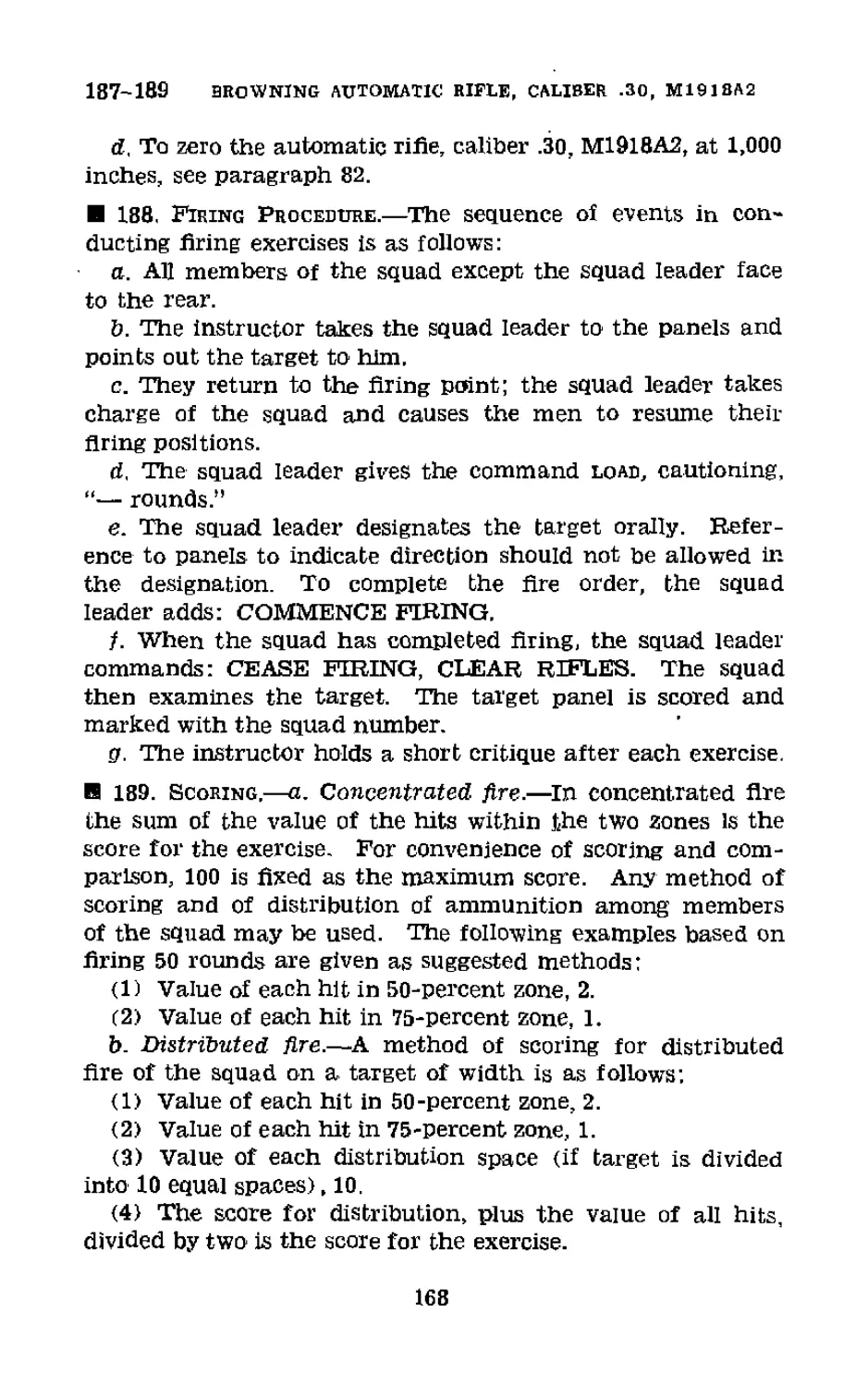




Tags: weapons military affairs
Year: 1940


Text
                    FM 23-15
WAR DEPARTMENT
BASIC FIELD MANUAL
BROWNING AUTOMATIC
RIFLE, CALIBER .30, M1918A2
WITH BIPOD
FM 23-15
BASIC FIELD MANUAL
BROWNING AUTOMATIC RIFLE
CALIBER .30, M1918A2
WITH BIPOD
Prepared under the direction of the
Chief of Infantry
UNITED STATES
GOVERNMENT PRINTING OFFICE
WASHINGTON; 1940
For sale by the Superintendent of Documents, Washington, D. C,, Price 25 cents
WAR DEPARTMENT,
Washington, August 27, 1940.
FM 23-15, Browning Automatic Rifle, Caliber ,30, M1918A2,
with Bipod, is published for the information and guidance
of all concerned.
[A.Or.062.11 (5-28-40) .]
By order of the Secretary of War:
G. C. MARSHALL,
Chief of Staff.
Official :
E. S. ADAMS.
Major General,
The Adjutant General.
и
TABLE OF CONTENTS
Paragraphs Page
Chapter 1, Mechanical Training.
Section I. General _________________________ 1-3	1
II.	Disassembly anti assembly_______ 4—12	3
III.	Care and cleaning______________ 13-15	19
IV.	Functioning____________________ 16-23	22
V.	Operation_______________________ 24-32	36
VI.	Immediate action and stoppages. _ 33-36	39
VII.	Spare parts and accessories_____ 37-38	46
VIII.	Ammunition_____________________ 39-46	49
Chapter 2, Marksmanship, Known Distance
Targets.
Section I. General_______________________  47-49	53
II, Preparatory marksmanship train-
ing ________________________________ 50-72	54
П1. Courses to	be fired_____________ 73-75	81
IV.	Range practice_________________ 76-85	88
V.	Regulations governing record prac-
tice___________________________... 86-116	96
VI.	Targets and ranges_____________117-118	107
Chapter 3. Marksmanship, Moving Ground
Targets.
Section I. General________________________ 119-120	112
П. Moving vehicles and personnel. _ 121-123	113
III. Moving targets, ranges, and range
precautions_________________________ 124-125	114
Chapter 4, Marksmanship, Air Targets.
Section I. General.._________________________ 126	118
II. Technique of antiaircraft	fire_127—131	118
П1. Marksmanship training__________ 132-136	120
IV.	Miniature range practice______ 137-140	128
V.	Towed target firing____________141-145	131
VI.	Ranges, targets, and equipment-. 146-151	134
Chapter 5.	Technique of Fire.
Section I. General________________________ 152-154	145
П. Range estimation______________  155-159	146
III.	Target designation___________ 160-166	149
IV.	Automatic rifle fire and its effect. 167-174	157
V.	Application of fire____________ 175-182	160
VI.	Landscape target firing______ 183-190	164
VII.	Field target firing_________ 191-196	170
Chapter 6.	Advice to Instructors.
Section I. General___________ ____________ 197	175
II.	Mechanical training__________ 198-199	175
III.	Marksmanship, known distance
targets__________________________  200-213	176
IV.	Marksmanship, air	targets------ 214-218	189
V.	Technique of fire_____________ 219-226	195
Index________________________________________________ 201
1П
FM 23-15
BASIC FIELD MANUAL
BROWNING AUTOMATIC RIFLE, CALIBER .30,
М1О1ЭАЯ, WITH BIPOD
CHAPTER 1
MECHANICAL training
Paragraphs
Section I. General_____________________________________   1—3
II.	Dlssasaembly and assembly____________________ 4-42
III.	Care and cleaning______________________     13-15
IV.	Functioning_______________________________   16—23
V.	Operation___________________________________ 24r-32
VI,	Immediate action and stoppages_______________33—36
VII,	Spare parts and accessories__________________37-38
VIII,	Ammunition_______________________________   39-46
Section I
GENERAL
	1. Object.—This chapter is designed to give the soldier
training that will insure his ability to maintain the rifle
and keep it in operation.
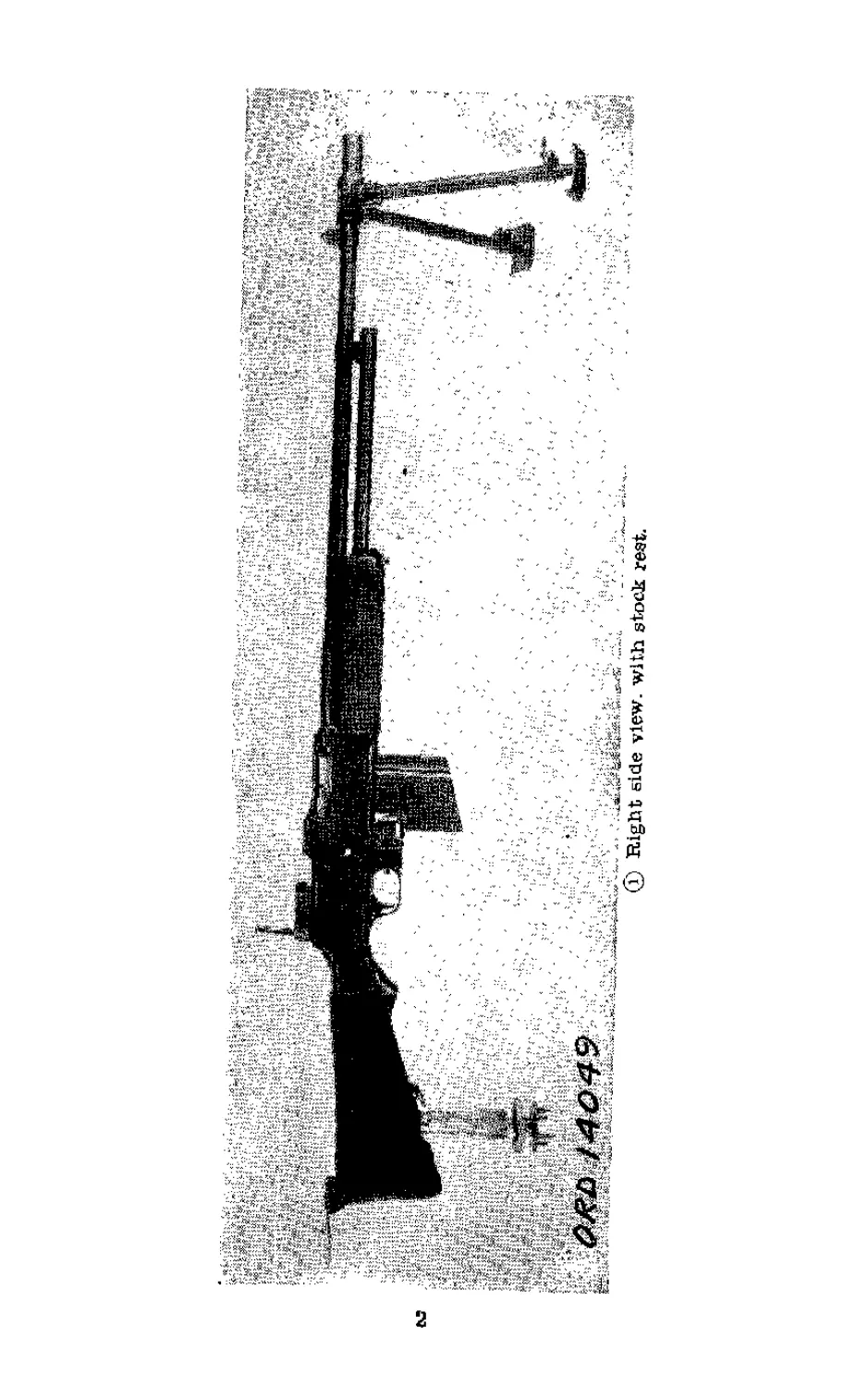
	2. Description of the Rifle.—The Browning automatic
rifle, caliber .30, M1918A2, with bipod, is an air-cooled, gas-
operated, magazine-fed shoulder weapon. (See flg. 1.) It
weighs approximately 21 pounds without sling. The am-
munition is loaded in magazines of 20 rounds. The weight
of the magazine when empty is 7 ounces; when filled, 1
pound 7 ounces,
	3. Fire Power.—The Browning automatic rifie, caliber
,30. M1918A2, is not capable of semiautomatic fire. There
are two cyclic rates of full automatic Are, normal and slow,
which may be selected by the firer. The normal cyclic rate
is approximately 550 rounds per minute; the slow cyclic rate
is approximately 350 rounds per minute. The effective rate
of Are for this weapon is from 120 to 150 rounds per minute,
1

Ф Rigilt side view, with stock rest
BROWNING AUTOMATIC RIFLE, CALIBER ,30, M1018A2
4-6
@ Left side view.
Figure 1.—Browning automatic rifle, caliber .30, M1918A2, with
bipod.
Section II
DISASSEMBLY AND ASSEMBLY
 4. Training.—Training in disassembly and assembly will
be taken up as soon as practicable after the soldier receives
his rifle. In any case it will be completed before any firing
is done with the rifle by the individual. Instruction in the
care and cleaning of the automatic rifle wiil also be covered,
 5. Organization.—In the company or platoon, all en-
listed men are combined in one or more groups under their
officers or selected noncommissioned officers as instructors.
Other noncommissioned officers supervise the work as di-
rected. Squad leaders supervise the work of their squads.
 6. Care To Be Exercise».—a. The rifle can be readily
disassembled and assembled without applying force. The
use of force is prohibited.
b, The rifle will not be disassembled or assembled against
time as this serves no useful purpose and results in burring
and damaging the parts. Instruction, blindfolded, may be
given to men who have passed their tests in mechanical
training. In all work in disassembling the rifle, the men
3
6-8
BROWNING AUTOMATIC RIFLE, CALIBER .30. M1918A2
will be taught to lay the parts out on a smooth, clean
surface in the proper sequence for assembling. The trigger
mechanism will not be disassembled or assembled blind-
folded,
 7. Nomenclature.—The names of the parts to which ref-
erence is made in mechanical training are readily learned as
this training progresses. Instructors will therefore take
care to name the parts clearly and correctly in their work.
A sufficient knowledge of the nomenclature of the rifle is
gained by the soldier during the instruction in mechanical
training,
 8. Disassembling the Rifle.—a. General.—Authorized dis-
assembly by the soldier is limited to that required for proper
care and maintenance of the rifle. Further disassembly will
be done under the supervision of an officer or ordnance per-
sonnel. The Individual soldier is prohibited from disassem-
bling the—
(1)	Forearm group.
(2)	Barrel group.
(3)	Butt stock and buffer group,
(4)	Rear sight group.
(5)	Receiver group.
b. Sequence.—The disassembly of the rifle authorized to
be performed by the individual soldier without supervision
is performed in the following sequence:
(1)	Operating group.—
(a)	Remove flash hider.
(b)	Remove bipod assembly,
(c)	Remove flash hider spring lock washer.
(d)	Cock the rifle.
(e)	Remove gas cylinder tube retaining pin.
(/) Remove gas cylinder tube and forearm (let mechanism
forward easily).
(g) Remove trigger guard retaining pin.
(h) Remove trigger guard.
(?) Remove recoil spring guide and recoil spring.
(j) Push hammer pin through hammer pin hole in re-
ceiver.
(fc) Remove operating handle,
(I) Remove hammer pin.
4
BROWNING AUTOMATIC RIFLE, CALIBER ,30, M191SA2
8
(m) Remove hammer,
(n) Remove slide.
(o) Push out bolt guide.
(p) Remove bolt, bolt lock, and bolt link,
((Z) Remove firing pin,
(r) Remove bolt link pin and bolt link.
(s) Remove extractor and spring,
(2)	Trigger mechanism.—Remove—
(a)	Ejector.
(b)	Magazine catch spring,
(c)	Magazine catch pin.
(d)	Magazine catch.
(e)	Magazine release,
(f)	Sear spring.
(g)	Trigger pin.
№) Trigger and connector.
(i)	Sear pin.
(j)	Sear and sear release stop lever,
(k)	Sear carrier and counterrecoil spring,
(Z) Change lever spring,
(m) Change lever,
(3)	Bipod assembly,—Remove the—
(a)	Two bipod leg ciamp wing screws,
(b)	Right and left bipod leg assemblies.
(c)	Two bipod clamp leg guides.
(d)	Two bipod body wing screws,
(e)	Right and left bipod leg tubes,
c, Method,—The following detailed explanation of the
method of disassembling the automatic rifle is furnished
as an aid to instructors:
(1)	Operating group.—Unscrew flash hider. Remove bi-
pod assembly and flash hider spring lock washer. Lay rifle
on table, barrel down, pointing to left. Cock the rifle. This
must be done in order that the gas cylinder tube may clear
the gas piston and gas cylinder tube bracket, female. Turn
gas cylinder tube retaining pin spring (54) 180° In a clock-
wise direction and lift out gas cylinder tube retaining pin
(53), Remove gas cylinder tube and forearm (118). Let
slide (45) forward easily by pressing trigger with thumb of
right hand and at the same time grasping slide with left
5
8
BROWNING AUTOMATIC RIFLE, CALIBER .30, M1913A2
2.—Operating group.
6
BROWNING AUTOMATIC RIFLE, CALIBER .30, M1918A2	8
hand so that middle and index fingers are astride gas piston.
Turn trigger guard retaining pin spring (12) 90° in a
clockwise direction and lift out pin. Lift out trigger guard
group. Remove recoil spring guide (41) by pressing right
index finger on checkered surface of its head and turning
it until ends are clear of retaining shoulders. Line up
hammer pin holes on receiver and operating handle by
inserting point of recoil spring guide or dummy cartridge
in hole on operating handle with right hand, press against
hammer pin (86), and push operating handle backward
with left hand. The recoil spring guide will push hammer
pin through its hole in receiver as hammer pin registers
with latter. Remove operating handle (88) by pulling
straight to rear. Remove hammer pin. Push hammer (85)
forward out of its seat in slide (45) and lift out of receiver.
Remove slide (45) by pulling it forward out of receiver,
being careful that bolt link (82) is pushed well down, thus
allowing slide to clear. In removing slide, take care to
avoid striking gas piston or rings against gas cylinder tube
bracket (56). Force bolt guide (72) out with left thumb
or point of a bullet. Lift out bolt, bolt lock, and bolt link
by pulling them slowly to rear end of receiver and up with
right thumb and forefinger. Pull out firing pin (76) from
its way In bolt (75). Push bolt link pin (83) and remove
bolt link. Remove extractor (77) by pressing point of a
dummy cartridge against claw and exerting pressure up-
ward and to front. Remove extractor spring.
(2)	Trigger mechanism.—(a) Depress ejector lock with
point of a dummy cartridge. Hold thumb in front of maga-
zine catch spring to prevent it from flying out and then
slide ejector out of its seat. Remove magazine catch spring,
Remove magazine catch pin, lift out magazine catch and
magazine release.
(b) Insert trigger guard retaining pin spring under sear
spring above connector stop. Pry up, pressing against sear
spring with thumb, and pull it out to rear. Push out trigger
pin. The trigger pin must always be removed before sear
pin in order that tension, of counterrecoil spring will always
be on sear pin. Remove trigger and connector through top
of trigger guard. Push out sear pin with the recoil spring
7
8
BROWNING AUTOMATIC RIFLE, CALIBER ,30. M1918A2
guide. Remove sear and sear release stop lever. Separate
sear release stop lever from sear. Pry up on sear carrier and
lift out sear carrier and counterrecoil spring. Remove
change lever spring by prying bent end out of its seat using
rounded end of sear spring and moving change lever from
front to rear. When clear of change lever, push it out the
8
BROWNING AUTOMATIC RIFLE, CALIBER .30, MI918A2
8—9
rest of the way by pressing with thumb against base of
sear release stop lever spring. Pull out change lever,
(3)	Bipod assembly.—Unscrew two bipod leg clamp wing
screws. Remove right and left bipod leg assemblies, Re-
move two bipod clamp leg guides. Unscrew two bipod body
wing screws. Remove right and left bipod leg tubes from
bipod body,
 9, Assembling the Rifle.—The rifle and its component
parts are assembled in the reverse order of their disassembly
as given in paragraph 8b. The folowing detailed explana-
tion of the method of assembling the rifle is furnished as
an aid to instructors:
a.	Bipod assembly,—Replace bipod leg tubes in bipod
body so that unthreaded holes of bipod leg clamps are facing
Figure 4.—Bipod group.
outward. Replace two bipod body wing screws. Replace
two bipod clamp leg guides in their slots on right and left
bipod legs. Replace bipod leg assemblies in bipod leg tubes.
Aline U-shaped opening of bipod clamp leg guides with holes
in bipod leg clampe and replace bipod leg clamp wing screws.
b.	Trigger mechanism,—(1) Replace change lever. Insert
ears of change lever spring in slots In trigger guard, sear
release stop lever spring being up and to rear, push spring
forward into place. Replace counterrecoil spring on counter-
recoil spring guide (front of sear carrier). Insert counter-
recoil spring guide into Its seat. Brace forward end of trigger
guard against an immovable object, and with thumbs of right
9
9
BROWNING AUTOMATIC RIFLE, CALIBER ,30. M1918A2
and left hands pressing on rear of sear carrier push sear
carrier forward until rear end is held by ears of change
lever spring. Hold sear so that slotted portion of cammed
end of sear is down. Insert short end of sear release stop
lever upward through slot in forward part of sear taking
care that notched end is down, Aline sear pin hole of sear
release stop lever with sear pin hole in sear. Replace sear
and sear release stop iever and force recod spring guide
through sufficiently so as to aline holes in sear release stop
lever, sear, sear carrier, and trigger guard for sear pin. By
slight pressure on recoil spring guide push sear carrier for-
ward against counterrecoil spring, thus permitting sear pin
to be seated easily in sear pin hole. The sear pin must always
be replaced before trigger pin In order that tension of counter-
recoil spring will always be on sear pin. Replace trigger
and trigger pin.
(2)	Holding connector so that its head is in rear of con-
nector stop and toe is down and to rear, depress rear end of
sear and drop connector into its place in trigger. Engage
sides of sear spring in recesses and press down and forward
on sear spring with thumb of right hand until front end of
spring rests in depression stop. Take care to see that outside
prongs of sear spring rest on their seat on sear and that
middle prong rides freely in slot formed by walls of sear
carrier. If middle prong rests on one of walls, instead of
riding freely bstween them, trigger mechanism will not
function when barrel is inclined below horizontal.
(3)	Replace magazine release, magazine catch, and maga-
zine catch pin. Replace magazine catch spring, insert
ejector into recess and move It down until it is flush with
magazine catch spring. Compress magazine catch spring in
its seat and move ejector down until it is fully home and
ejector lock is in its position,
(4)	After trigger mechanism has. been assembled, turn
change lever to forward position, and pull trigger. If con-
nector will not rise, it is not in place correctly. It should
rise and snap out from under sear. If connector will rise
but does not raise sear, sear spring is weak and should be
replaced.
10
BROWNING AUTOMATIC RIFLE, CALIBER .30, M1918A2
9-10
c. Operating group.—Replace extractor spring (78). Re-
place extractor (77) Into its seat In bolt. Replace bolt link
(82) and bolt link pin (83) with shoulder of link against flat
surface of bolt lock (80). Lift bolt lock and replace firing
pin (76). Lay rifle barrel down and pointing to left so that
rifle is resting on barrel and rear sight. With bolt mechanism
held in a perpendicular position insert it in receiver, forcing
end of bolt under ends of bolt supports, and then press bolt
mechanism down so as to lie flat in its place. Push bolt
mechanism forward, swing bolt link down, then replace
slide (45) and push all the way back. With hammer (85)
resting between thumb and forefinger, lower and seat it
properly in its seat in slide. Push bolt lock fully into its
locking recess and push slide forward. With thumb and
forefinger of right hand, aline hammer pin holes of bolt link,
hammer, and slide with hammer pin hole in side of receiver.
The recoil spring guide will be found a convenient aid in this
operation. Insert hammer pin (86) to right until only %
inch of hammer pin protrudes from receiver. Replace op-
erating handle (88). Tap end of protruding hammer pin
with sufficient force to drive it home. Replace recoil spring
(40) and guide (41). With end of index finger on checkered
end of recoil spring guide head, turn it until it is properly
seated. Holding right thumb against forward end of re-
ceiver will facilitate this operation. Replace trigger guard
group and trigger guard retaining pin (11). Cock the
rifle. Slide gas cylinder tube and forearm (118) to rear
of gas piston. Replace gas cylinder tube retaining pin (53).
Replace flash hlder spring lock washer on muzzle. Replace
bipod assembly on flash hider and screw flash hider onto
muzzle. Test rifle by pulling trigger.
 10. To Remove Firing Pin Without Disassembling.—To
remove firing pin, lay rifle on table, barrel down, muzzle tn
front. Remove trigger mechanism. Place rim of cartridge
under bolt guide (fig. 5 ®), Pull operating handle to rear
and hold mechanism back. Steady cartridge with thumb
and forefinger of right hand (fig. 5 ®). It may be necessary
to exert slight downward pressure on nose of cartridge in
order to pull bolt guide out far enough to free bolt. Push
down on bolt link, causing bolt to break at bolt lock pin
11
10-11
BROWNING AUTOMATIC RIFLE, CALIBER .30, M1918A2
(flg. 5 <s)). Allow mechanism to go forward until it stops.
Change firing pin. Pull operating handle to rear again and
push bolt into position (flg. 5 @),

 11. To Remove and Replace Extractor Without Disas-
sembling,—a. Removal.—Draw mechanism to rear and insert
an empty cartridge case between bolt and chamber, exposing
extractor (flg. 6 ®). Lay rifle on its side so that ejection
opening is up. With forefinger of left hand, force out claw
of extractor, then place point of cartridge behind extractor
shoulder and pry it forward until extractor is free of the
recess (flg. 6 ®). Remove extractor spring.
b. Replacement,—Insert short end of extractor spring in
hole In shank of extractor so that long end of spring is along
12
BROWNING AUTOMATIC RIFLE, CALIBER .30, M19I8A2	11-12
slot in extractor. Insert extractor and spring in end of
bolt and push them into position (fig. 6 ®), Remove empty
cartridge case.
 12. Disassembling and Assembling the Magazine.—Raise
rear end of magazine base until indentations on it are clear,
then slide it to rear. The magazine follower and spring will
then fall out. (See fig, 7.) It is assembled in reverse order,
(See fig. 8.)
Figure 5,—Removing flring pin without disassembling rifle.
250006°—40-
2
13
12
BROWNING AUTOMATIC RIFLE, CALIBER ,30, M1918A2
14
BROWNING AUTOMATIC RIFLE, САНЕЕВ ,30, M1S1BA2
12
Figure 6.—Removing extractor without disassembling rifle.
15
® With point of a cartridge raise rear end of magazine base until
indentations are clear to permit withdrawal. Then slide base to
rear.
® Pull out magazine spring and shake out follower. For assem-
bling, Insert follower and magazine spring,
Figvbe 7.—Disassembling magazine,
16
SRQWNING AUTOMATIC RIFLE, CALIBEH .SO, M191SA2
© Compress magazine spring into position.
® With left hand hold magazine spring in position. Slide
magazine base fully home.
Figure 8.—Assembling magazine,
BROWNING AUTOMATIC RIFLE, CALIBER .30. M1918A2
BROWNING AUTOMATIC RIFLE, CALIBER .30, M1918A2
13
Section III
CARE AND CLEANING
 13. General.—a. Scope.—(1) Care and cleaning includes
the care of the automatic rifle necessary to preserve its con-
dition and appearance under all conditions and at all times.
Automatic rifles in the hands of troops should be inspected
daily to insure proper condition and cleanliness.
(3) Automatic rifles should be disassembled only to the
extent necessary for cleaning and proper lubrication.
b. Lubrication and lubricants.—(1) Proper oiling is second
in importance only to intelligent cleaning. It Is a vital neces-
sity for the working parts, but the oil should be used spar-
ingly; wiping with a well-oiled rag Is the best method. Oil
all bearing surfaces of the rifle before firing,
(2) If the rifle is to be fired in areas where the temperature
is 45° F. or above, sperm oil (U. S, A. Spec, 2-45A) should be
used for oiling when available, When not available, motor
oil, weight 20, or any light-grade machine oil may be used
in an emergency.
(3) If the rifle is to be fired in areas where the temperature
is below 45° F„ aircraft instrument and machine gun lubri-
cating oil (U, S. A, Spec. 3-3 7D) should be used.
c. Cleaning.—To clean the automatic rifle, swab the bore
with an oily flannel patch. Repeat with dry patches until
several successive patches have come out clean. (For clean-
ing the bore after firing see par. 14c.) Push a patch damp-
ened with oil through the bore to protect its surface. Dust
out all screw heads and crevices with a small cleaning brush
or small stick. Wipe all metal surfaces with a dry cloth to
remove moisture, perspiration, and dirt. Wipe the outer sur-
faces of the automatic rifle, including the forearm, with a
lightly oiled cloth, then. clean with a soft, dry one, Immedi-
ately after cleaning, wipe all the metal parts with a lightly
oiled cloth. This protective film on all meta] parts will be
maintained at all times. At least once a month, and always
after the stock and forearm have become wet, they should
be rubbed thoroughly with a little linseed oil in the palm
of the hand- Rub oil in until dry. Use only castile soap
or saddle soap for cleaning or softening the sling.
19
14	BROWNING AUTOMATIC RIFLE, CALIBER .30, M1918A2
 14, Additional Rules for Care of Rifle,—a. Preparatory
to firing.—(1) Remove the protective film of oil from bore
and chamber,
(3)	Work slide back and forth several times to see that
it moves freely.
(3)	Verify proper setting of gas port.
(4)	Test trigger mechanism at "safe.”
(5)	Examine magazines. It is imperative that magazines
be given the best of care and kept in perfect condition.
They should be disassembled, wiped clean and dry, and
thinly coated with oil. Much dirt gets into them through
careless handling on the ground during range or other
firing. They must be kept free from dirt and rust which
hinder their operation by making the spring and follower
stick. Care must be exercised In the handling of magazines
to avoid denting or bending them. The greatest possible
care should be taken to prevent any damage to the lips
of the magazine or to the notch for the magazine catch,
b.	During firing*—(1) Keep bore free from dust, dirt,
mud, or snow.
(2)	Keep chamber free from oil or dirt.
(3)	Keep moving parts oiled.
(4)	Clean bore and gas system as frequently as oppor-
tunity during cessation of fire permits. The neglect of this
precaution is a frequent cause of stoppages.
(5)	Clean chamber frequently while still hot with cham-
ber brush by inserting it through the ejection opening in
the receiver.
c.	After firing.—(1) The bore of the rifle will be thor-
oughly cleaned by the evening of the day on which it Is
fired, and similarly cleaned for the next 3 days.
(2)	The bore is cleaned after firing by swabbing the bore
with a flannel cleaning patch saturated with hot water and
sal soda or issue soap solution. Repeat with several patches.
Plain water, hot or cold, should be used when soda or soap
are lacking. While still wet, run the metal brush through
the bore several times. Follow this with dry patches until
several patches come out clean and dry, then push a patch
saturated with oil through the bore to protect its surface.
20
BROWNING AUTOMATIC RIFLE, CALIBER ,30. MI918A2
14-1S
(3)	Clean the chamber with the chamber cleaning brush,
wipe clean with a cloth, and oil lightly.
(4)	Clean the gas system by first disassembling the lifle.
Remove the gas cylinder, Insert the smooth end of the body
of the gas cylinder tool into the gas cylinder. As it is ad-
vanced toward the cylinder head, turn it to the right. As
it reaches the head, apply additional pressure to the tool
and give it a few turns to cut the carbon from the inside
surface of the piston head. Withdraw and reverse the tool.
Using the recess cutter as a gage, remove the carbon from
the recesses at the forward end of the interior of the gas
cylinder. With the drift point, clean the gas ports in the
barrel, gas cylinder tube, and gas cylinder. Scrape the
carbon from the face of the piston with the front cutting
edge of the tool body and remove the deposit from between
the piston rings with the drift point. Wash with hot water
and soap or sal soda solution (if not available, use plain
water), dry thoroughly, and oil lightly,
(5)	Clean magazines and bipod assembly by disassembling,
wiping, oiling, and reassembling,
 15. Storage.—a. Preparation for long-term storage.—
Automatic rifles should be cleaned and prepared with par-
ticular care. The bore, all parts of the mechanism, and the
exterior of the rifles should be thoroughly cleaned and then
thoroughly dried with rags. In damp climates particular
care must be taken to see that the rags are dry. After dry-
ing a part, the bare hands should not touch that part. Spe-
cial care should be taken to Insure that the gas system is
thoroughly cleaned and that the gas ports are free from
fouling. All metal parts should then be heavily coated with
rust-preventive compound. Then handling the rifle by the
stock and forearm only, it should be placed in the packing
chest, the wooden supports at the butt and muzzle having
previously been painted with rust-preventive compound. A
rifle will not be placed in storage contained in a cloth or other
cover or with a plug in the bore. Such articles collect mois-
ture which causes the weapon to rust,
b. Cleaning when received from long-term, storage.—Auto-
matic rifles received from storage are completely coated with
rust-preventive compound. Use dry-cleaning solvent to re-
31
15-18
BROWNING AUTOMATIC RIFLE, CALIBER ,30, M1918A2
move all traces of this compound, particular care being taken
that the gas system, gas ports, firing pin, and all recesses in
which springs or plungers operate are cleaned thoroughly.
After using the dry-cleaning solvent, make sure it is com-
pletely removed from al] parts by wiping with light-colored
cloths until no staining of the cloth occurs. The bore and
chamber of the barrel must be thoroughly cleaned. All sur-
faces having been thoroughly cleaned, they should then be
protected with a thin film of lubricating oil applied with
a rag.
Note.—Failure to clean the gas system, the firing pin, and the
recess in the bolt in which it operates may result in gun laiiure
at normal temperatures and will most certainly result In serious
malfunctions if the rifles are operated in iow temperature areas,
as rust-preventive compound and other foreign matter will cause
the lubricating oil to congeal on the mechanism.
Section IV
FUNCTIONING
 16. General,—a, Object.—This section is designed to pro-
vide a nontechnical description of the functioning of the rifle.
The object of instruction in this subject is to lead the soldier
to an understanding of the simple functioning of his weapon
without emphasis on memorizing the matter of the text.
b, When taken up.—Instruction in functioning will be taken
up after instruction in the disassembly, assembly, care and
cleaning of the rifle,
	17, Use of Dummy Cartridges,—The corrugated type of
dummy cartridge (cal, .30, M1906) may be used for instruction
in functioning. The use of the slotted type of dummy car-
tridge (range, cal, .30, Ml) is prohibited. Special care must
be exercised in the use of dummy cartridges that they do not
introduce dirt or grit into the chamber of the rifle.
	18. Mechanical Means of Functioning.—All automatic
weapons must have mechanical means for performing the
following functions: extraction, ejection, feeding, locking the
breech while there is a high pressure in the bore, and igniting
the cartridge. Operations such as extraction and ejection are
performed by various cams, lugs, and springs, and the energy
necessary to perform this work and to overcome friction in
22
BROWNING AUTOMATIC RIFLE, CALIBER ,30, M1918A2
18-19
the rifle is derived from the explosion of the powder in the
chamber,
 19, Cycle.—a. The functioning of the automatic rifle is
divided into two phases based on the operation of the mecha-
nism when a shot is fired. These two phases are the rearward
movement and the forward movement. The ignition of the
cartridge in the chamber marks the division of the two phases,
b. The operations which take place in the rearward move-
ment are—
(1)	Action of gas.
23
19-20
BROWNING AUTOMATIC RIFLE, CALIBER ,30, M1918A2
(2)	Movement of slide to rear.
(3)	Unlocking,
(4)	Withdrawal of firing pin.
(5)	Extraction,
(6)	Ejection.
(7)	Termination of first phase.
c. The operations which take place in the forward move-
ment are—
Cl) Action of recoil spring,
(2)	Feeding,
(3)	Locking,
(4)	Ignition,
(5)	Termination of second phase.
 20. Description of Cycle,—a. Rearward movement.—Cl)
Action of gas.—A cartridge having been ignited, the bullet
under the pressure of the expanding powder gases travels
through the barrel, and when It reaches a point 6 inches from
the muzzle it passes a port in the bottom of the barrel. The
barrel pressure, which at this instant is still very high, seeks
this first natural vent. Alined with the barrel port are other
similar ports in the gas cylinder tube bracket, gas cylinder
tube, and gas cylinder. The port in the gas cylinder is the
smallest and serves to throttle the barrel pressure. The
port in the gas cylinder leads radially into a well about Уа
inch in diameter in the head of the gas cylinder. The
throttled barrel pressure is conducted through this well to
the gas piston plug. This pressure acts on the piston for the
very short time which it takes for the bullet to travel the 6
inches of distance from the barrel port to the muzzle. Its
effect is that of a sudden severe blow on the piston plug,
Under the impact of this blow, the gas piston is driven to the
rear carrying the slide with it. When the piston has traveled
about A inch backward, the bearing rings on its head and the
gas piston plug pass out of the cylinder. The gas expands
around the piston head and into the gas cylinder tube and is
exhausted through the six portholes in the tube. The gas is
prevented from traveling back through the gas cylinder tube
by the two rings on the piston, about % inch apart and 1J4
inches from the piston head. These rings also serve as bear-
24

Figure 10.—Action of gas on piston.
BROWNING AUTOMATIC RIFLE, CALIBER ,30, M1918A2
20
BROWNING AUTOMATIC RIFLE, CALIBER .30, M1918A2
ings to hold the front end of the piston in the center of the
gas cylinder tube after the piston head has passed out of the
gas cylinder.
(2)	The slide.—As the piston is forced back it carries the
slide with it. The first and the immediate result of the
backward movement of the slide is to begin the compression
of the recoil spring, thereby storing energy for the forward
action.
(3)	Unlocking.—The hammer pin is slightly in advance of
the bolt link pin about 0,19 inch. The center rib of the
hammer is very slightly in rear of the head of the firing
pin. When the slide begins its motion to the rear it im-
parts no motion whatever to the bolt and bolt lock, The
slide moves back 0.19 inch, and its only effect during this
travel is to carry the hammer from the firing pin and the
hammer pin directly under the bolt link pin. At this point
the unlocking begins, the bolt link revolves forward about
the hammer pin, drawing the bolt lock down and to the
rear. The motion of the lock and bolt, which is zero at
the instant the hammer pin passes under the bolt link
pin, accelerates from this point, until the slide has traveled
about 1.2 inches, at which latter point the bolt lock is
drawn completely down out of the locking recess and away
from the locking shoulder of the receiver. It is now sup-
ported in front on the bolt supports. The front upper
shoulder of the bolt link has revolved forward and bears
upon the locking shoulder of the bolt lock. These two
influences prevent the bolt lock from revolving down below
the line of backward travel of the bolt.
(4)	Withdrawal о/ firing pin.—As the bolt lock revolves
down from its locked position, a cam surface in a slot in the
rear bottom side of the bolt lock comes in contact with a
similar cam surface on the firing pin lug. This action cams
the firing pin from the face of the bolt,
(5)	Extraction.—The backward motion of the bolt begins
when the bolt lock has been drawn down so that the circular
cam surface on its under side is operating on the rear shoul-
ders of the bolt supports. This produces a strong lever action
which slowly loosens the cartridge case. The backward travel
of the bolt has been slight, only about %2 inch when the
26
BROWNING AUTOMATIC RIFLE, CALIBER ,30, M1918A2
20
firing pin is withdrawn; its travel is about % inch when
the bolt lock Is completely drawn down. From this point the
bolt moves to the rear, drawn by the bolt lock and bolt link,
with the same speed as the slide and carries with it the
empty cartridge case which is held firmly in its seat on the
face of the bolt by the extractor. The extractor is on the
upper right side of the bolt next to the ejection opening in
the receiver, A slot cut in the left side of the bolt lock near
the back end passes over the bolt guide, which supports the
bolt lock and bolt when they are in the rear position.
(6)	Ejection.—When the slide reaches a poiut about J4 inch
from the end of its travel, the base of the cartridge case
strikes the ejector. This action causes the cartridge case to
be pivoted with considerable force about the extractor and
through the ejection opening in the receiver. The front end
of the cartridge case passes first out of the receiver and is
pivoted so that It strikes the outside of the receiver at a point
about 1 inch in rear of the ejection opening. It rebounds
from the receiver toward the right front.
(7)	Termination of rearward movement.—The rearward
motion terminates when the rear end of the slide strikes the
buffer head and sear release. The slide, under the action of
the recoil spring, moves forward inch after striking the
buffer head and sear release. If the sear nose Is not de-
pressed, it engages the sear notch on the slide and the piece
is cocked for the next burst or shot.
Note,—The motion of the bolt, bolt lock, ana bolt link mechan-
ism began slowly at first and did not attain the speed of the slide
until the latter had traveled about 1% inches backward. This is
a very important characteristic of the rifle, since on this account
the mechanism is not subjected to an excess strain due to a sudden
start at the instant the gas impinges upon the piston. This slow
start delays the opening of the chamber sufficiently to allow the
high barrel pressure to decrease,
b. Forward movement.—(1) Action of recoil spring.—The
sear nose is depressed, disengaging the sear, and the slide
moves forward under the action of the recoil spring. The
position of the bolt link pin is slightly below a line joining the
bolt lock pin and the hammer pin; therefore as the slide
starts forward the joint at the bolt link pin has a tendency
to buckle downward. It is prevented from doing this by the
tail of the feed rib on the bolt which extends backward under
27
20
BROWNING AUTOMATIC RIFLE, CALIBER .30, M1918A2
the bolt lock, also by the upper front shoulder of the bolt link
being in contact with the locking surface of the bolt lock.
Since the joint cannot buckle, the entire mechanism moves
forward with the slide. When it has traveled about t-'i inch,
the front end of the feed rib impinges on the base of the
top cartridge, which the magazine spring and Ups are holding
up in its path,
(2)	Feeding.—The cartridge is carried forward about У*
inch, when the nose of the bullet strikes the bullet ramp or
guide on the breech of barrel and is deflected upward to-
ward the chamber. This action also guides the front end
of the cartridge from under the magazine lips. The base
of the cartridge approaches the center of the magazine,
where the lips are cut away and the opening enlarged, and
at this point Is forced out of the magazine by the magazine
spring. The base of the cartridge slides across the face of
the bolt and under the extractor. Should the cartridge fail
to slide under the extractor, the extractor will snap over
its head as the bolt reaches the forward position. When the
cartridge is released by the magazine, the nose of the bullet
is so far in the chamber that it is guided by the chamber
from this point on.
(3)	Locking.—When the slide is about 2 inches from its
forward position, the circular cam surface on the under side
of the bolt lock begins to ride over the rear shoulders of the
bolt supports, and the rear end of the bolt lock is cammed
upward. The bolt link pin passes up above the line joining
the bolt lock pin and hammer pin. The joint at the bolt
link pin now has a tendency to buckle upward, and the bolt
lock being opposite the locking recess in the receiver is free
to and does pivot upward about the bolt lock pin. The bolt
link revolves upward about the hammer pin, forcing the
bolt lock up. and a rounded surface on the bolt lock just
above the locking face slips over the locking shoulder in the
receiver, giving the lock a lever action which forces the bolt
home to its final position. The two locking surfaces on the
bolt lock and the receiver register as the hammer pin passes
under the holt link pin.
(4)	Igniting the cartridge.—The lug on the firing pin Is
buried in the slot on the under side of the bolt lock at all
28
BROWNING AUTOMATIC RIFLE, CALIBER .30, M19LBA2
20-21
times except when the bolt is locked in the forward posi-
tion. Therefore, the firing pin is locked away from the face
of the bolt during all the rearward and forward motion of
the bolt. When the hammer pin passes under the bolt link
pin, the firing pin has been released by the bolt lock. The
slide and hammer move forward about A inch farther, and
the center rib of the hammer strikes the head of the firing
pin, driving it forward and igniting the cartridge.
(5)	Termination of second phase.—The forward end of
the slide strikes a shoulder at the rear end of the gas cyl-
inder tube which terminates the forward motion. The
forward motion is not terminated by the hammer on the
firing pin. This can be seen by examining the head of the
firing pin when, the gas cylinder tube is assembled to the
receiver, and the bolt mechanism is in the forward position.
The firing pin has still about т^-inch clearance from its
extreme forward position.
Note.—The locking shoulder of the receiver is inclined forward.
Its surface is perpendicular to the line through the bolt lock
which the shock of the explosion follows; therefore the force of
this shock is exerted squarely against the normal surface, The
speed of the bolt mechanism is slowed down gradually from the
instant that the bolt lock, starts to rise until the hammer pin
passes Under the bolt link pin, when the speed is zero.
 31, Functioning of Combination Buffer and Rate Reduc-
ing Mechanism,—a. Parts.—The buffer and Tate reducing
mechanism consists of the following parts in the order giien
from front to Tear:
(1)	Buffer tube, which has four splined slots on Шз inside
of the forward end for use in positioning the bufer head.
One of these slots only is used to anchor the buffe; tube to
the buffer head by means of the buffer key,
(2)	Buffer head.
(3)	Scar release, inserted in buffer head.
(4)	Buffer key, which holds sear release in bur :r head
and anchors buffer tube to buffer head.
(5)	Brass friction cup with concave interior whic1 is spilt
to allow for expansion; and a steel cone to fit into .he cup.
Four of these cups and cones are placed one after the other
in series,
(6)	Buffer spring,
(7)	Actuator, inside of cups, cones, елй buffer spring.
250606°—40---3	29
to
о
«tuATflh	ACTUATOR SPRlWa
SUFFE» №ICTION CURS
BROWNING AUTOMATIC RIFLE, CALIBER .30, M191BA2
BROWNING AUTOMATIC RIFLE, CALIBER ,30, М1Э1ВА2
21
cup, friction, buffer
BTDP, ACTUATOR-
MET, BUFFER-
HEAD, BUFFER
RELEASE, SEAR
-CONE, FfnCTJCWt BUFFER
spring, buffer
; WASNER, STOCK RETAINING
SLEEVE LOCK
^-SLEEVE, stock RETAINING
SPRING. ACTUATOR
RISE, ACTUATOR
CAP, BUFFER TUBE
ACTUATOR
FJG, 9C
COMBINATION BUFFER ANO RATE REDUCING MECHANISM
Figure 11,—Combination buffer and rate reducing mechanism.
(8)	Buffer tube cap,
(9)	Actuator tube,
(10)	Actuator spring, Inside actuator tube.
(11)	Stock retaining sleeve lock washer.
(12)	Stock retaining sleeve,
(13)	Actuator stop,
(14)	Pin.
b. Action.—(1) When the automatic rifle is fired at the
slow cyclic rate, the buffer head and sear release, struck by
the rear end of the slide, move to the rear. The buffer
head forces the friction cups over the cones, causing them
to expand tightly against the tube, consequently producing
considerable friction as the cnps move back and compress
the buffer spring. Thus the rearward action of the slide
is checked gradually and there is practically no rebound.
The buffer spring returns the buffer head and friction cups
and cones to their original positions. After striking the
buffer head and sear release, the slide moves forward until
it is engaged by the sear. The delayed release of the sear
is then accomplished as follows: The sear release when
struck by the slide in turn strikes the actuator in the buffer.
The actuator is driven to the rear inside the actuator tube
against the actuator spring, it returns under the force of
31
21-22
BROWNING AUTOMATIC RIFLE, CALIBER ,30, M1913A2
expansion of the actuator spring to drive the sear release
forward against the camming surface on the rear of the
sear, thus releasing the sear and permitting the rifle to
continue its cycle. (See par, 23n.)
(2) When the rifle is fired at the normal cyclic rate, the
functioning of the combination buffer and rate reducing
mechanism is the same as explained for the slow cyclic
rate in (1) above except that the sear release is prevented
from engaging the camming surface on the rear end of the
sear by the sear release stop lever, (See par, 23m.)
 22, Functioning of Trigger Mechanism,—a. The trigger
mechanism has three settings:
(1)	Normal cyclic rate (A),—When so set the sear is de-
pressed as long as the trigger is held back, and the rifle
will continue firing at a cyclic rate of about 550 rounds
per minute until the magazine is emptied.
(2)	Slow cyclic rate (F),—When so set the sear is de-
pressed, thereby disengaging the sear and sear notch when
the trigger is pulled, but the mechanism is so constructed
that the sear rises and engages in the sear notch when the
slide comes back again, and the sear notch will not disen-
gage until the sear release in the buffer depresses the rear
end of the sear by riding over the cammed end of the sear
or the trigger is fully released and then pulled. With this
setting, the rifle fires one shot for each pull and quick
release of the trigger or a Siow cyclic rate of 250 rounds
per minute for the length of time the trigger is held com-
pletely to the rear.
(3)	Safe (S).—When so set, the sear cannot be released
from the sear notch by pulling the trigger,
b. The action of the trigger mechanism is taken up in
phases and should be followed on the mechanism itself as
the explanation proceeds, Have the trigger guard disassem-
bled completely. Study the shape of the change lever and
note the following:
(1)	It is a bar about % inch in diameter.
(2)	It has three shallow longitudinal slots cut on top of
the bar as the handle is held vertically.
32
BROWNING AUTOMATIC RIFLE, CALIBER .30, М1918Л2
22-23
(3)	The side of the bar is slotted in such a way as to leave
a little tongue of metal in the center and at the lower edge
of the slot.
 33. Setting Change Lever,—a. Assemble the change lever
and spring to the trigger guard. The toe of the change
lever spring is seated in one of the longitudinal slots on the
change lever, and as the lever is turned from one position
to another it seats in the other slots. The only function
of the forward end of the spring and the longitudinal slots
is to hold the change lever in the position in which it is set.
b.	Assemble the trigger aud pin to the guard.
c.	Turn the change lever to rear or safe position. In this
position the slot is turned slightly upward, and the full sur-
face of the bar is on the bottom. Pull the trigger. The rear
top end of the trigger is slotted longitudinally, and the metal
on each side of the slot forms two shoulders which rise against
the bottom of the change lever bar.
d.	Push the change lever over to the vertical position, which
is the full or normal cyclic rate setting. Pull the trigger.
The slot in the change lever is now turned to the front, and
the two shoulders of the trigger, which before engaged the
full surface of the change lever bar, now are free to pass up
into the slot of the change lever; also the tongue of meta! on
the bottom of the change lever slot passes through the longi-
tudinal slot In the end of the trigger.
e.	Push the change lever forward to the slow cyclic rate
position.
/. The slot is now turned partially down and when the
trigger is pulled the rear end of the trigger passes up into
the change lever slot; also the tongue of metal in the bottom
of the change lever slot is now turned back and does not pass
through the slot in the end of the trigger as it did in the
normal cyclic rate position.
g.	Observe the shape of the connector. It is shaped like a
boot with a toe and heel. It has a flat surface that slopes
down and toward the front from the head (sear spring ramp).
In rear of the head the profile extends straight downward for
about У inch, then slopes slightly to the rear for 0.12 inch
(sear carrier ramp). This last slope is used in a cam action
to be explained later. The function of the narrow, fiat top
33
23
BROWNING AUTOMATIC RIFLE, CALIBER ,30, ML91BA2
surface of the connector is to raise the forward end of the
sear until cammed out from under the latter,
h.	Flace the connector on the connector pin and set change
lever to safe; pull the trigger. The connector is not raised
for the obvious reason that the trigger itself cannot be raised
because the change lever bar is In its way.
i.	Turn the change lever to the normal cyclic rate position;
pull the trigger. The head of the connector is raised and held
in a vertical position and cannot be tipped forward. The
tongue on the change lever engages the toe of the connector
as the trigger is pulled and holds the connector upright.
j.	Turn the change lever to the slow cyclic rate position;
pull the trigger. The tongue on the change lever now does
not engage the toe of the connector, and the head of the con-
nector can now be tipped forward,
k.	Note the cross pin on the sear carrier called the con-
nector stop; also note that just in rear of the connector stop
and on the underside of the sear carrier is an inclined sur-
face sloping upward in the metal which joins the two sides
of the sear carrier. This surface has a cam action with the
above-mentioned surface of the connector,
I, Completely assemble the trigger mechanism,
m. Note that the center leaf of the sear spring presses on
the front sloping surface of the connector and tends to press
the head of the connector backward. Note that the rear end
of the sear release stop lever prevents the sear release from
engaging the camming surface on the rear end of the sear
except when it is depressed to its lower position by pressing
the trigger with the change lever set for the slow cyclic rate.
Set the change lever on safe and pull the trigger. The head
of the connector is not raised above the sear carrier for rea-
sons given previously. Therefore, the sear nose is not de-
pressed and hence the safe position. Change over to the
normal cyclic rate position and pull the trigger; the head of
the connector is raised and held in the vertical position thus
depressing the rear of the sear. The rear end of the sear
release stop lever is partially depressed but is still in its
raised position and serves only to prevent the sear release in
the buffer assembly from engaging the camming surface on
the rear of the sear. The rear of the sear remains in the
34
BROWNING AUTOMATIC RIFLE, CALIBER ,30, M1918A2	33
depressed position, the forward end being raised by the con-
nector. This prevents a re-engagement of the sear so that
normal cyclic rate of automatic fire continues until the trigger
is released or the ammunition supply is exhausted. It will be
noted from the above that the rate reducing mechanism per-
forms no useful function when the gun is firing at the normal
cyclic rate. The tongue on the change lever tends to hold
the connector vertically, and the ramp on the sear carrier
tends to cam the connector forward. The forces exerted by
these two parts on the connector are opposed, hence the
trigger mechanism is locked when the trigger has been pulled
enough to release the slide,
n. Set the change lever for the slow cyclic rate of auto-
matic fire; pull the trigger slowly. At first the head of the
connector rises and thereby depresses the sear nose, allowing
the slide to go forward. Note that If the press on the trigger
is not continued, the sear nose is stiil depressed, and the
rear end of the sear release stop lever is in its upper posi-
tion thus causing the gun to fire at the normal cyclic rate.
If the press of the trigger is continued, the previously men-
tioned cam surface on the connector comes in contact with
the cam surface of the sear carrier, and the head of the
connector Is cammed forward against the pressure of the
center leaf of the sear spring. The connector disengages
the forward end of the sear, and the two outside leaves of the
sear spring depress it. The forward end of the sear release
stop lever is raised and is held in its upper position by the
connector. The sear nose is raised up in the path of the slide
and engages the sear notch when the slide moves back. The
rear end of the sear release stop lever remains in the low
position below the camming surface on the rear of the sear
thus clearing the camming surface so that the sear release
in the buffer is free to act on the camming surface on the sear.
This causes the rifle to fire at the slow cyclic rate as long
as the trigger is held to the rear. (See par. 21b(l).) When
the trigger is released, the center leaf of the sear spring
presses the head of the connector downward and back under
the forward end of the sear, and the rear end of the sear
release stop lever Is raised to its upper position by the action
35
23-27 BROWNING AUTOMATIC RIFLE. CALIBER ,30, M1918A2
of the sear release stop lever spring. When the trigger is
pulled again the action is repeated,
o. In the slow cyclic rate position, the connector stop pre-
vents the head of the connector being tipped so far forward
that the sear spring cannot push it back in place when the
trigger is released. The only function of the change lever in
the slow cyclic rate position is the limiting of the upward
travel of the trigger when its upper rear shoulders strike the
top of the slot in the change lever, which in this position is
turned down.
Section V
OPERATION
 24, General.—a. Object.—This section is designed to give
the soldier instruction necessary for the operation of the
rifle.
b. When taken up.—The operation of the automatic rifle
Will be taken, up at any convenient time after instruction in
care and cleaning (sec, TH) has been completed.
	25, Use of Dummy Cartridges,—As prescribed in para-
graph 17.
	26. To Load the Magazine,—To load the magazine, place
the wide end of the magazine filler over the top of the maga-
zine so that the groove in the magazine filler fits over the
catch rib of the magazine. Hold the magazine in the same
relative position that it occupies in the rifle, that is, with the
catch rib toward the operator. Then insert a clip of car-
tridges in the guides provided in the filler, and with the
right thumb near the base push the cartridges into the
magazine. Each magazine will hold 20 rounds. (See flg. 12.)
 27, To Load the Rifle.—Press the magazine release, with-
draw the empty magazine. Hold a loaded magazine with
its base in the palm of the right hand, cartridges pointing
to the front. Insert the magazine between the sides of the
receiver in front of the trigger guard and push it home
smartly with the light hand. The magazine can be inserted
with the mechanism in either the cocked or forward position,
It is, however, ordinarily inserted after the rifle has been
cocked.
36
BROWNING AUTOMATIC RIFLE, CALIBER .30, M1918A2
28-29
	28, To Unload the Rifle.—Pless the magazine release and
withdraw the magazine. Let the bolt go forward by pulling
the trigger.
	29, To Fire the Rifle,—Select the cyclic rate desired and
press the trigger for the length of burst desired. If single
shots are desired, set the change lever for the slow cyclic
rate; press the trigger and release the pressure upon the
trigger immediately upon the release of the bolt for its
forward movement.
37
30-31
BROWNING AUTOMATIC RIFLE, CALIBER ,30, M1918A2
 30. To Set the Change Lever Control.—a, For the slow
cyclic rate of automatic fire or single shot, push the change
lever to the forward position marked “F.”
b, For the normal rate of automatic fire, set the change
lever in the vertical position against the change lever stop,
marked “A.”
c. To set the rifle at safe, depress the change lever stop
and pull the change lever rearward until it covers the change
lever stop. This position is marked “S.” The change stop
prevents the accidental setting of the change lever at safe
and at the same time allows a quick change from safe to
either full automatic or semiautomatic Are.
 31. Gas Adjustment,—u. General.—(1) The rifle should
normally be operated on the smallest port, and this setting
will never be varied unless the rifle shows signs of insufficient
gas. To aline the smallest port, screw in the gas cylinder
with the combination tool until the shoulder of the gas cylin-
der Is about one turn from the corresponding shoulder of the
gas cylinder tube and the smallest circle on the cylinder head
is toward the barrel. Lock the cylinder in position. If, upon
firing, the rifle shows signs of insufficient gas. try setting the
cylinder one complete turn on each side of the original set-
ting. As soon as the proper setting has been obtained, the
rifleman will carefully note the position, so that he can
quickly assemble the cylinder to the proper point without
trial.
(2) The larger ports are provided for use In case the action
of the rifle has been made sluggish through the collection
of dirt and grit or the lack of oil under conditions which
render prompt correction impracticable. For this reason the
threads should be kept clean and oiled and the cylinder free
to turn. The extractor, ejector, and the chamber of the
barrel should be examined and cleaned and defects corrected
when possible. Under adverse conditions, and when signs
of insufficient gas become apparent, the cylinder should be
unscrewed one-third turn, thus registering the medium circle
and alining the medium port with the gas orifice, Repeat
this operation in order to connect the largest port with the
barrel.
38
BROWNING AUTOMATIC RIFLE, CALIBER ,30, MI918A2
31-33
(3) Excessive friction or dirt may sometimes prevent the
complete forward movement of the bolt. This condition may
also be caused by the recoil spring having become perma-
nently set or short through continued use while excessively
hot; in such cases, replace the recoil spring.
b, Results of insufficient gas.—(1) Failure to recoil (usu-
ally due to misalined or excessively clogged gas port or ex-
tremely dirty mechanism),
(3) Failure to eject
(3) Weak ejection,
(4) Uncontrolled automatic fire (exceptional),
c, Results of too much gas.—(1) Excessive speed causing
pounding,
(2)	Excessive heat in gas operating mechanism,
 32, Safety Precautions.—a. Automatic rifles will not be
loaded except when on the firing line aud with the muzzle
pointed in the direction of the target.
b.	Automatic rifles will not be carried loaded except in the
presence of an enemy or a simulated enemy. Loaded rifles
will be carried with the muzzle elevated or to the front.
c.	Automatic rifles will be carried with the bolt forward
at all times except in the presence of an actual enemy,
d.	Automatic rifles will be assumed to be loaded whenever
a magazine is in the receiver,
e,	Never leave a patch, plug, or other obstruction in the
muzzle or bore.
f.	On the range, rifles are cleared before leaving the firing
line. The automatic rifle is cleared by removing the maga-
zine and releasing the bolt to its forward position.
Section VI
IMMEDIATE ACTION AND STOPPAGES
 33, General.—a. Object.—This section is designed to pro-
vide necessary instruction in the related subjects of immedi-
ate action and stoppages.
b. When taken up.—Instruction in immediate action and
stoppages will be completed before any firing is done by the
individual.
39
34-35
BROWNING AUTOMATIC RIFLE, CALIBER .30, MI918A2
 34. Immediate Action.—a. General,-—Immediate action is
the unhesitating application of a probable remedy for a
stoppage. Immediate action deals with the method of re-
ducing stoppages and not the cause. It is taught as an un-
hesitating manual operation to be applied to reduce stoppages
without detailed consideration of their causes.
Ь. Rifle fails to fire.—Pull the operating handle completely
to the rear and then push it forward. Tap the magazine
fully home. Aim and fire. If stoppage recurs, pull back the
operating handle slowly to determine position of stoppage,
remove the magazine, and apply proper remedy as explained
in paragraphs 35d and 36.
 35. Stoppages.—a, General.—While immediate action and
stoppages are closely related as to subject matter, the former
is treated separately to emphasize its importance as an auto-
matic and definite procedure to be applied to overcome stop-
pages. Proper care of the rifle before, during, and after
firing will almost always eliminate stoppages. Stoppages
which cannot be remedied by the application of immediate
action can best be eliminated if the soldier has an under-
standing of the functioning of the weapon and the causes
of stoppages.
b, Types.—(1) Temporary stoppages have been divided
into those found in four positions, dependent upon the posi-
tion where the bolt stops. The position of the stoppage Is
determined by pulling the operating handle to the rear until
it strikes the hammer pin.
(2)	Boundaries of the positions are—
(a)	First position, mechanism and operating handle fully
closed.
(b)	Second position, operating handle strikes hammer pin
anywhere from fully closed to a point where operating
handle plunger pin rides over raised shoulders on ribs of
operating handle guide way.
(c)	Third position, operating handle strikes hammer pin
anywhere from second position to a point directly over “F”
of change lever setting.
(d)	Fourth position, operating handle strikes hammer pin
anywhere between third position and rear.
40
BROWNING AUTOMATIC RIFLE, CALIBER .30, M1918A2
35
c. Probable causes of stoppages.—(1) Failure to extract.
(a)	Defective extractor.
(b)	Dirt under extractor.
(c)	Dirt in chamber.
(Й) Pitted chamber.
(e) Weak extractor spring.
(/) Defective ammunition.
(2)	Failure to eject.
(a)	Insufficient gas.
(b)	Defective extractor.
(c)	Dirt under extractor.
(d)	Ejector does not fit up close to bolt,
(e)	Ejector binds on bolt,
(/> Ejector has too much backward play.
(p) Ejector bent backward or otherwise defective.
(h) Weak extractor spring.
(i) Defective ammunition.
(3)	Failure to breech.
(a)	Dirt between bolt and rear end of barrel.
(b)	Primer in mechanism, generally in front of bolt.
(c)	Defective bolt lock or pin.
(d)	Defective magazine.
(e)	Piston binding.
(/) Excessive friction.
(p)	Recoil spring too short.
(4)	Insufficient gas.
(a)	Ports clogged.
(b)	Poor fit between gas cylinder tube and bracket.
(c)	Gas leakage around piston (worn cylinder).
(d)	Piston binding or cylinder dirty,
(e)	Gas cylinder threaded in too far or vice versa.
(5)	Ruptured cartridges.
(a)	Locking surface of bolt lock worn.
(b)	Bearing between bolt and bolt lock worn.
(c)	Face of bolt worn.
(d)	Chamber of barrel worn or pitted.
(e)	Locking shoulder of receiver worn.
(J) Bolt supports loose or worn.
(p) Defective ammunition,
41
35-36
BROWNING AUTOMATIC RIFLE, CALIBER .30, M1918A2
d. Reduction of stoppages.—(1) First position stoppage,—
If the stoppage is in the first position, pull operating handle
all the way back and watch ejection.
(a)	If nothing Is ejected, change magazine.
(b)	If loaded round is ejected, change firing pin.
(c)	If empty cartridge case is ejected, examine the correct
adjustment of gas cylinder, turniug to the next larger port
if necessary,
(2) Second position stoppage,—If the stoppage is in the
second position, feel far obstruction or bur on face of bolt,
in rear end of chamber, in bolt lock recess, or on bolt lock.
(3) Third position stoppage,—If the stoppage is in the
third position—
(a)	If due to a ruptnred cartridge, use ruptured cartridge
extractor to remove front part of ruptured case from the
chamber. If no ruptured cartridge extractor is available,
oil and sand nose of bullet, put it in chamber, and let bolt
go forward. Pull back operating handle. This will usually
extract the ruptured cartridge. Clean and oil chamber after
doing this.
(b)	If stoppage is not due to a ruptured cartridge, examine
face of bolt for obstruction.
(4)	Fourth position stoppage.—If the stoppage is in the
fourth position—
(a)	If slide moved after trigger was pulled, use cleaning
rod to push cartridge case from the chamber. If this stop-
page recurs, clean ammunition, and clean and lightly oil
chamber with a patch.
(b)	If trigger cannot be pulled or if the slide does not
move when trigger is pulled—
1.	See if change lever is set on “safe.”
2.	Take out trigger guard and correct fault in the
trigger mechanism.
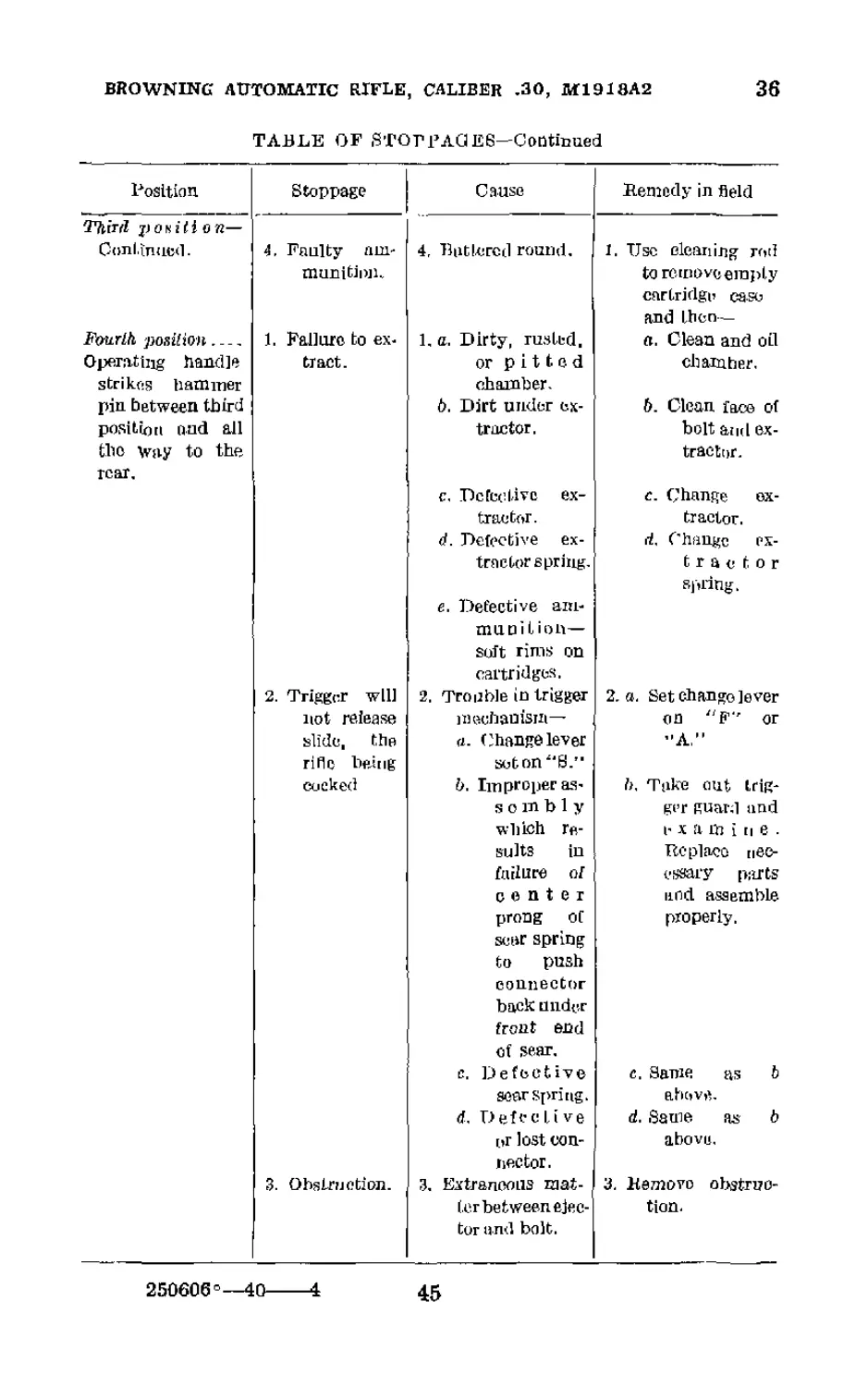
 36. Table of Stoppages.—a. The following table may be
found of value. It includes stoppages outlined in paragraph
35 and others that have not been covered but which may
occur,
42
BROWNING AUTOMATIC RIFLE, CALIBER .30, M1918A2
36
TABLE OF STOPPAGES
Position	Stoppage	Cause	Remedy in field
First posifiim Operating handle fully home.	1, Failure to feed,	1.	Magazine trou- ble в— a.	Magazine not fully home. b.	Obstruction between lips of magazine and top car- i ridge. c.	Wrak maga- zine spring. d. Magazine dirty, t:. Magazine tube or lips dented or beat. f. Magazine catch notch worn.	1. a. Push in a g a - zine home. b. Change maga- zine. c. Change maga- zine. rf. Change maga- zine; clean later. e. Change maga- zine. f, Change mag- azine.
	2, Fail nr.! to fire.	2. a. Broken or short firing pin. A. Weak reooil spring, c, Excessive fric- tion, it. Faulty amtnu- nit io n ~ d elective primers or oharfie.s.	2. a. Change firing pin. b.	Change recoil spring. c.	Clean and oil friction sur- faces and chamber. d.	Discard am- munition,
	3, Insufficient gas.	3. n. Gas cylinder not properly adjusted. b. Gas ports clog- ged. i. Piston binding, а о с о u n t dirty piston and cylinder.	3, a, Gorrcci, adjust- ment of gas cyli rider. Л. Turn cylinder to next larger port. Clean at first op- portunity. e. Turn cylinder to next larger port. Clean and oil nt first opportunity.
43
36	BROWNING AUTOMATIC RIFLE, CALIBER ,30, M1918A2
TABLE’6f STOPPAGES—Continued
Position	Stoppage	Cause	Remedy in field
№st position—	3. Insufficient	d. Dirty cham-	d. Turn cylinder
Continued,	gas—Con,	ber. c. Track of oil		to next larg er port. Oil chamber. Clean and oil ctiaruber at first oppor- tunity. e. Oil chamber and friction sur- faces.
Second position		1, Obstruction..	1. Extraneous mat-	1. Feel on face ot
Operating handle		ter or burs—	bolt, in receiver
strikes hammer		a. On face oi	and chamber, on
pin an ywhcrc		bolt.	bait lock, and in
from fully closed		6, In breech re-	bolt lock recess
back to top of		cess where	for burs or extra-
raised, shoulders		bolt and	ncous matter.
on operating		receiver	Remove extra-
handle guideway.	2, Faulty am- munition.	join, c. Onboltlock. d. In bolt lock recess, 2. Battered round.	ncous matter or burs.
Third position		1. Ruptured	1. Exosssive head	1. Use ruptured car-
Operating handle strikes hammer pin between sec- ond position and point directly over "p’ on re- ceiver,	cartridge.	space.	tridge extractor to remove rup- tured cartridge ease, 1Г recurs, clean end oil chamber,
	2, Failure to	2. a. Broken firing	2, a. Replace firing
	feed com- pletely .	pin protrud- ing fro tn face of bolt, I). Other obstruc- tion that pre- vents base of cartridge from sliding up across face of bolt.	pin, b. Remove ob- struction.
	3, Mechamism	3. Obstruction—ex-	3. Remove obstruc-
	wedged tightly.	truneons mat- ter between bolt support and bolt lock.	til 1П.
44
BROWNING AUTOMATIC RIFLE, CALIBER .30, M1918A2
36
TABLE OF STOPPAGES—Continued
Position
Third ji о к i t i о n—
Continued.
Fourth potilion____
Operating handle
strikes hammer
pin between third
position and all
the way to the
rear.
Stoppage
4, Faulty am-
munition.
1. Failure to ex-
tract.
2. Trigger will
not release
slide, the
rifle being
cocked
3. Obstruction.
	Cause	Remedy in field
4,	Bntlcrcd round.	I. Use eleaning rod to remove empty cartridge ease and then—
1,	a. Dirty, rusted.	a. Clean and oil
	or pitted chamber.	ell amber.
	b. Dirt under ex-	b. Clean face of
	tractor.	bolt and ex- tractor.
	c. Defective ex-	e. Change ex-
	tractor.	tractor.
	d. Defective ex-	d, Change ex-
	tractor spring. e. Defective am- munition— soft rims on cartridges.	tractor spring.
2.	Trouble in trigger	2. a. Set change ]ever
	mechanism—	on "F" or
	a. Change lever sot on "S.”	"A.”
	i>. Improper as-	l>, Take out trig-
	s о m b 1 у	ger guard and
	which re-	i- x a th 1 и e .
	suits in	Replace neo-
	failure of	essary parts
	center	end assemble
	prong of sear spring to push connector bock under front end of sear.	properly.
	c. Defective	c. Same as 6
	scar spring.	above.
	<f. Defective	d. Same as b
	r,r lost con- nector.	above.
3.	Extraneous mat-	3. Hemovo obstruu-
	(er be tween ejec- tor and bolt.	tion.
250606°—40-
4
45
36-38
BBOWNING AUTOMATIC RIFLE, CALIBER ,30. M1918A2
b. In the event of stoppages that are not mentioned above
and that cannot be reduced, the rifle should be turned in for
examination and repair.
Section VH
SPARE PARTS AND ACCESSORIES
 37- Spare Parts.—a- The parts of any rifle will in time be-
come unserviceable through breakage or wear resulting from
continuous usage. For this reason spare parts are provided
for replacement of the parts most likely to fail. These parts
are for use in making minor repairs and in the general upkeep
of the rifle, Twenty-round magazines are also issued as
spares, the quantity being based on the allowance of ammuni-
tion authorized. Sets of spare parts should be maintained
as complete as possible at all times, and should be kept clean
and lightly oiled to prevent rust. Whenever a spare part is
used to replace a defective part in the rifle, the defective part
should be repaired or a new one substituted in the spare parts
set. Parts that are carried complete should at all times be
correctly assembled and ready for immediate Insertion in the
rifle. The allowances of spare parts and of 20-round maga-
zines are prescribed in Standard Nomenclature List No, a-4,
b. With the exception of the spare parts mentioned above,
repairs or alterations by the using organizations are pro-
hibited.
 38. Accessories,—a. General,—Accessories include the tools
required for disassembling and assembling and for the clean-
ing and preservation of the rifle. They must not be used for
any purpose other than as prescribed. There are a number
of accessories the names or general characteristics of which
indicate their uses or application. Therefore, detailed de-
scription or methods of use of such items are not outlined
herein. However, accessories embodying special features or
having special uses are described in b below.
b. Special.—(1) Brush and thong, caliber .30, complete,—
This consists of the brush, the tip, the weight, and the cord
The thong weight and tip are made of brass and ате pro-
vided with holes in which the thong cord is knotted. The
46
BROWNING AUTOMATIC RIFLE, CALIBER ,30, M1B18A2	38
tip is provided with a cleaning patch slot and is threaded
on the end to receive the brush.
(2)	Brush, chamber cleaning, Ml.—The chamber cleaning
brush consists of a curved flat steel handle to which are
hinged a chamber cleaning brush at one end and a small
bristle dusting brush at the other end-
(3)	Brush, cleaning, caliber .30, М2.—The brush consists
of a brass wire core with bristles and tip. The core is twisted
in a spiral and holds the bronze bristles in place. The brass
tip, which is threaded for attaching the brush to the cleaning
rod, is soldered to the end of the core.
(4)	Cose, accessory and spare parts, M1918.—This is a
leather box-shaped case, approximately 2% inches wide, ЗУ2
inches high, and 5V2 inches long. It is used to carry the
spare parts and a number of the smaller accessories.
(5)	Case, cleaning rod. Ml.—The case is made of fabric
having five pockets, four of which hold the sections of the
jointed cleaning rod, Ml, while the fifth holds the cleaning
brush, caliber ,30, М2. The contents are secured in their
pockets by a web billet and chape with buckle,
(6)	Extractor, ruptured cartridge, MK. II.—The ruptured
cartridge extractor has the general form of a caliber ,30
cartridge. It consists cf three parts—the spindle, the head,
and the sleeve, To use the ruptured cartridge extractor
the live cartridges must be removed from the rifle. The rup-
tured cartridge extractor is then inserted through the opening
of the ruptured cartridge case and pushed forward into the
chamber. The bolt is let forward without excessive shock
so that the extractor of tho rifle engages the ruptured
cartridge extractor. As the operating handle is drawn back
the ruptured cartridge extractor, holding the ruptured car-
tridge on its sleeve, is extracted.
(7)	Filler, magazine.—The magazine filler is a pressed steel
adapter which is fitted over the top of an empty magazine
when loading. Its method of use is shown in figure 12.
(8)	Rod, cleaning, М2.—This is a straight rod consisting
of two sections permanently fastened together with a swivel
joint. The front end has a threaded hole for attaching the
cleaning brush and a slot for holding a cleaning patch. The
rear end is provided with a tubular steel handle which
swivels on the rod.
47
38
BROWNING AUTOMATIC RIFLE, CALIBER ,30, M1918A2
(9)	Rod, cleaning, jointed, Ml.—This steel rod consists of
five sections, the first two of which are permanently fastened
together by a swivel joint, The first section has a slot
formed for holding a cleaning patch and a threaded hole for
attaching the cleaning brush. The rear section is provided
with a tubular steel handle which swivels on the rod.
(10)	Sling, gun, М1Я07.—The gun sling is fastened to the
swivels provided on the rifle. It consists of a long and short
strap, either of which may be lengthened or shortened to suit
the particular soldier using it.
(11)	Tool, cleaning, gas cylinder.—This is a special tool for
cleaning the gas operating mechanism. The ends of the tool
body may be used to scrape carbon from the interior of the
gas cylinder and from the face of the gas piston. The drift
which is attached to the body may be used to remove carbon
deposits from the gas ports and from the grooves of the gas
piston. The carbon must be completely removed, but care
must be exercised to avoid scoring or damaging the gas
cylinder walls or the grooves of the gas piston.
(12)	Tool, combination.—This tool consists of a steel body
having two spanner wrenches and two screw driver ends. The
small spanner is used to turn the gas cylinder and the large
spanner to turn the rifle barrel. The small screw driver at
the end of the large spanner is used for the removal of small
screws, and the larger screw driver for the removal of the
butt stock bolt and the forearm screws.
(13)	Wrench.—Until a special tool is designed and issued,
a % by 1 inch double head engineer’s wrench may be used
to remove the flash hider and bipod bearing from the muzzle
end of the rifle barrel,
(14)	Stock, rest.—The stock rest is not used except when
the Browning automatic rifle, caliber .30, M1918A2, is used
as a substitute for the light machine gun in light machine-
gun units.
48
BROWNING AUTOMATIC RIFLE, CALIBER ,30, M1918A2
39-42
Section VIII
AMMUNITION
	39. General.—The information in this section pertaining
to the several types of cartridges authorized for use in the
Browning automatic rifle, caliber .30, M1918A2, includes a
description of the cartridges, means of identification, care,
use, and ballistic data.
	40. Classification.—Based upon use, the principal classi-
fications of ammunition for this rifle are—
Ball, for use against personnel and light materiel
targets.
Tracer, for observation of fire and incendiary purposes.
Armor piercing; for use against armored vehicles, con-
crete shelters, and similar targets.
Dummy, for training. (Cartridges are inert.)
	41. Lot Number.—When ammunition is manufactured, an
ammunition lot number, which becomes an essential part
cf the marking, is assigned in accordance with specifications.
This lot number is marked on all packing containers and
on the identification card inclosed in each packing box. It
is required for all purposes of record, including grading and
use, reports on condition, functioning, and accidents, in
which the ammunition might be involved. Since it is im-
practicable to mark the ammunition lot number on each
Individual cartridge, every effort should be made to maintain
the ammunition lot number with the cartridges once they
are removed from their original packing. Cartridges which
have been removed from the original packing and for which
the ammunition lot number has been lost are placed in
grade 3. It is therefore necessary when cartridges are re-
moved from original packings that they be so marked that
the ammunition lot number is preserved.
	42. Grade.—Current grades of existing lots of small arms
ammunition are established by the Chief of Ordnance and
are published in Ordnance Field Service Bulletin No. 2-5.
49
42-43 BROWNING AUTOMATIC RIFLE, CALIBER ,30, M1918A2
No lot other than that of current grade appropriate for the
weapon will be fired. Grode 3 ammunition is unserviceable
and will not be fired.
 43, Identification,—a. Markings.—The contents of orig-
inal boxes are readily identified by the markings on the box.
Similar markings on the carton label identify the contents
of each carton,
b. Color bands.—Color bands painted on the sides and
ends of the packing boxes further identify the various types
of ammunition. The following color bands for cartridges
are used:
Armor piercing---------------------Blue on	yellow,
Bal!_______________________________Red,
Tracer_____________________________Green on	yellow.
Dummy______________________________Green,
c. Types and models.—The following types and models of
caliber .30 cartridges are authorized for use in this rifle:
Ball, М2.
Ball, Ml.
Armor piercing, Ml.
Armor piercing, М2.
Armor piercing, M1922.
Dummy, range, Ml or M1921.
Tracer, Ml.
When removed from their original packing containers, the
cartridges may be identified except as to ammunition lot
number and grade by physical characteristics described
below.
(1)	Armor piercing.—All models of caliber .30 armor
piercing ammunition are distinguished by the nose of the
bullet which is painted black for a distance of approximately
У$ inch from the tip, The bullets have gilding metal jackets.
(2)	Ball.—All models of caliber .30 ball ammunition, ex-
cept the M1906, have bullets with gilding metal jackets. The
jacket of the Ml906 bullet is cupronickel which has a silvery
appearance. The gilding metal jacket of the М2 bullet is
tin coated and hence resembles the M1906 bullet in appear-
ance. The gilding metal jacket of the Ml bullet is copper
colored,
50
BROWNING AUTOMATIC RIFLE, CALIBER .30, М1918Л2	43-45
(3)	Tracer.—Caliber .30 tracer ammunition may be iden-
tified by the nose of the bullet which, is painted red for a
distance of approximately inch from the tip.
(4)	Dummy.—The caliber .30 corrugated dummy cartridge
may be identified by the corrugations formed in the cartridge
case.
 44. Care, Handling, and Preservation.—a. Small arms am-
munition is not dangerous to handle. Care, however, must be
exercised to keep the boxes from becoming broken or dam-
aged. All broken boxes must be immediately repaired and all
original markings transferred to the new parts of the box.
The metal liner should be air tested and sealed if equipment
for this work is available.
b.	Ammunition boxes should not be opened until the am-
munition is required for use. Ammunition removed from the
airtight container, particularly in damp climates, is apt to
corrode, thereby causing the ammunition to become
Unserviceable.
c.	The ammunition should be protected from mud, sand,
dirt, and water. If it gets wet or dirty wipe it off at once.
Light corrosion, if it forms on cartridges, should be wiped off.
However, cartridges should not be polished to make them look
better or brighter.
d.	No caliber .30 ammunition will be fired until it has been
identified by ammunition lot number and grade.
e.	Do not allow the ammunition to be exposed to the direct
rays of the sun for auy length of time. This is liable to
affect seriously its firing qualities.
 45. Storage.—Whenever practicable small arms ammuni-
tion should be stored under cover. Should it be necessary to
leave small arms ammunition in the open, it should be raised
on dunnage at least 6 inches from the ground and the pile
covered with a double thickness of paulin. Suitable trenches
should be dug to prevent water from flowing under the pile.
51
46
BROWNING AUTOMATIC RIFLE, CALIBER ,30, M191BA2
 46, Ballistic Data.—Approximate maximum ranges are as
follows:
Cartridges, caliber .30:	Yards
Ball. М2____________________________________________3.450
Ball, Ml____________________________________________5,500
Armor piercing, Ml__________________________________4,000
Armor piercing, М2__________________________________4,500
Armor piercing, M1922_______________________________4,400
Tracer. Ml__________________________________________3,450
52
CHAPTER 3
MARKSMANSHIP, KNOWN DISTANCE TARGETS
Paragraphs
Section I. General______________________________________ 47-49
II.	Preparatory marksmanship	training__________ 50-72
III.	Courses to be fired_________________________ 73-75
IV.	Range practice_____________________________ 76-85
V.	Regulations governing record practice______ 86-116
VI,	Targets and ranges_________________________117-1 IB
Section I
GENERAL
	47. Object.—The object of this chapter is to provide a
thorough and uniform method of training individuals to be
good automatic rifle shots and of testing their proficiency in
firing at known distance targets with the Browning automatic
rifle, caliber .30, M1918A3, with bipod.
	48. Fundamentals.—To become a good automatic rifle shot
the soldier must be trained in the following essentials of good
shooting:
a.	Correct sighting and aiming.
b.	Correct positions.
c.	Correct trigger manipulation.
d.	Correct application of the fundamentals of automatic
Are.
e.	Knowledge of proper sight adjustments.
 49. Phases of Training.—a. Marksmanship training is di-
vided into the following phases:
Preparatory marksmanship training.
Range practice.
Ъ.	No individual should be given range practice until he
has had a thorough course In preparatory training.
c,	The soldier should be proficient in mechanical training
before he receives instruction in marksmanship training.
d.	Every man who is to fire on the range will be put through
the preparatory course regardless of previous qualifications.
53
50-51
BROWNING AUTOMATIC RIFLE, CALIBER ,30. M1913A2
Section П
PREPARATORY MARKSMANSHIP TRAINING
 50. General,—a. Steps in training.—The purpose of pre-
paratory marksmanship training is to teach the soldier the
essentials of good shooting and to develop fixed and correct
shooting habits before he undertakes range practice. Pre-
paratory marksmanship training is divided into six steps as
follows:
(1)	Sighting and aiming exercises,
(2)	position exercises.
(3)	Trigger manipulation exercises,
(4)	Automatic fire exercises.
(5)	Instruction in the effect of wind, sight changes, and
use of the score book.
(6)	Examination of men before starting range practice,
b. When taken up.—Preparatory marksmanship will be
taken up in the period stated in training programs and will
precede range practice, Preparatory marksmanship training
can be covered in 2 training days,
 51. Equipment,—a. List.—For each eight-man group—
2 sighting bars.
2 automatic rifles and rests.
2 3-inch sighting disks (fig. 14).
4 small aiming targets,
1	long range sighting disk,
2	small boxes,
1	target frame covered with blank paper for long
range triangles.
1	score book for each man,
2	blank examination forms as shown in paragraph 72.
1 D target with curtain for each three groups.
b. Preparation.—(1) Sighting bar,—Construct the sighting
bars from trim lumber and tin strip to the dimensions and
design shown in figure 14, The sighting bars like all other
equipment should be constructed so as to present a neat
appearance. The tops of the sighting bars, their front and
rear sights; and their eyepieces are painted black.
(2)	Automatic rifle and rest,—An empty ammunition box
or any similar box with notches cut in the ends to fit the
54
BROWNING AUTOMATIC RIFLE, CALIBER .30. M191SA2
51-52
automatic rifle closely makes a good automatic rifle rest.
The automatic rifle is placed in those notches with the
trigger guard just outside one end. The sling is loosened
and pulled to one side. The box is half filled with earth or
sand to give it stability.
(3)	Sighting disks,—sighting disks are of two sizes. The
disk to be used at a distance of 50 feet is shown in figure 14.
The disk to be used at 200 yards is constructed by pasting
the black silhouette of a standard D target on some stiff
backing and attaching a 4-foot handle. The sighting disks
have holes in their centers of a size sufficient to admit the
point of a pencil,
Figure 14,—Construction of sighting bar and sighting disk.
(4)	Blackening the sights.—In ail preparatory exercises
involving aiming and in all range firing, both sights of the
automatic rifle are blackened. Before blackening, the sights
are cleaned and all traces of oil removed. The blackening
is done by holding each sight for a few seconds in the point
of a small flame which is of such a nature that a uniform
coating of lampblack will be deposited on the metal. Mate-
rials commonly used for this purpose include carbide or kero-
sene lamps, candles, small pine sticks, and shoe paste,
 52, Duties of Leaders,—a. Battalion commander.—He re-
quires the officers and noncommissioned officers to be familiar
55
52-54
BROWNING AUTOMATIC RIFLE, CALIBER .30, M1918A2
with the prescribed methods of instruction and coaching;
supervises the instruction within his battalion; and requires
the companies to follow the preparatory exercises and meth-
ods of coaching carefully and in detail,
b. Company commander,—He requires the prescribed
methods of instruction and coaching to be carried out care-
fully and in detail within his company; supervises and directs
the platoon leaders.
C- Platoon leader.—He supervises and directs the squad
leader In training his squad and examines the men in his
platoon who are to Are the automatic rifle as outlined in para-
graph 72. He keeps up a copy of the form showing the
proficiency attained by each man (see form, par. 73).
d. Sergeants.—They assist in the instruction and perform
any other duties as directed by the company and platoon com-
manders. They may assist the platoon leaders in keeping
the forms referred to in c above.
e. Squad leader.—(1) He sees that each man In his squad
is occupied in the designated preparatory training.
(2)	He keeps up a separate copy of the form shown in
paragraph 72 and promptly enters the grades made by his
men as the work progresses. He has this form ready for the
platoon leader’s inspection at any time.
(3)	He requires the coaches to correct errors.
 53, Method of Instruction-—a. Men are grouped in pairs
as coach and pupil and alternate in assisting and coaching
each other.
b. Correct shooting habits are developed during the pre-
paratory exercises, and to this end the careful execution of
details is required. Training proceeds expeditiously to main-
tain interest. Care is taken to avoid holding the men in
position until they become uncomfortable. Frequent short
rests are given.
c. Officers and noncommissioned officer instructors will
complete their own preparatory marksmanship training prior
to that of their men in order that they may give their entire
attention to the men whom they are to direct and instruct.
 54, Duties of Coaches.—The successful conduct of the
preparatory exercises largely depends upon the attention of
56
BROWNING AUTOMATIC RIFLE, CALIBER ,30, MIB18A2
54—55
the coaches to their duties. Officers and noncommissioned
officers are specifically charged with the supervision of
coaches as well as of pupils. They will require the coaches
to have their pupils execute all steps of the preparatory exer-
cises correctly. The duties of a coach are specific and during
the progress of the preparatory exercises include necessary
correction of the pupil to see that the—
a.	Sights are blackened.
b.	Gun sling is properly adjusted.
c.	Position is taken correctly.
d.	Slack is taken up promptly.
e.	Aim is carefully taken.
f.	Breath is held during aiming (by watching the pupil’s
back).
g.	Trigger is pressed properly.
h.	Pupil calls the shot.
 55, First Sighting and Aiming Exercise: Sighting Bar.—
The instructor or squad leader shows a sighting bar to his
group and explains its use as follows, being careful to point
out the various parts of the bar as he refers to them:
a.	The front and rear sights on the sighting bar represent
enlarged rifle sights.
Ь.	The eyepiece on the sighting bar has no counterpart on
the rifle. The eyepiece on the sighting bar is used as an aid
to instruction because it enables the alinement of the sights
to be demonstrated easily. The movable target on the sight-
ing bar enables any alinement of the sight upon the silhouette
to be shown.
c.	He next explains the peep sight to his group and shows
each man a correct sight alinement with the target removed,
(See fig. 15.)
d.	He next describes the correct aim. He explains that the
top of the front sight is centered on the rear sight so as just
to touch the bottom of the silhouette.
e.	He explains that the eye should be focused on the sight
picture, being sure that his front sight is distinct against the
target, and he assures himself by questioning the pupils that
each man understands what this means.
57
55-56 BROWNING AUTOMATIC RIFLE, CALIBER ,30, M1918A2
/. He adjusts the rear sight of the sighting bar and the
movable target so as to illustrate the correct aim and has
each man observe it by looking through the eyepiece.
g.	He adjusts the rear sight and the movable target of the
sighting bar so as to illustrate various small errors and has
each man of the group detect and describe them,
h.	Each man will then again be shown the bar with the
correct aim illustrated.
i.	Each man will then be required to adjust the sighting
bar with the correct aim until he is proficient, using the coach
and pupil method.
0
о
A CORRECT SIGHT
WITH THE
SIGHTING BAR.
Figure 15-—Correct sight with sighting bar,
 56. Second Sighting and Aiming Exercise: Alining Sil-
houette and Sights.—An automatic rifle for each subgroup is
placed in an automatic rifle rest and pointed at a blank sheet
of paper mounted on a box at which a soldier with the small
disk is stationed as marker. The coach or an instructor takes
the prone position and without touching the automatic rifle
looks through the sights. He directs the marker by voice
or signal to move the small disk until the bottom of the sil-
58
BROWNING AUTOMATIC RIFLE, CALIBER .30, MI9I8A2
56-57
houette is in correct alinement with the sights. He then
calls “Hold,** at which the marker will hold the small disk
in position. The coach or Instructor moves away from the
automatic rifle and directs the pupil to look through the
®
Ficube 16.-—Position for second sighting and aiming exercise.
sights in order to observe the correct aim. He then requires
the pupil to execute the exercise for himself being careful
to check the alinement which the pupil obtains,
 57, Third Sighting and Aiming Exercise; Making Shot
Groups.—a. The object of this exercise is to teach uniform
and correct aiming.
59
57-58
BROWNING AUTOMATIC RIFLE, CALIBER .30, M1918A2
b.	The exercise is conducted as follows: The automatic
rifle with blackened sights is placed in an automatic rifle
rest and pointed at a blank sheet of paper mounted on a
box 50 feet distant. The pupil takes the prone position with-
out touching the rifle or rests and looks through the sights.
The pupil or coach directs the marker to move the small
disk until the bottom of the silhouette is in correct alinement
with the sights, and then calls “Hold.” The instructor
checks the alinement and then call “Mark.” The marker
immediately marks a dot on the paper with a sharp-pointed
pencil inserted through the hole in the silhouette. The
small disk is removed and the dot numbered. The pupil
repeats this operation until three dots, numbered 1, 2, and
3, have been made. These dots outline the shot group and
the pupil’s name is written under it. The size and shape
of the group will be discussed with the coach or instructor
and the cause of error pointed out and corrected. This
exercise Is repeated until proficiency is attained, A good
group of three marks can be covered by the eraser of an
ordinary pencil.
c.	A similar exercise is held during the period of prepara-
tory marksmanship training at 200 yards with the 36-inch
movable silhouette. Properly handled, the exercise helps
greatly to sustain interest in the work and to teach correct
aiming. At 300 yards a man should be able to make a shot
group that can be covered with the small (3-inch) sighting
disk.
d.	Tracings are made of each man’s 300-yard shot group.
These tracings are marked with the men’s names, turned
over to the platoon leader for his information, and shown to
the men with appropriate mention of errors to be corrected.
e.	The shot group exercise may be continued during the
remaining periods of preparatory marksmanship training to
maintain interest and to secure the proficiency of men who
require special instruction.
 58. Position Exercises.—a. General.—Instruction in posi-
tion will include the use of the gun sling, holding the breath,
and aiming in each position. Small targets are set up for
each position to assist the aim.
60
BROWNING AUTOMATIC RIFLE, CALIBER ,30, M1918A2
58
b. Scope of induction.—Detailed instruction will be given
in each of the positions described in paragraphs 59 to 62,
inclusive.
c. General rules.—(1) All positions are as carefully learned
as the prone position, but the soldier is taught that the prone
position with the bipod rest is the normal position, and that
he must seek firing positions which will enable him to use
this position,
(3)	To assume any position except the prone position, first
half face to the right and then assume the position.
Figure 17.—Position for third sighting and aiming exercise at long
range.
(3)	Upon assuming any position there is a point at which
the rifle points naturally and without effort. If this point Is
not the center of the target, the whole body is shifted so as to
bring the target into proper alinement.
(4)	In all positions except the prone position with bipod
rest, the bipod is in its locked position (i. e,, legs of bipod
locked in position along the barrel).
(5)	The right hand grasps the small of the stock. The
thumb may be around the small of the stock or on top of
the stock.
250606°
61
BROWNING AUTOMATIC RIFLE, CALIBER .30, M191BA2
58
(6)	The left hand is not forced forward farther than is
comfortable and convenient in the kneeling or sitting posi-
tion. In the prone position it grasps the small of the stock.
The left wrist is straight, and the rifle is placed in the crotch
formed by the thumb and index finger and resting on the
heel of the hand. The left elbow is as nearly under the rifie
as it can be placed without strain.
(7)	The trigger Is pressed with the second joint of the
index finger. The first joint may be used if necessary.
(8)	The cheek firmly rests against the stock and is placed
as far forward as possible without strain to bring the eye
near the rear sight.
(9)	Men are not permitted to shoot In the left-handed
position.
(10)	The hinged butt plate need not be used in any firing
position except the prone position with the bipod rest.
d. Gun sling.—(1) The gun sling properly adjusted is of
great assistance in shooting in all positions except prone with
bipod rest in that it helps to steady the rifle. Each man is
assisted by the instructor in securing the correct adjustment
for his sling. In a firing position the sling is adjusted to
give firm support without discomfort to the soldier. The
gun sling is readjusted for drill purposes by means of the
lower loop without changing the adjustment of the upper loop.
(3) There are two authorized adjustments—the loop sling
and the hasty sling. The hasty sling is more rapidly ad-
justed than the loop sling, but it gives less support. The
sling is not used on the arm when firing in the prone position
with bipod rest.
(a)	Loop adjustment,
1.	Loosen the lower loop.
2.	Insert the left arm through the upper loop from
right to left so that the upper loop is near the
shoulder and well above the biceps muscle.
3.	Pull the keepers and hook close against the arm
to keep the upper loop in place.
4,	Move the left hand over the top of the sling and
grasp the forearm of the rifle near the center so
as to cause the sling to lie smoothly along the
hand and wrist. The lower loop, not used in this
62
58	BROWNING AUTOMATIC RIFLE, CALIBER .30, M19I8A2
adjustment, should be so loose as to prevent any
pull on it. Neither end will be removed from
either swivel.
(b)	Hasty sling adjustment.
1,	Loosen the lower loop.
2.	Grasp the forearm of the rifle near the center with
the left hand and grasp the small of the stock
with the right hand.
3.	Throw the sling to the left and catch it above the
elbow and high on the arm,
4.	Remove the left hand from the rifle, pass the left
hand under the sling, then over the sling, and
regrasp the rifle with the left hand so as to cause
the sling to lie along the hand and wrist. The
sling may be given one-half turn to the left and
then adjusted. This twisting causes the sling to lie
smoothly along the hand and wrist.
e.	Holding the breath.—The breath is held during aiming.
To accomplish this, draw a little more air into the lungs
than is used in an ordinary breath. Let out a little of this
air and hold the rest natnrally and without constraint.
f.	Aiming.—The rifle is carefully aimed in each position.
g.	Canting the rifle.—In all positions the rifle is squarely
held, that is, not tipped or eanted from a vertical plane pass-
ing through its long axis. It should be understood, however,
that unless it is pronounced, this error in position will not
materially affect the aim nor the strike of the burst.
h.	Procedure in conducting position exercises.—Following
explanations and demonstrations the instruction becomes in-
dividual by the coach and pupil method. Small silhouettes
are used as aiming points. These silhouettes are placed at
a range of 1,000 inches and at different heights so that in
aiming from various positions the automatic rifle will be
nearly horizontal, or standard known distance targets may
be installed at distances used on the known distance range.
The instructor may initiate an exercise by a command such
as PRONE (SITTING. KNEELING) POSITION EXERCISES; WORK AT
will. Each pupil, after seeing that his sights are blackened,
adjusts his sling, takes position, takes up the slack, aims care-
fully, and holds his breath while aiming. As soon as his aim
63
58-59
BROWNING AUTOMATIC RIFLE, CALIBER ,30, M191BA2
becomes unsteady the exercise ceases. After a short rest
the pupil repeats the exercise without further command. The
trigger is not pressed in the position exercise. Exercises are
conducted in all positions.
i,	Duties of the coach.—In the position exercises the coach
sees that the—
(1) Sights are blackened,
(3)	Gun sling when used is properly adjusted, is tight
enough to give support, and is high up on the arm.
(3)	Proper position is taken,
(4)	Slack is taken up properly,
(5)	Pupil aims.
(6)	Breath is held while aiming.
The coach checks the pupil’s manner of holding his breath
by watching his back.
 59. Prone Position With Bipod Rest,—a. The automatic
rifleman lies down in rear of the rifle, the line of the barrel
extending through the center of Iris right shoulder and right
hip bone. His legs are spread well apart. The toes may be
dug in for additional bracing, but care should be taken to
press evenly with both feet. The shoulder rest fits snugly
on the back part of the shoulder, the butt pressed firmly
into the hollow of the shoulder. The shoulders are on the
same level. The right shoulder especially does not drop
lower than the left shoulder. The elbows are out to the
sides and on the same line to form a stable base of support
for the rear of the weapon. The left hand grasps the
weapon at the small of the stock, wrist straight, fingers
uppermost, and the thumb extending under the stock. The
right hand grasps the piece just ahead of the left hand,
thumb over or on top of the stock, the index finger on the
trigger, and the remaining fingers curled with a strong grip
under and around the stock. Both hands hold the piece
firmly against the shoulder. The left hand, in addition,
exerts a downward pressure, holding the hinged butt plate
down on the shoulder.
b.	Some men, including left-handed men, may find that
they are able to obtain more stability with the positions of
the hands reversed, the right hand supporting the weapon
and the left hand actuating the trigger.
64
BROWNING AUTOMATIC RIFLE, CALIBER .30, M1918A2
59-60
c.	When the flrer is in the correct position, the gun is
pointed at about the center of the target. Small adjustments
to the exact point of the target which it is desired to hit can
be made by moving the shoulders to the right and left or up
and down. If the lateral movement is so great as to make
it necessary to move the elbows, the entire body is shifted-
Large vertical corrections are made by moving the elbows
closer together or farther apart. Elevation adjustments may
also be made by adjusting the bipod legs.
d.	The soldier is trained to assume the correct position
aided by a coach who will adjust the legs of the bipod for
height.
c. Following this exercise the soldier will assume the correct
position, adjusting the bipod without the aid of a coach. In
doing this it is necessary to remove the weapon from the
shoulder, slide around to the side, and make the adjustment.
With training, the gunner is able to set the bipod correctly
the first time,
/. The sling is not used, in this position.
 60. Sitting Position.—The flrer sits half faced to the
right; feet well apart and well braced on the heels which are
slightly dug into the ground; ankles relaxed; body leaning
well forward from the hips with back straight; both arms
resting inside the legs and well-supported; cheek resting
firmly against the stock and placed as far forward as possible
without straining; left hand as far forward as convenient and
comfortable, wrist straight, rifie placed in the crotch formed
by the thumb and index finger and resting on the heel of the
65
60-62
BROWNING AUTOMATIC RIFLE, CALIBER .30, M1918A2
hand. In this position the feet may be slightly lower than the
ground on which the flier sits. Sitting on a low sandbag is
authorized, Necessary changes to adapt the position to the
conformation of the man are authorized. Instruction in. the
sitting position Is limited to that sufficient to acquaint the
men with it, as the use of this position is regarded as
exceptional.
Figure 19,—Sitting position.
	61. Kneeling Position.—The flrer kneels half faced to the
right on the right knee, sitting on the right heel, the left
knee bent so that the lower left leg is vertical as viewed from
the front; left arm well under the rifle and resting on the
left knee with the point of the elbow beyond the kneecap;
right elbow approximately at the height of the shoulder;
cheek resting firmly against the stock and placed as far
forward as possible without strain. Sitting on the side of
the foot instead of the heel is authorized. The center of
balance of the filer should be low and forward,
	63. Assault Fire Position.—In this position the automatic
rifie is held with the butt under the right armpit, clasped
66
BROWNING AUTOMATIC RIFLE, CALIBER ,30, M1818A2
62
62-64
BROWNING AUTOMATIC RIFLE, CALIBER .30, M1918A2
firmly between the body and the upper portion of the arm,
the sling over the left shoulder.
 63, Sight Setting Exercises.—a, The purpose of the sight
setting exercises is to teach accurate and rapid sight setting,
b. The instructor explains the difference between the open
sight (battle sight) and the peep sight. He explains that
the movable slide on the rear sight is set at the desired range
graduation so that the gun will have proper elevation when
it is aimed. He explains the wind gage on the rear sight
and that the front sight may be moved to the right or left
In zeroing the rifle when necessary. The instructor then
has a soldier take his place at the automatic rifle in the
prone position and demonstrate the exercise as follows:
(1)	The instructor announces the range, for example,
“Range 800.”
(2)	The automatic rifleman raises the sight leaf, sets the
sight with the correct setting, and assumes the correct firing
position.
(3)	The instructor checks the sight setting,
c. Each group then performs the exercise explained above
under the supervision of the group instructor until all are
proficient in accurate and rapid sight setting.
 64. Sight Setting and Aiming Exercise.—a. The purpose of
the sight setting and aiming exerciste is to develop accuracy
and speed in setting the sights and aiming the rifle,
b.	The target shown in figure 23 is set up 1,000 inches from
the rifle; the automatic rifleman is in the prone position
with bipod adjusted.
c.	The instructor demonstrates the exercise as follows:
(1)	The instructor announces the range and designates the
target by giving a Are order such as “Range 300, figure No, 1."
After giving the first element of the command, the instructor
pauses a sufficient length of time to permit the automatic
rifleman to repeat it, The automatic rifleman then raises
the sight leaf and sets the sight. While he is setting the
sight the instructor announces the target. The automatic
rifleman repeats this second element of the command, and
upon completing the sight setting moves his body and the
68
BROWNING AUTOMATIC RIFLE, CALIBER ,30, M1918A2	64-65
rifle until the sights are accurately alined upon the designated
aiming point. He then calls “Up,”
(2)	The instructor then checks the sight setting and aim-
ing, pointing out the errors if any.
d.	The men then go through the exercise under the super-
vision of the group instructors until they become proficient
in setting the sight and aiming the gun on a designated aim-
ing point within a time limit of 10 seconds. Each exercise
will start with the sight leaf down and the slide set at 500
yards,
 65, Trigger Manipulation Exercise,—a. General.—The
trigger is pressed in such a way as to fire the first shot with-
out affecting the aim. The aim is held as steadily as possible,
and the trigger is pressed promptly by a constantly increasing
pressure applied to the rear by the independent action of the
forefinger only until the bolt is released. The release of the
trigger is dependent upon the length of burst desired. In
firing bursts at the slow cyclic rate, the trigger is pressed
rapidly to its full extent to the rear or a burst at the normal
cyclic rate will ensue during the time the sear nose is de-
pressed and the rear of the sear release stop lever is iu its
upper position, (See par, 23n.) This method of pressing
the trigger is carried out in all preparatory exercises or the
value of the practice is lost.
b.	Trigger manijMlation.—Trigger manipulation exercises
are carried out in the preparatory exercises regardless of the
fact that the men undergoing instruction may have just com-
pleted firing with the U, S, rifle, caliber .30, M1903, or the U, S.
rifle, caliber ,30, Ml, The forward movement of the bolt when
the trigger is pressed is confusing to many men and causes
them to allow the alinement of the sights to become incorrect,
The rifle is held steady and in perfect alinement during this
forward movement,
c.	Taking up the trigger slack.—The first movement of the
trigger which takes place when light pressure is applied is
called “taking up the slack,” It is part of the position exer-
cise, because this play must be taken up by the finger as soon
as the correct position is asumed and before careful aiming
is begun. The entire amount of slack in trigger is taken
up by one positive movement of the finger.
69
65-66
BROWNING AUTOMATIC RIFLE, CALIBER .30, M1918A2
d.	Calling the shot.—The pupil always notices where the
sights are pointed at the instant the rifle is fired, of when the
bolt reaches its forward position in simulated Are, and calls
out at once where he thinks the bullet will hit. In automatic
fire he calls the flrst shot.
e.	Scope of instruction.—(1) The pupil is first taught trig-
ger manipulation in the prone position with bipod rest. In
this position he can hold steadily while he presses the trigger.
After proficiency is obtained in the prone position with the
bipod rest, trigger manipulation is practiced In the sitting and
kneeling positions.
(2) Trigger manipulation for firing bursts and for firing
single shots will be taught, The Browning automatic rifle,
caliber .30, M1918A2, is not capable of semiautomatic flre.
However, by having the rifle set for the slow cyclic rate, sin-
gle shots may be fired by releasing the pressure on the trig-
ger immediately upon the release of the bolt for its forward
movement. This rapid trigger release Is taught during in-
struction in trigger manipulation.
(3) In all exercises where fire Is simulated, men will carry
out the correct principles of aiming, pressing the trigger, and
calling the shot.
 66, Automatic Fire Exercise,—a. Automatic flre exercises
enable the soldier to gain dexterity in the manipulation of
the automatic rifle. Efficient manipulation Is an important
factor in automatic rifle firing.
b.	Automatic flre exercises are held at 1,000 Inches on
the U. S. rifle, caliber .30, Ml, target. The exercises include
observance of the fundamentals of sighting, positions, and
trigger manipulation as taught in the preceding exercises,
c.	Automatic fire exercises are conducted as follows:
(1)	The Instructor announces the range as '‘Range, 200”;
designates the target and number of rounds as “Figures 5
to 6. 16 rounds."
(2)	The automatic rifleman sets his sights at the an-
nounced range, aims at fignre No, 5, and simulates firing
16 rounds across to the right. He simulates firing 3 rounds,
traverses right to the next figure, and simulates firing 2
more rounds, and so on until he has completed the simulated
70
BROWNING AUTOMATIC RIFLE, CALIBER ,30, M1B18A2
66-67
firing of 16 rounds. He checks his aim each time on the
figure on which he is firing,
d.	The duties of the coach in automatic fire exercises are
to insure that—
Cl) The sights are set for the ranges designated and are
blackened.
(2)	The correct position Is taken.
(3)	The slack is taken up promptly,
(4)	The breath is held while aiming,
(5)	The tr igger is pressed properly.
(6)	Each time the pupil completes the simulated firing of
two rounds on a figure he promptly traverses right to the next
figure.
(7)	The pupil checks his aim each time on the figuie on
which he is firing,
(8)	The eye is kept on the target, the elbows kept in place,
and the butt of the rifle kept to the shoulder.
(9)	The automatic rifle is reloaded quickly and without
fumbling,
 67, Exercises in Replacing Magazines.—a. Exercises should
be conducted in which the soldier replaces his own magazines.
In these exercises the following points should be stressed;
(1)	When the last shot in the magazine is fired, the bolt
being in the rearward position and the rifle held horizontally,
the automatic rifleman pushes the magazine release with his
right thumb and the magazine falls out of its own weight,
(2)	Full magazines are so placed in the belt that when
grasped and carried forward by the right hand the long por-
tion will be to the rear. Thus they may be readily inserted
in the magazine opening in the receiver.
(3)	Empty magazines are picked up and placed in the belt.
(4)	Each soldier changes his own magazines. He must be
able to do it in 2 to 4 seconds while in any position. He tests
all magazines before loading them to see that they will fall
out of their own weight when, empty,
b. These operations are taught as a drill in which the fol-
lowing points should be carefully observed:
(1)	Magazines are placed in the magazine belt so that
when grasped and carried forward by the right hand the long
portion will be to the rear.
71
67
BROWNING AUTOMATIC RIFLE, CALIBER .30, M191BA2
©Pressing magazine release with right thumb.
©Inserting new magazine.
©Reaching for old magazine,
72
BROWNING AUTOMATIC BIFLE, CALIBER ,30, M1918A2
67-68
©Replacing old magazine in belt.
Figure 22.—Drill in replacing magazine.
(2)	The operating handle is drawn to the rear after the
last shot if the bolt is in the forward position.
(3)	Magazines are dropped out after the last shot.
(4)	All magazines to be used fall out of their own weight
when empty.
(5)	The new magazine is drawn from the belt and placed
in the receiver with one rapid, smooth movement,
(6)	Empty magazines are picked up and placed in the belt.
In known distance range firing they will be placed in the belt
at the conclusion of the firing of the exercise.
 68, Windage:,—a. Direction о/ wind.—The horizontal clock
system is used to describe the direction of the wind. In this
system the flrer is assumed to be at the center of a clock
and the target at 12 o'clock, A 3 o'clock wind then blows
directly from the right, a 9 o'clock wind directly from the
left, and other winds from their corresponding directions on
the clock. Right windage is taken to counteract the effects
of winds coming from the right of the clock and left wind-
age to counteract those coming from the left. The amount
of windage to allow for the first shot is shown by the wind-
age diagram in W, D„ A, G. O. Form No. 82 (Individual
Score Book) by substituting four thirds of a point of windage
for each point of windage there indicated. After the first
shot is marked, the necessary correction in windage to bring
shots into the silhouette is found by reference to the target
on page 16 of the score book and applying the windage
rule.
73
68-72
BROWNING AUTOMATIC RIFLE, CALIBER .30, M1918A2
b. Windage rule.—One click of the windage knob (or one
point of windage) moves the strike of the bullet 3 inches on
the target for each 100 yards of range. Right windage moves
the strike of the bullet to the right, and left windage moves
it to the left.
 69. Elevation.—a. Range.—Changes in elevation are made
on the sight of the rifle for the primary purpose of adjust-
ing for range.
b. Effect of light.—Light has an effect upon aim, gener-
ally causing men to aim slightly lower in a poor light than
in a good one. Slight corrections in elevation are therefore
necessary at times for this reason.
c. Elevation, rule.—One click of the elevating knob moves
the strike of the bullet 3 inches on the target for each 100
yards of range.
 70. Explanation of Zero,—a. An explanation of the zero
of the Browning automatic rifle, caliber .30, M1918A2, should
be included in the instruction in sight setting. The zero of
this rifle for any range under normal weather conditions
Is that sight setting of elevation and windage which will
center the shot group In the target. It may vary for the
same rifle with different men on account of differences In
eyesight. Each man should understand this explanation of
the zero of a rifle, and that he will be required to keep a
record of the zeroes for his own rifle for the various ranges
in his score book,
b. Instructions for zeroing the rifle on the 1,000-lnch range
and on the known distance range are given In section IV.
	71. Score Book.—The use by the soldier of a score book
to keep a personal record of the results and conditions of
his firing throughout the period of range practice is as neces-
sary with the automatic rifle as with the service rifle. W. D„
A. G. O. Form No. 82 is used for the automatic rifle.
	72. Examination.—a. Men will be examined prior to pro-
ceeding to range practice to determine their proficiency In
the subjects covered in chapter 1 and in this section.
74
BROWNING AUTOMATIC RIFLE, CALIBER .30, M191BA2
72
b- This examination consists of questions as indicated be-
low which, are designed to bring out the soldier's knowledge
of the weapon and of demonstrations on his part of his
practical ability in the subjects which have been covered.
The questions are answered by the soldier in his own words.
Q. What is the name of the automatic rifle?—A, The
Browning automatic rifle, caliber .30, M1918A3.
Q. What type weapon is it?—A. Shoulder weapon, gas
operated, air cooled, magazine fed.
Q. How is the barrel cooled?—A. There Is no special cool-
ing device. The barrel is merely exposed to the air,
Q. What is meant by gas operated?—A. Al] of the func-
tions of the automatic rifle, such as extraction and feeding,
are accomplished by a small portion of gas escaping through
a port in the barrel and impinging on a piston.
Q, How Is the examination on disassembling and assem-
bling of the automatic rifle conducted?—A. (Man being ex-
amined disassembles and assembles the rifle, naming parts.)
Q, How many rounds are carried in the magazine?—
A. Twenty.
Q. What care must be taken of the magazines?—A- They
will be kept cleaned and well oiled. They will not be dented
or bent.
Q. How are the magazines filled?—A. By placing the maga-
zine filler over the magazine and loading four clips In the
same manner as in the service rifle.
Q. How are the magazines loaded into the rifle?—A. (Man
being examined loads rifle and releases magazine.)
Q, Why should the accessory and spare parts kit be car-
ried?—A. Because it contains equipment which is necessary
to keep the rifle in action.
Q, How is the firing pin removed without disassembling
the rifle?—A. (Man being examined shows how it is done.)
Q, How is the extractor removed without disassembling the
rifle?—A, (Man being examined shows how it is done.)
Q. What is the first thing to do in case of any stoppage?—
A, Tap the magazine, pull back and push forward the op-
erating handle, aim, and try to fire again,
75
72
BROWNING AUTOMATIC RIFLE, CALIBER .30, MI91BA2
Q. What is the next thing to do in case you have tried to
Are again and the stoppage recurs?—A. Pull back the operat-
ing handle slowly until it strikes the hammer pin and see
what is the position of the stoppage; drop out the magazine;
then apply immediate action.
Q. What are the three stoppages in the first position?—A.
Failure to feed, failure to Are, and insufficient gas.
Q. What things may cause failure to Are In the first posi-
tion?—A. Defective ammunition, broken flring pin, weak re-
coil spring, and too much friction.
Q. What usually causes failure to feed?—A. Magazine
trouble,
Q. How can you tell when the rifle is not getting enough
gas?—A The rifle will fire but the bolt will not go to the
rear.
Q. If your rifle is giving you trouble, due to failure to
extract, what is probably the trouble?—A. The chamber of
the rifle has not been properly cleaned.
Q. What Is this (drawing a circle on the ground or on
paper) ?—A. A circle.
Q. Where Is the center of it?—A. Here (pointing to the
center).
Q. Suppose that circle represents a peep sight through
which you are looking and that you are told to bring the
top of the front sight to the center of it; where would the
top of the front sight be?—A. Here (pointing to the center
of the circle).
Q. Make a mark in the circle to represent the front sight.
Make a small silhouette to represent the silhouette. Is the
silhouette in the center of the peep sight?—A. No; the bot-
tom edge of it is in the center.
Q. Why?—A, Because the top of the front sight is in the
center and: just touches the bottom edge of the silhouette.
Q. Should the front sight be held up into the bottom of
the silhouette?—A. No; it just touches the bottom edge of
the silhouette, so that all of the silhouette can still be clearly
seen.
76
BROWNING AUTOMATIC RIFLE, CALIBER ,30, M1918A2	72
Q. What Is this (indicating sighting bar) ?—A, Sighting bar,
Q. What is it for?—A, To teach me how to aim,
Q, Why is it better than an automatic rifle for this pur-
pose?—A, Because the sights on it are much larger, and slight
errors can be more easily seen and pointed out,
Q, What does this represent?—A. The front sight,
Q, And this?—A, The rear sight.
Q, What is this?—A, The eyepiece,
Q, What is the eyepiece for?—A, To cause me to place my
eye in such a position as to see the sights in the same aline-
ment as that set by the coach,
Q. Is there any eyepiece on the automatic rifle?—A, No;
I learn by the sighting bar how the sights look when properly
alined, and I must hold my head so as to see the sights the
same way when aiming an automatic rifle,
Q, How do you hold your head steadily in this position
When aiming an automatic rifle?—A. By resting my cheek
firmly against the side of the stock.
Q, Where do you focus your eye when aiming an automatic
rifle?—A, On the silhouette.
Q, Tell me what is wrong with these sights. (The instruc-
tor now adjusts the sights of the bar, making various slight
errors; first, to show the correct and incorrect adjustments
of the sights, and then, with the sights properly adjusted, he
sights on the small silhouette to demonstrate correct and in-
correct adjustments, requiring the men to point out any
errors,) Now take this sighting bar and adjust the sights
properly, (Verified by the instructor.) Now that the sights
are properly adjusted, have the small silhouette moved until
the sights are properly aimed at it. How do you breathe while
aiming?—A, After I get my sights lined up on the silhouette,
I draw in a little more than an ordinary breath and let out
a little, and hold the remainder while aiming and pressing
the trigger.
Q. Take the prone position, aim, and simulate firing a shot
at that mark. (The instructor must assure himself that the
man knows how to hold his breath properly while aiming.
Many men have great difficulty in learning to do this
250606°—40-
77
72
BROWNING AUTOMATIC RIFLE, CALIBER ,30, M1918A2
correctly.) What is the best position from which to flre the
automatic rifle?—A, Because of its weight it should be fired
from the prone position with bipod rest.
Q, Why is the sling used with the automatic rifle in the
sitting or kneeling position?—A. To assist the flier in holding
steadily.
Q, I will take the automatic rifle and assume the kneeling,
sitting, and prone positions, and you will tell me whether the
position is correct or incorrect in each case, (The gun sling
is adjusted for the sitting and kneeling positions in al] these
tests,) Take this automatic rifle and show me your kneeling,
sitting, and prone positions. How do you press the trigger
in firing bursts at the slow cyclic rate?—A, I press the trigger
rapidly to its full extent to the rear with a constantly increas-
ing pressure, applied by the independent action of the fore-
finger, and hold the trigger to its full extent to the rear for
the length of burst desired.
Q, What do you know while you are pressing the trigger?
—A. I know that the sights are lined upon the silhouette,
Q. When firing bursts are all shots aimed shots?—A. No,
The first shot of each burst is an aimed shot, although it is
not possible to aim as carefully as in firing single shots.
The correct position is so steady that after each burst the
gun will return to the target and It is necessary only to
glance along the sights to see that they are properly alined,
Q, Is it necessary to take a long time to press the trigger?
—A, No. The necessary rapidity is developed by practice
in the trigger manipulation exercise.
Q. How do you press the trigger in firing single shots?—
A. I press it the same way as in firing bursts but I release
the pressure on the trigger immediately upon the release
of the bolt to its forward position.
Q. In firing several bursts how do you gain time so as not
to be compelled to hurry in aiming?—A. I gain time by
changing magazines rapidly and by keeping my eye on the
target while firing.
Q. How does keeping your eye on the target help you to
gain time?—A, A man who looks away from his target loses
time in finding his own target again.
78
BROWNING AUTOMATIC RIFLE, CALIBER .30. M1918A2	72
Q, Now show me how you load a magazine into the re-
ceiver.—A. (Soldier demonstrates.)
Q. How are the magazines changed while firing in the
prone position?—A. (Soldier demonstrates.)
Q. Is it important to get into the correct position before
beginning to shoot?—A. Yes; even though it takes more
time, I should always get into the correct position before
beginning to shoot.
Q. What is meant by calling the shot?—A. To say where
yon think the bullet hit in firing single shots and where
the first round hit in firing bursts.
Q, How can you do' this?—A. By noticing exactly where
the sights point when the single shot or the first round is
fired.
Q. What is this?—A- A score book.
Q, What are these lines for (indicating the vertical lines
on the model target) ?—A. To show the amount of change
in windage necessary to bring the shot to the middle line,
Q. If a shot hits here (indicating), what change In your
sight would you make to bring the next shot to the center
of the silhouette?—A. (Soldier explains.)
Q. What effect does moving your rear sight have on the
shot?—A. It moves it in the same direction as the rear
sight moves.
Q. If you want to make a shot hit higher, what do you
do?—A. I increase my elevation.
Q. If you want to make your shots hit more to the right,
what do you do?—A. I move my rear sight to the right,
Q. If you move your rear sight one point or 1 click of wind-
age how much will it move the point struck by the bullet?—
A, Three inches for each 100 yards of range,
Q. Explain what you mean by that. I will place this
spotter on this target (full size D target) to represent a shot
properly fired by you at 500 yards with zero windage and
sight set at 500 yards. Take your rifle and move your sight
to bring the next shot to the center of the silhouette. (In-
structor now tests in various ways the man’s ability to make
proper sight corrections.) What axe the three principal
uses of the score book?—A. To show me where my shot group
79
72
BROWNING AUTOMATIC RIFLE, CALIBER ,30, M1918A2
is located, to indicate how much change in the sight Is neces-
sary, to move a shot or group of shots to the center of the
target, and to make a record of the sight settings of my rifle
for the different ranges under various weather conditions so
that I will know where to set my sight when starting to shoot
at each range under different weather conditions.
Q, Tell me what effect different light and weather condi-
tions have on a man’s shooting.
Q, In firing at ranges up to and including 600 yards, what
is the only weather condition for which you make sight cor-
rections?—A, Wind.
Q, What three things do you do in cleaning a rifle bore
after it has been fired?—A, I first remove the powder fouling
from the bore. I then diy the bore thoroughly of the liquid
used in removing the fouling. After this is done I oil the
bore to protect it from rust.
Q. How do you remove the powder fouling from the bore?—
A, By swabbing it thoroughly two or more times with cleaning
patches saturated with a hot water and sal soda or issue soap
solution.
Q. How do you dry the bore?—A. By running clean patches
through the bore until it is thoroughly dry.
Q. How do you protect the bore from rust?—A. By swab-
bing it thoroughly with a cleaning patch saturated with oil.
Q. In what way does cleaning the automatic rifle after fir-
iug differ from cleaning the service rifle?—A. It is necessary
to clean the piston, gas cylinder, chamber, and magazines, as
well as the bore,
Q, How should the metal parts of the rifle be oiled?—A,
The rifle should be oiled by wiping a thin film of oil over all
metal parts after cleaning,
Q, Why cannot the barrel be removed and cleaned from
the breech?—A. It is very difficult to replace the barrel as
tightly as it should be. and as soon as the barrel works loose
the rifle will develop head space trouble.
80
BROWNING AUTOMATIC RIFLE, CALIBER .30. M1918A2
72-73
c. The form shown below will be completed for each indi-
vidual who is to flre as an essentia] part of this examination:
STATE OF INSTRUCTION
Name
Brown
Jones..
Smith-
Knox .
Fair
X
X
Good
Very
good
Excellent
Exeollei, t
and has in-
structional
ability
X
X
X
X
X
X x
X x
X
X X
Section Ш
COURSES TO BE FIRED
 73. Scope and Object of Range Practice.—a. Range prac-
tice is divided into two phases:
1,000-inch range practice.
Known distance range practice.
b. In all range firing, the automatic rifle will be set for
the slow cyclic rate.
c, practice on the 1,000-inch range Is included m all marks-
manship courses to conserve time, ammunition, and troop
labor during the range season. The 1,000-inch range pro-
81
73-75
BROWNING AUTOMATIC RIFLE, CALIBER ,30, M1918A2
vides a convenient, short distance range whereon the soldier
can receive training with service ammunition in the funda-
mentals of automatic rifle marksmanship, Firing on the
1,000-inch range will be included in instruction practice for
every individual firing a qualification course. The amount
of such firing within the limits set forth in the tables will
be determined by the company or higher commander. In
general, recruits will require more of this type of firing in
their instruction than previously qualified men,
 74. Sequence of Firing.—The instruction practice out-
lined for each course Is intended to serve as a guide. Varia-
tions may be made in the sequence prescribed within instruc-
tion practice to take advantage of time, weather, and range
facilities. Variations may be made in the sequence prescribed
within record practice for the same reasons. In no case
will an individual’s record practice in a course be inter-
spersed with his instruction practice.
 75. Marksmanship Courses.—One of the following courses
will be fired by each automatic rifleman. The con-
duct and rules governing these courses are covered in sec-
tions IV and V, The particular course to be fired will be
designated by higher authority in accordance with the pro-
visions of AR 775-10. In all exercises which require single
shots, the magazine will be loaded with the five rounds nec-
essary for the complete score. (See also par. 95a(3)3
a. Course A.—(1) 1,000-inch range.—(a) To zero the rifle.
Table I
Rance (inches)	Time	Shots	Target (1,000- inch)	Position	Remarks
1,000		No limit..	5	No.l-	Prone, bipod rest__	Single shot.
l,000-.__		do		5	No. 2._	Kneeling			Loop or hasty sling. Single shot.
82
BROWNING AUTOMATIC RIFLE, CALIBER .30. M1918A2
75
(b) Instruction practice.
Table П
Range (inches)	Time (seeondfi)	Shots	Target (1,000 inch)	Position	Remarks
1,000-__	No limit.	5	No. 1		Prone, bipod rest.	Single shot.
1.000		...do		lJ	No. 2.		Kneeling		Loop or hasty sling. Single shot
1,000		25		20	No. 3 and No, 4,	Prone, bipod rest.	1 magiiKine, 20 rounds, in short bursts; 10 rounds on each figure.
1.000		115			40	No. 5 to No, 6.		do		Search and traverse 8 magazines of 5 rounds, each in 5 round bursts.
1,000		85		-10	No. 7 to No. 8.	._.._do__		Search and traverse 4 magazines of 10 rounds, each in 5-round bursts.
(3) Known distance range,—(a) Instruction practice.
Table Ш
Rango (yards)	Tiine .	Shots	Target	Posltiini	Remarks
200....__	No limit.	5	Rifle 11		Prone, bipod	Single shot.
				rest.
200.		...do	—	5		do_		Kneeling		Loop or hasty sling. Single shot.
300.		...do		5		do		Proue, bipod rest.	Single shot.
500		...do		C		do		do			Do.
83
75
BROWNING AUTOMATIC RIFLE, CALIBER .30, М1В18Л2
Table Iv
Валяя (yards)	Time	Sheds	Target	Position	Remarks
200—	No limit,	6	Rifle	Kneeling.....	I.oop or hasty silng. Single shot.
200.			do		5		do			Prone, bipod rest.	1 magazine, 5 rounds, 5- round burst.
300.—.	...do		5	...„.do			do		1 magazine, 5 rounds, 5- rouud buret.
500		...do		5		do			do			Single shot. 1 magazine, 10 rounds, in short bursts.
500		...do		10		do			do
Table V
Range (yards)	Time (seconds)	Shots	Target	Position	Remarks
200		No limit.	5	RifleD.....	Kneeling		Loop or hasty sling.
					Single shot.
200		30		15		do		Prone, bipod	3 magazines, 5 rounds
				rest.	each, in 5-round bursts.
300		30	-	15		do			do			3 magazines, 5 rounds cacti, in 5-round burets,
500		No limit.	5		do			do__		Single shot.
500......	25		10		do			do		1 magazine, 10 rounds, in short bursts.
Table VI
Range (yards)	Time (seconds)	Shots	Target	Position	Remarks
200		30	15	Rifle D		Prone, bipod rest.	3 magazines, 5 rounds each, in 5-round hursts.
800.. — ,	30	15		do			do		3 magazines, 5 rounds each, in 5-round bursts.
500		25	10		do			do		1 magazine, 10 rounds, in short bursts.
84
BROWNING AUTOMATIC RIFLE, CALIBER ,30, M191SA2
75
(&) Record practice.
Table VII
Kaus’ ft (yards)	Time (seconds)	Shots	Target	Position	Remarks
200		No limit-	5	Rifle D		Prone, bipod rest.	Single shot.
200		30		15		do			do		3 magazines, 5 rounds each, in б-round bursts. 3 magazines, 5 rounds each, in 5-round bursts. Single shot.
300		30		15		do				do
500			No limit-	5		do			do
500	..	25		10		do			do		I magazine, 10 rounds, in short bursts.
b, Course B.—(1) 1,000-inch range,—Fire tables I and II.
(3) Known distance range.—(a) Instruction practice.
Table VIII
Range (yards)	Time	Shots	Target	Position	Remarks
200		No limit.	5	Rifle D		Prone, bipod rest.	Single shot.
200.		...do.__...	5		do		Kneeling		Loop or hasty sling, Single shot.
300.		...do_		5		do		Prone, bipod rest,	Single shot.
Table IX
Range (yards)	Time	Shots	Target	Position	Remarks
200			No limit.	5	Rifle D		Kneeling		Loop or hasty sling. Single shot.
200		...do—	5		do			Prone, bipod rest.	1 magazine, 5 rounds, 5-rouod burst.
300-		...do		5		do.._....		do.._		Do.
85
75
BROWNING AUTOMATIC RIFLE, CALIBER ,30. M1918A2
Table X
Range (yards)	Time (seconds)	Shots[	Target	Position	Remarks
200		No limit.	5	Rifle D		Kneeling		Loop or hasty sling. Single shot.
200		30		15		do		Prone, bipod rest.	3 magazines, 5 rounds each, in 5-round bursts.
3O0_		30		15		do				do		Do.
Table XI
Range (yards)	Time (seconds)	Shots	Target	Position	Remarks
200		30		15	Rifle D		Prone, bipod	3 magazines, 5 rounds
				rest.	each, in 5-round bursts.
300		30			10		.do			do		Do,
(&) Record, practice.
Table XII
Range (yards)	Time (seconds)	Shots	Target	Position	Remarks
200—	No limit.	5	Rifle D		Prone, bi- pod rest.	Single shot,
200		30		15		do..			do.... —	3 magazines, 5 rounds each, in 5-roundbursls.
300		30	 _	15		do			do.__—.	Do.
86
BBOWNING AUTOMATIC RIFLE, CALIBER ,30, M1918A2	75
c. Course C.—(1) 1,000-inch range.—Fire tables I and II.
(2) Known distance range.—(a) Instruction practice.
Table ХШ
Range (yards)	Time	Shota	Target	Posi tin ri	Remarkf;
200		No limit.	5	Rifle D_.._.	Prone, bipod rest.	Single shot.
200			...do		5		do		Kneeling—___	Loop or hasty sling. Single shot.
Table XIV
Range (yards)	Time	Shots	Target	Position	Remarks
200		No limit.	Б	Rifle D		J Kneeling		Loop or hasty sling. Single shot.
200		...do		5		do_		. Prone, bipod rest.	1 magazine, 5 rounds, 5-routid burst.
Taele XV
Range (yards)	Time (seconds)	Shots	Target	Position	Rem arks
200	 200		No limit. 30		5 IE	Rifle D	 	do		Kneeling	 Prone, bipod rest,	Loop or hasty filing. Single shot. 3 magazines, 5 rounds each, in fi-ronnd bursts.
Table XVI
Range (yards)	Time (seconds)	Shots	Target	Position	Remarks
200		30		15	Rifle D		Prone, bipod rest.	3 magazines, 5 rounds each, in 5-round bursts.
87
Ta-Tl
BROWNING AUTOMATIC RIFLE, CALIBER .30, M1918A2
(&) .Record practice.
Taele XVII
Range (yards)	Time (seconds)	Shots	Target	Position	Remarks
200		No limit..	5	Rifle D		Prone, bipod rest.	Single shot.
200			do		5		do		Kneeling		Loop or hasty sling. Single shot.
200		65 -		30		do			Prone, bipod rest.	6 magazines, 5 rounds each, in 5-round bursts-
d. Course D-—1,000-inch range,—(1) Instruction prac-
tice.—Fire tables I and П and repeat table II.
(2) Record practice,—Fire table П.
Section IV
RANGE PRACTICE
 76, General.—a. Training programs and schedules.—
Training programs and schedules will provide a period for
range practice.
Ъ,	Range practice.—Range practice includes both 1,000-
inch firing and known distance firing.
c.	Officers' range practice.—The officers of an organization
should be enabled to complete their own range practice in
advance of their men whenever practicable in order that their
entire attention may be given to their instructional duties.
d.	Uniform.—The uniform to be worn during instruction
practice and record practice will be prescribed by the com-
manding officer. The automatic rifleman's belt will be worn
during instruction practice and record practice.
e.	Use of pads.—The use of elbow pads is recommended.
The use of shoulder pads is unnecessary but is permitted.
E 77. Organization.—The officers, noncommissioned officers,
and coaches of the units on the range will perform duties
generally similar to those prescribed for them in preparatory
marksmanship instruction. (See sec. II.)
88
BROWNING AUTOMATIC RIFLE, CALIBER .30, M1918A2
77
a. Officer in charge of firing,—An officer in charge of firing
will be designated by the responsible commander. This officer
or his deputy will be present during all firing and will be in
charge of the practice and safety precautions on the range.
Ь. Range officer,—A range officer with such commissioned
and enlisted assistants as are necessary will be appointed by
the post or station commander well in advance of range
practice. At large camps or stations where the coordination
of range practice for different organizations is involved, he
may function as the direct representative of the camp or
station commander. In other cases he is responsible to
the officer in charge of firing and in all cases he cooperates
closely with him. The range officer will make timely esti-
mates for material and labor to place the range in proper
condition for range practice, and will supervise and direct
all necessary repairs to shelters, butts, targets, firing points,
and telephone lines. He exercises direct supervision over
the practical operation of the rifle range during the prac-
tice season. He regulates the distribution of ranges and
targets and in general assists the officer in charge of firing
by using the means necessary to secure efficient and accurate
service from the working force of the range. He provides
safe conditions for the markers and any visitors. Whenever
necessary he provides range guards and instructs them in
the methods to be used for the protection of life and property
in the danger area.
e. Unit range officers.—During the operation of any range
by a unit the commanding officer thereof may detail an offi-
cer as unit range officer, The unit range officer will be
responsible to the commanding officer of the organization
to which the range is assigned for its efficient operation.
d. Pit detail.—An. officer or noncommissioned officer with
such assistants as may be necessary will be detailed in charge
of arrangements in the pit. He will be responsible to the
officer in charge of firing for the discipline, efficiency, and
safety of all pit details. He sees that all of the target equip-
ment is kept in serviceable condition; that the desired tar-
gets are ready for firing at the appointed time; and that all
target details are provided with the proper flags, marking
disks, paste, pasters, and spotters.
89
78-80
BROWNING AUTOMATIC RIFLE, CALIBER ,30, M191BA2
	78, Use of Dummy Cartridges,—The corrugated type of
dummy cartridges may be used In range practice. When
ammunition must be conserved, a proportion of the corru-
gated type dummies may be included in magazines with live
ammunition. The use of any other type of range dummies
is prohibited.
	79, Firing Points,—All firing points should have firm soil.
Loose loam or sand on the firing point has an adverse effect
on accuracy.
 80. Coaching.—a. General.—(1) During instruction prac-
tice, each man on the firing line will have a coach to watch
him and to help him correct his errors. An average soldier
who has been properly instructed in the preparatory work
or who has been given instruction in coaching methods can
be used with good results and is used when more experienced
coaches are not available.
(2) It is good practice to have experienced coaches in
charge of one or more targets, usually on a flank, to which
pupils are sent for special coaching if required.
(3) Great patience should be exercised by the coach so as
not to excite or confuse the firer. Everything is done to
encourage him. It is often a good plan to change coaches.
It is necessary to do so if the coach shows signs of im-
patience,
b. Position of coach.—The coach will take the same posi-
tion as the man who is firing, that is, prone, sitting, or
kneeling. This enables the coach to watch the pupil’s
trigger finger and his eye.
c. Duties of the coach,—The success of the instruction
depends to a great extent on the thoroughness and exact-
ness with which the coach performs his duties. During
firing, duties of the coach in addition to those given in
paragraph 54 are as follows:
fl) To require the firer to inspect his rifle.
(2)	To check the sight setting and aiming, requiring
them to be correct,
(3)	To observe the flier and see that he re-aims after
each shot or burst.
(4)	To require the firer to flre as required for each
target.
90
BROWNING AUTOMATIC RIFLE, CALIBER .30, M1918A2
80-82
(5)	To point out errors and explain their effect upon the
exercises.
(6)	To keep constant watch on the adjustment and con-
dition of the gun.
 81. To Aline Front Sight.—a. The front sight will be
adjusted only as directed by an officer. If the front sight
is badly out of alinement, It should be alined by a soldier
who has qualified on the record course with the automatic
rifle prior to any range firing. If the group contains noi
such man, the firing and alinement of the sight will be
executed by the soldier holding the highest qualification
with the service rifle. The 1,000-inch range is the best
place to do this because the aiming point is small and well-
defined and atmospheric conditions will have no effect on
the flight of the bullet.
b. In this firing, the windage setting is set at 0 and the
soldier alms at the bottom edge of a designated figure on
the 1,000-inch target, u. S, rifle, caliber .30, Ml. He fires
two or more rounds very carefully, using exactly the same
aiming point for all shots. The center of the resulting
shot group indicates how much and in what direction to
move the front sight. The soldier then verifies the front
sight adjustment by firing two more rounds.
c. If the shot group is to the right of the aiming point,
move the front sight to the right; if to the left, move the
front sight to the left. To move the strike of the bullet 1
inch at a range of 1,000 inches requires a movement of the
front sight of only twenty-five out-thousandths inch,
 62. To Determine Zero of Rifle.—Each rifle will be
“zeroed” for the 1,000-inch range in the firing provided for
that purpose in table I. Each rifle will be zeroed for 300 and
500 yards during the instruction practice provided for those
ranges. Each man will keep a record of these zeroes in his
score book. It will be noted that the lowest graduation on
the rear Sight leaf is 300 yards. When the rifle is fired at 200
yards with a sight setting of 300 yards, a shot will hit the
target approximately 6 inches above the point of aim. How-
ever, since the dimensions of the silhouette of the D target
are 26 inches wide and 19 inches high, a shot fired at 200
91
82-83
BROWNING AUTOMATIC RIFLE, CALIBER ,30, ТЛ1918А2
yards with a sight setting at 300 yards will be well within
the silhouette,
a.	To zero rifle for 1,000-inch range.—(1) The target for
the 1,000-inch range is so devised that when aim is accu-
rately taken at 6 o'clock on a black silhouette the center of
a shot group should be in the center of the same silhouette,
(3) The first two or more rounds are fired on the black
silhouette of figure No. 1, with the sight set as low as pos-
sible and zero windage. Corrections in elevation and wind-
age to bring subsequent shots into the center of the black
silhouette are set by the elevating and windage knobs. Such
corrections are applied after every two or more shots under
the direction of an instructor. If the visibility of the shot
groups is limited, the instructor after taking necessary safety
precautions may move along the line of targets and announce
the corrections to the coaches in terms of clicks. One click
equals approximately 1 inch on the target on the 1.000-inch
range.
b.	To zero rifle for known-distance ranges.—(1) General.—
The position of the spotters on the target will permit the
necessary corrections in elevation and windage to be com-
puted by the elevating and windage rules. They are then
applied as clicks to the sight. These sight settings should be
made under the supervision of an instructor or experienced
coach after groups of two or more rounds are fired,
(3) At each range.—Set the elevation at the desired range.
Set the windage at 0, Fire a group of two or more rounds.
Then apply correction in clicks of elevation and windage to
bring the center of the shot group into the center of the
target. Record these corrections In the score book as the
zero for that range,
 83. Instruction Practice on 1,000-Inch Range,—a. In-
struction practice on the 1.000-inch range will conform to the
regulations given in section V for record practice except that
coaching is permitted and additional personnel to score tar-
gets are not required,
b- Each exercise on the 1.000-inch range will be preceded
by an appropriate fire order,
92
BROWNING AUTOMATIC RIFLE, CALIBER ,30, M191BA2
83-84
(1)	The form of flre order for firing without time limit is
as follows:
(a)	Announce the position.
(b)	Figure 1.
(c)		rounds single shot, with ball cartridges, load.
(d)	COMMENCE FIRING,
(e)	CEASE FIRING,
(/) CLEAR RIFLE,
(2)	For firing with time limit, the form of the flre order
is as follows:
(a)	Announce the position, number of magazines, and
number of rounds per magazine,
(b)	With ball cartridges, load.
(c)	Figures 3 and 4,-------rounds on each figure in
-------round bursts,
(d)	COMMENCE FIRING,
(e)	CEASE FIRING,
(/) CLEAR RIFLE,
c. If the 1,000-inch range is equipped with pits and slid-
ing targets similar to those of a known distance range, the
fire orders for firing prescribed for the known distance range
under paragraph 84 apply except that b(2) (c) above is sub-
stituted for paragraph 84b(2) (c),
 84, Instruction Practice on Known Distance Range.—a.
Instruction practice is carried out in conformity with the
regulations governing record practice as given in section V,
except that additional personnel for scoring targets are not
required and each flier will have a coach with him on the
firing line. The officer in charge of firing may prescribe the
sequence of firing the courses of instruction practice,
b. Each exercise on the known distance range will be pre-
ceded by an appropriate flre order.
(1)	The form of flre order for firing without time limit
is as follows:
(a)	Announce the position and number of rounds to be
fired,
(b)	With ball cartridges, load.
(c)	Single shots,
(d)	COMMENCE FIRING,
(e)	CEASE FIRING,
250606°—40----7	93
64-85
BROWNING AUTOMATIC RIFLE, CALIBER ,30, M1918A2
(/) CLEAR RIFLE,
(2)	For firing with time limit, the form of the fire order
is as follows;
(a)	Announce the position, number of magazines, and
number of rounds per magazine,
(b)	With ball cartridges, load.
(c)		 round bursts,
(d)	Ready on the right?
(e)	Ready on the left?
(/) READY ON THE FIRING LINE,
(SO CEASE FIRING.
(h) CLEAR RIFLE.
The targets are withdrawn before the exercise starts and
the red flag displayed at the center target. The command
ready on the firing line is transmitted to the officer on
noncommissioned officer in charge in the pits who will have
the red flag waved and lowered on its receipt and who will
cause the targets to be run up simultaneously 5 seconds
after the flag is lowered. Upon the expiration of the proper
time interval he causes the targets to be withdrawn. The
officer in charge of the firing line gives the commands
cease firing and clear rifle when targets are withdrawn.
 85. Safety Precautions.—Safety precautions for observ-
ance by troops are self-contained and complete in this
manual. Reference to AR 750-10 is necessary for range
officers, the officer in charge of firing, and the commander
responsible for the location of ranges and the conduct of
firing thereon, All officers and men who are to Are or who>
are concerned with range practice will be familiarized with
the following safety precautions before firing is commenced:
a.	Danger flags will be displayed at prominent positions
on the range during firing, Do not Are unless such flags
are displayed.
b.	Upon arrival at the range the automatic rifles of an
organization will be inspected by the officers to see that
chambers and barrels are free from obstruction.
c.	All rifles on the range except those in use on the firing
line will have bolts in the forward position and magazines
withdrawn. Rifles on the firing line will not be loaded
without command.
94
BROWNING AUTOMATIC RIFLE, CALIBER .30, M1918A2
85
d.	Consider every rifle to be loaded until it is examined
and found to be unloaded. Never trust your memory as
to its condition in this respect.
e.	Never point the rifle in any direction where an acci-
dental discharge may cause harm.
f.	Firing will not begin on any range until the officer in
charge of firing has ascertained that the range is clear
and has given the commands load and commence firing.
g,	At least one officer will be present at all firing.
h.	No rifle will be removed from the firing line until an
officer has inspected it to see that the bolt is in its forward
position and the magazine is withdrawn.
z, No person will be allowed in front of the firing line
for any purpose until directed by an officer who has ordered
all rifles to be cleared and ascertained that the order has
been carried out,
1. All firing will immediately cease and rifles set at “safe”
(or cleared If ordered) at the command cease firing,
k.	All loading and unloading will be executed on the firing
line with the muzzles directed toward the targets. Rifles
will never be loaded in rear of the firing line.
I.	Care will be taken to avoid undue exposure of ammuni-
tion to the direct rays of the sun, This creates hazardous
chamber pressures.
m.	Never grease or oil the ammunition.
n. See that the ammunition is clean and dry. Examine
all live and dummy ammunition. Turn In all cartridges with
loose bullets or which appear to be otherwise defective.
o. Never Are a rifle with any rust-preventive compound,
cleaning patch, dust, dirt, mud, snow, or other obstruction
in the bore. To do so may burst the barrel,
p. Before leaving the range, all rifles and belts will be
inspected by an officer to see that they do not contain
ammunition; and men in ranks will be questioned as to
whether they have any ammunition in their possession.
Q, See AR 45-30 for regulations covering report of acci-
dent involving ordnance materiel.
r. No magazine test or magazine drill will be conducted in
rear of the firing line.
95
86-89
BROWNING AUTOMATIC RIFLE, CALIBER .30, M1918A2
Section V
REGULATIONS GOVERNING RECORD PRACTICE
 86. General.—a. Record practice for course A, B, or C is
fired on the known distance range, Record practice for
course D is fired on the 1,000-inch range. Additional provi-
sions applicable for course D are given in paragraph 116.
b.	Record practice will follow instruction practice.
c.	When the record practice of an individual has com-
menced it will be completed without interruption by any
other form of firing. Instruction practice and record prac-
tice will not be conducted simultaneously unless the two types
of practice are conducted on different parts of the range.
d,	The officer in charge of firing may at his discretion re-
quire record practice upon the day on which instruction
practice is completed.
	87. Fire Orders.—Every time-fire exercise fired in record
practice will be preceded by an appropriate fire order. Suit-
able forms for such orders are given in section IV.
	88. Sequence of Exercises.—The exercises given in the
tables for record practice will be fired in the sequence di-
rected by the officer in charge of filing.
 89. Stoppages.—a. When a stoppage occurs which cannot
be cleared by operating the operating handle, the filer will
cal] ‘'Time.” The officer in charge of firing or one of his
assistants will note the time left to complete the exercise
and investigate the stoppage, The stoppage will be reduced.
If the stoppage was not due to any fault of the firer, he will
be authorized to load, aim, and commence firing on com-
mand from the officer investigating the stoppage, who will
allow him the unexpired time. In cases where the exact
time remaining was not determined by the officer in charge,
the firer will be allowed 3 seconds per round for the remain-
ing rounds. When time and ammunition permit, the com-
plete exercise will be retired.
b.	If the stoppage is manifestly the fault of the firer in
failing to inspect either the gun, magazines, or ammunition,
or is due to incorrect loading or replacing of magasines, no
96
BROWNING AUTOMATIC RIFLE, CALIBER ,30, M1918A2
89-91
time will be allowed to complete the firing and only that part
of the exercise which was completed will be scored,
c.	The firer will be allowed to fire rounds ejected in clear-
ing stoppages.
d.	The soldier firing will not be given any information with
reference to the location of his previous hits on the incom-
pleted target until the score Is completed.
e.	Should a breakage occur, the gun will be repaired or a
different gun substituted and the exercise completed. If a
different rifle is substituted, the firer will be allowed extra
rounds to determine the zero of the substituted rifle.
f.	The officer in charge or his assistants Will render all
decisions on stoppages.
g.	A firer, firing part of a time-fire exercise, will begin his
firing with the entire target exposed.
	90. Men Marking Targets Not to Know Who Is Firing.—
Officers and men in, the pit will not be informed as to who
is firing on any particular target. In case of such violation,
the firer will be required to repeat his score and appropriate
disciplinary action taken.
	91, Target Details.—The details in the pit for the super-
vision, operation, marking, and scoring of targets during rec-
ord practice consist of officers, noncommissioned officers, and
privates as follows:
a.	One commissioned officer assigned to each two targets.
When it is impracticable to detail one officer to each two tar-
gets in the pit, an officer will be assigned to supervise the
marking and scoring of not to exceed four targets, In this
case the pit scores will be kept by the noncommissioned officer
in charge of each target who will sign the score cards. The
officer will take up and sign each score card as soon as the
complete score is recorded.
b.	One noncommissioned officer assigned to each target to
direct and supervise the markers. This noncommissioned of-
ficer will be selected from an organization other than the one
firing on the target which he supervises. If this is not
possible the officer assigned to the target will exercise special
care to insure correct scoring
97
91-93
BROWNING AUTOMATIC RIFLE, CALIBER .30, M1918A2
e. One or two privates assigned to operate and mark each
target. These privates may be selected from the organization
firing on the targets to which they are assigned.
 92. Organization of Firing Line.—a. Scorers seated close
to and to the right of the person firing,
b.	Telephone operators 5 paces in rear of the firing line,
c.	Persons awaiting their turn to fire 10 paces in rear of
the firing line.
d.	Low arm racks or rifle racks and cleaning racks 20 paces
in rear of the firing line.
 93, Score Carbs and Scoring.—a. Duplicate score cards will
be kept, one at the firing point and one in the pit. These
cards will be of different colors. The cards at the firing point
will bear the date, the man’s name, the number of the target,
and the order of firing. The pit record card will not show the
man’s name but will bear the date, the number of the target,
and the order firing.
Ь. Entries on all score cards will be made in ink or with
indelible pencil. NO' alterations or corrections will be made
on the card except by the organization commander or officer
scorer in the pit who will initial each such alteration or
erasure made.
c, The scores at each firing point will be kept by a non-
commissioned officer of some organization other than the
organization firing on the target to which he is assigned.
If this is not possible company officers will exercise special
care to insure correct scoring. As soon as the score is com-
pleted the score card will be signed by the scorer, taken up,
and signed by the officer supervising the scoring. When con-
venient the score cards are turned over to the organization
commander. Except when required for entering new scores
on the range, score cards will be retained in the personal
possession of the organization commander.
d. In the pit the officer keeps the scores for the targets to
which he is assigned. As soon as the score is completed he
signs the score card. He turns these cards over to the or-
ganization commander at the end of the day’s firing. The
organization commander will check the pit records against
the firing line records. In case of discrepancy between the
two the pit record governs.
98
BROWNING AUTOMATIC RIFLE, CALIBER .30, M191BA2
93-95
e. Upon completion of the record firing and after the
qualification order is issued, the pit score card of each man
will be attached to his score card kept at the firing point.
These cards will be kept available for inspection among the
company records for 1 year and then destroyed.
 94. Marking.—a. The value of the shot is indicated as
follows:
(1)	A five by a white disk.
(2)	A four by a red disk.
(3)	A three by a white disk with a biack cross.
(4)	A two by a black disk.
(5)	A miss by waving a red flag across the front of the
target.
(6)	Ricochet hits will be counted as a miss and so
indicated.
b. Spotters are placed in shot holes before running the
target up for marking.
c. The marking begins with the hits of the highest value.
The center of the disk is placed over the spotter, then swung
off the target and back again to the next spotter, care being
taken each time to show the correct face of the disk. The
marking must be slow enough to avoid confusing the scorer
at the firing point. When one spotter covers more than one
shot hole the disk is placed over it the required number of
times. Misses are indicated by slowly waving the red flag
across the face of the target one time for each miss.
 95. Procedure in Firing Without Time Limit.—a. On the
firing line.—(1) One person only will be assigned to each
target in each order.
(2)	As the values of each shot are signaled, the scorer an-
nounces, in a tone sufficiently loud to be heard by the firer,
the target number, the number of the shot, and the value of
the hit. The scorer then records the value of the hits on
the score card.
(3)	In the event that more than one round is fired in an
exercise caliing for single shots, the number of rounds fired
in the burst will be scored as though they were fired singly.
(4)	Whenever a target is marked before the individual who
is assigned thereto has fired, as will occur when another
99
95-96
BROWNING AUTOMATIC RIFLE, CALIBER ,30, M1918A2
man fires on the wrong target, the scorer will notify the
officer in charge of firing. The latter will notify the officer
in the pit assigned to the target to disregard the shot. This
precaution is necessary to prevent errors in the pit record.
(5)	When an individual fires on the wrong target, he will
not be scored a miss until the target to which he is assigned
has been pulled down and the miss signaled from the pit,
(6)	If the target is not half-masked at the completion of
a score thereon, or if it is half-masked at the wrong time,
the officer in charge of that firing point will adjust the matter
at once over the telephone. This precaution is necessary to
prevent the error from being carried on through the scores
that follow.
b. In the pit.—(1) The target is withdrawn and marked
after each shot.
(2)	In the event that more than one round is fired in an
exercise calling for single shots, the number of rounds fired
in the burst will be marked as though they were fired singly.
(3)	When a shot is fired at a target it is pulled down. The
noncommissioned officer indicates the location of the hit to
the officer assigned to the target who announces its value and
records it on the score card, A spotter is then placed in the
shot hole, the previous shot hole if any is pasted, and the
target is run up and marked. The noncommissioned officer
supervises the marking of each shot. The officer also exer-
cises general supervision over the marking.
(4)	When the pit score card indicates a score has been
completed, the target is half-masked for about 30 seconds as
a signal to the firing line of such completion, At the end
of the 30 seconds the target is pulled fully down, the spotter
removed, the shot hole pasted, and the target rim up for the
beginning of a new score.
(5)	When a target frame is used as a counterweight for a
double sliding target, the blank side of such frame will be
toward the firing line.
 96. Procedure for Firing With Time Limit,—a, On the
firinff line.—(1) One person only will be assigned to a target
in each order.
(2)	When all is ready in the pit the red flag is displayed
at the center target. At that signal the officer in charge of
100
BROWNING AUTOMATIC RIFLE, CALIBER .30, M1918A2	96
the firing line will conduct the exercise to be fired in accord-
ance with the procedure given in section IV.
(3)	If any individual fails to fire at all he will be given
another opportunity. If he fires one or more bursts, the
score must stand as his record except as provided in para-
graph 89. He will not be permitted to repeat his score on
the claim that he was not ready to fire.
(4)	As each shot is signaled from the pits it is announced
by the scorer at the firing line. A score of 15 shots is an-
nounced as follows as each shot is marked: "Target 22;
1 five, 2 fives, 3 fives, 4 fives, 5 fives, 8 fives, 7 fives; 1 four,
2 fours, 3 fours, 4 fours, 5 fours, 6 fours, 7 fours; 1 two.”
The scorer notes these values on a pad and watches the
target as he calls the shot. After marking is finished he
counts the number of shots marked, and if it is more or less
than 15 caDs “Re-mark No.--------If 15 shots have been
marked, he then enters the value of each hit and their total
value on the soldier’s score card.
b. the pit,—(1) The time of fire allowed for each ex-
ercise is regulated by the officer in charge of the pit, The
procedure is as follows: The targets are withdrawn before
the exercise starts, and the red flag is displayed at the center
target. The command ready on the firing line is trans-
mitted to the officer or noncommissioned officer in charge
in the pits who will have the red flag waved and lowered
on its receipt and who will cause the targets to be run up
simultaneously 5 seconds after the flag is lowered. Upon the
expiration of the proper time interval he causes the targets
to be withdrawn.
(2)	The officers scoring in the pit examine each of their
targets in turn, announce the score, and record it on the
pit score cards. Spotters are then placed in the shot holes
and the targets run up and marked. The noncommissioned
officers supervise the marking of each shot. The officers
exercise general supervision over the marking of their targets.
(3)	The targets are left up for about 1 minute after being
marked. They are then withdrawn, pasted, and made ready
for another score. They may be left up until ordered pasted
by the officer in charge of the firing line.
101
96-100
browning automatic RIFLE, CALIBER .30, Ml91 BA2
(4)	If more than the number of shots to be fired are
found on any target in record practice, it will not be marked
unless all of the hits are of the same value. The officer in
charge of the firing line will be notified of the facts by
telephone.
 97. Use of Telephones,—a. Telephones will be used for
official communication only,
b. No one will ask over the telephone for information as
to the name or organization of any person firing on any
particular target, and no information of this nature will
be transmitted.
c. The following expressions will be used over the telephone
in the cases enumerated:
(1)	When a shot has been fired and the target has not
been withdrawn from the firing position, “Mark No.-----.”
(2)	When a shot has been fired and a target has been
withdrawn from the firing position but not marked, “Disk
No.
(3)	When the target has been withdrawn from the firing
position and marked but the value of the shot has not been
understood, “Redisk No.------.”
(4)	When the firing line is ready for time fire, “Ready on
the firing line.”
(5)	When a shot is marked on a target and the person
assigned thereto has not fired, “Disregard the last shot on
No.	”
	98. Coaching Prohibited.—Coaching of any nature after
the firer takes his place on the firing line is prohibited. No
person will render or attempt to render the firer any assist-
ance whatever while he is taking his position or after he
has taken his position at the firing line.
	99. Use of Instruments.—a. The use of field glasses is
authorized and encouraged.
b. The use of instruments or devices for determining the
force and direction of the wind is prohibited during record
practice.
	100. Shelter for Firer.—Sheds or shelter for the indi-
vidual at the firing point will not be permitted at any range.
102
BROWNING AUTOMATIC RIFLE, CALIBER .30, M1918A2	101-109
	101. Restrictions as to the Rifle.—Troops will use the
Browning automatic rifle, caliber .30, M1918A2, as it is
issued by the Ordnance Department. The use of additional
appliances is prohibited. The sights may be blackened.
Ordnance Department test equipment will not be used for
determining the classification.
	102. Ammunition.—The ammunition used will be the
service cartridge as issued by the Ordnance Department.
	103. Cleaning.—Cleaning is permitted at any time.
	104. Gun Sling.—The gun sling will be used as prescribed
in this manual for the various positions and in no other
manner.
	105. Pads and Gloves.—a. Pads of moderate size and
thickness may be worn on both elbows to protect them from
bruising. A smooth pad of moderate size and thickness
may be worn on the right shoulder. The use of other forms
of pads is prohibited. The use of a hook or ridge on the
sleeve of the shooting coat or shirt to keep the sling in
place on the arm is prohibited.
b. A glove may be worn on either hand provided it is not
used to form an artificial support for the rifle,
	106. Warming, Fouling, and Sighting Shots.—No warm-
ing, fouling, or sighting shots will be allowed.
	107. Shots Cutting Edge of Silhouette or Line.—Any
shot cutting the edge of the silhouette will be indicated and
recorded as a hit in the silhouette. Because the limiting
line of each division of the target is the outer edge of the
line separating it from the exterior division, a shot touching
this line will be indicated and recorded as a hit in the
higher division,
H 108. Score Interrupted.—If a score which is being fired
without time limit is interrupted through no fault of the
person firing, the unflred shots necessary to complete the
score will be fired at the first opportunity.
	109. Misses.—Before misses are signaled in record firing,
the target will be withdrawn and carefully examined by an
officer. Whenever a target is run up and a miss is indi-
103
109—116 BROWNING AUTOMATIC RIFLE, CALIBER .30, M1918A2
cated, it will be presumed that this examination has been
thoroughly made. No challenge of the value indicated will
be entertained or resignaling of the shot allowed.
	110. Shots To Be Included in Score.—All shots fired by
the soldier in his proper turn after he has taken his place
at the firing line and the target is ready will be considered
as part of his score.
	111. Firing on Wrong Target.—Shots fired on the wrong
targets will be recorded as misses on the score of the man
firing, no matter what the value of the hits on the wrong
target may be. The soldier at fault is credited with only
such hits as he may have made on his own target.
	112. Two Shots on Same Target.—If two shots strike a
target at the same time or nearly the same time, neither
will be marked. The individual who fired on his own target
will be allowed to fire another shot.
	113. Withdrawing Target Prematurely.—If the target is
withdrawn from the firing position just as a shot is fired, the
scorer at that firing point will at once report the fact to the
officer in charge of the scoring on that target. The officer
will investigate to see if the case is as represented. Being
satisfied that such is the case, he will direct the shot be dis-
regarded and that the man fire another shot.
H 114. Unfired Cartridges in Firing With Time Limit.—Each
unfired cartridge will be recorded as a miss.
	115. More Shots Than Prescribed in Firing With Time
Limit,—When a target has more than the prescribed number
of shots for a time-fire exercise in record practice and these
hits are of different values, the target will not be marked.
The soldier firing on that target will repeat the firing of his
score. If all the hits on the target have the same value, the
target will be marked and he will be given the value of the
authorized number of shots.
	116. Record Practice for Course D, 1,000-Inch Range.—a.
The following special provisions apply only to record practice
for course D which is fired on the 1,000-inch range.
104
BROWNING AUTOMATIC RIFLE, CALIBER .30, M1918A2
116
b. So much of the foregoing provisions for record practice
as can be applied will be followed. Suitable fire orders for
use on the type of 1,000-inch range which is equipped with
pits and movable targets, as well as suitable fire orders for
use on the type of 1,000-inch range which is not so equipped,
will be found in section IV.
c. When the record practice is fired on 1,000-inch ranges
not equipped with pits and movable targets the following
rules will apply:
(1) Sufficient assistants will be detailed from companies
other than the ones firing to assist the officer in charge.
From the assistants, officers will be detailed as scorers at the
rate of one for every four targets.
(2) The officers detailed as assistants will aid the officer
in charge in every way possible. They will—
(a)	Note deductions for penalties and report same to the
scorer (see e(3) below).
(b)	Note the time out for stoppages and inspect to deter-
mine whether the stoppage was due to any fault of the soldier,
(c)	Superintend the firing of rounds remaining from stop-
pages not the fault of the firer.
(d)	Scorers will count the bullet holes in each target and
report any that have more than the prescribed number.
(e)	Scorers will score the targets in accordance with the
provisions of e below.
d. (1) When a stoppage occurs that cannot be cleared by
pulling back the operating handle and releasing it, the firer
will call “Time.” The officer in charge of firing or an assist-
ant will note the time left to complete the exercise. The
stoppage will be reduced. The firer will load and complete
the firing on command from the officer in charge who will
allow the remaining time. In cases where the exact time
remaining was not determined by the officer in charge, the
firer will be allowed 2 seconds per round for the remaining
rounds.
(2) If the stoppage is manifestly the fault of the firer, no
time will be allowed to complete the exercise, and only that
part of the exercise which was fired will be scored,
(3) Should a breakage occur the gun will be repaired or a
different rifle substituted, if a different rifle is substituted
105
116	BROWNING AUTOMATIC RIFLE, CALIBER .30, M1918A2
the firer will then be allowed extra rounds to determine the
zero of the substituted rifle. He will then complete the
exercise.
e. The 1,000-inch record target will be scored in accordance
with the requirements for record firing as follows:
(1)	The course shown in table II. paragraph 75a, will con-
stitute the record course. The course consists of the five
exercises shown in this table and includes a total of 110 shots.
(2)	In all exercises the soldier will be credited with five
points for hitting the scoring space included within or touch-
ing the outer scoring line of each figure at which he fires. In
addition he will be credited with one point for each shot
placed in or touching this scoring space. Example: In the
first exercise the soldier fires his five shots at figure No. 1 and
scores five hits. He is credited with five points for hitting the
scoring space and an additional point for each shot therein.
His total score is ten points.
(3)	In all of the exercises except the third a total of five
shots only per scoring space will be allowed. Additional shots
placed in the scoring space will not be counted. In the third
exercise twenty shots will be divided between figures No, 3 and
No. 4. Ten rounds should be placed on figure No. 3 and ten
rounds on figure No. 4. However, a leeway of one shot in this
distribution is permitted, and if the score is divided with
eleven shots on one target and nine on the other all hits will
be counted. Hits in excess of eleven on either of the targets
will not be allowed.
(4)	The total possible score for each exercise and for the
record course is as follows:	Total
possible
Exercise:	Shots scores
First__________________________  5	10
Second-------------------------- 5	10
Third_________________________  20	30
Fourth-----------------------    40	80
Fifth________________________   40	80
Total possible score_________________210
(5)	For firing before commence firing or after cease firing,
five points will be deducted for each round so fired,
108
BROWNING AUTOMATIC RIFLE, CALIBER .30, M191BA2	116-118
(6)	In case of hits on the wrong target, the firer who
received the erroneous hits will refire his score. The firer
who placed his hits on the wrong target will count those
upon his own and will not be permitted to retire the exercise.
Section VI
TARGETS AND RANGES
 117. Targets.—The designations and dimensions of the
two types of target used for marksmanship courses for the
Browning automatic rifle, caliber .30, M1918A2, are as follows:
a,	1,000-inch target, U. S. rift, caliber .30, Ml (fig. 23).—
This target is used for fire on the 1,000-inch range. The
scoring figures numbered from 1 to 8, inclusive, are utilized
in known distance marksmanship (ch. 2). Each of these
scoring figures is composed of three silhouettes. These
silhouettes are reduced in scale to represent the appearance
of target D on the known distance range. The inner sil-
houette of the 1,000-inch target represents the silhouette of
target D at 500 yards; the middle silhouette represents the
four space of target D at 300 yards; the outer silhouette
target represents the four space of target D at 200 yards.
Hits in the inner silhouettes of the 1,000-inch target count 5;
in the middle silhouettes, 4; and in the outer silhouettes, 3.
b.	Target D.—This target is used for all types of Ате on
the known distance range. It consists essentially of a square
target, 6 by 6 feet in dimensions, upon which a black silhou-
ette, representing a prone flgure, is centered. Hits in the'
silhouette count 5, in the next space 4, and in the next 3. Hits
on the remainder of the target count 2.
 118. Ranges.—a. Suitability.—Ranges suitable for range
flring with the U. S. rifle, caliber .30, M1903 and Ml, are
equally suitable for range firing with the automatic rifle,
caliber .30, M1918A2.
b. Installation and construction.—The installation and con-
struction of target ranges for small arms target practice is
governed by AR 30-1505. The installation of range communi-
cation systems is governed by AR 105-20. Range regulations
for firing ammunition in time of peace are given in AR 750-10
and include the safety limits and danger areas of ranges.
107
118
BROWNING AUTOMATIC RIFLE, CALIBER .30, M1918A2
Figure 23.—Target, U. S. rifle, caliber 30, Ml, 1,000-inch range.
108
BROWNING AUTOMATIC RIFLE, CALIBER .30, M19I8A2
118
c. Selection о/ known distance ranges—(1) Direction.—If
possible, a range should be so located that the firing is to-
ward or slightly to the east of north. Such location gives a
good light on the face of the targets during the greater part
of the day. However, security and suitable ground are more
important than direction.
(2)	Best ground.—The targets should be on the same
level with the flrer or only slightly above him. Firing down-
hill should be avoided.
(3)	Size.—The size of the range is determined by its plan
and by the number of troops that will fire over it at a time.
There are two‘ general plans used in range construction: one
with a single target pit and firing points for each range; thei
other with firing points on one continuous line, the target
pits for the various ranges being in echelon,
(4)	Intervals between targets.—The targets should be no
farther apart than is necessary to reduce the chance of shots
being fired on wrong targets. As a general rule, the inter-
vals between targets are equal to the width of the targets
themselves. Where the necessity exists for as many targets
as possible in a limited space, this interval may be reduced
one-half without materially affecting the value of the
instruction.
(5)	Protection for markers.— (a) Protection is provided for
the pit details by excavating a pit, by constructing a parapet
in front of them, or by a combination of both methods.
(b) Where there are several targets in a row, the shelter
should be continuous. It must be high enough to protect the
markers. The parapet may be of earth with a timber or con-
crete revetment of sufficient thickness to stop bullets and from
7/2 to 8 feet high above the ground or platform on which
the markers stand.
(6)	Artificial butts.—If an artificial butt is constructed as
a bullet stop, it should be of earth not less than 30 feet high
and with a slope of not less than 45°. The slopes should be
sodded. The provisions of AR 750-10 must also be met by
the range.
(7)	Hills as butts,—A natural hill to form an effective butt
should have a slope of not less than 45°.
2506D6 °—40----8
109
118
BROWNING AUTOMATIC RIFLE, CALIBER .30, M1918A2
(8)	Numbering о/ targets,—Each target is designated by
a number. The numbers for ranges up to 600 yards should
be at least 6 feet in height and should be painted black on
a white background. Arabic numerals of the size suggested
will always be quickly recognized. They should be placed
on the butt behind each target or on the parapet In front,
and not so far above or below as to prevent the firer seeing
the number when aiming at the target.
(9)	Measuring the range.—The range should be carefully
measured and marked with stakes at the firing points in
front of each target. These stakes should be about 12 inches
above the ground and painted white. Black figures indicate
the number of the corresponding target.
(10)	Ranges parallel.—The different ranges for the same
distance should all be parallel so that similar conditions with
respect to wind and light may exist.
(11)	Firing mounds.—If it is necessary to raise a firing
point, a low mound of earth no higher than required should
be made. The mound should be level, sodded, and not less
than 12 feet square. If the entire firing line is raised, the
firing mound should be level, sodded, and not less than 12
feet wide on top.
(12)	Pit shed.—A small house or shed should be built in
or near the target pit for storing equipment,
(13)	Danger signals.—A danger signal will be placed in
front of the targets when firing has been suspended. One
or more red streamers will be prominently displayed on all
ranges and at all times during firing.
(14)	Range house.—On large ranges a house containing
a storeroom and office room is desirable.
(15)	Telephone service.—Ranges should be equipped with
a telephone system connecting the target pit with each firing
point, the range house, and the station headquarters. The
number of telephones should not be less than one to each
10 targets.
(16)	Electric bells.—On large ranges the installation for
each five targets of an electric bell that can be controlled
from a central point in the pit adds materially to the celerity
and uniformity of target manipulation for time flre.
110
BROWNING AUTOMATIC RIFLE, CALIBER .30, M191BA2
118
(17)	Covered ways between pits.—Where the pits are in
echelon, covered ways or tunnels should be provided between
the various pits. This construction will allow the pit details
to be shifted with safety without interrupting the firing.
(18)	1,000-inch range.—A 1,000-inch range without a land
danger area behind its backstop must meet the following
minimum requirements:
(a)	Vertical bulletproof backstop and wing walls (natural
or artificial) not less than 30 feet high. Wing walls must
cover at least 15° on each flank. In case of artificial wing
walls, they should be set at an angle of 15° with the backstop
toward the firing points.
(b)	Ricochet pit in front of firing points providing at
least a 4° slope downward from the normal line of fire from
a prone position and extending to within 30 feet of the
backstop and wing walls. If a vertical cliff or wall over 40
feet high is available, no ricochet pit need be provided.
Ill
CHAPTER 3
MARKSMANSHIP, MOVING GROUND TARGETS
Paragraphs
Section I. General.----------------------------119-120
П. Moving vehicles and personnel_________121—123
III.	Moving targets, ranges, and range precautions^. 124—125
Section I
GENERAL
 119. General.—Personnel armed with the Browning auto-
matic rifle, caliber .30, M1918A2, will be trained to fire at
moving targets such as tanks, armored vehicles, trucks, and
personnel at appropriate ranges. They will be trained to
meet hostile mechanized attack by standing their ground,
taking cover, and delivering the maximum possible aimed
fire with armor piercing or ball ammunition at the enemy
armored vehicles or tanks and at any hostile foot troops
which may accompany them. To this end they must be
trained in the technique of such fire.
И 120. Fundamentals,-—a. General.—The fundamentals of
shooting as presented in chapter 2 apply to firing at moving
targets. In applying these fundamentals the automatic rifle-
man must adjust his aim and trigger press to the movement
of the target,
b. Effective range.—Fire at moving targets is usually opened
at ranges under 600 yards, and training in the technique of
fire is normally limited to firing at such ranges with the bat-
tle sight. Corrections for range are made by adjustment of
the aiming point on the target.
c. Leads.—Targets which cross the line of sight at any
angle are classified as crossing targets. In firing at such
targets the firer must aim ahead of the target so that the
paths of the target and bullet will meet. The distance ahead
of the target is called the tclead.” Targets which approach
directly toward the firer or recede directly from the firer
will for all practical purposes require no lead.
112
BROWNING AUTOMATIC RIFLE, CALIBER .30, ЭД1918А2	121-122
Section II
MOVING VEHICLES AND PERSONNEL
в 121. Place in Training.—a. Vehicles.—The technique of
firing at moving vehicles with service ammunition follows
training in known distance marksmanship (ch. 2), When
time and ammunition allowances permit, 1,000-inch firing
or caliber .22 firing may be added as preliminary instruction.
b. Personnel,—As in the case of practice in firing at mov-
ing vehicles, instruction in this type of firing should follow
instruction in known distance firing and should immediately
precede the training of the squad in the technique of fire.
 122. Moving Vehicles.—a. Determination and application
of leads.—(1) The lead necessary to hit a moving vehicle
is dependent upon the speed of the target, the range to the
target, and the direction of movement with respect to the
line of sight. Moving at 10 miles an hour a vehicle moves
approximately its own length of 5 yards in 1 second. A
rifle bullet moves 400 yards in about second and about
600 yards in about 1 second. Therefore to hit a vehicle
moving at 10 miles an hour at ranges of 400 yards and 600
yards, the leads should be 2y2 yards and 5 yards, respec-
tively. At a speed of 20 miles an hour the leads should be
5 yards and 10 yards, respectively.
(2) Leads are applied by using the length of the target
as it appears to the flrer as the unit of measure. This elim-
inates the necessity for corrections due to the angle at
which the target crosses the line of sight, because the more
acute the angle the smaller the target appears and the less
lateral speed it attains. The following lead table ia fur-
nished as a guide:
TARGET LENGTH LEADS
Target speed in miles per hour	For ranges of 400 yards or Less	For ranges of 400 to 600 уtirds
10 . .	. .	. ...... ..	И TL 		1 TL.
20 . 		1 TL	.....	Й TL.
113
122-124 BROWNING AUTOMATIC RIFLE, CALIBER .30, M191BA2
(3) As an average rule, troops should be instructed to
use a lead of 2 target lengths in firing at fast moving
targets and of 1 target length against targets which appear
to move slowly or to follow an interrupted course.
b. Technique of fire.—(1) The following technique is em-
ployed for firing at moving targets at ranges of 600 yards
or less. The battle sight is used. Corrections for range are
made by aiming at the top of the target at 800 yards and
lowering the aim to the bottom as the target approaches
the firer.
(a)	Approaching or receding targets,—The firer holds his
aim on the target in firing.
(b)	Crossing targets.—The firer swings his line of sight
through the target and out to the estimated lead. The
automatic rifle is kept swinging ahead of the target at
the prescribed lead in firing.
(2) Fire is executed as rapidly as proper aiming and
pressing of the trigger will permit.
 123. Method of Aiming at Moving Personnel.—a. An
elaborate system of calculating leads or of setting sights
is neither necessary nor desirable. The following general
rule is used with the battle sight. When firing at a man
walking across the Une of flre the point of aim at the various
ranges is taken as follows:
(1) At ranges of 0 to 200 yards, aim directly at the lower
part of the body.
(2) At ranges greater than 200 yards, aim at the lower
part of the body and lead him the width of his body.
b. When firing at a man advancing or receding from the
firer with the battle sight, choose a point of aim as indi-
cated in paragraph 122b(l) (a).
Section III
MOVING TARGETS, RANGES. AND RANGE
PRECAUTIONS
 124. Mowing Targets and Ranges.—a. Firing at moving
vehicles.—(1) Target.—A sled of the type shown in figure 24
has proved to be the most satisfactory kind of target. It
has the advantage of a low center of gravity which prevents
114
BROWNING AUTOMATIC RIFLE, CALIBER .30, M1918A2
124
upsetting on rough ground and in making changes of direc-
tion. The sled shown in the figure is 5% by by 4‘A feet
high and weighs only 45 pounds. Hgure 25 shows a similar
sled covered with target cloth.
(2) Towing.—For towing the target a T/2-inch rope has
been found satisfactory, the power being furnished by a
1 56-ton truck. The pulley shown in figure 25 is simply a
channel wheel bolted to a short length of 2-inch board.
This board is staked to the ground at a point where a change
TARGET FRAME
FRONT VIEW OF TARGET
EDGE .COVERED WITH TiN
ELEVATION OF BASE
Figure 24.—Target frame for moving target range.
of direction of the target is desired. The knot shown in
the figure should be 10 or 12 feet from the sled, depending
on the speed at which the target is to be run. At faster
speeds the knot must be at a greater distance from the sled
to prevent the increased momentum of the sled from over-
running the pulley,
(3) Set-up.—With 500 yards of rope, a set-up as shown
in figure 26 can be made. This set-up is only one of many
possible to make with 500 yards of rope. Accidents incident
to wrong laying may be prevented by keeping just in rear of
115
124
BROWNING AUTOMATIC RIFLE, CALIBER .30, M1918A2
Figure 25.—Sled target covered with target cloth; pulley and trip
knot for effecting changes of direction.
 Gun
Figure 26.—Set-up for towing a target.
116
BROWNING AUTOMATIC RIFLE, CALIBER .30, M1918A2	124-125
the gun a safety officer whose duty is to see that the barrel
is kept pointed in a direction not too near the truck. The
essential elements in training a gun squad to fire at moving
targets are much practice for the observer in estimating
angular speeds and for the gunner in laying on a target in
motion, and for everybody, speed.
b. Firing at moving personnel.—Any class A range is suit-
able for this purpose. E targets on sticks carried by men
walking in the pits are sufficient.
 125. Range Precautions.—For general range precautions
including danger areas see AR 750-10. In addition to the
individual safety precautions prescribed in chapter 2, the fol-
lowing precautions will be observed:
a.	Firing at moving targets will not be permitted on any
range until the safety angles have been carefully checked and
markers have been placed so as to define clearly the right and
left limits of fire.
b,	Personnel of trucks towing moving targets will operate at
such distance from the line of fire as to be protected not only
from, direct hits but from ricochets.
c.	Trucks replacing targets on the course or personnel ef-
fecting repairs will be equipped with red flags.
117
CHAPTER 4
MARKMANSHIP, AIR TARGETS
Paragraphs
Section I. General.------------------------------------ 126
П. Technique of antiaircraft flre______________ 127-131
HI. Marksmanship training-----------------------132-136
IV.	Miniature range practice____________________137-140
V.	Towed target firing_________________________141-145
VI.	Ranges, targets, and equipment______________146-151
Section I
GENERAL
 126. Air Targets.—a. Suitable for automatic rifle flre,—
Combat arms take the necessary measures for their own im-
mediate protection against low-flying hostile aircraft. There-
fore all troops must be fully trained and imbued with the
determination to protect themselves against hostile aerial
attacks without reliance upon other arms. Low-flying hostile
airplanes are suitable targets for automatic rifle fire.
b. Classification,—From the point of view of the automatic
rifleman, air targets may be classified as—
(1) Overhead.—Those which pass over or nearly over the
automatic rifleman. Overhead targets which dive directly
toward the automatic rifleman are called direct diving tar-
gets; those which climb directly away from the automatic
rifleman are called direct climbing targets.
(2) Nonoverhead.—Those which do not pass over or nearly
over the automatic rifleman.
Section II
TECHNIQUE OF ANTIAIRCRAFT FIRE
 127. General.—Airplanes present very fleeting targets and
must be engaged promptly by all available weapons. This
section, on the technique of fire deals with placing automatic
rifle flre on hostile low-flying planes. Details of antiaircraft
marksmanship training which deal with firing on various
118
BROWNING AUTOMATIC RIFLE, CALIBER ,30, M1918A2	127-131
types of moving or towed targets are contained in sections
Ш, IV, and v.
П 128. Leads.—a. General.—In order to hit an airplane in
flight, the firer must aim ahead of the target so that the
paths of the bullet and target will meet. The distance ahead
of the airplane is called the “lead.” A lead must be applied
in all firing except when the target is at an extremely close
range (100 feet), or when it is diving directly at the firer or
climbing directly away from him.
b. Application of leads.—The length of the target as it
appears to the firer is used as the unit of measure for apply-
ing leads. The number of times the firer applies this unit
of measure is explained in paragraph 131.
 129. Target Designation.—a. Attacking aviation will often
fly in V-shaped formations of three or more airplanes each.
Therefore each one of the three airplanes of a typical hostile
flight may be designated as a target for an element of the
rifle platoon. For example, the first rifle squad is assigned
to fire on the leading airplane; the second rifle squad on the
right airplane; and the third rifle squad on the leading
airplane or airplanes.
b. Automatic riflemen should assume the firing position аз
soon as possible after receiving warning of the approach of
hostile airplanes and track the target until it comes within
range.
 130. Individual Technique of Antiaircraft Fire,—a. For
all direct diving or climbing planes, aim and fire each shot at
the target.
b. For all targets except direct diving or climbing planes,
aim and fire each shot with a lead of four target lengths. The
target considered in determining the lead of four target
lengths is a 30-foot airplane. In using this method for towed
target firing, the lead will have to be changed in accordance
with the length of the target.
c, The battle sight is used in all firing at aerial targets.
For all targets except direct diving or climbing planes, aim
well above the target at ranges over 300 yards.
 131. Delivery of Fire.—a. Each shot must be aimed, the
trigger pressed and released quickly. Fire should not be per-
119
131-132 BROWNING AUTOMATIC RIFLE, CALIBER .30, М1Й18А2
mitted at faster rates than will permit careful aiming and
trigger manipulation. Single shots are usually employed.
b. Automatic rifle fire is a serious hazard to low-flying
planes and if unhesitatingly delivered will tend to discourage
such missions. Hits will frequently cause the plane to crash,
and even if the effects of hits cannot be immediately observed
may have caused serious damage.
c. The four target length lead prescribed in paragraph 130b
is suitable for firing on hostile planes which have a speed of
around 200 miles per hour. This lead should be proportion-
ately increased for hostile planes having much greater speed.
(See par. 218c.)
Section III
MARKSMANSHIP TRAINING
 132. General.—a. Object of instruction.—The object of
automatic rifle antiaircraft marksmanship instruction is to
train the automatic rifleman to fire effectively at rapidly
moving aerial targets.
b. Basis of instruction,—(1) Prior to instruction in antiair-
craft marksmanship the automatic rifleman should have
completed known distance marksmanship (ch. 2) and his
firing at moving ground targets (ch. 3). To become a good
antiaircraft marksman he must be able to apply the funda-
mentals of marksmanship to firing at rapidly moving targets,
and to perform the following operations with accuracy and
precision:
(a)	Apply the length of the target as a unit of measure in
measuring the required lead.
(b)	Aline the sights of the rifle at the required lead
rapidly.
(c)	Swing the rifle with a smooth, uniform motion so as
to maintain the aim on the required lead while pressing the
trigger and during the forward motion of the bolt.
(d)	Properly apply the trigger press so as to get a shot off
in a minimum of time and without disturbing the aim.
(2) The course of training outlined in this section is in-
tended to train the soldier to obtain the correct performance
of the four operations combined into one continuous, smooth
120
BROWNING AUTOMATIC RIFLE, CALIBER .30, M1918A2	132-133
motion when firing in any direction at rapidly moving aerial
targets.
c. Sequence of training.—Antiaircraft automatic rifle
marksmanship is divided into preparatory exercises, minia-
ture range practice, and towed target firing.
d. Personnel to receive training.—Officers and men as cov-
ered in AR 775-10 will receive antiaircraft training,
И 133. Preparatory Exercises.—a. General.—(1) Descrip-
tion.—The preparatory exercises consist of the following three
distinct steps which will be completed on each of the targets
described hereafter prior to firing on those targets:
Position exercise.
Aiming and loading exercise.
Trigger manipulation exercise.
(2) Method.—The coach and pupil method will be carried
on throughout the training. In the preparatory exercises
each coach will observe and correct his pupil to see that the
following points as applicable are observed:
(a)	Propor position is taken,
(b)	Slack is taken up promptly and firmly.
(c)	Automatic rifle is swung with a smooth, uniform
motion.
(d)	Automatic rifle is swung by pivoting the body at the
waist.
(e)	Arms, shoulder, automatic rifle, and head move as a
unit as the automatic rifle is swung.
(/) Pressure on the trigger is applied promptly, decisively,
and continuously,
(g) Eye is kept open and does not blink on the forward
motion of the bolt.
(ft) Muzzle does not jerk coincident with the release and
forward motion of the bolt.
(z) Pupil continues the aim during the entire length of
travel of the target.
(?) Pressure on trigger is released quickly upon the
release of the bolt.
b. Organization.—With the targets and target range de-
scribed hereinafter (sec. VI), a group of 32 men per target
is the most economical training unit. This group is formed
121
133
BROWNING AUTOMATIC RIFLE, CALIBER .30, M1918A2
in two ranks of 16 men each. For the preparatory exer-
cises this will permit 16 men to perform the exercises on
each type of target while the remaining 16 men act as
coaches, (see fig. 27.) When firing the Browning auto-
matic rifle, caliber .30, M1918A2, the interval between indi-
viduals on the firing line should be increased. This is
accomplished by placing only one-half the group on the
firing line at one time. Each group should complete all
preparatory training and instruction firing on its assigned
Nonoverhead target.
® Overhead target.
Figuhe 27.—Organization for training.
122
BROWNING AUTOMATIC RIFLE, CALIBER .30, M1918A2	133-135
target. Groups then change places. The preparatory train-
ing and instruction firing is then undertaken on the new
type of target. This procedure will be followed until each
man of each group has completed his instruction on each
of the four types of targets,
П 134, First Step: Position Exercises.—a. The kneeling or
standing position is generally used in antiaircraft firing.
b. (1) These antiaircraft firing positions differ from those
used in firing at ground targets in that—
(a) The sling is not used,
(&) The arms move freely in any direction with the body.
(c)	The hands grasp the piece firmly.
(d)	The butt of the automatic rifle is pulled hard against
the shoulder with the right hand, and the cheek is pressed
against the stock.
(e)	In the kneeling position the buttock does not rest
on the heel, and the left foot is well advanced to the left
front. The weight is slightly forward.
(2)	The positions must be such that the automatic rifle,
the body from the waist up, the arms, and the head can
move as a unit.
(3)	When leading a target the automatic rifle is swung
with a smooth, uniform motion. This is accomplished by
pivoting the body at the waist. There is no independent
movement of the arms, the shoulders, the head, or the rifle.
(4)	The instructor explains and demonstrates the position.
He points out that if the automatic rifle is pulled or pushed
in the desired direction by means of the left hand and arm
a jerky motion instead of the smooth swing necessary for
correct aiming and trigger manipulation will result.
(5)	Position exercises are conducted so that the automatic
riflemen become proficient in rapidly assuming positions for
firing at hostile aircraft moving in any direction.
П 135. Second Step: Aiming and Leading Exercises.—a. Pur-
pose.—The purpose of the aiming and leading exercises is to
teach the correct method of aiming and to develop skill in
swinging the automatic rifle with a smooth, uniform motion,
b. Method.—(1) For the instruction of the groups assigned
to the nonoverhead target (fig. 28®), the pupils in the fcneel-
123
135-136 BROWNING AUTOMATIC RIFLE, CALIBER .30, M1B1BA2
ing firing position are placed in one line at about 1У2 yards
interval, 500 inches from and facing the assigned target. The
coaches take position, so they can observe the pupils. The
commands for the exercise are: 1, aiming and leading exer-
cise, 2. ONE (TWO) TARGET LENGTH LEADS, 3. TARGETS. At
the command targets, the targets are operated at a speed of
from 15 to 20 feet per second. Each pupil alines his sights on
the spotter indicating the proper lead and takes up the slack
in his trigger. He then swings his rifle with a smooth, uniform
motion by pivoting the body at the waist and maintains the
aim on the proper lead during the travel of the target. The
operation is repeated as the target is moved in the opposite
direction. The exercise is continued until the target has been
moved four times in each direction. The coach and pupil
then change places, and the exercise is continued until all
men have acquired some skill in aiming and leading with
one, two, and three target length leads, both from right to
left and left to right.
(2) For the instruction of the group assigned to the
overhead target (fig. 28 @ ), the line is formed perpendicular
to and facing the line of flight of the target. The procedure
is the same except that one target length lead only is used.
 138. Third Step: Trigger Manipulation Exercises.—a.
General.—(1) The automatic rifleman is trained to press
the trigger exactly as when firing at stationary targets except
that the automatic rifle is kept in motion during the trigger
press, the forward motion of the bolt, the firing of the shot,
and momentarily after the firing of the shot.
(2) In firing at a rapidly moving target, the untrained man
has a tendency to permit the automatic rifle to come to rest
momentarily while applying the final trigger press or during
the forward motion of the bolt. This results in the shot going
behind the target, Another fault of the untrained man is
that of jerking the trigger quickly the instant the aim is on
the required lead.
(3) Due to the short period of time during which the usual
aerial target will be within effective range, fire is opened as
soon as possible and delivered at as rapid a rate as possible
consistent with accuracy. The trigger is therefore pressed
aggressively and decisively. Once started, the press is con-
124
BROWNING AUTOMATIC RIFLE, CALIBER .3 0, M1918A2
136
Figuris 28.—-Aiming and leading targets.
250606°—40-
9
125
136
BROWNING AUTOMATIC RIFLE, CALIBER ,30, M1918A2
tinned Until the bolt is released and then Is released quickly,
b, Object.—The object of the trigger manipulation exercises
is to train the automatic rifleman to apply pressure on the
trigger while keeping the automatic rifle in motion, to de-
velop a decisive trigger press so that fire can be opened in
a minimum of time without loss of accuracy, to release the
trigger quickly upon the release of the bolt, and to train him
to follow through with the shot.
c. Method.—(1) Trigger manipulation exercises are con-
ducted in, a manner similar to the aiming and leading exer-
cises. The same targets are used but the spotters indicating
the various target length leads are removed (fig, 29).
(2) The pupils in the kneeling firing position are placed
in one line at about 1% yards’ interval. 500 inches from and
facing the assigned nonoverhead target. The coaches take
position so they can observe the pupils. The commands for
the exercise are: 1. simulate load, 2. trigger manipulation
EXERCISE, 3. ONE (TWO) TARGET LENGTH LEADS, 4. TARGETS.
At the command targets, the targets are operated at the
proper speed, Each pupil takes up the slack in his trigger,
estimates the lead announced in the order and applies that
lead by swinging the automatic rifle in the manner learned
in the aiming and leading exercise, and maintains his aim
at the proper lead while applying a constantly increasing
pressure on the trigger until the bolt is released. The aim
is continued during the entire length of travel of the target
regardless of release of the bolt. The pressure on the trigger
is released quickly upon the release of the bolt. The im-
portance of following through with the shot must be empha-
sized. It is by this means that automatic riflemen develop
the habit of keeping their automatic rifles in motion during
the process of firing. All of the steps explained above are
performed in one continuous operation. The exercise con-
sists of having the pupils press the triggers and then release
them quickly each time the target moves across the front.
The exercise for each man consists of four passages of the
target in each direction. The coach and pupil then change
places and the work is continued until ail men have become
proficient in pressing and releasing the trigger correctly
using various target length leads.
126
BROWNING AUTOMATIC RIFLE, CALIBER .30, M1918A2
136
Figure 29Instruction targets.
127
136-138 BROWWING AUTOMATIC RIFLE, CALIBER .30, MI918A2
(3) The procedure for overhead trigger manipulation exer-
cise is the same except that the line is formed perpendicular
to and facing the flight of the target and one target length
lead only is used,
Section IV
MINIATURE RANGE PRACTICE
И 137. General.—a, Miniature range practice is divided into
two parts, instruction firing and group firing. There is no
record firing.
b.	All firing is on moving targets on the 500-inch range.
A suggested arrangement of the range is given in section VI.
Provision is made for simultaneous firing by separate groups
on horizontal, diving, climbing, and overhead targets.
c.	The course is fired with the Browning automatic rifle,
caliber .30, M1918A2, if ammunition and danger area permit.
If not, the bolt action U, S. rifle, caliber .22, M1922M1 or
M1922M2, may be used.
d.	All rifles are zeroed before range practice starts.
 138. Safety Precautions.—a. The safety precautions given
in paragraph 85 are applicable to this firing and will be
observed.
b. If fliers are permitted to go forward to inspect their
targets, rifles will be left on the firing line. If the Browning
automatic rifle, caliber ,30, M1918A2, is used, bolts will be in
their forward position and magazines withdrawn. If the
caliber .22 rifle is used, bolts will be left open and clips
withdrawn,
e.	Target operators will remain behind the protective wall
except when ordered to leave by the officer in charge of the
target which they are operating.
d. If the caliber .22 rifle is used, the bolt will not be forced
home if difficulty in feeding is experienced. Attempting to
force the bolt home may result in igniting a rim fired cart-
ridge before the cartridge is chambered.
128
BROWNING AUTOMATIC RIFLE, CALIBER .30, M191BA2	139
 139. Instruction Firing.—a. General.—(1) The purpose of
instruction firing is to teach the soldier to apply the funda-
mentals taught in the preparatory exercises to actual firing.
(2)	During instruction firing each soldier works under the
supervision of a coach.
(3)	As a group completes the preparatory training on a
target, instruction firing should be taken up on that target
and completed before the group moves to another target.
(4)	Instruction firing consists of that indicated in table I
below.
b. Procedure.—(1) As the instruction firing on each type
of target follows immediately after the preparatory exercises
on that target, the organization of the training unit for fir-
ing should be the same as that given in paragraph 133b.
(2)	The front rank of each group is formed on the firing
line in the kneeling firing position. The rear rank men act
as coaches.
(3)	One-half of the front rank of the group fires while the
remaining front rank men simulate firing.
(4)	A silhouette is assigned to each individual firer. For
example, the four silhouettes on the right of the target are
assigned the first four men on the right of the line; the
four silhouettes on the left of the target are assigned the
next four men. Silhouettes for the men simulating firing
are assigned in the same manner, i. e., the right four are
assigned silhouettes on the right of the target and the left
four are assigned silhouettes on the left of the target.
(5)	The officer in charge of the target commands: 1. load,
2. ONE (TWO) TARGET LENGTH LEADS, 3. TARGETS. At the
command targets, the targets are operated at the proper
speed. Men assigned silhouettes on the right half of the
nonoverhead target aim and fire in accordance with the
method learned in the trigger manipulation exercise (par.
136c(2)). They fire one round each time the target crosses
from their right to left. Men assigned silhouettes on the
left half of the nonoverhead target fire one round each time
the target crosses from left to right.
129
139-140 BROWNING AUTOMATIC RIFLE, CALIBER .30, M1918A2
(6)	Men assigned silhouettes on the overhead target fire
one round each time the target is run in the approaching
direction in the same manner as explained above.
(7)	Four rounds constitute a score. After each string of
four rounds, targets are scored and shot holes penciled,
(8)	One point is awarded for each hit in the silhouette
when using one target length, or in the proper scoring space
when using more than one target length lead.
(9)	Half-groups alternate firing and simulating firing.
(10)	When front rank men have fired one score as the
target moved in each direction, they change places with the
men in the rear rank and act as coaches,
(11)	This procedure is followed until all men of the group
have performed the required firing.
(12)	Upon completion of the firing prescribed in table I
for any type of target, the group moves to another type target
and continues until all have completed the instruction firing.
(13)	Modifications of the above method of firing to meet
local conditions are authorized.
Table I.—Instruction firing (range 500 inches).
Target	1 lead, 8 rounds	2 lends, 8 rounds	3 leads, 8 rounds	Total
Horizontal-.	fa rds. It to L	 fards. L to 11,		4 rds, It to L		 4 rds. L to R 			4 rds. R to L	 4 rds. L to R	> 24
Climbing,	|4rds. R to L	 |4rds. Lto R		4 rds. R to L	 4 rds. L to R		-	4 rds. R, to L._ . 4rds. L to R ....	) 21
Diving—	,4 rds. R to L	 fards. L to R---_--.	4 rds. R to L	 4rds, Ltd R		4 rds. R to L.. . 4 rds. Lloll. _ _.	} 21
Overhead -..	Ji ids. appro aching _ ]4rds. receding-—,.	4 rds. approaching.. 4 rds. receding	_		16
Speed of all targets, 15 to 20 foot jut second. Total rounds, 88.
 140. Group Firing.—a. General.—(1) Group firing is the
final phase of antiaircraft marksmanship training on the
miniature range.
(2) It provides for competitions and illustrates the effec-
tiveness of the combined fire of a number of automatic
riflemen.
130
BROWNING AUTOMATIC RIFLE, CALIBER .30, M191BA2	140-142
(3) Group firing will not be undertaken until the prepara-
tory training and instruction firing have been completed.
b. Procedure.—(1) Two silhouettes, one to be fired upon
as the target moves from left to right and one to be fired upon
as the target moves in the opposite direction, are assigned to
each squad or similar group,
(2) Each man of the front rank followed by each man in
the rear rank fires four rounds at each silhouette as the
target moves in the appropriate direction.
(3) Targets are scored after completion of the firing of
the entire squad or group.
c, Scoring.—A value of 1 is given each hit on the silhouette,
d, Score card.—A sample score card is shown in paragraph
147e.
Section V
TOWED TARGET FIRING
 141, General.—a. Towed target firing is the final phase of
automatic rifle antiaircraft marksmanship. It is conducted
on the towed target range described in section VI.
b. It consists of firing with caliber .30 ball or tracer am-
munition at a sleeve target at various ranges and on varied
courses.
e. Towed target courses prescribed herein are guides which
may be modified. Safety measures and ammunition require-
ments restrict the length of the course. Safety measures also
prevent the adoption of courses to include direct diving or
direct climbing targets.
d. Towed target firing will follow miniature range instruc-
tion firing. If, due to lack of facilities, a unit is unable to
conduct miniature range firing it may be permitted to conduct
towed target firing provided antiaircraft marksmanship pre-
paratory training has been completed.
П 142. Courses To Be Fired.—a. Units authorized to fire will
fire one or more of the courses enumerated in table П.
131
142-143 BROWNING AUTOMATIC RIFLE, CALIBER .30, M1918A2
Table if.—-Courses to be fired
Course 1 No. I	Type oi flight	Altitude of tar- get	Horizontal range of course (yards)1	Speed	Re- marks
1	Nonovcrheiid— horizontal (par- allel to firing line from left to rig!it).	Minimum con- sistent with safety.	Minimum JOO; maximum de- pends on width of danger area of range.	Maximum possible.	See fig. 39.
2	Nonoverhead— horizontal (par- allel to firing lino from right to left).	.do			... .do			do		See flg. 39.
3	Overhead (per- pendicular to firing line).	... .do			Minimum, maxi- mum—in accord- with safety pre- cautions.		do		Soo fig. 40.
4	Corn billed courses Nos. 1,2, and 3.		do		Same ад for courses Nos. J, 2, and 3.	... ih>		See fig. 41,
i The horizontal distance from the firing point directly under the target.
The maximum slant range for all courses should not exceed 600 yards.
 143- Safety Precautions.—a. Towed target firing will be
conducted with due regard for the safety of the pilot of the
towing airplane, the personnel engaged in firing, and all
spectators.
Ъ.	AU firing is controlled by suitable signals or commands.
commence firing and cease firing are given in such a manner
as to be understood clearly and promptly by everyone engaged
in firing.
c.	The signals and commands commence firing and cease
firing will be given at such times as to prevent any bullets
from falling outside the danger area.
d.	For all overhead flights, the signal or command com-
mence firing will not be given until the towing plane has
132
BROWNING AUTOMATIC RIFLE, CALIBER .30, M191BA2	143-144
reached a point 50 yards or less, measured horizontally on the
ground from the firing point, and there is no danger of bullets
striking the plane. The signal or command cease firing will
be given when the sleeve target is at least 100 yards, measured
horizontally on the ground, in advance of the firing line so
there is no danger of bullets dropping outside the firing area.
e.	Whenever a towing cable breaks and the towing airplane
is on a course which passes near the firing point, ail per-
sonnel in that vicinity will be warned to lie flat on the ground
until danger from the loose cable and the release is passed,
/. No automatic rifle will be pointed at or near the towing
airplane. All tracking will be on the towed target. Muzzles
will be depressed during loading.
p. At least two safety officers will be designated to assist
the officer in charge of firing in carrying out safety precau-
tions,
h.	To provide for the safety of the towing airplane, firing
will be permitted only when the smaller angle in space be-
tween the gun-target line and the towline (or towline
extended) is greater than 45°.
i.	An Air Corps officer should be at the firing point during
an organization's initial practice for the season for the pur-
pose of giving supplemental instruction and checking the
safety measures taken.
j,	Additional safety precautions are covered in AR 750-10.
 144, Procedure of Firing.—a. The men to fire take the
antiaircraft kneeling firing position on the firing line with at
least 1/t yards between men.
b. The officer in charge of firing takes position in rear of
the center of the firing line.
e. Safety officers take position at either flank of the firing
line.
d, As the towing airplane approaches the left (right) side
of the danger area, the officer in charge of firing gives the
command; 1. (so. many) rounds, LOAD, 2, sleeve target ap-
proaching from the left (right) . Each automatic rifleman
loads his piece and sets it at “safe.”
e. As the towed target approaches the danger area, the
officer in charge of firing commands: 3. four target length
leads. (See par. 218c.) At this preparatory command, each
133
144-146 BROWNING AUTOMATIC RIFLE, CALIBER .30, M1918A2
automatic rifleman unlocks his piece, aims by swinging
through the sleeve to the announced lead, pivoting at the
waist, and maintains his estimated lead,
/. In firing at crossing targets the safety officer stationed
at the end of the firing line opposite to the target’s approach
gives the signal or command commence firing, when the
sleeve target has completely crossed the line marking the
firing area. The officer in charge of firing and such assist-
ants as he desires repeat the command or signal to insure
that all firers hear it. Each automatic rifleman presses the
trigger until bolt is released and then releases the pressure on
the trigger quickly. He then re-aims rapidly and continues
firing until the command or signal cease firing is given. The
safety officer at the end of the firing point opposite to the
target’s departure observes the flight of the sleeve target dur-
ing the firing. When he observes that the sleeve is about to
leave the danger area he gives the signal or command cease
firing. The officer in charge of firing and his assistants
repeat the command or signal to insure that all firers hear it.
g. In firing at overhead targets the same procedure is fol-
lowed except that the officer in charge of firing, from his
position behind the center of the firing line, determines when
firing commences and ceases, He gives the command or
signal commence firing when the towing plane is 50 yards or
less in advance of the firing line and cease firing before the
sleeve is 100 yards in advance of the firing line. (See par.
143.)
 145. Scoring.—a. The number of hits is found by dividing
the number of holes in the target by two. An odd hole is
counted as a hit.
b, The hit percentage is obtained by dividing the number
of hits as obtained in a above by the total number of rounds
fired at the target.
Section VI
RANGES, TARGETS, AND EQUIPMENT
 146. Range Officer.—A range officer is appointed well in
advance of range practice. His chief duties are stated in
paragraph 77b.
134
BROWNING AUTOMATIC RIFLE, CALIBER .30, ML9I8A2
147
В 147. Miniature range.—a, The miniature range consists
of—
(1) One horizontal target (fig. 30®).
О Horizontal
(2> One double climbing and diving target (fig. 30@).
(3) One overhead target (fig. 30®).
135
147
BROWNING AUTOMATIC RIFLE, CALIBER .30, M1918A2
b.	A suggested arrangement of the targets is shown in
figure 31.
Figure 31,—Arrangement of targets.
c.	For details of range apparatus see figures 33 to 38,
inclusive.
d.	(1) The danger area required is dependent upon the
type of ammunition, (See AR 750-10 for size and shape.)
(2)	The miniature range may be laid out in the same
manner as described in paragraph 148e. Care must be taken
to insure that the firing line and targets are placed so that
no fire will fall outside of the danger area,
e.	If the organization for training is as suggested in para-
graph 133b, the following equipment is necessary:
1 automatic rifle, caliber .30, M1918A2, for each two
men firing, or
1	caliber .22 rifle for each two men firing.
4	aiming and leading targets (flg. 28). (Each of these
targets consists of a piece of beaverboard on which
the silhouettes are pasted.)
6	instruction firing targets per range (fig. 29). (These
targets are the same as the aiming and leading
targets except that the spotters are eliminated.)
1 score card per man.
136
BROWNING AUTOMATIC RIFLE, CALIBER .30, M1018A2
147
INDIVIDUAL SCORE CARD
ANTIAIRCRAFT RIFLE MARKSMANSHIP
Date___________________, 1H___
eration. (See AR 750-10.)
b. The firing point should accommodate at least 50 men
in line with a 1’Л-yard interval between men, A level strip
of ground, preferably on a hill, 75 yards long and 2 yards
wide is suitable. A firing point similar to the firing point of
a known distance rifle range may be built.
e. (1) After the towed target range has been selected, the
firing point, limits of fire, and danger area should be plotted
on a map or sketch of the area.
(2) From this map or sketch the range is then laid out on
the ground. First, each end of the firing point is marked by
a large stake. The right and left limits of fire are then each
marked by a post. Each post is placed at the maximum dis-
tance at which it will be plainly visible from the firing point.
When these distances have been determined, the posts are
located in azimuth by the following method: To locate the
post marking the left limit of fire, an aiming circle or other
angle-measuring instrument is set up at the right end stake
of the firing point. It is then oriented and laid on ал azimuth
137
148-150 BROWNING AUTOMATIC RIFLE, CALIBER .30, M191BA2
FiGUHe 32.—Towed target range showing firing point and limits of
Are; clotted lines show danger area.
which, by reference to the map or sketch, is known to be the
farthest to the left that the rifle at the right end of the firing
point can safely be fired. The post marking the right limit of
fire is similarly located with the instrument set up at the left
end stake of the firing point. (See fig. 32.)
(3) Direction guides for the towing airplane to follow
should, within the limits of fire, be distinctly marked on the
ground for each course. White targets or strips of cloth
placed fiat on the ground about 30 feet apart are suitable
 149. Towed Targets,—a. Type and source.—The targets
used in towed target firing are sleeve targets furnished by the
Air Corps unit assigned the towing mission. They axe re-
turned to the Ait Corps unit after they have been scored.
b, Tow line.—The towing line will be not less than 600 yards
long,
 150. Instruction to pilots For Towing Missions.—a.
Towed target firing requires the closest cooperation between
the pilot of the towing airplane and the officer in charge of
138
I 1/4
END VIEW
FRONT VIEW
Figure 33.—Noroverhead target carrier.
EHOWniNG AUTOMATIC RIFLE, CALIBER .30, M191BA2
Ц1
О
150—151 BROWNING AUTOMATIC RIFLE, CALIBER .30, M191&A2
firing. Decisions affecting the safety of the plane rest with
Air Corps personnel.
b. The air mission for towed target firing should be specifi-
cally stated. The commanding officer requesting airplanes
for towed target firing should furnish, in writing, to the Air
Corps unit commander concerned the following information:
(1)	Place of firing,
(2)	Date and hour of firing.
(3)	Number of missions to be flown—altitude, course,
speed, and number of runs for each.
(4)	Ground signals to be used.
(5)	Map of the area with firing line, angle of flre, danger
area, course of each mission, and location of grounds for
dropping targets and messages all plotted thereon. An alter-
nate dropping ground should be designated when practicable,
and either or both dropping grounds are subject to approval
by the pilot.
(6)	Length of tow line, within limits established by the
Air Corps, and subject to approval by the pilot.
(7)	Number of sleeve targets required.
c. Whenever practicable, the officer in charge of the firing
will discuss with the pilot the detailed arrangements men-
tioned in b above. This discussion should take place on the
towed target range where the various range features can be
pointed out to the pilot. The courses over which the airplane
is to be flown should be distinguished on the ground (within
the angle of flre). Machine gun targets placed flat on the
ground about 30 feet apart or strips of target cloth are prac-
ticable for this purpose on some courses. On others a ter-
rain feature such as a beach line may be used.
 151. Signals.—a. Direct radio communication is the most
effective means by which the officer in charge of towed tar-
get firing and the pilot of the towing plane maintain contact
with each other. Even though radio is being used, panels
should be available in case radio communication fails.
b. For signaling from the ground to the pilot, any method
agreed upon may be used. The panel signals generally used
are as follows:
140
BROWNING AUTOMATIC RIFLE, CALIBER .30, M1918A2
151
Stand by____________________ 0 0 2
Ready to Are__________________ 0 0 0
Repeat run No. 1______________ 0	9	1
Repeat run No. 2 . ____________ 0	9	2
Repeat run No, __________0	9	3
Repeat course____________ 0	9	4
Mission complete..__________Panels are picked up
c. The pilot may also communicate with the officer in
charge of flring by dropped messages or by rocking his wings.
Figure 35.—Rear view of nonoverhead range butts, showing drum,
guide wires, and bumper.
250606=—40---10
141
151
BROWNING AUTOMATIC RIFLE, CALIBER ,30, M1918A2
Figure 36.—Moving target drum (one complete turn moves target
15 feet).
Figure 37.—Climbing and diving target (rear view).
142
BROWNING AUTOMATIC RIFLE, CALIBER .30, M1918A2
151
Figure 3fi.—Climbing and diving target (rear view) and method of
securing target to frame.
Figure 39.—-Coursee Nos. 1 and 2. (Firing takes place when target
is on shaded portion of course.)
143
151
BROWNING AUTOMATIC RIFLE, CALIBER ,30, M1918A2
Figure 40.—Course No. 3. (Firing takes place when target is on
shaded portion of course. Fire is opened when towing airplane is
50 yards or less from firing point.)
Figure 41.—Course No, 4. (Heavy lines indicate when towed target
is fired upon.)
144
CHAPTER 5
TECHNIQUE OF FIRE
Paragraphs
Section!. General____________________________________152-154
II.	Range estimation__________________________155—159
III,	Target designation______________________160-166
IV.	Automatic rifle Are and its effect_________167-174
V.	Application of Are_________________________ 175-102
VI.	Landscape target flrlng___________________ 103-190
Vff. Field target flring._______________________ 191-196
Section I
GENERAL
И 152. Definitions.—a. Technique of fire is the application
and control of collective fire. Instruction in the technique of
fire is given to automatic riflemen after they have completed
or progressed sufficiently in other allied subjects such as
known distance marksmanship, extended order, drill and
combat signals, and certain elements of scouting and patrol-
ling. This chapter deals with instruction in the technique of
fire. While the application of this training to combat should
be kept in mind it does not include the solution of tactical
exercises.
b. Collective Are is the combined fire of a group of indi-
viduals. It may include the fire of several different weapons.
c. A fire unit is one whose fire in battle is under the im-
mediate and effective control of its leader, The automatic
rifle Are unit is usually the squad or team.
 153. Importance of Rifle Fire—Effective rifle fire is a
characteristic of successful Infantry and is an element which
may determine the issue of battle. Collective fire is most
effective when it is the product of teamwork.
H 154. Scope.—Instruction js progressive and is divided into
six consecutive steps. These are—
Range estimation.
Target designation.
Automatic rifle fire and its effect.
145
154-158 BROWNING AUTOMATIC RIFLE, CALIBER .30, M1918A2
Application of flre,
Landscape target firing.
Field target firing.
Section П
RANGE ESTIMATION
 155. Importance,—a. The battle sight for the automatic
z-ifie, caliber .30, M1918A2, corresponds to a sight setting of
approximately 300 yards. With the use of the battle Sight a
shot will strike the target with the following approximate
relation to the point of aim with respect to elevation:
Range:
Yards	Strike with use of battle siffht
600__________________  78	inches	below point of	aim.
500------------------- 40	Inches	below point of	aim.
400__________________  14	inches	below point of	aim.
300_---------------     0	strikes	the point of aim.
200___________________  6	inches	above point of	aim.
100__________________5. 5 inches above point of alm.
b. It is therefore important for the leader or individual
soldier to be able to estimate the range to the target in any
circumstances and to decide whether the battle sight or a
more exact setting will be used.
	156. Methods.—The following methods of estimating ranges
are considered in instruction in the technique of automatic
rifle flre:
Use of tracer bullets.
Observation of flre.
Estimation by eye,
	157, Use of Tracer Bullets.—The estimator fires a tracer
bullet with his sight set at the estimated range. He then
corrects the sight setting according to the strike of the bullet
and continues the process until a tracer appears to strike the
target. The estimator then announces the correct range
making allowance for the zero of his own rifle,
	158- Observation of Fire.—This method can be used with
ordinary ball cartridges when the ground is dry and the strike
146
BROWNING AUTOMATIC RIFLE, CALIBER .30, M1918A2	156—159
of the bullet can be seen. The same procedure is followed as
in determining the range by tracer bullets.
И 159. Estimation by Eye.—a. Necessity for training.—The
usual method of estimating ranges in combat is estimation by
eye. Untrained men make an average error of 15 percent of
the range when estimating by eye. Hence a definite system
of range estimation coupled with frequent practice on varied
terrain is essential to success with this method.
b. Unit of measure method.—(1) Range less than 500 yards
are measured by applying a mental unit of measure 100
yards long. Thorough familiarity with the 100-yard unit
and with its appearance on varied terrain and at different
distances is necessary if the soldier is to apply it accurately.
(2) Ranges greater than 500 yards are estimated by select-
ing a point halfway to the target, applying the unit of meas-
ure to this halfway point, and doubling the result.
(3) The average of a number of estimates by different men
will generally be more accurate than a single estimate. This
variation of the suggested method is used when time permits,
by taking the average of the estimates of members of the
squad or group or of specially qualified men,
c. Appearance of objects.—If much of the ground between
the observer and the target is hidden from view, the applica-
tion of the unit of measure is impracticable. In such cases the
range is estimated by the appearance of objects. Whenever
the appearance of objects is used as a basis for range estima-
tion, the observer must make allowances for the following
effects:
Cl) Objects seem nearer—
(a)	When the object is in a bright light.
(b)	When the color of the object contrasts sharply with
the color of the background.
(c)	When looking over water, snow, or a uniform surface
iike a wheat field.
(d)	When looking downward from a height.
(e)	In the clear atmosphere of high altitudes.
(f)	When looking over a depression, most of which is
hidden.
147
159
BROWNING AUTOMATIC RIFLE, CALIBER .30, M191BA2
(2)	Objects seem more distant—
(a)	When looking over a depression, most of which is
visible.
(b)	When there is a poor light or fog.
(c)	When only a small part of the object can be seen.
(d)	When looking from low ground upward toward higher
ground.
d. Exercises.—(1) No. 1.—(a) Purpose.—To familiarize the
soldier with the 100-yard unit of measure.
(b) Method.—Units of measure, 100 yards each, are staked
out on varied ground, using markers that will be visible up to
500 yards. The men are required to become thoroughly famil-
iar with the appearance of each unit of measure from the
prone, kneeling, and standing positions at various ranges.
(2) No. 2.—(a) Purpose.—To illustrate the application of
the unit of measure.
(b) Method.
1. Ranges up to 900 yards are measured accurately and
marked at every 100 yards by large markers or tar-
get frames, each bearing a number to indicate its
range. Men undergoing instruction are then
placed about 25 yards to one side of the prolonged
line of markers and directed to place a hat or other
object before their eyes so as to exclude from view
all of the markers. They are then directed to
apply the unit of measure five times along a
straight line parallel to the line of markers. When
they have selected the final point, the eye cover is
removed and the estimations of the successive 100-
yard points and the final point are checked against
the markers, Accuracy is gained by repeating the
exercise.
2. Ranges greater than 500 yards are then consid-
dered. With the markers concealed from view,
men estimate the ranges to points which are obvi-
ously over 500 yards distant and a little to one
side of the line of markers. As soon as they have
announced each range they remove their eye
covers and check the range to the target and to
the halfway point by means of the markers.
148
BROWNING AUTOMATIC RIFLE, CALIBER .30, M1918A2	159-162
Prone, sitting or kneeling, and standing positions
are used during this exercise,
(3) No. 3.—(a) Purpose.—To give practice in range esti-
mation.
(b) Method.—From a suitable point, ranges are previously
measured to objects within 1,000 yards. The men are re-
quired to estimate the ranges to the various objects as they
are pointed out by the instructor, writing down their esti-
mates on paper pads or slips. At least one-half of the esti-
mates are made from, the prone or sitting positions. Thirty
seconds are allowed for each estimate. When all ranges
have been estimated the papers are collected and the true
ranges announced to the class. To create interest, individual
estimates and squad averages may be posted on bulletin
boards.
Section HI
TARGET DESIGNATION
И 160. Importance,—Target designation is a vital element in
the technique of fire unless the target is self-evident. Battle-
field targets are generally so indistinct that leaders and
troops must be able to designate their location and extent.
Small units and individuals must also be trained to place
heavy fire on indistinct or probable targets in appropriate
circumstances.
И 161. Topographical Terms,—Prior to instruction in target
designation, automatic riflemen should understand the topo-
graphical terms normally employed in designating targets;
for example, crest, military crest, hill, cut, ridge, bluff, fill,
ravine, crossroads, road junction, road center, road fork,
skyline.
П 162. Methods.—a. The following methods are used to des-
ignate targets:
Tracer bullets.
Pointing.
Oral description.
b. Troops will be trained in all the methods. The method
used should be the one best suited to the conditions existing
149
162-165 BROWNING AUTOMATIC RIFLE, CALIBER .30, M1918A2
at the time of the appearance of the target. When methods
are equally effective, the simplest will be employed.
В 163. Tracer Bullets.—a. The use of tracer bullets is a
quick and sure method of designating an obscure battlefield
target. Their use, however, has limitations for they may
disclose the position of the flrer to the enemy; further, the
effect of a sudden burst of fire is lessened by preceding it
with tracers.
b. To designate a point target by this method, the individ-
ual announces, “Range 500, watch my tracers,” and fires a
tracer at the target. If the target has width, the flanks are
indicated by tracer bullets and announced as “left flank,
right flank.” Any range correction should he announced.
Ш 164. Pointing.—Targets may be pointed out either with
the arm or the automatic rifle. Pointing may be supple-
mented by oral description. To use the automatic rifle for
this purpose it is canted to the right and aimed at the target.
The head is then straightened up without moving the rifle.
A soldier standing behind looks through the sights and
locates the target. If time permits, the bipod is adjusted and
the rifle is aimed at the target. In pointing, the range is
always announced. Usually some supplementary description
will be necessary.
 165. Oral Description.—a, Use.—Oral description is often
used to designate targets. However, battlefield conditions
will rarely permit the leader to designate a target directly to
all members of his unit by this method. For this reason
either pointing or tracers are frequently used in combination
with oral description.
b, Elements of oral target designation.—The elements of
oral target designation are—
Range.
Direction.
Description of target.
These elements are always given in the above sequence with
a slight pause between each element. An exception to this
rule occurs when the target is expected to be visible for a
short time only. In this case the target is pointed out as
quickly as possible; for example, such an oral target designa-
150
BROWNING AUTOMATIC RIFLE, CALIBER .30, M191RA2	185
i i £
Figure 42.
151
165
BROWNING AUTOMATIC RIFLE, CALIBER .30, M1918A2
tion might be “Those men.” No range is announced and the
automatic riflemen open flre with the sight setting then on
their automatic rifles (flg. 42, target at K). If time permits,
the range is announced and sights are set immediately before
looking for the target.
c.	Direction.—The terms “front” (left, right) and “flank”
(left, Tight) may be used to indicate the general direction of
the target. When necessary, the direction is fixed more ac-
curately by the methods hereafter described.
d,	Simple description.—when the target is plainly visible
or at an easily recognized point as illustrated in figure 42, a
simple description is used, for example (target at A):
Range: 425.
Left front.
Sniper at base of dead tree.
e.	Reference point.—When the target is indistinct or in-
visible and is not located at some prominent point, the direc-
tion of the target is indicated by the use of a reference point.
This is an object, preferably a prominent one, by reference
to which the location of other points may be determined. In
selecting a reference point, care must be taken that another
similar object is not mistaken for the one intended. A ref-
erence point on a line with the target and beyond it will give
greater accuracy than one between the observer and the tar-
get. For brevity a reference point is called “Reference.”
(1) When the reference point is on line with the target, the
description takes the following form (target at B):
Range: 450.
Reference: church spire.
Target: machine gun in edge of woods.
It will be noted that the range announced is that to the target
and not to the reference point. When the word reference
is used the word “target” is also used to differentiate between
the two objects. Another example follows (target at C):
Range: 300.
Left front.
Reference: black stump,
Target: sniper on far side of road.
152
BROWNING AUTOMATIC RIFLE, CALIBER .30, M1910A2
185
(2) When the reference point is not on line with the
target—
(a)	It is necessary to indicate the distance to the right or
left of the reference point at which the target is located.
This distance is measured in units called “sights” (par. 187b).
Suppose that the automatic rifle is pointed so that the left
edge of the raised sight leaf is on line with the reference
point and it is found that the right edge of the sight leaf is in
line with the target, the target is then one sight width to the
right of the reference point and it is announced as “Right,
one sight.” If the sight can be applied one and one-half times
in the above manner, the target is “Right, one and one-half
sights.” The following examples illustrate this method:
(Target at D)—
Range: 600,
Reference: church spire; right, two sights.
Target: group of enemy in shelihole near crest.
(Target at E)—
Range: 425.
Left front.
Reference: dead tree; right one and one-half sights.
Target; sniper in edge of woods,
(Target at F)—
Range: 450.
Reference; church spire; left one-half sight.
Target: machine gun in corner of woods.
(b)	The width or extent of targets is also measured in
sights (target G to H),
Range: 425.
Reference: church spire; left two sights.
Target: enemy groups in edge of woods extending left
two sights.
(3) Successive reference points may be used instead of
sight measurements from one reference point (target at I).
The following example illustrates this method:
Range: 500.
Reference: church spire; to the right and at a shorter
range, group of three trees; to the right and at the
same range.
Target; machine gun at left end of mound of earth.
153
165-166 BROWNING AUTOMATIC RIFLE, CALIBER .30, M1918A2
(4> An example of a combination of successive reference
points and sights is as follows (target at K):
Range: 600.
Reference: church spire; to the left and at a shorter
range, lone tree; left one sight and at the same
range.
Target: machine gun in clump of brush.
f. Variations.—If one end of a linear target is considerably
nearer than the other, the average range is announced, since
dispersion will cover the target. In oral description the
simplest, briefest, and clearest description that fits the con-
ditions is the most effective. Informal or conversational
descriptions may be used to supplement the more formal de-
scriptions when the target is not recognized from the latter
alone.
 166. Exercises.—a. No. 1.—(1) Purpose.—To afford prac-
tice m target designation by means of tracer bullets,
(2) Method.—(a) On a known distance or field firing
range a concealed target representing a machine gun is
placed near a pit or other bulletproof shelter. About 500
yards in front of the target a firing position suitable for a
squad is selected. The location of the target should be visible
from the firing position, but the target itself is carefully
concealed,
(b)	The squad is deployed along the firing position and
all except the leader are then faced to the rear.
(c)	The leader takes the prone position and is told that
the waving of a red flag to his front will represent the firing
and smoke from the machine gun.
(d)	A man stationed in the pit waves a flag in front of the
target for about 30 seconds and retires to the protection of
the pit.
(e)	The squad is faced to the front and men take the
prone position. Automatic rifles are loaded, the leader using
tracer ammunition and the automatic riflemen ball cartridges,
(/) The leader points out the target by firing tracers and
announces the range.
(g) As soon as each automatic rifleman understands the
location of the target he opens fire with the proper sight
setting.
154
BROWNING AUTOMATIC RIFLE, CALIBER .30, M1918A2
166
(7i) Shortly after both automatic riflemen have taken up
the firing, the instructor terminates the exercise.
(i) The squad leader after designating the target observes
the firing. The second in command assists the squad leader,
<7> After firing ceases, sight settings are checked by the
squad leader and the target is examined or the hits are sig-
naled to the squad*
b. No. 2.—(1) Purpose.—To teach the use of sights and
fingers for lateral measurement.
(2) Method.—(a) A number of short vertical lines 1 foot
apart are plainly marked on a wall or other vertical surface.
At a distance of 20 feet from the wan a testing line is drawn
or marked out by stakes. The instructor explains that the
vertical lines are one sight (50 mils) apart when measured
from the testing line, so that the correct distance from the
automatic rifle sight leaf to the eye can be determined by
pointing the automatic rifle at the vertical lines and moving
the eye along the stock until the raised sight leaf covers the
space between one of the vertical lines and the next line to the
right or left. The instructor demonstrates with a rifle while
explaining.
(b)	The men take positions on the testing line and each
determines the proper distance of his eye from the sight as
explained by the instructors. The position of the eye with
reference to the stock is carefully noted or marked on the
stock.
(c)	The instructor then explains and demonstrates the use
of fingers in measuring sights. First he holds his hand, with
palm to rear and fingers pointing upward, at such distance
from his eye that each finger will measure one sight on the
wall. Then he lowers his hand to his side without changing
the angle of the wrist or elbow and notes the exact point at
which the hand strikes the body. Thereafter when measur-
ing with the fingers he first places his hand at this point and
raises his arm to the front without changing the angle of the
wrist or elbow. His hand will then be in the correct position
for measuring sights by fingers. The men then determine
the proper distance of fingers from the eye as explained by the
instructor.
155
166
BROWNING AUTOMATIC RIFLE, CALIBER .30, M191BA2
(d)	Practice in lateral measurement is given, using con-
venient objects within view and using both sights and fingers.
c. No. 3.—(1) Purpose.—To afford practice in target desig-
nation by pointing with the rifle,
(2) Method.—(a) The squad is formed faced to the rear.
The Instructor then points out the target to the squad leader
who takes the kneeling or prone position, estimates the range,
adjusts his sight, alines his sight on the target, and then calls
“Ready.”
(b)	The members of the squad then move in turn to a
position directly behind the squad leader and look through the
sights until they have located the target. The range is given
orally by the squad leader to each automatic rifleman.
(c)	As soon as each automatic rifleman has located the
target he moves to the right or left of the squad leader, sets
his sight, adjusts his bipod, and alines his sights on the target.
(d)	The instructor, assisted by the squad leader, verifies the
sight setting and the alinement of the sights of each rifle.
d. No. 4.—(1) Purpose.—To afford practice in target desig-
nation by oral description.
(2) Method.—(a) The squad is deployed faced to the rear.
The squad leader is at the firing point where the automatic
rifles with bipod rests adjusted have been placed.
(b)	At a prearranged signal the target is indicated by the
display of a flag. When the squad leader states that he
understands the position of tbe target the flag is withdrawn.
(c)	The squad is then brought to the firing point, placed
in the prone position, and each automatic rifleman required
to set his sight, using the bipod rest, and sight his rifle on the
target according to the oral description of the squad leader.
The squad leader gives his target designation from the prone
position.
(d)	The squad leader’s designation is checked from the
ground. The automatic riflemen are required to place a sup-
port under and brace the butt of their automatic rifle and
leave them properly pointed until checked by the instructor
or squad leader.
156
BROWNING AUTOMATIC BIFLE, CALIBER ,30, M1918A2	167-171
Section IV
AUTOMATIC RIFLE FIRE AND ITS EFFECT
	167, Nature of Trajectory.—The trajectory is the path
followed by a bulletin its flight through the air. The bullet
leaves the rifle at a speed of 2,700 feet per second. Because
of this great speed, the trajectory at short ranges is almost
straight or flat.
И 168. Danger space,—The space between the automatic rifle
and the target in which the trajectory does not rise above a
man of average height is called the “danger space.” The
trajectory for a range of 700 yards does not rise above 68
inches. Therefore, it is said that the danger space for that
range is continuous between the muzzle of the gun and the
target. For ranges greater than 700 yards the bullet rises
above the height of a man standing, so that only parts of the
space between the gun and the target are danger spaces
(fig. 43).
	169. Dispersion.—Because of differences in ammunition,
aiming, holding, and wind effects, a number of bullets fired
from an automatic rifle at a target are subject to slight dis-
persion. The trajectories of those bullets form an imaginary
cone-shaped figure called the “cone of dispersion.”
	170. Shot Groups.—When the cone of dispersion strikes a
vertical target it forms a pattern called a “vertical shot
group.” A shot group formed on a horizontal target is called
a “horizontal shot group.” Due. to the flatness of the tra-
jectory, horizontal shot groups on level ground vary in length
from 100 to 400 yards depending upon the range.
 171. Beaten Zone.—The beaten zone is the area on the
ground struck by the bullet forming a cone of dispersion.
When the ground is level, the beaten zone is also a horizontal
shot group. The slope of the ground has great effect on the
shape and size of the beaten zone. Rising ground shortens
the beaten zone. Ground that slopes downward and in the
approximate curve of the trajectories will greatly lengthen
the beaten zone. Falling ground with greater slope than the
trajectory will escape fire and is said to be in defilade.
250606°—40--11	157
S	DANGER SPACES	—-	Ancile °r one degree
О I I J 4 J S Г 8 S" 1000 yds.
Continuous to 700 yds.	I	•
----------------------------- - -aoo yds.--ш^яиииив
--------------------------------------------1000 yds 7------Я
Figtiee 43.—Trajectory diagram (vertical scale is 20 times horizontal scale).
BROWNING AUTOMATIC RIFLE, CALIBER -30, M1918A2
BROWNING AUTOMATIC RIFLE, CALIBER .30, М1918АЙ	172-174
 172. Classes of Fire.—a. Fire as regards direction is classi-
fied as follows:
(1) Frontal.—Fire delivered on the enemy from its front.
(2) Flanking.—Fire delivered on the enemy from its flank,
b. Fire as regards trajectory is classified as follows:
(1)	Grazing.—Fire approximately parallel to the ground
and close enough thereto to strike an object of a given height.
The average height of a man (68 inches) is usually taken as
determining grazing fire.
(2)	Plunging.—Plunging fire is fire in which the angle of
fall of the bullets with reference to the slope of the ground
is such that the danger space is practically confined to the
beaten sone and the length of the beaten zone is materially
lessened. Fires delivered from high ground on ground lying
approximately at right angles to the cone of fire, cr against
ground rising abruptly to the front with respect to the posi-
tion of the rifle, are examples of plunging fire. As the r ange
increases, fire becomes increasingly plunging because the
angle of fall of the bullets becomes greater.
(3)	Overhead.—Fire delivered over the heads of friendly
troops.
c. Comparison.—Flanking fire is more effective than frontal
fire. Grazing fire is more effective than plunging fire, be-
cause the beaten zone is much longer. Overhead fire with
the automatic rifle is unusual and may be employed only
when the ground affords protection to the friendly troops.
 173. effect of Fere.—The fire of automatic riflemen
armed with the automatic rifle, caliber .30, M1918A2, will gen-
erally be opened as close to the enemy as possible. Such fire,
properly applied, is of decisive effect. It will also be used
against low-flying planes and against mechanized attacks,
The effect of fire on such targets is covered in chapters 3
and 4.
 174. Demonstration of Trajectories.—a. Purpose.—To
show trajectories.
b. Method.—The unit under instruction watches the firing
of a few tracer bullets at targets whose ranges are an-
nounced. Ranges of 300, 600, and 800 yards are suitable
selections. The flatness of the trajectories is called to the
attention of the men.
159
175-176 BROWNING AUTOMATIC RIFLE, CALIBER ,30, M1918A2
Section V
APPLICATION OF FIRE
 175. General.—a. Means of action.—Infantry has two gen-
eral means of action, fire and movement. Infantry fights
by combining these two means of action. Fire and movement
are combined in the combat action of the squad and large
units. The application of fire by such units is essential to
their success,
b. Application of fire.—(1) In the attack.—The automatic
rifleman must be trained to place a large volume of accurate
fire upon probable enemy locations and indistinct or con-
cealed targets such as enemy machine guns or small groups.
He must be trained to apply such fire quickly upon the order
or signal of his leader and in appropriate circumstances to
apply it without such order.
(2) In the defense.—In defense the fire of automatic rifle-
men is delivered from positions which must be held. They
are placed to secure good fields of fire covering probable ave-
nues of approach and to take advantage of cover and con-
cealment.
c. Requirements of position.—In the occupation of a firing
position, the location of squads or teams armed with the
Browning automatic rifle, caliber .30, M1918A2, in the platoon
area should be made with due regard to the following require-
ments:
(1)	Good field of fire covering probable avenues of ap-
proach.
(2)	Use of cover and concealment.
(3)	An indefinite and inconspicuous formation which will
suit the terrain and be hard to see.
(4)	Control of fire by unit leader.
H 176, Concentrated and Distributed Fire.—The size and
nature of the target presented may call for the firepower of
the entire squad or only a part. The fire of a group must
necessarily be either concentrated or distributed fire.
a.	Concentrated fire.—Concentrated fire is fire directed at
a single point, This fire has great effect but only at a single
point. Antitank guns and automatic weapons are examples
of suitable targets for concentrated fire.
160
BROWNING AUTOMATIC RIFLE, CALIBER .30, M1918A2	176-180
b.	Distributed fire,—(1) Distributed fire is fire distributed
in width for the purpose of keeping all parts of the target
under effective fire. It is habitually used on targets having
any considerable width such as a portion of the edge of a
woods or road.
(2) Unless otherwise instructed the automatic rifleman will
habitually cover the entire target, employing bursts of about
five rounds at the slow cyclic rate, The first burst is fired on
that portion of the target corresponding generally to the
automatic rifleman’s position in the squad or group.
(3) If other targets appear, the squad or team leader an-
nounces such changes in the flre distribution as are necessary.
	177. Assault Fire.—Assault fire is that automatic fire de-
livered by the automatic rifleman while advancing at a walk,
the rffie being carried as prescribed in paragraph 62.
	178. Rate of Ftre.—The automatic rifleman fires at the
rate of fire most effective under existing conditions and gen-
erally at a rate of from 120 to 150 shots per minute automatic
fire.
	179. Fire Discipline.—Fire discipline in the automatic rifle
squad implies the careful observance of the instructions rela-
tive to the use of the automatic rifle in combat and exact
execution of the orders of the squad leader. It implies care
in sight setting, aim, trigger manipulation, close attention to
the leader, independent increase in the rate of fire when the
target becomes more favorable, cessation of fire on the squad
or team leader’s order or signal, or when a target cannot be
located with sufficient definition to justify the expenditure of
ammunition. It also implies that when the squad or team
leader has released the automatic rifleman from the control
of his fire order, each automatic rifleman acts on his own
initiative, selects sight setting and target independently, and
opens and ceases flre in accordance with the situation.
 180. Fire Control.—a. General.—Fire control consists of
the initiation and supervision of the fire of the automatic
rifle squad or team by its leader. By initiating fire on order
or signal, the effect of surprise is increased. On the other
hand, the irregular formation adopted for an advance will
often render such action impracticable. In such case fire
161
180-181 BROWNING AUTOMATIC RIFLE, CALIBER .30, M1918A2
must be opened and maintained on the initiative of automatic
riflemen as circumstances require. In any case the leader of
the automatic rifle squad or team must supervise and seek
to control the fire of his men so that it is directed and main-
tained at suitable targets. All must understand that con-
trolled fire is always the most effective.
b. How exercised.—(1) Squad leaders, assisted by their
assistant squad leaders, exercise fire control by means of
orders, commands, and signals, The signals most frequently
used are—
Signals for range.
Commence firing.
Fire faster.
Fire slower.
Cease firing.
Are you ready?
I am ready.
(2) A description of the signals is found in FM 22-5,
 181. Fire Orders.—a. Purpose.—The leader of an auto-
matic rifle squad or team having made a decision to fire on a
target must give certain instruction as to how the target is
to be engaged. The instructions by which the fire of a squad
or team is directed and controlled form the fire order.
b, Basic elements.—A fire order contains three basic ele-
ments which are announced or implied in every case. Only
such elements or parts thereof will be included as are essen-
tial. The sequence is always as follows:
Target designation element.
Fire distribution element.
Fire control element.
(1) Target designation element.—The target may be desig-
nated by any one or a combination of the piescribed methods
(see sec. Ill).
(2) Fire distribution element.—The fire distribution ele-
ment is normally omitted from the fire order for automatic
rifle units. The method of fire distribution, described in
paragraph 178b is habitually employed. When necessary, the
fire distribution element includes the subdivision of the tar-
get. For example—
162
BROWNING AUTOMATIC RIFLE, CALIBER .30, M191BA2	181-182
(a)	A squad leader desires to engage two machine gun
nests; the distribution element of his order might be as in-
dicated by the italic words below:
Range: 500.
Front
Machine gun at base of lone pine.
Cooper, your target.
Range: 500.
Left flank.
Machine gun at base of haystack.
Brown, your target.
(b)	The squad leader may engage two targets by placing
one automatic rifleman under the command of the assistant
squad leader and directing him to engage one target, while
he engages the other target with the other automatic
rifleman,
(3) Fire control element.—The fire control element nor-
mally consists initially of merely the command or signal
commence firing. It may include the number of magazines
or rounds. Other fire control elements are—
at my signal (followed by hand signal),
ONE MAGAZINE (FIVE ROUNDS) COMMENCE FIRING.
c. Example.—An example of a complete fire order follows:
(1)	Target designation, element.
(Range)_________________Range: 600.
(Direction)_____________ Reference: right edge of
lone building,
(Description of target)	Target: group of enemy
along hedge.
(2)	Fire distribution element.—(Implied),
(3)	Fire control element.—commence firing.
 182. Duties of Leaders.—The following summary of duties
of leaders relates only to their duties in the technique of
fire:
a. Squad leader.—(1) Carries out orders of platoon leader.
(2)	Selects firing positions for squad.
(3)	Designates targets and issues fire orders.
(4)	Controls fire of squad.
163
182-185 BROWNING AUTOMATIC RIFLE, CALIBER .30, M1918A2
(5> Maintains fire discipline,
(6) Observes targets and effect of flre.
b. Assistant squad leader.— (1) Carries out orders of squad
leader.
(2)	Assists squad leader to maintain flre discipline.
(3)	Assumes command of squad in absence of squad leader.
(4)	Participates in firing when the flre of his rifle is con-
sidered more important than other assistance to the squad
leader.
Section VI
LANDSCAPE TARGET FIRING
И 183. Scope and Importance.—a. After satisfactory progress
has been made in the preceding steps, the automatic rifleman
may be given practice in. the application of those lessons by
firing at landscape targets.
b.	The advantages of this, training are—
(1)	The close supervision over all members of the firing
group made possible by their close proximity.
(2)	The accessibility and nature of the targets which per-
mit the application and effect of the fire to be readily shown.
(3)	It is a form, of instruction which lends itself to indoor
training when lack of facilities or weather conditions make
it desirable or necessary.
c.	In circumstances where there is a choice between land-
scape target firing as covered in this section and firing
at field targets as covered in section VII, the latter is to be
preferred.
 184. Description of Target.—A landscape target is a pan-
oramic picture of a landscape and is of such size that ali or
nearly all of the salient features will be recognizable at a
distance of 1,000 inches. The standard target is the series
A target of five sheets in black and white.
H 185. Weapons To Be. Used.—Firing at landscape targets
should be with caliber ,22 rifles, preferably the M1922M2
equipped with the Lyman receiver sight, when a sufficient
number of those rifles are not available, the automatic rifle,
caliber .30, M1918A2, may be used.
164
BROWNING AUTOMATIC RIFLE, CALIBER .30, M191BA2	186
И 186. Preparation of Targets.—a. Mounting.—(1) The
sheets are mounted on frames made of 1- by 2-inch dressed
lumber with knee braces at the corners. The frames for the
target sheets are 24 by 60 inches. These frames are covered
with target cloth which is tacked to the edges.
(2) The target sheets are mounted as follows: Dampen
the cloth with a thin coat of flour paste1 and let it dry for
about an hour; apply a coat of paste similarly to the back
of the paper sheet and let it dry about an hour; apply a
second coat of paste to the back of the paper and mount
it on the cloth; smooth out wrinkles, using a wet brush or
sponge, and work from the center to the edges. The frame
must be placed on some surface which will prevent the cloth
from sagging when the paper is pressed on it. A form for
this purpose can easily be constructed. It must be of the
same thickness as the lumber from which the frames are
built, and must have approximately the same dimensions
as the aperture of the target frame.
b.	Supports for target frames.—The target frames de-
scribed above are set on posts placed upright in the ground 5
feet from center to center. The target frames are supported
on the posts by cleats and dowels fn order to allow for easy
removal.
c.	Range indicators.—In order to make all elements of tar-
get designation complete, assumed ranges must be used as
landscape targets. Small cards on which are painted appro-
priate numbers representing yards of range are tacked along
one or both edges of a series of panels. The flrers must be
cautioned that the range announced in any target designa-
tion is for the sole purpose of designating the target, and
that the sight setting necessary to zero their rifles must not be
changed.
d.	Direction cards.—In order to provide the direction ele-
ment in oral target designation, small cards on which are
painted “front, right front, left front, right flank, left flank”
are tacked above the appropriate panels of the landscape
series.
e.	Scoring devices.—(1) A squad or team may be brought up
to the target and there view the results of its firing. Scoring
165
186
BROWNING AUTOMATIC RIFLE, CALIBER .30, M1918A2
the exercises will tend to create competition between squads
and will enable the instructor to grade their relative pro-
ficiency in this form of training. A scoring device, conform-
ing in size to the 50 and 75 percent shot groups to be ex-
pected of average shots firing at 1,000 inches, and at reduced
ranges, can easily be made from wire, or a better one may be
prepared by imprinting a scoring diagram on a sheet of trans-
parent celluloid. The scoring space is outlined on the target
in pencil before the target is shown to squad leaders. This
procedure prevents any misunderstanding of squad leaders as
to the limits of the designated target. Upon completion of
firing, the entire squad is shown the target and the results of
the firing.
(2) While shot groups are in the form of a vertical ellipse,
the 50- and 75-percent zones should be shown by the devices
as rectangles. This is for convenience in their preparation.
For a distance of 1,000 inches, the 50-percent zone is a rec-
tangle 2*/2 inches high by 2 inches wide; the 75-percent rec-
tangle is 5 inches high by 4 inches wide. For a distance of
50 feet, the 50-percent zone is a rectangle lx/2 inches high by
1.2 inches wide; the 75-percent rectangle is 3 inches high by
2.4 inches wide. The target is at the center of the inner
rectangle or 50-percent zone.
(3) For a linear target, such as a small area over which
the automatic riflemen will distribute their fire, the 50-per-
cent zone is formed by two lines drawn parallel to the longer
axis of the target (area) and with the target midway between
those lines. For a distance of 1,000 inches the lines should
be inches apart; for a distance of 50 feet the lines should
be P/h inches apart. Two additional lines similarly drawn
form the 75-percent zone. For a distance of 1,000 inches the
lines should be 5 inches apart; for a distance of 50 feet the
lines should be 3 inches apart. The width of the zones will
vary according to the size of the target selected. For a
distance of 1,000 inches the zones extend 1 inch beyond each
end of the target; for a distance of 50 feet the zones extend
.6 inch beyond each end of the target. The zones are then
divided into a convenient number of equal parts, the number
depending on the length (width) of the target and the num-
166
BBOWNING AUTOMATIC RIFLE, CALIBER .30, M1A18A2	186-187
bcr of men firing. This is done in order to give a score for
distribution of shots fired on a linear target (par. 189b).
H 187, Zeroing-in or Rifles.—a. It will be necessary to
zero-in the rifles used before firing exercises on the landscape
target. A blank target with a row of ten 1-inch square
black pasters about 6 inches from and parallel with the bot-
tom edge of the target should be prepared and used for this
purpose. In all firing for zeroing-in, sandbag rests are used.
b.	The procedure for zeroing-in the U. S. rifle, caliber ,22,
M1922, M1922M1 and М2, in detail is as follows:
(1)	The sights of the rifle are blackened.
(2)	The squad is deployed on the firing points; the squad
leader takes the proper position in rear of the squad,
(3)	The instructor causes each firer to set his sights at
zero elevation and zero windage and checks each sight.
(4)	Each man Is assigned the particular small black paster
which corresponds to his position in the squad as his aiming
point.
(5)	Three rounds are issued to each man on the firing
point to be loaded and fired singly at the command of the
instructor!
(6)	Each man fires three shots at his spotter at the com-
mand THREE ROUNDS, COMMENCE FIRING.
(7)	The instructor commands; CLEAR RIFLES. The
squad leader checks to see that this is done.
(8)	The instructor and squad leader inspect the target and
based upon the location of the center of impact of the result-
ant shot group give each man the necessary correction for
his next shot, as “Up 1 minute, right one-half point.”
(9)	The firing continues as outlined above until all rifles
are zeroed in, that is, until each man has hit his aiming
point.
c.	For a caliber .22 rifle with the Lyman receiver sight, at
a distance of 1,000 inches, a change of 5 minutes in elevation
will move the strike of the bullet about 1¥2 inches. A change
of one point of windage moves the strike about IV4 inches.
At a distance of 50 feet a change of 6 minutes in elevation
will move the strike of the bullet about 1 inch, and a change
of one point of windage, about % inch.
167
187-189 BROWNING AUTOMATIC RIFLE, CALIBER .30, M191BA2
d.	To zero the automatic rifle, caliber .30, M1918A2, at 1,000
inches, see paragraph 82.
 188, Firing Procedure.—The sequence of events in con-
ducting firing exercises is as follows:
a. All members of the squad except the squad leader face
to the rear.
&. The instructor takes the squad leader to the panels and
points out the target to him,
c.	They return to the firing point; the squad leader takes
charge of the squad and causes the men to resume their
firing positions.
d,	The squad leader gives the command load, cautioning,
“— rounds.”
e.	The squad leadei’ designates the target orally. Refer-
ence to panels to indicate direction should not be allowed in
the designation. To complete the fire order, the squad
leader adds: COMMENCE FIRING.
f.	When the squad has completed firing, the squad leader
commands: CEASE FIRING, CLEAR RIFLES. The squad
then examines the target. The target panel is scored and
marked with the squad number.
g.	The instructor holds a short critique after each exercise.
В 189. Scoring,—a. Concentrated fire.—In concentrated Are
the sum of the value of the hits within the two zones Is the
score for the exercise. For convenience of scoring and com-
parison, 100 is fixed as the maximum score. Any method of
scoring and of distribution of ammunition among members
of the squad may be used. The following examples based on
firing 50 rounds are given as suggested methods:
(1) Value of each hit in 50-percent zone, 2.
(2) Value of each hit in 75-percent zone, 1.
b. Distributed fire.—A method of scoring for distributed
fire of the squad on a target of width is as follows;
(1)	Value of each hit in 50-percent zone, 2.
(2)	Value of each hit in 75-percent zone, 1.
(3)	Value of each distribution space (if target is divided
into 10 equal spaces), 10.
(4)	The score for distribution, plus the value of all hits,
divided by two is the score for the exercise.
168
BROWNING AUTOMATIC RIFLE, CALIBER .30, М1Э18А2	190
 190. Exercises.—The fire of the automatic rifleman, when
armed with the Browning automatic rifle, caliber .30,
M1918A2, will be employed against targets on the landscape
target appropriate to automatic rifle fire.
a.	No. 1.—(1) Purpose.—To teach target designation and
to show the effect of concentrated fire.
(2)	Method.—The squad leader employs the Are of his
squad at one point target indicated to him by the instructor,
b.	No. 2.—(1) Purpose.—To teach target designation and
the division of Ате on two points of concentration.
(2)	Method.—The instructor indicates two point targets
to the squad leader giving the nature of each, The squad
leader- applies the Are of one of his automatic riflemen on one
target, and the Are of the other automatic rifleman on the
other. The scoring will be as for concentrated Are in each
target, the several scores being combined in totals for the
score for the exercises.
c.	No. 3,—(1) Purpose.—To teach target designation and
Are control in diverting part of the Are of the automatic rifle
squad to a suddenly appearing target.
(2)	Method.—The instructor indicates a point target to
the squad leader. After firing has commenced, the instruc-
tor indicates and gives the nature of a new target to a flank.
The squad leader applies the Are of his squad to the first
target. When the second target is indicated, he shifts the
Are of one of his automatic riflemen, as directed by the in-
structor, from the first to the second target.
d.	No. 4.—(1) Purpose.—To teach target designation, Are
control, and the method of searching a small area with auto-
matic rifle Are.
(2)	Method.—The instructor indicates and gives the nature
of two point targets. After firing has commenced, the in-
structor indicates a small area in which an enemy group is
under cover. The squad leader applies the Are of his squad
on the two point targets. When the area target is indicated,
the squad leader is told to shift the Are of an automatic
rifleman to that target.
e.	№, 5.—(1) Purpose.—To teach the application of auto-
matic rifle Are on an enemy group marching in formation,
the fire control necessary to obtain Are for surprise effect,
169
190-192 BROWNING AUTOMATIC RIFLE, CALIBER .30, M1918A2
and to show the effect of automatic rifle flre on troops in
formation.
(2) Method.—The instructor indicates to the squad leader
a target that represents a small group of the enemy marching
in approach march formation, formation for patrol, or the
like; the enemy not being aware of the presence of the squad.
The squad leader applies the flre of his squad; his instructions
must result in the simultaneous opening of flre of both auto-
matic rifles and the distribution of flre over the entire target.
The assignment of one of his automatic riflemen to flre at
the rear half of the target, and the other automatic rifleman
at the forward half, is a satisfactory method of distributing
flre over such target.
Section VII
FIELD TARGET FIRING
	191. General.—The training in this step is similar to that
given the soldier in landscape target firing, but with the added
feature of firing the Browning automatic rifle, caliber .30,
M1918A2, at field targets at unknown ranges, the use of
cover, flre control under more usual conditions, and range
estimation. In order to make this training progressive, the
automatic rifleman is first given an opportunity to fire at
partially exposed field targets of unknown ranges. As a
final stage in this instruction he will be required to fire at
some targets which are concealed from view but exposed to
flre. Individuals preferably receive this training in the squad
or in the team,
	192, Scope of Training.—a. Progressive training.—The in-
clusion of the training in moving from an approach march
formation or place of concealment to firing positions is pri-
marily to teach the automatic rifleman the proper use of
cover and selection of firing positions and to connect up the
technique of applying and controlling collective fire with
other prerequisite allied subjects,
b.	Firing positions and representation of enemy.—In bat-
tle a unit is not deployed with individuals abreast and at
regular intervals apart. The selection of individual and team
positions is governed by the field of fire, cover, or concealment
170
BROWNING AUTOMATIC RIFLE, CALIBER .30, M191BA2	192-193
while firing, cover of approach to those positions, fire con-
trol, and the nature of targets, The representation of the
enemy will conform to irregular battle formations. Safety
precautions necessary in firing at field targets are given in
paragraph 193.
c.	Use of cover.—(1) The individual use of cover and con-
cealment is taught in FM 7-6, In training in firing at field
targets the fundamentals are the same.
(2)	In seeking cover in a firing position men may move a
few yards in any direction, but they must not be allowed to
bunch together behind concealment which does not afford
protection from fire. They avoid positions which will mask
the fire of others or cause their own fire to be dangerous to
other men of their unit.
d.	Marksmanship applied,—(1) The fundamentals of
known distance automatic rifle marksmanship are followed
in this training insofar as they are applicable to field condi-
tions.
(2) The fundamentals of known distance marksmanship
should be applied to the technique of fire and to combat in a
common-sense way. For example, it will often be imprac-
ticable to keep the sights blackened, and the soldier is per-
mitted to take advantage of trees, rocks, or any other rest
for his weapon which will make his fire more accurate.
e.	Use о/ battle sight.—The battle sight corresponds to a
sight setting of approximately 300 yards. It is used on targets
from 0 to 600 yards when time is lacking for setting the sight
or in firing at moving targets.
 193. Safety Precautions.—a. In general the safety pre-
cautions used on the known distance ranges apply with equal
force to instruction in the technique of fire. Safety of per-
sonnel is of primary importance in conducting exercises which
require the firing of service ammunition. To this end exer-
cises should be drawn to conform to the state of training of
the units concerned,
b.	The officer in charge of an exercise is responsible for
the safety of the firing; it is his duty to initiate and enforce
such precautions as he deems necessary under existing condi-
tions. No other officer can modify his instructions without
assuming the responsibility for the safety of the firing.
171
193-195 BROWNING AUTOMATIC RIFLE, CALIBER .30, М1918Л2
c.	Before permitting fire to be opened, all men will be on a
general line, No man will be permitted to be ahead of or In
rear of this line a distance greater than one-half the interval
between himself and the man next to him. For example, if
the interval between men is 10 paces, then no man will be
more than 5 paces ahead of or behind the man next to him.
d.	Ball ammunition will not be loaded until each man is in
the firing position and the officer in charge has insured that
it is safe for each man to fire. Upon completion of firing, the
officer in charge will cause all rifles to be unloaded, inspected,
and ammunition collected.
e.	Upon completion of the day's firing, automatic rifles and
belts will be inspected by an officer to insure that no ammuni-
tion remains in them.
/. Special precautions will be taken to insure that the range
is clear before ammunition is issued.
g. During the firing of exercises automatic rifles will be
pointed in the direction of the targets at all times. Special
vigilance is required to enforce this rule while men are using a
cleaning rod to remove an obstruction from the chamber.
 194. Situations for Firing Exercises.—a. Each exercise
should be initiated by a unit—
(1) Already deployed in a firing position,
(2) Halted in approach march formation or in a place of
concealment with observers out.
b. In the first case, each automatic rifleman should be in
a selected firing position, special attention being paid to indi-
vidual cover and concealment.
c. In the second case, squad leaders select the firing posi-
tions for their automatic riflemen; they conduct their squads
forward by concealed routes and send the automatic riflemen
to their firing positions by individual directions. Occupation
of the initial firing position of a unit is done with the mini-
mum of exposure.
 195. Critique.—At the completion of the firing of any
exercise the instructor should conduct a critique of that exer-
cise with the firing unit. A suggested form for such a critique
is as follows:
a.	Purpose of the exercise.
172
BROWNING AUTOMATIC RIFLE, CALIBER .30, М191ЯА2	195-196
b.	Approach and occupation of the firing position (indi-
vidual concealment and cover).
c.	Fire order (particular reference being made to the target
designation element).
d.	Time required to open fire (from the time the leader is
told the range is clear).
e.	Rate of fire.
1. Fire control.
p. Effect of the fire (upon completion of firing and the
range is clear, the targets are scored).
h. Performance of the unit satisfactory or unsatisfactory.
И 196. Suggested Exercises.—a. No, 1.—(1) Purpose.—Prac-
tice in fire orders, application of the fire of a squad in position,
fire control, proper individual concealment in the occupation
of the firing position.
(2) Method.—Enemy represented by one group of targets
exposed to fire but partially concealed from view, requiring
a simple fire order. Squad leader is shown the targets (per-
sonnel with flag) and safety limits for firing position of the
squad. When the squad leader fully understands the loca-
tion and nature of the target and the instructor informs him
that the range is clear, he will load ball ammunition, give
the fire order, and fire the problem. The range should he
estimated by eye and the target designated by oral descrip-
tion.
b.	No. 2.—(1) Purpose.—Practice in fire order, application
of the fire of a squad armed with the Browning automatic
rifle, caliber .30, M1918A2, on a linear target, flre control,
proper deployment and individual concealment in the occu-
pation of the firing position, engagement of a surprise target.
(2)	Method.—Silhouette targets representing an enemy
squad deployed in a firing position are partially concealed
from view but exposed to fire. A screen behind the targets
is marked with distribution spaces to give squad credit for
the shots that did not hit the targets but which would have
had an effect on an enemy. Squad is in rear of the firing
position; squad leader is shown the linear target (by flag)
and then conducts squad forward and disposes it in a con-
cealed firing position. When squad leader is told the range
250606°—TO-
12
173
196
BROWNING AUTOMATIC RIFLE, CALIBER .30, M1918A2
is clear he will engage the target with surprise fire. A sur-
prise target, well to the flank of the first target, representing
an enemy machine gun, appears shortly after the squad has
engaged the linear target. The squad leader is told the
amount of fire to shift to the surprise target. In addition to
the suggested form of critique in paragraph 195, proper dis-
tribution of fire on a linear target and the engagement of
the surprise target should be discussed.
c.	No. 3.—(1) Purpose.—Practice in the application of au-
tomatic rifle fire over a small area in which an enemy is
concealed.
(2)	Methods—Targets are placed within a small area,
exposed to fire but concealed from view. An automatic rifle-
man is directed to search that area with fire. He distributes
his fire throughout the length and breadth of the area.
d.	No. 4.—(1) Purpose.—Practice in firing at moving
targets.
(2) Method.—Automatic riflemen fire individually at tar-
gets carried on long sticks by men in the pits of a class A
range. The men in the pits are each assigned a space, the
width of about five regular range target spaces, in which
they walk continuously back and forth. By whistle signal,
targets are exposed to the firing line for 5 seconds and then
concealed for 5 seconds. Targets are exposed once for each
shot to be fired. On the firing line one man is assigned to
each target. Ranges of 200 or 300 yards are best suited for
this class of firing.
174
CHAPTER 6
ADVICE TO INSTRUCTORS
Paragraphs
Section I. General__________________________________ 197
П. Mechanical training. _____________________ 198-199
III,	Marksmanship, known distance targets_____ 200-213
IV.	Marksmanship, air targets________________214—218
V,	Technique of fire_____________________ - 219-226
Section I
GENERAL
В 197. Purpose.—The provisions of this chapter are to be ac-
cepted as a guide and will not be considered as having the
force of regulations. They are particularly applicable to
emergency conditions when large bodies of troops are being
trained under officers and noncommissioned officers who are
not thoroughly familiar with approved training methods.
Section II
MECHANICAL TRAINING
 198. Conduct of Training.—a. As a general rule instruc-
tion is so conducted as to insure the uniform progress of the
platoon and company.
b.	The instructor briefly explains the subject to be taken up
and demonstrates it himself or with a trained assistant.
c.	The instructor then causes one man in each squad or
subgroup1 to perform the step while he again explains it.
d.	The instructor next causes all members of the squads or
subgroups to perform the step, checked by their noncommis-
sioned officers. This is continued until all men are proflcient
in the particular operation, or until those whose progress is
slow have been placed under special instructors.
e.	Subsequent steps are taken up in like manner during the
instruction period.
 199. Position Stoppage Set-ups.—u. First position stop-
pages.—(1) Place blown primer between lips of magazine and
175
199-201 BROWNING AUTOMATIC RIFLE, CALIBER .30, M191BA2
top cartridge. Let bolt go forward. Replace magazine. An-
swer : Failure to feed—change magazine.
(2) Place empty cartridge case in chamber. Let bolt go
forward—replace magazine. Answer: Insufficient gas—cor-
rect gas adjustment.
b,	Second position stoppage.—Place blown primer on face
of holt or up in locking recess. Let bolt go forward. Re-
place magazine. Answer: Obstruction—remove blown primer.
c.	Third position stoppage.—Cock rifle, then place ruptured
case in chamber. Replace magazine. Let bolt go forward.
Answer: call for ruptured cartridge extractor.
d.	Fourth position stoppage.—(1) Cock rifle. Insert empty
cartridge case in chamber. Replace loaded magazine. Have
man pull trigger. Answer: Call for cleaning rod—examine
extractor,
(2) Set change lever on “safe,"
Section III
MARKSMANSHIP, KNOWN DISTANCE TARGETS
H 200. Training.—a. Genera?.—(1) Training is preferably
organized and conducted as outlined in paragraphs 52 and 53.
Officers should generally be considered as the instructors of
their units. As only one step is taken up at a time, and as
each step begins with a lecture and a demonstration showing
exactly what to do, the trainees, although not previously in-
structed, can carry on the work under the supervision of the
instructor.
(2) It is advisable that personnel to flre be relieved from
routine garrison duty during the period of preparatory marks-
manship training and range practice with the automatic rifle.
b. Place of assembly for lectures.—Any small ravine or
cup-shaped area makes a good amphitheater for giving the
lecture in case no suitable building is available,
 201. Assistant Instructors.—a. It is advantageous to have
all officers and as many noncommissioned officers as possible
trained in advance in the prescribed methods of instruction.
When units are undergoing automatic rifle marksmanship
training for the first time this is not always practicable, A
good instructor can give a clear idea of how to carry on the
176
BROWNING AUTOMATIC RIFLE, CALIBER -30, M191EA2	201-203
work in his lecture and demonstration preceding each step.
In the supervision of the work following the demonstration
he can correct any mistaken ideas or misinterpretations,
b. When an officer in charge of automatic rifle instruction
is conducting successive organizations through target prac-
tice, it is advisable to attach officers and noncommissioned
officers of the units to follow to the first organization taking
the course for the period of preparatory work and range find-
ing. These act as assistant instructors when their own com-
panies take up the work. Such assistants are particularly
useful when one group is firing on the range and another is
going through the preparatory exercises, both under the su-
pervision of one instructor.
В 202. Equipment,—a. All equipment used in the preparatory
exercises must be accurate and carefully made. One of the
objects of these exercises is to cultivate a sense of exactness
in the minds of the men undergoing instruction. They can-
not be exact with poor equipment.
b, The instructor should personally inspect the equipment
for the preparatory exercises before the training begins, A set
of model equipment should be prepared in advance by the
instructor for the information and guidance of the organi-
zation about to take up the preparatory work. The sighting
bars must be made as described, and the hole representing
the peep sight must be absolutely circular. If the sights are
made of tin, the holes should be bored by a drill. Good rear
sights can be made for the sighting bars by using cardboard
and cutting the holes with a punch of the type used for cut-
ting wads for 10-gage shotgun shells. Silhouettes painted
on a white background are not satisfactory. The silhouette
targets from the Ml 1,000-inch target pasted on tin or stiff
backing make the best aiming points either for sighting and
aiming exercises or for use in position and trigger manipu-
lation exercises.
 203. Inspection of Rifles.—No man is required to fire
with an unserviceable or inaccurate rifle. All automatic
rifles should be carefully inspected far enough in advance of
the period of training to permit organization commanders to
replace all inaccurate or defective rifles. Automatic rifles
177
203-205 BROWNING AUTOMATIC RIFLE, CALIBER .30, M1918A2
having badly pitted barrels are not accurate and should not
be used.
 204. Ammunition.—The best ammunition available should
be reserved for record firing, and the men should have a
chance to learn their sight settings with that ammunition be-
fore record practice begins. Ammunition of different makes
and of different lots should not be used indiscriminately.
 205, Organization of the Work.—a. In ‘preparatory train-
ing.—(1) The field upon which the preparatory work is to he
given should be selected in advance and a section of it as-
signed to each group, The equipment and apparatus for the
work should be on the ground and in place before the morning
lecture is given, so that each group can move to its place and
begin work immediately and without confusion. Figure 44
shows a suggested organization for the work when a number
of groups are undergoing instruction at the same time.
(2)	Each company should he organized in two lines, facing
away from each other. In this way the instructors, whose
position is normally between the lines, have all of their men
under close supervision.
(3)	The arrangement of the equipment is as follows:
(a)	On each line are placed the sighting bars and rifle rests
at sufficient intervals to permit efficient work.
(b)	Fifty feet from each line is placed a line of small boxes
with blank paper tacked on one side, one box and one small
sighting disk to each rifle rest.
(c)	Two hundred yards from each line is placed a line of
frames suitable for use in making triangles at 200 yards, one
frame to each squad. These frames have blank paper tacked
or pasted on the front. A long range sighting disk is placed
with each frame. Machine-gun targets make acceptable
frames for this work.
(4)	In position and trigger manipulation exercises, targets
should be placed at 1,000 inches and 200 yards.
(5)	When sufficient level ground is not available for the
above arrangement, the organizations will have to vary from
it in some particulars. It will nearly always be found, how-
ever, that all of the work except making triangles at 200 yards
can be carried on in two lines.
178
BROWNING AUTOMATIC RIFLE, CALIBER .30, M1918A2	205
b. In range practice.—(1) The range work should be so
organized that there is a minimum of lost time on the part
of each man. Long periods of inactivity while awaiting a turn
in the firing line should be avoided. For this reason the
number of men on the range should be accommodated to the
number of targets available.
(2) As a general rule six men per target is about the
maximum and four men per target the minimum for efficient
handling.
200 yd aiming targets
Aiming
boxes—
Group
Rifle
Rests
Center line. One-half
company on each side
Figure 44.—Portion of field, laid out for sighting and aiming
exercises,
179
206	BROWNING AUTOMATIC RIFLE, CALIBER ,30, M1918A2
 206. Model Schedules.—The following schedules are sug-
gested for guides in a course in preparatory marksmanship
and firing course A:
a.	Preparatory training.
Subject
Time n,,v
allotted Udy
Purpose of preparatory marksmanship training____________ _____
First step: Sighting and aiming exercises—
Explanation and demonstration. ....................   ____
First sighting and aiming exercise .. . —_____ ___________
Sight blackening and second sighting unil aiming exorcise.- ..
Third sighting and aiming exercise.. .. ------ --------- ..
Second step: Position exercises—
Explanation and demonstration-------- ---------------------
Gun sling odjustiuent; trigger slack; holding the breath;
general rules lor positions------ ------ ----------
Prone position, bipod rest--------------------... __ _ ...
Sitting position.----------------.....---------- -_________
Kneeling position____________________...____________________
Assault fire---------------------------------- -----------
Hours
И
И
И
%
1st
1
1
И
Review of positions.. _.............................._ ----- .
Sight setting and aiming exercises___________ _ . ___.... __.
Third step; Trigger manipulation exercises—
Explanation and demonstration_____________________________
Trigger manipulation exercise, prone position with bipod rest .
Trigger manipulation exercise, sitting............  .	. . .
Trigger manipulation exercise, kneeling__ _______ ..
Effect of wind; sight changes; use of score hook _________
Exiimination of all men by section and platoon leaders In all
preparatory subjects and exercises 1____________... . . ...
1 The use of the score book and effects of light and wind will be taken up with
men who are not actually on the line undergoing instruction.
a I .ack of proficiency disclosed by examination will be corrected at once by addi-
tional instruction,
180
BROWNING AUTOMATIC RIFLE, CALIBER .30, M1918A2	206-208
b.	Range practice, course A.
S lib j But
Time al-
lotted
Buy
Automatic fire exercises, 1,000-innii rntige______________.	___
Exercises in replacing magazines______________________ . _____
Fire tables J and II (each score preceded by n simulated run Гог
each man).
Firn tables III end IV (each score preceded by n simulated run)
Fire table V (each score preceded by a simulated hid)________
Fire table VI (each score preceded by a simulated run).......
Record practice (Bourse A)— Fire table Vll-__---------------------
Hours
3d.
8 । 4th.
5th.
8 6th.
Note.—The time allotted [or firing the known distance range Is based on six
orders per target and a simulated run preceding each practice for each man,
c, For courses S, C, and D.—The preparatory exercises and
1,000-inch firing are the same as in course A. All other firing
is conducted in a manner similar to course A, reducing the
time accordingly.
 207. Lectures and Demonstrations,—a. Lectures may be
given at the beginning of each step of the instruction to the
assembled automatic riflemen of the unit undergoing training
to facilitate the work.
b. The notes on lectures which follow are to be used merely
as a guide. The points which experience has shown to be
the ones which usually require elucidation and demonstration
are placed in headings in italics. The notes which follow
each heading are merely to assist the instructor in preparing
his lecture.
c. It is important to show the men undergoing instruction,
by explanation and demonstration, just how to go through the
exercises and to tell them why they are given these exercises.
И 208. First Lecture: Sighting and Aiming,—a. The group
is assembled in a suitable outdoor location or in a building,
181
208
BROWNING AUTOMATIC RIFLE, CALIBER .30, M1918A2
b. The following equipment is necessary for the demonstra-
tion:
1 sighting bar.
1 automatic rifle rest.
1 automatic rifle.
1 small sighting disk.
1 long range sighting disk,
1 small box.
Material for blackening sights.
c. The following subjects are the ones usually discussed in
the first lecture:
(1) Value of automatic rifle fire.—(a) The automatic rifle
greatly increases the fire effect of the rifle platoon,
(b) Individual proficiency consists in the automatic rifle-
man’s ability to place a large volume of accurate fire upon
appropriate targets.
(2) Object of target practice.—(a) To attain this indi-
vidual proficiency.
(b) To show riflemen how to teach others,
(c) To train future instructors,
(3) Method of instruction.—(a) The instruction is divided
into stepe. The man is taught each step and practices it
before going to the next step. When he has been taught all
of the steps he is taken to the known distance range to apply
what he has learned.
(b) Careful instruction in the various preparatory steps
will be of material benefit in range practice.
<c> Explain coach and pupil method. Why used.
(4)	Reflecting attitude of instructor.—If the instructor is
interested, enthusiastic, and energetic, the men will follow his
example.
(5)	Examination of men on preparatory work.—Each man
is examined in the preparatory work before going to the
range. An outline of this examination is given in paragraph
72.
(6)	Method of marking blank form.—Explain blank form,
paragraph 72. Explain marking system by the use of a black-
board. if available.
(7)	Five essentials to automatic rifle marksmanship.
Correct sighting and aiming.
Correct position.
182
BROWNING AUTOMATIC RIFLE, CALIBER .30, M191BA2	206-209
Correct trigger manipulation.
Correct application of automatic fire fundamentals.
Knowledge of proper sight adjustments.
(8)	Today’s work,—First step, sighting1 and aiming.
(9)	Demonstration of first sighting and aiming exercise.—
Require a previously trained group to demonstrate just how
this exercise is carried on.
(10)	Blackening the sights,—Explain why this is done and
demonstrate it.
(11)	Demonstration of second sighting and aiming exer-
cise.—Require a previously trained group to demonstrate the
second sighting and aiming exercise.
(12)	Demonstration of third sighting and aiming exercise,
(a)	Require a previously trained group to demonstrate the
third sighting and aiming exercise.
(b)	Show how the group is organized by the coach and
pupil method so as to keep each man busy all the time.
(13)	Long range shot group work.—Show the class the disk
for 200-yard shot group work. Explain how this work is
carried on and why. Show some simple system of signals that
may be used,
(14)	Final word.—(a) Start keeping your blank form
today.
(b) Organize your work so that all men are busy at all
times.
(15)	Are there any questions?
(16)	Next lecture will be___________ (State hour and
place.)
 209. Second Lecture: Position.—a. The following equip-
ment is necessary for the demonstrations in this lecture:
1	automatic rifle with sling.
1	box with small aiming target.
b. The following subjects are the ones usually discussed in
the second lecture:
(1)	Importance of each step.—(a) Each step includes all
that has preceded.
(b) Each step must be thoroughly learned and practiced or
the instruction will not be a success.
(2)	Necessity for correct positions.—Correct and comfort-
able positions are essentials of automatic rifle marksmanship.
183
209
BROWNING AUTOMATIC RIFLE, CALIBER .30, M1913A2
The prone position is especially important. Instruction in
positions involves correct aiming.
(3)	Gun sling.—State that the sling is used in the kneeling
and sitting positions but not in the prone or in the antiair-
craft firing position. Demonstrate the adjustments of the
loop and hasty sling and explain why they are used.
(4)	Taking up the slack.—Show the class the slack on the
trigger. Explain why it is taken up in the position exercises.
(Cannot begin to press the trigger until the slack has been
taken up.)
(5)	Holding the breath.—Explain the correct manner of
holding the breath and have the class practice it a few times.
Explain how the coach obeerves the pupil’s breathing by
watching his back.
(6)	Position of the thumb,—May be either over the stock
or on top of the stock but never along the side of the stock.
Explain why.
(7)	Joints of the finger.—Trigger may be pressed with
first or second joint. Second joint preferable when it can be
done conveniently.
(8)	Prone position.—(a) Demonstrate correct prone posi-
tion with bipod rest calling attention to the elements which
go to make np a correct prone position; body straight behind
piece, legs spread well apart, position of the butt on the
shoulder, position of the hands on the rifie, position of cheek
against the stock, position of elbows. Demonstrate adjusting
the bipod,
(b) Mention the usual faults which occur in prone position
and especially the fault of having the body at an angle to the
piece.
(c) Demonstrate the correct position again.
(9)	Sitting position.—Demonstrate in the same manner as
described above for the prone position.
(10)	Kneeling position.—Demonstrate in the same manner
as described above for the prone position.
(11)	Today’s work; position exercises.—(a) Demonstrate
the duties of a coach in a position exercise calling attention
to each item.
(b)	Demonstrate the position of the coach. Always placed
so that he can watch the pupil’s finger and eye.
184
BROWNING AUTOMATIC RIFLE, CALIBER .30, М191ЭА2	209-210
(c)	Show how the instructor organizes a group by employ-
ing the coach and pupil method so as to keep every man
occupied.
(d)	Continue the long range shop group work today.
(12)	Do net press the trigger today.—Take up the slack in
these exercises but do not press the trigger.
(13)	Keep blank forms up to date.—Examine each man
in the group at the end of the day's work and assign him a
mark.
(14)	Are there any questions?
(15)	Next lecture will be__________ (State hour and
place.)
 210. Third Lecture: Trigger Manipulation.—a. The fol-
lowing equipment is necessary for the demonstration:
1 automatic rifle.
1 box with small aiming target,
b. The following subjects are the ones usually discussed in
the third lecture:
(1)	Trigger manipulation important.—Explain that trigger
manipulation for the automatic rifle differs materially from
the procedure employed in firing the Springfield or Ml rifle
or the caliber .30 heavy machine gun. Marksmanship with
the Browning automatic rifle, caliber .30, M1918A2. embraces
two classes of fire, both of which are obtained by appropriate
trigger manipulation with the automatic rifle set to fire at its
slow cyclic rate, These two classes of fire and the trigger
manipulation for each will be separately discussed.
(a) Firing single shots-—Single shots are fired by taking
up the slack and pressing the trigger, being careful to main-
tain the alinement of the sights while the bolt is going home.
An immediate release of the trigger is required when the bolt
is released. Most men are able to attain this quick trigger
release with a little practice. Explain to the group that if
sometimes two or three shots instead, of a single shot are
obtained it makes no serious difference. Inform the group
that in such event in qualification practice the several shots
which are thus fired are included in the score. Explain that
this is necessary because the weapon is not equipped with an
adjustment for semiautomatic fire. Explain that single shots
fired as explained above give a very effective form of field
185
210	BROWNING AUTOMATIC RIFLE, CALIBER .30, M191BA2
firing when it is necessary to conserve ammunition or for
other tactical reasons.
(b) Firing short bursts.—Short bursts are fired by taking
up the slack and pressing the trigger, retaining the pressure
for the length of burst desired. Short bursts of three to five
rounds are utilized in the marksmanship courses. Most men
are able to manipulate the trigger to obtain such hursts with
a little practice. Explain that these short bursts constitute
the type of fire employed in. the field when it is desired to
take full tactical advantage of the fire power of this weapon.
Explain that longer bursts would be seldom profitable in field
firing and are not justified by the ammunition supply avail-
able to this weapon in the platoon.
(2)	Pulsations of body.—In firing single shots in the sitting
and kneeling positions, the natural movements of the body
and its pulsations produce more or less parallel movement
of the automatic rifle. These are not sufficient to affect the
shot, and the alinement of the sights is maintained as steadily
as possible without worrying about these small and natural
displacements of the aim as the trigger is pressed and the
bolt is going home.
(3)	Aim and hold.—Any man can easily learn to hold a
good aim for 5 to 10 seconds, which is a much longer period
than is necessary to fire a well-aimed single shot.
(4)	Calling the shot-—Explain calling the shot and why it
is done. (See par. 65d.)
(5)	Today’s work-; trigger manipulation exercise.— (a)
Demonstrate the duties of a coach in the trigger manipula-
tion exercises by calling attention to each item.
(b)	The work is carried on as in position exercises with
the pressing of the trigger added.
(c)	Practice trigger manipulation for firing bursts and for
firing single shots in the ртопе position only this morning.
(d)	finish up the making of long range shot groups today.
(6)	Keep blank form up to date.—Examine each man in
the group at the end of the day's work and assign him a
mark.
(7)	Are there any questions?
(8)	Next lecture will be _________ (State hour and
place.)
186
BROWNING AUTOMATIC RIFLE, CALIBER .30, M1918A2	211-212
H 211. Fourth Lecture: Automatic Fire and Replacing
Magazines.—a. The following equipment is necessary for the
demonstration:
1	automatic rifle.
2	magazines.
1 U. S. rifle, caliber ,30, Ml target,
b. The following subjects are the ones usually discussed
in the fourth lecture:
(1)	Meaning of automatic fire.—Repeat the fact that au-
tomatic flre employs short bursts and the slow cyclic rate.
Rapidity in sustained flre comes from skill in changing mag-
azines.
(2)	Keeping the eye on the target.—Explain the advan-
tages of this and how it gains time.
(3)	Application in war.—Explain the advantages of keep-
ing the eye on the target in combat.
(4)	Automatic fire exercises.—(a) Explain how the exer-
cise is carried on,
(b) Demonstrate and call attention to each item,
(5)	Replacing magazine drill.—(a) Explain how the exer-
cise is carried on.
(b) Demonstrate and call attention to each item.
(6)	Today's work; automatic fire exercise and replacing
magazine drill.—The remaining time today will be given to
automatic flre exercises and drill in replacing magazines.
The exercises will be repeated in short periods until each man
is proflcient.
(7)	Keep blank forms up to date.—Examine each man in
the squad at the end of the day's work and assign him a
mark.
(8)	Are there any questions?
(9)	Next lecture will be------------ (State hour and
place.)
И 212. Fifth Lecture: Effect of Wind and Light; Sight
Changes; Score Book.—a. This part of the preparatory in-
struction can be given on any day on which the weather
forces the work to be done indoors. If no bad weather occurs,
this work should follow the fourth lecture.
187
212
BROWNING AUTOMATIC RIFLE, CALIBER .30, M191BA2
b. The following equipment is necessary for the demon-
strations:
1 D target (to be mounted on a frame and marked with
the proper windage lines).
5 spotters that can readily be stuck into the target.
Rifle and score book for each man.
c. The following subjects are the ones usually discussed
in the fifth lecture:
(1)	Targets.—(a) Explain the divisions on the target and
give the dimensions of each.
(b) Call attention to windage lines. Have class compare
them with diagram in the score book. Explain why lines
are farther* apart as the range increases.
(2)	Weather conditions.—AH weather conditions disre-
garded except wind.
(3)	Wind.—(a) Explain how the direction of the wind is
described.
(b)	Explain how the velocity of the wind is estimated.
(c)	Explain the effect of wind. This effect increases with
the distance from the target.
(4)	Windage for first shat.—Show windage diagram in the
individual score book and explain its use as set forth in para-
graph 68.
(5)	Wind gage rule.—state rule and explain it (par. 68).
(6)	Elevation rule,-—State rule and explain it (par. 69).
(7)	Light.—Explain effect.
(8)	Score book.—(.a) Explain use of score book on range.
(b) Have class open score books and explain items of
keeping score.
(9)	Exercises.—Give the class a number of small problems
as a demonstration as to how the day's work is to be carried
on.
(10)	Today’s work.—(a) Study and practice in sight set-
ting, sight changing, and use of score book. Instructors will
work up problems for their groups.
(b) Additional practice in the exercises of the preceding
days.
(11)	Are there any questions?
(12)	Next lecture will be____________ (State hour and
place.)
188
BROWNING AUTOMATIC RIFLE, CALIBER .30, M1918A2	213-215
 213, Sixth Lecture: Range Practice.—This lecture and
demonstration should immediately precede range firing. If
the class is not too large it should be given on a firing point
of the rifle range.
a.	The following equipment is necessary for the demon-
strations:
Material for blackening sight.
1 automatic rifle with gun sling.
Corrugated type dummy cartridges (par. 17).
b.	The following subjects are the ones usually discussed in
the sixth lecture.
(1)	Preparatori/ work applied.—Range practice is carried
on practically the same as the preparatory exercises except
that ball cartridges are used.
(2)	Coaching.—Coach watches the man not the target.
Coach does not keep the score for the pupil. Pupil must make
his own entries in his score book. Coach sees that he does
this.
(3)	Officers and noncommissioned officers.—(a) Supervise
and prompt the men acting as coaches.
(b) Personally coach pupils who are having difficulty in
making good scores.
(4)	Spotters.—Use in firing with and without time limit.
(5)	Read safety precautions.
Section IV
MARKSMANSHIP, AIR TARGETS
 214. Preliminary Preparation.—a. The officer in charge of
automatic rifle antiaircraft training should be thoroughly
famihar with the subject; should have detailed at least three
officers as assistant instructors; and should train the assistant
instructors and a demonstration group consisting of at least
16 men before the first training period.
b. He should inspect the range and equipment in sufficient
time prior to the first training period to permit correction of
deficiencies.
П 215. Description of Miniature Range.—a. Horizontal tar-
get-—This target is designed to represent a sleeve target
towed by an airplane flying parallel to the firing point.
189
215-216 BROWNING AUTOMATIC RIFLE, CALIBER .30, M191BA2
b.	Double diving and climbing target.—This target Is in two1
sections. The right section is designed to represent a sleeve
taget towed so as to pass obliquely across the front of the
firing line in the manner of an airplane diving, if run from
left to right, or climbing, if run from right to left. The left
section is the same but represents an airplane diving from
right to left and climbing from left to right.
c.	Overhead target.—This target is designed to represent a
sleeve target towed by an airplane which is approaching the
firing line and will pass overhead, or when run in the opposite
direction represents an airplane that has passed over the
firing line from the rear.
d.	Size and speed of silhouette.—The black silhouette is a
representation at 500 inches of a 15-foot sleeve at a range of
330 yards. It Is 7.5 inches long. The speed of the silhouette
should be between 15 and 20 feet per second. This speed
represents that of an airplane flying between 150 and 200
miles per hour at a range of 200 yards. The size and speed
of the silhouette are based upon the time of flight of the
caliber ,22 bullet for 500 inches. This time of flight is ap-
proximately 0.04 second. When the target is moving at a
speed of 15 feet or 180 inches per second it will move 180 x.04
or 7.2 inches. Therefore, in order to hit the silhouette the
aim must be directed approximately one silhouette length in
front of it. If two or three target length (silhouette lengths)
leads are used, the shot will hit in the appropriate scoring
spaces. This does not hold equally true on the overhead
target. If the shot is fired when the range is less than 500
inches from the firer, the lead necessary will be less than
one target length.
 218. Preparatory Exercises,—a. A method of conducting
the preparatory exercises is given in paragraph 133.
b.	Each assistant instructor is assigned a target and con-
ducts the preparatory training and firing of all groups on
his target.
c.	In preparatory training coach and pupils should change
places frequently.
d.	Forty-five minutes at each type of target should be suf-
ficient to train each soldier in the preparatory exercises.
190
BROWNING AUTOMATIC RIFLE, CALIBER ,30, M1918A2	216-217
e.	A detail of 1 noncommissioned officer and 4 or 8 men
should be provided to operate each type of target.
 217. Miniature Range Firing.—a. (1) Caliber ,22 rifle.—
(a) The rifle should have the open sight.
(b)	Two magazines for each caliber .22 rifle should he
provided.
(c)	Ammunition should be available immediately in real'
of the firing line at each type of target,
(d)	Coaches should load magazines as they become empty.
(e)	Scorers should be detailed for each type of target.
After each score is fired, they score the target. They call off
the number of hits made on each silhouette and pencil the
shot holes. The coaches enter the scores on the flrer’s score
card.
(/) A platform permitting the scorer to score the target
should be provided for each type of target.
(p) To stimulate interest, the instruction can be con-
cluded with a competition between individuals, squads, or
training groups.
(ft) Targets as shown on figure 45 may be used on non-
overhead targets for group firing or competition. Only one
target length lead may be used in firing on this target,
(z) Considerable supervision is required in order to main-
tain target operation at the proper speed. This speed is
necessary because the lead is based upon a speed of from 15
to 20 feet per second,
(?) Safety precautions must be constantly observed.
(Ar) Preparatory exercises using the caliber ,22 rifle precede
firing that weapon.
(2) Browning automatic rifle, caliber .30, RT1918A2.—If the
size of the danger area permits, this rifle is fired on the
miniature range. Such firing is conducted in the same man-
ner as with the caliber .22 rifle, with the following exceptions:
(a)	The battle sight only is used.
(b)	The lead necessary to hit the black silhouette is ap-
proximately 2.5 inches. This is due to the difference in the
time of flight of the caliber .30 and caliber .22 bullets for
500 inches. The time of flight of the caliber .30 bullet for 500
inches is 0.015 second. When the target is operated at the
speed of 15 or 20 feet per second, the silhouette will move
191
217-218 BROWNING AUTOMATIC RIFLE, CALIBER -30, M1918A2
approximately 2.5 Inches during the time of flight of the
bullet.
b. Using the battle sight the line of aim is lower than the
trajectory of the bullet. Therefore it will be necessary to aim
low in order to hit the silhouette.
c. Men must be constantly cautioned to keep the weight of
the body forward. This is to prevent them from being pushed
over by the recoil of the weapon.
1
т
Figure 45.
d. preparatory exercises using the Browning automatic
rifle, caliber .30, M1918A2, precede firing that weapon.
 218. Towed Target Firing.—c. Range organisation.—(1)
Individual firing at a towed target being impracticable, all
members of a rifle platoon, including both rifles and automatic
rifles, are usually constituted as a group for such firing- A
192
BROWNING AUTOMATIC RIFLE, CALIBER .30, M1918A2	218
group the size of a platoon is the most convenient group for
such firing,
(2)	An ammunition line should be established 10 yards in
rear of the firing line. Small tables at the rate of 1 per 10
men in a firing group are desirable.
(3)	Immediately in rear of the ammunition line the ready
line should be established.
(4)	The first platoon or similar group to fire is deployed
along the ready line with each individual in rear of his place
on the firing line. Other platoons or similar groups are
similarly deployed in a series of lines in rear of the first unit
to fire.
(5)	Upon command of the officer in charge, the gronp on
the ready line moves forward to the firing line securing am-
munition en route; other groups close up.
(6)	Upon completion of firing by one group it moves off
the firing line passing around the flanks of the ready line so
as not to interfere with the group moving forward.
(7)	An ammunition detail sufficient to issue ammunition to
groups as they move forward to the firing line and to collect
unfired ammunition from the group which just completed
firing should be provided. These two operations should be
performed simultaneously. Unfired ammunition is delivered
to the statistical officer.
(8)	The officer in charge should have at least three assist-
ants, two safety officers and one statistical officer.
b.	Ammunition.—(1) Bail or tracer ammunition may be
used. Tracer ammunition is useful to show the groups wait-
ing to fire the size and density of the cone of fire delivered
by the firing group.
(2)	Tracer ammunition will assist the officer in charge
in verifying the lead announced in the fire order. It also
provides a means of checking the firer’s estimate of the lead
ordered.
c.	Technique of antiaircraft fire.—(1) Leads.—The lead
used in the technique of antiaircraft fire described in para-
graph 130b is the average of two theoretical extremes, For
example: If the maximum slant range to a passing airplane
is 600 yards and the minimum slant range is 300 yards, the
lead used would be that required for a slant range of 450
193
218
BROWNING AUTOMATIC RIFLE, CALIBER .30, M1918A2
yards. Fire is delivered with one fixed lead in order to
simplify the procedure. Experience indicates such a tech-
nique is readily taught and that it is effective. The lead
table given below may be helpful. It is based upon a 15-foot
sleeve towed at 200 miles per hour and caliber .30 М2
ammunition.
Lead
Slant range:	required
100__________________________________ 2
200__________________________________ 5
300__________________________________ 8
400_________________________________ 11
500_________________________________ 14
600_______________________________   18
(2)	Fire distribution.—The usual technique of fire is de-
scribed in paragraph 130. If time and ammunition allow-
ances permit, other methods may also be taught,
(3)	Variable lead method.—(a) In this method the auto-
matic rifleman fires each round with a different lead. The
maximum lead is used when the target enters and again
when it leaves the firing area. The minimum lead is used
when the target is directly opposite the filing line. Example:
If three rounds are to be fired as the sleeve target passes
across the front of the firing line, the first round is fired
shortly after the target enters the firing area; the second
round is fired when the target is near the center of the firing
area; the third round is fired shortly before the sleeve leaves
the firing area. The fire order given by the officer in charge
is: 1. SLEEVE TARGET APPROACHING FROM THE LEFT (RIGHT), 2.
LOAD, 3, 14-18-14 TARGET LENGTH LEADS, 4. THREE ROUNDS, 5.
COMMENCE FIRING. In this example it is expected that
the three rounds will be fired at slant ranges of approximately
500 yards, 300 yards, and 500 yards.
(b) This method has given good results but is more difficult
to apply than the prescribed method.
(4)	Safety precautions.—Safety precautions as given in
paragraph 143 must be rigidly enforced. This requires con-
stant supervision by the officer in charge.
194
BROWNING AUTOMATIC RIFLE, CALIBER .30, M1918A2	218-220
d.	Record.—The results of all towed target firing should
be recorded and analyzed. The statistical officer should
record the total number of rounds fired and the hits obtained
on each target. If the number of hits falls below the number
expected, the reason should be sought and explained to the
men. On the other hand, when results are satisfactory the
men should be impressed with the value of rifle antiaircraft
fire.
e.	Estimating ranges.— (1) Training in estimating ranges
of air targets is conducted by having individuals observe air-
planes flying at known ranges. The individual bases his esti-
mate on the appearance of the airplane at key ranges. The
following estimates, based on an 0^-48 observation plane, 1936,
will be useful i
At 1,000 yards’ range you can see the general outline of
the plane; at 700 yards, the wheels, rudder, wing struts, and
tail skid; at 500 yards, the antenna and small projections
from the fuselage; at 200 yards, symbols and numbers—let-
ters can be seen plainly.
(2) A flying mission of from 1 to 2 hours is sufficient for
the instruction of a large group in estimating ranges.
Section V
TECHNIQUE OF FIRE
И 219, General,—The instructor should secure necessary
equipment, inspect ranges, detail and train necessary assist-
ants, including demonstration units, prior to the first period
of instruction. Instructors should use their initiative in ar-
ranging additional exercises in the application of the funda-
mentals and methods herein contained. It should be ex-
plained to trainees how the exercises used illustrate the
methods in the technique of fire. Good work in the con-
duct of the exercises as well as errors should be called to the
attention of all trainees.
в 220, Range Estimation.—a. A number of ranges to promi-
nent points on the terrain should be measured SO' that a few
minutes of each period can be devoted to range estimation,
b. Range cards as shown below will be of assistance in
figuring percentage of errors.
195
220
BROWNING AUTOMATIC RIFLE, CALIBER .30, M1918A2
range estimation
Name____________________________________________
Company___________________________________________
Squad-------------------------------------------
No,	Esti- mate	Correct	%	Remarks	No.	Esti- mate	Correct	%	Remarks
1					21
2					22
3					23
4					24
5					25
6					26
7					27
8					28
9					29
10					30
ell					31
12					32
13					33
14					34
15					35
l(i					36
17					37
18					38
19					39
20					40
(Front)
196
BROWNING AUTOMATIC RIFLE, CALIBER .30, M1918A2	220-221
TABLE FOR COMPUTING ERRORS IN RANGE ESTIMATION
Error in yards
Kangn in yards	5	10	15	20	25	30	35	40	45	50	100
250	 .			2	4	6	8	10		14	16	18	20	40
275._________ 		2	4	5	8	9	It	13	15	16	18	36
300	 	 . _.	2	3	5	7	8	It)	12	13	15	17	33
330		 		2	3	5	fl	8	(J	11	12	14	15	30
350							1	3	4	6	7	9	10	11	13	14	29
380		 		 		1	3	4	5	7	8	9	U	12	13	26
400					1	3	4	5	6	8	9	10	11	13	25
420				1	2	4	5	6	7	8	10	11	12	34
440		 ......	1	s	3	4	6	7	8	9	MJ	11	23
400....			. .. 	...	1	2	3	4		7	8	9	10	11	22
480 .	_		-		1	2	3	4	5	6	7	8	9	10	21
500		 .	. 		1	2	3	4	5	6	7	8	9	10	20
520	 		1	2	3	4	5	6	7	8	9	10	19
M0-.	_			1	2	3	4	5	fl	7	8	!)	10	19
560...	 „.	.. 		I	2	3	4	4		6	7	8	9	18
580			 .	1	2	3	3	4		0	7	8	9	17
600	 	 		1	2	3	3	4		o	7	8	8	17
620						1	2	2	3	4	5		6	7	8	16
640	....	.... 		1	2	2	3	4	5		6	7	8	16
COO... 	 -	, 		1	2	2	3	4	5	5	fl	7	8	15
680					1	1	2	3	4	4	5	fl	7	8	15
700		1	1	2	3	3	4	5	6	6	7	14
720						1	1	2	3	3	4	5	6	fl	7	14
740...						1	1	2	3	3	4	5	6	6	7	14
760.. 						0	1	2	3	3	4	5	5	6	7	13
780					0	1	2	3	3	4	4	5	6	fl	13
800				0	1	2	3	3	4	4	5	fl	6	13
850		0	1	2	2	3	3	4	5	5	0	12
900. .. .... ._	... 		о	1	2	2	3	3	4	4	5	6	11
050	 			0	1	2	2	3	3	4	4	5	5	11
1,000--..- . - 		- —. .	0	1	2	2	3	3	4	4	5	5	10
Note.—Example о I the use of tilts table: Suppose tho correct rouge to be 695 yards
and the estimated, range to be 635, The “error in es tiro ate" is consequently 60 yards.
Select two "errors in estimate” in the 700-yard space (tho nearest to the correct range
given in the table) whose sum is GO yards, as 50 and 10. Add the percentages shown
thereunder, and the result will be approximately your error. In this case:
7 plus 1=8%
(Rear)
 221, Target Designation,—The time devoted to target des-
ignation should include careful instruction in target desig-
nation. by each of the three usual methods: use of tracer bul-
197
221-225 BROWNING AUTOMATIC RIFLE, CALIBER .30, M1B13A2
lets; pointing; oral description. While more time is required
to teach the third method, it must be impressed on the men
that all of the methods are important and have their appli-
cation. Instruction is preferably conducted on varied terrain.
 222. Automatic Rifle Fire and Its Effect.—This step in
instruction can best be covered by the use of a blackboard
and several automatic riflemen, firing tracer bullets to dem-
onstrate the trajectory, danger space, dispersion, and classes
of fire.
 223. Application of Fere.—a. Sufficient time and explana-
tion should be devoted to the method of fire distribution to
insure that all men fully understand it and can explain it in
their own words.
b. A demonstration group simulating firing should suffice
to show the technique employed in assault fire.
 224. Landscape Target Firing.—a. An explanation and
demonstration will be necessary to show the technique and
procedure of zeroing rifles and the firing of exercises on the
landscape targets,
Ъ. Units should be given practical work in writing fire
orders for targets on the landscape panels prior to their firing
of any exercises.
 225. Assault Fire.—a. After the completion of record prac-
tice and subject to authorized ammunition allowances, all
men who have completed record practice, with the exception
of antiaircraft troops, may fire the following table;
ASSAULT FIRE
Капке (yards) 100	 100-25	Time (seconds)	Shots	Target	Position	KemarKs
	No limit... 60			10 20	Assault Иге (par. 225ft). 	do		Assault fire.. 	do		Two magazines of 10 rounds each. (Fire while steadily ad- vancing)

198
BROWNING AUTOMATIC RIFLE, CALIBER .30, M191BA2	225-226
h. The target is a screen 10 feet long and 3 feet high, with
three prone silhouette targets placed 1 yard apart directly in
front of the screen. After the firing each soldier marches up
to the target to examine the effects of his firing.
 226. FIeld Target Firing.—a. The most difficult factor in
the preparation, of problems for field firing is the selection of
the terrain which complies with the safety regulations con-
tained in AR 750-10. A drawing should be made on a map
showing all safety angles, target positions, and other required
data.
&. The appearance of the ordinary prone or kneeling
silhouette (E or F target) depends a great deal upon the
direction of the sun, the background of the targets, and the
angle at which the targets are placed. The effect of solidity
can be obtained by using two figures placed at right angles
to one another. The effect of fire distribution on a linear
target can be determined by using a screen of E targets nailed
end to end. The screen should be located so as not to disclose
the position of concealed targets.
c.	Maximum use should be made of the available terrain to
permit the firing of as many squads from one firing position
at one time as is possible. This firing should be controlled
from a central location. Telephone communication between
the firing point and the pits will facilitate this instruction.
During this type of training, individuals and units should ap-
proach and occupy their firing positions with due regard to
cover and concealment, after which men are rearranged on
the firing position, according to the requirements of safety.
d.	When sufficient time and ammunition, are available,
platoon exercises should be conducted.
e.	About 60 to 70 percent of the score allotted for the grad-
ing of units should be given for such parts of the exercise as
the approach march and occupation of the firing position,
fire orders, time required to open fire, rate of fire, and fire
control. The remaining 30 or 40 percent should be given for
the number of hits on the targets and the number of targets
hit.
/, A 13-week training schedule should include about 31
hours for this instruction,
199

INDEX
Para graph Page
Accessories__________________________________________ 38	46
Advice to instructors, purpose---------------------- 197	175
Aiming and leading exercises	(second step)------	1Э5	123
Air targets----------------------------------------- 126	118
Aline front sight_____________________________________ 81	91
Alining silhouettes and sights (second sighting
and aiming exercise)_____________________________ 56	58
Ammunition_________________________________ 39, 102, 204, 49, 103, 178
Ballistic data___________________________________ 46	52
Care, handling, and preservation_________________ 44	51
Classification___________________________________ 40	49
Grade____________________________________________ 42	49
Identification___________________________________ 43	50
Lot number_______________________________________ 41	49
Storage__________________________________________ 45	51
Antiaircraft flre, technique________________________ 127	118
individual______________________________________ 130	119
Application of fire_____________________________ 175,228	160,198
Assault fire____________________________________ 177,225	161,198
Position________________________________________ 62	66
Assembling magazine__________________________________ 10	11
Assembling rifle______________________________________ 9	9
Assistant instructors_______________________________ 201	176
Automatic flre and replacing magazines (fourth
lecture)___________________________________________ 211	167
Automatic fire exercise______________________________ 66	70
Automatic rifle flre, effect________________________ 222	198
Ballistic data_______________________________________ 46	52
Beaten zone_________________________________________ 171	157
Buffer and rate-reducing mechanism, functioning- 21	29
Bullets, tracer_____________________________________ 163	150
Care and cleaning of rifle___________________________ 13	19
Care In disassembling and assembling__________________ 6	3
Care of ammunition___________________________________ 44	51
Change lever, to set____________________________ 23, 30	33, 38
Classes of flre_____________________________________ 172	159
Classification of ammunition_________________________ 40	49
Coaches, duties______________________________________ 54	56
Coaching--------------------------------------------  80	90
Prohibited______________________________________ 98	102
Concentrated fire___________________________________ 176	160
Conduct of training_________________________________ 198	175
Courses, marksmanship________________________________ 75	82
Courses to be fired_________________________________ 142	131
Critique____________________________________________ 195	172
Cycle of functioning--------------------------------- 19	23
Description_____________________________________ 20	24
Danger space---------------------------------------- 168	157
Definitions----------------------------------------  152	145
201
INDEX
Paragraph Page
Delivery of Are____________________________________ 131	110
Demonstration of trajectories______________________ 174	159
Demonstrations------------------------------------- 207	181
Description;
Functioning cycle------------------------------  20	24
Miniature range-------------------------------- 215	189
Rifle____________________________________________ 2	1
Target_________________________________________ 184	164
Determine zero of rifle----------------------------  82	91
Disassembling—
Magazine________________________________________ 12	13
Rifle____________________________________________ 8	4
Dispersion_________________________________________ 169	157
Distributed Are------------------------------------ 176	160
Dummy cartridges, use-------------------------— 17,25,78 22,36,00
Duties:
Coaches_______________________________________   54	56
Leaders____________________________________  52,182	55,163
EITcctj»
Automatic rifle	fire________________________   222	198
Fire__________________________________________ 173
Wind and light	(fifth lecture)_____________   212	187
Elevation__________________________________________  69	74
Equipment___________-__________________________ 51,202	54,177
Estimation by eye---------------------------------- 159	147
Examination________________________________________  72	74
Exercises___________________________________— 166,190	154,169
Aiming and leading (second step)_______________ 135	123
Automatic flre_________________________________  66	70
Position---------------------------------------- 58	60
First step--------------------------------- 134	123
Preparatory________________________________133, 216	121, 190
Replacing magazines----------------------------- 67	71
Sequence_______________________________________  88	96
Sight setting----------------------------------- 63	68
Sight setting and aiming------------------------ 64	68
Sighting and aiming------------------------ 55-57, 64 37-59, 68
Situations for firing__________________________ 194	172
Suggested_____________________________________  196	173
Trigger manipulation---------------------------  65	69
Third step_________________________________ 136	124
Explanation of zero_________________________________ 70	74
Extractor, to remove and replace -without disassem-
bling ---------------------------------------------- Il	12
Field target firing---------------------------- 191,226	170,199
Scope of training------------------------------ 192	170
Fifth lecture (effect of wind and light; sight
changes; score	book)-------------------------   212	187
Fire:
Application______________________________   175,223	160,198
Assault..__________________________________ 177,225	161,198
Glasses________________________________________ 172	159
Concentrated	and	distributed________________ 176	160
Control__________._____________________________ 180	161
Delivery_______________________________________ 131	119
202
index
Fire—Continued-	Paragraph Page
Discipline__________________________________   179	161
Effect________________________________________ 173	159
Automatic rifle___________________________ 222	198
Importance of rifle___________________________ 153	145
Observation---------------------------------   15B	146
Orders_____________________________________ 87,181	96,162
Rate___________.___________________________ 178	161
Technique_____________________________________ 219	195
Fire power of rifle_______________________________   3	1
Fire rifle_________________________________________ 29	37
Firer, shelter for________________________________ 100	102
Firing:
Exercises, situation for.------------------------- 194	172
Field target______________________________ 191,226	170,199
Group_________________________________________ 140	130
Instruction___________________________________ 139	129
Landscape target______________________________ 224	196
Miniature range_______________________________ 217	191
On wrong target_______________________________ 111	Ю4
Procedure__________________________________ 144,188	133,163
With time limit__________________________   96	100
Without time limit-----------,--------- 95	99
Sequence--------------------------------------- 74	82
TOWed target-------------------------------141, 218	131,192
Firing line, organization-------------------------- 92	98
Firing pin, to remove without disassembling----	10	II
Firing points-------------------------------------- 79	90
Firstiecture (sighting and aiming)----------------- 208	181
First sighting and aiming exercise (sighting bar)__ 55	57
First step (position exercises) -------------------  134	123
Fouling shots_____________________________________ 106	103
Fourth lecture (automatic flre and replacing
magazines)--------------------------------------   211	187
Front sight, to aline_____________________________  61	&1
Functioning of—
Buffer and rate reducing mechanism------------- 21	29
Rifle__________________________________________ 16	22
Mechanical means__________________________  18	22
Trigger mechanism________________,_________ 22	32‘
Fundamentals, marksmanship, moving ground
targets___________________________________________ 120	112
Fundamentals of training____________________________ 48	53
Gas adjustment_____________________________________  31	38
Gloves_____________________________________________ 105’	103
Grade of ammunition_________________________________ 42	49
Group firing------------------------------------   140	130
Gun sling----------------------------------------- 104	103
Handling of ammunition------------------------------ 44	61
Identification, of ammunition_______________________ 43	50
Immediate action----------------------------------- 34_	40
203
INDEX
paragraph	Page
183	164
155	146
159	145
160	149
203	177
53	56
154	145
139	129
84	93
83	92
150	138
201	176
99	102
108	103
Importance of—
Landscape target firing------------------------
Range estimation-----------------------------
Rifle fire___________________________________
Target designation_____________________________
Inspection of rifles-----------------------------
Instruction:
Method_______________________________________
Scope________________________________________
Instruction firing-------------------------------
Instruction practice:
On known-distance range______________________
On 1,000-inch range__________________________
Instruction to pilots for towing missions--------
Instructors, assistant___________________________
Instruments, use--------------------------------
Interrupted score----------------,---------------
Kneeling position-----------------------------
61	66
Landscape target firing________________________ 224	198
Scope and importance_______________________ 183	164
Weapons to be used------------------------  185	164
Leaders, duties------------------------------ 52,182	5Б, 163
Leads__________________________________________ 128	119
Lectures_______________________________________ 207	181
Sighting and aiming------------------------ 208	181
Load—
Magazine____________________________________ 26	36
Rifle ______________________________________ 27	36
Lot number of ammunition------------------------ 41	49
Magazine:
Disassembly and assembly------------------ 12	13
To load___________________________________ 26	36
Magazines, exercises in replacing______________ 67	71
Making shot groups (third sighting and aiming
exercise)________________________________________  57	59
Marking------------------------------------------- 94	09
Marksmanship;
Courses___________________________________________ 75	82
Moving ground targets--------------------------- 119	112
Preliminary preparation, air targets------------ 214	189
Training_____________________________________ 132, 200	120,176
Mechanical means of functioning______________________ 18	32
Methods of—
Instruction______________________________________ 53	Б8
Range estimation________________________________   156	146
Target designation_______________________________  162	149
Miniature range-------------------------------------- 147	135
Description______________________________________ 215	189
Firing-------------------------------------------  217	191
practice_________________________________________  137	128
Misses----------------------------------------------- 109	103
Model schedules__________________________________„	206	180
Moving personnel, method of aiming at----------------  123	114
Moving targets and ranges---------------------------- 124	114
204
INDEX
Paragraph Page
Moving vehicles_____________________________________ 122	113
Place In training______________________________ 121	113
Naturei of trajectory___________________________ -	16?	157
Nomenclature_____________________________________~	7	4
Object of range practice_____________________________ 73	81
Observation of fire_________________________________ 158	146
Operation of rifle__________________________________  24	36
Oral target designation----------------------------- 165	150
Organization__________________________________________ 5	3
Of firing line..-------------------------------  92	98
Of work_____________________________________-	205	178
ОД the range.---------------------------------   77	08
Pads. _------------------------------------------    105	103
Phases of training---------------------------------- 4fl	53
Pointing____________________________________________ 164	150
Position;
Assault fire------------------------------------ 62	66
Kneeling---------------------------------------- 61	66
Prone, with bipod rest__________________________ 59	64
Second lecture--------------------------------- 209	183
Sitting_________________________________________ 60	65
Position exercises_______________________________ 5Я	60
First step_____________________________________ 134	123
Position stoppage set-ups--------------------------- 199	175
precautions:
Range _________________________________________ 125	117
Safety_________________________ 32, 85, 138, 143, 193	30,94,
128, 132, 171
Preliminary preparation, marksmanship, air targets.	214	189
Preparation of targets------------------------------ 186	165
Preparatory exercises____________________________133,216	121
preparatory marksmanship training____________________ 50	64
preservation of ammunition___________________________ 44	51
Procedure in firing______________________________ 144,188	133, 168
With time limit____________________________ 96	100
Without time limit_____________________________  95	99
Prone position with bipod rest__________________ 59	64
Purpose of advice to instructors_______________ 197	175
i.
Estimation_____________________________________ 220	195
Importance-------------------------------- 155	146
Methods________________________________-	156	146
Miniature______________________________________ 147	135
Officer________________________________________ 146	134
Practice_______________________________________  76	88
Object and scope--------------------------- 73	81
Sixth lecture___________________________   213	189
Precautions____________________________________ 125	117
Towed, target__________________________________ 148	138
Ranges____________________________________________  118	107
Moving________________________________________  124	114
250606°—40-
14
205
INDEX
Paragraph Page
Rate of fire------------------------------------—	176	161
Record practice:
Course D, 1,000-inch range_____________________ 116	104
Regulations governing-----------------------—	86	96
Replacing magazines, exercises in---------------—	67	71
Restrictions	as to rifle______________________________ 101	103
Rifle:
To fire-------------------------------------------- 29	37
To load____________________________________________ 27	36
To unload_________________________________________  28	37
Rifles:
Inspection__________________________________—	203	177
Zeroing-ln________________________________________ 187	167
Remove and replace extractor without disassem-
bling _________________________________________________ 11	12
Remove firing pin without disassembling________________ 10	11
Rules for care of rifle-------------------------------- 14	20
Safety precautions___________________ 32,85,138,143,193	36,94,
128,132, 171
Schedules, model_________________________________ 206	180
Scope of—
Instruction_________________________________     154	145
Landscape target firing------------------------  183	163
Range practice----------------------------------- 73	81
Training, field target firing________'____—	192	170
Score book___________________________________________ 71	74
Fifth lecture__________________________________  212	187
103
98
98,134,
168
Score interrupted_________________________________ 108
Score cards and ecoring--------------------------- 93
Scoring______________________________________ 93,145, 189
Second lecture (position)------------------------------ 209	183
Second sighting and aiming exercise (alining sil-
houettes and sights)____________________________________ 56	58
Second step (aiming and leading exercises)__________	135	123
Sequence of exercises---------------------------------- 88	96
Sequence of firing_____________________________________ 74	82
Setting change lever-------------------------------- 23, 30	33, 38
Shelter for firer_,_..-------------------------------- 100	102
Shot groups___________________________________________ 170	157
Shots:
Cutting edge of silhouette or line________________ 107	103
More than prescribed in time limit________________ 115	104
To be included in score--------------------------- 110	104
Warming, fouling, and sighting-------------------- 106	103
Sight changes (fifth lecture)------------------------- 212	1B7
Sight setting and aiming exercise______________________ 64	68
Sight setting exercises________________________________ 63	68
Sighting and aiming (first lecture)------------------- 208	181
Sighting and aiming exercises___________________ 55-57, 65 57-59, 69
Sighting bar (first sighting and aiming exercise)	55	57
Sighting shots______________________________________	106	103
Signals_______________________________________________ 151	140
206
INDEX
Paragraph Page
lifting position_____________________________________ 60	85
Situations for firing exercises_____________________ 194	172
ijxth lecture (range practice)---------------------- 213	189
pare parts___________________________________________ 37	46
toppages________________________________________ 35, 89	40,96
Table____________________________________________ 36	42
toragei
Ammunition___________________________________________ 45	51
Rifles___________________________________________ 15	21
iggested exercises__________________________________ 196	173
ble of stoppages__________________________________ 36	42
'rget;
Description___________________________________ 184	164
Designation_______________________________ 129,221	119,197
Importance_______________________________ 160	149
Methods---------------------------------- 162	146
Oral_____________________________________ 165	150
Details______________________________________   91	97
Firing on wrong------------------------------- 111	104
More shots than prescribed____________________ 115	104
Two shots on same_____________________________ 112	104
Withdrawing prematurely_______________________ 113	104
Tgets____________________________________________ 117	107
Air___________________________________________ 126	118
Men marking____________________________________ 90	97
Moving________________________________________ 124	114
Preparation___________________________________ 196	165
Thnique of antiaircraft flre_____________________ 127	118
Individual____________________________________ 190	119
Temique of flre__________________________________ 219	195
Tephones, use_____________________________________ 97	102
Thd lecture (trigger manipulation)_______________ 210	195
Ttd sighting and aiming exercise (making shot
pups)__________________________________________ 57	59
Tfrd step (trigger manipulation	exercises)____	136	124
Teo graphical terms______________________________ 161	149
Toed target—
Firing_____________________________________141,218	131,192
Range_________________________________________ 148	138
Toad targets_____________________________________ 149	138
Totng missions, instruction to pilots for-------- 150	138
Traer bullets____________________________________ 163	150
Use__________________________________________ 157	146
Traiing;
Conduct______________________________________ 198	175
:n disassembly and assembly-------------------- 4	3
n fundamentals________________________________ 48	53
darksmanship______________________________ 132, 200	120,176
3hases________________________________________ 49	53
Icope of, field target firing________________ 192	170
Trajctories, demonstration----------------------- 174	159
Trajctory, nature________________________________ 167	157
Trigpr manipulation (third lecture)-------------- 210	185
Trigpr manipulation exercise______________________ 65	69
IhircJ step_______________________________ __	136	124
207
INDEX
paragraph Pa
Trigger mechanism,	functionings-------------------- 33
Two shots on same	target----------------------- ИЗ	I
Unfired cartridges________________________________ 114	1
Unload rifle_______________________________________  28	t
Use of—
Dummy cartridges__________________________17,25,78	22,363
Instruments------------------------------------ S9	2
Telephones------------------------------------- 97	2
Tracer bullets________________________________ 157	6
Warming shots------------------------------------- 106	S
Wind and light, effect of (fifth lecture)_________ 212	17
Windage____________________________________________ 68	73
Withdrawing target prematurely.-------------'--- из 34
Work, organization________________________________ 205	78
Zero, explanation__________________________________ 70	74
Zero of rifle, to determine________________________ 82	91
Zeroing-in of rifles______________________________ 187	L67
О
208