/


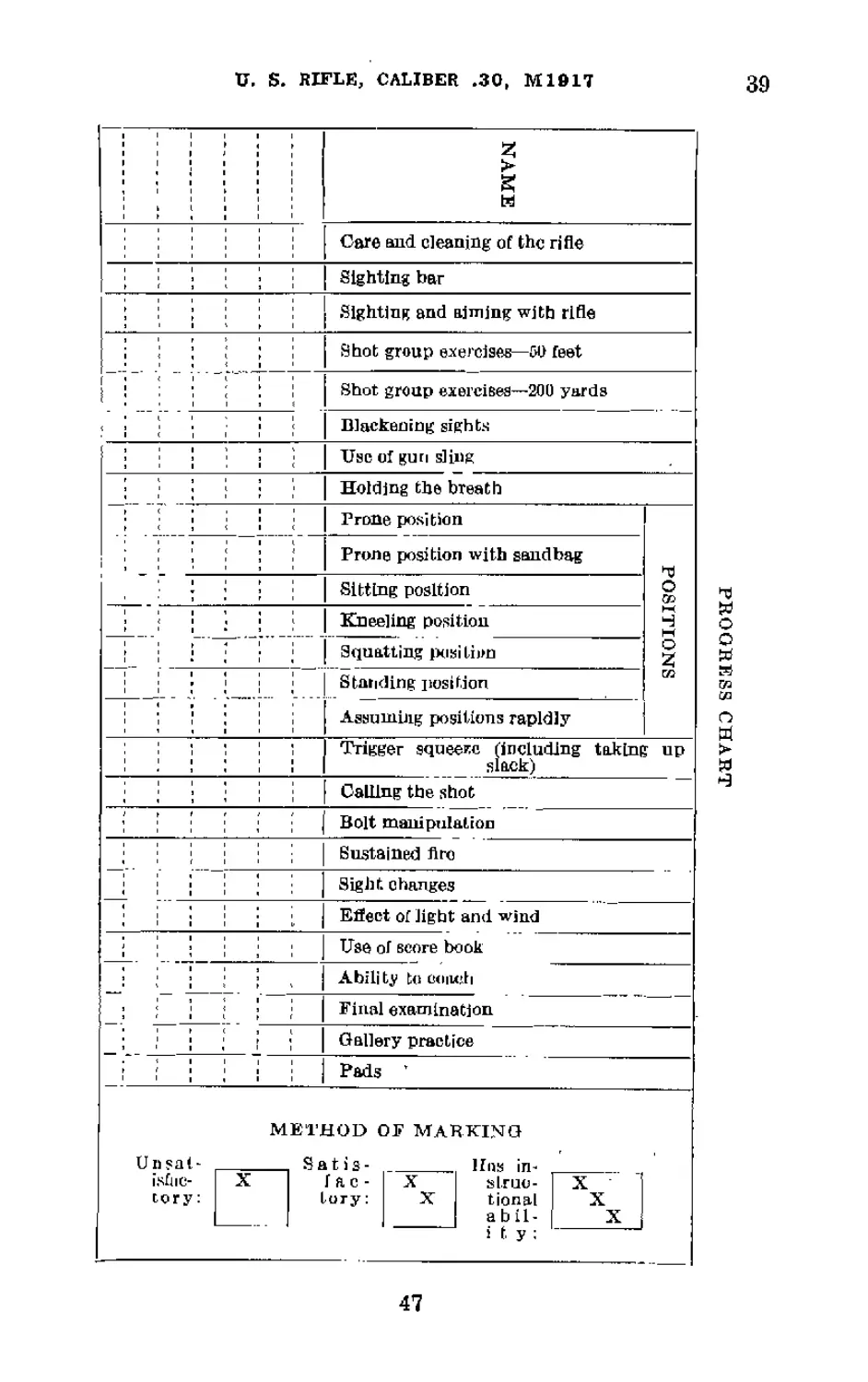
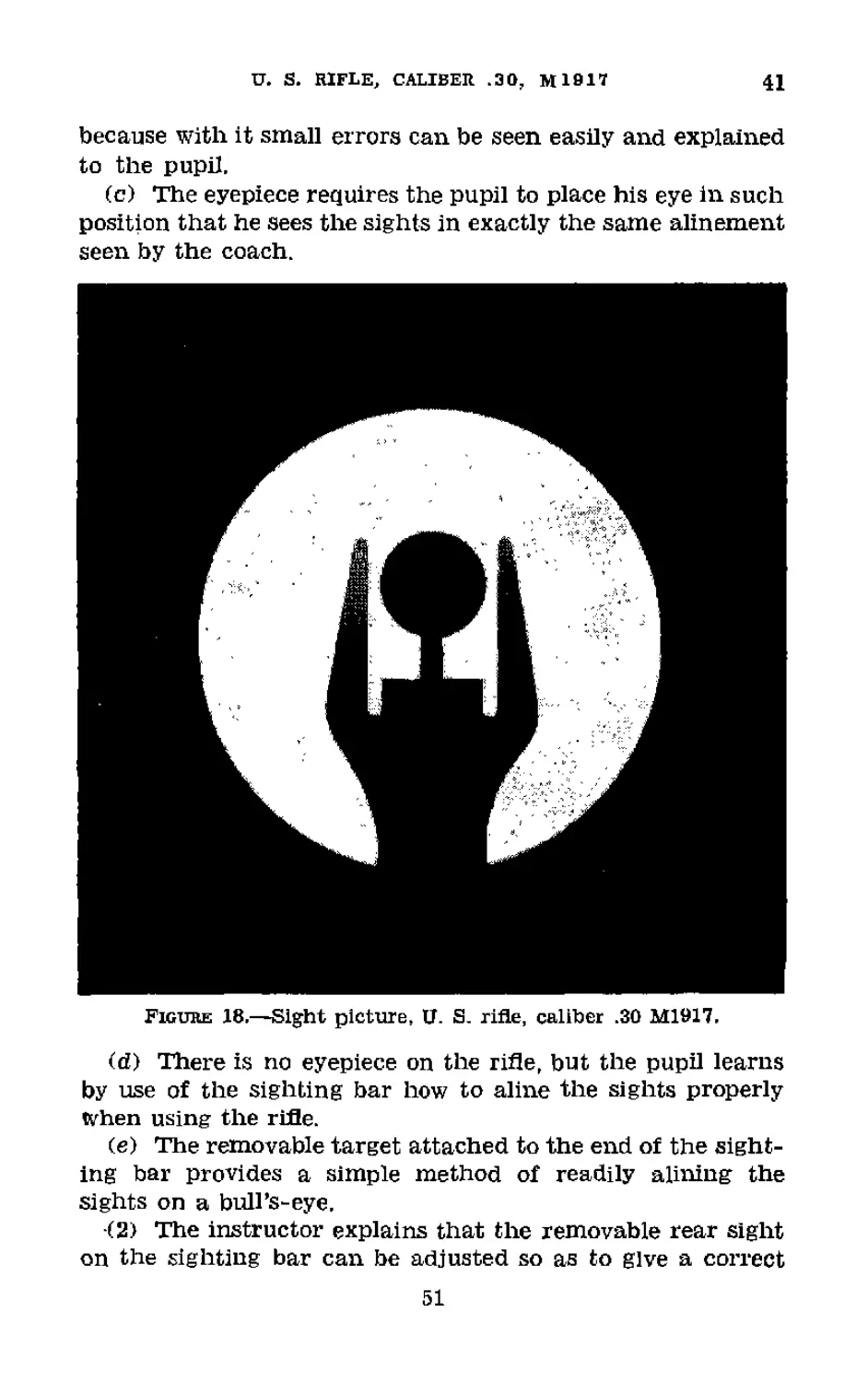
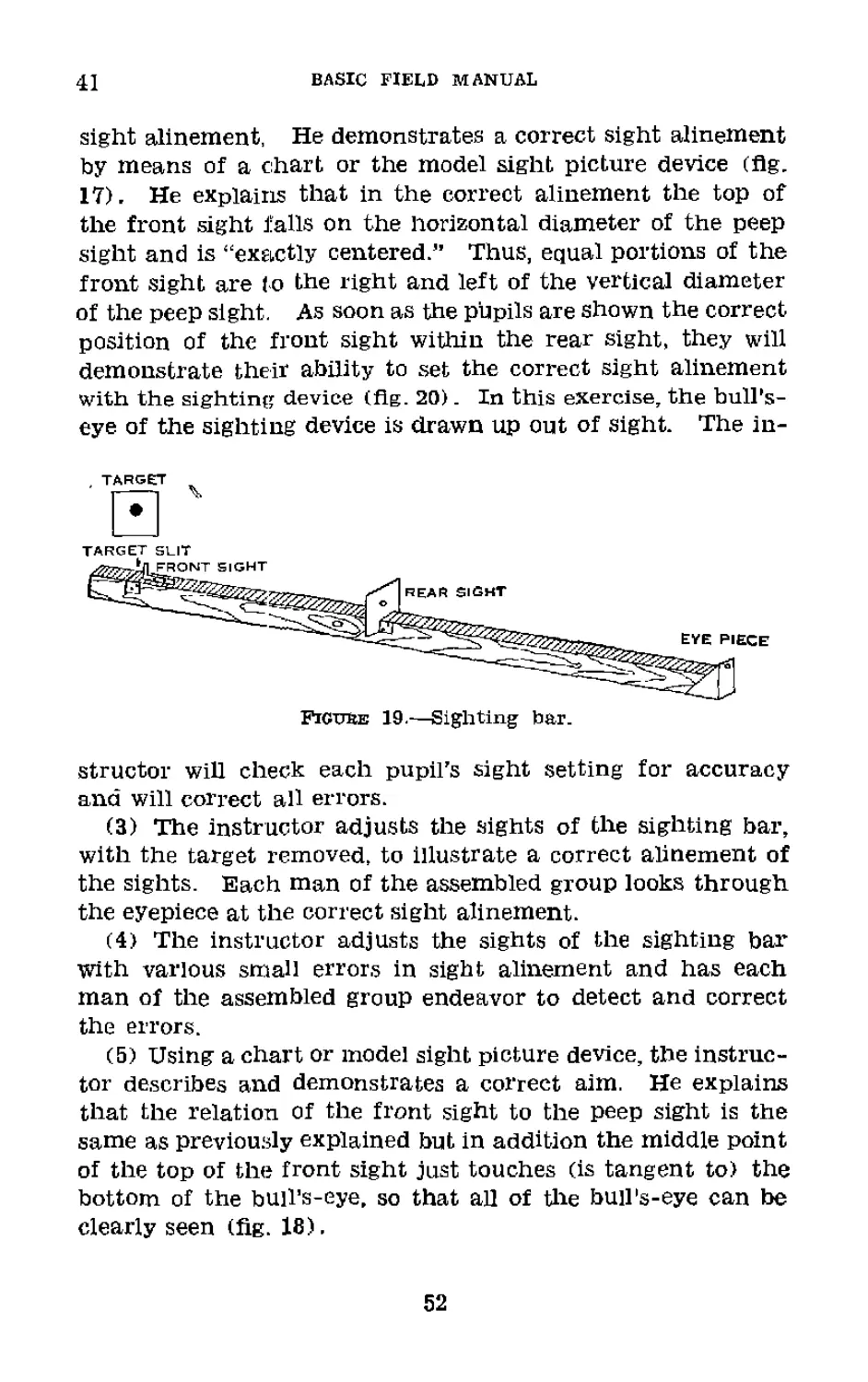
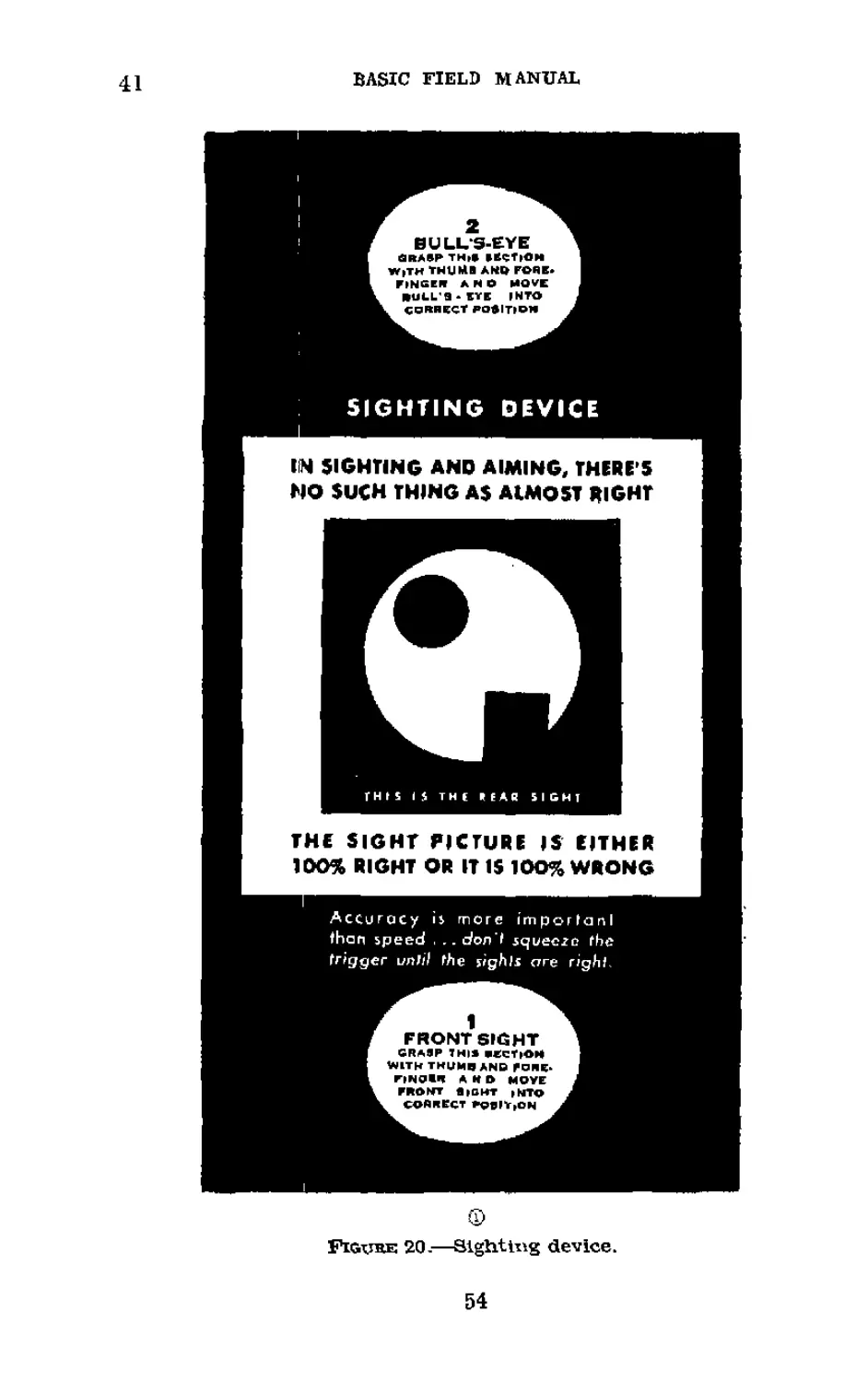



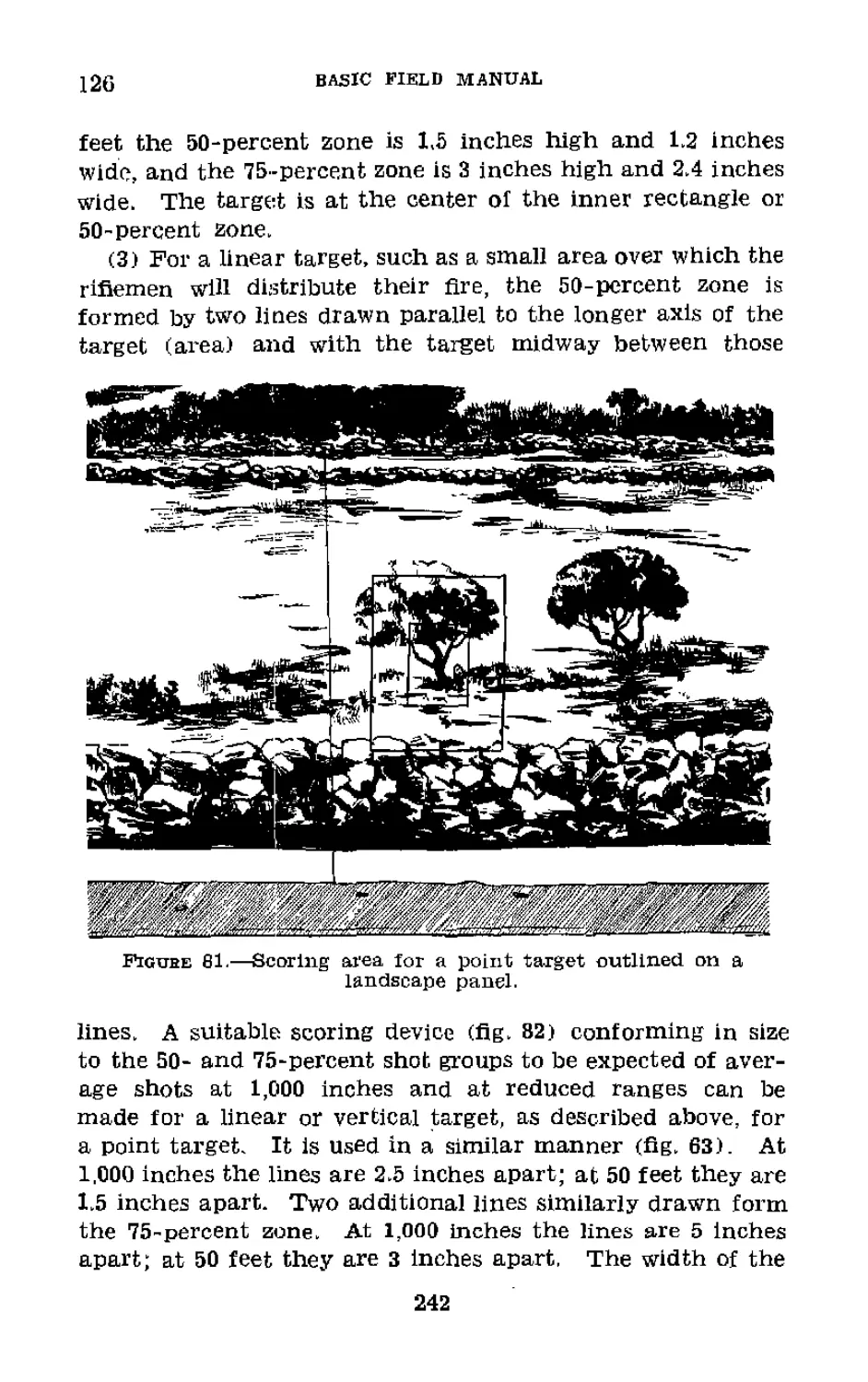
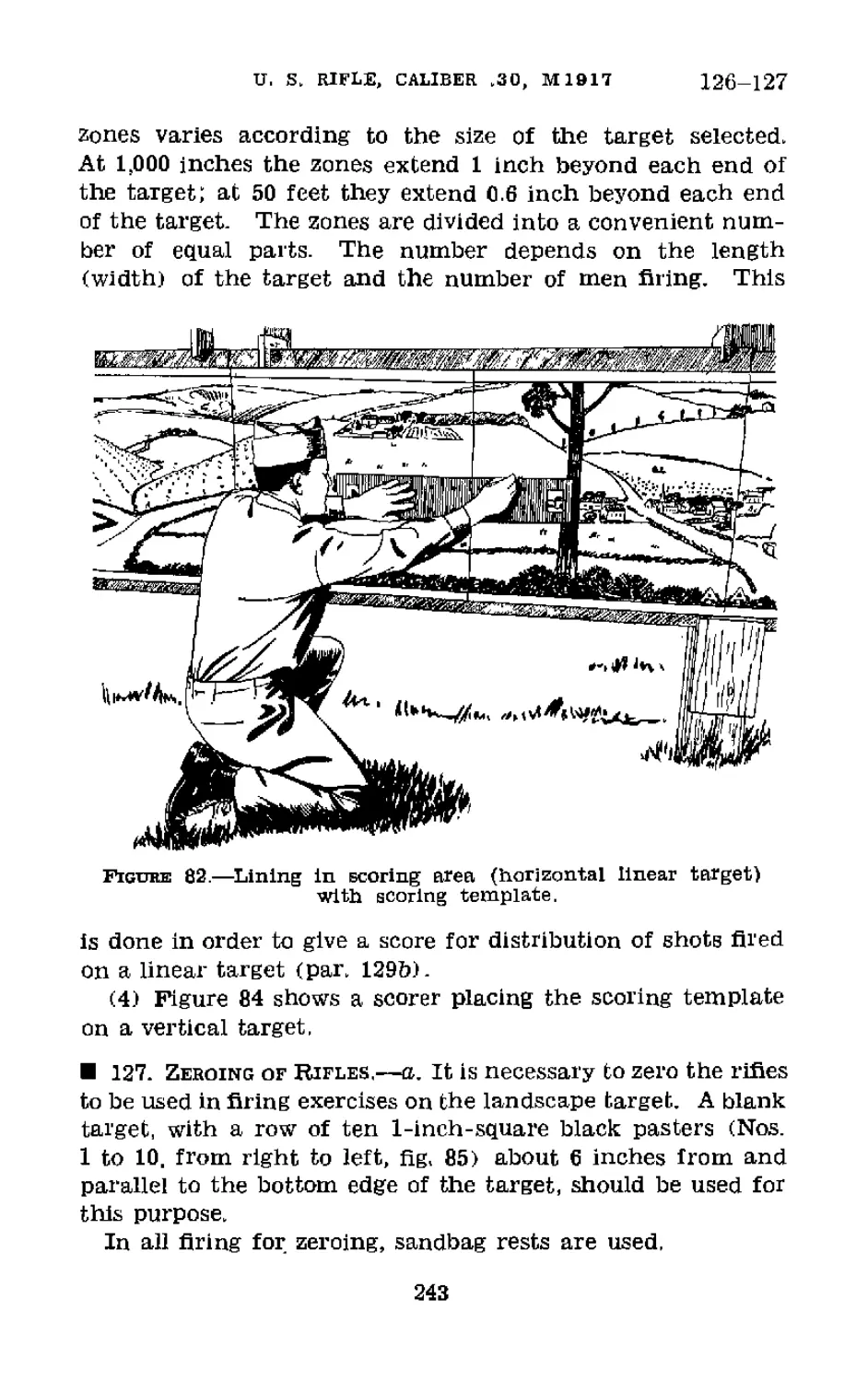
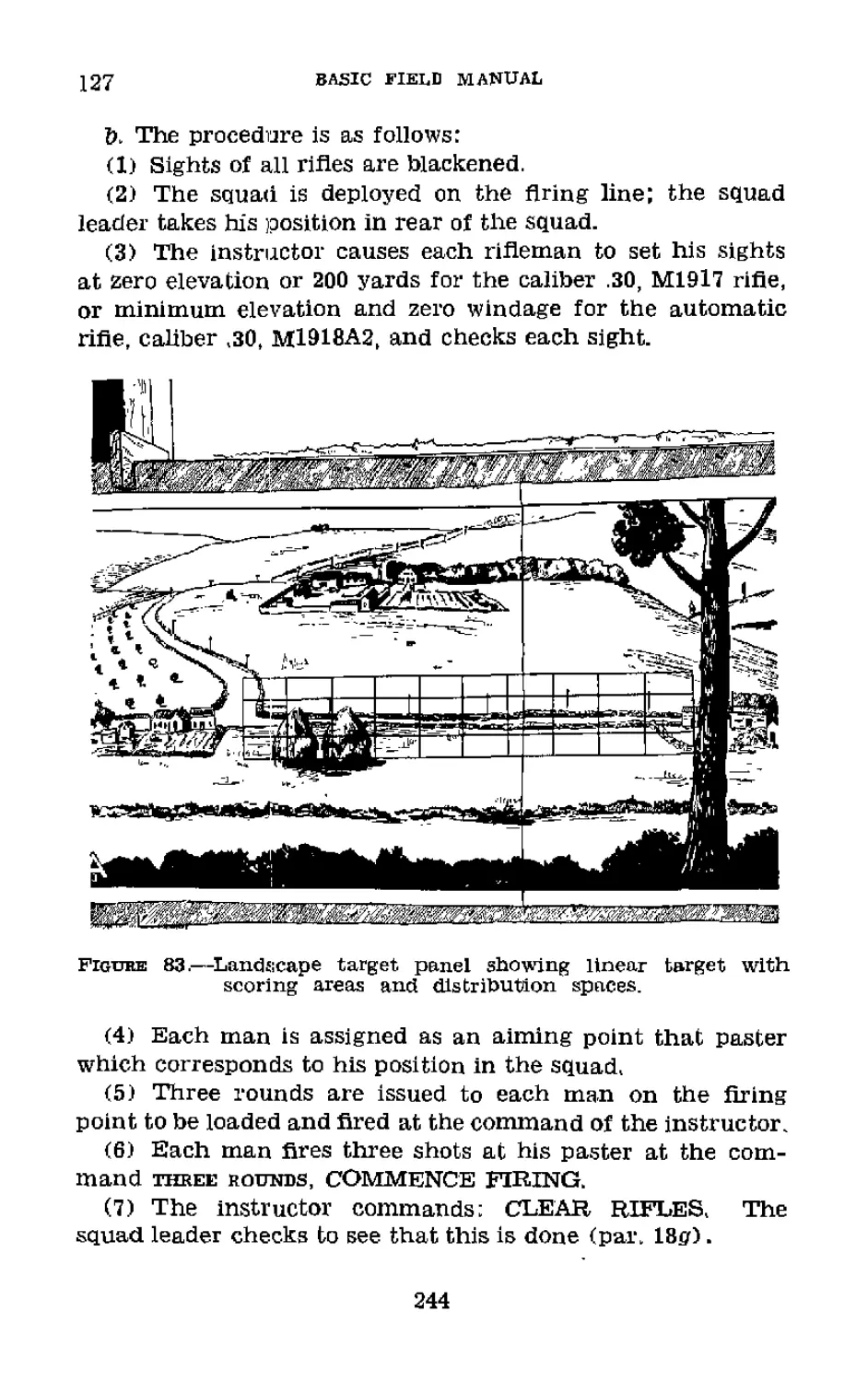
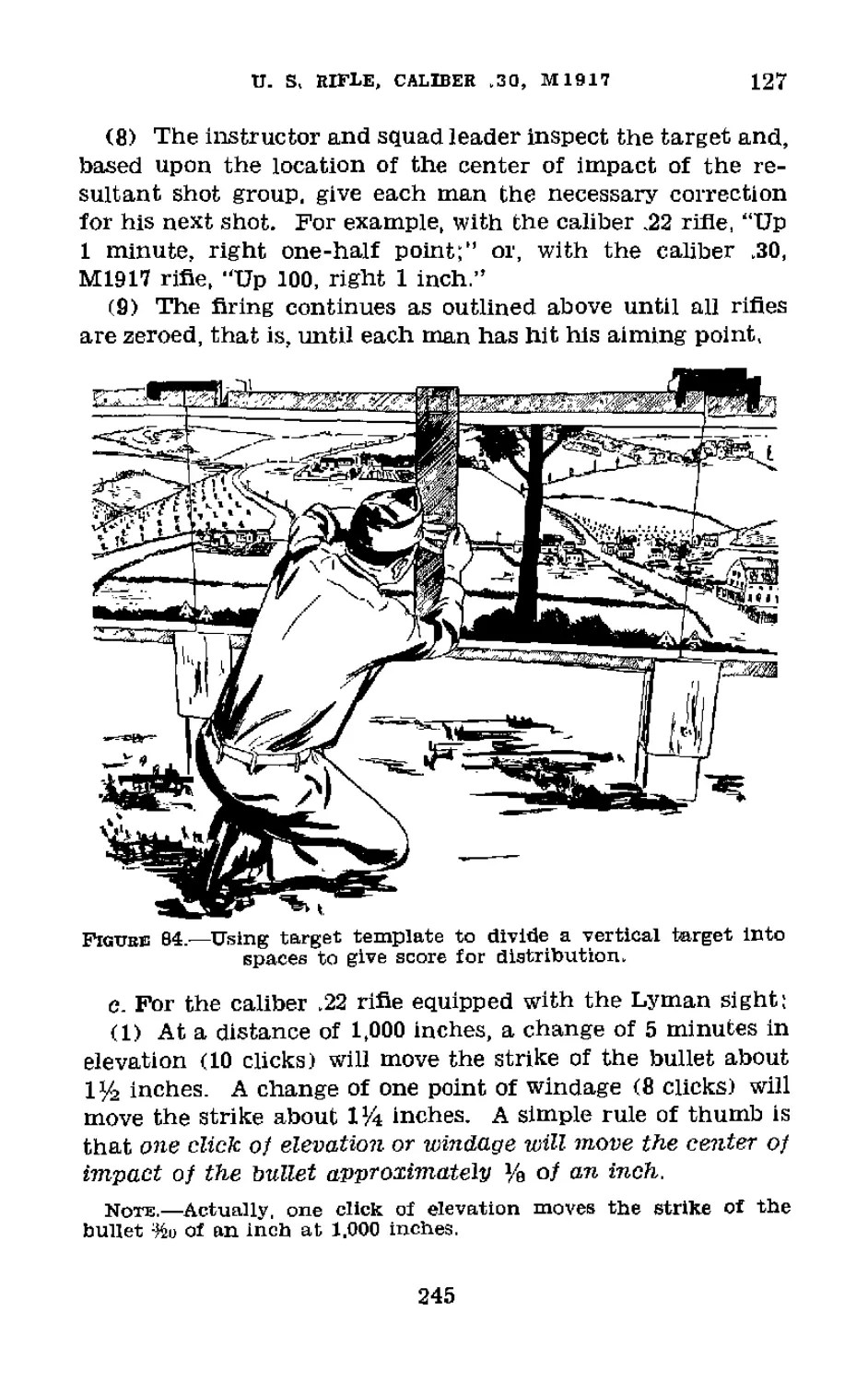




Tags: weapons military affairs
Year: 1943
Text
                    FM 2^-6
WAR DEPARTMENT
BASIC HELD MANUAL
U. S. RIFLE, CALIBER .30,
M1917
28 October, 1943
£Haaeu№tafton of rrnrtricted matter.—The information contained tn re-
stricted documents and the essential character is tics of restricted material
nay be Riven to any person known to be in the service of the United States
and to persons of undoubted loyalty and discretion who are cooperatina in
Government work, but will not be cenununicated to the public or to the press
except by authorized military public теШаош ааепск». (See also par. 18b,
AB 880-5, 28 Sep 1042.)
FM 23-6
BASIC FIELD MANUAL
U. S. RIFLE, CALIBER .30,
M1917
Dissemination of restricted matter.-—The information contained in re-
stricted documents and the essential characteristics of restricted material
may be given to any person known to be in the service of the United States
and to persons of undoubted loyalty and discretion who are cooperating in
Government work, but will not be communicated to the public or to the press
except by authorized military public relations agencies. (See also par. ISb,
AR 380-5, 28 Sep 1942.)
UNITED STATES
GOVERNMENT PRINTING OFFICE
WASHINGTON : 1943
WAR DEPARTMENT,
Washington 25, D. C., 28 October 1943.
FM 23-6, Basic Field Manual, U. S, Rifle, Caliber .30, M1917,
is published for the information and guidance of all con-
cerned.
| A. G. 300.7 (15 Sep 43).]
By order of the Secretary of War:
G. C. MARSHALL,
Chief of Staff.
Official :
J. A. ULIO,
Модог General,
The Adjutant General.
Distribution:
Bn and H, 2-7, 9, 10, 17-19 (2); C, 2-7, 9, 10, 17-18 (1),
19 (3).
(For explanation of symbols, see FM 21-6.)
и
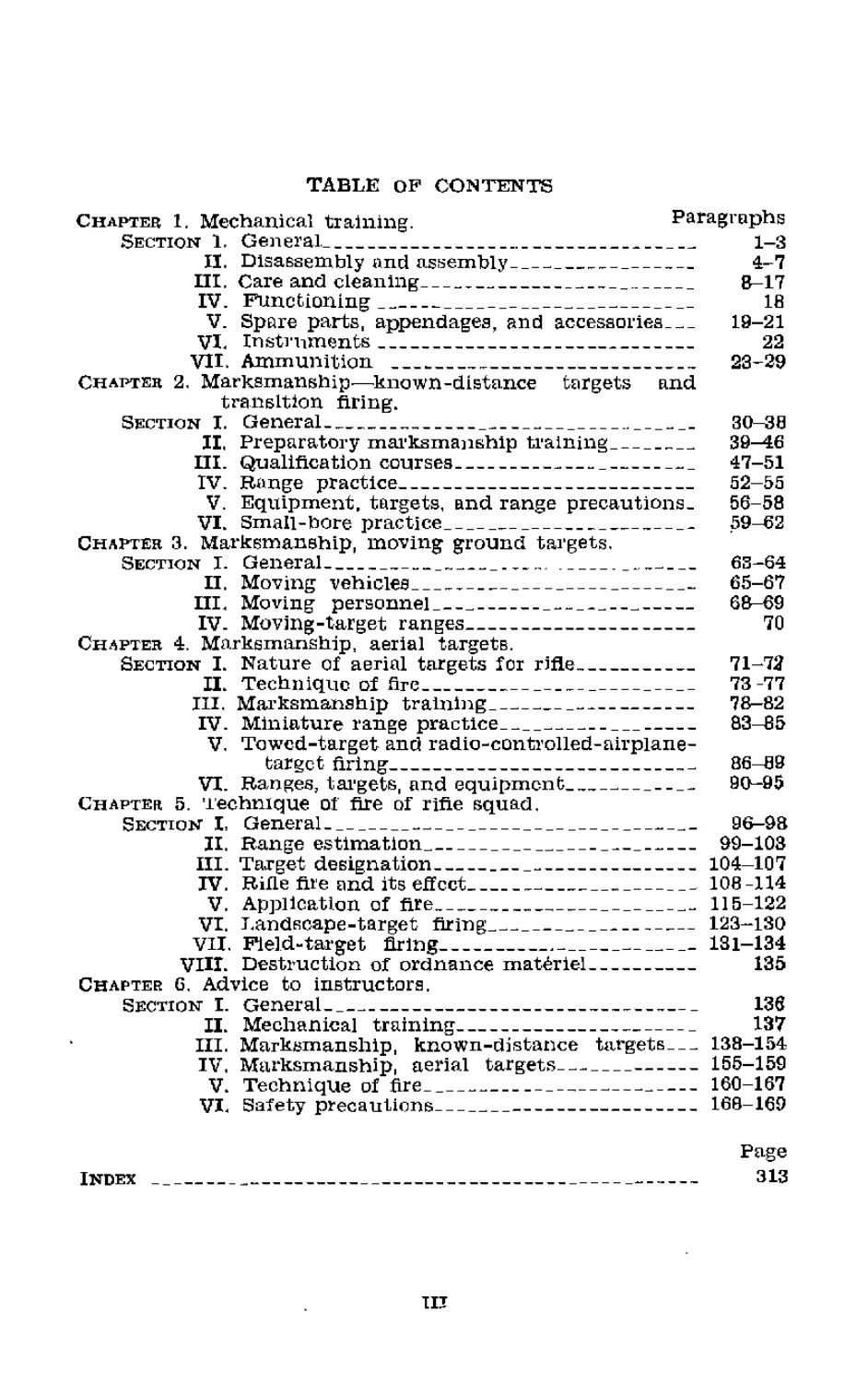
TABLE OF CONTENTS
Chapter 1. Mechanical training.	Paragraphs
Section 1.	General.________________________________________ 1-3
II.	Disassembly and assembly..--____________________ 4-7
П1.	Care and cleaning___________________________    8-17
IV.	Functioning___________________________________     IB
V.	Spare parts, appendages,	and accessories_	19-21
VI.	Instruments_______________________________________ 22
VII.	Ammunition ___________________________________ 23-29
Chapter 2, Marksmanship.—known-distance targets and
transition firing.
Section I.	General----------------------------------      30-38
II,	Preparatory marksmanship training...__________	39—46
П1.	Qualification courses__________________________ 47-51
IV.	Range practice_________________________________ 52-55
V.	Equipment, targets, and	range	precautions, 56-58
VI.	Small-bore practice___________________.	59-62
Chapter 3.	Marksmanship, moving ground targets.
Section I. General_____________________________________ 63-64
П. Moving vehicles__________________________ 65-67
Ш. Moving personnel.________________________________ 68-69
IV. Moving-target ranges____________________________ 70
Chapter 4.	Marksmanship, aerial targets.
Section I. Nature of aerial targets for rifle_____________ 71-73
II.	Technique of fire____________________ 73-77
III.	Marksmanship training.________________________ 78—82
IV.	Miniature range practice_______________________ S3—B5
V.	Towcd-target and radio-controlled-airplane-
tar get firing_____________________________ 86-09
VI.	Ranges, targets, and equipment_________________ 90-95
Chapter 5.	Technique of fire of rifle squad.
Section I,	General_____________________________     96—98
II.	Range estimation__________________________     99-103
III.	Target designation_____________________________104-107
IV.	Rifle fire and its effect__________________   108-114
V.	Application of fire_________________________  115-122
VI.	Landscape-target firing_________ __________   123-130
VII.	Field-target firing____________________________131-134
VIII.	Destruction of ordnance	materiel_____________ 135
Chapter 6, Advice to instructors.
Section I.	General._______________________________________  136
II.	Mechanical training_____________________________  137
III.	Marksmanship, known-distance targets----138-154
IV,	Marksmanship, aerial targets----------------- 155-159
V.	Technique of fire______________________________ 160-167
VI.	Safety precautions__________________________  160-169
Page
Index ________________________________________________________ 313
III
FM 23-6
BASIC FIELD MANUAL
U. S. RIFLE, CALIBER .30, M1917 (ENFIELD)
(This manual supersedes FM 23 6. 3 August 1942; including С 1,
5 November 1942, and C 2, 22 April 1043.)
Attention is directed to FM 21-7 for details as to how appropriate
training films and film strips are intended to be used and how
they are made available tor use during training with the U. S. rifle,
caliber .30, M1917.
CHAPTER 1
MECHANICAL TRAINING
Paragraphs
Section I. General— ________________________________ 1-3
II.	Disassembly and assembly__________________ <P-7
III.	Care and cleaning________________________ 8-17
IV.	Functioning______________________________    18
V,	Spare parts,	appendages, and accessories__19-21
VI,	Instruments______________________________    22
VH. Ammunition________________________________ 23-29
Section I
GENERAL
	1. Object.—This chapter is designed to give the soldier
training that will insure his ability to take care of the rifle
and keep it in operation.
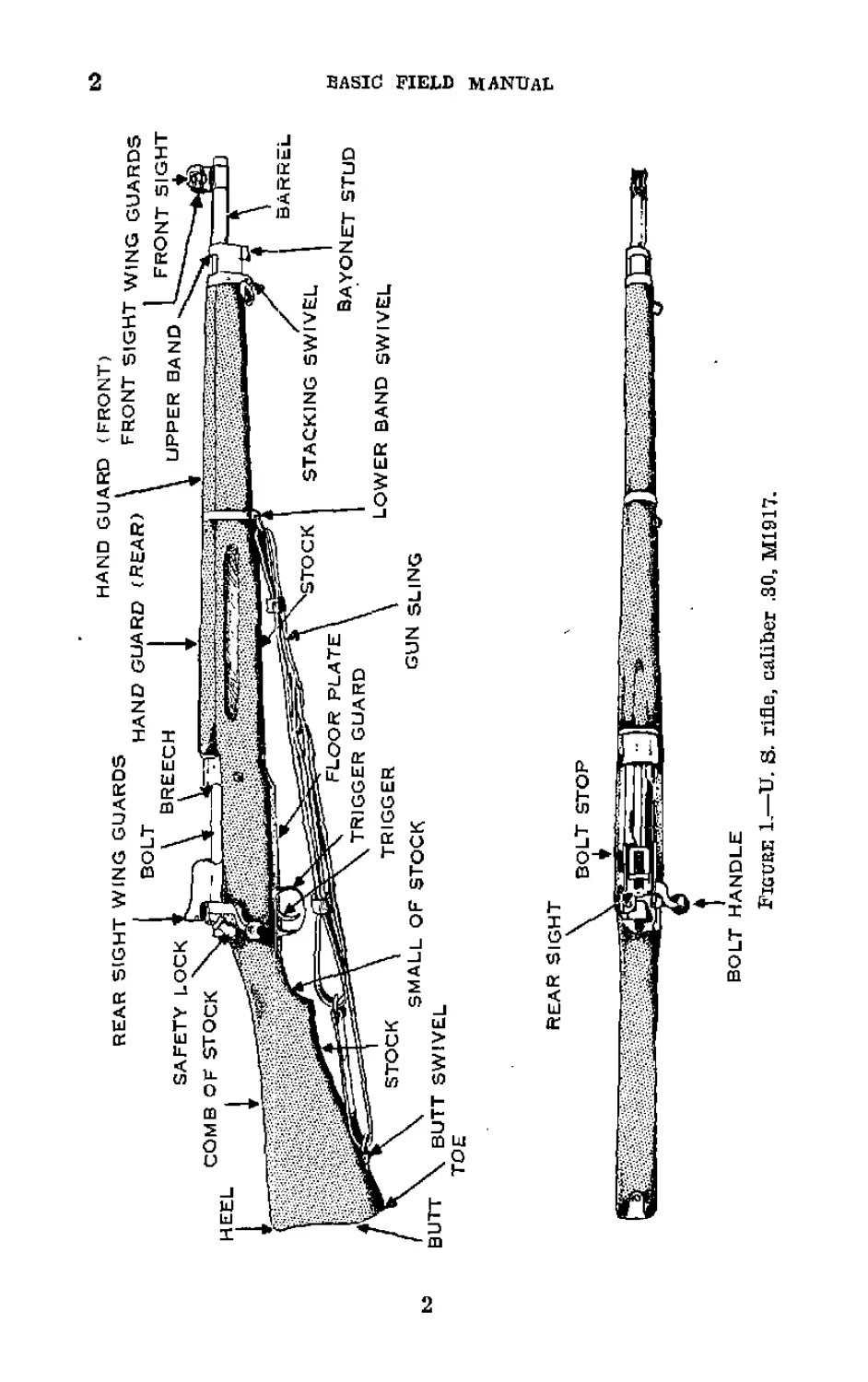
	2. Description of Rifle.—a, The U. S, rifle, caliber .30,
M1917 (flg. 1) is a breech-loading magazine rifle of the bolt
type. It is popularly referred to as the "Enfield rifle.”
The ammunition is loaded in clips of five rounds. Ammu-
nition bandoleers for this rifle have six pockets with a total
capacity of 60 rounds.
1

Figure 1,—U. g. rifle, caliber .SO, M1917.
BASIC FIELD MANUAL
U. S. RIFLE, CALIBER .30, M1917
2-3
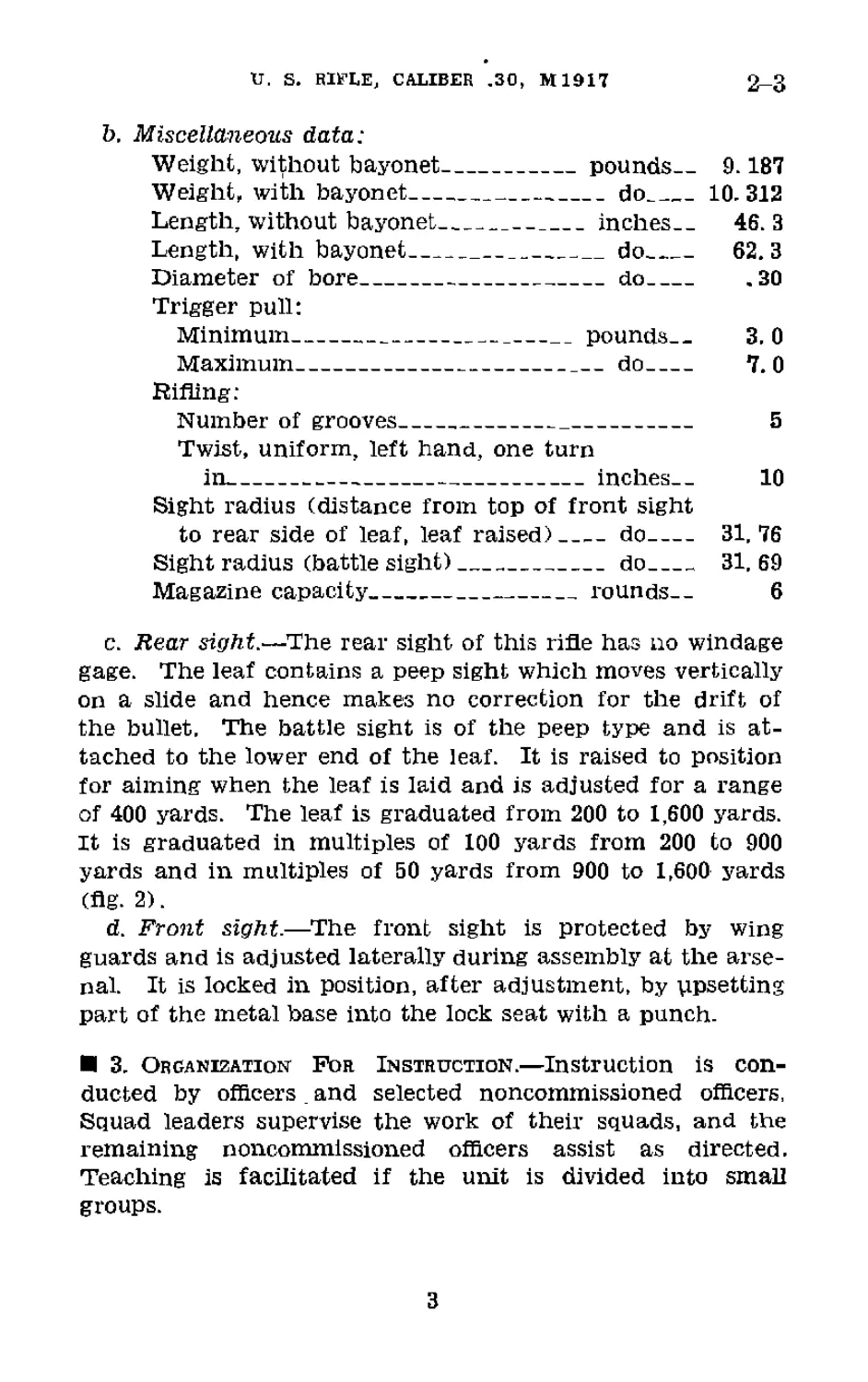
b.	Miscellaneous data:
Weight, without bayonet----------pounds— 9.187
Weight, with bayonet_______________do_____10. 312
Length, without bayonet__________inches— 46. 3
Length, with bayonet_______________do_____	62.3
Diameter of bore___________________do_____	. 30
Trigger pull:
Minimum--------------------—__ pounds— 3.0
Maximum__________________________do_____	7.0
Rifling:
Number of grooves_______________________ 5
Twist, uniform, left hand, one turn
in_____________________________inches___	10
Sight radius (distance from top of front sight
to rear side of leaf, leaf raised)_do--- 31, 76
Sight radius (battle sight)________do_____ 31, 69
Magazine capacity________________rounds—	6
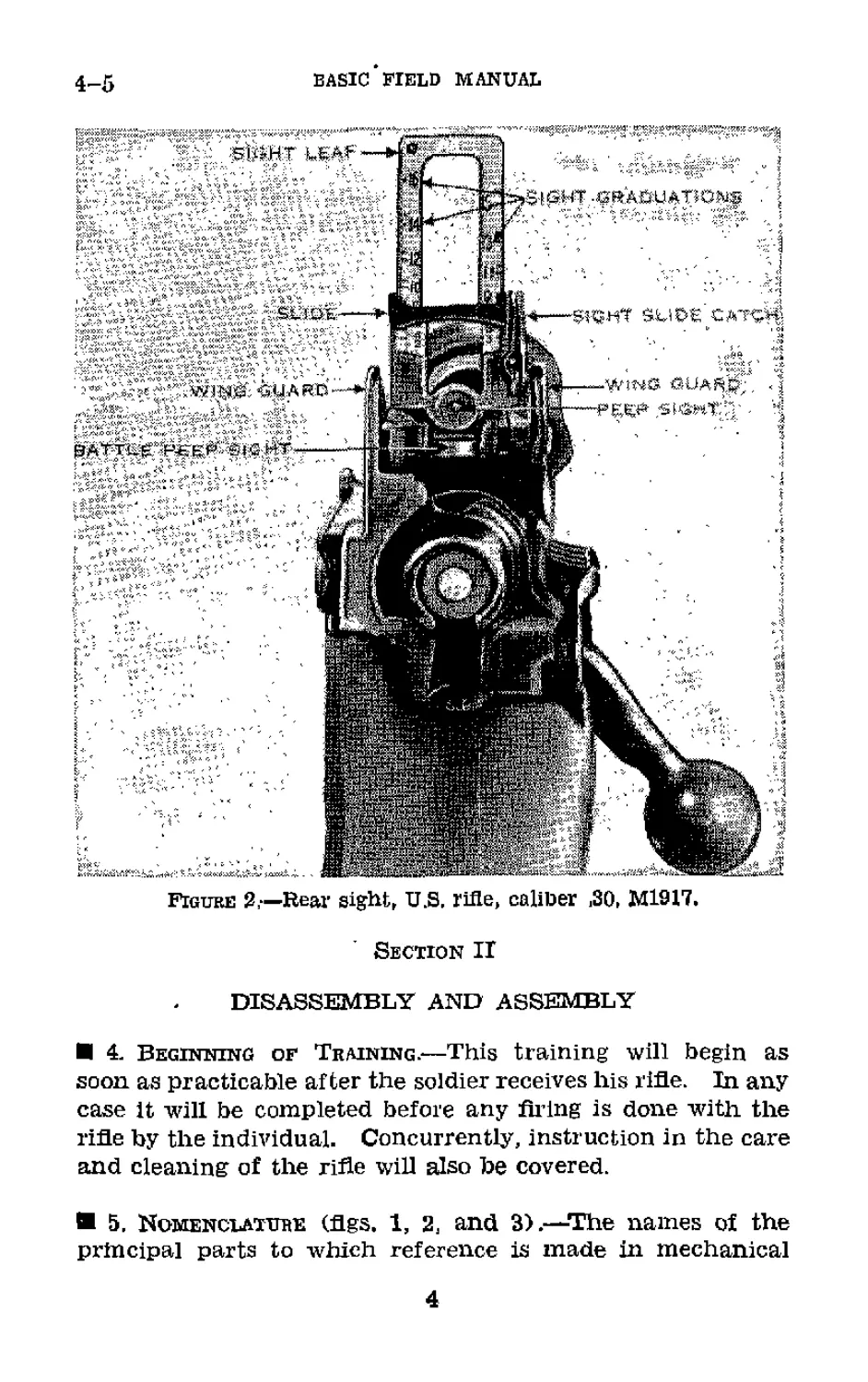
c.	Rear sight.—The rear sight of this rifle has no windage
gage. The leaf contains a peep sight which moves vertically
on a slide and hence makes no correction for the drift of
the bullet. The battle sight is of the peep type and is at-
tached to the lower end of the leaf. It is raised to position
for aiming when the leaf is laid and is adjusted for a range
of 400 yards. The leaf is graduated from 200 to 1,600 yards.
It is graduated in multiples of 100 yards from 200 to 900
yards and in multiples of 50 yards from 900 to 1,600 yards
(fig. 2).
d.	Front sight.—The front sight is protected by wing
guards and is adjusted laterally during assembly at the arse-
nal. It is locked in position, after adjustment, by upsetting
part of the metal base into the lock seat with a punch.
 3. Organization' For Instruction.—Instruction is con-
ducted by officers . and selected noncommissioned officers,
Squad leaders supervise the work of their squads, and the
remaining noncommissioned officers assist as directed.
Teaching is facilitated if the unit is divided into small
groups.
3
4-5
BASIC FIELD MANUAL
Figure 2,—Real- sight, U.S. rifle, caliber ,30, M1917.
Section II
DISASSEMBLY AND ASSEMBLY
	4. Beginning of Training.—This training will begin as
soon, as practicable after the soldier receives his rifle. In any
case it will be completed before any firing is done with the
rifle by the individual. Concurrently, instruction in the care
and cleaning of the rifle will also be covered.
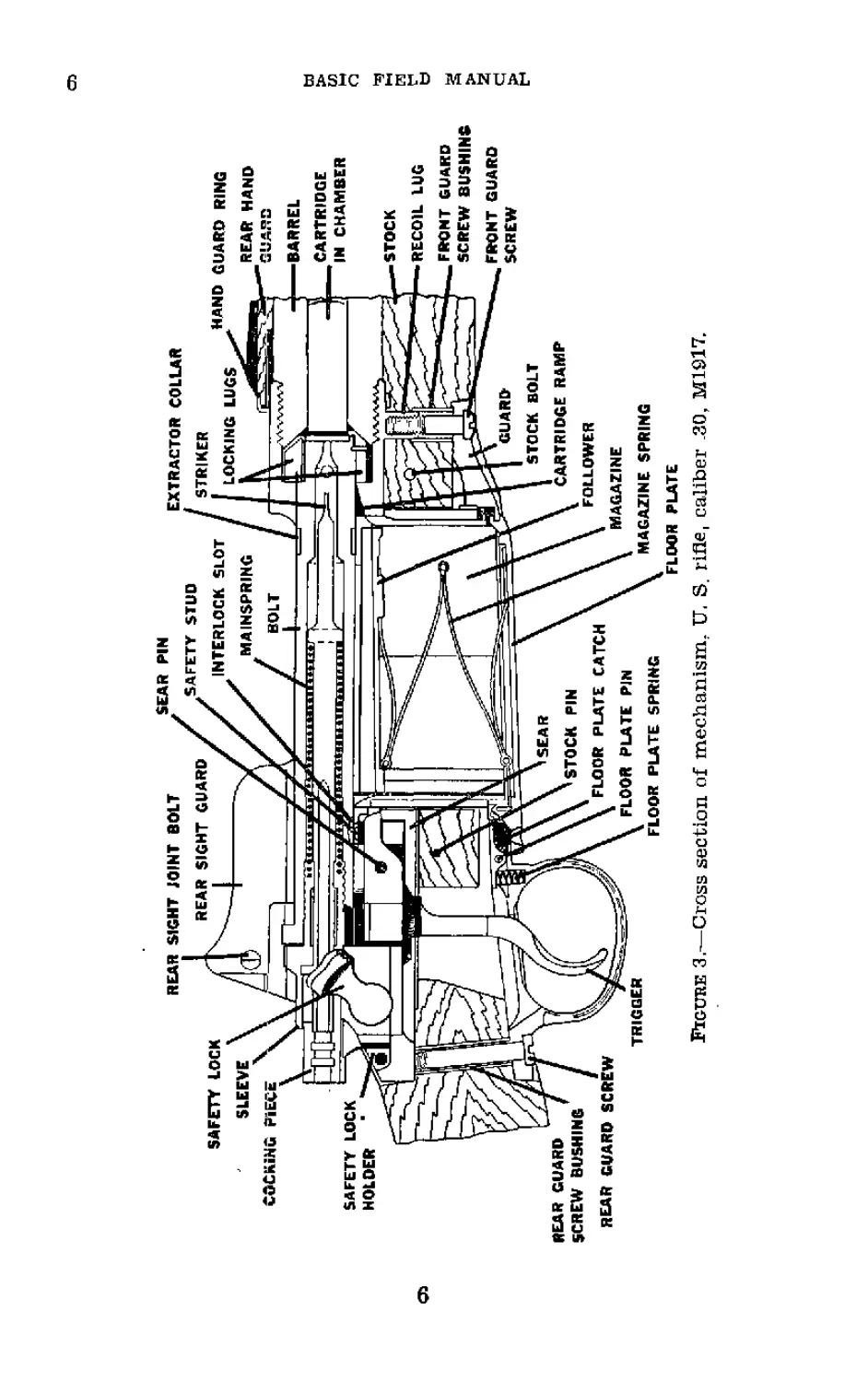
	5, Nomenclature (flgs. 1, 2, and 3).—The names of the
principal parts to which reference is made in mechanical
4
U. S. RIFLE, CALIBER .30, M1917
5-6
training are readily learned as this training progresses, in-
structors will therefore take care to name the parts clearly
and. correctly. A sufficient knowledge of nomenclature is
gained by the soldier during instruction in mechanical train-
ing.
	6. Disassembly Which Soldier May Perform.—For clean-
ing, only the following parts of the rifle may be removed
by the individual soldier:
Floor plate.
Follower,
Magazine spring.
Gun sling.
Bolt (including striker, mainspring, sleeve, cocking
piece, and extractor).
a.	To remove and dissassemble floor plate and follower,"
Insert the bullet end of a cartridge through the hole in the
floor plate and press down on the floor plate catch. At the
same time press the floor plate to the rear with the left
thumb. This releases the floor plate, which may then be re-
moved together with the magazine spring and follower. Raise
the rear end of the magazine spring until it clears the spring
stops on the floor plate and draw it out of its mortise; in the
same manner separate the magazine spring from the
follower.
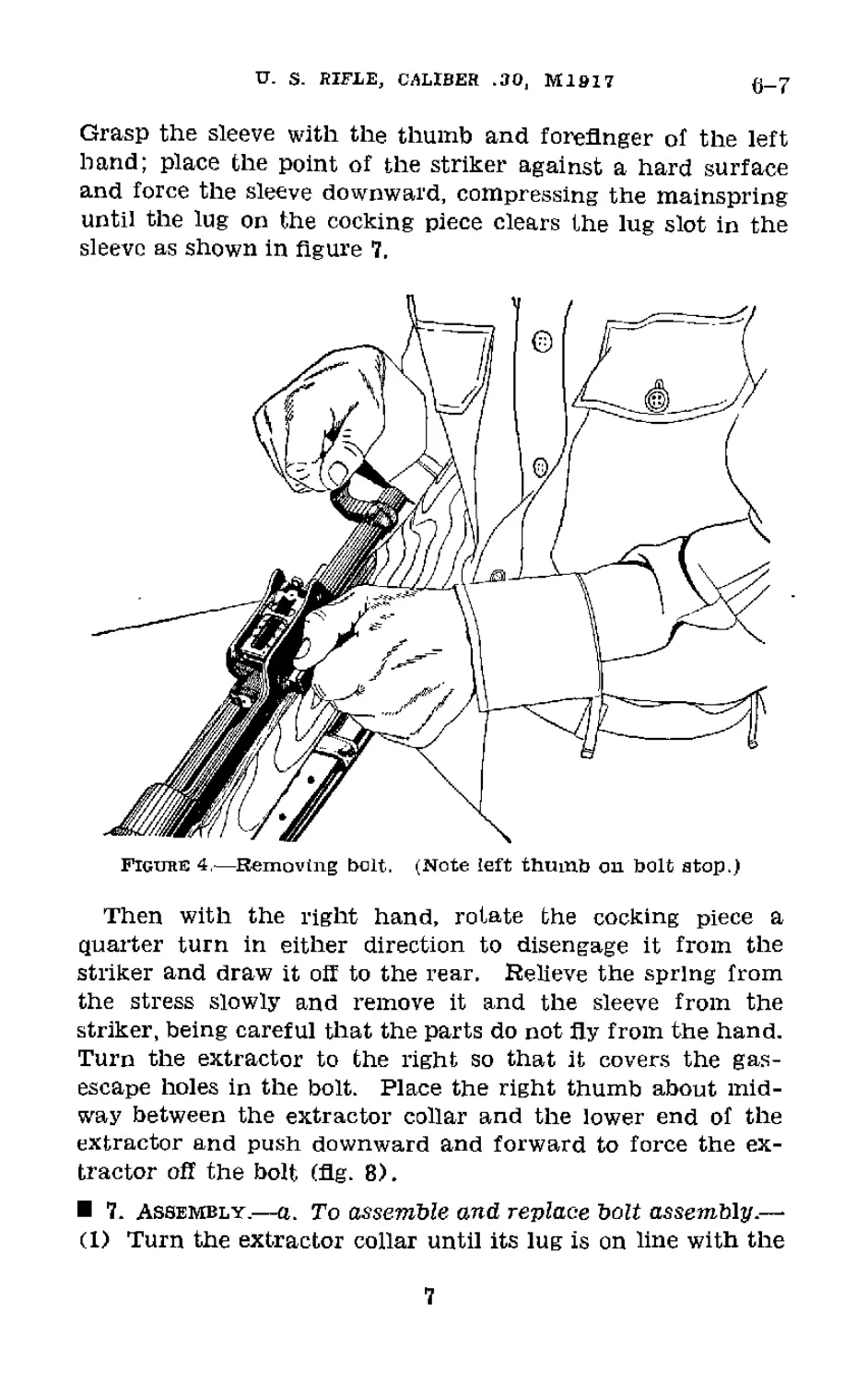
b.	To remove and disassemble bolt.—Place the butt of the
rifle under the right armpit and hold the stock firmly against
the body with the right arm. With the left thumb, pull the
bolt stop to the left and at the same time raise the bolt handle
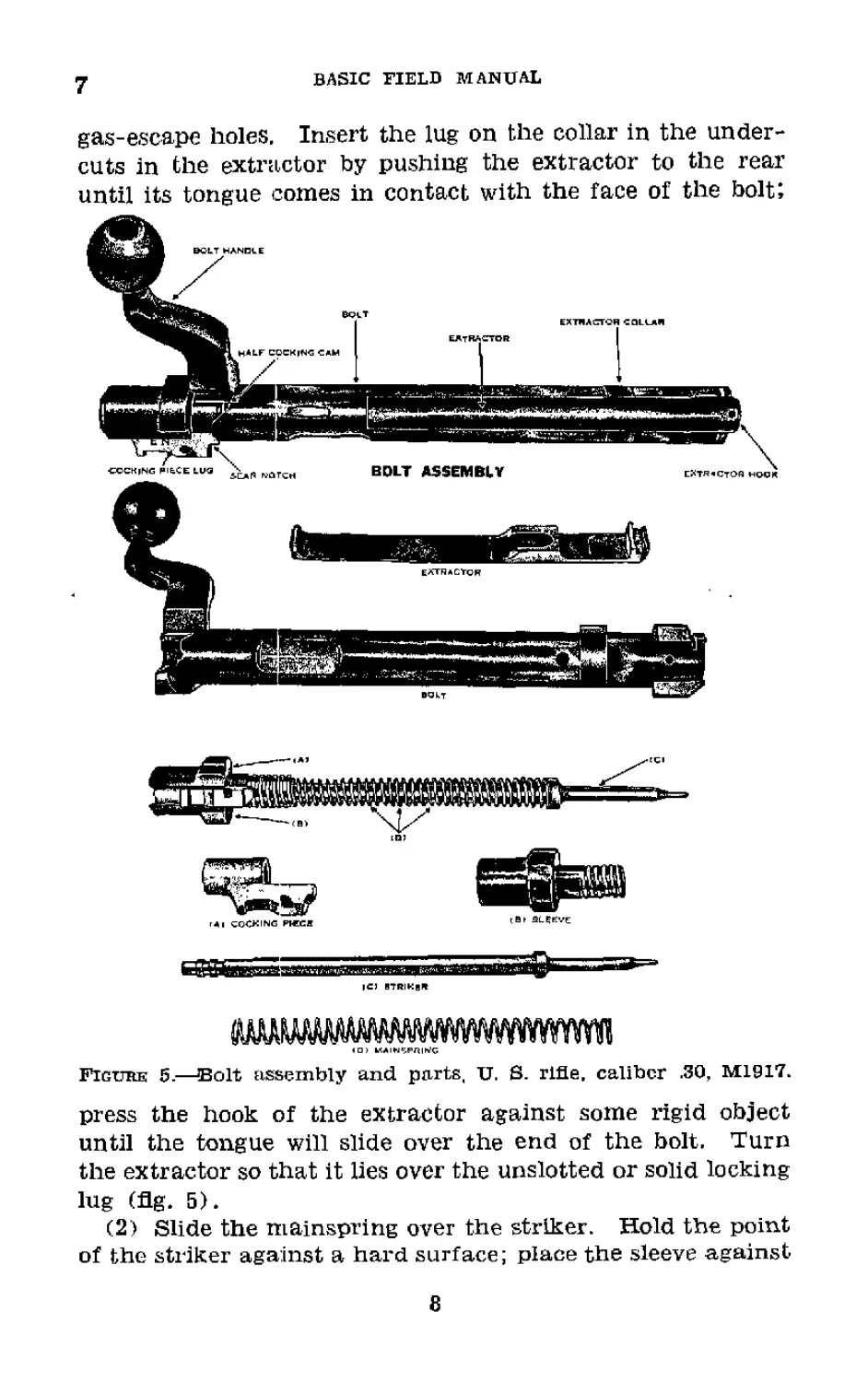
and draw out the bolt to the rear (flgs. 4 and 5), Hook a loop
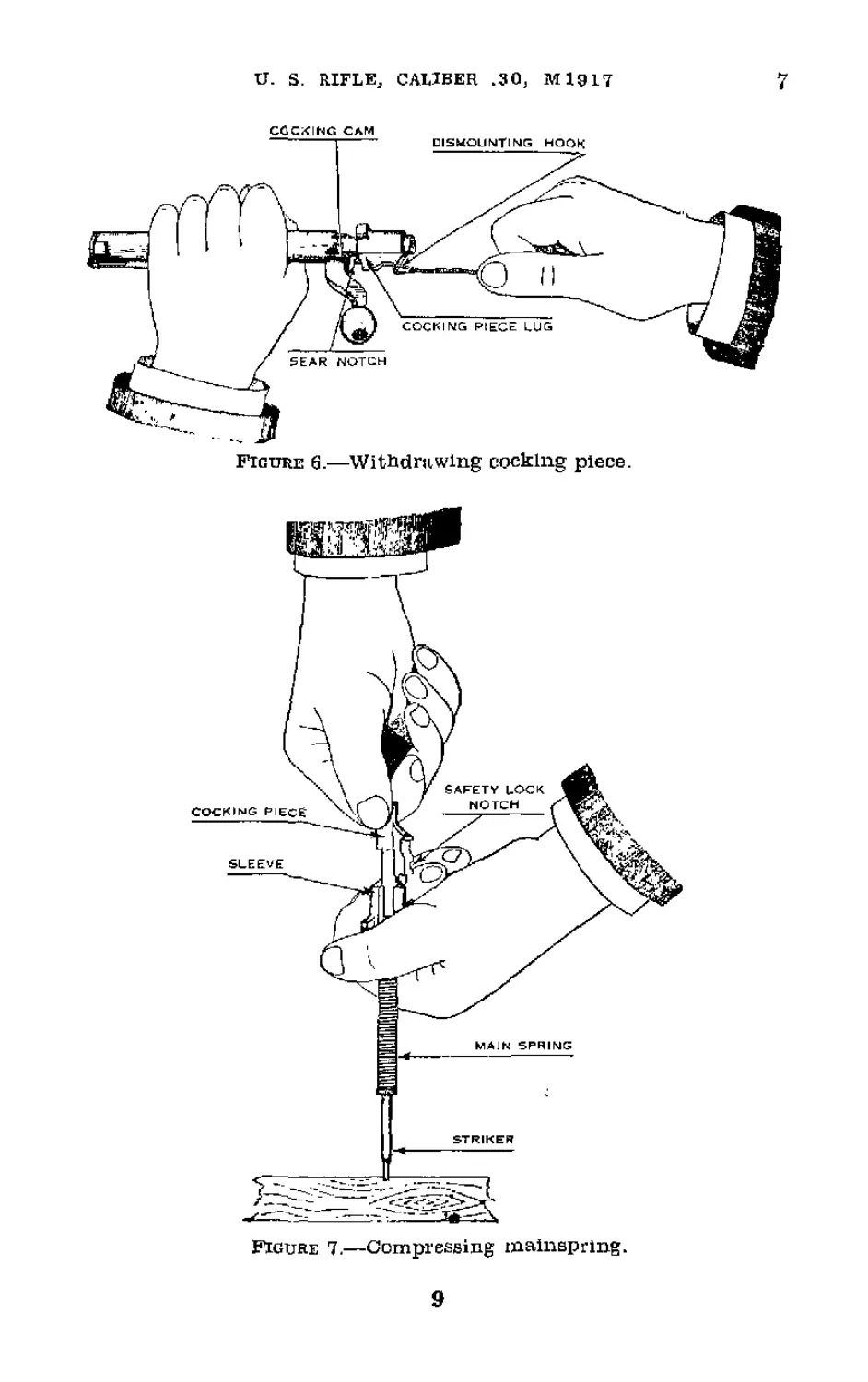
of strong string on the dismounting hook on the cocking piece
lug and holding the bolt in the left hand and the string in
the right, draw the cocking piece out until the lug clears the
end of the bolt (fig. 6). Then by moving the right hand in a
circular path counterclockwise, unscrew the sleeve and with-
draw the sleeve, cocking piece, mainspring, and striker from
the bolt.
5
ст>
SAFETY LOCK
HOLDER
REAR GUARD
SCREW BUSHING
SEAR PIN
EXTRACTOR COLLAR
REAR SIGHT JOINT BOLT
SAFETY STUD
STRIKER
REAR SIGHT GUARD
SAFETY LOCK
INTERLOCK SLOT
LOCKING LUGS
SLEEVE
MAINSPRING
cocking месс
BOLT
HAND GUARD RING
REAR HAND
BARREL
STOCK
RECOIL LUG
GUARD
STOCK BOLT
SEAR
CARTRIDGE RAMP
STOCK PIN
FOLLOWER
FLOOR PLATE CATCH
MAGAZINE
FLOOR PLATE PIN
TRIGGER
MAGAZINE SPRING
FLOOR PLATE SPRING
CARTRIDGE
IN CHAMBER
FRONT GUARD
SCREW BUSHING
FRONT GUARD
SCREW
FLOOR PLATE
Figure 3,—Cross section of mechanism. U. S. rifle, caliber .30, M1917.
REAR GUARD SCREW
BASIC FIELD MANUAL
U. s. RIFLE, CALIBER .30, M1SI7
0-7
Grasp the sleeve with the thumb and forefinger of the left
hand; place the point of the striker against a hard surface
and force the sleeve downward, compressing the mainspring
until the lug on the cocking piece clears the lug slot in the
sleeve as shown in figure 7,
FiguhE 4/—Removing bolt. (Note left thumb cm bolt stop.)
Then with the right hand, rotate the cocking piece a
quarter turn in either direction to disengage it from the
striker and draw it off to the rear. Relieve the spring from
the stress slowly and remove it and the sleeve from the
striker, being careful that the parts do not fiy from the hand.
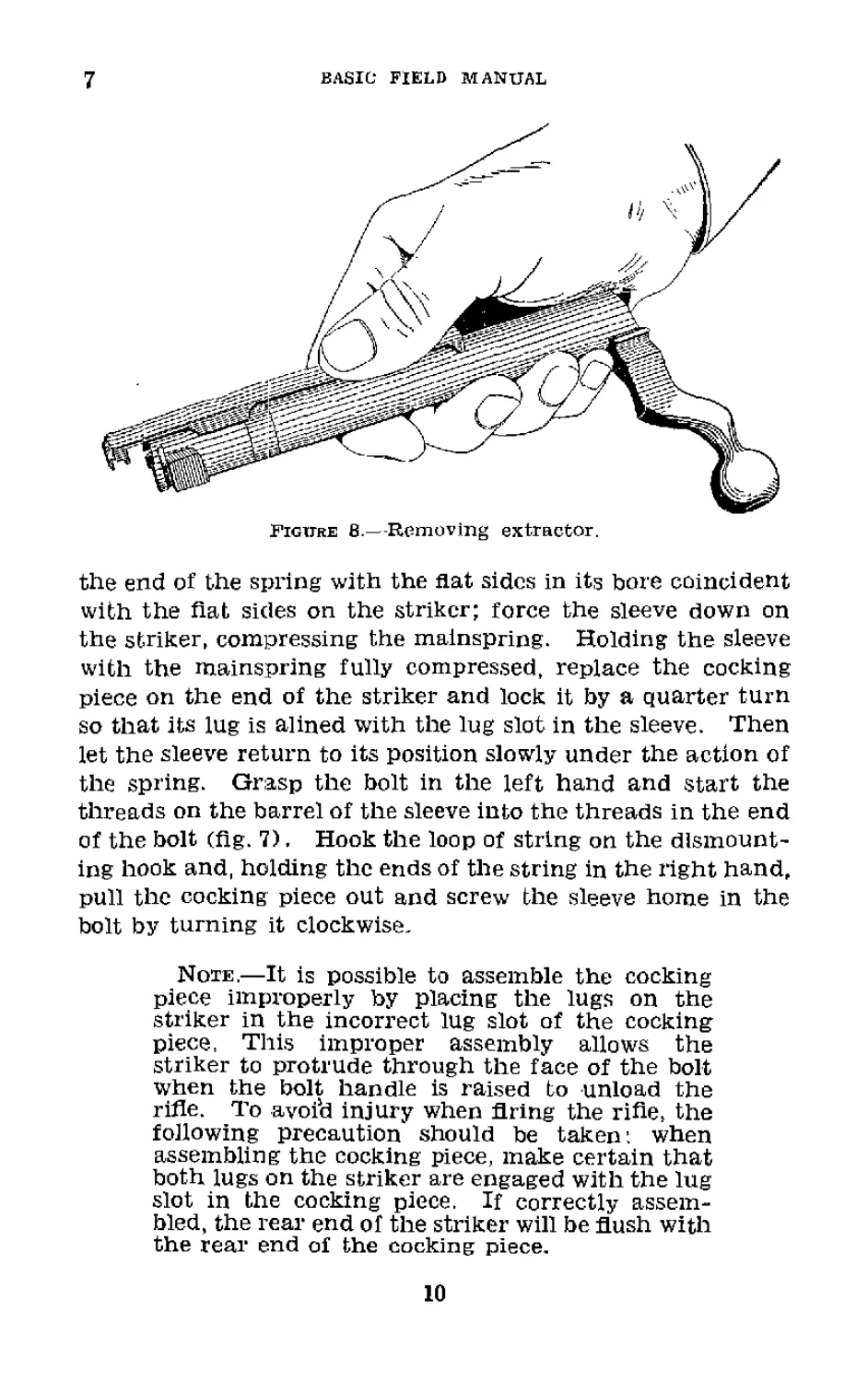
Turn the extractor to the right so that it covers the gas-
escape holes in the bolt. Place the right thumb about mid-
way between the extractor collar and the lower end of the
extractor and push downward and forward to force the ex-
tractor off the bolt (fig. 8).
 7. Assembly.—a. To assemble and replace bolt assembly.—
(1) Turn the extractor collar until its lug is on line with the
7
7
BASIC FIELD MANUAL
gas-escape holes. Insert the lug on the collar in the under-
cuts in the extractor by pushing the extractor to the rear
until its tongue comes in contact with the face of the bolt;

Id) HAIH5.Frc|HilG
Figttele 5.—Eolt assembly and parts, U. S. rifle, caliber .30, M19I7.
press the hook of the extractor against some rigid object
until the tongue will slide over the end of the bolt. Turn
the extractor so that it lies over the unslotted or solid locking
lug (fig. 5).
(2) Slide the mainspring over the striker. Hold the point
of the striker against a hard surface; place the sleeve against
8
U. S. RIFLEj CALIBER .30, М1Э17
7
COCXINC CAM
DISMOUNTING HOOK
Figure 6.—Witbdruwlng cocking piece.
STRIKER
Figure 7.—Compressing mainspring.
9
7
BASIC FIELD MANUAL
Figure 8.—Removing extractor.
the end of the spring with the flat sides in its bore coincident
with the fiat sides on the striker; force the sleeve down on
the striker, compressing the mainspring. Holding the sleeve
with the mainspring fully compressed, replace the cocking
piece on the end of the striker and lock it by a quarter turn
so that its lug is alined with the lug slot in the sleeve. Then
let the sleeve return to its position slowly under the action of
the spring. Grasp the bolt in the left hand and start the
threads on the barrel of the sleeve into the threads in the end
of the bolt (fig. 7), Hook the loop of string on the dismount-
ing hook and, holding the ends of the string in the right hand,
pull the cocking piece out and screw the sleeve home in the
bolt by turning it clockwise.
Note.—It is possible to assemble the cocking
piece improperly by placing the lugs on the
striker in the incorrect lug slot of the cocking
piece, This improper assembly allows the
striker to protrude through the face of the bolt
when the bolt handle is raised to unload the
rifle. To avoid injury when firing the rifle, the
following precaution should be taken: when
assembling the cocking piece, make certain that
both lugs on the striker are engaged with the lug
slot in the cocking piece. If correctly assem-
bled, the rear end of the striker will be flush with
the rear end of the cocking piece.
10
U. S. RIFLE, CALIBER .30, M1917
7- 9
(3) Hold the rifle under the floor plate in the Angers of the
left hand, the thumb extending over the left side of the re-
ceiver, Take the bolt in the right hand with the cocking
piece lug down; press the rear end of the follower down with
the left thumb; push the bolt into the receiver and lower the
bolt handle.
b. To replace floor plate.—To assemble and replace floor
plate, proceed In reverse order to that prescribed in para-
graph 6a.
Section III
CARE AND CLEANING
 8. Importance.—Care and cleaning of the rifle is an im-
portant duty to be performed by all soldiers armed with this
weapon and merits the serious consideration of all officers.
Experience has shown that the majority of the rifles that
become unserviceable do so through lack of intelligent care
and not from firing.
И 9. Lubricants, Cleaning Materials, and Rust Preventa-
tives.—The use of unauthorized cleaning materials, such as
abrasives, is prohibited. The following are the only materials
authorized for use in cleaning, lubricating, and preserving the
rifle:
Soap.
Water.
Cleaner, rifle-bore.
Oil, lubricating, preservative, light.
Oil, lubricating, preservative, medium.
Oil, lubricating, preservative, special.
Compound, rust-preventive, light.
Solvent, dry-cleaning.
Oil, linseed, raw.
Oil, neat’s-foot.
Standard decontaminating agents.
a.	Rifle-bore cleaner.—(1) Rifle-bore cleaner is issued for
cleaning the bore of the rifle after firing. This material
possesses rust-preventive properties and will provide tem-
porary protection against rust. It may be used for this pur-
pose in an emergency when preservative oils are not avail-
11
9
BASIC FIELD MANUAL
able. It is desirable, however, to dry the bore immediately
after using rifle-bore cleaner and to apply a thin coat of
light preservative lubricating oil to the metal,
(2) Rifle-bore cleaner will freeze at temperatures below
32° F. If frozen, it must be thawed and shaken well before
using. Closed containers should not be more than three-
fourths full in freezing weather because full containers will
burst if the contents freeze.
b.	Light preservative lubricating oil.—This oil has rust-
preventive as well as lubricating properties but cannot be
depended upon to provide protection from rust for long
periods, It is used for lubricating all moving parts and
affords short-term protection against rust for all metal parts
of the rifle. Its preservative action results partly from the
oily film on the metal parts and partly from chemical com-
bination of inhibitors in the oil with the metal. It will
therefore protect the metal surfaces from rust even though
no appreciable film of oil is present on the metal parts.
When used on moving parts, however, it is necessary to main-
tain a thin film of oil to provide the necessary lubrication,
c.	Medium, preservative htbricating oil.—This oil is su-
perior to light preservative lubricating oil, for small arms
exposed to salt water atmospheres. It is heavier and pos-
sesses better preservative characteristics for such condi-
tions. It contains rust inhibitors and forms a relatively
heavy film which resists the direct washing action of spray.
These characteristics make it useful for coating all parts of
the weapons prior to landing operations and it should be
used in preference to light preservative lubricating oil under
such conditions. Use medium preservative lubricating oil
only where the rifle is to be exposed to the conditions de-
scribed in this paragraph. Under other conditions, use the
lubricant prescribed in b above,
d.	Special preservative lubricating oil.—This is a thin oil
chosen for lubricating at low temperatures and providing
temporary protection against corrosion. Special preserva-
tive lubricating oil should always be used for preserving the
bore between times when the rifle is fired. It is applied after
the barrel has been cleaned. Frequent inspections should
12
и. S. RIFLE, CALIBER ,30, M1917
9-10
be made to assure maintenance of an adequate protective
film of oil.
e.	Light rust-preventive compoimd,—This compound is
issued for protecting metal parts for long periods of time
while rifles are boxed and in storage. It should be warmed
before application. However, when heating facilities are not
available, it can be effectively brushed onto the parts pro-
vided the temperature is above 60° F. Below 80° F„ light
rust-preventive compound becomes sluggish, and its use
without preheating is uneconomical.
/. Dry-cleaning solvent.—This is a noncorrosive petroleum
solvent used for removing grease, oil, or light rust-preventive
compound from rifles. Dry-cleaning solvent is highly inflam-
mable and should not be used near an open flame. Smoking
is prohibited where it is employed. It is generally applied
with rag swabs to large parts and used as a bath for small
parts. The surfaces must immediately be dried thoroughly
with clean rags. To avoid leaving finger marks, which are
ordinarily acid and induce corrosion, gloves should be worn
by persons handling parts after cleaning. Dry-cleaning
solvent will attack and discolor rubber.
g. Raw linseed oil.—This oil is used to prevent drying and
to preserve the stock and hand guards.
h. Neat's-foot oil.—This is a pale yellow animal oil, It is
used for preserving leather equipment such as gun slings,
 10. Care and Cleaning When No Firing Is Done.—a. This
includes the care of the rifle necessary to preserve its condi-
tion and appearance during the periods when no firing is
being done. Rifles in the hands of troops should be inspected
daily to insure proper condition and cleanliness. Training
schedules should allow proper time for cleaning rifles on ea,ch
day when rifles are used in training.
b.	The bore of the rifle should be cleaned with the cleaning
rod. The use of the thong and brush will be confined to
occasions when the cleaning rod is not available. To avoid
possible damage to the rifling at the muzzle, Enfield rifles will
be cleaned from the breech, the bolt being removed for this
purpose, To clean the bore, assemble a cloth patch to the
cleaning rod and insert the rod into the bore at the breech
Б534173—43----2
13
10-11
BASIC FIELD MANUAL
end. Move the cleaning rod and patch forward and back-
ward several times through the bore and replace with a clean
patch. Be sure the patch goes all the way through the bore
before the direction is reversed. This will prevent the patch
and rod from getting stuck in the bore. Repeat until the
patch comes out clean. This cleaning removes accumu-
lations of dust, dirt, and thickened oil in the bore. After
the bore has been thoroughly cleaned, saturate a patch
with light preservative lubricating oil and push it through
the bore to apply a light him of oil. When issue patches are
not available, patches should be cut approximately 2^ inches
square to permit passage through bore without bending
cleaning rod.
c.	To clean screw heads and crevices, use a small cleaning
brush or small stick. To clean metal parts of rifle, rub with
a dry cloth to remove moisture, perspiration, and dirt, then
wipe with a cloth dampened with a small quantity of light
preservative lubricating oil. The protective Aim of oil will
be maintained at all times. To clean stock and hand guard of
rifle, wipe off dirt with a clean cloth and oil with raw linseed
oil-
d.	After cleaning and protecting the rifle as described
above, place it in the rack without covering and without a
plug in the muzzle end of the bore. Muzzle covers, gun covers,
rack covers, and plugs must not be used since they cause
sweating and promote rust. However, when barracks are
being swtipt, racks may be covered to protect the rifles from
dust. Covers must be removed immediately after the rooms
have been swept,
К 11. Preparatory to Firing.—Before flring, take the follow-
ing steps to insure efficient functioning of the rifle:
a. Disassemble the rifle (par. 6).
Э. Clean the bore and chamber. Do noi oil the chamber.
c. Clean all metal parts and apply a light coat of oil to
the parts which do not come in contact with the ammunition.
Use light preservative lubricating oil. Do not use grease.
Be sure to apply a thin coat of oil to all cams, working sur-
faces, and the bolt mechanism.
14
U. S. RIFLE, CALIBER .30, M1917
12
И 12. After Firing.—The bore and chamber of the rifle must
be cleaned thoroughly not later than the evening of the day
on which it is fired—preferably immediately after cessation
of firing. In no circumstance will metal fouling solution be
used,
a.	Cleaning procedure after firing,—Hold rifle with muzzle
down. Ran several patches saturated with rifle-bore cleaner
entirely through bore. If rifle-bore cleaner is not available,
water may be used. Plain warm water is good, but hot soapy
water is better. The hotter the water, the more efficient will
be the cleaning. (If hot water in a container is available,
muzzle can be inserted directly into vessel containing the
water. The water can be pumped in and out of the bore as
the cleaning rod is moved back and forth.) Remove slotted
tip from cleaning rod and substitute cleaning brush; run
cleaning rod with cleaning brush assembled back and forth
through bore several times. Care should be used to insure
that brush goes all the way through bore before the direction
is reversed, Remove brush and replace with slotted tip and
patch. Again run several patches saturated with cleaner or
with water through the bore, removing them from muzzle end.
Follow this by dry patches until they come out clean and
dry. Then examine bore carefully for cleanliness. If it is
not free of all residue, repeat cleaning process; if it is clean,
saturate a patch in light preservative lubricating oil and push
it through the bore so that a light film of oil will be deposited
on the bore,
b.	Complete cleaning.—Complete cleaning should be ac-
complished as soon as possible after the cleaning described in
a above, If the rifle is to be fired the next day, proceed as in
paragraph 11. If the rifle is not to be fired in the next few
days, repeat the procedure outlined in a above, for 3 days.
In addition, the following instructions will be observed:
(1)	Chamber.—Deposits of primer salts attract water and
thereby cause rusting. They can be removed only by using
rifle-bore cleaner or water. Saturate a cleaning patch with
rifle-bore cleaner or with water and assemble to a small stick.
Clean by twisting the patch-covered stick in the chamber.
Dry the chamber, using successive dry patches on a stick as
described above. Inspect the chamber first visually and then
15
12-13
BASIC FIELD MANUAL
by inserting and twisting the little finger. If no discolora-
tion shows on the finger, oil the chamber lightly with light
preservative lubricating oil. This oil should be removed with
a dry patch before firing.
(2)	Wipe off the exterior of the rifle with a dry cloth
to remove dampness, dirt, and perspiration. Wipe all metal
surfaces with light preservative lubricating oil. Oil the
stock and hand guards with raw linseed oil, and oil the sling
with neat’s-foot oil.
(3)	The face of the bolt should first be cleaned with a
wet patch. It should then be dried and given a coat of light
preservative lubricating oil.
 13, On Range, During Field Firing or Military Opera-
tions,—The rifle must be kept clean, free from dirt, and
properly lubricated. To obtain its maximum efficiency, the
following points must be observed:
a.	Clean bore.—Never fire a rifle with any dust, dirt, mud,
or snow in the bore.
b.	Clean chamber.—Keep the chamber free from oil and
dirt.
c.	Obstructions.—Never leave a patch, plug, or other ob-
struction in the chambei' or bore. Such articles collect mois-
ture and are also a hazard if the rifle is fired [see pars. lOd
and 169b (15)1.
d,	Excessive friction.—Keep a thin coat of light preserva-
tive lubricating oil on all metal parts. If the rifleman notes
signs of excessive friction due to lack of lubrication, he should
apply additional oil to the cams and working surfaces. Fric-
tion is indicated if the bolt becomes difficult to operate.
e.	Emergency cleaning.—In emergencies when the pre-
scribed lubricants are not available, any clean light mineral
oil, such as engine oil, may be used. For cleaning the bore
and chamber, clean water may be used in place of rifle-bore
cleaner.
f.	Range firing.—During range firing, a qualified man
should supervise the cleaning of rifles at the cleaning racks
or tables.
g.	Oiler and thong case.—The oiler should be kept filled
with light preservative lubricating oil. When the cleaning
16
U. S. RIFLE, CALIBER .50, M1S17
13-14
rod is not available, the contents of the oiler and thong case
carried in the butt may be used to clean the rifle. In clean-
ing the bore with the thong, the brush or rag should be
drawn from the breech toward the muzzle. The oiler should
always be inserted into the stock with the leather-tipped cap
next to the butt plate cap. This eliminates noise when the
rifle is carried,
 14. Preparation for Storage.—a. Light preservative lubri-
cating oil is the most suitable oil for short-term protection
of the rifle mechanism. It is effective for storage over periods
of two to six weeks, depending on climatic conditions. How-
ever, rifles in short-term storage must be inspected every 4
or 5 days and the preservative film renewed if necessary. For
longer periods of time, rifles will be protected with light rust-
preventive compound.
b. Light rust-preventive compound is a semisolid material,
It is efficient for preserving the surfaces, the bore, and the
chamber for a period of approximately 1 year, depending on
climatic and storage conditions.
c. The rifles should be cleaned and prepared for storage
with particular care. The bore, all parts of the mechanism,
and the exterior of the rifles should be thoroughly cleaned
and then dried completely with rags. In damp climates,
particular care must be taken to see that the rags are dry,
After drying a metal part, the bare hands should not touch
that part. All metal parts should then be coated with either
light preservative lubricating oil or light rust-preventive
compound, depending on the length of storage required (a
and b above). Application of the rust-preventive compound
to the bore of the rifle is best done by dipping the cleaning
brush into the compound and then running it through the
bore two or three times. The brush must be clean before it
is used. Before placing the rifle in the packing chest, see that
the bolt is in its forward position and that the striker is re-
leased- Then, handling the rifle by the stock and hand
guards only, it should be placed in the packing chest, the
wooden supports for the butt and muzzle having been painted
previously with rust-preventive compound. In no dr cum-
stance will a rifle contained in a cloth or other cover or with
17
14-16
BASIC FIELD MANUAL
a plug in the bore be placed in storage. Such articles collect
moisture, which causes the weapon to rust,
 15, Cleaning of Weapons as Received From Storage.—
Weapons which have been stored in accordance with para-
graph 14 will be coated with either light preservative lubri-
cating oil or with light rust-preventive compound, Weapons
received from ordnance storage will usually be coated with
rust-preventive compound. Use dry-cleaning solvent to re-
move all traces of the compound or oil. Take particular care
that all recesses in which springs or plungers operate are
cleaned thoroughly—-especially those of the bolt. After using
the cleaning solvent, be sure it is completely removed from
all parts by wiping with a dry cloth. Then follow the instruc-
tions in paragraph 10.
 16. Care When Subject to Gas Attack.—a. General.—(1)
It is important to prevent chemicals used in a gas attack from
coming into contact with the rifle, ammunition, and acces-
sories. When a gas attack is anticipated, the following action
will be taken: apply oil to all outer metal surfaces of the
rifle and accessories. If the rifle is not to be used, cover
rifle, accessories, and ammunition. Do not apply oil to
ammunition.
(2) After the attack, determine by means of detector crayon
or paper whether or not the materiel is contaminated. If un-
contamlnated, clean materiel with dry-cleaning solvent.
Prepare for use as required in paragraph 10 or 11.
b.	Decontamination.—If contaminated, the following action
will be taken:
(1)	A suit of permeable or impermeable clothing and a
service gas mask must be worn for decontamination.
(2)	Materiel contaminated with chemicals other than mus-
tard or lewisite must be cleaned as soon as possible with dry-
cleaning solvent or denatured alcohol.
(3)	Do not allow the chemical agents to come into contact
with the skin. Burn or bury all rags or wiping materials used
for decontamination. Extreme caution should be taken to
protect men against fumes created by burning.
(4)	If the surface of the materiel is coated with grease or
oil and has been in a mustard or lewisite attack, remove the
18
U. 5. RIFLE, CALIBER .30, M1917
16-17
grease or oil by wiping with rags wet with dry-cleaning
solvent-
(5)	Decontaminate the rifle with a solution of noncorrosive
decontaminating agent. Prepare this by mixing one part of
noncorrosive decontaminating agent with fifteen parts of
solvent (acetylene tetrachloride) by weight, or by mixing
one part of noneorroslve decontaminating agent with six
parts of solvent by volume.
(6)	After decontaminating, clean the materiel thoroughly
and prepare for use as required in paragraph 10 or 11.
c.	References.—Detailed information on decontamination
is contained in FM 21—40, TM 9-850 and 3-220.
 17, Care and Cleaning Under Unusual Climatic Condi-
tions.—a. In cold climates.—(1) In temperatures below
freezing, it is necessary that the moving parts of the weapon
be kept absolutely free from moisture. It has also been
found that excess oil on the working parts will solidify to
such an extent as to cause malfunctioning or complete
failure.
(2)	The bolt should be taken apart and completely cleaned
with dry-cleaning solvent before use in temperatures below
0° F. The working surfaces of parts which show signs of
wear may be lubricated by rubbing with a cloth which has
been wet with special preservative lubricating oil; other parts
are left dry. At temperatures above 0° F. all metal surfaces
of the weapon may be oiled lightly after cleaning by wiping
with a slightly oiled cloth, using light preservative lubricating
oil,
(3)	When brought indoors, the weapon should first be
allowed to come to room temperature. It should then be dis-
assembled, wiped completely dry of the moisture which will
have condensed on the cold metal surfaces, and thoroughly
oiled with light preservative lubricating oil, If possible,
such condensation should be avoided by providing a cold
place in which to keep rifles when not in use. For example,
a separate cold room with appropriate racks may be used,
or, when in the field, racks under proper cover may be set up
outdoors.
(4)	If the rifle has been fired, it should be cleaned thor-
19
17
BASIC FIELD MANUAL
oughly and oiled. The bore should be swabbed out with an
oily patch, and when the weapon reaches room temperature,
it should be cleaned thoroughly and oiled as prescribed in
paragraph 12,
(5)	Before firing, the weapon should be cleaned and oil
should be removed as prescribed in a (2), above. The bore
and chamber should be entirely free of oil before firing.
b. In hot climates,—(1) Tropical climates.—(a) In tropi-
cal climates where temperature and humidity are high, or
where salt air is present, and during rainy seasons, the
weapon should be thoroughly inspected daily, It should
be kept lightly oiled when not in use. The parts should be
disassembled at regular intervals and inspected. If neces-
sary, parts should be dried and oiled.
(b)	Care should be exercised to see that unexposed parts
and surfaces are kept clean and oiled.
(c)	Light preservative lubricating oil should be used.
(d)	A light coat of raw linseed oil applied at intervals and
well rubbed in with the heel of the hand will help to keep
moisture out and prevent swelling of wood parts. Allow the
oil to soak in for a few hours and then wipe and polish the
wood with a dry, clean rag. (Care should be taken that lin-
seed oil does not get into the mechanism or in metal parts,
because linseed oil thickens when dry.)
(2) Hot, dry climates.— (a) In hot, dry climates where
sand and dust are likely to get into the mechanism and bore,
the rifle should be wiped clean daily, or oftener if necessary.
The rifle should be disassembled sufficiently for thorough
cleaning.
(b)	When the rifle is being used under sandy conditions,
all lubricants should be wiped from the weapon. This will
prevent sand carried by the wind from sticking to the lubri-
cant and forming an abrasive which will ruin the mechanism.
Immediately upon leaving sandy terrain, the rifle must be
reiubrlcated with light preservative lubricating oil,
(c)	In such climates, wood parts are likely to dry out and
shrink. A light application of raw linseed oil, applied as in
(1) (d) above, will help to keep the wood in condition,
(d)	Perspiration from the hands is a contributing factor
to rust because it contains acid. Metal parts should be wiped
dry frequently.
20
U. S. RIFLE, CALIBER ,30, M1917
17-18
(e)	During sand or dust storms, the breech and muzzle
should be kept covered if possible.
Section IV
FUNCTIONING
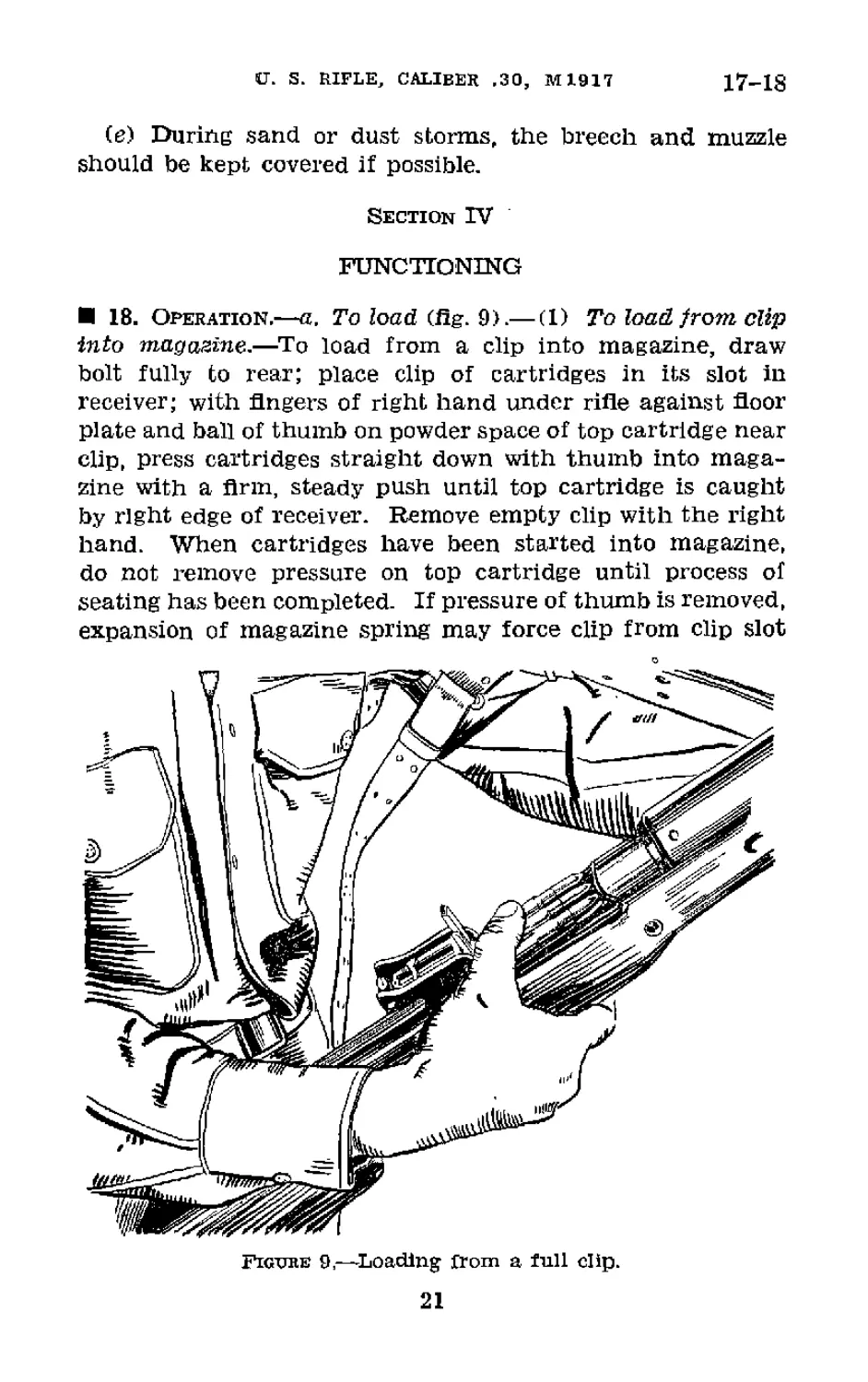
 18. Operation.—a. To load (fig. 9).— (1) To load from clip
into magazine.—To load from a clip into magazine, draw
bolt fully to rear; place clip of cartridges in its slot in
receiver; with fingers of right hand under rifle against floor
plate and ball of thumb on powder space of top cartridge near
clip, press cartridges straight down with thumb into maga-
zine with a firm, steady push until top cartridge is caught
by right edge of receiver. Remove empty clip with the right
hand. When cartridges have been started into magazine,
do not remove pressure on top cartridge until process of
seating has been completed. If pressure of thumb is removed,
expansion of magazine spring may force clip from clip slot
Figure 9,—Loading from a full clip.
21
18
BASIC FIELD MANUAL
and cause clip io break when pressure is reapplied. After
loading magazine, to feed a round into chamber, close bolt.
As bolt is closed, top cartridge in magazine is pushed forward
into chamber.
(2)	To load -magazine without use of clip.—The magazine
may be loaded without use of clip by merely inserting six
cartridges one at a time.
(3)	To load with seven -rounds,—To load with seven rounds,
place one round in chamber and six in magazine. Press
down on top cartridge in the magazine as bolt is closed in
order that bolt wall ride over top of round.
(4)	To operate as single loader.—When rifle is used as a
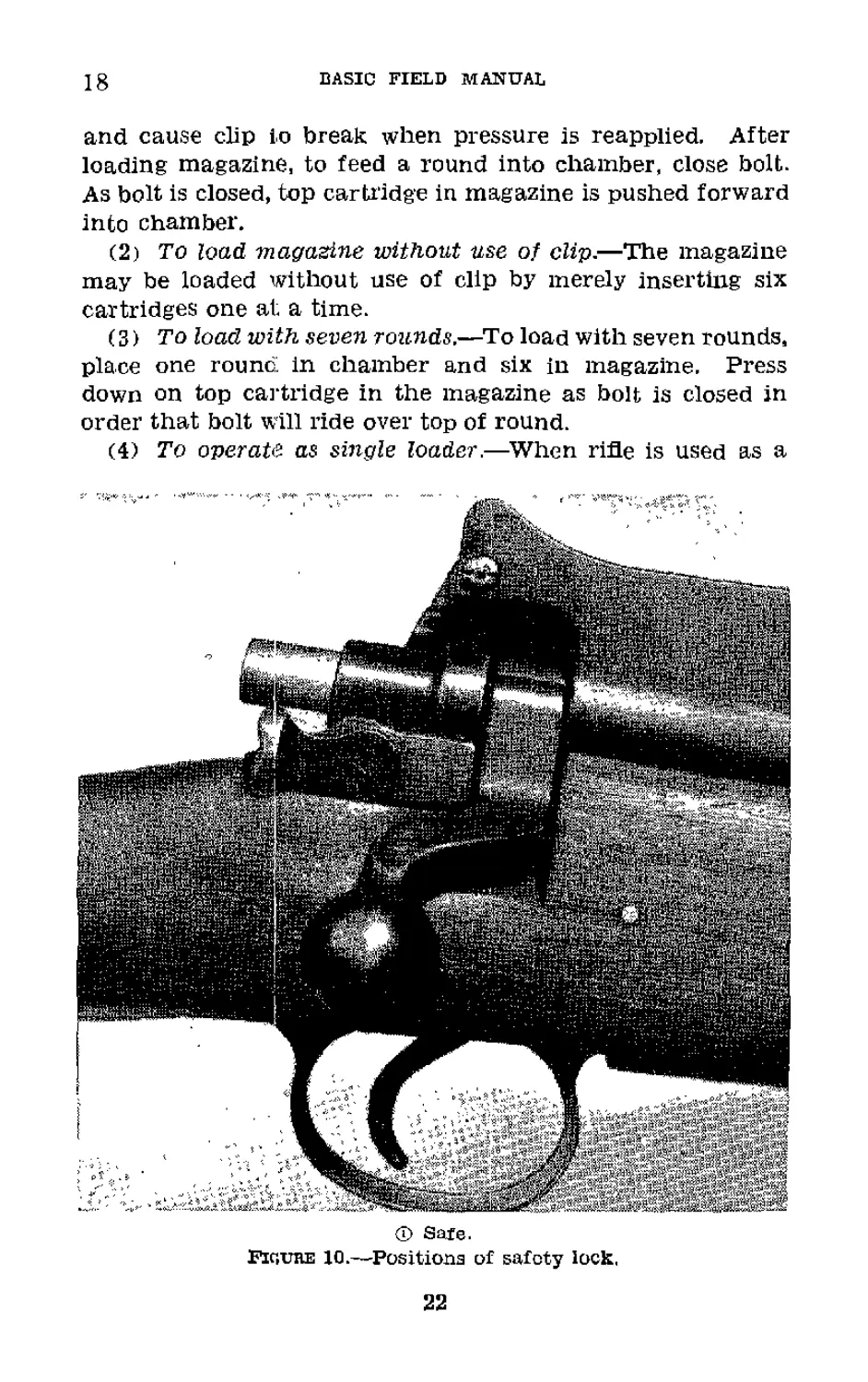
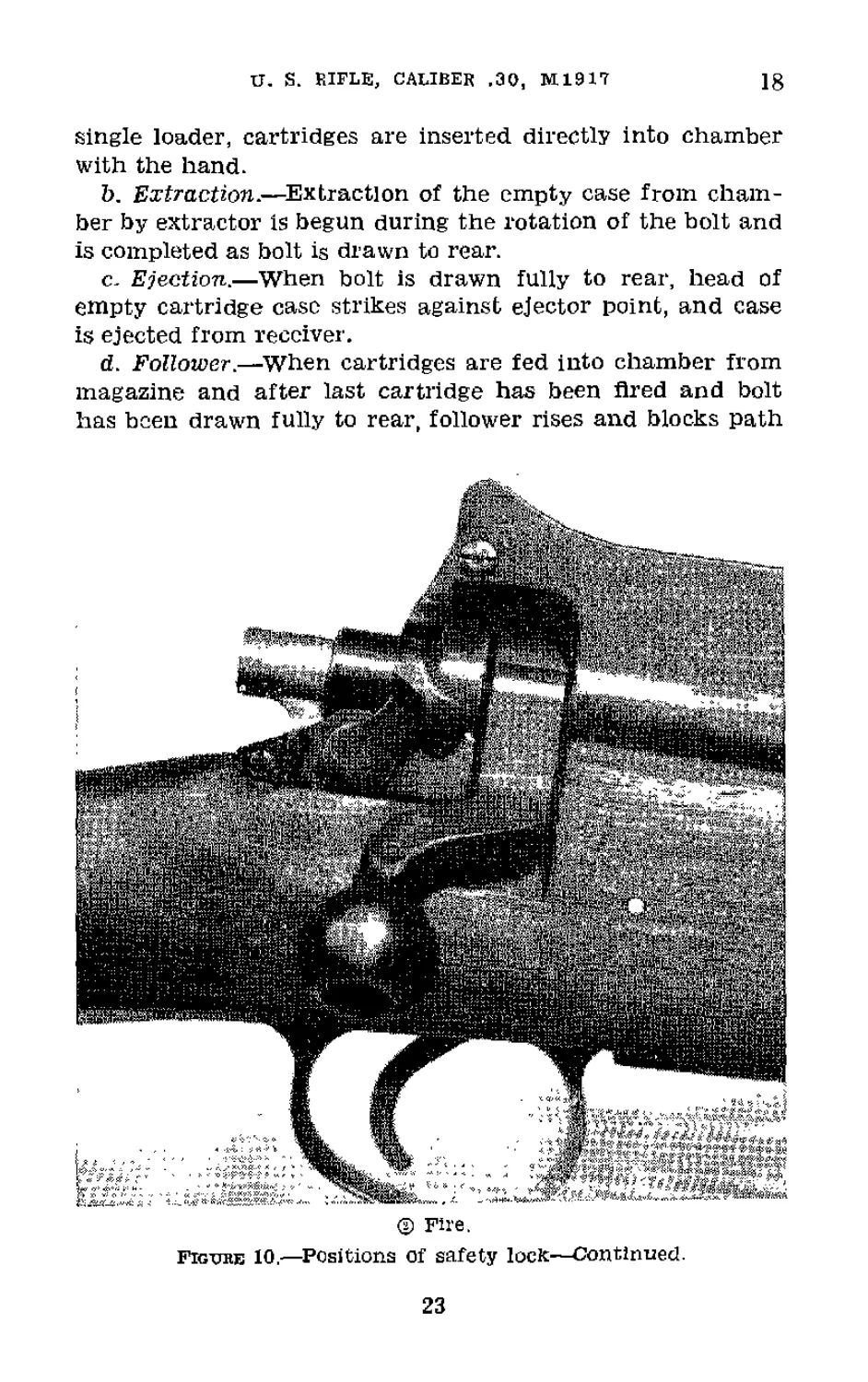
© Sate.
Figure 10.—Positions of safety lock,
22
и. S. RIFLE, CALIBER ,30, M1917
18
single loader, cartridges are inserted directly into chamber
with the hand.
b.	Extraction.—Extraction of the empty case from cham-
ber by extractor is begun during the rotation of the bolt and
is completed as bolt is drawn to rear.
c.	Ejection.—When bolt is drawn fully to rear, head of
empty cartridge case strikes against ejector point, and case
is ejected from receiver.
d.	Follower.—When cartridges are fed into chamber from
magazine and after last cartridge has been fired and bolt
has been drawn fully to rear, follower rises and blocks path
@ Fire.
Figure 10.—Positions of safety lock—Continued.
23
18-19
BASIC FIELD MANUAL
of bolt, thus showing magazine is empty. The magazine may
be refilled, or bolt may be closed without reloading by forcing
follower down until It is below path of bolt,
e.	To unload.—Move bolt forward and back until no car-
tridges remain in magazine or chamber.
/.	Safety device (fig, 10.).—To set at safe, turn the safety
lock to the rear as far as it will go. This locks bolt handle
in position, and lifts the sear notch off the sear nose. To
unlock, turn safety lock to the front.
g.	To clear rifle,—(1) To clear rifle, open bolt and draw
it fully to rear, extracting and ejecting the cartridge from
the chamber. Remove the cartridges from the magazine as
described in e above, and leave the bolt open. Inspect the
magazine and chamber to insure that they are empty.
(2) In range firing, whenever firing ceases and the com-
mand to clear rifles is given, execute clear rifle as prescribed
above. (See also par. 169b (9).)
h.	Cocking.—The rifle cannot be cocked except by actua-
tion of the bolt. It is cocked by raising the bolt handle until
it strikes the left side of the receiver, pulling the bolt back-
ward until the sear notch engages the sear nose, and then
pushing it forward and turning the bolt handle fully down.
i.	Use о/ dummy cartridges,—The corrugated dummy cart-
ridge may be used for instruction in functioning and opera-
tion, The use of the slotted, range dummy cartridge for
this purpose is prohibited. Special care must be exercised
in the use of dummy cartridges so that they do not introduce
dirt or grit into the chamber.
Section V
SPARE PARTS, APPENDAGES, AND ACCESSORIES
 19. Spare Farts.—a. The parts of any rifle will in time be-
come unserviceable through breakage or wear resulting from
continuous use; hence, spare parts are supplied. These are
extra parts provided with the rifle for replacement of the
parts most likely to fail. They should be kept clean and
lightly oiled to prevent rust. Sets of spare parts should be
kept complete at all times. Whenever a spare part is used
to replace a defective part in the rifle, the defective part
24
и, 8. RIFLE, CALIBER .30, M1917
19-20
should be repaired or a new part should be substituted in the
spare parts set as soon as possible. Parts that are carried
complete should at all times be correctly assembled and ready
for immediate insertion in the rifle. The allowance of spare
parts Is prescribed in SNL B-4,
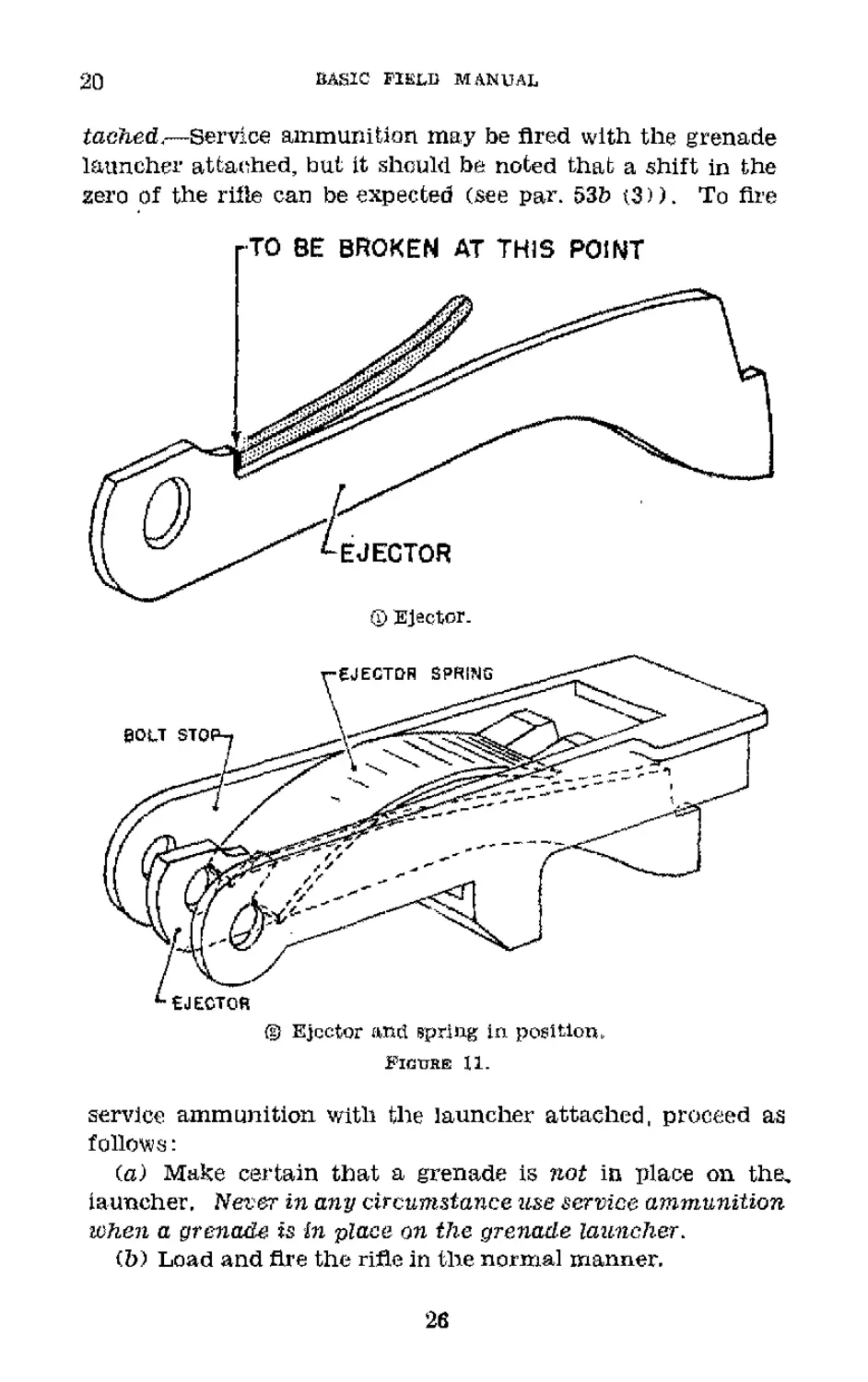
t). The breaking off of the integral spring on the ejector
results in the ejector becoming unserviceable. The ejector
body can be reused if it has not been mutilated to such an
extent as to render it inoperative in its normal functioning
under spring pressure. The proper method or reassembling
the ejector with a new spring is as follows:
(1) Use side cutting pliers and snap off the remaining por-
tion of the spring as close to the position indicated in figure
11® as possible,
(2) Reassemble bolt stop, bolt stop spring, ejector and ejec-
tor spring (new type). The slot in the ejector spring should
be rearward, toward bolt stop spring rest as Indicated in
figure 11®.
c. Except for replacements with the parts mentioned in
a and b above, repairs or alterations to the rifle by using or-
ganizations are prohibited.
 20. Appendages.—Appendages for the rifle are the bayonet
M1917, bayonet scabbard M1917, and grenade launcher.
a.	Bayonet.—The bayonet is a blade sharpened along the
entire lower edge. The bayonet guard is constructed so as to
fasten the bayonet securely to the rifle or its scabbard. Grips
on both sides of the tang provide a handle when the bayonet
is used as a hand weapon.
b.	Bayonet scabbard.—The scabbard, shaped to receive
the bayonet, consists of a leather body with a leather rein-
forcement at its tip winch contains a drain hole. The scab-
bard is held to the belt of the soldier by two hooks.
c.	Grenade launcher.—(1) Firing antitank grenades, anti-
personnel grenades, and ground signals,—Antitank and anti-
personnel grenades, and also ground signals, can be fired from
-the rifle with the aid of a launcher which the soldier attaches
to the muzzle of his rifle. A special cartridge, AT grenade,
caliber .30, М3, which is issued with the grenade, is used,
(2) Firing service ammunition with the launcher at-
25
20
BASIC FIELD MANUAL
tached-Service ammunition may be fired with the grenade
launcher attached, but it should be noted that a shift in the
zero of the rifle can be expected (see par. 53b (3)1. To fire
rTO be broken at this point
® Ejector and spring In position.
Ficuke 11.
service ammunition with the launcher attached, proceed as
follows:
(a)	Make certain that a grenade is not in place on the,
launcher, Never in any circumstance use service ammunition
when a grenade is In place on the grenade launcher.
(b)	Load and fire the rifle in the normal manner.
26
XJ\ S. RIFLE, CALIBER .30, M1017
,20-21
(3) Technique о/ firing and safety precautions.—For in-
formation concerning attachment of launcher, technique of
firing, and safety precautions to be taken, see FM 23-30.
 21. Accessories.—a. General.—Accessories Include the
tools required for assembling, disassembling, and cleaning
the rifle, the gun sling, spare parts containers, covers, arm
locker, and similar items. Accessories should not be used
for purposes other than those for which they are intended,
and, when not in use, they should be stored in the places or
receptacles provided for them. The names or general
characteristics of several accessories Indicate their uses or
application. Detailed descriptions or methods for the use
of such items are not outlined herein. However, accessories
of a special nature or those which have special uses are de-
scribed in b to h below.
b.	Arm locker and rack,—The arm locker and the arm
rack are used to store or stack rifles and pistols to prevent
mishandling or pilfering.
c.	Brush and thong.—The brush and thong are used for
cleaning the bore of the rifle (see par. 13g). The oiler and
thong case is partitioned so that one end contains the oil
and oil dropper and the other holds the tip, weight, thong,
and brush.
d.	Cleaning rod Ml and cleaning brush М2.—The cleaning
rod has a handle at one end and is threaded at the other end
to receive the patch or brush sections. The patch section is
slotted to permit the insertion of a cleaning patch; the brush
section is used to clean the bore of the rifle after firing (see
par. 12a).
e.	Gun slings.—(1) Methods for attaching the three types
of gun slings are indicated below:
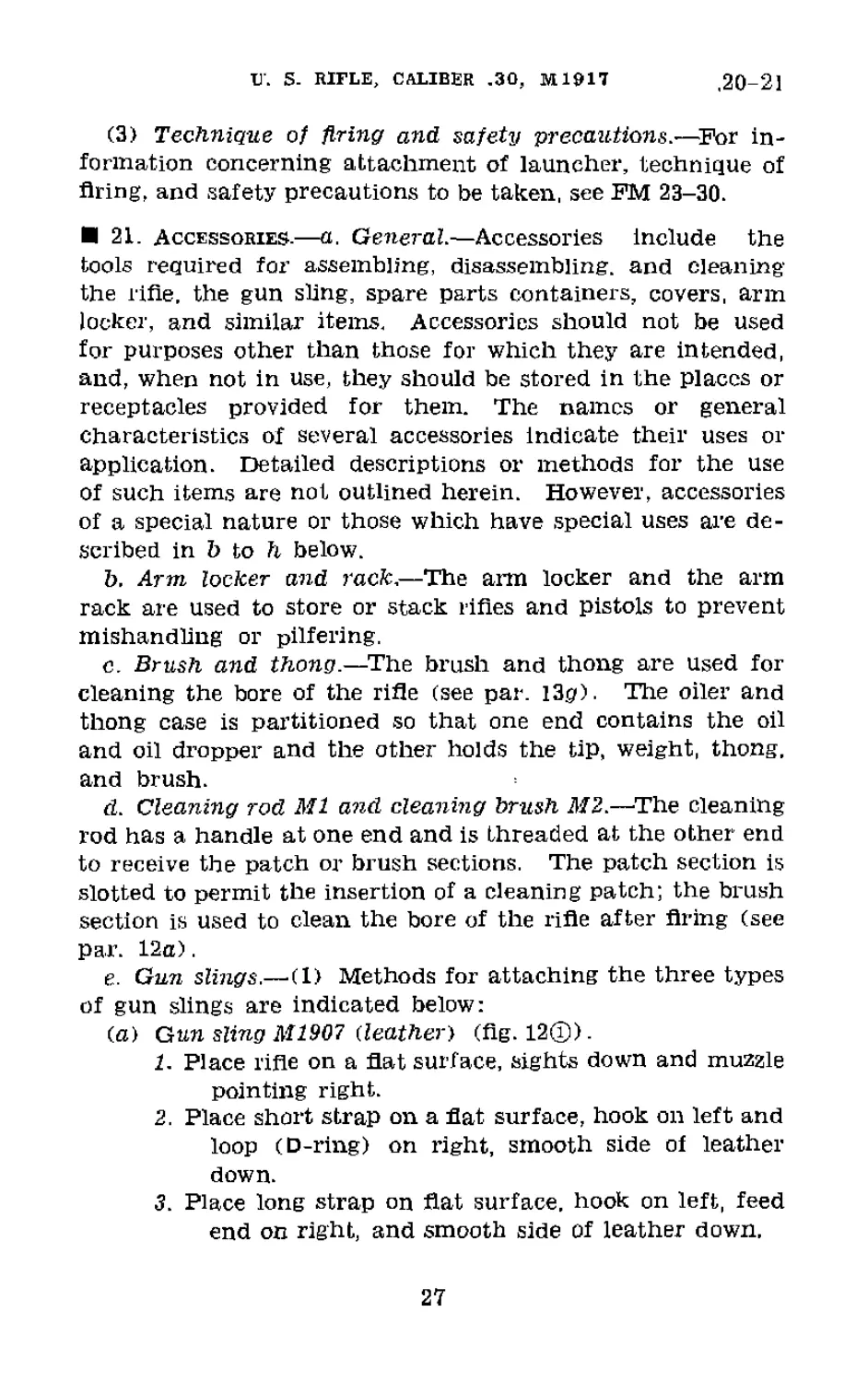
(a)	Gun sling M1907 (leather) (fig. 12®).
1.	Place rifle on a flat surface, sights down and muzzle
pointing right.
2.	Place short strap on a flat surface, hook on left and
loop (D-ring) on right, smooth side of leather
down.
3.	Place long strap on flat surface, hook on left, feed
end on right, and smooth side of leather down.
27
21
BASIC FIELD MANUAL
Ф M1907—Leather.
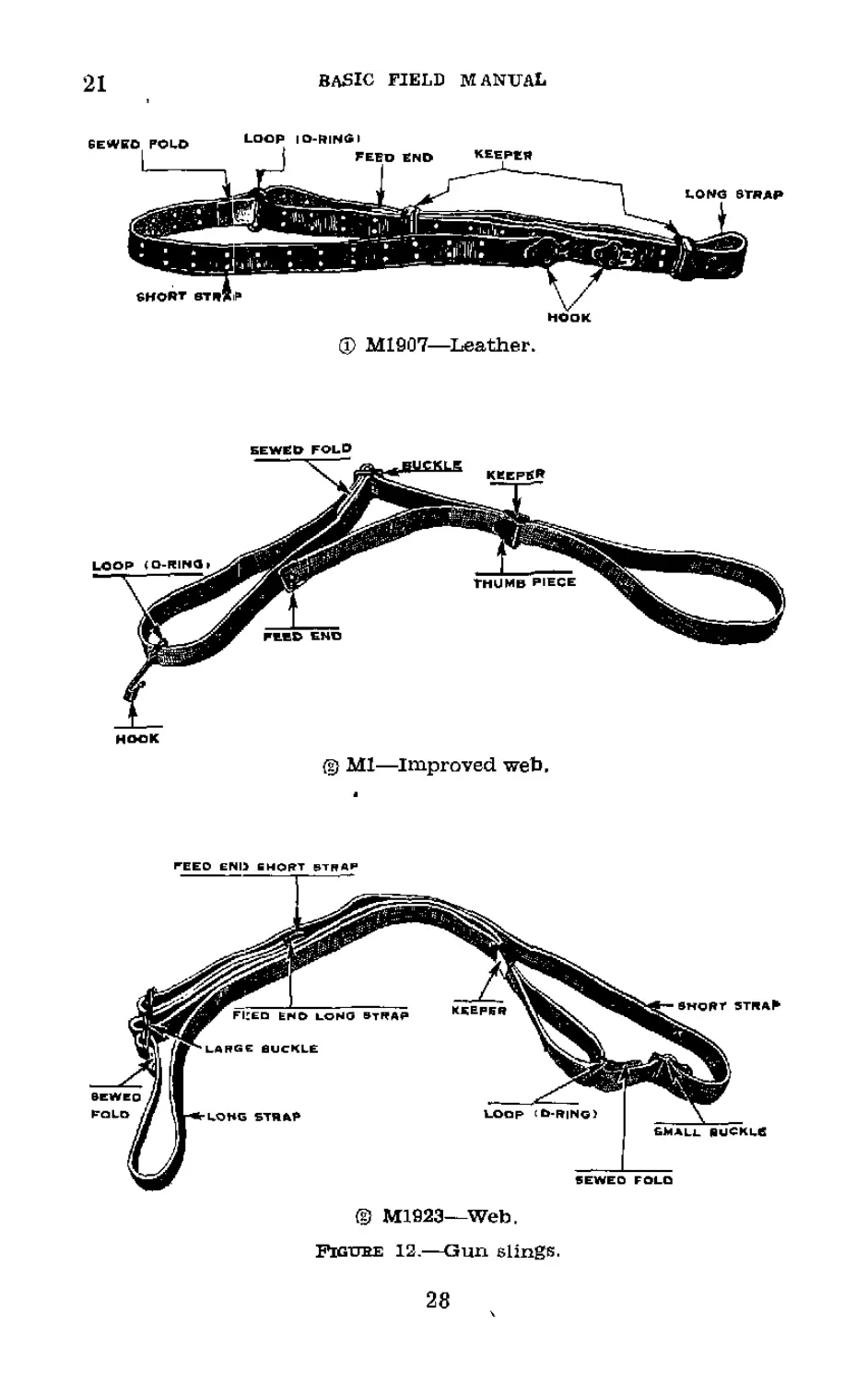
® Ml—Improved web.
28
U, S. RIFLE, CALIBER .30, M1917
21
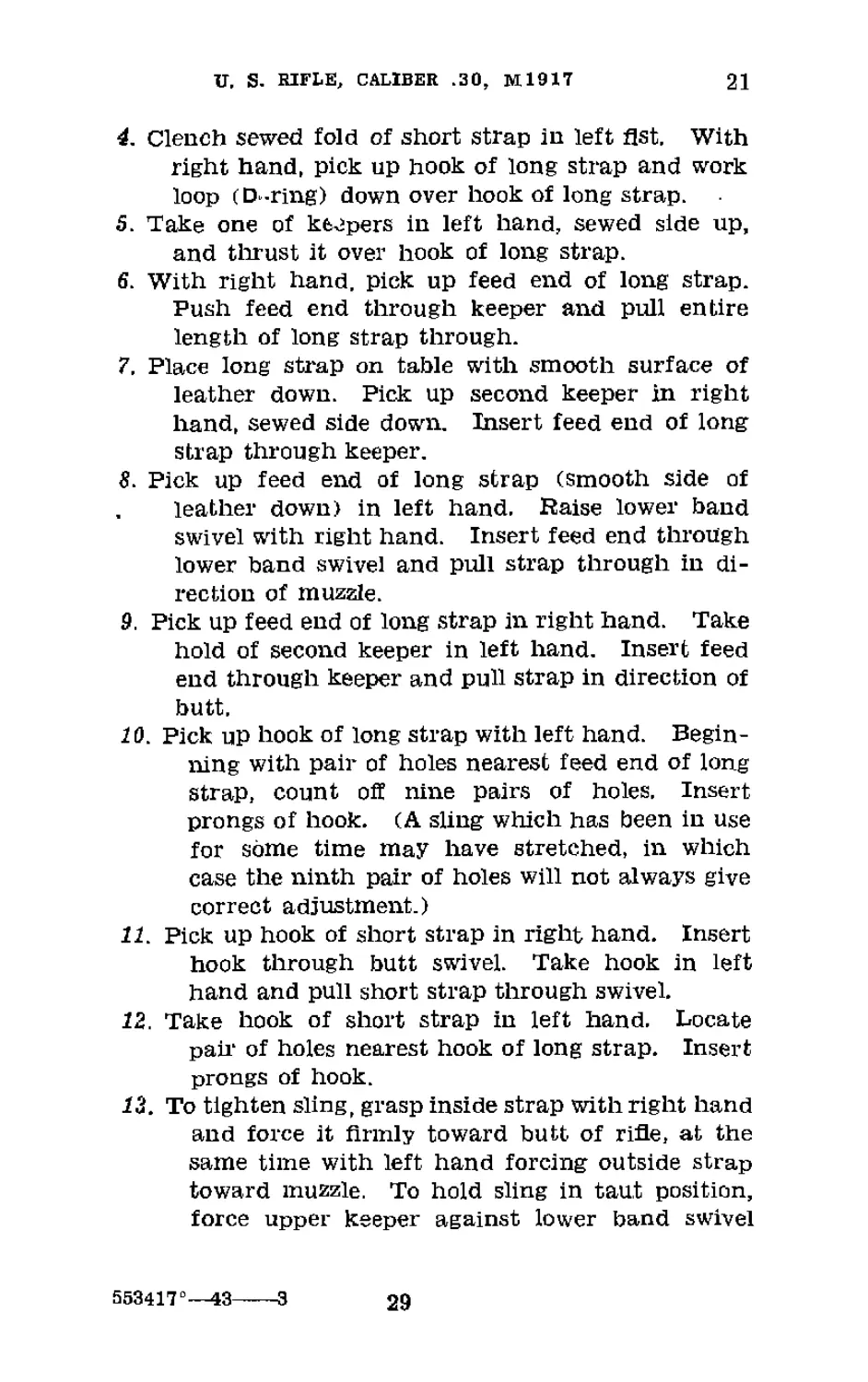
4.	Clench sewed fold of short strap in left flat. With
right hand, pick up hook of long strap and work
loop (D -ring) down over hook of long strap.
5.	Take one of keepers in left hand, sewed side up,
and thrust it over hook of long strap.
6.	With right hand, pick up feed end of long strap.
Push feed end through keeper and pull entire
length of long strap through.
7.	Place long strap on table with smooth surface of
leather down. Pick up second keeper in right
hand, sewed side down. Insert feed end of long
strap through keeper.
8.	Pick up feed end of long strap (smooth side of
leather down) in left hand. Raise lower band
swivel with right hand. Insert feed end through
lower band swivel and pull strap through in di-
rection of muzzle.
9.	Pick up feed end of long strap in right hand. Take
hold of second keeper in left hand. Insert feed
end through keeper and pull strap in direction of
butt,
10.	Pick up hook of long strap with left hand. Begin-
ning with pair of holes nearest feed end of long
strap, count off nine pairs of holes. Insert
prongs of hook. (A sling which has been in use
for some time may have stretched, in which
case the ninth pair of holes will not always give
correct adjustment.)
11.	Pick up hook of short strap in right hand. Insert
hook through butt swivel. Take hook in left
hand and pull short strap through swivel.
12.	Take hook of short strap in left hand. Locate
paii‘ of holes nearest hook of long strap. Insert
prongs of hook.
13.	To tighten sling, grasp inside strap with right hand
and force it firmly toward butt of rifle, at the
same time with left hand forcing outside strap
toward muzzle. To hold sling in taut position,
force upper keeper against lower band swivel
553417°—43
29
21
BASIC FIELD MANUAL
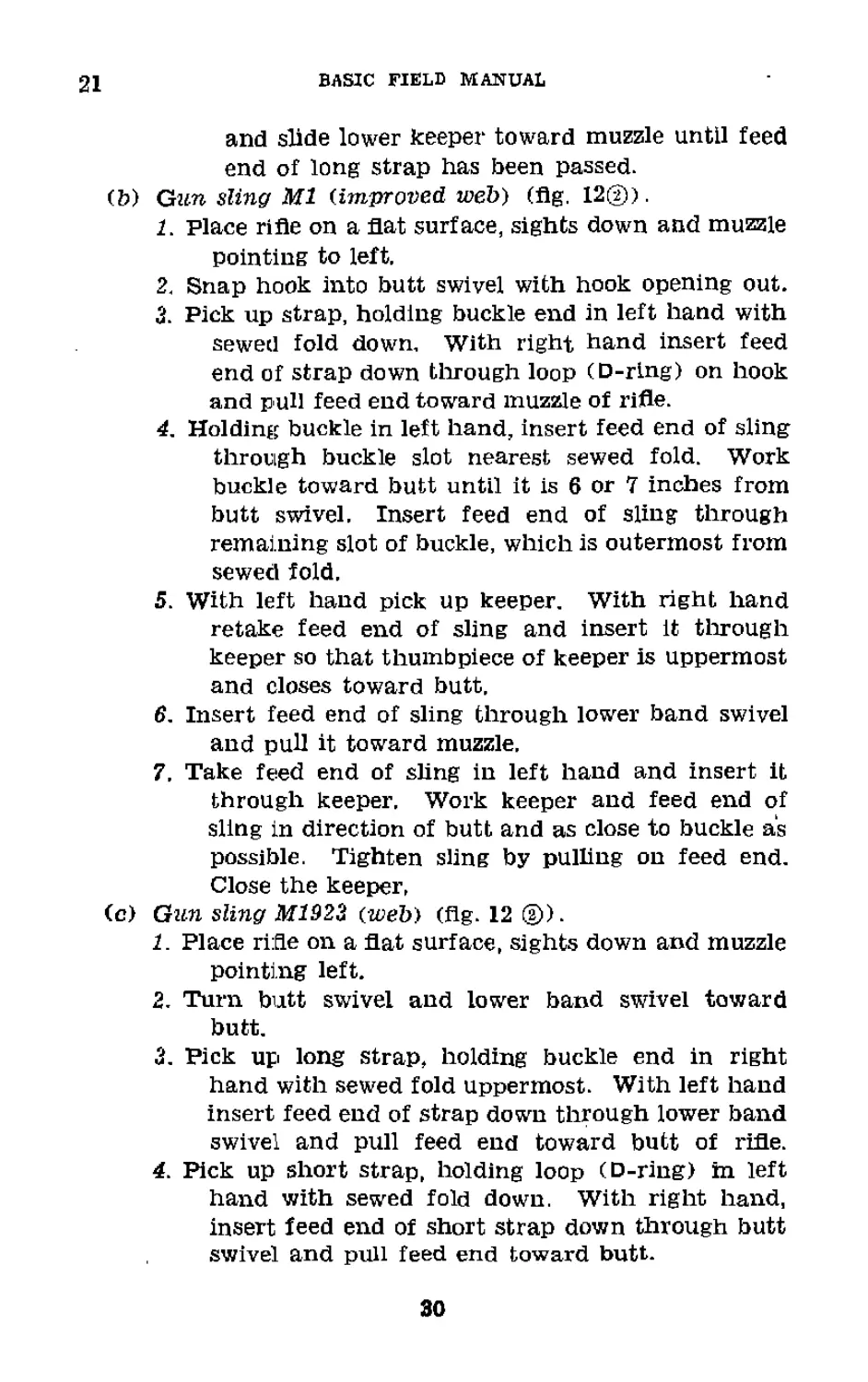
and slide lower keeper toward muzzle until feed
end of long strap has been passed.
(b)	Gun sling Ml (improved web) (fig. 12®).
1.	place rifle on a flat surface, sights down and muzzle
pointing to left,
2.	Snap hook into butt swivel with hook opening out.
3.	Pick up strap, holding buckle end in left hand with
sewed fold down. With right hand insert feed
end of strap down through loop (D-rlng) on hook
and pull feed end toward muzzle of rifle.
4.	Holding buckle in left hand, insert feed end of sling
through buckle slot nearest sewed fold. Work
buckle toward butt until it is 6 or 7 inches from
butt swivel. Insert feed end of sling through
remaining slot of buckle, which is outermost from
sewed fold,
5.	With left hand pick up keeper. With right hand
retake feed end of sling and insert it through
keeper so that thumbpiece of keeper is uppermost
and closes toward butt,
6.	Insert feed end of sling through lower band swivel
and pull it toward muzzle,
7,	Take feed end of sling in left hand and insert it
through keeper. Work keeper and feed end of
sling in direction of butt and as close to buckle as
possible. Tighten sling by pulling on feed end.
Close the keeper,
(c)	Gun sling M1923 (web) (fig. 12 ®).
1.	Place rifle on a flat surface, sights down and muzzle
pointing left.
2,	Turn butt swivel and lower band swivel toward
butt,
3,	Pick up long strap, holding buckle end in right
hand with sewed fold uppermost. With left hand
insert feed end of strap down through lower band
swivel and pull feed end toward butt of rifle.
4.	Pick up short strap, holding loop (D-ring) m left
hand with sewed fold down. With right hand,
insert feed end of short strap down through butt
swivel and pull feed end toward butt.
30
U. S. RIFLE, CALIBER .30, ML917
21
5.	With right hand, pick up keeper. With left hand,
retake feed end of long strap and insert it through
keeper so that thumbpiece of keeper is upper-
most and closes toward muzzle of rifle.
6.	With left hand, pick up small buckle, holding it so
that cross bars are uppermost and thumbpiece is
toward butt of rifle. Taking feed end of short
strap in right hand, bring end up through small
buckle at slot nearest thumbpiece and back down
through slot farthest from thumbpiece, allowing
about 8 inches of strap to come through buckle.
7.	Regrasp feed end of long strap with left hand and
bring It up through loop (D-ring) on lower end of
short strap. Fold long strap back over top of
loop (D-ring) and insert end through keeper.
8.	Still holding feed end of long strap, bring it up
through slot of large buckle nearest sewed fold
of long strap and continue it back down through
second slot from sewed fold, allowing 3 or 4 inches
of strap to come through.
9.	Again pick up feed end of short strap and bring it
up through large buckle at slot nearest thumb-
piece and back down through one remaining open
slot. Continue end of strap back to small buckle
and insert it up through slot farthest from
thumbpiece and down through middle slot of
small buckle,
10.	To tighten sling, grasp inside strap with right
hand and force it firmly toward butt of rifle,
at same time with left hand forcing outside strap
toward muzzle. Close keeper to hold sling in
its taut position.
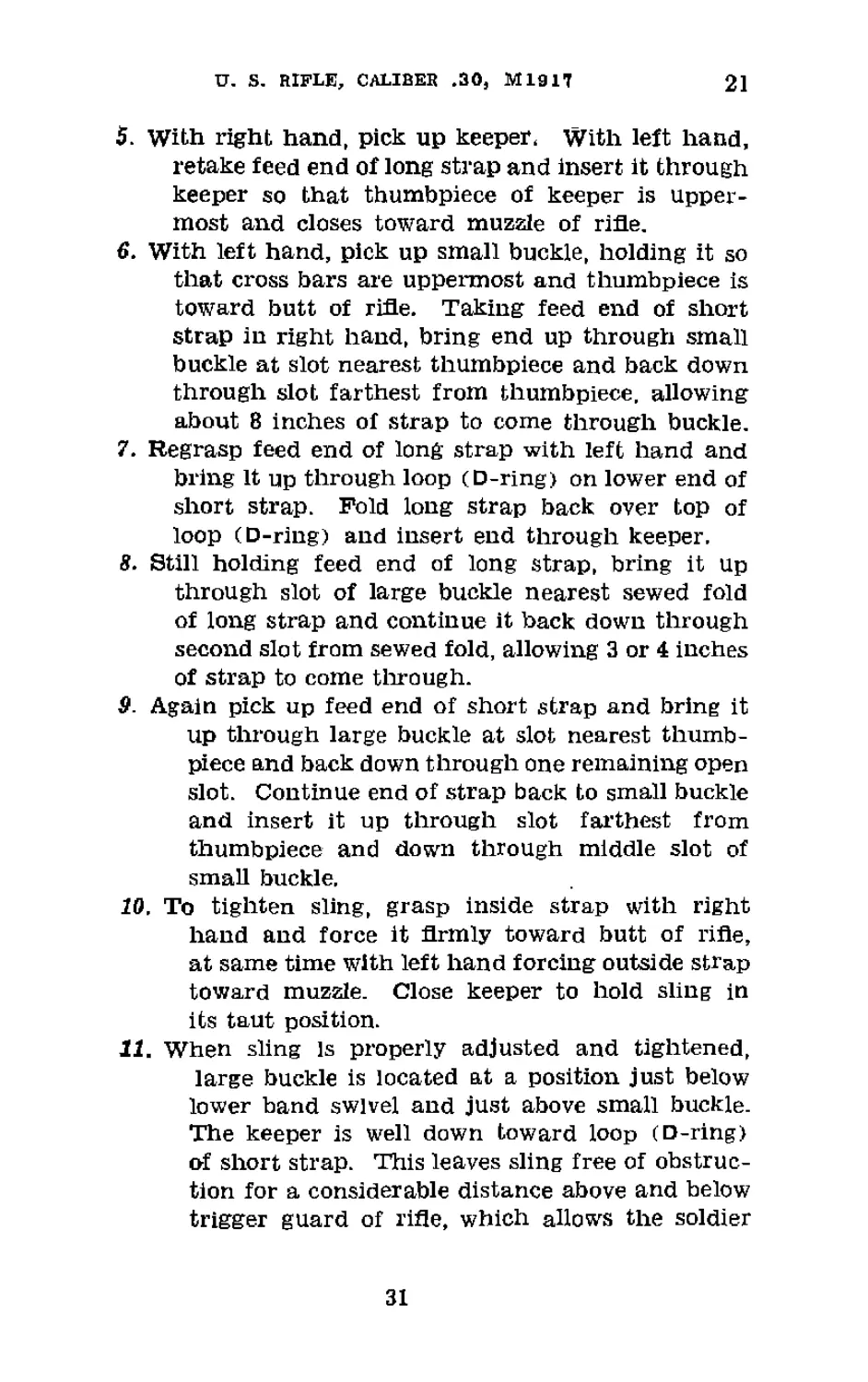
11.	When sling is properly adjusted and tightened,
large buckle is located at a position just below
lower band swivel and just above small buckle.
The keeper is well down toward loop (D-ring)
of short strap. This leaves sling free of obstruc-
tion for a considerable distance above and below
trigger guard of rifle, which allows the soldier
31
21
BASIC FIELD MANUAL
the maximum comfort while carrying rifle at
the shoulder. The small buckle should be in a
position above balance of rifle to prevent inter-
ference with left hand while performing the
manual of arms.
(2)	Methods of adjusting three types of gun slings for
sling arms are indicated below:
(a)	Gun sling Ml907 (leather),—By reversing the pro-
cedure prescribed in (1) (a) 13 above, loosen sling until there
is sufficient slack to sling rifle comfortably on shoulder.
(b)	Gun sling Ml (improved web),
1.	With right hand firmly grasping small of stock,
brace butt of rifle against right hip, at the same
time canting rifle to right so that trigger guard
is to left.
2.	With left hand, open keeper and loosen sling by
sliding keeper and feed end of sling toward muz-
zle. In this manner loosen sling until there is
sufficient slack to sling rifle comfortably on
shoulder. Close keeper.
(c)	Gun sling, M1923 (web).
1.	With right hand firmly grasping small of stock,
brace butt of rifle against right hip, at the same
time canting rifle to right so that trigger guard is
to left.
2.	With left hand open keeper,
3.	Again with left hand, grasp outside strap of sling
and force it toward butt. In this manner loosen
sling until there is sufficient slack to sling rifle
comfortably on shoulder. Close keeper.
/. Ruptured cartridge extractor.—The ruptured cartridge
extractor has the general form of a caliber .30 cartridge and
consists of three parts-^the spindle, the head, and the sleeve.
The ruptured cartridge extractor is inserted through the
opening of the ruptured case and pushed forward into the
chamber. The bolt is closed so that the extractor engages
the head of the ruptured cartridge extractor. As the bolt is
drawn to the rear, the ruptured cartridge extractor, holding
the cartridge on its sleeve, is extracted.
32
U. S. RIFLE, CALIBER ,30, M1917
21-22
g. Aiming device, M1923, modified.—This is an aid to the
coach in determining the difficulties experienced by pupils
undergoing marksmanship training. Any deviation from the
correct sight alinement can be observed Immediately by the
coach as he looks at the image which appears on the glass in
the aiming device. This device serves as a check on those
who do not hold the breath properly, and it enables the coach
to assist the inexperienced rifleman to obtain the correct
sight picture. The device is fitted over the stock of the
rifle.
Section VI
INSTRUMENTS
 22. Binoculars.—a. General.—There are two types of
binoculars in use in the service: the М3 or M13 (the M13 is the
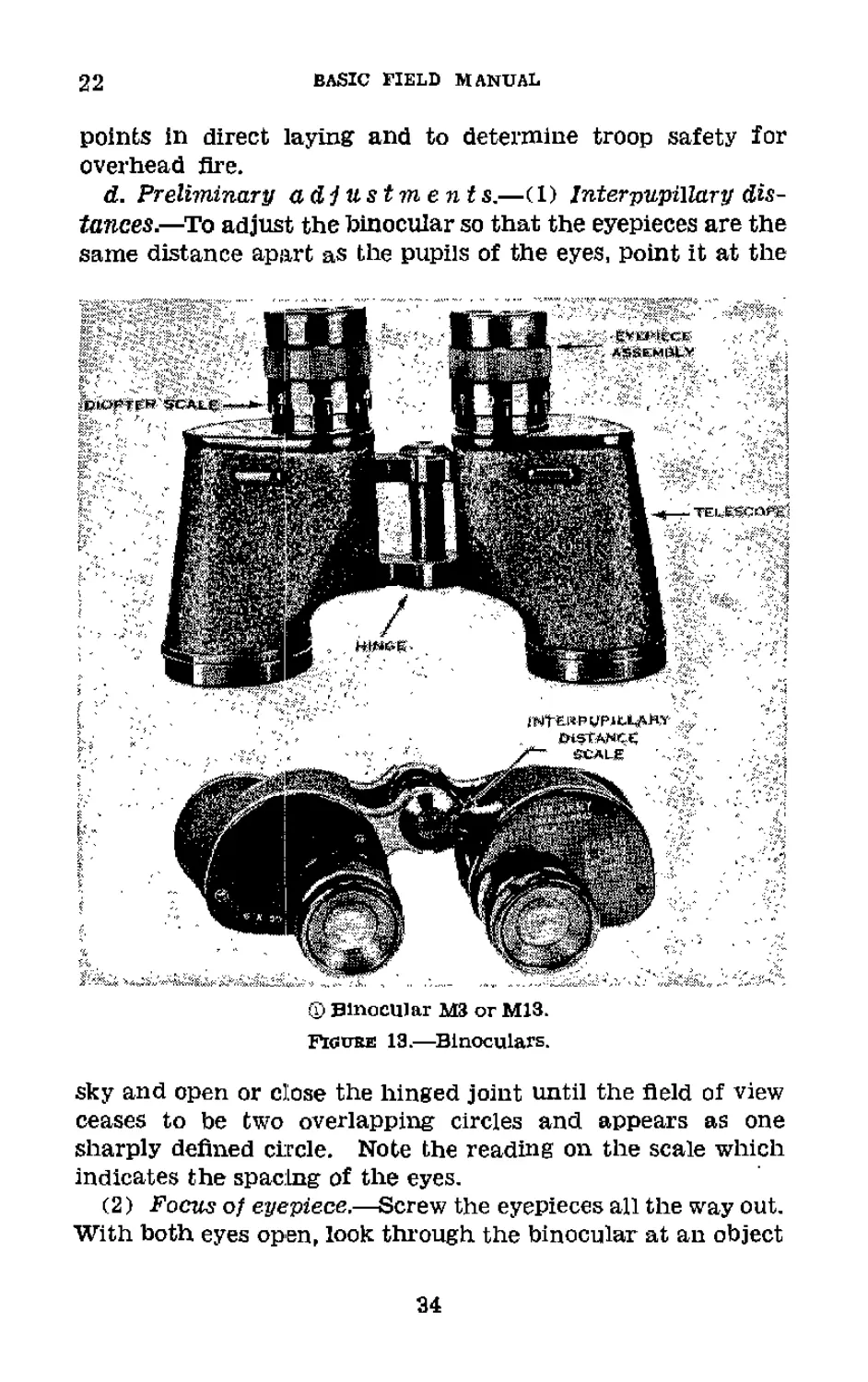
М3 waterproofed) (fig. 13©) and the type EE (fig. 13®).
The М3 and M13 binocular will eventually replace the type
EE. The subparagraphs below apply to both models. Each
model consists of the binocular with its carrying case.
Ъ.	DescriDticm.—(!) The binocular consists of two compact
prismatic telescopes pivoted about a common hinge which
permits adjustment for interpupillary distances, A scale
graduated every 2 millimeters from 56 to 74 permits the ob-
server to set the telescopes rapidly to suit his Interpupillary
distance, provided the spacing of his eyes is known. By
screwing the eyepiece in or out, they can be focused inde-
pendently for each eye. Each eyepiece is. provided with a
diopter scale for rapid setting when the observer knows the
correction for his eye. The zero graduations indicate the
settings for normal eyes.
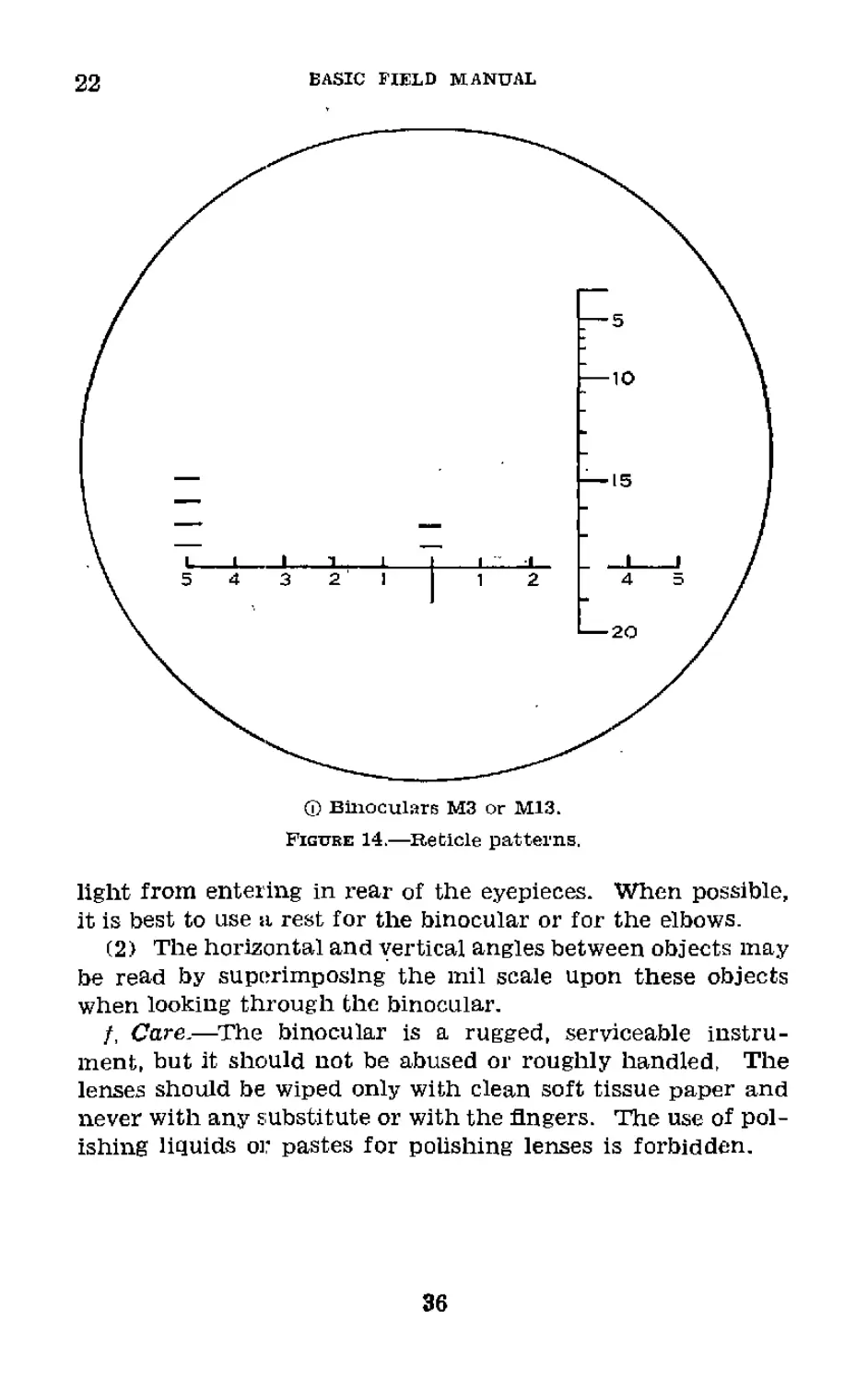
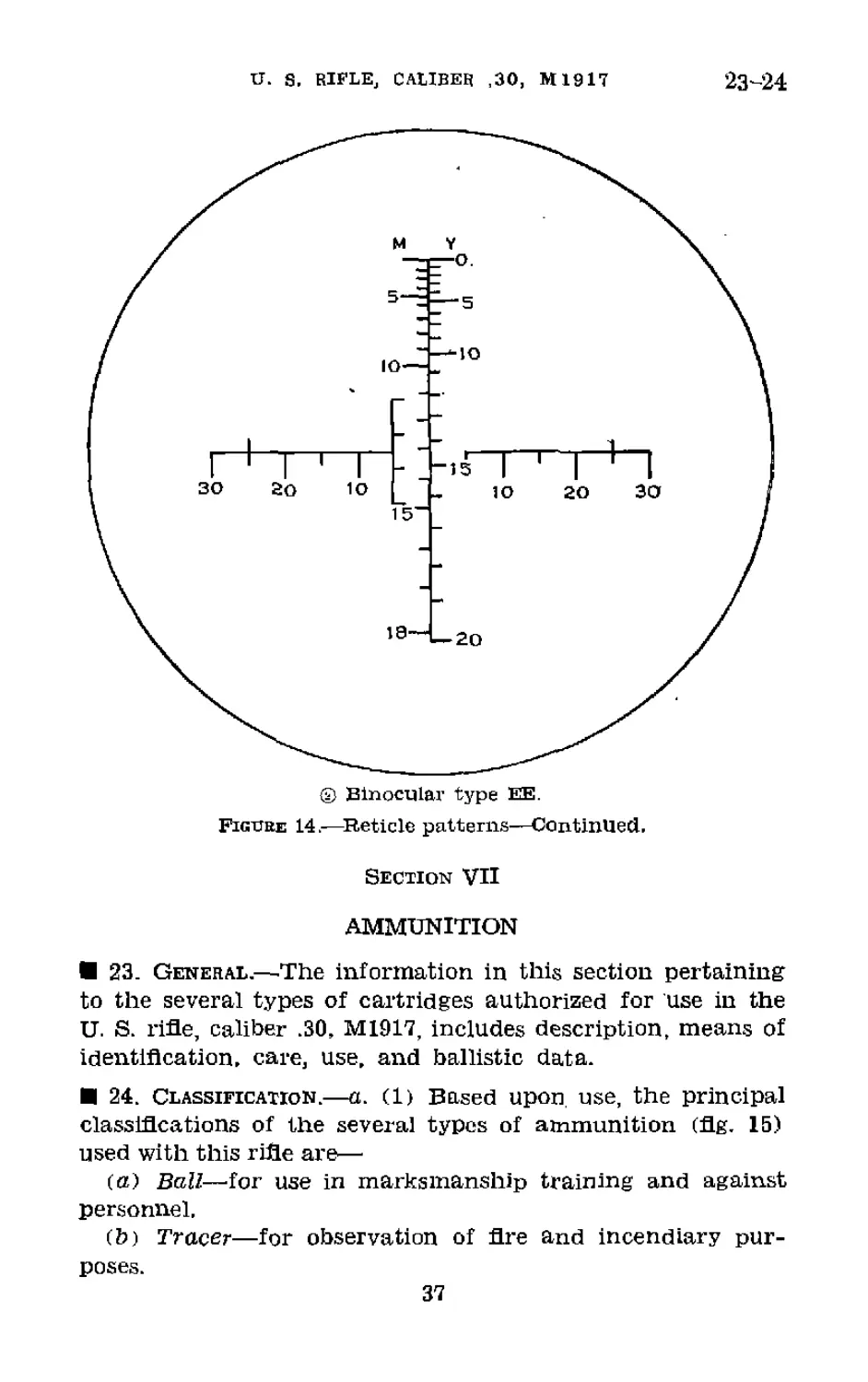
(2)	The left telescope is fitted with a glass reticle (fig. 14)
upon which are etched a vertical mil scale, a horizontal mil
scale, and a stadia graduated similarly to the sight leaf
graduation on the rifle M1917, but inverted.
c.	Use,—The binocular is used for observations and the
measurement of small horizontal and vertical angles in mils.
The vertical stadia scale is used to pick up auxiliary aiming
33
22
BASIC FIELD MANUAL
points in direct laying and to determine troop safety for
overhead fire.
d.	Preliminary adjustments.—(1) Interpupillary dis-
tances.—To adjust the binocular so that the eyepieces are the
same distance apart as the pupils of the eyes, point it at the
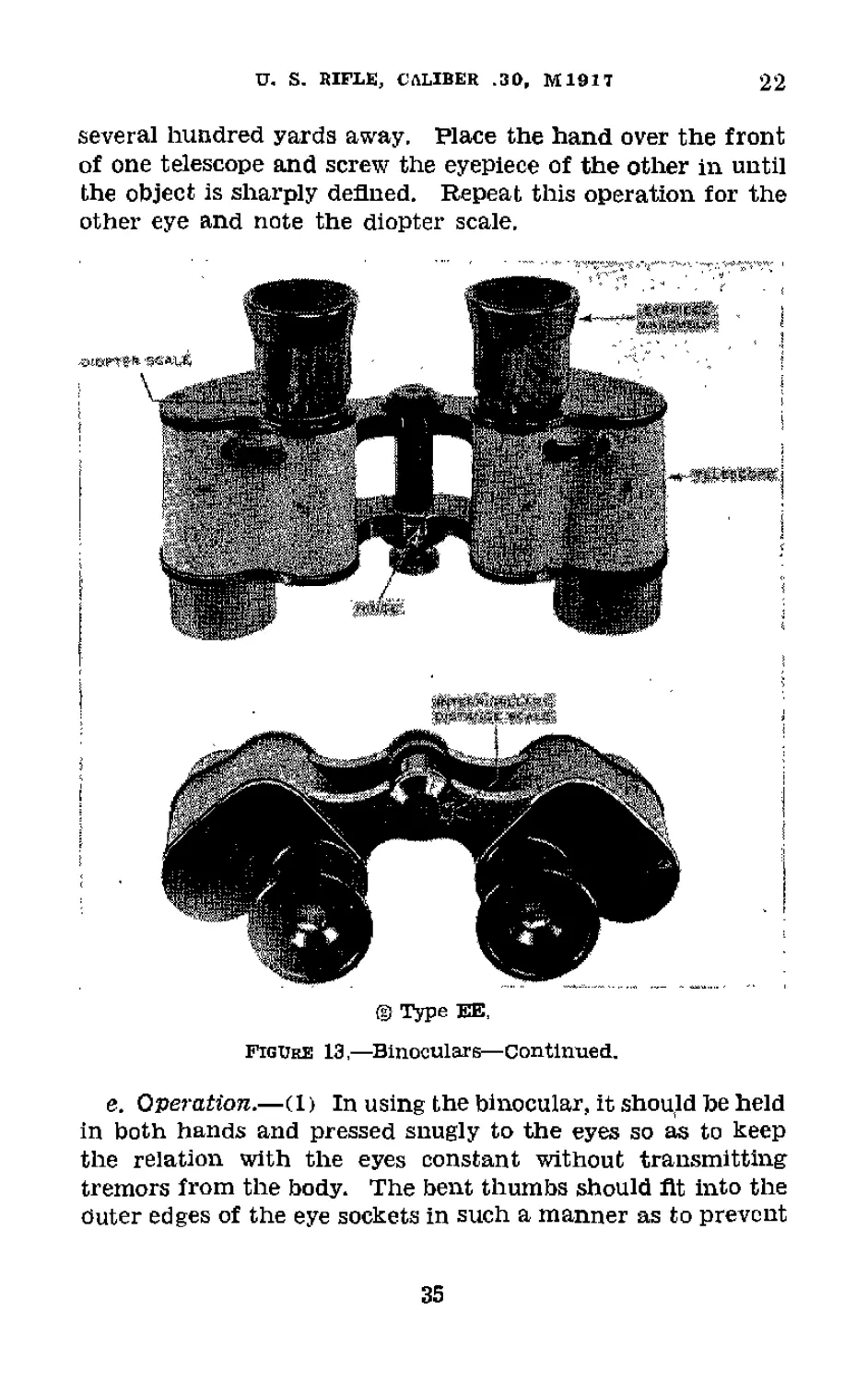
© Binocular М3 or M13.
Figure 13.—Binoculars.
sky and open or close the hinged joint until the field of view
ceases to be two overlapping circles and appears as one
sharply defined circle. Note the reading on the scale which
indicates the spacing of the eyes.
(2)	Focus of eyepiece.—Screw the eyepieces all the way out.
With both eyes open, look through the binocular at an object
34
U. S. RIFLE, CALIBER .30, M1917
22
several hundred yards away. Place the hand over the front
of one telescope and screw the eyepiece of the other in until
the object is sharply defined. Repeat this operation for the
other eye and note the diopter scale.
® Type EE,
Figure 13,—Binoculars—Continued.
e.	Operation.—(1) In using the binocular, it should be held
in both hands and pressed snugly to the eyes so as to keep
the relation with the eyes constant without transmitting
tremors from the body. The bent thumbs should fit into the
Outer edges of the eye sockets in such a manner as to prevent
35
22
BASIC FIELD MANUAL
light from entering in rear of the eyepieces. When possible,
it is best to use a rest for the binocular or for the elbows.
(2) The horizontal and vertical angles between objects may
be read by superimposing the mil scale upon these objects
when looking through the binocular.
/, Care.—The binocular is a rugged, serviceable instru-
ment, but it should not be abused or roughly handled, The
lenses should be wiped only with clean soft tissue paper and
never with any substitute or with the fingers. The use of pol-
ishing liquids or pastes for polishing lenses is forbidden.
36
U. s. RIFLE, CALIBER ,30, M1917
23-24
Figure 14.—Reticle patterns—Continued.
Section VII
AMMUNITION
	23. General.—.The information in this section pertaining
to the several types of cartridges authorized for use in the
U. S. rifle, caliber .30, M1917, includes description, means of
identification, care, use, and ballistic data.
	24. Classification.—a. (1) Based upon, use, the principal
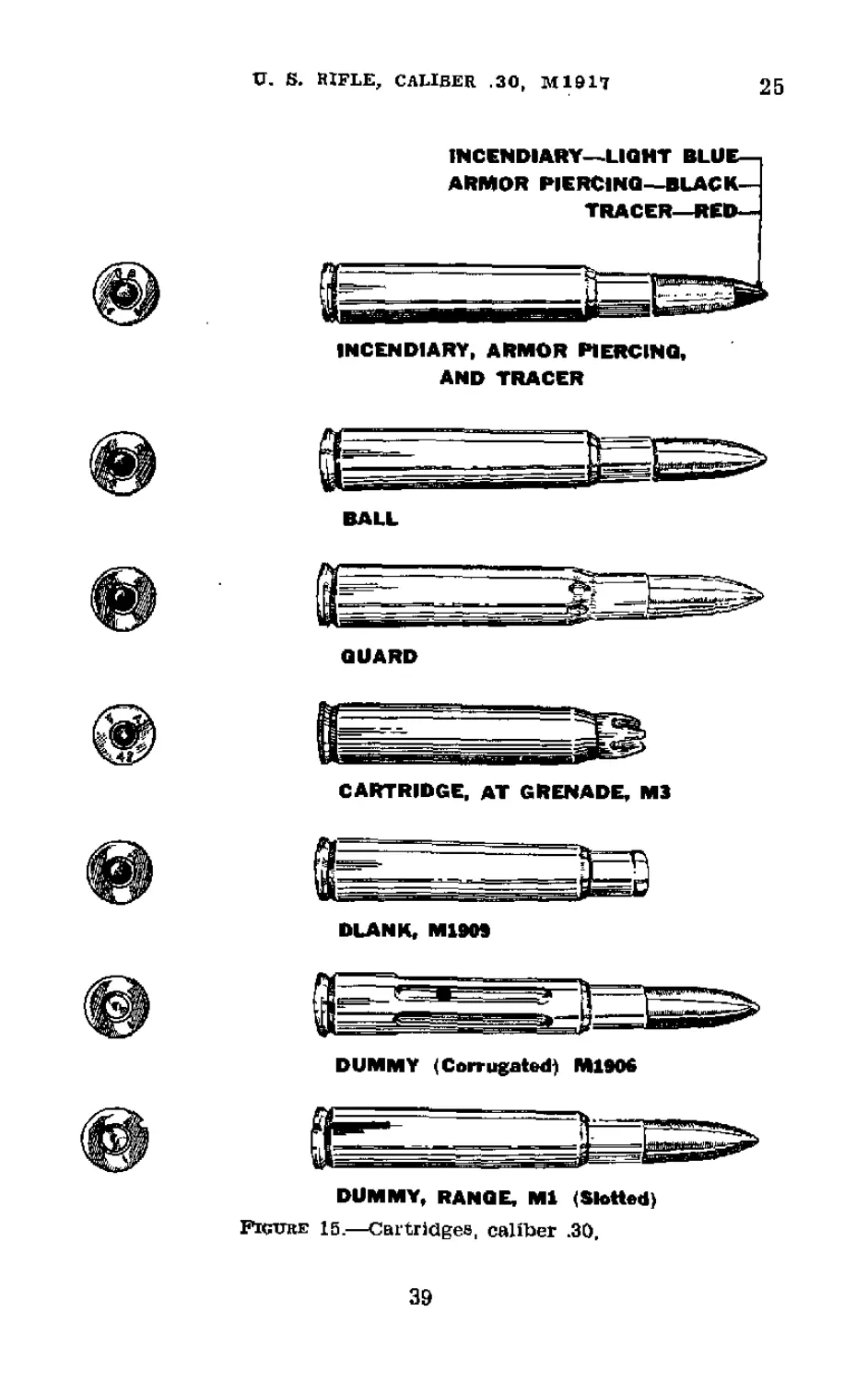
classifications of the several types of ammunition (fig. 15)
used with this rifle are—
(a)	Ball—for use in marksmanship training and against
personnel,
(b)	Tracer—for observation of Are and incendiary pur-
poses.
37
24-25
BASIC FIELD MANUAL
(c)	Incendiary—for incendiary purposes.
(d)	Armor-piercing—for use in marksmanship training
and against armored vehicles, concrete shelters, similar bul-
let-resisting targets, and personnel.
(e)	Cartridge, AT grenade, М3—for use in firing the anti-
tank grenade against armored targets; for use in firing the
antitank practice grenade; for use in firing the impact
fragmentation (antipersonnel) grenade M17; and for use
in firing the Mk. II antipersonnel grenade with the grenade
projection-adapter, Ml (see par. 20c).
(2)	Other types of .ammunition provided for special pur-
poses are—
(a)	Guard—for guard purposes (gallery practice cartridge
also used for this purpose).
(b)	Blank—for simulated fire, signaling, and salute.
(c)	Dummy—for training and range practice.
b. The following three types of ammunition are similar to
ball ammunition in outward appearance, except as indicated
below.
(1)	Armor-piercing is painted black for % inch from the
point.
(2)	Tracer is painted red for У4 inch from the point.
(3)	Incendiary is painted light blue for У1 inch from the
point.
 25. Lot Number.—When ammunition is manufactured, an
ammunition lot number is assigned which becomes an es-
sential part of its marking in conformity with ordnance
specifications. This lot number is marked on all packing
containers and on the identification card inclosed in each
packing box. The lot number is required for all purposes
of record, including grading and use, reports on condition,
functioning, and accidents in which the ammunition might
be involved. Only those lots or grades appropriate for the
weapon will be fired. Since it is impracticable to mark
the ammunition lot number on each individual cartridge,
every effort should be made to keep the ammunition lot num-
ber with the cartridges once the cartridges are removed from
their original packing. During marksmanship and combat
training, cartridges which have been removed from the orig-
inal packing and for which the ammunition lot number
38
U. S. RIFLE, CALIBER .30, M1917
25
INCENDIARY—LIGHT BLUE—.
ARMOR PIERCING—BLACK-
TRACER—RED-
INCENDIARY, ARMOR PIERCING,
AND TRACER
BALL
GUARD
CARTRIDGE, AT GRENADE, М3
DLANK, Ml 90S
DUMMY (Corrugated) М19М
DUMMY, RANGE, Ml (Slotted)
Figure 15.—Cartridges, caliber .30,
39
25-27
BASIC FIELD MANUAL
has been lost are placed in grade 3. It is therefore obvious
that when cartridges are removed from their original pack-
ings they should be so marked that their ammunition lot
number is retained.
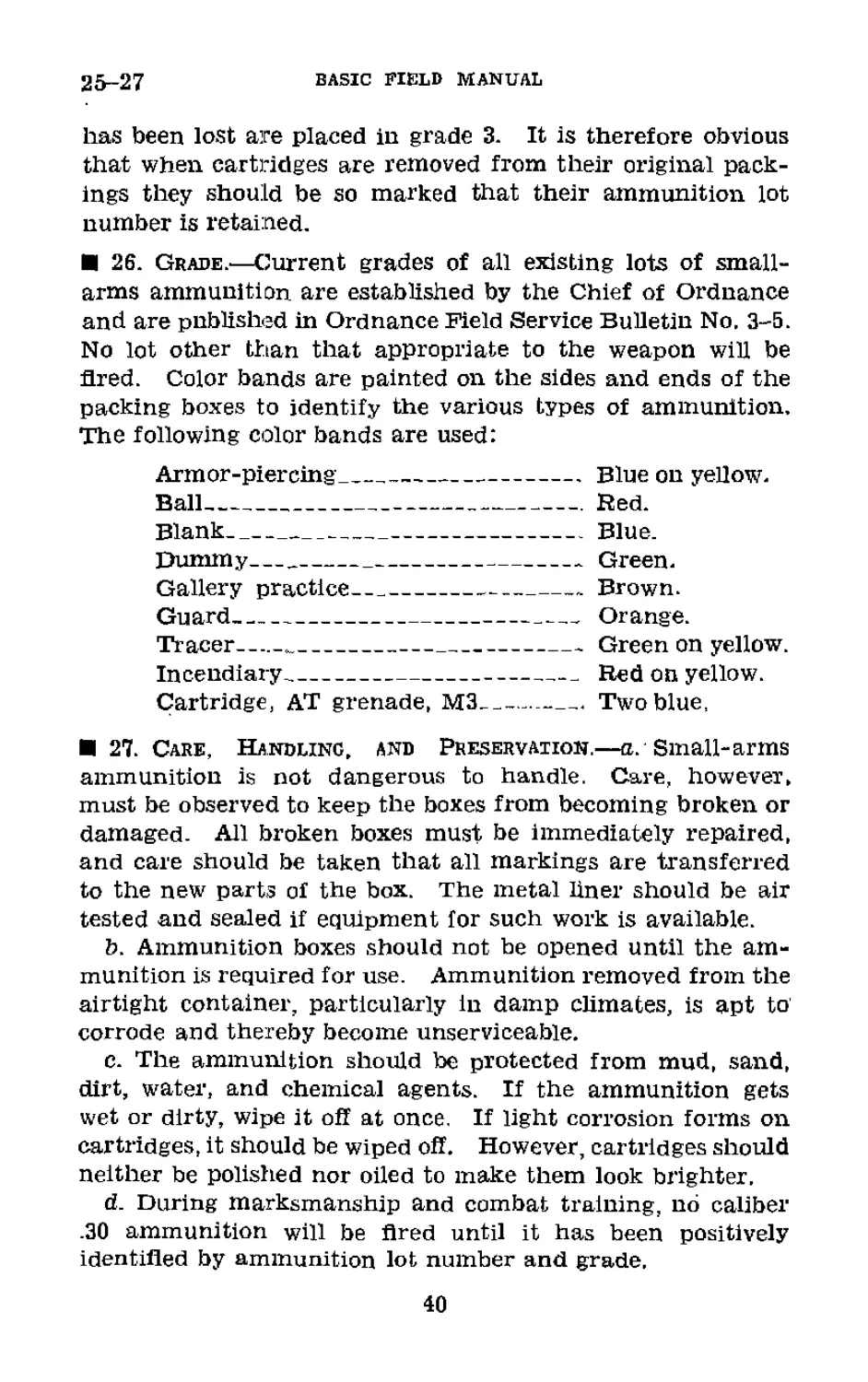
 26. Grade.—Current grades of all existing lots of small-
arms ammunition, are established by the Chief of Ordnance
and are published in Ordnance Field Service Bulletin No, 3-5.
No lot other than that appropriate to the weapon will be
fired. Color bands are painted on the sides and ends of the
packing boxes to identify the various types of ammunition.
The following color bands are used:
Armor-piercing_____________________Blue on yellow.
Ball_______________________________Red.
Blank____--------------------------Blue.
Dummy______________________________Green.
Gallery practice-------------------Brown.
Guard______________________________ Orange.
Tracer_____________________________Green on yellow.
Incendiary ------------------------ Red on yellow.
Cartridge, AT grenade, М3---------- Two blue,
 27. Care, Handling, and Preservation.—a/Small-arms
ammunition is not dangerous to handle. Care, however,
must be observed to keep the boxes from becoming broken or
damaged. All broken boxes must be immediately repaired,
and care should be taken that all markings are transferred
to the new parts of the box. The metal liner should be air
tested and sealed if equipment for such work is available.
b.	Ammunition boxes should not be opened until the am-
munition is required for use. Ammunition removed from the
airtight container, particularly in damp climates, is apt to'
corrode and thereby become unserviceable.
c.	The ammunition should be protected from mud, sand,
dirt, water, and chemical agents. If the ammunition gets
wet or dirty, wipe it off at once. If light corrosion forms on
cartridges, it should be wiped off. However, cartridges should
neither be polished nor oiled to make them look brighter,
d.	During marksmanship and combat training, nd caliber
.30 ammunition will be fired until it has been positively
identified by ammunition lot number and grade.
40
U. S. RIFLE, CALIBER .30, M1917
27-29
e.	Small-arms ammunition of all classes should never be
stored near radiators, hot water pipes, and other sources of
heat, since heat not only deteriorates ammunition but also
creates a fire hazard.
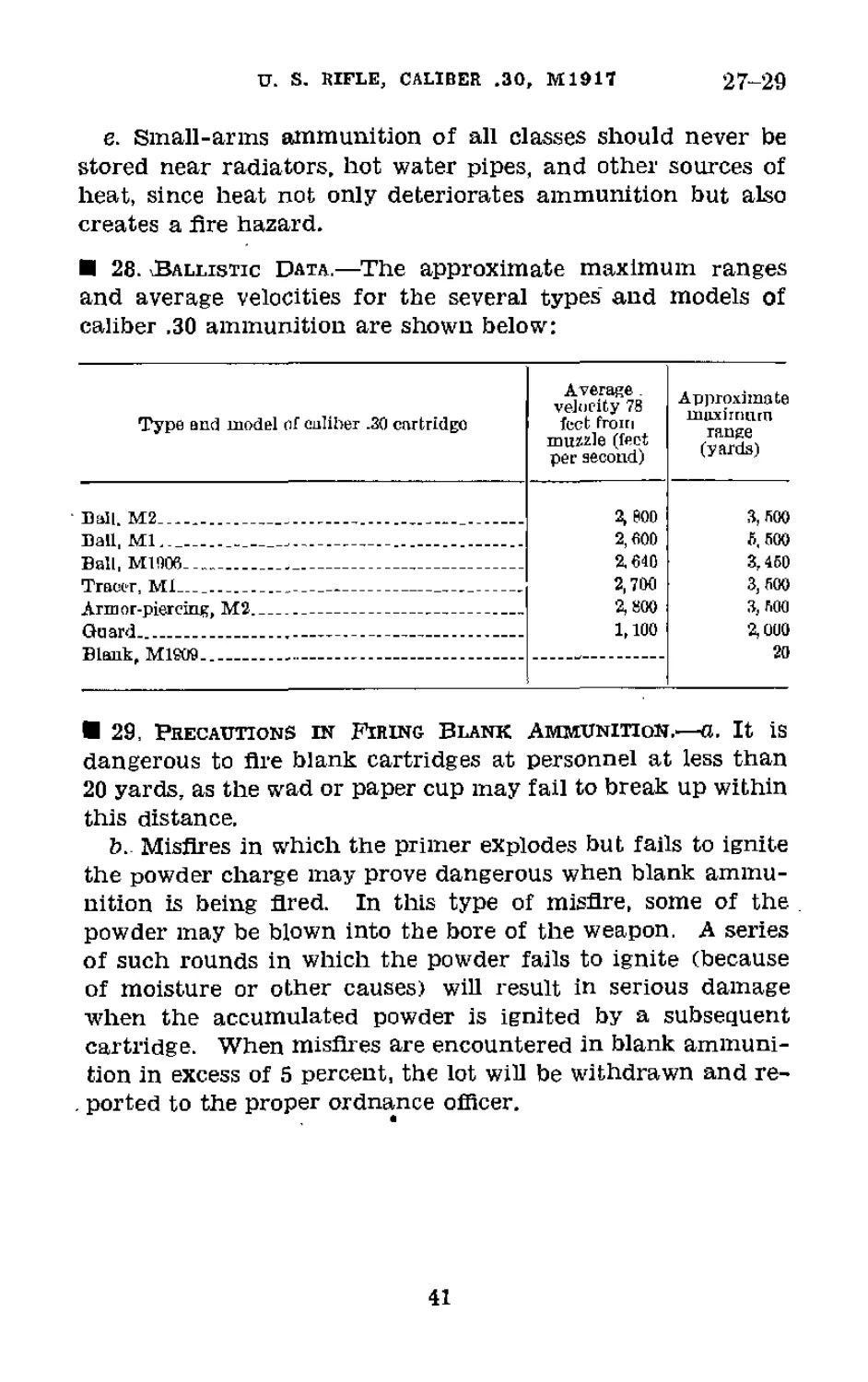
	28. -Ballistic Data.—The approximate maximum ranges
and average velocities for the several types’ and models of
caliber ,30 ammunition are shown below:
Type and model df caliber .30 cartridge
Average .
velocity 78
feet from
muzzle (feet
per second)
Approximate
muxirnnrn
range
(yards)
Bali. M2__.........................................
Ball, Ml..__________________________________-......
Ball, M1906________________________________________
Tracer, ___________________________________________
Аппог-piercing, М2---------------------------------
Guard______________________________________________
Blank, M1S09.......................................
2, 800
2,000
2.640
2,700
2,800
1,100
3, W0
fi, 500
3,450
3,500
3,500
2,000
20
	29, Precautions in Firing Blank Ammunition.—a. It is
dangerous to fire blank cartridges at personnel at less than
20 yards, as the wad or paper cup may fail to break up within
this distance,
b. Misfires in which the primer explodes but fails to ignite
the powder charge may prove dangerous when blank ammu-
nition is being fired. In this type of misfire, some of the
powder may be blown into the bore of the weapon. A series
of such rounds in which the powder fails to ignite (because
of moisture or other causes) will result in serious damage
when the accumulated powder is ignited by a subsequent
cartridge. When misfires are encountered in blank ammuni-
tion in excess of 5 percent, the lot will be withdrawn and re-
ported to the proper ordnance officer.
41
CHAPTER 2
MARKSMANSHIP—KNOWN-DISTANCE TARGETS
AND TRANSITION FIRING
Paragraphs
Section Г. General________________________________________ 30-38
II.	Preparatory marksmanship training---------— 39-46
III.	Qualification courses--.____----------------47-51
IV.	Range practice_______________________________52—55
V.	Equipment, targets, and range precautions----56-58
VI.	Small-bore practice._________________________59-62
Section I
GENERAL
	30. Purpose.—The purpose of this chapter is to provide
a thorough and uniform method of training individuals to
be good rifle shots and of testing their proficiency.
	31, Necessity tor Training.—a. Without proper training,
a man instinctively does the wrong thing in firing the rifle.
He gives thd trigger a sudden jerk, which causes flinching.
However, if he has been thoroughly instructed and drilled
in the mechanics of correct shooting and is carefully and
properly coached when he begins firing, he will rapidly ac-
quire correct shooting habits. It is much easier to develop
into an excellent shot a man who has never fired a rifle than
it is to correct the errors of a man who has done a great deal
of shooting under improper supervision,
b. Anyone who is physically and mentally fit to be a
soldier can learn to fire the rifle well if properly instructed.
The methods of instruction are the same as those used In
teaching any mechanical operation. The training is divided
into steps which must be taught in proper sequence. The
soldier is carefully coached and Is corrected whenever he
starts to make a mistake.
 32. Fundamentals.—To become a good rifle shot, the
soldier must be thoroughly trained in the following essentials
of good shooting;
a.	Correct sighting and aiming.
b.	Correct positions.
42
U. S. RIFLE, CALIBER .30, №1917
32-35
c.	Correct trigger squeeze.
d.	Correct application of sustained-fire principles.
e.	Knowledge of proper sight adjustments.
 33. Phases of Training,—a. Marksmanship training is
divided into two phases—
(1) Preparatory marksmanship training,
(2) Range practice.
Ъ. No soldier will be given range practice until he has
completed the entire course in preparatory marksmanship
training (see par. 39b), Prior to taking up this training,
each soldier should demonstrate his proficiency in mechan-
ical training (ch, 1). Whenever practicable, selected officers
and all noncommissioned officers of the unit should be re-
quired to complete a thorough course and pass a rigid test
in preparatory marksmanship training immediately prior
to the preparatory marksmanship training for the unit. Re-
gardless of former qualification, no distinction will be made
between those who have previously completed range practice
and those who have not.
 34. Practice Seasons.—a. Regular,—In ordinary circum-
stances the regular practice season will cover a period of
about 3 weeks for each organization. Not more than 1 week
will be devoted to preparatory exercises, leaving 2 weeks for
range practice. However, due to limited range facilities and
the exigencies of the service, this time may be reduced to
approximately 1 week, When unforeseen circumstances
cause a delay during the period allotted for instruction, the
time may be extended by the appropriate commander.
b. Supplementary.—Supplementary practice is not neces-
sary when the regular practice season has been efficiently
conducted, except in cases where a large number of unquali-
fied men join the organization after the regular practice
season. The supplementary practice season is usually placed
as late in the fall as is consistent with efficient instruction.
However, this practice may be held at any time when circum-
stances make it advisable.
 35. Continuous Practice,—Rifle practice is not limited to
a particular season. Subject to ammunition allowances, com-
manding officers will adopt such measures as may be neces-
43
35-37
BASIC FIELD MANUAL
sary to maintain a high state of excellence in rifle firing
throughout the year-. The particular measures adopted will
depend upon the facilities near the post or station. Measures
taken may include competition between individuals or organi-
zations and the encouragement of small-bore rifle teams,
	36. Individual Training.—As part of individual training,,
all men armed with the rifle will be instructed in the funda-
mental elements of rifle marksmanship (par. 32) and in me-
chanical training as described in chapter 1. They will be
given a final examination and should fire one of the small-
bore qualification courses outlined in paragraph 62, Instruc-
tion in rifle marksmanship will commence with the initial
instruction of the soldier and will continue throughout the
period of individual training,
	37, Duties of Leaders and Commanders.—a. Squad leader.—
The squad leader—
(1)	Organizes the work in his squad so that during the
preparatory period each man is occupied in the prescribed
form of training for target practice.
(2)	Examines each man in his squad at the end of the
training in each preparatory step and grades him on the
progress Chart (see par. 39/) showing state of training.
(3)	Sees that each man takes proper care of his rifle and
that he cleans it at the end of each day’s firing.
(4)	Enforces correct aiming, position, and trigger squeeze
when firing is simulated in drills and maneuvers.
b.	Platoon leader.—The platoon leader supervises and di-
rects the squad leader in training his squad; personally
checks each man in his platoon on the points enumerated in
the Progress Chart; and examines each man along the lines
outlined in paragraph 46.
c.	Company commander.—The company commander re-
quires the prescribed methods of instruction and coaching
to be carried out carefully and in detail; supervises and
directs the squad and platoon leaders; in companies of fewer
than 60 men, performs the duties prescribed in b above for
platoon leaders.
d.	Battalion commander,—The battalion commander re-
quires the officers and noncommissioned officers to be familiar
44
U. S. RIFLE, CALIBER ,30, МШ7
37 39
with the prescribed methods of instruction and coaching;
supervises the instruction within his battalion and requires
the companies to follow out carefully and in detail the pre-
paratory exercises and methods of coaching.
e,	Instructors.—All instructors should become familiar with
sections I, II, and III, chapter 6, before beginning the instruc-
tion of their units.
	36. Preparatory Marksmanship Equipment.—АП equip-
ment used in preparatory exercises must be accurately and
carefully made. One of the objects of these exercises is to
cultivate a sense of exactness and carefulness in the minds
of the men undergoing instruction. They cannot be exact
with inexact instruments, and they will not be careful when
working with equipment that is carelessly made (pars. 56 and
140),
Section П
PREPARATORY MARKSMANSHIP TRAINING
	39. General.—а. ТЬё purpose of preparatory marksman-
ship training is to teach the soldier the essentials of good
shooting and to develop fixed and correct shooting habits be-
fore he undertakes range practice.
b.	Preparatory marksmanship training is divided into six
steps, as follows, and should be concentrated in the period of
time allotted:
(1)	Sighting and aiming exercises.
(2)	Position exercises.
(3)	Trigg er-squeeze exercises.
(4> Sustained-fire exercises.
(5)	Instruction in the effect of wind, sight changes, and
use of the score book.
(6)	Examination of men before starting range practice.
c.	The first four steps are given in the sequence listed
above, since each succeeding step involves the use of tech-
nique learned in preceding steps. Instruction in the effect
of wind, sight changes, and the use of the score book is a
training step that may be given without adhering to any
particular sequence. However, this instruction should pref-
553417 ° 43-
45
39
BASIC FIELD MANUAL
erably be given after sighting and aiming exercises. In any
event, it will be given before the examination, which is the
final step prior to range practice. This subject matter may
be taught indoors during inclement weather.
d.	Each of the first four steps starts with a lecture by
the instructor to the assembled group. This lecture includes
a demonstration by a previously rehearsed squad which the
instructor puts through the exercises that are to constitute
the day's work. He shows exactly how to do the exercises
that are to be taken up and explains their application to rifle
shooting, He shows how the squad leader organizes the work
so that no men are idle and how men coach each other when
they are not under instruction by an officer or noncommis-
sioned officer. These lectures and demonstrations are an es-
sential part of the training. И properly given, they awaken
the interest and enthusiasm of the whole command for the
work and give an exact knowledge of how each step is to be
carried on—something that men cannot get from merely
reading a description. The Instructor who gives these lec-
tures and demonstrations may be the platoon leader, unit
commander, or a specially qualified officer who has been
placed in charge of rifle instruction. The officers and non-
commissioned officers of the units undergoing training super-
vise and instruct the men in the performance of the exercises
that have been demonstrated to them,
e.	The instruction must be thorough, and it must be given
individually. Each man must understand every point and
must be table to explain each one in his own words. Each
man must be brought to as high a state of proficiency on
all of the enumerated points as the time allotted for prepara-
tory work will permit. The unit commander will carefully
supervise the work. From time to time, he should pick out
men at random from the platoons and put them through a
test to see whether the instruction is thorough and whether
it is progressing satisfactorily.
/. The Progress Chart below will be kept by each squad
leader. It will also be kept by each platoon leader inde-
pendently of the squad leader. The form shows at a glance
how much each man knows about each subject.
46
U. S. RIFLE, CALIBER .30, М1Й17
39
					NAME
					Care and cleaning of the rifle
					Sighting bar
					Sighting and aiming with rifle
					Shot group exercises—50 feet
f				4	Shot group exercises—-200 yards
<			।		Blackening sights
					Use of gun sling
					Holding the breath
					Prone position
1					Prone position with sandbag
					Sitting position			О Go
					Kneeling position			H
					Squatting position			о
			1		Standing position			И
					Assuming positions rapidly
					Trigger squeeze (including taking up slack)
					Calling the shot
					Bolt manipulation
					Sustained flro
					Sight, changes
					Efleet of light		and wind
					Use of score book
					Ability to couch
				!	Final examination
				i	Gallery practice
					Pads ’
				METHOD OF MARKING
	U и sat-				 Satis-			Uns in-
	isfuc- cory			I fac- tory:		X X	sl.ruc- I X tional	X abil-	X
							1 t у :
PROGRESS CHART
47
39-41
BASIC FIELD MANUAL
g.	Enthusiasm must be sustained, and everything possible
should be done to stimulate interest. As soon as the work
deteriorates into a perfunctory performance of physical exer-
cise, it does more harm than good.
h.	Careful attention will be paid to the essential points
brought out in the list of questions and answers in paragraph
46. This paragraph will be consulted by the instructor dur-
ing each step of the preparatory work. Each man should
be tested thoroughly before he is allowed to fire.
i.	During preparatory exercises, the coach-and-pupil
method is used. The men are grouped in pairs and take
turns in coaching each other. The man undergoing instruc-
tion is called the pupil.
j.	Correct shooting habits should be acquired during the
preparatory training period. All errors must be noted,
brought to the attention of the pupil, and corrective action
taken. Each soldier must be impressed with the importance
of exactness in every detail. For example, there is no such
thing as a trigger squeeze that is “about right”; it is either
perfect or it is incorrect.
k.	Equipment used in the preparatory marksmanship
training is listed in paragraph 56.
I, During preparatory training, only practice dummy car-
tridges (corrugated type) will be used. Either the corru-
gated type or the range (slotted type) dummy cartridges
may be used on the firing line.
t'
	40. Blackening the Sights.—In all preparatory exercises
involving aiming and in all range firing, both sights of the
rifle, if not already sufficiently black, should be blackened.
Before blackening, the sights should be cleaned and all traces
of oil removed. The blackening is done by holding each
sight for a few seconds in the point of a small flame which
will deposit a uniform coating of lampblack on th& metal.
A carbide lamp, kerosene lamp, candle, or small pine stick
can be used for this purpose. Carbide gas from a lamp is the
most satisfactory of the materials named.
	41. First Step: Sighting and Aiming.—a. Sight picture.—
The instructor shows the group the correct sight alinement
(relationship of front sight blade and peep sight) and the
48
U. S. RIFLEj CALIBER .30, №1917
41
-5T5/iT
Ф

Figure 16.- -Sight alinement.
49
41
basic field manual
correct aim on the bull’s-eye (sight picture) (flg. 16), He
does this by the use of a model sight picture device or by
using the blackboard (flg, 17). He explains that although
the wings of the front sight are visible when the rifleman is
looking through the peep sight, they play no part in the sight
alinement and that as the rifleman progresses in his training
he quickly learns to ignore them (flg. 18).
Figubb 17.—Model sight picture device.
Ъ. First exercise.—(1) The instructor shows a sighting bar
(flg. 19) to his group and explains its use as follows:
(a)	The front and rear sights on the sighting bar rep-
resent enlarged rifle sights,
(b)	The sighting bar is used in the first sighting and aim-
ing exercise because it shows the sights on a large scale and
50
и. S. RIFLE, CALIBER .30, M1017
41
because with it small errors can be seen easily and explained
to the pupil,
(c)	The eyepiece requires the pupil to place his eye in such
position that he sees the sights in exactly the same alinement
seen by the coach.
Figure 18,—Sight picture, U. S. rifle, caliber .30 M1917.
(d)	There is no eyepiece on the rifle, but the pupil learns
by use of the sighting bar how to aline the sights properly
When using the rifle.
(e)	The removable target attached to the end of the sight-
ing bar provides a simple method of readily alining the
sights on a bull’s-eye,
(2)	The instructor explains that the removable rear sight
on the sighting bar can be adjusted so as to give a correct
51
41
BASIC FIELD MANUAL
sight alinement, He demonstrates a correct sight alinement
by means of a chart or the model sight picture device (fig.
17), He explains that in the correct alinement the top of
the front sight falls on the horizontal diameter of the peep
sight and is “exactly centered.” Thus, equal portions of the
front sight are to the right and left of the vertical diameter
of the peep sight. As soon as the pupils are shown the correct
position of the front sight within the rear sight, they will
demonstrate their ability to set the correct sight alinement
with the sighting device (fig. 20). In this exercise, the bull's-
eye of the sighting device is drawn up out of sight. The in-
TARGET
TARGET SLIT
✓gWTrhlFRONT SIGHT
REAR SIGHT
EVE PIECE
FiGvbe 19.—Sighting bar.
structor will check each pupil’s sight setting for accuracy
and will correct all errors.
(3)	The instructor adjusts the sights of the sighting bar,
with the target removed, to illustrate a correct alinement of
the sights. Each man of the assembled group looks through
the eyepiece at the correct sight alinement.
(4)	The instructor adjusts the sights of the sighting bar
with various small errors in sight alinement and has each
man of the assembled group endeavor to detect and correct
the errors.
(5)	Using a chart or model sight picture device, the instruc-
tor describes and demonstrates a correct aim. He explains
that the relation of the front sight to the peep sight is the
same as previously explained but in addition the middle point
of the top of the front sight just touches (is tangent to) the
bottom of the bull’s-eye, so that all of the bull's-eye can be
clearly seen (fig. 18).
52
U. S. RIFLE, CALIBER .30, M1917
41
(6)	The instructor explains that, in aiming, the rifleman’s
eye should first be focused on the target in order to ascertain
that he is firing on Iris own target. His eye is then focused
on the top of the front sight in order to insure that the line
of sight established is a line through the center of the peep
sight and over the top of the front sight. He also demon-
strates how a slight error in centering the front sight in
the peep sight will cause the line of sight, when it reaches
the target, to diverge greatly from the center of the bull’s-
eye.
(7)	The instructor adjusts the sights of the sighting bar
and the removable target so as to illustrate a correct aim and
then requires each man to observe through the eyepiece the
correct alinement of the sights and the target (fig. 21).
(8)	The Instructor adjusts the sights and the removable
target of the sighting bar so as to illustrate various small
errors and then requires each man in the group to attempt
to detect and correct the errors.
(9)	The exercises described above having been completed
by the squad leader or some other instructor, the men are
placed in pairs and repeat the exercise by the coach-and-
pupil method.
(10)	As soon as the pupil Is considered proficient in the
first sighting and aiming exercise, he is put through the
second and third sighting and aiming exercises by the in-
structor. The pupils are placed in pairs to instruct each
other in these two exercises by the coach-and-pupil method.
c, Second exercise.—(1) A rifle with sights blackened and
set at 200 yards elevation is placed In a rifle rest and pointed
at a blank sheet of paper mounted on a box. Being careful
not to move the rifle or rifle rest, the instructor takes a
position (flg. 22) so that his body is at an angle of from 45°
to 60° to the line of the rifle extended to the rear. Both
elbows are on the ground. The chin rests in the palm of the
left hand. The right hand is free for signaling to the
marker. The cheek rests lightly on the stock and at such a
point that the eye is approximately the same distance from
the peep sight as it will be in actual firing. The instructor
then directs the marker by improvised arm-and-hand signals
to move the small disk until the bottom of the bull’s-eye is
53
41
BASIC FIELD MANUAL
2
BULL'S-EYE
ORABP TH»» »ECT|OM
W»TH THUMB A HQ FORE*
FINGER ANO HOVE
BULL'S-EYE INTO
l CORRECT POSITION
SIGHTING DEVICE
IfM SIGHTING and AIMING, THERE’S
MO SUCH THING AS ALMOST RIGHT
THE SIGHT PICTURE IS EITHER
100% RIGHT OR IT 15 10O% WRONG
Accuracy is more imporlanl
than speed . .. don't squeeze the
trigger until the sights are right.
Г 1
FRONT SIGHT
GRASP TH)» VEcTlON
WITH THUMB AND PORE*
FINDER AND MOYE
front Bight »ntq
CORRECT PQ»IT»CN
©
Figuhe 20.—Sighting device.
54
СИ
ел
ADJUST THE WINDAGE CAGE
ADJUST THE
ELEVATING KNOB
=!
tn
INSERT PENCIL POINT iN HOLES TO
MOVE ELEVATION AND WINDAGE GAGES
RIFLE, CALIBER ,30, MIS 17
©
Figube 20.—Sighting device—Continued,
41
BASIC FIELD MANUAL
in correct alinement with the sights. The breath should he
held when checking the final sight alinement with the bull’s-
eye, The instructor commands: HOLD, to the marker. The
instructor moves away from the rifle and directs the pupils
to look through the sights in order to observe the correct
aim.
(2)	After pupils have seen the correct position of the rear
sight, front sight, and bull's-eye, thejj will demonstrate their
Figure 21.—Instructor adjusting sighting bar to show correct sight
picture.
ability to create the correct sight picture with the sighting
device. Instructors will check accuracy of the sight picture
and will correct errors (fig. 20).
(3)	The marker moves the disk out of alinement. Each
pupil in turn takes position and directs the marker to move
the disk until the bottom of the bull’s-eye is in correct aline-
ment with the sights. The instructor looks through the
sights after each pupil to see if the alinement is correct.
(4)	The instructor makes a series of slightly incorrect sight
alinements on the bull’s-eye and then requires the pupil to
detect, describe, and correct the faulty alinements.
56
и. S. RIFLE, CALIBER .30, M1017
41
(5)	The men are now placed in pairs and are required
to repeat the exercise by the coach-and-pupil method.
d. Third exercise.—(1) The object of this exercise is to
show the Importance of uniform and correct aiming and to
instill into the iRind of the pupil a sense of exactness. At
Figuhe 22.—Position for second and third sighting and aiming
exercises.
50 feet and with a small bull’s-eye (7/8-inch in diameter), a
good group of three marks can be covered by the unsharp-
ened end of a lead pencil.
(2) The exercise is conducted as follows: The rifle, with
the sights blackened and set at 200 yards elevation, is placed
57
41
BASIC FIELD MANUAL
in a rifle rest and pointed at a blank sheet of paper mounted
on a box. The rifle rest and the aiming box on which the
marker sits should each be weighted with a sandbag or
rocks. Taking a prone position (fig. 22) and looking through
the sights without moving the rifle or rifle rest, the pupil
directs the marker by improvised arm-and-hand signals to
move the disk until the bottom of the bull’s-eye is in correct
alinement with the sights. He then commands: HOLD, to
the marker. The breath should be held when the final sight
alinement with the bull’s-eye is checked. The coach looks
through the sights to see if the alinement is correct and makes
a mental note of any errors. Then without comment to the
pupil, he commands: MARK. The marker, without moving
the disk, makes a dot on the paper with a sharp-pointed pen-
cil inserted through the hole in the center of the bull’s-eye,
The marker then moves the disk to change the alinement.
The marker should hold the disk by pressing the handle
against the box with the fingers of one hand, the thumb
of the hand resting on top of the box. The other hand is used
to move the disk. The pupil and coach, without moving
the rifle or rifle rest, repeat this operation until three dots,
numbered, one, two, and three, respectively, have been made.
These dots form the shot group. The pupil’s name is writ-
ten under the shot group so that when the paper is removed
from the box the triangle can be discussed with correct,
reference to dots as '‘high," “low,” "right,” and “left.” The
size and shape of the shot group will be discussed and the
errors pointed out (fig. 23).
(a) A triangle the longer axis of which is vertical is the
result of one or both of the following errors:
1. Top of front sight not exactly on the horizontal
diameter of the peep sight.
2. Bull’s-eye not tangent to front sight (taking line
of white or raising front sight into the bull’s-eye).,
(b) If tYie longer axis of the triangle is horizontal, one or
both of the following errors have been made:
1, Front sight not centered from right to left in tha
peep sight.
2. Bull’s-eye tangent to front sight but not at the
midpoint.
58
U. S. RIFLE, CALIBER .30, M1917
41
A.	B.
TOP OF FRONT SIGHT NOT	BULL'S-EYE NOT TANGENT
EXACTLY ON THE HORIZONTAL	TO FRONT SIGHT,
DIAMETER OF PEEP SIGHT.
EITHER KIND OF ERROR ,A OR 0) WILL PRODUCE A
TRIANGLE SIMILAR TO 1 ABOVE.
FRONT SIGHT NOT CENTERED
FROM RIGHT TO LEFT IN
PEEP SIGHT.
BULL'S-EYE TANGENT TO
FRONT SIGHT BUT NOT AT
THE MIDPOINT,
EITHER KIND OF ERROR (C OR D) WILL PRODUCE A
TRIANGLE SIMILAR TO 2 ABOVE.
Figure 23.—Errors causing unsatisfactory triangles.
59
41
BASIC FIELD MANUAL
(3)	This exercise will be repeated until a satisfactory
triangle is made. It should also be conducted over a range
of 200 yards (using a 10-inch movable bull’s-eye) (flg. 24).
The long-range exercise teaches the men to alm accurately at
a distant bull’s-eye and, if properly conducted, helps greatly
to sustain interest. At 200 yards, a man should be able to
make a shot group that can be covered with a silver dollar
(a circle about 1% inches in diameter).
Ficitjhe 24.—Making 200-yard triangles.
(4)	For making triangles - at 200 yards, a blank screen,
which corresponds in size (about 5 feet by 3 feet) to a 1,000-
inch machine-gun target may be used instead of the paper
on the aiming box in the 50-foot exercise (see (2) above).
One screen can be used by two groups simultaneously. Two
men for each group are stationed at the screen, one to hold
the disk and one to mark the point when the signal is given.
Tissue paper may be used to make tracings of each pupil’s
long-range shot group. The name of the pupil is written
on the tissue paper under the shot group he has made. These
tracings are sent back to the firing line in order that the pupil
can see what he has done.
(5)	The third sighting and aiming exercise, especially the
60
U, S. RIFLE, CALIBER ,30, M19L7	41-42
long-range shot group work, may be carried on concurrently
with the second and third preparatory steps. The purpose
of continuing these exercises is to bring backward men up to
the proper state of proficiency and to assist in keeping the
men interested.
(6)	Competition between the individuals of a squad to see
which can make the smallest shot group is of value in cre-
ating interest in this exercise.
(7)	Posting of the best triangles on the company bulletin
board stimulates interest and helps to develop a competitive
spirit.
 42. Second Step: Positions.—a. General.—Instruction in
positions includes the use of the gun sling, holding the breath
while aiming, and aiming,
b. Gun sling.—A properly adjusted gun sling is of great
assistance in shooting. It helps to steady the rifle and should
be adjusted to give flrm support without discomfort to the
soldier. The instructor will assist each man to obtain the
correct adjustment for his sling. This adjustment should be
marked or remembered for each position. The hasty sling
and the loop sling are the two authorized adjustments used
in firing the rifle, The hasty sling is more rapidly adjusted
than the loop sling, but it gives less support in any but the
standing position.
(1)	Loop sling.—Methods for adjusting the three types of
gun slings are indicated below:
(a) Gun sling M1907 (.leather) (fig. 12®),
1.	Place the rifle butt on the right thigh, extend the
right arm around the rifle so that the latter rests
on the inside of the right forearm, Both hands
are now free to adjust the sling. Disengage the
hook of the short strap. Taking the loop CD-
ring) of the short strap in the right hand, pull
toward the muzzle of the rifle until the hook of
the short strap is 2 or 3 inches from the butt
swivel and then insert the prongs of the hook
into a pair of holes in the short strap (fig. 25).
2,	The loop to be used in firing is formed by that part
of the long strap between the metal loop (D-ring)
553417
5
61
42
BASIC FIELD MANUAL
of the short strap and the lower keeper. If the
proper length of the loop is not known, begin with
a loop which extends 1 or 2 Inches below the small
of the stock. The length of the loop can be in-
creased by placing the hook of the long strap in
pairs of holes which are nearer the feed end of
the long strap,
3,	Rotate the sling one-half turn to the left, insert the
left arm through the loop so that the loop comes
on or above the biceps.
4.	Pull both keepers and the hook of the long strap as
close to the upper arm as possible so as to hold the
loop in place. The feed end of the long strap may
be threaded through the top keeper or may be left
hanging loose.
5.	Move the left hand around the left side of the sling
and place it between the sling and the stock of the
rifle. Move the left hand forward to the lower
band swivel so that the rifle is in the crotch of the
hand and the sling lies flat along the back of the
hand and wrist. The short strap, not used in this
adjustment, should be loose enough to eliminate
any pull on it. Neither end of the sling is to be
removed from either swivel, The location of the
loop on the upper arm should be such that when
the rifleman is in position some light may be
seen between the sling and the crook of the elbow,
(b) Gun sling Ml (improved web) (fig. 12®),
1.	Place the rifle on a flat surface, sights down, barrel
pointing to the left.
2.	Open the keeper, loosen the sling, unsnap the hook
from the butt swivel. Loosen strap through
buckle until the loop formed by the strap as it
passes through the two slots in the buckle is
large enough for the rifleman’s arm.
3,	Take the feed end of the sling in the left hand and
the hook in the right hand. With the left hand,
pull the feed end of the sling in the direction of
the butt. If the correct sling length is not known,
this adjustment (pulling the feed end toward the
62
и. 5. RIFLE, CALIBER ,30, M1917
42
butt) should be discontinued when the hook
reaches a point 10 or 11 inches from the butt
swivel. Pull the keeper as close to the buckle as
possible and close it. Now, with the right hand
firmly grasping the small of the stock, brace the
the butt of the rifle against the right hip, With
the left hand, rotate the loop one-half turn to the
left and insert the left arm through the loop so
that the loop comes on or above the biceps,
4.	Move the left hand over the top of the sling and
grasp the rifle near the lower band swivel so as
to cause the sling to lie smoothly along the back
of the hand and wrist.
Note,—By experimentation, each rifleman
can decide the exact size of the loop required
for his use. He can leave the loop in this ad-
justment permanently, No adjustments for
size will have to be made thereafter. The pre-
cise length required for the loop sling can also
be determined by experimentation. Once this
has been done, the rifleman should note the
distance between the butt swivel and the hook
when the sling is in the correct adjustment.
This distance may subsequently be used as a
gage for setting the same length on the loop
sling.
(c) Gun sling M1923 (iceb) (fig. 12®).
1,	Loosen the sling in the manner described for carry-
ing the rifle in the zling arms position (see par, 21e
(2) (c)).
2,	Next, detach the feed end of the short strap from
the large buckle. To prevent loss of the small
buckle and to prevent the feed end of the short
strap from sliding back through the butt swivel,
bring the feed end of the short strap up through
the middle slot of the small buckle and then down
through the slot farthest from the thumbpiece of
the small buckle.
3.	Now, with the right hand firmly grasping the small
of the stock, brace the butt of the rifle against the
right hip. With the left hand rotate the sling
63
42
BASIC FIELD MANUAL
one-half turn to the left, insert the left arm
through the loop formed between the keeper and
the metal loop (D-ring) end of the short strap so
Figure 25.—Adjustment of loop sling.
that the loop to be used in firing comes on or above
the biceps. Bring the keeper close to the arm
and close it to keep the loop in place.
64
и. S. HIFLe, CALIBER ,30, №1917
42
4,	Move the left hand over the top of the sling and
grasp the rifle near the lower band swivel so as to
cause the sling to lie smoothly along the back of
the hand and wrist.
(2)	Hasty sling.—Methods for adjusting the three types of
gun slings are indicated below.
(a) Gun sling Ml 907 (Leather) (fig. 12®).
1.	Hold the rifle on the thigh and right forearm as ex-
plained above for the loop sling adjustment. Dis-
engage the hook of the short strap. Beginning
with the pair of holes nearest the hook of the long
strap, count off 10 or 11 pairs and insert the claws
of the hook of the short strap. (This adjustment
will vary- If the correct sling length is not
known, start with a length in which the lower end
of the sling extends 2 or 3 inches beyond the rifle
butt.)
2.	Twist the sling one-half turn to the left.
3.	Grasp the rifle just in rear of the lower band swivel
with the left hand. Grasp the small of the stock
with the right hand. Throw the sling to the
left and catch it above the elbow, high on the left
arm.
.4	, Remove the left hand from the rifle. Pass the left
hand to the left under the sling and then to the
right and over the sling. Regrasp the rifle with
the left hand. If the sling has been given the
one-half turn properly, it will lie smooth and flat
along the back of the left hand and wrist (flg, 26).
(b) Gun sling Ml (improved web) (fig. 12®).
1.	Loosen the sling in the manner described for car-
rying the rifle in the sling arms position (see par,
21e (2) (b)).
2.	With left hand, grasp the rifle just in rear of the
lower band swivel. With the right hand give the
sling a half turn to the left. Move the sling to the
left and place it above the elbow and high on the
arm. Regrasp the rifle at the small of the stock
with the right hand.
65
42
BASIC FIELD MANUAL
66
U. S. RIFLE, CALIBER .30, №1917
42
3.	Remove the left hand from the rifle, pass it under
the siing, then over the sling, and regrasp the rifle
with the left hand so as to cause the sling to lie
smooth and flat along the hand and wrist.
(c) Gun sling M1923 (web) (fig. 12@).
1.	Loosen the sling in the manner described for car-
rying the rifle in the sling arms position (see par.
21e(2)(c)).
2,	With the left hand grasp the rifle just in rear of the
lower band swivel. With the right hand, give the
sling a half turn to the left, Move the sling to the
left and place it above the elbow and high on the
arm. Regrasp the rifle at the small of the stock
with the right hand.
3,	Remove the left hand from the rifle, pass it under
the sling, then over the sling, and regrasp the rifle
with the left hand so as to cause the sling to lie
smooth and fiat along the hand and wrist.
c. Holding breath.—If a man breathes while aiming, the
body motions caused by breathing are transmitted to the
rifle, and an exact aim cannot be held, To eliminate this
movement of the rifle, the breath must be held while aiming.
To hold the breath properly, draw in an ordinary breath,
let out a little, and hold the rest by closing the throat—
not by muscular action of the diaphragm. The rifleman
should be comfortable, relaxed, and steady while aiming and
while squeezing the trigger, He should not attempt to hold
the breath so long as to become unsteady. In firing a sus-
tained-fire score, the rifleman should breathe after each
shot—never while he is squeezing the trigger. The important
point is to hold the breath throughout the time the trigger
is being squeezed.
d. General characteristics for all positions.—The following
characteristics apply to all firing positions. The exact de-
tails of a position for any particular individual will depend
on the conformation of his body.
(1)	Each position must be steady and must require a
minimum of muscular effort for its maintenance during
prolonged firing. To accomplish this, the rifleman’s frame
67
42
BASIC FIELD MANUAL
supports the rifle; that is, the bones and not the muscles
support the rifle.
(2)	When the rifleman assumes a position, there is some
point at which the rifle aims naturally and without effort.
If this point is not the center of the target, the whole body
must be shifted so as to bring the rifle into proper alinement.
Otherwise the rifleman will be under a strain because for each
shot he will be pulling the rifle toward the target by muscular
effort,
(3)	The right hand grasps the small of the stock. The
right thumb may be either around the small of the stock or
on top of the stock; it should not be placed alongside the
stock.
(4)	The left hand is against or near the lower band swivel,
wrist straight, rifle placed in the crotch formed by the thumb
and index Anger and resting on the heel of the hand,
(5)	The elbow is directly under the rifle or as nearly in
that position as it can be placed without appreciable effort.
For untrained men, this will initially require strenuous effort.
(6)	The trigger Anger is in contact with the trigger at the
most comfortable point between the tip and the second joint,
the remainder of the forefinger being out of contact with the
stock. The exact part used depends on the size of the rifle-
man’s hand and the length of his arm. It is desirable that
there be no contact between the trigger Anger and the stock.
This insures that trigger pressure will be straight to the rear
and that all pressure will be applied on the trigger and not
partly on the stock.
(7)	The cheek rests Armly against the stock, and if pos-
sible, on top of the thumb. This is best accomplished by
relaxing the neck muscles and allowing the head to drop
forward and downward.
(6) The butt of the riAe is held firmly against the shoulder.
(9)	When firing at short ranges (Up to 500 yards), a slight
cant of the rifle may be disregarded. Men who cant the
rifle usually do so uniformly for each shot.
(10)	Left-handed men who have difficulty with the right-
hand position will be allowed to use the left-hand position.
. 68
U. S. RIFLE, CALIBER ,30, M1917
42
(11)	In all positions, the pupil should strive for complete
relaxation. This goal is reached only by continued applica-
tion and training. Perfection should be the ultimate aim.
(12)	Different positions for slow and sustained fire should
not be taught. Slow fire is used to lay the foundation for
sustained fire. It is therefore obvious that a slow-fire
position which is unsound for sustained fire is a waste of
time and effort and should not be permitted.
e. Prone position (fig. 27),—(1) In the prone position, the
angle made by the body with the line of aim extended to the
rear should be about 30°, or a little less. This position behind
the rifle is essential in order that the recoil may be taken up
by the entire body of the rifleman rather than by the shoulder
alone. The feet are spread comfortably,apart, toes out, heels
as nearly on the ground as can be accomplished without
strain. The left elbow is under the rifle. The left hand is
against or near the lower band swivel, the rifle resting in the
6»
42
BASIC FIELD MANUAL
V formed by the thumb and forefinger and on the heel of
the hand, with the wrist straight and the fingers relaxed.
Inability to get the left elbow under the rifle or the left hand
against or near the lower band swivel is usually caused by a
stiff or musclebound shoulder. Relaxation of the left shoulder
should make it possible to assume the correct position. The
shoulders are approximately level. The right upper arm
makes an angle of about 45° with the ground; the right elbow
is forward of the line of the shoulders in order to create a
hollow at the shoulder in which to secure the rifle butt. Full
contact of the right palm and the small of the stock is desir-
able- The thumb is on top of or across the stock; the eyes are
level and the line of vision is straight ahead—not sideways
over the bridge of the nose. The sling is tightened, and the
rifle butt is fixed firmly against the shoulder by the forward
pressure of the relaxed body weight.
(2) If the prone position has been taken correctly, the right
hand may be removed from the small of the stock while the
rifle remains snugly in place, requiring some effort on the
part of the coach to dislodge it, Another method for checking
the prone position is to tap down lightly on the barrel just in
rear of the front sight. With a good position, the muzzle
should rise straight up (not up to the right or left) and then
return to the original point of aim. The pupil should make
the following final check: after he believes himself to be in
a correct position, he closes his eyes and relaxes completely
for several seconds. He then opens his eyes and checks his
sight alinement. If his position is correct, the rifle sights will
still be alined under the bull’s-eye. If they are not alined on
the target, his position is faulty, and he should shift his whole
body in the direction and to the extent indicated by the error
and repeat the process just described.
(3) Errors most frequently found in taking the prone
position and the methods of correcting them are discussed
below:
(a)	Body placed at too great an angle with rifle.—This
fault can frequently be detected by observing that the upper
part of the body is held too high off the ground and that the
eye is held too close to the cocking piece. This very com-
mon fault causes most of the recoil to be taken up by the
70
U. S. RIFLE, CALIBER .30, M1917
42
shoulder instead of being absorbed by the entire body. The
error is usually caused by too short an adjustment of the
sling. The remedy is to loosen the sling by several holes
and move the body into position more directly behind the
rifle.
(b)	Right elbow too close to body.—The right shoulder
will be observed to be much higher than the left. The back
may appear twisted. To remedy this fault, the right elbow
is moved out to the right and slightly forward.
(c)	Left elbow not under rifle.—This is obvious. As a re-
sult of this error, the rifle is supported by the muscles of the
Ficube 28.—Prone position with sandbag.
arm rather than by the bones. The remedy is to move the
left elbow farther to the right. This is best accomplished
with the rifle butt removed from the shoulder. Relaxation
of the left shoulder and continuous practice will assist in
placing the left elbow under the rifle where it should be.
(d)	Left hand not against or near the lower band swivel.—
To remedy tills error, the left shoulder should be relaxed
and the hand should be moved forward. Tightening the
sling one or two holes may assist in correcting this fault.
This error can occur in the other positions and should be
guarded against.
f. Sandbag rest position (flg. 26).—(1) The sandbag rest
position is identical in every detail to the prone position
described above, except that a sandbag support is provided
for the left forearm, wrist, and hand. The sandbag should
71
42
BASIC FIELD MANUAL
not support nor should it be in contact with the rifle, as this
rigid support will affect the zero of the rifle.
(2)	The sandbag should be little more than half filled
with sand and should be tied near the top so as to leave
considerable free space within the bag for adjustment.
(3)	It is important that the sandbag be high enough to
allow the pupil to take the prescribed prone position. The
tendency is. to have the sandbag rest too low and flat on the
ground, causing the elbows to be widely spread. This is a
faulty position that may cause lower scores to be fired than
if no rest at all were used. An improperly adjusted sandbag
is a handicap,
(4)	Only those who have difficulty in applying the cor-
rect trigger squeeze during the first stages of training should
use the sandbag rest. Its purpose is not so much to teach
steadiness in holding as to assist the pupil in learning the
correct trigger squeeze. Consequently, the principal use
of the sandbag on the rifle range will be to assist riflemen
who have a tendency to flinch because of an unsteady posi-
tion which induces snap shooting. By using the sandbag,
the slight inherent unsteadiness is eliminated, and the rifle-
man will not be tempted to snap the trigger at the instant
he establishes a sight alinement with the bull’s-eye. In
this way, he will be assisted in overcoming the tendency to
flinch,
(5)	The coach adjusts the sandbag in the following
manner:
(a)	Has the pupil assume the prone position and aim at
the target,
(b)	Sets the sandbag top up and arranges it so that it is
slightly higher than the back of the pupil’s left hand.
(c)	Faces the pupil, straddles the rifle barrel, and slides
the sandbag against the pupil’s left forearm so that the
narrow side of the bag supports his forearm and wrist, with
the back of the hand resting on the top of the bag.
(d)	Lowers the sandbag to the required height by press-
ing down on the rifle at a point just over the pupil’s left
hand,
<7. Sitting position (fig. 29).—(1) In the sitting position,
the rifleman sits approximately half-faced to the right. The
72
U. S. RIFLE, CALIBER .30, M1A17	42
feet are spread apart from 20 to 30 inches, depending on the
conformation of the rifleman. The knees are raised about 8
inches off the ground and are closer together than the feet;
the heels are dug slightly into the ground; and the legs and
ankles are relaxed so that the toes point forward or inward—
they should never point outward or sharply upward. Heel
holes which slope sideways from the outside in will assist in
keeping the toes pointed in. If the rifleman is supple enough
to place both feet flat on the ground without raising.his knees
too high, he has an advantage. The left upper arm rests
along the left shin so that there is contact between the two
for a distance of several inches, the weight being placed
straight down on the left leg. The left elbow is under the
rifle. The body is bent forward from the hips; the back is
approximately straight. The right upper arm rests along the
right shin in a position similar to that of the left arm and
leg but slightly on the inside of the right leg so that the shin
will act as a support for the right arm when the rifle recoils.
The sling is adjusted as previously explained. For most men,
the sling adjustment will be shorter in this position than it
is for the prone position. The relative positions of the rifle
and the hands and the method of holding the face to the
stock correspond to those explained for the prone position
(see e above).
(2)	The sitting position is second only to the prone position
for steadiness because the rifleman has a rest for each elbow,
The sitting position is suitable for use in theficld when high
grass or vegetation would obscure the rifleman’s vision in the
prone position. When concealment is available, the sitting
position is also especially suitable for firing downhill.
(3)	Because of unusual conformation, some men cannot
take the sitting position described above. The vast majority
o^’ such exceptions are men with unusually long legs and
relatively short arms and body. These men are physically
unable to place their elbows in the prescribed position. In
such cases the instructor may authorize the soldier to modify
the prescribed position, using either the “cross-legged” or
the “crosscd-ankle” positions. Each case is decided by the
instructor on its merit; in no circumstance will these modi-
fied positions be adopted at random by the riflemen.
73
42
BASIC FIELD MANUAL
(4)	In the cross-legged position (fig. 29®) the rifleman
sits with his left leg crossed over his right leg, his feet drawn
up under him so that the outer part of the calf of each leg
Figure 2B,—Bitting positions,
rests on the inside of the opposite foot. The backs of the
upper arms are supported against the shin bones and are
very nearly at right angles to them. The remaining elements
74
U, S. RIFLE, CALIBER .30, M1917
42
of the position correspond to those of the normal sitting
position.
(5)	In the crossed-ankle position (fig. 29®) the pupil sits
with the left ankle crossed over the right ankle, the legs well
extended. In this position, as in the cross-legged position,
Figube 39.—Sitting positions—Continued.
the upper arms are supported by the shins, but in this position
more contact is afforded than when the rifleman sits cross-
legged. However, the crossed-ankle position provides only a
two-point base of support and is therefore less stable than the
cross-legged position, which has a three-point base. For this
reason, the crossed-ankle position should be avoided, if pos-
75
42
BASIC FIELD MANUAL
sible, by men whose weight is less than about 170 pounds.
The amount of leg extension will depend upon leg conforma-
tion of the individual. At the same time, constant care must
be exercised to insure that the legs are relaxed and that the
knees are not held up by sheer muscular effort.
(6)	Errors most frequently found in taking the normal
sitting position and the methods for correcting them are
discussed below.
(a)	Elbows and knees placed so as to make point to point
contact.—Not only does this error result in an unstable sup-
port for the rifle but it puts the body in a position which is
too erect and which is therefore faulty when used in sus-
tained fire. To rbmedy this fault, have the pupil lower his
knees, bend his body well forward at the hips, and establish
contact between the upper arm and the shin bones. When
the left upper arm and the left lower leg both slope at exactly
the same angle, the rifleman is in a correct sitting position.
(b)	Knees farther apart than feet.—This causes the ver-
tical support for the rifle to be obtained through unnecessary
muscular effort. It may be caused by—
1.	Placing the feet too close together.
2.	Turning the toes outward (which throws the knees
outward).
3.	Pushing out against, instead of down upon, the
shins.
To correct this position, have the pupil stretch both legs out
flat on the ground with the feet separated from 20 to 30
inches, depending on the conformation of the man; raise the
left knee about 8 inches off the ground; rest the left upper
arm along the top of the left shin; place the rifle butt to the
right shoulder; regrasp the rifle at the small of the stock;
and lower the right elbow and raise the right knee until good
contact is made between the right upper arm and right shin.
After taking this corrected position, if the pupil's rifle does
not point naturally at the target, the coach should require him.
to shift his feet to the right or left, without otherwise dis-
turbing his position, until the rifle does point naturally at the
target.
46
U S. RIFLE, CALIBER .30, №1917
42
(c)	Le/t elbow not under rifle.—Move the pupil’s feet 5 or
6 inches to the right, taking care not to disturb the aim on the
target.
h. Squatting position (fig, 30).—(1) To take the squatting
position, the rifleman stands half-faced to the right with his
Figure 30.—Squatting position.
553417'1—43
6
77
42
BASIC FIELD MANUAL
feet placed 12 inches or more apart. He then squats as low
as possible, keeping both feet flat on the ground. The backs
of the upper and lower legs should be in the fullest possible
contact from the knees downward. The back of the left
upper arm rests on the left knee, the elbow' being directly
under the rifle. The right elbow is braced against the inner
part of the right knee. The body should be relaxed, and its
weight should be well forward over the left leg. The rifle
rests in the crotch of the left hand and is grasped at the small
of the stock with the right hand. The face rests against the
stock in a manner corresponding to that described for the
prone position (e above).
(2) The squatting position is an excellent firing position.
It has several features which are advantageous in combat.
This position can be assumed quickly; it is inherently steady;
and it is particularly desirable when firing in mud, shallow
water, snow, or an area contaminated with gas.
C3) Errors most frequently found in taking the squatting
position and methods for correcting them are discussed below.
(a)	Contact with ground made only with balls of feet.—As
a result of this error, the rifleman is in an unstable position
and will be thrown off balance-in firing. The remedy is to
force the heels down to the ground and to relax the body
and shift the weight well forward over the left leg, Sepa-
rating the feet more widely helps in setting the heels on the
ground.
(b)	Body not relaxed and weight not shifted well forward
oner left leg.—This position is unstable. It will cause the
rifleman to be thrown off balance as soon as he begins to
fire. The rifleman must make a conscious effort to relax—
especially in the legs—and shift the weight well forward over
the left leg.
i. Kneeling position (flg. 31).—(1) The rifleman kneels on
the right knee. The right thigh is at a 90° angle with the
line of aim. Continuous contact with the ground from the
toe to the knee is desirable and can be achieved after a few
days of practice. At first, the lack of suppleness may place
a strain on the instep. This may be eased by digging a small
toe hole in the ground. The rifleman sits so that the center
of the right buttock rests directly on the right heel. He then
78
1Г. s, RIFLE, CALIBER .30, №1917
42
rotates the right leg about the line knee-toe, so that the heel
inclines in the direction of the target. About 60 percent of
the body weight is thus shifted forward to the left leg. The
right foot and leg are then in a position to provide added
support in taking up the recoil of the rifle. The left leg
should be vertical when viewed from the front. It need not
appear vertical as viewed from the side. Many expert rifle-
men prefer to draw the left foot back, relaxing the body
weight forward so that solid contact is made between the
calf and thigh. The left toe may be pointed in the direction
which provides maximum comfort for the rifleman. The
left upper arm rests on the left knee, the left elbow being in
front of and below the knee. The left elbow and left knee
should be directly under the rifle. The rifle rests in the
crotch of the left hand, as explained for the prone position
(e above). The grasp of the rifle by the right hand and the
position of the face against the rifle stock and hand are also
as described for the prone position. The right elbow is raised
to the height of, or slightly below, the shoulder, thus forming
a pocket or recess in which to seat the butt of the rifle. If
the elbow is held too low, too shallow a pocket is formed. This
is a serious disadvantage in sustained fire. The sling adjust-
ment may be the same as that prescribed for the sitting posi-
tion or it may be shorter, depending on the conformation of
the rifleman.
(2)	. Sitting on the inside of the right foot throws the weight
of the body too much to the rear. For this reason, it is not
a suitable position for sustained Are. In exceptional cases
where the physical conformation of the man indicates unus-
ual difficulty in assuming the prescribed position, and after
the instructor has required the pupil to attempt to adapt
himself to the normal position, the instructor may authorize
the pupil to use this modified position,
(3)	The kneeling position is used when brush or high grass
would obstruct the view if firing from the sitting, squatting,
or prone positions,
(4)	Errors most frequently found in taking the kneeling
position and the methods for correcting them are listed
below.
79
42
BASIC FIELD MANUAL
80
и, Я. RIFLE, CALIBER .30, М1917
42
(a)	Left elbow and knee not under rifle.—Move left foot
to the right,
(b)	Right thigh not at right angle to line of aim.—Draw
the right knee to the rear.
(c)	Point to point contact between left elbow and knee.—
Move the body weight forward, forcing the elbow forward of
and below the knee.
Э. Standing position (fig. 32).— (1) The rifleman stands
faced about 85° to the right of the line of aim; feet are placed
from 14 to 20 inches apart; body is erect; weight is evenly
Figure 31.—Kneeling position—Continued,
distributed on both hips and both feet; head is turned to the
left; cheek rests firmly against the stock. Grasp the small
of the stock with the right hand, placing the right thumb
well around (over) the stock; raise the rifle on the shoulder
so that about half of the butt is visible over the shoulder
when seen from the rear; raise the right elbow until it makes
an angle of 45° or greater above the horizontal and pull back
hard with the right hand to keep the butt tightly pressed
into the pocket of the shoulder. Without touching the rifle
with the left hand, it should now be possible to hold the rifle
in an approximate firing position, using only the right arm
81
42
BASIC FIELD MANUAL
FratruB 32.- 'Standing position b
82
U. S. RIFLE;, CALIBER .30, M1917
42
and hand. This method of placing and holding the rifle
against the shoulder should be practiced as an exercise before
and during the standing position exercise. While the right
hand and arm keep the rifle in position, the left hand grasps
the rifle well forward of the balance and acts as a slight addi-
tional vertical support. The left elbow is approximately under
the rifle, the weapon resting in the crotch of the hand, be-
tween the thumb and the forefinger, and on the heel of the
hand. The hasty sling is used.
(2) An alternate, though less desirable, standing position
is called the “body rest" position. The left elbow is placed
firmly against the body with the left hand drawn back, even
as far as the trigger guard. Tills position requires more
training in order to attain adeptness in firing. It should be
used rarely and then only by those riflemen expressly author-
ized by the instructor,
(3) Errors most frequently found in taking the standing
position and the methods for correcting them are listed below.
(a)	Feet placed too jar apart.—Place the feet only as far
apart as you would if required to stand for an hour without
moving them.
(b)	Weight not evenly placed on both hips.—Relax the
body weight straight down “into the belt."
(c)	Neck craned forward or bent sideward to get cheek
on stock.—Hold the head and neck erect and raise the rifle
up to the face. A sling which is too short may be pulling
the rifle down. Lengthen the sling enough to permit placing
the rifle butt high on the shoulder.
k. Procedure in condiLcting position exercises.—(1) For
aiming points, 1,000-inch A targets (rifle) are normally used.
These bull’s-eyes are placed at a range of 1,000 inches and at
different heights so that in aiming from various positions the
rifle will be nearly horizontal. Standard known-distance
targets may also be used. They are placed at distances used
on the known-distance range,
(2)	Before taking up position exercises, the instructor
assembles his squad or group and—
(a)	Shows the proper method of blackening the front and
rear sights of the rifle and has each pupil blacken his sights
if they are shiny.
83
42-43
basic field manual
(b)	Explains and demonstrates the hasty sling adjustment
and assists each pupil to adjust his sling. He explains the
loop sling adjustment and assists each pupil to adjust his
sling,
(c)	Explains and demonstrates the proper manner of
holding the breath and has each pupil practice it.
(d)	Explains the general rules which apply to all positions.
(e)	Explains and demonstrates the position which the
pupils are to practice next.
(3)	Following the explanation and demonstration for each
position, the instruction is conducted by the coach-and-pupil
method. Each pupil, after seeing that his sights are black-
ened, adjusts his sling, takes position, holds his breath, and
aims carefully. As soon as his aim becomes unsteady, the
exercise ceases. After a short rest, the pupil repeats the
exercise without further command. The trigger is not
squeezed in the position exercises. Exercises are conducted
in all positions.
I. Ditties о/ coach.—In the position exercises, the coach sees
that the—
(1)	Sights are blackened,
(2)	Gun sling is properly adjusted,
(3)	Proper position is taken.
(4)	Breath is held while aiming. (He checks the breathing
by watching the back of the pupil.)
(5)	Pupil aims correctly.
 43. Third Step: Trigger Squeeze.—a. Importance.—(1)
The most important item in rifle shooting is to squeeze the
trigger in such a way as to fire the rifle without affecting
the aim. Misses and poor shots result because the aim
is spoiled just before the discharge takes place. This is
done by jerking the trigger and flinching. It is important
to understand that disalinement of the sights is caused but
very slightly by the physical act of jerking the trigger Anger.
The bigger movement—the one which spoils the aim—is a
body movement which occurs before the bullet leaves the
barrel. This movement, made in anticipation of the recoil
of the rifle, will occur if the rifleman knows in advance when
the recoil will come. It is called “flinching.” The trigger
84
U, S. RIFLE, CALIBER ,30, M1917
42-43
must be squeezed so steadily that the rifleman does not know
the instant the rifle will Are, If a man squeezes the trigger
so steadily that he does not know when the discharge will
take place, he will not spoil his aim by flinching, because
he does not know when to flinch,
(2)	No good shot attempts to discharge the rifle instantly
upon alining his sights on the target. He holds his aim
alined as accurately as possible on the target and maintains
a steadily increasing pressure upon the trigger until the
shot is fired. This method of squeezing the trigger must
be carried out in all simulated firing or the value of the
practice is lost.
(3)	The correct method of squeezing the trigger may be
defined as the independent action of the forefinger straight
to the rear, with a uniformly increasing pressure (after the
slack has been taken up) so that the rifleman does not know
the instant the striker will be released.
(4)	A mechanical means whereby the rifleman may help
himself in squeezing the trigger correctly—in order that
he may not know when the striker will be released—is de-
scribed as “taking up the slack with a heavy initial pressure.”
The loose play in the trigger prior to meeting actual re-
sistance is called “slack.” The rifleman takes up the slack
with one decisive motion, applying more pressure than Just
that needed to take up the slack itself. In other words, the
rifleman takes up all the loose play and part of the trigger
resistance with a heavy initial pressure. Each time the
slack is taken up, a slightly different amount of pressure
will be applied. The pupil cannot know, nor should he
try to know, how much additional pressure is required to
release the striker. Therefore, if he continue to squeeze
steadily after the slack has been taken up, he will be sur-
prised when the striker is released. Since this process
may occasionally cause a shot to be fired almost at once, the
rifleman should follow the sequence—
(a)	Hold the breath.
(b)	Complete the sight alinement.
(c)	Take up the slack with a heavy initial pressure,
(d)	Apply the correct squeeze to the remaining resist-
ance.
85
43
BASIC FIELD MANUAL
Then, even if the shot is fired before the rifleman is ready,
it will be a good shot because the sight alinement is correct
and the rifleman has been surprised in the firing of the
round.
(5)	The important points in trigger squeeze are:
(a) Pressure is applied with the forefinger only.
(Ы After the slack has been taken up, pressure is steady
(uniformly increasing) and continuous—once started it is
never stopped. However, if the rifleman does not get off
the shot within a maximum of 8 or 9 seconds after the slack
has been taken up, the pressure should be released. Then
the rifleman draws breath and starts all over. In other
words, although the squeeze is continuous, it should not be
continued indefinitely. The only exception to this rule is
In firing from the standing position during a heavy wind
which may blow the line of sight off the target. In that
case, hold the pressure until the sights are again in the
vicinity of the bull’s-eye and then apply additional steady
pressure.
(c)	Pressure must be applied straight to the rear to avoid
pulling the sights out of alinement.
(d)	The mind must be divorced from the trigger finger.
The latter works independently, almost subconsciously, when
well trained. Concentrate on maintaining the correct sight
picture,
(e)	Every shot must be a surprise to the rifleman. If he
knows when the striker will be released, he will anticipate
the recoil and flinch, no matter how experienced a shot he
may be.
(6) The difference between poor marksmen and good
marksmen is measured in their ability to squeeze the trigger
properly. Any man with fair eyesight and strength can aline
the sights on the target and hold them there for an appre-
ciable length of time. When he has acquired sufficient will
power and self-control to forget that there is to be an ex-
plosion and a shock and squeezes the trigger with a steady
increase of pressure until the rifle is fired, he has become a
good shot, but not until then. This squeeze of the trigger
applies to sustained fire as well as to slow Are. The in-
crease of pressure is faster in sustained fire, but the process
is the same.
86
U, S. RIFLE, CALIBER .30, M1917
43
(7) The impulse to "snap shoot,” or to apply sudden, spas-
modic pressure to the trigger in order to get off a shot is
most evident in the kneeling and standing positions. The
natural desire to hit the bull’s-eye tempts the riflemen to
Are the shot at the instant the sights come into correct aline-
ment. The result is always a bad shot. Men should be
taught to accept as natural the unsteadiness (wobble) in
these positions, The amount of wobble may be reduced by
position exercises but may never be entirely eliminated.
Therefore, riflemen should never try to '‘beat the wobble” by
snap shooting. They should squeeze the trigger in the
prescribed manner—with a continuous pressure,
b. Calling the shot.—(1) The pupil must always notice
where the sights are pointed at the instant the rifle is fired
and must call out at once where he thinks the bullet will
hit. Shots are called even when simulating fire at a target
in order to flx the habit and to develop a steady hold. No
man can become a good shot until he is able to call his shot
before it is marked. Inability to call a shot indicates the
rifleman did not know where the sights were pointing at the
time the rifle was fired; in other words, he shut his eyes first
and fired afterward. Shots are called by assuming the
bull’s-eye to be a clock face with 12 o'clock at the top of
the bull’s-eye. Examples of calls are "Center bull,” "Bull’s-
eye at four o’clock,” "Just out at nine o’clock” or "A close
four at nine o’clock,” "Well out at one o’clock” or "A three
at one o’clock.”
(2) The procedure which will most effectively enable a
rifleman to call the shot is known as the “follow-through.”
Follow-through is continuing to do for a few seconds after the
striker has been released exactly what was being done before
it was released. In preparatory marksmanship training, a
proper follow-through enables a man to detect his position
error(s). If he remains in position, continues to hold his
breath, continues to look through the sights, and continues
to apply pressure to the trigger, he may observe that the
sights come to rest somewhere else than directly under the
bull's-eye. This is an indication of a muscular relaxation
following the release of the striker. This in turn Indicates a
faulty position which the alert pupil can then correct by shift-
87
43
BASIC FIELD MANUAL
ing his position until the natural aim is under the bull’s-eye.
(3) On the range, correct follow-through will help to
eliminate such bad habits as a hurried removal of the rifle
from the shoulder, drawing the head away from the stock,
and similar faults.
c. Procedure in conducting trigger-squeeze exercises.—(1)
The instructor explains to the assembled squad or group the
importance of correct trigger squeeze. He assures himself
by questions that each pupil understands what is meant by
a “steady increase of pressure.” The instructor should re-
quire each pupil to squeeze the trigger at least once with the
instructor’s finger on the trigger and the pupil pressing on the
instructor’s Anger. In this way the instructor can feel
whether or not the pupil understands the mechanics of cor-
rect trigger squeeze. The instructor explains the necessity
for calling the shot,
(2)	The pupil is first taught correct trigger squeeze in the
prone position. In this position he can hold steadily and is
not tempted to snap the shot the instant the front sight
touches the bull’s-eye. After he has learned the principles
of correct trigger squeeze in the prone position, he is in-
structed in the other positions, but during the first half of
this period, he is not allowed to squeeze the trigger except in
the prone position.
(3)	During trigger-squeeze exercise, the pupil must not be
allowed to take too long to squeeze off any one shot. The
coach should watch for this point and if the pupil does not
get off his shot within 8 or 9 seconds of the time the slack
has been taken up, the coach should cause the pupil to re-
lease his pressure on the trigger, lower his rifle momentarily,
then start over,
(4)	A great deal of carefully coached trigger-squeeze prac-
tice is required. Faulty trigger-squeeze practice is worse
than none.
(5)	Soldiers should not be allowed to simulate fire until
they have been thoroughly Instructed in trigger squeeze. In
all drills and field exercises where fire is simulated, they
should be cautioned to aim at definite objects and to carry
out the correct principles of aiming, squeezing the trigger,
and calling the shot.
88
U. S. RIFLE, CALIBER .30, М1Э17
43-44
(6)	The instruction is conducted by the coach-and-pupil
method under the supervision of the instructor. Aiming
targets like those mentioned for the position exercises are
used, and the exercise is conducted at will in the manner
outlined for the position exercises.
d. Duties of coach.—In the trigger-squeeze exercises, the
coach insures that the—
(1)	Sights are blackened.
(2)	Sling is properly adjusted.
(3)	Proper position is taken.
(4)	Breath is held while aiming. (He checks the breath-
ing by watching the back of the pupil.)
(5)	Pupil aims correctly.
(6)	Slack is taken up decisively in one motion with a heavy
initial pressure,
(7)	Trigger is squeezed properly.
(8)	Pupil follows through and calls the shot.
(9)	Pupil is required to stop Ills squeeze, bring the rifle
down and then start over if he fails to get off a shot in 8 or 9
seconds after taking up the slack.
 44. Fourth Step; Sustained Fire.—a. General.— (1) All
principles learned in slow fire are applied in sustained
fire. It is especially important that the men understand
that the method of breathing and the aim and trigger
squeeze are the same as in slow fire. Time is gained by
taking position rapidly, by working the bolt rapidly and
smoothly, and by reloading quickly and without fumbling.
Accuracy must never be sacrificed for speed. Sustained fire
should be considered as an uninterrupted sequence of slow
fire shots delivered without loss of time.
(2) Careful coaching is essential to prevent acquiring the
habit of looking into the chamber while working the bolt.
The man who looks into the chamber works the bolt slowly.
He loses time in finding his own target again and often fires
on the wrong target. The application in combat is appar-
ent—the soldier who takes his eye off an indistinct target
to look into the chamber while working the bolt may be
unable to locate his target again.
b. Bolt-manipulation exercise.—(1) General.—(.a) This
exercise is for the purpose of acquiring a smooth and rapid
89
44
BASIC FIELD MANUAL
bolt operation. The magazine floor plate, magazine spring,
and follower must be removed from the rifle or the follower
must be depressed to prevent it from blocking the bolt. A
convenient method of doing the latter is to place an empty
cartridge clip edgewise between the follower and the right
side of the receiver. Cam surfaces on the bolt should be
lubricated to avoid undue wear during the exercise.
(b) Practice in the bolt-manipulation exercise should be
held in all positions, and no pupil will be considered pro-
ficient until he can operate the bolt at least 20 times in 20
seconds while in the prone position. The first hour of sus-
tained-fire training should be devoted to bolt-manipulation
exercises. Thereafter each pupil should be given additional
practice from time to time until he is considered proflcient.
(2) Procedure.—The exercise is conducted by the coach-
and-pupil method. The instructor explains and 'demon-
strates that the follower is removed or depressed; that the
bolt is jerked fully back and forced home with practically
one motion instead of by four distinct motions as men are
inclined to do at first; that the elbows and the butt of the
rifle remain in place; that the muzzle is allowed to drop
down and to the right as the bolt is opened and is returned
to the horizontal as the bolt is closed. Emphasis is placed
upon the detailed duties of the coach as listed in (3) below.
Exercises should not be continued longer than about 20
seconds at a time, Frequent changes of coach and pupil are
necessary to prevent undue fatigue. After requiring the
pupils to assume a firing position, the instructor commands:
1, bolt-manipulation exercise, ready. 2. exercise; 3.
CEASE FIRING; 4. REST.
(3) Duties of coach.—In the bolt-manipulation exercise,
the coach insures that—
(a)	The bolt is operated properly and rapidly,
(b)	The eye is kept on the target.
(c)	The right hand is brought to the small of the stock,
the rifle to a horizontal position, and the cheek is placed
against the stock each time the bolt is closed.
(d)	The butt of the rifle is kept against the shoulder,
(c) The elbows are kept in the proper place for the position
in which he is performing the exercise.
90
U. S. RIFLE, CALIBER ,30, M1917
44
(/) No attempt is made to aim or press the trigger.
c. Sustained-fire exercises.—(1) First sustained-fire exer-
cise (.cadence exercise).—(a) The most important principle
in sustained fire is the development of correct timing in firing.
Correct timing in firing will vary from about 10 seconds per
shot for the beginner to about 4 seconds per shot for the
experienced man. The development of proper timing in
firing depends on the correct position of the rifleman. The
rifleman’s position is not correct unless the sights return
automatically to the aiming point after each shot is fired.
With the follower depressed or removed, the rifleman then
manipulates the bolt, re-aims, concentrating on the sight
picture, and instantly begins to squeeze the trigger. This
procedure is repeated for each shot.
(b)	Before conducting timing (cadence) exercises, the in-
structor assembles his group and explains and demonstrates—
1.	The correct position.
2,	The correct method of aiming.
3,	The correct bolt operation.
4.	Tire correct trigger squeeze.
5.	What is meant by correct timing.
6.	How speed in timing is gradually increased, as skill
is acquired, until an approximate rate of 6 seconds
per shot is attained.
(c)	Procedure.—Following the above explanation and dem-
onstration by the instructor, cadence exercises, using the
coach-and-pupil method, will be given in all positions except
standing. The purpose of these exercises is to familiarize
the rifleman with the time interval at which sustained fire is
delivered.
1.	The pupil takes position and aims at a target.
2.	The coach takes a position where he can observe the
pupil’s eye and trigger finger (fig. 33),
3,	The instructor (one for each platoon or similar
group), with watch in hand, commands; BOLT
(or TIME or uses a whistle signal). Upon the
command or signal, each rifleman operates the
bolt and then takes up the slack with a heavy
initial pressure, continuing the pressure until the
firing pin is released. The instructor repeats the
91
44
BASIC FIELD MANUAL
command or signal at 10-second intervals for 1
minute, with approximately 1 minute between ex-
ercises. The exercise is conducted in all posi-
tions except standing until each pupil is familiar
with the 10-second interval. The pupil must be
taught not to hurry the trigger squeeze but to
squeeze the trigger smoothly.
(d)	After proficiency in all positions has been attained
with the 10-second time limit, subsequent exercises should
92
U. S, RIFLE, CALIBER .30, M1917
44
be conducted with a time allowance of 8 seconds. The time
should ultimately be reduced to 6 seconds. Cadence exercises
should never be given at a faster rate than 6 seconds per shot
because of the time required for manipulating the bolt.
Figube 34.—Assuming prone position rapidly.
(e)	In order that the pupil will get a precise idea of the
time interval, he will manipulate the bolt only upon signal,
(2) Taking positions rapidly,— (a) General.—At first, the
sequence of movements for each position is practiced slowly.
553417"—13--7	93
44
BASIC FIELD MANUAL
The coach-and-pupil method is used. As proficiency is ac-
quired, speed and accuracy in assuming the positions are
obtained. The time required from the beginning of the ex-
ercise to the firing of the first round in sustained fire is
shown in (4) below,
(b) Prone position,—The movement is described by the
numbers for the purpose of instruction in the sequence of the
Figube 34,—-Assuming prone position rapidly,—Continued.
movement. After the sequence is learned, the position will
be assumed in one continuous motion upon the command
targets up (commence firing) or as the target appears.
First assume the correct prone position and aim at the target.
Mark the places for the elbows and the point on the ground
just below the batt of the rifle in the firing position. The
pupil rises, first to his knees, then to his feet, keeping his
feet in place. The position is then assumed by the numbers
in five counts as follows;
94
U, S. RIFLE, CALIBER ,30, M1917
44
1.	Being at the ready, with sling adjusted, the left
hand just below the lower band swivel and the
right hand at the heel of the butt,, bend both
knees to the ground (fig. 34® and ®).
2.	Place the toe of the butt of the rifle on the ground
at the point previously marked (fig, 34®).
3,	Place the left elbow on the ground in the place
previously marked (fig. 34®).
4,	Place the butt of the rifle against the right shoulder
with the heei of the hand against the butt plate
(fig. 34®).
5,	Grasp the small of the stock with the right hand,
place the right elbow on the ground in the place
previously marked, and assume the aiming po-
sition (flg. 34®).
(In the field, a soldier can very quickly, easily, and
smoothly assume the prone position after a rush by
taking a short jump, landing with feet apart and pro-
ceeding in a manner similar to that described above.)
(c) Sitting position.
1.	To assume the sitting position rapidly, break the
fall by placing the right hand on the ground to
the rear of the spot upon which the buttocks are
to rest.
2.	Assume the correct sitting position and aim at the
target. Mark and prepare the position for the
heels. Mark the spot upon which the buttocks are
to rest and then rise, keeping the feet in place.
At the command targets up (commence
firing) or as the target appears, sit down on
the marked spot, breaking the fall with the right
hand; place the left arm in position; with the heel
of the right hand on the butt plate, place the butt
against the right shoulder; grasp the small of the
stock with the right hand and assume the aiming
position (flg, 34). The eye is kept on the target
throughout the exercise.
3.	An alternate method of taking the sitting position
rapidly is to take the prescribed sitting position,
mark and prepare the places for the heels, then.
95
44
BASIC FIELD MANUAL
cross the left leg over the right. Rise, and stand
with the legs crossed. Upon command, or when
Figure 35.—Assuming sitting position rapidly.
the target appears, bend the knees and sink to
the ground, uncross the legs, and place the heels
96
U. S. RIFLE, CALIBER .30, M1B17
44
in the marked places. Place the left arm in posi-
tion. With the heel of the right hand on the butt
plate, place the rifle butt against the right
(4)
Figuke 35.—-Assuming sitting position rapidly—Continued.
shoulder and grasp the small of the stock with
the right hand. Assume the aiming position.
<ri) Squatting position.—Assume the correct position and
aim at the target. Rise without moving the feet. Upon
97
44
BASIC FIELD MANUAL
command, or when the target appears, squat into the position;
place the left arm in position; with the heel of the right hand
on the butt plate, place the rifle butt to the shoulder; grasp
the rifle at the small of the stock and aim correctly.
(e) Kneeling position.—Assume the correct kneeling posi-
tion. Mark the position of the left foot and the right knee;
prepare the toe hole for the right foot, if required. Rise with
the right toe at its marked place and. the left foot in its
marked place. Upon command, or when the target appears,
kneel with the right knee on its marked spot; place the left
arm in position; with the heel of the right hand on the butt
plate, place the butt to the shoulder; grasp the small of the
stock with the right hand and assume the aiming position.
(3)	Duties of coach.—The coach insures that—
(a)	The sights are blackened.
(b)	The sling is properly adjusted.
(c)	The correct position is taken.
(d)	A breath is taken after each shot.
(e)	The slack is taken up promptly,
(/) The trigger is squeezed properly.
(?) The bolt is worked rapidly and smoothly.
(ft) The eye is kept on the target. The elbows are kept
in place, and the butt of the rifle is kept to shoulder while
pupil is working bolt.
(4)	Second sustained-fire exercise.—This exercise com-
bines the cadence exercise ((1) above) with taking positions
rapidly. When the rifleman has acquired proficiency in the
trigger-squeeze cadence and in taking the positions rapidly,
timing exercises are given in all positions. These exercises
are conducted with the follower depressed or removed. The
exercises are begun, with the pupil in the standing position
after he has had an opportunity to check his firing position
and mark places for his elbows, feet, or knees, depending
upon the position to be assumed. The instructor commands:
1. FOUR ROUNDS, SIMULATE LOAD; 2. LOCK; 3. READY ON THE
RIGHT; 4. READY ON THE LEFT; 5. READY ON THE FIRING LINE; 6.
TARGETS UP (or COMMENCE FIRING). At the announce-
ment, ready on the firing line, rifles are unlocked. At the
sixth command (or when the targets are exposed), all rifle-
98
U. S. RIFLE, CALIBER .30, M1917
44
men take position and simulate firing four rounds. Reload-
ing is simulated, and five more “shots” are squeezed off. The
instructor keeps the group informed of the passage of time by
announcing “First shot,” “Reload,” “Fifth shot,” "Ninth
shot,” and “Cease firing.” In all sustained-fire positions, 11
seconds are allowed for assuming position and squeezing off
the first shot, 11 seconds for reloading and squeezing off the
fifth shot, and 6 seconds for each other shot.
SUSTAINED-FIRE CADENCE
Standing to prone, sitting, or kneeling (nine rounds on
preparatory field and range).
Ng. of shot		1	2	3	4	.5	fl	7	a	9	Time
No. of seconds...	11	17	23	29	4(1	46	52	58	04	68
(5)	Reloading rifle.—(a) During reloading in the prone,
sitting, and squatting positions, the rifle is held firmly with
the left hand, the toe of the butt being placed on the ground.
In the sitting and squatting positions, the butt may be. and
in the kneeling position it should be placed on the thigh.
The clip is taken from the belt and placed in the slot in the
receiver. Loading is completed in accordance with the di-
rections prescribed in paragraph 18. Before the reloading
practice is begun, the follower is either replaced or is no
longer depressed.
(b) Reloading the rifle without hurried movements and
consequent fumbling should be practiced in the prone, sitting,
squatting, and kneeling positions, using corrugated dummy
cartridges, until the required skill is obtained.
(6) Third sustained-fire exercise.—(a) After the pupil is
properly trained in timing, taking positions rapidly, and
reloading, he is given additional practice in all of these
points in the third sustained-fire exercise. The group under
instruction is paired off as coach and pupil and is placed on
the firing line. Full-sized targets are placed at 200 and 300
yards from the men under instruction, with some simple
arrangement permitting the target to be exposed to view for
99
44-45
BASIC FIELD MANUAL
the prescribed length of time. The exercise may be con-
ducted at shorter ranges, using targets proportionately re-
duced in size. Sights are set to correspond to the range
being used. The commands and procedure are the same
as those prescribed for sustained fire on the rifle range
except that practice dummy cartridges are used. For ex-
ample, the pupil stands with sights properly set and black-
ened, sling adjusted on his arm, clip containing four practice
dummy cartridges in his hand, and one full clip of practice
dummy cartridges in his belt. When using continuously
exposed targets, the instructor, after announcing the range
and the position to be used, commands: 1. four rounds,
load; 2. lock; 3. ready on the right; 4 ready on the left;
5. READY ON THE firing line; 6, TARGETS UP (or COMMENCE
FIRING) ; 7. CEASE FIRING- 8. UNLOAD. 9- CLEAR
RIFLES (par. 18g). (When using targets which are raised
and lowered from pits, the sixth and seventh commands are
omitted.) At the fifth command, the rifle is unlocked. At the
sixth command (or when the target is exposed), the pupil
takes position rapidly and squeezes off four shots. The pupil
reloads from the belt with a clip of dummy cartridges and
fires five shots. Accuracy must not be sacrificed for speed.
Eleven seconds are allowed for assuming the position and
squeezing off the first shot, and 11 seconds are allowed to
reload and squeeze off the first shot after reloading. For
the remaining rounds in any position, 6 seconds are allowed
for each shot- Upon completion of the exercise, any dummy
cartridges remaining in the rifle are removed, and the bolt
it left open. During simulated firing, the pupil should never
take his eye from the target except to reload. He should
count his shots as he fires in order that he will know when
the receiver is empty. The exercise is conducted from the
standing position to the prone, sitting, and kneeling positions.
(b) Duties of coach.—The duties of the coach in this
exercise are the same as those prescribed in (3) above, and
in addition he insures that the magazine is reloaded quickly
and without fumbling,
 45. Fifth Step: Effect1 of Wind; Sight Changes; Use of
Score Book.—a. Wind.—(1) In firing at 500 yards or under,
100
U. S. RIFLE, CALIBER .30, ЛЙ1917
45
the effect of the weather conditions (except that of the wind)
on the bullet can be disregarded. The influence of wind must
be carefully studied.
(2)	The horizontal clock system is used in describing the
direction of the wind. The firing point is considered the
center of the clock, and the target is at 12 o’clock. A 3
o’clock wind comes directly from the right. A 6 o’clock wind
comes straight from the rear. A 9 o’clock wind comes directly
from the left.
(3)	The velocity of the wind is described in miles per hour.
The velocity of the wind may be estimated by throwing up
light dry grass, dust, or light paper and watching how fast it
travels, or by observing the danger flags. A rule of thumb
which will give the approximate wind velocity is: drop some
light grass or leaves from the height of the shoulder, then
point to the place on the ground where it settles. Divide the
number of degrees in the angle between the arm and body by
four. The result is the approximate wind velocity in miles per
hour. The same rule can be applied, using the smaller angle
between the danger flag and flag staff. In general, a light
breeze is a 5- to 8-mile wind; a fairly strong breeze is a
10- to 12-mile wind. Wind blowing 20 miles an hour is very
strong.
(4)	Wind from either side blows the bullet out of its path.
For example, if the wind is coming from the right of the
rifleman (that is, blowing against the right side of the bul-
let), the bullet will be blown to the left. The amount the
bullet will be blown from its path depends on the force and
direction of the wind and on the distance to the target. Cor-
rection for this is made by moving the aiming point toward
the wind. This process is called “taking the windage." It is
accomplished by shifting the body so that the sights of the
rifle, instead of pointing at the normal point of aim, are
pointed to the right or left of the normal aiming-point, de-
pending upon the direction of the wind. The point of im-
pact of the bullet will move in the same direction that the
aim is moved. For example, if it is desired to move the hits
to the left, the aim must be moved to the left; if it is desired
to make the hits strike further to the right, the aim must be
moved to the right.
101
45
BASIC FIELD MANUAL
(5)	The amount of windage to allow for the first shot
can be determined by one of the methods described in (a)
and (b) below.
(a)	Refer to the windage diagram for the M1903 rifle
in the score book and note the value of the wind in points;
then extend the vertical mark on the bottom or top edge
of the recording target in the score book, corresponding to
the value of the wind; draw a light line tangent to the bot-
tom of the bull’s-eye across the target; the intersection
of these lines is the point of aim for the first shot and for
successive shots if the point proves correct.
(b)	By the windage rule method (approximately only),
the range (expressed in hundreds of yards) multiplied by
the velocity of the wind and divided by 10 equals the num-
ber of quarter points to allow for a 3 o’clock or 9 o'clock
wind.
Example: At 500 yards the wind is blowing at 8 miles an
hour from 3 o’clock; equals 4 quarter points or 1 point
of windage. Refer to the corresponding windage mark on
the bottom or top edge of the recording target in the score
book for 500 yards; extend this mark up or down the re-
cording sheet; draw a light line tangent to the bottom of
the bull’s-eye across the sheet; the intersection of these
lines is the point of aim on the target for the first shot,
and successive shots if the first one is found correct.
(6)	If a further correction is necessary after the first
shot is fired, it is determined as follows: the shot is plotted
on the recording target; from the vertical center line through
the bull’s-eye the proper correction is noted; and the
aiming point for the following shot is shifted in the proper
direction by this amount.
(7)	As the direction of the wind gets nearer and nearer
to 12 or 6 o’clock, the required windage becomes less and
less. Winds 1 hour away from 3 and 9 o'clock (2, 4, 8, and
10 o’clock) require only slightly less windage (about %0)
than 3 and 9 o’clock winds of equal velocity. For all prac-
tical purposes, the same windage can be used. Winds 1
hour away from 12 and 6 o’clock (11, 1, 5, and 7 o’clock)
require half as much windage as 3 or 9 o’clock winds of
equal velocity.
102
U. S. RIFLE, CALIBER .30, M1911
45
(8)	Winds at either 6 or 12 o’clock require no windage.
Strong winds from 12 o’clock tend to retard the bullet a little,
and winds from 6 o’clock tend to accelerate it, but the amount
is so slight that a correction in elevation is never used at
ranges up to 500 yards and is rarely used at greater ranges.
b.	Elevation rule.—(1) Changing the elevation 100 yards
at any range will give a change on the target, in inches,
equal to the square of the range (expressed in hundreds of
yards). The strike of the bullet will move in the same direc-
tion that the peep sight is moved, provided the same aiming
point is used.
Example: At 200 yards, changing the elevation 100 yards
makes a change ol 4 inches on the target; at 300 yards, 9
inches; at 500 yards, 25 inches. This rule is not exact but
is near enough for all practical purposes.
(2)	The horizontal lines in the model targets in the score
book also show how much change to make in the elevation
at each range. When a change in elevation is necessary, it
is best to consult the model target in the score book before
deciding how much of a change to make,
c.	Light.—(1) Light has no effect on the flight of the
bullet but does affect the aim. Changes in light have very
slight effect on most riflemen. The correction for variations,
in light does not exceed 25 yards in elevation at any range..
Changes in light do not affect uniformly the aim of all',
riflemen.
(2)	Usually men unconsciously aim a little lower in & ©uov
light than in good light and consequently need more: eleva-
tion when the light is poor. This lowering of the акт results
from the fact that the outline of the bull’s-eye is mat distinct,
in a poor light. As a rule, poor light exists on darfc days: when-
there is a haze in the air; on very bright, warm duys. when
there is a decided mirage; and when the sun is?,behind1 the
target. The best conditions for shooting prevail' when the-
sky is uniformly overcast and their is sufficient.light:to-see- the?
target clearly.
(3)	Sunlight from one side has the same; effect with most;
men as wind from that side. This is because-the side of- the'
front sight toward the sun is more clearly-defined and' is-
unconsciously held under the center of the. bull’s-eye.. Such.
103
45
BASIC FIELD MANUAL
holding places the bullet toward the opposite side of the bull’s-
eye from the sun. When it is necessary to make allowance for
this, the aiming point is moved toward the sun.
d.	Zero of a rifle.—(1) The zero of a rifle for each range is
the elevation to be set on the rear sight, and the point on
the target on which the sights must be alined in order to hit
the center of the bull’s-eye on a normal day when there is
no wind. This zero may not conform to the marks on the
scale of the sight leaf and the alinement of the sights on the
rifle. The zero of any rifle may differ with different men,
due to the difference in their hold or manner of aim,
(2)	Each man must determine the zero of his own rifle for
each range (par. 53b). He does this by studying the data
which he has written in his score book concerning elevation
settings on the rear sight, aiming points, changes in sight
settings and aiming points, light, and the direction and veloc-
ity of the wind. The zero of a rifle is best determined on a
day when the sky is overcast and there is no wind. Having
learned the zero of his rifle, the rifleman computes his eleva-
tion for the first shot from this zero and not from the zero
marked on the rifle sight unless the two correspond. Like-
wise, he determines his aiming point from the zero aiming
point and not from the normal six o’clock aiming point,
unless the two correspond.
(3)	Where rifl.es are not available and where it is desired
to conduct exercises in zeroing the rifle, the reverse side of
the sighting device (fig. 20®) can be used,
e.	Shooting up or down hill.—In shooting either up or down
hill, less elevation is required than when shooting on level
ground. The steeper the hill, the less elevation is required,
so that when firing vertically Up or down no elevation at all
is required, no matter how distant the target. Slight slopes
that may be found on target ranges have no appreciable effect
upon the elevation used and require no correction.
/, Sight-setting and sight-changing exercises.—In these
exercises, the instructor uses the full-sized A, B, and D tar-
gets with spotters to indicate the position of the hits.
(1) Procedure.—The instructor assembles his squad or
group (each pupil having his rifle, score book, and pencil) and
conducts the exercise as follows:
104
U. S. RIFLE, CALIBER ,30, M1917
45
(a)	Points out the graduations on the sight leaf and
explains that the line directly opposite the number represents
the range; points out the index lines on the slide and ex-
plains that in setting the sight for any range these lines must
coincide with the graduations for that range on the sight leaf,
and that to retain the slide in adjusment the slide catch must
be engaged with the proper notch on the edge of the sight leaf.
(b)	Explains the effect of wind and cautions the class to
disregard all atmospheric influences except wind,
(c)	Explains the windage diagram in the score book,
(d)	Reads and explains the windage rule and elevation
rule. By asking questions, he assures himself that these rules
are understood.
(e)	Explains the purpose of the vertical lines on the model
targets in the score book and assures himself that each man
understands the use of this diagram.
 (/) Shows the pupils how to draw the windage lines for
each range on the blank targets of the score book.
(p) The above points having been explained to the as-
sembled group, the pupils are placed in pairs. The instructor
tests their ability to set the sights for the first shot by using
the windage rule (or diagram). Every time the sights are
set, each pupil examines the sight of the man paired with
him, If called upon, the pupil tells the instructor the sight
setting that was used.
(7z) The instructor tests the ability of his pupils to change
sights intelligently after the first shot by referring to the
model target.
(i) Where rifles are not available and where a quick review
of the pupil’s knowledge of sight setting is desired, the re-
verse side of the sighting device (fig. 20®) may be used,
(2) Sight-setting exercises.—Examples of sight-setting
exercises as given by the instructor will be as follows:
(a)	“You are at 500 yards and estimate the wind to be
8 miles an hour from 3 o’clock. Plot on the recording
target in your score book the aiming point for the first shot.
Jones, where has Smith placed his aiming point? Each man
whose teammate did not place his aiming point to the right
of the bull’s-eye at the intersection of a horizontal line
drawn tangent to the bottom of the bull’s-eye and the verti-
105
45
BASIC FIELD MANUAL
cal line indicating 1 point windage, hold Up his hand.” The
instructor, by questions, explanations, and illustrations as-
sists the men who have made mistakes,
(b)	“You are at 300 yards and estimate the wind to be 7
miles an hour from 9 o’clock. Plot your aiming point on the
recording target in your score book for the first shot. Sup-
pose you fired and the spotter marked the hit here (placing
a spotter in the 4 space near the bull's-eye at 3 o’clock) and
you were sure your hold and trigger squeeze were good; plot
your aiming point to bring the next shot in the vertical
center line of the bull's-eye, Johnson, where has Williams
plotted his aiming point? Each man whose teammate has
not changed his aiming point for the next shot to the left
on the 1 point line, hold up his hand.” The instructor assists
those men who have decided errors by further explanation
and illustrations.
(3) Windage and elevation.—(a) The instructor gives a
number of examples, with the wind at different angles and
velocities and at various ranges, until the class thoroughly
understands the methods of determining the amount of
windage to take for the first shot and corrections, if neces-
sary, in aiming points for subsequent shots.
(b)	Following the instruction in taking windage, the in-
structor puts the class through similar exercises which re-
quire changes in elevation.
(c)	The instructor gives a number of examples which
require changes in both windage and elevation until the
principles of sight changing are well understood by the class.
(d)	Then the instructor assumes the aero of the rifles to
be different from the normal both as to windage and eleva-
tion and repeats the exercises.
(4)	Additional sight-setting exercises.—Additional ex-
amples of sight-setting exercises as given by the instructor
are as follows:
(a)	‘‘Set your sight at 550 yards and place your aiming
point on the 1 point left windage line. Suppose you fire
four shots hitting here (placing four spotters in the ijull's-
eye), and your fifth shot goes here (placing spotter on 3
space at 11 o’clock). Edwards, what are you going to do
now? Pippen. what are you going to do? You should not
106
и, 5- RIFLE, CALIBER .30, M1917
45
do anything to the sight. It is practically certain that in
firing the fifth shot you squeezed the trigger improperly and
flinched. Not even a very sudden and violent change in the
weather or light could cause that much difference. Don't
try to correct your own faults by changing the sights.
(b)	“For your first score in sustained fire at 200 yards you
have set your sight at the same elevation and have taken the
same windage that you used in slow fire. Suppose this to be
200 yards in elevation and your group goes here (putting nine
spotters low and to the left). Set your sight to bring the
next score into the figure. Miller, what does Wright's sight
read? Where is his aiming point?”
(5)	Variations in sight setting.—A shot group in sustained
fire should strike in the same place as a shot group in slow
fire. A sustained-fire shot group that varies in position from
a slow-fire shot group is the result of faulty position or aim.
If there is a constant variation in the two sight settings,
the rifleman should note it in his score book and, using an
aiming point, set his sight in sustained fire so as to make the
group count as much as possible. Shots scattered all over
the target cannot be corrected by changing the sight or aim-
ing point.
g. Use of score book.—(1) Each man must keep a score
book in which he records not only the value of the hits
but the location of each hit, the sight setting and sight
changes, the force and direction of wind, the kind of light,
the hour, the date, and such other data as may be of use
in the future. Spaces for these notes are provided on the
score sheets of the score book.
(2)	The use of the score book on the range is important
for the following reasons:
(a)	The plotting of the shots shows the rifleman the lo-
cation of his group.
(b)	The windage diagram indicates the windage for the
first shot. The model target shows by means of vertical
lines the change in aiming point (windage) necessary to
place the group in the center of the target. By referring
to “Model Dimensions to Scale of A, B, and D Targets” on
page 13, W. D., A. G, O. Form No. 82 (1942) (Combination
Score Book) and applying the elevation rule, the change
107
45
BASIC FIELD MANUAL
in elevation necessary to place the group in the center of
the target may be computed.
(c)	Plotting the shots and recording the data as to light
and wind help the soldier to learn the zero of his rifle.
(d)	The data respecting sight settings and aiming points
used for various ranges and weather conditions are of great
assistance in setting the sight correctly and determining the
aiming point for subsequent firing. Where a number of
scores have been fired and recorded, the rifleman should
get his sight setting and aiming point from previous scores
fired on days that were similar as to light and wind,
(3)	The score book will be kept personally by the man
firing. The coach assists him when necessary to decide what
to write down, but the coach will not plot the shots or enter
any data.
Л, Score-book exercises.—The squad or larger group is
assembled in front of a full-sized В target, each man with
score book, pencil, and rifle. The class is divided into pairs.
Each man acts as coach for the other man of his pair.
(1) The instructor states the light and weather conditions
and the range. He then indicates eight successive shots on
the target by means of a spotter and requires each man to
plot each shot as it is indicated, to write down the data given
from time to time, to make the actual sight settings and cor-
rections on his rifle, and to plot the aiming point on the
recording target. Where rifles are not available, the reverse
side of the sighting device (fig. 20@) may be used. Weather
and light conditions assumed by the instructor and changes
announced during the exercise should be such as are likely to
occur on the rifle range.
(2) The pupils are told by the instructor to open their score
books at the first blank page and plot the shots and write in
the data as given to them. They are instructed to write
lightly so that erasures may be made, allowing the same page
to be used repeatedly. The example as given by the in-
structor will be substantially as follows:
(a)	“You are at 500 yards on the rifle range. You are
getting ready to fire a slow-flre score. There is bright sun-
light. The wind varies from 8 to 12 miles an hour in velocity
and from 1 to 3 o'clock in direction. When you are in posi-
108
U. S. RIFLE, CALIBER ,30, M1917
45
tion ready to fire the first shot, the wind seems steady at 3
o’clock and is blowing about 8 miles an hour. Write in your
data, set your sight, and plot your aiming point. Jones,
where has Robinson set his sight and where has he plotted
his aiming point? Anderson, where has Farrell set his
sight? The windage called for is 1 point right, therefore, the
aiming point should be to the right of the bottom of the
bull’s-eye at the 1 point windage line.
(b)	“You fire your first shot, and the spotter marks it here
(putting spotter a close 4 at 7 o’clock), Decide what you are
going to do; then set your sight and plot your aiming point.
Dodd, what does McLean’s sight read? You should not
change your sight nor your aiming point until you get two
shots near each other, both fired with the same sight setting
and aiming point. Using the same setting and aiming point,
you fire a second shot.
(c)	“Your second shot goes here (spotter a close 4 at 7
o’clock). Now, Anderson, what change will you make? Since
the strike of the bullet was about 5 inches to the left and 11
inches below the center of the bull’s-eye, corrections should
be made in elevation and aiming point for the next shot, The
elevation on the sights should be raised to 600 yards, and
the aiming point should be shifted to the right Vi point and
lowered 10 inches. Hence the new aiming point will be at
the intersection of the point right windage line and the
lower 75-yard elevation (horizontal) line.” The instructor
explains the reason for raising the sights 100 yards and lower-
ing the aiming point approximately 10 inches, to the 75-yard
elevation line. He points out that this procedure is better
than not raising the elevaton on the sight and raising the
aiming point the required 10 inches, because raising the aim-
ing point would partially obscure the bull’s-eye, and since the
bull’s-eye is used as the main reference object in aiming,
corrections in elevation should be made by using a combi-
nation change in the sight setting and the aiming point so
that all of the bull’s-eye is always visible.
(d)	“Your third shot hit here (spotter in bull’s-eye near the
top) ; your fourth shot hit here (spotter in bull's-eye near the
bottom) ; your fifth shot hit here (close 4 at 9 o’clock). The
wind seems to be a little stronger, but you are not sure. Your
553417°—43-
£
109
45
BASIC FIELD MANUAL
aim was correct. Havens, what are you going to do? Half
the correction indicated by the windage lines on the record-
ing target of the score book is correct. Plot your hit and
change your aiming point accordingly. The recording target
indicates full correction requires point right. Half cor-
rection would be Vi point right. Therefore, the aiming point
for the next shot should be moved to the right to the 1У2 point
windage line, that is, you are now using 1У2 point right wind-
age, Your sixth shot hits here (a bull’s-eye near the edge
at 3 o’clock). Dillon, what are you going to do now? It
appears that the fourth and fifth shots were caused by faulty
trigger squeeze, so change your aiming point back to where
it was before (the intersection of the 1У4 point right line and
the lower 75-yard elevation line).
(e)	"Before you fire your seventh shot you notice that the
wind has shifted to about 1 o’clock but is still blowing at the
same velocity (8 miles an hour). Dorsett, where is Miller's
aiming point now? Huntley, what does the book say about
a 1 o’clock wind? You need only about half as much windage
as for a 3 o’clock wind. Your aiming point should therefore
be moved io the left on the % point right windage line.
Place it there,
(f)	“Your next shot goes here (a low 4 at 6 o’clock), Fell-
din. what correction has West made for his eight shot? You
should have ma,de no change in your sight. Your windage is
apparently correct, and there has been no change in condi-
tions. Your low shot was the result of a poor aim or poor
trigger squeeze. Do not try to correct your personal errors by
moving the sight around. Your eighth and last shot goes
here (bull’s-eye), Write in your notes and exchange books
with your teammate. Allard, has Kirton plotted all the shots
correctly? Read the notes he has written in his book. What
does he have as his zero aiming point (windage) ? The zero
aiming point (windage) should be to the right of the bull’s-
eye on the % point vertical line. Everyone should note care-
fully how this was obtained. The aiming point (windage)
for the final shots which hit the center of the bull’s-eye was
on the % point vertical line to the right of the bull's-eye.
However, there was a wind of 8 miles an hour from 1 o’clock,
or a wind equal, to point of right windage. Since the zero
110
'U. S. RIFLE, CALIBER .30, M1917
45-4(5
aiming point (windage) is that setting used when there is
no wind blowing, you should deduct the value of the wind.
Therefore, l/z from % equal point right windage. Since
no further changes in elevation were required after the sight
was set at 600 yards, the zero aiming point (elevation) is on
the lower 75-yard elevation (horizontal) line. Hence, the
zero aiming point is at the intersection of this line with the
% point right windage line.”
 46. Sixth Step: Examination of Men Before Starting
Range Practice.—a. (1) Time required.—These examinations
should not require an excessive amount of time. If each
step of the instruction in the preparatory marksmanship
training has been presented carefully and thoroughly, all
men should be well qualified by the time the examination is
held. Progress charts based on preliminary examinations
should have been kept on each man as prescribed in para-
graph 39/,
(2)	Time of holding examination.—The examination
should be held sufficiently in advance of range practice to
permit additional instruction to be given to those men who
are found unsatisfactory in any phase of training.
(3)	Preparation.—The questions and answers covering
the preparatory training (b below) should serve as a guide
to instructors while conducting this examination. The ex-
amination outlined by these questions and answers should
supplement rather than take the place of practical tests in
the various phases of instruction. AU required equipment
should be assembled and set up prior to the time of
examination.
(4)	Plan of conducting examination.—The following is an
efficient plan for conducting the examination covering each
step of preparatory marksmanship training (fig. 36).
(a)	Designate eight to twelve qualified noncommissioned
officers to act as examiners. (Personnel of several platoons
may be combined in this selection.)
(b)	Lay out stations to cover examinations in—
1.	Sighting and aiming,
2.	Positions (one station for each type of firing posi-
tion) ,
111
46
BASIC FIELD MANUAL
3.	Trigger squeeze.
4.	Sustained fire.
5.	Sight changes.
6,	Wind estimation and windage correction.
7.	Use of score book.
Figube 36.—Schematic lay-out for examination prior to range
practice (squatting position not shown).
(c)	Assign examiners to each station to insure prompt
and thorough examinations.
(5) Supervision.—The platoon leaders move from station
to station and by pertinent questioning assure themselves
that examinations are conducted as prescribed. Names of
men who are found to be deficient in any phase of instruction
are noted by the examiners on a slip of paper. The names
are turned over to the platoon leader, who arranges for the
necessary additional training.
112
U. s. RIFLE, CALIBER ,30, М19И
46
b. Questions and answers,—The answers given to questions
are merely examples. Men should be required to explain
in their own words,
(1)	Care and cleaning,
Q. What three things do you do in cleaning the bore of a
rifle after it has been fired? A. I first remove the primer
fouling from the bore. I then dry the bore thoroughly.
After this is done, I protect the bore from rust with a thin
coating of light preservative lubricating oil,
Q. How do you remove the primer fouling from the bore?
A. By swabbing the bore thoroughly with rifle-bore cleaner.
If this is not available, I use hot soapy water or plain hot
water,
Q. How do you dry the bore? A. By running clean
patches through the bore until it is thoroughly dry.
Q. How do you protect the bore from rust? A. By swab-
bing it thoroughly with a cleaning patch saturated with
light preservative lubricating oil issued for this purpose,
(2)	Sighting and aiming.
Q. What is this (drawing a circle on the ground or on
paper) ? A. A circle.
Q. Where is the center of it? A, Here (pointing to the
center).
Q. Suppose that circle represents a peep sight through
which you are looking and that you are told to bring the top
of the front sight to the center of it; where would the top of
the front sight be? A, Here (pointing to the center of the
circle).
Q. Make a mark in the circle to represent the front sight.
Make a small circle to represent the bull’s-eye. Is the bull’s-
eye in the center of the peep sight? A. No, the bottom edge
of it is in the center,
Q. Why? A. Because the top of the front sight is in the
center and just touches the bottom edge of the bull’s-eye.
Q. Should the front sight be held up into the bottom of
the bull’s-eye? A. No, it just touches the bottom edge of the
bull's-eye so that all of the bull’s-eye can still be clearly seen.
Q, What is this (indicating sighting bar) ? A- Sighting
bar-
113
46
BASIC FIELD MANUAL
Q. What is it for? A. To teach me how to aim.
Q. Why is it better than a rifle for this purpose? A. Be-
cause the sights on it arc much larger and because slight
errors can be more easily seen and pointed out.
Q. What does this represent? A. The front sight.
Q, And this? A- The rear sight,
Q. What is this? A. The eyepiece.
Q. What is the eyepiece for? A- To cause me to place my
eye in such a position as to see the sights in the same aline -
ment as that seen by the coach,
Q. Is there any eyepiece on the rifle? A. No, I learn by
the sighting bar how the sights look when properly alined,
and I must hold my head so as to see the sights the same way
when aiming a rifle,
Q. How do you hold your head steadily in this position
when aiming a rifle? A. By resting my cheek firmly against
the side of the stock and on top of the thumb.
Q. Where do you focus your eye when aiming a rifle? A,
First focus on the target and then on top of the front sight
to be sure that I see the front sight sharply defined and
properly centered in the peep sight.
Q- Tell me what is wrong with these sights. (The instruc-
tor now adjusts the sights of the bar, making various slight
errors. He requires the men to point out any errors. Then
with the sights properly alined on the small bull's-eye, he
demonstrates the correct adjustment.)
Q. Now take this sighting bar and adjust the sights prop-
erly. (Verified by the instructor.)
Q. Now that the sights are properly adjusted, move the
small bull’s-eye until the sights are properly aimed. (Veri-
fied by the instructor.)
Q. How do you hold your breath while aiming? A. I draw
in an ordinary breath, let out a little of it, and hold the rest
by closing my throat. I do not tighten the muscles of my
diaphragm. I hold this breath throughout the time during
which I am squeezing the trigger. During sustained fire, I
breathe after each shot.
(3)	Positions.
Q. Take the prone position, aim, and simulate firing a shot
at that mark. (The instructor must assure himself that the
114
и, 5. RIFLE, CALIBER .30, M1917
46
man knows how to hold his breath properly while aiming.
Many men have great difficulty in learning to do this cor-
rectly-)
q. Take this rifle and show me your standing, kneeling,
squatting, sitting, and prone positions.
Q. Now show me how you take the sitting and prone posi-
tions rapidly from standing position.
(4)	Trigger squeeze,
Q. How do you squeeze the trigger? А. I take up the slack
with a heavy initial pressure. Then I squeeze the trigger with
such a steady increase of pressure that I do not know just
when the rifle will go off.
Q. What do you concentrate on while you are squeezing
the trigger? А. I concentrate on keeping a perfect sight
alinement.
q. Is it necessary to take a long time to press the trigger
in this way? A. No. The method of squeezing the trig-
ger is slow at first but rapidity is developed by practice.
Q, How do you squeeze the trigger in sustained Are? A,
I squeeze it the same way as in slow fire, with such a steady
increase of pressure as not to know when the rifle will Are.
(5)	Sustained fire.
q. In sustained fire how do you gain time so as not to
be compelled to hurry in aiming and squeezing the trigger?
A. I gain time., by taking position rapidly and by keeping
my eye on the target.
q. How does keeping your eye on the target help you to
gain time? A. A man who looks away from his target loses
time in finding his own target again.
q. Now, show me how you load a clip of ammunition into
the receiver.
Q. Is it important to get into the correct position before
beginning to shoot in sustained fire? A. Yes, even though
it takes more time, I should always get into the correct
position before beginning to fire.
Q. Which is more important in sustained fire, speed or
accuracy? Explain. A. Accuracy. A few accurate shots
are better than many scattered ones.
115
46
BASIC FIELD MANUAL
(6)	Calling the shot.
Q. What is meant by "calling the shot”? A. To say where
you think the bullet hit as soon as you shoot, and before the
shot is marked.
Q. How can you do this? A. By noticing exactly where
the sights point when the rifle is fired.
Q. If a man cannot call his shot properly, what does it
usually indicate? A, That he did not squeeze the trigger
properly and did not know where the sights pointed at the
time the rifle was fired.
(7)	Score book.
Q. What is this? A. A score book.
Q. What is the purpose of these lines (indicating the ver-
tical lines on the model target)? A. To show the amount of
change in windage necessary to bring the shot to the middle
line,
Q. If a shot hits here (indicating), what change in your
sight would you make to bring the next shot to the center of
the bull’s-eye?
Q. What effect does changing your aiming point to the
right or left have on the shot? A. It moves the shot in the
same direction in which the aiming point is moved,
Q. If you want to make a shot hit higher, what do you do?
A. I increase my elevation.
Q. If you want to make your shots hit more to the right,
what do you do? A. I move my aiming point to the right.
Q. I will place this spotter on this target (full-size 500-
yard target) to represent a shot properly fired by you at 500
yards with zero windage and sight set at 500 yards. Move
your sight and aiming point to bring the next shot to the
center of the bull’s-eye. (Instructor now tests in various
ways the man’s ability to make proper sight corrections.)
Q. What are the three principal uses of the score book?
A. To show me where my shot group is located, to indicate
how much change in elevation and windage (aiming point) is
necessary to move a shot or group of shots to the center of
the target, and to make a record of the sight settings and
aiming points of my rifle for the different ranges under vari-
ous weather conditions so that I will know where to set my
116
U. S. RIFLE, CALIBER .30, M1917
46-47
sight when starting to shoot at each range under different
weather conditions.
Q. Tell me what effect different light and weather condi-
tions have on a man’s shooting,
Q. In firing at ranges up to and including 500 yards, what
is the most important weather condition for which you make
sight corrections? A. Wind.
Section HI
QUALIFICATION COURSES
 47, General.—a. See AR 775-10 for information pertaining
to who will fire the several courses, individual qualification,
ammunition allowances, and similar matters.
b.	The amount of instruction practice is not limited to that
prescribed in the tables below. Such additional practice as
time and ammunition allowance permit may be given. No
rifleman shall be permitted to fire instruction practice sus-
tained fire until he has demonstrated proficiency in slow
Are.
c.	Although the 1,000-inch range does not appear in the
tables of courses A, B, or C, it can be used to great advantage
during instruction practice. When time or personnel are
limited, the 1,000-inch range should be used for the initial
phase of instruction practice. At this range, the soldier be-
comes accustomed to the noise and recoil of the rifle as he
perfects his positions. The necessity for correct trigger
squeeze is made obvious. Having zeroed his rifle at 1,000
inches, he can use this zero as a basis for zeroing his rifle at
the longer ranges. Many men find no difference between
the 1.000-inch zero and the 200-yard zero. In short, the rifle-
man can learn all basic elements of marksmanship by firing
at 1,000 inches. Pit details and telephone operators are
eliminated, and because each hit is visible, the time usually
spent in target operation is saved,
d.	Ammunition should be reserved to permit every man to
zero his rifle, preferably at 300 yards, with bayonet or grenade
launcher attached. (See par. 53b(3).) This zeroing should
follow record practice and precede transition firing.
117
48
BASIC FIELD MANUAL
 48. Course A.—a, Instruction practice.—The instruction
practice outlined in tables I, II, and IH below is designed to
serve as a guide only. Under reduced ammunition allow-
ances, the number of shots shown in parentheses may be
fired.
Table I.	—Slow fire
Ron Re (yards!	Time	Shots		Tarset	Position	Sling
20(1		No limit - _	4	(4)	A,		Prone (sandbag optional)		Loop.
200......	___do___		8	(4)	A_			Prone			Do.
300 		do_		4	(4)	A		Prone (sandbag optional)		Do.
300	...	do_			8	(4)	A		Prone.					Do,
500		...do		4	(4)	в		Prone (sandbag optional)		Do.
r>00		do			8	(4)	в		Prone. 					Do.
Table II.	—Slow fire
Range (yards)	Time	Shots	Target	Position	Sling
21JIL 		No limit		8 (0)		Sitting-.			Loop.
200 			do		8 (0)	A		Squatting. .	„	Do.
200. 		.do .. .	8 (8)		Kneeling 		 _	Do.
200 . —	. do __	8 (8)	A._		Standing ,			Hasty.
300			do. 		8 (4)		Sitting. 		Loop.
3G0	do 		8 (4)	Д	Squatting ..	Do,
300			do		8 (0)	A-		Kneeling		Dr.
Table III.	—Sustained fire
Range (yards)	Time (seconds)	Shots	Target	Position	Sling
200 r		36	a 3 (1 2 3 3)	D		Kneeling or sitting from	Loop.
				standing.
200		68	3 6 (3 0)	D			do-____-				Do.
300 i		36	i 3 (> 3}	D		Prone from standing		Do.
300		68	3 9 (’ 0)	D				do				Do.
1 Fire twice
2 The rifle is to be loaded with one round initially and reloaded from
a full clip, only two rounds of which яге to be fired.
3 The rifle is to be loaded with lour rounds initially and reloaded from
a full clip.
118
U. S. RIFLE, CALIBER ,30, М1Э17
48
b.	Record practice.
Table IV.—Slow fire
Range (yiirds)	.Time	Shots	Target	Position	filing
200	No limit. _	4	A		Kneeling. ...			Loop.
200. .	. -io .. __	4	A..		Standing		__ 			Hasty,
300-	- <10.	4	A__		Prone.__ ..		... ..	Loop.
300	-	...do		4	A			Bitting or squatting. _ 			Bo,
500		...do		8	В		Prone----..			Do.

Table V.—Sustained fire
Hauge
(yards)
200____--
300____--
Time
(seconds)
Shots Target
>9 D.........
Position	Sling
Kneeling or sitting from Loop,
standing.
Prone from standing. _________ Do.
08
1 The rifle is to be loaded with four rounds Initially and reloaded from
a full clip.
c.	Classification and minimum aggregate scores.—Indi-
vidual classification and minimum aggregate scores required
for qualification in marksmanship for each individual author-
ized or required to complete record practice, course A, are as
follows:
Expert rifleman_____________________________ 180
Sharpshooter-------------------------------- 165
Marksman____________________________________ 140
d.	Transition firing.—This practice is conducted on a field-
firing range according to the procedure explained below.
(For additional details concerning scope and method of con-
ducting this training, see paragraph 167.) Tables VI and
VH will be fired after record practice and prior to firing com-
bat exercises. The exercises should be preceded by instruc-
tion in range estimation (see sec. II, ch. 5). To develop
speed and facility in sight setting and other movements re-
quired by this firing, preparatory exercises should be devised
to precede actual firing.
119
48
BASIC FIELD MANUAL
Table VI
Rangfc (yards)	Time (seconds)	Shots	Target1	Position	Sling
200 .	fiO		3 E		Kneeling or sitting from stand- ing.	Poop,
300		60	5	.do .. _	Prone from standing		Do.
offi]		60	5	...do			do				Do.
1 Targets should be approximately 5 yards apart and. os near tbe pre-
soribed range as the terrain permits.
Table VII
Range i (yards)	'rime (seconds)	Shots	Target	Position
	120	10	в E		Prone from standing
Sling
Loop.
1 Two targets between ranges of 200 and 300 yards. 2 targets between
300 and tflO yards, and 2 between 400 and 500 yards. Each pair of targets
will be staggered and separated in depth from 25 to 50 yards.
(1) Targets are fastened to staves and are operated by men
protected in individual pits.
(2) Targets are exposed on signal of the officer in charge
of firing and are withdrawn individually when hit. No mark-
ing of targets is required, since a hit is scored when the target
is withdrawn. Ricochets are counted as hits.
e. The following method of scoring will be used:
(1) Table VI.
For each target hit_________________________1 point.
For each unexpended round, if all targets are
hit--------------------------------------- 1 point.
(2) Table VII.
For each target hit:
Between 200 and 300 yards______________1	point.
Between 300 and 400 yards______________2	points.
Between 400 and 500 yards______________3	points.
For each unexpended round, if all targets are
hit-------------------------------------3 points.
120
U. S. RIFLE, CALIBER .30, M1917
48-49
/. Only one person will be assigned to a group of targets in
each order. Prior to the start of the exercise, the rifleman
may adjust the sling on his arm. The coach will set the rifle-
man’s sights off in elevation sufficient to require an adjust-
ment of sights. When all is ready, the officer in charge of
firing commands: LOAD. When targets appear, the rifleman
will assume the prescribed position and adjust his sights
before opening Are,
g. Each rifleman will fire tables VI and VH- Within pre-
scribed ammunition allowances for qualification in arms,
each rifleman will refire table VH until he fires a satisfactory
score. The satisfactory score is eight.
 49. Course B.—a. Instruction practice.—The instruction
practice outlined in tables I, II, and Ш below is designed to
serve as a guide only. Under reduced ammunition allow-
ances, the number of shots shown in parentheses may be fired.
Table I.—Slow fire
Range (yards)	Time	Shots		Target	Position	Sling
200		No limit. _	4	(4)	A		 ..	Prom: (sandbng optional).		Loop,
200		...do		12	(8)	A		Prone			Do.
300		...do		4	(4)	A		Prone (sandbag optional)		Do.
300		...do		10	(8)	A		Prone					Do.
Table П.—Siow fire
Same as table П, course A (par. 48).
Table HI.—Sustained fire
Same as table Ш, course A (par. 48).
b.	Record practice.
Table IV.—Siow fire
Range (yards)	Time	Shots	Target	Position	Sling
200......	No limit..	6	Д	Kneeling. ..	- . 			Loop.
200	do	6	Д	Standing ...	..		..	Hasty.
300	do .	6	Д	Prone ..	.. 		Loop.
300		...do. ....	0	A		Sitting or squatting		Do.
121
49-50
BASIC FIELD MANUAL
Table V.—Sustained fire
Same as'table V, course A (par, 48),
c.	Classification and minimum aggregate scores.—Individual
classification and minimum aggregate scores required for
qualification m markmanship for each rifleman authorized
or required to complete record practice, course B, are as
follows:
Expert rifleman----------------------------180
Sharpshooter_______—___ . -----------------165
Marksman_________—--------------------------140
d.	Transition firing.—Same as for course A (par. 48).
 50, Course C.—a. Instruction practice.
Table I.—Slow fire (fired twice)
Runge (yards)	Time	Shots	Target	Position	Sling
200 		No limit..	4	A		Prone (sandbug optional)	Loop.
200		, -do.. _-	4		Prone..		Do.
200		...do. .	4	A		Sitting				Do.
200	.. do		4	A	Squatting . . .	Do.
200 		do . .	4	A		Kneeling					Do.
200		___do		4	A		Standing 		 		Hasty.
Table П.—Sustained fire (fired twice)
Range I Time
(yards) (seconds)
Shots
Target
Position
Sling

D.
Prone from standing________
Sitting from standing______
Kneeling or squatting from
si nading.
Loop.
Do
Do,
i Rifle is loaded with one round. After the first round is fired, the
rifle is to be iido.-idcd from a full clip, only two rounds of which, are to be
fired.
122
U. S. RIFLE, CALIBER ,30, M1017
50
Table in.—Sustained fire
Range (yards)	Time (seconds)	Shots	Target	Position	Sling
200 		08	i 0	D		Sitting from standing			Loop.
200 		68	i 9	D__		Kneeling or squatting from standing.	Do.
200 		68	i 0	D_		Prong from standing			Do.
1 The rifle is to be loaded with four rounds initially and reloaded from a
full clip,
b.	Record practice.
Table IV.—Siow fire
Range (yards)	Time	Shots	Target	Position	Sling

200		No limit..	4	A		Sitting or squatting L__		Loop.
300.._._.	. ..do		4	A		Kneeling or squatting i_			Do.
200 		. do		4	A		Standing----.				Hasty.
1	The squatting position may be substituted for either the sitting or
kneeling position but not for both.
Table V.—Sustained fire
Я (sSds) : Rhots ’1'ar^t J	P0Etti0T1	Sling
200. ...	08 |	1 0	D		Kuctfliiig or squatting from standing.	Loop.
200. ...	68	10	D		Sitting frorn standing		Do.
200.		68	i 9	D		Prone from standing		Do.
1	Tiie rifle is to be loaded with four rounds initially and reloaded from a
full clip.
c.	Classification and minimum aggregate scores.—-Indi-
vidual classification and minimum aggregate scores required
123
50-51
BASIC FIELD MANUAL
for qualification in marksmanship for each individual au-
thorized to complete record practice, course C, are as follows:
Expert rifleman_______________________________ 172
Sharpshooter________________________________ 160
Marksman-----------_________________ 130
d.	Transition firing.—Fire such portions of transition firing
prescribed for course A (par. 48) as are practicable with the
available range facilities.
 51- Course D.—a. Instruction practice.
Table I.—Slow fire
Range (inches)	• 'rime (seconds)	Shots	Target	Position	Sling
1,000		No limit..	Я	Л 1,000 inch	Prone (sandbag optional).	Loop.
1,000		.do	10		do ...	Prone 			Do,
1 ,ooo_ _.	do		5	...do		Sitting... .	Ти.
1.000			do		5		do..		Squatting	 .	Do.
1,000			do		5		do.	Knerliua				Do.
1.000			do....	5		do		Standing 		Hasty.
Table II.—Sustained fire
Range (inches)	Time (Si-winds)	Shots	Target.	Postion	Sling
1,000....	88	। 9	D 1,000-inch..	Prone iroin standing.		Loop.
1,000		08	i 9		do. .		Sitting or squatting from standing.	Do.
1,000		08	I 9		do. . 		Kneeling or squatting from standing.	Do.
1 The rifle is to be loaded with four rounds initially and reloaded from a
full clip.
124
U, S. RIFLE, CALIBER .30, M1917	51-52
Ъ.	Record practice.
Table HI.—Slow fire
Hange (inches)	Time	Shots	Target	Position	Sling
1,000---.	No limit —	5	A 1,000-inch.	Sitting		Loop,
1,000		___do		6		do		Squatting		Do.
1,000		__.do		5		do		Kneeling.		Do.
1,000		___do		6		do		Standing		Hasty,
Table IV.—Sustained fire
Ilange (niches)	Time (seconds)	Shots	Target	Position	Sling
1,000-..	68	i 9	D 1,000-inch.	Prone from standing..	Loop.
1,000--..	68	J 9		do		Sitting or squatting from standing-2	Do.
1,000		68	i 9		do		Kneeling or squatting from standing.’	Do.
1 The rifle is to be loaded with four rounds initially and reloaded trom a
full cllp-
3 The squatting position may be substituted for either the sitting or
kneeling position but uot for both-
с.	Classification and minimum aggregate scores.—Indi-
vidual classification and minimum aggregate scores required
for qualification in marksmanship for each individual author-
ized to complete record practice, course D, are as follows:
Expert rifleman--------------------------- 210
Sharpshooter------------------------------ 190
Marksman---------------------------------  160
d.	Transition firing,—Fire such portions of transition fir-
ing prescribed for course A (par, 48) as are practicable with
the available range facilities.
Section IV
RANGE PRACTICE
 52, General,—a. Phases.—Range practice is initiated im-
mediately after completion of the preparatory marksmanship-
553417 :' 43-9	125
52
BASIC FIELD MANUAL
training. Range practice is divided- into two parts—instruc-
tion practice and record practice.
b. Sequence of practice.—The practice season opens with
instruction practice. Each rifleman will complete instruc-
tion practice before he proceeds with record practice. When
record practice is once begun by an individual, it must be
completed before he is permitted to undertake any other
practice. As a rule, record practice will not be fired by any
rifleman on the same day that he flres any part of instruction
practice. However, when the time allotted to range practice
is very limited, the officer in charge of firing may authorize
record firing on the same day. Instruction practice and
record practice will not be conducted simultaneously except
on ranges where the firing points are in echelon or where
the two types of practice are conducted on different parts of
the same range.
c. Range personnel.—(1) Officer in charge of firing.—An
officer in charge of firing will be designated by the respon-
sible commander. It is desirable that he be the senior officer
of the largest organization occupying the range. The officer
in charge of firing or his assistant will be present during all
firing and will be in charge of the firing and safety precau-
tions on the range.
(2)	Range officer.—The range officer is appointed by the
appropriate commander and is responsible to the latter
for maintaining and assigning ranges, designating danger
zones, and closing roads leading into danger zones. The
range officer makes timely arrangements for material and
labor to place the ranges in proper condition for range prac-
tice. He directs and supervises all necessary repairs to
shelters, butts, targets, firing points, and telephone lines.
He provides for the safety of the markers, and when neces-
sary, he provides range guards and instructs them in the
methods to be used for the protection of life and property
within the danger area. He assists the officer in charge of
firing by using the means necessary to provide efficient serv-
ice for the maintenance personnel of the ranges.
(3)	Range noncommissioned officer.—A noncommissioned
officer and such assistants as the appropriate commander
may deem necessary will be detailed permanently during the
126
U. S. RIFLE, CALIBER .30, M1917
52 53
range practice season to assist the range officer. He is re-
sponsible to the range officer that the target and pit equip-
ment are kept in a serviceable condition, that the desired
targets are ready for use at the appointed time, and that all
target and pit details are provided with the proper flags,
marking disks, pasters, and spotters.
(4)	Pit details.—Commanders of organizations firing will
provide such detail of officers, noncommissioned officers, and
privates as may be necessary to supervise, operate, and mark
the targets used by their respective organizations.
d. Uniform.—The uniform to be worn during instruction
practice and record practice will be prescribed by the com-
manding-officer.
e. Pads.—Men should be required to wear pads on the
shoulder and, if the ground is hard, on the elbows for the
first 3 or 4 days at least, After a few days of firing, the
muscles become hardened so that the pads are not essential
(par. 55?). Pads may be sewed to the outer garment. Im-
provised pads, such as a pair of socks or a towel, can be
placed under the shirt so as to protect the shoulder and the
upper muscles of the arm. Similar pads may be provided
for the elbows.
/. Cartridge belt.—The cartridge belt will be worn during
instruction practice and record firing.
 53. Instruction Practice.—Instruction practice represents
the application with live ammunition of the principles taught
in the preparatory training. The instruction practice out-
lined for each course described in paragraphs 48 to 51. in-
clusive, is designed to serve as a guide only. Within author-
ized ammunition allowances, the number of shots to be fired
at each range is discretionary with the organization com-
mander.
a.	Sighting device (fig, 19),—On the rifle range, prior to
actual firing, each order will be rehearsed in the correct sight
picture, and every individual will demonstrate his ability to
create it with the sighting device.
b.	Zeroing the rifle.—When 1,000-inch firing is conducted,
each rifle will be zeroed for the 1,000-inch range. Each rifle
will also be zeroed for 200. 300, and 500 yards during the in-
127
53
BASIC field MANUAL
struction practice provided for these ranges. Each rifleman
will keep a record of these zeroes in his score book (par.
45d(2)>.
(!) For 1,000-incn range,— (a) The target for the 1,0 00-
inch range Is so devised that when the sight is correctly set
and the aiming point is accurately used, the center of a shot
group should be in the center of the bull’s-eye.
(b) To zero the rifle for this target, take a steady aim
in the prone position at 6 o’clock on the bull’s-eye. The
first shot is fired with a sight setting of 200 yards eleva-
tion and normal 6 o'clock aiming point. Corrections in
elevation and aiming point to bring subsequent shots into
the center of the bull’s-eye are made by adjusting the sight
leaf slide and shifting the aiming point. Such corrections
are applied after every two or more shots under the direction
of an instructor. If the visibility of the shot groups is lim-
ited, binoculars may be used, or the instructor, after taking
necessary safety precautions, may move along the line of
targets and announce the corrections to the coaches. At
a distance of 1,000 inches, changes of 100 yards in eleva-
tion and 1 point of windage move the strike of the bullet
about 1 inch in each direction.
(2) For known-distance ranges.—The position of the spot-
ters on the target will permit the necessary corrections in
elevation and windage to be computed. They are then ap-
plied to the sight and the aiming point is shifted. These
sight settings and the shift of aiming point should be made
under the supervision of an instructor or experienced coach
after groups of two or more shots with the same sight set-
ting and aiming point have been obtained. If the rifleman
cannot perform similarly on two successive shots, there is
no point in making sight changes. He should be given more
practice in trigger squeeze.
(a)	Al 200 yards.—Set the elevation at 200 yards and use
the normal 6 o’clock aiming point/ (If the rifle has been
zeroed at 1,000 inches, the same elevation and aiming point
can be used at 200 yards and should usually be within 50 yards
elevation and y2 point windage of being correct.) Fire a
group of two or more shots and apply corrections in ele-
128
U. S. RIFLE, CALIBER .30, M1917
63
vation and move the aiming point to bring the center oi
the next shot group or groups into the center of the bull’s-
eye.
(b)	At other ranges.—When the rifle has been zeroed for
200 yards as described above, it is easily zeroed for the other
ranges as follows: Set the elevation at the desired range and
use the 200-yard windage aiming point- Fire a group of
two or more shots. Then apply corrections in elevation and
move the aiming point to bring the center of the shot group
into the center of the target. Record the corrected setting
and aiming point minus any allowance for existing wind
in the score book as the zero for that range.
(3) With bayonet or grenade launcher attached,—When
the rifle is fired with the bayonet or grenade launcher at-
tached, the zero may differ considerably from the zero ob-
tained in firing without one of these appendages attached.
Consequently, rifles must be zeroed both with and without
the bayonet and with and without the launcher. The soldier
should record each zero for future reference (a piece of ad-
hesive tape attached to the butt is a suitable means of
recording this information). The notation would read, for
example:
Zero at 300 yards
Elevation Windage
Rifle_______________________________ 300	y2R
With bayonet____________________     425	%R
With grenade launcher____________   375
c,	Use of dummy cartridges.—Either the corrugated or
slotted type of dummy cartridges may be used in range prac-
tice. Instruction practice in sustained fire should include
firing clips of live and dummy rounds mixed, thus doubling
the amount of practice. This training is essential to the
development of correct trigger squeeze. The' importance
of this use of dummy rounds cannot be overemphasized.
d.	Slow fire.—The first few shots fired on the range by be-
ginners should be slow fire from the prone position. Initially,
emphasis should be placed on the ability to fire a compact
group, little attention being paid to the score. Following
this, slow fire from other positions is conducted. No rifleman
129
53
BASIC FIELD MANUAL
should be allowed to fire sustained fire until he has fired a
satisfactory group at slow fire.
e.	Coaching.—(1) General.—During instruction practice,
the soldier works under the supervision of a coach. This does
not mean that each pupil must have an experienced marks-
man beside him. Any man of intelligence who has been
properly instructed in preparatory marksmanship training
and who has been, given instruction in coaching methods can
be used with good results and should be used when mo-re
experienced shots are not available. It is good practice to
have expert coaches in charge of one or more targets, usually
on a flank, to which particularly difficult pupils are sent for
special coaching. Great patience should be exercised by the
coach so as not to excite or confuse the rifleman.
(2)	Position of coach.—On the firing line the coach should
take a position similar to that of the man who is firing—
prone, sitting, kneeling, squatting, or standing—so as to be
able to watch his trigger finger and his eye.
(3)	Watching the eye.—Errors in trigger squeeze are the
most serious errors and are the hardest ones to correct.
They can be detected by watching the pupil's eye. If his eye
is seen to close as the rifle fires, it is because he was not
squeezing the trigger properly and knew when the round
would discharge. The explosion and the shock will cause a
man to wink, but the wink cannot be seen because of the
sudden movement of the head that takes place at the same
time. If the rifleman can be seen to wink, it is because he
winked first and jerked the trigger afterward.
(4)	Preventing flinching.—Flinching can usually be pre-
vented by efficient coaching, Indications that his pupil is
about to flinch may be detected by watching the pupil’s head
and eye at the time he is squeezing the trigger. If, during
the application of the trigger squeeze, the pupil’s eye begins
to twitch and hig head is gradually drawn away from the
thumb or stock, the coach has positive indications that his
pupil will flinch. As soon as the coach notices this tendency
to flinch, he requires the pupil to bring his rifle down from
the firing position and relax for a few moments. While the
pupil is resting, the coach points out the rifleman’s errors to
him. These will usually be not taking up the slack with an
130
U. S. RIFLE, CALIBER .30, MlfllT
53
initial heavy pressure, applying the trigger squeeze by means
of a number of jerks of the finger instead of with a continu-
ous pressure, and concentration on the discharge of the rifle
instead of on the sight picture. After his mistakes have been
pointed out. the pupil is permitted to fire again. If t^ pupil
continues to flinch, the coach has him turn his head aside
while he, the coach, puts a cartridge in the chamber and
closes the bolt. The coach frequently loads a dummy car-
tridge into the chamber or merely simulates loading without
allowing the pupil to know whether the rifle is actually
loaded or not. In this manner, the flinch will become evident
to the pupil as well as to the coach. Indications of flinching
are hunching the right shoulder at the instant the trigger is
jerked; winking the right eye; and pulling the head away
from the rifle. The coach then proceeds to show the pupil
that this difficulty may be readily overcome by applying the
correct trigger squeeze. He does this by squeezing the trigger
a few times as explained in (5) below.
(5)	Coach squeezing trigger.—(a) Shots which the coach
fires by squeezing the trigger are nearly always good and
prove to the rifleman that he is able to aim correctly and
that his Inaccurate shooting results from incorrect trigger
squeeze. To squeeze the trigger for the rifleman, the coach
lies with his right elbow on the ground to steady his hand,
places his forefinger against the trigger and his thumb against
the back of the trigger guard. In this way, he can apply
pressure to the trigger by a pinching action of his thumb and
forefinger (fig. 37). The coach must be especially careful
that his application of force against the trigger is in a line
parallel to the line of the sights, otherwise he will pull the
sights out of alinement. A few shots by the rifleman using
the same pinching action will often assist in overcoming
flinching.
(b) The coach then watches the rifleman’s back, and be-
tween 5 and 10 seconds after the rifleman begins to hold his
breath, he applies enough pressure to discharge the rifle.
After discharging the rifle a few times, the coach lets the
rifleman try a few shots alone to see if he can press the
trigger without knowing just when the rifle will fire. Some-
times it is necessary to repeat this exercise, but the majority
131
53
BASIC FIELD MANUAL
of beginners can be permanently cured of the tendency to
flinch by a few minutes of this kind of coaching. Old shots
who are fiinchers; require more time and patience.
(6)	The sand bag rest is used at the beginning of the
, cours^iot to teach steadiness of position but to facilitate in-
struction in the proper method of squeezing the trigger. The
sandbag assures such a steady position that the beginner is
not tempted to snap off his shot at the instant the sight
touches or drifts past the bull’s-eye. This eliminates the
cause of nearly all trigger jerking. Using the sandbag rest,
the sights can be held fixed at the bottom of the bull’s-eye
while the rifleman squeezes the trigger with such a steady
132
U. S. RIFLE, CALIBER ,30, M1917
53
pressure as not to know exactly when the rifle will fire. This
is the basis of all good shooting. The habit of the correct
trigger squeeze acquired by firing with a sandbag rest will
usually be retained (par. 42/).
(7)	Duties of coach in slow fire.—(a) The coach observes
the pupil carefully, corrects all errors, and requires that:
1.	The sights be blackened and set at the correct
range and windage,
2.	The ammunition be free from dirt.
3.	The pupil adjust the sling properly and take the
correct position.
4,	The pupil turn his head away while the coach loads,
5.	The pupil hold his breath properly. (He checks by
watching the pupil's back occasionally.)
6.	The pupil take up the slack promptly and decisively
with one motion.
7.	The pupil does not flinch. (He checks by watching
the pupil's eye.)
8.	The pupil release his pressure on the trigger and
lower his rifle for a moment when his shot has
not been fired in 8 or 9 seconds after the slack
has been taken up.
9.	The pupil call his shot each time he fires.
10.	The pupil keep his score book correctly.
<b) When necessary, the coach applies the coaching
methods described in (4) and e(5) above.
/, Sustained fire,—(1) General.—During sustained fire, the
tendency to jerk the trigger is increased, This tendency
must bo corrected before it becomes a fixed habit. Before
firing live ammunition it is advisable to have each order
simulate a score of sustained fire, using dummy cartridges
(par. 53c), Following this, the firing of mixed clips (live and
dummy) is an important step in teaching correct trigger
squeeze during sustained fire,
(2)	Duties о/ coach in sustained fire.—(a) The coach ob-
serves the pupil carefully, corrects aJl errors, and requires
that the—
1.	Sights be blackened and set at the correct range and
windage.
2,	Ammunition be free from dirt.
133
53-54
BASIC FIELD MANUAL
3,	Pupil adjust his sling properly and take the correct
position,
4,	Pupil take up the slack promptly and decisively in
one motion,
5,	Pupil does not flinch. (He checks by watching the
pupil’s eye.)
6.	Pupil keep his eye on the target, the rifle to his
shoulder, and his elbows in place while working
the bolt rapidly and smoothly.
7.	Pupil count his shots aloud (to insure breathing
after each shot),
8.	Pupil reload properly.
(b) These operations follow each other in the above se-
quence. and the coach checks each in turn. The coach will
also watch the pupil's back from time to time to see whether
he holds his breath while firing each shot. The coach notes
improper timing, and, in appropriate cases, recommends to
the officer in charge of firing that additional preparatory
sustained-fire practice be given. As the pupil’s target is
marked, the coach verifies that he plots his shot group and
records his score in the score book correctly. If score cards
are used, they may be kept by the coach (g below).
g. Procedure.—The procedure prescribed in paragraph 54
for conducting record practice is applicable to instruction
practice. Note, however, that whether or not score cards
will be used and the manner of use on the firing line during
instruction practice is discretionary with the organization
commander.
 54. Record Practice, -я. General.—(1) Purpose.— The
purpose of record practice is to test the soldier’s skill as a
rifleman and to determine his qualification. The qualifica-
tion courses are prescribed in paragraphs 48 to 51, inclusive.
Provided ammunition allowances for qualification in arms are
not exceeded, an individual may be permitted to retire a qual-
ification course until he has qualified.
(2) Sequence.—The sequence in which the scores are fired
in record practice is discretionary with the officer in charge
of firing.
134
и. 3. RIFLE, CALIBER .30, M1917
54
b, Organisation of firing line,—(1) The firing line will be
organized to insure the safe and orderly conduct of the firing
and to facilitate supervision by the officer in charge of firing.
At the discretion of that officer, the distances specified below
may be modified to meet local conditions. The following
listed distances will be used as a guide for firing:
(a)	Line of scorers.—Stationed in rear of the firing line
and close to the rifleman being scored.
(b)	Line of telephone operators.—Posted 10 yards in rear
of the firing line.
(c)	Ready line,—Line upon which the next order for each
target is awaiting turn to fire—10 yards tn rear of the line of
telephone operators,
(d)	Line of rifle rests and cleaning racks.—Five yards in
rear of the ready line,
(e)	Line of ammunition tables or boxes.-—Located in con-
formity with company commander's desire or local safety
rules. A good location is between the ready line and the
line of telephones.
(2) Individuals who are to fire will be assigned targets and
the order in which they will take turn in firing the several
scores—for example, first order, second order, and third order.
c. Pit details.—Only the minimum number of officers and
noncommissioned officers necessary to preserve order and in-
sure efficient pit service will be placed on duty in the pit.
Pit score cards will not be kept. Officers required for duty
in the pit will, whenever practicable, be detailed from troops
not firing,
d, Score cards and scoring.—Coaching is permitted in rec-
ord practice in order to provide competent instruction. The
score may be kept at each firing point by selected privates or
privates first class. The cards will bear the date, the riflemen’s
name, the number of the target, and the order of firing. As
soon as a score is completed, the score card will be signed
by the scorer, The officer supervising the scoring will col-
lect the score cards, sign them, and turn them over to the
organization commander at the end of the day’s firing. Ex-
cept when required for entering new scores on the range,
score cards will be retained by the organization commander.
Upon completion of record firing and after the qualifica-
135
54
BASIC FIELD MANUAL
tion order is issued, the organization commander will de-
stroy all score cards in his possession.
e. Marking targets.—(1) Known-distance ranges.—(a)
Slow fire (A and В targets').—In slow fire on the known-dis-
tance range, the value of the shot is indicated as follows:
1.	A bull's-eye (five), with a white disk.
2.	A four, with a red disk.
3,	A three, with a black and white disk.
4.	A two, with a black disk.
5,	A miss, by waving a red flag once across the front
of the target.
The exact location of the hit is indicated by placing in the
shot hole a spotter of size appropriate to the distance from
the firing point. The center of the marking disk is placed
over the spotter in signaling hits.
(b) Sustained fire (JD target),
1.	The same disks used to indicate the value of hits
in slow fire are used in marking the D target in
sustained fire,
2.	Spotters are placed in the shot holes before the tar-
get is run up for marking.
3.	The marking begins with the hits of highest value,
the center of the disk being placed over the spotter,
then swung off the target and back again to the
next spotter, care being taken each time to show
only the face of the disk indicating the value of the
shot being marked. The marking will be slow
enough to avoid confusing the scorer at the firing
point. When one spotter covers more than one
shot hole, the disk is placed over it the required
number of times. Misses are indicated by slowly
waving the red flag across the face of the target
one time for each miss.
(2)	1,000-inch, ranges (1,000-inch A and D targets
(.rifle)'),—No marking is necessary on the 1,000-inch range,
and no spotters are required.
(a)	Slow fire.—After firing on 1,000-inch A targets (rifle),
riflemen are given the opportunity to examine their targets
for the purpose of recording scores.
136
U. S, RIFLE, CALIBER .30, M1B17
54
(b)	Sustained fire.—After firing on 1,000-inch D targets
(rifle), riflemen are given the opportunity to examine their
targets for the purpose of recording scores.
f. Method of conducting known-distance firing,—(1)
Blow fire (A and В targets'),—(a) On the firing line,
1.	One rifleman only will be assigned to a target in
each order.
2.	When all riflemen are ready to fire, the officer in
charge of firing commands; SLOW FIRE, COM-
MENCE FIRING. At the conclusion of firing he
commands: CEASE FIRING, UNLOAD. CLEAR
RIFLES.
3.	As the value of each shot is signaled, the scorer
announces, in a tone sufficiently loud to be heard
by the rifleman, the name of the rifleman, the
number of the shot, and the value of the hit. He
then records the value of the hit on the score card.
4,	Whenever a target is marked and the rifleman as-
signed to that target has not fired, the scorer
will notify the officer in charge of firing.
5.	When a rifleman fires on the wrong target, he will
not be scored a miss until the target to which he is
assigned has been withdrawn and the miss has
been signaled from the pit.
(b) In the pit.
1. When a shot is fired on a target, it is withdrawn.
A spotter is then placed in the shot hole. The
previous shot hole, if any, is pasted, and the
target is run up and marked,
2. When a target frame is used as a counterweight for
a double sliding target, the blank side of the
frame will be toward the firing line.
(2)	Sustained fire (D target).—(a) On the firing line,
1,	One rifleman only will be assigned to a target in
each order. - The loop or hasty sling, as required,
should be adjusted on the arm before the rifleman
takes his position on the firing line.
2,	When all is ready in the pit, a red flag is displayed
at the center target. At that signal the officer in
charge of the firing line commands: LOAD, LOCK.
137
54
BASIC FIELD MANUAL
3,	The officer in charge of the firing line then com-
mands: READY ON THE RIGHT, READY ON
THE LEFT, Anyone who is not ready calls out,
"Not ready on No. ---------—."
4.	All being ready on the firing line, the officer in
charge commands: READY ON THE FIRING
LINE!. Rifles are unlocked, and each rifleman
stands relaxed and prepared to assume the pre-
scribed position when his target appears. The
telephone orderly at the control telephone notifies
the pit, "Ready on the firing line,"
5.	The flag at the center target is waved and then
withdrawn. Five seconds after the flag is with-
drawn the targets appear, remain fully exposed
for the prescribed period of time, and are then
withdrawn. The rifleman takes the prescribed
position as soon as the targets appear and fires
or attempts to fire the prescribed number of shots,
reloading with a full clip taken from the belt. If
a rifleman fails to fire at all, he will be given
another opportunity to fire, but if he fires any
shots, the score must stand as his record. He will
not be permitted to repeat his score on the claim
that be was not ready. (See also par. 55u and w.)
6.	As soon as the targets are withdrawn, the officer in
charge commands: UNLOAD, CLEAR RIFLES.
All unfired cartridges are removed from the rifle,
and the bolts are left open. The men remain
in position on the firing line until they are
ordered off by the officer in charge of firing.
7.	As each shot is signaled from the pits, it is an-
nounced by the scorer at the firing line. For ex-
ample, a score of 10 shots is announced as follows
as each shot is marked: “Target 22—1 five, 2
fives. 3 fives, 4 fives; 1 four, 2 fours, 3 fours; 1
two, 2 twos; 1 miss." The scorer notes these val-
ues on a pad and watches the target as he calls
the shot. After marking is finished, he counts
the number of shots marked, and if there are more
than the prescribed number of shots, he calls,
138
U. S. RIFLE, CALIBER .30, M1917
54
“Redisk No. -------.” If the correct number of
shots have been marked, he enters the individual
value of each hit and the total value of all hits on
the rifleman’s score card.
(b) In the pit.
1.	The time is regulated by the officer in charge of
the pit.
2.	When al] is ready in the pit, the targets are fully
withdrawn, and a red flag is displayed at the
center target.
3,	When the message is received that the firing line is
ready, the red flag at the center target is waved
and withdrawn, and the command ready is given
to the pit details.
4.	Five seconds after the red flag is withdrawn, the
targets are run up by command or signal, left
fully exposed for the prescribed period of time,
and then withdrawn.
5,	The men in the pit detail examine the targets and
put spotters in the shot holes. The targets are
then raised and marked.
6.	The targets are left up for about 1 minute after
being marked and are then withdrawn, pasted,
and made ready for another score. They may
be left up until ordered pasted by the officer in
charge of the firing line.
7.	If more than the maximum number of prescribed
hits are found on any target, it will not be marked
unless all of the hits have the same value. The
officer in charge of the firing line will be notified
of the fact by telephone.
g. Method of conducting 1,000-inch-range firing.—(1) Siow
fire (1,000-inch A target (rifle)),—Slow fire is conducted on
the 1,000-inch range in accordance with the procedure pre-
scribed for known-distance firing </(l) above) except that
upon completion of slow fire the riflemen are given the oppor-
tunity to examine their targets for the purpose of recording
the scores.
(2) Sustained fire (1,000-inch D target (rifle)).—Sustained
fire is conducted on the 1,000-inch range in accordance With
139
54-55
BASIC FIELD MANUAL
the procedure prescribed for known-distance firing (pars. 44c
and 54/ (2)) except as follows: The officer in charge of
firing gives the commands to commence firing and cease
firing, Time is taken from the first command. At the com-
mand commence firing, all riflemen assume the firing position
and commerce firing. When firing has been completed and
after all rifles have been cleared (par. 18g), the officer in
charge of firing will direct the riflemen to examine their tar-
gets for the purpose of recording the scores.
h, Use о/ telephones.—(1) Telephones will be used for of-
ficial communication only.
(2) No one will ask over the telephone for information as
to the name or organization of any person firing on any par-
ticular target, and no information of this nature will be
transmitted.
(3) The following expressions will be used over the tele-
phone in the cases enumerated:
(a)	When a shot has been fired and the target has not been
withdrawn from the firing position, “Mark No.-----
(b)	When a shot has been fired and the target has been
withdrawn from the firing position but has not been marked,
“Disk No.-------
(c)	When the target has been withdrawn from the firing
position and has been marked but the value of the shot has
not been understood, “Redisk No.-------
(d)	When the firing line is ready to fire, “Ready on the
firing line.’’
 55. Rules Governing Record Practice.—a. Identity of
riflemen to be unknown to personnel in pit.—Officers and
men in the pit should not know who is firing on any particu-
lar target and will not attempt to obtain this information;
likewise, other officers and men will not transmit such Infor-
mation to personnel in the pit.
b.	Coaching.—Riflemen may be coached during record
practice, hut the coach may not touch the person or the
rifle of the rifleman. Each rifleman must observe the loca-
tion of his own hits as indicated by the marking disk or
spotters.
140
U. s. RIFLE, CALIBER .30, M1917
55
c.	Use of instruments.—(1) The use of binoculars and
spotting scopes is authorized and encouraged.
(2)	The use of instruments or devices for determining the
force and direction of the wind is prohibited during record
practice.
d.	Shelter for riflemen.—Sheds or shelter for the riflemen
will not be permitted on any range.
e.	Restrictions, as to rifle.—Troops will use the rifle with
which they are armed. The rifle will be used as issued by
the Ordnance Department. The use of additional appliances
such as temporary shades for the sights, spirit levels, and
orthoptic eyepieces is prohibited. The sights may be black-
ened. Small arms and appliances issued by the Ordnance
Department for test and report will not be used for deter-
mining classification,
f.	Trigger pull.—-The trigger pull will be at least 3 pounds
and before record firing will be tested (with the barrel ver-
tical) by an officer.
g.	Ammunition.—The ammunition used will be the service,
cartridge as issued by the Ordnance Department unless the
use of other ammunition is authorized. No man will be
issued more than the prescribed number of rounds,
h.	Cleaning,—Cleaning will be permitted only between
scores.
i.	Use of sJiTip.—The sling will be used in connection with
one arm only. The ends of the sling will not be removed
from the lower band swivel or the butt swivel for the purpose
of making adjustments. No knot will be tied in the sling,
and the sling itself will neither be added to nor modified in
any manner. The sling should be adjusted on the arm before
taking position on the firing line.
j.	Pads and gloves.—(1) Pads of moderate size and thick-
ness may be worn on either shoulder, on both elbows, and on
either upper arm. Pads of such size, thickness, or construc-
tion as to form artificial support for the rifle are prohibited.
Shoulder pads designed (by means of excessive size or thick-
ness, quilting, rolls, ridges, or other devices) to aid materially
in retaining the rifle butt in the firing position against the
shoulder are prohibited. The use of a hook, small roll, or
553417 ’-43— 10
141
55
BASIC FIELE MANUAL
ridge on the sleeve of the shooting coat or shirt to keep the
sling in place on the arm is prohibited (par, 52e),
(2)	A glove may be worn on either hand, provided it is
not used to form an artificial support for the rifle.
k.	Loading rifles.—Initially rifles will be loaded only on
command; thereafter they will be loaded at will as long as
the rifleman is in the firing position and until the command
to cease fire is gi ven.
Z, Warming shots.—No warming shots will be allowed.
m. Action in case of damaged rifle.—Should a breakage oc-
cur, the rifile will be repaired or a different rifle will be sub-
stituted. If the repair involves the sights of the rifle, or if
a different rifle is substituted, the rifleman will be allowed
to zero the substituted rifle or to rezero the repaired rifle
and then retire the exercise.
7i. Shots cutting edge of bulVs-еуе or line.—Any shot cut-
ting the edge of the figure or bull’s-eye will be signaled and
recorded as a hit in the figure or the bull’s-eye. Because the
limiting line of each division of the target is the outer edge
of the line separating it from the exterior division, a shot
touching this line will be signaled and recorded as a hit in
the higher division.
o.	Slow-fire score interrupted.—If a slow-fire score is in-
terrupted through no fault of the person firing, the unfired
shots necessary to complete the score will be fired at the first
opportunity thereafter. (See also m above.)
p.	Misses.—(1) Slow fire.—In marking targets during slow
Are, before any miss is signaled, the target will be withdrawn
from the firing position and carefully examined, preferably
by an officer. Whenever the target is run up and a miss is
signaled, it will be presumed that this examination has been
thoroughly made. No challenge of the value signaled will
be entertained nor will resignaling of the miss be allowed,
(2)	Sustained fire.—After the target has been marked in
sustained fire, it will not be withdrawn and reexamined for
the purpose of determining possible corrections in the orig-
inal marking. This does not prohibit having the target re-
disked (par. 547z). The examination of a sustained-fire
target for misses will be conducted as in p(l) above, before
the target is run up to be marked.
142
U. S. RIFLE, CALIBER .30, M1B17
55
q.	Accidental discharge.—All shots fired by the rifleman
after he has taken his place at the firing point will be con-
sidered in his score, even if his rifle was not directed toward
the target or if it was accidentally discharged.
r.	Firing on wrong targets.—Shots fired upon the wrong
target will be entered as a miss upon the score of the man
firing, no matter what the value of the hit upon the wrong
target may be. In sustained fire, the rifleman at fault is
credited with only such hits as he may have made on his own
target,
s.	Two shots on same target.—In slow fire, if two shots
strike a target at the same time or nearly the same time,
both will be signaled. If one of these shots was fired from
the firing point assigned to that target, the hit having the
higher of the two values signaled will be entered on the rifle-
man’s score, and no record will be made of the other hit,
t.	Withdrawing targets prematurely.—In slow fire, if the
target is withdrawn just as the shot is fired, the scorer at that
firing point will at once report the fact to the officer in charge
of scoring on the firing line. That officer will investigate to
see if the case is as represented. Being satisfied that such is
the case, he will direct that the shot be disregarded and that
the man fire another shot.
u,	Misfires in sustained fire.—(1) General,—In the event
of a misfire during sustained fire, the officer in charge of
firing or one of his assistants will investigate the cause and
will render all decisions on misfires.
(2)	Through fault of rifleman.—If the misfire is manifestly
caused through fault on the part of the rifleman, he will not
be allowed to complete the exercise. In such case, only the
number of rounds fired will be scored,
(3)	Through no fault of rifleman.—When a misfire occurs
which was not the fault of the rifleman, time and ammuni-
tion permitting, the complete score will be refired. If suf-
ficient time and ammunition are not available, the incom-
pleted record target may be reexposed on a time basis of
6 seconds for each shot that remains to be fired. Six sec-
onds for reloading a clip will be given. In no case will the
rifleman be given any information regarding his previous
hits on the incompleted target until the score is completed.
143
55-56
BASIC FIELD MANUAL
(4)	Damaged rifle.—If during the firing of a sustained -
fire score the rifle becomes damaged from a cause not the
fault of the rifleman, the pit detail is directed to disregard
the score, the target is not marked, and the rifleman refires
the score.
v.	Unfired cartridges in sustained fire,—Each unfired car-
tridge will be recorded as a miss. In case the number of hits
marked exceeds the number of rounds fired, the rifleman
firing on that target will be credited with the hits of highest
value corresponding to the number of rounds fired. The
breaking of a clip in reloading will not entitle the rifleman
to another score.
w.	More than nine hits in sustained fire.—When a target
has more than the prescribed number of hits, the target
will not be marked, nor will the rifleman be permitted to
obtain any information as to the score or location of hits.
The rifleman firing on that target will be given an oppor-
tunity to retire the score unless all the hits have the same
value, in which case the target will be marked and he will
be given that value for each shot fired by him.
x.	For course D, 1,000-inch range, see paragraph 54g,
Section V
EQUIPMENT, TARGETS, AND RANGE PRECAUTIONS
 56, Equipment.—a. Preparatory marksmanship training.—
(1) The simple apparatus described below is ample for
preparatory marksmanship training. For information per-
taining to equipment required for transition firing, see
paragraphs 48 and 167.
(a) For each four men,
1 sighting bar, complete,
- 1 rifle rest.
4 sighting devices (one for each man).
1 small sighting disk.
4 small aiming targets (three 1,000-inch A targets
(rifle) to be placed at heights to correspond to
standing, sitting, and prone positions and one 1,000-
inch D target (rifle) are suitable).
1 10-inch sighting disk.
144
U. S. RIFLE, CALIBER ,30, M1917
56
1	small box, approximately the size of an ammunition
box,
1	frame covered with blank paper for long-range shot
groups (for two groups of four men).
2	sandbags.
1 pencil.
20 rounds corrugated-type practice dummy cartridges.
4 score books (one for each man),
4 Progress Charts showing state of training (one for
each man) (par, 39/).
Material for blackening sights.
(b) For general use.
1 rapid-fire target for each three squads.
1 each A, B, and D targets on frames for score-book
exercises -
1 large spotter.
3 small spotters.
Cleaning and preserving materials,
(2)	Preparation.—(a) Sighting bar.
1.	Provide a bar of wood about 1 by 2 inches and 414
feet long. Cut two thin slots 1 inch deep across
the edge. Place one slot 5*4 inches from the end
and the other 26 inches from the same end of
of the bar (fig. 38@).
2.	Make a front sight of thin metal by 3 inches
bent in the shape of an L and tack it to the edge
of the bar between the two slots and V2 inch
from the slot nearest the end (fig. 38®, (d)
and (g)). Have the leg of the L project above
the bar У2 to % of an inch (fig. 38®),
3.	Make an eyepiece from a piece of tin or zinc 3 by 7
inches (fig. 38®, (c), (/), and (h)). Cut along
the dotted lines to form the shape shown in the
figure. Tack this eyepiece to the end of the bar
farthest from the slots so that the top of the
eyepiece extends 1 inch above the top of the bar
(fig. 38®), Make a round hole %2 of an inch
in diameter in the middle of the eyepiece У2
inch above the bar.
145
56
BASIC FIELD MANUAL
® Top View
*® Side View
Target
Eyepiece
Front Sighl
В
(o7
Open Sight
fe)
fbidwfe Shape
Ьз,
@ Construction
(ci
Fold on dotted fines
Hets '/£ from Top center


Figure 38.—Construction of sighting bar.
Wooden bar—1 by 2 inches by 4 feet 6 inches (approximate) _
Eyepiece-—thin metal, 3 by 7 inches; hole, 0,03-inch diameter.
Hear eight—thin metal or cardboard, 3 by 3 inches; hole in center,
%-inch diameter.
Front sight-—thin metal, y2 by 3 inches, bent L-shape.
Target—thin metal or cardboard, 3 by 3 inches, painted white—
black bull's-eye, (4-inch diameter in center.
Slits—1 inch deep, may be lined with thin metal strips.
146
U. S. RIFLE, CALIBER .30, M1917
56
4.	Make a rear sight of thin metal or cardboard 3
by 3 inches and cut a round hole % inch in diam-
eter in its center (flg, 38®, (b)),
5.	Cut a, piece of thin metal or cardboard 3 by 3 inches,
painted white, and have a black bull’s-eye ’Л
inch in diameter painted or pasted on the center
(flg. 38®, (a)).
6,	Place two pieces of tin 1 inch wide and 3 inches,
long in each slot. Fold the loose ends away from
each other and tack them to the sides of the
bar (fig. 38®).
7.	Paint the eyepiece, the front sight, the rear sight,
and the top of the bar black.
(b) Rifle rest.—An empty ammunition box or any other
well-made box of suitable size, with notches cut in the ends
to fit the rifle closely, makes a good rifle rest. The rifle is.
placed in these notches with the trigger guard close to and
outside of one end. The sling is loosened and pulled to one
side. The box is half-filled with earth or sand to make it
more stable.
(c) Sighting disks.—Sighting disks are of two sizes. The
disk to be used at a distance of 50 feet is about 3 inches in
diameter. The disk is made of tin or cardboard and is
mounted on a handle as shown in figure 39. The bull’s-eye
will be mounted on a background of clean white paper. The
disk to be used at 200 yards is 10 inches in diameter. These
disks are painted black and are mounted on white handles
which are 4 or 5 feet long. All bull’s-eyes will be black
and circular and will have a hole in the center large enough
to admit the point of a pencil.
b. Range equipment.—(1) At firing point.
Cleaning racks.
Scorers’ tables.
Binoculars (one for each target).
Score cards.
Score boards.
Cleaning and preserving materials.
Material for blackening sights.
Score books.
Indelible pencils.
147
56
BASIC FIELD MANUAL
FtgubE 39.—Sighting disk,
U. S. RIFLE, CALIBER .30, M1917
56-57
Containers for empty cartridge cases.
Telephones,
(2)	In pit.
Telephones,
Nine 3-inch spotters for each target.
One 5-inch spotter for each target.
One red flag per target.
Marking disks (minimum of one per target),
- Pasters,
Paste.
 57. Targets.—a. Target A is used for 200 and 300 yards and
is a rectangle 6 feet high and 4 feet wide. It has a black
circular bull’s-eye 10 inches in diameter (value of hit, 5), an
inner ring 26 inches in diameter (value of hit, 4) an outer
ring 46 inches in diameter (value of hit, 3), and a border
(value of hit, 2),
b.	Target В is used for 500 yards and is a square 6 feet in
height. It has a black circular bull’s-eye 20 inches in diam-
eter, an inner ring 37 inches in diameter, an outer ring 53
inches in diameter, and a border. The value of hits on
target В is the same as the value of hits on target A.
c.	Target D, the sustained-fire target,, is a square 6 feet
in height and has in its middle a black silhouette 26 inches
wide and 19 inches high representing a soldier in the prone
position (for additional dimensions see the score book,) The
value of hits is as follows: in the figure, 5; in the space im-
mediately outside the figure, 4; in the space immediately
outside the four-space, 3; remainder of target, 2.
d,	The 1,000-inch A target (rifle) and the 1,000-inch D
target (rifle) are reductions of targets A and D, respectively
from 200 yards to 1,000 inches. The value of hits on the re-
duced targets is the same as the value of hits on targets
A and D.
e.	Targets E and F are used for unknown-distance firing
and represent a figure about the height of a soldier in the
kneeling and prone positions, respectively. They are con-
structed by tacking a pasteboard target E or F to a stick.
149
57-62
BASIC FIELD MANUAL
/. For additional details, see W. D., A. G. O. Form No. 82
(1942) and TM 9-855.
 58. Range Precautions.—See AR 750-10.
Section VI
SMALL-BORE PRACTICE
	59. Object.—The object of small-bore practice is to pro-
vide a form of marksmanship training with the caliber .22
rifle and ammunition which represents the application of the
principles taught in the preparatory exercises. Small-bore
practice provides an excellent means of improving the shoot-
ing of organizations and of sustaining interest in marksman-
ship throughout the year. The firing of this course enables
the company commander to visualize the state of training
of his command and to concentrate his efforts on the training
of those who are most deficient.
	60. Value.—The chief value of small-bore practice lies in
the fact that it is convenient, interest sustaining, and econom-
ical. It does not have the full value of caliber ,30 practice
because of the absence of recoil, but on account of its con-
venience and the saving in the cost of ammunition, organiza-
tion commanders will find that small-bore practice is a val-
uable step in marksmanship training.
	61. Continuous Small-bore Practice.—Small-bore prac-
tice may be carried on throughout the year, subject to such
limitations as may be imposed by the allowance of ammuni-
tion, All persons who have never been properly instructed in
shooting methods prescribed herein will be given a thorough
course of' preparatory instruction before being permitted to
fire on the small-bore range. All small-bore practice will be
properly organized and supervised in accordance with the
methods of instruction prescribed in this manual,
	62. Courses.—a, When ammunition allowances, time, and
available facilities permit, organizations may fire one of the
small-bore courses outlined below;
150
U. S. RIFLE, CALIBER .30, M1917
62
(1)	Course E.—(a) Instruction practice.
1.	Short range.
Table I,—SZow fire (to zero rifle)
Range
(feet)
Time
Shots
No limit
. ..do__
-__do___
_—do____
—do_____
Б
5
5
5
5
Targets
SB-A-2...
SB-A-2___
BB-A-2...
SB-A-2—
BB-A-3—
Position	Sling
Prone (sandbag optional).	Loop.
Sitting. 			Do.
Squatting	 		Do,
Kneeling				Do.
Standing				Hasty.
g 8 3 3 3
Table II.—Slow lire
Run go (feet)	Time '	Shots	Targets	Position	Sling
50-			Na limit _	10	SB-A-2....	Standing			Hasty.
50____ .	—do_. —	IS	SB-A-3		.I kneeling, 5 sitting, 6	Loop.
50	_do__ .	10	SB-B-5		squatting. Prone					Do.

Table HI,—Sustained fire
Range (feet)	Time (seconds)	Shots	Targets	Posi Lion	Sling
8 1	60	10	SB-D-2. . .	Standing to kneeling or squatting.	Loop.
50		70	10	SB-D-3		Standing ti> prone.		Do.
Note.---When desired, Cables I, II, and III may be lired at 1,000 inches
by substituting the 1,OdO-inch A target (rille) Cor targets SB-A-2 arid A- 3;
tiie 1,000-inch В target (ride) far target SB-P-6; and the 1,000-inch D
target (rifle) for targets SB-D-2 and D-3_
2.	Intermediate range.
Table VI.—Siow fire
Range (yards)	Time	Shots	Targels	Position	Sling
50		No limit--	10	SB-А, fiO-yard..	Prone ...	 _	Loop.
50		.. do		15	. . do.			5 kneeling, 5 sitting, 5 squatting.	Do.
150	--	___do. _ . ..	10	SB-D, fiO-yiird..	Standing.			Do.
151
62
BASIC FIELD MANUAL
Table V.—Sustained fire
Range (yards)	Time (seconds)	Shots	Targets	Position	Sling
SO	85	10	SB-D, 50-yard..	Standing to prone		Loop.
50		7C	10		do			Standing to sitting		Do.
50		7C	10		do	....	Standing to kneeling..	On,
	70	10		do				Standing to squatting.	Do,
Note.—The firing included in tables IV and V is optional. If no 50-
yard range is available, tables IV and V will be fired at 100 yards on the
SB-D, 100-yard target. This note applies only to the E course.
3.	Long range.
Table VI. Slow fire
Rnngc (yards)	Time	Shots	Targets	Position	Sling Loop. Do, Do,
100	No limit.. ...do	 . .do		10 15 10	SB-А, 100-yard 	do		 SB-D, 100-yard.	Prone
100	 100					5 kneeling, 5 sitting, 5 squatting. Prone

Table VII.—Sustained fire
Range (yards)	Time (seconds)	Shots	Targets	Position	Sling Loop. Do. Do.
100	 100	 100_____.	75 80 80	10 10 10	SB-D, 100-yard. -....do	 	do			Standing L<i prone	 Standing to sitting	 Standing to squatting-
(b) Record practice. Table VIII.—Slow fire
Range (yards)	Time	Shots 10 10	Targets	Position	Sling
100	 100		No limit.. ...do			SB-А, 100-yard ..—.do		Prone..	-	 5 sitting or squatting. 5 kneeling or squat- ting,*	Loop. Do.
i Only 5 shots ме parmitted in the squatting position.
152
U. s. RIFLE, CALIBER L30, M1917
62
Table IX.—Sustained fire
Range (yards)	Time (sec- onds)	Shots	Targets	Position	Sling
100		75	10	SB-D, 100-yard.	Standing to prone		Loop.
100		80	10		do		Standing to sitting or squatting.	Do.
(2)	Course F.—(a) Instruction practice—Short range.—
Fire tables I, П, and III of course E.
Table X.—Sustained fire
Range (feet)	Time (seconds)	Shots	Targets	Position	Sling
50		65	10	SB-D-3			Standing to prone		Loop.
50		70	10		do.			Standing to sitting		Do.
50		70	10		do		Standing to squatting.	Do.
(b) Record practice.
Table XI,—Slow fire
Range (feet)	Time	Shots	Targets	Position	Sling
50		No limit..	10	SB-A-3		Kneeling or squatting.	Loop.
50		...do		10	SB-B-5		Prone...				Do.
Table XU,—Sustained fire
Runge (feet)	Time (seconds)	Shots	Targets	Position	Sling
50		65	10	SB-D-3	 ...	Standing to prone...	Loop.
50			70	10	..—do	...	Standing to sitting or	Do,
				squatting.
b. Qualification scores for these courses, which are indica-
tive of the proficiency attained, are as follows:
Course	Possible score	Expert	Sharp- shooter	Marksman	Unqualified
E. 		200	180	160	130	Less than 130.
F			200	180	100	130	Do.
153
CHAPTER 3
MARKSMANSHIP, MOVING GROUND TARGETS
. Paragraphs
Section, I- General_________________________________________ 63-64
II.	Moving	vehicles________________________________ 65-67
III.	Moving	personnel________________________________68-69
IV-	Moving-target ranges_______________________________ 70
Section I
GENERAL
	63. Training,—Rifle units will be trained to Ате at moving
targets such as tanks, armored vehicles, trucks, and person-
nel at appropriate ranges. RiAe Are may be employed to
repulse or harass unarmored vehicles and motorized troops.
RiAe units will be trained to meet a tank attack by taking
cover, standing their ground, and delivering the maximum
possible aimed Are at the enemy tanks and hostile foot troops
who may accompany them. (For information pertaining to
the use of antitank and antipersonnel grenades, see para-
graph 20c and FM 23-30.)
	64. Fundamentals.—The fundamentals of shooting as pre-
sented in this chapter apply to Aring at moving targets. In
applying these fundamentals, the riAeman must adjust his
aim' and trigger squeeze to conform to the movement of the
target.
a.	Effective range.—While under ideal conditions moving
targets may be engaged at ranges above 600 yards, effective
results beyond that range are considered to be exceptional.
For this reason, training in the technique of Are is normally
limited to ranges of 600 yards or less. In defense, riAe Are is
withheld until the attacker approaches within effective range
(500 yards), (See FM 7-10,)
b.	Sights to be used.—Moving targets are seldom exposed
for long periods and can be expected to move at maximum
speed during periods of exposure. Accurate correction of
sight setting is often impracticable; therefore instruction in
technique should favor the use of the battle sight. Correc-
tions for range are made by adjustment of the aiming point
154
U. S- RIFLE, CALIBER .30, .V! 1.92 7
64-65
on the target. The peep sight is habitually set at 300 yards
and is immediately available for use against moving targets
at close range when appropriate.
c.	Leads.—Targets which cross the line of sight at any angle
are classified as crossing targets. In firing at such targets,
the rifleman must aim ahead of the target so that the target
and bullet will meet. The distance which the rifleman aims
ahead of the target is called the lead. Targets which ap-
proach directly toward the rifleman or recede directly from
the rifleman will for all practical purposes require no lead.
Section II
MOVING VEHICLES
 65, Determination anti Application of Leads.—a. The
lead necessary to hit a moving vehicle is dependent upon
the speed of the target, the range to the target, and the
direction of movement with respect to the line of sight.
A vehicle moving at 15 miles an hour will traverse approxi-
mately 7 yards in 1 second. A rifle bullet moves 300 yards
in about Ho of a second and 500 yards in about Ho of a second.
Therefore, to hit a vehicle moving at 15 miles an hour at
ranges of 300 yards and 500 yards, the leads should be 3 yards
and 5 yards, respectively,
b. Leads are applied by using the length of the target (as
it appears to the rifleman) as the unit of measure. This
eliminates the necessity for corrections due to the angle
at which the target crosses the line of sight, because the more
acute the angle the smaller the target will appear and the
less speed it will attain in its movement across the front.
c. The following information is furnished as a guide;
TARGET LENGTHS (IJEADS)
Miles per hour	300 yards	500 yards
15	¥л	1
Note,—For a speed of 7J/i miles an hour, divide the
indicated lead by 2. For a speed of 30 miles an hour,
multiply the indicated lead by 2.
155
66-68
BASIC field manual
 66, Technique of Fire.—The following technique is sug-
gested for firing at rapidly moving targets, using the battle
sight.
a.	Approaching or receding targets.—The rifleman holds
his aim on the- center of such target and squeezes off his
shot.
b.	Crossing targets.—(1) At ranges of 400 yards or less,
the rifleman alines his sights on the bottom of the target,
swings the point of aim laterally in the direction the target
is moving, and takes the estimated lead. The rifle Is moved
with the required lead, and the shot is squeezed off while
the rifle is carried on with a follow-through swing.
(2)	At ranges of more than 400 yards, the rifleman proceeds
as in (1) above, except that he swings his point of aim across
the top of the target.
c.	Fire is executed as rapidly as proper aiming and squeez-
ing will permit.
d,	When no other facilities are available, practice in aim-
ing and leading may be obtained by tracking vehicles en-
gaged in normal traffic along roads near the training area.
 67, Place in Training.—Training in the technique of firing
at moving vehicles with live ammunition properly follows in-
dividual training in known-distance firing. It should be
preceded by instruction in range estimation (sec. П, ch. 5).
When time and ammunition allowance permit, caliber .22,
followed by caliber .30. firing on the 1,000-inch range may
be added as preliminary instruction,-
Section П1
MOVING PERSONNEL
И 68. Trchnique.—a. Sight to be used.—Under field condi-
tions, moving personnel present a fleeting target which is
more difficult to hit than a moving vehicle. This fact in-
creases the importance of an accurate sight setting. How-
ever, when targets appear suddenly, allowing no time for
sight adjustment, the use of the battle sight may be required.
It is therefore desirable that the individual rifleman be
trained in the employment of both types of firing.
156
U. S, RIFLE, CALIBER ,30, M1B17
68
b. Method of aiming.—(1) Hold-off.—The hold-off method
is used in aiming the rifle for elevations with the battle
sight when firing at a man at ranges indicated below (fig. 40) -
HOLD-Of-F
4oo YDS or LfSi	MORL THAN 4oo YDSL
(HAH WALKING)
Figure 40.—Hold-off and leads for use against enemy personnel,
(a) At 400 yards or less, aim at the middle of the body.
. (b) At more than 400 yards, aim at the top of the head.
553417°—43—11	157
68 70
BASIC FIELD MANUAL
(2)	Leading.—(a) The leading method is used to determine
the required lead for firing at a man moving across or at
right angles to the line of fire. In order to avoid using an
elaborate system of calculating required leads, the following
general rule may be used as a basis for estimating the proper
leads. For the various ranges, the rifle should be aimed as
follows (fig. 40) at a walking man. If the man is running, the
lead should be doubled,
1.	At 100 yards, aim forward half of the body.
2.	At	200’	yards,	aim	at the forward edge of the body.
3.	„At	300	yards,	lead	equals one-half the width of the
body,
4.	At	400	yards,	lead	equals the width of the body.
5.	At	500	yards,	lead	equals 1% widths of the body,
(b) Proficiency in this type of firing depends largely upon
the amount of time devoted by the individual to the practice
of aiming, leading with appropriate speed, squeezing the trig-
ger, and following through.
 69, When to Conduct Thaining.—Like practice in firing at
moving vehicles, training in firing on moving personnel should
follow instruction in known-distance firing and range esti-
mation. When practicable, it should immediately precede
squad training In technique of fire.
Section IV
MOVING-TARGET RANGES
 70. Moving-Target Ranges,—a. Target.—(I) A sled of the
type shown in figure 41 has proved to be the most satisfactory
kind of target to represent a moving vehicle. It has the
advantage of a low center of gravity, which prevents the
target from upsetting when traversing rough ground or mak-
ing changes of direction. The sled shown in the figure is 5
feet long, 30 inches wide, 4 feet high, and weighs only 45
pounds. Figure 42 shows a similar sled covered with target
cloth,
(2) Towing.—For towing the target, a l^-inch rope has
been found satisfactory, the power being furnished by a
1^2-ton truck. The pulley shown in figure 42 is simply a
channel wheel bolted to a short length of 2-inch board. This
J 58
U. S. RIFLE, CALIBER .30, M1917
70
board is staked to the ground at the point where a change
of direction of the target, is desired. The knot shown in
TARGET FRAME
FRONT VIEW OF TARGET
EDGE COVERED WITH SHEET METAL
ELEVATION OF BASE
Figure 41.—Target frame for moving-target range.
the figure should be 10 or 12 feet from the sled, depending
on the speed at which the target is to be run. At faster
Figure 42.—Sled target covered with target cloth; pulley and trip
knot for effecting changes of direction-
159
70
BASIC FIELD MANUAL
speeds, the knot must be at a greater distance from the
sled to prevent the latter from overrunning the pulley.
(3) Setup.—With 500 yards of rope, a set-up as shown
in figure 43 can be made. This arrangement is only one
of many which can be made with 500 yards of rope.
Target
* Gun,
Figure 43.—Set-up for towing moving-ground target.
b. Moving personnel.—Moving personnel may be repre-
sented on any class A range. E targets mounted on sticks
carried by men walking or running in the pits are sufficient.
160
CHAPTER 4
MARKSMANSHIP, AERIAL TARGETS
Paragraphs
Section I. Nature of aerial targets for	rifle_____71-72
II,	Technique of Are______________________73-77
III,	Marksmanship training__________________78-82
IV.	Miniature range practice_______________ 83-85
V.	Towed-target and radlo-controlled-airplane-target
firing______________________________________Э6-89
VI.	Ranges, targets, and equipment__________90-95
Section I
NATURE OF AERIAL TARGETS FOR RIFLE
	71. Aerial Targets Suitable for Rifle Fire.—Combat arms
take the necessary measures for their own immediate pro-
tection against low-flying hostile aircraft and descending par-
achutists. Troops must be fully trained to protect them-
selves against hostile aerial attacks, without reliance upon
other arms. All low-flying hostile aircraft and descending
parachutists are suitable targets for rifle Are, and the soldier
must be imbued with the determination to defend himself
against this type of adversary.
	72. Classification of Aerial Targets.—From the point of
view of the rifleman, aerial targets may be classified as—
a.	Overhead,-—Overhead targets are those which pass di-
rectly over, or nearly over, the rifleman.
b.	Nonoverhead.—Nonoverhead targets are those which do
not pass directly over or nearly over the rifleman,
note.-—Overhead and nonoverhead targets may he flying at a
constant altitude or may be either gaining or losing altitude,
c.	Direct-diving.—Direct-diving targets are those which
dive directly toward a rifleman.
d.	Direct-climbing.—Direct-climbing targets are those
which climb directly away from the rifleman.
Section П
TECHNIQUE OF FIRE
И 73, General.—When concealment is essential and is be-
lieved to have been achieved, no fire is opened on hostile air-
craft, When concealment is not essential, or obvioudy does
not exist, all men armed with rifles open fire as soon as
161
73-74
BASIC FIELD MANUAL
attacking aircraft are within effective range. Such targets
usually remain in view only for short periods of time; conse-
quently, they must be engaged promptly. Riflemen must be
taught a simple method of firing on hostile low-flying air-
craft. This section on the technique of fire deals entirely
with actual fire on hostile planes and gliders. Details of
antiaircraft marksmanship training are contained in sections
Ш, IV, and V.
 74. Leads.—cl General,—In order to hit a target such as
an airplane in flight, it is necessary to aim an appropriate
distance ahead of it and on its projected path of flight, so
that the target and the bullet will meet. This distance ahead
of the airplane is called “lead.” A lead must be applied in all
firing except when the target is at extremely close range (less
than 100 yards), when it is diving directly at the soldier, or
when it is flying directly away from him. The process of
leading a target is called “tracking.”
b. Determination of leads,—(1) The lead necessary to en-
gage any target depends upon—
(a)	The speed of the target.
(b)	The range to the target,
(c)	The time required for the bullet to hit the target (time
of flight),
(d)	The direction in which the target Is moving with
respect to the line of fire,
(2) When a target appears, it is impossible for riflemen or
leaders of rifle units to consider all of the factors contained
in b(l) above and compute accurately the lead required/or
firing. Therefore, leads are computed and placed in lead
tables for use in training rifle units (par. 159c).
c. Application of leads.—Although leads are originally com-
puted in feet or yards, they are given in lead tables as target
lengths. It is very difficult for a rifleman to estimate ac-
curately a lead such as 40 or 50 yards at ranges from 600 to
100 yards. Therefore, the length of the target as it appears
to the rifleman is used as the unit of measure for applying
leads. This eliminates the necessity of making corrections
for angular crossings of the target with the line of sight; that
is, the more acute the angle of target approach is to the line
of sight, the shorter the target will appear and the less speed
162
и. S. RIFLE, CALIBER .30, М1Э17
74-76
it will attain in its movement across the front. For this
reason, the rifleman applies the length of the target, as it
appears to him, along the projected path of the target to
determine the aiming point for each shot. The number of
times he applies this unit of measure will be announced in a
Are order, or as explained in paragraph 76.
 75. Tabget Designation.—a. Aerial target designation may
be given as routine instruction in training areas long before
the area of probable hostile air attack is reached. Aerial
targets for a single unit will be clearly visible,
b. The tactics of attacking aircraft vary considerably and
frequently. Often attacking aircraft engaging ground troops
will fly In V-shaped formations of three (or more) airplanes
each, or will operate individually. When the fire of a rifle
squad is directed at one airplane of a v-shaped formation,
normal dispersion of this fire will partly cover the remaining
airplanes. Therefore, a satisfactory method of designating
targets is to assign each of the three airplanes to an element
of the rifle platoon during the training period. In case
less than three airplanes attack, the units not having an as-
signed target fire on the leading airplane. The assignment is
not changed except in unusual circdmstances. The basic re-
quirement is that of placing the maximum possible volume
of fire in the direct path of attacking aircraft. Sighting on
the airplane must be rapid and rough, and the rate of fire
must be high. Troops must be drilled in this type of defense
so that all actions become automatic and so that very little
thinking or calculation is required.
c. The normal assignment of a target extends from its ini-
tial appearance until it passes beyond range. If there is a
succession of groups of hostile airplanes or gilders, the unit
will be instructed to bring fire on the successive groups as
they approach within effective range.
И 76. Fire Distribution,—a. The fire of rifle units must be
distributed along the path of flight of the target as long as
the target is within effective range. This is done as follows:
(1)	For all targets, except parachutists and direct-diving
or direct-climbing aircraft, aim and fire each shot with a six-
163
76
BASIC FIELD MANUAL
target-length lead. Battle experience shows that the general
tendency is to take too little lead. Soldiers should be fore-
warned to combat this tendency and to take at least six
leads. If the soldier is to make a mistake in his leads, it
is better that he should make it as too much lead rather
than too little.
(2)	For all direct-diving or direct-climbing targets, aim
and fire each shot at the target. Soldiers should be taught
that the dive bomber is most vulnerable to ground fire at the
instant it pulls out of its dive, and that maximum fire is most
desirable at that moment.
(3)	Against parachute targets, aim and Are each shot with
one-target-length lead.
b.	This method of fire distribution is based upon the fact
that, as the target is approaching or receding, the range
and the leads are constantly changing. The lead used for
aircraft is the average of all leads necesary to engage a target
between the extreme effective range of 600 yards and a mini-
mum Tange of 100 yards. The lead for parachute targets
is based on an average of all leads necessary to engage such
targets at ranges from 500 to 100 yards.
c.	The target considered in determining the lead of six
target lengths is a 35-foot airplane flying at 300 miles an
hour. In to wed-target firing, the same number of leads is
applicable, since the towed-sleeve target is 15 feet long and
its average speed is 140 miles an hour (par. 159c).
d.	It is difficult for men to estimate airplane speeds ac-
curately, Therefore, the average speed (approximately 300
miles an hour) is used for training purposes. For speeds
considerably greater or less than 300 miles an hour, the lead
should be changed proportionately. The speed of the target
may be slightly more or less than 300 miles an hour. How-
ever, the lead is computed on approximate data, and the lead
estimates of all riflemen are approximations at best. Ex-
perience has shown that this method of distribution is a
better expedient than the more precise and more compli-
cated methods of engaging aerial targets.
e.	Other methods of fire distribution may be used by unit
commanders in training their units. Examples are given in
section IV, chapter 6.
164
tr. s. RIFLE, CALIBER .30, M1917
77
 77. Delivery of Fire.—a. Range.—(1) The maximum effec-
tive range of rifle fire at airplanes (or gliders) is approximately
600 yards. For parachutists the range is 500 yards. This is
the actual distance gun-target or “slant range.” It is not the
horizontal range to a point on the ground directly below the
target. However, riflemen should take the firing position as
soon as possible after receiving warning of the approach of
hostile aircraft and should track the target until it comes
Within range.
(2) Training in estimating ranges of aerial targets is given
by having an airplane fly at known ranges until the men un-
dergoing instruction are familiar with the appearance of the
plane at key ranges. The following details can usually be
recognized at the identical ranges:
Details seen
Range (yards)
General outline of the plane_________________1, 000
Rudder, cockpit_______________________________ 700
Guns and small projections from	fuselage____	500
Symbols, numbers, letters on plane (easily
read)_______________________________________ 200
b.	Rate of fire.—The rate of fire at aerial targets is about
the same as the sustained-fire rate at ground targets. Every-
thing must be done to increase the rate of fire without affect-
ing its accuracy. Repeated tests have proved that rifle fire
delivered faster than is consistent with proper aim and trigger
squeeze results in waste of ammunition. Each shot must be
aimed and squeezed. A well-trained rifleman can fire one
shot in about 4 seconds.
c.	Sight used.—No attempt should be made to use the peep
sight when firing at airplanes. Instead, sighting is done over
the top of the front sight and battle peep sight. For firing at
parachutists, use the battle peep sight. When firing on mini-
ature ranges with caliber ,22 rifles equipped with Lyman
sights, the sight may be replaced by the Ordnance Depart-
ment with an open sight, or the peep sight disk may be un-
screwed and removed so that the large opening which re-
mains can be used.
d.	Accuracy of fire.—Antiaircraft fire delivered against
low-fiying airplanes by trained riflemen has proved effective.
165
77-78	BASIC FIELD MANUAL
This fire will cause substantial losses to hostile aircraft and
drive them to higher altitudes, thus decreasing the effective-
ness of air attack and observation,
e.	Effect о/ caliber ,30 fire on airplane.—(1) There are
various degrees of possible damage to an airplane froth rifle
fire. Hits upon the cylinder walls and other important work-
ing parts are likely to stop an engine immediately. A hit
through the metal propeller is also serious, since it throws
the engine out of balance. Unless the bombs carried by the
airplane are bulletproof, hits by armor-piercing small-arms
bullet will detonate them. The pilot is especially vulnerable.
When bullets of any type penetrate nonsealing gasoline tanks,
they will cause a leakage of gasoline, which frequently will be
ignited by engine exhaust or tracer bullets,
(2) There are also many lesser ways in which rifle fire
can damage an airplane. Holes through the crankcase may
cause the oil to drain out, which will cause the engine to
“freeze” before the airplane returns to friendly territory.
Hits of any kind necessitate varying degrees of repair, even
if they do not result in the destruction of the airplane.
Section 1П
MARKSMANSHIP TRAINING
 78. Instruction.—a. Object.—The object of antiaircraft
marksmanship instruction is to train the rifleman in the
technique of firing at rapidly moving aerial targets.
b. Basis.— (1) Prior to instruction in antiaircraft marks-
manship, the soldier should be trained in the fundamentals
of good shooting (par, 32) by means of a course in rifle marks-
manship, To become a good antiaircraft marksman, he
must be able to apply these fundamentals to firing at rap-
idly moving targets and must be able to perform the follow-
ing operations with accuracy and precision;
(a)	Determine the required lead by applying the length
of the target as a unit of measure.
(b)	Aline the sights of the rifle rapidly on the required
lead.
(c)	Swing the rifle with a smooth, uniform motion so as
to maintain the aim on the required lead while getting off
the shot.
166
U, S, RIFLE, CALIBER .30, M19I7
78-79
(d)	Apply correct trigger squeeze so as to fire in a mini-
mum of time and without disturbing the aim.
(e)	Follow through smoothly after the shot is fired.
(2) The correct performance of the foregoing operations,
combined in one continuous, smooth motion when firing in
any direction at rapidly moving aerial targets, is the basis
for the course of training outlined herein.
c. Sequence of training,—Antiaircraft rifle-markmanship
training is conducted in the following sequence; preparatory
exercises; miniature range practice; and firing at towed-fiag,
towed-sleeve, and radio-controlled-airplane targets, when
available,
d. Personnel to receive training.—Consistent with the time
available and ammunition allowances, all personnel of units
whose primary weapon is the rifle should receive antiaircraft
marksmanship training.
 79. Preparatory Exercises.—a. General.—(1) Descrip-
tion,—The preparatory exercises are designed to teach the
soldier the correct method of performing each of the opera-
tions listed in paragraph 78 b(l), and to drill him in these
operations until the correct procedure becomes a fixed habit.
In addition to a brief explanation of the technique of antiair-
craft rifle fire, the preparatory exercises consist of the follow-
ing three distinct steps, which should be completed for each
of the targets described in c below, prior to firing;
(a)	Position exercise.
(b)	Aiming-and-leading exercise.
(c)	Trigger-squeeze exercise.
(2) Methods.—A conference by the instructor should pre-
cede each exercise. This conference should include an ex-
planation of the necessity of the exercise and demonstrations
by a qualified squad. In order to awaken interest and to
stimulate the soldier’s enthusiasm, the preliminary instruc-
tion should be conducted individually. Every soldier should
be able to explain each point.
(3). Coaching,—During all preparatory exercises and min-
iature range firing, the coach-and-pupil method will be used
(fig. 44), Unit leaders are the instructors and should super-
vise and prompt the coaches.
167
79
BASIC FIELD MANUAL
b. Organisation.—With targets as described in c below and
the target range as described in section VI of this chapter,
a group of 32 men (fig. 44®) for each target is the most
economical training unit. For the preparatory exercises,
this will permit 16 men to perform the exercises on a target
while the remaining 16 men act as coaches (fig. 44@).
Each group should complete all preparatory exercises and
0 Non overhead and parachute target.
® Overhead target.
Figure 44.-—Organization for training.
instruction firing on one type of target on the miniature
range before preparatory training and instruction firing are
undertaken on the next type of target (par. 85), Groups
change places as they complete the exercises on the targets
assigned them. This procedure should be followed until
each man of each group has completed instruction on the
168
U. S. RIFLE, CALIBER .30, M1817
79
horizontal, climbing and diving, overhead, and parachute
target’s.
c. Targets used on 500-inch miniature range in prepara-
tory exercises and during firing with-caliber .22 and caliber
.30 rifles (sec. VI).—(1) Nonoverhead aiming and leading
targets (fig. 45).—Nonoverhead aiming and leading targets
represent two towed-sleeve targets (silhouettes), When
moved at a rate of approximately 15 feet a second hori-
zontally on the nonoverhead carrier, they represent targets
being towed directly across the front; when moved diagonally
upward or downward on the climing-and-diving target
carrier, they represent targets which are climbing or diving
in front of the riflemen.
Figure 46.—-Nonoverhead aiming and leading targets.
169
79
BASIC FIELD MANUAL
(2)	Overhead aiming and leading targets.—Overhead aim-
ing and leading targets represent four towed-sleeve targets
(silhouettes) approaching or moving away from the rifleman
Figure 46.—Overhead aiming and leading targets.
at a constant elevation (altitude); these targets are also
moved at a rate of approximately 15 feet a second (flg. 46).
(3)	Parachute aiming and leading target.—Parachute aim-
ing and leading targets (fig. 47) represent four descending
parachute targets (silhouettes), which should be operated at
Figtjbe 47,— Parachute aiming and leading targets.
Note.—Nonoverhead aiming and leading targets are provided with
several black squares (pasters) which are used as aiming points
lor announced leads. Each silhouette on the overhead and para-
chute targets is also provided with one black square (paster) used
for the same purpose.
170
U. S. RIFLE, CALIBER .30, M1917
79
a rate of 1 foot a second. Under this condition, these targets
represent actual parachutists at a distance of 300 yards
descending at a rate of 17 feet a second.
(4)	Trigger-squeeze targets.—Trigger-squeeze targets are
those which are used subsequently in instruction firing (see
(5) below and figs. 48, 49, and 50).
Figure 49.—Overhead instruction firing targets.
171
79
BASIC FIELD MANUAL
Figuhe 50.—Parachute instruction firing targets.
(5)	Instruction firing targets,—(a) The nonoverhead type
(fig. 48) consists of eight silhouettes for each of which there
are two scoring spaces. Four silhouettes aie used for pupils
leading from left to right, while the remaining four sil-
houettes are used for pupils leading from right to left (see
(4) above),
172
U. S. RIFLE, CALIBER ,30, M1B17
79-80
(b)	The overhead type (flg. 49) consists of four silhouettes
for each of which there is one scoring space.
(c)	The parachute type (fig, 50®) consists of four sil-
houettes for each of which there is one scoring space. By
doubling the number of silhouettes (fig. 50®), the capacity
of the range is doubled for this type of target (figs. 57® and
58). Such a target (fig. 50®) will allow two squads to fire
simultaneously as one target descends,
(d)	Aiming pasters are not used on the firing targets.
This eliminates a tendency of the rifleman to jerk the trigger
the instant the sights become alined at the announced lead.
(6) Group firing targets.—Group firing targets (fig. 51)
consist of two stakes suspended vertically from the moving
cable on the horizontal nonoverhead target carrier. Four
black silhouettes are mounted on each stake. The right
stake is used for firing when tracking from left to right; the
left stake is used for firing when tracking from right to left.
В 80, First Step; Position Exercises.—a. General.—The
positions used in antiaircraft firing are those which can be
assumed rapidly, which afford maximum flexibility of the
body for manipulation of the rifle, and which do not require
undue exposure of the rifleman. These positions will usually
be either kneeling, sitting, reclining, or standing. The kneel-
ing, sitting, and reclining positions are less vulnerable than
the standing position (fig, 52®).
b, Firing positions.—(1) The following are particular
characteristics of antiaircraft firing positions:
(a)	The sling is not used.
(b)	The arms are not supported, but move freely in any
direction with the body.
(c)	The hands grasp the rifle firmly; the left hand is placed
at or near the lower band swivel.
(d)	The butt of the rifle is held firmly against the shoulder
with both hands, and the cheek rests against the stock.
(e)	In the sitting position the legs are not raised but are
fully extended and well separated to preserve balance
(fig. 52®).
(/) In the kneeling position the buttock does not rest on
the heel, and the left foot is well advanced to the left front,
553417"—43----12
173
80
BASIC FIELD MANUAL

16
ft
18
Figure 51,—Group firing targets.
174
U. S. RIFLE, CALIBER .30, M1917
80-81
left knee slightly bent, toe pointing to the right. The weight
is slightly forward (flg. 52®).
(gr) In the reclining position the rifleman lies on his back.
His legs are extended along the ground in the direction of the
target and are well separated. The body is twisted toward
the right side, allowing the left shoulder to clear the ground
and the left hand to grasp the rifle well forward as in the
other antiaircraft positions. The head is raised so that it is
in its normal position in relation to the stock and sights.
Though not required in table I (par. 84b(13)), the reclining
position may be used as a desirable field expedient (fig. 52®).
(2)	The positions must be such that the rifle, the body from
the waist up, the arms, and the head move as one fixed unit.
When leading a target, the rifle must be swung with a smooth,
uniform motion. This is accomplished by pivoting the body
at the waist. Except for the reclining position, there should
be no independent movement of the arms, shoulders, head,
or the rifle,
(3)	The instructor explains and demonstrates the posi-
tions. He also explains that if the rifle is pulled or pushed
in the desired direction by means of the left hand and arm,
the rifle will move with a jerky motion. This increases the
possibility of jerking the trigger or of pulling or pushing the
front sight out of alinement with the rear sight and the eye.
(4)	Using the coach-and-pupil method of instruction, the
instructor requires his group to practice taking each anti-
aircraft position correctly. Through repetition and practice,
each soldier is required to become proficient in assuming each
position rapidly for firing at hostile aircraft moving in any
direction.
 81. Second Step: Aiming and Leading Exercises,—a. Pur-
pose.—The purpose of the aiming and leading exercises is to
teach the correct method of aiming and to develop skill in
swinging the rifle with a smooth, uniform motion. Initially,
students aim at a small biack paster, in order to practice
taking an announced lead. To vary the number of leads, the
instructor has the pupils aim at pasters which have a position
corresponding to the leads announced. Stress should be laid
on keeping the top of the front sight centered in the peep
175
81
BASIC FIELD MANUAL
sight. More misses occur on the miniature range because of
improper aim than because of improper lead.
Figure 52,—Kifleman in antiaircraft firing positions,
176
и, S, rifle, CALIBER .30, M1917
.81
Ъ. Method.—(1) Pupils are placed In one line, at intervals
of about 1У2 yards, 500 inches from and facing the assigned
Figure 52,—Rifleman In antiaircraft firing positions—Continued,
177
81
BASIC FIELD MANUAL
target (fig. 44©), In the nonoverhead target exercises, the
pupils stand relaxed, with their rifles pointing upward and
in the general direction of the targets, elbows at the sides,
and hands grasping the rifle at the small of the stock and
at the lower band swivel, ready to assume the designated
position promptly. The coaches take positions that enable
them to observe their pupils. The commands for the exer-
cise are: 1. aiming and leading exercise.; 2. one (two, three,
etc.) lead (s); 3, TARGETS. At the command targets, the
targets are operated at a speed of approximately 15 feet a
second. The pupils assume the designated firing position
rapidly and aline the sights on the” silhouette or black paster,
representing the announced lead, on the aiming and leading
target. Then they swing their rifles with a smooth, uniform
motion by pivoting their bodies at their waists, maintaining
the aim on the announced lead during the travel of the target.
The operation is repeated as the target is moved in the op-
posite direction. The exercise is continued until the target
has been moved five times in each direction. The coaches
and pupils then change places, and the exercise is continued
until all men have acquired skill in aiming and leading with
various leads, both from right to left and from left to right
on the horizontal and the climbing and diving targets,
(2) A group assigned to the two overhead aiming and lead-
ing targets is divided into two equal groups of coaches and
pupils. These groups are then formed generally into four
parallel lines facing the targets and perpendicular to the
line of travel for the target (flg. 44®), Pupils are arranged
in the first and third lines. The coaches, close behind their
pupils, are placed in the second and fourth lines. Half of
the pupils in each line aim and lead on the approaching
target; the remaining pupils aim and lead on the'receding
target. All pupils continue to aim and lead their silhouettes
as they change direction until each target has made five
complete approaching and returning trips. Then pupils and
coaches change places and repeat this procedure until all
men have acquired skill in aiming and leading on the over-
head target. Either one lead or no lead is used.
(3) A group assigned to practice on the parachute aiming
and leading targets (fig. 57@ is divided equally as coaches
178
U, S, RIFLE, CALIBER .30, M1917
81-82
and pupils (fig. 44(T))r All pupils aim and lead on the de-
scending target, tracking until the target reaches its lowest
point. Either one lead or no lead is used. After two or
more runs of the target, coaches and pupils change places,
and the exercise is repeated.
c. Duties of coach.—In the aiming and leading exercise,
the coach insures that the— '
(1)	Proper position is taken.
(2)	Rifie is swung with a smooth motion.
(3)	Rifle is swung by pivoting the body at the waist.
(4)	Arms, shoulders, rifle, and head move as a unit,
 82. Third Step; Trigger-Squeeze Exercises.—a. Impor-
tance.—(1) The rifleman should be trained to squeeze the
trigger exactly as when firing sustained fire at stationary
ground targets, except that the rifle is kept in motion dur-
ing the trigger squeeze, the firing of the shot, and after the
firing of the shot (follow-through).
(2)	In firing at a rapidly moving target, the untrained
man has a tendency to permit the rifie to come to rest mo-
mentarily while applying the final squeeze. As a result, the
shot passes behind the target. Another fault of the un-
trained man is that of jerking the trigger quickly the instant
the aim is on the required lead. This causes the rifleman
to flinch becaues he knows when the cartridge will be dis-
charged.
(3)	Because of the short period of time during which
the usual aerial target will be within effective range, fire
should be opened as soon as possible and should be deliv-
ered at as rapid a rate as is consistent with accuracy. The
trigger should be squeezed promptly and decisively. Once
started, the squeeze should be continued until the cartridge
is fired. ‘
(4)	Skill in squeezing the trigger properly when firing at
rapidly moving targets is difficult to acquire. Although men
will have had training in trigger squeeze during their course
in stationary ground-target marksmanship, firing at rapidly
moving targets introduces certain additional elements which
must be overcome before skill is acquired. Since practice
in taking correct positions rapidly, in aiming, and in leading
is included in trigger-squeeze exercises, the greater part of
179
g2	BASIC FIELD MANUAL
the time allotted to preparatory exercises should be devoted
to trigger-squeeze exercises,
b.	Object.—The primary object of trigger-squeeze exer-
cises is to train the rifleman to apply pressure on the trigger
while keeping the rifle in motion, to develop a decisive trigger
squeeze so that fire can be opened in a minimum of time
without loss of accuracy, and to train him to follow through
after the shot. In this training, the necessity of a smooth
swing and follow-through is second in importance only to
the trigger squeeze itself.
c.	Method.—(1) Except as noted below, the procedure
for conducting trigger-squeeze exercises on nonoverhead
targets corresponds to that prescribed for conducting the
aiming and leading exercises.
(2)	The commands for the exercise are: 1. trigger-
SQUEEZE EXERCISE; 2. SIMULATE LOAD; 3. SQUADS ONE AND THREE
FROM RIGHT TO left; (OR LEFT TO RIGHT) ; 4, SQUADS TWO AND
FOUR FROM LEFT TO RIGHT (OR RIGHT TO LEFT) ; 5. ONE (TWO, OR
MORE) LEAD(S) ; 6. TARGETS.
(Note.—'’squads one. two, three, and Fornt,J refers to organization
for training (fig. 44).
At the command, targets, the targets are operated at the pre-
scribed speed. Pupils rapidly assume the designated firing
position, mentally apply the target length as the unit of
measure in taking the lead announced in the order, and
direct the aim on that point. By swinging the rifle in the
manner taught in the aiming and leading exercise, pupils
maintain the aim at the announced lead, at the same time
applying a constantly increasing pressure on the trigger until
the striker is released. The aim and pressure on the trigger
are maintained during the entire length of travel of the
target, regardless of the time of release of the striker. The
importance of following through after the shot cannot be
too strongly emphasized. It is only by this means that men
will develop the habit of keeping their rifles in motion during
the entire process of firing. All of these steps are performed
as one continuous operation. The exercise consists of
squeezing the trigger each time the target moves across
the front in the direction designated in the fire order. The
target having reached the end of its movement across the.
180
U, S. RIFLE, CALIBER .30, M1917
82
rifleman’s front, he quickly swings his rifle back to the be-
ginning of the target run, operates the bolt while keeping
the rifle at his shoulder, and anticipates the return of the
target to that end of the run. The exercise consists of five
passages of the target in each direction. The coach and
pupil then change places, and the work is continued until
all men have become proficient in squeezing the trigger cor-
rectly while using various leads. It is essential that training
be provided for targets moving in both directions. For most
riflemen, leading from left to right is more difficult than
leading from right to left,
(3)	A group receiving instruction in trigger-squeeze exer-
cises on overhead targets is formed in the same manner as
that used in aiming and leading exercises (fig. 44®)- The
instruction in trigger squeeze is conducted in the same man-
ner as the instruction prescribed for the aiming and leading
exercises, with the exception that when the target reaches
the end of its run, the rifleman does not track the movement
in the opposite direction. He swings his point of aim quickly
back to the starting point and continues the trigger-squeeze
exercise as described above for nonoverhead targets. The
commands for this exercise are: 1, trigger-squeeze exer-
cise; 2. SIMULATE LOAD; 3. SQUADS ONE AND THREE,' APPROACHING
(or RECEDING) TARGETS; 4, SQUADS TWO AND FOUR, RECEDING (ОТ
APPROACHING) TARGETS; 5. ZERO (ONE) LEAD; 6. TARGETS.
(4)	A group receiving instruction in trigger-squeeze exer-
cises on parachute targets is formed in the same manner as
that prescribed for aiming and leading exercises (fig. 44®).
The commands for the exercise are; 1, trigger-squeeze ex-
ercise; 2. SIMULATE LOAD; 3. SQUADS ONE AND TWO, RIGHT TARGET;
SQUADS THREE AND FOUR, LEFT TARGET; 4, ZERO (ONE) LEAD; 5.
TARGETS. At the command targets, the targets are oper-
ated at the prescribed speed. Squads one and two simulate
firing four rounds at the right descending target. When the
left target reaches the top of the carrier and starts down,
squads three and four simulate firing four rounds on it.
d.	Duties о/ coach.—In the trigger-squeeze exercise, the
coach sees that—
(1)	Proper position is taken.
(2)	Rifle is swung with a smooth, uniform motion.
181
82-84
BASIC FIELD MANUAL
(3)	Rifle is swung by pivoting the body at the waist.
(4)	Arms, shoulders, rifle, and head move as a unit as the
rifle is moved.
(5)	Pressure on the trigger is applied promptly, decisively,
and continuously.
(6)	Eye is kept open and does not blink at the instant the
striker is released.
(7)	Muzzle does not jerk simultaneously with the release
of the striker,
(8)	Pupil continues the aim and trigger pressure during
the entire length of travel of the target.
(9)	Rifle butt is kept on the shoulder while he simulates
reloading.
Section IV
MINIATURE RANGE PRACTICE
 83, General.—a. Miniature range practice is divided into
two parts: instruction firing and group firing. There is no
record firing.
b,	AU firing is on moving targets on the 500-inch range. A
suggested plan for organization of the range is given in
paragraph 91. Provision is made for simultaneous firing by
separate groups on the horizontal, the climbing and diving,
the overhead, and the parachute targets,
c.	The course should first be fired with the caliber .22 rifie,
after which, if the supply of ammunition and the danger area
permit, the caliber ,30, M19I7 rifle may be used.
d.	All rifles should be zeroed before range practice starts.
 84, Instruction Firing.—a. General.—(1) The purpose of
instruction firing is to provide a means of applying the prin-
ciples taught in the preparatory exercises.
(2)	During instruction firing, the soldier works under the
supervision of a coach.
(3)	As a group completes the preparatory training on a
target, instruction firing should be begun on that target and
completed before the group moves to another target.
(4)	Instruction firing consists of the exercises indicated in
table I (see b(13> below).
b. Procedure.—(1) The organization of the training unit
for firing should be the same as that given in paragraph 79.
182
U. S. RIFLE, CALIBER .30, M1B17	g.-|
(2)	The front rank of each group is formed on the firing
line in the designated firing position. The men in the rear
rank act as coaches.
(3)	One-half of the front-rank pupils of the group fire while
the remaining front-rank men simulate firing (fig, 44(i)).
In this way, men are kept busy and receive additional pre-
paratory instruction while waiting for their turn to fire. This
organization is, in effect, a double coaching system for
squads, similar to the one described for individuals in para-
graph 143b(3).
(4)	A silhouette is assigned to each rifleman. For example,
the four silhouettes on the right of the targets are assigned
the first four men on the right of the line, and the four sil-
houettes on the left of the targets are assigned the next four
men. Silhouettes for the men simulating firing are assigned
in the same manner (par. 79c(5)).
(5)	When the men are in the desired firing position on the
nonoverhead firing points, the officer in charge of firing
commands: 1. squads one and two, load; 2, squads three and
FOUR, SIMULATE LOAD; 3, SQUADS ONE AND THREE, FROM HIGHT TO
LEFT; 4. SQUADS TWO AND FOUR, FROM LEFT TO RIGHT; 5. ONE
(two or three) leads; 6. TARGETS. At the command
targets, the targets are operated at the prescribed speed.
Half of the pupils (two squads—one and three) on the non-
overhead firing point mentally apply the target length in
measuring the announced lead. They direct their aim on
that point, and, while maintaining the aim, squeeze the
trigger until the shot is fired. They continue to aim during
the entire length of travel of the target, regardless of the
time at which the shot was fired. When the target reaches
the end of its run, riflemen quickly swing their point of aim
back to the starting point, reload without taking the rifle
from the shoulder, and promptly begin to aim when the
target appears. They fire one shot each time the target
crosses from their left to right. Pupils of the other two
squads (two and four) aim and fire one shot in the manner
prescribed above each time the target crosses from their
right to left. The exercise is then repeated, having squads
three and four load, and squads one and two simulate load.
Squads one and two next fire in the direction opposite to the
183
84
BASIC FIELD MANUAL
one in which they just fired. Finally, squads three and four
fire in the direction of travel opposite to that at which they
previously fired. Coaches and pupils then change places and
the entire process is repeated,
(6)	Pupils on the overhead target fire one round each time
the target is operated—those assigned to an approaching
target fire only as that target approaches the firing point
and those assigned to a receding target fire only as that
target recedes from the firing point. Applying the announced
lead, all pupils aim, squeeze the trigger, follow through, and
then swing back to the starting point, as described above for
the pupils firing on the nonoverhead targets. The com-
mands illustrated in b(5) above are made applicable to over-
head target firing by substituting the words “approaching
targets,” and “receding targets,” for “right to left” and “left
to right,” respectively.
(7)	When firing on parachute targets, the men on the
firing point being in the designated firing position, the of-
ficer in charge of firing commands: 1. squads one (two)
AND THREE (FOUR), LOAD! 2, SQUADS TWO (ONE) AND FOUR
(THREE), SIMULATE LOAD,' 3. ZERO (ONE) LEAD; 4. TARGETS.
At the command targets, squad one fires four rounds while
squad two simulates firing four rounds at the right descend-
ing target. When the left target reaches the top of the
carrier and starts down, squad three fires four rounds on
that target during its descent while squad four simulates
firing thereon. After all pupils have fired, coaches and pupils
change places, and the exercises are repeated in the same
manner until all men have fired.
(8)	Four rounds constitute a score. However, nonover-
head and overhead targets are usually operated for five com-
plete round trips. Thus, men whose rifles have malfunc-
tioned (jammed) are allowed an opportunity to fire remain-
ing shots. After each string of four rounds has been fired,
targets are scored, and the shot holes are marked. One
method for such marking is to place a piece of white chalk
on the shot hole and give the chalk a quick twist.
(9)	One point is awarded for each hit in the silhouette
when using one lead, or for each hit in the proper scoring
space when using more than one lead.
184
U. S. RIFLE, CALIBER ,30, M1017
84-85
(10)	Half groups alternate firing and simulating firing.
(11)	When front-rank men have fired two scores, one score
in each direction, they change places with the men in the
rear rank.
(12)	This procedure is followed until all men of the group
have performed the required firing at that target.
(13)	Upon completion of the firing prescribed in table I
below, for any one type of target, the group moves to another
type of target and continues until all have completed the
instruction firing.
Table I.—Instruction firing (range 500 inches)
Target	Sitting	Kneeling	Standing	Total
Horizoutal.	1 lead f4 rounds L to R..__ (4 rounds R to L		S leads 4 rounds L to B.__. 4 rounds R to Ь		3 leads 4 rounds L to R	 4 rounds R to L		|	24
Climbing or diving	1 lead (4 rounds L to R	 (4 rounds II to L		S leads 4 rounds L to R.... 4 rounds R to L		S leads 4 rounds L to R	 4 rounds R to L..	} 14 * * * * * * * * * 24
Overhead __	0 lead. (A rounds ap p roach- ) iQK grounds receding..	Olead 4 rounds approach- ing 4 rounds receding..	I lead 4 rounds approach- ing 4 rounds receding..	|	24
Parachute.	Olead 4 rounds		Olead 4 rounds. 		_	1 lead 4 rounds		12
Speed о Г all targets except the parachute target, IE feet a second,
Speed of the parachute target. 1 foot a second,
(14) Modifications of the above method of firing to meet
local conditions are authorized.
В 85. Group Firing.—a. General.—(1) Group firing is the
final phase of antiaircraft marksmanship training on the
miniature range and follows preparatory marksmanship
training and instruction firing.
(2) It provides for competitions and illustrates the effec-
tiveness of the combined fire of a number of riflemen.
b. Procedure.—(1) Two silhouettes, one to be fired upon
as the target moves from left to right and one to be fired upon
as the target moves in the opposite direction, are assigned
to each squad or similar group (fig. 51).
(2) All men are arranged as shown in figure 44(2). All
pupils fire four rounds on assigned silhouettes as the target
185
85-86
BASIC FIELD MANUAL
moves from right to left and then repeat the exercise from
left to right, Coaches and pupils change places, and the
exercise is repeated,
(3) A lead of one target length must be used,
(4) Targets are not scored until completion of the firing of
the entire squad or group.
c. Scoring.—A value of one is given each hit on the silhou-
ette. The total number of hits on the two silhouettes as-
signed to any squad constitute the squad score.
Section V
TOWED-TARGET AND RADIO-CONTROLLED-AIRPLANE-
TARGET FIRING
V 86. General.—a. The types of targets employed in towed-
target and rad lo-controlled-air plane-target firing, using
ar mor-piercing, ball, or tracer, or a combination of tracer and
one of the other types of ammunition are—
(1)	Towed-sleeve targets, 15 feet long, with a diameter of
3 feet at the forward end and 1 foot at the rear end.
(2)	Towed-flag targets, 40 feet by 9 feet, equipped with
weights so that the width (9 feet) is displayed to the rifleman
as width when the target is moving directly toward <or
directly away from) the man, and as height, when the target
is moving across his front.
(3)	Radio-con trolled-air plane targets, approximately 10
feet long, with a 12-foot wing spread and a height of approxi-
mately 2 feet.
Note.—Prior to actual firing, practice in aiming and leading and
trigger-squeeze exercises should be conducted, using airplanes as
targets.
b. Towed-target or radio-controlled-airplanc-target firing
will follow miniature range instruction firing. If a unit is
unable to conduct miniature range firing because of lack of
facilities, it may nevertheless conduct towed-target and
radio-controlled-airplane-target firing, if antiaircraft marks-
manship preparatory training has been completed.
c. A hit on the engine or radio of the radio-controlled-
airplane target will cause the parachute to open. The com-
mand to cease firing will be given as sopn as the parachute
4s released*
186
 87. Courses to be Fired.- -Units authorized to fire will fire one or more of the courses enumerated
in tables И and/or III below,
Table II,—Towed-target courses to be fired
Coarse	Type of flight	Altitude of target	Horizontal range of course (yards) 1	Speed (mph)	Remarks
1	Nonoverhead — horizontal (parallel to firing line from left to right),	Minimum consistent with safety.	Minimum, 100; maximum depends on width of danger area of range.	15-foot sleeve — 140. 40-foot flag—165.	See fig. 53.
2	Nonoverhead — horizontal (parallel to firing line from right to left),		do			do		Maximum possible		Do.
3	Overhead (perpendicular to firing line).		do_		Minimum, maximum: in accordance with safety precautions.		do			See fig, 54,
4	Combined courses 1, 2, and 3.	-..._do		Same as for courses 1, 2, and 3.		 do			See fig. 55.
1 The horizontal distance from the firing point directly under the target,
RIFLE, CALIBER .30, M1917
87-88
BASIC FIELD MANUAL
Table Ш.—Radio-controlled airplane target courses to be
fired (flg. 56)
Course	Type of flig tit	Ground range to nearest 25 yards	Altitude to nearest 25 leal	Slant range in yards (ap- prox.)	Speed (mph)	Number ot runs
1	No no ver bead		300	200	300	95	fl L to R. [1 R to L.
S	Nonoverhead		300	SOO	400	95	fl L to R. [1 Rt<i L>
3	Nonoverhead		300	1, 200	500	95	fl L to R- |1 Rto L.
4	Overhead		550-150	750	000-300	05	1 Approaching.
5	Overhead—... .. .	150-550	750	300-000	95	1 Receding. 1 Approaching.
6	Overhead diving,._	550-150	750-250	600-175	Max.
7	Overhead climb- ing.	150-550	250-500	175-600	Max.	1 Receding.
8	Oblique diving		500-225	1,000-600	000-300	Max.	1 Incoming.
9	Oblique cJinihing..	225-500	000-750	300-600	Max.	1 Outgoing.
Note.—Conrsee 1, 2, and 3 will be flown on an are of constant range,
elevation, and speed. The maximum slant range lor ell courses should
not exceed 000 yards.
Figure 53.-—Towed-target courses nos. 1 and 2.
 88. Procedure Of Firing.—a. The riflemen to fire take
their places on the firing line with an interval of at least
1У2 yards between each man. They then assume the anti-
aircraft firing position designated by the officer in charge
188
U. S. KIFLE, CALIBER .30, M1917
88
Figure 54.—Towed-target course No. 3.
Figure 65.—Towed-target course No. 4.
553417е—43----13	189
88
BASIC FIELD MANUAL
of firing, (For safety reasons, the reclining position will not
be used in firing at the radio-controlled-airplane target.)
b. The officer in charge of firing takes position in rear of
the center of the firing line.
C- A safety officer will be stationed on each flank of the
firing line.
d, As the target approaches the left (right) side of the
danger area, the officer in charge of firing gives the com-
Figube 56.—BEiclio-controlled-airplane-target course.
mand: 1. (so many) rounds, load; 2. target from the left
(right)- Each rifleman loads and locks his rifle,
e. As the target approaches the danger area, the officer in
charge of firing commands: 3. six (or so many) leads (par.
159c). At this preparatory command, each rifleman unlocks
his rifle, aims by swinging to the announced lead,, pivoting at
the waist, and maintains the estimated lead.
190
U, S, RIFLE, CALIBER .30, M1917
88-89
/, In firing 'at crossing targets, the safety officer stationed
at the end of the firing line opposite to the target’s approach
will, by prearranged signal, indicate to the officer in charge
of firing that the target is within the danger area. The latter
will then signal or command: COMMENCE FIRING.. The
safety officer at the end of the firing point opposite the
target’s departure will observe the flight of the target, and
when it is about to leave the danger area he will so indicate
by prearranged signal to the officer in charge of firing, who
will at once signal or command: CEASE FIRING. Assistants
and coaches will repeat this command to insure that ail
riflemen hear it.
g. (1) In firing at overhead targets (towed sleeve or flag),
the same procedure is followed except that the officer in
charge of firing (from his position behind the center of the
firing line) determines when firing commences and ceases.
He gives the command or signal commence firing when the
towing plane is 50 yards or less in front of the firing line.
He gives cease firing before the sleeve is 100 yards in front
of the firing line (par. 169d).
(2) In firing at diving and overhead radio-controlled-air-
plane targets, the officer in charge of firing will, by pre-
arranged signal, determine from the safety officers that the
target is within the safety limits. As the target crosses the
550-yard limit of the firing area, the officer in charge of
firing signals or commands: COMMENCE FIRING At this
command, riflemen open fire, and, maintaining the proper
lead, continue firing until the signal or command cease firing
is given by the officer in charge of firing. This command is
given when the target is 150 yards in front of the firing line
(see table III of par. 87 and par. 169d). Assistants and
coaches will repeat this command to insure that all riflemen
hear it.
 89. Scoring,'—a. Previous to firing, all shot holes in the
target must be painted over or pasted,
b.	(1) On the towed sleeve, the number of hits is found
by dividing the number of holes in the target by two. An
odd hole is counted as a hit,
(2) On the flag or radio-controlled-airplane target, the
number of hits found in the target is counted.
191
89-91
BASIC FIELD MANUAL
c.	A record is kept of the number of seconds elapsed in
each run of the target between the commands commence
FIRING and CEASE FIRING.
d,	The total number of hits on the target, divided by the
number of secontis fired, will give the number of hits a second.
SECTION VI
• RANGES, TARGETS, AND EQUIPMENT
 90. Range Officer.—A range officer is appointed well in
advance of range practice. His chief duties are—
a.	To make timely estimates for material and labor neces-
sary to place the range in proper condition for firing,
b.	To supervise and direct the repairs and alterations to
installations.
c.	Where safety demands, to instruct and supervise range
guards.
 91. Miniature Range.—a. The miniature range consists
of—
(1)	One horizontal target (fig. 57 ®).
(2)	One double climbing-and-diving target (fig- 57 @).
(3)	One overhead target (fig. 57 ®).
(4)	One parachute target (fig. 57 ©).
b.	A suggested arrangement of the targets is shown in fig-
ure 58.
c.	For details of targets when firing is being conducted at
the miniature range firing points, see figures 45 to 51, in-
clusive, and paragraphs 79 and 85.
d.	For details of range apparatus, see figures 56 to 61, in-
clusive, and TM 9-855.
e.	'(1) The danger area required is dependent upon the
type of ammunition, (See AR 750-10 for size and shape.)
(2)	The miniature range may be laid out in the manner
described in a and b, above. Care must be taken to insure
that the firing line and targets are placed so that no fire
will fall outside of the danger area.
f.	If the organization for training is as suggested in para-
graph 79b, the following equipment is necessary:
80 caliber .22 rifles (if available).
7 aiming and leading targets (figs. 45, 46, and 47).
(Each of these targets consists of a piece of beaver-
192
и, 8. RIFtEj CALIBER ,30, M1917
91
193
91
BASIC field MANUAL
TO DEUM
@ Parachute.
Figuhe 57,—Types of miniature range targets—Continued.
194
(32)	(64)	(32)
Figure 58.—Arrangement of targets.
Note.—-The figures shown below each firing point indicate the number of men who can be satisfactorily
trained on such a range. If an increased capacity is desired, appropriate increase in available facilities
should be made.
RIFLE, CALIBER .30, M1917
91
BASIC FIELD MANUAL
BACK VIEW
SUPPORTS FOR INDIVIDUAL FIRING TARGETS
Figuhe 59.—Nonoveruead target carrier.
Figure 60.—Cable drum.
196
U. S. RIFLE, CALIBER .30, M1A17
91
Figure 61.—Details of climbing and diving target—rear view.
board on which the silhouettes are pasted or sten-
ciled J
6 instruction firing targets for each range (figs. 48,
49, and 50.) (The overhead and parachute targets
are the same as the aiming and leading overhead
and parachute targets with the exception that the
pasters are eliminated.)
1 score card for each man.
197
91-92
BASIC FIELD MANUAL
INDIVIDUAL SCORE CARD
ANTIAIRCRAFT RIFLE MARKSMANSHIP
for field firing at aerial targets, the danger area is the chief
consideration. (See AR 750-10.)
b. The firing point should accommodate at least 50 men
in line with a l^t-yard interval between men. A level strip
of ground 75 yards long and 2 yards wide, preferably on a
hill, is suitable. A firing point similar to the firing point
of a known-distance rifle range may be built.
c. (1) After the range has been selected, the firing point,
limits of fire, and danger area should be plotted on a map
or sketch of the area.
(2) From this map or sketch, the range is then laid out
on the ground. First, each end of the firing point is marked
198
и. S. RIFLE. CALIBER .30, M1917
92
by a large stake. The right and left limits of fire are then
marked by a post. The posts are located in azimuth by the
following method: To locate the post marking the left
limit of fire, an aiming circle or other angle-measuring in-
strument is set up at the stake on the right end of the
firing point. It is then oriented and laid on an azimuth
which, by reference to the map or sketch, is known to be
the farthest to the left that the rifle at the right end of
the firing point can safely be fired. The post marking the
right limit of fire is similarly located with the instrument set
up at the stake on the left end of the firing point. Each
post is placed at the maximum distance at which it will
be plainly visible from the firing point (fig. 63).
Figure 63;—Towed-target range showing firing point and limits of
fire. (Dotted lines show danger area.)
(3) Direction guides for the towing airplane to follow
should, within the limits of fire, be distinctly marked on the
ground for each course. White targets of the machine-gun
type, or strips of target cloth placed fiat on the ground about
30 feet apart, are suitable, A terrain feature such as a beach
line may also be used.
199
93-95
BASIC FIELD MANUAL
	93. Targets,—The targets used in towed-target firing are
sleeve or flag targets furnished by the Army Air Forces unit
assigned the tawing mission (par. 86). They are returned to
the Army Air Forces unit after they have been scored. Radio-
controlled-airplane targets will be obtained through the divi-
sion commander.
	94. Instructions to Pilots for Towing Missions.—a,
Towed-target firing requires the closest cooperation between
the pilot of the towing airplane and the officer in charge of
firing. Decisions affecting the safety of the airplane rests
with Army Air Forces personnel,
b.	The air mission for towed-target firing should be spe-
cifically stated. The commanding officer requesting airplanes
far towed-target firing should furnish, in writing, to the Army
Air Forces unit commander concerned the following infor-
mation:
(1)	Place of firing,
(2)	Date and hour of firing.
(3)	Number of missions to be flown; altitude, course, speed,
and number of runs for each mission.
(4)	Ground signals to be used, including marking of course.
(5)	Map of the area with the firing line, angle of fire,
danger area, course of each mission, and location of the
grounds for dropping targets and messages plotted thereon.
An alternate dropping ground should be designated when
practicable, with either or both dropping grounds subject to
approval by the pilot.
(6)	Length of the towline, within limits established by
the Army Air Forces and subject to approval of the pilot.
(7)	Number of targets required.
c.	Whenever practicable, the officer in charge of firing will
discuss with the pilot the detailed arrangements mentioned
in b above, This discussion should take place where the var-
ious range features can be pointed out to the pilot.
 95. Signals.—a. Direct radio communication is the most
effective means by which the officer in charge of firing and the
pilot of the towing airplane maintain contact with each other.
Elven though radio is being used, panels should be available
for use in case radio communication fails.
200
и. S. rifle, CALIBER .30, M1917
95
b. For signaling from the ground to the pilot, any method
agreed upon by the officer in charge of firing and the pilot
of the towing airplane may be used. The panel signals gen-
erally used are as follows'
Stand by_____________________________     0	0	2.
Ready fire_______________________________ 0	0	0.
Repeat run No.	1--------------------------0	9	1.
Repeat run No.	2------------------------ 0	9	2.
Repeat run No.	3------------------------- 0	9	3.
Repeat course----------------------------- 0 9 4.
Mission complete___________________Pick up panels.
c. The pilot may also communicate with the officer in
charge of firing by dropping messages or by rocking his
wings.
201
CHAPTER 5
TECHNIQUE OF FIRE OF RIFLE SQUAD
paragraphs
Section I. General_______________________________________ 96-98
II.	Range estimation__________________________     99-103
III.	Target designation_________________________   104—107
IV.	Rifle Arc and its effect--------------------- 108-114
V.	Application of fire__------------------------- 115-122
VI.	Landscape-target firing------------------------123-130
VII.	Field-target firing___________________________131-134
VIII,	Destruction of ordnance materiel_______—----- 135
Section I
GENERAL
 96. Definitions.—a. The training of riflemen for combat
is progressive. It includes three phases. The first phase is
individual training and comprises such allied subjects as rifie
marksmanship, extended order, drill and combat signals, and
certain elements of scouting and patrolling. The second
phase covers the technique of fire. This is team training in
the application and control of the collective fire of rifle fire
units. In the third phase the individual and team training
of the first and second phases are combined with tactical
training. This phase is called combat firing. This chapter
deals with the second phase of training.
b. Collective fire is the combined fire of a group of indi-
viduals.
c. A fire unit is a unit whose fire in battle is under the im-
mediate and effective control of its leader. The usual rifie
Are unit is the rifie squad.
 97. Importance of Rifle Fire.—Effective rifie fire is a
characteristic of successful infantry. It is an element which
may determine the issue of battle. Collective fire is most
effective when it is the product of teamwork. Training in the
technique of fire, as set forth in this chapter, is designed to
202
U. S, RIFLE, CALIBER .30, M1917
97-99
train rifle squads to act as efficient and dependable teams in
the application and control of collective fire,
 98- Scope.—a. Although training in the technique of fire
does not involve the solution of tactical situations, a tactical
situation is presented in each exercise to form the basis for
instruction in the principles of technique of fire. Such sub-
jects as the use of cover and concealment in the selection and
occupation of positions, the selection and engagement of
targets, and the application of fire should be included in the
training in technique of fire. The instruction is progressive
and is divided into six consecutive steps, Each step includes
some or' all of the technique learned in previous steps. The
six steps are—
(1)	Range estimation,
(2)	Target designation.
(3)	Rifle and automatic rifle fire and their effect.
(4)	Application of fire.
(5)	Landscape-target firing,
(6)	Field-target firing,
b. It is not essential that perfection be reached in each
step before proceeding to the next step. It is better to reach
the required standard by repeating in succeeding steps all
that has been learned before. It is necessary, however, that
each step be understood before proceeding to the next. The
instructor explains each step in detail. He then makes plain
its relation to the subject as a whole. This is followed by a
demonstration, which in turn is explained by the instructor.
The men then practice the principles and methods that have
been explained and demonstrated. Exercises pertaining to
the various steps are described in detail in this chapter. They
can be used for demonstrations and for instruction practice.
Some of them can be used to test fire units, thus introducing
the desirable element of competition. These exercises may
be changed to conform to local conditions,
Section II
RANGE ESTIMATION
	99. Importance.—In battle, the effectiveness of rifle fire
depends in large measure upon the ability of riflemen to
estimate ranges quickly and accurately.
203
100-103
BASIC FIELD MANUAL
	100. Methods.—Only three methods of estimating ranges
are taught in the technique of rifle fire. They are—
a.	Use of tracer bullets.
b.	Observation of fire.
c.	Estimation by eye.
 101. Use of Tracer Bullets.—When the range to a target
is being estimated by the use of tracer bullets, one of the
scouts or the leader estimates the range by eye, sets his sight
for that range, and fires a tracer bullet, the path and strike
of which are observed by the second scout or a designated
observer. The observer announces the result of the shot to
the rifleman. The rifleman corrects the sight setting ac-
cording to this information and continues to Are and correct
the sight setting until the observer indicates that the tracer
appears to strike the target. He then announces by voice
or signal the range setting required to hit the target, taking
into consideration the zero of his rifle,
 102. Observation of Fire.—This method can be used when
the ground is dry and the strike of the bullets can be seen.
The procedure is the same as that used in determining the
range by tracer bullets, The following points must be taken
into consideration;
a.	Dust will appear slightly above the striking point of
the bullet.
b.	As seen from the firing point, dust appears on the side
toward which the wind is blowing; for example, if the wind
is blowing from right to left, dust will appear to the left of
the point of impact.
c.	As seen from a point on the flank, shots that hit beyond
the target appear to strike on the side on which the observer
is posted; those which fall short appear to strike on the side
away from the observer.
 103. Estimation by Eye.—a. Necessity for training.—In
combat, ranges are usually estimated by eye. Untrained
men make an average error of 15 percent of the range when
estimating by eye. Hence a definite system of range estima-
tion, coupled with frequent practice on varied terrain, is
essential to accuracy with this method.
204
U, S, RIFLE, CALIBER .30, M1917
103
b. Unit-oj-measure method,—(1) Ranges less than 500
yards are measured by applying a mental unit of measure
100 yards long. Thorough familiarity with the 100-yard unit
and its appearance on varied terrain and at different dis-
tances is necessary if the soldier is to apply it accurately.
(2) Ranges greater than 500 yards are estimated by select-
ing a point halfway to the target, applying the unit of mea-
sure to this halfway point, and then doubling the result.
(3) The average of a number of estimates by different men
is usually more accurate than a single estimate. This pro-
cedure may be used when time permits.
c. Appearance of objects.—In some situations, much of the
ground between the observer and the target is hidden from
view, which makes the application of the unit of measure
impossible. In that event, the range is estimated by the
appearance of objects. Whenever the appearance of objects
is used as a basis for range estimation, the observer must
make allowance for the following effects:
(1)	Objects seem nearer—
(a)	When the object is in a bright light.
(b)	When the color of the object contrasts sharply with
the color of the background.
(c)	When the observer is looking over water, snow, a
wheat field, or any uniform surface,
(d)	When the observer is looking downward from a height.
(e)	In the clear atmosphere of high altitudes.
(/) When the observer is looking over a depression most
of which is hidden.
(2)	Objects seem more distant—
(a)	When the observer is looking over a depression most of
which is visible.
(b)	When there is poor light or a fog.
(c)	When only a small part of the object can be seen.
(d)	When the observer is looking from low ground toward
higher ground,
d. Exercises.— (1) No. 1.— (a) Purpose.—To familiarize the
soldier with the unit of measure—100 yards,
(b) Method.—The unit of measure (100 yards) is pre-
viously staked out on one or more courses over varied ground
(flg. 64), using markers that will be visible up to 500 yards.
553417"—43-
-14
205
103
BASIC FIELD MANUAL
In order to familiarize the men with the appearance of the
unit of measure, they are conducted to a starting point,
which should be centrally located if more than one course is
to be practiced. They are then moved to a point within
100 yards (400-yard marker) of the selected 500-yard marker
and are formed approximately on a line facing that marker.
Then they are required to move back toward the starting
Fig-пне 64.—Area used for teaching the 100-yard unit of measure—
schematic diagram.
point until all are on line with the 300-yard marker, thus
actually being 200 yards from the 500-yard marker. Suc-
cessively, they are moved to a point on line with the 200-
and 100-yard markers, thence to the starting point. At each
of the stopping points, men are required to study the ap-
pearance of the unit of measure and to apply it successively
up to 500 yards. This exercise should be practiced at each
of the several ranges in the prone, sitting, squatting, kneel-
ing, and standing positions. The unit receiving instruction
206
U. s. RIFLE, CALIBER ,30, M1917
103
may be divided into two or more smaller groups, each prac-
ticing successively on the several courses. The exercise is
repeated until the desired proficiency is attained.
(2)	Wo, 2.—(a) Purpose.—To illustrate the application of
the unit of measure.
(Ъ) Method.
1.	Ranges up to 900 yards are measured accurately
and marked at every 100 yards by large markers
or target frames, each bearing a number to indi-
cate its range. Men undergoing instruction are
placed about 25 yards to one side of the pro-
longed line of markers and are directed to use
a hat or some other object as an eye cover to
exclude from view all of the markers. They are
then directed to apply the unit of measure five
times along a straight line parallel to the line of
marker's. When they have selected the final
point, the eye cover is removed, and the estima-
tions of the successive 100-yard points and the
final point are checked against the marker's.
Accuracy is gained by repeating the exercise.
2.	Ranges greater than 500 yards are then considered.
With the markers concealed from view, men esti-
mate the ranges to points which are obviously
more than 500 yards away and a little to one side
of the line of markers. As soon as they have an-
nounced each range, they remove their eye covers
and check the range to the target and to the half-
way point by means of the markers. Prone, sit-
ting, kneeling (or squatting), and standing posi-
tions are used during this exercise.
(3)	Wo. 3.—(a) Purpose.—To give practice in range esti-
mation.
(b) Method.—From a suitable point, ranges are measured
to objects within 1,000 yards. The men are required to esti-
mate the ranges to the various objects as they are pointed
out by the instructor, writing their estimates upon paper or
range cards previously issued (par. 161b). At least one-half
of the estimates are made from the prone or sitting (squat-
ting) positions. Thirty seconds are allowed for each esti-
207
103-104
BASIC FIELD MANUAL
mate. When all ranges have been estimated, the papers are
collected and the correct ranges are announced to the class.
To create interest, individual estimates and squad averages
may be posted on bulletin boards,
(4)	No. 4.—(a) Purpose.—To demonstrate a soldier’s ap-
pearance at various ranges,
(b) Method.
1.	From a suitable point, measure off 500 yards across
smooth terrain; place men at 100-yard intervals
and have them take concealed positions. As an
introduction, the men undergoing instruction are
told that they will have an opportunity to study
the appearance of men at various ranges.
2.	On signal, have all men stand. Instruct the group
to observe the gradual disappearance of detail
(facial features, helmet, belt, rifie, hands, and
leggings), and the fact that men seem to get
smaller and smaller as the distance increases.
Call attention to distances at which various de-
tails vanish.
3.	On signal, have the posted men kneel. Have the
group study the appearance of the posted men.
Call attention to the fact that details fade out at
shorter ranges than when the men were standing.
4.	On signal, have the posted men take up prone firing
positions with rifles aimed at the group. Have the
group study the appearance of the posted men.
Call attention to the fact that details fade out at
shorter ranges than when the men were either
standing or kneeling.
5.	This exercise should be conducted both looking into
the sun and away from the sun,
Section Ш
target designation
	104. Importance.—Target designation is a vital element in
the technique of rifle fire, Battlefield targets are usually so
indistinct that leaders and individual soldiers must make
208
U. S. RIFLE, CALIBER .30, M1917
104-106
every attempt to designate their location and extent care-
fully and accurately. Enemy troops are ordinarily so well
concealed that individual enemy soldiers are not visible. To
cover such a target, squad leaders must be able to designate
the area in which hostile troops are located, and members
of the squad must be trained to place heavy fire on the des-
ignated area even though no definite targets are visible,
	105, Topographical Terms.—Prior to instruction in target
designation, riflemen should understand those topographical
terms most frequently used in designating targets; for ex-
ample, crest, military crest, hill, cut, fill, ridge, bluff, ravine,
crossroads, road junction, skyline (fig. 65).
	106. Target Designation.—a. General.—(1) A complete
target designation includes the following elements:
(a)	Range (how far to look).
(b)	Direction (where to look).
(c)	Description (for what to look).
(2) These elements are always given in the above sequence,
with a slight pause between each element. An exception to
this rule occurs when the target is expected to be visible for
a short time only. In such cases, the target is pointed out
as quickly as possible with a brief oral description as, for
example, '’Those men.”
b. .Range.—Range tells the man how far he must look to
see the target when the direction is announced. It is an-
nounced first so that the man may set his sights and be ready
to fire as soon as the two remaining elements of target desig-
nation are given and understood. It may be given either by
voice or by arm-and-hand signal, and is determined by visual
estimation or by observing the strike of bullets on the ground
or the path of tracer bullets.
c. Direction.—Direction tells the man where to look and
may be indicated in the following three ways, or combina-
tions thereof:
(1)	Orally.—The term "front” (left front, right front, left
fiank, right fiank, right rear, left rear, and rear) may be used
to indicate the general direction of the target (fig. 66).
(2)	Pointing.—In pointing, either the arm or rifle may be
used. When using the rifle to indicate the direction to a
209
ND
О
Figure 65.—Topographical terms.
BASIC FIELD MANUAL
и. S. RIFLE, CALIBER .30, M1917
106
target, cant the rifle to the right and aim it at the target;
without moving the rifle, move the head to the left so as to
permit the man behind to look through the sights and locate
the target, If time permits, a bayonet may be stuck diago-
nally into the ground to serve as a rest for the rifle in order
to keep it in place after it is laid on the target. Instead of
Figure 66.—Target designation—general direction.
the bayonet, a log, the crotch of a tree, or any other suitable
rest may be used; or the automatic rifle may be pointed, using
the bipod as a rest.
(3)	Tracer bullets.—The use of tracer bullets is a quick
and sure method of indicating the direction to an indistinct
battlefield target and is the most accurate method of indicat-
ing the flanks of an obscure target. Tracers are invariably
used when scouts or other members of the squad are already
211
106
BASIC FIELD MANUAL
under fire, when the squad is separated and out of range of
the leader’s voice or when cover is scarce so that the move-
ment required for pointing out the target will expose per-
sonnel to hostile fire. Designating a target by tracers, not-
withstanding its advantages, has certain limitations in that
it may disclose the position of the rifleman and at the same
time lessen the surprise effect of a sudden burst of fire laid
on the enemy position. Before firing tracers it is helpful
to indicate the general direction of the target orally in order
that the squad members will be sure to look in the required
direction to pick up the flight of the tracers.
d. Description,—Description tells the man what he is ex-
pected to see as well as the nature of his target—whether it
is a point, linear, or oblique target, or one which extends in
depth. Though oral designation is often used, battlefield
conditions will, rarely permit a leader thus to designate a
target directly to all members of his unit. Therefore, when
a scout or leader has preceded the squad, he frequently an-
nounces, “Range 500, right front, watch my tracer,” and fires
a tracer at the target. He then describes the target as
“machine gun.” To designate a linear target, the scout or
leader indicates its limits by firing tracers at each fiank. He
also announces or signals any range or windage correction
obtained by firing tracers.
e. Examples о/ correct target designations.—The simplest
form of target designation is the most effective. The method
adopted should be the one best suited to the conditions exist-
ing at the time the target appears. Troops must be trained
to use all methods. The following examples illustrate how
several types of targets may be designated in specific situa-
tions '
(1) Target plainly visible, or near an easily recognized
object or terrain feature.—In such circumstances, a simple
target designation will suffice, for example;
Range 425.
Left front.
Sniper at base of dead tree (point marked A in fig. 67).
(2) Target invisible, indistinct, or not located near easily
recognized object or terrain feature.—In such circumstances,
the direction to the target is indicated by the use of a ref-
212
Figure 67.—Panoramic view used for teaching target designation.
RIFLE, CALIBER .30, M1B17
106
BASIC FIELD MANUAL
erence point. The reference point selected should be one
which can be easily identified by members of the squad con-
cerned. It should not be subject to confusion with a nearby
object or point, A reference point on line with and beyond
the target will give greater accuracy than one located be-
tween the observer and the target. The reference point
should be as near the target as practicable, in order that the
target may be quickly and easily picked up by all members
of the squad. For brevity, a reference point used in target
designation is called “reference,” The following examples
indicate the use of the reference point in target designation:
(a)	Reference point on line with target.
Range 450,
Front.
Reference: church spire.
Target: machine gun in edge of woods (fig. 67, target
at B).
It will be noted that the range announced is that to the
target and not to the reference point. When the word “ref-
erence” is used, the word “target” is also used to differentiate
between the two objects. Another example is as follows:
Range 350,
Left front,
Reference: black stump.
Target: sniper on far side of road (fig. 67, target at C).
(b)	Reference point not on line with target—use of finger
method to designate interval from reference point to target
(par. 107).—Tlie interval to the right or left between the
reference point and the target is measured in units called
'‘fingers,” If the hand is held so that the left edge of a
finger is on line with the reference point and the right edge
of that same finger is on line with the target, the target is
one finger width to the right of the reference point. This
interval is announced as “Right, one finger.” If two fingers
can be applied to this lateral interval, it is announced as
“Right, two fingers." The following additional examples
refer to figure 67 and illustrate this method:
1.	Target at D.
Range 600.
Front,
214
U. S. HIF’LE, CALIBER .30, M1917	1QQ
Reference: church spire; right, two fingers.
Target: enemy group in shell hole near crest.
2.	Target at E.
Range 425.
Left front.
Reference: dead tree; right, 114 fingers.
Target: sniper in edge of woods.
3.	Target at F.
Range 450.
Front.
Reference: church spire; left, one-half finger.
Target: machine gun in corner of woods.
(c)	Use о/ fingers to indicate width or extent of targets
(target G to H),—The following example indicates the use of
the finger method to point out the limits of a linear target:
Range 425.
Front.
Reference: church spire; left, two fingers.
Target: enemy groups in edge of woods extending left,
two fingers.
(d)	Successive reference points.—These may be used in-
stead of finger measurements from one reference point (tar-
get at I):
Range 500.
Front.
Reference: church spire; to the right and at a
shorter range, group of three trees; to the right and
at the same range.
Target: machine gun at left end of mound of earth.
(e)	Combination of reference points and fingers.—A com-
bination of successive reference points and fingers may be
used, as for example (target at J):
Range 600.
Front.
Reference: church spire; to the left and at a shorter
range, lone tree; left one finger and at the same
range,
Target: machine gun in clump of brush,
215
106-107
BASIC FIELD MANUAL
(3) Variations.—If one end of a target is considerably
nearer than the other, the average range is announced, since
dispersion will cover the target. Battlefield conditions im-
pose many practical substitutions and combinations of
methods in target designation. Frequently the squad leader
is able to designate the target to only one or two members of
his squad. Therefore, each member of the squad must be
taught to assist in designating targets to other members of
the squad team. At times the scouts designate the target to
other, members of the squad as they arrive in the vicinity.
Former, long-winded, oral target designations confuse the
men more often than they help.
 107. Exercises.—a. IVa. 1.—(1) Purpose.—To teach the use
of fingers for lateral measurement.
(2) Method.—(a) A number of short vertical lines, 1 foot
apart, are plainly marked on a wall or other vertical surface
(fig. 68). At a, distance of 20 feet from the wall, a testing
line is drawn or marked out by stakes. The instructor ex-
plains that the vertical lines are one finger (50 mils) apart
when measured from the testing line, and that they are used
for the purpose of determining the distance from the eye at
which the index finger must be held in order to cover the
space between one of the vertical lines and the next line to
the right or left,
(b) The instructor explains and demonstrates the use of
the index finger in lateral measurement. First, he holds
his hand, with palm to rear, index finger pointing upward,
at such distance from his eye that the finger will cover the
space between one vertical line and the next line to the
right or left. He lowers his hand to his side without chang-
ing the angle of the wrist or elbow and notes the exact point
at which the hand strikes the body. Thereafter, when meas-
uring with the finger, he first places his hand at this point
and raises his arm to the front without changing the angle
of the wrist or elbow. His hand will be in the correct posi-
tion for measuring fingers. The men then determine the
proper distance of the finger from the eye as explained by
the instructor. The men should practice until they know
exactly how far from the eye to hold the finger. This should
216
RIFLE, CALIBER .30- Ml 9 IT
107
BASIC FIELD MANUAL
be done without reference to the point where the hand
touched the body, so that they can use the finger measure-
ment from any position. The instructor explains that the
one-finger measurement may be repeated or two or three
fingers may be used in measuring intervals between points.
(c) Using convenient objects within view, practice in mak-
ing lateral measurement is given.
b. Wo, 2.—(1) Purpose.—To afford practice in target des-
ignation, indicating direction by oral description.
(2) Method.—(a). The squad is deployed and faced to
the rear. The squad leader is at the firing point, where sand-
bags or bayonet rests have been provided for each rifle.
(b)	At a prearranged signal, the target is indicated by
displaying a flag, by firing a burst of blank cartridges from
a machine gun, or by the operation of noise or smoke-produc-
ing equipment. When the squad leader states that he under-
stands the nature and position of the target, the flag is with-
drawn.
(c)	The squad is then brought to the firing point and
placed in the prone position, The squad leader, also in
the prone position, estimates the range and gives his desig-
nation. Each man is required to set his sight, use the sand-
bag or bayonet rest, and sight his rifle on the point at which
he believes the target is located.
(d)	The instructor checks the designation given by the
squad leader from a position similar to that assumed by the
squad leader. The men are required to leave their rifles
on the rests properly pointed until checked by the instructor
or squad leader.
(e)	After the rifles have been checked, the flag is waved
again or another burst of blanks is fired so that all men may
be given an opportunity to check on their knowledge as
to the location of the target.
c. No. 3.—(1) Purpose.—To afford practice in target des-
ignation, indicating direction by pointing with the rifle.
(2) Method.—(a) The squad is formed facing the rear.
The instructor points out the target to the squad leader,
who takes the kneeling or prone position, estimates the
range, adjusts the rear sight, alines his sights on the target,
and calls “Ready.”
218
U. s, RIFLE, CALIBER .30, M1917
107
(b)	The members of the squad then move in turn to a po-
sition directly behind the squad leader and look through the
sights until they have located the target, The range and a
brief description of the target are given orally by the squad
leader to each individual,
(c)	As soon as each man has located the target, he moves
to the right or left of the squad leader, sets his sight, places
his rifle on a bayonet rest or sandbag, and alines his sights
on the target.
(d)	The instructor, assisted by the squad leader, verifies
the sight setting and the alinement of the sights of each rifle.
d.	ivo. 4—(1) Purpose,—To afford practice in target desig-
nation, indicating direction by firing tracers,
(2) Method,—(a) A concealed target representing a ma-
chine gun is placed near a pit or other bulletproof shelter.
About 500 yards in front of the target, a firing position suit-
able for a squad is selected. The location of the target will
be visible from the firing position, but the target itself may be
invisible because of its concealment. This concealment should
have a natural appearance in order not to attract attention.
' (b) The squad is deployed along the firing position, and all
except the scouts are then faced to the rear.
(c)	The scouts take the prone position and are told that
the waving of a red flag to their front will represent the fire
and smoke from a machine gun.
(d)	A man stationed in the pit waves a flag in front of the
target for about 30 seconds and retires to the protection of
the pit,
(e)	The squad is faced to the front, and men take the prone
position with their rifles loaded and locked. The scouts use
tracer ammunition and the remainder of the squad use ball
or armor-piercing ammunition.
(/) One scout estimates the range, adjusts his rear sight,
alines his sights on the target,' and opens fire. He adjusts
his sights by increasing or decreasing his elevation as di-
rected by the other scout, who observes the fire, In thus
determining the correct range, the scouts have also iden-
tified the target for the remainder of the squad. The scouts
then announce the range, which is passed orally from man
io man.
219
107-110
BASIC FIELD MANUAL
(p) As soon as each man understands the location of the
target, he sets his sight and opens fire.
(ft) The instructor causes firing to cease shortly after all
men commence firing.
(i) Noncommissioned officers do not participate in the
fire. Squad leaders move about freely behind their men and
observe the fire, The assistant squad leader assists the squad
leader.
(?) After firing ceases, sight settings are checked by the
squad leader, and the target is examined or the hits are
signaled to the squad.
Section IV
RIFLE FIRE AND ITS. EFFECT
	108. Trajectory.—a. Nature.—The trajectory is the path
followed by a bullet in its flight through the air. Using М2
AP ammunition, the bullet leaves the rifle at a speed of 2,800
feet per second, Because of this great speed, the trajectory
at short ranges is almost straight or fiat.
b. Danger space.—The space between the rifle and the tar-
get in which the trajectory does not rise above a man of
average height is called the “danger space.” Over level or
uniformly sloping ground, the trajectory for a range of 750
yards does not rise above 68 inches. Therefore, it is said
that the danger space for that range over level or uniformly
sloping ground is continuous between the muzzle of the gun
and the target. For ranges greater than 750 yards, the
bullet rises above the height of a man standing, so that only
parts of the space between the gun and the target are
danger spaces (fig. 69).
	109. Disperson.—Because of differences in ammunition, in
aiming, in holding, and in the wind, a number of bullets
fired from a rifle at a target are subject to slight dispersion.
The trajectories of these bullets form a cone-shaped figure
(fig. 70) called the cone of dispersion.
	110. Shot Groups.—When the cone of dispersion strikes
a vertical target, it forms a pattern called a vertical shot
group. A shot group formed on a horizontal target is called
220
(H= MAXIMUM ORIN NATE - HIGHEST POINT OF TRAJECTORY )
553417°—43--15
a
и
ANGLE OF ONE DEGREE fH
DANGER SPACES
О i 2	3	4	5	6	7 } 8	9	GOOD YA RDS
CONTINUOUS TO 750 YARDS	!	[	!
_____800 YARDS___^^^^^BB^
_________________1,000 YARDS___________
RIFLE, CALIBER .30, M1S17
Figuse S9.—М2 armor-piercing ammunition—trajectory diagram.
о
110-112
BASIC FIELD MANUAL
a horizontal shot group. Because of the flatness of the
trajectory, horizontal shot groups on level ground vary in
length from 100 yards at long ranges to 40 yards at short
ranges,
	111. Beaten Zone.—The area on the ground struck by the
bullets which form a cone of dispersion is the beaten zone.
When the ground is level, the beaten zone is a horizontal
shot group. The slope of the ground has great effect on
the shape and size of the beaten zone. Rising ground short-
ens the beaten zone, Ground that slopes downward and in
the approximate curve of the trajectories will greatly
lengthen the beaten zone, Falling ground with greater slope
Figure to.—Cone of dispersion, vertical and horizontal shot groups,
than the trajectory will escape fire and is said to be in
defilade.
	112. Classes of Fere.—a. According to direction, fire is
classified as follows (fig. 71):
(1)	Frontal.-—Frontal fire is fire delivered at right angles
to the front of the target. It is least effective against a tar-
get shallow in depth, such as a line of skirmishers, because
it fails to take advantage of the depth (length) of the beaten
zone. It is most effective against targets which are narrow
and deep; for example, a column of squads approaching the
rifleman.
(2)	Flanking.—Fire delivered against the flank of a target
is called flanking fire. This type of fire (except for its sur-
prise and moral effect) is not very effective against the
fiank of column targets of small width, because only a small
222
U. S, RIFLE, CALIBER ,30, M1917
112
part of the target will be covered by the narrow beaten zone
of the rifle fire. It is very effective, however, against a line
target, such as a skirmish line, taken in flank, because the
Figure 71.—Classes of Are with respect to direction.
long axis of the target coincides wtih the long axis of the
beaten zone.
(3)	Oblique.—Fire delivered from a direction oblique to
the long axis of the target is called oblique fire.
H---- BEATEN ZONE-----
DANGER SPACE--------------H
Figure 72.—Grazing and plunging Are showing beaten zones.
223
112-113	BASIC FIELD MANUAL
(4)	Enfilade.—Enfilade fire is fire, either frontal or flank-
ing, in which the long axis of the beaten zone coincides with
the long axis of the target. It is the most effective type of
fire. Columns of approaching troops engaged from the
front, or line targets engaged from positions on their fianks,
are said to be taken in enfilade.
b. According to trajectory, fire is classified as follows
(fig, 71):
(1)	Grazing.—Grazing fire is that fire which does not rise
above the height of a man standing. Where the rifle is fired
from the prone position, the trajectories of the bullets at
ranges up to 750 yards over level or uniformly sloping
ground produce grazing fire (fig. 72®).
(2)	Plunging.—Plunging fire (fig. 72®) is fire in which
the angle of fall of the bullets with reference to the slope
of the ground is such that the danger space is practically
confined to the beaten zone, The length of the beaten zone
is materially lessened. Fires delivered from high ground on
ground lying approximately at right angles to the cone of
fire, or against ground rising abruptly to the front with
respect to the position of the rifle, are examples of plunging
Are. As the range increases, fire becomes increasingly
plunging because the angle of fall of the bullets becomes
greater.
(3)	Overhead.—Overhead fire is fire delivered over the
heads of friendly troops and may be employed when the
conformation of the ground is such that the fire will not be
dangerous to friendly troops.
 113. Effect of Fire.—a. Riflemen obtain the most deci-
sive results when close to the enemy. The rifle squad uses
the cover and concealment offered by the terrain and takes
advantage of the supporting fires of artillery, mortars, and
machine guns to get as near the enemy as possible without
opening fire. Normally this should be at ranges of 500 yards
or less. Under favorable conditions, the automatic rifle is
also effective against enemy groups, or areas containing
enemy groups, at ranges between 500 yards and 1,000 yards,
the effectiveness of the fire being about the same as that
of the light machine gun under the same conditions. In.
some cases it may be desirable to use the automatic rifle
224
U, S. RIFLE, CALIBER ,30, M1917
113
TARGET
□
2D IN COMMAND
Grenadier
□
SQUAD
LEADER
Figure 73.—Squad Are distribution—automatic rifleman centrally
located, No. 11 on the flank.
to provide a part or all of the fire support necessary to enable
the rifleman to advance.
b.	Rifle and automatic rifle fire are effective against low-
flying airplanes. They can be used effectively against tanks
at long ranges to cause the crews to keep doors and shields
closed. When armor-piercing ammunition is used, the fire is
effective against lightly armored vehicles and gun shields, as
well as personnel.
c.	When the enemy is under cover so that hits are no longer
possible, fire may be continued when the normal effect or
hazard is sufficient to keep him under cover, render his fire
ineffective, and maintain fire superiority. However, when
opposing forces are entrenched and neither is trying to ad-
vance, fire for moral effect alone is worthless.
d.	A ricochet is effective if it strikes a man soon after it
leaves the ground,
225
113-115
BASIC FIELD MANUAL
S SQUAD LEADER.
□ ID IN COMMAND
GRENADIER.
Figure 74.—Squad fire distribution—automatic rifle team on flant,
 114. Exercise.—a, Purpose.—To show trajectories.
b, Method.—(1) The unit under instruction watches the
firing of a few tracer bullets at targets, the ranges to which
are announced. Ranges of 300, 600, and 800 yards are suit-
able selections. The flatness of the trajectories is called to
the attention of Che men,
(2) The automatic rifleman fires several bursts of tracer
bullets at the slow cyclic rate to acquaint the unit under in-
struction with the cone of fire made by the automatic rifle.
Section V
APPLICATION OF FIRE
 “115, General.—a. Means of action.—Rifle units have two
general means of action—fire and maneuver. Fire, ma-
neuver, and hand-to-hand fighting are combined in the com-
bat action of the squad and larger units. The application of
fire by such units is essential to their success.
226
U, S. RIFLE, CALIBER ,30, M1917
115
b, Application of fire.—(1) In attack.—The squad and
smaller groups must be trained to place a large volume of
accurate Are upon probable enemy locations and indistinct
or concealed targets, such as enemy machine guns or small
Figure 75.—Use of automatic rifle to support the advance of rifle-
men of the squad. Four riflemen are firing to give additional
Are support while the remainder of the squad continue the
advance,
groups. The squad and smaller groups must be trained to
apply such fire quickly upon the order or signal of its leader
and, in appropriate circumstances, to apply it without such
order. During the Are fight, the primary duty of the squad
leader is to place the fire of his squad on the target. In
227
115
BASIC FIELD MANUAL
accomplishing this, he keeps in mind the Are power of the
automatic rifie team which he employs within the squad to
to place automatic fire on suitable enemy targets and to
support the advance of other members of the squad. For
AM BEARER
Figure 76.—Use of automatic rifie to support riflemen of the squad.
The riflemen are divided into two groups, one on each flank.
One group fires to support the advance of the other; or the groups
alternately fire and advance, each supporting the advance of
the other.
this reason he selects positions for the automatic rifleman
from which he can deliver effective fire on any target hold-
ing up the remainder of the squad. When practicable, this
position should permit the automatic rifleman to fire across
228
U, S. RIFLE, CALIBER .30, M1917
115
the entire squad front. The selected position will usually
be the one with the best field of fire, although tactical or
terrain considerations may require that fields of fire be given
secondary consideration.
(2) In defense.—In defense, the fire of a small rifle unit,
such as a squad, is delivered by small groups and individuals
from positions which they must hold. They are placed
where they can obtain good fields of fire and can take ad-
vantage of cover and concealment.
c. Actions of members of automatic rifle team.—The auto-
matic rifle team is a fire unit within the rifle squad, This
team should be kept together and duties should be alternated
in all phases of training, so that each member knows all the
duties of the other members. This will insure that the
fire power of this weapon will not be materially affected by
battle casualties.
(1)	The automatic rifleman receives orders from the squad
leader or the assistant squad leader (par. 121b(2) (b)). Pur-
suant to such orders, he takes position and brings under fire
any designated targets and such other targets as may be pre-
sented by opportunity. He is ever watchful for opportunities
to further the advance of the remainder of the squad by the
timely use of the fire power of his automatic weapon.
(2)	The assistant automatic rifleman takes position so
that he can see the target, the squad leader (or assistant
squad leader), and the automatic rifleman. He must not
expose himself unnecessarily to any fire that may be directed
at the automatic rifleman, He aids the automatic rifleman
in getting on the target, transmits to him orders and signals
from the squad leader (or assistant squad leader), observes
for new targets, assists the automatic rifleman in the reduc-
tion of stoppages, and replaces the automatic rifleman if
the latter becomes a casualty. When necessary, he partici-
pates in the fire with his rifle.
(3)	The ammunition bearer’s primary duty is to keep the
automatic rifleman supplied with ammunition at all times.
When he is not engaged in supplying ammunition, he per-
forms the duties of a rifleman and promptly engages those
targets which threaten the automatic rifle. He also aids
the assistant automatic rifleman in carrying out his duties
229
115
BASIC FIELD MANUAL
and assumes the duties of the automatic rifleman in case
both the automatic rifleman and assistant automatic rifle-
man become casualties.
Figure 77.—Squad in a defensive position, illustrating the location
of the automatic rifle team in primary, alternate, and supple-
mentary positions,
d. Requirements о/ position.—In the occupation of a firing
position, the location of squads in the platoon area should be
made with due regard to the following requirements:
(1)	Ability to provide desired fire support.
(2)	Good field of fire to the front,
(3)	Make maximum use of available cover and conceal-
ment.
230
115
U. S. RIFLE, CALIBER .30, M1917
ENEMY
P- Primary BAR position
A-Alternate BAR position
S-Supplementary BAR position
® Automatic rille sectors of fire.
ENEMY
Primary sectors oF Fire
S— Supplementary sectors oF fire._
@ Squad sectors of Are.
Figure 78.—A platoon Ln a defensive position, illustrating the loca-
tion of automatic rifle teams to support adjacent squads, the
location of alternate and supplementary positions, and the co-
ordination of Are of automatic rifles with the squad sectors of
fire.
231
115-116
BASIC FIELD MANUAL
(4)	Facilitate exercise of fire control by unit leader.
When these requirements conflict, it is the duty of leaders
to weigh the importance of each and make the best dis-
positions,
 116. Concentrated and Distributed Fire.—The size and na-
ture of the target presented may call for the Are power of
the entire group or only certain parts of it. The fire of a
group must necessarily be either concentrated or distributed
fire.
a. Concentrated fire.—Concentrated Are is Are directed at
a single point. It is very effective. Machine guns and other
automatic weapons are examples of suitable targets for con-
centrated fire.
&. Distributed fire.— (1) Distributed fire is fire distributed
in width for the purpose of keeping all parts of the target
under effective fire, It is habitually used on targets having
any considerable width.
(2)	The method of fire distribution employed by a squad is
as follows; Each rifleman fires his first shot on that portion
of the target corresponding generally to his position in the
squad. He then distributes his remaining shots to the right
and left of his first shot, covering that part of the target on
which he can deliver accurate fire without having to change
position. The portion of the target which each rifleman
can cover will depend upon the range and upon the position
of the rifleman. In some cases, each rifleman will be able
to cover the entire target with accurate fire. Fire is not
limited to points known to contain an enemy; on the con-
trary. riflemen space their shots so that no portion of the
target remains unmolested. This does not mean that the
riflemen or automatic rifleman try to cover every square foot
of the target area, but rather than each rifleman searches
the sector which he can cover and fires wherever and when-
ever he actually sees an enemy. He also fires at each likely
spot where an enemy might be concealed, The flank men
are taught to overlap the flanks of the target slightly to in-
sure that both flanks are covered. This method of fire
distribution is employed without command. It enables squad
232
U. S. RIFLE, CALIBER .30, M1917
116-119
leaders to distribute the fire of their units so as to cause the
entire target to be kept under fire (figs. 73 to 78, inch),
(3)	From a position best suited to provide support, the auto-
matic rifleman distributes his fire over the entire target, or
on any target which will best support the advance of other
members of the squad. The automatic rifleman, his assistant,
and the ammunition bearer function as a team in order to
keep the automatic rifie in a state of constant readiness for
action.
(4)	If a squad is employing this method of fire distribution
and other targets appear, the squad leader announces such
changes in the fire distribution as are necessary.
(5)	If engaging the same target, all squads of the platoon
distribute fire in the same manner.
 117. Assault Fire.—Assault fire is fire delivered by a unit
during its assault on a hostile position. Riflemen with bayo-
nets fixed and the automatic rifleman, his assistant, and the
ammunition bearer take full advantage of existing cover,
such as tanks, boulders, trees, walls, and mounds, walk rap-
idly toward the enemy, and fire as they advance at areas
known or believed to be occupied by hostile personnel. Rifle
fire is usually delivered from the standing position and is
executed at a rapid rate. This fire may also be delivered from
the hip or from any other convenient position. The auto-
matic rifleman fires from the assault fire position and at a
rapid rate. (See FM 23-15.)
	118. Rate of Fire.—The maximum rate at which any
rifleman should fire the M1917 rifle is determined by his
ability to work the bolt rapidly, aline the sights, aim and
squeeze off accurate shots. To exceed this rate is a waste
of ammunition. The first few rounds, particularly in the
case of surprise fire, should be delivered at the maximum
rate in order to pin the enemy to the ground. Thereafter
it should be slowed down to a rate which is Just sufficient to
maintain-fire superiority. This allows for adjustment of the
fire by the squad leader and conserves ammunition.
	119. Fire Discipline.—a. Fire discipline implies the care-
ful observance of the instructions relative to the use of the
233
119-120
BASIC FIELD MANUAL
rifle in combat and the exact execution of the orders of the
leader. When Are discipline is good, men fight as they have
been trained to fight and obey orders promptly and care-
fully; they resist and overcome the influence of danger, ex-
citement, and confusion. Fire discipline is necessary for
proper control by leaders, and upon this control depend
teamwork and effectiveness of the collective fire of the unit.
The training necessary to insure good fire discipline cannot
be completed during the brief period devoted to the tech-
nique of fire. Training in fire discipline starts with the sol-
dier’s first drill and continues throughout his military train-
ing. Any drill or exercise which develops alertness and the
habit of obedience or other soldierly qualities will aid in
developing the character essential to fire discipline.
b. Leaders maintain fire discipline chiefly by their example
of coolness and courage. Replacement of casualties is an
element of fire discipline which keeps the unit working as a
team in spite of losses. If any group of men finds itself with-
out a leader, it is essential that one of the group assume
leadership and carry out the assigned mission or that he
attach the group to the nearest organized unit, An individ-
ual separated from his squad fights on his own initiative only
when he has reason to believe that his single effort will ac-
complish some important result. Otherwise he reports to
the nearest leader at once.
c. Fire discipline in the squad is the responsibility of the
squad leader, He is assisted by the assistant squad leader.
The position of the squad leader during the fire fight will be
where he can best control his squad. The assistant squad
leader will be where he can best assist the squad leader.
 120. Fire Control.—a. General.—Fire control consists of
the initiation and supervision of the fire of a unit or group
by its leader. It implies the ability of the leader to have his
men open fire or cease fire at the instant he desires, to
adjust fire upon the target, to shift all or a part of the fire
from one target to another, and to regulate the rate of fire.
Fire control pertains chiefly to the squad or smaller group.
The leader of the unit must supervise and control the fire of
his men so that it is directed and maintained at suitable
234
U. S, RIFLE, CALIBER ,30, M1917
120-121
targets. The men must understand that controlled Are is
always the most effective fire. On the other hand, the irreg-
ular formations adopted for an advance will often render
such control impracticable. In such case, fire must be
opened and maintained on the initiative of individuals as
circumstances require. However, the leader should seek to
regain control of the fire of his men at the first opportunity.
b. How exercised.—Squad leaders and assistant squad lead-
ers exercise fire control by means of orders, commands, and
signals. The signals most frequently used are—
Signals for range,
Commence firing.
Fire faster.
Fire slower,
Cease firing.
Are you ready?
I am ready.
Fix bayonets,
 121. Fire Orders.—a. Purpose.—The leader of a rifie fire
unit, having made a decision to fire on a target, must give
certain instructions as to how the target is to be engaged.
The instructions by which the fire of a squad is directed and
controlled form the fire order.
b. Basic elements.—A fire order contains three basic ele-
ments which are announced or implied in every case. Only
such elements or parts thereof as are essential will be in-
cluded. Except when the squad is to engage more than one
target, in which case the fire-distribution element may be
given first, the sequence is always as follows:
Target-designation element.
Flre-distribution element.
Fire-control element,
(1) Target-designation element.—The target may be des-
ignated by any one method or a combination of the pre-
scribed methods. This element tells where the target is and
what it is (par. 106).
(2) Fire-distribution element.—The fire-distribution ele-
ment tells who is to fire. It may be omitted from the fire order
when all members of the squad are firing at the same target.
235
121
BASIC FIELD MANUAL
The method of fire-distribution described in paragraph 116b
is habitually employed against targets of width in the absence
of instructions to the contrary. When necessary to engage
more than one target, the flre-distribution element includes
the subdivision of the target, in which case this element may
be given first.
(a)	If a squad leader desires to engage two machine-gun
nests, the distribution element of his order might be as in-
dicated by the italicized words below:
Cooper, Emerson, Crane, Hines, Turner (riflemen).
Range 400.
Front.
Machine gun at base of lone pine.
Brown (automatic rifleman), Smith, Jones, Howard,
Stone (riflemen),
Range 500.
Left flank.
Machine gun at base of haystack.
(b)	The squad leader may engage two targets by placing
a number of riflemen under the orders of the assistant squad
leader and directing him to engage one target while he (the
squad leader) engages the other target with the automatic
rifleman and other members of the squad. Or, the squad
leader may place the automatic rifleman and certain mem-
bers of the squad under the assistant squad leader to engage
one target, while, with remaining members of his squad, he
(the squad leader) engages the second target.
(3) Fire-control element.—The fire-control element nor-
mally consists of only the command or signal commence
firing. It tells when to fire. It may also include the num-
ber of rounds. For the automatic rifle, it may also include
the number of bursts, the number of rounds in the burst, or
both. Examples are;
FIVE ROUNDS, COMMENCE FIRING.
ONE (two or more) magazine(s), COMMENCE
FIRING.
bursts of two (three, four, or more), COMMENCE
FIRING,
TWO BURSTS OF TWO (THREE, FOUR, ОГ more), COM-
MENCE FIRING.
236
U- S. RIFLE, CALIBER .30, M1917
121-122
c. Example.—An example of a complete fire order fallows;
(1)	Target-designation element.
(Range)_____________________Range 600.
(Direction)_________________Front (left front,	etc.).
(Description of	target)_____Enemy group.
(2)	Fire-distribution element.—Implied,
(3)	Fire-control element.—COMMENCE FIRING.
d. Surprise fire.—To obtain the maximum surprise and
shock effect, it is important that all weapons of a unit open
fire at the same instant. To insure this action the leader
may preface the command or signal for commencing fire
by the words "upon command” or “upon signal." Men are
trained so that each one, as soon as he reaches a firing posi-
tion and picks up his target, aims his rifle or automatic rifle
at the target. As soon as the leader has determined that
all men are in position and are aiming at the target, he
gives the command or signal COMMENCE FIRING. In
some situations, the leader may delay in giving the command
COMMENCE FIRING until the critical moment for opening
fire is at hand. In this case, to insure that all men open flre
at the same time, a sufficient pause is made between the
words “commence" and "firing” to give the men time to
realine their sights on the target and be ready to flre at the
word “firing,”
e. If a surprise fire is not required, the command COM-
MENCE FIRING is announced immediately after the target-
'designation element of the fire order. Each man opens flre
as soon as he is in a firing position and has picked up his
target.
 122. Duties of Leaders.—The following summary of duties
of leaders relates only to their duties in the technique of
fire:
a, Squad leader.—(1) Carries out orders of platoon leader,
(2)	Selects firing positions for squad.
(3)	Designates targets and issues fire orders.
(4)	Controls fire of squad, when possible,
(5)	Maintains fire discipline,
(6)	Observes targets and effect of fire.
(7)	Directs the assistant squad leader to control the fire of
a portion of the squad, when desirable.
553417°—43----16	237
122-126
BASIC FIELD MANUAL
b. Assistant squad leader.—(1) Carries out orders of squad
leader.
(2)	Assists squad leader to maintain fire discipline.
(3)	Assumes command of squad in absence of squad leader.
(4)	Participates in firing when the fire of his rifle is con-
sidered more important than other assistance to the squad
leader.
(5)	Controls any portion of the squad, as directed by the
squad leader.
Section VI
LANDSCAPE-TARGET FIRING
 123. Scope and Importance.—a. After satisfactory progress,
has been made in the preceding stepp, the soldier may prac-
tice what he has learned by firing at landscape targets.
b.	Advantages of landscape-target firing are:
(1)	It permits close supervision of all members of the
firing unit.
(2)	It clearly and quickly demonstrates the application
and effect of fire.
(3)	It can be conducted indoors when lack of facilities or
weather conditions make this desirable.
c.	In circumstances where there is a choice between land-
scape-target firing and field-target firing, the latter should
be selected, since landscape-target firing is not a required
part of training.
	124. Description of Landscape-Target.—A landscape tar-
get is a panoramic picture of a landscape. It is so drawn
that all or nearly all of the salient features are recognizable
at a distance of 1,000 inches. The standard target is the
series A target, consisting of five sheets in black and white,
	125. Weapons To Be Used.—Firing at landscape targets
should be conducted with caliber .22 rifles, preferably the
M1922M2 equipped with the Lyman sight. If there are not
enough caliber .22 rifles available, the caliber .30, M1917
rifle and the automatic rifle, caliber .30 M1916A2 may be
used.
	126. Preparation of targets.—a. Mounting.—(1) The
sheets are mounted on frames made of 1- by 2-inch dressed
238
U- S. RIFLE, CALIBER .30, M1917	126
lumber, with knee braces at the corners. The frames are
24 by 60 inches, and are covered with target cloth which is
tacked to the edges,
(2) The target sheets are mounted as follows; Apply a
thin coat of flour paste to the target cloth and let it dry for
about an hour; apply a thin coat of paste to the back of
the paper sheet and let it dry about an hour; apply a second
coat of paste to the back of the paper and mount it on the
cloth; smooth out wrinkles with a wet brush or sponge,
working from the center to the edges. The frame must
be placed on some surface that will keep the cloth from sag-
ging when the paper is pressed on it, A form for this pur-
pose can be easily constructed. It must be of the same thick-
ness as the lumber from which the frames are built and
must have approximately the same dimensions as the aperture
of the target frame.
b.	Target frames.—Panels (mounted as described above)
are set in a vertical frame made of 4- by 4-inch posts sunk
upright in the ground and spaced 5 feet from center to
center. Horizontal 2 by 4’s add stability and form a base
to support the panels. Cleats and dowels hold the panels
and permit easy removal (fig. 79).
c.	Range indicators.—To permit proper designation of
targets, assumed ranges must be used on landscape targets.
Small cards on which are painted appropriate numbers rep-
resenting yards of range are tacked along one or both edges
of a series of panels (fig. 79). The riflemen must be cau-
tioned that the range announced in any target designation
is for the sole purpose of designating the target, and that
the sight setting necessary to zero their rifles must not be
changed.
d.	Direction cards.—In order to provide the direction ele-
ment in oral target designation, small cards on which are
painted “front,” “right front,” “left front,” “right flank,”
and “left flank” are tacked above the appropriate panels of
the landscape series (flg. 79).
e.	Scoring devices..—(1) Scoring the exercises tends to
create competition between squads and enables the instructor
to grade their relative proficiency. For a point target, a
scoring device conforming in size to the 50- and 75-percent
239
Figtike 79.—Arrangement for setting up landscape target panels.
BASIC FIELD MANUAL
U, S. RIFLE, CALIBER .30, M1917
126
shot groups, to be expected of average shots firing at 1,000
inches and at reduced ranges, can easily be made from wire.
A better device can be prepared by imprinting a scoring
diagram on a sheet of transparent celluloid. By using a
scoring template constructed from celluloid, plywood, beaver-
board, or any similar material, the scoring space can be out-
lined on the target in pencil before the target is shown to
Figure 80.—Lining in scoring area (point target) with scoring
template.
the squad leader (figs. 80. 81, 82, and 63). This procedure
prevents squad leaders from misunderstanding the limits of
the designated target, Upon completion of firing, the entire
squad is shown the target and the results of the firing.
(2)	Although shot groups take the form of a vertical
ellipse, the 50- and 75-percent zones should be shown by
the devices as rectangles. This is for convenience in their
preparation. At 1,000 inches the 50-percent zone is a rectan-
gle 2.5 inches high and 2 inches wide, and the 75-percent
zone is a rectangle 5 inches high and 4 inches wide. At 50
241
126
BASIC FIELD MANUAL
feet the 50-percent zone is 1,5 inches high and 1,2 inches
wide, and the 75-percent zone is 3 inches high and 2,4 inches
wide. The target is at the center of the inner rectangle or
50-percent zone,
(3)	For a linear target, such as a small area over which the
riflemen will distribute their fire, the 50-percent zone is
formed by two lines drawn parallel to the longer axis of the
target (area) and with the target midway between those
Figure 81.—Scoring area for a point target outlined on a
landscape panel.
lines, A suitable scoring device (flg, 82) conforming in size
to the 50- and 75-percent shot groups to be expected of aver-
age shots at 1,000 inches and at reduced ranges can be
made for a linear or vertical target, as described above, for
a point target. It is used in a similar manner (fig, 63). At
1,000 inches the lines are 2,5 inches apart; at 50 feet they are
1,5 inches apart. Two additional lines similarly drawn form
the 75-percent zone. At 1,000 inches the lines are 5 inches
apart; at 50 feet they are 3 inches apart, The width of the
242
и. 5. RIFLE, CALIBER .30, M1917
126-127
zones varies according to the size of the target selected.
At 1,000 inches the zones extend 1 inch beyond each end of
the target; at 50 feet they extend 0.6 inch beyond each end
of the target. The zones are divided into a convenient num-
ber of equal parts. The number depends on the length
(width) of the target and the number of men firing. This
Figure 82.—Lining in scoring area (horizontal linear target)
with scoring template.
is done in order to give a score for distribution of shots fired
on a linear target (par. 129b).
(4)	Figure 84 shows a scorer placing the scoring template
on a vertical target,
 127. Zeroing of Rifles,—a. It is necessary to zero the rifles
to be used in firing exercises on the landscape target. A blank
target, with a row of ten 1-inch-square black pasters (Nos.
1 to 10. from right to left, fig, 85) about 6 inches from and
parallel to the bottom edge of the target, should be used for
this purpose.
In all firing for zeroing, sandbag rests are used,
243
127
BASIC FIELD MANUAL
ft. The procedure is as follows:
(1)	Sights of all rifles are blackened.
(2)	The squad is deployed on the flring line; the squad
leader takes his position in rear of the squad.
(3)	The instructor causes each rifleman to set his sights
at zero elevation or 200 yards for the caliber .30, M1917 rifle,
or minimum elevation and zero windage for the automatic
rifle, caliber ,30, М1Э18А2, and checks each sight.
Figure 83.—Landscape target panel showing linear target with
scoring areas and distribution spaces.
(4)	Each man is assigned as an aiming point that paster
which corresponds to his position in the squad,
(5)	Three rounds are issued to each man on the firing
point to be loaded and fired at the command of the instructor.
(6)	Each man fires three shots at his paster at the com-
mand three rounds, COMMENCE FIRING.
(7)	The instructor commands: CLEAR RIFLES, The
squad leader checks to see that this is done (par. 18g).
244
TJ. S, RIFLE, CALIBER .30, M1917
127
(8)	The instructor and squad leader inspect the target and,
based upon the location of the center of impact of the re-
sultant shot group, give each man the necessary correction
for his next shot. For example, with the caliber ,22 rifle, “Up
1 minute, right one-half point;" or, with the caliber .30,
M1917 rifie, “Up 100, right 1 inch."
(9)	The firing continues as outlined above until all rifles
are zeroed, that is, until each man has hit his aiming point,
Figuke 04.-—Using target template to divide a vertical target into
spaces to give score for distribution.
e. For the caliber .22 rifie equipped with the Lyman sight;
(1)	At a distance of 1,000 inches, a change of 5 minutes in
elevation (10 clicks) will move the strike of the bullet about
iy2 inches. A change of one point of windage (8 clicks) will
move the strike about 1У4 inches. A simple rule of thumb is
that one click 0/ elevation or windage will move the center 0/
impact of the bullet approximately Va of an inch.
Note.—Actually, one click of elevation moves the strike of the
bullet of an inch at 1.000 inches.
245
to
Figure 85.—Landscape target set up for zeroing rifles. (Note scoring panel and number bar,)
BASIC FIELD MANUAL
U, S. RIFLE, CALIBER .30, M1917
127-128
(2)	At a distance of 50 feet, a change of 6 minutes in ele-
vation will move the strike of the bullet about 1 inch, and a
change of one point of windage will move the strike about %
inch. (For additional details see TM 9-280.)
d. For the caliber .30, M1917 rifle:
(1) At a distance of 1,000 inches, a change of 100 yards in
elevation will move the strike of the bullet about 1 inch in
the changed direction.
(2) At a distance of 50 feet, a change of 100 yards in eleva-
tion will move the strike of the bullet about ’A inch in the
changed direction.
e. For the Browning automatic rifle, caliber .30, M1918A2:
(1) At a distance of 1,000 inches, changes of one click in
elevation and windage, respectively, will move the strike of
the bullet about 1 inch in the changed direction.
(2) At a distance of 50 feet, a change of one click in eleva-
tion and windage, respectively, will move the strike of the
bullet about У2 inch in the changed direction.
 128. Firing Procedure.—The following sequence is used in
conducting firing exercises:
a.	All members of the squad except the squad leader face
to the rear.
b.	The instructor takes the squad leader to the panels and
points out the target to him. They return to the firing line;
the squad leader takes charge of the squad and causes the
men to resume their firing positions.
c,	The squad leader gives the command LOAD, cautioning,
"(No.) round.” The automatic rifleman should be given
more rounds than the riflemen receive. Caliber .30 as well
as caliber .22 ammunition may be used.
(1) Using caliber .30 ammunition,—When caliber .30 am-
munition is available, it is desirable to fire the automatic
rifle on landscape targets so as to provide training for the
automatic rifle team.
(2) Using caliber .22 ammunition.—When caliber .30 am-
munition is not available but caliber ,22 ammunition is to be
had, the fire effect of the automatic rifle team may be simu-
lated within the squad by grouping three or more rifles to-
gether when engaging targets. This group should be con-
247
128-130
BASIC FIELD MANUAL
sidered as one weapon In order to represent the flre power
of the automatic rifle and to allow for proper distribution
of fire.
d. The squad, leader designates the target orally. Refer-
ence to panels to indicate direction should not be allowed
in the designation- To complete the fire order, the squad
leader adds; COMMENCE HIRING.
e. When the squad has completed firing, the squad leader
commands: CEASE FIRING, CLEAR RIFLES. The squad
leader checks to see that this is done. The squad then ex-
amines the target. The target panel is scored and marked
with the squad number.
/. The instructor holds a short critique after each exercise.
 129. Scoring.—a. Concentrated fire.—In concentrated flre
the sum of the value of the hits within the two zones is the
score for the exercise. For convenience of scoring and com-
parison, 100 is fixed as the maximum score. Any method of
scoring and of distribution of ammunition among members
of the squad may be used, For example:
(1)	Number of rounds fired, 50.
(2)	Value of each hit in 50-percent zone, 2.
(3)	Value of each hit in the area of the 75-percent zone
outside the 50-percent zone, 1.
b. Distributed fire.—A suggested method of scoring for
distributed fire follows,
(1)	Number of rounds fired, 50.
(2)	Value of each hit in 50-percent zone, 2.
(3)	Value of each hit in the area of the 75-percent zone
outside the 50-percent zone, 1.
(4)	Value of each distribution space (if target is divided
into 10 equal spaces), 10.
(5)	The score for distribution, plus the value of all hits,
divided by two, is the score for the exercise.
 130'. Exercises,—a. No. 1.—(1) Purpose.—To teach target
designation and to show the effect of concentrated fire.
(2) Method.—The squad leader directs the fire of his
squad at a point target indicated to him by the instructor,
b. No. 2.—(1) Purpose.—To teach target designation and
the division of the squad fire on two points of concentration.
248
U. S- RIFLE, CALIBER ,30, M1017
130
(2) Method,—The instructor indicates two point targets
to the squad leader, giving the naturfe of each. The squad
leader applies the fire of his squad on the two targets in the
proportions directed by the instructor. The scoring will be
as for concentrated fire on each target, the several scores
being combined in totals for the score of the exercise.
e. Wo. 3,— (1) Purpose,—To teach target designation, Are
distribution, and Are control in diverting part of the Are of
the squad to a suddenly appearing target.
(2) Method,—The instructor indicates a target of width
(linear target) to the squad leader, The squad leader applies
the Are of his squad to this target. After Aring has com-
menced, the instructor indicates and gives the nature of a
point target to a hank. He then directs the squad leader to
shift the Are of the automatic riAe (group of three or more
caliber .22 riffes) from the Arst to the second target. A
simple method of scoring this type of exercise is to add the
value of hits on the point target, the value of hits on the
target of width, and the score for distribution on the target
of width, and divide this sum by 2. This provides a score for
the problem on a basis of a possible 100 points.
d. No. 4.—(1) Purpose.—To teach the application of Are
on an enemy group marching in formation, .the Are control
necessary to obtain Are for surprise effect, and to show the
effect of Are on troops in formation.
(2) Method.—The instructor indicates to the squad leader
a target that represents a small group of the enemy in the
approach march, on patrol, or in some other formation, It is
assumed that the enemy is not aware of the presence of the
squad. The squad leader applies the Are of his squad, His
instructions must result in the simultaneous opening of Are
of all weapons and the distribution of Are over the entire
target. The assignment of half the riAemen to Are at the rear
half of the target and the remaining riAemen to Are at the
forward half, with the automatic rifleman covering the entire
target, is a satisfactory method of distributing Are over such
a target.
e. Training of assistant squad leader.—The assistant squad
leader will be given instruction and practice in the type of
exercises outlined above,
249
131-132
BASIC FIELD MANUAL
Section VII
FIELD-TARGET FIRING
	131. Scope of Training.—The training in this phase is
similar to that given the soldier in landscape-target firing,
but with the added features of the use of cover and conceal-
ment. range estimation, firing the caliber .30 M1917 rifie and
the automatic rifle with live ammunition at field targets at
unknown ranges, and fire control under more difficult con-
ditions. Training must be progressive. The soldier should
first be given an opportunity to fire at more or less exposed
targets, followed by fire at targets which are concealed from
view but exposed to fire. Soldiers should preferably receive
this training in the squad.
	132. Terrain, Targets, and Ranges.—a. Terrain.—(1) The
availability of ground and considerations for safety deter-
mine the selection of terrain for field-firing ranges. Where
possible, varied terrain suitable for the deployment of a rifle
squad should be selected. It is a great advantage from the
instructional standpoint to use ground that is unfamiliar to
the unit to be trained.
(2) In the absence of other facilities, the known-distance
ranges can be used by arranging the exercises so that they
will begin off the range and require the delivery of fire on the
range and in a safe direction.
b. Targets.—(1) Targets may be improvised from available
material, or they may be obtained from the Ordnance De-
partment (figs. 66 to 102, incl.),
(2)	With the field targets furnished by the Ordnance
Department, a stationary target may be represented by
E or F targets placed on stakes and driven in the ground
or set in sockets (fig, 89).
(3)	A surprise target that can appear and disappear may
be made by using either E or F targets fastened to an I-beam,
rope, or pole, and operated by a man in a pit. (See figs.
90 to 101, incl.)
(4)	A movable field target may be made by fastening E
or F targets to a sled (fig. 42), or by suspending such targets
from a wire (figs. 91, 95, and 99).
250
U, S. RIFLE, CALIBER .30, M1917
132
(5)	In the field, targets should be placed in locations that
would be used by an intelligent enemy. They should not
Figure 86.—Method of withdrawing a stationary Held target.
be prominently exposed nor should they be in a regular
line (figs. 89 and 93). Targets used should vary in size
Figure 87.—Surprise target at pit. (See hg. 91 for details of
operation.)
and the degree of concealment (at ranges unknown to the
rifleman) in which they are placed. The exposure of tar-
251
132
BASIC FIELD MANUAL
gets kept out of sight at the beginning of an exercise may
be indicated by the firing of blank ammunition or the op-
eration of other noise- or smoke-producing equipment in
the vicinity of the target when it does appear (figs. 100,
-Fig TniE 89.—Method of setting up targets to represent skirmish ere.
101, and 102). To test the proficiency and skill of the squad
leader in designating the target and adjusting fire, targets
252
U. S. RIFLE, CALIBER .30, M1917
132
Figure 80 —A method of raising surprise targets (linear target).
Figure bl.—Arrangement for moving surprise target along horizontal
line (running figure).
553417°—43—17
253
132
BASIC FIELD MANUAL
Ftgitre 92.—Method of exposing surprise target. (Bee fig. 88 for
front view.)
Figure 93.—Method of displaying surprise target to represent skir-
mishers. (Cutaway in rear of pit prevents richochet rounds from
rebounding Into pit.)
254
и. 8. RIFLE, CALIBER .30, M1917
132
Figure 94.—Method of raising surprise point targets. (Note pull
rope and counterweight In rear,)
Figure 95.—Method of exposing surprise target moving horizontally
along the ground (crawling man).
255
132
BASIC FIELD MANUAL
Figitre 96.—Surprise target appearing in window.
FigUhe 97.—Method of raising surprise target from pit.
256
U, S, RIFLE, CALIBER .30, M1917
132
Figure 98,—Method of raising surprise target in tree (sniper).
may be so placed as to be visible with the binocular but en-
tirely invisible to the naked eye,
(6)	The appearance of the targets from the firing line
will depend to a large extent upon the direction of the sun,
the background of the targets, and the angle at which the
targets are placed. These factors should be taken into con-
sideration when placing the targets for any particular ex-
ercise.
c.	Ranges.—(1) Shelter.—(a) Ranges for field-firing exer-
cises can be efficiently operated without an elaborate system
of shelters and dugouts. Simple pits to accommodate the
target operators are sufficient.
(b) Every effort should be made to avoid altering the nat-
ural appearance of the terrain when locating and camouflag-
ing targets and when locating and constructing pits (figs.
87, 88. 92, 93, and 95).
257
132
BASIC FIELD MANUAL
Figure 99,—Arrangement for raising and lowering surprise target
(paracliute). (Control ropes lead to pit.)
(c) When targets are placed in the rear or to one side of
the pits, the likelihood of ricochets falling into the pits is
'minimized (figs. 96, 97, 96, and 99). If tracer ammunition
is to be used, it is best to have covered pits. (See flg. 87,
view from firing line, and figs. 92 and 95, rear view.) It is
desirable to have all pits and the firing line connected by
telephone. If available, small portable two-way voice radio
sets may be used.
(2) Safety.—(a) In general, the safety precautions used
at known-distance ranges apply with equal force to instruc-
tion in firing at any field target. (See Alt 750-10.) Safety of
personnel is of primary importance in conducting exercises
which require the firing of live ammunition. To this end,
exercises should be drawn to conform to the state of training
of the units concerned,
258
U. S. RIFLE, CALIBER .30, M1917
132
Figure 100.—-Arrangements for raising surprise targets and produc-
ing Are to attract attention. (Cardboard shield protects light
machine gun from dirt and dust.)
Figure 101.—Arrangement for showing surprise (point) target
and creating machine-gun Are for sound effect, (Dust is raised
by the strike of light machine-gun rounds into the earth.)
259
132-133
BASIC FIELD MANUAL
(b> The officer in charge of an exercise is responsible for
the safety of the firing; it is his duty to initiate and enforce
such precautions as he deems necessary under existing con-
ditions. No other officer can modify his instructions without
assuming the responsibility for the safety of the firing.
(c) Firing will not start until it has been ascertained that
the range is clear, that pit details are not exposed, and that
all safety precautions have been complied with. Upon com-
pletion of firing, the officer in charge will cause all rifies to
Figure 102.—Details showing method of installing light machine
gun to produce sound effect.
be unloaded and inspected and will have all ammunition
collected. After all rifles are cleared, the targets are scored
for hits.
 133. General Considerations.—a. Progressive training.—
Training in moving’from an approach march formation or a
place of concealment to firing positions is included under the
phase of training known as field-target firing primarily for
the following two purposes:
260
U. S, RIFLE, CALIBER .30, M19L7	133
(1) To teach the soldier the proper use of cover and con-
cealment and the intelligent selection of firing positions.
(2) To combine the technique of applying and controlling
collective fire with scouting and patrolling and other related
subjects.
b. Firing positions and representation of enemy.—In battle,
a unit is not deployed with individuals abreast and at regular
intervals apart. The selection of individual and group posi-
tions is governed by the field of fire, cover or concealment
while firing, covered route(s) of approach to those positions,
fire control, and nature of target, The representation of
the enemy will conform to irregular battle formations.
c. Use of cover.—(1) The proper use of available cover is
important because—
(a)	The man who neglects the use of cover will be seen and
hit,
(b)	His squad not only loses the fire effect of one rifie, but
its position is unnecessarily disclosed and other casualties
may follow,
(2) The individual use of cover and concealment is taught
in FM 21-45. For training in firing at field targets, the
principles are the same.
(3) In seeking covered and concealed firing positions, men
must avoid those places which mask the Are of others or
cause their Are to be dangerous to other men of their unit.
Also, if there is the probability of hostile detection while
moving into a firing position, men should understand that a
few yards’ movement in any direction, if it can be made
by a covered or concealed path, will permit Are from an
undisclosed position. Bunching, however, must be avoided.
d. Marksmanship applied.—(1) The principles of rifie and
automatic rifie marksmanship are followed in this training
so far as they suit existing conditions.
(2) These principles should be applied to the technique
of fire and to combat in a common sense way. It should be
appreciated that the conditions encountered in combat sit-
uations will differ from those found on the target range. On
the target range, the soldier is expressly prohibited from
resting his rifie against an unauthorized rest while firing. In
firing at field targets and in battle, the soldier takes advan-
261
133-134
BASIC FIELD MANUAL
tage of trees, rocks, or any other rest which will make his
fire more accurate. The positions prescribed in rifie marks-
manship are used whenever the ground will permit, but on
rough ground it is often necessary to modify them in order
to get a comfortable and steady position. To simulate actual
battle conditions, some of the firing should be conducted with
bayonets fixed and without the aid of the rifle sling. (See
paragraph 53b(3) for information pertaining to zeroing rifle
with bayonet or grenade launcher attached.) When firing
without the sling, the hand is placed against or near the
lower band swivel where the rifle is firmly grasped and pulled
back so that the butt plate fits snugly against the shoulder.
e, Use о/ battle sight.—The battle peep sight corresponds
to a sight setting of 400 yards. It is used only when time is
lacking for setting the peep sight or in firing at aircraft or
other moving targets. By keeping the peep sight habitually
set at 300 yards when not in use, the soldier has two sights
ready for emergencies.
f, Squad members should receive individual practice in
firing at field targets before firing squad problems. Most of
this firing. should be at ranges of 400 yards or less. Pro-
visions for this instruction may be made on any field-target
firing range. The scope and the method of conducting this
training are outlined in paragraph 167.
 134. Exebcises.—a. General.—(1) Exercises for firing at
field targets should be suitable to the actual terrain upon
which they are conducted. Some of these exercises will be
fired with the gas mask adjusted. They should be repeated
until all men have demonstrated their proficiency in firing
the rifle, in advancing, and in engaging in hand-to-hand
combat over continuous periods of several hours without ap-
preciable discomfort.
(2)	Each exercise should be initiated by a unit in any of
the following positions:
(a)	Already deployed in a firing position.
(b)	Halted in approach march, or in a place of conceal-
ment; with scouts present in formation, the unit either acting
alone or as part of a larger force.
(c)	Advancing in approach march with scouts out.
(3)	Positions should be assumed as follows:
262
U. S, RIFLE, CALIBER ,30. M1917
134
(a)	In the first case (2) (a) above, each man should be in
a selected firing position, special attention being paid to
individual cover and concealment.
(b)	In the second case (2) (b) above, when practicable,
squad leaders conduct their squads forward by covered and
concealed routes and send the riflemen and the automatic
rifleman to their firing positions by individual directions.
Occupation of the initial firing position of a unit is done with
the minimum of exposure,
(c)	In the third case (2) (c) above, the advance of the
scouts must be checked by either represented or assumed
enemy fire when they are in the vicinity of a suitable location
for a firing position for the squad; otherwise, to insure their
safety, the scouts may have to be withdrawn from the exercise
before firing is begun by the squad.
b. Critique,—Upon completion of. a firing exercise and
when the range is clear and the targets have been scored, the
instructor conducts a critique of the exercise. A suggested
list of items to be covered during such a critique is shown in
figure 103. Only those items are discussed which are
specifically applicable to the exercise.
c, Types о/ exercises(1) No, I,—(a) Purpose,—To give
practice in flre orders, application of the fire of a squad in
position, fire control, and proper individual concealment in
the occupation of a firing position,
(b) Method,—The enemy is represented by One group of
targets exposed to fire but partially concealed from view and
requiring a simple fire order. The squad leader is shown the
targets (personnel with flag) and safety limits for firing
position of the squad. When the squad leader fully under-
stands the location and nature of the target and the in-
structor informs him that the range is clear, he will load live
ammunition, give the fire order, and fire the problem. The
range should be estimated by eye, and the target should be
designated by oral description.
(2) No. 2.—(a) Purpose.—To give practice in correct issu-
ance of fire orders, application of the fire of a rifie squad on a
linear target, fire control, proper deployment and individual
concealment in the occupation of the firing position, and
engagement of a surprise target.
263
134
BASIC FIELD MANUAL
FIELD TARGET FIRING CRITIQUE
I.	Purpose of problem.
П. Orders of squad leader.
a.	Method of target designation, (appropriate).
1.	Accuracy of range, direction, and description,
2,	Brevity—clearness.
3.	Use of concealment during designation,
h, Method of completing fire order (appropriate).
Ш, Approach ami occupation of the firing position,
a. Method.
b.	Time taken (if time is a factor),
c, Distribution on firing point.
IV, Actions of individuals.
a.	Use of cover and concealment.
b,	Attention to orders,
c.	Looking to leader for signals.
d.	Individual initiative.
V. Rate of fire.
a.	Initially rapid to pin enemy to ground.
b.	Controlled to conserve ammunition with maximum effect.
VI. Fire control.
a.	Position.
1.	Initial position of squad leader.
2.	Initial position of assistant squad leader.
3.	Movement of leaders during firing.
Ь.	Methods used.
1.	Signals,
2.	Verbal orders.
3.	Use of assistant squad leader.
4.	Time required to shift fire to new targets.
c.	Distribution of fire.
d.	Adjustment of fire.
e.	Teamwork developed,
Vfi. Effect of fire.
a,	Were all targets fired on?
b.	Were all targets hit?
c.	Score.
Ftguee 103.—Field-target firing exercise check list.
264
17, S. RIFLE, CALIBER .30, M1917
134
(b) Method.—Silhouette targets representing an enemy
squad deployed in a firing position are partially concealed
from view but exposed to Are. Squad is in rear of the firing
position; squad leader (scout) is shown the linear target (by
flag) and then conducts squad forward and disposes it in a
concealed firing position, When squad leader (scout) is
told the range is clear, he will engage the target with fire.
A surprise target representing an enemy machine gun well
to the flank of the first target appears shortly after the squad
has engaged the linear target. The squad leader is told the
amount of fire to shift to the surprise target.
(3) No. 3.—(a) Purpose.—To give practice in having a
target designated by scouts with tracer ammunition and in
approaching and assuming a firing position for a squad.
(b) Method.—The squad is in the approach march with
both scouts well in advance. When the scouts reach the
firing position, they are fired on by an enemy group about
400 yards to their front (burst of fire from a machine gun
In a pit near the targets). They determine the range by
firing on the target with tracers. The squad leader conducts
his squad forward, establishes the men in firing positions, and
engages the targets with the proper class of fire after the
targets have been designated with tracers by the scouts.
Special attention is paid to the use of cover and concealment
by all men while moving up and during the selection and
occupation of positions.
(4) Additional exercises.—Suggested subject matter for
additional problems is listed below;
(a)	A situation to show the action of the scouts, squad
leader, and other members of the squad when the scouts
discover a group of the enemy without being seen themselves.
(b)	A situation which requires the leader to use his auto-
matic rifle while keeping his riflemen, initially, under cover.
(c)	A situation which initially requires the use of either a
part or all of the riflemen, and which later in the exercise
requires the use of the automatic rifle team against a surprise
target.
(d)	A situation requiring the squad to take up specific
defensive positions. Suggested situations are:
1.	Squad in defense of a road block.
265
134
BASIC FIELD MANUAL
2.	Squad in defense of a stream crossing.
3.	Squad in delaying action.
(e)	A situation requiring, the squad to deliver fire over the
heads of forward defiladed elements.
(/) A situation requiring the cooperation of the riflemen
and automatic rifie team with the rifie grenadier, Suggested
situations are:
1.	A group of the enemy in a depression, such as a
quarry or narrow defile, is driven into the open by
the rifle grenadier using antipersonnel grenades.
The riflemen and automatic rifleman, who have
been placed in position to cover all avenues of
escape, establish ‘'killing zones,” assuring de-
struction of the enemy when he is forced into the
open.
2.	While the riflemen and automatic rifleman engage
enemy tanks to prevent the crews from opening
doors to throw grenades into fox holes or em-
placements, the rifle grenadier knocks out the
tanks as they come within range.
3.	The use of riflemen and the automatic rifleman to
prevent the escape of the crews of hostile tanks,
or to prevent enemy salvage crews from render-
ing assistance to disabled tanks after they have
been knocked out by the rifle grenadier.
(?) A situation to show the use of the squad in street
fighting. Suggested situations are:
1.	Use of part of the riflemen and/or automatic rifle-
man to establish killing zones in streets and
alleys.
2.	The use of part of the riflemen and/or automatic
rifleman to flre on doors and windows to cover
the approach of the remaining riflemen of the
squad as they clear the enemy from the buildings.
3,	The use of part or all of the squad to cover a street
barricade with fire.
(Л) A situation showing the use of the flre power of the
squad in wooded areas:
1, To cover brushy areas, where the enemy is known
to be concealed, with flre.
266
U. S. RIFLE, CALIBER .30, М1Э17
131-135
2. To Are down lanes and gaps and to cover small open
areas with fire.
(i) A situation requiring the use of the fire power of the
squad against aerial targets. Examples are:
1. Low-flying radio-controlled airplanes,
2. Represented enemy paratroopers.
(5) Related training.—Depending upon the availability of
time, range facilities, and sufficient quantities of ammunition,
field-target firing exercises should be extended to include
tactical situations requiring actions and orders of platoon,
squad, and assistant squad leaders. This type of training is
referred to as “combat training exercises.” At the end of
this training period, higher commanders conduct their tests
to determine the proficiency of rifie platoons. The tests are
called "platoon combat proficiency tests.”
Section VIII
DESTRUCTION OF ORDNANCE MATERIEL
 135. Destruction of Ordnance Materiel in Event of Immi-
nent Capture in Combat Zone.—a. General.—The decision to
destroy ordnance materiel to prevent its capture and use by
the enemy is a command decision and will be ordered and
carried out only on authority delegated by the division or
higher commander.
b.	Principles governing destruction.—The following are the
fundamental principles to be observed in the execution of an
order to destroy small arms;
(1)	The destruction must be as complete as circumstances
will permit.
(2)	Lacking time for complete destruction, the parts es-
sential to operation of the weapon must be destroyed, be-
ginning with those parts most difficult of duplication by the
enemy.
(3)	The same essential parts of each weapon must be de-
stroyed to prevent the reconstruction of a complete weapon
from several damaged ones.
c.	Training.—The training of individuals before they reach
the combat zone will be such as to insure their ability to de-
267
135
BASIC FIELD MANUAL
stroy Quickly and adequately the weapon(s) with which
they are armed in an established and uniform sequence, based
on the principles stated in Ъ above. Training will not involve
the actual destruction of materiel.
d,	Methods,—Of the two methods outlined herein for the
destruction of the rifle, the first is preferred.
(1) Method No. 1,—Grasp the butt of the rifle with both
hands and smash the barrel against a tree, rock, or flrm
ground until it is bent, Remove and disassemble the bolt.
Distort the mainspring. Insert the point of striker into the
hole in the face of the bolt and break it off. Break the stock.
Elapsed time required for this method: 1 minute.
(2) Method No. 2.—Insert the bullet end of a complete
round into the muzzle and bend the case slightly, distending
the mouth of the case to permit pulling out the bullet. Spill
some of the powder; retain a sufficient amount to cover the
bottom of the case to a depth of approximately Уз of an inch.
Reinsert the bullet in the case, poi?it first. Chamber and fire
this round with the reduced charge; the bullet will stick in
the bore. Chamber one complete round, lay the rifie on the
ground, and fire it, using a 30-foot lanyard, (A lanyard may
be improvised by tying together several thongs from oiler and
thong cases,) Use the best available cover, as this means
of destruction may be dangerous to the person destroying the
weapon. Elapsed time required for this method; 2 or 3
minutes.
Warning: Do not attempt to destroy the rifle by firing
it with the muzzle stuck in the ground. Destruction by this
means is not assured.
e. Destruction of ammunition.—When time and materials
are available, ammunition may be destroyed as follows:
Break out all packed ammunition from boxes or cartons.
Stack the ammunition in a heap. Stack or pile wood, or
available gasoline and oil in cans or drums, around the am-
munition. Throw onto the pile all available inflammable
material such as scrap wood and brush. Pour any remaining
gasoline or oil over the pile. Sufficient inflammable material
must be used to insure a very hot fire. Ignite the materials
and take cover. Thirty to sixty minutes will be required to
destroy the ammunition carried by small combat units.
268
Chapter 6
ADVICE TO INSTRUCTORS
Section I.	General ------------------------------------- 136
II.	Mechanical training__________________________ 137
1П.	Marksmanship, known-distance targets_______138-154
IV.	Marksmanship, aerial	targets_______________155-159
V.	Technique of flre_________________________160-167
VI.	Safety precautions_________________________168-169
Section I
GENERAL
	136. Purpose.—With the exception of material contained
in section VI, the provisions of this chapter are to be accepted
as a guide only and will not be considered as having the
force of regulations. They are particularly applicable to
emergency conditions when large bodies of troops are being
trained under officers and noncommissioned officers who are
not thoroughly familiar with approved training methods.
Section П
mechanical training
	137. Conduct of Training.—a. As a general rule, instruc-
tion is so conducted as to insure the uniform progress of
the unit,
b,	The instructor briefly explains the subject to be taken
up and demonstrates it himself or has a trained assistant
do so.
c.	The instructor causes one man in each squad or sub-
group to perform the step while he explains it again,
d.	The instructor next causes all members of the squads
or subgroups to perform the step under the supervision of
their noncommissioned officers. This is continued until all
men are proficient in the particular operation, or until those
whose progress is slow have been placed under special
instructors,
e.	Subsequent steps are taken up in like manner during
the instruction period.
553417 --43 --18	269
138-139
BASIC FIELD MANUAL
Section III
MARKSMANSHIP, KNOWN-DISTANCE TARGETS
 138. General.—a. Training is preferably organized and
conducted as outlined in paragraphs 37, 38, and 39. Ordi-
narily, officers are the instructors of their units. As only one
step is taken up at a time and as each step begins with a
lecture and a demonstration showing exactly what to do, the
trainees, although not previously instructed, can carry on
the work under the supervision of the instructor.
b. It is advisable that battalions or smaller units be re-
lieved from routine garrison duty during the period of
preparatory marksmanship training and range practice.
c. Although not strictly a part of instruction in rifle
marksmanship, training of the soldier to wear the gas mask
over extended periods without material discomfort and at-
tendant loss of battle efficiency is considered to be directly
related to proper physical conditioning for rifle marksman-
ship and subsequent training with the rifle—field-target
firing exercises and combat training exercises. It is highly
desirable that the soldier have extensive practice in wearing
his gas mask while marching to and from the preparatory
training field and the target range, (See FM 21-40.)
 139. Assistant Instructors —a. It is advantageous to have
all officers and as many noncommissioned officers as possible
trained in advance in the prescribed methods of instruction.
When units are undergoing marksmanship training for the
first time, this is not always practicable nor is it absolutely
necessary. A good instructor can give a clear idea of how
to carry on the work in his lecture and demonstration pre-
ceding each step. In the supervision of the work following
the demonstration, he can correct any mistaken ideas or
misinterpretations.
b. When an officer in charge of rifle instruction (par. 39d)
is conducting successive organizations through target prac-
tice, it is advisable to attach to the first organization taking
the course, for the period of preparatory work and for a few
days of range firing, officers and noncommissioned officers of
companies that are to follow. These act as assistant instruc-
270
U. S, RIFLE, CALIBER ,30, M1917
139-141
tors when their own companies take up the work. Such as-
sistants are particularly useful when one group Is firing on
the range and another is going through the preparatory ex-
ercises, both under the supervision of one instructor,
 140, Equipment,—a. General.—The instructor should per-
sonally inspect the equipment for the preparatory exercises
before the training begins. A set of model equipment should
be prepared in advance by the instructor for the information
and guidance of the organization about to take up the pre-
paratory work.
b.	Sighting bar.—The sighting bars must be made as de-
scribed, and the hole representing the peep sight must be
absolutely circular. If the sights are made of tin, the holes
should be bored by a drill. Good rear sights can be made for
the sighting bars by using cardboard and cutting the holes
with a punch.
c,	Sighting device.—(1) The sighting device (fig. 20) will
be used in conjunction with the sighting and aiming exer-
cises, with exercises in zeroing the rifle, and with sight-setting
and sight-changing exercises.
(2) Pupils will carry the sighting device with them
throughout their instruction in rifle marksmanship. At fre-
quent intervals, the instructor will check on their ability to
set a correct sight picture and to effect correct sight settings
and sight changes on the sighting device. The instructor will
demand absolute perfection in all these exercises (pars,
41b(2), 41c(2), and 53a),
d,	Bull’s-eyes.—When small gallery targets are not avail-
able, bull's-eyes may be painted on a white disk or cut out of
black paper and pasted on white paper. These are satis-
factory aiming points to use in position and trigger-squeeze
exercises,
	141. Inspection of Rifles.—No man is required to fire
with an unserviceable or inaccurate rifie. All rifies should
be carefully inspected far enough in advance of the period of
training to permit organization commanders to replace all
inaccurate or defective rifies. Rifies having badly pitted
barrels are not accurate and should not be used.
271
142-143
BASIC FIELD MANUAL
 142. Ammunition.—The best ammunition available should
be reserved for record firing, and the men should have a
chance to learn their sight settings with that ammunition
before record practice begins. Ammunition of different
makes and of different lots should not be used indiscrimi-
nately.
	143. Organization of Work.—a. In preparatory training.—
(1)	The Held upon which the preparatory work is to be
200 yd.oiming target
KI Г IK __I	i
Center line.OoK half
company on each side
Figure 104.—Field lay-out for sighting and aiming exercises.
given should be selected in advance and a section of it as-
signed to each organization. The equipment and apparatus
for the work should be on the ground and in place before the
morning lecture if! given, so that each organization can move
to its place and begin work immediately and without con-
fusion.
(2)	Each company should be organized in two lines, facing
away from each other. In this way the officers and other
272
U. S. RIFLE, CALIBER .30, M1917
143
instructors, whose position is normally between the lines,
have all of their squads under close supervision. In figure
104 the represented groups consist of eight men each.
(3)	The arrangement of the equipment is as follows:
(a)	On each line are placed the sighting bars and rifle
rests at sufficient intervals to permit efficient work,
(b)	Fifty feet from each line of rifle rests is placed a line
of small boxes with blank paper tacked on one side, one box,
and one small sighting disk for each rifle rest.
(c)	Two hundred yards from each line of rifie rests is
placed a line of frames suitable for 200-yard shot group exer-
cises. one frame for each squad, These frames have blank
paper tacked or pasted on the front. Two 10-inch sighting
disks are placed with each frame. Machine-gun target
frames are acceptable for this work.
(4)	In position, trigger-squeeze, and sustained-fire exer-
cises, targets should be placed at 1,000 inches and at 200 yards
from the firing lines (fig. 105). The groups represented in
figure 105 consist of eight men each.
(5)	When sufficient level ground is not available for the
above arrangement, the organizations will have to vary from
it in some particulars. It will usually be found, however,
that all of the work except the long-range shot group work
can be carried on in two lines.
b. hi range practice.—(1) The range work should be so
organized that there is a minimum of lost time on the part
of each man. Long periods of inactivity while awaiting a
turn on the firing line should be avoided, For this reason,
the number of men on the range should be comparable to
the number of targets available.
(2) Usually six men per target are about the maximum
and four men per target the minimum for efficient handling.
(3) When four orders are designated on each target, the
double coaching system may be employed. This system is
particularly desirable, since all men ate kept busy and addi-
tional practice (“dry” work) may be given. In this system,
the first and third orders pair up in the coach-and-pupil
method of instruction, The second and fourth orders do
likewise. In this way, the first order is firing while being
273
со
Wand 'D" targets.
200 yds.
IOOO'" l.aro^t^ ли сИлкос
а---------------- "
1O00 ".
Firing I ine.
Center, rifle racKs.
Firing J ine.
>000".
100011 targets on StaKGS.
200 yds.
•’A*and D' targets.
BASIC FIELD MANUAL
Figure 105.—Field lay-out for position, trigger-squeeze, and sustained-fire exercises.
U. S. RIFLE, CALIBER .30, M191T
143
coached by the third order. In the meantime, the second
order, coached by the fourth order, is on the line dry-shoot-
ing. When the first order finishes firing, the second order is
already on the line with the sling adjusted and in position
to fire. No time has been wasted between orders, The first
order, after placing rifles in rifie racks, returns to the line
to coach the third order in dry-shooting while the second
order is firing. This sequence is continued until each order
has completed both dry-shooting and firing on the line.
This system is equally applicable to sustained fire, If more
than four orders are necessary, supervised preparatory work
should be organized behind the line. In no circumstance
should time be wasted in idleness while the men are waiting
to go on the line to fire.
(4) Subject to ammunition allowances, the following
method of conducting range practice has been found to
produce uniformly excellent results when the full allowance
of time is devoted to the training.
(a)	Firing is begun by a group consisting of approximately
half of each organization. This group is made up of those
proved to be the best marksmen by the examination on
preparatory work and those known to be “good shots." The
men who are not included in this first group make up all
fatigue details and undergo additional preparatory training.
(b)	At the completion of instruction practice, all of the
first group, except those few who have not been shooting
well, fire for record.
(c)	When the first group has completed firing, the second
group, made up of those who have not fired and those who
were rejected from the first group, begin their firing. The
men who have completed record firing perform all fatigue
duties.
(d)	At the completion of instruction practice, all of the
second group who have been shooting well and have a very
good chance to qualify fire for record.
(e)	During the remainder of the allotted time, the efforts
of the officers and noncommissioned officers are concentrated
on the men who were not ready to fire for record with the
second group, This last group completes firing for record
by the end of the allotted time for range practice.
275
143-144
BASIC FIELD MANUAL
(5) When range facilities are such that the entire organi-
zation can fire at one time without having more than six
men per target, the same general scheme as that outlined
above may be applied. The details of such plan are as
follows:
(a)	Firing is begun with all of the men of the organization
taking part.
(b)	At the completion of instruction practice, all except
those who have not been shooting well fire for record.
(c)	The efforts of the instructors are concentrated on the
remainder of the organization for the rest of the allotted time.
(6) Another system may be employed whereby units the
size of a company may be broken down so as to permit the
use of the double coaching system described in (3) above,
This system requires that the company be divided into three
echelons. Each echelon, consisting of approximately one-
third of the company, takes its turn in one of the three fol-
lowing stages: preparatory training; range firing; fatigue, pit
details, and performance of the interior  economy tasks
(guard, K.P., charge of quarters, etc,) of the company. This
reduces the echelons to a size which will permit four orders
per target on the range per echelon and further insures that
these men actually in the process of training can devote their
entire time and attention to that training.
(7) In preliminary range practice, a time limit of iy2 min-
utes per shot (cumulative) may be allowed each rifleman,
This time limit will not affect the good shots and may be ad-
vantageous to the poor shots. It will prevent waste of time
by some men and will help the unskilled riflemen to fire
their scores without becoming fatigued because it will tend
to eliminate repeated efforts to fire each shot. As a whole,
better shooting will be accomplished.
 144. Schedules.—The following Schedules are suggested as
guides for a course in preparatory marksmanship instruc-
tion. A basic rule of instruction which should be kept in
mind throughout the instructional period is that, generally,
only one step is explained, demonstrated, and practiced be-
fore another step is introduced.
276
U. S. RIFLE, CALIBER .30, M1917
] 44
a. Preparatory training—conference, demonstration, and
practical work (C, D, and FWr).
FIRST DAY
C and D-------- Orientation and first sighting and aim-
ing exercise__________________________________________
PW------------- First sighting and aiming exercise____
C and D________Second and third sighting and aiming
exercises __________________________
PW------------- Second sighting and aiming exercise
and third sighting and aiming exer-
cise at 50 feet_____________________
PW—__----------Third sighting and aiming exercise at
200 yards___________________________
C and D_____ Review of morning's work_________________
PW------------- Continuation of third sighting and aim-
ing exercise__________________________________________
C, D, and PW___Adjustment of sling (loop and hasty)._
C______________Safety precautions_____________________
C —__________— Score book and sight changes____________
SECOND DAY
C and D_____
PW__________
C, D, and PW—
C, D, and PW—
C, D. and PW..
C-----------
C. D, and PW__
C and PW_____
C, D, and PW—
D and PW_____
D and PW______
C, D, and PW—
D and PW______
Prone position, holding the breath_____
Prone position, holding the breath_____
sitting position_______________________
Squatting position.______________________
Kneeling and standing positions..------
Score book and sight changes___________
Trigger-squeeze exercise in all positions,
including sandbag rest position__________
К
1
THIRD DAY
Assuming position rapidly--------------
Score book and sight changes___________
First sustained'-flre (bolt manipulation
and cadence) exercise___________________
Second sUstalned-flre (bolt manipula-
tion. cadence, and timing) exercise—
Score book and sight changes___________
Third sustained-lire (bolt manipula-
tion, cadence, timing, and loading)
exercise________________________________
Hours
AM PM
I’/a
1
¥2
1
Ч2
¥2
1
’/2
2^
U/2
V2
 2
%

FOURTH DAY
C, D, and PW__Score book and sight changes---------' 1
PW____________Trigger squeeze—review all positions__ li^
PW____________ Sustain cd-fire	exerciser—review	all
positions__________________________ 11/2
E_____________ Examination1_______________j________ 2
PW____________ Review1_____________________________ 2
1 Lack of proficiency disclosed by examination will be
corrected at once by additional instruction.
Note.—The preparatory marksmanship exercises are
the same for all courses.
277
144-146
BASIC FIELD MANUAL
b. Range practice.—The schedule of firing should be based
upon a maximum of six men for each target. The instruc-
tion practice flring outlined in paragraphs 48 to 51, inclu-
sive, for each course is meant to serve as a guide. . The
amount of practice firing to be given and the number of
shots to be fired at each range will be such as to obtain the
maximum training in conformity with conditions and the
ammunition allowance.
И 145, Lectures and Demonstrations.—a. The lectures at
the begining of each step are an important part of the in-
struction. The lectures may be given to the assembled
command or group undergoing preparatory rifie training
up to and including a regiment or body of untrained men
of similar size, However, when a battalion takes up rifle
training, the lectures and demonstrations, as a rule, are
made by the captain or a lieutenant of each company.
While it is not necessary that they be expert shots, it is
desirable, when possible, that they be selected from among
officers who are expert shots, or at least experienced riflemen,
b. The notes on lectures which follow are to be used merely
as a guide. The points which experience has shown as
those usually requiring elucidation and demonstration are
placed in headings in italics. The notes which follow each
heading are merely to assist the instructor in preparing his
lecture. The lecturer should know in advance what he is
going to say on the subject. In no circumstance will he read
over to a class the outlines for lectures contained herein,
nor'will he read a lecture prepared by himself. During the
lecture, the headlines in italics made out by himself serve
as a guide to the order in which the subjects are to be dis-
cussed. If he cannot talk interestingly and instructively
on each subject without further reference to notes, he should
not give the lectures at all.
 146. First Half-Day.—a. General,—(t) Assembly.—The
class is assembled in a building, or natural amphitheater in
the open where all can hear the instructor and see the
demonstrations,
278
U. S. RIFLE, CALIBER .30, M1917	14g
(2) Equipments—-'The following equipment should be
provided:
1 sighting bar, complete.
1 sighting device for each man (par. 140c).
1 rifle rest.
1 rifle.
1 small sighting disk.
1 long-range sighting disk,
1 small box.
Material for blackening sights.
1 enlarged model of sight picture(s).
1 blackboard with chalk, or chart.
Paper.
Pencil.
Thumb tacks,
1,000-inch target frame for 200-yard triangles.
Tissue paper for transferring triangles.
b. Orientation.—The following subjects are usually covered
in the first lecture as an orientation for sighting and aiming
exercises:
(1) Value of knowing how to shoot.—(a) The rifle is the
principal weapon of the infantry in war, Expertness in its
use gives the individual confidence and high morale.
(b) Individual proficiency increases the efficiency of the
infantry as a whole.
(c) Rifle firing is good sport.
(2) Objects of target practice.—(a) To teach the man to
use the rifie so that the essentials of good shooting become
instinctive (par. 32).
(b) To show the men how to teach others.
(c) To train future instructors.
(3) Training to shoot well.—(a) Any man can be taught to
shoot well. Shooting is a purely mechanical operation which
can be taught to anyone physically fit to be a soldier,
(b) Shooting requires no inborn talent such as is needed
to play a violin or paint a picture.
(c) There are only a few simple things that must be done
in order to shoot well, but these things must be performed
with absolute precision. If they are done in a manner only
approximating accuracy, the results will be poor.
279
BASIC FIELD MANUAL
J 46
(4)	Coach-and-pupil method.—The instructor explains
how the men coach each other when they are not under
instruction of an officer or noncommissioned officer. He re-
quires selected men to demonstrate to the class the role of
the coach and explains that the coach and pupil exchange
places from time to time.
(5)	Importance of accuracy.—The instructor impresses
the men undergoing instruction with the necessity for care-
fulness and accuracy in performing each step of the pre-
paratory exercises, with emphasis laid on the fact that good
shooting results from precision acquired in the preliminary
training.
(6)	Progress chart.—The instructor explains to the men
undergoing instruction that each man’s squad leader and
his platoon leader will keep a record of his progress on
the progress chart to indicate the soldier's proficiency in
the use of the rifle. The marking system should be ex-
plained on a blackboard or chart.
(7)	Examination of men on preparatory work.—The in-
structor explains that all men will be examined in the pre-
paratory work before going to the range. A series of suit-
able questions and answers for this examination is given
in paragraph 46.
C. Sighting and, aiming exercises.—(1) Essentials to good
shooting.—See paragraph 32.
(2)	Sight alinement.—Show by nse of the model sight
picture (or by use of the blackboard) the correct sight
alinement. Explain its importance.
(3)	First sighting and aiming exercise.^Explain the pur-
pose of this exercise and have a squad on the stage or plat-
form to show how it is conducted.
(4)	Blackening the sights.—Explain why and demonstrate
how this is done,
(5)	Second sighting and aiming exercise.—Assume that
some of the squad have qualified in the first exercise. Put
these men through the second sighting and aiming exercise
and show how it is done.
(6)	Third sighting and aiming exercise,—Assume that
some of the squad have qualified in the second sighting and
aiming exercise. Put these men through the third sighting
280
U. S. RIFLE, CALIBER .30, M1917
146
and aiming exercise and show how it Is done. Show how
the squad is organized by the coach-and-pupil method, in
order to keep each man busy all the time.
(7)	Long-range shot group work.—Show the class the disk
for 200-yard shot group work. Explain how this work is car-
ried on and why, Show some simple system of signals that
may be used, Explain that two groups may use one 1,000-
inch screen target at the same time,
d. Instructor's procedure.—(1) Method of instruction.—
Instruction in the use of the rifle is the same in nature as that
required for teaching any mechanical operation. The in-
struction is divided into several groups of exercises. The
rifleman is taught each exercise and practices it before going
to the next. After each phase of instruction (morning or
afternoon), by means of a brief review, the instructor em-
phasizes the salient points covered and stresses the need for
carefulness and accuracy. When the rifleman has been
taught all of the exercises, he is taken to the rifle range to
apply what he has learned. If he has been properly taught
the essentials of good shooting (par. 32), he will shoot well
from the very beginning of range practice.
(2)	Attitude of instructor.—If the instructor is interested,
enthusiastic, and energetic, the men will be the same. If
the instructor (squad or platoon leader) is inattentive, care-
less, and bored, the men will be the same, and the scores will
be low.
(3)	Class assignment.—The members of the class should
be assigned positions on the preparatory field.
(4)	Suggestions.—Before concluding each portion of his
lecture, the instructor asks whether there are any questions.
He also causes all leaders to keep progress charts up to date.
The work should be organized so that all men are busy at all
times. The men should be allowed 10-minute breaks during
each hour, short periods of calisthenics involving stretch-
ing and suppling exercises provide relief from possible
tedium and also condition men for position exercises, Do not
hesitate to reassemble the class to point out or demonstrate
the most frequent errors noted or to emphasize or clarify im-
portant points. Before the class is dismissed, it should be
given information relevant to the next period of instruction.
281
147-148
BASIC FIELD MANUAL
 147, Second Half-Day.—a. General.—(1) Assembly.—The
class Is reassembled as for the morning period, and the in-
structor reviews previous work, stressing the proper procedure
for making triangles, including the causes for misplaced
marks. He then points out the most frequent errors which
were observed during the morning’s work. He indicates the
methods for correcting these errors and sends the class to
the preparatory field to continue the morning’s exercises.
Depending upon the proficiency of individuals, they are ad-
vanced until all have completed the exercise in making
triangles at 200 yards,
(2) Equipment.—The following equipment should be pro-
vided for the remainder of the instruction to be conducted
during the afternoon:
1 A target (rifle).
1 В target (rifle),
1 D target (rifle).
1 large spotter,
3 small spotters,
1 blackboard with chalk (or chart),
1 score book and rifle (for each man).
b.	Adjustment of sling (loop and hasty},—Explain and
demonstrate the adjustment of the loop and hasty sling.
Explain their uses,
c.	Safety precautions.—Explain the safety precautions
listed in paragraphs 168 and 169,
d,	Use of score book.—Explain the different types of tar-
gets, their dimensions, and the ranges where they are used.
Explain the use of spotters, the clock system of locating hits
on the target, windage, windage rules, and the elevation rule.
Demonstrate these matters, step by step, and solve problems,
e.	Instructor’s procedure.—See paragraph 146d(l),
 ^148. Third Half-Day.— a. Equipment.—The following
equipment is required for this lecture and demonstration:
1 rifle with sling.
1 box with small aiming target,
b. Orientation.—(1) General.—The instructor explains
that all preparatory marksmanship training successively in-
cludes all instructional matters considered during preceding
282
U, S. RIFLE, CALIBER ,30, M1917
148
periods and that each of the essentials of good shooting
should be learned thoroughly and practiced repeatedly.
(2)	Necessity for correct positions.—No excellent shot
varies from the prescribed positions. Few men with poor
positions are even fair shots. Few men with good positions
are poor shots. Instruction in positions includes correct
aiming but does not include trigger squeeze.
(3)	Correct manner of holding breath.—The instructor
explains, demonstrates, and causes the men individually to
practice the correct manner of holding the breath. The in-
structor then explains how^ a coach should observe his
pupil's breathing by watching the pupil’s back,
(4)	Position of thumb and cheek.—The instructor ex-
plains that the thumb is not placed along the side of the
stock because this makes it difficult to grasp the stock se-
curely and to apply pressure straight to the rear when
squeezing the trigger. By placing the thumb over or around
the stock with the cheek resting on top of the thumb, the
following advantages are obtained: the eye can be placed
at the same distance from the peep sight for each shot;
the small of the stock can be more easily grasped; and
pressure can be applied on the trigger straight to the rear
more easily and uniformly.
(5)	Position of trigger finger.—The position' of the right
forefinger on the trigger will depend upon the conformation
of the rifleman's hand. No part of the finger should touch
the small of the stock. This insures that all pressure, when
exerted, will be applied straight to the rear.
(6)	Progress charts.—Platoon and squad leaders are re-
minded that the progress charts for their men should be kept
up to date and that each man should be assigned a grade for
each of the items shown thereon.
(7)	Relaxation.—The instructor explains that complete
relaxation is the goal to be attained in taking all positions.
He should show with each exercise how a man may test any
position for naturalness and relaxation. This method is as
follows: Have him take what he believes to be a correct
position with his sights alined on the target correctly; have
him close his eyes and consciously relax his muscles for five or
six seconds; have him open his eyes and again look through
283
148-149	BASIC FIELD MANUAL
his sights. If his position is correct, his sights will still be
alined correctly on the target, If the sights are not correctly
alined, the position is faulty and should be corrected by
moving the whole body and repeating the entire process until
a correct position has been attained,
(8)	Coach.—The instructor explains that the coach should
take a position from which he can observe the trigger finger
and the eyes of his pupil. He demonstrates the coach’s
position for each of the position exercises.
c, Position exercises.—(1) Prone position.—(a) Explain
and demonstrate the correct prone position, calling attention
to the elements which go toward making up a correct posi-
tion: gun sling properly adjusted, body at the correct angle,
legs spread apart, position of the butt plate on the shoulder,
position of the hands on the rifle, position of the < cheek
against the stock and on top of the right thumb, and position
of the elbows. Stress the fact that pupils should always
take position aiming at a target, never aiming at random.
(b)	Demonstrate the errors which most frequently occur
in taking the prone position and illustrate the methods for
correcting them.
(c)	Demonstrate the correct prone position again.
(d)	With a squad, show how the squad leader organizes
the men by employing the coach-and-pupil method in order
to keep every man occupied.
(2)	Sandbag rest position.—Explain and demonstrate in
the same manner as described above for the prone position.
No practical work in this position will be taken up at this
stage of the instruction (par, 42/).
(3)	Sitting position.—Explain and demonstrate in the
same manner as described in (1) above for the prone position,
(4)	Squatting position.—Explain and demonstrate in the
same manner as described in (1) above for the prone position.
d, Instructors procedure.—(1) See paragraph 146d(l).
(2) Send the class to the preparatory field after each of
the phases of instruction described in cd), (3), and (4)
above, where each of the positions will be practiced by all
men.
 149. Fourth Half-Dav.—a. General.—The class is reas-
sembled as for the morning period, and the instructor re-
284
U, S. RIFLE, CALIBER .30, M1917	149
views the previous work, stressing the need for accuracy and
perfection of position to be attained in each of the exercises.
As in previous exercises, the men are advanced to successive
exercises as soon as they have demonstrated their proficiency
in each prescribed exercise.
b.	Equipment.—The following equipment should be pro-
vided in addition to that used during the morning period:
1 blackboard with chalk (or chart).
1 score book and pencil for each man.
1 sandbag.
c.	Position exercises.—(1) Kneeling position.—Explain
and demonstrate in the same manner as described for the
prone position (par. 148c).
(2)	Standing position.—Explain and demonstrate in the
same manner as described above for the prone position.
d.	Score book, effect of light and wind.—Explain the effect
of light and wind and how to determine direction and ve-
locity of wind, Explain and demonstrate the clock system
of designating wind direction and the use of the windage
diagrams shown in the score book. Solve problems.
e.	Trig ger-squeeze exercise.—(1) General.—Read para-
graph 43, Explain that there is only one correct method
of squeezing the trigger—a heavy initial pressure which is
constantly increased so that the rifleman does not know
when the explosion will take place. Emphasize the fact
that this method of squeezing the trigger produces the
best results and must be applied in sustained fire.
(2)	Machine rest example.—(a) Regardless of how well
a man may have been instructed in the sighting, aiming,
and position exercises, if he fails to apply the correct method
of squeezing the trigger when firing a shot, all of this in-
struction will have been of no avail. Consequently, the
instructor should demonstrate that in the final analysis
the accuracy of rifle fire—all other things being favorable—
depends upon correct trigger squeeze. This may best be
accomplished by using a machine rest or by placing the
rifie on a table, with temporary supports to hold the rifie
in a given position, to illustrate the several points which
follow.
(b) Lay the rifie on a table pointing across the room and
553417°—43-
IB
285
49
BASIC FIELD MANUAL
toward an imaginary target; assume that it is in a machine
rest which runs on a track parallel to the line of targets;
assume that you fire a shot which hits the left edge of a
36-inch bull’s-eye 1.000 yards away; then move the rifle
36 inches to the right on the table as if it were sliding along
the parallel track, and assume that another shot is fired.
Where does it hit? Answer: The right edge of the bull's-
eye. Move the rifle from side to side between these two
positions and assume a shot is fired anytime while it is
moving. Where will it hit? Answer: In the bull’s-eye.
Now assume that you hold the butt of the rifle still and
move the muzzle slightly. Where will it hit? Answer: It
will miss the whole target. It hits the target when the
whole rifie moves but misses it when only one end moves.
(3)	Aim and hold.—Any man can easily learn to hold a
good aim for 15 to 20 seconds, which is a much longer period
than is necessary to Are a well-aimed shot. Poor shots are
usually the men who spoil their aim when they fire the rifles.
(4)	When coach squeezes trigger.—(a) When the coach
squeezes the trigger for the rifleman, the fact that the shot
is almost invariably a good one proves that poor shooting is
caused principally by errors in the trigger squeeze.
(b) By watching the rifleman’s back, the coach knows when
the rifleman is aiming. During such time, the coach presses
steadily on the trigger, Demonstrate how this is done.
(5)	When rifle goes off before man is ready.—Often a man
who has been doing poor shooting will state upon firing a
shot, “I cannot call that shot. It went off before I was
ready,” Almost invariably these shots are well placed. His
poor shots have been caused by getting ready for them.
(6)	Following through.—Explain what is meant by fol-
lowing through and why it is important,
(7)	Calling the shot.—Explain the meaning of calling the
shot and why this is done.
(8)	Application.—(a) Demonstrate the duties of the coach
in the trigger-squeeze exercise by calling attention to each
item.
(b) The work is carried on as in position exercises, with
the addition of squeezing the trigger.
(c) Practice trigger squeeze in the prone position for 45
286
и, S, RIFLE, CALIBER ,30, M1917
149-150
minutes, in the sitting and squatting positions for 30 minutes
each, and in the kneeling and standing positions for 15
minutes each. Only those men who are having difficulty in
squeezing the trigger correctly will need to use the sandbag.
The coach should assure himself that the pupil has under-
stood the instruction as to how to squeeze the trigger properly
by requiring the pupil to squeeze the trigger which the coach
has engaged with his finger, that is, to squeeze the trigger
through the coach's Anger.
Instructor’s procedure.—(1) See paragraph 146d(l).
(2) Do not let the class become bored with this work. It is
easy to learn, but it takes much practice to train the muscles
to form the habit of doing the right thing without thinking.
(3) Send the class to the preparatory field for practical
work after each of the demonstrations and discussions listed
under c, d, and e above.
 150. Fifth Half-Day.—a,	Equipment.—The following
equipment is required for this period of instruction:
1 rifie with gun sling (for each pupil).
1 empty clip (for each pupil).
b, Taking positions rapidly.—(1) Explain and demonstrate
the method of going into each position rapidly and firing the
first shot, The time prescribed in sustained fire for assuming
the prone, sitting, or kneeling positions is 11 seconds.
(2) Explain and demonstrate the duties of the coach.
(3) Send the class to the preparatory field for practical
work in all positions, issuing at first a greater time interval
than the 11 seconds.
c. Score hook, windage rule.—Explain and demonstrate the
windage rule formula. Require pupils to work various prob-
lems involving application of the rule and have them make
comparison with the windage diagram in the score book.
d. Sustained-fire exercises.—The following subjects should
be included in the discussion:
(1)	Sustained fire true test of good shot.—Superiority of
fire in battle depends on the ability to deliver rapid and accu-
rate fire. Both are required and arc obtained by careful
training.
(2)	Trigger squeeze.—Trigger squeeze is applied the same
as in slow fire.
287
150-151
BASIC FIELD MANUAL
(3)	Keeping eye on target.—Explain the advantages of
keeping the eye on the target (how it gains time).
(4)	Application in war.—Explain the advantage of keep-
ing the eye on the target in combat.
(5)	Operation of bolt in sustained-fire exercises.—(a)
Show how the follower is held down by the use of an empty
clip and explain why. Demonstrate the exercise.
(b) Show how the bolt is operated ha the various posi-
tions (prone, sitting, kneeling, and squatting), calling atten-
tion to the details in each case.
(6)	Accuracy.—Emphasize frequently that accuracy of per-
formance on each shot is the chief element in the sustained-
flre exercises, that speed is secondary and increases with
experience, and that a coach should never urge his pupil
to more speed at a sacrifice of accuracy.
(7)	First sustained-fire (cadence) exercise.—(a) Explain
cadence in firing (6 seconds for each shot) and the necessity
therefor.
(b)	Explain that on the preparatory field the cadence is
started at 10 seconds for each shot, that this time is reduced
to 8 seconds, and that it is finally decreased to 6 seconds for
each shot as the men increase in proficiency.
(c)	Demonstrate the cadence exercise.
(d)	Keep the progress charts up to date.
(e)	Instructor’s procedure.—The instructor sends the class
to the preparatory field for practical work in the cadence
exercise in the prone, sitting, squatting, and kneeling posi-
tions, as described in paragraph 146d(l).
 151, Sixth Half-day.—a. Second sustained-fire (bolt
manipulation, cadence and timing) exercise.—(1) Equip-
ment needed for demonstration is the same as that for the
first sustained-fire exercise.
(2)	Demonstrate the exercise in all positions and indicate
the duties of the coach.
(3)	Re-emphasize the fact that exactness in performance
is the goal and that speed is of secondary importance.
(4)	Send the class to the preparatory field for practical
work in all positions.
b.	Score book.—(1) A blackboard with chalk is required
288
U. S. RIFLE, CALIBER ,30, M1917
151152
for the conduct of this period of instruction. Each student
should have his rifle, score book, and pencil.
(2)	Explain what is meant by the zero of the rifle.
(3)	Present several examples involving zeroing a rifie on a
day with no wind and on days when there is a wind, Pupils
should be required to make the changes on their rifle sights
and in their score books as the examples proceed. The sight-
ing device (flg. 20) can also be used,
c.	Third sustained-fire (bolt manipulation, cadence, and
loading) exercise.—(1) The following equipment is needed
for demonstration purposes:
1 box with 1,000-inch D target (rifle).
1	rifle with sling.
2	clips of corrugated dummy cartridges.
(2)	Explain that in this exercise the pupil is required to
fire nine dummy rounds at the sustained-fire cadence,
respectively (six seconds per shot), going from the standing
to the prescribed position and reloading from the belt (par.
44).
(3)	Demonstrate loading from the belt in all positions.
(4)	Demonstrate the exercise in each position, pointing
out the duties of the coach,
(5)	Emphasize the fact that smoothness and accuracy are
more important than speed.
(6)	Send the class to the preparatory field for practical
work in all positions,
 152. Seventh Half-day.—a. Use of score book on range,—
(1) The following equipment is needed:
1 blackboard with sheet from score book reproduced
thereon, and chalk.
Rifie, score book, and pencil for each pupil.
(2)	Explain and demonstrate the use of the score book on
the range.
(3)	Require each pupil to follow the instruction by mak-
ing entries in his score book and by setting tire necessary
changes on his sight.
(4)	Give ample opportunity for pupils to ask questions.
b. Review of trigger-squeeze exercises.—Briefly review the
proper method of squeezing the trigger, emphasizing the
289
152-154
BASIC FIELD MANUAL
salient points as described originally. Send the class to the
preparatory field for additional practice in all positions and
insure that squad and platoon leaders have given each of
their men an appropriate grade on the progress chart-
с. Review о/ sustained-fire exercises.—Conduct this period
of review of sustained-fire exercises in a manner similar to
that described above for trigger-squeeze exercises,
И 153. Eighth Half-Day.—a. Examination.—See paragraph
46.
b. Review.—This period may be used to give additional in-
struction to men who did not receive a satisfactory grade in
the examination or who need instruction in some particular
phase of marksmanship. Other men may be excused.
 154. Range Instruction.—This period of instruction should
immediately precede range firing. (See paragraph 53a for
explanation of use of sighting device prior to range firing.)
The instruction is best conducted on a firing point of the
rifle range.
a.	The following equipment is required for the demonstra-
tions:
1 rifle with sling.
1 sandbag.
Material for blackening sights.
Dummy cartridges.
b,	The following subjects should be discussed prior to slow-
fire instruction firing.
(1)	Preparatory work applied.—Range practice is carried
on practically the same as a trigger-squeeze exercise, except
that live ammunition is used.
(2)	Coaching.—The coach watches the man, not the target,
The coach sees that the pupil makes his own entries in the
score book; the coach makes no entries. Officers and non-
commissioned officers supervise and prompt the men acting
as coaches and personally coach pupils who are having
difficulty.
(3)	Spotters.—Explain use of spotters in slow flre.
(4)	Disks.—Explain value and use of disks in slow flre.
(5)	Sandbag rest.—(a) Explain why it may be used in
special cases.
290
U. S. RIFLE, CALIBER .30, M1917
154
(Ь) Demonstrate a coach adjusting the sandbag to a
pupil who requires special instruction.
(6)	Watching the eye.—Explain how this indicates
whether or not the pupil is squeezing the trigger properly.
(7)	Position of coach.—Demonstrate in each position.
(8)	Coaching in slow fire.—(a) Place a man on the flring
point and, by calling attention to each item, show what
a coach does (par. 53e(7)).
(b)	Demonstrate the use of dummy cartridges in slow
Are.
(c)	Demonstrate how the coach squeezes the trigger for
the pupil.
(d)	Explain that if the pupil has not fired a slow-fire
shot within 10 seconds after he has begun to hold his breath
and started his trigger-squeeze, his coach should require
him to release the pressure on the trigger, breathe, look
away from the target, and then start over, Shots which
take a long time to “get off" are seldom good.
(9)	Use of telephone.—Explain its use by the telephone
operator, the rifleman, noncommissioned officers, and officers
in charge of firing (par. 54b).
(10)	Final precautions for slow fire.—See paragraphs 53,
168, and 169,
c. Individuals who are not proficient in slow fire should
be given further instruction before they are allowed to
proceed with sustained fire. If given before correct slow
fire is mastered, sustained-fire instruction is a waste of time
and ammunition and fixes bad shooting habits.
d, The following subjects should be discussed after com-
pleting slow-fire instruction firing and prior to sustained-
fire instruction firing.
(1)	Spotters.—Explain use of spotters in sustained fire.
(2)	Disfcs.—Explain value and use of disks in sustained fire.
(3)	Use of dummy cartridges in sustained fire.—Show how
dummy cartridges are mixed with live ammunition for sus-
tained-fire training and explain why this is done.
(4)	Demonstration of coaching in sustained fire.—Same
procedure as in paragraph 53/(2).
(5)	Shot group.—Explain what is meant by shooting for a
291
154-156
BASIC FIELD MANUAL
group and how this grouping of shots is an indication of
correct and expert shooting ability.
(6)	Accuracy before speed.—Explain that sustained flre is
identical to slow fire in all respects except for the fact that
the time interval between successive shots is reduced and that
all shots should be fired within a given time limit (par. 44).
This requires that a fire cadence be established through
smooth and rapid bolt manipulation, rhythmic sight aline-
ment and trigger-squeeze, elimination of waste motion, and
avoidance of loss of time.
Section IV
MARKSMANSHIP, AERIAL TARGETS
 155. Preliminary Preparation.—a. The officer in charge of
rifie antiaircraft training should be thoroughly familiar with
the subject, should have an adequate number of officers de-
tailed as assistant instructors, and should train the assistant
instructors and a demonstration group before the first train-
ing period.
b. He should inspect the range and equipment in sufficient
time prior to the first training period to permit correction of
deficiencies.
 156. description of Miniature Range.—a. Targets.—(1)
Horizontal.—This target is designed to represent a sleeve
target towed by an airplane flying parallel to the firing point.
(2)	Double diving and climbing.—This target is in two
sections. The right section is designed to represent a sleeve
target towed so as to pass obliquely across the front of the
firing line in the manner of an airplane diving, if run from
left to right, or climbing, if run from right to left. The
left section is the same, but represents an airplane diving
from right to left and climbing from left to right.
(3)	Overhead.—This target is designed to represent a
sleeve target towed by an airplane which is approaching the
firing line and will pass overhead. When run in the opposite
direction, it represents a sleeve that has passed over the
firing line,
292
U. S. RIFLE, CALIBER ,Э0, M1917
156-157
(4)	Parachute.—This target is designed to represent a
parachute descending vertically.
b. Size and speed of silhouette.—(1) The black silhouette
of the horizontal and the climbing and diving targets is a
representation at 500 inches of a 15-foot sleeve at a range
of 330 yards. It is 7.5 inches long, The speed of the sil-
houette should be not less than 15 feet per second. This
speed represents that of an airplane flying 245 miles an
hour at a range of 330 yards. The size and speed of the
silhouette are based upon the time of flight of the caliber .22
bullet for 500 inches, This time of flight is approximately
0.04 of a second. When the target is moving at a speed of
15 feet or 180 inches per second, it will move 180 times .04 or
7.2 inches. Therefore, in order to hit the silhouette, the aim
must be directed approximately one silhouette length (lead)
in front of it. If two or three leads are used, the shot will
hit in the appropriate scoring space. This does not hold
true on the overhead target. If the shot is fired when the
range is less than 500 inches from the rifleman, the required
lead will be less than one target length.
(2) The black silhouette of the parachute target at 500
inches represents a parachutist at a range of 300 yards.
The target is operated at a speed of descent of 1 foot per
second, which corresponds approximately to the angular
travel of a parachutist descending 17 feet per second at a
range of 300 yards. No leads are required to obtain hits on
the black silhouette.
 157, Preparatory Exercises,—a, A method of conducting
the preparatory exercises is given in paragraph 79.
b.	Each assistant instructor is assigned a target and con-
ducts the preparatory training and firing of all groups on his
target.
c.	In preparatory training, coaches and pupils should
change places frequently.
d.	Forty-five minutes at each type of target should be
sufficient to train each soldier in the preparatory exercises.
e,	A detail of one noncommissioned officer and four or six
men should be provided to operate each type of target except
the parachute, which requires only one man.
293
158
BASIC FIELD MANUAL
 158, Miniature Range Practice.—a. (1) Caliber .22 rifle.—
(a) The .22 caliber rifle, as issued, is equipped with a Lyman
sight. Upon request, ordnance personnel will replace the
Lyman sight with an open sight which is more practicable
for antiaircraft firing (par. 77c). However, the replacement
of the sight is not necessary. If the aperture of the Lyman
sight is unscrewed and removed from its frame, the frame
itself can be used as a peep sight. This procedure is recom-
mended as a time- and labor-saving expedient.
(b)	Two magazines for each caliber .22 rifle should be
provided,
(c)	Ammunition should be available immediately in rear
of the firing line at each type of target.
(d)	Coaches should load magazines as they become empty.
(e)	Scorers should be detailed for each type of target,
After each score is fired, they score the target. They call off
the number of hits made on each silhouette and pencil or
chalk the shot holes. The coaches enter the scores on the
score cards.
(/) A platform permitting the scorer to score the target
should be provided for each type of target.
(g) To stimulate interest, the instruction can be con-
cluded with a competition between individuals, squads, or
training groups.
(h) If available, targets shown in figure 50 may be used on
nonoverhead targets for group firing or competitions. One
lead should be used in firing on this target.
(г) Close supervision is required in order to maintain target
operation at the proper speed. Correct operation is required
because the lead is based upon a speed of 15 feet per second.
(j) Safety precautions must be constantly observed.
(2) Caliber .30, M1917 rifle.—If the size of the danger area
permits, the caliber .30 rifle may be fired on the miniature
range. With the following exceptions, such firing may be
conducted in the same manner as that prescribed for the
caliber .22 rifle.
(a)	Sight over the top of the battle sight and front sight-
in sighting over the top of the battle sight and front sight,
the line of aim. is lower than the trajectory of the bullet.
294
U. S. RIFLE, CALIBER .30, M1917
158-159
Therefore, it will be necessary to aim low in order to hit the
silhouette,
(b)	The lead necessary to hit the black silhouette is approx-
imately 2.5 inches. This is caused by the difference in the
time of flight of the caliber .30 and caliber .22 bullets for 500
inches, The time of flight of the caliber .30 bullet for 500
inches is 0.015 of a second, When the target is operated at
the speed of 15 feet per second, the silhouette will move ap-
proximately 2.5 inches during the time of flight of the bullet.
(c)	Preparatory exercises using the caliber .30 rifie should
precede firing that weapon. These exercises are conducted
in accordance with the procedure explained for the caliber
.22 rifle.
(d)	The interval between individuals on the firing line
should be increased. This may be accomplished by placing
only one-half the group on the firing line at one time,
b. When using the kneeling position, men must be con-
stantly cautioned to keep the weight of the body forward
and to continue, without hesitation, the tracking of the target
ct/ter the rifle has fired.
 159. Towed-Target (Sleeve or Flag) and Radio-Con-
trolled Airplane-Target Firing.—a. Range organization.-^
(1) Firing at a towed-sleeve (flag) target or a radio-con-
trolled airplane target by an individual is impracticable and
uneconomical. All firing is done by a unit of such size that
its fire can be readily controlled and directed. The platoon
is the most convenient unit for such firing.
(2)	An ammunition line should be established 5 yards in
rear of the firing line. One small table for each ten men in
a firing group is desirable.
(3)	Immediately in rear of the ammunition line the ready
line should be established,
(4)	The first platoon or similar group to fire is formed
along the ready line with each individual in rear of his place
on the firing line. In the same manner, other platoons or
similar groups are disposed in a series of lines in rear of the
first unit to fire,
(5)	Upon command of the officer in charge of firing, the
group on the ready line moves forward to the firing line,
securing ammunition en route; other groups close up.
295
BASIC FIELD MANUAL
(6)	Upon completion of firing by one group, it moves off
the firing line, passing around the flanks of the ready line so
as not to interfere with the group moving forward.
(7)	An ammunition detail sufficient to issue ammunition to
groups as they move forward to the firing line and collect
unfired ammunition from the group which just completed
firing should be provided. These two operations should be
performed simultaneously. Unfired ammunition is delivered
to the statistical officer.
(8)	The officer in charge should have at least three assist-
ants—two safety officers and one statistical officer.
b.	Ammunition.—(1) Live ammunition may be used.
Tracer ammunition is useful to show the groups waiting to
fire the size and density of the cone of fire delivered by the
firing group.
(2)	Tracer ammunition will assist the officer in charge of
firing in verifying the lead announced in the fire order. It
also provides a means of checking the rifleman's estimate of
the lead ordered,
c.	Technique of fire.—(1) Leads.—(a) The lead used in the
technique of fire described in paragraph 76 is the average
of two theoretical extremes. For example: If the maximum
slant range to a passing airplane is 600 yards and the mini-
mum slant range is 300 yards, the lead used would be that
required for a slant range of 450 yards. Fire is delivered
with one fixed lead in order to simplify the procedure. Such
a technique is readily taught, and it is effective.
(b) The lead table given below may be helpful. It is
based upon a 15-foot sleeve towed at 140 miles an hour and
armor-piercing, caliber .30, М2 ammunition. Since the aver-
age speed of the radio-controlled airplane target is 95 miles
an hour, and its length is approximately 10 feet, the leads
listed below are equally applicable to this target.
Lead
Slant range	required
100_________________________________________ 2
200—___________________________________________  3
300__________________________________________    5
400___________________________________________   7
500-------------------------------------------  10
600_________________________________________    12
296
U. S. RIFLE, CALIBER .30, M1917
159
The average of these is between six and seven leads. To hit
a flag target 40 feet long being towed at a speed of 165 miles
an hour requires an average of three leads.
(2) Methods.—(a) Normal,—The normal method of fire
distribution is given in chapter 4. This method will be taught
in towed-target range practice. If time and ammunition
allowances permit, other methods may also be taught.
(b) Variable lead.—Using this method, the individual
rifleman fires each shot with a different lead. The maxi-
mum lead is used as the target enters and leaves the firing
area. The minimum lead is used when the target is di-
rectly opposite the firing line. Example: If three rounds
are to be fired as the target passes across the front of the
firing line, the first round is fired shortly after the target
enters the firing area; the second round is fired when the
target is near the center of the firing area; the third shot
is fired shortly before the target leaves the firing area. The
fire order given by the officer in charge is: 1. target from
THE LEFT (RIGHT); 2. THREE ROUNDS, LOAD; 3. TEN—FIVE—TEN
leads; 4. COMMENCE FIRING. In this example it is ex-
pected that the three shots will be fired at slant ranges of
approximately 500 yards, 300 yards, and 500 yards, respec-
tively.
(c) Combined lead.—Using this method, all men of each
squad Are each shot with the same lead but each squad
uses a different lead. Example: The first squad uses four
leads, the second squad uses six leads, and the third squad
uses eight leads. The leads used by each squad must be
designated in advance. The Are order given by the officer in
charge of firing is: 1. target approaching from the left
(RIGHT); 2. THREE ROUNDS, LOAD; 3. COMBINED LEADS; 4. COM-
MENCE FIRING.
<d) Effectiveness.—-The variable lead method and the com-
bined lead method have given good results but are more
difficult to apply than the normal method. Simple methods
are best for combat.
(e) Precautions.—Safety precautions as given in para-
graphs 168 and 169 must be rigidly enforced. This requires
constant supervision by the officer in charge.
297
159-161
BASIC FIELD MANUAL
(/) Record.—The results of all firing should be recorded
and analyzed. The statistical officer should record the total
number of rounds fired and the hits obtained on each target.
If the number of hits falls below the number expected, the
reason should be sought and explained to the men. On
the other hand, when results are satisfactory, the men should
be impressed with the value of rifle antiaircraft fire.
Section V
TECHNIQUE OF FIRE
	160. General.—-The instructor should obtain necessary
equipment, inspect ranges, and detail and train necessary
assistants, including demonstration units, prior to the first
period of instruction. Instructors should use their initiative
in arranging additional exercises in the application of the
principles herein contained. It should be explained to
trainees how the exercises illustrate the principles in the
technique of fire. Good work in the conduct of the exercises
as well as errors should be called to the attention of all
trainees.
	161. Range Estimation.—a. A number of ranges to promi-
nent points on tiie terrain should be measured so that a
few minutes of each period can be devoted to range
estimation.
b. Range cards as shown below will be of assistance in
figuring percentage of errors.
298
IT. s. RIFLE, CALIBER ,30, M1917
161
RANGE ESTIMATION
Name_________ _________________________
Company______	_______________________
Squad___„_______________________ ______
Num- ber	Esti- mate	Correct	Per cent	Rem arts
1
2
3
4		—
a
6			—	-
7
в		— „ —
9		—
10		—
11
12
13
14		—
15		—	—
16
17	— _			—
18	—	- -	-s -
19	.... _ _		—
20
Num- ber	Esti- mate	Correct	Per cent	Remarks
21
23
23
24
25
26
27
28
29
30
31
32
33
34
35
ЭД
37
38
39
4(1

(Front)
299
161
BASIC FIELD MANUAL
TABLE FOR COMPUTING ERRORS IN RANGE ESTIMATION
Range, in yards	Error, in yards
	6	10	15	20	25	30	35	40	45	50	100
250.			2	4	6	8	10	12	14	16	18	20	40
275...		2	4	5	8	9	11	13	15	16	18	36
300.		2	3	0	7	8	10	12	13	15	17	33
330.			2	3	5	6	8	9	11	12	14	15	30
350		1	3	4	6	7	9	10	11	13	14	29
38O___		1	3	4	5	7	. 8	9	11	12	13	26
400 —		1	3	4	5	6	8	9	10	11	13	25
420.--. .	1	2	4	5	C	7	8	10	11	12	24
440-.- -	1	2	3	4	G	7	8	9	10	11	23
400		I	2	3	4	5	7	8	9	10	П	22
480		1	2	3	4	5	6	7	8	9	10	21
500		1	2	3	4	5	6	7	8	9	10	20
520		1	2	3	4	5	6	7	8	9	10	19
540_._		1	2	3	4	5	6	7	8	9	10	19
560 —		1	2	3	4	4	5	6	7	8	9	18
580 			1	2	3	3	4	5	6	7	8	9	17
000. .		I	2	3	3	4	5	6	7	8	8	17
620		1	2	2	3	4	5	5	6	7	8	16
640		1	2	2	3	4	5	5	6	7	8	16
660		1	2	2	3	4	5	5	6	7	8	15
680.			1	1	2	3	4	4	5	6	7	8	15
700...		1	1	2	3	3	4	5	6	6	7	14
720-		1	1	2	3	3	4	5	6	6	7	14
740. .		1	1	2	3	3	4	5	6	6	7	14
760		0	1	2	3	3	4	5	5	6	7	13
780		0	1	2	3	3	4	4	5	6	6	13
800		0	1	2	3	3	4	4	5	6	6	13
8C0		0	1	2	2	3	3	4	5	o	6	12
900...	0	1	2	2	3	3	4	4	о	6	11
950		0	1	2	2	3	3	4	4	5	5	10
1,000.--.-	0	1	2	2	3	3	4	4	5	5	11

Note—Example of Ihcuseiif this table: Suppose the enrrect range to he 695 yards
and the estimated range to be 635. The “error in estimate1' is consequently 69 yards.
Select two “errors in estimate” in the 70G-yard space (the nearest to the correct range
given in tin; (.able} of which the sum is 60 yards, as 50 anil 10. Add the percentages
shown thereunder, and the result will be approximately your error. In thia case-
7+1=8 percent
(Back)
300
U. S. RIFLE, CALIBER .30, M1917
162-166
 162. Target Designation,—a. The major portion of the
time devoted to target designation should be spent on oral
description. Simple designations should be required at flrst.
This instruction should not be conflned to the landscape
panels.
b. An explanation should be made to the trainees as to
why an angle of 50 mils will be subtended by 1 foot at 20 feet.
	163. Rifle Fire and Its Effect,—This step of instruction
can best be covered by the use of a blackboard and several
riflemen firing tracer bullets to demonstrate the trajectory,
danger space, dispersion, classes of Are, and related matters.
	164. Application of Fire,—a. Sufficient time and explana-
tion should be devoted to the method of Are distribution to
insure that all men fully understand it and can explain it
in their own words.
b. A demonstration squad firing tracer ammunition is a
satisfactory method of showing the technique employed in
assault Are.
 165. Landscape-Target Firing.—a. An explanation and
demonstration will be necessary to show the technique and
procedure of zeroing rifles and the firing of exercises on the
landscape targets.
b. Units should be given practical work in writing Are
orders for targets on the landscape panels prior to firing any
exercises.
 166. Field-Target Firing.—a. The most difficult factor in
the preparation of problems for field firing is the selection
of the terrain which complies with the safety regulations con-
tained in AR 750-10. A drawing should be made on a map
showing all safety angles, target positions, and other im-
portant details,
b.	The appearance of the ordinary prone or kneeling sil-
houette depends a great deal upon the direction of the sun,
the background of the targets, and the angle at which the
targets are placed. The effect of solidity can be obtained
by using two figures placed at right angles to each other.
56Э417
301
166-167
BASIC FIELD MANUAL
c.	Maximum use should be made of the available terrain
to permit the firing of as many squads from one firing posi-
tion at one time as is possible. This firing should be con-
trolled from a central position. Telephone communication
between the firing point and the pits will facilitate this in-
struction. During this type of training, individuals and units
should approach and occupy their firing positions with due
regard to cover and concealment, after which men are re-
arranged on the firing position according to the requirements
of safety.
d.	When sufficient time and ammunition are available,
platoon exercises should be conducted.
 167. Transition Firing.—a. General.—This phase of train-
ing gives the individual rifleman practice in searching for
targets, in estimating ranges, in setting his sights for each
range, and in firing an accurate shot quickly. It emphasizes
the necessity for the continued application of the principles
of rifie marksmanship in firing at field targets, and prepares
him for combat-flring exercises which follow later in his
training.
b. Use of ranges.—(1) Ranges will vary greatly due to
local conditions of space and terrain. There is no prescribed
or exact arrangement of the lanes which constitute the range
for transition firing. Each range will require an organiza-
tion for use adapted to its particular lay-out.
(2)	A suggested arrangement provides five lanes, as shown
in figure 106: three lanes for firing the exercises in table VI,
and two lanes for firing the exercise in table VII (par. 48d).
If the above arrangement is impracticable, one or more lanes
may be constructed, in each of which all exercises of tables
VI and VII are fired. This may be accomplished by combin-
ing the set-up in lanes 1, 2, and 3 and adding the extra pits
as indicated by the broken lines in figure 106.
(3)	For the protection of the pit detail, individual open
pits of the fox hole type (flg. 107) should be used. However,
for lanes 1, 2, and 3, trenches 18 feet long may be used.
(4)	To control the raising and lowering of targets, com-
munication between the firing points and pits is necessary.
For lanes 1, 2, and 3. a telephone connection or radio is
302
U, S, KIFLE, CALIBER .30, M1917
167
500
300
200
-SO yds-		25 t»5O yds .1 L.J	□ □	□ □
	25 to50		□	□
—		—	□	□
r-1 25 to^O yds □4			4 25 to 50 yds ъ	25to50
LANE
e
LANE
3
LANE
FIRING POINTS
Figure 106.—Suggested lay-out for transition firing.
303
167
BASIC FIELD MANUAL
necessary for the center pit only. Targets operated from the
pits in lanes 1 and 3 can be controlled from the center pit
either orally or by attaching pieces of twine or wire to the
arms of the operators in lanes 1 and 3, and extending them
to the operator in the center pit. The wires are pulled when
the targets are to be raised or lowered. If the trench is used
instead of individual pits, the control of targets is simplified.
Three telephones or radios each will normally be required for
lanes 4 and 5, one for each set of two pits. However, by
judicious location of the pits, this number may be reduced
to two.
304
U. 5. RIFLE, CALIBER .30, M1917
167-168
c. Personnel,—Two officers should be used to control the
firing at the firing points—one at the three firing points for
the exercises of table VI, and one at the two firing points used
in firing the exercises of table VIL One coach for each firing
point, necessary pit details, and telephone orderlies or radio
operators are required.
d, Procedure,—(1) See paragraph 48d. After the com-
mand load, the officer in charge of firing gives the signal for
raising the targets. The three lanes for table VI may be
operated together, and the two lanes for table VII may be
operated together. If this is not possible, lanes are operated
independently of each other. When the signal is given, all
targets are raised. Unless hit, they remain up until the signal
to withdraw them is given.
(2) Riflemen should fire the exercises in table VI first and
then progress to the exercise in table VIL It is not necessary
that the exercises in table VI be fired in the order listed. In
table VII the rifleman may select any one of the three groups
of two targets to fire on first. However, it is suggested that
the course be fired by having the men start in lane 1 and
progress through lanes 2 and 3 to either lane 4 or lane 5. This
method permits the use of two men on the firing point in
lane 1. One man fires while the other man goes through a
dry run. Another arrangement would be to have three men
fire the exercises in lanes 1, 2. and 3 simultaneously, change
places progressively until they have fired in all three lanes,
and then move to lane 4 or lane 5 where they fire the exercise
in table VH.
e. When all targets are hit. or when the time limit has ex-
pired, the coach records the score of the rifleman. Since a
hit is indicated by the lowering of the target, no extra credit
is given for more than.one hit on a target. However, If two
targets are hit by one bullet, both targets are scored.
Section VI
SAFETY PRECAUTIONS
 168. Individual Responsibility,—The soldier must be im-
pressed with the fact that the rifle is safe only when it is
305
]68-169
BASIC FIELD MANUAL
cleared (par 18p), In other words, the rifle is never known
to be safe when the bolt is closed,
 169, Safety Precautions.—a. General.—Range officers, the
officer in charge of firing, and the commander responsible
for the location of ranges and the conduct of firing thereon
must have a thorough knowledge'of AR 750-10, Before fir-
ing is commenced, all officers and men who are to fire or who
are concerned with range practice will be familiarized with
the safety precautions listed in b below.
b, Known-distance ranges.—The following safety precau-
tions are specifically applicable while firing on the khown-
distance range:
(1)	Danger flags will be displayed at prominent positions
on the range during firing. Do not flre unless such flags are
displayed,
(2)	Upon arrival at the range, the rifles of an organization
will be inspected by the officers to see that chambers and
barrels are free from obstruction and that all bolts are opened.
(3> Consider every rifle to be loaded until it is examined
and found to be unloaded. Never trust to memory,
(4)	Firing will not begin on any range until the officer in
charge of firing has ascertained that the range is clear and
has given the commands load and commence firing,
(5)	At least one officer will be present at all firing.
(6} Rifles will be pointed down range at all times while
riflemen are on the firing line.
(7)	Rifles not in use will be neatly arranged on rifle rests,
bolts open, bolt handle up. Frequent inspections will be
made to insure that all bolts are open.
(8)	No rifle will be removed from the firing line until an
officer or specially selected noncommissioned officer has in-
spected it to see that it is clear and that the bolt is open,
(9)	All firing will immediately cease and the safety of each
rifle will be set in its safe position (or the rifles will be
cleared, if ordered) at the command or signal cease firing.
Riflemen should remain in position until all rifles are cleared.
(10)	In no circumstance should the striker be let down by
hand on a cartridge in the chamber.
(11)	Cartridges will not be left chambered in hot barrels.
30fi
IT. S, RIFLE, CALIBER .30, M1917
169
(12)	Care should be taken to avoid undue exposure of
ammunition to the direct rays of the sun. This creates haz-
ardous chamber pressures,
(13)	Never grease or oil the ammunition or the walls of
the rifle chamber,
(14)	See that the ammunition is clean and dry. Examine
all live and all dummy cartridges. Turn in all live or dummy
cartridges with loose bullets and any rounds which appear to
be defective.
(15)	Never fire a rifle until it has been inspected to see
that there is no rust-preventive compound, cleaning patch,
dust, dirt, mud, snow, or other obstruction in the bore or
chamber. Firing the rifle with any obstruction in the bore
may burst the barrel,
(16)	Before leaving the range, all rifles and belts will be
inspected by an officer to see that they do not contain ammu-
nition, and men in ranks will be questioned as to whether
they have any ammunition in their possession.
c.	Moving-target ranges.—The following safety precau-
tions are specifically applicable while firing on the moving
target range.
(1)	Firing at moving targets will not be permitted on any
range until the safety angles have been carefully checked
and markers have been placed to define clearly the right and
left limits of fire,
(2)	Personnel of trucks towing moving targets will operate
at such distance from the line of fire as to be protected from
direct hits and ricochets.
(3)	Trucks used when replacing targets on the course or
personnel effecting repairs will be equipped with red flags.
(4)	Target personnel will not leave the designated safety
area until the signal or command to do so has been given,
(5)	The officer in charge of firing will be responsible
that—
(a)	Rifles are not pointed in such a direction that the
target detail will be endangered,
(b)	Rifles are not pointed in such a direction that the fire
will extend outside the prescribed limits outlined on the
range.
(c)	Firing ceases immediately upon the command cease
FIRING,
307
169
BASIC FIELD MANUAL
(d)	Rifles are clear and bolts are open before the target
detail is permitted to move onto the range.
(e)	The range is clear before giving the command load.
d.	Antiaircraft ranges.—The following safety precautions
are specifically applicable while firing on antiaircraft ranges.
(1)	The safety precautions given in b above are applicable
to this type of firing and will be observed.
(2)	If- riflemen are permitted to go forward to inspect
their targets, rifles will be left on the firing line with the
bolts open.
(3)	If the caliber .22 rifle is used, the bolt will not be closed
forcibly if difficulty in feeding is experienced. Attempting
to close the bolt forcibly may result in igniting the rim-flre
cartridge before it is seated in the chamber.
(4)	Towed-target firing will be conducted with due regard
for the safety of the pilot of the towing airplane, the person-
nel engaged in the firing, and all spectators.
(5)	Al] firing must be controlled by suitable signals or com-
mands. The commands commence firing and cease firing
must be given in such a manner as to be understood clearly
and promptly by everyone engaged in firing.
(6)	The signals and commands commence firing and cease
firing will be given at such time during the course of the
flight of the target as to prevent any bullets from falling
outside the danger area.
(7)	In firing at towed targets on overhead flights,, the signal
or command commence firing will not be given until the tow-
ing plane has reached a point 50 yards or less (measured
horizontally on the ground) from the firing line and until
there is no danger that bullets will strike the airplane. The
signal or command cease firing will be given before the sleeve
target is 100 yards (measured horizontally on the ground) in
advance of the firing line in order that there will be no danger
that bullets will drop outside the firing area.
(8)	All personnel will be warned that in case a towing cable
breaks and the towing airplane is on a course which passes
near the firing point, they must lie flat on the ground until
danger from the loose cable and the release is passed.
308
и. S. RIFLE, CALIBER .30, M1917
169
(9)	In flring at towed targets, no rifle will be pointed at
or near the towing airplane. All tracking will be on the towed
target. Muzzles will be depressed during leading.
(10)	At least two safety officers will be designated to as-
sist the officer in charge of firing in carrying out safety
precautions.
(11)	Firing at towed targets will be permitted only when
the angle target-gun-airplane exceeds 300 mils or 17°
(AR 750-10).
(12)	For the purpose of giving supplemental instruction
and checking the safety measures taken, an Army Air Forces
officer should be at the firing point during an organization’s
initial practice for the season in towed-target firing.
e.	Combat ranges.—The following safety precautions are
specifically applicable while firing on the combat range.
(1)	No provision in this manual will be interpreted to pro-
hibit overhead or flanking fire or forward movement in com-
bat problems and exercises. Exercises should be drawn to
conform to the state of training of the units concerned.
(2)	The officer in charge of an exercise is responsible for
the safety of the firing. It is his duty to initiate and enforce
such precautions as he deems necessary under existing con-
ditions. No other officer can modify his instructions without
assuming responsibility for the safety of the firing.
(3)	Firing will not start until it has been ascertained that
the range is clear and that the pit details are not exposed.
(4)	Upon completion of the day’s firing, rifles and belts
should be inspected by an officer to insure that no ammuni-
tion remains in the possession of the men returning to camp
or barracks.
309
INDEX
Paragraph
Accessories ______________ ___ ______________ 21
Advice to instructors------------------------ 136-169
Aerial targets, (See Marksmanship: Antiaircraft
Marksmanship)
Aiming__________________________________ 41, 146, 149
Aiming device________________________________ 21
Aiming and leading exercises—---------------- 79, 81
Ammunition-------------------- 23—29, 47, 55, 135, 142
Ballistic datEi____________________________   28
Blank________________________________________ 29
Care, handling, and preservation_____________ 27
Classification______________________________  24
Dummy_____________________________________ 18, 53
Grade______________________________________   26
Lot number___________________________________ 25
Antiaircraft marksmanship. (See Marksmanship:
Antiaircraft marksmanship)
Appendages_______________________________________ 20
Application of fire_____________________ 115,122,164
Assault fire-----------------------------------  117
Assembly of rifle___________________-_________ 7
Assistant instructors___________________________ 139
Attack__________________________________________ 115
Automatic rifle team____________________________ 115
Page
27
269
48, 278,
284
27
167,175
37,117,
140,267,
272
41
41
40
34
21,127
40
38
25
226, 237,
301
233
7
270
226
226
Ballistic data_____________________________________ 28	41
Battle sight______________________________________ 133	260
Bayonet_______________________________________   20,53	25,127
Beaten zone__________________________-_________ 111	222
Binocular__________________________________________ 22	33
Blackening sights____________________- ________ 40	48
Blank ammunition________________________________ 26,29	40.41
Bolt-manipulation exercise_________________________ 44	89
Breathing------------------------------------------ 42	61
Bullets, (See Ammunition.)
Cadence____________________________________________ 44	89
Care and cleaning of rifie_____________________8-17, 55	11, 140
After flring___________________________________ 12	15
Before storage_________________________________ 14	17
In extreme climates____________________________ 17	19
On range or in combat__________________________ 13	16
Preparatory to firing__________________________ 11	14
When no firing is done_________________________ 10	13
When received from storage_____________________ 16	18
When subject to gas attack_____________________ 16	13
Cartridge. (See Ammunition.)
Cartridge extractor________________________________ 21	27
Classes of fire----------------------------------- 112	222
310
INDEX
Paragraph Page
Cleaning rifle_______________________________3-17. 55
Clear rifle_____________________________________ 18
Clip_____________________________________________ 2
Coaching________________________42-44, 53, 55, 79, 31, 82
Collective flre__________________________________ 96
Combat proficiency tests_________________________ 134
Combat range_____________________________'_______ 132
Combat training exercises________________________ 134
Commanders, duties________________________________ 37
Concealment______________________________________ 134
Course:
Qualification_______________________________47-51
Rad io-controlled-airplane target_____________ 87
Small-bore____________________________________ 62
Towed-target__________________________________ B7
Cover__________________________________________ 133
11.140
21
1
61, 127,
140.167,
175,179
202
262
250
262
44
262
117
107
150
187
260
Defense___________________________________________ 115	226
Demonstrations____________________________________ 145	278
Destruction of ordnance materiel________________ 135	267
Dispersion________________________________________ 109	220
Disassembly and assembly of rifle_________________ 5-7	4
Dry cleaning solvent________________________________ 9	11
Dummy cartridges________________________________ 18,53	21,127
Elevation (sight)________________________________ 45	100
Equipment___________________ 38, 56, 57, 140 146-152. 154	45, 144,
149,278,
289, 290
Estimation, range________________________ 99-103, 161	203,298
Examination of men before range practice.„ 46 146. 153	111,278
290
Field firing, aerial targets_________________________ 92
Field-target firing___________________________ 131-134, 166
EXercises_______________________________________ 134
198
250. 301
264
Ranges___________________________________ 132	250
Targets__________________________________ 132	250
Finger (designation of target)__________________ 107	216
Fire (see also Technique of fire):
Application____________________________ 115-122, 164	226.301
Assault______________________________________ 117	233
Classes____________________________________ -	112	222
Collective__________________________________ 96	202
Concentrated_____________________________ 116, 130	232,248
Control___________________________120, 121, ISO, 134	234,235,
248. 262
Delivery____________________________________ 77	165
Discipline__________________________________ 119	233
Distribution______________________ 76, 116, 121, 130	163,232,
235,248
Effect of rifie______________________ 106-114, 163	220,301
Grazing______________________________________ 112	222
Observation of_______________________________ 102	204
Orders___________________________________ 121, 134	235,262
311
INDEX
Fire (.tee also Technique of fire)—Continued, Paragraph
Rate_______________________________________77, 118
Slow_____________________________ 44,48—51, 53,54, 62
Surprise___________________________________121, 130
Sustained_______________________44,4&-51, 53, 54, 62
Unit_______________'--------------------- 96
Firing:
Aerial target's--------------------------------- 92
Field target-------------------------------131-134, 166
Group (antiaircraft)____________________________ 85
instruction_____________________________________ 84
Known distance. (See Marksmanship.)
Landscape-target____________________ 123-130. 165
Line______________________________________ 54
1,000-inch range__________________________ 54
Positions_____________________________115, 133, 134
Radi о-con trolled-airplane-tar get___ 86-89, 159
Towed-target__________________________ 86-89, 159
Transition____________________________ 48-51, 167
Flinching_______________________________________   53
Functioning of rille______________________________ 16
Fundamentals of good shooting_____________________ 32
Grade of ammunition_______________________________ 26
Grazing fire_____________________________________ 112
Grenade launcher_______1-----------------------20. 53
Group firing (antiaircraft)----------------------  85
Page
165,233
89.118
127,134,
150
235,248
89, 118,
127,134,
150
202
198
250.301
165
182
238,301
134
134
226, 280,
282
186,295
186.295
118,302
127
21
42
40
222
25,127
185
Hold-off__________________________________________
68	156
Holding breath_______________________________ 42	61
Inspection of rifles____________________________ 141
Instruction____________________________________ 136-169
Firing------------------------------.--------53. 84
Marksmanship, antiaircraft (See Marksman-
ship.)
Marksmanship, known-distance targets, (See
271
269
127. 182.
Marksmanship.)
Mechanical training____________________1-29, 137
Organization for____________________________ 3
Practice___________________________________  53
Range_____________________________________ 154
Instruments____________________________________ 22
1,269
3
127
290
33
Known-distance firing. (See Marksmanship.)
Known-distance range________________________30-58
Known-distance targets----------------- 57.138-154
42
149.270
Landscape-target firing___________________ 123-130,165
Description of target________________________ 124
Exercises_____________________________________ 130
Firing procedure____________________________  128
Preparation of targets_______________________ 126
Scope and Importance------------------------- 123
238,301
238
248
247
238
238
312
INDEX
Landscape-target flring—Continued.	Paragraph Page
Scoring_________________________________ 126, 129	238,248
Weapons to be used________________________ 125	238
Leads________________________________ 64, 65. 68, 74. 81	154, 155.
156, 162,
175
Leaders_____________________________________ 37, 122	44,237
Lectures_______________________________________ 145	278
Loading______________________________________ 18,55	21,140
Lot number of ammunition________________________ 25	38
Lubricants_______________________________________ 9	11
Machine rest___________________________________ 149	284
Marking targets_________________________________ 54	134
Marksmanship:
Aerial targets__________________ 71,72,155-159	101.292
Classification___________________________ 72	161
Instructions to pilots for towing mis-
sions_____________________________________ 94	200
Signals__________________________________ 95	200
Suitable for rifle fire__________________ 71	161
Aiming and leading exercises____________ 79, 81	167,175
Miniature range practice____________ 83-85,158	182,294
Position exercises_________________________ 80	173
Preparatory exercises______________________ 79	167
Radlo-controlled-alrplane-target flring —	86	186
Scoring____________________________________ 89	191
Technique of fire_______________________ 73-77	161
Delivery of fire_______________________   77	165
Fire distribution------------------------ 76	163
Leads____________________________________ 74	162
Target designation----------------------- 75	163
Towed-target (sleeve or flag) firing.. 86-89,159	186.295
Trigger-squeeze exercise------------------- 79	167
Known-distance firing_______________30-62, 138-154	42, 270
Anununitlon------------------------------- 142	272
Assistant instructors_____________________ 139	270
Equipment_________________________________ 140	271
First half-day to eighth half-day_____ 146-153	278
Lectures and demonstrations_______________ 145	278
Organization of work______________________ 143	272
Range instruction_________________________ 154	290
Rifie inspection__________________________ 141	271
Schedules_________________________________ 144	276
Moving ground targets________________________ 63-70	154
Fundamentals of engaging___________________ 64	154
Leads, use of___________________________ 64, 65	154. 155
Personnel_______________________________ 68. 69	156, 158
Vehicles________________________________ 65-67	155
Preparatory marksmanship_____ 38-46, 56, 138-154, 157	45,144,
270, 293
First step; Sighting and aiming____________ 41	48
Second step: Positions_____________________ 42	61
Third step: Trigger squeeze________________ 43	84
Fourth step; Sustained Are_________________ 44	89
313
INDEX
Marksmanship—Continued.	Paragraph
Preparatory marksmanship— Continued.
Filth step: Elect of wind, sight changes,
use of score book____________________ 45
Sixth step; Examination of men before
starting range practice_________________ 46
Training____________________________________ 143
Fundamentals____________________________ 32
Individual______________________________ 36
Necessity for___________________________ 31
Phases__________________________________ 33
Practice________________________________ 35
Transition firing_____________________48-51, 167
Materiel________________________________________ 135
Mechanical training_______________________ 1 29, 137
Miniature range____________________ 83-85, 91,156,158
Group firing______________________________________ 85
Instruction firing________________________________ 84
Range officer_____________________________________ 90
Score card________________________________________ 91
Misfires___________________________________ч______29, 55
Model sight picture device________________________ 41
Moving ground targets. (See Marksmanship.)
Moving-target range_______________________________ 70
Page
102
Ill
272
42
44
42
43
43
118,302
267
1, 269
182,192.
292,294
185
182
192
192
41,140
48
158
Nomenclature________________________________ 5	4
Observation of fire______________________________ 102
1,000-inch range_________________________________47, 54
Operation of rifle_______________________________ 18
Pit __________________________________________ 52, 54. 56
Positions__________________________ 42, 44. 80, 133,134, 148
204
117,134
21
125,134.
144
Positions, firing____________________________________ 115
Practice:
Continuous__________________________________ 35
Instruction_________________________________ 53
Range_________________________ 46, 52-55, 83-85, 158
Record____________________________________54, 55
Seasons___________________________________ 34
Small-bore_________________________________59-62
Preparatory marksmanship training. (See Marks-
manship.)
Progress chart_______________________________39,146
61,89,
173,260,
262,282
226
43
127
111,125,
182,294
134,140
43
150
45,278
Qualification courses________________
Radio-controlled-airplane-target flring.
Courses to be fired______________
Procedure of firing______________
Scoring__________________________
Range_______________________________ !
__________47-51, 62
;________ 86-89,159
____________________	87
____________________	88
___________________	89
52-54, 58 90,91, 154
Antiaircraft. (See Marksmanship: Antiaircraft
marksmanship.)
Equipment______________________________ 56
117.150
186, 295
187
188
191
125,150,
192, 290
144
314
INDEX
Range—Continued.	Paragraph
Estimation_____________________________ 99-103,161
By observation of fire___________________ 102
. By eye_________________________________   103
By use of tracer bullets___□___________ 101
Importance of_____________________________ 99
Field-target filing___________________________ 132
Instruction________'_______ ________________ 154
Known-distance______________________________30—50
Miniature. (See Miniature range.)
Moving-target_______________________________ 70
Officer____________________ж.--------------- 52,90
1,000-inch__________________________________47, 54
Practice___________________ 46, 52-55, 83-05, 143. 144
Precautions. (See Safety precautions.)
Rate of fire______________________________________ 118
Rear sight________________________________________ 2
Record practice___________________________________ 54, 55
Reference point___________________________________  106
Rifie:
Bore cleaner____________________________________ 9
Clear_________________________________________ 18
Description___________________________________   2
Fire:
Effect______________________________108-114, 163
Importance_________________________________ 97
Inspection____________________________________ 141
Loading___________________________________   18,55
Safe, to set at________________________________ 10
Squad-------------------------------------- 96-134
Unloading-------------------------------------  18
Zeroing. (See Zeroing.)
Ruptured cartridge extractor______________________   21
Rust preventives_____________________________________ 9
Safety (lock) of the rifle__________________________ 18
Safety precautions----------------------- 29, 58. 168. 169
Score:
Book__________________________________________  45
Card_________________________________________54,91
Qualification______________________________  47—51
Scoring___________._____________ 46-51, 54, 89, 126, 129, 167
Shot group----------------------------------------- 110
Shooting, fundamentals of good------------------ 32
Sights___________.______________________ 2. 40. 45, 133
Sighting and aiming_____________________________41,146
Sighting bar____________________________________56,140
Sighting device_________________________________53,140
Sighting disks------------------------------------  56
Signals, aerial-target firing___________________ 95
Sling______________________________________21, 42, 55
Page
203,296
204
204
204
203
250
290
42
158
125.192
117,134
111,125,
182,272,
276
233
1
134,140
209
11
21
1
220. 301
202
271
21,140
21
202
21
27
11
21
41, 150,
305,306
100
134,192
117
118,134,
191,238,
248.302
220
42
1,48,
100.260
40,278
144.271
127,271
144
201
27, 61.
140
315
INDEX
Slow fire.
44. 43—51. 53, 54, 62
Paragraph Page
Small-bore practice________---------------------59-62
Spare parts_______________________________________ 19
Squad, rifie___________________________________95-134
Surprise fire_______._________________________121,130
Sustained fire_________________________ 43-51 53. 54, 62
89.118,
127, 134,
150
150
24
202
235,248
11B,127,
134,150
Targets___________________________________________ 57, 132	149, 250
Aerial________________________ 71, 72. 79. 93. 155-159	161,167.
200, 292
Designation_____________ 75, 104-107, 121. 130, 134. 162	163, 208.
235, 248,
264. 301
Field-target firing________________ 126, 131-134, 166	233, 250,
301
Known-distance________________________ 56, 138-154
Landscape---------------------------- 123-130, 165
Marking______________________________________ 54
Moving personnel____________________________68,69
Moving vehicles____________________________65-67
Radio-controlled-airplane targets------ 86. 39. 159
Scoring. (See Scaring.)
Towed___________________________________ 86-39, 159
Technique of fire_____________________________ 160-167
Aerial targets_______________________________73-77
Definitions___________________________________  96
Moving personnel_______________________________ 68
Moving vehicles________________________________ 66
Telephone_________________________________________  54
Terrain___________________________________________ 132
Topographical terms_______________________________ 105
Towed-target firing_____________________ 36-89, 94. 159
Courses to be fired____________________________ 87
Procedure of firing____________________________ 88
Scoring________________________________________ 89
Tracer bullets____________________________________ 106
Trajectory__________________________________ 108, 114
Transition firing. (See Marksmanship.)
Trigger pull--------------------------------------2, 55
Trigger squeeze___________________________________ 43,82
144,270
238, 301
134
156.158
155
186, 291,
295
Unit of measure________________________________ 103
Unloading the rifie______________________________  18
Wind (windage)___________________________________ 45
Zeroing rifie----------------------------- 45. 53. 127
186, 295
298
161
202
156
156
134
250
209
186,200,
295
187
188
191
209
220, 226
1, 140
84,170
204
21
100
100, 127,
243
316