/


Author: Conway J.H.
Tags: mathematics number theory mathematical physics higher mathematics princeton university a k peters ltd publisher
ISBN: 1-56881-127-6
Year: 2001
Text
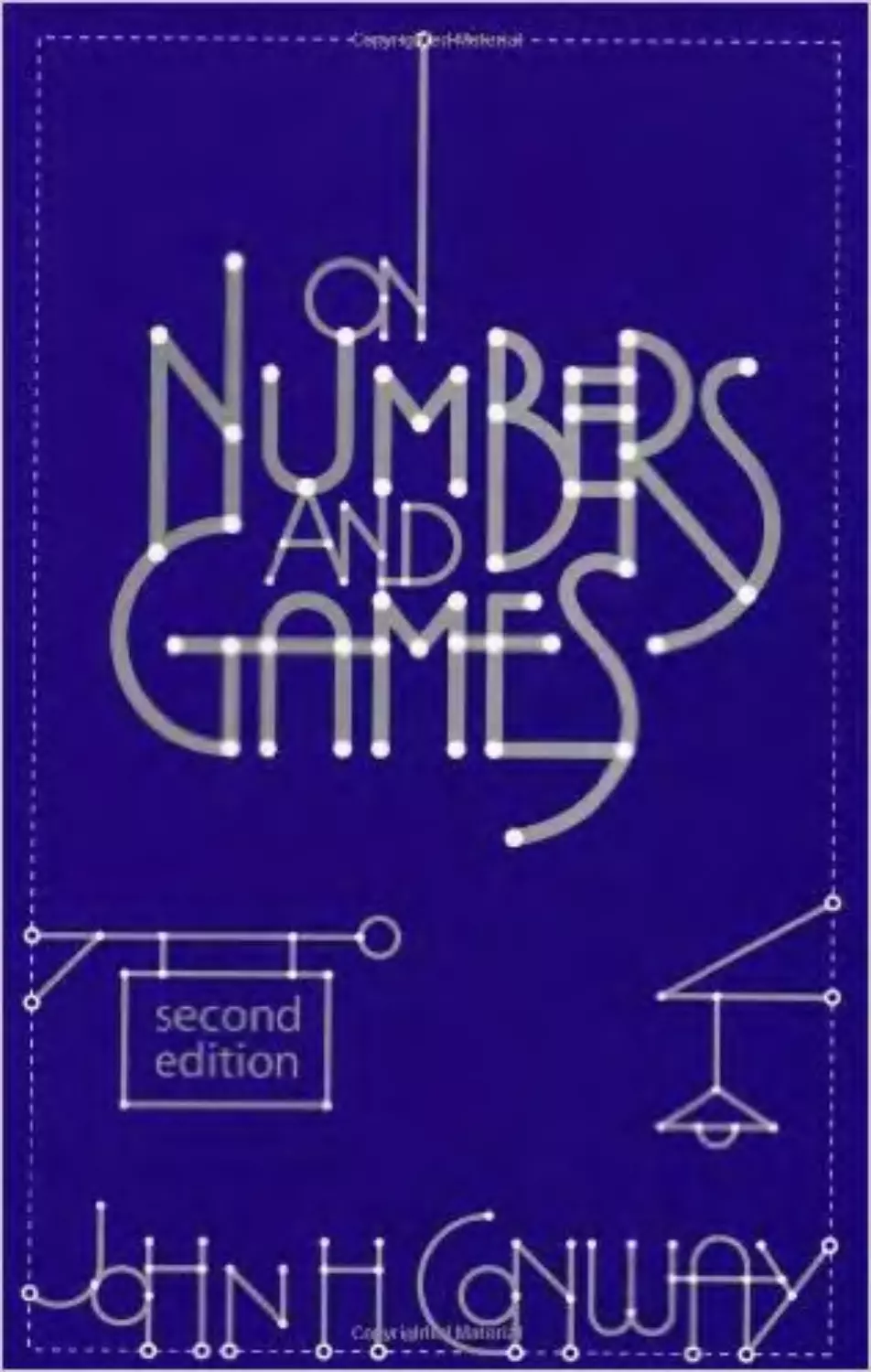
ON NUMBERS
AND GAMES
SECOND EDITION
J. H. CONWAY
John von Neumann Professor of Mathematics,
Princeton University
A K Peters, Ltd.
Natick, Massachusetts
Editorial, Sales, and Customer Service Office
A K Peters, Ltd.
63 South Avenue
Natick, MA 01760
Copyright (Ç) 2001 by A K Peters, Ltd.
AlI rights reserved. No part of the material protected by this copyright
notice may be reproduced or utilized in any form, electronic or mechanical, including
photocopying, recording, or by any information storage and retrieval system, without
written permission from the copyright owner.
Library of Congress Cataloging-in-Publication Data
Conway, John Horton.
On numbers and games / John H. Conway.-2nd ed.
p.cm.
Includes bibliographical references and index.
ISBN 1-56881-127-6 (alk. paper)
1. Number theory. 2. Game theory. I. Title.
QA241 .C69 2000
519.3-dc21
00-046927
Printed in the United States of America
05 04 03 02 10 9 8 7 6 5 4 3 2
Prologue
Just over a quarter of a century ago, for seven consecutive days 1 sat down and
typed from 8:30 am until midnight, with just an hour for lunch, and ever since
have described this book as "having been written in a week."
Not entirely honest, because there were loose ends still to be tied up, and
Chapter 16 was written just before the book appeared, while Chapter 13 was
largely copied from a paper, "Hackenbush, Welter and Prune", that had been
written a year earlier. But also not entirely dishonest.
Why the rush? Because ONAG, as the book is familiarly known, was getting
in the way of writing Winning Ways (WW). Now that both books are happily
being republished by A K Peters, Onagers (a word that also means "Wild Asses"!)
can be told just how it came about before they surrender themselves to pure,
pleasure (as "Onag" means in Hebrew!).
A few years previously, Elwyn Berlekamp, Richard Guy and 1 had agreed to
write a book on mathematical games, by which at that time we meant the Nim-
like theory developed independently by Roland Sprague and Peter Michael
Grundy for sums of impartial games-those for which the two players have
exactly the same legal moves.
1 had long intended to see what would become of the theory when this restric-
tion was dropped, but only got around to doing so when the then British Go
Champion became a member of the Cambridge University Pure Mathematics
Department. Astonishingly, it was the resulting attempt to understand "Go" that
led to the discovery of the Surreal N umbers! This happened because the typical
"Go" endgame was visibly a sum of games in the sense of this book, making it
clear that this notion was worthy of deep study in its own right. The Surreal
Numbers then emerged as the simplest domain to which it applies!
However, their theory rapidly burgeoned in ways that made it inappropriate
for the book that later became Winning Ways. A busy term was approaching, and
it seemed that this "transfinite" material just had to be got out of the way before
that term started if Winning Ways was ever to be published. So 1 sat down for that
week and wrote this book, and then confessed the fact to my co-authors.
v
VI
PROLOGUE
The most surprising immediate result was a threat of legal action from Elwyn
Berlekamp! But somehow we must have patched this up, because both ONAG
and WW appeared in the next few years, and we remain good friends.
ln fact, the Surreal Numbers "surfaced" before ONAG appeared, partly through
my 1970 lectures at Cambridge and Cal. Tech., but mostly through the wide
circulation of Donald Knuth's little book, Surreal Numbers. 1 am very grateful
to Knuth for inventing this name-the original version of ONAG said "Because
of the generality of this Class, we shall simply describe its members as numbers,
without adding any restricting adjective." "Surreal Numbers" is mu ch better!
1 am very happy and grateful that A.K. Peters have agreed to publish millennial
editions of both this book and Winning Ways.
Ariel Jaffee and Kathryn Maier were responsible for handIing the changes to
this edition. This is also the place to acknowledge Richard Guy's considerable
contributions to the original edition. ln particular, he designed and drew a number
of the original figures and computed, or recomputed several of the tables.
1 have called this a Prologue rather than a Preface because it is usually under-
stood that the Preface to a later edition of a book should contain a description of
the changes in the book and its subject since its first edition. Some of these
functions are addressed in the Epilogue.
John H. Conway
Preface
This book was written to bring to light a relation between two ofits author's
favourite subjects-the theories of transfinite numbers and mathematical
games. A few connections between these have been known for some time,
but it appears to be a new observation that we obtain a theory at once
simpler and more extensive than Dedekind's theory of the real numbers
just by defining numbers as the strengths of positions in certain games.
When we do this the usual properties of order and the arithmetic operations
follow almost immediately from definitions that are naturally suggested, so
that it was quite an amusing exercise to write the zeroth part of the book as
if these detinitions had arisen instead from an attempt to generalise
Dedekind's construction!
However, we suspect that there will be many readers who are more
interested in playing games th an philosophising about numbers. For the se
readers we offer the following words of advice. Start reading Chapter 7,
on playing several games at once, and find an interested friend with whom to
play a few games of the domino game described there. ln this it's easy to
see why 8 and give Left one and two moves advantage respectively-
when you feel you vaguely understand why gives him just half of a
move's advantage, you might like to read Chapter 0, which explains how the
simplest numbers arise. You should then find no difficulty in reading the rest
of the book without knowing any more about numbers than that "ordînals"
are a certain kind of (usually infinite) whole number, and that the Author has
strange idiosyncracies which make him use capital letters for certain very
large infinite collections.
Many friends have helped me to write this book, often without being
aware of the fact. 1 owe an especial debt to Elwyn Berlekamp and Richard
Guy, with whom 1 am currently preparing a more extended book on mat he-
matical games which should overlap this one in several places. The book
would never have appeared without the repeated gentle proddings that came
from Anthony Watkinson of Academie Press; it would have contained
vii
viii
PREFACE
many errors were it not for the careful reading of Paul Cohn as editor, and
the quality of the printing and layout could never have been so high without
the detailed attentions of Ron Hitchings and the staff of the printers at
Page Bros of Norwich. Others whose comments have atfected more than
one page are Mike Christie, Aviezri Fraenkel, Mike Guy, Peter Johnstone,
Donald Knuth and Simon Norton. The varied nature of the advice they
gave is neatly encapsulated in the following lines from Bunyan's Apology
for his Book (Pilgrim 's Pro g ress ) :
Some sa id IJohn, print it',. others said, INot so.'
Some said I[t might do good'; others said, INo.'
October 1975
J .H.C.
t
$ ... *'
fi
::;- bO N
...c
o
0- *
Q.
...c bO
5 gb
'--:" N
8
:8
: SIN
8 crJ
bO
-cJN
.-!I
8
--
...c bO
o
...c
+1
8
--
...... bO
1
-IN
l
1
N
1
8
IbO
O
IbO
>.
.....
8
Q)
M
N
...c
.
+-
...
<=
...
+-
N
4--
+
+
.
8
...
8
cu
8
co
cu
S
o
tI.)
c.....
o
tI.)
5
0'=
o
tI.)
o
cu
.d
....
"0
=
"
a
8
1'\
8
vr
1-4
..8
s
::s
=
c.....
o
cu
....
cu
.d
c:.)
.-
0-
io.II
C
Jo..
-.
;;:.....
-
>-:
-
.......
*
N N
.......
<J =
0
r- I
<
1 \0
[:> 1
r- I
> CJ't
-
....... .......
....-.4
-
.-Qd--.
tr)
.......
et
0-
-
- -
r---:
0 0 e
....-.4 :z (/)
R 0 ni "'C1
go'd Z c
ro
\t:5 cE ....,
....-.4 0\ ro
(1)
....
00 bO
tI)
....
(1)
.D
- e
::;j
t::
N -
0 -
J...
tr) 0
=
s 0
ïï N 0
W Z
0
;Z .......
1
...-
-.
..d
....,
o
r::
o
....,
o
Z
---
.
V)
....
(1)
....,
0..
..d
U
c.-
o
(1)
u
r::
(1)
s::
(1)
(1)
Q
Contents
Prologue . v
Preface Vll
Zeroth Part . . . On Numbers 1
Chapter 0: AIl Numbers Great and Small . 3
Chapter 1: The Class No is a Field . 15
Chapter 2: The Real and Ordinal Numbers 23
Chapter 3: The Structure of the Genral Surreal Number . 29
Chapter 4: Aigebra and Analysis of Numbers 39
Chapter 5: Number Theory in the Land of Oz . 45
Chapter 6: The Curious Field On 2 . 50
Appendix to Part Zero 64
First Part. . . and Games 69
Chapter 7: Playing Several Games at Once 71
Chapter 8 : Some Games are Already Numbers . 81
Chapter 9: On Games and Numbers 97
Chapter 10: Simplifying Games 109
Chapter Il: Impartial Games and the Game of Nim 122
Chapter 12: How to Lose when you Must . 136
Chapter 13: Animating Functions, Welter's Game and
Hackenbush Unrestrained 153
Chapter 14: How to Play Several Games at Once in a Dozen
Different Ways 173
Chapter 15: Ups, Downs and Bynumbers . 188
Chapter 16: The Long and the Short and the Small 205
Epilogue . 225
Appendix . 229
Index 235
Xl
ZEROTH PART
ON NUMBERS . . .
A Hair, they say, divides the False and True;
Yes; and a single Alifwere the clue,
Could you butfind it-to the Treasure-house,
And peradventure to The Master too/
Edward Fitzgerald's
"Rubaiyat of Omar Khayyam"
CHAPTER 0
Ali Numbers Great and Small
Whatever is not forbidden, is permitted.
J. c. F. von Schiller, Wallensteins Lager
This book is in two = {zero, one I} parts. ln this zeroth part, our topic
is the notion of number. As examples we have the finite numbers 0, 1, 2, . . . ,
-1, t, J2, 1t, . . .; infinite numbers such as ro (the first infinite ordinal); and
also infinitesimal numbers such as l/ro. If we were to adopt the axiom of
choice, then the infinite cardinal numbers like o could be identified with the
least corresponding ordinal numbers, so that we can regard these too as
part of our system (although the arithmetic is different).
ln the system of "Suqeal Numbers" we shaH describe, every number has its own
unique name and properties and many remarkable numbers, such as
3/ 1t
V (ro + 1) - -
ro
appear. But the "number" i = J -1 will not arise in the same way (though
we add it in Chapter 4), since there is no property enjoyed by i which is not
shared by - i. ln fact we reply to questions about "the square root of - 1"
by simply asking exactly which square root of - 1 is meant?
Let us see how those who were good at constructing numbers have
approached this problem in the past.
Dedekind (and before him the author-thought to be Eudoxus-of the
fifth book of Euclid) constructed the real numbers from the rationals. His
method was to divide the rationals into two sets Land R in such a way th"t
no number of L was greater than any number of R, and use this "section" to
define a new number {L 1 R} in the case that either L nor R had an extremal
point.
His method produces a logically sound collection of real numbers (if we
ignore some objections on the grounds of ineffectivity, etc.), but has been
criticised on several counts. Perhaps the most important is that the rationals
are supposed to have been already constructed in some other way, and yet
3
4
ALL NUMBERS GREAT AND SMALL
are "reconstructed" as certain real numbers. The distinction between the
"old" and "new" rationals seems artificial but essential.
Cantor constructed the infinite ordinal numbers. Supposing the integers
1,2, 3, . . . given, he observed that their order-type OJ was a new (and infinite)
number greater than aIl of them. Then the order-type of {l, 2, 3, . . . , OJ} is a
still greater number OJ + 1, and so on, and on, and on. The similar objections
to Cantor's procedure have already been met by von Neumann, who observes
that it is unnecessary to suppose 1, 2, 3, . . . given, and that it is natural to
start at 0 rather than 1. He also takes each ordinal as the set (rather than
the order-type) of all previous ones. Thus for von Neumann, 0 is the empty
set, 1 the set {O},2 the set {O, 1}, . . . , OJ the set {O, 1, 2, . . . }, and so on.
ln this chapter we shaH show that these two methods are part of a simpler and
more general one by which we can construct the very large Class No of "Sur-
real Numbers," which includes both the real numbers and the ordinal num-
bers, as weIl as others like those mentioned above. Inside this book we shaH
usually omit the adjective "surreal," coined by Donald Knuth, and simply call
these things "numbers." It turns out that No is a Field (i.e., a field whose
domain is a proper Class)-in general we shall capitalise the initialletter of
any "big" concept, on the grounds that proper Classes, like proper names,
deserve capital letters. So, for instance, the word Croup will mean any group
whose domain is a proper class.
CONSTRUCTION
If L, Rare any two sets of numbers, and no member of L is any member
of R, then there is a number {L 1 R}. AlI numbers are constructed in this way.
CONVENTION
If x = {L 1 R} we write xL for the typical member of L, and x R for the
typical member of R. For x itself we then write {XL 1 XR}.
X = {a, b, c,...1 d, e,f,...} means that x = {LI R}, where a, b, C,... are
the typical members of L, and d, e,j . .. the typical members of R.
DEFINITIONS
Definition of x y, x y.
We say x y iff (no x R y and x no yL), and x y iff y x.
We write x 1; y to mean that x y does not hold.
Definition of x = y, x > y, x < y.
x = y iff (x y and y x). x > y iff (x y and y x).
x < y iff y > x.
DEFINITIONS
5
Definition of x + y.
x + y = {XL + y, x + yL 1 X R + y, x + yR}.
Definition of - x.
-x = {-x R 1 _XL}.
Definition of xy.
xy = {xLy + xyL - xLy, xRy + xyR _ xRyR 1
/XLy + xyR _ xLyR, xRy + xyL _ xRyL}.
Tt is remarkable that these few lines already define a real-closed Field
with a very rich structure.
We now comment on the definitions. A most important comment whose
logical effects will be discussed later is that the notion of equality is a defined
relation. Thus apparently different definitions will produce the same number,
and we must distinguish between the form {L 1 R} of a number and the
number itself.
AlI the definitions are inductive, so that to decide, for instance, whether
x y we must consider a number of similar questions about the pairs x R , y
and x, y. but these problems are aIl simpler than the given one. It is perhaps
not quite so obvious that the inductions require no basis, since ultimately
we are reduced to problems about members of the empty set.
ln general when we :wish to establish a proposition P(x) for aIl numbers x,
we will prove it inductively by deducing P(x) from the truth of aIl the propo-
sitions P{x L ) and P{x R ). We regard the phrase "aIl numbers are constructed
in this way" as justifying the legitimacy of this procedure. When proving
propositions P(x, y) involving two variables we may use double induction,
deducing P(x, y) from the truth of aIl propositions of the form P(x L , y),
P{x R , y), P{x, yL), P{x, yR) (and, if necessary, P(x L , yL), P{x L , yR), P(x R , y),
P{x R , yR»). Such multiple inductions can be justified in the usual way in terms
of repeated single inductions.
We shaH allow ourselves to use certain expressions {L 1 R} that are not numbers,
since they do not satisfy the condition that no member of L shaH be any member
of R. ln general we may write down any expression {L 1 R} and ev en discuss
inequalities between such expressions before establishing that they are numbers,
but if we wish such an expression to represent a number we must establish the
condition on Land R. ln the more general theory developed in the next part of the
book, we show that when the condition on Land R is omitted we obtain the more
general notion of agame.
Our next comments concern the motives for these particular definitions.
Now it is our intention that each new number x shalllie between the numbers
XL (to the left) and x R (to the righ t), and that , +, -, ., etc., shall have their
usual properties. So that if (say) y some x R we would not have x y, for
6
ALL NUMBERS GREAT AND SMALL
then x X R . Similarly, we could not allow x y if x some yL. So we
detine x y in aIl other cases. (This conforms with our motto, and helps
to ensure that numbers are totallY ordered.)
The spirit of the detinitions is to ask what we know already (i.e. by the
answers to simpler questions) about the object being defined, and to make
the answers part of our definition. Thus if addition is to have nice properties
and if x is between XL and x R , and y between rand yR, then we know
"already" that x + y must lie between both XL + y and x + r (on the left)
and x R + y and x + yR (on the right), which yields the definition of x + y.
Similarly -x will lie between -xR (on the left) and -xf (on the right), which
suffice to define - x.
It is not nearly so easy to find exactly what we "already" know about xy.
It might seem, for instance, that we know that xy lies between xLy and xr
(on the left) and xRy and xyR (on the right), which would yield the detinition
xy = {xLy, xyL 1 xRy, xyR}.
But this fails in two ways. Firstly, what we "knew" here is sometimes false
(consider negative numbers), and secondly, even when it is true it need not
be the strongest information we "already" know. In fact, of course, this
defines the same function as x + y.
It takes a great deal of thought to find the correct definition, which cornes
from the observation that (for instance) from x - XL > 0 and y - yL > 0
we can deduce (x - xL)(y - yL) > 0, so that we must have xy > xLy +
xyL - xfyL. Since aIl the products here are simpler ones, and since we regard
addition and subtraction as already defined, we can regard this inequality
as already known when we corne to define xy, and the other inequalities in
the definition are similar. [Note that for positive numbers x and y the in-
equality xy > xLy + xyL - xLr is stronger than both inequalities xy > xLy,
xy > xyL.]
We can summarise our comments by saying that the definitions of the
various operations and relations are just the simplest possible definitions
that are consistent with their intended properties. ln the next chapter, we
shall verify that these intended properties really hold of aIl numbers, but
in the rest of this chapter we shalI simpIy explore the system in a more
informaI way. To simplify the notation, when L is the set {a, b, c, ...} and R
the set {..., x, y, z}, we shall simpIy write {a, b, c, ... 1..., x, y, z} for {L 1 R}.
EXAMPLES OF NUMBERS, AND SOME OF THEIR PROPERTIES
The Bumber 0
According to the construction, every number has the form {L 1 R}, where
EXAMPLES OF NUMBERS AND SO:ME OF THEIR PROPERTIES 7
Land Rare two sets of earlier constructed numbers. So how can the system
possibly get "off the ground", since initially there will be no earlier constructed
numbers?
The answer, of course, is that even before we have any numbers, we have a
certain set of numbers, namely the empty set 0! So the earliest constructed
number can only be {L 1 R} with both L = R = 0, or in the simplified nota-
tion, the number { 1 }. This number we calI o.
Is 0 a number? Yes, since we cannot have any inequality of the fonn
aL OR, for there is neither a (f nor a OR!
Is 0 O? Yes, for we can have no inequality of the fonn OR 0 or 0 OLe
So by the definition, and happily, we have 0 = o. We also see from the
definitions that -0 = 0 + 0 = 0, since there is no number of any of the
forms -OR, -OL,OL + 0,0 + OL,OR + 0,0 + OR. A slightly more complicated
observation of the same type is that xO = 0, since in every one of the terms
defining xy there is a mention of r or yR, so that when y = 0 no term is
needed and the expression for xy reduces to {I} = O. So the number 0 has
at least some of the properties we know and love.
The numbers 1 and -1
We can now use the sets { } and {O} for Land R, obtaining hopefully the
numbers {I}, {Ol}, {I O}, {O 1 O}. But since we have already proved that
o 0, {O 1 O} is not a number, and we have only two new cases, which we
caUl = {O 1 } and -1 = { 1 O}. Note that -1 is indeed a case of the definition
-x.
Is 0 1? This will be true unless there is oR with OR 1 (there isn't) or
1 L with 0 1 L (there is, namely 1 L = 0). So we do not have 0 1.
Is 1 O? This is true unless there is IR with "..." or (f with "..." (what-
ever ". . ." is, there plainly can't be). So we have 1 0, and so 1 > O.
By symmetry, we have -1 < 0, and so if inequalities "behave", then we
should have -1 < 1. We check this:
Is - 1 1? This will happen unless there is (- I)R 1 or . .. (there is,
namely ( - i)R = 0). So we do not have -1 1.
Is 1 - 1? This will happen unless there is 1 R with . .. or ( -1 f with . . .
(there isn't). So 1 -1, so 1 > -1, as we hoped.
We can generalise a part of this last argument. If there is no x R and no yL,
then x y holds vacuously.
We forgot to check that 1 1. Why not do this yourself?
The numbers 2, t, and their negatives
We now have three numbers -1 < 0 < 1, and so a whole battery of
8
ALL NUMBERS GREAT AND SMALL
particular sets
{ }, { - 1 }, {O}, {1}, { - 1 , O}, { - l, 1}, {O, 1}, { - l, 0, 1}
to use for Land R. But the condition that no member of L should be any
member of R restricts us to the possibilities
{ 1 R}, {L 1 }, { -11 O}, {-II 0, 1 }, {-Ill}, {O Il}, {-l, 0 Il}.
If our hopes are fulfilled, we should have {II} > 1 and 0 < {O Il} < 1. So
we anticipate their probable values, and define {II} = 2, {O Il} = t. We
then have, of course, { 1 - 1} = - 2, and { - 1 1 O} = - t, from the definition
of negation.
Before we justify these names, let us ask about some of the other possibi-
lities. For example, what about the number x = {O, 11 }? This x is presumably
restricted by the conditions 0 < x, 1 < x. But since 0 < l, if inequalities
"behave (and we shall suppose from now on that they do), the condition
1 < x already implies 0 < x, so in some sense the entry 0 isn't telling us
anything. We can therefore hope that x = {O, II} = {II} = 2. We test
this, supposing 2 > 1 > O.
Is x 2? This is so unless there is x R 2 (no) or x some 2 L (no, because
the only 2 L is l, and we believe x > 1). So we think that x 2.
Is 2 x? Yes, unless some 2 R .. . (no) or 2 some xL (no, since the only
xf are 1 and 0). So indeed x = 2, if aIl our expectatio s are fulfilled.
ln a similar way, we should expect aU the equalities in the table:
- 2 = { 1 - l} = { 1 - l, O} = { 1 - l, l} = {I - 1, 0, 1}
-1 = { 1 O} = { 1 0, 1}
-t = {-II O} = { -11 0, 1}
0= {I} = {-II} = {Il} = {-Ill}
t = {O Il} = { -l, 0 Il}
1 = {O 1 } = { -1,0 1 }
2 = {II} = {O, 11 } = { - 1, II} = { - l, 0, II}.
Clearly we need some way of automating our expectations. Let us ask when
the number X = {y, XL 1 XR} obtained by adding a new entry y to the left of
x is still equal to x.
Is X x? Yes, unless some X R x (no, since every X R is an x R ) or X
some XL (no, since every xL is an XL).
Is x X? Yes, unless some x R X (no, since every x R is an XR) or
x some XL (and so x y, since every other XL is an XL). We conclude
that provided y x, we can add y to the left of x in this way without affecting
EX AMPLES OF NUMBERS
9
x. This justifies all the equalities in the table. (We allow also, of course, y to
be inserted on the right if y x.)
[ln the case {- 1 Il} we need to use the process twice. Thus since
-1 * 0 = { 1 }, we have 0 = { -11 }. Then since 1 t 0 = { -11 }, we have
o = {-Ill}.]
It is not hard to check the inequalities
- 2 < -1 < _1. < 0 < 1. < 1 < 2
22'
which shows that at least these numbers have the right order properties.
What else do we require to justify their names? .
According to the definition
1 + 1 = {O + 1, 1 + 0 1 },
since 0 is the only 1 L, and there is no 1 R. SO provided 0 + 1 and 1 + 0 behave
as expected, we have 1 + 1 = 2, as we might hope. But provided xf + 0 = xf
and x R + 0 = x R , we have
x + 0 = {XL + 01 x R + O} = {XL 1 XR} = x,
and similarly 0 + x = x. Since we already know 0 + 0 = 0, this shows that
1 + 0 = 0 + 1 = 1, as we wanted for the proof of 1 + 1 = 2, but in fact it
gives us an inductive proof that x + 0 = 0 + x = x for aIl x.
It is much harder to show that t + t = 1, justifying the name of t. From
the definition (supposing that x + y = y + x for aIl x, y, which is quite
easy to prove inductively) we see that
1 + 1. = { ! I l! }
2 2 2 2'
where we are using It as a temporary name for 1 + t.
Is t + t 1? Yes, unless 11 1 or 1 + 1 o. Oh MY, we have to do these
first. Let's get on with it.
Is 1 Ii? Yes) unless (empty) or 1 some It L . But one of the (1 + tt is
1 + 0 = l, so 1 1 t.
Is 0 1 + 1? Yes, unless (empty) or 0 some (1 + t)L. But since
o t + 0, we have 0 * t + t. So (at last) t + t 1.
Now is the time to leave the question
"is 1 t + t 1"
to the reader. He should conclude that indeed t + t = 1.
ln most of our examples xL and x R have been fairly close to each other, so
that there was an obvious candidate for {XL 1 x R }. When they are far apart,
there will be many simple numbers in between-which one of these will
{XL 1 XR} be? We consider x = { -112}.
10
ALL NUMBERS GREAT AND SMALL
Is x O? Yes, unless 2 0 (false) or x some <f (false). So in this case
we have x o.
Is 0 x? Yes, unless some OR x (false) or 0 -1 (false). So in fact
x = o.
More generally, the argument proves that if every XL < 0 and every
x R > 0, then x = 0, so for instance { -1, -! 12, 3} = O.
But wh en we have defined 2t and 17 we shall have to decide about {2! 117}.
A first guess might be their mean, 9 , but since we have just seen that the
mean rule does not always hold, this seems unlikely. A clue is given in the
form of the preceding argument-since we must ask the questions "is x = y?"
for the various possible y in order of simplicity, the answer should be the
simplest y that is not prohibited. This rule will be established in Chapter 2,
and it implies, for instance, that {2! II7} = 3, and { 11} = !.
The numbers !, i, 1 t, 3, and so on
Once we have settled aIl the trivialities like x x for aIl x (which we have
begun to take for granted), we can proceed a little faster. For instance, if
Land R are sets of numbers chosen from those we already have, then since
we suspect these numbers are totally ordered, in any expression x = {XL 1 XR}
we need only consider the greatest (if any) and the least xR (ditto). This
gives us for the next "day" only the numbers
o < {O I!} < ! < {! Il} < 1 < {112} < 2 < {21 }
and their negatives. What are the proper names for these numbers? We
suspect that {21 } = 3, and indeed we can verify that
1 + 1 + 1 = {O + 1 + 1, 1 + 0 + 1, 1 + 1 + 0 1 } = {21 }.
The equation {112} = If is almost as easy to guess and verify. So we shaH
make lt a permanent name for this number.
The two likely guesses for {Olt} are 1- and . If anything, the first might
seem the better guess, s-ince otherwise it's hard to see what 1- will be. But in
fact it turns out that {Olt} is i-at least we can verify that twice this number
is !. ln a similar wav'l { 111 turns out to be rather than .
It is now easy to guess the pattern for the numbers which take only finitely
much work to define. Let us imagine the numbers created on successive
"days", in such a way that on day number n we create aIl numbers x = {L 1 R}
for which every member of each of the two sets L, R has already been con-
structed. We number the day on which 0 was created with the number 0
itself, so that our creation story begins (or began?) on the zeroth day.
Then the numbers seem to form a tree, as shown in Fig. O. Each node of the
tree has two "children", namely the first later numbers born just to the left
o
cd
"d
ç::
o
ç::
o
cd
"d
ç::
o
ç::
2/
...-4
o
8
// cd
'" "d
"d +
cd
"d co;:! .......0,
c"'O ./ ./ " .----.
o _
E / --
o rr,
/ "-....... -lN /' /
,
'\. I / e
'\. /,...-4"
-lN /S
...-4 lN
/'" '?'"
"" -le
1
I
EXAMPLES OF NUMBERS
-le
// 1
r-loo "
/ " ...-4
I
/ '-.. v.loo /
_lN "
./ Ioo '-"
./ ' -r
-I
-.......... .-4; 00
...-4
+ 8
8 _---
- cd
"d N
-- :::;
...-4_--
1--
--
8 -.... SIN
Nie
-Ie/
"'e
-lN ------13
---
-100 ./'
/" 1'"
-I
/ 1 " IOO/
l'
_lN
_/I
1 \ _I /
-lN / l "
...-4"
/ 1 I /
...-4.............
1
1 -IN--
""-/1'
I
1
111100 /'"
/' 1........
I
l "r-100/
,.........
.....
.......
.......
'8 ...-4
I +
8
--
1
-
- .
---.. 8
Il
d
M
o
.D
Q)
'-t
Q)
en
'-t
Q)
.D
e
::1
.....
en
'-t
Q)
..c:
.....
t::
Q)
..c:
o
o
G:
12
ALL NUMBERS GREAT AND SMALL
and right of it. We guess that on the n'th day the extreme numbers to be born
are n and - n, and that each other number is the arithmetic mean of the
numbers to the left and right of it. Happily, of course, this turns out to be
the case. Supposing aIl this, we know aIl numbers bom on finite days.
The numbers bom on day co
Of course the process doesn't stop with these numbers. The next day we
caU day co. Let's consider some of the numbers bom then. The largest number
is the number co itself, defined as {O, 1,2, 3, . . .1 }. Of.course, co has many other
forms, for instance co = {l, 2,4, 8, 16, . . .1 }, or even co = {aIl numbers (rn/2n) 1 }.
But since the collection of numbers to the left of co has no largest member in
these expressions, we cannot simply eliminate an but one of the numbers
appearing on the left.
Of course the most negative number bom on day co will be
- co = { 1 0, - 1, - 2, - 3, . . .}.
The smallest positive number bom on this day is the number {O' 1, , i, *,. . .},
which turns out to be l/co, surprisingly and fortunately.
But besides these strange new numbers, some quite ordinary numbers are
born at the same time. For instance, we have
1 1 + 1 1 1 1 1 1 1 1
4 < 4 16 < 4 + 16 + 64 < . .. < "3 < . . . ,< 2 - "8 < 2'
so we might expect the number
{i,i + {6 ,i + {6 + i4 ,...lt,t - i,...} = x, say
to be t, and behold, it can in fact be proved that x + x + x = 1! ln a similar
way, ail of the real numbers defined by Dedekind, including in particular aIl
the remaining rational numbers can be defined as "Dedekind sections"
of the dyadic rational numbers (by which we mean the numbers of the form
m/2n, m and n integers), rather than as sections of ail rationals. So .J2, e, and 1t
are aU born on day co.
It is rather nice that our definition of equality ensures automatically that
thlt humber (for example)
{dyadic rationals < 1 dyadic rationals > }
turns out to be the same as the number = {i 1 t}, so that the dyadic rationals
"recreated" on day co are "the same" as those created before.
It is also rather nice that Cantor's ordinal numbers (as modified by von
Neumann) fit smoothly into our system. Thus we have
o = { 1 }, 1 = {o 1 }, 2 = {O, 11 }, . . ., co = {O, 1, 2, 3, . . . 1 },
ex = {f3 < ex 1 },
EXAMPLES OF NUMBERS
13
where von Neumann has
0= {}, 1 = {O}, 2 = {O, 1},..., ro = {O,I,2,...}, ex = {fJ < ex},....
ln other words, the ordinal numbers are those we obtain by requiring always that
the set R be empty. We may say that Cantor was only interested in moving ever
rightwards, whereas Dedekind stopped to fill in the gaps, so that R was always
empty for Cantor, never empty for Dedekind. It is remarkable that by dropping
these restrictions we ob tain a theory that is both more general and more easy to
work with. (Compare the theory developed in the next chapter with the classical
foundation for the real numbers in which we must first construct or postulate the
"natural numbers", then rationals as equivalence classes of ordered pairs, then
reals as sections of rationals, with negative numbers being introduced at some
stage in the process.)
Some more numbers
After ro, the number {O, 1, 2, 3, . . . , ro 1 } = ro + 1 need corne as no surprise,
but perhaps the number. {O, 1,2, 3, . . .1 ro} will. This number, caU it x,
should satisfy n < x < ro for aIl finite integers n, in other words, x should
be an infinite number less than' the "least" infinite number ro. Adding 1 to x,
we find the number
{l, 2, 3, . . . , xl ro + 1} = y, say.
Here, since x < ro, and ro + 1 4; ro, we see that y = ro, for the new entries x
on the left and ro + 1 on the right have made no difference. So x + 1 = ro,
x = ro - 1.
Check that we get the same result on subtracting 1 from ro.
ln a similar way, we find successively that
ro - 2 = {O, 1, 2, 3, . . .1 ro, ro - 1},...,
ro - n = {O, 1, 2, 3, . . .1 ro, ro - 1, ro - 2,. . . , ro - (n -1)}.
Plainly the next number to consider is
z = {O, 1, 2, 3, . . . 1 ro, ro - 1, ro - 2, . . .} = {n 1 ro - n}, say.
It should not take the reader too long to verify that z = ro/2. When he has
done this, and defined ro/4, ro/8,... as weIl, he should be in a position to
define ro/3 (for instance), and to verify our assertion that
{O, 1, 2, 3, . . .1 ro, ro/2, ro/4, ro/8, . . .}
is a square root of ro.
14
ALL NUMBERS GREAT AND SMALL
Other easy exercises are
{ o } = ,
w 2w
{ 1, t, i, . ..} = ,
{o ' 2 ' 4 '."} = 2 '
and so on.
If the reader prefers to try his hand at "constructing" new numbers rather
than examining values of those given here, let him try to find detinitions for
ro, ro l / w , w + TC, (w + 1)-1, )(w - 1), and to show, making any reasonable
assumptions, that they have the properties we should expect.
ln the next chapter, we shan prove that the Class of an numbers really is a
Field, making no use of any of the supposed "facts" from this chapter. It
will be some time before we see so many particular numbers mentioned
again. ln the third chapter, we shaH produce a "canonical form" for numbers,
and learn how to manipulate them a little more freely, and in the process
will see exactly how general our class of numbers turns out to be.
CHAPTER 1
The Class No is a Field
Ah! why, ye Gods, should two and two makefour?
Alexander Pope, ((The Dunciad"
PRELIMINARY COMMENTS
There are two problems that arise in the precise treatment which need spe-
cial comment. The first is that it is necessary to have an expression {L 1 R}
existing even before we have proved that it is a number. The second concerns
the fact that equality is a defined relation, which must initially be distin-
guished from identity.
Games. The construction for numbers generalises immediately to the
following construction for what we caU games.
Construction. If Land Rare any two sets of games, then there is agame
{L 1 R}. AIl games are constructed in this way.
Although games are properly the subject of the tirst part ofthis book (where
the name will be justified), it is logically necessary to introduce them before
numbers. Order-relations and arithmetic operations on games are defined
by the same definitions as for numbers. The most important distinction
between numbers and general games is that numbers are totally ordered,
but games are not-there exist games x and y for which we have neither of
x y, y x.
To show that a game x = {XL 1 XR} is a number, we must show firstly that
aIl of the games XL, x R are numbers, and secondly, that there is no inequality
of the form XL x R .
IDENTITY AND EQUALITY
We shaIl caU games x and y identical (x = y) if their left and right sets are
identical-that is, if every xf is identicat" to some yL, every x R identical to
15
16
THE CLASS NO IS A FIELD
some yR, and vice versa. Recall that x and y are defined to be equal (x = y)
if and only if we have both x ;?; y and y ;?; x. The distinction causes no
great problems until we corne to multiplication, where the trouble is that
there can exist equal games x and y for which xz and yz are unequal. But aIl
goes weIl as long as we restrict ourselves to the multiplication of numbers.
Finally, we note that almost aIl our proofs are inductive, so that" for
instance, in proving something about the _pair (x, y) we can suppose that
thing already known about ail pairs (XL, y), (x R , y), (x, yL), (x, yR). After a time
we feel free to suppress aIl references to these inductive hypotheses. We
remind the reader again that since ultimately we are reduced to questions
about members of the empty set, no one of our inductions will require a
"basis". The games XL, xR will be called the Left, Right options of x.
PROPERTIES OF ORDER AND EQUALITY
Recall that x y if we have no inequality of form x R y or x yL.
THEOREM O. For ail gamps x we have
(i) x x R ,
(H) XL * x,
(iii) x ;?; x,
(iv) x = x.
Proo! (i) Taking y as x R in the definition of ;?;, and using the inductively
true relation x R x R , we see that we cannot have x ;?; y.
(ii) is similar.
(iii) Taking y as x, we now know that we have no x R y and x no r,
whence x ;?; y.
(iv) from x ;?; x and x x, we deduce x = x.
THEOREM 1. If x ;?; y and y ;?; z, then x ;?; z.
Proof. Since x ;?; y, we cannot have x R y, and so by induction we cannot
have x R z. Similarly we cannot have x r, and so we must have x z.
Summary. We now know that ;?; is a partial order relation on games, and
that = has the right properties (for instance x = y and x < z imply y < z).
THEOREM 2. For any number x we have XL < X < xR for ail XL, x R . Also,for
any two numbers x and y we must have x y or x ;?; y.
Proo! (i) Since we know x * x R , it suffices to prove x R ;?; x. This will be
true unless some X RR x or x R some xL. But the former inductively
PROPERTIES OF ADDITION
17
implies X R < X RR x, a contradiction, and the latter is prohibited by the
detinition of number.
(ii) The inequality x } y implies either some x R y or x some r,
whence either x < x R y or x yL < y.
Summary. Numbers are totally ordered.
PROPERTIES OF ADDITION
Definition. 0 = { 1 }.
We recall that x + y = {XL + y, x + yL 1 x R + y, x + yR}.
THEOREM 3. For ail x, y, z we have
x + 0 = x,
x + y = y + x,
(x + y) + z = x + (y + z).
Proo!
x + 0 = {XL + 01 x R + O} = {XL 1 XR} = X
X + y = {XL + y, x + ri x R + y, x + yR} =
= {y + XL, yL + x 1 y + x R , yR + x} = y + x.
(x + y) + z = {(x + y)L + z, (x + y) + ZL 1. . .} =
= {(XL + y) + z, (x + yL) + Z, (x + y) + ZL I...} =
= {XL + (y + z), x + (yL + z), x + (y + ZL) 1. ..} =
= . . . = x + (y + z).
ln each case the middle identity follows from the inductive hypothesis.
Proofs like these we call1-line proofs even when as here the "line" is too long
for our page. We shall meet still longer l-line proofs later on, but they do
not get harder-one simply transforms the left-hand side through the
definitions and inductive hypotheses until one gets the right hand side.
Summary. Addition is a commutative Semigroup operation with 0 as
zero, even when we demand identity rather than equality.
PROPERTIES OF NEGATION
Recall the definition -x = { -x R 1 _XL}.
THEOREM 4. (i) -(x + y) = -x + - y
(ii) -( -x) = x
(iii) x + - x = 0
18
THE CLASS NO IS.A FIELD
Proof (i) and (ii) have easy l-line proofs. Note that (iii) is an equality rather
than an identity. If, say, x + -x t 0, we should have some (x + _X)R 0,
that is, x R + - x 0 or x + - XL o. But these are false, since we have by
induction x R + - x R 0, XL + - XL O.
Summary. With equality rather than identity, addition is a commutative
Group operation, with 0 for zero, and - x for the negative of x. AlI this is
true for general games.
PROPERTIES OF ADDITION AND ORDER
THEOREM 5. We have y z (fJ'x + y x + z.
Proof If x + y x + z, we can ot have
x + yR X + z or x + y x + ZL,
and so by induction we cannot have yR Z or y ZL, so that y z.
Now supposing x + y x + z, we must have one of
x R + y x + z, x + yR X + z, x + y XL + Z, x + y x + ZL,
and if we further suppose y z, we deduce one of
x R + y x + y, x + yR X + y, x + z XL + z, x + z x + ZL,
aIl of which imply contradictions by cancellation.
Theorem 5 implies in particular that we have y = z iff x + y = x + z,
justifying replacement by equals in addition.
THEOREM 6. (i) 0 is a number,
(ii) if x is a number, so is - x,
(iii) if x and y are numbers, so is x + y.
Proofs. (i) we cannot have QL OR, since there exists neither a OL nor a OR.
(ii) From XL < X < x R and XL, xR numbers, we inductively deduce
-x R < -x < -xL and -x R , _XL numbers.
(iii) We deduce inductively that each of
XL + y, x + yL < X + y < each ofxR + y, x + yR,
aIl of XL + y, etc., being numbers.
Summary. Numbers forro a totally ordered Group under addition.
PROPERTIES OF MULTIPLICATION
Definition. 1 = {O 1 }
PROPERTIES OF MULTIPLICATION
19
We recall the definition of multiplication
xy = {xLy + xyL - xLyL, xRy + xyR _ xRyR 1
1 xLy + xyR - xLyR, xRy + xyL - xRyL}.
THEOREM 7. For ail x, y, z we have the identities
xO = 0, xl = x, xy = yx, (-x)y = x(-y) = -xy,
and the equalities
(x + y)z = xz + yz, (xy)z = x(yz).
Proof. The identities have easy l-line proofs. The equalities also have
l-line proofs, as follows:
(x + y)z = {( x + y)L Z + (x + Y)ZL - (x + y)L ZL, . . . 1 . . .} =
= {(XL + y)z + (x + Y)ZL - (XL + Y)ZL,
(x + yL)Z + (X + Y)ZL - (X + yL)ZL, . . .1. . .} =
= {(xLz + xz L - XLZ L ) + yz, xz + (yLz + yzL - r zL ), . ..1 ...}
= xz + yz.
[This fails to yield an identity since the law x + - x = 0 is invoked.]
The central expression for xyz has four expressions like
xLyz + xyLz + xyzL - xLrz - xLyzL - xyLzL + xLrz L
(with perhaps some even number of XL, yL, ZL replaced by x R , yR, ZR) on the
left, and four similar expressions (with an odd number of such replacements)
on the right.
Note. We now have the more illuminating form
{xy - (x - xL)(y - yL), xy - (x R - x) (yR - y) 1
1 xy + (x - XL)(yR - y), xy + (x R - x)(y - yL)}
for the product xy.
THEOREM 8. (i) If x and y are numbers, so is xy
(ii) If Xl = x 2 ' then xly = x 2 y
(iii) If Xl x 2 ' and YI Y2' then X I Y 2 + X 2 Y I XI YI + X 2 Y2' the
conclusion being strict if both the premises are.
Proof. We shaH refer to the inequality of(iii) as P(x!, x 2 : y!' Y2). Note that
if Xl x 2 x 3 ' then we can deduce P(x l , x 3 : YI' Y2) from the inequalities
P(xl' x 2 : YI' Y2) and P(x 2 , x 3 : YI' Y2) by adding these and cancelling common
terms from the two sides.
20
THE CLASS NO IS A FIELD
Now to prove (i), we observe tirst that inductively, aIl options of xy are
numbers, so that we have only to prove a number of inequalities like
x L1 y + xyL _ x L1 yL < x L2 y + xyR _ x L2 yR.
But if XLI X L2 we have
x L1 y + xyL - xLII' x L2 y + xl' - x L2 yL < x L2 y + xyR _ x L2 yR
(these two inequalities reducing respectively to p{X L1 , x yL, y) and
p(X L2 , x : yL, yR», while if X L2 XLI we have instead
x L1 y + xyL _ x L1 yL < x L1 y + xyR _ xLtyR x L2 y + xyR _ x L2 yR.
(these being P(x Lt , x : yL, yR) and p(X L2 , XL! : y, yR)).
Now to prove (ii). This implication follows immediately from the fact
that every Left option of either is strictly less than the other, and every
Right option strictly greater, the relevant inequalities aIl being easy.
If Xl = X 2 or Yl = Y2 we can use (ii) to show that the terms on the Left of
(iii) are equal to those on the Right.
So we need only consider the case Xl < x 2 ' YI < Y2' Since Xl < x 2 '
we have either Xl < xf x 2 or Xl x < x 2 , say the former. But then
P(x l , x 2 : Y p Y2) can be deduced from P(x p xf : Yi' Y 2 ) and p(xf, x 2 : Y l , Y2)'
of which the latter is strictly simpler than the original. A similar argument
now reduces our problem to proving strict inequalities, of the four forms
I:(x L , x : yL, y), P(x L , y : y, yR), P(x, x R : yL, y), and P(x, x R : y, yR)
which merely assert that xy has the right order relations with its options.
THEOREM 9. If X and y are positive numbers, sa is xy.
Prooj This follows from P(O, x:O, y).
Summary. Numbers form a totally ordered Ring. Note that in view of
Theorem 8 and the distributive law, we can assert, for ex ample, that X 0,
y z together imply xy xz, and that if x # 0, we can deduce y = z from
xy = xz.
PROPERTIES OF DIVISION
We have just shawn that if there is any number y such that xy = t, then
y is uniquely determined by X and t provided that X -# O. We must now show
how to produce such a y. Jt suffices to show that for positive X there is a
number y such that xy = 1. We fÏrst put x into a sort of standard forme
PROPERTIES OF DIVISION
21
LEMMA. Each positive x has aform in which 0 is one of the XL, and every other
XL is positive.
Proof Let y be obtained from x by inserting 0 as a new Left option, deleting
aIl negative Left options. Then it is easy to check that y is a number, and
that y == x.
We write x == {O, XL 1 XR} in this section, and restrict use of the symbol
xL to the positive Left options of x. (Note that aIl the xR are automatically
positive.)
Now we shaH define a number y, explain the definition, and prove that y
is a number and that xy == 1.
Definition
_ { 1 + (x R - X)yL 1 + (XL - X)yR 1 + (xL - x)r 1 + (x R - X)yR }
y - 0, R ' L L ' R
X X X x
Note that expressions involving rand yR appear in the definition of y.
It is this that requires us to "ex plain" the definition. The explanation is that
we regard these parts of the definition as defining new options for y in terms
of old ones. So even the definition of this y is an inductive one. t [This is in
addition to the "other" induction by which we suppose that inverses for the
XL and x R have already, been found.]
THEOREM 10. We have (i) xr < 1 < xyR for ail yL, yR.
(ii) Y is a number.
(iii) (xy)L < 1 < (xy)R for ail (xy)L, (xy)R.
(iv) xy == 1.
Proof. We observe that the options of y are defined by formulae of the
form
1 + (x' - X )y '
y' 1 ==
X'
where y' is an "earlier" option of y, and x' some non-zero option of x. This
formula can be written
x' - x
1 - x y" == (1 - xy')
x'
\vhich shows that y" satisfies (i)if y' does. Plainly 0 does. Part (ii) now follows,
t To see how the definition works, take x = {O, 21 } = 3. Then there is no x R and the only
XL is 2, so XL - X = -1 and the formula for y becomes y = {O, (l - yR) 11(1 - yL)}. The
initial value l' = 0 gives us (1 - 0) = t for a new yR, whence !(1 - t) = ! as a yL, then
to - ) = for a yR, and so on, yielding y = {O, h ï\, . . .I!, ,. . .}, which certain1y looks like .
22
THE CLASS NO IS A FIELD
since we cannot have any inequality yL yR. The typical fonn of an option
of xy is x'y + xy' - x'y', which can be written as 1 + x'(y - y") with the
above detinition of y", and this suffices to prove (iii). For (iv), we observe
tirst that z = xy has a left option 0 (take XL = r = 0), and that (Hi) asserts
that ZL < 1 < zR for aIl ZL, ZR. Then
z 1, since no ZR 1, and z no 1 L (since some ZL = 0), and also
1 z, since no 1 R z, and 1 no zf,
so that indeed z = 1.
Summary: The Class No of aIl numbers forms a totally ordered Field.
Clive Bach has found a similar definition for the square root of a non-
negative number x. He defines
{ LX + yLyR x + yLyL* x + yRyR* }
.Jx = y = .Jx, r + yR .Jx R , r + yL' , yR + yR'
where xL and x R are non-negative options of x, and yL, yL*, yR, yR* are options
of y chosen so that no one of the three denominators is zero. We shallleave
to the reader the easy inductive proof that this is correct.
Martin Kruskal has pointed out that the options of l/x can be written in
the form
1 - rr(l - :)
x
where the denominator x cancels formally, the Xi denote positive options of x,
and the product may be empty. This is a Left option of l/x just when an even
number of the Xi are Left options of x. There is a similar closed fonn for
Bach's detinition of .J x.
CHAPTER 2
The Real and Ordinal Numbers
Don't let us make imaginary evils, when you know we have so many
realones to encounter.
Oliver Goldsmith, IIThe Good-Natured Man"
The following theorem gives us a very easy way of evaluating particular
numbers. We call it the simplicity theorem.
THEOREM 11. Suppose for x = {XL 1 XR} that some number z satisfies
XL * Z * x R for aIl XL, x R , but that no option of z satisfies the same condition.
Then x = z.
[Note; this holds even when x is only given to be a game.J
Proof We have
x z unless some x R z (no!) or x some ZL.
But from x ZL, we can deduce XL X zL < z xR for aIl XL, x R , from
which we have XL ZL x R , contradicting the supposition about z. 80
x z, similarly z x, and so x = z.
The main assertion of the theorem is that when x is given as a number, it
is always the simplest number lying between the xL and the x R , where simplest
means earliest created. [For if z is this simplest number, the simpler numbers
ZL, ZR cannot satisfy the same condition.] But the exact version presented
above has several advantages, since it holds when x is given as agame not
necessarily known to equal a number, and it is perhaps not quite obvious
exactly what is meant by "the simplest number such that . . .". ln the applica-
tions below, there is never any problem.
THEOREM 12. If x is a rational number whose denominator divides 2 n , then
x = {x - (lj2 n ) , x + (lj2 n )}.
Proof. For n = 0 the theorem holds, since it asserts that x is the simplest
23
24
THE REAL AND ORDINAL NUMBERS
number between X - 1 and x + 1, whereas we know that in fact it is, if
positive, the simplest number greater than x-l, if negative the simplest
number less than x + 1, and if zero the simplest number of aIl. [These state-
ments follows from the usual definition of integers as sums of 1 or -l.J
For n > 0, we double z = {x - (1/2 n ) 1 x + (1/2 n )} to see that 2z is the
simplest number between z + x - (1/2 n ) and z + x + (1/2 n ). Since z certainly
lies between x - (1/2 n ) and x + (1/2 n ) these limits are between 2x - (1/2n-l)
and 2x + (1/2n-l), and by induction 2x is the simplest number between
these limits, so that 2z = 2x, z = x.
Theorem 12 justifies aIl the assertions of Chapter 0 about numbers born
on fini te days. Every such number is a dyadic rational number, that is, a
rational number of the fonn m/2n. Of course, we can speak of "the" rational
number p/q without ambiguity, since we have shown that No is a totally
ordered Field, and therefore contains a uniquely defined image of each
rational number, supposed defined in any of the usual ways.
CONTAINMENT OF THE REAL NUMBERS
Definition. x is a real number if and only if - n < x < n for some integer n,
and
x = {x - 1, x - !, x - t, . . .1 x + 1, x + !, x + t, . . .},
or in short, x = {x - (l/n) 1 x + (l/n)}n>O. [It is to be understood that n
ranges over the positive integers.J
THEOREM 13. (i) Dyadic rationals are real numbers.
(ii) - x, x + y, and xy are real if x and y are.
(iii) Each real number has a unique expression in the form {L 1 R}, where L
and Rare non-empty sets ofrationals, L has no greatest, R no least, and there
is at most one rational in neither L nor R. A Iso, y' < Y E L implies y' E L,
z' > z E R implies z' E R.
(iv) Each section {LI R} as in (iii) equals a unique real number.
Pro of. (i) follows from Theorems Il and 12. (ii) follows from the formulae
defining the operations (it might be helpful to use the version of the product
formula in the note before Theorem 8). As for (iii), for any real number x, let L
= the set of rationals less than x, R = the set of rationals greater than x. Then L
and Rare non-empty by the condition -n < x < n for some n. Also every
member of Lis less than x - (lIn) for some n, and so we cao add 1/2n and still
be less than x. This shows that L has no greatest, and similarly R no least,
member. A ration al in neither L nor R must equal x, so at most one is in neither.
Since the expression is obviously unique, this proves (iii).
THE LOGICAL THEORY OF REAL NUMBERS
25
As for (iv), note that {L 1 R} is certainly some number, x, say, and that easily
- n < x < n for some integer n. 80 we need only show
x = { X _! x + ! } .
n n n>O
But since L has no greatest, for any y EL we have y + (lin) EL for aIl
sufficiently large n. This shows that for sufficiently large n there is a member
of L greater than x - (lin) and similarly a member of R less than x + (lin),
w hich suffices.
Note. We could obviously replace rationals throughout by dyadic rationals
in (Hi) and (iv). On doing so, we deduce that every real number not a dyadic
rational is born on day 0), as asserted in Chapter O.
Summary. The real numbers as defined here behave exactly like the real
numbers defined in any of the more usual ways. 80 we shaH use the name
IR for the set of aIl real numbers.
THE LOGICAL THEORY OF REAL NUMBERS
We have here regarded the ordinary real numbers and their theory as
known, so that Theorem 13 merely serves to identify "our" real numbers with
the familiar ones. But of course one could use our ideas to give a new logical
foundation for the real numbers. We digress to discuss the usual classical
treatments and the advantages and disadvantages of the possible new
approach.
Figure 1 shows the lattice of inclusions between the sets 71., 0, IR of integers,
rationals, and reals, and the corresponding sets Z +, a +, IR + of positive
/IR,
jR+ "10
y
FIG. 1.
elements. [lt does not matter very much whether we add here the number
o or not.] We shall suppose 71.+ and its properties already known. Then one
sees at once that there are several possible paths through the lattice from Z+
26
THE REAL AND ORDINAL NUMBERS
to IR. Some experience in teaching convinces one that there is a unique best
possible path, which is not one that seems natural at first sight!
For % = Z or Q or IR we can proceèd from %+ to% by introducing ordered
pairs (a, b) meaning a - b, and the equivalence relation (a, b) 1"'-1 (c, d) iff
a + d = b + c. [The alternative of adding new elements 0 and -x (x E X+)
leads to too much case-splitting.]
Similarly we can proceed from Z to Q or Z+ to a + by introducing ordered
pairs (a, b) meaning a/b and the equivalence relation (a, b) 1"'-1 (c, d) iff ad = bc.
We proceed from a to IR or a+ to IR+ by the method of Dedekind sections,
or that of Cauchy sequences.
ln practice the main problem is to avoid tedious case discussions. [Nobody
can seriously pretend that he has ever discussed even eight cases in such a
theorem-yet 1 have seen a presentation in which one theorem actually had
64 cases!] Now if we define IR in terms of Dedekind sections in Q, then there
are at least four cases in the definition of the product xy according to the
signs of x and y. [And zero often requires special treatment!] This entails
eight cases in the associative law (xy)z = x(yz) and strictly more in the distri-
butive law (x + y)z = xz + yz (since we must consider the sign of x + y).
Of course an elegant treatment will manage to discuss several cases at once,
but one has to work very hard to find such a treatment.
This discussion convinces me that if one is to use Dedekind sections then
the best treatment does not use the branch of our lé;lttice from Q ta IR, and
so must be the unique shortest path passing through IR +. This seems sur-
prising, since the algebraic theory (introduction of negatives and inverses)
should naturally be logically prior to the analytic (limits, etc.).
[The reader should be cautioned about difficulties in regarding the
construction of the reals as a particular case of the completion of a metric
space. If we take this line, we plainly must not start by defining a metric
space as one with a real-valued metric! So initially we must allow only
rational values for the metric. But then we are faced with the problem that
the metric on the complet ion must be allowed ta have arbitrary real values!
Of course, the problem here is not actually insoluble, the answer being that
the completion of a space whose metric takes values in a field [F is one whose
metric takes values in the completion of [F. But there are still sufficient
problems in making this approach coherent to make one feel that it is
simpler to first produce IR from Q, and later repeat the argument when one
cornes to complete an arbitrary metric space, and of course this destroys the
economy of the approach. My own feeling is that in any case the apparatus
of Cauchy sequences is logically tao complicated for the simple passage
from Q to IR-one should surely wait until one has the real numbers before
doing a piece of analysis !]
This discussion should convince the reader that the construction of the
CONTAINMENT OF THE ORDINAL NUMBERS
27
real numbers by any of the standard methods is really quite complicated.
Of course the main advantage of an approach like that of the present work is
that there is just one kind of number, so that one does not spend large
amounts of time proving the associative law in several different guises.
1 think that this makes it the simplest so far, from a purely logical point of
Vlew.
Nevertheless there are certain disadvantages. One that can be dealt with
quickly is that it is quite tricky to make the process stop after constructing
the reals! We can cure this by adding to the construction the proviso that if
L is non-empty but with no greatest member, then R is non-empty with no
least member, and vice versa. This happily restricts us exactly to the reals.
The remaining disadvantages are that the dyadic rationals receive a
curiously special treatment, and that the inductive definitions are of an
unusual character. From a purely logical po nt of view these are unimportant
quibbles (we discuss the induction problems later in more detail), but they
would predispose me against teaching this to undergraduates as "the" theory
of real numbers.
There is another way out. If we adopt a classical approach as far as the
rationals Q, and then define the reals as sections of Q with the definitions of
addition and multiplication given in this book, then aIl the formallaws have
l-line proofs and there is no case-splitting. The detinition of multiplication
3eems complicated, but is fairly easy to motivate. Altogether, this seems the
easiest possible approach.
[Perhaps 1 may add some comments about the multiplication detinition.
ln fact the whole theory was developed even as far as a version of the canonical
[orm theorem of Chapter 3 before any general notion of product appeared,
and at tirst the product was detined in terms of canonical forms. Only several
weeks' hard thought, sustained by the conviction that there must be a "genetic"
definition, tinally led to the "correct" formula. The genetic detinition of l/x
at the end of Chapter 1 only appeared a year later.]
CONTAINMENT OF THE ORDINAL NUMBERS
Definition. rx is an ordinal number if rx has an expression of the form rx = {L 1 }.
[N ote that rx is then automatically a number.]
THEOREM 14. For any x, the class of aIl ordinal numbers x is a set (i.e. not
a proper C lass).
Pro of. Since there is no rx R , the condition rx x implies rx some XL, and
so rx < XL or rx = XL. Since the collection of rx < any particular XL is a set by
induction, rx belongs to a union of a set of sets, and so to a certain set.
28
THE REAL AND ORDINAL NUMBERS
THEOREM 15. For each ordinal (X, we have et = {ordinals P < et 1 }. ln any
non-empty Class C of ordinals there is a least. For any set S of ordinals there
is an ordinal et greater than every member of s.
Proof. The first part is immediate from the simplicity theorem and the fact
that thè collection of P < et is a set. For the second part, we observe that the
collection L of aIl p less than aIl et E C is a set, for silice C is non-empty L
is included in the set of all p < some et E C. Then defining = {L 1 }, we find
that for aIl et E C we have et , since there is no et R , and we never have
et L. Then if et > for aIl et E C, we get bEL, so < , a contradiction,
and so {) must be equal to some member of C. Finally, the ordinal {S 1 } is
greater than every member of S.
Summary. We have proved enough to show that there is a one-to-one
order-preserving correspondence between the ordinal numbers as defined
here and as defined in any of the more usual ways. 80 we shaH use On for the
Class of aIl ordinal numbers.
Note. We have regarded the ordinal numbers and their properties as
known, so that Theorem 15 merely identifies "our" ordinal numbers with the
familiar ones. Naturally it would be possible to develop the logical theory
of ordinals directly from our approach. But the standard set theory of
Zermelo and Fraenkel does not seem to be the right vehicle in which to
develop such a suggestion, since obviously it should be modified so as to
allow two notions of membership (Left and Right) first. There is no logical
problem, but we prefer to postpone the discussion tiIllater.
The reader should be aware that the operations et + P and etp as defined
here are not the usual ordinal operations, but rather the maximal sum and
product (sometimes called the natural sum a d product) which can be
obtained by treating the Cantor Normal Form like a polynomial. [The
maximal sum et + P is the largest order-type of any well-ordered set A u B
for which A and B have the respective order-types et and p. The ordinal sum
is the order-type of such a union in which A precedes B. There are similar
definitions of the two product notions.]
We consider a generalization of the Cantor Normal Form in Chapter 3,
and in the first part of the book we shan define an operation G: H (for aIl
games G, Il) which will generalise the notion of ordinal sumo
CHAPTER 3
The Structure of the General Surreal Number
We admit, in Geometry, not only infinite magnitudes, that is to
say, magnitudes greater than any assignable magnitude, but infinite
magnitudes infinitely greater, the one than the other. This astonishes
our dimension of brains, which is only about six inches long,five broad,
and six in depth in the largest heads.
Voltaire, Article "Infinity", in A Philosophical Dictionary, Boston 1881
We retum to the tree of numbers sketched in Chapter 0, and make precise
some of the notions described there. Greek letters (x, f3, y, . .. will denote
arbitrary ordinal numbers.
For each ordinal ex we define a set Ma. of numbers by setting x = {XL 1 XR}
in Ma. if aU the XL and xR are in the union of aIl the Mp for f3 < (X. Then we set
Da. = U MIl' and Na. = Ma. \ Da.. Then in the terminology of Chapter 0
P<a.
(to which \ve shaH adhere):
Ma. is the set of numbers bom on or before (X (Made numbers),
Na. is the set of numbers born first on day ex (New numbers), and
0a. is the set ofnumbers born before day (X (Old numbers).
Now each x ENa. defines a Dedekind section L, R of Da' if we set
L = {y E Da.I y < x}, and R = {y E Da.I y > x}.
Since the simplicity theorem tells us that then x = {L 1 R}, we can regard
M = DuN as the union of ° to g ether with aIl its sections, in the natural
a. a. a. a.
order.
Now let x ENa. Then for each p < ex, x defines a section in l? p' and this
section defines a unique point x p E Np. We call x p the f3th approximation to
x, and extend the definition by writing xIJ = x for aIl f3 (X. The reader who
glances at Figure 0 win see that the successive approximations to .J2 are
0, 1, 2, 1 t, Ii, Ii,..., J2, 0 being the Oth approximation and J2 the (Oth.
These numbers are just the nodes above J2 on the tree.
29
30 THE STRUCTURE OF THE GENERAL SURREAL NUMBER
THEOREM 16. Every number x is in a unique set Nrt..
(The ordinal number rx is called the birthday of x.)
Proof. We suppose this is true of aIl XL, x R . If f3 is some ordinal greater than
the birthdays of aIl XL, x R , then x is certainly in Mp, and so in some Nrt.'
rx f3.
This theorem assures us that the successive approximations are defined
for aIl numbers x, and they "converge" to x in the sense that they aIl coincide
with x for sufficiently large f3.
Now for each f3 < rx (the birthday of x) we define a sign sp (+ or -) as the
sign of the number x - xp. We extend the definition by writing 8fJ = 0 for
all f3 rx. ln this way, we have assigned to each number x a sequence of signs
+ or - below some ordinal, 0 beyond, which we call the sign-expansion of x.
We now order such sign-sequences lexicographically by the conditions:
(s) < (t) iff for some rx we have
sp = t p for aIl f3 < rx, but sa < trt.'
it being understood that - < 0 < +.
THEOREM 17. Let x and y have sign-expansions (s) and (t). Then we have
x < y, x = y, x > y according as (s) < (t), (s) = (t), (s) > (t).
Proof. If (s) < (t), suppose sfJ = tfJ for aIl f3 < rx, but srt. < trt.. Then xfJ = Y p
by induction for aIl f3 < rx, but xrt. < Yrt.' (It is obvious that the sign-expansion
of xfJ is simply that of x truncated by making Sy = 0 for aIl y {3). The
sections defined by x and y in 0 rt. now show that x < y. If (s) = (t), we find
that x and y define the same section of art.' where rx is their common birthday,
and so x = y.
THEOREM 18. For an arbitrary sequence (s) of signs + or - beZow some
ordinal rx, 0 beyond, there exists a number x whose sign-expansion is (s).
Prooj Let s(f3) denote the expansion truncated at f3-that is to say, the
sequence (t) defined by t y = Sy (y < f3), t y = 0 (y f3). Then by induction,
for each f3 < rx, there exists a number xfJ whose sign-expansion is s(f3). Then
we consider the number
x = {xfJ for which s(f3) < (s) 1 xfJ for which s(f3) > (s)}.
Plainly the birthday of x is at most rx, and sfJ is the sign of x - xfJ for all
f3 < rx, so that x has the desired signs.
Summary. The correspondence between numbers and their sign-expansions
is one-to-one and order-preserving.
THE ro-MAP
31
We regard these results a justifying an assertions made about the tree of
numbers considered in Chapter 0, extended to aIl possible ordinal depths.
Here is a simple rule, due to Elwyn Berlekamp, by which we can read off
the value of a real number from its sign-expansion. We can suppose that the
, xpansion begins with a +, for we change signs of numbers by changing aIl
1che signs in their expansions. If the expansion consists just of n + signs, the
number is n. Otherwise, bracket th tirst - with the preceding +, when the
number of + signs before the bracket defines the integer part, and the signs
after the bracket yield the ordinary binary expansion of the fractional part
\vhen we read 1 for + and 0 for -, adding a final 1 when the expansion is
11 ni te.
Thus ++++-+-- yields +++(+-)+-- =3,1001 =Jh. ln
short, the signs before the bracket are interpreted in "unary", those after in
binary. The rule can be extended so as to yield the sign-expansions of, for
instance, real multiples of ro. Thus since + - + is the expansion of ,
+CI> _ CI> +CI> is that of iro. We shall give later the general ru le by which one
nnds the sign-expansion from the canonical form (seé below) or vice versa.
Sign-expansions are connected with the generalisation G:H of the ordinal
sum that appears in the theory of many games, notably the un impartial
form of Hackenbush. The sign-expansion of x:y is obtained by following that
of x by that of y.
THE Q)-MAP
We now define a function of that plays an important role in the theory, and can
be thought of as the x th power of m. More precisely, this is an ordinal power, which
is not an instance of the "analytic" power operation x Y defined on page 38.
We say that positive numbers x and y are commensurate if for some positive
integer n we have x < ny, y < nx. Plainly this is an equivalence relation
'whose equivalence Classes are convex (that is, if x < z < y and x and y are
commensurate, then z is commensurate with both). It follows that there is a
unique simplest number in each commensurate class, and these numbers we
call1eaders. We obtain the ro-map by letting roO be the simplest leader of aIl
(namely 1), then roI and ro -1 be the simplest leaders to the right and left of
0)° (namely ro and l/w), and so on. [Thus rot will be the simplest leader
between rot and roI.] The same effect is achieved by the more formaI detinition
ro X = {O, rro xL 1 rrox-R}
'Nhere r denotes a variable ranging over an positive reaI numbers. (We shan
also use s in this sense.)
32 THE STRUCTURE OF THE GENERAL SURREAL NUMBER
THEOREM 19. Each positive number is commensurate with some (J)Y.
Proof. We can write x in the form {O, XL 1 XR}, where XL and x R now denote
positive numbers. Each XL is commensurate with some (J)y L (say) and each
x R with (J)yR. If x is commensurate with one of its options, we are done. If
not, we can add aIl numbers r(J)yL as Left options and aIl r(J)yR as Right
options, and we then see that x = w Y , where y is the number {yL 1 yR}.
THEOREM 20. W O = l, w- X = l/(J)x, w x + y = (J)X . w y .
Pro of. The first part is trivial, and the second follows from the first and
third. Let X = (J)x, y = w Y , and let X' and Y' be the typical options of X and
Y. Then the typical option of X Y is X' Y + X Y' - X' Y'. If Y' is 0, this is
X'Y, and if X' is 0, it is XY'. Otherwise we can suppose X' = rw x ', Y' = sw Y ',
when the formula becomes
rwX'+Y + sw x + y ' - rswx'+Y'
by induction.
When this is positive, it lies between two positive real multiples of (J)Z.,
where z is the largest of the three indices, which is always one of x' + y and
x + y'. We have said enough to show that
(J)X . w Y = {O, rw xL + Y, s(J)x + yL 1 rw xR + Y, sw x + yR} = (J)x + Y.
Summary. W X does indeed behave like the xth power of w. Those familiar
with the normal arithmetic of ordinals will have no difficulty in showing
that w« is the ordinal usually so called.
THE NORMAL FORM OF x
Let x be an arbitrary positive number, and w Yo the unique leader commen..
surate with x. Then we can di vide the reals into two classes by putting t iIito
L or R according as (J)YO. t x or (J)YO. t > x. Then Land Rare non-empty,
sin ce for suitably large n we have - n EL, n E R, and so by the theory of
real numbers, one of Land R has an extremal point ro' say. Write
x = (J)YO . r 0 + Xl.
It follows that Xl is small compared to x, that is, that nX l is between x and
- x for aIl integers n. If Xl is not zero, we can produce in a similar way num..
bers rI' Yl such that Xl = co Yl · r 1 + x 2 ' where x 2 is small compared to Xl.
If again x 2 is non-zero, we can continue, producing an expansion
x = w YO . r 0 + co Y 1 . r 1 + . .. + w Yn - 1 . r n _ 1 + x n
which will terminate painlessly if any x n is zero. But usually the expansion
IRREDUCIBLE NUMBERS
33
V/ill continue for more than w steps, so that we must say exactly what we
nlean.
Suppose that for each 13 < some rx we have already defined the f3-term
Q)YfJ . r p of x. 'Then we shaH define the formaI sum 2: w YfJ . r p to be the simplest
p <a.
number whose f3-term is ro YfJ . rp for aU 13 < rx. Write x = "2: ro YfJ . r p + xa..
P<a.
1'hen if xa. is zero we define the rx-term of x to be 0, and otherwise roY . r a.'
\vhere roY is commensurate with 1 xa.1 and xa. - roY . ra. is small compared
to x . This defines the rx-term for aIl ordinals rx.
a.
Now for each rx the partial sum l ro YfJ . rp is the simplest number having
p <a.
the same f3-terms as x for all 13 < rx, and so aIl these partial sums must belong
to the set M , where }' is the birthday of x. It follows that the partial sums
y
cannot be distinct for aIl ordinals rx, so that the rx-term must vanish for some
rJ., and so for aIl subsequent rx. We have therefore proved:
THEOREM 21. For each x we can define a unique expression 2: ro YfJ . rp'
p<a.
(the normal form of x) in which rx denotes some ordinal, the numbers rp (13 < rx)
are non-zero reals, and the numbers Yp form a descending sequence of numbers.
},T ormal .forms for distinct x are distinct, and every form satisfying these
conditions occurs.
(The last sentence is easy.)
This theorem can be interpreted as showing that the structure of No as
a Field can be obtained from its structure as an additive Group by means of
the Malcev-Neumann transfinite power-series construction. (The Malcev-
l'feumann construction in general is discussed in P. M. Cohn's "Universal
AJgebra", p 276.) But the following discussion shows that this remark does
not suffice in itself for a definition of the arithmetic structure of No.
ln the next chapter we shan use normal forms to see that the Field No
is real-closed. ln the rest of this one, we shall merely use them to examine
sJme particularly interesting numbers.
IRREDUCmLE NUMBERS
Can any index in the normal form of rx have the same birthday as rx? If not
then the normal fonn yields an expression for x in terms of (real and ordinal
numbers and) simpler numbers, so that we can eaU x reducible. Suppose the
index Ya. in the rx-tenn of x has the same birthday as x. Then it is easy to see
that roY . ra. is the last tenn in the normal fonn of x, and that ra. = + 1. [This
is because the numbers
2: ro YfJ . rp + roY
p <a.
34 THE STRUCTURE OF THE GENERAL SURREAL NUMBER
are constructed strictly before
L wY/J. r fJ + (w Ycc . rcx + smaller)
p<cx
if the bracketed term here is not + ro Ycc .]
So in this case, we can write x = x' + w Y , where x' is born before x, oY is
small compared to x, and y has the same birthday as x. If y is reducible in the
sense ab ove, th en by inserting the normal fonn for y we obtain an expression
for x in terms of simpler numbers, and so w.e regard x as reducible in this
case also. ln the hard cases, we shaH find
x = x' + w Y , y = y' + w z , z = z' + wt, . . . (to just ro terms).
It is only these numbers which we shaH finally eaU irreducible.
The irreducible numbers generalise the concept of ordinal e-numbers, and
it is not hard to see that the birthday of any irreducible number is an B-number.
CONTINUED EXPONENTIAI S FOR IRREDUCmI,ES
The continued exponential expression for the number x we have just con-
sidered is
+ _ W l' ::tco.
X == x' + al" + w z '
which we write as
, + , + , +
x = x' + w Y - ro Z - w t - W
so as to keep it on one line (almost).
It is important to realise that this expression does not determine x, since
in fact there wiU always be any numbers with the same continued expo-
nential. We shaH only discuss this briefly and informally.
For the moment, let E stand for the formaI expression
b + + ...
a + Q) - roC - w
The first number to be born with this as its continued exponential will be
called Eo, or just E. At later times, there will be constructed other numbers
with this expression both to the left and right of Eo. The first of these will be
called E_1 and El respectively, and then E 2 will denote the first which is
to the right of El' Et the first between Eo and El' and so on, defining Ex for
every number x.
The following examples will show why Ex exists for all numbers x. Let B
CONTINUED EXPONENTIALS FOR IRREDUCmLES
35
denote the particular expression with a = b = c = . . . = 0 and aIl signs +,
or more simply,
W. .
8 = w ro .
Then 8 0 (or simply 8) denotes the first ordinal 8-number greater than 0),
namely the number
{O), w ro , w row , . . ./ },
and 8 1 den otes the next 8-number
{8 + 1, w£ + 1 , . . . 1 },
and so on. [This is the usual notation for the ordinal 8-n1;1mbers.]
What is 8_ 1 ? This must be to the left of 8, and (being a leader) therefore to
Cothe left of 8 - 1, thence of 0)£-1, W(J)£-l, and so on. But considering the number
{ d . 1 1 1 £ - 1 (J)£ - 1 }
U = or Ina s < 8 8 - , w , w , . . .
\ve find it quite easy to prove that {) = w lJ , so that {) has indeed the continued
exponential expression w(J)w.... Again, since in fact {) is the first number
constructed left of 8 with this expression, we have {) = 8 _ 1 = [Q)ro w . ] _ 1 .
It seems reasonable to think of {) as the simplest 8-number which is not an
ordinal number.
ln a similar way, we see that the number 8-t is defined by
{ 1 lJ + 1 ro <5 + 1 / 1 £ - 1 ro£ - 1 }
8-t = u + , w , w , . .. 8 - , W , W , . .. .
It is easy to show that these generalised 8-numbers are precisely the solutions
of the equation x = w x .
ln a similar fashion we can show that the equation x = w -x has a unique
solution
[w- ro - W Jo
and that more generally if we write
x = [w-ro- w . ]z, y = [w-ro- w -.' ]-z'
tlien we have x = O)-Y, y = w- x .
Of course these notations do not enable us to express every number in
terms of earlier constructed numbers, since there will even be some numbers
x associated with an y given E which satisfy x = Ex. The first of these we
should naturally eaU E E ' the next born to the left of this being
EE
36
THE STRUCTURE OF THE GENERAL SURREAL NUMBER
[E E E E..J nd so on. But even before one makes the obvious extension
of our notation, there are other numbers to be considered, such as E F
G
where E, F, G, . . . are possibly different continued exponential expressions.
However, we now have a notation-system which is rich enough for aIl
practical purposes, and is perhaps comparable with the usual system of
notation for ordinal numbers.
SIGN-EXP ANS IONS AND NORMAL FORMS
Consider a number LW Y . r in normal forme How do we find the sign-
y
expansion of this number given those of the y and ry? We first cope with the
effect of the condition that the terms are to be summed in descending order
of y. We shaH caU the sign in the sign-expansion [Y o '.'.' , . . . J of y
irrelevant if the number with sign-expansion [Y o '...' , . . . Jt<ô is greater
than or equal to some x > y with r x =1= o. Then the relevant sign-expansion
of y is that obtained by omitting aIl the irrelevant signs from its ordinary
. .
slgn -ex panSl on.
Now suppose our number is written as (JJX. r + w Y . s + ro Z . t + . .. so
as to display only the non-zero terms in its normal forme Then it turns out
that its sign-expansion is obtained by juxtaposing those of x, r, y, s, z, t, . . .
with each term repeated a power of ro times, except that the signs of r, s, t, . . .
affect the entire expansions of x, y, z, . . ., and irrelevant signs are omitted.
To be precise, suppose that x, y, z, . .. have relevant sign-expansions
[Xô]ô<cx' [ ]ô<fJ' [Zô]ô<y' ..., and that r, s, t,... have (ordinary) sign-
expansions [Ro,R1,...J, [80,81,...J, [To,T1'...J'.... Then the sign-
. f x y Z .
expanSIon 0 (JJ . r + (JJ . s + ro . t + . . . IS
[(X R ) Weo + 1 (X R ) We6 + 1 R weoc R weec
00 ,..., ô 0 ,..., 1 ' 2 ,...,
v S ) rof 0 + 1 ( Y 8 ) wf 6 + 1 8 rof Il S rof Il
(100 ,..., Ô 0 ,..., 1 ' 2 ,...,
( z T ) W gO + 1 ( z T ) W g6 + 1 T Wgy wgy J
00 ,..., ô 0 ,..., 1 ,T 2 ,...,...,
where for each b < rJ., e ô denotes the (ordinal) number of + signs among the
numbers XE (e < b), and the numbers h, gô' . .. are defined similarly for the
numbers y, z, . . . .
(The simplest proof is obtained by considering the sequence of successive
approximations to ro X . r + ro Y . s + (JJZ . t + . . . in their normal forms. Any
such approximation is either a partial sum of the given normal form, or else
differs from su ch a sum only in its final term.)
GAPS lN THE NUMBER LINE
37
GAPS lN THE NUMBER LINE
Treading perhaps on rather thin ice, we now consider Dedekind sectIons
(.L, R) of No itself. Of course such a section, which we calI a gap, consists of
t'wo disjoint Classes L, R whose union is No, with every member of R exceed-
ing every member of L. If S is this gap, and x a number, x + S is the gap
(x + L, x + R), - =: the gap ( - R, - L), and (}JE the gap (£, R') for which E
contains aIl numbers (}JI, s and R' all numbers ror. s, where 1 EL, r ER, and
s is any positive real.
Our theory of normal forms is easily extended to cater for gaps. ln fact
any gap has one of the two forms
l ro XfJ . rp
{Je On
(1)
L ro XfJ . r p + ro S '
P<a.
(2)
\vhere in each case the sequence (x p ) is decreasing and each r p is a non-zero
real number, and in the second case S' is a gap (£, R) for which R' contains
an the x{J ([3 < ex). ln the first case the number roXfJ . rp + (}JXœ . r (r ¥= ra.) is
in L or R accordin g as r' < r or r' > rH.
a. a. a. ....
The gaps definable as upper or lower bounds of sets are particularly impor-
tant in the theory of games. It follows from the preceding remarks that any
such gap has the fonn (2), where S' is another gap of the same kind. Conse-
quently we can continue, defining a sequence ofnumbers x n and gaps 3n so that
En = X n + (JJSn+l and the gap S = Sa has a continued exponential expression
- x + +
= x + (JJ 1 - (JJX2 - (JJ
0-
1'he gap is not determined by this expression however-for instance (No, 0)
and the upper bound of all ordinals less than Ba both have the continued
exponential w(J)w .' .
Some gaps are important enough to deserve names. We use
"On" for the gap (No, 0) at the end of the number line,
" l "
On for the gap between 0 and aIl positive numbers,
"00" for the gap between reals and positive infinite numbers, and
" " for that between intinitesimals and the positive reals.
00
38
THE STRUCTURE OF THE GENERAL SURREAL NUMBER
(This notation has been considerably extended in Winning Ways.)
For these gaps, we have
On = ooOn , l - oo-On 00 - 001l0n l = 00-1I0n
ÛI1 - , - , 00 '
from which we can deduce their continued exponentials.
As an example of a gap of the first kind, we give the normal form
3* = 1 + 00- 1 + 00- 2 + ... + OO-(J) + ... + oo-a + ...,
summed over aU ordinals ex, and as an example of a gap of the second kind that is
not the upper or lower bound or a set we give 00=:*. There are also gaps of this sort
with infinite continued exponentials, for example £=:*' in an obvious notation.
Just as we speak of an infinity of objects when the collection of them is not
finite, it seems natural to speak of a University of objects when the Collection is
a Proper Class. But the collection of all gaps is not even a Proper Class, being an
illegal object in most set theories. Informally we may caU it an IMPROPER
CLASS, and speak of there being an IMPROPRIETY of gaps! There are very
many gaps indeed. But we committed no impropriety in our discussion ofthem,
which could all be formalised in su ch a way that at no point did the argument
refer to more than one gap at a time.
Martin Kruskal has given a definition of exp(x) for all surreal numbers x, in
which the options have the form 0 or exp(x") . En(x - x"), where En(t) - 1 + t + ... +
t'ln! and there are some obvious restrictions on n and x". It is easy to see that this
function satisfies exp (x + y) = exp(x) . exp(y) and is the inverse of the logarithn1
function that had been defined earlier using Simon Norton' s integral of 1/x, for
which see the Epilogue.
Using these functions, we can define x Y in the usual way as exp(y log(x)). This
analytic power has an the right properties, but the reader is warned that the oo-map
of this chapter is not a particular case of it; for example, the number {l, 00, 00 2 , 00: ,
. .. I} is exp( 00) = e(J) rather than the analytic OO(J).
CHAPTER 4
Algebra and Analysis of Numbers
Nowas to what pertains to these Surd numbers (which, as it were
by way ofreproach and ca/umny, having no merit oftheir own, are a/so
sty/ed Irrationa/, Irregular, and Inexplicable) they are by many
denied to .be numbers proper/y speaking, and are wont to be banished
from Arithmetic to another Science (which yet is no science) viz.,
a/gebra.
Isaac Barrow, "Mathematica/ Lectures", 1734
ln this chapter we show how the new numbers we have constructed are
related ta the real and complex n mbers that are more familiar ta the
mathematician.
INFINITE SUMS
Suppose that ta each number y we assign a real number ry' with the restric-
tion that r must vanish whenever y does not belong ta a certain descending
y
sequence (y (J : f3 < œ). Then we define the formaI sum L w y . r y ta be the
ye: No
value of the sum L ())YfJ. rp as defined in the previous chapter.
p<a.
THEOREM 22.
L w y . ry + L w y . Sy = L ())y. (r y + Sy).
yeNo yeNo ye:No.
Proof. This follows easily from the formula
L w y . ry = { L w y . ry + ())Z . r; L cff. ry + W Z . }
y e: No y> Z y> Z Z e:No
The apparent appearance of a proper Class of numbers within the brackets
is an illusion, since there is no r L or r R for Z outside a certain set.
Z Z
Summary. The formaI sums we encounter when dealing with normal forms
have properties compatible with finite sums.
39
40
ALGEBRA AND ANAL YSIS OF NUMBERS
This result allows us to define various more general infinite sums. ln
general we shaH write the normal fonn of a number x in the fonn Lm Y . ry'
y
it being understood that the sum is over aIl y E No, and that the numbers ry
satisfy the required conditions. If now we have a set or sequence of numbers
x n = L m Y . r n, y' then we say that the sum L x n is convergent to x (in some
y n
sense) if and only if all the real number sums "r are convergent (in the
n,y
n
same sense) to sums r , say, and x is the number 1: m Y . r , and fi urthermore aIl
y y
the r n , y vanish for aH y not in some descending sequence (y p : f3 < ex). This
last restriction is quite essential to prevent certain absurdities-without it
we should have
(1 - m) + (m - m 2 ) + (m 2 - m 3 ) + . . . = 1,
in which an infini te sequence of negative numbers has positive sumo We caU
a number infinitesimal if it lies between - rand r for every positive real
number r.
THEOREM 23. A power series with real coefficients is always absolutely
convergent for ail infinitesimal values of the variable.
Proof This requires only the (rather subtle) theorem that if {y p} is a re-
versely well-ordered subset of negative numbers in a totally ordered group,
then so is the set of aIl finite sums of the y p. We quote this theorem. [A direct
proof is not hard, but the theorem really belongs to a large Class(!) of
combinatorial theorems about well-ordered sets which do not really concern
us here. The particular result we want is proved, for essentially the same
application, in Cohn's treatment of the Malcev-Neumann construction.]
THEOREM 24. Every positive number x has a unique positive n-th root, for
each positive integer n.
Proof By considering the normal form of x, we see that we can write
x = m Y . r . (1 + (5)
where £5 is some infinitesimal number. Then the number
[ 1 1 ( 1 ) £52 ]
win. ,lin. 1 + n ' fJ + n ' ;; - 1 "2 + · . ·
is an nth root of x. The uniqueness is obvious.
ROOTS OF ODD-DEGREE POL YNOMIALS
Let f(x) = x n + Ax n - 1 + Bx n - 2 + ... + K be some polynomial of odd
ROOTS OF ODD-DEGREE POLYNOMIALS
41
degree. We intend to show that f has a root in the Field of aIl numbers.
By translating x by a suitable number, we can suppose that A = O. Then
unless the polynomial is the rather trivial polynomial Jé1 (which has the root 0),
we can replace x by tx for some number t-so as to ensure that
max ( 1 BI, 1 el, . . . , 1 KI) = 1.
Then f(x) takes the form
x" + (b + {3)x" - 2 + (c + ')' )x" - 3 + . . . + (k + K),
in which b, c, . . . , k are real numbers not aIl zero, and {3, '}', . . ., den ote not
ordinals but intinitesimal numbers.
For a first approximation, put {3 = '}' = . . . = O. Then the resulting
polynomial has a factorisation
(x - p)" 1 . (x - q )"2 . . . (x - r)" j
in which p, q, . . . , r are distinct complex numbers. Moreover, since the
sum of the roots is zero, we must have j 2.
We can now group the complex numbers in conjugate pairs to obtain a
factorisation
fi (x) .f 2 (x) . . . fJ(x)
in which the ft are polynomials with real coefficients, and no two of the h
have a common root. Moreover, we still have J 2 since the degree of f was
odd.
Now put back the numbers {3, '}',. . . , K, but regard them for the moment as
small complex numbers. Then the perturbed polynomial has a correspond-
ing factorisation whose coefficients are analytic functions of {3, '}', . . . , K,
which can therefore be expressed as power-series in these variables, convergent
for sufficiently small values of them. (The assumption that the ft have roots
distinct from each other is needed to prevent these analytic functions from
having branch-points at the origin.) These power-series will certainly
converge for infinitesimal values of {3, '}', . . . , K, and so we obtain a non-trivial
factorisation of f whose coefficients are numbers. So we have
THEOREM 25. Every odd-degree polynomial with coefficients in No has a root
in No.
Proof. This follows from the above argument by induction, sin ce at least
one of the factor polynomials will still have odd degree.
Now Gauss' third proof of the so-called fundamental theorem of algebra
shows essentially that if we have any field in which for each x either x or
-x has a square root, and every odd degree polynomiaI has a root, then we
42
ALGEBRA AND ANAL YSIS OF NUMBERS
obtain an algebraically closed field by adjoining a square root i of -1.
(Artin has made this the basis of his elegant theory of real-closed fields.)
So we have:
THEOREM 26. The Ring No[i] of ail "numbers" oftheform x + iy (x, y E No),
i 2 = - 1, is an algebraically closed Field.
If we do not wish to adjoin i, we may make efTectively the same assertion
by saying that No is itself a real-closed Field.
Using the axiom of choice, it is quite easy to see that No[i] is as an abstract
Field the algebraic closure of the Field obtained from Q by adjoining a
"University" ofindependent transcendentals (that is, one for each member of
the Universe). A theorem of Artin's now enables us to deduce a characterisa-
tion of No as an abstract Field. Summing up:
THEOREM 27. No [i] is characterised up to Field isomorphism b y the fact that it
is the algebraic closure of the rationals extended by a University of trans-
cendentals.
And now Artin's theorem asserts that any field whose algebraic closure
is only a finite extension is either algebraically closed or real-closed, in the
latter case under an order which is unique up to field isomorphisme
Of course No has much more structure than this, so that Theorem 27
is in no sense a substitute for the definition of No. For when we consider it
together with its collection structure {L 1 R}, No has plainly only the identity
automorphism. We now give an alternative characterisation of No as a
totally ordered Field.
We say that a Field F (necessarily a proper Class) is universally embedding
if each (set) subfield f of F which as an abstract totally ordered field can be
extended to a field g is already contained in a subfield g of F isomorphic
to g, the isomorphism restricting to the identity on f.
THEOREM 28. No is a universally embedding totally ordered Field.
Proof. (The proof uses the axiom of choice.) We need only tackle the in-
ductive step, which is when g is obtained from f by real-closure after the
adjunction of a single new element x. We consider aIl polynomials in x
with coefficients in f. Then using the real-closure of No and the fact that
every section of f contains points of No we can produce an x in No for which
the corresponding polynomials have the same signs as at x. We take g as
f extended by X, with the isomorphism taking x to x, and then real-close so
as to preserve the order.
Finally, we see that this property again defines No as an abstract Field.
FURTHER REMARKS ABOUT ANALYSIS lN No
43
THEOREM 29. Any universally embedding totally ordered Field is isomorphic
to No.
Proof The proof uses the fact that aIl proper Classes have ihe same
"Cardinal", which follows from the axioms of choice and foundation
(and which was taken as an axiomatic dejinition of proper Class by von
Neumann!) Using this, we can well-order the elements of No and of F in
order-type On. We tirst identify their rational subfields, and then "patch up"
an isomorphism by alternately tinding images of elements of the two Fields
inside each other, real-closing after each adjunction, and always takiQg
the first element (in the appropriate well-ordering) not yet dealt with.
Summary. As an abstract Field, No is the unique universally embedding
totally ordered Field.
We repeat that No has plenty of additional structure which would not
emerge from this "detinition".
FURTHER REMARKS ABOUT ANAL YSIS lN No
The theory of intinite sums enables us to do quite a lot of classical analysis
in No (or often more easily in No[i]). Thus various analytic functions can be
detined on large parts of No by power-series whenever these are convergent.
The exponentiaJ series converges for example whenever 1 x 1 < some tinite inte-
ger n, and defines a perfectly respectable number-function with the expected
properties inside this region. Similarly we can detine sines and cosines, etc., in
the same region. Logarithms can be defined in the same region (except at
intinitesimal x) by means of the power-series for log (1 + t) and the formula
log (nx) = log n + log x, where n is an ordinary positive integer.
The exponential and logarithmic functions obtained by this general method
agree (in this region) with the everywhere-defined ones mentioned at the end of
Chapter 3. But the problem of defining other classical functions outside this
"bounded" region has still not been solved, although some progress has been
made by M. D. Kruskal.
It is interesting to note that our detinitions of intinite sums have in a
certain sense to be "global", rather than as limits of partial sums, because
Iimits don't seem to work. For instance, the limit of the sequence 0, t, t, , . . .
(00 terms) is not 1, at least in the ordinary sense, because there are plenty of
numbers in between. A simpler, but sometimes less convincing, example of
the same phenomenon is given by the sequence
0, l, 2, 3, . . .
of all finite ordinals, which one would expect to tend to OJ, but which obviously
can't, since there is a whole Host of numbers greater than every finite integer
44
ALGEBRA AND ANAL YSIS OF NUMBERS
but less than ro. For the author's amusement, we recall some of the simplest
of them :
ro - 1, ro/2, Jro, roi/m, [roO)-m- ...]x (for all x!),
O)- 0)-£
ro ,ro ,....
NON-ST ANDARD ANAL YSIS
We can of course use the Field of all numbers, or rather various small sub-
fields of it, as a vehicle for the techniques of non-standard analysis developed
by Abraham Robinson. Thus for instance for any reasonable function f,
we can define the derivative of f at the real number x to be the closest real
number to the quotient
f[x + (l/ro)] - f(x)
l/ro
The reason is that any totally ordered real-closed field is a model for the
elementary statements about the real numbers. But for precisely this reason,
there is tittle point in using subfields of No when so many more visible fields
will do. So we can say that in fact the Field No is really irrelevant to non-
standard analysis.
[The reader might be tempted to suppose that the subRing of omnific
integers described in the next chapter was in a similar way a non-standard
Model for the ordinary integers. But of course this is not so, sin ce for instance
x 2 = 2 y 2 has man y non-zero omnific integer solutions. ln fact deep logical
theorems tell us that we could not hope to find a non-standard model for 7L
in so simple a way.]
CHAPTER 5
Number Theory in the Land of Oz
Il We 're off to see the Wizard,
The Wonderful Wizard of Oz!"
After title of book by L Frank Baum.
ln this chapter we discuss the notion of integer which is appropriate to our
big Field N" o.
Definition. [NortonJ. x is an omnific integer iff x = {x - 1/ x + 1}. We
shaH use Oz for the Class of omnific integers. ln ihis chapter the unqualified
word integer will usually mean omnific integer.
THEOREM 30. (i) 0 is an integer,
(ii) if x is an integer, so is - x,
(iii) if x and y are integers, so are x + y and xy.
Proof. f'hese have l-line proofs.
THEOREM 31. The number x = I: (J)Y . r y is in Oz if and only if r y = 0 for y < 0,
while r 0 E 7L.. Every ordinal number is an integer.
Proof. Define r)' = ry for y > 0, 0 for y < 0, and {ro - 1/ ro + 1} for
y = O. Then the number x = I: (J)Y . ry certainly lies between x - 1 and x + 1,
and is simpler than or equal to x. So x is an integer if and only if x = x.
The second sentence now follows.
THEOREM 32. Every number x is the quotient of two omnific integers.
Proof. Taking x as above, with ry = 0 for y -(1. ((1. some ordinal, say),
we observe that (J)a. and X(J)a. are both integers by Theorem 31.
So for example the number 1t is the quotient of the two integers (J)1t and (J).
Summary. 0 z includes On and is a subRing of No, with No as its Field of
quotients. Every number is distant at most 1 from some omnific integer.
45
46
NUMBER THEORY lN THE LAND OF OZ
Definition. An integer is divisible if and only if it is divisible by every finite
non-zero integer.
THEOREM 33. Each ihteger is uniquely the sum of a divisible and afinite integer.
Proof If x is the integer L O)Y . r y' then rois finite and x - r 0 divisible. If
r is any finite integer 'with x - r divisible, then r - rois divisible and so
r = r o.
THEOREM 34. If a and b are integers with b positive, there are unique integers
q and r with a = bq + r, 0 r < b.
Proof. Let x = ajb, and i the integer {x - 1/ x + 1}, so that
a - b < bi < a + b.
Then if a - b < bi a we can cake q = i, and otherwise q = i - 1.
Inequalities imply the uniqueness.
When restricted to ordinal numbers Theorem 33 becomes essentially the
particular case b = 0) of Theorem 34. But for general numbers they are quite
distinct theorems. .
Since lhere is no descending chain condition for omnific integers, Theorem
34 does not show that these integers have unique factorisation. ln fact, for
ex ample, 0) has infinitely many distinct factorisations
(J) (J)
(J) = 2'"2 = 3. 3" = · . · = (J (J)2, etc.
The same ihing can happen for indivisible integers, for example
(J) + 1 = ((J) f + 1) ( (J) 1- - (J) f + 1) = ((J) t. + 1) ( 0) t - . . . + 1) = . . ..
But certain other infinite integers appear to be prime, for instance
(J) + m t + O)f + . . . + 1.
Conjecture. Omnific integers have the refinement property-if ab = cd
for omnitic integers, then there are further integers e, f, g, h with a =. el,
b = gh, c = eg, d = fh.
W ARING'S PROBLEM
At tirst sight one is inclined to think that perhaps every divisible inleger is,
like (J), a perfect nth power for every finite integer n. But the divisible integer
0)2 + (J) is not even a square, for it lies between the squares of the adjacent
integers 0) and 0) + 1. But (J)2 + 0) is the sum of two squares, namely tbose of
(J) and .JO). Howe'Ver, 0)2 - 1 is not the sum of any number of squares, for then
CONTINUED FRACTIONS AND PELLIAN EQUATIONS
47
their finite parts would be finite squares summing to -1. So Waring's
problem fails for squares.
If we allow cubes of negative integers, we can prove, however, that every
integer is the SUffi of at Most five cubes, by imitating the standard proof for
tinite integers.
For we have the identity
(x - 1)3 + (_X)3 + (_X)3 + (x + 1)3 = 6x,
and using Theorem 34 we can write any integer in the fonn 6x - n 3 , where
x is integral and n = 0, 1, 2, 3, 4, or 5, since the cubes of these numbers
exhaust the residue classes modulo 6. Just as in the finite case we see that 4
cubes are sometimes needed (consider numbers congruent to + 4 modulo 9),
but again just as in the finite case we do not know whether 4 will always
suffice.
CONTINUED FRACTIONS AND PELLIAN EQUATIONS
Ifx is a positive number there is an integer [x] so that [x] x < [x] + 1.
Of course [x] is called the integer part of x. Let a be the integer part of x, and
if x i= a write x = a + (l/y). Then if y is distinct from its integer part b,
write y = b + (l/z), and so on. The process May terminate at a finite stage
if one of the remainders 'Y, z, . . . is zero, but otherwise we obtain an infinite
continued fraction (we use the standard abbreviated notation)
111
a+ b + c + d +.'.
eorresponding to x.
[Those x for which the continued fraction does terminate at some finite
stage are naturally called fractional numbers, since they are perhaps the
closest analogue in No of the ordinary rational numbers. If x is fractional,
so are x + 1, - x, and l/x (if x i= 0), but neither the sum nor the product
of two fractional numbers need be fractional-consider
1 1 1
- , 2 ' and ro.J2, - .
(J) 'Tt ro + ro ro
The equation x 2 - N y2 = + 1, where N is a given integer and x and Y
are to be found as omnific integers, is readily discussed in terms of continued
. fractions. AImost exactly as in the finite case, we can show that x/y must be
one of the convergents to the continued fraction for .J N. (It is essential to
note that there cannot exist any solution in which x and Y are too large
compared with N.) Thus the equation has at Most o solutions.
48
NUMBER THEORY lN THE LAND OF OZ
Sometimes the fonn of the solutions is quite surprising. We consider for
example the case N = ro + 3.
Here we find successively
1
J(ro + 3) = Jro + -, say
u
1
u = }(J(ro + 3) + Jro) = Jro + -, say
v
1
v = J(ro + 3) + J()) = 2Jro + -
u
so that J(ro + 3) yields the periodic continued fraction
1 1 1
Jro+- -
J ro + 2J ()) + J ()) + . . .
whose tirst few convergents are
Jro ro + 1 roJro + 3Jro ro2 + ro + 1
1 , 2/' 4 1 ' R / 4/ ,....
3'V ro 3()) + 9())'V ()) + 3'V ro
The alternate ones of these do indeed yield solutions of the equation, namely
( ro + 1)2 - (ro + 3)( JW)2 =' 1
( ())2 + ro + 1)2 - (ro + 3)( roJro + Jro)2 = 1
as can easily be checked.
Not aIl such equations behave so exactly like the finite case. Although the
square roots of many simple integers yield periodic continued fractions,
there are some that do not, for instance J(ro 2 + 2ero) (where e is the base of
the natural logarithms) yields the same continued fraction as ro + e, namely
1 1 1 1 1
ro+2+- - - - -
1 +2+1 +1 +4+....
Plainly no convergent ofthis leads to a solution of the corresponding Pellian
equation, which is therefore insoluble. Other behaviours are possible.
(Note in passing that the continued fraction of a number does not always
determine that number. There does not seem to be any way of extending the
detinition so as to detine partial quotients for the roth stage and beyond.)
Almost every number-theoretical ptoblem can be rephrased so as to
yield a new problem in Oz, so we get ajackdaw's nest ofproblems ofvarious
kinds. But it seems in generaI that problems whose usual solution involves
CONTINUED FRACTIONS AND PELLIAN EQUATIONS
49
Gauss's theory of congruences tend to produce rather trivial generalisations
in Oz, while those whose normal treatment involves rational approximation
or cunning algebraic identities produce more interesting problems.
Often we .can get even more interesting problems by generalising ordinary
problems so as to aIIow infinitely many variables. W mention only one before
finishing this rather short chapter:
Is every positive omnific integer the sum of a number (possibly infinite) of
positive perfect cubes (of omnific integers)?
The scarecrow will need to take some time to think before giving his answer.
CHAPTER 6
The Curious Field On 2
"The way into my parlour is up a winding stair,
And 1 have many curious things to show when you are there. "
Mary Howitt, "The Spider and the Fly"
The main idea of this Chapter is that we abolish the distinction between 14
and R (and so between + and -), and explore the consequences of our
genetic detinitions of arithmetic operations in this more symmetrical context.
What we get is in a sense the characteristic 2 analqgue of the big Field No.,
which we might naturally caB No 2 . But it turns out that this new Field is
also the "simplest" way of turning the Class On of aIl ordinal numbers into
a Field, and so for a moment we shaH explore it from this viewpoint and adopt
the name On 2 (which has in any case a nicer sound).
How shaH we find the simplest addition and multiplication which make
On a Field? (The reader who is happier with integers than with generaJ
ordinals can restrict his attention to the non-negative integers 0, 1, 2, 3, . . . . .}
We might do this as follows. We first fill in the addition-table, subject to the
condition that before we fill in the entry for rx + {3 we must have already
filled in aIl en tries rx' + {3 and rx + {3' (rx' < rx, (3' < (3). Then the entry at
rx + {3 is to be the least possible number which is consistent with the result's
being part of the addition-table of a Field. We then tackle the multiplication-.
table of a Field with the given addition. Again, the entries are to be the least
possible ones subject to this requirement.
ln this way we obtain the tables of Figs 2 and 3. We discuss the first few
entries.
We have 0 + 0 = 0, sinceO is the least conceivable value, and there certainly
is a field with an element satisfying x + x = x, namely any field, with x as
the zero element. But then this equation implies that 0 must be the zero
element of our Field, and so we must have 0 + ex = ex + 0 = ex for aIl ex.
50
THE CURIOUS FIELD ON 2
51
What about 1 + 1? The least conceivable answer is 0, for there exist
fields of characteristic 2. So we mus't have 1 + 1 = 0, and so (X + (X = 0
for aIl (x.
The next entry is 1 + 2. This must be distinct from 0, 1, and 2, and so can
and must be taken as 3. We then have 1 + 3 = 1 + 1 + 2 = 2, 2 + 3 =
2 + 1 + 2 = 1, and we know aIl sums (X + f3 with both (X and f3 less than 4.
We must have 4 + 0 = 4,4+ 1 = 5, 4 + 2 = 6, and 4 + 3 = 7 since the se
numbers must aIl be distinct from 0, 1, 2, 3. U sing these, we can fill in aIl
sums (X + f3 with (X and ')' less than 8, and then we must have 8 + 0 = 8,
8 + 1 = 9, . . . , 8 + 7 = 15, yielding aIl sums of numbers less than 16, and
so on. So the addition-table is, in part.:
+ a 1 2 3 4 5 6 7 8 9 la Il 12 13 14 15
a 0 1 2 3 4 5 6 7 8 9 10 Il 12 13 14 15
1 1 a 3 2 5 4 7 6 9 8 Il la 13 12 15 14
2 2 3 a 1 6 7 4 5 la Il 8 9 14 15 12 13
3 3 2 1 a 7 6 5 4 Il la 9 8 15 14 13 12
4 4 5 6 7 a 1 2 3 12 13 14 15 8 9 la Il
5 5 4 7 6 1 0 3 2 13 12 15 14 9 8 Il la
6 6 7 4 5 2 3 a 1 14 15 12 13 la Il 8 9
7 7 6 5 4 3 2 1 a 15 14 13 12 11 la 9 8
8 8 9 la Il 12 13 14 15 a 1 2 3 4 5 6 7
9 9 8 Il la 13 12 15 14 1 a 3 2 5 4 7 6
la la Il 8 9 14 15 12 13 2 3 a 1 6 7 4 5
11 Il la 9 8 15 14 13 12 3 2 1 a 7 6 5 4
12 12 13 14 15 8 9 la Il 4 5 6 7 a 1 2 3
13 13 12 15 14 9 8 Il la 5 4 7 6 1 a 3 2
14 14 15 12 13 la 11 8 9 6 7 4 5 2- 3 a 1
15 15 14 13 12 11 la 9 8 7 6 5 4 3 2 1 a
FIG. 2. Nim-addition.
Readers familiar with the theory of the game of Nim will recognise this
operation as the addition used in that game, so we refer to it as N im-addition.
The following is an easy rule enabling us to perform Nim-additions:
(i) The Nim-sum of a number of distinct 2-powers is their ordinary sumo
Thus 8 + 4 + 1 is stiIll3.
(ii) The Nim-sum of two equal numbers is O.
We use the term 2-power to mean a power of 2 in the ordinary sense, such as
1,2,4, 8, 16, . . . . (These are not powers of 2 with the new multiplication.)
Using this Nim-addition is easy, for example
13 + 7 = (8 + 4 + 1) + (4 + 2 + 1) = 8 + 2 = 10,
52
THE CURIOUS FIELD ON 2
since the 4's and 2's cancel. The rule is of course the same as the usual rule
"write the numbers down in binary and then add without carrying", but we
find that with that ru le there are far too many opportunities to make mistakes
while making the unnecessary translations.
We shaH give a formaI proof of the rule later.
With multiplication, we find that O. (X can and so must be 0, so that 0 must
be the zero of the Field. Then 1. 1 can and so must be 1, so that 1 is the one,
which results enable us to fi11 the first two rows and columns. We next
observe that 2.2 cannot be 0, 1, or 2, but can be 3, since in the finite field of
order 4, the elements other than 0 and 1 satisfy x 2 =x + 1. Similar but more
complicated considerations give Fig. 3 as the first part of the multiplication-
table:
o 1 2 3 4 5 6 7 8 9 10 Il 12 13 14 15
o 000 0 0 0 0 0 0 000 0 0 0 0
1 0 1 2 3 4 5 6 7 8 9 10 11 12 13 14 15
2 0 2 3 1 8 10 Il 9 12 14 15 13 4 6 7 5
3 0 3 1 2 12 15 13 14 4 7 5 6 8 11 9 10
4 0 4 8 12 6 2 14 10 11 15 3 7 13 9 5 1
5 0 5 10 15 2 7 8 13 3 6 9 12 1 4 Il 14
6 0 6 11 13 14 8 5 3 7 1 12 10 9 15 2 4
7 0 7 9 14 10 13 3 4 15 8 6 1 5 2 12 11
8 0 8 12 4 11 3 7 15 13 5 l 9 6 14 10 2
9 0 9 14 7 15 6 1 8 5 12 Il 2 10 3 4 13
10 0 10 15 5 3 9 12 6 1 Il 14 4 2 8 13 7
11 0 Il 13 6 7 12 10 1 9 2 4 15 14 5 3 8
12 0 12 4 8 13 1 9 5 6 10 2 14 Il 7 15 3
13 0 13 6 Il 9 4 15 2 14 3 8 5 7 10 1 12
14 0 14 7 9 5 11 2 12 10 4 13 3 15 1 8 6
15 0 15 5 10 1 14 4 11 2 13 7 8 3 12 6 9
FIG. 3. Nim-multiplication.
The en tries in the printed part of the table can aIl be found from those we
have already established and the further entries 4.2 = 8, 4.4 = 6, so we
shaH rapidly justify these. As for 4.2, this cannot be 0, l, 2, or 3, since we
already know that these numbers fonn a subfield not containing 4. Similarly
4.2 cannot be one of 4, 5, 6, or 7, since this would make 4.3 one of 0, l, 2, or
3. Since alliater numbers are essentially equivalent, 4.2 can and so must be
taken as 8. Now 4.4 cannot be one of 0, 1,2,3 since these numbers are already
squares in {O, 1,2, 3}, and a number cannot have more than.one square root
in a field of characteristic 2. The equation 4.4 = 4 would imply 4 = 1, and
4.4 = 5wouldimply4 2 + 4 = 1, whereasthe quadraticequation x 2 + x = 1
has already its full complement of roots (2 and 3) in the field {O, 1, 2, 3}. So
THE INDUCTIVE DEFINITIONS
53
4.4 is at least 6, and since in fact the displayed multiplication-table does
actually define a field of order 16, 4.4 can and must be 6.
[We could be rather less bold and simply as sert that the equation x 2 = x + 2
is irreducible over {O, 1,2, 3} and so we could adjoin a solution ofit to obtain
a larger field. This solution can, and so may, be called 4.]
It can be shown that for finite numbers the Nim-multiplication table
follows from the foHowing rules, analogous to those for Nim-addition. We
shall use the term Fermat 2-power to denote one of the numbers 2,4,16,256,
65536, . . . , that is to say, the numbers 2 2 r\ in the ordinary sense.
(i) The Nim-product of a number of distinct Fermat 2-powers is their
ordinary product. Thus 16.4.2 is still 128.
(ii) The square of a Fermat 2-power is its sesquimultiple.
The sesquimultiple of a number is the number obtained by multiplying it
by 1 t in the ordinary sense. So 2 2 = 3, 4 2 = 6, 16 2 = 24, . . . .
To work out the products of other numbers we use the associative and
distributive laws. For ex ample
5.9 = (4 + 1)(4.2 + 1) = 4 2 .2 + 4.2 + 4 + 1 = 6.2 + 8 + 4 + 1
= (4 + 2).2 + 13 = 4.2 + 2 2 + 13 = 8 + 3 + 13 = 6.
Our two rules for addition and multiplication imply and are implied by
the following rules, which are remarkably similar to each other:
(a) If x is a 2-power, and y < x, then x + y has its normal value, but
x + x = O.
(b) If x is a Fermat 2-power, and y < x, then xy has its normal value, but
x. x is the ordinary value of 3xj2.
The rule we have given for addition generalises to infinite ordinal numbers
in a fairly obvious way, but that for multiplication does not, and we obtain
rnany remarkable results, for instance the theorem that the least infinite
ordinal w is a cube root of 2 !
THE INDUCTIVE DEFINITIONS
The definition of the operations in the above discussion is not very easy
to work with, for we must prove a theorem every time we want to fi11 in an
entry. ln any case, it is not at aH obvious that the definition is in any sense
consistent, in the sense that it really does define a Field. It is remarkable that
precisely the same effect is achieved by making just two l-line detinitions:
rJ. + {3 is the least ordinal distinct from aU numbers (x' + {3, rJ. + {3'
54
THE CURIOUS FIELD ON 2
[ - rx is the least ordinal distinct from aIl numbers - rx']
rx{3 is the least ordinal distinct from aIl numbers rx' {3 + rx{3' - rx' {3'.
ln each case, rx' and {3' represent arbitrary ordinals smaller than rx and pl
respectively. We say two l-line definitions because in fact - rx.= rx for aIl rx.,
so that we could replace the - sign by a + sign in the product definition and
eliminate the middle line. But we prefer to use - signs where they seem more;
na tural than + sigris.
ln the formaI development which follows, we shall use only these definitions.
It will turn out that they do in fact make the Class On of ordinal numbers
into a Field 002 with many curious properties. We hope the analogy with
the definitions of the operations in No will not have escaped the reader.
[Least really means simplest.]
We shaH write mex(S). (t;ninimal excluded number) for the least ordinaJ
no.t in the set S, and refer to the members of S as excludents. If a = mex(S).,
we shaH often use rx* for a variable ranging over S-thus rx* may take al/
values less than rx and possibly some values greater than ex, but not ex itsel[
We continue to use ex' for a variable which takes all values less than ex.
PROPERTIES OF ADDITION
THEOREM. 36. We have ex + {3 = rx + y iff {3 = y. AIso,
rx + {3 = mex {ex* + {3, ex + {3*}.
Proof. If, say, {3 > y, then ex + y is an excludent for ex + f3. The second
sentence follows, for certainly aIl numbers rx' + {3, rx + f3' are excludents, and
the other excludents are distinct from rx + {3.
THEOREM. 37. For aIl ordinals ex, f3, y we have
rx + 0 = ex, ex + {3 = {3 + ex, (ri + f3) + y = ex + ({3 + y),
ex + ex = 0, - ex = (J..
Proof. These have i -line proofs:
rx + 0 = mex{rx' + 0, rx + O'} = mex{ex'} = ex
rx + f3 = mex {ex' + f3, rx + {3'} = mex {f3 + rx', f3' + rx} = f3 + ex
(rx + f3) + y = mex{(ex + {3)* + y, (ex + {3) + y'}
= mex {(rx' + f3) + y, (rx + {3') + y, (ex + {3) + y'}
= mex {ex' + ({3 + y), ex + ({3' + y), ex + (f3 + y')}
= . . . = rx + ({3 + y).
PROPERTIES OF MULTIPLICATION
55
a + a = mex {a' + a, a + a'} = mex {O*} = 0
- a = mex { - a'} = mex {a'} = a.
CNote the occasional occurrences of *.)
Sll1nmary. 0° 2 forms an Abelian Group with 0 for zero and - a = 1Y..
PROPERTIES OF MUL TIPLICA TION
T'HEOREM 38. For ail ordinals a, {J, y we have
aO = 0, (X 1 = c(, a{J = {Ja, (a + (3)y = (X}' + {Ji', (a{J)y = a({Jy).
1)roo}'. These also have l-line proofs:
(XO = mex { } = 0
al = mex {a'l + aO - a'O} = mex {(X'} = a
a{3 = mex{(X'{3 + a{J' - a'{J'} = mex{{J'a + {3(X' - {J'a'} = {J(X
(X -t- (3)y = mex{(a + {J)*y + ((X + {J)y' - (a + {J)*y'}
= mex { (a' + (3)y + ((X + (3)y' - (a' + (3)y',
(a + fJ')y + ( + {3Jy' - (a + P')y'}
= mex {(a'y + ay' - a'y') + {Jy, ay + ({3'y + {3y' - (3'y')}
= mex {(ay)* + {Jy, {Jy + ({3y)*} = ay + {Jy.
((X{3)y = mex{((X{J)*y + (a{J)y' - (a{J)*y'}
= mex {( a' {3 + a{J' - a' {3')y + (a{3)y' - (a' {3 + a{J' - a' P')y'}
= mex {(X' {Jy + (X{J'y + (X{Jy' - (X' {J'y - (X' {3y' - (X{3'y' + (x' {3'y'}
= . . . = (X({3y).
ln the last two of these we have to use the assertion that
a{J = mex {a*{J + a{3* - a*{3*},
\vhich amounts to the assertion that from (X =1= a*, {J =1= {3* we can deduce
(XP + (X*{J =1= (X*{3 + a{J*. But in view of the symmetry of this inequality we
can suppose a > a*, {J > {3*, and the inequality is then immediate from the
definition of a{3.
Summary. 0° 2 is a commutative Ring with 1 as one.
ln fact 002 is a Field, for we can use the analogue of our genetic construction
of inverses in No to construct inverses in 0° 2 . ln fact if we define lia induct-
56
THE CURIOUS FIELD ON 2
ively by the formula
P =! = mex { o, 1 + [ex' - ex JP ' }
a a'
then we can mimic the proof of Chapter 1 to show that af3 = 1. A similar
construction shows that every nUlnber in On 2 has a square root--this time
we use the inductive definition
f3 = vi a = mex { J ex', P' P* + r:I. }
f3' + f3*
in which f3' and {3* den ote options of f3 not both equal, which mimics Bach's
definition for No (Chapter 1).
We shall not elaborate on these suggestions here, since in a moment we
shall show that in fact 002 is an algebraically closed Field by a me1hnd which
makes no use of these particular constructions, and enables us to locate the
ordinals lia, J a, etc., very much more easily. The results we shaH prove show
that each new number ex tends the set of previous on es in the simplest
possible way, regarding addition as simpler than multiplication and division,
and these as simpler than algebraic extensions which are in turn simpler
than transcendental ones.
This will give us in particular a very clear picture of the field formed by the
finite numbers. Thus {O, 1} is the field 1F 2 of order 2, and since this is closed
under simpler operations the number 2 will define an algebraic extension,
and in fact we have 2 2 = 2 + 1 = 3, and the numbers 0, 1, 2, 3 form the field
IF 4 of order 4 which is extended by the number 4 (satisfying 4 2 = 4 + 2 = 6)
to the Field IF 16 of order 16, and so on.
ln stating our results, we follow von Neumann's convention of identifying
each ordinal number with the set of aIl previous ones. So when we say, fOI
instance, that 4 is a field, we mean that the set {O, 1, 2, 3} is a field.
THE SIMPLEST EXTENSION THEOREMS
We shaH frequently need to use the ordinary ordinal notions of sumo
product, and power of ordinals. The ordinal SUffi and product are not quit(
the same as the maximal sum and product as used in previous chapters.
but the distinction will seldom matter. We shall use [square brackets] for
the ordinal operations-thus [4 + 4J = 8, [4.4J = 16, [44J = 256, wherea ,
4 + 4 = 0, 4.4 = 6, 4 4 = 4.4.4.4 = 5.
We shall use 6. as a name for some ordinal whose arithmetic relation to
earlier ordinals is currently being considered, and f> for the typical member
of 6. (i.e., ordinal less than 6.).
THE SIMPLEST EXTENSION THEOREMS
57
THEOREM 39. If 6 is not a group (under addition), then = a + {J, where
«x, f3) is any lexicographically earliest pair of numbers in whose sum is not
in 6.
Pro of. Plainly a + f3 . But the excludents a' + f3, a + f3' for a + {J
are aIl in 6, sa a + f3 6.
THEOREM 40. If 6 is a group, we have [ a] + {J = [ a + {JJ for ail a,
clnd aU f3 E .
Pro of. The excludents are [ a' + <5J + f3 and [da] + f3'. But since is a
group we can solve the equation <5 + {J = è5 for any given è5 E , and so by
induction the excludents are
[ a'] + <5 + {J = [ a'] + è5 = [ a' + è5J and [da + {J']
\vhich are precisely the numbers less th an [ a + {JJ.
THEOREM 41. If 6 is a group but not a ring, then = a{J, where (a, (J) is
any lexicographically earliest pair of numbers in whose product is not in .
Proof. Plainly a{J . But the excludents a' f3 + a{J' - a' p' for a{3 are aIl
in 6, so af3 6..
THEOREM 42. If 6 is a ring, and r is an additive subgroup aIl of whose
non-zero elements have multiplicative inverses in , then 6y = [ y] for aIl
}'Er.
Proof. The excludents for 6.y are 6.y' + <5(y - y'). Since y - y' is invertible
in , we can make <5(y - y') be any number è5 in 6. by choice of <5, so the typical
excludent becomes
6.y' + J = [ y' + b]
\vhich is the typical number less than [6y].
THEOREM 43. If is a ring but not a field, then is the inverse of the earliest
non-zero a in 6 which has no inverse in 6.
Pro of. Let r be the largest ordinal a which is a groupe Then the typical
excludent for dr is dy + <5(r - y) (<5 E 6., Y Er). Write a = r - {J.
Then for aIl y < (J, r - y is invertible in 6., so that we can write <5(r - y) = è5,
an arbitrary ordinal in . This shows that aIl the numbers [ {J' + è5J less
than 6.{3 are excludents for 6.r. The number {3 = [6.fJ] is also an excludent
(take y = f3, and <5 = 0). But 6{J + 1 = [ {J + 1] is not an excludent, for
\ve should need to take y = {J, <5(r - {J) = 1, i.e. <5l1. = 1.
58
THE CURIOUS FIELD ON 2
So we have r = {3 + 1, and so lI. = (r - {3) = 1.
THEOREM 44. With assumptions as in Theorem 43 and its proof, we have
nYn + n-lYn_l + ... + Yl + b = [ (rn-lYn + ... + YI) + b]
for ail n E (J), and ail y 0' y l' . . . , Y n Er, b E .
See note on p 63.
Proof. It will suffice to prove that n+ 1 = [ rn]. Now the typical exclu-
dent for n+ 1 has the form
n( b 0 + . . . + b n) - 6. n - 1 (b 0 b 1 + . . . ) ! . · . + b 0 b 1 . · . b n'
where the i are independent variables ranging over . Each of the coefficients
in this polynomial is in 6., and is either of fonn Y or r + Y for some y E r.
Using the equation 6.r = 6.{3 + 1 we can therefore reduce the polynomial
to the form
6. ny n + . . . + 6. y I + b 0 '
where the Yi and b are restricted as in the theorem. From the inductive hypo-
thesis, we deduce that this number is less than [ rn], so that n+ 1 [ rn].
The opposite inequality is immediate from the inductive hypothesis.
THEOREM 45. If is a field but not algebraically,closed, then is a root
of the lexicographically earliest polynomial having no root in . [ln the
lexicographie order, we examine high degree coefficients first.]
Proof. The typical excludent for n is
6. n - 1 ( l5 I + . . . + b n) - n - 2 ( l5 I b 2 + . . . ) + . . . + b 1 b 2 . . . b n'
the b i ranging freely over 6..
Now if aIl polynomials earlier than
- 6. N + 6. N - I ll. N _ I - . . . + lI.o
have roots in , they will all split completely into linear factors in , and so
we can choose n and the b i to show that cannot be a root of any such
polynomial. But if the displayed polynomial itself has no root, then every
number less than
N-I(1N_l - ... + (10 = [ N-I(1N_l - ... + lI.o]
appears as an excludent for N, but this number does not, and so we have
indeed
AN AN-I +
u. = u. lI. N - 1 - ... _ (10.
Note that we have also proved:
ORDINALS BELOW THE FIRST TRANSCENDENT AL
59
THEOREM 46. With the sa me assumptions as in Theorem 45 and its pro of,
\-\'e have
nbn + ... + b o = [L.nb n + ... + boJ
f'Jr ail n < N and aU b o , . . . , b n in .
So it remains only to prove
THEOREM 47. If L. is an algebraically closed field, then is transcendental
over . and we have
L.nb n + ... + b o = [L.nb n + ... + b o ]
.for al! n E w, and al! b o , . . . , b" in L..
Pro r. Any number outside an algebraical1y closed subfield of a larger
Field must be transcendental over that subfield! The second part of the
theorem is proved as in the previous theorems.
Summary. Each ordinal L. extends the set of aIl previous ordinals in the
s:lmplest possible way, where we regard sums, products, inverses, algebraic
extensions, and transcendental extensions as successively more complicated
concepts.
We now turn back to ,the problem of identifying the first few ordinals in
their role as members of 0° 2 .
ORDINALS BELOW THE FffiST TRANSCENDENTAL
(Some of the discussion will apply also to later ordinals.)
1 t is easy to see that if is any group, then the next group is [6..2]. Rence:
THEOREM 48. The ordinals that are groups are precisely the 2-powers [2 CX ].
E;ach ordinal can be written uniquely as a finite sum of descending 2-powers,
and it is the same sum in both senses.
Proof. It foIlows from weIl-known theorems about ordinals that each
ordinal has a unique expression [2 CXO + 2 CX1 + . . . + 2 CXn - 1], where n is finite
and a o > al> . . . > an-le That this is the same as [2 cxo ] + . . . + [2 CXn - 1 ] then
follows from Theorem 40.
T'his justifies the normal rule for finding Nim-sums.
Now the ordinals below the first transcendental are algebraic over previous
ones, and so by induction algebraic over the field 2 whose only elements are
o and 1. It foIlows that any finite number of such ordinals generate a finite
Eeld. Each of these ordinals which is itself a field defines an algebraic
extension of itself. Since these extensions are taken in order of degree where
60
THE CURIOUS FIELD ON 2
possible, the first extensions will be quadratic, and then when the field is
quadratically closed we shaH take cubic extensions, then quintic ones, etc.
[Since the Galois group of every finite field is abelian, the quadratically
closed field remains quadratically closed after taking cubic extensions, etc.]
Moreover, the quadratic extensions will aIl be by equations of the form
x 2 + x = a, since the only lexicographically earlier quadratics are x 2 = a,
and every element of a finite field of characteristic 2 already has a square root
in that field. The cubic extensions will be by cube roots, however, since the
equation x 3 = ax 2 + {3x + y defines an extension of the field generated
by a, {3, y to a larger finite field, and any fini te field extension of dtgree 3
(and characteristic 2) can be made by a cube root, corresponding to a lexi-
cographically earlier equation. Similar comments apply to the later extensions
by fifth roots, seventh roots, etc.
THEOREM 49. The finite numbers that are fields are the Fermat 2-powers
2, 4, 16, 256, . . . , each the [square] of the previous one. T hese numbers satisfy
the equations
2 2 = 3,4 2 = 6, 16 2 = 24,... ,[2 2 "]2 = [ .22"+1].
The next numbers that are fields are ro, [ro 3 ], [ro 9 ],..., and in the sequence
2, w, [ro 3 ], [ro 9 ], . . .
each term is the cube of its successor(!) Then in the sequence
4, [ro W ], [ro W5 ], [ro w25 ], . . .
each term is the fifth power of its successor, and in
ro + 1, [ro w2 ], [ro W2 . 7], [ro W2 . 49], . . .
each term is the seventh power of its successor. ln general, if p is the (k + l)st
odd prime, each term in the sequence
a p ' [ro wk ]; [rowkoPJ, [rowkop2J, . . .
is the p'th power of its successor, a p being the least number in [WW k ] with no
p'th root in [roCOkJ.
Proof. We discuss the finite number case first. It will suffi ce to show how
the statements about 256 are deduced from those about 16. We suppose
inductively that 16 is a field, and that as x varies in 16, x 2 + x takes precisely
the values 0, 1, . . . , 7 in 8. Note that when we replace x by x + 1, the function
x 2 + x is unaltered.
Then the first irreducible equation over 16 is x 2 + x = 8, and so we have
16 2 + 16 = 8, whence 16 2 = 24. Now we know that 256 is a field, with typica1
ORDINALS BELOW THE FIRST TRANSCENDENT AL
61
t:lement X = 16x + y. We examine the function
X 2 + X = 16 2 x 2 + y2 + 16x + y = 16(x 2 + x) + (8x 2 + y2 + y).
In this, x 2 + x can take any value in 8, and since when we change x by 1 the
t:xpression 8x 2 + y2 + y changes by 8, this expression can be made to take
any value in 16 without affecting the value of x 2 + x. This shows that the
values of X 2 + X are precisely the numbers 16. 8' + 16' in 128, which com-
pletes our inductive step.
Since (J) is now known to be the quadratic closure of 2, (J) must be the
cube root of the smallest finite number with no finite cube root, which is 2,
since any cube root of 2 has order 9, and 9 divides no number of the form
[2 2n - 1]. This statement, and the remarks before the statement of our
theorem,justify the assertions about [(J)3 n ]. It is remarkable that each ofthese
numbers is the [ cube] of its predecessor, but the cube of its successor!
The numbers 2 and 3 have order 3 and so have fifth roots in w, but 4 has
order 15 (by direct calculation) and so does not, for since 25 divides no number
of the form [2 2n - 1] there can be no finite number of order 25. The assertions
about [(J)w. snJ follow, and in a similar way we have the more general asser-
tions about [(J)w k . pnJ. We shall calculate ('17. The number 2 has [order 3
rnodulo 7J, and 3 divides no [power of 2J, so that no finite field of order
[2 2n ] can con tain an element of order 7. It follows that every finite number
has a finite seventh root; whence ('17 (J). But the number (J) lies in a cubic
f:xtension of the field 4, and so generates a field of order exactly 64. The multi-
plicative group ofthis is cyclic of order 63, and since (J) has order 9, it must be a
7th power in this field. But in fact the only numbers that are 7th powers in
the field are the powers of w. which we find by direct calculation to be
1 2 3- 2 4_ 2 s_ 2 2 6- 3 7_ 3
, (J), W , (J) - , (J) - (J). , (J) - (J) . , (J) - , (J) - w. ,
and WB = ro 2 . 3. Since ro + 1 is not among these, it is not a seventh power in
the field generated by ro and the finite numbers, and so not in any extension
obtained by adjoining cube and fifth roots. So indeed ('17 = ro + 1.
Hendrik Lenstra has computed a for p < 43.
p 00
Observe that the theorem enables us to compute with numbers below [rooo ],
tlsing the expansion
OP - 1 a p _ 1 + ... + 0 al + a o = [OP - 1 a p _ 1 + ... + 0 al + a o ]
for 0 = [rorok.p'l], a o ' ..., a p _ 1 < 0, which follows from Theorem 46.
The theorem also tells us that [(OOO J is the algebraic closure of 2, and so is the first
transcendental. Polynomials in [(OOO J with coefficients less than [(OOO J are therefore
evaluated [normally], so that the next number which is a ring is [roooOO.oo] = [ ro oo OO+l].
But this ring is not a field, since [(00000] is not invertible in [(00000+ 1], and so
[(000 00 +1] is the inverse of [(00000]. ln fact we do not see another field until
62
THE CURIOUS FIELD ON 2
we get to
W
[WW W J = 0, say.
For let t = [(OWW], and rJ., P, y, . . . denote various ordinals less than t. Then
SIn ce
[tnrJ. + t n - 1 P + . . . + ty + <5J = tnrJ. + t n - 1 P + . . . + ty + <5
we must have
[tro] = l/t,
and then we find
[ t ro+ na + . . . + trop + tmy + . .. + <5] = t n 1 + .. . + + yt m + . .. + b
showing that
[ t W + ro ] = 1 .
- t - 1
Continuing, we find more generally that
1
[ tw+roa. + n J =
(t - rJ.)n + 1
and that rational functions of t arise in lexicograp4ic order of their partial
fraction expansions
[Lt W + ((} I + ni fi. + LtmJY j ] = L Pi + L y .tmj.
1 (t _ rJ.)n j + 1 J
The limit of these numbers, namely
[tro+wtJ = [tt] = [w t ] = 0
must be the first algebraic extension 0 = Jt, followed by [02J = t,
[0 4 J = t, . . . .
At x = [Oro] we have a perfect field, and will not need to adjoin more
square roots before the next transcendental equation. ln fact x satisfies
x 2 + x = t
and we must solve many such equations before the first cubic extension Z/ t,
which probably happens at the next E-number
e = [roro w ' -],
.
Since this extensi on pr oduces new quadratics to be solved, even the next
cubic extension V t - 1 will take some time in coming.
THE PROBLEM OF THE NEXT TRANSCENDENTAL
63
Let us use, as sometimes customary, Ga for the cxth solution of cx = [w a ]
(counting from cx = 0), then 'a for the cxth solution of cx = Ga' Y/a for the cxth
solution of cx = 'a' and so on through the (transfinite) Greek Alphabet. We
shaH use the symbol @] to denote the cxth letter of this Alphabet. Then we
c:an state:
THE PROBLEM OF THE NEXT TRANSCENDENT AL
Describe in terms of ordinal arithmetic the least ordinal greater than
[WWW] which is transcendental over previous ordinals. ln particular, decide
v/here this number lies in relation to the numbers: (a) the ordinal [g>J O.
(b) the least cx wi th 0 = cx.
Note added in second printing
H. VI. Lenstra has pointed out that the proof of Theorem 44 is incomplete.
It really requires the fact that r is a field, which only becomes apparent later.
ln fact r is an algebraically closed field. l am also indebted to Professor
I.Jenstra for pointing out some errors in the original version of p. 62.
Appendix to Part Zero
This is Liberty-hall, gentlemen!
Oliver Goldsmith, HShe Stoops to Conquer"
ln this appendix we informally discuss the formalisation of our theory,
with particular regard to the nature of the inductions involved.
ln Chapter 3 we gave ,a formai definition of the birthday of an arbitrary
number, and we suspect that many readers would have felt happier had we
described aIl our inductive arguments in terms of birthdays. The typical
induction would th en read:
"If P{y) holds for aIl y with birthdays less than the birthday of x, then P{x)
holds. So by induction, P{x) holds for aIl x."
The feeling that this sort of treatment adds to the precision of an inductive
argument is much too co mon, and is responsible for the introduction of
many irrelevancies in the literature. Thus in the case under discussion the
notion of birthday is completely irrelevant, and aIl that is needed to justify
the induction is the principle:
"If P is some proposition that holds for x whenever it holds for aIl XL and
x R , then P holds universaIly."
We have already remarked that this was what we intended to be under-
stood from the last sentence of our construction: "AIl numbers are con-
structed in this way."
The general inductive principle above has for its counterpart in the
Zermelo-Fraenkel set theory ZF the so-called axiom of restriction, or
foundation, which can be stated in the form:
"If P is some proposition that holds of a set x whenever it holds for aIl
members of x, then P holds for every set."
Perhaps part of the prejudice against inductive arguments with arbitrary
inductive variable is that this axiom is usually only stated in the peculiarly
opaque form:
"Any non-empty Class X has some member disjoint from X."
64
APPENDIX TO PART ZERO
65
l t is then proved equi valent to the assertion that every set belongs to some
set Pa' where these are the sets obtained by transfinite iteration of the power-
set construction (Pa being the union of the power-sets of aIl P p (P < ex)), but
not to the more general inductive principle stated above. To see the latter
equivalence, we need only take X as the Class of aIl x for which P fails.
The mention of ZF prompts a discussion of the problems of formalising
our theory within ZF. Some people sense difficulties associated with the fact
that an equality class of numbers is naturally a proper Class, rather than a
set, and so cannot serve as an element in some other class. A slightly greater
knowledge of ZF shows that this is no obstacle, and the theory may be
formalised along the following lines.
We define a game as an ordered pair <L, R) of sets whose elements are
themselves games of lower rank. (The rank of a set is the least ex for which that
set belongs to Pa.) Then we introduce the relation on games by
x x' iff(no member of L is x', and x no member of R'),
\vhere x = <L, R), and x' = <£, R'). The equivalence relation is then
introduced by x . y if and only if x y and y x, and prenumbers are
then defined inductively by the requirement that every member of L u R
should be a prenumber, and no member of L any member of R.
The fact that the equivalence classes of . may be proper Classes is th en
overcome by the standard dodge-for any x we define [x] to be the set of aIl y
of the least possible rank that are equivalent to x. Any set of the form [x] for
some prenumber x is then called a number.
So a number becomes a rather curiously restricted set of ordered pairs
<L, R), each of which is of course a set according to the Kuratowski defini-
tion <L, R) = {{L}, {L, R}}.
Another, and technically simpler, approach makes use of the sign-expan-
sions introduced in Chapter 3. We define a number to be its sign-expansion,
,vhich is of course a function from some ordinal ex to the set { +, -}. We
then define order-relations in terms of these expansions by the rules in
<:hapter 3, and define {L 1 R} to be the simplest (i.e. shortest) number greater
than every member of Land less than every member of R. We then define the
arithmetic operations by the formulae in Chapter O.
ln this simpler formalisation, a number is still a pretty complicated thing,
namely a certain function in ZF, which is of course a certain set of Kuratow-
skian ordered pairs. The first members of these ordered pairs will be ordinals
in the sense of von Neumann, and the second members chosen from the
particular two-element set we take to represent { +, - }.
The curiously complicated nature ofthese constructions tells us more about
the nature of formalisations within ZF than about our system of numbers,
and it is partly for this reason that we did not present any such formalised
66
APPENDIX TO PART ZERO
theory in this book. But the main reason was that we regard it as almost self-
evident that our theory is as consistent as ZF, and that formalisation in ZF
destroys a lot of its symmetry. Plainly the proper set theory in which to
perform a formalisation would be one with t\VO kinds of' membership,
and would in fact be very like the abstract theory of games that underlies
the next part of this book.
It seems to us, however, that tnathematics has now reached the stage where
formalisation within some particular axiomatic set theory is irrelevant,
ev en for foundationaI studies. It should be possible to specify conditions on a
mathematical theory which would suffice for embeddability within ZF
(supplemented by additional axioms of infinity if necessary), but which do
not otherwise restrict the possible constructions in that theory. Of course the
conditions would apply to ZF itself, and to other possible theories that have
been proposed as suitable foundations for mathematics (certain theories of
categories, etc.), but would not restrict us to any particular theory. This
appendix is in fact a cry for a Mathematicians' Liberation Movement!
Among the permissible kinds of construction we should have:
(i) Objects may be created from earlier objects in any reasonably con-
structive fashion.
(H) Equality among the created objects can be any desired equivalence
relation.
ln particular, set theory would be such a theory, sets being constructed
from earlier ones by processes corresponding to the usuaI axioms, and the
equality relation being that of having the same members. But we could
also, for instance, freely create a new object (x, y) and call it the ordered pair
of x and y. We could also create an ordered pair [x, y] different from (x, y)
but co-existing with it, and neither of these need have any relation to the set
{{ x}, {x, y}}. If instead we wanted to make (x, y) into an unordered pair, we
could define equality by means of the equivalence relation (x, y) = (z, t)
if and only if x = z, y = t or x = t, Y = z.
1 hope it is clear that this proposaI is not of any particular theory as an
alternative to ZF (such as a theory of categories, or of the numbers or games
considered in this book). What is proposed is instead that we give ourselves
the freedom to create arbitrary mathematical theories of these kinds, but
prove a metatheorem which ensures once and for aIl that any such theory
could be formalised in terms of any of the standard foundational theories.
The situation is analogous to the theory ofvector spaces. Once upon a time
these were collections of n-tuples of numbers, and the interesting theorems
were those that remained invariant under linear transformations of these
numbers. Now even the initial detinitions are invariant, and vector spaces
are defined by axioms rather than as particular objects. However, it is
APPENDIX TO PART ZERO
67
proved that every vector space has a base, so that the new theory is much the
same as the oId. But now no particuIar base is distinguished, and usually
arguments which use particuIar bases are cumbrous and inelegant compared
to arguments directly in terms of the axioms.
We believe that mathematics itself can be founded in an invariant way,
\vhich would be equivalent to, but would not involve, formalisation within
some theory like ZF. No particular axiomatic theory like ZF would be needed,
and indeed attempts to force arbitrary theories into a single formaI strait-
jacket will probably continue to produce unnecessarily cumbrous and
inelegant contortions.
For those who doubt the possibility of such a programme, it might be
\vorthwhile to note that certainly principles (i) and (ii) of our Mathematicians'
Ijb movement can be expressed directly in terms of the predicate calculus
vlÎthout any mention of sets (for instance), and it can be shown that any theory
satisfying the corresponding restrictions can be formalised in ZF together
vlith sufficiently many axioms of infinity.
Finally, we note that we have adopted the modern habit of identifying
:lF (which properly has only sets) with the equiconsistent theory NBG
(which has proper Classes as well) in this appendix and elsewhere. The
classification of objects as Big and small is not peculiar to this theory, but
appears in many foundationaI theories, and also in our formalised versions
of principles (i) and (ii). '
FIRST PART
. . . AND GAMES
But leave the Wise to wrangle, and with me
The Quarrel of the Universe let be:
And, in sonze corner of the Hubbub coucht,
M ake Game of that which makes as much of Thee
The Rubaiyat of Omar Khayyam
CHAPTER 7
Playing Several Games at Once
For when the One Great Scorer cornes
to write against your name,
He n'zarks-not that you won or lost-
but how you played the game.
Grantland Rice,
Alun1nus Football
The games we shaH consider are in spirit closer to Chess than to Football.
We imagine them played, on some kind of board perhaps, between two players
\vhose usual names are Left and Right. l Aliases (respectively) Black and
White, Vertical and Horizontal, Arthur and Bertha.] Our own sympathies
are usually with Left.
The games these people play have positions, and in any position P, there
are rules which restrict Left to move to any one of certain positions (typically
pL) called the Left options of P, while Right may similarly move only to
certain positions (typically pR) called the Right options of P. Since we are
interested only in the abstract structure of games, we can regard any position
P as being completely determined by its Left and Right options, and so we
shaH write P = {pL 1 pR}.
Thus if in some game there is a position P from which Left may move to
any one of certain positions A, B, C (only), while Right may move only to the
position D, then we write P = {A, B, CID}.
Agame obviously ends when the player who is called upon to move finds
himself unable to do so. So for instance the position { 1 u, V, W, X}, with
Left about to move, obviously corresponds to an ended game. Except in
Chapters 12 and 14, we adopt the nornzal play convention, according to which
a player who is unable to move when called upon to do so is the loser. This is
obviouslya natural convention, for since we normally consider ourselves as
losing when we cannot find any good move, we should obviously lose when
we cannot find any move at aIl!
Our players Left and Right are usually unwilling to play games that are
capable of going on forever (they are bath busy men, with heavy political
71
72
PLA YING SEVERAL GAMES AT ONCE
responsibilities). So except for a moment in Chapter Il, we adopt the con-
vention that in no game is there an infinite sequence of positions each of
which is an option of its predecessor. [J ncluding in particular the case when
these options are alternately Left and Right.]
Each game G has its own proper starting position, the position from which
we usually start to play. But for any position P of G we can obviously obtain
a shortened game by starting instead at P. We find it handy to identify this
game with P, so that in particular every game G will automatically be identi-
fied with its starting position.
Jt follows from these conventions that games can be represented by trees,
the positions being represented by nodes (the initial position being the lowest
node, or root), and the legal moves by branches. We shall always draw these
trees so that the moves for Left are represented by leftwards slanting branches,
and those for Right by rightwards slanting ones.
EXAMPLES OF SIMPLE GAMES
J n Fig. 4' we draw these trees for the four simplest games (born on days
o and 1),
.
o = {I}
/
l={OI} -l={IO}
FIC. 4. The simplest games.
"-
v
* = {OIO}
The simplest game of all is the Endgame, O. J courteously offer you the
first move in this game, and caU upon you to make it. You lose, of course,
because 0 is defined as the game in which it is ne ver legal to make a move.
Jn the game 1 = {O 1 }, there is a legal move for Left, which ends the game,
but at no time is there any legal move for Right. JfJ play Left, and you Right,
and you have first move again (only fair, as you lost the previous game)
you will lose again, being unable to move even from the initial position.
To demonstrate my skill, J shaH now start from the same position, make my
legal move to 0, and caU upon you to make yours.
Of course you are now beginning to suspect that Left always wins, so for
our next game, -1, you may play as Left and J as Right! For the last of
our examples, the new game * = {O 1 O}, you may play whichever role you
wish, provided that for this privilege you allow me to play first.
We summarise your probable conclusions:
Jn the game 0, there is a winning strategy for the second player
Jn the game 1, there is a winning strategy for Left (whoever starts)
ln the game -1, there is a winning strategy for Right; and, finally,
ln the game *, there is a winning strategy for the first player to move.
THE NEGATIVE OF AGAME
73
ln general, we introduce corresponding notations:
G > 0 (G is positive) if there is a winning strategy for Left
G < 0 (G is negative) if there is a winning strategy for Right
G = 0 (G is zero) if there is a winning strategy for the second player,
G " 0 (G is fuzzy) if there is one for the first player.
We shaH also combine these symboIs:
G 0 means G > 0 or G = 0; G 0 means G < 0 or G = 0;
\ G 1[> 0 means G > 0 or G Il 0; G <110 means G < 0 or G Il o.
Thus G 0 means that supposing Right starts, there is a winning strategy
for Left, while G II> 0 means that there is a winning strategy for Left if Le.ft
starts. ln slightly Iess formaI terms, justified by Theorem 50, we can say that
G 0 if there is no winning first move for Right (the start of a winning
strategy for him), while G II> 0 means that there is a winning first move for
Left.
THEOREM 50. Each game G belongs to one of the outcome classes above.
Proof This is equivalent to the assertion that for each game G, we have
either G 0 or G <II 0, and either G 0 or G II> O. Suppose that this is
true of aU G L , GR. Then' if any G L 0, Left can win by first moving to this
G L , and then following with his strategy for this G L , Right starting. If not, we
have each G L <110, and Right has a winning strategy in G, Left starting.
He just sits back and waits until Left has moved to some G L , and then appHes
his winning strategy (Right starting) in that G L .
THE NEGATIVE OF AGAME
Since the le gaI moves for the two players are not necessarily the same, we
may obtain a distinct game by reversing the roles of Left and Right through-
out G. The game so obtained we calI the negative of G. J nductiveIy, it is the
game - G defined by the equation
-G = {-GR 1 -G L }.
Obviously, negation interchanges positive and negative games, while the
negative of a zero or fuzzy game is another game of the same type.
SIMULTANEOUS DISPLAYS. SUMS OF GAMES
Left and Right are given to playing simultaneous displays of games against
each other, in the following manner. Each game is placed on a table, and
74
PLAYING SEVERAL GAMES AT ONCE
when it is Left's tum to move, he selects one of the component games, and
makes any move legal for Left in that gamet Then Right selects some com-
ponent game (possibly the same as that used by Left, possibly not), and makes
a move legal for Right in that game. The game continues in this way until
some player is unable to move in any of the components, when of course
that player loses, according to the normal play convention.
Wnen games Gand H are played as a simultaneous display in this manner,
we refer to the compound game as the disjunctive sum G + H of the t\VO games.
Most of the rest of this book is concerned with such disjunctive sums-
which we therefore simply caU sums-but in Chapter 14 we shaH consid"r
some other kinds of simultancous display, which willlead to other operations
on games.
HOW SUMS HAPPEN-A GAME WITH DOIVIINOES
In fact it often happens in some real-life game that a position breaks up
into a disjunctive sum, because it is obvious for som reason that moves
made in one part of the position will not affect the other parts. Consider for
example the following game with dominoes, suggested by Goran Andersson.
On a rectangular board ruled into squares, the players alternately place
dominoes which cover two adjacent squares, Left being req uired to place
his dominoes vertically, Right horizontally. The dominoes must not overlap,
and the last player able to move is the winner.
After a time, the vacant spaces left on the boa'rd are usually in several
separated regions, and the game becomes a sum of smaller games one for
each region. We analyse the simplest possibilities.
A region 0 con tains no move for either player, and so is abstractly the
game { 1 } == o. Such regions can be neglected.
A region 8 or has just one move for Left (to 0), but none for Right.
Its value is therefore {O 1 } == 1, and indeed it confers an advantage of just one
move upon Left. Similarly the region ITLIJ is - 2, since it has no move
for Left, but moves for Right to 0 and - 1, and we recall { 10, - 1} == - 2.
ln general, if a position has no move for Right at any tirne, and at most n
successive moves for Left, i ts value is n, and the value will be -11 if we reverse
the roles of Left and Right here.
The region is more interesting. Left has one (stupid) move ta
m == -1 and another (more sensible) move to D + D == 0, whereas
Right has only one move to B = 1. So the value should be {O, - Ill}, which
SUMS OF SIMPLE GAMES
75
the diligent reader of the zeroth part of this book will recognise as t. And there
is indeed a definite sense in which this region represents an advantage of
exactly one half of a move to Left!
Values other than numbers can occur in this domino game. The region
E!J has value {O 1 O} = *, since either player can move to 0 = 0 (only),
while the region EE has value {II - 1} since Left moves to B = 1, and
Right by symmetry to -1.
, The dominoes position with regions ,EJ, CIIIJ (only) has the
value! + 1 - 2 = -!. Since this is negative, Right is half-a-move ahead,
and can win the game, no matter wh starts.
SUMS OF SIMPLE GAMES
Since it is never legal to move in 0, the game G + 0 is essentially the same
as G, and we write G + 0 = G.
The game 1 + 1. From the sum 1 + 1, Left can move to 1 -{- 0 or 0 + 1,
both essentially the same as 1. Since Right can never move, we have
1 + 1 = {l,II }, and since Left's two moves are essentially the same, we
can simplify this further to 1 + 1 = {II }. This game we call 2. It is a positive
game, since Left has moves but Right has not.
The game 1 - 1. We write 1 - 1 for the sum 1 + (-1). ln this, Left can
only move to 0 + -1 = -1 (which is a win for Right), and Right can only
lTIOVe to 1 + 0, a win for Left. So neither player will really want to move, and
the game is a zero game. ln symbols, we have 1 - 1 = { -Ill} = O.
The game * + *. ln a similar way, * + * = {* 1 *}, which, since * is a win
for the first player, is a second player win. So we have * + * = O.
What do these equalities mean?
There is a famous story of the little girl who played a kind of simultaneous
display against two Chess Grandmasters (surely a Big concept !). How was it
that she managed to win one of the games? Anne-Louise pla yed Black against
Spassky, White against Fischer. Spassky moved first, and Anne-Louise just
copied his move as the first move of her game against Fischer, then copied
Fischer's reply as her own re!)ly to Spassky's first move, and so on.
THEOREM 51. G - G is always a zero game.
Prao! The moves legal for one player in G become legal for his opponent
76
PLA YING SEVERAL GAMES AT ONCE
in - G, and vice versa. So the second player can win G - G by always mi mick-
ing her opponent's previous move-if Left moves to G L in G, Right (as second
player) can move to - G L in - G. Jf she plays in this way, the second player
will never be 10st for a move in G - G.
Jn a similar way, we can prove:
THEOREM 52. From G 0 and H 0, we can deduce G + H O.
Proof The suppositions tell us that if Right starts, Left can win each of
Gand H. But he can then win G + H by always replying in the component
Right moves in, and making the winning reply in this component. Jn this
way, Left cannot be 10st for a move in G or H, and so will win the sumo
THEOREM 53. If H is a zero game, then G + H has the same outcome as G.
Proof This can be made to follow from the previous theorem, but we give
it a separate proo£ Play G + H, in exactly the same way as you would in G,
never moving in the H component except to reply to an immediately previous
move of your opponent in that game. This rule converts a winning strategy
for you in G to one for you in G + H, it being understood that the same
player starts in both cases.
THEOREM 54. If H - K is a zero game, then the games G + H and G + K
have always the same outcome.
Proof. G + K has the same outcorne as (G + K) + (H - K), by Theorem
53. But this can be written as (G + H) + (K - K), which has the same out-
corne as G + H, since K - K is a zero game.
Now our aim in this book is to find out who wins sums of various games,
so that if H - K is a zero game, it will not matter if we replace H by K. So
in this case, we shaH say that H is equal to K, and write H = K. We shaH not
usually distinguish between equal games, and so when we speak of the garne 0,
we rnean to refer also to the games 1 - 1, * + *, and so on. On occasions
when it is necessary to make these distinctions, we speak of the form of a
game (meaning some particular garne, regarded as distinct from its equals)
and the value of agame (G and H having the same value when G = H).
SOME MORE GAMES
The game t. We define t = {O 1 J }, and verify the eq uality t + t = 1.
Jn Fig. 5 we have drawn the components of the game t + t - 1, with letters
for the names of various positions.
SOME MORE GAMES
77
i
j
d
g + e
h
+ /1
a
b
c
FIG. 5. Strategie proof that + = 1.
J nitially, we are at the position (a, b, c). We consider first what happens if
Left starts. He might as weIl move from a ta d, ta which Right replies by the
move from b ta h, then Left can only move from h to j, and Right makes the
last move from c to f and wins.
Jf Right moves from b to h, Left can reply with a to d, and then wins with
fI to j as his reply to Right's only move c to f. If instead Right makes the move
c to f, Left can reply a to d, then we have b to h for Right, followed by the
\vinning move h to j. (Note that in aIl cases we have the same 4 moves a d,
b 4> h, h 4> j, C 4> f. This phenomenon often happens.)
Exercise. Taking i as {Olt} and as {t Il}, give a strategie discussion of
the equality t + i = .
The game j. The game {O 1 *} is common enough to de serve a special name,
so we calI it up, and give it the special symbol j. Jts negative {* 1 O}-note
that * is its own negative, like O-is called down and given the symbol !.
Since Left wins with the first or second move, j is a positive game. Jt is the
value of the position
in our domino game. ln Fig. 6 we illustrate the
remarkable equality
{O 1 j} = j + j + *.
a
b
s
P
i j
+ V
c
+ *
t
m
n
o
+
i
+
i
{Oli}
FIG. 6. The upstart equality.
78
PLA YING SEVERAL GAMES AT ONCE
ln the illustrated position, the moves a f and d k lead collectively
to the zero posi ti on * + i + * + !, so we can use either as a rep ly to the
other, and then mimic our opponent's moves. So by symmetry we need
only consider the moves c j, d 1 for Right, and a e, c i for I-Jeft,
showing that each has its counter.
Now the moves: c j, d k lead to a position i + i + ! == i > O and
d L, c i lead to i + i > 0, so that c j and d lare bad moves for
Right. Similarly, after a e, b h, we have a position * + * + d == d,
and Right wins d, the moves being d k, k r. ln the final case, Right replies
to c i with a f, and then follows one of (f m, b h), (b g f n),
and (d k,f n) and an easy win for Right in each case. So indeed we have
i + i + * == {O 1 i}.
We close this introductory chapter with the details of a more formaI
approach, for those who might prefer it.
Construction. If Land Rare any two sets of games, there is agame {L 1 R}.
AlI games are constructed in this way.
Convention. If G == {L 1 R}, we write G L for the typical element of L, GR
for the typical element of R, and refer to these (respectively) as the Left and
Right options of G. Then the Legal moves in G are, for Left, from G to G L ,
and for Right, from G to GR, and we write G = {G L 1 GR}.
Definition of G H, etc.
G H Hf (no GR H and G no HL). G H iff H G. G Il H iff neither.
G Il> H iff G f H; G <JI H iff G H; G < H, G > H, G == H, as usuaI.
Definition of G + H.
G + H = {G L + H, G + HL 1 GR + H, G + HR}
Definition of - G.
- G == { - GR 1 - G L }.
Then we have aIl the statements of the following.
Summary. The Class Pg of aIl Partizan Games forms a partially ordered
group under addition, with 0 as zero and -G as negative, when considered
modulo equality. This Group strictly includes the additive Group of aIl num..
bers. The order-relation is that defined by
G > H iff G - H is won by Left, whoever starts
G < H iff G - H is won by Right, whoever starts
G = H iff G - H is won by the second player to move, and
G " H iff G - H is won by the first player to move.
SOMB INFINITE GAMES
79
The relation G Il H is the relation of incomparability for this order, meaning
that we have no one of G == H, G > H, G < H. We say then that Gand H
are confused, or that G is fuzzy against H.
FormaI proofs of these statements from these definitions are to be found
in the zeroth part of this book where in some places we were careful to word
our proofs so as to include more general games, although we were then
primarily interested in n umbers. J nformal proofs and explanations in terms
of strategies have been given in this chapter.
However, there is one point that caBs for special notice. The phrase
"aIl games are constructed in this way" justifies the proving of theorems by
induction over games. Thus if for aIl G we can deduce that P holds at G
provided it holds at aIl options of G, then P holds for aIl games. The follow-
ing argument shows that this is equivalent to our requirement that there be
no infinite sequence of games each an option of its predecessor.
If such a property P does not ho Id for some game G == Go, then it must also
fail for some option G 1 of Go' and then for some option G 2 of G l' and so on.
So unless P holds for aIl games, we obtain an infinÎte option-sequence.
[This proof uses the axiom of choice. ]
SOME INFINITE GAMES
At first sight it might be thought that the previous discussion makes aIl
games finite. But the game w == {O, 1, 2, 3, . . .1 } has infinitely many positions,
and yet is a perfectly good game, if a little biassed in fa vour of Left. For since
after the first move, we reach some finite game n == {O, 1, 2, . . . , n - 1},
Vv hich lasts at most n moves, there can be no infinite option-sequence in w.
But of course we can give no fixed estimate, before choosing the first option,
for the length of an option-sequence. The tree of w is sketched in Fig. 7.
FIG. 7. The tree of w.
MY DAD RAS MORE MONEY THAN YOURS
ln this game, the players alternately name sums of money (for just two
moves), and the player who names the larger amount is the winner. The game
80
PLA YING SEVERAL GA MES AT ONCE
is essentially the same as
OJ - 0) = {o - 0), 1 - 0), . . . , n - 0), . . . 1 0) - 0, 0) - 1,..., 0) - n, . . . } ,
whose tree is rather complicated, though the complication is irrelevant in
play. As childhood experience shows, there is not much point in starting
first at this game. This observation is equivalent to the equality
OJ - 0) = o.
The theory of games developed in the rest of this book is a grand generalization
of the earlier theory found independently by Sprague and Grundy for impartial
games-those in whi,ch both players have the same legal moves. ln the first
edition of this book the term "unimpartial" was used for the wider class of games
obtained by dropping this condition-we now adopt the nicer word "partizan"
that was introduced in Winning Ways.
CHAPTER 8
Some Games are Already Numbers
"Reeling and Writhing, of course, to begin with," the Mock Turtle
replied; "And then the different branches of Arithmetic-
Ambition, Distraction, U glification, and Derision."
Lewis Carroll, "Alice in Wonderland".
ln this chapter we consider several games in which the values of aIl, or
almost aIl, the positions are already numbers. For such agame we shaH
obtain a complete theory as soon as we can give some rule for calculating the
number which is the value of any particular position. We shaH not always
be able to do this, even when we can quite easily prove that all the values are
numbers.
The diligent reader of the zeroth part of this book will already know quite
a lot about numbers. But for the benefit of certain other readers, we summarise
some of the more basic information here.
There is a notion of simplicity for numbers, which we can if we like define
as follows. [This is not quite the same as the notion used in the zeroth part,
but the differences are inessential.]
The number 0 is the simplest possible number, followed by the numbers 1
and - 1, then 2 and - 2, 3 and - 3, etc., and so on through aIl the integers.
Next corne aIl rationals with denominator 2, followed by those with denomi-
nator 4 (not 3), then those with denominator 8, and so on through the dyadic
rationars. After these corne all remaining real numbers at once, including
t, .J 2, and n as exam pIes.
For the extensions to other numbers, see the tree in Chapter 0, the discussion
in Chapter 3, and some of the remarks in the appendix to the zero th part. ln this
part of the book we shaH mostly talk only about ordinary real numbers, and
the above discussions should be enough, but for the occasional comments
about other surreal numbers we shaH suppose that the reader is familiar with
the zeroth part.
The most important game-theoretical property of numbers is that given
by the simplicity rule: if all the options G L and GR of some game Gare known
81
82
SOME GAMES ARE ALREADY NUMBERS
to be n um bers, and each G L strictly less than each GR, then G is i tself a
number, namely the simplest number x greater than every G L and less th an
every GR. (Theorem Il, Chapter 2.)
CONTORTED FRACTIONS
This game is actually played with numbers, so that it is not surprising that
numbers arise in its solution. However, the complete theory is rather curious.
The typical position has a number of real numbers in boxes, and the typical
legal move is to alter just one of these numbers. The number replacing a
given one must have strictly smaller denominator, or, if the given number
was already an integer, be an integer strictly smaller in absolute value.
Trrational numbers are counted as having infinite denominator. Such a
replacement will be legal for Left only if it decreases the number, legal for
Right only if it increases it.
Thus from the position !1 Left can move to the positions with
x == t, t, -t, 0, - 2, etc., since aIl these are less than and have denominator
smaller than 5, and Right can similarly move to 0 with x == t, i, , 1, 1 7 t.
etc. But in general Left will prefer to keep the numbers as large as possible.
while Right will wish to make them small, so that in fact Left will choose
x == t and Right x == t, if they play wisely. In symbolic terms, this means that
we have the equation
[TI == {GJlrn}.
So it is fairly easy to see that what has happened in this game is that we
have imposed a distorted notion of simplicity, under which t is counted as
simpler than i because it has smaller denominator. Proceeding in order of
this new kind of simplicity, we obtain the table
x ==... -1 -tOitttti 11t2...
-' == . . . - 1 - t 0 t i t i ! 1 1 t 2 . . .
in which arbitrary fractions on the top line correspond to dyadic ones on
the bottom line, in the respective orders of simplicity.
The well-known rule for Farey fractions tells us how to find new en tries
successively-if alb and cid are at some time adjacent in the top line, then
the next number to insert between them is (a + c)/(b + d), and so this number
will yield the mean of the two numbers corresponding to a/b and cid in the
bottom line. (This only happens if bc - ad == 1.) Thus we have the equation
l1J == (6 ' operating in this way on the adjacent numbers t and from the
top line.
The general solution requires some of the theory of continued fractions.
and since this is no part of our business here, we shall simply quote the
CONTORTED FRACTIONS
83
answer. The pro of involves also Berlekamp's rule for interpreting slgn-
expansions (Chapter 3).
Each rational number x can be expanded as a simple continued fraction
in two closely related ways:
1 1 1 1 1 1 1
x == a + - - == a + - - --,
b+c +...+ n+ 1 b+c+...+n+ 1
in view of the equation
1
n + (1/1)
1
n + 1 .
We obtain from this continued fraction expansion for x the dyadic rational
value for 0 as follows.
Write down the integer a, with its sign, as the integral part of J . For the
fractional part, we have the binary expansion · Ob-Il cryt . . . , where we choose
the particular representation so that this ends in 1. In other words, we read
the partial quotients b, c, . .. as alternate numbers of Os and 1s, except that
the first 0 is replaced by the binary point.
Thus
21-3. == 2 +
3,5 2 + 1 + 2 + 4 ,
and so we have
12 [ == 2.01001111 = 2 2 7 : 6 ,
(The alternative form
1 1 1 1 1
2+- - - - -
2+1+2+3+1
would yield a binary expansion ending in 0, and so is discarded.) Of course
the nunlbers before the binary point will usually be written in decimal, so
that we have a curiously mixed notation here!
For irrational x, we obtain an infinite continued fraction, and exactly
the same rule works, except that we have no worries about double representa-
tion. Thus for
1 1 1
x=l+- - =1+-,
1+1+... x
we have the binary expansion 1.101010... = 1t. Since this x is the positive
84
SOME GAMES ARE ALREADY NUMBERS
root of the equation x 2 = x + 1, we have the mystic equation
Il +2 JS/ = l
The function here called is traditionally called "Minkowski's Question-Mark
Function," and has interesting analytic properties. Its graph is shown in Fig. 8.
1
7
g
3
4,
5
R
1
2
J
j{
1
4
1
R
1 1 2 1 3 2 3 1 x
4 '3 5 "2 5 J 4"
FICt. R.
Suppose we have the position
0+ +0+0+0
but that Right is allowed to pass just once during the game, at any time he
chooses. For what real number x is this a fair game?
The allowance for Right is equivalent to adding an extra component -1,
CONTORTED FRACTIONS
85
and so we must solve the equation 0 = t. Now the number t has the binary
expansion 0.00110011001100..., and so the required x is the number
represented by the continued fraction
111
x-- - -
-3+2+2+....
Now writing t for the number
1 1
1+- -
2+2+...
we find that
1
t=1+ 1 '
+t
and so t 2 == 2, whence t = )2 since t is obviously positive, and this gives us
the surprising answer
1
x = 2 + )2 .
Problems. Solve the eq ations
L + bL_ == L1J (A = 1 3 3 - ) )
[;ŒJ == [ID (B == 1 - ) 1 2 5 )
4 == [Ç] ( c = 25 _-=- 63 )
2e - 5
+ œ ==[Q] (D = 37 - 10n)
Il - 3n
@- A 0 1 == 19J (E = 240585707n - 755822109)
76580827n - 240585706
We illustrate with the last equation (none of the others requires mu ch cal-
culation). The continued fraction for n is
1 1 1 1
n=3+- - - -
7 + 1 5 + 1 + 292 + . . .
\\' hi ch we wri te as
3+! 1
7 + 15 + 1 + 77 + x
86
SOME GAMES ARE ALREADY NUMBERS
for a reason that will soon become apparent. So the expansion of @J will be
7 15 1 (76 + 1 + 215) ...
.-..A-.. A. ---À-- A
r .. ...., ( '1 ,---- ( '1
3.000000 111111111111 111 0 1111111111 . . . 111111111 . . . 111 0 . . . ,
and
0.000. . . . . . . . . . . . . . . . . . . . . . . . . . . . . . . . . 000 1
is the corresponding expansion of . We conclude that E must be the
number
1 1 1 1 1 1
3+- - - - -- -
7 + 15 + 1 + 76 + 1 + 215 + . . . '
or more simply
1 1 1 1 1 1
E=3+-
7 + 15 + 1 + 76 + 1 + x
Eliminating x we find the displayed answer. The calculations would have
been much harder if we had not the good rational approximation n : ii !
HACKENBUSH RESTRAINED
ln this game, the appearance of the numbers is less expected, but they also
appear less curiously. The game has analogues and generalisations which will
be considered in other chapters. This variety of Hacken bush is played on a
picture, consisting of black edges (1) and white edges (0) joining nodes. Jt
is required that each node be connected via a chain of edges to a certain
dotted line called the ground (sometimes also called the ceiling, or the walls).
Two nodes may be joined by more than one edge, and it may happen that
some edge joins anode to itself. See Fig. 9.
r------
1
1
1
P
1
--- 1 - [ -rl--
-- - 1 - - - - - - --1
1
1
1
1
1
1
1
----'
FIG. 9. A restrained Hackenbush room.
HACKENBUSH RESTRAINED
87
At any time when it is his turn to move, Left (Black) may chop through
any black edge, when that edge disappears, together with any nodes and
edges no longer connected to the ground. Right (White) moves in a similar
way, by chopping white edges. The game ends when no edge remains to be
chopped, and the player unable to move is the loser.
Thus in Fig. 9 Left might start by chopping one leg of the table, which
leaves the rest of the table unaffected, but if at his next move he chops the
remaining leg, the table disappears. He might alternatively chop away one
petaI of the flower in the picture-each of these petaIs is an edge whose
two ends coincide. Right's first move might be to chop one of the two white
edges supporting the ceiling lamp-of these the lower is the better move,
since it leaves him with a further free move. Alternatively, he may chop any
edge of the standard lamp except the central column, and so on.
PRELIMINARY DISCUSSION
The positions
_____ __L. _J__ A _Vu __lu _V_ _À_
o 1 -1 2 2 2 -2 3
ha ve the indicated values. More generally, a position with just n black edges
and no white ones will have value n, for Left can take the black edges in a
suitable order so as to have n successive moves.
The POSitio J__ as value 1, for we have the equation
u t - - {---Il} = {011} =1
and similarly we find the equations
_ J . _ {- - -IJJ!. = { O Il, 1} = t _ L _ - 'll_l J = {O, 1 Il} = l
It appears that black edges favour Left, but less so as they get further from
the ground, while white edges favour Right in a similar way.
Tt is not hard to give an inductive proof of the following two propositions.
(They must be proved together.)
(i) On chopping a black edge, the value strictly decreases-on chopping a
white one it strictly increases.
(ii) The value of every position is a number.
On the other hand, we know no simple rule which enables us to compute
88
SOME GAMES ARE ALREADY NUMBERS
this number for an arbitrary graph without to some extent playing the game.
However, there is a complete theory for trees. It turns out that if _.Œ2._ is
some position P, then the value of the position _ __ depends only 011 the
value of P. If the value of P is a real number x, then the value of _ _ turns
out to be the number 1: x defined by the conditions:
For real x, the number 1:x (the ordinal sum of 1 and x) has the first value
from the series
x + 1
1
x+2
2
x+3
4
x+4
8
x+5
16 ,...
for which the numerator of the given expression exceeds 1. (We mean the
numerator x + n as written, not the numerator of the number (x + n)/2 n - 1
when written as a rational fraction in least terms.)
In a similar way, the number ( -1):x (always negative) will have the first
value from the series
1
x-2
2
x-3
4
x -- 4
8
x-5
16 ,...
x - 1
,
in which the numerator is exceeded by -1, This is the value of the position
__<i£ when P has value x.
Taken together with the obvious result that the value of a position like
is x + y, when P has value x and Q value y, these results enable us
to evaluate aIl trees in Hackenbush restrained. It is customary to write the
values against the edges, in the following way:
-1
1 t
1 1 -i
_l -2" -Il
_ .j _4. _156
x +y + z) :(x + y +z)
1 1
__ __ __L__
We ex plain the occurrence of the functions 1: x and -1: x as follows.
The moves from the position
_ _ :r _ are to _ _ _ _ _ _ and __ _ _ for Left, _ _ __ for Right.
So inductively, the appropriate function is the function 1: x defined by
CHAINS, LOOPS AND INFINITE BEANSTALKS
89
l:x = {O, l:x L Il:XR}. Now this is a function which maps aIl numbers onto
positive numbers, in order of simplicity. Thus 0, the simplest number, maps
to 1, the simplest positive number. Then -1 and 1 map to the simplest
positive numbers to the left and right of 1, namely t and 2 respectively, and
so on. We find under this map that the integers have images as follows
x = -5
-4 -3
-2
-1 0
1. 1
2
1
2
2
3
3
4
4
5
l:x =
-L
32
-L 1.
16 8
1.
4
and then that other real numbers fiIl in linearly, which ex plains the above
rule.
Note that the rule does not work for ail numbers. For instance
1: ( -l/co) = 1 - (l/co) (not 1 - 1/(2w)), and 1: Cù = Cù (not (J) + 1). But the
definition in terms of simplicity works for aIl numbers x, and the inductive
definition 1: G = {O, 1 : G L Il : GR} works for aIl games G.
We postpone further discussion of the properties of this function until
Chapter 15, which is its proper home.
-1
1 2
8
Il
- 32
II 1
64 -
----------- ----------
1
4
FIG. 10. A restrained Hackenbush forest.
The reader should now be able to see who wins in the position of Fig. 10.
Plainly Black-he is exactly five sixtyfourths of a move ahead! (It never
ceases to amaze and amuse me that such statements have a precise meaning!)
CHAINS, LOOPS AND INFINITE BEANST ALKS
It follows from the rules for trees that the sign-expansion (Chapter 3) of
a chain can be read directly from the picture, reading + for black edges,
- for white ones, from the ground upwards. So the values of the four chains
90
SOME GAMES ARE ALREADY NUMBERS
in Fig. Il have the sign-expansions
+++(+-)+ = 3.11 = ,
+ + + ( + - ) + + = 3.111 = ,
-(-+)- = -1.11 = -Ii
-(-+)-+ = -1.101 = -Ii
where we have bracketed the first sign-change to help the reader apply
Berlekamp's rule. Recall that to obtain the binary expansion of the fractional
part, for positive numbers we read 0 for -, 1 for +, and the converse for
negative numbers, in either case adding a final 1.
Berlekamp has given a similar rule for the value of a circuit joining the
ground to itself (Fig. Il). We break the circuit at the node or mid-point of
*
- 3 J. - I J.
- 4 4
JI - 1
8 8
________1_____________
FIG. Il. Berlekamp's ru le for Ioops.
an edge which is midway between the two sign-changes nearest the ground
on each side (*s in the diagram), halves of edges appearing (as whole edges)
on both sides of the fracture when they arise. The value of the circuit is then
the sum of the values ofits two component parts. The rule can also be applied
to a single circuit at some distance from the ground--thus since the value of
the left circuit in Fig. Il is 2, we have the equality illustrated in Fig. 12. But we
FIG. 12. A head-shrinking equality.
have no general rule for computing values of arbitrary graphs in Hacken-
bush restrained. Some more information will be given in Chapter 15.
It is perfectly possible to play Hackenbush on infinite trees and certain
THE GAMES OF COL AND SNORT
91
other infinite graphs, the rules extending naturally. When we do this, arbi-
trary numbers can arise as values. So for instance the various beanstalks of
Fig. 13 have the indicated values.
--- ---
ev
w - 1
.1(0 - 1
4
.f.
3
1
(0
FIG. 13.
THE GAMESOFCOL ANDSNORT
COL is a map-colouring game introduced by Colin Vout. It is played with
a map drawn on a piece of brown paper, a pot of black paint, and a pot of
white paint. The players alternately colour countries of the map, subject to
the conditions that no country may be coloured twice, and no two countries
with a common frontier may be coloured the same colour. Of course, Left
uses only black paint, and Right only white.
SNORT is agame introduced by Simon Norton. Tt is played between
two farmers who jointly rent a certain farm, divided into fields. Mr Black
buys (black) Bulls, and Mr White (white) coWs, on alternate market days.
The animaIs bought on any one day are to be placed in a field which was
previously empty, subject to the condition that no field containing cows may
be adjacent to one containing bulls.
If we colour a field black or white according as it contains bulls or cows,
we see that both games are played on a map (in the same sense as in the famous
4-colour map problem), the restriction in COL being that adjacent regions
may not be similarly coloured, while in SNORT they may not be dissimilarly
coloured. This makes it natural to discuss them in similar terms, although
as we shaH see later, their theories are entirely different.
It is tedious to have to draw complicated maps to specify positions, so we
shaH simplify the presentation as follows. We discuss COL first. The only
effect of a country which has already been painted black in COL is to tint
the neighbouring countries white, for these regions may only be painted white
in future. Similarly, a white painted country causes its neighbours to be
tinted black. A country that acquires tints of both colours black and white
92
SOME GAMES ARE ALREADY NUMBERS
in this way might just as weIl be erased from the map, since neither player
will be allowed to paint it in the future.
ln SNORT, these conventions are reversed-any field already coloured
causes its neighbours to acquire tints of the same colour. But it is still true
that a region tinted in both ways can be ignored. Once we have tinted regions
according to these conventions, we can ignore aIl the regions that have
actually been painted, for they have no further efTect on the game. ,
So we shaH represent positions in either of these games by graphs, as
follows. The graph representing a given position will have a node for each
region of that position which has not already been coloured, and two nodes
corresponding to adjacent regions will be joined by an edge in the graphe
The nodes are tinted black (.) or white (0) or both (e) or neither ( · ), and
if we like we can omit nodes tinted both black and white. (But the 9 notation
is still handy.) ln Fig. 14 we show the graphs derived in this way from a
certain partly coloured map in both COL and SNORT.
There are some further simplifications we can make. An edge joining two
oppositely tinted nodes in COL may be omitted, for it has. no force (the only
efTect of any edge is to prevent the nodes at its ends from being similarly
coloured). For similar reasons edges joining similarly tinted nodes in SNORT
may be deleted We have also indicated these simplifications in Fig. 14.
J --
--
1
1
' ...., ,."
,
, or
(in COL)
(in SNORT)
FIG. 14. How maps give graphs.
Simple graphs are now analysed in a manner which should by now be
familiar. ln the last pages of this chapter we give "dictionaries" for these
two games. As weIl as evaluating simple positions, these dictionaries contain
certain general statements which often en able us to simplify very complicated
positions not themselves in the dictionary. The methods by which these
results are proved will only appear later.
[We might remark at this point that we have found this sort of approach
very useful in analysing games in general. One first analyses simple positions,
building some kind of dictionary, often in a very unsystematic way. When
patterns emerge, if ever, one can orten prove general theorems, and then
A DICTIONARY OF FACTS ABOUT COL
93
these theorems enable us to 'condense' the dictionary, and on some fortunate
occasions, to give a complete theory. Almost aIl the games used as ex amples
here were first discussed in this way.]
It appears that in COL the values that arise are very restricted in kind.
Richard Guy and 1 have shown that they are aIl of the fonn x or x + * for
various numbers x. For the inequalities below imply trivially that
G L + * G GR + *
for any COL position G, and from this the desired result follows by induction.
We do not know if denominators of 16 or more can appear in x.
An the values in the COL table can be found by the following sort of
analysis. We have the equation
--< ={«, g, . I..., }={O,-2,tI3,1+*}=1.
(found by examining the efIects of the possible moves), which determines
the value of the game on the left hand side in terms of simpler cases.
It is convenient to remember that the simplest number rule in its general
form reads:
If there is some number x with G L <II x <II GR for all G L , GR, then G is
equal to the simplest such 'x.
It is also convenient to note the equality {x lx} = x + * for aIl numbers x,
which follows from a far more general identity later, and to note that x + *
is greater than aIl numbers less than x, less than aIl numbers greater than x,
but incomparable with x. This also will be generalised later.
Since SNORT values are usuaIly not numbers, the SNORT dictionary
requires techniques which will be explained later. The abbreviations will also
be generalised in Chapters 10 and 15.
A DICTIONARY OF FACTS ABOUT COL
(ln general each statement given here has a dual statement in which black
and white are interchanged and the inequalities are reversed.)
(1) Inequalities: the value of a position is unaltered or increased by either
tinting anode black (mnemonic: hindering one's opponent is no harm)
or deleting any edge one end of which has a black tint (mnemonic: let my
people go).
(2) Equalities: there are many circumstances in which we can say that
replacing one configuration by another does not affect the value.
94 SOME GAMES ARE ALREADY NUMBERS
@ - @ 1 - ... = A, say
@ . - @ . - ... = A +1
- 0 -A-l.
- ... - 2
f1
@<
==
(ln general, if two untinted nodes are joined to each other, and to the
same set of the remaining nodes, we may tint one black and the other white.)
- .
,
@
=@
ln general if in some configuration the value is unaltered both when we
tint a certain node black and when we tint it white, then that node is "explo-
sive" and may be deleted even when used to join the given configuration
to another. So the above equalities are consequences of the following:
.
.
8
.
<
<
<
<
<:=c
Other explosive nodes are indicated by the lightning bolts:
A DICTIONARY OF FACTS ABOUT COL
95
\j
o...
1
r
(Any node in an untinted chain with at Ieast three others on each side.)
etcV
(ln each case the explosive node may be tinted without afTecting its
explosive character.)
Now we list the values of some simple positions (many others can be
deduced from these using the above principles and identities):
.= . . = .
. =... (an y length) = 1
= ... (any length) = t
o = ... (any length) = 0
+ =.
. 1 = .
but for longer lengths
we have
-----.0 = .
= J
1 - - 0
- ... - .
1 -1.
-4
.1 =
. ' 1
1 = 1
l
.
, -.1
- 2
From these we can deduce the value of any tree with just one tinted node
from which lead only a number. of chains of untinted nodes.
We can also deduce the corresponding values if the extreme nodes are
tinted. (If snch a tree is completely untinted, then either its central node
explodes by one of the above roles, or the value is zero.)
I>=t 0=1 0=1 O=t
o
o
=0
(ln general a diagram which has a symmetry moving every node and
reversing any tints will always have value O.)
96
80ME GAMES ARE ALREADY NUMBERS
A SHORT SNORT DICTIONARY
It is much harder to do justice to SNORT positions, although 1 feel that
in fact SNORT has a much richer theory than COL. There are some inequality
and equality rules like those for COL, but since they are less frequently
applicable we do not give many. Perhaps the most valuable rule is that if
you can move in anode that is adjacent to every node not your own colour,
you should do so. Our abbreviated notation is explained in Chapters 10
and 15.
+ = *
= + 1
- 6 = + 2. . 1
= 1 = 110
. 1 1
= 2/-1
. 1 0 . 0 aIl follow instantly from this fuIe.
=* = + 1 = + 2
1 = + 11. + 1. .
- 2 - 2
1 = 31- 1 * .
--- = 3/))
. = 3/*
.
1 = + (310, 1) .
. = {312 Il 01- 2, * 1- 1 * }
e---o--
= + 1
----.-0-- = + 1. = .
0--
.
=21* . .
= 211 .
. = 21 0
Perhaps it is fortunate that positions in SNORT games tend to break
up rapidly, and that we can delete edges joining two nodes with the same
tint, so that in practice we need only tabulate the values of small positions.
Highly connected positions succumb easily to the above rule, so that in
fact it is long chains that are hardest to analyse. The reader should have little
difTiculty in finding the best move in actual play, even for quite large positions.
Larger COL and SNORT dictionaries will be found in \Vinning Ways.
CHAPTER 9
On Games and Numbers
And now there came both mist and snow,
And it grew wondrous cold:
And ice, mast-high, came floating by,
As green as emerald.
Samuel Taylor Coleridge,
The Ancient Mariner
We know that not aH games are numbers, and that for example the game
* -= {O 1 O} is not a number, since it is confused with O. But since for every
positive number x, we have - x < * < x, and since we have the equality
* + * = 0, we can confidently handle aIl games whose values can be expressed
as sums of numbers and *.
But the position rn 'in dominoes, which is equivalent to the position
+--+ in SNORT, has the rather worse value {1/-1}. This game G is strictly
less than aIl numbers greater than 1, strictly greater than aIl numbers less
than -1, and confused with aIl numbers between -1 and 1 inclusive. But
fortunately once again, we have G + G = 0, so that at least the situation
does not get more complicated when we consider multiples of G.
Now in general we can get a lot of information about an arbitrary game
G by comparing it with aIl numbers. The game G will define two "Dedekind
sections" in the Class of aU numbers (the Left and Right values), and any
number between these two sections will be confused with G, while numbers
above the greatest or below the least will be comparable with G in the
appropriate sense.
This information tells us between which limits G lies, but there is also a
mean value of G, which tells us where its centre of mass lies. We shall give
algorithms for computing the Left, Right, and mean values in this Chapter.
Unfortunately, there is a large part of the argument that is inapplicable
to the general infinite game. We adopt the convention of considering only
short games in detail from now on, until Chapter 16, when we consider the
differences between short games and long ones. A short game is one which has
97
98
ON GAMES AND NUMBERS
only finitely many positions in aIl. But we always explicitly add this adjective
to the hypotheses of any theorem which needs it, and often add comments
on general games later.
THEOREM 55. (The Archimedean principle.) For any short game G, there is
some integer n with - n < G < n.
[For general G, there is some ordinal (X with -(X < G < et.]
Proof. Take n greater than the total number of positions in G, and consider
playing in G + n. Left can win this by just decreasing n by 1 each time he
moves, waiting for Right to run himself down in G. Since G + n > 0, we
have G > - n, and similarly G < n.
[ln general we give an inductive proof, taking for (X the least ordinal greater .
than aIl et L , et R .]
THE LEFT AND RIGHT VALUES
We need to know which numbers x have x G, and which y have y G.
These conditions define two Dedekind sections in the Class of aIl numbers,
called the Left section L(G) and the Right section R(G), as follows.
A number x is put into the right-hand part of L(G) iff x G, and so in the
left-hand part if x <II G, while y is put into the left part of R( G) if Y G, the
right part if y Ir> G. ,
ln particular, if z is any number, L(z) has for its left part aIl numbers strictly
less than z, z and greater numbers forming its right part, while R(z) has z
and smaller numbers to its left, greater numbers to its right.
So L(z) and R(z) are the sections just to the left and right of z, respectively.
For a more general game G, if L(G) is one of the two sections L(x), R(x) for
some number x, we caU x the Left value Lo(G) of G, while y is called the
Right value Ro(G) if R(G) = L(y) or R(y).
We introduce the obvious order on sections (8 < T if some number is
to the right of 8 and the left of T), so that L(z) < R(z) for each number z.
But for other games, the inequality goes the other way, for if L(G) < x < R(G),
we have x G x, and so G = x. How do we compute these sections, in
general?
THEOREM 56. We have L(G) = max R(G L ) = L, say,
G L
and R(G) = min L(G R ) = R, say
GR
unless L < R, when G is a number, namely the simplest number x satisfying
L < x < R, when we have L(G) = L(x), R(G) = R(x).
STOPPING POSITIONS
99
[For general G, we must replace max and min by sup and inf.]
Pro of. We tackle the case L < R first. If x is the simplest number between,
then
x. L < L < x < R < x R ,
so the moves from G - x to G - XL, G - x! are no good. But neither, in
view of the detinition of Land R, are those to G L - x and GR - x, so that
G - x, having no good move for either player, is a zero game.
ln the case that L R, the moves to G L - x, GR - x are bad for the
same reason, if x > L, x < R, respectively. So we need only consider, if
x > L, moves to G - x R , and if x < R, moves to G - XL. But these fail,
since we have x R > x > L in the first case, and XL < X < R in the second.
STOPPING POSITIONS
When the value of a position is a number, neither player will wish to move
in it, for any move by Left will decrease the value, and any move by Right
increase it. We can be kind to the players and agree to stop the game (possibly
before its real end) as soon as the value becomes a number, and score positive
values in favour of Left, negative ones in favour of Right. So we shall call
positions of G which are equivalent to numbers the stopping positions of G.
Now Left will naturally prefer to arrange that when the game stops in
this sense, its value will be as large as possible, while Right will prefer to
make it small. If they play in this way, the value of the game when its stops
will be a perfectly definite number which depends only on who starts.
Moreover, each player will prefer that when the game stops it is his opponent
who is about to move (and so do himself some harm).
Now we can describe the situation by saying that if Left starts, the game
will end at some number x, with some player P (Left or Right) about to play,
by the equality L(G) = P(x), and the corresponding assertion that if Right
starts the game will end at a number y with Q about to play, by the equality
R{G) = Q(y). This is because Theorem 56 tells us that the Left and Right
sections of Gare computed exactly as we should compute the numbers x and
y, and locate the players P and Q.
Summary. We can determine exactly what are the order relations between
agame G and al! numbers by simply playing G intelligently until it stops and
then noting the value and who is about to play.
Examples
The game {514, 7}. ln this game, if Left starts, the game will end at 5,
with Right to play, and so L(G) = R(5), the section "just to the right" of 5.
100
ON GAMES AND NUMBERS
If Right starts, the game ends with Left to play, at the number 4, if Right has
any sense, and so R(G) = L(4), just to the left of 4. We conclude that G is
strictly less than aIl numbers greater than 5, strictly greater than aIl numbers
less than 4, and confused with aIl numbers between 4 and 5 inclusive.
The game {91 {7\2}}. Here L(G) = R(9), the argument being as before,
but we have R(G) = R(7), for if Right starts, moving to {712}, Left continues
the game for one more move, before it stops at value 7 with Right to play.
So the game is less than numbers greater than 9, greater than numbers less
than or equal to 7, and confused with numbers between 7 (exclusive) and
9 (inclusive).
The game { {3/ O} 1 {f /9}}. Here if Left starts we arrive at L(O), white if
Right starts we stop at R(f). But these are not the Left and Right sections of
G, for we have R(t) > L(O). So in this case, Gis a number, namely the simplest,
number x satisfying L(O) < x < R(f), namely 0 itselt: So in fact we have
L(G) = L(O), R(G) = R(O), G = O.
If we had replaced the position 0 here by i, the answer would have been
f; if by -1, the answer would still have been 0; and if by + 1, we would no
longer have had a number, and L(G) = L(l), R(G) = R(f).
Moral. When computing Left and Right values, look out for the inequality
L < R between Left and Right sections.
The games * and j. Since * = {Ol O}, we have L(*) = R(O), R(*) = L(O).
We need not beware, since L is safely greater than R, and we conclude that
* is greater than aIl negative numbers, less than all positive numbers, but
confused with o. Again, since i = {Ol {O 1 O} }, we find L(j) = R(O), R(j) =
R(O), and so j is strictly positive (as we knew) but strictly less than aIl positive
numbers. (Note that for j, we had L = R, so almost had to beware, etc. But
not quite!)
So these games are infinitesimal in a totally new sense, for we have, for
instance,
111
o < i < - , 0 < j < - , 0 < i < 2 o
()) Go ,. . ·
(2 O being identified with the smallest ordinal having that cardinal), and so
on. (Informally, 0 < j < l/On.) Rather than invent some long adjective to
qualify the word intinitesimal in this sense, we simply caB such games small.
So a small game is any game G for which we have - x < G < x for every
possible positive number x. Some smaIl games (like i) are positive, others
(like !) negative, and still others (like *) are fuzzy, while of course zero is itself
a small game. So the small World is indeed a microcosm of the larger one.
ALL SMALL GAMES
101
THE ALL SMALL GAMES
We caU a game ail small if aIl its positions are small games.
THEOREM 57. G is ail smail if and only if every stopping position of G is zero.
Proof. If some position of G were a non-zero number, it would be a non-
small position of G. So we need only prove that if aIl the stopping positions
are zero, then so are the Left and Right values. This follows immediately
from Theorem 56.
Note. There are positive games smaller than aIl positive aIl small games.
One such is the value {O 1 {O 1 - 2}} of the domino position . The
multiples of i are among the largest of aIl small games.
THE MEAN V ALDE THEO REM
We shaH prove that for every short game G there is a real number m, called
the mean value m( G), such that for every finite n, the game nG is "nearly
equal" to nm. This result, for a slightly different class of games, was first
conjectured by J. Milnor, and first proved for that class by O. Hanner. A
simplified proot for the Class of games considered here, was given by Elwyn
Berlekamp. AlI these proofs de pend on a fairly complicated analysis that
yields a strategy for playing nG so as to ènsure a stopping value near the
desired mean value nm.
The tirst proof given here is the remarkable "l-line" proof found by Simon
Norton, which proves the existence of the mean value and finds good bounds
for nG, but which does not en able us to compute this value! Then we shaH
give another proof, found by Norton and the author jointly, which gives us
an easy algorithm for computing the mean value and much other information.
This new proof formalises and simplifies an idea whose germ is found in the
papers of Milnor and Hanner but which was discovered only after a com-
pletely independent analysis.
We start with some obvious inequalities about the Left and Right values
Lo( G), Ro( G). Recall that these are the numbers next to the sections L( G)
and R( G).
THEOREM 58. We have
Ro(G) + Ro(H) Ro(G + H) Ro(G) + Lo(H) Lo(G + H)
Lo( G) + Lo(H).
Proof. These are obvious in terms of strategies. Thus Left, playing second
102
ON GAMES AND NUMBERS
in G + H, can guarantee a stopping value of at least Ro( G) + Ro(H) by reply-
ing always in the component Right moves in, and following in that component
his strategy yielding its Right value. The others can be proved similarly, but
are in fact equivalent to this one. For instance
Ro(G) = Ro(G + H - H) Ro(G + H) + Ro( -H) = Ro(G + H) - Lo(H).
THEOREM 59. (The mean value theorem.) For every short game G there is a
number m(G) and a number t (both reaQ such that
nm( G) - t nG nm( G) + t
for ail finite integers n.
Proof After the previous theorem, it will suffice to prove that Lo(nG} and
Ro(nG) have a difference bounded independently of the number n, for then
(l/n)Ro(nG) and (l/n)Lo(nG) must converge to a common value m(G), sin ce we
have the inequalities
1 1
Ro(G) - Ro(nG) - Lo(nG) Lo(G).
n n
But we have
R(nG) L(nG) = R«(n - l)G + G L ) R(n ) + L(G - G L )
for the G L for which the max in Theorem 56 is attained.
Note. Theproofshows alsothat thenumber tis bounded bymax Lo(G - G L ),
and similarly, bounded by max Lo(G R - G). These inequalities will be im-
proved later.
THE TEMPERATURE THEORY
We can regard the game G as vibrating between its Right and Left values
in such a way that on average its centre of mass is at m(G). 80 in order to
compute m(G) we must find some way of cooling it down so as to quench
these vibrations, and perhaps if we cool it sufficiently far, it will cease to
vibrate at all, and freeze at m( G).
Now the heat in a game cornes largely from the excitement of playing it-
if there are positions in G from which each player can gain tremendously
by making a suitable move, then G will naturally be very heated! So for
instance the game {10oo 1 -1000} is a very hot position, for although its
mean value is zero, the player who moves first in it stands to gain 1000. On
the natural scale, the temperature of this game is 1000°.
On this theory, we should be able to cool G through a temperature of t O
THE TEMPERA TURE THEORY
103
by making it just that much less exciting to move in each position of G that
has not already stopped. So we shan detine a new game G t (G cooled by t) by
charging each player a fee of t every time he makes a move, until the value
becomes a number. A formaI detinition is complicated slightly by the need to
detect when this has taken place.
Definition. If G is a short game, and t a real number 0, then we detine the
cooled game G t by the formula
G t = {G L ,- tl G J1 t + t},
unless possibly this formula detines a number (which it win for an sufficiently
large t). For the smallest values of t for which this happens, the number
turns out to be constant (that is, independent of t), and we detine G t to be
this constant n umber for aIl larger t.
[The reader will see that our detinition of G t con tains an assertion, and so
does not really count as a detinition until this assertion is veritied to hold for
aIl short G. The reason the theory does not work for general games G is that
this assertion fails to hold for certain long games G.]
To see how the detinition works, we treat the case G = {411}, supposing it
already established that 4, = 4, 1t = 1 for aIl t. Then our formula gives
G t = {4 - t Il + t} = G(t) unless perhaps when G(t) is a number, when...?
When is G(t) a number? Qbviously when t exceeds If. What number is G(t)?
The answer to this question depends on t, and in fact we have
G(t) = 2f for If < t 2
2 for 2 < t 3
1 for 3 < t 4
o for 4 < t.
Sa as the definition asserts, G(t) is a constant number (21) for aIl the smallest
numbers t for which it is a number (namely the numbers t with 11 < t 2),
and so we have G t = {4 - t Il + t} for 0 t 11, and G t = 2t for aIl
larger t.
We detine the sections Lt(G) and R,(G) to be L(G t ) and R(G t ).
THEOREM 60. For ail short games Gand real numbers t 0, we have
Lt(G) = max Rt(G L ) - t = Lt' say,
and
Rt(G) = min Lt(G R ) + t = Rt' say,
unless possibly Lt < Rt. ln this latter case, G t is a number x, namely the simplest
104
ON GAMES AND NUMBERS
number between Lu and Rufor aIl smaIl enough u with Lu < Ru' and we then have
Lt(G) = L(x), Rt(G) = R(x).
Proof. This follows immediately on applying Theorem 56 to G t . For the
moment, we are continuing to suppose that G t is well-defined.
THE THERMOGRAPH OF G
We find it convenient to describe the various numbers associated with G
on a diagram. The Left options of the G with which we are concerned will
usually be greater than the Right ones, so we shaH reverse the normal con-
vention and put positive values on the left, and negative ones on the right.
(This happy convention has various other advantages which will appear
gradually.) The temperature scale is vertical, and at height t we indicate the
Left and Right values of G t , which define the Left and Right boundaries of the
thermograph of G. (We are indebted to Elwyn Berlekamp for this snappy'
substitute for our own phrase "thermal diagram".)
As our example, we take the game G = {{ 71 5} 1 {411}}. The calculation
of the thermal properties of this game is illustrated in Fig. 15, the game itself
being drawn below its thermograph. Since the games 7, 5,4 and 1 are already
numbers, the y remain constant when cooled by arbitrary t, so that their
thermographs are verticallines above the appropriate numbers.
Now the Left boundary Lt(H) for the game H == {715} is obtained, at
any rate until Ht becomes a number, by subtracting t from the Right boundary
of the game 7. Since this is vertical, and subtraction corresponds to moving
t
positive
val ues
t = Ii
t = It
t = 1
o negative
values
FIG. 15. Computing thermographs.
THE THERMOGRAPH OF G
105
right in the dia gram, this gives a line starting at 7 and moving diagonally
up and right. Similarly the Left boundary is a line starting at 5 and initially
moving diagonally up and left. But since these lines meet at a height of 1
above the number 6, Ht will be the constant number 6 for aIl t larger than 1,
and the Left and Right boundaries will be vertical above this point.
So the thermograph of H is the pyramid /7, 5" -that is to say, an isosceles
right-angled triangle with hypotenuse on this interval, except that, like aIl
thermal diagrams, it has a mast on top. The Right boundary of this diagram
consists of the right side of the triangle together with the mast.
ln a similar way, the game K = {4/1} yields the pyramid /4, 1'" with
a mast which starts at a height of 1! above the point 2!. J ts Left boundary is
the left side of this pyramid together with the mast. Now we compute
Lt(G) = RiB) - t, Rt(G) = LiK) + t (until G t bec ornes a number) by
pushing the Right boundary of H still further right, and the Left boundary of
K still further left. Applied to the Right boundary of H this yields a line
starting at 5 and travelling vertically upwards until t = 1, then diagonally
right and up thereafter. From the Left boundary of K we get.a line vertical
tiU t = 1 t, then diagonally up and left.
These lines meet at a height t = 1 directly above the value 4i, and so they
define the Left and Right boundaries of G below this point, these boundaries
above this point being vertical. So the diagram for G is a lop-sided "house"
with a mast.
When we consider the implications of this procedure for the general short
game G, we obtain:
THEOREM 61. For any short game G, the thermograph is a region whose
Left boundary is a line proceeding either vertically or diagonally up and right in
stretches, the Right boundary being in stretches vertical or diagonal up and left.
Beyond some point, both boundaries coincide in a single vertical line (the mast).
The coordinates of ail corners in the diagram are dyadic rationals.
Proof. This requires only the observation that on subtracting t from a line
which is vertical or diagonal up-and-left we obtain one correspondingly
diagonal up-and-right or vertical, and that two such lines aiming towards
each other must meet, at a point whose coordinates can be round with a single
division by 2.
The proof of the theorem assures us at last that the definition of G t has
the properties presupposed in it, and incidentally makes Theorem 60 an
hanest theorem.
Now we ask about the corresponding sections L(G t ) and R(G t ). On which
side are they of the numbers near to them?
THEOREM 62. (See Fig. 16). The sections L( G t ) and R( G t ) are ''just inside"
106
ON GAMES AND NUMBERS
the boundary of the diagram on vertical stretches, "just outside" on diagonal
stretches. At points of the mast abov.e itsfoot, L(G t ) is to the right of R(G t ) in the
diagram; that is to say, L(G t ) < R(G t ). At corners of the diagram the sections
behave in the same way as at immediately smaller values of t. (So their behaviour
is "continuous downwards".)
tL(G) = t(G)
" "
1 1
1 1
1 ;1
,
,
,f- tR(G)
,
"
"
,
,
,
'- ,
-
, .
,
-
, ,
'-,
-'-
G 00 + t L
1
L(G)
G oo
,
R(G)
G oo - t R
FIG. 16. The Ieft and right sections of Gr are indicated by the dashed Unes. Note how they cross the
firm lines at corners, and cross each other at the foot of the ma,st. This behaviour is typical.
Proof. These properties are preserved in the passage from the diagrams for
G L and GR to that for G.
Now Theorem 62 makes it natural to prolong the boundaries just a little
way downward below the line t = O. These prolongations are to be vertical
when the corresponding section at t = 0 is just inside the thermograph
diagram, and diagonally " utwards" when it is just outside. When we do this
(as we shaH), we read off the nature of the sections for t = 0 from the diagram
as weH. The rules for computing these prolongations are the obvious exten-
sions of the rules for the rest of the diagram, and we shall say no more about
them. The reader who examines Figs 15 and 16 closely will see that these
prolongations were already present.
THEOREM 63.
G x implies G t x
(x + G)t = x + G t
(x - G)t = X - G t
for ail short games Gand dyadic rationals x.
Proof. Obvious from the properties and construction of thermographs.
THE THERMOGRAPH OF G
107
THEOREM 64. (G + H)t = G t + Ht for short G, H.
Proof. If G, H, or G + H is equal to a number x, this follows from Theorem
63. Otherwise, we can use the inductive definitions of G t , Ht' (G + H)t to
give al-line proof:
G t + Ht = {G L t - t + Ht' G t + H - t 1 G R t + t + Ht, G t + HR, + t}
= {( G + H) 1 (G + H) } = (G + H)t'
THEOREM 65. If G H, then G t Ht' ln particular, from G = H, we can
deduce G t = Ht'
Proof. We have G H iff G - H 0, so this theorem follows from the
prCVlOUS one.
N ote. The contrary possibility that the value of G t might depend on the
form of G makes Theorems 63 and 64 slightly more subtle than they appeared
at [irst sight. But aIl is now weIl.
Definition. We write G oo for the ultimate value of G t , and t L for the value of t
beyond which L(G t ) = L(G oo )' t R for the value beyond which R(G t ) = R(G oo )'
The numbers t L and t R are called respectively the Left and Right temperatures
of G, and their maximum is just the temperature t( G) of G. See Fig. 16.
THEOREM 66. G 00 is none other than the mean value m( G) of G. (From now on,
we use the new notation G 00') We have the inequalities
L(G t ) L(G) L(G t ) + t
R(G t ) - t R(G) R(G t )
t(G + H) max (t(G), t(H»
(and similar inequalities with t(G) replaced by tL(G), tR(G», and also the equalities
tL(G) = t R ( - G), t(G) = t( - G),
and the "cooling equality" .
(Gt)u = G t + u '
Proof. The tirst statement follows from Theorem 64 and the facts that
L(G t ) L(G), R(G) R(G t ), which, like the remaining inequalities of the
next two lines follow from the assertions about the slopes of the Left and
Right boundaries. The third inequality is proved as follows: since for
t > t( G), t(H) we have G t = G 00' Ht = H 00' for such t we have
(G + H)t = G t + Ht'
108
ON GAMES AND NUMBERS
a number. 80 such tare also greater than t(G + H). The inequalities about
- Gare obvious. So we are left with the cooling equality, which has al-line
inductive proof.
This theorem implies in particular that we obtain the thermograph for
G t by submerging that for G to the depth t (see Fig. 17). ln other words, the
way we cool agame is by pouring cold water on it!
FIG. 17. How to cool agame by pouring water on it.
"Thermography" has been much extended and generalised by Elwyn
Berlekamp and his co-workers, who have applied it to "Go" and other tradi-
tional games in the following works:
E. R. Berlekamp, Blockbusting and Domineering, 1 Combin. Theory Ser. A, 49(1988) 67-116.
Elwyn Berlekamp, Introduction to Blockbusting and Domineering, in The Lighter Side of
Mathematics (R. K.Guy & R. W. Woodrow, eds.), Spectrum Series, Math. Assoc. of America,
1994, 137-148.
Elwyn Berlekamp, An economist's view of combinatorial games, in Games of No Chance,
Proc. MSRI Workshop on Combinatorial Games, July 1994, Berkeley CA (Richard Nowakowski.
ed.), MSRI Pub!. 29, Cambridge University Press, pp. 365-405.
Elwyn Berlekamp & David Wolfe, Mathematical Go: Chilling Gets the Last Point, A K Peters,
Ltd., 1994; also as Mathematical Go: Nightmares for the Professional Go Player, Ishi Press
International, 1994.
Dan Calistrate, The reduced canonical form of agame, in R. J. Nowakowski (ed.), Games of
No Chance, Proc. MSRI Workshop on Combinatorial Games, July 1994, Berkeley CA (Richard
Nowakowski, ed.), MSRI Pub!. 29, Cambridge University Press, pp.409-416.
Olof Hanner, Mean play of sums of positional games, Pacific J. Math, 9(1959) 81-99; MR
21 #3277.
Kao Kuo- Yuen, Sums of hot and tepid combinatorial games, PhD thesis, Univ. of North
Carolina, Charlotte, 1997, 115 pp.
David Moews, On some combinatorial games connected with Go, PhD thesis, Univ. of
Califomia, Berkeley, Dec. 1993.
Martin Müller, Elwyn R. Berlekamp & William L. Spight, Generalized thermography: algo-
rithms, implementation and application to Go endgames, TR-96-030. Internat. Comput. Sei.
Inst., Berkeley CA, ISSN 1075-4946, 1996.
William M. Spight, Extended thermography for multiple kos in Go, in Computers and
Games, Springer Lecture Notes in Computer Science, 1558( 1999) 232-251.
Laura J. Yedwab, On playing weIl in a sum of games, MSc thesis, MIT, 1985. Issued as MIT/
LCS/TR-348, MIT Lab. for Comput. SeL, Cambridge MA.
CHAPTER 10
Simplifying Games
You boil it in sawdust: you salt it in glue:
You condense it with locusts and tape:
Still keeping one principal object in view-
To preserve its symmetrical shape.
Lewis Carroll, "The Hunting of the Snark"
One quite valuable way to simplify games is to simplify our notation for
them! (This is more important than it might seem, because even with the
best will in the world, the names of games can get inordinately long.) So
we first present some useful abbreviations.
We omit the curly brackets round games whenever this is possible without
too much confusion-so' for instance we shall write A, B 1 C for the game
{A, B / C}. Next, we need some way of distinguishing between {{A/ B} 1 C}
and {A / {B 1 C} }, and so we introduce Il as a 'stronger' separator than 1, when
these games become A 1 B " C and A Il B 1 C respectively. (A Il B 1 C may be
pronounced "A slashes B slash C".) Thus the game we used as an ex ample for
temperature theory would now be called 7/ 5114/1. Sometimes it is handy to
introduce triple slashes III, but usually we can get along quite happily with
judicious use of brackets to supplement the above conventions.
The initial positions of many games are of the form
{A, B, C, . . . 1 - A, - B, - C, . . .}
being symmetrical as regards Left and Right. So we introduce the abbrevia-
tion + (A, B, C, . . .) for this game. ln particular, the notation + G will mean
{G 1 - G}. Note that this will prevent us in future from using + to den ote an
ambiguous sign, so that the phrase" + x or - x" will appear more commonly
than usual from now on. Finally, there are man y positions of the form
{ A, B, C, . . . 1 A, B, C, . . .}
in which the moves for Left and Right are identical, rather than symmetrical.
109
110
SIMPLIFYING GAMES
We shaH use
{ A, B, C, . . .}
as an abbreviation for this game.
Some other notational conventions for particular games will be introduced
in our Chapter 15. A fairly complcl dictionary is given at the end of the
book.
However, the real simplifications we have in mind concem the form of G
rather than its name. The main problem is to see how we can simplify the
form of a given game without affecting its value. We tirst discuss some modi-
fications which might change the value, but in a predictable way.
THEOREM 67. The value ofG is unaltered or increased when we
(i) increase an y G L or GR,
(ii) remove some GR or add a new G L ,
(iii) replace the GR by the KR, for any game K G.
Proof. Let H be the game obtained by so modifying G. Then in the game
H - G it is easy to check that Right has no good first move.
J nformally, it is even more 0 bvious that these modifications are in Left's
favour, for giving him new moves or prohibiting certain moves for Right wiU
not harm Left. These principles are used repeatedly in analysing individual
games, often in very much more general forms.
DOMINATED AND REVERSffiLE OPTIONS
Suppose two different Left options of G are comparable with each other,
say GLt G1.o. Then we say G L I is dominated by GLo, since Left will plainly
regard the latter as the better move. Similarly, if GR! GRo (note the reversed
inequality) we calI G R I dominated by GRo.
Now suppose instead that the Left option GLo has itself a Right option
GLoRo, say, for which we have the inequality G oRo G. Then we say that the
move from G to GLo is a reversible move, being reversible through GLoRo.
Similarlya Right option GRI of Gis reversible (through GRILl) if and only ifit
has some Left option GRILl G. It turns out that whenever one player
(Left, say) makes a reversible move, his opponent might as weIl reverse it
(for he improves on the original position by so doing). So instead of moving
from G to GLo. Left might as weIl move straight from G to some GLoRo L . A
formaI version of this result is part of the next theorem.
THEOREM 68. The following changes do not affect the value of G.
(i) inserting as a new Left option any A <J\ G, or as a new Right option any
B II> G.
THE SIMPLEST FORM OF A SHORT GAME
111
(ii) Deleting any dominated option
(iii) If GLo is reversible through GLoRo, replacing GLo as a Left option of G
by al! the Left options GLoRo L of GLoRo.
(iv) If GRt is reversible through GRtLI, similarly replacing GRI by ail the
GRtLI R .
Proof Because of the importance of this theorem, we give a more detailed
proo£. Suppose first that A <II G, and let H = {G L , A 1 GR} be the modified
game in (i). Then in H - G the moves from H to G L , GR have as counters
those from - G to - G L , - GR, and conversely, and the move from H to A
yields the position A - G <110 by assumption. So there is no good move in
H - G, whence H = G.
Part (ii) now follows, for if G L l is dominated by GLo, and H denotes G with
GLI deleted, we have GLI GLo <JI H, and so the insertion of GLt will not
affect the value of H. Recall the fact that for any game Gand any G L , GR,
we have G L <II G <II GR, for from the difTerence G - G L or GR - G, Left
can plainly move to O. (This theorem is part of Theorem 0 of part O!)
Part (iii) is the most important and least obvious part. Let us write
G = {GLo, G L ' 1 GR}, H = {GLoRo L , G L ' 1 GR}, where G L ' denotes the typical
Left option other than GLo of G. Now consider the.difTerence
H - G = {GLoRo L , G L ' 1 GR} + {-GR 1 -G L ', _GLo}.
The moves from H to G L ' or GR and from - G to - G L ', - GR counter each
other, so we need only consider those from H to GLoRoL and from - G to
- GLo. The first of these is shown to be bad by
GLORO L <11 GLoRo G,
and the second is countered by the move from - GLo to - GLoRo, after which
Right is to move in the position H - GLoRo. His moves from - GLoRo to
- GLoRo L have counters in H, so he must move from H to GR. But this is a
bad move, since GR - GLoRo GR - G It> O.
Part (iv) follows by symmetry.
THE SIMPLEST FORM OF A SHORT GAME
Now let G be a short game. We aim to find the simplest form of G. By induc-
tion, we can suppose that each game G L , GR has already been put into sim-
plest form, if we like. In any case, we proceed as follows--eliminate from G
any option which is dominated by some other option, and then replace any
reversible option GLo or GR 1 by the corresponding sm aller positions GLoRo L
or GRILI R , respectively. Repeat, if necessary, until no option of Gis dominated
or reversible.
112
SIMPLIFYING GAMES
THEOREM 69. Suppose that Gand H (not necessarily short) have neither
dominated nor reversible options. Then G and H are equal if and only if each
Left or Right option of either is equal to a corresponding option (Left or
Right respectively) of the other.
Proof Suppose G = H, and consider playing G - H. The move for Right
to GR - H must have a reply for Left, say to either G RL - H or GR - BR.
The former case is impossible, for it implies G RL H = G, so that GR was
reversible in G. So we have proved that for each GR there is some H R with
GR H R . Since similarly each H R some GR, and neither game has domi-
nated options, we must in fact have each GR = some BR and conversely.
Similar statements hold for the Left options.
This theorem assures us that each short game has a unique simplest forrn.
We shaH now discuss some examples.
Examples. The position {j 1 j}. We know already that
{i 1 j} {Ol j} = j + j + *
obviously greater than * = IR. SO j is reversible through * as a Left option,
and can therefore be replaced by *L = O. So we have {j 1 j} = {Ol j}. Since
there is no OR, 0 cannot be reversible in this (indeed, 0 can never be reversible
in any game), and since {O 1 j} is positive (Left can win, Right can't), j is not
reversible as a Right option. So {j 1 j} = {O 1 j} in simplest forme
(Recall that j is the game {O 1 *}, where * = {O 1 O}.)
The game x 1 y. Let x and y be numbers, and consider the game x 1 y. Then
if x < y, this is the simplest number between x and y, so we shaH consider the
contrary case x y. Then plainly the game x 1 y has no dominated options.
Moreover, its thermograph is the pyramid / x, y"', and so xly determines
the numbers x and y. It must therefore be in simplest form, for if the option
y (say) were reversible, we should have x 1 y = x 1 yLR or {x 1 }, which games
have different thermographs.
Now we as sert that for any number z, we have (x 1 y) + z = (x + z 1 y + z.)
This is beca use in the difference
(x 1 y) + z + ( - y - z) 1 ( - x - z)
the moves not in z have exact counters, while the move for Right (say)
from z to zR is countered by Left's move to - y - z, since by the thermo-
graph, we have x 1 y > y + (z - ZR).
This kind of translation invariance aHows us to normalise x 1 y to the form
u + v, where u = t(x + y), v = t(x - y). Of course it holds only for x y,
and shows that in this region, x 1 y exhibits a strikingly continuous behaviour
for aIl real numbers x and y.
THE SIMPLEST FORM OF A SHORT GAME
113
-2
y
+ 0
2
1
o
-1
u=2
1
-2
-1
FIG. 18. The game xl y. Note: Points on boundaries here behave similarly to the points just
South-East ( \. ) of them.
The game x + a + b + . . . + k. Let x, a, b, . . . , k be numbers. Since + t is its
own negative, and is zero if t < 0, we can suppose that a > b > c > . . . > k o.
Then the thermograph of + a + b is sketched in Fig. 19. This shows that
-a + b < + a + b < +a - b. But this shows us that in the game
+ a + b = {a + b, + a + b 1 -a + b, + a - b}
b-----
/
/
/
/
/
/
t = a --------
b-----
t = a ---------
,
'\.
,
'\.
"
"
;'
,
,
a
a - b 0 -a + b -a
x
FIG. 19. Thermographs of :f: a :f: b and x :f: a :f: b :f: ... :f: k.
114
SIMPLIFYING GAMES
the options + a + band + a - b are dominated, for the difference between
the two options on either side is just that between + a + b and a - b. So in
fact + a + b = {a + b 1 -a + b}, for since we know the simplest form
{a + b 1 a - b} of a + b, we can see that this option is not reversible. In a
similar way, we find that the simplest form of x + a + b + . . . + k is
{x + a + b + . .. + k 1 x - a + b + .. . + k}
and that its thermograph is as shown.
Of course this uses the ordering a > b > . . . > k, and is entirely concordant
with experience and expectations. For since the game + a represents an
advantage of a move to the first player to move in it, when playing a sum of
such games, the first player will take that with the largest a, then his opponent
will take the next largest, and so on. In particular, the Left value will be
x + a - b + c - . . . , and the Right value x - a + b - c + . . . .
ln practice it is often simpler not to normalise games x 1 y to the form
u + v, but the rules still apply-in a sum of such games one should always
move in that with the largest diameter x-y. (The diameter as here defined is
twice the temperature of this game.)
DOMINO POSITIONS AND PROPOSITIONS
We return to the game with dominoes discusseq in Chapter 7. To avoid
pages full of little squares, we represent positions by graphs in which nodes
represent squares, and edges join nodes representing adjacent squares
(Compare our conventions for COL and SNORT.) ln this form, Left's move
is to remove two nodes joined by a vertical edge, while Right removes a pair
of nodes joined by a horizontal edge.
Note that the game could be played on any graph in which two kinds of
edges are by definition called horizontal and vertical, but the addition of
new such graphs does not seem to make the game any more interesting.
Similar comments are often applicable to other games we shaH discuss.
We attach at the end of the chapter a dictionary for dominoes like those for
COL and SNORT. To show how the dictionary was prepared, we discuss in
detail some of the results, and some particular positions. Most of the results
referring to general positions are due to Norton.
o. A graph like (for instance) has the same value as the correspond-
ing graph . (For the possible moves are in one-to-one cor-
respondence. )
DOMINO POSITIONS AND PROPOSITIONS
115
1. A position like has the same value as . (For the
two moves for Vertical (Left) through the central node are equivalent.)
2. If we deIete a horizontal edge or introduce a new vertical edge, the
value is unaltered or increased. (For these cannot harm Left or help
Right. )
3. cg--. + -<H) @--.--<fl) · (For the linking harms only Right.)
4. If the starred edge in @.!.. can be deleted without affecting the value of
this position, tIen the same holds of the starred edge in .
(This edge is called explosive.) (From the ineq ualities
@-+--<il) @ = @--- @-+--<il) .)
Now we discuss some particular positions.
The position Dwe have already discussed in Chapter 7, where it appeared
as EG. Since the players have esse tially unique moves, its value is plainly
{II -1} = + 1. Now the position b has the same value, for the additional
move for Left is to .J (value *) which is dominated by the move to 1. This
shows that the new edge is explosive, and so we have for instance
= + 1.
ln general, let us note that if Left has at most n + 1 moves, even supposing
the collaboration of Right, and he actually has a first move leading to a
position of value n, then this move dominates aIl others. ln the position
[TI, for instance, Left's move to l + l = 2 is dominant, and Right has
essentially only one move, to L-., so that we have tt1 = 21 -t = + Ii.
(The fonn 21 -t is better in practice, + li 'in theory'.) So this position has
mean value . The two moves for Left (say) are equivalent in L' so this
T
position has value { -1 Il} = O. This result enables us to say that tJJ has
also the value 21 -t, and so the new edge in it is explosive.
We are now in a position to evaluate the 3 x 3 square Hl (We should
116
SIMPLIFYING GAMES
obviously describe sizes in terms of nodes here, since these correspond to
squares in the original ga e.) Jn the position U' the two moves for Left
are to L (0) and l @, white that for Right is to f + l (2). 80
U = t 1 2 = 1. Now we have the equation
EE= + (U,EL) = {l,tl- 2 11-1,21-t} = Gsay.
Now it is trivial that -2 G (add 2 to Gand see how easy it is to win),
so the Left option t 1 - 2 is reversible through - 2, and so can be replaced by
the Left options (there aren't any) of - 2. ln this way, we see that G simplifies
to + 1, its simplest forme
Jt is not hard to show that the 3 x 4 rectangleEE-has value It. For this
is plainly a lower bound (break the rectangle across the dotted line), and a
quick strategie discussion shows that Left cannot win the difference
rn - It.
Larger rectangles are something of a problem. But jf we only want to work
out who wins, we can employ the following type of argument. From the
4 x 4 square, Left can move to
ED gJ=g J=o,
and so the 4 x 4 square is a win for the tirst player. Similar arguments can
be found for the 4 x 6 rectangle, using the value of the position ctD-..J,
which does not take too long to compute.
The 5 x 5 square can be shown to be a second player win (and so have
value 0) by the following special strategy. This gives Left 6 moves, or keeps
Right down to 5 moves and gives Left 5 moves.
Supposing Right's fifst move is in the top left 3 x 3 square, make the moves
a, b of the first drawing if we can, followed by any c in the top three rows, and
the moves d, e, f. If not, make the move b of the later drawings and occupY
the centre if possible, followed by any move d other than e and! of the second
drawing, then such of those moves e and f which are still legal. If this is
impossible, the move c of the third drawing might be available, and lead
back to a similar strategy to our first attempt.
DOMINO POSITIONS AND PROPOSITIONS
117
1
1
1
1
1
1
1
1
- ---- ---- _/
a e b
Je
Ib
c
c
a
Id
c e b
a
1
d
f e
c
1
1
1 b
1
1
1
1
1
1
--- ---- .../
a
f
1
1 b
1
1
.
1
----- --r- -,
1 ... 1
1 ... 1
1-- _.1.._ ---
1
1
al
1
.
1
c
e
d
d
FIG. 20. The equation 5 x 5 = O.
If not, the position is either as in the fourth drawing, with Right's third
move in the top left 3 x 3 square. say, when we can make the moves of that
drawing, or Right has taken the centre. ln the last case, we do not really
break any horizontallines when we partition as indicated into 4 regions of
values 1, t, - t, - t, and so we are at least half a move ahead.
The zig-zag patterns ., I, L, , ,... give rise to an interesting
sequence of values. Letting ZZn be the value of the n-square zig-zag pattern,
we find ZZl = 0, ZZ2 = 1, ZZ3 = *, ZZ4 = 110, ZZs = + 1, ZZ6 = 21 *,
ZZ7 = + 1*, ZZ8 =21 1 11 0 , ZZ9 = + (210,21*), ZZ10 = 1*, and
ZZ Il = ZZ9*. The later values get more complicated, but we can fairly
easily calculate then1 almost exactly.
ln fact we find
ZZ8n+ 1 0'. 8n+3 = O-ish
ZZ8n+ 1 01' 8n-3 = + l-ish
ZZ8n+2 = 1-ish
ZZ8n-2 = 21 O-ish
ZZ4n = (n 1 n - 111 n - 2111 n - 3 . . . 1111111111111 O)-ish
where the suffix "-ish" means "infinitesimally shifted". ln other words, we
write G-ish for G + B, when B is intinitesimal. ln these particular cases, of
course, the various infinitesimal shifts B are small games.
118
SIMPLIFYING GAMES
The game ZZ4" has mean value 1 - (1/2"), is strictly less than 1, and
strictly greater than any negative number, but not greater than O. These
results follow from the thermographs:
ZZ16
ZZ12
21 1 11°=ZZ8
11 0 = ZZ4
o
1
o
FIG.21.
The rectangle ê has a very interesting value. Note first that we have
Ë g = 0, so the value is zero or positive. The moves for Left are to ]
andd, which equal J (0) andd (210) by some of our theorems. The moves
for Right are to 0 (0 1- 2) and a (-}I - 2). So we have the equality
ê = {O, 2101101 -2, tl -2} = G, say.
The option t 1- 2 is plainly dominated by 01- 2, and since G 0, the Left
option 21 0 is reversible to 0, and can be replaced by the (non-existent) <f.
So we have G = 0 " 0 1 - 2, which, since we see it is strictly positive, is in
simplest forme
A DOMINO DICTIONARY
119
For reasons that will only appear later, this game is called + 2 (pronounced
"tiny-two"). For any positive number x, we have a similar game "tiny-x"
"tin y-x" = 0 Il 0 1 - x = + x.
For each positive x, + x is a positive infinitesimal, and indeed a small game
in the sense of Chapter 9, since it is strictly smaller than aIl positive numbers.
But other calculations show that for strictly positive x these games are
smaller than aIl positive aIl small games, such as j. As a matter of notation,
we abbreviate sums involving such games in a natural way-thus 5 + 2 means
5 + +2' and 5 -2 means 5 - +2.
Tt is possible to define powers jX of j for positive x 1 so that whenever
x > y, then jX is infinitesimal compared to jY, and aIl these powers are aIl
small. We have thus a rough-and-ready scale of infinitesimals:
Firstly, infinitesimal numbers, like 1/ro, 1/8 0 , etc.
Next, the aIl smaIl games, such as j, j2, etc.
Finally, the games like + l' + 2' etc.
We say finally because indeed the games + Πreally tend to zero as a tends to
On, any strictly positive game being bigger than some + a: (Any short positive
game is greater than some + n.) But we should also add that, zerothly, there
are some infinitesimal games that are strictly greater than aIl infinitesimal
numbers! These remarks are very much amplified in Chapter 16.
A DOMINO DICTIONARY
We now tabulate values for aIl domino positions with at most 6 nodes
(Fig. 22). The game of dominoes has a behaviour in some ways intermediate
between the two games COL and SNORT of this chapter, with typical
values not so restricted as those of COL nor so chaotic as those of SNORT.
Many of these are derivable from each other by simple rules. Often it ob-
viously does not affect play if we make a configuration bend in the opposite
direction to the given one-for instance = l,There are also a number
of rules telling us that on certain occasions edges may be deleted without
affecting values, as described earlier in this chapter. Here is a brief catalogue
of explosive edges:
The ones indicated by lightning bolts in:
+
120
SIMPLIFYING GAMES
.0 ! l 13 t 0 B ' . t h
(1 node) (3 nodes)
Il 1 2 W t [0 it b
(2 nodes) i 1
1 2 . tt . -+* I* -p
Il . pt { tl* I* tt
IO . pl II IO I. * q.
+ 1. + 1 + h 2\1 21-t
t: 11 t1. L* ? y wI
D glo ii 2
(4 nodes) (5 nodes) (6 nodes)
FIG. 22.
and edges joining any one of the configurations below to any one of the
indicated surrounding nodes:
.
· 1-, · :C . .
· D · . p . .t- .l .L
. . . .
. . . .
. . . .l . . . .
1-: l 1
.
. .
. . .
.
CD .
. . .
A DOMINO DICTIONARY
121
Some fairly large domino positions we have analysed are:
+2
83
+ 1
B
8JWtbbJ
2/0
1
-2
+ 1. 1.10
+1 1
- 2
2/-t
21-1
rn
1 I-l
HE
-11
2
1
o
We have chosen these as being of shapes fairly likely to arise in actual play.
GoranAndersson's Domino game is called "Dominee ring" in Winning Ways, where
larger dictionaries can be found. The necessary evaluations have been greatly eased
by David Wolfe's "combinatorial games toolkit" for parti zan game theory which
runs on Linux cornputers. You can obtain it frorn
http://www.gustavus.edu/ -wolfe/papers-garnes/
or by sending e-mail to wolfe@gustavus.edu.
CHAPTER Il
Impartial Games and the Game of Nim
CORPORAL NYM: 1 have operations in my head, which be
humours of revenge.
William Shakespeare, The Merry Wives of Windsor
This chapter is intended to show how the Sprague-Grundy theory of
impartial games fits into our more general ideas. The theory will itself be
developed inside the chapter.
Definition. The game G is impartial if and only if for every position
P = {L 1 R} of G, we have L = R (as sets). ,
ln other words, G is impartial only if every option of G is also impartial,
and the collection of Left options coincides with the collection of Right ones.
RecaU the convention {A, B, C,...} = {A, B, C,...I A, B, C,.. .}. ln view
of this convention, it is natural to use G', rather than G L or GR, for the typical
option of G, and to write G' E G to mean that G' is an option of G. So we identify
each game with the set of aU its options.
THE GAME OF NIM
This game is played with a number of heaps of matchsticks. The legal
move is to strictly decrease the number of matchsticks in any heap (and
throw away the removed sticks). A player unable to move because no sticks
remain is the loser.
It is obvious that Nim is the disjunctive sum ofits heaps. So we can analyse
it by writing *n for the value of a heap size n. Inductively, these impartial
numbers, or N im-numbers are defined by
*n = {*O, *1,..., *(n - 1)} = {*m}m<n.
We note in particular the values
*0 = {I } = 0, *1 = {Ol O} = *, and
122
THE SILVER DOLLAR GAME WITHOUT THE DOLLAR
123
*2 = {O, * 1 0, * }.
(We shaH continue to use the abbreviations 0 and *.)
Now without assuming the general theory of earlier chapters, we shaH
develop the Sprague-Grundy theory in an analogous but easier way. The
idea is perhaps best illustrated by reference to another game.
THE SIL VER DOLLAR GAME, WITHOUT THE DOLLAR
This game is played on a semi-infinite strip of squares, with a finite number
of coins, no one of which is a Silver Dollar. Each coin is placed on a separate
square, and the legal move is to move some coin leftwards (Le. towards the
fini te end of the strip), not passing over any other coin, onto any unoccupied
square. The game ends when some player has no legal move, because the
coins are in a traffic jam at the left end of the strip.
-
...
o
3
FIG. 23.
Figure 23 illustrates a typical position and a typicallegal move. (Of course
aIl games are impartial in this Chapter, so the move is legal for either player.)
Now we assert that this game is merely a disguised and slightly generalised
form of Nim.
Here is the disguise revealed. Starting from the rightmost coin, count the
numbers of squares in alternate spaces between the coins, and let these
numbers be the sizes of Nim-heaps. So the illustrated position corresponds
to the Nim-position 3, 5, 4, 2, o.
N ow we assert that despite certain differences, which are somewhat startling,
this game really does behave like Nim. Notice first that every move in the
coin game affects just one of our numbers, just as every move in Nim affects
just one of the heaps. Observe also that there are moves in the coin game which
decrease any one of the numbers by an desired extent. So the only apparent
difference is that in the coin game there are sometimes moves which increase
one of the numbers-for instance the indicated rilove would increase 2 to 5.
However, these increases are not needed by the winning player, and they
are of 110 avail to his opponent. For if J am winning, and you increase 2 to 5
(say), then J can plainly respond by simply decreasing 5 to 2 again. Jn the
game above, J shall simply follow your move by moving the coin just right
of yours a corresponding three places.
The argument is perfectly general and proves the following theorem.
124
IMPARTIAL GAMES AND THE GAME OF NIM
THEOREM 70. Let G be any game played with a finite collection of numbers
(from 0, 1 2, 3, . . .) in the following way. Each move affects just one number,
and strictly changes that number. Any decrease of a number is always obtain-
able by a legal move, but some increases may also be possible. H owever, the
rules of the game are such as to insure that it always terminates. Then the
outcome of any position in G is the same as that of the corresponding position
in Nim.
Proof. The player who has the winning strategy in Nim need not make use
of the new moves. Jf his opponent does, he can always move so as to restore
the status quo, and the rules ensure that this brings us nearer to the end of the
game.
J n the terminology of Chapter 10, the increasing moves are reversible.
This result immediately gives us Grundy's theorem,.
THEOREM 71. Each short impartial game G is equivalent in play to some
N im-heap.
Proof. Suppose that this is true of aIl the options A, B, C, . . . of G, so that
these positions are equivalent to Nim-heaps of sizes a, b, c, . . . , say. Now let n
be the least number (from 0, 1, 2, 3, . ..) which does not appear among the
numbers a, b, c, . . . . This number is the mex (minimal excludent) of a, b, c, . . . .
We assert that G is essentially a Nim-heap of size \ n. For certainly aIl the
numbers 0, 1, . .. which are less than n must appear among the numbers
a, b, c, . . . , so that any decrease of n is obtainable by some legal move. Perhaps
some increases are possible (if one of a, b, c, . . . exceeds n), but it is certainly
not possible to move to n itself. So in the sense of Theorem 70, G behaves
like a Nim-heap of size n.
Note. This proves that the value of any impartial short game is one of the
impartial numbers 0, *, *2, *3, . . . . A purely formaI inductive proof could also
be given, and indeed the theorem follows almost instantly from Theorem 69.
INFINITE NIM
We can generalise Nim by allowing the sizes of the heaps to be arbitrary
ordinals a, the legal move being to replace any (X by a strictly smaller ordinal {J.
There are therefore impartial numbers for aIl ordinals, defined by
*(X = {*P}fJ<(l'
Theorem 71 generalises to show that every impartial game is equivalent to
some *(X.
ln these theorems we have for clarity used the word equivalent where in
INFINITE NIM
125
most parts of the book we should simply write equal. We repeat our conclu-
. .
Slons once agaln:
If the options of Gare equal in value to certain impartial numbers
*a, *b, *c, ... then provided G itself is impartial, it is equal to the impartial
(ordinal) number *n, where n is the least number not appearing among the
nUInbers a, b, c, .... The number n is usually called the Grundy number of G.
Our treatment is different from that of Grundy, and we must point out that
Sprague had earlier discovered the theory independently of Grundy, and in a
still different way.
Now the benefit of this approach is that we see that the game of Nim itself
must have a solution of a certain kind, even before we can see what the exact
details are. For since the disjunctive sum
*a + *b
is itself an impartial game, it must have a Grundy number, n say, where n is
some function of a and b, so that we shall have
*a + *b = *n.
The theory of Nim will follow as soon as we have computed exactly what
function n is of a and b.
This we can do inductively if we like, using the definition of the disjunctive
sumo This tells us that *(2 + *b = *n, where n is the least number not the
Grundy number of any of the SUffiS
*a' + *b,
*a + *b'
(a' < a, b' < b).
From this it is easy to compute *a + *b recursively, and in fact of course
we have already done so in Chapter 6, where the reader will find a table for
aIl a < 16, b < 16.
Since when playing games it is handy to have Nim-sums at one's fmgertips,
we display aIl cases with numbers less than 8 in Fig. 24. The lines of this
diagram represent triples of numbers any two of which Nim-add to the third.
4
1
3
2
(1, 2, 3)
(1, 4, 5)
(1, 6, 7) d (0 )
(2, 4, 6) an , n, n .
(2, 5, 7)
(3, 4, 7)
(3, 5, 6)
FIG. 24. Some Nim-triplets.
126
IMPARTIAL GAMES AND THE GAME OF NIM
So for instance the circular "line" tells us that 3 + 2 5 = 6, 3 + 2 6 = 5,
5 + 2 6 = 3. (We use + 2 for the Nim sum, and read 3 + 2 5 as "three Nim
five".) Many readers will find themselves able to memorise these Nim-triplets
without the diagram-we give a list beside it. ln general we have the triplets
(1, 2n, 2n + 1), (7, n, 7 - n)n< 7' and we can replace 7 in the latter by any
number 2 k - 1. This, together with the special triplet (3, 5, 6), and occasionally
(8, n, 8 + n)n < 8' is aIl one should ever need.
To find a good move from a general Nim-position, the first step is to
compute its Nim-sum. If this is zero, the position is a second player win, so
your best hope is to leave the position as complicated as possible so that your
opponent will fail to analyse it. But if the Nim-sum is non-zero, we can Nim-
add the sum to at least one of the heap-sizes in such a way as to cause a de-
crease, and this determines a legal move to a position of Nim-sum zero.
So for instance in the position 3, 4, 8, 9 the Nim-sum is
3 + 2 4 + 2 8 + 2 9 = 3 + 2 4 + 2 1 = 3 + 2 5 = 6,
which is non-zero. Nim-adding 6 to the numbers 3, 4,8, 9 we find 5, 2, 14, 15
respectively, and so the only good move is to decrease 4 to 2. ln practical play
one should try to visualise the matchsticks in each heap partitioned into
distinct parts whose sizes are powers of 2, and then a good move is often
obvious. For instance in Fig. 25 when we partitition the heaps (mentally)
as indicated, it is obvious that reducing the seconq heap from 4 to 2 will
"cure" the position.
1 8
8
8
2 4
?
....... -':'-7
3
4
8
1
FIG. 25. A move made plain.
One should also get into the habit of realising that once one has evaluated
the Nim-sum of a position, one has really proved that it is equivalent to a
Nim-heap of a certain size. ln particular, for instance, if some sub-position
has value zero, it can be neglected until such time as our opponent moves in it,
when we respond by reversing it to zero again. But more generally, any
THE GAME OF KA YLES
127
sub-position of value 3, say, may and should be thought of as a disguised
Nim-heap of three sticks.
THE GAME OF KA YLES
This was introduced by Dudeney and Loyd. It is played by skilful players
with a number of rows of ninepins. See Fig. 26.
FIG. 26. The Kayles position K4 + Kt + K 2 + Ks'
We suppose the players are so skilful that they can throw a baIl so as to
knock down any single ninepin or any two adjacent ones, but that it is
physically impossible to knock down pins separated by any larger distance.
The last mover wins.
Let us write Kn for the value of a row of n pins in Kayles. Plainly any Kayles
position is a disjunctive sum of its rows. The legal moves from Kn are to
SUffiS Ka + K b , where a and b are restricted only by the conditions a 0,
b 0, a + b = n - 1 or n - 2.
So we have
Ko = { } = 0 (= *0)
KI = {Ko} = {O} = *1(= *)
K 2 = {Ko, KI} = {O, *1} = *2
K3 = {K I ,K 2 ,K I + KI} = {*1, *2, *1 + *1} = {*1,*2,0} =.3
K4 = {K2,KI + K I ,K 3 ,K 2 + KI} = {*2,0, *3, *2 + .1}
= {*2, 0, *3} = *1.
Note that K4 is not given by the next larger number than 2, 0, 3, but the least
absent number, namely 1. Continuing, we find
Ks = {K3,K2 + K I ,K 4 ,K 3 + K I ,K 2 + K 2 } = {*3,*3,*1,*2,.0} = .4,
and then K6 = *3, K7 = *2, Kg = *1.
ln the standard language, the Grundy numbers of the positions
KI' K 2 , K 3 , K 4 , Ks, K 6 , K 7 , Kg
are
1, 2, 3, 1, 4, 3, 2, 1,
respectively.
128
IMPARTIAL GAMES AND THE GAME OF NIM
We believe that the complete K-series was fÏrst calculated by Richard Guy,
who discovered the astonishing fact that Kn is a periodic function of n with
period 12, for aIl n 72. (The same fact has been independently discovered
by a number of other people.) We tabulate the K-series from n = 0 in rows
of 12 to illuminate the periodicity:
0+ 1+ 2+ 3+ 1- 4+ 3- 2- 1- 4+ 2+ 6+
4- 1+ 2+ 7- 1- 4+ 3- 2- 1- 4+ 6- 7-
4- 1+ 2+ 8+ 5+ 4+ 7+ 2- 1- 8+ 6- 7-
4- 1+ 2+ 3+ 1- 4+ 7+ 2- 1- 8+ 2+ 7-
4- 1+ 2+ 8+ 1- 4+ 7+ 2- 1- 4+ 2+ 7-
4- 1+ 2+ 8+ 1- 4+ 7+ 2- 1- 8+ 6- 7-
4- 1+ 2+ 8+ 1- 4+ 7+ 2- 1- 8+ 2+ 7-
Grundy numbers for Kayles, from n = 0 to n = 83
Here the values are to be read straight across the rows, and the last row
now repeats indefinitely. The signs "+" and" -" are to be ignored for the
moment.
OTHER IMPARTIAL GAMES
The Grundy numbers for many other games have been shown by Guy,
C. A. B. Smith, and others, to exhibit similar beha viour. Often there is
"almost" periodicity present from the very beginn,ing, which later may or
may not "settle down" into exact periodicity. ln other cases there is no real
evidence of any kind of periodicity, although no octal game has been defi-
nitely shown not to be ultimately periodic.
These octal games generalise both Nim (the case -3333 _ _.) and Kayles
(the case -77). ln general we have a game -Al A2A3 _ _ _ for any sequence of
"digits" A l' A 2 , A 3 , . . - O. If the digit Ak has the binary expansion
2 a + 2 b + . . _ , this means that it is legal to remove just k objects from any
heap and then partitiqn the remainder ofthat heap into a number a or b or - ..
(only) of non-empty heaps_ Such moves, as k varies, are the only legal moves.
Thus, since 3 = 2 1 + 2°, in the game ,333 . . ., it is permissible to remove
any positive number k of counters from a heap, leaving the remaining ones
(if any) to form either 1 heap or 0 heaps. This game is therefore Nim. ln the
case '77, we may remove only 1 or 2 objects from a "heap", leaving the
remaining ones forming 0 or 1 or 2 heaps (since 7 = 2° + 2 1 + 22). So we
might as well think of the objects as arranged in a line and remove 1 or 2
adjacent ones, as in Kayles.
As a more general example, we take ,156. Thinking of the heaps as lines
again, we see that (since 1 = 2°) we can remove a single object if and only if
it forms an entire line, two adjacent objects if and only if they fonn an entire
line or are strictly inside a line (since 5 = 2° + 2 2 ), and three adjacent objects
OTHER IMPARTIAL GAMF..5
129
if and only if they do not form an entire line (since 6 = 2 2 + 2 1 ). We consider
this example because J. C. Kenyon has found that its Grundy numbers are
periodic with period 349 from 3479 onwards!
The octal games are those games 'AIA2 ... in which each Ak < 8, and they
form a fairly natural class since they have easy interpretations in terms of
lines of objects. But digits 8 are meaningful, and have also been considered.
Another extension is to allow certain digits . . . A _ 1 Ao before the point, pro-
vided suitable conditions are satisfied. Thus 4,33 den otes the game in which
any heap may be split into two non-empty parts (2 2 = 4), or reduced by 1 or
2 objects.
We shaH not discuss these games in detail-for a more comprehensive treat-
ment see Winning Ways and the references given therein. But we cannot resist
noting Guy's beautiful discovery that the game .7 2m (m = 2 n ) has for its Grundy
number sequence the sequence obtained from the ordinary Kayles sequence by
replacing each table entry x + by the sequence
mx, mx + 1,. . ., mx + m - 1,
and each entry x- by the same sequence reversed. Nor can we resist pointing out
that Berlekamp's remarkable theory of the schoolboy game of Dots and Boxes
shows that one must understand the theory of Kayles to become an expert at this
game. See Winning Ways, and Berlekamp's book The Dots-and-Boxes Game: So-
phisticated Child's Play.
The Grundy number series for Grundy's own game (split any heap into two
non-empty heaps of distinct sizes) has now been analysed for n < 10 5 without
discerning any permanent periodicity. There is a most remarkable initial
tendency towards the period three, but the permanence of this or any of the
other "almost periods" seems doubtful. We shaH discuss Grundy's game
again in Chapter 12, where we shall disprove a conjecture about the misère
form of the game.
For games in which the typical position depends on just one parameter n,
the Grundy theory is essentially complete-aIl we need to play the game is a
table of(or formula for) the Grundy number of the nth position. We give some
examples not exactly of the octal type:
PRIM (remove from a heap of size n any number prime to n-invented by
Alan Tritter)
n = 12 3 4 5 6 7 8 9 10 Il 12 13 14 15...
G-series: 0 1 2 1 3 1 4 1 2 1 5 1 6 1 2 . . .
ln general G(n) is k if the least prime divisor of n is the kth prime. If we
allow the removal of 1 from 1, then the G-values 0 and 1 are interchanged.
130
IMPARTIAL GA MES AND THE GAME OF NIM
DJM (remove a divisor of n from a heap of size n)
n = 0 1 2 3 4 5 6 7 8 9 10 Il 12 13 14 15
G-series: 0 1 2 1 3 1 2 1 4 1 2 1 3 1 2 1. . .
ln general G(n) = k if 2 k - 1 exactly divides n. If we disallow the removal of
n from n the G-values are decreased by 1.
More complicated games are tackled as usual by building a dictionary
of small positions and looking for some general patterns. Even when, as
usual, no complete theory emerges, we usually find enough to enable us to
play the game against intelligent opponents ignorant of the Grundy theory
and win almost every time. We recommend the reader who wants to try his
hand to tackle the game of dominoes on a Chessboard, when we allow each
player to put his dominoes in either the horizontal or vertical orientations.
The game of H ackenbush unrestrained should also be mentioned here-
it is played exactly like the variety of Hackenbush described in Chapter 8,
except that there is just one kind of edge, and each edge may be chopped by
either player. We give a complete discussion in Chapter 13, since the theory
really involves the animating functions discussed there, but some readers will
prefer to try things for themselves. (The theory is considerably easier for
trees than for general pictures, although the answers in the general case are
almost as easy to guess.)
THE SILVER DOLLAR GAME, WITH THE DOLLAR
This game is played just like the corresponding game without the Dollar,
except that just one of the coins we use is a Silver Dollar, and the leftmost
square is replaced by a moneybag, capable of holding any number of coins.
So the leftmost coin on any square other than the moneybag may if we like
be put into the moneybag as a move. When the Dollar is in the bag, the game
ends, and the person who did not put the Dollar into the bag pockets the bag
and goes home.
The theory is exactly the same as in the simpler gaIne, except that the
moneybag counts as an empty square if the next coin to the right of it is
anything other than the Silver Dollar, but a full square when it is the Donar.
(Because we don't want to put the Dollar into the bag we prefer to think of
it as full when the Dollar is the nearest coin to i t!) Since in Nim we are never
forced to make any heap have size -1, we shaH never be forced to put the
Dollar in the bag, if we can win the Nim game.
If instead the person who puts the Dollar into the bag may pqcket the
bag as part of the same move, the coin we don't want to put into the bag
becomes the one to the left of the Dollar. So in this case we count the bag as
NORTHCOTT'S GAME
131
fuH only when it is this coin which is next to the right of it. The theory is
otherwise unaltered. l believe the Silver Dollar game is due to N. G. de Bruijn.
NORTHCOTT'S GAME
This game is played with the pawns on a Chessboard, with positions like
those of Fig. 27 in which each row contains one black and one white pawn.
The pawns may move freely (many squares at a time) along the rows, but
may not jump over each other. A player loses when unable to move.
. 0
0 .
. 0
. 0
. 0
0 .
0 .
0 .
FIG. 27.
Despite the potential infinitude of the game, it is really Nim, played on the
numbers of spaces between opposing pawns. Thus the position of Fig. 27
has Grundy number 4 + 0 + 0 + 3 + 1 + 2 + 1 + 2 = 7, the addition
being Nim-addition. The winning player should always "close in" on his
opponent, whose attempts to retreat will then be unavailing.
Another variant of Nim, which some will find more appealing than the
original, is played with spots on a piece of paper. The Rims move is to draw a
closed loop passing through any positive number of spots but not meeting
.
.
FIG. 28. A position in Rims (or in Rayles).
any other loop. So Fig. 28 shows the Nim-position with heaps of sizes 3,4,0, 1.
We obtain Ray/es if we insist that each loop pass through just one or two
spots (a reformulation of Kayles). The other octal games can also be refor-
mulated in this way.
132
IMPARTIAL GAMES AND THE GAME OF NIM
DIMINISHING RECTANGLES
This game is played with a number of rectangular cards placed on a table,
and a large bin containing an indefinitely large stock of such cards. Each
card measures an integral number of inches in each direction. The move is
rather curious-we take an a x b card from the table and an A x B card
from the bin, and cut the A x B'card once in each direction so as to remove
an a x b card from one corner, and three other cards of sizes a' x b, a x b ' ,
and a' x b ' , say. Tben provided that a' < a and b ' < b, we may replace the
a x b card originally on the table by these three new cards, throwing the
two a x b cards into the bin. See Fig. 29.
<
>
a/
a' x b
a x b '
a' x b'
FIG. 29.
ln other words we may replace a table card by the three pieces left when
it is cut from a bin card, provided that these are aIl 'strictly sm aller than the
table card. The game ends as usual when the table is empty, so that no player
has a legal move. What is the strategy? ·
Of course this curious game has been designed to make use of the curious
theory developed in Chapter 6. Each rectangle has an area defined as the
product of the lengths of its edges in the sense of Chapter 6, and the cards
on the table have then a total area obtained by summing these areas in the
sense ofthat Chapter (and this). The correct moves are to positions of total area
zero.
So if the cards on the table are of sizes 1 x 1, 2 x 2, 4 x 4, 8 x 8 a good
move is to replace the 8 x 8 card by three cards of sizes 8 x 7, 7 x 8, 7 x 7,
whose total area is 4, which is also the total area 1 2 + 2 2 + 4 2 = 1 + 3 + 6
of the remaining cards.
THE DELIAN PROBLEM RESOL VED
We can generalise this game in the obvious way to cards whose edges have
arbitrary ordinal lengths, and which have arbitrarily many dimensions.
ln the generalised game, for what n is the position 2 x 1 x 1 + n x n x n
a win for the second player?
THE SMITH THEORY FOR GAMffi WITH INFINITE PLAY 133
This question of course reduces to solving the equation n 3 = 2 in the
sense of Chapter 6, or in other words to the Nim-duplication of the cube.
The answer is contained in that Chapter, the simplest value of n being the
least infinite ordinal w. See Fig. 30.
65J
FIG. 30. Two cuboids of the same volume!
The solution sketched in this figure is Dot unique, since n = 2co and 3co are also
solutions, 2 and 3 being the non-trivial cube roots of 1.
Distinctly more natural games involving Nim-multiplication are the coin-turn-
ing games ofH. W. Lenstra, Ir., described in Chapter 14 of Winning Ways.
THE SMITH THEORY FOR GAMES WITH INFINITE PLA Y'
c. A. B. Smith has extended the Grundy-Sprague theory to cover games
in which the play need not terminate (as in Northcott's game above,
when played badly). If the play continues forever, we call the game a draw.
We give Smith's theory here, with an informaI, though perfectly rigorous,
proof.
We draw the graph of the game, which may be finite or infinite, having a
node for each position and a direct edge from P to Q wh en it is legal to move
from P to Q. (Of course, we are considering only impartial games.) We are
allowed to mark a position P in this graph with the number n (for infinite
graphs, n may be an arbitrary ordinal) in the following circumstances.
Firstly, n must be the mex of aIl the numbers that already appear as marks of
any of the options of P. Secondly, each of the positions immediately follow-
ing P which has not been marked with some number less than n must aIready
have an option marked n. We continue in this way until it is impossible
to mark any further node with any ordinal number, and then attach the
symbol 00 to any remaining nodes (which we calI unmarked). The value of
a position marked n is then n, while the value of an unmarked position is the
symbol 00 followed by the values of aIl marked options as subscripts.
134
IMPARTIAL GAMES AND THE GAME OF NIM
A
f
B-7-C
tf i
D-?-E F
;1 f J1
G-E-H I J
tf tf,J
K L M N-E-O
1
l'
2-7"-0
l'
O 1 2
;t1 Y I\
1 2 OOl OO2
1 J1 I I,
O-E- 3 OO2T-OO OO
FIG. 31. Agame which need not terminate, and its analysis.
Take for instance the graph of Fig. 31 suggested by Aviezri Fraenkel.
The reader win find it easier to understand the marking process if he draws
the graph of Fig. 31, and follows our argument marking the various nodes in
succeSSIon.
The node Chas no exit move, and so we can label it O. (If there had been
no such node, then every node would be unmarked, and have value co.)
Then D can be marked 0, because although Band E are as yet unmarked,
they both have C as an option. Now G can be marked 1, since its only option
is D, and K can be marked 0, since its only option is G.
At this point, the only node we can mark is E, which may and must be
marked 1, since its only marked option is C (marked 0), and from its unmarked
option H we can indeed get to G, marked 1. Now an Bs options are marked
(with marks 0 and 1), so B is marked 2, and similar1y A is marked 1, since its
only options are marked 0 and 2, and F is marked 2.
Now the only node we can mark is H, which has options already marked
o and 1, and an additional option l, from which we can get to F, already
marked 2. So H is marked 2, and then L has only marked options, with
marks 0, 1, 2, and so can be marked 3. With this, we obtain the marks given
in the right hand part of the Figure.
The nodes l, J, M, N, 0 are unmarked, for since the adjacent nodes do
not include a zero mark, the only plausible mark is O. But each of l, J, M, N, 0
has another of J, J, M, N, 0 as an option, and from this option we cannot
get to any node already marked O. So we attach the symbol co to each of these
nodes, with subscripts as appropriate. Thus since from M we can move to
H and L, with marks 2 and 3, we have written 00 23 for M.
Now we assert that in play, a position marked n behaves like the Nim-heap
*n, and so in particular, is a second pla yer win if and only if n = 0, and
otherwise a first player win. AIso, an unmarked position is a first player win
if and only if it has some subscript 0, and is otherwise a draw.
We further assert that the disjunctive sum P + Q of positions P and Q
will be marked if and only if P and Q are marked, and that then its mark will
be the Nim-sum of those of P and Q. We explain these assertions after
considering an example.
TRAFFIC J AMS
135
TRAFFIC JAMS
Figure 31 may be considered as a map of a fictitious country, with towns
whose names run from Aberystwyth to Oswestry, and one-way motorways
between them. Four vehicles are placed initially at Aberystwyth, Dolgellau,
Ffestiniog, and Merioneth, and either player, when it is his tum to move,
may move any of these vehicles from one town to any adjacent one along a
motorway (in the right direction). Each town is big enough to accommodate
aIl four vehicles at once, should the need arise. When aIl the vehicles are
stranded at Conway (from which there is no escape), the player about to
move loses, for he is unable to do so. What should the first player do?
He should observe first that the game is a disjunctive sum of four smaller
games, one for each vehicle, so that he should make some move to a sum of
value 0, if possible. (Note that 0 is the only second player win, and that after
making a move one is the second player.) Now the vehicles at A, D, F have
finite marks, but that at M has value 00, and so must be moved if the sum is
to be marked, and to a town marked 3 if we are to move to a 0 position,
since 3 = 0 + 2 1 + 2 2. We conclude that the unique winning move here is
the one in which the vehicle which was originally at Merioneth is moved to
Llanfairpw llgwyngy llgo gerych wyrndro bw llllan tysili ogo g ogoch.
(How long would it take a professional Chess player to see this?)
Of course, any position with a vehicle at Novosibirsk is a draw.
To see that the theory works, we first observe that the positions we mark
n are really Nim-heaps with reversible moves, for from such a position we
can certainly get to positions with any desired marks less than n, and from
aIl other options we can move to "simpler" positions marked n. (This is
really a proof by induction on the order in which we mark the positions.)
So by the theory of generalised forms of Nim, the sum of two such positions
with marks a and b is another, with mark a + 2 b. So the only assertion we
need prove is that if P + Q is marked, so are P and Q. Take an earliest marked
position P + Q for which this fails, and let a be the mex of the marks at
options of P, and b the corresponding mex for Q. We shall show that in fact
P is marked a and Q is marked b. .
If P, say, were unmarked, then some option P' of P would also be unmarked.
Then P' + Q is unmarked (by induction), and so since P + Q is marked,
P' + Q must have some option P" + Q or P' + Q' which is marked with the
same mark as P + Q. The latter case is impossible by induction since p'
is unmarked, and so P" + Q must be marked, so that P" and Q must both
be marked, by induction. The mark of Q can only be b, and, since pIf + Q
and P + Q have the same mark, the mark of P" can only be a.
We have shown that every P' which is unmarked must have an option P"
marked a, and it follows that P should have been marked a, proving our
assertion.
CHAPTER 12
How to Lose when you Must
(The misère theory of disjunctive sums)
ln the pleasant orchard closes,
'God bless ail our gains', say we;
But 'May God bless aU our losses'
Better suits with our degree.
Elizabeth Barrett Browning, IIThe Lost Bower"
This chapter, and the two that follow it, are a digression from our main
theme to consider various other generalisations of the theory of impartial
games. The reader who does not wish to have his train of thought disturbed
should pass at once to Chapter 15. \
MISÈRE PLAY OF DISJUNCTIVE SUMS
We have seen that wh en the last player able to move is defined to be the
winner (the normal play rule), the theory of disjunctive sums is really very
simple. Each component behaves like a Nim-heap of a certain size (its
Grundy number), and we can simply imagine ourselves playing Nim. It is
remarkable that when we simply change the rules by declaring that the last
player able to move is the laser (the misère play rule), the situation changes
completely, and the whole theory becomes much more complicated. Never-
theless, there is a lot we can say, and in many cases we are able to give a
complete analysis of some quite complicated games.
MISÈRE NIM
The strategy here is due to Bouton himself (indeed, if anything, misère
Nim is more commonly played than normal Nim):
Play as you would in normal Nim, making the Nim-sum of the heap-sizes
zero, unless your move would leave only heaps of size one, (discounting
136
REVERSIBLE MOVES
137
empty heaps). ln this case, move so as to leave either one more or one fewer
one-heaps than the normal play move.
ln other words a position with some heap of size two or more is a second
player win if and only if its Nim-sum is zero, but one in which aIl the heaps
are zero or one is a second player win only if its Nim-sum is one (Le. it has
an odd number of one-heaps).
There is another way to describe this strategy which will be usefullater-
every Nim-position has a Nim-type, which is one of the symbols 0, 1,0°, 11,
2 2 , 3 3 , . . .. Given the Nim-types of two positions, we can determine the
Nim-type oftheir sum by using the rules 0 -f- T = T (for any type), 1 + 1 = 0,
1 + tt = tf (u = 1 + 2 t), a Q + bb = CC (c = a + 2 b) which are perhaps easiest
seen from the following table
0 1 0° Il 2 2 3 3 4 4 55
0 0 1 0° 1 1 2 2 3 3 4 4 55
1 1 0 1 1 0° 3 3 2 2 55 4 4
0° 0° 1 1 0° 1 1 2 2 3 3 4 4 55
Il 1 1 0° Il 0° 3 3 2 2 55 4 4
2 2 2 2 3 3 2 2 3 3 0° 1 1 6 6 7 7
3 3 3 3 2 2 3 3 2 2 1 1 0° 7 7 6 6
4 4 4 4 55 4 4 55 6 6 7 7 0° Il
55 55 4 4 55 4 4 7 7 6 6 1 1 0°
ln other words, the types cf combine by ordinary Nim-addition, but there
are two additional types 0 and 1. A single Nim-position has type nn if its
Nim-sum is n, unless aIl its heaps have sizes 0 or 1, when its type is 0 or 1
according as there are an even or odd number of 1 's. Finally, the type of a
position determines its outcome-in normal Nim the wins for the second
player are 0 and 0° (and so we need not distinguish between these), but in
misère Nim they are 1 and 0° (so that we must).
There are many other games for which the same system of types works,
and many people have guessed that the theory of misère Nim is a prototype
for that of misère sums in general. The prevailing belief seems to be that a
good strategy is "play as in normal play until the game is nearly over, and
then make a sensible move". But Grundy showed that in general the situation
can be much more complicated than this allows.
REVERsmLE MOVES
We use tne notation of the previous chapter, so that {A, B, C, . . . } = G
denotes agame G from which either player can move to any one of A, B, C, ... .
Grundy discovered one way of simplifying games, which turns out to be the
138
HOW TO LOSE WREN YOU MUST
only way, namely by pruning reversible moves. We prefer to describe first
the opposite notion, where we make a game more complicated (without any
real change) by adding new reversible moves.
Let G = {A, B, C, . . . }. Then we say that the game
H = {A, B, C, . . . , X, Y, Z, . . . }
has been obtained from G by ad,ding reversible moves if there are moves from
each of the new positions X, Y, Z, . .. back to G, provided that, if G is empty,
one of X, Y, Z, . . . is a second player win.
The last clause is known as the proviso. Then Grundy's principle is:
The outcome of a sum of games is not affected by replaci1.1g G by H, (or vice
versa), if H can be obtained Jrom G by adding reversible moves, subject to
the proviso.
For supposing we have a strategy for winning such a sum, with G being
one of the summands. Play "the same" strategy when G is replaced by H,
never yourself making use of the new moves. If your opponent does so,
moving from H to X, say, then you should "reverse" the position to G,
provided H is not the only non-zero component remaining, when you should
instead move to the second player win position which is accessible from H.
Observe that, with the exception corresponding to the proviso, this is the
same argument as in normal play. The extra complication arises because of
the unnatural treatment of 0, which is now counted as a win for the first player
even though he has no good move. Unfortunately, the complications so
produced persist indefinitely, and make the misère play theory much more
complicated than the normal one.
Suppose H = {A, B C, . . . , X, Y, Z, . . .} has been obtained by adding
reversible options to G = {A, B, C, . . .}. Then when H occurs in some sum
we should naturally like to replace it by the simpler game G. Of course we
will normally be given only H, and have to find the simpler game G for
ourselves. How do we do this?
Here are two observations which make this fairly easy:
(i) G must be obtained by deleting certain options of H.
(ii) G must itself be an option of any of the deleted options of H, and so G
must itself be a second option of H, if we can delete any option at aIl.
On the other hand, if we obey (i) and (ii), the deletion is permissible, except
that we can only delete al! the options of H (making G = 0) if one of them is
a second player win.
Jt turns out that if we make aIl possible such deletions at aIl positions of
some game G, we obtain the unique simplest possible form of G-in other
words, no further simplifications are possible. We shaH prove this later. It
THE BEHAVIOUR OF NIM-HEAPS
139
was formerly known to some people as Grundy's conjecture, although
Professor Smith informs me that in fact Grundy conjectured no such thing,
and firmly believed the opposite!
THE BEHA VIOUR OF NIM-HEAPS
We first examine games whose options are aIl Nim-heaps. As usual, these
are defined by
o == {}, 1 == {O}, 2 == {O, 1}, . . . , n == {O, 1, . . . , n - 1},
and indeed for aIl ordinals a by a == {f3 < a}. ln this chapter, we shaH omit
the prefixed stars.
THEOREM 72. Agame G whose options are ail Nim-heaps reduces to a
N im-heap itself unless ail the options have size at least 2. W hen it reduces, it is
to the least N im-heap not appearing as an option.
Proof. If the game reduces, it must be to some second option of itself, and
so to some Nim-heap, which must obviously be the least Nim-heap not an
option. If this is not 0, the reduction does in fact take place, and if it is 0, it
will still take place if some option was 1 (a second player win).
So for exampIe, we haye {1} == 0, {O, 1, 3, 5} == 2, {l, 2, 3} == 0, but {2}
does not reduce to a Nim-heap, at least by our ruie. ln fact {2} is a second
piayer win, and so would have to reduce to 1, if to any Nim-heap, but this is
impossible, since {2} + {2} is also a second player win, whereas 1 + 1 is not.
A fairly immediate corollary of Theorem 72, which we state without proof,
15 :
If n is a N im-heap, so is n + 1. J ts size is given by the normal N im-addition
ru 1 e.
Thus 2 + 1 == 3, 3 + 1 == 2, 1 + 1 == 0, etc. On the other hand, the game
2 + 2 = {O + 2, 1 + 2, 2 + 0, 2 + 1} == {2, 3} (by this rule), which does
not reduce to a Nim-heap.
We postpone formaI proof that the Grundy principle gives aIl possible
simplifications until later, and use it now to discuss simplest forms of the
smallest games. If we made no simplification at aIl, we should find 1 game
"born on day 0", 2 games born by day 1,4 games born by day 2, 2 4 == 16 by
day 3, 2 16 == 65536 by day 4, 265536 games born by day 5, and so on, since
any subset of the games born by day n yields agame born by day n + 1
(at most).
When we prune reversible moves, we get slightly smaller numbers. Count-
ing only games in simplest form, Grundy and Smith showed that there was
140
HOW TO LOSE WHEN YOU MUST
1 game born by day 0, 2 by day 1, 3 by day 2, 5 by day 3, 22 by day 4, and
4171780 by day 5. We extend their list one place by remarking that there
are exactly
24171780 _ 22095104 _ 3'22094593 _ 22094081 _ 3.22091522 _ 22088960
_3'22088448 _ 22087937 _ 22086912 _ 22086657 _ 22086401 _ 22086145
_ 22085888 _ 22079234 + 21960962 + 21
games in simplest form born by day 6. (This number is more than
99.9999999999999999999999999999999999999999999999999999999999999999
of 24171780. The number of games in simplest form born by day 7 is very
small compared to 22417178°, but huge compared to 22417177'J.)
Tt is not hard to show that for a suitable real number Yo (approximately
0'149027998351785 .. .) if we define 'Yn+ 1 = 2 1 " then the number of games in
simplest fonn born by day n is the next integer above Y n "
The day on which agame is born tells us how long it can possibly .last
(if it is less than (JJ), so we call it the length of the game. On the next page we
draw trees for the 22 reduced games of length at most 4. Sin ce an abbreviated
notation rapidly becomes almost essential, we use ABC. . . for {A, B, C, . . . },
except that we use A+ for {A} to distinguish this from A itself. The 22 games
of length at most 4 are
0, 1, 2, 3, 4, 2+, 3 +, 32
2 + +, 2 + 0, 2 + 1, 2 + 2, 2 + 20, 2 + 21, 2 + 210,
2+3, 2+30, 2+31, 2+32, 2+320, 2+321, 2+3210.
THE MISÈRE GRUNDY VALUE
The nor al Grundy number of G can be defined as the unique number n
for which the disjunctive sum G + n is a second player win in normal play.
This number we shaH eaU in this chapter +(G). Similarly, we can define
the misère Grundy number -(G) to be the unique n for which G + n is a
second player win in misère play. It can easily be calculated, and hence shown
to exist, by the ru le :
-(O) = 1. Otherwise, -(G) is the least number (from 0, 1, 2, . ..) which
is not the - -value of any option of G. .
Notice that this is just like the ordinary "mex" rule for computing +,
except that we have -(O) = 1, +(O) = O.
In the analysis of many games, we need even more information than is
THE MISÈRE GRUNDY VALUE
. 0
2++
l 1
V2
3
12+
2+21
141
2+3
2+30
FIG. 32. The reduced games of length at most 4.
provided by either of these values, and so we shaH define a more complicated
symbol that we caH the *-value, *( G). This is the ymbol
g = +(G)
go = - (G)
ggOgl g2 . . · , where
gl = -(G + 2)
g 2 = .- (G + 2 + 2)
142
HOW Ta LOSE WHEN YOU MUST
where in general gn is the rg- -value of the sum of G with n other games aIl
equal to 2.
We already know how to compute the leading entries g and go' Each
remaining entry gn+ 1 is the least number not equal to gn or gn + 2 1, and not
the gn + l- entr y for any option of G. The rg*-value is apparently an infinitely
long symbol, but fortunately gn + 1 = gn + 2 2 for aIl sufficiently large n, and
so we can write rg*( G) = ggOgl . . . gm to mean that this holds for aIl n m.
The rg*-value is more useful than it might seem, since a rather surprising
amount of information about G can be recovered from it. The rg*-value of
G + 2 is simply hYIY2g3 . . ., where h = g + 2 2, and the rg*-values of G + 1
and G + 3 can be obtained from those of Gand G + 2 by simply Nim-adding
1 to every entry. So the *-value of G determines that of G + n for an n < 4,
and it determines the outcome of G + n for aIl n, since this is a second player
win if and only if go = n.
THE MISÈRE FORM OF GRUNDY'S GAME
We recall that the move in Grundy's game is to divide any heap into two
smaIler heaps of distinct sizes. Of course in the misère form the last player
to move is the loser. We give a fairly extended analysis of this game, partly
as an example of the use of *-values, and partly because we can disprove
a conjecture of Grundy's that the second player wi s are precisely the heaps
of size divisible by 3. It will turn out that a heap of size 48 is not a second
player win, but one of size 50 is.
This is quite a good ex ample for the theory, because the positions simplify
nicely for a surprisingly long time. Here is a short list of simplified forms, with
their * - val ues :
n=O 1 2 3 4 5 6 7 8 9 10 Il 12 13 14 15 16 17
G =0 0 0 1 0 2 1 0 2 1 0 2 1 3 143a 2 1 3 143a 2
n
n= 18 19 20 21 22
G = 4 056b 3 143a 02e 4 056b 3 143d
n
a = 2221, b = a 2 a20, c = ba3, d = cba 1 2 2 1.
When the reduced form is a Nim-heap, of size n, we have simply written n.
Otherwise, we give the complete rg*-value, followed by a smallietter which is
the name of the game, while below the list the structure ofthis game is described
in more detail. ln the abbreviated names for these games, an denotes the
reduced form of a + n, so for instance 2 2 denotes the reduced form of
2 + 2, namely {3, 2}, or just 32 in the abbreviated notation. The reader will
THE MISÈRE FORM OF GRUNDY'S GAME
143
see why we are at such pains to abbreviate the notation if he examines the
tref for the game b given as Fig. 33!
'To see how the table was computed, we take n = 16 and n = 17. ln the
first case, we have at first sight 7 options
G 1 + GIS' G 2 + G 14 , ..., G 7 + G 9 .
FIG. 33. The game b = a 2 a 20, where a = 2 2 21.
Making use of the previous entries, these become the 7 games
o + 1, 0 + 2, 1 + a, 0 + 1, 2 + 2, 1 + 0, 0 + 1,
which simplify to 1,2, al' 1, 2 2 , 1, 1, so that G 16 = {al' 2 2 , 2, 1}. Here we
can delete the option al to obtain the reduced form {2 2 ,2, 1} = a, since al
has this as an option. ln a similar way, G 17 has
o + a, 0 + 1, 1 + 2, 0 + a, 2 + 1, 1 + 2, 0 + 0, 2 + 1
as options, which simplify (using 2 + 1 = 3) to a, 1, 3, a, 3, 3, 0, 3, so that
G 17 = {a, 3, 1, O}, which we can simplify to {l, O} = 2, since both a and 3
have 2 as an option.
'The game c = ba3 has options with *-values 4 056 , 3 143 , 3 3 , and we
cOInpute its *-value 0202020... from the following "sum":
4056464.. .
3143131.. .
3313131...
0202020.. .
in which each number is the least number not in any of the corresponding
144
HOW TO LOSE WHEN YOU MUST
places immediately above it, and which is not the previous superscript, or that
superscript Nim-summed with 1.
So the table is fairly easy to compute, and from the known properties of
the *-values, we see that it gives the outcome of any position in Grundy's
game in which aIl heap-sizes are at most 22, and at most one is 13, 16, or 18
or more.
The table in Fig. 34 extends this discussion to n = 50. The first entry for a
given n is the *-value of G n , and la ter en tries give the *-values of the SUlns
G + a, G + b, G + c, ..., etc.
1: 0 13: 3 143a 25:3 143 37:1 1 )2 2 49:11
2:0 14:2 26:0 2 38:2 4 50:0 043
3: 1 15:1 27:4°56 39:4°56
4:0 16: 3 143a 28:1 1 2 2 1 5 47 J Il 1 22 40: 1 1 a = 2 2 21
5:2 17:2 29:2 2 1 43 1 65 12° 41 : 5 47 b = a 2 a20
6: 1 18 : 40 5 6b 30:3° 03f6132 42:4°56 c = ba3
7:0 19:3 143a 31:11 2 2 5 47 43: 1 1 d = cab 1 2 2 1
8:2 20: 02e 32:22 1 4 1 616 44:5 47 e =dc 1 b 2 ba3
9: 1 21: 4 056b 33:4° 7 3 45:4°52 f = edb 1 ca 2 20.
10:0 22:3 143d 34: 1 1 2 2 46: Il
Il: 2 23: 02e 35: 2 4 11°96 47:5 47
12: 1 24:4° 56 / 36:40 1 73 48:4 2
*-values of SUffiS of a, b, c:
0 a a+a 0 a a+a 0 a a+a
0 0 12 3 143 0 12 0 2 3 43 0 2 0° 3 3 0°
b 4°56 7°587 4°56 4 56 7 587 4 56 4 4 7 7 4 4
b+b 0 12 3 143 0 12 0 2 3 43 0 2 0° 3 3 0°
a's and b's only with one c two or more c's.
FIG. 34. A table for Grundy's game with misère play.
ln the table for sums of a, b, c the values given suffice to show that each
layer has period 2 in both directions-in other words that in such sums
we can treat a + a and b + b as O. But for c, the corresponding pretence is
c + c + c = c + c.
Jt can actually be shown, although this is not needed for the analysis of
the 50-heap, that values G n for 22 n 27 can be equated with the appro-
priate one of a, b, c provided there is no larger heap. The table is complete
for the posterity of a 50-heap, and since the outcome depends on the equation
go = 0, we see that 48 is not a second player win, and that 50 is, disproving
the aforementioned conjecture of Grundy in two ways.
Jt would become intolerably tedious to push this sort of analysis much
TAME GAMES, AND RESTIVE AND RESTLESS GAMES
145
further, and I think there is no practicable way of finding the outcome of
G n for m ueh larger n.
A. similar analysis is given for three other games in Fig. 35. For many octal
ganles a complete analysis is possible because the reduced forms are aIl Nim-
heaps, and in others beeause the reduced fonns are aIl tame in the sense defined
below. This is true, for instance, of the games PRIM and DIM of the last chapter.
Although it is not true for Kayles, a more subtle complete analysis of that game
has now been given by Conway and Sibert.
n Kayles .4 1 .6
Recall that:
1) 0 0 0 Kayles is the game .77 in which
1 1 0 0 one can remove either 1 or 2
2 2 0 1 adjacent counters from a line.
3 3 1 2 ln its analysis we have a = 2 2 321,
4 1 1 0 = a 1 a3 2 2 2 30, 'Y = 1 a3a23220.
5 4 14a 2 1 ln .4 we can remove a single counter
6 3 0 2 which is not at the end of any row,
7 22 3 3 143a and in .6, any single counter which
8 3 2 1 1 is not isolated (Le. not the who le
9 4 04 )' 1 2 of its row). The games a, b, c arising
10 0 3 143a in their analysis are a = 2 2 21,
Il 3 143a , 4 056b b = a 2 a320, c = ba3. The
12 3 02e game behaves like 2, and b
13 2 052d behaves like al. The game d is a3 2 0
14 2
FIG. 35. Misère tables for three simple games.
TAME GAMES, AND RESTIVE AND RESTI,ESS GAMES
rrhe only *-values which arise for Nim-positions are 0 12 , 1 03 , and nn
(n = 0, 1,2, . . . ), \vhich correspond to what we earlier called the Nim-types
0, t, nn. If aIl the positions (ineluding the initial position) of some game G
have *-values selected from this population 0 12 , 1 03 , nn, we eaU G tame.
Then:
'THEOREM 73. The sum of tame games is tame. To compute its *-value, we
can replace the summands by N im-positions of the same CS*-values, and take the
* -value of the resulting sumo
We do not bother to prove this in detai remarking merely that it follows
fairly easily by generalising the strategy for misère Nim.
It is handy to indicate that agame is tame by putting * at the end of its
146
HOW TO LOSE WHEN YOU MUST
*-value. Then we can further abbreviate the values 0 12 * and 103* to just
0* and 1 *. So we write the *-values of tame games just as 0*, 1*, or nn*.
With this additional convention, and the convention of writing the *-value
of n itself as n, our abbreviations become even more useful, for if we know the
*-values of tame garnes Gand H, we can corn pute that of G + H.
If aIl the options of Gare tame, but G is not, then we eaU G restive or
restless. For such games, with *-value g909192..., then just one of g, go is 0 or
1, the other being 2 or more. Since the behaviour is quite different in the t\VO
cases, we eaU G restive if g = 0 or 1, and restless if go = 0 or 1.
From the *-value of a restive G, we can work out the outcome of the
SUffi of G with any Nim-position N, and indeed the *-value of any such
compound. The ru le is:
Mentally replace G by a Nim-heap of size go' if ail the heaps in N have sizes
0, 1, go' or go + 2 1, and of size g if note Then the misère outcome of G is the
same as the normal outcome of the resulting Nim-position.
If the heaps of N have Nim-sum n, then the *-value of G + N is found
from that of G by Nim-adding n to every entry, if each heap-size is 0, 1, go'
or go + 2 1, and is otherwise mm, where m = g + 2 n.
On the other hand, there is no easy rule for finding the outcome of G + N
for a restless G and an arbitrary Nirn-position N. The tables show just how
badly such SUffiS can behave. We have chosen here the particular tables
likely to be useful for simple games.
Note that in a sense, restive games are ambivalent Nim-heaps, which choose
their size (go or g) according to the company. 'rhere are many other games
which exhibit behaviour of this type, and it would be very interesting to have
some general theory for them.
SOME TABLES FOR RESTLESS GAMES
We tabulate -(G + a + b), where a and b are the row and column
headings. This is the value of c such that G + a + b + c is a P-position.
Since Nim-addition of 1 to a or b produces Nim-addition of 1 to c we only
tabulate c for even a and b.
b=O 2 4 6 8 10 12 14 16 18 20 22
0 1 4 2 8 6 12 10 16 14 20 18 24
2 4 2 0 6 8 10 12 14 16 18 20 22
a=4 2 0 4 10 14 6 16 8 12 24 22 20
6 8 6 10 2 0 4 14 12 18 16 24 26
8 6 8 14 0 2 14 18 4 10
Table for man y restless games with t'd* = 2 142 (ex amples 2 2 1, 2 2 31)
SOME TABLES FOR RESTLESS GAMES 147
b = 0 2 4 6 8 10 12 14 16 18 20 22
0 1 4 2 8 6 12 10 16 14 20 18 24
2 4 3 0 7 9 11 13 15 17 19 21 23
a = 4 2 0 4 10 15 6 12 9 18
6 8 7 10 3 0 4 14 12 20
8 6 9 15 0 3 17
Table for some restless games with * = 3 143 (ex ample 2 2 21)
b = 0 2 4 6 8 10 12 14 16 18 20 22
0 1 4 2 8 6 12 10 16 14 20 18 24
2 4 6 0 2 12 14 8 10 20 22 16 18
Q=4 2 0 4 6 8 10 12 14 16 18 20 22
6 8 2 6 4 0 16 14 12 10 24 22 20
8 6 12 8 0 4 18 2 20 22 10 14 16
Table for many restless games with * = 4 14 (example 2 2 321)
ln each of these cases we can substitute for the options any other tame
gaInes with the same values of *, so that for instance 2+2 22 1 has the second
of the three tables, since 2+ is a tame game with * = 0° 202 ... = *(22)' and
2 22 (=2 + 2 + 2) is a tame game with * = 2 2020 ... = *(2).
l he simplest restless games with * = 3°53, 2°52, and 5°5 have tables
obtained by Nim-adding 1 to every entry in these three tables. AIso, the
gaInes 3 2 0 and 3 2 20 have a table obtained from the first one above by replac-
ing the leading entry by 0, and the games 3 2 20 and 3 2 320 have tables obtained
sirrlilarly from the second and third tables above. We can replace the options
in these cases also by other tame games with the same *-values.
We now show that Grundy's method of pruning reversible moves gives
aIl possible simplifications.
l)efinitions. The misère outcome o-(G) is the symbol P or N according as
the Previous or Next player to move has a winning strategy, in misère play.
Gis like H iff o-(G + T) = o-(H + T) for aIl T
Gis linked to H (by T) iff o-(G + T) = o-(H + T) = P for some T.
When Gand H are unlike, any game T for which G + T and H + T have
distinct outcomes will be said to distinguish between Gand H. Finally, for
any game G we define its mate, G -, to be the game obtained from G by inter-
changing 0 and 1 whenever they arise as positions of G-so 0- = 1, 1- = 0,
and otherwise {A, B, C, . . . } - = {A -, B-, C-, . . .}. So that we can point
out certain analogies, we ask the reader to define the normal outcome 0 + (G),
and to define G+ = G for all G. Jt is immediate from the definitions that the
misère outcome of G is the normal outcome of G -, and vice versa.
148
HOW TO LOSE WHEN YOU MUST
THEO REM 74. The misère outcome of G + G- is always P.
(Compare: the normal outcome of G + G is always P.)
Proof. When your opponent moves to a position H in one component,
reply by moving to H- in the other, until eventually the game reduces to
o + 1 or 1 + 0, a P position. (ln the normal play analogue, we eventually
get to the P-position 0 + O.)
LEMMA. If Gand H are unlike, there is agame T with G + T a P position,
H + T an N position.
Proof. If not, there will certainly be some U with G + U an N position and
H + Ua P position. Then take T = {A-, B-, C-,..., U} when G = {A, B
C, . . .}, and observe:
H + T is N, since the next player can move to H + U.
G + T is P, since the options A + T, . . . , G + A - , . . . , G + U
are aIl N. (A + T and G + A- have the P option A + A-.)
N ow for the first of our main results.
THEOREM 75. G is like H if and only if
(i) G is linked to no option of H,
(ii) H is linked to no option of G, and
(iii) Gand H have the same outcome if either is O.
Proof. For if T links G to some option of H, or H to some option of G,
then T distinguishes between Gand H, and if Gand H have distinct out-
cornes, 0 distinguishes between G. and H. So for G to be like H, (i), (ii), and
(Hi) must hold. Supposing that they do all hold, we let T be a game for which
G + T is N, and prove that H + T is also N, supposing that G + U and
H + U have the same outcome for aIl options U of T. It is plain that this
suffices.
If G + T is N, we have one of:
(a) G = T = 0
(b) G' + T is P for some option G' of G
(c) G + T' is P for some option T'of T.
ln case (a), G + T and H + T both have outcome N, by (iii), since these
games are just Gand H.
ln case (b), H + T is N, since otherwise T would link G' to H.
ln case (c), H + T' is also P, by hypothesis, so that H + T is N.
THE SIMPLEST FORM OF A GAME FOR MISÈRE PLAY
149
Now for our second main result:
THEOREM 76. G is linked to H if and only if :
(i) G is like no option of H
(ii) H is like 110 option of G.
Proof. For if T links G to H, then T distinguishes G from any option of
H, and H from any option of G, so that (i) and (ii) must hold. Supposing that
they do hold, then we can find for any option Ga of G a game ua with Ga + ua
a P position, H + ua an N position, and similarly for any option H b of H
agame V b with G + V b an N position, but H b + V b a P position. We let
T be the game {ua, . . ., V b ,. . . } whose options are aIl these games ua, . . ., V b
corresponding to all the options of Gand H.
Then G + T has options Ga + T, G + ua, G + yb, typically, of which the
first two are N since they have the option Ga + ua, which is P, and the third
is N by supposition. Similarly, all options of H + T are N, and so G + T
and H + Twill both be P, unless G = H = O. But in the excepted case,
1 links G to H.
(ln the normal play analogueS of Theorem 75, the condition (iii) is absent,
so that the analogue of Theorems 75 and 76 have the same form, and we
inductively see that G is like H if and only if G is linked to H. We can induct-
ively deduce from these t eorems that G is like H if and only if G is like no
option of H and H is like no option of G, and thence, inductively again, that
every game is like some Nim-heap.)
THEOREM 77. Suppose that neither G nor H has a reversible option, and that
G is like H. Then every option of G is like some option of H, and every option
o}' H like some option of G.
Proof. Since G is not Iinked to H b , we must have either some Ga like Rb,
or G like some option of H b . But in the second case, Rb would be a reversible
option of R, and since the proviso is clearly satisfied, this contradicts our
a lsumption. So every option H b of H is like some option Ga of G, and vice
versa.
THE SIMPI,EST FORM OF A GA ME FOR MISÈRE PI,A Y
We obtain the simplest form of agame G by making aIl possible simplifica-
tions of the following type. At any position H of G, we may delete certain
options of H to obtain a simpler position K if and only if K is an option of
each deleted option of R, and if K is zero, H was an N-position.
Theorem 77 plainly implies that if two like games Gand H are both in
simplest form, they are identical. So indeed Grundy's method of pruning
150
HOW Ta LOSE WREN YOU MUST
reversible moves gives aIl possible simplifications, and we have proved aH
assertions made at the start of the chapter.
FURTHER DEVELOPMENTS
Since we are not interested in the distinctions that can be made between
like games, we shall suppose from now on that aIl games are initially presented.
in simplest forme Jn the rest of the chapter we describe some theoretical
results about the behaviour of games under addition. Since our results do
not seem to have much application to practical game-playing, we do not
give the proofs, which are surprisingly subtle in some cases.
SUBTRACTION OF GAMES
Jf 4 + B = G, we caU A and B parts of G. J t is na tural in this case to write
A = G - B. The cancellation theorem asserts that in fact A is determined
by Gand B. This theorem asserts that
(i) If G + T and H + Tare like, so are Gand H, and vice versa
(ii) If G + T and H + Tare linked, so are Gand H, and vice versa
(iii) T has only finitely many parts.
Jt seems curious that the induction requires aIl three parts.
Given the theorem, differences G - H are unique when they exist, and in
. fact whenever G - H exists, it equals {G' - H, G - Hf}, where in the brackets
any differences that do not exist are neglected. So we have an algorithm for
subtraction-compute the game {G' - H, G - Hf}, and then add it to Hr
to see whether the sum is G. Of course, sin ce the cancellation theorem tells
us that games fonn an abelian semigroup with cancellation, we could in
any case adjoin formai differences to obtain an abelian group, but J have not
yet met any theorem whose proof can be simplified in this way.
EXTRAVERTED, INTROVERTED, AND DIVINE GAMES
Certain games exhibit quite surprising splittings into parts, as we shaH
see later. and in the study of this phenomenon the following notions seenl
to be useful. We caU G extraverted if it has each of its options as a part, and
introverted if it is a part of each of its options. We caU G divine if whenever it
is a part of every option of some game H, it is a part of H.
The extraversion-introversion theorem then asserts that G is extra verted
if and only if it is divine, and if and only if it is a part of the game G + = {G}.
AIso, if Gand H are extraverted, so are G +, G * = {G, G + 1}, and G + H, and
EVEN, ODD, AND PRIME GAMES
151
the: class of all extraverted games is precisely the closure of 0 under these
operations. Finally, the only introverted games are 0 and 1, which are also
th( only games with negatives.
rn particular, 2 is an extraverted game, and so is a part of 2+. Using the
subtraction algorithm, we find 2+ - 2 = {2+,2 - 1,2 - 2} which simplia.
fies to {2+3, 2+, O}. We draw the resulting equation in tree form:
y
o
+
2+
2
+
2+12+0
Notice the rather remarkable fact that the whole is here simpler than one of
the' parts. 1 do not know of any game in which every part in every proper
partition is more complicated than the whole.
EVEN, ,ODD, AND PRIME GAMES
'Ne cali the game G even when G is simpler than G + 1-more formally,
when the simplest form of G is a position in the simplest Conn of G + 1.
It can be shown that every G is either even or odd but not both, where H is
called odd if it has the fonn G + 1, G even. AIs.p, the sum of two even games
is c ven, so that the even games fonn a subsemigroup of index two in the
additive semigroup of all games.
'We call the game P prime if in any partition P = A + B either A or B
is 0 or 1. These games are analogous to prime numbers in the multiplication
of ordinary integers, and 1 conjectured at tirst that the partition of G into
primes was unique. Note that the full form of the cancellation theorem shows
that no game can have more than finitely many partitions into primes
(neglecting parts 0 or 1 and we need only consider partition of even games
into even primes. It can be shown that extraverted games do indeed have
unique prime partitions, so that for instance the above partition of 2+ is
its only partition into even primes.
J:-Iowever, the following example, found jointly with Simon Norton, shows
tha.t certain games have more than one partition in to primes. Let G = (4 + 2) + .
Then it can be shown that G = 2 + K = 4 + L, where K = {G, G + 1, 4},
L == {G, G + 1, K, K + 1, 2}. The fact that G - 2 and G - 4 exist and have
these values follows from a slight strengthening of our remarks about
152
HOW TO LOSE WREN YOU MUST
subtraction-if aIl differences G' - H and G - H' exist (G', H' denote typical
options of Gand H1 then so does G - H, unless perhaps when G = o.
Using this we can generalise the example so as to produce agame with an
arbitrary finite number of distinct prime partitions. Further properties of
the additive semigroup of games seem quite hard to establish-if G + G =
H + H is G necessarily equal to H or H + 11 If not, the group of game-
difTerences has some non-trivial element of order 2.
The following remarks are helpful in identifying primes. If 0 or 1 is an
option of G, then G is prime. If aIl options of G are prime, th en so is G, unless
G is one of the three particular games 2 + , 3 +, 32. These are extra verted games
and so have unique prime partitions. That for 2+ has been given above,
and 3 + has the similar partition 2 + 3 + 13+ 1, while 32 = 2 + 2.
We end our comments on partitions with tree-diagrams for the unique
prime partition of the game (32)+ (Fig. 36):
V+ +
FIG. 36. The prime partition of (32) +.
As a footnote to this chapter we tabulate the first few of the numbers ')"1 defined on page 140
We have ., }
..'0 n
2 2 2 .
1'n =
where 1'0 = 0.149027 o..
1'1 = 1.108821 ...
1'2 = 2.156694 ...
1'3 = 4.458922 000
1'4 = 21.992232 0"
Ys = 4171779.999999999 0 . 0
CHAPTER 13
Animating Functions, Welter's Game, and
Hackenbush Unrestrained
Fallen Jrom his high estate,
And welt 'ring in his blood.
John Dryden, HAlexander's Feast"
There are some impartial games whose theory depends on unexpected
interrelations between ordinary addition and Nim-addition.
WELTER'S GAME
This game is played on a semi-infinite strip with a finite number of coins,
al: most one per square. The squares are numbered with the non-negative
integers 0, 1, 2, 3, . . . from the left end of the strip, as in Fig. 37 . The legal move
( or either player) is to move any one coin from its present square to any
FIG. 37. A position in Welter's game.
unoccupied square with a lower number. Thus, like the Silver Dollar game,
Vvelter's game ends wh en one player (the loser) is un able to move because
the coins are jammed in the lowest possible numbered squares 0, 1, 2, . . . , k.
V/elter's game differs from the Silver Dollar game in that any coin is allowed
to bypass others in the course of a move.
We shall write [a 1 b 1 c 1. · · ] for the Grundy number of the position in
this game when the coins are on the squares numbered a, b, c, . . . . It is easy
to check that [a] = a, and that [çzl bJ = (a + 2 b) - 1, so that both nim-
addition and ordinary addition are involved in the theory of Welter's game.
The full theory is surprisingly complex, and we shaH be able to give it only
after a detailed analysis of functions involving both kinds of addition, but
153
154 ANIMATING FUNCTIONS, WELTER'S GAME, HACKENBUSH UNRESTRAINED
for the benefit of the reader who does not wish to follow the detailed argu-
ment, we first give a computation ru le for [a 1 b 1 c 1. . .1 k J.
We take as our ex ample the case [2131517111113117119123]. We
examine the numbers to see which pair are congruent to each other modulo
the highest possible power of 2, and then we take any such pair out as mates.
ln our exampIe, we have the congruences 3 = 19 and 7 = 23 (mod 16) but no
congruences (mod 32), so we can take either (3, 19) or (7, 23) as our best mated
paIr.
Having removed the best mated pair, we treat the remaining numbers in
the same way, obtaining a succession of pairs of mates, with at most one
number (the spins ter) left unmated. ln our ex ample, the mates are (3, 19),
(7, 23), (5, 13), (11, 17), and there is a spinster 2. Then if (a, b), (c, d), . . . are the
mates, we have the equation
[ a 1 b \ cid 1 . . . J = [a 1 b J + 2 [c \ dJ + 2 . . ·
if there is no spinster, and
[a 1 b 1 cid 1 · . . J = [a 1 b J + 2 [c 1 d] + 2 . . . + 2 [s J
if there is a spinster s. The value is then computed using the formulae
[a 1 b J = (a + 2 b) - 1, [s J = s, which we have already noted.
So we have the number
[3\19J + 2 [7/23J + 2 [5/13J + 2 [11/17J + 2 [2J
- 15 + 2 15 + 2 7 + 2 25 + 2 2 = 28
for the Grundy number of our ex am pIe. It must be admitted that the rule is
somewhat curious. ln order to find the good move, if any, we need to supple-
ment the rule by giving an inversion formula for the Welter function, but
now that we have whetted the reader's appetite, we shaH postpone this ta
the end of the chapter. ln the exampIe, the good move is unique, from 13 ta 1.
NIM-ADDITION AND NEGATIVE NUMBERS
It is natural and necessary to extend the detinition of Nim-sums to negative
numbers, using the natural binary expansions of negative numbers, which
begin with infinitely many Is. ln particular, the expansion of the largest
negative number, -1, is an infinite string consisting entirely of 1 's. We can
perform the additions quickly by just adding another rule to those we gave for
positive numbers: .
- 1 + 2 n = - 1 - n.
The number appearing on both sides of this equality has the expansion
NIM-ADDITION AND NEGATIVE NUMBERS
155
"complementary" to that of n-since it plays an important role in the theory
Ne have decided to give it a special name, Yi, throughout this chapter. Thus
- 3 + 2 7 = 2 + 2 7 = 5 = - 6.
Tt is also natural to order the numbers in the lexicographie order of their
binary expansions, namely
0<1 < 2 < ... < ... < -3 < -2 < -1
so that positive numbers precede negative ones, and to count 0 among the
positive numbers. We shaH make no particular use of this ordering, but the
n ader's thoughts will be clearer if he bears it in mincI, and notes that in this
system the "infinite singularity" is between -1 and O.
A function f(x) of the form
f (x) = . · . « ( (x + 2 a) + b) + 2 c) + d) + 2 . . .
is called an animating function (defined in terms of addition, N im-addition,
and preserving the mating function-see below). These functions have a
particularly elegant theory. Note that they form a group under composition,
for if f and gare two animating functions, so is the function f(g(x», and the
inverse function f - l(X), for which we have the formula
f - 1 ( x) = « « . . . x . . .) - d) + 2 c) - b) + 2 a.
We define the mating function (x 1 y) (not itself an animating function) to
have the value 2 n + 1 - 1 if x and y are congruent modulo 2 n but not modulo
any higher power of 2, and to have the value -1 when x = y. Since this value
depends only on the powers of 2 modulo which x and y are congruent, we
have the important invariance properties:
(x 1 y) = (x + a 1 y + a) = (x + 2 a 1 y + 2 a) = (f(x) 1 f(y»,
for any number a, and so for any animating function f.
LEMMA. We have the equalities
n + 2 (n 1 0) = n - 1,
m + 2 (m 1 - 1) = m + 1,
and
a + 2 b + 2 (a 1 b) = (a + 2 b) - 1.
Proof. Let m + 1 = n, so that m = n - 1. The binary expansions of these
agree except that at the right-hand end m has 01 . . . 1, where n has 10... 0,
so that we obtain either from the other by Nim-adding the number with
expansion 11.. .1, which is the number (n 1 0) = (m 1 -1). tIn the case
156 ANIMATING FUNCTIONS, WELTER'S GAME, HACKENBUSH UNRESTRAINED
m = -1, n = ° we get an infinite string of 1 's.] Now, using the invariance
properties,
a + 2 b + 2 (a 1 b) = a + 2 b + 2 (a + 2 b 1 0) = (a + 2 b) - 1.
THEOREM 78. Any animating function f can be written in the form
f (x) = x + 2 (x 1 a) + 2 (x 1 b) + 2 . . · + 2 n,
Jor some numbers a, b, . . . , n.
ProoJ. We need only verify that iff(x) has such a form, then so do f(x) + 2m,
f(x) - 1,f(x) + 1. The first is obvious (replace n by n + 2 m), and the equations
J(x) - 1 =f(x) +2 (f(x)IO) =f(x) +2(xIJ- 1 (O»
f(x) + 1 = f(x) + 2 (f(x) 1 -1) = f(x) + 2 (x 1 f-l( -1»
prove the remainder.
Now using the equation (x , a) + 2 (x , a) = 0, we can eliminate repetitions
among the numbers a, b, c, ... in the rheorem 78. When we have done this,
the remaining numbers a, b, c, . . . are called the poles of f. The number n is
called the N im of J, and written 1 J ,.
THEOREM 79. An animating function f is determined by its poles to within
a Nim-additive constant (and so completely determined by its poles and its
Nim).
Proof. Note that (x 1 a) is positive except when x = a, when it is -1. So
supposing a, b, c, . . . are distinct, the function
x + 2 (x 1 a) + 2 (x 1 b) + 2 . .. + 2 n
has the same sign as x + 2 n unless and only unless x is one of the poles
a, b, c, . . .. So the poles are characterised as the places where f(x) does not
have "the prevailing sign". There is a definite sense in which they are "the
singularities" of f.
Consider for example the function
J(x) = «(x - 2) + 2 3) + 3) + 2 5.
How do we compute the form of Theorem 781
Jt seems helpful to imagine the calculation being performed on a binary
adding machine whose ben rings whenever we have an infinite carry (as in
adding 1 to - 1, or subtracting 1 from 0). Those numbers x for which the
bell rings an odd number of times in the calculation are plainly the poles.
ln the course of a Nim-addition, even of a negative number, the bell never
rIngs.
THE WELTER-NORM OF A FUNCTION f
157
ln the ex ample, the subtraction of 2 will cause the beU to ring only for
x = 0 and 1, so these are the poles for the function x - 2. The addition of
3 to (x - 2) + 2 3 will ring the bell only when
(x - 2) + 2 3 = -1, - 2, or - 3
that is to say, wh en
x - 2 = 0 + 2 3, 1 + 2 3, or 2 + 2 3 = 3 , 2 , or 1,
which is when x itself is one of - 2, -1, or O. 80 we have
f(x) = x + 2 (x 1 0) + 2 (x Il) + 2 3 + 2 (x 1 - 2) + 2 (x 1 -1) + 2 (x 1 0) + 2 5,
which simplifies to
x + 2 (x , 1) + 2 (x 1 - 2) + 2 (x 1 - 1) + 2 6.
Note that the beU rings twice in the calculation corresponding to x = 0,
so that 0 is a "double pole", and can be ignored. Note also that Nims are Nim-
additive' for composite functions-that is, for the function h(x) = f(g(x»
w( have 1 h , = 1 fI + 21 g ,.
The function g(x) = «(x + 2) + 2 3) - 1) + 2 5 has the same poles and
Njm as our example f, and so we have the identity f(x) = g(x). There are
many other identities deducible in this sort ofway, which make it evident that
tht canonical fonn in terms of poles and Nim is superior to the forms defined
by successive additions and Nim-additions. (Note that any function of the
fOJrm seen in Theorem 78 is indeed an animating function.)
THE WEL TER-NORM OF A FUNCTION f
For animating functions of zero Nim there is a second kind of Nim-
additive norm, which we calI the WeIt, [f], off. Tt can be computed as follows.
For the function fa defined by
fa(x) = X +2 (x 1 a),
we have [fa] = a. For other functions, we use the composition rule that if
h(x) = f(g(x» for functions of Nim zero, we have
[h] = [f] +2 [g].
Let us see where this leads.
For the function fa, b defined by
fa,b(X) = x +2 (x 1 a) +2 (x 1 b), .
158 ANIMATING FUNCTIONS, WELTER'S GAME, HACKENBUSH UNRESTRAlNED
we have the composition formula
. , b(X) = x + 2 (x 1 a) + 2 (fa(x) 1 fa(b))
= fa(x) + 2 (fa(x) 1 c), say,
= fc(fa(x)),
where c = fa(b) = b + 2 (a 1 b). So we have, by composition,
[fa, b] = C + 2 a = a + 2 b + 2 (a 1 b) = (a + 2 b) - 1,
which we asserted before was the Welter function [a 1 b].
Applying the same technique to
fa,b,c(X) = X +2 (x 1 a) +2 (x 1 b) +2 (x 1 c)
(for any c), we find
[fa,b,c] = fa,b(C) + 2 [fa,b]
= a + 2 b + 2 C + 2 (a 1 b) + 2 (a 1 c) + 2 (b 1 C).
So we shaH do an about-face, and redefine the Welter function
[a 1 b / c /. . .] = a + 2 b + 2 C + 2 . .. + 2 (a / b) + 2 (a / c) + 2 . . . + 2 (b 1 c)
+2....
the Nim-sum of mating functions being taken over aIl unordered pairs of
arguments, and for any animating function
f{x) = x + 2 (x 1 a) + 2 (x 1 b) + 2 . . . + 2 n,
define the Welt of f as the number
[f] = [a 1 b 1 c 1. . · J.
[There is one minor irritation. Since adding a "double pole" at k makes
no difference to f, we should ideally have
[k 1 k 1 a 1 b 1 c 1. . .] = [a 1 b 1 c 1. . . ],
but unfortunately we have instead
[klklalblcl...] = -1 +2[alblcl...].
So the value of [f] depends slightly on the way that f is presented, and realIy
we should regard the Welt of f as a pair of values n, n, related by Nim-adding
-1. We ignore this from now on.]
Now for distinct non-negative integers a, b, c, . . . the function [a 1 b 1 c 1. . .]
is indeed computed by the curious rule we gave at the start of the chapter.
To see this, suppose again that a and b are a best-mated pair-that is to say,
THE WEL TER-NORM OF A FUNCTION j'
159
that they are congruent to each other modulo the highest possible power of 2.
Then for any other number of the set, c, say, we have (a 1 c) = (b 1 c), sinee
a and b will be congruent to c modulo the same power of 2. So in the formula
for [a 1 b 1 c 1. . . ] the terms (a 1 c) and (b 1 c) will cancel for all such c, and
so we have the splitting
[a 1 b 1 el. . .] = a + 2 b + 2 (a 1 b) + 2 C + 2 . . . + 2 (c 1 d) + 2 . . .
= [a 1 b] + 2 [c 1 d 1. . . ],
which, together with the formula [a 1 b] = (a + 2 b) - 1, suffices to prove the
ruie.
So the Welter funetion [a 1 b 1 c 1. . . J, although it can be defined as a
compietely symmetric function of its arguments, nevertheless splits naturally
into Welter functions of at most two arguments. Jt is because the properties
of (a 1 b) produce this mating that we eaU it the mating function.
Note that the Welter function is an animating funetion of each of its
arguments. J n fact, since the typieal animating funetion
f(x) = x + 2 (x 1 a) + 2 (x 1 b) + 2 . . . + 2 n
can also be written
f(x) = [xlalblcl...] +2 n l'
where nt = n + 2 [a 1 b 1 ci. . .], the Welter function is in a sense merely the
mast general animating function.
There is another way of evaluating the Welter function of k 2 arguments,
by reducing it to functions for k - 1 and k - 2 arguments using the formula
[alblcldl...] = [[alcldl...]I[blcldl...]] +2[cj d l...]
which follows immediately on expanding both sides in terms of the definition,
and using the invariance property of the mating funetion to show that
([ a 1 cid 1 · . . ] 1 [b 1 cid 1 . . . ]) = (a 1 b).
LEMMA. We have [a' 1 b 1 el. . .] = [a 1 b' 1 ci. . .] if and only if
[a' 1 h' 1 c 1. . .] = [a 1 b 1 el. · . J.
Proof. When we expand both sides of the first equation by the formula
ab ove, we find it equivalent to
[a' 1 c / d 1. . .] + 2 [b / c / d /. . .] = [a 1 cid 1. . .] + 2 [b' 1 cid /. . . ]
while the second equation similarly becomes
[a' 1 cid 1. . .] + 2 [b' 1 cid 1 · . .] = [a 1 cId 1. . .] + 2 [b 1 cid 1 . . .],
\vhich asserts the same thing.
160 ANIMATING FUNCTIONS, WELTER'S GAME, HACKENBUSH UNRESTRAINED
THE EVEN ALTERATION THEORY
We are approaching one of the most remarkable properties of the Welter
function. Let us write
[ a 1 b b, c,... ] == n,
a c n
to mean that the equation [a 1 b 1 c 1. . .] == n remains true whenever we
replace any even number of the letters a, b, c, .. ., n by the corresponding
primed letters a', b', c', ..., n'.
THEOREM 80. Let [a 1 b 1 c 1. . .] == n, and let n' be any number distinct from
n. Then there are unique numbers a', b', c', ... distinct respectively Jrom the
corresponding numbers a, b, c, . . . , so that we have
[ a b c ] n
a' b ' c' ... - n'
Pro of. Since the Welter function is animating in each argument, we can
uniquely solve the equations
[a' 1 b 1 el. . .] == [a 1 b ' 1 ci. . .] == [a 1 b 1 c' 1 . · .] == . .. == n'
for the numbers a', b ' , c', . . ., which will automatically be distinct from the
corresponding a, b, C,... Since the lem ma then shows, for instance, that
[a' 1 b ' 1 cid 1 · . .] = n, it provides an inductive proof of the theorem.
LEMMA. If b, c, d, . .. are distinct, then the Welter Junction [a 1 b 1 c \. . .]
has the same sign as the Nim-sum a + 2 b + 2 C + 2 . . ., if and only if a is
distinct from each of b, c, d, . . . .
Pro of. This follows immediately from the expansion of [a \ b 1 c 1. . .], and
the fact that (a 1 x) is negative if and only if a == x. Recall that 0 is counted
as positive.
Now to show that [a 1 b 1 c 1. . .] is indeed the Welter function of the appro-
priate position in Welter's game, we must show that it is the least number from
0, 1,2,. . . which is not the value of any of the numbers
[a' 1 b 1 c 1...], [a 1 b ' 1 c 1...], [a 1 b 1 c' 1. ..], ... (the excludents)
for which the arguments in each case are distinct and positive (counting 0),
and a' < a, b ' < b, c' < c, . . . .
Now the lemma assures us that its value is positive for distinct positive
a, b, c, . . ., and moreover, that if n and n'are positive, and b, c, . . . distinct
and positive, then the solution a' of the equation [a' 1 b 1 c \. . .] == n' is
THE EVEN ALTERATION THEORY
161
positive. Moreover, we know that the Welter function changes when we
change any variable, so that [a 1 b 1 el. ..] is certainly distinct from aIl its
excludents. So it will suffice to prove that if n' < n in the equation
[ a b c ] n
a' b ' c' ... - n'
then an odd number of the numbers a', b ' , c',. . . are less than the corresponding
numbers a, b, c, . . . (for this will ensure that at least one is).
LEMMA.lf
[:' :' , ... ] = :'
then we have (a' 1 b) = (a 1 b'), (a 1 b) = (a' 1 b'), and, for any x, an even number
oJ the inequalities
a + 2 a' + 2 x < x
b + 2 b ' + 2 x < x
c + 2 c' + 2 x < x
n + 2 n' + 2 y < y
'where y lS U or x according as the number of arguments in the Welter functions
is even or odd.
Proof. The first assertions follow easily from the invariance property of
the mating function and the formula we gave for the Welter function of k
arguments in terms of functions of k - 1 and k - 2 arguments.
For the rernaining assertion, we suppose without loss of generality that
(a 1 b) is the largest mating function in the expansion of any of the given
Vvelter functions. Jt then follows that the equation
[alb] +2[cldl...] = n
remains true whenever any even number of primes are attached to c, d, . . . , n,
so that we have
[ , , ... ] = :'
\vhere m = n + 2 [a 1 b], m' = n' + 2 [a 1 b J. By the inductive hypothesis
162 ANIMATING FUNCTIONS, WELTER'S GAME, HACKENBUSH UNRESTRAINED
there are evenly many valid inequalities among
c + 2 c' + 2 x < x
d + 2 d' + 2 x < x
m + 2 m' + 2 y < y
the last of which is equivalent to n + 2 n' + 2 y < y. So the lemma is true
provided evenly many of
a+ 2 a ' + 2 x<x
b + 2 b ' + 2 x < x
are valide But since (a 1 b) = (a' 1 b ' ) we have [a / b] = [a' 1 b ' ] by choice of a
and b, so a + 2 b = a' + 2 b ' , and the two given inequalities are identicaI.
Now we corne to the last part of the even alteration theory.
THEOREM 81. If a, b, c, . . . , a', b ' , c', . . . are distinct and positive (counting 0),
then the number of valid inequalities among
1 b ' b 1 1
a < a, <, c < c, . . . , n < n
is even.
Proof. The proof uses several identities which Were used by Welter to
define his function( !), namely ,
[0 1 a 1 b /. · .] = [a - 11 b - 1 ...J
[a + 2 x 1 b + 2 x 1. · .] = [a 1 b 1 c \. · .] + 2 y
where in the second case, y is ° or x according as the number of arguments
in the Welter function is even or odd. These are easily verified from our
formula for his function and properties of the mating function.
Now that we do is use these identities to show that the parity of the number
of valid inequalities above is the same in aIl cases, inductively.
Now if, say,
[ Oabc ] n
x a' b ' c' ... - n'
then we have
[ a - 1 b - 1 c - 1 ] n
a' - 1 b ' - 1 c' - 1 ... n'
and the parities in these two cases are the same since we cannot have x < o.
So it suffi ces to show that the two equations
AN INVERSION ALGORITHM
163
[ a + x
a' + x
[ a b
a' b '
b+x
b ' + x
, ... ] = :'
c+x ] n+y
c' + x ... - n' + y
yield the same parity. But we know that an even number of the three inequali-
ties
1 , + + + , +
a < a, a 2 x < a 2 x, a 2 a 2 x < x
are valid (the theory' of Nim shows that, more generally, if p + 2 q + 2 . .. = s,
then an even number of the inequalities p + 2 t < p, q + 2 t < q, · . . , s + 2 t < s
are valid). So it suffices to show that an even number of
a+ 2 a ' + 2 x<x
b + 2 b ' + 2 x < X
n + 2 n' + 2 y < y,
which is what the lemma gives.
THEOREM 82. (Welter's theorem.r[a 1 b 1 c 1. . .] is the Grundy number of the
corresponding position in Welter's game. M oreover, if [a 1 b 1 c 1. . .] = n, and
n' < n, then an odd number of legal moves are available in Welter's game to
take the position to one of Grundy number n', while if n' > n, there will be an
ev en number (possibly zero) of such moves.
This theorem has already been proved in the course of the previous dis-
CUSSIon.
AN INVERSION ALGORITHM
The readt?r who wishes to play the game will find himself in need of an
algorithm to solve equations such as
[a 1 b 1 ci . · · 1 x] = n.
We first show that no such algorithm is needed ifhe wants only to play a single
game in which there are at most four coins. For if there are exactly 4 coins,
at a, b, c, d with mates a, band c, d, then the position is a second player win
if and only if
[a 1 b] + 2 [c 1 d] = 0,
164 ANIMATING FUNCTIONS, WELTER'S GAME, HACKENBUSH UNRESTRAINED
that is to say, if and only if
[a 1 b J = [c 1 d],
or finally, if and only if
a + 2 b = c + 2 d,
so that the outcome of any 4-coin position is the same as that in Nim. The
three coin positions have the same outcomes as Nim-positions if \ve number
the squares from 1 instead of 0, for we can imagine a fourth coin at O. The
two coin second player wins are 2n, 2n + 1.
These observations can be proved without developing the general theory,
and they seem to have been made again and again by many people indepen-
dently.
The following seems quite a good algorithm for inverting the Welter
function. Jf we wish to solve
[a 1 b 1 el. . . / x] = n,
make some hypothesis about the marital status of x (that is, whether x is
the spinster, or which of a, b, c, . . . is its mate). This hypothesis enables us to
complete the entire mating pattern, and enables us to solve for x. Jf the
result confirms our hypothesis, x is the solution. Jf not, the new value of x
is used to suggest a better hypothesis. Jt can be &hown that the process
converges after a number of steps which is bounded by both the number of
binary digits in the final answer, and two more than half the number of
arguments in the Welter function. Jt often converges much faster.
We take as an example the equation [2/3/517/ x] = O. Jt seems plausible
in general that a good first hypothesis is that x is ill mated-in this case that
x is the spinster. This gives
[317] + 2 [215J + 2 x = 0,
whence x = 5. This is very weIl mated with 5, so we suppose
[x 15] + 2 [317J + 2 2 = 0
which yields [x 1 5J = 5, x + 2 5 = 6, so x = 3. This is now very weIl mated
with 3, so we suppose
[x 13J + 2 [517J + 2 2 = 0,
whence [x 1 3J = 3, x + 2 3 = 4, x = 7. This finally yields
[x 17J + 2 [31 5 ] + 2 2 = 0,
and so [x 1 7J = 7, x + 2 7 = 8, and x = 15. The example has been selected
to illustrate a slowly converging case, and our initial assumption was
HACKENBUSH UNRESTRAINED
165
suspect-plainly x must be better mated with one of 2 and 5 than these are
with each other.
If we try instead the equation
[21 3 1 5 1 7 1 11 1 x] = 0,
the initial assumption that x mates with 2 yields x = 5, and then the assump-
!ion that x mates with 5 yields x = 9, which is correct. Of course when
actually playing the game we must decide which one of a, b, c, . .. to change,
if we wish to decrease n to n'. 1 do not know of any rule which helps us to do
this. However, it might be helpful to remark that the largest power of2 dividing
n - n' is the same as that dividing a - a', b - h',..., etc. This at least helps us
to make sensible hypotheses about the mating behaviour.
Jt should be noted that the rules we have given for computing and inverting
the Welter function have been chosen with mental computation in mind,
so that our reader can make almost instant responses at the gaming table.
The iterative technique for inversion naturally has the property that mistakes
nlade in the initial iterations are irrelevant, and that the final answer has
been checked by actually computing the Welter function.
Other algorithms for computing and inverting the Welter function are given
in Winning Ways, where the misère form is also analysed. It turns out that
vVelter's game is tame!
HACKENBUSH (UNRESTRÀINED)
This has also been called Hewitt, Graph and Chopper, and (when played
with pictures of people) Lizzie Borden's Nim. It is played with a picture,
perhaps like that of Fig. 38. The graph may have loops (the apples on the
-------- --------- --- -D ----- ---
FIG. 38. The Hackenbush Estate. (Enquiries: Hackenbush, Welter and Prune.)
166 ANIMATING FUNCTIONS, WELTER'S GAME, HACKENBUSH UNRESTRAINED
tree) and multiple edges (the lamp-bulb). Each component of the graph is
required to contain a base-node-that is, to say, one of the_ nodes indicated
in our Figure by small circles lying on a dotted line which is not part of the
graph (and is called the ground).
The two players play alternately, a move consisting in the removal (chop-
ping) of a single edge together with any part of the new graph which no
longer con tains a base node. So for instance, removal of the upper part of the
spider's thread disposes of the spider and window-removal of the lower
part disposes only of the spider. The player loses who is unable to move
because no edge remains.
THE WEIGHT OF A PICTURE
We show how to compute a number, called the weight of a picture, which
will turn out to be its Grundy number. We allow ourselves to identify any
set of base nodes, or the nodes of any circuit, an edge which joined two
identified nodes becoming a loop. Thus Fig. 38 has the same weight as
__ __ 4___ __ 3
Tree Spider and Door Aerial Barrel Pipe Lamp
Window
FIG. 39. The Hackenbush Garden.
Fig. 39, in which this identification has been performed, and which we have
further simplified by omitting the fourteen edges of the house-frame.
Now we observe that in play, a loop at anode has just the same effect as
a twig at that node, so that we shall consider the resulting diagram as if it
were made out of (mathematical) trees. We proceed down these trees, marking
any edge with the number (a + 2 b + 2 . . .) + 1, where a, b, c,... are the
numbers marked at the edges it immediately supports. At a twig, there is no
supported edge, and so the mark is 1, and of course a similar remark holds
for a loop.
These numbers we caU the stresses at the various edges-they have been
marked in Fig. 39, except that we have omitted the marks on edges of stress 1.
The weight of the picture is the Nim-sum of the stresses at all edges which
meet the ground (in the identified version).
With a little practice, the stresses can be inserted directly on the original
THE WEIGHT OF A PICTURE
167
(a)
(b)
FlG. 40. Girl with umbrella and bird.
form of the diagram. In Fig. 40 we give some moderately complicated
examples for the reader to test his skill. In what follows, we write a(x) for
the stress on the edge x. This is to be carefully distinguished from another
number associated with any edge-we use w(x) for the number (a(x) 10),
\vhich we call the weight of x. As the next Theorem shows, the weight is the
contribution of x itself, while the stress is that of the edge together with its
load. Cfhe load of an edge is the collection of edges which would disappear
if that edge were deleted.)
THEOREM 83. (The weight theorem.) The stress on any edge x is the Nim-
sum of the weights of that edge and aU the edges in its load.
Proof. We consider the identitied fonn of the picture. Then every edge
other than x in the load of x is one of the edges immediately supported by x,
or in the load of just one of these edges y. So by induction, the Nim-sum of the
weights ofall edges (other than x) in the load ofx is the Nim-sum of the stresses
on these edges y immediately supported by x. But this is just a(x) - 1, by the
detinition of a(x), and Nim-adding the weight (a{x) 1 0) of x itself, we obtain the
stress a(x).
168 ANIMATING FUNCTIONS, WELTER'S GAME, HACKENBUSH UNRESTRAINED
THEOREM 84. (The change of grip theorem.) If the loads of two edges x and
y in pictures P and Q are isomorphic, then the weights ofx and y are equal.
Thus in Fig. 40(a), the stress on the girl's forearm is 6, while in Fig. 40(b)
that on her foot is 2, but we see (61 0) = (21 0) = 3, so that indeed the weights
are equal. A similar situation occurs as the strong-man changes arms in Fig.
41 and it is this that we take as our example.
z:4
FIG. 41. The ambidextrous strong-man.
Proof. Let L be the load of x in P (or of y in Q). Since L is connected it
suffices to consider the case when the endpoints of x and y lying in Lare
joined by an edge z. If L remains connected after deletion of z, then the load
of any edge of Lin P is the same as that of the corresponding edge in Q, so that
a(x) = a (y), whence w(x) = w(y).
Otherwise deletion of z from L results in two components A and B, whose
weights a and b are the same in P as they are in Q. (In Fig. 41, a = 1, b = 3.)
Then the stresses on x and y are
a( x) = ((b + 1) + 2 a) + 1,
a(y) = ((a + 1) + 2 b) + 1,
and using the invariance property of the mating function,
w( x) = (( (b + 1) + 2 a) + 1 1 0)
= ((b + 1) + 2 a 1 -1)
THE WEIGHT OF A PICTURE
169
= (b + 11 -a - 1)
= (a + 11 -b - 1)
= ro(y)
similarly, proving the theorem.
Now suppose some picture P is supplemented by adjoining a new piece
of weight ro at some point of P, so as ta obtain a new picture, which we shaH
calI P(ro). How does the weight of P(w) vary with ro? We assert that it is plain
from the detinition of the weight of a picture that the result is in fact an
animating function of w. The same holds for the stress on any edge in P
as ro varies. Jt follows that when we chop an edge x, the stresses on edges y
supporting x change in accordance with the following law: if y supports x,
and u x(y) denotes the stress on y after x is deleted, then we have
(a(y) 1 a x(y)) = ro(x).
Now we detine a cycle as a set of distinct edges forming a circuit, or a
path connecting the base to itself. We say that two edges are concyclic if
they belong to exactly the same non-empty set of cycles.
Jn Fig. 42 the legs of the boy form one class of concyclic edges, the legs of
r
- ----
FIG. 42. The Iovers' bridge.
the girl another, and the two sides of her skirt a third. The only other class
containing more than one edge is {p, q, r, s, t}.
We detine the function (x 1 y) = (u x(y) 1 0), the weight of y in the picture
obtained by deleting x.
THEOREM 85. (The concyclic edges theorem.) On any concyclic class of edges,
the function (x 1 y) has the properties (like the mating function for numbers):
(i) (x 1 y) = (y 1 x)
(ii) If x, y, z are distinct edges, then some two of the three numbers (x 1 y),
(x 1 z), (y 1 z) are equal and strictly less than the third.
170 ANIMA TING FUNCTIONS, WEL TER'S GAME, HACKENBUSH UNRESTRAINED
and since
Proof. The symmetry of this function follows from Theorem 84. Let r, s, t
be three concyclic edges, and consider any cycle containing them. At Ieast
one of the endpoints of the three edges is connected to the ground by a path
not containing any of the three edges. If r, s, t and their endpoints r l' r 2' SI' S2'
t 1 , t 2 are labelled in order round the cycle so that r 1 is such an endpoint,
then t 2 will be another. Comparing Fig. 43(s) and 43(t) we see that
(a,(r) 1 a 5 (r)) = (t 1 s),
(O"t(r) 1 0) = (t 1 r),
(0"5(r) 1 0) = (s 1 r),
the property (ii) for edges follows from the corresponding property for
numbers.
(P)
1
(q)
(r)
(8) -
(t)
FIG. 43. How the bridge collapsed.
THE WEIGHT OF A PICTURE
171
THEOREM 86. (The Hackenbush theorem.) The weight w(P) of a picture is
the Grundy number of P regarded as a position in the Hackenbush game.
Before proving this, we can use it to find the winning move in the Hacken-
bush Homestead (Fig. 38). Let us examine the equivalent Hackenbush
Garden shown in Fig. 39. Here the total weight is
15 + 2 1 + 2 6 + 2 4 + 2 1 + 2 3 + 2 4 = 15 + 2 5.
We can therefore change this to 0 by chopping some branch of the tree
so as to change the tree-trunk's stress from 15 to 5. The trunk supports two
branches of stresses 8 and 6, and we can alter these to make their Nim-sum
4 by changing 8 to 2. The stress 8 branch presently supports branches of
stresses 2, 1, and 4 which can be made to have Nim-sum 1 by changing 4 to 2.
( limbing the tree in this way, we eventually discover the winning move
(which can just as easily be proved to be unique): chop the twig bearing the
highest a pple on the tree!
Proof. We decompose the picture into portions Pi (0 i k) by con-
sidering the edges that meet the ground in the identified version. Some of
these edges, Xl"." X k ' say, support other edges, and the edge Xi and its
load constitute the portion Pi (1 i k). The portion Po consists of all
the other edges. Defining the weight of a portion as the Nim-sum of the
weights ofits edges, we see that the weight of Pis the Nim-sum of the weights
of the Pi'
Let P' be the picture obtained from P by chopping a typical edge, and if
Q is any part of P, let Q' be the part of P' consisting of edges which lay in Q,
edges which have disappeared being ignored.
Now chopping an edge in Pi does not affect loads in Pj (j =1= i), and so the
weight w(Ij) is unchanged, while the weight of Pi is replaced by a number
(ù(P )" So for this one move, the picture P behaves like the disjunctive sum
of the portions Pi' and we need only show that w{P) is the mex of aIl the
numbers w( ) obtained by chopping edges in Pi"
Now for i =1= 0 we consider the picture P i formed by the load of Xi with
the upper endpoint of Xi taken as its only base-node. See Fig. 44. We can
Pl
P2
P 3
P. r
, t } Pi
___ _____YL___
FIG. 44. The portions Pi and the definition of .
172 ANIMATING FUNCTIONS, WELTER'S GAME, HACKENBUSH UNRESTRAINED
suppose inductively that w{PJ = mex w(P/), and since each P is either
obtained from some P/ or obtained by chopping Xi' we have
w(P i ) = mex (0, 1 + w(P/) = 1 + w(PJ,
which proves the desired assertion for i =1= o.
For i = 0, we let P be obtained by deleting a typical edge s from Po,
and C = {p, q, r, s, . . .} be the class of edges concyclic with s.
Then we have, by the definition of weight, .
w( P ) = (s 1 p) + 2 (s 1 q) + 2 (s 1 r) + 2 . .. + 2 L 2 1,
the final Nim-sum taken over all edges of Po which are not in C. Since
(s 1 p) + 2 (s 1 q) + 2 · .. has parity opposite to the number of edges in C, we
see first that w( P ) =1= w( Po)'
Now w(P 0) is 0 or 1 according as there are an even number or odd number
of edges in Po' so we now need only show that when w(P 0) = 1 there is an
edge s so that w(P ) = O. But then Po has an odd number of edges, and so
there is an odd number of edges in some concyclic class C, and for this C
the final Nim-sum in the above formula for w(P ) is O. Now the function
(x 1 y) on the edges of C induces a mating on C, taking as the first mated pair a
pair x, y with maximal (x 1 y), then deleting these edges and selecting the next
best mated pair, and so on. If s is the spinster in this mating, then we have
(s 1 x) = (s 1 y) for each such pair x, y, and so the Nim-sup1 (s 1 p) + 2 (s 1 q) + 2' ..
is also zero, proving the result.
From Figs 43(p) to 43(s) we can read off the matrix of values of (J x (y)
in the set {p, q, r, s, t}, and thence the corresponding matrix of values of
(x 1 y):
y y
p q r s t P q r s t
P 3 4 1 1 p 1 7 1 1
q 3 1 6 8 q 1 1 3 15
x r 4 1 5 5 x r 7 1 1 1
s 5 6 5 2 s 1 3 1 3
t 11 8 7 2 t 1 15 1 3
fI x(Y) (x 1 y)
The first pair is therefore {q, t}, and then the pair {p, r} completes {q, t}
to a quartet, leaving s as the spins ter. Deleting her, we have Fig. 43(s) whose
weight is indeed the combined weight of boy, node, girl, and flower.
CHAPTER 14
How to Play Several Games at Once in a Dozen
Different Ways
HHome, James, and don't spare the horses!"
Since we are still concerned with impartial games, in this chapter we shaH
call our players Arthur and Bertha rather than Left and Right. Now there are
many different ways in which Arthur and Bertha can show off by playing
several games against each other simultaneously, so as to make a single com-
pound game. Throughout much of this book we have been concerned with
the disjunctive compound, when the compound move is defined to be a move
in just one of the component games. ln this chapter, we shall add some other
systems of rules, so as to make in aH a round dozen of different ways of
playing several games at once.
Ru/es for moving in the compound game
(1) The selective (Sa ME) rule:
select some of the component games, and then make a legal move in
each game you have selected.
(2) The conjunctive (ALL) rule:
make a legai move in ail the component games that have not yet ended.
(3) The disjunctive (ONE) rule:
make a Iegai move in just one of the component games.
Ru/es for ending the compound game
(a) The long rule: the component game ends only when ail of the component
games have ended.
(b) The short ruIe: The compound game ends as soon as any one of the
component games has ended.
173
174 HOW TO PLAY SEVERAL GAMES AT ONCE lN A DOZEN DIFFERENT WAYS
Ru/es for deciding who wins the compound game
( +) The normal rule: the last player able to move is the winner.
( -) The misère rule: the last player able to move is the laser.
There is a very definite sense in which the normal rule is more natural than
the misère rule, since it seems more sensible to agree that a player unable to
move loses than that he wins.
Since we have 3 rules for moving, 2 for ending, and 2 for deciding who
wins, we have indeed 3 x 2 x 2 = 12 ways of playing several games at
once, as we promised. For selective and disjunctive compounds, we should
be able to move as long as any component remains unfinished, and so we
should prefer the long ending rule, but conjunctive compounds should
naturally end when any component does, and so for them the short ending
ru le is more natural. So we name the possibilities as follows:
GV HV K . .. , the selective compound (long ending rule)
G 'V H 'V K . . . , the shortened selective compound (short rule)
G /\ H /\ K . . . , the conjunctive compound (short rule)
G L. H L. K . . . , the continued conjunctive compound (long rule)
G + H + K . . ., the disjunctive compound (long rule)
G (f)H (f)K . . ., the diminished disjunctive compou d (short rule)
each with either normal or misère play.
HOW CAN WE FIND OUT WHO HAS THE WINNING STRATEGY?
ln any compound game of any of these types, we know that just one of the
two players has a winning strategy, so that the outcome of the compound is
determined in some way from the structure of the component games. Now
just how much do we need to know about these component games in order
to be able to compute the outcome of the compound? We know that for
normal disjunctive compounds the answer to this question is "precisely the
Grundy number", and that for misère disjunctive compounds the answer is
much more complicated. Since neither of these answers is exactly what we
should expect, the question cannot be entirely trivial. ln general, we might
expect some kind of "number" for each component, together with a rule for
"adding" these numbers.
Recall the definition of the normal and misère outcomes 0 + (G) and 0 - (G)-
these are the symbols N or P according as it is the Next or Previous player
who has the winning strategy from G (in respectively normal and misère
play).
WHO WINS THE SELECTIVE COMPOUND?
175
Professor C. A. B. Smith has analysed most of these compounds in a very
entertaining paper [J. Comb. Theory 1 (1966) 51-81J, and for the most part
re have followed his analysis and names for the compounds. But some of
the compounds are not analysed by Smith, and in particular, the solution of
the continued conjunctive compound seems to be new. We omit the easy
proofs.
WHO WINS THE SELECTIVE COMPOUND?
After playing a few selective compounds, Arthur and Bertha soon found
the rule for normal play-you simply make good moves in aIl the games you
cano ln other words:
The normal outcome of G V H V K . . . is P if and only if the normal outcomes
ofG, H, K,... are-ail P.
It took them a little longer to work out the rule for misère play:
Unless ail but one of the components have ended, the misère outcome of
G V H V K . .. is the same as its normal outcome. Otherwise its misère
outcome is the same as the misère outcome of the only remaining component.
WHO WINS THE SHORTENED SELECTIVE COMPOUND,?
Here, if any component has ended, so has the whole game, by definition,
and its outcome is P in normal play, N in misère play. Otherwise:
The normal outcome of G \l H \l K . . . is P if and only if the normal outcomes
of G, H, K, . . . are aIl P,
and similarly
The misère outcome of G \l H \l K . . . is P if and only if the misère outcomes
of G, H, K, . . . are ail P.
So again we need only know who wins the individual components, and
which components have ended. ln fact the rule is even simpler than for the
ordinary selective compound, since the rule for misère play does not now
need the outcomes under normal play.
WHO WINS THE CONJUNCTIVE COMPOUND?
When Arthur knows that he can win agame he is playing with Bertha,
he usually tries to beat her as quickly as possible, so that he can boast of
having won the game in very few moves. Bertha conversely tries to postpone
her defeat as long as possible. Now when agame is played in this way between
176 HOW TO PLAY SEVERAL GAMES AT ONCE lN A DOZEN DIFFERENT WAYS
intelligent players (the winner trying to win quickly and the loser to lose
slowly), it always lasts for exactly the same number of moves, and this num-
ber is called the remoteness of the game. Professor Steinhaus, who invented
this concept, gave rules for calculating the' remotenesses of the various posi-
tions of agame under normal play, as follows:
(i) If G has an option of even remoteness, the remoteness of G is one more
than the minimal even remoteness of any option of G.
(ii) If not, bu t G has options of odd remoteness, then the remoteness of G
is one more than the maximal odd remoteness of any option of G.
(iii) The remoteness of an ended position is zero.
For normal play the P-positions are those of even remoteness, so rule (i)
corresponds to the winner's aim of shortening the game, rule (ii) to the loser's
of lengthening it, and rule (Hi) to the fact that agame with no possible move
lasts for zero time. We write R + (G) for the remoteness of Gunder normal play.
There are similar ru les for remotenesses under misère play, but since then
P-positions have odd remoteness, we must interchange the words odd and
even in the above rules. The remoteness under misère play we calI R - (G).
REMOTENESS OF CONJUNCTIVE COMPOUNDS
It soon dawned on Arthur and Bertha that when they played conjunctive
compounds the game only lasted as long as the shortest component, for the
winner of that component could always exercise delaying tactics in the
others. ln other words:
The remoteness of a conjunctive compound is the same as the minimal
remoteness of any of the component games.
This applies to both the normal and misère remotenesses. So to work out
who wins a conjunctive compound, we need only know the approprÎate
remotenesses of the individual components, and we can then see whether the
smallest one of these is even or odd.
WHO WINS THE CONTINUED CONJUNCTIVE COMPOUND?
Bertha's winning tac tics are subtly different from Arthur's. When she
knows that she can win, she enjoys prolonging Arthur's agony, and tries to
make the game last as long as possible! Arthur, conversely, prefers to end the
game quickly, since he hates to play agame he cannot win. Now when agame
is played in this way between intelligent players (the winner trying to win
slowly and the loser to lose quickly), the number of moves it lasts is called the
SUSPENSE NUMBERS OF CONTINUED CONJUNCTIVE COMPOUNDS 177
suspense number of the game. Rules for calculating this number for normal
play are as follows:
(i) If G has an option of even suspense number, the suspense of G is one
more than the maximal even suspense number of any option of G.
(ii) If not, but G has an option of odd suspense number, the suspense of
G is one more than the minimal odd suspense number of any option
of G.
(iii) The suspense number of an ended position is zero.
ln other words, we interchange the words minimal and maximal in Pro-
fessor Steinhaus's ru les. For calculating suspense numbers in misère play
we would also interchange even and odd again. We shaH use S+(G) and
S-(G) for the suspense numbers of Gunder respectively normal and misère
play.
SUSPENSE NUMBERS OF CONTINUED CONJUNCTIVE
COMPOUNDS
Arthur dislikes playing continued conjunctive compounds, since they last
so long, and Bertha usually wins. The reason is that she worked out the rule
by analogy with that for the ordinary conjunctive compounds:
The suspense number of a continued conjunctive compound is the same as the
maximal suspense number of any of the component games.
Once again this applies in both normal and misère play. The idea is that
the winner of the game with largest suspense number can certainly delay the
end of the compound until this particular game ends, and during this time
she can have disposed of any of the components she is forced to lose. So to
find out who wins a continued conjunctive compound, we need only know
the suspense numbers of the component games, and decide whether the
largest of these is even or odd.
WHO WINS THE DISJUNCTIVE COMPOUND'?
We aIready know how to work out the outcome of a disjunctive compound
under normal play. For completeness we repeat it here:
The Grundy number of G + H + K... is the Nim-sum of the Grundy
numbers of the component games G, H, K, . . .. The normal out co me is P
if and only if the Grundy number is O.
We also repeat the rule for computing Grundy numbers.
178 HOW TO PLAY SEVERAL GAMES AT ONCE lN A DOZEN DIFFERENT W A YS
(i) The Grundy number of G is the least number (from 0, 1, 2, . . .) which is
not the Grundy number of any option of G.
J n particular
(ii) The Grundy number of any ended position is zero.
We eaU the Grundy number so defined the normal Grundy number, G+(G),
and we have also defined the misère Grundy number G-(G), by replacing
zero by one in rule (ii), and so making rule (i) apply only to games that have
not yet ended. For complicated games the misère and normal Grundy num-
bers can be qui te unrelated. But the particular game of Nim has the property
that in every position either the two Grundy numbers are equal or one of
them is 0 and the other is 1. If this also holds for aIl positions of some game
G, we eaU G tame.
The disjunetive eompound G + H + K . . . of any number of tame games is
tame, and then the two Grundy numbers of G + H + K . .. are equal if
and only if the two Grundy numbersiof some one of G, H, K, . . . are equal.
So to work out who wins a disjunctive .compound of tame games we need
only know the two Grundy numbers (normal and misère) for each component.
From the normal Grundy numbers of the components we Nim-add to find
the normal Grundy number of the compound. The misère Grundy number
is either the same as this, or the two numbers are 0 and 1, and the latter
possibility will only happen for the compound when it happens for every
component. Since the misère outcome of agame is P if and only if the misère
Grundy number is 0, the rule sufIices to find misère outcomes of compounds
of tame games.
Another way of remembering the rule is to note that for any tame game
there is a Nim-position with the same pair of Grundy numbers. We can then
replace each component by the appropriate Nim-position (which might
weIl have more than one heap) and pretend we are playing misère Nim. But
for non-tame games we must read Chapter 12.
WHO WINS THE DIMINISHED DISJUNCTIVE COMPOUND?
Both the rules for diminished disjunctive compounds are easier than the
misère rule for ordinary disjunctives. The idea is that we must pay special
attention to positions near the end of the game. What we do is foreelose
the game by making a position illegal if the game has just ended, or can be
ended by a single winning move. Modem Chess is in fact the foreclosed
version of primitive Chess, in which the game ended when the loser's King
was captured. In modem Chess, a position in which the King has been
captured is illegal, as is also any position in which the King can be captured
WHO WINS THE DIMINISHED DISJUNCTIVE COMPOUND? 179
on the next move, and so agame ends when one of the Kings is checkmated.
Of course the result of foreclosing agame in misère play will probably
not be the same as that of foreclosing it under normal play, since the notions
of winning moves differ. We now define the (normal and misère) foreclosed
Grundy numbers, F+(G) and F-(G), to be the normal Grundy numbers of
the two foreclosed versions of G. Of course these numbers will not be defined
if G has already ended or can be ended in one winning legal move, for then
the foreclosed game has no legal positions and will not exist. But for such
games we shaH still need to know the outcome. Then the rule for diminished
disjunctÎve compounds is:
The foreclosed Grundy number of G E9 H E9 K . .. is defined if and only if
those of G, H, K, . . . are aU defined, and is then their Nim-sum. The outcome
is P if and only if the foreclosed Grundy number is 0, or some component has
outcome P but undefined foreclosed Grundy number.
Jn other words, if one of the components has ended, or can be ended in a
single winning move, the same is true of the compound. Otherwise the fore-
closed compound is the same as the normal play disjunctive compound of
foreclosed components. Of course, the foreclosed Grundy numbers we use
are the normal ones for normal play, and the misère ones for misère play.
J n the
selective sh ortened conjunctive continued disjunctive diminished
selective conjunctive disjunctive
compound,
GV H... G\lH... GI\H... G H... G+H... G ffiH...
of a number of games G, H,. .., we move in
some some aU aIl one one
of those components which have not yet ended, and the game ends as soon as
each any any each each any
of the component games has ended. The solution for normal play uses
0+ 0+, end? R+ S+ G+
while that for misère play uses
+ - d ?
o ,0 ,en. 0
F+,o+
R-
s-
G +, G -, tame?
F-, 0 -.
FIG. 45. Tactics for a dozen different ways of playing several games at once.
Jt will be seen from Fig. 45 that in eleven of the twelve cases the solution
really involves nothing worse than computing a simple numerical function
for each component, from which the outcome of the compound can be easily
180 HOW TO PLAY SEVERAL GAMES AT ONCE lN A DOZEN DIFFERENT WAYS
calculated. The same is true for misère play disjunctive compounds only
with the condition of tameness. If his games are not tame, the innocent
reader would be wise to refuse to play them, but a more foolhardy reader
will be eager to use the more difficult theory of Chapter 12.
VARIATIONS ON THE THEME
ln this chapter we have supposed that the games are impartial in the sense
that any move which is legal for one player is also legal for the other. Most of
this book is the result of the attempt to remove this restriction for the case of
normal play disjunctive compounds. It is removed for the normal play selec-
tive compounds in Chapter 10 of Winning Ways, which also discusses some
other variations. Of course we can always regard any game as impartial by
"building in" any restrictions on possible moves into the position, so that in
Chess, for example, each position would be regarded as carrying with it the
colour of the next piece to be moved. But this has the unfortunate effect that
if Chess were a component of some compound game a player might find him-
self moving differently coloured pieces at different times. For the conjunctive
compounds, such problems do not arise, since the move in each component
automatically alternates.
We have also supposed that each game has only a finite number of positions
(Le., is a short game). It is perfectly possible to replace this by the condition
used elsewhere in the book that the game lasts for a finite, but possibly un-
bounded number of moves, and the theories are not much altered. The curious
reader will find details for some of the cases in Winning Ways or ProfessoI
Smith's original paper. What usually happens is that the numerical functions
involved are allowed to take new values 00 or infinite ordinal numbers, and the
finite theory generalises easily.
If instead we allow agame to proceed indefinitely, an infinitely long play
being counted as a draw, then the theories become rather dull except for the
disjunctive compounds, which we have already considered in Chapter 11.
Other conventions which permit draws can usually be converted into this
one by adding new legal moves from drawn positions to themselves.
We can modify the rules about who wins and who loses, by marking the
ended positions of individual components with the corresponding letters
N and P. The interesting cases are the disjunctive and diminished disjunctive
compounds, since in other cases several games may end simultaneously,
and there is no obvious rule for deciding who wins the compound. If we
define the winner of a diminished disjunctive compound to be the winner
of the first component to end, then our rules will still apply, if we use the
PLAYING GAMES lN SEVERAL DIFFERENT WAYS AT ONCE 181
appropriate kind of foreclosed Grundy number. On the other hand, it
seems clear that the theory for ordinary disjunctive compounds so generalised
is much harder than the misère play theory of Chapter 12.
Finally, we can consider new systems of rules for deciding what counts
as a move in the compound game. For instance, we might demand a move in
just two components, or alternatively a move in any number strictly less
than five. J have not been able to give a complete theory for any new rule
of this type, although there is still room for hope in the case when we.require
a move in any odd number of components. Even in the absence of a general
theory, one can attack the case when each component is a Nim-heap, and
often we find some curious results. We discuss only one.
Moore's game "Nim k "
Here we have a number of heaps of counters, and the rnove is to remove
some counters from any number up to k of heaps. Ordinary Nim is the
particular case Nim 1. There is a rernarkable strategy in the general case:
M entally split each heap into heaps whose sizes are distinct powers of 2.
T hen the position is P if and only if the numbers of heaps of each size are ail
divisible by k + 1, after this alteration.
ln other words, we write the numbers in the binary notation, but then
add these numbers witho,ut carry, and in the scale of k + 1, and the position
is P if and only if the resulting "number" is zero!
PLA YING SEVERAL DIFFERENT GAMES lN SEVERAL
DIFFERENT WAYS AT ONCE
Tt is possible to play a selective corn pound of garnes which are thernselves
conjunctive cornpounds (say) of srnaller games. Js there any way of telling
how to win such compounded compounds? The only easy cases are those
with selective cornpounds outermost (since their outcomes depend only
on the outcomes of individual components), and certain combinations of
selective and shortened selectives with conjunctives and continued con-
junctives.
The idea is that in normal play we can cornpute the remoteness or suspense
number of a selective or shortened selective compound from those of its
components, according to the tables in Figs 46 and 47.
For misère play, there is no similar theory for ordinary selective COffi-
pounds, but for the shortened selectives we have Fig. 48.
To justify these tables, note that a sensible loser of such a compound will
try to move in just one component if he wants to drag things out, and in aIl
components he can if he wants to end things quickly. So the rernoteness of
182 HOW TO PLAY SEVERAL GA MES AT ONCE lN A DOZEN DIFFERENT WAYS
R+(G V H)
o 1 234 5 6 7
001 234 5 6 7
1 1 1 3 3 5 577
2 234 5 6 7
3 335 577
44567
55577
667
777
R+(G\1 H)
o 1 2 345 6 7
000000000
101111111
201
301
401
501
601
701
2 3 4 5 6 7
3 3 5 5 7 7
4 5 6 7
5 5 7 7
6 7
7 7
R-(G \1 H)
o 1 2 345 6
00000000
1 0
2 0
3 0
4 0
5 0
6 0
1 2 3 4 5 6
2 2 4 4 6 6
3 4 5 6
4 4 6 6
5 6
6 6
1----
FIG. 46.
FIG.47.
FIG. 48.
S+(G V H)
o 1 2 345 6 7
o 0 112 345 6 7
1 1-1J3 3 5 5 7 7
2 2 3 2 345 6 7
3 3 3 3 3 557 7
445 4 545 6 7
5 5 5 555 5 77
667 6 7 6 7 6 7
7 7 7 7 7 7 7 7 7
S+(G \1 H)
o 1 234 5 6 7
000000000
101 1 1 1 1 1 1
2 0 1 2 3 2 323
301 3 3 3 3 3 3
401 234 545
501 335 5 5 5
6012345167
7 0 1 3 3 5 517 7
S-(G \1 H)
o 1 234 5 6
00 000000
101 2 1 2 1 2
2 0 2 2 2 2 2 2
301 2 3 434
40224444
5 0 1 2 3 4[56
6 0 2 2 4 416 6
ALL THE KING'S HORSES, ETC.
183
the compound will be roughly the sum of the individual remotenesses, and
the suspense function roughly the maximum for an ordinary selective com-
pound and the minimum for a shortened selective compound. The slight
divergences from this are due to the special conditions that prevail very near
the beginning or end of the game. Since the misère outcome for ordinary
selective compounds depends on both the normal and misère outcomes of
the components, there can be no exactly similar rule for that case.
ALL THE KING'S HORSES, ETC.
There are twelve forms of this game. The game is played on a large board
ruled into squares, the two by two square at the top left hand corner being
called home. The pieces flre ca lIed horses and move like the knights in Chess,
except that only the four moves in the directions shown in Fig. 49 are allowed,
and as man y knights as we wish may occupy the same square.
FIG. 49. The way a horse moves.
T n the version:
Ali the King's Horses, last home loses
The player whose turn it is to move must move every horse that is not yet
home, and the last player able to.move in this way is the 10ser. Tt is therefore
a continued conjunctive compound with misère play, the component games
corresponding to the individual horses. The twelve versions range in this
way from
S01ne of the King's Horses, first home wins
(N ormal play shortened selective), to
One of the King's Horses, last home loses
(Misère play disjunctive).
We can give the winning strategies by giving tables showing the appropriate
184 HOW TO PLAY SEVERAL GAMES AT ONCE lN A DOZEN DIFFERENT WAYS
pp--pp--pp--
pp--pp--pp--
--ppp-ppp-ppp
---p---p---p
p----------
p p -p -p -p -p
p ---p -p -p
---p-p-p
p ---p -p
p p -p -p
p ---p
--- P 0
p--
pp
p
p p --p p --p p
p p --p p --p p
p p --p p
p p --P P 0+
PP
PP
(a)
(b)
FIG. 50.
functions of each square on the board, as we do on the next few pages. Tt
turns out that the last version mentioned is not a tame game, so we do the
best we can and tabulate merely the G*- values of the various positions, as
in Chapter 12. To make our descriptions of the strategies easier, we shall
suppose that every horse is removed from the board as soon as it reaches
home.
Some of the King's Horses (Fig 50)
If first or last home wins, your move should leave aIl remaining horses in
P positions in the 0+ diagram (Fig. 50(a)). Jffirst home loses, the move should
leave aIl horses in P positions in the 0- diagram (Fig 50(b)). If the last home
loses, all horses should be in P positions in the 0 + diagram until there is only
o 011 122 3 344 5 5
1 1 2 2 3 344 5
111 1 3 333 5 5
1 1 133 335 5
223 344 5 5
223 344 5
333 355
33355
445 5
445
5 5 R+
5
001 134 3 3 565 5 7 8 7
002 3 2 2 4 5 446 7 6 6
1 222 2 4 4 4 4 6 6 6 6
132 3 4 5 6 5 678 7
3 224 545 6 7 6 7
4245476769
344656767
3 545 6 767
5446767
6 4 6 7 6 9
5 668 7 R-
5 767
766
8 6
7
(a)
(b)
FIG. 51.
ALL THE KING'S HORSES, ETC.
185
one left, which should be put into a P position in the 0 - diagram. We have
written - for N in the se diagrams so as to make the P positions obvious.
Ail of the King's horses (Figs. 5 , 52)
Iffirst home wins, move so as to make the least number on the R+ diagram
(Fig. 5i(a)) even-if tirst home loses, move so as to make the least number on
the R- diagram (Fig. 51(b)) odd. We have drawn lines partitioning the
en tries in these diagrams so as to make the patterns clearer. The pattern in
the R - diagram is easier to follow if we read the en tries in each row in blocks
of four. Similar comments apply to the S+ and S- diagrams.
If last home wins, move so as to make the greatest number on the S+
diagram (Fig. 52(a)) even; if last home loses, the greatest number on the S-
diagram (fig. 52(b)) should be odd.
o 01 1 1 2 2 3 344 5 566
001 122 3 344 5 5 6
1 1 1 3 3 3 3 555 5 7
1 1 333 3 5 5 5 5 7
223 344 5 5 6 6
223 344 5 5 6
3 3 3 5 5 5' 5 7
3355557
445 566
44556
5 5 5 7
557
6 6
6
s+
(a)
001 132 3 354 5 5 7 6 7 7 9
002 1 224 344 6 5 668 7
1 2 2 4 2 4 4 6 4 6 6 8 68 8
1 1 432 3 6 545 8 7 6 7
322 2 5 4 347 6 5 6 9
22434 3 6 5 6 5 8 7
3446365 8 587
3 3 6 5 458 767
5 444 7 6 5 6 9
446 5 658 7
5 668 5 8 7
558 767
7 6 669
668 7
788
7 7
9
FIG.52.
s-
(b)
One of the King's Horses (Figs 53, 54)
If first home wins., nlove so that the Nim-sum of the numbers in the F+
diagram (Fig. 53(a)) is zero. If first home loses, make the Nim-sum of the
numbers in the F- diagram (Fig. 53(b)) zero.
If last home wins, or last home loses, we have the disjunctive compound
as discussed in the rest of the book. It happens that the games are not tame,
so that we have no general theory for the last home loses case. The reader
who wishes to use the corresponding table will therefore need to have under-
stood the appropriate parts of Chapter 12.
If last home wins, we move so that the Nim-sum of the numbers in the
G + diagram (Fig. 54(a)) is zero.
Fig. 54(b) gives a partial strategy for the game when the last home loses.
See Chapter 12 for an explanation of the ideas involved.
186 HOW TO PLAY SEVERAL GAMES AT ONCE lN A DOZEN DIFFERENT WAYS
o
00
O.....cN
.....cN.....cO
O.....cN.....cO
00.....c0.....c0
O.....cN-O.....cO
.....cN.....cO.....cO.....cO
O.....cN.....c0.....c0.....c0
00.....c0.....c0.....c0.....c0
o.....c .....co.....co.....co.....co
.....cN.....cO.....cO.....cO.....cO.....cO
ONN("f)O.....cO.....cO.....co.....cO
00-0("f)0-0.....c0-0.....c0
1
O.....c.....c-N- .....cN-N.....cN-N
.....cONN.....cO.....cN.....cO.....cN.....cO
OOO.....cOOO.....cOOO-ooo
o
.....c .....c
.....c .....c ("f)
OON("f)
OO("f)NO
+
.....c .....c N ("f) .....c .....c
.....c .....c ("f) N .....c N ("f)
OON("f)OON.....c
OO("f)NOO-NO
.....c.....cN.....cN.....cN-N.....c
.....cN("f)N.....cN-N.....cN("f)
OON.....cOON.....cOON.....c
OO-NOO.....cNOO.....c-O
.....cN.....cN.....cN("f)N("f)N("f)
-N("f)N("f)N("f)N("f)N("f)
c..cc..c OON.....cOO.....c.....coo.....c_
c..cc..c 00.....c.....c00.....c.....c00.....c.....c0
---
.D
--
---
Cd
--
rr'I
Ir)
C>
ALL THE KING'S HORSES, ETC. 187
0
8
Cd
..... +-'
0 Q)
0
Cd
. "-1
"
. ....
..t£
0-4 N "
ci'
0
Cf.)
('t') Q)
0 ..... 8
0 N Cd
bI)
Q)
0 ..s::
0 0 M M
('t') +
V')
0 .....
N M Il
'''-1
oQ \0 M
..... .....
N N .....c N *
c.o Il
('t')
oC \0 . ....
..... 0 0 .....
0 0 N M 0 0 N N
t::S t::S Il
0 0 .....
0 0 M 0 0 .....c ..s::
---
.D Ô
('t') --
V')
0 0
.....c N .....c M N M M
c.o 0 Il
('t')
..... ..... ô
N N N M N N N M N N
.....c V")
C>
\0
..... Il
0 0 N 0 0 0 0
t::S 0.... cS
0 0
0 0 .....c 0 0 .....c 0 0 .....c 0 N
Il
"
+
00 Il
OM
.....c - - .....c
NN +
N
OONMOON + Il
OOMMOOM
- - N "
--- .....c
.....c NN NN MN Cd +
--
OONMOON 00 .....-'1 c:::s
OOM OO 00 ,..- Il
N rc1 t M
N MNNNMNNNMN +
N
N 00 00 00.....c Il
00 .....c 00 .....c 00.....c.....c
"
+
N
Il
c:::s
CHAPTER 15
Ups, Downs, and Bynumbers
IIPlay up! Play up!
and play the game!"
Sir Henry John Newbolt
Vital" Lampada.
ln this chapter, we return to our main theme of parti zan games. ln particular,
we wish to study various natural functions from games to games. We introduce
one important kind of function by discussing the theory of a still more general
form of Hackenbush.
HACKENBUSHHOTCHPOTCH
We have already met Hackenbush restrained (in Chapter 8), and un-
restrained (in Chapter 13). ln the restrained form, each edge could be chopped
only by its owner, and in the unrestrained fonn, each edge could be chopped
by either player.
ln Hackenbush Hotchpotch, there are three kinds of edges, black (1) which
may only be chopped by Left, white ( ), which may only be chopped by
Right, and plain ( 1), which may be chopped by either. The rules are otherwise
as in the earlier games, which are particular cases. Moreover, the value of
any position which has only plain edges may be found by applying the theory
of Chapter 13, and the value of many positions with no plain edges by
applying the ideas of Chapter 8.
Other values can be found in the usual way. So for instance, we have
.6.= {_l_,_i_Ll_} = {J,*11} = 111 = 1 + *.
Now seems the appropriate moment to introduce an abbreviating convention
for such sUffis-if x is a number, and *n a Nim-heap, we write x*n for the
sum x + *n. ln the case n = 1, we abbreviate *n to *, and so we write x* for
188
HACKENBUSH HOTCHPOTCH
189
x + *. This convention will be extended later in the chapter. So we have the
equation _ = 1 *.
ln a similar way, we find
J _ LL-hl---}= {*,oIO} = Î + * = Î*,say.
(The equation {*, 0 1 O} = i + * was not supposed to be obvious-it can
be verified by computing the simplest fonn of i + *.) The abbreviations we
here introduce are meant to apply to particular games only, so that in
general 2G will still mean G + G, rather than 2 + G.
There is usually no risk of confusion between these two meanings (very
few people would interpret 2t as a synonym for 1), but when there is, we
write 2. G for the meaning G + G. Thus 2. t does mean 1, whereas 2t means
2 + t. Our convention should be regarded as extending the usual notation
for fractions, and we shaH observe similar rules.
Now suppose we attach a pieture of value x (not neeessarily a number) at
some point of a Hotchpotch picture P, obtaining a picture P(x), say. How
does the value of P(x) depend on x? ln Fig. 55 we define three funetions
f : x, g : x, h : x in this wa y .
__ LX
__J!_ X
__ :X
FIG. 55. Some Hotchpotch functions.
Let us see how to define the same functions arithmetically. We have the
equation
J:X =L-5r- , __2___, ___ct__ __XX_R, -- -J
and so f: x is the function defined induetively in terms of the simpler functions
g:x and h:x by the formula
f:x = {f:x L , g:x, h:x 1 f:x R , g:x}.
ln a similar way, g:x = {g:x L , 0 i g:x R }, and our remaining function h:x
is defined by h:x = {h:x L , 0 1 h:x R , O}. How do these funetions vary with x?
We eaU a function f:x a wop function (weakly order-preserving) ifwe have
the implication x y implies f: x f: y, and a sop (strietly order-preserving)
function if x y happens if and only if f: x f: y.
THEOREM 87. Let there be given any number of wop functions f L : x and
190
UPS, DOWNS, AND BYNUMBERS
IR: X, and define a new function 1: x by
1 : x = {/: XL, f L : x 1 f: x R , f R : x}.
T hen f : x is a sop lunction.
Pro of. , We play the game 1: x - f: y. It is easy to see that any player who
can win x - y can win f: x - 1: y in the same circumstances.
As a matter of notation, we write f:x = {fL:/fR:}:X for a function
defined in this way. If G is agame, we also use G for the function which
identical1y takes the value G, and omit the colon.
Thus our examples were f:x = {g:, h: 1 g:} :x, g:x = {O 1 } :x, and
h: x = {O 1 O} : x. Since the identically zero function is wop, the functions
1 : , g:, h: are aIl sop.
Notice that the value of a wop or sop function 1: x depends only on the
value of x and not on its lorm, for if x = y, then x y and x y, so .f: x
I:y and f:x f:y, so that f:x = f:y. Notice also that after the discussion
of Hackenbush in Chapter 13, we can regard the functions defined here as
generalisations of animating functions.
DIGITAL DELETIONS
This game is played with a string of decimal digit , perhaps the string
8315553613086720000.
Jt is an impartial game, and the player to move may either DECREASE any
digit, leaving the others unaltered, or DELETE any digit 0 and aIl following
digits of the string.
It follows from the preceding theory that ifwe precede some string of value
x with a digit n, the value of the resulting string is a sop function f,,: x. For
instance
f3: X = {/ 3 :x', f 2 : x , Il :x, fo:x}. Jo:x = j :x'. O}.
are the inductive definitions of 13 and la. Since the values of impartial
games are Nim-heaps *N, we need only tabulate the functions f n (Fig. 56).
ln this table, we have written f,,: x = y, when we really mean that f,,: *x = * y.
Now let us see what move to make from the string 314159. This string has
Grundy number 1 3 :(/ 1 :(f 4 :(/ 1 :(/ 5 :(/ 9 :0))))), since it is followed by the
empty sequence, whose Grundy number is O.
We evaluate this as 12:
12 < 10 < 10 < 7 < 7 < 9 <: 0
f3 f 1 f4 f1 f5 f9
DIGITAL DELETIONS
.-4 N.-4 O'\OOO 'f')\O'f')
N NNN.-4N.-4NN.-4.-4
o .-400'\NOO r-\O M
N NN.-4N.-4N.-4.-4....-4.-4
0'\ Oo,\oo r-M\o 'f')N
.-4 N...-4.-4N.-4N.-4.-4....-4.-4
00 O'\OOOr-.-4N'f')MN
.-4 .-4...-4N.-4NN.-4.-4.-4.-4
r- oor-\o'f')O'\ ON M
.-4 .-4...-4.-4.-4.-4.-4N.-4.-4N
\0 r-\O'f')OO NO'\ON
.-4 .-4....-4.-4.-4.-4.-4.-4.-4NN
'f') \o'f')r- MNO'\0.-400
.-4 .-4....-4.-4.-4.-4.-4.-4NN.-4
'f') M\ONr-OO.-4O'\.-4
.-4 .-4....-4.-4.-4.-4.-4.-4.-4....-4N
M MN.-4\o'f')OOOr-o
.-4 .-4...-4 .-4...-4.-4.-4 N
N MN O'f')\O.-4r-ooO'\
.-4 .-4.-4.-4.-4.-4.-4.-4.-4.-4....-4
.-4 N....-40 000,\ 'f') 'f')
.-4 .-4 .-4 .-4 .-4 .-4
o
...-4
.-400'\Nr-00 'f')N
.-4 .-4.-4 .-4
O'\\Oo,\.-400\Or- 'f') .-4
.-4 .-4
00 0'\00r-\O.-40MN.-40
.-4 .-4
r- 00r-\OO'\0.-4N.-40M
.-4 .-4
\0 r-\OOO'f')O'\M ON
'f') \o'f') r-N O O.-4
.-4 .-4
'f') MN.-400'\0.-4\O
.-4 .-4
'f') ONOOO'\\Or-
N MN O'f') r-\OO'\oo
.-4 N.-40 \o'f')00r-o
.-4
o .-40N 'f')\Or-000'\
.. .. .. .. .. .. .. .. .. ..
191
\0
V')
d
192
UPS,DOVVNS,BY ERS
Now we want to move to some position with Grundy number 0, so we
"pretend" the answer is 0, and work backwards:
0 < 2 < 2 < 5 < 5 < 0 < 8
f3 fI f4 fI f5 19
We can now make our dreams corne true by finding what changes in the
individual digits enable us to pass from one of these chains to the other.
Most of these require digits to be increased, but the last one is legal, since
12 < 10 < 10 < 7 < 7 < 9 < 0
13 lX IY; Il I f
/19/16 /17/11
0 < 2 < 2 < 5 < 5 < 0 < 8
h h h h h h
it requires us to replace f9 by fI. 80 the only winning move here is to move
to 314151. The reader might like to verify that the position
8315553613086720000
yields just two winning moves-to decrease 7 to 6, or delete the last two
zeros.
The inductive definitions of the J;, tell us that each entry of the table is the
mex of the numbers above and to the left of it, except that 0 is not allowed as
an entry in the fa line. We can deduce that the entries in each line are ultimately
arithmetico-periodic, so that the game has in principle a complete theory.
Perhaps some reader will find out exactly when the periodicity occurs. But
apart from the formulae fa: x = x + 1, fI: x = x, f 2 : x = x + 3 2, and
f3 : (x + 9) = f3: x + 9 for x 3, there seem to be no easy answers.
ORDINAL ADDITION OF GAMES
A particularly important case of these inductively defined functions is
when each of the f L and f R is a constant function. 80 the function
f:x = {A, B, C, . . : 1 D, E, F, . . . }: x
(when A, B, C, . . . , D, E, F. . . . . are any games) is inductively defined by
f: x = {A, B, C, . . . , f: XL 1 D, E, F, . . . , f: XR} .
ln other words, we obtain the tree of the game {A, B, C, . . . 1 D, E, F, . . . } : x
by adding new moves for Left to A, B, C, . .. and for Right to D, E, F, . . . at
every position of the game x.
It follows from the previous discussion that {A, B, C, . . .1 D, E, F, . . .}:x
is a sop function of x, and so in particular, that it depends only on the value
ORDINAL ADDITION OF GAMES
193
of the game x, and not on its forme We can also regard it as a function of the
game {A, B, C, . . .1 D, E, F, . . .}, but it then de pends in part on the form of
this game, and not only its value.
For instance, consider the games 0 = { 1 }, and cp = { -Ill}. These games
have equal value. But the games {I}: 1 and {-Ill}: 1 do not. ln fact,
{ 1 }: 1 is the game obtained from 1 by adding no new moves at any position-
namely 1, whereas { -l/l} : 1 is obtained by adding new moves (to -1 for
Left, 1 for Right) at each node of the tree for 1, giving the game
= {-l, -1/1" l} = {-1,011} =}.
However, if the game G = {A, B, C, . . .1 D, E, F, . . .} is supposed to have no
reversible moves, we can define a function depending only on the value of
Gby
G:X = {A,B,C,...ID,E,F,...}:X,
since it turns out that if also H has no reversible moves, and H = G, then
H: X = G: X. Since every game G has a fonn without reversible moves, the
function G:X is defined for aH G and X, and we call it the ordinal sum of G
and X.
As an example, we consider the ordinal sum i: x, and restrict ourselves at
tirst to the case when x is a number. Since i = {O Il} without reversible
moves, !:x is defined by adding new options 0 for Left and 1 for Right at
every position of x. ln other words, we tell the creation story over again, but
examine only the space between 0 and 1.
So for instance the simplest number born here is }, so i: 0 = t. The simplest
numbers to the left and right of this (but still between 0 and 1) are i and f,
so }: - 1 = , i:l = . Similarly, we find that for x = i, 2, 3, ..., 0), the
1 f 1 . 5 7 15 1 1/
va ues a 2". x are 8' 8' 16' . . . , - w.
ln general, ta see what x:y means when x and y are both numbers, we
refer ta the tree in chapter 0, or equivalently, to the so-called sign-expansions
used in chapter 3. We get from 0 to x:y in the tree by starting at the point x
and making exactly those moves along the tree which would get us from 0 to y.
For example, we get from 0 ta f by moving right, left, right, and so we get
from i ta : by moving right, left, right again, arriving at . Similarly, 0)
steps leftward from 1- get us to 1/0), and so 1-: - 0) = 1/0). ln general, the
sign-expansion of x: y is that of x followed by that of y.
When x is a number and G is an arbitrary game, we can compute x:G as
follows. Play G until we get to its stopping positions (Chapter 9). ln the tree of
G, replace each stopping position y by the ordinal sum .x:y. So for example
1. + 1 = { l. 1 I l. - 1 } = J / 1
2. - 2. 2. 4 4.
194
UPS, DOWNS, BYNUMBERS
When X is not a number, the behaviour of X: Y is more complicated. As a
general rule, we cao say that we expect its value to be "very near" that of X,
and this expectation is given a more formaI. meaning by Simon Norton's
theorem that X and X: Y have the same order-relations with aIl games G
not involving X (as a position). We shall give Norton's proof of this in the
next chapter, and then deduce, following Norton, that X: Y is free from
reversible moves if X and Y are, and so that we have the associative law
(X: Y):Z = X:{Y:Z).
The particular case X = * gives rise to a family of games that anse very
frequently. The same games can be defined in many ways, and the order-
relations in the group they generate together with the Nim-heaps *n are
completely known. For positive numbers x, and more generally for-games aU
of whose stopping positions are positive numbers, we define the game i x
(pronounced "up-x") by the formula
* + ix = {OIO}:x = *:x.
It turns out that the same games can be defined by the formulae
ix = {/*}:x = {*'*}:x
under the same conditions on x. The negative of Îx is called !x (down-x).
The following theorem, which we do not prove, gives the complete structure
of the group generated by the i x and the *n, for nurobers x.
THEOREM 88. Let X be a finite sum of terms Î x and !y, in which ail the
numbers x and y are positive, and no number x occurs also as a y (for then we
could canee!). T hen X is positive if and only if either the number of j x terms
exceeds the number of !y terms, or these numbers are equal, and the least of
the numbers x and y is a y. The game X + * is positive if and only if X + i On
is positive, where On temporarily denotes any number bigger than ail the x and
y. The game X + *n, with n 2, is positive only if the number of j x terms
exceeds the number of !y terms.
It is often convenient, in seeing what this theorem tells us about the size
of the game i x, to use the following symbolic formula:
i x = iOo(1 - i X ),
where i x denotes "the xth power of i". If we suppose, as is natural, that
whenever x > y 0, the xth power of i is infinitesimal with respect to the
y th power, and suppose jx < iOn for all x, this fonnula gives us the right
order relations. Note that when we put x = 1, it yields the symbolic formula
iOn = i f = i + i 2 + i 3 + . . .
1 -
SHRINKING RECTANGLES
195
(the infinite series on the right side of this, is, like the whole equation, purely
formaI, and should best be thought of as extending over aIl ordinal numbers
a).
So the games Î x, for 1 x < On, are very close to Î, being between 1 and
Î + Î 2 + Î 3 + . . .. For integral x, they are the partial sums of this series,
th us
12 = i + i 2 , Î3 = Î + i 2 + i 3 , . . . .
The game i 2 can be defined as {Oll*}, and i 3 as {0112*}, etc. So that we can
write 1 2 , !3' . .. for their negatives, we pronounce these games "up-second",
'''up-third'', etc., and the negatives similarly "down-second", "down-third",
and so on.
If we adopt these conventions, Theorem 88 tells us that the game * is
confused with aIl sums between LOn and iOn, greater than aIl smaller sums,
and less than alliarger ones. Note that we need not enquire about the critical
values 10n and iOn themselves, since these are not real games, but purely
formaI symbols. The theorem also tells us that for n 2, *n is confused
with aIl sums with as many up terms as down one s, but not with any other
SUffis-an elegant way of putting this is that such a *n is confused with a
sum X if and only if * is confused with X + X.
SHRINKING RECT ANGLES
ln this game, played with a number of rectangles of integer sides, Left may
decrease the breadth of any rectangle, and Right the height. A rectangle
whose breadth or height is decreased to zero disappears. What are the values?
Here since either player may shrink his coordinate to zero, the moves to
o are always available from every position in the game corresponding to a
single rectangle. So such positions have the fonn *: x for some x, and when
we try to tabulate them, it is obvious that a rectangle of breadth band height
h has value *:(b - h) which in our standard notation is * + i(b - h). So
Theorem 88 can be used to give a complete analysis of this game.
(Note. We define Î( -x) = - 1x = !x for aIl x for which Îx is defined.)
THE GAMES x, (3. Î)x
It is sometimes convenient to define
x = {, i * } : x (3. i)x = {I * } : x,
and so on. The abbreviations i *, *, ... mean Î + *, Î + Î + *, .. . , and
ft *, for instance, is pronounced "double-up-star". These definitions are
equivalent to
x* = {I Î} : x, (3. i)x* = {I } : x, . . .
196
UPS, DOWNS, BYNUMBERS
for aIl x whose stopping positions are aIl positive. When x is a number, we
have x = i + i x, (3. i)x = i + Î + Î x, etc., provided x l, while for
numbers x with 0 < x < 1, ftx behaves like i + i x+, where x+ behaves as a
number less than 1, but greater than all such numbers which appear in terms
Îy. Similarly (3.Î)x behaves like a sum Î + i + Îx++, where x++ = x for
x 1, but we have y+ < x+ + < 1 for aIl y+, if x < 1, and so on. These
observations enable us to ex tend Theorem 88 to cover sums and differences
of terms x, (3. Î)x, etc.
Thus.
+ Î! < + i < i + t < Î + ! < (3.Î)! < 3.Î = Î + Î + Î.
ln general, sums of these games with each other, with terms *n, and with
numbers, are written by juxtaposition, thus
3! Î213 /6 *5 means 3.+ ! + Î2 + 13 + fi /6 + *5.
i 1, 1, (3. Î)1 are written simply Î, , 3. Î, and represent the sums
i, Î + i, Î + Î + Î.
More generaIly, we use the symbol fi for n. Î = Î + i + . . . + Î, and nx
with the obvious meaning extending that of i x, x, (3. Î)x.
To see how these games arise in "reallife", we consider yet another example.
THE TROMINO GAME'
This game is played in a finite strip of squares. Left has an infinite supply
ofblack straight trominoes (i.e. 3 x 1 rectangles), and Right an infinite supply
of white ones. Initially, a black tromino is placed at one end of the strip,
and a white one at the other. Then the two players play alternately, each
placing one of his trominoes somewhere in the strip (so as exactly to cover
three empty squares) subject to the condition that trominoes of the same
colour may not touch.
The values can be worked out completely, with some patience. (Richard
K. Guy and 1 once had such patience!) It turns out that they have a curious
kind of arithmetico-geometric ultimate periodicity with period 13, incre-
ment *, and multiplier i! Figure 57 gives the values-we tabulate for each n,
the value of a strip of n squares bounded at both ends by white trominoes
(the value when both ends are bounded by black trominoes being the negative
of this), and the value when the ends are bounded by trominoes of opposite
col ours. There is an easy argument which shows the latter kind of value must
always have the fonn *n.
Ultimately, when n is increased by 13, * is added to each entry, and the
argument of each is multiplied by t. The arrows indicate exceptions to the
ultimate behaviour, which aIl affect the ww column only.
THE TROMINO GAME WITH FREE ENDS, CIRCULAR TROMINOES 197
ww wb ww wb ww wb
-40 0 13 i* * 26 i 0
-4 1 0 0 -+14 * * 27 Î 0
2 0 0 15 * * 28 0 0
-4 3 1 0 16 ft* * 29 l. 0
-+ 4 1 * 17 l. 0 30 1* *
2 8
5 * * 18 0 0 31 * *
-4 6 * * 19 i 0 32 i* *
7 i* * 20 i 0 33 i* *
8 1 *2 21 t* *3 34 t *2
2
9 i 0 22 i* * 35 i 0
-410 0 0 23 i* * 36 i 0
11 i 0 24 i* * 37 i 0
12 *3 25 i* *2 38 1 *3
FIG. 57. Values in the tromino game.
THE TROMINO GAME WITH FREE ENDS. CIRCULAR
TROMINOES
Berlekamp has extended the analysis to cover the case in which the strip
of squares need not start ,with any terminal trominoes, so that either player
can move at the end. He finds that there is a similar type of arithmetico-
geometric ultimate periodicity, and observes that some new values occur.
Fig. 58 gives his results (0 denoting a free end), and we add a further column
showing the values when the initial configuration consists of a strip of n
ow 00 circle ow 00 circle ow 00 circle
0 0 0 0 13 . * * 26 0 0 0
1 0 0 0 14 * * 0 27 0 0 0
2 0 0 0 15 * * 0 28 0 0 0
3 1 * 0 16 fil. 1 0 0 29 fil.1. * 0
2' 4'8
4 * * * 17 0 0 0 30 * * 0
5 * * * 18 0 0 0 31 * * *
6 * * 0 19 0 0 0 32 * * 0
7 i* *2 0 20 ii *2 0 33 i / 6 * *2 0
8 i 0 0 21 Î* * * 34 Î 0 0
9 0 0 0 22 * * 0 35 0 0 0
10 0 0 0 23 * * 0 36 0 0 0
Il i *2 0 24 Î* *2 0 37 Î *2 0
12 it* * 0 25 it 0 0 38 t 3 1 2 * * 0
FIG. 58.
198
UPS, DOWNS, BYNUMBERS
squares bent round into a circle, which are easily deduced from Berlekamp's
results.
Here we see the values Tt, Î:h..., which we explained a few pages ago,
and also a new system of values of the form x y. These new games are
defined by the formula
x y = {Ol Îx*, Îy}.
1 have observed them occurring also in other games, for a wide range of
values of x and y. Notice that the periodicity of the last two columns is
exact, with period 26.
THE SUBMULTIPLES OF Î
It is natural to ask whether there is any game G with G + G = Î? If so,
then of course there will be many such games, for from any one we can obtain
another by adding some game H of order 2. But in fact we can prove that any
game G can be halved.
THEOREM 89. For ail sufficiently large n, ifwe define H = {n 1 G - n}, then
H + H = G.
[For long games G, n may need to be some ordinal.]
Proo! Play the game H + H - G. Each of the mov,es in the H components
has its counter, and if n is sufficiently large, each move in G will be countered
by some move in H.
Notice that this applies even when G = 0, and gives us an infinity of
distinct games of order 2, which can be halved to give us games of orders
4, 8, 16, . . .. On the other hand, a fairly long-standing conjecture, recently
proved by Norton, asserts that there is no short game of any odd order.
(Norton has also found long games of ail finite orders.)
We can modify the argument to produce what appear to be the simplest
submultiples of Î. ln general, we define a game x = x. i as follows.
If x is a positive integer (or zero), x is the sum of x copies of i. If x is a
negative integer, x is the sum of -x copies of !. Otherwise, if x = {xLlx R },
we define x by the formula
x = {XL + * 1 x R + * }.
It turns out that then we also have
x* = {XL + 1 x R + }.
The definition is invalid when we take x = w, and indeed it does not seem
possible to define w in any natural way. But it works quite happily at, for
instance x = t or x = 1 + Ijw.
BYNUM'S GAME AND TWISTED BYNUM'S GAME
199
According to this definition, we have, for example
A
t = {ft* 1 !*},
A
= {(3. Î)* 1 *},
A
t* = { ft 1 !}
A
* = {3. Î 1 O}.
A A
The games t and are pronounced "semi-up" and "sesqui-up".
The definition has the properties we should hope for, namely that
x+y = x + y, = - x, etc. Moreover, these games can actually arise
in "real-life" games.
BYNUM'S GAME, AND TWISTED BYNUM'S GAME
The following game was suggested by Jim Bynum. Start with a rectangular
array of cards: later on in the game this will become a number of separated
arrays. Left moves by removing a vertical strip from just one of these rec-
tangles, and Right by removing a horizontal strip. The strip's length must be
the full height or breadth of the rectangle respectively, so that it splits the
rectangle into two, unless it is removed from the edge, when it leaves a
slightly smaller rectangle.
We shaH give an analysis of Bynum's game at the end of the chapter,
since 1t seems to be one of the most interesting games we have studied. 1t is
fairly easy to see what t,he outcome is from any initial position involving
1 2 3 4 5 6 7 8 9 10 11 12 13 14 15
1 * i * i 2 !* i 2 * i * i 2 !* i 2 * i *
2 ! 0 ! 0 !2 0 ! 0 ! 0 !2 0 ! 0 !
3 * i * i 2 ** i 2 * i * i 2 ** i 2 * i *
4 2 0 2 0 !3 0 !2 0 2 0 3 0 2 0 2
A A A A-
5 ' i* i 2 ** i 3 * i 2 .1* i 3 .1* i 2 * i 3 .1* i 2 1.*
2 4 2 4
6 !2 0 !2 0 !2 0 !2 0 !2 0 !2 0 !2 0 !2
7 * i * i 2 1* i 2 * i * i 2 .1* i 2 * i *
2 2
..... "
8 ! 0 ! 0 !3 0 ! 0 ! 0 !3 0 ! 0 !
9 * i * i 2 ** i 2 * i * i 2 .1* i 2 * i *
v i
10 !2 0 !2 0 !2 0 !2 0 !2 0 2 0 !2 0 !2
A A A A
11 i* i 2 ** i 3 * i 2 .1* i 3 .1* i 2 * i 3 .1* i 2 1.*
2 4 2 4
12 i 2 0 i 2 0 i 3 0 i 2 0 i 2 0 i 3 0 i 2 0 i 2
13 * i * i 2 .1* i 2 * i * i 2 .1* i 2 * i *
2 2
" 'V
14 ! 0 ! 0 !2 0 l 0 ! 0 !2 0 ! 0 !
15 * i * i 2 .1* i 2 * i * i 2 .1* i 2 * i *
4 4
'V V
FIG. 59.
200
UPS, DOWNS, BYNUMBERS
just one rectangle, but from arbitrary positions the theory is incomplete,
but will handle any position likely to be met with in practice.
ln the twisted fonn of Bynum's game, before making any move, the player
must rotate the rectangle through one right angle. Otherwise the rules are
as before. When we tabulate the values (Fig. 59) the table exhibits a periodicity
which can fairly easily be proved to persist, and so we have a complete theory.
Values for the twistedform of Bynum's game.
ln each row and column, the twelve entries after the tirst three recur
A A
indefinitely. ** means + , and t, t are the negatives of 1, i.
Notice that the values i 2 , Î3, and + appear, as weIl as certain submultiples
of Î. To see who wins any given,.position, proceed as follows. If Jhere is any
term + , this is the best move for lhe first player-if not, a term i* or ** will
be the best move, or failing that, 1* or t*. When aIl these moves have been
v
made, the value is in the group considered in Theorem 88, and so the winner
is known.
It is remarkable that agame with such a simple definition can at one and
the same time have a complete theory, yet such a complicated one in play.
The peculiar emphasis placed on numbers 6m + 5 is surprising.
CUTCAKE
We digress for a moment to consider agame which is defined in a similar
way to Bynum's game, but which turns out to have a very simple theory.
8
o
1
2
3
-1
o
1
-2
-3
-8
-1
FIG. 60. Values of rectangles in cutcake.
THE ANAL YSIS OF BYNUM'S GAME
201
The game is played with a number of rectangular pieces of thin cake,
already scored into squares by horizontal and vertical lines. Left moves by
breaking some piece into two smaller pieces by breaking it along some
horizontal line, and Right moves by breaking some piece along a vertical
line. When the cake has been completely broken up into squares of the
minimal size, the player who made the last move eats the cake.
Once again, the typical position is a disjunctive sum of positions cor-
responding to the individual pieces of cake, and so we need only tabulate
values at these. Obviously pieces which are long in the horizontal direction
tend to favour Left, since he has more scope for vertical breaks. But we think
the complete answer is rather surprising. See Figure 60.
So for instance a 4 x 7 rectangle still has value 0, although at first sight it
might appear to favour the player whose cuts in it are shorter.
THE ANALYSIS OF BYNUM'S GAME
As always, the proper thing to do is to tabulate small positions and their
values. When we do this with Bynum's game, certain patterns emerge:
1 2 3 4 5 6
1 * l * l * l
2 i * X 'X!* y y!* X = fil*
3 * -X * -X * -X Y = Xil*
4 i Xi* X * Y
Preliminary analysis of Bynum's game
These suggest the following result, which we call the Theorem of17 Oetober:
The values in Bynum's game are given by the following scheme
in+
even
D
!n+
2n
2mD
odd 2n - 1
OddD evenD
Value: *
jn+ !m+.
FIG. 61.
where the game ÎI + = Î = 01*, and for larger n, Î n+ is the game, with
negative ln+, defined by the formula
În+ = {Îa+ + Îb+ 1 *}a+b=n.
Since i n + is positive for aIl n, we can add 0 as a Left option, if we like, in this
definition.
202
UPS, DOWNS, BYNUMBERS
This theorem is equivalent to the assertion that Bynum's game is abstractly
equivalent to the game soon to be defined, which we shaH eaU Bynumbers.
We do not need to prove the theorem, since in play it is very easy to see the
correspondence between moves in the two games, or prove that some of the
moves are stupid ones. We deduce easily that the initial rectangle in Bynum's
game is a win for the first player if both coordinates have the same parity,
and otherwise a win for the player whose coordinate is even.
THE GAME OF BYNUMBERS
Each player has a number of heaps of counters, and there may aiso be some
neutral heaps. Your legal moves are:
(a) to neutralise any one of your opponent's heaps.,
(b) to split any one of your own heaps into two non-empty parts,
(c) to throw away any neutral heap,
(d) to throw away one of your own heaps.
A heap ofsize n belonging to Left has value i n+, so that one of the same size
belonging to Right will have value ln+. Neutral heaps aIl have the value *,
their exact size being immaterial. The moves aUowed correspond to the
definition
În+ = {ia+ + Îb+,OI*}a+b=n
which is valid for all n.
A great many results have been proved about this game, mostly by P. T.
Johnstone and M. R. Christie. We can summarise a number of them in
Christie's strategie rules (in which we have supposed that any pairs of neutral
heaps have been cancelled, using * + * = 0):
One should usually prefer (a) to (b) to (c) to (d). The only exception is that
(b) may sometimes be preferred to (a), but only when the heap to be split is
the unique largest heap on the board, and there is no neutral heap (and not
always then). Moreover, any move oftype (a) should always be to neutralise
one's opponent's largest heap.
When we say that one should prefer X to Y, we merely mean that if Y is a
good move, then so will X be, and not any stronger assertion. The proof of
these rules is quite subtle, but they make the p1ay very simple, for in many
cases they leave only a unique move to be considered. ln particular, it is
easy to see that a player who has two or more more heaps than his opponent,
or one heap more and the move, has an easy win.
THE GAME OF BYNUMBERS
203
ln the further analysis, it is convenient to write
j n + = j + j 2 + + j 3 + + . . . + jn + .
Then the values j, j 2 +, j 3 + , . . . are aIl positive aIl small games, whose order
relations can be fairly easily investigated using Christie's ru les. Any position
in Bynum's game is a sum of such values and their negatives, together possibly
with *.
But Christie's rules show that when * occurs and the first player has any
good move, then such a move is to neutralise his opponent's largest heap, or
remove the neutral heap when the opponent has no heap. So to analyse the
game completely, we need only consider sums and differences of the values
jn+ (counting j = jl +).
A rather surprising consequence of the rules is that if such an expression
is positive, it will remain positive however we change the coefficients of those
terms in+ that appear a negative number oftimes in aIl. (For in the correspond-
ing game of Bynumbers, coefficients less than or equal to - 2 will at the
appropriate stage in the game cause the largest heap to be non-unique,
and then the players will alternately neutralise each .other's largest heaps
until uniqueness is restored.) So when testing whether such an expression
is positive, we can suppose each negative term appears with coefficient -1
when equal terms are collected and cancelled with occurrences of their
negatives.
From this it follows that there are only a finite number of basic inequalities
involving numbers up to any given size n, which Christie and 1 have calculated
up to n = 8. We have
j2+ j3+
i2+ j4+
i 3 + i 5 +
j2+ j6+
j3+ j7+
i4+ j7+
j2+ j8+
jl+ + j1+ j2+
j3+ + i4+ j6+ + j7+
j2+ + i3+ j6+ + j8+
j2+ + i 4 + i 6 + + i8+
j2+ + j6+ i7+ + j8+
j3+ + j4+ j7+ + j8+
j4+ + j5+ j8+.
(Here A B means that A exceeds any multiple of B), and these inequalities,
together with the fact that i n + is always positive, suffice to imply aIl in-
equalities between sums of j 1 + , . . . , j8 + . .
Using the Theorem of 17 October, this analyses every position of Bynum's
game in which no side of any rectangle exceeds 16 (and many other positions).
204
UPS, DOWNS, BYNUMBERS
The abbreviated list î 2 + î 3 + î 5 +, î 2 + î 4 + suffices when no rec-
tangle has a side greater than 10.
Our remark that a player can win if he has a lead of two heaps, or one
heap and the move, means that in actual play one need only expand the
situation into a sum of terms î n + when it is quite closely balanced. Then we
use the assertion that a sum of terms Tn+ and - Tn+ will be positive if and
only ifit can be expressed as a sum ofterms chosen from
î 1 + î 2+ î 2+ - N î 3 + î 2+ - N î 4 + î 4+ + î 5+ - N î 8+
, ,..., ., . ,..., .
(corresponding to our list of basic inequalities), where the numbers N,
which need not be the same, can be arbitrarily large.
So for instance in the sum
î 2 + - î 3 + + î 4 + + î 5 + - î 6 + - î 7 + - î 8 +
we need a term î 2 + - N . î 3 + to cope with the term - î 3 +. Subtracting this,
we have (for a different N)
N. j3+ + j4+ + j5+ _ î 6 + _ j7+ _ î 8 +.
Butnowweneedaterm j3+ + j4+ -N.j6+ - N.j7;- toaccountforthe
- î 6 +, since we have no longer a term i 2 + , and this leaves
N.j3+ + î 5 + + N.î 6 + + N.î 7 + - î 8 +,
which is not positive, since no one of the basic inequalities can be used ta
eliminate the term - j8 +.
Of course such a sum can only be positive if the term î n + with the least n
appears positively, and so the above sum is not negative either. It follows
that in a position with this sum as value, the first player has the winning
move. Such a position in Bynumbers is that where Left has heaps of sizes
2, 2, 5, 5, and Right heaps of sizes 1, 3, 3, 8. The reader might like to find
winning moves for each of Left and Right as first player.
CHAPTER 16
The Long and the Short and the Small
. . . and there were present the Picninnies, and the Jobilillies, and the
Garyulies, and the grand Panjandrum himself, with the little round
button at top, and they ail fell to playing the game of catch as catch
can, till the gun powder ran out at the heels of their boots.
-Samuel Foote (printed in Maria Edgeworth's
"Harry and Lucy Concluded")
This chapter discusses the ways in which long games (those with an infinity
of positions) may differ from short ones. We start with a theorem which we
have postponed from Chapter 9 so that it could serve as the text for a sermon.
THEOREM 90. For every short game G which is not a number, we have the
translation property
G + x = {G L + x 1 GR + x}.
Proof. ln the difference
{G L + x 1 GR + x} - x + { - GR , - G L }
we see that the moves in the components other than - x have exact counters,
and so we need only show that there is no good move in - x. But the move for
Right to - XL takes us to the difference
{G L + x, GR + x} - (G + XL) = H - K, say.
But then H and K have Left and Right values obtained respectively by
adding x and XL to the Left and Right values of G, and so we cannot have
H K.
Now this theorem ceases to hold for alllong games. Let IR den ote the set
of aIl real numbers, and consider the games
A = IR 'IR,
B = IR , 0,
C=IR" 'O
We shaH find that A, B, C have quite interesting properties. Of course it
would make no difference ifwe were to replace by Z (say) in their definitions.
205
206
THE LONG AND THE SHORT AND THE SMALL
The game A = + IR plainly cannot have the translation property, since
the set IR + x is identically the same set as IR for aU real x, and so we should
obtain the absurd equality A + x = A for aIl real x. The trouble is that the
Left and Right values of A do not exist, for the Left and Right sections are
not near numbers.
We can still compute these sections using Theorem 56, with max and min
replaced by sup and inf. We find L(A) = sup R(x), over an real x, so that
L(A) is the section, which it is natural to caU 00, between aIl real numbers and
aIl larger numbers. ln a similar way, we find R(A) = - 00, L(B) = 00,
R(B) = L(O), L(C) = R(C) = 00.
So A is confused with aIl real numbers (and therefore with numbers
between them), but lies strictly between any infinite negative number and
any infinite positive one (say - OJ 1 / ro and OJ 1 / ro ). ln a similar way, B is confused
with real numbers greater than or equal to 0, but greater than aIl negative
numbers and less than infinite positive ones. The game C is a little more
interesting, since it is confused with no numbers, having aIl real numbers
to its left and aIl infinite positive numbers to its right.
For G to have the translation property, it suffices that one of the two sec-
tions L(G), R(G) should be "next door to" some number y, that is to say, should
have the farm L(y) or R(y). So for instance, B has the translation property.
The temperature theory of Chapter 9 works wholesale for the Class of aIl
games that have only finitely many stopping positipns. We need only re-
place the words "dyadic rational" by "number" whenever they occur. For
these games we can still draw thermographs, although the coordinate axes
Inust have space for arbitrary numbers. ln particular the mean value G if)
always exists for such games, although for games with infinite temperature
it can be a pretty useless concept.
Thus the game {1 + OJ Il - OJ} has mean value 1, but since it is infinitely
hot (t = ro) it is not true that m. G is necessarily very nearly m .1, and indeed
for aIl odd m, m. G = {m + OJ 1 m - OJ} is confused with aIl real numbers.
With a slightly more complicated G we could make this hold for even m as weIl.
There are many more games for which the temperature theory works,
but it is plainly not true that (for instance) every game has a mean value,
in any reasonable sense. For since the game C lies between aIl real numbers
and aIl positive infinite numbers, we should expect the same to be true of
its mean value, which therefore could not be any number.
The game C is constructed in the same sort of way as the game considered
in Chapter 10. ln general, for any set S of numbers consider the game
G = S Il Si-x, where -x is less than every member of S. Then it is easy to
see that the Left and Right sections of Gare both the section R(S) "just to the
right" of S-that is to say, lying to the right of every number in S, but left of
aIl greater numbers. Moreover, using Theorem 55 it is very easy to see that
GAMES OF ODD ORDER
207
if H is any game greater than every number in S, then G < H for aIl sufficiently
large ordinals x. ln particular, the positive game + (1. = 0 " 0 1 - a can be made
less than any given positive game by choice of rx, and so these games really
do "tend to 0" as a "tends to On". J n a similar way, the game IR" 1 - rx
tends downward towards the real numbers as a tends to On.
We can use the same idea to investigate the largest infinitesimal games.
Letting IR + den ote the set of all strictly positive real numbers, we see that the
game lllR+ //IR+ is an infinitesimal game strictly greater than all infinitesimal
numbers, and that if we were to replace 1 here by a large ordinal a we could
obtain an "arbitrarily large" game with these properties.
GAMES OF ODD ORDER
It is easy to see that there can be no short game G satisfying the equation
G + G + G = 1, for this equation implies that the mean value of G is t,
whereas the mean value of any short game is a dyadic rational. On the other
hand, there is a long G with this property, namely the number G = t. We shaH
see that there are others in a Inoment.
Now Theorem 89 ofChapter 15 shows us that there exist short games whose
order is any desired power of 2, and Norton has generalised the construction
we gave immediately after that theorem for producing submultiples of Î,
and deduced in particular that there are long games of all finite orders. We
repeat his argument.
Let G be positive, and let H satisfy H - K aIl G - GR, G L - G, and
2K = G,whereK = {HIG - H} > O.Thenfornumbersxdefine"multiples"
x. G (depending also on H) as follows. For x a finite integer, define
x. G to be the sum of the appropria te number of copies of G or - G. For other
numbersx = {xLlx R }, define x. G = {XL. G + Hlx R . G - H}. (When wewant
to empha ize the depend nce on H, we can write X(H)G. Thus for example
we have} = 1(fi*)Î.) Then it is easy to see that (x + y).G = x.G + y.G,
and hence in particular that t. G = X satisfies the equation X + X + X = G.
For G = 1, H = t, we find that {-cH)l satisfies X + X + X = 1, but X =1= {-,
(since its Left and Right values are different), and so X - t has order 3.
Obviously we can construct games of any finite order like this.
But Norton has also proved what was quite a long-standing conjecture,
that no short game has odd order. We follow his proof now. We cali G L - G
the incentive of the move from G to G L , and G - GR the incentive of that
from G to GR, since the se quantities measure the value of these moves to the
player making them. Now we shaH call G balanced if in whatever form G is
taken, for each irreversible move from G there is a move for the other player
of at least as great an incentive. (ln fact it can be shown that G is balanced
208
THE LONG AND THE SHORT AND THE SMALL
provided only that this condition holds for the simplest form, but we do not
need this.)
THEOREM 91. IfG hasfinite order, then G is balanced.
Proof. Suppose n. G = 0, and consider a typical option of G, say G L .
Since G L + (n - 1). G <II 0, we have either
some G LR + (n - 1).G 0
or
some G L + GR + (n - 2). G o.
ln the first case the move to G L is reversible, and in the second case the move
to GR has at least as great an incentive. The argument applies to every fonn
of G.
It follows of course that if G is of finite order, then every multiple of G is
balanced. The next theorem shows that any short game with the latter
property has order some power of 2, and so, together with the previous
theorem, establishes Norton's result.
THEOREM 92. If G is born on day g, and 2 9 . G is balanced, then 2 9 . G = O.
Proof. We suppose that aIl positions of Gare in simplest form, and consider
expressions of 2 9 . G in the form
2 9 . G = a. 2 h . H + b. 2 j . J + c. 2 k . K + . . . ,
where H, J, K, . . . are distinct positions of G or - G born on the respective
days h,j, k, . . ., and a, b, c, . .. are positive integers. We shaH show that if
any one of H, J, K, . . . is non-zero, the expression can be replaced by a simpler
one of the same type, so that by repetition we may reduce the particular
expression 2 9 . G to O.
We compare the simplicity of two such expressions E and F as follows.
Enumerate the positions of Gand -G in any way which ensures that each
position precedes aIl positions born on later days, and that any position H
is adjacent to its negative - H, unless these coincide. Then caU E simpler
than F if the latest game of this list that occurs in just one of E and F is in F.
Now consider such an expression, with H, J, K, . . . not aIl zero. Then one
of these games has a move (say the move from H to HL) whose incentive is
not strictly exceeded by the incentive of any other move from any of H, J, K,....
If several moves have equal incentive, we suppose further that H is the possi-
bility that appears latest in our list. Then the move from the given form of G
to
L h .
H + (a. 2 - 1). H + b. 2 J . J + . . .
GAMES OF ODD ORDER
209
is either reversible or there is some move for Right of at least as great an
incentive. Considering the various possibilities, we obtain an inequality of
one of the forms:
HL + JR + (a.2 h - 1).H + (b.2 j - 1).J + ... 2 Y .G
HL + H R + (a. 2 h - 2). H + b. 2 j . J + . . . 2 9 . G
H LR + (a. 2 h - 1). H + b. 2 j . J + . .. 2 9 . G
and so one of HL - H J - JR, HL - H H -- H R , H LR H.
Since the move from H to HL had maximal incentive, we must have equality
in the tirst two cases, and since H is in simplest fonn, the third case cannot
happen. But now we can simplify the given expression by replacing the term
a . 2 h . H by
a. 2 h . JR + a. 2 h . ( - J) + a. 2 h . HL or a. 2 h - 1 . HL + a. 2 h - 1 . H R
in the two cases. The new expression is strictly simpler than the original, and
still enjoys the property that the coefficient of any game born on day n is
divisible by 2 n . (The strictness of the simplification follows from the fact that
the games JR, -J, HL; H R aIl appear strictly before H in our list.) As we
remarked, we can now repeat the process to show that if 2 9 . G is balanced,
and in particular if G bas finite order, then 2 9 . G = 0, sbowing that the order
is a power of 2. We alr,eady know short games whose orders ar arbitrarily
chosen powers of 2, and some games of order 4 (of the orm x 1 * - x for
numbers x) actually arise as positions in our games of dominoes and
SNORT. It is probable that in these two games we can also find positions of
orders 8, 16,..., etc.
Norton and 1 have slightly extended the argument of Theorem 92 so as
to show that for any short game Gand odd number n, G is expressible as an
integrallinear combination of the positions of n. G, in no matter what fonn
n . G is taken. So for instance there is no short game G with 3. G = Î, since
no game of the fonn a. Î + b. * satisfies this equation.
The Class No of surreal numbers is defined as a Subclass of the Class Pg of
games by the hereditary requirement that every game G in it satisfy GL< G <
GR, for aIl G L and GR. Norton has also established a conjecture of mine that
any game G for which GL < G < GR holds for aU G L , GR is already a number. ln
other words, any game other than a number is confused with some one of its
options.
Perhaps the most significant way in which long games may differ from
short is the lack of any theory of canonical forms for general'long games.
We showed in Chapter 10 that every short game had a unique simplest
form, distinguished by having neither dominated nor reversible moves.
Now for long games we certainly cannot hope to omit dominated moves,
210
THE LONG AND THE SHORT AND THE SMALL
for example in the game (J) = {O, 1,2, 3,. . ./ } every move is dominated, and
we certainly cannot omit themall ! But of course we can omit certain infinite
sets of moves without affecting the value-for instance we have
(jJ = {l, 2, 4, 8, 16, 32, . . . 1 }.
So we do not expect a simplest (Le. smallest) forme
On the other hand, we can ensure that a quite arbitrary game has no
reversible moves. We recall from Chapter 10 that the move from G to G L
is called reversible if we have some G LR G, and that we may then replace
G L by the set of aIl G LRL (for this G LR ) without affecting the value of G. N ow we
may do this simultaneously for all reversible G L (and GR) and repeat until
no move is reversible, and we are not led into an infinite regress, for this
would entail an infinite sequence
G L G LRL G LRLRL G LRLRLRL
, , , ,...,
and so an infinite play of G. The argument by which we proved Theorem 69
now proves that if Gand H are free of reversible options, then we have
G = H iff each G L some HL, each HL some G L , each GR some H R ,
and each H R ;?; some GR, or in other words, two games without reversible
. options are equal if and only if each option of either is dominated by a
corresponding cption of the other.
It does not seem to be possible to do better. ln particular, Norton has
disproved a fairly long-standing conjecture (the ancestors conjecture) by
producing two forms for a certain long game G with the property that G
cannot be expressed in terms only of the positions common to both forms.
This cannot happen for a short game G, since the theory of Chapter 10 shows
that then every position in the simplest fonn of G arises as the value of a
position in every form of G. Norton's game is
G = {O" 0 1 0, 0 1 - 2, . . .} an d {O " 0 1 - 1, 0 1 - 3, . · .}.
The following resuIt was promised in Chapter 15. Although it refers
to all games its main applications seem to be in comparing the sizes of
very large or very small games, so we give it here. ln particular, it has an
important application to the calculus of atomic weights which we shaH
describe shortly. We say that "G invoIves X" to mean that some position of
G has value X. Recall that X: Y den otes the ordinal sum, defined inductively
by:
X: Y = {XL, X: yL 1 X R , X: yR}.
THEOREM 93 (Norton's lemma). X and X: Y have the same order-relations
with ail games G not involving X.
GAMES OF ODD ORDER
211
Proof. Since for any Y there is some ordinal rx with - rx Y rx (Theorem
55), we are reduced to proving that X and X:rx (or X: -rx) have the same
order-relations with aIl games G not involving X. Taking obvious inequalities
into account, this amounts to proving that
X:rx G implies X G and X G implies X:rx G
for every positive ordinal rx. From the definition, we have
X:rx = {XL, x:p 1 X R },
where p ranges over the ordinals less than rx.
Suppose first that X:rx G, but X <JI G. Then there must be a good move
for Right from X - G. But his move t6 X R - G is also available from
X: ex - G, and so this must be to X - G L , say. Since X is not involved in G,
it cannot be involved in G L , and so from X G L we can deduce inductively
that X: ex G L , con tradicting X: rx G.
So we must suppose that X G, but X: rx 1[> G. What is Left's good move
from X: ex - G? Certainly not to XL - G, for this is available also from
X - G; and not to X:rx - GR, for this implies X:rx GR, so inductively
X GR, contradicting X G. So we must suppose that Left's good move is
to X: p - G for some ordinal p < rx. But now we have X: p G, and so
inductively X G, which combines with the assumption X G to show
that X = G is involveQ in G.
Before we proceed to the applications to small games we deduce the
corollary promised in Chapter 15.
THEOREM 94. If neither X nor Y has a reversible move, then neither does
X: Y.
Proof Suppose to the contrary that X: Y has a reversible move, say for
Left What is this move?
Hit is a move to XL, reversed to X LR , we have X LR X: Y, so by Norton's
lemma X LR X, since X LR does not involve X, showing that after all X
had a reversible move to XL.
If it is to X: y L , reversed to X R , we have X R X: Y, which is impossible
since X R is a Right option of X : ¥.
Finally, if it is to X: y L , reversed to X: yLR, we have X: yLR X: Y. But
from Chapter 15 we know that X: Y is a sop function (strictly order pre-
serving) in Y, so we must have yLR Y, showing that after all Y had a
reversible move to yL.
Now we know that in general the value of X: Y depends on the fonn of X,
rather than only on its value. But we can use our earlier remarks to select an
'absolute' version, defined as X: Y for forms X and Y without reversible
options. It is easy to see that if Xl and X 2 are forms of the same game neither
212
THE LONG AND THE SHORT AND THE SMALL
of which has a reversible option, then XI: y = X 2 : for each option of any
of these is dominated by a corresponding option of the other. Theorem 94
now further shows that X:(Y:Z) = (X: Y): Z under this convention, for
no new reversibility is introduced on either side. Of course, since X: Y is
a sop function of Y, its value depends only on the value, and not the form, of
the second variable Y.
THE GAMUT OF GAMES
We are now sufficiently well-informed to present a fairly complete picture
of the possible types of magnitude for positive games.
To fix our ideas, we first discuss the possible sizes of numbers.
very small: numbers Iike , 1 2 ",,) for large ordinals oc;
OJ OJ cx
. 2 3 1 1 1
fairly small: numbers bke -, -, -r-' 31""' . . . , -, w - cx ;
OJ OJ yW .(;OJ w
ordinary sized: numbers like I O '!' 1, 2, 100
fairly large: numbers like !OJ, .J OJ, OJI/oo, w oo - cc and
very large: numbers like OJ, w 2 , . . . , w OO , cx for large ordinals cx.
If cx is a large ordinal we can say that the smallest, infinitesimal numbers
are like l/a, and the largest like 1/(OJ 1 / CX ), while the smallest infinite numbers
are like OJ 1 /CX and the largest like cx.
When we add general games the above scale needs enlarging at several
points. So we now consider:
GAMES lN THE GAPS
ln Chapter 3 we discussed the gaps in the number line. Only some of these
gaps can contain games, since it follows from the discussion in Chapter 9
that the gaps L(G) and R(G) must each be upper or lower bounds of non-
empty sets of numbers. Every gap with this property has the form x + w E
or x - OJE, where x is a number and E another gap that is the upper or lower
bound of a set. But now the gap E may be On or - On, which do not contain
games, since they are the lower and upper bound of the empty set.
These remarks show that it suffices to discuss the games that lie in gaps of
the form OJ a , which have the property that the sum of any two games from
the gap is again in the gap. The particular case :=: = - On, when OJE is the gap
1/0n containing small games, is rather special and will be discussed later.
Otherwise E is either the upper or lower bound of a non-empty set, which
gives two cases in the argument.
GAMES lN THE GAPS
213
The gap 00 typifies the first case. The smallest games in this gap have already
been described-they are the games 00 a = IR Il IR 1 - (X for large ordinals (X.
The largest games present rather more of a problem. It turns out that they
are the games ooa defined inductively by
00 1 = 00 = IR" IR/IR
00 a = {oo fJ . n 1/ 00 fJ . n 1 - 00 fJ . n } if (X 2
where p ranges over an the ordinals less than el, and n over aIl the positive
in tegers.
There are some interesting identities between these games. If x is a finite
number, then ooa+x = ooa - x. But the most interesting results concern the
game 00 itself. We have 00 + 00 = 00 0 (the game C of our introduction to
this chapter), and also the equalities
IR IIR = + 00, IR / 0 = 00 1 0 = (2. 00) 1 0 = 00 + 00,
ex) 1 + 00 = 00 + , 00 !I 00 10 = 2.00.
Some similar equalities exist involving higher powers of ooa.
N ow let Q be another gap of the form mE , where S is the upper bound of a
non-empty set. Then we can define games
.Qa = {m x . n Il m X . n 1 - a} xe S
QI = {wX.n" wX.n /-wX.n}Xe:S,n=1,2,3,oo.
œ = {.QJJ. n /1 .QfJ . n 1 _.QfJ. n } Il < a, n = 1, 2, 3,. . )
and it turns out that the Qa are the smallest games in Q, and œ the largest.
The gap 1/00 typifies the other major case. We can define
(l/oo)a = {(X IIR+ " [R+}
where IR + den otes the set of positive reals, and these games are the largest in
1/00. To find the smallest we need a more complicated construction, defining
games
00 -1(X) = {x /IR+ I/IR+ III +}
00 - a( X ) = {x 1 00 - Il (y) " 00 - Il (y) III 00 - fJ (y) } y e D\i + , P < a
where (X is any positive ordinal and x any number. Then it turns out that the
games 00 -a(x), or even just 00 -a = 00 -a(I), are the smallest games in 1/00.
ln the general case in which Q = mE, and S is the lower bound of a non-
empty set S, we can define
214
THE LONG AND THE SHORT AND THE SMALL
Qa = { rx (Os. ! (OS ! }
n n seS
Q 1 (X) = { X (os.! (OS . ! (OS . ! }
n n n seS
Qa(X) = {X, Qp(Y) /1 Qp(Y) "' Qp(Y)}y>O,P<a.
(Since Q is the lower bound of a set, the impropriety in letting y range over
aIl numbers greater than Q is only apparent). 1 do not know why Qp(Y)
must appear three times in this definition.
The case + = l/On is special. However, it is easily solved. We have already
shown that + a = 0 1101 -rx are the smallest games in this gap. The largest
are the games ooa. Î, the multiples of Î by the largest games in the gap 00.
This remark shows perhaps most conclusively that there is no natural
definition of x. Î if x is an infinite number, for there is no game greater than
aIl the games ooa. Î and less than aIl positive numbers.
THE GAMUT REVEALED
We use X for a positive number, possibly further restricted, and rx for
an arbitrary ordinal. Then we have:
The very smallest games + l' + 2' . · . + 00' . . . + a.
The smallest ail smaIls + x. t (x finite). + (ooCX. j)
The j scale i, i 2 , i 3 , . . . , joo, . . . , i a .
.,
Largest below *01, *012, *0123, . . . *012. . . P . . . (p < rx) (defined soon).
Multiples of i j, 1t , . . . , x. j (finite x).
Largest small games 00. i, 00 2 . j, . . . , ooa. Î.
The smallest infinitesimal numbers 1 / w, . . . , 1 / (X.
The largest infinitesimal numbers 2/0), 1 /.J (0, . . .', 1/ 0)1/a.
The next smallest games 00 -1, 00 -2,. . . , 00 -a = 00 - a(I).
The largest infinitesimal games (X IIR -1- Il IR -1- = (1/ co )a.
Thefinite numbers 160 ,!, 1, 2, 100, . . . .
The smallest infinite games ooa = Il 1 -(X.
The largest games in 00 OC:J. = oofJ. n Il 00/1. n 1 - oop. n.
The smallest infinite numbers 0) /2, .J (0, 0)1/00,..., 0)1/a.
The largest infinite numbers 0), (0.2, . . . , 0)00, . . . ,O)a.
We note that it is the Archimedean principle that tells us that the numbers CI
really do "tend to On" in the sense that every game is less than aIl sufficiently
THE SUPERSTARS, AND THE GAME OF SUPERNIM
215
large ordinals. It is a fairly -easy deduction that + <X really does "tend to 0"
in the sense that any positive game is greater than some + <x.
It is also easy to see that if x and y are numbers with x < y, then for the
corresponding tiny games we have + y infinitesimal with respect to + x'
so that in these games we have a scale of infinitesimals. And we can also let
x vary over the infinite numbers less than co, or over some class of games
between the finite and infinite numbers, so that even the tiny world has a very
rich structure. The smallest aIl small games have the form + (x. t) where
x is a finite number if we want a short game, but may be 00<X if we allow long
ones. While we are still on the subject of tiny games, we might remark that
it is amusing to verify that for any game G, we have + + + = Î, so that in
particular, Î is the unique solution of G = + G. G
We can use Norton's lemma to show that the game + x is smaller than any
positive aIl small game G, as follows. We find that {x 1 a} : 1 can be expressed
as {xia} + x' so that {xia} and {xIO} + x have the same order-relations
with {xia} + G, since this does not involve {xia}.
THE SUPERSTARS, AND THE GAME OF SUPERNIM
The games *abc..., which we caU the superstars, are defined by the
equation
*abc . .. = T * + {*a, *b, *c, . . .1 *0, * l, *2, . . .},
where the sequence 0, t', 2, . . . on the right is long enough to include the mex
of aIl the numbers a, b, c, . . . on the left. If 8 is the set of numbers a, b, c, . . .
we sometimes write *8 for *abc. . . . These games arise naturally in several
places, and have the following properties
(i) If 8 has a single element s, say, then *8 = *s as usually defined.
(ii) If 8 is a proper subset of T, then *8 < * T.
(iii) We have *n *8 iff nE 8 (and otherwise *n " *8).
(iv) We have *8 i * + *n iff n et 8 (and otherwise *8 Il Î * + *n).
There is also a restricted translation-invariance property-if the set T has
the fonn 8 + 2 n for some n, then *T = *8 + *n for the least such n. (Here
8 +2 n denotes {s +2 n 1 SE 8}.)
A supernim position is a game of the form
G = {*a, *b, *c, . . .1 *et, *P, *y, . . .}
which has both Left and Right options which are aIl Nim-heaps. For such
games we have the identities
G = *m if both sets 8 = {a, b, c,...} and L = {et, P, y,...} have the same
mex m.
216
THE LONG AND THE SHORT AND THE SMALL
G = !* + *8 if 8 has the smaller mex.
G = i * + *I: if I: has the smaller mex.
So every supernim position is either equivalent to a Nim-heap or to one of
fonn {*a, *b, *C,. . ./ *0, *1, *2, . . .} or {*O, *1, *2, . . ./ *a, *b, *c, . . .} in which
we may suppose that one side or the other con tains aIl numbers we like.
We calI the former type Right's terms and the latter Left's ones.
We assert that in a sum of such terms (including Nim-heaps) Left will win
if he has at least two more terms than Right, or at least one more and the
advantage of having first move. He wins in fact by destroying Right's terms
as quickly as possible (replacing them by arbitrary Nim-heaps). When it is
his move and he has destroyed them aIl, there will still be at least one Left
term left. If there is exactly one such, Left can replace it by a Nim-heap of
just such a size as to make the resulting Nim-position have value zero. If
there are just two such terms, Left can replace one by a Nim-heap so large
that Right (who is restricted in his choice for the other) cannot replace the
other by one which makes the Nim-game have zero sumo Finally, if there are
three or more Left terms remaining, Left can afford to replace any one of
them by an arbitrarily chosen Nim-heap and lcave further decisions to his
next move.
This argument proves that any sum or difference of terms *8 is infinitesimal
with respect to ft. We shall use this property later. ,The remaining cases,
in which the mover 'has one less term than his opponent, present a more
difficult problem. But if each player follows the policy of destroying his
opponent's terms, his opponent can do no better th an to do likewise, and
the game reduces to the game of supernim.
ln this game, each player has a number of cards, each card being labeIled
with a number of Nim-heaps it may be exchanged for. It does no harm to
suppose that initially the two players have the same number of cards. The
players then alternately declare their cards, replacing them by one of the
permitted Nim-heaps. When aIl cards have been declared, they play the
resulting Nim-game to decide the winner. (Notice that in this translation
Left's terms have become Right's cards).
The sum *8 + *T + . . . - *U - * V... has then the same outcome as the
supernim game in which Left has cards corresponding to the sets 8, T, . . . and
Right cards corresponding to U, V, . . . . ln particular we see that the outcome
of such a sum is unchanged when we replace the numbers appearing in the
sets 8, T, . . . , U, V, . . . by any other numbers with the same Nim-sum relations.
There does not appear to be a complete theory, and we shaIl consider in
detail only the case when the numbers appearing are chosen from 0, a, b, c,
where c = a + 2 b.
ln this case the restricted invariance principle allows us to suppose every
THE THEORY OF THE SMALL WORD, ATOMIC WEIGHTS 217
term is one of .Oa, .Ob, .Oc, .abc, or .Oabc (or their negatives) together with
Nim-heaps .0, .a, .b, .c which we can combine if we like. (For most of the
game they have a rather negligible effect.)
Then a term .Oabc is greater than any sum of other terms.
(F or a player with a card bearing aIl labels 0, a, b, c obviously wins by
declaring it to have the appropriate value right at the end of the game: we
suppose of course by cancellation that his opponent has no such card.)
If there is no term .Oabc, the terms .abc + .Oa (say) beat any combination
of other terms.
(For a player holding the two corresponding cards can at his next to last
declaration choose 0 or a so as to ensure that his last declaration wins the
Nim-game.)
A term *Oa is not beaten by any sum of terms *Ob, .Oc and N im-heaps.
(For the player holding it can at his last declaration choose 0 or a so that
his opponent (who must declare 0 or b say) cannot correct the resulting Nim-
gamé to have zero value.)
Finally, the term .Oa (or any multiple thereof) beats only the N im-heaps
*0 and *a.
Since we can always add terms .0 so as to balance the number ofterms on
each side, the above theory handles ail supernim games in which ail labels
are chosen from 0, a, b, c, and aIl sums or difTerences of such superstars.
The superstars play an important role in the atomic weight calculus, to
which we now proceed, since they include the largest games of atomic weight
zero.
THE THEORY OF THE SMALL WORLD. ATOMIC WEIGHTS
Perhaps this is the most useful and intriguing topic of this chapter; the
theory of magnitude in the small world, developed jointly by Norton and
the author. We use the term small world for the large family of games whose
sizes are most naturally measured in units of î. The small world behaves in
many respects Iike the large one, but often with a fundamental "uncertainty"
of size about î or which makes exact calculation rather difficult. The main
achievement is the calculus of atomic weights, measuring small games in
terms ofî, which enables us to use the mean-value calculus in the small world.
Because the complete theory is rather difficult and does not yet seem to be
in final fonn, we omit several proofs. Norton hopes to present a complete
account of this theory and his extensions of it in due course.
218
THE LONG AND THE SHORT AND THE SMALL
COMPARING G WITH THE STARS. REMOTE STARS AND
A TOMIC WEIGHTS
We need to be able to decide for which n we have *n G or *n G.
Accordingly we define the Above and Below classes of G by:
A(G) = class of n with *n G
B(G) = class of n with *n G.
THEOREM 95. Suppose the Above and Below classes known for ail options
of G. Define A as the class of n not in any B( G L ), and B as the class of n not
in any A(G R ). Then if A has the smaller minimum (or B is empty), we have
A(G) = A and B(G) empty, while if B has the smaller minimum or A is empty we
have A(G) empty and B(G) = B. Finally, if A and B have the same minimum m,
then we have G = *m, and so A(G) = B(G) = {m}.
(The proof is a fairly easy calculation.)
1t follows from this algorithm that the comparison of G with *n is ultirnately
independent of n. Either for aIl sufficiently large n we have G > *n or for aIl
sufficiently large n G < *n, or G is incomparable with aIl sufficiently large
*n. For short games G the comparison bec ornes constant for n larger than
the number of moves in G, but for long games we might need an infinite
ordinal number for n. But in any case we can speak ,of comparing G with
the remote stars. 1t turns out that the result of this comparison plays an
important role in determining the atomic weight of G-this fact we might eaU
Mach's principle for the small world. For the sake of precision we shall caU
*n a remote star if *n is not involved in G, and suppose G a short aIl small
game.
Then the exact form of Mach's principle is that the atomic weight ofG is at
least 1 if and only if G exceeds the remote stars. Since we have not yet defined
atomic weights, we interpret this for the moment in the form:
THEOREM 96. If G exceeds the remote stars, then for an y finite N the sum of
N + 2 copies ofG exceeds the sum of N copies ofj.
Proof. Let *n be a remote star. Then if G > *n we have G > (*n): 1 by
Norton's lemma. But
(*n):l = {*O,*l,...,*nl*O,*l,...,*(n -l)} = j* - *Ol...(n -1).
The d'esired assertion now follows from the analysis of supernim.
THE SUPERCOOLING FUNCTION G t
Let t be a real nurnber satisfying 1 < t 2. Then there is a supercooling
THE SUPERCOOLING FUNCTION
219
function G t defined for aIl short all small games G. This is defined in exactly
the same way as the ordinary cooling function G t of Chapter 9, but with a
different and more su btle proviso. ln fact G t is defined by the inductive
definition
G t = {G Lt - t 1 G Rt + t}
except possibly when there is more than one permitted integer N, that is
to say, more than one N which satisfies
G Lt - t <II N <II G Rt + t
for aIl G L , GR.
ln this excepted case, G t is defined as:
the largest nermitted integer (necessarily positive) if G exceeds the remote
stars
the least permitted integer (necessarily negative) if G is exceeded by the
remote stars
the integer zero (necessarily a permitted integer) if G is incomparable with
the remote stars.
To summarise, we may say that G t is defined by the inductive formula
G t = {G Lt - t 1 G Rt + t} except that when we are faced with a choice between
several integers we chbose not the simplest, but rather the greatest, least, or
the number zero according to the remote star criterion. The amazing result,
which we do not prove here is:
THEOREM 97. The supercooling function is a homomorphism (Jrom short aU
small games to games). ln other words, we have (G + Hl = G t + H, and
( - GY = - G t .
There are some difficulties in defining a supercooling function for other
values of t. For t > 2 there is no difficulty, however. We can in fact define
G t consistently for aIl t > 1 by use of the equation Gt+u = (Gt)u' which will
hold whenever both sides are defined. For 0 < t 1 there are several alter-
native definitions which achieve the same result, but no one is particularly
satisfactory, and there are even worse problems for t = O.
The most important case is t = 2, and so we write G" for G 2 , and calI G"
the atomic weight of G. ln fact the atomic weight determines G t for aIl t > 1
(for t 2 by cooling, and for t < 2 by 'heating up'), so that we do not need
G t for any t other than 2. The fol1owing omnibus theorem collects atomic
weight information:
THEOREM 98. (i) We have G" = {G L " - 21 GR" + 2} except that when this
220
THE LONG AND THE SHORT AND THE SMALL
permits more than one integer, G" is the largest or least permitted integer or is
zero according as G > *n, G < *n, G Il *n for remote *n.
(ii) Atomic weights are additive-so (G + H)" = G" + H", (- G)" = - G",
(iii) G" 1 iff G exceeds remote stars.
(iv) G" -1 iff G is exceeded by remote stars.
(v) If G" 2, G is positive, and if G" - 2, G is negative.
(vi) If G" II> 0, then G II> 0, and if G" <II 0, then G <II O.
(vii) For G = x = x . i, we have G" = x. ln particular, the atomic weight
off is 1. Also the atomic weight of jx is 1 for x > O.
(viii) The atomic weights ofi x (x > 1), *n, *abc . . . , are ail zero.
Let us compute the atomic weight of the game {O 1 j, i*} which we called
ft 1; 1 in Chapter 15. Here G L has weight 0, and each GR has weight 1, and so
the inductive formula gives {O - 211 + 2}, which permits the three integers
0, 1, or 2. So the atomic weight of G will be 0 or 2 according as Gis incompar-
able with or exceeds the remote stars. So we must use our method for com-
paring G with the stars.
Herewe have B(G L ) = {O}, and so A is the complementary class {l, 2, 3, . . .}.
Again, A(G R ) is empty for each GR, since we have no *n i or i*, and so the
class B contains aIl integers, B = {O, 1, 2,. . .}. Since B has the smaller
minimum (0), it "wins", and we have A(G) empty, B(G) "full", so that in fact
G exceeds aIl stars, and in particular, the remote ones. So the atomic weight of
G is the largest permitted integer 2.
Now let us consider the g me {ft 1 !*}. Here the inductive formula reads
{2 - 21 -1 + 2} = {O Il}, and since there is no integer between 0 and 1
this already gives the correct answer t. So atomic weights need not be integers.
The example {fi 1 } = + shows that they need not even be numbers, for
here the inductive formula gives {2 - 2/ - 2 + 2} = {O / O} = * for the
atomic weight. ln fact we saw in Chapter 15 that in a natural sense the product
of i and * is + ft + *, and so on taking atomic weights \ve have
* = ( + ft)" + (*)",
whence indeed ( + ft)" = *.
Nevertheless the atomic weights of simple games tend to be numbers,
and even integers, since after all the atomic weight is a kind of cooling func-
tion. This nice property is of course counterbalanced by a nasty one-
we cannot assert that a game of positive atomic weight is positive, but only
that it is positive or fuzzy. To achieve positivity of G we must know that
G's atomic weight is at least 2, although if its weight is 1 or more we can
assert that G exceeds almost aIl stars.
ATOMIC MASS THERMOGRAPHY
The atomic thermograph is a device for determining atomic weights,
ATOMIC MASS THERMOGRAPHY
221
or to be more precise, atomic mean weights G oo (the mean value of G", or
equivalently the value of G t for large t). Since for the inductive calculation
we need to compare G with the stars, we shall draw the atomic thermo-
graph like the ordinary thermograph, but write the members of A(G) to its
left, and those of B( G) to its right (Fig. 62):
B(G)
t=O
FIG.62.
Given atomic thermographs for the options of G we compute that for
G as follows. We adopt notation and conventions similar to those ofChapter
9, which the reader should consult in conjunction with tbis one. The atomic
thermograph has Left and Right boundaries E(G) and Rt(G) which are com-
puted by a rather more complicated rule than the boundaries Lt(G) and
Rt( G) of the ordinary thermograph for a large game G.
Tentatively we define
= max Rt(G L ) - t, R t = min (GR) + t.
We obtain in this way two curves which are our first approximation to the
Left and Right boundaries. As t increases, the Left curve ultimately tends
diagonally rightward (Le. I.J decreases), and the Right one diagonally left-
ward (R t increases). We must examine these curves at the level t = 2. If
the Left curve is in fact to the left of the Right one at this criticallevel (Le.
E R t at t = 2), then they do indeed define the Left and Right boundaries
of the atomic thermograph until they meet, from when both boundaries
coincide in a single vertical line (the mast).
If however the Left curve is to the right of the Right one at the criticallevel
(Le. < R t ), then the atomic weight is a number, and the atomic thermo-
graph consists entirely of a mast at this number. ln this case G" is the simplest
permitted number (Le. number x satisfying E < x < R t at t = 2) unless there
are at least two permitted integers, when G" is that integer determined by the
remote star criterion. Of course to compare G with the remote stars involves
222
THE LONG AND THE SHORT AND THE SMALL
comparing it with aIl stars, and so computing the sets A(G) and B(G), which
we enter on the diagram as we compute it. Each such set either contains
almost aIl or almost no numbers, and it is this dichotomy which settles the
atomic weight of G in the critical case.
As an example we illustrate (tig. 63) the calculation of the atomic thermo-
graph for the game G = {3.j 1 j, + ft}. Here the thermographs for the options
3.Î
Q)
-
0-
C'j
G
i
+ ft
Q)
-
0-
C'j
Q) +J
::s
0..D
::::
Cd
Q) el)
o 0
t = 2
3
2
o
-1
-2
1
FIG.63.
are supposed given, and the Left and Right curves £ and Rf cross below the
criticallevel t = 2. Since 2 is the simplest number between them at this level,
and is the only integer between them, the atomic weight is 2 and the thermo-
graph a mast at 2, with A(G) empty, B(G) full (this is indicated by the words
"none", "aIl" to left and right of the mast).
ln Figs 64 and 65 we show the atomic thermographs for the games which
result when 3 .j is replaced by j, j*, 4 .j, and 6 .j. ln the tirst two cases there
are three permitted integers 0, 1, 2. But in the tirst case we have A = {1}
4
3
2
First case
{jlj, + ft} E
Second case
{j*lj, + }
1
4
3
o
2
1
o
FIG. 64.
ATOMIC MASS THERMOGRAPHY
223
and in the second A = {O}, while B = {aIl} in every case. So in the tirst case
we have A(G) empty, B(G) = B full, while in the second case A(G) = B(G) = {O}
since then A and B have the same minimum. So in the tirst case the remote
star criterion gives G" = 2, and in the second case G" = O.
ln the third case we have B = 2, R t = 3 at t = 2, and so G" is 2t by the
simplest number criterion. ln the fourth case B = 4, R t = 3 at t = 2, and
so the thermograph has a pyramid shape. We should point out that we have
assigned no meaning to that part of the atomic thermograph corresponding
ta t l, but it seems that the calculation is easier if we draw this part never-
theless. [For t > 1 the atomic thermograph at level t indicates the Left and
Right values of the supercooled game G t .]
R t
o
-
ota
B
l'hird case
5 4 3 2t 2 1
Atomic weight 2t.
(a)
Fourth case
G = {6. i 1 j, + }
6 5 4 3 2
Atomic weight {413},
atomic mean weight 3t.
(b)
FIG. 65.
ln practice, calculation with atomic weights tends to be easier than the above
account might suggest, because the additional cooling effect tends to make
atomic thermographs simpler than ordinary ones for games of roughly the same
complexity.
Berlekamp and Wolfe have made effective use of another search operation,
"chilling," in their theory of Go. They have also shown that this and various
notions of "heating" and "overheating" arise naturally in Domineering and other
games. See Mathematical Go: Chilling Gets the Last Point; "Blockbusting and
Domineering" in the Journal of Combin. Theory Ser. A; and "Introduction to
Blockbusting and Domineering," from The Lighter Side of Mathematics.
We conclude with a remark justifying our placing of the superstars in the gamut
of games.
224
THE LONG AND THE SHORT AND THE SMALL
THEOREM 99. Any short aU small game G which has atomic weight zero is
infinitesimal with respect to 11 and dominated by some superstar.
Proof. Since multiples of G also have atomic weight zero, they are less than 11.
Also H = 11* - G has atomic weight 1 and therefore exceeds some remote star*n.
It follows from Norton's lemma that H > (*n): 1, and this is equivalent to the
assertion G < *01 ... (n - 1).
The statement refers to 11 rather than to Î, because the superstars themsel ves
are infinitesimal with respect to 11 but not with respect to Î, since in fact *abc ...
is incomparable with Î if 1 appears among the numbers a, b, c, ....
With this we conclude our investigations into the remarkable world of ups,
downs, stars, and superstars, observing that we have shown that this small
world behaves very like the large one, but with some extra subtleties aIl its
own. It seems that the theory of atomic weights is about as complete as we
could expect for games which are naturally compared to Î. But perhaps we can
hope for an extended version of this theory which would enable us to measure
still smaller games in terms of Î2, Î3, and so on. But the curious and compli-
cated nature of the atomic weight algorithm suggests that any such theory will
be very difficult to find. What do we expect to play the role of the remote stars,
which enter so mysteriously and essentially into our theory?
We leave these questions to others, who will surely,find many other prob-
lems to puzzle them and wonders to amaze and amuse them in this curious
world of games. Only a certain feeling of incompleteness prompts us to add a
final theorem.
THEOREM 100. This is the last theorem in this book.
(The proof is obvious.)
Epilogue
Reading this book for the first time in two decades has made me more aware of
its defects than its merits-it's perhaps too obvious that it was written in a week!
However, as a book it was an immediate success: so much so that the London
Mathematical Society was able to use it to subsidize the other books of their
Lecture Note Series in which it first appeared.
What has happened since then to the two new subjects it presented-the
theory of Surreal Numbers and the additive theory of partizan games? Since
the new edition of Winning Ways will describe the progess in additive game
theory,I shaH here concentrate on the Surreal Numbers, for which the answer is
that there definitely has been some progress, but not enough. Please make
some more!
The Surreal Numbers have been the topic of many research papers and a
number of books. After Donald Knuth's Surreal Numbers came Harry Gonshor's
The Theory of Surreal Numbers, Norman AUing's Foundations of Analysis
over Surreal Number Fields, and Philip Ehrlich's Real Numbers, Generaliza-
tions of the Reals, and Theories of Continua. There have also been several
special sessions devoted to the Surreal Numbers at meetings of the American
Mathematical Society.
Most of the authors who have written about them have chosen to define sur-
real numbers to be just their sign-sequences. This has the great advantage of
making equality be just identity rather th an an inductively defined relation, and
also of giving a clear mental picture from the start. However, 1 think it has
probably also impeded further progresse Let me explain why.
The greatest delight, and at the same time, the greatest mystery, of the Surreal
numbers is the amazing way that a few simple "genetic" detinitions magically
create a richly structured Universe out of nothing. Technically, this involves in
particular the facts that each surreal number is repeatedly redefined, and that the
functions the definitions produce are independent of forme Surely real progress
will only corne when we understand the deep reasons why these particular defini-
225
226
EPILOGUE
tions have this property? It can hardly be expected to corne from an approach in
which this problem is avoided from the start?
The sign-sequence definition has also the failing that it requires a prior con-
struction of the ordinals, which are in ONAG produced as particular cases of the
surreals. To my mind, this is another symptom of the same problem, because the
definitions that work universally should automatically render such prior con-
structions unnecessary. There is also a peculiar emphasis on the number Y2 that is
totally unnecessary-in ONAG {1/3 1 2/3} is just as good a detinition of Y2 as
{011} is-and that 1 think serves to obscure the underlying structure.
1 believe the real way to make "surreal progress" is to search for more of these
"genetic" definitions and seek to understand their properties. The rest of this
Epilogue will describe the few small steps that have been taken in this direction,
and the large amount that still remains to be done.
The first edition contained the remark that "1 do not believe that there is any
natural definition, for instance, of the function x Y for infinite y. Nor does there
seem to be any particular point in making these definitions." However, soon
after that appeared, Simon Norton produced a definition of Surreal integration
that led to an acceptable logarithm, while Martin Kruskal gave an indepen-
dent definition of the exponential that turned out to be its inverse. Using
these, we can of course define the analytic power x Y to be exp(y.log(x)).
Kruskal also showed that there was indeed some "point in making these defi-
nitions". Namely, he hopes to extend virtually aIl of lassical analysis to the
surreal (and surcomplex) numbers, and then to use this to solve the old problem
of giving precise meanings to the sums of asymptotic series. We shall take the
time to explain Kruskal' s program in some detail, since there are difticulties
which have caused him to postpone publishing his partial results on it.
Hard-line mathematicians have not yet given any general definitions for the
values of series like the one that appears in Stirling's fonnula:
Log(x!) - x.1og(x) -x + Y2.log(2.pi.x) + 1/12x + ... (*).
Here the series on the right converges for no real value of x.
Instead, they use "-" here to mean just that the terms up to and including that
in llxn provide an approximation to log(x!) that is valid to order o( II x n ).
Kruskal hopes to change aIl this! He remarks that Stirling's series does
converge for infini te surreal x, so that an independent definition of x! would
make it meaningful to say that (*) did or did not hold with equality for aIl such
x. ln addition, he hopes to prove a metatheorem to the effect that when series
like this converge to known functions for aIl intinite surreal x, then we will run
into no contradictions by using this to define their exact values for real x.
Most "classical" functions are defined by ordinary differential equations, so
Kruskal proposes to define what it means to be the solution of such an equation in
EPILOGUE
227
the Surreal Realm, and to prove the necessary existence and uniqueness theorems.
The archetypical case is the notion
l bf (t)dt
for "reasonable" functions f, but unfortunately a few years ago Kruskal found a
problem with Norton's old definition of this.
Since that detinition has never been published, and since it neatly illustrates
several of the problems of finding genetic definitions, 1 shall briefly describe it here.
We supposefis the function given by a 'genetic definition' f= ffL IfR} , where
fL = fL(X; XL, x R ) and fR = fR(X; XL, x R ) will be functions of x and some Left and
Right options XL and x R (of which there may be many).
Then the definition of
l bf (t)dt
IS
J:Lf + D J:L fL, J:j - D J:jR
J:Lf + D J:L fR, J:nf - D J:jL
J:nf + D JaajL, J:L j - D JaaLfR
J:n f + D JaajR, Ja aL f - D Ja aL fL
Bach option in this is obtained by adding an integral of f over a simpler range
(such as [a, bL] ) to a "dissected integral" of fL or fR. The typical such dissected
integral, say
c'
D 1 fL,
is defined to be
J CI j C2 j cn
fLI (t; co, cI)dt + fL2 (t; CI, C2)dt + . . . + fLn (t, Cn-l, cn)dt,
Co CI Cn-l
which depends on choices of a dissection D = {c = co' CI' C 2 ' ... , C n = c"'} of [c, cl
and of particular Left options fLI, f0., ... fLn for each subinterval of D. When
integrating fLi over [Ci_l' Ci], aIl the Left options of tare replaced by C i _ l and all the
Right ones by cr
228
EPILOGUE
Norton and 1 showed that this definition correctly integrates polynomials, and
also integrates l/x to a satisfactory logarithm that is the functional inverse of
Kruskal's exponential, but there are many problems with the detinition in general.
The first of these is that the collections of options that appear in the definition
are Proper Classes rather than sets. This, however, is not a serious concern, since in
practice these Classes are dominated by sets.
A bigger worry is that the definition is "intensional", meaning that it depends
on the way fis defined, and notjust on its values, as do the standard "extensional"
definitions of classical mathematics. There are examples of functions defined by
two different definitions that have the same values everywhere, but integrate
differently! However, these examples are rather artificial, and we hoped eventu-
ally to discover inatural restrictions which would make them go away.
Perhaps the most important probIenl was that we were never able to erect the
mathematical theory necessary to show that (un der suitable conditions) Norton's
integral had the desired properties such as linearity, translation invariance, and so
on. For twenty years we believed that nevertheless the definition was probably
"correct" in some natural sense, and that these difficulties arose merely because
we did not understand exactly which genetic definitions were "legal" to use in it.
Kruskal has now made some progress of a rather sad kind by showing that this
belief was false. N ameIy, the detinition integrates et over the range [0, ro] to the
wrong answer eCJ>, rather than eCJ>-l, independentIy of whatever reasonable genetic
definition we gi ve for the exponential function.
ln the quarter century that has elapsed since the first edition of this book was
prepared, we have learned that (contrary to my opinion of that time) there are
indeed natural definitions of x Y and some similar functions, but have also learned
that our impressions about how to enlarge their number (by integration) were
wrong. 1 stiH believe that a correct and natural theory will one day be found, but
am un willing to hazard a guess as to when this will be.
It is pleasant to be able to end this Epilogue on a more positive note. Jacob
Lurie, who as a high school student won the Westinghouse competition with an
essay about the Surreal numbers, has very recently proved my conjecture that the
Group of aH games is the universally embedding partially ordered Abelian Group.
1 am pleased to be able to congratulate him for the second time!
John Conway
12 October 2000
APPENDIX
Game Pronunciation Definition
0 nought or zero {I}
1 one {Ol }
2 two {II} = {O, II} = 1 + 1
3 three {21 } = {O, 1, 21 } = 1 + 1 + 1
J.. half {O Il}
2
1- q uarter {O I!}
4
three-q uarters {t Il}
4
IJ.. one-and -a - half {112}
2
-1 mInus-one {Io}
-2 minus-two {I -1}
1 minùs-half { -1/ O}
-2"
etc.
0) omega {O, 1, 2, 3, . . . 1 }
0) + 1 omega-plus-one {ro f } = {O, 1, . . · , ro 1 }
0) .2 omega-times-two {O, 1, . . . , W, W + 1,.../ } = W + W
0)2 omega-squared {O, 1, . . . , W, . . . , w2, . . . , w3, . . . 1 }
lI. (the general ordinal) {. . · , {3, . · . ({3 < lI.) 1 }
0) - 1 omega-Iess-one {O, 1, 2, . . ./ ro}
0) half-omega {O, 1, . . . 1 w, 0) - 1,. . .}
2
JO) ro
root-omega {0,1,...lro'2'...}
1 omeg'th {Oll,!,...}
ro
2 two-omeg'ths { /1, t, . . . }
0)
1 half-omeg'th {Ol }
-
2m
229
230
Game
ro X
x
-x
x+y
xy
x:y
Pronunciation
omega-to-the-x
(the general number)
mInus x
x plus y
x times y
x ordinal-sum y
APPENDIX
Definition
{O, rro xL / rro xR } (r positive real).
{simpler numbers < x 1 simpler
numbers > x}
{-x R 1 _XL}
{XL + y, x + yL 1 x R + y, x + yR}
{xLy + xyL - xLyL, xRy + xr _.xRyRI
IxLy + xr - xLr, xRy + xyL - xRyL}
{XL,X:yL/XR,X:yR}
The definitions of these operations apply also to other games. For the
operation of inversion (l/x) see Chapter 1.
o
*
*2
*n
*ex
*abc. . .
i
i*
j*n
11
11*
!
i2
i3
i2*
it
it*
jx
ix*
!x
11x
zero game
star
star-two
star-n
star-ex
(typical superstar)
up
up-star
up-star-n
double-up
double-up-star
down
double-down
up-two
up-three
up-two-star
up-haIf
up-half-star
up-x
u p- x-star
down-x
double-up-x
{ 1 } = *0
{O 1 O} = *1
{O, * 1 0, * }
{ *0, * 1, . . . , *(n - 1)' *0, * 1, . . .,
*(n - 1)}
{*P(P < ex) 1 *P(P < ex)}
j* + {*a, *b, *c, . . .1 *0, * 1, *2, . . .}
{Ol *}
{O, * 10} = j + *
{O 1 *(n + 2 1)} = i + *n
{O 1 i*} = i + j
{O 1 i} = i + i + *
{*/O}=-j
{!*IO} = -
{i / *} = i + i 2
{j 2 1 *} = j + i2 + j3
{O, j* 1 O} = j2 + *
{Oli,*}
{O,*lo, j*} = ft + *
{*, jx L 1 *, jx R } = {* 1 x 1 *} for
numbers x
{O, jx L * 1 0, jx R *} = {ol x 1 O}
= ix + *
- (jx) (etc.).
{ 1 xli *} == i + i x for x 1.
Game
ftl
2
ftx y
i 2
j3
!2
jX
X .j = X
* .i = *
in+
i n +
i 2 +
Î*n
A
1
1:
1
1:
t
"2*
*
2
G
G L
GR
AIB
{A, B, . . .}
+ X
+ (X, 1': . . .)
{GLIXIG R }
or G: X
+x
A Il BI C
+2
00
+ 00
200 = 00 0
Pronunciation
double-up-half
double-up x; y
up-second
up-third
down-second
up-xth
x-fold up
starfold up
up-n-plus
up-nth-plus
up-second-plus
up-star-n
seml-up
sesqul-up
semi-up-star
semi-star
(general game)
Left option
Right option
A slash B
set A, B, . . .
plus or minus X
(similarly)
G-sum-x
tiny-x
A slashes B slash C
tiny-two
00
plus or minus 00
twice infinity
APPENDIX
231
Definition
{O , i *, ft} > i + i t ( etc.)
{O , ix*, iy}
{Ol !*}
{O 1 !2*}
{i* 10} = - (i 2 ) (etc.)
by the formula ix = Î On (1 - j.')
{XL + * 1 x R + * } (x not integral)
{ft* , *}
{Îa+ + ib+,OI *} (a + b = n)
il + + j 2 + + . . . + jn + = j n +
{i , !*}
{Ol *(n +2 1 )}
{ *I!*}
[ (3 . Î)* 1 * }
{ I!}
{*, il!*,O}
{A, B, C,...' D, E, F,.. .}, if Left has
moves to A, B, C, . . . and Right to
D, E, F, . . . .
one of A, B, C, . . .
in above
one of D, E, F, . . .
in above
so G = {G L 1 GR}
abbreviates {A 1 B}
abbreviates {A, B, . . .1 A, B, . . .}
abbreviates {X , - X}
ab breviates {X, . . . 1 - X, - . . .}
the function f{X) defined by
f{X) = {GL,f{XL) 1 GR,f(XR)}
{Ol {Ol-x}}
abbreviates {A 1 {B 1 C} } (etc.)
{O 1 {a 1 - 2}}
{ , { I }}
{(R 1 fR} = {oo 1- oo}
{U\\" IO}
232
Game
00 -1
i ( + 1)
i2+*
i 2 + *
i2i 2
i 2 j2*
j2*
i1 2
i1 2 *
Pronunciation
infini teth
up plus-or-minus one
up two-plus star
up second-plus star
up two-seconds
up two-seconds star
up-second star
up down-second
up down-second star
APPENDIX
Defini tion
{11 + Il + III +}
{j, * Il, *}
{ft*IO}
{O, j*ll}
{0Ii 2 *}
{Ol i 2 }
{O, * Il }
{ fi * 1 *, i }
{ft 1 0, Î*}
REFERENCES
Not all of these are mentioned in the text, the others being on related subjects and
particular games. The reader should be warned that the name "Theory of Games"
usually refers to a theory of a different kind used in economics and political decision-
making. The series Contributions to the T heory of Games, edited by Tucker and others,
in the Princeton Annals of Mathematics Studies, nos 24, 28, 39, 40 contains many
papers on this subject, and the fourth volume has a large bibliography.
1. C. L. Bouton, N im, agame with a complete mathematical theory, Ann. Math.,
Princeton (2),3(1902),35-39.
2. J. H. Conway, Al! games bright and beautiful, The University of Calgary Math.
Research Paper # 295. October 1975. ,
3. 1. H. Conway, Ali numbers, great and smali, The Univ. of Calgary Math. Research
Paper # 149, February,1972.
4. Aviezri S. Fraenkel, Combinatorial games with an annihilation rule, Proc. A.M.S.
Symp. App. Math., 20(1974), 87-91.
5. David Gale, A curious nim-type game, Amer. Math. Monthly, 81(1974), 876-879.
6. Solomon W. Golomb, A mathematical investigation of games of "take-away", 1.
Combinatorial Theory, 1(1966), 443-458.
7. P. M. Grundy, M athematics and games, Eureka, 2(1939), 6-8.
8. P. M. Grundy and C. A. B. Smith, Disjunctive games with the last player losing, Proc.
Camb. Philos, Soc., 52(1956), 527-533.
9. R. K. Guy and C. A. B. Smith. The G-values for various games, Proc. Cambridge
Philos. Soc., 52(1956), 514-526.
10. Olof Hanner, M ean play of sums of positional games, Pacific 1. Math., 9(1959),
81-99; M.R. 21 #3277.
11. P. G. Hinman, Finite termination games with tie, Israel 1. Math., 12(1972), 17-22.
12. John C. HoIladay, Cartesian products of termination games. Contributions to the
theory of games, vol. 3, 189-200. # 39 Ann. Math. Stud. Princeton. M.R. 20 # 2236,
1957.
13. John C. Holladay, Matrix Nim, Amer. Math. Monthly, 65(1958), 107-109; M.R.
20 # 4812.
14. Ja. G. Kljusin, Equivalence theorems for general positional games (Russian) in
Advances in Game Theory (Proc. 2nd AlI-Union Conf. on Game Theory, Vilnius,
1971),209-211 Zdat "Mintis" Vilnius 1973.
15. Donald" E. Knuth, Surreal numbers, Addison- Wesley, 1974.
APPENDIX
233
16. John Milnor, Sums of positional games, Annals of Math. Study # 28 (Kuhn &
Tucker), Princeton 1953, 291-301.
17. David Singmaster, Almost ail games are first person games,
18. C. A. B. Smith, Graphs and composite games, J. Combinatorial Theory, 1(1966),
51-81.
19. R. P. Sprague, Über mathematische Kampfspiele, Tôhoku Math. J., 41(1935-6),
438-444; Zbl. 13, 290.
20. , Recreation in mathematics (trans. T. H. O'Beirne) Blackie, 1963, # 24 Odd
is the winner, pp. 18,
21. H. Steinhaus, Definitions for a theory of games and pursuit, Mysl. Akad. Lwow 1,
# 1(1925), 13-14; reprinted in Naval Res. Logist. Quart. 7(1960), 105-108.
The principal books and papers published about Surreal Numbers since the first
edition of On Numbers and Games are:
Berarducci, Alessandro: Factorization in generalized power series. Trans. Am. Math. Soc.
352, No.2, 553-577 (2000).
Beyer, W.A. and Louck, J.D.: Transfinite Junction iteration and surreal numbers. Adv.
Appl. Math. 18, No.3, 333-350, Art. No.AM960513 (1997).
Conway, John Horton and Guy, Richard K.: The book of numbers. Berlin: Springer-
Verlag. 1996.
Ehrlich, Philip (ed.): Real numbers, generalizations of the reals, and theories of continua.
Synthese Library. 242. Dordrecht: Kluwer Academie Publishers. 1994.
Gardner, Martin: Penrose, tiles to trapdoor ciphers ... and the return of Dr. Matrix. Rev. ed.
Washington, DC: The Mathematical Association of America. 1997.
Gonshor, Harry: An Introduction to the theory of surreal numbers, Lond. Math. Soc. Lect.
Note Ser. 110, Cambridge University Press, 1986 (ZbI595.12017).
Lemire, Denis: Decompositions successives de la forme normale d'un surreel et
generalisation des £-nombres. Ann. Sci. Math. Que. 21, No.2, 133-146 (1997).
Louck, James D.: Conway numbers and iteration theory. Adv. Appl. Math. 18, No.2, 181-
215 (1997).
Lurie, Jacob: The effective content ofsurreal algebra. 1. Symb. Log. 63, No.2, 337-371
(1998).
Index
He writes indexes 10 perfection.
Oliver Goldsmith, Citizen of the World (letter 29)
Above Class, 218
addition
of games, 74, et seq
of numbers, 5
natural or maximal, 28
ordinal, 31, 88
and order, properties of, 18
si mplest, in 00, 50
in 00 2 , 50
properties of, 17
properties of, in 00 2 , 54
algebra and analysis in No, 39
algebraic closure of No(i), 42
ALL rule, 173
aIl small games, the, 101, 214
AlI the King's Horses, 183, 185
ambidextrous strong man, the, 168
ambivalent nim-heaps, 146
amusement, Author's, 44
analysis
in No, 39, 43
non-standard, 44
analytic functions in No, 43
analytic properties of(X], 84
ancestors conjecture, 210
animating functions, 155
poles of, 156
Nim of, 156
Welt of, 157, 158
Anne- Louise, 75
approximations of numbers, 29
Archimedes, 98
Arthur, 71, 173
Artin, Emil, 42
atomic mass thermography, 220
atomic weights, 219
Author, amusement of, 231
Bach, Clive, 22, 56
balanced game, 207
beanstalks, infinite, 89
behaviour of misère nim-heaps, 139
Below Class, 218
Berlekamp, Elwyn, R., v, 31, 90,101,
108, 121, 129, 165, 197, 223
Bertha, 71, 173
bird, girl with umbrella and, 167
birthdays, 30, 64
Borden, Lizzie, 165
boundaries of thermograph, 105
Bouton, C. L. 228
bridge, the lovers', 169
de Bruijn, N. G. J., 131
Bynum, Jim, 199
Bynum's game, 199,201-204
the twisted version, 199
Bynumbers, 202
cancellation theorem for misère games,
150
canonical forms
for short games (simplest form), 111
for long games?, 209
for misère games (reduced form), 138,
149
Can tor, Georg, 4
contrasted with Dedekind, 13
Cantor Normal Form, 28
Cardinal numbers, infinite, 3
of proper Classes, 43
Carroll, Lewis, 81
Chess players, professional, 75, 135
Christie, Mike, 202
Class, proper, 27, 38
cardinal num ber of, 43
235
236
Class-continued
Above and Below, 218
CLASS, IMPROPER, 38
COL, game of, 91
diction ry for, 93-95
Cohn, Paul M., 33, 40
commensurate numbers, 31
compounds of games, 173
Coleridge, Samuel T., 97
confusion
of games, 79
interval, 97
conjecture,
ancestors, 210
Grundy's, on his game, 142
Grundy's(?), on misère games, 139
refinement property, 46
on G L < G < GR, 209
conjunctive compounds, 174
who wins?, 175
continued, 174, 176
construction
Malcev-Neumann, 33, 40
of games, 78
of numbers, 4
continued conjunctive compound; who
wins?, 176
continued exponentials
of irreducible numbers, 34
of Gaps, 37
continued fraction(s), 47,83
of Tt, 85
contorted fractions, 82
Conway, 135, 228
cooled game, 103
cooling,
equahty, 107
function, 103
games, 1 02, 108
and supercooling, 218
Cutcake, 200
Dad, my, 79
day zero, 10
day w, 12, 25
Dedekind, Richard
on numbers, 3
sections, 29, 91
sections in No, 37
INDEX
definitions, inductive, 5, 64
Deletions, Digital, 190
Delian Problem, resolved, 132
Digital Deletions, 190
DIM, game of, 130
diminished disjunctive compound, 174,
178
diminishing rectangles, 132
disjunctive compound, 173, 174
sums, 74, 1 77
of misere games, 136-152, 178
divine games, 150
divisible integers, 46
division, properties of, 20
in 00 2 , 56, 57
Dollar, Silver, game with, 130
game without, 123
dominated options (moves), 110
Dominoes, game of, 74, 114-121
dictionary for, 119-121
Dryden, John, 153
dyadic rationals, 24
embedding property of No, 42
empty set, 7, 16
epsilon numbers, 34, 135
equality,
an identity, 5, 15
and order, properties of, 16
cooling, 107
head-shrinking, 90
of numbers, 4
of games, 15, 76
upstart, 77
equation, Pellian, 47
Estate, Hackenbush, 165
High, 153
Euclid or Eudoxus, 3
ev en alteration theory, 160
and odd misère games, 151
expansion, sign-, 30, 36
explosive nodes and edges, 119
exponential function in No, 43
exponentials, continued, 34, 37
extension theorems in On 2 , simplest,
56-59
extraverted and introverted games, 150
fairly small and fairly large numbers, 212
Farey fractions, 82
Field of numbers, 4, 22
finite order games, 207
first transcendental, numbers below, 59
Fischer, Bobby, 75
followers (= options)
foreclosed game, 178
Grundy number, 179
form
and value of game, 76
canonical ?, 209
Cantor's Normal, 28
Normal, for general number, 32
simplest, for short games, 111
simplest, for misère games, 149
fractions
Farey, 82
continued, 47, 83
contorted, 82
Fraenkel, A viezri, 134, 228
function,
animating, 155
cooling, 103
exponential, 43
outcome, 73, 147
remoteness, 176
sop and wop, 189
supercooling, 218
suspense, 1 77
Welter' s, 157
ŒJ, 84
fuzzy game, 73
game(s)
addition of, 74
aIl small, 101,214
atomic weight of, 219
balanced, 207
Bynum's, etc, 199
COL, 91
compounds of, 74, 173
construction of, 78
cooling of, 102-108
Cutcake, 200
Digital Deletions, 190
divine, 150
Dominoes, 74, 114-121
even, odd, and prime, 151
extraverted and introverted, 150
fairly large and small, 212
INDEX
237
form and value of, 76
fuzzy, 73
gamut of, 212
Grundy's, 125, 177
Hacken bush, etc., 86, 165, 188
halving arbitrary, 198
impartial, 122-135
incentive of, 207
infinite, 77, 214
infinitesimal, etc., 100, 117, 214
in Gaps, 212
Kayles, 127, 145
Left and Right sections and values, 97,
98
like and linked, 147
long, 97
mean values, etc., 101
multiples and submultiples of, 207
negative, 73
negative of, 75
Nim, 122
Northcott's, 131
octal, 128, 129
of odd order, 207
options of, 71
order between, 15, 73, 78
ordinal addition of, 192
outcome of, etc., 73, 147
partizan, 78, 209
playing several at once, 71, 173
positions of, 71
positive, 73
remoteness of, 176
Rims and Rayles, 131
short, 97
simplifying, etc., 109
small, etc., 100
SNORT, 91, 96
stopping position of, 99
submultiples of, 207
sums of, 73
suspense number of, 177
tame, 145, 178
temperature of, 107
thermograph of, 104
Traffic Jams, 135
values and form of, 76
values, Left, Right, mean, 97
very small and large, 212
Welter's, 153
238
games-continued
zero, 76
0, 1, - 1, *, 72
-1, j, 76, 77
gamut of games, 212
Gaps,
in number line, 37
games in, 212
garden, Hackenbush, 166
general number, structure of, 29-38
girl with unbrella and bird, 167
Goldsmith, Oliver, 23, 64, 231
Group
ofnumbers,18
of games, 78
Grundy, P. M., 228
conjectures, 139, 142
game, 129, 142
princi pIe, 138
theory, with Sprague, 122, 124
Grundy numbers (values), 125, 177
of Digital Deletions, 191
foreclosed, 179
of Grundy's game, 129, 142
of Hacken bush, 171
of Kayles, 128
misère, 140, 144-145
of octal games, 128-129
of restless games, 146-147
of Welter's game, 153
Guy, Richard K., 128, 129, 196, 228
Hackenbush
Hotchpotch, 188
restrained, 86
theorem, 1 71
unrestrained, 165
Hanner, Olof, 101, 228
Horses, AlI the king's, etc., 173, et seq.
tee
thin, treading on, 37
mast-high, 97
identity and equality, 5, 15
incentive, 207
inductive definitions
for games, 78
for numbers, 4, 5, 64
INDEX
of operations in 002, 53
inductive proofs, 5, 64
infini te
beanstalks, 89
cardinal numbers, 3
games, 77, 214
Nim, 124
numbers, 12
sums, 39
infinitesimal
games, 100,117,214
numbers, 12
with respect to ft , 214, 216
Infinity (00),37,213
integers
as games, 81
omnific, 45
inversion
of numbers, 20
in 002' 56
of WeIter function, 163
irreducible numbers, 34
ish, 11 7
J ams, T raffic, 135
Johnstone, Petèr. 135, 202
Kayles, 127, 145
Kenyon, J. C., 129
Khayyam, Omar, 1,69
Knuth, Donald, vi, 228
Kuratowski, 65
large and small games and numbers, 212
Left and Right
as busy men, 71
boundaries of thermograph, 105
options, 16, 71
sections and values, 97
legal moves, 71, 72
length 4 misère games, 141
like and linked games, 147
Lizzie Borden, 165
Llanf airpwllgwyngy llgogerychwyrnd-
robwllllantysiliogogogoch, 135
long
games, 97
rule, 1 73
loyers, and their bridge, 169
Mach's principle, 218
Malcev-Neumann construction, 33,40
map, (0-, 31
masses, atomic (etc.), 219
mast, 97,105,221
mate, 147, 154
maximal sum and product, 28
mean value, 101
me an weight, atomic, 223
mex, 124, 140
Milnor, John, 101
Minko\:\,ski, 4
misère
games, theory of, 136-152
games, counting, 140
games, su btraction of, 150
Grundy numbers, 140, 144-145
Nim-heaps, behaviour of, 139
outcome function, 138, 147
play rule, 136
reduced form, 149
reduced games of length up to 4, 141
Money, my Dad's, 79
moneybag, 130 '
Moore's Nim k , 181
move
legal, 71-72
reversible, 110, 137
multiples and submultiples
of j, 207
of general games, 214
multiplication
of numbers, 5, 18
in 002' 52, 55
of games, 207
natural sum and product, 28
Neumann, J. von, 4, 43, 65
negative
games, 73
of games, 75
of numbers, 17
numbers, Nim-addition of, 154
next transcendental, problem of, 62
Nim
-addition, 51, 125
-addition of negative numbers, 154
of an animating function, 156
INDEX
239
game of, 122
-heaps, misère behaviour of, 139
-heaps, ambivalent, 146
infinite, 124
-multiplication, 52
-sums, 125
Supernim,215
No (the Class of aIl numbers)
construction of, 4
definitions of operations, etc, 5
Field property, 4, 22, 43 ·
real-closed, 42
non-standard analysis, 44
normal play rule, 71, 174
normal form
Cantor's, for ordinals, 28
for general number, 32
for gap, 37
and sign-expansion, 36
NorthcoU, D. G., and his game, 131
Norton, Simon, 45, 91,101,151,207,
217
his lemma, 210
number(s)
addition of, 5, 17
approximations for, 29
cardinal, 3
commensurate, 31
epsilon le), 34, 135
equality and identity of, 5, 15
fairly large and small, 212
and games, 97, et seq.
Grundy, 125
infinite, 3, 12, 212
infinitesimal, 12, 212
irreducible, 33
of misère games, 140
misère Grundy, 144-145
multiplication of, 5, 18
normal form for, 32
order among, 4, 16
ordinal, 27, 125
ordinary sized, 212
reducible, 33-34
sign-expansions of, 30, 36
structure of general, 29-38
very large and small, 212
nth roots
in No, 40
in On 2 , 56, 60
240
O'Beirne, Tom, 165
octal games, 128-129
Octo ber 17, Theorem of, 201
odd and even games, 151
On, 28, 37
lIOn, 37
On 2 , 50
one-line proofs, 17, 101
One of the King's Horses, 183, 185
ONE rule, 173
options
Left, Right, 16
dominated, 110
reversible, 110, 137
order
among numbers, 4, 16
among games, 15, 73, 78
and addition, properties of, 18
games of fini te, 207
ordinal addition, 88
ordinal numbers (ordinals)
embedding in No, 27
operations on, 28
below first transcendental, 59
normal form for, 28
ordinary sized n um bers, 212
outcome classes, 73, 147
Oz, 45
Pellian equation, 47
Pg, 78, 209
pictures, in Hackenbush, 86, 165
weight of, 166
play
of several games at once, 71, 1 73
misère ruIe, 136, 174
normal ruIe, 71, 174
players Left and Right, 71
poles of animating function, 156
polynomials, roots in No, 41
in 002' 58
Pope, Alexander, 15
positions
Nim-sums of, 126
of games, 71
starting, 72
stopping, 99
powers
of numbers?, 43
of j, 195
INDEX
of w, 31
PRIM, 129
prime
games (in the misère theory), 151
num bers, 46
partition, 151
principle
Grundy's, 137
Mach's, 218
problem, Delian, 132
proofs, l-line, 17, 101
proper Classes, 27, 138
Quarrel of Universe, 64-67, 69
rational numbers, 23
real numbers
logical theory of, 25-27
embedding in No, 24
rectangles
diminishing, 132
shrinking, 195
red uced f orm of misère game, 149
games of length up to 4, 141
refinement property, 46
remote stars, 218
remoteness function of game (Steinhaus),
176
restive and restless games, 145
restrained Hacken bush, 86
reversible options, 110, 137
Robinson, Abraham, 44
roots
sq uare, in No, 22
square, in On 2 , 56
nth, 40
of odd degree polynomials, 41
rules for play
long, short, SOME, ALL, ONE, 173
misère, 136, 174
normal, 71,174
selective compound, 174
shortened, 174, 175
who wins?, 175
semi-star (! or i.*)
semi-up <1 or i.j), 199
sesqui-up, 199
several games at once. tactical summary,
179
short games, 97
of odd order?, 207
short rule, 173
shortened selective compound, 174
shrinking rectangles, 195
sign-expansions
for numbers, 30, 36
for gaps, 37
Silver Dollar game, 123, 130
simplest form of short game, 111
simplicity theorem, 10, 23, 81
sinlplifying games, 109
simultaneous displays, 73
small games or numbers, 100
very, fairly, 212
aIl, 1 0 1
small world, theory of, 21 7
Smith, Cedric A. B., 128, 133, 139, 175,
180
SNORT, 91, 96
Some of the King's Horses, 183, 184
sop and wop functions, 189
Spassky, Boris, 75
Sprague, Roland, 125
Sprague-Grundy theory, 122, 125
spinster, 154, 172
square roots
in No, 22
in 002, 56
of (1), 13
star ( *), 72
stars
Nim-heaps (*n), 122
remote, 218
starting position, 72
stopping positions, 99
strong man, ambidextrous, 168
subtraction
of numbers, 5, 1 7
of misère games, 150
SUffiS
disjunctive, 74, 177
of games, 74
infinite, 39
maximal or natural, 28
Nim-, 51, 125, 154
of numbers, 5, 17
INDEX
241
ordinal, 31, 88
supercooling function, 218
supernim,215
superstars, 215-217
their translation invariance, 215
surd numbers, 39, 84
suspense numbers, 177
tactics for playing several games at once,
179
tame games, 145, 1 78
temperature
of game, 107
theory, 101
Left and Right, 107
Theorem of 17 October (1972),201
theory
of Grundy and Sprague, 122
of misère games, 136-152
of real numbers, 25-27
Smith' s, for infinite games, 133
of small wor Id, 217
tem pera ture, 101
Welter' s, 153, et seq.
thermograph
atomic mass, 220
boundaries of, 105
of game, 104
Traffic Jams, 135
transcendental
ordinals below first, 59
pro b1em of next, 62
translation invariance (property)
of games other than numbers, 112
of superstars, 215
tree of numbers, 1 t., 31
Tritter, Alan, 129
tromino game, 196
twisted form of Bynum's game, 209
umbrella, girl with, and bird, 167
Ug,78, 209
Universe
of sets, 38
Quarrel of, 69
University, 38
universally embedding, 42
unrestrained Hackenbush, 165
242
up (j), 77, 188
definition of, 77
multiples and su bmultiples of, 198
powers of, 195
up-x (jx), 194
upstart equality, 77
value
and form of game, 76
Left, Right, and mean, 97
very large and small numbers, 212
Vout, Colin, 91
Waring's problem. 46
INDEX
\veights,
atomic, 219
mean, 223
of Hackenbush picture, 166
Welter, C. P., 153
his game, 153
Grundy numbers for, 153, 158
Welter's function (Welt), 158
as norm of animating function, 157,
158
inversion of, 163
wop and sop functions, 189
Zermelo-Fraenkel set theory, 64
zero game, 76
zig-zag domino positions, Il 7