/



















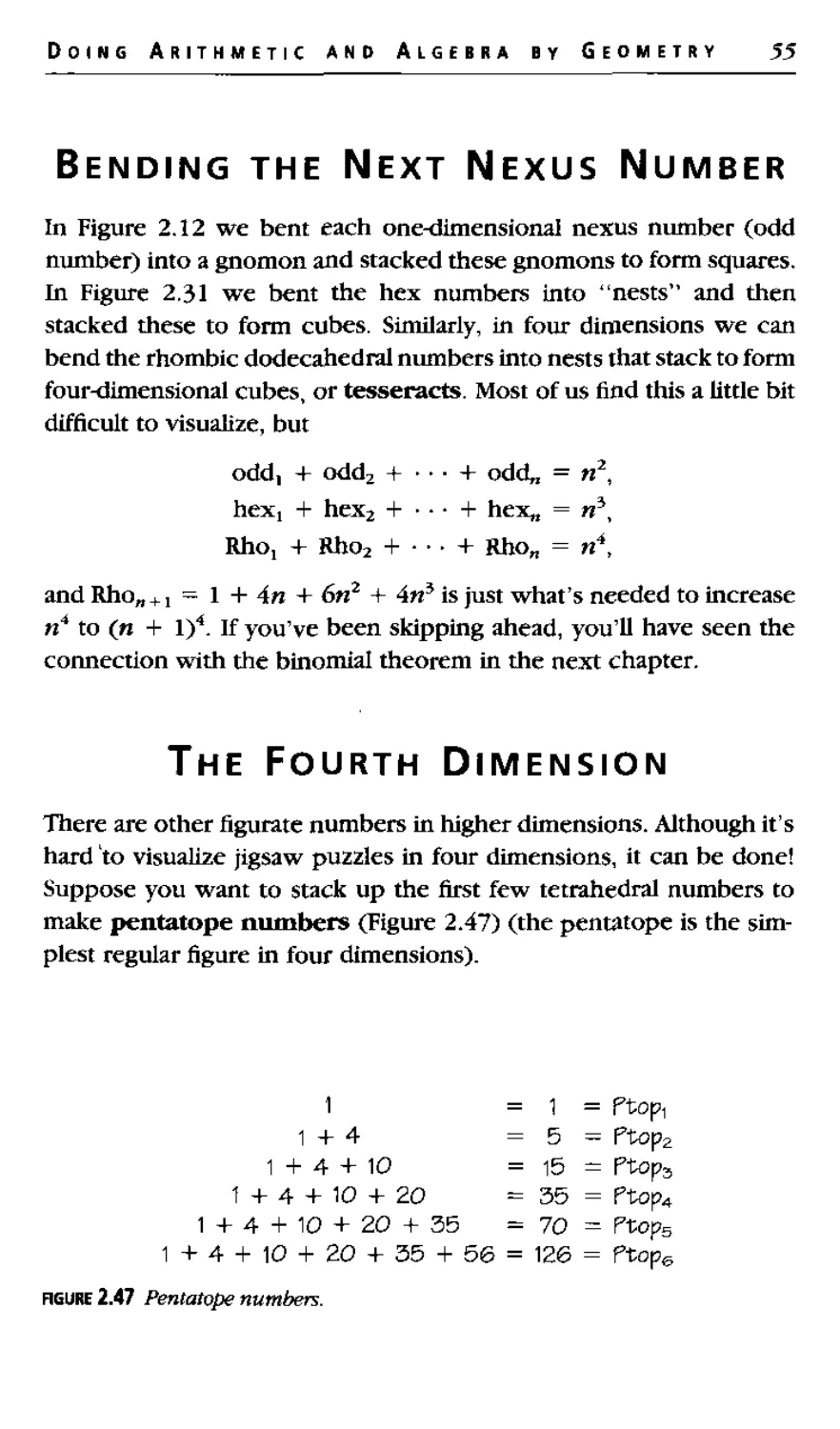


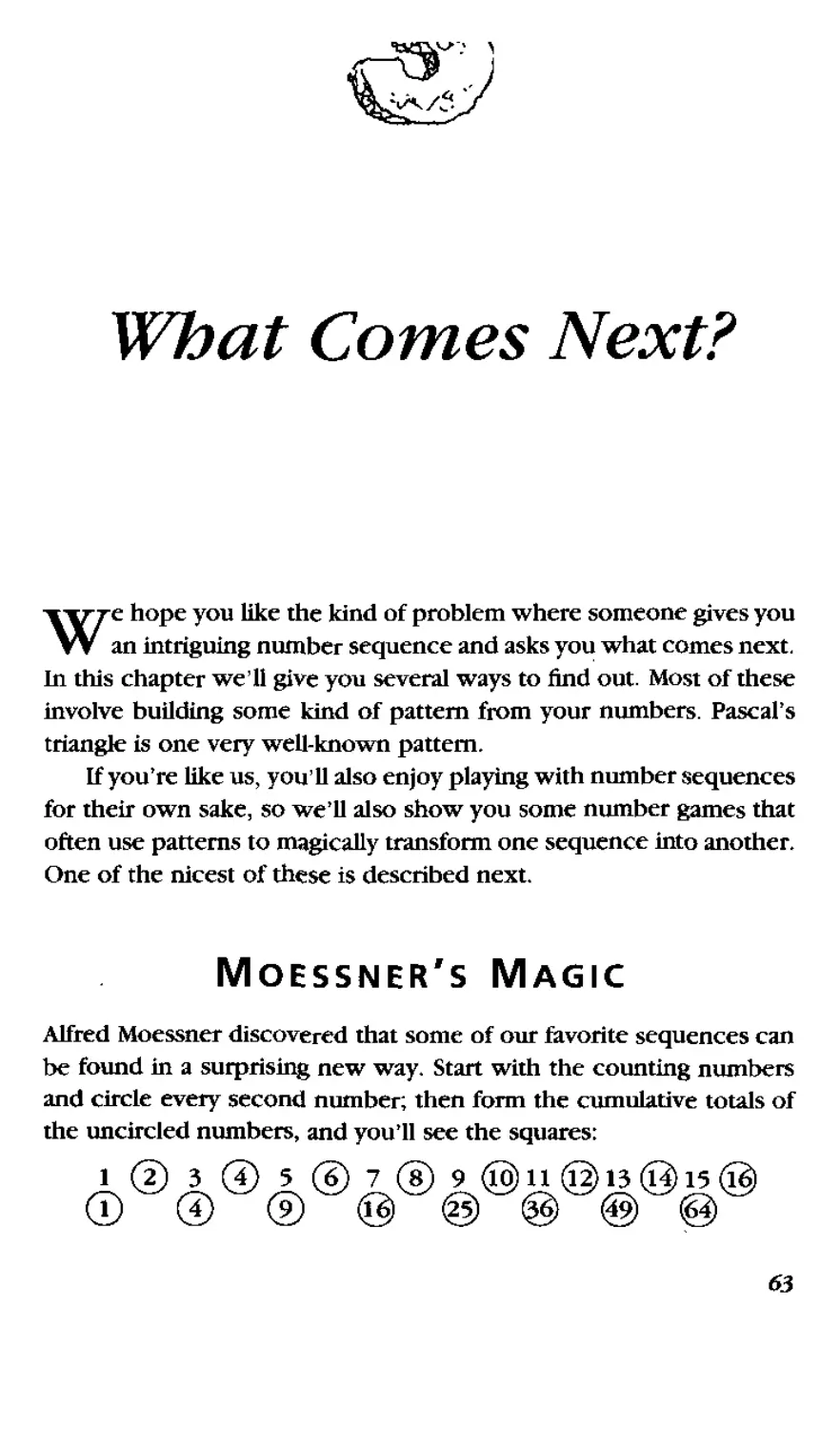
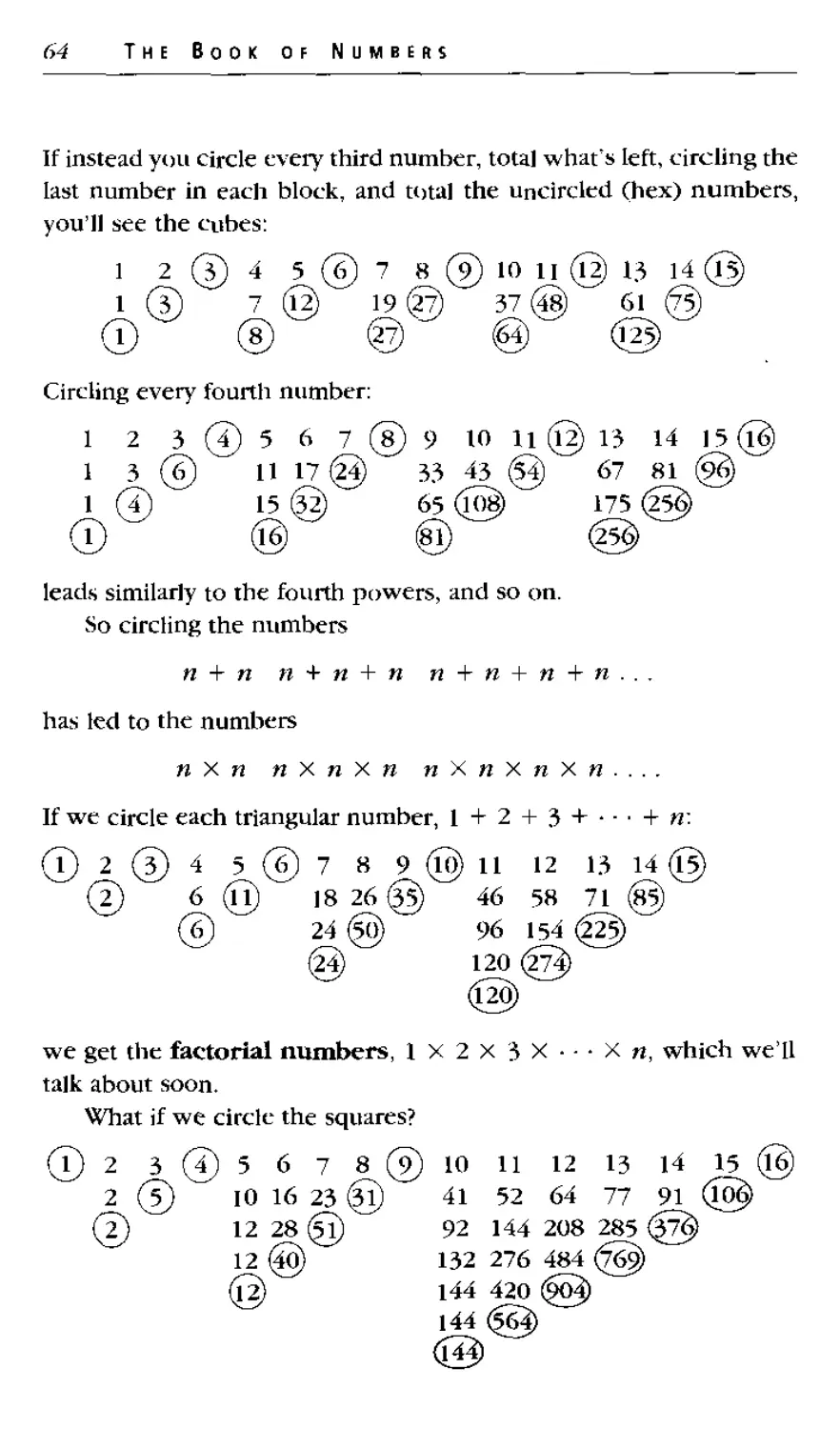









Text
                    The BOOK of
^/yumbers
John H. Conway • Richard K. Guy
С
COP ERNICUS
An Imprint of Springer-Verlag
:>^i} .5MT

© 1996 Springer-Verlag New York, Inc,
All rights reserved. No part of this publication may be reproduced, stored in a re-
retrieval system, or transmitted, in any form or by any means, electronic, mechanical,
photocopying, recording, or otherwise, without the prior written permission of the
publisher.
Published in the United States by Copernicus, an imprint of Springer-Verlag New
York, Inc.
Copernicus
Springer-Verlag New York, Inc>
175 Fifth Avenue
New York, NY 10010
Library of Congress Cataloging in Publication Data
Conway, John Horton.
The book of numbers / John Horton Conway, Richard K. Guy.
p. cm.
Includes bibliographical references and index.
ISBN O387-97993-X (hardcover : alk, paper)
1. Number theory—Popular works, l, Guy, Richard K. II. Title,
QA24l,C6897 1995
512'7—dc20 95-32588
Manufactured in the United States of America.
Printed on acid-free paper.
98765432 1
ISBN 0-387-97993-X SPIN 1О49О867

Preface
The Book of Numbers seems an obvious choice for our title, since
its undoubted success can be followed by Deuteronomy Joshua,
and so on; indeed the only risk is that there may be a demand for the
earlier books in the series. More seriously, our aim is to bring to the
inquisitive reader without particular mathematical background an ex-
explanation of the multitudinous ways in which the word "number" is
used. We have done this in a way which is free from the formality of
textbooks and syllabuses, so that the professional mathematician can
also glean important information in areas outside her own speciality,
and correspondingly enrich her teaching.
The uses of the word number are diverse, but we can identify at
least three separate strands. The development of number (usually
written in the singular), continually adapting and generalizing itself
to meet the needs of both mathematics and its increasing variety of
applications: the counting numbers, zero, fractions, negative num-
numbers, quadratic surds, algebraic numbers, transcendental numbers,
infinitesimal and transiinite numbers, surreal numbers, complex
numbers, quaternions, octonions.
Then there is the special study of the integers, Gauss's higher
arithmetic, or the theory of numbers (usually written in the plural),
which overlaps the more recent area of enumerative combinatorics.
Special sets or sequences of numbers: the prime numbers, Mersenne

vi The Book of Numbers
and Fermat numbers, perfect numbers, Fibonacci and Catalan num-
numbers, Euler and Eulerian numbers, Bernoulli numbers.
Finally there is a host of special numbers: Ludolph's тг, Napier's
e, Euler's y, Feigenbaum's constant, algebraic numbers which arise
in specific contexts ranging from the diagonal of a square or of a
regular pentagon to the example of degree 71 which arises from the
apparently simple "look and say" sequences.
Although mathematics is traditionally arranged in logical se-
sequences, that is not the way the human brain seems to work* While
it is often useful to know parts of earlier chapters in the book when
reading some of the later ones, the reader can browse at will, picking
up nuggets of information, with no obligation to read steadily from
cover to cover.
Chapter 1 describes number words and symbols and Chapter 2
shows how many elementary but important facts can be discovered
"without using any mathematics/1 Chapters 3 and 4 exhibit several
sets of whole numbers which can manifest themselves in quite dif-
different contexts, while Chapter 5 is devoted to the "multiplicative
building blocks/1 the prime numbers. Fractions, or "algebraic num-
numbers of degree one," are dealt with in Chapter 6 and those of higher
degree in Chapter 7. So-called "complex" and "transcendental" num-
numbers are explained in Chapters 8 and 9. The final chapter is devoted
to the infinite and the infinitesimal, to surreal numbers which con-
constitute an extremely large, yet infinitely small, subclass of the most
recent development of number, the values of combinatorial games.
The color graphics in Chapter 2 are the work of Kenny and Andy
Guy, using Brian WyvilTs Graphicsland software at the Graphics Lab-
Laboratory in the Computer Science Department at The University of
Calgary. Three of the figures in Chapter 4 are reproduced from Prze-
myslaw Prusinkiewicz and Aristid Iindenmayer, The Algorithmic
Beauty of Plants, Springer-Verlag, New York 1990, by kind permit
sion of the authors and publishers. The first figure is due to D.R.
Fowler, the second to D.R.F. and P. Prusinkiewicz and the third to
D.R.F. and A. Snider
We thank Andrew Odlyzko and Peter Renz for reading a much
earlier draft of the book, and for making many useful suggestions» We

Preface vii
яге also grateful for the polite and patient persistence of Jerry Lyons,
Liesl Gibson and Henry Krell, and for the general competence of the
Springer staff. We are proud to be among the early contributors to
what is yet another successful Springer series.
Princeton and Calgary John H. Conway and Richard K. Guy

Contents
Preface v
1 The Romance of Numbers 7
2 Figures from Figures: Doing Arithmetic
and Algebra by Geometry 27
3 What Comes Next? 63
4 Famous Families of Numbers 91
5 The Primacy of Primes 127
6 Further Fruitfulness of Fractions 757
7 Geometric Problems and Algebraic
Numbers 181
8 Imagining Imaginary Numbers 211
9 Some Transcendental Numbers 237
10 Infinite and Infinitesimal Numbers 265
Index 301
ix

!v <^
The Romance
of Numbers
Number Words
Throughout history, number and numbers have had a tremendous
influence on our culture and on our language. Thousands of words
are obviously associated with numbers, for example,
a monologue is a speech by 1 person;
a bicycle has 2 wheels;
a tripod is a stool with 3 legs;
a quadruped is an animal with 4 legs;
a pentathlon consists of 5 athletic events;
a sextet is a piece for 6 musicians;
a heptagon is a 7-cornercd figure;
an octopus has 8 "feet";
a nonagenarian has lived for 9 decades;
and decimal means counting in 10s;
but in many other cases the connections, once just as vivid, have
been obscured by the passage of time and changes in meaning.
Have you ever realized just how many words are associated with
"number" itself? This comes from an Indo-European root meaning
"share" or 'portion" and seems to have been originally associated
with the division of land. "Nimble" refers to one who is quick to take
his share; your "nemesis" was originally your portion of Fate; and

The Book of Numbers
"numb11 means "sei2ed" or 'taken.7' Л ''nomad" is one who wanders
about in search of pasture land. There are many technical "nom"
words: "binomial" (two-numbered), "astronomy" (numbering or al-
allotting the stars), "economy," "autonomy/' and so on.
In German we still have the word nehmen, to take, with past
participle "nimm." English once had much the same verb, but by
Shakespeare's day the word "nim" usually referred to illegal taking
or pilfering. In Henry V, Corporal Nym is a doubtful character that
one might well suspect of nimming. In our century 'nim" has be-
become the name of a take-away game.
Latin and Greek nomistna was a coin, and this has given us 'nu-
'numismatics," the love of coins, and "nummulite, ' a coin-shaped fossii.
"Supernumerary" now often means "redundant," but originally su-
supernumerary officials were those in addition to the number laid down
by the regulations.
Hickory, Dickory, Dock—
Eeny, Meeny, Miny, Mo
There are several systems of words for numbers that survived for
special purposes in out-of-the-way places. The particular sequence of
words varies both with the part of the country and the purpose for
which they were used. One such system is
wan, twan, tethera, tnetbera, pimp,
sethera, letbera, bovera, dovera, dick,
wanadick, twanadick, tetberadick, metberadick, pimpdick,
setheradick, letberadick, boveradick, doveradick, bumftt,
wanabumflt,
Such rustic sequences appear in many countries. They are usually
highly corrupted versions of the standard number systems of ancient
languages.
Hickory, dickory, dock.
The mouse ran up the clock.
The clock struck one;
The mouse ran down.
Hickory, dickory, dock.

The Romance of Numbers 3
Probably "hickory, ' "dickory/1 and "dock" are the words for
"eight/7 "nine," and "ten" in one of these systems (compare "hov-
era, dovera, dick")> while "eeny, meeny> miny, mo" mean "one, two,
three, four" in another,
Most languages have interesting features about their number
words, which repay study. We content ourselves with exhibiting
those in Welsh. The alternative forms are for masculine and feminine,
while the parenthetical forms are elisions in front of certain letters.
There are separate ways of saying 50, 70, and 90.
1 un 16 un ar bymtheg
2 dau, dwy 17 dau, dwy ar bymtheg
3 toi, tair 18 deunaw
4 pedwar, pedair 19 pedwar, pedair ar bymtheg
5 pump (pum) 20 ugain
6 chwech (chwe) 30 deg ar hugain
7 saith 40 dugain
8 wyth 50 deg ar deugain; hanner cant
9 naw 60 trigain
10 deg 70 trigain a deg; deg ar thrigain
11 un ar ddeg 80 pedwar ugain
12 deuddeg 90 pedwar ugain a deg; deg a
13 toi, tair ar ddeg phedwar ugain
14 pedwar, pedair ar ddeg 100 cant
15 pymtheg
Note that it is less duodecimal than many languages, which have sep-
separate words for eleven and twelve. It thus lends itself easily to modern
decimalization. There are signs of bases 5 and 20, as well as 10. Cu-
Curiosities arc 18 = 2 X 9 and 50 =
-I Now we come to words associated with particular numbers.
JL When we say someone's "alone," we're really saying he's "all
one/* The word "only" means "one-like," and mixing these ideas we
get "lonely." Originally you would "atone" for your misdeeds by
becoming "at one" with the person you'd affronted. When Mother
Hubbard's "poor dog had none," he had "not one/' Once upon a

The Book of Numbers
time the word "once" was used just for "one time"; a * 'nonce word"
is a word used "for the nonce," that is to say, just for this one time.
The "United States" are many states that have become one. A
trade "union" "unifies" its members into one body. Its members are
"unanimous77 if they speak with one spirit. A principle is "universal"
if it holds throughout the 'universe," the world turned into one ob-
object. Faculty and students form a 'university/' again by being turned
into one body; students at a school wear a "uniform" if their clothing
is of one form. "Unicorns" are mythical beasts with one horn,
'Onion" comes from the same Latin word as 'union.7' Some rus-
rustic Romans referred to an onion as "one large pearl."
The Latin uncia was a unit that was J/i2 of a larger unit, the as. It
has given us "inch" for V12 of a foot, and "ounce," originally Vfeof a
pound. There are still 12 ounces to the pound in Troy weight. The
"uncial'' letters of ancient manuscripts are large, inch-high letters.
"Monopoly" still has its original Greek meaning of "selling by
(only) one person." A "monk" (Greek monakos) is one who is alone
or solitary. A "monolithic" monument is made from one (large) stone,
and your "monogram" is a way to write your name with one drawing,
but perhaps we should leave "one" before we get too "monoto-
"monotonous."
■j The Old English word for this number had two forms: the mas-
w culine, which has given us "twain," and the feminine, or neuter,
which gave us "two." Many English words that contain "tw" are
related to these. "Between," and "betwixt" refer to the position of
an object in relation to two others. "Twilight" is the "between light"
that separates night from day. ''Twine" is formed by a "twist" of two
strands ("twiced") into one. "Twill" is a two-threaded fabric, as is
'dimity.77 "Tweed" was a trade name that originated from an acci-
accidental misreading of "tweel," the Scottish form of "twill." A "twig"
results from one branch splitting into two, and a "twin" from the
splitting of one egg into two. Samuel Langhorne Clemens took his
пот de plume from the cry "Mark twain" (two fathoms) that he
must often have heard during his days as a Mississippi river pilot.
"Didymium," a rare metal discovered in 1841, was so named be-
because of its twin-brotherhood with Lanthanum (the Greek for "twin"

The Romance of Numbers
is didytnos, a word that mentions "two" twice). The name was spe-
specially apposite since, in 1885, didymium was itself found to be a
mixture of two elements, Praseodymium (the "leek-green twin") and
Neodymiuni ("new twin").
A concept exhibits 'duality" when it has two aspects or has a
"dual" purpose; a "duel" is fought by two persons, while a "duet"
is played by them. The word "double" has given us "doublet," orig-
originally a garment with two layers, "doubloon," originally double the
value of a pistole, and "doubt" and "dubious," being in two minds.
"Double-tongued*1 and "bilingual" have literally the same meaning,
but their usage is quite different! A "dilemma" is an argument that
catches you on either of two opposite assumptions.
A "biscuit" has been "twice cooked," the "biceps" are a "two-
headed" muscle, "binoculars" are intended for two eyes, and to "bi-
"bifurcate7' is to split in two at я fork» The "bis" prefix, meaning "twice,"
derives from the Latin duisy which has also given us disy or di, which
means "split," "apart," or "away»" Thus a "digression" is literally a
"walking away."
Since splitting is often acrimonious, "dis" words often сапу а
pejorative, or even negative, sense. For instance, a "devil" (Greek
dia-bolos, throw "between"—itself a "two" word) sows "discord"
by separating two hearts. The variant "bis" is sometimes pejorative
(it has given us "embezzlement") and sometimes not. Compare "bi-
"bisect," or "cut into two (probably equal) parts," with "dissect," or
"cut apart." Your dictionary contains lots of "dis" words: "dismem-
"dismember," "dismantle," "disrupt," "distort," "disturb," "discredit," "dis-
"discourage,"
We "distrust" someone who is "duplicitous." The words "du-
"duplex," "duplicate," and "duplicity" all have the same etymology,
"two-fold," although now a "duplicate" is just a copy, and a "du-
plicitous" person is one who is two-faced,
A "diploma" is a folded (literally "doubled") piece of paper en-
entitling you to certain privileges. A "diplomat" is one who carries a
diploma, entitling him to speak for his country's government.
Some of the most surprising words connected with "two" come
from the Latin diregere (to lead or guide), which combines the "dis"
prefix with regere (to rule). "Dirigible," for a directable balloon,

The Book of Numbers
comes "directly" from this word, as does "dirge," from the Catholic
Office for the Dead:
Dirige, Domine,. . ., viam meant.
So, of course, does "direct" itself, also "director/7 "directory," and
"directoire" (a style of furniture popular in the period of the Direc-
toire). Less obvious is French dresser (from late Latin directiare, to
direct), which has given us "dressage" (the direction and adornment
of horses), whence "dress, ' also "address/7 and "redress." "Adroit"
and "maladroit" come from the French droit ("right," hence "right-
handed, '' or dexterous), itself from the late Latin directus. When you
ask someone to "direct" you, you're really asking which of two ways
is right.
"To dine" originally meant "to breakfast" and so may be cognate
with French dejeuner, which comes from the late Latin disjejunare,
to break one's fast. The word jejunare has also given us "jejune71
(originally, "fasting," later "insipid/' "unsatisfying7')-
"Deuced bad luck, sir!" The "deuce," or two-spot, is the lowest
valued card, and "snake's eyes" (a pair of ones) the lowest throw of
a pair of dice. These bad luck aspects take us back to the "devil"
again, whereas in tennis, "deuce" is the score when you need two
points to win the game, or two games to win the set.
We've just used the word "pair" This comes from the Latinpary
which is related to the Greek para, "beside." Of course, the com-
commercial use, "at par," is immediately derived from this. Akin is the
Greek porne, a harlot, from "pairing person," which has given us
"pornography," writing about harlots. Many mathematical and sci-
scientific words involve "par": "parallel/' "parabola/' "parity" (even-
(evenness or oddness, literally just "evenness").
The prefixes "ambi" and "amphi" come from Latin ambo and
Greek ampho (both, either, double). An "amphitheatre" is a double
theatre, and an "ambidextrous" person has "both right hands"—he
is equally dexterous with each» The pejorative quality of two is again
illustrated by "ambivalent/* which, less than a century ago, just meant
"two-valued/'

The Romance of Numbers
English county of Yorkshire is traditionally divided into
J/ North, East, and West "Ridings" ("thirdings"), a word now used
more generally for "constituencies/* In a similar way, the country
near Rome was divided into the parts inhabited by the Roman, Sabinc,
and Alban tribes» It has been suggested that "tribe" (Latin tribus)
means "one third part of." A "tribute" is a tax "contributed" by a
tribe. A "tributary" is "one who brings tribute": the geographical
sense dates only from 1836, and 'distributary/7 in this sense, from
1886.
A "tribune" was the head of a tribe before whom "tribunals'"
were held; he might well "distribute" "retribution," having first
heard "testamentary" evidence, from ter-stis, to be a third party,
standing between accuser and accused. "Testimonial/' "contest/1
"protest," and "Protestant" are related words.
However, the "tribulations" one might suffer from the delibera-
deliberations of a tribunal are not associated with the number "three," but
rather with rubbing and beating: compare "tribology," the study of
friction, and "tribadism."
A "triumphal" procession is one after the style of the old Bacchic
processions, accompanied by music played in triple-time. A "trump"
card is one that helps you to "triumph."
The "trivium" was where three ways meet: where folks met to
discuss "trivial" subjects* Later it was used for the three liberal arts:
grammar, rhetoric, logic. In the standard medieval curriculum, these
were considered "trivial" compared to those in the "quadrivium":
arithmetic, music, geometry, and astronomy. At universities one stud-
studies for "trimesters" or terms, and at Cambridge University one takes
the "tripos" examination: at one time the questions were asked by
"the bachelor of the tripos," who sat on a three-legged stooL He
might well have asked about the logical notion {tertium поп datur)
of the law of the excluded middle, that there is no tertium quid (third
alternative to truth and falsehood).
Neptune's "trident" has three teeth, a "trammel" was originally
a three-meshed net, "drill" is a three-threaded fabric (c£ "twill"),
geology has both "tertiary" and "triassic" strata, while "tierce" has
many meanings: (the office said at) the third hour of the canonical
day; an old wine measure equal to one-third of a pipe; the third of

8 The Book of Numbers
the eight parries in sword-play; a run of three cards in piquet; the
vertex of a pointed arch; a heraldic charge of three triangles; or the
musical interval of a
/ Workers in a "quarry15 cut "square" stones. The word "square"
& is derived from the Latin ex quadrem, which has also given us
"squadron," now often "squad/* and which refers to troops drawn
up in a battle square» Of course, the Romans used quadrem because
it has four sides, "Quadrille" can be a "squadron," or a square dance
for four couples, or a game for four players with forty cards, or a
pattern of small squares.
In geometry, a "quadrilateral" is any four-sided figure, and you
might call it a "quadrangle*1 if you counted its corners instead. Our
college "quads" are quadrangles, and the slang "quod" for "prison"
is probably the same word.
The "trapeze" artist takes his name from the Greek trapezion, a
four-sided figure, or more literally, a little table (having four feet). The
root words here are of great antiquity and are closely related in many
languages. Thus the Hindi word cbarpoy for bed is much the same
as "trapeze," as are the scientific terms "quadruped5' for a generic
four-legged animal and "tetrapod" for a division of butterflies. Of
course, butterflies belong to the class Hexapoda (six legs), but the
anterior pair of legs of Tetrapoda are unfit for walking.
The German Karo and French carreau for the diamond suit in
cards describe their four-sided shape, and tessera and tessella, four-
sided tile, has given us "tessellation."
In mathematics, "quadratic" equations are those that contain the
"square" D sides) of the variable, Unfortunately, these equations
have degree 2, so that in other mathematical contexts "quadratic"
has come to mean "of second degree," and this has entailed the use
of "biquadratic" (now more sensibly "quartic") for fourth-degree
equations. "Cater-cornered" is really "quater-cornered/*
"Quarter' is a fourth part, e.g., a "quartern" Goaf); and a "quart"
is a quarter of a gallon; the English "firkin" and "farthing" (fourth-
ing) are respectively a quarter of a barrel and a quarter of a penny» A
"quire" of paper was originally 4 sheets, though later 24.
5 Your "fingers" are the five things that make up your "fist," and
"fives" is the name of a game played with the hand. The early

The Romance of Numbers
alchemists recognized four basic elements (earth, air, fire, and water)
from which all ordinary things were made, but the "quintessence"
of ancient and medieval philosophy was the "fifth essence" of which
the heavenly bodies were made.
Masefield's "quinquereme of Nineveh11 had five rows of oars, as
opposed to the "trireme." The word "quincunx" for the pattern X
on a die involves both five and one; in the Roman system for fractions
it was the symbol for five unda (units, ounces, or twelfths),
A "pentagon" is named for its five corners, while a "pentagram"
is drawn in five parts. This has also been called a "pentacle," referring
to its five sharp points. "Punch" is a drink with five ingredients, from
the Hindi word, punch, for five, which also gives us "Punjab/' the
land of the five rivers. The "Pentateuch" comprises the first five
books of the Bible.
6The "Sistine" Chapel was constructed by Pope Sixtus IV (l4l4-
84), whose papal style, "Sixtus," was taken from that of Sixtus I
(Pope ca. 116-125), who took the name to record that he was the
sixth successor to St. Peter
A "sextain" is the last six lines of a sonnet, while a "sestina" is a
poem with six stanzas of six lines each; a Latin poem written in iambic
"hexameters" had lines that were six measures long.
The position of a ship at sea was traditionally found by a "sex-
"sextant," a navigational instrument in the shape of the sixth part of a
circle. You take your "siesta" at midday, the sixth hour of the old 12-
hour day. University 'semesters" are from Latin semestris (six
months); and Tennyson's lady,
clothed in white samite, mystic, wonderful,
was wearing a garment made from a six-threaded fabric (cf. "dimity").
**T $ ^ September, October, November, and December take
/ 1 1 ^their names from the fact that they correspond to the
seventh, eighth, ninth, and tenth months of the old Roman year
which started in March. From 154 в.с, two new proconsuls were
appointed each January 1, and this was gradually adopted for the
year's beginning. In 44 в,с, Quinctilis, the old fifth month, was re-
renamed after Julius Caesar, who had recently reformed the calendar

10 The Book of Numbers
and whose birthday was July 3- Sextilis was renamed Augustus, for
Augustus Caesar, previously called Octavius, in 8 в.с. The names Sep-
Septimus (Septima) and Octavius (Octavia) were customary for the sev-
seventh and eighth children in a family,
The Sabbath is the seventh day. Hebdomadal" (weekly) is de
rived from "hebdomad," a variant of "heptad," from the Greek for a
set of seven. The French and Italian words semaine and settimana
are also obvious "seven" words (Latin septimana).
The first and last of eight consecutive white keys on a piano pro-
produce notes whose frequencies differ by a factor of two. This interval
is called an "octave," although it consists of seven tones.
An "enneagon" is a nine-sided figure. 'The Enneads" are the
work of the philosopher Piotinus in Porphyry's edition (he collected
them into six books of nine sections each).
The word ''noon37 has an interesting history. It comes from the
Latin попа. The "nones" were prayers originally said at the ninth
hour C p.m.) of the old 12-hour day, but which gradually drifted to
midday. A "novena" is a devotional period of nine days. In the Roman
calendar, the * nones' of a month was the ninth day before the "ides1'
of that month. The word "nonillion5' was originally used for the ninth
power of a million, but later it became the tenth power of a thousand.
The "Decalogue' consists of ten commandments, while Boccac-
Boccaccio's "Decameron" contains 100 tales that were supposed to be re-
related in ten days. A "dicker" was a bartering unit often hides: Since
traders would often argue down to the last "dime" (tenth of a dollar),
it has come to mean "haggle." A "tithe," of course, is a tax of one
tenth part.
A religious or scholarly "dean" takes his name from the Latin
decanus, a leader of ten, which has also given us "doyen," the most
senior person in a group. However, the apparently similar word "dea-
"deacon" comes from the Greek diakonos, a servant (literally "one who
passes through, raising the dust").
11 -~>/s\The En£lish word "eleven" is 'one left" (over ten)
X "~~^\Jand "twelve" is "two left." "Dozen" is a corruption
of the Latin duodecim. Your "duodenum" is so called because it is
twelve inches long.
Hotel floors are often numbered 1, 2, . . . , 12,14,15, .... Hotel

The Romance of Numbers 11
owners obviously expect that some of their customers will suffer
from "triskaidekaphobia" (Greek for З&КМеаг, a morbid fear of the
number 13)*
The English words "thirteen" to "nineteen" derive from ''three"
to "nine" with "ten" in an obvious way, and there are analogs in
most other languages» In England a "fortnight" is used for "two
weeks" (= 14 nights), while in France "quinzaine" refers to the same
period (of 15 days). A "quatorzaine" is like a sonnet, having 14 lines.
Carl Friedrich Gauss A777-1855) showed that the regular "hep-
tadecagon" (a 17-sided polygon) could be constructed with ruler and
compasses,
"Score" is related to "share" and comes from the Old Norse
"skor" meaning a "notch" or "tally" on a stick used for counting.
The total count became the "score", still used in games and contests.
Often people counted in 20s; every 20th notch was larger, and so
"score" also came to mean 20- Carpenters still make score lines on
wood they're about to saw, but they may not realize that the biblical
use of "three score and ten" for man's allotted span of 70 years con-
contains essentially the same word- In the sense of "cut off/' the word
"score" is cognate with both 'shirt" and "skirt."
I I $ ^ r\The card game of "pontoon" was brought home by
^ I У / English soldiers from World War I, where they had
been speaking "Paddykelly patois." Americans call it "blackjack"—
of course, "pontoon" is a corruption of the French vingt-et-un, 21.
"Quarantine" is an isolation period, originally of forty days
(French quarante). "Pentecost" comes from the Greek name for the
Jewish festival observed on the fiftieth day of Omen
"Quadragesima" is the forty-day period of Lent, and "Quinqua-
gesima" is the fifty-day period from Quinquagesima Sunday to Easter
Sunday, So Quinquagesima Sunday is the seventh Sunday before
Easter. "Sexagesima" and "Septuagesima" name the two previous
Sundays, apparently as the result of a misunderstanding.
The "Septuagint" is the Greek version of the Old Testament,
named after the "seventy" scholars who were commissioned by Ptol-
Ptolemy Philadelphus B84-247 в.с.) to translate it. (According to tradi-
tradition, there were actually 72 translators, and their work took 72 days.)
The English words * 'twenty" to "ninety1 * arise in the obvious way,

12 The Book of Numbers
but in many languages there is a break in the system after "sixty/'
This has sometimes been interpreted as the survival of an old number
system in which 60 was the base; compare the Babylonian system.
Thus, in French,
70 is soixante-dix F0 + 10),
80 is quatre-vingt D X 20),
90 is quatre-vingt-dix D X 20 + 10),
although the regular formations septante, buitante, nonante have
also been used.
English once treated these numbers in much the same way.
Queen Elizabeth would certainly have said "four score'1 (cf. quatre-
vingt) rather than ''eighty," and of course our biblical lifespan is
"three score and ten."
There have also been special words for "sixty"' that survived in
particular places. The English word "shock" for a collection of sixty
things is still used for sixty sheaves of corn (a variant is "shook") and
was once used for sixty pieces of haberdashery, or a German unit of
account consisting of 60 Groschen. It has also been used for collec-
collections of other large sizes and might be the origin of the phrase "a
shock of hair."
■i j~\ ж"\ A Roman "centurion" was in charge of one hun-
3.Л /'i У » « * dred soldiers. "Centigrade" is the traditional
name for the thermometric system devised by Celsius, with one hun-
hundred degrees between its two fixed points. A "cent" is a hundredth
part of a dollar, a "century" contains one hundred years and a "mil-
"millennium" one thousand. A "mile" consists of one thousand double
paces (Latin mille passus).
Despite their names, "centipedes*' have between 30 and 42 legs,
while only a few4 millipedes'' have as many as 200. One might expect
the proper scientific terms to be more cautious, but in fact the cen-
centipedes and millipedes together form the group Myriapoda ("ten
thousand legs"). The centipedes alone form the order Cbiliapoday
meaning '' Up-legged ": it is no more than a learned pun that this could
also mean "thousand-legged."
The Greek word hekatott has given us' hectare1' for one hundred
units of area, "hecatomb*1 (Greek bous, ox) for the sacrifice of one
hundred oxen, and "hectograph" for a machine that will make hun-

The Romance of Numbers 13
dreds of copies of a drawing. The name of the Greek goddess Hecate
is unrelated, but the hundredth asteroid to be discovered (in 1868)
was named "Hecate," both after the goddess and as a pun on heka-
ton.
A British Member of Parliament cannot resign. Instead, the mem-
member applies for the Stewardship of the Chiltera Hundreds, which (the-
(theoretically) is an office of profit under the Crown, a disqualification
from membership. The word "hundred" here is part of a county,
usually supposed to consist of one hundred hides of land. This word
was also used in the British American colonies and still survives in
Delaware.
Etymologically, "hundred" is just an amplification of the Old En-
English word bund, and the root here is common to all the IndoEuro-
pean languages (Latin centum, Greek bekaton> Gothic bund from a
supposed Indo-European root, kentotri). The last letters in 'thou-
'thousand" have the same meaning: A "thousand" is literally a "strong
hundred."
The numbers indicated by the various names have varied with
the years, Today "hundred" always refers to the "short hundred" of
"five score," but originally it meant the "long" or "great* hundred
of "six score" or "two shocks" A20). In a similar way, a "hundred-
"hundredweight" has varied between 100 and 120 pounds, before stabilizing
at 112 pounds in England or 100 pounds in the United States.
Millions, Billions, and
Other Zillions
The Italians added an augmenting suffix to mille (Latin, "thousand")
to obtain millione ("great thousand"), now milione, from which we
get our "million." Around 1484, N. Chuquet coined the words bil-
billion, trillion, . . . , nonillion, which also appeared in print in a 1520
book by Emile de la Roche. These arithmeticians used "illion" after
the prefixes
b, tr, quadr> quint, sext, sept, oct and non
to denote the
2nd, 3rd, 4th, 5th, 6th, 7th, 8th and 9th

14
The Book of Numbers
powers of a million. But around the middle of the 17th century, some
other French arithmeticians used them instead for the
3rd, 4th, 5th, 6th 7th, 8th, 9th and 10th
powers of a thousand.
Although condemned by the greatest lexicographers as "erro-
"erroneous" (Littre) and "an entire perversion of the original nomencla-
nomenclature of Chuquet and de la Roche" (Murray), the newer usage is now
standard in the U.S., although the older one survives in Britian and is
still standard in the continental countries (but the French spelling is
nowadays "lion" rather than "llion"),
These huge numbers were once just arithmeticians* playthings,
but the march of science has forced people to find even more names
for them. Here are the number-prefixes recommended by the Con-
Conference Generate des Poids et Mesures in 1991 (the number names
are in the American system):
unit
deca
hecto
kilo
mega
tera
peta
zetta
yotta
X N
(da)
(h)
(Ю
(M)
(G)
CO
(P)
(E)
(Z)
(V)
deci
centi
milli
micro
v\ar\o
y\co
femto
atto
zepto
yocto
unit/ N
(d)
(o)
(m)
(M-)
(n)
(P)
(f)
C^)
(z)
(y)
the
10
100
1000
10s
109
1012
1015
101&
1021
1024
number N
= ten
= hundred
= thousand
= million
— biflion
= trillion
= quadrillion
= quintillion
= sextillion
= septillion
How do the "illion" words continue? We shall use "zillion" for
the typical one of them, so that the N4h zillion is io3N+3 (American)
or 106N (British). The first 9 ^zillion" names are Chuquet's i4million
44ЫШоп ", trillion", "quadrillion", "quintillion", 'sextillion", "sep-
tillion", "octillion1', "nonillion", and "centillion>1 is already a well-
established word for the 100th one. You can find a name for any
zillion from the 10th to the 999th by combining parts from the ap-
appropriate columns of the following table, and then replacing the final
vowel by "illion":

The Romance Of Numbers /5
urrrts tens hundreds
1
2
3
4
5
в
7
3
9
un
duo
tre О
quattuor
qLjinqua
septe (*)
octo
nov^ (*)
ГП6
n$
ns
n^
n
n
mx
vlgint[
triginta
septuaginta
octoqlnta
v\or\aqmta
cer\t\
n& trecenti
h* quadringenti
ns quing<?nti
n zeecentl
mx octlnqenti
nonqenti
*Note: when it is immediately before a component marked with * or :
"tre" increases to "tresJ> and "se" to "ses" or ^sex" as appropriate.
Similarly "septeJ> and tcnove^ increase to "septem" and '4novemJ> or
"septen" and "novcnT! immediately before components marked
with m or n.
With Allan Wechsler we propose to extend this system indefi-
indefinitely C1) by combining these according to the convention that
"XilliYilliZillion" (say) denotes the A000000X + 1000Y + Z)th zil-
zillion, using "nillion" for the zeroth "zillion" when this is needed as a
placeholder. So for example the million-and-third zillion is a "milli-
nillitrillion."
You can now use the usual rules for combining this complete
system of zillion words (which first appears in the present Book of
Numbers) so as to obtain correct 'English names', like
"four millinillitrillion (and) fifteen/'
meaning
4Л03000012 + 15 (American) or 4.106OOO0ie + 15 (British),
for all of the integers!
1Our proposal does have one sad effect. Donald Knuth's number "eight billion, eigh-
eighteen million, eighteen thousand eight hundred fifty-seven" js probably no longer the
alphabetically earliest prime number in the American system.

16
The Book of Numbers
We close with a table of English words for powers of ten.
ten or decad
hundred or hecatontad
thousand or chiliad
myriad
lac or lakh
million
crore
myriamyriad
milliard
billion
trillion
quadrillion
decillion
vigintillion
centillion
googol
googolplex
TVplex
Mninex
101
104
105
106
107
10*
109
109 (formerly 1012)
1012 (formerly 1018)
1019 (formerly 10*1)
1033 (formerly 1060)
1O63 (formerly 10120)
10303 (formerly 10600)
w
ioo
(Rudy Rucker)
" (Tadashi Tokieda)
We recommend "Npiex" and "Ntninex" both as the nouns for
those numbers and as adjectives indicating multiplication by them.
So "hundredplex" is another name for a googol, the mass of the Sun
is roughly two 33plex grams, and an Angstrom unit is a lOminex
meter.
Some other cultures have more interesting names for these
numbers. Japanese has individual names for various powers of
ten between 10~32 and Ю88, many of Indian origin. Some of these
are
amount of nothing"
"don't even think about jt>5
"sands of the Оащее*
"breathing instant"
"finger
"clean"
£>£>plex
£Oplex
56plex
16minex
17minex
23m[nex
= miiryout^ieuu
= fukaehi^i
= kouqaeha
~ shunsoku
= danehi
= jou

The Romance of Numbers 77
How Numbers Are Written
There have been many different number names, notations, and sym-
symbols in the world's history. We'll only describe a few that have had
significant influence on Western civilization.
Perhaps the earliest recorded occurrences of numerals are on
some Sumerian clay tablets dating from the first half of the third mil-
millennium b.c. The Sumerian system was later taken over by the Bab-
Babylonians. The surviving Babylonian documents are mostly from two
periods: Old Babylonian, from around the time of Hamurabi « 1500
B.C. and the Seieucid era, from 300 B.C.. The Babylonian cuneiform
(Latin cuneus wedge) script was formed by impressing wedge-shaped
marks in clay tablets. Their notation for numbers used the base 60,
with individual symbols, Г and <, for 1 and 10; there is a famous ex-
example in Chapter 7, Another is Plimpton 322, a remarkable table of
"Pythagorean triples (see Chapter 6). This system is very easy to read
and is an early instance of place notation. For instance, the symbols
<" and «1TI mean 15 and 23, while ФГ would read A5 X 60) + 23
- 923.
It is because the ancients made astronomical calculations in base
60 that we still use this system for measuring time, dividing an hour
into 60 minutes, and a minute into 60 seconds. In its path through
the heavens, the sun takes roughly 360 days (actually 365.242199) to
describe a complete circle, so it seems that the Babylonians divided
a complete circle into 360 degrees (°). In the Babylonian manner,
each degree is divided into 60 minutes ('), each minute into 60 sec-
seconds O, each second into 60 thirds ('"), and so on.
Again, it is because mathematical and astronomical tables written
in this notation were so hard to recompute that a modern astronomer
writes an angle 25°32'l4" just as his Babylonian forebears wrote
and similarly, that you say that the time is 9:45 (9 hours, 45 minutes)
rather than 975 hours,
We see that the Babylonians used place value, the symbol Г mean-

18 The Book of Numbers
ing 1 or 60 or 602 or ... , according to its position. This could be
confusing, because they had no 2cro. Occasionally they left a space,
and later the Seleucids introduced the symbol ^ Unfortunately, place
value was not used in the clumsier Greek and Roman systems and
only reappeared in our own system, using the Hindu-Arabic notation.
The Egyptians used a different system, which we'll discuss when we
describe the Roman system, to which it is very similar.
The Greek System
The Greeks, from about the fifth century в,с, used the notation il-
illustrated in Figure 1Л.
Since their alphabet had only 24 letters and 27 were needed, they
resurrected three letters of Semitic origin, namely digamma (F) or vau
(s), qoph or koppa (<?, T) and san or sampi (^) to represent 6, 90,
and 900. There were various systems for numbers larger than a myriad
A0,000), Diophantus, around the third century ad., used a dot to
indicate that the preceding numbers should be multiplied by 10,000.
He gave the following example.
,a т \ a . ,e a i 6
13 3 1 5 2 14
1
I
10
P
100
000
Э
2
к
20
0"
200
2000
7
3
X
30
T
300
л
3000
8
4
40
400
,8
4O00
€
V
50
Ф
500
,e
5000
F
6
60
X
600
rF
6000
7
о
70
Ф
700
7000
-n
Ь
ьо
аоо
3000
е
9
?
90
900
•в
9000
FIGURE 1.1 The Greek number system.

The Romance of Numbers 19
The Roman System
The fact that we are still familiar with the Roman numerals (some-
(sometimes used on clock faces, monuments, and some documents) is be-
because they were the only ones in use in Europe for well over a thou-
thousand years. The Roman number system was based on a similar one
used by the Etruscans, the letters I, V, X, L, C, D> M being based on
the Etruscan originals. The Romans assimilated the earlier С and <"h
for 100 and 1,000 to the Latin letters С and M, which happened to
be the initial letters of centum and mille. Half of <~b was simplified to
h or D for 500. The symbols
for 5000 10000 50000 100000
are fortunately no longer used, although twenty-two of the original
32 copies of fifffi) can still be seen on the Columna Rostrata, describ-
describing the capture of 3,200,000 prisoners.
The symbol *>? also a corruption of <"h? was occasionally used as
an alternative for 1,000. In 1655 John Wallis (l6l6-1703) proposed
that this symbol be used for "infinity/' and mathematicians have used
it ever since.
The subtractive principle, whereby 9 and 40 are written as EX and
XL, only became popular in medieval times. It was hardly used by the
Romans.
Roman fractions were based on twelfths ("uncia" from "unus,"
i.e., one of the lesser units); we discuss them later.
The Egyptian System
The Egyptians had earlier used a similar system to the Roman one,
but with fewer symbols: Figure 1.2 compares the two systems.
The Romans would have had to write
crrim (t (In) пт1тп ггИтп nrtm crrhrn nrtm nrtm nrhrn стгЬт)
for a million. The Egyptians had a much nicer symbol: a man with his
arms uplifted:

20
The Book of Numbers
Egyptian
1
n
nnnnn
(lotus flower) ^
iiiii
(finger with bent tip) 4)
(tadvoie) c^>
1
5
10
50
100
500
1000
5000
Ю000
50000
Ю00000
Roman
I
V
X .
L
С
D
M
Id
m
ЙТВ)
For example
ППП
11
4
ППП" I
2 3 7 4
MM CCC LXX III!
FIGURE 1.2 The Egyptian and Roman number systems.
Hindu-Arabic Numerals
The numeration we use now, in which numbers are formed by jux-
juxtaposing the ten digits 0, 1, 2, 3, 4, 5, 6, 7, 8, 9 is often referred to as
Arabic notation. In fact it is of ffindu origin and was transmitted to
Europe, like a lot of the world's knowledge, by Arab scholars.
The value of a digit depends on its position in the system (its
place value) so that one needs a symbol for гего, to distinguish 904
from 94, for example. It was in this way that the concept of *ero
forced itself onto the Indian mathematicians. Theoretically, zero is
also needed occasionally in the Babylonian system, but as the base is
so much larger, the context would usually supply the missing infor-

The Romance of Numbers 21
mation> and, as we've seen, the Babylonians struggled on without it
for over a thousand years.
The system is so familiar to us that we regard it as giving the
names for numbers, as being what a number really is! When a date
is given in Roman numerals, for example, most of us painfully trans-
translate it into the Arabic system. Originally it was the other way around!
In medieval times the merchants of Europe were thoroughly familiar
with the Roman system and found the new Arabic system very con-
confusing, and early examples often contain mistakes or mix the two
systems,
M50iv = 1504
Lowercase numerals were also introduced in medieval times, and
it was not uncommon to see mcdxxvi = 1426. Nowadays, this system
of lowercase numerals only survives in special places such as subsec-
subsections of a list or in numbering the preliminary pages of a book.
Numbers in Other Bases
Of course, a similar system of notation can be defined using any
whole number, Ny as a base. In the base TV system, "abcct* means
aNb + bN2 + cN + dy
and the "digits" a, b, c, ^customarily range from 0 toN-l.
Our Hindu-Arabic system is also called decimal (base 10); the
Babylonian system was sexagesimal (base 60); and most computers
internally use the binary system (base 2). The octal (base 8) and
hexadecimal (base 16) systems are easUy convertible to the binary
system and so are often used by computer programmers. Numbers
written in base 2 are often called ' 'binary numbers.'' Of course, binary
numbers are not a new kind of number, they're just the old numbers
under a different name:
1, 10 = 2, 11 = 3, 100 =* 4, 101 = 5,
110 = 6, 111 = 7, 1000 = 8, . . .

22
The Book of Numbers
Kinds of Numbers
We've organized this book around different kinds of numbers: the
following brief survey introduces them.
The familiar whole numbers, 1, 2, 3, ... (Chapter 2) have a
history that starts even before our own. Certain species of bird can
detect that one of the eggs in their nest has been removed. Presum-
Presumably they have some primitive idea of how many eggs there should
be. An experiment described by Tobias Dantzig shows that crows
could recognize when up to four men with guns had come and gone.
The birds kept a safe distance in the meantime but could be fooled
if as many as five came and only four went.
However, many primitive human languages only have names for
numbers of particular objects, and not for the idea of numbers. The
Fiji Islanders use "bolo" for ten boats, but "кого" for ten coconuts
and "salora" for one thousand coconuts. The divorce between the
abstract concept of number and the objects being counted took a
12
б" = 12
4" = 12
J_ _ 4_
3 " 12
_5
12
1 _ 6
2" " 12
L
12
3 ~ 12
3_ = 9_
4 12
б" " 12
5
= — Т
12 L
uncia
sextans
triens
quincunx
dodrans
dextans
deunx
from unue, "one" (smaller unit)
one-sixth (of the larger unit)
ona-third
fwe uncla
one-half
seven uncia
dues partes ^sis
de quadrans (a quarter short)
de eextans
de uncia
the naxt unit
FIGURE 1.3 Roman fractions.

The Romance of Numbers 23
long time, and evidence is still visible; a couple (of people), a brace
(of pheasants), a century (of years, or runs at cricket)»
Special families of numbers are discussed in Chapters 3 and 4. A
particularly interesting family is the prime numbers, whose intriguing
properties demand a chapter of their own, Chapter 5.
Fractions, or rational numbers (Chapter 6), are surely a human
discovery, whose origins are lost in antiquity. However, most of the
early systems named only a few obvious common fractions.
The Rhind papyrus, dated from 1650 в.с, had simple names only
for the unit fractions, £, i, i, 5, . . . , and for § 0^). Other fractions,
when required, were made by adding these, e.g., б = 2 + б + Тоог
i = ^ + \y although some early papyri have £3 for f.
The Roman notation for fractions is not generally very well
known. Their unit was customarily divided into twelve smaller units,
and they had names and symbols for all the multiples of these (Figure
1.3).
The fact that there are Irrational numbers, that are not frac-
fractions, came as a great surprise to the Greeks and is still probably
unfamiliar to most of the world's inhabitants. Traditionally, this dis-
discovery is credited to Pythagoras, who found that the diagonal of a
square is not a rational multiple of its side; that is, the ratio of diagonal
to side cannot be expressed by whole numbers. The Pythagorean
brotherhood is supposed to have sacrificed a hecatomb, or a hundred
oxen, in honor of this stupendous discovery. The irrational number
involved is one of the algebraic numbers treated in Chapter 7.
We've already seen how the problems of notation brought the
new number zero, 0, to the attention of mathematicians. It was the
introduction of algebra (solve 2x + 7 = 3) that forced us to recognize
negative numbers. Initially, negative numbers were regarded as
very mysterious things, although the advances of science and tech-
technology have made them very familiar to us.
Algebra also led to the introduction of complex numbers,
which are even more puzzling. We remove some of the mystery in
Chapter 8.
On the other hand, algebraic equations do not suffice to define
all the numbers of interest to us, and we are forced to recognize
transcendental numbers, whose existence was first shown by

т= 1.6180339887 4989484820 4586834365 6381177203 0917980576 2862135448-
6227052604 6281890244 9707207204 1893911374 8475408807 5386891752.
V2 = 1.4142135623 7309504880 1688724209 6980785696 7187537694 8073176679-
7379907324 7846210703 8850387534 3276415727 3501384623 0912297024 .
V3= 1.7320508075 6887729352 7446341505 8723669428 0525381038 0628055806-
9794519330 1690880003 7081146186 7572485756 7562614141 5406703029.
ir = 31415926535 8979323846 2643383279 5028841971 69399375Ю 5820974944-
5923078164 0628620899 8628034825 3421170679 8214808651 3282306647.
е = 2.7182818284 5904523536 0287471352 6624977572 4709369995 9574966967-
6277240766 3035354759 4571382178 5251664274 2746639193 2003059921 .
7 = 0.5772156649 0153286060 6512090082 4024310421 5933593992 3598805767-
2348848677 2677766467 0936947063 2917467495 1463144724 9807082480 .
In 10 = 2.3025850929 9404568401 7991454684 3642076011 0148862877 2976033327-
9009675726 0967735248 0235997205 0895982983 4196778404 2286248633 .
In 2 - 0.6931471805 5994530941 7232121458 1765680755 ОО13436О25 5254120680-
0094933936 2196969471 5605863326 9964186875 4200148102 0570685733 .
loglo 2 = 0.3010299956 6398119521 3738894724 4930267681 8988146210 8541310427-
4611271081 8927442450 9486927252 1181861720 4068447719 1430995379-
Iog23= 1.5849625007 2115618145 3738943947 8165087598 1440769248 1060455752-
6545410982 2779435856 2522280474 9180882420 9098066247 5059167343 .
F, = 4.6692016091 0299067185 3203820466 2016172581 8557747576 8632745651 .
F2 2.5029078750 9589282228 3902873218 2157863812 7137672714 9977336192 .
HGURE 1.4 Some of our favorite numbers.

The Romance of Numbers 25
liouville in 1840. It had long been suspected that the notorious num-
number 77 was transcendental, although this was only finally established
by Ferdinand lindcmann in 1882. We'll read about it and other tran-
transcendental numbers in Chapter 9*
Children sometimes ask "How many numbers are there?" A co-
coherent theory of infinite numbers was first developed by Georg
Cantor from 1872 to 1884. The number of whole numbers is Cantors
Ко, as is the number of algebraic numbers, while the number of tran-
transcendental numbers is 2*°. In fact, Cantor introduced two distinct
systems of infinite numbers, cardinal numbers and ordinal num-
numbers, and we explain them in Chapter 10. These are generalizations
of the ordinary whole numbers, 0, 1, 2, 3, . . . . The appropriate gen-
generalization for fractional numbers and other real numbers was dis-
discovered only recently, by one of us. The resulting surreal numbers
are also described in Chapter 10.
Some Special Friends
As we explore the different kinds of numbers, we can't help becom-
becoming familiar with interesting individual numbers and families of num-
numbers. On the way we hope that you'll make friends with many par-
particular numbers.
Two is celebrated as the only even prime, which in some sense
makes it the oddest prime of all. We'll show you how to construct a
regular seventeen-sided polygon with ruler and compass, and we'll
tell you what's special about one hundred and sixty-three.
In addition to Pythagoras's number V2 and Ludolph's number
ТГ, geometry has given us the golden number т, while analysis pro-
produces Napier's number e and the Euler-Mascheroni number 7.
Special numbers like these continue to appear as our knowledge ex-
expands; two new ones are Feigenbaum's numbers Fx and F2 (see
Chapter 7). Some of our favorite numbers are displayed in Figure 1 .4.
The last two items were taken from Simon Plouffe's Table of Con-
Constants, under construction in connexion with the Inverse Symbolic
Calculator mentioned below. What are your favorite numbers? What
do you do if you come across a number and don't know what it is?

26 The Book of Numbers
We quote from the Preface of the Borwcins' book:
How do we decide that such a number is actually a special value of a familiar
function without the tools Gauss had at his disposal, which were, presum-
presumably, phenomenal insight and a prodigious memory?
Jonathan Borwein & Peter Borwein
The Borweins are currently building an online, internet-based,
number checker. It is like a spell checker. You put your number in
and it confirms hits. They call it the "Inverse Symbolic Calculator' *
and it can be accessed at hup://www.cecm,sfuxa/projects/ISC.html
References
Asger Aaboe. Episodes from the Early History of Mathematics, New Math.
Library 13, Math, Assoc. of America, 1964.
J. Borwein & P. Borwein. A Dictionary of Real Numbers, Wadsworth, 1990.
Lucas N. H. Bunt, Phillip S.Jones, and Jack D. Bedient. The Historical Roots
of Elementary Mathematics. Prentice-Hall, Englewood Cliffs, NJ, 1976.
A. B, Chace, and others. The Rhind Mathematical Papyrus. Math. Assoc. of
America, Oberiin, OH, 1927-1929.
John H. Conway, On Numbers and Games, Academic Press, London, 1976.
Tobias Dantzig. Number, the Language of Science, Doublcday Anchor,
1956.
H.-D. Ebbinghaus, H. Hermes, F> Hirzebruch, M, Koecher, K. Mainzer, J.
Neukirch, A. Prestel & R, Remmert- Numbers, Springer-Verlag, Graduate
Texts in Mathematics, 123, 1991.
Richard J. Gillings. Mathematics in the Time of the Pharaohs. MIT. Press,
Cambridge, MA, 1972.
Donald E. Knuth, Surreal Numbers, Addison Wesley, Reading MA, 1974,
Karl Menninger. Number Words and Number Symbols. A Cultural History
of Numbers, trans. Paul Broneer from rev. German ed., MIT, Press, Cam-
Cambridge, MA, 1969, 1977,
Otto Neugebauer. The Exact Sciences in Antiquity, Brown Univ. Press, 1957;
reprinted Dover, 1969-
Eric Partridge. Origins, A Short Etymological Dictionary of Modern English.
Rudy Rucker. Mindtools, Houghton Mifflin Company, Boston, 1987.
David Eugene Smith & Jekuthiel Ginsberg. Numbers and Numerals, and see
James R. Newman, The World of Mathematics, Gcoi^e Allen & Unwin,
London, 1960, pp. 442-464.

Figures from Figures
Doing Arithmetic and
Algebra by Geometry
Patterns Provide Pretty Proofs
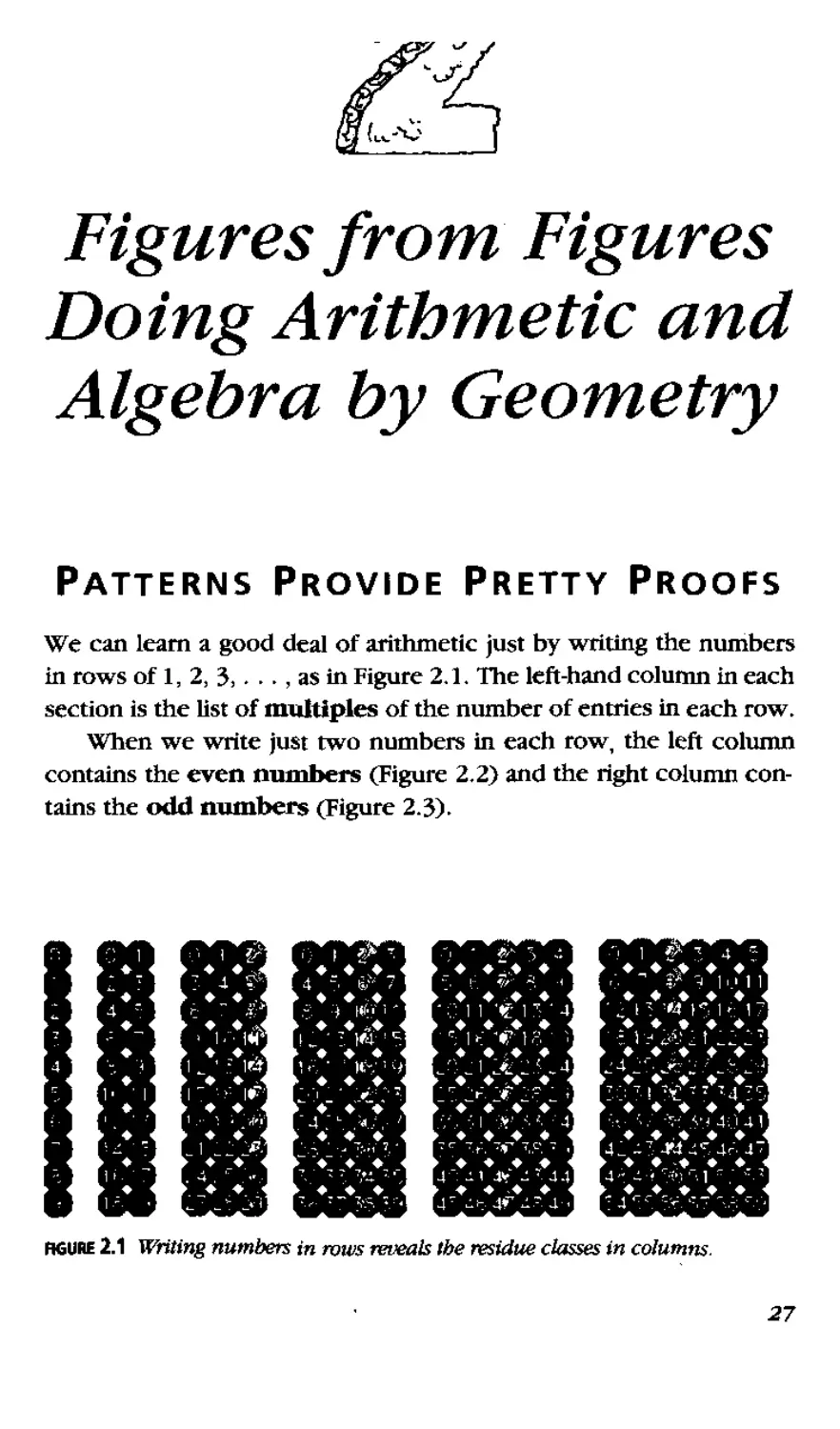
We can learn a good deal of arithmetic just by writing the numbers
in rows of 1, 2, 3, - - , as in Figure 2.1. The left-hand column in each
section is the list of multiples of the number of entries in each row.
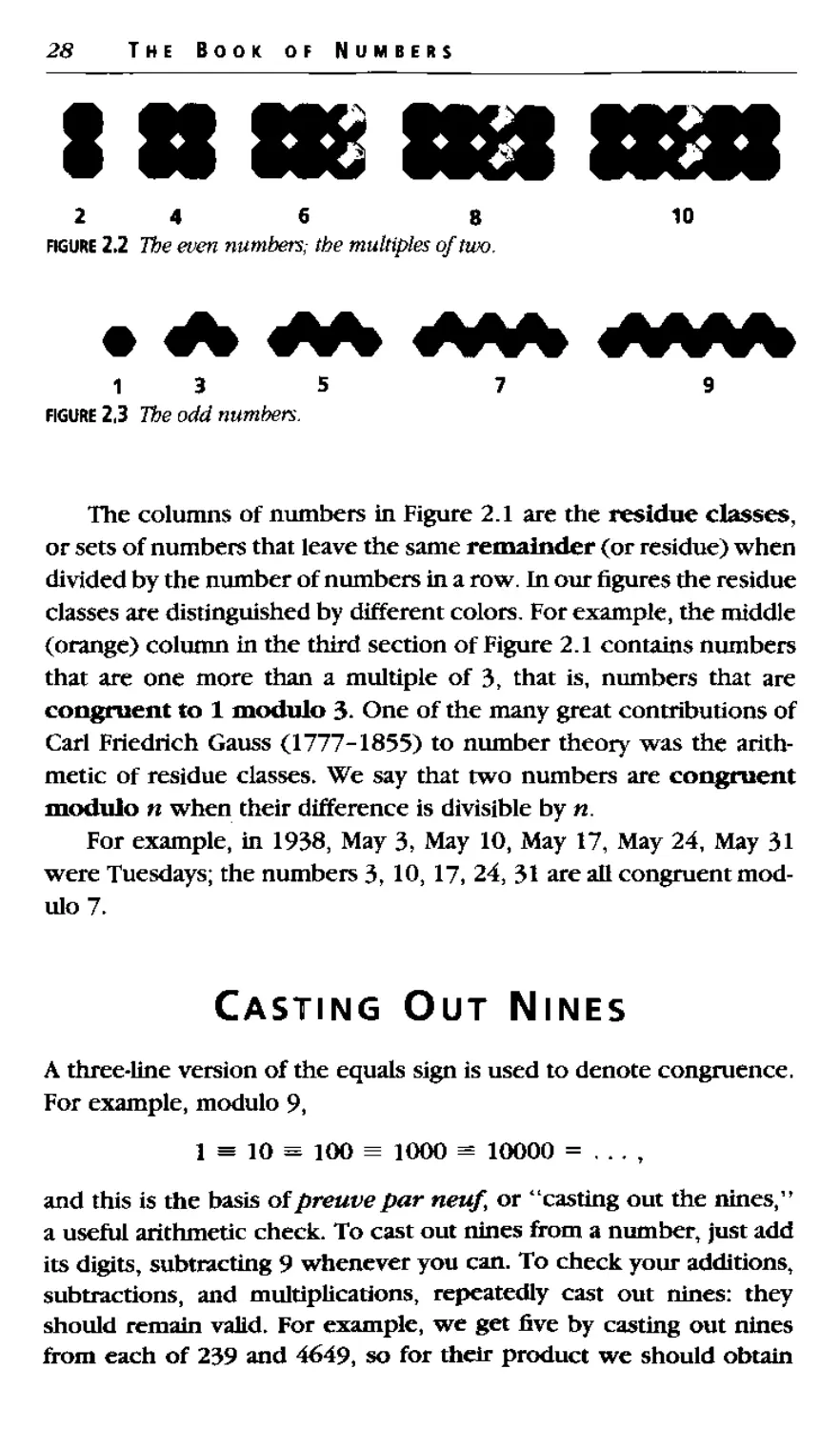
When we write just two numbers in each row, the left column
contains the even numbers (Figure 2.2) and the right column con-
contains the odd numbers (Figure 2.3)»
figure 2,1 Writing numbers in rows reveals the residue classes in columns.
27

26 The Book of Numbers
We quote from the Preface of the Borweins' book:
How do we decide that such a number is actually a special value of a familiar
function without the tools Gauss had at his disposal, which were, presum-
presumably, phenomenal insight and a prodigious memory?
Jonathan Borwein & Peter Borwein
The Borweins are currently building an online, internet-based,
number checker. It is like a spell checker. You put your number in
and it confirms hits. They call it the "Inverse Symbolic Calculator*1
and it can be accessed at http://www.cecm.sfu. ca/projectsASChtml
References
Asger Aaboe. Episodes from the Early History of Mathematics, New Math.
Library 13, Math. Assoc. of America, 1964.
J. Borwein & P. Borwein. A Dictionary of Real Numbers, Wadsworth, 1990.
Lucas N. H. Bunt, Phillip S- Jones, and Jack D. Bedient, The Historical Roots
of Elementary Mathematics. Prentice-Hall, Englewood Cliffs, NJ, 1976.
A. B. Chace, and others. The Rbind Mathematical Papyrus. Math» Assoc, of
America, Oberiin, OH, 1927-1929*
John H. Conway, On Numbers and Games, Academic Press, London, 1976.
Tobias Dantzig. Number, the Language of Science, Doubleday Anchor,
1956.
H.-D. Ebbinghaus, R Hermes, F. Hirzebruch, M, Koecher, K, Mainzer, J,
Neukirch, A. Prestel & R, Remmert. Numbers, Springer-Verlag, Graduate
Texts in Mathematics, 123, 1991.
Richard J. Gillings. Mathematics in the Time of the Pharaohs. МЛЛ1. Press,
Cambridge, MA, 1972.
Donald E. Knuth, Surreal Numbers, Addison Wesley, Reading MA, 1974,
Karl Menninger. Number Words and Number Symbols. A Cultural History
of Numbers, trans. Paul Broncer from rev. German ed.,M,LT Press, Cam-
bridge, MA, 1969, 1977.
Otto Neugebauer. The Exact Sciences in Antiquity, Brown Univ. Press, 1957;
reprinted Dover, 1969-
Eric Partridge. Origins, A Short Etymological Dictionary of Modern English.
Rudy Rucker. Mindtools, Houghton Mifflin Company, Boston, 1987-
David Eugene Smith & Jekuthiei Ginsbe^. Numbers and Numerals, and see
James R. Newman, The World of Mathematics, Gcoi^e Allen & Unwift,
London, I960, pp. 442-464.

Figures from Figures
Doing Arithmetic and
Algebra by Geometry
Patterns Provide Pretty Proofs
We can learn a good deal of arithmetic just by writing the numbers
in rows of 1, 2, 3, . . . , as in Figure 2.1. The left-hand column in each
section is the list of multiples of the number of entries in each row.
When we write just two numbers in each row, the left column
contains the even numbers (Figure 2.2) and the right column con-
contains the odd numbers (Figure 2.3).
RCURE 2.1 Writing numbers in rows reveals the residue classes in columns.
27

28 The Book of Numbers
1ЙКШЯ»
2 4 6 8 10
FIGURE 2.2 The even numbers; the multiples of ttvo.
1 3
FIGURE 2,3 The odd numbers.
The columns of numbers in Figure 2.1 are the residue classes,
or sets of numbers that leave the same remainder (or residue) when
divided by the number of numbers in a row. In our figures the residue
classes are distinguished by different colors. For example, the middle
(orange) column in the third section of Figure 2.1 contains numbers
that are one more than a multiple of 3, that is, numbers that are
congruent to 1 modulo 3* One of the many great contributions of
Carl Friedrich Gauss A777-1855) to number theory was the arith-
arithmetic of residue classes» We say that two numbers are congruent
modulo n when their difference is divisible by n.
For example, in 1938, May 3, May 10, May 17, May 24, May 31
were Tuesdays; the numbers 3, 10, 17, 24, 31 are all congruent mod-
modulo 7.
Casting Out Nines
A three-line version of the equals sign is used to denote congruence.
For example, modulo 9,
1 = 10 = 100 = 1000 = 10000
and this is the basis of preuvepar neuft or "casting out the nines,"
a useful arithmetic check. To cast out nines from a number, just add
its digits, subtracting 9 whenever you can. To check your additions,
subtractions, and multiplications, repeatedly cast out nines: they
should remain valid» For example, we get five by casting out nines
from each of 239 and 4649, so for their product we should obtain

Doing Arithmetic and Algebra by Geometry
29
5X5 = 25 = 2 + 5 = 7, agreeing with 239 X 4649= 1111111 =7.
You can test the multiplication 127 X9721 = 1234567 similarly. Now
suppose we wish to check that
232 + l - 4294967297 = 641 X 6700417-
The sums of the digits of the two factors are 11 and 25, and the sums
of their digits are 2 and 7, whose product is 14, the sum of whose
digits is 5* The sum of the digits of the big number is 59, which
likewise gives 14 and then 5» The agreement doesn't guarantee the
answer, but we can be sure that there's no copying error of just one
digit, except that it is possible that a 0 was swapped with a 9, or vice
versa. The test does not detect a mistake in the order of the digits.
You can also check the first equality with five squarings C2 = 2*):
22 = 4, 4Z = 16 = 7, 72 - 49 - 4, 42 = 16 ^ 7, 72 = 4 and
4+1=5.
Colors Reveal Patterns
When we color one section of Figure 2.1 with the colors from an-
another, the residue classes make regular patterns. If the length of
figure 2.4 The odd (orange) and even (red) numbers form checkerboard patterns.
figure 2.5 The residue classes modulo 3, 0 (red), 1 (orange), 2 ($ellaw).

30
The Book of Numbers
figure 2.6 The residue classes modulo 4: 0 (red), 1 (orange), 2 (yellow), 3 (green).
FIGURE 2.7 The residue classes modulo 5 0 (red), 1 (orange), 2 (yellow), 3 (green), 4
(blue).
the row is odd, then the odd (orange) and even (red) numbers form
a checkerboard pattern (Figure 2.4).
If the modulus, that is, the number of columns, is not a multiple
of 3, the (red, orange, yellow) residue classes modulo 3 appear as
diagonal stripes (Figure 2.5)«
Modulo 4 the (red, orange, yellow, green) residue classes form
columns, or diagonals (left and right of Figure 2,6), or (when the row
length is a singly even number, An + 2, such as 6 or 10; i.e., divis-
divisible by 2, but not by 22) a design reminiscent of knights' moves in
chess (middle of Figure 2.6).
The knights' moves are especially noticeable for the residue
classes modulo 5, whenever the row length is congruent to ± 2 mod-
modulo 5 (two rightmost sections of Figure 2.7).
Square Numbers
If we collect the multiples of 1, 2, 3?« . . , that is, the first columns
from each part of Figure 2.1, into a single table, we have the multi-
multiplication table (Figure 2.8), whose main diagonal gives us the
square numbers (Figure 2.9).

Doing Arithmetic and Algebra by Geometry
31
5 6 7 S 9 10
♦ ♦♦♦♦♦♦♦><
2 4 6 6 10 12 14 16 15 20
4 S 12 16 20 24 23 32 36 40
5*0*15*20*25^0*35*40 45 50
♦ ♦♦♦♦♦♦♦♦<
6 12 18 24 30 36 42 4354 60
8 16 24 32 40 48^56 64^72^80
10 20 30 40 50 60 70 50 90IOC
Figure 2.8 The multiplication table has the
square numbers as its leading diagonal.
t*=1 22=4 32=9 42=16
FIGURE 2.9 The square numbers.
6*=36
FIGURE 2.10 Quadratic residues: the residue classes in which the squares lie.
hi which residue classes do the square numbers Ue? Figure 2,10
shows us the answers for moduli 5, 7, and 8, Figure 2Л0(а) is the
same as Figure 2>l(e), with just the square numbers colored red.

32
The Book of Numbers
From Figure 2Л0(с) we see that
The odd squares are
congruent to 1 modulo 8.
Well see another neat proof of this after we've met the triangular
numbers (Figure 2.23)*
Figure 2.11 shows you that the squares are always congruent to
0, 1, or 4 modulo 5 (count the red blobs).
You may have noticed in Figure 2Л0 that the squares lie on pa-
parabolas, which are the curves you get when you draw graphs of
quadratic expressions, or polynomials of degree two, such as the
algebraic expressions for the squares, triangular numbers, and other
"two-dimensional ' figurate numbers that well soon meet. But before
we leave the squares, look at Figure 2.12.
figure 2.11 Squares are congruent to 0, 1, or 4 modulo 5.
♦ ♦
?4?# ♦ ♦
♦♦♦♦♦
♦ ♦ ♦ ♦ ♦
FIGURE 2.12 Each gnomon contains an odd
number of blobs of one color.
♦ ♦ ♦ ♦ ♦

Doing Arithmetic and Algebra by Geometry
The ancient Greeks called the piece that you can add to a figure
to produce a larger figure of the same shape a gnomon (knower)
after the shape of the gnomon of a sundial (time-knower). The gno-
gnomons of Figure 2.12 fit together to show that the sum of the first n
odd numbers is the nth square, n2. The addition of one more gnomon
would illustrate the identity
n2 + Bn + 1) = (n + IJ.
Triangular Numbers
Now write the numbers in rows of increasing length (Figure 2.13),
so that the gnomons are just the rows (Figure 2.14). This gives us the
triangular numbers.
figure 2.13 Rows of increasing length yield the>
13 6 10
FIGURE 2.14 , . . Triangular numbers.

The Book of Numbers
♦ ♦ ♦ ♦ ♦
♦ ♦ ♦ ♦ ♦
^ ♦ ♦ ♦ ♦
♦ ♦ ♦ ♦ ♦
FIGURE 2.15 Twice the triangular number Д„ is the
pronic number n(n + I), the product of two consec-
consecutive integers.
We'll call the nth triangular number Д„. How big is it? If we put
two triangular numbers of side n together, they form a rectangle,
n + 1 by я, so the answer is %n (n + 1), Figure 2.15 shows the case
for n — 6.
Some readers will prefer the algebraic proofs of this fact, by in-
induction. To prove that 1 + 2 + • ■ ■ + n — \n(n + 1), we check the
starting case and then suppose the result for the previous number,
namely
1 + 2 +
+ (« - 1) = - (n - V>n - - n2 - - n.
Adding n to both sides, we do indeed obtain
2
- n
2
1
n
2
1 2
1
-
2
1
— n(tt + 1),
2
Since for two consecutive numbers one is odd and the other is even,
it's no surprise that their product is always divisible by 2.
We can similarly show that the sum of the first n odd numbers is
n2, by deducing
1 + 3 + 5 +
Bn
= я2
2n
- (n + IJ
n2.
from 1 + 3 + 5 + ■ • • + (Jn - 1)
Alternatively, we could have used the same device as in Figure
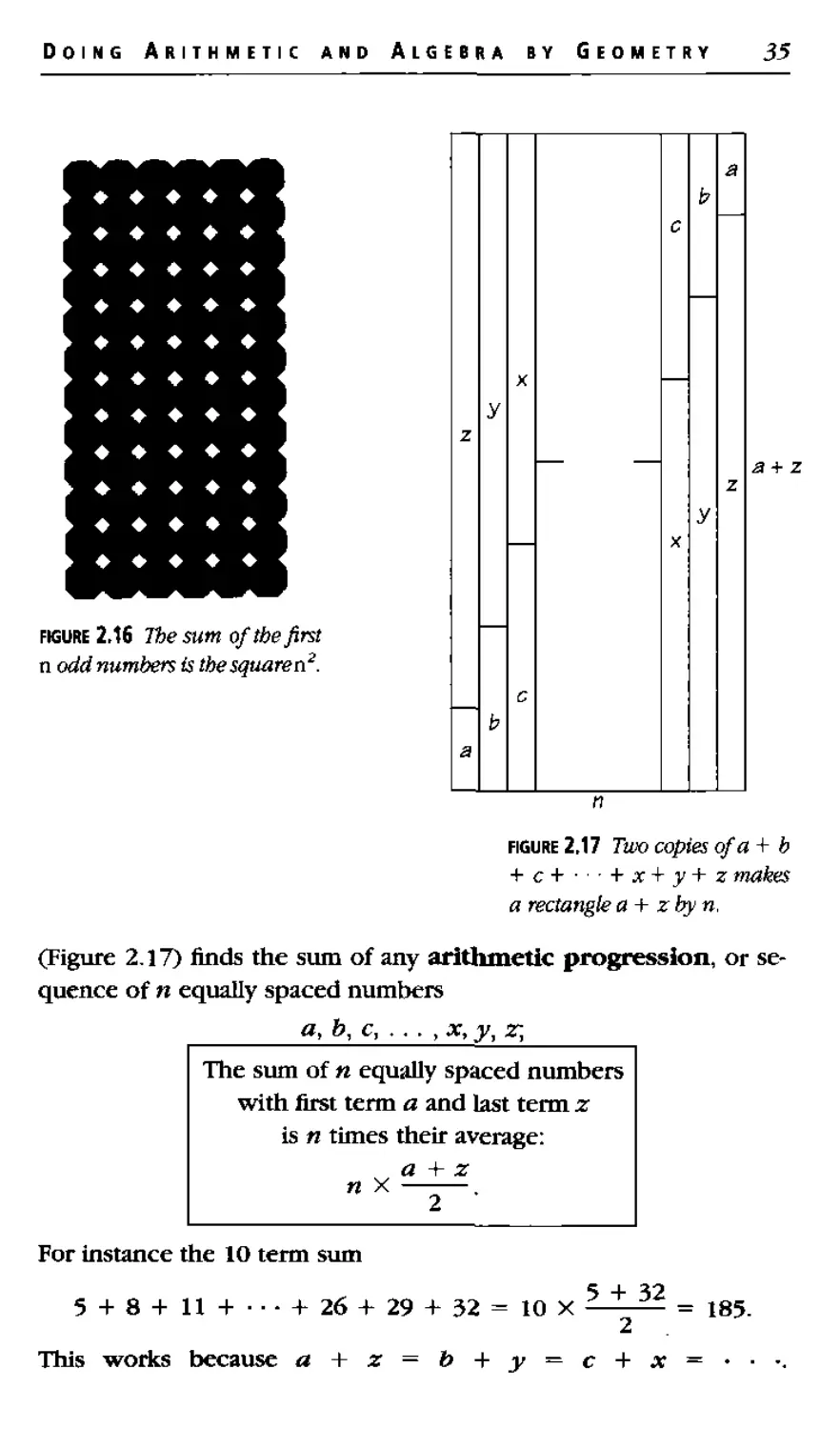
2.15 to show this (Figure 2.16). In fact this * 'organ-pipe" method

Doing Arithmetic and Algebra by Geometry
figure 2.16 The sum of the first
n odd numbers is tbesquaren2.
z
а
У
b
X
с
— —
с
X
b
У
а
z
figure 2,17 Two copies of a + b
+ c+' + x+>r+z makes
a rectangle a-\- zbyn,
(Figure 2,17) finds the sum of any arithmetic progression, or se-
sequence of n equally spaced numbers
g, ft, c, .. . , ж, ул z\
The sum of n equally spaced numbers
with first term a and last term z
is n times their average:
For instance the 10 term sum
5 + 8 + 11 +
+ 26 + 29 + 32 = 10 X 5 + 32 = 185-
This works because a + z = b+y = c + x

36 The Book of Numbers
So you can check again that the sum of 1, 2, 3* 4,... consecutive
odd numbers, starting with 1, gives the squares (Figure 2Л8(а)). If,
instead of starting with 1 each time, we start where we previously
left off, as in Figure 2Л8(Ь), then we get the cubes!
1 = 12 1 =
1 + 3 = 22 3 + 5 =
1 + 3 + 5 =32 7 + 9 + 11
1+3 + 5 + 7 = 4Z 13 + 15 + 17 + 19
1+3 + 5 + 7 + 9 = 52 21 + 23 + 25 + 27+29
-3 + 5 + 7 + 9 + 11 + 13 = 72 43 + 45 + 47+ 49+ 51 + 53 + 55 =
0) (b)
figure 2,18 Adding odd numbers gives squares or cubes.
So, if wre add up all the odd numbers in the first n rows of Figure
2Л8(Ь), we see that the sum of the first n cubes is equal to the sum
of the first Д„ odd numbers, which we know is Д^;
(v 2
- n(n + 1) J .
If we had guessed this result, we could also deduce it inductively
from the previous case by adding пъ to both sides of
I3 + 23 + - - - + in - IK = (- in - l)w
= - n4 - - n* + - n2
4 2 4
Figure 2Л9 shows that the sum of two consecutive triangular
numbers is a square; Figure 2.20 has been colored in two ways, one
figure 2,19 Two consecutive triangles make a square.

Doing Arithmetic and Algebra by Geometry
37
FIGURE 2.20 Upstairs Downstairs gives squares.
to show the two triangular numbers, and the other to show the con-
consecutive odd numbers. In symbols, Figure 2,20 may be written as
Д„ +
= 1 + 3 + 5 +
+ <2w - 1).
—We'll use this pattern later (in Figure 2.38) to add up the first n
squares and then again (in Figure 2.49) to add up the first n cubes.
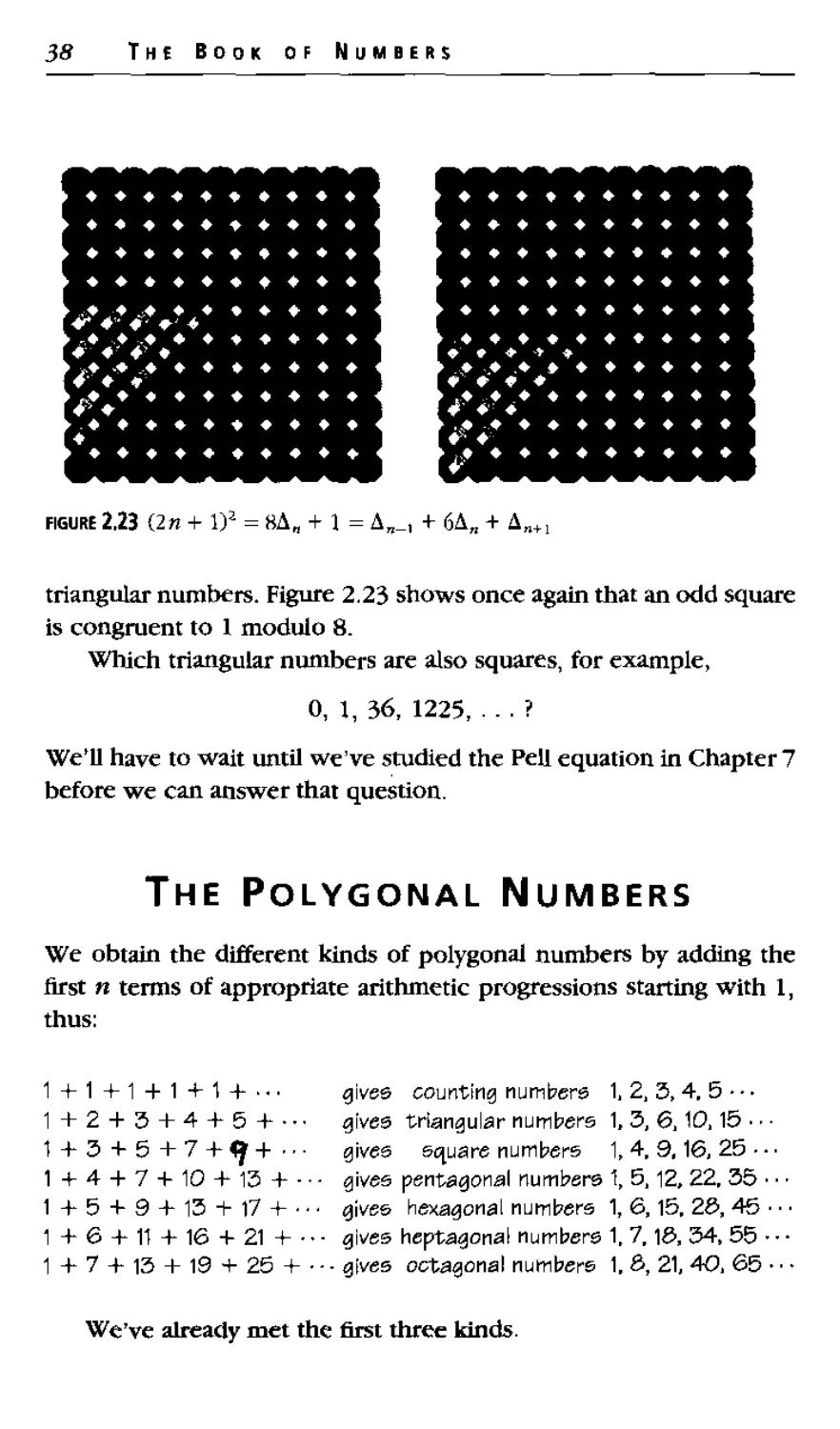
Figures 2,21, 2.22 and 2.23 show some more relations between
bgure 2.21
R6URE2.22
м+1 = Д2й+1.

38 The Book of Numbers
figure 2,23 {In + \J = 8Д„ + 1 =Д„_1 + 6Д„ + Дп+1
triangular numbers. Figure 2-23 shows once again that an odd square
is congruent to 1 modulo 8.
Which triangular numbers are also squares, for example,
0, 1, 36, 1225, . . . ?
We'll have to wait until we've studied the Pell equation in Chapter 7
before we can answer that question.
The Polygonal Numbers
We obtain the different kinds of polygonai numbers by adding the
first n terms of appropriate arithmetic progressions starting with 1,
thus:
1+1+1 + 1+1 + .. ■ gives counting numbers 1, 2, 3, 4P 5 - >
1+2 + 3 + 4 + 5 + »" gives triangular numbers 1, 3, 6,10,15 ■ • ■
1 + 3 + 5+7 + ^+"- gives square numbers 1, 4P 9,16, 25 ♦.
1+4 + 7 + 10 + 13 + --- gives pentagonal numbers 1, 5,12, 22P 35 ■
1+5 + 9 + 13 + 17 H феь hexagonal numbers 1, 6,15. 20, 46 ■
1 + 6 + 11 + 16 + 21 H gives heptagonal numbers 1, 7P10, 34, 55 -
1 + 7 + 13 + 19 + 25 + • - - gives octagonal numbers 1P 3, 21, 40, 6b ■
We've already met the first three kinds.

Doing Arithmetic and Algebra by Geometry 39
Notice that the number of sides in the polygon is two more than
the common difference; we shall soon see, in Figure 2.24, and also
in Chapter 4 on Catalan numbers, that it is two more than the number
of triangles that make up the polygon. The third member of each
sequence is always divisible by 3> and the fifth member by 5: is the
seventh always divisible by 7?
These polygonal numbers get their names from arrangements
of dots (Figure 2.24), which have been studied at least since the time
of Pythagoras (ca, 540 B.C.),
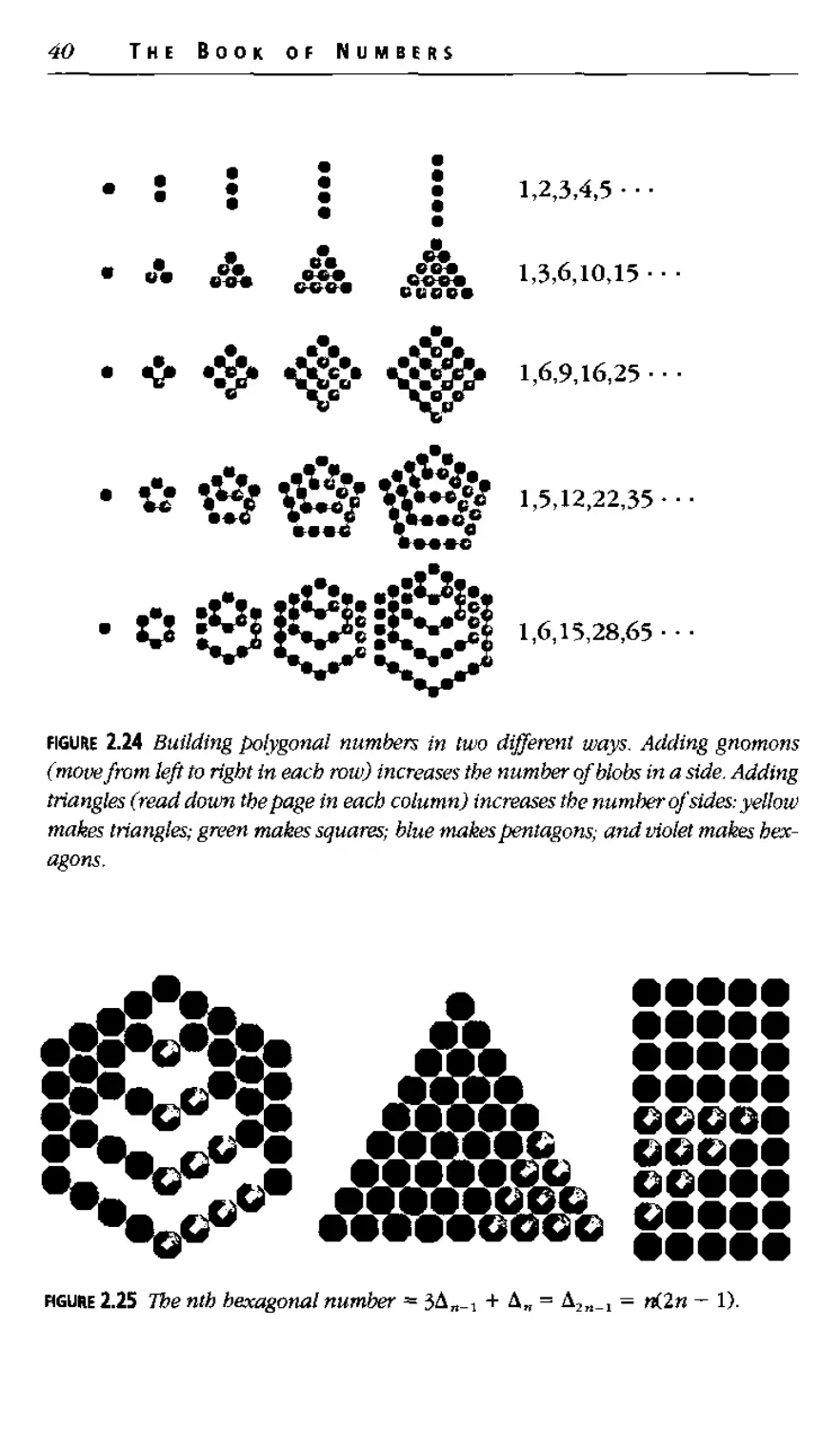
Each sequence in Figure 2.24 can be formed from the row above
by adjoining a triangle of Д„ _ i blobs of a new color to the left of each
polygon. We already know that
n + Д„_! = Д„, the nth triangular number, and that
Д„ + Д„_х = n + 2Д„_Х — и2, the «th square, and this continues:
n2 + Д„_х = n + ЗД„-1 - - и(Зи-1), the n\h pentagonal number,
n + 4ДП_Х — nBn-l)y the nth hexagonal number,
and so on.
The/bsided polygonal number with n blobs in each side is
« + (/>- 2)Ae_, - -pn(n - 1) - n(n - 2\
For example, the mh hexagonal number is
n
as you can see from Figure 2.25, which also shows (compare Figure
2,22) that
Every hexagonal number
is a triangular number.
In fact, just the odd-sided triangular numbers give hexagonal num-
numbers.

40 The Book of Numbers
• А Jk A
«язь
1,2,3,4,5
1,3,6,10,15
1,6,9,16,25
1,5,12,22,35
1,6,15,28,65
FIGURE 2.24 Building polygonal numbers in two different ways. Adding gnomons
(move from left to right in each row) increases the number of blobs in a side. Adding
triangles (read down the page in each column) increases the numher of sides: yellow
makes triangles; green makes squares; blue makes pentagons; and violet makes hex-
hexagons.
figure 2.25 The nth hexagonal number * 3Art-i + Д* = A2*_i = niln - 1).

Doing Arithmetic and Algebra by Geometry
41
It's easy to prove algebraically that
Every pentagonal number is
one-third of a triangular number.
3 x ^
- 1) = | On -
Geometrically, flatten down the 'roof of each pentagonal number
in the fourth raw of Figure 2.24 to make an equilateral trapezoid
(bucket shape); you'll find that you can make triangular jigsaw puz-
puzzles from three copies of each.
Some people have used the name "hexagonal numbers" for those
depicted in Figure 2.26, but we'll use Martin Gardner's name, hex
numbers, to distinguish them.
FIGURE 2,26 Hex numbers.
1 7 19 37 61
From Figure 2.23 we can see that the «th hex number is
hex,, = 1 4- 6ДЛ_Г = 1 - Ъп + in2.
Notice that hex,, + 1 = 1 + 6ДЯ = 1 + 3n + Ъп2 and that the hex
numbers are congruent to 1 modulo 6.
The centred square numbers (Figure 2.27), form a similar pat-
pattern (Figure 2.28(a)X showing that they are congruent to 1 modulo
4, which also follows from the fact that they are the sum of two
consecutive squares (Figure 2.28(b)), one of which is even and the
other odd.

42 The Book of Numbers
1 5 13 25
figure 2.27 The centred square numbers\
41
FIGURE 2.28 The sum ofconsecutive squares is = 1 modi.
The Third Dimension
Suppose we stack the hex numbers up as hex pyramids (Figure
2,29)* Surprise! We get the cubes, пъ (Figure 2.30), perhaps the sim-
simplest of the three-dimensional figurate numbers, which we would
normally make by stacking n nby-n squares.
Why are the hex pyramids equal to the cubes? We can see this
in Figure 2.31, where n — 4. The hexagons that we used to make the
hex numbers are projections, or shadows, of cubes. We obtain the
(n -f l)th cube by starting with a single red blob (Figure 2.31(a)) and
building out 3 yellow rods of « blobs each (Figure 2.31(b)> Then the
3 spaces between pairs of rods each accommodate a green wall of
n X n = n2 blobs (Figure 2.3Kc)), and we have a nest or shell that

Doing Arithmetic and Algebra by Geometry 43
18 27
figure 2.29 Hex pyramids are cubes!
64
I3 = 1 23 = 8
figure 2.30 The cubes.
125
1 1 + Зл 1 + Зп + Зп2
FIGURE 2.31 How a hex number builds a nest for the next cube.
will neatly encase C adjacent faces of) an n X n X n cube, making
it up to A -h п)ъ. This is a very special case,
1 + 3» + 3«2 + n3 = A + nf,
of the binomial theorem, which we'll meet in Chapter 3,

44
The Book of Numbers
We can stack other twcxiimensional figurate numbers to make
three-dimensional ones. For example, the triangular numbers can be
stacked to form triangular pyramidal, or tetrahedral numbers.
Tetrahedral Numbers
Figure 2.32 shows the first four tetrahedral numbers. What is the
«th tetrahedral number? If you're good at three-dimensioaal jigsaw
puzzles, then there are some ingenious ways of packing 6 copies of
the «th tetrahedral number into an n X (n -f 1) X (n + 2) box,
showing that the answer is
2).
But here's a way to see this without venturing into three dimensions.
Add up aJl the numbers in the three copies of the triangular pattern
in Figure 2.33- We get a triangular pattern of fifteen 7s (note that 7
is 2 more than 5) and similarly three times the «th tetrahedral number
is the nth triangle number of in -f 2)s, so that
The nth tetrahedral number is
=-«(«+ lXn + 2)
• л A
1+3=4
1+3+6=10
1+3+6+10=20
RGURE2.32 The tetrahedral numbers.

Doing Arithmetic and Algebra by Geometry 45
115 7
12 2 1 4 4 7 7
123 + 321 + 333 = 777
1234 4321 2222 7777
12345 54321 11111 77777
3A + 3 + б + 10 + 15) = A + 2 + 3 + 4 + Ъ) Х 7
3(Д + Д2 + ■ ■ ■ + Д„) = Д„ X (п + 2) = ^ п(п + 1)(п + 2)
Д, + Д2 + • • • + Д« = - Ч" + ОС^1 + 2)-
Figure 2.33 Adding up triangular numbers made easy.
Tetrahedral numbers are whole numbers, so
The product of three consecutive
integers is always a multiple
of 6.
The third triangle of numbers in Figure 2,33 can be thought of as the
fifth tetrahedral number standing on one of its edges. We can add up
the numbers by reading off the layers:
A X 5) + B X 4) + C X 3) + D X 2) + E X 1) = 35,
and generally
AX«)IBX(«- 1)) + C X in - 2))
+ • • - + (tn - 1) X 2) + in X 1) - Tct«.
Another way to look at this is to add up the SW-NE diagonals of
the multiplication table (Figure 2.34; compare to Figure 2,8). Since
the multiplication table is symmetrical, the tetrahedral numbers are
even, except that the squares down the main diagonal are alternately

46
The Book of Numbers
1 4 10 20 35 56 ЬА
/
2 3 4 5 6 7
' / / / /
в & Ю 12
4
6
9
12
4
12
16
5 10 15
в 12
7
FIGURE 2.34 The multiplication table gives the tetrahedral numbers.
odd and even, making every fourth tetrahedral number odd, counting
from the first:
1, 4, 10, 20, 35, 56, 84, 120, 165, 220, 286, 364, 4555 560, ....
Truncated Tetrahedral Numbers
If we take the Ctf — 2)th tetrahedral number and chop off the
in — l)th tetrahedral пщпЬег from each corner, we are left with the
«th truncated tetrahedral number (Figure 235):
Ttetw - Tet3n_J -
- 21n + 10).

Doing Arithmetic and Algebra by Geometry
47
1 16 68 180
figure 2.35 The truncated tetrahedral numbers.
375
Square Pyramid Numbers
Now let's make some square pyramids. Old war memorials sometimes
have a stack of 1 + 4 + 9 + • • • + пг cannon balls as a square pyramid.
This is the «th pyramidal number, Руг„-
You can make a different shape of ''square pyramid" out of chil-
children's building blocks (stack them up with the corners of the squares
one above the other; see Figure 2.36). Now try to pack six of these
into a rectangular box of dimensions n by n -f 1 by 2n + 1. If you
succeed, then you will have shown that:
The nth pyramidal number, Руг„,
I2 + 22 + 32 + • •■ + n2,
is equal to - n(n +
14 12+22+32+42=30 12+22+32+42+52=55
FIGURE 2.36 The square pyramidal numbers, Pyrn>

48
The Book от Numbers
But here are three easier ways to see this.
1. We saw in Figure 2.19 that the sum of two consecutive triangular
numbers is a square,
Дя_, + Д„ = n\
so the sum of two consecutive tetrahedral numbers is a square
pyramidal number:
1
7 (и -
6
^, + Tetw = Руг„,
1 1
; nin + 1)(« + 2) = 7 nin + 1)B« + 1).
6 6
2. Pack the layers of two (red and light blue) square pyramids into a
shallow rectangular box, width 2« + 1 and length Д„, the nth
triangular number as in Figure 237(a). Partition the space that's
left into strips, which fit together as in Figure 2.12 to make the
square layers of a third square pyramid (Figure 2.37(b))-
So one square pyramidal number, Pyr^, is
\ Дл X Bn
3
= \ n(n
6
1),
as before.
(a) (b)
figure 237 Three square pyramids fit into a rectangularbox.

Doing Arithmetic and Algebra by Geometry 49
1
1 2
1
2
3
1
2
3
4
1
2
3
4
5
1
2
3
4
1
2
3
~22
-32
1 *4Z
2 1 *52
,12 3 4 5 5432
^2 3 4 5 5 4 3 2n
,3 4 5 5 4 3
4 5 5
Ъ
52' ^52
figure 2.38 f/^^w co/«'e5 of the fifth triangular number give three copies of the first
five squares,
3. Finally, in Figure 238 there are BX5) +1 = 11 columns, each
containing the triangular number
The five rows above the line add up to I2, 22, 32, 42, 52 by the Upstairs-
Downstairs rule (Figure 2.20), while each of the two triangles below
the line, when summed diagonally, also contains the first five squares;
3 X (I2 + 22 + 32 + 42 + 5*) = A + 2 + 3 + 4 + 5) X 11,
3 Pyrrt = An X Bn + 1).

50
The Book of Numbers
1 6 19 44
FIGURE 2.39 The (Octahedral numbers.
85
Octahedral Numbers
The easiest way to view the octahedral numbers (Figure 2.39) is
as double square pyramids, the sum of two consecutive square pyr-
pyramids;
Oct« -
Руг„ - - пBпг
They are the sums of the nximbers in the following arrays, in which
the "Is77 are the "poles" of the octahedron:
2 1
12
432 l
3 4 3 2
2343
5 4321
2343
123 4 2345 *
12345
0 16 19 44
The differences
1 5 13 25 41
85
6 5 4 3 2 1
5 6 5 4 3 2
4 5 6 5 4 3
3 4 5 6 5 4
2 3 4 5 6 5
12 3 4 5 6
146
61
between two consecutive octahedral numbers are the centred square
numbers we saw in Figure 2.27.

Doing Arithmetic and Algebra by Geometry 51
Stella Octangula Numbers
If we take an octahedral number of edge n and adjoin a tetrahedral
number of edge n — 1 to four alternate faces, we get a tetrahedral
number of edge (n - 1) + 1 + (n - 1) = 2n - 1, as shown in Figure
2.40,
figure 2,40 An octahedral number and four tet-
rahedral numbers make a bigger tetmbedral
number: Oan + 4Tet^! - Tet2fl-i-
If we adjoin four more such tetrahedra to the other four faces,
we get a Stella octangula number (Figure 2,41) named for Kepler's
stella octangula:
Stel,, = Oct« + eTet*-! = nBn2 - 1),
1 14 51 124
figure 2,41 The stella octangula numbers.
245

52
The Book of Numbers
figure 2.42 Ihe centred cube numbers.
x
91
Centred Cube Numbers
The three-dimensional analogs of the centred square numbers are the
(body-)centred cube numbers (Figure 2.42):
СсиЬ„ = и3 + (n - IK = B« -
- n + 1).
Truncated Octahedral Numbers
Start with the C« — 2)th octahedral number, Oct3n_2, and cut off
the (и — l)th square pyramid, Руг„-1У from each of its six vertices.
We are left with the truncated octahedral numbers (Figure 2.43):
Toct« -
^2 - 6 Pyrn_1 = -
- 2X2C« - 2J
- 2 in - V>n{2n - I)
о
= 1би3 - 33»2 + 24n - 6,
figure 2.43 The truncated octahedral numbers.
201
586

Doing Arithmetic and Algebra by Geometry
figure 2.44 Truncated octahedron (a)
and rhombic dodecahedron (b).
Rhombic Dodecahedral Numbers
What are the three-dimensional analogs of the hex numbers? The «th
hex number, hexrt, counts the number of cells of a honeycomb pack-
packing that are less than n steps away from a central one (the black one
in Figure 2.26). Now, among the Platonic (regular) and Archimedean
(semiregular) solids, the only ones that pack three-space exactly are
the cube (obviously) and the truncated octahedron, Figure 2.44(a),
the blob that we have used as our unit in most of the figures in this
chapter. In the packing by truncated octahedra, the nexus of all cells
less than n steps away from a given cell has the shape of a rhombic
1 15 65
figure 2.45 The rhombic dodecabedral numbers.
175

54
The Book of Numbers
dodecahedron, Figure 2.44(b). The three-dimensional nexus numbers
are the rhombic dodecahedral numbers (Figure 2.45). One way
to visualize a rhombic dodecahedral number is by appending a square
pyramid to each of the six faces of a centred cube:
Rho« = Ccubw
»-, = Bn -
1).
Figure 2.26 showed how hex« + 1 = 1 + 3« + Ъп2< Figure 2.46 shows
how Шю„-м = 1 + 4n 4- 6n2 + 4w3. Start with one red blob and
build out four rods of n blue cells from alternate hexagonal faces
(Figure 2.46(a)), Then add 6 yellow walls, each of n2 cells, one be-
between each pair of rods (Figure 2,46(b)). Finally, insert 4 blocks of
n* green cells, one in each solid angle formed by three walls <Tigure
2.46@).
Similar nexus numbers are defined in all dimensions:
Dimension (fl + 1)th nexus numbar
0
1
2
3
4
1
1 4- 2n
\ + Ъп + Ъпг
1 4- 4rt + 6л2 4- 4пэ
1 4- 5n 4- Юл2 + Юл5 4-
the unit
odd numbers
hex numbers
rhombic dodecahedral numbers
the next пехие numbers
and so on....
1 +4n
14446nz
(a) (b)
figure 2,46 Building a nexus number.
1+4п+бпг+4п3
(О

Doing Arithmetic and Algebra by Geometry 55
Bending the Next Nexus Number
In Figure 2Л2 we bent each one-dimensional nexus number (odd
number) into a gnomon and stacked these gnomons to form squares.
In Figure 2,31 we bent the hex numbers into "nests" and then
stacked these to form cubes. Similarly, in four dimensions we can
bend the rhombic dodecahedral numbers into nests that stack to form
four-dimensional cubes, or tesseracts. Most of us find this a little bit
difficult to visualize, but
odd, + odd2 + > > ■ + odd,, = я2,
+ hex2 + • • • +
x + Rho2 + • • • + Шю„ = n4t
andRhon + ! ~ 1 + 4n + 6n2 + 4n* is just what's needed to increase
n4 to (n + IL. If you've been skipping ahead, you'll have seen the
connection with the binomial theorem in the next chapter.
The Fourth Dimension
There are other figurate numbers in higher dimensions. Although it's
hard 'to visualize jigsaw puzzles in four dimensions, it can be done!
Suppose you want to stack up the first few tetrahedral numbers to
make pentatope numbers (Figure 2.47) (the pentatope is the sim-
simplest regular figure in four dimensions).
1 = 1 = p
1+4 = 5 = Ftop2
1+4 + Ю = 15 - Ftop3
1+4 + Ю + 20 = 35 = Ptop4
1+4 + 10 + 20 + 35 = 10 = Пор5
1 + 4 + 10 + 20 + 35 + 56 = 126 =
figure 2.47 Pentatope numbers.

56 The Book of Numbers
5
4 4 4
3 3 3 3 3 3
2 2 2 222 2222
111111111111111
1
1 1 2
1 12 12 3
1 12 12 3 12 3 4
112123123412345
1
1 2 1
1 2 1 3 2 1
1 2 1 3 2 1 4 3 2 1
121321432154321
1
2 1 1
3 2 2 111
4 3 3 2 2 2' 1111
54433322221 1 1 1 1
& ъ ъ
& ь ь ь ь ь
3 & & & & & 8> b 8> 8>
8&8>&&&dd&8>bbbbb
figure 2.48 four copies of'the first five tetrahedral тинЬек add up to E + 3) /ш
the S}(tfi of the Ji nit fire triangular numheis.
Here's a way of doing it without taking leave of our three-dimensional
world. Indeed, we can even stay on our two-dimensional paper The
lirst row of Figure 248 shows the first five tetrahedral numbers (com-
(compare with Figure 2.33). These are copied out three more times, but
rearranged, If you add four numbers, one from the same position in
each copy, the sum is always 8. The number of positions is the sum

Doing Arithmetic and Algebra by Geometry 57
of the first five triangular numbers, that is Tet5, the fifth tetrahedral
number.
In general, four copies of the first n tetrahcdral numbers add up
to n + 3 times the mh tetrahedral number, - n(n + l)(n + 2). So
6
The /7th pentatope number is:
Ptop,, = - TetB X (p + 3) = — n(n + 1X« +
Incidentally, we have proved that
The product of four
consecutive integers
is divisible by 24
+ 3)
Sums of Cubes
We could also use a four-dimensional jigsaw puzzle to pile up cubes
to make a cubic pyramid, but the multiplication table of Figure 2.8
rescues us from this! Figure 2.49 is the multiplication table, equipped
with gnomons as in Figure 2Л2.
2 4
4 в
5 10
6
9
12
15
4
a
12
16
20
5
10
15
20
25
figure 2.49 £#c/; gnomon in the multiplication table
sums to a cube and helps its to add up the cubes.

The Book of Numbers
The gnomons contain
1A) = 1 X l2 = I3
2A+2 + 1) = 2 X 22 = 23
3A + 2 + 3 + 2 + 1) = 3 X 32 = 33
4A+2 + 3 + 4 + 3 + 2 + 1) =4x42 = 43
5A + 2 + 3 + 4 + 5 + 4 + 3 + 2 + 1) = 5 X 52 = 53
using the Upstairs-Downstairs rule (Figure 2.20), But the total of the
numbers in the multiplication table is exactly the product
A+2 + 3 + 4 + 5)A +2 + 3 + 4 + 5) = Д2,
and so, as we saw in Figure 2,18(b);
The sum of the first n cubes
I3 + 2 3 + 33 + - ■ • + n3
is equal to the square of
the nth triangular number,
Д2 = - n\n + IJ
Figure 2.50 shows this as an easy three-dimensional jigsaw puzzle.
The square of side 1 + 2 + 3 + 4 + 5= 15 of part (a) is chopped
into rectangles that are reassembled to form five cubes (b).
figure 2.50 A squared triangular
number is the sum of cubes.

Doing Arithmetic and Algebra by Geometry 59
More and More Dimensions
We can go on piling up triangular pyramids in more and more di-
dimensions. The method that we used in Figures 2.29 and 2.45 extends
to show that
1 + 3 + 6 + ■■ ■ + -n(» + l)
1 + 4 + 10 + • • • + - niyt + IX* + 2)
6
6
- — niyt
24
D
2)
3)
1 + 5 + 15
—«(« + IX» + 2X» + 3)
24
giving the counting, triangular, tetrahedral, and pentatope numbers;
and although we've run out of names, we'll never run out of dimen-
dimensions—the first unnamed numbers
show that:
1
120
n(jn
2)(n
4)
The product of five consecutive integers
is divisible by 120 = 1 X 2 X 3 X 4 X 5
Some Very Large Numbers
The squares get large quite quickly; the cubes and higher powers
expand even more quickly; and nn grows more quickly than all the
figurate numbers. However, mathematicians sometimes need even
larger numbers and want some way of writing them.
Computers used to print m | n so as to avoid superscripts

60 The Book of Numbers
(though today only the arrowhead seems to remain). This suggests
the following handy arrow notation. Just as
тУп or mn abbreviates m H- m 4- - - ♦ 4- m
and m\n abbreviates mm > ♦ ♦ w
so we use m \ \ n to abbreviate m*\ m\ - ■ ■ t m
then m 111n to abbreviate m\\m\\ ■ ■ - 11 m
and then m | j f \ n to abbreviate mtTT^^TTt * * * T T T w
and so on7 with « copies of ш in each case and these expressions
being evaluated from the right.
Although the notation m \ \ • • • \ n was only introduced in 1976
by Donald Knuth, an essentially similar function was denned by W.
Ackermann in 1928, and so we'll call
lfl, 2| T^ 3 T T T 3, 4| T T T4, . ■ •
the Ackermann numbers,
The first Ackermann number is 1. the second is2tt2 = 2t2 =
4, and the third is
where the number of threes is 33"* = 7625597484987. It's virtually
impossible to comprehend the immensity of the fourth Ackermann
number, 4|||Т4 = 4ТТ'МТТ|4Т1Н This is
4TT4 •" t
where the number of fours here is
where the number of fours there is
(the number of fours in that being four). This last number is

Doing Arithmetic and Algebra by Geometry 61
in which the number of fours is
44\
where the number of fours is 4^ = 44^ = 4(a 155di*u IUUIlbcr>.
Our own "chained arrow" notation names some even larger num-
numbers. In this, a\ 1 - - - |t* (with с arrows) is called a —> b —> с
is another name for a —> b —> • • - -* x —> y\ and
a - • x-*y-*(z + 1)
is defined to be
a — x if у = l,
л • • x —> (a • • • дг) —> 2Г if у = 2,
a • ■ * x —> (^ • - - x —> (л • • • x) —> z) -> z if jv = 3,
and so on. The parentheses here may be rubbed out after the numbers
inside them have been completely evaluated. The first three of our
own rapidly increasing sequence of numbers
agree with the Ackermann numbers 111, 21 t 2, 31 T T 3>
but 4 -> 4 -^ 4 -> 4 is very much larger than 4 ] 1114, which is only
4^ 4 ->4.
The number i()I<I0 was once called Skewes's number and was
said to be the largest individual number that occurred in a mathe-
mathematical proof. However, the number that appears in modern im-
improvements of Skewes's theorem has been deflated to lOlKl7 (see
Chapter 5). Its role has in any case been taken over by Graham's
number, although the theorem in which this number appears might
well be deflated in the future.

62 The Book of Numbers
4t T • ■ ♦
(where
It lies
Graham's number is
T 14, where the number
114, where the number
. . . et cetera . . .
the number of lines like t
between 3 —► 3 —> 64 —►
3-*3^>65-*2.
of arrows is
of arrows is
hat is 64).
2 and
Skewes's number
1Oll67
Graham's number
is
is
is
less
less
less
than
than
than
4<
5'*
3-
= 5
> 3-
TT3,
-*3-
5,
and
■♦ 3.
What's the largest individual number that occurs "naturally" in an
undeflatable theorem? A moderately large and very special number is
8080 17424 79451 28758 86459 90496 17107 57005 75436 80000 00000,
which is the order of the scxalled Monster simple group, but we яге
sure that this entry has already been outrun by worthier candidates.
References
W. Ackermann. Zum Hilbertschen Aufbau der reellen Zahlen, Math, An-
nalen, 99A928): 118-133.
Martin Gardner. Second Book of Mathematical Puzzles and Diversions.
W. H. Freeman, New York, 1961; Chapter 4, Digital Roots.
Martin Gardner. Time Travel and Other Mathematical Bewilderments.
W. R Freeman, New York, 1988; Chapter 2, Hexes and Stars.
Martin Gardner. Penrose Tiles to Trapdoor Ciphers. W. H. Freeman, New
York, 1989; Chapter 17, Ramsey Theory.
P. Goodwin. A polyhedral scries or two- Math. Саг,, 69A985): 191-197.
Harvey Hindin. Stars, hexes, triangular numbers and Pythagorean triples./
Recreational Math., 16A983-84): 191-193-
Edward Kasner and James Newman. Mathematics and the Imagination.
G. Bell & Sons, London, 1949, p. 23.
Donald E. Knuth. Mathematics and computer science: Coping with finite-
ness, Science, A976): 12-17.

What Comes Next?
We hope you like the kind of problem where someone gives you
an intriguing number sequence and asks you what comes next
hi this chapter we'll give you several ways to find out. Most of these
involve building some kind of pattern from your numbers. Pascal's
triangle is one very well-known pattern.
If you're like us, you'll also enjoy playing with number sequences
for their own sake, so we'll also show you some number games that
often use patterns to magically transform one sequence into another.
One of the nicest of these is described next.
Moessner's Magic
Alfred Moessner discovered that some of our favorite sequences can
be found in a surprising new way. Start with the counting numbers
and circle every second number; then form the cumulative totals of
the uncircled numbers, and you'll see the squares:
7 (8) 9 (ШП A2I3A'
A6) Q5) &6) D9)
63

64
The Book of Numbers
If instead you circle every third number, total what's left, circling the
last number in each block, and total the uncircled (hex) numbers,
you'll see the cubes:
1 2 Q
1 (з)
©
Circling every fourth number:
1 2 3©567
8
10 II @ 13 14
@
4 5 @ ® @ 3
7 @ 19 @ 37 @ 61 G5)
© © @
9 Ю 11 A2) 13 14
1 A
1 0
©
@
11 17B4) 33 43 $4) 67 81
15C2:
65
175
leads similarly to the fourth powers, and so on.
So circling the numbers
n + n n + n + n n + n + n + n . . .
has led to the numbers
n X n n X n X n n X n X n X n . . . .
If we circle each triangular number, l + 2 + 3 + *-i +
®
A
©
7 8
18 26 ф>
24 E0
11 12 13 14
46 58 71 @
96 154 @)
120 B7^)
A20)
2 3
2 ©
D
we get the factorial numbers, 1 X 2 X 3 X • ■ • X «, which well
talk about soon.
What if we circle the squares?
5 6 7 8 @ 10 11 12 13 14 15 A6)
10 16 23 Cl) 41 52 64 77 91 <@>
12 28 @ 92 144 208 285 <$7^
12 Й0)
132 276 484
144 420 (@)
144 E6l)

What Comes Next? 65
If these numbers mystify you, notice that the squares are
1
1 + 2+1
1 + 2 + 3 + 2+1
1+2+3+4+3+2+1
and chat the final circled numbers are
1
1X2X1
1X2X3X2X1
1X2X3X4X3X2X1
The general rule is that if you start by circling
la, 2a + 16, Ъа + 2b + lc, 4a + ЪЬ + 2c + Id . . . y
then the final circled numbers are
V\ 2a X 1&, 3" X 2b X Г, f X 3^ X 2C X 1"
Factorial Numbers
How many *'words" can we make from the letters A, E, T, each used
just once?
AET, ATE, EAT, ETA, TAE, TEA
The first letter can be any one of the three, the second can be either
one of the two remaining, and the third is then the one left over,
3X2X1=6 words.
If you have n different letters, they can be arranged in
«x(w-l)X(«-2)X — x3X2x 1 ways.
Jhis number is called factorial n, or n factorial, It often used to be
written [n_, but today is usually written n\.
Of course, there's just one way to arrange no objects, so 0! = 1.
In general, n\ is the product of the numbers from 1 to n, the empty
product being 1 (Figure 3.1).

66
The Book of Numbers
1 X Я -2 2.
1 X /. X 3 = 6 - 5!
1 X ?. X 2 X 4 = ТА- = М
1 х 2 х 3 х 4 X 5 - '20 = '3!
1X2X3X4X5X6 ■ 720 = еЛ
1X2X3X4X5X6X7 • 5040 = 7!
figure 3.1 The fdctf.riial
VCre jiust saw how we can gel the factorial numbers from
Moessner1^ magic, and in fact we already met them in Chapter 2
when we piled up triangular pyramids in more and more dimen-
dimensions.
Arrangement Numbers
Factorial n is the number of arrangements, or orders, or per-
permutations of n things in a row. How many arrangements are
there of r objects, chosen from n different things? The first can be
any one of the n, the second can be any one of the remaining n— 1,
the third any onu- of remaining n 2, and so onn the rth being
any one of n — r -h L The toial number of different arrange-
arrangements is
n X (n - 1) x (n - 2) X • - • x (n - r + 1).
the product of all the numbers from I to th except for those from
1 to n — r, so we can express this concisely using the factorial num-
numbers:
The number of arrangements
of r things our of n is
n\
(n - r)\

What Comes Next?
Choice Numbers
if we're only concerned with the number of choices, or combina-
combinations, of the r things chosen from the n, then we don't distinguish
between the factorial r different ways in which we could have ar-
nmged them in a row. So to get the choice numbers, f ), we divide
the arrangement numbers by r!
The number of choices
of r things from n is
n
r
r!(W -
In this formula, you can swap r for n — r without altering the
value. The number of ways of choosing 5 things out of 8 is the same
as ihc number of ways of choosing the 3 you want to leave out:
and generally,
n
n - r
This is the left-right symmetry of Pascal's triangle, see Figures 3
3.3
Suppose a class of 28 students wants 10 choose a soccer team of
11 players. In how many ways can lhey do it^ We now know that,
this is
28
28 X 27 X 26 X 25 X 24 X 23 X 22 X 21 X 20 X 19 X I
1 X 2 X 3 X -i X ) X 6 X 7 X 8 X 9 X 10 X 11
28!
I1 X У X 5 X 7 x 13 x 19 X 23 = 21474180.

68 The Book of Numbers
Now suppose you're in the class and want to know if you're on the
team. In how many ways could you be included? If you're on, the
other 10 must be chosen from the other 27:
= 8436285 ways.
In how many ways are you not included? All 11 have to be chosen
from the other 27:
= 13037895 ways.
/28\
So [ j is the sum of these two numbers, and generally, since you
are either on the team of r or not,
Pascal's Triangle
This is a very simple way of generating the choice numbers. Start
from II = 1 cm row 0, and I I = 1 and - 1 on row 1 y and
calculate successive rows by putting I I =1 and I J = 1 at each
end and forming each other number as the sum of the two in the row
immediately above (Figure 3.2).
The first few choice numbers are shown in Figure 3 2. The array
in Figure 33 is usually known as Pascal's triangle, because it was
intensively studied by Blaise Pascal A623-1662), the famous French
philosopher and mathematician. It had already been described much
earlier by Chinese mathematicians and by Omar Khayyam, who died
in 1123.

What Comes Next?
ч
1
А Д Я
(л\ (л
1
/ 4
1 1
/ ч / ч
1 2 1
/ \ / \ / \
1 3 3
^4/ww
14 6 4
Figure 3.2 Generating the choice numbers.
Of course, we've seen some of these numbers before, in Chapter
2y when we piled up triangular pyramids in more and more dimen-
dimensions. The numbers at the beginning of each row are just ones,
1, I, 1, 1, 1, 1, 1, 1, 1, 1, 1,
The second numbers in each row are the counting numbers,
1, 2, 3, 4, 5, 6, 7, 8, 9, 10, 11,
1
1 1
1 2 I
13 3 1
14 6 4 1
1 5 10 10 5 1
1 6 15 20 15 6 1
1 7 21 35 35 21 7 I
1 Ь 25 56 70 56 2Ь Ь 1
1 9 36 54 126 126 34 36 Э 1
t 10 45 120 210 252 210 120 45 10 1
^ 1 11 55 165 330 462 462 330 165 55 11 1
^ 1 12 66 220 495 792 924 792 495 220 66 12 1
1 13 75 256 715 12£7 1716 1716 12&7 715 2£>6 73 13 1
FIGURE 33 Pascal's numbers: the choice numbersy or binomial coefficients.

70 The Book of Numbers
The third numbers are the triangular numbers,
1, 3, 6, 10, 15, 21, 28, 36, 45, 55, 66, . . . .
The fourth numbers are the tetrahedral numbers,
1, 4, 10, 20, 35, 56, 84, 120, 165, 220, 286,
The fifth ones are the pentatope numbers,
1, 5, 15, 35, 70, 126, 210, 330, 495> 715, 1001,
and so on. The numbers in each diagonal are the cumulative sums of
those in the previous diagonal.
Choice Numbers with Repetitions
In how many ways can you choose live things from n, if repetitions
are allowed? In other words, how many essentially different kinds of
"poker hands" are there, if we ignore flushes and straights and are
playing with a double deck, so that you can have five of a kind?
"Poker hand* 13 in a suit n cards [n a suit
13N
all different ( ^ , .*_^ . ,__
of \b
one pair 13 X I = 2£60
two paire I g I X 11 = £56 ( 'o ] X (n - 2)
three of a kind 13 X L = ЬЬЬ
full house C & 2) 13 X 12 - 156 n X (n - 1)
four of a kind 13 X 12 - 166 n X (n - ])
five of a kind 13 = 13 n
'17>
Total 61SS = t 5

What Comes Next?
71
Surely such a simple answer can be found more simply? hi fact,
the hands correspond to the number of 5-card hands chosen from a
Sweet Seventeen deck of 17 distinguishable cards: A, K, Q, J, 10, 9,
8, 7, 6, 5, 4, 3, and 2 and four distinguishable jokers: jb j2, J3, and j4.
If you are dealt a Sweet Seventeen hand (Figure 3-4(a)), sort it in
the usual way, high on the left, low on the right, but with any jokers
in the positions corresponding to their labels (Figure 3-4(b)). To con-
convert it into a poker hand, replace any jokers by copies of the first
genuine card that follows them: Figure 3.4(c) shows the resulting full
house, nines on twos.
To see why the correspondence is exact, convert your sorted
poker hands (Figure 3-5(a)) into a Sweet Seventeen hand by replacing
all duplicates of cards farther to the right by jokers, labeled by their
position counting from the left (Figure 3-5(b))-
hi general, to find the number of choices of r things from n dif-
different ones, but with repetitions allowed, imagine that you are play-
playing Sweet Seventeen, but instead of a deck of 13 + 4 jokers, you have
a deck of n + (r — 1) jokers, and the answer is
n + r — 1
r
Figure 3.4 A "Siveet Seventeen" hand becomes a poker band >
(a) (b)
FIGURE 3.5 A poker band becomes a Sweet Seventeen band.

12 The Book of Numbers
Choice Numbers Are Binomial
Coefficients
Figure 3^6 will help you to do two of the algebraic manipulations in
Figure 3 7, where the numbers, or coefficients, that appear are ex-
exactly those of Pascal's triangle.
You can see why this is so if you label the bs:
(a + ЬлХа 4 b2) t= a2 + афл + b2) + ЬЛЬ2,
{a + b.Xa + Ь2Ха 4- Ь,)
(a 4-
= a1
bd
b
a
a2
axb
b
(^ +■ bf ^ a2 + 2ab + b2
figure 3.6 Geometric pictures of two binomial expansions.

What Comes Next? 73
{3 + bf = 1 1
(a + bI = <э + b t t
(a + bf = я2 + 2ab + b2 1 2 t
(> + bf = a3 + 3a2b + З^Ь2 + t? 13 3 1
(a + bf = a4 + 4^ + 6*V + 4^^J + b4 14 6 4 1
FIGURE 3.7 Binomial ex[)ansions.
Each term on the right comes from choosing either a or b from each
of the binomials (a + 6) on the left. The number of terms with r bs
and n - r as is the number of choices of r 6s from among the total
of n bs, namely I n 1. Weve proved the Binomial Theorem:
Because there are two choices from each of the n binomial factors,
the total number of products is 2". We check this by adding the rows
of Pascals triangle;
1 = 2°
1 + 1 = 21
1 + 2+1 = 22
1+3 + 3 + 1 = 23
1 + 4 + 6 + 4 + 1 = 24
1 + 5+10+10 + 5+1 = 25
1 + 6 + 15 + 20 + 15 + 6 + 1 = 26
This is the result of setting a - b = 1 in the binomial theorem, if you
let a = 1 and b = — 1, you get the following.

74 The Book op Numbers
1-1 =0
1-2+1 =0
1-3 + 3-1 =0
1-4+6-4+1 =0
1-5 + Ю-1О + 5-1 =0
1-6+ 15 -20 +15 -6+1 = 0
This is most obvious in the odd-numbered rows because of the sym-
symmetry, but it's also true in the even-numbered ones.
Frieze Patterns
In Figure 3«8(a) we've drawn a pattern bounded by a fcigzag of zeras
at the left and horizontal lines of zeros above and below. In Figure
3.8(b) we've used ones instead of zeros. Now fill in the question
marks by the rule that the numbers a and d in each little diamond
b
a d
с
add to 1 more than do b and с in Figure 3.8(a), while they multiply
to 1 more than do b and с in Figure 3*8(b).
Some surprising things happen, asshowninFigure3.9(a)and(b).
For the additive pattern, part (a), the next zeros in each line form a
copy of the initial zigzag, so the pattern repeats itself every seven
000000000 111111111
0??????? 1???????
0??????'? 1???????
0??????? 1 ? ??????
0??????? ]???????
0??????? 1???????
0??????? ]???????
00000000 11111111
(a) (b)
figure 3*8 Fill in these friezes, using the diamond rule.

What Comes Next? 75
OOOOOOOO 1111111111
01256430 1224215241
02 6 10 96 2 0 1 Э 7 7 1 2 5 7 3 1
0 5 10 12 10 4 1 О t 10 12 3 1 3 17 5 2 1
0 2 3 11 12 7 2 0 1 3 17 5 2 1 10 12 3 1
О 1 4 6 10 & 4 0 1257313771
02365410 13 2 4 12 2 4 2 1
OOOOOOOO 1 1 1 1 t t t 1 1 1
(a) (b)
figure 3.9 Filled in frieze patterns repeat after so many steps.
places. The multiplicative pattern, part (b), *s even more surprising;
all the divisions come out exactly, so that the entries are whole num-
numbers. This time the ones in each row form an upside-down copy of
the initial zigzag, We have to go a total of nine places in each row
before we get an exact repetition.
The same sort of thing happens for arbitrary widths and shapes
of initial zigzag, as you can verify by experiment. See if you can work
out why.
For multiplicative frieze patterns, the essential observation is that
for any six entries such as
b
a d
с f
e
we have (a + e)/c = ф + /)/d. Figure ЗЛО shows how this implies
that a number л; just above the lower row of ones will reappear some-
sometime later, just below the upper row of ones.
There are other ways of starting than by using a zigzag of Is. hi
fact, you can use any diagonal sequence of numbers
A. 1 = aOi яь ♦ ♦ ,ял = 1 such that <a, divides #,_i H- e/+1,
How many such sequences are there? We'll tell you the answer in
the next chapter.

16 The Book of Numbers
1 1
У
• • t
b • •
в d •
•of x + 0 - - ^±1_ - JLIJL = - 9-±
Ф « G 1 ' G A t
1 \
@)
figure 3.10 tfo»1 multiplicative fneze patterns rejlect
How Many Regions?
Every now and again someone conies up with a trick sequence where
the general rule is not what it seems at first sight.
How many regions are there inside each of the six circles in Figure
3.11? The nth circle has n spots on the perimeter, joined in all pos-
possible ways, the spots having been chosen so that not more than two
lines pass through any inside point.
We see that the answers are 1, 2, 4> 8, 16 for the first five circles.
They are obviously powers of two. If you exercise just a little care in
the last one, you can make it come to 32. And you might like to check
that with 10 spots the answer comes to 256.
Let's try to prove that the answer for n spots is 2"~'. Since 2n ~x
is the number of subsets of the numbers 1, 2,,..,«— I, we can do
this by giving a rule that attaches one such subset to each region.
We label the points @), 1, 2, . ♦ . , n — 1 counterclockwise around
the circle (Figure 3 12). Because we want to end up with a subset of
{1, 2, . . . , n — \), the digit 0 has only temporary status: we always
omit it at the end.
Here's how to find the region corresponding to a set of numbers.
The meeting point for a set of four numbers ay by c, d (a<b<c<cf)
is where the chords acy bd intersect. The meeting point of a set of
two numbers, с < d, is the smaller of the two. Go to the meeting

figure ЗИ1 A deceptive sequence.
figure 3.12 The regions of Figure З.П all labeled.

78 The Book of Numbers
h-1
rgure 3.13 Finding the region, given the label.
point, look along the ray toward d7 the largest number in the set.
Then the region is on your right. For example, if 0 <a<b<c<d,
then the label abed is assigned to the region shown in Figure 3 13(a);
but if a = 0, as in Figure 3 13(b)> then the region is labeled bed,
dropping the 0. If 0 < с < d, we give the label cd to the region shown
in Figure ЗЛЗ(с); and if с = 0, as in Figure ЗЛЗСФ, we simply label
the region d. This leaves unlabeled the region on your left when you
stand at 0 and look along the ray toward n — 1. This corresponds to
the empty set and is shown shaded in Figures ЗЛЗСФ and ЗЛ2.

What Comes Next? 79
How Careful Were You?
We told you that you'd get the answer 32 for the 6-spot circle if you
used just a little care. However, using just a bit more care, you'll find
the answer 31. What you won't find is a region labeled 12345- The
labels contain just 0, 1, 2, 3, or 4 numbers, so the number of regions
is not 2n~\ but rather the sum of the first five terms
n — l\ (n - l\ In — \\ (n — l\ . (n — \
in the binomial expansion of A + 1)"~V This is all the terms for n
up to 5. When n — 6, the last term
is missing, and for larger «, the answer falls increasingly short. The
correct answers are, for
«=123456789 10 11 12 13 14
regions 1 2 4 S 16 31 57 99 163 256 386 562 794 1093
Guessing the Next Term
of a Sequence
As we've just seen, in some problems it's easy to guess the wrong
answer. But if you always guess wrong, you'll fail that vital intelli-
intelligence test. Here are some techniques that may guide you toward the
right answer.
Differencing
Let's take the sequence we just found and try to work out the next
term, supposing that we hadn't been able to find the general formula
above»

80 Т н & Book of Numbers
We prepare a difference table in which each entry is the differ-
difference between the two entries just above it (in the sense "right minus
left"). You'll see that in our case,
values 1 2 4 a 16 31 57 99 163
first differences 1 2 4 £> 15 26 42 64
second differences 1 2 4 7 11 16 22
third differences 1 2 3 4 5 6
fourth differences 11111
the fourth differences are all the same. We can guess that this pattern
continues forever and use this guess to work out the next term by
working upward (Figure 3/14).
So this correctly suggests that for a circle with 10 spots, the num-
number of regions should be 256, We verily this by noting that exactly
half of the 29 subsets of A, 2, , ► . , 9} have at most four members.
Some easy algebra shows that if we started with the sequence of
values of a dth-degrce polynomial, then its first difference sequence
will be the values of some degree rf— 1 polynomial, its second differ-
difference sequence will be the values of some degree d-2 polynomial,
and its rftli difference sequence will be the values of some de-
99 163 256 =5 165 + 93
/
42 64 93 = 64 + 29
/
16 22 29 = 22 + 7
/
5 6 7=6 + 1
figure 3.14 Calculating the next tertn, assuming that the fourth differences are con-
constant.

What Comes Next? 81
gree zero polynomial. In other words, its dth differences will all have
the same constant value.
For example, let's difference the sequence of cubes:
values 0 1 a 27 64 125 216 343 512 729 1000
first differences 1 7 19 37 61 91 127 169 217 271
eecond differences 6 12 1S 24 30 36 42 43 54
third differences <5ё>6<56<566
The «th differences of nth powers are all equal to the nth factorial
number, «!.
Newton's Useful Little Formula
When you do find constant differences, how do you work out the
polynomial? You can find the answer by forming the differences for
n\ (n\ (n"
the binomial coefficients, ,M ,,
1)/ V 1 /
= 0 12 3 4 5 n= 0 12 3 4
111111 012345
0 0 0 0 0 11111
0 0 0 0 (o) 0 0 0 0 (i)
0 0 0 0 0 0
n= 0 1 2345 ^=012345
00136 10 00014 10
01234 00136
C 1 1 1 1 BJ 0 1 2 3 (э)
0 0 0 111

82 The Book of Numbers
If you look at the bold numbers, you'll see that the sequence with
difference table of shape
fl_ О 1 2 3 A 5 в
A ??????
С ? ? ? ?
V D V 0
1$
x n
that is,
<
A + Bn + - £>*(n - 1) + - £>«(« - 1)(« - 2).
2 6
For example, when we differenced the cubes, we found
Л = О, В = 1, С = 6, D = 6,
and
0 ■+■ « + 3« (« - 1) + n(n - \Xn - 2) - «3.
A similar pattern works for higher-degree polynomials. If, starting
from the fth term, you get a table in which the tfth-degree differences
are all K.
values A ? ? ? ..,
firetdifferences Ь ? ? ? ...
second differences С ? ? ,..

What Comes Next? 83
then the nth term is
This correctly gives
♦
= — (n4 -
24
♦
2Ъп2 - 18n + 24)
for our "regions" problem, in which ty Ay B,.♦ . , ATwere all 1.
How Many Triangles?
figure 3,15 How many triangles in each of these diagrams?
A good way to find the nth term is to count the first few very carefully,
and then make a difference table. If you draw more figures than we've
done in Figure 3.15, and count all the triangles (including the upside-
down ones) you'll find the numbers and their differences are
1 5 1Э 27 45 1Ь 116
4 Ь 14 21 30 40
Л 6 7 Э 10
2 12 1
The third differences alternate between 2 and 1 so the answer is given
alternately by two expressions:
njn + 2X2n + 1) njn + 2X2* + 1) - 1
8
for even n.
8
for odd n.

84 The Book of Numbers
Even when your sequence does not come from a polynomial,
differencing is often informative. Figures 316 and 317 show how
the powers of 2, and the Fibonacci numbers (which we'll learn more
about in the next chapter), repeat themselves when differenced.
¥ 1 2 4 b 16 32 64 123 256 512 1024.
1 2 4 a 16 32 64 120 256 512
1 2 4 a 16 32 64 125 256.. -
figure 3.16 Difference table for the powers of2.
О \ 1 2 3 5 a 13 21 34 55 39.
1 0 1 1 2 3 5 3 13 21 34.,.
-1 1 0 1 1 2 3 5 a 13...
FIGURE 3.17 Difference table for the Fibonacci numbers.
So if, as in Figure 318, some row of another difference table bceomes
powers of 2, the original sequence differs from the powers of 2 only
by the values of polynomial. This is similar for other sequences of
powers and for the Fibonacci numbers as well.
1 3 6 11 20 37 10 135 264,..
2 3 4 9 17 33 65 129...
1 2 4 Ь 16 32 64 _
FIGURE 3.18 A sequence not very different from the powers of 2,
Jackson's Difference Fans
Robert Jackson suggests that if you ve completed a difference table
and still don't understand the sequence, you should turn the paper
through an angle of 60°, say, and start again and perhaps repeat this
several times to make a fan of difference tables.

What Comes Next? 85
Jackson found that this fanning process converts powers of 4 to
powers of 3 to powers of 2 to powers of 1 to powers of 0 (Figure
3.19). In general, the sequence k", multiplied by any polynomial in
n, is reduced to zeros by a &-fold difference fan,
FIGURE 3,19 Л fourfold difference fan.
lt4s a good idea to try a. difference fan on any sequence that you
suspect is given by a simple formula involving powers of the first few
numbers. Figure 3*20 shows what happens to one such sequence.
Number Walls
If you suspect that your sequence is not a polynomial, but is com-
computed by the kind of "bootstrapping" rule that defines the Fibonacci
numbers (where each term is the sum of the two previous ones),

86
The Book of Numbers
Э 47 Z03 795 2935 10423 36027
156 592 2140 74£S 25604
HGURE3.2O Л threefold difference fan for the sequence tiGn - 2"/
then you can detect this by a number wall (or ^quotient-difference
table") rather than an ordinary difference table.
The top row of a number wall (e.g., Figure 3.21) is a string of
ones, and beneath these we place the terms of your suspect se-
sequence, Further entries are computed by the rule that for every cross
of five adjacent numbers,
N
W X E we have X2 = NS + EW.
S
Then, if some raw consists entirely of zeros, your suspect sequence
is indeed a bootstrapping sequence, in which each term can be com-
computed as the sum of fixed multiples of the previous k terms, where
1
0
1
1
1
1
5
6
0
1
19
Ъв
0
1
65
216
0
1
211
1296
1
665
HGURE 3.21 A number wall or quotient-difference table.

What Comes Next? 87
k is the number of intermediate rows in the wall (between the top
row of ones and the bottom row of zeros).
So Figure 3 2\ shows that 0, 1, 5, 19, 65, 211, 665 is part of a
bootstrapping sequence in which each term is the sum of fixed mul-
multiples of its two predecessors (a "second-order recurrence")* You can
now find further terms by working north-eastward using
E = (X2 - NS)/W
as in Figure 3 22. In fact, the typical term here is У1—2n,
1 1 1 1
65 211 666 2059 = 6652 -1 x 7776
211
216 1296
216
0—0
figure 3.22 Calculating the next entries in a quotient-difference table.
Walls Have Windows
Our rule for number walls isn't complete, because sometimes you'll
have to divide zero by zero! Fred Lunnon first told us about the re-
remarkable feet that the zeros in a number wall form square "windows"
bordered by geometric progressions. Figure 323 shows an example.
To get the numbers just below a window, you must use another rule,
explained in Figure 3 24.
It's easier to work past an isolated zero
Nf
N
W W Ш ЕЕ'
S
sf
using the feet that S'N2 + N'S2 = E'W2 + WE2.

88
The Book of Numbers
1 1
111111
4-4 1-2 [o]-1
12 -7 4-2 1
1-1 1-1 1* -1
О О О О* О* О О
о о
о о
111111
1 2 4 7 12 20
10 2 14
1-1 1-1
О
figure 3.23 Zeros appear in windows in the quotient-difference* tablefor the Fibonacci
numbers minus one.
IV ^ W IV W
Vs,
figure 3.24 How to work past a window.
The numbers г
on the arrows
the entries, "h
П5 - 6W far e
n$ = -ew f о г
52 nz
5 " П +
jp ^,
are
cad
ven
odd
6, Wj ftb €%, . < -
the ration of
/tail"»
windows
windows
. ^1
IV 6
As you can see from Figure 3-23, the number wall for the Fibon-
Fibonacci numbers minus one has some windows, so the more complicated
rule is needed to work out the starred entries.
All entries in the number wall for a sequence of whole numbers
will be whole numbers» Just as in frieze patterns, this provides a useful
check for your arithmetic.
What do you do if you come across a sequence of numbers and

What Comes Next? 89
don't know what they are? You can look in Sloane & Plouffes won-
wonderful Encyclopedia of Integer Sequences, or you can email to ее-
C[uer\cee@re3earoh.att.com with a line that reads, say,
lookup 1 1 2 3 5 5 12
or whatever the sequence is that you're interested in.
References
J> H> Conway, and H. S. M. Coxeter. Triangulated polygons and frieze pat-
patterns. Math. Gaz., 57A973): 87-94, 175-183; MR 57, no, 1254-5.
Martin Gardner. Mathematical Magic Show. Math. Assoc, Amer., 1990;
Chapter 4, Factorials.
Martin Gardner. Mathematical Circus. Math. Assoc* Amcr., Spectrum Series,
1992; Chapter 13> Fibonacci and Lucas Numbers; Chapters 15, Pascal
Triangle.
Calvin T. Long. On the Moessner theorem on integral powers. Atner. Math.
Monthly, 73A966): 846-851 (and papers of (X Perron, L Paasche, and
H. Salic quoted there).
Calvin T. Long. Strike it out—add it up. Math. Mag.y 66A932): 273-277.
Yosho Mikami. The Development of Mathematics in China and Japan,
1913-
Alfred Moessner. Fine Bemerkung uber die Potenzen der natiirlichen Zahlen.
S.-B. Math-Nat Kl. Bayer. Akad. Wiss., 1951, 29A952); MR 14, 353b.
Ivan Paasche* Ein ncucr Bcwcis des Moessnerschen Satzes. S.-B. Math-Nat.
Kl Bayer. Akad. Wiss., 1952A953): 1-5; MR 14, 8469.
Ivan Paasche* Ein 2ahlcnthcoretische-logarithmischer "Rechenstab.^ilfof/?.
Naturwiss. Unterr., 6A953/54): 26-28.
Ivan Paasche. Beweis des Moessnerschen Satzes mittels linearer Transfor-
mationen. Arch. Math., 6A955): 194-199; MR 17, 237d.
Paasche^ Ivan. Eine Verallgemeinerung des Moessnerschen Satzes, Compos-
itioMath, 12A956): 263-270.
Joe Roberts. Lure of the Integers. Math. Assoc. of America, Spectrum series,
1992.
N. J, A, Sloane and S, Plouffe, The Encyclopedia of Integer Sequences. Ac-
Academic Press, New York, 1995.

Famous Families
of Numbers
Many families of numbers arise again and again in many different
mathematical problems: Often they have been named after the
mathematicians who investigated them. In this chapter we'll meet
Bell and Stirling, Ramanujan, Catalan, Bernoulli and Euler, Fibonacci
and Lucas.
Bell Numbers and
Stirling Numbers
Many of these numbers arise from counting arrangements of various
kinds. How many ways are there of arranging n objects in groups? If
your objects are clearly distinguishable, the answer is usually called
the Bell number, after Eric Temple Bell, who was known as a math-
mathematician, a mathematical historian, and the author of several detec
tive stories, under the name John Taine.
Figure 4.1 shows all the ways of grouping 4 pieces of luggage and
shows that the fourth Bell number, b4, is 15. The number of group-

group92 The Book of Numbers
■r *- yj
#8
CD
8
17 6 1
FIGURE 4.1 The Bell number b4 = 15, and the Stirling numbers ] '} = I 7, 6, 1.
.{:}-,»
ings of n distinct things into exactly k groups is the Stirling set
number, I L traditionally called the Stirling number of the second
kind. The four columns in Figure 4.1 show that
Here are some more Stirling set numbers and Bell numbers. The

Famous Families of Numbers 93
1
2
3
4
5
6
Stirling
1
1
1 15
1 31
1
7
90
- numbers, VT\-
1
1
3 1
6 1
25 10 1
65 15 1
Bell numbers, bd
1
2
5
15
52
203
TABLE 4.1 Stirling set numbers and Bell numbers.
nth Bell number, bn, is the sum of the Stirling set numbers in each
row,
!л (Л and is the total number
9 f "*" ' 1 I ways or arranging ?г objects
J ^ J into groups.
The Stirling cycle numbers,
(traditionally, Stirling numbers of
the first kind) count the permutations of n objects that have just k
cycles. For example, the 6 permutations of 3 objects are classified
1 cycle 2 cycles 3 cycles
A23) A32) A2)C) A3X2) B3XD AX2X3)
Й+И+-+И-
They appear in the following table:
Stirling cycl^ numbers, n!
1
2
3
4
5
1
2
6 11
24 50
1
1
3 1
6
35
1
10 1
1
2
6
24
120
TABLE 4.2 Stirling cycle numbers.

94 The Book of Numbers
The triangles in Tables 4.1 and 4.2 are computed by variants of the
Pascal's triangle rule
(-:•)■(:)♦(.=.)•
namely
and
Algebraically, \ \ and are the coefficients of xn and xk respec-
respectively, in 1/A -
A + ад:).
- 2*) • • • A - **)) and A + X) A + 2дг)
Partition Numbers and
Compositions; Ramanujan's
Numbers
If your n objects are indistinguishable, then the number of ways of
grouping them is called the partition number, p(n)y so Figure 4.2
shows that p{4) = 5 (the five areas of Figure 4.1).
D
j
J
4 5 1 2 2
FIGURE 4.2 The five partitions of'4.
2 1 1
1111
Here are some more partitions and partition numbers. Super-
Superscripts in the partitions indicate repetitions, for instance, 2215 means
22111.

Famous Families of Numbers 95
n p(n) partitions
1
2,11
3, 21,111
4, 31, 22, 211,1111
5,41,32,311,221,2111,11111
6, 51, 42, 411, 33, 321, 31111 222, 2211, 21111,111111
7, 61, 52, 512, 43, 421, 4f, 321, 322, 3212, 314, 2*1, 22f, 215, ]7
5, 71 62, 6ff 53, 521, 513, 42, 431, 422, 4212, 414, 322, 3212,
32£1, 32f, 3f, 24, 2zf, 2zf, 2ft 1й
There's no simple exact formula forp(n), but there's a remarkable
approximate fonnula guessed by the famous Indian mathematician,
Srinivasa Ramanujan:
p(n) is approximately
This was later proved by Hardy & Ramanujan and later modified by
Rademacher to ал exact formula:
0
1
2
3
4
5
6
7
g»
9
Ю
11
1
1
2
3
5
7
11
15
22
30
42
56
where Ak(n) = 2 °°**e~™nh/k with (o^^ a certain 24th root of
h mod Л
unity.
In counting partitions, we are not concerned with the order of
the parts. If you do consider the order, the answer is much simpler.
There are exactly 2n~x ordered partitions (or compositions, as
MacMachon called them) of n. For example, the 16 compositions of
5 are
5, 41, 14, 32, 23T 311T 131, 113, 221, 212, 122, 2111, 1211, 1121, 1112, 11111
(A strip of 5 squares can be cut into shorter strips of squares, at any
of 4 possible places, so there are 24 ways of doing it.)
Perhaps the strangest formula for the panition numbers is Eider's
way of computing them, using pentagonal numbers:
-!) -pin-Z) +/K#i-5) + pin-Ъ -pCn-lZ) -/Krt-15) + * = 0м

96 The Book of Numbers
(Ort = 1 if n — 0 and On = 0 if /z is positive,) Here the signs alternate
in pairs and the numbers subtracted from n arc the pentagonal num-
numbers that we met in Chapter 2, including those for negative values of
k. These are much easier to remember if you recall from Chapter 2
that they are one-third of those triangular numbers that are divisible
by3:
triangles 0 1 3 6 10 15 21 28 36 45 55 66 78 91 105 120 ...
pentagons 0 * 1 2 * 5 7 * 12 15 * 22 26 * 35 40 ..
and signs + + + — — + 4- — —
The signs are plus for pairs of terms having the same parity, minus
for pairs with different parity* For example, for n — 12 we get
or pA2) - 56 - 42 -+■ 15 4- 7 - 1 = 0, so thatpA2) = 77.
The partition numbers may be defined algebraically by the for-
formula
The Ramanujan numbers, т(п) are similarly defined by
x[A-*X1-jc2)O-:v3) • • >]24 = тA>х 4 rB)x2 + тC>г* + • • •
Ramanujan found many astonishing properties of these numbers: For
instance, т(т)т(п) — т(гпп) whenever tn and n have no common
factor, and r(ri) is congruent to the sum of the eleventh powers of
the divisors of ny modulo 691*
A Pack of Problems
Orpheus with his lute made trees
And the mountain tops that freeze
Bow themselves . . ,
In the next few pages we'll describe lots of problems that all have
the same answer, and then we'll show you why the answer is always
the same.
Frieze Patterns
Ноги many different diagonals are possible in a frieze pattern with
n+1 rou>s?The answers for « == 1, 2,3are 1,2, 5, respectively (Figure
4.3).

Famous Families of Numbers 97
111...
1 1 1 ...
1 1 1 1 1 ...
1 2 1 2 1
1 1 1 1 1 ...
1 1 1 1 1 1 1
1 2 2 1 3 1 2 ...
1 3 1 2 2 1 3
1 1 1 1 1 1 1 ...
figure 43 Frieze patterns with n + 1 rows.
Chopping Polygons into Triangles
How many ways are there of chopping agiven (n -h2)-sidedpolygon
into n triangles? (Pigure 4.4)
HGURE4.4 Chopping polygons into triangles.

The Book of Numbers
Bi furcating Trees
How many rooted plane binary trees are there with n internal
nodes? (Figure 4.5)
figure 4.5 Binary trees: "Plane"
means that left and right are dis-
distinguishable. Add the mirror-
images of trees in the last row.
Evaluating Laddered Exponents
How many values can you expect from an n-fold exponential? (Fig-
(Figure 4.6)
= 49
Figure 4.6 Laddered exponents give varied values.
=. «4

Famous Families of Numbers 99
Rooted Plane Bushes
How many rooted plane bushes are Were with n edges? (Figure 4.7)
Y
V
V
figure 47 Rooted plane bushes.
M О UNTAI MS
How many mountains canyou draw with n upstrokes andn down-
strokes? (Figure 4.8)
л
\
л
/ \ лл л л
\ / \ / V\ /V \ ЛЛЛ
HGURE4.8 Mountains.

100
The Book of Numbers
Parentheses
How many ways are there of arranging n pairs of parentheses?
(Figure 4.9)
= 2:
figure 4,9 Arrangements ofn pairs of parentheses.
Hands Across the Table
How many noncrossing handshakes are possible with n pairs of
people? (Figure 4.10)
figure 4,10 Shaking hands without crossing. The last line gives 14 ways by rotating.

Famous Families of Numbers 101
Catalan Numbers
1 B) 1
13 3 1
1 4 © 4 I
1 5 10 Ю 5 1
1 6 15 B0) 15 6 1
1 7 21 35 35 21 7 1
1 8 28 56 @ 56 28 8 1
figure 4,11 7he central binomial coefficients.
Look at the middle numbers in Pascal's triangle (figure 4.11):
1, 2, 6, 20, 70, 252, 924, 3432, 12870, 48620
It seems that we can divide them by
1, 2, 3,4, 5,6,7,8,9, 10, ....
to give the whole number sequence
1, 1, 2, 5, 14, 42, 132, 429, 1430, 4862
A typical middle number is the binomial coefficient, ( I, so our
guess is that
1 hn\ = 2»! = 1 (in + Л
я+1\я/ п\(п +1)! 2я + 1 \ « / °"'
say, is a whole number. These numbers are called Catalan numbers.
Now well show that all the preceding problems have the same
answer.
Friezes and Polygons
The correspondence between friezes and polygons is fairly easy to
describe. The frieze pattern (Figure 4.12) corresponds to the trian-
triangulated polygon of Figure 4.13 because the row just below the top

102 The Book of Numbers
1 1 1 1 1 1 ...
1 2 2 1 3 1 ...
1 3 1 2 2 1
1 1 1 1 1 1 ...
FIGURE 4.12 A frieze pattern with jive different diagonals.
FIGURE 4.13 A dissected polygon with the num-
numbers of triangles at each vertex.
of ones in Figure 4Л2 tells you the numbers of triangles at the
vertices of the polygon,
Alternatively, in Figure 4.14, leave the lower left vertex unlabeled,
and label all vertices that are joined to it with is. Then label other
vertices so that the number at the last vertex of any triangle is the
sum of the other two. Read around the labels and you have the five
different diagonals of Figure 4.12.
A more complicated pattern and polygon appeared in Chapter 3.
Conway and Coxeter have given a full explanation of why this works.
1 1
figure 4. 14 Polygons labeled with frieze diagonals.

Famous Families of Numbers 103
Polygons and Trees
figure 4.15 Binary trees make paths through polygons.
Figure 4.15 shows how chopped polygons correspond to plane bi-
binary trees.
Trees and Exponentiations
FIGURE 4.16 Binary trees are related to orders of operation when exponentiating.
Figure 4 Л 6 relates binary trees to exponential expressions, and Figure
4.17 associates the latter to bushes.
Exponentials and Bushes
3x2
/
4x2
5 5
FIGURE 4.17 Parentheses have been eliminated, using (a"T = </"Хс
/
4x3 4x3x2
1

104 The Book of Numbers
Bushes and Mountains
figure 4.18 Shapes of hushes and shapes of mountains.
Mountains and Parentheses
((())) @0) @H 0@) 000
FIGURE 4.19 Patterns of parentheses and shapes of mountains.
Parentheses and Shaking Hands
гШв вгШ ввв
figure 4.20 Parentheses show which pairs of people shake hands.
Figure 4.18 links bushes to mountains; Figure 4.19 links mountains
to nests of parentheses; and Figure 4,20 connects these with hand-
handshakes.
So all these varied objects (and indeed many more) are all counted
by the same numbers! To see that they are the Catalan numbers, it's
perhaps easiest to count the mountains.

Famous Families of Numbers
105
Mountains and Catalan Numbers
If we add in an extra upstroke, there are 7\/4\Ъ\ ~ 35 sequences of
4 upstrokes and 3 downstrokes, but if we continue these patterns
periodically (Figure 4.21) we get only 5 different infinite sequences,
which break naturally at the dashed edges to reveal the 5 different
mountains with 3 upstrokes and 3 downstrokes.
In general, the mountains with n upstrokes and n downstrokes
correspond to the
1 (in + 1
2n + 1 I n
/\/\ /
figure A21 Mountain ranges with 4 upsttvkes and 3 dotvnstmkes.

106 The Book of Numbers
different cyclic patterns of n + 1 upstrokes and n downstrokes. This
is one of the three formulas we gave for cn , the rath Catalan number.
We're sure you've now seen enough of the Catalan numbers, so
we'll turn to a new topic,
Faulhaber's Formula
We've already seen the formulas for the sums of numbers up to n,
and of their squares and cubes, in Chapter 2:
1° + 2° + • • • + п° = л,
11 + 21 + - + nl = ^ In1 + л],
12 + 22 + • • • + n2 = - | n3 + | /г2 + i «1
13 + 23 + - - + n3 = 7 [«4 + 2«3 + n2l
4
Johann Faulhaber, known in his day as The Great Arithmetician of
Ulm but now almost forgotten, worked out the formula for sums of
higher powers in his Academiae Algebrae A631):
Observe that the expression in brackets is exactly like the formula
for the binomial theorem, except that there is no constant term and
the other terms are multiplied by certain constants:

Famous Families of Numbers 107
Bernoulli Numbers
These constants in Faulhaber's formula are known as the Bernoulli
numbers, since they are intensively discussed in Jacob (Janies) Ber-
Bernoulli's posthumous masterpiece, the Ars Conjectandi A713), even
though Bernoulli gives full credit to Faulhaber.
To remind us of the connection with the binomial theorem, we'll
use the names
B° = i, в1 = -yB2 - 7, E? = B* = B7 = . • • = 0,
2 6
B ~ВГ~ 50'^' 42'B 6' '
just as if the Bernoulli numbers were powers (which, of course, they
aren't).
Faulhaber's formula can be written formally as
i + 2 + + «
k
Expressions inside quotation marks should be written as a sum of
terms, each of which is a power of В times some number, and the
powers of В should then be interpreted as Bernoulli numbers.
Jacob Bernoulli boasted that he found the sum of the tenth pow-
powers of the first thousand integers intra setniquadrantem horae (in
l\ minutes)! Now that you know Faulhaber's formula, you can check
this in even less time:
"(* + ВУ1 - Bn"
11
— (x
with x = 1000 and
Bl =-tB2 = i B4 - -— .B6 = — tB«= -— ^l0 = —
2' 61 30 42' 30' 66'
you have

х"/11 =90 909 090 909 090 909 090 909090 909 090 • 909090 . . .
В1хв = 500 000 000 000 000 000 000 000 000 000
5В2х9 = 833 333 333 333 333 333 333 333 333 • 333333 • • .
ЗОЯ4*7 - -1000000000000000000000
42BV = 1 000 000 000 000 000
\51?хъ = -500 000 000
Вхох = 75 • 757575 . . .
total = 91 409 924 241 424 243 424 241 924 242 500 - О
How do you find the Bernoulli numbers? You can define and com-
compute them by the equations
B2 - 2BX + 1 = B2, whence Bl = -,
B5 - 3B2 + 3B1 - 1 = B5t whence B1 = -,
6
B4 - АВЪ + 6B2 - 4B1 + 1 = Л4, whence В5 = 0,
_ 1
Л5 - 5B4 + 10Д3 - 10.B2 + 5.B1 - 1 = Л5, whence Я4 = —,
and, in general,
"(В - 1)* - Bk" (for k Ф 1) whence Я* can be computed if
you already know B\ B2, • • , Bk~2. On the other hand (B - II and
B1 are not equal. In fact
(B - lI = Bl - 1 = --, whereas^1 = +-,
so, in the expressions of "A00 + #)*" and of (99 + Л)*",
terms are equal except for the bold ones:
"A00 + #)*" = 100* + kBHWf-1 + f * WlOO* + • • • ,
"(99 + B)ty = "A00 + JJ - 1)*" =
100* 4-

Famous Families of Numbers 109
Subtracting them, we get
00 + Bf - (99 + Bf" = к • 100*-l.
Now we add a hundred such equations and cancel lots of terms:
"A00 + Bf - (99 + Bf" = k • 100* *
"(99 4- Bf - (98 + JJ)*" = k • 99*
42 4- Л)* - A 4- Л)*" = k 2k l
'A + Bf - Л*" = * • I*
"A00 + Bf - Bk" = *A* 4- 2*~l + - • 4- 99* + 100*
which is Faulhaber's formula,
Bernoulli numbers arise in a wide variety of analytical and com-
combinatorial contexts, all over mathematics. As you can see, they aren't
whole numbers. A surprising discovery of von Staudt and Clausen
tells us that in fact if 2, 3, .-.,/> are all the prime numbers that are
1 more than a divisor of 2ny then
for some whole number N, which is 1 for In ^ 12. For instance, BvZ
= -691/2730 and
Together with Fermat's Little Theorem this implies that the period of
the decimal for В2гг has length dividing 2«, and starts one digit later
than the decimal point.
Note that В*, Я5, В7 are all zero, and, although В2, В4, В6 are
small, ultimately Д2" becomes very large: In fact, it equals
BirJ
Analytically, the coefficient of x2" in the expansion of cot(je/2)
is ±B2n/Bny..

110 The Book of Numbers
Euler Numbers and Zigzag
Arrangements
What is the number, Zn, of zigzag arrangements of 1, 2, ...,», that
is, arrangements in which the numbers alternatively rise, then fall?
Table 4.4 shows the first few.
zigzag arrangements
none; 12
231; 132; none
none; 3412; 1423, 2413; 1324, 2314
24351, 25341, 34251, 35241, 45231;
14352,15342, 34152, 35142, 45132;
14253,15243, 24153, 25143; 13254, 23154; none
TABLE 4,4 Euler numbers and zigzag arrangements^
The semicolons separate the arrangements according to their last
number, r. The number of zigzag arrangements of 1, 2 > ♦. . , n with
last number r is the r\h entry in the nth row of the zigzag triangle
1
0^> 1
1 <-1 <-0
n
1
2
Ъ
4
5
6
7
1
1
2
5
16
61
272
61 •
61 ■
0
<—
5 <
-» 5
61 «-
122-
__ F
->
56
>17
> <-
10
<-
s-
-4 <-
^ 14 -
46 <-
-> 224
2-^—0
-> 16 ->
^32 <-
-^ 256
■ 16
16
0
0 -> 61 -^ 122 ^ 17» --> 224 -^ 256 -> 272 -> 272
which is computed in the boustrophedonT manner hinted at by the
arrows. Each row after the first is found by adding the numbers from
the previous row, alternately from left to right and right to left.
The left border contains the zig numbers, Z2n which are tradi-
traditionally called the Euler numbers; they are also known as secant
numbers in view of the formula
1 x2 5 x4 61 • л* 1385 ■ Xs
1 + + + + +

Famous Families of Numbers hi
and the right border contains the zag or tangent numbers, Z2n+i,
since
x 2 - л3 16 x5 272 - x7 7936 - x9
tan x = — H + н h — h • • •
1! 3? 5! 7! 9!
the total number of arrangements of 1, 2, . . .,, я in which there are
just к — 1 rises has also been named after Euler, but to distinguish it,
we call it the Eulerian number, A(ny fc):
j
Fibonacci Numbers
Leonardo of Pisa (ca. 1200) wondered how many pairs of rabbits
would be produced in the nth generation, starting from a single pair
and supposing that any pair of rabbits of one generation produces
one pair of rabbits for the next generation and one for the generation
after that, and then they die.
figure 4.22 A pair of rabbits and
their progeny.
о о о о
111 Ни
II
ооооооооооооо
figure 4.23 Forming the Fibonacci
numbers.

112 The Book of Numbers
If there аге/„ pairs of rabbits in the «th generation, then
fx = 1 (the original pair),
/2=1 (their immediate progeny),
Jn + 2 = Jn + fn t-ly
since we get a pair in generation n + 2 for each pair in generation n
or generation n + 1 (see Figures 4.22 and 4.23).
jfo - 0 1 1 2 3 5 8 13 21 34 55 89 144 233 377 610 ...
are called Fibonacci numbers, since Leonardos father was nick-
nicknamed Bonacci, and so Leonardo was Fibonacci (films Bonacci —
"son of the good-natured one"). Fibonacci numbers arise in so many
ways, it's almost unbelievable: their manifestations seem as numerous
as Leonardo's rabbits. There is even a mathematical periodical, the
Fibonacci Quarterly, devoted entirely to the subject, Well only men-
mention a few of the more striking properties.
The Lucas numbers, /„,
/O = 2134711 18 29 47 76 123 199 322 521 843 1364 . . .
(defined by the same rule, but with a different start) are related to
the Fibonacci numbers in many ways.
hn =fjn hn = l\ - 2(-D"
/o +/1 + •" +Л =/»>* - 1 A) + Л + ' •• + In = L+г ~ 1
h ^Jrt-1 ' Jn+l jfn = *»-l + *«+!
V
This last relation, noticed by Lucas, shows that you can read the
Fibonacci numbers from Pascal's triangle (Figure 4.24).
Kepler pointed out that the ratios of consecutive Fibonacci num-
numbers approach 1.618... . The exact limit is the golden number,
1 + V5
т =
= 1.6180339887498948482 . . .

Famous Families of Numbers 113
5 10 10 5 1
6 15 ZO 15 в 1
/
figure 4*24 Summing diagonals in Pascals triangle gives Fibonacci numbers.
which was known to the Greeks. The ratios of consecutive Lucas
numbers tend to the same limit, while the ratio, ln/fn > between cor-
corresponding Lucas and Fibonacci numbers, tends to V5- In fact, there
are formulas for/,, and /„ in terms of the golden number, which we'll
give in Chapter 7.
Leonardo's rabbit problem was, of course, not too true to life.
However, the Fibonacci numbers really do occur in nature! You can
read them off pineapples or cacti, off pinecones and sunflowers: they
also control the arrangements of leaves of almost all plants.
Phyllotaxis
The botanical паше for leaf arrangement is pbyllotaxis. Look at the
florets in the sunflower's head in Figure 4.25. They appear to form
two systems of spirals, radiating from the center. Although it looks
symmetrical, the numbers of clockwise and counterclockwise spirals
are in fact not equal. If you count them carefully, you'll find 55 clock-
clockwise spirals and 34 counterclockwise ones.

114
The Book of Numbers
figure 4,25 Sunflower. (Courtesy of DM. Fowler and P. Prusinkiewicz.)
The pineapples in Figure 4.26 and the daisy in Figure 4.27 exhibit
a similar phenomenon. In Figure 4.28 which is a tracing of Figure
4.27, we emphasize the 21 such spirals going one way and 34 going
the other way by numbering the petals. You can see such spirals on
many other plants, such as cauliflowers (Figure 4.29), pineconcs and
certain kinds of cactus. There are usually two systems of florets,
seeds, twigs, petals, or whatever,1 going in opposite directions, and
the numbers of spirals in these systems arc consecutive Fibonacci
numbers. Why is this so?
We'll describe what happens at an earlier stage in the plant's life.
We regard the tip of a plant as a cone and consider the initial arrival
of "buds" on this cone. The cone may be very flat, as in the sunflower
(Figure 4.3O(a)), or pointed, as in the stem (Figure 4.3O(b)), or some-
somewhere in between^ as in the pineapple of Figure 430(c).
^'Everything is a leaf*—Goethe.

Famous Families of Numbers
115
figure 4.26 Spirals on pineapples, (Photo courtesy of DM. Fowler and A Snider.)
FIGURE 4,27 Daisy capitulum. (Computergenerated by Deborah R. Fowler on an IRIS
workstation using an L-grammar algorithm J

116
The Book of Numbers
figure 4*28 The florets of Figure 4.25 numbered to show arithmetic progressions with
Fibonacci differences 21 and $4.
These buds may become seeds in a seed case, twigs on a branch,
petals of a flower, and so forth. However, at this stage of its life, one
bud inhibits or repels others. This may be because they're crowded
and physically push each other apart, or maybe they are competing
for essential nutrients, or perhaps they are deliberately secreting
some inhibiting substance.
We regard the growth of our plant as taking place at the tip of
the cone. Since the tip is continually advancing by new growth, a
given portion of the plant moves steadily downward and outward
relative to the tip (Figure 431(a)).

Famous Families of Numbers 111
figure 4.29 The inflorescence of a cauliflower. (Photo courtesy ofE. ThirianJ
(b)
(o)
figure 4.30 The 'conesMofvarious plants.
(a) (b)
figure 4.31 Buds distributing themselves on a conical plant.
(o)

118 The Book of Numbers
Say, Bud, Where Do You Think
You Are Going?
We'll number the buds 0, 1, 2,.. . , in order of their appearance. In
the plan view of Figure 4.31(b), we've put bud number 0 at the 12
o'clock position, and since it was bom first, it has already arrived at
the perimeter. Buds 0 and 1 separate the cone into larger and smaller
sectors. Bud 2 finds it easier to exist in the larger sector, forcing 3
into the smaller one, Whereabouts in these sectors will they be? Since
number 1 is newer and nearer the tip than number 0, it is likely to
be more inhibiting, so numbers 2 and 3 will be slightly nearer to 0
than they are to 1. We've put them at about 9 o'clock and 2 o'clock
in Figures 431(b) and (c). At this stage we have four sectors, the
largest of which is between buds 1 and 2, We expect number 4 to
be born in this sector, slightly nearer to 1, since 2 is more recent.
This process might seem rather rough, but it is in fact extremely
stable. Suppose, for instance, that bud number 1 was born more or
less exactly opposite number 0, leaving two equal sectors open for
number 2. Number 2 would randomly choose one of these, and, as
it grew, it would push away from 0 and 1 (but slightly more from 1)
and so enlarge its own sector. Similar phenomena happen at later
stages in the process. The reader should also understand that the
action takes place at a very early stage in the development, so that it
is likely to be in an otherwise uniform environment, maybe only a
few millimeters across.
Figure 4.32 shows what happens when many buds have devel-
developed. This time we've taken an idealized plant in which the cone is
nearly cylindrical, and we've unrolled the cylinder. Of course, a real
plant won't have the buds in exactly the "right" places, but neither
can they be too for off. The dotted ellipses in Figure 432 show how
the spheres of influence of buds 17, 20, and 22 leave a ready-made
hole for bud number 25. It won't be born too for from the center of
this hole, and even if its a little out of position, as it grows it will
jostle itself into the right position. Once the process is established,
it's really very hard for it to go wrong.

Famous Families
Numbers
119
О
figure 432 Thefirsttiventy-fivebuds.
In the perfect version of the process, each new bud advances by
the same angle, the angle being that which divides a complete turn
in a golden section. In our figures this is 0.618 of a counterclockwise
revolution, or 0.382 of a clockwise one.
How many spirals are there? These spirals are very much in the
eye of the beholder. You tend to link up neighboring buds into a
chain. Thus, in Figure 4.32, you probably mentally link the buds into
lines with difference 3 that slope up to the right, and lines of differ-
difference 5 that slant up to the left.
On the other hand, if you squint up the page from the bottom,
you may find it easier to organize them into lines of difference 8, or
even of 13. The successive Fibonacci numbers arise as those multiples
of the basic angle that are nearest to whole numbers of revolutions.
The particular Fibonacci numbers you notice depend on how
squashed the vertical scale is, compared with the hori2ontal. Figures
4.33 and 4,34 are just Figures 4.32 with the vertical axis more and
more squashed, and cut into domains by assigning each point to its
nearest bud.
Although it looks very much like a plant, Figure 4.35 was actually
produced just by applying this rule from a simple mathematical for-
formula that squashes the vertical axis by a gradually varying amount

120 The Book of Numbers
figure 4.33 Here region n touches n ± 5, n ± 8, and n ±
figure 4.34 Here n touches n ± 8, n ± l}t and n ± 21.
In Figure 4.32, the numbers 3, 5, and 8 are most obvious; in Figure
4.33, with the scale multiplied by a half, 5 and 8 are most noticeable;
in Figure 4,34, with scale only one-fifth, 8, 13, (and 21) are most
obvious. At the foot of Figure 4.35, the numbers 3, 5, and 8 are prom-
prominent; at the top, 13 and 21 begin to predominate.
Before you next eat a pineapple, try to find the correct numbering

Famous Families of Numbers 121
figure 4.35 Variable growth rate accentuates different Fibonacci numbers. (Diagram
courtesy ofLen Bos.)

122
The Book of Numbers
of the buds on it. The pattern is usually easiest to follow about halfway
up, but with a little care you can work backward to the base and
even identify number 0,
The leaves on the stems of plants exhibit remnants of this process.
The embryo leaf buds in such cases were originally stacked quite
tightly around the stem, as in our figures. In a later phase of growth
the stem elongates so that all that is left of the original arrangement
is a tendency for each leaf to spiral about 0382 (or roughly 2/5) of a
revolution from its predecessor.
The petals of a rose exhibit the same phenomenon in the way
they overlap their predecessors, but they are usually so tightly packed
that the structure is hard to see without dissecting it. Figure 436
shows a flower on which we've numbered the petals individually.
FIGURE 4.36 The arrangement of the petals of a flower.
We may even speculate that the exact number (when it is small)
of petals on a flower might be determined by such a mechanism. The
following table shows in fractions of a revolution the angle defining
the position of petal number n (this is just the fractional part of йт)
and also the smallest angle between this petal and any of its prede-
predecessors. If the latter were the only relevant parameter, it would es-
estimate the likelihood of the emergence of petal number n.
Petal number 01 2 3 4 5 6 7 £>
Position angle 0 .6i£ ,236 354 Л72 .030 .7O8> .326 .944 ., •
Smallest ащ\е ,302 .236 .146 Л4€> D90 .090 .090 .056 ...

Famous Families of Numbers 723
The position angles are just the fractional parts of successive mul-
multiples
0, 1.618,,. , 3236,.. , 4.854...
of the golden number
1 + ^5
r = = 1.6180339887494., .
On this view you will see that the fifth petal (number 4) finds
things just as easily @.146) as its predecessor, while the sixth and
later ones have a substantially harder time @,090). Without being able
to count, but merely by setting a given level of inhibition, a flower
can arrange for the total number of petals to be a small Fibonacci
number, but not any other number!
It is not so easy to control things in order to get a larger Fibonacci
number exactiy, since the influence of petal number 0 becomes rap-
rapidly less noticeable. In fact, when a flower has a large number of
petals, the exact number of petals usually depends on the particular
specimen.
The reader should beware of trying to force this theory too far,
because plants use many other mechanisms in their development.
Some emit pairs of leaves simultaneously on opposite sides of the
stem. Successive pairs may then rotate by 0.191 (half of 0.382) of a
revolution, but they are just as likely to rotate by a right angle. Many
flowers have exactly six petals. For these it is usually the case that
the petals are organized as two generations of three petals each. This
effect shows very clearly on a narcissus; actually, the first three of its
"petals" are sepals rather than petals.
One occasionally sees sport pinecones in which the numbers of
spirals are the doubles of Fibonacci numbers. Presumably this hap-
happened because buds 0 and 1 emerge almost simultaneously on op-
opposite sides and the subsequent process was bisected.
The next time you cat a head of cauliflower, notice that not only
does it have Fibonacci numbers of spirals of florets, but these in turn
often have spirals of subflorets. And on your walk through the forest,

124 The Book of Numbers
figure 437 Leaves round a stem.
look down the stem of a plant. If two leaves appear to be above one
another (Figure 437), they are probably a Fibonacci number apart.
The arrangement of the larger branches on a tree is often more
random, but there are some species of mountain trees in which the
Fibonacci organi2ation can be seen throughout the entire structure,
even in the roots, if you dig down to them.
References
V. L Arnold. Bernoulli-Euler updown numbers associated with function sin-
singularities, their combinatorics and arithmetics, Duke Math. J. 63A991):
537-555.
V. I. Arnold. Snake calculus and combinatorics of Bernoulli, Euler and
Springer numbers for Coxeter groups. Russian Math. Surveys 47A992):
3-45.
E. R. Berlekamp, J. H. Conway, and R. K. Guy. Winning Ways for your
Mathematical Plays, Academic Press, 1982, 475-478, 501.
N. G, dc Bruijn & B. J. JVL Morselt. A note on plane trees./ Combin. Theory
2A967): 27-34-
B. L. Burrows & R. F, Talbot. Sums of powers of integers. Amer. Math.
Monthly 91A984): 394-403.
J. H. Conway & H. S, M. Coxeter. Triangulated polygons and frieze patterns.
Math. Gaz. 57A973): 87-94, 175-183; MR 57 # 1254-5.
A. W, F. Edwards. A quick route to sums of powers. Amer. Math. Monthly
93A986): 451-455.
Antal E. Fekete. Apropos two notes on notation. Amer. Math. Monthly
101A994): 771-778,

Famous Families of Numbers 125
Martin Gardner, Time Travel and other Mathematical Bewilderments,
W. H, Freeman, New York, 1988, chapter 20, Catalan Numbers.
Johann Wolfgang von Goethe. Versucb die Metamorphosa der Planzen zu
erklaren, Gotha, 1790.
H W. Gould. Bell & Catalan Numbers: Research Bibliography of Two Spe-
Special Number Sequences, Sixth Edition, Morgantown, WV, 1985.
Ronald L. Graham, Donald E. Knuth & Oren Patashnik, Concrete Mathe-
Mathematics, A Foundation for Computer Science, Addisoo-Wesley, Reading,
MA, 1989-
J, Karamata, Theoremes sur la sommabilite exponentielle et dautres som-
mabilites s'y rattachant. Mathematica (cluj), 9A935): 164-178.
A. A. Kiritlow, Variations on the triangular theme in S. G. Gindikin & E, B>
Vinberg (editors). E. B, Dynkin Seminar on Lie Croups, Amer. Math.
Soc.t 1995-
Donald E. Knuth, Two notes on notation. Amer. Math, Monthly 99A992):
403-422.
D, E< Knuth & T. J. Buckholtz. Computation of tangent, Euler and Bernoulli
numbers. Math Comput 21A967): 663-688.
Mark Krusemeyer. A parenthetical note (to a paper of Richard Guy). Math,
Mag. 69A996).
Michael J. Kuchinski. Catalan Structures and Correspondences. M.Sc The-
Thesis, West Virginia University, 1977.
Luo Jian-Jin- An Tu Ming, the first discoverer of the Catalan numbers.
Neimenggu Daxue Xuebo 19A988): 239-245; MR 90e:01007,
J. Millar, N. J. A. Sloane & N. E. Young, A new operation on sequences: The
boustrophedon transform, 95-09-25 preprint.
Ths Motzkin. Relations between hypersurface cross-ratios, and a combina-
combinatorial formula for partitions of a polygon, for permanent preponderance,
and for non-associative products. Bull, Amer. Math, Soc. 54A948): 352-
360; MR 9: 489-490.
С D, Oakley & R. J. Wisner. Hexagons. Amer. Math, Monthly 64A957):
143-154; MR 19: 24lb.
Przemyslaw Prusinkiewicz & Aristid Lindenmayer The Algorithmic Beauty
of Plants, with James S. Hanan, F. David Fracchia, Deborah R. Fowler,
Martin J. M. de Boer & Lynn Mercer, Springer Verlag, 1990,
H> Rademacher, On the partition function pin). Proc. London Math. Soc.
B), 43A937): 241-254.
Ibrahim A. Salama & Lawrence L, Kupper- A geometric interpretation for
the Eulerian numbers, Amer. Math. Monthly 93A986): 51-52.
J. O. Shallit, E2972. Another appearance of the Catalan numbers. Amer.

126 The Book of Numbers
Math. Monthly 89A982): 698; solution David M. Wells, 93A986): 217-
218.
Ian Stewart, Mathematical Recreations: Daisy, Daisy, give me your answer,
do. Set Amer. 272#l(Jan 1995): 96-99-
Peter Guthrie Tate. Proc, Royal Soc. Edinburgh УПA870-71): 391-394.
D'Arcy Wentworth Thompson. On Growth and Form, Cambridge Univ.
Press, 1952,
С W, Wardlaw, Organization and Evolution in Plants, Longmans Green,
1965.

The Primacy
of Primes
Although arithmeticians have studied prime numbers for
thousands of years, there are even more open problems today
than there have ever been before. Most of the positive integers can
be expressed as the product of smaller ones; such products are called
composite numbers
4=2X2,6=2X3,8 = 2X4, 9 = 3X3, 10=2X5, 12^3X4
are examples of composite numbers.
The number 1 is in a class all by itself and is called the unit. The
remaining numbers that are bigger than 1, but not the product of
smaller numbers,
2, 3, 5, 7, 11, 13, 17, 19, 23, 29, 31, 37, 41, 43, 47,
53, 59, 61, 67, 71, 73, 79, 83, 89, 97, 101,
are called prime numbers Perhaps the greatest mystery about
prime numbers is that although they are quite simply defined they
behave quite irregularly.
Eratosthenes B76-194 B.C.), librarian of the great library in Al-
Alexandria, was one of the most brilliant men of the ancient world.
127

128 The Book of Numbers
Perhaps his most noteworthy achievement was the measurement of
the radius of the Earth at a time when few people believed that it
was round, by comparing the lengths of the shadows of flagpoles at
noon in Alexandria and in Syene (Aswan). But number theorists will
always remember him for his wonderful prime number sieve. Just as
the farmer winnows the valuable wheat from the useless chaff, so
Eratosthenes used his sieve to separate the precious primes from their
common composite companions. Here's how it works.
Write down the numbers in order, putting 1 in a box to show
that it's the unit
1 2 3 4 5 6 7 8 9 10 11 12 13
Circle the first remaining number, which is 2, and strike out every
second number thereafter:
2K 4 5 6709 70 H 12 13
Circle the next remaining number, namely 3, and strike out all sub-
subsequent multiples of that number
4 507g0 70 11 72 13
If you continue in this way at each stage, circling the first remaining
number and striking out its higher multiples, the numbers you circle
will be the prime numbers (Figure 5 1).
Lots of numbers get struck out more than once. For instance, we
struck out 6 as a multiple of 3, even though it had already been struck
out as a multiple of 2. In fact, when we're coping with a prime num-
number py its multiples by numbers smaller than/? will already have been
dealt with, and the first one that hasn't been will be
p times p = p2
When we dealt with 2 and 3, leaving 5 as the next prime, the re-
remaining numbers,
5, 7, 11, 13, 17, 19, 23
below 52 = 25 were therefore already known to be prime.
The sieving process is made easier if you write the numbers in a

The Primacy of Primes
129
tabular array, with rows of some fixed length (compare Figures 2.1,
2,4, 2.5, 2.6, 2.7 in Chapter 2), for then the multiples of any fixed
number will form an orderly pattern that helps to get them right.
In Figure 5.1 we have drawn just the odd numbers below 36l =
192y and the various straight lines strike out the multiples of 3, 5, 7,
11, 13, and 17, So the remaining numbers are 1 and the odd primes
below 360.
□ 0©
К© ф 2
figure 5.1 A sieve of Eratosthenes,
As a result of a collaborative effort during the nineteenth century,
tables were published giving the prime numbers and the factors of
other numbers for each successive million, up to ten million. This
work was crowned in 1909 by Derrick Norman Lehmer's Factor Ta-
Table for the First Ten Million. In 1914 Lehmer also published a list of
primes less than ten million, extracted from his factor table.

130 The Book of Numbers
All these tables were computed using the sieve of Eratosthenes.
Indeed, the paper on which Lehmer did his calculation was sup-
supported on a very long table, equipped with rollers at each end, and
for the smaller primes he made paper stencils with holes through
which he could mark their multiples. Some of these were between
15 and 20 feet in length.
It is interesting to note that the Austrian arithmetician J. P. Kulik
A773-1863) spent 20 years of his life preparing a table to 100 million
by hand, but this was never published, and the volume for numbers
from 12,642,600 to 22,852,800 has been lost.
The number 1 used to be counted as a prime; it appears in D. N.
Lehmer's list of primes, for example. But there are so many ways in
which it differs from the proper prime numbers that mathematicians
now put it in its special class. For instance, if you started the sieving
process with 1, you'd just strike out everything else!
Arithmetic Modulo p
Numbers Mod p
When p is prime, the numbers modulo p form a fruitful field for
investigation.
It's clear that modulo any number you can add, subtract, or
multiply, but the fascinating thing about primes is that you can also
divide. Modulo a prime number, it's sensible to talk about fractions!
Fractions Mod p
If we work modulo 7, then
2X4=1, 3x5=1, and 6x6 = 1,
and so it's quite alright to say that
Ь4' И- H> г3- И- mod7-
Now since Уз is 5, % should be 2 X 5, which is 3 mod 7, and you
can check that

The Primacy of Primes 131
H' !-* H' И- f-5- И'mod7
What about V7? Since 7 is the same as 0 mod 7, this would be
dividing by zero, which is illegal!
Not even modulo 7
shalt thou divide by zero!
If you are working modulo a number that isn't prime, there are more
things by which you can't divide. For instance, modulo 15, every
multiple of 3 is one of 0, 3, 6, 9, or 12, and since 1 does not appear,
there is no number\ mod 15, even though 3 is not 0 modulo 15-
Here's a fairly easy way to find the numbers i i, i, . .. , modulo
p. Ь there a number £ mod 101? The first multiple of 8 that exceeds
101 is 8 X 13 = 104 = 3 mod 101, and so we can certainly reduce
the size of the problem:
8 times 13 gives 3-
Now the first multiple of 3 after 101 is 3 X 34 = 102 = 1 mod 101,
whence
3 times 34 gives 1
and so
8 times 13 X 34 will give 1.
This tells us the answer:
- = 13 X 34 mod 101.
о
This is surprisingly easy to work out: we know that three 34s arc 1,
so twelve 34s are 4 and thirteen 34s must be 38:
I is 38 mod 101.
о

132 The Book of Numbers
In the same way we can find all the numbers i, i, • . ♦ , ш
mod 101. If you want sg mod 101, you start with 68 and then re-
repeatedly multiply by the first number that enables you to subtract 101
(and so get a smaller answer):
68 -> 136 = 35 -» 105 = 4 -> 104 = 3 -► 102 = 1,
so ^ is 2 X 3 X 26 X 34, which is just 2 X 26 = 52, since we already
know that 3 X 34 is 1.
-?- = 52 mod 101.*
68
You can divide by any number,
other than zero,
modulo a prime number,
but for numbers that aren't prime there will be some other divisions
that you cant do.
Can a Number Be Split into
Prime Factors in More
Than One Way?
Euclid's famous book, The Elements of Geometry (ca. 300 B.C.), not
only deals with geometry but also provides (in Book IX) a theoretical
foundation for number theory. His most fundamental discovery about
prime numbers is equivalent to the assertion that every number fac-
^odulo a nonprime this method sometimes succeeds, but it can also fail by reaching
zero. For instance, modulo 102,
68-► 136 s 34 -* 102 - 0,
5 -^ Ю5 = 3 -> 102 = 0.
Infect there isn * a number & mod 102, but there is a number J, namely 4\.

The Primacy of Primes 133
tors uniquely into prime numbers. This is not at all obvious, and you
might perhaps think that it's not true for 1001, since
1001 = 7 X 143 = H X 91.
The explanation's easy, Although 7 and 11 are primes, 143 = 11 X
13 and 91 = 7 X 13 are not, and the only factorization of 1001 into
numbers that are ail primes is
1001 = 7 X 11 X 13 - 11 X 7 X 13 = •••
(the order doesn't matter). It's easy to show that this always happens
if you know
EUCLID'S PRINCIPLE:
A prime number
can't divide a product
unless it divides
one of the factors.
For ifn=aXbXcXtti andp doesn't divide any of a, b, cy . . . ,
then, modulo p, there are numbers I/a, 1/b, 1/c, . . . , and so there
is a number \/n = I/a X \/b X 1/c X ,. , , which shows that n can't
be divisible by p.
Euclid's principle is what stops a number from having two really
different factorizations. This is because any prime in one factorization
must divide some prime in the other, and so must actually be that
prime. We can cancel this prime and repeat the argument. The two
factorizations can only differ in the order in which the primes are
arranged.
There Are Always New Primes!
It's not obvious that the sequence of primes continues indefinitely.
There might come a stage, perhaps, when the sieving process stops
because all the numbers have been struck out. However, Euclid also
proved that the primes do indeed continue forever.

134 The Book of Numbers
Imagine that all the primes you know are
2, 3, 5, 7, 11, 13.
Then we'll show that there must be another one» Multiply your
primes together and add 1 to get the larger number
2x3x5x7x11x13 + 1 = зоозь
This number is certainly bigger than 1. What is the smallest number,
bigger than 1, that divides it exactly? This must be a prime, otherwise
one of its factors would be a smaller candidate. But it can't be one of
the old primes, 2, 3, 5, 7, 11, or 13, since each of these leaves re-
remainder 1 when divided into 30031- So we've found a new prime.
Sometimes the big number here is already prime, but sometimes,
as in the previous example, it isn't:
1 + 1 = 2 is prime
2 + 1 = 3 is prime
2X3 + 1 = 7 is prime
2X3X5 + 1 = 31 is prime
2X3X5X7 + 1 = 211 is prime
2X3X5X7X11 + 1 = 2311 is prime
but
2X3X5X7X11X13 + 1 = 30031 = 59X509
and
2X3X5X7X11X13X17 +1 = 510511 = 19X97X277,
while
2X3X5X7X11X13X17X19 + 1= 9699691 = 347X27953.
The next few prime numbers of the form 2X3X5X ■ > > Xp + 1 arc
forp = 31, 379, 1019, 1021, and 2657.

The Primacy of Primes 135
Although we've known since Euclid that the primes get as large
as you like, it was quite a long time before mathematicians could
explicitly point to some very big ones»
Mersenne's Numbers
Before the rise of learned journals, there were several people who
made it their concern to communicate any scientific discoveries they
became aware of to a large number of correspondents. Father Marin
Mersenne A588-1648) performed this service for the mathemati-
mathematicians of his day. Indeed, much of Fermat's work was first "published"
via Mersenne's letters»
In a letter to Frenicle de Bessy, Mersenne discussed the possibil-
possibilities of prime numbers of the form 2" — 1 and made the surprising
assertion that 2" - 1 was prime for n = 2, 3, 5,7, 13, 17, 19,31,67,
127, 257 and for no other n below 257- Mersenne's statement aroused
a great deal of interest because the numbers are so large that for the
next 200 years nobody was able to confirm or deny it. This interest
continues today, and numbers of the form 2n — 1 have been named
for Mersenne. Did he, or Fermat, perhaps have techniques that were
unknown to anyone else?
In 1876, Edouard Lucas managed to prove that 2127 — 1 was in-
indeed prime, and this remained the largest known prime for over 70
years. However, over this period several mistakes were found in Mer-
Mersenne's statement, and it finally became apparent that it had been no
more than an educated guess.
It's easy to see that 2" — 1 is definitely not prime if n itself is not
prime. The binary expansion of 215 — 1, for instance, is
111 111 111 111 111,
which is obviously divisible by the binary numbers 111 = 23 — 1 and
11111 = 25 — 1 and so can't be prime.
But there are prime numbers/; for which 2^ — 1 is not prime.
For instance,
211 - 1 = 2047 = 23 X 89

136
The Book of Numbers
in decimal, or
11111111111 = 10111 X 1011001
in binary. There are special techniques that make it comparatively
easy to test a number 2^ — 1 for primality and there's a good chance
that, as you are reading this, the largest known prime is a Mersenne
number. However, in 1951, Miller and Wheeler held the record with
180B127 - IJ + 1, and around 1989-1992, J. Brown et al. held it
with
391581 X 2
216193
л
Table 5 1 lists the Mersenne primes with/? < 100000. The primes
p = 110503, 132049, 216091, 756839, and 859433 also give Mer-
Mersenne primes.
p (dig its)
(digits)
2
3
5
7
13
17
19
3
7
31
127
0191
131071
524267
31
6\
8>9
107
127
521
607
A0)
A9)
B7)
C3)
C9)
A57)
A53)
1279
2203
2261
3217
4253
4423
Э6&Э
C36)
F64)
F37)
(969)
A201)
A332)
B917)
9941
11213
19937
21701
23209
44497
66243
B993)
C376)
F002)
F533)
F967)
A3395)
B5962)
TABLE 5.1 Mersenne primes 2P - 1 (or their numbers of decimal digits) with
p < 100,000. Of these p, Mersenne missed 6\y 89, and 107, and wrongly put in 67
and 257.
Perfect Numbers
The ancients were particularly intrigued by the equations
6=1+2+3
28 =1 + 2 + 4 + 7+ 14
which show that both 6 and 28 are the sum of all the smaller numbers
that divide evenly into them. They called them perfect. It was sug-

The Primacy of Primes
137
gested that God made the world in 6 days because 6 was a perfect
number.
Two thousand years before Mersenne, Euclid (Book IX, Prop, 36)
discovered an interesting connection between perfect numbers and
what we now call Mersenne primes.
= 2P - 1 is a Mersenne prime,
then the Л/th triangular number,
- -
M 2
is a perfect number.
For instance, 31 isaMersenne prime, and the31st triangular num-
number is 16 X 31 = 496, whose smaller divisors are
, 2,
16, with sum 31
31, 2 X 31, 4 X 31, 8 X 31, with sum 15 X 31
total 16 X
The same thing happens for every Mersenne prime.
Are there any other perfect numbers? The great Swiss mathe-
mathematician Leonard Euler A707-1783) showed that all the even perfect
numbers are of Euclid's form. All we know about the odd ones is that
they must have at least 300 decimal digits and many factors. There
probably агепЧ any!
Fermat's Numbers
Which of the numbers
11, 101, 1001, 100001, 1000001
are primes? Well, 11 divides the numbers that are 1 more than odd
powers of 10:
1001 = 11X91; 100001 = 11X9091; 10000001 = 11X909091;

138 The Book of Numbers
then 101 divides the ones that are 1 more than odd powers of 100:
1000001 = 101X9901; 10000000001 = 101X99009901; . . .
and 1001 divides those that are 1 more than odd powers of 1000:
10000O0001 = 1001X999001;
1000000000000001 = 1001X999000999001,
and so on. Thus the only ones that have any chance of being prime
are those with no odd factors in the exponent. In fact,
101 + 1 = 11 is prime, and
102 + 1 = 101 is prime, but
104 + 1 = 73 X 137 is composite, as are
10s + 1 = 17 X 5882353,
Ю16 + l - 353 X 449 X 641 X 1409 X 69857,
1032 + 1 - 19841 X 976193 X 6187457 X 834427406578561,
1064 + 1 = 1265011073 X 15343168188889137818369
X 5152175252652132674478699О6815873, and
10128 + 1 = 257 X 15361 X 453377 X a prime of 116 digits.
Indeed, we don't know if this sequence contains any primes other
than 11 and 101.
We can do such calculations in any base. It remains true that
bn + 1
can only be prime if n is a power of 2.
In 1640, Pierre de Fermat guessed that the base 2 examples were
all prime. Today the numbers 22™ + 1 are called Fermat numbers
In fact, as Fermat knew,

The Primacy of Primes 139
21 + 1 = 3,
22 + 1 = 5,
24l = 17,
24l = 257,
and 216 + 1 = 65537
are all primes, but in 1732 Euler found that the next Fermat number
is composite:
232 + 1 = 4294967297 = 641X6700417.
In 1880, F. Landry, at age 82, showed that
2^+1= 274177Х672804213Ю721,
and in 1975 Brillhart and Morrison found that
2i28 + x _ 59649589127497217Х57О4689200685129О5472Г
In 1981 Richard Brent and John Pollard factored
2256 + 1 = 1238926361552897
x 934616397153579777691635581996O6896584O5123754163818858O28O321.
Even before these factorizations were found, it was known that these
numbers were composite, as are (see note on page 148)
229+ 1, 22'" + 1, 22"+ 1, .... 22" + 1.
22*4 + 1, with 5050446 digits, is currently the first one in doubt.
We know that Euclid was interested in perfect numbers, whose
theory involves the Mersenne primes, but we don't know whether
he ever thought about the Fermat primes—but he should have!
The great German mathematician Carl Friedrich Gauss A777-
1855) proved as a young man the surprising fact that tip is a Fermat
prime, then a regular polygon with/* sides can be constructed with
ruler and compass, using Euclid's rules. Euclid gave constructions for
the triangle and pentagon, but before Gauss no-one had constructed
any larger prime polygons. It's said that Gauss requested that a regular

140 The Book of Numbers
17-gon be inscribed on his tombstone. This wasn't done, but there is
a regular 17-gon on a monument to Gauss in Braunschweig,
Gauss is surely the mathematician who has made the deepest
contributions to number theory, as well as to many other branches
of mathematics and the sciences (with Weber he designed an electric
telegraph).
It's easy to construct a regular 85-gon, using constructions for the
5-gon and 17-gon, and since angles can be bisected you can construct
regular 170-gons, 340-gons, ♦ . . and, more generally,
2kpqr - - - -gons,
where py qy r, . ♦ . are distinct Fermat primes, Gauss asserted that
these were the only regular polygons constructible with ruler and
compass.
The only known such polygons with an odd number of sides are
those for which the number divides
232 - 1 = 3X5X17X257X65537 = 4294967295-
The divisors are
1, 3, 5, 15, 17, 51, 85, 255, 257, 771, 1285, 3855, 4369, 13107,
21845, 65535, 65537, 196611, 327685, 983055, Ш4129, 3342387,
5570645, 16711935, 16843009, 50529027, 84215054, 252645135,
28633П53, 858993459, 1431655765, 4294967295.
William Watkins noticed that you can get their binary expansions just
by reading the first 32 rows of the Pascal triangle modulo 2!
Thus, the binary number
1
1 1
1 0 1
1111
1 000 1
is
is
is
is
is
1
3
5
15
17

The Primacy of Primes 141
It's quite probable that there are no more such odd polygons,
because it seems likely that
3, 5, 17, 257 and 65537
are the only prime Fermat numbers.
We can show that 252 + 1 is composite, using congruences mod
p = 641. Since
p = 625 + 16 = 54 + 24 andp - 1 = 5 X 128 = 5 X 277
5 X 128 = -1 and 24 = -54, modulo p
Thus,
232 ^ 24 X 22* ^ -54 X 1284 = -(-IL = -1.
How can people show that numbers are not prime without being
able to find any factors? Another of Fermat's discoveries provides the
answer
Fermat's Test for Primes
Fermat showed that any odd prime number/? must satisfy
FERMATS TEST:
= 1 mod Д for any b not divisible by p.
So if a number doesn't satisfy this condition, it can't be prime. We'll
expiain why the test works in Chapter 6, but here well use it to tell
us that 91 isn't prime. If it were prime, then, by the test, 290 would
be congruent to 1, mod 91* But, working mod 91,
26 = 64 - -27,
so 212 = (-27J = 729 - 1
since 8 X 91 = 728,
290 =: 2s4 X 26 = 1 X (-27),
which is not congruent to 1-

142 The Book of Numbers
Fcrmat's test looks harder than the calculations needed to find
the factorization 91 = 7 X 13, but for large numbers the situation is
reversed. To find the factors of a 50<ligit number, the naive way might
need more than 1023 trial divisions, which would take thousands of
years, even on a supercomputer. But Fermat's test may prove your
number composite using only a few hundred multiplications of 50-
digit numbers, done today in a fraction of a second.
With a computer it's now fairly easy to test numbers for primality,
but factoring is still hard (although there are much quicker ways than
trial division).
The number 341 — 11X31 passes Fermat's test to base 2, even
though it isn't prime! Using congruences, this is easy. Since 25 = 32,
we have
25 = +1 (mod 3D,
25 = -l (mod UX
and so
210 - +1 (mod 11 and 3D.
We can deduce from this that 210 is congruent to 1 (mod 341) and
therefore so is 2340.
So Fermat's test is necessary for primality, but it's not sufficient.
Since 3340 = 56 (mod 341), the base 3 Fermat test shows that 341 is
composite, but there are some special numbers, the Carmlchael
numbers, that are composite, although they satisfy the Fermat test
for many bases.
The smallest Carmichael number is 561, which satisfies Fermat's
test for all bases b not divisible by 3, 11, or 17. This is because b560
is a power of each of b2, b10 and bl6, which, by Fermat's test, are
congruent to 1 modulo 3, II, and 17, respectively.
Sir John Wilson A741-1793) gave another test for primes:
WILSONS TEST:
p is a prime precisely when (p - \y\ = -I mod p.
Unlike Fermat's test, Wilson's is both necessary and sufficient for

The Primacy of Primes 143
primality. In the next chapter we'll show that both these tests work.
Unfortunately, the calculations needed to find (p — 1)! modulo p are
even more time-consuming than testing p by trial divisors.
How Frequent Are the Primes?
Up to 10 there are 4 primes, so 1 in 2,5 numbers is prime.
up to 100 there are 25 primes, i.e. 1 in 4
105 168 6
104 1229 8 A
105 9592 10.4
106 78498 12.7
107 664579 15
10* 5761455 17.3
10* 50847534 198
It seems that, up to 10", roughly 1 in every 23» of the numbers
is a prime. What happens in general?
Legendre's Logarithmic Law
Of the numbers up to Af,
roughly 1 in every / is prime,
where / is the natural logarithm ofN.
The natural logarithm of N is 230258509 . . . times the base 10 log-
logarithm of N and is roughly equal to the Nth harmonic number (see
Chapter 9):
* i + i + + + £
In 1896, я full century after Adrienne Marie Legendre A752-
1833) guessed the approximate formula iV/ln jV for the number of
primes up to N, Jacques Hadamard and Charles-Jacques de la Vallee-

144
The Book of Numbers
Poussin conclusively estabbshed it. They both lived for more than 50
years after producing their simultaneous but independent proofs.
In the meantime, Gauss and Riemann had made improved
guesses, expressed in terms of natural logarithms that well meet in
Chapter 9.
A Little Improvement
Gauss guessed that Legendre's idea should be modified vSlightly.
Of the numbers near N,
roughly are prime.
In N
4 _L
In N
0 1 2
figure 5.2 Gauss s guess.
This leads to a bttle improvement, LiGVO on Legendre's formula.
Gauss's guess, IiGV), is the shaded area under the graph of 1/ln N in
Figure 5-2.
Riemann's Remarkable Refinement
In 1859, the great German mathematician Georg Friedrich Bernhard
Riemann A826-1866) gave an often better estimate.

The Primacy of Primes 145
The number of primes up to N is roughly
1111 l I l
2 3 5 6
The coefficient of- U(Nl/rr) is the «th Mobius number, //,00, which
n
is 0 if n has a repeated factor and otherwise 1 or — 1, if it has an even
or odd number of prime factors.
It's now known that Gauss's guess, Ii(JV), is a better estimate than
Legendre's, iV/ln N9 and it seems that Riemann's refinement is usually
better still. In fact, under some very plausible assumptions, Rubinstein
& Sarnak have shown that it is better exactly 99-07% of the time.
However, in 1914, John Edensor Littlewood had already proved that
occasionally Riemann's refinement is worse than Gauss's guess, and
his student, Skewes, showed that it had to happen before
1010 (Skewes's number).
We don't know any particular N for which this happens; but Sherman
Lehman has proved that it happens for at least 10500 numbers with
1166 or 1167 decimal digits,
In the same posthumous papers, Riemann made a famous con-
conjecture that today is called the Riemann hypothesis. If this is true,
the error in the approximation is less than some multiple of nh for
any к > 1/2, but the proved estimates are not nearly as good as that.
We don't even know if the error is less than «099f And it wouldn't
be if the Riemann zeta-function had some zero x+yi with дг > 0.99
(see Chapter 9)» Riemann's "hypothesis" is the most tantalizing of
the unsolved problems of mathematics.
How Good Are the Guesses?
Table 5.2 compares Legendre's, Gauss's, and Riemann's guesses.

146
The Book of Numbers
N
10
102
\оъ
ю4
\СР
ю&
ю7
ю&
ю9
101°
1011
1012
10t3
ю15
Number of
Primes up
toN,
4
25
1ба>
1229
Э5Э2
7&4ЭЗ
664579
5761455
50647534
455052511
4113054313
37607912013
346065536339
3204941750302
29344-570422669
279233341033925
... and
legend re'e
Law
N
0
-3
-23
-143
-906
-6116
-44153
-332774
-2592592
-20753029
-169923159
-1416705133
-11992353452
-102333303636
-391604962452
-7304239344-393
the errors in:
Gauee'z
Gums
Li(N) - tt{N)
2
5
10
17
за
130
ъъэ
764
1701
3104
11533
33263
103971
314390
1052619
3214632
Riemann'e
Refinement
I R{N) - 7r{t\
1
0
-2
-5
29
&&
97
-79
-1323
-2313
-1476
-5773
-19200
73216
327052
tabu 5,2 Errors (to the nearest integer) in formulas for тг(п).
Which Numbers Are Sums
of Two Squares?
Fermat found the fascinating feet that a prime number, p, can be
written as the sum of two squares just ifp+1 isn't divisible by 4,
The expression is then unique; for instance,
2«12+12, 5 = 22+l2, 13 = 32+22, 17 = 42+12,
29 = 5Ч22, 37 = 62+l2, 41 - 52+42,
But 3, 7, 11, 19, 23, 31, 43, . . . are «of sums of two squares. This last
part is easy to see: Square numbers leave remainder 0 or 1 on division

The Primacy of Primes 147
by 4 (Chapter 2), so the sum of two of them can only leave remainder
0, 1, or 2. The major part of the proof of Fermat's fact is really a
property of Gauss's complex prime numbers, and we'll explain it in
Chapter 8.
To see if an arbitrary positive number is the sum of two squares,
factor it into prime powers:
Then it is the sum of two squares just ifp* + 1, cf + l,rc + 1, . . .
are none of them divisible by 4.
Thus, for 1000 = 235:\ we look at 23 + 1 = 9 and 55 + 1 = 126.
Neither is divisible by 4, so 1000 is the sum of two squares» Can you
find them? Notice that the representation is no longer necessarily
unique: 1000 = 900 + 100 = 676 + 324.
On the other hand, 999 = 35 X 37 and 35 + 1 = 28 is divisible
by 4, so 999 is not the sum of two squares. Nor is 1001 =7X11X13,
since 7+1 or 11 + 1 is divisible by 4.
Fourteen Fruitful Fractions
Is there a simple formula that gives all the primes? Most mathemati-
mathematicians would say no, though some of them have given rather artificial
ones that do the job (usually based on Wilson's test).
Here's our own best effort along these lines, although it isn't ac-
actually a formula,
17^192329779577^111361555
91 £5 51 3S 33 29 25 19 17 13 11 14 2 1
A&CPEFGHJJKLMN
figure 5.3 Fourteen fruitful fractions forproducing primes.
Start with the number 2 and then repeatedly multiply by the first
of our fourteen fruitful fractions (Figure 5.3) that yields a whole num-
number answer. The letters over the arrows in Figure 5 Л indicate which
of these fractions is being used:

ХМ XN E F К А
- 15 *ЪгЬ -725 -1925—-2275—^425
Е F К А В J
-290 -770 -910 -170 —156
Е F К А
116 -303 -364 -ев
figure 5.4 1Ье first nineteen steps yield 2*', so 2 is the first prime.
Every now and then you will see a new power of 2, for example,
after the first 19 steps of Figure 5.4. The exponents of these are just
the prime numbers 2, 3, 5, 7, - . . , in order of magnitude. Here the
fractions conceal a version of the sieving process, but we'll see in the
next chapter that fractions really can help us to understand the prime
numbers.
Note
The following amount is now known about the prime factorizations of the
9th to the 13th Fermat numbers:
F9 - 2424833.7455602825647884208337395736200454918783366342657^99
Ло = 45592577.6487031809.4б597757852200185432б456074307б778192897.р252
Fu = 319489.974849Л 67988556341760475137-3560841906445833920513/»54И
F12 - 114689.26017793.637б6529Л902741913б1Л25б1321341255б9:/']]87
F\i - 2710954639361.2663848877152141313^
36О31О9844542291969.319546О2082О551643220672513./?2Л91
where the numbers written out in full are primes, andpN or cN denotes an N-digit
prime or composite number.
See Richard P. Brent. Factorization of the Tenth and Eleventh Fermat numbers,
Cotnput., in press.
References
CX. Baker and F.J. Gruenbeiger. The First Six Million Prime Numbers. Mi-
crocard Foundation, Madison, Wlf 1953-
РЛ\ Batcman JX. Selfridge and S-S. Wagstaff. The new Merscnne conjecture.
Amer. Math. Monthly, 96 A989): 125-128; MR 90c: 11009.

Richard P. Brent and John M. PolJard. Factorization of the eighth Fermat
number. Math.Comput 36 A981); 627-630; MR 83h: 10014.
Richard P. Brent, G.L Cohen & H.J.J. te Riele. Improved techniques for
lower bounds for odd perfect numbers, Math, Comput, 57 A991) 857-
868; MR 92c: 11004
John BriUhart, D,H. Ixhmer, J,L. Selfridge, Bryant Tuckerman, and SS. Wag-
staff. Factorizations of bn ± 1, b = 2, 3, 5, 6, 7, 10, 11, 12 up to high
powers. Contemp, Math., 22, Amer. Math. Soc, Providence, RI, 1983,
1988; MR 84k: 10005, 90d: 11009-
John Brillhart, Peter L Montgomery, and Robert D. Silverman. Tables of
Fibonacci and Lucas factorizations. Math. Comput, 50 A988): 251-260
artdSl-S15,
Richard E. Crandall,J, Doenias, C. Norrie, andJerTYoung. The twenty-second
Fermat number is composite, Math. Compute 64 A995): 863-868.
William John Ellison, and M. Mendes-France. les Nombres Premiers. Her-
Hermann, Paris, 1975; translated William and Fern Ellison, Prime Numbers,
Wiley, New York, 1985.
Martin Gardner. The Sixth Book of Mathematical Games, W.H. Freeman,
San Francisco, 1963; Chapter 9, Patterns and Primes>
Martin Gardner. The remarkable lore of prime numbers. Scientific Amer,
210 no. 3 (Mar 1964): 120-128.
Richard K. Guy. Conways prime producing machine. Math Mag. 56 A983):
26-33.
Richard K. Guy. Unsolved Problems in Number Theory, 2nd ed. Springer-
Verlag, New York, 1994; Chapter A, Prime Numbers.
A.M. Legendre. Essat sur la Theorie des Nombres, Duprat, Paris, 1808.
R. Sherman Lehman. On the difference тг(х) - \i(x), ActaArith. 11 A966):
397-410; MR 34 #2546.
J.E littlewood, Sur la distribution des nombres premiers. C. R. Acad. Sci.
Paris, 158A914): 1869-1872.
Paulo Ribenboim, The Book of Prime Number Records. Springer-Verlag,
New York, 1988.
PauJo Ribenboim. The Little Book of Big Primes. Sp ringer- Verlag, New York,
1991-
G.F.B. Riemann. Ueber die Anzahl der Primzahlen unter einer gegebenen
Grdsse, Monatsber. Konigl. Preuss. Akad, Wiss. Berlin, 1859, 671.
Hans RieseL Prime Numbers and Computer Methods for Factorization.
Birkhauser, Boston, 1985.
Michael Rubinstein and Peter Sarnak- Chebyshev s bias, Experimental
Math.,3 A994) 173-197.
Jeff Young and Duncan BuelL The twentieth Fermat number is composite.
Math. Comput 50 A988): 261-263-

Further Fruitfulness
of Fractions
So far we have concentrated on whole numbers» But there are lots
of other numbers, like 2/3, 4/7, • . - , that also behave in very in-
interesting ways. We'll just call these fractions, although mathemati-
mathematicians usually refer to them as rational numbers. This rather curious
name arises from the fact that a rational number is defined to be the
ratio of two whole numbers.
We expect that you are familiar with the more mundane uses of
fractions, so the real theme of this chapter is how fractions can be
used to throw light on some subtle properties of whole numbers.
4 2 6 202
Each fraction has many forms: - = - — — = = • .
У б 3 9 303
The golden rule for fractions is that you may multiply the nu-
numerator and the denominator by the same number without af-
affecting the value of the fraction. A fraction with no such common
factor is in its lowest terms (% in the above example). The golden
rule enables you to add, subtract, multiply, and divide fractions:
2 ! _ _8_ _3_ U 2 I 4 11
3 4 ~ 12 + 12 " 12 ; 3X4~6X4~6;

152 The Book of Numbers
Of course, fractions arise all over mathematics and the sciences.
Indeed, it was this ubiquity that convinced the Pythagorean broth-
erhood that numbers ruled the world. One of the discoveries that
impressed them most was a rather unlikely application of fractions
to music: the notes of two similar vibrating strings sound harmonious
just when the ratio of their lengths is a simple fraction. We'll return
to this in Chapter 8.
Farey Fractions and Ford
Circles
The British geologist Farey1 suggested arranging all the proper frac-
fractions with (lowest) denominator up to some point, in order of mag-
magnitude. For example, the sixth Farey series is
Т65435253456Г
Such series have many nice arithmetical properties, For instance, if
7 and \ are consecutive fractions in the series, then the "cross prod-
products/' aXd and bxc, are consecutive integers,
Thus f and f give the consecutive numbers 3X3 = 9 and 5X2 =
10. Higher Farey series are obtained by inserting certain fractions: the
first fraction to be inserted between 7 and -d is always the mediant
fraction ff^, Thus, to get the seventh Farey series from the sixth, we
insert
!G,H, Hardy remarked (Notes to Ch. Ш of An Introduction to the Theory of Num-
Numbers} that Farey did not publish anything on the subject until 1816, when he stated
the ^theorem that "if f, 7, 5 are three successive terms of a Farey series, then 7 =
(c t ay in a note in the Philos* Mag. He gave no proof, and it is unlikely that he had
found one, since he seems to have been at best ал indifferent mathematician. Cauchy,
however, saw Farcy's statement and supplied the proof (£xer. Math., i, 114-116).
Mathematicians generally have followed Cauchy's example in attributing the results
to Farey, and the series will no doubt continue to bear his name.
"Farcy has a biography of twenty lines in the Diet. National Biog., where he is
described as a geologist. As a geologist he is forgotten, and his biographer does not
mention the one thing in his life which survives."

Further F я ih t f и l n e s s of Fractions
153
0+1 1 + 1 2+1 1+3 2 + 3 5 + 1
1+6 4+3 5 + 2 2+5 3+4 6+1
Warning: forming the mediant is not the way to add fractions, unless
you're calculating batting averages!
Lester R, Ford found a nice picture for the Farey series. Above
each rational number, % on the real number line we draw a circle of
diameter l/q*, as in Figures 6.1, 6.2, and 6.3. It turns out that these
Ford circles never overlap, but they often touch. In fact the circles at
0
1
1
3
1
2
2
3
1
1
4
Ъ
Э
2
5
3
2
1
7
3
5
2
S
3
3
1
FIGURE 6.1 Ford circles corresponding to wholes, halves, ami thirds.
1
FIGURE 6.2 Enlargement of Figure 6.1, showing half of the Farey series of order Z

154
The Book of Numbers
с
а + Ь Ь_
с + d d
figure 6.3 Two Ford circles and their mediant.
ale and bid touch just when ad and be are consecutive whole num
bers, and then the largest circle between them is that for the mediant
fraction,
Euler's Totient Numbers
While we're on the subject, lets ask for how many of the fractions
0 1 2 n-\
n n n
n
is n the least possible denominator? Thus, for n = 12, these fractions
simplify to
0 J_ I 1_ 1
1 12 6 4 3
_5_ 1 _7_ 2 3 5 U
12 2 12 3 4 6 12
so just the four fractions 1/12, 5/12, 7/12, and 11/12 really need to
be written as twelfths. Here's a little table for small denominators.
denominator fractions number
1
2
3
4
5
6
7
8
9
10
h
i
4>
5>
1
6?
7?
2
3
4
2 2.
5> 6>
в
3 £
5> 8)
2 4
TO» W>
4
5
4
7,
I
£
4
if
M
l
l
2
2
4
2
6
4
6
4

For a general n, the number of these fractions is called Euler's totlent
number, ф(п\ So our table shows that
4> Ф<Т) = Ф<9) = 6.
It seems that every totient number that happens, happens at least
twice, but nobody has yet managed to prove this. If there's one that
doesn't, it must have more than 10,000 digits!
What is the hundredth totient number, <£A00)? A fraction with
denominator 100 will simplify only if the numerator is divisible by 2
or 5- Half the cases are odd, and 4 out of 5 of the remainder don't
divide by 5, so
14
ф(ЮО) = 100 X - X - = 40
is the number of noncancelling proper fractions with denominator
100.
In a similar way, the nth totient number, ф(п\ is
where/?, q7 r, . .. are the different prime divisors of n.
Lets arrange the 12 fractions 0/12, 1/12, . . , 11/12 according to
their denominator after simplification:
The fractions:
Their number
12 12 12 12
]_ 5 фF) = 2
6 6
| 3 ф{4) = 2
4 4
± 2 фC) = 2
Э 3
О фA) = 1
1
Total: i^A2) + фF) + i^D) + i^C) + фB) + ^A) = 12

156 The Book of Numbers
In fact,
Any whole number
is the total of the
totients of its divisors»
How totients tot up.
This result gives another way of working out the totient numbers
To see how it works, we'll find 0A2) again:
We start with 0A) = 1
then 0(l)+0B) = 2 gives 0B) = 1
then ФA) + ФC) = 3 gives 0C) = 2
then 0A)-Ь0B)-Ь0D) = 4 gives 0D) = 2
then 0A)+0B)-Ь0C)+0F) = 6 gives 0F) = 2
then 0A)-Ь0B)+- ' - + ФС12) = 12 gives 0A2) - 4
How Long Is a Farey Series?
The answer is obviously that the nth Farey series has length
1 + 0A) + 0B) + 0C) + ■ • • -h фСп - 1) +
(the initial 1 comes from the fact that we count both 0/1 and 1/1).
There's no simple formula for this particular sum of totient num-
numbers, but it is known that the answer is about
03039635509 X n2
and that the approximation gets proportionally better as n gets larger
For example, the tenth Farey series has length 33, as compared with
3 X 100/тг2 — 30,4, and the one hundredth has length 3045, as com-
compared with C X lOO2)/*-2 «* 3039.6.

Further Fruitfulness of Fractions 157
Fractions Cycle into Decimals
Everyone who has played with numbers must have noticed the re-
relations between fractions with the same denominator:
- = 1428571428571428 . . .
- = .2857142857142857 . . .
- = ,4285714285714285 . ♦ .
4
- = .5714285714285714 . . .
- = .7142857142857142 . . .
- - .8571428571428571 . . .
One cycle of repeating digits works for all six fractions as shown in
Figure 6.4(a). However, when we come to thirteenths,
— = .0769230769230769 . . .
— = Л538461538461538 . . .
Y~ - .2307692307692307 ...
we find that there are two different cycles (Figures 6,4(b) & (c)).

158 The Book of Numbers
figure 6.4 Several fractions sewed by each cycle.
Everybody knows that there are also two different cycles for de-
denominator 3:
- - .333333 . . . - = .666666
and you possibly know the five different cycles for 11:
— - .09090 . . , — =* Л8181 . , , — - .27272 . . , — = З636З . , , — - 45454 . , .
11 11 11 11 11
and that if, it, tt> п, и аге ^e same, each starting one digit later»
Table 6Л shows the cycles for all the other primes less than 100,
Why do the fractions for a given denominator collect into cycles
like this? How long are the cycles? Some of the answers are easy, and
some are still too hard for us.
It's easy to see how the cycles happen: if we multiply the expan-
expansion of 4 by 10, we get
/Л 10 3
l 1
and so indeed
/Л 10 3
1.42S57142& ... = lOl-l = — = 1 -
3
7'
and
14255714235 ... =

22°
Further Fruitfulness of Fractions 159
142.657142557 ...=
1426.57142£571 ...=
142&5.7142S5714 ... =
142657.142^57142 ...=
7 V
You see that it is because
10 ^ 3 mod 7 102 ^ 2 mod 7 103 = 6 mod 7
104 = 4 mod 7 105 = 5 mod 7 106 - 1 mod 7
that *% has the same fractional part as f, ^ has the same fractional
part as Vi, and so forth.
In other words, you get the numerators in the cyclic order
1, 3, 2, 6, 4, 5, 1> 3, 2, . . .
just by repeatedly multiplying by 10 modulo 1.
The reason that the fractions with denominator 13 come in more
than one cycle is that, modulo 13, the powers of 10 repeat with
period 6:
10° = I, 101 = 10, 102 = 9, 103 = 12, 104 = 3, Ю5 = 4, 106 = 1,
and so the first cycle doesn't contain all the fractions.
Obviously, for denominator/?,
The length of the first cycle
is the smallest number /
with 1<У = 1 modulo p.

160 The Book of Numbers
17: 0525235294117647
19: 052631572947363421
23: 0434722606695652173913
29: 0344327536206296551724137931
31: 032253064516129 096774193543327
37: 027 054 031135162139 243 297 373 459 436 567
41: 02439 04373 07317 09756 1219514634 26329 36535
43: 023255313953433372093 046511627906976744136
47: 02127659574463O3510633297372340425531914393617
53: 0133679245233 0377353490566
075471692Ц32 0943396226415
59: O169491525423722313559322033-
-3923O5O34745762711264406779661
61: 01639344262295021967213114754О-
-933606557377049130327363352459
67: 014925373134323353203955223230597
029350746263656716417910447761194
71: 01402450704225352112676056332023169
09259154929577464733732394366197133
73: 01369263 02739726 04109529 05479452 06249315
03219173 12323767 15063493 16433356
79: 0126522273431 0253164556962 0379746335443
0506329113924 0759493670336 1513937341772
03: 01204319277102433734939759036144573313253
02409633554216367469379513072239156626506
09: 01123595505617977523039337640449433202247191
03370736516353932524269662921342314606741573
97: 010309273350515463917525773195376233659793314432-
-939690721649434536032474226304123711340206135567
table 6.1 Cycles for fractions with prime denominators (in bold)
The cycles in Table 6.1, for a given denominator, are all of the
same length. For example, denominator 73 gives nine 8-cycles:
— - .01369863- . - — = .02739726. , . — = .04109589. . .
— - .05479452. . . — = .06849315. . - — = .08219178, . .
— - .12328767. . ~ = Л5068493- .. ^| = Л6438356. . .

Further Fruitfulness of Fractions
161
Why is this? Well, adding up copies of a repeating decimal cant
make the cycle length longer (although it might make it shorter) so,
for example, the length for Щ is no longer than for ^ since
11 1 20
— + — + • ■ • + — = —.
73 73 73 73
But also
20
—
73
20
—
73
20
—
73
20
—
73
20 20
— + —
73 73
20
—-
73
20
—
73
20
—
73
20 20
73 + 73
220 1
since 11 X 20 = C X 73) + 1, and so the cycle length for Vra is no
longer than that for Щз. So they must be the same.
How did we find the number 11, which ' 'undid'' 20, mod 73? In
Chapter 3 we saw that all the numbers ъ hh ■ ■ ■ , T2 exist, mod 73,
and we told you how to work them out. If you do this for ^, mod
73, you'll find that it's 11. So since there's always an "undoing" mul-
multiplier. . .
For a prime denominator
(other than 2 or 5),
all the cycles have
the same length.
You can see from Table 6.2 that there are quite a lot of primes for
which the decimal period of \/p has its full length, p— 1. We'll call
these the long primes (to base 10), Of course, in every case in Table
6.2,
number X length — p— 1;
since, together, the cycles cope with all the p— 1 numerators 1,

162
The Book of Numbers
prime denominator p Ъ
number of cycles 2
length of each cycle 1
7 11 13 17 19 23 29 31 37 41 43 47 53 59
1521 11 12 12 £2 14 1
6 2 6 16 1» 22 2a 15 3 5 21 46 13 ЪЬ
prime 61 67 71 73 79 £3 39 97 101 103 107 109 113 127 131 137
number 1229622 125 32 1 13 117
length 60 33 35 & 13 41 44 96 4 34 53 106 112 42 130 3
prime 139 149 151 157 163 167 173 179 131 191 193 197 199 211
number 3122212112 1227
length 46 14£ 75 7<3 31 166 36 17<3 150 95 192 95 ЭЭ 30
prime 223 227 229 233 239 241 251 257 263 269 271 277 231 233
number 12 1 1 34 b 5 1 1 1 54 4 10 2
length 222 113 225» 232 7 30 50 256 262 263 Ь 69 23 141
table 6.2 Cycle structures for prime denominators pf 3 < p < 283.
Both the number and the length of the cycles must exactly divide
p — 1. But we already know what the length is:
The smallest / for which
10'= l,mod/>,
and this exactly divides/?^ 1. For instance, forp = 73 the cycles have
length 8, since
108 ■* 1 (mod 73)
and indeed, 8 does divide 72. If you take the ninth power of both
sides of this, you'll see that
Ю72 = 1 (mod 73)
In just the same way,
, mod/>,
for every prime number p other than 2 or 5. And there's nothing
special about the base 10: we can use any other base, b,

Further Fruitfulness of Fractions 163
FERMATS "LITTLE'7 THEOREM:
Provided/? doesn't divide b>
Repeated Shuffling
Of course, the usual reason for shuffling cards is to mix them up, and
the more you shuffle them, the more mixed up you hope they'll be.
However, if you repeat exactly the same shuffle the right number of
times, you'll find that your cards return to their original order. We'll
find this number for three kinds of shuffles: the in and out riffle shuffle
and Monge's shuffle.
Riffle Shuffles
These are often used by magicians and card manipulators (Figure 6.5).
You cut a deck of 2n cards into two half-decks, n cards in each,
and then slickly interleave them so that the cards in the final deck
come alternately from your left and right hands (the in shuffle, Fig-
Figure 6.5(a))T or your right and left hands (the out shuffle, Figure
6.5(b)). Notice that in the out shuffle, the outer cards stay where they
are: you're only shuffling the inner 2n — 2 cards.
In the in shuffle you'll see that the cards we've numbered
12 3 4 5678
end up in the positions originally occupied by numbers
2 4 6 8 13 5 7.
The general rule is that card number k ends in the place that was
originally occupied by the card whose number was 2k, modulo
2n+l. Afters such shuffles, card number fc will be in the place that
was originally occupied by the card whose number was 2*fc, mod
2«+l, so s shuffles will restore the original order just when
2s = 1, mod 2n + l.

164
The Book of Numbers
1
2
3
4
-5
-6
-7
-a
5
■1
6
■2
■7
■Э
■ a
■4
(a)
О
1
2
О
4
■ 1
■5
2
6
■3
■7
(b)
4
5
6
7
figure 6.5 Riffle shuffles, (a) The in shuffle, (b) The out shuffle.
By Fermat'vS Little Theorem, when 2n + 1 is a prime number, p, the
required number of shuffles always divides/? -1=2», the number
of cards;
If you in-shuffle 2n cards
2n times, and 2«+l is prime,
then cards will come back to
their original order.
It happens that 53 is a long prime to base 2, so you need exactly 52
in shuffles to restore the original order to a deck of 52 cards.
For the out shuffle we number the cards from 0 as in Figure
6.5(b) and get similar results: 5 shuffles will restore the order just
when T = 1, mod 2«-l, and so:
If you out-shuffle 2« cards
2n—2 times, where 2n— 1 is prime,
the cards will come back to their
original order.

Further Fruitfulness of Fractions
165
Since 2s = 256 is congruent to 1 mod 51, just 8 out shuffles suffice
to restore an ordinary deck of 52 cards. Our friend Persi Diaconis is
one of the few dextrous people who have achieved eight consecutive
perfect out shuffles.
Monge's Shuffle
Gaspard Monge investigated the following kind of shuffle. Take cards
from the top of the deck in your left hand alternately to the bottom
and top of the deck in your right hand, as in Figure 6.6.
figure 6.6 Monge's shuffle.
This time the place originally occupied by card k is the one whose
number is congruent to ±2k, mod 4n + \. The number of shuffles
required to restore the original order is the smallest 5 for which
2s = ±1, mod
If 4« + l is prime, this number divides 2n\
If 4ю+1 is prime, then
2n Monge's shuffles of
a 2n card deck restores
the original order.
So you'll sec that card shuffles are really investigating the cycle be-
behavior of fractions to base 2.

766 The Book of Numbers
How Does the Cycle Length
Change with the Base?
The cycle length of \/p does depend on the base of notation b (but
because it's the smallest n with bn = 1 mod p, it actually depends
only on the value of b mod p). Let's look at 1/13 in different bases
(Table 63).
baee 2
base 3
base 4
baee 5
base 6
base 7
base 3
baee Э
Ьаье 10
baee 11
baee 12
base 13
baee 14
1
13
1
13
1
13
1
13
1
13
1
13
1
13
1
13
1
13
1
13
1
13
1
13
1
13
= ,000100111011 ...
- .002002 .. -
= -010323 ...
= .01430143 .. -
= .024340531215...
= .035245631421 ...
= -04730473 ...
= .062062 ...
= ,076923 ...
= .093425A17635 ...
= D&0SO3 . -.
— -1
= .111111 . . .
cycle length
cycle length
cycle length
cycle length
cycle length
cycle length
cycle length
cycle length
cycle length
cycle length
cycle length
(terminating)
cycle length
12
3
6
4
12
12
4
3
6
12
2
1
table 6,3 — in different base*. (Here A ~ 10, В = 11.)

Further Fruitfulness of Fractions
167
So the length is
12 for the 4
6 for the 2
4 for the 2
3 for the 2
2 for the 1
1 for the 1
Compare this with the
lowest denominator is
12 for the 4 fractions
6 for the 2 fractions
4 for the 2 fractions
3 for the 2 fractions
2 for the 1 fraction
1 for the 1 fraction
classes
classes
classes
classes
class
class
& = 2,6,7,11
4,10
5,8
3,9
12
1
behavior of the fractions ^
1
12
1
6
0
1
5
12
1
4
1
3
1
2
mod
mod
mod
mod
mod
mod
7
12
2
3
13
13
13
13
13
13
12
5
6
3
4
In general, as Euler discovered,
EULER'S TOTIENT RULE:
The number of bases, mod/?,
in which - has cycle length /
is just the same as the number of fractions
0 1 p - 2
P ~ Vp - Г ""■'/>- 1
that have least denominator L
To see why this is so, we must use a little algebra, namely the
fact that an equation can have no more roots (solutions) than its
degree. This is proved using only the four rules of arithmetic, so it

168 The Book of Numbers
still works modulo any prime (it wouldn'twork modulo a nonprime,
for instance, д:2-^1 = 0 of degree 2 has four solutions: 1, 3, 5, 7
modulo 8).
Now by Fermat's test, л:12 — 1 has its full complement of 12 roots
mod 13, so that modulo 13, x12 — 1 is
We can factor л:12 — 1 in various ways; for example,
Here the two factors can have at most four and eight solutions
and so must have exactly four and eight solutions, respectively. In
this way we see that
x—1 has exactly 1 root mod 13,
x2-\ has exactly 2 roots mod 13,
at3—1 has exactly 3 roots mod 13,
x4— 1 has exactly 4 roots mod 13,
*6-l has exactly 6 roots mod 13,
л:12—1 has exactly 12 roots mod 13*
Or, in other words,
exactly 1 base, mod 13, yields cycle length 1,
exactly 2 bases, mod 13, yield length dividing 2,
exactly 3 bases, mod 13, yield length dividing 3,
exactly 4 bases, mod 13, yield length dividing 4,
exactly 6 bases, mod 13, yield length dividing 6,
exactly 12 bases, mod 13, yield length dividing 12.
From these facts you can work out exactly how many bases, mod 13,
yield each possible length: it's just the same as the way the fractions
& Tfe, n» ■ ■ ♦ , й behave. This behavior explains Euler's totient rule,
Wilson's Theorem
Sir John Wilson A741-1793) observed that when/> is a prime, the
factorial numbers, (p - 1)!, always leave the remainder/? - 1 on
division hyp. We explain this as follows. We saw above that
(x - IX* - 2) - - - (x - (p - 1)) = д^ - 1 mod/?.

Further Fkuitfulness of Fractions 169
We obtain Wilson's theorem by putting x = p in this.
WILSON'S THEOREM:
For all primes p,
(p - l)! = -l modp
Long Primes
The long primes are those for which the period of l/p has the full
length/>—l. To base 10 these are
7, 17, 19, 23, 29, 47, 59, 61, 97, 109, 113, 131, 149, 167, ...
It seems that about 37 percent of the primes are long in base 10. The
illustrious Emil Artin suggested that this number is really
ARTIN'S NUMBER;
1 5 19 41 109 155 271
-X-X—X—X X—-X-^-X . - = 0.3739558H6 . . . = С
2 6 20 42 110 156 272 *><*' j -
where there is a factor (p2—p — I)/(p2—p) for each prime number/».
Although 7 is long in base 10, it isn't long in base 2, because the
powers of 2 repeat with period 3, modulo 7:
2° = 1, 21 = 2, 22 = 4, 2Ъ = 1, 24 = 2,
On the other hand, 13 is long in base 2, but not in base 10.
By Euler's totient rule, there are always bases in whichp is long,
since there arc certainly fractions with lowest denominator/?— 1, In-
Indeed,
p is long in just ф(р — \) bases, modulo/?.
How Many Long Primes Do We Think
There Are to Various Bases?
There seems to be about the same proportion, C, of long primes in
base 2 as in base 10, but for some other bases we apparently get other

170
The Book of Numbers
fractional multiples of C, according to Artin's guess, modified by Dick
Lehmer (Table 6.4), No one has proved this or even shown that there
is any base in which there are infinitely many long primes, but some
deep work of Christopher Hooley makes it seem very likely that it is
true.
Don't let the fact that we've concentrated on fractions with prime
denominators fool you into thinking that those are the only interest-
interesting cases. There are plenty of pretty patterns with other denomina-
denominators.
For example Vsi = .012345679012345679012 . . . andifyoutake
any number of the form
n/91 = .abcdefabcdef. ♦ . ,
then the decimal obtained by reversing the six digits of the period,
fectcbafectcba . . . , is some other number of the form «'/91. For in-
instance.
— = - = Л 42857 while ,758241 = —,
— = — = .076923 while 329670 = —,
1 . . 90
— = .010989 while .989010 = —.
91 91
The remaining cycles are — = .054945 and
2 . . . . 80
— = .021978 and .879120 = —,
4 60
— = ,043956 and .659340 = —,
2 59
— = Л 53846 and ,648351 = —,
— = .263736 and .637362 =* —.

mod p
+
Ьязее
+
+
+
baees
+
F
±2
С
С
±9
0
С
±16
0
С
±23
С
бОвС/505
±30
С
С
U RT Н Б R F
±3
С
6С/5
±10
С
С
±17
272С/271
С
±24
С
С
±31
С
930С/929
R U IT F U
±4
0
С
±11
С
110С/109
±1в
С
С
±25
0
С
±32
15С/19
15С/19
LN ESS 0
±5
2ОС/19
С
±12
С
±19
С
342С/341
±26
С
С
±33
544С/545
F FRAC
±6
с
±13
156С/155
С
±20
2ОС/19
С
±27
ЗС/5
6С/5
±34
С
TI 0 N S
±7
С
42С/41
±14
С
С
±21
204С/205
С
±гь
С
42С/41
±35
С
775С/77Э
171
±&
±15
с
94С/95
±22
С
С
±29
&12С/811
С
±36
0
TABLE 6,4 Proportions of long primes, conjectured by Artin and Lebmer
Pythagorean Fractions
As we'll see in Chapter 7, geometry problems don't always lead to
rational numbers, but there are some interesting cases where they
do. What shapes of rectangles have whole number sides and diago-
diagonals? Well call the corresponding fractions b/l the Pythagorean
fractions (Figure 6.7). Those of our readers who remember the 3,
4, 5 triangle will see that 3/4 and 4/3 яге Pythagorean fractions.
figure 6.7 Pytbagorean rectangles.

172
The Book of Numbers
The famous Greek arithmetician Diophantus of Alexandria
showed that the Pythagorean fractions are precisely the numbers
Zpq
and q whole numbers.
Here are all the right-angled triangles with whole number sides
and legs <100 (omitting those where b, I, and ct have a common
factor):
1. 3,4,5
2. 5,12,13
3. 7,24,25
4. 5,15,17
5. 9,40,41
6. 11,60,61
7. 12,35,37
6. 13,54,55
9. 16,63,65
10. 20,21,29
11. 20,99,101
12. 25,45,53
13. 33,56,65
14. 36,77,55
15. Ъ9,е>0,е>9
16. 46,55,73
17. 60,91,109
16. 65,72,97
figure 6,8 Primitive Pythagorean rectangles with sides <100.
W
f
У °
//
/
1\
figure 6.9 Vogeler's Pythagorean fraction finder.

Further Fruitfulness of Fractions 173
Roger Vogeler has shown that the process sketched in Figure 6.9
gives each Pythagorean ftaction x/y just once. A circle is inscribed in
a square. Join a corner of the square, P, to where it touches the circle
at S or W. The other place, Qly where this line cuts the circle is one
corner of a C,4,5>shaped rectangle. If we join the other corners to
Py we find the points Q2> Q4i and Qw, on the circle which are the
corners of E,12,13>, (8,15Д7>, and B0,21,29>shaped rectangles,
the second, fourth, and tenth of those in Figure 6.8. If you join P to
the corners of each new rectangle, you will discover further rectan-
rectangles, and so on forever.
A Babylonian Table of
Pythagorean Fractions
These "Pythagorean fractions" were known long before Pythagoras.
Figure бЛОа shows a Babylonian clay tablet that was thought to rec-
record some commercial transactions before Otto Neugebauer pointed
out its connection with Pythagorean triples,
We taught you to read Babylonian cuneiform in Chapter 1, so
you'll be able to check the translation given in Figure бЛОЬ. The
tablet is obviously broken. There are various speculations as to the
exact scope (and use!) of the original table, but our own reconstruc-
reconstruction is given in Figure 6.11. According to this, the full table could
have recorded all of the shapes
length : breadth : diagonal
proportional to
2pq:p2 - q2:p2 + q2
and q 'regular1 numbers (i.e., that divide powers of 60) and
q less than 60,
To close the chapter, we'll show you how to find fractions that
are good approximations to other numbers.

The Book of Numbers
o'd 14 SO 6
4' 10 33 '-ib
(b) 10 У.Э ?. 52 16
47 6 41 40
43 11 56 26 26 40
41 33 4b* 14* 3 45
33 36 36
2: 26 27 ?A
36 10
У5 4b
29 21
27 0
f'x.)
5^ 2 15
'5 45
6 40
АО
119
3367
4601
2,709
65
319
2291
799
451"
4961
\Щ
1679
16Г
1771
169
4525r
6Й49
13,541
97
45'
3641
1249
769
6161
A 70
2929
259
1
*?.
4
F.
6
7
6
9
10
11
12
13

FIGURE 6.10 PUmphtu J22 (reproduced iritb
Uou. Ktitv Hifok andМ<ыи<сгф! Library, (,'ohnuhia
rV.''.»;H'.-l. Pihrip

Further Fruitfulness of Fractions /~:
4 in "
IT /<■
iT^f!4 t -«sj'viti <t t
Iff<;F 41Я < «Д C!1 <^I <l F^I<Sf Т1Г P
jB < С? <Г ^| Г p
5I<1P <I<S **4^ i?
У Г <JKS i
Kf ^ < * <W <fl <Г <4 4 r 47 <f i[ <« r <
47 <?<:
en < <,и?^ «<f iff 9
<^f <[
? r
4jf4f Г<Г^ <f < <;" f ^f «| <?!
IT I -и
FIGURE 6.11 J'timftfoH .-}22 ?vsttm.'ilond ounhidrfi? f.S*\' ^'.v .-yy/ /j /76..'

174
The Book of Numbers
(b)
43
47
43
41
ЪЬ
35
33
29
27
25
23
10
54
6
11
33
ЪЪ
ю
45
21
0
43
13
15
53
41
29
1
41
56
45*
36
2
54
3
51
46
14
15
32
40
40
26
14*
36
2а
2
45
35
40
50
33
52
26
3
27
15
6
6 15
45
16
40
45
24 26 40
40
119
3367
4601
12,709
вь
319
2291
799
43Г
4961
C/4)
1679
16Г
1771
25*
169
4£25*
6649
16,541
97
4&1
3541
1249
769
©161
A Щ)
2929
239
3229
53
1
2
3
4
5
6
7
а
9
10
11
12
13
14
15
figure 6.10 Plimpton 322 (reproduced wtb permission of curators of George A. Plimp
ton Collection, Rare Book and Manuscript Library, Columbia University).

Further Fruitfulness of Fractions 175
IT 4
Г < 4
И1<Г 4
KF <
f 4
0 4
< 4
\4$ <
1 4
f <7
f NKF4H?
F^ Г <
T4I
T<ff<l
Г F
r<i
Ml "SW
F f
I4JT<[
T
!■
r
r^
f
л',
*%.<
b
я
r
T
Ш
Ф
r
r
r
л
I
p
IF
ff
(8
ш
H
<
<r
f
4$
T < <:
3< <f<lf^«<ir jl
F
T ?<T !Г<Т Г <P
KTf T <1
f#<flf< Г«| <P<I «ff
7 *<? И <? «Iff
If T <Г I <r 4F
If Г <T f I 41
«I
1 m
«3
r «i
FIGURE 6.11 Plimpton 322 restored and completed? (See box on p, 176.)

276 The Book of Numbers
We have a new euqqeetion for tte error on line 2, We think that
3,12 -f 1 (- 193) was written in error for 1,20,25 (= 25 X 193).
We a\eo believe that on line 11, 45 and 1,15 ehould be thought of aa £
and 1^ respectively, since the 3,4,5 case was regarded as basic and
the length 4 Lvas> taten aa the unit.
Other errora are
on line Ь 59 (= ЛЬ + 14) was written in error for 45,14,
or\ line 9 9,1 (= 541) was written in error for bt\ (= 461),
on line 13 7,12,1 (= 1612) was written in error for 2,41 (= 161),
on line 15 56 and 53 were written in place of 2& and 53 (or 56 and
106).
Continued Fractions
In our struggle to understand the world, we often find ourselves re-
replacing the messy numbers around us by rough approximations to
them, saying that an inch is 2\ centimeters, or that a liter is 2£ pints,
or if pints, depending on which side of the Atlantic we are.
The ancients were faced with several such questions in astronotn-
icai contexts and found, for instance, but not with quite that accu-
accuracy, that the seasons recur every 365.242199 days: we'll call it a
year, while the period of the moon's phases is 29.530588 days: we'll
call it a month. In fact the numbers 365.242199 and 29 530588 de-
decrease each century by l or 2 in the last decimal place because tidal
friction is slowing the earth's rotation and making the day longer.
However, their ratio, which is all we wish to use, is sensibly con-
constant.
The Athenian astronomer Meton (ca. 432 в.с.) discovered that
235 months were very nearly equal to 19 years. This is the Metonic
cycle, still used to determine the Jewish calendar and also the date
of Easter
Figure 6Л2 gives the error in comparing various numbers of
months with various numbers of years. The first two lines merely
record the number of days in the year and month. Each subsequent
line is obtained by adding a certain multiple of its predecessor to the
one before that, the multiplier being chosen to be the first one that

Further Fruitfulmess of Fractions
/77
reduces the error to a new minimum. For example, we get the sixth
line by adding twice the fifth to the fourth, since this gives a new
record low error of
7.78 . .. - 2C-09 . . .) = 1 59 - . .
(had we only added one copy, we would have had 7.78. . .
- 3.09 . . . = 4.68 . . . , not a new record).
So we see that the error of 0.0864 of a day B hours 4A minutes)
in Meton's approximation is not bettered until we compare 4131
months with 334 years. The successive fractions
12 25 37 99 136 235 4131
1
may be written
2 + -
3 8 11 19 334
12+-
12 +
2 +
2 +
1 +
1 +
12+
2 +
1 +
2 +
12 +
2 +
1 +
17
0 months — 1 year
1 month = 0 year
12 months - 1 year
25 months = 2 years
37 months = 3 yeare
99 months - & yeare
136 months = 11 years
235 months = 19 years
4131 months — 334 years
еГГОГ
-365.242199 days
+2&53O5££days
-10,&75143days
+7.730302 days
-3,094£41 days
+1.590620 days
-1.504221 days
-0.03543d days
тип
A2)
B)
A)
B)
О)
A7)
B?)
FIGURE 6.12 Better and better afpmximations/or the montb-to-year ratio.

178 The Book of Numbers
Expressions like these are commonly called continued fractions
and written in an abbreviated notation:
11111 11
2+ 1+ 2+ 14 1+ 17+ г
The numbers 12, 2,1, 2, 1,1, 17, 2 are called partial quotients, and
the fractions 1Vi, 2%, 37/з,. . . convergents.
Each rational number corresponds to precisely two such contin-
continued fractions, one in which the last partial quotient is 1, and one in
which it isn't:
4131 _ 11111 11
334 ^ 2+ 1+ 2+ 1+ 1+ 16+ 1
111111
12
1+ 2+ 1+ 1+ 17
It is obvious from the way we found them that the successive
fractions
£ _ 12 25 37 99 136 235 4131
q " 1 2 3 8 11 19 334
are those that achieve new record minima for the difference between
p months and q years.
Designing Gear Trains
Engineers use this in designing trains of gears. Figure 6ЛЗ shows a
simple gear train that might be used in a planetarium to simulate the
relative motion of the sun and moon around the earth. It approxi-
approximates 12368267 ... by ^w.
We meet continued fractions again in our next chapter, which
starts with another piece of Babylonian mathematics.

Further Fruitfulness of Fractions
179
Moon
wheel
5un
wheel
FK5URE 6.13 Gear train simulating relative motion of sun and moon.
References
David Aldous and Persi Diaconis. Shuffling cards and stopping times. Amer.
Math. Monthly, 93 A986) no. 5, 333-348. (Has an extensive bibliogra-
bibliography.)
Persi Diaconis, R.L. Graham and William M. Kantor, The mathematics of
perfect shuffles. Adv. Appl Math. 4 A983): 175-196.
С Hooley. On Artins conjecture/ reine angew. Math. 225 A967): 209-
220; MJL 34 #7445.
C.G.J. Jacobi, Canon Arithmeticus, Berlin, 1839; Nach Berechnungen von
Wilhelm Patz, in verbesserter und erweiterter Form neu herausgegeben
von H, Brandt, Akademie-Verlag, Berlin, 1956.
Otto Neugebauer, The Exact Sciences in Antiquity. Princeton Univ. Press,
Princeton, NJ, 1952.
A,E. Western and J-CP, Miller, Indices and primitive roots, Royal Society
Math. Table, 9, Cambridge Univ. Press, 1968.
Samuel Yates. Prime Period lengths (published privately).

Geometric Problems
and Algebraic
Numbers
Historically, geometry has often been a source of new numbers
(Figure 7.1). Figure 7.1 is our redrawing of tablet number 7289
in the Yale Babylonian Collection»
You must be getting quite good at reading Babylonic cuneiform,
so you can probably make out the base 60 numbers on the diagonal
of the square (J = 1, < = 10). If we use the notation usually asso-
30'
figure 7.1 YBC 7289.
1° 241 51" 10'"
42r 25" 35"'
181

182 The Book of Numbers
ciated with another bequest of the Babylonians, it is 1°24'51O"',
meaning
1++&+£
The tablet multiplies this value of V2 by the side C0' = У20) of the
square, to obtain its diagonal.
How did the Babylonians find this remarkable approximation?
Certainly not by measuring! If the side of the square is a mile, then,
mixing "metraphors," the error in measuring the diagonal would be
less than a millimeter! (When was man first able to measure with this
accuracy? Probably only in this century.) Plainly, they used calcula-
calculation.
However this value of V2 was calculated, it seems certain that
the Babylonians knew that the calculation was not complete (al-
(although it is a very good place to stop the calculation, because the
next sexagesimal "place" is quite small).
Docs the calculation ever stop? Or become periodic? One of the
most astounding discoveries attributed to Pythagoras implies that
both answers are NO.
ffi F#«f «T
figure 72 The Babylonian calculation continued.
The sequence of sexagesimal "digits" in Figure 7.2 should continue
indefinitely, and neither is V2 a recurring decimal;
V2 = 1,4142135623 7309504880 1688724209 6980785696
It's surprising that such a deep fact was established so early in human
history.
Actually, we don't really know that it was Pythagoras himself who
discovered this fact, since the Pythagoreans were a mystical broth-
brotherhood who habitually ascribed all their discoveries to the master.

Geometric Problems & Algebraic Numbers
183
(There may also have been, as we hinted above, some Babylonian
influence.) We do know that the Pythagoreans and the later Greek
geometers were rightly very impressed by it. The standard story re-
related by Proclus is that they sacrificed a hundred oxen in its honor.
The Pythagorean result is
V2 cannot be expressed
a
as a fraction —
b
where a, b are whole numbers.
Pythagoras' Big Theorem
The discussion in Chapter 4 then implies that its decimal expan-
expansion does not terminate or become periodic» The same holds in any
other scale of notation, for example, the Babylonian sexagesimal
scale.
In the standard mathematical language we refer to ratios or ra-
rational numbers, rather than fractions, and we assert that
V2 is an irrational number,
historically the first known example of such a number's existence.
We can see the irrationality of V2 by folding a square of paper
(Figure 73)! From Pythagoras's theorem the length of the diagonal is
3 12м A
figure 7.3 Unfolding the mystery of V2.
с
12"
Т Е 5"
s
\5
ч
ч
1
1
12"
12lr

184 The Book of Numbers
v2 times the length of the side. If the length of the side is 12 inches,
the length of the diagonal is
12V2 = 16,97056 . . . inches,
or nearly 17 inches. So V 2 is very nearly 17/i2. However, we shall
show that v2 cannot be equal to any such fraction. If it had been
17/i2, the diagonal of a 12-inch square would be exactly 17 inches. In
Figure 73 fold the side AD from its original position AD' onto the
diagonal AC. Then CDE is the same shape as ABC (so that CD = DE)
and still has whole number sides, namely
CD = 5, obtained as 17 - 12,
CE = 7, obtained as 12 — 5,
so the simplest fraction for v2 couldn't be 17/i2, for it would already
have been 7/s. The same argument, starting with a square of diagonal
a and side b, shows that \/2 can t equal any rational number alb in
its lowest terms.
Similar proofs in Figures 7.4 and 7.5 show that the ratios (diag-
(diagonal/side) for a regular pentagon and (short diagonal/side) for a reg-
regular hexagon are irrational numbers. In Figure 7.4, BEA is similar to
ABD, hut AB = AE = dzn&BE = c- d. In Figure 7.5, CDE is similar
to ABC, but CD = DE = e -/andCE = If- (e -/) = 3/ - e.
The ratio (diagonal/side) for a regular pentagon is called the
golden number r = 1.61803398 ... Its exact value is A + V5)/
2 and its wonderful properties have intrigued many people from
Greek times through today. Fra Luca Pacioli wrote an entire book on
the subject, called De Divina Proportione, printed in 1509, Many
people think that the golden rectangle, the ratio of whose sides is
the golden number, is the most aesthetically pleasing.
For the hexagon, the ratio *//equals V3 = 1.732050807 ♦ in
Figure 7.5* Our geometrical proof that V3 is irrational can be gen-
generalized arithmetically.
Of course, some square roots of whole numbers are rational. For
instance, V9 = 3. The correct assertion is that if the square root of
a whole number is not itself a whole number, then it is not a fraction
either. There's an easy arithmetical proof, UN is a whole number for
which ViV isn't a whole number, suppose B/A is the simplest fraction

Geometric Problems & Algebraic Numbers /85
О
а а л
FIGURE 7.4 balding a regular pentagon.
Zf-(e-f) E e~f n,
3 f A
FIGURE 7.5 Folding half a regular hexa&on.
for V/V, Then B/A would also equal NA/B. The fractional parts of B/A
and NA/B have the form a/A and b/By where ap are positive numbers
smaller than A,B. But if two numbers are equal, their fractional parts
arc also equal:
a _ b
A~ В
and so
b В r-
a A
This gives a simpler form for V/V, contrary to our assumption,
For instance, if V2 were 17/i2 it would also be 2^17, and the frac-
fractional parts of these would be equal.
— would equal —, and - would equal — - \rZ ,
giving a simpler fraction for V2.

186 The Book of Numbers
So if you thought that all numbers were fractions, you were
wrong! There are lots of irrational numbers: indeed, in Chapter 9
well see that there are many, many more irrational numbers than
rational ones.
Continued Fractions for
Irrational Numbers
Whether a number is rational or not, you can find a continued fraction
for it in the way we did in the last chapter. This process ends only
for a rational number: the irrational numbers lead to infinite contin-
continued fractions.
Lagrange proved that continued fractions are periodic just for
algebraic numbers of degree 2; for example:
^ 111111
V5 = i + —-
2+ 2+ 2+ 2+ 2+ 2 +
1 + V5
2
\Гъ =
л/7 -
1 1
I 1
1 +
1
1 1 +
1
rt _i_
1
1 +
1
z+
1
1
1 +
1
IT
l
i
i+
i
2 +
1
1
1
1 +
1
1
1 +
1
2 +
1
4+4 + 4+ 4+ 4+ 4 +
Very few other numbers display any recognizable pattern, but
Napier's number does:
J_J__LJ__L_L_L_L_L_LJL
1+2+ 1+ 1+4+ 1+ 1+6+ 1+ 1+8+ '
and so does its cube. However,
77 =
7+ 15+ 1+ 292 +
is quite chaotic.

Geometric Problems & Algebraic Numbers
Lagrange Numbers, Markov
Numbers and Freiman's Number
Notice that you get a good approximation to a number if you chop
off the tail of its continued fraction just before a large partial quotient.
For example, just before 15 or just before 292 in тг,
1
7
22
7
1 1 1
7+15+1
355
ИЗ
Lagrange proved a theorem that says that you can find infinitely many
approximations \ to any real number r that satisfy
r-P~
_
V5.
The worst numbers to approximate are associated with the golden
number т whose partial quotients are, as we've just seen, all 1. If you
rule out such numbers, then Lagrange improves his result to
r-P~
1
V8
The next most difficult numbers are associated with V2 and if you
leave these out as well, then the theorem improves to
г —
and so on. These constants, V5, V5, and V221/25, . . , , are the
Lagrange numbers. They are of shape
where m is a Markov number- The Markov numbers occur in the
solutions of the diophantine equation
x2 + y2 + z2 = $xyz
It is clear that (x,y,z) - A,1,1) is a solution, and so is A,1,2). As the
equation is quadratic in x,y,z, each different number in a solution
leads to a new number. We can arrange the subsequent solutions

188
Т н t Book of Numbers
A,2,5), A,5,13), B,5,29), ♦ - • , by numbering the regions round an
infinite trivalent tree; the three numbers round a vertex form a so-
solution:
1325
It is a famous unsolved problem as to whether there are two different
regions with the same label. The regions adjacent to the 1-regionhave
alternate Fibonacci labels, 1, 2, 5, 13, 34, 89, . . , , and those adjacent
to the 2-region have alternate Pell labels, 1, 5> 29, 169, 985,
Notice that the sum of the labels at the two ends of an edge is equal
to three times the product of the labels on either side of that edge:
13 + 89 =: з x 1 x 34, 5 + 7561 = 3 X 13 X 194, and 29 + 6466
- 3 X 5 X 433, for example.
The Lagrange numbers, that can be the 'degree of approximabil-
ity' of some number, form the Lagrange spectrum. The only num-
numbers in the spectrum that are less than 3 are the ones formed from
the Markov numbers, but there are many more. In fact G. A. Freiman
has shown that the last gap ends at Freiman's number:

Geometric Problems & Algebraic Numbers 189
22215640% + 283748 V462
491993569
which is approximately 4.5278295661 6087914088 2695988070
4696469298 3363276972 8374065(Nl ... and all real numbers larger
than this are in the Markov spectrum.
Algebraic Numbers
The three irrational numbers that came from the ratios diagonal:side
for the square, pentagon, and hexagon satisfy algebraic equations.
Thus
x = a/b for the square satisfies xl = 2 or xz—2 = 0;
у — c/d for the pentagon satisfiesy2 = y+\ ory2—y— 1 = 0;
z = e/fforthe hexagon satisfies z1 = 3 or zz—3 = 0,
so they are called algebraic numbers.
in fact any number x that is a solution of an equation
ax" + bx" '} + ex" 2 + • - + kx + / = 0 (а Ф 0)
where a, b, c, ♦ . ♦ , k, I are integers, is called an algebraic number,
whose degree is the smallest possible number n in such an equation.
The equation of smallest degree for an algebraic number is essentially
unique. Other equations that л; satisfies are al! found by multiplying
this simplest one by various factors.
The simplest such equation satisfied by an algebraic number a
may also be satisfied by some other numbers, fi, yn . . . . in fact, it will
always have n distinct solutions, a, fi, y, . . . (although some of these
may be complex; see the next chapter):
The numbers /3, y, . . . are called the conjugates of a. If a satisfies
any other algebraic equation
Avv + Bx" ' + CxN~2 + - + Ал: + L = 0
(where A, 5, C, . . . , Ky Zare integers), then its conjugates will satisfy
this equation (because it is a multiple of the simplest one).

190 The Book of Numbers
For instance, the simplest equation for the golden number
r = A + V5)/2
is x2 — x — 1 =0, which has another root, <r — A — v5)/2. Now r
also satisfies the equation x* = 5л: + 3, so its conjugate, cr, does also.
The irrational numbers we have found so far are all algebraic
numbers of degree two (or quadratic surds). Our next two ex-
examples are of degree three,
Three Greek Problems
Delos is дп island in the Greek archipelago, once famous as the re-
reputed birthplace of Apollo and Artemis. The story is told that when
a plague was raging at Athens, the inhabitants sent an emissary to ask
the oracle of Apollo at Delos what to do. The oracle replied that the
plague would cease if the altar to Apollo were exactly doubled in
si2e.
The altar was a geometrical cube of edge length one cubit. So the
Athenians hastily prepared a new altar that was a cube of edge length
two cubits. But the plague continued, since, as the oracle explained,
the new altar was eight times the size of the old one. They tried again,
putting two one-cubit cubes side by side, but the plague raged on,
because the altar was no longer a cube.
It seems that Apollo would only be pleased by a cube whose edge
length was V2. The Greek geometers knew ruler and compass con-
constructions for lines of length V2, V3n etc., and also for л^2, but none
of them could provide such a construction for V2. We now know
that there isn't one.
Another problem that teased the Greeks, but doesn't seem to
have an accompanying legend, is the trisection of the angle- The
Greek geometers knew how to bisect a line (Figure 7-6(a)), also how
to trisect it (Figure 7.6(b))n or divide it into any number of equal parts.
They also knew how to bisect an angle (Figure 7.6(c)X and by re-
repeating this they could quadrisect it, or further divide it into 2n equal
parts, but they couldn't find a ruler and compare construction for
trisecting an arbitrary angle. We now know that there isn't one.
The third and most notorious of the problems that the Greeks

Geometric Problems & Algebraic Numbers
191
A X Y
(в) (b) (с)
FIGURE 7.6 (a) and (c) are easy. To trisect AB, mark off equal lengths AC, CD, DE on
another line, and draw parallels Oi, DY /oEB<
couldn't solve is "squaring the circle': given a circle, construct a
square with the same area. "Squaring the circle" was used as a phrase
for an impossible problem long before it was actually proved to be
impossible by f. Lindemann in 1882, An equivalent problem is to
construct a line whose length is tr times that of a given one.
In the first two of the Greek problems, the numbers involved are
cubic algebraic numbers, but in this third one, ir is transcendental
(see Chapter 9).
Before we discuss these problems further, we'd better precisely
lay down the rules.
Ruler and Compass
Constructions
Euclid seems to have regarded geometry as some sort of game» His
rules for this game are: (i) given two points, you can use your ruler
to join them and extend the line as far as you like, or (ii) you can use
your compass to draw a circle, centered at one of them and passing
through the other. Further points, found as the places where straight
lines and circles meet, may be used to find other points, and so on.
Start from two points, O, Xy distance 1 apart, what other points of
the plane can we reach with these rules? To answer this we use
coordinates. Take О = @, 0), X = A, 0); Figure 7.7 shows how to
reach the points Л - F, 0) and В = B^ 0).
It's not hard to show that you can get to any point like (^, —5$)
whose coordinates are both rational numbers. But Euclid's first con-

figure 7.7 Finding integer and fractional points.
struction, an equilateral triangle, involves irrational coordinates. In
Figure 7.7 the point С has coordinates (£, 5V3).
How Geometric Problems Lead
to Algebraic Numbers
Most of the numbers that arise in geometric problems are algebraic
numbers. Why is this? Pythagoras \s theorem shows that square roots
arise. You'll note that to find the point where two straight lines meet,
you solve two linear equations, but the two points where two circles
meet, or where a circle meets a straight line, are obtained by solving
a quadratic equation.
Working in the other direction, we can see that any number that's
the root of a quadratic equation can be found geometrically. Here's
one way to do this. To find the roots xu x2 of the typical quadratic
equation x2 — ax + b — 0, we construct the points Y and Z with
coordinates @, 1) and (ал b) (Figure 7.8). Then the circle with
diameter YZ cuts the horizontal axis in Xlr X2 with coordinates
С*ь 0), (x2y 0). You can therefore give a Euclidean construction for
any number that is obtained from a chain of quadratic equations.
We call numbers obtained by repeatedly solving quadratic equa-
equations Euclidean numbers
For instance,
-и-
Vl7 + V34 - 2\/l7
+ V<S8 + 12VI7 - 16Л/34 + 2VT7 + 2(-l + Л/17)

Geometric Problems & Algebraic Numbers
193
FIGURE 7.8 Solving a quadratic equation
geometrically.
О
is a Euclidean number: this is found, after messy algebra, to be the
larger root of the quadratic equation x2 - ax + b = 0, where a, b
are the larger roots of the equations
x2 - ax - 1 = 0,
x2. - fix - 1 = 0
and a and /3 are (-1 ± Vl7)/2, the roots of л:2 + лг - 4 = 0.
This example arises in Gauss's famous construction of the regular
polygon with 17 sides (see Chapter 8). The solutions of
x2 - ax - I = 0y x2 - fix - I = 0
satisfy (x2 — ax — 1X^2 ^ fix — \) = 0y namely, x4 4- x5 — 6x2 —
x + 1 = 0, which has the four roots
a±Var+rl -1+VT7±
a,c = =
-1 - \/T7 ± V34 + 2VT7
A point with coordinates (л1, jy) is geometrically obtainable by
ruler and compass according to Euclid's rules only if л1 and jy are both
Euclidean numbers. This is what makes those Greek problems im-
impossible. The problem of duplicating the cube requires the Delian
number, ^2, but
tbe Delian number, V2, is not a Euclidean number.

194 The Book of Numbers
figure 7.9 An enneugon can be con-
constructed just if the length x can.
If you could trisect an angle with ruler and compasses, you could
easily construct, for instance, a regular polygon with nine sides in a
circle of radius 2 (Figure 79). The point Pv has coordinates (x7 y),
where x satisfies the equation x* - 3* + 1 = 0. But
this x is not a Euclidean number.
Finally, if you could square the circle, you could construct the
point with coordinates (тг, 0), but
Ludolph's number, тг, is not a Euclidean number.
This third problem is completely different from the other two,
which led to numbers satisfying the algebraic equations л:3 — 2 = 0,
л:3 — Ъх + 1 = 0. In fact, the reason we know that the circle can't
be squared is that Lindemann proved in 1882 that тг, far from being
a Euclidean number, is not even algebraic.
Bending the Rules
Euclid's rules don't allow you to have any marks on your ruler. If you
do have marks, Xy Yy on your ruler, distance l apart, you can use
them in a rather cheating way to solve the first two of the famous
Greek problems (Figure 7Л0). Place your ruler so that it passes
through the corner Я of a regular hexagon of side 1, with its two

Geometric Problems & Algebraic Numbers
195
FIGURE 7.10 The Deiian dilemma detoured.
marks, X} Yy on the line АО (X not at O) and AE. Then BY = *&2 and
AX=^4.
The Greeks were well aware of such cheating constructions and
called them neusis or ''verging" constructions. Perhaps the nicest is
Archimedes's neusis trisection of the angle.
To trisect the angle A OB in a circle of radius 1, place your ruler
through В with its marks X, Yon OA (but not at O) and on the circle,
as in Figure 7.1 L Then angle OXY is one-third of angle AOB.
How can we tell from the geometry what degree of algebraic
equation will arise? It's possible to make an educated guess just by
FIGURE 7,11 Ancbimedes's neusis angle-trisection.

196 The Book of Numbers
Л 0° 90° 1&0° 270° Ъ<60° 450° 540° 630° 720° дЮ° 900° 330° Ю&0°
ЪО°ЪО° 60° 90° 120° 150° 160° 210° 24О° 270° 300° 330° Ъ60°,
(з) (Ь) (с)
figure 7.12 The three trisectors of the angle XOR, да^Г&е reverse trisectors.
FIGURE 7.13 7frm? *ш>з to follow Archimedes 5 instructions,

Geometric Problems & Algebraic Numbers
197
counting the number of solutions properly. For instance, lets imagine
trisecting an angle Ay with В the trisecting angle. Look at Figure
7.12(a) in which angle XOR is A and angle XOQ = В = ^4, and see
what happens as A passes through multiples of 90°.
0° 90° 180° 270° 360° 450° 540° 630° 720° 810° 900° 990° 1080° .
0° 90° 60° 90° 120° 150° 180° 210° 240° 270° 300° 330° 360° ,
Since lines are unaffected by complete revolutions (multiples of
360*), if В is a trisecting angle for A, so are В + 120° and В + 240°,
We see that
There are really three trisectors
for any given angle.
Figure 7.12(b) shows the three trisectors (dashed) of angle XOR,
Don't confuse these with the trisectors of the reversed angle ROX}
which are three other lines, called the reversed trisectors (Figure
7Л2(с)), Figure 7 13 shows how Archimedes's construction finds all
three trisecting angles for a given one.
Any algebraic equation corresponding to this geometrical prob-
problem wont distinguish between these three angles and so can be ex-
expected to lead to a degree 3 equation,
Constructing Regular Polygons
Ifp is prime, the construction of a regular/>-sided polygon in a circle,
with one vertex at POy is solved as soon as you can construct any of
thcp - 1 vertices P,, P2y ,. . , Pp-U so it should be expected to lead
to an equation of degree/? - 1, and it is natural to suspect that
For p prime, a regular/>sided polygon
can be constructed with ruler and compass
just if/? is one of the Fermat primes
3, 5, 17, 257, 65537, . . .

198
The Book of Numbers
since these яге the only primes such that/)—1 is a power of 2.
As we've already remarked, Gauss showed that all of these are
constructible. Similarly, the construction of a regular polygon with
an arbitrary number, n, of sides is easily completed as soon as one
can construct one of the vertices Pr for which the fraction r/n is
already in its lowest terms (the other corners, Psy lie on regular pol-
polygons with fewer sides). Since the number of such fractions is Euler's
totient number, ф(п) (see Chapter 6), we should expect an equation
of this degree. Indeed it happens that
An «-sided regular polygon
is constructible with ruler and compass
only if ф(п) is a power of 2,
With other instruments, other regular polygons become
structible. For a regular heptagon the algebraic equation has degree
6—7-1, and its roots can be found by solving a cubic, then a qua-
quadratic equation. But an angle trisector, if you have one, can be used
to solve any cubic equation whose roots are all real. You can therefore
use it, alongside your ruler and compass, to construct the regular
heptagon (Figure 7 19).
Figures 7.17 to 7.22 give our constructions for regular polygons
with 3, 5, 7, 9,13, and 17 sides. Some of these numbers are not Fermat
primes, so sometimes we use an angle-trisector.
FIGURE 7.15
FIGURE 7.16

Geometric Problems & Algebraic Numbers
199
The polygon will always contain the rightmost point, Pih of the
circle (Figure 7.14), and it's enough to find the points Qly Q2y . . ,
where the chords PiPn^[t P2Pn-2, cut the axis (diameter through
Pu). Many of the initial points of our constructions come from the
hexagonal lattice of Figure 7.15, whose shortest distance is half the
radius of the circle, We'll regard such points as well enough defined
when we say that "they're in the lattice/' One other point is Y, the
midpoint of the vertical radius. The constructions usually involve the
figure 7.17 n - 3.QhV1}?2areinthe
lattice.
FIGURE 7.18 П - 5 U - Y; V ^ Р„ is in
the lattice; bisectors cut axis in QJt
Q2-
FIGURE 7.19 n = 7.U,V«ffi in the lattice; FIGURE 7.20 n = 9. U, V, = Pft P, and
trisectors cut axis in Q2, Q3, Q2. Q3 are in the lattice; trisectors cut axis

200
The Book of Numbers
figure 7.21 n - 13> U, V дге> ш ffe /й^Г/cf; trisectors cut axis in А, В, С ^t/й coor-
dinates (a, 0), (b, 0), (c, 0). // is easy to construct points-A* B* C*with coordinates
(a, c), (b, a), (c, b), b>f laying off appropriate distances on the vertical lines. Then the
three circles uHtb diameters YA*, YB*T YC* cii/ the axis in Q^ Q$ Q}, Q5; Q4, Q^

Geometric Problems & Algebraic Numbers
207
P4
Гз
figure 7.22 n = 77 IJ = Y; V i5 ш tf>tf lattice; quadrisectors cw/ ш ш А, В, С, D
шй coordinates (a, 0), (b, OX (c\ 0), (d, 0)^ and the points A* B* C* D* /Ьд^
coordinates (a, d), (b, a), (c, b), (d, c) much as inn = 1$. The circles with diameters
YA* YB#, YC*. YD* cut the axis inQIt Q^Q* Q5; Q^ Q^ Q6> Q7, respectively.

202 The Book op Numbers
bisection, trisection, or quadrisection of an angle. This will always be
the angle WITVfrom the downward vertical, UW, through U, to UV,
as in Figure 7.16, which illustrates trisection, WUT = \WUV,
We've had enough geometry for a time: let's see where else al-
algebraic numbers occur.
Algebraic Numbers in
Arithmetic Problems
Of course, algebraic numbers can also arise from arithmetical prob-
problems. We've already met the Fibonacci numbers,/„T and the Lucas
numbers, /„.
n = 0 1 2 3 4 5 6 7 8 9 10 11 12 13 14 15 16 „
/„ = 01123 5 8 13 2134 55 89 144 233 377 610 987..
/„ = 2134711 18 29 47 76 123 199 322 521 843 1364 2207 . .
Each Fibonacci or Lucas number is the sum of the previous two.
Can we find any other sequences with this property? Yes.
1 x x2 хъ x4 x* x6 x7 xs x9 . , .
will do, if x2 = x + 1, that is, if x is one of the algebraic numbers
1 + V5 1 - V5
so we have two rather special solutions:
1 T T2 T* T4 T5 T6 T7 Г8 T9 . ., ,
1 a a2 <j* a4 a5 a6 a7 o* a9 . .. .
By combining multiples of these, we can adjust the first two terms to
be anything we like. In particular, we can get
1

Geometric Problems & Algebraic Numbers
203
ln = 7* + a» -
(which don't look at all like whole numbers!). For positive ny the nth
Fibonacci number is the nearest whole number to tVN/s, and the
nth Lucas number is the nearest whole number to т*. As n increases,
the ratios
fn + l/fn and Ъ + гПп approach т = 1,6180339887498948482 . . . ,
while /„//„ approaches V? = 2.2360679774997896964
« /н+l/fn
1
2 :
3
4 1
5 1
6 1
7 1
8 1
9 1
10 1
I
I
1.5
L.666 . . .
L.6
L.625
1.6153 • • .
L.619O . . .
L.6176 . . .
1.6181 . . .
3
1.333 . . -
1.75
1.5714 . . .
1.6363 . . .
1.6111 . . .
1.6206 . . .
1.6170 . . .
1.6184 . . .
1.6178 . . .
Ufn
1
3
2
2.333
2.2
2.25
2.2307
2.2380
2.2352
2.2363
Again, if we look at the whole multiples of V2, we can't expect
to find a whole number, but we can select successively closer near
misses:
1 X V2 = 1 + 0.414213 . . . ,
2 X V2 = 3 - 0.171572 . . . ,
(but not ЗЛ/2 = 4.2426- . . пог4Л/2 = 5.6568 . . . because the errors
+0,2426 . . . and —0.3431 . . - are bigger than our previous best,
-0.1715. -0
5 X V2 = 7 + 0.0710672 . . . ,
12 X V2 = 13 - 0,029437
29 X >/г - 41 + 0.012193 - • ,
70 X V2 = 99 - О.ОО5О5О
169 X У/г - 239 + 0.002092*. . . >

204 The Book of Numbers
and obtain the successively better approximations to Л/2,
l\ 1 3 7 17 4l 99 239 577
0/125 12 29 70 169 408*
These fractions have many fascinating properties. We saw as we dis-
discovered them that they are alternately less and greater than Л/2 itself.
The numerators and denominators give the solutions of the equations
x2 — 2y2 = ±1 and can be obtained by doubling the previous one
and adding the one before that. This is because the continued fraction
for V2 is
1 + -LJ--LJ-....
2+ 2+ 2+ 2+
The numetator and denominator of the nth approximation are
\ {A + V2)» + A-V2)"} and^= j(l + V2)" - A-
An equation of the shape x2 — dy2 = 1 is called a Pell equation
and can always be solved by a formula of this kind.
We can now find which triangular numbers are squares. The con-
condition that the Nth triangle is also the Mth square is
-N(N + 1) = M2
or, equivalently,
x2 - 2y2 - 1
in terms of x = 2N + lfy = 2Л/, so we get the numbers M and TV by
halving the denominator and rounding off half the numerator of each
of the above fractions when the denominator is even:
(Го = О2) Tx = l2 Гй = б2 Г49 - 352 Г^ - 2042 Г1б81 = 11892
The astute reader will have noticed that the subscripts are alternately
squares and doubles of squares.

ieometric Problems & Algebraic Numbers
205
Similar results hold for other sequences in which any given term
is found by adding fixed multiples of the d previous terms. For in-
instance, if you add the three previous terms you'll get
0 1 1 2 4 7 13 24 44 81 145 ... y
which can be expressed by powers of the roots of the degree three
equation x** = x2 + x + 1.
Algebraic Numbers for Girls
and Boys
Lots of combinatorial problems lead to sequences of this sort. How
many patterns of n children in a row arc there if every girl is next to
at least one other girl? For example, with four children there are seven
patterns:
ff OO f f f I
Л Л тгтг Л Л Л Л
for п - О 1 2 3 4 5 6 7 Ь 9 10 11 12
1 1 2 4 7 12 21 616 37 114 200 351 6Ю
In general, if P(n) is the number of patterns of n children, then
Pin) = ZP(n-Y) - P(n-2) + Р(п-Ъ\
and the ratio jP(« + \)/P(n) approaches the degree 3 algebraic number
L754877666247 . . , a solution of the equation л::*-2лг2-лМ-1.
If the girls must appear in groups of at least three, then the num-
numbers of patterns are
1 1 1 2 4 7 11 17 27 44 72 ...,
and the relevant equation, x4 — 2л;3 + x2 — 1 = 0, factors into two
quadratic equations, and we have four algebraic numbers, each of
degree two. We've met two of them, т and cr, and we'll meet the
other two as "Eisenstein units" in the next chapter.

206
The Book of Numbers
For girls in groups of four or more, the numbers and the equation
are of degree 5: x* - 2x4 + x* - 1 = 0, The important root is
x = 1,528946354519. . . .
So we see that easy mathematical problems sometimes lead to
algebraic numbers, usually quadratic or cubic* We end with four
topics, the last of which is childishly simple but leads to a surprisingly
complicated algebraic number
Calabi's Triangle
There are obviously three equal largest squares that you can fit into
an equilateral triangle (Figure 7 23). Eugenio Calabi discovered the
smprising fact that there is a unique other shape of triangle in which
there are three equally large biggest squares. In Calabi's triangle (Fig-
(Figure 7-24), the ratio of the largest side to the other two is an algebraic
number* - 1.55138752455 . . . , a solution of 2*3 - 2x2 - 5x + 2
= 0.
FIGURE 7.23 Equilateral triangle.
FIGURE 7.24 Calabi's triangle.
Graham's Biggest Little
Hexagon
What's the largest area hexagon you can have if no two of the corners
are more than unit distance apart? Ron Graham has shown that the

Geometric Problems & Algebraic Numbers 207
answer looks like Figure 7.25, whose area A = 0,674981 . . . is an
algebraic number of degree 10 satisfying the equation
4096Л10 - 8192Л* - 300S<48 - 30,848A7 + 21,0564* ,
- 221,360*4 4 + 1232Л3 + 144,464A2 - 78,48&4 + 11,993 = 0
and is larger than the area of the regular hexagon, ЗЛ/з/8 =
0,649519
figure 7.25 Graham's biggest little hexagon.
0.543771
Periodic Points
In Chapter 6 we asked how many shuffles of a particular type are
needed to return the cards to their particular places. Mathematicians
have also considered shuffling infinite collections. Even for very sim-
simple "shuffles/5 such problems can lead to complicated algebraic num-
numbers. For instance, under the "shuffle" x —> x2—2 of the numbers
between —2 and 2T the six particular numbers
L532088886 . , , -> 0.347296355 • • • -* -1.879385241 . . . -> 1,532088886 . . . ;
1.2469796037 . . . -> -0.4450418679 . . . -* -18019377358 . . . -* 1,246979603 .
each have period 3. They are the roots of
л;3 - 3* + 1 = 0 and дг3 + x2 - 2x - 1 = 0,

208 The Book of Numbers
Now Sharkovsky has a wonderful theorem that if, under a continuous
map ("smooth shuffle") of the numbers in an interval, there is a num-
number having a particular period, then there are other numbers having
all the periods that occur later in Sharkovsky's shuffling "sequence,"
This "sequence" is really an infinite sequence of sequences followed
by a backward sequence:
3, 5, 7, 9, . - ■ , 6, 10, 14, 18, . . . , 12, 20, 28, 36,
24, 40, 56, 72, 32, 16, 8, 4, 2, 1.
SHARKOVSKY'S SHUFFLING ''SEQUENCE."
So, since 3 is the first term of the Sharkovsky shuffling "sequence,"
we know that there must be a number with any other period that
you like under the map that takes x to x2—2. For example,
2 -» 2 -» . . . and -1 -> -1 -> . . .
have period 1, and (V5 — l)/2 =
0.618033988749 . . . -» -1*618033988746 • • • -► 0.618033988749 < . .
has period 2. This is an example of James Yorke's slogan, "Period
three implies chaos,"
As с decreases from 1 to 0, the "shuffle" that takes x to ex2—2
drops more and more terms from the start of Sharkovsky's 'se-
'sequence.'
The period of a particular point doubles when a parameter in the
function passes through certain critical values. Feigenbaum has found
that these 'bifurcation points" are usually spaced approximately like
geometric series with limiting ratio
Fx = 4.6692016090
Almost certainly Feigenbaum's number is not an algebraic number,
but a transcendental one, such as we will vStudy in the next chapter»
The Look and Say Sequence
About how many digits has the nth term in the sequence
1 11 21 1211 111221 312211 13112221 Ц1321Э211 ЗПЭ121Н31221 . . . ?

Geometric Problems & Algebraic Numbers 209
Have you guessed the general rule yet? The first term consists of one
"one," so the second is 'one one." This consists of two "ones/' so
the third is "two one," This in turn is made from one "two," and
one 'one" and so gives "one two one one/' and so on.
It can be shown that the number of digits in the mh term is
roughly proportional to
A.3035772690342963912570991121525518907307025046594,, J\
where the simplest algebraic equation defining the number in paren-
parentheses is
-Юл:54 -3*5
-Jx4* -Sx4^ -Sx4i -hlOv43
w +7лг38 -7дг37 36 *5
-6x" -2л30 -10л-29 -
-8л:23 -7х21 +9дг2
-10л-17 -7дг16 +12х1<5 -Н7х14 +2ж1А -12л:12 -4л:11 -2л:1
-7 -7дг6 +7л:5 -4л:4 +12л:3 -6х2 +3д: -6 = 0.
References
Asger Aaboe. Episodes from the Early History of Mathematics, New Math.
Library, voL 13, Math. Assoc. Amer., 1964, esp. pp. 81-92.
Richard B. Austin and Richard K. Guy. Binary sequences without isolated
ones. Fibonacci Quart., 16 A978): 84-86; MR 57 #5778.
Petr Beckmann. A History o/ir, The Golem Press, Boulder CO, 4th edition,
1977-
John H* Conway. The weird and wonderful chemistry of audioactive decay.
Eureka, 1985: 5-18.
Richard Dedekind, Stetigkeit undIrrationalzablen, Braunschweig, 1872,
Howard Eves. An Introduction to the History of Mathematics. Holt, Rine
hart & Winston, New York, 4th ed., 1976; esp. p. 201, problem study
7.1l(c)-

210 The Book of Numbers
G, A. Freiman, Diophantine Approximations and the Geometry of Num-
Numbers (in Russian), Kalinin. Gosudarstv. Vniv.y Kalinin., 1975-
Ronald L. Graham. The largest small hexagon, J. Combin. Theory Ser. A, 18
A975): 165-170; MR 50 #12803-
F, lindemann. Ueber die Zahl тт Math. Ann.y 20 A882): 213-225.

Imagining Imaginary
Numbers
istorically, complex numbers first arose from the solution of qua-
quadratic equations. You can solve the equation
н
x2-x-6 = 0
either by factoring it as (дг- 3)С*+ 2) = 0, or by using the well-known
formula, or by writing it as
and you get the answers \ ± 2^, namely, 3 or — 2; sensible answers
and there's no problem.
But for the equation
x2-2x-\-2 = 0,
we arrive at
and since the squares of real numbers are positive (or possibly zero),
it looks as though there aren't any roots. But if we allow ourselves to

212 The Book of Numbers
invent a number called "the square root of minus one/' then we
could get
x = l + V^T or l - V^i.
Why do these seem nonsensical?
Imaginary Numbers Are Real!
Complex Numbers Are Simple!
The early investigators were very puzzled about the dubious nature
of these new numbers, and all sorts of insults were hurled at them.
In spite of this, some brave souls just followed the formulas wherever
they led and seemed not to make mistakes.
Although Gauss, Argand, and Wessel cleared the matter up nearly
200 years ago, the mystery persists in some people's minds even to-
today. Indeed> we still call the square roots of negative numbers "imag-
"imaginary, " although, as we'll show you soon, they're just as "real" as real
numbers. They turn out to be invaluable in many applications of
mathematics to engineering, physics, and almost every other science.
Moreover, these numbers obey all the rules which you already know
for "real" numbers.
We pause to point out that the so-called real numbers are not as
real as you might think and do not have much relevance to physical
reality. Does V2 correspond to anything in the physical world? The
definition as the ratio of the diagonal of a square to its side is part of
theoretical Euclidean geometry and supposes an infinite precision of
measurement that is physically impossible.

Imagining Imaginary Numbers 213
The geometry that the physicists have used since Einstein is not
Euclidean, and the diagonal of a large enough square might differ
appreciably from V2 times its side. Even if the large-scale geometry
of physics were Euclidean, after the quantum theory it becomes un-
unlikely that at the atomic level it would be Euclidean, or even mean-
meaningful. It has been questioned whether space can be divided any more
finely than the Planck length of L05457266 X 10~M or time below
the Planck time of 10~43 seconds*
No! The square root of two, like other infinite precision real num-
numbers such as e and 77, is not really real in the physical sense! They are
all figments of the mathematician's mind: concepts of abstract math-
mathematics that only approximately correspond to things in the real
world.
In fact, astonished reactions have greeted the introduction of
each new kind of number.
When negative numbers were introduced, they were deemed im-
impossible. What docs it mean to speak of — 3 apples? Of course -3 is
not a "real" number! But now it seems quite sensible to speak of
negative temperatures and negative bank balances.
Consternation also reigned when Pythagoras first discovered in-
incommensurable numbers. The word "irrational" is etymologically the
same as "unreasonable," while "surd" is similarly related to "ab-
"absurd."
No doubt when fractions were first introduced, people wondered
what was meant by 4/5 of a person, and we still find it amusing when
we're told that the average family contains 2.3 children (Figure 8Л),
Even the whole numbers themselves are artificial constructs: a
brace of pheasants is real enough, but the number 2 is a theoretical
FIGURE 8.1 The average family.

214
The Book of Numbers
abstraction. We saw in Chapter 1 that some primitive languages have
no names for abstract numbers.
Realizing Complex Numbers
What a real number really is, is a distance together with a direction
given by its sign, as measured in terms of some given unit,
Thus, in Figure 8.2, the number x is the ratio OX/OU, measured
with respect to a fixed length OU> and x would be negative if X were
to the left of O,
0
1
X
H-
0 U X
figure 8.2 What a real number really is.
For real numbers, the only directions are left and right along a
fixed line. In the same spirit we can define complex numbers as
distances along arbitrary directions in a fixed plane. A complex
number is a point of the plane in which there is a distinguished
directed line segment OU, of length one unit. In particular, we define
1 = V-T to be the point /, 1 unit from О in a direction 90° from OU
(Figure 8.3). O, U, and /arc called 0, 1, and /.
For the new numbers we could define addition and multiplication
however we like, but we'll do it so that they fit with the rules we
already know for real numbers, where adding 2 corresponds to sliding
2 units to the right on the real number line, and multiplying by 3
means expanding the scale by 3, keeping О fixed.
figure 8.3 What a complex number really is.

Imagining Imaginary Numbers
215
Shifts and Twirls: Adding and
Multiplying by Geometry
We'll use the word shift for a movement in which the entire plane
is translated without any mtation or distortion. By a twirl we mean
a mtation combined with an expansion or contraction, with the point
О remaining fixed.
To add a fixed number К to each point of the plane, apply the
shift that takes О to К (Figure 8.4(a)), To multiply by K, perform the
twirl that takes V (= 1) to К (Figure 8.4(b)).
Subtraction and division do not require separate consideration.
To subtract c, use the unique shift that takes с to О(= О). То divide
by cy use the unique twirl that takes с to 1.
Why the Rules Work
The geometrical definitions really do have nice arithmetic properties.
A shift followed by a shift is another shift. For instance, the shift l+b"
ZxK
/+ К
RGURE 8.4 (a) The shift "+Kty that adds the number К. (Й The twirl "XKyi that mul-
multiplies by K.

216
The Book of Numbers
followed by the shift li+cyy takes 0 to b + с and so must be the shift
"+(p + с)Г This establishes the associative law of addition:
(a + 6) 4- с = a + ф + c)
and if we replace shifts by twirls we similarly find the associative
law of multiplication:
(ab)c = афс).
In fact, all the algebraic rules have easy geometrical explanations.
(a) (
FIGURE 8,5 (a) Thetwirl "Х(-1)."(й Two successive twirls "Xi/'
The twirl 'X(-l)" is just a half-turn about 0 (Figure 8.5(a)), but
the twirl "XT' is a quarter-turn about 0, and two quarter-turns make
a half-turn (Figure 8-5(b)), so if you follow "ХГ by another "X*1" you
get the same effect as *'X(-iy\ So indeed
If you multiply a complex number by /,
and then by i again, you've multiplied it by — 1,
= zX(-l) = -z ixi = -1
Our geometrical definitions have produced a system of numbers that
have a square root of — 1 and satisfy the usual algebraic rules.

Imagining Imaginary Numbers 217
Gauss's Whole Numbers
Which complex numbers are most analogous to the ordinary whole
numbers? The great Gauss suggested that we call a complex number
a + Ы an integer when a and b are among the ordinary integers,
. . . -2, — 1, 0, 1, 2, . . . . Today we call these numbers the Gaussian
integers. They form a square lattice in the complex plane (Figure
8.6),
-1 + 2/
-2 + 1 -U /
2/ • • ♦
1+2f 2 + 2/ 3 +
1 + j 2 + f 3 + /
-4-5-2-10
» • • • <
-2-i -1-/
• • • i
-1 -2/
RGURE8.6 The Gaussian integers.
1 - / 2 - /
- /
-2/ •
12
/
1-2/ 2-2f
Gauss discovered the wonderful fact that his complex integers
can be uniquely factored into prime Gaussian integers. Any ordinary
positive or negative integer is uniquely the product of a power of — 1
and powers of positive prime numbers. Analogously, Gauss found
that
Every nonzero Gaussian integer
is uniquely expressible as a product
of a power of / and powers of
"positive" Gaussian primes.

(a)
(Ь)
n + /
D
I Ю
3 + 2/
2-1
4+1
47
b
5 + 2/
Ю
4-/
Э-2/
6
О
+
Ю
6-i
P
5-2/
о
Ч5 - 4/
FIGURE 8*7
numbers, (b) The Gaussian primes.

Imagining Imaginary Numbers
219
0
n
...
i"
Ъп
figure 8.8 Getting within l\n\ when you re dividing by n.
The "positive" Gaussian numbers are those in the shaded region in
Figure 8 J(a).
The first few (positive) Gaussian primes, circled in Figure 8.7(a),
are l + *\ 2+i, 2-i, 3, 3+2*, 3-2i, 4 + i, 4-i, 5+2*, 5-2*, 6+i, 6-U
5+4/, 5—4*, 7, 7 + 2/, 7-2*, . . . , and you can read oif more Gaussian
primes from Figure 8.7(b), where we've included their multiples by
powers of i, as well as the "positive11 ones.
When we proved the unique factorization theorem for ordinary
integers in Chapter 5, we only used the fact that you could divide
one number by another and get a smaller remainder. In fact, if you
allow negative remainders, you can get within \\n\ of a multiple of
the number n you're dividing by (Figure 8.8, where |«| is the distance
from 0 to n).
Figure 8.9 shows how every Gaussian integer is within |«|/V2 of
B + 2f)n
J
V2 \
B +/)" \
0"
R6URE 8.9 7b? size of the remainder wben you divide by a Gaussian integer.

220 The Book of Numbers
a multiple of a Gaussian integer n. Since 1/V5 is less than 1, the
remainder is smaller in size than the divisor and our proof of unique
factorization will work as well for the Gaussian integers.
Let's sec why 13 isn't prime as a Gaussian number. From Wil-
Wilson's test for primality we know that 13 divides
12! + 1 - 1 X 2 X 3 X 4 X 5 X 6 X 7 X 8 X 9 X 10 X 11 X 12 + 1.
Working modulo 13, this is congruent to
1X2X3X4X5X6X (-6) X (-5) X (-4) X (-3) X (-2) X (-1) + 1,
which is F!J+1 = F!J - i2 = F! + fX6\ - 0, so, as a Gaussian integer,
13 can't be prime since it divides the product of 6! + i and 6! — i with-
without dividing either factor (of course the Gaussian multiples of 13 are
of shape 130 + 13&O- If#+Z>/isa "positive" prime divisor of 13, then
so is я-W, and 13 is divisible by (а+ЫХ.а-Ы) = a2+b2, so 15 must
be of such a form.
A similar argument shows that an ordinary prime number, p, fac-
torizes in the Gaussian sense just when/? + 1 is not a multiple of 4,
and so establishes a famous assertion of Fermat:
A prime number p may be
expressed as the sum of 2 squares
just if p + 1 is not a multiple of 4.
Fermat's two-square theorem.
In the Gaussian world,
2 = A + 0A - 0 = I2 + I2,
3 is still prime,
5 = B + 1X2 - f) = 22 + l\
7 and 11 are still primes,
13 = C + 20C - 20 = 32 + 22.
The expression of a prime as the sum of two squares, when possible,
is unique.
Gauss's disciple, Eisenstein, suggested an alternative system of
complex "whole numbers/1 The Eisenstein integers are the num-

Imagining Imaginary Numbers
221
bers a+bw7 where <o = (~^1 + л/3)/2 is one of the roots of хъ = 1,
and the others are 1 and of = (-1-л/3)/2. The Eisenstein integers
form a triangular lattice (Figure 8.10(a)). Figure 8Л0(Ь) is similar to
Figure 8.9 and shows that every Eisenstein integer is within a distance
«|a/3 of some multiple of a given Eisenstein integer n.
So the Eisenstein integers also have unique factori2ation. This
time there are six Eisenstein units, ±1, ±<oy ±w2, and the precise
statement is
Any nonzero Eisenstein integer
is uniquely the product of
powers of — 1T wT and the
''positive" Eisenstein primes,
where the 'positive1' numbers are those in the 60° sector in Figure
8.11(a), where we've again circled the primes. Figure 8.11(b) shows
the beautiful symmetry of these primes when you multiply the ' 'pos-
'positive0 ones by the Eisenstein units.
The analog of Fermat's sum of two squares theorem is that an
ordinary prime number/? can be written in the form
a - ab + b2 = ia + &a)(# +
-1 "
-2
2@ 1 +
9
-1 0
•
о — 1 ~~ to
2@ 2
•
•
-@
2to -
+ 2ш
•
1
1-
2o>
2
со 2
•
•
+ (д)
•
\ C2
A;ш)п\ц
n
1 f l\ *
Л \
in
(a) (b)
figure 8.10 (a) The triangular lattice of Eisenstein integers, (b) The size of the re-
remainder when you divide by an Eisenstein integer.

(a)
(W
.:•>
л •• /.
•у, -
figure 8.11 fa) 72?e "positive" Eisenstein numbers, (h) The Eisenstein primes
222

Imagining Imaginary Numbers 223
justify does not divide/» + 1. These are precisely the ordinary primes
that factor in the world of Eisenstein integers:
3 = B + wX2 + aJ) = -atB + шJ,
7 = C + o>X2 + со2),
13 = (Л + «X4 + <A
19 = E + 2u>X5 + 2aJ),
31 = F + wX6 + to2),
and so on: they are just the primes that can be expressed in the form
3»i2 + n2. To see this, use one of these three forms of a2 — ab + b2:
according as it is a, b or a + b that is even.
Is There Always Unique
Factorization?
It was not obvious that ordinary integers have unique factorization
into primes, and our proofs for the Gaussian and Eisenstein integers
(which involve V^-T and ^f—3) depended on the geometricai facts
about squares and equilateral triangles.
Indeed, for the numbers a + &V—^, it isn't even true! In this
system of numbers, 6 factorizes in two different ways:
6 = 2X3 = (l+V^5)O-V-5)i
and none of the numbers 2, 3, 1+V—^, 1— V^~5 will factor any
further.
When doing divisions in this system of numbers, it's not aiways
possible to get a remainder with smaller size than the divisor. Figure
8.12 shows why.
The distance of the corners of the shaded rectangle from the
nearest integer multiple of j d | is vf | d \ y so there wili be integers near
those corners that are distance more than | d\ away from the nearest
integer multiple.

224 The Book of Numbers
•
/
/
/j
t
4
d{\ + 2\^5 ^
•
INI UJГ
^UMMI'
0
- •
3d
f
figure 8.12 Integer multiples of d in the number system a +
The Nine Magic Discriminants
For exactly which negative numbers —d does V—rf lead to a number
system that has unique factorization into primes? The answer is now
known; -dmust be one of the "Heegner numbers"
-1, -2, -3, -7, -11, -19, -43, -67, -163.
(In all except the first two cases we must allow, as integers, numbers
a + &V-5 in which a and b яге halves of integers, as we did for
the Eisenstein integers.)
For a long time mathematicians were aware of these nine but
were in the tantalizing position of knowing that there could be at
most one more. The problem of deciding whether this outsider really
existed was a notorious oneT called the "tenth discriminant prob-
problem."
In 1936 Heilbronn and Linfoot showed that such a tenth d was
bigger than 109. In 1952 Heegner published a proof that the list of
nine was complete, but experts had some doubt about its validity. In
1966-67 two young mathematicians, Harold Stark in the United States
and Alan Baker in Great Britain, independently obtained proofs, and
the world was convinced. The story didn't really end here, because
a year or two later Stark made a careful and detailed examination of

Imagining Imaginary Numbers
225
Heegner's proof and found that the critics had been unfair: the proof
was essentially correct.
These numbers have many interesting properties, Euler discov-
discovered that the formula
n2 - n + 41
gives the prime numbers
41 43 47 53 61 71 83 97 ПЗ 131 151 173 197 223 251
281 313 347 383 421 461 503 547 593 641 691 743 797 853
911 971 1033 1097 1163 1231 1301 1373 1447 1523 1601
when we set n = 1, 2, 3, . . , 40. What's the explanation?
The equationx2-x+41 = 0 has solutions x = ^l+V-163), and
it can be shown that for a number k > 1, the formula
n2 - n + k
represents primes for the consecutive numbers «=1,2, ...,&- 1
as long as 1 —4k is one of the Heegner numbers. Now that we know
them all, this leaves only the cases k = 2T 3, 5, 11, 17 and the one
we've seen, 41,
Values for «= 1, 2, ...,*- l
nz-n+2
n2-n+5
n2-n+U
п^-п+17
3 5
5 7 И 17
И 13 17 23 31 41 53 67 81 101
17 19 23 29 37 47 59 73 89 107 127 149 173 199 227 257
Another remarkable fact is that the numbers
з = 884736743999777 . . . f
= 14719795274399999866 . „ . f
- 262537412640768743.99999999999925007 . . .
are suspiciously close to integers. This is no mere accident! (The last
one was part of Martin Gardner's famous April Fool hoax in 1975.) It

226
The Book of Numbers
can in fact be shown that for these numbers X =
196884 21493760
, the formula
X - 744 +
X
is exactly an integer and indeed a perfect cube! For the above values
X is so large that the later terms are extremely small, so X itself must
be nearly an integer,
етглЛбз = ^40320^ + 744 - (a very tiny bit)!
De Moivre's Circle-Cutting
Numbers
Go to Mr. De Moivre; he knows these things better than I do.
Isaac Newton
Draw a regular polygon, centered at the origin in the complex plane,
with one corner being the number 1 (Figure 8ЛЗ)- What are the
complex numbers corresponding to all the corners? These numbers
were studied by the English mathematician Abraham De Moivre
A667-1754) long before it was realized that they had a geometrical
meaning.
-1 + /V5
hgure8.13 De Moivre's cyclototnic numbers.

Imagining Imaginary Numbers 227
When the polygon is a square (Figure 8.13(b)), the answer is easy.
The numbers (reading counterclockwise) are 1, iy —1, —1\ We call
these the fourth-order De Moivre numbers. In a similar way, the
third-order De Moivre numbers (Figure 8ЛЗ(а)) are 1, (— l + iV3)/2,
( —1—Л/3)/2, and the sixth4>rder ones are these and their negatives:
1, (l+/V3)/2, (-1 + Л/ЗУ2, -1, (-1-л/3)/2, A-Л/3)/2
(again reading counterclockwise)» The fifth-order ones are a bit
harder: You have to solve one quadratic equation on top of another.
What can we say about these numbers? They are all powers of
one of them! The Dc Moivre number that immediately follows i in
counterclockwise order we'll call 8n (if the polygon has n corners),
or just 5 when n is obvious. Since the twirl that takes 1 to 8 (Figure
8ЛЗ(с)) takes 8 to S2, 82 to S3, and so on, we see that the full set of
ttth-order De Moivre numbers is
1, 5, 82, .. , , S""\ where 5 = 8n,
and we also see that 5" = L But we saw that S4 = i, which satisfies
52 + 1 = 0, so 8n = 1 is not always the simplest equation satisfied
by Sn. The following table gives the simplest equation for 8„ for
n = 1, . ..
n
1
2
3
4
5
6
7
в
9
10
11 51 +5
12
,12.
5implest equation
sz
54 + 5э
56 + 55 + S4
о — о
9 + 8* + S7 + 5€
5
5
+
+
S2
+
+
+
' +
-1 = 0
+ 1 = 0
5+ 1 =
+ 1=0
52 + 5-
-5 + 1
55+ 52
+ 1=0
8* + 1 =
62 - 5 -
О + О
52 + 1 =
0
*- 1 =
+ 5
0
1- 1 =
+ 8
0
* 0
+ 1 = 0
: 0
3 + S2 + 5 -
dagr
1
1
2
2
4
2
6
4
6
4
1-1 = 0 10
4
In fact, the nth-order De Moivre number, 5„, is an algebraic number
whose degree is the nth of Euler's totient numbers, ф(п). The solu-
solutions of this equation are all the primitive nth roots of unity. They
satisfy jc* = 1 for k = nt but for no smaller value of k.

228
The Book of Numbers
We said that S5 could be found by solving one quadratic on top
of another. In fact,
1
S5 = - ( -1 + V5 +
as you can see by writing the equation S4
the form (S2 + |S + IJ =
+ 2V5
The Only Rational Triangle
Suppose you have a triangle all of whose sides are rational numbers
and all of whose angles are rational numbers of degrees. Then it must
be equilateral! You might think that this was a very deep result, but
in fact it's surprisingly easy to verify it, using De Moivre's numbers.
Put your triangle in the complex plane (Figure 8Л4). Then the angles
indicated will be p nihs and q mhs of a revolution, where we take
the smallest possible value of n. Since the three indicated shifts add
up to zero, we see that the «th-order De Moivre number S = Sn must
satisfy
a + bSP + cS« - 0,
as, therefore, must all the algebraic conjugates of 8n that have the
form 8* whenever k and n have no common factor.
figure 8.14 An equilateral triangle?
figure 8,15 At most two such triangles/
So indeed we have ф(п) equations
a

Imagining Imaginary Numbers 229
and so ф(п) different triangles, such as in Figure 8Л5, all of which
have the same base and the same edge lengths, but different angles.
This is nonsense, because there can be at most two such triangles:
the original one (Figure 8.14) and its reflection in the base (the two
rightmost in Figure 8Л5). Now the only numbers with ф(п) < 2 are
« = 1,2, 3, 4, or 6, so all angles are at least | of a revolution (i.e.,
60°), and your triangle must be equilateral, since its angles add up to
180°.
The Regular Heptadecagon
In Chapter 7 (Figure 7.22) we constructed a regular 17-sided polygon
inside a circle of radius 2. Its vertices, POy Ply.. . ,P16 are therefore
the doubles of the 17th-order De Moivre numbers E = 517):
2, 25, 2S2, 2S3, . . . , 2516
and the points are
Ci Q* C* Qa Cs & Qi Q*
8l + S16 82 + a15 S3 + б14 ^ + 513 S5 + 812 S6 + 811 67 + б10 8s + &
Now S satisfies the equation
S16 + S15 + 814 + б13 + S12 + S11 + 510 + S9
+ S8 + 87 + S6 + S* + S4 + 53 + 82 + S + 1 - 0.
Let's write the powers of 5 in the order
Sl S* S9 510 813 б5 б1* б11 S16 б14 б8 S7 б4 б12 S2 S6
where the exponents, modulo 17, are
1 3 32 33 34 3* З6 З7 З8 З9 З10 З11 З12 З1^ 3й З15
By taking alternate terms we get the two numbers
a - 51 + б9 + б13 + б15 + S16 + 6е + б4 + S2,
/3 = б5 + б10 + б5 + б11 + 814 + б7 + S12 + б6,
so that a+P = -1 .If we multiply a by /3 we get the sum of 64 terms
consisting of all the numbers б, б2, ... ,б16 each repeated 4 times, so
that a/3 *= -4?anda = (-l+Vf7)/2 and /3 = (-l+Vl7)/2 are the
roots of the quadratic equation jc2H-at—4 — 0.

230 The Book о f Numbers
We now repeat the process, taking alternate terms from a and /3,
to find the four numbers
a = 51 + sn + S16 + S\ b = 8* + S5 + S14 + S12,
с - S9 + 615 + S8 + S2, rf = St0 + S11 + S7 4- S6
that satisfy a+c = a, &H-rf = f}7 ac = bd = — 1, so that а, с and b, d
are the roots of the quadratics x2—ax—\ = 0 and;t2-£*— 1 = 0,
hi the geometrical construction for any particular vertex of the
polygon, we solve four quadratic equations in succession. Our con-
construction does the first two of these by angle bisection, the third by
the method of Chapter 7, Figure 7.8, and the last by finding the two
points where the vertical line hits the circle. In fact, in Chapter 7,
Figure 22, we quadrisect a certain angle: the bisectors of that angle
pass through the points Ba, 0), B/3, 0), and its quadrisectors through
the points (a, 0), (b, 0), (c, 0), (d, 0). The circles on ГЛ*, YB\ YC*,YIT
then solve the equations
x2 - ax + b = 0,
x2 - bx + с = 0,
x2 - ex + d = 0,
x2 - dx + a = 05
cutting the axis in Qu Q4; £3, Q5; Q^ Q2; Q7, Q6y with coordinates
Hypercomplex Numbers
4'Nor could I resist the
impulse—unphilosophical
as it may have been—to
cut with a knife on a stone
of Brougham bridge the
fundamental formula with
the symbols ij, k:
We have seen that complex numbers arc much the same as couples
of real numbers and that they have a lot to tell us about plane

Imagining Imaginary Numbers
231
geometry. The famous Irish mathematician, William Rowan Hamilton
A805-1865) spent a considerable amount of time trying to find an
analog with triples of real numbers, which he hoped would perform
a similar service for solid geometry- Every morning, on coming down
to breakfast, his young son would ask him, "Well, Papa, can you
multiply triplets?" but for a long time he was forced to reply with a
sad shake of his head, "No, I can only add and subtract them/'
Hamilton finally discovered that the correct thing to do was to
use not only three coordinates, but four, and he devised a new system
of numbers that he called quaternions. The typical quaternion,
has a (one-dimensional, real) scalar part, я, but its "imaginary" part
is the three-dimensional vector
v = Ы + cj + dk.
You add them in the obvious way, but multiply them using
fl
u =
= —i
k
t
/
ji
*j
b = i
- -i
ki =j
ik= -j
Hamilton's rules.
For instance:
B + 0C +/> = 6 + 3* +
~ *,
but
Hamilton's quaternions
are not commutative!
However, quaternions do satisfy the associative and distributive laws.
Hamilton's quaternions are indeed useful in geometry! The rota-
rotation through angle 26 about any unit (length 1) vector, Ы + cj + dk,
takes any other vector xi + yi + zk to
q'Kxi + yj +
where q = cos в + (pi + cf + dk) sin ft

232
The Book of Numbers
The appropriate measure of the "size*' of a typical quaternion
a + Ы + cjr + dk is its norm a2 4 &2 + c2 4- Л2, and one of the first
things that Hamilton did after discovering his rules was to check that
the norm of the product of two quaternions is just the product of
their norms» This gives the famous four-square formula
already sent by Euler in a letter to Goidbach, April 15, 1705, and used
by Lagrange in his proof of Fermat's assertion that every integer is
the sum of four perfect squares.
Quaternions are also useful for representing groups in pure math-
mathematics and spin in particle physics,
The Quaternion Machine
Figure 8Л6 shows a simple littie device that illustrates the multipli-
multiplication of quaternions.
It consists of a rectangular card with 1, i,j\ k written on it in
various orientations, and hung from a rod by some stout webbing
tape. The rod is perpendicular to our paper, so that the webbing is
always twisted through at least 90* in our figures. Two small sign
indicators are mounted halfway up the edges of the tape.
The rotations replacing x by
' X I
are the half-turns

Imagining Imaginary Numbers 233
г
V
FIGURE 8.16 Four positions for the quaternion machine.

234
The Book of Numbers
FIGURE 8.17 i4 = 1.
If you do any sequence of these, then of course the resulting
compound rotation is revealed by the final orientation of the card.
But our sign indicator will also display the sign of the product of the
quaternions»
After you've performed any number of multiplications by ifj, k
in this way, you're allowed to move the card so as to simplify the
result, provided that you carefully preserve its orientation through-
throughout the motion. For example, the last configuration in Figure 8.17
can be untwisted into the first configuration, keeping the orientation
(i1 inverted; 1—facing the observer) fixed,
Hamilton was anticipated in some respects by the very rich Span-
Spanish banker and mathematician, Rodrigues.
Cayley Numbers
"It is possible to form an analogous theory with 7 imaginary roots of —1."
Arthur Cayley, 1845
Arthur Cayley A821-1895) discovered an eight-dimensional algebra
of 'numbers," called octonions or Cayley numbers, which have

Imagining Imaginary Numbers 235
been used to explain certain special properties of seven-dimensional
and eight-dimensional space. The typical Cayiey number has the form
a + bt0 + d1 + diz + eib + //4 + gi5 + bi6y
where each of the triples
behaves like Hamilton's (i,jy k).
Any rotation of eight-dimensional space may be written in the
form
x goes to ((((((xc lycJcJcJc^c^Cj
for suitable Cayiey numbers cu c2, c5i c4, c5, c6, c7.
BEWARE! Cayiey numbers are not associative, so this cannot be
written as
XC1С jC 3C4C ^C&C 7 -
In 1898 Hurwitz proved that the algebras of real numbers, com-
complex numbers, quaternions, and Cayiey numbers are the only ones in
which all the multiplication operators by unit vectors preserve dis-
distances. J.F. Adams proved in 1956 that only for « = 1,2, 4, and 8
can и-dimensional vectors be turned into an algebra in which division
(except by 0) is always possible.
References
H.A, Heilbronn and E.H. LinfooL On the imaginary quadratic corpora of class-
number one. Quart. J. Math. (Oxford), 5 A934): 293-301; Zbl 10337.
A. Hurwitz, Uber die Komposition quadratischer Formen von beliebig vielen
Variabeln, Nachr. Gesell. Wiss. Gottingen 1898 309-316.
D.H. Lehmer, On imaginary quadratic fields whose class number is unity
abst. #188 Bull Amer. Math. Soc., 39 A933), 36a
Harold M, Stark. On complex quadratic fields with class number equal to
one. Trans. Amer. Math. $oc.t 122 A966): 112-119; MR 33 #4043.

Some Transcendental
Numbers
In this chapter we'll meet some numbers that transcend the bounds
of algebra. The most famous ones are Ludolph's number тг, Napier's
number e, Liouville's number /, and various logarithms.
The Number it
Also he made a molten sea of ten cubits from brim to brim, round in com-
compass, and five cubits the height thereof; and a line of thirty cubits did com-
compass it round about.
2 Chronicles, w, 2
The area of a circle of radius 1 is roughly
31415926535
The perimeter of a circle of diameter 1 is the same number. Just what
is this number? The above quotation suggests that its author thought
that тг was 3, although better approximations were known to the
Babylonians C0 and Egyptians B8/34 ^ 3-1605 in the Rhind papyrus,
< 1650 B.C.).
237

238 The Book of Numbers
My dear friend, that must be a delusion, what can a circle have to do with
the number of people alive at a given time?
An actuary, quoted by Augustus de Morgan.
The mathematical history of тг really begins with Archimedes. He
proved that the above two definitions do give exactly the same an-
answer, and he also showed that it's the same number that occurs in
the slightly more complicated formulas
4
4nr2 and — tit3
3
for the surface area and volume of a sphere^ respectively. He also
proved that тг is strictly less than 3?, but strictly greater than ?>Щ. Не
did this by computing the areas of a regular polygon of 96 sides, and
his ingenious computation makes use of clever approximations for
square roots.
Formulas for tt
Much of the history of тг consists of assertions that its value was
approximately or exactly equal to some number. For instance, the
great Indian mathematician Brahmagupta gave the value VlO =
ЗЛ62 . . . in about 600 a.d,, even though the Chinese astronomer Tsu
CrTung-chih (born 430 a.d.) had already asserted that тг lay between
3-Hl5926and ЗД415927, although, inconsistently, he gave 355/113,
which he called the "accurate" value.
In 1593 Vieta exhibited a formula for тг,
- X - + - - + - -
He found this by using Archimedes's idea, but with polygons with
4, 8, 16, . . . , 2n sides in a circle of radius 1 (Figure 9.1).
Ludolph van Ceulen spent a large part of his life computing v by
similar means, and in Germany n is still sometimes called Ludolph's
number
He directed that it be inscribed on his gravestone, which is now
unfortunately lost. In 1596 he computed tt to 20 decimal places and

Some Transcendental Numbers
239
figure 9.1 Successive approximations to тг.
by the time of his death he had computed тг to 35 decimal places:
3.14159 26535 89793 23846 26433 83279 50288
Soon after Ludolph's death, many new formulas for тг were discov-
discovered in great profusion, some of which can be used to compute тг
with great rapidity,
What's the Nature of tt?
It is possible today to calculate тг to millions of decimal places, and
it's natural to ask what kind of number it is. You know that it's very
close to ^r, but not exactly equal. It's even closer to ffi =
ЗЛ 415929203 . . ♦ , a value discovered by the father of Adrian Metius
in 1585, but even that number is not exact, Is it possible that тг is
exactiy equal to some fraction? The answer is "no," as was shown
by the great German mathematician Lambert in I76I. Lambert also
showed that тг wasn't even the square root of a fraction.
In fact, many mathematicians must have suspected that 7rwas not
the root of any algebraic equation with whole number coefficients,
that is, that тг is a transcendental number. The eventual proof of
this by lindemann in 1882 is one of the milestones of mathematics.
Liouville's Number
The first provably transcendental numbers were found by Liouville
in 1844. Liouville's number
/ - 0 Л10001 000000 000000 000001 000000 000000 . . .

240 Тин Book of Numbers
is typical. The only nonzero digits are those in the 1st, 2nd, 6th, . . . ,
(n!)th . .. decimal places.
It nearly satisfies the equation
10y6 - 75*3 - 190л: + 21 = 0,
but not exactly, since, for x — /, the left side works out to be
-0.00000 00059 48422 11323 4
We'll show that no such equation can be exactly satisfied by /. Take
the suspected equation and gather the terms of given sign on opposite
sides, getting an equation such as
75Д3 + 190* = 10л-6 + 21
between two polynomials with positive integer coefficients. Call this
f(x) = g(x). For Liouvilles number, such a polynomial has a value
whose decimal expansion has long strings of zeros. For example, let's
write
fi = 0.1,
h = 0.11,
/3 = 0 Л10001,
U = ОЛ10001 000000 000000 000001,
and generally /„ is the number obtained by stopping Liouville's num-
number at the nth L Then, if/(*) andgOt) are the left and right sides of
the above equation, the values of/(/„) and g(/n) are very good ap-
approximations to/CO and £(/)> In fact, for n = 6, 7, 8, . . . , the decimal
form of/CO consists of the 6 X n\ digits of/(/rt), followed by a long
string of zeros, and then some other digits; and in a similar way, the
first 6X«! digits of £@ are those of g(/M>- If ' really did satisfy the
equation

Some Transcendental Numbers
241
we would also have
/(/б) =
/@ -
fill) =
= gOs)>
and so a sixth-degree polynomial with more than six roots» A similar
contradiction arises from supposing that / satisfies any other algebraic
equation with whole number coefficients. Therefore
Liouville's number is transcendental.
In fact, Liouville showed that any number that has an extremely rapid
sequence of rational approximations is forced to be transcendental»
Now that we know that numbers can be transcendental we re-
return to the problem of тг, and of speedy ways of calculating it. Until
recently, most of these used
Gregory's Numbers
The man in Figure 92(a) is standing at the comer of a hairpin bend.
The uphill road has slope 1 in 3. The downhill road has a 1 in 2 slope.
IP 2
FIGURE 92 Euler's relation between the Gregory numbers made easy.

242 The Book of Numbers
What's the total angle between them? You can find the answer very
closely by using the arctan function on your pocket calculator. The
1 in 3 and 1 in 2 hills have angles as displayed below:
degrees radlane
а = arctan 3 = \ЬЛЪАЭАЬЬ2 ... = 0.3217505544 ..
j3 = arctan % = 26,56505113 ... = 0.4656476090 ...
Total a + JS = 45.0 = 07353931654... = ?
But Figure 9 2(b) makes it clear that the answer is in fact exactly
45°, which is the slope of a 1 in 1 hill. Lets use tn for the angle in a
1 in n hill, expressed in radian measure. In this notation, we've just
shown that
a formula known to Euler.
In 1671 the Scottish mathematician David Gregory found a nice
formula for tx:
this has been used by many people in formulas for ?r
We'll call tx a Gregory number whenever x is any fraction or
whole number. If you put x = 1 in Gregory's series, and use the feet
that tly the angle of a 1 in 1 hill, is f radians, you get Leibniz's for-
formula
1 + + + ,
4 3 5 7 9 И
which, although very elegant, is much too slow for practical calcu-
calculation. (You'd need tens of thousands of terms to get the answer

Some Transcendental Numbers 243
correct to four decimal places.) We can speed things up using the
formula ti = t2 + f3:
7Г 1 1 1 1 1 1
I _. j
5 X 25 7 X 27
"
4 2 3 X 25 5 X 25 7 X 27 9X2' 11X2
11 1 1
3 3 X 33 5 X 35 7 x 37
The terms we've written here already suffice to give it to four decimal
places.
Euler found several equations for it in terms of the tn. In addition
to tj = t2 + *з> ne suggested the use of
tx — 1tb A- t7 and
He pointed out that if you use his formula
- _L ( l J_ 1X3 1 1X3X5 1
" " Vm \ + 2 * 3w 2X4 5w2 + 2 X 4 X 6 7^
(where m — n2A-1) instead of Gregory's, then since
32+l = 10, 72 + l = 50, 182+1 = 325, 572+l = 3250,
the calculations are quite easy in the decimal system; in fact, the
calculations for tls and t57 are almost identical.
In 1706 John Machin calculated it to 100 decimals using his for-
formula
*i = 4*5 — t2$$
(notice that 2392 + 1 = 2 X 134> Machines formula is the best way
to express it in terms of two of the tn. In fact,
4t2 + 4j3, 8*2 - 4t7i Stb + 4r7, and I6r5 - 4t
239
are the only ways to express it as a combination of at most two of
the /„. This follows from Stormer's theory,

244
Т н * Book of Numbers
Stormer Introduces Gauss
to Gregory!
Carl Stormer discovered in 1896 that he could use Gauss's numbers,
a + Ы (which we met in Chapter 8), to understand all the relations
between the Gregory numbers, tXy for arbitrary fractions or whole
numbers x.
figure 9.3 Gregory's numbers add while Gauss's integers multiply.
a + hi
The angle ta/b of a hill of slope b in a is just the angle of the
Gaussian number a + Ы. These angles add the way Gauss's numbers
multiply (Figure 9.3). For instance,
B + 0C + 0 = 5 + 5*
so
12 + t5 = t5/5 = t,
E in 5 bills have the same slope as 1 in 1 hills).
We've seen in Chapter 8 that every Gaussian number can be writ-
written in essentially just one way as the product of Gauss's prime num-
numbers:
1±г, 3, 2±i% 7, 11, 3±2/, 4±iy 19, 23, 5±2iy 31,...-
This tells us that any Gregory number ta/h is uniquely expressible in
terms of the ••prime" Gregory numbers

Some Transcendental Numbers 245
for which a2 + b2 is a prime number and alb > 1. (These come from
the complex Gaussian primes, a + W,
l+i, 2 + /, 3+2i, 4+1, 5+2/, 6+/, 5 + 4*,
The conjugate ones, л — Ы, just give the negatives of these angles,
and the real Gaussian primes, 3, 7, 11,..., all give angle zero.) For
example, 5 + i factors as A + 0C - 20 and so t5 is a "composite"
Gregory number, t^ = tx - f3/2.
Stormer's Numbers
St0rmer's numbers are the positive whole numbers n for which
the largest prime factor, /?, of n2 + 1 is at least 2«. St0rmer found
that every Gregory number r* can be uniquely expressed as a sum in
terms of the tn for which и is a Stqrmer number.
To find Stormer's decomposition for ta/bi you repeatedly multiply
a + Ы by numbers n ± г for which « is a Stormer number and the
sign is chosen so that you can cancel the corresponding prime num-
number/? (n is the smallest number for which n2 + 1 is divisible by/?).
WeH do t70. We find 702 + 1 = 13 X 29, so our first Stormer
number will be 12, since 122 + 1 = 5 X 29 Now
G0 + 0A2 - 0 = 29B9 " 20>
and we continue in the same way:
B9 - 20E - 0 = 13A1 - 30
A1 -30E - 0 = 26B - 0
so that
or
Figure 9-4 illustrates this process geometrically and Table 9.1 lists
the first 30 Stormer numbers, и, with their corresponding primes, p.

246
The Book of Numbers
figure 9.4 Relations between Stormer numbers by multiplying Gauss's integers.
n
1
2
4
5
6
9
P
2
5
17
13
37
41
n
10
11
12
14
15
16
P
101
61
29
197
113
257
19
20
22
23
24
25
P
161
401
97
53
577
313
26
27
28
29
33
34
P
617
73
157
421
109
&9
n
35
36
37
39
40
42
P
613
1297
137
761
1601
353
table 9.1 The first 30 Stermer numbers witb their corresponding primes.
Table 9 2 expresses the Gregory numbers, tny for which n isn't a
St0rmer number in terms of those for which it is. The entries in this
table are easily checked using Lewis Carroll's observation that
holds just if cd = n2 + L For instance, 1002 + 1 - 73 X 137, so
'ioo = * m + ^237» You can use Table 9 2 to find other formulas for
7Г, for instance, Stormer's own formula
7Г
- *= /t = 12r8

Some Transcendental Numbers 247
■ — "^3 t2 ^4 ^26 — *Л ^—**2. ' ^12 ~\ ^
~~ ~~ M "^ ^t2 "^12. ^129 — ^23 ^2£>
~ te, tw> = —ti 4" 2to — t4 +
i — t2 "Г £-t4 tE7 — t| T {2 т t4 H~ ti2
= ^4 ^ ^5 —
t]2 M37 — ^t] ' Ot2 ' И5 t;
— ^1 ^~ ^2 ^~ ^4 ' Ml t]^g ~~" U] ^*^Z tg> t23
— t| I^> tg, tg ^1^1 — t] ~r ^2 ' ttj. f t^0i ^12
^7& — ^23 tg3
^33 = ti ^ 2t2 ~b tg t23 t20O ~ ^t4 + tg ~T tjg
*^ЭЗ ^f ^~ ^t2 6 ^"^ ^©O ^211 ^~ M4 ~~ M5
^ЭЙ ^л ~^ t2 ^~ Л ~~ М5 ^212 ^~ ^~ M ^2 ^5 hq
^ЭЭ ^T ^2 ~^ ^^5 ' M2 ^213 ^1 ^~ ^^ ^5 Х^з ~~
till t]O t|> t22& — И ^-t2 ' ^^ ^53
£ц2 ^2 ^4 ^5 ^^t ^23*> — И t2 ^5> "И<|
M17 "*~ ^1 t^ ~T~ t^isQ t237 — t] f *—li*z ^Э "^5
TABLE 9.2 Gregory numbers tnfor which n is not a Stermer number.

248 The Book of Numbers
Bernt Klostermark has produced many such formulas, such as
Now that we know so much about тг, we're ready for some other
transcendental numbers. Of course, тг is the best-known transcen-
transcendental number, but there are many more, notably the values of the
logarithm and exponential functions. It's rather surprising that lin-
demann's proof that тг is transcendental actually makes use of these
notions.
Logarithms
Electronic calculators and computers have almost made logarithms
obsolete as a practical method of calculation, but they're still very
much alive in mathematics as a whole. We hope you remember their
important property that
\og(a X fc>) = log a + log b.
The Age of Discovery
The discovery of logarithms was a great boon to seventeenth-centuiy
navigators, astronomers, and other calculators, Sailors, who now
sailed across broad oceans, required accurate navigation. Astrono-
Astronomers made heavy calculations to test their theories, and in commerce
numbers were steadily getting bigger. All these people welcomed the
new tables of logarithms, which miraculously turned multiplication
into addition.
Common Logarithms
The common logarithms that you find in tables or on your pocket
calculator are the powers to which 10 must be raised to yield the
given numbers. Thus

Some Transcendental Numbers
249
number - - т^ ^ 1 10 100 1000 10000 - - -
logarithm •••-2-101 2 3 4
We think that the difficulty most people have in understanding logs
is that most of them are irrational. The common logarithm of 2, for
instance, is
0.301029996
How do we know that this is irrational? The answer is veiy easy! If
log 2 were the rational fraction/>/<?, then we should have
and so, raising each side to the gth power,
= 2q
for two positive integers p and q. This is obvious nonsense. The can-
candidates 10, 100,. , . for the left-hand side all end in гею, while those
on the right, 2, 4, 8, 16, 32, 64, . . all end in 2, 4, 8, or 6.
It is even easier to see that log 3 is irrational, because the powers
of 3 are all odd. This kind of argument is quite general and proves
that logfc a is irrational whenever a and b are not perfect powers of
the same integer.
Here we've written log^ a for "the logarithm of a to the base fr."
We can compute logarithms to any base:
L — log& a is
to which
raised to
the
the
give
bL
power (exponent)
base
the
= a
(base)k>garlthm =
b must be
number a.
number.
The only logarithms to base 10 that are veiy easily computed are
those of the powers of 10 (see the table at the beginning of this
section), but these arc very rapidly increasing. We can get a denser

250 The Book of Numbers
sequence by using base 2, and still denser ones by using bases 1Л,
1.01, 1.001, .... For instance, with base 1.001, it's fairly easy to mul-
multiply by 1.001 and find
number 1 1.001 1.002001 1.003003 1.010045 - . .
log1001 0 1 2 3 10
1.999013 2.001012 . . . 2.999516 3.002515
693 694 ... 1099 1100
so that logx ooi 2 is roughly 693^ and log! ши 3 is roughly 1099^ Vary-
Varying the base, we find an interesting pattern:
base b 1.1 1.01 1,001 . . . 1.000001 1.0000001
2 7.27 6966 693-49 . . . 69314753 6931472Л5
3 115 110.41 1099Л6 - - - 1098612.84 10986123.44
It seems that, for comparison, one should divide these logarithms
by 10, 102> 103, . . . , which is equivalent to using the bases:
base b l.l10 1.01102 L001ll>5 1.00011Q4 . . . l.OOOOOOl10'
i.e, 2.594 2.7048 2,71692 2.718146 . . . 2.718281693
2 0.727 0.6966 0,69349 0.693182 . . . 0.693147215
3 1Л5 1 1041 1,09916 1.098667 . . . 1.098612344
The limiting numbers in these rows are
2.71828 18284 59045 23536 . . , base of natural logarithms,
0.69314 71805 59945 30941 . . . , the natural logarithm of 2,
I.O9861 22886 68109 69139 . .. , the natural logarithm of 3-
The base of the natural logarithms is Napier's number,
e = 2.71828 18284 59045 23536 02874 ....
It is the approximate value of A + 1/ЛУ for veiy large N4 and the
number whose natural logarithm is 1. In mathematics, the natural
logarithms are defined as areas under the graph of 1/x (Figure 9-5).

Some Transcendental Numbers 251
0
r
\
1
1/x
1
1
v//M
Ш
i.
X
figure 9,5 The shaded region under the graph у = I/xislnc.
This makes the logarithmic property veiy easy to see. Stretch the
shaded region in Figure 9-5 so that it's b times as wide and at the
same time squash it vertically in the same ratio so that it becomes
the shaded region of Figure 9-6. This process hasn't changed the area,
so we can add the cross-hatched area to obtain
In b + In с = In be
FIGURE 9,6 Illuminating the logarithmic law.
Vbc
be
Powers of e
Powers of Napier's number can be found approximately by replacing
e by I 1 + — I for some large N: the larger the value of N7 the better

252 The Book of Numbers
the approximation. For instance, e is approximately
2000X5 / \ 10000
10000/
and in general, e* is approximately [1 + — j for large N. By the
binomial theorem, | 1 +
)
1000 / x \ 1000X999 ( * Y 1000X999X998 ( x V
V. \1OOoJ + 2! у 000/ + ЗГ \\00o) + "*
X X2 X*
= H HO 999 —hO.999X0.998 ~\-
V. 2! $1
Taking larger and larger values of N, we approach the ultimately cor-
correct formula д: x2 x*
e* = I + — + — + — + • • • .
1! 2! 3!
In particular, Napier's number has the elegant form
1 1 1
e=l+ — + — + — +• —
1! 21 3!
from which it's veiy easy to calculate e with considerable accuracy:
1.00000 00000, divide by 1
1.00000 00000, divide by 2
0.50000 00000, divide by 3
0.16666 66667, divide by 4
0.04166 66667, divide by 5
0.00833 33333, divide by 6
0.00138 88889, divide by 7
0.00019 84127, divide by 8
0.00002 48016, divide by 9
0.00000 27557, divide by 10
0,00000 02756, divide by 11
0.00000 00251, divide by 12
0,00000 00021, divide by 13
0,00000 00002, and add up
2,71828 18286
with an accumulated error of 1 In the tenth decimal place.

Some Transcendental Numbers 253
Is e Transcendental?
We ask first whether e is rational* We see that 7e is roughly 19-028,
so that 19/7 is quite a good approximation for e. Could it be that 7e
was exactly 19? No! For if so, we'd have
19 111111111
— - e = H—+—н—+—+—-h-r-h—+—-h—
7 1! 2! 3! 4! 5! б! 7! 8! 91
+ a known error.
All the fractions you can see can be written to the common denom-
denominator 9! = 362880, so the error, which is positive, would be at least
1/362880 = 1/9! But in fact the error is exactly
1 1 1
+ + + ,
10! 11! 12!
which is much less than 1/9!. The point is that by stopping the series
at some term we obtain close approximations, n/d, in which the
error, while nonzero, has size strictly less than l/dt and we can ar-
arrange that d is divisible by any given number.
In a similar way we can show that e is not equal to any quadratic
irrationality. If, for instance, e were exactly equal to E + Vl0)/3, it
would satisfy the equation $e2 - We + 5 = 0, and Ъе + E/ё) would
equal the rational number 10. This is disproved using the close ap-
approximations obtained from the series
+ + + +
0! 1! 2! 3! 4!
The same method also shows that eS/^ and е/Лч/^ are irrational.
The real part of ers/^ is given by the series
2 22 23 24 25
1 i , _i_ I
2! 4! 6! 8! 10!
where the powers of 2 cancel exactly, so we do indeed get close
approximations in our precise sense by stopping at any term. Note
that e* is defined even for a complex xy and indeed one of the most
famous relations in mathematics is Euler's formula e'™ = — 1, which

254 The Book of Numbers
we'll prove in a moment. This gives us a hint as to how тг was proved
to be transcendental. If we could prove, for example, that e*^™ were
irrational, then this would show that тг could not be equal to Brah-
magupta's value VTo, since then е/л/*° would be -1,
In 1873 Charles Hermite A822-1901) found clever ways to get
close approximations to arbitrary sums of integer powers of e and
hence was able to show that e was transcendental. In 1882 Ferdinand
Lindemann extended the method to cope with algebraic powers of
e and proved that Trwas transcendental. He was able to establish the
transcendence of all numbers of the shape ae13 where a, p are non-
nonzero algebraic numbers, and also of sums of such numbers with dif-
different values of /3.
In the 1960s Alan Baker revolutionized transcendence theory by
finding effective close approximations for sums of natural logarithms
of algebraic numbers. In particular he proved a transcendence the-
theorem for sums of numbers of the form a In /3 where the a and C are
algebraic.
This implies the 1934 theorem of Gelfond and Schneider that
^ is transcendental. More generally, of is transcendental if a is
an algebraic number other than 0 or 1 and /3 is an irrational algebraic
number.
Lindemann's and Baker's theorems imply that the standard func-
functions (for algebraic numbers b and x)
cos xy sin xy tan x, log& xt In л:, ех
take transcendental values except at some very obvious places. In
particular, our Gregory numbers taJh are transcendental, since tn is
the imaginary part of 1п(я + ib).
vV
The definition of ex as the limit of I 1 + — I works also for com-
{ A
4 1 + -
plex numbers x.
Euler's Wonderful Relation
Ibis equation
\eiv + 1 = 0 I

Some Transcendental Numbers 255
appears in Eider's Introduction published in Lausanne in 1748. It is
justly celebrated as one of the most remarkable identities in all of
mathematics.
For the thought will console (as it jolly well ought)
that its е7* + 1 = 0
"Diogenes' *
However, Euler's equation is no longer mysterious. It means just
that
gets closer and closer to — 1 as IV gets larger and larger. The idea here
is that the triangle on the right side of Figure 97, whose top vertex
7l/N
1 1
figure 9,7 The sector and the triangle become more nearly equal
in
is at 1 H , is veiy clOvSe in shape to the circular section on the left
of Figure 9.7, in which the length of the circular arc is тг/N: N copies
of this sector fit together to make an exact semicircle, as in Figure
9.8(a).
On the other hand, our twirling rule for multiplying complex
numbers tells us that
is the point obtained by juxtaposing IV triangles of the same shape
and slowly increasing size, as in Figures 9-8(b), (c), and (d), where
we illustrate N = 6, 12, and 24. As TV gets larger, the figures get closer
to the semicircular arrangement of Figure 9-8(a).

256
The Book of Numbers
(d) N = 24
figure 9.8 Wbye™ = -1.
Harmony, Fractions,
and Logarithms
Among the many things attributed to the Pythagorean brotherhood
is the discoveiy that harmonious musical notes are produced when
the ratios of the lengths of the column of air, or of the vibrating
strings, are simple fractions.
If the ratio is |, the notes are an octave apart; the ratio f gives an
interval called a fifth (the standard musical names come from count-
counting, inclusively, the white notes on a piano; see Figure 9.9),
figure 9,9 Counting notes inclusively.
fifth
octave

Some Transcendental Numbers 257
The pitch of a note, measured in octaves above a certain refer-
reference point (say middle C, with frequency 29/sec), is just the logarithm
to base 2 of its frequency. What does this have to do with logs? Ob-
Obviously, if two notes are n octaves apart, then the ratio of their fre-
frequencies is 2n, or the difference of their logs to base 2 is exactly n.
We can apply this even when n isn4 a whole number. Since log2 3
Gog 3 to base 2) is L5849625007 . . , two notes whose frequencies
differ by a factor of 3 are 1.5849625007 . . . octaves apart. Two notes
at an interval of one fifth are therefore 0.5849625007 . . . octaves
apart.
A fifth is
0.5849625007
of an octave.
We can use the continued fractions method (Chapter 6) to find that
roughly 7 fifths make 4 octaves,
12 fifths make 7 octaves,
41 fifths make 24 octaves,
53 fifths make 31 octaves.
Is any whole number of fifths precisely equal to a whole number of
octaves? This is the same as asking is log2 3 a rational number? No! If
so, we would have 2a = Ъь for some positive whole numbers a and
b, which is clearly impossible.
We know that Pythagoras (or his brotherhood) discovered the
existence of irrational numbers and also the arithmetic meaning of
harmony. We also know that he wondered about the relation be-
between the lengths of fifths and octaves. The 'comma of Pythagoras"
is the difference between 7 fifths and 4 octaves. It is tempting to
speculate that Pythagoras might also have realized that this ratio is
irrational.
The mathematical uses of the word "harmonic" (as in our next
section) ultimately stem from the Pythagorean tradition, but it would
be tedious to explain in detail just how»

258 The Book of Numbers
Harmonic Numbers
The harmonic numbers are i/, = 1, H2 = 1 + 2. # 3 — 1 + i + i,
and, more generally,
1 1 1
Я,=1+- + - + --- + -.
2 3 я
No harmonic number is a whole number after the first one: look at
the term with the highest power of 2 in it. It has nothing with which
to pair. So /y2> Н-ъ Н4у . . . have odd numerator and even denomina-
denominator.
Second, Third, . . . f Harmonics
You might expect that expressions such as H1JrH2JrH$+- •■+//„
would lead to some new kind of "hyperharmonic number/' but in
fact they are quite easily worked out in terms of the ordinary har-
harmonic numbers. For example,
if you add 8
to this in the form ^ + i + i + J + t + f+7 + |, you get 8Я8.
In general, the second harmonic number, Я^2), is
Hx + H2 + • ■ • + Hn = in + 1)(Я„+1 - 1) = in +
and the third harmonic number, //£>, is
and the &th harmonic number is
+ k - l
How Big Is the nth Harmonic Number?
One answer is "about one nth of the nth prime/' For example, the
60th prime is 281 and 281/60 = 4.6833 . . ., while
+ ■■■ + A = 4.6798

Some Transcendental Numbers 259
We know that the size of the nth prime is roughly n In n, so
another answer is "roughly In пУ The real answer is rather surpris-
surprising! Hn is very close to
Inn + 0.5772156 + —.
12 3
figure 9.10 An area slightly bigger than In n.
To see why this is so, we use the fact that In n is the shaded area in
Figure 9 5 (with с — ri). This is just a bit less (roughly 0.077) than
the polygonal area in Figure 9-10, which is made of n — 1 pieces,
whose areas are the averages of
1 and -, - and -, - and - ,
So the total area is
1
1 +-
1
-
2
1
-
3
1
-
3
11
= 1 +- + -
2 3
1
-
3
1
n
1
2
1
—
Ъг
and Hn is about In n + - + — + 0.077.
1
n
— and —
1 n
1 1
n — \ n
1 + -
n

260 The Book of Numbers
The Euler-Mascheroni Number
The number
у = 0.57721566490153286060651209008240243104215933593992
that appears here is one of the most mysterious of all arithmetic con-
constants. Some people credit it to Mascheroni and others to Euler, so
we'll call it the Euler—Mascheroni number.
The Euler-Mascheroni number appears unexpectedly in several
places in number theory. In 1838 Dirichlct proved that the average
number of divisors of all the numbers from 1 to n is very close to
In n + 27 — 1.
For example, the total number of divisors of the first 250 numbers is
1421, so the average number is 5,684, while In 25O+2y— 1 is about
5.676.
In 1898 de la Vallee Poussin proved that if a large number n is
divided by all the primes up to n, then the average fraction by which
the quotient falls short of the next whole number is y, and not V2 as
you might expect! For example, if we divide 43 by 2, 3> 5, 7, . ♦ . >
41, then the answers 21^ 14^, 8§, 6f, . . . , l£ fall short of 22, 15, 9,
7, . . . , 2 by i §, I f, Л, A, & & & #, ft & ff, whose average is
0.57416
Euler's totient number, the number of proper fractions with de-
denominator exactly n (see Chapter 6), can never get much smaller than
n
ey In In n
although it often gets about this small.
Stirling's Formula
The fact that 1 +- + - + ■■■ + - is roughly equal to In n + у +
2 3 n
— is one instance of the Euler—Maclaurin sum formula, which
2n

Some Transcendental Numbers 261
often gives good estimates for the sums of values of functions. The
most famous application is
Stirling's approximate formula for n!
n\ is roughly equal to \fiirn (п/еУ
for In n\ = In 1 + In 2 + • • • + In n is roughly equal to
Y + H2 + ■ ■ -f Hn - ny - - НП
which we have seen is (n + V2)Hn - n - ny, or, roughly,
(n + У2)Aп n + y) - n - ny Ф {n -f V2) In « - «,
so «! is roughly n"
It's strange that the formula involves both Napier's number, e>
and Ludolph's number, it.
As an example, try n = 8. Л/Тбтг (8/p)s « 39902, which is short
of the exact answer, 8! — 40320, by about one part in a hundred. A
more exact form of Stirling's formula augments it proportionally by
the fraction 1/12n\ in the present example to 40318.04 ....
The Great Enigma
Mathematicians are still wrestling with the numbers not covered by
lindemann's and Baker's theorems. For all we knew until quite re-
recently, Apery's number,
= 1.20205 69031 59594 28539 97381 61511 44999 07649 . . .
might have been rational, but we've named it after Apery because he
recently found quite a simple proof that it is not. However, we still
don't know if it's transcendental, and we don't know anything about

262 The Book or Numbers
1 1 1
£-E) = 1 4- - + - + ^ + - - •
= ЬО3692 77551 43369 92633 13654 86457 03416 80570 . . . ,
- 1.00834 92773 81922 82683 97975 49849 79675 95998
etc. However,
111 тР
-- 1.64493 40668 48226 43647 24l5l 66646 ... t
J_ _1_ J_ 77^
= 1.08232 32337 11138 19151 60036 96541 ... t
2 3 4 945
= 1.01734 30619 84449 13971 45179 29790
are all transcendental.
The greatest enigma is the Euler-Mascheroni number, y. Nobody
has shown that it cannot be rational, We're prepared to bet that it is
transcendental, but we don't expect to see a proof during our life-
lifetime.
References
AJan Baker. Approximations to the logarithms of certain rational numbers.
ActaArith., 10A964): 315-323; MR 30 #1976.
Alan Baker. Linear forms in the logarithms of algebraic numbers, I, II, Ш, IV.
Mathematika, 13 A966): 204-216; 14 A967): 102-107; 14 A967): 220-
228; 15 A968): 204-216; MR 36 #3732; 41 #3402.
W.W. Rouse Ball and H.S.M, Coxeter Mathematical Recreations & Essays,
12th edition. Univ. ofToranto Press, 1974, 347-359-
G,L. DiTiQhlct.J. fur Math., 18 A838): 273.
Leonhard Euler Introductio in Anatysin Inflnitorum. Lausanne, 1748.

Some Transcendental Numbers 263
Ch. Hermite. Sur la fonction exponenticlle, С Я Acad. Sci. Paris, 77 A873):
18-24, 74-79, 226-233-
Ferdinand Lmdemanru Ueber die Zahl тт. Math. Ann., 20 A882); 213-225.
J. liouville, Sur des classes tres etendues de quantites dont la valeur n*est ni
algebrique, ni meme reductible a des irrationelles algebriques, С R. Acaa\
Sci. Paris, 18 A844): 883-885, 9Ю-9П; J. Math pures appl.y A), 16
A851): 133-142.
TH> O'Beirne. Puzzles and Paradoxes. Oxford University Press London,
1965, 195-197.
John R. Pierce. The Science of Musical Sound. Sci. Amer. library, W.H.
Freeman, New York, 1983>
Alfred J. van dcr Poorten. A proof that Euler missed . . .Apery's proof of the
irrationality of £C). Math. Intelligencer, 1 A978/79): 195-203; MR 80i:
10054.
Ch,-J, de la Vallee Poussin, Annales de la Soc. Sci Bruxetles, 22 A898): 84-
90.

I' J
Infinite and
Infinitesimal
Numbers
Sierpinski's Luggage
Wactaw Sierpiriski, the great Polish mathematician, was very inter-
interested in infinite numbers. The story, presumably apocryphal, is that
once when he was travelling, he was worried that he'd lost one piece
of his luggage. "No, dear!" said his wife, "All six pieces are here."
'That can't be true/* said Sierpiriski, IVe counted them several
times: zero, one, two, three, four, five/'
Counting from Zero
Many mathematicians prefer to count objects starting at "zero" rather
than 'one/' Although this may be unfamiliar, it is really a much sim-
simpler method. In fact, unless we teach them otherwise, machines tend
to do it without thinking: One thousand cloakroom tickets will prob-
probably be numbered 000 to 999. If you count this way, then the number
of objects you've counted is the earliest number that you didn 7t use,
rather than the latest one you did (see Figure 10Л),
265

266 The Book of Numbers
"zero, one, two, three, four, five,... во there are
SIX
here."
FIGURE 10.1 What Sierpimki should have said.
The Empty Set
One of the advantages of the new system is that it works even when
you are counting no objects at all. If Sierpiriski's luggage all gets lost
en route, then, at the other end of his journey he should say:
" '\ so there are ZERO bags here!
The usual system of counting doesn't work for counting zero
objects, since there isn't a last number that you used.
Cantor's Ordinal Numbers
The great German mathematician Georg Cantor was the earliest per-
person to construct a coherent theory of counting collections that may
be infinite. For this he extended the ordinary series of numbers used
for counting, as follows:
0, 1, 2, . . . as usual,
then <*>> o)+ly o)+2, . . . then и>+о), <о+ю+1, . - .
and so on.
The important point about these numbers (and, in essence, their
definition) is that, no matter how many of them you've used, there's
always a (uniquely determined) earliest one that you haven't. Cantor's
opening infinite number,
* = {0, 1, 2 | }
is defined to be the earliest number greater than all the finite counting
numbers. We'll use

Infinite and Infinitesimal Numbers 267
for the earliest ordinal number after a, b, cy . . . . The vertical bar
signals the place where weVe cut off the number sequence
a, 6, c, . . . , for example,
{0, 1, 2| > = 3, {0, 1, 2, . ,| } = u>, {Oj } - 1,
To avoid inventing lots of new words, the symbols to + 1, a) -f 2, . . .
are used as proper names for the ordinary numbers following a>y just
as "hundred and one" is the proper name of the number you get by
adding "a hundred* and "one."
When you count things, you are really ordering them in a special
way:
{0t1t2|} = 3
polee
here
0
(a)
RGURE 10.2 Various numbers of poles.
To count the poles in Figure X0.2(a), you'd say, te0, 1, 2, so there
are {0, 1, 2|} - 3 poles here/' But now look at Figure 10.2(b), where
we imagine that the road is infinite, with a pole for each of the or-
ordinary integers 0, 1, 2, . . . . Obviously, we should now say:
, 1, 2, . . . , so there arc <o poles here."

268 The Book of Numbers
In the future, we'll represent such an infinite sequence of objects by
0 1 23
0 1 23
(recalling Figure 10.2(b)), but we'll represent a finite sequence by
poles of equal height:
0 1 2
(recalling Figure 10.2(a)).
To add two of Cantors ordinal numbers, you just put their pic-
pictures side by side and do a recount: For instance,
0 10 12 (old counts)
2+3=
0 12 3 4 (recount)

Infinite and Infinitesimal Numbers 269
Of course, we get the same answer from 3 + 2, although the re-
counting's in a different order:
0 12 01
2 =
= 5
0 12 3 4
But infinite numbers give some surprises! We find that 1 + w is the
same as (o:
00
- {0,1, 2,... | } * 0)
0 1 23
со
but o) + 1 is bigger:
0
0 1 23
co = co +
In other words, this kind of addition usually fails to satisfy the com-
commutative law; /J + a may be larger or smaller than a + J3.

270 The Book of Numbers
As a bigger example, well add a ~ (o+a)+l to /3 = w+4, both
ways around,
(CO + CO + 1)
0 1 2
01 2
(CO+ 4)
3 -см •• -
s ^ з
= 0) + Ш+ CO + 4
(ю + 4) + (со + со + 1)
393 39
Since two numbers, a, £, in their two orders, can give two distinct
sums, you might expect that three ordinal numbers, a, /3, y, could
give six different sums,
but it turns out that at least two of these six are equal, so that no
three ordinal numbers can have more than five different sums.
By taking the largest possible number of different sums of n or-
ordinal numbers for n = 1, 2, 3, ♦ ■ ♦ , we get the sequence
12 5 13 33
£1 193 449 ЗЗ2 33 X 31
Ь\г £1 X 193 1Э32 ЗЗ2 X Ь\ 33 X 312
bf Ъ\г X 193 61 X 1932 193Э 33 X 8>f
and from here on you multiply the previous row by &]:
b\* e>t X 193 £12 X 1932 51 X 193Э 33 X &f .

Infinite and Infinitesimal Numbers 271
So the largest number of different sums that n ordinals can have be*
haves rather strangely. For 15 or more numbers, it will be either a
power of 193 times a power of 81, or 33 times a power of 81.
Multiplying Ordinal Numbers
Now let's see how to multiply Cantor's numbers. The product a
is what you get by placing fi copies of a in sequence: for instance,
10 10
0 12 012
i
>
i
i
= 6 =
= 3X2
12 3 45
12 3 45
as you might expect, but infinite numbers continue to surprise us.
When we take a> copies of 2, we see that 2 X wis just w:
0 1
01
01
0 1 23
01

272 The Book of Numbers
but «X2B copies of w) is the same as (o + to:
0
f 1
0
о 1
I
" ■а
- @4 CO
О 1 23
S3
What is a> X to (which we can write as a>2)? It's a much larger
number than the ones we've seen before. It consists of d> copies of
a), placed in sequence:
со Xco =
0 1 2
iiii:i mm;
S s
What about шъ, со4, . ., ? Well, of course,
get it by having a> copies of a pattern of w2:
= wz X w. We can

Infinite and Infinitesimal Numbers 273
Then you get <o4 from o) copies of this; then o>5 from o> copies of
that, and so on—we wont draw the pictures for w4,**?, . ♦ .—and
there are lots of other numbers, For instance,
oNX49
1001
lies between oN and <o7. Figure 10.3 shows a pattern for the number
2 7.
FIGURE 10.3 (w2 X 2) + (w X 3) + 7.
Can we go further? Yes! In Cantor's system you can always go
further! The number
a/* = 1 + a> + (O2 + a? + (o4 + - -
is obtained by juxtaposing all the patterns for 1, a>7 си2, оД a>4, . . . , in
that order» Then you have
iw^ X о) =: ct>w ,.., o) ~\~ o)t»»» (o ~h u) ,. p.
The limit'' of all these is a number that it is natural to write as
where there are 6> omegas. This famous number was called e0 by
Cantor. It's the first ordinal number that you can't get from smaller
ones by a finite number of additions a+0, multiplications aX/3, and
exponentiations ap. Another formula for it is

274 The Book of Numbers
€0 = 1 + <Q + Of + оГ + «Г + • • • .
It is also the first number that satisfies Cantor's famous equation
af = e. You'd think that this couldn't happen, because
(x>1 is much bigger than 1,
a? even more so than 2,
w3 still more so than w,
but Cantor showed that his equation has lots of solutions. The next
is
e, = (€0 + 1) + *>€o+1 + <ow^1 + a>°^ ' + - • ♦
Then come
and eventually
which is the first solution of е„ = а.
How Far Can We Go?
The ordinal numbers go on for an awfully long time! No matter how
big the set of them you've already got, there's always another one,
and another, and another, and . . . . The precise situation was guessed
by Cantor and proved a quarter of a century later by his student
Zermelo in 1904: there are enough ordinals to count the members of
any set of objects, no matter how big it is. Zermelo's proof showed
that this depends on a hitherto unrecognized principle in mathemat-
mathematics: the so-called axiom of choice.

Infinite and Infinitesimal Numbers
275
On the surface this axiom sounds quite innocuous. It says that if
you have any collection of nonempty sets of things, you can make
a new set by choosing just one from each set of the given collec-
collections. On the other hand, Zermelo's result was so astonishing that
many mathematicians, from his day to ours, have had grave doubts
about it.
Counting the Same Set in Different
Ways
There are lots of ways to count the full set of integers, positive, neg-
negative, and zero, using Cantor's ordinal numbers. You might, for in-
instance, count them in just that way, positive, negative, and then zero:
1
2
3
4 ,
-1 -2 -3, -4
0
0
1
ct>+2
""' п)Х2
The answer this way (the first number missing) is ш X 2 + 1. It's a
bit more economical to include zero with the positive numbers:
0
1
2
3
-1
-2
-3
-4
0 1 2 3 '"" (o
That way you get the answer wX2. More economically still:
0
1
-1
2
-2
3
-3
0
and we get just <o.
You can see that the answer you get depends not only on the
objects you count, but also the order you count them in. The positive
integers can be counted in lots and lots of different ways. The sim-
simplest is just to put them in order of size:
Or we might prefer odd numbers first:
13 57... 2468...
ans.:
ans.: o> X 2

276 The Book of Numbers
We might even discriminate further, classifying numbers according
to exactly which power of 2 divides them, This gives
1 3 5 7 9 . ■ . ■
then 2 6 10 14 18
then 4 12 20 28 36
then 8 24 40 56 72 .... ans.: of
Equally we could classily them by the odd factor, i.e., reading this by
columns, getting the order
1 2 4 8 16
then 3 6 12 24 48 ....
then 5 10 20 40 80 ....
then 7 14 28 56 112 .... ans.: again w2
We can be even more profligate. Let's first have the powers of 2:
1 2 4 8 16 (u>, so far)
Then 3 times these, 32 times them, 33 times, etc.
3 6 12 24 48 ... 9 18 36 72 .,. 27 54 108 .,. 81 ... 243 •• (*>2 m
Then 5 times all the numbers so far, 25x them, 125* . - . and so on:
5 10 20 40 ... 15 30 60 ... 45 90 180 ...
25 50 100 ... 75 150 225 450
125 250 500 ... 375 ... 1125 ... (cohere)
625 1250 . . .
Then all these times successive powers of 7, (cu4 more)
and all those times successive powers of 11, (a>5 more)
and so on using the primes in order.
This way we get in all
o> + (o2 + a? + aL + со5 + ■ ♦ = <ош
for the final answer.

Infinite and Infinitesimal Numbers
277
Cardinal Numbers
If you find Cantor's ordinal numbers a bit wasteful, you might prefer
his cardinals. This time, any two ways of counting the same set give
the same answer. The precise definition is that two collections A and
В give the same cardinal number just when there's a one-to-one
correspondence between them. Every object in A must be corre-
correlated with a unique object in B, and vice versa.
FJGURE 1O<4 Which child owns which pel?
In Figure 10.4 each child has a unique pet and each pet has a
unique owner; The one-toone correspondence is shown by the
leashes.
So we group the ordinal numbers into classes as follows: Because
ordinal numbers can be used to count any set, the cardinal numbers
are obtained just by collecting all the ordinal numbers you can get by
counting a given set.
{0} UM2)
0 1 2
[a>2
The names we've written under the classes are Cantor's names for
the corresponding cardinal numbers»

278 The Book of Numbers
We know that when you count a finite set you always get the
same answer, so each finite ordinal number is in a class by itself, and
we can afford to use the same names for the ordinal and cardinal
numbers. In ordinary language you don't use quite the same names:
the ordinal numbers are first, second, third, . . ♦ ;
the cardinal numbers are one, two, three,
Unfortunately, ordinary language doesn't really suit our purpose
since we are using the labels
0, 1, 2,...
for the first, second, third.
The first infinite cardinal number is Ro (pronounced aleph zero:
aleph is the first letter of the Hebrew alphabet).
A set has к0 members if they can be put in one-to-one correspon-
correspondence with the finite ordinal numbers 0, 1, 2, .... So there are Ko
integers. We've also seen that there are к0 positive integers. We've
seen one-to-one correspondences showing that the positive integers,
the nonnegative integers, and all the integers each have a cardinal
number v
More surprisingly, there are only к0 positive rational numbers,
alb, as we see by enumerating them in the order of a + b (omitting
those not in their lowest terms):
1213H321516543217531875'
0123456789...
The number Ko wouldn't increase if we included 0 and the negative
rational numbers as well. Indeed, Cantor showed that there are still
precisely к0 algebraic numbers!
A set is often called countable if it is either finite or has exactly
ao members. Are there any uncountable sets? Collections that contain
more than ft0 objects? Yes! Cantor made the surprising discovery that
there are strictly more than Ко real numbers! Although people had
speculated about the infinite for thousands of years, this was the first

Infinite and Infinitesimal Numbers
279
time that anyone realized that there was more than one infinite
number!
However, no countable sequence r0) rl3 r2> ♦ .. can contain every
real number! We prove this by producing a real number r that is not
equal to any of the ro, rb r2t ♦ in the sequence. The number r will
lie between 0 and 1 > and we find it by specifying the successive digits
in its decimal expansion
r = 0 • abed . . . .
Whatever number r0 is, we can choose a so as to guarantee that r
will differ from r0 by at least 3/10.
Jf r0 \z> < t, take a = £>y I.e. put in here
0 0.1 \0.2 0.3 0,4 0,5 0.6 0,7 0.<
03 1
If r0 is > т, t^ke ^ = 1, i.e. put in there
In a similar way, we can choose b so that r differs from гг by at least
3/Ю0, and с so that r differs from r2 by at least 3/1000, and so on
indefinitely, and the completed number r * abed. .. cannot be any
of the numbers r0, rb r2, . .. .
So the number of real numbers must be strictly more than к0!
Exactly how many are there? We'll only be able to tell you when
we've shown how to do arithmetic with cardinal numbers.
Counting Cards
If your hand contains 5 red cards and 8 black ones, then it contains
5 + 8 = 13 cards in all. Seizing on this, Cantor defined the sum of

280 The Book of Numbers
any two cardinal numbers by saying that if a set can be split into two
sets having cardinals M and N4 then its cardinal is M+N. For instance,
{0, 1,2,.. .} can be split in this way, one set containing only 0 and
the other containing the positive numbers. So
Equally, by splitting it into odds and evens, we find
Each card in a normal deck can be specified by giving its rank
and its suit Since there are 13 ranks A, 2, . . , , J, Q, К and 4 suits
Л, ¥, ♦, *, there are 13X4 = 52 cards in all. Cantor generalized this
by saying that any set whose objects can be uniquely specified in
terms of "ranks" and "suits" has cardinal number R X S, where R is
the number of ranks and S is the number of suits. For instance, any
number from {0, 1,2,.. .} is uniquely specified by giving its quotient
and remainder on division by 5* As there are к0 quotients and 5 pos-
possible remainders, we have
**o = к0 x 5.
Indeed, we can see that
^o = ^o ^o
by observing that any positive number is a unique odd number (к0
possibilities) multiplied by a unique power of two (another к0 pos-
possibilities).
The cloakroom tickets in a book are specified by 3 digits running
from 000 to 999* Since each digit has 10 possibilities, there are exactly
103 = 1000 tickets in the book. Cantor generalized this by saying that
any set of "tickets" that can be uniquely specified by giving X digits
from a population of size К will have cardinal number
How many real numbers are there between 0 and 1? This looks
easy! Let us suppose there are precisely С real numbers. They are
specified by their decimal expansions
.abed . ♦ .

Infinite and Infinitesimal Numbers 281
in which there are Ko digits each chosen from a set of 10 possibilities,
so the answer should be
10*4
However, closer examination reveals that some real numbers have
two decimal expansions, for example, 0500000 . . . = 0.499999 - - ♦
In fact, there are exactly к0 such exceptional numbers, so what we've
really shown is that
However, we can prove that С is unchanged by adding *v This is
because each of our real numbers is either rational (n0 possibilities)
or irrational, so that С = к0 + X, where X is the number of irrational
numbers. Now since «0 + »0 = tf0, we deduce that
Ko + С - Ko + (Ko + X) = (Ко + Ну) + X = «о + X = С.
By using base 2 instead of 10 we could show that С is also equal to
2*4
which is its standard name.
In fact, there are one-to-one correspondences which show that
«o - n + $0 = »o + «o 1 » = О 1 ?
С ~n + C =$o + C=C+C) y
Ko - * X »0 = «0 X «p 1 ^
С = л X С = Ko X С = С X С J '> ^ ^ • •'
So far we've only counted the real numbers x, 0 *s x < 1, but since
an arbitrary real number is uniquely an integer plus one of these
numbers *, the total number of real numbers is
Ko X С = С
These are precisely С = 2Ko real numbers
and also just С complex numbers, since С X С = С

282
The Book of Numbers
Since this is vastly more than the number, к0, of algebraic
numbers.
Almost all real and complex
numbers are transcendental!
Cantor now faced the problem: Every cardinal number was sup-
supposed to appear in his sequence
0, 1, 2, . . . , a0) кь к2> ♦ • - , Ku», - • -
(there being one infinite cardinal number Kft for each ordinal number
a). Which of these is C?
We cannot attempt to answer the question until weVe told you
what the numbers »л are! Here are the definitions:
Ко is the number of finite ordinal numbers.
Ki is the number of ordinal numbers that are either finite
or in the »0 class.
K2 is the number of ordinal numbers chat are either finite
or in the «o or кх classes,
кш is the number of ordinal numbers that are either finite or in
one of the classes ко, кь к2, ■ >♦> and so on
In fact, we cannot tell you the answer now that we've told you
what the numbers are!
Is С = к,?
Cantor guessed that it was, and this is called the continuum hy-
hypothesis. In 1940 the Austrian mathematician Kurt Godel showed
that Cantor's guess can never be disproved from the other axioms of
mathematics! Unfortunately, in 1%3, the American mathematician
Paul Cohen showed that it couldn't be proved either!
So we need a new axiom! The prevailing opinion today is that
the continuum hypothesis should be considered false,
Similar remarks hold for the generalized continuum hypoth-
hypothesis
Is 2** = Ka+1 for every a?

Infinite and Infinitesimal Numbers 283
Surreal Numbers
Just as the real numbers fill in the gaps between the integers, the
surreal numbers fill in the gaps between Cantor's ordinal numbers.
We get them by generalizing our use of the {|} notation for the ordinal
numbers*
The symbol
[а, b, с, .. |<e,/ .,.}
means "the simplest number strictly greater than all the numbers ay
b, c, . . . and strictly less than all the numbers dy e,f, . . . ." Just what
we mean by "simplest" will emerge after we've done some examples.
The ordinal numbers are those where there aren't any numbers
to the right of the bar:
{ | } = 0, the simplest number of all
{0| } — 1, the simplest number greater than 0
{0Д| } = 2, the simplest number greater than 1 (and 0)
and so on»
But now we can put numbers on either side of the bar. Thus
{0|l} is the simplest number between 0 and 1, namely - ,
and we may have no numbers on the left of the bar:
{ |0} is the simplest number less than 0, namely — 1.
The same surreal number may have many definitions: {l| } is an-
another name for 2 — {0,11}, because the simplest number greater than
1 is also greater than 0. Some other names for 2 are {l|3}> A^|4} and
UM-
How do we tell when two different names give the same number?
The answer is rather surprising: we play a game!
Surreal Numbers Are Games!
Any number
{a, b,c9... \dy e9f, . . .} = g

284 The Book of Numbers
may also be regarded as a game played between two players. Left and
Right: the moves
from g to a, b, c, , . . are legal only for Left, and those
from# to d, eifi . > , are legal only for Right.
Suppose that Left moves from g to b, say. Then b will have a similar
definition:
b = {A, B, C, . . . \D, E, F,. . .},
and so Right may now move from b to any of Д b\ F, . . . . Suppose
he moves to
D = {a, /3, y7 . . . 15, et & . . .1
1Ъеп Left may move to any of a, /3, y, . . . , and .so on. The first person
unable to move loses, and the other is then the winner.
The Game of Hackenbush
The game of llackenbusli is played with a picture made of nodes
joined by blue and red edges. In otir pictures the blue edges are
printed black. The picture must have the property that from any node
you can reach the ground (the dotted line) by travelling along a chain
of edges (see Figure 10.5). The players, Left and Right, move alter-
alternately; at his move Left may delete any bLack edge and Right may
delete any Red edge. At each move, any edges no longer connected
to the ground must be deleted, If you can't move when it's your turn,
you lose.
We use the same notation
{я, b, c, . . . \d, e,/ ...}=£
for Hackenbush positions as we do for numbers since it will turn out
that they're much the same thing. Left can move from g to a or b or
с or . . . , while Right can move from g to d or e or/or ....
Let's analyze some easy positions. At the end of the game you

Infinite and Infinitesimal Numbers J85
figure 10.5 A Hackimhitshpictuw.
may be faced with the empty position in which there are no red or
black edges at all (Figure 10.6) neither player has any legal moves.
figure 10.6 The empty position.
It's natural to call this 0,
From the Hackenbush position containing just 1 black edge (and
no red ones), Left can move to 0, and Riglit can't move at all:
i ■{.
ilaHy
i ■{
О
= 1
О --1
X
= 0,1
= 2
while
1 ■{ 1
H'H
}

may also be regarded as a game played between two players, Left and
Right: the moves
from g to a, b, cy . . . are legal only for Left, and those
from# to d, eyfy . . . are legal only for Right.
Suppose that Left moves from# to by say. Then b will have a similar
definition:
b = {A, By C, . . . \D>E,F, • • .},
and so Right may now move from b to any of D, E, F, . . . . Suppose
he moves to
D = {a, ft 7, • - - |5t ey & . . .}-
Then Left may move to any of a, ft y, . . . , and so on. The first person
unable to move loses, and the other is then the winner.
The Game of Hackenbush
The game of Hackenbush is played with a picture made of nodes
joined by blue and red edges. In our pictures the blue edges are
printed black. The picture must have the property that from any node
you can reach the ground (the dotted line) by travelling along a chain
of edges (see Figure 10.5). The players, Left and Right, move alter-
alternately; at his move Left may delete any bLack edge and Right may
delete any Red edge. At each move, any edges no longer connected
to the ground must be deleted. If you can't move when it's your turn,
you lose.
We use the same notation
for Hackenbush positions as we do for numbers since it will turn out
that they're much the same thing. Left can move from g to a or b or
с or . . . , while Right can move from g to d or e or/or
Let's analyze some easy positions. At the end of the game you

Infinite and Infinitesimal Numbers 285
figure 10.5 Л Hackenbusb picture.
may be faced with the empty position in which there are no red or
black edges at all (Figure 10.6) neither player has any legal moves.
■{ I)
figure 10,6 The empty position.
It's natural to call this 0.
From the Hackenbush position containing just 1 black edge (and
no red ones), Left can move to 0, and Right can't move at all:
i
Similarly
i
while
J.
■{
■{.
}-H Ь
}-H }-

286 The Book of Numbers
In general, you get the negative of a Hackenbush game just by in-
interchanging red and black edges throughout. This reverses the roles
of the two players. So if
g = {a, b, c, . . . \d> <?,/ . . .K
then
Thus
li = {1|2} gives ~)h = {-2|-1}.
What do these equalities mean?
It turns out. that everyr Hackenbush position has a value which is
a surreal number, and that every surreal number is its value of a Hack-
Hackenbush position, indeed of a Hackenbush chain.
So from now on we'll think of numbers in terms of the game of
Hackenbush. This gives us a way of telling which of two surreal num-
numbers is the larger, and in particular whether two surreal numbers are
equal. To do this you find Hackenbush positions, g and b, with cor-
corresponding values and then play the game found by combining g and
—h into a single picture and asking: who wins?
If Left can win, no matter who starts, we say that g > h.
If Right can win, no matter who starts, we say that g < b.
If the second player to move can always win, we say that g = h.
Here's a game
в=
whose value is {II }, and here's one
h= 1,
О
whose value is @,l| } Well use our method to verify that {l| } and
{(), 11 ) are indeed two different names for the same number The two

Infinite and Infinitesimal Numbers 287
moves for Left in g both leave the same value, 1, On the other hand,
as we've already seen, h has value {0, lj }. The compound position,
g - b> is
You can see that each player can guarantee himself two moves, and
so whoever is second to nttwe can win: g = h.
To add two numbers, we juxtapose two Hackenbush games. For
instance, \ + ^ is represented by
You can now verify that \ + ^ = 1 by checking that the second
player to move can win from the position
- + 1 + H)
2 2 v ;
The standard Hackenbush game for any number is just a chain of
edges proceeding upwards from the ground. We can now be a little
more clear about what we mean by "simplest": the simpler of two
numbers is the one whose corresponding Hackenbush chain is
shorter. Figure 10.7 shows some of the simpler Hackenbush chains.
[0!
|
or
FiGURf 10.7 1'тя/м£?5 of some Hackenbush chains A small number written to the left o
right of an edge is the value that results when the appropriate player deletes that
edge.

286 The Book of Numbers
In general, you get the negative of a Hackenbush game just by in-
interchanging red and black edges throughout. This reverses the roles
of the two players. So if
g={a,b,ct.r. \dy e,fy . .},
then
-g = {-dy -e, -/,... \-a, -b, -c, . . ♦}.
Thus
li= {1J} gives -Ц = {-2\-Ц
What do these equalities mean?
It turns out that every Hackenbush position hfls a value which is
a surreal number, and that every surreal number is its value of a Hack-
Hackenbush position, indeed of a Hackenbush chain.
So from now on well think of numbers in terms of the game of
Hackenbush. This gives us a way of telling which of two surreal num-
numbers is the larger, and in particular whether two surreal numbers are
equal. To do this you find Hackenbush positions, g and h, with cor-
corresponding values and then play the game found by combining g and
—b into a single picture and asking: who wins?
If Left can win, no matter who starts, we say that g> h.
If Right can win, no matter who starts, we say that g< h.
If the second player to move can always win, we say that g = h.
Here's a game
whose value is {l|}, and here's one
whose value is {0,l| }. We'll use our method to verify that {l| } and
{0д| } are indeed two different names for the same number. The two

Infinite and Infinitesimal Numbers 287
moves for Left in g both leave the same value, 1. On the other hand,
as we've already seen, h has value {0, l| }. The compound position,
You can see that each player can guarantee himself two moves, and
so whoever is second to move can win. g = h.
To add two numbers, we juxtapose two Hackenbush games. For
instance, \ + \ is represented by
You can now verily that \ + \ = 1 by checking that the second
player to move can win from the position
The standard Hackenbush game for any number is just a chain of
edges proceeding upwards from the ground. We can now be a little
more clear about what we mean by "simplest'': the simpler of two
numbers is the one whose corresponding Hackenbush chain is
shorter. Figure 10.7 shows some of the simpler Hackenbush chains.
[0\ } = 1 {0.11 } = 2 {0Щ } =
hgure 10.7 Values of some Hackenbush chains. A small number written to the left or
right of an edge is the value that results when the appropriate player deletes that
edge.

288
The Book of Numbers
You might like to check that \ + \ = f by playing
КЧ-!)
Elwyn Berlekamp has a simple rule for the correspondence be-
between positive real numbers and Hackenbush chains (Figure 10.8).
The first pair of edges of Opposite color is treated as a binary point,
and ihe blue and red edges above this pair are read as digils 1 and 0
after the binary point and an extra 1 is appended if the chain is finite.
The integer part is just the number of blue edges below this pair.
figure 10.8 Berlekamps Rule 1Ье кш picture Ы figure JOJ has (bimity) value
1.1001101 = 1+£ + ш
C).001001000011111101J01 ....
"'si-
°f
in binary* is

NFINITE AND INFINITESIMAL NUMBERS 289
Hatkcnbush chains can be Infinite! Indeed, we allow the height
of our Hackcnbush chains to be any of Cantor's ordinal numbers,
0, 1, 2, . , , , ft\ w + 1, to + to, . . . , o/
Figure 10,9 shows some examples.
L-ven though the player* sometimes have an infinite number of op-
options, you'll find that these games сапч go on forever.
FIGURE 10»9 Surreal mines of some infinite Ilackenbusb chains.
Is the game we've labelled to + 1 really the sum of a) and 1? Yes!
If the second player replies to the opening moves with the moves
indicated by the arrows in Figure 10.10, he or she can win.
Likewise, the game in Tigure 10.11 shows that \oj + \w = to: The
(bad) moves that Right might make in — w are countered by any Left
move.

288
The Book of Numbers
You might like to check that i + \ = f by playing
Elwyn Berlekamp has a simple rule for the correspondence be-
between positive real numbers and Hackenbush chains (Figure 10.8).
The first pair of edgevs of opposite color is treated as a binary point,
and the blue and red edges above thus pair are read as digits 1 and 0
after the binary point and an extra 1 is appended if the chain is finite.
The integer part is just the number of blue edges below this pair.
FfGURE 10.8 Beriekamp's Rule, The last picture in Figure 10.7 has (binary) value
1Л001101 = 1 + \ + ^ + h = Ш The value of it in binary is
(ЗХ001001000011Ш101101 ....

Infinite and Infinitesimal Numbers 289
Hackenbush chains can be infinite! Indeed, we allow the height
of our Hackenbush chains to be any of Cantor's ordinal numbers,
0, 1, 2, . , ♦ , a>> a) + 1, (o + o>, . . . , aJy ♦ . . .
Figure 10.9 shows some examples.
Even though the players sometimes have an infinite number of op-
options, you'll find that these games can't go on forever.
i\
21
1
0
21/32 J
1/2]
co+3
w+2
00 I
ш+4
co+2
. 11/16
3!
1
■72
figure 10.9 Surreal values of some infinite Hackenbusb chains.
Is the game we've labelled a) 4- 1 really the sum of o> and 1? Yes!
If the second player replies to the opening moves with the moves
indicated by the arrows in Figure 10.10, he or she can win.
Likewise, the game in Figure 10.11 shows that ^ш + £oj = to: The
(bad) moves that Right might make in — oi are countered by any Left
move.

290 The Book of Numbers
tr>
FIGURE 10.10 /hesum of w and I is ш + 1.
-co
figure 10.11 По sum of\<o and\i*> is

NFIN1TE AND INFINITESIMAL NUMBERS 291
The formal definitions of additiony negation, and multiplication
are given in Figure 10.12. Using them you could check that l/a> de-
deserves its name by multiplying it by o> to get 1, You could also check,
by squaring
r- ,11 1
v u) = {(), 1,2, . . , |o>, — a) — o), - w) . , . }
that it, too, deserves its name. This number is the value of a Hack-
enbush chain consisting of one resized blue chain surmounted by o)
red chains
If a - {..., а, ... | ..., A, ...} аЫ /3 = {... , bt <<. j ,.. , 3, ...}, then
a + p = {...,a + {l f a + b, ... | ,,. , A + Д ,,. , ... , a + 5, ...}
and -a = { -A • - I < - . '-a, .. <},
... , ^/3 -f ab — ab, ...
FIGURE 10.12 We suppose that a has been named in terms of various numbers a<a
and Л > a., and similarly for p. For example, one of the numbers on the right in the
definition ofafi might he aisfi f af}7 ~ at >fi?. For example,
8 x 25 = la 1,..., 7 || x 10, Ь.ч, 241
= {7 |) X 124 |l = |7 X 25 + 8 X 24 - 7 X 24 |1 = A99 |l = 200.
The definitions are inductive, it being supposed that the simpler products have al-
already been computed.
NlMBERS AND THE GAME OF NlM
We digress to consider yet another type of number, which has both
finite and infinite manifestations. You can play Neutral Hackenbush
with pictures that have thin red edges, which may be deleted by
cither Left or Right. If your picture consists only of chains (Figure
10.13), then you're really playing CX. Bouton's game of Nim, usually
played with heaps of beans, the move being to take any number of
beans from a heap. The player who takes the last heap is the winner

290 The Book of Numbers
0) + 1
HGUR£ 10,10 The sum of wand \ isa> + 1.
FIGURE 10,11 The sum of\o* and\o> is to.

Infinite and Infinitesimal Numbers 291
The formal definitions of addition, negation, and multiplication
are given in Figure 10.12, Using them you could check that \fa> de-
deserves its name by multiplying it by <o to get 1. You could also check,
by squaring
Va> = {0, 1, 2, . . \a) - w - a> - a), . . }
that it, too, deserves its name. This number is the value of a Hack-
Hackenbush chain consisting of one to-sized blue chain sunnounted by a>
o^sized red chains.
а
If a = I.
while ajS =
... I ..., A, ...} and
f Д ,.., .. •, a -f b,...
and —a = {..., —A,..
... t a{3 + ab - abt ...
... , AB + a& - A3, .
= {..., fc . - - j ..., 3>♦ ♦.},
. | ... t A + Д , a + B,
+ arb
- a&. ...1
- Ab, ...J
FIGURE 10.12 We suppose that a has been named in terms of various numbers a < a
and A > a} and similarlyfor fl. For example, one of the numbers on the right in the
definition ofctfl might be ot13fi + <*/37 — a, j/37. For example,
8 X 25 = {0, 1 7 \\ X Ю, 1,..., 241
= G |) X B4 |[ = G X 25 + 8 X 24 - 7 X 24 |t = A99 \\ = 200.
The definitions are inductive, it being supposed that the simpler products have al-
already been computed.
NlMBERS AND THE GAME OF NlM
We digress to consider yet another type of number, which has both
finite and infinite manifestations. You can play Neutral Hackenbush
with pictures that have thin red edges, which may be deleted by
either Left or Right. If your picture consists only of chains (Figure
10.13)» then you're really playing CX. Bouton's game of Nim, usually
played with heaps of beans, the move being to take any number of
beans from a heap. The player who takes the last heap is the winner»

292
The Book of Numbers
figure 10.13 Nim played as a Neutral Hackenhmh game.
We'll stick with the Hackenbush version and will write n for the
value of a Neutral Hackenbush stalk with n edges. These ' values'' are
really numbers of a new kind: well call them nimbers. They have a
new kind of arithmetic for which we'll use + , X and =♦ The Nim
arithmetic tables for nimbers below 16 appear in Tables 10Л, 10,2,
and 10,3.
When we define powers a[ = ay a1 = a X ay аъ = a X a X ay
. . . , there are many surprises. We find
22 = 3, 44 = 5, 1616 = 17,
= 257,
And there are more nimbers than you might think: one for each of
Cantor's ordinal numbers. Infinite nimber arithmetic yields more sur-
surprises:
a? = 2!
How do you tell which are the good positions to move in Nim?
If you're playing Nim with just one heap, the answer would be easy.
It's good to move to 0 (since this ends the game) and bad to move
to any other nimber,
1, 2, 3, 4, 5, 6, - . .
(since your opponent could then move to 0).

Infinite and Infinitesimal Numbers
293
a + b
0
1
2
3
4
5
в
7
5
9
10
11
12
13
14
15
0
0
1
2
3
4
5
6
7
9
10
11
12
13
14
15
1
1
0
3
2
4
7
6
9
3
11
10
13
12
15
14
2
2
3
0
1
6
7
4
5
10
11
&
9
14
15
12
13
3
3
2
1
0
7
6
&
4
11
10
9
a
15
14
13
12
4
4
6
7
0
1
2
3
12
13
14
15
a
9
10
11
5
5
4
7
6
1
0
3
2
13
12
15
14
9
11
10
6
6
7
4
5
2
3
0
1
14
16
12
13
10
11
Ь
9
7
7
6
Ъ
4
3
2
1
0
ъ
14
13
12
11
10
9
5
Ь
9
Ю
11
12
13
14
15
0
1
2
3
4
5
б
7
9
9
а
11
10
13
12
15
14
1
0
3
2
5
Л
7
6
Ю
ю
11
а
9
14
15
12
13
2
3
0
1
б
7
4
5
11
11
10
9
а
15
14
13
12
3
2
1
0
7
б
5
4
12
12
13
14
15
&
9
Ю
11
4
5
б
7
0
1
2
3
13
13
12
15
14
9
Ь
11
10
5
4
7
б
1
0
3
2
14
14
15
12
13
10
11
ь
9
в
7
4
5
2
3
0
1
15
15
14
13
12
11
10
9
а
7
б
5
4
3
2
1
0
table 10,1 Л Mm addition table. All the entries are nimbers.
Here's all you need to know about addition of nimbers;
Two equal nimbers always add to 0.
Я the 'larger1 of two different nimbers
is 1 or 2 or 4 or 8 or 16 or ,..,
you add them just as you add
the corresponding ordinary numbers.

294
The Book of Numbers
- b
0
1
2
3
4
5
6
7
3
9
Ю
11
12
13
14
15
0
0
0
0
0
0
0
0
0
0
0
0
0
0
0
0
1
0
1
2
3
4
5
6
7
&
9
10
11
12
13
14
15
2
0
2
3
1
a
10
11
9
12
14
15
13
4
6
7
5
3
0
3
1
2
12
15
13
14
4
7
5
6
11
9
10
4
0
4
e>
12
6
2
14
10
11
15
3
7
13
9
5
1
5
0
5
10
15
2
7
5
13
3
6
9
12
1
4
11
14
6
0
6
11
13
14
b
5
3
7
1
12
10
9
15
2
4
7
0
7
9
14
10
13
3
4
15
a
б
5
2
12
11
0
&
12
4
11
3
7
15
1Э
1
9
6
14
10
2
9
0
9
14
7
15
6
1
£
5
12
11
2
10
3
4
13
10
0
10
15
5
3
9
12
6
1
11
14
4
2
13
7
11
0
11
13
6
7
12
10
1
9
2
4
15
14
5
3
&
12
0
12
4
13
1
9
5
6
10
2
14
11
7
15
3
13
0
13
6
11
9
4
15
2
14
3
3
6
7
10
1
12
14
0
14
7
9
5
11
2
12
10
4
13
3
15
1
Ъ
в
15
0
15
5
Ю
1
14
4
11
2
13
7
Ь
3
12
6
9
TABLE 10.2 A Nim multiplication table. All the entries are nimbers.
And here's all you need to know about multiplication of nimbers:
If the 'larger* of two different nimbers is
1 or 2 or 4 or 16 or 256 or 65536 or 429497296 or .
you multiply them just as you multiply
the corresponding ordinary numbers.
The product of one of these special nimbers
with its^U is obtained by taking l£ times
its ordinary value.

Infinite and Infinitesimal Numbers
295
9»
0
1
2
3
4
5
в
7
&
9
Ю
11
12
13
14
15
0
1
1
1
1
1
1
1
1
1
1
1
1
1
1
1
1
1
0
1
2
3
4
5
в
7
Ь
9
Ю
11
12
13
14
15
2
0
1
2
б
7
5
4
13
12
14
15
11
10
Ь
9
3
0
1
1
1
14
13
Ь
\0
14
10
13
а
14
&
10
13
4
0
1
2
3
5
4
7
б
10
11
а
9
15
14
13
12
5
0
1
3
2
2
2
3
3
1
2
1
2
3
1
1
3
6
0
1
1
1
5
10
13
14
5
14
Ю
13
13
14
10
7
0
1
2
3
11
9
15
12
13
4
14
5
6
10
Ь
7
Ь
0
1
3
2
7
6
4
5
14
15
13
12
9
а
10
11
9
0
1
1
1
10
ь
14
13
10
13
а
14
10
14
13
3
ю
0
1
2
3
3
2
2
1
3
1
3
•О
1
1
2
11
0
1
3
2
12
15
11
9
в
7
10
б
4
13
14
5
12
0
1
1
1
13
14
Ю
&
13
а
14
10
13
10
ь
14
13
0
1
2
3
9
11
12
15
14
5
13
4
7
10
б
14
0
1
3
2
15
12
9
11
10
6
а
' 7
5
14
13
4
15
0
1
1
1
1
1
1
1
1
1
1
1
1
1
1
1
TABLE 10.3 Nim powers аь. Here a ti д nimber, butbis an ordinary number.
Using these rules and the laws of algebra, you can do nim arith-
arithmetic:
5 + б = D + 1) + D + 2) = D + 4) + A + 2)
6 X б = D + 1) X D + 2)
= D X 4) + D X 2) + A X 4) + A X 2)
0 + 3 = 3

296 The Book of Numbers
It turns out that any collection of Nim heaps, a,byc, . . . , can be
replaced by a single heap of size a + b + с + • — , so the answer to
our question is: You should try to move to a position a, b, с . . . for
which я + fo + с + • • > = 0
So, if your opponent moved to a position
3, 5, 7
he should lose, since
C + 5) + 7 = 6 + 7 = 1
from Table 10Л, If you respond by moving to any of
2, 5, 7 3, 4, 7 3, 5. 6
and continue playing this well, you'll eventually win, since
2 + 5 + 7=3 + 4 + 7 = 3 + 5 + 6 = 0
Nim addition has applications to many other games, and Nim
multiplication helps to analyze a few more, and these notions have
some other applications, outside game theory. Here's a simple one»
Each sequence in Table 10.4 has been selected as the first se-
sequence
. , 000 . . . v w x у z
that differs from each of its predecessors in at least three places. The
individual digits may be arbitrary nimbers
0, 1, 2, 3, 4, 5, 6, 7, 8, 9, И), 11, 12, ...
(where 11, for example, is to be thought of as a single digit), but the
order is as if they were ordinary integers, written in a sufficiently
large base. This is called the integral lexicographic code of mini-
minimal distance 3» Codes similar to this have important practical appli-
applications in the digital transmission of information (see Table 10.4).
It's a strange fact that if you add two codewords, digit by digit,
without carrying, you'll always get a new codeword. Even stranger,
if you multiply each separate digit of a codeword by a nimber, you
get a codeword.

Infinite and iNFjNiTESjMAt Numbers 297
...00000 0
...000 ] 1 1
...000222
...000333
...0
. ..00 0 n n n
... 0
...00 1012
,,.001103
..001230
...00 132 1
...00 1456
...0
..,002023
... 0021 3 2
...0
...003031
,,.0
.,.00 АО Ад
... 0
...0
...010123
,,,0
...]00\Ъ2
... 0
table 10,4 УЪе codewords of the integral lexicographic code ofdistance 3
The values of other Neutral Hackenbush pictures are also nim-
bers. For instance, the little tree on the left of Figure 10Л4 is equiv-
equivalent to the stalk on the right, since the branches 2 and 3 at В can be
replaced by 2 + 3 = 1
Infinite Green Hackenbush involves the arithmetic of infinite nim-
bers, which we won't teach you in fulL The good move in Figure
10.15 is to replace <o X 2Ъу <o + 6 since
О + 6) + (o> + 3) + 5 - О

298 The Book of Numbers
FIGURE 10.14 Value of a Neutral Hackenbusb tree.
ш X 2 w + 3 5
figure 10.15 Winningan infinite Neutral Hackenbusb game.

Infinite and Infinitesimal Numbers 299
Orders of Infinity
Have the surreal numbers any other uses? Well, one is to measure the
rate of growth of a function /(X), as X tends to infinity. We say that
X,X2, X3, . . . grow at the rates 1, 2, 3, . . , but the function e* grows
more rapidly than any of these. Let's define it to have growth rate со.
The table shows the growth rates of some functions.
XX2 X3 Vx ex ex X X e*/X e2* e^ e^* e*2 <f* In X
12 3 V2 (*)(D+l<o-12<*>(D2 Va> w2 a)" \/<x>
The idea of rates of growth as numbers first appeared in the in-
finitary calculus of Paul Dubois-Raymond.
In calculus problems one often deals with a power series involv-
involving a small number x, for instance,
1пA+лг) = x --x2 + -дг3 - ^x4 + • ■ . .
Here we regard this as the sum of the first4>rder infinitesimal xy the
second-order one ~ix2, the third-order one \хъ, and so on. We say
that x — \x2 + длг3 is a thmlorder approximation to ln(l + x). In our
notation, taking x = 1/X, these are decreasing functions of X and so
have negative growth rates:
x x2 хъ
-1 -2 ~3
We expect that the future will bring other applications and other
species of infinite numbers, but we shall stop here, since we cannot
write infinitely many Chapters!
References
E.R. Berlekamp,J. H. Conway & R, K. Guy, Winning Ways for your Math-
Mathematical Plays, Academic Press, New York, 1982,
G, Cantor. Uber unendlicbe, lineare Punktmannigfaltigkeiten, Arbeiten
zurMengeniebre aus demjabren 1872-1884, Teubner-Archiv zur Math-
ematik, Leipzig, 19»4.
J. H, Conway, On Numbers and Games, Academic Press, New York, 1976.
Donald Knuth. Surreal Numbers, Addison-Wesley, Reading MA, 1974.

Index
Ackermann numbers, 60
Adams, J. F., 235
Addition
associative law of, 216
by geometry, 215
in Hackenbush game, 287
of riimbers, 293
Additive pattern, 74
Aleph zero (KoX 25, 278
Algebra
geometry and» 27-62
shuffles and, 167
Algebraic equations, 194
for girls and boys, 205-206
Algebraic numbers, 23, 189-190
in arithmetic problems, 202-205
of degree three, 190-191
of degree two, 190
geometry and, 181-210
"Ambi-/7 "amphi-" words, 6
Angle(s), 195-197
bisectors of, 199, 202
neusis trisection of> 195
trisectors of, 198-199
Apery's number, 261-262
Arabic number system, 18,
20-21
Archimedean solids, 53
Archimedes
neusis trisection of angle, 195
and pi (тт)> 238
Arithmetic, geometry and, 27-62
modulo/?> 130-132
problems, algebraic numbers in,
202-205
progression, 35-38
Arrangement numbers, 66
Arrow notation, 60
Artin, Emil, 170
Associative law
of addition, 216
of multiplication, 216
Astronomy, 17-18, 175
Axiom of choice, 274-275
Axis, 199
Babylonian cuneiform, 173-174,
181-182
numerals, 17, 20-21
Baker, Alan, 224
Bases, numbers in, 21
Bell, Eric Temple, 91
Bell numbers, 91-93
Berlckamp, Elwyn, 288
Bernoulli, Jacob (James), Ю7
Bernoulli numbers, 107-109
301

302
Index
Bifurcating trees, 98
Bifurcation points, 208
Billion, use of term, 13-16
Binary numbers, 21
Binary trees, 98
exponentiations and, 103
Binomial theorem, 43, 73
Bisectors, 199, 202
Bi- words, 5
'Bootstrapping'* rule, 85-86
Bouton, CL, 291
Brent, Richard, 139
Brillhart, John, 139
Brown, J., 136
Buds, see Phyllotaxis
Bushes
exponentials and, 103
mountains and, 104
Calabi, Eugenio, 206
Calabis triangle, 206
Calendar, 175
Cantor, Georg, 25; see also Cardinal
numbers; Ordinal numbers
and aleph zero (КД 25
and cardinal numbers, 25
counting cards and, 279-282
infinite numbers and, 25
ordinal numbers of, 25, 266-271,
275-276
Cardinal numbers, 25, 277-279
counting cards and, 279-282
first infinite (Ко), 278
Cards, see Shuffles
Carmichael numbers, 142
'Casting out the nines,77 28-29
Catalan numbers, 101
mountains and, 105-106
Cayiey, Arthur, 234
Cayley numbers, 234-235
Centred cube numbers, 52
Centred square numbers, 41, 42
'Cent-7' words, 12
Chain, Hackenbush, 286, 287, 289
Choice numbers, 67-68
as binomial coefficients, 72-74
with repetitions, 70
Chuquet, N., 13, 14
Circle
degrees of, 17
squaring of, 191
Classes, ordinal and cardinal numbers
in, 277-278
Clausen, 109
Coefficients, 72
Cohen, Paul, 282
Colors, patterns and, 29-30
Combinations, 67
Comma of Pythagoras, 257
Compass, Euclid and, 191-192
Complex numbers, 23, 214
Composite numbers, 127
Compositions, 95
Computers, very large numbers and,
59-60
Congruence, "casting out the nines77
and, 28^29
Congruent modulo n, 28
Congruent to 1 modulo 3, 28
Constructions, of Euclid, 191-192
Continued fractions, 175-179
harmony, logarithms, and, 257
Continuum hypothesis, 282
Convergent^, 178
Countable set, 278-279
Counting, see also Ordinal numbers of
same set in different ways,
275-276
from zero, 265-266
Counting cards, 279-282
Counting numbers, 69
Cube numbers, centred, 52
Cubes, 42
sums of, 57-58
tesserae ts as, 55
very large numbers and, 59
Cuneiform script, 17, 173, 174,
181-182
Cycle, Metonic, 175
Decimals, fractions and, 157-163
Decimal system, 21
De Divina Proportione (PaciolQ, 184
"Dec-" words, 9, 10

Index
303
Degrec(s)
algebraic numbers and, 189
of circle, 17
De la Roche, Emile, 14
De la Vallee Poussin, Ch.-J., 260
Delian number (f2), 193-194
De Moivre, Abraham, 226
Oe Moivre numbers, 227, 228
circle cutting, 226-228
seventeenth-order, 229
Denominator, 151
of fractions, 157-160
"Di-," "dis" words, 4-6
Diaconis, Persi, 165
Difference table, 80; see also Patterns;
Sequences
Differencing, sequences and, 79-81
Dimensions
fourth, 55-59
third, 42-44
Diogenes, 255
Diophantus of Alexandria, 172
Dirichlet, G.L, 260
Distance 3, 296, 297
Division, by geometry, 215
Dubois-Raymond, Paul, 299
e, powers of, 251-254
Egyptian number system, 18, 19-20
Eighty, words for, 12
Eisenstein integers & units, 205,
220-221,222,223
Elements of Geometry, The (Euclid),
132
"Eleven*1 through "twenty," use of
words for, 10-11
Empty set, 266
Equations
algebraic, 194
linear, 192
Pell, 204
quadratic, 192
Equilateral triangle, 206
Eratosthenes, 127-128
Euclid
Mersenne primes and, 137
number theory and, 132-133
perfect numbers and, 139
ruler and compass constructions,
191-192
Euclidean numbers, 192-193
Euler, Leonard, 137
prime numbers and, 225
totient numbers of, 154-156, 167,
198
transcendental numbers and, 253,
254-256
Eulerian number, A (ny k), 111
Euler-Maclaurin sum formula, 260-261
Euler-Mascheroni number G), 25, 260
Euler numbers, 110-111
Euler's formula, for partition numbers,
95
Even numbers, 27
Exponentials, bushes and, 103
Exponentiations, trees and, 103
Exponents, laddered, 98-100
Factorial я, 65
Factorial numbers, 64r 65-66
Factors, prime, 132-133
Factor Table for the First Ten Million
(Lehmer), 129-130
Families, of numbers, 91-126
Farey scries, 152-154, 156
Faulhaber, Johann, 106
Faulhaber's formula, 106; see also
Bernoulli numbers
Fermat, Pierre de, J38
little Theorem of, |09, 164
prime numbers and, 220
prime of, 197
sum of two squares theorem, 221
test for primes, 141-143
Fermat numbers, 137-1^1
Fibonacci numbers, 85, 111-113,
202-203; see also Phyllotaxis;
Plants
Fifth (interval), 256
Finite set, 278
"Five," use of word, 8-9
Flowers, see Phyllotaxis
Ford, Lester K.., Farey series and,
153-154

304
Index
"Four/' use of word, 8
Four-square formula, 232
Fourth dimension, 55-59
Fractions, 23, 151-179
Babylonian table of Pythagorean,
173, 174
continued, 175-179
decimals and, 157-163
and gear trains, 178, 179
harmony, logarithms, and, 256-257
for irrational numbers, 186
long primes and, 169-171
prime numbers and, 147-148
Pythagorean, 171-173
as rational numbers, 151» 183
Roman, 22, 23
shuffling and, 163-168
Wilson's theorem and, 168-I69
Fractions modulo /?, 130-132
Frciman, G, A., 188
Freiman's number, 188
Frequency, of prime numbers, 143
Frieze patterns, 74-76, 96-97
polygons and, 101
Games
Hackenbush, 284-291; see also
Green Hackenbush; Neutral
Hackenbush
Nim, 291-298
Gardner, Martin, 41, 225-226
Gauss, Carl Friedrich, 11, 28
prime and, 139-140, 144, 146
regular polygon and, 193
Gaussian integers, 217-223
Gauss's numbers, 244-245
Gear trains, fractions and, 178, 179
Generalized continuum hypothesis,
282
Geometry
adding and multiplying by, 215
and algebraic numbers, 181-210
arithmetic and algebra figured with,
27-62
of physics, 213
polygons and, 198-202
Gnomon, 32, 42
bending nexus numbers and, 55
defined, 33
and sums of cubes, 57-58
Godel, Kurt, 282
Golden number (т), 25, 112, 123, 184
Golden rectangle, 184
Golden rule, for fractions, 151
Graham, Ron, hexagon of, 206-207
Graham's number, 61-62
Greece, algebraic numbers and,
190-191
Greek number system, 18
Green Hackenbush, 297
Gregory, David, 242
Gregory numbers, 241-243, 244-245,
246, 247
Hackenbush game, 284-291
Green Hackenbush, 297
Neutral Hackenbush, 291-292, 297,
298
Hadamard, Jacques, 143-144
Hamilton, William Rowan, 231, 234
Handshakes
without crossing, 100
parentheses and, 104
Hardy G,H,, 95
Harmonic numbers, 143, 258-259
Harmony, fractions, logarithms, and
256-257
"Нес-" words, 12-13
Heegner, 224, 225
Heilbronn, HA., 224
Heptadecagon, 229-230
"Hept" words, 10
Hexadecimal system, 2i
Hexagon
folding, 185
Graham's, 206-207
Hexagonal number, 39
Hex numbers, 41
Hex pyramids, as cubes, 43
Hindu-Arabic number system, 18,
20-21
Hundred, words for, 12-13

Index
305
Hurwitz, A,, 235
Hypercomplex numbers, 230-232
п" words, 13-16
Imaginary numbers, 211-214
Incommensurable numbers, 213
Infinite and infinitesimal numbers, 25,
265-299
Cantor's ordinal numbers, 266-271,
275-276
counting cards and, 279-282
Hackenbush game and, 284-291
multiplying ordinal numbers,
271-276
nimbers and game of Nim, 291-298
orders of infinity, 299
Sierpuiski and, 265-266
surreal numbers and, 283-284
Infinitesimal numbers, see Infinite and
infinitesimal numbers
Infinity, orders of, 299
Information sources, on number
sequences, 89
In shuffle, 163, 164
Integers
Gaussian, 217-223
unique factorization into primes,
223
integral lexicographic code, 2%
internet, number checker on, 26
Inverse Symbolic Calculator, 25, 26
Irrational numbers, 23
continued fractions for, 186
Pythagoras and, 257
Jackson, Robert, sequences and, 84-85
Japanese, words for powers of ten, 16
KepierJ,, 51, 112
Khayyam, Omar, 68
Klostermark, BemtT 248
Knuth, Donald, 15n, 60
KulikJ. P,, 130
Laddered exponents, 98-100
Lagrange numbers, 187-189
Lagrange spectrum, 188
Lambert H,, 239
Landry, R, 139
Large numbers, 59-62
Lcgendre, Adrienne Marie, logarithmic
law of, 143-144, 146
Lehmer, Derrick Norman, 129, 130
Lehmer, Dick, 170
Leibniz's formula, 242-243
Leonardo of Pisa, see Fibonacci
numbers
Lindemann, Ferdinand, 25, 191, 194
pi Or) and, 25, 239
Linear equations, 192
Linfoot, RR, 224
Liouville,J,, 239, 24l
Liouville's number, 239-241
Little wood, John Edensor, 145
Logarithmic law, of Legendre,
143-144
Logarithms, 248-251
harmony, fractions, and, 256-257
Long primes, l6l, 169-171
Look and say sequence, 208-209
Lowest terms, 151
Lucas, Edouard, 135
Lucas numbers, (ln\ 112, 202-203
Ludolphs number (ir\ 25, 238-239
Lunnon, Fred, 87
Machin, John, 243
Maclaurin, see Euler-Maclaurin sum
formula
Magicians, see Shuffles
Markov numbers, 187-188
Markov spectrum, I89
Mascheroni, see Euler-Mascheroni
number
Mediant fraction, 152
Meeting point, for set of numbers,
76-78
Mersenne, Marin (Father), 135
Mersenne numbers, 135-136
Metius, Adrian, 239
Metonic cycle, 175
Million, use of term, 13-16

306
Index
'Milk "words, 12, 13-14
Mobius number, 145
Modulus, 30
Moessner's magic, 63-65
Monge, Gaspard, shuffle of, 165
"Mono-T> words, 4
Monster simple group, 62
Month(s), 175
naming of, 9-10
Morgan, Augustus de, 238
Mountains, 99
bushes and, 103
Catalan numbers and, 105-106
parentheses and, 104
Multiples, 27
Multiplication
associative law of, 216
by geometry, 215
of nimbers, 294
of ordinal numbers, 271-276
Multiplication table, 30-31
and tetrahedral numbers, 46
Multiplicative pattern, 75, 76
Murray JA.H., 14
Names, of months, 9-10; see also
Words
Napier's number e, 25
continued fractions and, 186
Negative, of Hackenbush game, 286
Negative numbers, see also Gaussian
integers
discriminants and, 224-226
square roots of, 211-213
Negative remainders, 219
Net, see Internet
Neugebauer, Otto, 173
Neusis constructions, 195
Neutral Hackenbush, 291-292, 297,
298
Newton, Isaac, 226
Newton's formula, sequences and,
81-83
Nexus numbers, 53-54, 55
n factorial, 65
Nim, game of, 291-298
Nimbers, and game of Nim, 291-298
Nineteen, word for, 11
Ninety, word for, 12
Nonprime, shuffles and, 168
"Non-11 (nine) words, 10
Norm, 232
Notation, see also Number system
arrow, 60
place, 17
"Nov-" words, 9, 10
«th Bell number, 93
«th harmonic number, 258-259
«th hex number, see Hex numbers
Number(sX see я^ Irrational
numbers; Rational numbers
algebraic, 23, 181-210
arrangement, 66
cardinal, 25, 277-279
centred square, 41, 42
complex, 23
composite, 127
even, 27
factorial, 64, 65-66
golden, 184
hex,41
hexagonal, 39
hypercomplex, 230-232
imaginary, 211-214
infinite, 25
infinite and infinitesimal, 265-299
irrational, 23
Lagrange, 187-189
Markov, 187-188
nexus, 53-54, 55
octahedral, 50-52, 53
odd, 27
online, internet-based checker, 26
ordinal, 25, 266-276
pentagonal, 39
pentatope, 55-57, 70
polygonal, 38-42
prime, 127-149
pronic, 34
rational, 23
rhombic dodecahedral, 53^54
root of word, 1
samples of favorite, 24
singly even, 30

Index
307
square, 30^33
square pyramid, 47-49
surreal, 25, 283-284
tetrahedral, 44-46, 70
transcendental, 23-25, 237-263
triangular, 33-38, 39, 70
use of word, 1
very large, 59-62
whole, 22
word systems for, 2-16
writing of, 17-22
Number families, 91-126
BeU numbers, 91-93
Bernoulli numbers, 107-109
Catalan numbers, 101
Euler numbers and zigzag
arrangements, 110-111
Faulhaber's formula, 106
Fibonacci numbers, 111-113
laddered exponents, 98-100
partition numbers and
compositions, 94-98
phyllotaxis, 113-121
Stirling set numbers, 92-94
Number sequences, 63
Numbers modulo/?, 130
Number system
bases of, 21
Egyptian, 18, 19-20
Greek, 18
Hindu-Arabic, 18, 20-21
Roman, 19
Seleucid, 18
Number walls, 85-87
windows in, 87-89
Numerals, 17-22
Numerator, 151
Octahedral numbers, 50-52, 53
truncated, 52
Octal system, 21
Octave, 256-257
Octonions, 234
"Oct-" words, 9, 10
Odd numbers, 27
tetrahedral, 46
"One," use of word, 3-4
One hundred and sixty-three,
importance of, 25
One-to-one correspondence, 277
Online resource, number checker as,
26
Orders, 66
Ordinal numbers, 25
Cantors, 266-271, 275-276
multiplying, 271-276
Out shuffle, 163, 164, 165
pt see Arithmetic modulo/?
Pacioli, Luca(Fra), 184
Parabolas, 32
Parentheses, 100
and shaking hands, 104
Partial quotients, 178
Partition numbers and compositions,
94-98
"Par-" words, 6
Pascal, Blaise, 68
Pascal's triangle, 63, 67, 68-70, 94
Catalan numbers and, 101
coefficients and, 72, 73
Patterns
arrangement numbers, 66
choice numbers, 67-68
choice numbers as binomial
coefficients, 72-74
choice numbers with repetitions, 70
colors and, 29-30
factorial numbers, 65-66
frieze, 74-76
guessing next term in sequence,
79-89
Moessner's magic, 63-65
number of regions, 76-79
Pascal's triangle, 63, 67, 68-70
Pell equation, 204
Pentagon, folding, 185
Pentagonal numbers, 39, 96^97
Pentatopc numbers, 55-57, 70
"Pent-" words, 9, 11
Periodic points, 207-209
Permutations, 66
Phyllotaxis, 113-121
Physics, geometry of, 213

308
Index
Pi<X>, 25, 194
as number, 237-239
Pitch, 257
Place notation, 17-18
Planck length, 213
Plants
bud arrangement and, 122-124
phyllotaxis and, 113-121
Platonic solids, 53
Ptimpton 322, 17, 174, 176
Plouffe, Simon, 25
Poker hands, 70-71
Pollard, John, 139
Polygon(s)
Catalan numbers and, 101-102
constructing regular, 197-202
seventeen-sided, 25
and trees, 103
as triangles, 97-98
Polygonal numbers, 38-42
building, 42
Polynomials, of degree two, 32
Powers
ofe, 25U254
of ten, 16
Primality, Wilson\s test for, 220
Prime denominator, l6l
Prime numbers, 127-149
arithmetic modulo/? and, 130-132
denned, 127
discriminants and, 224-226
Ferrnat, 137-141
Fermat's test for, I4l-l43
fractions, 147-148
frequency of, 143-145
guesses and, 145-146
Mersenne's, 135-136
news, 133-135
prime factors and, 132-133
sum of two squares, 146-147
Primes
Gaussian, 218, 219
integers and, 223
long, 169-171
Primitive nth roots of unity, 227
Projections, 42
Pronic number, 34
Pyramid numbers, square, 47-49
Pyramids, hex, 43
Pythagoras, 23, 213
fractions and, 152
geometric problems and, 182
number (V2) of, 25
theorem of, l82-i83> 192
Pythagorean fractions, I7I-I73, 256,
257
Babylonian table of, 173, 174
Pythagorean triples, 173
"Quad-/* "quar-t" **quat-'* words, 8, 11
Quadratic equations, 192, 211
Quadratic expressions, 32
Quadratic residues, 31
Quadratic surds, 190
Quaternions, 231-232
machine for, 232-234
uQuin-" words, 9, 11
Quotient-difference table, 86-87
Quotients, partial, 178
Rademacher, H., 95
Ramanujan, Srinivasa, 95
Raman u [an numbers, 96
Ratio, golden number and, 184
Rational numbers, 23, 151, 183
Rational triangle, 228
Ratios, 183
harmony, fractions, and, 256-257
Regions, patterns and, 76-79
Regular polygon, constructing,
197-202
Regular solids, 53
Remainder, 28
Residue(s)
colors, patterns, and, 29-30
quadratic, 31
Residue classes, 28
Rhind papyrus, 23, 237
Rhombic dodecahedral numbers,
53-54
Rlemann, Georg Friedrich Bemhard,
144-145, 146
Riemann hypothesis, l45
Rodrigues, 234

Index
309
Roman number system, 19
fractions in, 22, 23
Rooted plane bushes, 99
Rulers, Euclid and, 191-192
Scalar part, 231
''Score/1 use of word, 11
Secand numbers, 110-111
Seleucid number system, 18
Semiregular solids, 53
"Sept-" words, 9-10, 11
Sequences, see also Patterns; Shuffles
guessing next term of, 79-89
look and say, 208-209
Sets
countable, 278-279
counting in different ways, 275-276
empty, 266
finite, 278
Seventeen-sided polygon, 25
"Seven" through "ten," use of words,
9-Ю
"Sex-/' L'ses-" words, 9, 11
Sexagesimal system, 21, 183
Shaking hands, see Handshakes
Shifts, 215-216
Shuffles, 163-168
cycle length and base, 166-168
Mongers, l65
periodic points and, 207-209
riffle, 163-165
Sharkovsk/s, 208
Sierpiriski, Waclaw, 265-266
Sieve, of Eratosthenes, 128-129, 130
Singly even number, 30
"Six,11 use of word, 9
Sixty, words for, 121
Skewes's number, 6l, 62
Sources of information, see
Information sources
Square(s), 39; see also Triangular
numbers
quaternions and, 232
sums of two, 146-147
very large numbers and, 59
Square numbers, 30-33
Square pyramid numbers, 47-49
Square root, 182-186
of negative numbers, 212-213
Squaring the circle, 191
Stark, Harold, 224-225
Stella octangula number, 51
Stirling cycle numbers, 93
Stirling set numbers, 92-94
Stirling's formula, 260-261
Stormer, Carl, 244-248
Stamper's numbers, 245-248
Subtraction, by geometry, 215
Sumerian numerals, I7
Sums
of cubes, 57-58
of two squares, 146-147
Superscripts, very large numbers and,
59-60
Surreal numbers, 25, 283-284
Surreal values, of Hackenbush chains,
289
Sweet Seventeen hand, in poker, 71
Table of Constants, 25
Yaine, John, see Bell, Eric Temple
Tangent numbers, 111
Ten, powers of, 16
Terms, lowest, 151
Tesseracts, 55
Tetrahedral numbers, 44-46, 70
truncated, 46, 47
Third dimension, 42-44
Thirteen, word for, 11
"Three/7 use of word, 7-8
Time, measurement system for, 17
Totient numbers, 154-156, 167
Trains, gear, 178, 179
Transcendental numbers, 23-25,
237-263
Apery's number, 261-262
Euler's relation, 254-256
Gregory's numbers, 241-243»
244-245
logarithms, 256
Liouville's number, 239-241
logarithms, 248-251
pi OO, 237-239
powersofe, 251-254

Index
Transcendental numbers {continued)
Stirling's formula, 260-261
Stflrmer's numbers, 245-248
Trees
bifurcating and binary, 98
and exponentiations, 103
polygons and, 103
Triangle(s)
Caiabi's, 206
Pascals, 63, 67, 68-70
polygons as, 97-98
rational, 228-229
sequences and, 83-84
zigzag, 110
Triangular numbers, 33-38, 39, 70
Trisectors, 198-202
"Tri-11 words, 7-8
Truncated octahedral numbers, 52, 53
Truncated tetrahedral numbers, 46, 47
Tsu Ch'ung-chih, 238
Twenty, word for, 11
Twirls, 215, 216
"Two"
as number, 25
use of word, 4-6
Uncountable sets, 278
Unit, 127
uUn-55 words (for iAone")T 4
Upside-down copy, 75
Upstairs-Downstairs rule, 37, 49, 58
Vallee-Poussin, Charles-Jacques de la,
14^-144
Value, in Hackenbush game, 286» 287
Van Ce-ulen, Ludolph, 238-239
Vector, 231
Very large numbers» 59-62
Vieta, 238
Vogeler, Roger, 173
Pythagorean fraction finder of, 172
Von Staudt, 109
Watkins, William, 140
Wechsler, Allan, 15
Welsh language, number words in, 3
Whole numbers, 22
WUsonJohn, 142-143, 168-169
Wilsons test, for primality, 220
Wilson^ theorem, 168-169
Words, as number systems, 2-16
Written numbers, 17-22
Year, 175
Yorke, James, 208
Zag numbers, 111
Zermelo Ernst, 274-275
Zero, 18, 23
counting from, 265-266
Zigzag arrangements, 110- 111
Zigzag triangle, 110
Zillion, use of term, 13-16