/


Text
                    HCWTODRAW
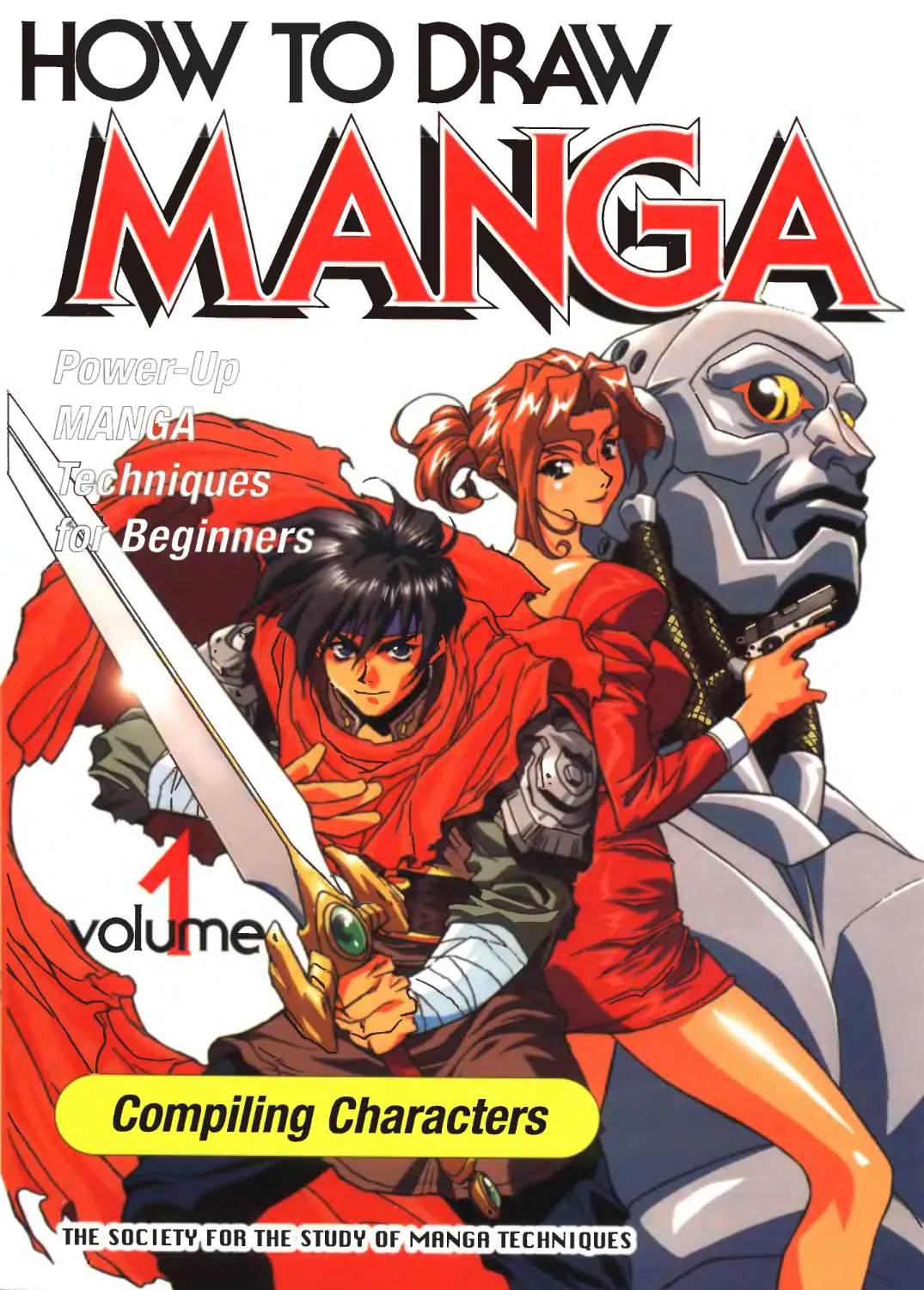
Нош to dram MHNGR
COMPILING CHARACTERS
Power up MHNGR techniques for beginners
HOW TO DRAW MANGA Volume 1: Compiling Characters
by The Society for the Study of Manga Techniques
Text and images copyright
©1999 by The Society for the Study of Manga Techniques
Design and layout copyright
©1999 by Graphic-sha Publishing Co., Ltd.
All rights reserved. No part of this publication may be
reproduced or used in any form or by any means - graphic,
electronic, or mechanical, including photocopying, recording,
taping, or information storage and retrieval systems
- without written permission of the publisher.
Published by Graphic-sha Publishing Co., Ltd.
1-9-12 Kudankita, Chiyoda-ku, Tokyo, 102-0073
Distributor:
Japan Publications Trading Co., Ltd.
1-2-1 Sarugaku-cho, Chiyoda-ku, Tokyo, 101-0064
Telephone: 03-3292-3751 Fax: 03-3292-0410
E-mail: jpt@jptco.co.jp
First printing: April 1999
Second printing: November 1999
Third printing: June 2000
ISBN 4-88996-042-2
Printed in Japan
Нош to dram MHNGA
COMPILING CHARACTERS
Power up MRNGR techniques for beginners
*AII the manga characters in this book are fictional and
have nothing to do with actual persons who may exist.
CONTENTS
THE AIM OF THIS BOOK........................................page	6
A PORTRAIT OF A CARTOONIST..................................page	7
(introducing how to draw manga by means of manga)
INSTRUMENTS AND MATERIALS FOR DRAWING MANGA.................page	24
MANUSCRIPT PAPER/PENCILS/ERASERS/LIGHT BOXES/PEN POINTS/
PENHOLDERS/INK/WHITE INK  CORRECTION FLUID/FINE POINT PENS/
BRUSH PENS/BRUSHES/RULERS/CURVED RULERS/FLEXIBLE RULERS/
TEMPLATES/COMPASSES/TONES/TONE GOODS
CHAPTER 1
DRAWING THE FACE............................................page	37
DRAWING CHARACTER - THE FACE................................page	38
Faces with different angles/How to draw faces(application)
FACIAL EXPRESSION...........................................page 44
HOW TO EXPRESS AGES........................................page 47
The difference between adults and children/Basic partitioning
of the head/Facial expression at different ages/The difference
between men and women
DRAWING HAIR................................................page	50
How to draw hair/Braiding hair/Continued - how to draw hair/
Brush pen/Tone
DEFORMATION.................................................page	55
SUMMARY.........................................................page	56
CHAPTER 2
HOW TO DRAW BODIES..............................................page	57
DRAWING CHARACTER BODIES........................................page	58
Body basics/A skeletal structure that moves smoothly/
Drawing in Ыоск^/Drawmg movements/Curved line of movement/
Drawing complex angles
STANDARD HUMAN BODY STRUCTURE..............................page	65
Let's look at the back/Let's look at the side/Differences between
the male body and the female body/Proportions
4
DRAWING HANDS AND FEET........................................page	70
How to draw hands/Draw feet
HOW TO DRAW FOLDS IN CLOTHES...................................page74
Loose folds/Drawing a leather jacket/
Highlighting using a sand eraser
WHAT IS SHADOW IN MANGA?......................................page	78
DEFORMATION OF THE BODY.......................................page	79
What is a deformed body?/The most important point in manga/
Continued - what are deformed bodies?
THE BASICS OF DRAWING.........................................page	81
What is sketching?/What is manga?/Sketching nudes
SUMMARY.......................................................page	84
CHAPTER 3
DRAWING CHARACTERS............................................page	85
THE THREE MAJOR ELEMENTS OF MANGA.................................page	86
What does the theme mean?/What does story
mean?/lntroduction/Development/Turning pomt/Denouement/
The most important point when creating a story/What is character?
ACTUAL TONES......................................................page	94
LET’S CREATE CHARACTERS...........................................page	95
Character created by the story
PRODUCING THE CHARACTER...........................................page	98
Character with a strong will/Rather cool types/The wild type/
Type of character who is cute and perky/The gentle type/
Weak-willed characters/Strong willed and selfish/Villams/
The shape of the body is also character/Costume is also part of character/
Accessories to the characters/How to draw out emotion/
Effect of background/Continued - Effect of background
A glossary of manga technical terms...........................page	11 2
SUMMARY.......................................................page	11 5
5
THE Al M OF TH IS BOOK
This book is aimed at those who want to start drawing cartoons (or comics) or
those who are at a certain level but want to study it more seriously, or those
who are already serious but do not see any improvement. In other words, this
book is designed to help all non-professional people, from elementary school
pupils to adults to improve their technical skills.
This book concentrates on character types.
Speaking of characters, we guess most of you are confident in your native
drawing skill. However, do you vibrate people with life? Are they 3-D?
Are body parts smoothly and flexibly jointed?
Here, a group member of the author will teach you the rational method and
technique to improve yourself, based on their experiences.
First of all, Chapter 1 will show you how to draw figures, in fully realised
3-D. Chapter 2 will focus on how to draw bodies. It will show how the
muscle structure of the body can be rendered, and will enable you to draw
human bodies which look quite natural. Chapter 3 will teach you how to
draw character. It will enable you to bring out character closer to how
professionals doit.
Really? Yes! So why don’t you give it a go!
A SOCIETY FOR THE STUDY OF
MANGA TECHNIQUES
REPRESENTATIVE MEMBERS
Hideki Matsuoka
Tatsuhiro Ozaki
Takehiko Matsumoto
Planning: Tatsuhiro Ozaki
Editing : Motofumi Nakanishi
Cover designing and text layout: Hideyuki Amemura
Photographing: Yasuo Imai
English translation: Steve K.Amemura
6
АЖОЖТЖАМ
OIF
ОАЖТООНПЭТ
Written and drawn by
Tatsuhiro Ozaki
* All the manga characters in this
textbook are fanciful and do not
relate to any of persons that may
substantially exist.
7
But that does not mean
the cartoonist has
-finished his job yet.

He must be already
working on an idea
in mind.
*

9
Next, write out the plot
developments, one to a page.
Example
Assume that the story of Cinderella is told
in 31 pages:
P. 1	Cover
P.2 T Cinderella appears.
P.5	Cinderella is treated harshly by her
stepmother up to here.
P.6 v The ball at the castle is decided.
P.9 Cinderella is left alone, up to here.
P.10 T The fairy godmother appears.
P. 13 The plot moves to the point of the magic
P. 14 r pumpkin coach.
P. 17 Cinderella debuts at the ball.
P.18 r The Prince appears.
P.21 Cinderella dances, up to here.
P.22^ The clock strikes 12.
P.25 Cinderella runs away, at this point.
P.26 T The Prince seeks Cinderella up to here.
P.29 Cinderella puts on the glass slipper here.
P.30w The slipper fits and the Prince proposes.
P.31 They lived happily ever after.
The plot must be divided into pages,
then the scenario of each page
planned out.
Now do your rough illustrations
of the scnpt. In Japanese this
"picture script" or "e-conte.
The size of the conte should be twice the page size of the magazine.
The paper should be high quality B4.
"One-in-two picture" means one picture drawn over two pages.
10
To make your manuscript paper, you
must make a master template first.
Pickup several pieces of drawing
paper, place the template on top, and
then poke 12 holes tn it using a compass.
Then draw your frame using the holes as
a guideline. You may use a felt tip pen.
Use red or blue as it will be easier to see
if you decide to draw through to
the paper edge.
Again and again, our manga artist quits working
on the script and instead goes for a more interesting
and cultivated story.
11

If a publisher sees anything
he doesn't like, then he will' |
have to do it over from scratch.
Mr. Manga's heart beats fast. /
This is good. \
\ We'll run it.
It looks like he
got it done.
Well, I must be
going.
pit-pit
pit-a -
pot-fr'
Al f\
13
14

FSm^htsd
16
17
Once he starts working,
he will be at his desk
all day long.
He never wastes his
time even a minute
of time.
18


' ’	-’W
/ need some
medicine.
•*Because of the pressure of |Sj
J the deadline, lack of sleep,
and too much caffeine, I am
Ingoing out for
my stomach.
Mr. M
you
Stomach medicine
Mr.Mt
But a weapon that fights these
two strong enemies is coffee.
To tell you the
truth, I have piles.
This is a
must-have
for cartoonists.
It's no
good.
I've got
to sleep.
Sitting on a chair all day
long as he does, he falls
sick of an ailment he
cannot tell others.
I am so
sleepy.
But what a cartoonist mus
fight against most is . J
The bed, partner of sleep,
is calling for the soul of
the cartoonist,who is running
out of time.
20
A second must-have
item for cartoonists
photocompositions:
cm
the assistants.
I can do it.
The last lap
Whipping his
sleepy body
Hurry it up but
carefully does it.
He pressures the i .
[cartoonist who has\^l 1
scarcely any time
Heft to meet the deadline.
Under all that stress,
the cartoonist keeps on working
and drawing.
The publisher's
rep. comes.

INSTRUMENTS & MATERIALS FOR
DRRIDING MRNGR ________——
In general, the basic paper used for cartoon manuscripts
is high-quality paper(wood free), Kent paper, and drawing paper.
However, repeated erasure on drawing paper will roughen
its surface and as a result it may not be suitable for
beginners because ink will blot. On the other hand, you
do not have to worry about blotting with Kent paper
(both 90kg and 135kg thicknesses are available) or
high-quality paper.
Nowadays, manuscript paper made exclusively for
drawing cartoons is available. Kent paper or
wood free paper is used and it is printed with
light-blue frame-lines for drawing cartoons, and
with measurement on the edges that make it easier
for partitioning frames and specifying portions of
frames that need to be cut off. Recently, cartoonists
have been using this specialized cartoon manuscript paper.
A:	Size of manuscript paper
(B4 = 257mm x 364mm /
A4 = 210mm x 297mm)
B:	Draw to this edge when
cutting off frames.
C:	Outer frame-finish
drawing at this edge
(B4 = 220mm x 310mm /
A4 = 182mm x 257mm)
D:	Internal frame—basic
frame for specifying portions
(B4 = 180mm x 270mm /
A4 = 150mm x 220mm)
Convenient equipment -
For tape, Scotch tape and
Mending tape are good.
The photo shows a clear tape.
The color and quality of this
tape will last. Taping is also
good if you make a mistake.
Unlike glue, you can peel it
off again.
The photo also shows a can of
paper cement. There are two
types—the spray type and
smear type.
24
PENCILS
Most cartoonists nowadays use mechanical
pencils. Some cartoonists say that they use
light-weight pencils when drawing small
cartoons for putting weight on pin-points,
and larger-gripped ones for drawing large
cartoons with a lighter hand. You should
choose a suitable lead hardness—НВ, В, 2B
and so on—by judging the pressure that will
bear on the pencil unit. Use В or 2B for
weak pencil pressure. Blue lead pencils and
mechanical pencils are both very convenient.
Blue does not show up when printed; there-
fore, cartoonists use it to specify tone to
their assistants, and or to show where tone
is needed, where there is no shade or drawing.
ERASERS
The AIR-IN and MONO series are commonly
used erasers (see photo). Residue from erasers
may spoil the tone effect if it remains on the
paper so be sure to keep your desktop very clean.
There is also a very convenient eraser called
NON-DUST. This eraser collects the residue by
itself and it keeps the working area clean. There is
also a pen-type eraser, which is very convenient
for erasing in small and narrow spots.
A sand eraser is used to soften tone and bring
out a sense of smoothness and dimness.
LIGHT BORES
A light box illuminates the screen from beneath
and makes it possible to draw object through
the light from behind. If you have one, it’s very
useful.
25
PEN POINTS
Zebra, Nikko and Tachikawa are
well known nib manufacturers.
For drawing cartoon characters,
the G pen and the Round pen are
most often used. Some cartoonists
prefer to use the turnip pen
(Kabura Pen) for the hardness of
line it gives. Gillotts is an English
make, and here are six different
types, ranging from fine-pointed
to the G-pen type.
They all draw very smoothly.
PENHOLDERS
The pen is something you hold for a long
time and if you grip it strongly you may
get callouses. When you buy a penholder,
keep in mind that though penholders can
hold any standard G-pen, turnip pen and
school pen, the round pen requires its own
exclusive holder.
26
ZEBRA
NIKKO
Round Pen School Pen Turnip Pen G-Pen
(Saji Pen)
ТАСН1КАША
TRCHIKRLDfl GPEN
You can get uniform vertical and
horizontal lines with this pen.
It has a hard, direct touch.
NIKKO GPEN
This pen has a very smooth and
easy flow. It is suitable for
drawing thicker rather than
fine lines.
ZEBRA G PEN
Both fine lines and thick lines
can be drawn with this pen.
Its soft touch produces soft
lines. Many cartoonists use
this pen, although you may feel
a slight resistance in flow.
TRCHIKRLUR ROUND PEN
This pen draws fine lines, of
course, but it is also possible
to draw relatively wide lines,
and has a good feeling to it,
close to that of the Zebra G-
Pen.
NIKKO ROUND PEN
You may feel it is designed exclu-
sively for drawing fine lines. It
scratches the paper when drawing
bold lines, and may require some
getting used to.
ZEBRR ROUND PEN
Basically, this pen is designed
for drawing fine lines, although
it is possible to draw bold lines.
It may scratch the paper a little
bit, but once you become used to
it, it will give you very good
results;
28
TRCHIKRLUR TURNIP PEN
NIKKO TURNIP PEN
ZEBRR TURNIP PEN
With this pen you can draw very
uniform lines, and the feeling is
very free flowing. A combination
of both a fine point pen and a
Rotring yet some touching is also
possible.
The pen point has a yielding feel.
The line drawn may be a little
thicker than those drawn by
Tachikawa but it has a similar
feeling.
This turnip pen is designed to
draw hard and even lines. You
may have some difficulty at first,
but this pen is commonly used.
NIKKO SCHOOL PEN
This pen point is a little bit softer
than Zebra. The lines are a little
bit bolder.
ZEBRR SCHOOL PEN
This mb is good for drawing fine
and hard touch lines. The School
Pen gives hard lines, whereras
the round pen creates soft lines.
Each person has own preference in
pen nibs. Try out different types of
pen points from different manufacturers
in order to determine what works best
for you.
29
HOW TO WIPE OFF INK
INK
Some of the commonly used inks
and Kaimei Bokuju (China Ink).
Kaimei Bokuju does not dry as
fast as Pilot, but there will be no
problem if you keep a roll of
absorbent paper (toilet rolls work
fine') handy for blotting up exces-
sive ink(See illustration).
Pilot ink for writing documents
is water-resistent, and used for
drawing in color. Nowadays, many
other good inks have also become
available.
Dr. Martin's, Line & Beta and Lettering
Sol, out of the upper four inks in the
photo, are water-resistent.
The strength of the black, including
Cartoon Black, is much higher than
Pilot or Kaimei Bokuju, and they
provide a spotless finish.
(2) Roll it over once only. Do not
push down otherwise the lines
(1) Place the roll of paper on
the drawing.
(3) Do not reverse roll to avoid
spots.
may smear.
WHITE INK -
CORRECTION FLUID
Correction fluid may be applied
to correct tone and copies, as
long as it is not watery. It is not
necessary to dissolve it in water,
and it spreads well. Correction
ink is convenient to have. Simple
mistakes can be corrected.
30
FINE POINT PENS
BRUSH PENS
Drawing cartoons does not require preciseness to
the milimeter. Some cartoonists use fine point
pens as they are easy to obtain and easy to
maintain.
Nowadays, brush pens are commonly used
for black masking. For large areas, the
brush pen on the right in the photo is more
suitable. This pen will be also good for
drawing highlights in hair.
The brush on the left feels more like a pen,
more like drawing than painting.
BRUSHES
Very slim brushes are recommended for white ink
or correction fluid. Correcting can be very precise
depending upon the brush used.
31
RULERS
Basically, you should choose beveled rulers for lines, and rulers with
measurements will be more convenient to use. You should have at least
three different types of rulers: a 14cm ruler for fine work, a 30cm ruler
for frame work, and a 40~50cm type ruler for long perspectives.
Rulers with metal edges are also useful because you will not damage the
ruler when using a cutter.
Edge" means the beveled edge.
The pen should be positioned as in the left diagram, so that the ink does
not come below the edge of the ruler when drawing with pens.
See the diagram on the right for the correct positioning of pencils.
32
CURUED RULERS
Be sure to use rulers
with an ink edge when
using curved rulers or
templates. Round chip
floating discs are used
for preventing seepage
you attach them to the
back of the ruler, lifting
it slightly from the paper.
FLEBIBLE RULERS
These rulers can be made
into any curve you want
but they do not have an
edge; therefore, you must
use a fine nib with them.
TEMPLATES
Oval and circle
templates are
very handy to
have.
COMPASSES
The type of compasses shown are
very useful for not only drawing
circles but also for use with a
cutter for tone sheets.
33
No.1033(Letraset) C-188(Letraset) No.684(Letraset) No.61(Letraset)
TONES
Nowadays, tone is indispensable for
drawing cartoons. Make sure that the
manuscript paper is free from dust and
erase residue. If it sticks to the tone paper
you won’t be able to use it. The sheets are
packed individually in clear plastic bags. They
should be put back after use. This #61 refers
to Letraset #61 and tone of this dot size is called
Screen-Tone. Letraset #684 looks like sand;
therefore, it is called sandy dot.
PORTFOLIOS
The portfolio is a bag designed for carrying
manuscript paper and leaves of tone, so
it protects your work even on
crowded trains.
34
S-428(IC)	S-452(IC)	S-686(IC)	S-51 (IC)
Instantex
(Letraset)
/ Tone, dot-tone and gradation create
/ half-tones from black to white. There
/ are also different types of tones such as
tone for use in backgrounds and or for
garments and other textures.
The cut and paste type is not the only kind
of tone. Transfers are also available.
Which type you use will depend on the situation.
TONE GOODS
Tone always comes with a cutter.
You should start with a standard type.
Cutter blades quickly wear out and
become dull. As a result, it affects
on your work. Make sure to break off
the blade edge as often as possible so
that you have always a sharp blade.
An art cutter is useful for special
techniques. Standard cutters should
be gripped the same way as you hold
pencils. A Clear Mat is useful and
protects your desk when placed under
the manuscript paper when cutting and
pasting.
They are called Tone-Bera or Tone-
scrubber and pointed ones are more
convenient.
Feather brushes sweep off not only
eraser residue but also tone
trimmings.
36
CHAPTER 1
DRAWING THE FACE
37
□RAIDING CHRRRCTER-THE FACE
By Yu Kinutani/Media Works/Dengeki Comics EX/from "Angel Arm"
Go ahead and draw the face of one of your original characters.
As you do so, think about the drawing and the shape.
Figure 1
You will see how flat the side of the human
face is when eye position and ear position
are connected with lines.
Figure 2
Also, if the ear position
is carried up by line,
you see it will intersect
the center of the bisecting
line of the head.
38
Check with the center line if
the right and left side are
balanced.
Eye and ear position
Eye and ear
positioning line
Figure 3
The human skull is
composed of two parts,
the upper portion of the
skull and the lower jaw.
These two get together
and become one.
' If you understand
figures 1—3, you can
draw simple, skeletal
structure based
on that.
Often, people draw a circle and a crossing, see left,
when drawing a face. It simplifies the upper skull, head and
upper face. (Figure 3)
You may just draw on the circle and the intersecting lines.
However, if you want to get a little bit closer to the skeletal
structure, then use something like the diagram on the left
as your base.
Ear positioning line
Eye and ear lines
should be positioned
a little bit lower,
considering that you will
add the lower jaw.
Side of plane of face
nose
Lower jaw (see Figure 1)
When you have drawn the basic skeletal
structure, calculate where to draw the
eyes, nose and mouth and draw them.
I wonder if the eyes should
be positioned in the center
of the center line.
As long as the basic skeletal
structure and positioning of
eyes, nose and mouth have
been correctly placed, the
proportions will not be
affected
by any /
change of /
angle.
39
Side and front views of basic skeletal structure
You see the vertical line from the ear.
The hairline
Draw it and adjust later on.
about 45° angle
The hairline
Now let's look at different angles.
Think of adding glasses when deciding
eye and ear positioning.
Eye position Ear position
The standard distance between
the eyes is the end to end length of
another eye.
Let's try to angle it
As the next step, draw positioning lines as in the diagram as if the
entire face were the side of a box. Now angle the lines.
40
Faces iwith different angles
With different perspective, facial proportions will change accordingly.
Center
First, partition the face into four squares,
then draw the diagonals to find the center.
Assume that the eye position comes to the center.
When the figure on the left is angled, you will get
the figures below.
This is a figure seen from above and from below.
You will see that if you draw from near to far then
the proportion of the forehead will become different.
Far
The distance between eyes and
brows becomes wider when
looking up at the figure from
below,and narrower all of a
sudden when looking down from
above because the brow is
located a little bit ahead of
eyes and the eyes are inset.
Rather, you should just keep
them in mind.
Let's draw figures that
appear quite natural.
41
You do not have to
formally draw out
all the structures
while drawing.
НОШ ТО DRRLD FREES (Application)
Try to think about the
basic skeletal structure
so that it matches with
the skeletal structure of
each character and pattern.
Some patterns do not require
drawing a plane of the side of
the face. By the way, the way
that Mr. M draws is this.
Adjust the shape of
the head such as the
back of the head, etc.
The way Mr. M draws
can be applied to many
other drawings.
Add the lower jaw
and adjust the outline
of the face.
When the basic skeletal structure
and the position of eyes and nose
is decided then adjust .the facial
contours. There will be no problem
as long as the skeletal structure of
face is drawn in accordance with
the basic skeletal structure but if
not then adjust it in your own way.
This line basically
needs to be lined on
top of nose, but let's
divide it in your
own way.
This is the position
of the ear.
The circle alone forms
the basis of the entire
facial pattern.
42
Нош to drain skeletal structure differently.
Just as in the cartoon by
Mr. M many different
skeletal structures can
be obtained by just changing
the lower jaw.
The jaw structure is
very stalwart.
By Yu Kinutam/Media Works/Dengeki Comics EX/from "Angel Arm”
*
As groundwork for
the basic sphere,
let's adjust the
skeletal structure.
By Yu Kinutani/Emx/G Fantasy/from
"Lucky Racoon"
Please pay attention to
the position of the cheek
bone.


Draw the jaw a
little bit longer.
By Yu Kinutani/Enix/G Fantasy/from
"Lucky Racoon"
43
FflCIRL EXPRESSION
Normal state
Emotionless Expression

The body part that shows expression of the heart
most is the face.
Facial Expression
When the expressions of the character are drawn
vividly, your work will be impressive indeed.
Loud laughter
The louder the laugh, the more
the heart is expressed. The
mouth opens wider and more
voice wants to come forth.
Laughter
Smile
Depending upon the degree of
laughter, the eyes narrow.
When happy, the outside facial
muscle loosens and eyebrow,
eyes and mouth are drawn in
a curved line.
44
Uiolent anger
When very angry,the
ends of the eyes lift
up.
Rnger
Depending upon the degree
of anger, wrinkles show up
in the middle of the face.
Being upset
When angry, the muscles
bunch together into the
center.
Crying loudly
When crying loudly, the
eyes may open but it
depends on the emotional
strength of the heart.
Crying
The eyelids are pulled
by the muscles of
eyebrows.
Thinking
When you look at someone
who is speaking while
thinking, you see that
their gaze is averted.
Troubled
This expression is
similar to sorrow.
With surprise, the eyes
widen. A useful tip is to
draw sweat in order to
look like the way it should
be.
45
Fright
Relief
When frightened, the
face looks pale or
tense.
The eye shape here
is the main point.
Cry smilingly4^
Draw a crying face but
make the mouth smile.
Study different ways of drawing
expressions in cartoons by looking
at your own face in the mirror and
see how to create expression yourself.
Expression is composed of movements of
eyebrows, eyes and mouth. Even in cases
of deformation, you will be able to express
what you want if you understand the basic
shapes of those movements.
The difficulty of creating expression is that
there are slight differences in even laughing
depending on each situation.
By Yu Kinutani/Emx/G Fantasy/from "Lucky Raccoon"
Studying how to
position the eyes
46
The difference between
adults and children
Please have a look at the drawings below.
The proportions of eyes and nose are
different between adults and children.
Basic partitioning of the head
The eyebrow line falls at 1/2 in infancy,
but the eye line position becomes higher
with maturity.
Adult partitioning starts from age 16.
Facial expression at different ages
Let's look at the difference in expression at various ages.
By Yu Kinutani/Media Works/Dengeki Comics EX/from "Angel Arm"
The difference between
girls and women is that;
you draw girls’ eyes
larger and use child's
facial proportions on
the other hand,when
you draw the eyes
narrower and the nose
a little longer, it looks,
more adult.
Early twenties and
up to 30 years old

л fz it
: * i
: »Uz
Я»
In order to draw an aged face, you simply put
in wrinkles. Cheeks and jaws loosen downwards,
and the skeleton starts to show through.
Depending on the age, you may draw thinner hair
or gray hair.
60 to 80 years old
By Yu Kinutani/Media Works/Dengeki Comics EX/from "Angel Arm"
48
The difference between men and women
By Yu Kinutani/Media Works/Dengeki Comics EX/from "Angel Arm"
There is almost no difference
in the facial construction between
men and women, however,
you draw the woman's face a
little bit smaller than the man's
face, and the woman's eyes a
little bit bigger, the mouth and
the nose a little bit smaller.
By drawing the mouth and nose a
little bit smaller, the effect is more
delicate and cute. In order to draw
manliness, draw the mouth and nose
a little bit larger.
DRAWING HAIR
Нош to dram hair
A so-called head-wind
is created from the
direction the movement
goes into.
Wind
Wind
Direction of
movement
You may want to draw floating hair,
as when the character moves or the wind
blows. Movement can also create wind
and floating hair.
Wind
Direction of
movement
Direction of
movement
50
Gravity
Please consider gravity.
Direction of
movement
Hair moves and follows later
the movement of the body.
Braiding hair
You may want to draw girls
wearing braided hair.
Once you start drawing, however,
you may have difficulty with the
way it is braided at the back of
the head.
Here are some examples for your
reference.
51
Drawing highlights as if you were
Brush Pen
©Start drawing over the rough
copy, using a brush pen.
Here we try several
kinds of hair highlights drawing hair strand by strand,
using a brush-pen
and/or tone.
NX
Continued...
how to draw hair
When you draw highlights,
you should use less than
1 mm of the brush pen tip.
Sharpness is the
key point.
©Think about the hair movement
when you want to draw highlights,
and make a rough copy.
If your grip is not correct, you may
not be able to draw lines well.
Move the brush pen with your
index finger only. Keep your
thumb fixed.
52
Fix the thumb. ►
♦ Brush
A fine, broken-in
brush with a rough
tip gives the best
results.
&
Completed drawing
Drawing the outline in blue
Ф Draw first a rough copy including
the flow of hair. Then use the blue
pencil to draw the outline of the head.
A light blue pencil doesn't show up in
print if you use it gently.
@ Now draw in the outline matching
the touch with previous frames.
Later on, you can adjust it with
a pen or brush.
2
Grrrr
Grrrr'
sizzle
Drip Drip Drip
Burn the tip
of your finest
(slimmest)
brush.
Be careful not to
burn the tip too much.
If you do not have a used brush,
make one in these ways.
thumb
If you are using a new
brush, dip it in India
ink and let it sit for a
Or you can wrap the
brush tip with a tissue
and squeeze with your
thumb to make the end
When you use India ink,
make sure that you just
dip the tip in to draw.
(3) Cover the image roughly with tone
(use IC#63) then cut out the figure
part. You roughly cover it because
you can take it off immediately if
you make a cutting mistake. Also,
you can avoid cutting adjacent tone.
India ink
About 0.5mm is enough.
while to roughen the tip.
ragged.
53
N.B. Use India ink or specialized ink only, other types of ink may damage the brush.
Нош to hold the cutter
Tone (Cutting * UJhitening)
Basically,
I long as it i
Use the blade
tip to cut.
Hold the cutter in
the same way you
hold a pencil.
Place the tone.
Draw the hair flow in blue
before you start cutting.
When you cut the tone, place a piece of paper
on top of it,in order to avoid spoiling the tone
or the white area when trimming.
, any type of paper can be used as
does not spoil the drawing but a
semi-transparent paper may be convenient.
Draw a rough copy in blue and paint in white.
(White liquid exclusively designed for drawing
cartoons does not require an eraser, and if you
do not thin too much, you can use it on the tone
and it will not lift.)
Replacing with white
This means painting in white and replacing black
or other dark color with white.
iff
Rub-Rub-Rub
Use the eraser before
white liquid on the tone.
For clearer hair outlines,
use this technique after
first painting the black.
If you make a mistake in
white, use a brush pen to
adjust it.
A shine in the eye can be
drawn with white liquid.
54
DEFORMATION
Нош to draw deformations
Delicate angling of the face
Cartoons are deformed sketches,
and they need not reflect the reality.
As long as they look good to the eye and or
are interesting to see, then everything is OK.
Diuiding the facial
proportions
You may use the facial proportions of
children even for adults for a cute look.
IDhy eyes are drawn large
You may draw eyes big not only because they
look cute but also because sometimes the
character looks small depending upon the cut,
yet you may still want to have the character
stay as a. main player.
As you can see in the illustration,
even if drawing eyes is difficult
because of the angle....
you may draw the eye a little bit
smaller (deformation) and it turns
out well.
In drawing a cartoon
face, you are free to
draw whateuer you like
A face can be composed of only
eyes and a mouth. As long as
people can recognize it as a face,
any shape is OK.
Let's think about different deformations.
Funny faces provide some of the most

interesting aspects of cartoons.
55
SUMMARY
Straight
line
Some artists use three
lines to avoid a wandering
features.
Those who are accustomed
lines and a different
as a resu t.
Eyes looking up may often turn
down at the outer corners.
Eyes looking down
often lift up
at the outer corners.
The proportion of eyes
and ears are usually
decided by straight
lines at an angle for
drawing; therefore,
we recommend to use straight
lines even when the angle changes.
to doing this will not have
difficulty, but if not, the
shape of the eyes may be
affected by those curved
character may be created
Some artists use
curved lines to
position the eyes
and ears, and
decide the angling
of the face.
Be careful with the balancing
of the eyes,and make sure —
they are not out of balance.
56
CHAPTER 2
HOW TO DRAW BODIES
57
DRRLUING CHARACTER RORIES____
_____________И.......ОТТИИМОЙ
Body basics
The basic body is the skeletal structure
and the nude. Aim to be able to sense
the space of the body in trying to draw
these basics.
By Yu Kinutani/Media Works/Dengeki Comics EX/
from "Angei Arm"
Vanishing point
This is the two-point
perspective method.
The perspective
method is illustrated
below.
Horizontal line
Vanishing point
Let’s find out about drawing a box
based on the perspective
drawing method. It is not
necessary to be precise as
long as it does not look
strange.
Let’s try to place the
character in the box,
using the bottom as
the ground.
58
Let’s look briefly at
the skeletal structure
and try to draw it.
A skeletal structure
that moues smoothly
T ry putting the
shoulder muscle
on the shoulder.
Curved line of
movement
Drawing the lower portion
of the skeleton will make it
possible to draw the natural
movement of body, including
how to turn the body and
where to put its weight etc.
59
Drawing in blocks
The male body
If you cannot see the position of the other side
of shoulder, lightly pencil in a 3-D box.
Pay special attention
to where the shoulder
is angled and now the
shoulder is hidden by
the angle.
Just assume that joints and
the abdomen are spheres,
and draw rough muscles in
the shape of blocks to speed
up drawing and to be able to
feel the 3-D structure of body.
Brachium biceps
Draw biceps
roughly.
Now you can
really know the
deltoid and biceps.
Make sure the block
does not protrude.
Look carefully at how
collarbone is jointed.
60
Blocks are just guidelines
for your head. When you
draw blocks, simply
adjust them to your liking.
The female body
in blocks
Look at the sides carefully.
The sides of men are usually drawn
a little longer, while those of women
are shorter and joint the hip almost
directly from the sternum.
61
Drawing mouements
How to draw human body with
the block method using the flow
of the center line of the body and
the curved line of movement.
The center line is the guideline
for balancing the right and
left sides of the body, and
there are two lines one each
for the front and the back.
Place a center
line on the visible
side for a simple
standing posture.
Pay close attention
to the movement
of the waistline.
62
Imagine a center line that goes with the flow of movement as sometimes
the center line on visible side may be shrunk because of the back being
bent and so on.
Curued line of
mouement

Using curved movement lines enables
you to draw good posture and flow
in action cartoons.
It will stabilize
the drawing if
you draw frontal
body parts a little
larger. /
Curved line of
movement
Curved line of
movement
The center line of the body
can also be curved.
63
□RAIDING COMPLEX ANGLES
Quite a number of postures can be
drawn using the block method but you
may be able to do better if you use the
skeletal method for more complex angles.
Your drawing will come easier if you
consider the part of the backbone
that comes from the skull.
Make sure to draw
in the collarbone.
Draw in the
abdomen too.
64
STANDARD HUMAN BODY STRUCTUR
The crotch has a small gap
through the thighs, when
the legs are closed.
The trapezoid wil
stretch or shrink
depending on the
movement. Л
The position of the elbow
when the arm is lifted
to its topmost position.
Here are changes and compositions
which are often forgotten using the standard
human body as a model.
The correct joint structure of
collarbone and sternum
The hands fall here.
The deltoid muscle
is positioned here.
The elbow position when
the arms are lowered.
Do not draw crotches
like this.
When you cannot figure out
the length of the arm when
it is stretched horizontally,
use as a guideline the length
when it is raised.
When this length is
calculated, then....
When the legs
are opened,
there is a gap
between the
joints of the
thighs.
it will be easy to imagine
the length of this portion.
Another way is to measure
the length of the deltoid,
then add the same length of
biceps plus the joint.
65
Let's look at the back
When the body is
bent to the side.
The skeletal structure
of the shoulder blade.
у This side is drawn
^stretched and simple.
The side abdominal muscles
bunch together on the inner
side.
The shoulder blades lift up when
the shoulders are lifted up.
The same
even if tf
backward or forward.
When the body
twisted.
When you have a closer look
at the shoulder blades you
may realize they look like
a face.
Try to remember them by
the face shown above.
66
Let's look at the side
The standard size of a hand
is one big enough cover the
face with it.
A guideline to standard
hands and feet
On the other hand .when the
chest is bent backwards,
then the shoulder position
will also fall backward a
little.
A length of the upper arm should
be equal to one and a half the size
of the head.
A length of the lower arm should
be equal to twice the size of the
head when the fingers are straightened.
The shoulder may move
back and forth a little.
When the body is bent down
forward the shoulder position
will be pushed forward a little bit.
67
The difference between the male body
and the female body
Women usually have narrower
shoulders and the skeletal
structure around the breast
is smaller than for that of men.
The biggest difference is the
pelvis.
The woman's hipbone line
reaches to the navel and
the waistline comes above
navel.
The position of the nipples
is lower in women than in
men.
The upper position of the
hipbone reaches the navel
line.
Men have the body shape
of a triangle in reverse,
while women have a wider
hipped body shape just like
a bowling pin.
68
Proportions The proportion of the body is decided
by the number of head lengths, so
you should first ask yourself how
many head lengths there are.
Use 2~3 head lengths
for a gag character.
The size of the head becomes
relatively bigger when dividing
the same height body into a
different number of head lengths.
Fashion models are
Use 6~7 head lengths
for average adults.
Use 5~6 head lengths
for old people.
Heroes are 9~10
head lengths tall. 7~8 head lengths tall.
Use 3~4 head lengths
for toddlers.
69
DRAWING HANDS AND FEET
Нош to draw hands
Let’s draw fingers
using blocks.
The thumb can move
most freely of ail the fingers.
Look at the gap,
with fingers both
closed and opened,
of this part.
Put the finger block
onto the back of the
hand.
Use this bone
as a start up base and
begin drawing the thumb.
When looking from the side,
you will see the raised portion
Start drawing the raised part of
the thumb onto the top drawing.
of the index and middle fingers.
70
When looking at the hand from the
outer edge side-on you will see
three raised portions.
The line is a little bit curved.
The bones of the back of the
hand should be considered as
they spread out from the wrist.
71
Hands should look totally different
depending upon how strongly the
wrist is twisted and its angle.
Sometimes you may not be able to
work it out with just an image and
Consider the movements
of the hand.
72
Оralu feet
One way to deal with feet
is to pretend that the
ankle is a sphere, then
put a heel in the sphere
and add the other parts
Draw feet in blocks, the same
way as you draw hands.
Heel and bull
When you draw a foot that
shows the instep, imagine
the back of the foot is a shoe,
then it will be easier to visualize.
Arch
The back of the foot is
similar to the sole of a shoe.
73
НОШ ТО ОННШ FOLDS IN CLOTHES
Let's look at how
clothes fall.
Here are the basics.
materia.
Folds are not elastic.
However, they are
formed because of
forces from different
angles, movements
Each garment will
drape differently
depending upon the
and gravity, etc.
Figure
Direction
of Force
Direction
of Force
Even just a
line for a
wrinkle is a
wrinkle.
You will be doing OK
if it looks 3-D.
Loose folds
This fold, as the figure
shows, appears when
the fabric overlaps.
Wrinkles gather
at the bent place.
If you want to add
shadows to the folds,
then think where the
shade appears in the
drape.
When the fabric
is pulled back.
Gravity causes
this type of drape.
You can take it easy
in cartoons. Basically,
if you just capture the
feeling,then it's fine.
74

Draining a leather jacket
Basically, the 3-D effect comes from
how light and shadow are used.
You can rub off to create highlights and also create
borders.
©First, draw a rough copy in pencil
to decide where to position the
shadows.
(з) Rub out with the cutter to create
shine.
Application -
school uniform highlight
The light falls
tops of the folds, so
consider them
carefully.
(2) When you finished drawing
in the black color and the
lines with pen, lay down the
tone #63 (darkness 30%).
Completed figure
76
Highlighting using a sand eraser
(D When using the sand eraser, place plenty
of size of tone on top of the drawing and
rub it off with the eraser directly.
Adding highlights to
body curves.
(2) After highlighting
start trimming the
tone around the
drawing.
Ж

ШНАТ IS SHRDOLU
IN MRNGR?
The other is shadow to
create a 3-D effect.
Тшо kinds of shadows
There are two kinds of shadows
in manga. One is the result of
sunlight or illumination light.
Second, we will try to draw
shadows with a mixture of
the two types, keeping in mind the
direction of the light.
Let's start those
shadows first.
Light and shadow are
the key points for
creating 3-D.
With objects that cast shadows you need to consider the
direction from which the light comes, otherwise
their use is irrelevant.
78
DEFORMATION OF THE BODY
LUhat is a deformed body?
4~5 head lengths
(child style)
Characters with short
head legnths are drawn
3 head lengths in gag cartoons,
(baby style)
It is the body shape
deformed into babies
and children.
The length of arm for babies is as short as for
3-head-length characters.
Hands and elbows will be positioned the same as
for adults.
The arms of deformed characters
will also look natural by drawing
the length based on the body.
A raised arm will
look strange if
you use the
adult arm length.
The most important
point in manga
How does it look at first sight?' Interesting? Cool? Cute? Beautiful? As long as it looks good at
a glance, it will be quite acceptable even if your sketch is actually out of proportion.
By Yu Kinutani/Media Works/Dengeki Comics EX/from "Angel Arm"
79
Continued... LUhat are deformed bodies?
Using perspective, near objects
are drawn larger and those far
away smaller.
Which figure do you think
is more 3-dimensional?
When a fist is pushed forward, it looks like
the Figure 1 in reality, but by deforming
the perspective as in Figure 2, it will have
greater dimensionality.
Far
Near
Far
Near
Near
Far
Perspective represented by far and
near can be used not only for persons
or characters but also for background,
To create a sense of 3-D through deformation iQUTC
draw the front larger and the near smaller,
This is one of the basics of perspective.
Objects drawn with some exaggeration is
so called deformation, and it brings out a
greater sense of space.
THE BRSICS OF DRAWING
What is sketching?
Sketching means to draw the object
in accordance with what you see.
When sketching you draw a rough copy first.
The rough copy is the base for the drawing to come.
When you draw a face,for example,
you look at the entire facial balance
and then decide the guidelines for positioning
the skeletal structure, eyes and nose.
After finishing the rough copy, you
work on the details. Making out the
shape means drawing a rough copy.
If you start working on the details
first, it will be difficult to look at
the entire balance, and you may take
a long time to adjust it.
81
What is manga?
For all that, it is not so easy to
sketch the image in your mind
at first.
It means to sketch the image
in your mind.
Well, what do you
have to do to be
able to sketch
the image in
your mind?
'cher
To some extent, you
will have to study
theory and acquire
knowledge.
In addition to that,
you will also need
experience.

Skeletal structure,
gravity, yadda yadda.
' If you draw with
some knowledge,
you will see a big
difference compared to
drawing without
knowledge. And you will
be able to visualize
the image
more clearly.
82
Sketching nudes
You may not have a model for drawing, so look at photo
collections, etc. and sketch.
Draw a couple every
day, keeping in mind
the skeletal structure.
The basic set shows
middle and bottom at
postures from above,
360 degree angle.
It will not only make you
understand the human body,
it will also enable you to
sketch better and increase
83
SUMMRBV
Please experiment yourself in various ways
based on the method introduced in
Chapter 2 - how to draw human bodies
in block.
Some people say
when drawing in block,
it becomes all messy
because the lines
overlap each other.
Draw in blue pencil
first, then use a
black pencil to pi
up the necessary
lines.
\ By the way, if you want to
draw Mr A in block
he'll look like this.
pencil.
Use a light blue
Put in markings
with a blue pencil.
Be moderate in
your pressure
How to check where
to adjust the illustration.
One of the ways to check which parts
should be adjusted is to turn the manuscript
over and look at it through the light. IV)
Reverse side of	*
X
Remarks
'"♦//щах’
When drawing onto the
manuscript, do not press
too hard; draw rather
softly and lightly.
Basically, the blue
won't show up in the
printing, but if it is
pressed and drawn too
hard, it may, and it will
be difficult to erase it.
CHAPTER 3
DRAWING CHARACTERS
85
THE THREE MAJOR ELEMENTS
OF MRNGR
LUhat does the theme mean? The three major elements in drawing manga are
THEME, STORY and CHARACTER.
What do you
think of when
it comes to
the theme?
Something like
that?
Love, freedom
or peace?
Ask yourself what
the leading character
wants to do.
pieces of this sphere,
my dreams will all
come true
Does he want to (
conquer evil?
Does she want to
have her lover requited7
What does the protagonist
want?
That ball belongs to the Hakkenshi,
The Eight Dog Soldiers.
I am the
champion.
Does he want
to be strong?
What do you
want to say?
Yeah,
I am a real
demon.
How will the feelings
of the characters change?
What?
I like good-natured men.
If I collect the seven
Woo!
m gonna turn into
Yess
I used to like you.
The earth will be
ruined if we go
on like this.
a good-natured guy
just for her.
There are just examples and $
there are many others.
Just narrate whatever
it is the leading character
wants to be and do.
The story should proceed how the
leading character sees and thinks.
Telling the story through his/her eyes
will keep the story on track and the
plot coherent.
86
LUhat does story mean?
Desktop type?
Power Mac?
urgh.' *ant 3
Some might start
a part-time job.
Some might ask their
parents for it.
What action would you take
based on this theme,
if you were the character?
Mom,
As an example, say you,
the readers,
want a personal computer.
At this stage, the theme of
desire for a computer
emerges.
Would you like some
potato with that?
will you buy
me one pleez
pleez pleez?

Different actions
may be taken
depending upon
the personality
and the character
of the person.
In accordance
with each
character’s
theme,
personality,
individual
character
and
thinking,
I'll think of it, if
you get grade-A
in the next exam
actions are
taken that
create a
drama and
you draw
them into
the story.
You must follow the basics when
creating a story.
The introduction, development,
climax and conclusion
Introduction
At this stage, you introduce the reader
to the manga world, set up the situation
and location, begin the story there.
What do these terms mean?
First, fit the theme of the leading
character into its genre - he wants
the girl he likes to become his girlfriend.
The genre is the so called love-come -
short for Love Comedy.
It is a love manga with a touch of comedy.
Maybe this
development
is too abrupt
Morning!
Hil
Crazy!
However, she loves dogs
and bulldogs best of all.
Maybe she is not scared
by his face.
P ease date
me'

However, this protagonist
has a strong aversion to dogs.
This leading character
has someone he secretly
likes.
Deuelopment
The story keeps develop.
I like you!

Let readers know who the leading
character is at this start-up stage.
This leading character is a man of
large frame with a fierce-looking
face, and everybody is scared of
him.
Only she is not
scared of me.
At the introduction stage,
you show the situation
and a certain degree of the
personality of the leading
character, including the
issue "why he likes her".
She says she cannot get along
with a man who does not like
dogs, and he was rebuffed.
88
UrghughJ
Isn't she cute?
BIG RON
| SPHERE
If I don't make her my
girl I'll never be able
to get any girl, ever!
Finally, he shows
the result of his
special training.
Well jet's start by
being friends.
We wish to see
efforts go
rewarded.
Turning point
The story develops in different directions
and at some point there will be reversal
of events, and for a climax.
The leading character
was rebuffed; however,
he will confirm to act
in accordance with the theme,
There's the special training	(
he formulated to overcome	///fl	*
his fear of dogs.	z
Once again, MR
he decides
to go see her.
ОКАТ
Denouement
This is the stage when the results begin
to play out, i.e. the conclusion. ,
Something may change at the end
or there happens a progress. .	•
Ж	The leading character
has become somewhat
Ф	accustomed to dogs,
but he is still scared
—----------------basically.
You're really giving \	i
him,aren't you.	)	f
3	\ We sometimes
include these
л' i’	/ "games" so that
0- I	readers can go
away with a
Yeooww ^^	9°°d impress’on
89
The most important point
Luhen creating a story
You might have worked very hard to come up with
a manga, but it will be in vain unless the story is
understood by the readers.
The most important point in creating a
story,therefore,is to make it easy to
understand. To do so, you have to make
it easy to read...
WHEN (time)
WHERE (place)
WHO	And you must make it clear how and
WHAT is done or being done why it turned out that way.
What is happening now is related
to the past, and will affect conclusion.
Only she is not
scared of me.
Future (conclusion)
Present (accident)
Past (reason)
I like you!
Please date
me!

Let's have readers understand them.
5LUs
i-lDho
— UJhen(time)
-IDhere(place)
-IDhat(done)
— LUhy(Why it turned out so)
1H HOLU(What was done and how it turned out)
Hlrnays remember the 5LUs and 1H.
There are still several other
issues, such as composition
and so on, but on this page,
we will only touch on the
basic.
90
LUhat is character?
The most important
elements of manga
are the characters.
Both the theme and
the past story are
carried by the
character.
An interesting work has above all, a strong main character, who lives
vividly within the story. Even though readers may not remember the
story the character lives on in them.
One theme only
Basic theme
for short pieces
91
Antagonists and supporting casts are important!
Assuming
is a hero,
example.
that there
as in the
But if it weren’t
Some basic examples are :
When you draw a cold antagonist
vs a passionate hero, their mutual
personalities, coldheartedness and
passion will each clearly bring out
the other's character.
However, it will be a little difficult if
the hero and the antihero have the same
character, unless both of them have
passion. When both of them have just
ordinary characters, it will be difficult
for them to play off one another, and you
run the risk of a story that just goes
through the paces.
And one more example, this time
of a love comedy.
If the leading boy and girl are both
shy and cannot say around that they
like the other, the story will not
develop and there will be no sense
of character.
But if a rival with a positive
presence showsup, it will bring
out the characters of the
protagonists, and as a result,
the story will develop.
Positiue
The antagonist and supporting cast are very important in creating
and showcasing the leading character.
In manga, it is important to think about the personalities of
characters. Even with theme alone, a story will follow.
This is the secret fundamental to manga.
Individuality and personality
are created from how the
characters interact.
93
ACTUAL TONES
^Printed at 86% reduction
94
LETS CREATE CHARACTERS
Considering individuality and personality
decide the genre first.
Then decide the look of the character
and think about his profile.
Now start using your imagination.
Write down the traits of the
character to bring out the
interesting points, and
illustrate the character in
different poses to realize
him more strongly.
AGE 16 if so, a student if so, the plot must be set at school.
CHARACTERISTICS Quarreling if so, strong body
likes to be active <=> if so,
be good at studying.________
DISLIKES Studying/Dogs Aman with a fearsome face, likes
(Weak point)	quarreling, is afraid of dogs.
This may be an interesting point
_____________________________to develop._____________________
LIKES Special training If so, he applies special training
(Words or phrases etc.) to every occasion.
Personality like hot geyser
________________________________dispenser => blood type B?
Individual feature Large frame, fearsome face
Very good at picking a fight,
____________________hangs round with rowdies.________________
Character	Blood type B, so can do only one
thing at a time.
Easily interested and motivated!
© Maybe he doesn't think of himself
as a rowdy7?
© The genre is Love Comedy and
the theme is "I want you to be
my girl’.'
© What type is his type?
© Why he comes to like her7
95
Sometimes you may imagine it from
the other end and find the main
character from the supporting
characters. Needless to say,
you may also imagine it first from
the personal profile, etc.
When you come up with the central
personalities in the story, think
about the kind of antagonist you
think will be able to play against
them.
0
Special ability:
LIKES
Bulldogs,
nothing special
ordinarily.
Have her opposite
number be
someone
who does
not like
dogs?
When you have come up with
that character, imagine and
develop the story based on
explanation or page
[What does story mean?] .

Also, try to look at
yourself objectively.
It’s also a good idea to find and create a character from
the people around you.
Mm mm...
resent
What a weird
It can be yourself. It can be a good idea
to deform the personality and individuality
from observations on yourself or people around you.
96
Character created by the story
Some decide to draw cartoons because a story,
set-up, incident, or interesting situation occurred
to them.
In this case, jot down a
rough outline of the
incident and its cause
in a notebook for the
portion you want to
describe.
Make up a plot.
When you make
up a plot, then
different thoughts
will emerge.
You might come up with a wonderful
scenario, or glamorous situation.
Then, create a character suitable
for that situation.
If the manga you are working
on is a short piece of 31 pages,
then you may want to create a
great protagonist using all 31 pages.
While you are developing the
character, you may refine the
plot again through the feelings
of the character, inserting some
lines as you go.
Go back to the
"What is story7" chapter.
97
PRODUCING THE CHRRRCTER
----------------Y-------------
The first impression comes
mostly from the face.
For example, a person with
droopy eyes or lifted eyes
will give different impressions.
In addition to physiognomy,the shape
of the eyebrow and the height of the
nose etc. all affect your impression.
Now I put that concept to work and
create some characters.
Character urith a strong mill
© Image of a hard worker
© Strength of will is most strongly represented by the
eyebrows. They should be firm and the ends should lift up.
© Mouth is firmly closed; Reversed V shape
© In case of girls, they may have short hair so that they
can or maybe they tie up their hair into a bun.
The drawing right shows
a Supporting characters
but his eyebrows and the
impression of his mouth
alone represent the
strength of his will.
98
Rather cool types
Eyeglasses are sometimes used
as props but the shape of the
spectacles may affect the
image of the character. So
please study this yourself.
An intelligent wild guy
would be pretty cool.
© Cool types come in different kinds—
there is the artistic type, the cruel
type, the delicate type and the calm
of noble pride type.
© Narrow eyebrows feminize the character
and give a sense of delicacy.
© Long, sharp eyes give a sense of beauty.
© Clear nose line. It is often said that
those who have high bridges also have a
lot of pride.
© Skeletal structure is
somewhat slender.
© Hair is parted in proportions
of 3 to 7, the typical hair
style of a gifted man.
The mild type
© The wild type is a very masculine
image, quite the opposite of the
calm, intelligent type.
This type does not care about
appearance, minor matters or
small things.
© The wild guy has a large
build. You can produce a
strong skeletal structure
by drawing the lower jaw
firmly.
© When the mouth is
drawn large, it gives
the impression of
wildness that does not
care about minor
details.
On the other hand, a smaller
mouth looks more feminine.
© This type does not care about
hair either, so you may create
something unconventional.
99
Someone perky, someone active
has short hair or tied back hair,
suits this character.
© Eyes should be wide open.
© Facial proportions should be
closer to those for children.
© If the nose is drawn a little
smaller, it will look cute.
© You should use as great a
variety of expressions as
possible.
© Use ribbons as a decorative
item, for props.
The gentle type
© Always keep smiles.
© When the eyebrows are close and
together it gives a strong impression;
if they are widely spaced, it creates a
sense of softness.
© Narrow, droopy eyes convey gentleness.
© Long hair conveys calm and intelligence.
© Round faces also produce a sense of
calmness.
100
Шеак-iuilled characters
© These types are more
delicate than beautiful.
© When the calm of the gentle
type is drawn differently it
becomes this weak type.
© Needless to say, to keep it
smiling, this type will have
an impression of being
troubled or lack of confidence
in the face.
© A troubled feeling or lack
of confidence is also conveyed
by the hair, which should be
self-effacing.
Uillains
© As an image, the eyes are
triangular and most of
the eye is white.
Fox eyes convey a sense
of cunning.
© A bold head and/or a face
without eyebrows gives a
sinister feeling.
Strong milled and selfish
© This character looks strong
willed, with a lot of pride,
like a young woman who has
grown up spoiled.
© The eyes are slightly up lifted
and fox-like eyes. This type
is easy to produce.
© The princess type should have
gorgeous curled hair.'
© To portray an active woman
different to the spoiled princess
look, add a suntan.
101
The shape of the body is also character
Different body shapes carry their own images, such as...
A tall person does not look able to move quickly.
On the other hand, a small person looks very agile.
The image of a fat person doesn’t go with a sense of sports, etc.
Using those images, convert them into the personality of the character.
You may take reverse advantage of those images and create
a character who is fat but agile.
In hand-to-hand fighting manga,
sports manga and/or action manga,
the body shape may be weak and a
drama sometimes is made out of that.
When you draw sports manga,
please study body shapes seriously.
102
Costume is also part
The first impression of a person's image
of character
Sneakers
Shoes also create
personality.
Short skirt
Loose socks
Loafers Fl
is often created by clothing. The style of
dress is decided by
the personality of
the character.
Without
a collar
You will have your
own image of clothing
styles such as what
a wannabe rowdy
wears, for those who
are talented, etc.
Leather
Hair dyed brown
People will feel
different and
act differently
depending on how
they are dressed.
Take a closer look at
the people around
you to see how
they are dressed
and what their
personalities are.
103
Accessories to the characters
The manner of speaking, the
movement of the body,
possessions, room interiors
etc. all have their own
characteristics and can
become characters in
themselves too.
Just by listening to the manner of speaking, you will be able not only to
imagine how a character was brought up, but also to imagine its personality.
For example, you will imagine that those young girls who call themselves
"boku", the male word for "I,"must have been brought up among brothers only,
and she has become boyish and openhearted.
When a scenario calls for "watching TV and laughing" you
realize that there are different kinds of laughter.
Personalities will also express themselves in their surroundings, their possessions and how they
are placed. You will be able to imagine that those who are lazy and sloppy in their dress will also
be live in a messy room.
Human beings have unlimited possibilities and unpredictability.
I am good at everything
That can be a weak point and it is also positive. It makes characters
more humanlike. Think about those aspects that cannot
be unanticipated.
like ikebana, tea ceremony,
and cooking.
105
Нош to dram out emotion
Trala la
tra la la
Try giving a character some typical
mannerism to express emotion, and
not just of happiness.
She always hits
you when
she's happy.
Sometimes you
just want to
pose guts-posture.
Hah hah-Do tell!
whack
Ah,
what the hell
are you
Emotion shows up not only in the
face but also in the body.
Consider how to express
emotion in your work,
considering the feeling
at that time.
Subject looks light and dancing when happy
and joyful.
talking about?
You sometimes
hum or sing.
This will support the
personality.
Arrghh!
Clench
Think about expressing
emotions using props.
The body becomes stiff
when angry, and quivers.
Sometimes we show a hand that
is stiff and quivering to express
the degree of anger or sorrow
that is being borne.
Slam!
106
When she is feeling
sad, loses strength.
Or face the wall.
Or lie on the floor and cry.
She is in low spirits
and wants to lean against
something for support.
Zooming up on the
To show contempt draw
the figure from below.
It gives the figure the
When you got absorbed in something
you often come to find you have
made a mistake.
proper look of disdain.
Looking up conveys a pleading
emotion, a trying to be liked,
and may be an effort to read
the other's face.
107
Effect of background
You can also communicate
the character's feeling
and state of mind through
light, shade and other
background effects.
This background is the image of
shining light.
Something bright and warm like
flowers and light will create a
sense of refreshing delight.
might try experimenting with
this kind of background.
Anxiety and suspicion can be
conveyed through this kind
of background.
Fire in the background
communicates strong anger.
This kind of background well
expresses shock and other
strong emotion.
108
Shadow is also an important communicator of atmosphere and state of mind.
Emanating light has different
nuances of meaning depending on
the intensity of the lines use.
It is used to show a visual focal
point or speed, and so on.
Speed lines, depending upon
the strength of lines, create
strong emotion and power.
There are many ways to use
these.
Curving speed lines create more
movement. Think about how
they can be used to express
emotion and power.
Concentrated light like this
conveys a flash of awareness,
a sudden noticing, or an
unfused movement.
Using waves or other strong
image you can express strong
positive emotion like
determination.
109
Continued - Effect of background
Include props and expressions when
you consider background effects to
show emotion and image of state of mind.
~~u
EXAMPLE
DELIGHTS lights, spring wind, flower leaf, sunny place
ANGER	storm wind, thunder, fire
SORROW	rain, cloudy, winter, twilight, autumn,
falling leaves
Think about the effectiveness of images from nature.
It’s also very interesting to use well known images
or cemeteries as props to express emotion.

The way the sound effects are written contributes greatly to the feeling.
Sound effects in the picture not only express emotion but also things like speed and power.
A glossary of manga technical terms
Д ♦ Atari
the rough draft of the page/frame
♦	Ami (Screen)
patterns of tone composed of dots
(There are many types of tones depending on the dot size and density.)
♦	Angle
the angle from which the picture is drawn
Q ♦ Back
background
♦	(Balloon (Fukidashi)
the rounded shape in which speech is placed
♦	Beta
an area drawn in black; black beta A brush pen is often used.
♦	Benia
a specialized tone, such as I.C.Screen SI 71
Cont6 drawing
rough frame-by-frame sketches based on the scenario
(This is done before drawing the manuscript, and the words for the frames
are decided at this time. It is also sometimes called "scripting".)
Words written in by hand to indicate sound effects etc.
♦	Color
the color manuscript; some times called the four-color
manuscript
♦	"Chara"
abbreviation of character (This short form "chara" is commonly used
in Japan.)
♦	Cut and paste
A technique to amend or fix a mistake by cutting out the place with a
knife and pasting in fresh paper from behind. (This technique is used
to amend large areas and make scene-by-scene amendments.)
♦	Compositioning
to consider the scenario, or dramatic presentation of the work by
creating the frames that will comprise it
0 ♦ Drop down/drop out
to miss the deadline, thus causing the publisher to drop the
cartoon concerned (Strangely, it is always said that "the author has
become ill".)
♦	Deadline
the time by when the job must be completed
£ ♦ Effect lines and concentrated lines
lines expressing the movement of a person or an object They are also
used to bring out expression of emotion; curved lines.
Flash
beta flash, balloon flash or tone flash
112
G< "Grade"
abbreviation for gradation tone such as screening gradation, line
gradation, sand gradation etc. This short form "grade" is commonly
used in Japan.
♦ Gomukake
to rub out with an eraser
| ♦ #1 (Ichiban)
Tone #61 is commonly called #1 or 10%
♦	"Kakimoji"
words written in by hand to indicate sound effects etc.
♦	Kezun (erasure)
a technique for toning, such as dimming the light, expressing a sense of
solidity, etc.
♦	Koma
one frame
| ♦ Layout
the composition of the background, character and the angle of a frame
|У| ♦ Mihiraki
1. a wide spread page
2. to draw one cut of drawing onto the two pages in order to make it
more impressive
♦	MoirS
the wavy pattern that can emerge when double-pasting screening tones
♦	Nyuko
delivery of the manuscript to the publishing company; the day when it
is delivered; deadline
♦	Nijubari (double pasting)
layering two tones (and being careful to avoid a moire effect)
♦	Nuki
1. ending a line by sweeping it rather than finishing it with a stop
at the end
2. the instruction to discharge in white the area indicated
♦	"Name"
the script placed in balloons
♦	Nombre
a page; the page count
P ♦ "Pers" (pasu)
abbreviation for "perspective": to express a 3-D effect using perspective
♦	Patting
to tap lightly on the drawing paper with an inked cotton gauze or sponge
to create the effect of fog and smoke
It is also called "pon pon", "tataki" and/or "tampo" in Japanese.
♦	Plot
rough planning out of a story based on a character you have in mind
♦	Pen'ire
to draw in black (same as sumi’ire)
p ♦ Round shape
abbreviation for a round ruler; a ruler used to draw curved lines
113
♦	Retake
Redoing
Sashi
abbreviation for a ruler. (This word is commonly used in Japan.)
♦	#3 (Sanban)
screening tone #63 generally called #3
Some times it is also called "30%".
♦	Scenario
the story written out in an itemized frame by frame way
♦	Shashoku
abbreviation for "shashin shokuji", or photocomposition
♦	Sumiire
filling in with black
♦	Sand
a sand tone
♦	Sennuke
forgetting about a line when filling in with black although the line is
present in the original draft (It is very difficult to find it yourself; it
is often picked up by an assistant, often when you are using the eraser.)
T ♦ Tachikiri
to enlarge the picture so that the edge of the frame needs the edge of
the page
♦	Touch
drawing by pressing the pen heavily or lightly to create accents
♦	Tanto
the employee of a publisher charged with making the arrangement with
the cartoonist and delivering the manuscript; the coordinator who liaisons
with the cartoonist with the company (Beginners sometimes get advice
from the tanto.)
♦	Template
a round shape to draw circles and ellipses with
♦	Tone
A clear film with different patterns such as screening dots, stripes, sand
gradation etc. The film is glued on the back and you press it down and rub
to apply. Recently, many different patterns have become available and
can be used for a variety of situations.
♦	Trace
to draw a rough sketch and/or trace a photo through the trace scope
♦	Two colors
a douchrome manuscript in red and black
u< Up
1. the work is completed
2. the day of the deadline
W ♦ White
amending a large portion or inserting a highlight
♦	White tone
A tone in white color; an ordinary tone that will be printed in white instead
of black
♦	Waku
'll 4	the frame line
SUMMARY
I'm not the
type
for you.
How
amn you
refuse
me'
‘‘/Now I
ove
The climax occurs when the
protagonist is confronted
with his failing and is
now in a fix.
These are the ways
you tell the story.

115

ISBN M-flflllb - 0 ME - E
784889
960426