/






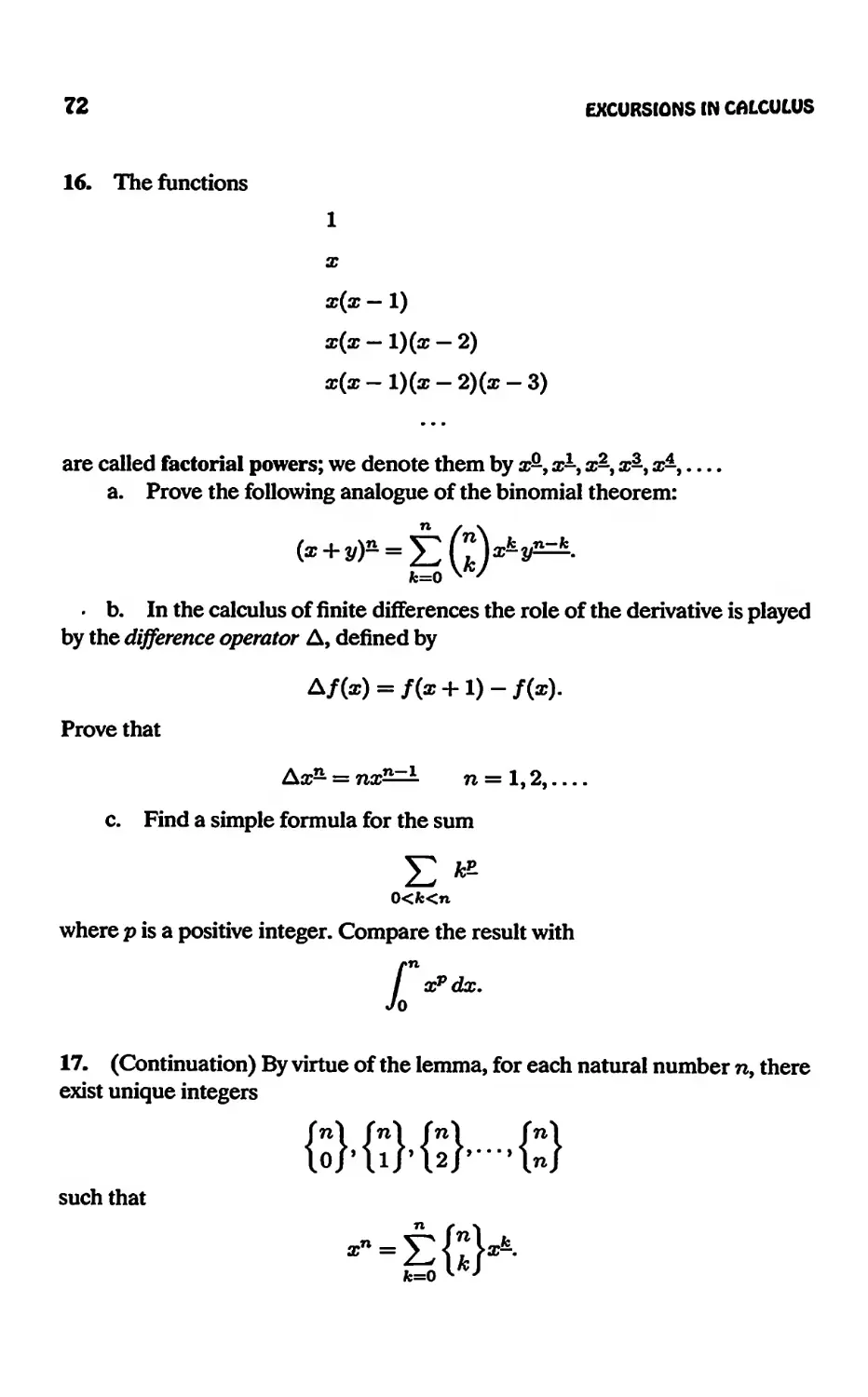


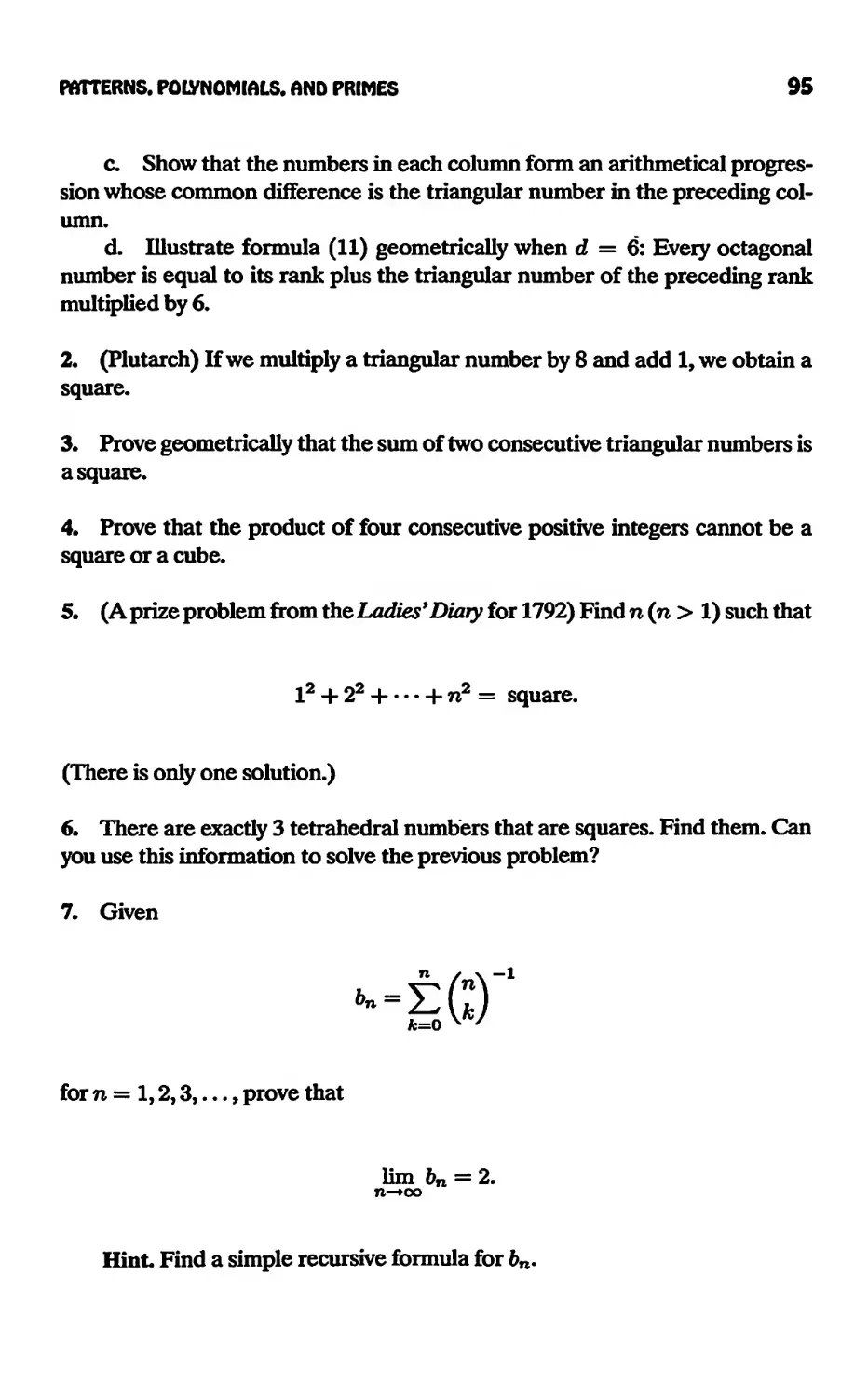






































Author: Young Robert M.
Tags: higher mathematics discrete mathematics
ISBN: 0-88385-300-0
Year: 1992

Text
. ..... '" "
.. I
... "I I I -- Tw ""---
I.
"' "_,,
Ie. t
z....
.... ,-..
. .,
('. J..-...
· ,..
/ t-I-
M f!1,..
\ ,. --'\'
\
'
..
-
...
. .
0\1
EXCURSIONS
IN
CALCULUS
A
j
AN INTERPLA)7 OF
THE CONTINUOUS AND THE DISCRETE
-
Robert M. Young
.
. 4
Dolciani I\lathematical Expositions
NUlnber I 3
(
.a..
1
.,
\ I
,
I
,.
_ The I\1at henlatical Association of Anlcrica
-
,.... t"
"
.
.'.JIL ...1 "
I" , Ii ,. V II
.
I...,
.
.
.'-
.,.
"
,
I'
,,\
J -.
.
I .....
,.
- ,
f ...
,,-' R
"
I.
I
-
-..
-
EXCURSIONS IN CALCULUS
AN INTERPLAY OF THE
CONTINUOUS AND THE DISCRETE
ROBERT M. YOUNG
THE
DOLCIANI MATHEMATICAL EXPOSITIONS
Published by
THE MATIlEMATICAL ASSOCIATION OF AMERICA
Committee on Publications
ANDREW STERRETI; Chairman
Dolciani Mathematical Expositions Editorial Board
JOE E BUHLER, Chainnan
CHRISTINE AYOUB
IRL BIVENS
RUTH REZNICK
Dolciani Mathematical Expositions series design
ROBERT ISHI + DESIGN
T}3X macros
RON WHITNEY
The Do/ciani Mathematical Expositions
NUMBER THIRTEEN
EXCURSIONS IN CALCULUS
AN INTERPLAY OF THE
CONTINUOUS AND THE DISCRETE
ROBERT M. YOUNG
'fHE"4
J/'
o . r
"II . t,. _
, JI)
I)
t'... {J
-. . NO'"
Published and Distributed by
THE MATHEMATICAL ASSOCIATION OF AMERICA
Photograph of the author on the back cover courtesy of Barbara Finnegan.
The following publishers have generously given pennission to use quotations from copy-
righted works: The lines from "pity this busy monster,manunkind," are reprinted from
COMPLETE POEMS, 1913-1962, by E. E. Cummings, by pennission of Liveright
Publishing Corporation. Copyright @1923, 1925, 1931, 1935, 1938, 1939, 1940, 1944,
1945, 1946, 1947, 1948, 1949, 1950, 1951, 1952, 1953, 1954, 1955, 1956, 1957, 1958,
1959, 1960, 1961, 1962 by the Trustees for the E. E. Cummings Trust. Copyright @1961,
1963, 1968 by Marion Morehouse Cummings. Excerpt from "The Love Song of J. Alfred
Prufrock" in Collected Poems 1909-1962 by T. S. Eliot, copyright 1936 by Harcourt Brace
Jovanovich, Inc., copyright @1964, 1963 by T. S. Eliot, reprinted by pennission of the pub-
lisher. Excerpt from "Little Gidding" in Four Quartets, copyright 1943 by T. S. Eliot and
renewed 1971 by Esme Valerie Eliot, reprinted by pennission of Harcourt Brace
Jovanovich, Inc. Reprinted by pennission of the publisher from H. W. Turnbull (ed.), The
Correspondence of Isaac Newton, Vol. II. Copyright @1960 by Cambridge University
Press. P61ya, George; Mathematics and Plausible Reasoning, Vol. I: Induction and Analogy
in Mathematics. Copyright @1954 by Princeton University Press. Reprinted by pennission
of Princeton University Press.
<0 1992 by
The Mathematical Association of America (Incorporated)
Library of Congress Catalog Card NlImber 91-67385
Complete Set ISBN 0-88385-300-0
Vol. 13 ISBN 0-88385-317-5
Printed in the United States of America
Current printing (last digit):
10 9 8 7 6 5 4 3
The DOLCJANI MATHEMATICAL EXPOSITIONS series of the Mathematical Association
of America was established through a generous gift to the Association from Mary P.
Dolciani, Professor of Mathematics at Hunter College of the City University of ew York.
In making the gift, Professor Dolciani, herself an exceptionally talented and successful
expositor of mathematics, had the purpose of furthering the ideal of excellence in mathe-
matical exposition.
The Association, for its part, was delighted to accept the gracious gesture initiating the
revolving fund for this series from one who has served the Association with distinction,
both as a member of the Committee on Publications and as a member of the Board of
Governors. It was with genuine pleasure that the Board chose to name the series in her
honor.
The books in the series are selected for their lucid expository style and stimulating math-
ematical content. Typically, they contain an ample supply of exercises, many with accom-
panying solutions. They are intended to be sufficiently elementary for the undergraduate
and even the mathematically inclined high-school student to understand and enjoy, but also
to be interesting and sometimes challenging to the more advanced mathematician.
1. Mathematical Gems, Ross Honsberger
2. Mathematical Gems II, Ross Honsberger
3. Mathematical Morsels, Ross Honsberger
4. Mathematical Plums, Ross Honsberger (ed.)
S. Great Moments in Mathematics (Before 1650), Howard Eves
6. Maxima and Minima without Calculus, Ivan Niven
7. Great Moments in Mathematics (After 1650), Howard Eves
8. Map Coloring, Polyhedra, and the Four-Color Problem, David Barnette
9. Mathematical Gems III, Ross Honsberger
10. More Mathematical Morsels, Ross Honsberger
11. Old and New Unsolved Problems in Plane Geometry and Number Theory, Victor Klee
and Stan Wagon
12. Problems for Mathematicians, Young and Old, Paul R. Halmos
13. Excursions in Calculus: An Interplay of the Continuous and the Discrete, Robert M.
Young
14. The Wohascum County Problem Book, George T. Gilbert, Mark Krusemeyer, and Loren
C. Larson
1 S. Lion Hunting and Other Mathematical Pursuits: A Collection of Mathematics, Verse,
and Stories by Ralph P. Boas, Jr.. edited by Gerald L. Alexanderson and Dale H. Mugler
16. Linear Algebra Problem Book, Paul R. Halmos
17. From ErdOs to Kiev: Problems of Olympiad Caliber, Ross Honsberger
18. Which Way Did the Bicycle Go? ... and Other Intriguing Mathematical Mysteries,
Joseph D. E. Konhauser, Dan Velleman, and Stan Wagon
19. In Polya's Footsteps: Miscellaneous Problems and Essays, Ross Honsberger
20. Diophantus and Diophantine Equations, 1. G Bashmakova (Updated by Joseph
Silverman and translated by Abe Shenitzer)
21. Logic as Algebra, Paul Halmos and Steven Givant
22. Euler: The Master of Us All, William Dunham
23. The Beginnings and Evolution of Algebra, I. a Bashmakova and a S. Smimova
(Translated by Abe Shenitzer)
24. Mathematical Chestnuts from Around the World, Ross Honsberger
25. Counting on Frameworks: Mathematics to Aid the Design of Rigid Structures, Jack E.
Graver
26. Mathematical Diamonds, Ross Honsberger
27. Proofs that Really Count: The Art of Combinatorial Proof, Arthur T. Benjamin and
Jennifer J. Quinn
28. Mathematical Delights, Ross Honsberger
29. Conics, Keith Kendig
MAA Service Center
P.O. Box 91112
Washington, DC 20090-1112
1-800-331-IMAA FAX: 1-301-206-9789
In memory of my father
PREFACE
Without the concepts, methods and results found and developed by
previous generations right down to Greek antiquity one cannot un-
derstand either the aims or the achievements of mathematics in the
last fifty years.
-:tIermann Weyl
ix
K
EXCURSIONS IN CALCULUS
Dissatisfaction with elementary calculus is growing. Is it because the subject has
changed so little since Euler's great treatise of 1748, the Introductio in analysin
infinitorum; or, as Paul Halmos has suggested, is it because it has changed so
much?
Teachers of elementary mathematics in the U.S.A. frequently com-
plain that all calculus books are bad. That is a case in point. Calculus
books are bad because there is no such subject as calculus; it is not a
subject because it is many subjects. What we call calculus nowadays
is the union of a dab of logic and set theory, some axiomatic theory
of complete ordered fields, analytic geometry and topology, the latter
in both the "general" sense (limits and continuous functions) and the
algebraic sense (orientation), real-variable theory properly so called
(differentiation), the combinatoric symbol manipulation called for-
mal integration, the first steps of low-dimensional measure theory,
some differential geometry, the first steps of the classical analysis of
the trigonometric, exponential, and logarithmic functions, and, de-
pending on the space available and the personal inclination of the
author, some cook-book differential equations, elementary mechan-
ics, and a small assortment of applied mathematics. Anyone of these
is hard to write a good book on; the mixture is impossible. l
But if Halmos is right, then the rich diversity of the calculus is at once
its greatest allure. For "Mathematical science," said David Hjlbert, "is in my
opinion an indivisible whole, an organism whose vitality is conditioned upon
the connection of its parts."2 Besides, what better goal to pursue than one that
remains elusive?
Excursions in Calculus is one possible supplement to a more traditional
calculus course. It is a collection of six essays, a potpourri of topics and tech-
niques that have fascinated me in the teaching of elementary calculus at Ober-
lin College over the past twenty years. Its underlying theme is the elegant inter-
play that exists between the two main currents of mathematics, the continuous
and the discrete. Accordingly, such fundamental notions from discrete math-
ematics as induction, recursion, combinatorics, and the algorithmic point of
view as a unifying principle are prominently featured.
Throughout, I have been guided by the precepts of George P6lya, whose
craft of discovery has helped shape the teaching and learning of so many of
1 R R. Halmos, How to write mathematics, L 'Enseignement Mathematique, 16 (1970) 125.
2 David Hilbert, Mathematical Problems, Bulletin oftheAmerican Mathematical Society, 8 (1901
-1902) 478.
PREFACE
xi
us. The proliferation of new knowledge conspires against self-discovery, but it
remains true that "the worst way to teach is to talk," to which one might well
add, and the worst way to learn is to listen. Wherever possible, I have tried to let
the masters do e teaching.
A word about the contents. In the sixth Josiah Willard Gibbs Lecture pre-
sented in New York City in 1928, G. H. Hardy said:
The elementary theory of numbers should be one of the very best
subjects for early mathematical instruction. It demands very little pre-
vious knowledge; its subject matter is tangible and familiar; the pro-
cesses of reasoning which it employs are simple, general and few; and
it is unique among the mathematical sciences in its appeal to natural
human curiosity. A month's intelligent instruction in the theory of
numbers ought to be twice as instructive, twice as useful, and at least
ten times as entertaining as the same amount of "calculus for engi-
neers. "3
The present work attests to the author's belief that Hardy was right.
A final word about the problems. Gathered from a great many sources they
are an integral part of the text. Most are challenging, few are routine, hopefully
all are interesting. Some of the problems remain unsolved. These have been
included not so much as a challenge, but as a way of indicating what ought to
be known but currently is not. At the same time, many a talented student has
succeeded in uncovering what the professional mathematician has not. The
way to excite good students is to give them hard problems. (A complete listing
of Sources for Solutions is included at the end of the book.)
I am indebted to a great many people for their encouragement and sup-
port.
To Ralph Boas, who read every word of the manuscript, made many of
them better, and prevented me from making many foolish mistakes.
To Doug Dickson, Mike Henle, Joe Malkevitch, Joe Roberts, and Jonathan
Scherer for their sharp criticism and advice.
To Chris Gernon and Mok Oh for their invaluable assistance in preparing
the computer-generated figures.
And, most especially, to Linda Miller, whose unwavering support and for-
bearance helped make this work possible.
3 G. H. Hardy, An Introduction to the Theol)' of Numbers, Bulletin of the A me Tic an Mathemat-
ical Society. 35 (1929) 818.
CONTENTS
Preface
.
. . . . . . . . . . . . . . . . . . . . . . . . . . . . . . . . . . . . . . . . . . . . . . . . . . . . . . . . . . . . . . . . IX
Chapter 1. Infinite Ascent, Infinite Descent:
The Principle of Mathematical Induction ............................ 3
1. Patterns ......................................................... 4
Problems ...................................................... 9
2. Proof by Induction .............................................. 15
Problems ..................................................... 18
3. Applications .................................................... 22
Problems ..................................................... 34
4. Infinite Descent .................................................38
Problems ..................................................... 53
Chapter 2. Patterns, Polynomials, and Primes:
Three Applications of the Binomial Theorem ....................... 57
1. Disorder among the Primes ......................................58
Problems ..................................................... 70
2. Summing the Powers of the Integers ............................. 74
Problems ..................................................... 94
3. 'I\vo Theorems of Fermat, the "Little" and the "Great" .......... .100
Problems .......... . . . . . . . . . . . . . . . . . . . . . . . . . . . . . . . . . . . . . . . . . . 114
Chapter 3. Fibonacci Numbers: Function and Form . . . . . . . . . . . . . . . . . . . . . 123
1. Elementary Properties ......................................... 125
Problems ... . . . . . . . . . . . . . . . . . . . . . . . . . . . . . . . . . . . . . . . . . . . . . . . . . 134
xiii
xiv
EXCURSIONS IN CALCULUS
2. The Golden Ratio ............................................. 140
Problems .................................................... 154
3. Generating Functions .......................................... 159
Problems .................................................... 164
4. Iterated Functions: From Order to Chaos ....................... 170
Problems .................................................... 180
Chapter 4. On the Average ........................................... .185
1. The Theorem of the Means . . . . . . . . . . . . . . . . . . . . . . . . . . . . . . . . . . . . . 186
Problems ............................. . . . . . . . . . . . . . . . . . . . . . . . 197
2. The uw of Errors ............................................. 206
Problems .................................................... 216
3. Variations on a Theme ......................................... 219
Problems .................................................... 239
Chapter 5. Approximation: From Pi to the Prime Number Theorem ..... 247
1. "Luck Runs in Circles" .........................................248
Problems ...... . . . . . . . . . . . . . . . . . . . . . . . . . . . . . . . . . . . . . . . . . . . . . . 255
2. On the Probability Integral ..................................... 267
Problems .................................................... 272
3. Polynomial Approximation and the Dirac Delta Function ........ 274
Problems .................................................... 282
4. Euler's Proof of the Infinitude of the Primes ... . . . . . . . . . . . . . . . . . .287
Problems .................................................... 293
5. The Prime Number Theorem ................................... 296
Problems .................................................... 306
Chapter 6. Infinite Sums: A Potpourri ............. . . . . . . . . . . . . . . . . . . . . . 309
1. Geometry and the Geometric Series ............................ 310
Problems .................................................... 328
2. Summing the Reciprocals of the Squares ........................ 338
Problems .................................................... 349
3. The Pentagonal Number Theorem .............................. 357
Appendix: The Congruence Notation .................................. 369
Problems .................................................... 375
References ........................................................... 379
Sources for Solutions ................................................. 397
Index ........ . . . . . . . . . . . . . . . . . . . . . . . . . . . . . . . . . . . . . . . . . . . . . . . . . . . . 409
"Cheshire Puss," she began, rather timidly, ... "Would you tell me,
please, which way I ought to go from here?"
e;'That depends a good deal on where you want to get to," said the
Cat.
"I don't much care where-" said Alice.
"Then it doesn't matter which way you go," said the Cat.
-Lewis Carroll, Alice's Adventures in Wonderland
-listen:there's a hell
of a good universe next door;let's go
-e. e. cummings, "pity this busy monster,manunkind,"
I
CHAPTER I
INFINITE ASCENT. INFINITE DESCENT:
THE PRINCIPLE OF
MATHEMATICAL INDUCTION
A well-known scientist (some say it was Bertrand Russell) once gave
a public lecture on astronomy. He described how the earth orbits
around the sun and how the sun, in turn, orbits around the center of
a vast collection of stars called our galaxy. At the end of the lecture,
a little old lady at the back of the room got up and said: "What you
have told us is rubbish. The world is really a fiat plate supported on
the back of a giant tortoise." The scientist gave a superior smile be-
fore replying, "What is the tortoise standing on?" "You're very clever,
young man, very clever," said the old lady. "But it's turtles all the way
down!"
-Stephen W. Hawking, A Brief History of Time
3
4
EXCURSIONS IN CALCULUS
I. Patterns
But as if a magic lantern threw the nelVes in patterns on a screen. . . .
- L S. Eliot, "The Love Song of J. Alfred Prufrock"
The positive integers,
1, 2t 3t 4t 5t . . . ,
the ordinary counting numbers: Has anything so profound ever come in simpler
garb?
tend to forget the advanced stage of intellectual development needed
to perceive the abstract character of a number. And yet, as Bertrand Russell
wrote, "It must have required many ages to realize that a brace of pheasants
and a couple of days were both instances of the number two."
choose to believe in the existence of all the positive integers 1,2,3,. . .,
as if the mere presence of three dots were enough to bridge the gap between
the finite and the infinite. Mathematics needs the infinite and yet its existence
is an act of faith.
hope that arithmetic is sound, that the building blocks of mathematics
are unftawed, that they contain no inherent contradictions. And yet, in 1931,
Kurt Godel presented mathematics with the astonishing and melancholy con-
clusion that it is impossible to establish the internal logical consistency of a very
large class of deductive systems-among them elementary arithmetic-"unless
one adopts principles of reasoning so complex that their internal consistency is
as open to doubt as that of the systems themselves" [311]. Hermann Weyl has
said, "God exists because arithmetic is consistent-the Devil exists because we
can't prove it!"
The integers. Once shrouded in mysticism by the ancients, who believed
that whole numbers were the essence of the universe, the integers have re-
mained the primary source of all of mathematics. From Pythagoras (circa 550
B.C.) to Euclid (circa 300 B.C.), to Diophantus of Alexandria (circa A.D. 275), to
Pierre de Fermat (1601-1665), who initiated the modem theory of numbers, to
Euler (1707-1783) and Gauss (1777-1855), interest in the integers has never
waned. c 1 things are number," intoned Pythagoras; and, more than two thou-
sand years later, Leopold Kronecker (1823-1891) reaffirmed the foundation on
which most of mathematics now rests: "God created the integers; everything
else is the work of man."
Having been given the "miraculous jar" of the positive integers, the first
mathematicians set about to uncover the patterns among them.
INfiNITE ASCEN't INfiNITE DESCENT
5
Hardy said it best: ' mathematician, like a painter or a poet, is a maker
of patterns." Whether the patterns are simple or elaborate, transparent or con-
cealed, whether they are creations of the mind, or, in the Platonic sense, that
which the mind has but uncovered-whatever their origin, they often emerge as
the result of observation and experimentation. That the same scientific meth-
ods that have proved so successful in dealing with physical objects should prove
just as successful in the study of their abstract mathematical counterparts is a
source of no small wonder. Observation and experimentation-and today, of
course, the computer facilitates both.
Accordingly, a mathematician interested in the theory of numbers begins
by observing and experimenting with the positive integers.
Example 1. Summing the Odd Integers. Let us suppose, for example, that by
some chance we come across the relations
1 = 1 2 , 1 + 3 = 2 2 , 1 + 3 + 5 = 3 2 ,
1 + 3 + 5 + 7 = 4 2 , 1 + 3 + 5 + 7 + 9 = 52
obtained by adding together the first few odd numbers. Even on the basis of
such modest evidence, we can hardly refrain from formulating the conjecture
that for every natural number 1l, the sum of the first n odd numbers is n 2 , or
1 + 3 + 5 +... + (2n -1) = n 2 .
Is the conjecture true-not just for the values n = 1, 2, 3,4, 5 which sug-
gested it, but for every value of n? While additional evidence might reinforce
our belief, it could never confirm it-we simply cannot carry out infinitely many
verifications. Besides, even if we verify that a proposition is true for every num-
ber up to a million or a minion million, we are no nearer to establishing that it
is true always.
Consider for example the following disarmingly simple proposition about
the primes. It was first formulated by a Russian civil servant, Christian Gold-
bach, in 1742 in a letter to the great Swiss mathematician Leonhard Euler.
Example 2. The Goldbach Conjecture. Recall that a positive integer greater
than 1 whose only natural divisors are itself and 1 is said to be a prime number,
or simply a prime. Thus 2 is the first prime and the first few primes are
2,3,5,.7,11,13,17,19,....
The number 1 is special; its only natural divisor is itself, but because it behaves
so differently from other numbers, it is usually considered not to be a prime.
6
EXCURSIONS IN CALCULUS
Prime numbers, as the reader is undoubtedly aware, are the fundamental
building blocks from which all the natural numbers can be constructed. Every
positive integergreater than 1 can be wriUen as a product of primes, and, apart from
the order of the factors, in one way only. This is the content of the fundamental
theorem of arithmetic (for a proof, see Section 3). While multiplication is the
natural operation to perform on the primes, it is not unreasonable to ask what
can be accomplished through addition. In the simplest case, what numbers can
be obtained as a sum of two odd primes? Such a sum must of course be even,
and Goldbach proposed, solely on the basis of empirical evidence, that every
even number greater than 4 can be represented in this way.
Testing the conjecture for the first few even numbers, we find
6=3+3
8=3+5
10 = 3 + 7
12=5+7
14 = 3 + 11
16 = 3 + 13
18=5+13
20=3+17
22 = 3 + 19
24 = 5 + 19
26=3+23
28=5+23
30 = 7 + 23.
We could, of course, proceed further-into the far reaches of the number
system-and we should find overwhelming evidence in support of the con-
jecture. Computer searches up to 20 billion have never revealed an exception
[386]. Nevertheless, no finite amount of evidence can ever prove conclusive-
the next even number may yet violate the rule-and after two and a half cen-
turies the general proposition remains elusive.
Example 3. A Question of Divisibility. As a final illustration, let us consider a
pattern that is far more recondite-but at the same time far more practicable-
INfiNITE ASCENT. INfiNITE DESCENT
1
than those previously mentioned. It concerns the divisibility of numbers of the
form
271.-1
where n = 1, 2, 3, . .. . These numbers have played an important role in the
continuing search for prime numbers, and they have consistently produced the
largest known primes.
In experimenting with numbers of this form, we may happen to observe
that they are sometimes divisible by one more than their exponent. For exam-
ple,
2 2 - 1 is divisible by 3
2 4 - 1 is divisible by 5
2 6 - 1 is divisible by 7.
What can be said about the other even exponents? Do they behave sim-
ilarly? (Of course, it is not necessary to consider odd exponents, for then the
numbers 271. -1 and n+ 1 are a fortiori of opposite parity, i.e., one even and the
other odd.) When we come to the next even exponent we see that the pattern
fails: 2 8 - 1 is not divisible by 9. Continuing beyond n = 8, we find that 2 10 - 1
is divisible by 11, 2 12 - 1 is divisible by 13, while 2 14 - 1 is not divisible by 15.
What rule can possibly underlie these isolated e amples? Is it possible to
tell in advance whether or not 2"' - 1 is divisible by n + 1 without laboriously
going through the implied division? Gathering more evidence, we examine all
exponents up to n = 30 and find that 271. - 1 is divisible by n + 1 for each of the
values
n + 1 = 3,5,7,11,13,17,19,23,29,31
and for these values only. The pattern is now unmistakable-the values listed
above are all primes. In fact, they are all the odd primes up to 31. We are
thereby led to conjecture that 271. - 1 is exactly divisible by n + 1 if and only
if n + 1 is an odd prime.
Notice that our conjecture is made up of two separate assertions. One
states that the ratio
2"' -1
n+l
is always a whole number whenever the denominator is an odd prime. The
other half, the converse, asserts that this ratio can never be a whole number
if the denominator is composite (that is, neither 1 nor a prime). Does the evi-
dence support both statements equally? Do you feel as confident about the va-
8
EXCURSIONS IN CALCULUS
Iidity of this conjecture as you did about the previous ones? Would it strengthen
your conviction to know that Leibniz himself believed it?
We press further. We test the next thirty exponents, and then the thirty
after that, and so on until all values of n up to 300 have been checked and the
results compared with our conjecture. In each case we find agreement. By now
2 n - 1 has nearly one hundred decimal digits, so that the necessary divisions
must be performed indirectly by means of "modular arithmetic". (The reader
who is unfamiliar with this important algebraic tool may wish to consult the
Appendix now.)
Each new verification of our conjecture reinforces our belief in its validity.
This time, however, we have been misled; we have stumbled upon a half-truth.
It is true that the relation
2 n - 1 is divisible by n + 1
(1)
must always hold whenever n + 1 is an odd prime, but it may sometimes hold
when n + 1 is composite. The first assertion is a special case of Fermat's little
theorem, one of the cornerstones of the modem theory of numbers. In the
next chapter, we shall provide a proof. Its converse, however, is false. In fact,
there are infinitely many composite numbers n + 1 for which (1) holds, but the
smallest of these is 341 = 11 x 31. 1 Little wonder that even Leibniz was in
error! 2
The lesson is clear-inductive inference may prove faulty, and nothing
short of a rigorous proof can ever suffice. 3
1 To see that 2 340 - 1 is divisible by 341, obselVe that
2 5 = 1 (mod 31) and 2 5 = -I" (mod 11),
from which it follows that 2 340 = 1 with respect to each of the moduli 31 and 11, and hence
also with respect to their product. This first and smallest counterexample was discovered by Pierre
Sarrus in 1819.
2 Dickson, Histol)' of the Theol)' of Numbers [135], volume 1, p. 91. Dickson also asserts-and
many Western writers have copied him-that Chinese mathematicians claimed 2S centuries ago
that 2 n - 2 is divisible by n if and only if n is a prime. The statement appears to be false. In his
monumental treatise Science and Civilisation in China, volume 3: Mathematics and the Sciences of
the Heavens and the Earth. p. 54, footnote d. Needham writes: "We have not been able to trace this
with certainty to its origin, but the source of the statement. . . is a mysterious remark made by J.
H. Jeans in a note of 1897 (written while he was still an undergraduate) ..... Needham suggests
that Jeans's remark may have been due to an error in translation.
3 For a delightful discussion of patterns that seem to appear when we look at small numbers,
see Richard Guy, "The Strong Law of Small Numbers" [192] and the sequel, "The Second Strong
Law of Small Numbers" [193].
INfiNITE ASCEN't INfiNITE DESCENT
9
PROBLEMS
A mathematician's work is mostly a tangle of guesswork, analogy,
wishful thinking and frustration, and proof, far from being the core
of discovery, is more often than not a way of making sure that our
minds are not playing tricks.
-Gian-Carlo Rota
Familiarity with numbers, acquired by innate faculty sharpened by
assiduous practice, does give insight into the profounder theorems of
algebra and analysis.
-Aitken
It is a great nuisance that knowledge can only be acquired by hard
work.
-w. Somerset Maugham
1. Verify the following relations which were observed by Galileo (1615) and
used in his work on freely falling bodies:
1 1+3 1+3+5
3 = 5 + 7 - 7 + 9 + 11 =...
2. Suppose that the odd numbers are grouped in the following pattern:
1
3 5
7 9 11
13 15 17 19
21 23 25 27 29
Formulate a conjecture about the sums of the entries in each row, express it in
suitable mathematical notation, and prove it. The result is attributed to Nico-
machos (circa AD. 100).
3. Palindrome Conjecture (unsolved). To any integer add its reverse. Then
add the sum's reverse to the sum. Continue until a sum is palindromic (the
same from right to left as from left to right). For example:
38+83 = 121
139 + 931 = 1070, 1070 + 0701 = 1771.
10
EXCURSIONS IN CALCULUS
It has been conjectured that eveIY integer will eventually produce a palindrome.
4. (Ramanujan) Compute the value of
V I + 2 V 1 + 3 '; 1 + 4 v l + ...
s. Observe that
16 1
64 = 4
and that "cancelling the 6's" produces the correct result. There are exactly
three similar patterns with numbers less than 100 (aside from trivial variations
obtained by inverting the fraction). Find them. (Boas calls it "a frivolous piece
of mathematics but one with serious overtones" [43].)
6. Plutarch writes of the Pythagorean number mysticism: "The Pythagoreans
also have a horror for the number 17. For 17 lies exactly halfway between 16,
which is a square, and the number 18, which is the double of a square, these
two being the only two numbers representing areas, for which the perimeter (of
the rectangle) equals the area." (Van der Waerden, Science Awakening [426],
p. 96) Verify that 16 and 18 are indeed the only two natural numbers with this
property.
7. Consider the infinite ladder of whole numbers:
a b
1 1
2 3
5 7
12 17
29 41
. .
. .
. .
a. Discern the rule by which the numbers on the ladder are formed.
b. Show that on each rung of the ladder,
b 2 - 2a 2 = :1:1.
INFINITE ASCENT. INFINITE DESCENT
11
c. Conclude that, as one descends the ladder, the ratios
1 3 7 17 41
I' 2 ' 5 ' 12 ' 29 '...
approach .J2, and that these approximations improve on each successive
rung.
Remark. Concealed within the ladder is another elegant pattern concern-
ing Pythagorean triangles (right-triangles with integral sides). Every other rung
of the ladder has two odd entries. Ifwe express b as the sum of two consecutive
integers, say m and m + 1, then
m 2 + {m+ 1)2 = a 2 .
For example, on the fifth rung, b = 41 = 20 + 21, so that 20 2 + 21 2 = 29 2 . All
Pythagorean triangles whose legs differ by 1 are obtained in this way (see [385],
pp. 42-46). For yet another concealed pattern, see chapter 2, 2, problem 8.
8. Observe that
1+2=3
4+5+6=7+8
9 + 10 + 11 + 12 = 13 + 14 + 15
16 + 17 + 18 + 19 + 20 = 21 + 22 + 23 + 24.
Guess the general law suggested by these examples, express it in suitable math-
ematical notation, and prove it.
9. Consider the table
1=1
2+3+4=1+8
5+6+7+8+9=8+27
10 + 11 + 12 + 13 + 14 + 15 + 16 = 27 + 64.
Guess the general law suggested by these examples, express it in suitable math-
ematical notation, and prove it.
12
EXCURSIONS IN CALCULUS
10. ObselVe that
1=1
1 - 4 = -(1 + 2)
1-4+9=1+2+3
1- 4+9 -16 = -(1 + 2 +3 + 4).
Guess the general law suggested by these examples, express it in suitable math-
ematical notation, and prove it.
11. Prove that every natural number greater than 11 is the sum of two com-
posite numbers.
12. Find three distinct natural numbers such that the sum of their reciprocals
is an integer. (The solution is unique.)
Remark. R. L. Graham (C theorem on partitions," Journal of the Aus-
tralian Mathematical Society 4 (1963), pp. 435-441) has shown that every in-
teger greater than 77 can be decomposed into a sum of integers whose re-
ciprocals add up to unity (77 does not possess this property). For example,
78 = 2 + 6 + 8 + 10 + 12 + 40 and
1 1 1 1 1 1
2 + 6 + 8 + 10 + 12 + 40 = 1.
13. The sum
111
1+ 2 + 3 +".+ n
is never an integer if n > 1. More generally, the sum of two or more consecutive
terms of the harmonic series is never an integer.
14. The following scheme furnishes a simple geometric interpretation of the
sieve of Eratosthenes. Between every point 1, 1/2, 1/3, . . . on the y-axis and ev-
ery point 2,3,4, . . . on the x-axis, we draw a straight line. Show that the set of
x-coordinates at which these lines meet the horizontal line y = -1 is precisely
the set of composite numbers.
15. Find a simple formula for the sums
1 3 + 2 3 + 3 3 +... + n 3 .
12
EXCURSIONS IN CALCULUS
10. ObselVe that
1=1
1 - 4 = -(1 + 2)
1-4+9=1+2+3
1- 4+9 -16 = -(1 + 2 +3 + 4).
Guess the general law suggested by these examples, express it in suitable math-
ematical notation, and prove it.
11. Prove that every natural number greater than 11 is the sum of two com-
posite numbers.
12. Find three distinct natural numbers such that the sum of their reciprocals
is an integer. (The solution is unique.)
Remark. R. L. Graham (C theorem on partitions," Journal of the Aus-
tralian Mathematical Society 4 (1963), pp. 435-441) has shown that every in-
teger greater than 77 can be decomposed into a sum of integers whose re-
ciprocals add up to unity (77 does not possess this property). For example,
78 = 2 + 6 + 8 + 10 + 12 + 40 and
1 1 1 1 1 1
2 + 6 + 8 + 10 + 12 + 40 = 1.
13. The sum
111
1+ 2 + 3 +".+ n
is never an integer if n > 1. More generally, the sum of two or more consecutive
terms of the harmonic series is never an integer.
14. The following scheme furnishes a simple geometric interpretation of the
sieve of Eratosthenes. Between every point 1, 1/2, 1/3, . . . on the y-axis and ev-
ery point 2,3,4, . . . on the x-axis, we draw a straight line. Show that the set of
x-coordinates at which these lines meet the horizontal line y = -1 is precisely
the set of composite numbers.
15. Find a simple formula for the sums
1 3 + 2 3 + 3 3 +... + n 3 .
INFINITE ASCEN't INFINITE DESCENT
13
16. Notice that
3 2 + 4 2 = 52
3 3 + 4 3 + 53 = 6 3 .
Find all values of n for which
3 n + 4 n + 5 n +... + (n + 2)n = (n + 3)n.
17. Simplify the following sums:
a. 1 . l! + 2 . 2! + 3 . 3! + . . . + n . n!
b. 1/2! + 2/3! + 3/4! + . . . + n/(n + I)!
18. Prove or disprove: All the numbers in the sequence
31,331,3331,33331,...
are primes.
19. Observe that the numbers
3! - 2! + I! = 5
4! - 3! + 2! - I! = 19
5! - 4! + 3! - 2! + I! = 101
6! - 5! + 4! - 3! + 2! - I! = 619
7f - 6! + 5! - 4f + 3f - 2! + I! = 4421
are all primes. Does this pattern continue?
20. True or false: Every number of the sequence
49,4489,444889, 11418 889, . . .
is a perfect square.
21. The 3m+l Problem (unsolved). Starting with any natural number, di-
vide it by 2 if it is even and multiply it by 3 and add 1 if it is odd. Repeat the
process continually. For example, the sequence obtained by starting with 17
runs
17,52,26,13,40,20,10,5,16,8,4,2,1.
14
EXCURSIONS IN CALCULUS
The 3x + 1 problem asserts that every natural number produces a sequence
that eventually ends with 4, 2, 1. (This has been verified by computer for all
natural numbers up to 1,000,000,000.) Try it for x = 27. How many iterations
of the algorithm are needed?
22. Any number belonging to the sequence
11,111,1111,11111,...
is called a repunit (a contraction of repeated unit). Prove that no repunit can
be a square.
23. Into how many regions do n lines divide the plane? (Assume that the lines
are in "general position," i.e., no two are parallel and no three are concurrent.)
24. Find the number of regions determined in the inside of a circle by joining
n points on the circumference in all possible ways by straight lines, no three
of which are concurrent inside the circle. It is easy to calculate that the cor-
rect numbers for n = 1,2,3,4, 5 are 1, 2, 4, 8, 16, respectively. Formulate a
conjecture for general n, and test it for n = 6.
25. Brocard's Problem (unsolved). When is n! + 1 a square? The only
known solutions are n = 4,5, 7.
26. Find all natural numbers which cannot be expressed as the difference of
two natural squares.
27. Prove that for every natural number n:
n 3 - n is divisible by 3
n 5 - n is divisible by 5
n 7 - n is divisible by 7.
Formulate a conjecture for all odd exponents and test it for the exponent 9.
28. Define a sequence ao, al, a2, . . . by setting ao = al = 1 and
+ a¥ + . . . + a
C!n+l = forn > 1.
n
The first few terms are found to be 1,1,2,3,5,10,28, . . . . Is an always an inte-
ger?
INFINITE ASCENT. INFINITE DESCENT
IS
29. Write down the multiples of V2, ignoring fractional parts, and underneath
write the numbers missing from the first sequence:
1
3
2
6
4
10
5
13
789
17 20 23
11 12
27 30.
Is there a pattern?
30. The 13th of the month is more likely to be Friday than anyone of the
other days of the week.
2. Proof bY Induction
Let us return to the problem of computing the sum of the first n odd numbers.
The formula
1 + 3 + 5 +... + (2n -1) = n 2
(1)
comprises a whole sequence of assertions, one for every natural number n.
Rather than focus attention on any particular value of n, we shall investigate
instead the transition from anyone value to the next. Specifically, we shall show
that every true assertion is followed by another true assertion. It will then follow
that if the first assertion is true, so are all the others. For the truth of the first will
guarantee the truth of the second, and the truth of the second will then guar-
antee that of the third, and so on. It is this fundamentally important method of
proof which is called the principle of mathematical induction. 4
4 Although discovel}' of the method is usually attributed to Pascal, it appears that the first person
to apply mathematical induction to rigorous proofs was the Italian scientist Francesco Maurolico
in hisArithmetica of 1575. (See, for example, Giovanni Vacca, "Maurolycus, the first discoverer of
the principle of mathematical induction," Bulletin of the Amero Math. Society 16 (1909-1910),70-
73, and also W. H. Bussey, "The origin of mathematical induction," Amero Math. Monthly 24 (1917),
199-207.) Further improvements were made in the early 17th centul}' by Pierre de Fermat. Pascal
in one of his letters acknowledged Maurolico's introduction of the method and used it himself in his
7Taite du triangle arithmetique (1665), in which he presents what is now called Pascal's triangle (see
chapter 2, 2). The phrase C'mathematical induction" was apparently coined by De Morgan in the
early 19th centul}'. Of course the method is implicit even in Euclid's proof of the infinitude of the
primes. For he shows (see chapter 2, fil) that if there are n primes, then there must be n+ 1 primes;
and since there is a first prime, the number of primes must be infinite. For further discussion of
mathematical induction, see the great works of George P61ya, Mathematical Discovery [341] and
Mathematics and Plausible Reasoning [338], [339].
16
EXCURSIONS IN CALCULUS
Let us use it to verify formula (1). Here, the transition from one case to
the next is particularly simple. For suppose that the equation
1 + 3 + 5 +... + (2n - 1) = n 2
is known to be true for a certain natural number n. Adding 2n + 1, the next
odd number, to both sides, we find
1 + 3 + 5 + . . . + (2n + 1) = n 2 + 2n + 1
which is indeed (n + 1)2, the next square number. This means that if our con-
jecture is true for a certain integer n, it remains necessarily true for the next
integer n + 1. But we know that the conjecture is true for n = 1, so by the
principle of mathematical induction, it must be true for all integers: true for
1, therefore, also for 2; true for 2, therefore, also for 3; and so on. We have
succeeded in proving the conjecture in full generality.
Students who are not yet well-versed in this method of proof are often
skeptical of its validity. Their objection: "You have assumed the proposition
that is to be proved." Of course, we have done no such thing. Infinitely many
propositions are to be proved; all that the principle of induction allows us to
do is to suppose, when proving anyone case, that the previous case has already
been established. It is, in essence, a reformulation of the way in which the pos-
itive integers are ordered.
We would be remiss in not pointing out that formula (1) can be established
without the use of mathematical induction, and, as is often the case, the induc-
tive proof supplies the method. Let us begin, accordingly, with the formula
(k+ 1)2 = k 2 +2k+ 1
which describes the transition from one square number to the next. Rewriting
this as
(k + 1)2 - k 2 = 2k + 1
and then choosing successively k = 0, 1,2, . . . , n - 1, we obtain
12_ 0 2 - 1
22_ 1 2 - 3
3 2 - 2 2 - 5
4 2 - 3 2 - 7
n 2 -(n - 1)2 = 2n - 1.
INFINITE ASCEN't INFINITE DESCENT
17
Adding the results-notice that the sum on the left "telescopes"-we find
n 2 = 1 + 3 + 5 +... + (2n - 1).
Careful scrutiny of the previous proof leads to yet another-the simplest
and most illuminating of all-a proof based on a single picture:
. . . . .
. . . . .
. . . . .
. . .
el.. . .
fiGURE I
The sum of the first n odd numbers is n 2 .
This elegant scheme, known already to the Pythagoreans, is nothing more than
a geometric depiction of the identity (k + 1)2 = k 2 + 2k + 1.
Finally, let us mention an extension of the method of induction which is
frequently useful. Given an infinite sequence of propositions
PI, P2, P3, . . .
in order to demonstrate that all of them are true, it is enough to know two
things:
1. PI is true.
2. For all n, if PI, P 2 , P3, . . . ,P n are true, then so is P n + 1 .
Thus, in trying to prove P n + 1 we are entitled to assume that all previous propo-
sitions, not just P n, have already been established. The reader will have no dif-
ficulty in verifying this simple variant.
18
EXCURSIONS IN CALCULUS
PROBLEMS
1. Numbers of the form
1+2+3+".+n
where n is any natural number, are known as triangular numbers. The name
derives from their geometric interpretation as triangular arrays of dots:
.
.\
.\
.\
FIGURE 2
The first four triangular numbers.
In the nth figure there are n dots aligned along each side of the equilateral
triangular shape and the total number of dots in this figure is the nth triangular
number.
a. Show that the nth triangular number is equal to n( n + 1)/2.
b. If Tn denotes the nth triangular number, then
'7"'2 '7"'2 _ n 3
.L n - .L n -l - .
Use this to show that
1 3 + 2 3 + . .. + n 3 = T;
= [ n(n;l> f.
2. Show that all the numbers 21,2211,222111, . . . are triangular.
3. There are infinitely many numbers that are simultaneously triangular and
square.
Hint. If T is such a number, then 4T and 8T + 1 are both squares.
INfiNITE ASCEN't INfiNITE DESCENT
19
4. Establish the following formula for the sum of the first n squares:
1 2 + 2 2 + 3 2 + ... + n 2 = n(n + 1)(2n + 1)/6.
5. Find a simple formula for
1 2 + 3 2 + 52 + . . . + (2n - 1)2.
6. Calculate the following sums:
a. 1/1.2 + 1/2.3 + 1/3 .4+ . . . + 1/(n - l)n
b. 1/1. 2 . 3 + 1/2 . 3 . 4 + 1/3.4.5 + . . . + 1/(n - 2)(n - l)n
c. 1/1.2.3.4+1/2.3.4.5+1/3.4.5.6+.. .+I/(n-3)(n-2)(n-l)n.
7. Establish the following formulas:
a. 1. 2 + 2 . 3 + 3.4 + . . . + n(n + 1) = n(n + 1)(n + 2)/3
b. 1.2.3+2.3.4+3.4.5+.. . +n(n+1)(n+2) = n(n+l)(n+2)(n+3)/4.
.
8. Consider the table
3 2 + 4 2 = 52
10 2 + 11 2 + 12 2 = 13 2 + 14 2
21 2 + 22 2 + 23 2 + 24 2 = 25 2 + 26 2 + 27 2 .
Guess the general law suggested by these examples, express it in suitable math-
ematical notation, and prove it. (Compare this pattern with problem 8 of the
previous section).
9. Show that
.v3>.w>.v5> ....
What is the limit of these numbers?
10. On computing square roots by successive approximations. The follow-
ing method for approximating square roots is often attributed to Heron of
Alexandria (circa 100 B.C.), but it was known to the Babylonians hundreds of
years earlier. To compute ...;a first choose an initial approximation Xl > 0 and
then compute the successive approximations according to the formula
X"H = (X" + :.. ) , n = 1, 2, .. . .
20
EXCURSIONS IN CALCULUS
Notice that when the nth approximation to ..;a has been found,..;a =
VX n(afxn), so that..;a is the geometric mean of X n and afxn. As an approx-
imation to this geometric mean, we take Xn+l to be the arithmetic mean of
these two numbers.
a. By considering the hyperbola xy = a, show that if X n is any approxi-
mation to ..;a then Xn+l is a better one.
b. Show that, for any initial approximation Xl, the sequence {Xn} always
converges to ..;a.
Hint. By comparing the errors En = X n - ..;a and En+l = Xn+l - ..;a of
two successive approximations, show that the absolute values of the successive
errors are at least halved at each step after the first.
c. Show that when Newton's method for approximating the zeros of a
function is applied to f(x) = X2 - a, the result is Heron's method.
d. If we take Xl = 1 as a first approximation to vI2, we obtain the suc-
cessive approximations
3 17 577
1, 2 ' 12 ' 408 ' .. ..
How is this sequence related to the corresponding sequence of approximations
given in problem 7 (section 1)1
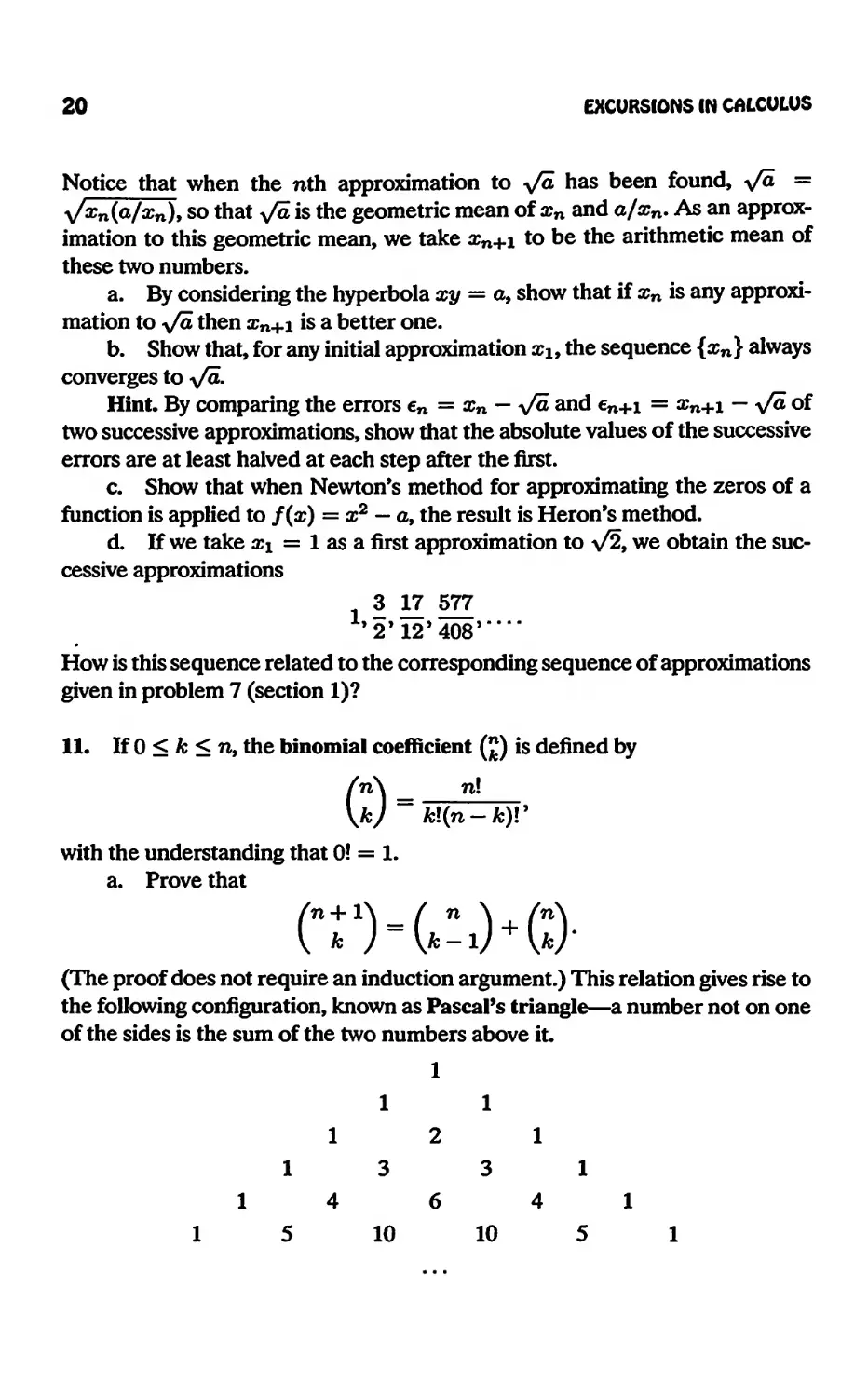
11. If 0 < k < n, the binomial coefficient ( ) is defined by
( ) - k!(nn k)! '
with the understanding that O! = 1.
a. Prove that
(n;1) = (k n 1) + ( ).
(The proof does not require an induction argument.) This relation gives rise to
the following configuration, known as Pascal's triangle-a number not on one
of the sides is the sum of the two numbers above it.
1
1 1
1 2 1
1 3 3 1
1 4 6 4 1
1 5 10 10 5 1
INfiNITE ASCENT. INfiNITE DESCENT
21
The binomial coefficient ( ) is the (k + l)st number in the (n + l)st row.
b. Show that ( ) is the number of sets of exactly k integers chosen from
the numbers 1, 2,3, . . . , n.
c. Prove the binomial theorem: If x and yare any numbers and n is a
natural number, then
(x + y)n = t ( n ) xn-kyk.
k=O k
In the next chapter we shall investigate some of the far-reaching consequences
of this important algebraic identity.
12. The product of n consecutive integers is divisible by n!.
1 3. Sh ow that every positive integral power of V2 - 1 is of the form ...;:m -
vim - 1 .
14. Prove that for any integer k > 1 and any positive integer n, n k is the sum
of n consecutive odd integers.
15. Derive the following estimate for n!:
( ; ) n < n! < ( ; ) n
for n > 6. (The lower bound holds for all n.) This estimate is crude. A precise
estimate is given by Stirling'sformula (see chapter 5, 1, problem 14).
16. a. Show that if an denotes the length of the side of a regular n-gon in-
scribed in the unit circle (circle of r adius 1), then t he side of the 2n-gon is
a 2n = V 2 - 1/ 4 - a .
b. Deduce Viete's fa mous infi nite product expan sion
2 -.fi '; 2 + -.fi V 2 + '; 2 + -.fi
-=-
7T 2 2 2
c. A sequence is defined recursively by taking the first two terms to be 0
and 1 and each successive term to be alternately the arithmetic and geometric
mean of the two immediately preceding terms. Thus the sequence begins
0, 1, 1/2, 1/V2,....
Does the sequence approach a limit, and, if so, what is its value?
22
EXCURSIONS IN CALCULUS
17. Consider the sequence
(1+ r, (1+ r, (1+ r
,....
a. Show that each term in the sequence is smaller than the next one.
b. Show that each term in the sequence is smaller than 3.
The limit of these simple fractions is the fundamental constant e. Correct
to five decimal places,
e 2.71828.
18. Prove Bernoulli's inequality: If x > -1, then
(1 + x)n > 1 + nx.
19. Prove Hennite's identity: If x is real and n = 1, 2, 3, . . ., then
[x] + [x + l/n] + [x + 2/n] + . . . + [x + (n - 1)/n] = [nx].
(Here, [x] denotes the "bracket function," i.e., the largest integer not exceeding
x.)
20. The following paradoxical argument is attributed to Tarski. It purports
to prove by mathematical induction that any n natural numbers are equal! For
n = 1 the statement is obviously true. It remains to pass from n to n + 1. For
the purpose of illustration, let us pass from 3 to 4, and leave the general case to
the reader. Suppose then that any four numbers a, b, c, and d have been given.
By assumption (n = 3), a, b, and c are equal and, likewise, b, c, and d are equal.
Consequently, all four numbers are equal. Explain the paradox.
3. Applications
The principle of mathematical induction finds applications throughout all of
mathematics. Some additional examples will further attest to the power and
scope of the method.
INFINITE ASCENT. INFINITE DESCENT
23
a. The Fundamental Theorem of Arithmetic
It is a relatively simple matter to show that every natural number, except 1, is
expressible as a product of primes. 5 For example
666 = 2 x 3 x 3 x 37.
It is not nearly so simple to show that such a representation is always unique,
except for possible rearrangement of the factors. This is the content of the
fundamental theorem of arithmetic.
Theorem. Apart from the order of the factors, any natural number greater than
1 can be represented as a product of primes in one way only.
Proof. The theorem is evidently true for the numbers 2 and 3, which are them-
selves primes. Proceeding by induction, we suppose that every natural number
smaller than N (and greater than 1) has a unique representation as a product
of primes, and we show that N must also. Suppose to the contrary that N had
two different representations, say
N = P1P2 . . . Pn = ql q2 . . . qm
(1)
where the prime factors in each product may be assumed to be in ascending
order of magnitude, that is,
PI < P2 < . .. < Pn and ql < q2 < ... < qm.
Observe to begin with that every P must be different from every q, for if Pi = q;
for some i and j, then we could cancel these factors in (1), thereby obtaining
a number smaller than N with two different prime factorizations. Suppose,
without loss of generality, that PI < ql, and consider the number
M = PI q2 . . . qm < qlq2 . . . qm = N.
Since M and N are both divisible by PI, so is their difference
N* =N-M.
Therefore N* possesses a prime factorization that includes Pl. On the other
hand, we have
N* == (ql - Pl)q2. ..qm
5 It is convenient to regard a prime number as a product of primes, where the product has only
one factor, namely the number itself.
24
EXCURSIONS IN CALCULUS
and in this representation not a single factor is divisible by Pl. Consequently, N*
also has a prime factorization in which PI does not appear, and thus possesses
two different prime factorizations. But N* < N, and we have thereby contra-
dicted the induction hypothesis. The contradiction shows that N can have at
most one representation as a product of primes, and the proof is complete.
b. The Tower of Hanoi
In 1883 there appeared an ingenious puzzle known as the Tower of Hanoi. 6 It
consisted of three pegs fastened to a stand together with eight circular rings,
each of a different size. Initially, all of the rings are placed on one peg, the
largest at the bottom and the radii of successive rings decreasing as we ascend.
This arrangement is called the tower (see Figure 3). The problem is to transfer
the tower to another peg, following these rules-only one ring at a time must
be moved, and no ring may be placed atop a smaller one.
The following year, De Parville gave this fanciful account of the origin of
the puzzle. 7
In the great temple at Benares, beneath the dome which marks the
center of the world, there rests a brass plate in which are fixed three
diamond needles, each a cubit high and as thick as the body of a bee.
On one of these needles, at the creation, God placed sixty-four disks
of pure gold, the largest disk resting on the brass plate, and the others
getting smaller and smaller up to the top one. This is the Tower of
Bramah. Day and night unceasingly the priests transfer the disks from
one diamond needle to another according to the fixed and immutable
laws of Bramah, which require that the priest on duty must not move
more than one disk at a time and that he must place this disk on a
needle so that there is no smaller disk below it. When the sixty-four
disks shall have been transferred from the needle on which at the
creation God placed them to one of the" other needles, tower, temple,
and Brahmins alike will crumble into dust, and with a thunderclap the
world will vanish.
6 Brought out by a certain "N. Claus (de Siam)," an anagram ofccLucas d'Amiens" or Edouard
Lucas (1842-1891), a distinguished mathematician of his time. For a general sUlVey of the puzzle,
see [222].
7 La Nature, 12 (1884) 285-286. This translation appears in Ball and Coxeter, Mathematical
Recreations and Essays [21], p. 317.
INfiNITE ASCENT. INfiNITE DESCENT
25
I AE I B - l
I ' --;,.'! " . " .
_.. , 11'fIjIC'IIU.. I ... ;' "''>{,..
. ..... III ' .- 4....-<'- :\.-. .
a ... i", ("'j,III"' .. .. I ..... .., . _:;;;>"":-.!' !,""*=.. x_. .
i ; ," '-'_lIinw'Uli':1II 'IJI ...,. !' ,::'-:1 : I ':' lfi.l? ; :::
. ;-..,..:...- r 1,. 1 ' J'1' -. I ....t- 'Q>.-\ JO-' . ;<. . 0 .
.. _.....?J)'Iii. ,' ' u UIIMIIHIII/llIl!lIn II. I . .. ;:.. .' , ,....,, ..:.. .;. 1{ .
..............:").1 ' II . I __.r -' - 1.:Jo ""'- -- -.,....::ir:. ...
:- ,. .1 11II1 1 1 111 1 1 1 ' 11 1 1 1 1111 111' : .. . ' ' 1 -- '; ' ;"-- '. - '&, . I
- .... I '-' . I . I ---- - - - -
; :. ""IU:: 1811 IIJIIII 11/1111 III fI: III I I I I ; : ','. I - . : -", __I -= -'_ -i f
I::=- __IJ1UIBUIUPIIHllill,'II" , .' ==- --........- _\ -;
i = - .:.:_;;: ::: :::; ..:..... :.;..: ;,:-:,.. :.:.= :....:. ..:::--.;:.. .:.... -.-::. , - ;
I _' '. i
I . _.-:= ::-:=::...:..-==_--:. _ =--- . .' .:.--=-=-- -- '._'0 .--' -, :
I - - - - _____-=- ........u,_ .-- " . -. -- .,,- _. . -_-O_ =o: J '
I .1 '.... I[ t B . .
: ; 0 ,,:. ..,: :..: / .., . . " \ v.; -:-" :. ,?'f". )' - .r'@r , '
. c 0" ./ I I"... . ,.' 411'" . ... / !"
,. - '--". C .. ', .".. .
, ..;,. ...J..... ' --x . ..' h,' 1... j.>o<' f
I' - ::. V.... I' I/jJJUIIIIIIIIIIHIiI"!i t::! _ I 11 '. , , .N '
-=.-: .... " I!RuUlIIDIIIUIIII'I!IIIW .: " 11;.;. hnUIIIIJIU.illl!1 :.j - :..
1 ' ;-=:-'::- " IOI 'IIUiIlIlIlIlIlIIJ;I!I!:I"" '11,,1 JIIIlJu IJjHUlhlli:ll' ; :t!J -=--; - - I
_ U II':II'!:''I'' _.- -!...:-::--: --==--:.::. - -- _. 1
_ - ;';--, ;; : :::::':: ::::::::::::';:;:--' --. f:::--'R i llI! i .--"' - . --..... ':.::" . - -: :; '
. . . - -:-.=.. - -_. -=- .-.'- - - -"'-'" -- - I
.... .- - -- - - . -.
. ... -.. .. __. u. _ _ I
, J3
, m 1 0UUii1l,iill& . .:
. II1!nIUUltl1 ! ,lot. . ",.oC;0_
I : - IUUlllull1l II III ill r :':'.1: -:,"'; ... i
' I ' ,IQUIIIII!lIIJlIII! I . ' .t:....,.'f.
:(' i l ruIlUIIIII!1I1I1I1 ! III .,': /': . ? , .
II 1 11 1U1iI1I1I1I1I11! II 11 i I wil , ..;-. . .
IlIlIblUllllllllmJl: i " : " ! r[l ,-;-":":'
I'
fiGURE 3
The Tower of Hanoi
From E. Lucas, Recreations Mathematiques, volume III, p. 56.
Whether the initial configuration contains eight disks, eight times eight
disks, or any number of disks, the puzzle can always be solved. This we shall
establish by induction. Suppose then that there are n disks on the peg A. We
shall effect the transfer in three stages.
i. By the induction hypothesis we are entitled to assume that the top n - 1
disks can be transferred, one by one, to the peg B, leaving the peg C vacant.
ii. The bottom disk may now be moved to the peg C.
26
EXCURSIONS IN CALCULUS
iii. Reversing the first process, we may now transfer all n - 1 disks from B to
c.
The solution given by this 3-stage process is an example of a recursive
procedure-a procedure which invokes itself. Thus, to solve the n-disk prob-
lem we must first solve the (n - I)-disk problem, and to solve that we must
go back to the (n - 2)-disk problem, and so on, until eventually we arrive at
the trivial problem of transferring a single disk. Such a procedure is easily im-
plemented in many high-level computer languages (such as Pascal), in which a
procedure, or subroutine, is permitted to invoke itself.
While recursive programs have the merits of brevity and elegance, they
require large amounts of storage-a great many intermediate solutions must
be saved. An iterative program, on the other hand, is one that carries out a
repetitive task by means of a simple loop rather than through a succession
of recursions. For the Tower of Hanoi problem, there is such a simple itera-
tive scheme: Every other move consists of a transfer of the smallest disk from one
peg to another, the pegs being taken in cyclic order. (For another solution, based
on binary numbers, see Computer Recreations, Scientific American, November
1984, pp. 19-28.)
Let us determine how many individual moves must be made. If it requires
Pn transfers of single disks to move a tower of n disks, then the 3-step process
described above shows that
Pn = 2P n - 1 + 1.
This is an example of a recursive formula (the terms difference equation or re-
currence relation are also use d)-to find Pn we must go back to P n - 1 . Now,
with 2 disks, it requires 3 transfers, i.e., 2 2 - 1 transfers; hence with 3 disks the
number of transfers required will be 2(2 2 - 1) + 1, that is, 2 3 - 1. Proceeding
in this way, we see that with a tower of n disks it will require 2 n - 1 transfers of
single disks to effect the complete transfer. Thus, the eight disks of the puzzle
will require 255 single transfers, while the number of transfers which the Brah-
mins must make is 2 64 - 1 = 18,446,744,073,709,551,615. At the rate of one
transfer every second, all day and every day, without errors, this works out to
more than 500 billion years! Five hundred billion years is considerably longer
than the life expectancy of the sun-the prophecy is correct.
c. The Euclidean Aleorithm
If m and n are positive integers, their greatest common divisor, denoted by
gcd( m, n), is the largest integer that exactly divides both m and n. According to
INFINITE ASCENT. INFINITE DESCENT
27
the fundamental theorem of arithmetic, we may factor m and n into primes and
thereby obtain their greatest common divisor. Thus, for example, if m = 210
and n = 330, then
m=2.3.5.7
n = 2 . 3 . 5 . 11
so that
gcd(m, n) = 2.3. 5 = 30.
While useful for theoretical purposes, this method is of little practical value-
at present, there is no means for finding the prime factors of an integer very
rapidly. Fortunately, there is an efficient procedure for calculating the greatest
common divisor of two integers without factoring them. It is the Euclidean
algorithm, 8 which Euclid chose as the very first step in his development of the
theory of numbers (Book 7, Propositions 1 and 2 of the Elements (circa 300
B.C.». After more than two thousand years, it remains one of the fundamental
algorithms of arithmetic.
Euclidean Algorithm. Given two positive integers m and n, find their greatest
common divisor.
Step 1: Divide m by n and let T be the remainder. (We will have 0 < T < n.)
Step 2: If T = 0 the algorithm terminates; n is the answer.
Step 3: Set m +- n, n +- T, and go back to step 1.
The arrow (+-) in step 3 is the fundamental replacement operation (also
called assignment or substitution); ce m +- n" means the value of variable m is
to be replaced by the current value of variable n. When the algorithm begins,
the values of m and n are the numbers originally given; but these values will,
in general, change during the execution of the algorithm.
Observe that the order of the actions in step 3 is important; "set m +- n,
n +- T" is entirely different from "set n +- T, m +- n."
The algorithm begins with step 1 and proceeds sequentially. In step 2, if
T :F 0 then no action is taken and the algorithm automatically proceeds to step
8 Scholars believe that the algorithm was probably not invented by Euclid, but was known up to
200 years earlier; it was almost certainly known to Eudoxus (circa 375 B.C.)-d. K. von Fritz, "The
discovery of incommensurability by Hippasus of Metapontum," Ann. Math. (2) 46 (1945), pp. 242-
264. It is based on the simple observation that any common divisor of two positive integers also
divides their difference. The form of the algorithm given here is from Knuth, The An of Computer
Programming [263], volume 1, p. 2.
28
EXCURSIONS IN CALCULUS
3. The algorithm must always terminate after a finite number of steps. For the
value of r diminishes each time that step 1 is encountered, so that ultimately
we must arrive at r = o.
As an illustration, let us find the greatest common divisor of the first pair
of amicable numbers, 9 m = 220 and n = 284. The six iterations of the algorithm
are conveniently summarized in the table below.
Iteration m n Remainder r
1 220 284 220
2 284 220 64
3 220 64 28
4 64 28 8
5 28 8 4
6 8 4 0
Beginning at step 1, we see that the quotient is zero and the remainder
is 220. Thus r 220. At step 2, r is not zero, so that no action is taken. We
proceed to step 3 and set m 284 and n 220. (Notice that whenever
m < n initially, the quotient in step 1 is always zero and the algorithm merely
interchanges m and n.)
Returning to step 1 for the second iteration, we find that 284/220 = 1 +
64/220, so that r 64. Once again, step 2 is inapplicable, and at step 3 we
set m 220 and n 64. The next cycle sets r 28 and ultimately m 64
and n 28. Tho more iterations yield m 8 and n 4. Finally, when 8 is
divided by 4, the remainder is zero, and the algorithm terminates at step 2. The
greatest common divisor of 220 and 284 is 4.
Let us now prove that the algorithm is valid for all values of m and n. For
this purpose we let Pn be the statement "The algorithm works for n and all
integers m." If m is a multiple of n, then r = 0 and the algorithm terminates
the first time that step 2 is executed: clearly n is the greatest common divisor
of m and n. This case always occurs when n = 1. Proceeding by induction, we
assume that PI, P2, . . . , Pn-l are true and we verify that Pn is also true.
If m is not a multiple of n, then after step 1 we have
m=qn+r
whereO<r<n
9 1\vo unequal natural numbers are said to be amicable if each is the sum of the divisors of the
other except the number itself. The smallest pair, 220 and 284, was known to Pythagoras (Dickson
[135], volume 1, p. 38). Since then more than a thousand pairs of amicable numbers have been
found, but it remains unknown whether there are infinitely many such pairs. For the history and
discovery of these intriguing numbers see the articles of Lee and Madachy [275].
INFINITE ASCEN't INFINITE DESCENT
29
(r is not zero because m is not a multiple of n). This shows that any number
that divides both m and n must divide m -qn = r, and any number that divides
both nand r must divide qn + r = m. Thus, the pairs m, nand n, r have the
same common divisors, and, in particular, they must have the same greatest
common divisor.
The algorithm now proceeds to step 3, where it sets m 4- n, n 4- r. Thus,
the value of n decreases the next time step 1 is encountered, and the induction
hypothesis guarantees that the final value of n is the gcd of nand r. Since the
pairs m, nand n, r have the same gcd, the proof is complete.
Careful examination of the argument above will reveal a general method
applicable to proving the validity of any algorithm. For this together with fur-
ther details about Euclid's algorithm, including other ways to calculate the
greatest common divisor, see Knuth, The Art of Computer Programming [263],
volume 1, section 1.2.1 and volume 2, section 4.5.
d. Uiete.s formula for Pi
,f2 ";2 +,f2 V 2 + ";2 + ,f2
'Tr 2 2 2
This remarkable representation for 1r, making use only of the number
2 and repeated square roots, was discovered by the French mathematician
Fran is Viete (1540-1603) at the end of the 16th century. It was the first nu-
merically exact expression for 1r and also the first to express 1r as an infinite
product. (The symbolism on the right side of the formula means that we are
to compute the product of the first n terms and then take the limit of these
"partial products" as n -to 00.)
During the next century, the calculus, and, in particular, the theory of in-
finite series and infinite products, would provide new and more powerful tech-
niques for computation, freeing the number 1r from its geometric origins and
clarifying its fundamental role throughout all of mathematical analysis. Toward
that end, Viete's formula helped point the way.
Viete based his derivation on the recurrence relation that exists between
the areas of regular polygons of 2 n and 2n+l sides inscribed in a circle of unit
radius. The simplest proof, however, is based on the beautiful formula due to
Euler
2
-=-
sinO 0 0 0
- =cos- cos- cos-...
o 2 4 8
which includes that of Viete in the special case 0 = 1r /2.
30
EXCURSIONS IN CALCULUS
To prove Euler's formula, we start from the elementary trigonometric iden-
tity
sin2B = 2sinB cosB.
When this identity is applied repeatedly, we obtain
. 2 . x x
sin x = sin 2 cos 2
4 . x x x
= sm 4 cos 2 cos 4
. x x x x
=Bsm- cos- cos- cos-
B 2 4 B
(2)
.
.
.
2 n . x x x x
= sln- cos- cos-...cos-.
2 n 2 4 2 n
But from elementary calculus we know that lim9_0 Si 9 = 1, and therefore
Urn 2 n sin 2 x = x.
n-oo n
(3)
By combining (2) and (3) we arrive at Euler's identity.
e. The Principle of Inclusion and Exclusion
Among the many important methods of indirect counting, we single out one
that is both elementary and far-reaching. Suppose we are given n finite sets
8 1 ,82, . . . ,8 n and we wish to determine the number of elements in their union lO
n( 8 1 U 82 U . . . U 8n).
(The number of elements in any set 8 will be denoted by the symbol n(8).)
For this purpose it is not enough to know how many elements belong to the
individual sets; we must be given complete information concerning all possible
overlaps. Let us assume, therefore, that for every pair (i, j), every triple (i, j, k),
etc., we know the number of elements in 8 i n 8j, or 8i n 8j n 8k, etc., and try
to discover a formula for n(8 1 U 82 U . . . U 8n).
10 It is worth emphasizing that any two objects which appear as members of the same set are dif-
ferent. In other words, an object may belong, or not belong, to a given set, but it cannot "more than
belong." Thus, for example, the set {I} U {I} = {I} contains one element, not two. By contrast,
an object may belong repeatedly to a sequence, such as the sequence (1,1/2,1,1/3,1,1/4,...)
in which 1 appears infinitely often.
INFINITE ASCEN'f. INfiNITE DESCENT
31
FIGURE 4
When there are only two sets the solution is practically trivial:
n(8 1 U 82) = n(8 1 ) + n(82) - n(8 1 n 82),
(4)
since the elements common to 8 1 and 82 have been counted twice in the sum
n( 8 1 )+n(82) and must therefore be subtracted from this sum in order to obtain
the correct count for n(SI U 82).
When there are three sets 8 1 , 82, 8 3 , the formula is more interesting. From
(4) we have
n(8 1 U 82 U 8 3 ) = n[(8 1 U 82) U 8 3 ]
= n(8 1 U 82) + n(8 3 ) - n[(Sl U 82) n S3].
From the algebra of sets we know that (8 1 U 82) n 83 = (8 1 n 83) U (82 n 8 3 ),
and therefore
(5)
n[(8 1 U 82) n 8 3 ] = n(8 1 n 8 3 ) + n(8 2 n 83) - n(SI n 8 2 n S3). (6)
Combining (4), (5), and (6), we obtain the desired formula:
n(8 1 U 82 U 83) = n(8 1 ) + n(82) + n(8 3 ) - n(Sl n S2) - n(8 1 n 83) (7)
- n(82 n S3) + n(8l n 82 n 8 3 ).
A pattern has begun to emerge. The general formula for the union of n
sets is given by the following theorem.
The Principle of Inclusion and Exclusion. If 8 1 ,82, . . . , 8n are finite sets l then
n(8 1 U 82 U... U 8n) = En(8i) - En(8 i n 8 j )
+ E n(8i n 8j n 8k) - . . . :I: n(8 1 n S2 n . . . n 8n).
The subscripts i, j, k, . . . range between 1 and n; their order is irrelevant,
but for uniqueness we shall always write them in increasing order. Two sub-
scripts are never equal. Thus, the formula tells us that we must first add the
32
EXCURSIONS IN CALCULUS
numbers of elements in each set 8 i , then subtract the numbers of elements in
each pair of sets 8 i n 8j, then add the numbers in each triple 8 i n 8; n 8k, and
so on. Notice that every possible combination of sets occurs exactly once in the
sums. The first sum contains n terms, the second sum (;) terms, the third (;),
and so on. The last sum reduces to the single term n(8 1 n 8 2 n. . . n 8n), which
is the number of elements contained in all n sets.
This formula may be established by mathematical induction in precisely
the same way that we derived (7) from (4). There is, however, a more elegant
solution based on the binomial theorem and a simple counting argument. If an
element x belongs to exactly k of the sets 8 1 , 82, . . . , 8n then its contribution
to the first sum in the formula will be ( ); its contribution to the second sum
will be ( ); to the third sum ( ); etc. Therefore, its total contribution to the
right side of the formula will be
( ) - ( ) + (:) - ... (:).
We need now only recall the binomial expansion of (1 - l)k to see that the
expression above is always equal to 1. Thus no matter how many sets x belongs
to, it will be counted exactly once on both sides of the formula. On the other
hand, elements that do not belong to the union 8 1 U 8 2 U .. . U 8n are not
counted at all by any term in the formula. Thus the formula is correct.
Example. A Matching Game. There is an interesting game, dating back to the
18th century, which the French calljeu de rencontre ll (or, matching game). It
has many variants and a surprising outcome.
In one formulation, two identical decks of cards, each numbered 1, 2, . . . ,
N, are put into random order and matched against each other. Whenever a
card occupies the same position in both decks we say there is a match. A match
may occur at anyone of the N places or at several places simultaneously. The
problem is to determine the likelihood that there will be at least one match. In
one amusing variant, the two decks are represented by a set of N customers
in a restaurant together with the hats they have deposited in the cloakroom.
When they leave a playful attendant returns the hats at random. A match oc-
curs if a person gets the correct hat. The reader may care to speculate on how
11 The game was discussed by Montmort and N. Bernoulli under the name of neize (see Tod-
hunter,A History o/the Mathematical Theory o/Probability from the Time 0/ Pascal to that 0/ Laplace
[416], p. 91), but it was Euler who provided the general solution (see his memoir entitled &CCalcul
de la Probabilite dans Ie Jeu de Rencontre" (1753) [OPera Omnia, series prima, vol. 7, p. 11]). The
description of the game given here is adapted from Feller, An Introduction to Probability Theory
and Its Applications [156], volume 1, p. 100.
INfiNITE ASCENT. INfiNITE DESCENT
33
the probability of a match depends on N: Is the probability of a match of hats
at a dinner party for ten significantly different from the corresponding proba-
bility at a banquet for one thousand? We shall find, quite surprisingly, that the
probability is practically independent of N and roughly 2/3.
Let us suppose, without loss of generality, that the cards have been num-
bered in such a way that one deck appears in its natural order. There re N!
possible permutations of the second deck and we must determine how many
of these contain a match. Let Si be the set of those permutations in which the
ith card stays in its original position. The remaining N - 1 cards may then be
in any order, and so n(Si) = (N - I)!. Similarly, for every pair (i,j) we have
n(Si n Sj) = (N - 2)!, and so on. Therefore, by the principle of inclusion and
exclusion, the total number of permutations containing at least one match is
given by
N(N-l}!- ( (N-2)!+ ( )(N-3}!-".:I: (Z)O!
= N t (1 - .!. + .!. - .. . :I: )
. 2! 3! N!.
Assuming that all permutations are equally likely, the required probability is
then
1 1 1
P=l--+--...:I:-
2! 3! N! .
Notice that 1- P is precisely the Nth partial sum of the Taylor expansion
1 1 1
e- = 1 - 1 + - - - + . . .
2! 3! '
and hence
P 1 - e- 1 = .63212. . . .
The convergence of P to its limit is extremely rapid; in fact, it follows from
the elementary theory of alternating series that, for any value of N, P differs
from 1- e- 1 by at most l/(N + I)!. The degree of approximation is illustrated
by the following table:
N=
P=
3
.66667
4
.62500
5
.63333
6
.63194
7
.63214
Thus even when N is small the probabilities of a match are approximately the
same. Notice that the successive approximations do not converge monotoni-
cally, but alternate between being a bit larger and a bit smaller than the limit.
34
EXCURSIONS IN CALCULUS
PROBLEMS
1. Let us consider the system S of numbers
1,5,9,13,17,21,25,29,...
consisting of all numbers of the form 4x + 1. The product of any two such
numbers is again of the same form. We define a "prime" in S to be a number in
this system (other than 1) which cannot be properly factored within the system.
Thus the first few primes in S are 5,9, 13, 17,21, and the first number in S which
is not a prime is 25. Show that every number in S, other than 1, can be written
as a product of primes in S. Show by an example that such a representation is
not necessarily unique. What does this tell us about the logical structure of any
proof of the fundamental theorem of arithmetic? (This important illustration
was given by Hilbert.)
2. The Fermat numbers are defined by
Fn = 2 2n + 1
n = 0,1,2,. . . .
a. Fn is prime if n = 0, 1,2,3,4. What about n = 51
b. Find a simple formula for the product of the first n Fermat numbers
FoFIF2... Fn-l.
c. The Fermat numbers are pairwise relatively prime (this means that the
greatest common divisor of any two of them is 1). Corollary: The number of
primes is infinite.
3. Bertrand's postulate states that for all natural numbers n > 1 there is a
prime between nand 2n. (Bertrand verified this empirically for every natural
number from 2 to 3,000,000. He then conjectured that the result holds for all
n > 1.) Considering unity as a prime, show that every positive integer can be
written as a sum of distinct primes. (If n > 6, then it is not necessary to consider
unity as a prime.)
4. Any number which is not a power of 2 can be represented as the sum of
at least 2 consecutive positive integers, but such a representation is impossible
for powers of 2.
INFINITE ASCENT. INFINITE DESCENT
3S
5. Use Euclid's algorithm to find a simple formula for
gcd(2 m - 1,2 n - 1)
where m and n are positive integers.
6. a. If d is the greatest common divisor of m and n, then there exist integers
a and b such that
d=am+bn.
Find an extension of the Euclidean algorithm which determines a and b as well
asd.
b. Show that a and b are not unique.
c. Find a and b such that
gcd(220,284) = 220a + 284b.
7. The Fibonacci" numbers are defined recursively by the formulas
11 = 1, 12 = 1
In = In-l + In-2 for n > 3.
The sequence begins with the numbers
1,1,2,3,5,8,13,21,...,
each term past the second being the sum of the two preceding terms. This fa-
mous sequence will be investigated in detail in chapter 3. For now, we show its
intimate connection with the Euclidean algorithm.
a. The Euclidean algorithm requires exactly n division steps to show that
gcd(/n+l,/n+2) = 1.
b. (G. Lame, 1845) Let a and b be positive integers, with a < b, such that
Euclid's algorithm applied to a and b requires exactly n division steps. Then
a > In+1 and b > In+2. Accordingly, if b is the smallest number satisfying
these conditions, then
a = In+1 and b = In+2.
8. a. Prove the following theorem of E. Lucas (1876): If 1m and In are Fi-
bonacci numbers, then
gcd(/m, In) = Igcd(m,n).
36
EXCURSIONS IN CALCULUS
b. Use Lucas's theorem to give another proof of the infinitude of the
primes.
9. 'I\vo lattice points in the plane are said to be mutually visible if there is no
other lattice point on the line segment that joins them. Show that ( a, b) and
(m, n) are mutually visible if and only if a - m and b - n are relatively prime.
.
.
.
. . . . .
FIGURE 5
10. The sieve of Eratosthenes asserts that, in order to find all the primes up to
a prescribed limit N, we need only determine those primes up to .IN and then
strike out their multiples. For example, to determine all the primes up to 100,
it is sufficient to delete from the sequence 2,3,4, . . . , 100 all proper multiples
of 2, 3, 5, and 7. By combining the sieve of Eratosthenes with the principle of
inclusion and exclusion, show how we can calculate 1r(N), the number of primes
up to N, without knowing these primes individually. Show, for example, that
1r(100) = 25, 1r(1000) = 168, and 1r(10000) = 1229.
11. The important arithmetical function t/J{n), called the Euler t/J-function,
is defined to be the number of positive integers less than n that are relatively
prime to n. By convention t/J{I) = 1. For example, t/J(36) = 12 because there
are 12 numbers less than 36 that are relatively prime to 36, namely,
1,5,7,11,13,17,19,23,25,29,31,35.
Using the principle of inclusion and exclusion, show that if PI, P2, . . . ,Pk are
the distinct prime factors of n, then
(n) =n (1- :J (1- ) ... (1- :J .
INfiNITE ASCEN't INFINITE DESCENT
31
For example, the prime factors of 36 are 2 and 3, so that 4>(36) = 36 (!) ( ) =
12.
12. Show that 4>(666) = 6 . 6 . 6.
Here is wisdom. Let him that hath understanding count the number
of the beast: for it is the number of a man; and his number is 666.
From the book of Revelations
13. Evaluate the determinant
gcd(I,I) gcd(1,2) gcd(l, n)
gcd(2,1) gcd(2,2) gcd(2,n)
gcd(n,l) gcd( n, 2) gcd(n,n)
14. Derangements. A permutation of n elements in which no element stays
in its original position is called a derangement. The solution of the matching
game shows that the number Dn of derangements is given by the formula
D = n l [ 1- ! +.!. -... + (_l)n.!. ]
n . I! 2! n! .
These numbers are called subfactorials. The following table gives their values
for the first 12 natural numbers:
n Dn n Dn n Dn
1 0 5 44 9 133496
2 1 6 265 10 1334961
3 2 7 1854 11 14684570
4 9 8 14833 12 176214841
a. Derive the recurrence relation
Dn = (n - I}[Dn-l + Dn-2]'
(For a purely combinatorial proof, see Vilenkin, Combinatorics [430], p. 53.)
What is the corresponding relation for ordinary factorials?
b. Derive the simpler recurrence relation
Dn = n Dn-l + (_I)n.
c. Show that Dn is the integer nearest n!1 e.
38
EXCURSIONS IN CALCULUS
15. On the average, how many matches can be expected in the matching
game? The answer is independent of the number of objects being permuted.
(For an application to ESP experiments, see Vilenkin, Combinatorics [430], p.
49.)
4. Infinite Descent
I discovered at last a most singular method.
-Fermat, in a letter to Huygens (1659)
8. The Method
In the seventeenth century, the great French mathematician Pierre de Fermat
introduced a famous method of proof which he called the method of "infinite
descent" and which he claimed to have used in all of his number-theoretical
discoveries. It is based on the obvious assertion that a decreasing . equence of
natural numbers cannot continue indefinitely. With it Fermat was able to estab-
lish some of the most remarkable properties of the integers.
Suppose, as is the case with mathematical induction, that we are given in-
finitely many statements Pl, P2, P3,..", one for each natural number n, and
that we wish to prove that all of them are true. This can be accomplished by
showing that every false statement is preceded by another false statement. More
precisely: once we assume hypothetically that any given statement Pn is false.
then another statement Pm can be found, with m < n, which is also false.
Notice that we assume only that m is some value smaller than n, and not neces-
sarily the next smallest. Since n was arbitrary, repetition of the argument leads
to yet another value k < m for which Pk is also false, and again a third value
still smaller, and so on ad infinitum. But this is impossible, since there are only
finitely many natural numbers less than n, and we conclude by a reductio ad
absurdum that all of the statements must be true.
The method of infinite descent is simply another form of the principle
of proof by mathematical induction (the latter might very well be called the
method of infinite ascent).12 Ifwe can show, without restriction, that every false
statement is preceded by another false statement, then it follows a priori that
12 Both methods of proof are equivalent to the well-ordering principle. which asserts tbat every
nonempty subset of the natural numbers has a smallest element. For an excellent discussion of
well-ordering, see Wilder, Introduction to the Foundations of Mathematics [451], chapter
INFINITE ASCENT. INFINITE DESCENT
39
the first statement cannot possibly be false (for it is preceded by no statement
at all!). The second statement must then also be true, for its falsity would imply
that of the first. In similar fashion, the third statement is found to be true since
it is preceded by only true statements. And so on ad infinitum.
By inverting the logic we have gained an advantage. The transition from n
to n + 1, which is the hallmark of an inductive proof, is replaced by a transition
from n to some smaller value, but not necessarily n - 1, which might prove far
too restrictive. Furthermore, in a proof "by descent" not a single proposition
need ever be established directly; the final contradiction is enough to show that
all propositions are true. 13
Example. The l"atiolUllity of '\1'2. If legend is accurate, then the exultation
that may have led Pythagoras to sacrifice a hecatomb, when he discovered the
remarkable theorem that bears his name, must have been short-lived. For the
Pythagorean theorem reveals at once the existence of irrational magnitudes-
.J2, in the simplest case, the diagonal of a unit square. This discovery shattered
the Pythagorean doctrine that all phenomena in the universe could be reduced
to whole numbers or their ratios.
The simplest way of showing that there can be no rational number whose
square is 2 is by a reductio ad absurdum. Suppose, if possible, that there were
a positive fraction b such that ( b )2 = 2, or
a 2 = 2b 2 .
Then a 2 is even and hence a must also be even, since the square of an odd
number is odd. Thus we can write a = 2c, so that a 2 = 4c 2 = 2b 2 and
b 2 = 2c 2 .
But b is clearly smaller than a, and hence we have found another fraction, ,
equal to .J2 and having a smaller numerator. This begins the infinite descent
and so leads to a contradiction.
In the usual proof, one begins with the added assumption that the fraction
b is in its lowest terms and arrives, in the same way, at the contradiction that a
and b are both even. But this too is a proof by descent, somewhat hidden, for
the proof that a fraction can indeed always be put in reduced form depends on
13 It is worth pointing out that the contradiction needed to complete the proof by reductio ad
absurdum can be obtained in another way, without exhibiting an infinitely descending sequence of
positive integers. In fact, it is realized as soon as we arrive, after a finite number of steps, at the
statement cc PI is false," which, as we have already seen, cannot be troe. Accordingly, when viewed
in this way, Fermat's method is really a proof by finite descent.
40
EXCURSIONS IN CALCULUS
the fact that a decreasing sequence of whole numbers must finally come to an
end.
There is another interesting proof in which the hypothetical relation a 2 =
2b 2 is written in the equivalent form (2b-a)2 = 2(a-b)2, and so (2b-a)/(a-b)
is another fraction whose square is 2. But clearly b < a < 2b, and so 0 <
a - b < b. Hence we have found another fraction equal to i and having a
smaller denominator. The contradiction now follows either by descent or by
assuming at the outset that i is in lowest terms.
Thus the system of rational numbers is too incomplete, too full of gaps,
to provide a solution for the equation :£2 = 2. "The material is too coarse for
such finer purposes."14 It is therefore instructive to see how the Pythagoreans
succeeded in approximating .J2 by means of a rapidly converging sequence of
rational numbers.
The process can be described in terms of an "infinite ladder" of whole
numbers, as pictured below.
a b
1 1
2 3
5 7
12 17
29 41
. .
. .
. .
On the first rung of the ladder, both entries are taken to be unity. Subse-
quent entries are determined by a simple recursive rule: If the numbers on a
given rung are a and then those on the next rung are a + band 2a + b.
Assertion. As one descends the laddelj
b
- -. .J2
a
the approximations improving on each successive rung.
The assertion follows at once from the identity
b 2 - 2a 2 = :1::1
(1)
14 Konrad Knopp, Theory and Application of InfiniJe Series [262], p. 24.
INFINITE ASCENT. INFINITE DESCENT
41
whose validity on every rung of the ladder is easily demonstrated by induction.
Indeed, the relation
(2a.+ b)2 - 2(a + b)2 = 2a 2 - b 2 ,
which is valid for all a and b, shows that if (1) holds on a particular rung then it
also holds on the next rung, but with the opposite sign. But if we set a = b = 1,
then (1) holds on the first rung; hence, by induction, it holds on every rung.
In this way, the Pythagoreans were able to approach the simplest of all ir-
rational numbers, the one that precipitated the first great crisis in Greek math-
ematics and "brought to the fore a difficulty that preoccupied all the Greeks,
namely, the relation of the discrete to the continuous."15
Commenting on these early investigations, B. L. Van der Waerden writes
in his classic work Science Awakening [426], p. 127:
The problem of approximating to the ratio of the diagonal and the
side [of a square] by means of rational numbers was proposed and
solved by the Babylonians. But the Pythagoreans carried this old prob-
lem infinitely farther than the Babylonians. They found a whole set
of approximations of indefinitely increasing accuracy; moreover they
developed a scientific theory concerning these approximations and
they proved the general proposition by complete induction. Again
and again it becomes apparent that there were excellent number-
theoreticians in the Pythagorean school.
b. PYfhaaorean Trianales
Although the theory of numbers was initiated by the ancient Greeks, it is Fer-
mat who was the first mathematician to discover truly deep properties of the
integers. His point of departure was the famous ancient treatise on arithmetic,
theArithmetica of Diophantus (3rd century A.D.), and in his copy of that great
work, Fermat recorded, as marginal notes, most of his number-theoretical dis-
coveries. In only one case, however, did he ever provide a proof, and that was
only a sketch. For nearly two centuries, the best mathematicians worked hard
to prove his assertions. Finally, all were verified, with two exceptions-an er-
roneous formula purporting to produce only primes (which we shall take up in
the next chapter) and a notorious statement, still unproved, which has come to
be known as Fermat's last theorem.
15 Moms Kline, Mathematical Thought from Ancient to Modem Times [260], p. 34.
42
EXCURSIONS IN CALCULUS
Opposite problem 8 in Book II of Diophantus, which asks "To divide a
square number into two squares," Fermat records, in Latin: "On the other
hand, it is impossible for a cube to be written as a sum of two cubes or a fourth
power to be written as a sum of two fourth powers or, in general for any num-
ber which is a power greater than the second to be written as a sum of two
like powers. For this I have discovered a truly wonderful proof, but the margin
is too small to contain it.,,16 This tantalizingly simple statement is known as
Fermat's last theorem. In symbols, for any integer n > 2 the equation
an + b n = c n
cannot be solved in positive integers a, b, c.
If Fermat really was in possession of a proof, then it must have been truly
extraordinary, for despite the efforts of many of the greatest mathematicians
since that time, the general proposition remains unproved. 17
We shall give a proof of Fermat's conjecture only in the simplest case pos-
sible, the case n = 4, where the insolubility of the equation was proved by
Fermat himself. In preparation, however, we must first return to the problem
in Diophantus which inspired Fermat's last theorem.
To represent a square as the sum of two other squares is one of the oldest
problems in mathematics. Symbolically, we wish to solve the equation
a 2 + b 2 = c 2
(2)
16 Oeuvres de Fermat. I, p. 291; French translation, III, p. 241.
17 By contrast, the fate of Euler's conjectured generalization of Fermat's last theorem has proved
far less auspicious. In 1778 Euler wrote:
It has seemed to many geometers that this theorem [Fermat's last theorem] may be gen-
eralized. Just as there do not exist two cubes whose sum or difference is a cube, it is
certain that it is impossible to exhibit three biquadrates whose sum is a biquadrate, but
that at least four biquadrates are needed. . . . In the same manner it would seem to be
impossible to exhibit four fifth powers whose sum is a fifth power, and similarly for higher
powers.
(See Dickson [135], volume II, p. 648.) Nearly two centuries later, however, a computer search by
Lander and Parkin (Mathematics of Computation. 21 (1967), 101-103) uncovered the counterex-
ample 27 5 + 84 5 + 110 5 + 135 5 = 144 5 . No other sum of four fifth powers equal to another fifth
power has ever been found. Subsequently, Noam Elides (Mathematics of Computation. 51 (1988),
825-835) showed that the equation
a 4 +b 4 +c 4 =
has infinitely many nontrivial solutions. The smallest solution, a = 95800, b = 217519, c =
414560, d = 422481, was discovered by Roger Frye. In not a single instance has Euler's general
conjecture ever been verified. For recent research on the problem, see Guy [191].
INfiNITE ASCENT. INfiNITE DESCENT
43
in positive integers a, b, c. The problem, by virtue of the Pythagorean theo-
rem, amounts to finding all right triangles whose sides have integrallengths. 18
Because of this geometrical interpretation, any such triple of natural numbers
a, b, c is called a Pythagorean triple, and the corresponding right triangle is
called a Pythagorean triangle.
The most famous Pythagorean triple is of course 3, 4, 5 and knowledge
of this particular example was widespread in the ancient world. In fact an Old
Babylonian tablet has survived (Plimpton 322), dated between 1900 B.C. and
1600 B.C., which contains a list of fifteen Pythagorean triples, some of the num-
bers being quite large. This remarkable find 19 indicates that the ancient Baby-
lonians may well have known the Pythagorean theorem at least a thousand
years before Pythagoras lived. To Pythagoras himself is attributed the special
solution
n 2 -1
2 ' n,
n 2 +1
2
where n is an odd integer greater than I. This solution produces infinitely many
such triples, but not all of them. The first general solution of equation (2) in
positive integers appears in Euclid's Elements (Book X, Lemma 1 to Proposi-
tion 29).
Theorem. All the primitive Pythagorean triples are given by the formulas
a = m 2 - n 2 , b = 2mn, c = m 2 + n 2
where m and n are relatively prime positive integers, m > n, and one of them is
even and the other odd (apart from the possibility of interchanging a and b).
(A Pythagorean triple is said to be primitive if the numbers a, b, c have no
common factor greater than 1. It is easy to see that every Pythagorean triple is a
multiple of a primitive one.)
To prove the theorem algebraically is entirely straightfolWard (see, e.g.,
[385], pp. 36f), yet the result often appears abstract. There is, however, a strik-
ing geometric argument which the reader may find both conceptually and tech-
nically illuminating.
18 The assertion that (2) implies the existence of a right-angled triangle with sides at b t c is actu-
ally the converse of the Pythagorean theorem.
19 It was discovered by Neugebauer and Sachs and published in their Mathematical Cuneiform
Texts (1945).
44
EXCURSIONS IN CALCULUS
Primitive Pytbagorean niangles
Generating Numbers Sides of the Triangle
m n a b c
2 1 3 4 5
3 2 5 12 13
4 1 15 8 17
4 3 7 24 25
5 2 21 20 29
5 4 9 40 41
6 1 35 12 37
6 5 11 60 61
7 2 45 28 53
7 4 33 56 65
7 6 13 84 85
8 1 63 16 65
8 3 55 48 73
8 5 39 80 89
8 7 15 112 113
Starting with the equation a 2 + b 2 = c2, we divide throughout by c2 and
then put
a b
- = x, - = y
c c
thereby obtaining the new equation
x 2 +y2 = 1. (3)
It is now a matter of finding all the rational number pairs (x,y) that satisfy it,
or, all the rational points that lie on the unit circle :£2 + y2 = 1.
The set of all rational points in the plane fills the plane densely, and it is
our goal to determine how this circle winds its way through that dense set. 20
20 By dense we mean that in every open disk, no matter how small, there are infinitely many
rational points.
INFINITE ASCENT. INFINITE DESCENT
45
FIGURE 6
Let us consider a variable line L drawn through the point ( -1,0). Assum-
ing that L is not a tangent, it must intersect the circle at one other point P. We
shall show that P has rational coordinates if and only if L has rational slope. The
"only if" part is obvious. For the converse, write the equation of L in the form
y = (x + 1)
where the slope is assumed to be rational. Substituting in (3), we find
x 2 + 2(x + 1)2 = 1
or
(1 + 2)x2 + 2 2x + 2 -1 = 0
for the abscissas of the two points of intersection. We already know one solution
(x = -1) and the other is readily found; we have
1_ 2
x = 1 + 2
(4)
whence
2
Y = 1 + 2 .
(5)
Thus the coordinates of P are rational whenever the slope is rational.
46
EXCURSIONS IN CALCULUS
These formulas constitute a particularly useful parameterization of the
unit circle. 21 To every rational number there corresponds a rational point on
the circle, and conversely, every rational point on the circle with the exception
of ( -1,0) is obtained in this way. Our construction shows in particular that the
set of all rational points on the unit circle is everywhere dense, which means that
on any arc of the circle, no matter how small, there are infinitely many such
points. A similar remark holds for any conic, provided that the equation of
the conic has rational coefficients, and provided also that there is at least one
rational point on the curve. This, however, need not be the case; for example,
the circle ,;2 + y2 = 3 contains not a single rational point (see problem 20).
Knowing the general solution of the equation ,;2 + y2 = 1 in rational
numbers we can now determine the general solution of the equation
a 2 + b 2 = c 2
in integers. Let a, b, c be a given primitive solution and put
= .!?:.
m
where m and n are relatively prime positive integers. Then, by (4) and (5),
a m 2 - n 2 b 2mn
- = and - = (6)
c m 2 + n 2 c m 2 + n 2 .
It is certainly tempting to argue that a, b, C must be the numbers m 2 - n 2 , 2mn,
m 2 + n 2 , since these numbers form an obvious solution of equation (2). The
problem, however, is that this solution may not be primitive (for example, the
choice = 1/3 Yields the solution 8, 6, 10). If m and n happen to be of opposite
parity, then all is well, for then the three numbers m 2 - n 2 , 2mn, m 2 + n 2 can
have no common factor greater than 1. Indeed, such a factor would have to be
odd (since m 2 - n 2 is odd) and would have to divide (m 2 + n 2 ) + (m 2 - n 2 ) =
2m 2 as well as (m 2 + n 2 ) - (m 2 - n 2 ) = 2n 2 , and this is impossible since m
21 A simpler and more revealing derivation, which uses only rational operations, is obtained by
writing the equation of the circle as
y2 = 1 _:1: 2 = (1 - :1:)(1 + :1:),
which becomes, after dividing through by (1 + x)2 ,
( y ) 2 1-:1:
1+:1: = 1+:1: .
If the point (x, y) also lies on L, then
2 1-:1:
>. =-
1+:1:
and we can now solve for :1: as a rational function of >..
INFINITE ASCENT. INFINITE DESCENT
41
and n are relatively prime. Therefore in this case we are justified in asserting
that a = m 2 - n 2 , b = 2mn, c = m 2 + n 2 .
To avoid the difficulty when m and n are both odd, we resort to a common
ploy: putting
m+n
p=
2
,
m-n
q=
2
,
we see that p and q are relatively prime, and also that they are of opposite
parity, since p + q is odd. Substituting for m and n in terms of p and q in (6),
we obtain
a
-=
c
2pq
p2 + q2
and
b
y_q2
p2 + q2 .
-=
c
These fractions are of the same form as before, except now a and b are inter-
changed and p and q take the place of m and n.
Thus we have proved that all primitive solutions of a 2 + = cfl are given
by the formulas of the theorem, apart from the possibility of interchanging a
and b.
c. Fermat.s Last Theorem: The Eas Case
Equipped with a complete characterization of Pythagorean triangles, we could
now give a direct proof of Fermat's last theorem in the special case n = 4.
However, we shall prefer a slightly circuitous route which leads to Fermat's
one known proof and to a most remarkable fact about right triangles. 22
Theorem. The area of a Pythagorean triangle can never be a square.
Proof. The proof is accomplished by showing that, if the area of such a trian-
gle were a square, then there would be a smaller triangle with the same prop-
erty, and so on ad infinitum, which is impossible. Suppose then that there are
positive integers a, b, c such that
a 2 + b 2 = t?
and for which the area of the triangle, ab, is a square. There is no loss of
generality in supposing that the given triangle is primitive (why?), so that a, b, C
22 Oeuvres de Fermat, I, 340-341; French translation, III, 271-272. For an English translation,
see Dickson [135], volume II, pp. 615-616.
48
EXCURSIONS IN CALCULUS
take the form
a = m 2 - n 2
,
b = 2mn,
c=m 2 +n 2
where m and n are relatively prime integers of opposite parity. (As before, by
interchanging a and b, if necessary, we may suppose that a is odd.) Now the
area of the triangle is just mn( m - n)( m + n) and each factor is easily seen to
be relatively prime to the other three. But the only way for a product of relatively
prime numbers to be a square is for each of them to be a square. (This follows at
once from the fundamental theorem of arithmetic.) Therefore (m - n) (m +n)
is a square, and if we call it p2, then
p2 + n 2 = m2
where p and m are odd and n is even (remember that a = p2 is odd). The new
triangle with sides p, n, and m is also primitive and hence we can write
P m 2 n 2 n 2mn m = m 2 1+n 2 1
= I - I' = I I,
where the generators ml and nl are relatively prime and of opposite parity.
But n is a square, and therefore either ml or nl must be an odd square while
the other must be twice a square. Finally, m is also a square, say m = u 2 , and
so the third equation above becomes
m +n = u 2 .
Thus ml, nl, and u are the sides of a Pythagorean triangle whose area !mlnl
is a perfect square and whose hypotenuse is smaller than the hypotenuse of the
original triangle, since
u = v:m < m < m 2 < m 2 + n 2 = c.
This completes the proof "by descent."
Corollary. The equation
a 4 _ b 4 = c 2
has no solutions in positive integers a, b, c.
Proof. If the equation were satisfied by three positive integers a, b, c, then the
numbers
a 4 _ b 4 , 2a 2 b 2 , a 4 + b 4
INFINITE ASCEN't INfiNITE DESCENT
49
would form the sides of a right triangle, since
(a 4 _ b 4 )2 + (2a 2 b 2 )2 = (a 4 + b 4 )2,
and the area of the triangle would be
a 2 b 2 (a 4 _ b 4 ) = a 2 1l-c 2
which is a square. But the area of a Pythagorean triangle can never be a square,
and the contradiction proves the corollary.
Corollary (Special Case of Fermat's Last Theorem). The equation
a 4 + b 4 = c 4
has no solutions in positive integers a, b, c.
The proof follows at once from the previous corollary.
Fermat's last theorem may be depicted geometrically in terms of the curves
xn+yn=l
and the totality of all rational points in the x, y-plane. For n = 3 and n = 4
the curves have the general appearance indicated below, while for higher odd
and even values of n we obtain curves similar in character to these. Fermat's
theorem asserts that, despite the dense distribution of rational points in the
plane, these curves, in contrast to the unit circle, do not pass through a single
rational point other than their intercepts on the coordinate axes.
,
", 1
,
"
,
,
,
"
,
,
1
1
-1
1
"
"
,
,
,
,
"
"
,
,
,
-1
fiGURE 'l
50
EXCURSIONS IN caLCULUS
The continuing search for a general solution of Fermat's last theorem has
given rise to important developments not only in number theory but through-
out mathematics. Perhaps the most outstanding example is the work of Kum-
mer (1810-1893), whose efforts in this area led him to create a new and ex-
tensive theory in higher algebra called ideal theory. Kummer described very
general conditions for the insolubility of the Fermat equation, and almost all
modem research on the problem has been based on his work. It is now known
that Fermat's last theorem is true for aU exponents up to 1,000,000 ([363], p.
164).
In a dramatic recent discovery, which makes use of deep results from alge-
braic geometry, Gerd Faltings (1983) has shown that for any n > 2, the equa-
tion x n + yn = 1 can have at most a finite number of rational solutions. Of
course, Fermat's last theorem asserts that, trivial solutions aside, that finite
number is zero.
d. The Loss of Certainty
The science of the 20th century has a fascinating characteristic: it has
been discovering its own limitations. The best known example of this
is in quantum mechanics, where Heisenberg's uncertainty principle
imposes limits on what can be measured. Perhaps even more discon-
certing are the mathematical results demonstrated since 1930 con-
cerning the impossibility of certain demonstrations, because they can
assign a sort of limit to thought itself.
-Jean-Paul Delahaye 23
Is the Fermat conjecture solvable, is it capable of being either proved or
disproved using the ordinary axioms of arithmetic? If the conjecture is false,
then sooner or later a hypothetical computer must discover positive integers
that satisfy the Diophantine equation an +b n = en for some n greater than 2. If,
on the other hand, Fermat's last theorem is true, could a proof be inaccessible,
beyond the scope of ordinary arithmetic? Could the axiomatic method, which
has served mathematics so well throughout its history, be inadequate to answer
all the questions that might reasonably be asked of it? The 20th century has
revealed that such fundamental concerns about the ultimate foundations of
logic and mathematics are far from groundless.
23 "Chaitin's equation: An extension of Godel's theorem," Notices of the Arner. Math Soc. 36
(1989),984-987.
INFINITE ASCENT. INFINITE DESCENT
51
At the Second International Congress of Mathematicians, held in Paris in
1900, David Hilbert, one of the leading. mathematicians of the time, expressed
his belief in the power of mathematical reasoning:
. . . every definite mathematical problem must necessarily be suscep-
tible of an exact settlement, either in the form of an actual answer to
the question asked, or by the proof of the impossibility of its solution
and therewith the necessary failure of all attempts. . . . However un-
approachable these problems may seem to us and however helpless
we stand before them, we have, nevertheless, the firm conviction that
their solution must follow by a finite number of purely logical pro-
cesses. . . . We hear within us the perpetual call: There is the problem.
Seek its solution. You can find it by pure reason, for in mathematics
there is no ignorabimus [we shall not knoW).24
But Hilbert's optimism was unjustified. The crisis came in 1930, when the
Austrian mathematician Kurt Godel (1906-1978) established his great incom-
pleteness theorem. In a subtle and profound intellectual accomplishment, Godel
showed that "any formal system that only demonstrates true arithmetical state-
ments is necessarily incomplete, because certain true arithmetical statements
cannot be proven within it." Thus, ordinary arithmetic contains propositions
that are fonnally undecidable, incapable of being either proved or disproved
within the system. Several years later, Alan Turing showed that Godel's incom-
pleteness theorem is equivalent to the assertion that there can be no general
method for systematically deciding whether a computer program will ever halt,
that is, whether it will ever cause the computer to stop running. The "halting
problem" is undecidable.
Godel's incompleteness theorem is, in essence, a denial of the law of the
excluded middle. We are accustomed to thinking of statements as being either
true or false, or more precisely, provable or disprovable. But Godel has forced
us to confront the possibility that some statements may very well be neither,
that they may surpass the power of formal reasoning, that they may be unde-
cidable.
More recently, it has been shown that undecidable propositions, once be-
lieved to be exceptional and pathological, are in fact very frequent, sometimes
very simple, and reside in the most elementary branches of number theory.
The work on Hilbert's tenth problem 25 has shown, for example, that Godel's
24 David Hilbert, "Mathematical Problems. Lecture Delivered before the International Con-
gress of Mathematicians at Paris in 1900," Proc. of Symp. in Pure Math. XXVIII (1976), 1-34.
25 In his address to the International Congress of 1900, Hilbert had asked for the design of
an algorithm to determine whether an arbitraty prescribed polynomial Diophantine equation has
52
EXCURSIONS IN CALCULUS
incompleteness theorem is equivalent to the assertion that one cannot always
prove that a Diophantine equation has no solutions when this is the case. Per-
haps the famous Fermat equation an + b n = en is of this sort. Will all efforts
toward a solution have been in vain?
Mathematical reasoning is far more limited than anyone could have imag-
ined. Mathematical truth is far less certain than anyone would have hoped.
I wanted certainty in the kind of way in which people want religious
faith. I thought that certainty is more likely to be found in mathemat-
ics than elsewhere. But I discovered that many mathematical demon-
strations, which my teachers expected me to accept, were full of falla-
cies, and that, if certainty were indeed discoverable in mathematics, it
would be in a new kind of mathematics, with more solid foundations
than those that had hitherto been thought secure. But as the work
proceeded, I was continually reminded of the fable about the ele-
phant and the tortoise. Having constructed an elephant upon which
the mathematical world could rest, I found the elephant tottering, and
proceeded to construct a tortoise to keep the elephant from falling.
But the tortoise was no more secure than the elephant, and after some
twenty years of very arduous toil, I came to the conclusion that there
was nothing more that I could do in the way of making mathematical
knowledge indubitable. 26
The underlying difficulty is-as it always has been-the nature of the infi-
nite. "This concept, which created problems even for the Greeks in connection
with irrational numbers and which they evaded in the method of exhaustion,
has been a subject of contention ever since and prompted Weyl to remark that
mathematics is the science of infinity ."27 Perhaps our intuition about the posi-
tive integers-as embodied in the principle of mathematical induction-is far
from being as clear and precise as we had once thought. "The question for the
integer solutions. This is the tenth in the famous list of twenty-three major unsolved problems
that Hilbert put forth for the new century. Subsequently, Alonzo Church in 1936, using his newly
developed notion of recursive function, demonstrated the absence of decision procedures for a lflrge
cws offonnal systems, including ordinary arithmetic. It was not until 1970, however, that Hilbert's
tenth problem was finally resolved. The problem is unsolvable-there is no algorithm that enables
one to state, in advance, whether a Diophantine equation has solutions. The first proof was given
by the 22-year-old Russian mathematician Yuri Matijasevich, building on earlier work of Martin
Davis, Hilary Putnam, and Julia Robinson. (A complete account of the solution, requiring only a
little number theory, is given in [121].)
26 Bertrand Russell,"Reftections on My Eightieth Birthday," in Portraitsfrom Memory and Other
Essays (1956) p. 54.
27 Morris Kline, Mathematical Thought from Ancient to Modem Times [260], p. 1209.
INfiNITE ASCEN't INfiNITE DESCENT
53
ultimate foundations and the ultimate meaning of mathematics remains open;
we do not know in which direction it will find its final solution nor even whether
a final objective answer can be expected at all. 'Mathematizing' may welI be a
creative activity of man, like language or music, of primary originality, whose
historical decisions defy complete objective rationalization."28
The 20th century will only have added to the mystery and endless alIure
of the simplest of all mathematical objects.
PROBLEMS
1. Show that the sides of a Pythagorean triangle in which the hypotenuse ex-
ceeds the larger leg by 1 are given by Pythagoras's solution
n 2 - 1 n 2 + 1
2 ,n, 2
where n is an odd integer greater than 1. Notice that these triples follow the
simple pattern
3 2 = 9= 4+ 5,
52 = 25 = 12 + 13,
7 2 = 49 = 24 + 25,
9 2 = 81 = 40 + 41,
3 2 + 4 2 = 52
52 + 12 2 = 13 2
7 2 + 24 2 = 25 2
9 2 + 40 2 = 41 2
and so on.
2. Prove that in order to find the generators m and n of a given primitive
Pythagorean triple a, b, c, it is sufficient to represent the rational number (a +
c)lb in the form of the irreducible fraction min.
3. Find all the Pythagorean triangles whose perimeter equals their area.
4. Prove that the length of the radius of the circle inscribed in a Pythagorean
triangle is always an integer.
5. Show that in any Pythagorean triangle, one of the sides is divisible by 3,
one is divisible by 4, and one is divisible by S.
28 Hermann Weyl, Obituary Notices of Fellows of the Royal Society 4 (1944), 547-553. (See his
GesammelteAbhandlunget; 121-129.)
54
EXCURSIONS IN CALCULUS
6. The equation
3 n + 4 n = 5 n
has only one solution in natural numbers n. Show, more generally, that if a 2 +
b 2 = e 2 , then an + b n < en for all n > 2.
7. If n is a natural number greater than 2, then the equation
x n + (x + l)n = (x + 2)n
has no solution in natural numbers x.
8. The only Pythagorean triple consisting of consecutive natural numbers is
3, 4, 5.
9. Prove that the equation x 2 + y2 = z2 is not solvable in prime numbers.
10. Prove that there is no Pythagorean triangle whose legs are expressible as
the squares of integers.
11. By gathering sufficient empirical evidence, formulate a conjecture about
when a natural number is the hypotenuse of a Pythagorean triangle.
12. Show that there exists an infinite sequence of natural numbers al, , . . .
such that each of the numbers
2 2 2
al+ +...+an
n = 1,2,. . .
is a square.
Hint. Look for a sequence that begins with the progression
3 2 + 4 2 = 52
3 2 +4 2 + 12 2 = 13 2
3 2 +4 2 + 12 2 + 84 2 = 85 2 .
13. Prove that the only solution of the equation
X 2 +y2+ Z 2=2xyz
in integers x,y, and z is x = y = z = o.
INfiNITE ASCENT. INfiNITE DESCENT
55
14. Find all solutions of the equation
1 1 1
-+-=-
x 1/ Z
in natural numbers x, 1/, z.
15. (Unsolved) Is it possible to find a box whose sides and diagonals are all
integers?
16. (Fermat) The sum and difference of two squares cannot both be squares.
17. (Fermat) The only integers x for which
l+x+x 2 +x 3 +x 4
is a perfect square are -1,0, 3.
18. Find four integral solutions of the equation
x 3 +y3 +z3 = 3.
It is not known whether there are any other solutions. (Mordell has compared
the difficulty of this problem with that of determining whether the sequence
123456789 appears in the decimal expansion of 1r. It does! [349, p. 61])
19. (Unsolved) Is the equation
x 3 +y3 +z3 = 30
solvable in integers?
20. Show that there is no rational point on the circle x 2 + y2 = 3.
21. (Continuation) Find a circle in the plane on which there lies precisely one
rational point.
22. (Continuation) Find a circle in the plane on which there lie precisely two
rational points.
23. (Continuation) If a circle contains three rational points, then it contains
infinitely many rational points. In this case, the rational points form a dense
subset of the circle.
56
EXCURSIONS IN CALCULUS
24. Find all solutions of the equation 3:'IJ = yZ in positive rational numbers 3:
and y (3: ::/= y). Prove that you have obtained all of them.
25. Find all the rational points on the folium of Descartes
3: 3 + y3 = 3:Y.
,
,
,
,
fiGURE 8
The folium of Descartes
CHAPTER 2
PATTERNS. POLVNOMIALS. AND PRIMES:
THREE APPLICATIONS
Of THE BINOMIAL THEOREM
About binomial theorems I'm teeming with a lot of news,
With many cheerful facts about the square on the hypotenuse.
-William S. Gilbert, The Pirates of Penzance, Act I
51
58
EXCURSIONS IN CALCULUS
1. Disorder amone the Primes
8. The Infinitude of the Primes
The most important class of positive integers-and, at the same time, the most
elusive-is the class of primes:
2,3,5,7,11,13,17,....
These are the building blocks, the fundamental units from which all natural
numbers can be built up through multiplication, but which themselves are in-
capable of being further decomposed. Like the "indivisibles" of the atomists,
prime numbers are the stuff of which the world of numbers is fashioned.
The simplicity of the definition is misleading for prime numbers have
turned out to be the object of the most profound mathematical inquiry. At
the same time, they have led to some of the most intransigent problems, many
of which lie well beyond the scope of current mathematical knowledge. Such,
for example, is the famous Goldbach conjecture, whi li sserts that every even
number greater than 4 is the sum o[two odd pri![les (see chapter 1, 1). Goldbach
proposed the problem in a letter to Euler of 1742, on the basis of empirical
evidence. As we have seen, the evidenee in favor of the conjecture is indeed
overwhelming, but a rigorous proof has never been found. Perhaps this is the
reason that number theory has always held so great an allure-that common
obselVations "with the impress of simplicity upon them" can lead to patterns
that lie so deep.
It is all the more remarkable that prime numbers should appear repeatedly
and unexpectedly in so many number patterns. For the most striking feature of
the sequence of primes is the very absence of any noticeable pattern or regu-
larity. They seem to be scattered haphazardly among the natural numbers and
no one can predict where the next one will appear. Certainly as one ascends
to higher ranges of numbers the primes grow fewer, for a large number has
more potential divisors than a smaller one. Thus, for example, the numbers of
primes in the first five blocks of 100 numbers are
25,21,16,16,17
.
while those in the first five blocks of 100 above 100,000 are
6,9,8,9,8.
PATTERNS. POLYNOMIALS. AND PRIMES
59
0 . : ;) t . 1 . t 10 II II ., 't ., .t 11 .a .. to " Zl ,. 2t
. , itJ u" I") "t. nil un 211 ,u, JOOI mJ Mn "" 10M' ,,,n .u,. usn u,, '"" '''" I y,,) "'" "t" Jon. JII"
, , I" un '"J nil )11) U1I m. "" 'OU nn M). tlO 10061 11'.1 usn nl1l u)n I"Jr ,..n UtOI '.'11 "'19 JO,.. In..
, , I.. un .." Jr.. "" U'1 1)0' .16) 'Olt nn ... .... lotl1 II'" 12'.' u,n u,o uo. l..n u.u '.n) I..n rOl.' litO.
0 J ,.. U.. '00' "n ,.,J U.. llOt ,n) IOn 19.. ..., ".. .06.. II." 12).' I>S" .U.. U.., I"" nil. ..". ..... ro,,, rUOJ
, II In .ZI' lOll n.. '-12 OUI )11 '''1 10>0 1951 ...) ",. '0100 InOl u... ns.. lUll Utli "." U.U II'" ....1 ro," JU"
, n 111 un JOI1 r"l I6Il UIJ IU' .." 100 "., .... ".. 10111 .l1n 11611 n," lUll U"I ,.... 11'" 10'19 I'M" rOtol 2161>
. U 111 U" :ron :rnl )on .... "61 620' 11111 '", .." ...1 Ion, IIn. u.n In.. 16161 U... ."\1 17... ..,,, I.... ro'" :rU61
. .. I" u., ron :r001 1611 U.l "'1 UII 10.. - .." '1'1 10'rt 111)' U... 11"1 1616' 1\'" 1..11 U'61 1..01 ..... rOiIl nUl
. 11 I" u.. ro" :roo, I6n ..., ".. 6211 1010 0011 ..n -, 1.1)' IUO .16n u.n 161.. u." 1.61. 11611 ...n ..... Zot.. :ru .
10 19 ... 12.. ZOIl nl' 16t) .." ))01 "n no> 0011 ..20 ..11 10'" IInl 12... 12... 161" "'" I".' UU. 1..21 "611 Zot6) Z....
.. .. '01 1191 lot, 1") "" uor ,,,) un n.. 10>0 .." .... 10'1) IIn. u... "on UU. 11'11 I".' ...., ..." lOin rOin ZIt"
12 " ..) 1>0. :rot. nn I6n un "" ore. IUI '0" "'1 .." 10111 In., 1261' I)6U 166J. 1111. I"" U'.' I"" I.... zon. :rU"
n 01 .U 120> ro.1 Z.., )61) tl" ltD. onl IUI IOS' "" '01' '0'.. lI"t 120" n... I.." UI'I I".' U". 1"" IOSOI ZO.., ZIIOI
.. ., 0" .no' :ron z.n "n u.. ItU .,.. IU' -. ...) .... .O"t 1110. Il... n... 1..1> UIII ..n. n... 1..11 ..so, ZOIOl ZIIU
II t1 611 n.. :rool 1." '''I 'Il) ItI1 ".. nil IOU .... ..11 10'" 1100' 1_ II... ...,. III" ..,n Inoo I..n IOSIl 2_ 2111.
II " ..I IIZ1 ZtIt Z..I )0" tit, It.. .11. nIt 1011 .". .." 1011. II..) U." 11..1 I.." U". ."" nSl. I.... 10S41 :rOlZl ziln
n " .., un :root n.. no. u.. Itll 6111 1111 - 8"0 ..,. lot" 11011 u.n U..1 ..... lUll ..161 nu. 1...1 I"" ZOI" lIl1.
I. .. "1 1"1 ZIII :r... "00 '''1 It,l on. ..11 .Ot) tOOl .... 10... 1101. Il.n "". ..... 1\,.) ..161 U'II I"" 'OS" rolt, 211n
.. .. 61' I'" 211) UtI II.' '''1 '661 "" .." ..01 OOD' .an 10." 1101) Iln. II") ...., 11'0' ..,,, UM' 1.'01 ")\0 101" ZI"
n 11 ,It n., lilt ZtO) )121 Oil) It., 610. no. .... .... .Ml 10." II." 1l1)' II." "0" 11601 ._) un) I.,n ""I n,,, "'"
21 " "I U.I ZU, :rooo )" UOI I'" 1111 1211 .111 ton _I 10..1 II." 1l'0 IIIOt ...n 116.. 1_1 U,,, 1.5Z1 I'''' 201.. ZI It.
12 19 .1) U" zn. :ron '1)' "or ,tI. 0'" nn ..11 .01. -, 10... ...., u,n U'" Inn I"" I.... IIS11 I.U' IOS.' ros" 211n
1) " 61. ..00 ZI.. 20" )161 &to) It" 6)lI m. .... .Otl m) loon n... U:61 U.21 ...n 1)6.11 I"" .".. I.n. ..". rOlO'l :ru..
" .. .., ..n Z..) Z". 17.1 '''1 It" 6)10 nl' .... OlIO "" 10..t nM' 1l1O. 11m ...n 1)6.1' I..n III" I.". 1060' Z0611 Z"..
" .. "I .." zu, :ron "" ..n It.. 6))1 In. "" 'Ot. 00)1 Iottl II." Il,... 1I':ro ..n. 1)6.11 ..... "'" uln ..60. ZOU, 21'"
l6 '0' 101 101. I... :ron nn ")' 1111 ..)" no) .n. to" ...1 1_) noo, '"" 11'" ..,.. 1)6.1' 1..11 IIUS 1.11' ..... :rot" 2160.
n 10' JOt ..n 1119 :ro.. '''' 0'" ))0> ,'n nn ..19 0061 tot. 1_ n... u... '17" In.. .SMI ..." non ..11. ..... 10661 :r.on
ZI 101 ... u,. m :ro" )19. t... nor .." n)) ...1 to.. .... lot1l n'lI U01I n." ...)) ISM' 16661 , 1611 ..,,, I"" '0'" 11..)
:ro I" 121 .... :roll )to, 0... III' '''1 n., .,00 "0' "n 10'" "'" 1l.2I U'" In" Il6n I..n U." ...u ....1 :r06.. z..n
JO In n) ..)1 nn ".. )011 66" U2I '''1 nor 02.. 0100 1000' 1_' n.n 1l01' I".' ..... I"" I.... 11... ..." ..," '0601 Zion
" u. n. .." 2111 )001 )01) 66" IIlI 61n no. 0221 .u. 1000. .aos. "'" n"l n..t I"'. 116" I.." U"I ...., I'JOt 1.101 21...
» nl It, .." nil 'Oil )01' .." 1"1 6119 not .,.. .U, 10011 10or, n... .nll n", u... In:r. I.... n.., I..n '''U ZO'U ""1
)) 111 111 ..n n" 101. '''1 '0" "" .... nZl 02" .n. 100" 1"" n." u... nlll. ..... "'" ..10) n.o. ..... ..n. 10n. II."
n. 11. 1"1 no )OU liS. ....I I'" 61" .nl .,,, 'UI '_1 1".1 n." IUt) un. ..... IIf" ..n. u.n ..... ..n. lorn 21'"
" I" "I .... :r". 10>' H" .." '16' ..Z. nn 010 01" 10061 ._) 11'0' U... UOJI ...n nn. It,.. "':ro 1..01 lor" ZOIt) lIlO,
M III ... '60' n.. ,Ot. '''' .,21 III) ..21 I)" 0161 .... 1006. 1100' norl UtO' IJUI ..811 In" ...n U1)l ..U) ...n ",.1 :rUI)
" '" n) .... no. ,Ot. ).n tn, )'tl .." nil 02.. ,n, '00" n021 "'., In.. n." ..,n nit. 1"1. In.. ..... Itr). 20'" 21nl
II "' 1.1 1'" un )otl )M. 0'19 "" "" n60 ,u, .... ICICIOI IIOtI n... Inu ..." ..... U'" ....) U,.. Inn lor" 101" :r11"
" 161 ,or '0" n.1 )ot. )... tn) 162' .... I)" 01.' .... 100" nOli noOJ U.l. u.n .U4, lilt. 161.. 11761 . .,.) lor.. 10n. 211)'
ot In 00' un nil )0" '001 6111 16" ..n Itll "'I .... 100" nCIIO uon "'1) U." ...11 n'l) I.... UlO' III" ..", zon. lUll
.. I" ... 1121 n', )011 ,... .,,, )6.11 .401 Itn "') 0101 101" noo.. uon U"I UMI It... 11.11 1..11 "'" I.n. I_I 10.n 2In.
01 "I ,n nn l:rol '0" >oU .,.. 16t" .... It)l O1or t20t lo.n lion IZOII "'" ntOl ..... n"l 1..:ro 11... u,n ...n ro... zu..
t) I" ,U lit' lIOO ..00 ".. u.. 16'. 6In .u. IIU .nl IOU) no.. UOl' Il'" UtO, ..." ",.. ..... 1110. In.. 1911' 10t0. Zln,
.. I" 01. n" lIn In. >on .... "" tI:ro It" IIn O1n IOU' II')" UOI. n... UtO. I.... 1111I) ....) U01. 1.10) ....I ro_ 1..11
.. 101 01' II)) ln, JlZI )02' 0'" )6" .... It" "" ,". ""I non 1l0'. u.n U..) ....I 11100 lI.n '"' .".. ....) rOft. lI,"
.. I" "' II" In. 'II' ..n "" s." 0'" Itn III) '161 10111 nn, 1l0l) n." U'" ....1 n... ..." U." IMOI .. , ro . ZIOO'
.. ZlI ." 1"1 n.. )It, ).., 6001 SM' CoI" ".1 .", .". 10'" In" notl 12'01 U')I ...n n.n 16M' ".)1 'M" ....I Zotn z..u
.. n) 1 II" "" n61 Jot. ..U "., "0' .u. .,.. OZU 10..) nil. n.Ol UOOI n.n ..." .Ult ..... ...., 'M" .'''' roo" :rI01.
t. :rn ." II" nil )11. )... ..11 "" '16' ".. .,,, OZ" 10.... 11111 n.o. UOOI u... ..,,, Illn ..to I .'MI I"" ..... lOU. Zln.
so n. .., 1101 In. )101 )".. .... "" 6111 ".. ".. 011) lonl III" u.ot UOO' n... ....1 II" 1600' "... 1- I..t. ZO.., lI..1
" n) .n II" n.. .... tOil '''1 SlOI tI" 1101 "" '10' 10..1 '"" nil I IJDOO n... "OS 1 II." ..OZI "to, 1..11 I"" ZO..t Z..'1
" no MI 160' zn. )..1 'H) un IIn .... lIn .... ..n 10'" III" nn' uon u'" "OS 1 n... ..." u'" ...U I".' rotO, '"''
u :r.. M' 1..1 rill nOl .001 ..n "" .." ,") ..n ".. IWII ...n Il..) uon 1_ ..... 1100. ."" n'lI ..... I"ZI rooll :rl'"
tt ISI M' I'" n., noo tOl) .... "" -. "1. .." .n, IWlI nln n... noo ..011 "'8) litO' ...n n.n I".' 1m. 'OOZ" 1.011
I) r)1 to. IIU lI.. "" .... .00) ".. .... .SI' ..n .". ..10) Inn nil' UOt. ..010 UOU U..) ...., 1m' I.... I.... :roo" Z.MI
s. :r6' "I III' :rlt, nZl _I .... ,It) .... .... .." U.. lor.. 11101 Il... no., ..on non .".. ....) II.,. I"" .".. ".. . 11..)
). ". ... IUI "" )12' '02' .... "" 66" "" .... nt) lOll' Inu UI.. uo" ..011 no)) n," 1"10 IIn. ..tI) 1"6) ZOOS, 11.11
II :r.. .:ro Itn "II n)l .Ot. "n In. .." ".. .... .", '0'" nn. n." ._ "0" nOl' lI.n ..... UOS' ..." ."n Z_) "'"
" :r" .n 10" I.n UII '011 "" "" 6661 '11' .... "n'W61 nz.) U101 1110) ..on ISotI IIOS' ..... I"" ..DO. I"" Z_. ZI.n
" Z.. "I 16" z.n "" .on .". '''I "1) .161 .10. "" lozn IIZI1 IZI.. 1))00 ..D.. non II". ..m n." ItOot I"" zoo.) "01)
.. zn 01' 166) z.n )". tOn ..., '10. .." IIn .'U '''1 1011) nn. Inn unl ItOlI uon '''1) 11011 I"" ItO.. 1"" ZlOO. ZI...
" :ro) os, '''1 ".. un to" 'OSI 110. .... ..n 0111 .).. lor.. In.. nn. uu. ..oa. nOli ""' .IO:rI U..l .ton I"" :r.... lltn
., JCJ '61 I'" ZI4. "" .001 to" ,.n .... "., .n. "0) 10JO. Illn nltl U... ".0' ."". ItOO. lion ."" loon ZOOIl lI')U lI",
.. ,n .n 1'" "" ))0. '0" .... I 010. II.' n ..U .0'0' In" .UI1 11111 IUt) 1110. .tOOr nw. . ".. .0011 ZOOZI ZIon ZI"'
.) 'U .n "" z... nor .- t... 101. 010) ".. II). .... 10,U nZ.1 .U)) '"" ..... nlo. ...n . 10" 100U ..Qt" roon ZlOIO z:roo)
.. "' ..) ,... "J) )))) Oil' ton II'" oJOt .60) OS4' ,.,1 lonl "'" UZ6' n..) ..." IIIlI '''" nOli ..... 1001) loo:ro 1I0ll ZlOU
o. ))) '01 IJOt Z... n.. .nl .... 1&41 on. .... 016' ..)) '0'" n,n nZ6' uu. ..." nUl ....1 nan leon ItO" 1_' Zion lion
.. u. ". un ZII) un tl" ..., .... .n, .u. .'" .." .0." n,n Inn un. un) nUl .606' nos, I"" .to.1 10011 :r.o" nOli
.. "I lOOt In) "ZI ,n. OU) t... 1111 .nl '0" .. ..n 10)11 IUZI "'.I U... ...:. IIU' ..... lIOn ..... "0" :rOO6' liD.. zro..
10 ).. 101) Ifn 11)) "11 on. IOOJ I ' .... I'" ClIO. .." ")6) IU" UZ.. UI.l "I" nl" .606. .JOt, . .01' ..n. :roon ZI... 220"
" II' 101' 1161 "" lIt) .." lOOt IItI .." .... OS" .... Ion. nnl IlJDI uzn 1610' n"l ,"1) UDOt .1061 "U' zoo.. liD.. llOlI
" "' 10Zl 110. Zit) n.. u" 50n )... "" 1... "09 ..., 10'" 11))) un, U2I. ..,n nln .".1 UII" loon I.... ZOIOI 1110. llO..
1) ". 1"1 In, 'It. "" .." 'Oil lit. .).. 16" ":J '''1 10'" n).. Il':ro u,:ro IUt) nl.' I.... UII. I- I"" 10'.' 1110. :r:r.o.
1t '1) Ion "It "u n'l ..n IOn S." .". ...1 161. ..., 10'" Iun l11t) ur.. ..". III" I"or UU) ..otl 1'.6) ZOIl' ZIIZI non
" '" I.'. un "" nn UOI II)' )... .,,) '''1 I6n '61. IOtn ..,,) ."tI U16' lUll III" 161.) unJ lOll. 1...1 nn. ZII.. llO"
16 )., lOt. un 11" "" _nl '01' Uti 600) '''I ...1 .... .OU. IU.. .nn IU" ..Z.. UZU 16..1 UU. I.U' 1"01 ZO.lI l..t) nool
n ).. ' I u.. 11.. ".. un 101' "OJ ..21 "" .... .... lOt" na.. Il,n UZ61 .U" nZl. ..u. In.. un. .020' :ro.lt 1I..' noo,
II ,,, 10.. U.. "" ".. ".. son 10" 612. IIOJ ..., OSII .Otll I..n U,,, a:rol lt)O' nrn .0'" u.n 100n "'" ZO.., zn" rliOt
It ..,1 106' IMI - "or t;rzo SO.I "n 612' nn .... 011. .Otll I"" U"I un. I"" ISZ.. 1"'1 II." ..n, ..,n 10... rll.. n.n
.0 tOO lot' ..11 Zoll "n OZII 'Oil "" "" n" .... '))) lOt" "'" 12'01 UIOO I"n 11110 "I.' In.. 10..) ..21. rol" UI.. lnn
.. 0'. 101. 101) Z6Z. )'n OZ.. so.. lOll ...1 112J ...1 OS), lOt.. "'" u.oo n,n .t)n 11'" ..." InOl I.'" 101,. :to"1 ZII " :rz...
01 ' I 1001 1111 "n ,... u" '10' ".1 ..n IItI - ...' .OtJ1 "'" ."U n)lI 1"11 nz.. "I.. 1710. I.... "1" roU) rll.. nu
I) 0" 100' I'" :r... ,tI. UII 110' 10.. ..., n" .." 0)51 .att. I..n uu. nnl I"': nr.. ....) Inoo 1...1 "2" ZOln Z.... JI..'
.. .n 100. ...1 16n "'I U" '"' .00. .... .n. .." OIl. .Ot" n.., 12'" nny ....t 15Z11 ."11 IIzn 1.1.. ..z" lOll' r.." rJln
01 ... liD' ,"1 16" ".. 'UI 511' 6011 .... In'' 1101 .... 10101 ..... u." n))' I"" III.' IIr" nn. '.1" I"" ZOIOI ZlZII nlll
.. ." 1100 un ,..) "61 .nl ,... 'W' 6M) n.. IIn ..nlOlIl "'" Utll u... ..,.. I"" I"" "'" .02.. "'" ZOll. ZUZI nn.
.. ,,, IIU Irll "" )u. o:r" 1111 .0" "" 'H) .... .... lOUt "'" U". llJOI 1..0. I"" Itzn .".. I02U ..,.t roln run ZI.II
M ." IIn IIn "" "" .zn I'" -, .tOl 1.U ..n ..11 lOIn II \0) un) ,n.. '''0' u,o. "'" ..It) .0111 ...01 rorn :ru.. ZZIM
.. ... 1I:ro ..'" Z.., It" 01.. 1111 .OtI "" 101) ..n OU' 101" In.. U'" U)" 11411 IIIU IU" 1I:roo 100:ro ..100 rOl" 1116. 111"
... '6) IUI I'" ,..1 nil .:ro. I." .01) .... '01' "'1 ..,. 1016. u,n u... U'" I.... nn. "l"1 Inll l02n ..n. ZOzol Zlzn ZZl20
.. ... 1111 1001 r... "" "n )... ..., oH' 1..1 .,.. 06t) IOIeo III" U'" Uti. .l4n .11" I"" I1)ZI 10111 I"n ro2" zn., Z12..
02 U. '16' ItO. U" IIn .n. "" "n .... '01' .." .... 10101 IU" u... nUl I..n Illn ..10. In11 l02n ..U) ,Dr.. :rnll n".
" 0.' IIn ..n ".. "10 0)" 1100 60" 'OS' 1'" ."1 ,..I 1060. "'" I2IOJ nl4l ,I4U II'" ..n. 11))) .0211 1"" zo:ro. JUII nu.
.. "I 11.1 I". rlOl "n ".. 112J '0" "'I 101) "" '.U 1060' "'" In.. 1"" ..... nn. II))) ""I I.!" .".. :rou, zu.. 121n
t) 0" n., IOn 2JII "" un Ill. ...1 .... IIn .11) ""10611 III" 1l'1I I)'" ..... U,.. IIU' lUll IIZ.' ..,.. Z0121 zun nu.
.. SO\ lit) .... :rll) "11 ".. Ill> 6101 0"1 1." ..01 .... 10621 "'" Ull' n.., ....I Inn "", I"" .01.. .".. ZO)n 11 1 zn...
or 10' UO. I ' Z... ".. m' 1111 .n, .... ..., MO. .... lotn "Oil UII' 1)66' IU" un. ....I ."n . ..0' '''0' ZO).. run rn..
t. u. nn .tI. 2JZ'I "" n' 1m .nl ..01 rool .... :m I:m mn ut: m;: m:: mIl m:: nUJ 1.10' ..... 20'" lIn. um
" III :JU IOn z.n )51' onl 60" roo. .011 unl "'11 10n, 11'"
100 It. Ull I'" 21" ')11 .... Il" on) .'ltl "1. ..n .." 10611 116" Inn n." ..,.. .lto. ..,.1 12'" ."U .0611 10)" 11)11 'uo,
TABLE I. PRIME NUMBERS
From D. N. Lehmer, List of prime numbers from 1 to 10,006,721, Carnegie
Institution of Washington. Publication No. 165, Washington, D.C., 1914. Reprinted
by permission of the publisher.
60
EXCURSIONS IN CALCULUS
But whatever order the primes may exhibit in the large, their individual behav-
ior seems totally chaotic. In this section we shall point out some of the reasons
why.
The first question that must be asked about the class of primes, or about
any class of numbers, is whether it contains infinitely many elements. Despite
the diminishing frequency of the primes, the evidence suggests that they never
come to an end, that there is not ultimately a last prime beyond which all num-
bers are composite. The matter was settled in antiquity, in the ninth book of
Euclid's Elements: There is no largest prime. Euclid's proof remains a model of
mathematical reasoning. After two thousand years it has lost none of its beauty
or freshness.
Theorem (Euclid). There are infinitely many primes.
Proof. Let P be any prime and form the number
N = (2 . 3 . 5 . . . P) + 1,
which is the product of all the primes up to P increased by one. Then N is
certainly not divisible by any of the primes 2, 3, 5, . . . J P. Accordingly, either N
is a prime (much greater than P) or all the prime factors of N lie between P
and N. In either case, we have found a prime greater than P. No matter how
large P may be, there is always a larger prime. Thus the number of primes is
infinite.
To the many lines that have been written in praise of this remarkable proof,
we can add little. Let us quote instead the following passage from Rademacher
and Toeplitz 1 :
This part of Euclid is quite remarkable, and it would be hard to name
its most admirable feature. The problem itself is only of theoretical
interest. It can be proposed, for its own sake, only by a person who
has a certain inner feeling for mathematical thought. This feeling for
mathematics and appreciation of the beauty of mathematics was very
evident in the ancient Greeks, and they have handed it down to later
civilizations. Also, this problem is one that most people would com-
pletely overlook. Even when it is brought to our attention it appears
to be trivial and superfluous, and its real difficulties are not immedi-
atelyapparent. Finally, we must admire the ingenious and simple way
in which Euclid proves the theorem. The most natural way to try to
1 The Enjoyment of Mathematics [353], p. 10.
PATTERNS. POLYNOMIALS. AND PRIMES
61
prove the theorem is not Euclid's. It would be more natural to try to
find the next prime number following any given prime. This has been
attempted but has always ended in failure because of the extreme ir-
regularity of the formation of the primes.
Euclid's proof circumvents the lack of a law of formation for the
sequence of primes by looking for some prime beyond instead of for
the next prime after P. For example, his proof gives 2311, not 13, as
a prime past 11, and it gives 59 as one past 13. Frequently there are a
great many primes between the one considered and the one given by
the proof. This is not a sign of weakness of the proof, but rather it is
evidence of the ingenuity of the Greeks in that they did not try to do
more than was required.
We have established with stunning simplicity the existence of infinitely
many objects of a certain type without knowing what they are or how to find
them. There are, for example, prime numbers having at least one million digits,
but we do not know anyone of them. The largest known prime is
2756839 - 1,
and it contains only 227,832 digits. The proof that it is a prime was discovered
in 1992 by David Slowinski and Paul Gage of Cray Research. 2
It is, therefore, only natural to ask whether there exists a simple general
formula for the nth prime number Pn. But a natural question is not always
a reasonable one, and here the evidence suggests that such a formula, while
perhaps possible, is highly improbable-the distribution of the primes is far too
erratic. If Pn could be described by an elementary function, then so could all its
differences Pn+l - Pn. While very little is known about the difference between
two consecutive primes, what is known and what the evidence from the tables
suggests is that its behavior is extremely irregular. To begin with, the tables
indicate the presence of large gaps between successive primes. For example, the
smallest consecutive primes whose difference is 100 are the numbers 396733
and 396833. It is easy to see that these large gaps must occur. In fact, for any
positive integer N, all of the N - 1 numbers
N! + 2, N! + 3, N! + 4, . . . ,N! + N
are composite-the first number is divisible by 2, the second by 3, the third by
4, and so on. Since N was arbitrary, we can make the difference Pn+l - Pn as
large as we choose.
2 See 1heAmer. Math. Monthly, 99 (1992) p. 360.
62
EXCURSIONS IN CALCULUS
On the other hand, there is overwhelming evidence that the smallest pos-
sible differences between consecutive odd primes, namely, the numbers 2, 4,
6, . . ., recur indefinitely. Pairs of primes such as
(11,13) or (101,103) or (1000000000061,1000000000063)
which differ by 2 are called twin primes, and whether they go on indefinitely
2000 years of mathematical investigation has failed to show.
It is therefore highly unlikely that there should exist an elementary for-
mula for the nth prime, and a similar remark applies to macy o b r related
problems, such as to find a general formula for the prime which immediately
follows a given prime. A far more reasonable problem is to find u simple arith-
metical formula which yields prime numbers only, although not necessarily all of
them. More precisely, we would like to find an elementary function f( rc.) such
that fen) 00 and fen) is prime for every n, or for all n beyond a certain
limit. But here too the evidence is not encouraging.
In 1640, Fermat wrote to Merscnne that he had discov red a formula that
produces only primes,
Fn = 2 2ft + 1
although he confessed that he did not have a proof. The conjecture bas DOl
proved a happy one. The first five Fermat numbers, as the valu s of Fn are
now known, are
Fo=3
Fl =5
F2 = 17
F3 = 257
F4 = 65537
and indeed all are primes. But in 1732 Euler discovered the factorization
Fs = 2 32 + 1 = 641 . 6700417;
hence Fs is composite. In 1880 Landry proved that
F6 = 2 64 + 1 = 274177 . 6,280421310721.
Since then many additional Fermat numbers have been investigated, among
them F 16 , which was found to be composite in 1953 by J. L. Selfridge. The
PATTERNS. POLYNOMIALS. AND PRIMES
63
importance of this result lies in the fact that it disproves the conjecture that all
of the numbers
2 2 2 2 22 2 222
2 + 1, 2 + 1, 2 + 1, 2 + 1, 2 + 1, . . .
are prime-indeed, F 1 6 is the fifth term in the sequence; it has nearly twenty
thousand digits.
Fermat maintained throughout his life that Fn is always a prime, one of
his few mathematical statements that has ever been refuted. In fact, no one has
ever found a Fermat prime beyond F4. Nonetheless, in the 19th century, Fer-
mat numbers became the object of renewed attention when Gauss proved that
a regular polygon with p sides (p a prime) could be constructed by Euclidean
methods (straight-edge and compass alone) if and only if p is a Fermat num-
ber. It was this remarkable discovery, which had eluded mathematicians since
antiquity, that convinced Gauss to pursue a career in mathematics. When he
made the discovery Gauss was only 18 years old!
Fermat numbers also satisfy a simple divisibility condition which gives rise
to another proof of the infinitude of the primes.
Theorem. Any two Fennat numbers are relatively prime.
Proof. We begin by obsetving that
FoFlF2 . . . Fn = Fn+l - 2.
(1)
Indeed, we have only to multiply on the left by 22° - 1 to see that (1) follows
almost at once.
Suppose now that Fm and Fn are distinct Fermat numbers, with m < n,
and that each is divisible by d. Then d is also a divisor of
Fn - (Fo. . . Fm . . . F n - 1 ) = 2.
Therefore d is either 1 or 2. But it cannot be 2 because Fn is odd. Therefore it
must be 1, and Fm and Fn are relatively prime.
It follows at once that each Fermat number is divisible by an odd prime
that does not divide any of the others, and hence there can be no largest prime.
This elegant argument is due to P6lya (cf. [345], volume 2, p. 130).
64
b. Polynomials and Primes
EXCURSIONS IN CALCULUS
There are a number of remarkable formulas which take on prime values for
long sequences of consecutive integers. Such, for example, is the polynomial
P(x) = x 2 +x +41,
attributed to Euler, which is prime for the forty(!) consecutive values x =
0, 1,2, . . . ,39:
P(O) = 41
P(l) = 43
P(2) = 47
P(3) = 53
P(4) = 61
P(5) = 71
P(6) = 83
P(7) = 97
P(8) = 113
P(9) = 131
P(10) = 151
P(11) = 173
P(12) = 197
P(13) = 223
P(14) = 251
P(15) = 281
P(16) = 313
P(17) = 347
P(18) = 383
P(19) = 421
P(20) = 461
P(21) = 503
P(22) = 547
P(23) = 593
P(24) = 641
P(25) = 691
P(26) = 743
P(27) = 797
P(28) = 853
P(29) = 911
P(30) = 971
P(31) = 1033
P(32) = 1097
P(33) = 1163
P(34) = 1231
P(35) = 1301
P(36) = 1373
P(37) = 1447
P(38) = 1523
P(39) = 1601
Notice that P(x + 1) = P(x) + 2(x + 1), so that the values P(O), P(l),...
are most easily calculated recursively by first starting with P(O) = 41 and then
adding on successive terms of the arithmetic progression 2,4,6,8, . . .. When
x = 40, the formula fails: P(40) = 1681 = (41)2. Notice also that P(x -
1) = P( -x), and therefore P(x) takes on these same prime values for z =
-1, -2,..., -40. Thus the polynomial
P(x - 41) = (x - 41)2 + (x - 41) + 41
produces only primes for the eighty consecutive values x = 1, 2, . . . ,80. There
is no other quadratic known that yields a longer string of consecutive prime
numbers.
Such examples, however striking, can only be regarded as curiosities for
it is not difficult to show that no polynomial can take on prime values for all
integral values of the argument.
Theorem (Goldbach). If P is a nonconstant polynomia then the values
cannot all be primes.
P(l), P(2), P(3),...
PATTERNS. POLYNOMIALS. AND PRIMES
65
In the simplest case, P is a polynomial with integer coefficients and then
the proof is relatively straightfoIWard. Let us suppose to the contrary that P( n)
is a prime for every n. Let a be an arbitrary positive integer, put (3 = P( a), and
consider the sequence of values
P(a + (3), P(a + 2(3), P(a + 3(3),....
By virtue of the binomial theorem, for each n = 1,2,3,. . .,
P( a + n(3) - P( a) = an integral multiple of {3
(remember that P has integer coefficients). Therefore P(a + n(3) is also an
integral multiple of {3, and, since it is a prime, it must be (3. Thus P( a + n(3) -
(3 = 0 for every positive integer n, contradicting the fact that a nonconstant
polynomial can have only finitely many roots.
When the coefficients of P are not all integers the proof fails and a more
subtle argument is needed. We first begin with a definition.
A polynomial P is said to be integer-valued if the numbers P(O),P(l),
P(2),... are integers. If P has integer coefficients then it is certainly integer-
valued, but the example
P(x) = x(x + 1)
2
shows that this condition is by no means necessary.
A particularly useful set of integer-valued polynomials is the set of bino-
mial functions
( ). G). ( ).....
Here the symbol ( ) has its usual meaning, so that
( ) = 1
( ) =:c
(;) = :c(:c; 1)
( x ) = x(x - 1) (x - 2)
3 3!
66
EXCURSIONS IN CALCULUS
and so forth. It is clear that ( ) does not have integer coefficients when n > 1,
but when viewed combinatorially it is certainly integer-valued. Notice also that
( ) also takes on integer values whenever x is a negative integer, since
c n = (_l},,(X+:-l).
The importance of the binomial functions is illustrated by the next lemma.
It asserts, in the language of linear algebra, that the set of binomial functions
forms a basis for the vector space of all polynomials.
Lemma. For any polynomial P of degree n there are unique real numbers bo,
b l ,..., b n such that
P(X) = bo( ) + biG) + ... +b,,(:).
(2)
Furthermore, if P is integer-valued then the coefficients bo, b l , . . . , b n are all inte-
gers.
Proof. To show that P can be expressed in at least one way as a linear combi-
nation of the polynomials
( ). ( ). (;)..... (:)
it is clearly enough to show that each of the functions
1 2 n
, x, X ,..., x
can be so expressed. This is trivial for the first two functions 1 and x, and we
proceed by induction. Having found 1, x, . . . ,x k in terms of ( ), ( ), . . . , ( ),
we expand the polynomial
( X ) = x(x - 1)(x - 2) . . . (x - k)
k + 1 (k + I)!
and then solve for xk+l in terms of the lower powers of x. In this way the desired
representation for P(x) can be obtained.
To show that this representation is unique, we substitute successively in
equation (2) the values x = 0, 1, . . . ,n. The resulting system of equations is
PATTERNS. POLYNOMIALS. AND PRIMES
67
then
P(O) = bo
P(l) = 110 + G)b 1
P(2) = 110 + ( )Ih + ( )
P(3) = 110 + G)1h + (:) + (:)ba
P(n) = 110 + ( )bl + (;) +... + (:)bn.
The coefficients bo, b 1 , . . . , b n may now be determined successively from the
known values P(O), P(l),... , P(n). If these values are integers, then so are
the coefficients. This completes the proof of the lemma.
It is interesting to observe that the second part of the proof uses only the
fact that the values P(O), P(l),..., P(n) are integers and not that P is integer-
valued. Therefore, we have established the following striking corollary.
Corollary. If a polynomial of degree n assumes integer values for n + 1 consec-
utive integer values of the variable, then it assumes integer values for all integer
values of the variable.
It is now a simple matter to prove Goldbach's theorem.
Proof of the theorem. As before, we argue by contradiction. Suppose then that
for some nonconstant polynomial P, the values P(l), P(2), . . . are all primes.
Then the leading coefficient of P must be positive, so that ultimately (say for
:c > 0) P increases to infinity. (Reason: When:c is sufficiently large, P' (:c) > 0.)
We may certainly take 0 to be a positive integer, so large that
(3 = P(o) > degree of P = n.
It follows that
P(o + (3) > P(o) = (3.
(3)
68
EXCURSIONS IN CALCULUS
But the polynomial P(x + a) is integer-valued and therefore, by the lemma, it
may be represented in the form
P(x+a) = bo( ) +b 1 ( ) +... + 6..(:)
where bo, b l , . . . , b n are integers. Observe now that when x = {3, every term on
the right-hand side is divisible by (3. Indeed, for the first term we see that
bo = pea) = {3,
while for every other term the binomial coefficients
( ), k = 1,2,... ,n,
are all divisible by {3, since (3 is a prime greater than n. Thus, P( a + (3) is divis-
ible by {3. But, by condition (3), (3 is a proper divisor of P( a + (3). This shows,
contrary to assumption, that the values P(l), P(2),... cannot all be primes.
The contradiction proves the theorem.
It is also known that no rational function can be prime for all integral
values of the variable (see, for example, [345], volume 2, p. 130).
Suppose then that we moderate our demands even more and ask only for a
function that assumes infinitely many prime values. In this case the problem is
trivial for, by Euclid's theorem, P(x) = x is such a function. Euclid's proof can
be carried a bit further, and the same reasoning shows that certain simple linear
functions, such as 4x - 1 and 6x - 1, also give rise to an infinity of primes (see
problem 2). But such methods cannot cope with the general linear function. In
an important memoir of 1837, Dirichlet proved that any linear function ax + b
has the required property, provided only that a and b are relatively prime. In
other words, every arithmetical progression
b, b + a, b + 2a, b + 3a, . . .
(subject to the aforementioned requirement) contains infinitely many primes.
Dirichlet's theorem is easy to state but difficult to prove. The original proof
made use of the most advanced methods of analysis (functions of a continu-
ous variable, limits, and infinite series), and it was the first really important
application of such methods to the theory of numbers.
Very little is known about other forms which represent infinitely many
primes. No one has ever proved that an expression as simple as
x 2 +1
PATTERNS. POLYNOMIALS. AND PRIMES
69
(or any other polynomial of degree 2 or more) can take on an infinity of primes.
The same is true for the exponentials
2 n -l
and
2 n +l
and all such problems appear to be exceedingly difficult.
All this suggests that the distribution of the primes is hopelessly chaotic,
and that in all likelihood we shall never get to know all of them. 3
3 The mathematical grail may well be a formula for the primes, or a formula that produces
prime numbers only. In 1947, Mills [302] showed that there is a real number A such that [A3 ft ]
is prime for every natural number n. While the result seems astounding, the proof shows that the
only way to find A is to construct it, and for that it is necessary to know the values of arbitrarily
large primes. (A more transparent example is based on the real number
B = .20030000500000070. . . = E pn/ 1 0n 2 .
"Knowing" B we can easily and systematically retrieve all the primes.)
Wilson's theorem (see fi3) provides another class of formulas. Among them is the function
f(n) = sin 2 7m+ sin 2 1f ( 1 + (: -I)! ) n> 1
which is zero if and only if n is a prime.
In a different direction, the work on Hilbert's tenth problem has made it possible to prove that
there are polynomials whose positive values consist of all the primes, when the variables range over
all nonnegative integers. A specific example of such a polynomial (of degree 2S in the 26 variables
a, b, C, . . . ,z) is given in [239].
For a delightful discussion of these and other prime producing formulas, see Underwood
Dudley, "Formulas for Primes" [138]. As Dudley points out, "Formulas should be useful. If not,
they should be astounding, elegant, enlightening, simple, or have some other redeeming value."
Although it is not a formula, the following result of Mann and Shanks [291] succeeds on all counts.
Write Pascal's triangle with row n starting in column 2n:
0 1 2 3 4 5 6 7 8 9 10 11 12 13 14
0 1
1 1 1
2 1 2 1
3 1 3 3 1
4 1 4 6 4 1
5 1 5 10 10 5
6 1 6 15
7 1....
Then a column number is a prime if and only if each number in it is divisible by the con-esponding row
number.
10
EXCURSIONS IN CALCULUS
PROBLEMS
1. Show that the numbers
2+1=3
2.3+1=7
2 . 3 . 5 + 1 = 31
2.3. 5 . 7 + 1 = 211
2.3. 5 . 7. 11 + 1 = 2311
appearing in Euclid's proof of the infinitude of the primes are all relatively
prime in pairs. Axe they all primes?
2. By modifying Euclid's proof, show that:
a. There are infinitely many primes of the form 4n - 1.
b. There are infinitely many primes of the form 6n - 1.
Hint. For the proof of the first part, consider numbers of the form
N = 4(3 . 5 . 7. . . P) - 1.
The proof of the second part is similar.
3. It is not known whether the terms of the sequence
11,111,1111, . . .
(called repunits) include infinitely many prime numbers. Show, however, that
if a repunit is a prime, then the number of its digits must be a prime. (To see
that the converse is false, note, for example, that 111 is divisible by 3.) The only
known prime repunits are those with 2, 19,23,317, and 1031 decimal digits (see
Williams and Dubner [455]).
4. Prove that every number of the form 8 + 1 is composite.
Remark. It is not known whether there are infinitely many prime numbers
of the form Ion + 1, or whether every number of the form 12 n + 1 (n > 1) is
composite.
5. Prove that every number of the form 2 2ft + 5 is composite.
6. Show that if 2 n + 1 is a prime then n is a power of 2.
PATTERNS. POLYNOMIALS. AND PRIMES
71
7. Prove that if one of the numbers 2 n - 1 and 2 n + 1 is a prime, where n > 2,
then the other number must be composite.
8. (A Putnam competition problem that no contestant solved!) If n C is an
integer for n = 1,2,3,..., then c is an integer. (The result remains true if
we assume merely that 2 c , 3 c , 5 c are integers. See, e.g., American Mathematical
Monthly, 83 (1976) 473.)
9. (Unsolved) Do there exist infinitely many composite Fermat numbers?
(For a list of the 84 that are known, see [385], p. 372. The largest of them is
F23471. It has more than 10 7064 digits, so we cannot even write it down.)
10. (Unsolved) There are only three known primes of the form nn + 1. They
are 11 + 1 = 2, 2 2 + 1 = 5, 4 4 + 1 = 257. Axe there any others? Show that if
there are, they must have more than 300,000 digits.
11. (Unsolved) Axe there infinitely many primes of the form n! + I?
12. (Unsolved) Does the Fibonacci sequence
1,1,2,3,5,8,13,21,34,55,89,144,...
where 11 = 12 = 1,ln+l = In + In-l (n > 2) contain infinitely many primes?
13. Use Bertrand's postulate (see chapter 1, 3, problem 3) to prove that
there is a constant b 1.25 such that the numbers
b [ 2" ] [ 22" ]
[2 ], 2 , 2 , . . .
are all prime.
14. Prove that Euler's trinomial P(x) = x 2 + x + 41 has the following inter-
esting property: For all integer values of x the number P(x) is not divisible by
any prime less than 41.
15. Prove that there is no polynomial that takes on prime values for all prime
values of the variable (except, of course, the trivial polynomial P(x) = x).
12
EXCURSIONS IN CALCULUS
16. The functions
1
x
x(x - 1)
x(x - 1) (x - 2)
x(x - 1) (x - 2)(x - 3)
are called factorial powers; we denote them by x!!, x!., x2, x!, x 4 , . . . .
a. Prove the following analogue of the binomial theorem:
(x + y)!! = t ( ) xk y"- k.
k=O
. b. In the calculus of finite differences the role of the derivative is played
by the difference operator l:::r., defined by
l:::r.f(x) = f(x + 1) - f(x).
Prove that
l:::r.x!! = n x n - 1
n = 1, 2, . . . .
c. Find a simple formula for the sum
L k P
O<k<n
where p is a positive integer. Compare the result with
io" xl' dx.
17. (Continuation) By virtue of the lemma, for each natural number n, there
exist unique integers
{ }, { }. {;},..., {:}
such that
x n = t { n } xk .
k=O k
PATTERNS. POLYNOMIALS. AND PRIMES
'l3
The numbers {:} are called Stirling numbers of the second kind. (Compare
chapter 3, 3, problem 12.)
a. Show that { } = 0 and { } = 1 for all n = 1,2, . . . .
b. Show that the Stirling numbers satisfy the recursion
{ }={ =a+k{n k I}.
c. Give a combinatorial argument to show that {:} is equal to the num-
ber of ways to partition a set of n objects into k nonempty subsets. For example,
{ } = 3 because there are three ways to partition {I, 2, 3} into two subsets:
{1,2} U {3}, {1,3} U {2}, {2,3} U {I}.
18. (Continuation) The higher-order differences 2 , 3 , 4 , . . . are defined
recursively by setting n+l f = ( n f). For example, we find readily that
2 f(x) = f(x + 2) - 2f(x + 1) + f(x)
3 f(x) = f(x + 3) - 3f(x + 2) + 3f(x + 1) - f(x)
4f(x) = f(x + 4) - 4f(x + 3) + 6f(x + 2) - 4f(x + 1) + f(x).
a. Show generally that
AR/(:c) = (_l)R-k( )/(:c+ k).
b. Show that every polynomial f(x) of degree n can be represented by
the Newton fonvard difference formula
/(:c) = /(O)( ) + A/(O)( ) + A2/(O)( ) +... + AR/(O)(:).
c. Find a simple formula for the sum
E (-l)k ( n ) (l- k )n.
k=O k n
t4
EXCURSIONS IN CALCULUS
2. Summins the Powers of the Intesers
a. The Fil!urate Numbers
The classification of natural numbers according to the simple geometric shapes
that may be used to represent them dates back to Pythagoras. Believing that
whole numbers were the essence of the universe, the Pythagoreans elevated
them above all else and they searched for patterns, such as those formed by
dots or pebbles in the sand. Thus the numbers 1, 3 = 1 + 2, 6 = 1 + 2 + 3,
10 = 1 + 2+3+4, . . . were called triangular numbers because the corresponding
dots could be arranged as triangles (Figure 1) and the numbers 1,4,9,16,. . .
were called square numbers because as dots they could be arranged as squares
(Figure 2).
.
fiGURE I
1'iiangular Numbers
A
.
fiGURE 2
Square Numbers
tI
By means of such figures the Pythagoreans came to realize that, starting
with any arithmetical progression of the form
1, 1 + d, 1 + 2d, 1 + 3d, . . .
and then adding consecutive terms, one arrives at the polygonal numbers with
PATTERNS. POLYNOMIALS. AND PRIMES
15
o
.
fiGURE 3
Pentagonal Numbers
d + 2 sides. For example, when d = 3, the progression is 1,4,7,10,... and the
resulting sums 1,5, 12,22, . . . are the pentagonal numbers.
From these simple origins a wealth of profound mathematics would emerge.
In connection with Bachet's empirical theorem that every integer is the sum of
four squares, Fermat made the fanious comment:
I was the first to discover the very beautiful and entirely general the-
orem that every number is either triangular or the sum of 2 or 3 tri-
angular numbers; every number is either a square or the sum of 2,
3, or 4 squares; either pentagonal or the sum of 2, 3, 4, or 5 pen-
tagonal numbers; and so on ad infinitum, whether it is a question of
hexagonal, heptagonal or any polygonal numbers. I can not give the
proof here, which depends upon numerous and abstruse mysteries of
numbers; for I intend to devote an entire book to this subject and to
effect in this part of arithmetic astonishing advances over the previ-
ously known limits. 4
But such a book was never published and Fermat's proof, if he ever had one,
was never found. Nearly two centuries later, Cauchy (in 1813-1815) supplied
the first proof.
In the 18th century, in the hands of the great Euler, square numbers and
pentagonal numbers would emerge in two recondite mathematical truths whose
proofs would enrich and reshape both number theory and analysis. The cele-
brated pentagonal number theorem, which reveals an astonishing relation be-
tween pentagonal numbers and the function 0'( n), the sum of the divisors of
n, as well as Euler's remarkable formula for the sum of the reciprocals of the
4 Oeuvres de Fennot, volume I, p. 305; French translation, volume III, p. 252. The English trans-
lation given here is from Dickson, History of the Theory of Numbe1'$ [135], volume 2, p. 6.
76
squares
EXCURSIONS IN CALCULUS
1 1 1 2
1+-+-+-+...=-
4 9 16 6
-both will be taken up in the final chapter.
In a different direction, triangular numbers lead naturally to the figurate
numbers in three and higher dimensions. The pyramidal or tetrahedral num-
bers described by Theon of Smyrna and Nicomachus (each about AD. 100) are
formed by summing the first n triangular numbers, just as these numbers had
been formed by summing the first n natural numbers. Thus the sequence of
tetrahedral numbers begins 1, 4 = 1 + 3, 10 = 1 + 3 + 6, 20 = 1 + 3 +
6 + 10,... . Higher-dimensional figurate numbers are defined recursively in
the same way, first by summing the first n tetrahedral numbers to arrive at the
sequence 1,5, 15,35, 70, . . ., then by summing those, and so on, ad infinitum.
.
.4-
fiGURE 4
Tetrahedral Numbers
Fermat found inspiration in these numbers through Diophantus of AIexan-
dria'sBook on Polygonal Numbers (circa A.D. 250). There, in one of the margins,
next to the formula for polygonal numbers, Fermat recorded without proof "a
very beautiful and very remarkable property that I have discovered." He de-
scribed it rhetorically as follows:
"laking the natural numbers, the product of one of them with its suc-
cessor gives twice the triangular number corresponding to the initial
number; taking one of the natural numbers and multiplying it by the
triangular number corresponding to its successor gives three times
the pyramidal number corresponding to the initial number; indeed,
taking one of the natural numbers and multiplYing it by the pyrami-
PATTERNS. POLYNOMIALS. AND PRIMES
II
dal number corresponding to its successor, one obtains four times the
triangulo-triangulaire of the original number. And so on indefinitely
by this general rule. 5
In modern notation, Fermat's theorem on the higher-dimensional figurate
numbers may be written as follows:
._ n(n+l)
L./"- 1.2
1
i(i + 1) = n(n + 1)(n + 2) .
L...J 1.2 1.2.3
1
i(i + 1)(i + 2) = n(n + 1)(n + 2)(n + 3)
L...J 1.2.3 1.2.3.4
1
and so on. Fermat gave no proof of his theorem, stating only that the margin of
his copy of Diophantus was too small to contain it, just as he had done for his
notorious statement about the equation x n +yn = zn. Mathematical induction
provides the simple proof.
If we arrange the figurate numbers in tabular form, writing those of di-
mension k in the kth column (as in Figure 5), then we arrive at the celebrated
arithmetical triangle of Pascal. (For an excellent account of the history of this
most famous of all number patterns, which did not originate with Pascal, see
[144].)
1
1 1
1 2 1
1 3 3 1
1 4 6 4 1
1 5 10 10 5 1
1 6 15 20 15 6 1
1 7 21 35 35 21 7 1
1 8 28 56 70 56 28 8 1
fiGURE 5
5 Oeuvres de Fennat, volume I. p. 341; French translation, volume III, p. 273. The English trans-
lation given here is from Edwards, Pascal's Arilhmelical Triangle [144]. p. 14.
28
EXCURSIONS IN CALCULUS
"Pascal's triangle provides a laboratory for students to conduct mathemat-
ical experiments."6 The patterns that lie within it, some transparent, others
more or less concealed, seem almost boundless, and one hears continually of
another new relation that has suddenly come to light. As Pascal himself wrote,
"It is extraorinary how fertile in properties this is. Everyone can try his hand."7
With the appearance of Pascal's "'JJ:aite du 'JJ:iangle Arithmetique" (1665),
the figurate numbers gradually "lost their identity and became merged with
the binomial coefficients."8 They were resurrected during the next century by
James Bernoulli (1654-1705). Bernoulli was unfamiliar with Pascal's treatise
and he rediscovered the arithmetical triangle through his work on combina-
tories, immediately recognizing the figurate numbers. Waxing eloquent about
the arithmetical triangle, Bernoulli writes: "This Table has truly exceptional
and admirable properties. The mysteries of combinations are concealed within
it, but those who are more intimately acquainted with Geometry know also that
capital secrets of all mathematics are hidden in it."g
Fermat, Pascal, and Bernoulli all saw the importance of the figurate num-
bers in summing the powers of the integers
1 k + 2 k + . . . + nk,
and it is to this problem that we shall now turn our attention.
b. The First Three Powers
The formulas
n(n + 1)
1+2+...+n=
2
12 + 2 2 +... + n 2 = n(n + 1)(2n + 1)
6
1 3 2 3 3 [ n(n+ 1) ] 2
+ +".+n =
2
for the sum of the first n natural numbers, their squares, and their cubes were
all known in antiquity. They can be discovered and proved in a variety of ways.
Proof by mathematical induction is simple but sterile-the results first must
be known before they can be verified. It is therefore worth pointing out how
6 R Hilton and J. Pedersen [220], p. 307.
7 "'D'aite du 'D'iangle Arithmetique." See Oeuvres de Blaise Pascal (331), volume 3, p. 465.
8 A W. R Edwards, Pascal's Arithmetical Triangle [144], p. 16.
9 An conjectandi [37], p. 159.
PATTERNS. POLYNOMIALS. AND PRIMES
'l9
we might be led to discover (and not merely verify) the patterns that underlie
these three simple identities.
The first formula follows the moment we chance upon the idea of writ-
ing the sum in two different ways, first with the numbers 1, 2, 3, . . . , n in their
natural (ascending) order, and then with these same numbers in reverse (de-
scending) order:
1 n
2 n-l
3 n-2
. .
. .
. .
n-2 3
n-l 2
n 1
Since the sum of the entries in each row is n + 1, it follows that if S is the
common sum of the columns then
2S=n(n+l)
or
S = n( n + 1) .
2
This ingenious argument has been attributed to the young Gauss ([341], volume
I, p. 60).
But the most elegant proof is the Pythagoreans' own-a "proof without
words":
fiGURE 6
To discover a formula for the sum of the first n squares is not nearly so
simple. If we try to imitate the first proof given above, beginning with the two
80
EXCURSIONS IN CALCULUS
columns of numbers
1 n 2
4 (n - 1)2
9 (n - 2)2
. .
. .
. .
n 2 1
then we see at once that the proof fails: the sums of the entries in every row are
not all the same. We may, however, hit upon the idea of comparing the values
of the sums 12+22+.. .+n 2 with those of the corresponding sums 1+2+.. .+n,
whose values we now know. If, for example, we happen to compare their ratio
1 2 + 2 2 + . . . + n 2
1+2+...+n
then an unmistakable pattern emerges. Choosing the first few values of n, we
find these ratios to be
3 5 7 9 11 13
3 ' 3 ' 3 ' 3 ' 3' 3'...
and we cannot help but conjecture that, for all values of n,
1 2 + 2 2 + . . . + n 2 2n + 1
-
1+2+."+n 3
Therefore
1 2 2 2 2 n(n + 1)(2n + 1)
+ +...+n = 6 .
The pattern that underlies the sum of the first n cubes is far more trans-
parent. Consider the evidence:
1 3 - 1
13+ - 9
1 3 + 2 3 + 3 3 - 36
1 3 + 2 3 + 3 3 + 4 3 = 100
1 3 + 2 3 + 3 3 + 4 3 + 53 = 225
The resulting sums are not only perfect squares, but what is more, they are the
squares of the first five triangular numbers 1, 3, 6, 10, 15. The evidence is again
compelling and we are led to the beautiful relation
1 3 + <;.3 +... + n 3 = (1 + 2 +... + n)2 = [ n(n;- 1) f (1)
PATTERNS. POLYNOMIALS. AND PRIMES
81
valid for every natural number n.
Finally, let us mention a striking geometric proof of formula (1) which was
known to Arab mathematicians almost a thousand years ago ([417], p. 52). It
is based on a single figure, a square of side 1 + 2 + . . . + n which has been
partitioned into n gnomons (or angle irons )-see Figure 7.
..
1 2
3
n
FIGURE "l
The area of the square can be calculated in two different ways,
A = (1 + 2 + . . . + n)2
= Gl + G2 + . . . + G n
where G 1 , . . . ,G n denote the areas of the gnomons. But each gnomon is the
difference of two squares: the area of the first is 1 2 - 0 2 , the area of the second
(1 + 2)2 - 1 2 , that of the third (1 + 2 + 3)2 - (1 + 2)2, and so on up to the last,
G n = (1 + 2 + . . . + n)2 - (1 + 2 + . . . + n - 1)2.
Therefore, by the formula for the nth triangular number,
G _ [ n(n + 1) ] 2 _ [ n(n _1) ] 2 _ 3
n- 2 2 -n.
(The difference of the squares of two consecutive triangular numbers is always a
perfect cube). Thus A is the sum of the first n cubes.
These formulas would play an important role in the continuing develop-
ment of the calculus.
82
EXCURSIONS IN CALCULUS
c. Hif!her Powers
The Methods of Fermat and Pascal. The procedures described in the last sec-
tion for evaluating the sums of the integers, their squares, and their cubes are
all too specialized to be of value for powers of higher degree. It was not un-
til the seventeenth century that completely general and efficient methods for
dealing with these sums were discovered.
In 1636, Fermat derived a simple recursive procedure for evaluating the
sums
1 k + 2 k + . .. + n k
based on his formula for the figurate numbers. For example, starting with the
formula for the sum of the first n tetrahedral numbers
i(i + 1)(i + 2) = n(n + 1)(n + 2)(n + 3) ,
1.2.3 1.2.3.4
he expanded the left-hand side as E i 3 + ! E i 2 + i E i and thereby
obtained a formula for E i 3 in terms of the sums of the lower powers. The
sum of the first n fourth powers can be obtained in similar fashion, first by
starting with the formula
i(i + 1)(i + 2)(i + 3) = n(n + 1)(n + 2)(n + 3)(n + 4) ,
1.2.3.4 1.2.3.4.5
then by expanding the left side as before, and finally by solving for the desired
sum L: i 4 . And so on in efinitely. While the method is completely general,
the algebraic computations soon become burdensome.
In 1654, Pascal devised a more explicit procedure which would become the
standard technique used in algebra textbooks. 10 To illustrate the method in the
particular case k = 4 we start from a special case of the binomial formula:
.
(i + 1)5 - is = G)i 4 + ( )i3 + (:)i 2 + (:)i + 1.
This equation is valid for all values of i. Choosing successively i = 1, 2, . . . , n
and then adding the results, we find
n n n n n n
E[(i+ 1)5 _is] = 5Ei 4 + 10Ei 3 + 10Ei 2 +5Ei+ El.
1 1 1 1 1 1
10 Oeuvres de Blaise Pascal [331], volume III, pp. 360-363.
PATTERNS. POLYNOMIALS. AND PRIMES
83
Therefore, since the sum on the left telescopes,
n n n n
(n+ 1)5 - (n+ 1) = SEi 4 + 10Ei 3 + 10Ei 2 +SEi.
1 1 1 1
Since every sum on the right other than the first is already known (as a function
of n), it follows that a formula for the sum of the first n fourth powers can be
found. By straightforward algebra we arrive at the result
.4 n 5 n 4 n 3 n
t =5+2+3- 30 .
The general case follows at once by analogy.
On the basis of either of these two recursive procedures one can deduce
(by a simple induction argument) that the sum of the kth powers of the first n
positive integers,
lie + 2 k + .. . + n k ,
is expressible as a polynomial in n of degree k + 1, and that moreover the
leading coefficient is always I/(k + 1). However, neither Fermat nor Pascal
would discover the general formula that links all of these simple sums.
The Quadrature of the Higher Parabolas. Both Fermat and Pascal applied
their methods to give more or less rigorous proofs of what may be called the
first general theorem of the integral calculus ll
(a ak+1
10 :r;k dx = k + 1 ' (2)
or, in their language, the quadrature of the "higher parabolas" y = :r;k (k a
positive integer). To prove (2) arithmetically requires the limit
. 1 k + 2 k + . . . + n k 1
- ( 3 )
n-oo nk+l k + 1
11 The first theorem of this sort is due to Archimedes, who in his treatise On Spirals used the
formulas for the sum of the first n positive integers and their squares to establish quadrature results
equivalent to the integrals
L G 0,2 L G 0,3
zclz = - and z2clz = -.
o 2 0 3
More than a thousand years later, the Arabs extended his work and their computations required
formulas for the sum of the first n cubes and fourth powers. The general result (2) was first for-
mulated by Cavalieri (1598-1647). (See, for example, [145], p. 106.)
84
EXCURSIONS IN CALCULUS
FIGURE 8
as Figure 8 makes clear.
To calculate the area of the region 0 bounded by the curve y = xk and
the horizontal axis between x = 0 and x = a, we proceed in the usual fash-
ion by subdividing the interval [0, a] into n equal parts and then construct-
ing two sets of approximating rectangles; one is a set of inscribed rectangles
whose combined areas approximate the area of 0 from below, and the other
is a set of circumscribed rectangles which approximate the area of n from
above. Every circumscribed rectangle has a base equal to and their heights
are ( )k , ( )k , . . . , ( a )k. Therefore their combined area is
Tn= ( a ) k + ( 2a ) k +...+ a ( na ) k =ak+l [ lk+2k+...+nk ] .
n n n n n n nk+l
Similarly, the combined area of the inscribed rectangles is equal to
_ k+l [ lk + 2 k +... + (n - l)k ]
Sn - a nk+l .
Observe that for every n the inequalities
Sn < Area (0) < Tn
hold. Observe also that the difference Tn - Sn, with all but one term canceling
out, is at once seen to be equal to the area a k + 1 In of the largest rectangle. Thus
as n increases the difference in area between the inscribed and circumscribed
PATTERNS. POLYNOMIALS. AND PRIMES
85
rectangles decreases to zero, and therefore
Ie Ilk + . . . + n k
Area (0) = lim Tn = a + . lim .
71-00 71-00 nk+l
But we have already obselVed that the sum 1 k + . . . + n k can be expressed as a
polynomial in n of degree k + I, with leading coefficient l/(k + 1). Therefore,
nk+l
1 k + 2 k + . . . + n k = k + lower powers of n (4)
+1
and this is precisely what is needed to establish the limit (3). Thus
a k + 1
Area (0) = k .
+1
Of course neither Fermat nor Pascal used limits. Fermat adhered to the
strict and logically sound ancient method of exhaustion. 12 Generalizing the tech-
niques introduced by chimedes in his treatise On Spirals, Fermat based his
proof on the inequalities
k+l
1 k ( l) k n Ie k
+...+ n- < <1 +...+n
k+1
from which (3) follows at once.
Pascal, on the other hand, made daring use of "infinitesimals." He argued
roughly as follows. Imagine that the area under the CUlVe y = Xk between
x = 0 and x = a is made up of an infinite number n of "rectangular strips,"
each having an infinitesimal width w = a/n. The area under the CUlVe is then
n
[w k + (2w)'= +... + (nw)k]w = W k + 1 E i k
i=1
(nw)k+l a k + 1
=.
k+1 k+1
To reach the second line Pascal has assumed that, when n is infinite, the lower
powers of n appearing in the sum (4) are negligible in comparison with the first
term nk+l /(k+ 1), and may therefore be omitted! "In answering the objections
of those of his contemporaries who held that the omission of infinitely smaIl
quantities constituted a violation of common sense, Pascal had recourse to a
favorite theme-that the heart intelVenes to make this work clear,,13
12 For a discussion of the method, see [62], pp. 9011'.
13 Carl Boyer, The History of the Calculus and its Conceptual Development [61], p. 150.
86
EXCURSIONS IN CALCULUS
Ultimately the calculus was founded on the modem theory of limits toward
which the geometrical method of exhaustion and the method of infinitesimals
had both pointed.
What Bernoulli Saw. The final step in the search for an explicit formula for
all the sums
1 k + 2 k + . . . + n k
was taken by James Bernoulli, some fifty years after Fermat and Pascal had put
forth their general recursive schemes. In his famous treatise Ars conjectand
published posthumously in 1713, Bernoulli proceeded just as Fermat had done,
showing how to compute the sums up to 1 3 + . . . + n 3 . Observing that higher
powers could be treated in the same way, he-then gave a table Summae Potes-
talum (Sums of Powers) which lists all the formulas for the first ten exponents
k = 1,2,...,10.
Sums of Powers 14
In = nn + n,
Inn =ln 3 + nn + n,
I n 3 =- 4 1n4 +!n3 +!nn
2 4'
I n4 = _ 5 1 n5 + !n 4 + !n 3 *-.!.n
2 3 30 '
I n 5 = n6 + n5 + 152 n4 *- l nn,
I n 6 = - 7 1 n 7 + !n 6 + !n 5 *- !n 3 *+.!.n
2 2 6 42 '
17 1 8 + 1 7+ 7 6 7 4 1
n = an 2 n 12 n *- 24 n *+ 12 nn,
I n8 = _ 9 1 n9 + _ 2 1 n8 + n 7 *- n5 *+ n3 *- .!.n
3 15 9 30 '
In 9 = l nl0+ n9 + n8 *- I n6 *+ n4 *- ;o nn
I n lO = A n ll + nl0 + In 9 *-ln 7 *+ In 5 *- n3 *+ ;6 n.
"Whoever will examine the series as to their regularity," wrote Bernoulli,
"may be able to continue the table" ([408], p. 319). Then, offering neither proof
nor explanation, he recorded the correct formula.
14 Bernoulli used the symbol J for summation (for example, J n 3 designates the sum of the first
n cubes), and he used the symbol * to indicate that there is a term with coefficient zero. His original
table contains an error: the coefficient of nn in f n 9 is listed as -1/12 instead of -3/20 (see, for
example, [408], p. 319).
PATTERNS. POLYNOMIALS. AND PRIMES
87
Can the reader discern the underlying rule? While the coefficients in each
row appear to be unrelated, yet when they are viewed column by column an
unmistakable pattern emerges. Notice to begin with that every column after
the second alternates in sign, and that every formula beginning with the second
terminates in either a multiple of n or n 2 . The pattern that underlies the first
two columns is obvious. Examining the numbers in the third column, we find
111517235
6 ' 4 ' 3 ' 12 ' 2 ' 12 ' 3 ' 4 ' 6 .
Here the rule is also obvious and it is almost impossible to miss it if the forego-
ing ratios are expressed in terms of their least common denominator, 12. The
corresponding numerators are then simply the natural numbers
2,3,4,5,6,7,8,9,10.
When the ratios in the next column are placed over their least common de-
nominator, 120, the corresponding numerators are
4,10,20,35,56,84,120,
which anyone steeped in the figurate numbers will immediately recognize as
the tetrahedral numbers (see Figure 5). Suspecting that Pascal's triangle may
be involved throughout, we proceed to the fifth column and discover, true to
form, that the coefficients are the sixth-order figurate numbers
6,21,56,126,252
divided by 252. The remaining columns maintain the pattern.
To continue the table indefinitely, all that remains is to identify the initial
numbers of the columns beginning with the third. These numbers !, - 3 ' 4 '
- 3 ' . . . came to be known as Bernoulli numbers and they have found startling
applications in both number theory and anlysis. They are not expressible by any
simple formula, but they can be found recursively by the simple observation
that the sum of the coefficients in each row must be unity (simply take n = 1 in
each formula).
So far all this has been mere speculation and we must now provide the
proof.
d. Bernoulli Polynomials
The polynomials
x 2 x 3 x 4
1, x, 2! ' 3! ' 4! ' .. .
88
EXCURSIONS IN CALCULUS
which figure so prominently in Taylor series expansions, have the property that
each is an antiderivative of the preceding one. Thus
D(z) = 1
D(z2/2!) = z
D(z3/3!) = z2/2!
D(z4/4!) = z3/3!,...
where D denotes the differentiation operator. In general, if Pn is the nth poly-
nomial in the sequence, then
Po(z) = 1
and
P (z) = Pn-l(z).
This important recursive formula does not determine Pn uniquely. Once
Po, PI, . . . , Pn-l are known, Pn can be found only within an arbitrary constant
of integration. In the simplest case, all of the constants are zero. A far more
intriguing set of polynomials satisfying the same recursion is obtained by stip-
ulating that
1 1 Pn(x)dx = 0
The resulting polynomials are called Bernoulli polynomials and are denoted
by Bn in honor of their discoverer, James Bernoulli.
It is at once evident that Bn is a polynomial of degree n with rational
coefficients. The first few Bernoulli polynomials are found to be
n = 1, 2, 3, . . . .
Bo(z) = 1
1
BI(Z) =z--
2
( ) 1 2 1 1
B2 Z = -z - -z + -
2 2 12
() 13 1 2 1
B3 z = -z - -z +-z
6 4 12
141312 1
B 4 (z) = 24 z - 12 z + 24 z - 720 .
To display the Bernoulli polynomials in a form in which their coefficients
become particularly elegant, we shall write their constant terms as
(5)
Bn(O) = Bn
n!
n = 0, 1, 2, . . . .
PATTERNS. POLYNOMIALS. AND PRIMES
89
o
(a)
(b)
(c)
(d)
FIGURE 9
Bernoulli polynomials. The general shape of Bn is (a), (b ), (c), or (d) depending
on whether n = OJ IJ 2, or 3 (mod 4).
We then have
Bo(x) = Bo
X Bl
Bl(X) = l! + If
x2 Bl X B2
B2(X) = 2! + If l! + 2f
x3 Bl x 2 B 2 X B3
B3(X) = 3! + If 2! + 2f l! + 3f
x4 Bl x 3 B2 x 2 B3 X B4
B4 (x) = 4! + If 3! + 2f 2! + 3! l! + 4f
and in general
Bn(x) = t ( n k) BkX n - k
n. k=O
(6)
.
which is easily verified by induction.
The numbers Bo, Bl' B2' . . . are called Bernoulli numbers. From (5), we
see that the first few of their values are
111
Bo=l, B 1 =- 2 ' B2= 6 ' B 3 =O, B4=- gO .
90
EXCURSIONS IN CALCULUS
They are a curious sequence of rational numbers, with a somewhat hidden law
of formation. Their computation is facilitated by the observation that, for n =
1,2, 3, . . .,
0= 1 1 Bn(:C) d:1: = 1 1 B +1(:C) d:1: = B n +1(l) - B n +1(O),
and therefore
Bn+1(0) = Bn+1(1).
Therefore, by (6), it follows that
n+l ( + 1 )
Bn+l = L n k Bk
k=O
(7)
and so
o = t ( n + 1 ) Bk.
k=O k
This provides us with a simple recursive procedure for computing Bn once
Eo, Bl' . . . ,Bn-l are known. For example, knowing Bo, BlJ B2, Bs, B4, we
find
B -_ Bo+rn + +ro + - o
5 - ( ) - .
Thble 2 gives the value of Bn for all even values of n up to 60.
It is not difficult to show that Bn is zero whenever n is odd and greater than
1 (problem 19), and that the Bn alternate in sign whenever n is even (problem
20).
We are now in a position to derive Bernoulli's elegant formula for the sum
of consecutive powers. We first prove the following theorem.
Theorem. For every real number x,
x n
Bn+l(X + 1) - Bn+l(X) = ..
n.
n = 0, 1, 2, . . . .
(8)
Proof. When n = 0, the right side is equal to unity and the stated relation is
obvious. Proceeding by induction, we assume its truth for n and we show that
xn+l
Bn+2(X + 1) - Bn+2(X) = (n + 1)!
for all x.
PATTERNS. POLYNOMIALS. AND PRIMES
91
Bl = -1/2
B 2 = 1/6
B4 = -1/30
B6 = 1/42
B8 = -1/30
B lO = 5/66
B l2 = -691/2730
B l4 = 7/6
B l 6 = -3617/510
B l 8 = 43867/798
B20 = -174611/330
B 22 = 854513/138
B24=-236364091/2730
B 2 6 = 8553103/6
B28 = -23749461029/870
B 30 = 8615841276005/14322
B 32 = -7709321041217/510
B34 = 2577687858367/6
B 36 =-26315271553053477373/1919190
B38 = 2929993913841559/6
B 4 o=-261082718496449122051/13530
B 42 = 1520097643918070802691/1806
B 44 =-27833269579301024235023/690
B46=596451111593912163277961/282
B48 = -5609403368997817686249127547/46410
B so =495057205241079648212477525/66
B s2 =-801165718135489957347924991853/1590
BS4=29149963634884862421418123812691/798
BS6=-2479392929313226753685415739663229/870
BS8=84483613348880041862046775994036021/354
B 60 =-1215233140483755572040304994079820246041491/56786730
TABLE 2. BERNOULLI NUMBERS
92
EXCURSIONS IN CALCULUS
We have already shown that Bn(O) = Bn(l) whenever n > 2, and there-
fore both sides agree when x = O. To see that they agree everywhere it suffices
to show that they have the same derivative. But this is obvious, since, by the
induction hypothesis,
D {Bn+2(X + 1) - Bn+2(X)} = Bn+l(X + 1) - Bn+l(X)
{ xn+l }
= D (n + I)! .
Corollary. The sum of the nth powers of the first N - 1 positive integers is given
by
In + 2 n +... + (N _1)7\ = n! [Bn+l(N) - B n +l(O)]
= n! ioN Bn(z) d:I;.
Proof. The first formula is an almost immediate consequence of (8): simply
take x = 0, 1, . . . ,N - 1 and then add the resulting equations. We then have
N-l
17\ + 27\ +... + (N _1)7\ = n! E [Bn+l(X + 1) - Bn+l(X)]
z=o
= n! [Bn+l (N) - Bn+l (0)] .
The second formula follows at oQce from the first (by the fundamental theorem
of calculus) since B +1 = Bn.
Bernoulli's formula may also be written symbolically as
I n +27\+...+(N-l)7\= 1 {(N+B)n+l_Bn+l } . (9)
n+l
Here, the understanding is that the term (N +B)n+l is to be expanded formally
by means of the binomial theorem, and each of the powers Bi is to be replaced
by the corresponding Bernoulli number Bi. For example,
1 3 + 2 3 +... + (N _1)3 = (N4 +4N 3 Bl + 6N 2 B2 +4NB 3 )
= I (N 4 _ 2N 3 +N 2 )
4
= N2(N _1)2.
PATTERNS. POLYNOMIALS. AND PRIMES
93
Notice also that by taking N = 1 in formula (9), we obtain the symbolic
relation
1 {(I +B)n+l _ Bn+l} = 0
n+l
or
(1 + B)n+l = Bn+l
for all n = 1, 2, . . . .
This is precisely the recursive formula given by (7).
But the story of the Bernoulli numbers has just begun. Tucked away within
the second half of the corollary, almost as if it were an afterthought, is the
statement
1 n + 2 n +... + (N _1)n = n! L N Bn(x)dz. (10)
And herein lies an idea of fundamental importance: the representation of a sum
in the form of an integral. In the hands of the great Euler, formula (10) would
lead to one of the most powerful and general known methods for approximat-
ing sums. IS
Euler's work also led him to a beautiful relation that exists between Ber-
noulli numbers and the trigonometric funtions, and this in turn led him to the
remarkable formula for the sum of the reciprocals of all the even powers of the
integers: 16
00 1 (_I)k-l B 2 k(211")2k
L n 2k = 2(2k)!
n=1
for every positive integer k. In particular, for k = 1,2,3 we obtain the formulas
00 1 2 00 1 11"4 00 1 11"6
L n 2 = ' L n 4 = 90 ' L n 6 = 945 .
111
Despite 250 years of intense efforts, no one has ever found the exact value
of any of the series
00 1
L n 3 '
1
00 1
E n 5 '
1
00 1
L 7"" ..
1 n
in terms of the familiar constants of mathematics.
15 See chapter 6, 2, problem 21.
16 See chapter 6, 2, problem 18.
94
EXCURSIONS IN CALCULUS
In number theoty, Bernoulli numbers made a startling and unexpected
appearance when in 1850, Kummer showed that Fermat's last theorem is tnle
for every exponent that is a regular prime. By definition, a prime p > 2 is regular
if it does not divide any of the numerators of the Bernoulli numbers
130,132,134,136,...,13p-3
when these numbers are written in reduced form. With this criterion it becomes
a matter of routine computation to prove, for example, that Fermat's last theo-
rem is true for all prime exponents less than 100 except possibly for 37, 59, and
67. Unfortunately, the number of irregular primes is infinite (see, for example,
[85]).
There are no solved problems; there are only problems that are more
or less solved.
PROBLEMS
-Henri Poincare
1. Consider the following table of polygonal numbers:
Number
1iiangular
Square
Pentagonal
Hexagonal
Heptagonal
Octagonal
1st 2nd
1 3
1 4
1 5
1 6
1 7
1 8
3rd 4th
6 10
9 16
12 22
15 28
18 34
21 40
5th
15
25
35
45
55
65
6th
21
36
51
66
81
96
7th
28
49
70
91
112
133
8th
36
64
92
120
148
176
9th
45
81
117
153
189
225
lOth
55
100
145
190
235
280
a. Show that the nth polygonal number with d + 2 sides is given by the
formula
n+d n (n 2 -1). (11)
b. Show that each polygonal number equals the sum of the polygonal
number immediately above it in the table and the triangular number in the
preceding column. For example, the octagonal number 96 is the sum of the
heptagonal number 81 and the triangular number 15.
PATTERNS. POLYNOMIALS. AND PRIMES
9S
c. Show that the numbers in each column form an arithmetical progres-
sion whose common difference is the triangular number in the preceding col-
umn.
d. lliustrate formula (11) geometrically when d = 6: Every octagonal
number is equal to its rank plus the triangular number of the preceding rank
multiplied by 6.
2. (plutarch) Ifwe multiply a triangular number by 8 and add 1, we obtain a
square.
3. Prove geometrically that the sum of two consecutive triangular numbers is
a square.
4. Prove that the product of four consecutive positive integers cannot be a
square or a cube.
s. (A prize problem from the Ladies' Diary for 1792) Find n (n > 1) such that
1 2 + 2 2 + . . . + n 2 = square.
(There is only one solution.)
6. There are exactly 3 tetrahedral numbers that are squares. Find them. Can
you use this information to solve the previous problem?
7. Given
n ( ) -1
bn=L
k=O
for n = 1,2,3, . . . , prove that
lim b n = 2.
n-oo
Hint. Find a simple recursive formula for b n .
96
EXCURSIONS IN CALCULUS
8. Let us return once again to the remarkable ladder of whole numbers
a b
1 1
2 3
5 7
12 17
29 41
. .
. .
. .
Show that by forming the product of the entries on each successive rung, 1 x 1,
2 x 3, 5 x 7, . . . , we obtain all the natural numbers whose squares are triangular.
For example, in the first three cases,
T 1 = 1 2 ,
Ts = 6 2 ,
T49 = 35 2 .
Indication of the Proof. Begin by assuming that the alternate rungs of the lad-
der, (2,3), (12, 17), (70,99),..., provide all the solutions of the Diophantine
equation
b 2 - 2a 2 = 1
(12)
(compare problem 7, chapter 1, 1).
a. Let a and b be natural numbers that satisfy equation (12). Show that
by writing a = 2y and b = 2x + 1, we obtain natural numbers x and y that
satisfy the equation
x(x + 1) 2
=y .
2
(13)
Show conversely that every solution of the Diophantine equation (13) arises in
this way.
b. Complete the proof by showing that
a2n = 2a n b n
n = 1, 2, 3, . . . .
Remark. Euler discovered the explicit formula
a b _ (3 + 2V2)n - (3 - 2V2)n
n n - 4V2
PATTERNS. POLYNOMIALS. AND PRIMES
9Z
for the nth number whose square is triangular. (See, for example, the editorial
note to problem E 1473 from The American Mathematical Monthly, 69 (1962),
p. 169.)
9. Prove that for each natural number n,
(n;2) _ (;) =n 2 .
Use this result to find the sum of the squares of the first n natural numbers.
10. 1iy to discover a fonnula for the sum of the fourth powers of the first n
natural numbers by computing the ratio
1 4 + 2 4 + . . . + n 4
1 2 + 2 2 + . . . + n 2
for several small values of n.
11. Let 8k denote the sum of the kth powers of the first n natural numbers
8k = 1 k + 2 k + 3 k + . .. + n k .
Show that
n=80
n 2 = 28 1 - 8 0
n 3 = 38 2 - 38 1 + 80
n 4 = 48 3 - 682 +481 - 80.
Guess the general law suggested by these examples, express it in suitable math-
ematical notation, and prove it by induction.
12. a. Show that
81=8 1
28f = 28 3
48 = 385 + 8 3
88: = 48 7 + 48 5
168f = 58g + 108 7 + 8 5 .
98
EXCURSIONS IN CALCULUS
Guess the general law suggested by these examples, express it in suitable math-
ematical notation, and prove it by induction.
b. Show generally that 8 2 k-l is a polynomial in 8 1 = n(n + 1)/2, of
degree k, divisible by Sf provided that 2k -1 > 3. (See P6lya [341], volume I,
p. 80 for the structure of 82k.)
13. Observe that
( ) = ( )
( ) + ( ) = (:)
( ) + ( ) + G) = (:)
( ) + G) + G) + (:) = (:).
Guess the general law suggested by these examples, express it in suitable math-
ematical notation, and prove it by induction.
14. Find a simple formula for the sum
( ) + G) + ( ) +...+ ( )
for 0 < k < n, n = 1,2,3,... . In proving it by mathematical induction, is it
simpler to proceed from n to n + 1 or from k to k + I?
15. Establish the following identities:
a. (;) + ( ) + (;) +...+ (:) =2 n .
b. (;y + ( y + (;y +...+ (:Y = ( ).
16. Find a simple formula for the sum
( ) +2(;) +3(;) +...+n(:).
PATTERNS. POLYNOMIALS. AND PRIMES
99
17. There is no closed form for the partial sum of a row of Pascal's triangle.
Show, however, that there is a simple expression for the alternating sum
( ) - ( ) + (;) - (;) +".+(-l)k( )
for 0 < k < n, n = 1,2,3, .. . .
18. Establish the following remarkable property of the central elements of
Pascal's triangle:
t ( 2k ) ( 2n = 2k ) = 4n.
1c=O k n k
For example, ( ) ( ) + ( ) ( ) + ( ) ( ) + ( ) ( ) = 4 3 .
19. Prove that Bn(l-z) = (-1)nB n (z).ConcludethatB 2n + 1 = Oforn > O.
20. Investigate the pattern of signs of Bn(z) for 0 < z < 1. In particular,
prove that the signs of B2n and B2n+2 are opposite for n > o.
21. A famous theorem due to Christian von Staudt (1798-1867) asserts that
every Bernoulli number Bn (n even) can be expressed in the form
1
Bn=en-E k+l '
where en is an integer and the summation extends over all k > 0 such that k
is a divisor of nand k + 1 is a prime number. For example, when n = 6, the
divisors of n are 1, 2, 3, and 6. Increasing each of them by unity, we obtain the
numbers 2, 3, 4, and 7. Of these, 2, 3, and 7 are primes, and therefore we find
1 1 1 1
B 6 =1------=-
2 3 7 42.
Verify von Staudt's theorem for n = 2,4, . . . , 20.
100
EXCURSIONS IN CALCULUS
3. 1\vo Theorems of Fermat.
the "Little" and the "Great"
a. The Little Theorem and the Search for Perfect Numbers
It is difficult if not impossible to state why some theorems in arith-
metic are considered "important" while others, equally difficult to
prove, are dubbed trivial. One criterion, although not necessarily con-
clusive, is that the theorem shall be of use in other fields of mathe-
matics. Another is that it shall suggest researches in arithmetic or in
mathematics generally, and a third that it shall be in some respects
universal. Fermat's theorem . . . satisfies all of these somewhat arbi-
trary demands. . . it is universal in the sense that it states a property
of all prime numbers-such general statements are extremely diffi-
cult to find and very few are known.
-E. 1: Bell, Men of Mathematics
In order to put Fermat's "little" theorem in its proper historical context, and
not simply have it be an isolated gem from the theory of numbers, we must first
go back to classical antiquity and the numerology of the ancients.
The ancient Greeks attached special significance-mystical significance-
to a class of numbers they identified with perfection. A natural number is said
to be perfect if it is equal to the sum of all its divisors, other than itself. Thus
the first perfect number is 6, for 6 = 1 + 2 + 3.
The number mysticism of the ancients was echoed by St. Augustine who
said: "Six is a number perfect in itself, and not because God created all things
in six days; rather the inverse is true; God created all things in six days because
this number is perfect. And it would remain perfect even if the work of the six
days did not exist."
The next perfect number after 6 is 28 = 1 + 2 + 4 + 7 + 14.
"Perfect numbers have engaged the attention of arithmeticians of every
century of the Christian era.,,17 While they no longer occupy a prominent role
in modem mathematics, they have engendered ideas of fundamental impor-
tance. It was while investigating them that Fermat discovered the theorem that
bears his name and upon which a large part of number theory now rests. A cen-
tury later, Euler took up and extended the study of perfect numbers, and the
17 L. E. Dickson. History of the Theory of Numbers [135J. volume I. p. III.
PATTERNS. POLYNOMIALS. AND PRIMES
101
methods he devised form the basis for the modern theory of the distribution of
the primes.
There is only one known criterion for producing perfect numbers and it
appears in Euclid's Elements: The number
N = 2"-1(2" -1)
is perfect whenever the second factor 2" -1 is a prime. The proof is simple. Setting
p = 2" - 1, we partition the divisors of N (including N itself) into two groups,
according to whether or not they contain p as a factor:
1,2,2 2 ,2 3 ,...,2"-1
and
p,2p,2 2 p,2 3 p,...,2"-l p .
The sum of the elements in the first group is equal to 1+2+22+23+.. .+2"-1 =
2" -1 = p, and therefore the sum of those in the second group is just r. Adding
the two results, we find that the sum of all the divisors of N is equal to
p+ p2 = (1 + p)p = 2"p = 2N.
Thus N is perfect.
The first four values of n for which 2" - 1 is a prime are 2, 3, 5, and 7, and
they give rise to the perfect numbers
6 = 2(2 2 - 1)
28 = 2 2 (2 3 -1)
496 = 2 4 (2 5 -1)
8128 = 2 6 (2 7 - 1).
These were known to the ancients. 1\vo thousand years later Euler showed that
every even perfect number is necessarily of Euclid's form (see [211], p. 240). No
one has ever found an odd perfect number, and it seems unlikely that one exists,
but this has not been proved. The question remains one of the oldest unsolved
problems in mathematics. IS
Prior to the 17th century, little about perfect numbers was known. Patient
and prodigious calculators labored with little more than trial division in their
18 Based on the work ofBren Cohen, and te Riele, it is now known that there are no odd perfect
numbers less than 10 300 [66].
102
EXCURSIONS IN CALCULUS
efforts to factor numbers of the form 2 n -1, and the results they obtained were
seldom free from error. Any theory of factorization was still lacking. To the four
perfect numbers known since antiquity the Renaissance added just three more.
The 17th century brought forth Fermat and with him number theory as a
systematic science. It was while investigating perfect numbers that Fermat was
led to one of the remarkable properties of the integers.
Theorem (Fermat's Little Theorem). If p is any prime and a is any integer, then
aP-a
is divisible by p.
In the language of congruences, Fermat's theorem takes the form
a P = a (mod p).
If a is a multiple of p, the result is trivial; othetwise, we may cancel the factor
a and obtain the equivalent statement
a P - 1 = 1 (mod p).
This means that the (p - 1 )st power of a leaves the remainder 1 upon division
byp.
Before proceeding with the proof, we will find it instructive to indicate
how one might discover the result "experimentally," for instance in the case
a = 2, which is the relevant one for perfect numbers.
The most natural way to factor 2 n - 1 (or any number for that matter)
is to successively divide it by all the primes 2,3,5,7,11,..., up to the square
root of the given number. However, even when n is small, the process of trial
division may prove tedious at best or intractable at worst. Even to establish the
primality of
2 31 - 1 = 2147483647
by this method requires knowledge of nearly five. thousand primes. The rea-
sonable solution is not always the most effective. Fermat's disarmingly simple
technique was to change the point of view-rather than fix the number, he fixed
the divisor. The question then becomes: FOT a given prime p > 2, which numbers
of the fonn 2 n - 1 are divisible by p? Or, what is the same thing, which powers
of 2 leave the remainder 1 when divided by p?
Accordingly, we begin by dividing each term of the geometric progression
2, 2 2 , 2 3 , 24, .. .
PATTERNS. POLYNOMIALS. AND PRIMES
103
by p. Then the remainders must repeat themselves, so that for some m and n,
we have 2m+n = 2 m (mod p), or
2 n = 1 (mod p).
Thus for each prime p > 2 there is a value of n for which 2 n - 1 is divisible by
p. The smallest positive n for which this is true is called the order of 2 modulo
p; we shall denote it by d.
For example, if p = 11, then the powers of 2 modulo pare
2,4,8,5,10,9,7,3,6,1,2,4,....
Each one is twice the previous one, with 11 subtracted if necessary to make the
result less than 11. The first power of 2 that is congruent to 1 is 2 10 , so in this
case d = 10.
It is clear that no matter what the value of p, the remainders always show
a cyclic pattern; when we have reached the first number n for which 2 n = 1,
then 2n+l = 2 and the previous cycle is repeated. Thus 2 n = 1 (mod p) if and
only if n is a multiple of d
The following table lists the values of d for various values of p:
p: 3 5 7 11 13 17 19 23 29 31 37 41 43 47
d: 2 4 3 10 12 8 18 11 28 5 36 20 14 23
For example, the last column shows that 2 n - 1 is divisible by 47 if and only if
n is a multiple of 23.
What the evidence in th table suggests, and what Fermat discovered, is
that p - 1 is a multiple of d. Or, what is the same thing,
2 P - 1 = 1 (mod p).
This is Fermat's theorem for a = 2. But the number 2 has played no special
role in our argument and the same reasoning leads to the general result
a P - 1 == 1 (mod p),
provided of course that a is not a multiple of p. "Tentando comprobari potest",
Euler wrote in his very first paper on number theory. "Its truth can be verified
by experiment."
Fermat communicated this result in a letter to Frenicle de Bessy dated
18 October 1640, stating that he had found a proof. Unfortunately, as with
most of Fermat's discoveries, the proof was never published or preserved. The
following simple proof, based only on the binomial theorem and mathematical
104
EXCURSIONS IN CALCULUS
induction was discovered by Euler in 1735. Write
(a+ I)P = a P + (i)aJ>-l + }i':-2 +... + p 1) a + 1.
Since p is a prime, all the binomial coefficients on the right-hand side are mul-
tiples of p, and therefore
(a+l)P = a P +l (modp).
This shows that if a P = a (mod p), then also (a + I)P = a + 1 (mod p). But
I P = 1 is trivial, and hence by the principle of mathematical induction, a P = a
(mod p) for every positive integer a. (The case in which a is negative is left to
the reader.)
There is another more natural method of proof, due to Ivory (1806)-and
later rediscovered by Dirichlet (1828)-which is based on the multiplicative
properties of the integers modulo p, and which is applicable in many similar
settings.
If p is a prime and a is not a multiple of p, then it is impossible that ax = ay
(mod p) unless x = y (mod p). Therefore, the integers
a,2a,3a,..., (p -1)a
must be congruent (in some order) to the numbers
1, 2, 3, . . . ,p - 1.
It follows that
a. 2a. 3a... (p - l)a = 1.2.3... (p - 1) (mod p).
Cancelling the factors 2, 3, . . . ,p - 1, as is permissible, we obtain
a P - 1 = 1 (mod p),
which is Fermat's theorem.
Numbers of the form 2 n - 1 are called Mersenne numbers and are de-
noted by M n in honor of Father Marin Mersenne (1588-1648), a frequent cor-
respondent of Fermat and one of the many mathematicians who studied them.
No complete rule for generating Mersenne primes has ever been found. For
small values of n one finds relatively many such primes, but for larger n they
seem to become more and more scarce. While it is easy to see that 2 n - 1 can
never be a prime when n is composite, it seems unreasonable that so many
prime exponents should produce so many composite results. At present only
32 Mersenne primes are known.
PATTERNS. POLYNOMIALS. AND PRIMES
105
In 1876, Lucas discovered a remarkable method for testing whether Mp is
a prime and used it to establish the primality of M 1 27, a number of 39 digits:
M 1 27 = 2 127 - 1 = 170,141,183,460,469,231,731,687,303,715,884,105,727.
This was the largest prime discovered before the advent of computers. In 1930,
D. H. Lehmer published an improved version of Lucas's algorithm, and since
then the Lucas-Lehmer test has consistently produced the largest known primes.
Lucas-Lehmer Test. If p > 2 is prime, then Mp = 2 P - 1 is prime if and only if
it is a divisor of the (p - 1 )st tenn of the sequence rl, r2, r3, . . ., where
rl =4
and
rn+l = r - 2.
For a proof using only elementary principles of number theory, see [368].
It is not known whether there are infinitely many Mersenne primes, nor is
it known whether there are infinitely many Mersenne composites. It had been
widely conjectured that if p is a Mersenne prime, then so is Mp, and this would
have settled half the issue. Unfortunately, the conjecture proved false. In 1953,
D. J. Wheeler showed that while M 1 3 = 8191 is a prime, M S191 is not. The cal-
culation involved was done by the electronic computer I1liac-1 (utilizing the
Lucas-Lehmer test) and required 100 hours. It is evidence of the extraordi-
nary growth of computer power in the past 40 years that the same calculation
performed today on the Cray-l would take no more than 10 seconds!
Another famous conjecture, still undecided, asserts that every number in
the sequence Ul, U2, U3,. . . which is defined recursively by
'iLl =2
and
Un+l = 2t&n - 1
is a prime number. This has been verified for the first five terms
Ul = 2, 'U2 = 3, U3 = 7, U4 = 127,
Us = 2 127 - 1,
but beyond this nothing is known. The next term, t£6, has more than 103 7 digits
and any analysis of its character seems hopelessly out of reach. The search
continues.
106
EXCURSIONS IN CALCULUS
The 32 Known Mersenne Primes
2 P -l Date of Machine
p (prime) Discovery Discoverer Used
2 3 } Antiquity
3 7 Mentioned in Euclid's Elements
5 31
7 127
13 8191 1461 Mentioned in Codex Lat. Monac. 14908
17 131071 1588 R Cataldi
19 524287 1588 R Cataldi
31 2147483647 1750 L. Euler
61 19 digits 1883 I. PelVouchine
89 27 digits 1911 R. Powers
107 33 digits 1914 E. Fauquembergue
127 39 digits 1876 E. Lucas
521 157 digits 1952 R.Robinson SWAC
607 183 digits 1952 R. Robinson SWAC
1279 386 digits 1952 R. Robinson SWAC
2203 664 digits 1952 R. Robinson SWAC
2281 687 digits 1952 R. Robinson SWAC
3217 969 digits 1957 H. Riesel BESK
4253 1281 digits 1961 A HuIWitz IBM 7090
4423 1332 digits 1961 A HuIWitz mM 7090
9689 2917 digits 1963 D. Gillies ILLIAC II
9941 2993 digits 1963 D. Gillies ILLIAC II
11213 3376 digits 1963 D. Gillies ILLIAC II
19937 6002 digits 1971 B. Thckennan IBM 360/91
21701 6533 digits 1978 L. Nickel, C. Noll CDC Cyber 174
23209 6987 digits 1979 C. Noll CDCCyber 174
44497 13395 digits 1979 H. Nelson, D. Slowinski Cray-l
86243 25962 digits 1982 D. Slowinski Cray-l
110503 33265 digits 1988 W. Colquitt, L. Welsh, Jr. NEC SX-2
132049 39751 digits 1983 D. Slowinski Cray-l
216091 65050 digits 1985 D. Slowinski Cray X-MP
756839 227832 digits 1992 D. Slowinski, R Gage Cray-2
PATTERNS. POLYNOMIALS. AND PRIMES
10l
b. 1\vo Applications
Wilson's Theorem. Among the many and varied applications of Fermat's lit-
tle theorem we single out one that is itself of fundamental importance-Wilson's
theorem. It was recorded without proofby the 18th century English mathemati-
cian Edward Waring in his book MeditationesAlgebraicae (1770) and attributed
to Sir John Wilson, a lawyer and amateur scientist who had studied mathemat-
ics at Cambridge. It is a most remarkable result-a simple property shared by
all prime numbers and by prime numbers alone. Although it is now known that
the same property was obseIVed nearly a century earlier by Leibniz, it is still
ascribed to Wilson. The :first published proof of Wilson's theorem was given by
Lagrange in 1771.
Wilson's Theorem. If p is a prime, then (p - I)! + 1 is always divisible by p, or,
in congruence notation,
(p -1)1 = -1 (mod p).
(1)
Proof. The following proof relies on an elementary property of algebraic con-
gruences.If P is a polynomial of degree n with integer coefficients and if the con-
gruence
P(x) = 0 (mod p)
(2)
has n different solutions
al,a2,... ,an,
no two of which are congruent modulo p, then P can be represented as a product
of n linear factors
P(x) = A(x - al)(x - (2)... (x - an) (mod p).
The proof is the same as that of the corresponding result for equations. For if a
satisfies the congruence (2), then P(x) = P(x) - pea) = (x - a)Q(x), where
Q is a polynomial of degree n - 1. Notice that
Q(x) = P(x) - pea)
x-a
has integer coefficients since, by ordinary algebra, the polynomials
k k
x -a = xk-l +xk-2a+... +xak-2 +a k - 1
x-a
108
EXCURSIONS IN CALCULUS
also have integer coefficients. Suppose now that fj is any other solution of the
congruence (2) such that fj t= a. Then P(fj) = (fj - a)Q(fj) = O. But a prime
cannot divide a product without dividing at least one of the factors. Since p
does not divide fj - a it must therefore divide Q(fj). Thus Q(fj) = 0 and fj
gives rise to a factor x - fj of Q; we then have two linear factors for the original
polynomial. Continuing in this fashion we arrive, after n steps, at the desired
representation.
By Fermat's little theorem we know that the congruence
xP- 1 - 1 = 0 (mod p)
has the p - 1 solutions x = 1,2,3,. . . ,p - 1, and so, by the preceding remarks,
we can write
x p - 1 - 1 = (x - 1) (x - 2) . . . (x - (p - 1» (mod p)
where the relation is valid for every integer x. Choosing x = 0 we find
-1 = (-1)(-2)(-3)... (-(p -1»
= (_I)P-l(P -I)! (mod p),
and so, when p is an odd prime,
(p -I)! = -1 (mod p).
This congruence is clearly satisfied when p = 2, and the proof is complete.
The converse of Wilson's theorem is almost trivial. For if p is not a prime,
then it has a divisor d different from 1 and p. Since (p - I)! is divisible by d, it
follows that (p - I)! + 1 cannot b divisible by d, and so, a fortiori, neither can
it be divisible by p. Expressed contrapositively: If (p - I)! + 1 is divisible by p,
then p is a prime.
Thus Wilson's congruence provides a complete and elegant characteriza-
tion for primality. It is all the more remarkable that a congruence that cannot
distinguish primes from composites should give rise to one that can. But the
greater generality is achieved at the expense of utility. This happens not infre-
quently. Any method comprehensive enough to encompass all the primes is
likely to be of little practical value, while the most useful techniques are invari-
ably the most restrictive. Thus the efficacy of Wilson's theorem, which could
at least in principle be universally applied nil, while the Lucas-Lehmer test,
applicable only to the Mersenne numbers, has for the past century uncovered
the largest known primes. Great generality and great utility are usually incom-
patible.
PATTERNS. POLYNOMIALS. AND PRIMES
109
On Primes in Certain Arithmetical Progressions. Dirichlet's theorem on the
existence of primes in certain arithmetical progressions (see 1) lies very deep,
but there is one case of particular importance that is well within our reach. Let
us suppose that the odd numbers have been partitioned into the two groups
1,5,9,13,17,21,...
and
3,7,11,15,19,23,....
The first group consists of all numbers of the form 4n + 1, while the second
group consists of all numbers of the form 4n - 1. We shall show that each of
these arithmetical progressions contains infinitely many primes. The second
progression can be handled by means of a simple modification of Euclid's fa-
mous argument. Let P be any prime of the form 4n-1 and consider the number
N = 4(3 . 7 . 11 . . . P) - 1
which is four times the product of all the primes in the second progression up
to P decreased by one. Then N is certainly not divisible by any of the primes
3,7,11,..., P. AccordiI1gly, N is either a prime (also of the form 4n - 1 and
much larger than P) or else N has a prime factor different from 3, 7, 11, . . . , P.
But not every prime factor of N can be of the form 4n + 1 because the product
of two such numbers is again of the same form: namely,
(4m+ 1)(4n+ 1) = 4(4mn+m+n) + 1.
Therefore N must have some prime factor of the form 4n - 1 and this factor
is larger than P. Thus no matter how large P may be, there is always a larger
prime of the same form. This proves that the number of primes in the second
progression is infinite.
To prove that there are infinitely many primes in the first progression is
not quite so simple. Ifwe try to apply the same argument we fail, for a number
of the form 4n + 1 need not have a prime factor of the same form. The remedy
is to look for another class of numbers which are rich in prime factors of the
desired type.
Lemma. Any number of the form
a 2 +1
a>1
has a prime factor of the form 4n + 1.
Proof. It is easy to see that a 2 + 1 cannot be a power of 2 and hence it must
have at least one prime factor p > 2. Suppose that p were of the form 4n - 1.
110
EXCURSIONS IN CALCULUS
By assumption
a 2 = -1 (mod p)
and therefore, upon raising each side to the power (p - 1)/2, we see that
a P - 1 = (_I)(P-l)/2 = -1 (mod p)
since (p - 1)/2 is odd. But this contradicts Fermat's little theorem, and hence
p cannot be of the form 4n -1. This proves that any number of the form a 2 + 1
is composed entirely of primes of the form 4n + 1, together possibly with the
number 2.
We can now prove that there are infinitely many primes of the form 4n+ 1.
Let P be any prime of this form and put
N = (5 . 13 . 17 . . . p)2 + 1,
where the numbers inside the parentheses are all the primes in the first pro-
gression up to P. By virtue of the lemma, N has at least one prime factor of the
form 4n' + 1. Clearly this factor cannot be any of the primes 5, 13, 17, . . . , P.
Thus, no matter how large P may be there is always a larger prime of the same
form. This proves Dirichlet's theorem for numbers of the form 4n + 1.
c. fermat.s Great Theorem
In the Theory of Numbers it happens rather frequently that, by some
unexpected luck, the most elegant new truths spring up by induction.
-Carl Friedrich Gauss 19
Let us return once again to the Pythagorean relation
a 2 + b 2 = c 2
whose solutions in integers we have already found (see chapter 1, 4). If we
omit the requirement that the hypotenuse c be an integer, then
n=c 2 =a 2 +b 2
is the sum of two squares, and we are led to ask what numbers n possess this
property.
19 rke, volume 2, p. 3. The English translation given here is from [338], p. 59.
PATTERNS. POLYNOMIALS. AND PRIMES
III
The question is a very old one-it originates in theArithmetica ofDiophan-
tus-but the answer was not found until the seventeenth century. It was given
by the Dutch mathematician Albert Girard in 1625, but it is Fermat who first
claims possession of the proof.
Since the primes are the multiplicative building blocks for all the inte-
gers, it is only natural to first ask: When is a prime representable as a sum of two
squares? 'llivially, 2 = 1 2 + 1 2 . Examining all the odd primes up to 100, we
obtain the following empirical evidence (the dash indicates that such a repre-
sentation is impossible).
3= -
5=1+4
7= -
11= -
13=4+9
17 = 1 + 16
19= -
23= -
29=4+25
31= -
37=1+36
41 = 16 + 25
43= -
47= -
53=4+49
59= -
61 = 25 + 36
67= -
71= -
73=9+64
79= -
83= -
89=25+64
97 = 16 + 81
What does the evidence suggest? What distinguishes the two sets of primes
5, 13, 17, 29, . . .
and
3, 7,11,19,...1
We may notice that the primes of the first set, beginning with 5, are all of the
form 4n+ 1 with integral n. The primes of the second set, beginning with 3, are
all of the form 4n - 1. Is this the relevant distinction we are looking for? On
the basis of the evidence, it seems not unreasonable that we should formulate
the following conjecture: A prime of the form 4n + 1 is representable as the sum
of two squares; a prime of the form 4n - 1 is never representable in this way.
The second part of the conjecture is plainly obvious, since any square
leaves the remainder 0 or 1 when divided by 4. The first part is one of the most
famous theorems in the theory of numbers. Fermat called it the "fundamental
theorem on right-angled triangles."
Theorem (Fermat's Great Theorem). Every prime of the form 4n + 1 is a sum
of two squares.
112
EXCURSIONS IN CALCULUS
Proof. It is convenient to present the proof in two stages.
First stage. The first stage consists in showing that there is a number z such
that
Z2 = -1 (mod p)
whenever p is a prime of the form p = 4n + 1.
By virtue of Wilson's theorem,
(3)
1 . 2 . 3. . . 4n = -1 (mod p).
But 4n = -1, 4n - 1 = -2, and so on down to 2n + 1 = -2n. When these
values are substituted above, the result is
(1 .2.3... 2n)2 = -1 (mod p)
since the number of negative signs introduced is 2n, which is even. Thus, we
have provided an explicit solution for the congruence (3).
We now know that some multiple ofp is equal to the sum of two squares (one
of which is the number 1). One way to proceed is to show that if
mp=z2+ y 2
for some natural number m > 1, then there is always a smaller (natural) mul-
tiple of p which is also the sum of two squares. Applying this result repeatedly,
we ultimately arrive at p itself, which must then be the sum of two squares. We
shall not pursue this method here, but the details may be found in Davenport
[120], pp. 117ff..
Paul Erdos once remarked that every theorem has at least one "right"
proof. 2o In this case, the right proof of Fermat's great theorem-the most nat-
ural proof-resides in the domain of the Gaussian integers. These are the com-
plex numbers of the form
a+bi
where a and b are ordinary integers and i = v 1 is the imaginary unit.
Gaussian integers behave algebraically in much the same way as do ordi-
nary integers. They can be added and multiplied according to the usual rules of
20 Erdos, an agnostic, likes to speak of God's having a transfinite book of all mathematical the-
orems and their best possible proofs. ' d if he is well intentioned, he gives us the book for a mo-
ment." ([2], p. 87) Gauss's proof of Fennat's great theorem is certainly "straight from the book."
(Compare problem 24.)
PATTERNS. POLYNOMIALS. AND PRIMES
113
complex arithmetic, and the results obtained are again of the same form. Di-
vision can also be defined within this class, as can the notion of a prime. There
are four numbers in the new system, :1:1 and :l:i, which playa role comparable
to that of 1 and -1 in ordinary arithmetic. They are the Gaussian units. If the
nonn of a = a + hi is defined by
N(a) = a 2 +b 2
-so that geometrically N( a) represents the square of the distance from a to
the origin-then the units are precisely those Gaussian integers whose norm
is 1. They are considered not to be primes, in the same way that in ordinary
arithmetic the number 1 is considered not to be a prime.
Now, it can be shown that the analogue of the fundamental theorem of
arithmetic remains valid within the class of Gaussian integers. That is to say:
Every Gaussian integer that is not a unit can be represented as a product of Gaus-
sian primes, and, apart from the order of the factors (and any complications that
may arise from the units) in one way only. (See, for example, [211], pp. 185ff.)
With these preliminary remarks, we are now ready to give Gauss's remark-
able proof of Fermat's great theorem.
Second stage. From the first part of the proof, we know that, if p is a prime of
the form 4n + 1, then there is a natural number :z; such that
1 +:z;2 = (1 + ix)(1- i:z;)
is divisible by p. Clearly p does not divide either 1 + ix or 1 - ix. But a num-
ber that divides a product without dividing any of its factors cannot be a prime.
Therefore, p cannot be a Gaussian prime, and hence we may write
p=a{3
where N(a) > 1 and N({3) > 1. Now, it is a simple matter to show that the
norm of a product of two Gaussian integers is equal to the product of their
respective norms. Therefore
N(a)N({3) = N(p) = p2.
It follows from this that N(a) and N({3) must each be equal to p. Writing
a=a+hi,
we have
p= N(a) = a 2 +b 2 ,
114
EXCURSIONS IN CALCULUS
which is Fermat's theorem.
Thus Fermat's great theorem is equivalent to the fact that all primes of the
form 4n + 1 can be factored with complex integers. Primes of the form 4n - 1
cannot be factored and remain prime within the larger system.
' gebra is generous, she often gives more than is asked of her.,,21
Like many great artists, whose work is valued only after their time, so Fer-
mat had to reconcile himself to the total lack of interest that his contemporaries
showed toward his number theory. In one of his final letters to Huygens (Au-
gust 1659), he concludes with the following melancholy words:
Such is in brief the tale of my musings on numbers. I have put it down
only because I fear that I shall never find the leisure to write out and
expand properly all these proofs and methods. Anyway this will seIVe
as a pointer to men of science for finding by themselves what I am not
writing out, particularly if Monsieur de Carcavi and Frenicle commu-
nicate to them a few proofs by descent that I have sent them on the
subject of some negative propositions. Maybe posterity will be grate-
ful to me for having shown that the ancients did not know everything,
and this account may come to be regarded by my successors as the
"handing on of the torch", in the words of the great Chancellor of
England [Bacon], following whose intention and motto I shall add:
many will pass away, science will groW. 22
PROBLEMS
1. a. Show that every even perfect number is triangular.
b. Show that evety even perfect number greater than 6 is the sum of con-
secutive odd cubes.
2. With the single exception of the number 6, if one adds up the digits of any
even perfect number, then adds up the digits of the resulting sum, and so on,
the net result is always 1. For example: 4 + 9 + 6 = 19, 1 + 9 = 10, 1 + 0 = 1.
21 D' Alembert, quoted in Bulletin o/the American Mathematical Society, 2 (1905), p. 285.
22 Oeuvres de Fennot, volume II, p. 436. The English translation given here is from Weil, Number
Theory: An Approach through History [444], pp. 118ff.
PATTERNS. POLYNOMIALS. AND PRIMES
115
3. Show that no proper divisor of a perfect number is perfect.
Hint. Let 0'( n) denote the sum of the divisors of a natural number n. Show
that if m is a proper divisor of n, then
O'(n) O'(m)
> .
n m
(The quotient 0'( n) In is the sum of the reciprocals of all the divisors of n.)
4. Prove that a square integer is not a perfect number.
5. Unsolved Conjecture of Catalan. Let fen) = O'(n) - n, where O'(n) de-
notes the sum of the divisors of n. Is it true that the infinite sequence
n, fen), f(f(n», f(f(f(n»),...
of consecutive iterates of f is ultimately periodic for all values of n? For exam-
ple, when n = 95, we find f(95) = 25, f(25) = 6, f(6) = 6, and the sequence is
periodic from the fourth term onwards, the period consisting of one term only.
6. Show that every prime number except 2 and 5 divides infinitely many of
the integers
1,11,111,1111,....
7. Fermat's little theorem is the cornerstone of almost all modem primality
tests and compositeness tests that do not depend on factoring. If a and n are
relatively prime and if
a n - 1 1 (mod n),
then n is certainly not a prime.
a. Prove in this way that the fifth Fermat number Fs = 2 32 + 1 is com-
posite.
b. The solution to part (a) tells us that Fs is composite without offering
us the slightest clue as to what its factors are. Show, however, that if p is a prime
divisor of Fs, then p - 1 must be a multiple of 64.
Hint. Observe that p divides
2 64 - 1 = (2 32 + 1)(2 32 - 1).
8. Prove that 2 37 - 1 is not a prime.
116
EXCURSIONS IN CALCULUS
Hint. If p is a prime divisor of 2 n - 1 (n a prime), then p - 1 is a multiple
ofn.
9. The converse of Fermat's little theorem is false: The congruence
2 n - 1 = 1 (mod n)
(4)
cannot guarantee that n is a prime. Odd composite numbers n for which (4) is
true are called pseudoprimes, meaning "false primes." The smallest pseudo-
prime, 341, was discovered in 1819 by the French mathematician Pierre Sarrus
(see footnote 1, chapter 1).
a. Find the next smallest pseudoprime.
b. Show that the number of pseudoprimes is infinite.
Hint. If n is a pseudoprime, then 2 n - 1 is also a pseudoprime.
c. Show that all Fermat numbers and all Mersenne numbers 2 P - 1 (p a
prime) satisfy the congruence (4).
Remarks. Pomerance, Selfridge, and Wagstaff [348] have tabulated all the
pseudoprimes below 25 x 10 9 . They are very rare, much rarer than primes.
For example, there are only 245 pseudoprimes below a million compared with
78498 primes. It has been shown that there ar infinitely many even numbers
n for which 2 n - 2 is divisible by n [30], but it was not until 1950 that one of
them was found (see [385], p. 230).
..
10. (Continuation) Prove that the number n = 561 has the remarkable prop-
erty that
a n - 1 = 1 (mod n)
(5)
for every integer a that is relatively prime to n. (It is the smallest number
with this property.) Odd composite numbers n for which (5) is true are called
Carmichael numbers, after the American mathematician R. D. Carmichael,
who was the first to notice their existence in 1909. They are extraordinarily
rare. For example, there are only 2163 Carmichael numbers below 25 x 10 9
(compared with 21853 pseudoprimes). It is widely believed that there are in-
finitely many Carmichael numbers, but this has not been proved.
11. Show that if p is a prime, then
I P - 1 + 2 P - 1 +... + (p _1)p-l = -1 (mod p).
It is not known whether this relation holds for any composite number p. (See
Guy, Unsolved Problems in Number Theory [191], p. 22.)
PATTERNS. POLYNOMIALS. AND PRIMES
III
12. (Euler) Prove that a natural number is composite if it has two different
representations as the sum of two squares. For example, the fifth Fennat num-
ber Fs = 2 32 + 1 cannot be a prime since
(216)2 + 1 = 62264 2 + 20449 2 .
13. Euler's generalization of Fermat's little theorem. For a positive integer
n, the Euler phi-function 4>( n) is defined to be the number of positive integers
not exceeding n that are relatively prime to n (see problem 11, chapter 1, fi3).
The first twenty values of 4>( n) are tabulated below. Notice that 4>( n) = n - 1
if and only if n is a prime.
n 4>(n) n 4>(n)
1 1 11 10
2 1 12 4
3 2 13 12
4 2 14 6
5 4 15 8
6 2 16 8
7 6 17 16
8 4 18 6
9 6 19 18
10 4 20 8
By modifying Ivory's proof of Fennat's little theorem, show that
a4>(n) = 1 (mod n)
whenever a is relatively prime to n.
14. Lucas's converse of Fermat's little theorem. The existence of Cannichael
numbers (problem 10) puts to rest any hope that Fennat's little theorem can
serve as an ironclad test for primality. Prove, however, the following partial
converse due to Lucas (1876): If there is a number a such that the congruence
a Z = 1 (mod n)
is satisfied when x = n - 1 but not when x is a proper divisor of n - 1, then n is
a prime.
Remarks. An important extension of Lucas's theorem asserts that, if for
each prime p dividing n - 1 there exists an a for which a n - 1 = 1 (mod n),
118
EXCURSIONS IN CALCULUS
but a(n-l)/p 1 (mod n), then n is a prime (see, for example, [363], p. 32).
The repeated use of this theorem is an efficient method for generating large
random primes for use in cryptography (see problem 25).
15. Show that there are infinitely many natural numbers n for which n! + 1 is
composite. (It is not known whether there are infinitely many prime numbers
of the form n! + 1.)
16. (Leibniz) A natural number n > 1 is prime if and only if
(n - 2)! = 1 (mod n).
17. Show that there are infinitely many natural numbers n for which n! - 1 is
composite. (It is not known whether there are infinitely many prime numbers
of the form n! - 1.)
18. Prove: The product of the first n positive integers (I. 2... n) is divisible
by their sum (I + 2 + . . . + n) if and only if n + 1 is not an odd prime. Formulate
a conjecture about the remainder obtained in the quotient
1.2...n
1+2+...+n.
19. Prove that every odd prime can be expressed uniquely as the difference
of two integral squares.
20. Prove that a natural number n is the sum of two triangular numbers if and
only if 4n + 1 is the sum of two squares.
21. (Unsolved) Are there infinitely many primes, each of them being the sum
of two consecutive squares? For example,
5= 12+22
13 = 2 2 + 3 2
41 = 4 2 + 52
61 = 52 + 6 2 .
22. In 1796, Gauss recorded in his diary (the eighteenth entry),
EYPHKA.! num = fl + fl + fl.
PATTERNS. POLYNOMIALS. AND PRIMES
119
Every natural number is the sum of three triangular numbers. Deduce from this
that every natural number is the sum of four squares.
Hint. Show that every number of the form 8n + 3 is the sum of three
squares.
23. Formulate a conjecture about when a natural number is the hypotenuse
of a Pythagorean triangle.
24. Don Zagier [462] has given the following "one-sentence proof" that every
prime number p of the form 4n + 1 is a sum of two squares:
The involution on the finite set 8 = {(x, y, z) E N3 : x 2 + 4yz = p}
defined by
{ (x + 2z, z, y - x - z) if x < y - z;
(x, y, z) -to (2y - x, y, x - y + z) if y - z < x < 2y;
(x-2y,x-y+z,y) if x > 2y
has exactly one fixed point, so 181 is odd and the involution defined
by (x, y, z) -to (x, z, y) also has a fixed point.
Verify the following three implicitly made assertions:
1. 8 is finite,
2. the map is well-defined and involutory (i.e., equal to its own inverse),
3. the map has exactly one fixed point.
Remarks. The underlying combinatorial principle used is this: The cardi-
nalities of a finite set and its fixed-point set under any involution have the same
parity. For a discussion of various constructive proofs of Fermat's two-squares
theorem, see [22], p. 239, [120], pp. l2Off., and [440]. An elegant geometric
proof, based on Minkowski's theorem is given in [401]. (Minkowski's theorem
asserts that any convex region in n-dimensional space, symmetric about the origin
and of volume greater than 2 n , contains a point with integral coordinates, not all
zero. )
25. Public Key Cryptography
The problem of distinguishing prime numbers from composite num-
bers and of resolving the latter into their prime factors is known to
be one of the most important and useful in arithmetic. It has engaged
the industry and wisdom of ancient and modem geometers to such an
extent that it would be superfluous to discuss the problem at length.
120
EXCURSIONS IN caLCULUS
. . . Further, the dignity of the science itself seems to require that every
possible means be explored for the solution of a problem so elegant
and so celebrated.
-Gauss, Disquisitiones Arithmeticae (1801)
Number theory, once considered the purest branch of mathematics, has in-
creasingly found practical applications in the secure transmission of informa-
tion. The following elegant system, proposed in 1978 by Rivest, Shamir, and
Adleman-and known as the RSA cryptosystem-represents one of the great
advances in the field. It is based on the remarkable disparity in difficulty be-
tween multiplYing and factoring.
The algorithm is quite simple. Anyone who wishes to receive secret infor-
mation first selects a pair of numbers, rand s, caIled the encryption key. The
number r, the modulus, is taken to be the product
r=pq
of two large prime numbers p and q; the number s, the encryption exponent, is
chosen so that it is relatively prime to
<p(r) = (p -1)(q - 1),
where 4> denotes the Euler phi-function (problem 13). The encryption key is
made public, but the two prime factors of r are kept secret.
To encode a message M-assumed to be in the form of a positive integer
less than r-simply raise M to the power s and then reduce the answer modulo
r. The encrypted message is then
E = M S (mod r).
Now, while modular exponentiation is simple (see the Appendix), there is no
reasonably fast algorithm known for extracting the corresponding root. To re-
cover the original message, the recipient needs a decryption exponent t, deter-
mined by the congruence
st = 1 (mod 4>(r».
(6)
Once t is known, decryption proceeds as before: simply raise E to the power t
and then reduce the answer modulo r. Provided that the original message M
was relatively prime to r, we then have
M = E t (mod r). (7)
a. Show that (7) is valid by applying Euler's generalization of Fermat's
little theorem (problem 13).
PATTERNS. POLYNOMIALS. AND PRIMES
121
b. Find the probability that a message is not relatively prime to r.
c. Show that if <p( r) is known, then (6) can readily be solved for t by
applying the Euclidean algorithm.
d. Show that the problem of finding <p( r )-and thereby cracking the RSA
code-is equivalent to the problem of finding the factorization of r. This is
what makes the RSA system so effective. Using the fastest computers, primes
of about 100 decimal digits can be found in less than a minute. Factoring, on the
other hand, is an exceedingly difficult task: There is no known algorithm that
runs in polynomial time. With present technology, using the best algorithms
available, factoring a 200-digit number would take more than a billion years!
At the same time, it has not yet been proved that factoring is intractable. For
further information about the RSA system and its implementation, see [268]
and [373]. Recent advances in factorization are discussed in [68], [136], [366],
and [454].
CHAPTER 3
FIBONACCI NUMBERS:
FUNCTION AND FORM
It may appear surprising that sensibility should be introduced in con-
nexion with mathematical demonstrations, which, it would seem, can
only interest the intellect. But not if we bear in mind the feeling of
mathematical beauty, of the harmony of numbers and forms and of
geometric elegance. It is a real aesthetic feeling that all true mathe-
maticians recognize, and this is truly sensibility.
- Henri Poincare 1
1 Science and Methott Dover, New York, 1952, p. 59.
123
124
EXCURSIONS IN CALCULUS
The greatest mathematician in Europe during the Middle Ages, Leonardo of
Pisa (circa 1180-1250), better known as Fibonacci, is remembered best not for
the mathematics he produced but for a single problem that he posed. It appears
in his great work Liber abaci (1202), in which Leonardo introduces the ten
Hindu-Arabic numerals to the West, 98765432 1 and the sign O. The problem
stands alone, tucked away among other unrelated problems, and yet it is the
one problem from that work that has most inspired future mathematicians. It
happens to concern rabbits.
How many pairs of rabbits can be produced from a single pair in a
year if every month each pair begets a new pair which from the second
month on becomes productive, and if death does not occur?
Fibonacci certainly did not pose the question as a serious problem in pop-
ulation biology; it was simply an exercise in addition. If the experiment begins
with a newborn pair of rabbits in the first month, then in the second month
there is still just one pair. In the third month there are 2 pairs, in the fourth
month, 3 pairs, in the fifth, 5, and so on. Thus, the rabbit problem gives rise to
the famous sequence
1, 1, 2, 3, 5, 8, 13, 21, 34, 55,...
in which the first two terms are 1 and thereafter each succeeding term is the
sum of the two immediately preceding ones. If we let In denote the nth term
of the sequence, then the Fibonacci numbers satisfy the recursive formula
In+2 = In+1 + In'
where II = 12 = 1.
This celebrated sequence, with its simple law of formation, appears unex-
pectedly in an astonishing number of different settings. In art, in music, and in
nature, no less than in mathematics, it has been made to playa role. It is present
in the tiling patterns of ancient mosaics and in the spiral shapes of many sea-
shells; Kepler wrote about it in connection with phyllotaxis (the study of the
arrangement of leaves and flowers in plant life); and Bartok used it as the basis
for durations in his music ([199], [267], [303], [307], [388], [422], [434]).
More recently, the Fibonacci numbers have played a crucial role in the so-
lution of Hilbert's famous tenth problem: There is no algorithm that can deter-
mine in advance whetheran arbitrary prescribed polynomial Diophantine equation
has integer soLutions. 2 The proof, which was discovered in 1970 by the 22-year-
2 See footnote 2S of chapter 1.
FIBONACCI NUMBERS: FUNCTION AND FORM
125
old Russian mathematician Yuri Matijasevich, makes use of the rate at which
the Fibonacci numbers grow [121].
The first practical application of the Fibonacci numbers came to light in
1844 when the French mathematician Gabriel Lame (1795-1870) used them to
study the behavior of the Euclidean algorithm in the "worst case." Lame proved
that the number of divisions required to find the greatest common divisor of two
positive integers is never greater than five times the number of digits in the smaller
number (see lb). Since then the Fibonacci numbers have been intimately con-
nected with algorithms and the study of algorithms. In the latter half of the
nineteenth century, Lucas uncovered deep and beautiful number-theoretic
properties of the Fibonacci numbers, which he used in particular to prove that
the 39-digit Mersenne number 2 127 - 1 is a prime. (This was the first new
Mersenne prime discovered in over a century and the largest ever to be found
before the advent of electronic computing.) It was Lucas who coined the term
"Fibonacci numbers," in honor of Leonardo, and so they are known today.
Fibonacci Numbers
11 1 111 89 121 10946 131 1346269
12 1 112 144 122 17711 132 2178309
13 2 113 233 123 28657 133 3524578
14 3 114 377 124 46368 134 5702887
15 5 115 610 125 75025 135 9227465
16 8 116 987 126 121393 136 14930352
17 13 117 1597 127 196418 137 24157817
18 21 118 2584 128 317811 138 39088169
19 34 119 4181 129 514229 139 63245986
110 55 120 6765 130 832040 140 102334155
I. Elementary Properties
8. Aisebraic Identities
The Fibonacci numbers give rise to a host of interesting and unexpected pat-
terns. Among the simplest, we mention three that are particularly easy to dis-
126
EXCURSIONS IN CALCULUS
cover, and, once discovered, just as easy to prove by induction: a formula for
the sum of the first n Fibonacci numbers, a formula for the sum of their squares,
and an important relation that exists between any three consecutive Fibonacci
numbers. The reader may find it profitable to attempt to uncover these patterns
on his own before reading on.
For each pattern we shall leave it to the reader to supply the simple in-
ductive proof, preferring instead to present three different and distinctive ar-
guments.
1. The sum of the first n Fibonacci numbers.
11 + 12 + .. . + In = In+2 - 1.
Proof. We start offwith the defining relation for the Fibonacci numbers in the
form Ik = Ik+2 - Ik+1. Putting k = 1,2,. . . ,n and adding, we obtain
11 + 12 + 13 + . . . + In
= (/3 - 12) + (/4 - 13) + (Is - 14) + . . . + (/n+2 - In+1)
= In+2 - 12
= In+2 - 1.
2. The sum of the squares of the first n Fibonacci numbers.
If + I + . . . + I = In/n+1.
(1)
Proof. The most transparent proof is accomplished with a single picture. Fig-
ure 1 below shows clearly how, starting with a single square of side one (dark-
ened in the figure), we may systematically adjoin squares of sides 1, 2, 3, 5, 8
to obtain a rectangle of dimensions 8 by 13. The total area of the rectangle is
then
1 2 + 1 2 + 2 2 + 3 2 + 52 + 8 2 = 8 x 13.
It is clear that this construction can be extended as far as desired, and therefore
(1) is true generally.
This and many other formulas are derived geometrically in an article by
Brother Alfred Brousseau (The Fibonacci Quarterly, 1972, pp. 303-318).
FIBONACCI NUMBERS: FUNCTION AND FORM
12l
FIGURE I
3. Cassini's Identity3. The square of any tenn of the Fibonacci sequence differs
from the product of the two adjacent tenns by 1 or -I:
fn-l/n+l - I = {_I)n.
Proof. As before, we leave the straightforward inductive argument to the
reader, this time favoring a somewhat esoteric method of proof based on the
matrix ( ). The successive powers of this matrix are readily found (by induc-
tion!) to be
( I I ) n = ( /n+l In ) .
lOin In-l
We need now only take the determinant of both sides, remembering that, if two
square matrices A and B have the same size, then det{AB) = det(A) . det(B),
and the result follows.
Further applications of the matrix ( ) and its relation to the Fibonacci
numbers may be found in Part II of the excellent series of articles in the Fi-
bonacci Quarterly entitled ' Primer on the Fibonacci Sequence" (1963, vol-
ume 1, number 2, pp. 61-68).
Cassini's identity forms the basis of an ingenious geometrical paradox, said
to be one of Lewis Carroll's favorite puzzles ([98], [442]). Illustrated below for
3 This relation, one of the oldest involving Fibonacci numbers, was discovered by the distin-
guished French astronomer Jean-Dominique Cassini in 1680 [88].
128
EXCURSIONS IN CALCULUS
the case n = 6, it claims to prove by visual demonstration that an 8 x 8 square
can be divided into four pieces and the pieces reassembled to form a rectangle
of dimensions 5 x 13 (see Figure 2). The original area of 64 squares has thereby
been transformed into 65 squares! Explain the deception. (See [434], p. 45.) A
similar dissection transforms any square of dimensions f n x f n into a rectangle
of dimensions fn-l x fn+l; by Cassini's identity, one square has been lost or
gained depending on whether n is odd or even.
AI
,I
r
....... ...... J
...... -.. I
I
W
- ......
......
.....
.....
...... ......
...... -
FIGURE 2
b. Number Theory: Relation to the Euclidean Algorithm
Fibonacci posed his famous rabbit problem in 1202, but it would take nearly
six and a half centuries before it was finally put to practical use. This was done
in 1844 by Gabriel Lame, a French mathematician, who discovered a beautiful
and surprising connection between the Fibonacci numbers and the Euclidean
algorithm. This important algorithm finds the greatest common divisor of two
positive integers through a simple series of divisions (see chapter 1). It is only
natural to investigate the behavior of the algorithm in the "worst case," that is,
to determine an upper bound on the required number of divisions, based on
the size of the inputs.
The following theorem provides the answer.
Theorem. If a and b are positive integers, with a < and if the Euclidean algo-
rithm requires exactly n division steps to find their greatest common divisor, then
a > fn+l
and
b > fn+2.
FIBONACCI NUMBERS: FUNCTION AND FORM
129
Proof. Let a and b satisfy the conditions of the theorem. To simplify notation,
we set an = a and an+l = b. The n steps of the algorithm may then be repre-
sented by the system of equations
an+l = ql. an + an-l
an = q2 . an-l + an-2
.
.
.
Q4 = qn-2 . a3 + a2
a3 = qn-l. a 2 +al
a2 = qn . al.
Observe that all of the numbers involved are positive integers, and there-
fore each is at least 1. Observe also, however, that the final quotient, qn, must
be at least 2; otheIWise the last equation would reduce to a2 = al, thereby
contradicting the implied condition (0 < al < a2) of the previous equation.
Working backwards through the display, we find successively that
a2 > 2.1 =2
a3 > 1 . 2 + 1 = 3
a4 > 1.3+2=5
as > 1 . 5 + 3 = 8
and so on. The pattern is clear, and we see, in general, that ak is at least as great
as fk+l. Thus a > fn+l and b > fn+2.
The theorem may also be phrased according to its contrapositive: If the
two inputs a and b do not exceed f n+2 then at most n division steps are needed.
Now, it is a simple matter to verify that when a = fn+l and b = fn+2' precisely
n division steps are needed. Thus, the ''worst case" behavior of the Euclidean
algorithm occurs when the inputs are consecutive Fibonacci numbers.
We are now in a position to establish Lame's upper bound on the number
of divisions, based on the size of the smaller of the two inputs.
Corollary. The number of divisions needed to find the greatest common divisor
of two positive integers using the Euclidean algorithm does not exceed five times
the number of digits in the smaller number.
130
EXCURSIONS IN CALCULUS
Proof. Suppose that the smaller number, call it a, has k decimal digits, so that
a < 10k. If the Euclidean algorithm requires n division steps, then we know
from the theorem that a > In+l. Therefore
10k > In+l.
Now a simple induction argument shows that
I'm > (8/5)'m-2
for every m > 2, and therefore
10k > (8/5)n-l.
Raising each side to the fifth power, and observing that (8/5)5 > 10, we get
10 5k > lOn-I.
Thus, 5k > n - 1, and, since k is an integer, n < 5k, as asserted.
The result of the corollary is, in fact, the best possible, since the constant
5 cannot be replaced by any smaller number. Why?
c. Binet.s formula
This important "closed form" expression for the Fibonacci numbers was first
discovered by De Moivre in 1718. It was rediscovered more than a century later
by the French scholar Binet (1843), whose name it now bears.
Binet's Formula. The nth term of the Fibonacci sequence is given by the formula
fn= [( 1+ 2 VS f - e-2 vs f].
It seems surprising that a sequence of numbers that is so easy to define
recursively should give rise to so complicated a formula. It is not even apparent
that the expression on the right-hand side is an integer!
Before proceeding with the proof, we shall find it instructive to make a
few simple observations.
The Fibonacci sequence is only one of arbitrarily many different number
sequences that satisfy the recursive formula
Un+2 = Un+l + Un.
Any such sequence will be called a solution of equation (2).
(2)
flBONACCI NUMBERS: fUNCTION AND fORM
131
It is clear that a solution is completely determined once we have specified
its first two terms. For example, the choice 'UI = 1 and 'U2 = 3 gives rise to the
important Lucas sequence
1, 3, 4, 7, 11, 18,...
which was used by Lucas to investigate the primality of the Mersenne numbers
(see, for example, [374]).
The following simple lemma shows how solutions of equation (2) can be
combined to produce new solutions. The proof, which is entirely obvious, is left
to the reader.
Lemma. (a) If A = (aI, a2, a3,.. .) is a solution of equation (2) and c is an
arbitrary real numbe1; then the sequence
cA = (001,002,003,...)
is also a solution of equation (2).
(b) If the sequences A = (aI, a2, a3,. . .) and B = (bl' , b 3 ,...) are solu-
tions of equation (2), then their sum
A + B = (al + b l , a2 + , a3 + b:i,.. .)
is also a solution of equation (2).
ProofofBinet's formula. Perhaps the simplest proof of Binet's formula is based
on the obsetvation that the geometric progression
2 3
7, 7 ,7 ,...
is a solution of equation (2) if 7 is the positive root of the equation:£2 = :£ + 1,
namely, 7 = (1 + V5) /2. Reason: since
7 2 = 7 + 1,
multiplication by 7 n yields
7 n + 2 = 7 n + 1 + 7 n
for every n = 1, 2, 3, . . . .
If p, = 1 - T denotes the other root of the quadratic equation :£2 = :£ + 1,
then it follows in the same way that the geometric progression
2 3
p" P, , p, ,...
132
EXCURSIONS IN CALCULUS
is also a solution of equation (2). Therefore, by virtue of the lemma, the se-
quence of differences
Tn - p,n
n = 1, 2, 3, . . .
also satisfies the recursion. But the first two differences are equal, since
T 2 - p,2 = (T - p,)(T + p,) = T - p"
and therefore the sequence
Tn - p,n
n = 1,2,3,. . .
T-p,
must be the Fibonacci sequence. This proves Binet's formula.
Most of the important properties of the Fibonacci numbers can be derived
by means of Binet's formula. For example, it follows at once from that formula
that
In is approximately equal to Tn/vIS
with an absolute error that tends to zero as n tends to infinity. To prove this,
we need only obseIVe that
Tn 11 - Tin
In- vg = vg -.0
(because 11- TI < 1). Thus, the Fibonacci numbers grow exponentially, and,
as n increases, they approach the terms of the geometric progression
T T 2 T 3
vg ' vg ' vg '. . . .
Example. The Transmission of Information. Imagine a communication sys-
tem that can process only two different signals-say the binary digits 0 and 1.
Messages are transmitted over some channel by first encoding them into se-
quences of these two digits. Let us suppose, for example, that it requires ex-
actly 1 unit of time to transmit a zero and exactly twice as long to transmit a
one. We wish to determine the total number Nt of possible message sequences
of duration t. If a message of duration t begins with a zero, then that digit may
be followed by anyone of Nt-I different sequences of duration t -1. Hence,
the total number of messages of duration t that begin with a zero is just Nt-I.
Similarly, the total number of messages of duration t that begin with a one is
FIBONACCI NUMBERS: FUNCTION AND FORM
133
given by N t -2. But a message of duration t must begin with either a zero or a
one. Therefore,
Nt = N t -l + N t -2 t > 3
which is the same recursive formula satisfied by the Fibonacci numbers. In view
of the definition of N b we have N 1 = 1 and N 2 = 2, so that
Nt = ft+l
for every t.
The capacity C of the channel is defined by
C = lim log2 Nt .
t-oo t
It is a measure of the rate at which information can be transmitted over the
channel. 4
The true significance of the channel capacity becomes apparent only
through the fundamental theorem of information theory. This asserts, loosely
speaking, that, by a proper encoding of messages, it is possible to transmit in-
formation through a "noisy" channel at any rate less than the channel capacity
with an arbitrarily small probability of error. Information theory is largely the
study of this one theorem ([357], [375]).
While it is quite difficult to calculate the capacity of the channel in general,
in the present case it is trivial. By virtue of Binet's formula,
C I . log2 (QT t + 1 )
= 1m ,
t-oo t
where Q = 1/ VS. Since log2 QT t + 1 = log2 Q + (t + 1) log2 T, it follows that
C = Um ( log2 Q +IOg2T )
t-oo t
= log2 T.
The capacity of the channel is found to be roughly 0.7.
4 It may at first seem strange that information is defined in terms of the logarithm of the number
of possible message sequences. But, in fact, it is quite natural. For example, doubling the time
roughly squares the number of messages, and therefore doubles the logarithm.
134
EXCURSIONS IN CALCULUS
PROBLEMS
1. In how many ways is it possible to climb a staircase with n steps, taking only
one or two steps at a time?
2. How many permutations of the first n positive integers are there in which
each integer either stays fixed or changes place with one of its neighbors?
3. In how many ways is it possible to express a positive integer n as a sum of
positive integers greater than 1 if different orderings are regarded as distinct?
(For example, 6 = 2 + 4 = 4 + 2 = 3 + 3 = 2 + 2 + 2.)
4. a. A fair coin is tossed until two consecutive heads appear. What is the
probability that the sequence terminates after n tosses?
b. A fair coin is tossed until either three consecutive heads or three con-
secutive tails appear. What is the probability that the sequence terminates after
n tosses?
5. Find the number of possible sequences of O's and 1 's of length n such that
no two O's are consecutive.
6. Show that the sum I + 1 +1 is always a Fibonacci number.
7. Show that the difference 1 +1 - 1 -1 is always a Fibonacci number.
8. Establish the identity 11/2 + 12/3 +... + 12n-1/2n = Iln.
9. Establish simple formulas for the sums
11 + 13 + 15 + . . . + 12n-l
and
12 + 14 + 16 + . . . + 12n.
10. Let9n denote the nth term of the Lucas sequence {1,3,4, 7,11,18,29,.. .}.
Show that
In-l + In+l = 9n
and
9n-l + 9n+l = Sin.
11. Show that In9n is always a Fibonacci number, and that In + 9n is always
twice a Fibonacci number.
FIBONACCI NUMBERS: FUNCTION AND FORM
135
12. Show that
1'1.
Eol = 9n9n+l - 2.
i=1
13. Lucas's original test for the primality of the Mersenne numbers was based
on the sequence {an} defined recursively by al = 3 and
an+l = a - 2
for n = 1, 2, 3, . . . .
(See, for example, [211], p. 223.) Show that
an = 12 ft + 1 /12 ft = 92 ft .
14. Fibonacci Numbers and Binomial Coefficients. The Fibonacci numbers
appear unexpectedly in Pascal's triangle, when viewed from the right angle (see
Figure 3). Prove that
( n ) ( n-l ) ( n-2 )
11'1.+1 = 0 + 1 + 2 + . .. .
1
5 1
15 6
1
Diagonal Sum
1
1
2
3
5
8
13 etc.
FIGURE 3
15. (E. Cesaro) Show that for evexy natural number n,
t ( ) Jk = 12n.
k=1
136
EXCURSIONS IN CALCULUS
16. Show that
00 1
L =1.
n=2/n-l/n+l
17. Use Binet's formula to show that the infinite sum
00 In
L 10n
n=l
converges to a rational number.
18. Show that
00 1
'" tan- 1 1r
L.J = 4 .
n=l J2n+l
19. A Problem of Steinhaus. Find a sequence ao, aI, a2, . . . whose elements
are positive and such that ao = 1 and an+2 = an - an+l for n = 0, 1,2, . . . .
Show that there is only one such sequence!
20. Prove: For any four consecutive Fibonacci numbers, the product of the
outer terms and twice the product of the inner terms form the sides of a Py-
thagorean triangle. For example: 3, 5, 8, 13 produces the sides 39 and 80 of
the right-triangle 39, 80, 89. Notice that the hypotenuse, 89, is also a Fibonacci
number! How is its subscript related to the subscripts of the four original num-
bers? How is the area of the triangle related to those four numbers?
21. Show that any two consecutive Fibonacci numbers are relatively prime.
22. a. Observing that
In+2 = In+l + In
In+3 = 2/n+l + In
In+4 = 3/n+l + 2/n
In+5 = 5/n+l + 3/n
discern the general pattern and verify it by induction.
b. Show that Ikn is a multiple of In for all k and n.
23. a. Prove the following theorem due to Lucas (1876): For all m and n,
FIBONACCI NUMBERS: FUNCTION AND FORM
131
gcd(/m, In) = Igcd(m,n).
b. Use Lucas's theorem to give another proof of the infinitude of the
primes.
24. Prove that 1m is divisible by In if and only if m is divisible by n.
Remark. In his famous solution of Hilbert's tenth problem, Matijasevich
proved that 1m is divisible by I (n > 2) if and only if m is divisible by nl n.
(For a proof, see [186], p. 280.)
25. Show that every positive integer is a factor of some Fibonacci number. In
particular, show that for any integer m there is at least one Fibonacci number
among the first m 2 Fibonacci numbers that is divisible by m.
Hint. For any positive integer k, let k be the remainder obtained by divid-
ing k by m. Consider the following sequence of pairs of remainders:
(11,12), (12, 13), (13,14),... ·
Show that the first pair that appears more than once is (1,1).
26. a. Prove that the sequence of indices of those Fibonacci numbers that
are divisible by some natural number m form an arithmetic progression.
b. A Fibonacci number is divisible by 2 if and only if its index is divisible
by 3.
A Fibonacci number is divisible by 3 if and only if its index is divisible
by 4.
A Fibonacci number is divisible by 5 if and only if its index is divisible
by 5.
27. The original Lucas test for the primality of the Mersenne numbers was
based on the following theorem: If p is an odd prime different from 5, then either
11'-1 or 11'+1 is divisible by p. Prove the theorem.
Indication of the Proof. Using the binomial theorem to expand the powers in
Binet's formula, show that
In = 2 n : 1 [( ) +5(;) +52( ) + ...J,
a formula known to Catalan (1857). Now show that
(p n 1) = (_1)n (modp)
for 1 < n < p - 1,
138
EXCURSIONS IN CALCULUS
and
(P:l) = 0 (modp)
for2 < n < p-l.
28. H p is a prime number, is I" necessarily a prime number?
29. Find all positive integers n such that either In + 1 or In - 1 is a prime
number.
30. (Lagrange) The final digits of the Fibonacci numbers recur after a cycle
of sixty:
1,1,2,3,5,8,3,1,4,...,7,2,9,1,0.
31. Evaluate the n x n detenninant
1 -1 0 0 0 0 0
1 1 -1 0 0 0 0
0 1 1 -1 0 0 0
0 0 0 0 . . . 1 1 -1
0 0 0 0 0 1 1
32. Cassini's identity shows that the points (:c, y) = (/n,/n+l) lie on the two
hyperbolas
11 - :cy - :c 2 = ::f:l.
Show, conversely, that these are the only points with positive integral coordi-
nates on the hyperbolas.
33. The Fibonacci Number System. Prove Zeckendorf's theorem [463]: Ev-
ery positive integer has a unique representation as the sum of nonconsecutive Fi-
bonacci numbers.
Hint. Given n, find the largest Fibonacci number I not exceeding n; then
find the largest not exceeding n - I, and so on.
34. The Fibonacci Search Algorithm. Let I be a .function defined and con-
tinuous on the closed interval [a, b]. Any subinterval of [a, b] on which I assumes
its maximum or minimum value will be called an interval of uncertainty. Estab-
lish the foUowing theorem due to Kiefer [250].
FIBONACCI NUMBERS: fUNCTION AND FORM
139
Theorem. Let 1 be a conva function on the closed inteIVal [a, b) and let n be a
fixed positive integer. If e is any number greater than
b-a
In+l
then we can locate the minimum of 1 on an inteIVal of uncertainty of length not
exceeding e by computing n functional values.
Indication of the proof. The following algorithm provides an optimal search
procedure: the number (b- a)/In+l cannot be replaced by any smaller number
([34], pp. 34ft.). It is best illustrated by an example. Let us suppose, to simplify
notation, that b - a is a Fibonacci number, say, 17 = 13. Then we can locate
the minimum of 1 on an interval of uncertainty of length arbitrarily close to 1
by computing n = 6 functional values.
0 5 8 13
. .
0 3 5 8
. .
3 5 6 8
. .
5 6 7 8
. .
6
..
FIGURE 4-
The Fibonacci search algorithm
a. The algorithm begins by computing two functional values at the first
stage. Let the given interval be [0,13]. Express its length as the sum of the two
Fibonacci numbers Sand 8, and then compare 1(5) and 1(8). If 1(5) < 1(8),
then the minimum must occur on the subinterval [0,8] (as pictured in Figure 4);
otherwise it must occur on [5, 13]. In either case, the length of the new interval
of uncertainty is 8.
b. At each subsequent iteration, the algorithm computes only one new
functional value. For the example given, the next comparison is between 1(3}
and 1(5), since 3 + 5 = 8. But 1(5) is already known, so only 1(3) must be
determined. Suppose, for example, that 1(3) > 1(5). Then the new interval
of uncertainty is [3,8]. Since its length is S, and since S is the sum of the two
140
EXCURSIONS IN CALCULUS
Fibonacci numbers 2 and 3, the new points of subdivision are 3 + 2 and 3 + 3.
Continue.
(For an important application to Phase I clinical trials, the goal of which is
to find the maximum dose of a drug that humans can tolerate, see M. A. Schnei-
derman, "Mouse to Man: Statistical Problems in Bringing a Drug to Qinical
Trial," in Proceedings of the Fifth Berkeley Symposium on Mathematical Statistics
and Probability, 1967.)
2. The Golden Ratio
Geometry has two great treasures: one is the Theorem of Pythagoras;
the other, the division of a line into extreme and mean ratio. The first
we may compare to a measure of gold; the second we may name a
precious jewel.
-Johannes Kepler
Suppose that we form the ratios
Tn = fn+l/fn
n = 1,2,3,. . .
of consecutive Fibonacci numbers. The resulting sequence is then
1 235 8
1' 1 ' 2 ' 3 ' 5 '....
It is a most fascinating sequence of numbers.
To begin with, it appears that every other term, beginning with the first,
gets larger
Tl < T3 < TS < . . .
while every other term, beginning with the second, gets smaller
T2 > T 4 > T6 > .. . .
In addition, the terms appear to alternate in size, so that Tl < T2 but T2 > T3,
T3 < T 4 but T 4 > TS, and so on. These observations are readily confirmed by
induction, and we may summarize our findings by saying that the sequence of
closed intervals
[Tl, T2], [T3, T4], [TS, T6],. . .
is nested, that is, each one is entirely contained within the preceding one.
FIBONACCI NUMBERS: fUNCTION AND fORM
141
Furthermore, it is easy to see that the limiting lengths of these intervals is
zero. For, by Cassini's identity,
( -1)n
Tn - Tn-l =
JnJn-l
which clearly tends to zero as n tends to infinity.
The stage is set, the nested interval principle can now make its appearance.
Nested Interval Principle. If 1 1 ,1 2 , Is,... is a nested sequence of closed and
bounded intervals, and if the length of In tends to zero as n tends to infinity, then
there is one and only one real number that belongs to every interval in the sequence.
The nested interval principle asserts, in descriptive geometric terms, that
the real number system is complete, that it is without gaps. In our present frame-
work, it allows us to conclude that there is a unique real number L common to
every closed interval
[T2n-l, T2n]
n = 1,2,3, . . . ,
and hence that
L I . In+l
= 1m .
n-oo In
Knowing that the limit exists, we can now find it. Starting off with the re-
cursive formula In+2 = In+l + In, we divide throughout by In+l and obtain
the relation
1
Tn+l = 1 + -.
Tn
Letting n tend to infinity, we then obtain
1
L = 1 + L (1)
so that L is the positive root of the equation L2 = L + 1, namely,
L= 1+ .
2
This is the golden ratio-customarily denoted by T-which we first encoun-
tered in Binet's formula for the Fibonacci numbers. To four decimal places,
T = 1.6180. . . .
The number T has its origins in classical antiquity. Euclid called it the
"mean and extreme ratio," an odd-sounding phrase signifying the ratio obtained
when a line segment is divided into two unequal parts such that the ratio of the
142
EXCURSIONS IN CALCULUS
whole to the larger is equal to the ratio of the larger to the smaller. Thus, if the
given segment is AB, then we are to find C such that
AB AC
AC = CB .
If the common ratio is called x, then we find
_ AB _ AC + CB _ 1 CB - 1 !
x - AC - AC - + AC - + x.
Comparing this with the defining relation (1) for T, we see that x = T (after
TOIli], the section, later known as the golden section, or, in the still more fanciful
language of the Renaissance, the divine proportion).
Just a few examples will serve to illustrate the wonder that has surrounded
this simple algebraic number. 5
a. Constructine a Reeular Pentaeon
The classical construction of a regular pentagon using only Euclidean tools
depends on the division of a line segment in the ratio T : 1. Figure 5 shows
why.
Observe to begin with that it is sufficient to inscribe a regular decagon in
a given circle, for the pentagon may then be formed by connecting alternate
vertices.
Following the analytic method of ancient Greece, we suppose at the out-
set that the decagon has already been constructed-so that the angle BOA is
known to be 'Ir 15-and then try to clarify the underlYing geometry.
Locate X on the radius OA so that BX bisects angle OBA. Since triangle
OBA is isosceles, its base angles measure 2'1r/5, and therefore {3 = 'lr/5. Then
a = 'lr/5 + {3 = 2'1r/5, so that triangles ABX and OBX are also isosceles.
Hence,
OX=BX=AB.
'laking the radius of the circle to be 1 and the side of the decagon to be x,
we see from the similarity of triangles ABO and ABX that
1 x
-=
x 1- x.
6 See also [23], [164J, [199J, [218J, [235], [294], [328], and [422J.
FIBONACCI NUMBERS: FUNCTION AND FORM
143
o
FIGURE 5
Thus, X divides the radius OA into extreme and mean ratio, and it follows that
1 VS-l
z---
-7- 2
Since a segment of length VS can be constructed, so can the side of the decagon.
b. The Simplest Continued fraction
The golden ratio gives rise to the simplest (and also the slowest to converge)
infinite continued fraction:
T=I+
1+
1
1
1+ 1
1+...
The value of the continued fraction is, by definition, the limiting value of the
sequence of its "convergents." These are the partial quotients
1,
1 + 1 = 2,
1 3
1 + 1 + 1 = 2 '
1
1+ 1
1 + 1+1
5
= 3 '....
144
EXCURSIONS IN CALCULUS
Notice that the nth convergent is equal to the ratio r n = In+l/ In of consecu-
tive Fibonacci numbers. (To verify this, we need only recall that
1
rn+l = 1 + -
r n
for every n.) Since we have already shown that r n approaches T, so must the
convergents.
It can be shown that every positive real number has a representation as a
continued fraction
ao+
al+
+
as + . ..
where aI, a2, as,. .. are positive integers, and ao is a nonnegative integer. The
expansion terminates if and only if the given number is rational, a fact that
follows readily from the Euclidean algorithm.
The theory of the expansion of irrational numbers as continued fractions
constitutes a rich and extensive branch of number theory. We shall not pene-
trate more deeply into this area here, except to mention the truly extraordinary
expansion
1
1
1
4
-=1+
1r 2+
2+
2+
1 2
3 2
52
7 2
9 2
2+
2+...
This remarkable formula links 1r with the integers in a far more striking way
than does the decimal expansion of 1r, which appears to exhibit no regularity in
the succession of its digits. It was discovered by Lord Brouncker (circa 1620-
1684), the first president of the Royal Society. How Brouncker arrived at this
result remains a mystery, but a proof based on Euler's work during the next
century can be found in The Mathematics of Great Amateurs [107], chapter XI.
c. Golden Rectaneles and Aesthetics
Perhaps the greatest fascination with the golden ratio lies in its connection with
aesthetics. In the art world, the golden rectangle-any rectangle whose sides
are in the ratio of T to I-is said to be among the most pleasing of all geo-
metric forms. From the rectangular facades of ancient Greek temples (most
FIBONACCI NUMBERS: fUNCTION AND fORM
145
notably the Parthenon at Athens), to the modem architectural designs of 1£
Corbusier, who asserted that human life is "comforted" by mathematics, from
the impressionist paintings of Seurat, to the modem abstractions of Mondrian
(see Color Plates 1 and 2), golden rectangles abound.
Cautioning against the almost mystical aura that has surrounded the gol-
den ratio in the past, N. N. Vorobyov writes: "Various idealistic philosophers
in ancient times and in the Middle Ages elevated to the rank of an aesthetic
or even a philosophical principle the beauty of the golden rectangle and other
figures in which the golden section is found. They sought to explain the phe-
nomena of nature and society by means of the golden section and several other
number ratios, while the number 7 itself and its convergents were used to per-
form various mystical 'operations.' Such 'theories,' of course, have nothing to
do with science.,,6
While the mysticism behind the golden section has been dispelled, its links
to beauty persist.
The relation
1
7=1+-
7
shows that when a square is removed from one end of a golden rectangle, the
remaining rectangle is again golden. When this process is continued indefi-
nitely the result is a sequence of squares, of ever-diminishing size, converging
on a single point O. Circular arcs, inscribed in the successive squares, as in
Figure 6, give rise to a composite spiral of quite pleasing proportions.
A
fiGURE 6
6 The Fibonacci Numbe1'$ [434]. p. 44.
E
D
146
EXCURSIONS IN CALCULUS
.
'.
....
. - ..
' . . . ,.. . .,,"
t ')".: r...
,. . " -, ... I ,i'''' ,,,.,- S
\ . "J oi' ,\" . / ;. t" is.'. ..
. .... , :\..-; '1 :'\ .
.. .. .......... ..., ... ..... t..,.
' . t . .. . : . .. ., ".;., :r;.... _ .-
- ... J, . ,. .. ... -. .. .';:'"
.. . J -., ..
;.
*.. -..-.:. '71' :.
...... ... ...!,'
.(:' I
- ,
r
. .
..
.
, 1:"
_ ".-. ',' .... 1-.
."-.......".." .';I::J' -...
. . J.>' . t . .... . .
". : ..\. '. ",'A;" ...
. ... .', l o. . ,... ,,;r .
p. ...... : - . - .. , .
...".. ..,.. "'.....- ',.
.I ...... C. ,..
." 4.-1. _ ..J,. .. .. " ..
r ""1 ":' r .
J', _,,) .'.
.,.,... II , ' ...:: I .
-:.. : : . . .....; ,.
.. . -
.
( .
'0;-
"
. ...-.'
\,.'
'...
. . .
-",
.
. .
..
-.. ')or
1- -.
..
1
'.
. . .,..
'J' ," "., '
'J.
:\
;.".L :..
. r . r
.: J....t. I .,
., .. .
,. ,,"'........
- .'
.
..
.:'
r:
-. .
, h'.'
- .', . -, -' ,
- ..i'",="", '., L:='
. .C ... c . .
'A -P.". .,,' "
- -"1 ..
.' ,', "'r. .
. ,C?" : lt.A' . ..
. . } I,, ' ..
..... ., ... .....
'." ... .. ',,' "
. ..:,
, .-
. '
.:-
.
.
.i
,f
. . JO'
':' .
.
, -......
....-,
.
11.-.
"
.
. "
.> .
.
'.
A
-
.
. ".."
...
..--
c "
.Jt
"
..'
...
.
'-
A .
, ':" .
.,
11I':'0
.;Ao
"
. .
COLOR PLATE 1
Parade de Cirque (1887-1888), Georges Seurat
Courtesy of The Metropolitan Museum of Art, Bequest of Stephen C. Clark, 1960
(61.101.17) Photograph @1989 The Metropolitan Museum of Art
The composition is rigorously constructed with verticals and horizontals
parallel to the picture frame. There is thus a curious mixture of encoded
realism and fonnalism, which in no way prevents the participation of the
imagination, and even seems to stimulate it. It is as if the painter's imag-
ination had taken advantage of his preoccupation with calculating gold-
en means, mobilizing the expressive resources of light, and adjusting
contrasts of color and value, to overwhelm the picture and give it a fan-
tasmagoric aspect. And surely also to express a deeper intention.
- Alain Madeleine-Perdrillat [287], p. 110.
FIBONACCI NUMBERS: fUNCTION AND FORM
147
-
..
..
.
..
.
.
I
I
COLOR PlATE 2
Place de fa ConcoTde (1938-1943), Piet Mondrian
Courtesy of the Dallas Museum of Art, Foundation for the Arts Collection, gift of
the James H. and Lillian Clark Foundation.
The Dutch circle founded in 1917 a periodical called simply De Stijl
(The Style), consecrated to the exaltation of mathematical simplicity
in opposition to all "baroque" styles, among which they included Im-
pressionism. Sternly, they reduced all formal elements to flat surfaces
bounded by straight lines intersecting at right angles, and all colors
to black, white, and gray and the three primary hues, red, yellow, and
blue. . . . The leading theorist and finest artist of the movement, in-
deed one of the most sensitive, imaginative, and influential painters
of the twentieth century, was Piet Mondrian (1872-1944).
-Frederick Hartt [212], p. 911.
148
EXCURSIONS IN CALCULUS
It can be shown, furthermore, that 0 is the pole of a true logarithmic
spiral that passes through the successive points of division A, B, 0, D, E, . . .
(see [116], p. 164). This is the "golden spiral"-the spira mirabilus of James
Bernoulli, which appears so often and so unexpectedly in natural forms. In the
next section, we shall explore some of its miraculous properties. 7
d. Spira Mlrabllus
In the growth of a shell, we can conceive no simpler law than this,
namely, that it shall widen and lengthen in the same unvarying pro-
portions: and this simplest of laws is that which Nature tends to fol-
low. The shell, like the creature within it, grows in size but does not
change its shape; and the existence of this constant relativity of growth,
or constant similarity of form, is of the essence, and may be made the
basis of a definition, of the equiangular spiral.
-D' Arey Thompson, On Growth and Form
We have seen that the nth term of the Fibonacci sequence is approximately
equal to
'Tn
(2)
v'5
and that the absolute error If n - 'Tn / VSI approaches zero as n -+ 00. It is quite
natural to replace n by a continuous variable in (2) and to introduce the polar
equation
r = a(j9.
This beautiful curve traces out a logarithmic spiral, and when a = 1/ V5
and (j = 'T2/'Ir every crossing point on the coordinate axes (when 8 = n1r /2,
n = 1,2,3,. . .) produces a value of the radius which draws nearer and nearer
to the terms of the Fibonacci sequence.
Unlike other important mathematical spirals which were known in ancient
times (of which the spiral of Archimedes is the most important example), the
logarithmic spiral was first recognized by Descartes, and discussed in the year
1638 in his letters to Mersenne. It later came to be known as the equiangular
spiral (see Figure 7) because the growing curve intersects every radius vector
7 The golden spiral is closely approximated by the Clartificial" one. but. unlike the latter. it is not
tangent to the sides of the squares ([118]. p. 70).
FIBONACCI NUMBERS: FUNCTION AND fORM
149
fiGURE l
The equiangular spiral: for every value of 8, the angle ?/J remains the same.
at a constant angle. Indeed, by elementary calculus, the angle of intersection,
1/J, is given by the formula
tan = r = 0:{39 = 1
1/J dr/dO 0:{391 og {3 log {3
which is independent of the polar angle 8.
But the most striking feature of the logarithmic spiral is its "self-similarity,"
by which we mean that any two arcs of the curve that subtend equal angles at the
origin are similar to one another. In analytic terms, this self-similarity may be
expressed by sayjng that for any pair of angles A and B and all increments ,
the ratio of the corresponding radii
reA + )
r(B + )
does not depend on .oX (see Figure 8). Thus, as the curve grows in size its shape
remains the same.
It is this simple law of growth that characterizes the logarithmic spiral,
and so gives rise to the beautiful spiral shapes that many organisms exhibit in
their horns or shells. Perhaps its most perfect realization is to be found in the
chambers of the Nautilus (see Figure 9).
150
EXCURSIONS IN CALCULUS
B
A
fiGURE 8
Theorem. Let 1 be a positive function, defined and continuous on the entire real
line, and suppose that 1 does not reduce to a constant. If the polar cUlVe
r = 1(6)
has the property that any two arcs of the cUlVe that subtend equal angles at the
origin are similar to each other, then the cUlVe must be a logarithmic spiraL
Proof. The asserted self-similarity of the curve can be formulated analytically
as
I(A + A)
I(B + A)
I(A)
I(B)
(3)
for all A, B, and A. For simplicity of notation, let us normalize 1 by defining
1
g(x) = - I(x) where a = 1(0).
a
Then 9 is continuous, g(O) = 1, and equation (3) remains valid when 1 is re-
placed by g. Thking B to be zero in (3), we find that 9 must satisfy the important
functional equation
g(A + A) = g(A)g(A)
(4)
for all values of A and A.
FIBONACCI NUMBERS: FUNCTION AND FORM
151
'I: .-
. ,
. .
....
-\,
1..; .
. "..
.,.,
\
..
'.
..
..
-,
.
, .: -:
- #.",."..-
4 r
,
\
f ' -
- \ . "-
"
-.
FIGURE 9
Radiograph of the shell of the chambered nautilus (Nautilus pompilius).
Reprinted by pennission of the publisher from H. E. Huntley, The Divine
Proportion, p. iv. Copyright @1970 by Dover.
The most obvious solutions of this equation are the exponential functions
g(a;) = b:£, where b is any nonnegative number. We shall show that there can
be no other solutions than these.
Put {3 = g(l). Then relation (4) shows in turn that
g(2) = g(l + 1) = g(l)g(l) = {32
g(3) = g(l + 2) = g(1)g(2) = {33
g(4) = g(l + 3) = g(1)g(3) = rr.
152
EXCURSIONS IN CALCULUS
Continuing in this fashion (that is to say, inductively), we find that
g(n) = (3n
for every natural number n.
Similarly,
P=g(I)= [g G )f = [g G )f = [g( )r =...
so that
9 ( ) = p 1 / m
m = 1,2,3,. . . ,
and hence also
g( ) =g( + + +...+ ) = [g( )r =pn/m.
Thus, the functions g(:c) and (3:I: have the same values whenever :c is a
positive rational number. To see that they also agree whenever :c is negative
and rational, we need only obselVe that
1 = g(O) = g(:c - :c) = g(:c)g( -:c)
for any choice of :c. But it is fundamental that if two continuous functions agree
on all the rationals, then they must necessarily agree everywhere. (Hint: The ratio-
nals are dense in the reals.) Therefore,
g(:c) = (3:I:
and we have found the most general solution of the functional equation (4).
The proof is over: since
T = /(8) = apB
and since / does not reduce to a constant (so that (3 can be neither 0 nor 1), it
follows that the polar CUlVe must describe a logarithmic spiral.
Speaking of the many structures which display the logarithmic spiral-be
they the shell of nautilus or snail, the elephant's tusk, the beaver's tooth, the
cat's claw or the canary's beak-D' Arey Thompson writes: "For it is peculiarly
characteristic of the spiral shell, for instance, that it does not alter as it grows;
each increment is similar to its predecessor, and the whole, after every spurt
of growth, is just like what it was before. We feel no surprise when the animal
which secretes the shell, or any animal whatsoever, grows by such symmetrical
FIBONACCI NUMBERS: FUNCTION AND FORM
153
expansion as to preserve its form unchanged. . . ." 8 And so too, by virtue of the
theorem, we feel no surprise when the resulting shape is that of a logarithmic
spiral.
So enamored was James Bernoulli of the self-similarity of the logarithmic
spiral-his spira mirabilis-that he requested that it be engraved on his tomb-
stone, together with the inscription "Eadem numero mutata resurgo" ("Though
changed, I arise again exactly the same"). 9
It has been held that, among all logarithmic spirals, those whose constant
angle'l/J lies in the neighborhood of 75 0 produce the most pleasing spiral shapes,
which occur most frequently in art and nature ([118], p. 71; [414], volume II).
The spiral
r = Ot/39
with Ot = 1/ v'5 and /3 = T 2 / 7r , which was introduced at the beginning of this
section, and for which the values of the radius draw nearer and nearer to the
terms of the Fibonacci sequence (as the curve crosses each successive coordi-
nate axis), has an angle 'l/J which is given by the formula
1 11"
tan'l/J = log /3 = 2 log T .
Solving for 'l/J we find that
'l/J = 73 0 (approximately).
Is all this happenstance? Is the order there, waiting to be uncovered, or
do we put it there to fulfill a need?
We have found that where science has progressed the farthest, the
mind has but regained from nature that which the mind has put into
nature. We have found a strange footprint on the shores of the un-
known. We have devised profound theories, one after another, to ac-
count for its origin. At last, we have succeeded in reconstructing the
creature that made the footprint. And Lo! It is our own.
-Sir Arthur Eddington
8 On Growth and Fonn [414], volume II, p. 757.
9 Quoted in [308], p. 145.
154
EXCURSIONS IN CALCULUS
PROBLEMS
1. Show that for every positive integer n,
Tn = Tin + In-l
(define 10 = 0). Use this relation to give another proof of Binet's fonnula.
2. Establish the relation
1 1 1 1 -2
lx2 - 2xS + SxS - Sxs +...=T .
3. Establish the relation
1 1 1 1
- + - + - + - + . . . = 4 - T.
II 12 14 Is
Hint. Find a simple fonnula for the nth partial sum of the series.
4. Show that for every positive integer n,
1 . Ik+n n
1m =T.
k-oo J k
s. The diagonals of a regular pentagon fonn a figure called a pentagram (see
Figure 10). It is the ancient symbol of the Pythagorean Brotherhood, a figure
rich in golden ratios.
A
B
FIGURE 10
FIBONACCI NUMBERS: FUNCTION AND FORM
155
a. Show that if the side of the pentagon is 1, then the length of each
diagonal is T and the length of a side of the inner pentagon is T- 2 .
b. Calculate the ratios AB/AQ and AQ/AP.
c. When the five isosceles triangles of the pentagram are folded up to
form a pyramid (see Figure 11), what is the ratio of the height to the radius of
the circumcircle of the base?
FIGURE 11
6. Five disks of unit radius are placed symmetrically as shown in Figure 12
so that their centers form the vertices of a regular pentagon and their circum-
ferences all pass through the center of the pentagon. What is the radius of the
largest circle covered by the five disks?
FIGURE 12
156
EXCURSIONS IN CALCULUS
7. Prove that a regular icosahedron can be inscribed in a regular octahedron
in such a way that each vertex of the former divides an edge of the latter in the
golden ratio.
8. Wythoft"s Game. Two players A and B alternately remove counters from
two piles according to the following rules: Each player must take at least one
counter at his turn. He may choose any number of counters from either pile,
but, having decided to draw from both piles, he must take the same number of
counters from each. The player who takes the last counter wins.
a. Show that in order for player A to win he should, after his move, leave
one of the following "safe" combinations:
(1,2),(3,5),(4,7),(6,10),(8,13),(9,15),(11,18),(12,20),....
Show that no matter what B does on his next move, A can always convert this
back into a safe combination, and thereby win the game.
b. Show that the nth pair of numbers forming a safe combination is given
by
([nr), [nr 2 ])
n = 1, 2, 3, . . . ,
where [x) denotes the greatest integer not exceeding x.
Hint. A natural approach to the solution is provided by the following the-
orem of Beatty: If x and yare positive irrational numbers such that + i = 1,
then the sequences
[x), [2x), [3x), . . .
and
[y), [2y), [3y), . . .
together include every positive integer just once. (See, for example, [171], p. 57.
For more details about Wythoff's game and related subjects, see [114] and
[115].)
9. (Bombelli, 1572) Find the value of the continued fraction
b
a+
2a+
2a+
2a + .. .
b
b
for positive integers a and b.
10. Prove that it is impossible to list all the real numbers in the form of an
infinite sequence R = {Xl, X2, XS, . . .}.
FIBONACCI NUMBERS: FUNCTION AND fORM
151
Indication of the proof. Suppose that such an enumeration were possible.
Choose a closed interval1l of length less than 1 that does not contain Xl. Within
lit choose a closed interval 12 of length less than 1/2 that does not contain X2.
Continue. Now invoke the nested interval principle.
11. Mazur's Game. A game between two players A and B is defined as fol-
lows: A selects an arbitrary closed interval 11 of length less than 1, B then se-
lects an arbitrary closed interval 1 2 contained in 11, of length less than 1/2; then
A in his turn selects an arbitrary closed interval 13 contained in 1 2 , of length
less than 1/3, and so on. By the nested interval principle, the intersection of
lit 12, 13, . . . contains a single real number T. If T is irrational, then A wins the
game; otherwise he loses. Show that A can always win the game, no matter what
strategy B may adopt.
Hint. It is possible to list all the rational numbers in the form of an infinite
sequence Tit T2, T3, . . . .
12. Show that every continuous function has the intermediate value property:
If f is continuous o.n [a,b], I(a) < 0 and f(b) > Q then f(x) = o for some X
between a and b.
Hint. Bisect [a, b] and evaluate f at the midpoint.
13. Show that every derivative has the intermediate value property: If f is
differentiable on [a, b1 f'ea) < 0 and f'(b) > Q then f'ex) = 0 for some x
between a and b.
14. Prove that every continuous function on a closed interval is bounded.
Hint. If f were continuous on [a, b], yet unbounded, then it would be un-
bounded on either [a, (a + b)/2] or [(a + b)/2, b].
15. a. Prove that there does not exist a continuous function f defined on R
that takes on every value exactly twice.
Hint. If f(a) = f(b) for a < b, then either f(x) > f(a) for all X in (a, b)
or f(x) < f(a) for all x in (a, b).
b. Find a continuous function that takes on every value exactly 3 times.
c. More generally, show that there is a continuous function that tal. s on
every value exactly n times if and only if n is odd.
16. a. Universal Chord Theorem. Let f be a continuous function de ned
on the interval [0,1]. We say that f has a horizontal chord of length a ifth( re is
a point X such that x and x+a are both in the domain of f and f(x) = f(x+a).
158
EXCURSIONS IN CALCULUS
+!
4
1
FIGURE 13
Show that if 1(0) = 1(1), so that 1 has a horizontal chord of length 1, then it
also has horizontal chords of lengths 1/2,1/3,1/4, . . . .
Hint. Let n be a positive integer and consider the telescoping sum
[I e: 1 ) -I ( )].
b. Suppose that 0 < a < 1, but that a is not equal to 1/n for any positive
integer n. Find a function 1 continuous on [0,1], with 1(0) = 1(1), but having
no horizontal chord of length a.
(For related examples and references, see [46].)
17. A set A of real numbers is said to be dense if every open interval contains
a point of A. For example, the set of rational numbers and the set of irrational
numbers are both dense. Prove that if two continuous functions agree on a
dense set, then they agree everywhere.
18. Prove that if 1 is continuous and I( x + y) = I( x) + I(y) for all x and y,
then there is a number c such that 1 (x) = ex for all x.
19. Find all functions that (simultaneously) satisfy the equations
I(x + y) = I(x) + I(y)
and
I(xy) = l(x)/(y)
for all x and y.
Hint. Show that, unless 1 reduces to the zero function, I(x) < I(y) when-
ever x < y.
FIBONACCI NUMBERS: fUNCTION AND fORM
159
3. Generatine functions
If we wish to obtain information about a sequence of numbers
al, , a3, . . .
.
we can often do so indirectly by forming the power series
00
F(x) = Eanxn.
n=l
(1)
The resulting function F( x) is a single quantity which represents the entire
sequence {an}, and knowledge about the function frequently sheds light on
the sequence that was used to define it. If, for example, F(x) turns out to be a
known function, then its coefficients can usually be determined by elementary
calculus.
H we are to justify the use of the calculus, then we must be sure that the
power series (1) is not just a "formal power series" but a well-defined function
that converges for all x in some neighborhood of the origin. In other words, we
must be certain that the power series has a positive radius of convergence.
The function F(x) is called the generating function for the sequence al,
a2, , . . . .
Example 1. Binet's Formula Revisited. As an illustration of what is possi-
ble, let us take {an} to be the sequence of Fibonacci numbers. The resulting
generating function is then
F(x) = x + x 2 + 2x 3 + 3x 4 + 5x 5 + .. ., (2)
and its radius of convergence is given by the formula
R = Um In =!.
n-oo In+l T
where T is the golden ratio (see 2). Since R is positive we may proceed.
Multiplying F(x) successively by x and x 2 , we find
xF( x) = x 2 + x 3 + 2x 4 + 3x 5 + 5x 6 +" . . .
and
x 2 F(x) = x 3 + x 4 + 2x 5 + 3x 6 + . . . .
Adding these equations, we then find that
xF(x) +x 2 F(x) = F(x) - x,
160
EXCURSIONS IN CALCULUS
and therefore
x
F(x) = 1 2 .
-x-x
This then is the elementary function whose Maclaurin series generates the Fi-
bonacci numbers.
To obtain further information about the Fibonacci numbers, we shall de-
rive another power series expansion for F( x). Using the partial fractions de-
composition for x/(I- x - x 2 ), we find readily that
1 ( 1 1 )
F(x) = V5 1- TX - 1- p,x
where p, = 1 - T. Since each of the two terms in parentheses on the right is the
sum of a convergent geometric series, it follows that
F(z) = [(T - p.)z + (.,.2 - p.2):r + (.,.3 - p.3):z:3 + ...J . (3)
But the Maclaurin expansion of a function is unique, and therefore the two
representations (2) and (3) for F(x) must be the same. Equating coefficients
of like powers of x, we find that
Tn _ p,n
In = V5
for every value of n. We have rediscovered Binet's formula.
This elegant and general method for investigating sequences was first in-
troduced by Laplace in his "Theorie analytique des probabilites," 2nd ed. (1814).
It was further pioneered during the eighteenth century by Nicolas Bernoulli,
Euler, and Stirling. The method continues to playa prominent role in many
areas of mathematics, especially in probability and combinatorics.
We have emphasized the fact that a generating function is not just a formal
power series and that the convergence of the series in a neighborhood of the
origin is crucial. We must now admit that most (if not all) of the operations
usually performed with generating functions can be rigorously justified without
regard to the convergence of the series (see, for example, [319]). Nevertheless,
once the solution to a problem has been discovered, no matter how flawed the
method, it may then be possible to justify the solution by other more rigorous
means.
Example 2. A Property of the Bernoulli Numbers. Many of the striking prop-
erties of the Bernoulli numbers can be gleaned from the simple function that
FIBONACCI NUMBERS: fUNCTION AND fORM
161
generates them. We begin by showing that
00
x 1 = " Bnxn/n!. (4)
e Z _ L....J
11.=0
(The presence of n! in the denominator makes the resulting power series far
simpler. It is called the exponential generating function of the sequence {Bn}.)
ApplYing the method of undetennined coefficients, we suppose that there are
numbers b o , b 1 , b2,... such that the expansion x/(e Z -1) = bo+b 1 x+b 2 x2/2!+
. . . is valid throughout some neighborhood of the origin (a proof that such a
representation is possible can be found in [262], pp. 1791f.). Therefore,
x = (b o + b 1 x + b 2 x 2 /2! +.. .)(x + x 2 /2! + x 3 /3! +...)
by virtue of the known power series for the exponential. By formally expanding
the right-hand side and then equating coefficients of like powers of x, we find
b o = 1
1
bo 2! + b 1 = 0
1 1 b2
bo 3! + b 1 2! + 2! = 0
1 1 b2 1 b3
bo 4! + b 1 3! + 2! 2! + 3! = 0
But every equation beyond the first can be put in the form
11.-1 ( )
Ebi =0,
. 0
&=
and this is precisely the recursive formula satisfied by the Bernoulli numbers
(see chapter 2, 2). Since bo = Bo = 1, it follows that b n = Bn for every n.
We can exploit formula (4) by writing it in the form
00
" B 11. / ' x x
1 + L....J n X n. = eZ _ 1 + 2
11.=2
(remember that B 1 = - ). Since the function on the right is just
x e Z + 1 x e- Z + 1
2 e Z - 1 - - 2 e- Z - 1 '
and hence an even function of x, it follows that the series on the left cannot
contain a single odd power. Thus, every Bernoulli number Bn of odd index n > 1
is equal to zero.
162
EXCURSIONS IN CALCULUS
n+l
win
n
win
fiGURE 14
n-l
Example 3. Gambler's Ruin. Consider the problem of a gambler who wins
or loses a dollar in each play of a "fair" game. By fair we mean that the proba-
bility of a win or a loss is the same for both players and is equal to 1/2 for each
trial. Let the initial capital of the gambler be a and that of his opponent b. The
game continues until one of the players has won all the money of his adversary,
that is, until one of the players has been "ruined." We wish to determine the
probability that the gambler will be the winner.
It is possible, of course, that neither player will win, that the game win
continue indefinitely, but, as we shall see, the probability that this occurs is
zero.
Let pen) denote the probability that the gambler is ultimately the winner,
given that his current fortune is n dollars. There are two ways in which this may
happen (illustrated by Figure 14). First, he may win the next game. The prob-
ability of this event is 1/2. His fortune will then be n + 1 and his probability of
winning pen + 1). Secondly, he may lose the next game, also with a probability
of 1/2. His fortune will then be n - 1 and his probability of winning pen -1).
Therefore, by the law of total probability,
1 1
pen) = 2 P (n + 1) + 2 P(n - 1)
(5)
provided 0 < n < a + b.
The game terminates when either n = 0 or n = a + b. In the first case the
gambler is ruined, and in the second case his opponent is ruined. Therefore,
we must have
P(O) = 0
and
pea + b) = 1.
(6)
Systems of the form (5) are known as difference equations, and (6) repre-
sents the boundary conditions on pen). While it is a simple matter to derive an
explicit expression for pen) by the method of particular solutions (see [156],
volume I, pp. 344ff.), we shall prefer the method of generating functions in-
stead.
FIBONACCI NUMBERS: FUNCTION AND FORM
163
For this purpose, let us regard P( n) as an arbitrary function that satis-
fies conditions (5) and (6) for all values of the variable and not just for n =
0, 1, . . . , a + b. Let
F(x) = P(l)x + P(2)x 2 + . . .
be the corresponding generating function for {pen)}. Ifwe multiply F(x) suc-
cessively by x and x 2 then we obtain in the same way as before
F(x) - 2xF(x) + x 2 F(x) = P(l)x.
Therefore,
x
F(x) = P(l) (1 _ x)2 .
1b derive a second series representation for F(x), we start with the geo-
metric series
1 2 3
=l+x+x +x +...
I-x
and differentiate term-by-term. The result is 1/(1- x)2 = 1 + 2x + 3x 2 +...,
so that
X 2 3
(1 _ x)2 = x + 2x + 3x +....
Therefore
00 00
LP(n)x n = LP(l)nx
n=l n=l
and it follows that
pen) = P(l)n
for n = 0,1,2, . . . . Substituting n = a + b, we find that P(l) = a b ; therefore
n
pen) = b .
a+
Thus the probability that the gambler is ultimately the winner is given by
P( a) = a b ' the ratio of his initial capital to the combined capital in the game.
By symmetry, the probability that his opponent will be the winner is just atb .
But the two numbers a b and atb add up to 1, and therefore the probability
of an unending game is zero, as previously asserted.
Using a similar argument, it is not difficult to show that the expected du-
ration of the game is equal to the product ab of each player's initial capital (see
164
EXCURSIONS IN CALCULUS
[156], volume I, pp. 348ff.). For example, if both players begin with 500 dollars,
then the average duration of the game is 250,000 trials. If one player has 1000
dollars and his adversary only one dollar, the average duration is 1000 trials.
These results are considerably longer than one might intuitively expect.
For a detailed account of the classical ruin problem and its relation to "ran-
dom walks" (especially when the game is not fair), the reader should consult
volume I of William Feller's classic workAn Introduction to Probability Theory
and Its Applications [156].
PROBLEMS
1. A sequence of numbers ao, al, . . . is defined recursively by setting ao = 1
and
a n +l = 2a n + n
n = 0, 1, 2, . . . .
Use generating functions to find an explicit formula for an.
2. Use generating functions to prove that
( ) + ( ) + (;) +...+ (:) =2R.
3. Prove the binomial theorem
(x + y)n = t ( n ) xkyn-k
k=O k
by comparing the coefficient of t n In! on both sides of the equation et(:z:+y) =
et:z: e ty .
4. The convolution of two sequences {an} and {b n } is the sequence defined
by
{ akbn_k } OO
k n=O
Show that the generating function of the convolution is the product of the gen-
erating functions of the given sequences.
FIBONACCI NUMBERS: fUNCTION AND fORM
165
5. The nth harmonic number Hn is defined by
111
Hn = 1 + 2 + 3 + . .. + n
n = 1, 2, 3, . . . .
Prove that the generating function for the sequence {Hn} is given by
00 1 ( 1 )
L Hn xn = 1 _ x log 1 - x .
n=l
6. Evaluate the sum O<k<n 1/k(n - k) in two ways:
1. by expanding the summand in partial fractions, and
2. by treating the sum as a convolution and using generating functions.
7. Express the sum O<k<n fkfn-k in closed form.
8. Use generating functions to show that
to ( ) (n k) = (r:s)
This is Vandennonde's convolution.
9. Show that if f(x) is the exponential generating function of {an} and g(x) is
the exponential generating function of {b n }, then f(x)g(x) is the exponential
generating function of the sequence
{ ( )akbn-k } 0
(compare problem 4).
10. By viewing the quotient
x(em% -1)
e Z -1
in two ways, derive Bernoulli's formula for the sum of the nth powers of the
first m - 1 positive integers (compare chapter 2, 2).
11. A permutation of the set of integers {I, 2, 3, . . . , n} that has no fixed points
is called a derangement. (Compare problem 14, chapter 1, 3.) Let Dn denote
166
EXCURSIONS IN CALCULUS
the number of derangements of {I, 2, 3, . . . , n} and let
00
D(x) = EDnxn/n!
n=O
be the corresponding exponential generating function (take Do = 1).
a. Using a combinatorial argument, show that
nl = ( )Dn-k
n > O.
(7)
b. By computing the exponential generating function of both sides of (7),
show that
1
= e Z D(x).
I-x
c. Conclude that
1 1 1 n1
Dn/n! = 1- l ' + 2 ' - 3 ' + ... + (-1) w.
. .. n.
12. Stirling Numbers of the Second Kind. By a partition of a set S we mean
a collection of non empty, pairwise disjoint subsets of S whose union is the en-
tire set. The symbol { } represents the number of partitions of an n-element
set into k subsets. These are the Stirling numbers of the second kind. For ex-
ample, { } = 7 because there are seven ways to partition the four-element set
{I, 2, 3, 4} into two subsets:
{I, 2, 3} U {4}, {1,2,4} U {3}, {1,3,4} U {2}, {2,3,4} U {I},
{1,2} U {3,4}, {1,3} U {2,4}, {1,4} U {2, 3}.
It is convenient to define { } = 1 and { } = 0 for n > o.
a. By using a combinatorial argument, show that { } = 2 n - 1 - 1 for all
n> o.
b. Establish the recurrence relation
{ }={ =a+k{n k I}
for all positive nand k.
FIBONACCI NUMBERS: FUNCTION AND FORM
16'l
Stirling's 1liangle for Subsets
n { } { } {;} {;} {:} { } {:} {;} {:} {;}
0 1
1 0 1
2 0 1 1
3 0 1 3 1
4 0 1 7 6 1
5 0 1 15 25 10 1
6 0 1 31 90 65 15 1
7 0 1 63 301 350 140 21 1
8 0 1 127 966 1701 1050 266 28 1
9 0 1 255 3025 7770 6951 2646 462 36 1
c. Derive the expansion
00 { n } xk
k 3: n = (1- 3:)(1- 23:)(1- 33:)." (1- k3:)
for all k > O.
d. By using the partial fractions decomposition of
1
(1- x)(I- 2x)... (1- kx)'
derive an explicit formula for {:}.
13. The nth Bell number b n is the number of ways of partitioning a set of n
objects into subsets. For example, bs = 5 since the partitions of {I, 2, 3} are:
{I, 2, 3}, {I, 2} U {3}, {1,3} U {2}, {2,3} U {I}, {I} U {2} U {3}.
It is convenient to define bo = 1. Thus the sequence of Bell numbers begins
1,1,2,5,15,52,....
a. Prove that b n + 1 = E 0 (:)b k .
b. Use the recurrence in part (a) to show that the exponential generating
function of the sequence of Bell numbers is eeZl-l.
c. Derive the following remarkable formula for the Bell numbers:
1 00 k n - 1
b,. = e k (k - l)r
168
EXCURSIONS IN CALCULUS
14. Probleme de parties. This historically important problem was one of the
first problems on probability discussed and solved by Fermat and Pascal in their
correspondence. Tho players, A and B, agree to playa series of games on the
condition that A wins if he succeeds in winning a games before B wins b games.
The probability of winning a single game is p for A and q = 1 - p for B. What
is the probability that A will win the series?
mnt. Let Us,t denote the probability that A wins the series when he has s
games left to win and his adversary B has t games left to win.
a. Show that Us,t satisfies the recursion .
Us,t = PUs-1,t + qU s ,t-l.
b. Use the generating function
Fs ( x ) = Us 0 + Us IX + Us 2 x2 + . . .
I I . I
of the sequence {us,t} 0 to find an explicit formula for Us,t.
15. Let Cn denote the number of ways to make n cents change using pennies,
nickels, dimes, quarters, and half-dollars. Show that the generating function of
{c n } is given by
1
=l+ Cnxn.
(1 - x)(l - x 5 )(1 - x 10 )(1 - x 25 )(1 - x 50 )
How many ways are there to change a dollar?
Hint. Write the quotient as
(1 + x + x 2 + .. .)
(1 + x 5 + x lO + ...)
(1 + x lO + x 20 + . . .)
(1 + x 25 + x 50 + . . .)
(1 + x 50 + x lOO + . . .)
and formally multiply the series together.
16. (Continuation) Find the generating function for the number of ways to
make n cents change using pennies, nickels, dimes, quarters, and half-dollars,
using each type of coin at least once.
17. Use genefating functions to show that every positive integer can be ex-
pressed as a unique sum of distinct powers of 2.
FIBONACCI NUMBERS: fUNCTION AND fORM
169
Hint. Establish the identity
1
1 _ z = (1 + z)(1 + z2)(1 + z4)(1 + Z8) . . . .
18. A partition of a number n is a representation of n as a sum of any number
of positive integers. The order of the terms is irrelevant. For example, the seven
partitions of the number 5 are
5=4+1=3+2=3+1+1=2+2+1
=2+1+1+1=1+1+1+1+1.
If p( n) denotes the number of partitions of n, establish Euler's formula for the
generating function of {pen)}:
1 00
(1- 3:)(1- :z:2)(I- z3)... = 1 + p(n)3:".
Hint. Write the left side as
(1 + z + z2 + . . .)
(1 + z2 + z4 + ...)
(1 + z3 + z6 + . . .)
and formally multiply the series together.
19. (Continuation) Show that the generating function for the number of par-
titions of n into distinct integers is
(1 + z)(1 + z2)(1 + z3)....
20. (Continuation) Show that the number of partitions of an integer into odd
integers is equal to the number of partitions into distinct integers.
21. Example 2 shows that
00 z2n zez+l
EB 2n (2n)! = 2 e Z -1
n=O
Z e z / 2 + e- z / 2
= 2 e z / 2 - e- z / 2 .
170
EXCURSIONS IN CALCULUS
Replace x by 2ix and thereby derive the expansion
00 2n
xcotx= (-4)nB2n ( )r
22. (Continuation) Derive the expansion
00 x2n-l
tan x = L(-1)n- 1 4 n (4 n -1)B2n (2n)! .
n=l
Remark. The formula can be used to show that all of the numbers
(_1)n_ 1 4 n (4 n -1) B 2n
2n
are positive integers; they are called tangent numbers (see [186], p. 273).
4. Iterated Functions: From Order to Chaos
Let 1 be an interval of the real line and f: 1 --. 1 a continuous function from 1
into itself. One of the simplest yet most profoundly useful operations one can
perform on f is to apply it repeatedly. The process can be viewed in terms of
a simple feedback loop as pictured below: a given input x results in an output
y = f(x), which is then taken as the new input.
f
x
t
>
> y
J
fiGURE 15
The feedback mechanism just described is an example of what is known
generally as a dynamical system,10 a process that occurs naturally throughout
mathematics and the natural sciences. We may, for example, regard x as an
element of a system that changes at discrete intervals of time-such as the size
of a population or the position of a moving particle-the function f being the
10 In its greatest generality, a dynamical system is any mapping of a set into itself. For purposes
of application, however, it is customary to endow both the underlying set and the function that acts
on it with some additional structure-algebraic, analytic, or geometric.
FIBONACCI NUMBERS: FUNCTION AND fORM
171
role that specifies how the system is transformed from one time period to the
next. After a single period, the new value of x is f( x), after two periods it is
f(f(x» = f2(x), and so on ad infinitum. Iterative techniques arise in the study
of the evolution of any system in any science.
The sequence of iterates
x, f(x), f2(x), f3(x),.. .
is called the orbit of x, and it is natural to ask whether one can predict the fate
of all the orbits. Will an orbit converge to some limit? Will it be periodic in the
sense that fn(x) = x for some positive integer n? Will its values be dense in
the interval I? It is usually quite difficult to tell by looking at a function what
its infinite iterates will do.
As a simple example of a one-dimensional dynamical system, let I be the
set of nonnegative real numbers and define
f(x) = V I + x
for every x in I. In this case, the behavior of the iterates
X n +l = f(x n )
n = 1,2,3, . . .
is quite easy to describe, but the reader will find it instructive to first take a
hand-held calculator that has a square-root button, start with any initial input
x, and perform the necessary calculations repeatedly.
Assertion: Every orbit approaches a common limit, the golden ratio.
For simplicity, let us begin by investigating the orbit of 1:
1,ti, V 1 +ti,V 1 + V 1 +ti ,....
It is at once clear that this sequence is increasing, since every term after the
second is obtained from the previous one by replacing the final 2 with 1 + J2.
Boundedness follows readily by induction. Indeed, the first term is le ss than 2,
and if it has already been established that X n < 2, then Xn+l = v' 1 + X n <
v'3 < 2. Thus, the orbit, being both bounded and monotonic, is convergent. If
we denote its limit by L, then the recursive formula
Xn+l = v I + X n
shows that, as n -+ 00,
L = V I + L.
112
EXCURSIONS IN CALCULUS
This tells us that L is a fixed point of I, namely, a solution of the equation
x = I(x). Routine algebra is all that is now needed to show that the unique
fixed point is L = (1 + v'5) /2, the golden ratio.
The argument just given applies generally, but there is an even simpler
graphical solution, of great utility, which enables us to predict the qualitative
behavior of all the orbits. Th compute the orbit of X, simply draw the diagonal
y = x together with the graph of f and then apply the following procedure re-
peatedly: Draw a vertical line from (x, x) to the graph of I, followed by a horizon-
tal line back to the diagonat thereby reaching the point (/(x), I(x». When this
procedure is repeated, we arrive next at the point (f2(X) , f2(x», thereafter at
(/ 3 (x) , 1 3 (x», and so on ad infinitum. The orbit of x is now visibly displayed
along the diagonal. As Figure 16 suggests, each polygonal path converges to
the intersection point (L, L) of the CUIVe and the diagonal-thus every orbit
approaches the golden ratio. When the initial point x is smaller than L, the
orbit increases, and when x is larger than L it decreases. As before, these as-
sertions are readily verified by induction.
The study of continuous functions under iteration goes back to the English
mathematician Arthur Cayley (1821-1895), who toward the end of the nine-
teenth century investigated Newton's method in the complex plane. Early in
the twentieth century, Gaston Julia (1893-1978) and Pierre Fatou (1878-1929)
in France studied iterations of polynomials and rational functions. However, it
is only with the advent of the computer and the possibility of high-resolution
graphics that the subject has recently come back to life.
y=z
z
L
FIGURE 16
FIBONACCI NUMBERS: FUNCTION AND FORM
173
One of the startling discoveries of the past few decades is the realization
that even the simplest of functions f: R .-. R may exhibit, under iteration, the
most complex and unexpected behavior. The quadratic function x .-. x 2 + c is
typical, and the reader will find it profitable to experiment with various values of
the parameter c and the initial input x. While some orbits are easy to describe,
others appear random and unpredictable.
However, it is only when we pass to the complex plane that the true beauty
and mystery of the subject becomes visible. The most famous example-and
in some sense a universal one, since it arises in so many different dynamic
processes-is the Mandelbrot set M. The set is named for Benoit Mandelbrot,
the first to produce pictures of it on a computer and to investigate its structure.
By definition, M consists of all complex numbers c with the property that the
orbit of c under the complex quadratic mapping z .-. z2 + c remains bounded.
In other words, c belongs to M if and only if the sequence
2 ( 2 ) 2
C, C + c, c + c + c, .. .
does not tend to infinity.
Figure 17 reveals a first approximation of what has been called the most
complicated yet most beautiful object in mathematics.
Here is a description given by Adrien Douady, one of the pioneers in the
field:
When you look at the Mandelbrot set, the first thing you see is a re-
gion limited by a cardioid, with a cusp at the point .25 and its round
top at the point -.75. Then there is a disk centered at the point -1
with radius .25, tangent to the cardioid. Then you see an infinity of
smaller disk-like components, tangent to the cardioid, most of which
are very small. Attached to each of those components, there is again
an infinity of smaller disk-like components, and on each of these there
is attached an infinity of smaller disk-like components, and so on.
But that is not all! If you start from the big cardioid, go to the disk
on the left, again to the component on the left, and keep going, you
will tend to a point called the Myrberg-Feigenbaum point, situated
at -1.401. . . . Now, the segment from this point to the point -2 is
contained in M. And on this segment, there is a small cardioid-like
component, with its cusp at -1.75 (its center is at -1.754877666. . .),
accompanied by its family of disk-like satellites just like the big car-
dioid. Actually there are infinitely many such cardioid-like compo-
nents. There are also cardioid-like components off of the real axis. B.
Mandelbrot discovered one centered at -0.1565201668+ 1.032247109 i,
1.25
1 [
.75
.50
Ii: .25
tf
>
0
<-'
-.25
-.50
-.75
-1
-125
114
EXCURSIONS IN CALCULUS
..
..
-2 -1.75 -1.50 -1.25 -1 -.75 -.50 -.25
REAL PART
o
.25 .50
fiGURE 11
The Mandelbrot set
and many others. In fact he showed that there are an infinite number
of them. They are so tiny that it is hard to distinguish them from stains
on the computer picture (except for the fact that they arise symmetri-
cally). However, if you make an enlarged picture, you will discover for
each of them the cardioid shape and its company of disk-like compo-
nents. And this is not all. . . . All of these cardioid-like components are
linked to the main cardioid. by filaments, charged with small cardioid-
like components, each of which is accompanied by its family of satel-
lites. These filaments are branched according to a very sophisticated
pattern, of which detailed combinatorial studies have been made. Be-
FIBONACCI NUMBERS: fUNCTION AND fORM
175
cause of these filaments, the set M is itself connected. The proof of
this fact is by no means obvious, and there are still lots of open ques-
tions. For instance, one cannot prove up to now that the "filaments"
I mentioned are actually arcs of curves that one can parametrize con-
tinuously.ll
By successively enlarging portions of the Mandelbrot set, one can begin
to glimpse its strange, concealed beauty and incredible intricacy of detail (see
Color Plates 3-6).12 Miniature versions of the Mandelbrot set become visible
within it, and within these smaller copies still, no two exactly alike, each with its
own distinctive patterns. The boundary of M is an example of what Mandelbrot
has termed a fractal, a shape having the property of being "rough but self-
similar."13 Mandelbrot has shown that such shapes abound in nature, and in
the final chapter we shall say more about these strange and wondrous forms.
11 Adrien Douady, "Julia Sets and the Mandelbrot Set," in The Beauty of Fractals [333], pp. 161-
173.
12 Color Plates 3-S display successive enlargements of the "shepherd's crook" lying in the region
-0.75104 < Rec < -0.74080,0.10511 < Imc < 0.11536. Color Plate 6 shows a "compound
eye" peering out from a region in Color Plate 3. These images were produced with the kind assis-
tance of Mok Oh.
In an expository account of the Mandelbrot set, A K. Dewdney (Scientific America August
1985) describes a simple program, called MANDELZOOM, for generating pictures such as these
on a microcomputer. It is important to remember, however, that points of the Mandelbrot set
appear in black. The enhanced beauty of the images results from the halo of colors that are assigned
to the complement. This assignment is based on the number of iterations necessary for an orbit
to escape from the circle Izi = 2. (After leaving the circle the orbit diverges rapidly to infinity
and c does not belong to the Mandelbrot set.) Values of c for which escape occurs after only a few
iterations are colored red. As the number of iterations increases the colors move toward the violet,
at the opposite end of the spectrum. It was John Hubbard's inspiration to color the complement.
13 Benoit B. Mandelbrot,"Fractals and the Rebirth of Iteration Theory," in The BeautyofFrac-
tats [333], pp. 151-160. According to Mandelbrot, "The word similar does not always have the
pedantic sense of 'linearly expanded or reduced', but it always conforms to the convenient loose
sense of 'alike' ." Mandelbrot's ideas are set forth in his classic work The Fractal Geometry of Nature
[290]. For introductory accounts of this new and growing field, see [132] and [172]. More advanced
treatments are given in [24], [131], [133], [333], and [334].
176
COLOR PLATE 3
EXCURSIONS IN CALCULUS
...,
..:.
.:r; .: . , .
,f';'A1"";:'!II:..J ,..... ..
::} :;". ,";1'
1: I .1"
.l' ..., :
J. .' .
. '.. " - .
rt.l.Jf.. . .' .
.i;r ' .( ,
. f .. " .iir:" v . .
( .:........= - ',:, r:' ;" , . ..,. :
....,, . . .... ...." f
...... ...,-:. .) ' ' ''' "I-ftt
'"J.I'!. .. .. ..1') i'" ....
'c ..:......O:i. .. '-:'£j",, ";;;1' . .
..l(-\\' .. ::-l. ";,(
' ':\J >.al"";; '... '..
€.: "",y ."
:£ J "',:.. . '4.f
. ,t.:. . ;- J:: :
\. ";;;."'. -' <
.-}
J"
-I. .
J
",:;".- .'"
t ..
.'
.... >I
. ".I-
..I
....." .' . .
.
.
y .
,..
.....1..'
II'
t
.,
,
. "
. 't.
'"
- '.
"
,
10
...
...;.....
'. "
:.... ""
'. ...
"""" " j" (".
.{ "., f:;r.:.
.... "" > .
., ;;t. .;. ...._
, !:;."';,...s!t-.. B.
...,.. . j' Gt .'"
. ff(it .'
;I 1 ' '. .- .......
. · .':-}; "",-"""...1- ,/Sf '
ti'L' ':;' \ 6
.." . ;-"r.,-?.;. _ rt' ".' \.f..
. ...'" .. ;:- --:""\....; '11I. 1 .
v. . .. i'
. .. . -#':r ..;,.,.
.L ; !'" ) 1
'If i> ... .". . ..
"- I,: _'" .r- - .....
y. :., >.:...- '- . r ':. ...: . ;
\. _.;t-,_.,,, ...... . _. . -'''.-.' "L.<:' .
I' pr ""- .'. '.. (7'E:' .. . ,....
1. . - ' <C'1,"w w ..'" r ,-.... . "-: ",,,:CS;l_1! '
t .,. !' .. <:1f...:;, . t:':.:ct -""'. ':'
'. " ..?" . . .: ;'f-' . :.l .. . i....
11III .;. ,...... "..,...1 ..... ..... ...... .
.€'O' .r''' 4 ." ..... ? . - .. - ,-
, .' . . ,. ,... . :""
- .. k . ;i !-.""' ..'" , \ J')
'.'/!", " ";W:-;" .. . .
r .' , '). 1.t;...,; - ,-.
. #' . >4 ,.. : ,. ...,' g: '":
.' " .. .-., ......"'; ."W,,.:...
:' .... . ." < ( _. .
ttf." .!:.. ;.
. W"'. -,.. ..::.-)". ..t- 'O' ......
... t-.... .. ."". ,,*'
...... .' .....;-- .' . ..,. . r \.-: J
'"."......:-...... .... .,.. ..... . '" I i.. ;....0;.. I' .,,'
....V ---...,. -. ;,::. .l;.. ." .: ...",.... .. t.. ,. : ..: .I.
.I'lr;:1!.", :""Ii . " . ,.J:....J .)"'" .....':t
JM. .__'I : !:,, .: ..... . : _ v- . ' !1(
...:..! ...: .. ..... . - _ .... . t- :. ., .- . :'" '.
j '.0..... tIi.c......- . w .... ,.f'.... .....::.} :t.,....... .'..'- -.;
,f -;". 1 . .i I". .. " ": '1 ' . "'-- . -. -- "
. . 'y. \. . .. "... _.... ....," .. ..'1. .-}}) i -. .; ..
, " ..t" . r,... i ; i '.-" . - \
.. c. . .:\.:--\ . ' ", " . .__." '):,!,
I .... ;f tJ1.- : -;-.. ...... .. .
"" . . \ f..;. . .'>... .
',. 1 !Hi' ';'
. . , ...
..f,:t:;;;. · "w.:
J. .""". ,t,.. .
...
i ,.. J
. oJ
. ,
s .
. .
, .
..: ...
.' I,
- ,
r '
'.:"
J.. 'II
':! r:'
"'<
..
,
:'....,J, .....
.. ..'....4 0
._1;,., ...
. , :..
. -
": < 11!
. ....
";)
...,. ...
"'
... J
i,
.",..
f
"\
."
..!:
,.
' .
::
FIBONACCI NUMBERS: FUNCTION AND FORM
III
.' .
\ : ..
I -'
. ..
.- . ill.,
.0 .
..,
r
'f
.
.....
"'e.. ..
: ..."..
:, .
,
. -'
..
" "0-.-..
.:
.:f: ,.-T;.- .:A
'of'
.' .
COLOR PLATE 4
.,. .;
..( .
'" . . ". -
, , yo' ... , ' ; ' '-I. .'
': .? V. ...,' ,
. - . '., -4 ..._ . -..!. .'
. '.., . . ' .. .',.
'0 ,
.., ..
1:,.
,
.'
')
"""'
-.. . ..,
."' ' ' ...
, .;/ .. : '\/. .. .
-. ,-," ...:.
... "..,. .... '. : - ( ,. " iiO'
!, r ',-
". ',' . _,J:. .3. . ., \
...,-. .- '. . ... " ....';.-
.:.f' i '., ... :t... :,.
"
-I,
.' .:..
.,
""'I
,- '.. .
.. . , i;. ,
; . ;' ,.. '" J 'I.:";" -111I
. ' ' .'0\ . , ,
:'. . '; j
.. ..;':"",.
. .. n." J , '-
, .
. ,
" ., ;
.. .. ,. ->-. .".
, . ';'-IJe?
,... ",;. .'. . '" I)' ,
--...,.., .... ., .I.... ... - -c.' . ..... '
" .... ... , H ...:.4;'.\.i
. ,": '1'. ... ' ). _ . '. ;, "
'", )
.... .... -" . ,.:---.. .....",,,,
:r. 4 ?: ,p .
I '. . . ..,. . .;. "'" :- ' '..
. ',' .; : . .
:i ," , r\ "'-:..;; . .
.' t :1 J ff' ' .':; t,;,:' .: :.: , .: ......
. .. Va...- ,. ... .1
". ....." i'.... .' :. . 1
4 " ...,\' "'. .i'" ),," .
... . ::f. ';4t"'''''. " " ..
. .,- ":; ''''P .
' " ...... "..'{ ..... :.
. . ,., ,il.,.
...... . .
'.I . .
-
:
..
...
..
178
_. ..
- ...
'\
"C) .
?' 1, 1
.' ( · e"
/' " .... ...
19 -. - a .- """, )
, .. 1 , ' .Y' t)
'\"\.. . . . ':."
.
.. -r.:;.,.
.. j"' ;:'- ., . .
\ ., '. .
I'g-" ' -'I
. -
.
\. ...
'..
"
.. .
I
)
... .
. -"oj "
.J ..
l-i .. "
. . ..
.. ..
.. \ ..
", ,. . I'
j- ,- '.
:
....
...... " "' .
. :.
.
.
.
t
'.
'[ ., II ." .
· :.(;t.
i\ '
'- '.
.... . .#
.: }\\ -:
I
COLOR PLATE 5
J.
..&..
f"'i,.J.{\. "
. .
J.
\..
..
.
oJ
.
1" .,_1
.
..
".
.' \
)0 ". T
'.,
I . &
I' .. I
\" ,'.
. .
. .
'f"
''t
"'c,
.....
EXCURSIONS IN CALCULUS
i
\. ..
'i}
. ') J .
"" .f' J.
( " '
'.} } II .
\;,a...I.' ."
...
.
ow' .'
:i .
.....
.
...
....
, .''';
....
r
p . ,
.. .
>4
&.
. r ,
'\
(".
..,.
J
, ..
,
.
,
.,' . ,j. . fI t.AtS ..
. , .\
...... F
.
.. . "
\o"L) '\.. 1 1
")
\ .
.
,
..
t
.,t
.
.
.
.-
..
,'
.4
If
.
,
;.
"
I.
.
.
..
., ;"
FIBONACCI NUMBERS: fUNCTION AND fORM
179
"
.- . <:; .:,'
"Y. ." '
:' . . J
" ..
-"'" c "'
i)
''1'
..-0
.
.
.f-
-
..\1
,
-<-:.,
... 0
? .
II
.,
.
..
.
...
....
;
J.;..
.
.... ..
... .
'. "A ."'
. ,
'.
.
..... .
t.... '.:
1 .l ,,:
,
'i
-,>I ·
...:..
..". -to
I'
.,
. .
''1
, .
....
. '1'
J..
,,)
t.
-;..
..
. .
,
n ..
.'
.
. " \.. " e)
. ... '. , .
.....1.'..
16
t.
:(
.;y ..
..:. .... J!}..
. &. )
\' '.
, ;,.i.
... 6.. 1::- '" ,.
"
-;.
... n
. 1. .
.... flit
..
"""
o .
"i) ,
i..
',v, ,
I'
'l
...
"
'" "
,,,
,': .,:\
O'
af 1' " .'
:"'A;...Jt . .. ,.
"" rt'"
} ' #
...
t ..;1. --:"'J',
,..... '! .."'"
..,..
/. '"..
..
.,.
,.
'r:»,'l . .
,:
.. :
:)". I.
,.
.. '-:r
... ,.
.l .
. .
-
. ,.?
- ;.{'
_. ,,_.::,
"'<:-_''': .
.; '\ I" .
... . .
'
\:
,---
:
"
.
1? -
, ff -I.
"J..
'!.,
'.'-
,-0:.
.-
, '
,,,
t
"
.'
-= -,(.
{'!J
......
.
')
.' or
..
.\.
..
_\ -,
!'- ...
c:
.. \;';t _ '. J ., iJ. J. : _ " , :\'
.. - ..: - ,.... . ,.,
.. .. (1::1 "', L'. . ('. . i"":.. .J
. .." .. ,:'ttf. .. .'" . . ." " . "..... ( . ,.
, ..<:'; - ... "-:1\.:(. .
.... ", ,_. - , , ., .. . . r .... · - - .. _r
" ..1: t A - ..... i.... IL.........
. .. 0(..1./ q "..... .:;r- .,.- 1, ...... ;.......1 ::'1.., 11\' \ _.. . .....
:-.# \- .. (I . .. - <! I "_ :.
--.. 'Ol.,. ,-...,. .. ,y.'t''''-I
\ ,', . -.. .. l "". ... _ A '.I'.} ' ....J .....;.
""T'".{> . , _ ,.. \... . . .)0\ "..1' .. 411 .. I "
'. '... ". - ::. '" :'" 9 . . b.:+/}. ..
,... ' . .f'C.) ...t,-,,' , ;--"'t.\ .,., oJ ,.1., .... A I .l..
T ..... -c:.............;.. : . . .. ..,... -. , : .:
.. 1 "" .. J' l' ,... "> . ,
'. . '." ..: t ,, :,: ..,;.... . ," "l ".7:.(."
'l: "' \.... .. f.' . . ,t ;..:.... 1>- _ -. ... . .\'.l
.0 . "Y' -:., 'I",:-*- ...C'"':'''''.!'''''''' "\..
.\ .""'" fIll" . ....... I:',,".."- '!'...::. .. . - ,... .:
"... ,.' "...:;,,' ,;.,.... ..,. " ..."', " t...
....._. ,t.... -:g. " ""j:" .... '.. " . ..7
, .,.J'f:-...., ..... . ::;".;,...,. ... ;Ii:":';\ . -.,
. cl' ",.":I t. . t_t\ -t:,..." I ,.:S: ... t. .1,..
.) . .,,:.' .. ': !'-: 'lJ;\. -:::: "' ':;"""_'Ji ',' '''i . ."
.",- ...t.; '" "".:l,;,,. -)..""".," ," , J'
-' . . . . J'..... .. " ........ ,0,,(,/ . -
r" " t. · ,.." .:....;1,.4" ....... ..... . ... .f ... ,." ','
I ,-. .1!..: i :.., !. . I ....( ...... ",;:::.. 'OI..'.:., . J.- i ! ;'"
I. - :,. ."'. "\. \-1' I.. . r v: ... _)..,. .....
... .. ...,.., . . \t. '"l .. 4r 00)-........
"5 . . ' I :). 1",.. ..... -..... \- cJ . ,-'. -
./ ah .. ;, c.t ......."...:"'. -4.... " .""" 'Ii'"
, f("> ' 1.' "f" .. If .cr.. ..,1.... 'J':,
.. ". '..i:. .. i. . 'l' ... ,...... \?'
. '" - ..' .. ;. "1 ' ":',
- I,. . . ': .. ...{ I " f ," ' ... .I. . .,
'.,-'\ 4-, .,J"- :7'.. . 1.. . [j,
..... - -'" . '....' 'r,. r_.. ".. ..'
J.. ", ;.. )".... ;to i- ..\ ". ....f:..y. "t(:: .=-.
,. ... .. ... ..)... .:'..-1';';:- ... ,. :..:
, . . ? I . (
.../ ;{ .....,. ?; '-"':i', r.- . :;' ; (.) . o'
:. . .. ,."....:...... "t \\' . . .. . I
\- . , ' r.. .. I.:' -tffE
", ;::"';/." '<f. ":': I ; ( :
{ . #o :iI..r : 'I,.. -';' r
] r . , "p
: : , '(.: :: .
\:
'It
. ,
of"
','
....
...
\. :4:
.:;""'
.1
.
.-'-
.... '-."
. "
..
roo...,.
'.I
.. :a. ':
.'1.
..;. .
J :;..
"$. T
C .:-......_
....:.... .. ott 6:
...;\ ""'7-? i.-' 'i
.\ -
I "t ";'
'(..;;r.
. ,, .
.
. .... a
. - Jf:
.
I.," rq.
,.
.....
.......
f y\
_..:. "" 10-
.
. '.
..
(!./
"
,.,,"
-<. ;.¥
"'t.. .....,::.
......r'\..
( .
... . . .
"" ,a..t &
r .t;' ,
'I- "
;t'
,.. .
4.
./::\
.....
,
'1\..."
0;.-
-:
.'
"\
-:Jt
.'
If)
i'
..'
...
":1
.....
1 ,
,'.i
. . .
"
"
. -
. 1-
;. .£
.' :'.
:
-:..
.'
....
;,
.f'
,...
, .
/..,.
.'f..
"1-'.
.. )
...,
" .. , "
", J
;. ".
',". 0 ..
,. .' "
,
"
. ,
...
.. .
...
COLOR PLATE 6
180
EXCURSIONS IN CALCULUS
PROBLEMS
1. Division on a Computer. The following algorithm provides an approxi-
mate solution of the equation ax = b (a, b > 0) using only the operations of
addition, subtraction, and multiplication. Since a binary computer can multi-
ply and divide by a power of 2, we can assume at the outset that 1/2 < a < 1.
Rewrite the equation ax = b in the form
x= (l-a)x+b.
Show-with and without graphical analysis-that the orbit of 0 under the map-
ping x -. (1 - a)x + b converges to bl a. (For an excellent account of efficient
algorithms for doing arithmetic, see The Art of Computer Programming [263],
volume 2.)
2. Prove that every continuous function f: [a, b) -. [a, b) has a fixed point, i.e.,
a point Xo such that f( xo) = Xo.
3. A function f: [a, b) -. [a, b) is called a contraction mapping if there is a
number "", where 0 < "" < 1, such that for any two points x, y belonging to the
inteIVal [a, b) the inequality
If(x) - f(y)1 < ""Ix - yl
(1)
is satisfied.
a. Show that every contraction mapping is continuous. Give a geometric
interpretation of condition (1).
b. Show that if f is differentiable and
If' (x) I < "" < 1
for all x on [a, b), then condition (1) is satisfied.
Hint. ". . . the real nature of the mean value theorem is exhibited by writing
it as an inequality, and not as an equality." (Dieudonne, Foundations of Modem
Analysis, Academic Press, New York, 1969, p. 148.)
c. Show that every contraction mapping has a unique fixed point.
4. Fixed-Point Iteration. The method of proof used in problem 1 is known
generally as fixed-point iteration. Suppose that we wish to find a root of the
FIBONACCI NUMBERS: FUNCTION AND FORM
181
equation g( x) = o. We begin by rewriting the equation in the form
x = f(x).
(2)
(Such a representation is, of course, never unique.) Next, starting with an ini-
tial approximation xo, we substitute Xo into the right side of (2). The value
Xl = f(xo) so obtained is taken as the next approximation for the solution.
In general, if the approximation X n has been found the next approximation is
obtained from the formula
Xn+l = f(x n ).
a. Show that if f: [a, b] -. [a, b] is a contraction mapping (see problem
3), then for any point Xo belonging to the interval [a, b] the sequence of iterates
XO,Xl,X2,... converges to the unique root of the equation X = f(x).
b. Show that this method can be applied to find the positive root of the
equation x 2 - 2 = o.
Hint. Write the equation in the form
x= (x+ = ).
This is the Babylonian method for obtaining better and better approximations
to..;2. (Compare problem 10, chapter 1, 2.)
s. Prove: If f: [a, b] -. [a, b] is continuous and increasing, then for any x in
[a, b], the sequence
x, f(x), f(f(x»,. ..
ha a limit (which is necessarily a fixed point of f).
6. Suppose that p is a fixed point of f (assumed to be continuously differ-
entiable). We say that p is an attracting fixed point if there is an open interval
containing p in which all points have orbits that tend to p. We say that p is a
repelling fixed point if there is an open interval containing p in which all points
(except p) have orbits that ultimately leave the interval. Prove that p is an at-
tracting fixed point if If'(P) I < 1 and a repelling fixed point if If'(P) I > 1. (See
Figure 18.)
7. The quadratic function f(x) = cx(l - x) is known generally in dYnamics
as the logistic function. It plays an important role in many growth processes
(see, for example, [131] and [172]). Depending on the value of the parameter
182
EXCURSIONS IN CALCULUS
(a)
(b)
fiGURE 18
(a) attracting fixed point; (b) repelling fixed point.
c and the initial input :e, the behavior of the system
:en+l = cxn(l- :en)
can be quite unpredictable. In fact, the dynamics of this system are still not
completely understood. (By contrast, elementary calculus shows that the con-
tinuous model
dx
- = cx(I-:e)
dt
exhibits no unexpected behavior. See, for example, [387], pp. 230ff.)
The table below lists the first 32 values of the orbit of:e = 1/2 for various
values of c.
a. Show that, when 1 < c < 3, f has an attracting fixed point at (c - 1)/ c
and a repelling fixed point at 0 (see problem 6). Show furthermore that all
orbits with initial value 0 < :e < 1 converge to the attracting fixed point.
b. Investigate the case c = 3.
c. When c increases beyond 3, the dynamics of f become increasingly
more complicated. The entries in the table indicate that the orbit of 1/2 is
attracted to a cycle of period 2 when c = 3.2, and to a cycle of period 4 when
c = 3.5. When c = 4, most orbits appear to be "chaotic." Show that the function
f(:e) = 4:e(1-:e) has a periodic orbit of period 3. (A remarkable theorem due
to Sarkovskii states that if a continuous function f: R -to R has an orbit of
period 3, then it has orbits of all other periods. For an elementary proof, based
on an ingenious application of the intermediate value theorem, see [131], pp.
60-62. )
FIBONACCI NUMBERS: fUNCTION AND fORM
183
Iterate c = 1.5 c = 3.2 c = 3.5
1 0.375 0.8 0.875
2 0.3515625 0.512 0.3828125
3 0.341949462 0.7995392 0.826934814
4 0.337530041 0.512884056 0.500897694
5 0.335405268 0.799468803 0.874997179
6 0.334362861 0.513018994 0.382819903
7 0.333846507 0.799457618 0.826940887
8 0.333589525 0.513040431 0.500883795
9 0.33346133 0.79945583 0.874997266
10 0.333397307 0.513043857 0.382819676
11 0.333365314 0.799455544 0.826940701
12 0.333349322 0.513044405 0.500884222
13 0.333341327 0.799455499 0.874997263
14 0.33333733 0.513044492 0.382819683
15 0.333335331 0.799455491 0.826940706
16 0.333334332 0.513044506 0.500884209
17 0.333333832 0.79945549 0.874997263
18 0.333333583 0.513044509 0.382819683
19 0.333333458 0.79945549 0.826940706
20 0.333333395 0.513044509 0.50088421
21 0.333333364 0.79945549 0.874997263
22 0.333333348 0.513044509 0.382819683
23 0.333333341 0.79945549 0.826940706
24 0.333333337 0.513044509 0.50088421
25 0.333333335 0.79945549 0.874997263
26 0.333333334 0.513044509 0.382819683
27 0.333333333 0.79945549 0.826940706
28 0.333333333 0.513044509 0.50088421
29 0.333333333 0.79945549 0.874997263
30 0.333333333 0.513044509 0.382819683
31 0.333333333 0.79945549 0.826940706
32 0.333333333 0.513044509 0.50088421
TABL.E Of ITERATES
Reprinted by permission of the publisher from R. L. Devaney, Chaos, Fractals, and
Dynamics, Thble 2.2. Copyright @1990 by Addison-Wesley.
184
EXCURSIONS IN CALCULUS
8. (Continuation) Thke c = 1 as the parameter of the logistic function. Prove
that for any initial value x, with 0 < x < 1,
lim nX n = 1.
n-co
9. (Continuation) Thke c = 4 as the parameter of the logistic function. De-
termine all values of x (0 < x < 1) for which the orbit of x is convergent, and
find the limit of the orbit.
10. For which real values of x does the sequence
x,x 2 - 2, (x 2 - 2)2 - 2, [(x 2 - 2)2 - 2]2 - 2,...
converge?
11. Show that when the function cos x is iterated infinitely often, every orbit
approaches the same limit.
12. Show that the series
x + sin x + sin (sin x) + sin [sin (sin x)] +...
diverges for 0 < x < 11'.
13. Show that the sequence
,f[, V 7 -,f[ , V 7 - V 7 +f7 , V 7 - V 7+ V 7-f7
, . . .
converges, and evaluate the limit.
CHAPTER 4
ON THE AUERAGE
It is difficult to understand why statisticians commonly limit their in-
quiries to Averages, and do not revel in more comprehensive views.
Their souls seem as dull to the charm of variety as that of the native
of one of our fiat English counties, whose retrospect of Switzerland
was that, if its mountains could be thrown into its lakes, two nuisances
would be got rid of at once.
-Sir Francis Galton 1
1 Naturallnherilance, MacMillan, London, 1889.
185
186
EXCURSIONS IN CALCULUS
Average. Few words have had their origins so thoroughly investigated. While the
precise origin of the word remains uncertain, current usage seems to date from
the early sixteenth century when it appeared in connection with the maritime
trade of the Mediterranean Sea. 2
In former times, when the hazards of sea voyages were much more
serious than they are today, when ships buffeted by storms threw a
portion of their cargo overboard, it was recognized that those whose
goods were sacrificed had a claim in equity to indemnification at the
expense of those whose goods were safely delivered. The value of the
lost goods was paid for by agreement between all those whose mer-
chandise had been in the same ship. The sea damage to cargo in tran-
sit was known as 'havaria' and the word came naturally to be applied
to the compensation money which each individual was called upon to
pay. From this Latin word derives our modern word average. 3
In this way the notion of an average came to be identified with fairness.
The ordinary average, or more formally the arithmetic mean, of n numbers
Xl, X2, . . . , X n is
Xl + X2 + . . . + X n
n
.
,
their geometric mean is
(XIX2... xn)l/n.
Connecting these two averages is an inequality of fundamental importance in
analysis, and it is to this that we first turn our attention.
I. The Theorem of the Means
If the Line AB is divided into any Number .of Parts, AC, CD, DE,
EB, the Product of all those Parts multiplied into one another will be
a Maximum when the Parts are equal amongst themselves.
-Colin Maclaurin (1698-1746)
The arithmetic and geometric means of two positive magnitudes had already
appeared in antiquity in connection with a fundamental problem in Greek ge-
2 Oxford English Dictionary, 2nd edition, vol. I, p. 817.
3 M. J. Moroney, Facts from Figures, Penguin Books, 1951, p. 34.
ON THE AUERAGE
181
,
,
,
,
,
,
,
,
,
,
,
z
...
...
...
...
...
...
...
...
...
...
...
...
...
...
...
...
...
a
b
FIGURE I
ometry: To construct a square equal in area to a given rectangle. If the dimensions
of the rectangle are a and b, then the problem is to determine z such that
Z2 = ab.
A simple and elegant solution is contained within the semi-circle pictured in
Figure 1. Since the inscribed triangle is a right-triangle, the two smaller trian-
gles are similar, and therefore
a z
z =-,;.
Thus x is the mean proportional between a and b, that is to say, their geometric
mean, .../iib, and the construction problem has been solved. 4
4 The Pythagoreans, in their theory of proportionals, considered no fewer than ten different
means, of which the arithmetic, geometric, and harmonic means were the most important [62,
p. 56]. (The hannonic mean of a and b is by definition the reciprocal of the arithmetic mean of
l/a and lIb.) Having succeeded in constructing the mean proportional, or goemetric mean, the
geometers of the day turned to the more general problem of inserting two means between two
given magnitudes. Thus, given two arbitrary line segments a and b, the goal was to construct (with
ruler and compass alone) two other segments z and 11 such that
a z y
;= y = b .
This construction, however, could not in general be accomplished. For, in the special case when
b = 2a, elimination of 11 from the equations leads to the relation
Z3 = 2a 3 .
Thus, the problem is equivalent to that of "duplicating the cube," which is unsolvable in Euc1idean
geometry (see chapter 6, l).
188
EXCURSIONS IN CALCULUS
But we have proved even more. Since the radius of the semi-circle is (a +
b) /2, it follows that
.../ii,b < a + b
- 2
and that equality holds if and only if a = b. The geometric mean of two positive
numbers never exceeds their arithmetic mean. 5
The inequality just derived can be used as a stepping stone to a more gen-
eral statement.
Theorem. The geometric mean of n positive numbers al, a2, . . . , an never a-
ceeds their arithmetic mean:
( ) l / n < al + a2 + .. . + an
ala2... an _ .
n
Moreover, equality holds if and only if al = a2 = . . . = an-
This is the theorem of the arithmetic and geometric means or simply the
theorem of the means. It is of widespread applicability in analysis and a great
many proofs have been discovered (see [210]). Here we shall single out the in-
genious argument given by the great French mathematician Augustin Cauchy
(1789-1857). Cauchy's method, based on an important variant of the princi-
ple of mathematical induction, is inspired and its usefulness far transcends the
immediate application.
Proof. 1. Forward Induction. Knowing that the theorem is true for two num-
bers, it would be natural to try to prove it for three. As it turns out, however, it
is easier to prove it for four. Since
< ( al +a2 ) 2
al a2 - 2
and
< ( a 3 +a 4 ) 2
a3 _ 2 '
5 Elementary aJgebra provides an even quicker proof. Since
(a + b)2 - (a - b)2 = 400
it follows at once that
a+b > vab.
2 -
It is surprising how many important inequaJities depend on little more than the obvious assertion
that the square of a real number is never negative. AdditionaJ examples can be found at the end
of the section.
ON THE AUERAGE .
189
it follows that
< ( al+a2 a3+a4 ) 2
ala2 a 3 a 4 - 2 . 2
< e1 +1l2 aa +a4 y
the final inequality being itself an immediate consequence of the theorem of
the means applied to the two numbers (al + a2)/2 and (a3 + a4)/2. Now take
the fourth root of both sides. It is clear that equality holds throughout if and
only if al = a2 = a3 = a4.
We have taken the first step of an obvious inductive procedure. By repeat-
ing the argument we can prove the theorem for eight numbers, then sixteen
numbers, and, in general, for any set of n positive numbers, provided that n is
a power of two.
2. Backward Induction. The theorem of the means is now known to be
true for an infinite sequence of positive integers, n = 2, 4, 8, 16, . . ., tending to
infinity. To complete the proof we need only show that its truth for any n > 2
implies its truth for n - L (For example, the truth for n = 16 will imply the
truth for 15, which in turn will imply the truth for 14, and so on for all positive
integers less than 16.)
Suppose then that n - 1 positive numbers aI, a2, . . . ,an-l are given and
let A denote their arithmetic mean. It is to be shown that
< A n-l
al a2 . . . an-I _ .
(1)
By the inductive hypothesis, we are entitled to apply the theorem to the n num-
bers aI, a2,..., an-I and A. Thus,
A < ( al +a2 + ... + an-I +A ) n
al a2 . . . an I .
- - n
But al + a2 + . . . + an-l = (n -1)A, so the term in parentheses equals A, and
(1) follows immediately. Once again, equality holds throughout if and only if
all the a's are equal.
Example 1. Maxima and Minima without Calculus: An Isoperimetric Prob-
lem. Describing the unusual appeal of problems involving maxima and min-
ima, George P6lya writes:
Problems concerned with greatest and least values, or maximum and
minimum problems, are more attractive, perhaps, than other mathe-
matical problems of comparable difficulty, and this may be due to a
190
EXCURSIONS IN CALCULUS
quite primitive reason. Everyone of us has his personal problems. We
may observe that these problems are very often maximum or mini-
mum problems of a sort. We wish to obtain a certain object at the
lowest possible price, or the greatest possible effect with a certain ef-
fort, or the maximum work done within a given time and, of course,
we wish to run the minimum risk. Mathematical problems on maxima
and minima appeal to us, I think, because they idealize our everyday
problems. 6
The differential calculus provides us with a powerful tool for solving op-
timization problems. In many instances, however, the use of the calculus may
be impractical-or even impossible-and we may then find that the more ele-
mentary method is also the more effective. Among the many alternatives, the
inequality between the arithmetic and geometric means deserves special atten-
tion. It can be formulated in two different ways:
The product of n positive numbers with a given sum is greatest when
these numbers are all equal
The sum of n positive numbers with a given product is smallest when
these numbers are all equal
These two logically equivalent statements are called dual statements. They
are both consequences of the theorem of the means, it is only a matter of de-
ciding which side of the inequality is to be regarded as given. The reciprocal
relation that exists between the statements is by no means fortuitous. In the
study of variational problems of this type, it is usually the case that the solution
of one problem automatically Yields the solution of the other one as well. 7
As an illustration, we shall discuss a simple problem taken from the cal-
culus of variations, an area of mathematics that deals with optimal forms in
geometry and nature.
Problem. Among all triangles with a given perimeter, which one has the great-
est area?
The solution is readily conjectured and, once conjectured, just as readily
derived from the theorem of the means. Suppose then that a, b, and c are the
lengths of the sides of a triangle whose perimeter P has been specified. 1b
6 Induction and Analogy in Mathematics [338], p. 121.
7 N. Kazarinoff, Geometric Inequalities [245], p. 43.
ON THE AUERAGE
191
determine the area of the triangle, as a function of a, b, and c, we make use of
Heron's famous formula: 8
Heron's Formula. If A is the area of a triangle with sides of length a, and C;
then
A = v s(s - a)(s - b)(s - c)
where s = (a + b + c) /2 is the semi-perimeter.
Thus to maximize A it is sufficient to maximize the product
(s - a)(s - b)(s - c).
But the sum of these three factors is a constant,
(s - a) + (s - b) + (s - c) = 3s - (a + b + c) = s = P/2,
and therefore their product becomes a maximum when all the factors are equal,
that is, when
s-a=s-b=s-c.
Accordingly,
a=b=c
and the triangle is equilateral.
The result and its dual can be expressed in the following way:
Of all triangles with the same perimeter, the equilateral triangle has the
largest area.
Of all triangles with the same area, the equilateral triangle has the small-
est perimeter.
The problem just solved is only one of a number of problems involving
maxima and minima that were studied by the Greek geometers. The most gen-
eral result of this type-and justifiably the most famous-states that among
all plane figures with the same perimeter, the circle has the greatest area. This is
the isoperimetric theorem (isoperimetric means having the same perimeter). It
was known to Archimedes, but it would take two thousand years before a rigor-
ous proof could be found. The difficulty lies in demonstrating the existence of
a maximum. Once it is known that there actually is a plane figure of maximum
8 Elementary proofs can be found in [320] and [354].
\ ,.. . .. . . . . . . "..' .,;'... . .
"\ .... . -. .' . -
. . -i . . J.... _.': .,-'
. '0. .: . .. . ,,,-
. . " .,, t, .., . '
. ,t, .' ,-!)'.' ,r
, , ", .. : :' ':. ':; \ ' i
I: "__ _ _._ i' . '. . '" lit w'!.«
. . , .
'\ ': O>,;jo: ,. >.' ..... ' ( _ " ,'.-
,\. .., . ", .
IC , ..." . . ...... ..- .. ---
. .. .. 1IIt- .! .J.. ..!I' " . . ,,\a ......
. . . .... ....'..... ; ,,. :. _. .--... ... }., ,. t .,. -.
, . 'I.). . \ " ,,' . . . ,.' . , .: : I' i,. : r . '_ .
" .. . \\ ..... . I, ,. . '1 L J\.,.r
t ·
"
'"
'. .
. .,
"'\
..
.. .-11
. '..
... ,
,
. ..
.
.
.
r if : .
1; .. . ..
.: . t
',. .
. .
. " 1
\
1
.
. tN
t .
"
-: '\
..
.,
10-
.
A.,.. S
J.
J(' "»i\"
't' V$ i '
'.COO};I"rA .
f .
f . L.
--,.-. I
,. \ ." \
- (B -' ... "\...
..: .. "......
, '.. "6rW>l.Jaff-"' WfftI.. .. :. " ..,
,,!} ... \.. " &.\1 - .-e., t:... · .-' I
... .. . " f ttyfo'IW ----... -r<" · :
. :. .. . -..' . 0 \ .::. . - y '
\. . . - ._, .' t
, C: , - ;Jf -1 , rl." :j,t
".
I
I
_ i
EXCURSIONS IN CALCULUS
Robert Young was born in New York City qt. . ;., :1-, -
in 194--1. He received his B.A. from Colby .'\.
College in 1965 and his Ph.D. from the Uni- . .
versity of Michigan in 1971. He currently
teaches at Oberlin College where he holds
the James F. Clark Chair in l\1athematics.
His main mathematical interest is in non-
harmonic Fourier series. He has published
over 30 research articles in mathematics
and is the author of An Introduction to
NonhaYl11onic Fourier Series. Robert M. Young
The purpose of this book is to explore-\\ithin the context of el-
ementary calculus-the rich and elegant interplay that exists be-
tween the two main currents of mathematics, the continuous and
the discrete. Such fundamental notions of discrete mathematics
as induction, recursion, combinatorics, number theory, discrete
probability and the algorithmic point of view as a unif}ing prin-
ciple are continually explored as they interact with traditional cal-
culus. The interaction enriches both.
. I,"
. #. .P'_,
....
. ,
- ""'"
-or
.' __.r-r-.
As the topics and applications will show, much of the material has
never been presented at this level. The book is addressed primar-
ily to well-trained calculus students and those who teach them,
but it can serve as a supplement in a traditional calculus course
for anyone, teacher and student alike.
The problems, taken for the most part from probability, analysis
and nUlnber theory, are an integral part of the text. Many point the
reader to\vard further excursions. There are over 400 problems
presented in this book.
:.. .. , .. .... .. '-.. 't , .....
i. < ._,. _
. .#.>.... ...-..",..: -
. ' 1
...
-
L ,
. --"--
' .
, ..... ..,.-. . ",'"
... -- , .r' .-A-
' ..
,. ...
.
.... .(..
ISB o-xX3X5-J I -:-5
11111
.\J. \
\ .of
.'
".
. .
.. -I
'1
-,
.
. .
'.
l) .. x 0 x x
X5. 17"
..
y, -.
- .
: ".,...,
. !.. .
t
-
I
.
...f
,_..
'. ,. .
{J'
,... .t
.-.:..-:.,,,- ...
. j -"'f -;
'. . J(..
r:l.
. ..
-. .. .
. .... . Ii
. ..
.-Y1
I "
. .. ,:
. ..
..' . ;.j
. . \
,. t
:\ -:a. _....:
'0 .
......... ".'..
.. .
. "
. ," ':
.
.
"".
'-'-
. . "- .
.+;'
I
.
I. -
.;
\ I]
It
I
- ..
'.
-0
- ,
.1
,.
.
v
.,..
"
.:J
.
\ ,.. . .. . . . . . . "..' .,;'... . .
"\ .... . -. .' . -
. . -i . . J.... _.': .,-'
. '0. .: . .. . ,,,-
. . " .,, t, .., . '
. ,t, .' ,-!)'.' ,r
, , ", .. : :' ':. ':; \ ' i
I: "__ _ _._ i' . '. . '" lit w'!.«
. . , .
'\ ': O>,;jo: ,. >.' ..... ' ( _ " ,'.-
,\. .., . ", .
IC , ..." . . ...... ..- .. ---
. .. .. 1IIt- .! .J.. ..!I' " . . ,,\a ......
. . . .... ....'..... ; ,,. :. _. .--... ... }., ,. t .,. -.
, . 'I.). . \ " ,,' . . . ,.' . , .: : I' i,. : r . '_ .
" .. . \\ ..... . I, ,. . '1 L J\.,.r
t ·
"
'"
'. .
. .,
"'\
..
.. .-11
. '..
... ,
,
. ..
.
.
.
r if : .
1; .. . ..
.: . t
',. .
. .
. " 1
\
1
.
. tN
t .
"
-: '\
..
.,
10-
.
A.,.. S
J.
J(' "»i\"
't' V$ i '
'.COO};I"rA .
f .
f . L.
--,.-. I
,. \ ." \
- (B -' ... "\...
..: .. "......
, '.. "6rW>l.Jaff-"' WfftI.. .. :. " ..,
,,!} ... \.. " &.\1 - .-e., t:... · .-' I
... .. . " f ttyfo'IW ----... -r<" · :
. :. .. . -..' . 0 \ .::. . - y '
\. . . - ._, .' t
, C: , - ;Jf -1 , rl." :j,t
".
I
I
_ i
EXCURSIONS IN CALCULUS
Robert Young was born in New York City qt. . ;., :1-, -
in 194--1. He received his B.A. from Colby .'\.
College in 1965 and his Ph.D. from the Uni- . .
versity of Michigan in 1971. He currently
teaches at Oberlin College where he holds
the James F. Clark Chair in l\1athematics.
His main mathematical interest is in non-
harmonic Fourier series. He has published
over 30 research articles in mathematics
and is the author of An Introduction to
NonhaYl11onic Fourier Series. Robert M. Young
The purpose of this book is to explore-\\ithin the context of el-
ementary calculus-the rich and elegant interplay that exists be-
tween the two main currents of mathematics, the continuous and
the discrete. Such fundamental notions of discrete mathematics
as induction, recursion, combinatorics, number theory, discrete
probability and the algorithmic point of view as a unif}ing prin-
ciple are continually explored as they interact with traditional cal-
culus. The interaction enriches both.
. I,"
. #. .P'_,
....
. ,
- ""'"
-or
.' __.r-r-.
As the topics and applications will show, much of the material has
never been presented at this level. The book is addressed primar-
ily to well-trained calculus students and those who teach them,
but it can serve as a supplement in a traditional calculus course
for anyone, teacher and student alike.
The problems, taken for the most part from probability, analysis
and nUlnber theory, are an integral part of the text. Many point the
reader to\vard further excursions. There are over 400 problems
presented in this book.
:.. .. , .. .... .. '-.. 't , .....
i. < ._,. _
. .#.>.... ...-..",..: -
. ' 1
...
-
L ,
. --"--
' .
, ..... ..,.-. . ",'"
... -- , .r' .-A-
' ..
,. ...
.
.... .(..
ISB o-xX3X5-J I -:-5
11111
.\J. \
\ .of
.'
".
. .
.. -I
'1
-,
.
. .
'.
l) .. x 0 x x
X5. 17"
..
y, -.
- .
: ".,...,
. !.. .
t
-
I
.
...f
,_..
'. ,. .
{J'
,... .t
.-.:..-:.,,,- ...
. j -"'f -;
'. . J(..
r:l.
. ..
-. .. .
. .... . Ii
. ..
.-Y1
I "
. .. ,:
. ..
..' . ;.j
. . \
,. t
:\ -:a. _....:
'0 .
......... ".'..
.. .
. "
. ," ':
.
.
"".
'-'-
. . "- .
.+;'
I
.
I. -
.;
\ I]
It
I
- ..
'.
-0
- ,
.1
,.
.
v
.,..
"
.:J
.
\ ,.. . .. . . . . . . "..' .,;'... . .
"\ .... . -. .' . -
. . -i . . J.... _.': .,-'
. '0. .: . .. . ,,,-
. . " .,, t, .., . '
. ,t, .' ,-!)'.' ,r
, , ", .. : :' ':. ':; \ ' i
I: "__ _ _._ i' . '. . '" lit w'!.«
. . , .
'\ ': O>,;jo: ,. >.' ..... ' ( _ " ,'.-
,\. .., . ", .
IC , ..." . . ...... ..- .. ---
. .. .. 1IIt- .! .J.. ..!I' " . . ,,\a ......
. . . .... ....'..... ; ,,. :. _. .--... ... }., ,. t .,. -.
, . 'I.). . \ " ,,' . . . ,.' . , .: : I' i,. : r . '_ .
" .. . \\ ..... . I, ,. . '1 L J\.,.r
t ·
"
'"
'. .
. .,
"'\
..
.. .-11
. '..
... ,
,
. ..
.
.
.
r if : .
1; .. . ..
.: . t
',. .
. .
. " 1
\
1
.
. tN
t .
"
-: '\
..
.,
10-
.
A.,.. S
J.
J(' "»i\"
't' V$ i '
'.COO};I"rA .
f .
f . L.
--,.-. I
,. \ ." \
- (B -' ... "\...
..: .. "......
, '.. "6rW>l.Jaff-"' WfftI.. .. :. " ..,
,,!} ... \.. " &.\1 - .-e., t:... · .-' I
... .. . " f ttyfo'IW ----... -r<" · :
. :. .. . -..' . 0 \ .::. . - y '
\. . . - ._, .' t
, C: , - ;Jf -1 , rl." :j,t
".
I
I
_ i
EXCURSIONS IN CALCULUS
Robert Young was born in New York City qt. . ;., :1-, -
in 194--1. He received his B.A. from Colby .'\.
College in 1965 and his Ph.D. from the Uni- . .
versity of Michigan in 1971. He currently
teaches at Oberlin College where he holds
the James F. Clark Chair in l\1athematics.
His main mathematical interest is in non-
harmonic Fourier series. He has published
over 30 research articles in mathematics
and is the author of An Introduction to
NonhaYl11onic Fourier Series. Robert M. Young
The purpose of this book is to explore-\\ithin the context of el-
ementary calculus-the rich and elegant interplay that exists be-
tween the two main currents of mathematics, the continuous and
the discrete. Such fundamental notions of discrete mathematics
as induction, recursion, combinatorics, number theory, discrete
probability and the algorithmic point of view as a unif}ing prin-
ciple are continually explored as they interact with traditional cal-
culus. The interaction enriches both.
. I,"
. #. .P'_,
....
. ,
- ""'"
-or
.' __.r-r-.
As the topics and applications will show, much of the material has
never been presented at this level. The book is addressed primar-
ily to well-trained calculus students and those who teach them,
but it can serve as a supplement in a traditional calculus course
for anyone, teacher and student alike.
The problems, taken for the most part from probability, analysis
and nUlnber theory, are an integral part of the text. Many point the
reader to\vard further excursions. There are over 400 problems
presented in this book.
:.. .. , .. .... .. '-.. 't , .....
i. < ._,. _
. .#.>.... ...-..",..: -
. ' 1
...
-
L ,
. --"--
' .
, ..... ..,.-. . ",'"
... -- , .r' .-A-
' ..
,. ...
.
.... .(..
ISB o-xX3X5-J I -:-5
11111
.\J. \
\ .of
.'
".
. .
.. -I
'1
-,
.
. .
'.
l) .. x 0 x x
X5. 17"
..
y, -.
- .
: ".,...,
. !.. .
t
-
I
.
...f
,_..
'. ,. .
{J'
,... .t
.-.:..-:.,,,- ...
. j -"'f -;
'. . J(..
r:l.
. ..
-. .. .
. .... . Ii
. ..
.-Y1
I "
. .. ,:
. ..
..' . ;.j
. . \
,. t
:\ -:a. _....:
'0 .
......... ".'..
.. .
. "
. ," ':
.
.
"".
'-'-
. . "- .
.+;'
I
.
I. -
.;
\ I]
It
I
- ..
'.
-0
- ,
.1
,.
.
v
.,..
"
.:J
.
192
EXCURSIONS IN CALCULUS
area among those having a given perimeter, it is easy to show that it must be a
circle. This was done by the Swiss geometer Jacob Steiner (1796-1863). That
such a figure exists, however, lies much deeper. The issue was finally settled
by the great German mathematician Karl Weierstrass (1815-1897), who was
the first to point out that a solution to an extremal problem in geometry may
not exist. (For example, there can be no smooth cUlVe of minimum length that
passes through three noncollinear points.) Weierstrass developed the calculus
of variations on a rigorous basis, and he played a central role in the efforts to
secure the foundations of analysis during the last half of the nineteenth century.
It is worth pointing out that, in our treatment of the isoperimetric problem
for triangles, the existence of a maximum was never at issue. The theorem of the
means provides both an optimal solution and the guarantee that it is unique.
Example 2. Computing Square Roots by the Method of Successive Approxi-
mations. This well-known numerical algorithm for approximating the square
root of a positive number c illustrates the usefulness of the theorem of the
means even in the simplest case. It is a consequence of Newton's method, ap-
plied to the equation X2 - C = 0, but it can be traced back at least as far as the
Babylonians. 9
If x were the positive root of the equation X2 = c, then it would follow that
x = c/ x. But if x differed slightly from this root, say x were an underestimate,
then c/x would be an overestimate. It would then be entirely reasonable to
choose the number halfway between the underestimate and the overestimate
as a better approximation than either x or c/x. Formally, then, we define a
sequence of real numbers xo, Xl, . . . by taking successively
Xn+l = 1 ( X n + -=- )
2 X n
n = 0, 1, 2, . . . .
If Xo is any positive number, the sequence Xo, Xl, . . . converges to ..;c with as-
tonishing speed.
ObselVe to begin with that ..;c is the geometric mean of the numbers X n
and c/ Xn. Thus the method consists in substituting the arithmetic mean for the
geometric mean of these numbers at every stage of the iteration. ObselVe also
that, since the geometric mean never exceeds the arithmetic mean, all approx-
imations after the initial one are excessive approximations.
Assertion: With every iteration after the first the magnitude of the error
is at most half its previous value. Reason: Let En denote the error at the nth
9 See, for example, Van der Waerden, Science Awakening [426], p. 45.
ON THE AUERAGE
193
stage of the approximation, so that
En = X n - ...;c.
A straightforward calculation shows that
E 2
n
En+l = _ 2 .
X n
(2)
But En/ X n always lies between 0 and 1 (provided n is greater than zero), and
therefore
1
IEn+ll < 2 1Enl.
(3)
Conclusion: En -+ 0 and X n -+ ..jC.
Notice that the choice of the initial approximation Xo has no influence
whatsoever on the final result. Even if we choose Xo badly, the errors of subse-
quent approximations still tend to zero. A picture makes this plausible.
y=a;2- c
fiGURE 2
As an illustration, let us see how well the algorithm approximates V2.
The table below gives the results of the first three iterations, beginning with
Xo = 3/2. The results are extraordinary. Three iterations alone will produce
an accuracy of twelve significant digits.
194
EXCURSIONS IN CALCULUS
n Zn
error
1 17/12
2 577/408
3 665857/470832
0.002
0.000002
0. ססoo 00000002
.The rapid rate of convergence of the algorithm in this special case far ex-
ceeds any expectations we may have drawn from inequality (3). The reason is
clear. The true power of the method derives not from (3) but from the recur-
sive formula (2), which shows that, for large values of n, IEn+ll is roughly pro-
portional to IEnI2. Appropriately, this type of convergence is called quadratic
convergence. Thus, the accuracy of the approximations improve at an ever in-
creasing rate. In particular, when c > 1, (2) shows that
1 1 2
IEn+ll < 2 1En
and therefore, when we are quite close to the root, every iteration doubles
the number of correct significant digits. Newton's method, when it converges,
always converges quadratically ([101], p. 101).
Example 3. The Mysterious Number e. The second most important real
number in mathematics, after the Archimedean constant '1r, is the number e,
the base of the natural logarithms. The origins of e, like those of '1r, are purely
geometric-it arises naturally in connection with the quadrature of the hyper-
bola-but its simplest definition is based on the positive integers: e is the limit
of the sequence
(1+ r, (1+ r, (1+ r
,....
(4)
With arithmeti.c as the starting point, let us show directly-without any
appeal to geometry-that this remarkable limit does indeed exist. Among the
many known proofs, the one based on the theorem of the means is perhaps the
most elegant.
We begin by introducing the companion sequence
(1+ r, (1+ r, (l+ r
,....
(5)
It is clear that both sequences converge or diverge together since correspond-
ing terms differ by the factor 1 + which tends to unity as n -to 00. Since
every bounded monotonic sequence has a limit, it is sufficient to show tliat (5)
decreases.
ON THE AUERAGE
195
Consider, for a fixed positive integer n > 1, the n + 1 numbers
111
1 - -, 1 - -, . . . , 1 - -, and 1.
n n n
By the theorem of the means, their product is less than their arithmetic mean
raised to the power n + 1. Since their product is (1 - )n and their sum is n, it
follows that
(l- f < ( n:l f+1.
Or, taking reciprocals,
( 1 ) n ( 1 ) n+1
l+ n_l > 1+; .
This shows that (5) is decreasing and the proof is complete. (A similar argu-
ment shows that (4) is increasing [299].)
Voicing his concern over the purely arithmetic approach, Felix Klein writes
in his celebrated treatise Elementary Mathematics from an Advanced Standpoint
[256], p. 146:
This definition of e is usually, in imitation of the French models, placed
at the very beginning of the great text books of analysis, and entirely
unmotivated, whereby the really valuable element is missed, the one
which mediates the understanding, namely, an explanation why pre-
cisely this remarkable limit is used as base and why the resulting log-
arithms are called natural.
There is perhaps no better way to mediate that understanding than by
examining Euler's remarkable treatment of the exponential. The following de-
velopment, taken from the Introductio in analysin infinitorum (1748)-the first
of Euler's three great treatises on the differential and integral calculus and
the prototype of all modem textbooks on calculus and differential equations-
illustrates Euler's extraordinary analytic skills. 1o While the proof is lacking by
modem standards of rigor, it exemplifies the 18th century investigations, when
mathematicians trusted symbols far more than logic.
To begin with, "Euler unhesitatingly accepts the existence of both infinitely
small and infinitely large numbers, and uses them to such remarkable advan-
10 For an English translation of the lntroductio, see [149].
196
EXCURSIONS IN CALCULUS
tage that the modem reader's own hesitation must be tinged with envy."ll Sup-
pose then that w is an infinitely small positive number. Then
y=
log(1 +w) = w
(6)
1 l+w
fiGURE 3
since log(1 + w) may be viewed as the area of an infinitely thin rectangle of
height 1 and base w (see Figure 3; the Introductio employs not a single figure).
Euler had long used the letter e to denote the base of the natural logarithms
and therefore (6) is equivalent to the assertion that
e W = 1 + w.
Now for any nonzero real number $, let n = $ /w. Then n is infinitely large and
e:F: = eRW = (eW)n
={I+w)n
= (1 + : )n.
In modem terminology, e:F: is the limit of the sequence (1 + $/2)2, (1 + $/3)3,
(1 + $/4)4,.... When $ = 1, we obtain e.
Euler now applies the binomial theorem (!) and concludes that
e:F: = (1 + : ) n
= ( ) + ( ) : + (;) ( : t + (;) ( : f +...
n-l $2 n-l n-2 $3
= 1 + $ + . - + . . 3! +....
n 2! n n
11 C. H. Edwards, Jr., The Historical Development o/the Calculus [145], p. 272.
ON THE AUERAGE
197
But because n is infinite all of the quotients n n I , n n 2 , . . . may be taken to be
1, and, 10 and behold, we arrive at the exponential series
x 2 x 3
e:& = l+x+ - + - +...
2! 31 .
Euler's proof shows no trace of the rigor that we demand today, yet, clearly,
here is mathematics of the highest caliber. In the nineteenth century, when
analysis was placed on a firm foundation, infinitely large and infinitely small
numbers-ever a source of confusion and controversy-were finally banished
from the mathematical landscape. Those sound but sterile E'S and 6's took their
place, and with them the various steps of Euler's argument could all be made
secure. Yet, "when a concept or technique proves to be useful even though the
logic of it is confused or even nonexistent, persistent research will uncover a
logical justification, which is truly an afterthought."12 In 1960, Abraham Robin-
son proved that infinitesimals can be defined in such a way as to provide a rigor-
ous framework for the calculus. The modern theory of nonstandard analysis, as
the new field is called, has the same internal consistency as the calculus based
on real numbers and limits. While the subject is still in its infancy, and its future
far from clear, yet it strives to bridge the gap between the finite and the infi-
nite, between the continuous and the discrete. Within this new system, Euler's
inspired proof can be fully justified. 13
A man of genius makes no mistakes. His errors are volitional and are
the portals of discovery.
-James Joyce, Ulysses
PROBLEMS
1. Consider the fixed straight line x + y = 2m, together with the family of
hyperbolas xy = C, where c is a constant for each of these curves and variable
from curve to curve. Why is it evident from Figure 4 that, for all positive x and
y,
< ( x+ y ) 2?
:£Y- 2 .
12 M. Kline, Mathematical Thought from Ancient to Modem Tunes [260], p. 1120.
13 For a nonstandard approach to elementary calculus, see Keisler's textbook [248]. For a more
advanced treatment see [217].
198
EXCURSIONS IN CALCULUS
fiGURE 4
2. We know from simple algebra that the product of two positive quantities with
given sum becomes a maximum when these two quantities are equal Critique the
following argument, due to Colin Maclaurin, which purports to show that the
product of three positive quantities with given sum 8 becomes a maximum when
they are all equal. Call the three quantities x, y, and z and suppose that z has
already been determined. Then x and yare variables, but z is a constant. To
maximize the product xyz we must therefore maximize xy. But x and y have a
constant sum,
:I: + y = 8 - Z,
and therefore their product xy becomes a maximum when x = y. It is clear that
the argument remains unchanged no matter which quantity x, y, or z plays the
constant role. Therefore the desired maximum is attained when x = y = z.
Is this proof entirely satisfactory? Can it be extended to more than three
quantities?
3. Let al, 2, . . . ,an be nonnegative numbers with arithmetic mean A and
geometric mean G. Consider the following algorithm:
If lti is the smallest of the a and aj is the largest, we replace ai by ai = A
and aj byaj = ai +aj-A
Show that
aj > aiaj.
Why does applying the algorithm enough times prove that G < A?
ON THE AVERAGE
199
4. Show that if 0 < b < a, then
1 (a - b)2 < a + b _ .../Ob < 1 (a - b)2
g a - 2 a_g b.
5. Prove: Of all triangles with given base and perimeter, the isosceles triangle
has the maximum area. What is the dual statement?
6. Given the surface area of a box (rectangular parallelepiped), find the max-
imum of its volume. What is the dual statement?
7. Find the largest volume of an open-top box that can be constructed from a
square sheet of cardboard by cutting a small square from each comer and then
folding up the flaps to form the sides.
8. Given the sum of the areas of the five faces of an open-top box, find the
maximum of its volume.
9. A post office problem. Find the maximum of the volume of a box if the
sum of the length and girth is not to exceed t inches.
10. Of all tetrahedra inscribed in a given sphere, which one has the maximum
volume?
11. A function / defined on an intexval is said to be convex if the portion of
its graph in every subintexvallies on or below its chord.
FIGURE 5
200
EXCURSIONS IN CALCULUS
a. Show that a continuous function is convex if we assume merely that
the midpoint of each chord is above (or on) the graph of the function.
Hint. The hypothesis can be formulated analytically as follows:
f( a;b ) < f(a);f(b)
(7)
for every a and b in the domain. Deduce from this that
( al + ... + an ) < I(al) + ... + I(an)
I n n
whenever aI, . . . ,an lie in the domain.
b. Show that every convex function is continuous.
12. Show that the usual calculus criterion for convexity is a sufficient con-
dition: If 1"( x) exists and is nonnegative at every point of an inte1Va then I is
convex .
Hint. Establish the midpoint condition (7) for all a < b by applying the
mean value theorem to I on the intetvals [a, (a + b)/2) and [(a + b)/2, b).
13. Use the convexity of -log x for positive x to give another proof of the
inequality between the arithmetic and geometric means.
14. a. Show that if aI, . . . , an are positive numbers whose sum is 11", then
. . . 1r
SInal +... + sman < nSln-.
- n
Hint. If we try to argue by induction, then it is not at all clear that we can
make the transition to the inequality
sin a1 + . . . + sin an+1 < (n + 1) sin n : 1 .
The requirement that E D.i = 11" appears to be too restrictive. Prove that the
stronger inequality
. . < . ( al + . . . + an )
SInal +... + sIn an - nSln n
is valid whenever 0 < D.i < 11" (i = 1,..., n).
b. Show that among all polygons with a given number of sides that can
be inscribed in a circle, the regular polygon encloses the greatest area.
ON THE AVERAGE
201
15. Let 0 < $i < 11" (i = 1, 2, . . . , n) and put $ = ($1 + . . . + $n,) In. Show
that
Sin$1 Sin$2 ... sin$n < ( SinX ) n. .
$1 $2 $n. $
16. If a and b are positive numbers, then
( ; vtb )" -+.fOb
asn -+ 00.
17. Let An denote the arithmetic mean and G n the geometric mean of the
binomial coefficients
( ). ( ). (;)..... (:).
Show that
-+2
and
-+ ve.
18. The harmonic mean of two positive numbers a and b is defined to be the
reciprocal of the arithmetic mean of l/a and lIb, namely,
2ab
a+b-
It is an average that occurs quite naturally in the study of optics and electrical
networks.
a. Show that if the two bases of a trapezoid have lengths a and b, then
the harmonic mean of a and b is the length of the segment PQ parallel to the
bases and passing through the intersection of the two diagonals.
fiGURE 6
a
202
EXCURSIONS IN CALCULUS
b. Show that the harmonic mean of a and b never exceeds their geometric
mean:
2ab < . .
a+b- vao
When does equality hold?
c. Formulate a definition of the harmonic mean of n positive numbers.
Is it still true that the harmonic mean never exceeds the geometric mean?
19. The quadratic mean or root-mean-square is an important average in sta-
tistics. For two positive numbers a and b, it is defined to be the square root of
the arithmetic mean of a 2 and b2, namely,
Ja 2 + 1fl
2 .
a. Show that the arithmetic mean of a and b never exceeds their quadratic
mean:
a+b < Ja 2 +1fl
2 - 2.
When does equality hold?
b. Formulate a definition of the quadratic mean of n positive numbers.
Is it still true that the arithmetic mean never exceeds the quadratic mean?
20. Prove the Cauchy-Schwarz inequality: If aI, . . . , an and b l , . . . ,b n are
real numbers, then
(a1b l + . . . + anbn)2 < (a + . . . + a;)(b + . . . + b;).
When does equality hold?
Hint. Begin with the obvious inequality (z - y)2 > 0 in the form 2zy <
z2 + y2. For each i = 1, 2, . . . , n, take
ai
z = (Ea1)1/2
and
b i
Y = (E b1)1/2 .
ON THE AVERAGE
203
21. Establish the inequalities
(a+b) G + ) > 4
( 1 1 1 )
(a+b+c) a + b + > 9
( 1 1 1 1 )
(a + b + c + d) ;;: + b + + d > 16
where a, b, c, d, . . . are' positive numbers. What is the general pattern? When
does equality hold?
22. H a, b, c are positive numbers whose sum is 1, what is the smallest possible
value of
G -1) G -1) G -I)?
23. If a, b, c are positive numbers whose sum is 1, then
111
- + - + - > 9.
a b c-
Prove, generalize, and prove again.
24. If a and b are positive numbers whose sum is 1, then
(1+ ) (1+ ) > 9.
Prove, generalize, and prove again.
25. Show that if a < b < c < d, then
(a+b+c+d)2 > 8(ac+bd).
26. If a and b are positive numbers whose sum is 1, then
( 1 ) 2 ( 1 ) 2 25
a+;;: + b+ b > 2".
204
EXCURSIONS IN CALCULUS
27. Show that if b l ,. . . ,b n is any rearrangement of the positive numbers
al,... ,an, then
al an
-+...+- >n.
b l b n -
28. If a and b are positive, prove that
a b -rbo. > 1.
29. Prove Chebyshev's inequality: If al < < . .. < an and b l < b2 < . . . <
b n , then
{ I n }{ 1 n } 1 n
- Lak '- Lbk < - Lakbk.
n I n I n I
When does equality hold?
30. Estimate the rate of convergence of the sequence
(1+ r
n = 1,2,3,. . .
by showing that, for all n,
( l ) n 3
O<e- l+ n < n °
Remark. The evidence given in the table below suggests that, for large
values of n, e - (1 + ; )n is approximately equal to e/2n. The evidence does
not mislead for a more careful analysis reveals that
e ( l ) n e
2n+2 <e- 1+; < 2n+l .
(See Problems and Theorems in Analysis [345], volume I, p. 38.)
n (1 + ; )n e - (1 + ; )"
100 2.7048 .0135
1,000 2.7169 .00135
10,000 2.7181 .000135
100,000 2.7182 .0000135
ON THE AUERAGE
205
31. Show that
logn! -. 1 as n -. 00.
log nn
Hint. Apply the inequalities
( 1 ) m ( 1 ) m+l
1 + m < e < 1 + m for m = 1,2, . . . , n.
32. a. Let a and d be positive numbers and call An the arithmetic, and G n
the geometric, mean of the numbers a, a + d, a + 2d, . . . , a + (n - 1)d. Show
that
lim G n = 2 .
n-oo An e
b. Deduce that
lim v'nf = 1 .
n-oo n e
33. a. Show that
lim n sin (211"en!) = 211".
n-oo
b. Conclude that e is irrational. (The usual proof is based on the infinite
series expansion e = 1 + 1/1! + 1/2! + 1/3! +...; see, for example, [387], p.
391.)
34. Show that
x 2 x 3 x 2n
1 + x + 2! + 3! +... + (2n)! = 0
has no real roots.
35. The graph of the equation x'Y = r in the first quadrant consists of a
straight line and a CUlVe (see Figure 7). Find the coordinates of the intersection
point of the line and the CUlVe.
36. Find all positive numbers x for which the sequence x, x:£ , x:£z , . . . is con-
vergent.
37. Prove or disprove: The number N = e'1l' v'163 is an integer.
206
EXCURSIONS IN CALCULUS
fiGURE 1
38. Show that
1 1 dx 00 1
o :1:'" = nn .
2. The Law of Errors
Everybody believes in it, the experimenters because they think it is a
mathematical theorem, the mathematicians because they think it is
an experimental fact.
-G. Lippmann (French physicist, 1845-1921)
We begin with a problem encountered by every experimental scientist.
No physical quantity can ever be measured with perfect accuracy-all ob-
servations are subject to error. And, if several measurements of the same mag-
nitude are made, they will invariably differ from each other. The imperfections
of our senses or of our best instruments imply an uncertainty that is said to be
accidental, or random, and which tends to occur however great the skill and
conscientiousness of the observer. A physicist, for example, who makes several
determinations of the speed of light observes that they do not agree exactly.
He rejects the notion that the speed is changing and attributes the variations
in his results to unavoidable errors of observation. We do not know the origin
of random errors-"we attribute them to chance because their causes are too
ON THE'AUERAGE
201
complicated and too numerous." 14 Like the random noise that pelVades an
electronic communication channel, random errors are inevitable.
The problem was taken up by the great German mathematician Carl Fried-
rich Gauss. Gauss devoted much of his life to astronomy, and in his famous
treatise of 1809, Theoria Motus Corporum Coelestium in Sectionibus Conics
Solum Ambientium (Theory of the Motion of the Heavenly Bodies Moving
about the Sun in Conic Sections )-a masterful investigation of the mathemat-
ics of planetary orbits-he put forth a theory of errors of obselVation that sur-
vives to this day.
In that work, Gauss formulates a principle upon which his entire theory is
to be built.
Principle of the Arithmetic Mean. When any number of equally good observa-
tions have given
Xl,X2,... ,X n
as the values of a certain magnitude, the most probable value is their arithmetic
mean.
What could be a simpler or mo!e natural way of arriving at an equitable
balance, an equilibrium, among a given set of obselVations? In fact, when the
x's are points in the plane or in space, their arithmetic mean is precisely the
balancing point, or centroid, of the system formed by placing equal masses at
each point. But Gauss's approach to the theory of errors is to be based, not
on a mechanical equilibrium, but on probability. Without the quantification of
uncertainty, an answer to the question "How good is best?" was not possible. IS
Starting from the principle of the arithmetic mean, Gauss derived his famous
law of errors, an elegant law that governs the probability that a single measure-
ment x will lie between two given limits.
If J.L is the true value of the magnitude being obselVed, then the obselVa-
tional error is the deviation
error = J.L - x.
The problem is to determine the form of the en-or function, a positive function
4>(x) having the property that, for any given measurement,
14 Henri Poincare, Science and Method (Dover, 1952), p. 75. For an elementary discussion of
random error in the context of precision weighing done at the National Bureau of Standards in
Washington, see D. Freedman, R. Pisani, and R. Purves, Statistics [160], chapters 6, 24.
us S. M. Stigler, The History of Statistics [403], p. 140.
208
EXCURSIONS IN CALCULUS
a
b
fiGURE 8
Probability (a < error < bJ = l b iJ!( x) dx.
Properly speaking, 4>(x) ought to be a discontinuous function, taking on
only a finite number of distinct values. For any measuring device, no matter
how sensitive it may be, cannot be accurate beyond a certain limit. But there is
a more serious objection.
As our mental eye penetrates into smaller and smaller distances and
shorter and shorter times, we find nature behaving so entirely dif-
ferently from what we observe in visible and palpable bodies of our
surrounding that no model shaped after our large-scale experiences
can ever be 'true'. . .. The idea of a continuous range, so familiar to
mathematicians in our days, is something quite exorbitant, an enor-
mous extrapolation of what is really accessible to us. The idea that
you should really indicate the exact values of any physical quantity-
temperature, density, potential, field strength, or whatever it might
be-for all the points of a continuous range, say between zero and 1,
is a bold extrapolation. We never do anything else than determine the
quantity approximately for a very limited number of points and then
'draw a smooth curve through them'. This serves us well for many
practical purposes, but from the epistemological point of view, from
the point of view of the theory of knowledge, it is totally different
from a supposed exact continual description. 16
16 E. Schrodinger, Science and Humanism [371], pp. 25ft".
ON THE AUERAGE
209
To simplify the analysis, it is convenient to disregard these practical diffi-
culties and to consider an ideal case in which measurements may range over all
real values. The discrete error function can then be replaced by a continuous
one. 17
There are three simple properties that 4>(x) should satisfy:
i. Since errors that are of the same magnitude but of opposite sign are equally
likely,
4>(x) = 4>(-x).
ii. Since small errors are more likely than larger ones and extremely large
errors are negligible, 4> (x ) should decrease rapidly to zero as x approaches
infinity.
ill. Since it is certain that each error will take on some real value,
1: (:J;) d3; = 1.
These conditions certainly do not determine 4>(x) uniquely, and many
mathematicians before Gauss-most notably, Euler, Laplace, and Legendre-
had long sought the elusive error function. It was Gauss who finally provided
the solution. 18
Theorem (The NOlmal Law of Errors). The only en-or function that makes the
arithmetic mean the most probable value is
£ ( ) _ ..!!:...- _h 2 :z;2
X - ...;:ie .
The constant h serves as a measure of the accuracy of the observations.
Proof. While the proof is demanding, each step along the way is elementary,
and the reader who perseveres will have mastered the ingredients of a most
important mathematical model. It is convenient to present the proof in three
steps.
17 The idea of using the continuous case to model the discrete case was once a daring novel idea,
known as Boscovich Hypothesis (R. J. Boscovich, 7Teatise on Natural Philosophy, Venice, 1758).
18 The basic result was obtained independently and almost simultaneously by the American
mathematician Robert Adrian (1775-1843) [289]. p. 149.
210
EXCURSIONS IN CALCULUS
Step 1. What exactly is meant by "most probable value"? To motivate the
answer, let us assume for a moment that we are dealing with the discrete case
in which only a finite number of different measurements are possible. The error
function is then discontinuous and (x) represents the probability that a single
measurement differs from the true value p, by the amount x.
. .
. .
. .
.
.
.
.
.
.
.
z
fiGURE 9
Now, it is entirely reasonable to suppose that repeated observations are in-
dependent. (Recall that two events are said to be independent if the probability
of their joint occurrence is the product of the probabilities of their individual
occurrences. It is natural to regard events which seem unrelated as being inde-
pendent of each other. The mathematical rule of multiplication of probabilities
is a way of formalizing this vague and intuitive notion.)
In view of the preceding comments, if n equally good observations have
produced the values
Xl, X2, . . . , X n
(with corresponding errors p, - Xl, P, - X2, . . . , p, - x n ), then the product
(p, - X1) (p, - X2) . . . (p, - x n )
represents the likelihood that all these values were observed.
But p, is unknown-it can never be known-so Gauss asserts that its most
probable value is that for which the likelihood of the observations is a maxi-
mum. 19 By adopting the principle of the arithmetic mean, we are stipulating
19 For a more complete explanation of why this choice of p, is the "most probable value" see
Whittaker and Robinson, The Calculus of Observations [448], fill2. In fillO, it is shown how the
principle of the arithmetic mean can be deduced from other axioms of a more elementary nature.
ON THE AUERAGE
211
that this maximum must occur when
J.t = (Xl + . . . + xn)/n.
To pass to the continuous case involves no essential change in the argu-
ment and we are thereby led to the same maximum problem (see, for example,
[448], 112).
Step 2. Question: What form must the error function take if, given any three
observations a, b, and c, the product
(x - a) (x - b) (x - c)
(1)
assumes its largest value when
x= a+b+c ? (2)
3
Let us suppose, for simplicity, that is continuously differentiable. Setting
the logarithmic derivative of (1) equal to zero to obtain the maximum, we find
/(X - a) /(X - b) /(X - c) 0
+ + =.
(x - a) (x - b) (x - c)
Let
'(x)
F(x) = (x) '
which is then defined and continuous for all real values of X, and observe that
(2) holds if and only if (x - a) + (x - b) + (x - c) = O. Since a, b, and c are
arbitrary, it follows that F(x) + F(y) + F(z) = 0 whenever x + y + z = O.
Equivalently,
F(x + y) = F(x) + F(y)
(3)
for all x and y.
This functional equation is quite reminiscent of another that we encoun-
tered in connection with the self-similarity of the logarithmic spiral (see chapter
3, 2). Arguing as before, we find that the only continuous solutions of (3) are
the scalar multiples of the identity function. Thus
/(X) _ A
c})(x) - x
and
(x) = BeA 2/2.
212
EXCURSIONS IN CALCULUS
But the relation
1: <I1(z)dx = 1
shows that A must be negative, say -2h 2 , so that
! = 1 00 e-h2:J:2 dx = .20
B -00 h
Thus the only error function that makes the arithmetic mean the most
probable value is
.a;. ( ) _!!:.... - h 2 :J:2
X - ..;:ie .
(4)
Step 3. It remains only to verify the correctness of the solution, namely, to
show that if is given by (4) then the principle of the arithmetic mean is valid,
not just for three observations, but for any finite number as well. If the values
Xl, X2, . . . , X n bave been observed, then the function to be maximized is
(X - XI) (X - X2) . . . (x - x n ).
By combining the exponentials, we see that this entails minimizing the sum of
the squares of the e"ors 21
(X - XI)2 + (x - X2)2 + . . . + (x - Xn)2.
But the minimum is obtained when
(x - Xl) + (X - X2) + . . . + (X - x n ) = 0,
20 The second equality follows from the beautiful and well-known result
1 00 2
e- z dx = .,;:i.
-00
For a proof see chapter 5, fi2.
21 This is an example of the famous method of least squares, introduced by Legendre in 1805 in
his Nouvelles methodes pOUT la determination des orbites des cometes. Commenting on the method,
Stigler writes:
The method of least squares was the dominant theme-the leitmotif-of nineteenth-
century mathematical statistics. In several respects it was to statistics what the calculus
had been to mathematics a century earlier. "Proofs" of the method gave direction to the
development of statistical theory, handbooks explaining its use guided the application of
the higher methods, and disputes on the priority of its discovery signaled the intellectual
community's recognition ofthe method's value. ([403], p. 11)
ON THE AUERAGE
213
that is, when x is the arithmetic mean of the observations. This completes the
proof.
The curve
h _h2:I;2
Y = y:i e
is known generally as the normal curve, or the Gaussian curve, although it was
introduced in probability theory nearly a century earlier by De Moivre (1718).
It is perhaps the most ubiquitous of curves, appearing throughout the physical,
biological, and social sciences. Contained within it are two of the most famous
constants in mathematics, 1r and e, which seem to appear mysteriously in so
many settings involving randomness and chance.
For each choice of the constant h, the graph is a symmetric, bell-shaped
curve, as pictured below. Gauss called h the modulus of precision, and it reflects
the accuracy of the observations. For large values of h, most of the area under
the curve is concentrated near the y-axis, indicating that in this case most of the
observations fall very close to the true value. For small values of h, the curve
flattens out and the bulk of the observations are diffuse.
fiGURE 10
Gauss's derivation of the normal law rests on the principle of the arith-
metic mean, yet, almost immediately, Laplace saw that a better rationale could
be provided. If each deviation from the average measure were itself the cumu-
214
EXCURSIONS IN CALCULUS
lative effect of a very large number of independent causes, each one of them
having only a very slight influence on the whole, then the normal law would
follow.
Here, certainly, is one of the finest examples of order out of chaos in all of
probability theory. A single component of an individual measurement can be
totally unpredictable, and yet the cumulative effect of many such components
will be governed by a deterministic law.
We know not to what are due the accidental errors, and precisely be-
cause we do not know, we are aware they obey the law of Gauss. Such
is the paradox. The explanation is nearly the same as in the preceding
cases. We need know only one thing: that the errors are very numer-
ous, that they are very slight, that each may be as well negative as
positive. What is the CUlVe of probability of each of them? We do
not know; we only suppose it is symmetric. We prove then that the
resultant error will follow Gauss's law, and this resulting law is inde-
pendent of the particular laws which we do not know. Here again the
simplicity of the result is born of the very complexity of the data. 22
The central limit theorem, as Laplace's result came to be known, placed
Gauss's principle of the arithmetic mean on a firm logical foundation. "Only
after this work of Laplace did the widespread applications of probability theory
become feasible as a scientifically justified method.,,23
While a precise formulation and proof of the central limit theorem lies
well beyond our scope, it is instructive to illustrate it by mentioning a famous
piece of apparatus that was devised by the English statistician and natural sci-
entist Sir Francis Galton (1822-1911). Galton called it the quincunx, 24 and it
illustrates the principle of the law of errors from the joint effect of a large num-
ber of small and independent deviations.
The quincunx had a glass face and a funnel at the top. Small ball bearings
poured through the funnel cascaded through a triangular array of pins and 01-
22 Henri Poincare, op. cit. This translation comes from The World of Mathematics [316], volume
2, p. 1389.
23 L. E. Maistrov, Probability Theory: A Historical Sketch [289], p. 148. With Laplace's theorem
as a starting point, Adolphe Quetelet (1796-1874), the Belgian astronomer and statistician, suc-
ceeded in showing that the normal cUlVe could be fitted to a large variety of empirical data taken
from all comers of science. Heights and weights of individuals, sizes of skulls, and today even IQ
scores appear to be normally distributed. Nature, it seems, can be counted on to obey the laws of
probability.
24 The word is used in Natural Inheritance, p. 64, to describe the arrangement of the pins. The
description given here is adapted from Stigler [403], p. 276.
-.. A
, . .. ... "".... . -.. -,.) ._. ",...
or '(.;."..... - . .". _....... t:.
...., ........ .. .. ........ . <t."..... .."
. . . .. . . .. . .,. . . !It .. .
..............
...............
................
'. . . . . . . . . . '. . . . . . .".
. . .. . . . . . . ..' . . . . . . . ."
. . . ".; . . . . . . . . . . . . . . .
. . . . . . . . . . .o. .. I...... I. . .'. .
. . . . . . . . . . . . . . . . . . . . .
. . . . . . . .. . . . . . . . ."'e . . . .
. . . . . . . . . ;. . . . . . .... . I' ... . .
. . .. . . .. . . . .. . . . . . e. . . '. . . '. .
.. . .". . .. .. .. . . . .. . . .0. . '. ',' . . . ...
. . . . . . . .. . . .. . . . . . . . .... '. .0 'I . 0_
, -.".. . . ... .... .. .. .... '" ". '. . . .-,..
....... ............. ...... ......... ...
.o,. . . .. .. .. . .. ... .. " .... i..!, .". '. . . .. ,.". .
.. .. .. . . .. .. . .. .. .. . . .. . . .. .". .'. .- .-.". . '..
I. . . . .. . . . . . . ..... .... ,"... . .. ... ;., .; . . . . .'. . ..
.. . .. . .. . . . . . . .... . .. ... ..".. . .. . . .
.. .. . .. . .. .. .. . . . \- .. .. .. .. .." -. ... .... -. '\....,. . .:. . . .
· ...'.............................. . ......it.....:....... . .. .......... .; ".
. . .'. . . . . ... . . . .\. ....- . . . :. . . . - . .. ;, . . . . . . .... ".
. ... . . . . . . ... . . .. .". . .... .'. .... . . . -. . . .. .
. . . . . . . . . . . .'. . . . . . . ,_ . . . . 8.,. . . ,.: . ._ . . . . . . .
ON THE AVERAGE
'.
. .
,... I
, ..
< ,
'"J
,
.
"
f. "
.i
.3-
r ; ,
.(.
t '
.
; ' i"
\ . #t.:.
. -- C' ..
.. ;J
.,:;' ., t
" ) ... I... ...
:s:
. ,
"
\
.. .,. .....
. .,.:.. It
'.
.
t -.
. n.
.... ...."
. '
...... JI"f""..... '.'-
.....-
b": .#>p......... ..........
fiGURE 11
Galton's apparatus
From G. Weber, Belysningsteknik, 2nd edition, p. 132.
215
'.
t..
o' \y
..,.
..
....).
. .
" -
"
,1
. f ,f
, .
.. .
..'
.\-
.:
.... .
. .
timately collected in compartments at the bottom. The construction was such
that each ball bearing would strike one pin in every rowand, at least in princi-
ple, fall either left or right with equal probabilities. What should we obseIVe?
Since each encounter with a pin subjects a ball bearing to a small displacement,
equally likely to be left or right, the total displacement-as measured from the
compartment directly below the funnel-was the sum of as many independent
displacements as there were rows of pins (twenty-six in Figure 11). The result-
ing outline after many ball bearings were dropped should resemble a normal
CUIVe.
216
EXCURSIONS IN CALCULUS
By examining the configuration of the pins and asking the obvious combi-
natorial question-In how many ways can a ball bearing reach a given pin?-
the reader will discover almost at once the reappearance of Pascal's celebrated
arithmetical triangle (problem 8). Here begins another fascinating excursion
into the unexpected connection between the binomial theorem and the nor-
mal law (see, for example, [156], volume I, chapter VII).
PROBLEMS
1. In memoirs of 1777 and 1781, Laplace gave an extremely complex argu-
ment to show why the function
y = :a log C:I ) ,
Ixl < a
should be taken as an error distribution. Here, a represents the upper limit
of the possible errors. Does Laplace's function satisfy all three properties re-
quired of an error function?
-4
4
fiGURE 12
2. Given a triangle ABC, we form a new triangle A'B'C' by connecting the
midpoints of the sides (see Figure 13). When this process is repeated indefi-
nitely the resulting sequence of similar triangles converges to a common inter-
section point P. Identify P in terms of A, B, and C.
ON THE AVERAGE
217
B
o
A
0'
FIGURE 13
3. Show that every continuous solution of the functional equation
f CI: ;y ) = f(x}; f(y}
for all x and V
is of the form f(x) = ax + b.
4. Given n real numbers Xl, . . . , X n , how should X be chosen so that the sum
of the absolute values of the deviations
n
L Ix - xii
i=l
is as small as possible?
5. Show that, for any equilateral triangle, the sum of the distances from a
point in the interior to the opposite sides is always a constant.
6. In the plane of a given triangle, locate a point whose distances from the
vertices have the smallest possible sum of squares.
7. Given n data points in the plane,
(Xl, VI), (X2, V2),. . . , (xn, Yn),
it is desired to find a straight line Y = ax + b that "best fits" the data in the
sense of the method of least squares, i.e., such that the sum of the squares of
the vertical deviations
n
L(axi + b - Yi)2
i=l
is a minimum (see Figure 14). Find a and b.
218
EXCURSIONS IN CALCULUS
FIGURE 14
Hint. A function of several variables cannot attain a minimum with respect
to all its variables jointly, unless it attains a minimum with respect to each vari-
able separately.
8. Consider the infinite triangular array of points depicted in Figure 15. How
many shortest zigzag paths are there starting from the top and going downward
to any point in the array?
.
.
. .
. . .
.
.
. .
fIGURE 15
9. A Problem of P6lya. Suppose that of an unknown quantity z we know
only that
a < z < b.
(The lower bound a is assumed to be positive.) How should we choose p so that
the maximum relative error
Ip-zl
max
o. < :z: < b Z
is as small as possible?
ON THE AVERAGE
219
10. The Weber-Fechner Law. Physiological experiments have revealed that
in many cases involving human perception a change in the magnitude of a phys-
ical stimulus does not result in a proportional change in the perception of that
stimulus. Double the weight of an object, for example, and the senses do not
perceive it as being twice as heavy. The Weber-Fechner law asserts that, if T de-
notes the response due to stimulus s, then the change in response is proportional
to the relative change in the stimulus [286].
a. Show that, under the assumption that T and s are continuous quanti-
ties,
8
T = clog-,
80
(5)
where c is a constant of proportionality and 80 is the threshold stimulus (the
value of 8 for which T is zero).
b. Suppose that we wish to determine empirically the true value of a cer-
tain stimulus 8. We make n equally good observations and obtain the responses
T1, T2,..., Tn. The corresponding stimuli 81,82,..., 8n are obtained from for-
mula (5). Show that, if the errors in response obey the normal law, then the
corresponding errors in the stimulus do not.
3. Uariations on a Theme
Unification, the establishment of a relationship between seemingly
diverse objects, is at once one of the great motivating forces and one
of the great sources of aesthetic satisfaction in mathematics.
-Davis and Hersh, The Mathematical Experience
The arithmetic and geometric means-the simplest of all averages-have been
generalized in many ways and in many different directions. We present here
three examples taken from number theory, probability, and analysis. Together
they show once again how the essential unity of mathematics may be revealed
even at the most elementary level.
a. The Average Ualue of an Arithmetical function
Suppose that we wish to study the behavior of an arithmetical function
f : {I, 2, 3, . . .} R
220
EXCURSIONS IN CALCULUS
whose values might well be erratic. It may then be profitable to turn our at-
tention to its average behavior instead, that is, to consider the sequence of
arithmetic means
1(1) + .. . + I(n)
n
n = 1,2,3, . . .
for in this way, any eccentricities exhibited by the individual terms may be
greatly suppressed. If
1(1) + .. . + I(n) -+ L
n
as n tends to infinity, then we call L the average value of I.
As an example, consider the important arithmetical function r( n), defined
to be the number of representations of n as a sum of two squares
n=x2+y2.
(1)
It is assumed here that x and y are integers (positive, negative, or zero) and
that representations that differ only trivially, that is, in the order of x and y,
will be counted as distinct. More precisely, r(n) is the number of ordered pairs
(x, y) of integers satisfying (1). For example, r(10) = 8 because
10 = 1 2 +3 2 = 1 2 + (_3)2 = (_1)2 +3 2 = (_1)2 + (_3)2
= 3 2 + 1 2 = 3 2 + (_1)2 = (_3)2 + 1 2 = (_3)2 + (_1)2.
We tabulate the first twenty-four values of this function.
n r(n) n r(n)
1 4 13 8
2 4 14 0
3 0 15 0
4 4 16 4
5 8 17 8
6 0 18 0
7 0 19 0
8 4 20 8
9 4 21 0
10 8 22 0
11 0 23 0
12 0 24 0
ON THE AUERAGE
221
The behavior of r( n) is highly irregular. By virtue of Fermat's great theo-
rem, every prime number of the form 4k + 1 has a unique representation as a
sum of two (positive) squares, and therefore r( n) = 8 for every number of this
form; on the other hand, r(n) = 0 for every odd number of the form 4k - 1.
It is not difficult to show that the values of r( n) can be made arbitrarily large
([385], p. 380, example 3).
In light of these observations, the following theorem is striking.
Theorem. The average number of representations of a natural number as a sum
of two squares is 1r. That is,
. r(l) +... + r(n)
hm = 1r.
n-oo n
The appearance of the number 1r, initially so unexpected, becomes com-
pletely transparent when the theorem is viewed geometrically.
Proof. For a fixed n, let
R(n) = r(l) +... + r(n).
Interpreting r( n) as the number of lattice points (points with integer coordi-
nates) on the circle x 2 + y2 = n, we see that R( n) is one less than the total
number of lattice points in the disk x 2 + y2 < n.
About each lattice point in the disk place a unit square, centered at the
lattice point, with sides parallel to the coordinate axes (see Figure 16). The
total area of these squares is equal to 1 + R(n). Of course, this is not exactly
the area of the disk-some squares project beyond the boundary, while parts
of the disk remain uncovered by any square. However, all of the squares are
contained in the larger disk with center (0,0) and radius Vii + 1/..;2. (Reason:
The greatest distance from a point inside a square of side 1 to its center is
1/..;2.) By comparing areas we see that
l+R(n) <1r(Vii+ :n r.
A similar argument shows that the disk with center (0,0) and radius Vii -
1/..;2 is completely covered by the given squares, and hence
1 + R(n) > 1r (Vii - :n r.
ON THE AUERAGE
221
The behavior of r( n) is highly irregular. By virtue of Fermat's great theo-
rem, every prime number of the form 4k + 1 has a unique representation as a
sum of two (positive) squares, and therefore r( n) = 8 for every number of this
form; on the other hand, r(n) = 0 for every odd number of the form 4k - 1.
It is not difficult to show that the values of r( n) can be made arbitrarily large
([385], p. 380, example 3).
In light of these observations, the following theorem is striking.
Theorem. The average number of representations of a natural number as a sum
of two squares is 1r. That is,
. r(l) +... + r(n)
hm = 1r.
n-oo n
The appearance of the number 1r, initially so unexpected, becomes com-
pletely transparent when the theorem is viewed geometrically.
Proof. For a fixed n, let
R(n) = r(l) +... + r(n).
Interpreting r( n) as the number of lattice points (points with integer coordi-
nates) on the circle x 2 + y2 = n, we see that R( n) is one less than the total
number of lattice points in the disk x 2 + y2 < n.
About each lattice point in the disk place a unit square, centered at the
lattice point, with sides parallel to the coordinate axes (see Figure 16). The
total area of these squares is equal to 1 + R(n). Of course, this is not exactly
the area of the disk-some squares project beyond the boundary, while parts
of the disk remain uncovered by any square. However, all of the squares are
contained in the larger disk with center (0,0) and radius Vii + 1/..;2. (Reason:
The greatest distance from a point inside a square of side 1 to its center is
1/..;2.) By comparing areas we see that
l+R(n) <1r(Vii+ :n r.
A similar argument shows that the disk with center (0,0) and radius Vii -
1/..;2 is completely covered by the given squares, and hence
1 + R(n) > 1r (Vii - :n r.
ON THE AUERAGE
221
The behavior of r( n) is highly irregular. By virtue of Fermat's great theo-
rem, every prime number of the form 4k + 1 has a unique representation as a
sum of two (positive) squares, and therefore r( n) = 8 for every number of this
form; on the other hand, r(n) = 0 for every odd number of the form 4k - 1.
It is not difficult to show that the values of r( n) can be made arbitrarily large
([385], p. 380, example 3).
In light of these observations, the following theorem is striking.
Theorem. The average number of representations of a natural number as a sum
of two squares is 1r. That is,
. r(l) +... + r(n)
hm = 1r.
n-oo n
The appearance of the number 1r, initially so unexpected, becomes com-
pletely transparent when the theorem is viewed geometrically.
Proof. For a fixed n, let
R(n) = r(l) +... + r(n).
Interpreting r( n) as the number of lattice points (points with integer coordi-
nates) on the circle x 2 + y2 = n, we see that R( n) is one less than the total
number of lattice points in the disk x 2 + y2 < n.
About each lattice point in the disk place a unit square, centered at the
lattice point, with sides parallel to the coordinate axes (see Figure 16). The
total area of these squares is equal to 1 + R(n). Of course, this is not exactly
the area of the disk-some squares project beyond the boundary, while parts
of the disk remain uncovered by any square. However, all of the squares are
contained in the larger disk with center (0,0) and radius Vii + 1/..;2. (Reason:
The greatest distance from a point inside a square of side 1 to its center is
1/..;2.) By comparing areas we see that
l+R(n) <1r(Vii+ :n r.
A similar argument shows that the disk with center (0,0) and radius Vii -
1/..;2 is completely covered by the given squares, and hence
1 + R(n) > 1r (Vii - :n r.
ON THE AUERAGE
221
The behavior of r( n) is highly irregular. By virtue of Fermat's great theo-
rem, every prime number of the form 4k + 1 has a unique representation as a
sum of two (positive) squares, and therefore r( n) = 8 for every number of this
form; on the other hand, r(n) = 0 for every odd number of the form 4k - 1.
It is not difficult to show that the values of r( n) can be made arbitrarily large
([385], p. 380, example 3).
In light of these observations, the following theorem is striking.
Theorem. The average number of representations of a natural number as a sum
of two squares is 1r. That is,
. r(l) +... + r(n)
hm = 1r.
n-oo n
The appearance of the number 1r, initially so unexpected, becomes com-
pletely transparent when the theorem is viewed geometrically.
Proof. For a fixed n, let
R(n) = r(l) +... + r(n).
Interpreting r( n) as the number of lattice points (points with integer coordi-
nates) on the circle x 2 + y2 = n, we see that R( n) is one less than the total
number of lattice points in the disk x 2 + y2 < n.
About each lattice point in the disk place a unit square, centered at the
lattice point, with sides parallel to the coordinate axes (see Figure 16). The
total area of these squares is equal to 1 + R(n). Of course, this is not exactly
the area of the disk-some squares project beyond the boundary, while parts
of the disk remain uncovered by any square. However, all of the squares are
contained in the larger disk with center (0,0) and radius Vii + 1/..;2. (Reason:
The greatest distance from a point inside a square of side 1 to its center is
1/..;2.) By comparing areas we see that
l+R(n) <1r(Vii+ :n r.
A similar argument shows that the disk with center (0,0) and radius Vii -
1/..;2 is completely covered by the given squares, and hence
1 + R(n) > 1r (Vii - :n r.
ON THE AUERAGE
221
The behavior of r( n) is highly irregular. By virtue of Fermat's great theo-
rem, every prime number of the form 4k + 1 has a unique representation as a
sum of two (positive) squares, and therefore r( n) = 8 for every number of this
form; on the other hand, r(n) = 0 for every odd number of the form 4k - 1.
It is not difficult to show that the values of r( n) can be made arbitrarily large
([385], p. 380, example 3).
In light of these observations, the following theorem is striking.
Theorem. The average number of representations of a natural number as a sum
of two squares is 1r. That is,
. r(l) +... + r(n)
hm = 1r.
n-oo n
The appearance of the number 1r, initially so unexpected, becomes com-
pletely transparent when the theorem is viewed geometrically.
Proof. For a fixed n, let
R(n) = r(l) +... + r(n).
Interpreting r( n) as the number of lattice points (points with integer coordi-
nates) on the circle x 2 + y2 = n, we see that R( n) is one less than the total
number of lattice points in the disk x 2 + y2 < n.
About each lattice point in the disk place a unit square, centered at the
lattice point, with sides parallel to the coordinate axes (see Figure 16). The
total area of these squares is equal to 1 + R(n). Of course, this is not exactly
the area of the disk-some squares project beyond the boundary, while parts
of the disk remain uncovered by any square. However, all of the squares are
contained in the larger disk with center (0,0) and radius Vii + 1/..;2. (Reason:
The greatest distance from a point inside a square of side 1 to its center is
1/..;2.) By comparing areas we see that
l+R(n) <1r(Vii+ :n r.
A similar argument shows that the disk with center (0,0) and radius Vii -
1/..;2 is completely covered by the given squares, and hence
1 + R(n) > 1r (Vii - :n r.
ON THE AUERAGE
221
The behavior of r( n) is highly irregular. By virtue of Fermat's great theo-
rem, every prime number of the form 4k + 1 has a unique representation as a
sum of two (positive) squares, and therefore r( n) = 8 for every number of this
form; on the other hand, r(n) = 0 for every odd number of the form 4k - 1.
It is not difficult to show that the values of r( n) can be made arbitrarily large
([385], p. 380, example 3).
In light of these observations, the following theorem is striking.
Theorem. The average number of representations of a natural number as a sum
of two squares is 1r. That is,
. r(l) +... + r(n)
hm = 1r.
n-oo n
The appearance of the number 1r, initially so unexpected, becomes com-
pletely transparent when the theorem is viewed geometrically.
Proof. For a fixed n, let
R(n) = r(l) +... + r(n).
Interpreting r( n) as the number of lattice points (points with integer coordi-
nates) on the circle x 2 + y2 = n, we see that R( n) is one less than the total
number of lattice points in the disk x 2 + y2 < n.
About each lattice point in the disk place a unit square, centered at the
lattice point, with sides parallel to the coordinate axes (see Figure 16). The
total area of these squares is equal to 1 + R(n). Of course, this is not exactly
the area of the disk-some squares project beyond the boundary, while parts
of the disk remain uncovered by any square. However, all of the squares are
contained in the larger disk with center (0,0) and radius Vii + 1/..;2. (Reason:
The greatest distance from a point inside a square of side 1 to its center is
1/..;2.) By comparing areas we see that
l+R(n) <1r(Vii+ :n r.
A similar argument shows that the disk with center (0,0) and radius Vii -
1/..;2 is completely covered by the given squares, and hence
1 + R(n) > 1r (Vii - :n r.
288
EXCURSIONS IN CALCULUS
laid the foundations for a new branch of mathematics that is now known as
analytic number theory.
What Euler discovered was that the product
2357 P
----...
1246 P-l
can be made arbitrarily large and hence there can be no largest prime. (This is
quite reminiscent of the product . . . 2 n 1 which figured so prominently in
the proof of Wallis's formula for 1r.) Here the numerators are successive primes
while each denominator is one less than the corresponding numerator. To make
matters precise, let N be an arbitrary positive integer and P the largest prime
not exceeding N. It is to be shown that
2357 P 1 1 1
1 246 ... P - 1 > 1 + 2 + 3 + .. . + N . (1)
This striking inequality implies at once that there can be no largest prime: since
the right side tends to infinity with N, so must the left.
To establish (1) we start with the formula for the sum of a geometric pro-
gression:
2 N 1 - X N + 1
l+x+x +...+x =
I-x
1
< provided 0 < x < 1.
I-x
Choosing x successively to be , i, !, ,... , ;" and then multiplying the re-
sults, we find
2357 P 1 1 1 1
1 246 ... P-l = 1-! 1-! 1-! ...1-.!.
235 P
> ( 1 + !. + .!.. + . . . + ) ( 1 + 1 + .!.. + . . . + )
2 2 2 2 N 3 3 2 3 N
. . . ( 1 + .!. + ..!.. + . . . + )
P p2 pN.
Call the last product AN. When multiplied out, AN is the sum of all the terms
1
20: . 3f3 . 5"'1 . . . pp
where the numbers a,/3,'Y,...,J1. range over all integers between 0 and N. In
other words, AN is the sum of the reciprocals of all the divisors of
A = (2 . 3 . 5 .. . p)N.
222
EXCURSIONS IN CALCULUS
I
FIGURE 16
These two inequalities may be simplified by observing that 1rV2 < 5 and 0 <
- 1 < ..;n (n = 1,2,3,.. .). Therefore,
11" ( v;i + :n. r - 1 = 11'71 + 1I"V2v;i + ; - 1 < 11'71 + 6v;i
and
11" ( v;i - :n. r - 1 = 11'71 - 1I"V2v;i + ; - 1 > 11'71 - 6v;i.
It follows that
1rn - 6vn < R(n) < 1rn + 6.Jn
so that
IR(n) - 1rnl < 6.Jn
ON THE AUERAGE
223
and hence also that
R(n) _ 11" 1 < .
n ..;n
Thus R(n)/n 11" and the proof is complete.
The same considerations arise when we are confronted with the problem
of how to assign a meaningful "sum" to a divergent series. If the problem at
first seems paradoxical, it is because we have grown accustomed to Cauchy's
classical definition of convergence. In his great textbook, the COUTS d'analyse
(1821), in which he sought to establish complete rigor in mathematical analysis,
Cauchy set down the simple and nearly transparent meaning that is now com-
monly attached to the sum of a series-namely, the limit of its partial sums. A
divergent series is one for which the limit fails to exist and therefore it has no
sum.
What could be a more natural way of summing an infinite series of num-
bers than to simply add more and more terms? It seems almost inconceivable,
then, that to the mathematicians of the seventeenth and eighteenth centuries,
the precise nature of convergence and divergence remained elusive. Certainly
a sound and irrefutable theory would have to await the construction of the real
number system. But, to the mathematicians of the era, the manipulation of
series was largely formal, and the issue of rigor was not taken too seriously. 25
The series
1-1+1-1+...
in particular was a source of great confusion and controversy. If its value is
denoted by S, then it seemed clear that
S = 1 - (1 - 1 + 1 - 1 + . . .) = 1 - S
and therefore
1
S--
- 2'
This paradoxical result was given by Guido Grandi (1671-1742), a priest
and professor at Pisa known for his study of roses (r = sin nO) and other curves
resembling flowers. 26 Even Leibniz and Euler offered explanations of why the
sum of the series should be 1/2 ([260], pp. 446ff.).
25 For an excellent discussion, see Judith Grabiner, "Is mathematical truth time-dependent"
[182].
26 D. J. Struik,A Concise History of Mathematics [407], p. 126. By assuming that the terms of the
series 1 - 1 + 1 - 1 + . . . could be grouped in pairs, the first with the second, the third with the
224
EXCURSIONS IN CALCULUS
As Hardy explains it:
This remark is trivial now: it does not occur to a modern mathemati-
cian that a collection of mathematical symbols should have a 'mean-
ing' until one has been assigned to it by definition. It was not a trivi-
ality even to the greatest mathematicians of the eighteenth century.
They had not the habit of definition: it was not natural to them to
say, in so many words, 'by X we mean Y'. There are reservations to
be made. . . but it is broadly true to say that mathematicians before
Cauchy asked not 'How shall we define 1 - 1 + 1 - . . .?' but 'What is
1-1 + 1- . . .?', and that this habit of mind led them into unnecessary
perplexities and controversies which were often really verbal. 27
What is needed is a way of assigning a value to an infinite series that is
more widely applicable than the classical definition due to Cauchy. Whereas
most mathematicians of the early nineteenth century had rejected divergent
series as unsound-Abel called them "the invention of the devil" -yet, by the
end of the century they were unreservedly embraced.
The very obvious process of forming the arithmetic mean suggests a way
of giving a meaning to Grandi's paradoxical equation 1 - 1 + 1 - 1 + . . . = !.
Since the sequence of partial sums {8n} : 1, 0, 1, 0, . . . is divergent, we consider
instead the sequence of arithmetic means
8 1 + .. . + 8n
Tn=
n
n = 1, 2, 3, . . . .
It is easy to see that
1 1 - (_l)n
Tn = 2 + 4n '
and therefore Tn -. i. Thus we can reasonably associate with the divergent
series 1 - 1 + 1 - 1 +... the number i as its "value" or "sum."
In the same way, the sum of any divergent series can be defined to be
the average value of the sequence of its partial sums (provided of course that
the average value exists). This is but one of a number of important and widely
applicable methods of modern summability theory. (For an excellent account,
see Knopp, Theory and Application of Infinite Series [262], chapter XIII.)
The utility of the theory, however, is only a part of the story.
fourth t and so on t he went on to conclude that 0 + 0 + 0 + . . . = 1/2t and he found in this a symbol
of the creation of the world from nothing!
27 G. H. HardYt Divergent Series [204]t p. s.
ON THE AUERAGE
225
The construction and acceptance of the theory of divergent series is
another striking example of the way in which mathematics has grown.
It shows, first of all, that when a concept or technique proves to be
useful even though the logic of it is confused or even nonexistent,
persistent research will uncover a logical justification, which is truly
an afterthought. It also demonstrates how far mathematicians have
come to recognize that mathematics is man-made. The definitions of
summability are not the natural notion of continually adding more
and more tenns, the notion which Cauchy merely rigorized; they are
artificial. But they selVe mathematical purposes, including even the
mathematical solution of physical problems; and these are now suf-
ficient grounds for admitting them into the domain of legitimate
mathematics. 28
b. Mathematical Expectation: A Coin TossinJ! Experiment
How many really basic mathematical objects are there? One of them
is surely the "miraculous jar" of the positive integers 1, 2,3, . . . . An-
other is the concept of a fair coin. Though gambling was rife in the
ancient world and although prominent Greeks and Romans sacrificed
to 1)rche, the goddess of IQck, her coin did not arrive on the mathe-
matical scene until the Renaissance. Perhaps one of the things that
had delayed this was a metaphysical position which held that God
speaks to humans through the action of chance. . . .
The modem theory begins with the expulsion of 1}rche from the
Pantheon. There emerges the vision of the fair coin, the unbiased
coin. This coin exists in some mental universe and all modem writers
on probability theory have access to it. They toss it regularly and they
speculate about what they "obselVe."
-Davis and Hersh, The Mathematical Experience
The elementary theory of coin tossing begins with two underlying assumptions:
a. The coin is "fair."
28 Morris Kline, Mathematical Thought from Ancrent to Modem Times [260], p. 1120.
226
EXCURSIONS IN CALCULUS
b. The successive tosses are independent.
The first assumption tells us that in each individual toss the alternatives H
(heads) and T (tails) are equally likely, that is, each is assigned probability 1/2.
The second tells us that the probability associated with any given pattern (of
length n) of the symbols Hand T is obtained by the role of multiplication of
probabilities:
G ) G )... G ) = ;.. .
In other words, all of the 2 n possible patterns of length n are equally likely.
Coin tossing is a far from frivolous pursuit.
In fact, the model may setve as a first approximation to many more
complicated chance-dependent processes in physics, economics, and
learning theory. Quantities such as the energy of a physical particle,
the wealth of an individual, or the accumulated learning of a rat are
supposed to vary in consequence of successive collisions or random
impulses of some sort. For purposes of a first orientation one assumes
that the individual changes are of the sam ma{!!1itude, and that their
sign is regulated by a coin-tossing game. Refined models take into ac-
count that the changes and their probabilities vary from trial to trial,
but even the simple coin-tossing model leads to surprising, indeed
to shocking, results. They are of practical importance because they
show that, contrary to generally accepted views, the laws governing
a prolonged series of individual obsetvations will show patterns and
averages far removed from those derived for a whole population. In
other words, currently popular psychological tests would lead one to
say that in a population of "normal" coins most individual coins are
"maladjusted. "29
Here, we shall consider only the simplest of patterns and the averages
associated with them.
Problem. On the average, how many times must an ideal coin be tossed until a
run of n consecutive heads appears?30
29 W. Feller, An Introduction to Probability Th" "ry and Its Applications [156], volume I, p. 71.
30 While it is conceptually possible that the game will never terminate, that the desired run of
heads will never appear, the probability of this event is zero. In fact, a prolonged tossing of a coin
is bound to produce, sooner or later, any given (finite) pattern and to repeat it infinitely often (see,
for example, [156], p. 202).
ON THE AVERAGE
221
It is natural to think of the average duration of the game intuitively in
terms of a conceptual experiment that is performed repeatedly a great many
times. Of course, if the theory is to be useful, then the conceptual experiment
must conform to the real one, and the reader will find it instructive to actually
play the game, either by tossing coins or by enlisting a computer to simulate
play.
For computational purposes, however, s ch an approach is of limited value.
What is needed is a means of determining the average based not on a random
process but on a precise analytic expression.
The following definition is a natural one.
Definition. Consider a random experiment in which the possible outcomes
are the numbers ai, a2, . . . occurring with probabilities PI, 112, . . . , respectively.
Then the expected value of the experiment is the number
E = alPl + a2P2 + . . .
provided that the series converges absolutely.31 If the series fails to converge
absolutely, then we say that there is no finite expectation. Thus, the expected
value is the weighted average of the possible outcomes, each outcome being
weighted by the probability with which it occurs.
The concept of expected value originated in connection with games of
chance, where the average gain of a player is called that player's expectation.
The term, however, is misleading and should not be interpreted in the ordi-
nary sense of the word. It does not imply that E is the most probable value of
the experiment, or even a value that will necessarily occur. For example, the
expected number of points obtained in a single throw of a fair die is
1+2+3+4+5+6 7
--
6 2
which is different from all of the possible outcomes 1, 2, . . . ,6.
When we repeat an experiment with expected value E a sufficiently large
number of times, the "law of large numbers" tells us that the average outcome
is likely to be near E. More precisely, if Xl, X2, X3, . . . represent the values that
are actually obseIVed, then, with probability 1,
. Xl + .. . + X n
E= 11m .
n-oo n
31 The absolute convergence guarantees that every rearrangement of the series is also conver-
gent and has the same sum ([413], p. 586).
228
EXCURSIONS IN CALCULUS
This reconciles the definition of expected value with our intuitive interpretation
of it.
Let us return now to the coin-tossing problem that was posed earlier. In
the simplest case, the game ends as soon as a single head has appeared. The
outcomes of the experiment are the positive integers 1,2,3,... (the possible
durations of the game) and they occur with probabilities 1/2,1/4,1/8,... (the
likelihood of the patterns H, T H, TT H, . . .). Thus, the expected number of
tosses is given by
00
E= Ln/2n.
n=1
Since the nth partial sum of the series is equal to 2 - (n + 2)/2 n (the
proof by induction is straightfolWard), it follows that E = 2. 1\vo tosses on the
average are needed to produce a single head.
For a run of two heads, the problem is far more interesting. We begin by
determining the total number 8n of different ways in which the game can end
on the nth toss. Clearly, 8 1 = 0 and 82 = 1. Suppose then that n > 2. If the
first toss is a tail, then there are 8n-l admissible patterns of length n - 1 that
can follow. If the first toss is a head, then the number of admissible patterns is
8n-2 (the second toss must have been a tail, otheIWise n = 2). But any pattern
of length n must begin with either a head or a tail. Therefore,
8n = 8n-l + 8n-2'
which is the same recursive formula satisfied by the Fibonacci numbers. In view
of the definition of 8 n , we have 8n = f n-l.
Accordingly, if Pn denotes the probability that the game ends on the nth
toss, then
fn-l
Pn = .
2 n
To determine the expected duration of the game, we introduce the gener-
ating function
00
F(x) = LPnxn.
n=1
By formally differentiating the series term-by-term, we see that when x = 1,
E = F'(I).
(2)
ON THE AVERAGE
229
The truth of this assertion will follow as soon as it can be shown that the radius
of convergence of the power series is greater than 1. But
x 00 ( x ) n ( )2
F(x) = 2 L/n 2 = 1- (=) _ (=)2
n=l 2 2
(3)
by virtue of the known generating function for the Fibonacci numbers (chapter
3, 3). This tells us three things: first, since (3) is valid whenever Ixl < 2/T, and
since T < 2, it follows that (2) is also valid; second, since EPn = F(I) = 1, we
need not consider the possibility of an unending game; and third, by differenti-
ating the quotient, we find easily that E = F' (1) = 6. On the average, six tosses
of an ideal coin will produce a run of two consecutive heads.
We shall not pursue this method further, since the recursive fonnula for Sn
becomes increasingly more complicated for longer runs. Fortunately, however,
there is a far more elegant solution.
For simplicity, let us continue to denote by E the expected number of
tosses needed to produce a run of n heads. If at any time during the first n
tosses a tail appears, then the game begins from scratch; otheIWise it tenni-
nates. The table below illustrates these mutually exclusive possibilities leading
to success.
Outcome Probability Expected Duration
of the Game
T 1/2 E+1
HT 1/4 E+2
HHT 1/8 E+3
HHHT 1/16 E+4
HHHH...HT
HHHH...HH
1/2n
1/2n
E+n
n
By the law of total expectation,32
n E+i n
E=L 2i + 2 n '
i=l
32 Compare the law of total probability (chapter 3, 3, example 3).
230
EXCURSIONS IN CALCULUS
and we have reduced the problem to the solution of a single linear equation in
a single unknown. Solving for E, we find
E = 2n+1 - 2.
"Seek simplicity, and distrust it," said Alfred North Whitehead. Is this so-
lution quite satisfactory?
In fonnulating the definition of mathematical expectation, we replaced a
probability experiment by an analytic expression. It happens frequently, how-
ever, that the tables can be turned and that a detenninistic problem in which
the obvious calculations seem fonnidable can be solved by perfonning a ran-
dom experiment. A classical example is the famous Buffon needle problem in
which the approximate value of 1T is obtained by throwing needles at random
many times (problem 19). Another is the problem of evaluating the definite
integral I: f( X) dx of a continuous function f when no elementary antideriva-
tive can be found. If we choose a large set of random numbers Xl, . . . , X n on
the interval [a, b), and then calculate the arithmetic mean
f(XI) +... + f(xn)
n
,
then the ratio is approximately equal to the average
1 l b
b-a a f(x)dx
(problem 9).
These examples illustrate the famous technique known as the Monte Carlo
method, introduced around 1945 by Ulam and von Neumann. To solve a deter-
ministic problem that appears intractable, replace it by a probability question
that has the same answer and then solve the latter by means of random exper-
imentation. 33
33 The quest for true randomness remains elusive. No one has ever found a completely satis-
factoI)' way of simulating the tosses of a fair coin, or even of deciding what properties such a se-
quence should possess. Currently popular algorithms for generating "pseudo-random" numbers-
numbers that appear to be random-give more or less satisfactol)' results, but all such methods are
intrinsically deterministic. As von Neumann said, ' yone who considers arithmetical methods of
producing random digits is, of course, in a state of sin." For an excellent account of the problem
see The Art of Computer Programming [263], volume 2, chapter 3.
-
ON THE AVERAGE
231
c. Gauss and the Arithmetic-Geometric Mean
He thought numerically and algebraically, after the manner of Euler,
and personified the extension of Euclidean rigor to analysis.
-Kenneth May34
The mysterious path of discovery-the tireless experimentation in search
of patterns, the veiled connections that suddenly unfold, serendipity-all these
elements combine to make mathematics so magical. In this final variation on
a theme, we shall turn to one of Gauss's remarkable discoveries in function
theory, an unexpected connection between the arc length of the lemniscate
and a simple algorithm based on the arithmetic and geometric means.
The lemniscate, a legacy of the ancient Greeks,35 was rediscovered inde-
pendently in 1694 by the two Bernoulli brothers, James and his younger brother
John. It is a curve in the form of a figure 8 Iyjng on its side, the symbol of in-
finity. Whereas the ellipse is defined to be the locus of points in the plane for
which the sum of the distances to two given points is a constant, the family of
curves to which the lemniscate belongs is characterized by the condition that
the product of these two distances is a constant. In polar coordinates, the stan-
dard equation of the lemniscate is r 2 = COB 28 and its total arc length is
L=4 f1 · 00
10 v I - r 4
This special integral was much studied throughout the eighteenth century,
most notably by Euler, Lagrange, Legendre, and Gauss, and it played a key role
in the subsequent development of a general theory of elliptic integrals. 36 By the
end of the century, Gauss had penetrated deeply into the rich properties of the
lemniscate, strongly influenced by the analogies with the circular functions. 37
34 Carl Friedrich Gauss, Dictionary of Scientific Biography, volume p. 299.
35 See Stillwell, Mathematics and Its History [404], p. 23 ("The Spiric Sections of Perseus (c. ISO
B.C.)").
36 The general eJliptic integral is of the form J R(x, y) cb:, where R(x, y) is a rational function
of the two variables X, y and y is the square root of a polynomial of degree three or four in x. The
term elliptic integral is used because this type of integral arises in the problem of calculating the
arc length of an ellipse.
37 1\vo remarkable discoveries that Gauss made during the first three months of 1797 deserve
special mention. Only a year after constructing the regular 17-gon by ruler and compass, he found
a ruler and compass construction for dividing the lemniscate into five equal parts. (In 1827, Abel
solved the general problem, finding all values of n for which the lemniscate could be divided into n
equal parts using only ruler and compass. The answer is the same as for the circle! For an excellent
modem account of Abel's theorem see M. Rosen, . bel's Theorem on the Lemniscate," Amer.
Math. Monthly, 88 (1981),387-395.) Gauss also recognized that the difficulties encountered in
232
EXCURSIONS IN CALCULUS
FIGURE 17
The lemniscate.
Notice, for example, the similarity between (4) and the formula
211" = 4 (I dx
10 v I - x 2
for the circumference of the unit circle.
But (4) lies much deeper. Like other important elliptic integrals, such as
the arc length of the ellipse or the hyperbola, or the period of a simple pen-
dulum, the lemniscatic integral cannot be evaluated in terms of the familiar
functions of elementary calculus-the algebraic, trigonometric, logarithmic, or
exponential functions. Since these integrals are crucial for applications, it was
essential that they be transformed into more manageable forms.
The algorithm of the arithmetic and geometric means made its first ap-
pearance in a paper of Lagrange published in 1784-1785. However, Gauss
claimed to have discovered it independently in 1791-at the age of fourteen!-
and it is he who uncovered the true depth of the subject.
studying the function y = J; dt/ v l- t 4 are the same as those encountered in studying
1 :r; dt
y = = arcsin x.
o v I - t 2
It is simpler to study x as a function of y.ln the case of the lemniscate, Gauss proved that the inverse
function x = tp(y), which he called the sine of the lemniscate of y, is a doubly periodic function,
with real period L (the arc length of the lemniscate) and imaginary period iL. Analogously, the
period of the sine function is 21f, the circumference of the unit circle.
ON THE AUERAGE
233
Given two positive numbers a and b, the algorithm transforms them into
a pair of sequences {an} and {b n } defined recursively by ao = a, bo = band
al = (ao + bo)/2,
a2 = (al + b 1 )/2,
a3 = (a2 + b 2 )/2,
b 1 = vaobo
= V a l b l
b3 = V a 2 b 2
As an illustration, take a = v'2 and b = 1. The results after only four
iterations are striking:
n an b n
0 1.414213562373905048802 1.000000000000000000000
1 1.207106781186547524401 1.189207115002721066717
2 1.198156948094634295559 1.198123521493120122607
3 1.198140234793877209083 1.198140234677307205798
4 1.198140234735592207441 1.198140234735592207439
It appears that both sequences converge to the same value and that the
rate of convergence is extraordinarily rapid. It is noteworthy that these calcu-
lations were performed, not on a computer, but by Gauss himself more than
200 years ago.
Assertion: For any choice of the initial values a and b,
lim an = lim bno
n-oo n-oo
This common limit is denoted by agm(a, b) and is called, appropriately, the
arithmetic-geometric mean of a and b.
For the proof, we may clearly suppose that a > b. Then
b < b 1 < al < a
b < b 1 < b2 < a2 < al < a
b < b 1 < b2 < b 3 < a3 < a2 < al < a
and so on ad infinitum. This shows that {b n } is increasing and bounded from
above and {an} is decreasing and bounded from below. Both sequences there-
fore converge. But
an-b",
a n +l - b n + 1 < an+l - b n = 2 '
and hence, by induction,
234
EXCURSIONS IN CALCULUS
a-b
o <: an - b n < 2 n . (5)
for every n. Since (a - b) /2n .-. 0, the assertion follows.
The rapid rate of convergence of the algorithm in the special case con-
sidered cannot be accounted for by the estimate (5). The trick is to obsetve
that
2 2 (an - b n )2
a n +l - b n + 1 = 4 .
If we now divide both sides by an+l + b n + 1 = 2an+2 and recall that {an}
decreases to agm( a, b), then
(an - b n )2
an+l - b n + 1 < 8agm(a,b)"
Thus, an - b n tends to zero quadratically and the number of correct decimal
places of agm( a, b) is approximately doubled with each iteration of the algo-
rithm.
By May 30, 1799 Gauss had made an extraordinary discovery. He recorded
the result in his mathematical diary, the 98th entry: "We have established that
the arithmetic-geometric mean between 1 and v'2 is 1f' /w to the eleventh deci-
mal place; the demonstration of this fact will surely open an entirely new field
of analysis."38
The words were prophetic. Tho seemingly unrelated disciplines would
merge into a rich and fruitful whole, with important applications to analytic
number theory and computational complexity, a surprising mixture of the clas-
sical and the modem, the theoretical and the applied. 39 And the origin was
Gauss's obsetvation that two numbers appear to be the same.
By December of that year Gauss had succeeded in demonstrating his em-
pirical discovery. The arithmetic-geometric mean is not nearly so simple as we
may have initially supposed.
Theorem (Gauss). For all positive numbers a and b,
1 1f'
-00 V (x 2 + a 2 )(x 2 + b 2 ) agm(a,b).
38 Gauss, JH?rke, Gottingen-Leipzig, 1868-1927, X.I, p. 542. Gauss used the symbol w to denote
the lemniscate constant, or, in our notation, the number L/2 (see formula (4». Its value, correct
to 5 decimal places, is 2.62205.... For an English translation of Gauss's diary, see J. J. Gray, A
commentary on Gauss's mathematical diary, 1796-1814, with an English translation, Expos. Malh.,
2(1984),97-130.
39 The most comprehensive treatment is given by J. M. Borwein and E! B. Borwein, Pi and the
AGM [53].
ON THE AVERAGE
235
Proof. Call the integral l( a, b). The quickest and most elegant proof is based
on the inspired observation that the value of the integral remains unchanged
when a and b are replaced, respectively, by their arithmetic and geometric
means. In other words,
a+b _
l(a,b) = l( 2 ,vab).
To prove this, change variables in
1: dt/ V (t 2 +( O;b )2)(t 2 +ab)
by setting t = (x - 0;: ) and carefully work through the a1gebra. 4o Of course,
it is one thing to verify a known result and quite another to discover it!
By applying formula (6) repeatedly, we find that
(6)
lea, b) = l(al, b 1 ) = 1(D.2, ) = . . .
and hence
lea, b) = lim lean, b n ).
n-oo
Now it is a simple matter to show that lea, b) is jointly continuous in a and b.
Therefore, since an and b n both approach p = agm( a, b), it follows that
Um lean, b n ) = l(p,p)
n-oo
1 00 dx
= -00 x 2 + p2
] 00
1 -1 X
= -tan -
p p -00
'1r
=-
P
Thus l( a, b) = '1r / agm( a, b), as asserted.
The theorem provides us with a powerful tool for approximating a large
class of elliptic integrals. In particular, Gauss's fonnula for the arc length of
the lemniscate is now a simple consequence. Indeed,
(00 dx (1 dr
10 .../ (x 2 + 1)(x 2 + 2) 10 v' 1- r 4 .
40 Complete details can be found in [315]. For Gauss's own proof see [112].
236
EXCURSIONS IN CALCULUS
(For the proof, change variables in the first integral by setting x = v I - r 2 /r.)
Since the right side is LI4 and the left side is one-half 1r I agm( V2, 1), it follows
that
211"IL = agm(V2, 1),
and this is precisely what Gauss observed. 41
To pursue these matters further is well beyond the scope of the present
work. Yet it seems appropriate to conclude by mentioning one application of
considerable import-the high precision calculation of the number 11".
Four Hundred Digits of Pi
11" = 3. 1 4 1 5 9 2 6 5 3 5 8 9 7 9 3 2 3 8 4 6
26433 8327950288 41971
69399375105820974944
592307816406286 20899
86280 34825 34211 70679
8214808651 32823 06647
09384 46095 50582 23172
53594 08128 48111 74502
8410270193 85211 05559
64462294895493038196
44288 10975 66593 34461
28475 64823 37867 83165
27120 19091 4564856692
34603 48610 45432 66482
13393 6072602491 41273
724587006606315 58817
48815 2092096282 92540
91715 36436 78925 90360
0113305305 4882046652
13841 46951 9415116094
41 For an excellent account of Gauss's many contributions to the arithmetic-geometric mean,
see Cox (112).
ON THE AVERAGE
237
In the mid-1970's, Richard Brent [63] and Eugene Salamin [370] independently
rediscovered a beautiful formula known in an equivalent form to Gauss:
00
1I"=2agm( ,1)2/(1- L2 n €n),
1
where €n = a - . The dramatic rate of convergence of the arithmetic-
geometric mean iteration makes this a highly efficient method for computing 11".
A decade later, Jonathan and Peter Borwein found an improved method, based
in part on work done by the great Indian mathematician Srinivasa Ramanujan
(1887-1920).42 The Borweins' algorithm consists of a simple two-term recur-
sion beginning with the valu es ao = V2 - 1 and Po = 6 - 4V2 :
1 - {I I - a
a1 = 1 {II 4 ' P1 = (1 + al)4/30 - a1(1 + a1 + a )
+ -ao
1 - {I I - at
a2 = 1 {II 4 ' 132 = (1 + a2)4p1 - 25a2(1 + a2 + a )
+ -at
1 - {I I - a
as = 1 {II :4 ' Ps = (1 + as)4132 - 2 7 as(l + as + a )
+ -a2
As n tends to infinity, II Pn ..... 11".
This remarkable algorithm-among the most efficient known for the ex-
tended precision calculation of 1I"-converges to 11" quartically. This means that
the error at each step is approximately proportional to the fourth power of the
previous error, thereby quadrupling the number of correct digits with each it-
eration. As a result, fifteen iterations alone are sufficient to know 11" to more
than 2 billion decimal places!4s
Using a different variant of Ramanujan's ideas, David and Gregory Chud-
novsky were the first to reach the 2 billion mark [349].
Of what possible use can it be to know 2 billion digits of 11"? Are these the
concerns only of those who like to break records, who love to compute just for
the sake of computing? The challenge of approximating 11" has been taken up for
more than 4000 years-its history is almost as old as the history of civilization
42 For an excellent expositol)' account see [55].
43 This modem algorithm is, theoretically, close to the fastest possible. By applying the best
techniques known for addition, multiplication, and root extraction, the bit complexity of computing
the first n digits of 11' is only marginally greater than the n steps needed to write them down! [437]
238
EXCURSIONS IN CALCULUS
itself-yet 39 digits alone will suffice for any conceivable application. 44 What
then is the mathematical import of the tireless efforts of the "digit hunters"?
In his efforts to extend Archimedes' calculations of 7r, Huygens was led to
an important technique that has come to be known as the Romberg method of
numerical integration. Today the high precision calculation of 7r finds practical
application in testing the "global integrity" of a supercomputer. c large-scale
calculation of pi is entirely unforgiving; it soaks into all parts of the machine
and a single bit awry leaves detectable consequences."45 And the circle of ideas
surrounding the arithmetic-geometric mean has led to algorithms for the fast
computation of log, exp, and all of the other elementary transcendental func-
tions [52], [63].
Nevertheless, the state of our current ignorance is profound:
We do not know whether such basic constants as 7r + e, 7r / e, or log 7r
are irrational, let alone transcendental. . .. We don't know anything
of consequence about the simple continued fraction of pi, except (nu-
merically) the first 17 million tenns, which Gosper computed in 1985.
. . . Likewise, apart from listing the first many millions of digits of 7r,
we know virtually nothing about the decimal expansion of 7r. It is pos-
sible, albeit not a good bet, that all but finitely many of the decimal
digits of pi are in fact O's and 1 's. . . . Questions concerning the nonnal-
ity of or the distribution of digits of particular transcendentals such
as 7r appear completely beyond the scope of current mathematical
techniques. 46
Thus the search for patterns continues. Just as Gauss was led to an entirely
new field of analysis by the obselVed coincidence of two numbers, so may the
next Gauss unlock new mysteries and fashion new and unifying theories based
on the empirical work of the digit hunters.
Perhaps in some far distant century they may say, "Strange that those
ingenious investigators into the secrets of the number system had so
little conception of the fundamental discoveries that would later de-
velop from them!"
-D.N. Lehmer 47
44 As many writers have pointed out, 39 digits of 1t' are sufficient to compute the circumference
of a circle of radius 2 x 10 25 meters (an upper bound for the radius of the known universe) with
an error not exceeding 10- 12 meters (a lower bound for the radius of a hydrogen atom).
45 See [57], p. 204.
46 Ibid., pp. 203-204.
47 "Hunting big game in the theory of numbers" [277].
ON THE AVERAGE
239
PROBLEMS
1. Consider the sequence
1 3 5 11
0, 1, 2 ' 4 ' 8 ' 16 '''.
in which the first two terms are 0 and 1 and every term after these is the arith-
metic mean of the two terms that precede it. Show that the sequence converges
and find its limit.
2. Let {xn} be a sequence of real numbers and let
Xl + . . . + X n
Yn=
n
n = 1, 2, 3, . . . .
Prove that if {xn} converges to L, then {Yn} also converges to L.
3. Prove that 1 + V2 + .va + . . . + vn -+ 1.
n
4. Let {xn} be a sequence of positive numbers with limn_oo X n = L > o.
Prove that
lirn V'X 1X2... X n = L.
n-oo
5. Prove that
lim vtn! = 1 .
n-oo n e
(Compare problem 32(b), 1.)
6. If {xn} is a sequence of positive numbers and if Xn/Xn-1 -+ L, prove
-+ L. What does this say about the relative strength of the ratio test and
the root test?
7. Prove: If f is continuous on [0, 1], then
(1 f(x) dx = lim f(l/n) + f(2/n) + . . . + f(n/n) .
k n-oo n
The integral is called the average value of f.
240
EXCURSIONS IN CALCULUS
8. Establish the following limiting relations:
a. 1 + 1 + . . . + ...l.. -+ log 2
n+l n+2 2n
b. n + n + .. . + n -+ 1[
n 2 + 1 2 n 2 + 2 2 n 2 + n 2 4
1 ( . 7r . 21T' . n1T' ) 2
c. - SlD-+SID-+...+SID- -+-
n n n n 1T'
d.
1 + 1 + . . . + 1 -+ log(1 + v'2)
vn 2 +12 vn 2 +22 vn 2 +n 2
y'(n + l)(n + 2)... (n + n) -+ 4
n e
e.
9. Let {an} be a sequence of numbers in [0, 1] and, for 0 < a < b < 1, let
N(n; a, b) denote the number of integers j < n such that aj is in [a, b]. We say
that {an} is uniformly distributed in [0,1] if
lim N(n;a,b) = b - a
11.-00 n
for all a and b.
a. Show that the sequence
1 1 2 123 1 234 1 2
2 ' 3 ' 3 ' 4 ' 4 ' 4 ' 5 ' 5 ' 5 ' 5 ' 6 ' 6 '."
is uniformly distributed in [0,1].
b. Prove that if {an} is uniformly distributed in [0,1] and I is continuous
on [0, 1], then
(I I(x) dz = lim I(al) + ... + I(an) .
Jo 11.-00 n
10. Prove that if {xn} is a sequence of real numbers for which
lim Xl + X2 + . . . + X n
11.-00 n
exists, then lim n _ oo xn/n = o. Deduce that the series
1-2+3-4+...
cannot be "summed" by the method of the text. (For a discussion of other,
more general, summability methods, see [175], [262].)
ON THE AVERAGE
241
11. Let I( n) denote the number of integral solutions of
X2+y2+z2=n
(solutions differing only in sign or order are regarded as distinct). Prove that
lim 1(1) + . . . + I(n)
n-+oo n 3 / 2
exists and find its value.
12. Let I( n) be the number of decompositions of a natural number n into
a sum of one or more consecutive prime numbers. For example, f( 41) = 3
because
41 = 11 + 13+ 17 = 2+3+5+7+ 11 + 13.
Formulate a conjecture concerning the average value of I.
13. Let P( n) denote the number of primitive Pythagorean triangles with hy-
potenuse equal to n. For example, P(5) = 1,
3 2 +4 2 = 52,
and P(65) = 2,
33 2 + 56 2 = 63 2 + 16 2 = 65 2 .
.
Formulate a conjecture concerning the average value of P.
14. In the game of craps a pair of dice is rolled by one of the players. On the
first roll, the player wins if the sum of the spots is 7 or 11 and loses if it is 2, 3,
or 12. Any other number becomes the "point" and the player continues rolling
the dice until either the point or a 7 appears. In the former case, the player
wins, and in the latter case he loses. Assuming that the player wins or loses $1,
compute the expected value of the game.
15. A fair coin is tossed until either three consecutive heads or three consec-
utive tails appear. What is the expected number of tosses?
16. 1Wo players, A and B, toss a fair coin until either H HT or HTT occurs.
Player A wins if the pattern H HT comes first, player B wins if HTT comes
first. Show that, while the game certainly seems to be fair, A is twice as likely
to win as B!
242
EXCURSIONS IN CALCULUS
17. In thejeu de rencontre (see chapter 1, 3), two identical decks of n different
cards are put into random order and matched against each other. A match
occurs if a card occupies the same position in both decks. Find the expected
number of matches.
18. The St. Petersburg Paradox. Tho players, A and B, toss a fair coin until
it falls heads; if this occurs at the nth toss then A agrees to pay B 2 n dollars.
How much should B agree to pay A at the outset to make the game fair? Since
the possible outcomes of the game are the values 2 1 , 2 2 , 2 3 , . . . with correspond-
ing probabilities 2- 1 ,2- 2 ,2- 3 ,..., it follows that B's expected gain is infinite:
00
E= L2n.2-n =00.
n=l
Does this mean that B should agree to pay A an infinite amount of money for
the privilege of playing the game?! How can the paradox be resolved?
19. Buffon's Needle Problem. A thin needle (theoretically, a line segment)
of length t is dropped onto a board ruled with equidistant parallel lines, the
width of the strip between two consecutive lines being d > t. Show that the
probability that the needle crosses one of the lines is 2t/1rd.
Indication of the proof. The position of the needle can be determined by the
distance x = 0 P from its center to the nearest line, and the smaller angle 9
between 0 P and the needle. The domain of (x, 8) is a rectangle. Find it.
x
,
p
fiGURE 18
ON THE AVERAGE
243
Let n denote the portion of the rectangle corresponding to the event that the
needle crosses one of the lines. Formulate a plausible assumption about the
area of n and the probability of the desired event.
20. Solve Buffon's problem when the needle is longer than the distance be-
tween two consecutive lines.
21. Laplace's Problem. A thin needle is dropped onto a board covered with
congruent rectangles, as shown in Figure 19. If the length of the needle is less
than the smaller sides of the rectangles, find the probability that the needle will
be entirely contained in one of the rectangles of the set.
fiGURE 19
22. A machine emits real numbers at random from the unit interval [0,1],
one after another, until their sum exceeds 1. Show that the average number of
numbers emitted is e.
23. Define a pair of sequences {an} and {b n } recursively by the relations
an+b n
an+l = 2 '
2anb n
b n + l = + b '
an n
where 0 < b l < aI- Show that for n = 1, 2,3, . . . ,
an > an+l > b n + l > b n > 0
and that both sequences {an} and {b n } tend to the common limit Val b l .
24. The arithmetic-geometric mean algorithm bears a striking resemblance
to the ancient algorithm used by Archimedes to calculate 1r. Starting with the
unit circle, circumscribe about it and inscribe in it regular polygons with n sides;
244
EXCURSIONS IN CALCULUS
let an and b n be their respective perimeters. Show that
2a n b n d _ I
a2n = an b 2n = va2nbn.
an+b n
Thus the terms of the sequence a3, , , b6, a12, b12, . .. can be generated
recursively by taking alternately the harmonic and geometric means of the two
preceding terms. In this way, 1r can be approximated from above and below by
numerical bounds whose difference can be made as small as desired.
In the Measurement of a Circle, Archimedes was able to show, by passing
to polygons with 96 sides, that
10 1
3 71 < 1r < 3 7 .
See The Works of Archimedes [15], pp. 91-98. The algorithm converges exceed-
ingly slowly: each iteration decreases the error by a factor of approximately
four. (See, for example, [52], p. 352 and [337], p.166.)
25. (Steinhaus) For every natural number n, there exists in the plane a circle
containing exactly n lattice points in its interior.
Hint. A circle with center ( V2, .J3) cannot pass through two or more lat-
tice points.
Remark. A Scmnzel (L 'Enseignement Mathematique 4 (1958), 71-72) has
proved that for any natural number n there exists a circle containing exactly n
lattice points on its circumference.
26. Bertrand's Paradox. What is the probability that a chord drawn at ran-
dom on a circle will be longer than the side of an inscribed equilateral triangle?
Depending on how we interpret the term "at random," the answer can reason-
ably be 1/2, 1/3, or 1/4.
27. What is the average straight line distance between two points on a sphere
of radius I?
28. The elements of a determinant of order n are arbitrary integers. What is
the probability that the value of the determinant is odd?
29. If d( n) denotes the number of divisors of the natural number n, show that
d(l) + d(2) +... + den) 1
""'-J ogn.
n
Here the sign ""'-J (read "is asymptotically equal to") is used to indicate that the
ratio of the two sides tends to unity as n -. 00.
ON THE AVERAGE
245
Hint. Interpret d( n) geometrically as the number of lattice points in the
plane that lie on the equilateral hyperbola
xy=n.
Remark. By a simple refinement of the argument, Dirichlet (1849) was
able to show that this asymptotic formula can be improved considerably: As
n --. 00,
d(l) + d(2) + . . . + d(n) 1 2 1
n - ogn--. - ,
where is Euler's constant (see, for example, [211], p. 264). This shows the
intimate connection that exists between and the theory of numbers.
30. (Unsolved) It has been argued on probabilistic grounds that the expected
number of primes p in the octave inteIVal (x,2x) for which 2 P - 1 is a prime
is e"f, where is Euler's constant. Equivalently: If M (n) is the nth Mersenne
prime, then
log2 Io g2 M (n) -7
--.e
n
(see, for example, [373], p. 32). Figure 20 shows a plot of log2log2 M( n) as a
function of n for the first thirty values of n. Using the method of least squares,
find the line that best fits the given data and compare its slope with e- 7 .
log21og2 M(n)
5
15
10
.
n
5
10
15
20
25
30
FIGURE 20
CHAPTER 5
APPROXIMATION:
fROM PI TO THE PRIME NUMBER THEOREM
Primzahlen unter a (= (0) .1!..
la
-Carl Friedrich Gauss 1
1 This cryptic entry, on the back page of a copy of a table of logarithms that he had obtained as
a boy of fourteen, is a statement of the celebrated prime number theorem: the number of primes
less than a given number a is asymptotically equal to a/ log a as a -. 00. See Hans Reichardt, ed.,
C. R Gauss, Leben und m Haude and Spener, Berlin, 1960.
241
248
EXCURSIONS IN CALCULUS
1. "Luck Runs in Circles"
Steinhaus, with his predilection for metaphors, used to quote a Pol-
ish proverb, 'Fortumy Ieolem sie tocza' (Luck runs in circles), to ex-
plain why 1r, so intimately connected with circles, keeps cropping up
in probability theory and statistics, the two disciplines which deal with
randomness and luck.
-Mark Kac 2
a. A Delicate Balance
We begin with a problem in ordinary arithmetic.
How does the product of the first n even integers
2 . 4 . 6 . . . 2n
compare with the product of the first n odd integers
1 . 3 . 5 . . . 2n - 1
when n is a large number?
More precisely, we should like to estimate their ratio
2 . 4 . 6 . . . 2n
1.3.5...2n-l
as n -+ 00.
There is no simple formula for this expression, so an approximation will have to
suffice. What can reasonably be expected? Do the quotients approach a finite
limit as n -+ 00 or do they increase without bound?
It may help to reformulate the problem in the more descriptive language
of coin-tossing. If a fair coin is tossed 2n times, what is the probability that it lands
heads exactly half the time? The answer is ( )/22n (the denominator repre-
sents the number of possible outcomes, the numerator the number of favorable
ones), and it simplifies readily to
1 . 3 . 5 . . . 2n - 1
2.4.6...2n.
"Experience modifies human beliefs," wrote P61ya. Does this information re-
inforce your original conjecture? Does it weaken it?
2 Enigmas of Chance [242], p. 55.
APPROXIMATION: FROM PI TO THE PRIME NUMBER THEOREM
249
n
2.4.6...2n
1.3.5...2n-1
6
18
56
177
560
10
100
1,000
10,000
100,000
TABLE I
With the aid of a computer we first gather some data (see Thble 1).
Note that the entries in the second column of Thble 1 have been rounded
to the nearest integer. Naturally, they have been computed recursively, as a
product of quotients , , , . . . , and not as a quotient of two products!
What do the data suggest? Is there a pattern? It appears, for example, that,
as n increases from one power of 10 to the next, the value of the corresponding
ratio is multiplied by roughly the square root of 10. Thus, for example, 56 is
roughly ten times 6, 177 is roughly ten times 18, and 560 is exactly ten times 56.
On the basis of the evidence, it is not difficult to formulate the conjecture
( ) 2
2 . 4 . 6 . . . 2n
3n< <4n
1.3.5...2n-1
for every n > 1. This is certainly true when n = 2, and we proceed by induction.
Call the middle term Pn. Then P n + 1 = Pn . ( :t )2, and we find
( 2n+2 ) 2
P n + 1 < 4n 2n + 1 < 4(n + I)
(the first inequality is a consequence of the induction hypothesis, while the
second follows by elementary algebra). This establishes the upper bound for
Pn. For the lower bound, the proof fails-the induction hypothesis guarantees
only that P n + 1 > 3n( :t )2, and the term on the right is never larger than
3( n + I). What's wrong? The lower bound is correct, as we shall soon see, so
why has induction failed? The explanation lies in an important aspect of this
method of proof which is frequently overlooked.
In a proof by mathematical induction, there is often a delicate balance
between what needs to be proved and what is needed to prove it. Try to prove
too little and the induction hypothesis will be weak, and the transition from n
to n+ 1 may not readily follow. Strengthen the proposition and you strengthen
the tools needed to prove it.
250
EXCURSIONS IN CALCULUS
The remedy therefore is to prove more. Accordingly, we conjecture that
Pn > 3n + 1.
The induction hypothesis is now equal to the task, and we find that
( 2n+2 ) 2
Pn+l > (3n+ 1). 2n+ 1 > 3(n+ 1) + 1.
Since P2 > 7, all is well.
That Pn has upper and lower bounds that are both multiples of n suggests
that Pn itself may behave like a multiple of n. Thble 2 suggests even more.
n
10
100
1,000
10,000
100,000
1,000,000
10,000,000
100,000,000
1,000,000,000
TABLE 2
Pn/n
3.22108899
3.14945642
3.14237815
3.14167119
3.14160050
3.14159343
3.14159273
3.14159266
3.14159265
The evidence is compelling-it appears that
( ) 2
2.4.6...2n 1
1.3.5...2n-l n
approaches 1r as n -. 00. Or, in the language of infinite products,
; = G ) G: ) ( ) ....
We have been led, by experimentation, to one of the most remarkable formulas
of analysis, a representation of 1r as the limit of a simple sequence of rational
numbers. It is called Wallis's product, after John Wallis (1616-1703), the lead-
ing English mathematician before Newton. While elegant in its simplicity, it is
hardly a practical way to compute 1r.
APPROXIMATION: fROM PI TO THE PRIME NUMBER THEOREM
251
b. Wallis.s formula
Wallis was led to his celebrated formula in an effort to calculate the area of
a circle analytically, and his method took him through an extraordinary pro-
cess of analogy, intuition, and highly complex interpolations. The argument is
put forth in his important book Arithmetica inftnitorum (The Arithmetic of In-
finites), published in 1655, which had a decisive influence on Newton's early
mathematical work. Starting with Cavalieri's formula
1 1 1
x n dx =
o n+l'
which he derived empirically (of course the symbol f was not then in use), he
proceeded to compute the areas bounded by the axes, the ordinate at x, and
the curves
y = (1 - x 2 )0, y = (1 - X 2 )1, Y = (1 - X 2 )2, Y = (1 _ x 2 )3, .. .
(see Figure 1) and arrived at the results
x,
1 3
x--x
3 '
2 3 1 5
X - -x +-x
35'
3 3 3 5 1 7
X - -x + -x --x
3 5 7'
4 3 6 5 4 7 1 9
X - -x + -x - -x +-x
3 5 79'
respectively. Now since the equation of the unit circle is y = (1 - x2)1/2, the
problem amounts to determining what expression corresponding to the expo-
nent 1/2 should be interpolated between the known values x and x - 1x 3 .
This Wallis could not answer for it seemed to him that the interpolated series
would have to contain more than one term but less than two! Nevertheless, "he
plunged into a maelstrom of numerical work," and, through a highly compli-
cated and difficult analysis, arrived finally at the formula that bears his name
([408], pp. 244ff.).
Ten years later, Newton discovered the underlying pattern, effected the in-
terpolation, and thereby discovered the binomial series for fractional and neg-
252
EXCURSIONS IN CALCULUS
11
3:
FIGURE 1
The graph of y = (1 - x2}n for n = 1,2,3.
ative exponents, one of the landmarks in the development of mathematical
science.
The simplest proof of Wallis's formula is not Wallis's own, but it begins
unerringly in the same way. Observe that by taking:z; = 1 in the sequence of
area functions displayed above we arrive at the values
1 =1
1 2
1- - -
3 =3
2 1 2.4
1- 3 + 5 = 3.5
3 3 1 2.4.6
1- 3 + 5 - 7 - 3.5.7
4 6 4 1 2.4.6.8
1- 3 + 5 - 7 + 9 = 3.5.7.9
and these are essentially the ratios we wanted to approximate. Consideration
of the integrals
l(n) = 1 1 (1- :z:2)" d:z:
for n > 1 therefore seems promising.
The preceeding remarks were intended simply as motivation; the proof
itself begins now.
APPROXIMATION: FROM PI TO THE PRIME NUMBER THEOREM
253
The simplest way to evaluate 1( n) is to integrate by parts. Setting f(x) =
(1- x2)n and g'(x) = 1, we find that
1 10 1
l(n) = x(l - x2)n] + 2n x 2 (1 - x2)n-l dx
o 0
= 2n l (1 - (1 - a:2»(1 - a:2)'H dz
= 2n1(n -1) - 2n1(n).
Thus, we have the recursive fonnula
2n
l(n) = 2n + 1 1 (n - 1),
which is valid for any real number n > 1.
Thking n successively to be 1, 2, 3, . . . , we find by repeated application of
this fonnula that
2 2
1(1) = -1(0) = -
3 3
4 24
1(2) = -1(1) = --
5 35
6 246
1(3) = -1(2) = ---
7 357
and, in general,
2 . 4 . 6 . .. 2n
l(n) =
3.5.7...2n+l
for every natural number n.
But the number 1r has not yet made its appearance. Since the area of one
quarter of the unit circle is
1r (1
4 = 10 V I - x 2 dx,
254
EXCURSIONS IN CALCULUS
or 1(1/2), we now apply the recursive formula with n = , , ,.... The re-
sulting equations are then
3 3 1 311'
1(-) = -1(-) =--
2 4 2 44
5 5 3 3511'
1(-) = -1(-) = ---
2 6 2 464
7 7 5 35711'
1(-) = -1(-) = ----
2 8 2 4684
so that, generally,
( 1 ) 1 . 3 . 5 . . . 2n - 1 11'
1 n - - = . -.
2 2.4.6...2n 2
But
l(n) < I ( n - D < l(n - 1)
since 0 < 1 - :£2 < 1 for 0 < :£ < 1, and therefore
2 . 4 . 6 . .. 2n
<
3.5.7...2n+l
1.3.5...2n-l l1' 2.4.6...2n-2
2.4.6...2n . 2 < 3.5.7...2n-l .
These inequalities can be written in the form
( ) 2 ( )
2 . 4 . 6 .. . 2n 1 1
11'< -<11' 1+-
1.3.5...2n-l n 2n
(1)
and Wallis's formula follows at once.
Notice also that (1) implies that
( 2.4.6...2n _c= )
Urn - vll'n = o.
n-oo 1 . 3 . 5 . .. 2n - 1
Thus, v:;m is a simple and remarkably accurate approximation for the desired
ratio (2.4.6. .. 2n)/(I. 3.5... 2n -1). Equivalently, for large values of n, the
probability of obtaining exactly n heads in 2n tosses of a fair coin is very nearly
equal to l/ y1m . Perhaps luck does run in circles after all.
APPROXIMATION: fROM PI TO THE PRIME NUMBER THEOREM
255
PROBLEMS
1. Wallis's empirical method of discovery is well illustrated by his original
derivation of Cavalieri's formula
{I Xk dx = 1
10 k + 1
which he gives in theArithmetica infinitorum (Proposition 39). Knowing that
1 1 k . Ok + 1 k + . . . + n k
x dx= 11m ,
o n-oo n k + n k + . . . + n k
he argues as follows in the case k = 3 :
0 3 + 1 3 2 1 1
1 3 + 1 3 = 4 = 4 + 4
03+13+23 3 1 1
2 3 +2 3 +2 3 = 8 = 4 + 8
0 3 + 1 3 + 2 3 + 3 3 4 1 1
33+33+33+33 = 12 = 4 + 12
0 3 + 1 3 + 2 3 + 3 3 + 4 3 5 1 1
4 3 + 4 3 + 4 3 + 4 3 + 4 3 = 16 = 4 + 16
0 3 + 1 3 + . . . + 53 6 1 1
53 + 53 + . . . + 53 = 20 = 4 + 20
0 3 + 1 3 + . . . + 6 3 7 1 1
6 3 + 6 3 + . . . + 6 3 = 24 = 4 + 24 .
On the basis of this numerical evidence he concludes that
0 3 + 1 3 + .. . + n 3 1 1
n 3 + n3 + . . . + n3 = 4 + 4n (2)
for every n, so the limit as n -+ 00 is . Give a rigorous proof of formula (2).
What is the corresponding formula for the general exponent k (k = 1,2,.. .)?
2. The discovery of the binomial series
And whatever the common Analysis [that is, algebra] performs by
Means of Equations of a finite number of Terms (provided that can
be done) this new method can always perform the same by Means of
infinite Equations. So that I have not made any Question of giving
this the Name of Analysis likewise. For the Reasonings in this are no
256
EXCURSIONS IN CALCULUS
less certain than in the other; nor the Equations less exact; albeit we
Mortals whose reasoning Powers are confined within narrow Limits,
can neither express, nor so conceive all the Thrms of these Equations
as to know exactly from thence the Quantities we want.
-Isaac Newton
The binomial series, Newton's first mathematical discovery of lasting signifi-
cance, was formulated in 1665 as a result of his reading of Wallis's Arithmetica
infinitorum. Strongly influenced by Wallis's ideas about interpolation and ex-
trapolation, he was led ultimately to the following conjecture: The expansion
(1 +z)m = 1 +mz + m(m -1) z2 + m(m -1)(m - 2) z3 +...
2! 3!
is valid not only for positive integral values of the exponent m, but for fractional
and negative values as weN.
When m is a positive integer the series terminates; the coefficients in the
expansion are just the ordinary binomial coefficients (';;), (' ), (';), . . . , (:).
While the binomial theorem for integral powers had been known in Europe at
least since 1527, the binomial coefficients had not been known in a form that
permitted their natural extension to negative and fractional exponents. Indeed,
Newton discovered the general binomial coefficient as a result of his efforts to
effect the quadrature of the circle!
Newton never gave a formal proof of his conjecture-like Wallis he re-
lied on examples and analogy-but in a famous letter of October 24, 1676,
addressed to the Secretary of the Royal Society, for transmission to Leibniz,
he outlined his method of discovery. He describes it as follows: 3
At the beginning of my mathematical studies, when I had met with
the works of our celebrated Wallis, on considering the series by the
intercalation of which he himself exhibits the area of the circle and
the hyperbola, the fact that, in the series of curves whose common
base or axis is z and the ordinates
(1 - Z2)O/2, (1 - z2)1/2, (1 _ z2)2/2,
(1 - z2)3/2, (1 - z2)4/2, (1 - z2)5/2, etc.
3 See The Co"espondence of Isaac Newton, volume II (1676-1687), edited by H. W. Thmbull,
Cambridge University Press, 1960, pp. 130-131. For a more detailed account of Newton's inter-
polation procedure. see C. H. Edwards, Jr., The Historical Development of the Calculus [145], pp.
178-187.
APPROXIMATION: fROM PI TO THE PRIME NUMBER THEOREM
257
if the areas of every other of them, namely
13 23 1 5 3 3 3 5 1 7
X, X - 3 x, x - 3 x + 5 x, x - 3 x + 5 x - 7 X , etc.
could be interpolated, we should have the areas of the intermediate
ones, of which the first (1- X 2 )1/2 is the circle: in order to interpolate
these series I noted that in all of them the first term was x and that the
second terms X3, ix3, 1x 3 , x3, etc. were in arithmetical progres-
sion, and hence that the first two terms of the series to be intercalated
ought to be x - ( x3), X - (ix3), X -l( x3), etc. To intercalate
the rest I began to reflect that the denominators 1, 3, 5, 7, etc. were in
arithmetical progression, so that the numerical coefficients of the nu-
merators only were still in need of investigation. But in the alternately
given areas these were the figures of powers of the number 11, namely
of these, 11 0 , 111, 11 2 , 11 3 , 11 4 , that is, first 1; then 1, 1; thirdly, 1, 2,
1; fourthly 1, 3, 3, 1; fifthly 1, 4, 6, 4, 1, etc. And so I began to inquire
how the remaining figures in these series could be derived from the
first two given figures, and I found that on putting m for the second
figure, the rest would be produced by continual multiplication of the
terms of this series,
m-O m-l m-2 m-3 m-4
1 x 2 x 3 x 4 x 5 ' etc.
For example, let m = 4, and 4 x (m - 1), that is 6 will be the third
teim, and 6 x (m - 2), that is 4 the fourth, and 4 x i (m - 3), that is 1
the fifth, and 1 x !(m-4), that is 0 the sixth, at which term in this case
the series stops. Accordingly, I applied this rule for interposing series
among series, and since, for the circle, the second term was l( x3),
I put m = , and the terms arising were
1 !-1 1
2
2 x 2 or 8 '
1 -2 1
-- x or + 16 '
8 3
1 !-3 5
2
16 x 4 or - 128 '
and so to infinity. Whence I came to understand that the area of the
circular segment which I wanted was
!x 3 !x 5 .1.... x 7
X - .1..- _ _ 16
3 5 7
-1Lx 9
12 etc.
258
EXCURSIONS IN CALCULUS
a. As Newton obselVed, the first few powers of the number 11 are
(11)0 = 1
(11)1 = 1 1
(11)2 = 1 2 1
(11)3 = 1 3 3 1
(11)4 = 1 4 6 4 1
and these are precisely the first five rows of the arithmetical triangle. Does the
pattern continue? How can succeeding rows be obtained?
b. Show that Newton's quadrature result for the circle immediately gives
rise to the expansion
V I - :c 2 = 1 _ 1 :c 2 _ 1 :c 4 _ ..!..:c 6 _ . . .
2 8 16 .
Verify this result by multip lying th e series by itself; the result should be
V l-:c 2 V l-:c 2 = 1- :c 2 .
Commenting on Newton's remarkable binomial investigations, C. H. Ed-
wards, Jr. writes:
The final result of this sequence of investigations-the application to
infinite series of the familiar procedures of simple arithmetic-was
of greater importance than any single example such as the binomial
series. As Boyer puts it, Newton "had found that the analysis by in-
finite series had the same inner consistency and was subject to the
same general laws as the algebra of finite quantities. Infinite series
were no longer to be regarded as approximating devices only; they
were alternative forms of the functions they represented"4 . . . .
Thus was banished forever the "horror of the infinite" that had
impeded the Greeks, and was set loose the torrent of infinite series
expansions that were to playa central role in the development and
applications of the new calculus. ([145], p. 187)
3. Prove that the general binomial expansion
m ( m - 1 ) 2 m ( m - 1 )( m - 2 )
(1 + :c)m = 1 + m:c + :c + :c 3 + . . .
2! 3!
4 C. B. Boyer,A History of Mathematics [62], p. 395.
APPROXIMATION: FROM PI TO THE PRIME NUMBER THEOREM
259
is valid for every real exponent m, provided that Ixl < 1, by following these
steps.
a. First show that the radius of convergence of the series is 1.
b. Next, let f(x) denote the sum of the series for Ixl < 1 and show that
(1 + x) f'(x) = mf(x).
c. Finally, use part (b) to show that the quotient
f(x)
(1 + x)m
has a zero derivative for Ixl < 1, and hence that f(x) = c(1 + x)m for some
constant c. Complete the proof by showing that c = 1.
4. Establish the following infinite product formulas:
a. rr 2(1 - ) = i
b. (1 + x)(1 + z2)(1 + x 4 )(1 + x 8 )... = 11 :z: whenever Ixl < 1
rr co n3-1 2
c. n=2 n 3 +1 = '3
s. The sequence of Catalan numbers, named after the Belgian mathemati-
cian Eugene Charles Catalan (1814-1894), is defined recursively by the formu-
lasC o = 1 and, forn > 0,
C n = C O C n - 1 + C 1 C n -2 + C2 C n-3 +... + C n - 1 C O .
The first few terms of the sequence are found to be:
C 1 = CoCo = 1,
C 2 = C O C 1 + C 1 Co = 2,
C 3 = C O C 2 + C 1 C 1 + C2CO = 5,
C4 = COC3 + C 1 C 2 + C2C 1 + C 3 C O = 14.
Using the method of generating functions, derive the nonrecursive formula
C n = 1 ( 2n ) .
n+l n
Hint. Let
F(x) = Cox + C 1 X 2 + C2x3 +....
Show that F(x) satisfies a quadratic equat ion an d deduce that
F(x) = l-yl-4x .
2
260
EXCURSIONS IN CALCULUS
(For an elementary solution that does not rely on generating functions, see H.
Dorrie, 100 Great Problems of Elementary Mathematics [137], p. 21.)
6. Euler's Polygon-1iiangulation Problem. It was Euler who first discov-
ered the Catalan numbers through a combinatorial problem in plane geometry
which he posed to Christian Goldbach in 1751.
In how many ways can a convex polygon of n sides be divided into tri-
angles by drawing diagonals that do not intersect?
Find an explicit formula for the number Dn of different triangulations.
fiGURE 2
a. Calculate D3, D4, Ds, D6.
b. Show that no matter how the n-gon is triangulated, the number of
diagonals is always n - 3 and the number of triangles is n - 2.
c. Define D 2 = 1 and show that for n > 3
Dn = D2 D n-l + D2 D n-2 + D4 D n-3 + . . . + Dn-1D .
d. Conclude that {Dn} is the sequence of Catalan numbers, and hence
that
2 . 6 . 10.. . (4n - 10)
Dn = (n - I)! .
7. Catalan's Problem. In 1838, Catalan solved the following problem:
In how many ways can a product of n different factors be calculated by
pairs?
More precisely, given a product of say n letters in a fixed order, in how
many ways can we insert parentheses so that inside each pair of left and right
parentheses there are exactly two "terms"? A term may consist of any two
APPROXIMATION: fROM PI TO THE PRIME NUMBER THEOREM
261
adjacent letters, a letter and an adjacent parenthetical grouping, or two adja-
cent groupings. For example, the three-membered product abc has two possible
groupings:
(ab)c
and
a(bc) ,
and the four-membered product abed has five:
«ab)c)d,
(a(bc»d,
a«bc)d) ,
a (b(cd» ,
(ab) (cd).
Solve Catalan's problem.
(The Catalan numbers arise frequently and unexpectedly in a wide variety
of combinatorial problems. For further examples, see Martin Gardner's expos-
itory article in ScientificAmerican l June 1976, pp. 120-125. Included therein is
a simple geometric correspondence between Catalan's problem and Euler's
polygon-triangulation problem. For generalizations of the Catalan numbers,
see [221].)
8. A one-dimensional random walk. The classical ruin problem described in
chapter 3 ( 3, example 3) can be rephrased in the language of "random walks."
Imagine a random process in which a particle'moves along the x-axis in discrete
steps, at discrete units of time. Let us suppose that the motion begins at the
origin and that at each stage of the process (say at times t = 1,2,3,...) the
particle moves either one unit to the right or one unit to the left, each with
probability 1/2. We say that the particle performs a random walk Find the
probability that the particle eventually returns to its initial position.
.
. . .
.
fiGURE 3
For n > 1, let 'Un denote the probability that the particle returns to the
origin at time t = n; let Pn denote the probability that the first return to the
origin occurs at time t = n. It is clear that Pn = 'Un = 0 whenever n is odd. For
convenience we define Po = 0 and UO = 1.
a. Show that, for n > 1, the probabilities 'Un and Pn are related in the
following way:
'Un = PO'U n + PI 'Un-l + P2'U n -2 +... + PnUO.
262 EXCURSIONS IN CALCULUS
b. Introduce the generating functions
00
F(z) = LPnzn,
n=O
00
U(z) = LUnzn.
n=O
Show that the equations in (a) lead to the relation
U(z) - 1 = F(z) U(z).
c. Show that
fL2n = ( )/22n
1.3.5...2n-l
- 2.4.6...2n '
and conclude that
F(z) = 1- V l-z2.
d. Using part (c), show that
P2 + P4 + P6 + . . . = 1.
Thus the probability is 1 that the particle will sooner or later (and therefore infinitely
often) return to its initial position. 5
e. While the result of part (d) seems reasonable, it comes as a surprise
that a great many trials are needed to achieve practical certainty.
Show that the relation
U(z) = 1 - F(z)
l-z2
leads to the formula
U2n = P2n+2 + P2n+4 + . . . .
Thus
U2n = 1 - <P2 + P4 + . . . + P2n).
Theorem. The probability that no return to the origin occurs up to and including
time t = 2n is the same as the probability that a return occurs at time t = 2n.
6 An interesting result due to P6lya states that in a 2-dimensional random walk, the probability
of an ultimate return to the origin is also 1; in three dimensions, however, this probability is only
about 0.35 (see [156], volume I, p. 360).
. .
.
-
..
.
.
.
'.1
.It
.
I I'
I
, I
I
,
( I.J 6..
---
... .
-I ) I
--
. .
4
, .
1
...-(,)-
...
-.
e-v1"= - ). !( )
, .
. . .
-
..
.
, II . -. . -. II
. ... .... ..
... Ii
. --- -..
.a .
- .
. . . . ,
.
. .
- {I- C J.' .. -I)' .1
J · ·
...
... -
. i . . . . . .
. fl
- II' t II.' ,
264
EXCURSIONS IN CALCULUS
c. When e = 0, b = a and the ellipse becomes a circle; the length of the
perimeter is then E = 211"a. Show that in the other extreme case, e = 1, b = 0
and formula (3) gives rise to the curious relation
L oo ( 1.3.S...2n-l ) 2 1 2
-1--
2 . 4 . 6 . . . 2n 2n - 1 - 11" .
n=1
11. (Gauss) Show that for -1 < x < 1,
1 L oo ( 1 . 3 . S . . . 2n - 1 ) 2 2
= 1 + x n.
agm(l+x,l-x) n=1 2.4.6...2n
12. Prove that
22 _ _ 1 1 x4(I-x)4
7 11" - 1 2 dx.
o +x
13. Let f(x) be increasing, differentiable, and nonnegative for x > 1, and
suppose that the graph of f(x) is concave down. Show that
[ f(x)d:c - { f(1) + f(2) +... + f(n -1) + f(n)}
approaches a finite limit as n -to 00.
'II
'II = J(:1:)
1
2
3
4
:1:
FIGURE 4
APPROXIMATION: fROM PI TO THE PRIME NUMBER THEOREM
265
Indication of the proof. Geometrically, the problem asserts that the com-
bined areas of the infinitely many shaded regions Rh R2' R3,... pictured in
Figure 4 is finite. To approximate the area of the nth region, construct tan-
gents to the curve at (n, f(n» and (n + 1, f(n + 1», respectively. Since the
areas of the resulting trapezoids (see Figure 5) both exceed the area under the
curve, so does their arithmetic mean. Prove that this leads to the inequalities
O ( D ) f'(n) - f'(n + 1)
< area .& Ln < 4 .
Now sum over all n.
n
n+l
fiGURE 5
14. Stirling's Formula. How large is
n! = 1 . 2 . 3 . . . n?
The question is an important one for factorials seem to occur almost every-
where in mathematics, and it is essential that we be able to compute them ac-
curately for large values of n, without laboriously carrying out all the implied
multiplications. (The number 1001 already has 158 decimal digits and 1000! has
more than 2500 digits.)
The question is also vague. Do we mean: Is there a simple, exact formula
for the factorial function, a formula in the sense in which n( n+ 1) /2 is a formula
266
EXCURSIONS IN CALCULUS
for the sum of the first n integers
1 + 2 + 3 + . . . + n?
More precisely, is there an elementary function-a combination of polynomials,
exponentials, logarithms, trigonometric functions and their inverses-which
will generate n! for all positive integral values of the variable? The answer is
surprising, and it is also deep-there is no, in fact there can be no, elementary
formula for n!. The product of the first n integers produces a function that is
intrinsically far more complex than their sum. (For the fascinating story of this
problem, see [123].)
n 2 n n!
1 2 1
2 4 2
3 8 6
4 16 24
5 32 120
6 64 720
7 128 5,040
8 256 40,320
9 512 362,880
10 1,024 3,628,800
11 2,048 39,916,800
12 4,096 479,001,600
13 8,192 6,227,020,800
14 16,384 87,178,291,200
15 32,768 1,307,674,368,000
16 65,536 20,922,789,888,000
17 131,072 355,687,428,096,000
18 262,144 6,402,373,705,728,000
19 524,288 121,645,100,408,832,000
20 1,048,576 2,432,902,008,176,640,000
If, however, we moderate our demands and ask only for an approximation
to n!, then the problem is entirely reasonable and a solution was found inde-
pendently in 1730 by James Stirling and Abraham De Moivre. It has come to
APPROXIMATION: fROM PI TO THE PRIME NUMBER THEOREM
267
be known as Stirling's formula:
nl "J v21rn ( : )" .
(The sign '"'J, read "is asymptotically equal to," is used to indicate that the ratio
of the two sides approaches unity as n --+ 00.) Thus if we approximate nl by
the expression on the right we commit an error which may be large, but which
is small compared with nl when n is large. The percentage error approaches
zero. For example, Stirling's formula approximates 51 = 120 by 118 and 101 =
3,628,800 by 3,598,696. The percentage errors are 1.6 and 0.8, respectively. For
1001 the error is only 0.08 per cent.
Prove Stirling's formula by following these steps:
a. By choosing f(x) = log x in problem 13, show that
log nl = log 1 + log 2 + . . . + log n
= (n+ D logn-n+c..
where
lim en =c
"-00
exists and is finite.
b. Conclude that
,
Ii n. c
m =e.
"-00 ..[ii(n/e)"
c. Complete the proof by applying Wallis's formula, in the form
2.4.6...2n Ie.
Iim . - = v1r
"-00 1 . 3 . 5 . . . 2n - 1..[ii ,
to show that c = log .
2. On the Probability Intesral
"Do you know what a mathematician is?" Kelvin once asked a class.
He stepped to the board and wrote
1 +00 2
e-:I: d3; = .;:K.
-00
268
EXCURSIONS IN CALCULUS
Putting his finger on what he had written, he turned to the class. '
mathematician is one to whom that is as obvious as that twice two
makes four is to you."
-E. 1: Bell 6
According to the fundamental theorem of calculus, every continuous function
on a closed inteIVal has an antiderivative. What is more, the essentially unique
solution can even be exhibited explicitly. Thus, if f is continuous on [a, b] then
the "area function" F defined by
F(z) = {' f(t) dt
is differentiable on [a, b] and
F'(x) = I(x)
y
y = J(t)
.........,
t
a :z;
FIGURE 6
throughout the interval. In this way, the fundamental theorem of calculus ex-
plicitly states the inverse relationship that exists between area and tangent
problems, that is to say, between integration and differentiation.
While the area function is of great geometric appeal, the begjnner often
finds it lacking, for he is left with the uneasy feeling that he still does not know
what F really is. His naive hope, of course, is that F can always be expressed
in terms of familiar functions like sin or log or tan -1. Such functions are said
to be elementary. More precisely, an elementary function is one that can be
obtained from polYnomials, exponentials, logarithms, trigonometric or inverse
6 Men of Mathematics [32], p. 452.
APPROXIMATION: fROM PI TO THE PRIME NUMBER THEOREM
269
trigonometric functions in a finite number of steps by using ordinary algebraic
operations (addition, subtraction, multiplication, and division) together with
composition.
Unfortunately, even the simplest elementary function may not possess
an elementary antiderivative. (By contrast, the derivative of an elementary
function is always elementary.) A famous example is provided by the function
f(x) = e-:J: 2 . The integral
f:J: 2
F(x) = Jo e- t dt,
y
2
Y = e- t
t
o :t
fiGURE 'l
which plays a fundamental role in probability theory and in many physical prob-
lems, cannot be expressed in terms of the ordinary functions of algebra and
trigonometry and calculus. It is not an elementary function. The proof, how-
ever, is hard. In general, it is an exceedingly difficult task to decide whether or
not a given function can be integrated in elementary terms. 7
In light of this, it is quite extraordinary that the value of the improper in-
tegral 10 00 e-:J: 2 dx can be determined precisely. There are many known deriva-
tions, but most of them require advanced methods of analysis. The following
simple proof is based on an elegant application of Wallis's formula.
7 See, for example, J. E Ritt,lntegration in Finile 7enns, Columbia University Press, New York,
1948. For a more elementary introduction to the problem, see D. G. Mead's article "lntegration,1t
in the American Mathematical Monthly, 68 (1961), pp. 152-156. Other examples of functions that
do not have elementary antiderivatives are
sin :t
:t
sin :t 2 t
V I - k 2 sin 2 :t
where 0 < k < 1.
270
EXCURSIONS IN CALCULUS
Theorem. Jo oo e-:z;2 dx = v:K/2.
Proof. It is convenient to present the proof in three steps.
Step 1. Since the integrand e-:z;2 cannot be integrated in elementary terms,
it may be helpful to approximate it by simpler functions which can be. The
simplest approximation to a differentiable function is a linear one-the tangent
line to the curve. We begin, accordingly, with the obvious estimate
e:Z; > 1 + x
for all x.
(1)
11 y=e z
:J:
fiGURE 8
(Since the graph of the exponential function is concave up, it lies above every
one of its tangent lines, in particular, its tangent line at x = 0.) This implies
that
1 _ 2 < _:z;2 < 1
x _e -1+x 2
for all x.
(2)
(For the lower bound, simply replace x by -x 2 in (I); for the upper bound,
replace x by x 2 and then take reciprocals).
Step 2. The tangent line is a good approximation to a differentiable curve only
in the vicinity of the point of tangency. Therefore, the inequalities just obtained
are of value only when x is close to zero. However, if we can transform the func-
tion f(x) = e-:z;2 into another exponential function, which bounds the same
area, and yet concentrates most of that area near x = 0, then the estimates (2)
may yet be used to advantage.
APPROXIMATION: FROM PI TO THE PRIME NUMBER THEOREM
211
For this purpose we define
g(z) = A/(A3;)
where A is a large positive number. Geometrically, we have compressed the
graph of / horizontally, in the direction of the origin, by a factor A, and then
expanded it vertically, away from the origin, by the same factor A. Examining
Figure 9, we see that for large values of A, the graph of 9 rises to a sharp peak
at x = 0 and that most of its area is concentrated near the y-axis.
y
9
FIGURE 9
Notice that 9 is still an exponential function, since g(z) = Ae-(-"z)2, and
that / and 9 bound the same area between 0 and 00, since
L oo g(z) th: = f >.f(>.:1:) th: = L oo f(t) dt.
We are now ready to approximate the integral I = 10 00 g(z) dz.
Step 3. For convenience, we take A = Vii, where n is a large positive integer.
Then
I = Vii L oo e-=2 th:.
Raising each term in (2) to the nth power, we find that
{I roo 1
Vii Jo (1 - z2)n dz < 1 < Vii J o (1 + z2)n dz.
212
EXCURSIONS IN CALCULUS
Now from section 1 we know that the values of the integral on the left are
given by
1 1 2 2 . 4 . 6 . . . 2n
(1 - x )n dx = .
o 3.5.7...2n+l
The integral on the right is handled in much the same way-by means of a
suitable reduction formula-and we find without difficulty that
roo 1 1r 1. 3 . 5 . . . 2n - 3
10 (1 + X2)n dx = 2 . 2 . 4 . 6 . . . 2n - 2 .
Thus, the inequalities
. c 2 . 4 . 6 . . . 2n 1r vn 1. 3 . 5 . . . 2n - 3
vn. <1<.
3 . 5 . 7. .. 2n + 1 - - 2 2 . 4 . 6 . .. 2n - 2
are valid for every positive integer n.
The proof of the theorem is now at hand_ By invoking Wallis's formula, we
see that the products
1 2-4-6..-2n
vn -I-3-5..-2n-l
can be made as close to vw as desired, and therefore that both the upper and
lower bounds for 1 approach ...j1i /2 as n -. 00_ This shows that
I - roo _:£2..l_ _ ...j1i
- 10 e - T.
PROBLEMS
1. Here is another elegant proof of the formula
1 00 e-:£2 dx = ,;:i
-00
which was discovered by Stieltjes ([402], pp_ 263-264).
a_ Let
In = 1 00 zne-z' dz
n = 0, 1,2, . .. .
Establish the recursive relation
n-l
In = 2 In-2
APPROXIMATION: fROM PI TO THE PRIME NUMBER THEOREM
273
by integrating by parts.
b. Deduce that
1 . 3 . 5 . . . 2k - 1
12k = 2 k 10
and
1.2.3...k
12k+1 = 2 .
c. Show that for all real values of , the expression
).2In_l + 2M n + In+l = L OO :l;n-l(). + :I;)2e-:i' dx
is positive, and conclude that
< 1n-I 1 n+l.
d. By taking n = 2k and n = 2k + 1, show that
2 . 4 . 6 . .. 2k 1 2 . 4 . 6 . . . 2k 1
1 . 3 . 5 .. . 2k - 1 v' 4k + 2 < 10 < 1. 3 . 5 . . . 2k - 1 .
Now apply Wallis's formula.
2. Give a third proof of the theorem by introducing the (extraordinary!) func-
tion
{ fa: 2 } 2 fl e-a: 2 (t 2 +1}
F(x) = 10 e- t dt + 10 t2 + 1 dt (3)
and verifying that F' (x) is identically zero. For the second integral on the right,
apply Leibniz's rule for differentiating under the integral sign.
3. Evaluate the Fresnel integrals:
L oo sin dx= L oo COS dx= .
Hint. Replace the auxiliary function in (3) by its complex counterpart
{ fa: } 2 fl e i a: 2 (t 2 +1}
G(x) = 10 e it2 dt +i 10 t2 + 1 dt
and show that G' (x) is identically zero.
4. Prove:
[ log sin:l; dx = -7(" log 2.
274
EXCURSIONS IN CALCULUS
Hint. fo1r /2 log sin x dx = f; /2 log cos x dx = f; /2 Iog ( sin 2 2 ) dx.
5. Find the value of
fl log(l + x) dx.
10 1 + x 2
Hint. Set x = tan e and break up the transfonned integral into three parts.
3. Polynomial Approximation
and the Dirac Delta function
a. A Theorem of Weierstrass
The evaluation of the probability integral f; e-a;2 dx in the previous section
was based on three ideas of fundamental importance:
1. The possibility of approximating a given continuous function by a polynomial.
There, the given function e-a;2 was differentiable and the approximating poly-
nomial was linear.
2. The utility of the transformation
f(x) --. )..f()..x).
By means of this transfonnation, e-a;2 could be replaced by another exponen-
tial function whose relevant behavior was centered near x = o.
3. Wallis's formula:
( ) 2
2.4.6...2n 1
lim - = 11".
n-oo l. 3 . 5 . . . 2n - 1 n
We encountered Wallis's fonnula again in the derivation of Stirling's fa-
mous approximation for n! ( 1, problem 14). For now, let us explore in some-
what greater detail the intriguing relation that exists between polYnomial ap-
proximation and the so-called "peaking functions" )..f ()..x).
PolYnomials are among the simplest and most tractable functions in analy-
sis. Their values can always be computed by the same elementary operations of
addition and multiplication; fast and efficient algorithms exist for approximat-
ing their roots with any desired degree of accuracy; and they can be integrated
and differentiated with ease. Because of their simplicity, it is of great impor-
tance to know that they can be used to approximate any continuous function
APPROXIMATION: FROM PI TO THE PRIME NUMBER THEOREM
275
uniformly on a closed and bounded interval. This is the content of the cele-
brated Weierstrass approximation theorem (1885).
Weierstrass Approximation Theorem. If I is continuous on the closed interval
[a, b1 then for any positive number E there exists a polynomial p for which
I/(x) - p(x) I < E
whenever a < x < b.
y
.....--.......
, ... ,
, ...--- ...--
I
I
I
,
,
,
,
,
_ - -I +e
...
p
,
...---I-e
,
,
,
,
,
I
I
I
...-----......
3:
a
b
FIGURE 10
Geometrically, the theorem asserts that in any arbitrarily narrow band
bounded by the curves y = I(x) - e and y = I(x) + E, for a < x < b, there
always lies at least one graph of a polynomial. This is what is meant by uniform
approximation.
The result is extraordinary-polynomials are infinitely smooth but a con-
tinuous function may fail to have a derivative at even a single point.
Many proofs of this remarkable theorem are now known, some of them
providing explicit constructions of the approximating polynomials. One proof
relies on Fejer's famous method of averaging the partial sums of Fourier se-
ries. Another proof, discovered by Bernstein, has its background in probability
theory (see problem 2), while a third, due to Lebesgue, reduces the problem
to the approximation of a single continuous function, lxi, on [-1,1]. (For an
excellent account of each of these three methods, see: J. D. Pryce, Basic Meth-
ods of Linear FunctionalAnalysis [350], pp. 196-197; N. D. Kazarinoff,Analytic
Inequalities [246], pp. 52-59; and B. Sz.-Nagy, Introduction to Real Functions
216
EXCURSIONS IN CALCULUS
and Orthogonal Expansions [410], pp. 76-80, respectively. While some of the
arguments are elementary, all are demanding, and each requires at least some
knowledge of advanced calculus. Nevertheless, to quote Kazarinoff, "If you
take up the challenge and master the proof, you will have won a great prize.")
In this section we shall present an elegant argument, based on ideas we
have already encountered, which makes Weierstrass's theorem seem plausible.
To motivate the approach, we first introduce a famous function of mathemati-
cal physics.
b. The Delta Function
In his celebrated treatise The Principles of Quantum Mechanics (1930), R Dirac
introduced a revolutionary new function which he called the 6-function and
which he described as follows:
Our work . . . [has] led us to consider quantities involving a certain
kind of infinity. To get a precise notation for dealing with these in-
finities, we introduce a quantity 6(x) depending on a parameter x
satisfying the conditions
1: 6(:1:) da: = 1
6(x) = 0
(1)
for x :/= o.
To get a picture of 6(x), take a function of the real variable x which
vanishes everywhere except inside a small domain, of length e say,
surrounding the origin x = 0, and which is so large inside this do-
main that its integral over this domain is unity. The exact shape of
the function inside this domain does not matter, provided there are
no unnecessarily wild variations (for example provided the function
is always of order e- 1 ). Then in the limit e --Jo 0 this function will go
over into 6(x).
6( x) is not a function of x according to the usual mathematical
definition of a function, which requires a function to have a definite
value for each point in its domain, but is something more general,
which we may call an 'improper function' to show up its difference
from a function defined by the usual definition. Thus 6( x) is not a
quantity which can be generally used in mathematical analysis like an
ordinary function, but its use must be confined to certain simple types
of expression for which it is obvious that no inconsistency can arise.
APPROXIMATION: fROM PI TO THE PRIME NUMBER THEOREM
211
The most important property of 8(x) is exemplified by the fol-
lowing equation,
1: 1(:c)6(:c) d:c = 1(0),
(2)
where f(x) is any continuous function of x. We can easily see the
validity of this equation from the above picture of 6(x). The left-hand
side of (2) can depend only on the values of f(x) very close to the
origin, so that we may replace f(x) by its value at the origin, f(O),
without essential error. Equation (2) then follows from the first of
equations (1). By making a change of origin in (2), we can deduce the
formula
L 1(:c)6(:c - a) d:c = I(a),
where a is any real number. Thus the process of multiplying a function
of x by 6(x - a) and integrating over all x is equivalent to the process of
substituting a for x. 8
That such a function cannot exist is obvious. Dirac himself makes this clear
when he calls the 6-function an "improper function" and goes on to say that
it is "merely a convenient notation." It is, however, far more than that. For
good notation, in addition to illuminating many a difficult argument, reflects
the profound relation that exists between content and form.
New results have often become possible only because of a new mode
of writing. The introduction of Hindu-Arabic numerals is one exam-
ple; Leibniz' notation for the calculus is another one. An adequate
notation reflects reality better than a poor one, and as such appears
endowed with a life of its own which in turn creates new life. 9
What is more, the efforts to put the 6-function on a firm mathematical
basis have given rise to important new areas of analysis, among which Laurent
Schwartz's theory of distributions is perhaps the single most important example.
While the 6-function may not exist as a true mathematical function, it is
possible to approximate it to any degree of accuracy.lO
8 The Principles of Quantum Mechanics, fourth edition, Oxford University Press, Oxford, 1958,
pp. 58-59.
9 D. J. Struik,A Concise History of Mathematics [407], p. 94.
10 In a sharp critique of the mathematician's "literal-mindedness," Jacob Schwartz writes in his
essay "The Pernicious Influence of Mathematics on Science," in Discrete Thoughts, Essays on Math-
ematics, Science, and Philosophy, Birkhiuser, Boston, 1986:
278
EXCURSIONS IN CALCULUS
Definition. A sequence Kl' K2' K3, 0 0 0 of continuous functions on (-00,00)
is called a peaking kernel if the following three properties are satisfied:
1. Every Kn(x) > 0 for all X;
2. Joooo Kn(x) dx = 1 for all n = 1,2,3,...;
3. For every e > 0, lim n _ oo Je e Kn(x) dx = 1.
Property 2 asserts that the area between every curve y = Kn (x) and the
x-axis is always equal to unity, while property 3 assures us that most of that
area is concentrated near x = 0 (provided that n is sufficiently large). Thus
the c5-function may be viewed qualitatively as the "limiting value" of any peak-
ing kernel. (For a brief history of the use of peaking kernels in pure mathe-
matics long before the appearance of Dirac's c5-function, see Van der Pol and
Bremmer, Operational Calculus Based on the Two-Sided Laplace Integral [424],
chapter )
Examples
I. A particularly simple way of generating a peaking kernel {Kl' K2'.. o} is
to start off with an arbitrary continuous function K(x) > 0, satisfying
L: K(:r:) dx = I,
and then define
Kn(X) = nK(nx)
for n = 1,2,3,. . . ,
just as we did in the previous section. Properties 1, 2, and 3 are then obvious.
In this way, mathematics has often succeeded in proving, for instance, that the fundamen-
tal objects of the scientist's calculations do not exist. The sony history of the c5-function
should teach us the pitfalls of rigor. Used repeatedly by Heaviside in the last century, used
constantly and systematically by physicists since the 1920's, this function remained for
mathematicians a monstrosity and an amusing example of the physicists' naivete-until
it was realized that the 6-function was not literally a function but a generalized function.
It is not hard to surmise that this history will be repeated for many of the notions of
mathematical physics which are currently regarded as mathematically questionable. The
physicist rightly dreads precise argument, since an argument which is only convincing if
precise loses all its force if the assumptions upon which it is based are slightly changed.
while an argument which is convincing though imprecise may well be stable under small
perturbations of its underlying axioms.
APPROXIMATION: fROM PI TO THE PRIME NUMBER THEOREM
219
Important examples of kernels generated in this way include
1 1
K ( z ) - -
- 1(' 1 + z2
1 2
K(z) = y:i e- Z
K(z) = 1 e-izi
2
(Cauchy kernel)
(Weierstrass kernel)
(picard kernel).
Figure 11 illustrates the Cauchy kernel for the values n = 1, 3, and 6.
z
'Y
z
'Y
n=6
z
fiGURE II
Approximations to the 6-function: Kn(x) = 1+: 2 z 2
2. An important example of a peaking kernel which is not obtainable from a
single function K(z) is derived from the polynomials (1- z2)n, n = 1,2,3, . . . ,
280
EXCURSIONS IN CALCULUS
which played so important a role in the proof of Wallis's formula for 11". Let
(1 - X2)n
K ( x ) - for - 1 < x < 1,
n - f 1 l(l- x2)ndx
and Kn(x) = 0 for Ixl > 1. Properties 1 and 2 are obvious, but 3 requires a
proof. If E is a fixed, but arbitrary, number in the interval 0 < E < 1, then
1 1 (1 - )" d:J; < 1 1 (1 - e 2 )" d:J; = (1 - e 2 )"
and
1 1 1 1 1
(1 - x2)n dx > (1 - x)n dx =
o 0 n+l
so that
r 1 ( 1 - x2 ) n dx
J E 1 < (n + 1)(1- e 2 )n.
/0 (1 - x2)n dx
Therefore
lim 1 00 Kn(x) dx = o.
n-oo E
Since every Kn is an even function, this proves property 3.
c. The Siftins ProperfSl
Let us now return to the most important property of the 6-function:
L f(:c)6(:c - a) d:J; = f(a).
This symbolic relation is known as the sifting property, for it asserts that 6(x)
acts as if it were a "sieve" -by integrating any continuous function I against
the translate 6(x - a), we just pick out the value of I at a. To make this relation
precise, we have only to approximate 6(x) by a sequence of peaking functions
and then pass to the limit.
Theorem. Let {K 1, K 2 , . . .} be a peaking kernel. Then for any function I, con-
tinuous and bounded on (-00, 00),
"l!... 1: f(t)K,,(t - :c)dt = f(:c).
Furthermore, on any finite interva' the functions defined by the integrals approxi-
mate I uniformly, within any E > 0, provided n is sufficiently large.
APPROXIMATION: fROM PI TO THE PRIME NUMBER THEOREM
281
This theorem represents one of the most powerful and general known
methods for approximating functions [377]. A picture makes it plausible (see
Figure 12). Since f is bounded, for large values of n the dominant part of the
integral foooo f(t)Kn(t - x) dt occurs near t = x. Since f is continuous, its val-
ues in a small neighborhood of x are all roughly the same (and equal to f(x».
Therefore,
1: f{t)K..{t - z) dt "" f{z) 1: K..{t - z) dt = f{z)
which is what the theorem asserts.
y
j(t)
t
z
FIGURE 12
As an application we shall now prove Weierstrass's famous theorem.
d. Landau.s Proof of the Weierstrass Theorem 11
Let f be continuous on [a, b] and suppose, merely to simplify the formulas, that
o < a < b < 1. Suppose, furthermore, that f has been extended continuously
11 E. Landau (1908). The details of the proof can be found in R. E Boas's extraordinary intro-
duction to the foundations of real analysis,A Primer of Real Functions [46]. See also D. Jackson's
paper "A Proof of Weierstrass's Theorem," in Selected Papers on Calculus [8], pp. 227-231.
282
EXCURSIONS IN CALCULUS
to the entire real line and that f(x) = 0 outside (0,1). Define Pn(x) on [a, b] by
Pn(:C) = Cn l f(t)(l - (t - :c)2)n dt
where
1/ en = 1 1 (1 - t 2 )n dt.
-1
Qearly, each Pn is a polynomial of degree 2n at most. But Pn (x) is just the
value of the integral foooo f(t)Kn(t - x) dt, where {Kn} is the peaking kernel
defined in Example 2. Therefore, the theorem applies and Pn approximates
f uniformly on [a, b], within any e > 0, provided n is sufficiently large. This
proves Weierstrass's theorem.
PROBLEMS
1. The approximation of Ixl on [-1, 1] by polynomials played a significant role
in the early development of approximation theory. In 1898, Lebesgue reduced
the problem of uniform approximation of any continuous function to that of
Ixl. In 1911, Bernstein showed that Ixl could be approximated on [-1,1] by
polynomials of degree 2n with an error not exceeding 2n l . Show that uni-
form approximation of Ixl is possible by the following method of successive
approximation.
a. First show that the function ,fii can be approximated to any desired
degree of accuracy on the interval [0,1] by polynomials. Let Po(x) = 0 and for
n > 0 define
Pn+l(X) = Pn(x) + (x - P;(x» .
Prove that for all x in [0, 1],
2
o < ..fi - Pn(x) < -.
n
Hint. If we try to argue by induction we find that the induction hypothesis
is too weak. Prove instead that the slightly stronger inequality
2,fii
o < ..fi - Pn(x) < 2 + n,fii
APPROXIMATION: fROM PI TO THE PRIME NUMBER THEOREM
283
is valid for ° < x < 1 and all n = 0, 1,2, . . . . For this purpose the following
identity is crucial:
-!,;,:( ;) = 1- (vx + Pn(X».
b. Show that {Pn} is an increasing sequence, i.e., Po(x) < PI (x) <
P2(X) < ... for all x in [0,1].
c. Deduce from part (a) that Ixl can be uniformly approximated on
[-1, 1], to within any E > 0, by polynomials.
2. Bernstein Polynomials. Perhaps the most elegant proof of the Weier-
strass approximation theorem is based on a result due to Bernstein (1912).
Let us suppose that f(x) is defined and continuous on the closed interval [0, 1].
The nth Bernstein polynomial associated with f(x) is
Bn(x) = to f(k/n)( )xk(1- x)n-k.
Bernstein's theorem asserts that, as n -to 00,
Bn(x) -tof(x)
uniformly on [0,1].
Figure 13 illustrates the approximation properties of the Bernstein poly-
nomials of a concave function. As the figure reflects, the Bernstein approxi-
mants mimic the behavior of the function to a remarkable degree. It is true
generally, for example, that monotonic and concave functions yield monotonic
and concave approximants, respectively ([124], pp. 114ft.). A simple probabil-
ity experiment makes Bernstein's theorem plausible. Imagine a game in which
a player tosses a "biased" coin for which the probability of a head is x and the
probability of a tail is 1 - x. The successive tosses are assumed to be indepen-
dent and the number x is assumed to lie strictly between ° and 1. The coin is
tossed n times and the number of heads is recorded.
a. Show that the probability of obtaining exactly k heads is given by the
expression
( )Xk(1 - x)n-k.
b. If the player wins f(k/n) dollars whenever exactly k heads appear (a
negative win is regarded as a loss), then the player's expected winnings will be
Bn(x) dollars.
284
EXCURSIONS IN CALCULUS
fiGURE 13
Illustrating the approximation properties of the Bernstein polynomials
B2(X) = (x - z2)
B() 11 923314
4 X - -x - -x - -x --x
- 5 5 10 10
BI0(X) = x -18x 3 + 63x 4 - 5 7 x 5 + 1 9 X6 _ 2:3 X 8 + 42x 9 _ 1: x lO
The graph of / is a polygonal arc joining (0,0), (.2, .5), (.5, .8), (.9, .6), (1,0).
c. Conclude that, for each x,
Bn(x) f(x).
(For a proof that the convergence is uniform on [0,1], see [420], pp.II6-117.)
3. For a collection of points Po, P 1 , . . . , P n in the plane, the Bezier spline of
degree n is the parametric curve defined by
X(t) = tPk ( ) tk(l- t)n-k,
k=O
O < t < 1.
The curve is represented here in vector form, but the separate components of
X(t) = (x(t), y(t» are readily found by substituting the appropriate compo-
nents of each Pk. These natural generalizations of the Bernstein polynomials
(see problem 2) were discovered around 1963 by Bezier, who used them as a
tool in computer-aided design while working at Renault. Today Bezier curves
( and surfaces) continue to playa fundamental role in computer graphics and
modeling when approximations in the large are more important than closeness
APPROXIMATION: FROM PI TO THE PRIME NUMBER THEOREM
285
of approximation. Figure 14 shows the cubic Bezier splineS for various locations
of the defining points Po, Pl, P2, P 3 . Notice that the first and last points always
lie on the CUIVe, while the others "pull" the CUIVe toward themselves.
a. Show that the equation of the cubic spline can be written compactly
in matrix notation
-1 3 -3 1 Po
X(t) = (t 3 t 2 t 1) 3 -6 3 0 P l
-3 3 0 0 P 2
1 0 0 0 P 3
b. Show that
-1 3 -3 1 Po
X'(t) = (3t 2 2t 1 0) 3 -6 3 0 P l
-3 3 0 0 P2
1 0 0 0 P 3
Conclude that X'(O) = 3(P l - Po) and X'(I) = 3(P3 - P2). What does this
say about the shape of the CUIVe at the endpoints?
(For further information see R. H. Bartels, J. C. Beatty, and B. A. Barsky,
An lntroduction to Splines for Use in Computer Graphics and Geometric Model-
ing, M. Kaufmann Publishers, Los Altos, 1987; G. E. Farin, Curves and Surfaces
for Computer Aided Geometric Design, Academic Press, Boston, 1988; J. D. Fo-
ley and A van Dam, Fundamentals of lnteractive Computer Graphics, Addison-
Wesley, Reading, 1983; and D. R Rogers and J. A. Adams, MathematicalEle-
ments for Computer Graphics, McGraw Hill, New York, 1990.)
4. Lagrange Interpolation. Given n + 1 distinct points XO,Xl,... ,X n and
n + 1 arbitrary values Yo, Yl, . . . , Yn, show that there is a unique polynomial P
of degree < n for which
P(Xi) = Yi
i = 0, 1, . . . , n.
It is called the Lagrange polynomial determined by the conditions.
Hint. For the existence of P(x), make use of the product (x - xo)
(x - Xl) . . . (x - x n ) to show that for each i = 0,1,..., n there is a polyno-
mial (x) of degree not exceeding n for which
Pi(Xj) = 6 ij .
(The symbol 6 ij is Kronecker's delta: 6 ij = 0 when i :F j and 6 ii = 1.)
286
EXCURSIONS IN CALCULUS
, P2
, \
, \
,
, \
, \
, \
,
, \
\
Po
,
,
,
,
,
,
, ,
, ,
.
Pi
,
,
,
,
,
,
,
\
\
\
\
\
\
\
\
\
\
, \
" \
" \
, ,\
""
--
".,------ "
- ,
.....--..
,
,
,
,
,
,
,
,
.,..
.,. I
I
I
I
I
I
I
I
I
I
I
I
I
I
I
I
.,.
--
---
--
.,.-
---
---- ,
-----
---- ,
,
,
,
,
,
,
,
,
,
,
,
,
,
,
,
I
..--
,-
,
,
,
,
,
,
,
,
,
,
,
,
,
\
\
\
\
\
\
\
\
\
\
\
\
\
\
\
\
fiGURE 14
Cubic Bezier splines
APPROXIMATION: FROM PI TO THE PRIME NUMBER THEOREM
287
s. Prove: If PI, P2, . . . is a sequence of polynomials and Pn --. 1 uniformly
on the entire real line, then 1 must also be a polynomial.
6. If 1 is continuous on [a, b], then the nth moment of 1 is defined to be
c" = l b z"j(z)d:c n = 0,1,2,... .
Show that if en = 0 for every n then 1 must be identically zero.
Hint. Begin by showing that I: p( x )/( X) d:c = 0 for every polynomial p( x).
7. Prove: Every function defined and continuous on [0, 1] can be uniformly
approximated by polynomials containing only terms of even degree. This is a
special case of the remarkable Miintz-Szasz theorem, which asserts that every
continuous function on [0, 1] can be uniformly approximated by finite linear
combinations from the set {I, X l ,X 2, . . .}, where 0" < 1 < .;\2 < ..., if and
only if the series 1/.;\1 + 1/.;\2 + . . . is divergent [174].
Hint. Use problem 1 to show that the identity function can be uniformly
approximated on [0,1] by polynomials in x 2 .
8. Simultaneous Interpolation and Approximation. Let 1 be continuous on
the closed interval [a, b) and let Xl, X2,..., X n be distinct points in [a, b). Show
that for each E > 0 there is a polynomial p such that
I/(x) - p(x) 1 < E
for all X in [a, b]
and
I(Xi) = P(Xi)
for all i = 1, 2, . .. , n.
4. Euler.s Proof of the Infinitude of the Primes
The methods fashioned by the Greeks in their study of perfect numbers were
reexamined 2000 years later by Euler, who used them to produce another proof
of the infinitude of the primes. Euclid's proof is unparalleled in its simplic-
ity and its elegance-it proves only what it needs to and it does this with the
greatest economy. Euler's proof lies deeper, for it is based on the divergence
of the harmonic series, but it offers far more in return. By combining the dis-
crete methods of classical number theory with the continuous methods of the
calculus-methods that seem far removed from ordinary arithmetic-Euler
288
EXCURSIONS IN CALCULUS
laid the foundations for a new branch of mathematics that is now known as
analytic number theory.
What Euler discovered was that the product
2357 P
----...
1246 P-l
can be made arbitrarily large and hence there can be no largest prime. (This is
quite reminiscent of the product . . . 2 n 1 which figured so prominently in
the proof of Wallis's formula for 1r.) Here the numerators are successive primes
while each denominator is one less than the corresponding numerator. To make
matters precise, let N be an arbitrary positive integer and P the largest prime
not exceeding N. It is to be shown that
2357 P 1 1 1
1 246 ... P - 1 > 1 + 2 + 3 + .. . + N . (1)
This striking inequality implies at once that there can be no largest prime: since
the right side tends to infinity with N, so must the left.
To establish (1) we start with the formula for the sum of a geometric pro-
gression:
2 N 1 - X N + 1
l+x+x +...+x =
I-x
1
< provided 0 < x < 1.
I-x
Choosing x successively to be , i, !, ,... , ;" and then multiplying the re-
sults, we find
2357 P 1 1 1 1
1 246 ... P-l = 1-! 1-! 1-! ...1-.!.
235 P
> ( 1 + !. + .!.. + . . . + ) ( 1 + 1 + .!.. + . . . + )
2 2 2 2 N 3 3 2 3 N
. . . ( 1 + .!. + ..!.. + . . . + )
P p2 pN.
Call the last product AN. When multiplied out, AN is the sum of all the terms
1
20: . 3f3 . 5"'1 . . . pp
where the numbers a,/3,'Y,...,J1. range over all integers between 0 and N. In
other words, AN is the sum of the reciprocals of all the divisors of
A = (2 . 3 . 5 .. . p)N.
APPROXIMATION: fROM PI TO THE PRIME NUMBER THEOREM
289
But the divisors of A certainly include all the numbers 1,2,3, . . . , N. Reason:
Every positive integer up to N can be expressed as a product involving only the
primes 2,3,5, . . . , P; since 2 N is already larger than N, none of these primes
can appear to a power higher than the Nth. Accordingly,
111
AN>I+-+-+...+-
2 3 N
and inequality (1) follows. This proves that the number of primes is infinite.
We now know that the product
II ( 1_ 1 )
p < N P
(where p ranges over all the primes up to N) tends to zero as N -. 00, and this
in turn provides infonnation about the sum
E 1 .
p < N P
Theorem (Euler). The series , extended overall the primes, is divergent, i.e.,
111
2 + 3 + 5 + . . . = 00.
This is really quite remarkable-the primes are not known individually
and yet we now know something about all of their reciprocals.
Proof. As before, let N be an arbitrary positive integer and 2, 3, 5, . . . , P the
primes up to N. Set
111 1
BN = 1 1 1 ... 1 .
1--1--1-- I-- p
235
We already know that
111
BN > 1 + - + - +... +-.
2 3 N
It is natural to modify this inequality in two ways. First, it is clear from Figure
15 that the area under the curve y = from 1 to N is less than 1 + +. . .+ N I l'
and therefore
BN > log N.
(2)
290
EXCURSIONS IN CALCULUS
y
x=
:c
1
2
3 ... N-l N
FIGURE 15
Next, recognizing that sums are usually more manageable than products, we
apply the logarithm to both sides of (2) and obtain log B N > log log N, or,
1 1 1
log 1 + log 1 +... + log 1 > loglogN. (3)
1-- 1-- 1--
2 3 P
What has been gained? The new inequality certainly does not appear more
advantageous than the original. To see that it is, we have only to choose a suit-
able upper bound for the logarithm. Figure 16 shows that, since the graph of
log 1 1 :I: is concave up and has slope 1 when x = 0, any linear function y = mx
will do, provided that m > 1 and x is sufficiently small (and positive). For sim-
plicity, we may take m = 2, so that
1
log 1- x < 2x (4)
which the reader will have no difficulty in verifying for all 0 < x < i. By
combining (3) and (4) we obtain
2 ( 1 + 1 + 1 + . .. + .!.. ) > log log N
235 P .
The proof is over: since log log N approaches infinity with N, so must the sum
on the left.
Remark. It can be shown by more advanced methods that log log N is a re-
markably good approximation to Ep < N , in the sense that the difference
1
L - -loglogN
p < N P
APPROXIMATION: fROM PI TO THE PRIME NUMBER THEOREM
291
'II
1
:z:
fiGURE 16
tends to a finite limit as N -. 00 ([211], p. 351). Thus, the series E ! diverges
to infinity exceedingly slowly. For example, if N = 1000, then 10; N 6.9
and log log N is almost 2. When N = 10 25 , log log N is only a little larger than
4. Put another way, if a hypothetical computer were set to work on the task
of summ ing the series E , and if it could process one million terms every
second-first testing p for primality and then discarding it from the sum when
composite-then three billion centuries would elapse before it reached four!
The product
II ( 1 - ! )
p < N p
deserves closer scrutiny for it admits an interesting probabilistic interpretation.
First we need a definition. If A is a set of positive integers, we denote by
A(N) the number of its elements among the first N integers. The density of A
is defined to be
D[A] = Urn A(N) ,
N-oo N
provided that the limit exists. Thus the density may be thought of, loosely, as
the probability that a randomly chosen integer will belong to the set A The set of
even integers has density 1/2, in agreement with our intuitive belief that "half"
of all integers are even. Similarly, the density of aU integers divisible by 10 is
1/10. A set may be quite irregular and still have a density. For example the
set of aU square-free integers (integers which are not divisible by any square
greater than 1) has density 6/11'2 ([211], p. 269). The odds are nearly 2 to 1 that
an integer chosen at random will not have a repeated prime factor.
292
EXCURSIONS IN CALCULUS
Not every set A has a density. A striking and unexpected example is given
by the set of those integers whose leading digit is a 1. Intuition suggests that
any of the 9 possible first digits is equally likely, and that therefore the density
should be 1/9. In fact, the set has no density at all. (For an account of this fas-
cinating problem, see R. R Boas, "Some Remarkable Sequences of Integers,"
in Mathematical Plums [230], chapter 3.) We shall not be concerned with such
irregular looking sets here.
Let us consider the set of integers divisible by a prime p. The density of
this set is clearly l/p. If q is another prime, then the density of the set of those
integers divisible by both p and q is just l/pq (since, by unique factorization,
divisibility by p and q is equivalent to divisibility by pq). But
1 1 1
_=_e_
pq p q
(5)
and the multiplication rule for independent events comes to mind. (Recall that
two events are said to be independent if the probability of their joint occurrence
is equal to the product of the probabilities of their individual occurrences.)
Thus equation (5) can be interpreted by saying that the "events" of being di-
visible by p and q are independent. 12
Now, if two events Al and A 2 are independent, then their complemen-
tary events Al and A2 are also independent. Indeed, we have the following
sequence of obvious assertions:
D[Al]D[A2] = (1 - D[A 1 ])(1 - D[A 2 ])
= 1 - D[Al] - D[A 2 ] + D[Al]D[A2]
= 1 - D[Al] - D[A2] + D[AI n A 2 ]
= 1 - D[AI U A 2 ]
= D[AI nA 2 ].
Thus the product n p < N(l- ) accurately reflects the probability that a ran-
domly chosen integer is not divisible by any prime less than or equal to N.
12 These ideas are set forth and elaborated by Mark Kac, one of the founders of modem proba-
bility theory, in his beautiful monograph Statistical Independence in Probability, Analysis and Num-
ber Theory [241]. Referring to equation (5), Kac writes: "This holds, of course, for any number
of primes, and we can say, using a picturesque but not a very precise language, that the primes
playa game of chance! This simple. nearly trivial. observation is the beginning of a new develop-
ment which links in a significant way number theory on the one hand and probability theory on the
other." (p. 54) For a more informal account of the origins of this important connection, the reader
is urged to consult Kac's remarkable autobiography Enigmas of Chance [242].
APPROXIMATION: FROM PI TO THE PRIME NUMBER THEOREM
293
Thble 3 gives the value of this product for various values of N. It shows for
example that more than 75% of all integers are divisible by a prime less than
10, while nearly 95% are divisible by a prime less than 10,000. Most numbers
have at least one small factor.
N
10
10 2
103
10 4
10 5
10 6
TABLE 3
PROBLEMS
TI<N(1- 1 )
p- p
.2286
.1203
.0810
.0609
.0488
.0407
1. Euler deduced the infinitude of the primes from the incorrect identity
1 00 1
II 1 - IIp = L n
p 1
(both the sum and the product are divergent). Derive formally the convergent
expansions
1 00 1
II 1 - 1/p2 = L n 2
p 1
1 00 1
II 1 - lIps = L n S
p 1
1 00 1
II 1 - 1/ p 4 = L n 4
p 1
294
EXCURSIONS IN CALCULUS
(In chapter 6, 2, problem 18, we will show how Euler obtained values for all
the sums E l/n2, E l/n 4 , E l/n 6 ,....)
2. Let {an} be a sequence of positive numbers. Prove that the product IIn
(1 + an) converges if and only if th series En an converges.
3. Consider Figure 17. Show that when the construction is continued indefi-
nitely, the figure remains bounded.
FIGURE 11
From Mathematics and the Imagination. Reprinted by permission of Microsoft
Press. Copyright @1989 Microsoft Press. All rights reselVed.
4. Let N be a positive integer and 2,3,5, . . . , P the primes not exceeding N.
Show that
1 1 1 1 1
- + - + - +... + - > log log N - -
2 3 5 P 2.
IDot. Use the power series expansion oflog(1 +x) to approximate log l- /p .
5. Show that if D[A] and D[B] exist, then D[A U B] and D[A n B] need not
exist.
APPROXIMATION: FROM PI TO THE PRIME NUMBER THEOREM
295
6. Show that the set of positive integers with leading digit 1 does not have a
density.
7. Show that a set of positive integers A = {an}, with al < < a3 < ...,
has density D if and only if
lim = D.
n-oo an
8. Show that if a set of positive integers A = {an} has the property that
E 1/ an converges, then A has density zero. Is the converse true?
9. Egyptian Fractions. The ancient Egyptians endeavored to represent all
fractions (except 2/3) as the sum of a finite number of distinct unit fractions
r.n 1 1 1
- = -+ -+...+-.
n Xl X2 Xk
Using the divergence of the harmonic series, show that every positive rational
number can be represented in this way.
Remarks. For an excellent historical acount of the problem, see Van der
Waerden, Science Awakening [426]. Egyptian fractions remain a rich source of
problems. For example, R. L. Graham has proved the striking result that ev-
ery positive rational number less that 7r: - 1 can be expressed as a finite sum
of inverses of distinct squares ("On finite sums of unit fractions," Proc. Lon-
don Math. Soc. 14 (1964), 193-207). Erdos and Sierpmski have conjectured,
respectively, that every rational number of the form 4/n or S/n, where n > 1,
is expressible as the sum of three unit fractions. (For these and other results, to-
gether with an extensive bibliography, see Guy, Unsolved Problems in Number
Theory [191], pp. 87ff.)
10. One of the best known applications of the harmonic series is the problem
of determining how long a cantilevered arch can (theoretically) be made by
piling identical books (or bricks) at the edge of a table so that the top book
I
FIGURE 18
296
EXCURSIONS IN CALCULUS
projects as far as possible. Show that under ideal conditions the total overhang
obtainable with n books, each of unit length, is half the nth partial sum of the
harmonic series, and so can be arbitrarily large if n is large enough.
11. Thinning Out the Harmonic Series. Show that if we drop from the har-
monic series all the reciprocals of integers whose decimal representations con-
tain one or more zeros, the remaining series converges. 1Iy to find its sum cor-
rect to the nearest integer.
Hint. In summing a slowly convergent series, it is often best not to try to
make the remainder smal but to determine as accurately as possible what the
remainder is.
12. Let Hn = 1 + + i + . . . + denote the nth partial sum of the harmonic
series and define S(N) to be the smallest integer n for which Hn > N. There is
no simple formula for S( N), but the first few of its values are readily computed:
N S(N)
1 1
2 4
3 11
4 31
5 83
6 227
7 616
8 1,674
9 4,550
10 12,367
Prove that
lim S(N + 1) = e.
N-oo S(N)
5. The Prime Number Theorem
Even a cursory examination of a table of primes will reveal that the distribu-
tion of the primes among the integers is extremely irregular, seemingly without
pattern. "They grow like weeds among the natural numbers, seeming to obey
APPROXIMATION: FROM PI TO THE PRIME NUMBER THEOREM
297
no other law than that of chance, and nobody can predict where the next one
will sprout."13 For example, among the 100 numbers immediately preceding
10 million there are 9 primes,
9,999,901
9,999,907
9,999,929
9,999,931
9,999,937
9,999,943
9,999,971
9,999,973
9,999,991
while among the 100 numbers immediately following 10 million there are only 2,
10,000,019
and
10,000,079.
"Upon looking at these numbers, one has the feeling of being in the pres-
ence of one of the inexplicable secrets of creation," writes Don Zagier, echoing
the number mysticism of the ancients. 14
The number of primes is infinite and yet no one has ever found infinitely
many of them. No one has ever found a formula for the nth prime, nor a for-
mula for the prime that immediately follows a given one. In fact, no one has
ever found a simple rule for finding any prime larger than a given one, and all
such questions appear to be hopelessly out of reach. There is just no apparent
reason why one number is prime while another is not.
But whatever eccentricities the primes may exhibit "in the small," their
aggregate behavior is orderly and predictable. As we ascend to higher ranges of
numbers, the primes certainly grow fewer, and in the far reaches of the number
system, their frequency shows a steady but slow decline. Thbles 4 and 5 show
the diminishing frequency of the primes in various intelVals of length 100 and
1000, respectively.
In order to investigate the distribution of the primes we shall make use
of the prime counting function 1I"(x), the number of primes not exceeding x.
We already know that the number of primes is infinite so that 11"( x) tends to
infinity with x. It is only natural to compute the ratio 1I"(x)/x which measures
the proportion of primes among the integers up to x. The last entry in Table
6 shows that among the integers up to 10 10 only slightly more than four and a
half percent are primes. The data suggest that
1I"(x) --t- °
X
as x --t- 00,
(1)
the density of the primes is zero. The evidence is not misleading.
13 D. Zagier, "The first SO million prime numbers" [461], p. 7.
14 Ibid., p. 8.
298 EXCURSIONS IN CALCULUS
IntelVal Number of Primes IntelVal Number of Primes
1-100 25 1 ססoo -10100 11
100-200 21 10100-10200 12
200-300 16 10200-10300 10
300-400 16 10300-10400 12
400-500 17 10400-10500 10
1000-1100 16 10 ססoo -100100 6
1100-1200 12 100100-100200 9
1200-1300 15 100200-100300 8
1300-1400 11 100300-100400 9
1400-1500 17 100400-100500 8
TABLE 4-
Numbers of primes in various intervals of length 100
IntelVal Number of Primes
1-1,000 168
1,000-2,000 135
10,000-11,000 106
100,000-101,000 81
1,000,000-1,001,000 75
10,000,000-10,001,000 61
100,000,000-100,001,000 54
1,000,000,000-1,000,001,000 49
10,000,000,000-10,000,001,000 44
100,000,000,000-100,000,001,000 47
1,000,000,000,000-1,000,000,001,000 37
10,000,000,000,000-10,000,000,001,000 34
100,000,000,000,000-100,000,000,001,000 30
1,000,000,000,000,000-1,000,000,000,001,000 24
TABLE 5
Numbers of primes in various intervals of length 1000
APPROXIMATION: fROM PI TO THE PRIME NUMBER THEOREM
299
X 1r(x}
X
10 .4000
10 2 .2500
10 3 .1680
10 4 .1229
10 5 .0959
10 6 .0785
10 7 .0665
10 8 .0576
10 9 .0508
10 10 .0455
TABLE 6
Theorem (Euler). The set of primes has density zero.
Proof. The proof is based on a simple modification of the sieve of Eratos-
thenes. According to this ancient principle, if we wish to determine all the
primes up to a prescribed limit x, we need only identify those primes up to
...;x and then strike out all their multiples; the remaining numbers will then be
prime.
We shall modify this idea slightly. Let A(x, n) denote the number of pos-
itive integers not greater than x and not divisible by any of the first n primes
PI, . . . , Pn. Obviously
1r(x) < n + A(x, n)
(2)
since any prime is either one of PI, . . . , Pn or a positive integer not divisible by
any of these. The value of this inequality lies in the fact that n may be treated
as a parameter and its best value prescribed later.
We first estimate A(x,n). Ifp is a prime, then the number of integers not
greater than x and divisible by P is
[ ; ]
where [x] denotes the largest integer not exceeding x. (Reason: [xlp] = m if
and only if mp < x < (m + 1 )p.) If q is any other prime, then the number of
300
EXCURSIONS IN CALCULUS
integers not greater than x and divisible by both P and q is
[ ; ] ;
and so on. Thus, by the principle of inclusion and exclusion (see chapter 1, 3),
A(x, n) = [x] _ " [ -=- ] + " [ --=--- ] -...:1: [ x ] ,
L..J Pi L..J PiPj PI . . . Pn
where i, j, . .. are unequal and run from 1 to n. The total number of square
brackets is
1+ ( ) + (;) +...+ (:) =2 n
and the error introduced by removing anyone of them is less than 1. Therefore,
if we approximate A(x,n) by
L x L xx
x- -+ --...:1:
Pi PiPj PI . . . Pn
=X(1- ) (1- )"'(1- )
we will have introduced an error of at most 2 n . Thus
A(x,n) < x Ii ( 1- ) +2n.
. I P
=
(3)
This is the desired estimate for A(x, n).
By combining (2) and (3), we find that
?rex) < n+x Ii ( 1- ) +2n
i=l P
and hence that
?rex) < 2n+1 + Ii ( 1 _ .!. )
x X i=l Pi
since n < 2 n . Let e be an arbitrary positive number and choose n so large that
the product on the right is less than e /2 (in 4 we proved that the product tends
to zero). If x is sufficiently large, 2n+l/x < e/2, and so
?rex) e e
Z < 2 + 2 = e.
This proves Euler's theorem.
APPROXIMATION: FROM PI TO THE PRIME NUMBER THEOREM
301
It is curious that both of Euler's theorems are consequences of the same
fact, namely, that the product
(1- ) (1- ) (1- )... (1- )
tends to zero as P -. 00, and yet they point in opposite directions. The import
of the second theorem is that the primes are rather sparsely distributed among
the integers; in fact it implies that the nth prime Pn has an order of magnitude
greater than 11, or
Pn
- -to 00
n
(4)
(just take x = Pn in (1». On the other hand, Euler's first theorem tells us that
1
L- =00
Pn
(5)
and therefore the order of magnitude of Pn cannot be too much greater than
n; if it were, for example, n 2 or n 3 / 2 or even n(logn)2, then the series E I/Pn
would converge.
In 1751, Euler wrote "Mathematicians have tried in vain to this day to dis-
cover some order in the sequence of prime numbers, and we have reason to
believe that it is a mystery into which the human mind will never penetrate.
To convince ourselves, we have only to cast a glance at tables of primes, which
some have taken the trouble to compute beyond a hundred thousand, and we
should perceive at once that there reigns neither order nor rule.,,15 If what Eu-
ler despaired of finding was an explicit formula for Pn in terms of n, then his
pessimism was justified, for no such formula is known. At the same time, Eu-
ler thought it likely that a recursive formula would be found for Pn in terms
Ofpl,P2,... ,Pn-l. He had discovered such a formula for O'(n), the sum of the
divisors of n, and he believed that the irregularities of 0'( n) must be at least
as great as those of Pn since 0'( n) = n + 1 if and only if n is prime. Unfortu-
nately, no satisfactory formula for Pn has ever been discovered. Real progress
was made only when mathematicians gave up futile attempts to find an exact
formula for the nth prime and looked instead for an approximation.
16 The quotation is from Euler's memoir cCDecouverte d'une loi tout extraordinaire des nombres
par rapport ala somme de leurs diviseurs," in which he presents the celebrated pentagonal number
theorem (see his Collected Works, sere 1, vol. 2, p. 241). In chapter 6, we shall give P61ya's complete
translation of this famous work.
302
EXCURSIONS IN CALCULUS
Euler came ever so close to the truth. If it is possible to approximate Pn by
a simple function fen) then, by virtue of (4) and (5), that function must satisfy
f ) 1
n --. 00 and L..J fen) = 00.
The most obvious function that satisfies these requirements is n log n, and we
are led to speculate that Pn may behave like a multiple of n log n. The empirical
evidence suggests that this is so and that the correct multiple is unity.
Pn n log n Pn
n nlogn
10 29 23 1.2595
100 541 461 1.1745
1,000 7,919 6,908 1.1464
10,000 104,729 92,103 1.1371
100,000 1,299,709 1,151,293 1.1289
TABLE '1
An approximation for the nth prime
We have been led to an astonishing conjecture: the nth prime number is
approximately equal to n log n-not in the sense that the difference Pn - n log n
approaches zero (or even remains bounded), but rather in the sense that the
ratio Pn/n log n approaches 1. This is the content of the celebrated prime num-
ber theorem.
Prime Number Theorem.
Pn "-J n log n,
(6)
where the symbol "-J (read "is asymptotically equal to") is used to indicate that the
ratio of the two sides tends to unity as n --. 00.
This simple law governing the behavior of the primes is one of the most
remarkable facts in all of mathematics. Here is order extracted out of apparent
chaos-a simple approximation for the elusive primes. It is true that the dif-
ference between Pn and n log n increases beyond all bounds, but it is the per-
centage error which really matters. It tends steadily (but not all that quickly)
to zero. Thus, for example, the right side of (6) approximates PIOO = 541 by
APPROXIMATION: FROM PI TO THE PRIME NUMBER THEOREM
303
461 and PIOOO = 7919 by 6908. The percentage errors are nearly 15 and 13,
respectively. For P6,OOO,ooo = 104,395,301 the error is still almost 10 percent.
The prime number theorem is the central theorem in the analytic theory of
numbers. It is no less remarkable for the order it brings to the apparent chaos
of the primes than for the fact that it establishes that order through the sim-
plicity of the logarithmic function. In so doing it links two seemingly unrelated
mathematical concepts-the continuous and the discrete. Euler certainly could
have discovered it but the question of approximation did not seem to occur to
him.
The conjecture was first formulated not in the form given by (6) but in the
logically equivalent form
X
?r e x ) I'J
log X
(7)
and it is this relation that is commonly referred to as the prime number theo-
rem. (The reader will find it instructive to show that each of the two asymptotic
formulas (6) and (7) can be derived from the other. Hint: Pn as a function of n
and ?rex) as a function of x are inverses of each other.) In this form it asserts
that, for large values of x, the proportion ?r(x)/x of the primes up to x will be
"about" 1/ log x.
The empirical evidence in support of relation (7) had long been over-
whelming. Ifwe go back to Table 6 and invert the entries in the second column,
thereby obtaining not the fraction of the primes up to x but their reciprocals,
x/?r(x), then we obtain Thble 8. The pattern is now almost unmistakable. As we
pass from one power of ten to the next, the ratio x/?r(x) increases by roughly
x X
?rex)
10 2.5
10 2 4.0
10 3 5.9
10 4 8.1
10 5 10.4
10 6 12.7
10 7 15.0
108 17.3
TABLE 8
304
EXCURSIONS IN CALCULUS
2.3 (at least when x is large). At this point "any mathematician worth his salt"
recognizes 2.3 as the approximate value of log 10, and from here it is a simple
matter to formulate the conjecture (7).16
The first published statement of the prime number theorem is due to Leg-
endre, in 1808, in his well-known treatise "Essai sur la theorie des nombres"
(2nd edition). On the basis of empirical evidence, Legendre conjectured that
1r(x) is approximately equal to
x
log x - A
where he gave 1.08 as the approximate value of the constant A. So simple was
Legendre's law that Abel in 1823 called it "the most remarkable in all mathe-
matics." The formula holds with astonishing accuracy for relatively small values
of x (see Thble 9), but ultimately the best value for the constant is A = 1.
X 1r(x) X -1r(x) Li (x) -1r(x)
log x - 1.08
10 2 25 3 5
10 3 168 4 10
10 4 1,229 1 17
10 5 9,592 -7 38
10 6 78,498 23 130
10 7 664,579 399 339
10 8 5,761,455 5,331 754
10 9 50,847,534 60,497 1,701
10 10 455,052,511 614,486 3,104
TABLE 9
Independently, during the period 1792-1793 (when he was only about
15 years old), Gauss also made extensive calculations on the distribution of
prime numbers. By studying prime number tables contained in a book of log-
arithms that had been given to him as a present the year before, Gauss com-
piled an extraordinary set of data on the number of primes in various intervals
of length 1000 (also known as chiliads). On the basis of that evidence he con-
16 R J. Davis and R. Hersh, The Mathematical Experi/!nce [126], p. 214.
APPROXIMATION: fROM PI TO THE PRIME NUMBER THEOREM
305
jectured that the average density of the primes near a large number x is approxi-
mately 11 log x. In other words, an interval of length 8.x about x should contain
roughly 8.x I log x primes, provided of course that 8.x is small compared to x
and yet large enough to make statistics meaningful. For example, according
to Gauss's formula we should expect to find about 62 primes in the interval
between 10 million and 10 million plus 1,000, because 10 3 1 log 10 6 62. The
actual number of primes in this interval is 61. Knowing the "local density" at
x, Gauss then concluded-what good calculus student would not!-that 1r(x)
ought to be approximately equal to
(Z dt
Li (x) = 12 logt .
The function Li (x) is known as the logarithmic integral. It is not an el-
ementary function but its values are readily calculated. 'Thble 9 compares the
accuracy of both Gauss's and Legendre's approximations. It suggests that, of
the two, Gauss's is ultimately the better one. This can be accounted for by the
theory. Nevertheless, it is a simple matter to show that both approximations
are asymptotically equivalent.
Theorem. The two functions Li (x) and xl log x are asymptotically equal.
Proof. If we integrate Li (x) by parts, we find
l Zdt x 2 l Zdt
Li(x)- -- - +
- 2 logt - log x log 2 2 (logt)2.
Therefore it suffices to show that
Um f: dtl(logt)2 = O. (8)
z-.oo xl log x
Since 1/(logt)2 is positive and decreasing for t > 1, we have for every x > 4,
l z dt l Vi dt j z dt
0< - +
2 (logt)2 - 2 (logt)2 ...!Z (logt)2
Vi-2 x-Vi
< +
(log 2)2 (log Vi)2
Vi 4x
< (log2)2 + (logx)2.
Accordingly,
f: dtl(logt)2 log x 4
0< < +
xl log x Vi(log2)2 log x
306
EXCURSIONS IN CALCULUS
and (8) follows at once. This proves the theorem.
The proof reminds us again that the real power of the method of integra-
tion by parts is not to integrate but to approximate.
Gauss never published his conjecture but there is little reason to doubt his
claim that he undertook the work long before Legendre's memoir was written.
Certainly he had anticipated other great discoveries, such as the elliptic func-
tions of Jacobi and the non-Euclidean geometry of Bolyai and Lobachevsky,
both of which he acknowledged as his own years after the original work had
been done. He returned to his formula for 1I'(x) many times throughout his life,
checking it against newly acquired data. Writing to Encke in 1849 he described
how very often he "spent an idle quarter of an hour to count through another
chiliad here and there" until finally all the primes up to 3 million had been
tabulated and their distribution compared with his remarkable conjecture.
Neither Legendre nor Gauss would ever prove his conjecture. It would
take nearly a century and the efforts of many of the world's best mathemati-
cians -among them Dirichlet, Chebyshev, and Riemann-each building on
the work of those who came before, until mathematical analysis had devel-
oped to the point where a rigorous proof of the prime number theorem could
finally be given. That proof came in 1896, independently by Hadamard and de
la Vallee Poussin. But the story of their work, its ultimate simplifications and
modifications, is the beginning of another and far more difficult story in the
theory of numbers. This story is over.
PROBLEMS
1. Prove that for natural numbers n > 1 the inequality
1I'(n - 1) 1I'(n)
<
n-l n
holds if and only if n is a prime.
2. Bertrand's postulate asserts that for every n > 1 there is a prime number
p satisfying n < p < 2n. Bertrand verified this for n < 3,000,000 and, in 1850,
Chebyshev provided the proof. Prove the following extension: If a and b are two
positive real numbers and a < b, then for sufficiently large real numbers x there is
always at least one prime number between ax and bx.
APPROXIMATION: fROM PI TO THE PRIME NUMBER THEOREM
30'l
Hint. Use the prime number theorem to show that
Urn 1I'(ax) = a .
-oo 1I'(bx) b
3. Show that
1I'(2x) - 1I'(x) --. 1
lI'(x)
Thus, for large x, the number of primes between x and 2x is roughly the same
as the number less than x. Is this consistent with the fact that the density of the
primes near x decreases as x increases?
as x --. 00.
4. Sierpinski's Conjecture (unsolved). If the numbers 1,2,3,..., n 2
with n > 1 are arranged in n rows each containing n numbers:
1
n+l
2n+l
2
n+2
2n+2
3
n+3
2n+3
n
2n
3n
(n -l)n+ 1 (n-l)n+ 2 (n-l)n+3 n 2
then each row contains at least one prime number.
5. (Continuation) Show that each of the following statements is a consequence
of Sierpinski's conjecture:
a. (Bertrand's postulate) For every natural number n > 1 there is at least
one prime number between nand 2n.
b. (Unsolved) Between the squares of any two consecutive natural num-
bers there are at least two prime numbers.
c. (Unsolved) Between the cubes of any two consecutive natural num-
bers there are at least two prime numbers.
d. (Unsolved) If the natural numbers are arranged in rows in such a
manner that the nth row contains n consecutive natural numbers,
1
2 3
4 5 6
7 8 9 10
11 12 13 14 15
308
EXCURSIONS IN CALCULUS
then each but the first row contains a prime number. In other words, between
any two triangular numbers there is at least one prime number.
6. Gilbreath's Conjecture (unsolved). A table of natural numbers is formed
in the following manner: the first row contains the differences of consecutive
prime numbers (i.e., the numbers Pn+l - Pn, n = 1, 2, . . .); the next row con-
tains the absolute values of the differences of the consecutive numbers in the
first row; each of the following rows contains the absolute differences of the
consecutive terms of the preceding row. Gilbreath's conjecture is that the first
term in each row is 1.
The initial terms of the first 10 rows are as follows:
1 2 2 4 2 4 2 4 6 2
1 0 2 2 2 2 2 2 4
1 2 0 0 0 0 0 2
1 2 0 0 0 0 2
1 2 0 0 0 2
1 2 0 0 2
1 2 0 2
1 2 2
1 0
1
CHAPTER 6
INFINITE SUMS: A POTPOURRI
"What's one and one and one and one and one and one and one and
one and one and one?"
"I don't know," said Alice, "I lost count."
"She can't do Addition," the Red Queen interrupted.
-Lewis Carroll, Through the Looking Glass
309
310
EXCURSIONS IN CALCULUS
I. Geometry and the Geometric Series
8. The Quadrature of the Parabola
Many mathematicians have endeavored to square the circle, the el-
lipse, or the segment of a circle, of an ellipse or of a hyperbola; and
the edifice of lemmas which they erected for this purpose has gener-
ally been found open to objection. No one, however, seems to have
thought of attempting the quadrature of the segment of a parabola,
which is precisely the one which can be carried out.
-Archimedes, from the Preface to his treatise
on the Quadrature of the Parabola 1
Within the rich geometric legacy of the ancient Greeks lie three famous con-
struction problems which have captivated mathematicians for more than 2000
years: the quadrature of the circle, the duplication of the cube, and the trisec-
tion of the angle.
1. The quadrature of the circle: To construct a square equal in area to a given
circle.
2. The duplication of the cube: To construct a cube having twice the volume of
a given cube.
3. The trisection of the angle: To construct an angle one-third as large as a
given angle.
These are the "three famous problems" of antiquity, all requiring solutions
using only Euclidean tools, that is, straightedge and compass alone.
The restricted rules of construction render the problems of purely theo-
retical interest and reflect the Greek view of the world of mathematics.
"Here we see a type of mathematics that is quite unlike that of the Egyp-
tians and Babylonians. It is not the practical application of a science of number
to a facet of life experience, but a theoretical question involving a nice distinc-
tion between accuracy in approximation and exactitude in thought. . . . In the
1 The somewhat free translation given here is from o. 1beplitz, The Calculus: A Genetic Ap-
proach [417], p. 43. A more literal translation is given by Heath in The Works of Archimedes [IS].
INFINITE SUMS: A POTPOURRI
311
Greek world mathematics was more closely related to philosophy than to prac-
tical affairs, and this kinship has persisted to the present day."2
The problems cannot be solved-at least not with straightedge and compass
alone-and it is perhaps for this reason that they have always held so great an
allure. It was not until the late 19th century that the impossibility of all three
constructions was finally established. But the search for solutions would exer-
cise a profound influence on Greek mathematics and on much later mathemat-
ical thought. It would lead, in antiquity, to the discovery of the conic sections,
to curves of higher degree, and to several transcendental curves, among them
the quadratrix and the spiral of Archimedes. Much later, it would influence the
modem theory of equations, involving domains of rationality, algebraic num-
bers, and group theory. 3
Here, we shall indicate briefly how Archimedes, using the "method of ex-
haustion," the ancient forerunner of the modem theory of integration, arrived
at the area of a parabolic segment.
o
FIGURE 1
First, Archimedes exhausted the given region by means of a cleverly cho-
sen sequence of inscribed triangles (see Figure 1). His procedure, which is re-
cursive, begins with the approximating triangle ABC, where the vertex C is
chosen so that the tangent to the parabola at C is parallel to AB. The next
approximation is obtained by adding two new triangles ACD and BCE, the
vertices D and E being chosen in the same way, so that the tangent at D is
2 C. B. Boyer, A History of Mathematics [62], p. 64.
3 See, for example, E.W Hobson, Squaring the Circle [223] and E Klein, Famous Problems of
Elementary Geometry [257].
312
EXCURSIONS IN CALCULUS
parallel to AC and the tangent at E is parallel to BC. At the next stage four
new triangles are added, one in each of the remaining regions, and after that
eight more, and so on ad infinitum.
To prove that this method really does exhaust the entire parabolic seg-
ment, we begin by observing that the area of each triangle formed in the con-
struction is more than half that of the corresponding segment in which it is
inscribed. To see this, in the case of the initial triangle ABC, we need onlyob-
serve that the area of the triangle is half that of the circumscribed rectangle
ABB' A' (see Figure 2) whose base A' B' is parallel to AB and tangent to the
parabola at C.
B
A
B'
c
A'
fiGURE 2
Now, the Principle of Eudoxus 4 asserts that:
Tho unequal magnitudes being set out, if from the greater there be
subtracted a magnitude greater than its half, and from that which is
left a magnitude greater than its half, and if this process be repeated
continually, there will be left some magnitude which will be less than
the lesser magnitude set out.
Application of this principle shows that, for any E > 0, we obtain after a finite
number of steps an inscribed polygon whose area differs from that of the original
parabolic segment by less than E.
4 Euclid, Book X, Proposition 1. The principle is a corollal}' of the well-knownAxiom of Archimedes.
INFINITE SUMS: A POTPOURRI
313
Next, by an elementary geometric argument, Archimedes was able to show
that the area of each of the triangles ACD and BC E is exactly one-eighth the area
of triangle ABC (see, for example, [145], pp. 35-40). It follows that
1
area(8ACD) +area(8BCE) = 4 area(8ABC),
and hence by induction that the sum of the areas of the inscribed triangles added
at each stage of the process is equal to :l of the sum of the areas of the triangles
added at the previous stage. If we write
0: = area(8ABC)
then, by the nature of the exhaustion process, it is dear that the area of the
parabolic segment is equal to
0: 0: 0:
0:+-+-+-+...
4 4 2 4 3 ·
Using the formula for the sum of a geometric series, we obtain
1 1 1 1 4
1+-+-+-+...= =-
4 4 2 4 3 1 - ! 3
4
and therefore
Area of the parabolic segment = : area(8 ABC),
which is Archimedes' own result. 5
When the result is applied to the segment bounded by the parabola y = $2
and the horizontal'-line y = 1, we find that the area is . Or, in modem integral
notation,
1 1 4
(1 - $2) dx = - .
-1 3
5 Archimedes never summed the infinite series 1 + 1 + -b + . . . explicitly. Sharing the Greek
"horror of the infinite,n he first derived the elemental}' identity
1 + !. + ..!.. +... + 1:.. = _ ! . ( ! ) n .
4 4 2 4 n 3 3 4
Then, to avoid "taking the limit,n he completed the proof with a typical double reductio ad absur-
dum argument, characteristic of Greek geometry, in which he showed that either of the inequalities
area(parabolic segment) < area(Ll ABO)
or
area(parabolic segment) > area(Ll ABO)
3
leads to a contradiction. In this way, his rigor was far superior to that which is found in the works
of Newton and Leibniz.
314
EXCURSIONS IN CALCULUS
We have thus shown that the areas of the parabolic segment and of the
triangle ABO are "commensurable" with each other, and it is now a simple
matter of elementary geometry to construct a square equal in area to that of
the segment using only Euclidean tools. Thus the parabolic segment has been
squared.
b. The Leibniz Series
The unsuccessful attempts to effect the quadrature of the circle through finite
geometric means led ultimately to the highly successful arithmetical quadra-
tures which relied on infinite processes-as, of course, they had to since 11" is
transcendental. 6 Thus, as we have already seen, both Viete and Wallis found
elegant representations for 1r in terms of infinite products, while Brouncker
found one in terms of an infinite continued fraction.
But the most astonishing formula-and one of the most beautiful math-
ematical discoveries of the 17th century-is the famous Leibniz series for the
number 1r:
1r 111
-=1--+---+...
4 3 5 7 .
(1)
Through this remarkable alternating series, with its simple law of forma-
tion, we see 1r linked with the integers in a far more striking way than through
its decimal expansion, which displays no apparent order or regularity in the
succession of its digits. Its beauty, however, is not matched by its practicality: it
would require about 100,000 terms to compute 1r even to the accuracy obtained
by Archimedes.
Many proofs of Leibniz's formula are now known. Perhaps the quickest
proof is based on the formula
11" 1 1 1
- = tan-II = dx.
4 0 l+x2
It is tempting to expand the integrand into a geometric series, so that
1 24 6
=1-x +x -x +...
1 + x 2 '
6 The proof that 7f' is transcendental-and hence that the circle cannot be squared using only
Euclidean tools-was first given by Lindemann in 1882.
INfiNITE SUMS: A POTPOURRI
315
and then integrate term by term. Formally, then,
! = 1 1 1 dx = 1 1 dx _ 1 1 X2 dx + 1 1 x4 dx _ . ..
4 0 l+x2 0 0 0
111
=1- 3 + 5 - 7 +".
which is Leibniz's formula. 7
The trouble with this argument is its assumption that term by term inte-
gration is permissible, even though the series 1- x 2 + x 4 - x 6 +. . . is divergent
when x = 1. But, to the mathematicians of the period, the manipulation of se-
ries was largely formal, and questions of convergence and divergence were not
taken too seriously. Infinite processes, once shunned by the ancient Greeks,
were now embraced with an enthusiasm that left little concern for rigor. It was
not until the 19th century, through the work of Cauchy, Abel, and their con-
temporaries, that the logical foundations of the subject were finally secured
and the results of such formal manipulations rigorously justified.
It is true that if formal integration of a power series produces a convergent
result, then it must necessarily be the correct result. But in the present case it
is simpler to verify the formal calculation directly. Starting with the formula
for the sum of a finite geometric progression, we obtain 1 - x 2 + x 4 - ...
- x2n-2 = (1- x 2n )j(1 + x 2 ), where, for simplicity, we have assumed that n
is even. Consequently, it follows by finite termwise integration that
1 _ 1 + 1 _ . . . _ 1 = 1 1 1 - x 2n dx
3 5 2n - 1 0 1 + x 2
1 1 1 1 1 x2n
- dx- dx
- 0 1 + x 2 0 1 + x 2 '
and hence that
1 1 - 1 + 1 _ . .. _ 1 _ :!
3 5 2n-l 4
1 1 x2n
< dx
- 0 l+x2
< 1 1 :r;2n d3;
1
- 2n + 1 -. O.
7 Contraty to common assumption, this argument is not Leibniz's own. Rather, Leibniz derived
(1) as an application of his general "transmutation method" for the transformation of integrals (see
[145], pp. 245ff.).
316
EXCURSIONS IN CALCULUS
The calculation shows both that the series 1 - 1 + i - + + . . . converges and
that its sum is : .
This wonderful formula, of which Huygens wrote "that it would be a dis-
covery always to be remembered among mathematicians," was one of the earli-
est results obtained by Leibniz (1673) from his newly discovered calculus. 8 It is,
however, only a special case of the infinite series expansion for tan -1 x which
had been given earlier (1670) by James Gregory (1638-1675), the great young
Scottish mathematician who had anticipated some of the key discoveries of
Newton and Leibniz. Using the method of long division followed by termwise
integration, Gregory showed that
fa: 1 x 3 x 5 x 7
10 1 + t 2 dt = tan- 1 x = x - 3" + 5 - 7 + ....
The result is still known as Gregory's series. 9 Leibniz's formula for 1r now follows
at once by taking x = 1.
Formula (1) reduces the mysterious number 1r to the integers with a sim-
plicity and an elegance-and an element of surprise-that is a feature of the
greatest art. And yet the result still seems mysterious, for the derivati n involv-
ing integration and the geometric series does not reveal the number-theoretic
relation that exists between 1r and the odd numbers. Just why is a circle related
to odd numbers? The answer is provided by an important extension of Fermat's
great theorem. It is due to Jacobi and it can be proved in an elementary way
([385], p. 467).
Theorem 1. The number of ways of representing a natural number n as the sum
of two integral squares
n=a 2 +b 2
8 See Leibniz's Hisloria et Origo Calculi Differentialis (History and Origin of the Differential
Calculus) in The Early Mathematical Manuscripts of Leibniz [93], p. 46.
9 In the subsequent bitter priority controversy concerning the calculus, Newton's supporters ac-
cused Leibniz of plagiarism, claiming in particular that, through communications with Oldenberg,
at that time secretary of the Royal Society of London, he had already learned of similar series
that had been discovered by Newton and Gregory. (For Leibniz's defense, see the Historia et Origo
Calculi Differentialis in The Early Mathematical Manuscripts of Leibniz [93], pp. 46-48.) It is ironic
that, in the end neither side was justified in claiming priority for formula (1). For it is now known
that Gregory's series for the arctangent was discovered by the 15th century Hindu mathematician
Nilakantha-using the same technique of deriving an infinite series by straight division followed by
term by term integration. See: C.1: Rajagopal and 1: v: Vedamurthi Aiyar, "On the Hindu Proof of
Gregory's Series," Scripta Mathematica 17 (1951), 65-74. See also [369] and [447], p. 255, footnote
13.
INFINITE SUMS: A POTPOURRI
311
is equal to four times the difference between the number of the divisors of n of the
form 4t + 1 and the number of divisors of the form 4t - 1.
As in chapter 4, 3, we denote by r( n) the number of representations of n
as the sum of two integral squares. We count representations as distinct even
when they differ only triviany, that is, with respect to the sign or order of a and
b. Thus, by virtue of the theorem, r( n) = 8 whenever n is a prime of the form
4t + 1; the representation is unique apart from its eight trivial variations. And
this, of course, is Fermat's great theorem. On the other hand, r(n) = 0 when
n is of the form 4t - 1.
Jacobi's theorem now enables us to give an elegant and explicit formula
for the sums R(N) = r(l) + r(2) + . . . + r(N), namely,
R(N) = 4 {[ ] - [ ] + [ ] - [ ] +..l (2)
(The symbol [ ] denotes the bracket function.) Notice that the terms of the
series are equal to zero as soon as the denominators exceed N. To verify the
formula we have only to observe that, among the first N integers
1, 2, 3, . . . , N
N = [N] are divisible by 1, so their total contribution to R(N) is 4[N]; [ ] are
divisible by 3, so their total contribution to R(N) is -4 [ ]; and so on. This
proves formula (2).
But we have already seen that the averages
r(l) + r(2) +... + TeN)
N -'1T
as N -. 00. Therefore
R(N) I'V 1TN
and hence
1rN [ ] - [ ] + [ ] - [ ] +....
(3)
Leibniz's formula will fonow at once provided we can show that we can remove
every square bracket and still retain the asymptotic equality (for then we need
only cancel the N s throughout). To see that this is permissible, let us take N =
k 2 with k even (just to simplify the notation) and split the right side into two
sums:
= [ ] - [ ] +...- [ 2kk 1 ]
318
EXCURSIONS IN CALCULUS
and
= [ 2k k :l ] - [ 2k k :3 ] +...
so that El is the sum of the first k terms and E2 the sum of the remaining
terms. Now the removal of a single square bracket from El introduces an error
of at most 1; therefore if we remove all of them we commit an error of at most
k, so that
= k2 ( 1 _ 1 + 1 _ .. . _ 1 ) + 8k
Li 3 5 2k-l
1
where 181 < 1. On the other hand, the value of E2 lies between 0 and its
first term, since the terms alternate in sign and decrease in magnitude. Thus
E2 = k, where I I < 1. Therefore, when we divide by N = k 2 , equation (3)
becomes
1r 1 1 1 1 k - 1
4 "'-I - 3 + 5 -...- 2k-l +E
where lEI < 2, and when k --+ 00, equation (1) follows.
Thus we have obtained in a purely arithmetical way a formula for the
most important geometric constant. Virgil wrote: "Numero deus impare gaudet"
(God rejoices in the odd numbers ).10
c. "Snowflakes" and "Cantor Dust": The Simplest fractals
Nature's features are irregular. The soft lines and delicate symmetries visible
from afar give rise on closer scrutiny to a mYriad of imperfections. "Clouds are
not spheres, mountains are not cones, coastlines are not circles, and bark is not
smooth, nor does lightning travel in a straight line." So wrote Benoit Mandel-
brot on the very first page of his 1982 book The Fractal Geometry of Nature [290].
Recognizing that standard Euclidean geometry is inadequate to deal with such
seemingly formless shapes, Mandelbrot introduced a revolutionary new geom-
etry of wondrous and exotic forms to bring order out of the apparent chaos.
He called the new shapes fractals.
Freeman Dyson has given the following eloquent summary of Mandel-
brot's theme: ll
"Fractal" is a word invented by Mandelbrot to bring together under
one heading a large class of objects that have certain structural fea-
10 Quoted from R. E. Moritz, On Mathematics [308J, p. 377.
11 From "Characterizing irregularity" [143J.
INFINITE SUMS: A POTPOURRI
319
tures in common although they appear in diverse contexts in astron-
omy, geography, biology, fluid dynamics, probability theory, and pure
mathematics. ... A great revolution of ideas separates the classical
mathematics of the 19th century from the modem mathematics of
the 20th. Classical mathematics had its roots in the regular geomet-
ric structures of Euclid and the continuously evolving dynamics of
Newton. Modem mathematics began with Cantor's set theory and
Peano's space-filling curve. Historically, the revolution was forced by
the discovery of mathematical structures that did not fit the patterns
of Euclid and Newton. These new structures were regarded by con-
temporary mathematicians as "pathological." They were described
as a "gallery of monsters," kin to the cubist painting and atonal mu-
sic that were upsetting established standards of taste in the arts at
about the same time. The mathematicians who created the monsters
regarded them as important in showing that the world of pure math-
ematics contains a richness of possibilities going far beyond the sim-
ple structures that they saw in nature. 1\ventieth-century mathematics
flowered in the belief that it had transcended completely the limita-
tions imposed by its natural origins.
Now, as Mandelbrot points out with one example after another,
we see that nature has played a joke on the mathematicians. The 19th-
century mathematicians may have been lacking in imagination, but
nature was not. The same pathological structures that the mathemati-
cians invented to break loose from 19th-century naturalism turn out
to be inherent in familiar objects all around us in nature.
The Cantor Set. The principle of Eudoxus is far too restrictive. If we wish to
"exhaust" a given magnitude it is not necessary to remove more than half of
that magnitude and then successively remove more than half of what remains
behind. Any fixed proportion will do. A striking illustration in the case in which
the given proportion is equal to one-third is provided by a remarkable set of
points known as the Cantor set, after Georg Cantor (1845-1918), the creator
of the modem theory of infinite sets.
The construction of the Cantor set begins with the unit interval [0,1],
represented as a line segment. First we remove the open middle third. That
leaves two segments, [0,1/3] and [2/3,1], and we remove the open middle
third of each. That leaves four segments, and again the open middle third of
each of them is to be removed. When this recursive procedure is carried out
indefinitely-at each stage we remove the open middle third of every interval
320
EXCURSIONS IN CALCULUS
- - - - - - - -
.. .. .. .. .. .. .. ..
1111 1111 II II 1111 1111 1111 1111 II II
1111 1111 1111 1111 1111 1111 1111 1111
FIGURE 3
The construction of the Cantor set.
that remains from the previous stage-what is left after all the open intervals
have been removed is called the Cantor set. We denote it by C.
The construction shows that the Cantor set is exceedingly small. Since one
interval of length 1/3 was removed at the first stage, two intervals, each of
length 1/9, at the second stage, and so on ad infinitum, it follows that the total
length of the intervals removed is
1/3 + 2(1/3)2 + 4(1/3)3 + . . . = 1.
(Reason: Factor out 1/3 and sum the resulting geometric series.) Thus the pro-
cess of deleting middle thirds really does "exhaust" the interval [0,1].
Cantor was led to the set that now bears his name in his efforts to clarify
the essential features of a mathematical continuum-and thereby uncover the
distinction between a continuous and a discrete set of points. (For the fasci-
nating story of this problem see Georg Cantor, His Mathematics and Philoso-
phy of the Infinite [119], pp. 107-110.) A century later, Mandelbrot saw in this
strange "dust" of points a perfect model for the propagation of errors within a
"noisy" electronic transmission line. Contrary to intuition, there is never a time
interval, no matter how small, during which errors are clustered continuously.
Transmission noise appears as a Cantor set in time.
But the appearance of simplicity is misleading. Contained within the Can-
tor set are not only the ''visible'' endpoints of deleted intervals, 1/3, 2/3, 1/9,
2/9, 7/9, 8/9, . . . , but also all the limits of convergent sequences formed from
these endpoints. 12 To see this we have only to view the Cantor set arithmetically
12 It is a worthwhile exercise to show, for example, that the number i is the limit of a sequence
of deleted endpoints and therefore belongs to the Cantor set.
INFINITE SUMS: A POTPOURRI
321
as the set of all real numbers of the form
00
x= en.
L.J 3n
n=l
(4)
where the coefficients en. take on only the two values 0 and 2, in other words,
as the set of all ternary decimals that do not contain the digit 1. Indeed, at the
first stage of the construction, the rejected interval is (1/3,2/3) and each of
its elements has a unique ternary expansion in which the first digit is a 1; at
the second stage of the construction, the rejected numbers all have a unique
ternary expansion in which the second digit is a 1; and so on. Thus the arith-
metic definition agrees with the geometric one. 13
Paradoxically, while the geometric characterization shows that the Cantor
set is very small, the arithmetically equivalent one shows that it is also very
large, so large in fact that there is a function
/ : C --. [0, 1]
which maps C onto the entire unit interval! Indeed, if x is given by (4), we need
only define
1 00
lex) = - L en.
2 n=l 2R
= o. ( ) ( ) ( )... (base 2).
(5)
Since every real number between 0 and 1 can be expressed as a binary decimal,
and since en./2 takes on either of the values 0 or 1, it follows that / maps C
onto [0, 1]. Thus the Cantor set is at least as large as the unit interval-in the
sense of cardinality-even though its total "length" is zero!
Figure 4 displays two other strange and wondrous shapes obtained by
"constructing with holes"-the Sierpinski carpet and its three-dimensional ana-
logue, the Menger sponge.
13 For the endpoints of deleted intervals t 1/3t 2/3t 1/9t 2/9t 7/9t 8/9t . . ., there is an ambiguity:
each such number has two representations t such as
1
- = 0.1000. . . = 0.0222. . . (base 3).
3
Nevertheless t one of these representations is always without a 1.
322
EXCURSIONS IN CALCULUS
. .
. . . .
r.
II . I- .
. .
. . . .
I I I I . .
. .
j( -
=-:-::=--:: - ._- = = =---
= iti = -":.- === =... - - = -
------. -- = --..... --- ---- --
-=--- =<5"-= = == --... ,-- =-= =.:;: =--==
- - - - - - -= - - - - - ... ... I - - - -= - - - - - - -
. - - _ _ - - = - = = = _. , . .£' -'. no ' -= :: - = - - _ - = - - ..
" , . - - - - - - - - - - - - .. . 'II:!' - - - - - - - - - - III......... -
,.,-C' I'c.II' -- = + . '_';= _..d_. _
":c '-_-_ - -- --- III _----- ._,.,..,,'£'11I_ _
,., . "-- ---- -:.-=-= -=-= ---- --- _ S ill "E' fl CI - -
. '.', -- -:.-=-= ---- -=-= -- - ,,"
, \.. . '- - - - III - - "": - - _. ,g _" _, III -_
, .." '\"' . , - - - - - - _ !I " .. III - III - ·
- - " - - -: - - -: - - _ - . ... _ diJ - III -
'.. :-;:::;:: ' I l' r '\" q ,--= ==--_-lIId." _ g 'lII -':""IIIE:'_--_-,d_
'\ - ., "t-' ' I " · - , .- - - -d" "E'" " " _ _c::='. " " III ,, III - - -
, ".. , . · d 8[:' "III III" - " .. III
'\ ::. : ' -' - '\" '\ ,' " !!I : _ II : " ., :e lll - - : III - :(I5!I1II : - : -A-
. ,"-c> '\ <"'j . ,-'I '\ \ tCI', III III '\I!,! dill ". - _ - dill". III iliA_ -E:'.
i ''\ III ". II- - .II _lIId_- - 1II111111E:' 11I-_
'_". " -,' "':--'" ' lIdll ' " 'I II" _ III _ lIt:'it " " '\ "a" " - _.:._
"-,. - ," III " - ,- - .... ""',"E:' _- "E:' _ -" """",IIIDlI - .E;;?'_
III III III ' ' '. "I!I III III dill "II >-: '\". 1I III " it
":' .... ' . III " .." - - \. ,it ,,11I d" IIIE'li " .' _ .... it III it _ _ III" III
.-.... CI..."k:- _ III .' ,." 11I 9 " -D III II . . _ . t'" - III ".iI-
, .' 1IIt,;:'"l- ..':'11I \' II 11I" "III _' - -<"'''Eii'it " III::?_
. '...." , 11I 11I fII. lilt.? ..' .-'''.,- itllldit .. ." 8111 "_""
',. ','IIiiIiO" , CII""''' CI" - -.,"".. e it.-E:'...... "...it "'8it lII. e lllll
\. :..-'" \ ' ClIIII:I fI flit.:?" III _ -... . '\ . " .. .. III" _ . III_
, '\ '\... 'IIIt:::'" fII III - _ . '.' '. it 1!I 8 II III III _" . it III" " III III " ...
" , ' . III " _ - _ -: - " ... .. it. it - - - III. ·
. ...' ____.- _ -" -- '.. _ - ,.. d II, - _ - _' "..: ""'..."
I -- - - III ' III , ., '\ 1IIt;:::t'..... _ - lII e it.. III 1II..c1
_ - - ."" , ... II .. - - III . III " ... r lilt.? CI
-t _" . . _ - _ . CI - III it III " _ - _ III" _ . fII "
. - - - - - -..;:--....."'-- " " .. II _ _ ,, " . _ " ... " - _ III..
-..-- ...,'. . . _ I - -.. .. fI - - III ...
_...... . , '';' . _ , _ '.. III it _" it ... " " .. III
.. ......
' ... ..... it"
, " . .' , :..-' IIII11dIll _ III it III " it " II III "" "" :::." : it '
I ", II Q " ."... itt:::'1II ... III itt:? it fI "" it::?it
... ... .' ... ... it II .. "dit it it III III it -. ",.:....
'.' - I if'" t;;" 8" .." I%' III
'.: .' '\ .;' . "d1ll 0Ct 8 " it flJiit it III " it':''' " " III
>" -tf lIIl117. it it "
\. . _ . , . t9 III \ .'" it" III ... " it it it"
\t9 . " " ,,_ "" it
o>_ . III it "
... 0> ..... . . ' it . III " III
_ 0> .. .." III
.. . . III " t9 _
... ." "..iiiiIit III
. "it III t9t.?" ...
;.. . " t9 ... "
" " it it
.
\ :
...
fiGURE 4
Menger sponge: From STUDIES IN GEOMETRY. By Leonard M. Blumenthal
and Karl Menger. Copyright @1970 by W. H. Freeman and Company. Reprinted
with permission.
A few mathematicians in the early twentieth century conceived monstrous-
seeming objects made by the technique of adding or removing infinitely
many parts. One such shape is the Sierpinski carpet, constructed by cut-
ting the center one-ninth of a square; then cutting out the centers of the
eight smaller squares that remain; and so on. The three-dimensional ana-
logue is the Menger sponge, a solid-looking lattice that has an infinite
surface area, yet zero volume.
-James Gleick [172], p. 101.
INfiNITE SUMS: A POTPOURRI
323
The Koch Curve. The mathematical shape known as the "snowflake" was first
described in 1904 by the Swedish mathematician BeIge von Koch (1870-1924).
Its construction, which is analogous to that of the Cantor set, is based on what
might be called analogy by contrast. While the Cantor set is formed by a process
of repeated deletions, the snowflake is built up through repeated additions. The
construction begins with an equilateral triangle as in Figure 5. First take the
middle-third of each side and erect an equilateral triangle pointing outward.
The resulting figure is a star hexagon or star of David. Next, take each of the
twelve sides of the star and repeat the process, erecting a smaller equilateral
triangle on each middle-third. The new figure will have 48 sides. Continuing in
this fashion, we obtain in the limit a set that resembles an ideal snowflake. The
outlines of successive approximations become more and more detailed, just as
the successive approximations to the Cantor set become more and more sparse.
fiGURE 5
The Koch curve: a rough but vigorous model of a coastline.
Courtesy of Benoit B. Mandelbrot, IBM Thomas J. Watson Research Center.
It is not difficult to show that at each stage of the process the new triangles
erected on each side never intersect, and that the boundary of the limit-the
so-called Koch curve or snowflake curve-is continuous and yet so "jagged" that
it fails to have a tangent at even a single point. The pathological nature of this
324
EXCURSIONS IN CALCULUS
strange curve is further revealed by the observation that, while it bounds a finite
area, its total length is infinite!
To prove the last assertion, let Pn denote the perimeter of the polygonal
approximation formed at the nth stage. It is at once clear from the construction
that
4
Pn+l = 3 Pn n = 1,2,3,...
since, in passing from the nth stage to the (n+ 1 )th stage, we have multiplied the
number of sides by 4 while dividing the length of each of them by 3. Therefore
Pn= (: )"Po
where Po is the perimeter of the original equilateral triangle. Since the frac-
tion (4/3)n increases without bound as n tends to infinity, it follows that the
snowflake curve has infinite length.
To see that it bounds a finite area, let An denote the combined areas of all
the equilateral triangles added at the nth stage. Then
4
An+l = 9 An n = 1, 2, 3, . . .
and it follows that
AdA2+ +... =Al (1+ : + ( : Y +..)
9
= -AI.
5
If Ao denotes the area of the original equilateral triangle, then Al = lAo, and
therefore
00 8
Area of the snowflake = L An = 5 Ao
n=O
which is finite.
Expressing his wonder over this remarkable curve, E. Cesaro wrote in
1905:
This endless imbedding of this shape into itself gives us an idea of
what Tennyson describes somewhere as the inner infinity, which is af-
ter all the only one we could conceive in Nature. Such similarity be-
tween the whole and its parts, even its infinitesimal parts, leads us to
consider the triadic Koch curve as truly marvelous. Had it been given
life, it would not be possible to do away with it without destroying
INFINITE SUMS: A POTPOURRI
325
it altogether for it would rise again and again from the depths of its
triangles, as life does in the Universe. 14
The Cantor set and the Koch cUlVe are only two of a number of curious
shapes that began to appear with greater frequency toward the end of the 19th
century. In 1872, Weierstrass exhibited a class of functions that are continuous
everywhere but differentiable nowhere. In 1890, Peano constructed his remark-
able "space-filling" CUlVe, a continuous parametric cUlVe that passes through
every point of the unit square-thereby showing that a cUlVe need not be 1-
dimensional!
Most mathematicians of the period regarded these strange objects with
distrust. They viewed them as artificial, unlikely to be of any value in either
science or mathematics. "These new functions, violating laws deemed perfect,
were looked upon as signs of anarchy and chaos which mocked the order and
harmony previous generations had sought."15 Poincare called them a "gallery
of monsters" and Hermite wrote of turning away "in fear and horror from this
lamentable plague of functions which do not have derivatives."
At the same time, the pathology forced the mathematicians of the 20th
century to reexamine and clarify the notions of continuity, dimension, and the
structure of the real number system. The result was the development of a higher
analysis-topology and the theory of functions of one or several variables-in
which such pathology was finally seen to be the rule rather than the exception.
Fractal geometry combines these once-perceived oddities into a powerful
tool for describing natural phenomena. In fact, it is precisely the chaotic ap-
pearance of fractals that renders them so valuable in modeling such seemingly
random behavior as Brownian motion, the turbulent flow of fluids, the fractur-
ing of metals, or the clustering of galaxies. The following pictures (see Color
Plates 7 and 8) dramatically illustrate how effective fractals can be in generat-
ing realistic images on a computer. Such techniques play an important role in
modem cinematography.
14 Quoted from The Fractal Geometry of Nature [290], p. 43.
15 M. Kline, Mathematical Thought from Ancient to Modem Tunes [260], p. 973.
326 EXCURSIONS IN CALCULUS
5
....':. .--
:.-'O' .':':_ __ ,
, J i :ti'\
... / A'Q , . ..... "..p.
_6'.! ' Ji
6
..........
. -.. -
....
. .... -.. .:.. .
. .......£." ,... .. ,..
._"'4i........"' ,. .'i,.' .....,,..,
',"'!: :I> .. ..:..- :..t J-:.. ...........4...... ..,\
'..... .... :...... iJI/.....9!...,";......." ,
(j'" .. '.-. '.. ... .. .. r.,........., 'T ' \&' \
':' , , " ,;;.. ;..".." . y..,,l ;,: .. . " '\ ,
.., '. "',. ...., ... . ,... ....., ...... t' \.' &' \
.' :: 'Il ' f .... "..T,&.:T . l U'\'& \
'1". ,&lI'.: t ......'../1111'"" .,\.., -
." -t l'4f4'J..l 'f ')}". ._' .tf.""\\\! ..r
":':; """4. {4' "I'/,...f/j -I, -_. ,., ....'f'4..
_. :' .4 4"'...:,:,..;..IJ"'" ,... ..,...
3
_.-,
._ r/' _: . ...
.. .. :.. :.: -tI'." .-. ...
.. ....::::: -.;:-:-.::-.-
... .-.- : ....:. ...:'.:.:. .:. .::. .
....- ...: -. .....:... -. .. -..
_. ._ ....,. -.:- ,.. ;:.:.-. .. ..::..: f','_ . ;... ':.:..:-..
. '.- ....,! '. If.. " a ""'1 ..... ...';,.
.- . . ,',I . II,'" ':. . ... -....j-
. ./1,.-:..: It "" . _ . :.:;.:r.- '';..
.. . .' :.'':
.'
-. .-
/"
....
. .
../..... . ;- .........
.ra: ' --:-....
.. \ t
\-
8
\
.. ..-:
.
.,
-. ,.-':' ..
..
COLOR PLATE 7
Simple technique for generating a realistic image of a mountain is loosely based on the con-
cepts of fractal geometry originally formulated by Benoit B. Mandelbrot of the IBM Thomas
J. Watson Research Center. This demonstration of the technique is reproduced through the
courtesy of Lucasfilm Ltd. Starting with the single triangle shown in step 1, the computer
program generates step 2 from it by the following procedl}re. First, break each side of the
triangle at its midpoint. Second, displace each midpoint by a distance proportional to the length
of the corresponding side. (The factor of proportionality can be generated at random or taken
from a table of, say, 100 well-dispersed random numbers.) Third, connect the three new points
to one another to form four new triangles. Step 3 is generated from step 2 by applying the
same procedure in turn to each of the four new triangles, generating 16 triangles, to each of
which the procedure is applied again in step 4, and so on. Although the subdivision algorithm
is simple, it can yield a very complex polygonal surface. The mountainlike surface in step 8 can
later be rendered by standard computer-graphics techniques to produce a finished landscape.
Figure and caption previously appeared in A. van Dam [4231. p. 156.
INfiNITE SUMS: A POTPOURRI
32l
I .
, .. ,. .
L. . . -r '
'1r. ·
- .. ,- .
'7 .'.__
f ,
....
.
. .
.
.
,
. .
.
t ". I ....
.
- .
#'
I. ",.
-
","\
,
..
'. ..
. ..
.
. .
.,..
;"
. .
. ',: .
....,
. J .
.,' .
. . F..
.-
-7 , , .. ..'
-. a$. -
.
#
. '.
",
. ,...
."
. ,
.., . .
,;.'t .... ..
, ..... . 'r)
-
-.
...
/
..r,-. "0' I
COLOR PLATE 8
Fractal Landscape: Gaussian Hills That Never Were
Courtesy of Benoit B. Mandelbrot and Richard R Voss, IBM Thomas J. Watson
Research Center.
The name of Carl Friedrich Gauss (1777-1855) appears in nearly
every chapter of mathematics and of physics, making him the first
(princeps) among the mathematicians (including the physicists) of his
time. But these imaginary hills being called Gaussian is motivated by
a probability distribution for which Gauss receives undeselVed credit.
It is the distribution whose graph is the famous "bell-shaped cUlVe"
or "Galton ogive." On [Plate 8], this distribution rules the difference
in altitude between any two prescribed points on the map, at least af-
ter a suitable transformation.
-Benoit B. Mandelbrot [290], CIO
328
EXCURSIONS IN CALCULUS
PROBLEMS
1. The Cissoid of Diodes. Dioc1es (circa 180 B.C.) invented the cissoid in
order to solve the problem of the duplication of the cube. The equation of the
cissoid in Cartesian coordinates is
x 3
y2=
a-x
where a is a fixed positive number (see Figure 6).
I
I
I
I
I
Q
I
I
I
I
I
I
I
IA
B
I
I
I
I
.:z:=a
fiGURE 6
Let A be the point where the asymptote of the cissoid, x = a, intersects
the x-axis and choose B on the positive y-axis so that 0 B = 20 A. Let the line
connecting A and B intersect the cissoid at P. Finally, extend OP so that it
intersects the asymptote at Q. Show that
(AQ)3 = 2(OA)3,
thereby solving the duplication problem.
2. Show how the spiral of Archimedes can be used to trisect any given angle.
In polar coordinates the equation of the spiral is r = afJ. If the angle is placed
so that its initial side lies on the positive x-axis and its vertex at the origin, then
its terminal side will intersect the spiral at a point P (see Figure 7). Trisect
segment 0 P at points Rand S and draw circles with 0 as center and ORand
INFINITE SUMS: A POTPOURRI
329
o
FIGURE 1
OS as radii. Show that if these circles intersect the spiral at points U and V,
then the lines OU and OVwill trisect the angle.
3. Show how the spiral of Archimedes can be used to effect the quadrature
of the circle.
Hint. Draw the circle with center at 0 and radius equal to a, as in Figure
8. If the measure of angle AO B is 8, then OP and the circular arc bounded by
the lines OA and 0 B are both equal to a(). Now take OB perpendicular to OA.
A
FIGURE 8
330
EXCURSIONS IN CALCULUS
4. Calculate the area under the "higher parabola" y = x n (n a positive in-
teger) between x = 0 and x = a, arithmetically by means of the following
ingenious argument due to Fermat.
a. Begin by choosing a positive number r < 1 and divide the interval
[0, a] into an infinite number of unequal subintervals by means of the partition
points a, ar, ar 2 , ar 3 , . . . (see Figure 9).
y
/
:I:
aT a
fiGURE 9
b. Show that the sum of the areas of the circumscribed rectangles is
given by the formula
a n + 1
A( r) = 1 + r + r2 + . . . + r n .
c. Conclude that the area under the curve is equal to
a n + 1
A=limA{r)= 1 .
T-l n +
(Can the argument be modified when n is not a positive integer?)
5. Derive Newton's series
1 1 1 1 1 1r
1+- - - - -+-+- -... =-.
3 5 7 9 11 2
Hint. Evaluate the integral f t:: dx in two different ways.
INfiNITE SUMS: A POTPOURRI
331
6. Find the sum of the series
1 1 1
1 - 4 + 7 - 10 + .. . .
7. a. Show that a convergent infinite series of the form
")'1 + ")'1"Y2 + ")'1 ")'2")'3 + · · .
is equivalent to the continued fraction
")'1
1 _ ")'2
1 + ")'2 _ ")'3
1+")'3-".
b. By taking in particular Gregory's series for the arctangent,
x 3 x 5 x 7
tan-Ix =x- 3 + 5 -"7 +".,
derive Lord Brouncker's famous expansion for 11':
4 1 2
-=1+
11' 3 2
2+ 2
2+ 5
2+...
c. Compare the partial sums of the Leibniz series 1 - i + ! - + . . .
with the convergents of the continued fraction in (b).
8. Formulate a conjecture about the value of the continued fraction
1
1
1+
1+
1
-+
2 1 1
3 + 1
-+...
4
(The proof was discovered by Euler, but it was J. J. Sylvester who first identified
the successive convergents.)
1
,. Observe that
00 1
E 2'i = 11,
n=l
00
=2'
L..J 2n .,
n=l
00 2
E ;n =31.
n=l
332
EXCURSIONS IN CALCULUS
Does the pattern continue?
10. Establish the relation
= tan-I!. + tan-1 1
4 2 3
geometrically, by showing that, in the figure consisting of three adjacent squares
pictured below, 'Y = a + (3.
fiGURE 10
11. The Cantor Function. The function I defined on the Cantor set by for-
mula (5) can be extended in a natural way to all of [0,1]. The graph of the
extension has many remarkable properties. Vilenkin called it the Devil's Stair-
case.
a. First show that, if a and b are endpoints of one of the open intervals
deleted from [0,1] in the construction of the Cantor set, then I(a) = I(b). For
example,
1 G ) = 1(.0222...) = .0111... =
1 G ) = 1(.2000...) = .1000... = .
(Observe that the numbers 1/3 and 2/3 are expressed in the ternary system
while their images are in binary.)
b. If x belongs to one of the open intervals ( a, b) described above, then
I(a) = I(b), and we define I(x) to be the common value at the endpoints.
The extended function is therefore constant on each interval removed in the
construction of the Cantor set. It is called the Cantor function and its graph
is pictured below (Figure 11). Show that the Cantor function is a continuous
nondecreasing function on [0,1], and that its derivative vanishes everywhere
except on the Cantor set.
INfiNITE SUMS: A POTPOURRI
333
c. What is the arc length of the graph of the Cantor function? Is the
standard integral fonnula
L = t ";1 + [1'(3:»)2 d:J;
applicable?
.f.
.1 ,w _....
fIGURE II
The Devi]'s Staircase
12. Let {al, , as, . . .} be a sequence of positive numbers that tends mono-
tonically to zero. A well-known result due to Leibniz asserts that the alternating
series
al - a2 + as - . . .
(6)
334
EXCURSIONS IN CALCULUS
is convergent and that the error Rn made in approximating the sum of the
series by its nth partial sum is no greater in magnitude than the absolute value
of the first term omitted. Show that the bound on the error can be improved
considerably, provided that the sequence of differences
{al - a2,a2 - a3,a3 - a4,...}
also tends monotonically to zero. Specifically, show that under these conditions
Om+l < 1 '0 1 < Om .
2 _.u n - 2
(The hypotheses are satisfied by a great many important series, among them
the alternating harmonic series and the Leibniz series for 1r.)
Hint. Let Sn be the nth partial sum of the series (6) and define
Tn = Sn + (_l)n +l .
Show that the sequence of closed inteIVals [T2, T l ], [T 4 , T 3 ], [T6, Ts], . . . is nested.
13. a. The Sierpinski Triangle. The construction of the Sierpinski trian-
gle, also known as the Sierpinski gasket, begins with an equilateral triangle
as pictured below (Figure 12). First we remove the open center triangle. That
leaves three closed "corner triangles," and we remove the open center triangle
from each. That leaves nine triangles, and again the open center triangle of
each of them is to be removed. When this recursive procedure is carried out
indefinitely-at each stage we remove the open center triangle from every tri-
angle that remains from the previous stage:=-:what remains after all the open
.
triangles have been removed is called the Sierpifiski triangle. What is the area
of the Sierpifiski triangle?
T
fiGURE 12
b. Pascal's Thiangle Modulo 2. When the entries of Pascal's triangle
are reduced modulo 2-so that odd entries are replaced with a 1 and even en-
tries with a O-the result is a striking fractal-like pattern that resembles the
INFINITE SUMS: A POTPOURRI
335
Sierpiiiski triangle (see Figure 13). The pattern displays in graphic form a re-
markable property of the binomial coefficients that was discovered a century
ago by E. Lucas: The binomial coefficient ( ) is odd if and only if for every digit
in the binary representation of the number k that is a 1 the con-esponding digit in
the binary representation ofn (readingfrom right to left) is also a 1. For example,
the binomial coefficient ( ) is odd since every 1 in the binary representation
of 6 (110) is matched with a 1 in the same position in the binary representation
of 14 (1110). (This property of binomial coefficients was used by G. J. Chaitin
in his construction of an unsolvable Diophantine equation [91].) Which rows
of Pascal's triangle contain only odd entries?
1
1 1
101
1 11 1
10001
110011
1010101
11111111
100000001
1100000011
10100000101
111100001111
1000100010001
11001100110011
101010101010101
1111111111111111
10000000000000001
110000000000000011
1010000000000000101
11110000000000001111
100010000000000010001
1100110000000000110011
10101010000000001010101
111111110000000011111111
1000000010000000100000001
11000000110000001100000011
101000001010000010100000101
1111000011110000111100001111
10001000100010001000100010001
110011001100110011001100110011
1010101010101010101010101010101
11111111111111111111111111111111
100000000000000000000000000000001
1100000000000000000000000000000011
10100000000000000000000000000000101
111100000000000000000000000000001111
1000100000000000000000000000000010001
11001100000000000000000000000000110011
101010100000000000000000000000001010101
1111111100000000000000000000000011111111
10000000100000000000000000000000100000001
110000001100000000000000000000001100000011
1010000010100000000000000000000010100000101
11110000111100000000000000000000111100001111
100010001000100000000000000000001000100010001
1100110011001100000000000000000011001100110011
10101010101010100000000000000000101010101010101
111111111111111100000000000000001111111111111111
1000000000000000100000000000000010000000000000001
11000000000000001100000000000000110000000000000011
101000000000000010100000000000001010000000000000101
1111000000000000111100000000000011110000000000001111
10001000000000001000100000000000100010000000000010001
110011000000000011001100000000001100110000000000110011
1010101000000000101010100000000010101010000000001010101
11111111000000001111111100000000111111110000000011111111
100000001000000010000000100000001000000010000000100000001
1100000011000000110000001100000011000000110000001100000011
10100000101000001010000010100000101000001010000010100000101
111100001111000011110000111100001111000011110000111100001111
1000100010001000100010001000100010001000100010001000100010001
11001100110011001100110011001100110011001100110011001100110011
101010101010101010101010101010101010101010101010101010101010101
1111111111111111111111111111111111111111 11111111111111111 1 111111
FIGURE 13
336
EXCURSIONS IN CALCULUS
c. How many odd entries are there in the first 2 n rows of Pascal's triangle.
Use your answer to conclude that almost all binomial coefficients are even.
14. The method of computing the area of a planar region by means of approx-
imating rectangles, followed by a passage to the limit, is usually a formidable
task. Critique the following method which is based on the obselVation that a
point and not a rectangle is the more elementary unit. Since every geometric
figure is made up of points, and since the area of a single point is zero, it fol-
lows that the area of every geometric figure is equal to the sum of the series
o + 0 + 0 + . . ., or zero!
/ """-
\ ,
, J
"I /
V ,..... ,
I )
, l..,...oo' ..- r--
-
FIGURE 14
15. Show that the snowflake CUlVe lies in the smallest circle that contains the
original equilateral triangle used in its construction.
16. a. Starting with the closed unit square [0,1] x [0, 1], remove everything
but the four i x i "comer squares": [0, i] x [0, i], [0, i] x [ , 1], [ , 1] x [0, i],
and [ , 1] x [ , 1], as pictured in Figure 15. Then, from each of these, remove
everything but the four x squares located in their respective comers; and
so on, ad infinitum. Identify the remaining set of points.
b. If S is any nonempty set, its difference set D(S) is the set of all dif-
ferences between elements of S:
D(S) = {x - y : x, YES}.
For example, if S = [0,1], then D(S) = [-1,1]. Show that the difference set of
the Cantor set is also [-1,1].
INFINITE SUMS: A POTPOURRI
331
FIGURE 15
17. Show that
111 1
1 . 2 . 3 + 3. 4 . 5 + 5 . 6 . 7 + . . . = log 2 - 2 .
Hint. First show that
1 fl n-l ( ) 2 d 1
2 10 t 1 - t t = n(n + 1 )(n + 2f
18. Show that
1 2! 3! 11"
1+ 3 + 3.5 + 3.5.7 +... = 2 .
Hint. First show that
1 7r /2 2 1 2 . 4 . 6 . .. 2n
cos n+ xdx =
o 3.5.7...2n+l
= 2 n n! .
3.5.7...2n+l
338
EXCURSIONS IN CALCULUS
19. Consider the series
1+ x+ x 2 + x 3 +...
1 +2x + 3x 2 + 4z3 + . . .
1 +3x+ 6x 2 +10x 3 +...
1 +4z +10x 2 +20x 3 +. . .
each one corresponding to one of the columns of Pascal's triangle. Knowing
the sum of the first series, find the sum of all the others.
Hint. The series
1+2x+3x 2 +4x 3 +...,
for example, can be decomposed into the sum of infinitely many series
l+x+x 2 +x 3 +...
+X+X2 +x 3 +...
+x 2 +x 3 + . . .
+x 3 + ... .
2. Summins the Reciprocals of the Squares
With the development and growth of the infinitesimal calculus, the allure of
the figurate numbers took on an added dimension. Especially intriguing was
the problem of finding the sum of the reciprocals of the perfect squares
00 1
:E n2 .
n=l
The problem had been posed in 1650 in a book by Pietro Mengoli, a professor
of mechanics in Bologna, but, for the next 80 years, it resisted the efforts of all
analysts, including Wallis, Leibniz, and the Bernoulli brothers.
That the problem is tantalizing stems in part from the fact that the series
bears a close, yet superficial, resemblance to the telescoping series
00 1
n(n+l)
INFINITE SUMS: A POTPOURRI
339
whose sum is readily seen to be
00 ( 1 1 )
;:;- n+l =1.
The decomposition into partial fractions seems so obvious to us today, but it
was not always so, and this simple problem would play an important role in
Leibniz's development of the calculus.
a. fieurate Numbers and the Orieins of the Calculus
It is most useful that the true origins of memorable inventions be
known, especially of those which were conceived not by accident but
by an effort of meditation. The use of this is not merely that history
may give everyone his due and others be spurred by the expectation
of similar praise, but also that the art of discovery may be promoted
and its method become known through brilliant examples. One of
the noblest inventions of our time has been a new kind of mathe-
matical analysis, known as the differential calculus; but, while its sub-
stance has been adequately explained, its source and original motiva-
tion have not been made public. It is almost forty years now that its
author invented it . . . .
-Leibniz16
It is difficult to chronicle the exact course of scientific discovery or to ac-
count for the inspiration that gives rise to great ideas. But in 1714, two years
before his death, Leibniz set forth in his essay Historia et Origo Calculi Dijferen-
tialis (History and Origin of the Dijferential Calculus), whose opening lines are
quoted above, an account of the development of his own thinking.
In that work and elsewhere, Leibniz always traced his motivation for the
calculus back to his early work with infinite series and with sequences of sums
and differences.
Soon after his arrival in Paris in 1672-the year Leibniz began his seri-
ous study of mathematics-Christian Huygens (1629-1695), perhaps the most
renowned scientist on the continent, posed to him that "fateful question" which
would ultimately be of profound influence in his mathematical work, namely,
16 Historia et Origo Calculi Differentialis. The English translation of this extract of the essay is
given by Andre Weil (Review of J. E. Hofmann's Leibniz in Paris 1672-1676, BulL Amer. Math. Soc.
81 (1975), pp. 676-688). A translation of the complete essay is available in the volume of J. M.
Child [93], pp. 22-58.
340
EXCURSIONS IN CALCULUS
to find the sum of the reciprocals of the triangular numbers
1 1 1 1 1
1 + 3 + 6 + 10 + .. . + n( n + 1)/2 + .. . .
Leibniz was already familiar with sums and differences of numbers, and he
recognized that each term of the series is equal to twice the difference between
successive terms of the harmonic sequence 1,1/2,1/3,1/4,...
1 1 1 1
Harmonic sequence: 1 - - - - ...
2 3 4 5
1 1 1 1
Differences: - - - -
2 6 12 20
But the sum of the first n differences is equal to the difference between the first
and (n + 1 )st terms,
( 1 _ 1 ) + ( 1 _ 1 ) + ( 1 _ 1 ) +... + ( .!. _ 1 ) = 1 _ 1
2 2 3 3 4 n n+1 n+l
which approaches 1 as n --. 00. Thus the sum required by Huygens is equal to
2.
By generalizing this procedure, Leibniz was led to a remarkable arrange-
ment of numbers which he called the hannonic triangle (see Figure 16). The
first column of the triangle contains the harmonic progression 1, 1/2, 1/3, . . .;
the second column contains the successive differences of the first column; the
third column the successive differences of the second; and so on in this fashion.
In the harmonic triangle and in the arithmetical triangle there are strik-
ing relationships. For example, the arithmetical triangle is founded on the se-
quence of integers and every element (which is not in the first column) is the
sum of the two terms directly above it and to the left; the harmonic triangle is
founded on the sequence of reciprocals of the integers, and every element is
the sum of the two terms directly below it and to the right. Moreover, in the
arithmetical triangle each element (not in the first row or column) is the sum of
all the terms in the previous column which lie above it, whereas in the harmonic
triangle each element is the sum of all the terms in the next column which lie
below it. The second assertion follows from the fact that in any sequence tending
to zero, the first tenn is equal to the sum of all the differences. This is precisely the
principle that was used earlier to sum the differences of the harmonic progres-
sion. Thus the sum of the elements in each column of the harmonic triangle is
equal to the leading entry of the preceding column: The elements in the second
INfiNITE SUMS: A POTPOURRI
341
Harmonic lIiangle
1
-
1
1 1
- -
2 2
1 1 1
- - -
3 6 3
1 1 1 1
- - - -
4 12 12 4
1 1 1 1 1
- - - - -
5 20 30 20 5
1 1 1 1 1 1
- - - - - -
6 30 60 60 30 6
FIGURE 16
Arithmetical1i"iangle
1
1 1
1 2 1
1 3 3 1
1 4 6 4 1
1 5 10 10 5 1
1 6 15 20 15 6 1
FIGURE 1 "I
column add up to 1; the elements in the third column add up to 1/2; those in
the fourth column add up to 1/3; and so on.
Can the reader now identify the elements in each column? The numbers
in the second column are, as we have already obselVed, one-half the reciprocals
342
EXCURSIONS IN CALCULUS
of the triangular numbers
n(n + 1)
1.2
By subtraction, the numbers in the third column are found to be one-third the
reciprocals of the tetrahedral numbers
n(n + 1)(n + 2)
1.2.3
Similarly, those in the fourth column are one-fourth the reciprocals of the fig-
urate numbers of dimension four
n(n + 1)(n + 2)(n + 3)
1.2.3.4
And, by induction, the numbers in the nth column are the reciprocals of the
corresponding numbers in the (n + l)th column of the arithmetical triangle
divided by n. In this way, Leibniz succeeded in summing all the series of the
reciprocal figurate numbers: If F( n, k) denotes the nth figurate number of di-
mension k, then
00 1 k
2: F(n k) = k -1 .
n=! '
The arithmetical and harmonic triangles reinforced for Leibniz the inverse
relation that exists between sums and differences and which would playa dom-
inant role in the discovery and development of the calculus. Here, from one
of his early manuscripts (circa 1680), is a statement of the fundamental princi-
ple of what we now call the calculus of finite differences. Notice that Leibniz's
notation is the same as that used today for the differential calculus.
The fundamental principle of the calculus.
Differences and sums are the inverses of one another, that is to
say, the sum of the differences of a series is a term of the series, and
the difference of the sums of a series is a term of the series; and I
enunciate the former thus, J dx = x, and the latter thus, d J x = x.
Thus, let the differences of a series, the series itself, and the sums
of the series, be, let us say,
Diffs.
123
4
5
dx
Series 0 1 3 6 10 15 x
Sums 0 1 4 10 20 35 J x
INFINITE SUMS: A POTPOURRI
343
Then the terms of the series are the sums of the differences, or x =
f dx; thus, 3 = 1 + 2, 6 = 1 + 2 + 3, etc.; on the other hand, the
differences of the sums of the series are terms of the series, or d f x =
x; thus, 3 is the difference between 1 and 4, 6 between 4 and 10.
Also do, = 0, if it is given that a is a constant quantity, since
a - a = 0. 17
But the path to the "higher calculus" led not through arithmetic but geom-
etry. For Leibniz the crucial insight came in 1673, through a single figure that
he had run across in Pascal's "1raite des sinus du quart de cercle" (1reatise on
the sines of a quadrant of a circle ).18 From this one example "a light suddenly
burst upon him" and he was led to his famous characteristic triangle. It was then
that he realized what Pascal had not-that the determination of the tangent
to a CUIVe depended on the differences in the ordinates, while the quadrature
depended on the sum of the ordinates, in the sense of Cavalieri (namely, the
sum of infinitely thin rectangles making up the area). Just as the formation of
the arithmetical and harmonic triangles is based on the inverse operations of
summing and differencing, so too in geometry the problems of quadratures and
tangents are inverses of each other.
(a)
(b)
FIGURE 18
(a) Pascal's infinitesimal triangle; (b) Leibniz's characteristic triangle
Two decades later, in a letter to CHopital, he summarized his decisive
discovery as follows:
17 Quoted from J. M. Child [93], p.142.
18 SeeA Source Book in Mathematics, 1200-1800 [408], pp. 239-241, for an English translation.
344
EXCURSIONS IN CALCULUS
[Using] what I call the "characteristic triangle" . . . formed from the
elements of the coordinates and the curve, I thus found as it were
in the twinkling of an eyelid nearly all the theorems that I afterward
found in the works of Barrow and Gregory. Up to that time, I was
not sufficiently versed in the calculus of Descartes, and as yet did not
make use of equations to express the nature of curved lines; but, on
the advice of Huygens, I set to work at it, and I was far from sorry
that I did so: for it gave me the means almost immediately of find-
ing my differential calculus. This was as follows. I had for some time
previously taken a pleasure in finding the sums of series of numbers,
and for this I had made use of the well-known theorem, that, in a se-
ries decreasing to infinity, the first term is equal to the sum of all the
differences. From this I had obtained what I call the "harmonic trian-
gle," as opposed to the "arithmetical triangle" of Pascal; for M. Pascal
had shown how one might obtain the sums of the figurate numbers,
which arise when finding sums and sums of sums of the natural scale
of arithmetical numbers. I on the other hand found that the fractions
having figurate numbers for their denominators are the differences
and the differences of the differences, etc., of the natural harmonic
scale (that is, the fractions 1/1, 1/2, 1/3, 1/4, etc.), and that thus one
could give the sums of the series of figurate fractions
1/1 + 1/3 + 1/6 + 1/10 + etc.,
1/1 + 1/4 + 1/10 + 1/20 + etc.
Recognizing from this the great utility of differences and seeing that
by the calculus of M. Descartes the ordinates of the curve could be
expressed numerically, I saw that to find quadratures or the sums of
the ordinates was the same thing as to find an ordinate (that of the
quadratrix), of which the difference is proportional to the given or-
dinate. I also recognized almost immediately that to find tangents is
nothing else but to find differences, and that to find quadratures is
nothing else but to find sums, provided that one supposes that the
differences are incomparably small. I saw also that of necessity the
differential magnitudes could be freed from the fraction and the root-
symbol, and that thus tangents could be found without getting into
difficulties over irrationals and fractions. And there you have the story
of the origin of my method. . . .19
19 Quoted from J. M. Child [93], pp. 220-222.
INFINITE SUMS: A POTPOURRI
345
b. What Euler Saw
And so is satisfied the burning desire of my brother [James] who, re-
alizing that the investigation of the sum was more difficult than any-
one would have thought, openly confessed that all his zeal had been
mocked. If only my brother were alive now.
-John Bernoulli, on learning of Euler's triumph 20
The problem of summing the reciprocals of the squares occupied Leibniz
all his life, but the solution always remained beyond his reach. The problem was
already famous when Euler took up the matter around 1730, and little about
the series was known. "If someone should succeed," wrote James Bernoulli,
"in finding what till now withstood our efforts and communicate it to us, we
shall be much obliged to him."
In characteristic fashion, Euler's first efforts were to obtain good approx-
imations to the desired sum
00 1
L: n2
n=1
-no small accomplishment in view of the slow convergence of the series. In
fact, it is a simple matter to show that the remainder after n terms lies between
1/n and 1/ (n + 1), and therefore no great accuracy can be obtained by adding
up the terms of the series one by one. 21
Euler's first contribution came in 1731 when he was able to show by el-
ementary means that the given series could be transformed into a new series
which converges extremely rapidly:
00 1 00 1
L: n 2 = (log 2)2 + L: 2 n - 1 n 2 .
n=l n=1
Thus, by approximating
00 1 ( 1 ) 00 1
L: 2n- 1 n 2 and log2 = -log 1- 2 = L: n2 n '
n=l n=1
he computed the sum 2: l/n2 numerically to 6 decimal places (1.644934).
20 rke, vol. 4, p. 22.
21 Ralph Boas makes the point well: "You may well suggest that all we have to do is to wait for
an improved computer. Well, several lines of argument suggest that the shortest useful unit of time
is about 10- 23 .second (the time for light to travel the width of an electron); no one has yet given
names to units this smaIl. A machine that added a term in 10-23.second could not yet have added
10 41 terms if it had started at the beginning of the universe." ([44], p. 153)
346
EXCURSIONS IN CALCULUS
The following year, in a paper entitled Methodus Generalis Summandi Pro-
gressiones, he stated his famous method for approximating sums which is now
known as the Euler-Maclaurin summation formula and which he used to com-
pute 2: l/n2 to 20 decimal places,
1.64493406684822643647.
But this is only an approximation and his goal was to find the exact value. Tho
years later, in 1734, he did.
Theorem 2 (Euler). The sum of the reciprocals of the perfect squares is 1f'2/6.
Euler's original argument was based on daring assumptions which he could
not logically support and which would take him ten years to put on a sound
basis. But the method is inspired and it opened up whole new areas of math-
ematical investigation whose importance would far transcend the immediate
applications.
His proof begins with a bold extension of a simple algebraic fact: If a poly-
nomial equation
P(x) = 0
of degree n has n distinct roots
Tl, T2, T3, . . . , Tn
then P(x) can be represented as a product of n linear factors
P(x) = A(x - Tl)(X - T2) . . . (x - Tn).
Equivalently, if none of the roots is equal to zero, then the decomposition into
linear factors can also be written in the form
P(x) = B (1- ) (1- )... (1- :.J ·
Euler reasoned that a similar representation ought to be valid for the tran-
scendental function si::z: , which by virtue of the known power series expansion
of the sine, can be viewed as a "polynomial of infinite degree":
sin x x 2 x 4 x 6
=1--+---+...
3! 51 71 ·
(1)
x
Since the roots of the equation
sin x = 0
x
INFINITE SUMS: A POTPOURRI
347
are w, -w, 2w, - 2w, . . . , Euler concluded by analogy that
m:$ = (1- : ) (1 + : ) (1- ) (1+ )...
= ( 1 - X 2 ) ( 1 - ) ( 1 _ ) ....
w 2 4w 2 9w 2
(2)
This infinite product, which converges for all values of x, is one of the most
beautiful fonnulas in mathematics. If we fonnally expand the right-hand side
in a power series and then compare corresponding tenns in (1), we obtain in
the simplest case, by comparing second-degree terms,
1 1 1 1
-+-+-+...=-
w 2 4w 2 9w 2 31
or
1 1 w 2
1 + 4 + 9 +... = 6.
This remarkable discovery at once established Euler as a mathematician
of the first rank.
His method, of course, was open to serious objections, as he himself real-
ized. Even if one admits a priori that si 3: can be represented as a product of
linear factors corresponding to the nonzero roots of the equation sin x = 0, and
even if it is pennissible to calculate fonnally with that infinite product, there is
still the question of whether all the roots of sin x = 0 are real. If there were,
for example, in addition to the "visible" real roots other imaginary roots, then
the entire calculation would be invalidated. Euler recognized the difficulties
and over the next ten years never ceased in his efforts to put the method on a
sound basis.
Yet even without the final rigor there were still good reasons for Euler to
trust his discovery. To begin with, the numerical evidence was compelling-his
approximation for 2: 1/n2 agreed with "If: to the last decimal place. Further-
more, by comparing other coefficients in the product expansion of Si 3: , he
discovered the sum of other remarkable series, among them the sum of the
reciprocals of the fourth powers,
00 1 w 4
E n 4 = 90 .
n=l
Again the numerical evidence supported the theoretical results.
348
EXCURSIONS IN CALCULUS
And, finally, the method leads to other known results. If, for example, in
formula (2) we take x = 1r /2, then the resulting equation is
= = (1- D (1- 1 ) (1- ) (1- ) ...
= GD ( ::) G ) G: )...
which is Wallis's celebrated formula for 1r.
Commenting on the method, P61ya writes:
Euler's decisive step was daring. In strict logic, it was an outright fal-
lacy: he applied a rule to a case for which the rule was not made,
a rule about algebraic equations to an equation which is not alge-
braic. In strict logic, Euler's step was not justified. Yet it was justified
by analogy, by the analogy of the most successful achievements of a
rising science that he called himself a few years later the ' alysis
of the Infinite." Other mathematicians, before Euler, passed from fi-
nite differences to infinitely small differences, from sums with a finite
number of terms to sums with an infinity of terms, from finite prod-
ucts to infinite products. And so Euler passed from equations of finite
degree (algebraic equations) to equations of infinite degree, applying
the rules made for the finite to the infinite. 22
The method was bold and perhaps even reckless but mathematics was cer-
tainly the richer for it. 23
22 G. P6lya, Induction and Analogy in Mathematics [338], p. 21.
23 A great many proofs of Euler's formula are now known, some of them quite elementary.
Perhaps the simplest proof, based only on elementary algebra and trigonometry, was discovered by
A. M. Yaglom and I. M. Yaglom [457], volume II, pp. 131-133 (and independently by Papadimitriou
[329]). Other proofs, of varying degrees of difficulty, are given in [12], [36], [71], [262], [296], and
[387]. For a sUlVey of elementary methods, see L M. Apostol, American Mathematical Monthly, 80
(1973) 425-431. A lengthy bibliography is given by E. L Stark in Mathematics Magazine, 47 (1974)
197-202.
INFINITE SUMS: A POTPOURRI
349
PROBLEMS
1. S ummin g by Differences. Establish the following relations by represent-
ing each series in the form of a telescoping sum:
00
t -1 1 1r
LJ an 2n 2 = 4 '
n=1
(a)
(b)
00
E tan- 1 2 2 = 31r .
n=1 n 4
Hint. In each case, use the identity
tan- 1 p - tan- 1 q = tan- 1 p - q .
l+pq
2. Show that the series
1 1 1
+ +...+ +...
21og2 3 log 3 nlogn
is divergent by proving that
1
loglog(n + 1) < loglogn + I .
n ogn
3. Show that the reciprocal of every integer greater than 1 is the sum of a
finite number of consecutive terms of the infinite series
00 1
n(n+ 1) .
4. Prove that, for every natural number m,
00 1 1+1+1+...+.!.
2 3 7'n
n(n+m) = m .
5. Prove that, for every natural number m,
00 1 1
n(n+ l)(n+2)...(n+m) = m.mr
Hint. Find an explicit formula for the partial sums.
350
EXCURSIONS IN CALCULUS
6. Show that if we approximate the sum of the series 2: 1/n2 by its nth partial
sum, we commit an error that lies between 1/n and 1/(n + 1).
7. The function
00 n
J(:r;) = L :2 '
n=1
which is defined and continuous for -1 < :r; < 1, is called the dilogarithm.
Euler (Opera Omnia, ser.l, vol. 14, pp. 40-41) used the fonnula
00 1
L n 2 = log:r; .log(I-:r;) + J(:r;) + J(I- :r;),
n=1
valid for 0 < :r; < 1, to approximate the sum of the series on the left-hand side.
Prove the fonnula.
Hint. Show by taking derivatives that the right-hand side is a constant.
Evaluate the constant by letting :r; -to o.
8. It is often possible to find the exact value of an improper integral by iden-
tifying it with an infinite series having a known sum. Show that the following
integrals can be evaluated in this way:
(a) fl log(1 + :r;) d:r;
10 :r;
1 00 :r;
d:r; .
o e:Z: - 1
Hint. For the first integral, express the integrand as a power series and
integrate tenn-by-tenn. For the second, express the integrand as a geometric
series and do the same.
(b)
9. 1iy to find a third derivation for the sum of the reciprocals of the squares,
knowing that
. 1:r;3 1 .3:r;5 1 . 3 . 5 :r;7
arCSln:r; =:r; + -. - + -. - + . - +....
2 3 2.4 5 2.4.6 7
Hint. Put :r; = sin t and integrate tenn-by-tenn between t = 0 and t = ; .
10. Try to find a fourth derivation for the sum of the reciprocals of the squares,
knowing that
2 2 2:r;4 2 . 4:r;6 2 . 4 . 6 :r;8
(arcsin:r;) =:r; + - . - + - . - + . - + .. . .
3 2 3.5 3 3.5.7 4
INfiNITE SUMS: A POTPOURRI
351
Hint. Put x = sin t and integrate term-by-term between t = 0 and t = ; .
11. Show that
00 1 w 2
L n2en) = IS "
n=l n
12. Show that
( 00 <-I)n ) 00 1
2n+1 2 = (2n+1)2 "
The square of a sum is equal to a sum of squaresl
13. Show that all squares beyond the first can be packed into the first without
overlapping.
1
!
2
! !
3 4
fiGURE 19
14. By comparing further coefficients in Euler:t s expansion of sin x as an infi-
nite product, show that
00 1 w 4
L n 4 = 90 .
n=l
15. a. Euler:t s method leads to the conjecture
( 2X ) 2 ( 2X ) 2 ( 2X ) 2 ( 2X ) 2
1- sin X = 1- -;- 1 + 3w 1 - 5w 1 + 7w ....
Show that this is not only analogous to:t but a consequence of:t the product rep-
resentation of sin x. Why does each linear factor appear twice? (For numerous
other consequences of Euler:t s product formula for sin X:t see [338], pp. 30-34.)
352
EXCURSIONS IN CALCULUS
b. Use part (a) to give another derivation of the Leibniz series:
1f' 1 1 1
4 =1- 3 + 5 - 7 +....
16. Using the infinite product expansion for sin x, derive the partial fractions
decomposition
1 111 1
cotx=...+ + +-+ + +....
x + 21f' x + 11' x x - 11' X - 211'
17. Using the result of problem 16, show that
1 2 ( 00 1 )
cotx=---= -
x 11'2 L.J n 2
1
2x3 ( 00 1 )
- 11"4 n 4
2x 5 ( 00 1 )
- 11"6 n 6
(3)
18. Summing the Reciprocals of the Even Powers. It was shown in chapter
3 ( 3, problem 21) that the power series expansion for x cot x is
00
xcotx = L(-4)71. B271. x 271. (4)
71.=0 (2n)!
where B71. is the nth Bernoulli number. Discover from (3) and (4), as Euler did,
the remarkable result: For each even integer n,
1 1 1 271.-l11' 71. IB71.1
('(n) = 1 + 271. + 371. + 471. + . . . = n! . (5)
In particular, 24
24 The function
00 1 1 1
('(8) = " - = 1 + - + - +...
n 8 2 8 3 8
n=l
has come to be known as the Riemann zeta function, although Euler began investigating its prop-
erties around 1730, more than 100 years before Riemann. (For a fascinating account of Euler's
work, see R. Ayoub, "Euler and the zeta function" [19].) The zeta function plays a fundamental
INfiNITE SUMS: A POTPOURRI
353
11"2
(2) = 6'
11"4
(4) = 90 '
11"6
(6) = 945 '
-n-8
(8) = 9450 '
19. The derivation of fonnula (5) shows that the Bernoulli numbers B 2n are
of alternating sign and that (_1)n-l B2n is positive. Show, furthennore, that
IB2nl increases with extreme rapidity, so fast in fact that
B2n+2
B -to 00.
2n
Hint. The value of :E 1 1/k2n lies between 1 and 2 for every n.
20. Prove the following well-known result of number theory:
Theorem (E. Cesaro, 1881). If u and v are positive integers chosen at random,
the probability that gcd( u, v) = 1 is 6/11"2.
A precise formulation of the theorem, which carefully defines what is meant
here by "chosen at random," can be found in The Art of Computer Programming
[263], volume 2 (po 314, exercise 10). Here, the reader is asked to explore two
heuristic arguments each of which renders the result plausible.
First Proof. Begin by assuming that there exists a well-defined probability P
that gcd( u, v) = 1. Show that, for any positive integer n, the probability that
gcd( u, v) = n is equal to P /n 2 . Conclude that the sum of these probabilities
role in the study of the distribution of the prime numbers. The number-theoretic properties of «8)
derive from Euler's remarkable identity
1
«8) = II 1
P 1 - fl8
in which the primes p = 2,3,5, 7, . . . appear explicitly on the right-hand side of the formula but
not on the left. (For a fonnal proof, expand each factor on the right in the form of a geometric
series and then multiply out. For a rigorous proof, see [234], p. 76.) Thus, for example, when 8 = 2,
we find
n(I- )= :2
p
since «2) = 11"2/6. After 250 years little about the arithmetical properties of «8) is known. No
one has found the exact value of «2n + 1), and it is only recently that «3) was shown to be
irrational (see [425]).
354
EXCURSIONS IN CALCULUS
over all possible values of n equals unity, so that
1 00 1
- = E 2.
P n=l n
Second Proof. If two integers are chosen at random, the probability that at
least one of them is not divisible by the prime number p is equal to 1 - l/p2.
Therefore, the required probability P is given by the formula
P=II(l- )
p
where the product is taken over all prime numbers p. Now apply Euler's for-
mula for the zeta function (see footnote 24).
21. Euler's Summation Formula
Euler calculated without any apparent effort, just as men breathe, as
eagles sustain themselves in the air.
-Arago
In 1732, Euler discovered an ingenious method for calculating the value
of a finite sum
f(O) + f(l) + . . . + f(n - 1)
based on a novel application of the calculus. After two hundred and sixty years,
it remains one of the most important tools of the numerical analyst. Discover,
as Euler did, the famous summation fonnula by following these steps.
8. Under the assumption that f( x) is an analytic function, the goal is to find
another analytic function F( x) such that
f(x) = F(x + 1) - F(x).
Using laylor's theorem, show that
F" ( x ) F"' ( x )
f ( x ) = F' ( x ) + + + . . .
21 3! .
(6)
b. Equation (6) bears a close formal resemblance to the equation y = x +
a2x2 + a3x3 + . . ., except in place of x and its higher powers we have F' (x) and
its higher derivatives. Now, it is a simple matter to "invert" the power series
and, at least formally, solve for x in terms ofy. The solution takes the form of
INfiNITE SUMS: A POTPOURRI
355
another power series x = y + y2 + b 3y 3 + . . ., where the b n can be found re-
cursively by the method of undetennined coefficients (see, for example, [341],
volume I, p. 95). Euler reasoned that, in equation (6), F'(x) could be expressed
similarly in tenns of f(x) and its successive derivatives. Thus:
F'(x) = f(x) + b1f'(x) + f"(X) +....
(7)
Assuming that such a representation is valid, show that the coefficients b n are
given by the fonnula
Bn
b n =-
n!
for n = 1,2,3, .. . ,
where Bn is the nth Bernoulli number.
c. Show, by virtue of the fundamental theorem of calculus, that the required
sum f(O) + . . . + f( n - 1) can now be found by integration:
f(O) + f(l) + . . . + f(n - 1) = F(n) - F(O)
= [ F'{x)d:I:.
This is one version of Euler's summation fonnula. For a rigorous proof,
see [42]. A symbolic proof, based on the fonnal properties of the difference
operator IJ.. (IJ..F(x) = F(x + 1) - F(x», which is the discrete analogue of the
differential operator fz , can be found in [71], pp. 304-305.
22. Divergent Series
The divergent series are the invention of the devil, and it is a shame
to base on them any demonstration whatsoever.
-Abel
The series is divergent; therefore we may be able to do something
with it.
-Heaviside
The Bernoulli numbers B2n grow so rapidly in magnitude that, for most
functions that occur in applications, the series expansion (7) for F' (x) is di-
vergent. Nevertheless, for such functions, Euler's fonnula can often be used to
356
EXCURSIONS IN CALCULUS
great advantage. As an illustration, let us try to approximate
1 1 1
(3) = 1+ 23 +... + (n-l)3 + k3 (8)
by adding up the first n - 1 terms of the series and then using the summation
formula to approximate the remainder.
a. Begin by showing (at least formally) that for any analytic function
f(x),
f: f(k) = EX> F'(x)dx
k=n n
n = 1, 2, 3, . . . .
b. Next, bytakingf(x) = 1/x3 and integrating the series for F'(x) tenn-
by-tenn, show that the remainder in (8) is given by the formula
1 1 3B2 5B4 7B6
Rn = 2n2 + 2n3 + 2n4 + 2n6 + 2n s +....
The series on the right is divergent for every value of n, yet it can be used to give
excellent numerical approximations. The reason lies in the fact that the differ-
ence between Rn and any partiill sum is less in magnitude than the magnitude of
thefirst term omitted ([262], pp. 531ff.). Thus the series behaves like a conver-
gent alternating series. At first the terms decrease in magnitude very rapidly,
even for relatively small values of n. Only later do they begin to increase. Thus
Euler could correctly prescribe that the series be summed "until it begins to
diverge."
c. By taking n = 10 and only 6 Bernoulli numbers, B2' B4, B6, Bs, B 1 o,
B12' calculate «3) with an error not exceeding 10- 15 . Show also that to achieve
this much accuracy by adding the terms of the series one by one would require
the addition of more than twenty million terms!
The logical foundations of the theory of divergent series-and the full un-
derstanding of those that are useful in the representation and evaluation of
functions-were finally secured in the late nineteenth century, independently
by Poincare and Stieltjes. For an excellent account of the history of this rich and
fruitful branch of analysis, see Mathematical Thought from Ancient to Modem
Times [260], chapter 47.
INfiNITE SUMS: A POTPOURRI
35l
3. The Pentaeonal Number Theorem
It appears to me that if one wants to make progress in mathematics,
one should study the masters and not the pupils.
-Niels Henrik Abel
Read Euler, read Euler, he is the master of us all.
-Pierre-Simon Laplace
It is fitting that we conclude these essays by following the advice given by Laplace:
"Read Euler." Extraordinarily versatile in both of the main currents of mathe-
matics, the continuous and the discrete, Euler stands out among the masters for
the clarity and elegance of his exposition, his honesty in acknowledging what
he believes but cannot prove, and his willingness to reveal the origins of his
discoveries. George P6lya sums it up well when he writes:
A master of inductive research in mathematics, he made important
discoveries (on infinite series, in the Theory of Numbers, and in other
branches of mathematics) by induction, that is, by observation, dar-
ing guess, and shrewd verification. In this respect, however, Euler is
not unique; other mathematicians, great and small, used induction
extensively in their work.
Yet Euler seems to me almost unique in one respect: he takes
pains to present the relevant inductive evidence carefully, in detail,
in good order. He presents it convincingly but honestly, as a genuine
scientist should do. His presentation is "the candid exposition of the
ideas that led him to those discoveries" and has a distinctive charm.
Naturally enough, as any other author, he tries to impress his readers,
but, as a really good author, he tries to impress his readers only by
such things as have genuinely impressed himself. 25
Here, then, is a sample of Euler's writing, an account of one of his most
profound discoveries, a "most extraordinary law" concerning the positive inte-
gers which has come to be known as the pentagonal number theorem. 26
25 From Induction andAnalogy in Mathematics [338], p. 90.
26 The English translation of Euler's memoir given here, with a few unessential alterations, is
due to P61ya [338], pp. 91-98. In footnote 1, P6lya writes: "The original is in French; see Euler's
Opera Omnia, ser. 1, vol. 2, p. 241-253. The alterations consist in a different notation [footnote 27],
in the arrangement of a table [explained in footnote 28], in slight changes affecting a few formulas,
and in dropping a repetition of former arguments in the last No. 13 of the memoir. The reader may
consult the easily available original." In "Euler's pentagonal number theorem" [7], G. E. Andrews
gives a full modem exposition of Euler's proof.
358
EXCURSIONS IN CALCULUS
DISCOVERY OF A MOST
EXTRAORDINARY LAW OF THE NUMBERS
CONCERNING THE SUM OF THEIR DIVISORS
1. Till now the mathematicians tried in vain to discover some order in the se-
quence of the prime numbers and we have every reason to believe that there is
some mystery which the human mind shall never penetrate. 1b convince one-
self, one has only to glance at the tables of the primes, which some people took
the trouble to compute beyond a hundred thousand, and one perceives that
there is no order and no rule. This is so much more surprising as the arithmetic
gives us definite rules with the help of which we can continue the sequence of
the primes as far as we please, without noticing, however, the least trace of or-
der. I am myself certainly far from this goal, but I just happened to discover an
extremely strange law governing the sums of the divisors of the integers which,
at the first glance, appear just as irregular as the sequence of the primes, and
which, in a certain sense, comprise even the latter. This law, which I shall ex-
plain in a moment, is, in my opinion, so much more remarkable as it is of such
a nature that we can be assured of its truth without giving it a perfect demon-
stration. Nevertheless, I shall present such evidence for it as might be regarded
as almost equivalent to a rigorous demonstration.
2. A prime number has no divisors except unity and itself, and this distin-
guishes the primes from the other numbers. Thus 7 is a prime, for it is divisible
only by 1 and itself. Any other number which has, besides unity and itself, fur-
ther divisors, is called composite, as for instance, the number 15, which has,
besides 1 and 15, the divisors 3 and 5. Therefore, generally, if the number p
is prime, it will be divisible only by 1 and p; but if p was composite, it would
have, besides 1 and p, further divisors. Therefore, in the first case, the sum of
its divisors will be 1 + p, but in the latter it would exceed 1 + p. As I shall have
to consider the sum of divisors of various numbers, I shall use 27 the sign 0'( n)
to denote the sum of the divisors of the numbern. Thus, 0'(12) means the sum
of all the divisors of 12, which are 1, 2, 3, 4, 6, and 12; therefore, 0'(12) = 28. In
the same way, one can see that 0'(60) = 168 and 0'(100) = 217. Yet, since unity
is only divisible by itself, 0'(1) = 1. Now, 0 (zero) is divisible by all numbers.
Therefore, 0'(0) should be properly infinite. (However, I shall assign to it later
a finite value, different in different cases, and this will turn out serviceable.)
27 Euler was the first to introduce a symbol for the sum of the divisors; he used J not the
modern u(n) of the text.
INfiNITE SUMS: A POTPOURRI
359
3. Having defined the meaning of the symbol 0'( n), as above, we see clearly
that if p is a prime O'(p) = 1 + p. Yet 0'(1) = 1 (and not 1 + 1); hence we see
that 1 should be excluded from the sequence of the primes; 1 is the beginning
of the integers, neither prime nor composite. If, however, n is composite, 0'( n)
is greater than 1 + n.
In this case we can easily find 0'( n) from the factors of n. If a, b, c, d, . . . are
different primes, we see easily that
O'(ab) = 1 + a + b + ab = (1 + a) (1 + b) = O'(a)O'(b),
O'(abc) = (1 + a)(1 + b) (1 + c) = O'(a)O'(b)O'(c),
0'( abed) = 0'( a )O'(b )O'( c )O'( d)
and so on. We need particular rules for the powers of primes, as
a 3 -1
0'( a 2 ) = 1 + a + a 2 =
a-I
a 4 -1
0'(a 3 ) = 1 +a+a 2 +a 3 =
a-I
and, generally,
a n + 1 - 1
O'(aft) = .
a-I
Using this, we can find the sum of the divisors of any number, composite in any
way whatever. This we see from the formulas
0'(a 2 b) = 0'(a 2 )0'(b)
0'(a 3 b 2 ) = 0'(a 3 )0'(b 2 )
0'(a 3 b 4 c) = 0'(a 3 )0'(b 4 )0'(c)
and, generally,
0'( aQlfJ c'Y d 6 ef!.) = 0'( aQ)O'(lfJ)O'( c'Y)O'( d 6 )0'( ef!.).
For instance, to find 0'(360) we set, since 360 factorized is 2 3 .3 2 .5,
0'(360) = 0'(2 3 )0'(3 2 )0'(5) = 15 . 13 . 6 = 1170.
360
EXCURSIONS IN CALCULUS
4. In order to show the sequence of the sums of the divisors, I add the fol-
lowing table 28 containing the sums of the divisors of all integers from 1 up to
99.
n 0 1 2 3 4 5 6 7 8 9
0 1 3 4 7 6 12 8 15 13
10 18 12 28 14 24 24 31 18 39 20
20 42 32 36 24 60 31 42 40 56 30
30 72 32 63 48 54 48 91 38 60 56
40 90 42 96 44 84 78 72 48 124 57
50 93 72 98 54 120 72 120 80 90 60
60 168 62 96 104 127 84 144 68 126 96
70 144 72 195 74 114 124 140 96 168 80
80 186 121 126 84 224 108 132 120 180 90
90 234 112 168 128 144 120 252 98 171 156
If we examine a little the sequence of these numbers, we are almost driven to
despair. We cannot hope to discover the least order. The irregularity of the
primes is so deeply involved in it that we must think it impossible to disen-
tangle any law governing this sequence, unless we know the law governing the
sequence of the primes itself. It could appear even that the sequence before us
is still more mysterious than the sequence of the primes.
5. Nevertheless, I observed that this sequence is subject to a completely defi-
nite law and could even be regarded as a recurring sequence. This mathematical
expression means that each term can be computed from the foregoing terms,
according to an invariable rule. In fact, if we let O'(n) denote any term of this
sequence, and O'(n-l), 0'(n-2), 0'(n-3), 0'(n-4), 0'(n-5),... the preceding
terms, I say that the value of 0'( n) can always be combined from some of the
28 The number in the intersection of the row marked 60 and the column marked 7, that is, 68, is
0'(67). If p is prime, O'(p) is in heavy print. This arrangement of the table is a little more concise
than the arrangement in the original.
INFINITE SUMS: A POTPOURRI
361
preceding as prescribed by the following formula:
q(n) = O'(n - 1) + O'(n - 2) - O'(n - 5) - O'(n - 7)
+ O'(n - 12) + O'(n - 15) - O'(n - 22) - O'(n - 26)
+ O'(n - 35) + O'(n - 40) - O'(n - 51) - O'(n - 57)
+ O'(n - 70) + O'(n - 77) - O'(n - 92) - O'(n - 100)
+... .
On this formula we must make the following remarks.
I. In the sequence of the signs + and -, each arises twice in succession.
II. The law of the numbers 1,2,5, 7,12,15, . . . which we have to subtract
from the proposed number n, will become clear if we take their differences:
Nrs. 1, 2, 5, 7, 12, 15, 22, 26, 35, 40, 51, 57, 70, 77, 92, 100,...
Diff. 1, 3, 2, 5, 3, 7, 4, 9, 5, 11, 6, 13, 7, 15, 8,.. .
In fact, we have here, alternately, all the integers 1,2,3,4,5,6, . . . and the odd
numbers 3,5, 7, 9,11, . . ., and hence we can continue the sequence of these
numbers as far as we please.
III. Although this sequence goes to infinity, we must take, in each case,
only those terms for which the numbers under the sign 0' are still positive and
omit the 0' for negative values.
IV: If the sign 0'(0) turns up in the formula, we must, as its value in itself
is indeterminate, substitute for 0'(0) the number n proposed.
6. Mer these remarks it is not difficult to apply the formula to any given par-
ticular case, and so anybody can satisfy himself of its truth by as many examples
as he may wish to develop. And since I must admit that I am not in a position to
gjve it a rigorous demonstration, I will justify it by a sufficiently large number
of examples.
362
0'(1) =0'(0)
0'(2) =0'(1) + 0'(0)
0'(3) = 0'(2) + 0'(1)
0'(4) =0'(3) + 0'(2)
0'(5) =0'(4) + 0'(3) - 0'(0)
0'(6) =0'(5) + 0'(4) - 0'(1)
0'(7) =0'(6) + 0'(5) - 0'(2) - 0'(0)
0'(8) =0'(7) + 0'(6) - 0'(3) - 0'(1)
0'(9) =0'(8) + 0'(7) - 0'(4) - 0'(2)
0'(10) =0'(9) + 0'(8) - 0'(5) - 0'(3)
0'(11) =0'(10) + 0'(9) - 0'(6) - 0'(4)
0'(12)=0'(11) + 0'(10) - 0'(7) - 0'(5) + 0'(0)
0'(13)=0'(12) + 0'(11) - 0'(8) - 0'(6) + 0'(1)
0'(14) = 0'(13) + 0'(12) - 0'(9) - 0'(7) + 0'(2)
0'(15)=0'(14) + 0'(13) - 0'(10) - 0'(8) + 0'(3)
0'(16)=0'(15) + 0'(14) - 0'(11) - 0'(9) + 0'(4)
0'(17)=0'(16) + 0'(15) - 0'(12) - 0'(10) + 0'(5)
0'(18)=0'(17) + 0'(16) - 0'(13) - 0'(11) + 0'(6)
0'(19) = 0'(18) + 0'(17) - 0'(14) - 0'(12) + 0'(7)
0'(20) =0'(19) + 0'(18) - 0'(15) - 0'(13) + 0'(8)
EXCURSIONS IN CALCULUS
= 1 = 1
= 1+ 2 = 3
= 3+ 1 = 4
= 4+ 3 = 7
= 7+ 4- 5 = 6
= 6 + 7 - 1 = 12
= 12 + 6 - 3 - 7 = 8
= 8 + 12 - 4 - 1 = 15
=15+ 8- 7- 3 =13
=13+ 15- 6- 4 =18
= 18 + 13 - 12 - 7 = 12
= 12 + 18 - 8 - 6 + 12 =28
= 28 + 12 - 15 - 12 + 1 = 14
=14+28 -13- 8+ 3 =24
+0'(0)=24+14-18-15+ 4+15=24
+0'(1)=24+24-12-13+ 7+ 1=31
+ 0'(2) = 31 + 24 - 28 - 18 + 6 + 3 = 18
+ 0'(3)=18 + 31-14 -12 + 12 + 4=39
+0'(4)=39+18-24-28+ 8+ 7=20
+O'OO= +$-24-M+ +6=
I think these examples are sufficient to discourage anyone from imagining that
it is by mere chance that my rule is in agreement with the truth.
7. Yet somebody could still doubt whether the law of the numbers 1,2, 5, 7,
12, 15, . . . which we have to subtract is precisely that one which I have indicated,
since the examples given imply only the first six of these numbers. Thus, the law
could still appear as insufficiently established and, therefore, I will give some
examples with larger numbers.
I. Given the number 101, find the sum of its divisors. We have
INFINITE SUMS: A POTPOURRI
363
0'(101) = 0'(100) + 0'(99) - 0'(96) - 0'(94)
+ 0'(89) + 0'(86) - 0'(79) - 0'(75)
+ 0'(66) + 0'(61) - 0'(50) - 0'(44)
+ 0'(31) + 0'(24) - 0'(9) - 0'(1)
- 217 + 156 - 252 - 144
+ 90+ 132- 80- 124
+ 144 + 62 - 93 - 84
+ 32+ 60- 13- 1
- 893 - 791
- 102
and hence we could conclude, if we would not have known it before, that 101
is a prime number.
II. Given the number 301, find the sum of its divisors. We have
diff. 1 3 2 5
0'(301) =0'(300) + 0'(299) - 0'(296) - 0'(294) +
3 749
+ 0'(289) + 0'(286) - 0'(279) - 0'(275) +
5 11 6 13
+0'(266) + 0'(261) - 0'(250) - 0'(244) +
7 15 8 17
+0'(231) + 0'(224) - 0'(209) - 0'(201) +
9 19 10 21
+ 0'(184) + 0'(175) - 0'(156) - 0'(146) +
11 23 12 25
+0'(125) + 0'(114) - 0'(91) - 0'(79) +
13 27 14
+0'(54) + 0'(41) - 0'(14) - 0'(0).
We see by this example how we can, using the differences, continue the formula
as far as is necessary in each case. Performing the computations, we find
0'(301) = 4939 - 4587 = 352.
364
EXCURSIONS IN CALCULUS
We see hence that 301 is not a prime. In fact, 301 = 7 . 43 and we obtain
0'(301) = 0'(7)0'(43) = 8.44 = 352
as the rule has shown.
8. The examples that I have just developed will undoubtedly dispel any qualms
which we might have had about the truth of my formula. Now, this beautiful
property of the numbers is so much more surprising as we do not perceive any
intelligible connection between the structure of my formula and the nature of
the divisors with the sum of which we are here concerned. The sequence of the
numbers 1,2,5, 7, 12, 15, . . . does not seem to have any relation to the matter
in hand. Moreover, as the law of these numbers is "interrupted" and they are in
fact a mixture of two sequences with a regular law, of 1,5,12,22,35,51, . . . and
2, 7, 15, 26,40,57, . . . , we would not expect that such an irregularity can turn
up in Analysis. The lack of demonstration must increase the surprise still more,
since it seems wholly impossible to succeed in discovering such a property with-
out being guided by some reliable method which could take the place of a per-
fect proof. I confess that I did not hit on this discovery by mere chance, but an-
other proposition opened the path to this beautiful property-another propo-
sition of the same nature which must be accepted as true although I am unable
to prove it. And although we consider here the nature of integers to which the
Infinitesimal Calculus does not seem to apply, nevertheless I reached my con-
clusion by differentiations and other devices. I wish that somebody would find
a shorter and more natural way, in which the consideration of the path that I
followed might be of some help, perhaps.
9. In considering the partitions of numbers, I examined, a long time ago, the
expression
(1 - x)(I- x 2 )(l- x 3 )(I- x 4 )(I- x 5 )(I- x 6 )(1 - x 7 )(1 - x 8 )...,
in which the product is assumed to be infinite. In order to see what kind of
series will result, I multiplied actually a great number of factors and found
1 - x - x 2 + x 5 + x 7 - Xl2 _ XiS + x 22 + x 26 _ x 35 _ x 40 + . . . .
The exponents of x are the same which enter into the above formula; also the
signs + and - arise twice in succession. It suffices to undertake this multiplica-
tion and to continue it as far as it is deemed proper to become convinced of the
truth of this series. Yet I have no other evidence for this, except a long induction
which I have carried out so far that I cannot in any way doubt the law governing
INFINITE SUMS: A POTPOURRI
365
the formation of these terms and their exponents. I have long searched in vain
for a rigorous demonstration of the equation between the series and the above
infinite product (l-x)(I-x 2 )(I-x 3 )..., and I have proposed the same ques-
tion to some of my friends with whose ability in these matters I am familiar, but
all have agreed with me on the truth of this transformation of the product into
a series, without being able to unearth any clue of a demonstration. Thus, it
will be a known truth, but not yet demonstrated, that if we put
8 = (1 - x)(1 - x 2 )(1 - x 3 )(1 - x 4 )(1 - x 5 )(1 - x 6 ) . . .
the same quantity s can also be expressed as follows:
s = 1 - x - x 2 + x 5 + x 7 _ x 12 _ x 15 + x 22 + x 26 _ x 35 _ x 40 + . . . .
For each of us can convince himself of this truth by performing the multipli-
cation as far as he may wish; and it seems impossible that the law which has
been discovered to hold for 20 terms, for example, would not be observed in
the terms that follow.
10. As we have thus discovered that those two infinite expressions are equal
even though it has not been possible to demonstrate their equality, all the con-
clusions which may be deduced from it will be of the same nature, that is, true
but not demonstrated. Or, if one of these conclusions could be demonstrated,
one could reciprocally obtain a clue to the demonstration of that equation; and
it was with this purpose in mind that I maneuvered those two expressions in
many ways, and so I was led among other discoveries to that which I explained
above; its truth, therefore, must be as certain as that of the equation between
the two infinite expressions. I proceeded as follows. Being given that the two
expressions
I. s = (1- x)(1 - x 2 )(I- x 3 )(1 - x 4 )(1 - x 5 )(1 - x 6 )(I- x 7 )...
II. s = 1 - x - x 2 + x 5 + x 7 - x 12 - x 15 + x 22 + x 26 - x 35 - x 40 + . . .
are equal, I got rid of the factors in the first by taking logarithms
logs = log(l- x) + log(l- x 2 ) + log(l- x 3 ) + log(l- x 4 ) +....
In order to get rid of the logarithms, I differentiate and obtain the equation
1 1 3 5
--=-
8 I-x 1- 1- 1- 1-
or
366
EXCURSIONS IN CALCULUS
x ds X 2x2 3x 3 4x 4 5x 5
- sth; = 1-x + 1-x 2 + 1-x 3 + 1-x 4 + 1-x 5 +....
From the second expression for s, as infinite series, we obtain another value
for the same quantity
x ds x + 2x2 - 5x 5 - 7x 7 + 12x 12 + 15x 15 - 22x22 - 26x 26 + . . .
-; th; - 1 - x - x 2 + x 5 + x 7 - X 12 - x 15 + X 22 + x 26 - . . .
11. Let us put
xds
--- =t.
sdx
We have above two expressions for the quantity t. In the first expression, I
expand each term into a geometric series and obtain
t=x+ x 2 + x 3 + x 4 + x 5 + x 6 + x 7 + x 8 +...
+2x2 +2x 4 +2x 6 +2x 8 +...
+3x 3 +3x 6 + . . .
+4x 4 +4x 8 +...
+5x 5 + . . .
+6x 6 +...
+7x 7 +...
+8x 8 +... .
Here we see easily that each power of x arises as many times as its exponent
has divisors, and that each divisor arises as a coefficient of the same power of
x. Therefore, if we collect the terms with like powers, the coefficient of each
power of x will be the sum of the divisors of its exponent. And, therefore, using
the above notation 0'( n) for the sum of the divisors of n, I obtain
t = 0'(1)x + 0'(2)x 2 + 0'(3)x 3 + 0'(4)x 4 + 0'(5)x 5 +....
The law of the series is manifest. And, although it might appear that some
induction was involved in the determination of the coefficients, we can easily
satisfy ourselves that this law is a necessary consequence.
12. By virtue of the definition of t, the last formula of No. 10 can be written
as follows:
t(1 - x - x 2 + x 5 + x 7 - x 12 _ x 15 + X 22 + x 26 _ . . .)
- x - 2X2 + 5x 5 + 7x 7 - 12x12 - 15x 15 + 22x22 + 26x 26 - . . . = o.
INFINITE SUMS: A POTPOURRI
361
Substituting for t the value obtained at the end of No. 11, we find
0= u(1)x+u(2)x 2 +u(S)x 3 + u(4)x 4 +u(5)x 5 + u(6)x 6 +...
-x-u(1)x 2 -u(2)x 3 - u(S)x 4 -u(4)x 5 - u(5)x 6 - ...
2x2 -u(1)x 3 - u(2)x 4 -u(S)x 5 - u(4)x 6 - ...
+ 5x 5 +u(1)x 6 + . .. .
Collecting the terms, we find the coefficient for any given power of x. This c0-
efficient consists of several terms. First comes the sum of the divisors of the
exponent of x, and then sums of divisors of some preceding numbers, obtained
from that exponent by subtracting successively 1, 2, 5, 7, 12, 15, 22, 26, . . . . Fi-
nally, if it belongs to this sequence, the exponent itself arises. We need not
explain again the signs assigned to the terms just listed. Therefore, generally,
the coefficient of x n is
u(n) - u(n - 1) - u(n - 2) + u(n - 5) + u(n - 7)
-u(n-12) -u(n-15) +....
This is continued as long as the numbers under the sign u are not negative. Yet,
if the term u(O) arises, we must substitute n for it.
13. Since the sum of the infinite series considered in the foregoing No. 12 is 0,
whatever the value of x may be, the coefficient of each single power of x must
necessarily be O. Hence we obtain the law that I explained above in No.5; I
mean the law that governs the sum of the divisors and enables us to compute
it recursively for all numbers. In the foregoing development, we may perceive
some reason for the signs, some reason for the sequence of the numbers
1,2,5,7,12, 15,22,26,S5,40,51,57,70,77,...
and, especially, a reason why we should substitute for u(O) the number n itself,
which could have appeared the strangest feature of my role. This reasoning,
although still very far from a perfect demonstration, will certainly lift some
doubts about the most extraordinary law that I explained here.
368
EXCURSIONS IN CALCULUS
We keep returning to the positive integers, with new methods, new in-
sights, and a new appreciation for the elegant interplay that exists between the
continuous and the discrete. In the end, it is perhaps not surprising for in the
nineteenth century, when analysis was finally placed on a firm footing, it was
arithmetic that served as the foundation.
Euler's work reminds us of what we should strive for in the teaching of
our students or ourselves-to observe, to experiment, to search for patterns,
and, above all, to rejoice not just in the final rigor, but in that wondrous process
of discovery that must always precede it. Perhaps then we can feel justified in
saying:
We shall not cease from exploration,
And the end of all our exploring
Will be to arrive where we started
And know the place for the first time.
- '[ S. Eliot, Four Quartets
APPENDIX:
THE CONGRUENCE NOTATION
In his celebrated treatise on numbers, Disquisitiones arithmeticae, published in
1801, Gauss introduced a remarkable notation which clarifies and simplifies
many problems concerning the divisibility of integers. In so doing he created a
new branch of number theory called the theory of congruences.
Let m be a fixed positive integer. Tho integers a and b whose difference
a - b is divisible by m are said to be congruent with respect to the modulus m,
or simply congruent modulo m. Th designate the congruence, Gauss proposed
the notation
a = b (mod m).
Thus, for example,
21 = 0 (mod 3),
2 11 = 1 (mod 23)
are valid congruences since 21 is divisible by 3 and 2 11 - 1 is divisible by 23.
It is clear that congruences are of great practical importance. For example,
the hands of a clock indicate the hour modulo 12, and the statement "today is
Sunday" is a congruence property, modulo 7, of the number of days that have
passed since some fixed date. As Hardy said, "The absolute values of numbers
are comparatively unimportant; we want to know what time it is, not how many
minutes have passed since the creation."l
The symbol = reinforces the analogy between congruence and equality by
stressing that congruent numbers are to be thought of as equivalent. Thus, for
1 ' n Introduction to the Theory of Numbers" [207], p. 70.
369
370
EXCURSIONS IN CALCULUS
example, if we are interested only in the last digit of a number, then numbers
which differ by a multiple of 10 are effectively the same. In fact congruence
modulo m means precisely "equality except for the addition of some multiple
of m."
It is an immediate consequence of the definition that congruent numbers,
when divided by the modulus, leave the same remainders (or "residues"); and,
conversely, numbers with the same remainders are congruent. In particular,
every integer is congruent modulo m to exactly one of the numbers
0, 1, 2, .. . , m - 1.
Thus modular arithmetic is a finite arithmetic, and every problem in it can be
solved, at least in principle, by trial. For example, we find by trial that the con-
gruence
x 2 = 1 (mod 8)
has just four solutions, namely,
x = 1,3,5,7,
while the congruence
x 2 = 2 (mod 8)
has none.
The power of Gauss's aotation derives from the fact that in modular arith-
metic many of the laws of ordinary arithmetic have close analogues. 1\vo con-
gruences with the same modulus can be added, subtracted, and multiplied in
just the same way as two equations. If
a = b (modm)
and
c = d (modm),
(1)
then
a+e = b+d (mod m)
a - e = b - d (mod m)
ac = bd (mod m).
The first two statements are obvious. For the third, we need only multiply the
first congruence in (1) by e and the second by b to see that ae == be = bd
(mod m). Alternatively, we can express the difference ae - bd in the form (a-
b)e + (e - d)b, showing that it is divisible by m.
APPENDIX
311
It is obvious that the aforementioned rules may be applied to several con-
gruences. In particular, a congruence may be multiplied by itself any number
of times so that
a = b (modm)
implies
an = b n (mod m)
for any natural number n.
Finally, it should be pointed out that whereas a congruence may be mul-
tiplied throughout by a constant, division by a nonzero constant is not always
permissible. For example,
6 = 0 (mod 6)
but ifwe divide both sides by 2 we obtain the incorrect result 3 = 0 (mod 6). Di-
viding by a common factor is legitimate provided the factor is relatively prime
to the modulus. Thus, from the relation
ak = bk (mod m),
with k relatively prime to m, we conclude first that (a - b)k is divisible by m
and then, by the fundamental theorem of arithmetic, that a - b is divisible by
m.
ObeYing so many of the laws of ordinary arithmetic, the congruence no-
tation does far more than just simplify the exposition-it gives rise to new and
important problems, which otherwise might not have been posed, and it sug-
gests new methods of proof. In this way, it is just as significant and useful in
number theory as Leibniz's differential notation is in the infinitesimal calculus.
At first the arithmetic may appear foreign, but the reader who gains confi-
dence in its use will have acquired a powerful number-theoretic tool. For now
we content ourselves with a few simple applications.
Example I. "Castine Out Nines"
As a first illustration of the usefulness of congruences, we derive the well-
known rules for the divisibility of a number by 3 or 9 or 11. In decimal form
any natural number n has a representation
n = a + lOb + lOOe + . . .
where a, b, e, . . . are the digits of the number, read from right to left, so that a
is the num ll )er of units, b the number of tens, and so on. Since 10 = 1 (mod 9),
312
EXCURSIONS IN CALCULUS
it follows that Ion = 1 (mod 9) for every n. Accordingly we conclude from the
representation of n above that
n = a + b + c + . .. (mod 9).
(2)
In other words, any number n differs from the sum of its digits by a multiple of
9, and in particular, n is divisible by 9 if and only if the sum of its digits is divisible
by 9. This is the rule of "casting out nines."
It is obvious that if two numbers are congruent for a particular modulus m,
they remain congruent for any modulus that divides m. Therefore, (2) remains
valid when 9 is replaced by 3, and we conclude that a number is divisible by 3
if and only if the sum of its digits is divisible by 3.
The rule for 11 is based on the fact that 10 = -1 (mod 11), so that
10 2 = 1, 10 3 = -1, 10 4 = 1, ... (mod 11).
Therefore,
n = a - b + c - . .. (mod 11),
and n is divisible by 11 if and only if a- b+c-. . . is divisible by 11. For example,
to test the divisibility of 96415 by 11, we form 5 -1 + 4 - 6 + 9 = 11. Since this
is divisible by 11, so is 96415.
Example 2. Modular Exponentiation
The application of modular arithmetic often facilitates computations that would
be impractical-if not impossible-to carry out in ordinary arithmetic. As an
illustration let us find the remainder obtained by dividing
3 100
.
by 101, without ever calculating 3 100 . If we express the exponent in binary
form-that is to say, as a sum of powers of 2-then the computation can be
simplified considerably. In our case
100 = 64+32+4
so that
3 100 = 3 64 .3 32 .3 4 .
Now 3 4 = 81 = -20 (mod 101), and we find by successive squarings and
reductions modulo 101 that
3 8 = 20 2 = -4, 3 16 = 16,
APPENDIX 313
3 32 = 16 2 = -47, 3 64 = 47 2 = -13 (mod 101).
By multiplying the congruences for the fourth, thirty-second, and sixty-
fourth powers of 3 we obtain
3 100 = (-13)(-47)(-20) = (-13)(31) = 1 (mod 101)
so the required remainder is 1.
This procedure is very efficient, especially in a binary computer, where the
exponent is already stored in binary form.
Example 3. The Chinese Remainder Theorem
It is often necessary, in both theory and practice, to find a number that has
prescribed remainders when divided by two or more moduli. Such problems
arose in ancient Chinese puzzles and their solution has come to be known as
the Chinese remainder theorem.1YPical of these puzzles is the "basket of eggs"
problem. When the eggs were removed 2, 3, 4, 5, and 6 at a time, there was
always one left; but when they were removed 7 at a time, the basket was empty.
In mathematical terms, we are to find all values of x for which
x = 1 (mod 2,3,4,5,6),
x = 0 (mod 7),
x being the number of eggs.
The simultaneous solution of a system of several linear congruences relies
ultimately on the solution of a single linear congruence in one unknown. Such
a congruence takes the form
ax = b (mod m)
and it is to this problem that we turn our attention first.
As an example, consider the congruence
2x = 1 (mod 7).
Since every integer is congruent modulo 7 to one of the numbers 0, 1, 2, 3, 4,
5, 6, we may let x range over these values and we find that the unique solution
is x = 4. In similar fashion, we find that the congruence 2x = 1 (mod 12) has
no solutions. An event that occurs every other day must ultimately occur on
Sunday, while one that occurs every other month need never occur in January.
The difference is accounted for by the fact that 2 and 7 are relatively prime
while 2 and 12 are not.
314
EXCURSIONS IN CALCULUS
Lemma. The linear congruence ax == b (mod m) is solvable provided that a and
m are relatively prime. If this is the case, then there is a unique solution modulo
m.
The simplest proof is based on a general logical principle which is so ele-
mentary that it may be thought too ob\ious to be worth mentioning: If m objects
are put into m boxes, with no two objects in the same box, then there must be one
in every box. Let us take as "objects" the m distinct numbers
0, a, 2a, 3a,..., (m - l)a.
No two of them can be congruent (mod m), for the relation
ax = ay (mod m)
implies, by the cancellation law, that x = y (mod m). Therefore, by the prin-
ciple just enunciated, they must be congruent in some order to the numbers
0, 1,2, . . . , m - 1.
In particular, there is exactly one x between 0 and m - 1 for which ax = b
(mod m).
By virtue of the lemma we can resolve a problem alluded to earlier: When
is division possible in modular arithmetic? We see now that an integer a has an
"inverse" modulo m-that is, the congruence
ax = 1 (mod m)
is solvable-if and only if a and m are relatively prime.
The Chinese remainder theorem is a simple consequence of this fact.
Chinese Remainder Theorem. Every system of linear congruences
x = Cl (mod ml),... ,x = Ck (mod mk),
in which the moduli are relatively prime in pairs, is solvable. Moreover, the solution
is unique modulo the product of the moduli.
Proof. The uniqueness of the solution-provided of course that one exists-
is trivial. For if x and yare two solutions, then x = y (mod 1ni) for every i, and
therefore (since the 1ni are relatively prime), x = y (mod mlm2... mk).
We complete the proof by actually exhibiting a solution in a very conve-
nient form. For each i = 1,2,... k, let M i be the product of all the moduli
APPENDIX
375
except fni. Then M i and mi are relatively prime and hence the linear congru-
ence
D.iM i = 1 (mod mi)
is solvable. Let
x = alMlcl + a2M2c2 + . . . + akMkck.
Since M j == 0 (mod 1ni) whenever j :F i, we see that
x = D.iMiCi = Ci (mod 1ni)
for every i, so that x satisfies the given system.
The theorem was apparently first stated and proved in its full generality by
Euler in 1734. The method, however, is ancient, the first known source being
the Arithmetic of the Chinese mathematician Sun Tzu (+ 3rd century), who
called his rule the "great generalization."
As an illustration let us solve the "basket of eggs" problem that was posed
earlier. We are required to find a number x, divisible by 7, which leaves the
remainder 1 when divided by 2, 3, 4, 5, or 6. By the latter condition, x exceeds
1 by a multiple of 60, and therefore the problem reduces to
x = 1 (mod 60),
The solution then takes the form
x = 0 (mod 7).
x = alMlcl (mod 420)
where Cl = 1, M l = 7, and al is a solution of the congruence 7al _ 1
(mod 60). We find at length the solution al = 43, whence
x = 301 (mod 420).
The smallest number of eggs the basket could have contained is therefore
x = 301.
PROBLEMS
1. There is a famous puzzle concerning an island inhabited by five men and
their pet monkey. One day the men gathered a large pile of coconuts, which
they proposed to divide equally among themselves in the morning. During the
316
EXCURSIONS IN CALCULUS
night one of the men arose and decided to take his share. After giving one
coconut to the monkey, he divided the remaining pile into five equal parts,
took his one-fifth share, and left the remaining coconuts in a single pile. The
other four men did likewise. Each in turn went to the pile and, in ignorance of
what had happened previously, followed the same procedure. In the morning
all five men went to the diminished pile, gave one coconut to the monkey and
divided the remaining coconuts equally among themselves. What is the least
number of coconuts the original pile could have contained?
2. Determine all positive integers n for which 2 n + 1 is divisible by 3.
3. Find the last two digits of the number 2 1000 .
4. Find the last two digits of the number 9 999 . Gauss is said to have called this
number "a measurable infinity"; it has more than a quarter of a million digits
([385], p. 202).
5. Prove that all odd numbers satisfy the congruences
x 2 = 1 (mod 8), x 4 = 1 (mod 16), x 8 = 1 (mod 32),....
6. Prove that, for any positive integer n,
I n +2 n +3 n +4 n
is divisible by 5 if and only if n is not divisible by 4.
7. Prove that 2222 5555 + 5555 2222 is divisible by 7.
8. Let a, b, c, d be integers. Prove that the product of the six differences
b- c- c- d- d- d-c
is divisible by 12.
9. The following method can be used to compute x n for any positive integer
n. First write n in the binary system. Then replace each 0 by the letter Sand
each 1, except for the first, by the pair of letters SX. The result provides us
with a rule for computing x n : simply interpret S as the operation of squaring
and interpret X as the operation of multiplying by x. For example, if n = 21,
its binary representation is 10101, so we form the sequence SSXSSX. This tells
APPENDIX
3ll
us that we should "square, square, multiply by z, square, square, and multiply
by z"; in other words, we should compute successively z2, z4, z5, z10, z20, z21.
Justify the method.
10. How many zeros are there at the end of the number
10001 = 1 x 2 x 3 x . . . x 10001
11. Prove that, for any set of n positive integers, there is a subset of them
whose sum is divisible by n.
REFERENCES
1. J. C. Abbott, ed., The Chauvenet Papers, Mathematical Association of America,
Washington, D.C., 1978.
2. D. J. Albers and G. L Alexanderson, eds., Mathematical People: Profiles and Inter-
views, Birkhauser, Boston, 1985.
3. D. J. Albers, G. L Alexanderson, and C. Reid, eds., More Mathematical People,
Harcourt Brace Jovanovich, Boston, 1990.
4. G. L. Alexanderson, L R Klosinski, and L. C. Larson, eds., The William LoweU Put-
nam Mathematical Competition: Problems and Solutions, 1965-1984, Mathematical
Association of America, Washington, D.C., 1985.
5. G. Almkvist and B. Berndt, Gauss, Landen, Ramanujan, the arithmetic-geometric
mean, ellipses, 1r, and the Ladies Diary, Amer. Math. Monthly, 95 (1988) 585-608.
6. G. E. Andrews, The Theory of Partitions, Addison-Wesley, Reading, 1976.
7. -, Euler's pentagonal number theorem, Math. Mag., 56 (1983) 279-284.
8. L M. Apostol, chairman of the editorial committee, Selected Papers on Calculus,
Mathematical Association of America, Washington, D.C., 1969.
9. -,MathematicaIAnalysis, 2nd ed.,Addison-Wesley, Reading, 1974.
10. -, Introduction to Analytic Number Theory, Springer-Verlag, New York, 1976.
11. -, chairman of the editorial committee, Selected Papers on Precalculus, Mathe-
matical Association of America, Buffalo, 1977.
12 -, A proof that Euler missed: evaluating {(2) the easy way, Math. IntelL, 5, no.
3 (1983) 59-60.
13. R. C. Archibald, "Golden section" and c Fibonacci series",Amer. Math. Monthly,
25 (1918) 232-238.
14. -, Outline of the history of mathematics, published as a supplement to The
Second Herbert Ellsworth Siaught Memorial Paper,Amer. Math. Monthly, January
1949.
15. Archimedes, The Works of Archimedes, edited by L L Heath, Dover, New York,
1953.
16. R. B. Ash, Information Theory, Dover, New York, 1990.
319
380
EXCURSIONS IN CALCULUS
17. W. Aspray and R Kitcher, eels., History and Philosophy of Modem Mathematics,
University of Minnesota Press, Minneapolis, 1988.
18. R. Ayoub, An Introduction to the Analytic Theory of Numbers, American Mathe-
matical Society, Providence, 1963.
19. -, Euler and the zeta function, Amer. Math. Monthly, 81 (1974) 1067-1086.
20. -, The lemniscate and Fagnano's contributions to elliptic integrals,Archivefor
History of Exact Sciences, 29 (1984) 131-149.
21. W. W. Rouse Ball and H. S. M. Coxeter, Mathematical Recreations and Essays, 12th
ed., University of Toronto Press, Toronto, 1974. (A revision of Ball's Mathematical
Recreations and Problems of Past and Present Times, first published by Macmillan,
1892. Reprinted by Dover, New York, 1987.)
22. E. J. Barbeau, Polynomials, Springer-Verlag, New York, 1989.
23. R Barberini, Raffaello e la Sezione Aurea, Bora, Bologna, 1984.
24. M. R Barnsley, Fractals Everywhere, Academic Press, Boston, 1988.
25. M. E. Baron, The Origins of the Infinitesimal Calculus, Dover, New York, 1987.
26. E. Batschelet, Introduction to Mathematics for Life Scientists, 3rd ed., Springer-
Verlag, Berlin, 1979.
27. E. R Beckenbach, Inequalities, Springer-Verlag, Berlin, 1965.
28. E. R Beckenbach and R. Bellman, An Introduction to Inequalities, Mathematical
Association of America, Washington, D.C., 1961.
29. R Beckmann, A History of Pi, 4th ed., Golem Press, Boulder, 1977.
30. N. G. W. H. Beeger, On even numbers m dividing 2 m - 2, Amer. Math. Monthly,
58 (1951) 553-555.
31. A. H. Beiler, Recreations in the Theory of Numbers, 2nd ed., Dover, New York,
1966.
32. E. 1: Bell, Men of Mathematics, Simon and Schuster, New York, 1937.
33. -, The Last Problem, Mathematical Association of America, Washington, D.C.,
1990.
34. R. E. Bellman, Dynamic Programming, Princeton University Press, Princeton, 1957.
35. R Benacerraf and H. Putnam, eds., Philosophy of Mathematics: Selected Readings,
2nd ed., Cambridge University Press, Cambridge, 1983.
36. B. Berndt, Elementary evaluation of «2n), Math. Mag., 48 (1975) 148-154.
37. Jakob Bernoulli, Ars conjectandi, Basel, 1713. (Reprinted in Die rke von Jakob
Bernoulli, volume 3, pp.l07-286, Birkhauser, Basel, 1975.)
38. R Biler and A. Witkowski, Problems in MathematicalAnalysis, Marcel Dekker, New
York, 1990.
39. G. Birkhoff, ed., A Source Book in Classical Analysis, Harvard University Press,
Cambridge, 1973.
40. S. Bloch, The proof of the Mordell conjecture, Math. IntelL, 6, no. 2 (1984) 41-47.
41. R. R Boas, Jr., Entire Functions, Academic Press, New York, 1954.
42. -, Partial sums of infinite series, and how they grow, Amer. Math. Monthly, 84
(1977) 237-258.
43. -, ' omalous Cancellation," in Mathematical Plums, Ross Honsberger, ed.,
Mathematical Association of America, Washington, D.C., 1979.
44. -, "Convergence, Divergence, and the Computer," in Mathematical Plums, Ross
Honsberger, ed., Mathematical Association of America, Washington, D.C., 1979.
REFERENCES
381
45. -, "Some Remarkable Sequences of Integers," in Mathematical Plums, Ross
Honsberger, ed., Mathematical Association of America, Washington, D.C., 1979
46. -, A Primer of Real Functions, 3rd ed., Mathematical Association of America,
Washington, D.C., 1981.
47. R. E Boas, Jr. and J. W. Wrench, Jr., Partial sums of the harmonic series,Amer.
Math. Monthly, 78 (1971) 864-870.
48. G. Boole, Calculus of Finite Differences, 5th ed., Chelsea, New York, 1970.
49. E. Borel, Probability and Certainty, Walker, New York, 1963.
50. W. Borho and H. Hoffmann, Breeding amicable numbers in abundance, Math. of
Comp., 46 (1986) 281-293.
51. J. M. Borwein and G. de Barra, Nested radicals, Amer. Math. Monthly, 98 (1991)
735-739.
52. J. M. Borwein and R B. Borwein, The arithmetic-geometric mean and fast com-
putation of elementary functions, SIAM Review 26 (1984) 351-366.
53. -, Pi and the AGM, Wiley, New York, 1987.
54. -, On the complexity of familiar functions and numbers, SIAM Review 30 (1988)
589-601.
55. -, Ramanujan and pi, ScL Amer. (February 1988) 112-117.
56. -,A Dictionary of Real Numbers, Wadsworth, Belmont, 1990.
57. J. M. Borwein, R B. Borwein, and D. H. Bailey, Ramanujan, modular equations,
and approximations to pi or how to compute one billion digits of pi, Amer. Math.
Monthly, 96 (1989) 201-219.
58. U. Bottazzini, The Higher Calculus: A History of Real and Complex Analysis from
Euler to Weierstrass, Springer-Verlag, New York, 1986.
59. O. Bottema, R. Z. Djordjevic, R. Z. Janie, D. S. Mitrinovic, and E M. Vasic, Geo-
metric Inequalities, Wolters-Noordhoff, Groningen, 1969.
60. C. B. Boyer, Pascal's formula for the sums of powers of the integers, Scripta Math.,
9 (1943) 237-244.
61. -, The History of the Calculus and its Conceptual Development, Dover, New
York, 1959.
62. -, A History of Mathematics, 2nd ed., revised by U. C. Merzbach, Wiley, New
York, 1991.
63. R. R Brent, Fast multiple-precision evaluation of elementary functions, J. of the
Assoc. for Compo Mach., 23 (1976) 242-251.
64. -, Computation of the regular continued fraction for Euler's constant, Math.
ofComp., 31 (1977) 771-777.
65. R. R Brent and G. L. Cohen, A new lower bound for odd perfect numbers, Math.
ofComp.,53 (1989) 431-437 and S-7 to S-24.
66. R. E Brent, G. L. Cohen, and H. J. J. te Riele, Improved techniques for lower
bounds for odd perfect numbers, Math. ofComp., 57 (1991) 857-868.
67. R. R Brent and E. M. McMillan, Some new algorithms for high-precision compu-
tation of Euler's constant, Math. of Comp., 34 (1980) 305-312
68. D. M. Bressoud, Factorization and Primality 'Jesting, Springer-Verlag, New York,
1989.
69. J. Brillhart, D. H. Lehmer, J. L. Selfridge, B. Thckerman, and S. S. Wagstaff, Jr.,
Factorizationsofb n ;};l,b = 2,3,5,6,7,10,11, 12 up to high powers, 2nd ed., Amer-
ican Mathematical Society, Providence, 1988.
382
EXCURSIONS IN CALCULUS
70. J. Brillhart, R L. Montgomery, and R. D. Silverman, Thbles of Fibonacci and Lucas
factorizations, and Supplement, Math. ofComp., SO (1988) 251-260 and S-1 to S-
15.
71. 1: J. Bromwich,An Introduction to the Theory of Infinite Series, 2nd ed., Macmillan,
New York, 1965.
72. R E. Browder, ed., Mathematical DevelopmentsArisingfrom Hilbert Problems, Pro-
ceedings of Symposia in Pure Mathematics, Volume XXVIII, American Mathe-
matical Society, Providence, 1976.
73. R. C. Buck, Prime-representing functions, Amer. Math. Monthly, 53 (1946) 265.
74. -, Mathematical induction and recursive definitions, Amer. Math. Monthly, 70
(1963) 128-135.
75. -, Advanced Calculus, 3rd ed., McGraw-Hili, New York, 1978.
76. W. K. Buhler, Gauss:A Biographical Study, Springer-Verlag, Berlin, 1981.
77. W. Burnside, Theory of Probability, Dover, New York, 1959.
78. D. M. Burton, The History of Mathematics, Allyn and Bacon, Boston, 1985.
79. -, Elementary Number Theory, 2nd ed., William C. Brown, Dubuque, 1989.
80. W. H. Bussey, Fermat's method of infinite descent,Amer. Math. Monthly, 25 (1918)
333-337.
81. R Cajori, A History of Mathematics, 4th ed., Chelsea, New York, 1985.
82. R Calabrese, A note on alternating series,Amer. Math. Monthly, 69 (1962) 215-217.
(Reprinted in Selected Papers on Calculus [8], pp. 352-353.)
83. R. Calinger, ed., Classics of Mathematics, Moore Publishing Co., Oak Park, 1982.
84. Georg Cantor, Ueber unendliche, lineare Punktmannichfaltigkeiten, Nr. 5, Matk
Ann., 21 (1883) 545-591. (Reprinted in his Gesammelte AbhandJungen, pp. 165-
209, Verlag von Julius Springer, Berlin, 1932.)
85. L. Carlitz, Note on irregular primes, Proc. of the Amer. Math. Soc., 5 (1954) 329-
331.
86. B. C. Carlson, Algorithms involving arithmetic and geometric means,Amer. Matk
Monthly, 78 (1971) 496-505.
87. R. D. Carmichael, The Theory of Numbers, and Diophantine Analysis, Dover, New
York, 1959.
88. J. D. Cassini, Une nouvelle progression de nombres, Histoire de l'Academie Royale
des Sciences, Paris, 1 (1733) 201.
89. D. Castellanos, The ubiquitous 11', Math. Mag., Part I, 61 (1988) 67-98; Part II, 61
(1988) 148-163.
90. Augustin-Louis Cauchy, Cours d'Analyse de l'Ecole Royale Poly technique, Imprim-
erie Royale, Paris, 1821.
91. G. J. Chaitin, Randomness in arithmetic, Sci. Amer. (July 1988) 80-85.
92. E. W. Cheney, Introduction to Approximation Theory, 2nd ed., Chelsea, New York,
1982.
93. J. M. Child, The Early Mathematical Manuscripts of Leibniz, Open Court, Chicago,
1920.
94. D. Chudnovsky and G. Chudnovsky, The computation of classical constants,
Proc. of the National Academy of Sciences USA, 86 (1989) 8178-8182.
95. D. I. A. Cohen, An explanation of the first digit phenomenon, 1. of Comb. Thy.,
SeriesA, 20 (1976) 367-370.
REfERENCES
383
96. A. J. Coleman, A simple proof of Stirling's formula, Amer. Math. Monthly, 58
(1951) 334-336. (Reprinted in Selected Papers on Calculus [8], pp. 325-327.)
97. -, The probability integral, Amer. Math. Monthly, 61 (1954) 710-711.
98. S. D. Collingwood, ed., The Lewis Ca"oll Picture Book, 1: Fisher Unwin, London,
1899. (Reprinted by Dover, 1961, under the new title Diversions and Digressions of
Lewis Ca"oll.)
99. W. N. Colquitt and L. Welsh, Jr., A new Mersenne prime, Math. ofComp., 56 (1991)
867-870.
100. L. Comtet,Advanced Combinatorics: The Art of Finite and Infinite Expansions, Rei-
del, Boston, 1974.
101. S. D. Conte and C. de Boor, Elementary Numerical Analysis: An Algorithmic Ap-
proach, 3rd ed., McGraw-Hili, New York, 1980.
102. 1: A. Cook, The Curves of Life, Dover, New York, 1979.
103. J. L. Coolidge, Tho geometrical applications of the method of least squares,Amer.
Math. Monthly, 20 (1913) 187-190.
104. -, The story of the binomial theorem,Amer. Math. Monthly, 56 (1949) 147-157.
105. -, The number e, Amer. Math. Monthly, 57 (1950) 591-602. (Reprinted in Se-
lected Papers on Calculus [8], pp. 8-10.)
106. -,An Introduction to Mathematical Probability, Dover, New York, 1962.
107. -, The Mathematics of Great Amateurs, 2nd ed., Oxford University Press, Ox-
ford, 1990.
108. E. 1: Copson, Asymptotic Expansions, Cambridge University Press, Cambridge,
1965.
109. R. Courant and D. Hilbert, Methods of Mathematical Physics, Interscience, New
York, 1962.
110. R. Courant and R John, Introduction to Calculus and Analysis, Interscience, New
York, 1974.
111. R. Courant and H. Robbins, What is Mathematics?, Oxford University Press, Lon-
don, 1953.
112. D. A. Cox, The arithmetic-geometric mean of Gauss, L 'Enseign. Math., 30 (1984)
275-330.
113. -, Gauss and the arithmetic-geometric mean, Notices of the Amer. Math. Soc.,
32 (1985) 147-151.
114. H. S. M. Coxeter, The golden section, phyllotaxis, and Wythoff's game, Scripta
Math., 19 (1953) 135-143.
115. -, Contributions of Geometry to the Mainstream of Mathematics, National Sci-
ence Foundation Summer Mathematics Institute Notes, The Oklahoma Agricul-
tural and Mechanical College, 1955.
116. -, Introduction to Geometry, Wiley, New York, 1961.
117. R. E. Crandall, On the cc3x + 1" problem, Math. ofComp., 32 (1978) 1281-1292.
118. H. M. Cundy and A. D. Rollet,Mathematical Models, 3rd ed., Tarquin Publications,
Norfolk, 1981.
119. J. W. Dauben, Georg Cantor, Princeton University Press, Princeton, 1990.
120. H. Davenport, The Higher Arithmetic, 5th ed., Cambridge University Press, Cam-
bridge, 1982. (Reprinted by Dover, New York, 1983.)
121. M. Davis, Hilbert's tenth problem is unsolvable, Amer. Math. Monthly, 80 (1973)
233-269.
384
EXCURSIONS IN CALCULUS
122. M. Davis and R. Hersh, Hilbert's 10th problem, ScL Amer. (November 1973) 84-
91. (Reprinted in The Chauvenet Papers (1], Volume II, pp. 555-571.)
123. R J. Davis, Leonhard Euler's integral: A historical profile of the gamma function,
Amer. Math. Monthly, 66 (1959) 849-869. (Reprinted in The Chauvenet Papers (1],
Volume II, pp. 332-351.)
124. -, Interpolation and Approximation, Blaisdell, New York, 1963. (Reprinted by
Dover, New York, 1975.)
125. -, Are there coincidences in mathematics?, Amer. Math. Monthly, 88 (1981)
311-320.
126. R J. Davis and R. Hersh, The Mathematical Experience, Birkhauser, Boston, 1981.
127. R J. Davis and R Rabinowitz, Numerical Integration, Blaisdell, Waltham, 1967.
128. J.-R Delahaye, Chaitin's equation: An extension of Godel's theorem, Notices of
theAmer. Math. Soc., 36 (1989) 984-987.
129. Augustus De Morgan, The Differential and Integral Calculus, Baldwin and Cradock,
London, 1842.
130. -,A Budget of Paradoxes, 2nd ed., Open Court, La Sane, 1974.
131. R. L. Devaney, An Introdution to Chaotic Dynamical Systems, 2nd ed., Addison-
Wesley, Redwood City, 1989.
132. -, Chaos, Fractals, and Dynamics: Computer Experiments in Mathematics,
Addison-Wesley, Menlo Park, 1990.
133. R. L. Devaney and L. Keen, eds., Chaos and Fractals: The Mathematics Behind the
Computer Graphics, American Mathematical Society, Providence, 1989.
134. K. J. Devlin, Mathematics: The New Golden Age, Penguin Books, New York, 1988.
135. L. E. Dickson, History of the Theory of Numbers, volume 1: Divisibility and Primal-
ity, volume 2: Diophantine Analysis, Chelsea, New York, 1971.
136. J. D. Dixon, Factorization and primality tests,Amer. Math. Monthly, 91 (1984) 333-
_ 352.
137. H. DOrrie, 100 Great Problems of Elementary Mathematics, Dover, New York, 1965.
138. U. Dudley, Formulas for primes, Math. Mag., 56 (1983) 17-22.
139. -,A Budget of Trisections, Springer-Verlag, New York, 1987.
140. W. Dunham, Journey through Genius, Wiley, New York, 1990.
141. J. Dutka, On square roots and their representations, Archive for History of Exact
Sciences, 36 (1986) 21-39.
142. -, On the St. Petersburg paradox,Archivefor History of Exact Sciences, 39 (1988)
13-39.
143. R Dyson, Characterizing irregularity, Science, 200 (1978) 677-678.
144. A. W. R Edwards, Pascal's Arithmetical Triangle, Oxford University Press, New
York, 1987.
145. C. H. Edwards, Jr., The Historical Development of the Calculus, Springer-Verlag,
New York, 1979.
146. H. M. Edwards, Fermat's Last Theorem, Springer-Verlag, New York, 1977.
147. N. D. Elkies, On A 4 + B 4 + 0 4 = D 4 ,Math. ofComp., 51 (1988) 825-835.
148. E Erdos and R. L. Graham, Old and New Problems and Results in Combinatorial
Number Theory, C Enseign. Math., Universite de Geneve, Geneve, 1980.
149. Leonhard Euler, Introduction to Analysis of the Infinite, 2 vols., Springer-Verlag,
New York, 1988-1990.
REFERENCES
385
150. H. W. Eves, Great Moments in Mathematics (Before 1650), Mathematical Associa-
tion of America, Washington, D.C., 1980.
151. -, Great Moments in Mathematics (After 1650), Mathematical Association of
America, Washington, D.C., 1981.
152. -, An Introduction to the History of Mathematics, 6th ed., Saunders, Philadel-
phia, 1990.
153. H. Eves and E. E Starke, eds., The Otto Dunkel Memorial Problem Book, Amer.
Math. Monthly, 64 (1957), Supplement to Number 7. (Contains an Index ofSolu-
tions to Monthly Problems, 1918-1950.)
154. R. E Feinerman and D. J. Newman,PolynomialApproximation, Williams & Wilkins,
Baltimore, 1974.
155. W. Feller, A direct proof of Stirling's formula, Amer. Math. Monthly, 74 (1967)
1223-1225.
156. -,An Introductwn to Probability Theory and Its Applications, Volume I, 3rd ed.,
1970; Volume II, 2nd ed., 1968, Wiley, New York.
157. Pierre de Fermat, Oeuvres de Fermat, edited by Paul ThnneIY and Charles HenlY,
5 vols., Gauthier-Villars, Paris, 1891-1922.
158. J. D. Foley and A van Dam, Fundamentals of Interactive Computer Graphics,
Addison-Wesley, Reading, 1983.
159. A. A Fraenkel,Abstract Set Theory, 4tb ed., American Elsevier, New York, 1976.
160. D. Freedman, R. Pisani, and R. Purves, Statistics, Norton, New York, 1978.
161. M. Gardner, The Unexpected Hanging, Simon and Schuster, New York, 1969.
162. -, Mathematical Magic Show, AJfred A. Knopf, New York, 1977.
163. -, Wheels, Life and Other MathematicalAmusements, Freeman, New York, 1983.
164. -, About phi, an irrational number that has some remarkable geometrical ex-
pressions, Sci. Amer. (August 1959) 128-134. (Reprinted with additions in his book
The 2nd Scientific American Book of Mathematical Puzzles & Diversions, University
of Chicago Press, Chicago, 1987, pp. 89-103.)
165. Carl Friedrich Gauss, Theory of the Motion of the Heavenly Bodies Moving about
the Sun in Conic Sections, Dover, New York, 1963.
166. -, Disquisitiones Arithmeticae, rev. ed., Springer-Verlag, New York, 1986.
167. L. Geber, I. Kovacs, L. Pinter, G. Szasz, eds., Contests in Higher Mathematics,
Akademiai Kiad6, Budapest, 1968.
168. B. R. Gelbaum and J. M. H. Olmsted, Counterexamples in Analysis, Holden-Day,
Oakland, 1964.
169. S. I. Gelfand, M. L. Gerver, A A Kirilov, N. N. Konstantinov, and A G. Kush-
nirenko, Sequences, Combinations, Limits, MIT Press, Cambridge, 1969.
170. A. O. Gelfond, Calculus of Finite Differences, Hindustan Publishing Corp., Delhi,
1971.
171. A. M. Gleason, R. E. Greenwood, and L. M. Kelly, eds., The William Lowell Put-
nam Mathematical Competition: Problems and Solutions, 1938-1964, Mathematical
Association of America, Washington, D.C., 1980.
172. J. Gleick, Chaos: Making a New Science, Penguin Books, New York, 1988.
173. B. Gnedenko and A. Va. Khinchin,An Elementary Introduction to the Theory of
Probability, Dover, New York, 1962. ..
174. C. Goffman and G. Pedrick, First Course in Functional Analysis, 2nd ed., Chelsea,
New York, 1983.
386
EXCURSIONS IN CALCULUS
175. R. R. Goldberg, Methods of Real Analysis, 2nd ed., Wiley, New York, 1976.
176. S. Goldberg, Introduction to Difference Equations, Wiley, New York, 1958. (Re-
printed by Dover, New York, 1986.)
177. -, Probability: An Introduction, Prentice-Hall, Englewood Cliffs, 1962. (Re-
printed by Dover, New York, 1987.)
178. H. H. Goldstine, History of Numerical Analysis from the 16th through the 19th Cen-
tury, Springer-Verlag, New York, 1977.
179. S. W. Golomb, Combinatorial proof of Fermat's "little" theorem, Amer. Math.
Monthly, 63 (1956) 718.
180. L. I. Golovina and I. M. Yaglom, Induction in Geometry, D. C. Heath and Com-
pany, Boston, 1963.
181. E. Goursat, A Course in Mathematical Analysis, translated by E. R. Hedrick, Ginn
and Company, Boston, 1904.
182. J. Grabiner, Is mathelnatical truth time-dependent?, Amer. Math. Monthly,81
(1974) 354-365.
183. -, The Origin of Cauchy's Rigorous Calculus, MIT Press, Cambridge, 1981.
184. -, Who gave you the epsilon? Cauchy and the origins of rigorous calculus,Amer.
Math. Monthly, 90 (1983) 185-194.
185. R. L. Graham, On finite sums of unit fractions, Proc. of the London Math. Soc., 14
(1964) 193-207.
186. R. L. Graham, D. E. Knuth, and O. Patashnik, Concrete Mathematics, Addison-
Wesley, Reading, 1990.
187. A. Granville, The set of exponents, for which Fermat's last theorem is true, has
density one, Comptes Rendus/Mathematical Reports, Academy of Science, Canada,
7 (1985) 55-60.
188. I. Grattan-Guinness, The Development of the Foundations of Mathematical Analysis
from Euler to Riemann, MIT Press, Cambridge, 1970.
189. -, ed., From the Calculus to Set Theory, 1630-1910, Duckworth, London, 1980.
190. E. Grosswald, Representations of Integers as Sums of Squares, Springer-Verlag, New
York, 1985.
191. R. K Guy, Unsolved Problems in Number Theory, Springer-Verlag, New York, 1981.
192. -, The strong law of small numbers,Amer. Math. Monthly, 95 (1988) 697-712.
193. -, The second strong law of small numbers, Math. Mag., 63 (1990) 3-20.
194. Jacques Hadamard, An Essay on the Psychology of Invention in the Mathematical
Field, Dover, New York, 1954.
195. L Hall, Carl Friedrich Gauss, MIT Press, Cambridge, 1970.
196. E R. Halmos, How to write mathematics, L 'Enseign. Math., 16 (1970) 123-152.
197. -, Has progress in mathematics slowed down?,Amer. Math. Monthly, 97 (1990)
561-588.
198. -, Problems for Mathematicians, }bung and Old, Mathematical Association of
America, Washington, D.C., 1991.
199. J. Hambidge, "Notes on the Logarithmic Spiral, Golden Section and the Fibonacci
Series," in Dynamic Symmetry, Yale University Press, New Haven, 1920.
200. R. W. Hamming, An elementary discussion of the transcendental nature of the
elemental)' transcendental functions, Amer. Math. Monthly, 77 (1970) 294-297.
201. H. Hancock, Elliptic Integrals, Dover, New York, 1958.
REFERENCES
381
202. -, Lectures on the Theory of Maxima and Minima of Functions of Several Vari-
ables, Dover, New York, 1960.
203. E. Hansen,A Table of Series and Products, Prentice-Hall, Englewood Cliffs, 1975.
204. G. H. Hardy, Divergent Series, Oxford University Press, Oxford, 1949.
205. -, The Integration of Functions of a Single Variable, 2nd ed., Hafner, New York,
1971.
206. -,A Course of Pure Mathematics, 10th ed., Cambridge University Press, Cam-
bridge, 1975.
207. -, An Introduction to the Theory of Numbers, in The Chauvenet Papers [1],
Volume I, pp. 67-94. (The sixth Josiah Willard Gibbs Lecture, read at New York
City, December 28,1928. Previously published in the BulL of the A mer. Math. Soc.,
35 (1929) 778-818.)
208. -, Ramanujan: Twelve Lectures on Subjects Suggested by His Life and Work, 3rd
00., Chelsea, New York, 1978.
209. -,A Mathematician'sApology, Cambridge University Press, Cambridge, 1979.
210. G. H. Hardy, J. E. Littlewood, and G. Polya, Inequalities, 2nd ed., Cambridge Uni-
versity Press, Cambridge, 1952.
211. G. H. Hardy and E. M. Wright,An Introduction to the Theory of Numbers, 5th ed ,
Oxford University Press, Oxford, 1988.
212. R Hartt, Art: A History of Painting, Sculpture, and Architecture, 3rd ed., Prentice-
Hall, Englewood Cliffs, 1989.
213. 'I: L Heath, Diophantus of Alexandria, 2nd 00., Dover, New York, 1964.
214. -, A History of Greek Mathematics, Volume I: From Tholes to Euclid, Volume
II: From Aristarchus to Diophantus, Dover, New York, 1981.
215. D. R. Heath-Brown, Fermat's last theorem for "almost all" exponents, BulL of the
London Math. Soc., 17 (1985) 15-16.
216. -, The first case of Fermat's Last Theorem, Math. IntelL, 7, no. 4 (1985) 40-47,
55.
217. J. M. Henle and E. M. Kleinberg, Infinitesimal Calculus, MIT Press, Cambridge,
1979.
218. R. Herz-Fischler, A Mathematical History of Division in Extreme and Mean Ratio,
Wilfrid Laurier University Press, Waterloo, 1987.
219. S. Hildebrandt and A Tromba, Mathematics and Optimal Form, Scientific Ameri-
can Library, New York, 1985.
220. R Hilton and J. Pedersen, Looking into Pascal's triangle: combinatorics, arith-
metic, and geometry, Math. Mag., 60 (1987) 305-316.
221. -, Catalan numbers, their generalization, and their uses, Math. IntelL, 13, no. 2
(1991) 64-75.
222. A. M. Hinz, The tower of Hanoi, L 'Enseign. Math., 35 (1989) 289-321.
223. E. W. Hobson, Squaring the Circle and Other Monographs, Chelsea, New York,
1969.
224. J. E. Hofmann, Leibniz in Paris 1672-1676, Cambridge University Press, New York,
1974.
225. E. Hoggatt, Fibonacci and Lucas Numbers, Houghton-Mifflin, Boston, 1969.
226. R. Honsberger, Ingenuity in Mathematics, Mathematical Association of America,
Washington, D.C., 1970.
388
EXCURSIONS IN CALCULUS
227. -, Mathematical Gems, Mathematical Association of America, Washington,
D.C., 1973.
228. -, Mathematical Gems II, Mathematical Association of America, Washington,
D.C., 1976.
229. -, Mathematical Morsels, Mathematical Association of America, Washington,
D.C., 1978.
230. -, ed., Mathematical Plums, Mathematical Association of America, Washing-
ton, D.C., 1979.
231. -, Mathematical Gems Ill, Mathematical Association of America, Washington,
D.C., 1985.
232. -, More Mathematical Morsels, Mathematical Association of America, Wash-
ington, D.C., 1991.
233. G. Horton, A note on the calculation of Euler's constant,Amer. Math. Monthly,23
(1916) 73. (Reprinted in Selected Papers on Calculus [8], pp. 388-389.)
234. L.-K. Hua, Introduction to Number Theory, Springer-Verlag, Berlin, 1982
235. H. E. Huntley, The Divine Proportion, Dover, New York, 1970.
236. D. Jackson, A proof of Weierstrass's theorem, Amer. Math. Monthly, 41 (1934)
309-312. (Reprinted in Selected Papers on Calculus [8], pp. 227-231.)
237. L B. W. Jolley, Summation of Series, 2nd ed., Dover, New York, 1961.
238. J. E Jones and Y. Matijasevic, Proof of recursive unsolvability of Hilbert's tenth
problem,Amer. Math Monthly, 98 (1991) 689-709.
239. J. E Jones, D. Sato, H. Wada, and D. Wiens, Diophantine representation of the
set of prime numbers,Amer. Math. Monthly, 83 (1976) 449-464.
240. K. Jordan, Calculus of Finite Differences, 3rd ed., Chelsea, New York, 1965.
241. M. Kac, Statistical Independence in Probability, Analysis and Number Theory, Math-
ematical Association of America, Washington, D.C., 1959.
242. -, Enigmas of Chance, University of California Press, Berkeley, 1987.
243. R. Kanigel, The Man Who Knew Infinity, Charles Scribner's Sons, New York, 1991.
244. E. Kasner and J. Newman, Mathematics and the Imagination, Simon and Schuster,
New York, 1940.
245. N. D. Kazarinoff, Geometric Inequalities, Mathematical Association of America,
Washington, D.C., 1961.
246. -,Analytic Inequalities, Holt, Rinehart and Winston, New York, 1964.
247. H. J. Keisler, Foundations of Infinitesimal Calculus, Prindle, Weber & Schmidt,
Boston, 1976.
248. -, Elementary Calculus, 2nd ed., Prindle, Weber & Schmidt, Boston, 1986.
249. J. G. Kemeny, J. L. Snell, and G. L. Thompson, Introduction to Finite Mathematics,
3rd ed., Prentice-Hall, Englewood Cliffs, 1974.
250. J. Kiefer, Sequential minimax search for a maximum,Proc. oftheAmer. Math. Soc.,
4 (1953) 502-506.
251. E Kitcher, The Nature of Mathematical Knowledge, Oxford University Press, New
York, 1984.
252. G. Klambauer, Problems and Propositions in Analysis, Marcel Dekker, New York,
1979.
253. -,Aspects of Calculus, Springer-Verlag, New York, 1986.
REFERENCES
389
254. M. S. Klamkin, International Mathematical Olympiads, 1979-1985 and Forty Sup-
plementary Problems, Mathematical Association of America, Washington, D.C.,
1986.
255. Klee and S. Wagon, Old and New Unsolved Problems in Plane Geometry and
Number Theory, Mathematical Association of America, Washington, D.C., 1991.
256. R Klein, Elementary Mathematics from an Advanced Standpoint: Arithmetic, Alge-
bra, Analysis, Dover, New York, 1953.
257. -, Famous Problems of Elementary Geometry, 2nd ed., Dover, New York, 1956.
258. M. Kline, Mathematics, The Loss of Certainty, Oxford University Press, New York,
1980.
259. -, Euler and infinite series, Matk Mag., 56 (1983) 307-314.
260. -, Mathematical Thought from Ancient to Modem Times, Oxford University
Press, New York, 1972.
261. R. A Knoebel, Exponentials reiterated,Amer. Matk Monthly, 88 (1981),235-252.
262. K. Knopp, Theory and Application of Infinite Series, 2nd ed., Dover, New York,
1990.
263. D. E. Knuth, The Art of Computer Programming, Volume 1: Fundamental Algo-
rithms, Volume 2: SeminumericalAlgorithms, Addison-Wesley, Reading, 1969.
264. N. Koblitz, A Course in Number Theory and Cryptography, Springer-Verlag, New
York, 1987.
265. B. A. Kordemsky, The Moscow Puzzles, Scribner's, New York, 1972.
266. E E Korovkin, Inequalities, MIR Publishers, Moscow, 1987.
267. J. Kramer, The Fibonacci series in twentieth-century music,.T. of Music Theory, 17
(1973) 110-149.
268. E. Kranakis, Primality and Cryptography, Wiley, New York, 1986.
269. L. KrUger, L. J. Daston, and M. Heidelberger, eds., The Probabilistic Revolution,
Volume 1: Ideas in History, MIT Press, Cambridge, 1987.
270. J. Kiirschak, ed., Hungarian Problem Book I, Mathematical Association of Amer-
ica, Washington, D.C., 1963.
271. -, ed.,HungarianProblem Book II, Mathematical Association of America, Wash-
ington, D.C., 1963.
272. J. C. Lagarias, The 3x + 1 problem and its generalizations,Amer. Math. Monthly,
92 (1985) 3-23.
273. I. Lakatos, Proofs and Refutations: The Logic of Mathematical Discovery, Cam-
bridge University Press, New York, 1987.
274. L. C. Larson, Problem-Solving through Problems, Springer-Verlag, New York, 1983.
275. E. J. Lee and J. S. Madachy, The history and discovery of amicable numbers,.T. of
Rec. Math., 5 (1972), Part I, 77-93; Part II, 153-173; Part III, 231-249; Errata, 6
(1973) 164, 229.
276. D. H. Lehmer, Interesting series involving the central binomial coefficient, Amer.
Matk Monthly, 92 (1985) 449-457.
277. D. N. Lehmer, Hunting big game in the theory of numbers, Scripta Matk, 1 (1932)
229-235.
278. R Le Lionnais, ed., Great Cu"ents of Mathematical Thought, Volume I: Mathemat-
ics: Concepts and Development, Volume II: Mathematics in the Arts and Sciences,
Dover, New York, 1971.
279. -, Les Nombres Remarquables, Hermann, Paris, 1983.
390
EXCURSIONS IN CALCULUS
280. W. J. LeVeque, Topics in Number Theory, Addison-Wesley, Reading, 1956.
281. -, Fundamentals of Number Theory, Addison-Wesley, Reading, 1977.
282. J. E. Littlewood, Littlewood's Miscellany, edited by B. Bollobas, Cambridge Uni-
versity Press, Cambridge, 1986. (Formerly titled: A Mathematician's Miscellany.)
283. H. Lockwood,A Book of Curves, Cambridge University Press, Cambridge, 1971.
284. E. Lucas, Recreations Mathematiques, 4 vols., Gauthier-Villars, Paris, 1891-1896.
285. -, L 'Arithmetique Amusante, Gauthier- VlIlars, Paris, 1895.
286. R. D. Luce, R. R. Bush, and E. Galanter, eds., Handbook of Mathematical Psychol-
ogy, Volume I, Wiley, New York, 1963.
287. A Madeleine-Perdrillat, Sewat , Skira/Rizzoli, New York, 1990.
288. M. S. Mahoney, The Mathematical Career of Pien-e de Fennat (1601-1665), Prince-
ton University Press, Princeton, 1973.
289. L. E. Maistrov, Probability Theory: A Historical Sketch, Academic Press, New York,
1974.
290. B. B. Mandelbrot, The Fractal Geometry of Nature, Freeman, New York, 1982.
291. H. B. Mann and D. Shanks, A necessary and sufficient condition for primality, and
its source,.1. of Comb. Thy., Series A, 13 (1972) 131-134.
292. H. B. Mann and W. A Webb, A short proof of Fermat's theorem for n = 3, Math.
Student, 46 (1978) 103-104.
293. E. Maor, To Infinity and Beyond: A Cultural History of the Infinite, Birkhauser,
Boston, 1987.
294. G. Markowsky, Misconceptions about the golden ratio, CoIL Math..1., 23 (1992)
2-19.
295. A I. Markushevich, Recursion Sequences, Mir Publishers, Moscow, 1975.
296. Y. Matsuoka, An elementary proof of the formula E 11/k2 = 1f'2/6, Amer.
Math. Monthly, 68 (1961) 485-487. (Reprinted in Selected Papers on Calculus [8],
pp.372-373.)
297. R. D. Mauldin, ed., The Scottish Book, Birkhauser, Boston, 1981.
298. K. O. May, Index of the American Mathematical Monthly, Volumes 1 through 80
(1894-1973), Mathematical Association of America, Washington, D.C., 1977.
299. N. S. Mendelsohn, An application of a famous inequality,Amer. Math. Monthly,58
(1951) 563. (Reprinted in Selected Papers on Calculus [8], pp. 380-381.)
300. H. Meschkowski, Ways of Thought of Great Mathematicians, Holden-Day, San Fran-
cisco, 1964.
301. G. Miel, Of calculations past and present: the Archimedean algorithm,Amer. Math.
Monthly, 90 (1983) 17-35.
302. W. H. Mills, A prime-representing function, Bull. of the Amer. Math. Soc., 53 (1947)
604.
303. G. J. Mitchison, Phyllotaxis and the Fibonacci series, Science, 196 (1977) 270-275.
304. D. S. Mitrinovic, Elementary Inequalities, R Noordhoff, Groningen, 1964.
305. -, Analytic Inequalities, Springer-Verlag, New York, 1970.
306. C. N. Moore, Summability of series, Amer. Math. Monthly, 39 (1932) 62-71.
(Reprinted in Selected Papers on Calculus [8], pp. 333-341.)
307. R. E. M. Moore, Mosaic units: patterns in ancient mosaics, Fibonacci Quarterly, 8
(1970) 281-310.
308. R. E. Moritz, On Mathematics, Dover, New York, 1958. (Formerly titled: Memo-
rabilia Mathematica or the Philomath's Quotation-Book.)
REFERENCES
391
309. R. K. Morley, The remainder in computing by series, Amer. Math. Monthly, 57
(1950),550-551. (Reprinted in Selected Papers on Calculus [8], pp. 324-325.)
310. R Mosteller, Fifty Challenging Problems in Probability with Solutions, Dover, New
York, 1987.
311. E. Nagel and J. R. Newman, Godel's Proof, New York University Press, New York,
1958.
312. 1: Nagell, Introduction to Number Theory, 2nd ed., Chelsea, New York, 1981.
313. J. Needham, Science and Civilisation in China, Volume 3-Mathematics and the
Sciences of the Heavens and the Earth, Cambridge University Press, Cambridge,
1959.
314. D. J. Newman, Simple analytic proof of the prime number theorem,Amer. Math.
Monthly, 87 (1980) 693-696.
315. -, A simplified version of the fast algorithms of Brent and Salamin, Math. of
Comp.,44 (1985) 207-210.
316. J. R. Newman, ed., The World of Mathematics, 4 vols., Simon and Schuster, New
York, 1956.
317. I. M. Niven, A simple proof that 'If' is irrational, BulL of the Amer. Math. Soc., 53
(1947) 509.
318. -, Mathematics of Choice, or How to Count without Counting, Mathematical
Association of America, Washington, D.C., 1965.
319. -, Formal power series,Amer. Math. Monthly, 76 (1969) 871-889.
320. -, Maxima and Minima without Calculus, Mathematical Association of Amer-
ica, Washington, D.C., 1981.
321. I. M. Niven, H. S. Zuckerman, and H. L. Montgomery,An Introduction to the The-
ory of Numbers, 5th ed., Wiley, New York, 1991.
322. C. S. Ogilvy and J. 1: Anderson, Excursions in Number Theory, Oxford University
Press, New York, 1966. (Reprinted by Dover, New York, 1988.)
323. C. D. Olds, Continued Fractions, Mathematical Association of America, Washing-
ton, D.C., 1975.
324. O. Ore, On the averages of the divisors of a number, Amer. Math. Monthly, 55
(1948) 615-619.
325. -, Niels HenrikAbel, Mathematician Extraordinary, Chelsea, New York, 1974.
326. -, Number Theory and Its History, McGraw-Hili, New York, 1948. (Reprinted
by Dover, New York, 1988.)
327. J. C. Oxtoby, Measure and Category, 2nd ed., Springer-Verlag, New York, 1980.
328. L. Pacioli, Divino proportione, Venice, 1509 (French translation by Librarie du
Compagnonnage, Paris, 1980).
329. I. Papadimitriou, A simple proof of the formula E l k- 2 = 7f2/6,Amer. Math.
Monthly, 80 (1973) 424-425.
330. Blaise Pascal, Traite du Triangle Arithmetique avec quelques autres petits traitez sur
1a mesme matiere, Paris, 1665. (Reprinted in <Euvres de Blaise Pascal, 3, 445-503.)
331. -, <Euvres de Blaise Pascal, edited by Leon Brunschvicg and Pierre Boutroux,
Hachette, Paris, 1904-1914 (Kraus reprint, Nendeln/Lichtenstein, 1976-1978.)
332. H.-O. Peitgen, H. Jurgens, and D. Saupe, Fractals for the Classroom, Springer-
Verlag, New York, 1991.
333. H.-O. Peitgen and R H. Richter, The Beauty of Fractals, Springer-Verlag, Berlin,
1986.
392
EXCURSIONS IN CALCULUS
334. H.-O. Peitgen and D. Saupe, eds., The Science of Fractal Images, Springer-Verlag,
New York, 1988.
335. W. Penney, Problem 95: Penney-Ante,.T. ofRec. Matk, 7 (1974) 321.
336. I. Peterson, The Mathematical Tourist: Snapshots of Modem Mathematics, Freeman,
New York, 1988.
337. G. M. Phillips, Archimedes the numerical analyst,Amer. Matk Monthly, 88 (1981)
165-169.
338. G. P6lya, Induction and Analogy in Mathematics, Volume I of Mathematics and
Plausible Reasoning, Princeton University Press, Princeton, 1954.
339. -, Patterns of Plausible Inference, Volume II of Mathematics and Plausible Rea-
soning, Princeton University Press, Princeton, 1954.
340. -, On picture-writing,Amer. Math. Monthly, 63 (1956) 689-697.
341. -, Mathematical Discovery, 2 vols., Wiley, New York, 1962.
342 -, Collected Papers, Volume W: Probability, Combinatorics, 'leaching and Learn-
ing in Mathematics, MIT Press, Cambridge, 1984.
343. -, How to Solve It, 2nd ed., Princeton University Press, Princeton, 1988.
344. G. P61ya and J. Kilpatrick, The Stanford Mathematics Problem Book, Teachers Col-
lege Press, New York, 1974.
345. G. P61ya and G. Szego,Problems and Theorems inAnalysis, 2 vols., Springer-Verlag,
New York, 1972-1976.
346. C. Pomerance, Recent developments in primality testing, Matk IntelL, 3, no. 3
(1981),97-105.
347. -, The search for prime numbers, Sci. Amer. (December 1982) 136-147.
348. C. Pomerance, J. L. Selfridge, and S. S. Wagstaff, Jr., The pseudoprimes to 25.10 9 ,
Matk ofComp., 35 (1980) 1003-1026.
349. R. Preston, Profiles: The mountains of pi, The New H>rker (March 2, 1992) 36-67.
350. J. D. Pryce, Basic Methods of Linear Functional Analysis, Hutchinson University
Library, London, 1973.
351. H. Rademacher, Lectures on Elementary Number Theory, Blaisdell, New York, 1964.
352. -, Higher Mathematics from an Elementary Point of Vzew, Birkhauser, Boston,
1983.
353. H. Rademacher and O. Toeplitz, The Enjoyment of Mathematics, Princeton Uni-
versity Press, Princeton, 1964. (Reprinted by Dover, New York, 1990.)
354. C. H. Raifaizen, A simpler proof of Heron's formula, Math. Mag., 44 (1971) 27-28.
355. R. A. Raimi, The first digit problem,Amer. Math. Monthly, 83 (1976) 521-538.
356. R. A. Reiff, Geschichte der unendlichen Reihen, H. Lauppsche Buchhandlung,
Tiibingen, 1889. (Reprinted by Martin Sandig, Wiesbaden, 1969.)
357. A. Renyi,A Diary on Infonnation Theory, Wiley, New York, 1987.
358. E Ribenboim, 13 Lectures on Fennat's Last Theorem, Springer-Verlag, New York,
1979.
359. -, "1093", Math. IntelL, 5, no. 2 (1983) 28-34.
360. -, Recent results about Fermat's last theorem, Expositiones Mathematicae, 5,
(1987) 75-90.
361. -, Euler's famous prime generating polynomial and the class number of imag-
inary quadratic fields, L 'Enseign. Matk, 34 (1988) 23-42.
362. -, The Book of Prime Number Records, 2nd ed., Springer-Verlag, New York,
1989.
REfERENCES
393
363. -, The Little Book of Big Primes, Springer-Verlag, New York, 1991.
364. H. J. J. te Riele, On generating new amicable pairs from given amicable pairs,
Math. ofComp., 42 (1984) 219-223.
365. -, Computation of all the amicable pairs below 10 10 , Math. ofComp., 47 (1986)
361-368.
366. H. Riesel, Prime Numbers and Computer Methods for Factorization, Birkhauser,
Boston, 1985.
367. K. H. Rosen, Elementary Number Theory and Its Applications, 2nd ed., Addison-
Wesley, Reading, 1988.
368. M. I. Rosen, A proof of the Lucas-Lehmer test, Amer. Math. Monthly, 95 (1988)
855-856.
369. R. Roy, The discovery of the series formula for 1r by Leibniz, Gregory and Nilakan-
tha, Math. Mag., 63 (1990) 291-306.
370. E. Salam in, Computation of 1r using arithmetic-geometric mean, Math. of Comp.,
30 (1976) 565-570.
371. E. Schrodinger, Science and Humanism, Cambridge University Press, Cambridge,
1951.
372 M. R. Schroeder, Where is the next Mersenne prime hiding?, Math. IntelL, 5, no.
3 (1983) 31-33.
373. -, Number Theory in Science and Communication, 2nd ed., Springer-Verlag,
New York, 1990.
374. D. Shanks, Solved and Unsolved Problems in Number Theory, 3rd ed., Chelsea, New
York, 1985.
375. C. E. Shannon and W. Weaver, The Mathematical Theory of Communication, Uni-
versity of Illinois Press, Urbana, 1962.
376. H N. Shapiro, Introduction to the Theory of Numbers, WIley, New York, 1982.
377. H. S. Shapiro, SmoothingandApproximation of Functions, Van Nostrand Reinhold,
New York, 1969.
378. Yu. A. Shashkin, Fixed Points, American Mathematical Society, Providence, 1991.
379. D. O. Shklarsky, N. N. Chentzov, and I. M. Yaglom, The USSR Olympiad Problem
Book, Freeman, San Francisco, 1962.
380. J. A. Shohat, On a certain transformation of infinite series,Amer. Math. Monthly,
40 (1933) 226-229. (Reprinted in Selected Papers on Cakulus [8], pp. 342-345.)
381. W. Sierpmski, Sur une courbe cantorienne qui contient one image biunivoque et
continue de toute courbe donnee, Comptes Rendus de L'Academie des Sciences,
Pa ,162(1916)629-632
382. -,Pythagorean Triangles, Yeshiva University, New York, 1962.
383. -, A Selection of Problems in the Theory of Numbers, Macmillan, New York,
1964.
384. -, 250 Problems in Elementary Number Theory, American Elsevier, New York,
1970.
385. -, Elementary Theory of Numbers, 2nd English ed., North-Holland, New York,
1988.
386. R. D. Silverman, A perspective on computational number theory, Notices of the
Amer. Math. Soc., 38 (1991) 562-568.
387. G. E Simmons, Calculus with Analytic Geometry, McGraw-Hill, New York, 1985.
394
EXCURSIONS IN CALCULUS
388. E Singh, The so-called Fibonacci numbers in ancient and medieval India, Hisl.
Math., 12 (1985) 229-244.
389. N. J. A. Sloane, A Handbook of Integer Sequences, Academic Press, New York,
1973.
390. -, The persistence of a number, J. of Rec. Math., 6 (1973) 97-98.
391. L. L. Smail, History and Synopsis of the Theory of Summable Infinite Processes, Uni-
versity of Oregon, Eugene, 1925.
392 D. E. Smith, History of Mathematics, 2 vols., Dover, New York, 1958.
393. -,A Source Book in Mathematics, 2 vols., Dover, New York, 1959.
394. I. S. Sominskii, The Method of Mathematical Induction, Heath, Boston, 1963.
395. M. R. Spiegel, An elementary method for evaluating an infinite integral, Amer.
Math. Monthly, 58 (1951) 555-558.
396. -, Remarks concerning the probability integral,Amer. Math. Monthly, 63 (1956)
35-37.
397. M. Spivak, Calculus, 2nd ed., Publish or Perish, Wilmington, 1980.
398. -,Answer BookforCalculus, 2nd ed., Publish or Perish, Houston, 1984.
399. H. Steinhaus, One Hundred Problems in Elementary Mathematics, Dover, New York,
1979.
400. I. Stewart, The Problems of Mathematics, Oxford University Press, 1987.
401. -, Mathematical recreations, Sci. Amer. (December 1990) 128-131.
402. "I J. Stieltjes, Oeuvres Completes, Volume II, Wolters-Noordhoff, Groningen, 1918.
403. S. M. Stigler, The History of Statistics: The Measurement of Uncertainty before 1900,
Harvard University Press, Cambridge, 1986.
404. J. Stillwell, Mathematics and Its History, Springer-Verlag, New York, 1989.
405. S. Straszewicz, Mathematical Problems and Puzzles from the Polish Mathematical
Olympiads, Pergamon Press, New York, 1965.
406. K. D. Stroyan and W. A. J. Luxemburg, Introduction to the Theory of Infinitesimals,
Academic Press, New York, 1976.
407. D. J. Struik,A Concise History of Mathematics, 3rd ed., Dover, New York, 1967.
408. -, ed., A Source Book in Mathematics, 1200-1800, Harvard University Press,
Cambridge, 1969.
409. J. J. Sylvester, The Collected Mathematical Papers of James Joseph Sylvester, 4 vols.,
Cambridge University Press, Cambridge, 1904-1912.
410. B. Sz.-Nagy, Introduction to Real Functions and Orthogonal Expansions, Oxford
University Press, New York, 1965.
411. J. W. Thnner and S. S. Wagstaff, Jr., New congruences for the Bernoulli numbers,
Math. o/Comp., 48 (1987) 341-350.
412. -, New bound for the first case of Fermat's last theorem, Math. of Comp., 53
(1989) 743-750.
413. A. E. Thylor and W. R. Mann, Advanced Calculus, 3rd ed., Wiley, New York, 1983.
414. D. W. Thompson, On Growth and Fonn, 2nd ed., Cambridge University Press,
Cambridge, 1952.
415. \( M. Tikhomirov, Stories about Maxima and Minima, American Mathematical
Society and Mathematical Association of America, Washington, D.C., 1990.
416. I. Todhunter, A History of the Mathematical Theory of Probability from the Time of
Pascal to that of Laplace, Chelsea, New York, 1965.
REFERENCES
395
417. O. 'Ibeplitz, The Calculus:A GeneticApproach, University of Chicago Press, Chicago,
1981.
418. A.1bcker,Applied Combinatorics, 2nd ed., Wiley, New York, 1984.
419. v: A Uspenskii, Pascal's Triangle, MIR Publishers, Moscow, 1976.
420. J. v: Uspensky, Introduction to Mathematical Probability, McGraw-Hill, New York,
1937.
421. J. v: Uspensky and M. A. Heaslet, Elementary Number Theory, McGraw-Hill, New
York, 1937.
422. S. Vajda, Fibonacci & Lucas Numbers and the Golden Section, Halsted Press, New
York, 1989.
423. A. van Dam, Computer software for graphics, Sci. Amer. (September 1984) 146-
159.
424. B. Van der Pol and H. Bremmer, Operational Calculus Based on the 'IWo-Sided
Laplace Integral, 3rd ed., Chelsea, New York, 1987.
425. A Van der Poorten, A proof that Euler missed. . . Apery's proof of the irrationality
of (3), Math. IntelL, 1, no. 4 (1979) 195-203.
426. B. L. Van der Waerden, Science Awakening, 3rd ed., Wolters-Noordhofff, Gron-
ingen,1971.
427. -, Geometry and Algebra in Ancient Civilizations, Springer-Verlag, New York,
1983.
428. H. S. Vandiver, Is there an infinity of regular primes?, Scripta Math., 21 (1955)
306-309.
429. N. Ya. Vilenkin, Stories about Sets, Academic Press, New York, 1968.
430. -, Combinatorics, Academic Press, New York, 1971.
431. -, Method of Successive Approximations, MIR Publishers, Moscow, 1979.
432. H. Von Koch, Sur une courbe continue sans tangente, obtenue par une construc-
tion geometrique elementaire,Arkiv fOr mathematik, astronomi ochfysik, 1 (1904)
681-704. (Reproduced in Une methode geometrique elementaire pour l'etude de
certaines questions de la theorie des courbes planes, Acta Math., 30 (1906) 145-
174.)
433. J. Von Neumann, Collected Works, Volume 'V; Pergamon Press, Oxford, 1963.
434. N. N. Vorobyov, The Fibonacci Numbers, Heath, Boston, 1963.
435. S. Wagon, The evidence: The Conatz problem, Math. Intell., 7, no. 1 (1985) 72-76.
436. -, The evidence: Odd perfect numbers, Math. IntelL, 7, no. 2 (1985) 66-68.
437. -, IS1r normal?, Math. IntelL, 7, no. 3 (1985) 65-67.
438. -, The evidence: Fermat's last theorem, Math. Intell., 8, no. 1 (1986) 59-61.
439. -, The evidence: Primality testing, Math. IntelL, 8, no. 3 (1986) 58-61.
440. -, Editor's Corner: The Euclidean algorithm strikes again,Amer. Math. Monthly,
97 (1990) 125-129.
441. C. M. Walsh, Fermat's note XL'V;Ann. of Math., 29 (1928) 412-432
442. W. Weaver, Lewis Carroll and a geometrical paradox, Amer. Math. Monthly, 45
(1938) 234-236.
443. A Weil, Tho lectures on number theory, past and present, L'Enseign. Math., 20
(1974) 87-110.
444. -, Number Theory: An Approach through History from Hammurapi to Legendre,
Birkhauser, Boston, 1984.
396
EXCURSIONS IN CALCULUS
445. D. Wells, The Penguin Dictionary of Curious andlnteresting Numbers, Penguin Books,
Middlesex, 1986.
446. H. Weyl, Philosophy of Mathematics and Natural Science, Princeton University Press,
Princeton, 1959.
447. D. 1: Whiteside, Patterns of mathematical thought in the later seventeenth cen-
tury,Archive for History of Exact Sciences, 1 (1960-1962) 179-388.
448. E. 1: Whittaker and G. Robinson, The Calculus of Observations, Blackie & Son,
London, 1924.
449. E. 1: Whittaker and G. N. Watson,A Course of Modem Analysis, Cambridge Uni-
versity Press, Cambridge, 1943.
450. W. A. Whitworth, The equiangular spiral, its chief proPerties proved geometrically,
Messenger of Mathematics, I (1862) 5-13.
451. R. L. Wilder, Introduction to the Foundations of Mathematics, 2nd ed., Wiley, New
York, 1983.
452. H. S. Wilf, Generatingfunctionology, Academic Press, Boston, 1990.
453. C. R Willans, On formulae for the nth prime, Math. Gaz., 48 (1964) 413-415.
454. H. C. Williams, Factoring on a computer, Matk Intell., 6, no. 3 (1984) 29-36.
455. H. C. Williams and H. Dubner, The primalityof RI031,Matk ofComp., 47 (1986)
703-711.
456. D. Wood, The towers of Brahma and Hanoi revisited, 1. of Rec. Math., 14 (1981)
17-24.
457. A M. Yaglom and I. M. Yaglom, Challenging Mathematical Problems with Ele-
mentary Solutions, 2 vols., Holden-Day, San Francisco, 1964-1967. (Reprinted by
Dover, New York, 1987.)
458. D. Yarden, A bibliography of the Fibonacci sequence, Riveon Lematematika, 2
(1948) 36-45.
459. R. M. Young,&cursions in Calculus, Mathematical Association of America, Wash-
ington, D.C., 1992.
460. G. U. Yule and M. G. Kendall,An Introduction to the Theory of Statistics, 14th ed.,
Hafner, New York, 1968.
461. D. Zagier, The first 50 million prime numbers,Math.lntell., 0 (1977) 7-19.
462. -, A one-sentence proof that every prime p = 1 (mod 4) is a sum of two
squares,Amer. Math. Monthly, 97 (1990) 144.
463. E. Zeckendorf, Representation des nombres naturels par une somme de nombres
de Fibonacci ou de nombres de Lucas, Bull. de la Soc. Royale des Sci. de Liege, 41
(1972) 179-182.
SOURCES FOR SOLUTIONS
Chapter I
1.1 American Mathematical Monthly 79 (1972) 67-69
Excursions in Calculus [459] 5
1.2 The Art of Computer Programming, Volume 1 [263] 19
1.3 Scientific American, August 1970, 110
1.4 American Mathematical Monthly 74 (1967) 773
1.5 Mathematical Plums [230] 113-129
1.6 Science Awakening [426] 96
1.7 Science Awakening [426] 126
1.8 Mathematical Gazette 33 (1949) 41
1.9 The Stanford Mathematics Problem Book [344] 7
1.10 Induction and Analogy in Mathematics [338] 116
1.11 Elementary Theory of Numbers [385] 125
1.12 Hungarian Problem Book II [271] 15
1.13 The USSR Olympiad Problem Book [379] 17
1.14 Elementary Theory of Numbers [385] 118
1.15 Excursions in Calculus [459] 78
1.16 American Mathematical Monthly 89 (1982) 498
1.17 Problems and Propositions in Analysis [252] 66
1.18 American Mathematical Monthly 95 (1988) 699
1.19 American Mathematical Monthly 95 (1988) 699
1.20 Mathematical Morsels [229] 114
1.21 American Mathematical Monthly 92 (1985) 3-23
1.22 The Stanford Mathematics Problem Book [344] 8
1.23 Induction and Analogy in Mathematics [338] 43f
1.24 Mathematics Magazine 23 (1949) 109
1.25 Unsolved
391
398
EXCURSIONS IN CALCULUS
1.26 Elementary Theory of Numbers [385] 411
1.27 The USSR Olympiad Problem Book [379] 13
1.28 American Mathematical Monthly 95 (1988) 704
1.29 The Penguin Dictionary of Curious and Interesting Numbers [445] 35
1.30 American Mathematical Monthly 40 (1933) 607
2.1 (a) Mathematical Discovery, Volume 1[341] 62
(b) Mathematical Gazette 42 (1958) 116-117
2.2 Elementary Theory of Numbers [385] 84
2.3 American Mathematical Monthly 69 (1962) 168-169
Mathematical Gazette 55 (1971) 36
2.4 Mathematical Discovery, Volume I [341] 62
2.5 Mathematical Discovery, Volume 1[341] 81
2.6 The USSR Olympiad Problem Book [379] 30
2.7 The Method of Mathematical Induction [394] 15
2.8 Excursions in Number Theory [322] 91
2.9 Problems and Propositions in Analysis [252] 4
2.10 Method of Successive Approximations [431] 20f
2.11 Mathematical Discovery, Volume 1[341] 70f
2.12 Mathematics Magazine 60 (1987) 306
2.13 American Mathematical Monthly 58 (1951) 566
2.14 American Mathematical Monthly 71 (1964) 912-913
2.15 The USSR Olympiad Problem Book [379] 32
2.16 Induction in Geometry [180] 7-11
2.17 The USSR Olympiad Problem Book [379] 32
2.18 Problems and Propositions in Analysis [252] 107
2.19 The USSR Olympiad Problem Book [379] 24
Problems and Theorems in Analysis, Volume II [345] 112
American Mathematical Monthly 71 (1964) 1115
2.20 Induction and Analogy in Mathematics [338] 120
3.1 The Higher Arithmetic [120] 20
3.2 (a) An Introduction to the Theory of Numbers [211] 14
(b) Solved and Unsolved Problems in Number Theory [374] 13
(c) An Introduction to the Theory of Numbers [211] 14
3.3 American Mathematical Monthly 69 (1962) 567
3.4 The USSR Olympiad Problem Book [379] 21
3.5 The Art of Computer Programming, Volume 2 [263] 316
3.6 Solved and Unsolved Problems in Number Theory [374] 9f
3.7 Excursions in Calculus [459] 128
3.8 Fibonacci & Lucas Numbers and the Golden Section [422] 83
3.9 Introduction to Analytic Number Theory [10] 62
3.10 Prime Numbers and Computer Methods for Factorization [366] 11
3.11 Elementary Number Theory [421] 107f
3.12 Journal of Recreational Mathematics 15 (1982-83) 85-87
3.13 The Art of Computer Programming, Volume 2 [263] 316
3.14 (a) Combinatorics [430] 52f
SOURCES fOR SOLUTIONS
399
(b) Combinatorics [430] 52f
(c) American Mathematical Monthly 52 (1945) 96
3.15 Combinatorics [430] 50
4.1 Elementary Theory of Numbers [385] 41
4.2 Scripta Mathematica 11 (1945) 188
4.3 The USSR Olympiad Problem Book [379] 29
4.4 Excursions in Number Theory [322] 68f
4.5 Elementary Theory of Numbers [385] 40
4.6 Hungarian Problem Book II [271] 10
4.7 Elementary Theory of Numbers [385] 109
4.8 Elementary Theory of Numbers [385] 39
4.9 Elementary Theory of Numbers [385] 125
4.10 The USSR Olympiad Problem Book [379] 29
4.11 Induction and Analogy in Mathematics [338] 59f
4.12 Elementary Theory of Numbers [385] 62
4.13 The USSR Olympiad Problem Book [379] 28
4.14 The USSR Olympiad Problem Book [379] 28
4.15 The Penguin Dictionary of Curious and Interesting Numbers [445] 122
4.16 Elementary Theory of Numbers [385] 51
4.17 Mathematical Gazette 65 (1981) 277
4.18 Elementary Theory of Numbers [385] 34
4.19 Unsolved
4.20 A Selection of Problems in the Theory of Numbers [383] 17f
4.21 A Selection of Problems in the Theory of Numbers [383] 18
4.22 A Selection of Problems in the Theory of Numbers [383] 18
4.23 A Selection of Problems in the Theory of Numbers [383] 18f
4.24 The USSR Olympiad Problem Book [379] 29
Mathematical Gazette 28 (1944) 76
American Mathematical Monthly 52 (1945) 278
4.25 Mathematics and Its History [404] 145f
Chapter 2
1.1 Concrete Mathematics [186] 108
1.2 An Introduction to the Theory of Numbers [211] 13
1.3 Elementary Theory of Numbers [385] 116
1.4 Elementary Theory of Numbers [385] 117
1.5 Elementary Theory of Numbers [385] 375
1.6 An Introduction to the Theory of Numbers [211] 15
1.7 The USSR Olympiad Problem Book [379] 18
1.8 Putnam Competition, 1971 [4] 15
1.9 Elementary Theory of Numbers [385] 372
1.10 Elementary Theory of Numbers [385] 375
1.11 Unsolved Problems in Number Theory [191] 6
1.12 Unsolved
400
EXCURSIONS IN CALCULUS
1.13 Concrete Mathematics [186] 145
1.14 Elementary Theory of Numbers [385] 131
1.15 American Mathematical Monthly 71 (1964) 795
1.16 (a) Putnam Competition, 1962 [171] 64
(b) Concrete Mathematics [186] 48
(c) Concrete Mathematics [186] 50
1.17 Concrete Mathematics [186] 243
1.18 Concrete Mathematics [186] (a,b) 187f, (c) 231
2.1 Elementary Number Theory [421] 9f
2.2 History of the Theory of Numbers, Volume II [135] 3
2.3 History of the Theory of Numbers, Volume II [135] 2
2.4 Putnam Competition, 1958 [171] 52
2.5 Elementary Theory of Numbers [385] 87
2.6 Elementary Theory of Numbers [385] 87
2.7 Putnam Competition, 1958 [171] 54
2.8 Elementary Theory of Numbers [385] 42f
2.9 Mathematical Gazette 65 (1981) 87-92
2.10 Mathematical Discovery, Volume I [341] 79
2.11 Mathematical Discovery, Volume 1[341] 80
2.12 MathematicalDiscovery, Volume 1[341] 80
2.13 Concrete Mathematics [186] 159
2.14 Concrete Mathematics [186] 160
2.15 (a) Mathematical Discovery, Volume 1[341] 179
(b) Problems and Theorems in Analysis, Volume I [345] 6
216 Problems and Propositions in Analysis [252] 51
2.17 Induction and Analogy in Mathematics [338] 118
2.18 Concrete Mathematics [186] 186f
2.19 Fermat's Last Theorem [146] 233
2.20 Fermat's Last Theorem [146] 234
2.21 An Introduction to the Theory of Numbers [211] 91
3.1 (a) Introduction to Number Theory [234] 14
(b) Elementary Number Theory [79] 256
3.2 Excursions in Number Theory [322] 87
3.3 Introduction to the Theory of Numbers [376] 50
3.4 American Mathematical Monthly 62 (1955) 257
3.5 Elementary Theory of Numbers [385] 177
3.6 Elementary Theory of Numbers [385] 226
3.7 (a) Concrete Mathematics [186] 131
(b) Fermat's Last Theorem [146] 24
3.8 Number Theory: An Approach through History [444] 57
3.9 (a) Elementary Theory of Numbers [385] 229
(b) Elementary Theory of Numbers [385] 230
(c) Solved and Unsolved Problems in Number Theory [374] 116
3.10 Elementary Theory of Numbers [385] 232f
3.11 Elementary Theory of Numbers [385] 218
SOURCES fOR SOLUTIONS
401
3.12 Number Theory and Its History [326] 60f
3.13 The Higher Arithmetic [120] 47
3.14 An Introduction to the Theory of Numbers [211] 72
3.15 A Selection of Problems in the Theory of Numbers [383] 62
3.16 A Selection of Problems in the Theory of Numbers [383] 62
3.17 A Selection of Problems in the Theory of Numbers [383] 62
3.18 American Mathematical Monthly 47 (1940) 490
Primality and Cryptography [268] 41f
3.19 Mathematical Problems and Puzzles from the Polish Mathematical Olympiads [405]
3
3.20 Putnam Competition, 1975 [4] 25
3.21 Unsolved
3.22 History of the Theory of Numbers, Volume II [135] 15
3.23 Elementary Theory of Numbers [385] 390
3.24 American Mathematical Monthly 97 (1990) 144
3.25 Number Theory in Science and Communication [373] 118f
Chapter 3
1.1 Applied Combinatorics [418] 260
1.2 Fibonacci & Lucas Numbers and the Golden Section [422] Ilf
1.3 Fibonacci & Lucas Numbers and the Golden Section [422] 12
1.4 Fibonacci & Lucas Numbers and the Golden Section [422] 13
1.5 Fibonacci & Lucas Numbers and the Golden Section [422] 13
1.6 Mathematical Gazette 41 (1957) 120
1.7 Mathematical Gazette 41 (1957) 120
1.8 Fibonacci & Lucas Numbers and the Golden Section [422] 41
1.9 The Fibonacci Numbers [434] 5f
1.10 Fibonacci & Lucas Numbers and the Gplden Section [422] 24
1.11 Fibonacci & Lucas Numbers and the Golden Section [422] 24f
1.12 Fibonacci & Lucas Numbers and the Golden Section [422] 43
1.13 American Mathematical Monthly 57 (1950) 568-569
1.14 The Fibonacci Numbers [434] 9f
1.15 American Mathematical Monthly 66 (1959) 592-593
Mathematical Gems III [231] 110
1.16 Mathematical Gems 111[231] 134
1.17 Fibonacci Quarterly, Volume 1, Number 4 (1963) 79
1.18 American Mathematical Monthly 45 (1938) 636
1.19 One Hundred Problems in Elementary Mathematics [399] 13
1.20 The Penguin Dictionary of Curious and Interesting Numbers [445] 64
1.21 Fibonacci & Lucas Numbers and the Golden Section [422] 73
1.22 (a) The Fibonacci Numbers [434] 7f
(b) Concrete Mathematics [186] 280
1.23 The Fibonacci Numbers [434] 23
1.24 The Fibonacci Numbers [434] 24
1.25 The Fibonacci Numbers [434] 25
402
EXCURSIONS IN CALCULUS
1.26 Fibonacci & Lucas Numbers and the Golden Section [422] 73
1.27 Fibonacci & Lucas Numbers and the Golden Section [422] 79
1.28 Fibonacci & Lucas Numbers and the Golden Section [422] 84
1.29 Concrete Mathematics [186] 301
1.30 Fibonacci & Lucas Numbers and the Golden Section [422] 90
1.31 American Mathematical Monthly 56 (1949) 409
1.32 Fibonacci & Lucas Numbers and the Golden Section [422] 34f
1.33 Concrete Mathematics [186] 281
1.34 Fibonacci & Lucas Numbers and the Golden Section [422] 115f
2.1 Fibonacci & Lucas Numbers and the Golden Section [422] 52
2.2 Fibonacci & Lucas Numbers and the Golden Section [422] 103
2.3 Mathematical Gems III [231] 135
2.4 Mathematical Gems III [231] 135
2.5 (a) Fibonacci & Lucas Numbers and the Golden Section [422] 145
(b) Fibonacci & Lucas Numbers and the Golden Section [422] 145
(c) The Divine Proportion [235] 30
2.6 The Divine Proportion [235] 45
2.7 Fibonacci & Lucas Numbers and the Golden Section [422] 150
2.8 Scripta Mathematica 19 (1953) 142-143
Putnam Competition, 1959 [171] 57
2.9 Continued Fractions [323] 29
2.10 Measure and Category [327] 1
2.11 The Scottish Book [297] 113-117
2.12 Calculus [397] 128
Answer Book for Calculus [398] 89
2.13 A Primer of Real Functions [46] 135f
2.14 Calculus [397] 128
Answer Book for Calculus [398] 89
2.15 Calculus [397] 118
Answer Book for Calculus [398] 82f
2.16 A Primer of Real Functions [46] 92f
2.17 Calculus [397] 126
Answer Book for Calculus [398] 86f
2.18 A Primer of Real Functions [46] 125
2.19 Calculus with Analytic Geometry [387] 37f
3.1 Generatingfunctionology [452] 5
3.2 Generatingfunctionology [452] 59
3.3 Generatingfunctionology [452] 61
3.4 Concrete Mathematics [186] 197
3.5 Generatingfunctionology [452] 35
3.6 Concrete Mathematics [186] 362
3.7 Concrete Mathematics [186] 339
3.8 Concrete Mathematics [186] 169, 198
3.9 Generatingfunctionology [452] 38f
3.10 Generatingfunctionology [452] 62
SOURCES FOR SOLUTIONS
403
3.11 Generatingfunctionology [452] 42
3.12 Concrete Mathematics [186] 243f
3.13 Generatingfunctionology [452] 22f, 39
3.14 Introduction to Mathematical Probability [420] 89
3.15 American Mathematical Monthly 63 (1956) 689-697
3.16 American Mathematical Monthly 63 (1956) 689-697
3.17 Applied Combinatorics [418] 242
3.18 An Introduction to the Theory of Numbers [211] 274
3.19 Applied Combinatorics [418] 241
3.20 An Introduction to the Theory of Numbers [211] 277
3.21 Concrete Mathematics [186] 271f
3.22 Concrete Mathematics [186] 273
4.1 Method of Successive Approximations [431] 16f
4.2 A Primer of Real Functions [46] 94
4.3 (a) Calculus [397] 433
Answer Book for Calculus [398] 340
(b) Answer Book for Calculus [398] 340
(c) Method of Successive Approximations [431] 36
4.4 Method of Successive Approximations [431] 37
45 Liulewood's Miscellany [282] 5S
4.6 An Introduction to Chaotic Dynamical Systems [131] 24f
4.7 An Introduction to Chaotic Dynamical Systems [131] (a) 32, (b) 28, (c) 60f
4.8 Putnam Competition, 1966 [4] 5
4.9 Contests in Higher Mathematics [167] 16
4.10 American Mathematical Monthly 94 (1987) 789-793
4.11 Putnam Competition, 1952 [171] 37
4.12 American Mathematical Monthly 68 (1961) 507-508
4.13 Putnam Competition, 1953 [171] 39
Chapter 4
1.1 What is Mathematics? [111] 363
1.2 Inequalities [210] 19
1.3 Maxima and Minima without Calculus [320] 21f
1.4 Problems and Propositions in Analysis [252] 156
15 Maxima and Minima without Calculus [320] 48
1.6 Induction andAnalogy in Mathematics [338] 131
1.7 The USSR Olympiad Problem Book [379] 66
1.8 Induction and Analogy in Mathematics [338] 141
1.9 Induction and Analogy in Mathematics [338] 141
1.10 Induction and Analogy in Mathematics [338] 133
1.11 (a) Hungarian Problem Book 11 [271] 73f
(b) Calculus [397] 213
Answer Bookfor Calculus [398] 155
1.12 A Primer of Real Functions [46] 169
404
EXCURSIONS IN CALCULUS
1.13 A Primer of Real Functions [46] 172
1.14 Problem-Solving through Problems [274] 69f
1.15 Putnam Competition, 1978 [4] 31
1.16 Problems and Propositions in Analysis [252] 255
1.17 Problems and Theorems in Analysis, Volume I [345] 58
1.18 ( a) An Introduction to Inequalities [28] 62
Hungarian Problem Book I [270] 105
(b) Maxima and Minima without Calculus [320] 36
(c) Maxima and Minima without Calculus [320] 36
1.19 An Introduction to Inequalities [28] 62
1.20 Maxima and Minima without Calculus [320] 41
1.21 Maxima and Minima without Calculus [320] 36
1.22 Elementary Inequalities [304] 127
1.23 Mathematical Problems and Puzzles from the Polish Mathematical Olympiads [405]
8
1.24 Mathematical Problems and Puzzles from the Polish Mathematical Olympiads [405]
9
1.25 Mathematical Problems and Puzzles from the Polish Mathematical Olympiads [405]
9
1.26 The USSR Olympiad Problem Book [379] 63
Elementary Inequalities [304] 69f
1.27 American Mathematical Monthly 69 (1962) 59-60
Mathematical Morsels [229] 211
1.28 American Mathematical Monthly 66 (1959) 513-514
1.29 Problems and Propositions in Analysis [252] 109f
1.30 Problems and Propositions in Analysis [252] 225
1.31 The USSR Olympiad Problem Book [379] 33
1.32 Problems and Propositions in Analysis [252] 182f
1.33 American Mathematical Monthly 58 (1951) 190
1.34 Problems and Theorems in Analysis, Volume II [345] 46
American Mathematical Monthly 67 (1960) 379
1.35 Putnam Competition, 1961 [171] 61
1.36 Calculus [397] 434
Answer Book for Calculus [398] 341f
1.37 American Mathematical Monthly 88 (1981) 315
1.38 American Mathematical Monthly 59 (1952) 108
2.1 The History of Statistics [403] 121
2.2 American Mathematical Monthly 69 (1962) 810
2.3 Problems and Propositions in Analysis [252] 403
2.4 Mathematical GazeUe 59 (1975) 111
2.5 What is Mathematics? [111] 359
2.6 American Mathematical Monthly 72 (1965) 1130
2.7 Advanced Calculus [75] 161f
American Mathematical Monthly 20 (1913) 187-190
2.8 Mathematical Discovery, Volume I [341] 69f
2.9 American Mathematical Monthly 57 (1950) 26-28
SOURCES fOR SOLUTIONS
405
2.10 The Calculus of Observations [448] 217f
3.1 Theory and Application of Infinite Series [262] 84
3.2 Theory and Application of Infinite Series [262] 72
3.3 Theory and Application of Infinite Series [262] 73
3.4 Theory and Application of Infinite Series [262] 73
3.5 Theory and Application of Infinite Series [262] 73
3.6 Problems and Theorems in Analysis, Volume I [345] 16
3.7 Calculus [397] 262
3.8 (a) American Mathematical Monthly 63 (1956) 343
(b) Calculus [397] 429
Answer Book for Calculus [398] 335
(c) Problems and Propositions in Analysis [252] 303
(d) Putnam Competition, 1941 [171] 16
(e) Problems and Propositions in Analysis [252] 304
3.9 Calculus [397] 437
Answer Book for Calculus [398] 347f
3.10 Methods of Real Analysis [175] 65
3.11 An Introduction to the Theory of Numbers [211] 271
3.12 Canadian Mathematical Bulletin 6 (1963) 159-161
3.13 Pythagorean Triangles [382] 29
3.14 Introduction to Finite Mathematics [249] 134
3.15 Fibonacci & Lucas Numbers and the Golden Section [422] 55£
3.16 Concrete Mathematics [186] 394£
3.17 Concrete Mathematics [186] 379
3.18 An Introduction to Probability Theory and Its Applications, Volume 1 [156] 251£
3.19 Introduction to Mathematical Probability [420] 113£,251£
3.20 Introduction to Mathematical Probability [420] 258
3.21 Introduction to Mathematical Probability [420] 255£
3.22 Putnam Competition, 1958 [171] 51
Mathematical Gazette 74 (1990) 167-169
3.23 Aspects of Calculus [253] 497
3.24 Mathematical Discovery, Volume I [341] 98
3.25 One Hundred Problems in Elementary Mathematics [399] 17
3.26 Challenging Mathematical Problems with Elementary Solutions, Volume I [457] 34f
3.27 Putnam Competition, 1958 [171] 52
3.28 American Mathematical Monthly 61 (1954) 647-648
3.29 An Introduction to the Theory of Numbers [211] 263£
3.30 Number Theory in Science and Communication [373] 32f
Chapter 5
1.1 The Historical Development of the Calculus [145] 114
1.2 The Historical Development of the Calculus [145] 178£
1.3 Calculus with Analytic Geometry [387] 446
1.4 (a) Problems and Propositions in Analysis [252] 259
406
EXCURSIONS IN CALCULUS
(b) Applied Combinatorics [418] 242
(c) Putnam Competition, 1977 [4] 30
1.5 Problem-Solving through Problems [274] 187
1.6 Induction and Analogy in Mathematics [338] 102
1.7 100 Great Problems of Elementary Mathematics [137] 23
1.8 An Introduction to Probability Theory and ItsApplications, Volume 1[156] 73f, 311f
1.9 Problems and Propositions in Analysis [252] 427
1.10 Induction andAnalogy in Mathematics [338] 86
1.11 Pi and theAGM [53] Sf
1.12 Putnam Competition, 1968 [4] 9
1.13 Selected Papers on Calculus [8] 325-327
1.14 Theory and Application of Infinite Series [262] 528
2.1 Stieltjes: Oeuvres Compl tes, Volume II [402] 263f
2.2 Mathematical Gazette 75 (1991) 88-89
2.3 Mathematical Gazette 75 (1991) 88-89
2.4 Putnam Competition, 1953 [171] 38
2.5 A Course in Mathematical Analysis, Volume I [181] 204
3.1 Problems and Propositions in Analysis [252] 368
3.2 Methods of Real Analysis [175] 286
3.3 Fundamentals of Interactive Computer Graphics [158] 519f
3.4 Interpolation and Approximation [124] 33
3.5 Problems for Mathematicians, 1Vung and Old [198] 73
3.6 Putnam Competition, 1958 [171] 52
A Primer of Real Functions [46] 123
3.7 First Course in Functional Analysis [174] 181
3.8 Interpolation and Approximation [124] 121f
4.1 Introduction to Number Theory [234] 76f
Problems and Propositions in Analysis [252] 266f
4.2 Theory and Application of Infinite Series [262] 219
4.3 Mqthematics and the Imagination [244] 312
4.4 American Mathematical Monthly 61 (1954) 261-262
4.5 An Introduction to the Theory of Numbers [321] 475
4.6 Mathematical Plums [230] 56
4.7 Entire Functions [41] 5
4.8 Putnam Competition, 1969 [4] 12
4.9 Putnam Competition, 1954 [171] 43
American Mathematical Monthly 69 (1962) 435-436
4.10 Mathematical Plums [230] 42
American Mathematical Monthly 62 (1955) 123-124
4.11 Mathematical Plums [230] 42f
4.12 Problems and Propositions in Analysis [252] 270
5.1 Elementary Theory of Numbers [385] 137
5.2 Elementary Theory of Numbers [385] 164
SOURCES fOR SOLUTIONS
407
5.3 An Introduction to the Theory of Numbers [211] 371
5.4 Elementary Theory of Numbers [385] 153
5.5 Elementary Theory of Numbers [385] 154
5.6 Elementary Theory of Numbers [385] 156
Unsolved Problems in Number Theory [191] 16
Chapter 6
1.1 An Introduction to the History of Mathematics [152] 126
1.2 A Budget of Trisections [139] 9
1.3 An Introduction to the History of Mathematics [152] 116
1.4 The Historical Development of the Calculus [145] 116
1.5 The Historical Development of the Calculus [145] 223
1.6 Putnam Competition, 1951 [171] 33
1.7 The Mathematics of Great Amateurs [107] 137
1.8 JJ. Sylvester: Collected Mathematical Papers, Volume II [409] 691
1.9 us Nombres Remarquables [279] 83
1.10 Mathematical Gazette 57 (1973) 334
1.11 (a) Counterexamples in Analysis [168] 96
(b) Counterexamples in Analysis [168] 96
(c) Problems for Mathematicians, HJung and Old [198] 70
1.12 Mathematical Gazette 69 (1985) 120-121
1.13 (a) Mathematical Gazette 73 (1989) 338-339
Hungarian Problem Book 1 [270] 15
(b) Mathematics Magazine 54 (1981) 32
American Mathematical Monthly 53 (1946) 533-534
(c) Mathematical Gazette 61 (1977) 285-288
American Mathematical Monthly 65 (1958) 368-369
Putnam Competition, 1956 [171] 46
1.14 Abstract Set Theory [159] 50
1.15 The Fractal Geometry of Nature [290] 43
1.16 Counterexamples in Analysis [168] 87
1.17 Problems and Propositions in Analysis [252] 308
1.18 American Mathematical Monthly 56 (1949) 633-635
American Mathematical Monthly 62 (1955) 653-654
1.19 Mathematical Discovery, Volume I [341] 91
2.1 Theory and Application of Infinite Series [262] 233, 267
Mathematical Gazette 73 (1989) 292f
2.2 Elementary Theory of Numbers [385] 161
2.3 Problems and Propositions in Analysis [252] 63
American Mathematical Monthly 56 (1949) 266-268
2.4 More Mathematical Morsels [232] 207
2.5 Problems and Propositions in Analysis [252] 177
2.6 Theory and Application of Infinite Series [262] 259f
2.7 Induction and Analogy in Mathematics [338] 33
408
EXCURSIONS IN CALCULUS
2.8 (a) Problems and Propositions in Analysis [252] 300
(b) Calculus with Analytic Geometry [387] 442
2.9 Induction and Analogy in Mathematics [338] 33
2.10 Induction and Analogy in Mathematics [338] 33
2.11 Pi and the AGM [53] 385
2.12 Pi and the AGM [53] 381
2.13 Mathematical Morsels [229] 157
2.14 Journey through Genius [140] 219f
2.15 Induction and Analogy in Mathematics [338] 20f
2.16 Induction and Analogy in Mathematics [338] 32
2.17 Induction and Analogy in Mathematics [338] 32
2.18 Theory and Application of Infinite Series [262] 236f
2.19 Theory and Application of Infinite Series [262] 237
2.20 The Art of Computer Programming, Volume 2 [263] 301, 314
2.21 American Mathematical Monthly 81 (1974) 1074-1075
2.22 American Mathematical Monthly 84 (1977) 237-258
Appendix
1. Excursions in Number Theory [322] 53
2. Hungarian Problem Book I [270] 11
3. Elementary Theory of Numbers [385] 202
4. Elementary Theory of Numbers [385] 202
5. Excursions in Number Theory [322] 44
6. Hungarian Problem Book 1 [270] 12
7. The USSR Olympiad Problem Book [379] 15
8. Hungarian Problem Book II [271] 17
9. The Art of Computer Programming, Volume 2 [263] 399
10. Hungarian Problem Book II [271] 17
11. American Mathematical Monthly 73 (1966) 543
INDEX
Abel, N. H. 224, 231, 304, 315, 355, 357
Absolute convergence 227
Adams, J. A 285
Adrien, R. 209
agm see Arithmetic-geometric mean
Aitken, R. G. 9
AJgorithm
Archimedean 243
arithmetic-geometric mean 232-233
Babylonian 192
Euclidean 26-29,35,128-130,144
Fibonacci search 138
AJternating series 314,330,333-334
Amicable numbers 28
Andrews, G. E. 357
Angle, trisection of 310,328
Apostol, 1: M. 348
Arago, M. 354
Archimedes 83, 191,310,312
Measurement of a Circle 244
On Spirals 83
Quadrature of the Parabola 310
Arithmetic mean 20, 186-195
Arithmetic-geometric mean 231-238
Arithmetical function 219
Arithmetical triangle see Pascal's triangle
Asymptoticallyequal 244, 267, 302, 305
Average 185-245. See also Expected value;
Function; Mean
Axiom of Archimedes 312
Ayoub, R. 352
Bachet's theorem 75
Ball, W. W. R. 24
Barrow, I. 344
Barsky, B. A. 28S
Bartels, R. H. 285
Bart6k, B. 124
Beatty, J. C. 285
Beatty, S. 156
Bell, E. 1: 100, 268
Bell numbers 167
Bernoulli, James 78,148,153,231,338,345
Ars conjectandi 78, 86
Bernoulli, John 231, 338, 345
Bernoulli, N. 32, 160
Bernoulli numbers 87-94, 99, 160-161,352,
355
Bernoulli polynomials 87-93, 99
Bernoulli's inequality 22
Bernstein, S. N. 275, 282
Bernstein polynomials 283-284
Bertrand's paradox 244
Bertrand's postulate 34, 71, 306-307
BtSzier spline 284-286
Binet, J. R M. 130
Binet's formula 130, 154, 160
Binomial coefficients 20-21, 95, 98-99, 135,
283-284,335-336,351
Binomial functions 65-68
Binomial series 255-259
Binomial theorem 21, 216
Blumenthal, L. M. 322
Boas, R. RIO, 281, 292, 345
Bolyai, J. 306
Bombelli, R. 156
Borwein, J. M. and R B. 234,237
Boscovich, R. J. 209
7Teatise on Natural Philosophy 209
Boscovich's hypothesis 209
Boyer, C. B. 85,258,311
Bremmer, H. 278
Brent, R. R 101, 237
Brocard's problem 14
Brouncker, W. 144,331
Brousseau, A. 126
Buffon's needle problem 230, 242
Bussey, W. H. 15
Cantor, G. 319
Cantor function 332-333
Cantor set 319-321,323,336
Cardioid 173
Carmichael numbers 116
Carroll, L. I, 127, 309
Cassini, J. D. 127
Cassini's identity 127,138,141
Casting out nines 371
Catalan, E. C. 115, 137, 259
Catalan numbers 259
Catalan's problem 260
Cauchy, A. L. 75, 188, 223, 315
Cours d'analyse 223
Cauchy kernel 279
Cauchy-Schwarz inequality 202
Cavalieri, B. 83, 343
Cavalieri's formula 251, 255
Cayley, A 172
409
410
Central limit theorem 214
Cesaro, E. 135, 324, 353
Chaitin, G. J. 335
Chambered nautilus 149, 151
Channel capacity 133
Characteristic triangle 343
Chebyshev, I! L. 306
Chebyshev's inequality 204
Child, J. M. 339, 343-344
Chiliad 304
Chinese remainder theorem 373-375
Chudnovsky, D. and G. 237
Church, A. 52
Circle
arc length of 232
lattice points inside 221-223
quadrature of 251-258,310,314,329
rational points on 44-46, 55
Cissoid of Diocles 328
Cohen, G. L. 101
Coin tossing 225-230, 248, 254, 263, 283
Complex (Gaussian) integers 112
Composite numbers 7
Congruent numbers 369-377
Construction, straightedge and compass 142,
310
Continued fractions 143-144,156,331
Contraction 180-181
Convex function 199
Convolution 164
Cox, D. A. 236
Coxeter, H. S. M. 24
Cube, duplication of 187,310,328
Cubes, sum of consecutive 78-81
Cummings, E. E. 1
Curve
Bezier spline 284-286
circle 44-46, 55, 221-223, 232, 251-258,
310,314,329
cissoid of Diocles 328
devil's staircase 332-333
ellipse 263,310
folium of Descartes 56
Gaussian see Curve, normal
hyperbola 196,245,289-290,310
Koch 323-325,336
lemniscate 231-232
logarithmic spiral 148-153
normal 213, 327
parabola 310-314
snowflake see Curve, Koch
spiral of Archimedes 148,311,328-329
EXCURSIONS IN CALCULUS
D'Alembert, J. Le Rond 114
Davenport, H. 112
Davis, I! J. 219,225,304
Delahaye, J. -I! 50
Delta function, Dirac 276-281
De Moivre, A 130, 213, 266
De Morgan, A 15
Dense 44, 46, 158
Density 291, 295-300
De Parville, M. 24
Derangement 37,165
Descartes, R. 56, 148, 344
Devaney, R. L. 183
Devil's staircase 332-333
Dewdney, A. K. 175
Dickson, L. E. 8,28,42, 47, 100
Dieudonne, J. 180
Difference equation 26, 162
Difference operator 72, 355
Difference set 336
Dilogarithm 350
Diocles 328
Diophantine equation 50-53
Diophantus of Alexandria 41, 76
Arithmetica 41,111
Book on Polygonal Numbers 76
Dirac, I! A M. 276
The Principles of Quantum Mechanks 276
Dirac delta function 276-281
Dirichlet, I! G. Lejeune- 104, 245, 306
Dirichlet's theorem 68, 70, 109-110
Divergent series 223-225, 355-356
Divine proportion see Golden ratio
Divisors, number of 244-245
sum of 115. See also Pentagonal number
theorem
Dorrie, H. 260
Douady, A. 173, 175
Dubner, H. 70
Dudley, U. 69
Dynamical system 170
Dyson, E 318
e 22,33,37,194,204-205,209,213,239-240,
243,267,296
Eddington, A S. 153
Edwards, A W. E 78
Edwards, C. H. 196, 256, 258
Egyptian fractions 295
Elementary function 266, 268
Eliot, 1: S. 4, 368
Elkies, N. 42
INDEX
ellipse 231-232, 263, 310
Elliptic integral 231-232, 263
Encke, J. E 306
Equiangular spiral see Logarithmic spiral
Eratosthenes, sieve of 12, 36, 299
Erdos, E 112, 295
Error function 207
Euclid 312
Elements 27,43, 101
Euclideanalgorithm 26-29,35,128-130,144
Eudoxus 27
principle of 312,319
Euler, L 29, 32, 42, 62, 64, 71, 75, 93, 101,
117, 160, 195,209,223,231,260, 2J37,301,
331,345,347,350-351,357
Introductio in antilysin infinilomm X, 195-
196
Euler-Maclaurin summation formula 346,
354
Euler cf>-function 36,117
Euler's constant 245
Euler's trinomial 64
Exhaustion, method of 85,311
Expected value 163, 225-230
Exponential function and series 195-197
Exponential generating function 161, 167
Factorial 265-267
Factorial powers 72
Fair coin 225, 248
Faltings, G. 50
Farin, G. E. 2J35
Fatou, E 172
Fejer, L. 275
Feller, W. 32, 164, 226
Ferma R de 55, 75-76, 114,330. See also
Infinite descent
Fermat numbers 34, 62, 71, 116
Fermat's great theorem 110,221,316-317
Fermat's last theorem 4,41,47,94
Fermat's little theorem 100-104, 108, 116-
118
Fibonacci (Leonardo of Pisa), 124
Liberabaci 124 .
Fibonacci numbers 35, 71, 123-135, 138, 154
Fibonacci search algorithm 138
Figurate numbers 74, 342
Fixed point 172,180-181
Fixed point iteration 180
Foley, J. D. 2J3S
Folium of Descartes 56
Formally undecidable propositions 51
411
Fractal 175,318,326-327
Freedman, D. 207
Frenicle de Bessy, B. 103
Fresnel integrals 273
Function
arithmetical 219
average value of 219-220,239
binomial 65-68
Cantor 332-333
convex 199-200
den) 244
dilogarithm 350
Dirac delta 276-2J31
elementary 266, 268
error 207-213
Euler 4> 36, 117
exponential generating 161, 167
generating 159, 163-165, 167, 169, 259,
261-263
logistic 181-184
'Ir(:z: ) 297
peaking 274, 278-2J30
r(n) 220-223,317
Riemann zeta 352-353
O'(n) 115.358-367
Functional equation 150-152, 158, 211
Fundamental theorem of arithmetic 23, 48,
371. See also Gaussian integers
Fundamental theorem of calculus 355
Fundamental theorem of information theory
133
Gage, E 61
Galton, E 185, 214-216
Natural Inheritance 185. 214
Gambler's ruin 162-164
Gardner, M. 261
Gauss, C. E 63, 110, 118, 120,207,209,213,
231,247,264,304,369,376
Disquisitiones Arilhmeticae 120,369
TheorUI Moms 207
Gaussian curve 213, 327
Gaussian integers 112-113
Generating function 159, 163-165, 167, 169,
259,261-263
Geometric mean 20, 186-195
Geometric series 310-324
Gilbert, W. S. 57
Gilbreath's conjecture 308
Girard,A. 111
Gleick, J. 322
Gnomon 81
412
Godel, K. 4,51
Goldbach, C. 64,260
Goldbach's conjecture 5-6,58
Golden ratio 140-153,159,171
Golden rectangle 144-148
Golden section see Golden ratio
Gosper, C. 238
Grabiner, J. \( 223
Graham, R. L 12, 295
Grandi, G. 223
Greatest common divisor 26. See also Eu-
clidean algorithm
Gregory, J. 316, 344
Gregory's series 316,331
Guy, R. K. 8, 42, 116, 295
Hadamard, J. 306
Halmos, :Po R. x
Halting problem 51
Hardy, G. H. xi, 5, 224, 369
Harmonic mean 187, 201
Harmonic number 165, 296
Harmonic series 287-288,295-296
Harmonic triangle 340-341
Hartt, E 147
Hawking, S. W. 3
Heath, L L 310
Heaviside, o. 355
Heptagonal numbers 94
Hermite's identity 22
Heron of Alexandria 19
Heron's formula 191
Hersh, R. 219, 225,304
Hexagonal numbers 94
Higher parabolas, quadrature of 83-85
Hilbert, D. x, 34, 51
Hilbert's tenth problem 51, 69, 124, 137
Hilton, P. 78
Hobson, E. W. 311
Huntley, H. E. 151
Huygens,C. 114,238,316,339,344
Hyperbola 196,245,289-290,310
Icosahedron 156
Inclusion and exclusion, principle of 30-33,
36,300
Incompleteness theorem 51
Independent 210, 226, 292
Induction, mathematical 3-53
backward 189
failure of 22, 249
principle of 15
EXCURSIONS IN CALCULUS
Inequality
arithmetic and geometric mean 186-195
Bernoulli's 22
Cauchy-Schwarz 202
Chebyshev's 204
Infinite descent 38-40
Infinite ladder 10,40,96
Infinite product 29, 169, 259, 364
for 1T 29-30,250-254
for the Riemann zeta function 353-354
for the sine 347
Infinitesimal 85,195-197
Integers, complex 112-113
Integer-valued polynomial 6S
Integral
elliptic 231,263
Fresnel 273
logarithmic 305
probability 267-272
Integration by parts 253, 305
Intermediate value property 157
Irrational numbers 39-41, 205
Isoperimetric problem 189
lsoperimetric theorem 191
Iterated functions 170-184
Ivory, J. 104
Jackson,D. 281
Jacobi C. G. J. 306,316
Jeu de rencontre see Matching game
Joyce, J. 197
Julia, G. 172
Kac, M. 248, 292
Kazarinoff, N. D. 190,275-276
Keisler, H. J. 197
Kepler, J. 140
Kernel 278-279
Kiefer, J. 138
Klein, E 195,311
Kline, M. 41,52,197,225,325
Knopp, K. 40, 224
Knuth, D. E. 27, 29
Koch, H. von 323
Koch curve 323-325, 336
Kronecker, L 4
Kummer, E. E. 50, 94
Ladies'Diary 95
Lagrange, J. L. 107, 138,231-232
Lagrange polynomial 285
Lame,G. 35,125,128-129
Landau, E. 281
INDEX
Lander, L J. 42
LandIy, R 62
Laplace, R S. 160, 209,213-214,216,357
Th orie analytique des probabilites 160
Laplace's problem 243
Lattice points 36,221,245
Law of errors 206-216
Least squares, method of 212, 217, 245
Lebesgue, H. 275, 282
Le Corbusier 145
Lee, E. J. 28
Legendre, A M. 209, 212, 231, 304
Nouvelle m thode pour Ia d termination des
orbites des cowtes 212
Lehmer, D. H. 105
Lehmer, D. N. 59, 238
Leibniz,G. W. 8,107,118,223,256,313,316,
333,338-345
Histona et Drigo Calculi Differentialis 316,
339
Leibniz's series 314-318, 331, 334, 352
Lemniscate 231
Lemniscate constant 234
Leonardo of Pisa see Fibonacci
t=Hopital, G. R A. de 343
Lindemann, C. L R 314
Lippmann, G. 206
Lobachevsky, N. I. 306
Logarithmic integral 305
Logarithmic spiral 148-153
Logistic function 181, 184
Lucas, E. 24,35,117,125,136,335
R cr ations Math matiques 25
Lucas-Lehmer test 105
Lucas sequence 131, 134
Maclaurin, C. 186,198
Madachy, J. S. 28
Madeleine-Perdrillat, A. 146
Maistrov, L. E. 214
Mandelbrot, B. B. 173, 175,318,320,323,
326-327
Mandelbrot set 173-179
Mann, H. B. 69
Matching game 32, 242
Matijasevich, Y. 52, 125
Maugham, W. S. 9
Maurolico, R 15
Arithmetica 15
May, K. O. 231
Mazur's game 157
Mead, D. G. 269
413
Mean
arithmetic 20,186-195
arithmetic-geometric 231-238
geometric 20,186-195
harmonic 187, 201
quadratic 202
Mean and extreme ratio see Golden ratio
Mean proportional see Geometric mean
Menger, K. 322
Menger sponge 321-322
Mengoli, R 338
Mersenne, M. 104, 148
Mersenne numbers 104-106, 115-116, 125,
135
Mersenne primes 104-106, 125,245
Method of bisection 157
Method of exhaustion 85, 311
Method of least squares 212,217,245
Method of undetermined coefficients 161,
355
Mills, W. H. 69
Minkowski's theorem 119
Modular arithmetic 369-377
Modulus 369
Modulus of precision 213
Moments 287
Mondrian, R 145,147
Monte Carlo method 230
Montmort, R R. 32
Mordell, L J. 55
Moritz, R. E. 318
Moroney, M. J. 186
Miintz-Siasz theorem 287
Needham, J. 8
Nested interval principle 141
Nested radicals 10,21,29, 171, 184
Neugebauer, O. 43
Newton, I. 73,251,256,313,316
Newton's fOlward difference formula 73
Newton's method 192
Newton's series 330
Nicomachus 9, 76
Nilakantha 316
Nonstandard analysis 197
Norm 113
Normal curve 213, 327
Normallaw 209-216
Numbers
amicable 28
Bell 167
Bernoulli 87-94,99,160-161,352,355
414
binomial 20-21,95,98-99, 135,283-284,
335-336,351
Carmichael 116
Catalan 259
complex 112, 170
composite 7
congruent 369-377
factorial 265-267
Fermat 34, 62, 71, 116
Fibonacci 35,71,123-135,138,154
figurate 74, 342
Gaussian 112-113
harmonic 165, 296
heptagonal 94
hexagonal 94
irrational 39-41,205
Lucas 131,134
Mersenne 104-106,115-116,125,135
octagonal 94
pentagonal 75, 94. See also Pentagonal
number theorem
perfect 100-101
polygonal 74
prime see Prime numbers
pseudoprime 116
pyramidal 76
rational 39
relatively prime 34, 63, 136
square 74, 94
Stirling 73, 166
tangent 170
tetrahedral 76, 342
triangular 18, 74, 94, 118-119,308,342
Octagonal numbers 94
Octahedron 156
Oldenberg, H. 316
Orbit 171
Order 103
Palindrome conjecture 9
Papadimitriou, I. 348
Parabola, quadrature of 310-314
Parkin, 1: R. 42
Partial fractions 339, 352
Partial products 29, 289
Partial sums 224, 289, 296
Partition
of a number 169
of a set 166
Pascal, B. 15, 343-344
uaile du triangle arithmetique 15, 78
EXCURSIONS IN CALCULUS
Pascal's triangle 15, 20, 69, 77, 99, 216. See
also Binominal coefficients
Pascal's triangle modulo 2 334-336
Peaking kernel 278-281
Peano, G. 325
Pedersen, J. 78
Pentagonal numbers 75
Pentagonal number theorem 357-367
Pentagram 154
Perfect numbers 100-101
Phyllotaxis 124
'11' 29, 93, 144, 209, 213, 221, 231-238, 240,
243,250,264,267,270,314,330-332,337,
346,349,351-353
Picard kernel 279
Pisani, R. 207
Plutarch 95
Poincare, H. 94, 123, 207, 214, 325, 356
P6lya, G. 15, 98, 189, 218, 248, 262, 348, 357
Polygon-triangulation problem 260
Polygonal numbers 74
Polynomial see also Binomial functions;
Weierstrass approximation theorem
Bernoulli 87-93, 99
Bernstein 283-284
Bezier 284-286
Euler 64
Lagrange 285
Pomerance, C. 116
Power series 159-169,255-264,314-316,338
Prime numbers see also Fermat's great the-
orem; Fermat's little theorem; Prime num-
ber theorem; Wilson's theorem
counting function for 297
definition of 5
density of 296-300
factorization into see Fundamental the-
orem of arithmetic
Fermat 62
formulas for 64, 69
in arithmetical progressions see Dirich-
let's theorem
largest of the known 61
Mersenne 104-106, 125
proofs of infinitude of 60,63, 137,287
regular 94
table of 59
twin 62
Prime number theorem 247,296-306
Principle of the arithmetic mean 207
Probability see Bertrand's paradox; Buffon's
needle problem; Coin tossing; Gambler's
INDEX
ruin; Laplace's problem; Law of errors;
Matching game; Probleme de parties;
Random walk
Probleme de parties 168
Pryce, J. D. 275
Pseudoprimes 116
Public key cryptography 119
Purves, R. 2lYI
Pyramidal numbers 76
Pythagoras 4, 28
Pythagorean theorem 39
Pythagorean triangle 11, 43, 53. See also
Pythagorean triple
primitive 43, 241
Pythagorean triple 43-47
Quadratic convergence 194
Quadratic mean 202
Quadrature see Circle; Higher parabolas;
Parabola
Quartic convergence 237
Quetelet, L. A. J. 214
Quincunx, Galton's 214-216
Rademacher, H. 60
Rajagopal, C. 1: 316
Ramanujan, S. 10, 237
Random 243-244,353
Random walk 261-263
Rational numbers 39
Rational points 44-46, 49, 55-56
Recursion
algorithms for 1r 236-238, 243-244
arithmetic-geometric mean iteration
232-234
Babylonian algorithm for square roots
192-194
Fermat numbers 63
Fibonacci numbers 124
fractals 170-179,318-325
gambler's ruin 162-164
Lucas-Lehmer test 105
pentagonal number theorem 357-367
polygon-triangulation problem 260
polynomial approximation 282
quadrature of the parabola 310-313
Stirling numbers 166-167
subfactorials 37
tower of Hanoi 24-26
Regular prime 94
Reichardt, H. 247
Relatively prime numbers 34, 63, 136
Replacement operation 27
415
Repunit 14,70
Revelations 37
Riele, H. J. J. te 101
Riemann, G. F: G. 306, 352
Riemann zeta function 352, 354
Ritt, J. F: 269
Robinson, A. 197
Robinson, G. 210
Rogers, D. F: 285
Root-mean-square see Quadratic mean
Rosen, M. 231
Rota, G. -C. 9
RSA cryptosystem 120
Runs 226-230
Russell, B. 52
Sachs, A. 43
Salamin, E. 237
Sarrus, E 8, 116
Schinzel, A. 244
Schneiderman, M. A. 140
Schrodinger, E. 208
Schwartz, J. 277
Schwartz, L. 277
Selfridge, J. L. 62, 116
Self-similarity 175
Koch curve 324
logarithmic spiral 149
Series
absolutely convergent 227
alternating 314,330,333-334
binomial 255-259
divergent 223-225, 355-356
exponential 195-197
geometric 310-324
Gregory's 316,331
harmonic 287-288,295-296
Leibniz's 314-318,331,334,352
Newton's 330
telescoping 338, 349
Seurat, G. 145-146
Shanks, D. 69
Sierpinski, W. 295
Sierpinski carpet 321-322
Sierpinski gasket see SierpiDski triangle
Sierpmski triangle 334
Sierpinski's conjecture 307
Sieve of Eratosthenes 12, 36, 299
.Simultaneous interpolation and approximation
287
Sine of the lemniscate 232
Sine product 346-347
416
Slowinski, D. 61
Snowflake curve see Koch curve
Spiral 145
Archimedean 148,311,328-329
logarithmic 148-153
Spira mirabilus see Logarithmic spiral
Square-free 291
Square numbers 74
Squares, sum of consecutive 78-81
Squaring the circle see Circle, quadrature of
St. Augustine 100
St. Petersburg paradox 242
Stark, E. L. 348
Steiner, J. 192
Steinhaus, H. 136, 244
Stieltjes,1: J. 272, 356
Stigler, S. M. 207,212,214
Stillwell, J. 231
Stirling, J. 160,266
Stirling numbers of the second kind 73, 166
Stirling's formula 265
Stroik, D. J. 223,277
Subfactorials 37
Sum of divisors 115. See also Pentagonal
number theorem
Summation by arithmetic means 224
Sun Tzu 375
Arithmetic
Sylvester, J. J.
Sz. -Nagy, B.
375
331
275
Thbles
approximations to the nth prime 302
approximations to 1I'(x) 304
Bernoulli numbers 91
binomial coefficients 77
digits of pi 236
Euler's 4>-function 117
Euler's trinomial 64
factorials 266
Fibonacci numbers 125
iterates of the logistic function 183
Mersenne primes 106
numbers of primes in intervals 298
polygonal numbers 94
prime numbers 59
primitive Pythagorean triangles 44
r(n) 220
subfactorials 37
sums of divisors 360
Thngent numbers 170
Thrski, A. 22
EXCURSIONS IN CALCULUS
Telescoping series 338, 349
Tetrahedral numbers 76, 342
Theon of Smyrna 76
Theorem of the means 186-195
Thompson, D. W. 148,152
3x + 1 problem 13
Todhunter, I. 32
Toeplitz, O. 60,310
Tower of Hanoi 24-26
1l'iangle
area of 191
arithmetical 77-78,340-341
characteristic 343
harmonic 340-341
Pascal's 15, 20, 69, 77, 99, 216. See also
Binomial coefficients
Pythagorean see Pythagorean triangle
Sierpinski 334
1l'iangularnumbers 18,74,118-119,308,342
1l'isection of the angle 310,328
Thring, A. 51
Thrnbull, H. W. 256
Thin primes 62
Ulam, S. 230
Undetermined coefficients, method of 161,
355
Uniform approximation 275, 282-284, 287
Uniformly distributed sequence 240
Universal chord theorem 157
Vacca, G. 15
Vallee Poussin, C. J. de la 306
Van Dam, A 285,326
Vandermonde's convolution 165
Van der Pol, B. 278
Van der Waerden, B. L. 10,41, 192,295
Vedamurthi Aiyar, 1: 316
Viete, F: 29,314
Viete's formula 21, 29
Vilenkin, N. Ya. 37,332
Virgil 318
Von Fritz, K. 27
Von Koch, H. 323
Von Neumann, J. 230
Von Staudt, K. G. C. 99
Vorobyov, N. N. 145
Voss, R. F: 327
Wagstaff, S. S. 116
Wallis, J. 250,314,338,255-256
Arithmetica infinitorum 251, 255
Wallis's formula 250-254,272-274, 288,348
INDEX
Waring, E.
Medilationes Aigebraicae 107
Weber-Fechner law 219
Weierstrass, K 192
Weierstrass approximation theorem 275-282
Weierstrass kernel 279
Weil, A. 114, 339
Well-ordering principle 38
Weyl, H. ix,4, 52-53
Wheeler, D. J. 105
417
Whitehead, A. N. 230
Whittaker, E. 1: 210
Wilder, R. L. 38
Williams, H. C. 70
Wilson's theorem 69, 107
Wythoff's game 156
Yaglom, A M. and I. M. 348
Zagier, D. 119, 297
Zeckendorf's theorem 138
Zeta function, Riemann 352, 354
. +-
, . I
, ".r . , Itl......... wr.n&.l
", . .. I. o ..
" - ..,.-, ..
\ -
1\ ..
" \. JII
... a. .;- ,
, t '. Ii} ,. l-
I ..
.'9
r1
..
.
,- \
\ \
IN
,
\
I\.VS
(
I' r
. ..
.....L 1. -\
J... A. HAC
-r "S r "l
fCOG
JT \.
)
EXCURSIONS IN CALCULUS
Roberl 'oung \\as born in I':l'\\ 'or" Cit
111 I
)-l-L lIP rel"ei\ed his B..\. from lnlb}
(ollegt' in 19( ,;) tind his Ph.n. from I he I 'ni-
\ersil\ of £\lidHgtln 111 11)71. He rurrenll}
leaches til Oberlin College \\ here he holds
the James I. lldr" Ch
lIr in £\Idlhematics.
I lis main nldthemalical interesl is 111 non-
harmonic Fourier series. Ill' IMS published
o\er JO resedrch articles in mtilhemalics
dnd is the dUt hor or \11 11111 UdllClUHl to
1\ 011 Ilt.IIIll(JIl it' POll fie r ,"r nes.
.
,.
...
Rol1ert ft.1. } OUI19
I he purpose of this houk is to e\.plore -\\ ithin the conle\.t of el-
el1lenl..lr} ctdculus
the rich and elegdnl IIlterpla} thai e\.ists be-
t\\ eell I he t\\ () main currenl:-. of mat hemal irs, the cont inuous dnd
lhe discrell'. Such fundtlllH'lltal nol ions or di
(Tl'1e mdt hellMtics
dS IIldUrl lOll, fl'lursion, lombin<ltoriL:-., number theon, discrete
prubJ.biliL} and the algorilhmic point of" \ ie\\ ..is d unil\ ing prin-
Ciple dre contilludll} eAplorrd ..1:0. the} interact \\ ith traditiondl cal-
culus. rhe interdct iOIl enriches bot h.
. \s the topic
and applic..llions \\ ill sho\\, much of the I1ldteridl ht1S
IH'H'r been prest'llled .il this Il'\ el. rhe boo" is addressed primar-
il) 10 \\ell-trained calculus students and Ihose who leach them,
hUI it ran Sl'f\"e as a supplement in d tradillolldl (dleulus (ourse
ror dn\ one, tet.lCher dnd student
dil,e.
rhe prohlems, td"en for the most part from probabilit
. 1I1ll\lysis
and number theon, dl"l' an inlegr.d part of I he Il'\.t. £\Ian} point the
redder 1l)\\ arc! further c\.cursions. rhcrc are 0\ cr -lOn problems
presen1ed III tills book.
----
-
"
..
,
<
--
. .
.,
""
........
l
t
\,
.
.. ..... .
.......
...
I'B'\ II-:-'S
S:'-
I
-:'
11111
q
sllss
S"'
I-
,
-
.-.
-
-
"1
..
i.
ANrJ.
oI
....60&
'I" ,.,...
. .....
.
-
..... Ioil
...,...
..
....
\
,
Mio
1
-
.
,
\
. .
.
.'
.