/










Author: Скультэ В.
Tags: детское развитие английский для детей изучение языков учпедгиз школьные учебники для малышей
Year: 1961
Text
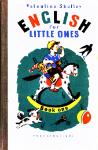
                    Valentine Skultey
УЧПЕДГИЗ - ! 9 6 I
Валентина Скультэ
ЛИ И
МАЛЫШЕЙ
ГОСУДАРСТВЕННОЕ
УЧЕБНО-ПЕДАГОГИЧЕСКОЕ ИЗДАТЕЛЬСТВО
МИНИСТЕРСТВА ПРОСВЕЩЕНИЯ РСФСР
МОСКВА • 1961
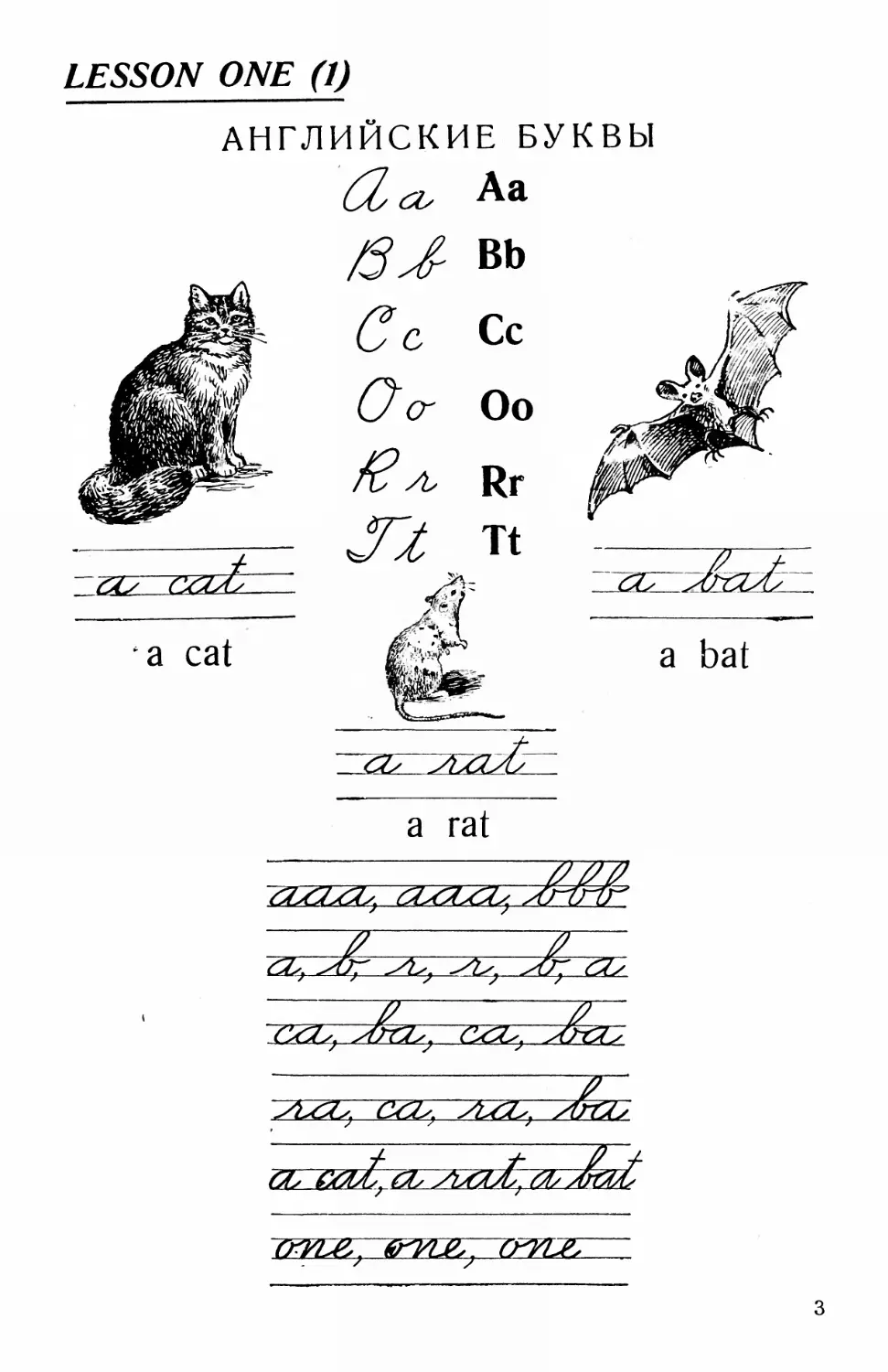
LESSON ONE (1)
АНГЛИЙСКИЕ БУКВЫ
a rat
3
at at at at ra ra ra rat
a cat, a rat, a bat, a rat, a bat
a rat, a cat, a bat
Буквы и звуки
а [э] [ae] c [k] t [t] о [э]
b [b] г [r] n [n] w lw]
Слова
1. one [wah]—один 3. a bat [baet]—летучая
мышь
2. a cat |kaet] — кошка 4. a rat [raet] —крыса
Задания
I. Перепишите и устно переве-
дите слова.
1. A rat, a bat, a cat.
2. A bat, a cat, a rat.
II. Переведите слова на англий-
ский язык.
1. Кошка, летучая
мышь.
2. Крыса, кошка.
4
LESSON TWO (2)
Dd
£
a cap
(S-e, Ее
Hh
Nn
Pp
a hat
ZnZZHZZBZZ^
5
a hen
A pen and a hen.
A	cat	and	a	rat.
A	hat	and	a	cap.
A	rat	and	a	bat.
Буквы и	звуки
h [h] n [n] d [d]
e [e] p [p]
Слова
1.	two [tu:]—два 4. a pen [э'реп]—ручка
2.	a cap [a'kaepj—кепка 5. a hen [a'hen]—курица
3.	a hat [a'haet] — шляпа 6. and [send] — и
Задания
I. Перепишите и устно переве-
дите слова.
1.	A hen, a hat, а реп.
2.	A bat, a cap, a cat
3.	A rat and a cat.
4.	A bat and a hat.
5.	A hen, a bat, a cat
and a rat.
6.	One cap. One pen.
7.	One bat and one cat.
8.	One, two.
II. Переведите письменно слова
на английский язык.
1.	Летучая мышь и
кошка.
2.	Курица, летучая
мышь, кошка и
крыса.
3.	Кепка, ручка.
4.	Один, два.
5.	Летучая мышь и
шляпа.
6.	Крыса и кошка.
7.	Летучая мышь, кеп-
ка, кошка.
8.	Курица, шляпа,
ручка.
6
LESSON THREE (3)
7
A dog and a pig. A cup and a cap.
A bat, a dog, a cat and a pig.
A gun and a cup. A hat and a hen.
A gun, a cup and a hat.
One gun, one dog and one rat.
Буквы и звуки
о [э] i [1] th [е]
g [д] и [л] ее [i:]
Слова
1.	three [eri:]—три	4. a cup [э'клр]—чашка
2.	a dog [a’dog] — собака 5. a gun [э'длп] — ружьё
3.	a pig [a'pig]—свинья
Задания
I.	Перепишите и устно переве- II. Переведите письменно слова
дите слова и сочетания слов. и сочетания слов на англий-
ский язык.
1.	A pig, a dog, а сир,
a gun.
2.	A dog and a pig.
3.	A cat and a rat.
4.	One gun and one cup.
5.	One bat and one hen.
6.	A hat and a cap.
7.	A cup and a pen.
8.	One, two, three.
1.	Кошка и крыса.
2.	Одно ружьё и одна
чашка.
3.	Свинья, собака,
ружьё, чашка.
4.	Собака и свинья.
5.	Одна летучая мышь
и одна курица.
6.	Шляпа и кепка.
7.	Два, один, три.
8.	Чашка и ручка.
8
LESSON FOUR (4)
tyr 4
jam
9
A cat, a fox, a pig, a box, a hen, a
эеп, a cup, a gun, a cap, a bat, a rat, a
Ded, a hat, a dog, a rat.
One box, one fox, one hen, one pen,
one cat, one rat, one hat, one bat, jam.
Two, three, four.
A hat, a cap and a box. A bat, a hen
and a fox. One cat and one rat. One box
and one bed.
Буквы и звуки
x [ks] j [da]
* [f] m [m]
Слова
1.	four [fo:] — четыре
2.	a box [a'boks] — ящик
3.	a fox [a'foksj — лиса
4.	a bed [o'bedj — кро-
вать
5.	jam [dsasm] — варенье
Задания
I.	Перепишите и устно переве-
дите слова и сочетания слов.
1.	Jam and a box.
2.	A cat and a fox.
3.	A bed and a hat.
4.	A gun and a dog.
5.	A cup and a cap.
II.	Переведите письменно слова
и сочетания слов на англий-
ский язык.
1.	Кошка и ящик.
2.	Ружьё и собака.
3.	Одна лиса и одна
летучая мышь.
4.	Лиса и курица.
5.	Одна ручка и одна
курица.
ю
6.	One fox and one bat.
7.	One hat and one box.
8.	A fox and a hen.
9.	One, two, three, four.
10.	One pen and one hen.
11.	One cat and one hat.
6.	Варенье и лиса.
7.	Кровать и шляпа.
8.	Чашка и ружьё.
9.	Одна шляпа и один
ящик.
10.	Три, один, четыре,
два.
11.	Одна кошка и одна
шляпа.
LESSON F/VE (5)^
a vase
a kitten
a lemon
a star
н
/2г zzr xzr ZHL


7Г. iZ
A cat and a kitten.	A vase	and a lemon.
A dog and a fox.	A bat	and a rat.
A star and a gun.	A box	and a bed.
A hen and a fox.	A vase	and a box.
A hat and a cap.	A pen	and a cup.
A cat and a rat.	One, two, three, four,
A dog and a pig.	five.
Буквы и звуки
k [k] S Is]
I [1] V [v]
Слова
1.	five [faiv] — пять
2.	a star [a'sta:] — звез-
да
3.	a vase [a'vaiz] — ваза
4.	a kitten [a'kitn] — ко-
тёнок
5.	a lemon [a'leman] —
лимон
Задания
I. Перепишите и устно переве-
дите слова и сочетания слов.
1. A vase and a cup.
2. A cap and a hat
II. Переведите письменно на
английский язык.
1.	Лимон И ЯЩИК.
2.	Лиса и курица.
12
3.	A fox and a hen.
4.	A kitten and a rat.
5.	A lemon and a box.
6.	A gun and a star.
7.	One dog and one cat.
8.	Jam and a pig.
9.	One, two, three, four,
five.
3.	Ваза и чашка.
4.	Варенье и поросёнок.
5.	Кепка и шляпа.
6.	Ружьё и звёздочка.
7.	Одна собака и одна
кошк$.
8.	Котёнок и крыса.
9.	Один, два, пять, три,
четыре.
LESSON SIX (G)
13
A wolf and a squirrel. A squirrel and
a fox. A cat, a kitten and a dog. A boy
and a gun. A gun and a wolf. A wolf and
a fox. A lemon, a vase and a cup. A hat
and a cap. A bat and a squirrel. A boy
and a cap. One, two, three, four, five, six.
Буквы и звуки
qu [kw]
z [z]
Слова
1.	six [siks] — шесть 4. a razor [a reiza] —
бритва
2.	a boy [a'boi] — маль- 5. a squirrel [a'skwiral] —
чик	белка
3.	a wolf [a'wulf] — волк
Задания
I. Перепишите и устно переве- II. Переведите письменно слова
дите слова и сочетания слов. и сочетания слов на англий-
ский язык.
1. A cat, a kitten, a dog, 1. Ружьё и бритва.
a bat, a rat, a hen, 2. Варенье и мальчик.
14
a pig, a wolf and a
squirrel.
2.	A bat, a wolf, a fox
and a squirrel.
3.	A cup, a hat, a cap,
a pen, a bed, a vase,
a box and a lemon.
4.	A gun and a razor.
5.	Jam and a boy.
6.	One, two, three, four,
five, six.
3.	Летучая мышь, волк,
лиса и белка.
4.	Кошка, котёнок, со-
бака, крыса, курица
и поросёнок.
5.	Чашка, шляпа, кеп-
ка, ручка, кровать,
ваза, ящик и лимон.
6.	Четыре, шесть, два,
один, три, пять.
LESSON SEVEN^
I have
I have no
a copy-book
a book,
copy-book.
I have a dog, but
have no cat.
I have a dog, zbut
have no gun.
1 have a kitten, but
have no squirrel.
1 have a cup, but
have no spoon.
I have a spoon, but
have no jam.
15
I have a cap. I have no lemon.
1 have a pen. 1 have no box.
A boy and a dog.
A bat and a squirrel.
A wolf and a fox.
A book and a copy-book.
A cup and a spoon.
Слова
1.	lesson [lesn] — урок 6. but [ЬлЦ—но
2.	seven [sevn] — семь 7. a book [a'buk]—кни-
3.	1 [ai]—я	га
4.	I have [ai'haev] — я 8. a copy-book [a'kopi-
имею (у меня есть)	buk] —тетрадь
5.	1 have no [nou] — у 9. a spoon [o'spu.n]—
меня нет	ложка
Задания
I. Перепишите и устно	II. Письменно переведите
переведите предложения.	предложения.
1. I have a dog.	1. У меня нет варенья.
2. I have a vase.	2. У меня нет бритвы.
3. I have no razor.	3. У меня нет волка.
4. I have no wolf.	4. У меня есть собака.
5. 1 have a cat and a	5. У меня есть кошка
kitten.	и котёнок.
6. 1 have no bat. I have	6. У меня есть ружьё
no squirrel.	и собака.
7. 1 have no copy-book.	7. У меня есть ваза.
16
8.	I have no jam.
»
9.	I have a gun and a
dog.
10.	I have a copy-book,
but I have no pen.
11.	One, two, three, four,
five, six, seven.
8.	У меня есть тет-
радь, но у меня нет
ручки.
9.	У меня нет белки.
10.	У меня нет тетради.
11.	Четыре, два, шесть,
пять, один, три,
семь.
LESSON EIGHT^ (8±
that boy
this boy
This boy has a ball.
He has a stick too.
That boy has a gun.
He has a pistol too.
17
a ball
That boy has a cap.
This boy has no cap.
This boy has a fox.
He has a bat.
He has a squirrel.
He has a rat.
That boy has a dog.
He has a cat.
He has a kitten. a Sfjck
He has a pig.
This boy has no gun.
He has no pistol.
He has no razor.
He has no wolf.
That boy has no book.
He has no copy-book.
He has no pen.
He has no stick.
Words [wa:dz]—слова
1.	eight [eit] — восемь
2.	this [dis]—этот, эта,
это
3.	that [daet]— тот, та,
то
4.	he [hi:] — он
5.	he has [hi: 'hasz]—
у него есть (он
имеет)
6.	a ball [эЪэ:1] — мяч
7.	a stick [a'stik] — пал-
ка
8.	too [tu:] —тоже
9.	a pistol [a'pistl] —
пистолет
18
Задания
I. Перепишите и устно
переведите предложения.
1.	1 have no stick.
2.	This boy has a stick.
3.	He has a gun and a
dog.
4.	He has a fox.
5.	He has no gun, but he
has a pistol.
6.	I have a cup, but I
have no spoon.
7.	1 have a vase.
8.	He has a lemon and
a cup.
9.	1 have no star, and
he has no star.
10.	That boy has a kitten;
I have a kitten too.
I have no razor.
11.	Four, eight, six, two,
three, seven, one, five.
II. Переведите письменно
предложения.
1.	У того мальчика
есть котёнок, у ме-
ня есть котёнок то-
же.
2.	У меня нет палки.
3.	Он не имеет брит-
вы.
4.	У него есть лиса.
5.	У меня нет звёздоч-
ки и у него нет
звёздочки.
6.	У этого мальчика
есть палка.
7.	У него есть лимон
и чашка.
8.	У него есть ружьё
и собака.
9.	У меня есть чашка,
но у меня нет лож-
ки.
10.	У меня есть ваза.
11.	Восемь, шесть, два,
четыре, один, семь,
три, пять.
19
LESSON N/NE (9)
a frog
That
I have two
kittens.
This girl has
three dolls.
This boy has
two frogs. a
This girl has
five books,
boy has four pens.
This girl has a kitten. She has a dish.
This fish is on the dish.
That frog is on the log.
The girl has one dish.
She has two spoons.
The boy has three snakes.
He has five hens.
The fish is in the lake.
a dish
The spoon is in the cup.
The squirrel is on the log.
The doll is on the bed.
I have one box.
20
He has two stars.
She has three dolls.
The snake is in the
box.
The fish is on the
dish.
The frog is on the
log.
a snake
The doll is on the bed.
The snake is in the lake.
The hen is on the log.
The bat is in the hat.
Words
1.	nine [nam]—девять
2.	a girl	[э'дэ:1]—де-
вочка
3.	a doll [a'dol] — кукла
4.	a frog [a'frag]— ля-
гушка
5.	she [Ji:]—она
6.	a dish [a'dij] — блюдо
7.	a fish [a’fij]—рыба
8.	is fiz] — находится
9.	on [on] — на
10.	the [da]—определён-
ный артикль
11.	a log [a'bg]—бревно
12.	a snake [a'sneik]—
змея
13.	in [in] — в
14.	a lake [aleik]—озе-
ро
21
Задания
I. Перепишите и устно
переведите предложения.
1.	This girl has five
kittens and two cats.
2.	She has three hens
and one pig.
3.	1 have four books and
nine copy-books.
4.	This boy has eight
stars.
5.	He has six sticks, but
he has no gun.
6.	He has five frogs and
two snakes.
7.	One snake is in the
lake.
8.	One frog is on the
log.
9.	The spoon is in the
cup.
10.	Nine, six, eight, five,
seven, one, three, two,
four.
II.	Переведите письменно
предложения.
1.	У этой девочки есть
5 котят и 2 кошки.
2.	У неё есть 3 кури-
цы и одна свинья.
3.	У меня есть 4 книги
и 9 тетрадей.
4.	У этого мальчика
есть 8 звёздочек.
5.	У него есть 6 палок,
но у него нет ружья.
6.	У него есть 5 лягу-
шек и 2 змеи.
7.	Одна змея в озере.
8.	Одна лягушка на
бревне.
9.	Ложка в чашке.
10.	Девять, восемь, семь,
шесть, пять, четыре,
три, два, один.
22
LESSON TEN (10)
one girl
five chickens
one boy
Count from one to ten!
One, two, three, four,
five, six, seven, eight,
nine, ten.
Count the rabbits! One,
two, three.
Count the chickens!
One, two, three, four,
five.
three rabbits
This girl has three rabbits.
She has five chickens.
Has this girl a kitten? Yes, she	has.
Has this girl a cat? Yes, she	has.
Has she a dog?	Yes, she	has.
Has she a hat?	Yes, she	has.
Has she a snake? No, she has	not.
23
Has she a frog? No, she has not
Has she a bat? No, she has not.
The boy has two squirrels.
He has one fox too.
He has nine rabbits.
He has four bats.
Has the boy a wolf?	No, he has not.
Has he a gun?	No, he has not.
Has he a razor?	No, he has not.
Has he a stick?	Yes, he has.
Has he a ball?	Yes, he has.
The girl has one hen and eight chickens.
The boy has nine rabbits and four bats.
Has the boy a cap? Yes, he has.
Has the girl a hat? Yes, she has.
Words
1.	ten [ten]—десять
2.	count [kaunt] —счи-
тай
3.	from [from]—от
4.	to [to]—до, к
5.	rabbit [raebit] — кро-
лик
6.	chicken ['tSikin] —
цыплёнок
7.	yes [jes]—да
8.	Has she? [haez Ji:] -
У неё есть?
9.	Has he? [haez hi:] —
У него есть?
10*	. She has not [Ji: 'haez
not] — У неё нет.
11. no [nou] — нет
24
Задания
I. Перепишите и устно
переведите предложения.
1.	The boy has nine rab-
bits, two squirrels, two
snakes and a frog.
2.	The girl has ten
chickens, six hens and
two cats.
3.	Has she a kitten? Yes,
she has.
4.	Has the boy a pig?
No, he has not.
5.	Count the squirrels!
6.	Count the sticks!
7.	Count the chickens!
8.	I have no gun.
9.	He has no pistol.
10.	She has no stick.
II.	Переведите письменно
предложения.
1.	Сосчитай цыплят!
2.	У неё есть котёнок?
Да.
3.	У мальчика есть
свинья? Нет.
4.	Сосчитай палки!
5.	У мальчика есть 9
кроликов, 2 белки,
2 змеи и лягушка.
6.	У меня нет ружья.
7.	Сосчитай белок!
8.	У него нет револь-
вера.
9.	У девочки есть 10
цыплят, 6 кур и 2
кошки.
10.	У неё нет палки.f
LESSON ELEVEN^ (П)
How many ducks
have you?
1 have two ducks
and ten ducklings.
How many hens
have you? •
I have eight hens.
a duck with
a duckling
25
a cow
F
How many cows
have you?
I have one cow.
How many dogs
have you?
1 have two
dogs.
How many books has this boy?
He has eleven.
How many copy-books has that girl?
She has four.
How many pens has she?
She has ten pens.
How many kittens have you?
1 have three kittens.
, How many chickens has the hen?
It has eleven.
How many ducklings has the duck?
It has eight.
How many kittens has the cat?
It has three.
How many dolls has the girl?
She has two.
How many sticks has the boy?
He has five.
How many hats have 1?
You have one.
26
Words
1.	eleven [flevn] — один-
надцать
2.	how [hau]—как
3.	many ['mem] — много
4.	How many?—Сколь-
ко?
5.	duck [dAk]—утка
6.	Have you?—У вас
есть?
7.	you [Ju:] — вы, ты
8.	duckling ['dAklig] —
утёнок
9.	cow [kau]—корова
10.	we [wi:] — мы
11.	it [it] — он, она, оно
(для всех предметов
и животных)
12.	with [wid]—с
Задания
I. Перепишите и устно
переведите предложения.
1.	I have a copy-book.
2.	You have a book.
3.	Не has a gun.
4.	She has a doll.
5.	We have a cow.
6.	Has he a squirrel?
7.	Have you many rab-
bits?
8.	We have many chi-
ckens.
9.	She has many hens.
10.	Count from ten to
one!
11.	How many pens have
you?
12.	I have eight pens.
13.	You have eleven copy-
books.
II. Переведите письменно
предложения.
1.	Сколько у вас ру-
чек?
2.	У меня 8 ручек.
3.	Сосчитай от 10 до 1!
4.	У нас есть корова.
5.	У неё есть кукла.
6.	У меня есть тетрадь.
7.	У вас есть книга.
8.	Он имеет ружьё.
9.	У него есть белка?
10.	У вас много кро-
ликов?
11.	У нас много цып-
лят?
12.	У тебя много утят?
13.	У вас 11 тетрадей.
27
LESSON TWELVE (12)
a black horse
They have a horse;
it is black.
They have a pig;
it is big.
They have a goat;
it is white.
They have a cow;
the cow is red.
They have no car.
We have a cow; it is
red.
We have four goats.
We have a car; it is
black.
We have no ducks.
a white goat

a ribbon
__ 5
You	have a razor; it is
in the	box.
You	have a lemon; it is
on the	dish.
You	have no hens.
He has one dog; it is black.
He has a cat; it has three kittens.
He has a cap; it is big.
28
a kitten; it is white,
a hat; it is white too.
a ribbon; it is red.
is a box; it is big.
is a rabbit; it is white,
is a girl; she is big.
is a boy; he. is big too.
Words
She has
She has
She has
This
This
This
This
1.	twelve [twelv] — две-
надцать
2.	they [dei]— они
3.	horse [ho:s] — лошадь
4.	black [blaek] — чёр-
ный
5.	big [big] —большой
6.	goat [gout] — коза
7.	white [wait]—белый
8.	red [red]—красный,
рыжий
9.	car [ka;]—автомо-
биль
Задания
I. Перепишите и устно переве- II. Переведите письменно пред-
дите предложения.	ложения.
1. This	boy has a bat;	1. Сколько утят у этой
it is	in the box.	утки?
2. This	girl has a doll;	2. Сколько цыплят у
it is	big.	этой курицы?
3. The	boy has a red	3. У нас 12 кур и
star.		11 уток.
4. He	has two kittens,	4. У них 2 котёнка,
but	he has no cat.	3 белки, 8 кроликов
		и 12 цыплят.
5. She	has a ribbon; the	5. У этого мальчика
ribbon is red.	есть летучая мышь;
она в ящике.
29
6.	She has a cat; it is
red.
7.	How many ducklings
has this duck?
8.	How many chickens
has that hen?
9.	We have twelve hens
and eleven ducks.
10.	They have two kittens,
three squirrels, eight
rabbits and twelve
chickens.
1
6.	У этой девочки есть
кукла; она большая.
7.	У неё есть лента;
лента красная.
8.	У неё есть кошка;
она рыжая.
9.	У мальчика есть крас-
ная звёздочка.
10.	У него есть 2 котён-
ка, но у него нет
кошки.
LESSON THIRTEEN (13)
Where is your book?
It is on the table.
Where is the table?
a table
a house
It is in the house.
Where is the house?
30
a garden
It is in the garden.
Where is the girl?
She is in the room.
Where is the boy?
He is in the garden.
Where are you?
1 am in the garden too.
Where is your pen?
My pen is on the table.
Where is your pencil?
It is on the table too.
Where is your goat?
a tree
My goat is in the garden.
Where is your horse?
My horse is under that tree.
Have you a house?
Yes, we have.
Have you a garden?
Yes, we have.
Is your garden big?
Yes, it is.
31
Is your goat under the tree?
Yes, it is.
Is your car under the tree too?
No, it is not.
Is the boy in the house?
Yes, he is.
Is the girl in the room?
Yes, she is.
My room is very good.
My gun is very good.
My garden is very big.
Is your goat white?
Yes, my goat is white.
Is your cow red?
No, my cow is not red.
Words
1.	thirteen [ea:'ti:n] —
тринадцать
2.	where [wea] — где
3.	your [jo:] —твой, ваш
4.	table [teibl] — стол
5.	house [haus]—дом
6.	garden [ga:dn]—сад
7.	room [ru:m] — комна-
та
8.	1 am [ai'aem] —я есть
he, she, it, is —он,
она, оно есть
9. my [mai]—мой (моя,
моё)
10. under [Anda] — под
11. tree [tri:]—дерево
12. very [ven]—очень
13. good [gud] — хоро-
ший
14. very good — очень
хороший
32
Задания
I. Перепишите и устно переве-
дите предложения.
1.	Where is my pen? It
is on the table.
2.	Where is my book? It
is on the table too.
3.	Where is your goat?
It is in the garden.
4.	Where is your horse?
It is in the garden
too.
5.	Where is the boy? He
is in the house.
6.	Where is the girl? She
is in the room.
7.	My goat is under that
tree.
8.	Your horse is in the
garden.
9.	My goat is white.
10.	Your horse is black.
11.	I am in the garden.
12.	Eleven, twelve, thir-
teen.
13.	I am a big girl.
II. Переведите письменно пред-
ложения.
1.	Моя коза белая.
2.	Ваша лошадь чёр-
ная.
3.	Моя коза под тем
деревом.
4.	Ваша лошадь в са-
ДУ-
5.	Где моя ручка? Она
на столе.
6.	Где девочка? Она
в комнате.
7.	Где ваша коза? Она
тоже в саду.
8.	Где мальчик? Он в
доме.
9.	Где моя книга? Она
тоже на столе.
10.	Я в саду.
И. Я большая девочка.
12. Где ваша лошадь?
Она тоже в саду.
13. Одиннадцать, две-
надцать, тринадцать.
2 Скультэ, ч. 1
33
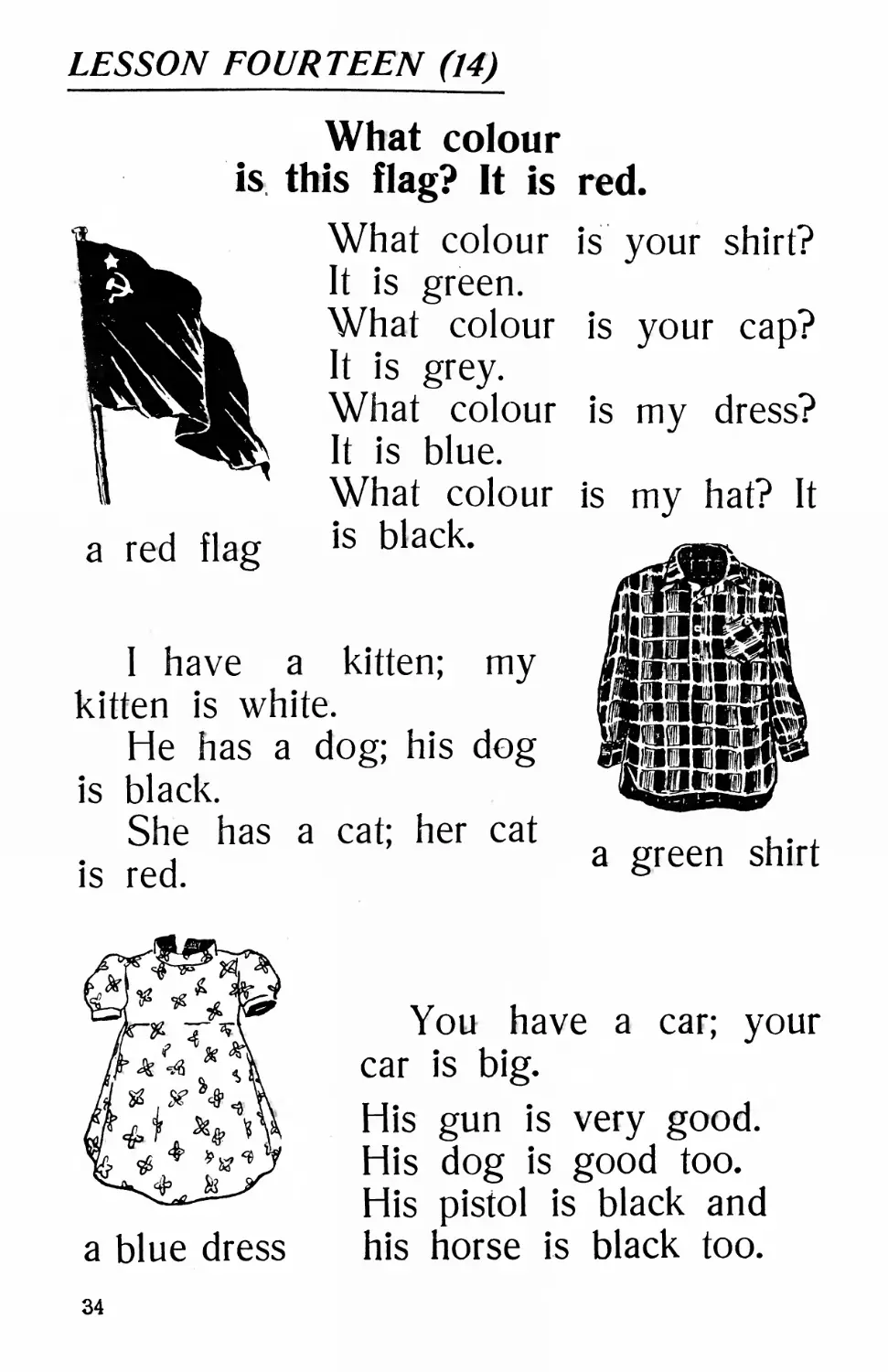
LESSON FOURTEEN (14)
What colour
is this flag? It is
a red flag
What colour
It is green.
What colour
It is grey.
What colour
It is blue.
What colour
is black.
red.
is your shirt?
is your cap?
is my dress?
1 have a kitten; my
kitten is white.
He has a dog; his dog
is black.
She has a cat; her cat
is red.
is my hat? It
a green shirt
a blue dress
You have a car; your
car is big.
His gun is very good.
His dog is good too.
His pistol is black and
his horse is black too.
34
Have you a black pencil? Yes, I have.
Has he a dog? Yes, he has.
Has he a stick? No, he has not.
Has she a kitten? Yes, she has.
0
Have you a green hat?
Yes, I have. It is in the box.
Have you a blue dress?
Yes, 1 have. It is on the bed.
Have you a dog?
Yes, 1 have. It is in the garden.
Have you a horse?
Yes, 1 have. It is in the garden too.
He has a big dog.
His dog is under that tree.
She has a kitten.
Her kitten is in the box.
a pencil
Words
1.	fourteen ['fo:'ti:n] —
четырнадцать
2.	What? [wot] — Какой,
что?
3.	colour ['кл1а] — цвет
4.	What colour? — Ка-
кого цвета?
5.	flag [flaeg]— флаг
6.	shirt [$a:t]—рубашка
7.	green [gri:n] — зелё-
ный
8.	ёгеУ forei]—серый
9.	dress [dres] — платье
10.	blue [blu:]—синий
11.	pencil [pensl] — ка-
рандаш
12.	her [ha:] — её
13.	his [hiz] — его
2»
35
Задания
I. Перепишите и устно переве-
дите предложения.
1.	What colour is your
pencil? My pencil is
green.
2.	What colour is your
dress? My dress is
blue.
3.	What colour is her
hat? Her hat is white.
4.	What colour is his dog?
His dog is black.
5.	Is this flag black? No,
it is not. The flag is
red.
#6. Is that tree grey? No,
it is not. The tree is
green.
7.	Is your goat white?
Yes, it is.
8.	Is her room big? No,
it is not.
9.	Is his shirt white? No,
it is not.
10.	His shirt is not white,
it is green.
II.	Переведите письменно пред-
ложения.
1.	Его рубашка белая?
Нет.
2.	Этот флаг чёрный?
Нет, флаг красный.
3.	Какого цвета его
собака? Его собака
чёрная.
4.	Твоя коза белая? Да.
5.	Его рубашка не бе-
лая; она зелёная.
6.	У неё большая ком-
ната? Нет.
7.	Какого цвета твой
карандаш? Мой ка-
рандаш зелёный.
8.	Какого цвета её
шляпа? Её шляпа
белая.
9.	Какого цвета ваше
платье? Моё платье
синее.
10.	То дерево серое? Нет,
дерево зелёное.
36
LESSON FIFTEEN (15)
Is this a violet or a
rose? It is a rose.
Is this a rose too? No,
it is not.
What is this? It is a
violet.
Is this a chicken?
No, it is not.
What is this? It is a
bird.
a violet
a rose
Where is the bird? It
is in the cage.
Is this a stick? No, it
is not.
37
an umbrella
What is this? It is an
umbrella.
What colour is the um-
brella? It is black.
Is this chicken big or
little? It is little.
Ann has many violets
in her garden.
Ann has many red
roses.
She has many flowers
in her garden.
How many umbrellas
have you?
I have two umbrellas.
Give me one umbrella!
a bird
This bird is in the cage.
This girl is in the room.
This book is on the table.
This kitten is in the box.
This spoon is in the cup.
That rose is red.
That flower is yellow.
That violet is good.
This rose is bad.
38
These birds are in the tree.
These girls are in the garden.
These books are on the table.
These kittens are under the bed.
These spoons are on the dish.
Those roses are red.
Those flowers are not yellow.
Those violets are very big.
Those roses are little.
Words
1. fifteen [’fif'ti:n] — пят-	9. little [litl]—малень-
надцать 2. violet [vaialit] — фи-	кий 10. Ann [aen] — Аня
алка	11. flower ['flaua] — цве-
3. or [□:] — или 4. rose [rouz] — роза	ток 12. Give me! ['giv mi] —
5. what [wot] — что . 6. bird [ba:d]—птица	Дай мне! 13. these [di:z] — эти
7. cage [keidg] — клетка	14. those [douz] — те
8. an umbrella [лт'Ьге-	15. yellow ['jelou] — жёл-
10] — ЗОНТ	тый 16. bad [baed] — плохой
Задания
I. Перепишите и устно переве- II. Переведите письменно пред-
дите предложения.	ложения.
1. Her rose is on the 1. Мои ручки на столе,
table.
39
2.	My roses are in the	2.	Его кролики под
	vase.		домом.
3.	Her violets are in the	3.	Её цветы у неё в ком-
	cup.		нате.
4.	Her flowers are in her	4.	Ваши карандаши на
	room.		вашем столе.
5.	His little dog is in the	5.	Моя птичка в клет-
	box.		ке.
6.	His big dog is in the garden.	6.	Её фиалки в чашке.
7.	His rabbits are under the house.	7.	Мои розы в вазе.
8.	His books are on his table.	8.	Её роза на столе.
9.	Your cap is very	9.	Его книги у него на
	good.		столе.
10.	Your shirt is good	10.	Его маленькая соба-
	too.		ка в ящике.
11.	Your copy-books are	11.	Его большая соба-
	good.	•	ка в саду.
12.	Your pencils are on your table.	12.	Мои кролики в саду.
13.	My bird is in the	13.	Ваша шагтка очень
	cage.		хорошая.
14.	My umbrella is in the	14.	Ваша рубашка тоже
	house.		хорошая.
15.	My pens are on the table.	15.	Мой зонт в доме.
16.	My rabbits are in the	16.	Твои тетради очень
	garden.		хорошие.
40
LESSON SIXTEEN^ (16)^
What have you?
What has she?
a bell
1 have a book. It is old.
She has a silver bell. It is new.
He has a long stick. It is strong.
You have a new house. It is big.
We have an old garden. It is green.
They have a good cow. It is red.
What has this boy?
He has a gun. His gun is new.
What has this girl?
She has a bird. Her bird is little.
What have you?
1 have a flower. My flower is yellow.
What have I?
You have a dog. Your dog is big.
What have we?
We have a room. Our room is big.
What have they?
They have a car. Their car is old.
Is your book new?
Yes, my book is new.
Is your house old?
Yes, my house is old.
41
Is his cow red?
Yes, his cow is red.
Is his dog big?
Yes, his dog is big.
Is his stick long?
Yes, his stick is long.
Is her doll big?
Yes, her doll is big.
Is her hat red?
Yes, her hat is red.
Is my goat white?
Yes, your goat is white.
Are my chickens yellow?
Yes, your chickens are yellow.
Are your hens grey?
Yes, my hens are grey.
Are their books new?
Yes, their books are new.
Words
1.	sixteen ['siks'tiin] —
шестнадцать
2.	old [ould] — старый
3.	silver ['silva] — сереб-
ряный
4.	bell [bel] — колоколь-
чик
5.	new [nju:] — новый
6-	long [bg] —длинный
7.	strong [strop] — силь-
ный
8.	our [aua] — наш
9.	their [деэ] — их
10.	at home [at'houm] —
дома
42
Задания
I. Перепишите и устно переве-
дите предложения.
1.	Is your umbrella new?
Yes, it is.
2.	Is your boy at home?
Yes, he is.
3.	Is this flower yellow?
Yes, it is.
4.	Is their cow red? Yes,
it is.
5.	What is red? The rose
is red, the flag is red.
6.	What is green? The
tree is green, my shirt
is green.
7.	Is this bell new? Yes,
this bell is new.
8.	Are their horses
strong? Yes, they are
very strong.
9.	Her dress is very
long.
10.	They have sixteen black
hens and thirteen
white hens.
II.	Переведите письменно пред-
ложения.
1.	Её платье очень
длинное.
2.	Этот колокольчик
новый? Да, этот ко-
локольчик новый.
3.	Твой зонт новый?
Да.
4.	Их корова рыжая?
Да.
5.	Что красное? Роза
красная, флаг крас-
ный.
6.	Их лошади сильные?
Да, они очень силь-
ные.
7.	Они имеют 16 чёр-
ных кур и 13 белых
кур.
8.	Этот цветок жёл-
тый? Да.
9.	Ваш мальчик дома?
Да.
10.	Что зелёное? Дерево
зелёное, моя рубаш-
ка зелёная.
43
LESSON SEVENTEEN (17)
The rose,
flowers.
Is this a zebra or a tiger?
It is a zebra.
Is this a wolf or a jackal?
It is a jackal.
The wolf is big and strong.
The jackal is small and
weak.
The zebra, the tiger, the
lion, the wolf and the fox
are animals.
the violet and the daisy are
We have many flowers at home.
Have you many violets in your garden?
What flower is this? It is a daisy.
What animal is this? It is a jackal.
Where is your cat? It is with its kittens.
Where are the kittens? They are with the
*
a jackal
a zebra
44
The hen is with its chickens.
The duck is with its ducklings.
The cat is with its kittens.
The horse is a strong animal.
Is the boy strong? Yes, he is.
Is the girl strong? No, she is not.
Is the goat strong? No, it is not.
a daisy
Words
1.	seventeen [sevn-
'tim] — семнадцать
2.	zebra [zi:bra]—зеб-
ра
3.	tiger [taiga]—тигр
4.	jackal ['dgaekad]—ша-
кал
5.	small [sma:l]—ма-
ленький
6.	weak	[wi:k]—сла-
бый
7.	lion ['laian]—лев
8.	animal faenimal] —
животное
9.	daisy	['deizi]—ро-
машка
10.	its [its]—его, её, свой
(о животных и
предметах)
Задания
I. Перепишите и устно переве-
дите предложения.
1.	1 am at home.
2.	What animal is this?
It is a lion.
3.	Is the lion strong?
Yes, it is very strong.
4.	Is the tiger weak? No,
it is not. It is very
strong too.
II. Переведите письменно пред-
ложения.
1.	Я дома.
2.	Какое это живот-
ное? Это лев.
3.	Лев сильный? Да, он
очень сильный.
4.	Тигр слабый? Нет,
он тоже очень силь-
ный.
45
5.	What flower is this?
It is a violet.
6.	Are you weak or
strong? I am strong.
7.	Is this boy strong?
Yes, he is.
8.	Is the jackal a strong
animal? No, it is not.
9.	Is the zebra big or
small? The zebra is
not very big.
10.	Where is Ann? She is
in the garden.
11.	Where is our cat? It
is with its kittens.
5.	Какой это цветок?
Это фиалка.
6.	Вы слабый или силь-
ный? Я сильный.
7.	Этот мальчик силь-
ный? Да.
8.	Шакал сильное жи-
вотное? Нет.
9.	Зебра большая или
маленькая? Зебра не
очень большая.
10.	Где Аня? Она в са-
ДУ-
11.	Где наша кошка?
Она со своими ко-
тятами.
LESSON EIGHTEEN^ (18)
Tom has a horse.
Tom’s horse is
strong.
an eagle
a quail
46
Ann has a quail. Ann’s
quail is tame.
What bird is this? It
is an eagle.
The eagle’s beak is
very sharp.
Is this an eagle too?
No, it is not.
It is a cock; its crest is
a cock
red.
The hen’s crest is red too.
What is red? The cock’s crest is red.
Ann’s hat is red.
What is long? Tom’s stick is long.
The rat’s tail is long.
What is sharp? The eagle’s beak is
sharp.
The cat’s claws are
sharp.
Father’s razor is sharp.
The quail’s tail is not long.
The quail’s beak is not sharp.
47
Ann’s mother has a ring.
Tom’s father has a gun.
Mother’s ring is old.
His father’s gun is new.
Is your mother’s ring old?
Yes, it is.
Is your father’s gun new?
Yes, it is.
Is your cap grey?
No, it is not. It is black.
Are Tom’s rabbits white?
Yes, they are.
Are Ann’s chickens yellow?
Yes, they are.
Words
1.	eighteen [ei'ti:n]—во-
семнадцать
2.	Tom [tom]—Том (имя
собственное, муж-
ское)
3.	quail [kweil]—пере-
пёлка
4.	tame [teim]—ручной
5.	eagle [iigl]—орёл
6.	beak [bi:k]—клюв
7.	sharp [$а;р]—острый
8.	cock [kok]—петух
9.	crest	[krest]—гре-
бень
10.	tail [teil]—хвост
11.	claw [kb:] —коготь
12.	father [Ъ:дэ]—отец
13.	mother[тлдэ]—мать
14.	ring [пр]—кольцо
48
Задания
I. Перепишите и устно переве-
дите предложения.
1.	Is the cock’s crest red?
Yes, it is.
2.	Is the rat’s tail long?
Yes, it is.
3.	Is Ann’s doll new? No,
it is not.
4.	Is the girl’s cat white?
Yes, it is.
5.	Is the boy’s ball old?
No, it is not.
6.	Is Tom’s horse black?
Yes, it is.
7.	Is Tom’s dog big?
No, it is not
8.	Is his father’s razor
sharp? Yes, it is.
9.	Are the cat’s claws
sharp?
Yes, they are.
10.	Are your mother’s
books old? Yes, they
are.
11.	Are your father’s guns
new? No, they are not.
12.	We have eighteen
quails.
II. Переведите письменно пред-
ложения.
1.	У петуха гребень
красный? Да.
2.	У крысы хвост длин-
ный? Да.
3.	У Ани кукла новая?
Нет.
4.	У девочки кошка
белая? Да.
5.	У мальчика мяч ста-
рый? Нет.
6.	Лошадь Тома чёр-
ная? Да.
7.	Собака у Тома боль-
шая? Нет.
8.	У его папы бритва
острая? Да.
9.	У кошки когти ост-
рые? Да.
10.	У твоей мамы книги
старые? Да.
11.	У твоего папы ружья
новые? Нет.
12.	У нас 18 перепёлок.
49
LESSON NINETEEN (19)
What is your name? My name is Sam.
Who is this man? This man is Jimmy’s
father.
What is his name? His name is Tom Dale.
Tom Dale is a hunter.
Who is Jimmy? Jimmy is Tom Dale’s son.
What has Tom Dale? He has a gun and
a dog.
Jimmy’s father is a very good hunter.
Jimmy has a puppy. His puppy’s name is
Room bo.
Roombo is Jimmy’s
a hunter and his dog
50
Mr. Dale has a big dog;
its name is Reni.
Reni is very clever
and strong.
What is the hunter’s
name? The hunter’s
name is Tom Dale.
What is the boy’s name?
The boy’s name is
Jimmy Dale.
Who are you? I am Mr.
Christine. I am a
doctor.
Jimmy
and his puppy
I have a little girl. Her name is Lily. Lily
has a brother.
Her brother’s name is Sam. My name is
John Christine.
Tom Dale is Jimmy’s father. Reni is Tom
Dale’s dog.
Jimmy is Tom Dale’s son. Roombo is
Jimmy’s puppy.
Mr. Christine is Lily’s father. He is a
doctor.
Who is Sam? Sam is Lily’s brother.
Lily is Jimmy’s friend. Is Sam a hunter?
No, he is not. Sam is a little boy.
Jimmy and Sam are friends too. They are
very good friends.
51
Words
1. nineteen [nain'tiin]— 12. Roombo [rumbou] —
девятнадцать		Румбо
2. name [neim]—имя	13.	Reni [rem]—Рени
3. What is your name?—Как	твоё	14.	clever ['kleva]—ум- ный
имя? Как тебя зовут?	15.	Mr. [mista] —мистер
4.	Sam [saem]—Сэм 5.	who [hu:]—кто 6.	man [maen]—чело-	16.	Mr. Christine [kns- tm]—мистер Кри- стин
век, мужчина 7. Jimmy ['dgimi]—	17.	doctor ['dokta] —док- тор
Джими	18.	Lily ['hh]—Лиля
8. Dale [deil]—Дэйл 9. hunter	[ЪлпЬ] —	19.	brother [Ъглда] — брат
охотник	20.	John [dgon]—Джон
10. son [sah]—сын 11. puppy [рлр1]—ще- нок	21.	friend ['frend] —друг
Задания
I. Перепишите и устно переве- дите предложения. 1.	This man is a hun- ter. What is his name? 2.	This man’s name is Tom Dale. 3.	Mr. Dale has a son. His son’s name is Jim- my.	И. Переведите письменно пред- ложения. 1.	Этот человек охот- ник? Как его зовут? 2.	Имя этого человека Том Дэйл. 3.	У мистера Дэй ла есть сын. Его сына зовут Джими.
52
4.	Jimmy is a little boy.
He has a puppy.
5.	The puppy’s name is
Roombo.
6.	Has Tom Dale a dog?
Yes, he has.
7.	Is Mr. Dale a good
hunter? Yes, he is.
8.	Is Tom Dale’s gun
new? No, it is not.
9.	Tom Dale’s gun is
old.
10.	Mr. Dale’s dog is ve-
ry clever and strong.
Its name is Reni.
4.	Джими маленький
мальчик. У него есть
щенок.
5.	Щенка зовут Румбо.
6.	У Тома Дэйла есть
собака?
Да.
7.	Хороший ли охот-
ник мистер Дэйл?
Да.
8.	Ружьё Тома Дэйла
новое? Нет.
9.	Ружьё Тома Дэйла
старое.
10.	Собака мистера Дэй-
ла очень умная и
сильная. Её зовут
Рени.
LESSON TWENTY (20)
a chair
a pair of shoes
Where are my shoes?
They are under your bed.
53
a sofa
Where is my cat? It is in
the garden.
Where are
They
bed.
my kittens?
are under your
Where is Mother’s hat?
Where is Lily’s doll?
Where is Jimmy’s ball?
Where are Sam’s rabbits?
Where are this girl’s books?
Where is Father’s cap?
a plate
Where are that boy’s shoes?
Where are our ducklings?
Where are my copy-books?
Where are Sam’s friends?
is on the sofa.
My cat
Your hat is on .the chair.
His ball is under the bed.
__ Her dress is in the room.
Your hens are
garden.
Our ducks are on
Their cups are
table.
The boys are at
ma.
The girls are at home.
in the
the lake,
on the
the cine-
54
The plates are in the cupboard.
The birds are in the nest.
The squirrels are in the tree.
Is my cup in the cupboard?
Is your bed in the garden?
Is the squirrel in the cage?
Is your brother at the cinema?
Are our ducks on the lake?
Are the cups in the cupboard?
Are my shoes under the bed?
Are their books on the table?
Words
1.	twenty	['twenti] —
двадцать
2.	shoe [Su:]—башмак
3.	sofa [soufa]—диван
4.	chair [t$ea]—стул
5.	at the cinema [at da
sinama]—в кино
6.	plate [pleit]—тарел-
ка
7.	cupboard ['kAbad] —
буфет
8.	nest [nest]—гнездо
9.	pair [pea]—пара
10.	in the tree—на де-
реве
Задания
I. Перепишите и устно переве-
дите предложения.
1.	The little bird is in
its nest.
2.	The little kittens are
in their box.
3.	The red fox is under
that tree.
11. Переведите письменно пред-
ложения.
1.	Маленькая птичка в
своём гнезде.
2.	Маленькие котята в
своём ящике.
3.	Рыжая лисица под
тем деревом.
55
4.	The red squirrel is
in the tree.
5.	Violets, daisies and
roses are in the
garden.
6.	The boys and the
girls are at the cine-
ma.
7.	The father and the
mother are at home.
8.	The cat and its kittens
are under the bed.
9.	The duck and its
ducklings are on the
lake.
10.	The fish and the frogs
are in the lake.
11.	1 have a new pair of
shoes.
4.	Рыжая белка на де-
реве.
5.	Фиалки, ромашки и
розы в саду.
6.	Мальчики и девочки
в кино.
7.	Папа и мама дома.
8.	Кошка с котятами
под кроватью.
9.	Утка со своими утя-
тами на озере.
10.	Рыбы и лягушки в
озере.
11.	У меня есть пара
новых туфель.
LESSON TWENTY-ONE^ (21±
How old are you?
1 am twelve (years old).
How	old	is Jimmy?	Jimmy is six years old.
How	old	is Lily?	Lily is four years old.
How	old	is Sam?	Sam is ten (years old).
How	old is Jimmy’s Jimmy’s friend is twelve,
friend?
56
a monkey
Sam has a monkey. It is
very funny.
Sam’s monkey is not in
the cage.
What colour is Sam’s mon-
key? It is brown.
What is its name? Its name
is Cheetah.
Cheetah has a friend. Cheetah’s friend is a
donkey.
The donkey’s name is Kicky. Kicky is grey
and old.
It is very weak.
Cheetah is in the tree. Kicky is under the tree.
What colour is the monkey? It is brown.
What colour is the donkey? It is grey.
Is the donkey strong or weak? It is weak.
Is the monkey very funny? Yes, it is very funny.
How old is your brother?
My brother is twenty-one.
How old is this donkey?
It is seventeen years old.
How old are you? I am
ten.
Kicky, the donkey, is un-
der the tree.
But where is Cheetah,
the monkey? It is on
the donkey.
The monkey is on the
donkey’s back.
a donkey
57
•Words
1.	How old are you?— 5. brown [Ъгаип]—ko-
Сколько вам лет? ричневый
2.	year [jia]—год	6. Cheetah [rtSi:to]—Чи-
та
3.	monkey	['mAgki]— 7. donkey [cbgki]—oc-
обезьяна	лик
4.	funny [7дш]—забав- 8. Kicky fkiki]—Кики
ный	(Брыкун)
Задания
I.	Перепишите и устно переве-
дите предложения.
1.	Sam’s monkey is in the
• tree.
Its name is Cheetah.
2.	Kicky is an old don-
key. It is very weak.
3.	The donkey is under
the tree.
4.	Is this donkey strong
or weak? This donkey
is very weak, it is very
old.
5.	Is Lily a boy or a girl?
She is a girl.
6.	How old is she? She
is four years old.
7.	Who is Lily’s friend?
Jimmy Dale is her
friend.
II. Переведите письменно пред-
ложения.
1.	Обезьянка Сэма на
дереве. Её зовут Чи-
та.
2.	Кики—старый ослик.
Он очень слабый.
3.	Ослик под деревом.
4.	Этот ослик сильный
или слабый? Этот
ослик очень слабый,
он очень старый.
5.	Лули—мальчик или
девочка? Она девоч-
ка.
6.	Сколько ей лет? Ей
4 Годе!.
7.	Кто друг Лили? Джи-
ми Дэйл её друг.
58
8. Is Sam’s monkey fun-
ny? Yes, it is very fun-
ny.
9. Who is strong? Jim-
my’s father is strong;
he is a hunter. He is
a very strong man.
8. Обезьянка Сэма
смешная? Да, она
очень смешная.
9. Кто сильный? Отец
Джими сильный,
он—охотник. Он
очень сильный чело-
век.
LESSON TWENTY-TWO^ (22±
' Give me your knife, Jimmy!
Lily, put the fork down!
Take your spoon, Sam!
Open the cupboard, Polly!
Give me the plate, Ann!
a truck
Who is in the truck? Jimmy’s father is in the truck.
Tom Dale is a driver. He drives a motor-car and
a truck.
Who is this girl? She is Jimmy’s sister. What is
her name? Her name is Polly. How old is Pol-
ly? She is thirteen years old.
Open the cupboard, Polly! Take two cups!
Give me six plates and three spoons!
Are the forks on the table? Where are they?
How many knives have you? We have twelve
knives. They are in the cupboard.
59
a penknife
Open your books, children!
Read this book,
Tom!
Sit down, Jimmy! Take your copy-
book!
Where is your pencil? Is your pen-
cil black?
How many pencils have you, Sam?
Give me your book, please! Give
me your penknife, Polly. Thank
you.
Is he a good driver? Are you a
doctor?
Is he a good hunter? Are the boys
at the cinema? Is he a strong
man? Are they at home?
Words
1.	knife [naif] — нож
2.	Put down [put
'daun]! — Положи!
3.	fork [fa:k] — вилка
4.	Take [teik]! — Возьми!
5.	Open [oupan]!— От-
крой!
6.	truck [trAk] — грузо-
вик
7.	driver fdraiva] — mo-
фёр
8.	to drive — водить ма-
шину
9.	sister [sista] — се-
стра
10.	Polly [pah] — Поля
11.	children ['tfildran] —
дети
12.	Read [ri:d]! — Читай!
60
13.	Sit down [sit
daun]! — Сядь!
14.	please [pli:z] — по-
жалуйста
15.	penknife [ pennaif] —
перочинный нож
16.	Thank you ['eaerjk
ju]. — Спасибо.
Задания
I. Перепишите и устно переве-
дите предложения.
1.	Jimmy’s father is a dri-
ver.
Не is in his truck.
2.	He drives a truck and
a motor-car.
3.	Open the cupboard
r and give me eight
spoons! Thank you!
4.	Take my plate,
please!
5.	Put down your knife,
Jimmy!
6.	Count the forks, Lily!
7.	Take my pencil! It is
very good.
8.	Read your book, Polly!
9.	Where are our spoons?
They are in the cup-
board.
10.	How many plates have
we? We have twenty-
two plates.
II.	Переведите письменно пред-
ложения.
1.	Отец Джими — шо-
фёр. Он в грузовике.
2.	Он управляет гру-
зовиком и легковой
машиной.
3.	Открой буфет и дай
мне 8 ложек. Спаси-
бо.
4.	Возьми мою тарелку,
пожалуйста!
5.	Положи нож, Джи-
ми!
6.	Сосчитай вилки,
Лиля!
7.	Возьми мой каран-
даш, он очень хоро-
ший.
8.	Читай свою книгу,
Поля!
9.	Где наши ложки?
Они в буфете.
10.	Сколько у нас та-
релок? У нас 22 та-
релки.
61
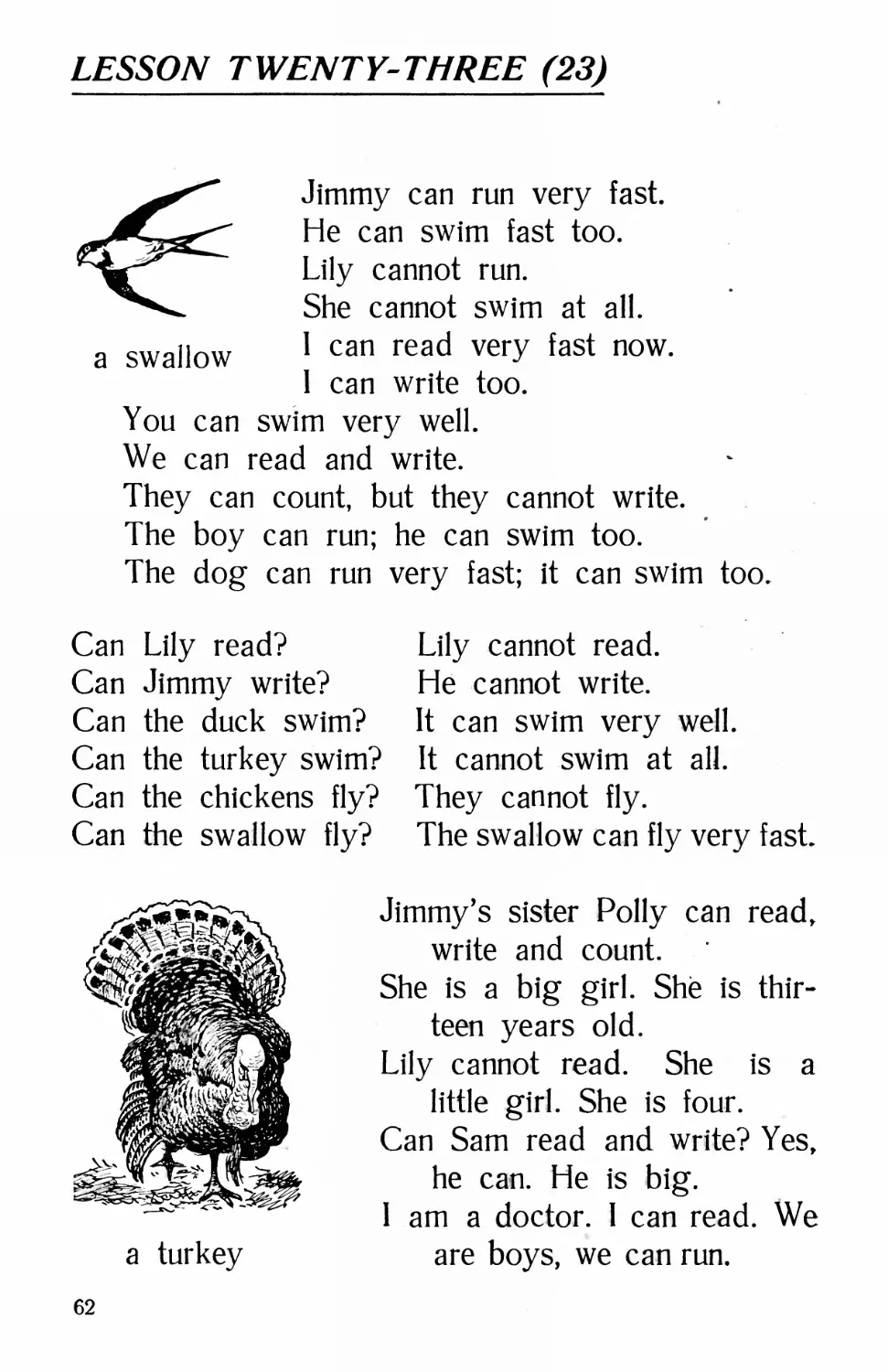
LESSON TWENTY-THREE (23)
a swallow
Jimmy can run very fast.
He can swim fast too.
Lily cannot run.
She cannot swim at all.
1 can read very fast now.
I can write too.
You can swim very well.
We can read and write.
They can count, but they cannot write.
The boy can run; he can swim too.
The dog can run very fast; it can swim too.
Can Lily read?
Can Jimmy write?
Can the duck swim?
Can the turkey swim?
Can the chickens fly?
Can the swallow fly?
Lily cannot read.
He cannot write.
It can swim very well.
It cannot swim at all.
They cannot fly.
The swallow can fly very fast.
a turkey
Jimmy’s sister Polly can read,
write and count.
She is a big girl. She is thir-
teen years old.
Lily cannot read. She is a
little girl. She is four.
Can Sam read and write? Yes,
he can. He is big.
1 am a doctor. I can read. We
are boys, we can run.
62
He is a boy. He can swim. You are a doctor.
She is a girl. She can write. You are girls.
It is a bird. It can fly. They are birds.
Words
1.	I can [ai 'kaenj. — Я
могу, умею.
2.	to run [глп] — бегать
3.	fast [foist] — быстро
4.	to swim [to swim] —
плавать
5.	1 cannot ['kaenot] —
4 Я не умею, я не могу.
6.	at all [at'od] — совсем
7.	now [паи] — теперь
8.	to write [rait] — пи-
сать
9.	well [wel] — хорошо
10.	turkey ['to:ki] — ин-
дюшка
11.	to fly [flai] — летать
12.	swallow [swolou] —
ласточка
Задания
I. Перепишите и устно переве-
дите предложения.
1.	Birds can fly.
2.	Animals can run and
swim.
3.	Frogs can swim, but
they cannot fly.
4.	Boys and girls can
run.
5.	- Can swallows swim?
No, they cannot
6.	Can dogs swim? Yes,
they can.
II. Переведите письменно пред-
ложения.
1.	Птицы умеют летать.
2.	Животные умеют бе-
гать и плавать.
3.	Лягушки умеют пла-
вать, но они не уме-
ют летать.
4.	Мальчики и девочки
умеют бегать.
5.	Ласточки могут пла-
вать? Нет, не могут.
6.	Собаки умеют пла-
вать? Да, умеют.
63
7.	Can you swim? No,
I cannot.
8.	Monkeys can swim ve-
ry well.
9.	Lily cannot read and
write; she is too little.
7.	Вы умеете- плавать?
Нет, не умею.
8.	Обезьяны умеют
очень хорошо пла-
вать.
9.	Лиля не умеет чи-
тать и писать, она
слишком маленькая.
LESSON TW^TY-FOUR (24)
May I go to the cinema? Yes, you may.
May we read your book?
May Lily take my new hat?
May I open this box?
Lily must not go to the cinema; it is too far.
She must not take her mother’s ring.
I can go to the cinema. I am big.
He must not go there; he is ill.
May I come in? Yes, you may.
May we sit on her bed? No, you may not
Whose hat is on the sofa? My mother’s.
Whose dog is under my bed? Jimmy’s.
Whose kite is on the tree? Sam’s.
Whose chickens are in our garden? Mr. Christine’s.
Polly can go to the cinema, but Lily must not; she
is too little.
Jimmy’s father can smoke, but Jimmy must not.
Is your house far from the cinema? Yes, it is.
Is your school far from your house? No, it is not.
64
Words
1.	may [mei] — можно
2.	to go [gou] — ходить
3.	to [tu] — к, в (пред-
лог направления)
4.	must [mAst] — дол-
жен
5.	far ffa:] — далеко
6.	ill [il]—больной
7.	to come in [клт'ш] —
входить
8.	to sit [sit] — сидеть
9.	whose [hu:z] — чей,
чьи
10.	kite [kait] — бумаж-
ный змей
11.	to smoke [smouk] —
курить
12.	with me [wid mi:] —
co мной
13.	from [from] — от
Задания
1. Перепишите предложения и
устно переведите их.
1.	Is your school far
from your house?
2.	Is the bed far from
the sofa?
3.	Is the cinema far from
your house?
4.	Our school is not far
from the cinema.
5.	My bed is not far from
the table.
6.	May I come in?
Come in, please!
7.	May 1 take your new
pen? No, you may not
You may take my old
pen.
II. Переведите письменно пред-
ложения.
1.	Твоя школа далеко
от дома?
2.	Кровать далеко от
дивана?
3.	Кино далеко от ва-
шего дома?
4.	Наша школа неда-
леко от кино.
5.	Моя кровать неда-
леко от стола.
6.	Можно войти? Вой-
дите, пожалуйста.
7.	Можно мне взять
вашу новую ручку?
Нет, нельзя. Ты мо-
жешь взять мою ста-
рую ручку.
3 Скультэ, ч. 1
65
8.	May Polly go to the
cinema with me? Yes,
she may.
9.	Whose shoes are un-
der the table? Polly’s.
10.	Whose book is in
my brother’s room?
Sam’s.
8.	Можно Поле пойти
co мной в кино? Да,
можно.
9.	Чьи туфли под сто-
лом? Полины.
10.	Чья книга в комна-
те моего брата?
Сэма.
LESSON TWE^TY-HV£ (25)
a glass
a saucer
a bottle
Jimmy must go to school.
Jimmy must learn.
Jimmy is seven years old now.
He must go to school. He must
learn to write and to read. Jimmy
is very lazy. He cannot get up
early. He cannot sit with a book.
He is too lazy. Jimmy’s sister
Polly is not lazy. She is a very
good girl. She can read, write and
count. Jimmy cannot count at all.
He cannot write, but he can draw
very well. He can draw a glass
in 10 minutes. He can draw a
bottle in twenty minutes. He can
draw a saucer in twenty five mi-
nutes.
66
a pine-tree
Sam can read, write
and count, but he
cannot draw at all.
Jimmy can draw a
horse, a goat, a ca-
mel, a cat, a dog
and even an Indian.
He can draw birds
and animals. He can
draw a pine or a fir-
tree in three minutes.
I can draw a table or
a box, but I cannot
draw an animal.
a fir-tree
Can you draw?
Must you go to school?
You must not go to the cinema.
You must learn well.
Words
1.	to learn [lam] —
учиться
2.	lazy ['leizi]—ленивый
3.	to get up [get'Ap] —
вставать
4.	early ['a:li] — рано
5.	to draw [dm:] — ри-
совать
6.	glass [gh:s] — стакан
a camel
3*
67
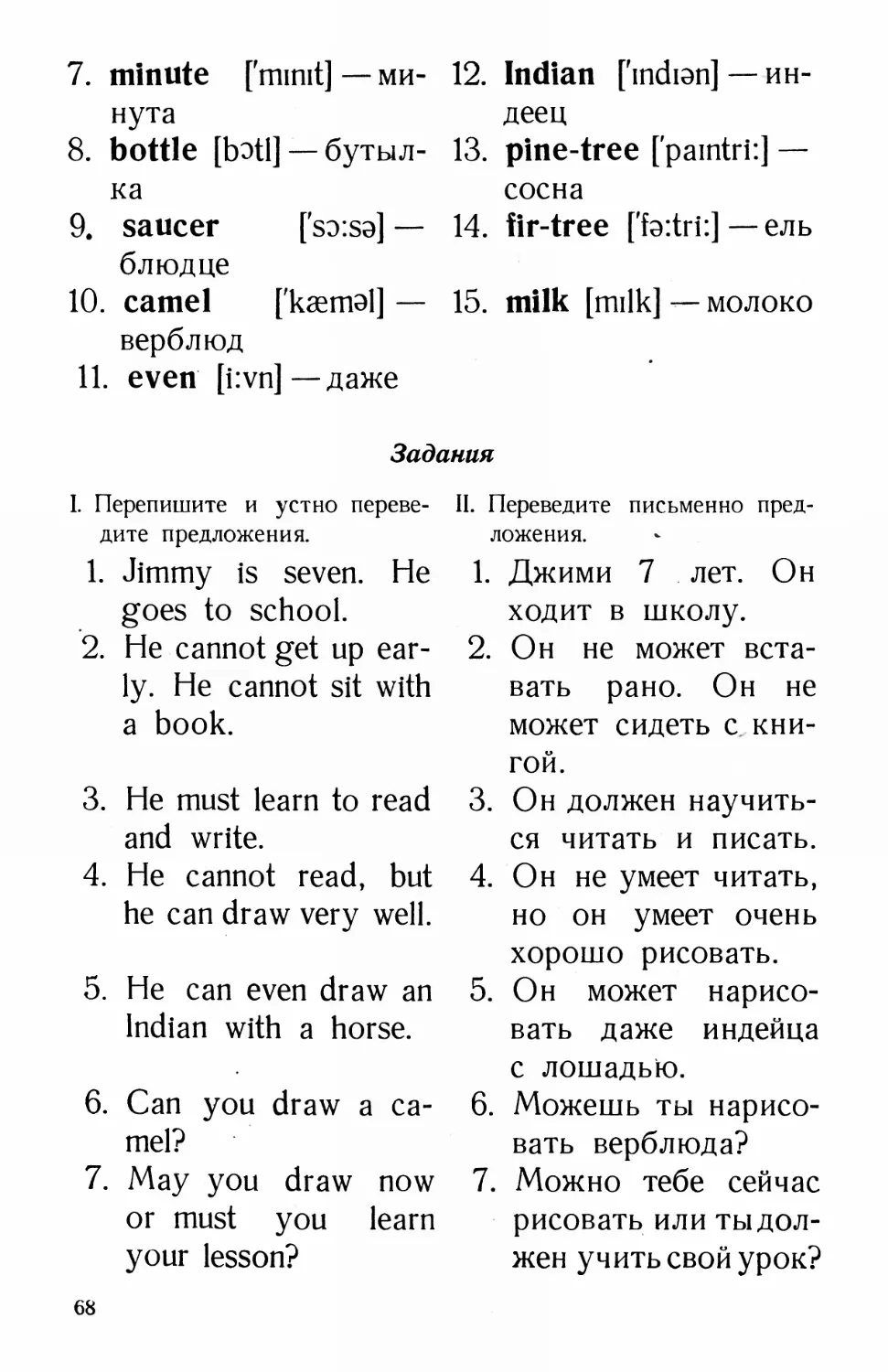
7.	minute fmimt]—ми- 12. Indian [Indian]— ми-
нута	деец
8.	bottle [botl] — бутыл- 13. pine-tree [pamtri:] —
ка	сосна
9.	saucer fsoisa] — 14. fir-tree ['fa:tri:] — ель
блюдце
10.	camel ['kaemal] — 15. milk [milk] — молоко
верблюд
11.	even [i:vn]—даже
Задания
I. Перепишите и устно переве-
дите предложения.
1.	Jimmy is seven. Не
goes to school.
2.	He cannot get up ear-
ly. He cannot sit with
a book.
3.	He must learn to read
and write.
4.	He cannot read, but
he can draw very well.
5.	He can even draw an
Indian with a horse.
6.	Can you draw a ca-
mel?
7.	May you draw now
or must you learn
your lesson?
II. Переведите письменно пред-
ложения.
1.	Джими 7 лет. Он
ходит в школу.
2.	Он не может вста-
вать рано. Он не
может сидеть с кни-
гой.
3.	Он должен научить-
ся читать и писать.
4.	Он не умеет читать,
но он умеет очень
хорошо рисовать.
5.	Он может нарисо-
вать даже индейца
с лошадью.
6.	Можешь ты нарисо-
вать верблюда?
7.	Можно тебе сейчас
рисовать или ты дол-
жен учить свой урок?
68
8.	Can you get up early?
9.	Must you get up early?
10.	You must learn very
well.
11.	You must not go to
the cinema.
8.	Ты можешь рано
вставать?
9.	Ты должен рано
вставать?
10.	Вы должны очень
хорошо учиться.
11.	Вы не должны хо-
дить в кино.
LESSON TWENTY-SIX^ (26)
There is a	lizard under this stone.
There is an owl in the tree.
There is a	book on the table.
There is a	cup on your saucer.
There is a	mouse in the cupboard.
There is a	rat under the sofa.
There is a	frog on the log.
There is an apple on his plate.
an owl
There are some cups in the cup-
board.
There are some apples on the table.
There are some chickens in the
a nut
garden.
an apple
a lizard
69
There are some chairs in the
room.
There are many rabbits in the
woods.
There are many birds in the
trees.
There are many children in
your house.
There are many ducks on the
lake.
There are many girls at our school.
There is some milk in the bottle. Is .the milk good?
There is some water in my cup. Is it boiled?
There is a nest in that tree. Whose nest is it?
There are some nuts under that tree. Whose nuts
are they?
Who is in your room? My brother is there.
What is on your hat? A ribbon.
What colour is the ribbon? It is blue.
Words
1. there is [dear iz] — 7. there are [dear a:] —
имеется, есть	имеются (мн. число)
2. lizard [’lizad] — яще- 8. some [sAm] — не-
рица	сколько, немного
3. stone [stoun] — ка- 9. wood [wud] — лес
мень
4. owl [aul]—сова	10. water [wo:ta] — вода
5. mouse [maus] —мышь 11. boiled water
[boild] — кипячёная
вода
6. apple [aepl] — яблоко 12. nut [пд1] — орех
70
Задания
I. Перепишите и устно переве-
дите предложения.
1.	There is a mouse in
this box.
2.	There is a squirrel in
this fir.
3.	There is a lizard un-
der that log.
4.	There is an apple on
my plate.
5. There are some roses
in the vase.
6. There are some nuts
on the table.
7. There is some water
in the glass.
8. There is some milk in
the bottle.
9.	There are many vio-
lets in the wood.
10.	There are many rab-
bits there too.
11.	Is this water boiled?
Yes, it is.
12.	Are these nuts good?
Yes, they are.
II. Переведите письменно пред-
ложения.
1.	В этом ящике (есть)
мышь.
2.	На этой ёлке (есть)
белка.
3.	Под тем бревном
(есть) ящерица.
4.	На моей тарелке
(есть) яблоко.
5.	В вазе (есть) розы.
6.	На столе (есть) оре-
хи.
7.	В стакане (есть) во-
да.
8.	В бутылке (есть) мо-
локо.
9.	В лесу много фиа-
лок.
10.	Там	много	зайцев
	тоже.
11.	Эта	вода	кипячё-
	ная?	Да.
12.	Эти	орехи	хоро-
шие? Да.
71
LESSON TWENTY-SEVEN (27)
Are there many books
in your library?
bread
Are there many boys in your
class? Yes, there are many.
Are there many violets in your
garden? Yes, there are many.
Are there any girls in your
class? Yes, there are.
Are there any snakes in this
forest? No, there are not.
Are there any frogs in this lake? No, there are not.
Is there any water in this kettle?
Is there any milk in the bottle?
Is there any bread for dinner?
Is there much cheese in the cupboard?
Is there much milk in that jug?
Is there much butter on the plate?
There are not many flowers in our garden.
butter
cheese
72
There is not much bread
for tea.
There are not many birds
in this forest.
There is not much water
in this lake.
Is there a knife on the
table? Yes, there is.	a kettle
Is there a spoon in your
plate? No, there is not.
Is there a saucer under your cup? Yes, there is.
Are there forks in the kitchen? Yes, there are.
There is no butter for tea.
There are no cups in the cupboard.
There is no bird in that nest.
There is no milk in my glass.
There are no children in our house.
Words
1.	bread [bred] — хлеб
2.	cheese [t$i:z]—сыр
3.	butter ['bAta] — сли-
вочное масло
4.	tea [ti:] — чай
5.	dinner fdina] — обед
6.	for [fa:]—для
for dinner —на обед
for tea — к чаю
7.	kettle [ketl] — коте-
лок, чайник
8.	library [Taibrari] —
библиотека
9.	forest ['farist] — лес
10.	class [kla:s] — класс
11.	much [тдЬ]—много
(для неисчисляемых
существительных)
12.	jug [djAg] — кувшин
13.	any ['em] — сколько-
нибудь
14.	kitchen ['kitfen] —
кухня
73
Задания
I. Перепишите и устно переве-
дите предложения.
1.	Are there many child-
ren in the garden? Yes,
there are many.
2.	Are there any nuts in
that tree? No, there
are not.
3.	Are there any ducks
on the lake? Yes,
there are.
4.	Is there a plate on
the table? Yes, there
is.
5.	Are there any forks
there? No, there are
not.
6.	Is there any milk in
the bottle? Yes, there
is.
7.	There are many rab-
bits in this forest.
8.	There is not much
cheese on your plate.
9.	There is very much
water here.
10.	Give me some
cheese, please!
11.	This water is boiled.
II. Переведите письменно пред-
ложения.
1.	В саду много детей?
Да, много.
2.	На том дереве есть
орехи? Нет.
3.	На озере есть утки?
Да.
4.	На стрле есть та-
релка? Да.
5.	Там есть вилки? Нет.
6.	В бутылке есть мо-
локо? Да.
7.	В этом лесу много
зайцев.
8.	На вашей тарелке
немного сыра.
9.	Здесь очень много
воды.
10.	Дайте мне, пожа-
луйста, сыру!
11.	Эта вода кипячёная.
74
LESSON TWENTY-EIGHT (28)
There are many butter-
flies in the field. There
are some flies in our room.
a fly Jimmy, open the win-
dow! There are too many
flies here. Can you catch that big
fly? Of course, I can catch it, but
it is not a fly, it is a bee. Where
is the bee now? It is on the rose.
The rose is in the vase. The vase
is on the table. The table is in
the room. Jimmy is at the table.
Now the bee is in the garden.
The vase is on the floor. Jimmy is
under the table.
What is this? It is a ladybird.
Where is the ladybird? It is on
a leaf. What colour is the ladybird?
The ladybird is red. What colour
a butterfly
a bee
is the leaf? It is green.
Are there many berries
forest? Yes, there are.

a ladybird
a berry
75
a mushroom
are many mushrooms there
too. Are there many leaves
on that bush? Yes, there are
very many. There are some
berries under the bush. Is there
much honey on the saucer?
Yes, there is. There are some
bees in the saucer too.
The bees are in the honey.
Where is the saucer with the honey?
It is on the table.
Words
1.	butterfly ['bAtsflai] — бабочка 2.	field [fi:ld] — поле 3.	fly [flai] — муха	9.	at the table —за столом 10.	floor [flo:] — пол 11.	ladybird ['leidiba:d]—
4. window [windou] — окно 5. here [hia] — здесь	божья коровка 12. leaf [li:f] — лист 13. berry [ben] — ягода
6. to catch [kaeti] — пой- мать 7. of course [av'kois] —	berries ['benz] — яго- ды \ 14. mushroom
конечно 8. bee [bi:] — пчела	['mA$ru:m] — гриб 15. bush [buy — куст
Задания
I. Перепишите и устно переве-
дите предложения.
There are many mush-
rooms in the forest.
IL Переведите письменно пред-
ложения.
Деревья в лесу зелё-
ные. Они очень боль-
76
They are under the trees
and bushes. There are
many berries there too.
There are many birds,
butterflies, bees and la-
dybirds in the forest.
There are many animals
there: foxes, bats, wolves
and squirrels. There is a
big old owl in the pine-
tree. The trees in the
forest are green. They
are very big and strong.
Their leaves are green.
There are many flowers
in the fields. The flowers
are red, yellow, white
and blue.
шие и крепкие. Их
листья зелёные. На
сосне есть большая,
старая сова. В лесу
много грибов. Они (бы-
вают) под деревьями и
кустами. Там также
много ягод. Там много
животных: лис, летучих
мышей, волков и белок.
В лесу много птиц, ба-
бочек, пчёл и божьих
коровок. В . полях много
цветов. Цветы (бывают)
красные, жёлтые, белые
и голубые.
LESSON TWENTY-NINE^ (29)
What is in the sky? The
sun is there.
What else is in the sky?
The clouds are there.
What is in the sky at
Hight?	sun
The moon and the stars
are there.
What colour is the sky? It is blue.
What colour are the clouds? They are grey.
How many months are there in a year?
77
the moon
How many weeks are there
in a month?
How many days are there
in a month?
How many days are there
in a week?
There are twelve months in a year.
There are four weeks in a month.
There are thirty days or
thirty-one days in a month.
There are seven days in
a week.
The night is very dark.
There are dark clouds in the
dark clouds
sky. There are no stars
in it. The sun’s rays are very warm. Moonbeams are
not warm at all. When the day is hot, Roombo is
in the shade. When the day is not hot, Roombo is
in the sun. Roombo is a very clever puppy.
Words
1.	the sky [skai] — небо
2.	the sun [sau] — солн-
це
3.	there [деэ] — там,
туда
4.	else [els] — ещё
5.	cloud [klaud] — об-
лако
6.	night [nait] — ночь
7.	the moon [mu:n] —
луна
8.	month [тлпо] — ме-
сяц
9.	week [wi:k] — неделя
10.	day [dei] — день
78
11.	thirty ['oa:ti]—трид-
цать
12.	dark [da:k] —тёмный
13.	ray [rei] — луч
14.	warm [wo:m]—теп-
лый
15.	moonbeams ['mu:n-
bi:mz] — полосы лун-
ного света
beam [bi:m] — луч
16.	hot [hot]—жаркий,
горячий
17.	when [wen] — когда
18.	in the shade — в те-
ни
19.	shade [Seid]—тень
20.	in the sun — на
солнце
Задания
I. Перепишите и устно переве-
дите предложения.
The sky is very dark
at night. There are many
grey clouds in the sky
now. The sky is not blue.
When is the moon in the
sky? The moon is in the
sky at night. The stars
are in the sky at night
too. There are four weeks
in a month. There are
twelve months in a year.
How many days are there
in a week? There are
seven. How many days are
there in a month? There
are thirty or thirty-one
days in a month.
II. Переведите письменно пред-
ложения.
Сколько дней в не-
деле? В неделе 7 дней.
Сколько дней в месяце?
В месяце 30 или 31 день.
В году 12 месяцев. В ме-
сяце 4 недели. Ночью
небо (бывает) очень
тёмное. Сейчас на небе
много серых облаков.
Небо не голубое. Ночью
на небе бывает луна.
Звёзды на небе бывают
тоже ночью.
79
LESSON THIRTY (30)
A Rhyme
(на фонетический значок [ae])
Pussy-Cat, Pussy-Cat,
Can you catch
that big, fat rat?
If you catch
that bad, fat rat
you will have
some milk for that.
Lily has a cat. Her cat’s name is Pussy.
There are many rats in Lily’s house.
Pussy-Cat cannot catch rats.
Pussy-Cat is too fat and too lazy. The rats are
big and grey. Lily cannot sleep at night.
But where is Jimmy’s puppy Roombo? Roombo can
catch rats. Roombo is strong and he is not lazy.
Pussy
a rat
80
Jimmy and Roombo are in the forest. They are
not at home. Poor Lily!
She cannot sleep at all.
And where is Reni? Maybe Reni can help Lily?
Maybe Reni will catch these grey rats? But Reni
is not at home. He is in the forest with Mr. Dale.
Poor little Lily!
Words
1.	rhyme [raim]—риф- дешь иметь, ты по-
ма	лучишь
2.	Pussy [pusi] — Пусси 7. to sleep [sli:p] —
(имя	кошки)	спать
3.	fat [faet]—жирный	8.	poor [риэ] — бедный
4.	for that — за это	9.	maybe — может быть
5.	if [if] — если	10.	to help [help] — no-
в. you	will	have	[ju:	могать
wil	hasv]	— ты	6y-
Задания
I. Перепишите и устно переве- II. Переведите письменно пред-
дите предложения.	ложения. \
Can you catch that
chicken? Yes, of course,
1 can catch it. Is the
chicken fat? Yes, it is
very fat. Are there many
rats in your house? No,
there are not. Can you
sleep if there is a rat
under your bed? No, I
cannot.
Можешь ты поймать
того цыплёнка? Да,
конечно, я могу его
поймать. Цыплёнок жир-
ный? Да, он очень жир-
ный. Можешь ты спать,
если у тебя под кро-
ватью крыса? Нет. В ва-
шем доме много крыс?
Нет.
81
LESSON THIRTY-ONE^ (3Q
Mr. Dale is as tall as a high wall.
Mrs. Dale is not so tall as her husband.
Is Polly tall or short? She is short because she
is a little girl. Who is Mrs. Dale? She is Mr.
Dale’s wife. Who is older Jimmy or Polly? Polly is
older than Jimmy. She is thirteen years old while
Jimmy is six years old.
Who is taller, Jimmy or his sister? His sister is
taller than he. Is Lily as tall as Jimmy? No, Lily
is not so tall as he. She is shorter.
Mr. Dale and Mrs. Dale have two children —a
boy and a girl. The boy’s name is Jimmy. He is
six years old. The girl’s name. is Polly. She is
seven years older than her brother. Jimmy has a
puppy. Its name is Roombo. Mr. Dale has a dog too.
His dog’s name is Reni. Reni is a very clever dog.
What has Polly? She has five rabbits. What co-
lour are they? Her rabbits are as white as snow.
Has Mr. Christine a wife? No, he has not. Who
is Mr. Christine? He is Lily’s father. Has Lily a
mother? No, she has not. Who is Sam? Sam is
Lily’s brother. How old is Sam? He is ten years
old. Sam is six years older than Lily.
What has Sam? Sam has a monkey and a don-
key. The monkey’s name is Cheetah and the don-
key’s name is Kicky. Sam’s monkey is very funny.
Words
1. as ... as [aez...aez]— 2. tall [toil] — высокого
такой же ... как роста
82
3. high [hai] — высокий	9. because	[bi'koz] —
4.	wall [wo:l] — стена 5.	Mrs. fmisiz] — миссис 6.	not so ... as [not 'sou ... aez] — не та- кой ... как 7.	husband [’hAzband]— муж 8.	short [p:t] — низкого роста	потому что 10.	wife [waif] — жена 11.	than [dasn] — чем (при сравнении) 12.	while [wail] — в то время как 13.	seven years older — на семь лет старше 14.	snow [snou] — снег
Задания
I. Перепишите и устно переве- дите предложения.	11. Переведите ложения.	письменно пред-
This wall is very high. That boy is very tall. Mrs. Dale is short; she	Эта стена очень высо- кая. Тот мальчик очень вы-
is as short as Polly. сокий.
My cat is as white as Миссис Дэйл низень-
snow.	кая, она такого же
Who is older: you or низкого роста, как
your sister? 1 am ol- Поля.
der than she.	я на 10 лет старше мо-
1 am ten years older than ей сестры.
my sister. Is Jimmy Кто старше вы или
older than Lily? Yes, ваша сестра?’Я стар-
he is two years older. ше eg.
Моя кошка такая бе-
лая, как снег.
Джими старше Лили?
Да, он на два года
старше её.
83
LESSON THIRTY-TWO (32)
Sam is Lily’s
He has a cat
Another Rhyme (на значок
[au])
Little Mouse, Little Mouse,
Will you come out of your
house?
Thank you, Pussy! — says the
mouse
1 won’t leave my little
house.
brother.
too.
His cat’s name is also Pussy.
But his Pussy is not fat;
It is very thin. Sam’s Pussy
is always hungry. It is not
lazy, but it is very old.
The little mouse is in its house. The mouse is
not hungry. It has some grain at home. But the
cat is very hungry. The cat says:
“Little Mouse, give me some grain.
1 am hungry. Open the window!”
The little mouse says: “There is no
grain at home.” The cat says:
“Where is your grain?” The mouse
says: “It is in the field.” The hung-
little mouse
in its house
ry cat says: “What? What?
Open the window. I cannot hear you.” The little
mouse says: “No, Pussy, I won’t open the
window.
84
Words
1.	another [э'плдэ] —
другой
2.	Will you come
out? — He выйдешь
ли ты?
3.	to come [клт] — при-
ходить
4.	to come out [aut] —
выходить
5.	says [sez] — говорит
6.	to say [sei] — гово-
Задания
I. Перепишите и устно переве-
дите предложения.
Is Sam’s cat fat or
thin? Sam’s cat is not
fat; it is thin. Is Sam’s
cat old or young? It is
very old. Is Sam’s cat
lazy? No, it is not. What
is its name? Its name is
Pussy. Lily has a cat.
What is its name? It is
Pussy too. Can Sam’s
Pussy catch rats? Yes, it
can. Can Lily’s Pussy
catch rats? No, it can-
not.
рить
7.	I won’t [afwount] —
я не хочу
8.	to leave [li:v] — по-
кидать
9.	also prison] — тоже
10.	thin [ein]—худой
11.	always pilwaz] —
всегда
12.	hungry [Ълддп] —
голодный
II. Переведите письменно пред-
ложения.
Кошка Сэма жирная
или худая? Кошка Сэ-
ма не жирная; она ху-
дая. Кошка Сэма ста-
рая или молодая? Она
очень старая. Кошка
Сэма ленивая? Нет. Как
её зовут? Её зовут
Пусси. У Лили есть
кошка. Как её зовут?
Её зовут тоже Пусси.
Может ли Пусси Сэма
ловить крыс? Да. Мо-
жет ли Пусси Лили ло-
вить крыс? Нет.
85
LESSON THIR T Y- THREE (33)
a sparrow
A Patter
a baby
Bears like honey.
Girls like cats.
Cats like rats.
Boys like balls.
Girls like dolls.
Babies like milk.
Mice like cheese.
Sparrows like peas.
Owls like mice.
Birds like grain.
Say it all again!
Squirrels like nuts. There are many nuts in the forest.
Is Mr. Dale rich or poor? Mr. Dale is not rich.
Is there any money on your table? Yes, there is.
Give me some money, please! I want to buy grain
for my ducks.
tree mice
Is there any milk for my ba-
by? Yes, there is.
There are some children in
your room. Go there!
There is some cheese on the
plate. Take some peas too!
I want to buy grain and rice.
Grain for my birds and
rice for myself.
86
Words
1.	patter fpseta] — ско-
роговорка
2.	bear [bea] — медведь
3.	to like [laikj — лю-
бить, нравиться
4.	baby [beibi]—дитя
babies ['beibiz] — дети
5.	mice [mais] — мыши
mouse [maus]—мышь
6.	sparrow [spaerou] —
воробей
7.	pea [pi:] — горошина
peas [pi:z] — горох
8.	all [o:l] — всё, все
9.	again [э'деш] — опять
10.	rich [rit$] — богатый
11.	money [rnAni]—день-
ги
12.	want [wont] — хочу
13.	to buy [bai] — поку-
пать
14.	rice [rais] — рис
15.	myself [mafself] — я
сама (сам)
Задания
I. Перепишите и устно
переведите предложения.
I have some honey. I like
it.
Give me some money, I
want to buy grain for my
ducks.
Give me some milk for
my cat.
Is there any butter on the
plate?
Yes, there is.
Horses like grain. Hens
and ducks like grain too.
Sparrows like peas.
1 like rice and milk.
II.	Переведите письменно
предложения.
Куры и утки любят
зерно.
Воробьи любят горох.
Лошади любят зерно.
Куры и утки тоже лю-
бят зерно.
У меня есть мёд. Я его
люблю.
Дайте мне немного де-
нег. Я хочу купить
зерна для моих уток.
Есть ли на тарелке
масло? Да, есть.
Я люблю рис с моло-
ком.
87
LESSON THIRTY-FOUR (34)
a )ucca
The cat is an animal.
The owl is a bird.
The rose is a plant
The yucca is also a plant.
Yuccas grow in the South.
Roses grow in the South too.
Fir, pines, yuccas, violets, dai-
sies and roses are plants.
Bears, wolves, tigers, cows, hor-
ses, dogs and cats are animals.
a duck
Hens, ducks, turkeys,
owls, swallows are birds.
eagles,
Words
1.	plant [plaint] — расте-
a horse
ние
2.	yucca fjAko] — юкка
3.	to grow [grou] — ра-
сти
4.	the South [saue] — юг
5.	in the South — на
юге
6.	to guess [ges] — от-
гадывать
7.	yourself [jofself] —
вы сами
88
Задания
I. Перепишите и устно
переведите предложения.
Is the yucca an animal
or a plant? The yucca is a
plant. Is the horse an
animal? The horse is an
animal. Yuccas grow in
the South. Roses also
grow in the South. Can
you guess this girl’s
name? No, I cannot; guess
it yourself. Where is Jim-
my now? He is in the
South. Whose cat is this?
This is Lily’s cat. Why
won’t you play with me?
II. Переведите письменно
предложения.
Чей это мяч? Это
Лилин мяч. Юкка жи-
вотное или растение?
Юкка — растение. Юк-
ка растёт на юге. Ло-
шадь животное? Ло-
шадь— животное. Мо-
жешь ты отгадать имя
этой девочки? Не могу,
отгадайте его сами. Где
теперь Джими? Он на
юге.
LESSON ТШЯТУ-Е/УЕ (35)
The Russians live in Russia. They speak Russian.
The English live in England. They speak English.
The Chinese live in China. They speak Chinese.
The Indians live in America.
They speak Indian and English.
The Americans live in America. They speak English.
The Germans live in Germany. They speak German.
The French live in France. They speak French.
1 read English books.
I like to read Russian books too.
1 can read French books.
I can read and write very well.
89
We speak English and French though we are Russians.
1 can speak German too though I am not German.
In Germany they speak German.
In France they speak French.
In America they speak English.
Can you speak Chinese? No, I cannot.
Who can speak English? Jimmy can.
Can Mr. Dale speak French? Yes, he can.
Who can speak German? The Germans can.
Who can speak Chinese? The Chinese can.
She is ill. I am not ill. I am well.
1 am strong. She is not strong. She is weak.
My legs are long. Her legs are not long; they are
short.
He is tall. She is not tall; she is short.
Words
1.	the Russians [da
’rAfenz] — русские
2.	Soviet Russia ['souviet
гл$э] — Советская
Россия
3.	to speak [spi:k] — го-
ворить
4.	Russian [гл^эп]—рус-
ский, по-русски
5.	the English [da
'irjglh] — англичане
6.	England ['iggland] —
Англия
7.	English ['irjglifl —анг-
лийский, по-англий-
ски
8.	the Chinese [da
't$ai ni:z] — китайцы
9.	China ['tSaina] — Ки-
тай
10.	Chinese ['t$ai'ni:z] —
китайский, по-китай-
ски
11.	America [a'merika] —
Америка
90
12.	the Americans [di: 16. the French [da'frentj]
a'menkanz] — амери-	—французы
канцы	17. France	[fra:ns] —
13.	the Germans [дэ	Франция
'dj^imsnz] — немцы	18. French	[frentj] —
14.	Germany['d^msni] — французский, no-
Германия	французски
15.	German ['d^arman] — 19. though [dou] — хотя
немецкий, по-немец- 20. to be well [wel] —
ки	быть здоровым
I am well — я здоров
Задания
1. Перепишите и устно
переведите предложения.
Can the Chinese speak
Russian? Yes, some Chi-
nese speak Russian. Can
the Indians speak English?
Yes, they can.
In America they speak
English. In Germany they
speak German. In France
they speak French. In
China they speak Chinese.
Are there many Chi-
nese in Soviet Russia
now? Yes, there are. Are
there many Americans
here? No, there are not.
Mr. Dale can speak
French though he is Eng-
II. Переведите письменно
предложения.
Сейчас много китай-
цев в Советской Рос-
сии? Да. Умеют ли ки-
тайцы говорить по-рус-
ски? Да, некоторые ки-
тайцы говорят по-рус-
ски.
Много ли здесь аме-
риканцев? Нет.
Миссис Дэйл англи-
чанка? Нет, она фран-
цуженка.
Умеют ли индейцы
говорить по-английски?
Да, умеют.
Мистер Дэйл умеет
говорить по-француз-
91
lish. Is Mrs. Dale English? ски, хотя он англича-
No, she is not, she is нин.
French.	В Китае говорят по-
китайски. В Америке
говорят по-английски.
Во Франции поворят по-
французски. В Герма-
нии говорят по-немецки.
LESSON THIRTY-SIX^ (36)
Lily and Jimmy are hungry.
There is no bread on the table.
There is no cheese in the cupboard.
Jimmy’s mother is not at home.
Jimmy’s sister Polly is at school.
Mr. Dale is in the forest with Reni.
The little puppy, Roombo,
There are some apples
under the apple-tree
is hungry too.
in the garden.
But Jimmy cannot pick
the apples. They are
too high in the apple-
tree. Lily and Jimmy
sit under the apple-tree
and look at the apples.
The apples are ripe
and round and juicy.
The children are
very hungry.
“Can you bring
a long, long stick,
Jimmy?” asks Lily.
92
“Yes, 1 can, of course,” says Jimmy.
“Give me an apple, Jimmy,” says Lily.
“But I have no apples,” says Jimmy.
“Where are the apples?” asks little Lily.
“They are high in the tree,” says Jimmy.
“Give me one apple, Jimmy!” little Lily says
again.
“How can I give you an apple?” asks Jimmy.
“Take a long, long stick, Jimmy,” says little
Lily angrily.
“Why must 1 take a long, long stick, Lily?”
poor little Jimmy asks again.
“You are a silly, silly boy, Jimmy,” says his
clever little friend Lily.
Try to guess why little Lily
says that Jim is very silly!
Words
1.	to pick [pik] — сры- вать 2.	an apple-tree [an 'aepltri:] —яблоня 3.	to look at [luk'aet]— смотреть на 4.	ripe [raip] — спелый 5.	round [raund] — круг- лый 6.	juicy ['djuisi]—соч- ный	7.	to bring [brig]—при- носить 8.	to ask [a;sk] — спра- шивать 9.	angrily [aeggnli] — сердито 10.	silly ['sili] — глупый 11.	Why [wai]? —Поче- му? 12.	to try [trai]—попро- бовать
93
Задания
I. Перепишите и устно
переведите предложения.
Jim and Lily sit under
the apple-tree. They look
atthe apples. Are the apples
ripe? Yes, they are ripe
and juicy. Is bread juicy?
No, it is not. What is
juicy? Berries are juicy.
Can you give me one
apple? Of course, I can.
Where is the apple? It is
on your plate. Who is
clever? Lily is clever.
Look at this apple-tree!
Are there many apples
in it? Yes, there are. Try
to count the apples! I
cannot.
II. Переведите письменно
предложения.
Посмотри на эту яб-
лоню! Много ли на ней
яблок? Да. Попробуй
сосчитать яблоки! Я не
могу. Джим и Лиля
сидят под яблоней. Мо-
жешь ли ты дать мне
одно яблоко? Конечно,
я могу. Где яблоко?
Оно у тебя на тарелке.
Они смотрятша яблоки.
Спелые ли яблоки? Да,
они спелые и сочные.
Хлеб сочный? Нет. Что
сочное? Ягоды сочные.
Кто умный? Лиля ум-
ная.
LESSON THIRTY-SEVEN^ (37)
We shall go to school with Polly. Will Jim read
this English book? Yes, he will. Lily will not sit
here. Will you take this puppy? No, I won’t; the
puppy is too little. Will you take this kitten? No,
I won’t; the kitten is too little.
Is this boy English or American? He is English.
Are you English or Russian? I am Russian. The
Russians live in Russia. The Germans live in Ger-
94
many. The Indians live in America. The Chinese
live in China.
I like to read French books. They are very good.
1 can read English books too. Can you speak French?
Yes, 1 can Can you speak German? No, 1 cannot.
May I take your new pen? Yes, you may.
Who is in my room? Jim and Lily are in your
room. Whose kittens are under my chair? Lily’s.
They sleep there. What must you write in your
copy-book? I must write an English patter. What
can Jim draw? He can draw many animals: a camel,
a horse, a cow, a goat, a tiger, a fox, a mouse,
a rat, a bat, a rabbit, a squirrel, a snake. He can
draw birds too: an eagle, a hen, a cock, a duck,
a swallow, an owl. But he cannot draw a wolf.
Where must you go after school? After school 1
must go home. Is your house far from your school?
No, it is not. Is there a cinema not far from your
house? No, there is not. Will you go to the cinema
to-morrow? No, 1 shall not. 1 go to the cinema on
Sundays. Will you go to the cinema next Sunday?
Yes, I shall.
Words
1.	after [a:fta] — после,
после того как...
2.	to-morrow [te'morou]—
завтра
3.	on Sundays —по во-
скресеньям
4.	Sunday ['sAndij —во-
скресенье
5.	next [nekst]—следую-
щий
6.	together [ta'geda]—
вместе
7.	to cry [krai] — пла-
кать
95
Задания
I. Перепишите и устно
переведите предложения.
Jimmy is a little boy.
Не cannot read, he can-
not write. But he wants
to go to school. Will
Jimmy go to school with
Polly? No, he will not,
he is too little. Will Lily
go to school with Polly?
No, she will not, she is
too little. Will Jim go to
the cinema with Polly?
Yes, he will. Next Sun-
day they will go to the
cinema together. Jimmy
will not cry. He is a
good boy.
И. Переведите письменно
предложения.
Джими — маленький
мальчик. Оь не умеет
читать, и он не умеет
писать. Но он хочет
идти в школу. Пойдёт
ли Джими в школу с
Полей? Нет, он слишком
мал. Пойдёт ли Лиля
в школу с Полей? Нет,
она тоже ещё слишком
маленькая. Пойдёт ли
Джим в кино с Полей?
Да. В следующее во-
скресенье они вместе
пойдут в кино. Джими
не будет плакать. Он —
хороший мальчик.
LESSON TlilRTY-EIGHT^ (38)
What is in the sky at night? The moon and the
stars are.
What is in the sky by day? The sun is.
Are there any clouds in the sky now? No, there
are not.
What animal is sly? The fox is sly.
What animal is clever? The horse and the dog
are clever.
96
Is the Black Sea deep? Yes, it is very deep.
Is a lake as deep as the sea? No, it is not.
Is your river deep? No, it is not deep at all.
Have you many apple-trees in your garden?
Yes, we have eight apple-trees in our garden.
This is your apple and that is mine.
This is my pear and that is yours.
This is her orange and that is his.
This is his peach and that is hers.
These are her plums and those are ours.
These are our grapes and those are theirs.
Words
1.	by day ['bai 'dei] —
днём
2.	The Black Sea [blaek
si:]—Чёрное море
3.	deep [di:p]—глубо-
кий
4.	the sea [si:]—море
5.	a river [riva]—река
6.	a pear [pea]—груша
7.	an orange [orindg]—
апельсин
8.	a peach [pi:t$] — пер-
сик
9.	a plum [р1лт]—сли-
ва
10.	grapes [greips] —ви-
ноград
Задания
I. Перепишите и устно переве-
дите предложения.
What trees grow in
your garden? Peach-trees,
pear-trees, apple-trees,
plums and oranges grow
in our garden. Are there
any pines or firs there?
No, there are not. What
II. Переведите письменно пред-
ложения.
Какие деревья растут
в вашем саду? Перси-
ковые, грушевые, ябло-
невые, сливовые и
апельсиновые. Там есть
сосны и ели? Нет. Ка-
кие цветы растут под
*/1 3 Скультэ, ч. 1
97
flowers grow under these
trees? Violets and daisies
grow under these trees.
Can yuccas grow in your
garden? Yes, they can,
because our garden is
not far from the Black
sea. I live in the South.
этими деревьями? Фиал-
ки и маргаритки. Мо-
гут ли юкки расти в
вашем саду? Да, пото-
му что наш сад нахо-
дится недалеко от Чёр-
ного моря. Я живу на
юге.
LESSON T^ilRTY-NINE^ (39)
A Poem
У обезьянки
— a monkey
была подружка
— a frog — лягуш-
ка
была сестричка
— a fox — лисичка.
Были ещё:
— a rabbit—кроль-
чонок
— a bear — медве-
жонок
— a duckling — утё-
нок
98
—	a pig —поросёнок
—	a black cat —чёрный кот
и козлёнок —a goat
Они жили в лесу —in the wood
и были очень хороши—very good!
А около озера —near the lake
Жила большая змея —a big snake.
It was hungry	— Она была голодна
And was always angry —и была всегда зла
(То be continued.)
Words
1.	near [nia] — около
2.	was [w5z]—была
3.	angry [’aerjgri] — злая,
злой
4.	to be continued [to
'bi: kan'tmju:d] — про-
должение следует
Задания
I. Перепишите и устно переве-
дите предложения.
The fox was under the box.
II. Переведите письменно пред-
ложения.
Я был в кино в воскре-
сенье.
’АЗ*
99
The frog was on the log.
The snake was near the
lake.
The cheese was on the
plate.
The bird was in the cage.
The bear was under the
tree.
The apple was in the tree.
The duck was in the water.
The goat was in the gar-
den.
The cat was in the sun.
The milk was in the
bottle.
Mrs. Dale was in the
South.
1 was at the cinema on
Sunday.
Who was always hungry?
Who was always angry?
Where was the squirrel?
It was in the fir-tree.
Кошка была на сол-
нышке.
Кто был всегда голо-
ден?
Где была белка?
Она была на ёлке.
Лиса была под ящиком.
Утка была в воде.
Медведь был под дере-
вом.
Птичка была в клетке.
Яблоко было на дереве.
Коза была в саду.
Лягушка была на брев-
не.
Молоко было в бу-
тылке.
Сыр был на тарелке.
Змея была около озера.
Миссис Дэйл была на
юге.
Кто был всегда злой?
СТАНДАРТНЫЕ ФРАЗЫ
1.	I have а реп. У меня есть
ручка.
2.	Не has a book. У него есть
книга. (Он имеет книгу.)
3.	What is your name?
Как ваше имя?
Как вас зовут?
4.	Му name is Тот Dale. Меня
зовут Том Дэйл.
5.	How old are you? Сколько
вам лет?
6.	1 am forty years old. Мне
40 лет.
7.	What colour is his cap? Какого
цвета его шапка?
8.	Who is he? Кто он? (Mr.
Dale, Lily’s father.)
9.	What is he? Кто он? (По
профессии: a doctor, a dri-
ver.)
10.	What else? Что ещё?
11.	Who else? Кто ещё?
12.	How many rooms have you?
Сколько у вас комнат?
13.	How much grain have they?
Сколько у них зерна?
14.	1 am ill. Я болен.
15.	I am well. Я здоров.
16.	I am hungry. Я голоден, я
хочу есть.
17.	1 am angry. Я сердит, я сер-
жусь.
18.	What friends have you?
Какие у тебя друзья?
(Каких друзей ты имеешь?)
19.	Whose book is on the table?
Чья книга на столе?
20.	Whose children are in my
room? Чьи дети у меня
в комнате?
21.	Why not? Почему нет?
22.	There is a mouse under your
bed. Под вашей кроватью
мышь.
23.	There are some nuts in that
box. В том ящике есть орехи.
24.	There is some milk in that
bottle. В той бутылке есть
молоко.
25.	Are there any chairs there?
Там есть стулья?
26.	Is there any cheese in the
cupboard? В буфете есть сыр?
27.	There are no mushrooms in
that wood. В том лесу нет
грибов.
28.	There is no milk in my cup.
В моей чашке нет молока.
29.	Can you swim? Умеете ли
вы плавать?
4 Скультэ, 4.1
101
30.	May I come in? Можно войти?
31.	We must learn well. Мы
должны хорошо учиться.
32.	1 cannot swim at all. Я со-
всем не умею плавать.
33.	1 like grapes very much. Я
очень люблю виноград.
34.	I’ll give you some honey. Я
дам вам меду.
35.	He’ll be at home. Он будет
дома.
36.	I won’t give him my gun. Я
(не хочу) не дам ему моё
ружьё.
37.	Не won’t go to school. Он
не пойдёт (не хочет) в школу.
38.	Will you go to the cinema
with us ? Вы пойдёте (хоти те)
в кино с нами?
39.	ГП give him the book if he
is at school. Я дам ему
эту книгу, если он будет в
школе.
40.	Open the window, please!
Thank you! Откройте окно,
пожалуйста! Благодарю вас!
(Спасибо!)
СЛОВАРЬ
(400 слов)
1.	а |э] неопределённый артикль
ап [ап] »	»
a boy, a girl, a book, ап
apple, an eagle
2.	after foeifta] после
after school после школы
3.	again [э'дет] опять
4.	all [э:1] все, всё
5.	also ['o:lsou] также, тоже
6.	always ['odwsz] всегда
7.	America [э'тепкэ] Америка
American американский
the Americans американцы
8.	ат [ат] от глаг. to be
1-е лицо ед. числа
1 am a boy. Я мальчик.
9.	and [send] и, а
10.	angrily ['aggrih] сердито
11.	angry ['aerjgri] сердитый
12.	animal ['animal] животное
13.	another [э'плдэ] другой
14.	any[eni] какой-нибудь,сколь-
ко-нибудь
15.	apple [aepl] яблоко
16.	apple-tree ['apltri:] яблоня
17.	are [а:] мн. число от глаг.
to be
We are boys. Мы маль-
чики.
18.	as... as [az...az] такой... как
as white as snow белый
как снег
19.	ask [a:sk] спрашивать
20.	at [at] на, в, у, за
at home дома
at the cinema в кино
at the window у окна
at the table за столом
21.	at all [at'3:l] совсем не ...
I cannot swim at all. Я со-
всем не умею плавать.
1.	baby ['beibi] младенец
babies ['beibiz] младенцы
2.	back [bak] спина
to come back возвращаться
3.	bad [bad] плохой
4.	ball [Ьэ:1] мяч
5.	bat [bat] летучая мышь
6.	be [bi:] быть
7.	beak [bi:k] клюв
8.	beam [bi:m] луч
9.	bear [Ьеэ] медведь
10.	because fbi'koz] потому что
11.	bed [bed] кровать
12.	bee [bi:] пчела
13.	bell [bel] колокольчик, зво-
нок
14.	berry ['ben] ягода
berries ['benz] ягоды
4*
103
15.	big [big] большой
16.	bird [bard] птица
17.	black [blaek] чёрный
18.	blue [blur] синий, голубой
19.	book [buk] книга
20.	bottle [botl] бутылка
21.	box baks] ящик, коробка
22.	boy bai] мальчик
23.	bread [bred] хлеб
bread and butter хлеб
с маслом
24.	bring [brig] приносить
25.	brother ['Ьгддэ] брат
26.	brown [braun] коричневый
27.	bush [bu\] куст
28.	but [Ьл1] но
29.	butter [Ъл1э] сливочное масло
30.	butterfly ['bAtaflai] бабочка
31.	buy [bai] покупать
c
1.	cage [keidj] клетка
2.	camel ['kaemal] верблюд
3.	can [kaen] умею, могу
1 can read. Я умею читать.
I cannot speak. Я не умею
разговаривать.
4.	cap [keep] кепка, шапка
5.	car [kotr] автомобиль
motor-car легковая машина
6.	cat [kaet] кошка
7.	catch [kaet$] ловить, поймать
8.	chair [tjsa] стул
9.	Cheetah ['t$i:ta] Чита
10.	cheese [t$i:z] сыр
11.	chicken ['tjikm] цыплёнок
12.	child [tjaild] ребёнок, дитя
children [’tjildran] дети
13.	China ['t$aina] Китай
Chinese ['t$ai'ni:z] китайский
the Chinese китайцы
14.	Christine ['knstm] Кристин
15.	cinema ['smima] кино
at the cinema в кино (где)?
to the cinema в кино (куда)?
16.	class [kla:s] класс
17.	claw [kb:] коготь
18.	clever ['kleva] умный
19.	cloud [klaud] облако
20.	cock [kak] петух
21.	colour ['кд1э] цвет
What colour? Какого цвета?
22.	come [клт] приходить
come in входить
come out выходить
23.	continue [kan'tinju] продол-
жать
to be continued продолже-
ние следует
24.	copy-book ['kapibuk] тетрадь
25.	count [kaunt] считать
count from one to ten со-
считайте) от 1 до 10
26.	cow [kau] корова
27.	crest [krest] гребешок
28.	cry [krai] кричать, плакать
29.	cup [клр] чашка
30.	cupboad ['клЬэб] буфет
1.	daisy ['deizi] маргаритка
daisies ['deiziz] маргаритки
2.	Dale [deil] Дэйл
3.	dark [dark] тёмный
104
4.	day [dei] день
by day [bai'dei] днём
5.	deep [di:p] глубокий
6.	dinner I'dina] обед
7.	dish [di$l блюдо
8.	doctor |'dokta| доктор
9.	dog [dag] собака
10.	doll [d?l] кукла
11.	donkey I'dogki] ослик
12.	door |do:] дверь
13.	down |daun] вниз
Sit down! Садись!
Put down! Положи!
14.	draw [dro:] рисовать
15.	dress [dres] платье
16.	drive [draiv] водить машину
17.	driver ['draiva] водитель, шо-
фёр
18.	duck |dAk] утка
19.	duckling ['dAklirj] утёнок
E
1.	eagle [i:gl] орёл
2.	early ]'o:li] рано
3.	eight [eit] восемь
4.	eighteen fei'tirn] восемна-
дцать
5.	eleven [flevn] одиннадцать
6.	else |els] ещё
What else? Что ещё?
7.	England ['iggland] Англия
8.	English ['irjghJ] английский,
по-английски
the English англичане
9.	even [i:vn] даже
1.	fan [faen] веер
2.	far |fa:] далеко
far from далеко от
3.	fast |fa:st] быстро
4.	fat ]faet] жирный
5.	father ]'fa:da] отец
6.	field [fi:ld] поле
in the field в поле, на поле
7.	fifteen ]'fif'ti:n] пятнадцать
8.	fir [1э:| ель
9.	fish [fi$] рыба
10.	five [faiv] пять
11.	flag [flaeg] флаг
12.	floor [fix] пол
13.	flower fflaua] цветок
14.	fly [flai] муха
flies [flaiz] мухи
15.	fly [flail летать
16.	for ]fo:] для
17.	forest ffdrist] лес
18.	fork |h:k] вилка
19.	four |fo:| четыре
20.	fourteen [b:'ti:n] четырна-
дцать
21.	fox [foks] лиса
22.	France ]fra:ns] Франция
23.	French [frent$] французский,
по-французски
the French французы
24.	friend [frend] друг
25.	frog [frog] лягушка
26.	from [fram] из
27.	funny [Чаш] смешной, забав-
ный
105
1.	garden [ga:dn] сад
2.	german ['dga.man] немецкий,
по-немецки
3.	the Germans ['dgarmanz] нем-
цы
4.	Germany ['djaimani] Герма-
ния
5.	get up ['get 'лр] вставать
6.	girl [дэ:1] девочка
7.	give [giv] давать
Give me! Дай мне!
8.	glass [gla:s] стакан
9.	go [gou[ ходить
Go home! Иди домой!
Go to school! Иди в школу!
Go to bed! Ложись спать!
10.	goat [gout] коза
11.	gold [gould] золото, золотой
12.	good [gud] хороший
13.	grain [grein] зерно
14.	grapes [greips] виноград
15.	green [grim] зелёный
16.	grey [grei] серый
17.	grow [grou] расти
18.	guess [ges] отгадать
19.	gun [длп] ружьё , .
н
1.	hat [haet] шляпа
2.	have [haev] иметь
has [haez] имеет (он, она)
3-е лицо ед. числа
3.	he [hi:] он
4.	hear [hia] слышать
5.	help [help] помогать
6.	hen [hen] курочка
7.	her [ho: | её
8.	here [hia] здесь, сюда
She is here. Она здесь.
Come here! Иди сюда!
9.	high [hai] высокий, высоко
10. his [hiz] его
his book его книга
11.	home [houm] дом
at home дома
home домой
12.	honey ['hAni] мёд
13.	horse [h?:s] лошадь
14.	hot [hot] жарко, горячий
15.	house [haus] дом
16.	how [hau] как
How many? Сколько? (для
исчисляемых имён сущ.)
How much? Сколько? (для
неисчисляемых имён сущ.)
How old are you? Сколько
вам лет?
17.	hungry [Ълрдп] голодный
I am hungry. Я хочу есть.
18.	hunter I'hAnta] охотник
19. husband ['hAzband] муж
1.	I [ai] я
I am a boy. Я мальчик.
2. if [if] если
3. ill [il] больной
I am ill. Я болен.
106
4.	in [in] в
5.	Indian ['indjan] индеец
6.	is [iz] (3-е лицо от глагола
to be)
He is a hunter. Он охот-
ник.
7.	it [it] он, она, оно (для ве-
щей и животных)
<8. its [its] его, её (для вещей
и животных)
1.	jackal ['dgaekad] шакал
2.	jam [djaem] варенье
3.	Jimmy ['dgimij Джими
4.	John [djan] Джон
5.	jug [dzAg] кувшин
6.	juicy fdjursi] сочный
5.	leaf [li:f] лист
leaves [li:vz] листья
6.	learn [b:n] учиться
7.	leave [li:v] покидать, ухо-
дить из
8.	leg [leg] нога
9.	lemon ['leman] лимон
10.	lesson [lesn] урок
at the lesson на уроке
11.	library ['laibrari] библиотека
12.	like [laik] любить, нравиться
I like apples. Я люблю
яблоки.
1 like this book. Мне
нравится эта книга.
13.	Lily |'hli] Лиля
14.	lion ['laian] лев
15.	little [litl] маленький
a little немножко
We speak English a little.
Мы немножко говорим
по-английски.
16.	to live [liv] жить
17.	lizard ['lizad] ящерица
18.	log [bg] бревно
19.	long [bg] длинный -
20.	loud [laud| громкий
21.	louder ['lauda] громче
К
1.	kettle [ketl] котелок, чайник
2.	Kicky ['kiki] Кики
3.	kitchen ['kit$in] кухня
4.	kite [kait] бумажный змей
5.	kitten [kitn] котёнок
6.	knife [naif] нож
knives [naivz] ножи
M
1.	ladybird ['leidibaid] божья
коровка
2.	lake [leik] озеро
3.	late [leit] поздно
4.	lazy fleizi] ленивый
1.	man [maen] человек, мужчина
men [men] люди, мужчины
2.	many ['mem] много (для ис-
числяемых имён сущ.)
3.	may [mei] можно
May I come in? Можно
войти?
107
4.	maybe [’meibi:] может быть
5.	me [mi:] мне, меня
6.	meat [mi:t] мясо
7.	milk [milk] молоко
8.	mine [main] мой, моя, моё
This pen is mine. Эта
ручка моя.
9.	minute ['mmit] минута
10.	money [’тлш] деньги
11.	monkey ['mAgki] обезьянка
12.	month [тлп9] месяц
13.	moon [mum] луна
14.	mother |'тлдэ] мать
15.	motor-car ['moutakar] легко-
вой автомобиль
16.	mouse [maus] мышь
mice [mais] мыши
17.	Mr. ['mista] мистер
18.	Mrs. ['misiz] миссис
19.	much [mAt$] много (для не-
исчисляемых имён суш.)
20.	mushroom ['тл$ги:т] гриб
21.	must [mAst] должен
I must go home. Я дол-
жен ИДТИ домой.
22.	ту [mai] мой
23.	myself [mai'self] я сам
8.	no [пои] нет
9.	not [nat] не
10.	now |nau] теперь, сейчас
11.	nut [nAt] орех
1.	of [av] предлог родит, падежа
the window of this room
окно этой комнаты
2.	of course [av 'ka:sj конечно
3.	old [ould] старый
4.	on [an] на
5.	one [wAn] один
6.	only f'ounli] только
7.	open [oupnj открыть
8.	or [а:] или
9.	orange ['armdg] апельсин
10.	our [aua] наш
11.	out of ['aut 'av] из
12.	owl [aul] сова
N
1.	name [neim] имя
What is your пате? Как
твоё имя? Как тебя зовут?
2.	near [та] около
near the lake около озера
3.	nest [nest] гнездо
4.	new [nju:] новый
5.	night [nait] ночь
at night ночью
6.	nine [пат] девять
7.	nineteen ['nam'timj девятна-
дцать
1.	pair [pea] пара
2.	patter ['paeta] скороговорка
3.	pea [pi:] горошина
peas [pi:z] горох
108
4.	peach персик
5.	pear ]ргэ] груша
6.	pen [pen] ручка
7.	pencil [pensl] карандаш
8.	penknife ['pennaif] перочин-
ный нож
9.	pick [pik] срывать
10.	pig [pig] свинья, поросёнок
11.	pine [pain] сосна
12.	pistol [’pistal] пистолет
13.	plant [plaint] растение
14.	plate [pleit] тарелка
15.	play [plei] играть
16.	please [plitz] пожалуйста
17.	plum [р!лт] слива
18.	Polly [’poll] Поля
19.	poor [pua] бедный
20.	puppy I'pApi] щенок
puppies щенки
21.	Pussy ['pusi] Пусси
22.	put [put] класть
23.	put down ['put 'daun] поло-
жить
3.	raw [ra:] сырой
4.	ray [rei| луч
5.	razor ['reiza| опасная бритва
6.	read jriid] читать
7.	red [red] красный
8.	Reni I'reni] Рени
9.	rhyme [raim] рифма
10.	ribbon ['riban] лента
11.	rice [rais] рис
12.	rich ]nt§] богатый
13.	ring [ng] кольцо
14.	ripe [raip] зрелый
15.	river ['riva] река
16.	room [ruim] комната
17.	Roombo ['ru:mbou] Румбо
18.	rose [rouz] роза
19.	round [raund] круглый
20.	run |глп| бегать
21.	Russia ['глJa] • Россия
22.	Russian [гл$п] русский, по-
русски
23.	the Russians [дэ'гл$пг] рус-
ские
Soviet Russia ['souviet 'гл$э]
Советская Россия
Q
1. quail [kweil] перепёлка
R
1. rabbit ['rsebit] кролик
2. rat [raet] крыса
1.	Sam [saemj Сэм
2.	saucer 'sa:sa| блюдце
3.	say [sei сказать
4.	school [sku:l] школа
5.	sea [si:] море
The Black Sea Чёрное
море
6.	seven (sevn] семь
7.	seventeen ['sevn'tim] семна-
дцать
8.	shade ]$eid] тень
in the shade в тени
109
9.	shall [Jael] вспомогат. глагол
будущ. времени
I shall соте. Я приду.
10.	sharp [$а:р] острый
11.	she [$i:] она
12.	shirt [$a:t] рубашка
13.	shoe [$ш] башмак
14.	short [$a:t] короткий, низкого
роста
15.	silly ['sill] глупый
16.	silver ['silva] серебро
17.	sister ['sista] сестра
18.	sit [sit] сидеть
19.	six [siks] шесть
20.	sixteen ['siks'ti:n] шестна-
дцать
21.	sky [skai] небо
in the sky на небе
22.	sleep [sli:p] спать
23.	sly [slai] хитрый
24.	small [sma:l] маленький
25.	smoke [smouk] курить
26.	snake [sneik] змея
27.	snow [snou] снег
28.	sofa ['soufa] диван
29.	some [sAm] несколько, не-
много, некоторый
30.	son [злп] сын
31.	South [sau6] юг
in the South на юге
32.	sparrow ['spaeroii] воробей
33.	speak [spitk] говорить
34.	spoon [spurn] ложка
35.	squirrel ['skwiral] белка
36.	star [sta:] звезда
37.	stick [stik] палка
38.	stone [stoun] камень
39.	strong [strap] сильный, креп-
кий
40.	the sun [da'sAn] солнце
in the sun на солнце
41.	Sunday ['sAndi] воскресенье
42.	swallow ['swalou] ласточка
43.	swim [swim] плавать
1.	table [teibl] стол
2.	tail [teil] хвост
3.	take [teik] брать
4.	tall [ta:l] высокий
5.	tame [teim] ручной
6.	tea [ti:] чай
7.	ten [ten] десять
8.	than [daen] чем
He is older than I. Он
старше, чем я.
9.	thank [Oaerjk] благодарить
Thank you. Благодарю вас.
10.	that [daet] тот
11.	the распределённый артикль
12.	their [dsa их
their book их книга
13.	there [dsa] там, туда
14.	there is имеется
15.	there are имеются
16.	these [dr.z] эти
17.	they [dei] они
18.	thin [6in] худой, тонкий
19.	thirteen ['9a:'ti:n] тринадцать
20.	thirty ['0a:ti] тридцать
21.	this [dis] этот
22.	those [douz] те
23.	though [dou] хотя
24; three [Ori:] три
25.	tiger ['taiga] тигр
26.	to [ta] к (дательный падеж)
Go to your mother! Иди
к маме!
Give it to me! Дай это
мне!
27.	together [ta'geda] вместе
28.	Tom [tam] Том
110
29.	to-morrow [ta'morou] завтра
30. too [tu:] тоже
My dress is blue too. Moe
платье тоже голубое.
31. too [tu:] слишком
Her dress is too short. Её
платье слишком короткое.
32. tree [tri:] дерево
33. truck [trAk] грузовик
34. try [trai] пытаться
35. turkey ['ta:ki] индюк
36. twelve [twelv] двенадцать
37. twenty ['twenti] двадцать
38. two [tu:] два
1. umbrella [лт'ЬгеЬ] зонт
2. under ['лпбэ[ под
1.	vase [va:z] ваза
2.	very ['ven] очень
3.	violet ['vaialitj фиалка
w
1.	wall [wo:l] стена
2.	want [wont] хотеть
3.	warm [wo:m] тёплый
4.	was [woz| был
5.	water |'wj:ta| вода
6.	we [wi:] мы
7.	weak [wi:k] слабый
8.	week [wi:k] неделя
9.	well |wel] хорошо; здоровый
1 am well. Я здоров.
10.	what [wot] что, какой
11.	when [wen] когда
12.	where [wsa] где
13.	while [wail] в то время как
14.	white [wait] белый
15.	who [hu:] кто
16.	whose [hu:z] чей
17.	why [wai] почему
18.	wife [waif] жена
19.	will [wil] вспомогат. глагол
будущего времени
Не will come. Он придёт.
20.	window [’windou] окно
21.	with [wid] с
22.	wolf [wulf] волк
wolves [wulvz] волки
23.	won’t [wount] = will not
24.	wood [wud| лес
25.	word [wo:d] слово
26.	write [rait] писать
111
7.	yours [ja:z] ваш
8.	yourself [ja:'self] сам
yourselves сами
9.	yucca ['jAka] юкка
1.	year [jia] год
2.	yellow I'jelou] жёлтый
3.	yes [jes] да
4.	you [ju:] вы, ты
5.	young [jaq] молодой
6.	your [jo:] ваш, твой
z
1. zebra ['zr.bra] зебра
ПРИЛОЖЕНИЕ к ч. I № 1
THE OLD WOMAN
AND HER PIG
СТАРУШКА
И ЕЁ ПОРОСЁНОК
An old woman was sweeping
['swi:pig]
her house, and she found
[faund]
a crooked little sixpence,
[krukid] f'sikspens]
“What,” said she, “shall I
[sed]
do with this little sixpence?
I will go to the market and
['ma: kit]
buy a little pig.”
[bai]
Старушка подметала свой дом
и нашла изогнутую маленькую
денежку (грошик).
«Что, — сказала она, — я сде-
лаю с этим грошиком?
Я пойду на базар и куплю
поросёнка».
ИЗ
As she was coming home she
came to a stile; the piggy would
[keim] [stall]
not go over the stile.
Когда она шла домой, она
подошла к перелазу; поросёнок
не захотел перелезать через пе-
релаз.
She went a little farther and
[went]	['fu:da]
she met a dog. So she said to
[met]
the dog: “Dog, Dog, bite Pig.”
But the dog would not.
Она прошла немного дальше
и встретила собаку. И вот она
сказала собаке: «Собака, Собака,
укуси Поросёнка». Но собака
не захотела.
114
So she went a little farther
and she met a stick.
So she said: “Stick, Stick beat
Dog.” But the stick would not.
И она пошла немного дальше
и встретила палку.
И вот она сказала: «Палка,
Палка, побей Собаку». Но пал-
ка не захотела.
So she went a little farther
and she met a fire.
]'faia]
So she said: “Fire, Fire, burn
[bam]
Stick.” But the fire would not.
И она прошла немного дальше
и встретила огонь.
И вот она сказала: «Огонь,
Огонь, сожги Палку». Но огонь
не захотел.
115
So she went a little farther
and she met some water.
['wa:ta]
So she said: “Water, Water,
quench Fire.” But the water would
[ к went J]
not
И она прошла немного даль-
ше и встретила водичку.
Тогда она сказала: «Водичка,
Водичка, потуши огонь». Но
вода не захотела.
So she went a little farther
and she met an ox.
So she said: “Ox, Ox, drink
Water.” But the ox would not.
И она пошла немного дальше
и встретила быка.
И вот она сказала: «Бык,
Бык, выпей воду». Но бык не
захотел.
116
So she went a little farther
and she met a butcher.
I'butja]
So she said: “Butcher, Butcher,
kill Ox.” But the butcher would
not.
И она пошла немного дальше
и встретила мясника.
Тогда она сказала: «Мясник,
Мясник, убей быка». Но мясник
не захотел.
So she went a little farther
and she met a rope.
Iroup]
So she said: “Rope, Rope, hang
[haeg]
Butcher.” But the rope would not.
И вот она пошла немного
дальше и встретила верёвку.
И она сказала: «Верёвка,
верёвка, повесь мясника». Но
верёвка не захотела.
117
So she went a little farther and
she met a rat.
So she said: “Rat, Rat, gnaw
|no:j
Rope.” But the rat would not.
И вот она пошла немного
дальше и встретила крысу.
Тогда она сказала: «Крыса,
Крыса, перегрызи Верёвку». Но
крыса не захотела.
Then she met a cat. So she
said: “Cat, Cat, kill Rat.” The
cat said to her: “If you go to
yonder cow and fetch me a sau-
I'jonda]	[fet$]
cer of milk, 1 will kill the rat.”
Затем она встретила кошку.
И вот она сказала: «Кошка,
Кошка, убей Крысу». Кошка
сказала ей: «Если ты пойдёшь
вон к той корове и принесёшь
мне блюдечко молока, я убью
крысу».
118
So away went the old woman
[o'wei]
to the cow and said: “Cow, Cow,
give me a saucer of milk.”
But the cow said to her: “If
you go to yonder haymakers and
I'heimeikaz]
fetch me a wisp of hay, 1’11 give
[wisp] [hei]
you the milk.”
So away the old woman went
to the haymakers and said: “Hay-
makers, Haymakers, give me
a wisp of hay.” But the haymakers
said to her: “If you go to
yonder stream and fetch us a
[stri:m]
bucket of water, we will give
I'bAkit]
you the hay.”
So away the old woman went,
but when she got to the stream
she found the bucket full of
['ful av
holes,
'houlz]
И вот пошла старушка к ко-
рове и сказала: «Корова, Корова,
дай мне блюдечко молока».
Но корова сказала ей: «Если
ты пойдешь вон к тем косарям
и принесёшь мне клок сена, я
дам тебе молоко».
И вот пошла старушка к ко-
сарям и сказала: «Косари, Ко-
сари, дайте мне клочок сена».
Но косари сказали ей: «Если
ты пойдёшь вон к той речке и
принесёшь нам ведро воды, мы
дадим тебе сено».
И вот прочь старушка пошла,
но, когда она добралась до
речки, она обнаружила в ведре
много дыр.
So she covered the bottom
fkAvad] I'botam]
with pebbles and then filled the
[peblz]	[fild]
bucket with water.
And so away she went back
with it to the haymakers, and
they gave her a wisp of hay.
[geiv]
Тогда покрыла она дно галь-
кой (камешками), а затем на-
полнила ведро водой.
И вот пошла она обратно с
ним к косарям, и они дали ей
клок сена.
The old woman thanked them Старушка поблагодарила их
[Gaerjkt] от всего сердца.
all gratefully,
fgreitfuli]
119
She carried the wisp of hay
fkaend]
back to the cow and placed it
[pleist]
on the ground.
[graund]
As soon as the cow had eaten
[haed'i.tn]
the hay, she gave the old woman
the milk, and away she went
with the saucer of milk to the cat
As soon as the cat lapped up
llapt]
the milk ...
The cat began to kill the rat;
|bi'gam|
the rat began to gnaw the rope;
Она понесла клок сена назад
корове и положила его на землю.
Как только корова съела
сено, она дала старушке молоко,
и вот пошла она с блюдечком
молока к кошке.
Как только кошка вылакала
молоко...
Кошка начала убивать крысу;
крыса начала грызть веревку;
the rope began to hang the
butcher; the butcher began to
kill the ox; the ox began to drink
верёвка начала вешать мясни-
ка; мясник начал убивать быка;
бык начал пить воду; вода на-
120
the water; the water began to
quench the fire; the fire began to
burn the stick; the stick began to
beat the dog; the dog began
to bite the pig;
чала тушить огонь; огонь начал
жечь палку; пайка начала бить
собаку; собака начала кусать
поросёнка;
the little pig in a fright jumped поросёнок в страхе перепры-
[frait] [dgAmpt] гнул через перелаз.
over the stile.
121
And so the old woman got Итак, старушка добралась
home that night	домой в ту ночь.
ПРИЛОЖЕНИЕ к ч.1 № 2
THE LITTLE RED HEN
AND THE GRAIN OF WHEAT
[wi:t]
Once upon a time there was
[wAns э'рэп a'taim]
a little red hen who lived in a
big farm-yard. She had three
['farm ja:d] [haed]
fluffv yellow chicks.
['flAfl]
РЫЖАЯ КУРОЧКА
И ПШЕНИЧНОЕ ЗЕРНО
Жила-была (однажды была)
маленькая рыжая курочка (кото-
рая жила) на большом крестьян-
ском дворе.
У неё было три пушистых
жёлтых цыплёнка.
(Она имела трёх пушистых жёл-
тых цыплят).
123
One morning as they were
busily scratching about the yard,
fbizili] [skraet^irj]
looking for something to eat, the
['sAmOig]
little red hen found a grain of
[faund]
wheat.
Excitedly she called to the cat,
[ik'saitidly] [ko:ld]
and the duck, and the pig, who
lived in the farm-yard with her.
“Look!” she said. “See what
1 have found. Who will help me
plant this grain of wheat?”
Однажды утром, когда они
усердно разгребали двор, разы-
скивая что-нибудь поесть, ма-
ленькая рыжая курочка нашла
зерно пшеницы.
Взволнованно она позвала кош-
ку, утку и поросёнка, кото-
рые жили на крестьянском дво-
ре с ней.
«Смотрите! — сказала она. —
Поглядите, что я нашла. Кто
поможет мне посадить это пше-
ничное зерно?»
“Not I,” said the duck. “I must
go down to the pond for a swim.”
“Not 1,” said the cat, “1 have
some visitors coming in a few
['vizitaz]
minutes."
“Not I,” said the pig. “I don’t
know how to do anything like
that.”
«Не я, — сказала утка.—Я
должна идти к пруду попла-
вать».
«Не я, — сказала кошка, — ко
мне гости должны прийти через
несколько минут».
«Не я, — сказал поросёнок.—
Я не знаю, как делается что-
либо подобное».
124
They went away from the
[went]
little red hen as fast as they
could and stayed over at the
[kud] [steid]
other end of the farm-yard where
they could be idle.
[aidl]
Они ушли прочь от рыжей
курочки, как можно быстрее, и
остались на другом конце кре-
стьянского двора, где они могли
бездельничать.
The little red hen got her hoe,
[hou]
her rake and her shovel.
[reik]	[JavI]
Рыжая курочка достала свою
мотыгу, грабли и лопату.
125
The three fluffy yellow chicks
helped their mother, and soon
they had dug a little hole in which
to put the weat. They covered it
I'kAvad]
lightly with earth. After a few days,
M [fju:]
several little green shoots appeared,
['sevral]	[$u:ts] [a'piad]
The wheat grew and grew.
“Now, who will water the
weat?” asked the little red hen
one day.
Три пушистых жёлтых цыплё-
ночка помогали своей маме, и
скоро они вырыли маленькую
ямку, чтобы положить в неё
пшеничное зерно. Они слегка за-
крыли её землёй. Спустя не-
сколько дней появились малень-
кие, зелёные ростки.
Пшеничка росла и росла.
«А теперь, кто будет поли-
вать пшеничку?»—спросила од-
нажды рыжая курочка.
“Not I," said the duck. “1 have
some other things to do just
[9irjz]
now.”
“Not I,” said the cat. “I have
to take a little nap."
“Not I,” said the pig. “I have
to go and refresh myself in the
shed.”
“Then 1 will," said the little
red hen, and she did.
«Не я, — сказала утка. —
Как раз сейчас мне нужно (я
должна) сделать кое-что другое
(делать кое-какие другие вещи)».
«Не я, — сказала кошка, — я
должна вздремнуть немножко».
«Не я, — сказал поросёнок,—
я должен пойти и подкрепиться
(отдохнуть) в сарае».
«Тогда я полью», — сказала
рыжая курочка и полила.
126
After a while some weeds ap-
[wi:dz|
peared among the stalks of wheat
[sta:ks]
Спустя некоторое время сор-
няки появились между стебель-
ками пшеницы.
One day the little red hen
asked:
“Now, who is going to weed
this wheat?”
“Not I,” said the duck. “That
sort of work does not agree
with me.”
“Not 1,” said the cat. “I would
[wu:d]
not be able to tell the weeds
from the wheat.”
“Not I,” said the pig. “I have
other things on my mind besides
that wheat.”
“Very well, I will then,” said
the little red hen, and she did.
After a while the wheat began
[bi'gaen]
to ripen.
[ta'raipan]
“What fine wheat we have,”
said the cat, the duck and the
pig-
Однажды рыжая курочка спро-
сила:
«А теперь, кто будет полоть
эту пшеничку?»
«Не я, — сказала утка,—та-
кая работа не для меня (такой
сорт работы не подходит мне)».
«Не я, — сказала кошка, — я
бы не смогла отличить сорняки
от пшеницы».
«Не я, — сказал поросёнок,—
мне не до пшеницы (у меня дру-
гие вещи в мыслях, кроме этой
пшеницы)».
«Очень хорошо, я выполю
тогда», — сказала рыжая курочка
и выполола.
Спустя некоторое время пше-
ница начала созревать.
«Какая прекрасная пшеница
у нас», — сказали кошка, утка
и поросёнок.
127
“Yes, indeed, it is time to reap
the wheat,” said the little red
hen.
“Who would like to reap it
for us?”
«Да, действительно, пора жать
пшеницу», — сказала рыжая ку-
рочка.
«Кто бы пожелал сжать её
для нас?»
“Oh, not I,” said the cat.
“Not I," said the pig.
“Not I," said the duck.
“Very well, then 1 will,” said
the little red hen.
She cut the heads off the grain
very carefully and put them in
a bag.
Then she called to the cat,
the duck and the pig.
“Now, who will take this wheat
to the mill to be ground into
flour?” she asked.
[flauaj
. “Not I,” said the duck. “You
know I cannot carry such a heavy
['kaen] fhevi]
load.”
[loud]
«О, не я», — сказала кошка.
«Не я», — сказал поросёнок.
«Не я», — сказала утка.
«Очень хорошо, тогда я со-
жну»,— сказала рыжая курочка.
Она отрезала головки (коло-
сики) от хлебного злака очень
осторожно и положила их в
мешок.
Затем она обратилась к кош-
ке, утке и поросёнку.
«А теперь, кто понесёт эту
пшеницу на мельницу смолоть
в муку?» — спросила она.
«Не я, — сказала утка, — вы
же знаете, я не могу таскать
такой тяжёлый груз».
128
“Not I,* said the cat. “The
dust would get into my nose
[dASt]
and make me sneeze.”
[sni:z]
“Not I,” said the pig. “I do
not know where the mill is.”
“Very well, then,” said the
little red hen. “Then I will take
it myself.”
So the little red hen trudged
ItrAdsd]
off to the mill, and in a few
hours she was back with a sack
of fine flour.
“Now, who is going to make
this flour into bread?” asked the
little red hen.
“Not I," said the duck.
“Not I,” said the cat.
“Not I,” said the pig.
“1 will then,” said the little
red hen, and she did.
Soon the loaf was ready for
[louf]
the oven.
[луп]
«Не я, — сказала кошка,—
пыль попадёт мне в нос и за-
ставит меня чихать».
«Не я, — сказал поросёнок,—
я не знаю, где мельница».
«Очень хорошо, — сказала ры-
жая курочка, — тогда я отнесу
её сама».
Итак, рыжая курочка потащи-
лась на мельницу, и через не-
сколько часов она вернулась с
мешком прекрасной муки.
«А теперь, кто будет делать
из этой муки хлеб?» — спросила
рыжая курочка.
«Не я», — сказала утка.
«Не я», — сказала кошка.
«Не я», — сказал поросёнок.
« Тогда я сделаю», — сказала
рыжая курочка и сделала.
Скоро буханка была готова
для печи.
129
“Now, who is going to bake
[beik]
this bread?” asked the little red
hen.
“Not	I,”	said	the	duck.
“Not	I,”	said	the	cat.
“Not	I,”	said	the	pig.
“1 am afraid that I should burn it.”
[a'freid] [Jud] [bam]
“Very well, then,” said the little
red hen. “1 will do it.”
«А теперь, кто будет печь
этот хлеб?» — спросила рыжая
курочка.
«Не я», — сказала утка.
«Не я», — сказала кошка.
«Не я, — сказал4 поросе-
нок,— я боюсь, что я сожгу
его».
«Очень хорошо, — сказала ры-
жая курочка, — тогда я сделаю
это».
So the loaf of bread was baked,
]beikt]
and it was beautiful golden and
['bju:tiful] ['gouldenj
crusty.
I’krAStl]
The little red hen put it on
the kitchen table, and the cat,
['kitjin]
and the duck, and the pig came
into the house and looked at it
longingly.
[’bgigh]
Итак, буханка хлеба была
испечена, и она была покрыта
красивой- золотистой корочкой.
Рыжая курочка поставила её
на кухонный стол, а кошка,
утка и поросёнок вошли в дом
и смотрели на неё с завистью.
130
'“Well now, who is going to «Ну, а теперь, кто будет есть
eat this loaf of bread?" asked эту буханку хлеба?» — спросила
the little red hen.	рыжая курочка.
“I will," said the duck quickly.
“1 will," said the cat stepping
close.
“1 will,” said the pig, pushing
his way right to the table.
They crowded around the little
[kraudid]
red hen, each one trying to get
closest to the tempting loaf of
bread, but none of them dared
to touch it.
«Я буду», — сказала утка бы-
стро.
«Я буду», — сказала кошка,
подвигаясь ближе.
«Я буду», — сказал поросёнок,
проталкиваясь прямо к столу.
Они столпились вокруг ры-
жей курочки, каждый стараясь
подобраться ближе всего к со-
блазнительной буханке хлеба,
но никто из них не смел тро-
нуть её.
131
"Oh, no, you won’t,” said the
little red hen. “1 am going to
eat it myself.”
Then she called her little chicks
together, and they ate the whole
[ta'geds]	[et] [houl]
loaf of bread.
Not a crumb was left for the
[кглт]
duck, the cat br the pig.
«О, нет, вы не будете, — ска-
зала рыжая курочка, — я буду
есть её сама».
Затем она созвала своих цы-
плят, и они съели целую бу-
ханку хлеба.
Ни крошечки не осталось для
утки, кошки и поросёнка.
The end — конец
[di'end]
Валентина Ивановна Скультэ
АНГЛИЙСКИЙ ДЛЯ МАЛЫШЕЙ
Книга первая
Редактор А. Д. Климентенко
Оформление художников Г. П. Кляевского и В. В. Трофимова
Внешнее оформление художника И. Г. Брюлина
Художественный редактор И. Л. Волкова
Технический редактор В. И. Корнеева. Корректор М. С. Паевич
♦ ♦ ♦
Сдано в набор 6/IX 1960 г. Подписано к печати 3/1 1961 г. А-00001. 70 X 108V16- Печ.
л. 8,25 (11,3) + вкладка 1 (1,37). Уч.-изд. л. 11,29 + вкладка 1,37. Тираж 70000 экз.
Заказ № 1251.
Цена без переплёта 38 коп. Переплёт 8 коп.
♦ ♦ ♦
Москва, Учпедгиз, 3-й проезд Марьиной рощи, 41.
♦ ♦ ♦
Ленинградский Совет народного хозяйства. Управление полиграфической промышленности.
Типография № 1 «Печатный Двор» имени А. М. Горького. Ленинград, Гатчинская, 26.
Школьные учебники (((Р
SHEBA.SPB.&U/SHKOLA