/




























Author: Wright W.
Tags: philosophy art history art literature world history syriac literature arabic literature
Year: 1894

Text
                    A SHORT HISTORY
OF
SYRIAC LITERATURE.
Digitized by LnOOQle
(ЯдтЬгйде:
PRINTED ВТ 0. J. CLAY, M.A. AND SONS,
AT THE UNIVERSITY PRESS.
Digitized by LnOOQle
A SHORT HISTORY
OF
SYRIAC LITERATURE
BY
THE LATE
WILLIAM WRIGHT, LL.D.
PROFESSOR OF ARABIC IN THE UNIVERSITY OF CAMBRIDGE.
LONDON
ADAM AND CHARLES BLACK
1894
Digitized by LnOOQle
Digitized by
Google
PREFATORY NOTE.
FT1HIS volume is a reprint of the late Professor
W. Wright’s article on Syriac Literature,
which appeared in vol. XXII. of the Encyclo-
paedia Britannica in 1887. A number of brief
additions have been made, in order to note
publications subsequent to the date of the article:
these are enclosed in square brackets. A few
of them are derived from notes made by Professor
Wright on his own copy, or were suggested in
letters written to him by M. Duval and Dr Nestle;
and many of the others are due to the late
Professor W. Robertson Smith, who was keenly
interested in the preparation of this edition. An
index has been added which will, it is hoped,
increase the usefulness of the work.
N. M.
September, 1894.
156805
Digitized by LnOOQle
ERRATUM.
On p. 185 L 9 far Bar-SahdS read Bar-Sahde.
Digitized by
Google
SYRIAC LITERATURE.
FT! HE literature of Syria, as known to us at the
J- present day, is, with the exception of trans-
lations from the Greek and some other languages,
a Christian literature. The writings of the Syrian
heathens, such as the so-called Sabians of Harran,
which were extant, at least in part, even in the
13th century1, seem to have now wholly dis-
appeared. The beginnings of this literature are
lost in the darkness of the earliest ages of
Christianity. It was at its best from the 4th to
the 8th century, and then gradually died away,
though it kept up a flickering existence till the
14th century or even later. We must own—and
it is well to make the confession at the outset—
that the literature of Syria is, on the whole, not
an attractive one. As Renan said long ago2, the
1	Bar-Hebrseus, Chron. Syr., ed. Bruns and Kirsch,
p. 176 [ed. Bedjan, p. 168]; Chwolsohn, Ssdbier und
Ssabismus, i. 177.
2	De Philosophia Peripatetica apud Syr os, 1862, p. 3.
S. L.	1
Digitized by LnOOQle
2
SYRIAC LITERATURE.
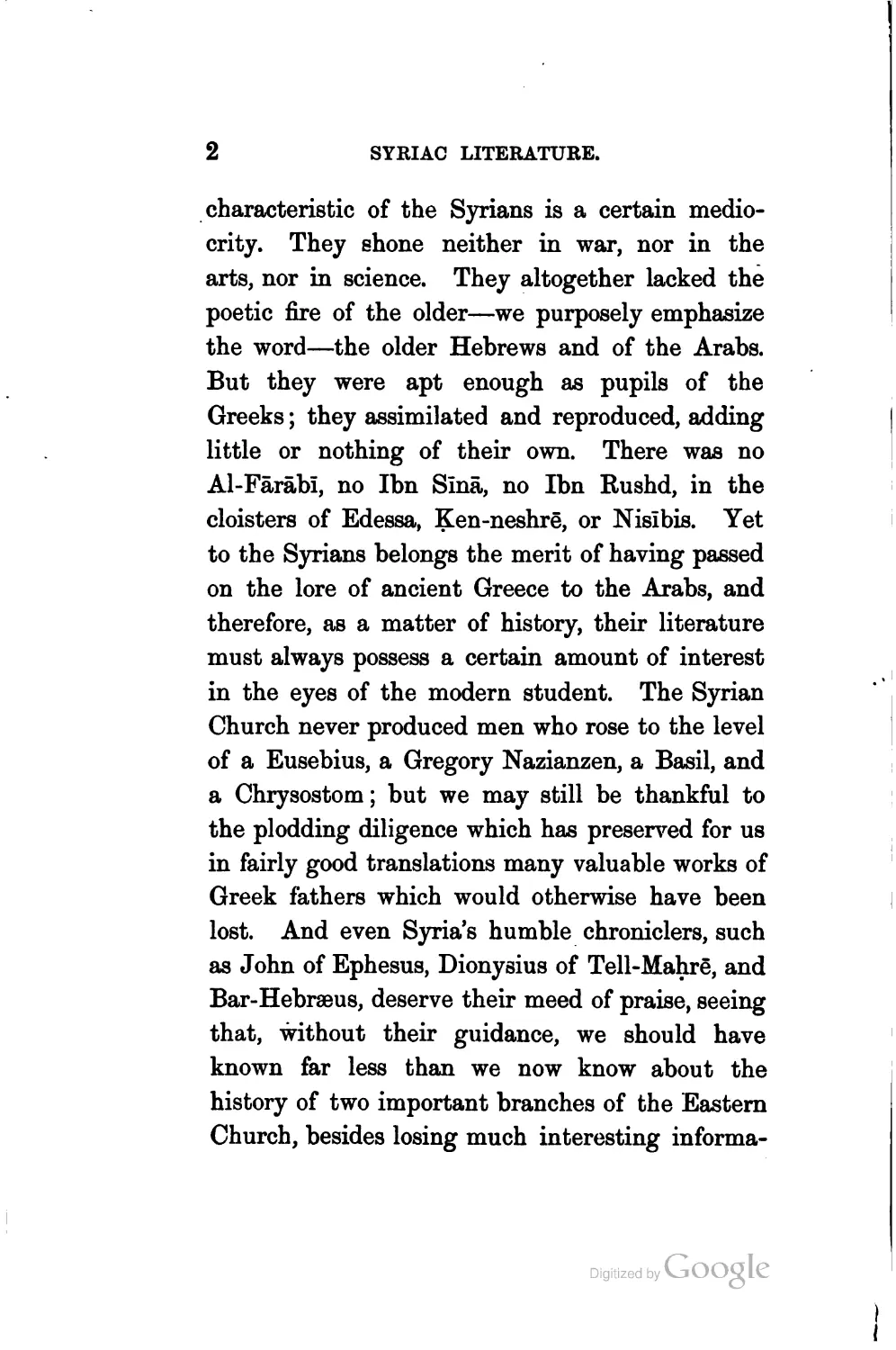
characteristic of the Syrians is a certain medio-
crity. They shone neither in war, nor in the
arts, nor in science. They altogether lacked the
poetic fire of the older—we purposely emphasize
the word—the older Hebrews and of the Arabs.
But they were apt enough as pupils of the
Greeks; they assimilated and reproduced, adding
little or nothing of their own. There was no
Al-Farabi, no Ibn Sina, no Ibn Rushd, in the
cloisters of Edessa, Ken-neshre, or Nisibis. Yet
to the Syrians belongs the merit of having passed
on the lore of ancient Greece to the Arabs, and
therefore, as a matter of history, their literature
must always possess a certain amount of interest
in the eyes of the modern student. The Syrian
Church never produced men who rose to the level
of a Eusebius, a Gregory Nazianzen, a Basil, and
a Chrysostom; but we may still be thankful to
the plodding diligence which has preserved for us
in fairly good translations many valuable works of
Greek fathers which would otherwise have been
lost. And even Syria’s humble chroniclers, such
as John of Ephesus, Dionysius of Tell-Mahre, and
Bar-Hebraeus, deserve their meed of praise, seeing
that, without their guidance, we should have
known far less than we now know about the
history of two important branches of the Eastern
Church, besides losing much interesting informa-
Digitized by
Google
РЁ8Н1ТТА.
3
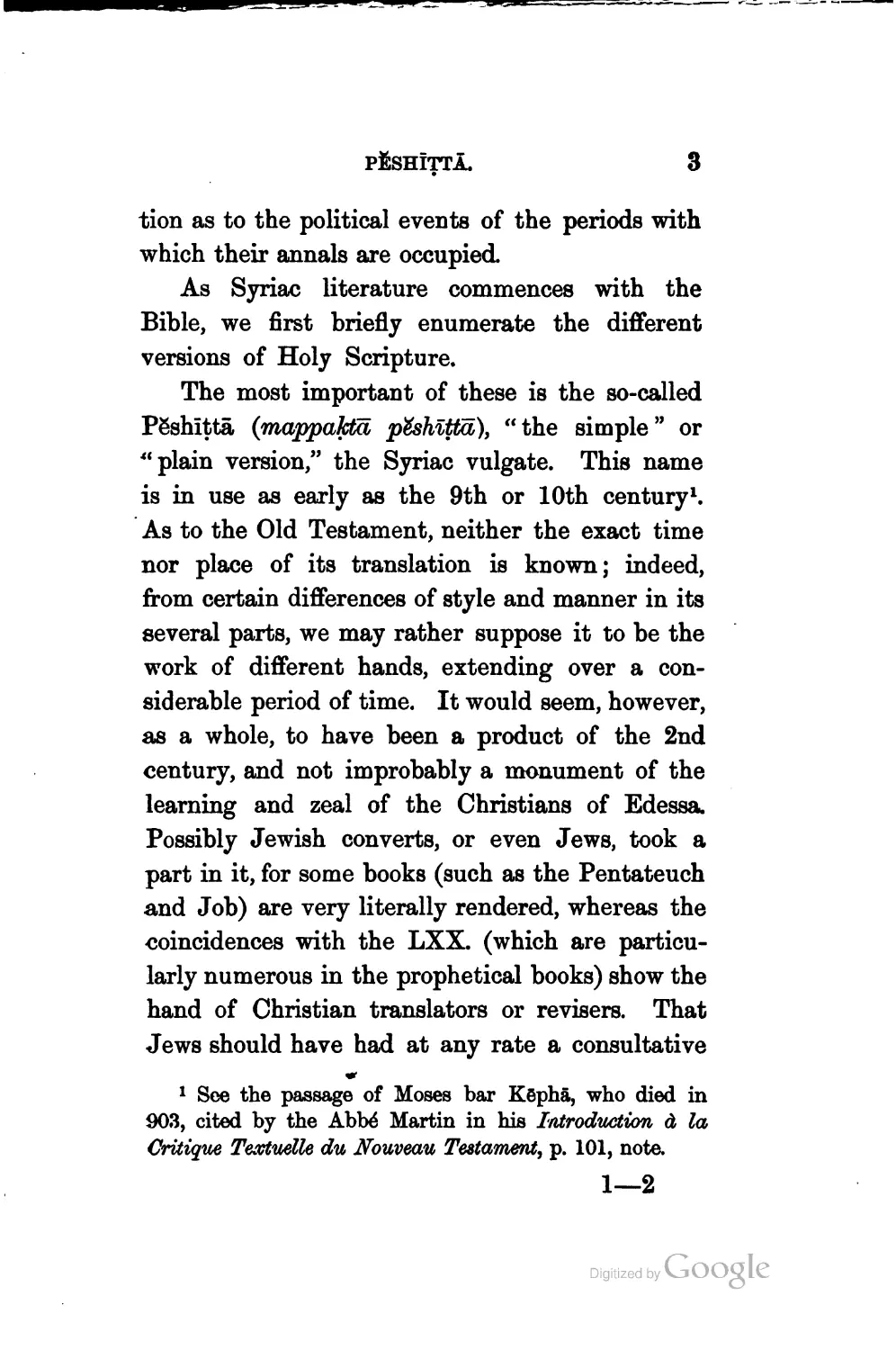
tion as to the political events of the periods with
which their annals are occupied.
As Syriac literature commences with the
Bible, we first briefly enumerate the different
versions of Holy Scripture.
The most important of these is the so-called
PSshitta (mappakta p&hitta), “ the simple ” or
u plain version/’ the Syriac vulgate. This name
is in use as early as the 9th or 10th century1.
As to the Old Testament, neither the exact time
nor place of its translation is known; indeed,
from certain differences of style and manner in its
several parts, we may rather suppose it to be the
work of different hands, extending over a con-
siderable period of time. It would seem, however,
as a whole, to have been a product of the 2nd
century, and not improbably a monument of the
learning and zeal of the Christians of Edessa.
Possibly Jewish converts, or even Jews, took a
part in it, for some books (such as the Pentateuch
and Job) are very literally rendered, whereas the
coincidences with the LXX. (which are particu-
larly numerous in the prophetical books) show the
hand of Christian translators or revisers. That
Jews should have had at any rate a consultative
1 See the passage of Moses bar КёрЬа, who died in
903, cited by the АЬЬё Martin in his Introduction d la
Critique Teatuelle du Nouveau Testament, p. 101, note.
1—2
Digitized by LnOOQle
4
SYRIAC LITERATURE.
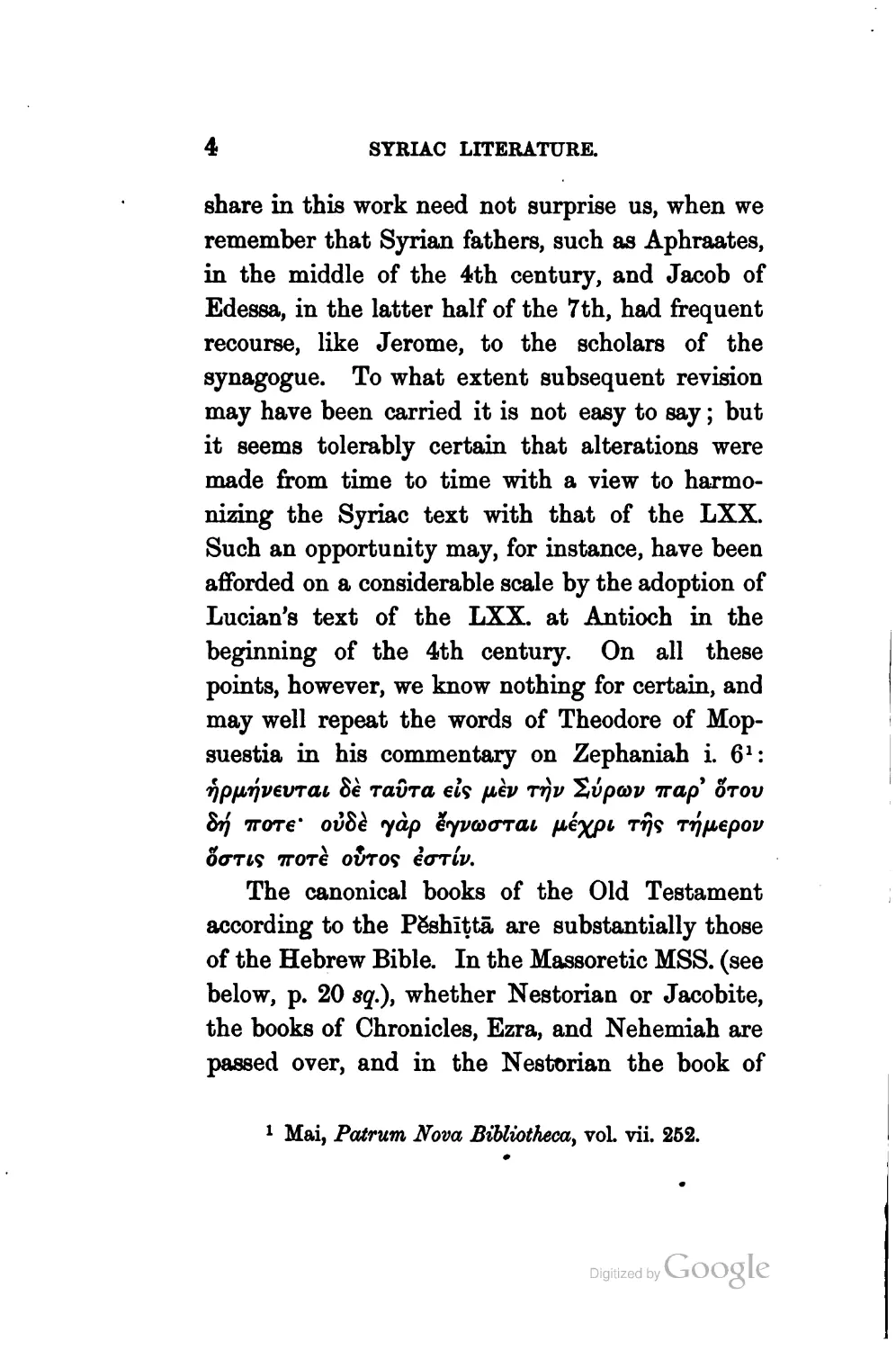
share in this work need not surprise us, when we
remember that Syrian fathers, such as Aphraates,
in the middle of the 4th century, and Jacob of
Edessa, in the latter half of the 7 th, had frequent
recourse, like Jerome, to the scholars of the
synagogue. To what extent subsequent revision
may have been carried it is not easy to say; but
it seems tolerably certain that alterations were
made from time to time with a view to harmo-
nizing the Syriac text with that of the LXX.
Such an opportunity may, for instance, have been
afforded on a considerable scale by the adoption of
Lucian’s text of the LXX. at Antioch in the
beginning of the 4th century. On all these
points, however, we know nothing for certain, and
may well repeat the words of Theodore of Mop-
suestia in his commentary on Zephaniah i. 61:
ypp/yvevrai be таита eh ryv ^vpcov Trap' otov
by 7гот€* ovb& yap iyvG)arai peypt, туч rypepov
OCTTIS 7Г0ТС OVTOS CCTtIv.
The canonical books of the Old Testament
according to the PSshitta are substantially those
of the Hebrew Bible. In the Massoretic MSS. (see
below, p. 20 sq.)f whether Nestorian or Jacobite,
the books of Chronicles, Ezra, and Nehemiah are
passed over, and in the Nestorian the book of
1 Mai, Patrum Nova Bibliotheca^ vol. vii. 252.
Digitized by
Google
РЁ8ШТТА.
5
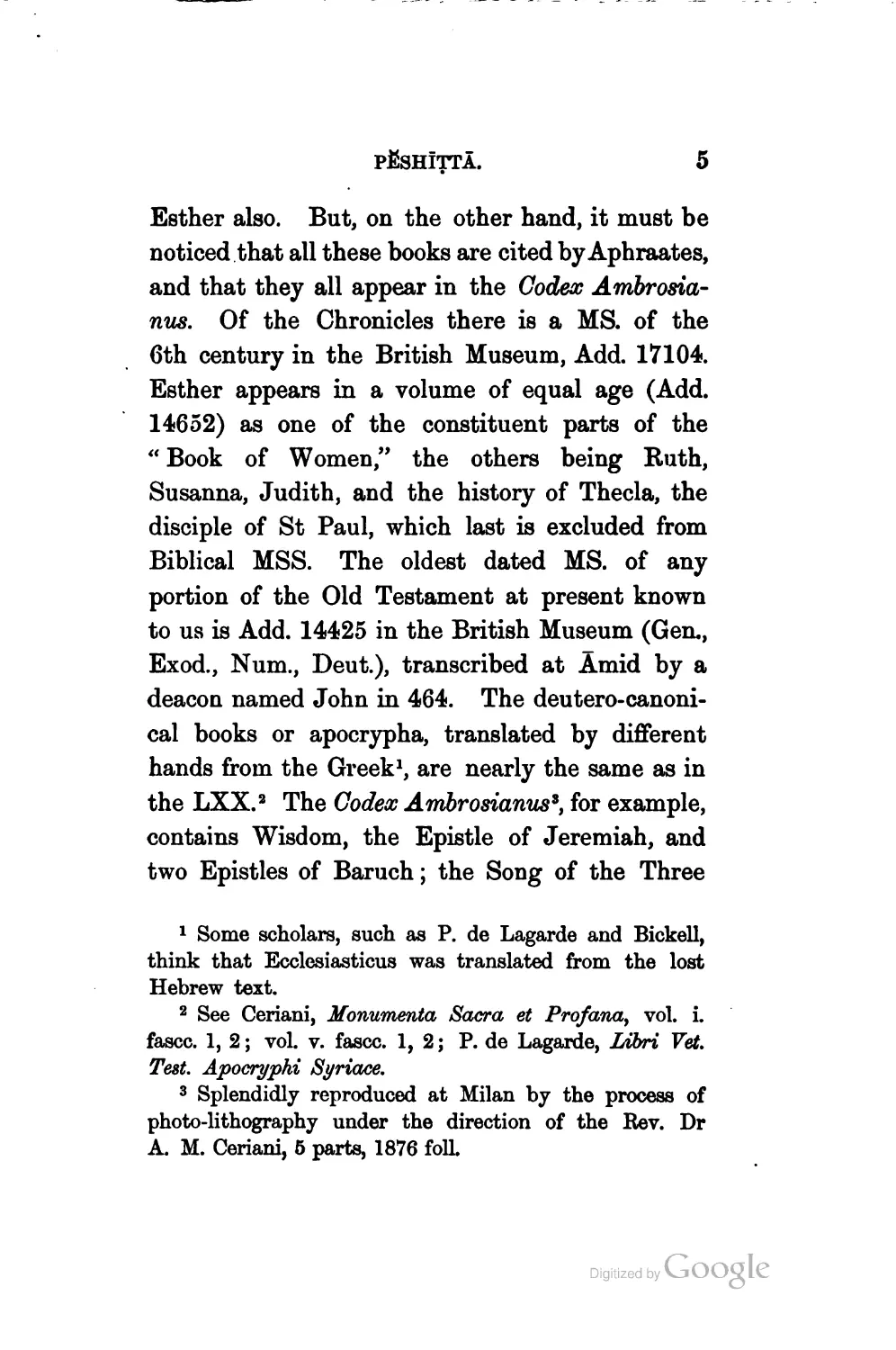
Esther also. But, on the other hand, it must be
noticed that all these books are cited byAphraates,
and that they all appear in the Codex Ambrosia-
nus. Of the Chronicles there is a MS. of the
6th century in the British Museum, Add. 17104.
Esther appears in a volume of equal age (Add.
14652) as one of the constituent parts of the
“ Book of Women,” the others being Ruth,
Susanna, Judith, and the history of Thecla, the
disciple of St Paul, which last is excluded from
Biblical MSS. The oldest dated MS. of any
portion of the Old Testament at present known
to us is Add. 14425 in the British Museum (Gen.,
Exod., Num., Deut.), transcribed at Amid by a
deacon named John in 464. The deutero-canoni-
cal books or apocrypha, translated by different
hands from the Greek1, are nearly the same as in
the LXX.1 2 The Codex Ambrosianus3, for example,
contains Wisdom, the Epistle of Jeremiah, and
two Epistles of Baruch; the Song of the Three
1 Some scholars, such as P. de Lagarde and Bickell,
think that Ecclesiasticus was translated from the lost
Hebrew text.
2 See Ceriani, Monumenta Sacra et Profana, vol. i.
fascc. 1, 2; vol. v. fascc. 1,2; P. de Lagarde, Libri Vet,
Test. Apocryphi Syriace.
3 Splendidly reproduced at Milan by the process of
photo-lithography under the direction of the Rev. Dr
A M. Ceriani, 5 parts, 1876 foil.
Digitized by LnOOQle
6
' SYRIAC LITERATURE.
Children, Bel and the Dragon, and Susanna;
Judith, Siracides or Ecclesiasticus; the Apoca-
lypse of Baruch; the fourth book of Esdras; and
five books of the Maccabees, the fourth being the
history of Samona and her sons, and the fifth
Josephi de Bello Judaico lib. vi.1 To these must
be added from other MSS. the first or third book
of Esdras, the book of Tobit, and the prayer of
Manasses. Of the first book of the Maccabees
two recensions are extant, as far as chap. xiv. 24.
The book of Tobit presents the text of the LXX.
as far as chap. vii. 112.
The canonical books of the New Testament
are the four Gospels, the Acts of the Apostles (to
which are annexed the three catholic epistles, viz.,
James, 1 Peter, and 1 John), and the fourteen
epistles of St Paul. The shorter apostolic epistles,
viz., 2 and 3 John, 2 Peter, and Jude, and the
Apocalypse of St John, were rejected by the early
Syrian Church8.
1	See Das 6te Buch d. Bellum Judaicum ubersetzt u.
kritisch bearbeitet, by Dr H. Kottek, Berlin, 1886; only
capp. 1 and 2.
2	See the Syriac note on p. xii. of De Lagarde’s
edition.
3	The principal editions of the PSshltta are contained
in the Paris polyglott of Le Jay and the London polyglott
of Walton, to which latter is attached the immortal
Lexicon Heptaglotton of Edmund Castell. The Old
Testament (without the apocrypha) was edited by S. Lee
Digitized by LnOOQle
pfiSHITTA AND CURETONIAN GOSPELS. 7
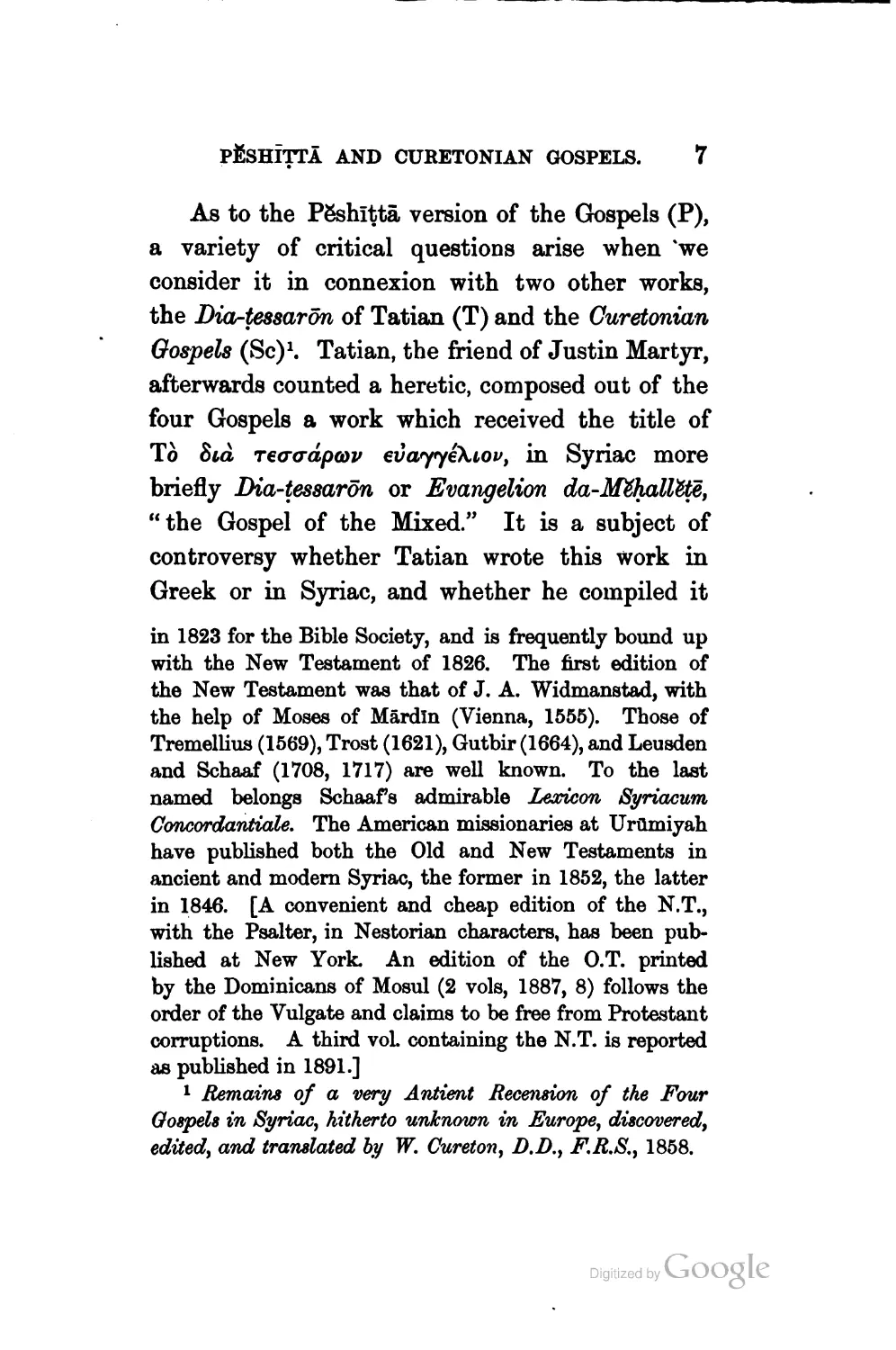
As to the PSshltta version of the Gospels (P),
a variety of critical questions arise when 'we
consider it in connexion with two other works,
the Dia-tessaron of Tatian (T) and the Curetonian
Gospels (Sc)1. Tatian, the friend of Justin Martyr,
afterwards counted a heretic, composed out of the
four Gospels a work which received the title of
To T€<r<rdpG)v eva/fyekioV) in Syriac more
briefly Dia-tessaron or Evangelion da-MVhall&te,
“the Gospel of the Mixed.” It is a subject of
controversy whether Tatian wrote this work in
Greek or in Syriac, and whether he compiled it
in 1823 for the Bible Society, and is frequently bound up
with the New Testament of 1826. The first edition of
the New Testament was that of J. A. Widmanstad, with
the help of Moses of Mardln (Vienna, 1555). Those of
Tremellius (1569), Trost (1621), Gutbir (1664), and Leusden
and Schaaf (1708, 1717) are well known. To the last
named belongs Schaafs admirable Lexicon Syriacwn
Concordantiale. The American missionaries at Urtlmiyah
have published both the Old and New Testaments in
ancient and modern Syriac, the former in 1852, the latter
in 1846. [A convenient and cheap edition of the N.T.,
with the Psalter, in Nestorian characters, has been pub-
lished at New York. An edition of the O.T. printed
by the Dominicans of Mosul (2 vols, 1887, 8) follows the
order of the Vulgate and claims to be free from Protestant
corruptions. A third vol. containing the N.T. is reported
as published in 1891.]
1 Remains of a very Antient Recension of the Four
Gospels in Syriac, hitherto unknown in Europe, discovered,
edited, and translated by W. Cureton, D.D., F.R.S., 1858.
Digitized by LnOOQle
8
SYRIAC LITERATURE.
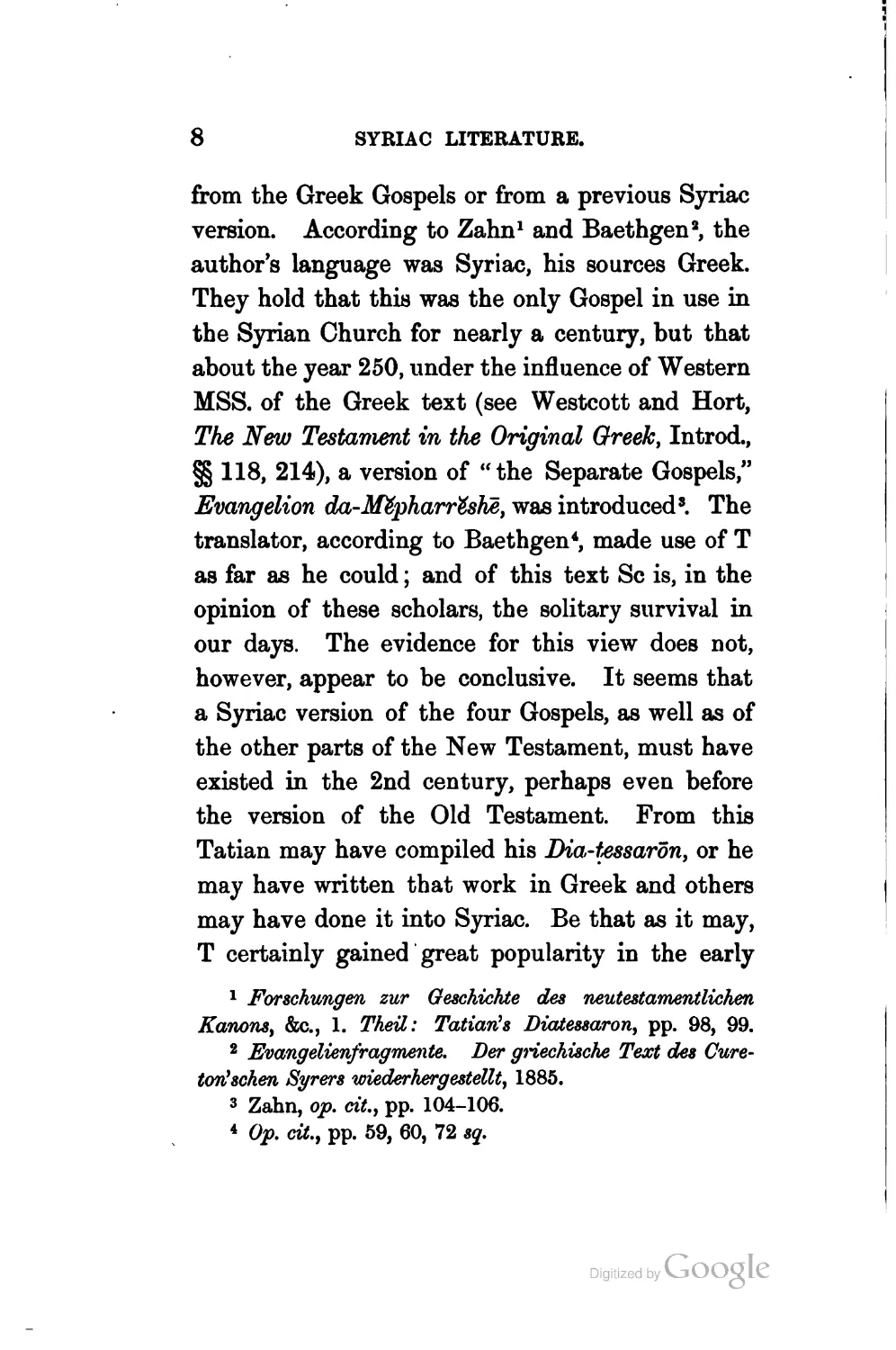
from the Greek Gospels or from a previous Syriac
version. According to Zahn1 and Baethgen2, the
author’s language was Syriac, his sources Greek.
They hold that this was the only Gospel in use in
the Syrian Church for nearly a century, but that
about the year 250, under the influence of Western
MSS. of the Greek text (see Westcott and Hort,
The New Testament in the Original Greek, Introd.,
§§ 118, 214), a version of “the Separate Gospels,”
Evangelion da-MtpharrZsh#, was introduced8. The
translator, according to Baethgen4, made use of T
as far as he could; and of this text Sc is, in the
opinion of these scholars, the solitary survival in
our days. The evidence for this view does not,
however, appear to be conclusive. It seems that
a Syriac version of the four Gospels, as well as of
the other parts of the New Testament, must have
existed in the 2nd century, perhaps even before
the version of the Old Testament. From this
Tatian may have compiled his Dia-tessaron, or he
may have written that work in Greek and others
may have done it into Syriac. Be that as it may,
T certainly gained great popularity in the early
1	Forschungen zur Geschichte des neutestamentlichen
Kanons, &c., 1. Theil: Tatiaris Diatessaron, pp. 98, 99.
2	Evangdienfragmente. Der griechische Text des Cure-
torischen Syrers wiederh&rgestellt, 1885.
3	Zahn, op, tit,, pp. 104-106.
4	Op, tit,, pp. 59, 60, 72 sq.
Digitized by LnOOQle
РЁ8ШТТА AND CURETONIAN GOSPELS. 9
Syrian Church, and almost superseded the Sepa-
rate Gospels. Aphraates quoted it1; Ephraim
wrote a commentary upon it1 2 3; the Doctrine of
Addai or Addaeus (in its present shape a work of
the latter half of the 4th century) transfers it to
the apostolic times8; Rabbula, bishop of Edessa
(411-435), promulgated an order that “ the priests
and deacons should take care that in every church
there should be a copy of the Separate Gospels
(Evangelidn da-MZpharrVsKe^ and that it should
be read”4; and Theodoret, bishop of Cyrrhus
(423-457), swept up more than two hundred
copies of it in the churches of his diocese, and
introduced the four Gospels in their place: та
t&v теттарыи evasyyeKitrr&v dvTeurfaasyov evcuy-
yeXia5 6. The result of these and similar well
meant efforts is that not a single copy of T has
1 Wright’s edition, p. L Ю, “as it is written at
the head of the Gospel of our Lifegiver, In the beginning
was the Word.”
2 Now extant only in the old Armenian version,
translated by the Mechitarist Aucher, and revised by
G. Mosinger under the title of Evangelii Concordant
Expositio facta a 8. Ephraemo, Venice, 1876.
3 Phillips’s edition, p. Q_S, 1. 17.
4 8. Ephra&mi Syri Rabuloe epi Edesseni Balcei alio-
rumque opera selecta, ed. J. J. Overbeck, Oxford, 1865,
p. 220, 3.
6 Алретист)? какормМае erriropj, i. 20.
Digitized by LnOOQle
10
SYRIAC LITERATURE.
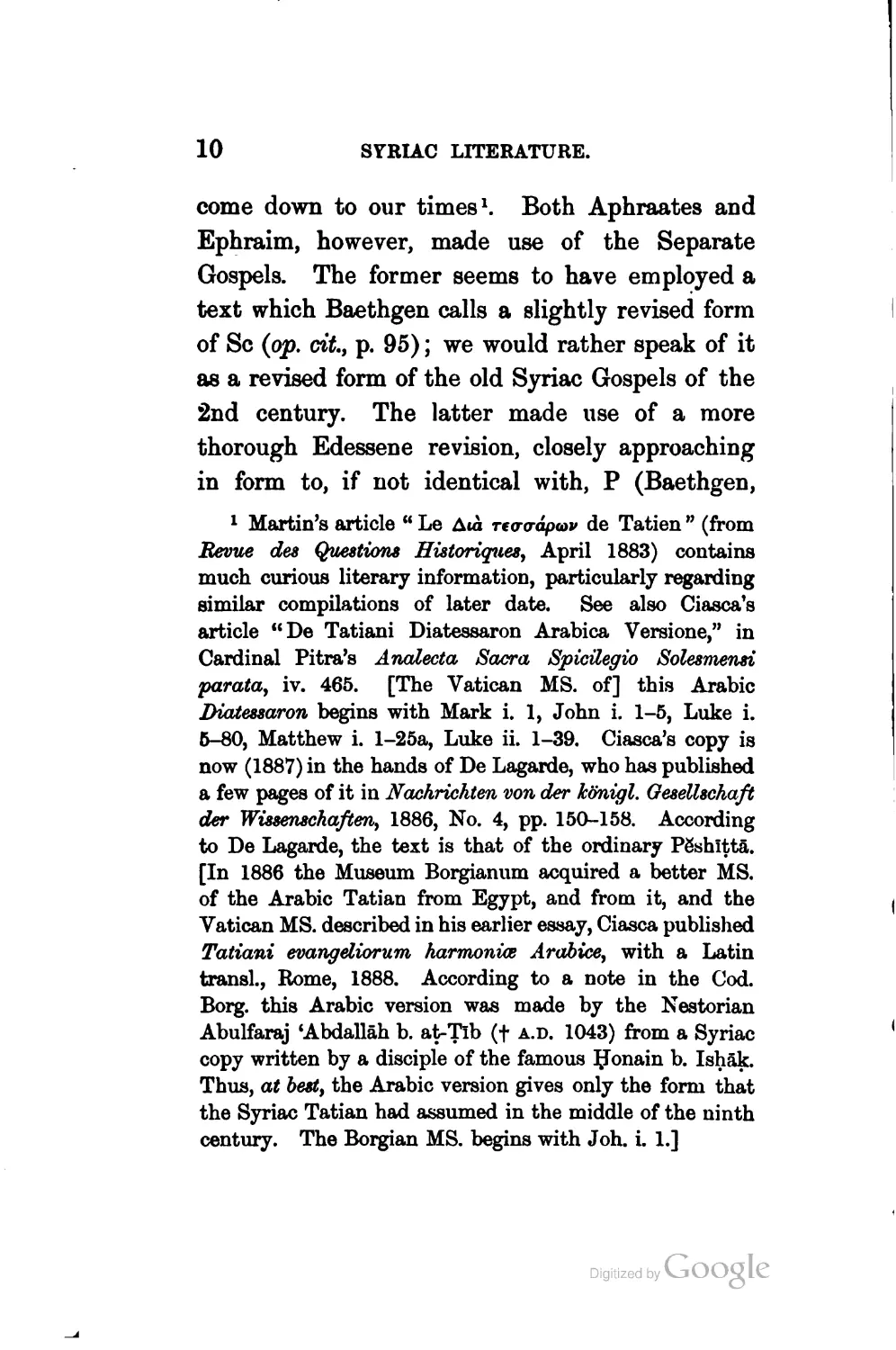
come down to our times1. Both Aphraates and
Ephraim, however, made use of the Separate
Gospels. The former seems to have employed a
text which Baethgen calls a slightly revised form
of Sc (op. dt., p. 95); we would rather speak of it
as a revised form of the old Syriac Gospels of the
2nd century. The latter made use of a more
thorough Edessene revision, closely approaching
in form to, if not identical with, P (Baethgen,
1 Martin’s article “ Le Аса reaadptov de Tatien ” (from
Revue dee Questions Historiques, April 1883) contains
much curious literary information, particularly regarding
similar compilations of later date. See also Ciasca’s
article “De Tatiani Diatessaron Arabica Versione,” in
Cardinal Pitta’s Analecta Sacra Spicilegio Solesmensi
parata, iv. 465. [The Vatican MS. of] this Arabic
Diatessaron begins with Mark i. 1, John i. 1-5, Luke i.
5-80, Matthew i. l-25a, Luke ii. 1-39. Ciasca’s copy is
now (1887) in the hands of De Lagarde, who has published
a few pages of it in Nachrichten von der konigl. Gesellschaft
der Wissenschaften, 1886, No. 4, pp. 150-158. According
to De Lagarde, the text is that of the ordinary Pgshitta.
[In 1886 the Museum Borgianum acquired a better MS.
of the Arabic Tatian from Egypt, and from it, and the
Vatican MS. described in his earlier essay, Ciasca published
Tatiani evangeliorum harmonics Arabics, with a Latin
transl., Rome, 1888. According to a note in the Cod.
Borg, this Arabic version was made by the Nestorian
Abulfaraj ‘Abdallah b. at-Tlb (f a.d. 1043) from a Syriac
copy written by a disciple of the famous IJonain b. Ishak.
Thus, at best, the Arabic version gives only the form that
the Syriac Tatian had assumed in the middle of the ninth
century. The Borgian MS. begins with Joh. i. 1.]
Digitized by
Google
pEshitta and curetonian gospels. 11
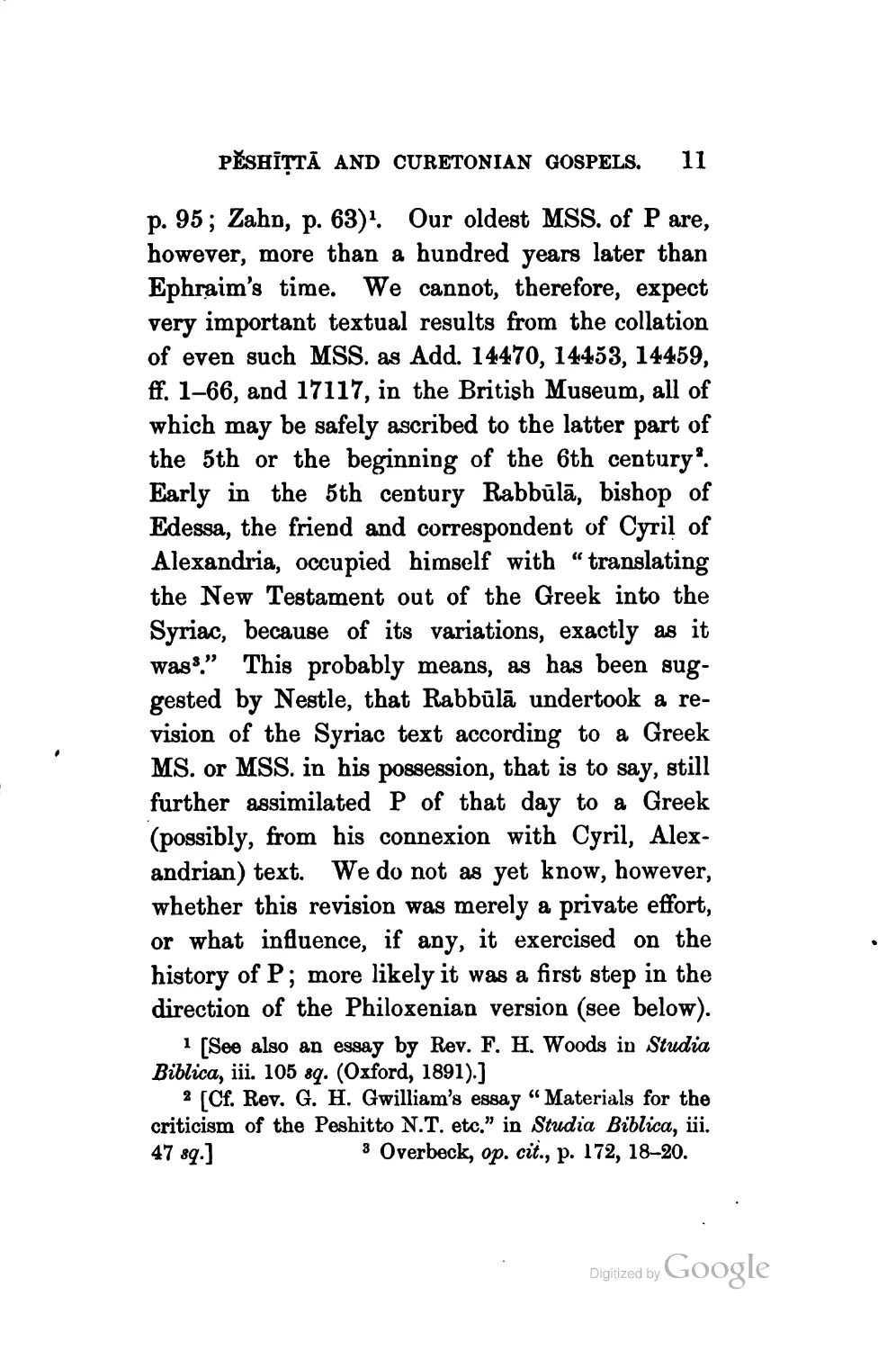
p. 95; Zahn, p. 63) \ Our oldest MSS. of P are,
however, more than a hundred years later than
Ephraim’s time. We cannot, therefore, expect
very important textual results from the collation
of even such MSS. as Add. 14470, 14453, 14459,
ff. 1-66, and 17117, in the British Museum, all of
which may be safely ascribed to the latter part of
the 5th or the beginning of the 6th century2.
Early in the 5th century Rabbula, bishop of
Edessa, the friend and correspondent of Cyril of
Alexandria, occupied himself with “translating
the New Testament out of the Greek into the
Syriac, because of its variations, exactly as it
was8.” This probably means, as has been sug-
gested by Nestle, that Rabbula undertook a re-
vision of the Syriac text according to a Greek
MS. or MSS. in his possession, that is to say, still
further assimilated P of that day to a Greek
(possibly, from his connexion with Cyril, Alex-
andrian) text. We do not as yet know, however,
whether this revision was merely a private effort,
or what influence, if any, it exercised on the
history of P; more likely it was a first step in the
direction of the Philoxenian version (see below).
1	[See also an essay by Rev. F. H. Woods in Studia
Biblica, iii. 105 eq. (Oxford, 1891).]
2	[Cf. Rev. G. H. Gwilliam’s essay “ Materials for the
criticism of the Peshitto N.T. etc.” in Studia Biblwa, iii.
47 «g.]	8 Overbeck, op, cit,, p. 172, 18-20.
Digitized by CnOOQle
12
SYRIAC LITERATURE.
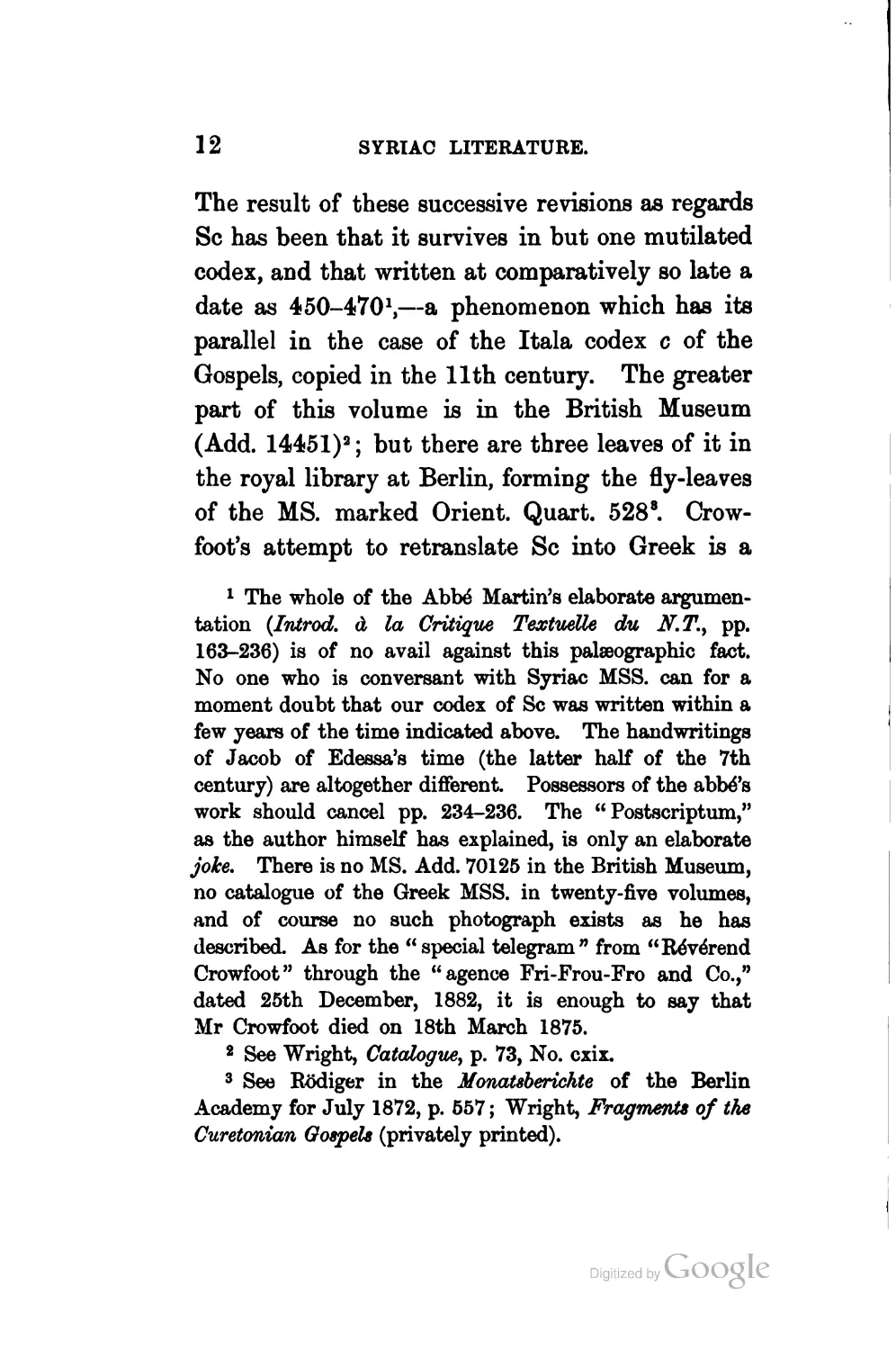
The result of these successive revisions as regards
Sc has been that it survives in but one mutilated
codex, and that written at comparatively so late a
date as 450-4701,—a phenomenon which has its
parallel in the case of the Itala codex c of the
Gospels, copied in the 11th century. The greater
part of this volume is in the British Museum
(Add. 14451)2; but there are three leaves of it in
the royal library at Berlin, forming the fly-leaves
of the MS. marked Orient. Quart. 528®. Crow-
foot’s attempt to retranslate Sc into Greek is a
1	The whole of the АЬЬё Martin’s elaborate argumen-
tation (Introd, d la Critique Textuelle du N.T., pp.
163-236) is of no avail against this palseographic fact.
No one who is conversant with Syriac MSS. can for a
moment doubt that our codex of Sc was written within a
few years of the time indicated above. The handwritings
of Jacob of Edessa’s time (the latter half of the 7th
century) are altogether different. Possessors of the abbd’s
work should cancel pp. 234-236. The “ Postscriptum,”
as the author himself has explained, is only an elaborate
joke. There is no MS. Add. 70125 in the British Museum,
no catalogue of the Greek MSS. in twenty-five volumes,
and of course no such photograph exists as he has
described. As for the “ special telegram” from “R6v£rend
Crowfoot” through the “agence Fri-Frou-Fro and Co.,”
dated 25th December, 1882, it is enough to say that
Mr Crowfoot died on 18th March 1875.
2	See Wright, Catalogue^ p. 73, No. cxix.
3	See Rodiger in the Monatsberichte of the Berlin
Academy for July 1872, p. 557; Wright, Fragments of the
Curetonian Gospels (privately printed).
Digitized by
Google
MONOPHYSITE VERSIONS.
13
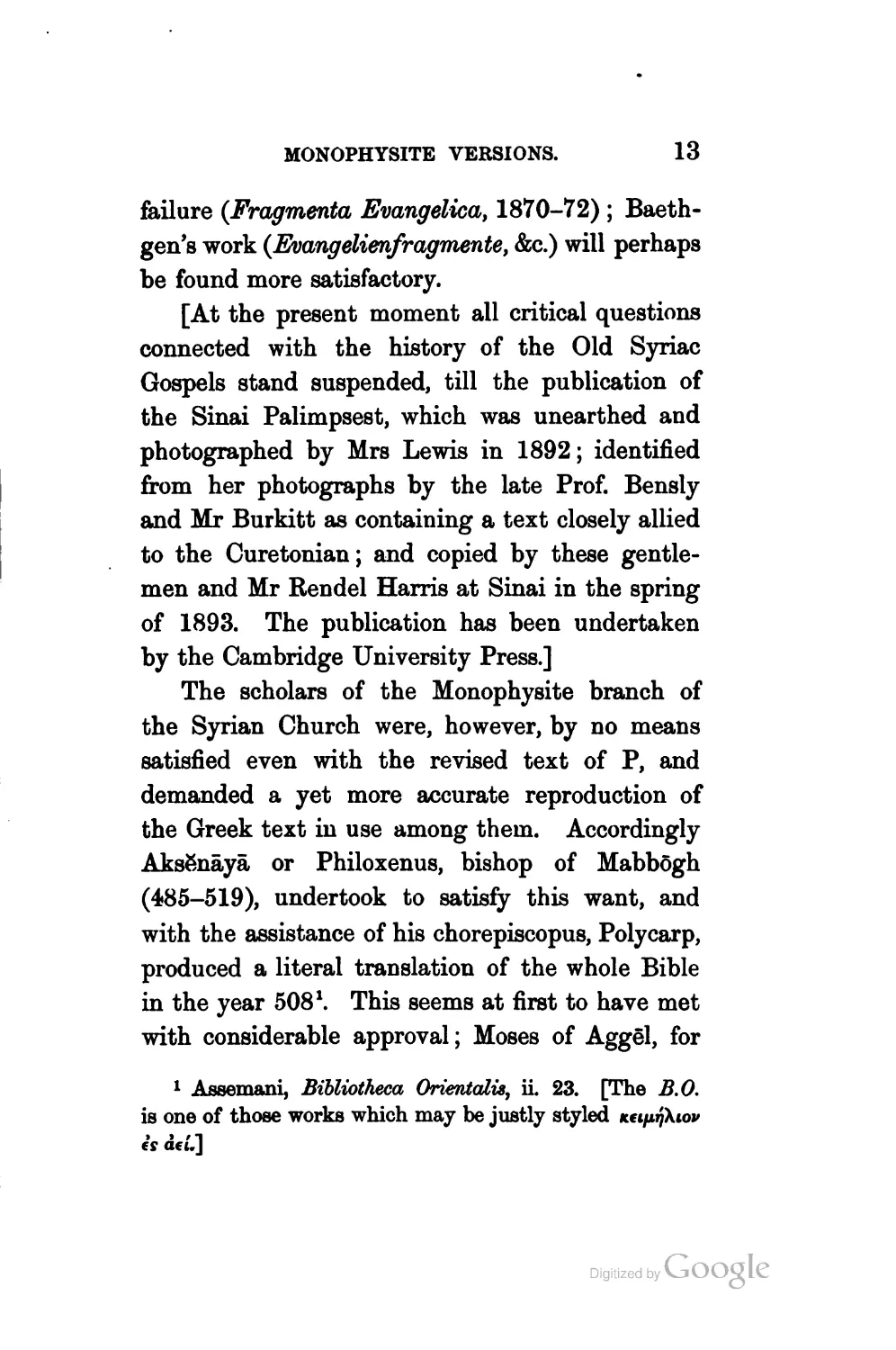
failure (Fragmenta Evangelica, 1870-72) ; Baeth-
gen’s work {Evang elienfragmente, &c.) will perhaps
be found more satisfactory.
[At the present moment all critical questions
connected with the history of the Old Syriac
Gospels stand suspended, till the publication of
the Sinai Palimpsest, which was unearthed and
photographed by Mrs Lewis in 1892; identified
from her photographs by the late Prof. Bensly
and Mr Burkitt as containing a text closely allied
to the Curetonian; and copied by these gentle-
men and Mr Rendel Harris at Sinai in the spring
of 1893. The publication has been undertaken
by the Cambridge University Press.]
The scholars of the Monophysite branch of
the Syrian Church were, however, by no means
satisfied even with the revised text of P, and
demanded a yet more accurate reproduction of
the Greek text in use among them. Accordingly
AksSnaya or Philoxenus, bishop of Mabbogh
(485-519), undertook to satisfy this want, and
with the assistance of his chorepiscopus, Polycarp,
produced a literal translation of the whole Bible
in the year 508 \ This seems at first to have met
with considerable approval; Moses of Aggel, for
1 Assemani, Bibliotheca Orientalis, ii. 23. [The B.O.
is one of those works which may be justly styled xei^Xiop
er aeu]
Digitized by LnOOQle
14
SYRIAC LITERATURE.
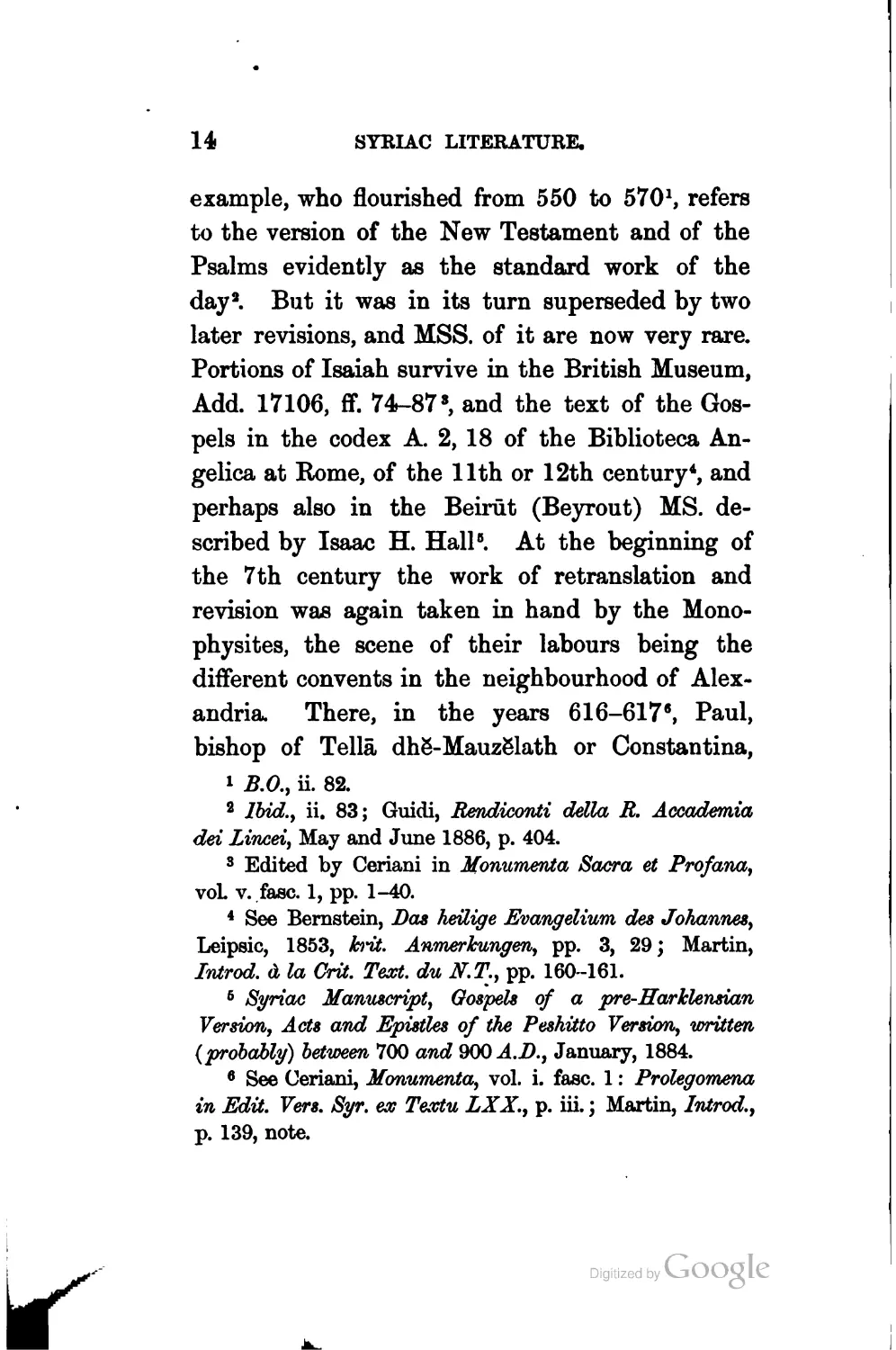
example, who flourished from 550 to 5701, refers
to the version of the New Testament and of the
Psalms evidently as the standard work of the
day2. But it was in its turn superseded by two
later revisions, and MSS. of it are now very rare.
Portions of Isaiah survive in the British Museum,
Add. 17106, ff. 74-878, and the text of the Gos-
pels in the codex A. 2, 18 of the Biblioteca An-
gelica at Rome, of the 11th or 12th century4, and
perhaps also in the Beirut (Beyrout) MS. de-
scribed by Isaac H. Hall8. At the beginning of
the 7 th century the work of retranslation and
revision was again taken in hand by the Mono-
physites, the scene of their labours being the
different convents in the neighbourhood of Alex-
andria. There, in the years 616-617®, Paul,
bishop of Telia dhS-MauzSlath or Constantina,
i	B.O., ii. 82.
2	Ibid.) ii. 83; Guidi, Rendiconti della R. Accademia
dei Lincei) May and June 1886, p. 404.
3	Edited by Ceriani in Monumenta Sacra et Profana,
vol v. fasc. 1, pp. 1-40.
4	See Bernstein, Das heilige Evangelium, des Johannes^
Leipsic, 1853, krit. АптегкипдеП) pp. 3, 29; Martin,
Introd. d la Grit. Text. du N.T.) pp. 160-161.
6	Syriac Manuscript) Gospels of a pre-Harlclendan
Version) Acts and Epistles of the Peshitto Version) written
{probably) between 700 and 900 A.D.} January, 1884.
6	See Ceriani, Monumenta, vol. i. fasc. 1: Prolegomena
in Edit, Vers. Syr. ex Textu LXX,) p. in.; Martin, Introd.)
p. 139, note.
Digitized by
Google
MONOPHYSITE VERSIONS.
15
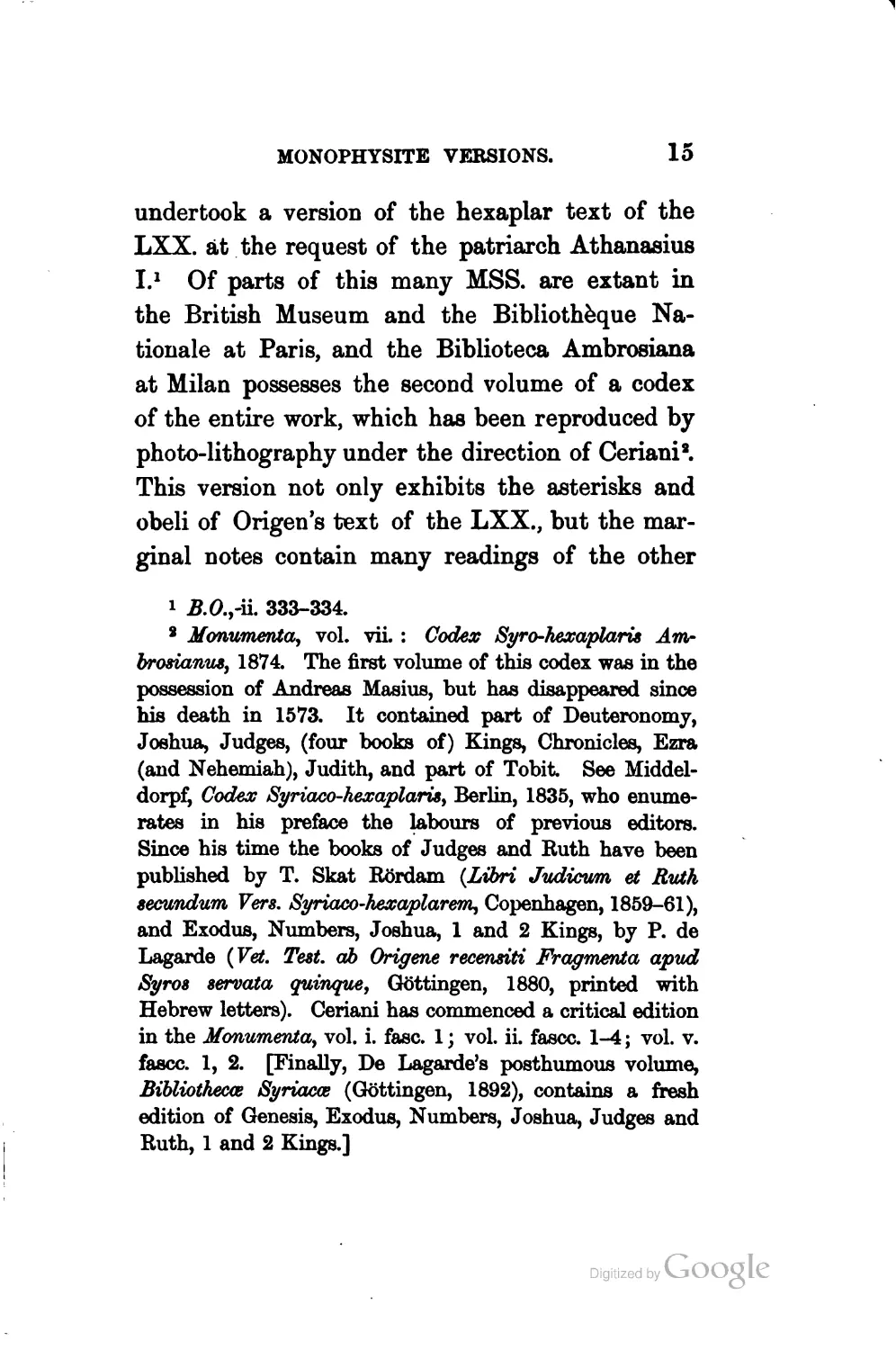
undertook a version of the hexaplar text of the
LXX. at the request of the patriarch Athanasius
I.1 Of parts of this many MSS. are extant in
the British Museum and the Bibliothfeque Na-
tionale at Paris, and the Biblioteca Ambrosiana
at Milan possesses the second volume of a codex
of the entire work, which has been reproduced by
photo-lithography under the direction of Ceriani2.
This version not only exhibits the asterisks and
obeli of Origen’s text of the LXX., but the mar-
ginal notes contain many readings of the other
1 B.O.,-ii. 333-334.
8 Monumenta, vol. vii. : Codex Syro-hexaplaris Amr
brosianus, 1874. The first volume of this codex was in the
possession of Andreas Masius, but has disappeared since
his death in 1573. It contained part of Deuteronomy,
Joshua, Judges, (four books of) Kings, Chronicles, Ezra
(and Nehemiah), Judith, and part of Tobit See Middel-
dorpf, Codex Syriaco4iexaplaris, Berlin, 1835, who enume-
rates in his preface the labours of previous editors.
Since his time the books of Judges and Ruth have been
published by T. Skat Rordam (Libri Judicurn et Ruth
secundum Vers. Syriobco-hexaplar&m, Copenhagen, 1859-61),
and Exodus, Numbers, Joshua, 1 and 2 Kings, by P. de
Lagarde (Vet. Test, ab Origeme recensiti Fragmenta apud
Syros servata quinque, Gottingen, 1880, printed with
Hebrew letters). Ceriani has commenced a critical edition
in the Monumenta, vol. i. fasc. 1; vol. ii. fascc. 1-4; vol. v.
fascc. 1, 2. [Finally, De Lagarde’s posthumous volume,
Bibliothecce Syriacfx (Gottingen, 1892), contains a fresh
edition of Genesis, Exodus, Numbers, Joshua, Judges and
Ruth, 1 and 2 Kings.]
Digitized by LnOOQle
16
SYRIAC LITERATURE.
Greek translators, which have been largely uti-
lized by Field in his noble work Origenis Hexa-
plorum quce supersunt (2 vols., Oxford, 1875). At
the same time and place the New Testament of
Philoxenus was thoroughly revised by Thomas of
Harvel or Heraclea1, bishop of Mabbogh2, who,
being driven from his diocese, betook himself to
Alexandria and worked there in the convent of
St Antony at the Enaton (or Nine-mile-village)8.
This version comprises not only all the books
contained in the PSshltta but also the four shorter
epistles4. The lapse of another century brings us
1	See B.O., ii. 90, 334; Bernstein, De Hharklensi N.T.
Translatione Syriaca Commentatio, p. 4.
2	Or Manbij; according to others, of Germanicia, or
Mar'ash. He must not be confounded with an older
Thomas of Germanicia, a Monophysite of the earlier part
of the 6th century; see B.O., ii. 92, 326; Kleyn, Jacobus
Baradaeiis, p. 43, note 1.
8	See Wright, Catal., p. 34, note.
4 It has been edited by White at Oxford—the Gospels
in 1778, the Acts and Apostolic epistles in 1799, the
Pauline epistles in 1803. The epistle to the Hebrews is
defective, ending in the middle of chap. xi. 27[, but this
lacuna has been supplied, from the Cambridge MS., by
Bensly’s The ЦаМеап Version of the Epistle to the Hebrews,
Chap. xi. 28-xiii. 25, Cambridge, 1889]. The text of the
shorter epistles, 2 Peter, 2 and 3 John, and Jude, has been
recently reproduced by phototype from a manuscript dated
1471—Williams Manuscript. The Syrian Antilegomena
Epistles . . . edited by Isaac H. Hall, 1886. Consult also
Transactions of the Royal Irish Academy, vol. xxvii. No.
Digitized by
Google
MALKITE VERSION.
17
to the last attempt at a revision of the Old Testa-
ment in the Monophysite Church. Jacob, bishop
of Edessa, undertook, when living in retirement
in the convent of Tell-'Adda or Teleda1, in 704-
705, to revise the text of the PSshltta with the
help of the Greek versions at his disposal’, thus
producing a curious eclectic or patchwork text.
Of this work there are but five volumes extant in
Europe, four of which came from the Nitrian
Desert and form parts of a set which was written
in the years 719-720. It would seem, therefore,
never to have attained popularity8.
One other version remains to be noticed,
namely, that used by the Christian population of
the Malkite (Greek) Church in Palestine, written
in an Aramaic dialect more akin to the language
viii., “On a Syrian MS. belonging to the Collection of
Archbishop Ussher,” by the Rev. J. Gwynn, D.D. [On a
possible revision by Barsalibl, see Hermathema vi. 417.]
There is a fine MS. of this version, dated 1170, in the
university library, Cambridge, Add. MS. 1700. Its peculiar
feature is that it has the two epistles of Clement inserted
between the catholic epistles and those of St Paul.
1	Probably the modern TelTadi or TelTade; see Socin,
PaLast. u. Syrian, p. 480; Sachau, Raise in Syrian, u. Meso-
potamia, p. 459.
2	Wright, Cotai., p. 38, coL 1.
8	See Ceriani, Le Edizioni e i Manoscritti delle Versioni
Siriache del Vecchio Test., 1869, p. 27, and Monumenta,
vol. ii. fasc. 1, pp. xi., xii., vol v. fasc. 1, pp. 1-40; Martin,
Introd., pp. 230-232, 296 sq.
S. L.	2
Digitized by LnOOQle
18
SYRIAC LITERATURE.
of the Jewish Targums than to that of the
PSshitta1. A lectionary containing large portions
of the Gospels in this dialect was described by
Assemani in the catalogue of the Vatican library1 2 *,
studied by Adler8, and edited by Count Fr.
Miniscalchi Erizzo under the title of Evange-
liarium Hierosolymitanum (2 vols., Verona, Isel-
er) [and again by De Lagarde in his posthumous
work Bibliothecae Syriacce (Gottingen, 1892)]. It
was written in a convent at a place called Abud4 *,
not very far from Jerusalem, in the year 1030,
and the scribe claims to have copied sundry other
service-books for the use of his church (see Asse-
mani, op, dt., p. 102). Fragments of other evan-
geliaria have been published by Land, from MSS.
at London and St Petersburg, in his Anecd. Syr.,
iv. pp. 114-162, 213-222; of the Acts of the
Apostles, p. 168; and of the Old Testament
(translated from the Greek), pp. 103-110, 165-
167, 222-223. According to the same authority
(p. 231), the calendar in the Vatican MS. must
1 See Noldeke, in Z.D.M.G., xxii. (1868), p. 443 sq.
2 MSS. Codd. Bibl. Apost. Vatic, Catalogue, ii. No. xix.
p. 70 eq.
8 N. Test, Verss. Syriacce Simplex, Phttoxeniana, et
Hi&roeolymvtana, Copenhagen, 1789; see also Martin,
Introd., p. 237 eq.
4 See Noldeke, loc, dt., pp. 521, 527; Land, Anecd.
Syr., iv. pp. 227-229.
Digitized by LnOOQle
NESTORIAN VERSION.
19
have been drawn up about the middle of the 9th
century. Few, if any, of the extant fragments
appear to be of older date. Noldeke places the
origin of the version in the 4th or 5th century,
certainly not later than 600 (Zoc. cit, p. 525)1.
All the above revisions of the text of the
Syriac Bible according to the Greek are, as we
have seen, the work of Monophysites, with the
single exception of the last, which proceeded from
the Malkites. The Nestorian community obsti-
nately adhered to the old PSshitta, and the
solitary attempt made to introduce a revised text
among them seems to have been an utter failure.
Mar-abha I.1 2 3 *, a convert from Zoroastrianism, who
was catholicus from 536 to 552, went to Edessa,
studied Greek there under a teacher named
Thomas8, and with his help translated the whole
of the Old Testament into Syriac, and perhaps
also the New. This statement rests on the
authority of the author of the Kitab al-Majdal
1 The remaining literature in this dialect (all of it
published by Land) consists of a few hymns (pp. 111-113),
lives of saints (pp. 169, 170), and theological fragments
(pp. 171-210). One fragment (p. 177) contains the title
of a homily of John Chrysostom. [Several additions to
this list are promised from Sinai MSS.]
2 Properly Mar(I)-abha.
3 2?.O., iii. 1, 86; compare ii. 411.
2—2
Digitized by LnOOQle
20
SYRIAC LITERATURE.
(Mari ibn Sulaiman1, about the middle of the
12th century, supplemented and abridged by
'Amr ibn Matta of Tirhan, who lived towards the
middle of the 14th century)2, of e Abhd-ishoe,
bishop of Nisibis (died 1318), and of Bar-Hebraeus
(died 1286); and there appears to be no reason
to doubt their word8.
Before quitting the subject of the versions of
Holy Scripture we must devote a few words to
the Massoretic MSS. of the Nestorians and Jaco-
bites4. In the year 1721 Assemani made mention
in the Bibliotheca Orientalis (ii. 283), on the
authority of Bar-Hebraeus in the Ausar Raze, of
a “ versio Karkaphensis, hoc est Montana, qua
videlicet incolae montium utuntur6” About the
meaning of these words scholars disputed, and
some searched for MSS. of the alleged version,
1 See p. 255, note.
2	See Hoffmann, Ausziige aus syrischen Akten persischer
Martyr er, pp. 6, 7 [in Abhandlungen fur d. Kunde d.
Morgerilandes vii. (Leipzig, 1880)].
3	See B.O., ii. 411-412, iii. 1, 75; Bar-Hebraeus, Chron.
Eccles., ed. Abbeloos and Lamy, ii. 89; Martin, Introd.,
pp. 292-294.
4	See Martin, Tradition Karkaphienne ou la Massore
chez les Syriens, Paris, 1870 (from Joum. Asiat.), and
Introd., pp. 276-291.
6	In the Vatican Catalogue (vol. iii. 287, No. clii.) he
translates the words akh masldtimanutha karktyhdita by
“juxta traditionem verticalem (!): hoc est, Montanorum
in Phcenice et Mesopotamia degentium.”
Digitized by
Google
MASSORETIC MANUSCRIPTS.
21
but in vain. At last, N. Wiseman (afterwards
cardinal), guided by the light of another passage
in the Bibliotheca Orientalis (ii 499, 500, No.
xxii.), recognized in Cod. Vat. cliii. a copy of
what he believed to be the Karkaphensian ver-
sion1. Later researches, more especially those of
the Abbd Martin, have corrected these errors.
The MSS. of the Karkaphensian tradition, of
which there are ten in our European libraries,
are now known to contain a philological and
grammatical tradition of the pronunciation and
punctuation of Holy Writ and sometimes of other
writings1 2. Syria was rich in schools and colleges;
most of its towns possessed institutions where
instruction was given, more especially to students
of theology, in the reading and exposition of the
Greek and Syriac Scriptures and their commen-
tators. Such were the great" Persian school ” of
Edessa, which was destroyed, on account of its
Nestorian tendencies, in 489; the school of
1 See his Нотсе Syriacoe, Rome, 1828, p. 78: II.
Symbols Philologi/XE ad Hist. Versionum Syriac, vet.
foederis. Particula prima ; de versionibus gerwratim, deimde
de Peschito, p. 147; III. Particula secunda; recensionem
Karkaphensem nunc primum describens. We need not
here indicate Wiseman’s mistakes, but it is a pity to see
them all reproduced even in the third edition of Scrivener’s
Plain Introduction, 1883.
2 See Hoffmann, Opuscula Nestoriana, 1880, p. v. sq.
Digitized by
Google
22
SYRIAC LITERATURE.
Nisibis; of Mahoze near Seleucia; of the monas-
tery of Dor-Koni or Dair-I£unna; of the monas-
tery of Ken-neshre or the Eagles’ Nest, on the
left bank of the Euphrates, opposite Jerabis; of
the Daira 'Ellaita, or monastery of St Gabriel and
St Abraham, at Mosul; and many others1. Every
such school or college had its teachers of reading
and elocution, mahgtyane and makrtya/ne (or
maker у tine), who taught their pupils to pronounce,
add the vowel-points, and interpunctuate correct-
ly2, before they were passed on to the higher
classes of the eskolaye, badhoke or mallVphan#,
that is, the professors of exegesis and doctors of
theology8. The more difficult words and phrases
of Scripture were gradually collected and written
down so as to form “collectanea,” lukkate dha-
shVmdhe, or “ fasciculi,” kurrase dha-sh^mahe, and
the union of these composed a kitKabhd dha-
kZrayatha, or “ book of readings,” in which it was
1	See, for example, B.O., iii. 1, 341, col. 2 at the foot,
and iii. 2, cmxxiv. sq.
2	Hofimann, Opusc. Nestor., p. vii.; Martin, Introd., p. 289.
8	Hoffmann, op. dt., pp. xx., xxi. What the whole
curriculum of such a student should be, according to the
mind of Bar-Hebraeus in the 13th century, may be seen
from the B.O., iii. 2, 937-938 {Nomocanon, translated by
J. A. Assemani, in Mai, Scriptt. Vett. Nova Coll., x. cap. vii.
§ 9, pp. 64-56). [See also Merx, Historia artis grammatics
apud Syros (in Abhandlungen fur die Kunde des Morgen-
landes, vol. ix.).]
Digitized by LnOOQle
MASS0RET1C MANUSCRIPTS.
23
shown by means of vowel-points and other signs
how each word was to be pronounced and ac-
centuated1. One such volume in the British
Museum (Add. 12138, dated 899) represents the
work of a Nestorian student in the convent of
Mar Gabriel at Harran8; but the other MSS.
extant in the different libraries of Europe8 are of
Jacobite origin and have a common source, the
scholastic tradition of the convent of KarkaphStha,
or “the Skull,” at the village of Maghdal or
Mijdal near Resh-'aina or Ras-eain1 2 3 4 *. Such are,
for example, Cod. Vat., No. clii., now cliii., de-
scribed by Assemani {Catal., iii. 287) and Wise-
man {Horas Syr., p. 151); Cod. Paris, Ancien
fonds 142, described by Zotenberg {Catal., p. 30,
No. 64) and Martin {Tradition Karkaphienne,
p. 36) ; Cod. Brit. Mus. Add. 7183, described by
Rosen {Catal., p. 64, No. xlii.)6 * and 12178, de-
scribed by Wright {Catal., p. 108). From these
and similar MSS., as well as from the words of
Bar-Hebraeus6, it appears that the КагкёрЬауб
1 Hoffmann, op. dt., pp. vi., vii.
2 See Wright, Catal., p. 101, [Merx, op. dt. p. 30 sq., and
a specimen in Studia Biblica, iii. 93-95].
3 Martin, Introd., p. 291.
4 Hoffmann, in Z.D.M.G., xxxii. (1878), p. 745; and in
Stade’s Zdtschrift fur d. Alt test. Wissenschaft, 1881, p. 159.
6 [A specimen in Studia BMica, iii. 96.]
6 Martin, op. dt., pp. 122, 129.
Digitized by
Google
24
SYRIAC LITERATURE.
were the monks of the convent of KarkaphStha;
that they were Westerns or Occidentals, therefore
Jacobites; and that one of their chief authorities,
if not the actual originator of the compilation,
was Jacob bishop of Edessa. Accordingly, the
marginal notes indicate various readings from
Syriac MSS., from the LXX., and from the
Harklensian version, as well as from different
fathers and teachers1. To the collection of words
and phrases from the PSshitta version is added in
several of these MSS. a similar, though shorter,
collection from the Harklensian version and from
the principal works of the Greek fathers which
were read in translations in the schools2, followed
1	See Wiseman, op. cit., p. 178; Martin, op. cit.} pp. 76,
77, 133; Rosen, Catal.^ pp. 65, 66; Wright, Caial., p. 109.
Among these occur 0-4 and The investigations of
Hofiinann (in Stade’s Zetischrift, 1881, p. 159) and Duval
(Joum. Asiat.y 1884, p. 560) have made it certain that 0-4
designates not the P6shltta, nor Jacob of Edessa, but one
TubhanS {perhaps sumamed “the Beardless”), an eminent
teacher at Resh-'ainft. His colleague Sfibha was probably
the famous scribe Sftbha, who wrote Brit. Mus. Add.
14428, 14430 (724), and 12135, ff. 1-43 (726).
2	Namely, (Pseudo-)Dionysius Areopagita, Gregory
Nazianzen (2 vols.), the works of Basil, the epistles of
Gregory and Basil, John Philoponus (the A*a*n;njr), and
Severus of Antioch {Homilies Calhedrales and certain
synodical letters relating to the council of Antioch). A
fuller list is given by Assemani, 2?.O., iii. 2, cmxxxvii. sq.
Digitized by LnOOQle
APOCRYPHA.
25
by tracts on different points of orthography,
grammar and punctuation1.
We have spoken above (p. 5 sq.) of the deutero-
canonical books of the Old Testament. Other
apocrypha may now be noticed more briefly; e.g.,
Ps. cli. (in the hexaplar version of Paul of Telia);
the Parva Genesis, or Liber Jubilceorum, a frag-
ment of which has been edited by Ceriani
(Mmurnenta, vol ii. fasc. 1, p. ix.); the Testament
of Adam*; the History of Joseph and Asyath
(Asenath), translated by Moses of Aggel3; the
History of Sanhenb, his Vizir Ahikar or Hikar,
and his Disciple Nadhan4. Many similar books
1	See Phillips, A Letter of Mar Jacob, Bishop of Edessa,
on Syriac Orthography, &c., 1869 (Appendix iii. p. 85-96,
issued separately in 1870); Martin, Jacobi epi Edesseni
Epistola ad Georgium epum Sarugensem de Orthographic
Syriaca, &c., 1869. [Compare also Merx, op. dt. chap, iii.]
2	Wright, Catal., p. 1242; see Renan, in the Joum.
Asiat., November and December 1853, p. 427, and Wright,
Contributions to the Apocryphal Literature of the New
Testament, 1865, p. 61. [It is not given in the Syriac
text of the M&arath Gazze, but in the Arabic version,
whence it has passed into the Ethiopic Clementines.]
3	Wright, Catal., p. 1047; Land, Anecd. Syr., iii. 15-46.
4	Wright, Catal., p. 1207, coL 1; Hofimann, Ausziige
aus syrischen Akten persischer Martyrer, p. 182; see for
the Syriac text Brit. Mus. Orient. 2313, and a MS. in
the collection of the S.P.C.K. (now presented by the
Society to the university of Cambridge). [An addition to
the above list is furnished by some apocryphal psalms,
Digitized by
Google
26
SYRIAC LITERATURE.
exist in Arabic, some of them probably translated
from lost Syriac originals. The names of Daniel
and Ezra “the scribe” are prefixed to late
apocalyptic works1, and even to almanacs con-
taining prognostications of the weather, &c.2
The list of apocrypha of the New Testament is
also tolerably extensive. We may mention the
Protevangelium Jacobi] the Gospel of Thomas
the Israelite, or of the Infancy of our Lord; the
Letters of Abgar and our Lord; the Letters of
Herod and Pilate; prayers ascribed to St John
the Baptist; the Transitus, Assumptio, or Koi-
p/qaix Beatas Virginis, extant in four or five
redactions8; Acts of the Apostles, such as St
John, St Philip, St Matthew and St Andrew,
St Paul and Theda, and St Thomas4; the Doc-
trine of St Peter6; and the Apocalypse of St
published by Wright in Proc. Soc. Bibl. Arch. ix.
257-266.]
1	Wright, Catal., pp. 9, 1065.
2	Wright, Catal., p. 352, coL 2; Brit. Mus. Orient.
2084, f. 1, K^thabha dht-Shudhae dhA-zdbhne dhl-Dhani'el
ntibhlya.
3	Most of these are published in Wright’s Contributions;
see also the Journal of Sacred Literature, 1865, vol. vi.
417, vol. vii. 129; and В. H. Cowper, The Apocryphal
Gospels, &c., 1867.
4	See Wright, Apocryphal Acts of the Apostles, 2 vols.,
1871; [(Bedjan), Acta hartyrum et Sanctorum, Paris,
1890-94].
6	Cureton, Ancient Syriac Documents, pp. 35-41.
Digitized by
Google
SERVICE-BOOKS.
27
Paul \ Others of these apocrypha are extant in
Arabic, but the Syriac originals have not yet been
recovered. To these may be added such works as
the Didascalia Apostolorum, edited (anonymously)
by P. de Lagarde in 1854; extracts from the
Constitutiones Apostolorum, ascribed to Clement,
in the same editor’s Reliquiae Juris Eccles. Antiq.,
pp. 2-32, 44-60; and the Doctrina Apostolorum,
in Cureton’s Ancient Syriac Documents, pp. 24-35,
and in Reliquiae Juris Eccles. Antiq. (under the
title of Doctrina Added), pp. 32-44.
Into a description of the service-books of the
Syrian Church in its different sects—Nestorians,
Jacobites, Maronites, and Malkites—we cannot
here enter2. The bare enumeration of the various
psalters, lectionaries, missals, &c., would far exceed
1	Translated by Zingerle in Heidenheim’s Vierteljahrs-
schrift, iv. p. 139 sq., and by Perkins, Journal of the
American Oriental Society, viii. p. 182 sq.; reprinted in the
Journal of Sobered Literature, January 1865, p. 372 sq.
2	The reader is referred to the following works:
J. A. Assemani, Codex Liturg. Ecdesice Universes, 13
vols., Rome, 1749-66; Renaudot, Liturgiarum Orient.
Collectio, 2 vols., Paris, 1716; Etheridge, The Syrian
Churches, their Early History, Liturgies, and Literature,
London, 1846; Badger, The Nestorians and their Rituals,
2 vols., London, 1852; Howard, The Christians of St
Thomas and their Liturgies, Oxford, 1864; Denzinger
Ritus Orientalium, Coptarum, Syrorum, et Armenorum in
administrandis sacramentis, 2 vols., Wurzburg, 1863-64;
J. Morinus, Comment, de Sacris Eccles. Ordinationibus, &c.,
Digitized by
Google
28
SYRIAC LITERATURE.
our limits. The oldest Syriac psalter in our
European collections is not earlier than 600
(Brit. Mus. Add. 17110), and the series of lection-
aries commences with the 9th century. Of ana-
phoras or liturgies it would be easy to specify
some sixty1. The oldest of all is a fragment
of the anaphora of Diodorus of Tarsus (in the
British Museum, Add. 14699, ff. 20, 21), of the
6th century, which has been edited and translated
by Bickell2.
Besides the versions of Holy Writ and other
works enumerated above, the literature of Syria
comprises a vast amount of matter, interesting
not merely to the Orientalist but also to the
classical scholar, the theologian, and the historian.
Some portions of this literature we must now
endeavour to pass under review.
The long series of Syrian writers is headed by
the name of Bar-Daisan or Bardesanes,“ the last
of the Gnostics8.” He was born at Edessa on
Paris, 1665, Antwerp, 1695; Bickell, Conspectus Rd Syro-
rum Literarice, chaps. vii.-x.
1	See a complete list in Bickell’s Conspectus, pp. 65-68;
comp, also Neale and Littledale’s Liturgies of SS. Mark,
James, &c., 2d ed., 1869, p. 146, and Appendix i.; [Maclean,
Liturgia Sanctorum Apostolorum Adaei et Maris, Urmi,
1890].
2	See his Conspectus, pp. 63, 71-72. The Syriac text is
given in Z.D.M.G., xxvii. (1873), pp. 608-613.
8	See Merx, Bardesanes von Edessa, 1863; Hilgenfeld,
Digitized by LnOOQle
BARDESANES.
29
11th July 1541, and seems to have been the son
of heathen parents of rank. Of the manner of his
conversion to Christianity, and how he came to
deviate from orthodoxy, we are uninformed. Part
of his life he spent at the court of Edessa; then
he betook himself as a missionary to the rude
mountaineers of Armenia, and finally settled
down in the fortress of Anium, where he probably
remained till his death in 222a. He wrote, we
are told, a History of Armenia, which Moses of
Chorene used in a Greek translation; Hypomne-
mata Indica, compiled from the oral information
which he obtained from an Indian embassy pass-
ing through Edessa on its way to the Roman
court; and polemical treatises against the poly-
theism of the heathens and the dualism of Marcion.
He and his son Harmonius were poets, and their
hymns were greatly admired and imitated. Even
Ephraim could not help admitting their merits,
whilst he reviled them8. Of these works, however,
only a few fragments have been preserved by
Bardesanes, der letzte Gnostiker, 1864; Hahn, Bardesanes
Gnosticus Syrorum primus Hymnologus, 1819.
1	So the Chrdnicon Edessenum, in Assemani, B.O., i.
389, and Bar-Hebraeus, Chron. Eccles., i. 47; but Elias of
Nisibis, as cited by Abbeloos in his notes on Bar-Hebraeus,
loc. dt., places his birth in 134.
2	Bar-Hebraeus, Chron. Eccles., i. 47.
3	E.g., Opera Syr., ii. 439 D, 553 F, last line.
Digitized by LnOOQle
30
SYRIAC LITERATURE.
later writers1. The famous dialogue Ilepl etpap-
pevr^ or De Fato, which the voice of antiquity has
unanimously ascribed to Bardesanes, was in reality
composed by his disciple Philip, and doubtless
presents us with an accurate account of his
master’s teaching. The Syriac title is KVthdbKd
dh^-Ndmose dKAthrawdthd (The Book of the
Laws of the Countries)2.
Of Simeon bar Sabbae (“the Dyers’ Son”),
bishop of Seleucia and Ctesiphon, and Milles,
bishop of Susa, we know little beyond the fact of
their martyrdom in the great persecution of the
Christians by Shabhor or Sapor II., which began
in 339-3408. Simeon is said by *Abhd-isho 4 to
have written “epistles6,” which seem to be no
1	Compare the hymn in the Syriac Acts of St Thomas
(Wright, Apocryphal Acts, p. 274); Lipsius, Die Apocryphen-
Apostetgeschwhten und -Apostellegenden, i. 292 sq.
2	It was first edited by Cureton, with an English
translation, in his Spicdegium Syriacum; see also T. &
T. Clark’s Ante-Nicene Christian Library, vol. xxii. p. 85
sq., and Merx, op. cit., p. 25 sq.
3	See S. E. Assemani, Acta Sanctorum Martyrum, i.
10 sq., 66 sq.; [(Bedjan), Acta Mart, et Sanct., ii. 128 sq.,
260 «#.].
4	Or ‘Ebedh-ySshtf, bishop of Nislbis, whose biblio-
graphical Catalogue has been edited by Abraham Ecchell-
ensis, Rome, 1653, and by J. S. Assemani in his B.O.,
iii. 1. There is an English translation of it by Badger,
The Nestorians, ii. 361-379.
6	B.O., iii. 1, 51.
Digitized by LnOOQle
JACOB OF NISIBIS.
31
longer extant. To him are also ascribed sundry
hymns1, and a work entitled KVthabha dh'Abha-
hatha (The Book of the Fathers), which, according
to Sachau, treats of the heavenly and earthly
hierarchy 2. The writings of Milles are stated by
eAbhd-ishoe (loc. dt.) to have been “ epistles and
discourses (memre) on various subjects ”; but of
these time has also robbed us.
The name of Jacob (or St James) of Nisibis8
is far more widely known. As bishop of that city
he was present at the council of Nicaea. He lived
to witness the outbreak of war between the
Romans and the Persians, and is said to have
delivered the city by his prayers from the latter
power. He died in the same year (338)4. To
him has been ascribed, on the authority of Genna-
dius of Marseilles5 and of the ancient Armenian
1	Assemani, Acta Sanctorum Martyrum, i. 5; Rosen,
Catalogue, p. 14, col. 2, aa; Overbeck, S. Ephraemi, &c.,
Opera Sdecta, p. 424.
2	Kurzes Verzeichniss der Sachau'schen Sammlung syr-
ischer Handschriften, Berlin, 1885, p. x. and No. 108, 3.
3	Kai Svpirjs rredov ейа ка1 &arca irdwa, Niaifiiv, Ev фра-
-пр biaftas, Lightfoot, S. Ignatius, i. 480.
4	This date is given by the Chronic. Edess. (B.O., i. 395),
by Dionysius of ТеИ-МаЬгё (ibid., p. 17), by the so-called
Liber Chalipharum (in Land, Anecd. Syr., i. 4), by Elias of
Nisibis (see Abbeloos’s note in Bar-Hebrseus, Chron. Ecdes.,
ii. 31), and inferentially by Ephraim (Bickell, S. Ephraemi
Syri Carmina Nisibena, p. 20).
6	In his De Viris lUustribus, written before 496.
Digitized by LnOOQle
32
SYRIAC LITERATURE.
version1, a collection of homilies, the Syriac text
of which has only been recovered and published
within the last few years. George, bishop of the
Arab tribes, writing to a friend in the year 714, is
aware that the author was a certain “Persian
sage,” hakkzrrwL Pharsaya, and discusses his date
and position in the church1 2 3, but does not think of
identifying him with Jacob of Nisibis. Later
writers are better informed. Bar-Hebraeus knows
the name of Pharhadh as the author8; eAbhd-
ishoc gives the older form of Aphrahat or 'Афраа-
ttjs4 *; and he is also cited by name by Elias of
Nisibis (11th century) in his Chronicle6. The
real author of the twenty-two alphabetical Homi-
lies and the separate homily “ On the Cluster ” is
now, therefore, known to have been Aphraates, a
Persian Christian, who took the name of Jacob,
and was subsequently famous as “the Persian
1 Published by N. Antonelli (Rome, 1766) with a Latin
translation, and reprinted in Gallandius, Bibl. Vet. Patrum,
vol. v. The mistake has passed (no doubt through the
Arabic) to the Ethiopic translation of the fifth homily;
see Zotenberg, Catal. dee MSS. tfohiopiens de la Bill. Nat.,
p. 248, col. 2, No. 17.
2 See De Lagarde, Anal. Syr., p. 108; The Homilies
of Aphraates, ed. Wright, p. 19 ; Ryssel, Ein Brief Georgs,
Bischofs der Araber, 1883.
3 Chron. Eccles., ii. 34.
< B.O., iii. 1, 85.
6 See Wright, Aphraates, p. 38.
Digitized by
Google
APHRAATES.—EPHRAIM.
33
sage.” He was probably bishop of the convent of
Mar Matthew near Mosul, and composed his works,
as he himself tells us, in the years 337, 344, and
345, during the great pei'secution under Sapor II.1
A junior contemporary of Aphraates was Eph-
raim2, commonly called Ephraem Syrus, "the
prophet of the Syrians,” the most celebrated
father of the Syrian Church and certainly one of
its most voluminous and widely read writers. He
was bom of heathen parents at Nisibis, but became
the pupil of the bishop Jacob, and finished his
education at Edessa. The incidents of his career
are too well known to need recapitulation here8.
His death took place in June 3734. His works
1	Wright, Aphraates, pp. 440 and 507; comp. Sasse,
Prolegomena in Aphr. Sap. Pers. Sermones Homileticos,
1878; J. Forget, De Vita et Scriptis Aphr., Sap. Persce,
1882; Bickell in Thalhofer, Bibliothek der Kirchenvater,
102 and 103, where eight of the homilies are translated.
[All the homilies have been translated by Bert, in Von
Gebhardt and Harnacks series of Texte und Untersuchun-
gen, vol. iii., Leipzig, 1888.]
2	More correctly Aphr6m.
3	See the Acta S. Ephraemi in the Roman ed. of his
works by Peter Mobarak (Petrus Benedictus) and the
Assemanis, pp. xxiii-lxiii; and comp. Bickell, Conspectus,
p. 26, note 11.
4	See the various authorities cited by Assemani, B.O.,
i. 54, note; Bickell, Carmina Nisibena, p. 9, note; Gabriel
Cardahi, Liber Thesauri de Arte Poetica Syrorum, 1875,
pp. 9-13.
S. L.	3
Digitized by LnOOQle
34	SYRIAC LITERATURE.
have been largely translated into Greek1, Arme-
nian, Coptic, Arabic, and Ethiopic2. They consist
of commentaries on the Scriptures, expository
sermons, and a vast mass of metrical homilies and
hymns on every variety of theological subject’.
Many of these last are composed in his favourite
seven-syllable metre, in stanzas of different length;
but he frequently used other metres and mixed
strophic arrangements4. Of Ephraim’s commen-
taries on the Old Testament but little has reached
us in the original Syriac5. Most of what has been
published in Ephraemi Opera Syr., vols. i. and ii.,
1	Even Photius speaks with respect of the rhetorical
talent of Ephraim, so far as he could judge of it from
these imperfect translations (ed. Bekker, p. 160).
2	See B.O., i. 149 sq.
3	Ibid., i. 63-149; iii. 1, 61.
4	Compare, for instance, Bickell, Carm. Nisib., Introd.,
p. 31. The Syrian line consists of a certain fixed number
of syllables, four, five, six, seven, eight, twelve, &c. In
the older writers there is no intentional rime, which first
appears, we believe, among the Westerns, in Antonius
Rhetor (9th century). Real metres, like those of the
Greeks and Arabs, coupled in the latter case with rime,
were wholly unknown to the Syrians. Hebrew poetry
barely rises, as regards outward form, beyond the level of
Arabic rimed prose; the Syrians, whilst destitute of rime,
at least imposed upon themselves the restraint of a limited
but fixed number of syllables.
6 Genesis and Exodus in Cod. Vat. ex, and five leaves
of Genesis in Cod. Vat. cxx. (see Assemani, Catal., iii.
p. 125).
Digitized by CjOOqIc
EPHRAIM.
35
is derived from a large Catena Patrum, compiled
by one Severus, a monk of Edessa, in 861 \ Of
his commentary on the Dia-tessaron, preserved
only in an early Armenian translation, we have
spoken above (p. 9). In the same language
there is extant a translation of his commentary
on the Pauline epistles1 2 3 *. Vol. ii. of the Roman
edition contains some exegetical discourses (pp.
316-395), the number of which has been largely
increased by Overbeck (8. Ephraemi Syri, &c.,
Opera Selecta, pp. 74-104). In the same work
will be found two of the discourses against early
heresies addressed to Hypatius and Domnus (pp.
21-73; comp. Wright, Catal., p. 766, col. 2), two
tracts on the love of the Most High (pp. 103-112),
and the epistle to the monks who dwelt in the
mountains (pp. 113-131). Of metrical writings
the same book contains (pp. 339-354) the hymns
against Julian the Apostate (pp. 1-20), and the
conclusion of the hymns on Paradise (wanting in
the Roman ed., vol. iii. 598)8. Other metrical
1 Cod. Vat. ciii., Brit. Mus. Add. 12144. Severus used
for Genesis a commentary different from that in Cod. Vat.
ex.; see Bickell, Conspectus, p. 19; comp. Pohlmann,
£ Ephraemi Syri Commentariorum in s. scripturam textus
in codd. vatt. manuscriptus et in edit. Rom. impressus,
2 parts, 1862-64.
2 See Bickell, Conspectus, p. 20.
3 The last hymn (p. 351) is genuine, as the very fact of
3—2
Digitized by
Google
36
SYRIAC LITERATURE.
homilies were published by Zingerle1; but far
more important, as having a real historical in-
terest, are the Carmina Ni&ibena, or “Hymns
relating to the City of Nisibisedited by Bickell
in 1866. These poems, which deal in great part
with the history of Nisibis and its bishops and of
adjacent cities (such as Anzit or Hanzit, Edessa,
and Harran), were composed, according to Bickell
(Introd., p. 6 sq.), between the years 350 and 370
or thereabouts’. A large quantity of hitherto
unpublished matter is also contained in Lamy,
its being an acrostic shows (see Bickell, Conspectus, p. 19);
whereas the metrical homily on the baptism of Constantine
(pp. 365-361) is certainly spurious (Bickell, loc. cit.).
1	5. P. Ephraemi Syri Sermones duo, Brixen, 1869 (see
B.O., i. 149, coL 1, No. 31); Monumenta Syriaca ex Ro-
manis Codd. collecta, i. 4 (B.O., loc. dt., No. 30). Zingerle
has rendered many of Ephraim’s works into German, e.g.,
Die heilige Muse der Syr er: Gesange des h. Kirchxnvaters
Ephraem, 1833; Gesange gegen die Grubler iiber die
Gehdmnisse Gottes, 1834; Festkranze aus Libanons Garten,
1846 ; Des h. Kirchenvaters Ephraem ausgewahlte Schriften,
aus d. Griechischen und Syrischen uebersetzt, 6 vols., 2d ed.,
1845-47; Die Reden des h. Ephraem gegen die Ketzer, 1850;
Reden des h. Ephraem des Syrers iiber Selbstverl&ugnung
und dnsame Lebensweise, mit dnem Briefe desselben an
Einsiedler, 1871. Translations into English have been
attempted, though with less success, by Morris (Select
Works of S. Ephraem the Syrian, 1847) and Burgess (Select
Metrical Hymns and Homilies of Ephraem Syrus, 1853;
The Repentance of Nineveh, &c., 1853).
2	Comp. Bickell, Conspectus, p. 28, note 21.
Digitized by
Google
EPHRAIM.
37
S. Ephraemi Syri Hymni et Sermones, vol. i., 1882,
and vol. ii., 1886,—e.g., fifteen hymns on the
Epiphany, a discourse on our Lord, several
metrical homilies (in particular for Passion week,
the Resurrection, and New or Low Sunday),
hymns on the Passover or unleavened bread (De
Azymis} and on the Crucifixion, acts of Ephraim
from the Paris MS. Ancien fonds 144, commen-
taries on portions of the Old Testament, other
metrical homilies, and hymns on the nativity, the
Blessed Virgin Mary, Lent, &c. [Vol. iii., 1889,
contains a few homilies1 and many hymns, chiefly
on martyrs, before unpublished. It also contains
a re-edition of the poem on the history of Joseph
in ten books (see below, p. 40).] The so-called
Testament of Ephraim’ has been printed in the
Opera Grrceca, ii. pp. 395-410 (with various
readings at p. 433), and again by Overbeck (op.
cit., pp. 137-156)8.
Notwithstanding his vast fecundity and great
1	[Noldeke has shown, in Wiener Zeitschrift fur. die
Kunde des Morgenlandes, iv. 245 sq., that the homily on
Antichrist cannot be Ephraim’s.]
2	See B.O., i. 141, No. 8.
3	That it has been interpolated by a later hand is
shown by the long and purposeless digression on Moses
and Pharaoh {Op. Gr., ii. 405) and the story of Lamprotate
at the end {ibid., p. 409), as also by the stanzas regarding
the vine which Ephraim saw growing out of his mouth
when he was an infant {ibid., p. 408).
Digitized by
Google
38
SYRIAC LITERATURE.
popularity as a theological writer, Ephraim seems
not to have had any pupils worthy to take his
place. In the Testament we find mentioned with
high commendation the names of Abha, Abraham,
Simeon, Mara of Aggel, and Zenobius of GSzirta1,
to whom we may add Isaac3 and Jacob’ Two,
on the other hand, are named with decided re-
probation as heretics, namely, Paulonas (Ilav-
Xeuw) or Paulinus (ПаиХи/os) and Arwadh or
Arwat4 Of these, Abha is cited by later writers
and compilers as the author of a commentary on
the Gospels, a discourse on Job, and an exposition
of Ps. xlii. 95. Paulonas or Paulinus is probably
the same who is mentioned by 'Abhd-isho'® as
having written “ madhrasKe or metrical homilies,
discourses against inquirers, disputations against
Marcion, and a treatise concerning believers and
the creed.” Zenobius, who was deacon of the
church of Edessa, according to the same autho-
rity7, composed treatises against Marcion and
1	B.O., i. 38, 144.
2	Ibid., i. 165.
3	See Wright, Catal., p. 992, col. 2, No. 36.
4	Also written =Amat and	= Urlt.
See Overbeck’s text, p. 147, and the variants, p. xxx.
The name seems to have been hopelessly corrupted by the
scribes.
6	See Wright, Catal., pp. 831, col. 1, and 1002, col. 1.
о B.O., iii. 1, 170.
 Ibid., i. 168; iii. 1, 43.
Digitized by
Google
BALAI AND CYRILLONA.	39
Pamphylius (?), besides sundry epistles. He was
also the teacher of Isaac of Antioch, of whom we
shall speak shortly.
Better known than any of these disciples of
Ephraim are two writers who belong to the close
of this century and the beginning of the next,
Balai and Cyrillona. The date of Balai or Bateus,
chorepiscopus (as it seems) of the diocese of
Aleppo, is fixed by his being mentioned by Bar-
Hebrseus1 after Ephraim, but before the time of
the council of Ephesus (431). Acacius, bishop of
Aleppo, whom he celebrates in one of his poems,
must therefore, as Bickell says’, be the same
Acacius who had a share in converting Rabbula
to Christianity’, and died at an extreme old age
(it is said 110 years) in 432. His favourite metre
was the pentasyllable, which is known by his
name, as the heptasyllabic by that of Ephraim,
and the twelve-syllable line by that of Jacob of
S6rugh. Some of his poems have been edited by
Overbeck in the often cited collection 8. Ephraemi
Syri, &c., Opera Selecta, pp. 251-336, namely, a
1	In a passage cited by Assemani, B.O., i. 166. Cardahi
{Liber Thee., pp. 25-27) places Balai’s death in 460, bw
gives, as usual, no authority. This seems too late.
2	Conepectue, p. 21; Thalhofer, Bibliothek der Kirchen
vetter, 41, p. 68.
3	Overbeck, 5. Ephraemi Syri, &c., Opera Selecta, p. 162.
1. 20.
Digitized by CnOOQle
40
SYRIAC LITERATURE.
poem on the dedication of the newly built church
in the town of Ken-neshrin (I£innesnn), five poems
in praise of Acacius, the late bishop of Aleppo,
the first and eighth homilies on the history of
Joseph, specimens of prayers, and a fragment on
the death of Aaron1. [The whole ten books on
the history of Joseph were published at Paris in
1887, Histoire de Joseph par Saint Ephrem (a 2nd
edition in 1891), and also by Lamy in vol. iii. of
Ephraim’s works (see above).] Cyrillona com-
posed a poem “on the locusts, and on (divine)
chastisement, and on the invasion of the Huns2,”
in which he says: “ The North is distressed and
full of wars; and if Thou be neglectful, О Lord,
they will again lay me waste. If the Huns, О
Lord, conquer me, why do I seek refuge with the
martyrs ? If their swords lay me waste, why do I
lay hold on Thy great Cross ? If Thou givest up
my cities unto them, where is the glory of Thy
holy Church ? A year is not yet at an end since
they came forth and laid us waste and took my
children captive; and lo, a second time they
threaten our land that they will humble it.”
Now the invasion of the Huns took place in 395 s,
1	See also Wenig, Schola Syriaca, Chrestomathia, pp.
160-162; Bickell, Conspectus, p. 46, note 5; Thalhofer,
Bibliothek, 41, p. 67, and 44.
2	See Wright, Catal., p. 671, col. 1, No. 5, a.
3	See Chron. Edess, in B.O., i. 400, No. xl.; Dionysius
Digitized by
Google
CYRILLONA.
41
and this poem must have been written in the
following year (396). The few remaining writings
of Cyrillona, composed in various metres, have
been edited by Bickell in the Z.D.M.G., xxvii.
p. 566 eg., and translated by him in Thalhofer’s
Bibliothek, 41, pp. 9-631. Bickell2 is inclined to
identify this Cyrillona with another writer of the
same period, 'Abhsamya, a priest of Edessa,
Ephraim’s sister’s son and a pupil of Zenobius;
but his reasons do not seem to us sufficient The
Chron. Edess, (B.O., i. 401) states that 'Abhsamya
composed his hymns and discourses on the in-
vasion of the Huns in 404; and Dionysius of
Tell-Mahre (B.O., i. 169) speaks of him in the
year 397. Bar-Hebraeus is less precise as to the
date: after mentioning the death of Chrysostom
(in 407), he adds that about this time Theodore
of Mopsuestia died (429) and' Abhsamya flourished,
who “composed many discourses in the (hepta-
syllabic) metre of Mar Ephraim ” on the invasion
of Tell-Mahr6, ibid., note 1; and an anonymous continuer
of Eusebius in Land’s Anecd. Syr., i. 8, L 2. Joshua
Stylites (ed. Wright, p. 10,1. 1) specifies A Gr. 707, which
began with October 395.
1	See also Wright, Catal., pp. 670-671; Overbeck,
A Ephraemi, &c., Opera Selecta, pp. 379-381; Bickell,
Conspectus, p. 34; Cardahi, Liber Thes., pp. 27-29, who
places his death in 400.
2	See his Conspectus, p. 21; Thalhofer, Bibl., 41, pp. 13,
16 (in the note).
Digitized by
Google
42
SYRIAC LITERATURE.
of the Huns1. That f Abhsamya may have taken
the name of Cyrilloria at his ordination is of
course possible, but it seems strange that none of
these three writers should have mentioned it, if
such were the'case. On Bar-Hebraeus’s statement
regarding the metre which he used in his dis-
courses we do not insist; he might easily make a
mistake in such a matter.
During the latter part of the 4th century, too,
there lived in the island of Cyprus the abbot
Gregory, who appears to have been sent thither
from some monastery in Palestine as the spiritual
head of the Syriac-speaking monks in the island2.
He cherished friendly relations with Epiphanius,
afterwards bishop of Salamis or Constantia (367-
403), and a monk named Theodore. To these are
addressed several of his discourses and letters;
others are general exhortations to the monks
under his charge8. The discourses seem to be
only portions of a work on the monastic life,
which has not come down to us in a complete
form, the “book” mentioned by fAbhd-ishoe in
Б.О., iii. 1, 191. In the letters he addresses
Epiphanius as an older man speaking with autho-
rity to a younger; it is to be presumed, therefore,
1	Bar-Hebraeus, Chron, Eccles,, i. 133.
2	See B,0,, i. 170-171.
3	Ibid,, i. 172.
Digitized by
Google
MARTYROLOGIES.
43
that they were written before Epiphanius becatae
bishop.
With the 5th century commences the native
historical literature of Syria. Previous to this
time there existed martyrologies and lives of
saints, martyrs, and other holy men, drawn up, in
part at least, to meet the requirements of the
services of the church. Such are, for example,
the ancient martyrology in a manuscript of 4111;
the Doctrine of Addai, in its present shape a
product of the latter half of the 4th century2;
the Hypomnemata of Sharbel', and the Martyr-
doms of Bar-samya, Bishop of Edessa, and the
Deacon Habbibh, which all belong to about the
same period’. This sort of legendary writing
1	Brit. Mus. Add. 12150, f. 252, edited by Wright in
the Journal of Sacred Literature, 1865-66, viii. 45, 423;
see the Acta Sanctorum, October, voL xii. 183-185. It can
hardly be later than the middle of the 4th century.
2	Edited in part by Cureton, in his Ancient Syriac
Documents, from MSS. of the 5th and 6th centuries in the
British Museum; and in full by Phillips from a MS. of the
6th century at St Petersburg, 1876. See also Lettre
dAbgar ou Histoire de la Conversion des tidesstens, trans-
lated from the Armenian version, Venice, 1868; Lipsius,
Die Edessenische Abgar-Sage, 1880; Matthes, Die Edesse-
nische Abgar-Sage, 1882; Mosinger, Acta SS. Marty rum
Edessenorum Sarbelii, &c., No. 1, 1874; [Tixeront, Les
Origines de VEglise dlfidesse, Paris, 1888].
3	See Cureton, Anc. Syr. Doc., and Lipsius, Die Edess.
Abgar-Sage, p. 41 sq.
Digitized by
Google
44
SYRIAC LITERATURE.
was carried on to a much later date1. The
History of Beth Stilokh and its Martyrs, for
instance, can hardly have been composed before
the 6th century, if so early2; and the Acts of
Mari must be still later8. No larger collection of
such documents had, however, been attempted
before the time of Mariitha, bishop of Maiperkat4,
a man of much weight and authority, who was
twice sent by the emperor Theodosius II. on
embassies to the Persian monarch Yazdegerd I.,
and presided at the councils of Seleucia or
Ctesiphon, under the catholics Isaac and Yabh-
1	See Hoffmann, Ausziige aus syr. Akten pers. Martyrer.
[A large collection of martyrdoms of different dates is con-
tained in (Bedjan’s) Acta Marty rum et Sanctorum, of which
vols. i.-iv., Paris, 1890-94, have thus far appeared. Other
Syriac martyrdoms are to be found in Analecta Bollandiana.
See also Budge, The Martyrdom of Isaac of Tiphre (in
Trans. Soc. Bibb Archseo. ix. 74-111); Amiaud, La
Ltgende Syriaque de Saint Alexis, Paris, 1889; Feige, Die
Geschichte des M&r 'Abhdlsfi, &c., Kiel, 1890; and Noldeke’s
paper on Some Syrian Saints in Sketches from Eastern
History (Eng. trans, published by A. & 0. Black, 1892).]
2	See Mosinger, Monumenta Syr., ii. 63, and Hoffmann,
op. dt., p. 46.
3	See Abbeloos, Acta S. Maris, 1885, p. 47, where, as
Noldeke has pointed out, the writer confounds Ardasher,
the first king of the Sasanian dynasty, with the last king
of that line, Yazdegerd III., who was overthrown by the
Arabs in the battle of Nihawand, a.h. 21 (642 a.d.).
4	Called by the Greeks Martyropolis, in Syriac M6dhl-
nath Sahd6, and by the Arabs Maiyafarikln.
Digitized by LnOOQle
MARUTHA OF MAIPERKAT.	45
alaha respectively1. He is said, too, to have been
a skilful physician1 2 3. To him 'Abhd-ishoe assigns
the following works’,—“A book of martyrdoms,
anthems and hymns on the martyrs, and a trans-
lation of the canons of the council of Nicaea, with
a history of that council.” The last named of
these he undertook at the request of Isaac,
catholicus of Seleucia, who died in 4164. The
canons which pass under his name are those of
the council of Seleucia in 4105. But his great
work was the Book of Martyrs, containing ac-
counts of those who suffered for the Christian
faith under Sapor II., Yazdegerd I., and Bahram
V., to which he prefixed two discourses on the
glory of the martyrs and on their torments. One
of these narratives claims to have been recorded
by an eye-witness, Isaiah, the son of Hadhbo (or
Hadhabhu), of Arzan (’Apfai^i/>/), one of the
Persian king’s horsemen®. Portions of this work
survive in the British Museum in MSS. of the
1 See B.O., i. 174 sq.; Bar-Hebraeus, Chron. Eccles.,
i. 121, ii. 45, 49.
2 B.O., iii. 1, 73, and note 4.
3 Ibid., loc. dt.
* Ibid., i. 195.
6 See Lamy, Concilium Seleudce et Ctedphonti habitum
anno 410; comp. S. E. Assemani, Codd. MSS. Chient. Bibl.
Palat. Medic., p._94.
® B.O., i. 15.
Digitized by CnOOQle
46
SYRIAC LITERATURE.
5th and 6th centuries, as well as in some of later
date both there and in the Vatican. They have
been edited by S. E. Assemani in the first volume
of the Acta Sanctorum Martyrurn, 17481. The
commentary on the Gospels mentioned by Asse-
mani is really by Marutha, the inaphrian of
Taghrith (Tekrit), who is also the author of the
anaphora or liturgy2. Of him we shall have
occasion to speak afterwards (see p. 136 infra).
It is possible too that some of the above-men-
tioned Acts may belong not to the work of
Marutha but to that of Aba, the successor of
Isaac in the see of Seleucia, who likewise wrote a
history of the Persian martyrs and a life of his
teacher 'Abhda, the head of the school in the
monastery of Dor-Koni or Dair-^Lunna (where the
apostle Mari was buried)8.
About this time evil days came upon the
Christian church in Syria. Paul of Samosata,
Diodore of Tarsus, and Theodore of Mopsuestia
had paved the way for Nestorius. The doctrines
of these writers were warmly espoused by many
of the Syrian theologians ; and the warfare raged
1	See also B.O., i. 181-194. There is a German trans-
lation by Zingerle, Echte Aden der h. Martyrer des Morgen-
fa tides, 2 vols., 1836.
2	B.O., i. 179.
3	Ibid., ii. 401, iii. 1, 369; also Abbeloos, Acta S. Maris,
pp. 72 sq., 88.
Digitized by
Google
NESTORIAN SCHISM.—RABBULA.	47
for many years in and around Edessa, till it ended
in the total destruction of the great Persian
school by the order of the emperor Zeno (488-
489)1. Rabbula, a native of Ken-neshrin (Kin-
nesrin), whose father was a heathen priest but his
mother a Christian, was converted to Christianity
by Eusebius, bishop of Ken-neshrin, and Acacius,
bishop of Aleppo. He voluntarily gave up all his
property, forsook his wife, and became a monk in
the convent of Abraham near his native city.
On the death of Diogenes, bishop of Edessa, he
was appointed his successor (411-412). His
admiring biographer depicts him as a model
bishop, and he certainly appears to have been
active and energetic in teaching and preaching
and attending to the needs of the poor8. In the
theological disputes of the day he seems at first
to have sided, if not with Nestorius, at least
with those who were averse to extreme measures,
such as John, patriarch of Antioch, and his
partisans; but afterwards he joined the opposite
party, and became a warm champion of the doc-
trines of Cyril, which he supported at the council
of Edessa (431). From this time onward he was 1 2 * *
1 B.O., i. 353, 406.
2 See his biography in Overbeck, 8. Ephraemi, &c.T
Opera Selects p. 159 sq., especially pp. 170-181; translated
by Bickell, in Thalhofer’s Bibliothek, Nos. 102-104.
Digitized by LnOOQle
48
SYRIAC LITERATURE.
a staunch opponent of Nestorianism, and even
resorted to such an extreme measure as burning
the writings of Theodore of Mopsuestia. Hence
Ibas in his letter to Mari speaks of him as “ the
tyrant of Edessa,” and Andrew of Samosata,
writing to Alexander of Hierapolis in 432, com-
plains bitterly of his persecution of the orthodox
(i.e., the Nestorians). He died in August 435\
Of the writings of Rabbula but little has come
down to us. There is a sermon extant in manu-
script1 2, enjoining the bestowing of alms on behalf
of the souls of the dead and prohibiting all
feasting on the occasion of their commemoration.
Another sermon, preached at Constantinople, is
directed against the errors of Nestorius3. There
are also extant canons and orders addressed to the
monks and clergy of his diocese4, and a number of
hymns, of which Overbeck has printed some
specimens5 6. He also rendered into Syriac Cyril’s
treatise De Recta in Dominum nostrum J. C. Fide
ad Theodosium Imperatorem* from a copy which
1 B.O., i. 403.
2 Codd. MSS. Orient. Bibl. Palat. Medic., p. 107.
3 See Overbeck, 5. Ephraemi, &c., Opera Selecta, pp.
239-244; translated by Bickell.
4 Ibid., pp. 210-221.
6 Ibid., pp. 245-248, 362-378.
6 See Wright, Catal., p. 719.
Digitized by
Google
RABBULA.—IBAS
49
was sent to him by the author1. His biographer
intended to translate into Syriac a collection of
forty-six of his letters, written in Greek “to
priests and emperors and nobles and monks2”;
but of these only a few remain, e.g., to Andrew of
Samosata, condemning his treatise against the
twelve anathemas of Cyril8; to Cyril, regarding
Theodore of Mopsuestia4; and to Gemellinus of
Perrhe, about certain monks and other persons
who misused the sacred elements as ordinary
food®.
Rabbula was succeeded in the see of Edessa
(435) by Ihibha or Hibha (Graecized Ibas)6, who
in his younger days had been one of the trans-
lators of Theodore’s works in the Persian school7.
This, with his letter to Mali the Persian8 and
other utterances, led to his being charged with
Nestorianism. He was acquitted by the two
synods of Tyre and Beirut, but condemned by
1	Comp, the letter of Cyril to Rabbula, Overbeck, op,
cit.) pp. 228-229.
2	See Overbeck, op. cit., p. 200.
3	Ibid., p. 222.
4	Ibid., p. 223, a fragment.
6	Ibid.) pp. 230-238. The shorter fragment should
follow the longer one.
« B.O., i. 199.
7	Ibid., iii. 1, 85 ; Wright, Gated., pp. 107, col. 2, 644,
col. 1.
8	See Labbe, Concil., ix. 51; Mansi, vii. 241.
S.	L.	4
Digitized by
Google
50
SYRIAC LITERATURE.
the second council of Ephesus (449)1, and Nonnus
was substituted in his room. He was restored,
however, at the end of two years by the council
of Chalcedon, and sat till October 457, when he
was succeeded by Nonnus2, who in his turn was
followed by Cyrus in 471. Besides the writings
above-mentioned, ‘Abhd-ish6‘ attributes to Ibas8
1	The so-called Х#отрм^ (ruvodo? or tatfrociWuwi Ephesi-
num. Of the first session of this council a portion is
extant in Syriac in Brit. Mus. Add. 12166, ff. 51b-61a
(written before 562), containing the acta in the cases of
Flavian of Antioch and Eusebius of Dorylseum. Add.
14530 (dated 535) contains th^ second session, comprising
the acta in the cases of Ibas, his nephew Daniel of Harran,
Irenseus of Tyre, Aquilinus of Byblus, Sophronius of Telia
or Constantina, Theodoret of Cyrrhus, and Donmus of
Antioch These documents have been translated into
German by Hoffmann, VerhancUungen der Kirchenver-
sammlung zu Ephesus am xxii. August CDXLIX., &c., 1873;
into French by Martin, Actes du Brigandage dftlphbse, 1874;
and into English (with the assistance of a German scholar)
by the Rev. S. G. F. Perry, The Second Synod of Ephesus,
1881. See also Martin, Le Pseudo-Synode connu dans
VHistoire sous le nom de Brigandage dtfipKbse, &c., 1875;
and Perry, An Ancient Syriac Document purporting to be the
record in its chief features of the Second Synod of Ephesus,
&c., part i., 1867. Mr Perry printed a complete edition of
the Syriac text at the Clarendon Press, Oxford, but no one
seems to know what has become of the copies. The copies
of the English translation were purchased at the sale of
Mr Perry’s library by Mr Quaritch.
2	B.O., i. 257.
3	Ibid., iii. 1, 86. These are of course utterly ignored
by Assemani in vol i.
Digitized by
Google
ACACIUS OF AMID.
51
“a commentary on Proverbs, sermons and metrical
homilies (rnadhrashe), and a disputation with a
heretic ”; but none of these appear to have come
down to us.
During this stormy period the name of Acacius,
bishop of Amid, is mentioned as the author of
certain epistles1. The great event of his life,
which is referred by Socrates (bk. vii. 21) to the
year 422, is thus briefly recorded in the Martyro-
logium Romanum Gregorii XIII. (Malines, 1859),
9th April: “ Amidse in Mesopotamia sancti Acatii
episcopi, qui pro redimendis captivis etiam ecclesiaa
vasa conflavit ac vendidit.” The said captives
were Persian subjects, who were thus ransomed
and sent back to their king and country8. Acacius
was doubtless a favourer of Nestorianism, for his
letters were thought worthy of a commentary by
Mari, bishop of BSth Hardasher8, the corre-
spondent of Ibas4.
About the same time rose one of the stars of
Syriac literature, Isaac, commonly called the
1 B.O., iii. 1, 51.
8 Ibid., i. 195-196.
3 Beth Hardasher or Beth Hartasher, in Persian Weh-
Ardasher or Beh-Ardasher, Arabicized Bahuraslr, close by
Seleucia, on the right bank of the Tigris. See Hoffinann,
Verhandlungen der Kirchenversammlung zu Epheeue, &c.,
p. 93, note 160.
4 B.O., iii. 1, 172.
4—2
Digitized by LnOOQle
52
SYRIAC LITERATURE.
Great, of Antioch1. He was a native of Amid,
but went as a young man to Edessa, where he
enjoyed the teaching of Zenobius, the disciple of
Ephraim1 2 3. Thence he removed to Antioch, where
he lived as priest and abbot of one of the many
convents in its immediate neighbourhood. In his
younger days he would seem to have travelled
farther than most of his countrymen, as it is
stated that he visited Rome and other cities8.
With this agrees what is recorded by Dionysius of
Tell-MahrS4 * * * as to his having composed poems on
the secular games celebrated at Rome in 404, and
on the capture of the city by Alaric in 410, which
shows that he took a more than ordinary interest
in the Western capital. Isaac died in or about
1 B.O., i. 207-234; Bickell, in Thalhofer’s Bibliothek,
No. 44,. and Conspectus, p. 22.
2 That he is identical with Isaac, the disciple of
Ephraim (as some have supposed), seems wholly unlikely.
He may possibly have seen Ephraim in the flesh, but this
is very doubtful, considering the date of his own death.
Even Jacob of Edessa appears to have got into some
confusion on this subject (see Wright, Cotai., p. 603,
col. 2).
3 Land, Anecd. Syr., iii. 84.
4 B. 0., i. 208-209; see Dionysii Telmahharensis Chronici
liber I., ed. Tullberg, 1850, p. 52, and Eusebii Canonum
Epitome ex Dionysii Telm. Chronico petita, by C. Siegfried
and H. Gelzer, 1884, p. 29. The difficulty was first cleared
up by Scaliger, who in his Thesaurus Temporum, Animadv.
No. mdlxiv., proposed (rqkXapiatv.
Digitized by LnOOQle
ISAAC OF ANTIOCH.
53
460, soon after the destruction of Antioch by the
earthquake of 459, on which he wrote a poem1.
Isaac’s works are nearly as voluminous and varied
as those of Ephraim, with which indeed they are
often confounded in MSS. and in the Roman
edition2. They were gathered into one corpus
by the Jacobite patriarch John bar Shushan or
Susanna, who began in his old age to transcribe
and annotate them, but was hindered from com-
pleting his task by death (1073)8. Assemani has
given a list of considerably more than a hundred
metrical homilies from MSS. in the Vatican4. Of
these part of one on the Crucifixion was edited
by Overbeck5, and another on the love of learning
by Zingerle®. But it has been left to Bickell to
collect and translate all the extant writings of
this Syrian father and to commence the publi-
cation of them. Out of nearly 200 metrical
1	B.O., i. 211.	2 See Bickell, Conspectus, p. 23, note.
3	B.O., i. 214-215, ii. 355; Bar-Hebraeus, СЛгоп. Eccles.,
i. 447.
4	B.O., i. 214-234.
6 S. Ephraemi Syri, &c., Opera Selecta, pp. 379-381.
[This homily may be Cyrilldna’s or Balai’s: see above,
p. 41, n. 1, and Bickell in Z.D.M.G., xxvii. p. 571, n. 1.]
6 Monumenta Syriaca, i. 13-20; see also some extracts
in Zingerle’s Chrestom. Syr., pp. 299 sq., 387 sq. Zingerle has
translated large portions of the homilies on the Crucifixion
into German in the Tubinger Theolog. Quartalschrift,
1870, 1. Further, Cardahi, Liber Thes., pp. 21-25.
Digitized by LnOOQle
54
SYRIAC LITERATURE.
homilies his first volume contains in 307 pages
only fifteen, and his second brings us in 353 pages
only as far as No. 37 4 Some of these poems
have a certain historical value, such as the second
homily on fasting, probably written soon after
420’, the two homilies on the destruction of the
town of BSth Hur by the Arabs (c. 457)8, and the
two against persons who resort to soothsayers4.
Others possess some interest as bearing on the
theological views of the author, who combats the
errors of Nestorius and Eutyches®. One of the
longest and most wearisome is a stupendous poem
of 2137 verses on a parrot which proclaimed йуло?
6 веб? in the streets of Antioch®. Another on
repentance runs to the length of 1929 verses. In
prose Isaac seems to have written very little; at
least Bickell7 mentions only "various questions
and answers, an ascetic narrative and ascetic rules.”
Concerning Isaac’s contemporary Dadha we
know but little8. He was a monk from the
1	& haaci Antiocheni, Doct&rii Syrorum, Opera Omnia,
ed. G. Bickell, part i., 1873; part ii., 1877. We hope soon
to receive the remaining parts at his hands.
2	B.O., i. 227; Bickell, i. 280.
3	B.O., i. 226; Bickell, i. 207, 227.
4	Bickell, ii. 205 sq.
6	See Bickell’s translations in Thalhofer’s Bibliothek, 44.
® Bickell, i. 85.	7 Opera, i. p. viii.
8	See Land, Anecd. Syr., iii. 84.
Digitized by
Google
SIMEON THE STYLITE.
55
neighbourhood of Amid, who was sent by the
people of that city to Constantinople on account
of the ravages of war and famine, to obtain
remission of the taxes or some similar relief, and
was well received by the emperor. He is said
to have written about three hundred tracts on
various topics connected with the Scriptures and
on the saints, besides poems (madhrashe).
Here, too, we may record the name of Simeon
the Stylite, who died in 459 or soon after1.
The Monophysites contend that he held their
theological views, and accordingly we find in a
MS. of the 8th century a letter of his to the
emperor Leo regarding Theodoret of Cyrrhus,
who had come to him and tried to pervert him
to the opinions of the Dyophysites1 2, and in
another MS., of about the same age, three letters
to the emperor Leo, to the abbot Jacob of
Kaphra RShima, and to John I., patriarch of
Antioch, all tending to prove that he rejected
the council of Chalcedon3. A third MS., of the
6th century, contains certain “ precepts and
admonitions ” addressed by him to the brethren4.
1 See Bar-Hebrseus, Chron. Ecclet., i. 142,181, and note
2; B.O., i. 252,405.
2 Wright, CataZ., p. 951, No. xxix.
3 Ibid., p. 986, No. 33.
4 Ibid., p. 1153, col. 1.
Digitized by
Google
56
SYRIAC LITERATURE.
There is extant in very old MSS.1 a Life of
Simeon, full of absurd stories, which has been
edited by S. E. Assemani in the Acta Sanctorum
Martyrum, vol. ii. 268 sq.; [and again (from
Brit. Mus. Add. 14484) in (Bedjan’s) Acta
Martyrum et Sanctorum, vol iv. 507 5g.]. At
the end of it there is a letter by one Cosmae2,
priest of the village of Panir, written in the name
of his congregation to the Stylite, promising im-
plicit obedience to all his precepts and orders,
and requesting his prayers on their behalf; but
there is nothing whatever to show that this Cosmas
was the author of the Life or had any share in
writing it8.
About this time we find Dadh-isho*, the
catholicus of Seleucia (421-456)4, composing his
commentaries on the books of Daniel, ELings,
and Bar-Sira or Ecclesiasticus®. But the chief
seat of Nestorian scholarship and literary activity
was still the Persian school of Edessa, where
1	E.g., Cod. Vat. clx., transcribed 473; Brit. Mus. Add.
14484, of the 6th century.
2	B.O., i 237.
3	Assemani is also mistaken in supposing that the Life
was composed at the request of Simeon, the son of Apol-
lonius, and Bar-Ha^ar (?), the son of Udhan (Uranius?).
These are merely the persons who paid for the writing of
this portion of Cod. Vat. clx.
4	See Bar-Hebrseus, Ckron. Eccles., ii. 67, note 1.
6	B.O., iii. 1, 214.
Digitized by
Google
BAR-SAUMA OF NISIBIS.
57
Bar-sauma and other teachers were actively
engaged in defending and propagating their
peculiar tenets. Bar-sauma, if we may believe the
scurrilous Monophysite Simeon of BSth Arsham1,
was originally the slave of one Mara of BSth
Kardu3, and bore at Edessa the nickname of
Sake beth kZnaiya9. He was at Edessa in 449,
when his expulsion was called for by the rabble4.
In what year it actually took place we do not
know, but we afterwards find him busy in the
East under the catholicus Babhoyah or Babuaeus
(from about 457 to 483)5 and his successor
Acacius (from about 484 to 496), during which
period he was bishop of Nisibis6. Of his personal
character and work this is not the place to
attempt to form a judgment; but the reader
1	B.O., i. 351.
2	On the left bank of the Tigris, over against Jazlrat
Ibn ‘Omar.
3	“ The Swimmer, or Bather, among the Reeds,” mean-
ing “the wild boar.” See Hofimann, Verhandl. d. Kirchen-
versam. zu Ephesus, &c,, p. 91, note 114.
4	Hofimann, op, di., p. 14; Bar-Hebraeus, Chron, Eccles,,
ii. 55, note 1.
6	Bar-Hebrseus, Chron, Eccles,, ii. 57, note 1.
6	See B,0., iii. 1, 66, note 7, compared with i. 351,
note 4, and ii. 407, note 2. [Guidi has shown from the
Syriac Synodicum that Bar-sauma was bishop of Nisibis in
485 but that his successor Hosea was in office in 496
(Z.D.M.G., xliii. 412; Gli statuti della Scuola di Nisibi,
Rome, 1890, p. 3).]
Digitized by
Google
58
SYRIAC LITERATURE.
should beware of placing implicit trust in the
statements of bitter and unscrupulous theological
opponents like Simeon of Beth Arsham, Bar-
Hebrseus, and Assemani. Bar-sauma does not
appear to have written much, as ‘Abhd-isho*1
mentions only parsenetic and funeral sermons,
hymns of the class called turgame*, metrical
homilies (madhrashe), letters, and an anaphora
or liturgy.
A fellow-worker with him both at Edessa
and Nisibis was Narsai (or Narse), of Ma‘all£tha
or Ma‘althaya8, whom Simeon of Beth Arsham
calls “ the Leper1 2 3 4 * 6 *,” whereas his co-sectarians style
him “the Harp of the Holy Spirit” He was
especially famous as a writer of hymns and other
metrical compositions, his favourite metre being
that of six syllables®. He fled from Edessa to
escape the wrath of the bishop Cyrus (471-498),
probably in the year 489, and died at Nisibis
early in the next century®. Narsai’s works, as
1 B.O., iii. 1, 66.
2 See Badger, The Nestorians, ii. 19.
3 Hofimann, Ausziige, p. 208; Badger, The Nestorians,
i. 174.
4 Perhaps in a spiritual sense only, though Assemani
thinks otherwise; see B.O., i. 352 and note 5,354; iii. 1,63.
6 B.O., iii. 1, 65, note 6.
® See Bar-Hebrseus, Chron. Eccles., ii. 77; B.O., ii.
407.
Digitized by
Google
NARSAI AND OTHER NESTORIANS. 59
enumerated by ‘Abhd-isho*1, consist of commen-
taries on the first four books of the Pentateuch,
Joshua, Judges, and Ecclesiastes, Isaiah and the
twelve minor prophets, Jeremiah, Ezekiel, and
Daniel, twelve volumes of metrical discourses (360
in number)8, a liturgy, expositions of the order
of celebrating the Eucharist and of baptism,
parsenetic and funeral sermons, hymns of several
sorts8, and a book entitled On the Corruption of
Morals.
Mari the Persian has been already mentioned
as the correspondent of Ibas. Besides the com-
mentary on the epistles of Acacius (see above,
p. 51), he wrote a commentary on the book of
Daniel and a controversial treatise against the
magi1 2 3 4 * 6 of Nisibis®. Acacius, catholicus of Seleucia
1 B.O., iii. 1, 65, 66.
2 Some of these are probably contained in the Berlin
MSS. Sachau 174-176 (тётгё dha-m#dhabb#ranuthd, on
the life of our Lord) and 219 (two poems on Joseph, and
two others).
3 Two of them are often found in the Nestorian Psalter.
See, for example, Brit. Mus. Add. 7156 (Rosen, Catal.,
p. 12, col. 2, No. 3a, c) and Add. 17219 (Wright, Catal.,
p. 134, col. 2, No. 3 a, c).
4 МёдЬйлкё, from magu, mag, the Persian priesthood,
the head of whom in each district was the magupat,
mogpet, or mdbedh. See Noldeke, Geechichte der Pereer
und Araber zur Zeit der Saeaniden, p. 450.
6 B.O., iii. 1, 171.
Digitized by LnOOQle
60
SYRIAC LITERATURE.
(c. 484-496), composed discourses on fasting and
on the faith, as also against the Monophysites,
and translated into Persian for the king Kawadh
a treatise on the faith by Elisha, bishop of Nisibis,
the successor of Bar-sauma1. Assemani tries hard
to cleanse Acacius from the stain of Nestorianism,
but, as Abbeloos remarks1 2 3," vereor ne JEthiopem
dealbare voluerit; nam omnia turn Jacobitarum
turn Nestorianorum monumenta, quae ipse recitat,
contrarium testantur.” Mikha or Micah, another
member of the band of exiled Edessenes8, became
bishop of Lashom4. He wrote a commentary on
the books of Kings, a discourse on his predecessor
Sabhr-ishd‘, another on a person whose name is
written Kntropos5 6 *, and a tract entitled The Five
Reasons of the MautVbhe*. To these writers may
1 B.O., iii. 1, 389. Elisha is called by some authorities
Hosea; ibid., ii. 407, iii. 1, 429. [So the Syriac Synodicon
as cited by Guidi in Z.D.M.G., xliii. 412, and Gli statuti
della Scuola di Nisibi, p. 3.]
2 Bar-Hebrseus, Chron. Eccles., ii. 74, note 2.
3 B.O., i. 352-353. His enemies gave him the nickname
of Dagon.
4 Now Lasim, a short distance south-west of Dakuk or
Та’йк, in Beth Garmai; see Hofimann, Ausziige, p. 274.
5 Vocalized Kentropos or Kantropos; B.O., iii. 1,
170, 12.
6 Meaning probably the division of the Psalter into
three kathismata (Bickell, Conspectus, p. 92); see B.O., iii.
1, 71, note 2.
Digitized by LnOOQle
TRANSLATIONS FROM GREEK.
61
be added two others,—Yazidadh1, who is also
said to have belonged to the Edessene school and
to have compiled “a book of collectanea (lukkate)*”
and Ara, who wrote a treatise against the magi
or Persian priesthood, and another against the
followers of Bardesanes with the contemptuous
title of Babhshoshyatha or “ the Beetles3.”
The Persian school at Edessa was, as we have
already hinted, the chief seat of the study of
Greek during the early days of the Syrian litera-
ture. Of the most ancient translators we know
nothing; but the oldest MSS. are Edessene, viz.,
the famous MS. in the British Museum, Add.
12150, dated towards the end of 411, and the
equally well known codex at St Petersburg,
written in 462. The former contains the Recog-
nitiones of Clement, the discourses of Titus of
Bostra against the Manichees, the Theophania of
Eusebius, and his history of the confessors in
Palestine; the latter, the Ecclesiastical History
of Eusebius. Now, as the text presented by
these MSS. has evidently passed through the
hands of several successive scribes, it seems to
1	For Yazed-dSdh or Izad-dSdh, like Yazed-panah,
Yazed-bOzedh; see Hoffmann, Ausziige, p. 88, note 796.
2	B.O., iii. 1, 226.
3	Of Ara we seem to know absolutely nothing; his
very floruit is rmcertain, and he may have belonged to the
previous century; B.O., iii. 1, 230.
Digitized by
Google
62
SYRIAC LITERATURE.
follow that these books were translated into Syriac
in the lifetime of the authors themselves, or very
soon after, for Eusebius died in 340 and Titus
in 371. Very likely the one or the other may have
had a friend at the chief seat of Syriac learning
who was willing to perform for him the same kind
office that Rabbula undertook for Cyril1. A little
later on our information becomes fuller and more
exact. Ma‘na2, a Persian by race8, from the town
of Beth Hardasher, was resident at Edessa in the
earlier part of the 5th century, and is mentioned
by Simeon of Beth Arsham among the distin-
guished Nestorian scholars whom he holds up to
ridicule4. His nickname was SKathe ketma, “ the
1	See above, p. 48, and compare Merx, M De Eusebianse
Histories Eccles. Versionibus, Syriaca et Armeniaca,” in
Atti del IV. Congreeso Irrternazionale degli Orientalisti,
Florence, 1880, i. 199 *?., especially pp. 201-202. It may
here be mentioned that the literature of Armenia is largely
indebted in its earliest days to that of Syria, not only for
the translation of Eusebius’s Ecdee. History, but for such
works as the Doctrine of Addai and the Homiliee of
Aphraates, wrongly ascribed to Jacob of Nisibis.
2	So the name is written by Man bar Sh616m6n, whom
Assemani follows, 2?.<Z, iii. 1,376, pronouncing it, however,
Ма‘пё or Maanes. Elias of Nisibis also gives Ma*n& (Bar-
Hebraeus, Chron. Eccles, ii. 53, note 2); but Bar-Hebrseus
himself (loc. cit.) has MaghnS, which Abbeloos latinizes
Magnes.
3	His Persian name is unknown to us.
4	B.O., i. 352.
Digitized by LnOOQle
MA‘NA.
63
Drinker of Ashes.” Ma‘na devoted himself to the
task of translating into Syriac the commentaries
of Theodore of Mopsuestia during the lifetime
of that great theologian, who did not die till
429. He must, however, have withdrawn from
Edessa at a comparatively early period, as he
was bishop of Persis1 prior to 420, in which year
(the last of his reign) Yazdegerd I. made him
catholicus of Seleucia, in succession to Yabh-
alahaA He had, it appears, translated a number
of books from Syriac into Persian (Pahlavi), and
thus probably ingratiated himself with the king8.
However, he soon fell under the royal displeasure,
was degraded from his office, and ordered to retire
to Persis, where he resumed his former duties4,
and so incurred the anger of Yazdegerd’s successor,
Рёгбг5. Ma‘na’8 work, the exact extent of which
is not known to us, was carried on and completed
by other members of the Persian school,—such as
Acacius the catholicus and Yazidadh; John of
Beth Garmai, afterwards bishop of Beth Sari (or
S6rai ?), and Abraham the Mede, disciples of
Narsai; Mikha, afterwards bishop of Lashom in
Beth Garmai; Paul bar Kakai (or Kaki), after-
1 Bar-Hebrseus, Chron. Eccles., ii. 55, 63.
2 B.O., ii. 401.	1 2 3 Ibid., iii. 1, 376.
4 Bar-Hebrseus, Chron. Ecdes., ii. 63.
3 B.O., ii. 402; iii. 1, 377.
Digitized by
Google
64
SYRIAC LITERATURE.
wards bishop of Ladhan in al-Ahwaz; ‘Abhshota (?)
of Nineveh, and others1,—who are expressly
said to “ have taken away with them” (appek
lamm$hdn) from Edessa, and disseminated through-
out the East, the writings of Theodore and
Nestorius1 2 3 4 * * *. Ibas himself was one of these
translators in his younger days (see above, p. 49).
About the same time with Ma‘na’s translations
began the Aristotelian studies of the Syrian
Nestorians. To understand and translate the
writings of their favourite Greek theologians,
Paul of Samosata, Diodore of Tarsus, Theodore
of Mopsuestia, and Nestorius himself, not to
mention Theodoret8 of Cyrrhus, required a con-
siderable knowledge of the Aristotelian logic.
Hence the labours of Probus (Про/Зоч, in Syriac
Probhos, Probha, or ProbKe), who translated and
commented on the Tlepl еррирша^, and probably
treated in a similar manner other parts of the
1 B.O., i. 351-354.
2 Ibid., i. 350; iii. 1, 226, note 8.
3 His Eranistee (of which the fourth book is a demon-
strate) per syllogismos of the incarnation) appears as the
name of an author in ‘Abhd-Ish6<5s Catalogue (B.O., iii. 1,
41), under the form of Eranistatheos, or something similar.
4 See Hoffmann, De Hermeneuticis apud Syros Aris-
toteleis, 1869. MSS.,—Berlin, Alt. Best. 36, 9, 10; Brit.
Mus. Add. 14660. The translation may possibly be even
anterior to Probus.
Digitized by
Google
MONOPHYSITE SCHISM.
65
Organon1. It is not easy to fix his date precisely.
‘Abhd-isho*2 makes him contemporary with Ibas
and another translator named Kumi [or Kumai].
If the Berlin MS. Sachau 226 can be trusted,
he was archdeacon and archiater at Antioch.
Hoffmann8 has assigned reasons for supposing
him not to be anterior to the Athenian expositor
Syrianus (433-450 ?).
Whilst the Nestorians were thus making rapid
progress all over the East, another heresy was
spreading in the West. Eutyches had found
followers in Syria, among others Bar-sauma the
archimandrite, a man famous for his piety and
asceticism4, who represented the abbots of Syria
1	Berlin, Sachau 226, 1, is described as “Isagoge des
Porphyrius, von Probus, Presbyter, Archidiacon, und
Archiater in Antiochien ”; and in the same MS., No 8, is
“Erklarung der Analytica von Probus,” with an “ Einlei -
tung in d. Erld. d. AnaL von Probus,” No. 7.
2	B.O., iii. 1, 85.
3	Op. cit., pp. 144-145. The name of FubrI or Phubrius, .
which appears as a variation of Probus in Hettinger’s Bibl.
Orient., in Assemani (B.O., iii. 1, 85, note 5), in Renan (De
Philoeophia Peripatetica apud Syros, p. 14), and in other
books on this subject, has nothing to do with that of
Probus, but is an error for Kuwairl, Abu Ishak Ibrahim, a
Syro-Arabian Aristotelian who lived about the beginning
of the 10th century. See the Fihrist, p. 262; Ibn Abl
Osaibi‘ah, i. 234; Wiistenfeld, Gesch. d. Arab. Aerzte, p. 24,
No. 62, “ Futheri oder FubrI.”
4	All “hypocrisy” in the eyes of Assemani, B.O., ii. 2;
“ scelestissimus pseudo-monachus,” p. 9.
S. L.	5
Digitized by CiOOQle
66
SYRIAC LITERATURE.
at the second council of Ephesus1, and was after-
wards condemned by the council of Chalcedon1 2.
He died in 458’. His life was written by his
disciple Samuel, in much the same style as that
of Simon Stylites, and is extant in several MSS.
in the British Museum4 *. His memory has always
been held in the greatest reverence by the Jaco-
bites. The Armenians, according to Assemani6,
keep his commemoration on the 1st of February,
the Syrians and Copts on the 3rd. The decisions
of the council of Chalcedon produced an imme-
diate and irreparable breach in the Eastern
Church; and the struggle of the rival factions
was carried on with desperate fury alike at
Constantinople, Antioch, and Alexandria. In
Syria the persecution of the Monophysites was
violent during the years 518-521, under the
emperor Justin, and again in 535 and the fol-
lowing years, under Justinian, when they seemed
in a fair way of being completely crushed by
brute force.
1 Bar-Hebrseus, Chron. Eccles., i. 161-165; Hofimann,
Verhandl. d. Kirchenversammlung zu Ephesus, &c., p. 4,
1. 39.
2 Bar-Hebrseus, loc. dt., 179.	3 Ibid., 181.
4 B.O., ii. 296, also p. cxlviii. No. 3; Wright, Catal.,
p. 1123.
6 B.O., ii. 9; comp. Wright, Catal., p. 175, col. 2, No. 3,
and p. 311, No. ccclxxxvii.
Digitized by LnOOQle
JACOB OF SERUGH.
67
The first name to be mentioned here, as
belonging to both the 5th and 6th centuries, is
that of Jacob of SSrugh, one of the most cele-
brated writers of the Syrian Church1, “ the flute
of the Holy Spirit and the harp of the believing
church.” There are no less than three biographies
of him extant in Syriac,—the first, by his name-
sake Jacob of Edessa’; the second, anonymous8;
the third, a lengthy metrical panegyric, said
to have been written for his commemoration1 2 3 4 * 6 *
by a disciple of his named George8. This, how-
ever, seems, from the whole tone of the composition,
to be unlikely, and Bickell is probably right in
supposing the author to be George, bishop of
SSrugh, a contemporary of Jacob of Edessa8.
1 B.O., i. 283 sq,; Matagne, in Acta Sanctorum, October,
vol xii. 824, 927; Abbeloos, De Vita et Scriptis 8, Jacobi
Batnarum Sarugi in Mesopotamia epi, 1867; Bickell,
Conspectus, p. 25; Bickell in Thalhofer, Bibl, d, Kirchen-
vater, 58; Martin, “Lettres de Jacques de Saroug aux
Moines du Couvent de Mar Bassus, et & Paul d’fidesse,” in
Z.D.M.G., xxx. (1876), p. 217.
2 B.O., i. 286, 299; Martin, in Z.D.M.G., xxx.. p. 217,
note 3.
3 Abbeloos, op, cit., p. 311.
4 See Wright, Catal., p. 311, No. ccclxxxix. The
Armenians hold it on 25th September, the Jacobites on
29th June, 29th July, and 29th October.
6 Abbeloos, op, cit., p. 24; B.O., i. 286, 340.
6 See Bickell in Thalhofer, Bibl., 58, p. 198.
5—2
Digitized by LnOOQle
68
SYRIAC LITERATURE.
Jacob was bom at Kurtam, “a village on the river
Euphrates,” probably in the district of SSrugh, in
451. His father was a priest, and, as his parents
had been childless for many years, his birth was
regarded as a reward for their alms, prayers, and
vows. Whether he was educated at Edessa or
not, he soon acquired a great reputation for
learning and eloquence. He appears to have led
a life of quiet work and study, and to have
devoted himself in particular to literary composi-
tion. He became periodeutes of Haura in SSrugh,
whence we find him writing to the Christians of
Najran, and to the city of Edessa when threatened
by the Persians1. As periodeutes he is mentioned
in eulogistic terms by Joshua the Stylite1 2 * (503).
In 519, when sixty-eight years old, he was made
bishop of Batnan, the chief town of SSrugh,
where he died on 29th November 521. Jacob’s
prose writings are not numerous8. A liturgy is
ascribed to him, and an order of baptism, the
former of which has been translated by Renaudot4
the latter edited by J. A. Assemani5. Further,
he composed six festal homilies, one of which has
1 Wright, Catal., p. 520, Nos. 15, 16.
2 Chronicle, ed. Wright, ch. liv. Joshua wrote in 507.
8 B.O., i. 300-305.
4 Liturgg. Orientt. Collectio, ii. 356.
6 Cod. Liturg. Eccl. Univers., ii. 309, iii. 184.
Digitized by
Google
JACOB OF s£rugh.	69
been published by Zingerle1, who has also trans-
lated the whole of them into German1 2 3; a discourse
showing that we should not neglect or despise our
sins8; another for the night of Wednesday in the
third week of Lent4; and some short funeral
sermons5. To him we also owe a life of Mar
Hannina (died in 500), addressed to one Philo-
theus6. Of his letters a considerable number
have been preserved, particularly in two MSS. in
the British Museum, Add. 14587 and 17163, ff.
1-487. Of these Martin has edited and translated
the three epistles to the monks of the convent of
Mar Bassup at Harim8, with a reply by the
monks, and another letter to Paul, bishop of
Edessa, from all of which it is evident that Jacob
always was a Monophysite, and continued such to
his death9. The letter to Stephen bar Sudh-aile
is given, with an English version, by Frothing-
1 Mon, Syr.) i. 91. -
2 Sechs Homilien des h. Jacob von Sarug, 1867.
3 Wright, Catal.) p. 826, No. 16; comp, the Index,
p. 1293, coL 1.
4 Ibid.) p. 844, No. 32.
6 Ibid.) p. 364, col. 2.
8 Ibid.) p. 1113, No. 14; p. 1126, No. 16.
7 Ibid.) Nos. dclxxii., dclxxiii., and comp, the Index,
p. 1293, coL 1.
8 Ibid.) p. 602, col. 2.
9 See Martin, Z.D.M.G.) xxx. (1876), pp. 217-219.
Digitized by GooqIc
70
SYRIAC LITERATURE.
ham1; and that to the Himyarite Christians of
Najran has been edited and translated by Schroter
in the Z.D.M.G.) xxxi. (1877), p. 360 sq. It
belongs to the year 519 or 5201 2 3. According to
Bar-Hebrseus8, he also wrote “a commentary on
the six centuries of Evagrius, at the request of
Mar George, bishop of the (Arab) tribes, who was
his disciple.” As George, bishop of the Arab
tribes, was a contemporary of Jacob of Edessa,
this statement seems to rest on some misappre-
hension; at all events no such work now exists.
The paucity of Jacob’s prose writings is more
than compensated by a flood of metrical compo-
sitions, mostly in dodecasyllabic verse, or the
four-syllable line thrice repeated. “He had,” says
Bar-Hebrseus4 * * *, a seventy amanuenses to copy out
his metrical homilies, which were 760® in number,
besides commentaries and letters and odes (ma-
dhrashe) and hymns (sughyatha)f Of these
1 See his Stephen bar Sudaili the Syrian Mystic and
the Book of Hierotheos, Leyden, 1886, p. 10 sq.
2 See Guidi, La Lettera di Simeone Vescovo di Btith-
Ar&dm sopra i Martiri Omeriti, 1881, p. 11.
8 Chron. Eccles., i. 191.
4 Loc. cit.
6 Jacob of Edessa says 763, of which that on the chariot
of Ezekiel was the first, and that on Mary and Golgotha
the last, which he left unfinished; see B.O., i. 299;
Abbeloos, Be Vita, &c., p. 312.
Digitized by
Google
JACOB OF SiJRtTGH.
71
homilies more than the half have perished, but
nearly 300 are still preserved in European
collections1. Very few of them have as yet been
published, though many of them are by no means
devoid of interest’. Indeed Jacob is on the whole
1	(>omp. i. 305—339 ; Abbeloos, op. 02^., pp.
106-113.
2	Zingerle has given extracts in the Z.D.M.G., xiL, xiii.,
xiv., xv., and xx., and in his Chrest. Syr., pp. 360-386.
The homily on Simeon Stylites has been published by
Assemani in the Acta S. Martyrum, ii. 230 «£., [and has
anew appeared in vol iv. 650 sq. of (Bedjan’s) Acta
Martyrum et Sanctorum]; that on virginity, fornication,
&c., by Overbeck, S. Ephraemi Syri, &c., Opera Selecta,
p. 385 sq.; that on Alexander the Great (perhaps spurious)
by Ends, Chrest. Syr.,1807, p. 66 sq. [and (a better edition)
by Budge, Zeitschrift f Assyriologie, vi. 359-404], (there is
a German translation by A. Weber, Des M&r Yakub
Gedicht uber den gUtubigen Kenig Alexsandrds, 1852); on
Habblbh and on Guryft and ShamOnft, Edessene martyrs,
with a stighitha on Edessa, by Cureton, Ancient Syriac
Documents, pp. 86-98 [and in Acta Martyrum et Sanctorum,
vol. i. 131 sq., 160 *g.]; on Sharbel by Mosinger, Mon. Syr.,
ii. 52, and on the chariot of Ezekiel, with an Arabic
translation, ibid., p. 76; two on the Blessed Virgin Mary
by Abbeloos, De Vita, &c., pp. 203-301; on Jacob at
Bethel, on our Lord and Jacob, the church and Rachel,
Leah and the synagogue, on the two birds (Lev. xiv. 4), on
the two goats (Lev. xvi. 7), and on Moses’ vail (Exod.
xxxiv. 33) by Zingerle, Mon. Syr., i. 21-90; on Tamar by
J. Zingerle, 1871; on the palace which St Thomas built
for the king of India in Heaven (perhaps spurious) by
Schroter, in Z.D.M.G., xxv. 321, xxviii. 584; on the fall of
the idols by Martin, in Z.D.M.G., xxix. 107; on the baptism
Digitized by LnOOQle
72
SYRIAC LITERATURE.
far more readable than Ephraim or Isaac of
Antioch,
Very different from the gentle and studious
bishop of S6rugh was his contemporary and
neighbour, the energetic and fiery Philoxenus
of Mabbogh. AksSnaya or Philoxenus was a
native of Tahal, somewhere in Beth Garmai, and
studied at Edessa in the time of Ibas1. He was
ordained bishop of Hierapolis or Mabbogh (Manbij)
by Peter the Fuller, patriarch of Antioch, in 485,
and devoted his life to the advocacy of Monophy-
site doctrine. Twice he visited Constantinople in
the service of his party, and suffered much (as
was to be expected) at the hands of its enemies,
for thus he writes in later years to the monks of
the convent of SSnun near Edessa; “What I
endured from Flavian and Macedonius, who were
archbishops of Antioch and of the capital, and
previously from Calendion, is known and spoken
of everywhere. I keep silence both as to what
of Constantine (perhaps spurious) by Frothingham, in the
Atti della Accademia dei Lincei for 1881-82 (Rome, 1882).
Bickell has translated into German (in Thalhofer, Bibl.,
58) the first homily on the Blessed Virgin Mary, that on
Jacob at Bethel, on Moses’ vail, and on Gurya and
Shamtlna. Some of Jacob’s homilies are extant in Arabic,
and even in Ethiopia His prayer as a child see in Over-
beck, op. tit., p. 382.
1 B.O., i. 353.
Digitized by CnOOQle
PHILOXENUS OF MABBOGH.
73
was plotted against me in the time of the Persian
war among the nobles by the care of the aforesaid
Flavian the heretic, and also as to what befell me
in Edessa, and in the district of the Apameans,
and in that of the Antiochians, when I was in the
convent of the blessed Mar Bassus, and again in
Antioch itself; and when I went up on two
occasions to the capital, like things were done to
me by the Nestorian heretics1.” He succeeded at
last in getting rid of his enemy Flavian in 512,
and in the same year he presided at a synod in
which his friend Severus was ordained patriarch
of Antioch1 2 * *. His triumph, however, was but
short-lived, for Justin, the successor of Anastasius,
sentenced to banishment in 519 fifty-four bishops
who refused to accept the decrees of the council
of Chalcedon, among whom were Severus, Philo-
xenus, Peter of Apamea, John of Telia, Julian of
Halicarnassus, and Mara of Amid. Philoxenus
was exiled to Philippopolis in Thrace8, and
afterwards to Gangra in Paphlagonia, where he
was murdered about the year 523. The Jacobite
Church commemorates him on 10th December,
1 B.O., ii. 16; comp, the mention of him at Edessa by
Joshua the Stylite in 498, Chronicle, ed. Wright, chap. xxx.
2 Ibid,, pp. 17, 18.
8 He was living there when he wrote to the monks of
Зёпйп in 522; B.O., ii. 20.
Digitized by
Google
74
SYRIAC LITERATURE.
18th February, and 1st April. Philoxenus,
however, was something more than a man of
action and of strife: he was a scholar and an
elegant writer. Even Assemani, who never misses
an opportunity of reviling him1, is obliged to
own (B.O., ii. 20) “ scripsit Syriace, si quis alius,
elegantissime, atque adeo inter optimos hujusce
linguae scriptores a Jacobo Edesseno collocari
meruit.” [Until the recent edition of his homilies
by Budge] scarcely any of his numerous works
had been printed1 2 *. To him the Syriac Church
owed its first revised translation of the Scriptures
(see above, p. 13); and he also drew up an
anaphora8 and an order of baptism4 * *. Portions of
his commentaries on the Gospels are contained
in two MSS. in the British Museum8. Besides
sundry sermons, he composed thirteen homilies on
the Christian life and character, of which there
are several ancient copies in the British Museum.
[Of these homilies a fine edition by Budge has
now appeared, based on the Brit. Mus. MSS. of
1 “ Scelestissimus hroreticus ” (B.O., ii. 11); “flagitiosis-
simus homo” (p. 12); “ecclesiam Dei tanquam ferus aper
devastaverit” (p. 18).
8 B.O,, ii. 23	; Wright, Cotai., Index, p. 1315.
8 Renaudot, ii. 310; B.O., ii. 24.
4 B.O., ii. 24.
8 Add. 17126, dated 511, and Add. 14534, probably of
equal age.
Digitized by
Google
PHILOXENUS OF MABBOGH.	7&
the 6th and 7th centuries1.] Of his controversial
works the two most important are a treatise On
the Trinity and the Incarnation in three discourses2,
and another, in ten discourses, showing “ that one
(Person) of the Trinity became incarnate and
suffered8”; but there are many smaller tracts
against the Nestorians and Dyophysites4. His
letters are numerous and may be of some value
for the ecclesiastical history of his time. Asse-
mani enumerates and gives extracts from several
of them5, but none of them have as yet been
printed in full, with the exception of that to Abu
Nafir of Herta (al-Hirah)e, to the monks of
Tell-*Adda7, and to the priests Abraham and
1	[The Discourses of Philoxenus, Bishop of Mabbogh,
a.d. 485-519, vol i., London, 1894. Vol. ii., which is still
in course of preparation, is to contain an English transla-
tion, with illustrative extracts from the unpublished works
of Philoxenus.]
2	The Vatican MS. (Assemani, Catal., iii. p. 217, No.
cxxxvii.) is dated 564; see B.O., ii. 25 sq.
3	B.O., ii. 27 sq. The Vatican MS. is dated 581; that
in the British Museum Add. 12164 is at least as old.
4	See B.O., ii. 45, Nos. 15-17, and Wright, Catal., p.
1315.
6	B.O., ii. 30-46. Others may be found in Wright,
Catal., p. 1315.
6	See Martin, Grammatica Chrestowurthia et Glossarium
Linguce Syriacce, p. 71.
7	Ign. Guidi, La Lettera di Filosseno ai Monad di Tell
*Addd (Toledo), Reale Accademia dei Lincei, anno cclxxxii.,
Digitized by LnOOQle
76
SYRIAC LITERATURE.
Orestes of Edessa regarding Stephen bar Sudh-
aile1.
Contemporary with Jacob of SSnigh and
Philoxenus of Mabbogh was the pantheist Stephen
bar Sudh-aile2, with whom both of these writers
corresponded8, and regarding whom the latter
wrote the above-mentioned letter to the priests
Abraham and Orestes. This man was the author
of the work entitled The Book of Hierotheus,
which he published under the name of Hiero-
theus, the teacher of St Dionysius of Athens4, and
1884-85, Rome, 1886. In the Ethiopic literature there is
extant a book entitled FiUks&yus, i.e., Philoxenus, from
the name of its author, “Philoxenus the Syrian, bishop of
Manbag ” (see, for example, Wright, Catal., p. 177). It is
a series of questions and answers on the Paradise of
Palladius, like the Syriac work described in Wright, Catal.,
p. 1078.
1	See B.O., ii. 30; Frothingham, Stephen bar Sudaili,
p. 28 eq.
2	So in a MS. of the 7th century (Brit. Mus. Add.
17163; see Wright, Catal., p. 524). The MSS. of Bar-
Hebrseus (Chron. Eccles., i. 221) have . »	or
. » \ »rn Assemani writes . » \ »y^ (Sudaili).
“ Hunt the deer” can of course be only a nickname of the
father. See Frothingham, op. cit., p. 56 sq.
3	B.O., i. 303, ii. 32; comp. Bar-Hebrseus, Chron. Eccles.,
i. 221.
4	B.O., ii. 120, 290, 302 ; Frothingham, op. dt., p. 63sq.
The existence of any Greek text seems to be very
doubtful, see Frothingham, p. 70.
Digitized by
Google
JOSHUA THE STYLITE.
77
exercised a strong influence on the whole pseudo-
Dionysian literature1. Theodosius, patriarch of
Antioch (887-896), wrote a commentary on the
Hierotheus1 2 *. Bar-Hebraeus too made copious ex-
tracts from it, which he arranged and illustrated
with a commentary chiefly derived from that of
Theodosius8.
At the same time with Jacob of SSrugh and
Philoxenus, and in the same neighbourhood, lived
one of the earliest and best of the Syrian histor-
ians, the Stylite monk Yeshu‘ or Joshua. Of him
we know nothing but that he originally belonged
to the great convent of Zuknin near Amid, that
at the beginning of the 6th century he was
residing at Edessa, and that he dedicated his
Chronicle of the Persian War4 * to an abbot named
Sergius. His approving mention of Jacob8 and
Philoxenus84 shows that he was a Monophysite.
Joshua’s Chronicle would have been entirely lost
to us, had it not been for the thoughtfulness of a
1 B.O., iii. 1, 13; Frothingham, op, dt., pp. 2 and 81.
2 See MS. Brit. Mus. Add. 7189 (apparently the very
copy used by Bar-Hebrseus); Rosen, Catal., p. 74 sq,;
Frothingham, op. dt., p. 84.
8 Brit. Mus. Or. 1017 (Wright, Catal,, pp. 893-895);
Bibl. Nation., Anc. fonds 138 (Zotenberg, Catal., pp. 175-
176); Frothingham, op. dt., p. 87.
4 Ed. Wright, p. ix.	6 Ibid., chap. liv.
6 Ibid., chap. xxx.
Digitized by
Google
78
SYRIAC LITERATURE.
later writer, Dionysius of Tell-MahrS (d. 845),
who incorporated it with his account of the reign
of Anastasius in the smaller redaction of his own
History. It was first made known to us by
Assemani (Bibl. Orient., i. 260-283), who gave a
oopious analysis with some extracts; and it is
now generally acknowledged to be one of the
best, if not actually the best, account of the great
war between the Persian and Byzantine empires
during the reigns of Kawadh and Anastasius
(502-506) \ To the indefatigable АЬЬё Martin
belongs the credit of publishing the editio prin-
ceps of the Syriac text2. The work was written
in the year 507, immediately after the conclusion
-of the war, as is shown by the whole tone of the
last chapter; and it is much to be regretted that
the author did not carry out his intention of
continuing ,it, or, if he did, that the continuation
has perished.
The interest which Jacob of S6rugh took in
every branch of literature was the means of
bringing into notice a hymn-writer of humble
1	See, for example, the use that has been made of it in
De Saint-Martin’s notes to Lebeau’s Hist, du Bas-empire,
vol. vii.
2	Chronique de Josut le Stylite, 1876, in vol. vi. of the
Abhandlungen fur d. Kunde d. Morgenlandes. Another
edition was published by Wright, The Chronicle of Joshua
the Stylite, 1882.
Digitized by
Google
SIMEON OF BETH ARSHAM.	79
rank, the deacon Simeon Kukaya, a potter by
trade, as his name denotes. This man lived in
the village of Geshir1, not far from the convent
of Mar Bassus, and while he worked at his wheel
composed hymns, which he wrote down-on a
tablet or a scroll, as might be convenient. Jacob
heard of him from the monks, paid him a visit,
admired his hymns, and took away some of them
with him, at the same time urging the author to
continue his labours8. A specimen of these
KukayatKa has been preserved in the shape
of nine hymns on the nativity of our Lord,
Brit. Mus. Add. 14520, a MS. of the 8th or 9th
century8.
About the same time flourished Simeon, bishop
of Beth Arsham1 2 3 4 *, commonly called DartisKa Phar-
saya or “the Persian Disputant.” This keen
Monophysite6 * was one of the few representatives
1
2 See the narrative by Jacob of Edessa in Wright,
Catal., p. 602; and comp. B.O., i. 121, ii. 322; Bar-
Hebrseus, Chron. Eccles., i. 191.
3 Wright, Cotai., p. 363.
4 A village near Seleucia and Ctesiphon; Bar-Hebrseus,
Chron. Ecdes.) ii. 85.
6 Assemani has tried to whitewash him, but with little
success; B.O., i. 342sq. If he had had before him the
account of Simeon by John of Ephesus (Land, Anecd. Syr.,
ii. 76-88), he would probably have abandoned the attempt
Digitized by LnOOQle
80
SYRIAC LITERATURE.
of his creed in the Persian territory, and exhibited
a wonderful activity, mental and bodily, on behalf
of his co-religionists, traversing the Babylonian
and Persian districts in all directions, and disput-
ing with Manichees, Daisanites, Eutychians, and
Nestorians1. After one of these disputations, at
which the Nestorian catholicus Babhai (498-503)
was present2, Simeon was made bishop, a dignity
which he had declined on several previous occa-
sions. He visited Herta (al-IJirah) more than
once, and died during his third residence at
Constantinople, whither he had come to see the
empress Theodora8. Assemani states, on the
authority of Dionysius of Tell-Mahre, that he was
bishop of Beth Arsham from 510 to 515, but the
Syriac passage which he quotes merely gives the
floruit of 510. If, however, the statements of
John of Ephesus, who knew him personally, be
correct, he was probably made bishop before 503,
the date of Babhai’s decease4. His death must
have taken place before 548, in which year Theo-
dora departed this life. Besides an anaphora8, we
in disgust See Guidi, La Letter a di Simeone Vescovo di
Beth-AiMm sopra i Martin Omeriti, 1881, pp. 4-7.
1	See Bar-Hebraeus, Chron. Eccles., ii. 85, i. 189 ; comp.
B.O., i. 341, ii. 409, iii. 1, 403.
2	Land, Anecd. Syr., ii. 82, L 12.
3	Ibid., ii. 87, last line.
4	B.O., iii. 1, 427.	6 Ibid., i. 345.
Digitized by
Google
JOHN BAR CURSUS.
81
possess only two letters of Simeon, which are both
of considerable interest. The one is entitled On
Bar-sauma and the Sect of the Nestorians1] it
deals with the origin and spread of Nestorianism
in the East, but from the bitterest and narrowest
sectarian point of view8. The other, which is
much more valuable, is addressed to Simeon,
abbot of Gabbula8, and treats of the persecution
of the Christians at Najran by Dhu Nuwas, king
of al-Yaman, in the year 5234. It is dated 524,
in which year the writer was himself at Herta
(al-Hirah).
To the same age and sect as Simeon belonged
John bar Cursus (Kovpaos)®, bishop of Telia or
1 B.O., i. 346.
2	First printed in B.O., i. 346 sq., from the Vatican
MS. cxxxv. (Catal., iii. 214).
3	Al-Jabbed. Or is it Jabbul, on the east bank of the
Tigris, between an-Nu manlyah and Wasit ?
4	First printed in B.O., i. 364 «7., according to the text
offered by John of Ephesus in his History. There is,
however, a longer and better text in a MS. of the Museo
Borgiano and in Brit. Mus. Add. 14650, from which it has
been reedited (with an excellent introduction, translation,
and notes) by Guidi, La Lettera di Simeone, &c., Reale
Accademia dei Lincei, 1881. To this work the reader is
referred for all the documents bearing on the subject.
[Another edition of the text, following Guidi’s, in (Bedjan’s)
Acta Martyrum et Sanctorum, i. 372 s#.]
6	The name of the father is also given as Curcus and
Cyriacus. Assemani’s Barsus (B.O., ii. 54) is a mis-
reading.
S. L.	6
Digitized by LnOOQle
82
SYRIAC LITERATURE.
Constantino. He was a native of Callinicus (ar-
Rakkah), of good family, and was carefully educated
by his widowed mother, who put him into the
army at the age of twenty. He would not, however,
be hindered from quitting the service after a few
years and becoming a monk. Subsequently, in
519, he was raised to the dignity of bishop of
Telia, whence he was expelled by Justin in 521.
In 533 he visited Constantinople, and on his
return to the East was seized by his enemies in
the mountains of Sinjar, and dragged to Nisibis,
Ras'ain, and Antioch, where he died in 538, at
the age of fifty-five, having been for a year and
six days a close prisoner in the convent of the
Comes Manasse by order of the cruel persecutor
Ephraim, patriarch of Antioch (529-544). His
life was written by his disciple Elias (of Dara ?)4
The Jacobite Church commemorates him on the
6th of February. Canons by John of Telia are
extant in several MSS. in the British Museum
and elsewhere2. The questions put to him by
Sergius with his replies have been published by
Lamy8. His creed or confession of faith, addressed
1	There are two copies in the British Museum, edited
by Kleyn, Het Deven van Johannes van Telia door Elias,
1882; see also the Life by John of Asia in Land, Anecd.
Syr., ii. 169.	2 B.O., ii. 54.
3	Dissert, de Syrorwn Fide et Disciplina in Re Eucha-
ristica, 1859, pp. 62-97.
Digitized by LnOOQle
MARA OF AMID.—JOHN BAR APHTONYA. 83
to the convents in and around Telia, is found in
Brit. Mus. Add. 14549 (Catal., p. 431), and an
exposition of the Trisagion in Cod. Vat. clix.
(Catal., iii. 314) and BodL Marsh. 101 (Payne
Smith, Catal., p. 463, No. 20).
Another of the unfortunate Monophysite
bishops whom Justin expelled from their sees
(in 519) was Mara of Amid, the third bishop of
the name. He was banished, with his syncelli
and with Isidore, bishop of Ken-neshrin (Kinnes-
rin), in the first instance to Petra, but was
afterwards allowed to go to Alexandria1, where
he died in about eight years1. According to
Assemani (Bibl. Orient., ii. 52; comp. p. 169),
Mara wrote a commentary on the Gospels. It
would seem, however, from a passage of Zacharias
Rhetor8, that Mara merely prefixed a short pro-
logue in Greek to a copy of the Gospels which
he had procured at Alexandria4 *, and that this
MS. contained (as might be expected) the pericope
on the woman taken in adultery (John viii. 2-11).
That the Syriac translations of the prologue and
pericope were made by himself is nowhere stated.
Yet another sufferer at the hands of Justin
1 See Land, Anecd. Syr., ii. 106.
2 Ibid., p. 108.	1 2 3 Ibid., iii. 250
4 Compare what is said of his fine library and of its
ultimate deposition at Amid, ibid., p. 245.
6—2
Digitized by LnOOQle
84
SYRIAC LITERATURE.
was John bar Aphtonya (Aphtonia, his mother’s
name)1. He was abbot of the convent of St
Thomas at Seleucia (apparently in Pieria, on the
Orontes), which was famous as a school for the
study of Greek literature. Being expelled thence,
he removed with his whole brotherhood to Ken-
neshre (the Eagles’ Nest) on the Euphrates,
opposite Europus (Jerabis), where he founded a
new convent and school that more than rivalled
the parent establishment, for here Thomas of
Heraclea, Jacob of Edessa, and others received
their training in Greek lettersi 2 3. His Life, writ-
ten by a disciple, is extant in Brit. Mus. Add.
121748. According to Dionysius of Tell-Mahre,
as quoted by Assemani (loc. cit.), he died in 538.
He wrote a commentary on the Song of Songs,
some extracts from which are preserved in a
Catena Patrum in the British Museum (Add.
12168, f. 138a), a considerable number of hymns4 * 6 *,
and a biography of Severus of Antioch8, which
i B.O., ii. 54.
2 See Bar-Hebrseus, Chron. Eccles., i. 267, 289, and
comp. pp. 258, 295, 321; Hoffmann, Auszuge, p. 162, note
1260.
3 Wright, Catal., p. 1124, No. 5.
4 See for example, Brit. Mus. Add. 17134 (Wright,
Catal., p. 330).
6 Cited in Brit. Mus. Add. 14731 (Wright, Catal.,
p. 855).
Digitized by
Google
JACOB burde'ana.
85
must have been his last work, as he survived
Severus only about nine months.
We now come to the man who was the real
founder of the Jacobite Church in Asia, and from
whom the Jacobites took their name, Jacob bar
Theophilus, sumamed “ BurdS'ana1,” because his
dress consisted of a barda'tha or coarse horse-cloth,
which he never changed till it became quite
ragged1 2 3. What Assemani could learn regarding
him he has put together in the Bibl. Orient., ii.
62-69’; since then our sources of information
have been largely increased, especially by the
4 publication of the Ecclesiastical History of John
of Ephesus by Cureton and of the same writer’s
Lives in Land’s Anecd. Syr., ii.4 On a careful
study of these is based Kleyn’s excellent book
Jacobus Baradceus, de Stichter der Syrische Mono-
physietische Kerk, 1882. Jacob was the son of
Theophilus bar Ma'nu, a priest of Telia or Con-
stantina, and the child of his old age. After
1 Usually corrupted into Baradseus; the form Burdtf&yS
seems to be incorrect; see Bar-Hebrseus, Chron. Eccles.,
ii. 97.
2 See Land, Anecd. Syr., ii. 375.
3 Comp, also ii. 326, 331.
4 The life at p. 249 is of course by John of Asia; that
at p. 364 can hardly be called his in its present form,
though he may have collected most of the materials; see
Kleyn, op. cit., p. 34, 105 sq.
Digitized by LnOOQle
86
SYRIAC LITERATURE.
receiving a good education, he was entered at the
monastery of PSsilta (or the Quarry)1, close by
the village of GummStha in Mount Izala (or
Izla)8, not far from Telia. About 527-528 he
and another monk of Telia, named Sergius, were
sent to Constantinople in defence of their faith,
and, being favourably received by the empress
Theodora, they remained there fifteen years.
Meantime the persecutions of the Monophysites,
more especially that of 536-537 by Ephraim of
Antioch, seemed to have crushed their party,
despite all the efforts of the devoted John of
Telia and John of Hephaestus8. This state of
matters excited the religious zeal of al-Harith ibn
Jabalah, the Arab king of Ghassan, who came to
Constantinople in 542-543, and urged Theodora
to send two or three bishops to Syria. Accord-
ingly two were consecrated by Theodosius, the
exiled patriarch of Alexandria, namely, Theodore
as bishop of Bostra, with jurisdiction over the
provinces of Palestine and Arabia, and Jacob as
bishop of Edessa, with jurisdiction over all Syria
and Asia. From this time forward Jacob’s life
was one of ceaseless toil and hardship. He visited
in person and on foot almost every part of his
1	Land, op, cit,, p. 365, IL 6, 7.
2	Ibid,, p. 372,1. 2.
3	Ibid,, p. 176.
Digitized by LnOOQle
JACOB burdS'ana.	87
vast diocese, consecrating deacons and priests,
strengthening the weak, and bringing back those
who had erred from the true faith. But to restore
the Monophysite Church bishops were necessary,
and the consecration of a bishop required the
presence of at least three others. Selecting a
priest named Conon from Cilicia and another
named Eugenius from Isauria, he travelled with
them to Constantinople and thence to Alexandria
with letters of recommendation from the patriarch
Theodosius. At Alexandria Conon was ordained
bishop of Tarsus in Cilicia and Eugenius bishop
of Seleucia in Isauria, whilst Antoninus and
Antonins were consecrated for dioceses in Syria.
On his return to Syria other bishops were ap-
pointed to sees there and in Asia, among the
latter the historian John of Ephesus; and so the
work progressed, till at last Jacob’s efforts were
crowned by the enthroning of his old friend
Sergius as patriarch of Antioch (in 544). Sergius
died in 547, and the see remained vacant for
three years, after which, by the advice of Theo-
dosius, Jacob and his bishops chose Paul, an abbot
of Alexandria, to be their patriarch. Of the
subsequent internal strifes among the Monophy-
sites themselves we cannot here speak. The
aged Jacob set out once more in the year 578
to visit Damian, patriarch of Alexandria, but
Digitized by LnOOQle
88
SYRIAC LITERATURE.
died on the Egyptian frontier in the convent of
Mar Romanus or of Casion. Here his remains
rested in peace till 622, when they were stolen
by the emissaries of Zacchaeus, bishop of Telia,
and buried with much pomp in the monastery of
PSsilta1. His commemoration takes place on
28th November, 21st March, and 31st July.
Jacobs life was too active and busy to admit of
his writing much. We may mention an anaphora2,
sundry letters8, a creed or confession of faith,
preserved in Arabic and a secondary Ethiopic
translation4, and a homily for the feast of the
Annunciation, also extant only in an Arabic trans-
lation5.
Conspicuous among the scholars of this age
for his knowledge of Greek, and more especially
of the Aristotelian philosophy, was Sergius, priest
and archiater of Ras'ain. He was, however, if
Zacharias Rhetor may be trusted, a man of loose
1	See the account of this “translation” by Cyriacus,
bishop of Marde (Maridln), in Brit. Mus. Add. 12174
(Wright, Catal,, p. 1131).
2	Translated by Renaudot, ii. 333.
3	Translated from the Greek originals in Brit. Mus.
Add. 14602; see Wright, Catal,, p. 701; Kleyn, op, cit,,
pp. 164-194.
4	See the Arabic text in Kleyn, op, cit,, p. 121 sq,; the
Ethiopic version has been edited by Comill in Z.D.M.G.,
xxx. 417 sq,
6	Bodl. Hunt 199 (Payne Smith, Catal,, p. 448, No. 5).
Digitized by
Google
SERGIUS OF RASCAIN.	89
morals and avaricious1. He journeyed in 535
from Ras'ain to Antioch to lodge a complaint
before the patriarch Ephraim against his bishop
Asylus’. Just at this time the exiled Severus of
Antioch and Theodosius of Alexandria, as well
as the Stylite monk ZS'ora, were living with
Anthimus of Constantinople under the protection
of the empress Theodora. This alarmed Ephraim,
who seems to have found a willing tool in Sergius.
At any rate he sent him to Rome with letters to
Agapetus, who travelled with him to Constanti-
nople in the spring of 536, and procured the
deposition and banishment of the Monophysites.
Sergius died at Constantinople almost immedi-
ately afterwards, and Agapetus followed him in a
few days, wherein John of Ephesus and Zacharias
Rhetor clearly see the judgment of Heaven8. As
a man of letters Sergius was to the Monophysites
what Probus was to the Nestorians: he was the
first4 to make them acquainted with the works of
1	Land, Anecd, Syr., iii. 289, 11. 13-15; comp. Bar-
Hebrseus, Chron. Eccles., i. 207.
2	Bar-Hebrseus {Chron. Eccles., i. 205) has Ascolius (see
also B.O., ii. 323), but Asylus is correct; see Anecd. Syr.,
iii. 289, 1. 6, and Kleyn, Johannes van Telia, p. 59, L
penult
3	Land, Anecd. Syr., ii. 19; iii. 290.
4	Bar-Hebrseus, Chron. Syr., 62 (trans., p. 59) [ed.
Bedjan, p. 57] ; see also the Hist. Dynast., 150 (trans.,
p. 94) and 264 (trans., p. 172).
Digitized by LnOOQle
90
SYRIAC LITERATURE.
Aristotle by means of translations and commen-
taries. fAbhd-ishdf, it is true, gives Sergius a
place in his catalogue of Nestorian writers1, and
states that he composed “ expositions of logic ” or
“dialectics”; but he merely does so in the same
way and on the same grounds that he registers
the name of Jacob of Edessa as the author of
“annals and a chronicle’.” The books were too
valuable for him to insist on the heresy of the
writers. In the case of Sergius there was an
additional reason. The man was well known in
the East8, many of his works being dedicated to
his friend and pupil Theodore, afterwards Nestor-
ian bishop of Mani or Merv (see p. 119 infra)1 2 3 4 * *.
What remains of Sergius’s labours is mostly
contained in a single MS. of the 7th century
(Brit. Mus. Add. 14658)*. Of translations from
the Greek we find in this volume the leagoge of
Porphyry, followed by the so-called Tabula For-
1 B.O., iii. 1, 87.
2 Ibid., 229.
3 He may even be identical with the Sergius mentioned
by Agathias as residing at the Persian court, where he
translated into Greek a history of the kings of Persia; see
B.O., iii. 1, 87, note 3; Renan, De Philosophia Peripatetica
apud Syros, 1852, pp. 24-25.
4 B.O., iii. 1, 147 ; Renan, op. dt., p. 29.
6 Wright, Catal., p. 1154 sq.; comp. Renan, op. dt.,
p. 25 sq.; Journ. Asiat., 1852, 4th series, vol. six. p. 319 sq.
Digitized by
Google
SERGIUS OF RAS'AIN.
91
phyrii1, the Categories of Aristotle’, the Перл
Kocrpov irpbs 'AXegavSpov3, and a treatise on the
soul,—not the well-known Ilepl	but a
wholly different tractate in five short sections.
It also contains Sergius’s own treatise on logic,
addressed to Theodore, which is unfortunately
1	There is a fragment of the Isagoge also in Brit. Mus.
Add. 1618 (Wright, CtaZ., p. 738).
2	In the Vatican MS. clviii. (CataZ., iii. 306, No. vi.)
this translation is wrongly ascribed to Jacob of Edessa,
who could hardly have been more than a boy at the time
when the MS. in the British Museum was transcribed.
Besides, the version is not in his style. The Paris MS.
Ancien fonds 161 naturally repeats this mistake (Zoten-
berg, OaZaZ., p. 202). In Catal. Bibl. Palat. Medic., cod.
cxcvi., it is likewise erroneously attributed to Honain ibn
Ishak (comp. Renan, De Philos. Peripat. ap. Syros, p. 34,
note 3). The Berlin MS. Alt. Best. 36 contains as No. 7 a
treatise of Sergius on the Categories addressed to Phi-
lotheus.
3	Edited by Lagarde, Anal. Syr., p. 134 sq.; see V.
Ryssel, Ueber den textkritischen Werth d. syr. Uebersetz-
ungen griechischer Klassiker, part i. 1880, part ii. 1881.
In part i. p. 4 Professor Ryssel speaks of this version as
“ ein Meisterwerk der Uebersetzungskunst”; and in part ii.
p. 10 he says: “ Die Uebersetzung der Schrift irepi Kwrpov
schliesst sich aufs engste an den Text des griechischen
Originales an. Dass wir deshalb diese Uebersetzung als
eine im besten Sinne wortgetreue bezeichnen konnen, zeigt
schon eine Vergleichung mit der lateinischen Bearbeitung
des Apulejus von Madaura.” This opinion serves to
rectify the judgment of Ibn Abl Osaibfah (i. 204) that
Sergius was only a mediocre translator, and that his work
needed revision by the later Honain ibn Ishak.
Digitized by
Google
92
SYRIAC LITERATURE.
imperfect; a tract on negation and affirmation;
a treatise, likewise addressed to Theodore, On the
Causes of the Universe, according to the views of
Aristotle, showing how it is a circle; a tract On
Genus, Species, and Individuality; and a third
tract addressed to Theodore, On the Action and
Influence of the Moon, explanatory and illustrative
of Galen’s Пер! Kptaipwv црерюу, bk. iii.1, with a
short appendix “On the Motion of the Sun.”
Here too we find part (sections 11, 12) of his
version of the Ars Grammatica of Dionysius
Thrax, a larger portion (sections 11-20) being
contained in Brit. Mus. Add. 14620 (Wright,
Catal., p. 802)a. There is a scholion of Sergius
on the term in the Brit. Mus. Add. 14660
(see Wright, Catal., p. 1162). In his capacity of
physician, Sergius translated part of the works
of Galen. Brit. Mus. Add. 14661 contains books
vi.-viii. of the treatise De Simplicium Medicamen-
torum Temperamentis ac Facultatibus (Wright, 1 2
1 See Sachau, Inedita Syr., pp. 101-126.
2 This identification is due to Merx; see Dionysii
Thracis Ars Grammatica, ed. Uhlig, p. xliv. sq. Merx has
treated of an old, but independent, Armenian version in
the same book, p. Ivii. sq. [The Syriac text is given in the
appendix to Merx’s Historia artis grammaticae apud Syros.
Merx however maintains that the work was not translated
by Sergius, and that several other of the contents of Brit,
Mus. Add. 14658 are not his (op. cit., p. 7 «£.).]
Digitized by
Google
SERGIUS OF RAS'AIN.	93
Catal., p. 1187)1, addressed to Theodore; and in
Brit. Mus. Add. 17156 there are three leaves, two
of which contain fragments of the Ars Medica,
and one of the treatise De Alimentorum Facultat-
ibus (Wright, Catal., p. 1188)a. As one of the
clergy, he wasted his time in making a translation
of the works which passed under the name of
Dionysius the Areopagite’. Brit. Mus. Add.
121514 contains this version with the introduction
and notes of Phocas bar Sergius of Edessa6, a
writer of the 8th century, as appears from his
citing Athanasius II. and Jacob of Edessa. In
Brit. Mus. Add. 22370е we find Sergius’s own
introduction and the commentary of a later writer,
Theodore bar Zarudi7.
1	See Merx’s article in Z.D.M.G., xxxix. (1885), p.
237 sq.
2	See Sachau, Ined. Syr., pp. 88-94.
8	See Frothingham, Stephen. bar Sudaili, p. 3.
4	See Wright, Catal., p. 493.
6	B.O., i. 468. Assemani erroneously places him before
Jacob of Edessa.
6	See Wright, Catal., p. 500.
7	There are also old MSS. of Sergius’s version in the
Vatican; Catal., iii. Nos. cvii. (p. 56), ccliv. (p. 542).
Bar-Hebrseus states {Hist. Dynast., p. 158; transl., p. 99)
that Sergius translated into Syriac the Syntagma of the
Alexandrian priest and physician Aaron, and added to it
two books; but Steinschneider (Al-Farabi, p. 166, note 2)
says that this is a mistake, and that the real author of the
two additional books was the Arabic translator Masarja-
Digitized by LnOOQle
94
SYRIAC LITERATURE.
If Sergius was the Probus of the Monophysites,
their Ma'na was Paul, bishop of Callinicus (ar-
Rakkah)1, who, being expelled from his see in
519, betook himself to Edessa and there devoted
himself to the task of translating the works of
Severus into Syriac. We know for certain2 that
he edited versions of the correspondence of Severus
and Julian of Halicarnassus on the corruptibility
or incorruptibility of the body of Christ, with a
discourse of Severus against Julian8; of the
treatise against the Additions or Appendices of
Julian4, and against the last apology of Julian8;
waihi or Masarjis. The translator of the Geoponica,
Al-Falahah ar Rwm/iyah (Leyden, cod. 414 Warn.; Cotai.,
iii. 211) and joint translator of the MeyaXq <rvvra£is of
Ptolemy (Leyden, cod. 680 Warn.; Catal., iii. 80), by
name Seijis or Seijtln (Sergius or SergOna) ibn ar-Rdml,
seems to be a quite different person of later date.
1	B.O., ii. 46. He is to be distinguished from his
namesake and contemporary, Paul, bishop of Edessa, who
was banished to Euchaita in 522 (B.O., i. 409-411), restored
to his see in 526 (ibid., p. 413), and died in the following
year; whereas Paul of Callinicus was working at Edessa in
528 (see p. 135, infra).
2	Thanks in part to a note at the end of Cod. Vat. cxl.
(Catal., iii. 223; comp. B.O., loc. cit.).
3	Completed in 528; Cod. Vat cxl.; Brit Mus. Add.
17200 (Wright, Catal., p. 554).
4	Cod. Vat. cxl.; Brit. Mus. Add. 12158 (Wright, Catal.,
p. 556), dated 588.
6	Brit. Mus. Add. 12158.
Digitized by
Google
PAUL OF CALLINlCUS.-LA WS OF THE EMPERORS. 95
of that against the Manichees; and of the Phila-
lethes\ Probably by him are the older translation
of the Homilies Cathedrales* and that of the
correspondence of Sergius Grammaticus and
Severus regarding the doctrine of the two natures
in Christ8, possibly, too, the translation of the
treatise against John Grammaticus of Caesarea4
and of some other works which are known to us
only by a few scattered citations5. Hence he is
called by the Jacobites M^phashsh^kand dhakhZ-
thabhe, “ the Translator of Books5.”
This seems the proper place to make mention
of a most important though anonymous work,
the translation of the so-called Civil Laws of the
Emperors Constantine, Theodosius and Leo, which
lies at the root of all subsequent Christian Oriental
legislation in ecclesiastical, judicial, and private
1	There is a long extract from this work in Cod. Vat
cxl. (Catal., iii. 232).
2	Brit Mus. Add. 14599, dated 569; Cod. Vat exlii.,
dated 576; exliii., dated 563; cclvi.
3	Brit. Mus. Add. 17154.
4	Brit Mus. Add. 17210-11, 12157.
6	Compare, for example, Wright, Catal., p. 1323. The
translation of the Octoechus is the work, not of Paul of
Callinlcus, but of an abbot Paul, who executed it in the
island of Cyprus (see p. 135 infra).
6	The passage quoted by Assemani (B.O., i. 409, note 2)
seems, however, to confound him with his namesake of
Edessa.
Digitized by LnOOQle
96
SYRIAC LITERATURE.
matters1. The Syriac version, made from a Greek
original, exists in two manuscripts2, the older of
which undeniably belongs to the earlier part of
the 6th century. The work itself appears,
according to the researches of Bruns (op. cit., pp.
318-319), to date from the time of the emperor
Basilicus (a.d. 475-477), who was a favourer of
the Monophysites; the Syriac translation is
ascribed to a Monophysite monk of Mabbogh or
Hierapolis (ibid., p. 155). The Paris MS. probably
represents a Nestorian revision of the 9th or 10th
century at (Baghdad) Baghdadh (ibid., p. 166).
[A third Syriac recension, which must have
differed very considerably from the other two,
is known from an imperfect Cambridge MS.8]
The oldest MS. of the secondary Arabic version
is dated 1352 (ibid., p. 164), but it has been
traced back to the time of the Nestorian lawyer
1	B.O., iii. 1, 267, note 6, 278, 338-339, 351, col. 2;
comp. Bruns and Sachau, Syrisch-Romisches Rechttbuch,
1880, pp. 175-180.
2	Brit. Mus. Add. 14528 (Wright, Catal., p. 177), and
Paris, Suppl. 38 (Zotenberg, Catal., p. 75, col 1, No. 46).
The text of the former was first published by Land (Anecd.
Syr., i. 30-64), with a Latin translation. Both have been
edited and translated, along with the Arabic and Armenian
versions, with translations and a learned apparatus, by
Bruns and Sachau, op. dt.
3	[Only the last four sections remain; printed (for
private circulation) in Wright’s Notulce Syriaca, 1887.]
Digitized by LnOOQle
ahu-dh’emmeh.
97
Abu ’l-Faraj 'Abdallah ibn at-Taiyib (who died
1043), whether made by him or not (ibid., p. 177).
It belongs to the same class as the London Syriac,
but is based on a better text, such as that of the
fragment in Brit. Mus. Add. 18295 (ibid., p. 172)\
Of the secondary Armenian translation the same
is to be said as of the Arabic. The oldest MS. of
it dates from 1328, but it probably goes as far
back as the end of the 12th century (ibid., p. 164).
The Georgian version, of which there is a MS. at
St Petersburg, is most likely an offshoot of the
Armenian.
Another scholar, besides Sergius, whom
eAbhd-ishoe wrongly claims as a Nestorian, is
Ahu-dh’emmeh, metropolitan of Taghrith (Tekrit).
He appears, on the contrary, to have been the
head of the Monophysites in the Persian territory.
According to Bar-Hebraeus2, he was appointed by
Christopher, catholicus of the Armenians, to be
bishop of Beth 'Arbaye8, but was promoted by
Jacob BurdS'ana in 559 to the see of Taghrith,
where he ordained many priests and founded two
monasteries. Among his numerous converts
from heathenism was a youthful member of the
1	Wright, Calat., p. 1184.
2	Chron. Eccles., ii. 99; comp. B.O., ii. 414, iii. 1, 192,
note 3.
3	Ba-'arbaya, the district between Nisibis and the
Tigris.
S. L.	7
/
98	SYRIAC LITERATURE.
royal family of Persia, whom he baptized by the
name of George. This excited the anger of
Khosrau I. Andsharwan, who ordered the bishop
to be beheaded (2d August 575). As a writer
Ahu-dh’emmeh seems to have been more of a
philosopher than a theologian1. He wrote against
the Persian priesthood and against the Greek
philosophers, a book of definitions, a treatise on
logic, on freewill in two discourses, on the soul
and on man as the microcosm, and a treatise on
the composition of man as consisting of soul and
body1 2 3. He is also mentioned by later authors as
a writer on grammar8.
[Here may be mentioned the MV'arath Gazze
(‘Cave of Treasures’), an original Syriac work,
which, according to Bezold4 * and Noldeke6, dates
in all probability from the 6th century. It
consists of an expansion of the early biblical
history, somewhat after the manner of the Book
of Jubilees. The substance of it has passed into
the Ethiopic Book of Adam, the second and third
parts of which agree with it in matter, though
1 Л.О., iii. 1,192.
2 Of this last part is extant in Brit. Mus. Add. 14620
(Wright, Catal., p. 802).
3 See B.O., iii. 1, 256, note 2; [cf. Merx, Hist, artis
gramm. op. Syros, p. 33 eg.].
4 [Die Schatzhohle, vol. i. p. x.
6 In Literarisckes Centralblatt for 1888, col. 234.
Digitized by LnOOQle
ROMANCE OF JULIAN.
99.
not verbally. The Syriac text has been edited by
Bezold from four MSS.1, and accompanied by the
old Arabic version1 2 3 * *.]
Early in the 6th century a monk of Edessa,
whose name is unknown to us, tried his hand at
the composition of a tripartite historical romance8,
—a history of Constantine and his three sons; an
account of Eusebius, bishop of Rome, and his
sufferings at the hands of Julian the Apostate;
and a history of Jovian or, as the Orientals usually
call him, Jovinian, under Julian and during his
own reign. The whole purports to be written by
one Aploris or Aplolaris (Apollinarius ?), an
official at the court of Jovian, at the request of
'Abhdel, abbot of Sndrun (?) Mahoza, with a view
to the conversion of the heathens. All three
parts contain but a very small quantity of histo-
rical facts or dates, and deal in the grossest
exaggerations and inventions. Yet the Syriac
style is pure, and we gain from the book a good
1 Brit. Mus. Add. 25875 and 7199, Sachau MSS. 131,
Cod. Vat. Syn. 164.
2 Die Schatzhohle, vol. ii., Leipzig, 1888. Vol. L, published
in 1882, contains a German translation from the Syriac:
vol. iii., which has not yet appeared, is to furnish a general
introduction. A review by Nolde ke in Liter ar. Centralbl.
for 1888, coll. 233-236.]
3 Contained in Brit. Mus. Add. 14641, ff. 1-131, a MS.
of the 6th century.	*,
 " : ' ’	7—2
Digitized by LnOOQle
.100
SYRIAC LITERATURE.
idea of the way in which the author’s countrymen
thought and spoke and acted. This romance has
been published by Hoffmann1, and Noldeke has
given a full account of it, with an abridged
translation, in Z.D.M.G., xxviii. p. 263 sq. He
places the time of composition between 502 and
532. It is curious to find that this romance must
have been known in an Arabic translation to the
historian at-Tabari, who treats it as a genuine
historical document2. From him it has passed to
the Kamil of Ibn al-Athir i. 283 sq., and the
Akhbar al-Bashar of Abu ’1-Fida (Hist. Anteis-
lamica, ed. Fleischer, p. 84). Ibn Wadih
al-Yackubi seems in his Annals9 to have drawn
from the same source, though independently of
at-Tabari, and so also al-Maseudi, Murug adh-
Dhahab, ii. 323. Bar-Hebrseus has also made
some use of it in his Chronicon, ed. Bruns and
Kirsch, pp. 68-69; [ed. Bedjan, pp. 63-64]. No
doubt, too, it is the work attributed by'Abhd-ishoe
to the grave ecclesiastical historian Socrates, who,
as he says4, wrote “a history of the emperors
Constantine and Jovinian.”
1	Julianos der Abtrunnige, 1880.
2	At-fabar!, Annales, i. 840 sq.; see Noldeke, in
Z.D.M.G., xxviii. 291-292, and Geschichte der Perser und
Araber zur Zeit der Sasaniden, p. 59 sq.
3	Ed. Houtsma, i. 182-183.
4	KO., iii. LUt < X
Digitized by LnOOQle
CHRONICON EDESSENUM.
101
Another, but much inferior, romance, of which
Julian is the hero, is contained in Brit. Mus. Add.
7192, a manuscript of the 7th century. It has
been edited by Hoffmann, op. dt., pp. 242-259, and
translated by Noldeke, Z.D.M.G., xxviii. 660-674.
We shall not be far wrong in assigning it likewise
to the 6th century, though it is probably rather
later than that just noticed.
Of real historical value, on the contrary, is
the anonymous Chronicon Edessenum, fortunately
preserved to us in the Vatican MS. clxiii.1, and
edited by Assemani in B.O., i. 388-417. [It has
also been edited and translated into German by
Hallier in Cntersuchwngen Uber die edessenische
Chronik (Von Gebhardt and Hamack’s Texts und
Untersuchungen, ix. 1, Leipzig, 1892).] There is
an English translation of it in the Journ. of Sacred
Lit., 1864, vol. v. (new ser.), p. 28 sq. It begins
with A.Gr. 180, but the entries are very sparse
till we reach A.Gr. 513 (202 A.D.). The last of
them refers to the year 540, about which time the
little book must have been compiled. The author
made use of the archives of Edessa and other
documents now lost to us, as well as of the
Chronicle of Joshua the Stylite (see above, p. 77).
In religious matters he is not a violent partisan,
1 See Catal., iii. 329.
Digitized by LnOOQle
102
SYRIAC LITERATURE.
nor given to the use of harsh words, a thing to be
noted in the age in which he lived.
Another writer of first-rate importance as a
historian is John, bishop of Asia or Ephesus, “ the
teacher of the heathen/’ “the overseer of the
heathen,” and “the idol-breaker,” as he loves to
style himself1. He was a native of Amid1 2 3, and
must have been born early in the 6th century,
according to Land about 505. He was ordained
deacon in the convent of St John in 529, when he
must have been at least twenty years of age8. In
534 the terrible pestilence of the reign of Justi-
nian broke out, and at that time John was in
Palestine4 * 6, having, doubtless, fled from Amid to
avoid the persecution of the Monophysites by
Abraham bar Kill (?) of Telia, bishop of Amid
(from about 520 to 546), and Ephraim bar Appian
of Amid, patriarch of Antioch (529-544), “a much
worse persecutor than Paul or Euphrasius®.” In
535 we find him at Constantinople, where in the
following year, according to Bar-Hebraeus®, he
1 See Eccles, Hist., ed. Cureton, bk. ii. ch. 4, and bk. iii.
ch. 36; Land, Anecd, Syr., ii. 256,1. 25.
2 B.O., ii. 83; Bar-Hebrseus, Chron, Eccles., i. 195.
3 B.O., ii., Dissert, de Monophysitis, p. cxxv.; Land,
Anecd. Syr., 174, 11. 8, 9.
4 B.O., ii. 85-86.
6 E.H., ed. Cureton, bk. i. ch. 41, comp. B.O., ii. 51.
6 Chron. Eccles., i. 195.
Digitized by
Goo£ г
JOHN OF ASIA OR EPHESUS.
103
became bishop of the Monophysites in succession
to the deposed Anthimus. Be this as it may, he
was certainly received with great favour by
Justinian, whose friendship and confidence he
enjoyed for thirty years, and “had the admini-
stration of the entire revenues of all the congre-
gations of the believers (t.e., the Monophysites) in
Constantinople and everywhere else1.” Wishing
to root out heathenism in Asia Minor, obviously
for political as well as religious reasons, the
emperor appointed John to be his missionary
bishop9. In this task he had great success, to
which his faithful friend and fellow-labourer for
thirty-five years, Deuterius, largely contributed8.
He interested himself, too, in the missionary
efforts of Julian, Theodore, and Longinus among
the Nubians and Alodaei1 2 * 4 * * *. In 546 the emperor
1 E.H., ed. Cureton, bk. v. ch. 1.
2 Ibid.) bk. ii. ch. 44; bk. iii. ch. 36, 37; comp. B.O.,
ii. 85.
8 E.H.) ed. Cureton, bk. ii. ch 44.
4 Ibid.) bk. iv. ch. 6-8, 49-53; comp. Bar-Hebrseus,
Chron. Ecdes.) i. 229. How just his views were as a
missionary may be seen from bk. iv. ch. 50, where he says
“that it was not right that to an erring and heathen
people, who asked to be converted to Christianity and to
learn the fear of God, there should be sent by letter, before
everything that was necessary for their edification, con-
fusion and offence and the revilings of Christians against
Christians.”
Digitized by LnOOQle
104
SYRIAC LITERATURE.
employed him in searching out and putting down
the secret practice of idolatry in Constantinople
and its neighbourhood1. After the death of his
patron the fortunes of John soon underwent a
change. Bk. i. of the third part of his History
commences with the persecution under Justin in
571, in which he suffered imprisonment8. His
friend Deuterius, whom he had made bishop of
Caria, was also persecuted, and died at Constan-
tinople8. From this time forward John’s story is
that of his party, and the evidently confused and
disordered state of his History is fully explained
and excused by his own words in bk ii. 50, where
he tells us1 2 3 4 “that most of these histories were
written at the very time when the persecution
was going on, and under the difficulties caused by
its pressure; and it was even necessary that
friends should remove the leaves on which these
chapters were inscribed, and every other particle
of writing, and conceal them in various places,
where they sometimes remained for two or three
years. When therefore matters occurred which
1 B.O., ii. 86.
2 E.H., ed. Cureton, bk. i. ch. 17; bk. ii. ch. 4-7. Of
unjust legal proceedings he complains in bk ii. ch. 41,
where he loses his	&c.
3 E.H.) ed. Cureton, bk. ii. ch. 44.
4 Payne Smith’s translation, p. 163.
Digitized by
Google
JOHN OF ASIA OR EPHESUS.
105
the writer wished to record, it was possible that
he might have partly spoken of them before, but
he had no papers or notes by which to read and
know whether they had been described or not.
If therefore he did not remember that he had
recorded them, at some subsequent time he
probably again proceeded to their detail; and
therefore occasionally the same subject is recorded
in more chapters than one; nor afterwards did he
ever find a fitting time for plainly and clearly
arranging them in an orderly narrative.” Some
of the chapters are actually dated at various times
from A.Gr. 886 (575 A.D.) to 896 (585). The
time and place of his death are unknown, but he
cannot have lived long after 585, being then
about eighty years of age1. His greatest literary
work is his Ecclesiastical History in three parts,
the first two of which, as he himself tells us1 2,
embraced, in six books each, the period from
Julius Caesar to the seventh year of Justin II.,
whilst the third, also in six books, carried on the
tale to the end of the author’s life. The first part
is entirely lost. Of the second we have copious
excerpts in the Chronicle of Dionysius of Tell-
1 See Land, Jeanne» Bischof von Ephesos, der erste
Syri&che Kirchenhistoriker^ 1856. A very useful book.
2 E.H.) ed. Cureton, bk. i. ch. 3.
Digitized by
Google
106
SYRIAC LITERATURE.
Mahre1 and in two MSS. in the British Museum1 2 3.
The third has fortunately come down to us, though
with considerable lacunae, in Brit. Mus. Add.
14640 (of the 7th century)8. This book is worthy
of all praise for the fulness and accuracy of its
information and the evident striving of the author
after impartiality. The Syriac style, however, is
very awkward and involved, and abounds in Greek
words and phrases. Of scarcely less value for the
history of his own time is another work entitled
Biographies of Eastern Saints, men and women,
contained in Brit. Mus. Add. 14647, ff. 1-1354 * * *.
These lives were gathered into one corpus about
569, as appears from the account of the combi-
nation of the monasteries of Amid during the
persecution of 521, which was put on paper in
1 B.O., ii. 100; comp. pp. 85-90.
2 Add. 14647 (dated 688), ff. 136-139: Add. 14650
(dated 875), ff. 189-206. Edited by Land, Anecd. Syr., ii.
289-329 and 385-391. See also a small fragment, ibid.,
363, from Add. 12154, f. 201b.
3 Edited by Cureton, 1853. There is an English trans-
lation by R. Payne Smith, 1860, and a German one by
Sch5nfelder, 1862.
4 Edited by Land, Anecd. Syr., ii. 1-288. [These and
the fragments of E.H. printed in Anecd. Syr. have also
been translated into Latin by van Douwenand Land, Com-
mentarii de beatis orientalibus et hixtoriae ecclee. fragm&rtta,
Amsterdam, 1889.]
Digitized by
Google
ZACHARIAS RHETOR.
107
567 \ and from the history of the convent of St
John, extending from its foundation in 389 to
568s. To these lives Land has added three more,
which are ascribed in MSS. to John, but do not
seem to have been included in this collection8.
The name of Zacharias Rhetor or Scholasticus,
bishop of Mitylene in Lesbos4, must next be
mentioned, for, though a Greek author, his work
has entered into the Syriac literature as part of a
compilation by a Syrian monk. The Ecclesiastical
History of Zacharias seems to have terminated
about the year 518, whereas his Syriac translator
was writing as late as 569®, and even later. The
MS. in the British Museum, Add. 17202®, cannot
be younger than the beginning of the 7th century,
and is clearly the compilation of a Monophysite,
who used Zacharias as his chief authority in books
iii.-vi.; whereas books i., ii., and vii-xii. were
1 Anecd. Syr., ii. 212, L 17; see also p. 191, last two
lines.
2 Ibid.) ii. 288,11. 2, 3.
8 Ibid.) ii. 343-362. That of Jacob BurdOnS (ibid.)
p. 364) is not his, at least in its present shape (see above,
p. 85). There is a slightly different redaction of it in the
Bibl. Nation, at Paris, Anc. fonds 144 (Zotenberg, Catal.)
p. 187).
4 See Land, Joannes Bischof von Ephesos, p. 35 sq.) and
Anecd. Syr.) iii., Preface.
6 Land, Anecd. Syr., iii. pp. xi., xii., and p. 5,1. 21 sq.
6 See Wright, Catal.) p. 1046 sq.
Digitized by
Google
108
SYRIAC LITERATURE.
gathered from different sources, such as Moses of
AggSl (about 550-570), Simeon of BSth Arsham
(see above, p. 79 sg.), Mara of Amid (see above, p.
83), the correspondence of Julian of Halicarnassus
and Severus of Antioch (see above, p. 94), the
history of John of Ephesus1, &c. In a Syriac MS.
in the Vatican (No. cxlv.)a we find a series of
extracts from this Syriac work (f. 78 sq.) as
a continuation of copious excerpts from the Greek
histories of Socrates and Theodoret. The last of
these, on the public buildings, statues, and other
decorations of the city of Rome, has been carefully
re-edited and annotated by Guidi8. [The Syriac
version of the life of Severus of Antioch, by
Zacharias Rhetor, has been edited by Spanuth
from Sachau MS. 321 (Gottingen, 1893).] 1 2 3 * * * *
1 Not a few chapters in books vii.-x. seem to be derived,
in part at any rate, from the second part of the Ecclesiastical
History.
2 Calais iii. 263; B.O., ii. 54sq.; Mai, Scriptorum
Veterum Nova Collection x. pp. xi.-xiv., 332-388. The MS.,
which Assemani calls “ pervetustus, Syriacis literis strong-
hylis exaratus ” (p. 253), is not likely to be earlier than the
middle of the 8th century, as it contains a work of the
patriarch Elias, who sat from 708 to 728.
3 11 Testo Siriaco della Descrizione di Roman from
the Bullettino della Commissione Archeologica di Roman
fasc. iv. anno 1884 (Rome, 1885). It is also extant in a
shorter form in Brit Mus. Add. 12154, f. 168a (see Wright,
Catal., p. 984; Guidi, p. 235 sq.).
Digitized by
Google
JOHN SABHA.
109
We turn from the historians to the ascetic
writers of this century, who seem to have been
more prized by their countrymen, though far
less valuable to us. And first we mention the
author who is commonly called John Sabha1 or
" the Aged,” placing him here on the authority of
Assemani (B.O., i. 433), for 'Abhd-isho' claims
him as a Nestorian (B.0.> iii. 1, 103). His floruit
is given as about 550. His writings consist of
short sermons or tracts, exclusively intended for
the training and study of monks and coenobites,
and a number of letters. 'Abhd-lsho' (loc. cit.)
says: “he composed two volumes, besides mourn-
ful epistles, on the monastic life.” They were
1 There is some uncertainty about his name. In B.O.,
i. 434, Assemani gives	ОСП »>Q >, John
of Dllaita, which, he says (p. 433), is a convent at Nineveh,
on the opposite bank of the Tigris from Mosul In vol. iii.
1,103 he prints	OO1 1 jqQ i, which he renders
Joannes Daliathensis, г.е., from ad-Daliyah, prob-
ably meaning Daliyat Malik ibn Tauk, on the right bank
of the Euphrates below ar-Rakkah and Rahbat Malik ibn
Tauk. In the Vatican Catalogue he calls him Daliathensis,
writing, however, in Syriac	But how can
Ol/LuX?) mean “of ad-Daliyah” ()k । \э)? Following
the analogy of	»,
and the like, it ought rather to mean “ John of the Vine-
Branches,” or “John with the Varicose Veins,” or (as in
Arabic) “John of the Buckets.”
Digitized by
Google
110
SYRIAC LITERATURE.
collected1 by his brother, who has prefixed a brief
apology, at the end of which the reader may find
a curious example of affected humility (B.O., i.
435)1 2 3. Two short specimens of the style of “ the
spiritual old man,” ash-Shaikh ar-ruhani, are
printed in Zingerle’s Monumenta Syr,, i. 102-104.
A little junior to John Sabha was the even
more widely known Isaac of Nineveh8, to whom
the Nestorians also lay claim4. His date is fixed,
as Assemani points out, by the facts of his citing
Jacob of SSrugh and corresponding with Simeon
Stylites the younger or Thaumastorites, who died
in 593. According to the Arabic biography,
printed in B.O., i. 444, he was a monk of the
convent of Mar Matthew at Mosul, and afterwards
became bishop of that city, but soon resigned his
office and retired to the desert of Skete in Egypt,
where he composed his ascetic works. According
to 'Abhd-isho (B.O., iii. 1, 104), Isaac “wrote
1 See Wright, Catal., p. 863, j. In the B.O., i. 434,
Assemani gives an Arabic version of it from a Vatican
MS.
2 For a list of them in Syriac and Arabic, see B.O.,
i. 435-444, and comp. Wright, Catal., pp. 582, 584, 860,
870 (No. 16). There is also an Ethiopic version, Aragawi
Manfasavn, made from the Arabic; see Zotenberg, Catal.
des MSS. Ethiopian* de la Bibl. Nation., No. 115, p. 134.
з B.O., i. 444.
4 Ibid., iii. 1, 104.
Digitized by LnOOQle
ISAAC OF NINEVEH.—ABRAHAM OF NEPHTAR. Ill
seven volumes on the guidance of the Spirit, and
on the Divine mysteries and judgements and
dispensation.” Many of his discourses and epistles
have been catalogued by Assemani, B.O., i. 446-
460. The MS. Vat. cxxiv. contains the first half
of his writings (Catal., iii. 143), and similarly
MSS. Brit. Mus. Add. 14632 and 146331. The
Arabic translation is divided into four books; the
Ethiopic is naturally derived from the Arabic. A
Greek version was made from the original Syriac
by two monks of St Saba, near Jerusalem, named
Patricius and Abraamius, on which see Assemani,
B.O., i. 445, and Bickell, Conspectus, p. 26. The
only printed specimens of his discourses are two
in Zingerle’s Monumenta Syr., i. 97-101; [and
three which have been edited and translated into
Latin by Chabot as an appendix to his essay De
S. Isaad Ninivitae Vita, Scriptis et Doctrina,
Paris, 1892].
Another author of this class, but of less mark,
is Abraham of Nephtar2, who flourished towards
the end of the 6th century and in the early part
of the 7th8. Him too the Nestorians claim as
1	Wright, Catal., pp. 669, 576.
2	Also written Nethpar and Nephrath; see Assemani,
Catal. Vat., iii. 138. But, as we can find no trace of any
such town as Nephtar, the name of	may have
some other origin.
3	B.O., iii. 1, 191, note 1.
Digitized by LnOOQle
112
SYRIAC LITERATURE.
theirs1. cAbhd-ish6c speaks of "various works” of
his1 2 3, but our libraries seem to contain only eight
short discourses, the titles of which are given by
Assemani, B.O., i. 464A They have been trans-
lated into Arabic, and there was also a Persian
version of them by Job the monk (B.O., iii. 1,
431).
We record here the name of Moses of AggSl
as being one of those who, after Rabbula, under-
took the translation of the writings of Cyril of
Alexandria into Syriac. He made a version of
the Glaphyra, at the request of a monk named
Paphnutius, from whose letter4 * we learn that the
treatise On Worship in Spirit and in Truth had
been already translated6, whilst from the reply of
Moses, as quoted in B.O., ii 82-83, it is obvious
that he was writing after the death of Philoxenus
and the chorepiscopus Polycarp. Hence we may
place him soon after the middle of the century,
say from 550 to 570. Much later he cannot be,
1 Compare Wright, CatoZ., p. 187, No. 164.
2 B.O., iii. 1,191.
3 There seem to be ten in Cod. Vat. ccccxix.; see Mai,
Scriptt. Vet. Nova Coll., v. 65.
4 Cod. Vat. cvii. (Catal., iii. 53); Guidi, Rendiconti
della R. Accademia dei Lincei, May and June, 1886,
p. 399 sq.
3 Brit. Mus. Add. 12166, ff. 155-258, bears date 553
(Wright, Cotai., p. 491).
Digitized by LnOOQle
PETER OF CALLINICUS.	113
because his translation of the History of Joseph
and Asyath (see above, p. 25) has been admitted
into the Syriac compilation that passes under the
name of Zacharias Rhetor (see above, p. 107)1.
Peter of Callinicus (ar-Rakkah), Jacobite
patriarch of Antioch, 578-5911 2 *, deserves mention
on account of his huge controversial treatise
against Damian, patriarch of Alexandria, manu-
scripts of parts of which, of the 7 th and 8th
centuries, are extant in the Vatican and the
British Museum8. Other writings of his are an
anaphora4 * *, a short treatise against the Tritheists®,
sundry letters8, and a metrical homily on the
Crucifixion of our Lord7. In the dispute between
him and Damian was involved his syncellus and
successor Julian, who defended Peter against an
1 Of the Vatican MS. of the Glaphyra only five leaves
remain (CataL, iii. 54), and the MS. in the British
Museum, Add. 14555, is very imperfect (Wright, Catal.,
p. 483). As Guidi has shown, these two MSS. are merely
the disjecta membra of one codex.
2 B.O., ii. 69, 332; Bar-Hebrseus, Chron. Eccles., i. 250.
8 B.O., ii. 77-82; comp. Bar-Hebrseus, Chron. Ecdes.,
i. 257.
4 B.O., ii. 77.
6 Brit Mus. Add. 12155, f. 231b (Wright, Catal.,
p. 951).
8 Wright, Catal., p. 1314.
7 Brit. Mus. Add. 14591 (Wright, Catal., p. 671).
S. L.	8
Digitized by LnOOQle
114
SYRIAC LITERATURE.
attack made upon him by Sergius the Armenian,
bishop of Edessa, and his brother John1.
Of the numerous Nestorian writers of the 6th
century we unfortunately know but little more
than can be learned from the catalogue of 'Abhd-
ishoc. Their works have either been lost, or else
very few of them have as yet reached our
European libraries.
The successor of Narsai (above, p. 58) in the
school of Nisibis was his sisters son Abraham’,
who must have fled from Edessa with his uncle8.
His principal writings are commentaries on
Joshua, Judges, Kings, Ecclesiasticus, Isaiah, the
twelve minor prophets, Daniel, and the Song of
Songs4.
To him succeeded as teacher John, also a
disciple of Narsai®. He wrote commentaries on
1	B.O., ii. 333; Bar-Hebrseus, Chron. Eccles., i. 259.
2	B.O., iii. 1, 71. Assemani would seem to have
confounded him with a later Abraham of Beth Rabban;
see his note, B.O., iii. 1, 631.
3	There seems to be no reason for identifying him with
Abraham “the Mede,” whom Simeon of Beth ArshSm
nicknames “the Heater of Baths” (B.O., i. 352).
4	The hymn appended to Nestorian copies of the
Psalter probably pertains to this Abraham and not to
the later Abraham of Beth Rabban (see, for example,
Brit. Mus. Add. 7156, f. 157 b); comp. Bickell, Conspectus,
p. 37, and Hofimann, Opusc. Nestor., xi., note 2.
6	B.O., iii. 1, 72. Here again Assemani seems to have
mixed up this John with a later John of Beth Rabban and
by Google
JOHN OF NISIBIS.—JOSEPH HtJZAYA. 115
Exodus, Leviticus, and Numbers, Job, Jeremiah,
Ezekiel, and Proverbs; also controversial treatises
against the Magi or Persian priesthood, the Jews,
and (Christian) heretics; a book of questions on
the Old and New Testaments; and various hymns.
If the discourses on the plague at Nisibis1 and
the death of Khosrau I. Anosharwan be really by
him, he was alive as late as 579, in the spring of
which year that monarch died3.
John was followed by Joseph Huzaya8, another
disciple of Narsai4, and the first Syriac grammar-
with John SabhS. of Beth Garmai; see his additional notes
in B.O., iii. 1, 631, 708.
1	During the time of the catholics Joseph and Ezekiel,
from 552 to 578; see B.O., ii. 413,433, note 2.
2	The hymn in the Nestorian MSS. of the Psalter
(mentioned in note 4, p. 114) is probably by this John and
not by the later John of Beth Rabban; comp. Hoffmann’s
note referred to above. The monastery of Rabban ZSkha-
Ish5‘ (or Ishtf-zSkha) in Dasen was not founded till about
590, and ZSkha-IshO* himself did not die till the thirteenth
year of Khosrau II. Parwez, 603; see B.O., iii. 1, 472.
3	Z.e., of al-Ahwaz or KhttzistSn. He must not be
confounded with Joseph Hazz£y&, of whom we shall speak
hereafter (see p. 128 infra).
4	Bar-Hebrseus, Chron. Eccles., ii. 78, says that Joseph
Huzaya was the immediate successor of Narsai; but the
Nestorian writer cited by Assemani (2?.O., iii. 1, 64) is
likely to be better informed. The passage quoted ibid.,
p. 82, points in the same direction; comp, also B.O., iii. 2,
cmxxvii.
8—2
Digitized by CnOOQle
116
SYRIAC LITERATURE.
ian. Of him Bar-Hebrseus observes1 that “he
changed the Edessene (or Western) mode of
reading into the Eastern mode which the Nesto-
rians employ; otherwise during the whole time
of Narsai they used to read like us Westerns.”
He was the inventor of some of the Syriac signs
of interpunction1 2 3, and wrote a treatise on
grammar8 and another on words that are spelled
with the same letters but have different mean-
ings4 *.
Of Mar-abha6 the Elder, catholicus from 536
to 552, we have already spoken above as a
translator of the Scriptures (p. 19). He was a
convert from the Zoroastrian religion, and seems
to have been a man of great talent and versatility,
as he mastered both the Greek and Syriac
languages. Receiving baptism at Herta (al-Hirah)
from a teacher named Joseph, he went for the
purposes of study to Nisibis, and afterwards to
1 Bar-Hebrseus, Chron, Eccles., it 78; comp. B.O., ii. 407.
2 See Wright, Catal,, p. 107, coL 2. Assemani (B.O.,
iii. 1, 64, coL 2) has mistranslated the words jAj
Jdu	Comp. Hoffmann, Opusc.
Nestor,, viii., xi.; [Merx, Hist, arris gramm. ap. Syros,
p. 28, sg.].
3 Berlin, Royal Library, Sachau 226, 4.
4 Bar-Hebrseus, (Euvres grammaticales, ed. Martin,
ii. 77.
6 Properly M&r(I)-abha, but we shall write Мйг-abhA
Digitized by
Google
MAR-ABHA I.
117
Edessa, where he and his teacher Thomas1
translated into Syriac the liturgy of Nestorius1 2 3.
They visited Constantinople together, and, escap-
ing thence at some risk of their lives, betook
themselves to Nisibis, where Mar-abha became
eminent as a teacher. On being chosen catholicus
he opened a college at Seleucia and lectured
there. Unluckily, he got into controversy, it is
said, with the Persian monarch Khosrau I.
Anosharwan (531-579), who banished him to
Adharbaigan (Azerbijan) and destroyed the
Nestorian church beside his palace at Seleucia.
Mar-abha, however, had the temerity to return to
Seleucia, was thrown by the king into prison, and
died there8. His dead body was carried by one
of his disciples to Herta, where it was buried and
a monastery erected over the grave. He wrote4
commentaries on Genesis, the Psalms, and Pro-
verbs, and the epistles of St Paul to the Romans,
Corinthians, Galatians, Ephesians, Philippians,
1 Probably the same who is mentioned among his
disciples in B.O., ii. 412, and some of whose writings are
enumerated by Abhd-Isho' in AO., iii. 1, 86-7.
2 So Abhd-IshO* in AO., iii. 1, 36; but in Brit. Mus.
Add. 7181 the same remark is made as to the liturgy of
Theodore of Mopsuestia (see Rosen, Catal., p. 59).
8 B.O., ii. 411-412, iii. 1, 75, notes 1, 2; Bar-Hebraeus,
Chron. Eccles., ii. 89-95.
4 B.O, iii. 1, 75.
Digitized by LnOOQle
118
SYRIAC LITERATURE.
and Hebrews; various homilies; synodical epi-
stles1; and ecclesiastical canons1 2 3. In these last
he opposed the practice of marriage at least
among the higher orders of the clergy, the bishops
and catholics. What is meant by his “ canones in
totum Davidem ” may be seen from such MSS. of
the Psalter as Brit. Mus. Add. 7156s and Munich,
cod. Syr. 4 (Orient. 147)4. Hymns of his are also
extant6.
Under Mar-abha flourished Abraham of Kash-
kar (al-Wasit), distinguished for his acquaintance
with philosophy and for his ascetic virtues. He
introduced certain reforms into the Persian
monasteries. After living for some time in a
cave at Hazzah6, he betook himself to Jerusalem
and thence to Egypt. Returning to his old
haunt, he led the life of a hermit for thirty years,
travelling into the far north as a missionary. He
died at Hazzah, but his body was secretly
1 B.O., iii. 1, 76, note 4.
2 Ibid., iii. 1, 81, and note 1; comp. Cod. Vat. cccvi. in
Mai, Scriptt. Vett. Nova Coll., v. 21.
3 Rosen, Catal., p. 12.
4 Verzeichniss d. orient. Handsdvriften d. k. Hof- u.
Staate-Bibl.) &c., p. 111.
6 See Bickell, Conspectus p. 37, and comp. Brit. Mus.
Add. 17219, f. 165 b (beg., Glory to TheC) Lord; how good
Thou art!).
6 A village near Arbel or Irbil, in HSdhaiyabh.
Digitized by LnOOQle
ABRAHAM OF KASHKAR.—THEODORE OF MERV. 119
removed to his native place Kashkar. He wrote
a treatise on the monastic life, which was trans-
lated into Persian by his disciple Job the monk1.
He must, it would seem, be distinguished
from another Abraham of Kashkar, who lived
about the same time, and with whom Assemani
has confounded him1 2 *. This Abraham was a
student at Nisibis under Abraham the nephew of
Narsai. Thence he went to HSrta (al-Hirah),
where he converted some of the heathen inhabit-
ants, visited Egypt and Mount Sinai, and finally
settled down as a hermit in a cave on Mount Izla,
near Nisibis, where a great number of followers
soon gathered about him and a large monastery
was built. He introduced stricter rules than
heretofore among the coenobites8. His death did
not take place till towards the end of the century4.
Theodore, bishop of Maru or Merv, was
appointed to this see by Mar-abha in place of
David, whom he had deposed, about 540. He
seems to have been much addicted to the study of
the Aristotelian dialectics, since several of the
translations and treatises of Sergius of Ras'ain
1 2?.O., iii. 1, 165, coL 1, 431; iii. 2, dccclxxiii.
2 Comp. B.O.) iii 1, 154, note 4, with Hoffmann,
Аимиде, p. 172.
8 B.O., iii. 1, 93.
4 See Hoffmann, loc. cit.
Digitized by LnOOQle
120
SYRIAC LITERATURE.
are dedicated to him1. Among his own works2
there is mentioned “a solution of the ten questions
of Sergius.” He also composed a commentary on
the Psalms and a metrical history of Mar
Eugenius and his companions8, who came from
Klysma and introduced asceticism into Mesopo-
tamia about the beginning of the 4th century.
What may have been the contents of the “liber
varii argument! ” which he wrote at the request
of Mar-abha himself it is hard to guess, in the
default of any copy of it.
Theodore’s brother Gabriel, bishop of Hor-
mizdsher4, is stated by 'Abhd-isho6 to have
written two controversial books against the
1	See Brit. Mus. Add. 14658 (Wright, СаЫ., p. 1154);
Renan, De Philosophia Peripat. ap. Syros, p. 29.
2	B.O., iii. 1, 147.
3	See B.O., iii. 1, 147, note 4, and 633; iii. 2, dccclxii.;
Bar-Hebrseus, Chron. Eccles., i. 85, with note 5; Hofimann,
Auszuge, p. 167. If the poem mentioned by Assemani
(B.O., iii. 1, 147, note 4) really speaks of Abraham of
Kashkar and still more of BSbhai of Nisibis, it must be of
later date, and Hofimann is inclined to ascribe it to
George War da, a writer of the 13th century (see Auszuge,
p. 171, note 1327).
4	A corruption of Hormizd-Ardasher, still further
shortened by the Arabs into Hormushlr. It is identical
with Snk al-Ahwaz, or simply al-AhwSz, on the river
Кагйп. See Noldeke, Gesch. d. Perser u. Arab er, p. 19,
with note 5.
6	B.O., iii. 1, 147.
Digitized by
Google
JOSEPH OF SELEUCIA
121
Manichees and the Chaldaeans (astrologers), as
also about 300 chapters on various passages of
Scripture which needed elucidation and expla-
nation.
The successor of Mar-abha in the see of
Seleucia was Joseph, in 562. He studied
medicine in the West and practised in Nisibis,
where he lived in one of the convents. Having been
introduced by a Persian noble to the notice of
Khosrau I., he cured that monarch of an illness,
and ingratiated himself with him so much that
he favoured his appointment to the office of
catholicus. Of his strange pranks and cruelties
as archbishop some account, doubtless highly
coloured, may be read in B.O., iii. 1, 432-433, and
Bar-Hebraeus, Chron. Eccles., ii. 95-97. He was
deposed after he had sat for three years, but he
lived twelve years longer, during which time
no successor was appointed. He promulgated
twenty-three canons1, and, according tb Elias,
bishop of Damascus (893)1 2 3, after his deposition
drew up a list of his predecessors in the dignity
of catholicus, wherein he would seem to have paid
special attention to those who had shared the
1 B.O., iii. 1, 435. Elias bar Shlnftyg, cites his “synod”;
see Bar-Hebrseus, Chron. Eccles., ii. 96, note 1.
2 In his Nomocanon, quoted by Assemani, B.O., iii. 1,
434.
Digitized by
Google
122
SYRIAC LITERATURE.
same fate with himself. At least Bar-Hebraeus1
(perhaps not a quite trustworthy witness in this
case) gives currency to the charge of his having
forged the consolatory epistles of Jacob of Nisibis
and Mar Ephraim to Papa of Seleucia on his
deposition.
A little later in the century, under the sway
of his successor Ezekiel (a disciple of Mar-abha
and the son-in-law of his predecessor Paul), 567-
5802, there flourished Paul the Persian8, of
Dershar or Dershahr4, a courtier of Khosrau I.
Anosharwan®. He is said by Bar-Hebrseus® to
have been distinguished alike in ecclesiastical and
philosophical lore, and to have aspired to the post
of metropolitan bishop of Persia, but, being
disappointed, to have gone over to the Zoroastrian
religion. This may or may not be true; but it is
certain that Paul thought more of knowledge
than faith, for thus he speaks7: “Scientia enim
1	Chron. Eccles.) ii. 31.
2	See B.O.) iii. 1,435-439; Bar-Hebrseus, Chron. Eccles.)
ii. 97, 103.
3	B.O.) iii. 1, 439; Renan, De Philos. Peripat. ap. SyroS)
pp. 16-22.
4	a, place not known to the present writer.
6	See Nbldeke, Gesch. d. Perser u. Araber, p. 160,
note 3.
6	Chron. Eccles., ii. 97.
7	In the Preface to his Logic, as translated by Land
(see note 3, p. 123).
Digitized by
Google
PAUL THE PERSIAN.—BODH.
123
agit de rebus proximis et manifestis et quae sciri
possunt, fides autem de omnibus materiis quae
remotae sunt, neque conspiciuntur neque certa
ratione cognoscuntur. Haec quidem cum dubio
est, ilia autem sine dubio. Omne dubium
dissensionem parit, dubii absentia autem unani-
mitatem. Scientia igitur potior est fide, et illam
prae hac eligendum est.” Bar-Hebraeus speaks of
Paul’s "admirable introduction to the dialectics
(of Aristotle)1,” by which he no doubt means the
treatise on logic extant in a single MS. in the
Brit. Mus.2 It has been edited, with a Latin
translation and notes, by Land8.
About this same time Assemani4 places the
periodeutes Bodh, who is said to have had the
charge of the Christians in the remoter districts
of the Persian empire as far as India. Among
his writings are specified " discourses on the faith
and against the Manichees and Marcionites,” as
well as a book of "Greek questions,” probably
philosophical, bearing the strange title of Aleph
Мъдъп*. All these have perished, but his name
1	Chron. Eccles., ii. 97.
2	Add. 14660, f. 56 b; see Wright, Catal., p. 1161.
3	Anecd. Syr., iv., Syr. text, pp. 1-32; transL, pp. 1-30;
notes, pp. 99-113.
4	B.O., iii. 1, 219.
6	Assemani, loc. dt., note 1, proposes to read Aleph
Mellin, "the Thousand Words”; but Aleph Migin is more
Digitized by
Google
124
SYRIAC LITERATURE.
will go down to remote posterity as the translator
into Syriac of the collection of Indian tales
commonly called Kaltlah and Dimnah1. Of this
work a single copy has come down to our time,
preserved in an Oriental library. A transcript of
it was first procured by Bickell2, who, in conjunc-
tion with Benfey, edited the book (Leipsic, 1876);
and since then three additional copies of the same
original have been got by Sachau8. That Bodh
made his Syriac translation from an Indian
(Sanskrit) original, as 'Abhd-isho asserts, is
wholly unlikely; he no doubt had before him a
Pahlavi or Persian version4.
Just at this period the Nestorian Church ran
a great risk of disruption from an internal schism.
Hannana of HSdhaiyabh, the successor of Joseph
Huzaya in the school of Nisibis [and the author
of a revision of its statutes published in 590
under the metropolitan Simeon]8, who had, it is
likely to be a corruption of some Greek word. [According
to Steinschneider it is то аХфа ^iyav, i.e.} Book A of the
Metaphysics of Aristotle.]
1	The Syriac title keeps the older forms Kalllagh and
Damnagh.
2	Gottingen, university library, MS. Orient. 18d.
3	Berlin, Royal Library, Sachau 139, 149, 150.
4	See Keith-Falconer, Kalllah and Dimnah, Introd.,
xlii. sq,
5	[See Guidi, Scuola di Nisibi, p. 4. Earlier writers, who
had access only to an imperfect Arabic redaction of the
Digitized by
Google
HANNANA OF HfiDHAIYABH.
125
said, a following of 800 pupils1, had dared to assail
the doctrines and exegesis of Theodore of Mop-
suestia and to follow in some points those of
Chrysostom2. During the time of the catholicus
Ezekiel (567-580)’ he brought forward his theo-
logical views, which were condemned at a synod
held under the next catholicus, Ishd'-yabh of
Arzon (581-595)4, and at another synod presided
over by his successor, Sabhr-isho (596-604)8.
On the death of this latter a struggle took place
between the rival factions, the orthodox Nestor-
ians putting forward as their candidate Gregory
of Tell-Besme®, bishop of Nisibis, whilst the
others supported Gregory of Kashkar, a teacher
in the school of Mahoze or SSlik (Seleucia)7.
The influence of the Persian court decided the
statutes have confused this revision with the later and
final edition of the statutes published under the metro-
politan Aha-dh’aba(hl), a.d. 602. Guidi’s documents
have made it necessary to omit or change a few words
in this paragraph.]
1	B.O., iii. 1, 81, note 2, 437.
2	Ibid.) iii. 1, 84, note 3.
з	M.,ii. 413; iii. 1, 435.
4	Ibid.) ii. 415, iii. 1, 108; Bar-Hebrseus, Chron. Eccles.)
ii. 105, note 3.
6 B.O.) ii. 415; iii. 1, 82, 441.
6 Not aromatariuS) as Assemani translates Besmaya.
7 B.O., ii. 416; iii. 1, 449. We need not believe the
statements of Bar-Hebrseus, Chron. Eccles., ii. 107.
Digitized by
Google
126
SYRIAC LITERATURE.
matter in favour of the latter, who was a persona
grata in the eyes of the queen Shirin and her
physician Gabriel of Shiggar (Sinjar)1, a keen
Monophysite, who naturally availed himself of this
opportunity to harm the rival sect of Christians3.
Gregory was not, however, a partisan of Hannana,
but an orthodox Nestorian, as appears from the
account given of the synod over which he pre-
sided8, by which the Nicene creed was confirmed,
the commentaries of Theodore of Mopsuestia
approved, and the memory and writings of Bar-
$auma vindicated against his assailants. He died
at the end of three years (607), and the archiepis-
copal see remained vacant till after the murder
of Khosrau II. Parwez in 628, during which
time of persecution Babhai the archimandrite
distinguished himself as the leader and guide of
the Nestorian Church. In the overthrow of
1	See B.O., ii. 404-406, 416, 472; Bar-Hebrseus, Chron.
Eccles., ii. 109; Noldeke, Gesch. d. Perser u. Araber,
p. 358, in the note; Hofimann, Ausziige, pp. 118-121.
2	[But according to the Syriac chronicle published by
Guidi at the Stockholm Congress, the court favourite,
who was elected catholicus, was Gregory of Porath (a
place near Basra), whereas Gregory of KasKkar was the
unsuccessful candidate of the orthodox Nestorians. See
Noldeke,* Die von Guidi herausgegebene syrische Chronik
(Vienna, 1893), pp. 18, 19 (in Sitzungsber. d. kaiserlichen
Akad. der Wissenschaften).'}
3	B.O., iii. 1, 452.
Digitized by
Google
HANNANA.—JOSEPH HAZZAYA.	127
Khosrau the oppressed Nestorians bore a part,
more especially Shamta1 and Kurta, the sons of
the noble Yazdin, who had been the director of
the land-tax of the whole kingdom and had
amassed an enormous fortune, which the king
confiscated1 2 з. To return to Hannana, his works,
as enumerated by 'Abhd-isho 8, are—commentaries
on Genesis, Job, Psalms, Proverbs, Ecclesiastes,
the Song of Songs, the twelve minor prophets,
the Gospel of St Mark, and the epistles of St
Paul; expositions of the (Nicene) creed and the
liturgy; on the occasions of the celebration of
Palm Sunday, Golden Friday4 * 6 *, rogations®, and the
invention of the cross; a discourse on Palm
Sunday; and various other writings in which he
attacked the teaching of Theodore of Mopsuestia,
and which the church therefore placed on its
index expurgatorius9.
The doctrines of Hannana found a warm
1 See B.O., iii. 1, 471.
2 See Hoffmann, Auszuge, pp. 115-121; Noldeke, Gesch.
d. Perser u. Araber, p. 383. To Yazdin is ascribed a hymn
which appears in Nestorian Psalters, e.g., Wright, Catal.,
p. 135 ; Zotenberg, Catal., p. 9.
з B. 0., iii. 1, 83-84.
4 The first Friday after Pentecost or Whitsunday, with
reference to Acts iii. 6.
6 See B.O., it 413.
6 Ibid., iii. 1, 84, note 3.
Digitized by LnOOQle
128
SYRIAC LITERATURE.
champion in Joseph of Hazza (Arbel or Irbil)1,
with whom Babhai the archimandrite entered
into controversy1 2 3 * * *. He is said to have composed
some 1900 tracts, of which 'Abhd-isho mentions
about a dozen as “profitable,” whence we may
conjecture that the rest were more or less deeply
tinged with heresy. The chief of them are—on
theory (or speculation) and practice; the book of
the treasurer, containing the solution of abstruse
questions; on misfortunes and chastisements; on
the reasons of the principal feasts of the church;
the book of the histories of the Paradise of the
Orientals, containing many notices of ecclesiastical
history; an exposition of the vision of Ezekiel
and of the vision of St Gregory; of the book of
the merchant8; of (pseudo-)Dionysius (the Areo-
pagite); and of the capita sdentioc qt heads of
knowledge (of Evagrius); besides epistles on the
exalted character of the monastic life. Joseph
appears to have been made a bishop in his latter
1 B.O., iii. 1, 100; Hoffmann, Аизгйде, p. 117. Asse-
mani confounds Joseph Hazzayft with the older Joseph
HtLzaya, and translates Hazz&yS. by “videns” instead of
“Hazzeeus.”
2 E.g., his letters to Joseph of 9azz&, B.O., iii. 1, 97,
and the tract De Unione, ib., 95.
8 According to Assemani, B.O., iii. 1, 102, note 4, of
Isaiah of Scete, who, according to Palladius, was originally
a merchant.
Digitized by LnOOQle
iSH6f-YABH I. OF ARZON.	129
days, and to have taken the name of 'Abhd-isho*;
at least a MS. in the India Office (No. 9) contains
a tract on Zech. iv. 10 (f. 241 b), and three series
of questions addressed by a pupil to his teacher,
by “Mar 'Abhd-isho, who is Joseph Hazzaya”
(f. 293 a)1.
The successor of Ezekiel as catholicus of the
Nestorians was Ishd'-yabh of Arzon, 581-5952.
He was a native of Beth 'Arbaye, educated at
Nisibis under Abraham (see above, p. 114), and
subsequently made bishop of Arzon f \p%av7]vrj).
He managed to ingratiate himself with the
Persian monarch Hormizd IV. (579-590), by
whose influence he was raised to the archiepisco-
pate; and he continued to stand in favour with
his son and successor Khosrau II. Parwez, as well
as with the Greek emperor Maurice. Doubtless
both found the Christian archbishop a convenient
ambassador and agent in public and private
affairs, for Maurice had given his daughter Maria
in marriage to Khosrau8. He was also a friend of
the Arab king of Herta (al-Hirah), Abu JJabus
Nu'man ibn al-Mundhir, who had been converted
1	See Hofimann, Auszuge, p. 117, note 1057.
2	B.O., ii. 415, iii. 1,108 ; Bar-Hebrseus, Chron, Eccles., ii.
105, note 3; Noldeke, Gesch, d, Perser u, Araber, p. 347,
note 1.
3	See Noldeke, op. dt., p. 283, note 2, and comp. p. 287,
note 2.
S. L.	9
Digitized by LnOOQle
130
SYRIAC LITERATURE.
to Christianity, with his sons, by Simeon, bishop
of JJerta, Sabhr-isho’, bishop of Lashdm, and the
monk Isho'-zSkha1. On a pastoral visit to this
part of his diocese, the catholicus was taken ill,
and died in the convent of Hind (the daughter of
Numan) at al-JJirah. Among his works are
mentioned3 a treatise against Eunomius, one
against a heretical (Monophysite) bishop who had
entered into argument with him, twenty-two
questions regarding the sacraments of the church8,
an apology4, and synodical canons and epistles.
MSshiha-zSkha, also called Ishof-z£kha or
ZSkha-isho', was a monk of Mount Izla5. When
many of his brotherhood were expelled from their
convent by Babhai the archimandrite6, he betook
himself to the district of Dasen7, and founded
there a monastery, which was henceforth known
as Beth Rabban ZSkha-isho' or, for shortness’
1	Bar-Hebrseus (Chron, Eccles.) ii. 106) tries to make
out that Nu'man was a Monophysite, and that Ish6'-yabh
was trying to pervert him at the time of his death. But
in such matters he is hardly a trustworthy witness.
2	B.O,, iii. 1, 108.
3	See a specimen in Assemani’s Catal, of the Vatican
Library) iii. 280, No. cl., v.
4	Probably a defence of his doctrines addressed to the
emperor Maurice; see Б.О., iii. 1, 109, in the note.
6	В,0.) iii. 1, 216, note 1. See above, p. 115, note 2.
6	Ibid.) iii. 1, 88-89.
7	Hoffmann, AuszugC) p. 202 sq.
Digitized by
Google
DADH-ISHO'.—BAR-'lDTl.	131
sake, Beth Rabban simply1. He was the author
of an ecclesiastical history, which fAbhd-ishof
praises as being “ exact.”
Dadh-isho was the successor of Abraham of
Kashkar as abbot of the great convent on Mount
Izla2, apparently during the lifetime of the latter,
who lived to a great age (see above, p. 119)8. He
composed a treatise on the monastic life and
another entitled On Silence in Body and in Spirit,
a discourse on the consecration of the cell, besides
funeral sermons and epistles. He also translated
or edited a commentary on The Paradise of the
Western Monks (probably meaning the Paradise
of Palladius and Jerome), and annotated the
works of Isaiah of Scete4.
Hereabout too is the date of the monk Bar-
fidta5, the founder of the convent which bears his
name®, a contemporary of Babhai of Izla and
Jacob of Beth 'Abhe7. He was the author of a
monastic history, which is often quoted by Thomas
of Marga8, and seems to have been a work of
1	B.O., iii. 1, 216, note 1; 255, in the note; Hoffmann,
AutzugC) p. 206.
2	B.O.) iii. 1, 98, note 1.
3	Hoffinann, Auszuge) p. 173.	4 B.O.) iii. 1, 99.
6	Ibid.) ii. 415, coL 2. Pronounce Bar-'itta.
6	B.O.) iii. 2, dccclxxix.; Hoffmann, Аизейдв) p. 181.
7	Comp. Wright, Catal.) p. 187, No. 152.
3	B.O.) iii. 1, 453, 458, 471.
9—2
Digitized by LnOOQle
132	SYRIAC LITERATURE.
considerable value. He must be distinguished
from a later Bar-'idta, of the convent of SSlibha,
near the village of Heghla on the Tigris1, with
whom Assemani has confounded him2.
In the Bibl. Orient., iii. 1, 230, cAbhd-isho'
mentions an historian whose name is given by
Assemani as Simeon Karkhaya, with the additional
information that he was bishop of Karkha and
flourished under the patriarch Timothy I. about
800. His name seems, however, to have been
wrongly read, and he appears to have lived at a
much earlier date. At least Elias bar Shinaya
speaks in his Chronicle3 of one Simeon Barkaya4
as the author of a chronicle (in at least two books),
who wrote in the reign of the Persian king
Khosrau IL Parwez, A. Gr. 902=591 A.D.
[Here may perhaps be mentioned a Syriac
compilation of uncertain date, the KVthdbha dha-
khtydnaydthd or Liber naturalium, which has
been edited and translated into German by
Ahrens8. It consists of a series of short chapters
on land and sea animals, and on certain natural
1	See Hoffmann, Ausziige, p. 181, note 1414.
2	B.O., iii. 1, 458.
8	See Rosen, Catal., p. 88, col. 1, 2.
4 The difference in writing between	and
*| > is not great. The pronunciation of the word
] » is not quite certain.
6 [Dae aBuch der NaturgegemMride” Kiel, 1892.
Digitized by LnOOQle
sabhr-isho'.
133
objects. Its main contents are taken from a
Syriac version of the Physiologus: but the author
has also borrowed from Basil’s Homilies on the
Hexaemeron, and probably from another Syriac
book on animals. As to the date of compilation
we can only say that it is later than Basil and
earlier than 1000 A.D.: from the style of the Syriac
Noldeke1 is inclined to favour an approach to the
earlier limit.]
The name of Sabhr-isho' the catholicus carries
us over into the 7th century. He was a native of
Peroz-abadh in Beth Garmai, became bishop of
Lashom, and was raised to the archiepiscopate in
596 by the favour of Khosrau II. Parwez2. On
the murder of his father-in-law Maurice (Novem-
ber 602), Khosrau resolved upon war, and took
the field in 604, when he besieged and captured
the fortress of Dara, the first great success in a
fearful struggle of twenty-five years. Bar-He-
braeus states that Sabhr-isho' accompanied him
and died during the siege8; but other authorities
say, doubtless more correctly, that he died at
Nisibis4. He is said to have been the author of
an ecclesiastical history, of which a fragment,
i	Z.D.Jf.CZ, xlv., p. 695.]
2	B.0.t ii. 415, iii. 1, 441 eg.; Baethgen, Fragments syr.
u. arab. Historiker, pp. 36, 119.
3	Chron. Eccles., ii. 107.
4	Chron. Eccles., loc. cit., note 2 ; B.O., iii. 1, 441, coL 1.
Digitized by LnOOQle
134	SYRIAC LITERATURE.
relating to the emperor Maurice, was supposed to
be extant in Cod. Vat. clxxxiii.; but Guidi has
shown that this is incorrect, and that the said
fragment is merely an extract from a legendary
life of Sabhr-isho* by some later hand (Z.D.M.G.,
xl, pp. 559-561)1.
About the same time with Sabhr-isho, if
Assemani be right1 2 *, we may place Simeon of Beth
Garmai, who translated into Syriac the Chronicle
of Eusebius. This version seems unfortunately to
be entirely lost.
With the 7th century begins the slow decay
of the native literature of the Syrians, to which
the frightful sufferings of the people during the
great war with the Persians in its first quarter
largely contributed8. During all those years we
meet with scarcely a name of any note in letters,
more especially in western Syria. Paul of Telia
and Thomas of IJarkel were, it is true, labouring
at the revised versions of the Old and New
Testaments in Alexandria4 * * *, but even they were
1 Assemani, Catal., iii. 387.
2 B.O., iii. 1, 168, 633.
8 See the remarks of Nttldeke in Gesch. d. Parser u.
Araber, p. 299, note 4.
4 See above, p. 14, sq. Thomas of Harkel also
compiled a liturgy (B.O., ii. 92, coL 1), and is said to have
translated from Greek into Syriac five other liturgies
(ibid., col. 2), viz., those of Gregory Nazianzen, Basil,
Digitized by LnOOQle
GRIECO-PERSIAN WAR.—ABBOT PAUL. 135
scared by the Persian hosts, who took possession
of the city in 615 or 616, shortly after the capture
of Jerusalem by another army in 6141. A third
diligent worker under the same adverse circum-
stances was the abbot Paul, who fled from his
convent in Syria to escape the Persian invasion,
and took refuge in the island of Cyprus. Here
he occupied himself with rendering into Syriac
the works of Gregory Nazianzen3. Of this version,
which was completed in two volumes in 624, there
are several old MSS. in the British Museum8.
This Paul was also the translator of the Octoechus
of Severus, of which there is a MS. in the British
Museum, Add. 17134, dated 675*. To this
Gregory Nyssen, Dionysius the Areopagite, and John
Chrysostom.
1	See Noldeke, Geech. d. Perser u. Araber, pp. 291-292;
Chronique de Michel le Grand, p. 222; Bar-Hebrseus,
Chron. Syr., p. 99.
2	See B.O., i. 171; iii. 1, 23.
3	See the fine series of MSS. described in Wright’s
Catal,, pp. 423-435. One of these is dated 790, another
845. The other MSS. (ibid., pp. 436-438) seem to contain
part of the older version of the Nestorians (B.O., iii. 1, 24,
note 1).
4	Wright, Catal., p. 330 sq. The translator is wrongly
described in the codex as “ bishop of Edessa ” (see above,
p. 94, note 1). His convent was probably that of Ken-
neshre, of which both John bar AphtOnya (see above, p. 84)
and John Psaltes or Calligraphus were abbots. Compare
B.O., ii. 54.
Digitized by
Google
136
SYRIAC LITERATURE.
collection he himself contributed a hymn on the
holy chrism and a translation of the “Gloria in
excelsis.”
The name of Marutha1 is the first that deserves
mention here, more, however, on account of his
ecclesiastical weight and position than his literary
merit. He was a native of Shurzak (?), a village
in the diocese of Beth Nuhadhre1 2 3, was ordained
priest in the convent of Nardus, lived for twenty
years in the convent of Zakkai or Zacchaeus at
Callinicus (ar-Rakkah), and went thence to Edessa
for purposes of study. On returning to the East,
he resided in the convent of Mar Matthew at
Mosul, where he occupied himself with remodelling
its rules and orders. He sided with the Mono-
physite party at the Persian court, and, after the
death of the physician Gabriel8, found it advisable
to retire to 'Akola (al-Kufah)4 * * *. He was elevated
to the dignity of metropolitan bishop of Taghrith
in 640, after the establishment of peace between
the Greeks and Persians®, and was the first real
1 B.O., ii. 416, 418.
2 See Hoffmann, Ausziige, pp. 208-216, but especially
p. 215.
3 See above, p. 126.
4 Bar-Hebrseus, Chron. Eccles., ii. Ill; B.O., ii. 416.
6 The circumstances are given in detail by Bar-
Hebrseus (Chron. Eccles., ii. 119 sq.) and Assemani (B.O.,
ii. 419).
Digitized by
Google
MARUTHA OF TAGHRITH.—SEVERUS SEBOKHT. 137
maphrian (maphrSyana) and organizer of the
Jacobite Church in the East, which so rapidly
increased in numbers and influence that he was
called upon to ordain bishops for such remote
regions as Segestan (Sistan) and Harew (Herat).
Marutha died in 649. His life was written by his
successor Denha1. Marutha compiled a liturgy
and wrote a commentary on the Gospels, both of
which are sometimes wrongly assigned to the
elder Marutha of Maiperkat2. He was also the
author of short discourses on New (or Low)
Sunday, and on the consecration of the water on
the eve of the Epiphany, as well as of some hymns
and sedras8.
Contemporary with Marutha, under the pa-
triarch Athanasius Gammala (died in 6314) and
his successor John, flourished Severus Sebokht®
1	See Brit. Mus. Add. 14645, f. 198 a (Wright, Catal,,
p. 1113).
2	See above, p. 46. From the commentary are taken
the passages quoted in the Catena of Severus. See Asse-
mani, Catal., iii. 11 (on Exod. xv. 25), 24, and Wright,
Catal., p. 910.
3	See Brit. Mus. Add. 14727, f. 140 a; 17267, f. 17 b;
17254, f. 164 a ; 17128, f. 91b.
4	According to Bar-Hebrseus, Chron. Eccles., i. 275;
B.O., ii. 334. Dionysius of Tell-МаЬтё gives 644.
5	On the Persian name Sebokht see Noldeke, Gesch. des
Artachstr i Pdpakdn, in Beitrage z. Kunde d. indogerm.
Sprachen, iv. 49, note 4; Gesch. d. Perser u. Araber, p. 396,
note 1.
Digitized by LnOOQle
138
SYRIAC LITERATURE.
of Nisibis1, bishop of the convent of J£en-neshr§,
at this time one of the chief seats of Greek
learning in western Syria1 2 *. He devoted himself,
as might be expected, to philosophical and
mathematical as well as theological studies8. Of
the first we have specimens in his treatise on the
syllogisms in the Analytica Prior a of Aristotle,
his commentary on the Пер! epp/qvelas, and his
letters to the priest Aitilaha of Mosul on certain
terms in the Пер! epp/qvelas, and to the perio-
deutes Yaunan or Jonas on some points in the
logic of Aristotle4 * 6 *. Of his astronomical and
geographical studies there are a few examples in
Brit. Mus. Add. 14538, ff. 153-155®, such as
whether the heaven surrounds the earth in the
form of a wheel or sphere, on the habitable and
uninhabitable portions of the earth, on the
measurement of the heaven and the earth and
the space between them, and on the motions of
the sun and moon®. In the Royal Library at
1 See Wright, Catal., p. 598, coL 1.
2 See B.O., ii. 335 ; Bar-Hebrseus, Chron. Eccles., i. 275.
8 Compare Renan, De Philos. Peripat. ap. Syros,
pp. 29, 30.
4 See Brit. Mus. Add. 14660 and 17156 (Wright, Catal.,
pp. 1160-63), and the Catal. of the Royal Library of
Berlin, Sachau 226, 6, 9.
6 Wright, Catal., p. 1008.
6 See Sachau, Ined. Syr., pp. 127-134.
Digitized by
Google
JOHN I.—LIFE OF ALEXANDER.
139
Berlin there is a short treatise of his on the
astrolabe1. More or less theological in their
nature are his letter to the priest and periodeutes
Basil of Cyprus, on the 14th of Nisan, A. Gr. 976
(666 A.D.)1 2, a treatise on the weeks of Daniel3,
and letters to Sergius, abbot of Shiggar (Sinjar),
on two discourses of Gregory Nazianzen4 * 6. He is
also said to have drawn up a liturgy®.
John I., Jacobite patriarch of Antioch, was
called from the convent of Eusebhona at Tell-* Adda
to the archiepiscopal throne in 631, and died in
December 648е. Bar-Hebraeus tells us that he
translated the Gospels into Arabic at the command
of the Arab emir 'Amr ibn Sa'd. He is better
known as the author of numerous sedras and other
prayers, whence he is commonly called Ydhannan
dS-sedhrau(hi), or “ John of the Sedras.” He also
drew up a liturgy7.
[To the 7th century, if we are to accept the
view proposed by Noldeke, belongs the Syriac
version of Pseudo-Callisthenes’s Life of Alexander
1 Alter Bestand 37, 2 {Kurzes Verzeichniss, p. 32).
2 Same MS., 3.
3 Wright, Catal., p. 988, col. 2.
4 Ibid., p. 432, coL 2.
6 B.O., ii. 483.
6 Bar-Hebrseus, Chron. Eccles., i. 275; B.O., ii. 335.
But Dionysius of Tell-Mahr6 says 650; B.O., i. 425.
T Berlin, Sachau 185, 6.
Digitized by
Google
140
SYRIAC LITERATURE.
the Great, which has been edited and translated
into English by Budge1. This version was
formerly believed to have been made from the
Arabic, and to be a product of the 10th or 11th
century. But Noldeke has shown2 from an
examination of the language, and especially the
forms of the proper names, that the Syriac must
be a translation from the Pahlavi, and almost
certainly not later than the 7 th century.]
During the second quarter of this century,
from 633 to 636, the Muhammadan conquest of
Syria took place. The petty Arab kingdoms of
the Lakhmites (al-Birah), the Tha'labites and
Kindites, and the Ghassanites, as well as the
wandering tribes of Mesopotamia, were absorbed;
and the Persians were beaten back into their own
country, quickly to be overrun in its turn. The
year 638 witnessed the last effort of the Greek
empire to wrest Syria from the invaders; the
Muslim yoke was no longer to be shaken off. The
effects of this conquest soon begin to make
themselves manifest in the literature of the
country. The more the Arabic language comes
into use, the more the Syriac wanes and wastes
1	[The History of Alexander the Great, Cambridge,
1889.
2	Beitrage zw Geschichte des Alexanderromans (in Denk-
schriften der kaiserlichen Akademie der Wissenschaften),
Vienna, 1890, p. 11, *?.]
Digitized by
Goc ‘ г
MUHAMMADAN CONQUEST.—JACOB OF EDESSA. 141
away; the more Muhammadan literature flourishes,
the more purely Christian literature pines and
dwindles; so that from this time on it becomes
necessary to compile grammars and dictionaries of
the old Syriac tongue, and to note and record the
correct reading and pronunciation of words in the
Scriptures and other books, in order that the
understanding of them may not be lost.
Among the small band of Monophysite scholars
who made themselves conspicuous during the
latter half of the 7th century the most famous
name is that of Jacob of Edessa1. He was a
native of rEn-debha (the Wolf’s well), a village in
the district of Gumyah (al-Jumah), in the province
of Antioch. The date of his birth is not men-
tioned, but it may have been about 640 or a little
earlier2. He studied under Severus Sebokht at
the famous convent of Ken-neshre, where he
learned Greek and the accurate reading of the
Scriptures. Thence he went to Alexandria, but
we are not told how long he remained there.
After his return to Syria he was appointed bishop
1	Bar-Hebrseus, Chron. Eccles., i. 289; B.O., i. 468,
ii. 335. Assemani tries bard in vol. i. to prove that he was
not a Monophysite (p. 470 sq.), but in vol. ii. 337 he gives
up the attempt in despair. Compare Lamy, Dissert, de
Syrorum Fide, &c., p. 206 sq.
2	The dates given in B.O., i. 469, seem to be utterly
wrong.
Digitized by LnOOQle
142
SYRIAC LITERATURE.
of Edessa in 679-6801; but Bar-Hebrseus says
that he was ordained by the patriarch Athanasius
II„ 684-687, which seems more probable, as they
were intimate friends. If he was appointed in
684, the three or four years for which he held this
office would terminate in 687-688, in which latter
year Julian Romaya (or “the Soldier”)1 2 3 was elected
patriarch. Apparently Jacob was very strict in
the enforcement of canonical rules, and thereby
offended a portion of his clergy. He would seem
to have appealed to the patriarch and his fellow-
bishops, who were in* favour of temporizing;
whereupon Jacob burnt a copy of the rules before
the gate of Julian's convent, at the same time
crying aloud’, " I burn with fire as superfluous and
useless the canons which ye trample under foot
and heed not.” He then betook himself to the
convent at Kaisum, a town near Samosata, and
Habbibh was appointed to Edessa in his stead.
After a while the monks of Eusebhona invited
Jacob to their convent, and there he taught for
eleven years the Psalms and the reading of the
Scriptures in Greek, the study of which language
had fallen into desuetude. Owing to disputes
1 According to the calculation of Dionysius of Tell-
MahrS, 677; see B.O., i. 426.
2 So called because he had in his younger days served
along with his father in the imperial army.
Digitized by
Google
JACOB OF EDESSA.
143
with some of the brethren “who hated the Greeks,”
he left this house and went to the great convent
at Tell-'Adda, where he worked for nine years
more at his revised version of the Old Testament1.
On the death of IJabbibh Jacob was recalled to
Edessa, where he resided for four months, at the
end of which time he returned to Tell-*Adda to
fetch his library and pupils, but died there on 6th
June 7081 2. In the literature of his country Jacob
holds much the same place as Jerome among the
Latin fathers. He was, for his time, a man of
great culture and wide reading, being familiar
with Greek and with older Syriac writers. Of
Hebrew he probably understood very little, but he
was always ready, like Aphraates, to avail himself
of the aid of Jewish scholars, whose opinion he
often cites. He appears before us as at once
theologian, historian, philosopher, and grammarian,
as a translator of various Greek works, and as the
indefatigable correspondent of many students who
sought his advice and assistance from far and
near. As a theologian, Jacob wrote commentaries
on the Old and New Testaments, which are cited
1 See above, p. 17.
2 According to Dionysius of ТеП-Ма^гё, B.0.9 i. 426,
a.d. 710; but Elias bar Shlnayft confirms the earlier date,
See Baethgen, Fragments syr. u. arab. Historiker, pp. 40,
121.
Digitized by LnOOQle
144
SYRIAC LITERATURE.
by later authors, such as Dionysius bar Salibi1
and Bar-Hebrseus, as well as in the large Catena
of the monk Severus2, further, scholia on the
whole Scriptures, of which specimens may be
found in 8. Ephrcemi Opera Syr,3 and in Phillips’s
Scholia on some Passages of the Old Testament
(1864)4. His discourses on the six days of creation
are extant at Leyden and Lyons6. This was his
latest work, being unfinished at the time of his
death; it was completed by his friend George,
bishop of the Arab tribes. Like many other
doctors of the Syrian Church, Jacob drew up an
1	See Bibl, Med. Laurent, et Palat. Codd. Orientt. Catal.,
p. 85, No. xlviii.
2	B.O., i. 487-488; Cod. Vat. ciii. (Catal., iii. 7); Brit.
Mus. Add. 12144 (Wright, Catal., p. 908). The former
MS. contains a brief exposition of the Pentateuch, Job,
Joshua, and Judges by Jacob, loc. cit., pp. 9-11.
3	B.O., i. 489-493.
4	See Brit. Mus. Add. 14483 and 17193, ff. 55 a, 61 a;
compare Cod. Vat. v. (Catal., ii. pp. 12, 13).
6	Leyden, Cod. 66 (I) Gol. (see Catal. Codd. Orientt.,
v. 69, and Land, Anecd. Syr., i. 2-4); Lyons, No. 2 (see
Neubauer in Archives des Missions scientifiques et litttraires,
3 ser., vol. i., p. 568, Paris, 1873). The Paris MS. is
merely a partial copy of the Leyden one (Zotenberg,
Catal., p. 197). It is cited in Brit. Mus. Add. 14731, f. 98 b
(Wright, Catal., p. 854, col. 2, at the foot), and in the
Bodleian Catal., p. 462, No. 5. Another Paris MS. (Zoten-
berg, Catal., p. 213) contains the punctuation and explana-
tion of difficult words and phrases in this work.
Digitized by
Google
JACOB OF EDESSA.
145
anaphora or liturgy1, and revised the liturgy of
St James, the brother of our Lord2. He also
composed orders of baptism8, of the consecration
of the water on the eve of the Epiphany4, and
of the solemnization of matrimony8, with which
we may connect his translation of the order of
baptism of Severus® and the tract upon the
forbidden degrees of affinity7. The Book of
Treasures8 contained expositions of the Euchar-
istic service, of the consecration of the water, and
of the rite of baptism, probably identical with or
similar to those which are found separately in
MSS.9 He likewise arranged the horologium or
1	B.O., i. 476. It is extant in many MSS.
2	Ibid.} Brit. Mus. Add. 14691, f. 2b, and elsewhere.
Whether he was the translator of the anaphora of Ignatius,
we are unable to affirm or deny.
з	Б.0., i. 477.
4	Ibid., 486, col. 1.
6	E.g., Zotenberg, Catal., pp. 66, 67.
6	E.g., Rosen, Catal., p. 61, col. 2.
7	Cod. Vat. xxxvii. (Catal., ii. 244).
8	B.O., i. 487.
9	E.g., the Eucharist, Berlin, Sachau 218, 4 (addressed
to the Stylite George of S6rdgh); Brit. Mus. Add. 14496,
f. la (Wright, Catal., p. 224). The similar exposition
edited by Assemani (B.O., i. 479) is addressed to the priest
Thomas; comp. Brit. Mus. Add. 17215, f. 22 b. The con-
secration of the water, Cod. Vat cccv., in Mai, Scriptt.
Vett. Nova Coll., v. The order of baptism, Brit. Mus.
14496, f. 23 a (a mere fragment).
S. L.	10
Digitized by LnOOQle
146	SYRIAC LITERATURE.
canonical hours of the ferial days1, and drew up a
calendar of feasts and saints’ days for the whole
year1 2 3. Of his numerous canons8, those addressed
to the priest Addai have been edited by Lamy,
Dissert, de Syrorwm, Fide, &c., p. 98 sq., and De
Lagarde, Reliquiae Juris Eccles. Antiquissimce,
p. 117 sq.4 * 6 * Under this head we may mention the
Scholion de Diaconissis earumque Munere (Catal.
Vat., ii. 319) and the Scholion de Foribus Ecclesice
dum Ordinationes aut alia Sacra celebrantur
occludendis (Cod. Vat. ccciv., in Mai, Scriptt. Vett.
Nova Goll., v.). Jacob also composed homilies, of
which a few survive in manuscript: for example—
(1) that Christians are not to offer a lamb after
the Jewish fashion, nor oxen and sheep, on behalf
of the deceased, nor to use pure wine and un-
leavened bread in celebrating the Eucharist ;
(2) against the use of unleavened bread; (3) against
the Armenians as Dyophysites, and because they
offend against these doctrines8; (4) against certain
1 Brit. Mus. Add. 14704, Paris, Anc. fonds 73.
2 See Catal. Vai., ii. 250-272; and comp. Berlin,
Sachau 39, 4.
3 B.O., i. 477.
4 See also [Wright’s Notulae syriacae and] Kayser,
Die Canones Jacob's von Edessa ubersetzt und erlautert,
zum Theil auch zuerst im Grundtext veroffentlicht, 1886.
6 See Bibl. Med. Laurent, et Palat. Codd. MSS. Orientt.
Catal., pp. 107-108.
Digitized by LnOOQle
JACOB OF EDESSA.
147
impious men and transgressors of the law of God,
who trample under foot the canons of the church1.
To these may be added his metrical discourses on
the Trinity and the incarnation of the word’ and
on the faith against the Nestorians8. Whether
the treatise De Causa omnium Causarum* really
belongs to him can hardly be decided till it has
been published. The remarks in the Bodleian
Catalogue, p. 585, note, point to a writer of much
later date. [This question has been decided in
the negative since Kayser’s publication of the
text and translation of the work5.] The loss of
Jacob’s Chronicle is greatly to be regretted; only
a few leaves, all more or less mutilated, remain to
us in Brit. Mus. Add. 14685е. The author’s
1	Wright, Catal., pp. 984, col 2; 996, col. 2.
2	Catal. Vat., ii. 616.
3	Ibid., iii. 363. [The text and a Latin translation of
this homily, by Ugolini, are contained in the volume, Al
Sommo Pontifice Leone XIII. Ommagio Giubilare della
Biblioteca Vaticana, Rome, 1888.]
4	See B.O., i. 461-463. Besides the MS. described by
Assemani, there are two in the Bodleian Library, Hunt.
123 (Payne Smith, Catal., 586) and Bodl. Or. 732, and a
third at Berlin, Sachau 180, with an excerpt in Sachau
203.
6	[Das Buch von der Brkenntnies der Wahrheit, text
published at Leipzig 1889; German translation, Strass-
burg 1893. Of. Noldeke, Literariechee Centralblatt for
1889, No. 30.]
6	See Wright, Catal., p. 1062.
10—2
Digitized by LnOOQle
148	SYRIAC LITERATURE.
design was to continue the Chronicle of Eusebius
on the same plan, from the twentieth year of the
reign of Constantine down to his own time. The
introduction was divided into four sections, the
first of which treated of the canon of Eusebius
and the error of three years in his calculation;
the second of the dynasties contemporary with
the Roman empire, but omitted by Eusebius; the
third explained what dynasties were coordinated
by Jacob with the Roman empire; and the fourth
contained separate chronologies of each of these
dynasties. Then followed the chronological canon,
beginning with Olympiad cclxxvi. The last
monarchs mentioned in the mutilated MS. are
Heraclius I. of Constantinople, Ardasher III. of
Persia, and the caliph Abu Bakr. This work,
which was finished by the author in 6921, has
been extensively used by subsequent Syrian
historians, both Jacobite and Nestorian, such as
Bar-Hebraeus1 2 3 * * * *, Elias bar Shinaya8, &c., and it is
therefore admitted by r Abhd-isho into his list of
1 See Elias bar Shinaya in Rosen, Catal., p. 88, col. 1.
2 B.O., ii. 313-314.
3 See, for example, the notes in Abbeloos, Bar-Hebroi
Chron. Eccles., ii. 55, 103, 107, 123; Baethgen, Fragmente
syr. u. arab. ffistoriker, extracted from Elias bar Shinaya,
p. 3; and the anonymous epitomizer in Land, Anecd. Syr.,
i. 2-22, transl. pp. 103-121 (Brit. Mus. Add. 14643;
Wright, Catal., p. 1040).
Digitized by LnOOQle
JACOB OF EDESSA.
149
books (B.O., iii. 1, 229). As a translator of Greek
works Jacob deserves notice, not so much on
account of any Aristotelian labours of his1, as
because of his version of the Ho milice Cathedrales
of Severus, a work of capital importance, which he
finished in 701*. He also revised and corrected,
with the help of Greek MSS., the abbot Paul’s
version of the Octoechus of Severus (see above,
p. 135)8. The statement of Bar-Hebrseus4 that
Jacob translated the works of Gregory Nazianzen
seems to be erroneous. He merely retouched, we
believe, the version of the abbot Paul (see above,
p. 135), to which he probably added notes, illustra-
tive extracts from the writings of Severus, and
Athanasius’s redaction of the ^vvayctryrj /cal
la-Topiwv appended to the homily In
Sancta Lamina16. He made the Syriac version of
the history of the Rechabites as narrated by
Zosimus, which he is said to have translated from
1	Even the translation of the Categories in Cod. Vat.
clviii. (Catal., iii. 306; comp. Renan, De Philos. Peripat.
ap. Syros, p. 34) is not by him, but by Sergius of Ras'ain
(see above, p. 91).
2	See B.O., i. 494; Cod. Vat. cxli.; Brit. Mus. Add.
12159, dated 868 (Wright, Catal., p. 534 sq.).
3	B.O., i. 487; Cod. Vat. xciv., written between 1010
and 1033; Brit. Mus. Add. 17134, dated 675 (Wright,
Catal., p. 330 sq.).
4	B.O., ii. 307, col 2; iii. 1, 23, col 1.
6 See Wright, Catal., pp. 423-427.
Digitized by LnOOQle
150
SYRIAC LITERATURE.
Hebrew into Greek and thence into Syriac1. Of
philosophical writings of his we may specify the
Enchiridion, a tract on philosophical terms1 2 3 * * * *. The
metrical composition on the same subject con-
tained in two Vatican MSS. may perhaps also be
by him8. As a grammarian Jacob occupies an
important place in Syriac literature. Nestorian
scholars, such as Narsai and his pupils, more
especially Joseph Huzaya (see above, p. 115 sq.),
had no doubt elaborated a system of accentuation
and interpunction, which vies in minuteness with
that of the Jews, and had probably begun to store
up the results of their studies in Massoretic MSS.
of the Bible, like those of which we have already
spoken (above, p. 20 sq.). But Jacob was the first
to give a decided impulse to these pursuits among
the Western Syrians, and to induce the monks of
Eusebhona and Tell-'Adda to compile Massoretic
MSS. like those of their brethren in the East, and
to pay attention to minute accuracy in the matter
of the diacritical points and the signs of inter-
1 See Wright, Cajal., p. 1128.
2 Ibid., p. 984.
3 Cod. Vat. xxxvi. and xcv. (Catal., ii. 243 and 516).
In the latter there are three other poems ascribed to him,
the first theological, the second with the title De Philo-
sophis et Bonis Artibus, and the third entitled On the
Mind. In the MSS. these poems are said to be by Jacob
of S5rQgh, which seems altogether unlikely.
Digitized by LnOOQle
JACOB OF EDESSA.
151
punction. Hence we usually find appended to
such MSS. of the Jacobite schools the epistle of
Jacob to George, bishop of SSrugh, on Syrian
orthography1, and a tract by him on the pointing
of verbal and nominal forms and on the signs of
interpunction and accentuation, besides a tract of
apparently earlier date on the same signs, with
a list of their names, by Thomas the deacon1 2 3.
Further, Jacob’s acquaintance with the Greek
language and Greek MSS. suggested to him a
striking simplification of the system of vowel-
points which was now probably beginning to be
introduced among the Easterns’. He saw that
all the vowel-sounds of the Syriac language, as
spoken by the Edessenes, could be represented by
1 See B.O., i. 477 (No. 6) and p. 478 (No. 8).
2 See, for example, Catal. Vat., iii. 290; Brit. Mus.,
Rosen, pp. 69, 70 (Wright, p. 110); Paris, Zotenberg,
Catal., p. 30. The letter and tracts have been published
by Phillips, A Letter by Mar Jacob, Bishop of Edessa, on
Syriac Orthography, &c. (1869; the third Appendix, pp.
85-96, 1870), and Martin, Jacobi epi Edesseni Epistola ad
Georgium epum Sarugensem de Orthographia Syriaca
(1869). On the possible identity of Thomas the deacon
with Thomas of Harkel, see Phillips, third Appendix,
p. 90.
3 In the year 899 we find the fully developed Nestorian
system of vowel-points in use (Brit. Mus. Add. 12138, see
the facsimile in Wright’s Catal., pl. xiii.). We may there-
fore fairly place its beginnings as early as Jacob’s time.
Digitized by LnOOQle
152
SYRIAC LITERATURE.
means of the Greek vowel letters, a style of
pointing which would be far clearer to the reader
than a series of minute dots. Accordingly he, or
his school, put л for Л, о for о (a), e for e> н for i,
or for и; and this system has been adhered to by
the Western Syrians or Jacobites since his time1.
Jacob wished, however, to go a step farther, and
sought to introduce a reform for which his
countrymen were not prepared. The constant
perusal of Greek MSS. had accustomed him to
see the vowels placed on an equality with the
consonants as an integral part of the alphabet;
and, considering how much this contributed to
clearness of sense and facility of reading, he
1 The credit of inventing this vowel-system is usually
given to Theophilus of Edessa, who died in 785-786 (Б.0.,
i. 64, 521), though Wiseman brought forward to our mind
convincing arguments in his Horos Syriacos, pp. 181-188,
in favour of the claims of Jacob. We have now, however,
a MS. of Jacob’s own time in which these Greek vowels
are distinctly appended to Syriac words. See Brit. Mus.
Add. 17134, f. 83 b, in Wright’s СаЫ., p. 337, col. 2, and
ph vi. In this plate, the handwriting of which cannot
well be placed later than about 700, we find in L 1 the
vowel "V4 (ypsilon) in the word	and in 1.23 the
vowel О in	both in black ink, besides others
in red ink in lines 6, 17,18, 21, 22, and 31. No one can
doubt, we think, that these vowels were added a pr. manu,
especially if he compares their forms, particularly the a,
with those of the Greek letters on the margin of ph v.
Digitized by LnOOQle
JACOB OF EDESSA.
163
desired to see the like done in Syriac. For this
purpose he himself designed a set of vowel-signs,
to be written on a line with and between the
consonants1; and for the purpose of making this
invention known to his countrymen he wrote a
Syriac Grammar1 2 3 * * * *, in which he used them largely
in the paradigms. The innovation, however,
found no favour, and the work was supposed to
be utterly lost, until a few fragments (partly
palimpsest) were simultaneously discovered by
the present writer and Dr Neubauer8. Finally,
amid all his labours as priest and bishop, teacher
and author, Jacob found time to correspond with
a large number of persons in all parts of Syria;
and these epistles are often among his most
1 See Bar-Hebrseus in his Ktthabha dh^-Semhe, as
quoted by Martin, Jacques JEdesse et les Voyelles Syri-
ennes (Joum. Asiat., 1869, vol xiii. pp. 458-459), or pp.
194-195 of Martin’s edition. Jacob had already before
him the example of the Mandaites, from whose alphabet
his figure of for e appears to be borrowed.
2 B.O., i. 475, 477.
3 See Brit Mus. Add. 17217, ff. 37, 38; 14665, f. 28;
in Wright’s Catal., pp. 1168-73. These were reprinted,
with the Oxford fragments (BodL 159), by Wright in
Fragments of the	5oZ or Syriac
Grammar of Jacob of Edessa (1871); [and again in the
Appendix to Merx’s Historia Artis Grammatical apud
Syros (Abhandlungen fiir die Kunde des Morgenlandes,
vol. ix.).]
Digitized by
Google
154
SYRIAC LITERATURE.
interesting writings1. One of his principal corre-
spondents was John the Stylite of the convent of
Litarba (Alrapfia plur., but also Kirapyov, Av-
rapyov; al-Atharib, near Aleppo); others were
Eustathius of Dara, Kyrisona of Dara, the priest
Abraham, the deacon George, and the sculptor
Thomas’. To the priest Addai he wrote on the
orders of baptism and the consecration of the
water’, to the deacon Bar-hadh-b6-shabba against
the council of Chalcedon4, to the priest Paul of
Antioch on the Syriac alphabet, in reply to a letter
about the defects of the said alphabet as com-
pared with the Greek®, and to George, bishop of
SSrugh, on Syriac orthography (see above, p. 151)®.
After Jacob we may name his friend Atha-
nasius of Balad, who also studied under Severus
1	Some are metrical; see Brit. Mus. Add. 12172, ff.
65 a, 73 a; 17168, f. 154 a.
2	See all these in Brit Mus. Add. 12172, ff. 65-135
(Wright, Catal., pp. 592-604). Three of these letters have
been published, two by Wright in the Journal of Sacred
Literature, new series, x. (1861), p. 430 sq., and one by
Schrdter in Z.D.M.G., xxiv. (1870), pp. 261—300. [Another
fragment in the chrestomathy attached to Nestle’s Gram-
matica Syriaca.]
3	B.O., i. 486, No. 11; Brit. Mus. Add. 14715, f. 170 a;
see also Add. 12144, ff. 47 a, 52 b.
4	Brit. Mus. Adi 14631, f. 14 b.
3	B.O., i. 477, No. 7.
6	[A full account of Jacob’s work as a grammarian in
Merx, op. cit. chaps v. vi. vii.]
Digitized by
Google
ATHANASIUS II. OF BALAD.
155
Sebokht at Ken-neshre, and devoted himself to
the translation of Greek works, philosophical and
theological, in the convent of Mar Malchus in
Tur 'Abhdin or at Nisibis, where he for a time
officiated as priest. He was advanced to the
patriarchate in 684 and sat till 687 or 688\ In
the year 645 he translated the Isagoge of Por-
phyry, with an introduction, which seems to be
chiefly derived from the preface of the Greek
commentator Ammonius2; and he also edited a
version of an anonymous Isagoge, which is found
in Brit. Mus. Add. 14660s. At the request of
Matthew, bishop of Aleppo, and Daniel, bishop of
Edessa, he undertook in 669 a translation of select
epistles of Severus of Antioch, and of these the
sixth book survives in two MSS.4 He also busied
himself with Gregory Nazianzen, as is evidenced
by a scholion introductory to the homilies6 and
the version of the Xvuaywyr) /cal e^yya^ icrro-
1	B.O.y ii. 335; Bar-Hebrseus, Chron. Eccles.) i. 287,293.
Dionysius of Tell-Mahre places his death as late as 704.
2	Cod. Vat. clviii.; Paris, Anc. fonds 161. According
to Renan, De Philos. Peripat. ap. Syros, p. 30, note 4, the
MSS. clxxxiii. and cxcvi. of the Bibl. Palat. Medic, contain
this translation and not that of Honain.
3	See Wright, Catal.) p. 1161, and comp. Renan, op. cit.
p. 31.
4	Brit. Mus. Add. 12181 and 14600 (Wright, Catal.)
pp. 558-569).
6	Wright, Catal.) p. 441.
Digitized by LnOOQle
156
SYRIAC LITERATURE.
pi£v\ The only other writings of his with which
we are acquainted are an encyclical letter, pro-
hibiting Christians from partaking of the sacri-
fices of their Muhammadan rulers1 2 *, and a couple
of sedras8.
Contemporary with him, and probably an
alumnus of the same school, was the translator of
the poems of Gregory Nazianzen, in the year 655,
whom Assemani calls Senorinus Chididatus of
Amid4 * 6 *. He has, however, misread the name.
In the MS., as Professor Guidi informs us, it
stands •CDo4r*r^O	not	The
former part of the name seems to be 'lavovapios;
the latter is apparently (as Guidi suggests) a
corruption of Kav8l8aros. Whether the poems in
Brit. Mus. Add. 18821 and 14547® belong to the
translation of Januarius Candidatus or not, we
cannot at present determine.
Another scholar of note at this time is George,
bishop of the Arab tribes, the pupil and friend of
Athanasius II. and Jacob®. He was ordained,
1 Wright, Catal., p. 425.
2 Zotenberg, Catal., p. 28, col. 2.
8 Wright, Catal., p. 218, coL 1; Zotenberg, Catal.,
p. 47, coL 1, No. 23, d.
4 Cod. Vat. xcvi. (Catal., ii. 521); see B.O., ii. cxlix.,
502, col. 2; iii. 1, 23, note.
6 Wright, Catal., pp. 775, 433, col. 1.
6 B.O., i. 494; Bar-Hebrseus, Chron. Eccles., i. 293, 303;
Digitized by
Google
GEORGE, BISHOP OF THE ARAB TRIBES. 157
it would seem, in 687 or 688, two months after the
death of Athanasius, and is said to have died in the
first year of Athanasius III., who was consecrated
in April 724. His diocese comprised the 'Akolaye
or Arabs of 'Akola (al-Kufah), the Tuaye (?)> ^e
Tanukh, the Tha labites, the Taghlibites, and
in general the nomad Arabs of Mesopotamia. Of
his works the most important is his translation
of the Organon of Aristotle, of which there is
a volume in the British Museum, Add. 14659,
comprising, in its imperfect condition, the Cate-
gories, Uepl eppijvelas, and the first book of the
Analytics, divided into two parts, with introduc-
tions and commentaries1. Of this version a
specimen has been edited by Hoffmann, De
Hermeneuticis, &c., p. 22 sq., besides small frag-
ments at pp. 30, 38, 45, and 53. He also
compiled a large collection of scholia on the
homilies of Gregory Nazianzen, which exhibits
a wide range of reading1, and completed the
Hoflmann, De Hermeneuticis apud Syros Aristoteleis, pp.
148-151; Renan, De Philos. Peripat. ap. Syros, pp. 32-33.
1	See Wright, Catal., p. 1163.
2	Brit. Mus. Add. 14725, ff. 100-215. It was evidently
written after the death of Athanasius II., as shown by the
remark on f. 132 a (Wright, Catal., p. 443, col. 1). The
commentary contained in Brit. Mus. Add. 17197, ff. 1-25
(Wright, Catal., p. 441) is perhaps that of Elias, bishop of
Shiggftr (Sinjftr), who flourished about 750, and is expressly
stated (B.O., ii. 339) to have compiled a commentary on
Digitized by
Google
158
SYRIAC LITERATURE.
Нехаётегоп of Jacob of Edessa (see above, p. 144)1.
His other writings are—a commentary, or more
likely scholia, on the Scriptures, cited in the
Catena of Severus and by Bar-Hebrseus in his
Ausar Raze*; a short commentary on the sacra-
ments of the church, treating of baptism, the holy
Eucharist, and the consecration of the chrism8; a
homily in twelve-syllable metre on the holy chrism
in two shapes4; another homily on solitary monks,
in heptasyllabic metre6; and a treatise on the
Calendar in twelve-syllable metre®, cited by Elias
bar Shinaya7. Like Jacob of Edessa, he carried
on an extensive literary correspondence, of which
some specimens have luckily been preserved in Brit.
Mus. Add. 12154, ff. 222-291, dated from 714 to
718. Several of them are addressed to John the
Stylite of Litarba, one of whose letters to Daniel,
the first volume of Gregory Nazianzen (as translated by
Paul). He followed the older exposition of Benjamin,
bishop of Edessa. This Benjamin was the writer of a
letter on the Eucharistic service and baptism (Wright,
Cotai., p. 1004, coL 2).
1	See Land, Anecd. Syr.) i. p. 4.
2	B.O.) i. 494-495; comp. Wright, Catal.) p. 909, col. 2.
8 Wright, Catal.) p. 985.
4	B.O.) i. 332; Catal. Vat.) iii. 102, No. 188; Wright,
Catal.) p. 848, No. 78.
6	Bodleian Catal.) p. 425, No. 88.
® B.O.) i. 495; Catal. Vat.) iii. 532.
7	Rosen, Catal.) p. 88, Nos. 32, 33; comp, also the
u Table of the New Moons,” in Catal. Vat.) ii. 402.
Digitized by LnOOQle
DANIEL OF SALAH.
159
an Arab priest of the tribe of the Tu aye, is
appended, f. 291. The most important of them is
one written to the priest and recluse Yeshu of
Innib (near 'Azaz, north of Aleppo), part of which
relates to Aphraates and his works (see above,
p. 32)1.
Contemporary with these scholars was Daniel
of Salah (a village north-east of Midyad in
Tur-Abdin)2, who wrote commentaries on the
Psalms and Ecclesiastes8. The former was in
three volumes, and was composed at the request
of John, abbot of the convent of Eusebius
at Kaphra dhS-Bhartha (Kafr al-Barah, near
Apamea)4. There is an abridgement of it in
1	It has been printed by De Lagarde, Anal. Syr.,
pp. 108-134, and partly reprinted by Wright, The Homilies
of Aphraates, pp. 19-37. Ryssel has translated and anno-
tated it in Ein Brief Georgs, Bischofs der Araber, an d.
Presbyter Jesus, 1883. [Ryssel has since published a
translation of a number of this bishop’s poems and letters:
Georgs des Ardberbischofs Gedichte und Briefe, Leipzig,
1891; and edited the text of two poems in Reale Accademia
dei Lined, Rome 1892.]
2	See Hoffmann in Z.D.M.G., xxxii. 741.
3	According to a note in Payne Smith’s Catal., p. 62,
he was bishop of Telia dh6-MauzSlath; but at the time
when he wrote his commentary on the Psalms he was
certainly only a priest and abbot of a convent (see Wright,
Catal., p. 605, col. 2).
4	MSS.—part i., Pss. i.-l., Brit. Mus. Add. 17187;
part ii., Pss. li.-c., Add. 14679, 14668 (only three leaves)
Digitized by LnOOQle
160	SYRIAC LITERATURE.
Brit. Mus. Add. 17125, f. 81 sq.1 The commentary
on Ecclesiastes is known to us only from the
extracts preserved in Severus’s Catena2.
Regarding George, bishop of Martyropolis8,
we can add little or nothing to the scanty in-
formation collected by Assemani4. This scholar
has, however, made a mistake in placing him
so early as “ circa annum Christi 580.” About a
century later would probably be nearer the
mark. Two of his pupils were Constantine,
bishop of JJarran, who may have flourished
during the latter part of the 7th century, and
his successor Leo, who lived at the very end
of it and the beginning of the 8th®. Constantine
(see Wright, Catal., pp. 605-606); Cod. Vat. civ., Pss.
i.-lxviii. (Catal. Vat., iii. 297); part iii., Pss. ci.-cl., in
Arabic, Berlin, Sachau 55. It is frequently cited by Bar-
Hebrseus in the Ausar Raze, in Severus’s Catena, and also
by Antonins Rhetor (Wright, Catal., p. 831, col. 1).
1	[Of this an extract is published in the Chrestomathy
to Nestle’s Grammatica Syriaca.]
2	Catal. Vat., iii. 17; Wright, Catal., p. 909.
3	Le., Maiperkat or Maiyafarikln. Assemani calls him
bishop of Taghrlth or Tekrlt.
4	B.O., i. 465; ii. 96. The epistles to Christopher
against Probus and John Grammaticus of Alexandria, and
to the monks of the convent of Mar Matthew, are also
cited in Brit. Mus. Add. 17197 (Wright, Catal., p. 607).
6	Assemani places Constantine as early as 630 and Leo
about 640 (B.O., i. 466-467). But in the Catal. Vat. they
are more correctly described as “uterque S. Johannis
Damasceni a&qualis” (vol. iii. 255).
Digitized by LnOOQle
PATRIARCH ELIAS.
161
wrote several controversial works against the
Monophysites, viz.,—an exposition of the creeds
of the councils of Nicaea and Chalcedon, a treatise
against Severus (of Antioch), an “anagnosticon”
concerning an alleged mutilation of the Trisagion1,
and a reply to a treatise of Simeon (II., Mono-
physite bishop of Harran)8. Leo’s only literary
effort appears to have been a letter to the
Jacobite patriarch Elias, whom we have next
to notice.
Elias belonged originally to the Dyophysite
party in the Syrian Church, but was converted
to the Monophysite sect by the study of the
writings of Severus. He was a monk of the
convent of Gubba Barraya, and for eighteen years
bishop of Apamea (or Famiyah), before he was
raised to the patriarchate of Antioch (in 709).
He died in 7248. The only work of his known to
us is an Apology, addressed to Leo, bishop of
Harran, in answer to a letter from him asking the
reasons for Elias’s change of creed4. It was
1	These three are mentioned by Assemani, B.O,, i. 466.
2	Wright, Catal., p. 607, col. 2.
3	B.O., ii. 95, 337; Bar-Hebrseus, Chron. Eccles., i. 297;
Baethgen, Fragments, pp. 46, 123. Dionysius of Tell-
Mahr6 wrongly places his death some years later, in 729.
4	Two MSS. of this work survive, but both imperfect,
the one at Rome, Cod. Vat. cxlv. (Catal., iii. 253), the
other in the British Museum, Add. 17197 {Wright, Catal.,
p. 606).
S. L.	11
Digitized by LnOOQle
162
SYRIAC LITERATURE.
probably written during the time of his episco-
pate. In it, besides George of Martyropolis and
Constantine of Harran, he cites John of Damascus,
among whose Greek works is a tract against the
Jacobites, addressed to the bishop Elias in
defence of Peter, archbishop of Damascus.
Lazarus of Beth Kandasa is known to us only
through his disciple George of Beth NSke as the
compiler of a commentary on the New Testament,
of which there are two volumes in the British
Museum, the one (Add. 14682) containing the
Gospels of St John and St Mark, the other
(Add. 14683) the third and fourth parts of the
Pauline epistles from Galatians to Hebrews1.
The commentary on the epistles is merely an
abridgement of Chrysostom; in that on the
Gospels use is also made of Jacob of SSrugh, and
occasionally of Theodore of Mopsuestia1 2, Cyril of
Alexandria, and Ephraim. He also quotes a
passage of nine lines from the Sibylline oracles
(ed. Friedlieb, viii. 287-296). At the end of
part third of the Pauline epistles there is in
Add. 14683 a chronological section, terminating
with the accession of the 'Abbasi caliph al-Mahdi
in 775, which probably fixes the date of the
1 See Wright, Catal., pp. 608-612.
2 Sachau, Theodori Mops, Fragmenta Syr., pp. 101 and
62.
Digitized by LnOOQle
THEOPHILUS OF EDESSA.
163
author1. Much later he cannot have lived, as
Add. 14683 is a MS. of the 10th century, having
been presented to the convent of St Mary Deipara
in Skete by the patriarch Abraham (or Ephraim),
who sat from 977 to 981. In Brit. Mus. Add.
18295 there is a scholion by Lazarus explanatory
of a passage in (pseudo-)Dionysius Areopagita*.
About this time too may have lived the
chronicler Daniel bar Moses the Jacobite, who
is cited as an authority by Elias bar Shinaya
in the years 122, 127, and 131 of the Hijrah, i.e.,
from 740 to 749 A.D.8
Theophilus bar Thomas of Edessa4 is stated by
Bar-Hebrseus5 to have been by religious profession
a Maronite. He was addicted to the study of astro-
logy, and an anecdote is related by Bar-Hebrseus of
his correspondence with Hasanah, the concubine
of the caliph al-Mahdi, which fixes the date
of his death in 785. He was the author of a
1	The words of George of Beth N5k6, duAAdwa
cZAo^md (Wright, CaiaZ., p. 611, col. 2), probably refer to
the liturgical disputes which arose among the Jacobites
about this time (KO., ii. 341) and attained considerable
importance a little later (p. 343). See Bar-Hebrseus,
Chron. Eccles., i. 331.
2	See Wright, Catal.) p. 1184.
3	See Baethgen, Fragments) p. 2; Bar-Hebrseus, Chron.
Eccles.) ii. 152, note 2.
4	B.O.) i. 521; Cardahi, Liber Thesauri) p. 39.
6	Hist. Dynast.) p. 228 (transl., p. 147).
11—2
Digitized by
Google
164
SYRIAC LITERATURE.
history, which Bar-Hebraeus cites1 and commends.
He also translated into’ Syriac “ the two books
of the poet Homer on the conquest of the city
of Ilion1 2 3.” This evidently means a version of the
entire Iliad and Odyssey, incredible as it may
appear. De Lagarde was, we believe, the first to
discover citations of this work by Jacob, or Severus,
bar Shakko, bishop of Mar Matthew, who died
in 1241 • Cardahi (Liber Thesauri, p. 40) quotes
the rendering of Iliad ii. 204, but without saying
where he found it. Theophilus is often spoken of
as the first to use the Greek vowels in pointing
Syriac words, but we have seen above (p. 152,
note 1) instances of their occurrence in MSS.
older than his time. Perhaps, however, he may
have finally settled some details of the system
and assisted in bringing it into more general
use4.
George of BS'elthan, a village near Hirns, was
educated at the convent of Ken-neshre, and
became the syncellus of Theodore, bishop of
1 Op, cit,, p. 98 (transL, p. 63).
2 Op, cit., p. 228 (transL, p. 148). Also at p. 40 (transL,
p. 26) Bar-Hebrseus says that “the poet Homer bewailed
her (fall) in two books, which Theophilus the astrologer of
Edessa translated from Greek into Syriac.”
3 JS,g,, Iliad, i. 225, 226; vi. 325; xvi. 745; Odyssey,
xviii. 26; see The Academy for October 1, 1871, p. 467.
4 Compare B,0., i. 64.
Digitized by
Google
GEORGE OF BE'ELTHAN.—CYRIACUS.	165
Samosata, who prophesied great things of him.
On the death of Athanasius III. a synod was held
at Mabbogh, at the close of 758, when a large
majority of those present raised George, who was
only a deacon, to the see of Antioch1. At the
instigation of the anti-patriarch David, the caliph
al-Mansur scourged him and threw him into
prison, where he remained for nine years, till he
was set free by his son and successor al-Mahdl
He was taken ill during one of his diocesan
journeys at Kalaudiyah (Claudia), in the far
north of Mesopotamia, and died in the convent of
Bar-sauma near Melitene (Malatyah), in 790*.
During his long imprisonment George is said to
have composed many discourses and metrical
homilies. He was also the author of a com-
mentary on the Gospel of St Matthew, the unique
but imperfect MS. of which has been described by
Assemani in Catal. Vat., iii. 293.
Cyriacus, a man of Taghritan family8 and a
monk of the convent of Bizona, otherwise called
the convent of the Pillar, near Callinicus, was
1	The minority appointed as anti-patriarch John of
Callinicus (ar-Rakkah), who held office for four years
{B.O., ii. 340, col. 2) and was succeeded by David, bishop
of Dara (ibid.).
2	B.O., ii. 340; Baethgen, Fragments, pp. 57, 128;
Bar-Hebrseus, Chron. Eccles., i. 319 sq., ii. 175.
3	Bar-Hebrseus, Chron. Eccles., i. 343.
Digitized by CnOOQle
166
SYRIAC LITERATURE.
ordained patriarch of the Jacobites in 793, and
died at Mosul in 817. The record of his troubled
life may be read in Bar-Hebraeus’s Chron. Eccles.,
i. 329 sq.\ B.O., ii. 116, 341-344. In the year
798 he endeavoured to effect a union with the
Julianists, whose patriarch was Gabriel, and a
creed was drawn up and signed by them and
sundry other bishops, which has been preserved
in Brit. Mus. Add. 17145, f. 27 b1. Besides an
anaphora’ and canons8, he wrote a homily on
the parable of the vineyard* and a synodical
epistle on the Trinity and the Incarnation ad-
dressed to Mark, patriarch of Alexandria, which is
extant only in Arabic®.
The number of Nestorian writers during the
7 th and 8th centuries is relatively much larger
than that of Jacobite, and the loss of many of
their writings is much to be regretted, especially
those bearing on ecclesiastical and political history.
Want of space compels us, however, to omit many
names which we would otherwise gladly have
noticed.
1	See Bar-Hebrseus, Chron. Eccles., i. 335.
2	Wright, Cotai., pp. 2Q6, 210.
3	Wright, Catal., p. 222, col. 2; Zotenbeig, Catal.,.
p. 28, No. 54.
4	Brit. Mus. Add. 14727, f. 110 a (Wright, Catal.,
p. 887).
3	B.O., ii. 117.
Digitized by LnOOQle
BABHAI THE ARCHIMANDRITE.
167
Our list begins with the name of Babhai the
archimandrite1, called Babhai the Elder, to dis-
tinguish him from the later Babhai bar NSsibhnaye.
He was a native of the village of Beth 'Ainatha
or Ba-'ainatha in Beth Zabhdai, and succeeded
Mar Dadh-isho* (see above, p. 131) as abbot of the
great convent on Mount Izla. On the death of
the catholicus Gregory of Kashkar in 607 (see
above, p. 126) a time of persecution followed,
during which the Nestorian Church was ruled by
Babhai with a firm and skilful hand. The
bishops of Nisibis, HSdhaiyabh, and Karkha
dh6-Beth SSlokh (or Beth Garmai) entrusted him
with the duties of inspector of convents, with the
express object of rooting out all who held the
doctrines of the AKsallSyane2, as well as the
followers of Hannana of HSdhaiyabh and Joseph
of Hazza8. So well did he acquit himself in this
post4 that, after the murder of Khosrau II. in 628,
when his successor Kawadh II. Sheroe permitted
a synod to be held, he would have been unanimously
elected to the dignity of catholicus, had he only
given his consent, in default of which the choice
1	See B.O., iii. 1, 88 sq., 472; Hoffmann, Ausziige, pp.
121, 161, 173.
2	See B.O., iii. 1, 101; Bar-Hebrseus, Chron. Eccles., i.
573.
* See above, pp. 124-128.
4 See B.O., iii. 1, 88, 89, 473.
Digitized by
Google
168
SYRIAC LITERATURE.
fell upon Ishd'-yabh of GSdhala (628-644). As a
writer Babhai would seem to have been very
prolific, for no less than eighty-three or eighty-
four works are set down to his account1. The
principal of these, as enumerated by 'Abhd-isho',
are—a commentary on the whole text of Scrip-
ture; on the commemorations of the Blessed
Virgin Mary and St John, and other commemora-
tions and feasts throughout the year; on the
reasons of the celebration of Palm Sunday and
of the festival of the holy cross1 2 3; a discourse on
the union (of the two natures in our Lord, against
the Monophysites)8; exposition of the Centuries of
Evagrius4 * 6; exposition of the discourses of Mark
the monk (on the spiritual law)®; rules for
novices; canons for monks; (controversial) letters
to Joseph Hazzaya; history of Diodore of Tarsus
and his followers; on Matthew the wanderer,
Abraham of Nisibis, and Gabriel Katraya®. To
these must be added an account of the life and
martyrdom of his contemporary George, a convert
from Zoroastrianism, whose heathen name was
1 B.O., iii. 1, 94, and note 1.
2 See next paragraph.
3 See Catal. Vat., iii. 372.
4 Ibid., iii. 367 sq.
6 Brit. Mus. Add. 17270 (Wright, Catal., p. 482).
6 That is, of Jfatar, on the coast of al-Bahrein.
Digitized by
Google
ISHO'-YABH II. OF gEDHALA. 169
Mihramgushnasp1, and a few hymns, contained in
Nestorian psalters1 2 3.
The successor of Babhai was, as we have just
mentioned, Ishd'-yabh II. of GSdhala8, who was
elected in 628 and sat till 6444 * 6 *. He studied at
Nisibis, and was bishop of Balad at the time of
his elevation to the patriarchate. He was sent in
630 by Boran, the daughter of Khosrau П., on an
embassy to Heraclius, the emperor of Constanti-
nople, whom he met at Aleppo, and to whom, we
are told, he restored the holy cross, which had
been carried off by the Persians when they captured
Jerusalem in 614®. Foreseeing the downfall of
the enfeebled Persian monarchy, Ishd'-yabh pru-
dently made conditions on behalf of his flock with
the Muhammadan ruler, it is said through the
intervention of a Christian chief at Najran and of
1 Brit. Mus. Add. 7200, f. 14; Hoffmann, AuszugC) pp.
91 eg., 173.
2 E.g.) Brit. Mus. Add. 7156, 17219; see Bickell,
Conspectus) pp. 37, 38.
3 Judal, near Mosul
4 B.O.) ii. 416-418, iii. 1, 105, 475; Bar-Hebrseus,
Chron. Eccles.) iii. 113 and note 1, 127 and note 3;
Baethgen, Fragnvevde) pp. 13, 19, 108, 111.
6 This, however, seems to have been given back by
Ardasher III. in 628-629, as the festival to celebrate its
restoration took place at Jerusalem in 629; see Bar-
Hebrseus, Chron. Eccles.) ii. 113; B.O.) iii. 1, 96, note 3,
105-106; N old eke, Gesch. d. Perser u. Arabey pp. 391-392.
Digitized by LnOOQle
170	SYRIAC LITERATURE.
Yeshu (or Isho'), bishop of that place1. The deed
or ordinance containing the terms of agreement
was renewed and confirmed by 'Omar ibn al-
Khattab\ According to 'Abhd-isho', the principal
writings of Ishd'-yabh were a commentary on the
Psalms and sundry epistles, histories, and homilies.
A hymn of his occurs in the Nestorian psalter
Brit. Mus. Add. 146758.
Sahdona of Halamun, a village in Beth Nu-
hadhre4, was educated at Nisibis, and became a
monk under Mar Jacob, the founder of the famous
convent of Beth 'Abhe®. Here he composed a
treatise in two volumes on the monastic life,
besides a history of his master, and a funeral
sermon on him®. He became bishop of Mahoze
dh’Arewan in Beth Garmai7, and was one of the
Nestorian clergy who accompanied Ishd'-yabh of
GSdhala on his embassy to Heraclius. Whilst
halting at Apamea, Ishd'-yabh, John the Nestorian
bishop of Damascus, and Sahdona tried their hand
1	B.O., ii. 418, iii. 1, 108, col. 1; Bar-Hebrseus, Chron.
Eccles., ii. 115. Bar-Hebrseus names Muhammad himself,
but it was more likely Abit Bakr (632-633).
2	See B.O., iii. 1, 108, col. 1.
3	Wright, Catal., p. 130, col. 2.
4	Hoffmann, Ausziige, p. 215.	6 Ibid., p. 226.
6	B.O., iii. 1, 453, 462.
7	See B.O., iii. 1, 116, coL 1, at the foot. Assemani
pronounces the name Aryftn, but Ar6wan is more likely to
be correct. See Hoffmann, Auszuge, p. 277.
Digitized by LnOOQle
sahdOna.—IshO'-yabh iii. of hEdhaiyabh. 171
at converting the monks of a neighbouring (Jaco-
bite) convent, the result of which was that Sahdona
himself was converted1, and afterwards wrote
several heterodox works. This incident caused
much scandal in the East, as may be seen from
the numerous letters which Isho'-yabh of HSdhai-
yabh, another member of the embassy, found it
necessary to write upon the subject2.
This Ishd'-yabh was the son of a wealthy
Persian Christian named Bas-tuhmag, of Kuphlana
in HSdhaiyabh or Adiabene, who used often to
visit the convent of Beth-'Abhe8. He was edu-
cated at the school of Nisibis, became bishop of
Mosul, and afterwards metropolitan of Hazza
(Arbel or Irbil) and Mosul. The chief event of
his rule at Mosul seems to have been that he
hindered the Jacobites from building a church in
that city4, notwithstanding that they were sup-
ported by all the weight and influence of the
1	We cannot see that Assemani has any ground for
asserting that SahdOnS was converted “ab erroribus
Nestorianis ad Catholicam veritatem” (B.O., iii. 1, 107,
coL 1; comp. col. 2, 11. 10-12, and p. 120, col. 2, 11.
11-13).
2	B.O., iii. 1, 116-123. Bar-Hebrseus (Chron. Eccles.,
ii. 113) spitefully improves the occasion by making out
that the catholicus Ish6‘-yabh of G6dhala himself was the
pervert.
3	B.O., iii. 1, 472; Hofimann, Ausziige, p. 226.
4	B.O., iii. 1, 114-115.
Digitized by LnOOQle
172
SYRIAC LITERATURE.
Taghritans1. Bar-Hebrseus declares that he bribed
right and left to effect tins2. He was one of those
who accompanied Isho-yabh of GSdhala on his
embassy to Heraclius8, and stole a very costly and
beautiful casket, containing relics of the Apostles,
from a church at Antioch, the which he conveyed
(apparently quite openly and shamelessly) to the
convent of Beth fAbhe4. On the death of Mar-
emmeh8 (who sat 644-647)® he was elevated to
the dignity of catholicus7, which he held till 657-
6588. In his desire to do something for the pro-
motion of learning he wished to found a school in
the convent of Beth f Abhe, where he had built a
magnificent church, but the abbot Kam-isho and
1	Taghrlth was always strongly Jacobite, and the
Nestorians had no church there till 767 (see B.O.) iii. 1,
111, note 4; Hoffmann, AuszugC) pp. 190-191; Bar-
Hebrseus, Chron. Eccles.) ii. 155-157).
2	Chron. Eccles.) ii. 127.
3	B.O.) iii. 1, 106, coL 1.
4	There is no reason to doubt the circumstantial recital
of a Nestorian writer, B.O.) iii. 1, 106, col. 2, 475. Strange
to say, Assemani does not improve this occasion !
6	Properly MSr(I)-emm6h (see B.O.) ii. 389, col. 2,
No. 29).
6	According to others, 647-650; B.O.) ii. 420, iii. 1,
113, .615.
7	In 647 or 648.
8	Or, according to the other reckoning, till 660, B.O.)
loco. citt. He predeceased the maphrian DenhS, who died
in 660 (Bar-Hebrseus, Chron. Eccles.) ii. 129, 131).
Digitized by
Google
Isho'-yabh III. of hEdhaiyabh. 173
the rest of the lazy brotherhood would have none
of this, and preferred to quit the convent and
withdraw to the neighbouring village of Негра in
Saphsapha1. Hereupon the catholicus gave up
this part of his plan and built his college in his
father’s village of Kuphlana (or Kulpana)1 2 3. Soon
afterwards he found himself involved in another
and more serious dispute with Simeon, the metro-
politan of Rev-Ardasher8 in Persis and of the
Katraye4, who refused obedience to him as his
diocesan; and this led to a lengthy correspondence,
regarding which see B.O., iii. 1, 127-136. His
works, as enumerated by f Abhd-isho', are—Hup-
pakh HushsKabKe or “Refutation of (Heretical)
Opinions5 6,” written for John, metropolitan of Beth
Lapat®, and other controversial tracts, consolatory
and other discourses, various hymns7, and an
1 See Hoffmann, Auszuge, pp. 223, 227.
2 B.O., iii. 1, 124-125.
3 Or Rgshahr (Yakut); see Noldeke, Gesch. d. Perter u.
Araber, p. 19, note 4.
4 Or Arabs of ЗЭДаг, on the Persian Gulf, and the
adjacent districts. See B.O., iii. 1, 136.
6 B.O., iii. 1, 137, note 1.
6 B.O., iii. 1, 138, col. 1; N61deke, Gesch, d, Perser u.
Araber, p. 41, note 2 ; Hoffmann, Auszuge, p. 41, note 351.
7 The composition on the martyr George quoted by
Cardahi {Liber Thes., pp. 124-125) is probably of much
later date. At least we should not expect such artificial
riming in the 7th century.
Digitized by LnOOQle
174
SYRIAC LITERATURE.
exhortation to certain novices. He arranged the
Hudhra1 or service-book for the Sundays of the
whole year, for Lent, and for the fast of Nineveh2,
and drew up offices of baptism8, absolution4, and
consecration6. He also wrote a history of the
monk Ishd'-sabhran, a convert from the religion
of Zoroaster and a Christian martyr®. A large
collection of his letters is extant in Cod. Vat. cl vii.
(Catal., iii. 299), a judicious selection from which
would be worth printing7.
'Anan-ishd'8 of HSdhaiyabh and his brother
Isho-yabh were fellow-students at Nisibis with
Isho-yabh III., and afterwards entered the great
convent on Mount Izla. Isho'-yabh subsequently
became bishop of Kardaliyabhadh8; but 'Xnan-
1	B.O., iii. 1, 139, 144, col. 2.
2	See Badger, The Nestorians, ii. p. 22.
3	Brit. Mus. Add. 7181 (Rosen, Catal., p. 69).
4	E.g., Qi apostates and heretics, Catal. Vai., ii. 307,
367; of public penitents, ibid., 291, Brit. Mus. Add. 7181
(Rosen, Catal., p. 59).
6	E.g., the consecration of an altar with the chrism,
Catal. Vat., ii. 302, 368; see also ibid., 294, where canons
of his are given, and Cod. Vat ccxci., in Mai, Scriptt. Vett.
Nova Coll., v.
6	Catal. Vat., iii. 328; B.O., iii. 1, 285, note 2, and
p. 633.
7	B.O., iii. 1, 140-143.
8	Properly Ana-n^-IshO*; see B.O., iii. 1, 144-146;
Hoffmann, Opusc. Nestor., p. iv.
9	The older name of Shenna dhg-BhSth Remman, in
Digitized by
Google
rXNAN-ISHOr.
175
isho' was seized with a fit of wandering, and
visited Jerusalem, whence he went on to the
desert of Skete in Egypt, and made himself
thoroughly acquainted with the lives and habits
of its monks, regarding whom he had read so
much in the Paradise of Palladium On his return
he soon forsook the great convent, because of
dissensions that had arisen in it, and betook
himself with his brother to the convent of Beth
'Abhe, where he devoted himself to study, and so
distinguished himself that he was employed by
Isho-yabh III. to assist in arranging the Hudhra
(see above). rAnan-ishdc wrote a volume of
philosophical divisions and definitions, with a
copious commentary, dedicated to his brother1,
and compiled a work on the correct reading and
pronunciation of difficult words in the writings of
the fathers2, thus following in the footsteps of
Joseph Huzaya (see above, p. 116), and anticipating
Jacob of Edessa and the monks of the convent of
KarkaphStha (see above, p. 20 sq.). He was also
the author of a treatise entitled Liber Canonum
de ^Equilitteris, i.e., on the different pronunciation
and signification of words that are spelt with the
Arabic Sinn Ba-rimma, or simply as-Sinn ; see Hoffmann
Auszuge, pp. 189, 253.
1	BO., iii. 1, 144, col. 2, near the foot. » . ( * : » .
2	Ibid., iii. 1, 144.
Digitized by
Google
176
SYRIAC LITERATURE.
same letters. This has been published, with the
additions of JJonain ibn Is^ak of al-IJirah (died
in 873) and another compiler, by Hoffinann,
Opuscula Nestoriana, pp. 2-49 4 His greatest
work, however, was a new recension or redaction,
in two volumes, of the Paradise of Palladius and
Jerome, with additions collected by himself from
other sources and from his own experience8. This
he compiled at the request of the patriarch
George, and it became the standard work on the
subject in the Nestorian convents8.
John of Beth Garmai (GarmSkaya), called
John the Elder, was a disciple of Jacob of Beth
eAbhe, and his successor as abbot of that convent.
After a few months, however, he secretly fled
from Beth 'Abhe and betook himself to a hill
near Dakuka4 in Beth Garmai, where the monas-
tery of Ezekiel8 was soon afterwards built, in
1	From a MS. in the India Office library, London.
There is another copy in the collection of the S.P.C.K.,
now at Cambridge.
2	See B.O., ii. 493; iii. 1, 49, 146, col. 2, 151, col. 1,
middle.
3	The ШийтаЛшм of the Book of the Paradise in Brit
Mus. Add. 17263, 17264 (Wright, Catal., pp. 1078-80) and
Orient. 2311 seems to be a different work. The author of
it is said to have been a KatrayS, “a native of Katar,”
which ‘AnSn-ishO* was not.
> < /.Hoffinann, Ausziige, p. 273.
•7* 8'So. called from its founder; see Hoffmann, op. cit.,
p. 274, note 2154.
Digitized by
Google
SABHR-ISHO' RUSTAM.	177
which he ended his days1. His works, according
to rAbhd-isho a, are—a collection of heads of
knowledge or maxims, rules for novices, a brief
chronicle, histories of Abraham, abbot of the
great convent on Mount Izla, of the monk Bar-
'idta8, and of Mar Khodhahwai, the founder of
the convent of Beth Hale (near al-IIadithah, by
Mosul), with a discourse and hymns on the last
named.
Sabhr-ishof Rustam1 2 3 4 * * * was a native of a village
called Нёгет, in HSdhaiyabh, and entered the
great convent on Mount Izla under the abbot
Narsai, the successor of Babhai. Here, at the
request of the monks, he wrote a tract on the
occasion of the celebration of Golden Friday, and
also a large volume of disputations against
heresies and other theological questions. He
migrated thence, perhaps along with Narsai, to
Beth eAbhe, where, however, he resided only for a
short time, being invited by the monks of Beth
Kuka® to become their prior. Here he composed
1 2?.O., iii. 1, 203-204, 474. But he must have lived
till after 661, for Mar Khodhahwai was still alive in that
year (B.O., iii. 1, 151, near the top).
2 B.O., iii. 1, 204.
3 Ibid., iii. 1, 467, col. 2, ch. 4.
4 Ibid., iii. 1, 454-455.
6 On the Great Zab, in HSdhaiyabh, see Hoffmann,
Auszuge, p. 215, note 1715.
8. L.	12
Digitized by LnOOQle
178	SYRIAC LITERATURE.
eight discourses on the dispensation of our Lord,
the conversion of the various countries by the
Apostles, and on continence and the monastic life.
Further, at the request of Mar Kardagh, the
syncellus of Isho-yabh III., he wrote lives of
Ishd'-ZSkha (of the convent of Gassa), of Ishoe-
yabh III., of Abraham abbot of Beth 'Abhe, who
came thither from the convent of ZSkha-lsho'1, of
Kam-ishoe abbot of Beth eAbhe2, of Abraham of
Nethpar, of Rabban lyobh (or Job) the Persian,
and of the elder Sabhr-ishor, the founder of the
convent of Beth Kuka8, to which may be added
the lives of the brothers Joseph and Abraham4.
George, the pupil and successor of Isho-yabh
III., was a native of Kaphra in Beth GSwaya, a
district of Beth Garmai5. His parents were
wealthy, and owned two farms in the neighbour-
hood of the convent of Beth 'Abhe. Being sent
to take charge of these, he got acquainted with
the monks and ultimately joined their body.
When Isho*-yabh was promoted to the patriarch-
ate, he appointed George to be metropolitan of
1	B.O., iii. 1, 468, col. 1, at the top.
2	Who died in 652; see Baethgen, Fragmente, pp. 21,
112.
3	B.O., ii. 418, col. 2.
4	Ibid., iii. 1, 228, col. 1, near the foot.
6	Ibid., ii. 421, iii. 1, 149 ; Bar-Hebraeus, Chron. Eccles.,
ii. 131, 133 ; Hoffmann, Ausziige, p. 277.
Digitized by LnOOQle
GEORGE OF KAPHRA.—ELIAS OF MERV. 179
HSdhaiyabh in his stead1; and, on the death of
his friend, George succeeded to the patriarchate
in 661, and sat till 680. As an author he is not
of much account, having written merely a few
homilies, with hymns and prayers for certain
occasions, and published nineteen canons1 2 3. His
too in all probability is the “ epistola dogmatica ”
contained in Cod. Vat. cccclvii., p. 360s.
Elias, bishop of Mani or Merv, was one of
those who were present at the death of Ishd'-yabh
III. and elected George as his successor4. He
compiled a Catena patrum (MalKpKanutha dh%-
Kadhmaye) on the four Gospels, and wrote
commentaries on Genesis, Psalms, Proverbs,
Ecclesiastes, the Song of Songs, Ecclesiasticus,
Isaiah, the twelve minor Prophets, and the
epistles of St Paul. His letters would probably
be of some interest to us, and the loss of his
1 He must be distinguished from two other Georges,
Persians by race, also disciples of IshO'-yabh, viz., George,
bishop of PSrath dS-Maishan or al-Basrah, and George,
bishop of Nisibis, the latter of whom is the author of a
well-known hymn (see B.O., iii. 1, 456; Bickell, Con-
spectus, p. 38), often found in Nestorian psalters, e.#.,
Rosen, Catal., p. 14, w; Wright, Catal., p. 131, coL 1;
Munich Catal., Cod. Syr. 4, p. 112.
2 B.O., iii. 1, 153.
3 Mai, Scriptt. Vett. Nova Coll., v.
4 B.O., ii. 420.
12—2
Digitized by LnOOQle
180
SYRIAC LITERATURE.
ecclesiastical history, to which rAbhd-isho' applies
the epithet of “ trustworthy ” is to be regretted1.
Of Daniel bar Maryam we can only say that
he flourished under Isho'-yabh III. of HSdhaiyabh,
about 6501 2 *. He wrote an ecclesiastical history in
four volumes, and an explanation of the calendar.
The history is cited by George of Arbel in the
10th century for the date of the destruction of
Jerusalem8.
Gabriel, sumamed TaurStha, was a native of
the province of Siarzur or Shahrazflr4 * 6 *. He studied
at Nisibis, and then entered the great convent on
Mount Izla, where he took part in a controversy
with the Monophysite monks of the convent of
Kartamin (near Mardin) and against Sahdona.
He afterwards migrated to Beth 'Abhe, where he
wrote a life of Mar Narsai the abbot, an account
of the martyrs of Tur BSra’in or Tur Вёгёп
(Adhurparwa, Mihmarsai, and their sister Mah-
dokht, in the ninth year of Sapor II.), a homily for
the washing of the feet, &c.® He became abbot of
1 B.O., iii. 1, 148.
2 Ibid., ii. 420; iii. 1, 231.
8 Ibid.) iii. 1, 521.
4 See Hoffmann, Ausziige, p. 43, notes 364, 365,
p. 254 sq.
6 B.O., iii. 1, 456-458; Hoffmann, Ausziige, pp. 9-16,
from Brit. Mus. Add. 12174 (Wright, Catal., p. 1133).
Digitized by LnOOQle
hEn1n-IshOc i.	181
Beth rAbhe under the catholicus HSnan-isho* L
(686-701)1.
Нёпап-isho' I., called the Elder or the Lame
(ЛйдгЛъга), was appointed catholicus in 686a, in
succession to John bar Marta8, the follower of
George. He was opposed by Isho'-yabh of al-
Basrah, whom he threw into prison, but afterwards
released on his making his submission. A more
serious rival was John of Dasen, bishop of Nisibis,
sumamed the Leper, who curried favour with the
caliph 'Abd al-Malik ibn Marwan and procured
the deposition of Нёпап-isho', whose place he
occupied for nearly two years1 2 3 4 *. Bar-Hebraeus
adds8 that John put him for some days into
prison, and then sent him off to a convent among
the mountains in charge of two of his disciples,
who threw the luckless catholicus down a precipice
and left him there for dead. Luckily he was
found by some shepherds, who took good care of
him, though he seems to have been lame ever
after. On his recovery he withdrew to the
1 Bar-sauma was abbot at the beginning of Нёпйп-
ishtf’s patriarchate; see JB.O., iii. 1, 457, col. 1.
2 Bar-Hebrseus, Chron, Eccles., ii. 135; Baethgen, Frag-
ments, pp. 32, 117; B.O., ii. 423.
3 He sat 680-682; B.O., ii. 422, iii. 1, 615; Bar-
Hebrseus, Chron. Eccles,, ii. 133.
4 Baethgen, Fragments, pp. 34, 35, 118, 119.
6 Chron. Eccles,, ii. 135 sq.; B.O., ii. 423.
Digitized by LnOOQle
182
SYRIAC LITERATURE.
convent of Yaunan (or Jonah)1 near Mosul, where
he stayed till the death of his rival. He continued
to rule the Nestorian Church till 7011 2 3, and was
buried in the convent of Jonah8. Besides com-
posing homilies, sermons, and epistles, he was the
author of a life of Sergius DSwadha4 * * * of Darau-
karah or Daukarah, near Kashkar, who was a
contemporary of his. He also wrote a treatise On
the Twofold Use of the School or university as a
place of moral and religious training as well as of
instruction in letters, and a commentary on the
Analytics of Aristotle®.
Presumably to this century belong two eccle-
siastical historians who are known to us only
from the Chronicle of Elias bar Shinaya. Alaha-
zSkha is quoted by him in regard to events that
took place in 594-596 and 606е. Perhaps he is
identical with that Alaha-zSkha to whom we find
1 2?.O., ii. 424, note 3. Bar-Hebrseus calls it “the
convent of John.”
2 According to Elias bar Shinaya in Baethgen, Frag-
mente, pp. 38, 120. Others say 699.
3 His Arab biographer and co-religionist adds that his
grave was opened 650 years afterwards, and his body found
undecayed and looking as if he slept.
4 Not Dudha. The word means “ liable to fits,” “ epi-
leptic,” “ crazy.”
3 B.O., iii. 1,154.
• See Bar-Hebrseus, Chron. Bedes., ii. 106, note 3, 107,
note 3.
Digitized by
Google
NESTORIAN CHRONICLE.—DAVID OF B. RABBAN. 183
Isho'-yabh III. writing a letter whilst he was yet
bishop, consequently in the earlier part of the
century1. Mikha or Micah is cited by Elias as an
authority for the years 594-596 and 6052.
[Here also may be mentioned the anonymous
chronicle, of Nestorian origin, published by Guidi
in the transactions of the Stockholm Congress8.
It extends from the death of Hormizd IV. to
the fall of the Sassanian empire, and the final
redaction is assigned by Noldeke with much
probability to circa A.D. 670-680.]
Passing over into the 8th century, we may
mention David of Beth Rabban, that is, of the
convent of ZSkha-isho', afterwards of Beth eAbhe,
who was the author of a monastic history, called
The Little Paradise, which is frequently cited by
Thomas of Marga. Its first chapter contained
anecdotes relative to George Neshraya, Nathaniel,
and other monks of Beth eAbhe, who lived under
HSnan-Isho' I., towards the end of the 7th
century4. David attained episcopal dignity,
1	B.O., iii. 1, 141, No. 36.
2	See Bar-Hebrseus, Chron. Eccles., ii. 106, note 3, 107,
note 2.
3	[Also separately under the title Un nuovo testo siriaco
sulla Moria degli ultimi Sassanidi (Leyden, Brill, 1891).
German translation and commentary by Noldeke in Sitz-
•wngdberichte of the Vienna Academy, 1893.]
4	B.O., iii. 1, 217, cob 2,218, coL 1; see also pp. 49, note
1, 184, coL 1,1. 1.
Digitized by LnOOQle
184
SYRIAC LITERATURE.
though we do not know the name of his see.
He wrote also a geographical treatise Upon the
Limits of Climates or Countries, and the Variations
of the Days and Nights1.
Babhai bar NSsibhnayS (so called because his
parents were of Nisibis) flourished under the
catholicus SSlibha-zSkha (713-729), the successor
of H8nan-ishof 1 2 3. He was a native of GSbhilta or
Jabilta in Tirhan8, and is described by Thomas of
Marga as being a tall, powerful man, with a
magnificent voice, gentle and modest, and learned
withal. He devoted himself to the reformation
of the musical services of the Nestorian Church,
which had fallen into sad confusion, and founded
many schools, more particularly in the dioceses of
HSdhaiyabh and Marga, with the special object
of promoting the study of church music. The
most important of these were at KSphar-'Uzzel4
1 B.O., iii. 1, 255. The poems referred to by Assemani
in note 1 are no doubt of much later date. The first of
them is edited by Cardahi in his Liber Thesauri, pp. 41-46.
Cardahi places David’s death “ in the year 800.” Twenty-
two very artificial poems “ on the love of wisdom,” ascribed
to him, are printed in the IHrectorium Spirituals of John
of Mosul, edited by the bishop Elias John Milios, 1868,
pp. 172-214.
2 According to Elias bar ShlnSyS, in Baethgen, Frag-
ments, pp. 42, 47, 122, 124. Assemani (B.O., it 430) gives
714-728.
3 Hofimann, Ausziige, p. 188.	4 Ibid., p. 236 sq.
Digitized by
Google
BABHAI BAR n£$IBHNAYE, &C.
185
in HSdhaiyabh and Bashush in the district of
Saphsapha in Marga1. At the former he took up
his residence, but used to visit and inspect the
others once a year. In his latter years he
returned to GSbhilta and died there. He wrote
discourses and homilies of different kinds, numerous
hymns for various occasions, histories (of holy
men), and letters3.
Bar-SahdS of Karkha dhS-Bheth SSlokh
flourished, according to Assemani, under the
catholicus Pethion (731-740)*. cAbhd-isho states
that he wrote an ecclesiastical history4 and a
treatise against the Zoroastrian religion.
When Babhai the Nisibene was residing at
КёрЬаг- Uzzel (see above), a woman from the
village of Beth Saiyadhe brought to him her
crippled son, whom she called “ only half a man,”
and begged him to bless him. “This is no half
man,” was the gentle monk’s reply; “this shall
be a father of fathers and a chief of teachers; his
1 Hoffmann, Auszuge, p. 223.
2 See B.O., iii. 1,117-181. Of his hymns a few are still
extant; see Bickell, Conspectus, p. 38; Brit. Mus. Add.
7156 (Rosen, Catal., p. 14, v, x, y, z), Add. 14675 (Wright,
Catal., p. 131, coL 1), 17219 (ibid., p. 136, coL 1); Paris,
Suppl. 56 (Zotenberg, Catal., p. 9, col. 1, t); Munich, Cod.
Syr. 4 (Orient. 147).
8 B.O., ii. 430 ; Baethgen, fragments, pp. 49, 125.
4 Cited by Elias bar Shinaya; see Bar-Hebrseus, Chron.
Ecdss., ii. 65, note 1.
Digitized by LnOOQle
186
SYRIAC LITERATURE.
name and his teaching shall be famous throughout
the whole East1.” This was Abraham bar Dash-
andadh “ the Lame,” whose works are enumerated
by 'Abhd-isho' as follows1 2 *—a book of exhortation,
discourses on repentance8, letters, the book of the
king’s way, a disputation with the Jews, and a
commentary on the discourses of Mark the monk4.
He was teacher at the school of Bashush in
Saphsapha, where the future catholicus Timothy I.
received his early education, as well as his succes-
sor Isho' bar Non and АЬй Nuh al-Anbarl5.
Mar-abha, the son of BSrlkh-sebhyaneh, was a
native of Kashkar6, and became bishop of that
town. From this see he was promoted in 741 to
the dignity of catholicus7. At first he had some
difficulties with the emir Yusuf ibn 'Omar ath-
Thakafi, but these were settled by a visit to
1 B.0.9 iii. 1,179.
2 Ibid., iii. 1, 194.
8 According to another reading on desire or cupidity.
4 See Brit. Mus. Add. 17270 (Wright, Catal.) p. 482).
6 Assemani (B.O.) iii. 1,196, note 4) says that Timothy
I. was a pupil of Abraham bar Liphah, but Ishtf bar Non
and АЬй Nah are expressly stated to have been pupils of
Abraham “the Lame,” ibid.) p. 166, note 4, and p. 212,
note 2 ; see also p. 486, col. 1.
6 Others say of Daukarah, in the neighbourhood of
Kashkar, B.O.) ii. 431.
7 Baethgen, Fragments) pp. 50, 125; Bar-Hebrseus,
Chron. Eccles.) ii. 153; B.O.) ii. 431, iii. 1, 157.
Digitized by
Google
MAR-ABHA II.
187
al-Kufah, which gave him an opportunity of going
also to al-Hirah, where he was received with great
honour by the aged bishop John Azrak. He
shortened his name to Abba, the better to
distinguish himself from his predecessor Mar-abha
L (see above, p. 116 sq,), In the sixth year of
his patriarchate he got into a dispute with his
clergy about the management of the school at
Seleucia, and withdrew to Kashkar, but returned
to Seleucia before his death, which took place in
751, at the age, it is said, of 110 years. According
to Bar-Hebraeus, “ he was learned in ecclesiastical
works and in dialectics, and composed a commen-
tary on Theologus (i,e,, Gregory Nazianzen)1, and
all his time he was occupied in reading books.”
cAbhd-ishoe mentions him in two places, as Abha
of Kashkar1 2 3 in B.O., iii. 1, 154, and as Abha bar
ВёпкЬ-sebhyaneh at p. 157. In the former place
he ascribes to him expositions, letters, and a
commentary on the whole Dialectics of Aristotle8,
and in the latter, The Book of the Generals, or
Military Governors4 *, and other works.
1 See B.O,, iii. 1, 157, col. 2.
2 Whom Assemani takes for Abraham of Kashkar (see
above, p. 118); for what reason we cannot see.
3 See B.O,, iii. 1, 157, col. 2.
4 Perhaps a chronicle of the Muhammadan governors
of al-‘Irak.
Digitized by
Google
188
SYRIAC LITERATURE.
Simeon bar Tabbakhe (the Butcher) of Kash-
kar held the important post of chief officer of the
treasury under the caliph al-Mansur1, about the
same time that his co-religionist George bar
Bokht-isho of Gunde-Shabhor or Beth Lapati 2 3, in
Khuzistan, was court physician8. The only work
of his mentioned by eAbhd-ishof is an ecclesiastical
history, which from his position at Baghdadh
doubtless contained much valuable information.
Suren or Surin4 *, bishop of Nisibis and after-
wards of Halah or Holwan in Beth Madhaye®,
was raised to the patriarchate in 754, by the
orders of Aban, the Muhammadan emir of al-
Madain (Seleucia). The bishops appealed to the
caliph 'Abdallah as-Saffah6 *, and not in vain. The
election was cancelled, and Jacob, bishop of
Gunde-Shabhor, was chosen in his place (who sat
till 773). Their continued squabbles, however, so
irritated al-Mansur that he gave orders to throw
them both into prison. Suren made his escape in
i B.O., iii. 1, 206, coL 1,11. 4, 5.
2 Ndldeke, Gesch. d. Perser u. Arabey p. 41, note 2.
3 B.O., iii. 1, 205, coL 2, note 4; Baethgen, Fragment^
pp. 59, 60, 129; Bar-Hebrseus, Hist. Dynast.) 221; Wiis-
tenfeld, Gesch. d. arab. Aerzte^ No. 26.
4 On the name see Noldeke, Gesch. d. Perser u. Araber,
p. 438, note 4.
6 See Hoffmann, Auszuge^ p. 120.
6 He died in June of this same year.
Digitized by
Google
SUREN.—CYPRIAN OF NISIBIS. 189
time, but Jacob was caught and spent the next
nine years under strict ward, during which time
"the second Judas,” 'Isa ibn Shahlatha or Shah-
lafa1, deacon and physician, trampled the rights
of the bishops under foot. On his release, he
sent Suren as bishop to al-Basrah, at the request
of some of the Christian citizens, but others would
not receive him, and their quarrels once more
attracted the caliph’s attention. Suren, warned
by 'Isa, again made his escape, but was captured
by the emir of al-Madain and died in prison8.
The epithet of M^phashsli^kana, given to him by
'Abhd-isho 8, implies that he was either a com-
mentator on Scripture or a translator of Greek
works into Syriac. He composed a treatise
against heretics, but the remainder of'Abhd*isho'’s
text is not clear in Assemani’s edition4.
Cyprian, bishop of Nisibis, was appointed to
that see in 741®. The great event of his life was
the building of the first Nestorian church in the
Jacobite city of Taghrith, just outside of the
walls, on the banks of the Tigris. The idea
1	See Bar-Hebrseus, Hist. Dynasty p. 221; Wiistenfeld,
Gesch. d. arab. Aerzte, No. 26.
2	B.O.) ii. 431; iii. 1, 168, 205-206.
3	Ibid., iii. 1, 168.
4	Ibid.) iii. 1, 169.
6 Baethgen, Fragmente, pp. 50, 125; Bar-Hebrseus,
Chron. Eccles.) ii. 154, note 1.
Digitized by LnOOQle
190
SYRIAC LITERATURE.
originated with SSlibha-zSkha, bishop of Tlrhan,
but would never have been realized, had not
Cyprian allowed the Jacobites to resume posses-
sion of the church of Mar Domitius at Nisibis.
The building of the church at Taghrith was com-
menced in 767 \ Cyprian also erected a magni-
ficent church at Nisibis, on which he expended
the sum of 56,000 dinars, in 758-759’. After
this time it so happened that the patriarchs of
the three Christian sects, Theodoret the Malkite,
George the Jacobite, and Jacob the Nestorian,
were all in prison at once at Baghdadh. fIsa the
physician, thinking to improve the occasion to his
own advantage, wrote to Cyprian that the caliph
al-Мащ/йг coveted some of the golden and silver
vessels of the church of Nisibis, hinting at the
same time in pretty plain language that a hand-
some present to himself might be of some avail at
this juncture. Cyprian had the courage to go
straight to Baghdadh with the letter and show it
to the caliph, who disgraced cIsa and confiscated
his property8, releasing the three patriarchs at
the same time4. Cyprian died in 767®. Ac-
1	Bar-Hebrseus, Chron. Eccles., ii. 155-157.
2	Baethgen, Fragmente, pp. 57, 128.
3	Bar-Hebrseus, Hist. Dynast., p. 224.
4	Bar-Hebrseus, Chron. Eccles., ii. 161-163; B.O., iii. 1,
111-112.
6	Baethgen, Fragmented pp. 60, 129.
Digitized by
Google
TIMOTHY I.
191
cording to 'Abhd-isho', he wrote a commentary
on the theological discourses of Gregory Nazianzen
and various forms of ordination1.
Timothy I. was a native of Hazza in HSdhai-
yabh, and had been a pupil of Abraham bar
Dashandadh (see above, p. 186) at the school of
Bashush in Saphsapha. He became bishop of
Beth Baghesh2, and stood well with the Muham-
madan governor of Mosul, АЪй Mrisa ibn Mus'ab,
and his Christian secretary Abu Nuh al-Anbari8.
On the death of Нёпап-isho' II. in 7794, several
persons presented themselves as candidates for the
dignity of catholicus. Timothy got rid of Ishd'-
yabh, abbot of Beth 'Abhe, by pointing out to
him that he was an old man, unfit to withstand
1	B.O.) iii. 1, 111-113. By the “theology” of Gregory
Nazianzen are probably meant the discourses bearing the
title Theologica Prima, &c.; see, for example, Wright,
Catal.) p. 425, Nos. 22-25.
2	Hoffmann, Auszuge) p. 227 eg.
3	Also a pupil of Abraham bar Dashandadh (B.0.9 iii.
1, 212, note 2, 159, coL 1). He is mentioned , in com-
mendatory terms by Timothy in his encyclical letters of
790 and 805 (B.O.) iii. 1, 82, col. 1, 164, col. 1; *Abhd-Ish5c,
ColUctio Canonum Synodicorum) ix. 6, in Mai, Scriptt.
Vett. Nova Coll.) x. pp. 167, col. 1, 329, col. 1). He was the
author of a refutation of the Kor’an, a disputation against
heretics, and other useful works (B.O.) iii. 1, 212), among
which may be mentioned a life of the missionary John of
Dailam (B.O.) iii. 1, 183, coL 2).
4	Or, according to others, 777.
Digitized by LnOOQle
192
SYRIAC LITERATURE.
his younger rivals, and by promising, if he himself
were successful, to make him metropolitan of
HSdhaiyabh, which he afterwards did. Meantime
Thomas of Kashkar and other bishops held a
synod at the convent of Mar Pethion in Baghdadh,
and elected the monk George, who had the support
of cIsa the court physician; but this formidable
opponent died suddenly. Having by a mean
trick obtained the support of the archdeacon
Вёгбё and the heads of the various colleges,
Timothy managed at last to get himself appointed
catholicus, about eight months after the death of
his predecessor. He still, however, encountered
strong opposition. Ephraim metropolitan of
Gunde-Shabhor, Solomon bishop of al-Hadithah,
Joseph metropolitan of Mani or Merv, Sergius
bishop of Ma'allSthaya, and others held a synod at
the convent of Beth IJale, in which they made
Rustam, bishop of HSnaitha1, metropolitan of
HKdhaiyabh in place of Isho'-yabh2, and excom-
municated Timothy, who retorted with the same
weapon and deposed Joseph of Merv. Joseph
brought the matter before the caliph al-Mahdi,
but, failing to gain any redress, in an evil hour for
himself became a Muhammadan8. Once more
1 Hoffmann, Auszuge, p. 216 sq. 2 B.O., iii. 1, 207.
3 We need not believe all the evil that Bar-Hebrseus
tells us of this unhappy man, Chron. Eccles., ii. 171 sq.
Digitized by LnOOQle
TIMOTHY I.
193
Ephraim summoned his bishops to Baghdadh and
excommunicated Timothy for the second time,
with no other result than a counter-excommuni-
cation and some disgraceful rioting, which led to
the interference of fIsa and the restoration of
peace1. Timothy was duly installed in May 7801 2 3.
He made the bishops of Persia subject to the see
of Seleucia, and appointed over them one Simeon
as metropolitan with orders to enforce a stricter
rule than heretofore8. In his days Christianity
spread among the Turks, and the khakan himself
is said to have become a convert4 * * *. Timothy’s
disgraceful response to the caliph ar-Rashid in
the matter of the divorce of Zubaidah may be
seen in B.O., iii. 1, 161. He is said to have died
in 204 A.H. = 819-820 A.D., or 205 = 820-821; but,
if he was catholicus for forty-three years, his death
1 See the whole miserable story told in full in B.O., ii.
433, iii. 1, 158-160; Bar-Hebrseus, Chron. Eccles., ii.
165-169.
2 Baethgen, Fragments, pp. 64, 131.
3 Bar-Hebrseus, Chron. Eccles., ii. 169; B.O., ii. 433.
4 B.O., iii. 1, 160. Compare Chwolson’s interesting
memoir “Syrische Grabinschriften aus Semiijetschie”
(west of the Chinese province of Kuldja, more correctly
Kulja), in Мёт. de Г Acad. Imp. des Sc. de St. Рё№гьЪ., 7th
ser., vol. xxxiv., No. 4. The oldest of these tombstones
is dated A. Gr. 1169=858 a.d., and marked “the grave of
Mengku-tenesh the believer” (p. 7); but most of them
belong to the 13th and 14th centuries.
S. L.	13
Digitized by CnOOQle
194	SYRIAC LITERATURE.
cannot have taken place till 8231. rAbhd-ishd'
informs us that Timothy wrote synodical epistles,
a volume on questions of ecclesiastical law, another
on questions of various sorts, a third containing
disputations with a heretic, viz., the Jacobite
patriarch George, about 200 letters in two volumes,
a disputation with the caliph al-Mahdi or his
successor al-Hadi (on matters of religion), and an
astronomical work on the stars1 2 3. Bar-Hebrseus
adds hymns for the dominical feasts of the whole
year and a commentary on Theologus (Gregory
Nazianzen)*.
In this century too we may place the two
following historical writers, whose names and
works are unfortunately known to us only through
the mention made of them by a later annalist.
(1) An anonymous author, the abbot of the great
convent (of Abraham on Mount Izla), cited by
Elias bar Shinaya in his Chronicle under the
years 740-7414 (2) An ecclesiastical historian
1 See B.O.' ii. 434; iii. 1,160.
2 B.O.' iii. 1, 162-163.
3 Chron. Eccles.' ii. 179. He is probably the author of
the hymn in Brit Mus. Add. 7156 (Rosen, Catal.' p. 13,
col. 1, 1) and Paris, SuppL 56 (Zotenberg, Catal.' p. 9,
col. 1, i).
4 See Baethgen, Fragmente' p. 2, No. 3; Bar-Hebraeus,
Chron. Eccles.' ii. 152, note 2, 154, note 1 (Abbeloos writes
“ the abbots of the great convent”).
Digitized by LnOOQle
pethion.—Isho'-dEnah.	195
called Pethion, identified by Baethgen (Fragments,
p. 2, No. 6) with the catholicus of that name.
This is, however, impossible, because the catho-
licus died in 740, whereas the Ecclesiastical
History of Pethion is cited by Elias bar Shinaya
under the years 765 and 768.
We conclude our enumeration of the Nestorian
writers of this century with the name of another
historian. In the Bibl. Orient., iii. 1, 195, the
text of'Abhd-isho*, as edited by Assemani, speaks
of a writer named Isho'-dSnah, bishop of I£asra.
Other MSS., however, read Basra (al-Basrah),
which is confirmed by Elias bar Shinaya in
Baethgen’s Fragments, p. 2. The variation DSnah-
isho' in Bar-Hebraeus (Chron. Eccles., i. 334) is
of no consequence, and even there the MSS.
differ. Besides the usual homilies and some
metrical discourses, he wrote an introduction to
logic, a work entitled The Book of Chastity, in
which he collected lives and anecdotes of holy
men and founders of monasteries, and an eccle-
siastical history in three volumes1. This valuable
work is known to us only by a few citations in
Bar-Hebraeus and Elias bar Shinaya. Those in
Bar Shinaya2 range from 624 to 714, but the
extract in Bar-Hebraeus8 brings us down to 793.
1 B.O., iii. 1, 195.	2 Baethgen, Fragmente, p. 2.
3 Chron. Ecdes., i. 333; B.O., iii. 1, 195, note 4 (where
13—2
Digitized by LnOOQle
196	SYRIAC LITERATURE.
Reverting now to the Jacobite Church, we
shall find that the number of its literary men in
the 9th century is not large, though some of them
are of real importance as theologians and his-
torians.
Dionysius Tell-Mahraya was, as his surname
implies, a native of Tell-Mahre, a village situated
between ar-Rakkah and Hisn Maslamah, near the
river Balikh1. He was a student in the convent
of Ken-neshre3, and on its destruction by fire8 and
the consequent dispersion of the monks, he went
to the convent of Mar Jacob at Kaisum, in the
district of Samosata4. He devoted himself entirely
to historical studies5, which he seems to have
carried on in peace and quiet till 818. The
patriarch Cyriacus (see above, p. 165) had got
695 is a mistake for 793). See also Bar-Hebrseus, Chron,
Eccles., ii. 42, note 2, 114, note 1, 122, note 1, 127, note 3,
138, notes 1, 2, 140, note 1.
i See Hoffinann in Z.B.M.G., xxxii. (1878), p. 742,
note 2.
2	Bar-Hebrseus, Chron, Eccles., i. 347-349.
3	B.O,, ii. 345, col. 1, where the rebuilding of it by
Dionysius is mentioned; Bar-Hebrseus, Chron, Eccles., i.
355, at the top.
4	Bar-Hebrseus, Chron. Eccles., i. 347-349. A previous
residence at the convent of Zu^nln near Amid (B.O., ii.
98, coL 2) is uncertain, as the words daira dhilan probably
mean no more than “the convent of us Jacobites.
6	Bar-Hebrseus, Chron. Eccles., i. 347, last line.
Digitized by LnOOQle
DIONYSIUS OF TELL-MAHRE. 197
entangled in a controversy with the monks of
Cyrrhus and Gubba Barraya about the words
lahma shVmaiyana (“the heavenly bread”), &c.,
in the Eucharistic service, which ended in the
malcontents setting up as anti-patriarch Abraham,
a monk of the convent of Kartamin. After the
death of Cyriacus in 817, a synod was held in
June 818 at Callinicus (ar-Rakkah), in which,
after considerable discussion, Theodore, bishop of
Kaisum, proposed the election of Dionysius, which
was approved by most of those present, including
Basil I., maphrian of Taghrith1. The poor monk
was accordingly fetched to Callinicus, received
deacon’s, orders on Friday in the convent of Estuna
or the Pillar, priest’s orders on Saturday in the
convent of Mar Zakkai or Zacchaeus, and was
raised to the patriarchate in the cathedral on
Sunday the first of Abh, 818, the officiating bishop
being Theodosius of Callinicus. Abraham and his
partisans, seeing their hopes disappointed, main-
tained their hostile attitude, which led afterwards
to the usual scandalous scenes before the Muslim
authorities1 2. Immediately after his installation,
Dionysius commenced a visitation of his vast
1 Bar-Hebrseus, Chron. Eccles., i. 347.
2 i. 355-357; Л.О., ii. 345. Abraham died in
837, and was succeeded by his brother Simeon as anti-
patriarch.
Digitized by LnOOQle
198
SYRIAC LITERATURE.
diocese, going first northwards to Cyrrhus, thence
to Antioch, Kirkesion (^irkisiya), the district of
the Khabhur, Nisibis, Dara and KSphar-tutha,
and so back to Callinicus, where he enjoyed the
protection of 'Abdallah ibn Tahir against his rival
Abraham. He did not on this occasion visit Mosul
and Taghrith, because the maphrian Basil thought
the times unfavourable1. In 825 'Abdallah ibn
Tahir was sent to Egypt to put down the rebellion
of 'Obaidallah ibn as-Sari, where he remained as
governor till 827a. His brother Muhammad ibn
Tahir was by no means so well disposed towards
the Christians, and destroyed all that they had
been allowed to build in Edessa8. Wherefore the
patriarch went down into Egypt to beg the emir
'Abdallah to write to his brother and bid him
moderate his zeal against the Church, which he
accordingly did4. On his return from Egypt the
patriarch had troubles with Philoxenus, bishop of
Nisibis, who espoused the cause of the anti-
patriarch Abraham8; and he then went to Bagh-
dadh in 829 to confer with the caliph al-Ma’mun
as to an edict that he had issued on the occasion
1 Bar-Hebraeus, СЛгоп. Eccles., i. 353.
2 Wiistenfeld, Die Statthalter von Aegypten, Ite Abth.,
p. 32 De Sacy, Relation de I'figypte par Abd-allatif,
pp. 501-508 and 552-557.
8 Bar-Hebraus, Chron. Eccles., i. 359.
4 Ibid., i. 369.	6 Ibid., i. 363.
Digitized by LnOOQle
DIONYSIUS OF TELL-МАНВЁ.
199
of dissensions between the Palestinian and Baby-
lonian Jews regarding the appointment of an
exiliarch1. During his stay in the capital disputes
took place among the Christians, which ended in
a reference to the caliph and in the deposition
of the bishop Lazarus bar SabhStha2. From
Baghdadh Dionysius proceeded to Taghrith and
Mosul, and nominated Daniel as maphrian in place
of the deceased Basil. In 830 al-Ma’mun made
an attack on the Greek territory, and the patriarch
tried to see him on his return at Kaisum, but the
caliph had hurried on to Damascus, whither
Dionysius followed him and accompanied him to
Egypt on a mission to the Bashmuric Copts, who
were then in rebellion. Any efforts of his and of
the Egyptian patriarch were, however, of no avail,
and the unfortunate rebels suffered the last horrors
of war at the hands of al-Ma’mun and his general
Afshin8. On this journey Dionysius saw and
examined the obelisks of Heliopolis, the pyramids,
and the Milometer4. In 835 he revisited Taghrith
to settle some disputes between the Taghritans
and the monks of Mar Matthew at Mosul, and to
1	Bar-Hebraeus, Chron, Eccles., i. 365.
2	Ibid., L 365-371.
3	Bar-Hebraeus, Chron. Eccles., i. 373; Weil, Gesch. d.
Khalifen, ii. 246; Wiistenfeld, Die Statthatt&r von Aegypten,
Ite Abth., pp. 40-43.
4	Bar-Hebraeus, Chron. Eccles., i. 377-381.
Digitized by
Google
200
SYRIAC LITERATURE.
ordain Thomas as maphrian in place of the de-
ceased Daniel1. In the same year he went once
more to Baghdadh to salute al-Ma’mun’s successor
al-Murtasim, and met there the son of the king
of Nubia, who had come on the same errand1.
The latter years of Dionysius were embittered by
the oppressions and afflictions which the Chris-
tians had to endure at the hands of the Muham-
madans. He died on 22d August 845, and was
buried in the convent of Ken-neshre2. He left
behind him one great work, his Annals, covering
the whole period of the world’s history from the
creation down to his own time. Of this there
were two recensions, a longer and a shorter. The
longer redaction was dedicated to John, bishop
of Dara, and came down at all events to the
year 837, or perhaps a little later8. Assemani
has published an extract from it, which he was
fortunate enough to find in Cod. Vat. cxliv., f. 89,
in the B.O., ii. 72—77*. It would seem to have
been written, after the manner of John of Asia,
in a series of chapters dealing with particular
topics. The shorter redaction is extant in a single
imperfect MS., Cod. Vat. clxii.5, and is dedicated
1	Bar-Hebrseus, Chron. Eccles., i. 381.
2	Ibid., 385.	з Ibid., 383-385.
4	See Coded. Vert., iii. 253.
6	See Certal. Vat., iii. 328. Assemani’s account of this
MS. is not so clear as could have been wished. In the
Digitized by
Google
DIONYSIUS OF TELL-MAHRE.
201
to George, chorepiscopus of Amid, Euthalius the
abbot (of Zuknin ?), Lazarus the periodeutes, the
monk Anastasius, and the rest of the brotherhood.
It is arranged by successive years, and ended with
the year of the Greeks 1087 = 776 AD.1 The
author has adopted a division into four parts.
Part first extends from the creation to the reign
of Constantine. Here the chief authority is the
Chronicorum Canonum Liber of Eusebius, supple-
mented by some extracts from other Greek sources,
such as Eusebius’s Ecclesiastical History and the
Chronographia of Julius Africanus. With these
Dionysius has incorporated matter derived from
sundry other works, e.g., the Chronicle of Edessa
(see above, p. 101), the MVarrath Gazze or “ Cave
of Treasures’,’’ Pseudo-Callisthenes’s Life of Alex-
ander the Great, the story of the seven sleepers8,
Catal. Vat., iii. 329, he says that it is “ unus ex iis codici-
bus, quos Moses Nisibenus coenobiarcha e Mesopotamia in
Scetense S. Mariae Syrorum monasterium intulit” (viz., in
932); but there is now no note whatever in the MS. to
show that this was the case.
1	B.O., ii. 99. At present the MS. ends in the year 775,
a few leaves being wanting at the end.
2	Translated into German by Bezold, Die Schatzhohle
(1883). [The Syriac text appeared in 1888; see above,
p. 98 jy.]
8	Guidi, Testi Orientali inediti sopra i Sette Dormienti
di Efeso (Beale Accad. dei Lincei), 1885 ; see in particular
p. 34, note 3.
Digitized by
Google
202
SYRIAC LITERATURE.
and Josephus’s Jewish War1. The second part of
Dionysius’s Chronicle reaches from Constantine to
Theodosius II., and here he principally followed
the Ecclesiastical History of Socrates (compare
Cod. Vat. cxlv.). The third part extends from
Theodosius II. to Justin II. Here Dionysius
acknowledges himself chiefly indebted to his
countryman John of Asia (see above, p. 105 sq.),
but has also incorporated the short Chronicle of
Joshua the Stylite (see above, p. 77 sq.) and the
epistle of Simeon of Beth Arsham on the Him-
yarite Christians (see above, p. 81). The fourth
part, coming down to 158 A.H. = 774-775 A.D., is
his own compilation, partly from such written
documents as he could find, partly from the oral
statements of aged men, and partly from his own
observation. Assemani has given an account of
the whole work, with an abridgement or excerpt
1 The Syriac text of this first part was edited by Tull-
berg, Dionysii Telmaharensis Chronici liber primus, 1850
(compare Land, Joannes Bischof von Ephesos, pp. 39-41).
The Eusebian extracts have been translated and compared
with the Greek original (so far as possible), the Latin
version of Jerome, and the Armenian version, by Siegfried
and Gelzer, Eusebii Canonum Epitome ex Dionysii Telma-
harensis Chronico petita (1884). On this work see Gut-
schmid, Untersuchungen uber d. syrische Epitome der Euse-
bischen Canones (1886). The editors have not always
correctly rendered the text of their “ blatero Syrius ”; see
a flagrant example on p. 79, last paragraph.
Digitized by
Google
THEODOSIUS OF EDESSA.—ANTONIUS. 203
of the fourth part, in the Bibl. Orient., ii. 98-116;
but the labours of Dionysius of Tell-Mahre will
never be appreciated as they deserve till the
appearance of the edition which is now being
prepared by Guidi.
Under Dionysius flourished his brother Theo-
dosius, bishop of Edessa, also a student of Greek
at Ken-neshr§. Bar-Hebraeus makes mention of
him as accompanying Dionysius to Egypt in 825-
826 to complain to 'Abdallah ibn Tahir of the
wrongs of the Christians1. At an earlier period
(802-803), when only a priest, he translated the
homily of Gregory Nazianzen on the miracles of
the prophet Elijah’, and Bar-Hebraeus says that
he also rendered into Syriac the poems of the
same author8.
A friend of his was Antonius, a monk of
Taghrith, sumamed “ the Rhetorician4.” He was
the author of a treatise on rhetoric in seven
chapters®, of a work on the good providence of
1	Bar-Hebraeus, Chron. Bedes., i. 361; B.O., ii. 345.
2	Cod. Vat. xcvi., Catal. Vat., ii. 521; B.O., ii. p. exlix,
No. 17.
8	Bar-Hebraeus, Chron. Eccles., i. 363; B.O., it 345. To
this version perhaps belong the poems contained in Brit.
Mus. Add. 14547 (Wright, Catal., p. 433) and 18821 (ibid.,
p. 775).
4	Bar-Hebraeus, Chron. Eccles., i. 363; B.O., ii. cl and
345.
6	Brit. Mus. Add. 17208 (Wright, Catal., p. 614).
Digitized by
Google
204
SYRIAC LITERATURE.
God in four discourses1, and of various encomia,
thanksgivings, consolatory epistles1 2 3, and prayers8,
in many of which he makes use not merely of
metre but also of rime4 *.
Lazarus bar SabhStha, called as bishop Philo-
xenus and Basil®, ruled the see of Baghdadh in the
earlier part of the 9th century. As mentioned
above, he was deposed by Dionysius in 829. He
compiled an anaphora or liturgy6, and wrote an
exposition of the office of baptism7. The latter
may be only part of a larger work on the offices
of the church, from which Bar-Hebrseus may have
derived the information regarding the musical
services quoted by Assemani, B.O., i. 166.
Contemporary with these was John, bishop of
Dara, to whom Dionysius dedicated the larger
recension of his history (see above). He com-
piled a liturgy8, and was the author of the
following works—a commentary on the two books
of Pseudo-Dionysius Areopagita De Hierarchia
1 Brit. Mus. Add. 14726 (Wright, Catal,, p. 617).
2 Brit. Mus. Add. 17208.
3 Brit. Mus. Add. 14726.
4 See a specimen in Rodiger’s Chrestom. Syr,, 2d ed.,
pp. 110-111.
6 See Wright., Catal,, p. 496, col 2.
6 See Renaudot, ii. 399.
7 Cod. Vat. cxlvii., Catal., iii. 276.
8 B.O., ii. 123.
Digitized by LnOOQle
JOHN OF DARA.—NONNUS OF NISIBIS. 205
Ccelesti et Ecclesiastical four books on the priest-
hood2, four books on the resurrection of the dead8,
and a treatise on the soul4.
Nonnus was an archdeacon of the Jacobite
Church at Nisibis during the first half of this
century, the Nestorian bishop Cyprian having
allowed the Monophysites to resume possession of
the church of St Domitius in 767 (see above,
p. 190). He is mentioned by Bar-Hebrseus as
bringing charges against the bishop Philoxenus,
who had sided with the anti-patriarch Abraham,
and was therefore deposed by a synod held at
Ras'ain in 827 or 828®. We know also that he
was in prison at Nisibis when he wrote his work
against Thomas bishop of Marga and metropolitan
1	Л.О., ii. 120-121; Cod. Vat. c. (Catal., ii. 539), ccclxiii.
(Mai, Scriptt. Vett. Nova Coll., v.); Bodl. Or. 264 (Payne
Smith, Catal., pp. 487-492). There is an extract in Cod.
Vat. ccccxi. p. 1 (Mai, op. cit.).
2	B.O., ii. 121; Cod. Vat. c. (Catal., ii. 542), ccclxiii.
(Mai, op. cit.)*, Bodl. Or. 264 (P. Smith, pp. 492-496).
Extracts from bks. ii. and iv. in Zingerle, Monum. Syr., i.
105-110; from bk. iv. in Overbeck, S. Ephraemi, &c., Opp.
Sei., pp. 409-413 ; see Bar-Hebrseus, Chron. Eccles., ii. 394,
note 1, No. 13.
8	B.O., ii. 119; Cod. Vat. c. (Catal., ii. 531), ccclxii.
(Mai, op. cit.).
4	B.O., ii. 219, note 1. From it there are extracts in
Cod. Vat. cxlvii. (Catal., iii. 276).
6	Bar-Hebrseus, Chron. Eccles., i. 363; B.O., ii. 346,
col. 1.
Digitized by
Google
206	SYRIAC LITERATURE.
of Beth Garmai, who flourished under the Nes-
torian catholici Abraham (837-850) and Theodo-
sius (£52-858). Besides this controversial treatise
in four discourses, Nonnus was the writer of
sundry letters of a similar character1. .
Romanus the physician, a monk of the con-
vent of Kartamin, was elected patriarch at Amid
in 887, and took the name of Theodosius1 2 * 4 * * * 8. He
died in 896. He was the author of a medical
syntagma (AwmdsAa) of some repute8. He wrote
a commentary on Pseudo-Hierotheus, On the
Hidden Mysteries of the House of God*, and
dedicated it to Lazarus, bishop of Cyrrhus®. The
work is divided into five books, the first and
second of which he finished at Amid, before going
down to the East, and the third at Samosata.
He also compiled a collection of 112 Pythagorean
maxims and proverbs, with brief explanations in
1 These writings are all contained in Brit. Mus. Add.
14594 (Wright, Catal., pp. 618-620).
2 Bar-Hebraeus, Chron. Eccles., i. 391; ii. 213.
8 Ibid., i. 391. Assemani suggests that it may be the
work contained in Cod. Vat cxcii. (Catal., iii. 409). Com-
pare Frothingham, Stephen bar Sudaili the Syrian Mystic
and the Book of Hierotheos, 1886, p. 84 sq.
4 A forgery of Stephen bar Stldh-aile ; see above, p. 76.
6 Brit. Mus. Add. 7189 (Rosen, Catal., p. 74). This is
the very copy which was procured with some difficulty
for the use of Gregory Bar-Hebraeus (Wright, Catal., p.
1205).
Digitized by LnOOQle
ROMANUS.—MOSES BAR КЁРНА. 207
Syriac and Arabic, addressed to one George1. A
synodical epistle of his is extant in Arabic, written
to the Egyptian patriarch Michael III.1 2 3, and a
Lenten homily in Arabic8.
Moses bar Kepha was the son of Simeon
Kepha (or Peter) and his wife Maryam. The
father was from the village of Mashhad al-Kohail,
on the Tigris opposite al-Hadithah4 *, the mother a
native of Balad, in which town their son was bom
somewhere about 813. He was taught from his
early youth by Rabban Cyriacus, abbot of the
convent of Mar Sergius on the Tura Sahya, or
Dry Mountain, near Balad, and there assumed the
monastic garb. He was elected bishop of Beth
Remman (Barimma)®, Beth Kiyonaya6, and Mosul7,
about 863, and took the name of Severus. He
was also for ten years periodeutes or visitor of the
1 Paris, Ancien fonds 118,157 (Zotenberg, Catal., p. 147,
col. 1, 166, coL 1); Bodl. Marsh. 201, f. 58 (Payne Smith,
Catal., p. 507); B.O., ii. 125. It is admirably edited by
Zotenberg in the Journ. Arial., 1876, pp. 426-476.
2 B.O., ii. 124.
3 Brit. Mus. Add. 7206, f. 73 (Rosen, Catal., p. 103).
4 See Hoffmann, Ausziige, p. 190.
6 Ibid., p. 190.
6 B.O., ii. 218, note 1, coL 2 ; Hofimann, Auszuge, p. 30,
note 243. In Wright’s Catal., p. 620, col. 2, the name is
written Beth KiyOna; in B.O., ii. 127, Beth Кёпа.
7 In Wright’s Catal., p. 621, col. 1, he is called bishop
of Beth Remman and Beth ‘АгЬауё (Ba-‘arbaya).
Digitized by LnOOQle
208
SYRIAC LITERATURE.
diocese of Taghrith. He died A. Gr. 1214 = 903
A.D.1,“aged about ninety years, of which he had
been bishop for forty,” and was buried in the
convent of Mar Sergius. His works are numerous.
He wrote commentaries on the whole Old and
New Testaments1 2 3, which are often cited by Bar-
Hebrseus in the Ausar Лаяё. Of these that on
the book of Genesis survives, though imperfect,
in Brit. Mus. 172748, and there are extracts from
them in Paris, Ancien fonds 35 (Zotenberg, Catal.,
p. 156), and Bodl. Marsh. 101 (P. Smith, Catal.,
p. 462). The Gospels and Pauline epistles (im-
perfect) are contained in Brit. Mus. Add. 17274
(Wright, Catal., p. 620), the latter only in Bodl.
Or. 703 (P. Smith, Catal., p. 410) and Bodl. Marsh.
86 (ibid., p. 418). His treatise on the Hexaemeron
in five books4 is preserved to us in the Paris MS.
Anc. fonds 120 (Zotenberg, Catal., p. 197), and
there are extracts from it in two other MSS.
(ibid., pp. 157, 159). The work De Paradiso, in
three parts, dedicated to his friend Ignatius of
(?)8, is known to us only through the
Latin translation of Andreas Masius, 1569е. The
1 As correctly given in B.O., ii. 218; Bar-Hebrseus,
Chron. Eccles., ii. 217 (and by MS. C. also in i. 395).
2 B.O., ii. 130, note 3 ; 218, col. 2.
3 Wright, Catal., p. 620.	4 B.O., ii. 128, No. 1.
6 Ibid., ii. 218, col. 2.	6 Ibid., ii. 128, No. 2.
Digitized by
Google
MOSES BAR KEPH1.
209
treatise on the soul1 survives in Cod. Vat. cxlvii.
(Catal., iii. 273-274); it consists of 40 chapters,
with a supplementary chapter to show that the
dead are profited by offerings made on their
behalf1 2 3. That on predestination and freewill, in
four discourses, is extant in Brit. Mus. Add. 14731
(Wright, Catal., p. 853). The Disputations against
Heresies, spoken of by Moses’s biographer in B.O.,
ii. 218, col. 2, is probably identical with the work
On Sects mentioned by Assemani at p. 131, No. 7.
The Festal Homilies for the whole year8 is extant
in several MSS., e.g., Brit. Mus. Add. 21210
(Wright, Catal., p. 877) and 17188 (ibid., p. 621),
Paris, Anc. fonds 35 and 123 (Zotenberg, Catal.,
pp. 156, 159)4 *. Besides these we have four
funeral sermons®, an admonitory discourse to the
children of the holy orthodox church®, and a
discourse showing why the Messiah is called by
various epithets and names7. Moses also wrote
expositions of the sacraments of the church, such
1 B.O., ii. 131, No. 6.
2 [It has been translated into German by 0. Braun,
Moses bar Kepha und sein Buch von der Seele, Freiburg
i. B., 1891.]	3 B.O., ii. 131, No. 9.
4 See also Cod. Vat. clix. (Catal., iii. 316-317); on the
Ascension, Cod. Vat cxlvii. (Catal., iii. 276).
6 Brit. Mus. Add. 17188 (Wright, Catal., p. 622).
3 Brit. Mus. Add. 21210 (Wright, Catal., p. 879).
7 Brit Mus. Add. 17188 (Wright, Catal., p. 622).
S. L.	14
Digitized by
Google
210
SYRIAC LITERATURE.
as on the holy chrism, in 50 chapters, Cod. Vat.
cxivii. (СоЫ., iii. 274) and Paris, Anc. fonds 123
(Zotenberg, Catal., p. 159)1, with which is con-
nected the discourse on the consecration of the
chrism in Brit. Mus. Add. 21210 (Wright, Catal.,
p. 879); on baptism, addressed to his friend
Ignatius, in 24 chapters, Cod. Vat. cxivii. (Catal.,
iii. 276), in connexion with which we may take
the discourse on the mysteries of baptism in Brit.
Mus. Add. 21210 (Wright, loo. dt.) and on baptism
in Cod. Vat. xcvi. (Catal., ii. 522)a; exposition of
the liturgy, Brit. Mus. Add. 21210 (Wright, Catal.,
p. 879) and Berlin, Sachau 62 (?); further, expo-
sitions of the mysteries in the various ordinations,
Cod. Vat. Il (Catal., ii. 320)8; on the ordination
of bishops, priests, and deacons, Brit. Mus. Add.
21210 (Wright, Catal., p. 879); on the tonsure of
monks1 2 3 4 *, Cod. Vat. Il (Catal., ii. 322)6. He also
compiled two anaphora*, one of which has been
translated by Renaudot, ii. 391. Lastly, Moses
bar Kepha was the author of a commentary on
1 The Paris MS. Ancien fonds 35 contains another
redaction in 36 chapters (Zotenberg, Catal., p. 157).
2 See also Cod. Vat ccccxi., in Mai, Scriptt. Vett. Nova
Coll., v.
3 See also Cod. Vat. ccciv., in Mai, op. dt.
4 B.O., ii. 131, No. 8.
6 Compare Cod. Vat cccv., in Mai, op. dt.
6 B.O., ii. 130, No. 4.
Digitized by
Google
HONAIN IBN ISHAK.	211
the dialectics of Aristotle, mentioned by Bar-
Hebrseus in Chron. Eccles., ii. 215, and of a
commentary on the works of Gregory Nazianzen,
and an ecclesiastical history, mentioned by his
biographer in B.O., ii. 218, col. 2. The loss of
this last book is to be regretted.
The contemporary Nestorian writers of mark
are hardly more numerous.
In this century the foundations of Syriac
lexicography were laid by the famous physician
Abu Zaid Honain ibn Ishak al-'Ibadi of Herta
(al-Hirah)1. He applied himself to medicine at
Baghdadh, under Yahya, or Yuhanna, ibn Masa-
waihi (Masuyah or Mesue); but an ill-feeling
soon sprang up between teacher and pupil, and
Honain took his departure for the Grecian
territory, where he spent a couple of years in
acquainting himself with the Greek language and
its scientific literature. He afterwards became
physician to the caliph al-Mutawakkil. His down-
fall and excommunication were meanly brought
about by a fellow-Christian of the same profession,
Isra’il ibn at-Taifun, and Honain died soon after,
260 A.H. = 873 A.D.1 2 Honain composed most of
1 Al-'Ibadi was the nisbah of an Arab Christian of
al-Hlrah. See Ibn Khallik&n, ed. Wiistenfeld, Ko. 87.
Latin writers generally call him Joannitius.
2 See the Fihrist, pp. nt and 140; Ibn Abl Usaibfah,
14—2
Digitized by LnOOQle
212
SYRIAC LITERATURE.
his original works in Arabic, and likewise many
of his translations from the Greek. 'Abhd-isho*
mentions but three books of his1, viz., a book on
the fear of God (which he wrote as a deacon of
the church), a Syriac grammar, and a compendious
Syriac lexicon. The lexicon has no doubt been in
great part absorbed into the later works of Bar
eAli and Bar Bahlul2. The grammar seems to
have been entitled KZthabha dh%-Nukze, or. the
“Book of (Diacritical) Points.” It is cited by
Bar-Hebrseus in the Ausar Raze3 and by Elias of
Tirhan in his grammar4. Honain also wrote a
treatise On Synonyms, whether they be “voces
sequilitterse ” (as r^ghiz and raggiz) or not (as
'akVthd and karyutha). Extracts from this work
have been preserved to us by a later compiler,
who made use also of the canons of cAnan-ishd*
ed. Muller, i. 184; Ibn Khallikan, ed. Wiistenfeld, No. 208;
al-Mas'Udl, Muruj adh-Dhahab, is. 173 sq.; Bar-Hebrseus,
Chron. Syr., p. 170 (transL, p. 173; B.O., ii. 270, note 3)
[ed. Bedjan, p. 162]; Chron. Eccles., ii. 197-199 (B.O., ii.
438); Hist. Dynast., p. 263 sq. (transL, p. 171 sq.); Wenrich,
De Auctt. Gr. Versionibus, Index, p. xxxi; Wiistenfeld,
Gesch. d. arab. Aerzte, No. 69.
i B.O., iii. 1, 165.
2	See Gesenius, De Bar Alio et Bar Bahlulo Commen-
tate, 1834, p. 7.
3	See Hoffmann, Z.D.M.G., xxxiL, 1878, p. 741.
4	Edit. Baethgen, p. 32 ; see Hoffmann, Opusc. Nestor.,
p. xvii.
Digitized by LnOOQle
HONAIN IBN ISHA£.
213
of HSdhaiyabh1 (see above, p. 175). In Cod. Vat.
ccxvii. (Catal., iii. 504) there are excerpts from a
medical treatise of Honain, but no title is given2.
Honain, his son Ishak, and his nephew Hobaish
ibn al-Hasan al-A'sam (“Stiff-wrist”) were among
the earliest and ablest of those Christians, chiefly
Nestorians, who, during the 9th and 10th centuries,.
making Baghdadh their headquarters, supplied
Muhammadan scholars with nearly everything
that they knew of Greek science, whether medi-
cine, mathematics, or philosophy. As a rule, they
translated the Greek first into Syriac and after-
wards into Arabic; but their Syriac versions have
unfortunately, as it would appear, perished, with-
out exception8.
1	Hoffmann, Opusc. Nest., pp. 2-49; see B.O., ii. 308,
col. 2, and Cod. Berlin, Sachau 72, No. 14. There is also
a MS. in the collection of the S.P.C.K.
2	Cod. Vat. cxcii. (Catal., iii. 409), Syntagma Medicum
Syr. et Arab., is not likely to be his, but requires closer
examination.
3	This is a large subject, into which we cannot here
enter, the more so as it pertains rather to a history of
Arabic than of Syriac literature. We would refer the
reader to Wiistenfeld, Geschichte d. arab. Aerzte u. Natur-
forscher, 1840; Flugel, Dissert, de Arabids Scriptorum
Gracorum Interpretibus, 1841; Wenrich, De Auctorum
Grcecarum Verswnibus et Commentaries, 1842; Renan, De
Philosophia Peripatetica apud Syros, 1852, sect. viii. p. 51;
Al-Farabi (Alpharabius) des Arab. Philosophers Leben u.
Schriften, by M. Steinschneider, 1869; A. Muller, Die
Digitized by
Google
214
SYRIAC LITERATURE.
An elder contemporary of Honain was Gabriel
bar Bokht-ishof, in Arabic Jabrall ibn Bakhtishtf
(or rather Bokhtishu ), a member of a family of
renowned physicians, beginning with George bar
Bokht-isho* of Gunde-Shabhor, whom we have
mentioned above (p. 188). He was in practice at
Baghdadh in 791, and attended on Ja'far ibn
Yahya al-Barmaki, became court physician to
ar-Rashid, and maintained this position, with
various vicissitudes, till his death in 828\ 'Abhd-
ishoe says that he was the author of a Syriac
lexicon2, which is our reason for giving him a
Griechischen Philosophen in der arabischen Ueberlieferung,
1873. Of Muhammadan authorities two of the most im-
portant are the Fihrist of Abu ’1-Faraj Muhammad ibn
Ishak al-Warrak al-Baghd&dhl, commonly called Ibn Abl
Ya'^tlb an-Nadlm (died early in the 11th century), and the
* Uyun al-Ariba fl Tabakat al-Afibba of Muwaffak ad-Din
Abd 1-'Abbas Ahmad ibn al-Kfisim as-Sa’dl al-Khazrajl,
generally known by the name of Ibn Abl Usaibi'ah (died
in 1269). The former work has been edited by Fliigel,
J. Rodiger, and A Muller, 1871-72, the latter by A Muller,
1884. [The second volume of Berthelot’s La Chimie au
Moyen Age is devoted to L'Alrihvmie, Syriaque, and contains
some interesting Syriac texts, which have been edited with
the collaboration of M. Rubens Duval (Paris, 1893).]
1	See Ibn Abl Usaibi'ah, ed. Mtiller, i. 127; Wiisten-
feld, Gesch. d. arab. Aerate, No. 28; Bar-Hebrseus, Chron.
Syr.9 PP-139-140,170 (B.O., ii. 271, note, coL 1) [ed. Bedjan,
pp. 134, 162], and Hist. Dynast., 235, 264.
2	B.O., iii. 1, 258. [But <Abhd-IshO*’s words perhaps
admit of a different interpretation.]
Digitized by
Google
ISHO' MAR&ZAYA.—BAR 'ALL 215
place here, but no such work is mentioned by the
other authorities to whom we have referred1.
Of Ishd' Maruzaya, in Arabic 'Isa al-Marwazi,
from the city of Mani or Merv, little is known to
us beyond the fact that he compiled a Syriac
lexicon, which was one of the two principal
authorities made use of by Bar 'Ali8. That he
should be identical with the physician al-Marwazi,
who lived about 5678, seems wholly unlikely. We
might rather venture to identify him with Abu
Yabya al-Marwazi, who was an eminent Syrian
physician at Baghdadh, wrote in Syriac upon
logic and other subjects, and was one of the
teachers of Matta ibn Yaunan or Yunus (who
died in 940)4. In any case, 'Isa al-Marwazi seems
to have flourished during the latter part of the
9th century, and therefore to have been a con-
temporary of Bar 'Ali8.
Isho', or 'Isa, bar 'AU is stated in Cod. Vat.
ccxvii. (Catal., iii. 504, No. xv.) to have been a
pupil of Honain. His father 'Ali and his uncle
'Isa, the sons of Da’ud or David, were appointed
1	Compare Gesenius, De BA et BB, p. 7.
8	See Gesenius, op, tit., p. 8; B.O,, iii. 1, 258.
3	B.O., iii. 1, 437, 438, note 2.
4	See the Fihrist, p. 263; Ibn Abl Usaibfah, ed. MUHer,
i. 234-235.
6	[Bar Bahltll speaks, in the preface to his lexicon, of
the lexicon of Zticharya MarfLzSya (Duval’s edition, col. 3).]
Digitized by LnOOQle
216
SYRIAC LITERATURE.
by the catholicus Sabhr-isho II. (832-836) to the
charge of the college founded by him in the
convent of Mar Pethion at Baghdadh1. Bar
'All’s lexicon is dedicated to a deacon named
Abraham3, who made certain additions to it after
the death of the author8.
Ishd' bar Non was a native of the village of
Beth-Gabbare near Mosul. He was a pupil of
Abraham bar Dashandadh (see above, p. 186) at
the same time with АЬй Nuh al-Anbari (see
above, p. 191, note 3) and Timothy, his predecessor
in the dignity of catholicus (see above, p. 191).
He retired first to the convent of Mar Abraham
on Mount Izla, where he devoted himself to study
and to refuting the views and writings of his
schoolfellow and subsequent diocesan Timothy,
whom he spitefully called Talem-otheos ("the
wronger of God ”) instead of Timotheos. In
consequence of a dispute with the monks he left
Mount Izla and went for some months to Bagh-
dadh, where he stayed at the house of George
Masawaihi (Masuyah or Mesue) and taught his
son Yahya4. He then returned to Mosul, where
he took up his residence in the convent of Mar
1	B.O., iii. 1, 257; Gesenius, op. ей., cap. ii.
2	Gesenius, op. ей., p. 14.
3	Ibid., p. 21; see Hoffmann, Syrisch-arabische Glossen,
1874, and Payne Smith, Thes. Syr., passim.
4	See B.O., iii. 1, 501 sq.
Digitized by LnOOQle
iSH(T BAR NON.
217
Elias, and lived there for thirty years, till the
death of Timothy1. Through the influence of
Gabriel bar Bokht-isho' (see above) and his
son-in-law Michael bar Masawaihi (Masuyah or
Mesue), the physician of the caliph al-Ma’mun,
he was appointed catholicus A. Gr. 1135 = 823-
824 ad.9 He sat for only four years, and was
buried, like his predecessor, in the convent of
K£lll-ishdf at Baghdadh. Of his ill-feeling towards
Timothy I. we have already made mention; how
he kept it up after Timothy’s death, and what
troubles he got into in consequence, may be read
in the pages of Assemani (B.O., iii. 1, 165).
Bar-Hebrseus has preserved some account of a
disputation between him and a Monophysite priest
named Papa1 2 3 4. ,Abhd-ishdf gives the following
list of his works*—a treatise on theology, questions
on the whole text of Scripture, in two volumes, a
collection of ecclesiastical canons and decisions5,
consolatory discourses, epistles, a treatise on the
division of the services, turgarrie or “interpreta-
1 So Assemani, B.O., ii. 435. Bar-Hebrseus (Chron,
Eccles., ii. 181) says that he resided for thirty-eight years
in the convent of Sa’Id near Mosul.
2 Bar-Hebrseus (loc. ctt.) says 205 л. H.=820-821 a.d. ;
see above, p. 193 sq. 3 Chron. Eccles., ii. 183-187.
4 B.O., iii. 1, 165-166. ‘Amr ibn Matta says that he
wrote a commentary on Theologus, i.e., Gregory Nazianzen,
B.O., iii. 1, 262, note 1.	6 Compare B.O., iii. 1, 279.
Digitized by
Google
218	SYRIAC LITERATURE.
tions1,” and a tract on the efficacy of hymns and
anthems. Of the questions on Scripture there is
a copy in the collection of the S.P.C.K., and of
the consolatory discourses a mutilated MS. in
the British Museum, Add. 17217 (Wright, Catal.,
p. 613)’. The replies to the questions of Ma-
carius the monk seem to belong to the treatise on
the division of the services (purrash teshmfehatha),
if one may judge by the first and only one
quoted8.
A disciple of Isho' bar Non was Denha, or, as
he is otherwise called in some MSS. of 'Abhd-
ish6°s Catalogue, Ihibha (or rather Hibha, Ibas)4.
Assemani places him under the catholicus Pethion
(died in 740), but we prefer to follow the authority
of John bar Zo'bi in his Grammar15. Denha was
the author of sermons and tracts on points of
ecclesiastical law, and of commentaries on the
Psalms, on the works of Gregory Nazianzen (as
1	See Badger, The Nestorians, ii. 19.
2	The pious Monophysites of St Mary Deipara cut up
this volume for binding, &c., as they did some other Nes-
torian books of value in their library.
3	Cod. Vat Ixxxviii. 5 (Catal., ii. 483); cL 9 (Catal., iii.
281); clxxxvii. 5 (Catal., iii. 405). Assemani supposes that
the next article in clxxxvii. does not belong to Theodore of
Mopsuestia, but is taken from Isho* bar NOn’s questions on
Scripture.
4	B.O., iii. 1, 175.
6	Wright, Catal., p. 1176, col. 1.
Digitized by LnOOQle
THOMAS OF MARGA.	219
contained in two vols. in the translation of the
abbot Paul), and on the dialectics of Aristotle.
In 217 A.H. = 832 A.D., the same year in which
Sabhr-ishde II. succeeded to the patriarchate1, a
young man named Thomas, the son of one Jacob
of Bsth SherwanayS, in the district of Salakh2,
entered the convent of Beth eAbhe, which seems
at this time to have fallen off sadly in respect of
the learning of its inmates8. A few years after-
wards (222 A.H. = 837 A.D.) we find him acting as
secretary to the patriarch Abraham (also a monk
of Bsth 'Abhe, who sat from 837 to 850)4. By
him he was promoted to be bishop of Marga, and
afterwards metropolitan of Beth Garmai, in which
capacity he was present at the ordination of his
own brother Theodosius (bishop of al-Anbar,
afterwards metropolitan of Gunde-Shabhor) as
catholicus in 852®. Thomas of Marga (as he is
commonly called), having been very fond from his
youth of the legends and histories of holy men,
more especially of those connected with his own
convent of Beth eAbhe, undertook to commit
them to writing at the urgent request of the
1 B.O.) ii. 435; iii. 1, 505 sq.
8 Ibid.) iii. 1, 479; Hofimann, Auszuge, pp. 244-245.
3 B.O.) iii. 1, 488; comp, the ordinance of Sabhr-Ish6',
pp. 505-506.
4 B.O.) iii. 1, 204, col. 1, 488, coL 2, 490, col. 2.
6 Ibid.) iit 1, 210, 510, col. 2.
Digitized by LnOOQle
220	SYRIAC LITERATURE.
monk eAbhd-isho, to whom he dedicates the
Monastic History. Assemani has given a tolerably
full analysis of this work, with a few extracts, in
the B.O., iii. 1, 464-501, throughout which volume
it is one of his chief authorities. [It has now
been published in a complete form by Budge, who
has also supplied an introduction and an English
translation1.] The MSS. available in Europe are—
Cod. Vat. clxv. (Catal.t iii. 331), of which Codd.
Vatt. ccclxxxi-ii. are a copy (Mai, Scriptt. Vett.
Nova Coll., v.); Paris, No. 286 in Zotenberg’s
Catal., p. 216 (also copied from Vat. clxv.); Brit.
Mus. Orient. 2316 (ff. 182, 17th century, imper-
fect); Berlin, Sachau 179 (copied in 1882).
Thomas also wrote a poem in twelve-syllable
metre on the life and deeds of Maran-'ammeh,
metropolitan of HSdhaiyabh, which he introduced
into his History, bk. iii. ch. 10; see B.O., iii. 1,
485.
Isho-dadh of Mani or Merv, bishop of Цё-
dhatta or al-Hadithah, was a competitor with
Theodosius for the patriarchate in 8522. Accord-
ing to 'Abhd-isho', his principal work was a
commentary on the New Testament, of which
there are MSS. in Berlin, Sachau 311, and in the
1	[The Book of Governors: the Historia Monastica of
Thomas Bishop of Marga, a.d. 840, London, 1893.]
2	B.O., iii. 1, 210-212.
Digitized by LnOOQle
ISHd'-DADH OF MERV.—KENDL
221
collection of the S.P.C.K. It extended, however,
to the Old Testament as well, for in Cod. Vat.
cccclvii. we find the portions relating to Genesis
and Exodus1.
In the B.O,, iii. 1, 213, 'Abhd-isho' names a
certain Kendi as the author of a lengthy disputa-
tion on the faith2. Assemani places this “Candius”
or “Ebn Canda” under the catholicus John IV.,
apparently on the authority of eAmr ibn Matta.
We suspect, however, that the person meant is
eAbd al-Masih (Ya'kub) ibn Ishak al-Kindi, the
author of a well known apology for the Christian
religion, which has been published by the Society
for Promoting Christian Knowledge’. The work
dates from the time of the caliph al-Ma’mun
(813-833), and therefore synchronizes with the
disputations of Theodore Abu Korrah, bishop of
Harran*. Being written in Arabic, it hardly
belongs to this place, but is mentioned to avoid
misapprehension.
1	Mai, Scriptt. Veto. Nova Coll., v. The name of the
author is there given as lesciuaad, doubtless a misprint for
dad. We are therefore surprised to find Martin writing
“Ichou-had 6v6que d’Hadeth,” Introd, d la Critique Tex-
tuelle du Nowveau Test., p. 99.
2	The correct reading is dhS-haimdnutha.
3	The Apology of El-Kindi, 1885. An English transla-
tion appeared in 1882, The Apology of Al-Kindy, &c., by
Sir W. Muir.
4	See Zotenberg, Catal., No. 204, 1 and 8, and No. 205.
Digitized by
Google
222
SYRIAC LITERATURE.
Theodore bar Khoni is stated to have been
promoted by his uncle John IV. to the bishopric
of Lashom in 893\ He was the author of scholia
(on the Scriptures), an ecclesiastical history, and
some minor works.
To about this period probably belongs another
historian, the loss of whose work we have to
regret. This is a writer named Ahron or Aaron,
who is mentioned by Elias bar Shinaya under
273 A.H. = 886-887 A.D.3
In the 10th century the tale of Jacobite
authors dwindles away to almost nothing. Most
of the dignitaries of the church composed their
synodical epistles and other official writings in
Arabic, and the same may be said of the men of
science, such as АЬй 'Ali 'Isa ibn Ishak ibn
Zuf ah (943-1008) and АЬй Zakariya Yahya ibn
'Adi, who died in 974 at the age of eighty-one.
About the middle of the century we may venture
to place the deacon Simeon, whose Chronicle is
cited by Elias bar Shinaya under 6 A.H. = 627-
628 A.D. and 310 = 922-9238. The 11th century
is somewhat more prolific.
A Persian Christian named Gisa4, leaving his
1	B.O., ii. 440; iii. 1,198.
2	See Baethgen, Fragments, p. 3.
3	ПМ.у p. 2; Bar-Hebrseus, Chron. Eccles., ii. 126,
note 1.
4	Others write GaiyftsA
Digitized by LnOOQle
JOHN OF marOn.	223
native city of Ushnukh or Ushnu in Adharbaigan,
settled, after several removals, in the district of
Gubos or Gubas1, one of the seven dioceses of
the province of Melitene (Malatiah), and built
there a humble church, in which he deposited
sundry relics of St Sergius and St Bacchus, and
cells for himself and his three companions. This
happened in 958a. As the place grew in import-
ance, other monks gradually resorted to it, and
among them “Mar(I) Yohannan dS-Maron,” or
John (the son) of Maron8, a man of learning in
both sacred and profane literature, who had
studied under Mar MSklm at Edessa. Gisa, the
founder of the convent, died at the end of twelve
years, and was succeeded as abbot by his disciple
Elias, who beautified the church. Meantime its
fame increased as a seat of learning under the
direction of John of Maron, and many scribes
found employment there. The patriarch John
VII., da-strighta, “He of the Mat” (his only 1 2 3 * * * *
1 Bar-Hebrseus, Chron. Eccles., i. 401 sq.; B.O., ii. 283,
350.
2 B.O., ii. 260. GabOs was on the right bank of the
Euphrates, between the plain of Melitene and Claudia.
3 Abbeloos, in a note on Bar-Hebrseus, Chron. Eccles.,
i. 404, raises the question what connexion there may be
between this historical personage and the somewhat
shadowy “Joannes Maro,” to whom Assemani has de-
voted a large space, B.O., i. 496-520.
Digitized by LnOOQle
224	SYRIAC LITERATURE.
article of furniture)1, was one of its visitors.
Elias, on his retirement, nominated John of Maron
as his successor, who, aided by the munificence of
Emmanuel, a monk of Harran and a disciple of
the maphrian Cyriacus1 2 3, rebuilt the church on a
larger and finer scale, whilst a constant supply of
fresh water was provided at the cost of a Tagh-
ritan merchant named Marutha. This was in
1001. About this time Elias bar Gaghai, a monk
of Taghrith, founded a monastery near Melitene,
but died before it was finished. His work was
taken up by one Eutychus or Kulaib, who per-
suaded John of Maron to join him. Here again
his teaching attracted numbers of pupils. At
last, after the lapse of twelve years, when there
were 120 priests in the convent, he suddenly
withdrew by night from the scene of his labours
and retired to the monastery of Mar Aaron near
Edessa, where he died at the end of four years,
about 1017. His commentary on the book of
Wisdom is cited by Bar-Hebrseus in the Ausar
Raze*.
Mark bar Kiki was archdeacon of the Tagh-
ritan church at Mosul, and was raised to the
dignity of maphrian by the name of Ignatius in
1 Л.О., ii. 132, 351.
2 Ibid., ii. 442.
3 Ibid.) ii. 283; see also p. cL
Digitized by LnOOQle
YESHU' BAR SHUSHAN.	225
991 \ After holding this office for twenty-five
years, he became a Muhammadan in 10161 2 3, but
recanted before his death, which took place at an
advanced age8 in great poverty. He composed a
poem on his own fall, misery, and subsequent
repentance, of which Bar-Hebrseus has preserved
a few lines4 *.
According to Assemani, B.O., ii. 317 and cl.,
Bar-Hebrseus mentions in his Chronicle that a
monk named Joseph wrote three discourses on the
cruel murder of Peter the deacon by the Turks at
Melitene in 1058. The anecdote may be found in
the edition of Bruns and Kirsch, p. 252 (transL,
p. 258) [ed. Bedjan, p. 238], but the discourses
would seem rather to have dealt with the retri-
bution that overtook the retiring Turks at the
hands of the Armenians and the wintry weather.
Yeshu bar Shushan (or Susanna), syncellus of
Theodore or John IX., was chosen patriarch by
the eastern bishops, under the name of John X.,
in opposition to Цауё or Athanasius VI., on whom
the choice of their western brethren had fallen in
1 Bar-Hebrseus, Chron, Eccles., ii. 257; B.O,, ii. 443.
2 See Baethgen, Fragments, pp. 105,153; B.O,, iii. 289,
note 1.
3 According to Cardahi, Liber Thesauri, p. 140, in 1030
or 1040.
4 Chron. Eccles., ii. 289; B.O., ii. 443, and also p. cl.
S. L.	15
Digitized by LnOOQle
226
SYRIAC LITERATURE.
10581. He soon abdicated, however, retired to a
convent, and devoted himself to study. On the
death of Athanasius he was reelected patriarch in
1064, and sat till 10732. He carried on a con-
troversy with the patriarch of Alexandria, Christo-
dulus, regarding the mixing of salt and oil with
the Eucharistic bread according to the Syrian
practice8. He compiled an anaphora, issued a
collection of twenty-four canons4, and wrote many
epistles8, chiefly controversial. Such are the let-
ters in Arabic to Christodulus on the oil and salt6
and the letter to the catholicus of the Armenians7.
The tract on the oil and salt is extant in Paris,
Anc. fonds 54 (Zotenberg, Catal., p. 71), and there
is an extract from it in Suppl. 32 (Zotenberg,
Catal., p. 54). Bar-Shushan also wrote four
poems on the sack of Melitene by the Turks in
10588, and collected and arranged the works of
Ephraim and Isaac of Antioch, which he had
1	Bar-Hebrseus, Chron. Eccles., i. 437 sq.; B.O., ii. 141
(where there are errors, see Add., p. 475), 354.
2	Bar-Hebrseus, Chron. Eccles., i. 445; B.O., ii. 143
(where there are again many errors, see Add., p. 475), 355.
3	B.O., ii. 144, 356.
4	Bar-Hebrseus, Chron. Eccles., i. 446; B.O., ii. 355.
6	Bar-Hebrseus, Chron. Eccles., i. 447; B.O., ii. 355.
6	B.O., ii. 508, coL 2.
7	Ibid., ii. 211, 383; Berlin, Sachau 60, 1.
8	Bar-Hebrseus, Chron. Syr., p. 252 (transL, p. 258) [ed.
Bedjan, p. 238]; B.O., ii. 317.
Digitized by
Google
sa'Id bar §abunl	227
begun to write out with his own hand when he
was interrupted by death1.
Safid bar Sabuni lived during the latter part
of the 11th century. He was versed in Greek as
well as Syriac, and well known as a literary man1 2 3,
especially as a writer of hymns8. The patriarch
Athanasius VII. Abu ’l-Faraj bar Khammare
(1091-1129) raised him to the office of bishop of
Melitene (Malatiah) in October 1094. His conse-
cration took place at KankSrath, near Amid, by
the name of John, and he set out for Malatiah,
which he entered on the very day that the gates
were closed to keep out the Turks, who laid siege
to it under ELilij Arslan (Da’ud ibn Sulaiman),
sultan of Iconium. He was murdered during the
course of the siege, in July 1095, by the Greek
commandant Gabriel4 * *.
The Nestorian writers of these two centuries
1 Bar-Hebrseus, Chron. Eccles., i. 447; B.O., ii. 355.
2 Bar-Hebrseus, Chron. Eccles., i. 463; B.O., ii. 211-
212.
3 See one of these, an acrostic canon, used in the
service of the .assumption of the monastic garb, in Cod.
Vat li. (Catal., ii. 321, No. 31), Brit. Mus. 17232 (Wright,
Catal., p. 372, No. 22), Paris, SuppL 38 (Zotenberg, Catal.,
p. 74, No. 34), Bodl. Hunt. 444 (P. Smith, Catal., p. 243,
No. 9).
4 Bar-Hebrseus, Chron. Syr., pp. 278-279 (transL, pp.
284-285) [ed. Bedjan, p. 262].
15—2
Digitized by LnOOQle
228
SYRIAC LITERATURE.
are both more numerous and more important
than the Jacobite.
We may place at the head of our list the
name of Цёпап-isho* bar Saroshwai, who must
have lived quite early in the 10th century, as he
is cited by Elias of Anbar, who wrote about 922\
He was bishop of Qerta (al-ljirah), and published
questions on the text of Scripture and a vocabulary
with glosses or explanations2, which is constantly
cited by his successor in this department of
scholarship, Bar BahluP.
With Bar Saroshwai we naturally connect
Isho* bar Bahlul, in Arabic Abu ’1-Hasan ’Isa ibn
al-Bahlul, the fullest and most valuable of Syriac
lexicographers. His date is fixed by that of the
election of the catholicus 'Abhd-lsho I., in which
he bore a part, in 9634.
'Abhd-isho in his Catalogue, B.O., iii. 1, 261,
mentions an author Abhzudh, a teacher in some
1 B.O., iii. 1, 260, coL 2, at foot.
8 ffashhatha are xprffrtis and	see Hofimann,
Opusc. Nestor., p. xiii.
8 B.O., iii. 1, 261; see Payne Smith, Thee. Syr., passim.
4 Bar-Hebrseus, Chron. Eccles., iii. 251; B.O., ii. 442,
iii. 1,200, coL 2 ; Gesenius, De BA et BB, p. 26; see Payne
Smith, Thee. Syr., passim. An edition of his Lexicon, by
M. R. Duval, is being printed in Paris at the expense of
the French Government; [parts 1, 2, and 3 (extending to
the end of b»O) appeared in 1888, 1890, and 1892 respec-
tively].
Digitized by
Google
ABHZUDH.
229
school or college (eskolaya), who composed a
treatise containing demonstrations on various
topics, alphabetically arranged and dedicated to
his friend KurtaA In note 5 Assemani makes
the very circumstantial statement, but without
giving his authority, that Abhzudh was head of
the college founded at Baghdadh about 832 by
Sabhr-isho II.2, under Sergius (860-872). But,
if this writer be identical, as seems probable, with
the Bazudh who was the author of a Book of
Definitions described at some length by Hoff-
mann, De Hermeneutids apud Syr os Aristoteleis,
pp. 151-153, we must place him nearly a century
later, because he cites the “ scholia ” of Theodore
bar Khoni, who was appointed bishop of Lashom
in 8938. The whole matter is, however, very
obscure, and Hoffmann has subsequently (Opusc.
Nestor., p. xxii) sought to identify Bazudh, who
was also called Michael (ibid., p. xxi), with the
Michael who is mentioned as a commentator on
the Scriptures by 'Abhd-isho', B.O., iii. 1, 147,
and whom Assemani supposed to be the same as
Michael bishop of al-Ahwaz (died in 852 or
854)4. All then that appears to be certain is that
1 B.O., iii. 1, 261.	2 Ibid., ii. 435.
3 See above, p. 222.
4 B.O., iii. 1, 210, note 2, col. 2. Michael’s Book of
Questions is quoted by Solomon of al-Basrah in The Bee,
ed. Budge, p. 135.
Digitized by LnOOQle
230
SYRIAC LITERATURE.
the Persian Bazudh also bore the Christian name
of Michael, and that, besides the alphabetically
arranged demonstrations and the Book of Defini-
tions, he composed a tract on man as the micro-
cosm l.
Elias, bishop of Peroz-Shabhor or al-Anbar,
flourished about 922, as appears from his disputes
with the catholicus Abraham (905-937)2, and his
account of the miserable bishop Theodore of Beth
Garmai, who, after his deposition by John bar
HSghire (900-905) and subsequent absolution by
Abraham, became a Muhammadan8. He was the
author of a collection of metrical discourses in
three volumes4, an apology, epistles, and homilies8.
George, metropolitan of Mosul and Arbel, was
promoted to this dignity by the catholicus Em-
manuel about 945, and died after 987. He con-
tested the patriarchate three times but in vain,
viz.,—in 961, when Isra’el was elected8, in 963,
1	Hoffmann, op. cit., p. xxi.
2	B.O., iii. 1, 258, note 3; Baethgen, Fragment^ pp.
84, 141.
3	B.O., iii. 1, 234, coL 1, at foot
4	B.O., iii. 1, 258-260; Cod. Vat. clxxxiii. (Catal., iii.
383); Berlin, Sachau 132; collection of the S.P.C.K.;
Cardahi, Liber Thesauri, pp. 72-76.
6	In Cod. Vat. xci. (Catal., ii. 491, No. 35) there is a
homily ascribed to Elias of AnbSr, but the Syriac text has
Paul.
6	B.O., ii. 442.
Digitized by
Google
EMMANUEL BAR SHAHHARE. 231
when fAbhd-ishof I. was the successful candidate1,
and in 987, when the choice of the synod fell on
Mari bar Tobi8. His chief work was an exposition
of the ecclesiastical offices for the whole year, in
seven sections, of which Assemani has given a full
analysis in B.O., iii. 1, 518-5408. Some specimens
of his turgame or hymns may be found in Codd.
Vatt. xc. and xci. (Catal., ii. 487, No. 27, and 490,
No. 24), and Berlin, Sachau 167, 2.
The date of Emmanuel bar Shahhare4 is fixed
by his presence at the consecration of r Abhd-isho
I. in 963®. He was teacher in the school of Mar
Gabriel in the convent called the Daira 'Ellaita at
Mosul. Cardahi places his death in 980е. Besides
some minor expository treatises, he wrote a huge
work on the Hexaemeron or six days of creation7.
The Vatican MS.8 contains twenty-eight discourses,
of which the second is wanting, and a twenty-ninth
1	B.O., ii. 442; iii. 1, 200, coL 2.
2	Ibid., ii. 443.
3	See also Codd. Vatt. cxlviii., cxlix., and cliii., in
Catal., iii. 277 sq. In Cod. Vat. cl. (Catal., iii. 280) there
are questions regarding various services, baptism, and
communion at Easter.
4	See B.O., iii. 1, 540. In Arabic ash-Shahhar or,
according to another reading, ash-Sha"ar (see end of this
paragraph).
6	B.O., iii. 1, 200, coL 2.
6	Liber Thesauri, p. 71.	7 B.O., iii. 1, 277.
8	No. clxxxii., Catal., iii 380.
Digitized by LnOOQle
232
SYRIAC LITERATURE.
is added On Baptism. It is dated 1707. The
MS. in the Brit. Mus., Orient. 1300, dated 1685,
also contains twenty-eight discourses, of which the
second is wanting1. Some of them are in seven-
syllable, others in twelve-syllable metre2. Cardahi
has published a specimen in his Liber Thesauri,
pp. 68-71. Emmanuel’s brother, rAbhd-isho' bar
Shahhare, is mentioned by Assemani, B.O., iii. 540,
and by Cardahi. The latter has printed part of
one of his poems, on Michael of Amid, a companion
of Mar Eugenius, in Liber Thesauri, pp. 136-137.
It is taken from Cod. Vat. clxxxiv. (Catal., iii.
395). But there the author is called Bar Shi'arah,
and is said to have been a monk of the
convent of Michael (at Mosul).
Somewhere about the end of this century we
may venture to place a writer named Andrew, to
whom 'Abhd-ishoc has given a place in his Cata-
logue, and whom Assemani has chosen to identify
with the well known Andrew, bishop of Samosata,
the opponent of Cyril of Alexandria8. The words
1	There are two MSS. in Berlin, Sachau 169-170 and
309-310 (see Sachau, Reite, pp. 364-365), and one in the
collection of the S.P.C.K.
2	In the MS. Brit. Mus. it is said that this is only the
fourth volume of the Hexdemeron, ]
3	B.O. iii. 1, 202.
Digitized by
Google
ANDREW.—ELIAS I.
233
of 'Abhd-isho', if we understand them rightly,
mean that this Andrew wrote turgame (or hymns
of a particular kind) and a work on puhham slyame,
the placing of the diacritical and vowel points and
marks of interpunction1. He was therefore an
inoffensive grammarian.
Elias, the first Nestorian catholicus of the
name, was a native of Karkha dhS-Gheddan1 2 3, was
trained in Baghdadh and al-Madam, and became
bishop of Tirhan, whence he was advanced to the
primacy in 1028, and sat till 10498. According to
'Abhd-isho', he compiled canons and ecclesiastical
decisions, and composed grammatical tracts4 *.
According to Mari ibn Sulaiman®, he was the
author of a work on the principles of religion in
twenty-two chapters, which may be identical with
the second of the above, and of a form of con-
secration of the altar (Aruddas od-modAbaA). His
Grammar was composed in his younger days,
before he became bishop. It has been edited and
1 See Hoffmann, Opusc. Nestor., pp. vii., viii. And so
Abraham Ecchellensis rendered the words, librum de
ratione punctandi.
2 In Arabic Karkh Juddan, in Beth Garmai; see
Hoffmann, Auszuge, pp. 254, 275.
3 B.O., iii. 262-263; Bar-Hebrseus, Chron. Eccles., ii.
285-287.
4 B.O., iii. 1, 265.
6 Ibid., p. 263, col. 1.
Digitized by LnOOQle
234
SYRIAC LITERATURE.
translated from a MS. at Berlin1 by Baethgen1 2 3.
A tract of his on the diacritical points and marks
of interpunction is cited and used by John bar
Zo'bi*.
Abu Sa'id 'Abhd-isho bar Bahriz was abbot
of the convent of Elias or Sa'id at Mosul, and a
candidate for the patriarchate when Elias I. was
elected in 1028. He was subsequently promoted
to be metropolitan of Athor or Mosul4 *. He col-
lected ecclesiastical canons and decisions®, wrote
on the law of inheritance8, and an exposition of
the offices of the church.
Assemani has assigned the same date to Daniel
(the son) of Tubhanitha, bishop of Tahal in Beth
Garmai, but without any sufficient reason7. If he
be really identical with the Daniel to whom
George, metropolitan of Mosul and Arbel, dedi-
1 Alter Bestand 36, 15, in Kurzes VerzeichnisS) &c.,
p. 31.
2 Syrisdie Grammatilc des Mar Elias von Tirhan^ 1880.
[See Merx, Hist, artis gramm. ap. SyroS) p. 154 $g.]
3 See B.O., iii. 1, 265, note 7; Catal. Vol.) iii. 411
(under No. ii.); Wright, Catal.) p. 1176, col. 2.
4 B.O.) iii. 1, 263-264.	6 B.O.) iii. 1, 279.
6 UM.) p. 267, col. 2, lin. penult.
7 That he follows ‘Abhd-IshO' bar Bahriz in the Cata-
logue of ‘Abhd-Ish6‘ is no evidence whatever as to his
date; and the work mentioned in B.O.) iii. 1, 174, notes 3
and 4, is not by Bar Bahriz, but by George of Mosul and
Arbel (see Cod. Vat. cliii.).
Digitized by LnOOQle
ELIAS BAR SHINAYA.	235
cated his exposition of the offices of the church,
he must have lived about the middle of the
previous century. He wrote funeral sermons,
metrical homilies, answers to Scriptural questions
and enigmas, and other stuff of the same sort.
More important probably were his "Book of
Flowers,” K'&thabha dh^-Habbabhe, which may have
been a poetical florilegium; his Solution of the
Questions in the Fifth Volume of Isaac of Nineveh's
Works } and his commentary on the Heads of
Knowledge or maxims (of Evagrius)1.
Conspicuous among the writers of this century
is Elias bar Shinaya, who was born in 9752,
adopted the monastic life in the convent of
Michael at Mosul under the abbot John the Lame8,
and was ordained priest by Nathaniel, bishop of
Shenna (as-Sinn), who afterwards became cathol-
icus under the name of John V. (1001-12)4.
Elias was subsequently in the convent of Simeon
on the Tigris opposite Shenna, and was made
bishop of Beth Nuhadhre in 1002®. At the end
of 1008 he was advanced to the dignity of metro-
1	B.O., iii. 1, 174.
2	Rosen, Catal.) p. 89, col. 2.
3	B.O.) iii. 1, 266, note 3, 271, coL 1.
4	Baethgen, Fragwwnle) pp. 101, 151; 104, 153; com-
pare Bar-Hebrseus, Chron. Eccles.) ii. 261, 281; B.O.) ii.
444.
6	Baethgen, FragmentC) pp. 101, 152.
Digitized by CnOOQle
236
SYRIAC LITERATURE.
politan of Nisibis1. With the next patriarch,
John VI. bar Nazol (1012-20)8, previously bishop
of Herta, he was on good terms; but he set his
face against Isho-yabh bar Ezekiel (1020-25)8.
Under Elias I. (1028-49) all seems to have been
quiet again. That our author survived this patri-
arch is clear from his own words in B.O., iii. 1, 268,
col. 2,11.19, 204. His greatest work is the Annals
or Chronicle, of which unfortunately only one
imperfect copy exists®. Baethgen has published
extracts from it under the title of Fragments syr.
u. arab. Historiker, 1884, which have enabled
scholars to recognize its real importance8. The
exact date of the Annals, and probably of the
writing of the unique copy, is fixed by the state-
ment of the author, f. 15 b, that John, bishop of
1	Baethgen, Fragmente, pp. 103, 152.
2	Ibid., pp. 104, 153; Bar-Hebrseus, Chron. Ecdes., ii.
283; B.O., ii. 446.
3	B.O., iii. 1, 272.
4	Consequently the statement in B.O., ii. 447, is in-
accurate. Cardahi {Liber Thesauri, p. 84) names 1056.
6	Brit. Mus. Add. 7197 (Rosen, Catal., pp. 86-90;
Wright, Catal., p. 1206).
6	Baethgen has overlooked Wright’s Catal., p. 1206,
and the plate in the Oriental Series of the Palceographical
Society, No. Ixxvi. The Syriac text was evidently written
by an amanuensis, whereas the older Arabic text was
probably written by Elias himself. [Further extracts
(from a.d. 133 to 622) in Lamy, Alie de Nisibe, sa
Chronologic, Brussels, 1888 {Bull. Ac. Roy. Bdg.y\
Digitized by
Google
ELIAS BAR SHINAYA.	237
Herta, was ordained catholicus on Wednesday, 19th
of the latter Teshrin, A. Gr. 1324 (19th November
1012 AD.), and that he still ruled the Nestorian
Church “down to this year in which this work
was composed, namely, A Gr. 1330” (1018-19)1.
After the Annals we may mention Elias’s Syriac
grammar, one of the best of the Nestorian writings
on the subject2, and his Arabic-Syriac vocabulary,
Kitab at-Tarjurnan ft ta'lvm lughat as-Suryan or
“ the Interpreter, to teach the Syriac Language.”
It has been edited by De Lagarde in his Prester-
missorum Libri Duo, 1879, and was the store-
house from which Thomas a Novaria derived his
Thesaurus Arabico-Syro-Latinus, 1636. Elias was
also a composer of hymns, some of which occur in
the Nestorian service-books8, and of metrical ho-
milies, apparently of an artificial character4. He
1	There are some extracts from the Annals in Berlin,
Sachau 108, 2.
2	There are MSS. in the Brit. Mus. Add. 25876, Or.
2314 (frag.); Vat. Cod. cxciv. (Catal., iii. 410), Codd. ccccx.
ccccL (Mai, Scriptt. Vett. Nova Goll., v.); Palat. Medic,
ccclxi. (Catal., p. 419); Berlin, Sachau 5, 2, also 216, 1,
and 306, 1; and in the collection of the S.P.C.K. The
work has been edited by Dr R. Gottheil, Berlin, 1887;
[and Merx has described it in his Hist, artis gramm. ap.
Syros, chap. viii.].
2	E.g., Cod. Vat. xc. (Catal., ii. 487), Nos. 13, 15, 17,
18; Cod. Vat. xci. (Catal., ii. 491), Nos. 12, 14, 16, 17;
Berlin, Sachau 64, 10.
4	See Cod. Vat. clxxxiv. (Catal., iii. 390), a poem on
Digitized by LnOOQle
238
SYRIAC LITERATURE.
edited four volumes of decisions in ecclesiastical
law, which are often cited by 'Abhd-isho' of
Nisibis in his Collectio Canonum Synodicorum1;
indeed the third section, “On the Division of
Inheritances,” is entirely borrowed from the work
of Elias2. Of his epistles that to the bishops and
people of Baghdadh on the illegal ordination of
Isho'-yabh bar Ezekiel is preserved in Cod. Vat.
cxxix. (Catal., iii. 191)8. Six of his Arabic dissert-
ations have been described by Assemani in the
B.O., iii. 1, 270-272. The most important of them
appears to be No. 5, a disputation, in seven
sessions or chapters, with the vizir Abu ’1-Kasim
al-Husain ibn 'Ali al-Maghribi, preceded by a
letter to the secretary Abu ’l-'Ala Said ibn Sahl.
These meetings took place in 1026, and the work
was committed to writing in 1027, after the death
of the vizir at Maiyafarikin in October, and
published with the approbation of the celebrated
commentator, philosopher, and lawyer Abu ’1-Faraj
'Abdallah ibn at-^aiyib4, who was secretary to the
the love of learning, in which the letter Alaph does not
occur. It is printed by Cardahi in the Liber Thesauri,
pp. 83-84.
1	Mai, Scriptt. Vett. Nova CoU., x.
2	B.O., iii. 1, 267-269; Mai, op. dt., v. pp. 54, 220.
3	B.O., iii. 1, 272-273.
4	He died in 1043; see B.O., iii. 1, 544; Wiistenfeld,
Gesch. d. arab. Aerzte, No. 132; Ibn Abl Usaibi’ah, ed.
Digitized by LnOOQle
TRANSLATIONS: KALIL AH WA-DIMKAH. 239
patriarch Elias I. The anonymous work described
in full by Assemani (B.O., iii. 1, 303-306) under
the title of Kitabu Ч-Burhan 'aid sahlhi (or rather
fb tash/thi) 4-imdn, “The Demonstration of the
Truth of the Faith,” is also by him1.
Here we may pause in our enumeration to cast
an eye upon some anonymous translations, which we
are inclined to ascribe to the 10th and 11th cent-
uries, and which are interesting as showing what
the popular literature of the Syrians was, compared
with that of their theologians and men of science.
We have already spoken of the older translation
of Kalllagh wt-Damnagh, made by the periodeutes
Bddh in the 6th century of our era (see above,
p. 124). About the middle of the 8th century
there appeared an independent Arabic translation
from the Pahlavi by 'Abdallah ibn al-Mukaffa',
which, under the name of Kalilah wa-Dimnah,
has been the parent of secondary versions in the
Syriac, Persian, Greek, Hebrew, and Spanish
languages2. The Syriac version was discovered
Muller, i. 239; Bar-Hebrseus, Hist. Dynast., p. 355 (transL,
p. 233); Chron, Syr,, p. 239 (transL, p. 244) [ed. Bedjan,
p. 226]; Chron. Eccles., ii. 283.
1	See the German translation by L. Horst, Des Metro-
poliien Elias von Nisibis Buch vom Beweis der Wahrheit d,
Glaubens, Colmar, 1886.
2	See Keith-Falconer, KalAlah and Dimnah or the
Fables of Bidpai, 1885, Introduction.
Digitized by LnOOQle
240
SYRIAC LITERATURE.
by the present writer in a unique MS. in the
library of Trinity College, Dublin, and published
by him in 18841. It is evidently the work of a
Christian priest, living at a time when the condition
of the Syrian Church was one of great degradation,
and the power of the caliphate on the wane, so
that the state of society was that of complete
disorder and licentiousness2, a description which
would very well apply to the 10th or 11th century.
Indeed we could not place it much later, because
part of the unique MS. goes back to the 13th
century, and even its text is very corrupt, showing
that it had passed through the hands of several
generations of scribes. “The chief value of this
later Syriac version is that it sheds light on the
original text of the Arabic K. w. D. The Arabic
text which the Syriac translator had before him
must have been a better one than De Sacy’s,
because numbers of Guidi’s extracts8, which are
not found at all in De Sacy’s text, appear in their
proper places in the later Syriac4.”
To about the same period, judging by the
similarity of style and language, we would assign
1 Wright, The Book of Kalilah and Dimnah, translated
front Arabic into Syriac.
2 See Wright’s Preface, p. xi sq.
8 See Guidi, Studii sul Testo Arabo del Libro di Kalila
e Dinina, 1873.
4 Keith-Falconer, op. cit., p. lx.
Digitized by
Google
TRANSLATIONS: 8INDBAN, jESOP'8 FABLES. 241
the Syriac version of the book of Sindibddh. This
work was translated, probably in the latter half of
the 8th century, from Pahlavi into Arabic by
Musa, a Muhammadan Persian. It is, as Noldeke
has shown1, the smaller of the two recensions
known to the Arabs, the larger, entitled Aslam (?)
and Sindibadh, being the work of al-Asbagh ibn
'Abd al-Aziz as-Sijistani. The smaller Sindibadh
was in its turn done into Syriac, and thence into
Greek by Michael Andreopulus for Gabriel, prince
of Melitene (1086-1100), as discovered by Com-
paretti2, under the name of Swr/Tras (Sindipas),
just as Kalilah wa-Dimnah was translated by
Symeon (the son of) Seth for the emperor Alexius
Comnenus, who ascended the throne in 1081.
The Syriac version, which bears the title of the
Story of Sindban and the Philosophers who were
with him, has been edited by Baethgen, with a
German translation and notes, from the unique
MS. in the Royal Library at Berlin’.
Somewhere between the 9th and 11th cen-
turies we would place the Syriac translation of
Esop’s (JEsop’s) Fables, which has been edited
1	Z.D.ALG., xxxiii. (1879), pp. 521-622.
2	Ricerche intomo al Libro di Sindibad, 1869, p. 28 sq.;
The Folk-lore Society, vol. ix. 1, p. 57 sq.
3	Alt. Bestand 57, ff. 60-87. A small specimen had
already been published by Rodiger, Chrestom. Syr., 2d ed.,
pp. 100-101.
S. L.	16
Digitized by LnOOQle
242	SYRIAC LITERATURE.
under a somewhat Jewish garb by Landsberger1,
who imagined himself to have found the Syriac
original of the fables of Syntipas (Sindipas),
whereas Geiger8 clearly showed that we have here
to do with a Syriac rendering of one of the forms
of the fables of Esop. In foot, as Geiger pointed
out, is only a clerical error for B'lS’lDfcd
In Syriac MSS. of this collection the title is
written	"of Josephus8.” In some
close relation to these stands the story of Josephus
and king Nebuchadnezzar in the Berlin MS. Alt.
Bestand 57, ff. 16-57, with which are interwoven
a number of Esopic fables. They have been
edited (with the exception of two) by Rodiger in
his Chrestom. Syr., 2d ed., pp. 97-100.
[In speaking of the works of Jacob of Edessa,
mention was made (p. 147 supra) of the anonymous
treatise Causa omnium causarum4, which has been
erroneously attributed to him®. Kayser6 and
1 D1B1D1 fccbnD, Die Fabeln dee Sophos, Syrisches Ori-
ginal der Griechischen Fabeln des Syntipas, 1859. Compare
his earlier dissertation, Fabuloe aliquot Лгатсесе, 1846.
8 Z.D.M.G., xiv. (1860), p. 586 sq.
8 B.O., iii. 1, 7, with note 2. So, for example, MS.
Trin. Coll. Dublin, B. 5, 32 (Wright, Kalilah and Dimnah,
pp. ix, x).
4 [It has the alternative title Liber de cognitione veritatis.
6 As by Pohlmann, in Z.D.M.G., xv. p. 648sq.
• Das Buch von der Erkenntniss der Wahrhdt (text)
p. ii., note.
Digitized by LnOOQle
CAUSA CAUSARUM.—ABU GHALIB. 243
Noldeke1 have adduced reasons sufficient to prove
that the book is from another hand, and at
least not earlier than the 10th century. It gives
an account of God, the worlds material and
spiritual, and man, according to the views of
the author’s time. It claims to be "a common
book for all peoples”; and the author, who was
bishop of Edessa and therefore a Jacobite, shows
a praiseworthy desire to avoid theological differ-
ences, and to treat such doctrines as the Trinity
in a spirit of conciliation towards Jews and
Mussulmans, as well as towards all fellow-Christ-
ians. The book exhibits in parts a somewhat
mystical tone, akin to that of Stephen bar
Sudhaile, but there is no evidence of direct
dependence on- him. The text was edited by
Kayser in 1889 (Leipzig): his translation into
German appeared posthumously in 1893 (Strass-
burg).]
In the 12th century we find that the number
of Syrian writers, whether Jacobite or Nestorian,
is small, but two of the former sect are men of
real mark.
Abu Ghalib bar Sabuni, the younger brother
of Sa'id bar Sabuni (see above, p. 227), was almost
as unfortunate as his brother. He was raised to
the episcopate of Edessa after his brother’s death
1 LiterarMtes Centralblatt for 1889, col. 1003.]
16—2
Digitized by LnOOQle
244
SYRIAC LITERATURE.
by Athanasius VII., but speedily deposed on
account of a quarrel, although many of the
Edessenes, among them the king Baldwin, brother
of Godfrey of Bouillon, took his part. He died of
a fall from his horse, shortly after the death of
the patriarch in 11291. Though a good scholar
and linguist, he does not appear to have written
anything that has come down to our times.
Assemani, it is true, ascribes to him three poems
in twelve-syllable metre on the capture of Edessa
by Zengi ibn Ak-sunkur; but, as this took place
in 11441 2 3, the writer must have been his successor,
Basil bar Shuinna (1143-69)8.
John4 * 6, bishop of Harran and Marde or Mardin,
had charge of the Jacobite churches in the East,
his diocese including Tell-Besme, KSphar-tutha,
Dara, Nisibis, Ras'ain, and the Khabhora or
Khabur. He was originally a monk of Edessa,
was appointed bishop by Athanasius VII. in
1125, and was killed by a fall from his horse in
1165, at the age of seventy-eight8. He devoted
1 See B.O., ii. 212, 358-359; Bar-Hebraeus, Chron,
Eccles,, i. 467-479.
2 B.O,, ii. cli. (comp. p. 317).
3 See Bar-Hebraeus, Chron, Syr., p. 328 (transl., p. 335)
[ed. Bedjan, p. 308] ; Chron. Eccles., i. 497, 547.
4 His baptismal name was probably Jacob; see B.O.,
ii. 230, coL 1, at the foot.
6 B.O., ii. 216,226; Bar-Hebraeus, Chron. Eccles., i. 531.
Digitized by LnOOQle
JOHN OF HARRAN AND MARDIN. 245
himself chiefly to the restoration of the decayed
churches and monasteries of his diocese, as may
be seen from the autobiographical fragment in
B.O., ii. 217 sq. From the same document, pp.
224-225, it appears that he was fond of MSS.,
which he collected, repaired, and bound, and that
he wrote with his own hand four small copies of
the Gospels in gold and silver. He enjoyed a
well earned reputation as a land-surveyor and
practical engineer1. Bar-Hebraeus notes his great
liberality in redeeming the captive Edessenes
who had been carried off by Zengi’s troops2. The
fall of Edessa (1144), however, was an event that
got him into a great deal of trouble. He was
ill-advised enough to write a treatise on the
Providence of God, in which he maintained that
chastisements of that kind were not sent upon
men by God, and that, if the troops of the Franks
(Crusaders) had been there, Edessa would not
have been taken by Zengi. Such rank heresy of
course brought down upon him the whole bench
of bishops. He was attacked by the priest
Salibha of Karigarah (?)8, by John bishop of
Kaisum4, John bar Andreas bishop of Mab-
1 B.O., ii. 226; Bar-Hebrseus, Chron, Eccles., i. 525-527.
2 Chron. Eccles., i. 501.
3 Died in 1164, B.O., ii. 362.
4 B.O., ii. 364; Bar-Hebrseus, Chron. Eccles., i. 501,554,
559. Died in 1171.
Digitized by LnOOQle
246
SYRIAC LITERATURE.
bogh1, and Dionysius bar SalibP. He was also
the compiler of an anaphora8.
The star of this century among the Jacobites
is undeniably Jacob bar Salibi of MelitSne (Mala-
tiah). He was created bishop of Mar* ash, under
the name of Dionysius, by Athanasius VIII.
(Yeshu* bar Ketrah, 1138-66) in 1145, and the
diocese of Mabbogh was also placed under his
charge4. Michael I. (1166-99) transferred him
to Amid, where he died in 1171®. The list of his
works, as quoted by Assemani from a Syriac MS.,
is very considerable®, and he has dealt with them
at great length7. We may mention the following.
(1) Commentary on the Old Testament, of which
only one complete MS. exists in Europe8. The
1	Afterwards of Tftr-'Abhdln; Bar-Hebrseus, Chron.
Eccles., i. 515. He composed both in Armenian and
Syriac, B.O., ii. 360, coll 1, 2, 362, coL 1; Bar-Hebraeus,
Chron. Ecdes., i. 487. Died in 1156; B.O., ii. 362; Bar-
Hebraeus, Chron. Eccles., i. 517; see Brit. Mus. Orient. 1017
(Wright, Catal., pp. 897-898).
2	B.O., ii. 207; Bar-Hebraeus, Chron. Eccles., 1 503.
з	B.O., ii. 230.
4	B.O., ii. 362; Bar-Hebraeus, Chron. Eccles., i. 513-515.
6	B.O., ii. 363,365 ; Bar-Hebraeus, Chron. Eccles., i. 559.
6 B.O., ii. 210; comp. Catal. Bibl. Lour, et Palat.
Medic., p. 79.	7 B.O., ii. 157-208.
8	At Paris, SuppL 92, in Zotenberg’s Catal., No. 66.
There are fragments in Anc. fonds 3 (Zotenberg, Catal.,
No. 9); see also Cod. Vat. xcvi. 29, 42, 43 (Psalms), 30 (on
the Prophets).
Digitized by LnOOQle
DIONYSIUS BAR §ALIBI.	247
order of the books is—the Pentateuch, Job, Joshua,
Judges, Samuel and Kings, Psalms, Proverbs,
Ecclesiastes, the Song of Songs, Isaiah, Jeremiah
and Lamentations, Ezekiel, Daniel, the twelve
minor Prophets, and Ecclesiasticus. Each book
has a material or literal and a spiritual or mystical
commentary. Several of the books have two
commentaries, one on the PSshitta, the other on
the Hexaplar text; Jeremiah has actually three,
one on the Hexaplar, and two, a shorter and a
longer, on the PSshitta. (2) Commentary on the
New Testament, from which Assemani has given
many extracts1. The order of the books is—the
four Gospels, the Revelation of St John, the Acts
of the Apostles, the seven apostolic epistles, and
the fourteen epistles of St Paul*. (3) A compend-
i B.O., ii. 157-170.
2 The Gospels are in Brit Mus. Add. 7184; Cod. Vat.
civ. 19-24, clvi., cclxxv.-ix.; Paris, Anc. fonds 33, 34
(Zotenberg, Catal., Nos. 67-68); Bodl. Or. 703, 2. St
Matthew, Bodl. Hunt 247. Revelation, &c., Brit. Mus.
Add. 7185 ; Bodl. Or. 560. Dudley Loftus was the first to
make use of these commentaries in his two works, The
Exposition of Dionysius Syrus, written above 900 years
since, on the Evangelist St Mark, translated by D.L.
(Dublin, 1672), and A Clear and Learned Explication
of the History of our Blessed Saviour J.C., ... by Dionys-
ius Syrus, . . . translated by D. L. (Dublin, 1695); see
Payne Smith, Catal., p. 411, notes d and f. Loftus’s
manuscript translations are in the Bodleian Library, Fell
6 and 7. [Extracts from the Com. on the Apocalypse have
Digitized by LnOOQle
248
SYRIAC LITERATURE.
ium of theology, of which we do not seem to
have any MS. in Europe; see B.O., ii. 163, coL 1,
11. 13-15, and p. 170. (4) A copious treatise
against heresies, dealing with the Muhammadans,
the Jews, the Nestorians, the Dyophysites or
supporters of the council of Chalcedon, and the
Armenians1. (5) A treatise on the Providence of
God, against John, bishop of Mardin2, apparently
no longer extant. (6) Expositions of the Euchar-
istic service8, of the Nicene creed4, of the
consecration of the chrism5, of the services of
consecration®, and of the Jacobite confession of
faith7. (7) Canons on confession and absolution8.
been published, with notes and translation, by Dr J.
Gwynn in Hermathena vi. 397 «£., vii. 137 sq. (the latter
containing a summary of Hippolytus’s interpretation of
Matt. xxiv. 15-22).]
1	B.O., ii. 170, 211. The section against the Muham-
madans is contained in Cod. Vat. xcvi. 19, and that against
the Nestorians in Paris, Anc. fonds 125 (Zotenberg, Catal.,
No. 209, 2). There is an extract from the latter in Bodl.
Or. 467 (P. Smith, Catal., p. 561). From it is extracted
the list of the Jacobite patriarchs in B.O., ii. 323, note 1.
2	B.O., ii. 207; see above.
3	B.O., ii. 176-208; Cod. Vat. cii., ccclxi.; Brit. Mus.
Or. 2307 (partly Arabic); Paris, Anc. fonds 35, 69, 125.
4	Cod. Vat. clix. 4; Bodl. Marsh. 101.
6	Cod. Vat. clix. 30 (in Arabic).
6	B.O., ii. 171; comp. Cod. Vat. civ. 10, clix 31.
7	Bodh Marsh. 101, f. 31.
3 B.O., ii. 171.
Digitized by
Google
DIONYSIUS BAR SALIBI.	249
(8) Two anaphoras or liturgies1. (9) Various
prayers, prooemia, and sedras1 2 *. (10) Homilies,
e.g., encomium on the patriarch Michael the
Elder8, on the Passion of our Lord4 *, and on
withholding the sacrament from those who abs-
tain from communicating for a period of more
than forty days8. (11) A commentary on the six
Centuries of Evagrius6. (12) Two poems on the
fall of Edessa (1144)7, three on the fall of Mar*ash
(1156)8, and two on another incident (1159)9.
Among the works mentioned in the list in B.O.,
ii. 210-211, we cannot find any traces of the
Commentarius in Scripta Doctorum, the Com-
pendium Historiarum Patrum et Sanctorum et
Martyrum, and the Compendium Canonum Apo-
stolicorum, nor of the commentaries on the books
of Dialectics, ibid., col. 1. Of the epistles two are
extant in Arabic, Berlin, Sachau 61,1, 2. From
1 B.O., ii. 176.	2 Ibid., ii. 176.
3 Ibid., ii. 170. Read, with slight alterations, on the
installation of a bishop or patriarch. Cod. Vat. Ii. 26,
ccciv.; Paris, Suppl. 23.
4 Cod. Palat. Medic, xl. (Catal., p. 78).
6 Cod. Palat. Medic. Ixii. (Catal., p. 107).
6 Berlin, Alt. Bestand 37,1.
7 B.O., ii. 317; Bar-Hebrseus, Chron. Syr., 328 (transl,
p. 335) [ed. Bedjan, p. 308].
8 B.O., ii. 317; Bar-Hebraeus, Chron. Syr., 346-347
[ed. Bedjan, p. 324].
9 B.O., ii. 461-452; Bar-Hebraeus, Chron. Eccles., it 351.
Digitized by LnOOQle
250
SYRIAC LITERATURE.
a treatise On the Structure of Man there are two
short extracts in Bodl. Marsh. 361, f. 39. Dionys-
ius appears also to have revised the Jacobite
order of baptism1, and to have drawn up a volume
of services for the days of the week*.
Michael the Elder8, the son of Elias, a priest
of Melitene, of the family of Kindasi4, was abbot
of the convent of Bar-sauma, near Melitene8,
1	Brit Mus. Arund. Or. 11 (Rosen, Catal,, p. 62,
col. 2).
2	Cod, Vat. ccccxxv., in Mai, Scriptt. Vett. Nova
Coll., v.
3	So called to distinguish him from his nephew Michael
the Younger, YeshtV SephSthana or “ Big-lips,” who became
patriarch at Melitene (1199-1215), in opposition to Athan-
asius IX., Sallbha КёгаЬа (the Bald), at Mardln (1199-
1207), and John XIV., Yeshft* the scribe (1208-20).
4	Bar-Hebrseus, Chron. Eccles., i. 537.
6	Assemani expressly says “at Shenna” (read |x>>),
B.O., ii. 154, but the list of patriarchs at p. 323 does not
give the word u»?> though he repeats it in the translation
(No. 100). In the Dissert, de Monophysitis, p. xcviii, he
makes Michael belong to the convent near Melitene, and
merely mentions another convent of Bar-sauma at “ Sena”
(see also the Index, p. 532). Langlois, in the preface to
the Chronique de Michel le Grand, p. 3, thinks of a convent
near Mardln, such as that restored by John, bishop of
Mardln (B.O., ii. 222, 1. 19). We believe, however, that
the convent near Melitene is meant, as John of Mardln had
acquired a certain reputation in what Abbeloos calls the
“ars gromatica” (Bar-Hebrseus, Chron. Eccles., i. 526, note
1), wherefore it is said that Michael sent for him (shaddar
Digitized by
Google
MICHAEL I.
251
which we find him supplying with water, with
the help of John, bishop of Mardin, in 11631.
He was elected patriarch in 1166, and held office
till 11992. He revised the Jacobite pontifical and
ritual, arranging its contents under forty-six heads,
as exhibited in Cod. Vat. Ii.3, drew up an anaphora4,
wrote a tract setting forth the Jacobite confession
of faith®, a treatise against a Coptic schismatic,
Mark the son of Konbar, on the question of
confession®, and a poem on a case of persecution
in 11597. He also revised in 1185 the life of
Abhhai, bishop of Nicaea, having found most
copies of it in a very disordered state8. His most
bathreh), and that John “returned to his diocese because
the winter was at hand, meaning to come back in April”
(p. 627).
1	Bar-Hebrseus, Chron. Eccles., i. 525.
2	B.O., ii. 363-369; Bar-Hebrseus, Chron. Eccles., i.
535-605.
3	Assemani’s Catal., ii. 314 sq.; B.O., ii. 155.
4	Cod. Vat. xxv. 8; Paris, Anc. fonds 68 (Zotenberg,
Catal., p. 49); Leyden, Cod. 1572 (Catal., v. 73).
6	Bar-Hebrseus, Chron. Ecdes., i. 549; Langlois, p. 331.
6	Bar-Hebrseus, Chron. Ecdes., i. 573-575 ; B.O., ii. 155,
No. iii.
7	Bar-Hebrseus, Chron. Ecdes., ii. 351.
8	See Brit. Mus. Add. 12174, No. 8 (Wright, Catal.,
p. 1124); Cod. Vat. xxxvii. 12 (Catal., ii. 247) ; B.O., ii.
505, coL 2. But the account of the death of the emperor
Constantins, and the lives of Jacob of S^rtlgh and of Mar
Aha, appear to be wrongly ascribed to him in Catal. Vat.,
ii. 248-249.
Digitized by LnOOQle
252
SYRIAC LITERATURE.
important work was a Chronicle, from the creation
to 1196 A.D., which was translated, with other
works of his, into Armenian, and apparently exists
in that language alone1. Some extracts from it
were published by Dulaurier in the Journal
Asiatique for 1848, p. 281 sq., and 1849, p. 315
sq., and the whole has been edited in a French
translation by V. Langlois, Chronique de Michel le
Grand, 1868. According to him the translator of
the first part of the work was the vartabed David,
and it was finished by the priest Isaac, who
completed his task in 1248, continuing it down to
his own day. A third person engaged in trans-
lating the works of Michael into Armenian was
the vartabed Vartan2. Appended to the Chronicle
is an extract from a treatise of his “On the
Sacerdotal Order and its Origin,” or “On the
Origin of Sacerdotal Institutions,” with a contin-
uation by Isaac and Vartan8, which is followed in
the MSS. by the Jacobite “confession of faith4.”
Michael appears also to have written an ecclesias-
tical history, which is entirely lost to us. At
1	The present writer has been recently informed that a
copy of the original Syriac exists in the library of the
convent of az-Za'farSn near M&rdln.
2	Langlois, Preface, p. 10, and note 2.
3	Langlois, p. 363 sq.
4	Langlois, Preface, p. 8, at the top; Bar-Hebrseus,
Chron. Eccles., i. 606, note 1, 6.
Digitized by
Google
THEODORE BAR WAHBON.	253
least Bar-Hebrseus1 speaks of his recording certain
matters in his “ Ekklesiastike,” which do not
appear in the Chronicle.
A thorn in the side of Michael was his disciple
Theodore bar Wahbon. He first appears on the
stage in 11701 2 3 * * * *, when the emperor Manuel sent
Theorianus to the Armenian catholicus and the
Jacobite patriarch with letters. Michael declined
an interview, but sent John of Kaisum to see
Theorianus at Qal'at ar-Rum, and on his coming
a second time to the same place selected Theodore
bar Wahbon as his representative8. Ten years
afterwards, in 1180, when Michael was at Antioch,
Ibn Wahbon was made anti-patriarch at Amid by
certain malcontent bishops, under the name of
1 Chron. Eccles., i. 589.
2 Ibid., i. 549, 551, where 1172 is an error, as remarked
by Abbeloos in note 1. John of KaisQm, who was present
on the occasion, died in 1171 (p. 559).
3 The disputations held on these occasions were of course
utterly fruitless. See Leunclavius, Legatio Imp. Ccesaris
Manuelis Comneni Aug. ad Armenios, sive Theoriani cum
Catholico disputatio, &c., 1578, and in Galanus, Conciliate
ionis Ecclesia Armence cum Romana . . . pars i., 1690, p.
242 sq.; Disp. Theoriani secunda, in Mai, Scriptt. Vett.
Nova Coll., vi. pp. xxiii and 314 sq., and in Migne,
Patrol. Gr., cxxxiii. 114 eg.; also Bar-Hebrseus, Chron.
Eccles., i. 549-557; Langlois, Chronique, pp. 329-331;
comp. Abbeloos’s notes on Bar-Hebrseus, pp. 550-552, and
B.O., ii. 364-365.
Digitized by VjOOQle
254
SYRIAC LITERATURE.
John1. Michael, however, at once took energetic
measures1 2 3, got hold of the anti-patriarch, formally
deposed him, and shut him up in the convent of
Bar-sauma, whence he was afterwards allowed to
make his escape by some of the monks. He fled
to Damascus, where he tried in vain to bring his
case before Salah ad-din, and thence to Jerusalem,
after the fall of which city in 1187 he joined
Gregorius Degha, the Armenian catholicus, at
Kal'at ar-Rum and went with him to Cilicia,
where the king, Leo, made him patriarch of the
Jacobites in his territories. He died in 1193.
According to Bar-Hebraeus, Theodore bar Wahbon
was a good scholar, and could speak and write
three foreign languages, Greek, Armenian, and
Arabic8. He compiled an anaphora4, wrote an
exposition of the Eucharistic service5, and a state-
ment of his case against Michael in Arabic6.
Of Nestorian writers there are scarcely any
worth naming in this century, for the historian
and controversialist Магё bar ShSlemon, otherwise
1 Bar-Hebrseus, Chron. Ecdes., i. 676 sq.\ B.O., ii.
213.	*
2 Bar-Hebrseus, Chron. Eccles., i. 579; B.O., ii. 214.
3 Chron. Ecdes., i. 581.
4 See Renaudot, ii. 409; B.O., ii. 216; Payne Smith,
Catal., p. 241, note c.
3 B.O., ii. 216.
6 Bar-Hebrseus, Chron. Eccles., i. 581, at the foot.
Digitized by
Google
MARI IBN SULAIMAN.
255
Mari ibn Sulaiman, wrote in Arabic1; and Elias
1 He flourished in the first half of this century (B.O.,
iii. 1, 554-555, 582). His work is extant in the Vatican
Library in 2 vols., cviiL and cix (Mai, Scriptt. Vett.
Nova Coll., iv. 219-223), with the title Kitab al-Majdal
or “the Tower,” wrongly ascribed to ‘Amr ibn Matta
of Tlrhan. The first volume, transcribed in 1401, is
theological and dogmatical; it comprises the first four
sections. The second volume is theological and his-
torical. The series of patriarchs ended with “71,”
‘Abhd-Ish5‘ bar Mukl of Mosul (1138-47), but is continued
down to Yabh-alaha bar £5y5ma of Mosul (1190), “qui
nunc sedem tenet,” i.e., in 1214, when this volume was
written. His epitomizer ‘Amr ibn Matta of Tlrhan lived
in the first half of the 14th century (B.O., in. 1, 580, 586).
To him is ascribed Cod. Vat ex, which “ autograph us esse
videtur” (Mai, Scriptt. Vett. Nova Coll., iv. 224-227). It
consists of five parts, of which the first is wanting in this
MS., which has therefore no title. The series of catholics
in pt v., fundam. 2, is continued down to Yabh-alaha
(1281-1317). In pt v., fundam. 3, sect 6, we find the
confession of faith of Michael, bishop of Amid and
Maiyafiirikln (B.O., iii. 1, 557), translated into Arabic by
the priest Sallba ibn Yohanna, whom G. E. Khayyath,
archbishop of‘Amfidia, asserts to be the real author of the
whole work (see his Syri Orientates seu Chaldai Nestoriani
et Romanorum Pontificum Primatus, 1870, and comp.
Hofimann, Auszuge, p. 6). Cod. Vat dclxxxvii. (Mai, op.
cit., v. 594) contains part of the same work as Cod. Vat. ex
(though the Catalogue calls it the Majdal, and ascribes it
to Marl), viz., pt v., fundam. 1 and 2 (“ usque ad Ebedie-
sum Barsaumse successorem, qui obiit die 25 novembris
an. Christi 1147. Continuat eandem historiam Amrus
Matthsei filius, a Jesuiabo baladensi, Ebediesu successore,
usque ad laballahum III. Timothei secundi successorem,
Digitized by
Google
256	SYRIAC LITERATURE.
III.1, Abu Halim ibn al-Hadithi, of Maiperkat,
metropolitan of Nisibis and catholicus from 1175
to 1190, chiefly used the same language in his
homilies and letters2. He is best remembered for
having compiled and arranged the prayers in one
of the service books, which is still called by his
name, " the Abu Halim8.”
Isho'-yabh bar Malkon was ordained bishop of
Nisibis in 1190 by the catholicus Yabh-alaha II.
(1190-1222), was present at the consecration of
qui obiit die 31 ianuarii an. Christi 1222”!). Cod. Vat.
dclxxxviii. is also said to contain “Historia Patriarcharum
Chalda&orum sive Nestorianorum,” from Addai and Mari
down to Yabh-alaha bar Kaydma, by ‘Amr ibn Matta.
“Haoc autem historia longe fusior est atque emendatior
ilia, quam Mares f. Salomonis conscripsit, de qua in
praecedente codice”! And to add to the perplexity,
Sachau describes his Cod. 12 (Arab.) as “Theil einer
о £ os
grossen Kirchengeschichte der Nestorianer. jULd
Bucher der Geheimnisse. Alte Papierhandschrift (14 Jh.).
Es ist das	von ‘Amr b. Matta aus
Tlrhan.” Possibly the MS. in the collection of the S.P.C.K.
may give some light.
1	B.O., ii. 460, iii. 1, 287; Bar-Hebraeus, Chron. Eccles.,
ii. 367-369.
2	B.O., iii. 1, 290.
3	Badger, The Nestorians, ii. 23: “ The Aboo Haleem
contains a collection of collects appointed to be read at
the conclusion of the Nocturne of all the Sundays through-
out the year, of the festivals, and the three days of the
Baootha dNinv^y^, before the commencement of the
Matins.” See B.O., iii. 1, 291-295.
Digitized by LnOOQle
SIMEON SHANkElAWI.
257
his successor Sabhr-isho* IV. (1222-25), and died
under Sabhr-isho* V. (1226-56), his follower at
Nisibis being Makkikha, who was afterwards
catholicus (1257-65)1. He wrote on questions of
grammar, besides homilies, letters, and hymns, in
which, however, he chiefly, if not exclusively,
employed the Arabic language1 2. He is the same
as Joseph bar Malkon, bishop of Mardin, whose
metrical tract on the points, entitled Mfyidhta
dhV-Nukze, or “the Net of the Points,” is found in
MSS., along with the grammatical writings of
Elias bar Shinaya and John bar Zo'bi3. This tract
must therefore have been composed before 1190.
Simeon ShankSlabhadhi or ShankSlawi, of
ShankSlabhadh or ShankSlawah4, near Irbil, must
have been a contemporary of Bar Malkon, and
perhaps somewhat senior to him. He was the
teacher of John bar Zo bi, for whom he wrote a
Chronikon or chronological treatise in the form of
1 B.O., iii. 1, 296, note 1.
2 Ibid., iii. 1, 295-306.
8 E.g., Cod. Vat cxciv. (copied from a MS. written in
1246), and Brit. Mus. Add. 25876, f. 276 b (note the
colophon, f. 290 b, Wright, Catal., p. 1178); see B.O., iii.
1, 308, col. 1, No. viii., and the АЬЬё Martin, Be la
M&rique chez les Syriens, 1879, p. 70 (at p. 68, 1. 14, read
] » 1	“the bishop of Nisibis”). [Compare Merx,
Hist, artis gramm. ap. Syros, chap, viii.]
4 See Hoffmann, Ausziige, p. 231, and note 1847.
S. L.	17
Digitized by
Google
258	SYRIAC LITERATURE.
questions and answers, explanatory of the various
eras, the calendar, &c. There is a MS. in the
British Museum, Add. 25875\ and several at
Berlin2. He was also the author of a moral poem
in enigmatical language, of which 'Abhd-Isho'
thought it worth his while to write an explanation
for his disciple Abraham8. To him is likewise
ascribed "the questions of Simon КёрЬа con-
cerning the Eucharist and Baptism,” which he
appears to have introduced to the notice of his
pupil John bar Zoebi4.
John bar Zo'bi flourished about the end of the
12th and the beginning of the 13th century. He
was a monk of B6th l£uka (or Kflke) in HSdhai-
yabh, and numbered among his pupils Jacob bar
Shakko, or Severus, bishop of Mar Matthew (see
below)8. He wrote metrical homilies, partly in
seven-syllable, partly in twelve-syllable verse, on
the chief points of the Nestorian faith8 One of
1	Wright, Catal., p. 1067.
2	Sachau 108, 1, 121, and 153, 1, 3.
3	Cod. Vat clxxxvii. (Catal., iii. 404); MS. Ind. Off.
No. 9, “ Tracts in Syriac,” f. 204. It has been published
by Cardahi, Liber Thesauri, p. 89. Cardahi calls the
author as-Sankalaban, blindly copying Assemani’s San-
caldbarensis, and places his death in 780 (see B.C., iii. 1,
225, note 5, p. 226, note 7; and Catal. Vat., iii. 405).
4	B.O., iii. 1, 562.
6	Bar-Hebrseus, Chron. Eccles., ii. 409.
8	Brit. Mus. Or. 2305; and apparently Berlin, Sachau 8.
Digitized by LnOOQle
JOHN В. ZO'Bi.—DAVID В. PAUL. 259
these is mentioned by Assemani, B.O., iii. 1, 309,
note I1; another, on the four problems of philo-
sophy, is in Berlin, Sachau 72, 15. Bar Zo'bi is,
however, better known as a grammarian2. The
larger of his two grammars is based on the works
of previous writers, such as Severus Sebokht and
Denha, commentators on Aristotle, and the gram-
marians Elias I., the catholicus, and Elias bar
Shinaya, bishop of Nisibis8. The smaller grammar
is an epitome in verse, accompanied by a metrical
tract on the four chief marks of interpunction4.
He seems also to have continued the treatise of
Honain De Synonymis*, so that he may perhaps
be Hoffmann’s “analecta anonymus6.”
As the lamp flares up before it expires, so the
13th century witnessed a faint revival of Syriac
literature before its extinction.
David bar Paul is cited by Bar-Hebraeus in
1	It has been translated by Badger, The Nestorians9 ii.
151-153.
2	B.O., iii. 1, 307; [Merx, op. cit.9 chap. x.].
3	Part of this work, namely, the portion that deals
with the marks of interpunction, has been edited and
translated by Martin, Traiti sur V Accentuation chez les
Syriens Orientaux9 1877.
4	MSS. of these grammars,—Cod. Vat. cxciv., ccccl.;
Brit Mus. Add. 25876; Or. 2314; Berlin, Alt. Best 36,
16, and Sachau 216, 2, and 306, 2.
6	Berlin, Sachau 72, 14.
6	Opusc. Nestor.9 p. iv.
17—2
Digitized by LnOOQle
260	SYRIAC LITERATURE.
the Ausar Raze1, and may therefore be supposed
to have lived early in the 13th century. He was
evidently a man of considerable culture, and a
versifier. We have from his pen a poem on the
letters of the Syriac alphabet1 2 3, a note on the
mutable letters3, and a brief enumeration of the
categories of Aristotle4 * 6, a moral poem in twelve-
syllable verse®, another on repentance in an Arabic
translation®, and specimens of a third in Cardahi’s
Liber Thesauri, p. 138. Theological are a dialogue
between a Malkite and a Jacobite on the hymn
Trisagion7 and a tract in Arabic on matters in
dispute between the Jacobites and Malkites8 9.
Jacob bar Shakko (Shakkako ?)•, or Tsa, bar
Mark, of Bartellai or Bartulla, near Mosul, was a
monk of the famous convent of Mar Matthew, of
1 B.O., ii. 243.
2 Cod. Vat. ccxvii. (Catal., iii. 505); Paris, Anc. fonds
118 (Zotenberg, Catal., p. 166), 157 (ibid., p. 147).
3 Paris, Anc. fonds 164 (Zotenberg, Catal., p. 213).
4 Berlin, Alt. Best. 36, 13.
6 Cod. Vat. xcvi. (Catal., ii. 522).
6 Cod. Vat. Iviii. (Catal., ii. 351).
7 Cod. Vat. cxlvi. (Catal., iii. 268), ccviii. (Catal., iii.
498); Paris, Anc. fonds 134 A. (Zotenberg, Catal., p. 154),
with an Arabic translation.
8 Bodl. Hunt 199 (P. Smith, Catal., p. 449), Рос. 79
(ib., p. 459).
9 Written and оЬД>.
Digitized by CnOOQle
JACOB OR SEVERUS B. SHAKKO.
261
which he afterwards became bishop by the name
of Severus1. He was trained in grammar by John
bar Zo bi (see above) in the convent of Beth Kuka
(or Кйкё) in HSdhaiyabh2, and in dialectics and
philosophy by Kamal ad-Din Musa ibn Yunus at
Mosul8. He composed one of his works, the Book
of Treasures, in 1231 and died in 1241*, on his
way to visit the aged patriarch Ignatius II.
(maphrian 1215-22, patriarch 1222-53). He
possessed a great many books, which were all
conveyed to the demosion9 of the ruler of Mosul.
1 Bar-Hebrseus, Chron. Eccles., ii. 409 (a contemporary).
In Cod. Vat ccccxi. (Mai, Scriptt. Vett. Nova Coll., v.) he
bears the name of Jacob bar Talia, a corruption of Bartel-
laya. In MS. Berlin, Alt. Best. 38, 1 (if the Catal. be
correct), he is called “metropolitan of the convent of
St Matthew near Arbela,” confusing Mar Matthew at
Mosul with Beth Kuka, where he was trained. Assemani
and others have identified him with Jacob, bishop of
Maiperkat (MSdhlnath Sahde). With Taghrith he never
had anything to do.
8 Hoffmann, Auszuge, p. 215, note 1715.
3 Bom 1156, died 1224; Bar-Hebrseus, Chron. Ecdes.,
ii. 411; Wiistenfeld, Qesch. d. arab. Aerzte, No. 229; Ibn
Khallikan, ed. Wiistenfeld, No. 757; Ibn Abl Usaibi'ah, ed.
Muller, i. 306.
4 Assemani (B.O., ii. 455) is mistaken; see also pp. 237
and 477.
6 According to Abbeloos, Bar-Hebrseus, Chron. Ecdes.,
ii. 412, “ in serarium publicum principis Mossulse assumpti
fuerunt.” We suspect that the Christian bishop’s library
went to light the fires of the public bath.
Digitized by
Google
262
SYRIAC LITERATURE.
His works are as follows. (1) The Book of
Treasures, a theological treatise in four parts, viz.,
part i., of the three-one God; part ii., of the
Incarnation of the Son of God; part iii., of the
Divine Providence; part iv., of the creation of the
universe, the angels, the different kinds of life, the
soul of man, the resurrection, and the last judge-
ment1. (2) The Dialogues, in two books. Book L,
dial. 1, on grammar, followed by a discourse on
the same in twelve-syllable metre; dial. 2, on
rhetoric; dial. 3, on the art of poetry or metres ;
dial. 4, on the eloquence and copiousness of the
Syriac language. Book ii., dial. 1, on logic and
the syllogism; dial. 2, on philosophy, its kinds,
divisions, and subdivisions, in five sections, viz.,
(a) on the definitions of philosophy, its divisions,
&c.; (6) on the philosophic life and conduct; (c) on
physics or physiology; (d) on the four disciplines,
—arithmetic, music, geometry, and mathematics;
(e) on metaphysics and theology8. Of his letters 1 2 * * * *
1 Cod. Vat. clix. (Catal., iii. 307); Brit. Mus. Add.
7193 (Rosen, Catal., p. 84); and in the collection of the
S.P.C.K. Ал extract in Cod. Vat. ccccxt (Mai, Scriptt.
Vett. Nova Coll., v.); see B.O., ii. 237-240.
2 Brit. Mus. Add. 21454 (Wright, Catal., p. 1165);
Gottingen, Cod. Orient. 18c; BodL Marsh. 528 (apparently
imperfect, P. Smith, Catal., p. 642). Excerpts in Berlin,
Alt. Best. 38, 1. Book i., dial 3, has been edited by
Martin, “De la M4trique chez les Syriens,” in Abhand-
Digitized by LnOOQle
AARON BAR MA'DANI.
263
two are extant, in verse, addressed to Fakhr
ad-Daulah Mark bar Thomas and his brother Taj
ad-Daulah Abu Tahir Said1. He also wrote a
confession of faith regarding the Trinity and the
Incarnation, which he himself cites in the Book of
Treasures, part ii., chap. 14, and an exposition of
the services and prayers of the church, which is
referred to in the same work, part, ii., chap. 31
(on the addition of the words “ who was crucified
for us” to the Trisagion)2. Under the name of
Jacob of Maiperkat we have an admonition
addressed to persons seeking ordination as priests,
which is found in many service books8.
Aaron bar Ma'dani (or Ma'dani ?) had been
recently appointed bishop of Mardln, under the
name of John, when he was promoted by the
patriarch Ignatius II. to the dignity of maphrian
in 12324. His bodily presence seems to have been
lung&n fur d. Kunde d. Mbrgenlandes, Bd. vii., No. 2, 1879;
[and dial 1 of the same book, with extracts from the
metrical discourse that follows it, by Merx in the appendix
to his Hist, artis gramm. ap. Syros (see also chap. xi.)].
1	Brit. Mus. Add. 7193 (Rosen, Gated., p. 84); see
Bar-Hebraeus, Chron. Eccles., ii. 407, where the third
brother Shams ad-Daulah is also mentioned.
2	B.O., ii. 240. •
3	E.g., Cod. Vat. Ii. 9 (Catal., i. 318); ccciv. (Mai,
Scriptt. Vett. Nova Coll., v.); Paris, Suppl. 22, 23, 38, 94
(the last in Arabic), see Zotenberg, Catal., pp. 68, 72, 76;
comp. B.O., ii. 241.	4 B.O., ii. 454.
Digitized by
Google
264	SYRIAC LITERATURE.
somewhat insignificant, and he was no orator, for
which reasons he was unpopular1. In 1237 he
went to Baghdadh, where in the following year he
composed his panegyric on the holy Mar Aaron,
and ingratiated himself with the three brothers
Shams ad-Daulah, Fakhr ad-Daulah, and Taj
ad-Daulab, the sons of the archiater Thomas, who
were in high favour at the court of alJMustansir
bi’llah. He learned to speak and write Arabic
thoroughly8. In 1244 he was recalled to Mosul
and received with every mark of respect8. On
the death of Ignatius in 1252, Dionysius (Aaron
'Angur) was created patriarch1 2 * 4 * *, but a rival faction
set up John bar Ma'dam®; and so the two ruled in
a divided church till Dionysius was murdered in
the convent of Bar-sauma near MelitSne in 1261®,
after which time his rival sat alone till 12637.
John bar Ma'dani compiled an anaphora8 and
wrote a great many poems, of which Bodl. Hunt. 1
contains no less than 60*. Some of the more
1 Bar-Hebrseus, Chron. Ecdes., ii. 407.
2 Ibid., ii. 411.	8 Ibid., ii. 413.
4 Ibid., i. 697, 701; B.O., ii. 376.
6 Bar-Hebrseus, Chron. Ecdes., i. 707; B.O., ii. 377.
6 Bar-Hebrseus, Chron. Ecdes., i. 737.
7 Ibid., i. 743.
8 See Renaudot, ii. 512.
9 See Payne Smith, Catal., pp. 379-382, and MS.
Berlin, Sachau 207, 3.
Digitized by LnOOQle
BAR-HEBTLEUS.
265
important of these are the poem on the soul,
entitled “the Bird” (РагаШЛа)1, on the high
origin of the soul and its degradation by sin8, on
the excellent path of the perfect8, and on the
capture of Edessa and other places by the Seljuk
sultan 'Ala’u ’d-din Kaikobadh in 12354 Of his
homilies Cod. Vat. xcvii. contains eighteen for
various feasts in Arabic6.
These writers are, however, all cast into the
shade by the imposing figure of Bar-Hebraeus, as
we are accustomed to call him, one of the most
learned and versatile men that Syria ever pro-
duced6. Abu ’1-Faraj Gregory7 was the child of a
physician at Melitene (Malatiah) named Aaron,
a convert from Judaism or of Jewish descent,
1	Bodl. Hunt. 1; Рос. 298 (P. Smith, Catal., p. 641);
Cod. Vat. cciv. (Catal, iii. 489); Berlin, Sachau 61, 8.
2	Bodl. Hunt. 1; Cod. Vat cciv.
3	Bodl. Hunt. 1; Рос. 298; Vat cciv. Edited in part
by Cardahi in the Liber Thesauri, pp. 66-68.
4	Hunt. 1. Palat Medic. Ixii. contains two poems on
the love of God and the love of wisdom (Catal., p. 108).
5	Catal., ii. 523. There is one, also in Arabic, on
repentance and death in Cod. Vat. ccxx. (Catal., iii 508).
6	B.O., ii. 244 sq. See Gibbon’s eulogy of him, Decline
and Fall of the Boman Empire, ed. Smith, 1855, vol vi.,
p. 55.
7	His baptismal name was John, as appears from the
inscription on his tombstone; Badger, The Nestorians,
i. 97. Gregory he probably adopted when he became a
bishop.
Digitized by LnOOQle
266	SYRIAC LITERATURE.
whence his son got the name of Bar 'Ebhraya or
Ibn al-Tbri, “ the son of the Hebrew.” He was
bom in 1226\ and devoted himself from his boy-
hood to the acquisition of Greek and Arabic. A
little later he applied himself also to theology and
philosophy, besides practising medicine under his
father and other distinguished physicians. His
lot was cast, however, in evil days. In 1243
many of the inhabitants of Malatiah fled to Aleppo
before the advancing hordes of Hulagu and his
Tatars, and his father would have been among
the fugitives, had it not been for a lucky accident1 2 3.
In the following year his father had actually to
attend as physician upon one of the Tatar generals,
whom he accompanied to Khartabirt, and on his
return retired almost immediately from Malatiah
to the safer city of Antioch8. Here Bar-Hebraeus
completed his studies and commenced his monastic
life4 *. Thence he went to Tripolis, where he and
Salibha bar Jacob Wagih, of Edessa, were study-
1 B.O., ii. 263.
2 Ibid., ii. 244; Bar-Hebrseus, Hist. Dynast., p. 481
(transl., p. 315); Chron. Syr., p. 503 (transL, p. 521), [ed.
Bedjan, p. 477].
3 B.O., ii. 245; Bar-Hebrseus, Hist. Dynast., pp. 486-
487 (transl., pp. 318-319); Chron. Syr., 504-505 (transl.,
p. 522), [ed. Bedjan, p. 478].
4 See the poem No. 29 in Cod. Vat. clxxiv. {Catal., iii.
356).
Digitized by CooQle
BAR-HEBRAEUS.
267
ing medicine and rhetoric with a Nestorian teacher
named Jacob, when they were summoned before
the patriarch Ignatius II., on 14th September
1246, and ordained bishops, the former of Gubos
(Gubas) near Malatiah, the latter of 'Akko1. Bar-
Hebraeus was then just twenty years of age. In
the following year he was transferred to Lakabhin,
another diocese adjacent to Malatiah1 2 3 4, by the
patriarch Ignatius8. After the death of Ignatius,
Bar-Hebraeus took the part of Dionysius (Aaron
'Angur) against John bar Ma'dani, and was trans-
ferred by him in 1253 to Aleppo*, but quickly
deposed by his old friend Salibha (who sided with
John bar Ma'dani)5; nor did he recover this see
till 1258е. The next patriarch, Ignatius III.
(Yeshu), abbot of GSvikath near Mopsuestia7,
advanced him to the dignity of maphrian in 1264®.
1 Bar-Hebrseus, Chron. Ecdes., i. 667; B.O., ii. 245, 374.
From 'Аккб Salibha was transferred to Aleppo, under the
name of Basil (B.O., ii. 375), and promoted in December
1252 by the patriarch John bar Ma'danI to be maphrian,
under the name of Ignatius (B.O., ii. 377, 455). He died
in 1258.
2 B.O., ii. 260.
3 Ibid., ii. 246; Bar-Hebrseus, Chron. Eccles., i. 685.
4 B.O., ii. 246; Bar-Hebrseus, Chron. Ecdes., i. 721.
6 Ibid., i. 721.	6 Ibid., i. 727.
7 He sat from 1264 to 1282.
8 B.O., ii. 246; Bar-Hebrseus, Chron. Eccles., i. 749,
ii. 433.
Digitized by
Google
268	SYRIAC LITERATURE.
Henceforth his life was an active and busy one,
and it seems almost marvellous that he should
have studied and written so much, while in no
way neglectful of the vast diocese committed to
his charge. The story is told by himself in simple
language in his Ecclesiastical History1, with a
continuation by his surviving brother Bar-sauma
Safi, giving a nearly complete list of his works2.
He died at Maraghah in Adhurbaigan on 30th
July 1286, and the greatest respect was shown to
his memory by Greeks, Armenians, and Nestorians
alike, the shops being closed and no business
transacted8. His body was conveyed to the
convent of Mar Matthew at Mosul*, where his
grave was seen by Badger in October 1843®.
Bar-Hebraeus cultivated nearly every branch of
science that was in vogue in his time, his object
being on the one hand to reinvigorate and keep
alive the Syriac language and literature, and on
the other to make available to his co-religionists
1	Bar-Hebraeus, Chron, Ecdes., ii. 431-467; B.O., ii.
248-263.
2	Bar-Hebrseus, Chron, Eccles,, ii. 467-485; B.O., ii.
264-274. Two brothers died before him, Michael and
Muwaffak. See the poems Nos. 166 and 170 in Cod. Vat.
clxxiv. (Catal., iii. 358).
3	B.O,, ii. 266 ; Chron, Eccles,, ii. 473.
4	B.O., ii. 460.
5	The Nestorians, i. 97. For “1536” read 1537, and for
“August” July.
Digitized by LnOOQle
BAR-HEBRJEUS.
269
the learning of the Muhammadans in a suitable
form. Hence his treatment of the Aristotelian
philosophy, following in the footsteps of Ibn Sina
(Avicenna) and other Arabian writers1. The K%-
thdbKa dh^-Bhabhathd, or " Book of the Pupils of
the Eyes,” is a compendium of the art of logic
or dialectics, comprising an introduction on the
utility of logic and seven chapters in which the
author deals successively with the Isagoge of
Porphyry, the Categories, De Interpretation#, An-
alytica Priora, Topica, Analytica Posteriora, and
De Sophistids Elenchis*, In connexion with it
we take the Ktthabha dha-SVwadh Sophia or
“ Book of the Speech of Wisdom,” a compendium
of dialectics, physics, and metaphysics or theology8.
The large encyclopaedia entitled Hewath Hekh-
ni^tha, “Butyrum Sapientiae,” or less correctly
Hekhmath Hekhmatha, “ Sapientia Sapientiarum,”
comprises the whole Aristotelian discipline. The
first volume contains the Logic, viz., the Isagoge, 1 2 3 * * *
1 Compare Renan, De Philos, Peripat, apud Syros (1852),
p. 65 sq.
2 Brit. Mus. Or. 1017; Paris, Anc. fonds 138; Berlin,
Alt Best. 38,2,39; Sachau 140,2, and 198,8; Cambridge,
collection of the S.P.C.K.
3 Brit. Mus. Or. 1017; Paris, Anc. fonds 138 (Syr. and
Arab.); Berlin, Alt. Best. 38, 4; Sachau 91 (Syr. and
Arab.), also 140, 1, and 198, 9; Cambridge, coll, of the
S.P.C.K.
Digitized by LnOOQle
270	SYRIAC LITERATURE.
Categories, De Interpret., Anal. Pri. and Poster.,
Dialectica, De Sophist. Elenchis, Rhetoric, and Art
of Poetry. The second comprises the Physics, viz.,
De Auscult. Physica, De Ccelo et Mundo, De Mete-
oris, De Generatione et Corruptione, De Fossilibus,
De Plantis, De Animalibus and De Anima. The
third, in its first section, treats of the Metaphysics,
viz., of the origin and writers of philosophy, and
of theology; in its second section, of ethics, eco-
nomics, and politics1. An abridgement of this
large work is the Tegtrath TegVratha or " Merca-
tura Mercaturarum,” which goes over the same
ground in briefer terms1 2. To this class too belongs
a poem “ On the Soul, according to the views of
the Peripatetics,” which is described as “ memra
shinaya,” i.e., according to Assemani, riming in the
letter sh3. Bar-Hebraeus also translated into
Syriac Ibn Sina s Kitab al-isharat wa 't-tanbzhat4,
under the title of KVthabha dht-Remze wa-Mt-
1 Palat. Medic, clxxxvi.-vii., clxxvi.-ix. (=clxxxvi.; see
Renan, De Philos. Peripat. apud Syros, p. 66); BodL Hunt
1 (imperf.); compare also Palat. Medic. clxxxiii.-iv. and
Ixii. (p. 109).
2 Palat. Medic, cc.; Berlin, Sachau 211; Cambridge,
colL of the S.P.C.K.
3 B.O., ii. 268, in the note, col. 2, No. 28.
4 Theoremata et Exerdtationes, a course of logic,
physics, and metaphysics; see Wiistenfeld, Geschichte d.
arab. Aerzte, p. 73, No. 61; B.O., ii. 270, note 2.
Digitized by LnOOQle
BAR-HEBRJEUS.
271
4ranwatha\ and another work of the same class,
entitled Zubdat al-Asrar or “the Cream of Secrets,”
by his elder contemporary, Athir ad-din Mufaddal
ibn eOmar al-Abhari (died in 1262)1 2 3. Nor*did he
neglect the study of mathematics and astronomy.
In 1268 we find him lecturing on Euclid in the
new convent at Maraghah, and again in 1272, at
the same place, on the Megiste fH peryaKr)
<rvyra^) of Ptolemy8. He drew up a zyt i.e., a
set of astronomical tables or astronomical almanac,
for the use of tiros4 * 6 *; but his principal work in
this branch of science is the Sidlaka Haunanaya
or “ Ascent of the Mind,” a complete treatise on
astronomy and cosmography, which he composed
in 12798. His medical writings are more numer-
ous, for Bar-Hebraeus was famous as a physician®
and had been in attendance as such on the Tatar
1 Cod. Vat. cxci.; Palat. Medic, clxxxv. (Arab, and
Syr.); Paris, Anc. fonds 163.
2 See Hist. Dynast., p. 485 (transl., p. 318).
3 B.O., ii. 253; Chron. Eccles.) ii. 443.
4 B.O.) ii. 307; but the calendar there indicated is of
later date.
6 Bodl Hunt. 540; Paris, Anc. fonds 162. On the date
see Payne Smith, Catal.) p. 584. [Chap. i. of the 2nd part,
“a short treatise on Chartography and Geography,” has
been edited and translated into English by Gottheil in
MittheHungen des Akademisch-Orientalischen Vereins zu
Berlin) No. 3 (1890).]
6 Wiistenfeld, Gesch. d. arab. Aerzte, No. 240.
Digitized by LnOOQle
272
SYRIAC LITERATURE.
“ king of kings” in 12631. He made, for example,
a translation and an abridgement of Dioscorides’s
treatise vX??s iarpifcrjs (De Medicamentis
Simplicibus), under the title of Kithabha dh8-
Dhioskoridhzs\ and wrote a commentary on the
Aphorisms of Hippocrates in Arabic8, and on the
Qucsstiones Medicos of Honain ibn Ishak in Syriac4.
He also published the Qucsstiones in an abridged
Syriac translation5. Further, he is said to have
written commentaries in Arabic on Galen’s treatises
De Elementis (Пер! rav tcaff 'Хттчтократгуи <rroi-
%euov) and De Temperamentis (Пер! кра<г&ю)*.
He made an abridged version in Arabic of al-
Ghafiki’s7 “Book of Simples” {al-adwiyah al-
mufradah)*, and left an unfinished Syriac trans-
lation of the Canon (al-Капйп ft 't-fibb) of Ibn
Sina9. A large medical treatise of his own com-
1	Chron. Eccles.) i. 747.
2	B.O.) ii. 268, in the note, сок 1, No. 13, and p. 270.
8	Ibid.) ii. 268, col. 1, No. 16, and p. 270.
4	Apparently unfinished, for Bar-saum& is careful to
add “as far as Thlrialfi” B.O.) ii. 272, No. 28; see also
p. 268, in the note, col. 2, No. 25.
6	B.O.) ii. 270, No. 16.
6	Wenrich, Be Auctorum Groec. Verss. et Commentt.
SyriaczS) &c., 1842, pp. 242-243, 270; Wiistenfeld, Gesch.
d. wrdb. Aerzte, No. 240.
7	Wiistenfeld, op. cit.. No. 176; Ibn Abl Usaibi'ah, ed.
Muller, ii. 52.
8	B.O.) ii. 270, No. 14; 268, note, col. 1, No. 14.
9	Ibid., ii. 272, No. 24; 268, note, coL 2, No. 22.
Digitized by
Google
BAR-HEBRAEUS.
273
position in Syriac is mentioned, but no special
title is given1. As a grammarian Bar-Hebraeus
deserved well of his country, and his writings on
this subject are now well known and appreciated
by Orientalists. By making use of the work of
previous grammarians, especially Jacob of Edessa,
he has succeeded in giving a very full sketch of
the language according to the Oriental system,
with many valuable observations as to dialectic
differences, &c. The larger grammar bears the
title of KZthabha dht-SemKe, “the Book of Lights”
or " Bays’.” It has been published, according to
the Paris MS. Ancien fonds 166, by the Abbd
Martin8. The smaller metrical grammar, KVthabha
dh$-Ghrammatiki*, was edited so long ago as 1843
by Professor Bertheau of Gottingen, according to 1 2 3 4 *
1 B.O., ii. 272, No. 26.
2 Ibid., ii. 307.
3 (Euvres Graminaticcdes d'Abou I Far adj, dit Bar
Hebreus, vol. i., 1872. The chapter on the signs of inter-
punction, &c., was edited by Dr Phillips in 1869, in A
Letter by Mar Jacob, Bishop of Edessa, on Syriac Ortho-
graphy. [An exhaustive account of the book is given by
Merx in his Hist, artis gramm. ap. Syros, chap, xii.] MSS.
of this work are—Cod. Vat. ccccxvi., ccccxxii.; Bodl. Hunt.
1, Pocock 298; Paris, Anc. fonds 166; Brit. Mus. Add.
7201; Palat. Medic, cxxii.; Gottingen, Or. 18 b; Berlin,
Alt. Best 43, Sachau 307, 308; Cambridge, coll, of the
S.P.C.K.
4 B.O., ii. 308.
S. L.	'	18
Digitized by
Google
274	SYRIAC LITERATURE.
the MS. Orient. 18 in the library of that uni-
versity, but without the fifth section De Vo cibus
^Equivocis. Martin has republished it in his
(Euvres Grammaticales d'Abou 'I Far adj, vol. ii.,
including the fifth section, according to the Paris
MS. Ancien fonds 167 \ A third, still smaller
grammar, K^thabha dha-Bh£lesusbtha or “the Book
of the Spark,” was left unfinished by the author2.
As a theologian, Bar-Hebraeus’s most useful work
undeniably is the Ausar Raze or “ Storehouse of
Secrets,” the Horrewm, Mysteriorum as it is com-
monly called8. This is a critical and doctrinal
commentary on the text of the Scriptures of the
Old and New Testaments, based on the PSshltta,
but taking note of the various readings of the
Hebrew text, the LXX. and other Greek versions,
the later Syriac translations, and even the Ar-
menian and Coptic, besides noting differences of
reading between the Nestorians and Jacobites.
The doctrinal portion is drawn from the Greek
fathers and previous Syrian theologians, of course of
the Monophysite school*. The MZriarath Kudhshe,
1	Of this work there are many MSS. in Europe, dif-
fering from one another in the quantity of the scholia and
the retention or omission of section 5.
2	B.O., ii. 272, No. 27.	3 Ibid., ii. 277.
4	Portions of this work have been edited at various
times, but a complete edition is still unachieved. Larsow
made a very small beginning in 1868. See the list in
Digitized by LnOOQle
BAR-HEBRJEUS.
275
or “ Lamp of the Sanctuary,” is a treatise on the
“bases” or first principles on which the church
is established1. It deals in twelve “bases” with
the following subjects:—(1) of knowledge in
general, (2) of the nature of the universe, (3) of
theology, (4) of the incarnation, (5) of the know-
ledge of celestial substances, i.e., the angels, (6) of
the earthly priesthood, (7) of the evil spirits, (8)
Nestle’s Brevis Linguae Syr. Grammatical 1881, pp. 31-32.
[There have since appeared editions of the notes on Pro-
verbs, Ecclesiastes, Canticles and Wisdom, by Rahlfe
(Leipzig, 1887); on Ruth, and the apocryphal additions
to Daniel, by Heppner (Halle, 1888); on the Pauline
epistles, by Loehr (Gottingen, 1889); on Daniel, by Frei-
mann (Brunn, 1892); on Ecclesiasticus, by Kaatz (Frank-
furt, 1892); and on Joshua and Judges, by Kraus (Kirch-
hain, 1894).] MSS. of this work—Cod. Vat. clxx., cclxxxii.;
Palat. Medic, xxvi.; Bodl. Hunt. 1; Brit. Mus. Add. 7186,
21580, 23596; Berlin, Alt. Best. 11, Sachau 134; Gotting-
en, Orient. 18 a; Cambridge, coll, of the S.P.C.K.
1 B.O, ii. 284. MSS.—Cod. Vat. clxviii.; Paris, Anc.
fonds 121; Cambridge, coll, of the S.P.C.K. This work
has been translated into Arabic—Paris, Anc. fonds 128;
Brit. Mus. 18296; Bodl. Hunt. 48; Berlin, Sachau 81;
Cambridge, coll, of the S.P.C.K. Mr R. J. H. Gottheil
has recently lithographed, “ for private circulation only,” a
small portion of this work, viz., basis ii., ch. iii. sect. 3,
paragr. 5, on plants (26 pp. of text, 8 pp. of preface); the
title is A list of Plants, and their Properties from the
M6narath KudMe of Gregorius bar 'E&r&yd edited by
Richard J. H. Gottheil, B.A. [Another extract, on geo-
graphy, has been edited and translated by Gottheil in
Hebraica, vol. vii., p. 39 s<?.]
18—2
Digitized by LnOOQle
276	SYRIAC LITERATURE.
of the rational soul, (9) of free will and liberty,
fate and destiny, (10) of the resurrection, (11) of
the end of the world and the last judgement, (12)
of paradise. The K^tKdbhd dM-Zalge, or “Book of
Bays,” is a compendium of theology, going over
nearly the same ground as the previous work, in
ten sections1. The K^thabha dKIthikon, or Liber
r&v т)в i/с Av, was composed at Maraghah in 1279.
It has been fully analysed by ‘Xssemani in the
B.O., ii. 303 sq. Part i. treats of the exercises
of the body and mind, such as prayer, manual
work, study, vigils, fasting, &c.; part ii., of the
regimen of the body; part iii., of the purifying
of the soul from evil passions; part iv., of the
adorning of the soul with virtues1 2. The K^thdbha
dh^-Yaund, or “Book of the Dove,” is a similar
work specially intended for the use of ascetics
living in solitude as hermits. It is also divided
into four parts, viz., (1) of the training of the
body, e.g., in alienation from the world, repentance,
1 B.O., ii. 297. MSS.—Cod. Vat. clxix.; Bodl Or. 467,
Hunt. 621; Paris, Anc. fonds 129, Suppl. 69; Brit. Mus.
Or. 1017; Berlin, Sachau 85; Cambridge, coll, of the
S.P.C.K. [A geographical extract has been edited and
translated by Gottheil, loc. cit.]
2 MSS.—Cod. Vat. clxxi.; Bodl. Marsh. 681, Hunt
490; Brit. Mus. Add. 7194, 7196; Paris, Anc. fonds 122,
Suppl. 75. There are two Arabic translations of this
work; see Zotenberg, Catal., p. 201, No. 247.
Digitized by LnOOQle
BAR-HEBRAEUS.
277
poverty, humility, patience, fraternal love, &c.;
(2) of the training of the soul, e.g.t in quiet,
religious exercises, prayer, watching, fasting, &c.;
(3) of the spiritual rest of the perfect; and (4) an
autobiographical sketch of his own spiritual life1.
Bar-Hebraeus also spent part of his time in ex-
cerpting, arranging, and commenting upon the
Book of Hierotheus concerning the hidden Mysteries
of the House of God*. In the commentary he
chiefly follows that of Theodosius, patriarch of
Antioch (see above, p. 206)8. He compiled an
anaphora1 2 3 4, published a confession of faith or creed5,
and approved the order of baptism of Severus, as
translated by Jacob of Edessa6 *. More valuable
than these is his KVtKabha dhX-Huddaye, "the
Book of Directions” or “Nomocanon,” which is
1 Bodl. Hunt. 1; Cambridge, coll of the S.P.C.K.
There is an Arabic translation, Paris, Anc. fonds 126,
145 (ff 292-299).
2 Probably a production of Stephen bar Sddh-ailS; see
Brit. Mus. Add. 7189, where we have the commentary of
Theodosius, patriarch of Antioch, and compare Frothing-
ham, Stephen bar Sudaili, p. 87 sq. See also above, p. 76 sq.
3 Brit. Mus. Or. 1017. Other MSS.—Paris, Anc. fonds
138; Berlin, Sachau 206. The work seems to have been
translated into Arabic (see Zotenberg, Catal., p. 176).
4 B.O., ii. 275.
6 Ibid., ii. 276; Cod. Vat. clxxiii.
8 See Cod. Vat. Iii.; Paris, Anc. fonds 97; Medic.
Palat. xliv.
Digitized by
Google
278	SYRIAC LITERATURE.
for the Jacobite Church what the KunnaslwL dh$-
Kandne of fAbhd-ishoe is for the Nestorian, both
in ecclesiastical and secular matters1. To us
Europeans the historical writings of Bar-Hebrseus
surpass in interest and value everything else that
he has written. He planned and executed a
Universal History in three parts1 2 3 * * * *. Part i. contains
the political History of the World from the crea-
tion down to his own times8. Part ii. is the
history of the church from Aaron downwards, the
treatment being exceedingly brief till we reach
the post-apostolic period, when it becomes a history
of the patriarchs of the church of Antioch, and
finally, after the age of Severus, of the patriarchs
of the Monophysite branch of that church down
to the year 1285. The meagre continuation by a
later hand reaches to 1495. Part iii. offers us the
history of the Eastern division of the Syrian
1 B.O., ii. 299. Rendered into Latin by J. A. Assemani
in Mai, Scriptt, Vett, Nova Coll,, x. MSS.—Cod. Vat.
cxxxii., ccclvi.-vii., ccclviii.-ix.; Bodl. Hunt. 1; Paris,
Anc. fonds 140; Berlin, Alt. Best. 40; Palat. Medic. Ixi.
It has been translated into Arabic.
2 B.O., ii. 311.
3 This has been edited under the title of Bar-Hebron
Chronicon Syriacum by Bruns and Kirsch, with a Latin
translation, in two volumes, 1789. Both text and transla-
tion are equally bad, and the work deserves a new edition.
[There is now a better edition (by Bedjan), which appeared
at Paris in 1890.]
Digitized by LnOOQle
BAR-HEBBJEUS.
279
Church from St Thomas the apostle onwards.
From the time of Marutha (629) it becomes the
history of the Monophysite maphrians of Taghrith,
though a record is always carefully kept of the
catholic patriarchs of the Nestorians. It closes
with the year 1286, but there is a continuation
by Bar-Hebraeus s brother Bar-sauma to 1288,
and thence by another writer to 14961. In the
last years of his life, at the request of some
Muslim friends in Maraghah, he undertook to
make a recension in Arabic of the political history,
which he all but finished within the space of one
month before his last illness came on2. This
edition is enriched with many references to Mu-
hammadan writers and literature which are want-
1	Parts ii. and iii., which supplied Assemani with the
greatest part of the materials for the second volume of his
Bibl. OrientaLi^ have been edited by Abbeloos and Lamy
in three volumes, viz., part ii. in two volumes, 1872-74,
and part iii. in one volume, 1877, accompanied by a Latin
translation and notes. It might be advantageously re-
printed, if revised by a competent hand. MSS. of the
entire history are—Cod. Vat. clxvi., ccclxxxiii.-viii.; Bodl.
Hunt. 1; Palat. Medic, cxviii. Part i. is contained in
Cod. Vat. clxvii. and Bodl. Hunt. 52 ; parts ii. and iii. in
Brit Mus. Add. 7198 and Cambridge Dd. 3, 8, 1, as also in
the coll, of the S.P.C.K. Whether the Berlin MS., Sachau
210, contains the entire work or only a part of it we do
not know; it is simply described as “Chronik des Bar
Hebrseus.” There are excerpts in Cod. Vat. clxxiii.
2	B.O.) ii. 264.
Digitized by LnOOQle
280	SYRIAC LITERATURE.
ing in the Syriac. It is entitled al-Mukhtasar fi
’d-Duwal, or “ Compendious History of the Dyn-
asties1.” As a poet Bar-Hebraeus is admired
by his countrymen, and even Renan has thought
the poem on the theme Bona Lex sed Melior
Philosophic to be worthy of publication’. Some
of the poems were badly edited and translated by
Von Lengerke in 1836-38 according to the Paris
MS. Ancien fonds 130; others have been published
bythe Maronite priest Augustinus Scebabi(^Uill)
at Rome, 1877. The Carmen de Divina Sapientia
was brought out so long ago as 1638 by Gabriel
Sionita, and has been published at Rome in 1880 by
Yohanna Notayn Darauni	СяД5
In his youth Bar-Hebraeus wrote a book on the
interpretation of dreams, pushshck helme4; and in
his later years he made a collection of entertaining
and humorous stories in Syriac, entitled Kithabha
dhti-Thunnaye M^ghahh^khcne, with an Arabic
1	Edited by Pocock, with a Latin translation, in 1663.
MSS.—Cod. Vat. clxvii.; Brit. Mus. Add. 6944, 6952, 1,
23304-5 ; Bodl. Pocock 54, 162 ; Palat. Medic, cxvii.
2	De Philos, Peripat. ap. Syros, p. 67.
3	B.O., ii. 308. MSS.—Cod. Vat. clxxiv.; Bodl Hunt.
1, Marsh. 201; Paris, Anc. fonds 118, 130, 157; Palat.
Medic. Ixii. (Catal., p. 110); see also Cod. Vat. ccccxxii.;
Bodl. Рос. 298; Berlin, Alt. Best. 41, 2, 3, and Sachau
61, 4-6.
4	B.O., ii. 271, No. 20.
Digitized by LnOOQle
DANIEL BAR KHATTAB.
281
counterpart under the title of Daf* al-Hamm
(^1 jb), “the Driving away of Care1.” The
contents of the Tunria/ye are, however, more varied
than the title seems to promise, as may be seen
from Assemani’s enumeration of the chapters,
B.O., ii. 3061 2 3.
Contemporary with Bar-Hebraeus, though some-
what younger, we may place Daniel bar Khattab,
to whom Assemani has devoted two articles in the
B.O., ii., at pp. 244 and 463. Among the poems
of Bar-Hebraeus we find verses addressed to this
Daniel by the Nestorian Khamis bar Kardahe
with his reply and another by Bar-Hebraeus8.
He composed abridgements in Arabic of several
of Bar-Hebraeus’s works, e.g., the Nomocanon4 *,
Ethics, Ausar Baze, MVnarath Kudhshe, K^thabha
1 B,0,, ii. 268, note, coL 2, No. 31; p. 272, note 1.
2 See a few short specimens in Kirsch and Bernstein’s
Chrest, Syr,, pp. 1-4, and in an article by L. Morales in the
Z.D.M.G., xl. p. 410 sq. MSS.—Cod. Vat. clxxiii.; Ind.
Off. No. 9, “ Tracts in Syriac,” ff. 351-413. The Daf al-
Hamm is contained in Paris, Anc. fonds 160. The cata-
logue of Bar-Hebraeus’s works in B.O., ii. 268, note, adds
one Arabic book to this long list (col. 1, No. 19, at the
foot) of which we know nothing but the title there given in
Syriac, Ktthabha dh£-Henyan Yuthrdne, “ On the Pleasure
of Gain.”
3 Payne Smith, Catal,, p. 377; Catal, Vat,, iii. 358.
4 B.O., ii. 463; Cod. Vat. Arab, dcxxxvi. (Mai, Scriptt,
Vett, Nova Coll,, iv. 573).
Digitized by LnOOQle
282
SYRIAC LITERATURE.
dh^-BhabhatKa, and the larger grammar1. An
independent work of his, also in Arabic, treats of
The Bases, or First Principles, of the Faith and
Consolation of the Hearts of Believers2.
With Daniel bar Khattab we may close our
list of Jacobite writers in the literature of Syria.
The Nestorians kept the lamp burning for a little,
though not much longer, as we shall presently
see.
ShSlemon, or Solomon, of Khilat or Akhlat,
on the shores of Lake Van, was present as
metropolitan of PSrath dS-Maishan or al-Ba§rah
at the consecration of the catholicus Sabhr-ishoc
in 1222®. Besides some prayers and short
discourses (memrorie), he wrote a treatise on the
figure of the heavens and the earth4, and compiled
a volume of analecta, partly theological, partly
historical, which he entitled Kithabha dht-Dheb-
btirtfhd or “the Bee.” It is dedicated to his
friend Narsai, bishop of Khoni-Shabhor or Beth
Wazik, called by the Arabs al-Bawazig or al-
Bawazij5, on the lesser Zab. Of this work an
1	B.O., ii. 464.
2	Ibid., ii. 244; Cod. Vat Arab. Ixxiv. (Mai, op. cit., iv.
153).
3	B.O., ii. 453, No. 75 ; Bar-Hebrseus, Chron. Eccles., ii.
371.
4	B.O., iii. 1, 310.
6	See Hoffmann, Auszuge, pp. 189 and 296.
Digitized by
Google
THE BEE.—NESTORIAN HYMN-WRITERS. 283
analysis has been given by Assemani in the B.O.,
iii. 1, 309-324, and there is a German translation
of it by Schonfelder, 1866. It has been recently
edited by Mr E. A. W. Budge, of the British
Museum, with an English translation, Oxford,
1886 \
This was an age of song with the Nestorians,
in which lived some of their favourite writers of
hymns. (1) One of the most conspicuous of these
is George Warda (the Rose) of Arbel or Irbil,
whose poems have entered’ so largely into the use
of the Nestorian Church that one of their service
books is to this day called the War da2. His date
may be gathered from certain of his hymns, which
speak of the calamities of the years 1535-38 =
1224-27 a.d.8 (2) About the same time flourished
Mas'ud of the family Beth Kashsha (in Arabic
Ibn al-Kass), who was physician (hakzm) to the
caliph al-Mustafsim (1242-58), and outlived his
1	MSS.—Cod. Vat. clxxvi., clxxvii.; Brit. Mus. Add.
26876; RAS. Add. 76; Munich, Cod. Syr. 7 (with an
Arabic translation). Bodl. Pocock 79 and Paris, Anc.
fonds 113, contain only an Arabic translation, different
from that in the Munich MS.
2	Badger, The .Nestorian*, ii. 25. A few specimens are
given by CardSbi in the Liber Thesauri, p. 51. Badger has
translated one, op. dt., pp. 51-57.
3	Catal. Vat., iii. 391, at the top. Important MSS. of
Warda’s hymns are Cod. Vat. clxxxiv.; Berlin, Alt. Best.
24, Sachau 188; Cambridge, coll, of the S.P.C.K.
Digitized by LnOOQle
284
SYRIAC LITERATURE.
patron1. One of his poems for the feast of the
Epiphany occurs in Cod. Vat. clxxxiv. {Catal., iii.
p. 389)s. (3) Khamis bar Kardahe of Arbel was
a younger contemporary of Bar-Hebraeus, as
appears from his correspondence with Daniel bar
Khattab (see above). He too has bequeathed his
name to one of the Nestorian service books, which
is still called the Khamis1 2 3 *, (4) Gabriel £amsa
(the Locust) was a monk of Beth-Kuka. He
became metropolitan of Mosul, and was present
at the consecration of Yabh-alaha П1. in 1281*.
There is a long poem of his in Cod. Vat. clxxx.
{Catal,, iii. 376), treating of the creation, the
incarnation, the life of our Saviour, the preaching
of the apostles, and the praises of the fathers of
the church, and concluding with an encomium on
1 B.O., iii. 1, 561; Bar-Hebrseus, Hist. Dynast., pp.
522-523 (transl., pp. 341-342).
2 See Cardaid, Liber Thesauri, pp. 125-128.
3 Badger, The Nestorians, ii. 24; see one of his poems
translated, pp. 38-49. Cardahi gives some specimens in
Liber Thesauri, pp. 59-62. Important MSS. of his poems
are—Cod. Vat. clxxxv.-vi.-viii.; Brit. Mus. Add. 18716, f.
44 a, and Orient. 2304; Berlin, Sachau 178; see also Cod.
Vat. Ixxxix. and Brit. Mus. Or. 1300 at the end. Berlin,
Sachau 229, contains a poem of Bar-Hebrseus, amplified
by Khamis and later poets; compare B.O., ii. 308, iii.
1, 566.
* B.O,, ii. 456. Cardahi has published a specimen,
Liber Thesauri, pp. 107-113.
Digitized by
Google
'ABHD-iSHO' BAR BfiRIKHA. 285
Sabhr-isho*, the founder of Beth-Kuka. (5) John
of Mosul was a monk of the convent of St Michael
near that city1. His work entitled KtthabKa
dhi-Shappvr Dubbare was published at Rome in
1868 by E. J. Milios, archbishop of cAkra, as a
school-book, under the title of Directorium Spirit-
uale. It is, of course, impossible to say to what
extent the original has been tampered with in
such an edition, but there is a MS. in the Brit.
Mus. Or. 24501 2 3. The composition of the work is
placed by Milios in 1245, and the death of the
author by Cardahi (Lib. Thes., p. 120) in 1270.
e Abhd-ishde bar BSrikha holds nearly the same
position in regard to the Nestorian Church that
Bar-Hebrseus does in relation to the Jacobite,
though far inferior in talent and learning to “ the
Son of the Hebrew.” He flourished under Yabh-
alaha III., being firstly bishop of Shiggar (Sinjar)
and Beth-'Arbaye about 1285®, and afterwards,
before 12914, metropolitan of Nisibis and Armenia.
He died in 1318®. He has left us a list of his
1 Cardahi (Liber Thesauri, p. 118) wrongly says “at
Baghdadh.”
2 The most reverend editor inveighs in his preface
against “the PrOtayg (Protestants), who believe in nothing
at all”; see p. 14,1. 12.
3 B.O., i. 539.
4 Ibid., i. 538; iii. 1, 327, col. 2.
6 Ibid., i. 539; iii. 1, 3, notes 2, 3, 325, note 1.
Digitized by LnOOQle
286
SYRIAC LITERATURE.
own publications at the end of the Catalogue
Librorum, in the B.O., iii. 1, 325 sq. Several of
these seem to be lost,—at least they do not appear
in the catalogues of our collections,—such as the
commentary on the Old and New Testaments1,
the Ktthabha Katholikos on the marvellous dis-
pensation or life of our Lord on earth3, the
Kithabha Skolastikos against all the heresies8, the
book of the mysteries of the Greek philosophers4,
the twelve discourses comprising all the sciences6,
and the ecclesiastical decisions and canons6, as
also an Arabic work with the title Shah-marwarvd
or “the King-pearl7.” The Marganithd or ° Pearl”
is a theological work in five sections, treating of
God, the creation, the Christian dispensation, the
sacraments of the church, and the things that
prefigure the world to come. There is a careful
analysis of its contents in B.O., iii. 1, 352-360.
It has been edited, with a Latin translation, in
Mai, Scriptt. Vett. Nova Coll., x., and done into
English by Badger, The Nestorians, ii. 380 sq.
The date of composition is 12988. 'Abhd-isho*
1 B.O., iii. 1, 325.	2 Id., ibid.
8 Id., p. 360.	4 Id., ibid.
6 Id., ibid.	6 Id., ibid.
7 Perhaps only an Arabic recension or abridgement of
the Marganltha.
8 MSS.—Cod. Vat. clxxv.-vi., cccclvi.; RAS. Add. 76;
Berlin, Sachau 4, 312; Cambridge, coll, of the S.P.C.K.
Digitized by
Google
'abhd-isho* bar bSrikha. 287
himself translated this work into Arabic in 1312,
as we learn from cAmr ibn Matta in the Majdal,
where large portions of it are quoted1. The
Collection of Synodical Canons or Nomocanon is
also fully analysed by Assemani, B.O., iii. 1, 332-
351. It has been edited, with a Latin translation,
in Mai, Scriptt. Vett. Nova Coll., x.2 As a poet
cAbhd-ishof does not shine according to our ideas,
although his countrymen admire his verses greatly.
Not only is he obscure in vocabulary and style,
but he has adopted and even exaggerated all the
worse faults of Arabic writers of rimed prose and
scribblers of verse8. His principal effort in poetry
is the Paradise of Eden, a collection of fifty poems
on theological subjects, which has been analysed
by Assemani, B.O., iii. 1, 325-332*. This volume
1	B.O., iii. 1, 360, note 4; see Cod. Vat. Ixv., cccvii.,
and Cod. Vat. Arab. ex. (Mai, Scriptt. Vett. Nova Coll.,
iv.); compare B.O., iii. 1, 589.
2	MSS.—Cod. Vat. cxxviii., cxxix., ccclv.
3	See Payne Smith’s minute descriptions in his Catal.,
p. 523 sq.
4	MSS.—Cod. Vat. ccxlv., ccclxxix.; Paris, Anc. fonds
166; Berlin, Alt. Best. 41, 1, Sachau 1, 21, 80; Brit. Mus.
Orient. 2302-3; Cambridge, coll, of the S.P.C.K. [The
first part of the Pardaisti (25 poems) has been edited, with
short notes in Arabic, by Gabriel Cardahi (Beyrtlt, Catholic
Press, 1889). Specimens of the work, and of the scholia,
with Latin translation, have also been published by H.
Gismondi {ibid., 1888). Cf. Noldeke in Z.D.M.G., xliii.,
675 e?.]
Digitized by LnOOQle
288
SYRIAC LITERATURE.
was published by the author in 1291, and in 1316
he found that it was necessary to add an ex-
planatory commentary1. Another collection of
twenty-two poems, which may be regarded as
parts of one. composition, treating of the love of
wisdom and knowledge, is found in Cod. Vat.
clxxiv. {Catal., iii. 359) and Bodl. Marsh. 201
(P. Smith, Catal., p. 510); and a third, including
the above and a selection from the Paradise, is
contained in Bodl. Marsh. 3611 2. Of his minor
works, enumerated in the B.O., iii. 1, 361, the
consolatory discourses, the letters, and the com-
mentary on the epistle of Aristotle to Alexander
concerning the great art (alchemy) seem to be
lost. The turgame are collected in a MS. at
Berlin, Alter Bestand 41, 4. His commentary on
an enigmatical poem of Simeon ShankSlawi we
have already mentioned (see above, p. 258). To
us his most useful work decidedly is the Catalogue
of Books, which forms the basis of vol. iii. part 1
of Assemani’s Bibl. Orient. There is an older
edition of it by Abraham Ecchellensis, Rome,
1653. It has been translated into English by
1 B.O., iii., 1, 327, col. 2.
2 Payne Smith, Catal., p. 523; see also p. 531, Nos. 30,
31. In Paris, Anc. fonds 104, there is a poem explana-
tory of the ecclesiastical calendar (Zotenherg, Catal.,
p. 128).
Digitized by
Google
HISTORY OF YABH-ALAHA. 289
Badger1. The Catalogue consists of four parts,
viz., (1) the Scriptures of the Old Testament, with
sundry apocrypha, B.O., iii. 1, 5 ; (2) the Scriptures
of the New Testament, p. 8; (3) the Greek fathers
who were translated into Syriac, p. 13; (4) the
Syriac fathers, chiefly, of course, of the Nestorian
Church, pp. 65-362. It is to be regretted that
'Abhd-isho* contented himself merely with enu-
merating the titles of books, and never thought it
worth his while to give the date of the writers,
nor even to arrange his notices in any kind of
chronological order2.
[An interesting work of this period, which has
only recently become known in Europe, is the
biography of the catholicus Yabh-alaha III.
(1281-1317), from the pen of a contemporary.
A copy of the only MS. known to exist was
supplied to M. Bedjail, and by him published at
Paris in 1888. It is a simple narrative, in
charming style, of the life of Yabh-alaha, who
was a native of China and rose from a humble
station to the headship of the Nestorian Church.
It is especially valuable for the light it throws on
the relations between the Mongolian princes of
1	The Nestorians, ii. 361. Badger ascribes the work
to the year 1298, probably on the authority of his MS.
2	MSS.—Cod. Vat. clxxvi.; BAS. Add. 76 (imperfect);
Rome, Bibl. Vitt. Eman. A 1194, MSS. Sessor. 162;
Cambridge, coll, of the S.P.C.K.
S. L.	19
Digitized by CnOOQle
290
SYRIAC LITERATURE.
the period and their Christian subjects. A full
account is given in Duval’s article, Journal Asia-
tique, 1889, p. 313 sg.]
After eAbhd-ishoe there are hardly any names
among the Nestorians worthy of a place in the
literary history of the Syrian nation. We may
make an exception in favour of the catholicus
Timothy II., who was elected in succession to
Yabh-alaha III. in 1318, having previously been
metropolitan of Mosul and Irbil under the name
of Joseph1. He wrote a work on the sacraments
of the church, of which Assemani has given an
analysis in B.O., iii. 1, 572-5803. Hie death took
place in 1328.
1 B.O., iii. 1, 567.	3 Vat. cii. .
Digitized by
Google
INDEX OF AUTHORS
AND OF ANONYMOUS WORKS AND TRANSLATIONS.
N.B. The more important references, viz. those to the paragraphs
in winch the respective authors or works are specially treated,
are printed in darker type than the others.
Aaron (Ahron) 222
Aaron (or John) bar Ma'dani
263-266, 267
Abgar, Letters of 26
Abha 38
Abha bar BSrikh-sebyaneh of
Kashkar, v. Mar-abha П.
'Abhd-isho', v. Joseph of
Hazza -	-
'Abhd-isho* bar Bahriz 234
‘Abhd-isho* bar Berikha of
Nisibis 20, 30, 31, 32, 38,
42, 46, 50, 58, 59, 65, 90,
97, 100, 109, 110,112,114,
120,124, 127,128,131, 132,
148,168,170,173,177, 180,
186,187,188,189, 191,194,
195, 212,214, 217, 218, 220,
221,228,229,232,233, 238,
258, 278, 285-289, 290
* Abhd-isho* bar Shahhare (Bar
Shi'arah ?) 232
‘Abhsamya 41-42
'Abhshota 64
Abhzudh (Bazudh?) 228-230
Abraham bar Dashandadh
185-186, 191, 216
Abraham of Kashkar (i) 118-
119, (ii) 119, 131
Abraham of Nephtar (Neth-
par) 111-112, 178
Abraham of Nisibis 114, 119,
129, 168
Abraham the Mede 63
Abu Ghalib bar Sabuni 243-
244
Abu Halim 255-256
Acacius of Amid 51, 59
Acacius of Seleucia 59-60, 63
Acts of the Apostles, Apocry-
phal 26
Adam, Testament of 25
Addai, Doctrine of 9, 43
jEsop’s Fables 241-242
Digitized by
Google
292
INDEX.
Aha 46
Ahron, v. Aaron
Ahu-dh’emmeh 97-98
Alkha-zekha 181-182
A lexander,	Pseudo - Callis •
thenes's Life of 139-140,201
‘Anan-isho’ of Hedhaiyabh
174-176, 212
Andrew 232-233
Antonins the Rhetorician 203-
204
Aphraates 4, 5, 9, 10, 32-33,
143, 159
Apocrypha 8-6, 28-27
Ara 61
Athanasius П. of Balad, 184-
186
Babhai bar Nesibhnaye 167,
184-188
Babhai the archimandrite 126,
128, 130, 131, 167-169, 177
Balai 39-40
Bar’All 212, 218-216
Bar Bahlul 212, 228
Bardesanes (Bar Daisan) 28-
30, 61
Bar-Hebrseus 2, 20, 22 n., 23,
32, 39, 41, 42, 58, 70, 77,
97, 100, 102, 116,121,122,
123, 133,139,142,144, 148,
149,158,163,164, 166,172,
181,187,194,195, 203, 204,
205, 206 n., 208, 211, 212,
217, 224, 225, 245, 253, 254,
259, 268—281, 284, 285
Bar'idta 131-132
Bar Sahde 188
Bar-samya, Martyrdom of 43
Bar Saroshwai, v. Henan-isho’
Bar-sauma of Nisibis, 87-88,81
Bar-sauma the archimandrite
68-66
Bar Shi’arah, v. ’Abhd-isho*
bar Shahhare
Bazudh (or Michael), v. Abh-
zudh
Beth SSlokh, History of 44
Bodh 123-124, 239
Candius, v. Kendi
Causa Causarum 147, 242-243
Chronicon Edessenum 41,101-
102, 201
Clement's Recognitions 61
Constantine of Harran 160-
161, 162
Constitutiones Apostolorum 27
Cosmas 86
Curetonian Gospels 7-13
Cyprian of Nisibis 189-191,
205
Cyriacus 168-166, 196, 197
Cyrillona 40-42
Dadha 84-88
Dadh-ish6’ (i) 86, (ii) 131, 167
Daniel bar Khattab 281-282,
284
Daniel bar Maryam 180
Daniel bar Moses 163
Daniel of Salah 189-160
Daniel of Tubhanitha 234-238
David bar Paul 289-260
David of Beth Rabban 183-184
De Fato 30
Digitized by
Google
INDEX.
293
Denah-isho’, v. Isho'-dSnah
Denha (or Ihibha) 218-219,259
Didascalia Apostolorum 27
Dionysius (or Jacob) bar Salibi
17, 144, 248-250
Dionysius of Tell-Mahre 2, 41,
52, 78, 80, 84, 105, 196-203,
204
Doctrina Apostolorum 27
Edessene Chronicle, v. Chroni-
con Edessenum
Elias bar Shinaya of Nisibis
32, 132, 148, 158, 163, 182,
183, 194, 195, 222, 285-239,
257, 259
Elias of al-Anbar 228,230
Elias (of Dara ?) 82
Elias of Merv 179-180
Elias I. of Tirhan 212,233*234,
236, 259*
Elias the patriarch 161-162
Elisha (or Hosea) of Nisibis 60
Emmanuel bar Shahhare 231-
232
Ephraim Syrus 9, 10, 11, 29,
33-37, 38, 39, 41, 52, 53,
72, 122, 162, 226
Eusebius—Theophania,	His-
tory of confessors in Pales-
tine, and Ecclesiastical His-
tory, 61
Gabriel bar Bokht-isho' 214-
215, 217
Gabriel Kamsa 284-285
Gabriel of Hormizdsher 120-
121
Gabriel Tauretha 180-181
George, bishop of Serugh 67,
151, 154
George, bishop of the Arab
tribes 32, 70, 144, 156-159
George of Be elthan 164-165,
194
George of Kaphra 178-179
George of Martyropolis 160,162
George of Mosul and Arbel
180, 230-231, 234
George Warda 283
Gregory the abbot 42-43
Habbibh, Martyrdom of 43
Hannana of Hedhaiyabh 124-
127, 167
Harmonius 29
Henan-isho' I. 181-182, 183,
’ 184
Henan-isho* barSaroshwai228
Herod and Pilate, Letters of 26
Honain ibn Ishak 10, 176,
’ 211-213, 214, 215, 259, 272
Hosea of Nisibis, v. Elisha
Ibas (Ihibha) (i) 48, 49-51, 59,
64, 65, 72, (ii) v. Denha
Isaac of Antioch 39, 51-54, 72,
226
Isaac of Nineveh 110-111, 235
Isho bar 'Ali, v. Bar 'Ali
Isho* bar Bahldl, v. Bar Bah-
Isho' bar Non 186, 216-218
Isho' Mardzaya 215
Isho' -dadh of Merv 220-221
Isho-dSnah of al-Basrah 195
Digitized by kjOOQie
294
INDEX.
Isho-yabh (or Joseph) bar
Malkon 256-267
Isho’-yabh I. of Arzon 125,
129-130
Isho’-yabh П. of Ggdhala 168,
_ 169-170, 172
Isho*-yabh III. of Hgdhaiyabh
171-174, 175, 178, 179, 180,
183
Jacob bar Salibi, v. Dionysius
Jacob (or Severus) bar Shakko
164, 258, 260-263
Jacob Burde’ana 85-88, 97
Jacob of Edessa 4, 17, 24, 67,
74, 84, 90, 91 n., 93, 141-
154, 156, 158, 175, 273, 277
Jacob of Maiperkat 263
Jacob of Nisibis 31-32,33,122
Jacob of Serugh 39, 67-72, 76,
77, 78, 79, 110, 150 n., 162
Jacob of Serugh' Lives of 67
Januarius Candidates 156
John bar Aphtonya 83-85
John bar Aphtonya^ Life of 84
John bar Cursus of Telia 73,
81-83, 86
John bar Ma’dani, v. Aaron
John (or Yeshu*) bar Shushan
53, 225-227
John bar Zo’bi 218, 234, 257,
258-259, 261
John L of Antioch 139
John of Asia or Ephesus, 2,
80, 85, 87, 89,102-107, 108,
. 200, 202
John of B6th Garmai (i) 63,
(ii) 176-177
John of Dara 200, 204-205
John of Harran and Mardin
244-246, 248, 251
John of Maron 223-224
John of Mosul 285
John of Nisibis 114-115
John Sabha 109-110
Joseph' Poem on the history of
37, 40
Joseph and Asyath, History of
25, 113
Joseph bar Malkon, v. Isho’-
yabh
Joseph Huzaya 115-116, 124,
150,175
Joseph of Hazza (Hazzaya)
127-129, 167, 168
Joseph of Melitene 225
Joseph of Seleucia 121-122
Joshua the Stylite 68, 77-78,
101, 202
Jubilees' Book of 25, 98
Julian, Romances of, 99-101
Kalilah and Dimnah (KalUagh
w^-Damnagh) 124, 239-240,
241
Kar kaphensian tradition2&-2bt
175
Kendi (Candius) 221
KUthabha dha-KMydndydthd,
v. Liber Naturalium
Ktthabha dhU-Namose dKAth-
rawatha, v. De Fato
Khamis bar Kardah6 281, 284
Kumi 65
Laws of the Emperors 95-97
Digitized by
Google
INDEX.
295
Lazarus bar Sabhetha 199,204
Lazarus of Beth Kandasa 162-
163
Leo 160-161
Liber Naturalium 132-133
Malkite Version 17-19
Mana 62-63, 64, 94
Mara Ш. of Amid 73, 83, 108
Marabha I. 19-20, 116-118,
119, 120, 121, 122
Marabha II. 186-187
Mari, Acts of 44
Mari the Persian 48, 49, 51, 69
Mark bar Kiki 224-225
Martyrologies 43-46
Marutha of Maiperkat 44-46,
137
Marutha of Taghrith 46,186-
137, 279
Massoretic MSS.,4,20-25, ISO-
151
Mas*ud 283-284
M&arath Gazze 25 n., 98-99,
201
Mgshiha-zgkha 130-131
Michael I. (the Elder) 246,
249, 250-253, 254
Mikha (i) 60, 63 (ii) 183
МШёз 30-81
Moses (or Severus) bar Kepha
207-211
Moses of Aggel 13, 25, 108,
112-113
Narsai 58-69, 63, 114, 115,
116, 150
Nestorian Chronicle, 183
Nonnus of Nisibis 205-206
Old Syriac Gospels 8, 10, 13
Paul bar ₽akai 63
Paul of Callinicus 94-96
Paul of Telia 14-16, 25, 134
Paul the abbot 95 n., 135-136,
149, 219
Paul the Persian 122-123
Paulonas or Paulinus 38
Пер1 йраррАрф, v. De Fato
P$shi$ta 3-13
Peter of Callinicus 113-114
Pethion 195
Philip 30
Philoxenus of Mabbogh 13-14,
16, 72-76, 77,112
Phocas bar Sergius of Edessa
93
Probus 64-65, 89, 94
Protevangelium Jacobi 26
Psalm cli. 25
Psalms, Apocryphal 25 n.
Rabbula9,11,39,47-49,62,112
Romanns the physician (Theo-
dosius of Antioch) 77, 206-
207, 277
Sabhr-isho' the catholicus 125,
133-134
Sabhr-isho’ Rustam 177-178
Sahdona of Halamiin 170-171,
180
Said bar Sabuni227, 243
St John Baptist, Prayers of
26
Digitized by
Google
296
INDEX.
St Paul, Apocalypse of 26
St Peter, Doctrine of 26
Samuel 66
Sanhirib, History of 25
Sergiu» of Ras-’ain 88-93, 94,
97. 119, 120
Service-books 27-28
Severus bar Shakko, v. Jacob
Severus Sebokht 137-139,141,
154, 259
Sharbel, Hypomnemata of 43
Simeon Barkaya 132
Simeon bar Sabba’e 30-31
Simeon bar Tabbakhe of Kash-
kar 188
Simeon Kukaya 79
Simeon of Beth Arsham 57,
58, 62, 79-81, 108, 202
Simeon of Beth Garmai 134
Simeon Shankelawi 257-258,
288
Simeon the deacon 222
Simeon the Stylite 55-56
Simeon the Stylite, Life of 56,
66
Sindban (Sindibadh), Story of
240-241
Solomon of al-Basrah 282-283
Stephen bar Sudhaile 69, 76-
77, 243
Suren or Surin 189-190
Tatian's Diatessaron 7-10, 35
Theodore bar Khoni 222, 229
Theodore bar Wahbon 253-
254
Theodore bar ZarudI 98
Theodore of Merv 90, 119-120
Theodosius of Antioch, v.
Romanns
Theodosius of Edessa 203
Theophilus of Edessa 152 n.,
163 164
Thomas, Gospel of 26
Thomas of Harkel or Heraclea
16, 84, 134, 151 ii.
Thomas of Marga 131, 183,
184, 205, 219-220
Timothy I. 186,191-194, 216
Timothy П. 290
Titus of Bostra's Discourses 61
Transitu* beatae Virginis 26
Versions of the Bible 3-20
Warda, v. George
Women, Book of 5
Yabh-alaha III., Life of 289-
290
Yazidadh 61, 63
Yeshu* bar Shiishan, v, John
Zacharias Rhetor 83, 88, 89,
107-108, 113
Zenobius 38-39, 41, 52
CAMBRIDGE: PRINTED BY C. J. CUY. M A. A SONS, AT THS UNIVERSITY PRES.*
Digitized by